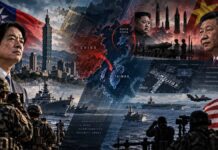











Scope: This assessment examines the September 2026 Pakistan–Powerus drone arrangement, the corporate and financial structure surrounding Powerus, the documented Israeli-linked personnel and institutional relationships within that network, the parallel India-facing technology relationship, and the strategic consequences for Pakistan’s defence diversification, U.S. export-control exposure and publicly declared policy toward Israel, with the assessment limited to what can presently be established from open corporate, regulatory, governmental and first-party records. The structure and evidentiary rules follow the supplied V9.0 institutional intelligence protocol. Testo incollato
Executive Summary / BLUF
- Pakistan has entered into an initial procurement relationship and a broader cooperation framework with Powerus, a U.S. autonomous-systems company incorporated only in October 2025, but neither the Pakistani government nor Powerus has publicly disclosed the systems ordered, quantities, contract value, delivery schedule, end-user architecture or technology-transfer conditions, leaving the actual military significance of the transaction substantially less certain than the political visibility surrounding it. Reuters reported the initial order and memorandum on 16 September, while the contemporaneous Powerus–Aureus regulatory record confirms that Powerus remained a recently formed private company undergoing a proposed public-company combination rather than an established listed prime contractor. Reuters
- The transaction does not presently establish Israeli military technology transfer to Pakistan: the verified public record examined for this assessment does not identify Israeli-origin airframes, components, software, intellectual property or subsystems within the Pakistani procurement, and the stronger evidentiary conclusion is therefore that the Israeli dimension concerns identifiable personnel, business networks and related institutional relationships rather than demonstrated Israeli-origin equipment.
- Powerus nevertheless sits inside an unusually dense political-financial network for such a young defence company, because the proposed merger with Florida golf-course operator Aureus Greenway Holdings would transfer the autonomous-systems business into a Nasdaq-listed structure, while Powerus financing and the transaction architecture involve American Ventures and Dominari-related actors associated publicly with Donald Trump Jr. and Eric Trump. The March merger announcement itself identified the Trump brothers as notable investors in the prospective combined company, although this does not establish their participation in, control over or negotiation of Pakistan’s procurement. SEC
- The corporate record is clearer than much of the surrounding political commentary: Autonomous Power Corporation was incorporated on 8 October 2025, acquired or combined several autonomous-systems businesses during early 2026, arranged approximately $5.55 million of bridge financing connected to American Ventures, later completed approximately $50 million of private equity financing, and received a separate $20 million bridge loan from Aureus Greenway Holdings as it expanded through acquisitions and technology partnerships. SEC
- The September Pakistan engagement therefore has strategic importance less because the available record demonstrates a transformative weapons acquisition than because it places a new U.S. defence-industrial platform at the intersection of Pakistan’s traditionally China-heavy procurement structure, improving Washington–Rawalpindi relations, U.S. commercial capital, autonomous-warfare technology and politically sensitive Israeli-linked networks.
- A second security issue arises independently of Israel: Powerus-related technology has been pursued across several jurisdictions while the company describes itself as an integrator of distributed manufacturers, technology partners and research laboratories, meaning that Pakistan’s principal unresolved requirements concern configuration control, source-code access, component provenance, cybersecurity, export licensing, intellectual-property restrictions and safeguards against cross-customer technology exposure, particularly where the same corporate ecosystem maintains relationships elsewhere in South Asia. SEC
- The most consequential missing evidence is therefore not a political statement but the procurement documentation itself: without the Pakistani purchase order, technical schedule, export authorization, end-user conditions, bill of materials, technology-transfer provisions and any localisation agreement, assertions that this constitutes either a major strategic realignment or an Israeli penetration of Pakistan’s defence supply chain remain analytically premature.
Pakistan’s Powerus Deal Is a Hedge, Not a Pivot
Pakistan’s September 2026 agreement with Powerus is less a break with Beijing than a test of how far Islamabad can diversify without disturbing the architecture that underpins its military power. The numbers impose discipline on the interpretation: China supplied 80% of Pakistan’s major-arms imports in 2021–25, according to SIPRI, while Pakistan’s total arms imports rose 66% compared with 2016–20. Against that backdrop, the 16 September 2026 Powerus arrangement—an initial procurement plus a wider cooperation memorandum—does not amount to strategic realignment. It does, however, expose the harder question Pakistan now faces: whether access to U.S. autonomous systems, private capital and industrial partnerships can improve technological sovereignty without creating new dependencies, provoking Chinese concern, or importing operational-security risk through a supplier that is already licensing related technology into India.
China still defines the ceiling of Pakistan’s defence choices
Pakistan entered the Powerus relationship from a position of unusually high supplier concentration. SIPRI’s 2021–25 data place Pakistan as the world’s fifth-largest importer of major arms, with 4.2% of global imports, while China accounted for 80% of those deliveries. The comparable Chinese share was 73% in 2016–20, which means dependence deepened before the present U.S. opening rather than receded. By contrast, India’s largest supplier, Russia, accounted for 40% of its imports in 2021–25, leaving New Delhi a much broader procurement base across France, Israel and the United States. SIPRI, Trends in International Arms Transfers 2025
That imbalance matters because defence dependence is cumulative. Pakistan’s Chinese relationship is not a collection of isolated purchases but a system of training, sustainment, spares, software, weapons integration, communications and industrial co-production built over years. Foreign Minister Ishaq Dar said in 2026 that Pakistan’s “all-weather” partnership with China was continuing to deepen through CPEC 2.0 and strategic dialogue, even as Islamabad was “simultaneously” reinvigorating ties with Washington. Pakistan Ministry of Foreign Affairs, Pakistan Governance Forum 2026
The implication is straightforward: Powerus can diversify a capability segment, but it cannot substitute for an ecosystem representing four-fifths of recent Pakistani major-arms imports. The test is therefore not whether Islamabad buys an American drone, but whether U.S.-origin technologies begin entering sustainment, software, mission systems and industrial production at sufficient depth to alter the balance of dependency.
Washington is reopening the relationship through narrower doors
The Powerus deal fits a broader U.S.–Pakistan reopening that was already visible before September. On 29 May 2026, Deputy Prime Minister and Foreign Minister Ishaq Dar met U.S. Secretary of State Marco Rubio and the U.S. National Security Advisor in Washington, where the Pakistani account emphasized regional security, economic cooperation and stronger counterterrorism ties. On 4 August 2026, the two countries held their Fourth Counterterrorism Dialogue, covering ISIS-K, al-Qaida, Tehreek-e-Taliban Pakistan and the Balochistan Liberation Army. Pakistan Ministry of Foreign Affairs, 29 May 2026 Pakistan–U.S. Counterterrorism Dialogue, 5 August 2026
Pakistan also facilitated U.S.–Iran diplomacy through the 17 June 2026 Islamabad Memorandum of Understanding, followed by implementation talks in Bürgenstock on 21 June. That combination—counterterrorism cooperation, diplomatic brokerage and renewed commercial engagement—shows that Islamabad is seeking utility from Washington without abandoning Beijing. Pakistan Ministry of Foreign Affairs, Bürgenstock talks
The Powerus transaction therefore serves two interests simultaneously. For Pakistan, it tests whether U.S. defence access can be restored on selective terms. For Washington, it offers a commercial route back into a market where Chinese suppliers dominate. That is a narrower proposition than alliance realignment, but it is strategically more plausible.
The India licence turns diversification into a security problem
The most difficult constraint is not political symbolism but supplier overlap. In June 2026, Powerus Defense entered into an agreement granting India’s Paras Defence & Space Technologies an exclusive licence to manufacture and commercialize Guardian interceptor products in India. The agreement predates Pakistan’s September procurement and gives an Indian company rights within the same corporate technology ecosystem now approaching Rawalpindi. Powerus/Aureus Form S-4/A, SEC
This does not mean Pakistan and India will receive identical systems. It does mean that Islamabad must treat software segregation, encryption, telemetry, vulnerability handling and mission-data ownership as contract-level security issues rather than engineering details. A common supplier serving adversarial states is not unusual in defence markets; a common software baseline or shared vulnerability architecture is far more consequential.
If Pakistan buys a Powerus system derived from the Guardian family, the relevant questions become operational: whether Pakistani firmware is isolated from Indian variants, whether cryptographic keys are sovereign, whether vendor telemetry leaves Pakistan, whether vulnerabilities discovered in one customer’s fleet can affect the other, and whether local engineers can audit updates before deployment. None of those safeguards is publicly visible in the current order.
Local production will matter only if Islamabad controls the interfaces
The Pakistani military’s 16 September 2026 account referred to discussions on procurement, production and capacity building, but those categories are not equivalent. Local assembly of imported kits can generate employment while leaving software, sensors, communications and design authority abroad; genuine industrial diversification requires access to integration interfaces, maintenance data, controlled software, manufacturing drawings and supplier-substitution rights. Radio Pakistan, 16 September 2026
The distinction matters because Powerus itself is still scaling rapidly. Autonomous Power Corporation was formed on 8 October 2025, then acquired Tandem Defense for $500, Kaizen Aerospace for approximately $1.8 million, and Agile Autonomy for approximately $3.9 million in early 2026. Its consolidated successor business generated roughly $1.204 million of revenue in the first quarter of 2026, against operating expenses of approximately $6.116 million and a net loss of about $9.684 million. Powerus/Aureus SEC filing
That makes Pakistan valuable to Powerus as a sovereign customer, but it also places the burden on Islamabad to define what localization actually means. If the eventual agreement stops at assembly and maintenance, Pakistan diversifies its vendor list. If it secures software configuration, integration rights and component substitution, it diversifies capability.
U.S. export controls may cap the partnership before politics does
The ceiling on cooperation may ultimately be set in Washington rather than Rawalpindi. U.S. export rules distinguish between complete systems, controlled components, software, technical data and manufacturing assistance. The Bureau of Industry and Security amended drone-export controls in 2026, but the regulatory treatment still depends on platform capability, end use, destination and technology classification. U.S. Bureau of Industry and Security, Streamlining Export Controls for Drone Exports
For Pakistan, this creates an asymmetry between purchasing and sovereignty. Buying a finished interceptor is one regulatory problem; receiving source code, secure communications architecture, manufacturing drawings or advanced autonomy software is another. The deeper the transfer, the greater Washington’s concern over technology exposure inside a force structure where Chinese-origin platforms are pervasive.
That friction is structural. Pakistan wants local production and reduced dependency; U.S. regulators want end-use control and protection of sensitive technology. A Powerus programme that cannot move beyond finished products would still have political value, but it would do little to change the technological dependency that Islamabad says it wants to reduce.
The Israel contradiction is political, not yet technological
Pakistan’s formal position on Israel remained unchanged after the Powerus agreement. In its 4 June 2026 briefing, the Foreign Ministry said Pakistan’s position on the Abraham Accords had not changed, and on 26 September 2026 Foreign Minister Ishaq Dar again backed a Palestinian state on the pre-June 1967 borders with Al-Quds Al-Sharif as its capital. Pakistani passports also remain formally invalid for travel to Israel. Pakistan Ministry of Foreign Affairs, 4 June 2026 Pakistan Ministry of Foreign Affairs, 26 September 2026
The Powerus relationship nevertheless places Islamabad inside a politically sensitive network. Ziv Marom, a Powerus technical leader, states that he began his career in the Israel Defense Forces Intelligence Corps; Michael Sinensky, a Powerus director expected to hold roughly 19% of post-merger voting power, is also president of the Worldwide Friends Foundation, whose Israel Friends mission publicly describes support to Israeli defence and security users with drones, surveillance systems and related technology. Ziv Marom biography Israel Friends, Advanced Technology Powerus/Aureus Prospectus, SEC
That is enough to create political exposure, but not enough to establish Israeli participation in Pakistan’s procurement. No bill of materials, export licence or supplier record in the dossier demonstrates Israeli-origin hardware or software entering the Pakistani order. The distinction matters because a U.S. company with Israeli-linked personnel is not the same legal or strategic category as an Israeli defence export.
The next 12–24 months will show whether Pakistan bought optionality or dependency
The decisive indicators between late 2026 and 2028 will be measurable: follow-on Powerus orders; a Pakistani manufacturing entity; U.S. licences covering technical data rather than only finished systems; customer-specific software separation from the Indian programme; and any sustained reduction in China’s share of Pakistani arms imports. Without those changes, Powerus remains a niche diversification channel inside a China-dominant force structure.
The cost of inaction would fall first on Pakistan’s military planners and domestic industry. If Islamabad buys U.S. hardware without securing data sovereignty, integration rights and software separation, it risks replacing one concentrated dependency with several smaller ones while adding support and interoperability costs. If Washington restricts transfer depth, Pakistani industry gains assembly but little design authority. If Powerus cannot compartmentalize India and Pakistan technically, operational-security risk rises precisely in the counter-UAS domain that both states are expanding.
The political cost would fall on Islamabad. Pakistan can sustain simultaneous relationships with Beijing and Washington, and it can preserve non-recognition of Israel while contracting with a U.S. company whose personnel have Israeli links. What it cannot sustain indefinitely is strategic ambiguity without contractual precision. Over the next 12–24 months, the procurement documents—not the diplomatic language—will determine whether Powerus becomes evidence of genuine diversification or merely another foreign dependency added to the balance sheet.
Navigational Index
Pillar One — The Transaction Behind the Political Signal
The procurement instrument, memorandum, Powerus corporate maturity, systems potentially involved, localisation ambitions, U.S. regulatory requirements and the distinction between a limited initial order and a strategic defence partnership.
Pillar Two — Capital, Personnel and the Israeli-Linkage Architecture
The Powerus–Aureus merger, American Ventures and Dominari relationships, Trump-family investment exposure, Powerus leadership networks, Israeli-linked professional and charitable connections, and the evidentiary boundary between documented relationships and unsupported claims of Israeli technology entering Pakistan.
Pillar Three — Pakistan’s Strategic Balancing Problem
Pakistan’s defence dependence on China, renewed engagement with Washington, parallel supplier exposure involving India, export-control and operational-security considerations, Islamabad’s formal Israel policy, and the indicators that would distinguish commercial diversification from a deeper geopolitical realignment.
Master Abstract
The significance lies in the architecture around the order, not yet in the disclosed order itself
The September 2026 Powerus transaction should presently be understood as a small but strategically revealing defence-industrial opening rather than evidence of a major reorientation of Pakistan’s weapons architecture. Reuters reported that Powerus had entered into a memorandum with the Pakistan Army and received an initial order associated with unmanned systems, while the Pakistani military publicly acknowledged discussions involving procurement, production and longer-term capacity building without publishing the underlying contract, technical configuration or financial terms. The distinction is decisive because a memorandum establishing avenues for future cooperation does not carry the same evidentiary weight as a binding production contract, funded acquisition programme or approved technology-transfer agreement, and no public document currently establishes that Pakistan has committed to deploy Powerus systems at significant scale. Reuters
Powerus itself remains institutionally young. The company’s September 2026 SEC prospectus records that Autonomous Power Corporation was incorporated in Delaware on 8 October 2025 and subsequently assembled an autonomous-systems portfolio through Kaizen Aerospace, Agile Autonomy and Tandem Defense, while describing its commercial model as an integrated platform drawing upon distributed manufacturers, technology partners and research laboratories rather than a single vertically integrated industrial base. The same filing records a 51 percent Powerus interest in Powerus USA LLC alongside G1 Exploration, established to commercialise autonomous defence technologies, illustrating that important parts of the company’s product architecture depend upon partnership, licensing, acquisition and integration structures rather than technologies necessarily originating inside Powerus itself. Aureus Greenway Holdings Information Statement/Prospectus — SEC — Sep 2026 SEC
This matters for Pakistan because the essential intelligence question is not simply whether Islamabad has purchased an American drone, but what technological dependency accompanies that purchase. A low-cost interceptor, heavy-lift platform, command-and-control package or autonomous mission system creates very different sovereignty implications depending upon whether Pakistan receives executable software only, source-code access, integration rights, local maintenance authority, domestic manufacturing rights, electronic-warfare libraries, data ownership, cryptographic control or the ability to substitute upstream components. Powerus states in its SEC disclosures that its products are organised around modular integration, field repair, rapid deployment and U.S. defence-procurement compliance, yet those descriptions do not establish what configuration Pakistan has acquired or whether Islamabad would receive sufficient technical authority to operate independently of the supplier. SEC
The Trump connection is financial and corporate, not evidence of presidential direction
The politically sensitive element begins with the proposed combination between Powerus and Aureus Greenway Holdings, a Nasdaq-listed company whose existing operating business consists of Florida golf-course properties. Aureus and Powerus entered into their definitive merger agreement on 8 March 2026, under which Powerus would survive as a wholly owned subsidiary and the listed parent would eventually be renamed Powerus Corporation; importantly, the SEC prospectus dated 8 September still described the combination as proposed rather than completed, while the parties subsequently stated that completion was anticipated in early October subject to outstanding closing conditions. Information Statement/Prospectus — Aureus Greenway Holdings — SEC — 8 Sep 2026 SEC
The corporate transaction also connects Powerus to investment structures associated with Donald Trump Jr. and Eric Trump. The companies’ own March 9 merger announcement described American Venture Partners Eric Trump and Donald Trump Jr. as notable investors of the anticipated combined company, while Dominari Securities and Revere Securities were identified as financial advisers to Aureus. Separately, an SEC-filed Dominari announcement from February 2025 records that both Trump sons joined Dominari Holdings’ advisory board and participated in a private placement in that company. These facts establish an investment and advisory nexus, but they do not establish that either man designed, negotiated or influenced Pakistan’s procurement, and the distinction between beneficial investment exposure and operational control must therefore be preserved. New American Drone and Defense Company to be Created Through Merger of Powerus and Aureus Greenway Holdings — SEC Exhibit 99.1 — Mar 2026 Donald Trump Jr. and Eric Trump Join Dominari Holdings Inc.’s Advisory Board — SEC Exhibit 99.2 — Feb 2025 SEC
The financing trajectory nevertheless demonstrates why the Pakistani agreement carries significance for Powerus itself. The SEC record states that American Ventures provided Powerus with financing culminating in a February 2026 instrument carrying approximately $5.55 million principal, accompanied by warrants, while Powerus subsequently completed an approximately $50 million private equity financing and Aureus provided a separate $20 million bridge loan for working capital and execution before the intended merger. These figures describe a company scaling rapidly through financial markets at the same time that it is seeking sovereign defence customers, making successful government contracts strategically valuable not simply as sales but as validation of the combined company’s industrial proposition. Aureus Greenway Holdings Announces $20 Million Bridge Loan to Powerus — SEC Exhibit 99.1 — Mar 2026 SEC
The Israeli connection exists, but its evidentiary meaning must be defined precisely
The most politically consequential aspect of the case is therefore not whether Israeli-linked relationships exist around Powerus—the broader public record establishes that such relationships warrant examination—but what those relationships actually prove about the Pakistani acquisition. Corporate histories, executive biographies and associated organisational records identify Israeli professional and institutional connections among individuals involved in the wider Powerus ecosystem, while charitable structures associated with participants in that network have publicly supported Israel-related activities. Those relationships are relevant to political-risk analysis in Pakistan because formal Pakistani policy continues to reject diplomatic recognition of Israel, but corporate affiliation, prior military service or charitable activity cannot be converted analytically into proof that Israeli state institutions participate in a U.S.–Pakistan procurement programme.
The same evidentiary discipline applies to component provenance. Powerus tells investors that it operates through an integrated network of manufacturers, technology partners and research laboratories and that it has assembled capabilities by acquisition and commercial arrangements, while the SEC prospectus specifically records a 51/49 Powerus–G1 Exploration structure for Powerus USA LLC created to commercialise autonomous defence technologies. That architecture means upstream provenance genuinely matters; however, the available first-order record examined here does not identify Israeli-origin hardware or software in Pakistan’s order, making any stronger conclusion unsupportable without technical schedules, export applications, supplier declarations or bill-of-materials documentation. SEC
The analytically defensible formulation is therefore narrow but significant: Pakistan has engaged a U.S. company whose wider corporate and personnel environment includes Israeli-linked relationships, but the public record does not presently establish that Pakistan purchased Israeli technology through Powerus. This distinction is not semantic, because Pakistan’s domestic political exposure, customs restrictions, military counter-intelligence requirements and diplomatic position would differ substantially depending upon whether the connection concerns the biography of a corporate officer, ownership of intellectual property, an Israeli subcontractor, Israeli-origin electronics, Israeli military financing or direct institutional participation.
Powerus is building a platform rather than offering a single mature product lineage
Powerus describes itself not as a conventional single-product defence manufacturer but as a platform that acquires, integrates and scales autonomous technologies across aerial, maritime and modular mission systems. The September prospectus identifies Kaizen Aerospace, Agile Autonomy and Tandem Defense/Powerus Defense as its principal business units and explains that the company has expanded through combinations, acquisitions and technology partnerships since its October 2025 creation, while its March merger announcement emphasised heavy-lift systems, tactical platforms and maritime surveillance capabilities. New American Drone and Defense Company to be Created Through Merger of Powerus and Aureus Greenway Holdings — SEC Exhibit 99.1 — Mar 2026 SEC
This industrial model can be attractive to Pakistan precisely because Islamabad does not necessarily require another conventional unmanned-aircraft supplier. Pakistan already possesses a diversified unmanned-systems ecosystem incorporating domestic programmes and substantial foreign defence relationships, and the potential value of a U.S. partner therefore lies more plausibly in specialised intercept technologies, electronics, autonomy, integration, manufacturing methodology, access to U.S. capital or collaborative industrialisation than in simple acquisition of an airframe. Because Pakistan and Powerus have not published the equipment list, however, the present assessment cannot determine which of those mechanisms actually explains the September procurement.
The result is an asymmetry between political visibility and technical transparency: senior-level engagement generates the appearance of a strategically important defence opening, while the absence of the procurement schedule prevents external assessment of whether Pakistan purchased a limited evaluation quantity, production tooling, propulsion units, complete unmanned systems, counter-UAS interceptors or associated support. The strategic importance of the transaction will therefore be determined less by the memorandum itself than by what follows it.
The India dimension creates a harder security problem than corporate symbolism
Pakistan’s procurement calculus must also be assessed against Powerus’s broader commercial strategy because autonomous-warfare technology is inherently sensitive to cross-customer exposure. The central operational-security issue is not that a supplier conducts business with more than one state—major defence companies routinely do so—but whether common technologies, software architectures, electronic signatures, communications protocols, autonomy stacks or vulnerability information migrate across programmes serving strategic competitors.
For Pakistan, this becomes particularly sensitive where Powerus or its associated entities maintain technology relationships affecting the Indian market. Any substantial Pakistan programme would therefore require compartmentalised engineering environments, differentiated cryptographic implementation, sovereign mission-data ownership, controls governing telemetry and maintenance information, restrictions on remote access, separate vulnerability-disclosure procedures and contractual limitations governing reuse of Pakistan-funded development. None of those protections can currently be evaluated because the Pakistani contract has not been published.
This issue also changes the significance of localisation. A manufacturing line located inside Pakistan would not automatically constitute technological sovereignty if critical flight computers, processors, navigation elements, secure radios, electro-optical payloads, propulsion components or autonomy software remained imported and vendor-controlled. Conversely, even a comparatively modest airframe programme could become strategically valuable if Pakistan obtained integration authority, component substitution rights, software-level control and domestic production of critical subassemblies. The term local manufacture, consequently, should not be treated as synonymous with local technological control.
The U.S. regulatory layer will reveal more than the memorandum
The export-control record constitutes one of the most important future indicators because U.S.-origin autonomous and military systems can fall under different licensing regimes depending upon configuration, technical characteristics, military applicability and incorporated technology. In August 2026, the U.S. Department of Commerce published changes intended to streamline export controls applying to drone exports through amendments involving the Export Administration Regulations, including relevant sections of Parts 740, 744 and 774. Streamlining Export Controls for Drone Exports — Bureau of Industry and Security — Aug 2026 public-inspection.federalregister.gov
The existence of a Pakistan memorandum therefore does not itself establish export authorisation for every technology contemplated under future cooperation. An initial order involving comparatively low-sensitivity systems may face a different regulatory pathway from later transfer of advanced sensors, autonomous targeting functions, secure communications, electronic-warfare technology or manufacturing technical data. The regulatory history of the transaction will consequently provide a better measure of Washington’s actual willingness to deepen Pakistan’s access to U.S. unmanned-system technology than ceremonial meetings or corporate announcements.
This is particularly important because Washington’s strategic problem is structural: closer defence-industrial engagement with Pakistan can expand U.S. commercial and political influence, but any transfer must be assessed against Pakistan’s extensive Chinese defence relationship and the possibility of technology exposure. Powerus itself describes U.S. regulatory compliance and NDAA-compatible architecture as part of its industrial proposition, meaning that its ability to build a meaningful Pakistan business will depend on whether export authorities permit the technologies Islamabad actually values rather than merely those easiest to license. SEC
Rawalpindi’s diversification does not yet amount to strategic displacement of China
A Powerus programme therefore needs to be interpreted within Pakistan’s broader procurement structure rather than as an isolated diplomatic gesture. Pakistan’s armed forces have spent decades building deep defence-industrial relationships with China across combat aircraft, air defence, naval platforms, missiles, sensors and other systems, creating not merely purchasing relationships but training, maintenance, interoperability, financing and co-production dependencies that cannot be displaced by a limited unmanned-system order.
An American autonomous-systems procurement can nevertheless serve several functions simultaneously: it can test U.S. willingness to restore defence-industrial access, create competitive pressure on established suppliers, expose Pakistani engineers to alternative architectures, attract external capital into domestic autonomous-systems companies and provide Islamabad with political leverage by demonstrating that its defence relationships are not exclusively dependent upon Beijing. None of these mechanisms requires Pakistan to abandon China, and diversification should therefore not be misidentified as strategic realignment.
The same transaction also gives Washington an instrument for re-entry into a market where conventional U.S.–Pakistan defence relations have repeatedly expanded and contracted with geopolitical cycles. Autonomous systems are especially suitable for such re-entry because they allow cooperation to begin at comparatively limited financial scale while potentially expanding later into software, sensors, manufacturing, training and counter-UAS infrastructure. Whether this develops into a durable U.S. foothold will depend on approvals, pricing, technology access and Pakistani confidence in long-term supply continuity.
Pakistan’s Israel policy increases the domestic significance of otherwise ordinary corporate links
Pakistan’s non-recognition of Israel creates a separate political problem from the technical origin of the equipment. A U.S. corporation employing individuals with prior Israeli institutional connections is legally and analytically different from Pakistan importing Israeli-origin military goods, contracting directly with an Israeli defence company or establishing state-to-state defence cooperation, and these categories should not be merged.
The political consequences inside Pakistan, however, can still be significant because procurement transparency will determine whether political actors can credibly distinguish an American commercial relationship from indirect Israeli involvement. If the government publishes sufficient provenance information demonstrating U.S., Ukrainian, Pakistani or other permitted origins for the relevant technology, the Israeli-linkage issue remains principally reputational and political; if future filings reveal Israeli-controlled intellectual property, Israeli-origin critical components or subcontracting involving Israeli defence entities, the legal, diplomatic and domestic-security consequences would become substantially different.
This is why the absence of evidence cannot be converted into reassurance either. The present open-source record does not establish Israeli hardware in the Pakistan programme, but it also does not contain a complete bill of materials capable of excluding every Israeli-origin subsystem. The correct intelligence judgment therefore remains conditional upon the missing procurement and export documentation.
Key Evidence Table
| Indicator | Value/status | Reference date | Definition/scope | Issuer | Exact source |
|---|---|---|---|---|---|
| Powerus legal formation | Incorporated in Delaware on 8 October 2025 | 8 Oct 2025 | Autonomous Power Corporation d/b/a Powerus | SEC-filed prospectus | Information Statement/Prospectus — Aureus Greenway Holdings — SEC — Sep 2026 |
| Pakistan relationship | MoU plus initial undisclosed order reported; public technical and financial terms unavailable | 16 Sep 2026 | Pakistan Army / Pakistani defence procurement relationship | Reuters; Pakistani military acknowledgement reported | Reuters |
| Powerus–Aureus transaction | Definitive merger agreement signed; transaction remained pending in September prospectus | 8 Sep 2026 prospectus | Proposed combination creating listed Powerus Corporation | SEC | Information Statement/Prospectus — SEC — Sep 2026 |
| Expected post-merger ownership | Powerus holders approximately 83.0% of common stock under disclosed assumptions | 8 Sep 2026 | Common-stock ownership immediately after proposed merger | SEC | SEC |
| Powerus initial private financing | Approximately $6.07 million | Jan–Feb 2026 | 13,488 shares at $450 per share | SEC | SEC |
| American Ventures bridge instrument | Approximately $5.55 million principal plus warrants | 10 Feb 2026 | Powerus bridge financing | SEC | SEC |
| Powerus equity financing | Approximately $50 million gross proceeds | Closed Apr 2026 | Private equity financing | SEC | SEC |
| Aureus bridge loan | $20 million | 20 Mar 2026 | Working-capital financing before proposed combination | SEC | Aureus Greenway Holdings Announces $20 Million Bridge Loan to Powerus — SEC — Mar 2026 |
| Powerus USA / G1 Exploration structure | Powerus 51%, G1 Exploration 49% | 31 Mar 2026 | Vehicle for commercialisation of autonomous defence technologies | SEC | SEC |
| Trump-family corporate nexus | Eric Trump and Donald Trump Jr. identified in merger announcement as notable investors; both previously joined Dominari advisory board | Mar 2026 / Feb 2025 | Financial/advisory connection, not evidence of Pakistan-deal control | SEC-filed company announcements | Powerus–Aureus Merger Announcement — SEC — Mar 2026 Dominari Advisory Board Announcement — SEC — Feb 2025 |
| Israeli-origin technology in Pakistan order | Not publicly established | 1 Oct 2026 | No verified public specification or bill of materials demonstrates Israeli-origin hardware/software in the order | Open official/first-party record reviewed | Procurement and export schedules remain undisclosed |
| U.S. drone export regime | Export-control framework amended in 2026 | Aug 2026 | EAR treatment affecting qualifying drone exports | U.S. Bureau of Industry and Security | Streamlining Export Controls for Drone Exports — BIS — Aug 2026 |
Alternatives and Indicators Assessment
The evidence does not satisfy the protocol’s formal ACH threshold because the principal explanations are not genuinely mutually exclusive: Pakistan can simultaneously seek a limited capability, cultivate Washington, diversify away from excessive supplier concentration and explore local industrialisation, while Powerus can simultaneously seek revenue, sovereign-customer validation and geopolitical visibility. A forced ranking among mutually compatible explanations would therefore create artificial analytical precision rather than improve the assessment.
The first pathway is transactional acquisition, under which Pakistan has identified a specific technology, subsystem or production technique that can be procured economically without restructuring its wider supplier architecture; evidence strengthening this interpretation would include a small funded purchase order, limited evaluation quantities, absence of major technology-transfer provisions and no subsequent expansion into wider U.S.–Pakistan autonomous-systems cooperation.
The second pathway is industrial diversification, under which the initial order functions as an entry mechanism for domestic manufacturing, engineering collaboration or capital investment; evidence supporting this interpretation would include incorporation of a Pakistani joint venture, tooling imports, localisation milestones, Pakistani industrial partners, engineering exchanges, source-code or integration agreements, and follow-on orders explicitly tied to domestic production.
The third pathway is strategic U.S.–Pakistan re-engagement, under which autonomous systems become one element of a larger restoration of bilateral defence-industrial relations; evidence supporting this interpretation would include repeated U.S. export approvals for increasingly sensitive systems, U.S. government-supported financing, broader American supplier entry into Pakistan and programmes extending beyond unmanned systems.
An Israeli-normalisation pathway cannot presently be elevated to equivalent standing because the public record establishes corporate and personnel links but does not establish Israeli governmental involvement, Israeli-origin equipment, an Israeli defence export or a change in Pakistan’s diplomatic recognition policy. Such a conclusion would require qualitatively different evidence.
Principal Gaps and Watch Indicators
The Pakistan purchase order
The most important missing record is the actual Ministry of Defence procurement documentation identifying system designation, manufacturer, quantity, value, delivery milestones, warranty, training, support, intellectual-property conditions and localisation provisions; disclosure of even a redacted award notice could materially change the assessment.
The export licence
A U.S. authorization identifying the controlled items and end-use conditions would clarify both the technology involved and Washington’s willingness to permit transfer; subsequent approvals covering higher-sensitivity components would be a stronger indicator of strategic defence re-engagement than the existing memorandum.
Component and intellectual-property provenance
A verified bill of materials, supplier declaration, export-classification record or licensing agreement is required before any definitive conclusion can be reached regarding Israeli, Chinese, Ukrainian or other foreign-origin technology incorporated into systems supplied to Pakistan.
Pakistani industrial participation
Registration of a joint venture, manufacturing licence, domestic production facility, named Pakistani defence-industry partner or procurement-linked investment would move the relationship from a commercial sale toward structural industrial cooperation.
Cross-customer safeguards
Any technical collaboration involving both Pakistan and India-facing activities requires evidence of programme segregation, cybersecurity controls, separate software baselines, intellectual-property protections and sovereign handling of mission data before operational-security exposure can be meaningfully assessed.
Powerus corporate closing
The proposed Powerus–Aureus business combination itself remains strategically relevant because completion alters ownership, governance, capitalization, disclosure obligations and market access; the September 8 SEC prospectus showed the transaction still pending, while the parties subsequently anticipated an early-October closing subject to remaining conditions. SEC
Follow-on Pakistani orders
A second or substantially larger funded procurement would materially strengthen the proposition that the September arrangement is the beginning of a durable supplier relationship rather than a limited commercial and diplomatic experiment.
Israeli-origin evidence
The assessment would change materially if a competent filing, technical document, export record or manufacturer declaration demonstrated Israeli-controlled intellectual property, critical Israeli-origin components, an Israeli subcontractor with access to the Pakistani programme or participation by an Israeli governmental defence authority; none of these propositions is presently established by the verified record used here.
Pakistan–Powerus: The Network Behind the Drone Procurement
01 OCT 2026
Pakistan has opened a defence-industrial relationship with Powerus through an initial procurement and a wider cooperation framework, but the public record does not disclose the purchased configuration, contract value or component provenance. The Israeli dimension is presently established through people, organisations and related business networks rather than through verified Israeli-origin hardware supplied to Pakistan.
U.S. autonomous-systems platform
Incorporated October 2025
Pakistan Defence Establishment
Initial procurement plus cooperation framework involving Pakistan’s defence authorities and Army leadership; systems, quantity and value remain undisclosed.
Verified relationshipAureus / Public-Market Route
Proposed combination with Nasdaq-listed Aureus Greenway Holdings creates the intended pathway from private defence platform to publicly traded company.
Corporate structureU.S. Capital Network
American Ventures, Dominari-related actors and Trump-family investment exposure form part of the wider financing and transaction environment.
Financial nexusIsraeli-Linked Network
Israeli-linked biographies, prior institutional affiliations and associated charitable relationships create political sensitivity, but do not prove Israeli equipment inside Pakistan’s purchased systems.
Connection ≠ hardware originTechnology & Integration Layer
Powerus integrates acquired companies, partner technologies and distributed manufacturing rather than relying on a single vertically integrated product lineage.
Supply-chain dependencyIndia-Facing Exposure
Parallel commercial activity affecting the Indian market raises compartmentation, software-baseline, mission-data and operational-security questions for Pakistan.
Strategic sensitivityThree-Layer Analytical Structure
Layer I — What Pakistan Actually Signed
- Initial procurement relationship.
- Broader cooperation memorandum.
- Possible manufacturing and capacity-building ambitions.
- No disclosed price, quantity, technical schedule or final localisation package.
- Future cooperation remains analytically distinct from a funded procurement programme.
Layer II — What Surrounds Powerus
- Rapid corporate formation and acquisition-led expansion.
- Proposed Aureus merger and Nasdaq route.
- American Ventures and other financing relationships.
- Trump-family investment exposure in the wider corporate architecture.
- Israeli-linked personnel and institutional relationships.
Layer III — What Remains Unproven
- No verified Israeli-origin hardware in the Pakistan order.
- No disclosed bill of materials.
- No public source-code or autonomy-stack provenance.
- No complete export-licensing record for the Pakistani configuration.
- No public evidence of Israeli governmental participation.
Strategic Dependency Chain
Relationship Assessment Matrix
| Relationship | Public-record status | What it establishes | What it does not establish | Strategic relevance |
|---|---|---|---|---|
| Pakistan ↔ Powerus | Documented procurement and cooperation relationship | Pakistan has formally opened a defence-industrial channel with the company | Scale, configuration, contract value and long-term deployment | Potential U.S.–Pakistan defence diversification |
| Powerus ↔ Aureus Greenway | Proposed corporate combination | Planned route toward a listed Powerus structure | Automatic completion or permanent post-merger ownership structure | Capital access, disclosure and market validation |
| Powerus ↔ Trump-linked capital | Documented investment / transaction-network exposure | Trump-family-linked investment interests exist in the wider corporate structure | Direct role in negotiating Pakistan’s procurement | Political visibility and conflict-of-interest scrutiny |
| Powerus ↔ Israeli-linked individuals / organisations | Documented personnel and institutional connections | Israeli-linked professional and charitable relationships exist around the company | Israeli governmental control or Israeli-origin equipment in Pakistan’s order | High domestic and diplomatic sensitivity for Pakistan |
| Powerus ↔ India-facing market | Documented commercial exposure | The same corporate ecosystem operates across rival South Asian markets | Automatic compromise of Pakistan-specific systems | Requires strict programme compartmentation |
| Pakistan ↔ China | Deep existing defence relationship | Pakistan retains substantial structural dependence on Chinese defence supply | That Powerus represents replacement of China | Powerus is better read as diversification than displacement |
Critical Decision Indicators
Indicator: Procurement Becomes Structural
Watch for follow-on orders, larger quantities, named Pakistani industrial partners, production tooling, engineering exchanges and funded localisation milestones.
Indicator: U.S. Re-engagement Deepens
Repeated export approvals covering more sensitive autonomous, sensor, communications or electronic-warfare technologies would provide stronger evidence than diplomatic signalling alone.
Indicator: Israeli Dimension Changes Category
The assessment would materially change only if verified documentation identifies Israeli-controlled intellectual property, critical Israeli-origin components, Israeli subcontractors or Israeli governmental participation.
The decisive missing evidence remains the Pakistani purchase order and its technical annexes, including system designation, quantities, price, component provenance, software and data rights, export authorisation, production arrangements and programme-security safeguards. Until those records emerge, the strongest defensible conclusion is that an Israeli-linked corporate network surrounds the U.S. supplier, while Israeli-origin technology inside Pakistan’s actual procurement remains unproven.
Key regulatory records: Aureus Greenway Holdings Information Statement / Prospectus, September 2026 ; Powerus–Aureus Merger Announcement, March 2026 ; Dominari Holdings Advisory Board Announcement, February 2025 .
Pillar One — The Transaction Behind the Political Signal
Principal judgment
The September 2026 Pakistan–Powerus transaction cannot yet be treated as a conventional strategic procurement programme because the public record establishes three different layers of commitment that carry materially different legal, industrial and military weight: an initial order connected to unmanned aerial systems, a memorandum providing a framework for broader cooperation, and a senior-level dialogue covering procurement, production and capacity building. Pakistan’s official account confirms the third layer but does not publicly identify either the memorandum or the purchase order, whereas Powerus co-founder Brett Velicovich separately confirmed both to Reuters and withheld the technology, price and detailed configuration on security and confidentiality grounds. Pakistan’s state broadcaster, reproducing the military’s account, described discussions covering “defence procurement, production and capacity building,” which establishes an official policy space for industrial cooperation but does not establish that such cooperation has already been contracted. radio.gov.pk Pakistan state account — Radio Pakistan, 16 September 2026 Reuters — Powerus signs Pakistan Army MoU and receives initial order
That distinction is the controlling issue for this pillar. An order creates a defined procurement obligation to the extent stated in the underlying contract; a memorandum normally structures intended cooperation but does not, by itself, prove funded production, technology transfer or future purchases; and a discussion of production or capacity building is still one step further removed from implementation. Until the actual contractual instruments become public, the strategically significant feature is therefore not the size of the acquisition—which remains undisclosed—but the fact that Pakistan has opened a procurement and industrial dialogue with a U.S. autonomous-systems company whose own consolidated corporate structure was created only months earlier through acquisitions, financing and a pending merger. Reuters
The transaction should be read as a three-instrument architecture
The public record supports a more precise decomposition than the shorthand description “Pakistan bought Powerus drones.” The first element is a commercial procurement, because Velicovich stated that Powerus received an initial order and placed the technology within the unmanned-aerial-systems category. The second is a bilateral corporate–military memorandum, which provides the potential framework for wider engagement. The third is a strategic-industrial dialogue confirmed through Pakistan’s official account and explicitly extending beyond procurement into production and capacity building. The public record does not disclose whether these three elements are contained in one package of documents or separate instruments, whether the Ministry of Defence and Pakistan Army carry different contractual responsibilities, or whether future manufacturing would require an additional agreement. Reuters
Transaction architecture
| Layer | Publicly established position | What is contractually demonstrated | What remains unestablished | Analytical significance |
|---|---|---|---|---|
| Initial procurement | Powerus says an initial order was received | A real purchasing relationship exists | Price, quantity, system designation, delivery schedule, funding source, acceptance criteria | Converts political contact into an actual supplier relationship |
| Memorandum of understanding | Powerus says an MoU was signed with the Pakistan Army | A cooperation framework exists according to the company | Binding obligations, duration, exclusivity, manufacturing commitments, IP rights | Creates a route for follow-on activity without proving it will occur |
| Procurement dialogue | Pakistan officially confirms procurement discussions | Official Pakistani acknowledgement of procurement engagement | Whether discussion corresponds exactly to the disclosed Powerus order | Confirms institutional engagement at the highest military level |
| Production dialogue | Pakistan officially confirms production discussions | Production was formally discussed | Site, investment, volumes, Pakistani partner, local-content percentage | Potential bridge from imports to industrial participation |
| Capacity building | Pakistan officially confirms the subject | Institutional development is within the cooperation agenda | Training package, engineering transfer, maintenance rights, doctrine, data architecture | Potentially more durable than purchase of finished systems |
| Strategic partnership | Not publicly established | None beyond present instruments | Multi-year programme, committed procurement pipeline, joint venture, licensed production | Cannot presently be inferred from the MoU |
Sources: Pakistan’s official description of the meeting and Powerus’s disclosure of the order and MoU. radio.gov.pk Official Pakistan account — Radio Pakistan
The unusual asymmetry between Pakistan’s disclosure and Powerus’s disclosure matters
Pakistan’s publicly released account is narrower than the company’s. The official statement says that the parties discussed defence procurement, production and capacity building and expressed interest in expanding engagement, but does not publicly state that a contract had been awarded, does not identify an MoU, and does not describe a specific unmanned system. Powerus, by contrast, disclosed through its co-founder that an MoU had been executed and that an initial order had already been received. radio.gov.pk
That mismatch should not automatically be interpreted as a contradiction. Defence ministries and armed forces often disclose procurement information more conservatively than vendors, while suppliers—particularly young companies preparing for capital-market transactions—have commercial incentives to publicise sovereign customer engagement. In this case, however, the asymmetry is analytically important because Powerus was simultaneously approaching completion of a transaction designed to place the business inside a Nasdaq-listed company, meaning that evidence of government demand carries potential investor significance as well as military significance. The September 8 SEC prospectus described the Powerus–Aureus combination as still pending, while subsequent transaction communications said closing was anticipated in early October subject to remaining conditions. SEC
Corporate maturity must be measured from the consolidated business, not the brand narrative
Powerus’s institutional maturity is best understood through its SEC disclosures rather than through the age of the Powerus brand alone. Autonomous Power Corporation was formed on 8 October 2025, and the consolidated enterprise was subsequently assembled through three principal transactions: the acquisition of Tandem Defense on 15 January 2026, Kaizen Aerospace on 30 January, and Agile Autonomy on 20 February. The regulatory filing states that Tandem Defense had no operations at the acquisition date and was acquired for $500, Kaizen was purchased for total consideration of approximately $1.8 million, and Agile for approximately $3.9 million. SEC
This creates an important distinction between corporate age and underlying operating experience. Powerus as the consolidating entity is new, but some acquired businesses had pre-existing activities. Kaizen manufactured and sold drone platforms and provided drone services; Agile supplied maritime autonomy and unmanned-systems integration, including conversion of manned vessels to remotely operated or autonomous configurations; and Tandem/Powerus Defense was positioned around unmanned aerial and tactical defence systems. The corporate structure is therefore better described as a rapidly assembled autonomous-systems platform than either as a completely inexperienced start-up or as a long-established integrated defence prime. SEC
Corporate build-out before the Pakistan order
| Date | Corporate event | Consideration / financial value | Operating implication |
|---|---|---|---|
| 8 Oct 2025 | Autonomous Power Corporation formed | Not applicable | Establishes Powerus corporate inception |
| 15 Jan 2026 | Tandem Defense acquired | $500 cash | Adds tactical/UAS development entity; filing says no operations at acquisition |
| 30 Jan 2026 | Kaizen Aerospace acquired | ~$1.8m | Adds drone manufacturing and platform activity |
| 20 Feb 2026 | Agile Autonomy acquired | ~$3.9m | Adds maritime autonomy, unmanned systems integration and special projects |
| 8 Mar 2026 | Merger agreement with Aureus Greenway | Equity transaction | Creates planned route to public-market company |
| 20 Mar 2026 | Aureus provides convertible financing | $20m principal, 10% simple annual interest | Funds working capital and transaction-period expansion |
| Apr 2026 | Powerus equity financing reflected in filings | ~$50m gross | Expands capital available for growth and acquisitions |
| 12 Aug 2026 | S-4 declared effective | Regulatory milestone | Removes an important transaction prerequisite but does not itself complete merger |
| 16 Sep 2026 | Pakistan engagement disclosed | Undisclosed | First publicly identified Pakistan order/MoU examined here |
| Early Oct 2026 | Merger closing anticipated | Pending as of cited disclosures | Would transform governance, ownership and disclosure structure |
Sources: SEC Powerus/Aureus prospectus, Aureus convertible-note filing, and August transaction update. SEC
The financial record shows rapid scaling, but not yet the revenue profile of a mature defence prime
The financial statements sharpen the maturity question further. Powerus itself generated no revenue between its October 8, 2025 formation and December 31, 2025, recorded approximately $0.7 million of operating expenses, and produced a similar net loss over that short period. Following the acquisitions, the consolidated successor business recorded approximately $1.204 million of revenue during the three months ended March 31, 2026, against operating expenses of roughly $6.116 million and a consolidated net loss of approximately $9.684 million. SEC
Revenue concentration was also high. The prospectus states that approximately 57% of successor-period revenue came from Powerus Defense and 43% from Agile, while two customers accounted respectively for about 42% and 39% of consolidated revenue at March 31. That means roughly four-fifths of revenue was associated with two customers at that reporting date, a concentration profile that is materially different from the diversified contract base normally associated with a mature defence prime contractor. SEC
Operating maturity snapshot
| Metric | Reported value | Period | Interpretation |
|---|---|---|---|
| Powerus standalone revenue | $0 | 8 Oct–31 Dec 2025 | Consolidating entity began without operating revenue |
| Powerus standalone operating expenses | ~$0.7m | 8 Oct–31 Dec 2025 | Initial corporate build-out costs |
| Consolidated successor revenue | $1.204m | Q1 2026 | Revenue emerges after acquisitions |
| Consolidated cost of goods sold | $0.823m | Q1 2026 | Indicates actual product/service delivery activity |
| Consolidated gross profit | $0.381m | Q1 2026 | Approximate reported gross contribution before operating expenses |
| Consolidated operating expenses | $6.116m | Q1 2026 | Expansion and integration expenditure greatly exceeded gross profit |
| Consolidated operating loss | $5.735m | Q1 2026 | Early-stage scaling structure |
| Consolidated net loss | $9.684m | Q1 2026 | Reflects operating and other expense burden |
| Largest customer concentration | ~42% | 31 Mar 2026 | Significant revenue dependency |
| Second-largest customer concentration | ~39% | 31 Mar 2026 | Together with largest customer, approximately 81% of revenue |
| Kaizen 2025 revenue | $675,242 | FY2025 | Small but established drone-platform revenue stream |
| Kaizen 2024 revenue | $542,909 | FY2024 | 2025 increase of approximately 24.4% |
| Agile pre-acquisition revenue | $1.9m | 17 Jul–31 Dec 2025 | Most substantial disclosed pre-combination operating activity |
Source: Powerus financial information reproduced in the SEC registration statement and prospectus. SEC
These figures do not establish that Powerus lacks the capacity to deliver the Pakistani order, because the value and quantity of that order are unknown. They do establish that analysts should not infer mature prime-contractor scale simply from the breadth of the company’s marketed portfolio or from the political level of its Pakistani engagement. The procurement risk profile depends heavily on whether Pakistan ordered a small batch, demonstration systems, subsystems, complete interceptors or an industrial package requiring sustained production and lifecycle support.
Management forecasts illustrate the scale Powerus is trying to reach, not scale already achieved
The SEC materials also reproduce management projections that are useful precisely because they illuminate the difference between current operations and the company’s planned trajectory. Powerus management originally projected revenue of approximately $57.5 million in 2026, $130 million in 2027, $268 million in 2028, $505 million in 2029 and $875 million in 2030, while a revised forecast reproduced in the filing projected $60.5 million, $136.8 million, $282 million, $531.5 million and $922 million, respectively. These are management forecasts, not realised results, and the filing explicitly presents them as unaudited forward-looking information. SEC
Powerus management growth case
| Year | Original revenue forecast | Revised revenue forecast | Original EBITDA | Revised EBITDA |
|---|---|---|---|---|
| 2026 | $57.5m | $60.5m | $4.9m | -$4.1m |
| 2027 | $130.0m | $136.8m | $14.0m | $15.5m |
| 2028 | $268.0m | $282.0m | $29.1m | $32.8m |
| 2029 | $505.0m | $531.5m | $59.1m | $64.1m |
| 2030 | $875.0m | $922.0m | $108.6m | $117.4m |
The revised model’s movement from positive 2026 EBITDA in the original forecast to approximately negative $4.1 million is especially relevant because it indicates heavier near-term expenditure even while revenue expectations increased. The Pakistan agreement should therefore be understood against a corporate strategy that depends upon rapid customer acquisition, manufacturing expansion, strategic partnerships and substantial growth rather than a mature, stable operating baseline. SEC Amendment No. 1 to Form S-4 SEC
The system purchased by Pakistan cannot responsibly be identified from Powerus’s public portfolio
Powerus markets and discloses capabilities extending across heavy-lift unmanned aircraft, tactical systems, counter-drone technology and maritime autonomy. Its March merger announcement described Kaizen-associated heavy-lift aircraft capable of carrying payloads above 500 pounds, while later corporate material identified Powerus as developing aerial systems, counter-drone solutions and critical-infrastructure protection platforms. SEC
None of those descriptions establishes what Pakistan purchased. Velicovich deliberately limited his public statement to the unmanned-aerial-systems category, and no first-order Pakistani release identifies a model. It would therefore be analytically incorrect to convert any specific Powerus product—Guardian, a heavy-lift Kaizen platform or another tactical system—into the Pakistani configuration merely because that system exists within the company’s portfolio.
Capability universe versus Pakistan procurement evidence
| Powerus capability area | Public evidence capability exists | Evidence included in Pakistan order | Assessment |
|---|---|---|---|
| Heavy-lift UAS | Yes | None publicly disclosed | Cannot attribute to Pakistan |
| Tactical UAS | Yes | Order described broadly as UAS-related | Possible category, model unknown |
| Counter-UAS/interceptor systems | Yes | No official configuration disclosure | Cannot identify as ordered system |
| Maritime autonomy | Yes | None | No basis to associate with initial Pakistan purchase |
| Autonomous surface-vessel conversion | Yes through Agile | None | Outside disclosed UAS category |
| Critical-infrastructure systems | Company markets capability | None | Meeting context only |
| Production/local manufacturing | Discussed officially | No contracted facility disclosed | Future pathway, not present capability |
| Training/capacity building | Discussed officially | No package disclosed | Intent domain, not confirmed deliverable |
Sources: Powerus merger disclosure, Powerus corporate description filed with the SEC, and Pakistan’s official meeting account. SEC
Localisation has at least six different meanings, and the MoU does not establish which one Pakistan seeks
The phrase “localize manufacturing” can conceal very different levels of industrial sovereignty. At the lowest level, Pakistan could assemble imported kits. At a higher level, Pakistani industry could manufacture structures or propulsion components while importing avionics and mission systems. Still deeper arrangements could transfer system integration authority, manufacturing data packages, software interfaces, source code, autonomy models or design authority. Only the latter categories would substantially change Pakistan’s technological dependency.
The publicly confirmed Pakistani discussion of production and capacity building therefore matters more than generic language about local assembly, because it leaves open a spectrum extending from maintenance training to sovereign engineering capability. However, neither the official Pakistani statement nor Powerus’s public disclosure identifies local-content percentages, manufacturing locations, investment values, named Pakistani industrial entities, intellectual-property ownership, source-code access or export-controlled technical-data transfers. radio.gov.pk
Localisation ladder
| Localisation level | What Pakistan would receive | Dependency retained | Evidence in present public record |
|---|---|---|---|
| Maintenance support | Training, spare parts, field servicing | High dependency on OEM | Capacity building discussed only |
| Final assembly | Imported kits assembled domestically | Critical subsystems remain external | Not established |
| Component manufacture | Local structures, mechanical components or selected electronics | Imported mission-critical technology may remain | Not established |
| Licensed production | Defined manufacturing package and quality-control rights | IP restrictions remain substantial | Not established |
| Systems integration | Authority to integrate sensors, radios, weapons or payloads | Core software/design may remain external | Not established |
| Software/autonomy access | Mission-system configuration and potentially source-code rights | Depends on licence scope | Not established |
| Design authority | Ability to modify, substitute and independently evolve system | Lowest supplier dependency | No evidence |
The correct benchmark for any future Pakistan–Powerus industrial arrangement is therefore not the percentage of physical assembly occurring inside Pakistan but who controls the interfaces, software, cryptography, mission data, qualification process and right to substitute suppliers.
Pakistan’s procurement rules permit opacity in national-security cases, but opacity does not reveal the procurement pathway
Pakistan’s federal Public Procurement Rules generally require procurement advertising above the applicable threshold, but Rule 14 expressly permits deviation where the proposed procurement concerns national security and publication could jeopardize national-security objectives, subject to prior approval by the authority. The rules separately recognise intellectual-property and single-source circumstances as another basis for withholding ordinary publication. Public Procurement Rules 2004 — Pakistan PPRA PPRA e-Publish & Monitoring System
The absence of a visible public tender therefore cannot by itself establish procedural irregularity. What remains unknown is which procurement route was actually used, whether the order was competitively tendered, treated as national-security procurement, structured as direct contracting, issued under another defence-specific framework or processed through a military procurement mechanism that does not generate an ordinary public tender trail.
Procurement transparency test
| Question | Public answer as of 1 Oct 2026 | Why it matters |
|---|---|---|
| Was there a public tender? | None identified in the record examined | Determines whether procurement was openly competed |
| Was a national-security exception invoked? | Not publicly established | Could explain absence of public advertisement |
| Was Powerus selected as a single source? | Not established | Relevant to value-for-money and technology uniqueness |
| Which Pakistani authority signed the purchase order? | Reported as Ministry of Defence relationship, document unpublished | Determines contractual competence and funding chain |
| Is the Army the end user? | Strongly indicated by engagement, but technical end-user certificate unavailable | Relevant to U.S. export licensing |
| Was an evaluation completed beforehand? | Not publicly disclosed | Critical for judging procurement maturity |
| Was there a competitive trial? | Not publicly disclosed | Would demonstrate technical selection against alternatives |
| Was offset/local-content language included? | Not disclosed | Determines industrial significance |
| Is the MoU binding? | No binding terms publicly available | Prevents treating future cooperation as committed expenditure |
U.S. export control is not an afterthought; it can define the ceiling of the partnership
The regulatory treatment of any U.S.-origin unmanned system depends on the equipment’s classification, technical characteristics, incorporated technology and end use. The U.S. government operates different controls under the International Traffic in Arms Regulations and the Export Administration Regulations, while the U.S. policy framework for UAS transfers historically applies to U.S.-origin systems across both the U.S. Munitions List and Commerce Control List. U.S. Policy on the Export of Unmanned Aerial Systems — Department of State Sito del Dipartimento di Stato USA
The regulatory significance becomes greater if the relationship migrates from finished products toward local manufacture. Exporting a completed air vehicle can require one set of permissions; transferring controlled technical data, manufacturing know-how, source code, defence services, encrypted communications, advanced sensors or design information can trigger more restrictive requirements. Consequently, the true ceiling of Pakistan–Powerus cooperation may be determined not by what Pakistan wants to manufacture but by what U.S. authorities are prepared to license.
The U.S. government has also shown in 2026 that it is actively modifying the regulatory treatment of unmanned systems according to strategic-partner status. In July, the Bureau of Industry and Security removed the United Arab Emirates from certain restrictive country groups, explicitly stating that the change would eliminate restrictions on support for UAE unmanned-aerial-vehicle programmes and broaden access to licence exceptions for qualifying controlled items. That example does not apply automatically to Pakistan, but it demonstrates that country classification materially affects the ease with which autonomous-system technology can be transferred. Department of Commerce Eases Export Controls for UAE — BIS, 10 July 2026 Bis
Regulatory escalation as the relationship deepens
| Cooperation form | Regulatory sensitivity | Principal unresolved issue for Pakistan |
|---|---|---|
| Commercial non-sensitive components | Lower | ECCN/classification and end user |
| Complete UAS | Moderate to high depending on specification | Export licence and end-use restrictions |
| Counter-UAS interceptor | Potentially higher | Military classification, guidance and mission function |
| Secure communications | High where controlled encryption/military capability applies | Crypto control and integration rights |
| EO/IR or advanced sensors | Configuration dependent | Sensor performance limits |
| Autonomous mission software | Potentially high | Software classification and technical-data controls |
| Manufacturing drawings | Higher than simple product shipment | Technical-data export permissions |
| Source code | Potentially sensitive | Licence scope and access restrictions |
| Defence services/training | Separate regulatory exposure may apply | Personnel support and technical assistance |
| Joint development | Highest structural significance | IP allocation, exportability of jointly developed technology |
The Pakistan import regime creates a separate origin-of-goods question
Pakistan’s Import Policy Order provides an additional legal layer because the Ministry of Commerce’s official text bans goods of Israeli origin or imported from Israel, while the same order contains specified government and defence-related exceptions elsewhere in its prohibition architecture. The operative text must therefore be read according to the actual origin, routing and legal classification of goods rather than the nationality or biography of executives associated with the selling U.S. company. Import Policy Order 2022 — Ministry of Commerce, Government of Pakistan commerce.gov.pk
This creates a practical procurement requirement: if Powerus uses a distributed supplier network, Pakistan requires provenance visibility at least for critical subassemblies to determine customs, political and security exposure. Corporate connections to Israel do not establish Israeli origin; equally, U.S. final assembly does not automatically establish that every critical subsystem is U.S.-origin. Only a bill of materials, supplier declarations, certificates of origin and export documentation can resolve that question.
The merger makes sovereign-customer acquisition financially consequential
A distinctive feature of this transaction is timing. Powerus entered Pakistan during the final stages of its proposed merger with Aureus Greenway Holdings, whose existing business consisted of two Florida golf clubs. The proposed transaction would leave former Powerus stockholders holding roughly 83% of the combined company under the disclosed structure, with existing AGH holders retaining approximately 17%, thereby functionally transforming the listed entity from a recreation business into a defence/autonomous-systems platform. Aureus Greenway Holdings Form 10-Q SEC
The independent financial-adviser analysis reproduced in the S-4 applied approximately 7×–9× projected 2026 revenue to Powerus’s management forecast and produced an implied equity-value range of approximately $451.5 million to $566.5 million under its selected public-company method; its combined valuation work produced a concluded Powerus range of roughly $452 million to $548 million. These are transaction valuation analyses rather than realised market values, but they demonstrate the extent to which forward revenue expectations and successful scaling influence the investment case. SEC Amendment No. 1 to Form S-4 SEC
Scale gap between historical operations and transaction valuation
| Measure | Value | Status |
|---|---|---|
| Powerus standalone 2025 revenue | $0 | Historical |
| Consolidated successor Q1 2026 revenue | $1.204m | Historical |
| Original 2026 management revenue forecast | $57.5m | Forecast |
| Revised 2026 management revenue forecast | $60.5m | Forecast |
| 2030 revised management revenue forecast | $922m | Forecast |
| DCF implied Powerus equity-value range | $452.1m–$530.0m | Adviser valuation analysis |
| Guideline-company implied equity-value range | $451.5m–$566.5m | Adviser valuation analysis |
| Concluded valuation range | $452m–$548m | Adviser valuation analysis |
| Planned AGH shares forming base consideration | 84.66m shares | Transaction structure |
| Additional shares to Powerus holders | 55m shares | Fully earned/vested at closing under amended structure |
Source: SEC Powerus/Aureus registration statement. SEC
A sovereign defence customer acquired during this scaling phase therefore has significance beyond the immediate contract revenue. It can validate market access, support management’s narrative of international expansion, strengthen future procurement references and potentially improve the credibility of aggressive growth assumptions. That does not imply that Pakistan entered the transaction for financial-market reasons; it means the same procurement can carry very different strategic significance for the buyer and the seller.
The strongest industrial interpretation is an option architecture, not yet a production programme
The structure visible today resembles an option architecture. Pakistan obtains access to evaluate or use an initial Powerus system; Powerus obtains a sovereign customer and entry into a strategically important defence market; the MoU preserves an avenue for future production and capacity building; and both parties postpone the hardest decisions—technology transfer, localisation depth, capital commitment, volume and export-control approvals—until the initial relationship is tested.
This structure has rational advantages for both sides. Pakistan limits exposure to an unproven supplier relationship while retaining access to U.S. technology and corporate capital; Powerus avoids committing immediately to expensive localisation before demand is established; and U.S. regulators retain the ability to assess later transfers separately. The central question is therefore whether the MoU develops into repeat orders plus industrial commitments, because that combination—not the September ceremony—would mark the transition from political signal to durable defence partnership.
What would constitute evidence of a genuine strategic defence partnership
A strategic partnership would require a substantially higher evidentiary threshold than the present public record satisfies. The most important signposts would be a multi-year procurement framework; repeat orders of meaningful scale; a Pakistani manufacturing entity; committed capital expenditure; documented transfer of manufacturing data or integration rights; U.S. export approval covering controlled technical data; Pakistani access to maintenance and software architecture; defined lifecycle support; and formal programme-security provisions separating Pakistan-specific systems from other international customers.
Escalation thresholds
| Stage | Evidence required | Present status |
|---|---|---|
| Vendor contact | Senior meeting / demonstrations | Met |
| Commercial entry | Initial funded order | Met according to Powerus |
| Framework relationship | Signed MoU | Met according to Powerus |
| Repeat procurement | Second or enlarged order | Not publicly established |
| Production partnership | Manufacturing contract/JV/site | Not established |
| Technology transfer | IP, technical-data or source-code agreement | Not established |
| Sovereign integration | Pakistani control over interfaces and mission systems | Not established |
| Strategic programme | Multi-year acquisition + localisation + lifecycle framework | Not established |
Key judgments
The September arrangement has crossed the line from diplomatic contact to a real procurement relationship, but it has not crossed the line into a publicly demonstrated strategic programme. Pakistan officially acknowledges procurement, production and capacity-building discussions, while Powerus separately confirms an initial UAS-related order and an MoU; the undisclosed contract prevents a defensible assessment of scale. radio.gov.pk
Powerus should be regarded as a rapidly assembled defence-technology platform whose corporate ambitions substantially exceed its presently demonstrated historical revenue base. Its underlying subsidiaries provide real operating capabilities, but the SEC record shows a consolidator formed in October 2025, acquisitions completed in early 2026, Q1 consolidated revenue of approximately $1.2 million, significant customer concentration and management forecasts requiring very rapid expansion. SEC
Production language should not yet be equated with localisation. The present public record contains no manufacturing agreement, local-content requirement, Pakistani production partner, site, investment commitment, transfer-of-technology schedule, source-code arrangement or design authority.
U.S. export approvals are likely to become one of the most informative external indicators of the relationship’s depth because a transition from completed products to technical data, controlled software, sensors, manufacturing know-how or joint development would create materially greater regulatory exposure than a limited initial sale.
The commercially most important next event is not another senior-level meeting but a follow-on funded order or binding industrial agreement. Either would materially strengthen the conclusion that Powerus is becoming part of Pakistan’s defence-industrial architecture rather than functioning as a limited supplier and political signalling channel.
What would change the assessment
A disclosed purchase order showing substantial quantities or a high contract value would raise the military significance immediately; a Pakistani joint venture or manufacturing licence would raise the industrial significance; U.S. approval for controlled technical-data transfer would demonstrate Washington’s willingness to support deeper integration; source-code or sovereign mission-system rights would indicate genuine technological localisation; repeat purchases would demonstrate customer acceptance; and documented Israeli-origin critical hardware or software would materially alter the provenance dimension examined separately elsewhere in the dossier.
Open official record
The records still capable of materially changing the assessment are the Pakistani purchase order and technical annexes; the full MoU; any end-user certificate; U.S. export classification and licence; Pakistani procurement-authority documentation; test or evaluation records; the system bill of materials and certificates of origin; manufacturing or joint-venture agreements; intellectual-property and software-rights schedules; lifecycle-support arrangements; and programme-security provisions governing technology supplied to other regional customers.
Pillar Two — Capital, Personnel and the Israeli-Linkage Architecture
Principal judgment
The Powerus–Pakistan relationship sits inside a corporate network whose significance cannot be understood through a simple label such as “Trump-backed” or “Israeli-linked,” because the underlying architecture consists of several legally and operationally distinct layers: Powerus ownership and voting control; the proposed Aureus Greenway merger; American Ventures financing; Dominari Securities’ advisory role; direct Dominari equity holdings by Donald Trump Jr. and Eric Trump; Powerus executives with Israeli professional backgrounds; and a separate nonprofit network whose officers overlap with Powerus personnel and whose Israel Friends mission publicly states that it supplies drones, surveillance technology and other equipment to Israeli defenders. Each of these relationships is documented independently, but they do not collapse into a single chain of command or prove that Israel, the Israeli government, the IDF or an Israeli defence manufacturer participates in Pakistan’s Powerus procurement. Aureus Greenway Holdings–Powerus Prospectus — SEC — 8 Sep 2026 Powerus–Aureus Merger Announcement — SEC — 9 Mar 2026 Israel Friends — About Us SEC
The deeper strategic issue is therefore one of network proximity rather than demonstrated technology provenance. Powerus’s prospective post-merger governance would concentrate extraordinary voting influence among a small number of existing Powerus principals, including Michael Sinensky, while Dominari Securities occupies the transaction perimeter as financial adviser and the Trump brothers remain substantial Dominari shareholders and advisory-board members. At the same time, Sinensky and Powerus-linked individuals appear within the governance of Worldwide Friends Foundation, whose Israel Friends mission openly describes direct collaboration with Israeli government and security bodies and procurement of advanced drones, thermal cameras and surveillance systems. That combination is sufficient to establish a meaningful network of overlapping corporate, financial and Israel-facing relationships, but the evidence presently stops before the critical next step: no available SEC filing, Powerus technical disclosure, Pakistani procurement record or export-control document demonstrates that Israeli-origin technology entered the Pakistani order. Powerus Prospectus — SEC Dominari Holdings 2025 Form 10-K — SEC Israel Friends — Advanced Technology SEC
The Powerus–Aureus merger creates a control structure more concentrated than the headline ownership percentage suggests
The merger mechanics are important because economic ownership and voting control are not equivalent. Under the September prospectus, former Powerus stockholders were expected to own approximately 83.0% of the combined company’s common stock, while existing Aureus Greenway shareholders would retain approximately 17.0%. The more consequential provision, however, concerns the Series A preferred shares. Andrew Fox, Roman Vintfeld and Michael Sinensky agreed to acquire the preferred stock in proportions of 50%, 25% and 25%, respectively, and those preferred shares carry 20 votes per share, producing a significant disparity between common-stock ownership and effective voting power. Information Statement/Prospectus — Aureus Greenway Holdings — SEC — 8 Sep 2026 SEC
The SEC filing estimates that, after the merger and preferred-stock acquisition, Fox would control approximately 38% of Newco voting power, with Vintfeld and Sinensky each controlling approximately 19%. Taken together, the three would therefore account for roughly 76% of voting power if they acted in parallel, although the filing explicitly states that they are acquiring their interests independently and are not parties to a voting agreement that would make them a Section 13(d) group. This distinction is legally important: potential combined influence is not the same as coordinated control, yet the capital structure undeniably concentrates strategic governance authority in three Powerus insiders. Powerus/Aureus Prospectus — SEC SEC
Projected governance structure after merger
| Actor / holder class | Approximate economic/common-stock position | Approximate voting power | Instrument producing leverage | Evidentiary significance |
|---|---|---|---|---|
| Former Powerus common holders | ~83% of Newco common stock | ~92% collectively including preferred-linked holders | Common shares plus preferred structure | Powerus side dominates post-merger company |
| Existing AGH common holders | ~17% | ~7.5–7.6% | Common stock | Economic participation much greater than voting influence |
| Andrew Fox | Separate common/options position plus preferred acquisition | ~38% | Series A preferred; 20 votes/share | Largest single projected voting bloc |
| Roman Vintfeld | Separate holdings plus 25% of preferred stock | ~19% | Series A preferred | Major governance position |
| Michael Sinensky | Separate holdings plus 25% of preferred stock | ~19% | Series A preferred | Major governance position and relevant overlap with nonprofit network |
| Fox + Vintfeld + Sinensky | Not legally disclosed as a group | ~76% if votes aligned | Combined preferred voting influence | Potentially decisive governance concentration, but no documented voting pact |
Source: Aureus Greenway Holdings/Powerus Prospectus — SEC — September 2026. SEC
The importance of this architecture is not that it proves external political control; it shows the opposite. The dominant formal voting power expected after closing would rest with senior Powerus insiders rather than with the Trump brothers or Dominari. That fact imposes an evidentiary discipline on any claim that Powerus is politically “controlled” by Trump-linked interests. Trump-family investment exposure can be substantial without amounting to legal or managerial control of Powerus. SEC Prospectus SEC
The Trump-family connection runs through several separate financial channels, which should not be conflated
The strongest documented Trump-family connection to the Powerus transaction is not a direct management role inside Powerus. Instead, it operates through investment exposure and advisory relationships surrounding the transaction. The March 2026 merger announcement filed with the SEC explicitly described Eric Trump and Donald Trump Jr. as “notable investors” in the anticipated combined company and identified Dominari Securities and Revere Securities as financial advisers to Aureus Greenway Holdings. Powerus–Aureus Merger Announcement — SEC — 9 Mar 2026 SEC
Separately, Dominari Holdings’ own SEC filings establish that both brothers became substantial Dominari shareholders and advisory-board members in February 2025. Dominari’s filing states that they participated in a private placement and joined the advisory board under two-year agreements, initially receiving 250,000 Dominari shares each, followed by another 500,000 shares each after specified milestones were met, with the possibility of additional incentive shares. The same filing described both men as holders of at least five percent of the company during the relevant reporting period. Dominari Holdings 8-K and Advisory Board Announcement — SEC — 11 Feb 2025 Dominari Holdings 2025 Form 10-K — SEC SEC
By September 2026, separate Schedule 13G filings showed Donald Trump Jr. and Eric Trump each beneficially owning 1,398,414 Dominari shares, equivalent to approximately 5.77% of Dominari’s outstanding common stock under the filing methodology. These are direct regulatory disclosures and therefore provide a stronger basis for describing their Dominari exposure than secondary descriptions using approximate percentages. Donald J. Trump Jr. Schedule 13G — SEC — 16 Sep 2026 Eric Trump Schedule 13G — SEC — 16 Sep 2026 SEC
Trump-family exposure: what the record actually establishes
| Relationship | Donald Trump Jr. | Eric Trump | Documentary basis | What it proves |
|---|---|---|---|---|
| Dominari advisory board | Yes | Yes | SEC-filed advisory agreements | Formal advisory relationship |
| Initial advisory shares | 250,000 | 250,000 | Dominari filing | Equity compensation |
| Additional milestone shares | 500,000 | 500,000 | Dominari filing | Additional equity-based compensation |
| Beneficial Dominari holdings by Sep 2026 | 1,398,414 | 1,398,414 | Schedule 13G | Direct beneficial ownership |
| Dominari percentage | ~5.77% | ~5.77% | Schedule 13G | Substantial but non-controlling shareholding |
| Participation in Dominari private placement | Yes | Yes | SEC filing | Direct capital commitment |
| Identified as notable investors in anticipated Powerus combination | Yes | Yes | Powerus/Aureus merger announcement | Economic exposure to transaction |
| Powerus executive role | None established | None established | SEC/Powerus leadership records | No demonstrated operational management |
| Pakistan negotiation role | None established | None established | Public procurement record | No evidence they negotiated Pakistan order |
Sources: Dominari Advisory Board SEC filing, Donald Trump Jr. Schedule 13G, Eric Trump Schedule 13G, and Powerus–Aureus merger disclosure. SEC
The crucial analytical point is that Dominari’s advisory relationship to Aureus does not make Dominari the owner of Powerus, and the Trump brothers’ substantial Dominari holdings do not transform them into controlling shareholders of the combined Powerus entity. The corporate chain is therefore one of financial proximity and potential economic benefit rather than proven operational authority.
Dominari occupies the transaction perimeter, not the Powerus command structure
Dominari Securities LLC and Revere Securities LLC are explicitly listed as financial advisers to Aureus Greenway in the Powerus merger announcement. The filing identifies separate legal counsel for the advisers, Powerus and AGH, reinforcing the formal separation between the advisory institutions and the target company. Powerus–Aureus Merger Announcement — SEC SEC
That distinction matters because financial advisers can shape valuation, financing structure, capital raising, investor access and execution strategy without possessing governance authority over the target company. Dominari’s importance is therefore best understood as part of the transaction-enablement layer rather than the operational-command layer.
Corporate-role separation
| Entity | Formal role | Direct ownership/control over Powerus demonstrated? | Strategic function |
|---|---|---|---|
| Powerus / Autonomous Power Corporation | Target company / operating defence platform | Yes, through existing shareholders and management | Technology, operations, customer relationships |
| Aureus Greenway Holdings | Listed merger counterparty | Intended parent after closing | Public-market vehicle |
| Dominari Securities | Financial adviser to AGH | No direct Powerus control established | Transaction advice, capital-markets access |
| Revere Securities | Financial adviser to AGH | No | Transaction support |
| American Ventures | Investor / financing participant | Economic interests, structure varies by vehicle | Capital provision and investment exposure |
| Donald Trump Jr. | Dominari shareholder/adviser; identified investor | No management control of Powerus established | Economic/political-profile exposure |
| Eric Trump | Dominari shareholder/adviser; identified investor | No management control of Powerus established | Economic/political-profile exposure |
| Fox/Vintfeld/Sinensky | Powerus insiders / projected preferred holders | Yes, significant projected voting influence | Governance and company control |
Sources: SEC merger filing and September Powerus prospectus. SEC
American Ventures creates a second financial bridge into the transaction architecture
American Ventures is a separate and important node because SEC filings show that American Ventures entities have participated in investment structures involving both Powerus and Aureus-related securities. The detailed Powerus filings describe bridge financing associated with American Ventures during Powerus’s growth phase, while a separate Schedule 13D filed for an American Ventures vehicle disclosed holdings in Aureus Greenway comprising common stock and very large warrant positions. American Ventures Series XVI AGH Schedule 13D — SEC SEC
The March Schedule 13D states that American Ventures LLC, Series XVI AGH directly owned 459,992 Aureus common shares, together with warrants potentially exercisable for 29,805,057 Common Warrant A shares, 29,805,057 Common Warrant B shares, and 27,056,069 pre-funded warrant shares. These figures describe contractual securities positions rather than necessarily outstanding voting shares, because beneficial ownership calculations depend on exercise limitations and other terms, but they demonstrate that American Ventures had substantial exposure to the merger vehicle. American Ventures/Aureus Schedule 13D — SEC SEC
American Ventures–Aureus securities position disclosed in March 2026
| Security | Disclosed amount | Immediate common ownership? | Analytical meaning |
|---|---|---|---|
| Aureus common shares | 459,992 | Yes | Direct equity position |
| Common Warrants A | 29,805,057 potential shares | No, until exercised | Large contingent exposure |
| Common Warrants B | 29,805,057 potential shares | No, until exercised | Additional contingent exposure |
| Pre-funded warrants | 27,056,069 potential shares | Subject to terms/exercise | Further economic exposure |
| Aggregate warrant-related potential shares | 86,666,183 | Not equivalent to immediate voting stock | Shows scale of structured financing exposure |
Source: American Ventures LLC, Series XVI AGH Schedule 13D — SEC. SEC
The existence of this bridge is important because it means the Powerus transaction was not supported by one isolated pool of capital. It was embedded in a broader network linking the target company, the listed merger vehicle, institutional advisers and private investment structures. That is strategically relevant to Powerus because rapid defence-sector expansion requires working capital, acquisition finance, manufacturing capacity and access to public markets well before revenue alone can support the same growth rate.
The Israeli-linkage architecture begins with Powerus personnel, but personal background must not be confused with national institutional control
The clearest direct Israeli link inside Powerus is Ziv Marom, whose own biography states that he was born and raised in Israel and began his career in the Israel Defense Forces Intelligence Corps before moving into technology, aviation and entrepreneurship. Powerus’s current product materials identify him as a senior technical leader and founder of Kaizen Aerospace, the heavy-lift autonomous-aircraft business incorporated into the Powerus platform. Ziv Marom — Official Biography Powerus Guardian-1 — Leadership zivmarom.com
This link is material because military-intelligence experience is relevant to professional networks, technological culture and defence-sector expertise. It is not, however, evidence that Marom remains affiliated with Israeli intelligence, that the Israeli state has authority over Powerus, or that Israeli military intellectual property has entered Powerus products. The correct analytical category is therefore documented prior Israeli military service, not current Israeli governmental participation. Ziv Marom — Official Biography zivmarom.com
Powerus’s wider leadership roster also shows a deliberately constructed U.S. defence and national-security network. Its current leadership page lists former U.S. senior military figures including General CQ Brown Jr. and retired Lieutenant General Keith Kellogg among its strategic advisers, alongside operators and executives from the drone and autonomous-systems sector. This reinforces the company’s positioning as a networked defence platform rather than a conventional engineering company growing organically from a single product lineage. Powerus Leadership Team Powerus
Personnel-linkage classification
| Individual / group | Documented relationship | Israel linkage | Pakistan procurement role established? | Correct analytical classification |
|---|---|---|---|---|
| Ziv Marom | Powerus/Kaizen technical leadership | Former IDF Intelligence Corps | No direct Pakistan contracting role publicly demonstrated | Direct Israeli professional background |
| Michael Sinensky | Powerus director / major projected voting holder | President of Worldwide Friends Foundation | No disclosed operational procurement role | Corporate–charitable governance overlap |
| Amy Bove | Founding participant associated with Powerus ecosystem; WFF treasurer | Israel Friends co-founder / WFF officer | None established | Charitable-organisational overlap |
| Brett Velicovich | Senior Powerus executive | No Israeli institutional service identified in primary sources reviewed | Yes, publicly represented Powerus in Pakistan context | U.S. defence/operational link |
| Keith Kellogg | Powerus strategic adviser | No Israeli service established | No procurement authority disclosed | U.S. strategic-advisory link |
| Donald Trump Jr. | Investor/adviser through broader financial network | Separate business interests elsewhere do not prove Powerus technology origin | None established | Financial/political-profile link |
| Eric Trump | Same | Same | None established | Financial/political-profile link |
Sources: Powerus Leadership, Ziv Marom biography, Powerus Prospectus, and Worldwide Friends Foundation tax-return data. Powerus
Michael Sinensky is a particularly important bridge because his roles cross corporate and charitable governance
Michael Sinensky occupies a more structurally significant position than a simple adviser because the September merger prospectus identifies him as a Powerus director and prospective holder of a very large block of voting power in the combined company. The filing estimates approximately 19% of post-merger voting power for Sinensky following his acquisition of one-quarter of the Series A preferred stock. Powerus/Aureus Prospectus — SEC SEC
Separately, the 2024 Form 990 filed by Worldwide Friends Foundation lists Michael Sinensky as President, while Amy Bove appears as Treasurer. The return shows zero compensation from the foundation for both positions during the reported year. The same filing reports five independent voting members and confirms governance relationships among officers or directors, though the tax form by itself does not describe every underlying commercial or personal connection. Worldwide Friends Foundation — IRS-derived Form 990 record ProPublica
The importance of Sinensky’s overlapping positions lies in institutional proximity. A person projected to hold approximately one-fifth of the voting power of post-merger Powerus also occupies the presidency of a nonprofit whose Israel Friends operation explicitly states that it works with Israeli government and frontline defence organizations. This is stronger evidence than mere social proximity; it is an identifiable governance overlap. It nevertheless remains a governance and network connection, not evidence that Worldwide Friends Foundation finances Powerus, that Israel Friends participates in Powerus contracts, or that Israeli-supplied technology reaches Pakistan through Powerus. Israel Friends — Who We Are Powerus Prospectus Israel Friends
Worldwide Friends Foundation is financially substantial enough to make the overlap analytically relevant
The scale of Worldwide Friends Foundation is not trivial. Its 2024 Form 990 reports $39.889 million in revenue, $35.798 million in expenses, approximately $5.34 million in total assets, and $4.103 million in year-end net assets. Contributions accounted for effectively all revenue, while reported programme expenses represented the overwhelming majority of total expenditure. The foundation had reported only about $1.2 million in revenue in 2022 and approximately $14.4 million in 2023, demonstrating extremely rapid growth following the outbreak of the Israel–Hamas war and continuing Ukraine-related activity. Worldwide Friends Foundation — Form 990 data ProPublica
Worldwide Friends Foundation financial expansion
| Fiscal year | Revenue | Expenses | Net assets | Revenue growth |
|---|---|---|---|---|
| 2022 | ~$1.203m | ~$1.017m | ~$0.186m | Baseline |
| 2023 | ~$14.430m | ~$14.604m | ~$0.011m | ~1,100% increase from 2022 |
| 2024 | $39.889m | $35.798m | $4.103m | ~176% increase from 2023 |
Calculated from the amounts reported in the Worldwide Friends Foundation IRS-derived filings. ProPublica
The financial expansion matters because Israel Friends is not simply a symbolic advocacy project. Its own materials describe an operational model involving procurement, logistics, technology and direct collaboration with Israeli institutional actors. Worldwide Friends Foundation’s 2024 programme reporting also describes significant expenditures for commercial technology, including drones, cameras, generators and communications-related equipment, although the tax filing covers both Israel and Ukraine activities and therefore cannot be used to attribute the entirety of the technology programme to Israel. Worldwide Friends Foundation 990 data Israel Friends — Advanced Technology philanthropy.org
The technology programme is the strongest documentary bridge between the charity and military-relevant unmanned systems
The 2024 filing reports approximately $21.8 million in expenses for a technology programme described as involving commercial technology including drones, cameras, generators, flashlights and phones. That figure is large enough to be analytically meaningful, but its scope has to be interpreted correctly because Worldwide Friends Foundation operates more than one national mission and the Form 990 does not allocate the entire $21.8 million specifically to Israel. Worldwide Friends Foundation 2024 Form 990 summary philanthropy.org
Israel Friends’ own first-party materials narrow the Israel-specific side of the picture. The organization states that it works directly with senior Israeli Ministry of Defense officials, commando units and intelligence teams to identify operational requirements and that it procures and delivers drones, thermal cameras, surveillance systems and related technology. Its “Who We Are” page separately states that Israel Friends works with the Israeli Ministry of Defense, National Police, National Fire Department, Knesset and commando units and has supplied advanced drones and other defence-related technologies. Israel Friends — Advanced Defense Technology Israel Friends — Who We Are Israel Friends
Charity–defence linkage: what each source proves
| Source | Documented fact | Evidentiary strength | Limitation |
|---|---|---|---|
| Worldwide Friends Foundation Form 990 | ~$21.8m technology programme involving commercial drones/cameras/etc. | Regulatory filing | Does not allocate all spending specifically to Israel |
| Israel Friends “Technology” page | Direct work with Israeli MoD, commando units, intelligence teams; delivery of drones and surveillance systems | First-party operational claim | Organization is describing its own activities |
| Israel Friends “Who We Are” page | Collaboration with Israeli government/security bodies | First-party institutional claim | Does not prove formal state contracting structure |
| Israel Friends “Programs” page | Advanced technology includes thermal drones, counter-drone systems and AI-related solutions | First-party program description | Does not identify vendors or product origins |
| Powerus SEC filings | Sinensky is a Powerus director / projected major voting holder | Regulatory | Does not state WFF or Israel Friends supplies technology to Powerus |
| Powerus technical materials | Marom is part of technical leadership | First-party corporate | Does not establish Israeli technology provenance |
Sources: Worldwide Friends Foundation filing, Israel Friends Technology Program, Israel Friends Programs, and Powerus Prospectus. ProPublica
The evidence therefore supports a stronger statement than merely saying that Powerus executives have “Israeli ties.” It supports the conclusion that at least one major Powerus governance figure also heads a U.S. nonprofit whose Israel-specific mission publicly describes operational technology support to Israeli defence and security actors, and that another Powerus-associated technical leader previously served in IDF intelligence. What it still does not support is the proposition that those two channels intersect technologically inside Pakistan’s order.
Israel Friends’ own description places the organization unusually close to operational users
Israel Friends describes itself as working “directly” with the Israeli Ministry of Defense, elite units and intelligence teams to identify battlefield needs and source equipment. Its current materials describe programmes involving drones, thermal imaging, counter-drone systems, AI-enabled technologies, surveillance systems, protective equipment and other operational tools. Israel Friends — Advanced Technology Israel Friends — Programs Israel Friends
This does not transform a charity into a defence contractor. It does, however, distinguish Israel Friends from a conventional humanitarian-only organization whose work is limited to food, medicine or civilian relief. Its declared activity includes procurement and delivery of dual-use and military-relevant technology to operational users, which increases the significance of governance overlap with Powerus personnel.
The organization’s own public language should still be treated as an institutional assertion rather than independent proof of every operational relationship it describes. The strongest independent financial evidence is the Form 990, which confirms the scale of technology spending but does not identify individual drone models, vendors, recipients or unit-level destinations.
The Powerus technology lineage is heterogeneous, which makes provenance analysis more important
Powerus does not disclose a single Israeli technology lineage. Its SEC filings describe a portfolio built from Kaizen Aerospace, Agile Autonomy, Powerus Defense and Powerus USA, with the latter structured as a 51% Powerus / 49% G1 Exploration entity created to commercialize autonomous defence technologies. Aureus/Powerus Prospectus SEC
The Guardian-1 product page, meanwhile, describes a counter-drone interceptor with published specifications including approximately 9 minutes loaded flight time, 15 km operating flight distance and 5,000 m maximum altitude, while presenting Ziv Marom as Chief Technology Officer and identifying the system as designed for scalable counter-drone production. Guardian-1 — Powerus product.power.us
Those facts establish that an Israeli-born former IDF intelligence officer occupies a technical leadership role around an autonomous-defence platform. They do not establish that Guardian-1 incorporates Israeli components, that its intellectual property originated in Israel or that the product supplied to Pakistan is Guardian-1 at all.
Provenance test
| Proposition | Current evidence | Status |
|---|---|---|
| Powerus has Israeli-linked personnel | Direct biographical evidence | Established |
| A Powerus technical leader served in IDF Intelligence Corps | Self-published biography | Established as biographical claim |
| Powerus governance overlaps with Israel Friends/WFF | SEC + IRS/nonprofit records | Established |
| Israel Friends supplies drones and surveillance technology to Israeli defenders | Israel Friends first-party materials | Established as institutional claim |
| Worldwide Friends Foundation spent ~$21.8m on a technology programme | Form 990 | Established |
| All $21.8m went to Israel | No | Not established |
| WFF purchased products from Powerus | No competent public record identified | Not established |
| Israel Friends transferred Powerus technology to the IDF | No competent public record identified | Not established |
| Pakistan bought Guardian-1 | No disclosed contract/specification | Not established |
| Pakistan’s Powerus order contains Israeli components | No bill of materials or export record | Not established |
| Israeli state entities participate in Pakistan deal | No evidence | Not established |
| Israeli-controlled IP enters Pakistan through Powerus | No licensing or IP record proving this | Not established |
The Elbit connection requires particularly careful wording
Secondary reporting has identified a former employment relationship between Powerus executive Justin Gans and Elbit Systems of America, the U.S. subsidiary of Israeli defence company Elbit Systems. That relationship is relevant as a personnel-network indicator, but it should not be elevated above what is documented because prior employment at a defence company does not establish ongoing commercial or technological linkage. The current Powerus filings reviewed for this chapter do not demonstrate that Elbit Systems or Elbit Systems of America is a Powerus shareholder, technology licensor, subcontractor or participant in Pakistan’s procurement. Powerus Leadership and the underlying corporate filings remain the appropriate first-order reference points for current company structure. Powerus
This distinction is critical because personnel mobility is normal within the defence sector. A former employee can transfer experience and professional networks without transferring proprietary technology, classified information or the prior employer’s institutional interests. The existence of an Elbit résumé line is therefore evidentiary support for industry proximity, not for Elbit participation.
The network becomes strategically significant because several independent linkages converge, not because any one of them is decisive
A single former IDF officer inside a U.S. drone company would not, by itself, demonstrate an institutional Israeli connection. A single Powerus director running an Israel-focused charity would not prove defence technology transfer. A single financial adviser with Trump-family shareholders would not establish political direction. What makes the Powerus architecture unusual is that these relationships appear simultaneously within the same emerging company ecosystem.
Convergent network architecture
| Layer | Node | Direct connection to Powerus | Israel relevance | Trump-family relevance |
|---|---|---|---|---|
| Governance | Michael Sinensky | Director; projected ~19% voting power | WFF President / Israel Friends governance overlap | None directly established |
| Technology | Ziv Marom | Kaizen founder / technical leadership | Former IDF Intelligence Corps | None directly established |
| Corporate finance | Dominari Securities | Adviser to Aureus merger | No Israeli link required | Trump brothers shareholders/advisers |
| Investment capital | American Ventures | Financing / merger-vehicle exposure | No necessary Israeli link | Connected to transaction investment architecture |
| Public-market vehicle | Aureus Greenway | Merger partner / prospective parent | None independently | Merger filing names Trump brothers notable investors |
| Nonprofit network | Worldwide Friends Foundation | Governance overlap through Sinensky/Bove | Israel Friends operational mission | No direct Trump connection established |
| Israel Friends | Mission of WFF | No corporate ownership of Powerus established | Direct support to Israeli defence/security users claimed | None demonstrated |
| Pakistan | Defence customer | Initial procurement / MoU | No Israeli state role shown | Deal involves Trump-linked investment ecosystem |
Sources: SEC Powerus Prospectus, Dominari advisory filing, Israel Friends Technology, Ziv Marom biography, and Powerus merger announcement. SEC
This convergence gives the network legitimate analytical significance, particularly in Pakistan, where any perceived Israeli connection to defence procurement has domestic political and diplomatic consequences. It does not eliminate the requirement to prove each material allegation separately.
The correct analytical model is a four-level evidence hierarchy
The Israeli-linkage question becomes much clearer when evidence is separated into four levels rather than treated as binary.
Level One — Personal and professional linkage
This level is firmly established. Ziv Marom’s own biography documents previous IDF Intelligence Corps service; Powerus documents his technical leadership. Ziv Marom Biography Powerus Guardian-1 zivmarom.com
Level Two — Institutional and charitable linkage
This is also established. Michael Sinensky is a major Powerus governance figure and the president of Worldwide Friends Foundation, whose Israel Friends mission publicly describes direct cooperation with Israeli defence and security institutions and procurement of drones and surveillance technologies. Powerus Prospectus Israel Friends Technology Worldwide Friends Foundation Form 990 SEC
Level Three — Commercial or technological linkage between Powerus and Israeli entities
This is not presently established by the reviewed first-order record. No disclosed Powerus filing identifies Israel Friends, the Israeli Ministry of Defense, the IDF or Elbit Systems as a material customer, supplier, licensor, shareholder or strategic partner of Powerus.
Level Four — Israeli technology entering Pakistan’s procurement
This remains unproven. Establishing it would require technical documentation such as a bill of materials, certificate of origin, licensing agreement, software ownership record, subcontract, export declaration or controlled-technology authorization identifying Israeli-origin hardware, software or intellectual property.
What would constitute proof of Israeli technology in the Pakistan supply chain
The threshold must remain technical rather than associative. Any of the following records would materially change the assessment:
| Evidence required | What it would establish | Current status |
|---|---|---|
| Bill of materials identifying Israeli manufacturer | Israeli physical component origin | Not public |
| Software licence naming Israeli rights holder | Israeli-controlled software/IP | Not public |
| Subcontract with Israeli defence supplier | Direct commercial participation | Not public |
| Israeli export authorisation | Israeli state-approved defence export | Not identified |
| U.S. re-export licence referencing Israeli-origin technology | Controlled Israeli technology inside U.S. system | Not identified |
| Certificate of origin | National origin of specific subsystem | Not public |
| Powerus–Elbit commercial contract | Corporate technology relationship | Not identified |
| Powerus–Israel Friends procurement record | Direct link between charity and company | Not identified |
| Pakistani import/customs record naming Israeli-origin goods | Entry of Israeli-origin equipment | Not identified |
| Technical teardown identifying Israeli parts | Physical component evidence | Not available |
Until one or more of these records emerges, the strongest defensible wording remains that Powerus contains documented Israeli-linked personnel and governance relationships, but Israeli-origin technology in Pakistan’s procurement has not been demonstrated.
The Trump nexus should also be separated into influence, ownership and benefit
A similar evidentiary discipline is required on the Trump side. The public record supports economic exposure because the brothers are Dominari shareholders, advisory-board members and identified investors in the anticipated combined company. It supports access and network proximity because Dominari advises the merger and the transaction sits within a capital network where they have significant financial interests. It does not establish operational direction of Powerus, nor does the public record show that either brother negotiated Pakistan’s procurement. Dominari Holdings Advisory Board Announcement Powerus–Aureus Merger Announcement SEC
The distinction between benefit and control is especially important. If Powerus’s enterprise value rises because sovereign defence orders improve growth expectations, investors may benefit economically without having participated in those contracting decisions. That is a potential conflict-of-interest or governance question where appropriate, but it is not equivalent to proof that a contract was directed for their benefit.
Trump-related evidentiary boundary
| Proposition | Evidence | Assessment |
|---|---|---|
| Trump brothers are Dominari shareholders | Schedule 13G | Established |
| Each held ~5.77% of Dominari in Sep 2026 | Schedule 13G | Established |
| Both sit on Dominari advisory board | SEC filing | Established |
| Both participated in Dominari financing | SEC filing | Established |
| Merger announcement identifies them as notable investors | SEC-filed announcement | Established |
| Dominari advised Aureus in Powerus merger | SEC filing | Established |
| They control Powerus | No supporting filing | Not established |
| They control Pakistan negotiations | No supporting record | Not established |
| Pakistan chose Powerus because of Trump-family interests | No documentary evidence | Not established |
| They could benefit from appreciation in investments connected to Powerus | Mechanically possible depending on final investment structure | Economic exposure, not evidence of influence |
Voting control after the merger produces an unexpected conclusion: the more direct governance nexus is Sinensky, not the Trump family
The post-merger voting structure changes the hierarchy of relevance. The Trump brothers attract greater political attention, but the SEC structure gives Michael Sinensky a much more direct corporate-governance position inside the combined company. If the preferred-stock transaction closes as described, Sinensky would control about 19% of Newco voting power, placing him among the company’s three largest voting blocs. Powerus Prospectus SEC
Because Sinensky simultaneously serves as president of Worldwide Friends Foundation, this creates the most direct structural bridge between Powerus governance and an organization whose Israel Friends mission openly supports Israeli defenders with technology. Worldwide Friends Foundation Form 990 Israel Friends — About Us ProPublica
This is a more analytically meaningful connection than the mere fact that an outside investor has Israeli commercial interests elsewhere, because it links corporate voting authority and nonprofit governance in the same individual. Even here, however, the record does not prove that the two organisations share procurement channels, technology or suppliers.
The charity’s operational technology role increases the need for transaction-level conflict and supplier screening
Worldwide Friends Foundation’s own IRS record notes family or business relationships among officers or directors, and the filing discloses governance mechanisms including a conflict-of-interest policy. The existence of such relationships does not establish misconduct; it instead reinforces the importance of distinguishing transactions conducted between related parties from unrelated charitable procurement. Worldwide Friends Foundation Form 990 data philanthropy.org
For a full OSINT audit, the decisive next step would be to identify the vendors behind the foundation’s technology expenditures and compare them against Powerus, Kaizen, Tandem Defense, Agile Autonomy, G1 Exploration and related parties. The present tax data is insufficient to establish such a vendor connection, because the broad programme expense figure does not contain the supplier-level transaction detail necessary to demonstrate a Powerus–WFF commercial relationship.
This distinction prevents an important analytical error: two organisations sharing officers are not evidence that funds, products or technology moved between them. Proof would require invoices, Form 990 Schedule L data, related-party disclosures, vendor filings, contracts or equivalent transaction records.
Corporate network architecture
| Node | Formal relationship to Powerus | Capital influence | Governance influence | Israeli linkage | Evidentiary status |
|---|---|---|---|---|---|
| Andrew Fox | CEO/director | High | ~38% projected voting power | None material established | SEC-confirmed |
| Roman Vintfeld | Director/shareholder | High | ~19% projected voting power | No specific military link established here | SEC-confirmed |
| Michael Sinensky | Director | High | ~19% projected voting power | WFF president / Israel Friends overlap | SEC + 990 confirmed |
| Ziv Marom | Technical leadership / Kaizen founder | Operational rather than controlling | Technical | Former IDF Intelligence Corps | Self-biography + Powerus |
| Brett Velicovich | President/senior operating executive | Operational | Management | No Israeli service established | Powerus/SEC |
| Dominari Securities | Financial adviser to AGH | Transactional | None over Powerus proven | None necessary | SEC-confirmed |
| Donald Trump Jr. | Investor / Dominari adviser | Significant external exposure | No Powerus governance role shown | No direct Powerus-Israel technology role | SEC-confirmed financial link |
| Eric Trump | Investor / Dominari adviser | Significant external exposure | No Powerus governance role shown | Same | SEC-confirmed financial link |
| American Ventures | Investor/financing structure | Significant | Depends on instrument | None intrinsic | SEC-confirmed |
| Worldwide Friends Foundation | No Powerus ownership shown | None established | Governance overlap via Sinensky | Operates Israel Friends | IRS/first-party confirmed |
| Israel Friends | WFF mission | None established | None in Powerus shown | Direct Israel defence/support mission | First-party confirmed |
| Israeli Ministry of Defense | No Powerus relationship established | None established | None | Israel Friends states collaboration | Only charity-side claim |
| IDF | No Powerus customer relationship established | None | None | Israel Friends support + Marom prior service | Distinct channels only |
The architecture should be understood as overlapping circles, not a single vertical chain
A vertical chain would imply something like: Israeli state → Israeli technology → Powerus → Pakistan. The available record does not support that model.
The supported architecture is instead:
Israeli professional background → Powerus personnel
Israel-focused charity → overlapping Powerus governance
Trump-family capital → Dominari / investment ecosystem → Powerus merger perimeter
American Ventures → financing and securities exposure
Powerus → Pakistan procurement
These are parallel and partly intersecting relationships. Their convergence is strategically significant, but OSINT integrity requires resisting the temptation to turn network adjacency into proof of operational transfer.
Key judgments
The strongest documented Israeli connection is institutional and personal rather than technological. Ziv Marom publicly identifies prior IDF Intelligence Corps service, while Michael Sinensky simultaneously occupies a senior Powerus governance position and the presidency of Worldwide Friends Foundation, whose Israel Friends mission openly states that it supports Israeli defenders with drones, thermal imaging and surveillance systems. Ziv Marom Biography Israel Friends Technology Powerus Prospectus zivmarom.com
The strongest documented Trump-family connection is financial rather than operational. Both Donald Trump Jr. and Eric Trump are Dominari advisory-board members and significant shareholders, each reporting approximately 1.398 million shares and 5.77% beneficial ownership in September 2026, while Dominari Securities served as financial adviser to Aureus in the Powerus merger and the merger announcement itself identified both brothers as notable investors. Donald Trump Jr. 13G Eric Trump 13G Powerus Merger Announcement SEC
The most consequential governance fact is that Powerus insiders—not the Trump-family investors—are positioned to dominate voting control after the merger, with Fox at approximately 38% and Vintfeld and Sinensky each at approximately 19% under the preferred-stock structure described in the prospectus. Powerus Prospectus — SEC SEC
Worldwide Friends Foundation’s scale is substantial: approximately $39.9 million revenue and $35.8 million expenses in 2024, including approximately $21.8 million associated with a technology programme covering commercial drones and other equipment; however, the filing does not allocate all technology expenditure to Israel, because the foundation also operates Ukraine-related programmes. Worldwide Friends Foundation Form 990 Worldwide Friends Foundation programme summary ProPublica
The evidence currently does not establish Israeli government participation in Pakistan’s Powerus transaction, Israeli-origin hardware in the order, an Israeli export licence, Powerus procurement from Israel Friends, Elbit participation in Powerus’s Pakistan programme, or transfer of Israeli-controlled intellectual property into Pakistani military systems.
What would change the assessment
The assessment would materially strengthen from a network-linkage finding into a technology-transfer finding if any future SEC filing, U.S. export application, Israeli export-control record, Pakistani customs document, Powerus supplier disclosure, software licence, subcontract or bill of materials identified an Israeli company as a supplier of critical hardware, software or intellectual property incorporated into the Pakistani configuration.
It would strengthen from a financial-exposure finding into a political-influence finding only if documentary evidence showed that a Trump-family investor, Dominari executive or associated political actor participated in supplier selection, advocated for U.S. approval of the Pakistan order, influenced procurement terms or intervened in the contracting process.
It would strengthen from a charitable-governance overlap into a commercial relationship only if invoices, contracts, Schedule L disclosures, related-party transactions or other primary records demonstrated that Worldwide Friends Foundation or Israel Friends purchased Powerus products, transferred Powerus systems to Israeli users, financed Powerus activity or otherwise entered into commercial dealings with the company.
Open official record
The most important missing records are the post-merger final beneficial-ownership table; final American Ventures investment allocations; Powerus shareholder registers after closing; any related-party transaction schedules involving Powerus executives; Worldwide Friends Foundation supplier-level procurement records; Form 990 Schedule L and related-party disclosures in full detail; Powerus vendor and subcontractor lists; Israeli export-control records identifying Powerus-linked technologies; U.S. re-export authorisations for foreign-origin components; Pakistani certificates of origin; and the technical bill of materials attached to the Pakistani procurement.
Until those records become available, the defensible conclusion is precise: Powerus sits within a dense and politically sensitive architecture linking U.S. capital, Trump-family investment exposure, senior defence networks, Israeli professional backgrounds and a charity that materially supports Israeli defence and security actors; the architecture is documented, but Israeli-origin technology entering Pakistan through Powerus remains unproven.
Pillar Three — Pakistan’s Strategic Balancing Problem
Principal judgment
Pakistan’s engagement with Powerus does not presently demonstrate a strategic pivot away from China, nor does it establish movement toward normalization with Israel; the more defensible interpretation is that Islamabad is testing whether selective access to U.S. defence technology, capital and political networks can be layered onto—rather than substituted for—a defence architecture that remains structurally dependent on China. The scale of that dependence is unusually high: according to SIPRI’s March 2026 dataset, Pakistan was the world’s fifth-largest recipient of major arms in 2021–25, accounting for 4.2% of global imports, its import volume increased 66% compared with 2016–20, and 80% of those imports came from China, up from 73% in the previous five-year period. SIPRI — Trends in International Arms Transfers, 2025 SIPRI — Global arms flows jump nearly 10 per cent SIPRI
That starting point is decisive. An American counter-UAS, electronics or autonomous-systems programme can diversify one capability segment, introduce alternative engineering standards and reopen channels with Washington, but it cannot by itself unwind a supplier relationship representing four-fifths of Pakistan’s recent major-arms imports. Islamabad’s own foreign-policy language supports this interpretation: Deputy Prime Minister and Foreign Minister Ishaq Dar stated in 2026 that Pakistan’s “all-weather” partnership with China continued to deepen through CPEC 2.0 and strategic dialogue, while simultaneously describing the relationship with the United States as “reinvigorated” and extending beyond security into trade, technology, investment and regional stability. Pakistan Ministry of Foreign Affairs — Pakistan Governance Forum 2026 mofa.gov.pk
The policy is therefore not binary. Pakistan is attempting to preserve Chinese strategic depth while reopening selected American channels, retain defence relations with Türkiye and Gulf partners, manage India as the principal conventional military competitor, maintain a diplomatic relationship with Iran despite regional conflict, and preserve its formal refusal to recognize Israel. Powerus becomes strategically revealing because a single supplier touches several of those balancing pressures simultaneously.
China remains the structural baseline, not merely Pakistan’s largest supplier
The most important quantitative fact is not simply that China ranks first among Pakistan’s suppliers but that its share is 80% of Pakistan’s major-arms imports for 2021–25. This means every other supplying country combined accounted for only approximately one-fifth of the measured volume during the period. Pakistan’s exposure is therefore fundamentally different from that of India, whose largest supplier, Russia, accounted for 40% of Indian imports during the same period and whose procurement increasingly includes France, Israel and the United States. SIPRI — Trends in International Arms Transfers, 2025 SIPRI
South Asian supplier concentration, 2021–25
| Indicator | Pakistan | India | Strategic implication |
|---|---|---|---|
| Global recipient ranking | 5th | 2nd | Both remain major external arms markets |
| Share of global arms imports | 4.2% | 8.2% | India’s absolute import exposure is larger |
| Change from previous five-year period | +66% | −4.0% | Pakistan increased reliance on imported major arms substantially |
| Largest supplier | China | Russia | Different strategic procurement ecosystems |
| Largest supplier share | 80% | 40% | Pakistan’s supplier concentration is approximately twice India’s by this measure |
| Direction of supplier concentration | China share increased from 73% | Russian share fell from 51% | Pakistan consolidated toward China while India diversified away from Russia |
| Western diversification | Limited relative to China | Significant and growing | Structural asymmetry in supplier access |
| Powerus relevance | Potential diversification at margin | Additional Western technology channel | Same supplier can enter two very different procurement structures |
Source: SIPRI — Trends in International Arms Transfers, 2025. SIPRI
This asymmetry helps explain why the same Powerus relationship has different strategic meaning in Islamabad and New Delhi. For India, acquiring or licensing another Western counter-drone technology fits an established diversification trajectory. For Pakistan, even a relatively small U.S. technology agreement is more politically consequential because it enters an ecosystem that has become progressively more concentrated around Chinese supply.
Pakistan’s dependence on China increased rather than decreased before the Powerus opening
The trajectory matters as much as the 80% endpoint. SIPRI reported China supplying 74% of Pakistan’s major-arms imports in 2015–19, approximately 81% in 2020–24, and 80% in 2021–25; the exact five-year windows overlap and should not be treated as independent annual observations, but together they show that Chinese predominance has remained exceptionally high rather than representing a temporary procurement spike. SIPRI — Trends in International Arms Transfers 2024 SIPRI — Trends in International Arms Transfers 2025 SIPRI
Persistence of Chinese supply dominance
| SIPRI period | Chinese share of Pakistan major-arms imports | Change from comparison period |
|---|---|---|
| 2015–19 | 74% | Baseline in SIPRI 2025 comparison |
| 2016–20 | 73% | Baseline in SIPRI 2026 comparison |
| 2020–24 | 81% | +7 percentage points vs 2015–19 |
| 2021–25 | 80% | +7 percentage points vs 2016–20 |
Sources: SIPRI 2025 arms-transfer release and SIPRI 2026 arms-transfer release. SIPRI
The overlap between these periods prevents treating the sequence as a conventional time series, but it provides strong evidence that Pakistan did not enter 2026 from a balanced supplier portfolio. Any assessment of Powerus as evidence of a large-scale Western reorientation therefore requires follow-on procurement well beyond the presently disclosed transaction.
Dependence extends beyond acquisition volumes because military ecosystems accumulate switching costs
Major-arms dependency is not reducible to annual import percentages. Once a country builds fleets around a supplier, dependence propagates through training, munitions, spare parts, maintenance equipment, ground support, data links, doctrine, software, test infrastructure, qualification standards and industrial co-production.
This produces what can be described as systemic switching cost. A Pakistani procurement authority does not face a choice between a Chinese and American drone as though they were interchangeable consumer products. It must determine how a new platform interfaces with air-defence command systems, communications networks, electronic-warfare environments, identification protocols, mission planning, ground stations, repair infrastructure and domestic manufacturing.
Powerus therefore becomes strategically consequential only if its systems penetrate those deeper layers.
Defence dependency ladder
| Dependency layer | Chinese position in Pakistan | What a U.S. entrant would need to change | Present Powerus evidence |
|---|---|---|---|
| Individual platform purchase | Extensive | Win specific procurement | Initial entry achieved |
| Sustainment | Embedded across existing fleets | Establish local spares and lifecycle support | Not demonstrated |
| Training | Long-standing relationships | Create operator/maintainer ecosystem | Capacity-building discussions only |
| Mission systems | Existing integration structures | Secure interoperability | Not disclosed |
| Data links | Sensitive architecture | Integration and encryption approvals | Not disclosed |
| Weapons integration | Platform-specific | Certification and release authority | Not disclosed |
| Software sovereignty | Variable | Interface/source-code access | Not disclosed |
| Industrial co-production | Significant in broader China–Pakistan relationship | Establish Pakistani production rights | Discussed, not contracted |
| Strategic supply assurance | Politically institutionalized | Demonstrate continuity across U.S. political cycles | Not established |
| Long-term doctrine | Embedded over decades | Influence future architecture | Far beyond present evidence |
The fundamental issue is therefore whether American technology remains an adjunct capability or becomes embedded in core Pakistani operational architecture.
Washington and Islamabad are demonstrably reopening channels beyond a single drone transaction
The Powerus agreement did not emerge in isolation. Pakistan and the United States convened their Fourth Counterterrorism Dialogue in Washington on 4 August 2026, jointly committing to deeper cooperation against ISIS-K, al-Qaida, Tehreek-e-Taliban Pakistan and the Balochistan Liberation Army and discussing border security and terrorist facilitation networks. Pakistan–U.S. Counterterrorism Dialogue — Ministry of Foreign Affairs — 5 Aug 2026 mofa.gov.pk
Three months earlier, on 29 May 2026, Ishaq Dar met U.S. Secretary of State Marco Rubio and the U.S. National Security Advisor in Washington; Pakistan’s official account said the two sides agreed to strengthen a partnership defined by high-level engagement and shared interests in regional security and economic prosperity, while Pakistan explicitly requested greater counterterrorism cooperation. Pakistan Ministry of Foreign Affairs — Dar meeting with U.S. Secretary of State and NSA mofa.gov.pk
Pakistan was simultaneously facilitating U.S.–Iran diplomacy. The Foreign Ministry records Pakistan’s role in the 17 June Islamabad Memorandum of Understanding between Washington and Tehran and its participation in subsequent high-level implementation talks in Bürgenstock on 21 June. Pakistan Ministry of Foreign Affairs — High-Level Talks on Implementation of Islamabad MoU mofa.gov.pk
These parallel channels show that the U.S.–Pakistan rapprochement encompasses diplomacy, counterterrorism, trade and political engagement rather than being reducible to Powerus.
Pakistan itself describes the strategy as simultaneous alignment management
Islamabad’s own description is unusually explicit. In his 2026 Governance Forum address, Dar said the China partnership was continuing to deepen while Pakistan had “simultaneously” reinvigorated its partnership with the United States, with emphasis on trade, technology, investment and regional stability. Pakistan Governance Forum 2026 — Ministry of Foreign Affairs mofa.gov.pk
That wording supports a balancing interpretation more strongly than a bloc-transition interpretation.
Pakistan’s major external-security relationships in 2026
| Relationship | Official Pakistani characterization / observable basis | Security function | Constraint |
|---|---|---|---|
| China | “All-weather” partnership; CPEC 2.0; strategic convergence | Primary defence-industrial and geopolitical anchor | High supplier concentration |
| United States | “Reinvigorated” partnership | Technology, investment, counterterrorism, diplomatic leverage | Export controls, historical volatility, China sensitivity |
| Türkiye | Strategic defence and political relationship | Defence diversification and regional alignment | Smaller industrial scale than China/US |
| Saudi Arabia | Deepened through 2026 joint-defence structures | Gulf security, financing, strategic cooperation | Regional escalation exposure |
| Iran | Diplomatic engagement and mediation | Border security, regional stability, energy/geography | U.S.–Iran confrontation |
| India | Strategic competitor | Drives force planning and procurement | Nuclear escalation and technology-security risk |
| Israel | No diplomatic recognition | No formal bilateral defence channel | Strong domestic/legal/political sensitivity |
Sources include Pakistan’s 2026 Governance Forum statement, Pakistan–U.S. Counterterrorism Dialogue, and Pakistan’s current Palestine/Israel policy statements. mofa.gov.pk
The India relationship creates a concrete technology-security problem because it is contractual, not hypothetical
Powerus’s exposure to India is documented through a specific intellectual-property agreement rather than through general market interest. Powerus’s SEC registration statement records that in June 2026 Powerus Defense entered into a licensing agreement with Paras Defence & Space Technologies, granting Paras an exclusive licence for manufacture and commercialization of Guardian interceptor products in India, in exchange for a licensing fee and a share of net profits from Indian sales. Powerus/Aureus Form S-4/A — SEC SEC
Paras’s stock-exchange disclosure dated 30 June 2026 states more specifically that the agreement with Tandem Defense LLC, a wholly owned Powerus subsidiary, grants Paras exclusive use of the licensed IP inside India to manufacture and commercialize Guardian interceptor products. The Guardian-1 is described as a high-speed, battery-powered counter-drone system. The agreement’s territorial exclusivity is significant because it means India is not merely a potential customer; an Indian company holds manufacturing and commercialization rights to a Powerus interceptor technology. Paras Defence Regulation 30 disclosure reproduced from BSE filing BazaarWatch
India-facing Powerus arrangement
| Element | Confirmed position |
|---|---|
| Indian counterparty | Paras Defence & Space Technologies Ltd. |
| Powerus contracting entity | Tandem Defense LLC / Powerus Defense |
| Agreement date | 30 June 2026 |
| Technology | Guardian interceptor technology |
| Territorial scope | India |
| Licence | Exclusive |
| Rights | Manufacture and commercialization |
| Transferability | Reported as non-transferable |
| Sublicensing | Reported as non-sublicensable |
| Initial duration | 12 months, renewable by mutual consent |
| Commercial consideration | Licence fee plus share of Indian net profits according to SEC filing |
| Relationship established before Pakistan engagement | Yes |
Sources: SEC Powerus filing and the Paras Defence stock-exchange disclosure. SEC
The India licence changes the security question even if Pakistan bought a different Powerus system
The India issue is often framed too narrowly as “Powerus sells to both India and Pakistan.” The deeper concern is technology-domain overlap.
If Pakistan acquires a completely different Powerus product with segregated hardware, software and engineering teams, the operational-security problem is manageable and resembles ordinary multinational defence contracting.
If Pakistan acquires technology within the Guardian family or depends upon the same autonomy stack, propulsion architecture, communications framework, sensors, software libraries or vulnerability-management process licensed into India, the security problem becomes more significant.
No public Pakistani specification presently establishes which case applies.
Cross-customer exposure matrix
| Exposure domain | Why India/Pakistan overlap matters | Required safeguard |
|---|---|---|
| Airframe design | Physical performance may become predictable | Configuration differentiation |
| Propulsion | Reveals endurance/speed envelopes | Separate performance baselines |
| Guidance logic | Can expose interception behaviour | Isolated software branches |
| Data links | Critical electronic-warfare vulnerability | Pakistan-specific encryption |
| Frequencies | Susceptible to jamming/detection | Sovereign waveform management |
| Autonomy software | Behaviour may be reverse engineered | Separate model/software repositories |
| Sensor integration | Reveals detection dependencies | Different sensor packages/interfaces |
| Mission planning | Exposes doctrine and engagement logic | Pakistan-controlled mission software |
| Telemetry | Can expose operational data | Local data ownership and storage |
| Maintenance logs | Reveal failure patterns and readiness | Segregated vendor support environments |
| Cyber vulnerability reports | Exploits could transfer across customers | Compartmentalized disclosure process |
| Software updates | Vendor becomes persistent privileged actor | Signed updates and sovereign validation |
| Supply chain | Common components create common vulnerabilities | Component provenance and substitution rights |
This is a more material issue than nationality symbolism because a common technical baseline can produce exploitable knowledge even when the supplier behaves lawfully.
Common suppliers between rivals are not inherently abnormal; common technical baselines are the real issue
Defence suppliers frequently serve states with conflicting interests. The existence of a common vendor does not itself create unacceptable security risk, because compartmentalization, export variants and customer-specific configurations are normal defence-industry practices.
The decisive variables are therefore:
how much intellectual property India receives;
whether Pakistan receives the same system family;
whether code repositories are segregated;
whether Paras obtains design-level knowledge or only production documentation;
whether Powerus retains remote access to Pakistani systems;
whether Pakistani mission data leave sovereign infrastructure;
whether vulnerabilities discovered in one national fleet affect the other;
whether future upgrades converge or diverge.
The June Indian licence creates a stronger need for Pakistan to obtain contractual answers to those questions.
Guardian’s published architecture illustrates why configuration control matters
Powerus currently markets Guardian as a multi-generation counter-UAS family. Its public product page lists a maximum range of 15 km, maximum altitude of 5,000 m, approximately 9 minutes loaded flight time, cruise speed of 160 km/h, burst speed between 290 and 340 km/h, and a progression from Guardian-1’s manually controlled foundation configuration toward Guardian-2’s semi-autonomous architecture integrating radar and other sensors. Powerus — Guardian Product Family Powerus
These are manufacturer claims and should not be treated as independently verified operational performance. Their significance for Pakistan lies elsewhere: the product family itself demonstrates how common hardware can evolve into increasingly software- and sensor-dependent configurations.
Published Guardian architecture
| Attribute | Powerus published claim | Security relevance |
|---|---|---|
| Maximum range | 15 km | Defines engagement geometry |
| Maximum altitude | 5,000 m | Defines vertical envelope |
| Cruise speed | 160 km/h | Operational planning parameter |
| Burst speed | 290–340 km/h | Intercept envelope |
| Loaded flight time | 9 min | Determines launch timing |
| Loaded weight | 2.65 kg | Logistics / portability |
| Guardian-1 control | Manual FPV | Human-controlled baseline |
| Guardian-2 control | Semi-autonomous, operator retains engagement authority | Software and sensor dependence increases |
| Guardian-2 sensing | Open sensor architecture incorporating radar/acoustics/optics | Integration architecture becomes strategically sensitive |
Source: Powerus Guardian product specification page. Powerus
If Pakistan is purchasing another system, these specifications do not describe its order. They nevertheless demonstrate why Powerus’s intellectual-property relationships with India cannot be treated simply as commercial geography.
U.S. export controls create a structural ceiling on how far diversification can proceed
Even if Pakistan wishes to deepen cooperation with Powerus, U.S. export law can differentiate sharply between commercial drones, controlled military systems, missile-technology-sensitive UAVs, software, technical data and manufacturing assistance.
Under the current U.S. Export Administration Regulations, BIS imposes restrictions on certain unmanned aerial vehicles and on technology associated with UAV systems. Section 744.3 establishes end-use restrictions for UAVs capable of at least 300 km range in specified missile-technology contexts, while Part 742 applies case-by-case licensing analysis to controlled missile-technology-related UAV items and considers whether transfers would materially contribute to missile proliferation or military activities contrary to U.S. national security interests. BIS — EAR Part 744 BIS — EAR Part 742 Bis
The January 2026 BIS rule easing some drone-export restrictions was itself differentiated by capability and destination. It relaxed controls for certain less-sensitive civil UAVs and allowed some more capable non-military UAV exports to eligible partners using Strategic Trade Authorization, demonstrating that Washington does not regulate all unmanned platforms identically. Bureau of Industry and Security — Streamlining Export Controls for Drone Exports public-inspection.federalregister.gov
Pakistan’s regulatory position must therefore be tested against the exact ECCN, end-use, end user, technology transfer and country-group classification applicable to whatever Powerus system is supplied. BIS — Interactive Country Groups Ufficio per l’Industria e la Sicurezza
Hardware access and technology access are strategically different
The most consequential U.S. decision would not necessarily concern export of complete Powerus units. It would concern whether Washington authorizes the transfer of the technical knowledge needed to make Pakistan less dependent on the original supplier.
Strategic value of different transfer levels
| Transfer category | Capability gained by Pakistan | Effect on supplier dependency |
|---|---|---|
| Finished system | Operational use | Very limited reduction |
| Spare parts package | Improved readiness | Low |
| Depot maintenance | Domestic sustainment | Moderate |
| Assembly kits | Manufacturing employment / logistics | Moderate but often superficial |
| Component fabrication | Domestic supply-chain participation | Moderate |
| Integration interface | Ability to add Pakistani payloads/sensors | Significant |
| Manufacturing drawings | Production independence increases | Significant |
| Software configuration rights | Mission autonomy improves | High |
| Source-code access | Deep sovereign control | Potentially very high |
| Cryptographic control | Independent communications security | Very high |
| Design authority | Ability to modify architecture | Transformational |
| Re-export rights | Ability to build export industry | Strategic-industrial |
A Powerus programme becomes a genuine diversification instrument only as it moves toward the lower rows of this table. Buying American hardware while retaining vendor dependence would diversify supplier nationality without necessarily diversifying technological sovereignty.
China creates a second U.S. export-control sensitivity: technology protection
Pakistan’s Chinese defence relationship creates an obvious U.S. concern over technology exposure even where Pakistan itself meets end-user requirements. Sensitive American technology deployed alongside Chinese-origin platforms can create opportunities for technical observation, electromagnetic characterization, component examination or indirect transfer.
This does not mean such exports are legally prohibited by definition. It means configuration, access control, end-use monitoring and technology-security arrangements become more important as capability sensitivity rises.
U.S.–Pakistan technology-security tension
| U.S. objective | Pakistani objective | Structural tension |
|---|---|---|
| Sell competitive U.S. systems | Diversify from Chinese dependency | Broadly compatible |
| Protect sensitive technology | Integrate with existing Chinese-heavy force structure | Potential conflict |
| Grow U.S. defence-industrial exports | Obtain local production | Transfer depth becomes sensitive |
| Preserve IP and export control | Obtain source/interface control | Negotiation over sovereignty |
| Prevent unauthorized retransfer | Build flexible indigenous ecosystem | Restrictions may constrain localization |
| Maintain end-use visibility | Preserve operational secrecy | Monitoring arrangements can become politically sensitive |
| Expand U.S. strategic influence | Avoid choosing between Washington and Beijing | Pakistan resists binary alignment |
The success or failure of future Powerus localisation will therefore reveal as much about Washington’s tolerance for technology exposure as it does about Pakistan’s purchasing preferences.
Pakistan’s relationship with Washington is broader than arms procurement and therefore cannot be measured through Powerus alone
The 2026 re-engagement includes at least three distinct tracks.
Security track
The August U.S.–Pakistan Counterterrorism Dialogue explicitly addressed ISIS-K, al-Qaida, TTP and the BLA and discussed border-security cooperation. Pakistan–U.S. Counterterrorism Dialogue mofa.gov.pk
Political track
The May Dar–Rubio discussions emphasized high-level engagement and a shared interest in regional peace, security and economic prosperity. Pakistan Ministry of Foreign Affairs — 29 May 2026 mofa.gov.pk
Regional diplomatic track
Pakistan acted as a facilitator between Washington and Tehran through the Islamabad process, giving Islamabad diplomatic utility to both sides even while its security relationships span competing regional blocs. Pakistan Ministry of Foreign Affairs — Bürgenstock talks mofa.gov.pk
The implication is that Pakistan has incentives to maintain the U.S. opening even if Powerus never becomes a major supplier.
Islamabad’s Israel policy remains formally unchanged as of late September 2026
There is no documentary basis for interpreting the Powerus relationship as formal normalization with Israel. Pakistan’s Foreign Ministry continues to state that Pakistan does not recognize Israel, while Pakistan’s position on the Abraham Accords remains tied to the establishment of a viable Palestinian state on pre-1967 lines with Al-Quds Al-Sharif as its capital. In the Foreign Ministry’s 4 June 2026 briefing, the spokesperson explicitly said Pakistan’s position on the Abraham Accords “remains unchanged.” Pakistan Ministry of Foreign Affairs — Press Briefing, 4 June 2026 mofa.gov.pk
The policy remained visible much later in the year. On 26 September 2026, Ishaq Dar reiterated Pakistan’s support for an independent, sovereign, viable and contiguous Palestinian state based on the pre-June 1967 borders with Al-Quds Al-Sharif as its capital. Pakistan Ministry of Foreign Affairs — Ministerial Meeting on Jerusalem, 26 Sep 2026 mofa.gov.pk
A 2025 Foreign Ministry statement also records that Pakistani passports state they are “not valid for travel to Israel” and explicitly says Pakistan does not recognize Israel. Pakistan Ministry of Foreign Affairs — Pakistani journalists’ visit to Israel mofa.gov.pk
Formal policy versus Powerus transaction
| Issue | Pakistan’s official position | Powerus relevance | Does transaction alter official policy? |
|---|---|---|---|
| Diplomatic recognition of Israel | Pakistan does not recognize Israel | Powerus is a U.S. company | No evidence of change |
| Palestinian statehood | Supports pre-1967 Palestinian state with Al-Quds as capital | No direct legal effect | No |
| Abraham Accords | Position unchanged; tied to Palestinian-state benchmark | Trump-linked financial network raises political optics | No documented change |
| Pakistani travel to Israel | Pakistani passports officially not valid for Israel | Corporate personnel links do not alter rule | No |
| Direct Israeli defence procurement | No such Powerus contract established | Israeli-linked personnel examined separately | Not demonstrated |
| U.S. company with Israeli-linked personnel | Not equivalent to diplomatic recognition | Relevant political sensitivity | Yes, politically; not formally |
| Israeli-origin components | Not publicly demonstrated in Pakistan order | Would raise separate provenance issue | Unresolved |
The transaction therefore reveals a difference between diplomatic recognition and globalized defence supply chains. Pakistan can maintain non-recognition of Israel while dealing with a U.S. company whose executives, investors or other activities have Israeli connections, unless the underlying goods themselves trigger separate legal or political restrictions.
This distinction is becoming structurally harder to maintain as defence technology globalizes
Modern autonomous systems frequently combine intellectual property, components, software and financing from multiple jurisdictions. The national identity of the prime contractor no longer necessarily determines the national origin of all technical content.
A Pakistani procurement decision may therefore involve at least seven different national-origin questions:
| Origin category | Question Pakistan would need to establish |
|---|---|
| Corporate domicile | Where is the contracting company legally incorporated? |
| Beneficial ownership | Who ultimately owns economic interests? |
| Voting control | Who controls company decisions? |
| Intellectual property | Where was key technology developed and who owns it? |
| Hardware origin | Where are critical components manufactured? |
| Software origin | Who created and controls source code/models? |
| Export authorization | Which government can permit, restrict or terminate transfer? |
Powerus is legally American, but that alone cannot answer the remaining six questions.
Pakistan’s Israel posture and U.S. rapprochement are not necessarily mutually exclusive
Pakistan’s 2026 diplomacy itself demonstrates that Islamabad is willing to cooperate closely with Washington on regional problems while retaining positions sharply different from both Washington and Israel on Palestine.
On 22 September 2026, Pakistan joined Egypt, Indonesia, Jordan, Qatar, Saudi Arabia, Türkiye and the UAE in a statement supporting the Palestinian two-state framework while simultaneously describing the United States as indispensable to implementation of the contemporary peace process and welcoming continued engagement by President Trump’s administration. Pakistan Ministry of Foreign Affairs — Joint Foreign Ministers’ Statement, 22 Sep 2026 mofa.gov.pk
That provides a more accurate model for interpreting the Powerus relationship: Islamabad can deepen cooperation with U.S. institutions and companies while maintaining non-recognition of Israel and publicly supporting Palestinian statehood.
Commercial diversification can be distinguished from geopolitical realignment through observable indicators
The central analytical task is not to guess Pakistan’s intentions but to identify what future evidence would differentiate a limited procurement strategy from a structural shift.
Indicators of commercial diversification
| Indicator | Meaning |
|---|---|
| One or several small Powerus orders | Capability-specific procurement |
| Limited U.S. technology licences | Selective diversification |
| No reduction in major Chinese procurement | China remains anchor |
| Pakistani production confined to assembly | Industrial diversification without strategic autonomy |
| U.S. systems concentrated in niche roles | Supplement rather than substitute |
| Continued Chinese integration across major platforms | Existing architecture remains dominant |
| No broader U.S. FMS/DCS expansion | Commercial channel remains isolated |
| Powerus cooperation without formal government-to-government defence architecture | Private-sector opening |
Indicators of deeper defence realignment
| Indicator | Why it would matter |
|---|---|
| Sustained increase in U.S. share of Pakistani major-arms imports | Changes supplier structure |
| Multiple U.S. primes entering Pakistan simultaneously | Indicates systemic rather than firm-specific opening |
| U.S.-approved transfer of sensitive mission systems | Demonstrates strategic trust |
| Pakistani adoption of U.S. communications/data standards | Creates interoperability lock-in |
| Significant reductions in new Chinese procurement | Evidence of substitution |
| Large-scale U.S. financing or government-backed sales | Institutionalizes relationship |
| Long-term joint production with U.S. firms | Creates industrial interdependence |
| U.S.–Pakistan defence framework beyond counterterrorism | Expands political-security architecture |
| Regular senior defence policy dialogue with acquisition agenda | Institutional persistence |
| Major Pakistani inventory transition toward U.S.-origin architectures | Structural realignment |
No combination of the currently public Powerus evidence reaches that threshold.
China–Pakistan cooperation is itself continuing rather than entering visible retrenchment
Islamabad’s 2026 statements explicitly describe China relations as deepening, not being downgraded. Dar’s Governance Forum address refers to the January 2026 strategic dialogue with Chinese Foreign Minister Wang Yi and cites convergence on Afghanistan, Kashmir, transboundary water security, counterterrorism and broader regional security. Pakistan Governance Forum 2026 mofa.gov.pk
This makes the notion of immediate substitution especially difficult to sustain. A genuine geopolitical pivot would normally leave observable evidence not only in new U.S. ties but in deceleration of the old strategic relationship. The available official record instead shows expansion on both tracks.
The balancing model can be represented as capability compartmentalization
Pakistan has incentives to allocate different partners to different capability and political functions rather than choose one exclusive patron.
Functional balancing model
| Function | Most relevant partner/channel | Pakistan’s potential logic |
|---|---|---|
| Large-scale conventional procurement | China | Price, continuity, existing integration |
| Combat-aircraft ecosystem | China/Pakistan domestic industry | Established industrial relationship |
| Autonomous niche technologies | U.S. / Türkiye / others | Diversification and innovation |
| Counterterrorism cooperation | United States and regional partners | Intelligence/security need |
| Gulf strategic security | Saudi Arabia / Türkiye / Gulf states | Regional security and financing |
| Regional diplomacy | U.S., Iran, Qatar, China, Gulf | Maintain mediator role |
| Domestic industrialization | Multi-source | Reduce dependence where feasible |
| Export markets | JF-17 and Pakistani products | Generate strategic and economic autonomy |
This compartmentalized model is consistent with Pakistan’s own language of maintaining China’s strategic partnership while reinvigorating the U.S. relationship.
The central operational-security challenge is sovereign control of data
For modern autonomous systems, data can be more strategically important than the airframe.
A supplier may have access to:
- diagnostic logs;
- software crash reports;
- navigation data;
- sensor outputs;
- engagement records;
- flight profiles;
- electronic signatures;
- maintenance status;
- operator behaviour;
- system vulnerabilities.
If Pakistan’s Powerus systems transmit such information to vendor-managed infrastructure, the supplier acquires visibility into operational behaviour even without malicious intent.
This becomes more sensitive where the vendor also licences related technology into India.
Minimum sovereign-data requirements for a Pakistan deployment
| Control | Strategic purpose |
|---|---|
| Pakistan-hosted mission data | Prevent foreign custody of operational information |
| No default remote telemetry export | Reduce persistent vendor visibility |
| Local cryptographic keys | Prevent external control of secure communications |
| Pakistan-controlled update approval | Stop unauthorized software changes |
| Offline mission capability | Maintain operation if external connectivity is unavailable |
| Auditable software packages | Detect changes between versions |
| Customer-specific firmware branch | Reduce India/Pakistan technical overlap |
| Independent vulnerability testing | Reduce reliance on vendor assurances |
| Local incident-response authority | Preserve control after cyber compromise |
| Data-deletion and retention rules | Prevent long-term external storage |
| Separation of training and combat data | Protect operational doctrine |
None of these safeguards is visible in the public Pakistani order.
Supply-chain diversification can paradoxically create additional dependencies
Moving from China to multiple suppliers does not automatically increase sovereignty. It can replace one concentrated dependency with several smaller dependencies, each subject to different licensing, firmware, spares and political restrictions.
Diversification paradox
| Procurement model | Advantage | Principal risk |
|---|---|---|
| Predominantly Chinese ecosystem | High interoperability and supply continuity | Strategic supplier dependence |
| Mixed China–U.S. ecosystem | Competitive sourcing and technology access | Integration and technology-security friction |
| Broad multi-country portfolio | Maximum supplier optionality | Logistics complexity and fragmented sustainment |
| Domestic production under foreign licence | Local employment and manufacturing | IP/export restrictions remain |
| Indigenous design with imported subsystems | Greater design sovereignty | Critical foreign component bottlenecks |
| Fully sovereign stack | Maximum autonomy | Highest cost, time and technology requirement |
Pakistan’s long-term problem is therefore not simply how to reduce the Chinese percentage; it is how to diversify without producing an unsustainable multi-vendor architecture.
Powerus could matter disproportionately if it becomes a gateway company
The strategic relevance of Powerus would increase considerably if it functions not simply as one drone vendor but as an entry platform connecting Pakistan with additional U.S. component manufacturers, autonomous-systems developers, investors and export-control authorities.
The Powerus SEC filing already records a $30 million investment by Unusual Machines in June 2026 and states that Powerus sources drone components and hardware from the company. Powerus/Aureus S-4/A — SEC SEC
If Pakistani cooperation eventually encompasses this broader supplier network, the transaction’s significance would become larger than the initial order.
Gateway effect indicators
| Indicator | Meaning |
|---|---|
| Additional U.S. component firms entering Pakistan through Powerus | Network expansion |
| Pakistani venture investment involving Powerus partners | Capital-market integration |
| U.S.-supported local production ecosystem | Industrial institutionalization |
| Shared R&D with Pakistani startups | Knowledge-transfer channel |
| Export licences for multiple U.S. technologies | Washington accepts deeper exposure |
| Pakistani exports using Powerus IP | Relationship becomes industrial rather than purely consumptive |
| Local supplier qualification under U.S. standards | Structural supply-chain integration |
No such ecosystem is publicly demonstrated yet.
Pakistan’s balancing strategy is also constrained by India’s deeper access to Western defence technology
Pakistan’s strategic challenge is asymmetric because India is not dependent on one supplier to the same degree. SIPRI’s 2021–25 data show Russian supply falling to 40% of Indian imports, while India increasingly sourced weapons from France, Israel and the United States. SIPRI — Trends in International Arms Transfers 2025 SIPRI
India’s Powerus licence should therefore be seen within an already diversified Western-facing industrial strategy, whereas Pakistan’s relationship is an early test of whether it can secure similar niche access without compromising its Chinese defence relationship.
Strategic asymmetry
| Variable | Pakistan | India |
|---|---|---|
| Largest supplier share | China 80% | Russia 40% |
| Supplier trend | Concentration high | Diversification increasing |
| Access to Israeli defence industry | No formal diplomatic recognition / no direct state relationship | Extensive |
| Access to U.S. industry | Renewing selectively | Long-established and broadening |
| Powerus arrangement | Initial procurement + cooperation framework | Exclusive India manufacturing/commercial licence for Guardian |
| Domestic manufacturing objective | Increasing | Major national policy priority with wider supplier base |
| Supplier-switching flexibility | Lower | Higher |
| Political cost of Israeli-linked supply chain | High | Low |
The asymmetry gives Pakistan a rational incentive to seek alternative technology channels but also makes each such opening more politically sensitive.
The most consequential unresolved question is whether Washington will permit Pakistan to move from buyer to co-producer
Buying an interceptor is commercially straightforward compared with receiving the production knowledge needed to manufacture, alter and sustain it independently.
The critical test will therefore be whether U.S. authorities permit transfer of:
production engineering;
software interfaces;
controlled components;
autonomy technology;
communications architecture;
technical data;
mission-system integration rights.
A refusal would leave Pakistan with a diversified supplier but limited new sovereignty.
Approval would represent a more significant change in U.S.–Pakistan defence-industrial trust.
Strategic pathway matrix
Rather than assigning unsupported probabilities, the current evidence supports four observable pathways that can coexist initially but diverge as procurement develops.
| Pathway | Defining characteristics | Evidence that would strengthen it | Evidence that would weaken it |
|---|---|---|---|
| Selective diversification | Small U.S. niche purchases alongside dominant China relationship | Limited follow-on Powerus orders; China stays near dominant supplier share | Broad U.S. programme expansion |
| Technology hedging | Pakistan acquires Western know-how to improve bargaining power and domestic industry | Local integration rights; multi-vendor procurement | Pure import purchases without technology access |
| U.S. defence-industrial reopening | Powerus becomes first of several American suppliers | Multiple U.S. licences, primes and government-supported programmes | Export denials and isolated commercial order |
| Structural rebalancing | Supplier shares, doctrine and infrastructure gradually shift | Sustained reduction in Chinese procurement plus U.S.-aligned architecture | Continued Chinese dominance and no systemic U.S. penetration |
The public record through 1 October 2026 most clearly establishes the first two mechanisms as available strategic interpretations, while the latter two require substantially more evidence before they can be described as occurring.
Decision-useful indicator set
Supplier-structure indicators
China’s percentage of Pakistani major-arms imports over the next SIPRI reporting periods will be the clearest long-run quantitative measure. A Powerus relationship can become large in absolute terms while remaining strategically marginal if Chinese supply continues to represent roughly four-fifths of Pakistani imports.
U.S. regulatory indicators
Export approvals involving software, technical data and production technology will matter more than licences covering low-sensitivity completed products. BIS — Export Administration Regulations Bis
Industrial indicators
A Pakistani manufacturing entity, named production site, equipment installation, tooling transfer, supplier certification or workforce programme would mark transition from procurement to industrial cooperation.
India-separation indicators
Customer-specific software, segregated development teams, sovereign Pakistani encryption and separate mission-system architectures would reduce the security significance of Paras’s India licence.
Diplomatic indicators
A change in Pakistan’s Israel policy should be assessed only against official diplomatic action—recognition, formal contacts, treaty arrangements or official statements—not inferred from corporate biographies or third-country suppliers. Pakistan’s latest official position continues to support Palestinian statehood on pre-1967 lines with Al-Quds Al-Sharif as capital. Pakistan Ministry of Foreign Affairs — 26 Sep 2026 mofa.gov.pk
Government-to-government indicators
A dedicated U.S.–Pakistan defence-industrial dialogue, renewed major government-to-government acquisition programmes, sustained military technology working groups or broader security arrangements would carry substantially more strategic weight than one corporate MoU.
Key judgments
Pakistan’s defence relationship with China remains structurally dominant. SIPRI’s 80% Chinese share of Pakistani major-arms imports in 2021–25, combined with a 66% increase in Pakistan’s overall imports compared with 2016–20, demonstrates that Chinese dependence intensified before the present U.S. opening rather than being displaced by it. SIPRI — Trends in International Arms Transfers, 2025 SIPRI
The U.S.–Pakistan opening is nevertheless broader than Powerus. The August 2026 Counterterrorism Dialogue, May high-level Washington engagement and Pakistan’s role in U.S.–Iran diplomacy demonstrate active institutional channels independent of the drone transaction. Pakistan–U.S. Counterterrorism Dialogue Dar–Rubio Washington meeting mofa.gov.pk
The India dimension is not speculative. Powerus formally licensed Guardian interceptor intellectual property to Paras Defence for exclusive manufacturing and commercialization within India before its September engagement with Pakistan. Powerus SEC filing SEC
That does not make Powerus unsuitable as a Pakistani supplier, but it changes the due-diligence requirement from ordinary procurement screening to programme-level compartmentalization, especially for software, communications, vulnerability information, telemetry and technical data.
Pakistan’s formal Israel policy remains unchanged. The Foreign Ministry reaffirmed in June that its position on the Abraham Accords had not changed and again in late September stated its support for a Palestinian state based on the pre-1967 borders with Al-Quds Al-Sharif as capital. Pakistan Foreign Ministry — 4 Jun 2026 Pakistan Foreign Ministry — 26 Sep 2026 mofa.gov.pk
The Powerus transaction therefore does not presently demonstrate normalization with Israel or strategic displacement of China. Its importance lies in whether it becomes the first replicable mechanism through which Pakistan can acquire U.S. autonomous-system technology without abandoning Chinese strategic infrastructure or accepting unacceptable restrictions on sovereign control.
What would change the assessment
A substantial decrease in China’s share of Pakistani arms imports accompanied by repeat acquisition from multiple U.S. companies would materially strengthen evidence of supplier rebalancing.
U.S. approval for Powerus technical-data, source-code, manufacturing or advanced mission-system transfers would materially strengthen evidence of a defence-industrial reopening.
Pakistani production of Guardian-family or other Powerus systems with meaningful design and integration authority would materially strengthen evidence of technological diversification.
Evidence that the Pakistan configuration shares critical software, data links or vulnerability architecture with the India-licensed Guardian programme without adequate compartmentalization would increase the operational-security concern.
Formal diplomatic recognition of Israel, official Pakistani participation in an Israel-related normalization framework, or a direct Israeli defence contract would change the diplomatic assessment; none is established by the Powerus relationship.
Conversely, a small completed Powerus order followed by no subsequent procurement, no localisation agreement and no broader American supplier entry would support the interpretation that the September engagement was commercially and politically useful but strategically limited.
Open official record
The records most capable of determining whether Pakistan is moving from diversification toward deeper realignment are the next SIPRI supplier-distribution data; any U.S. export licences or technical-assistance authorizations associated with Powerus; Pakistani follow-on acquisition notices; joint-venture or local-manufacturing documents; Powerus–Pakistan software and data-governance provisions; programme-security and customer-compartmentalization clauses addressing India; future U.S.–Pakistan government-to-government defence agreements; Pakistani force-development documents showing changes in procurement priorities; and any evidence that Chinese programmes are being cancelled, reduced or displaced rather than merely supplemented.
Until such evidence emerges, the most defensible strategic reading is that Pakistan is pursuing multi-vector defence hedging inside a still China-dominant force structure: Washington is being reopened as a selective source of technology, investment and strategic access; India’s parallel Powerus relationship creates a genuine security-compartmentalization requirement; Pakistan’s Israel policy remains formally unchanged; and the threshold between tactical diversification and geopolitical realignment has not yet been crossed.