










Executive Summary
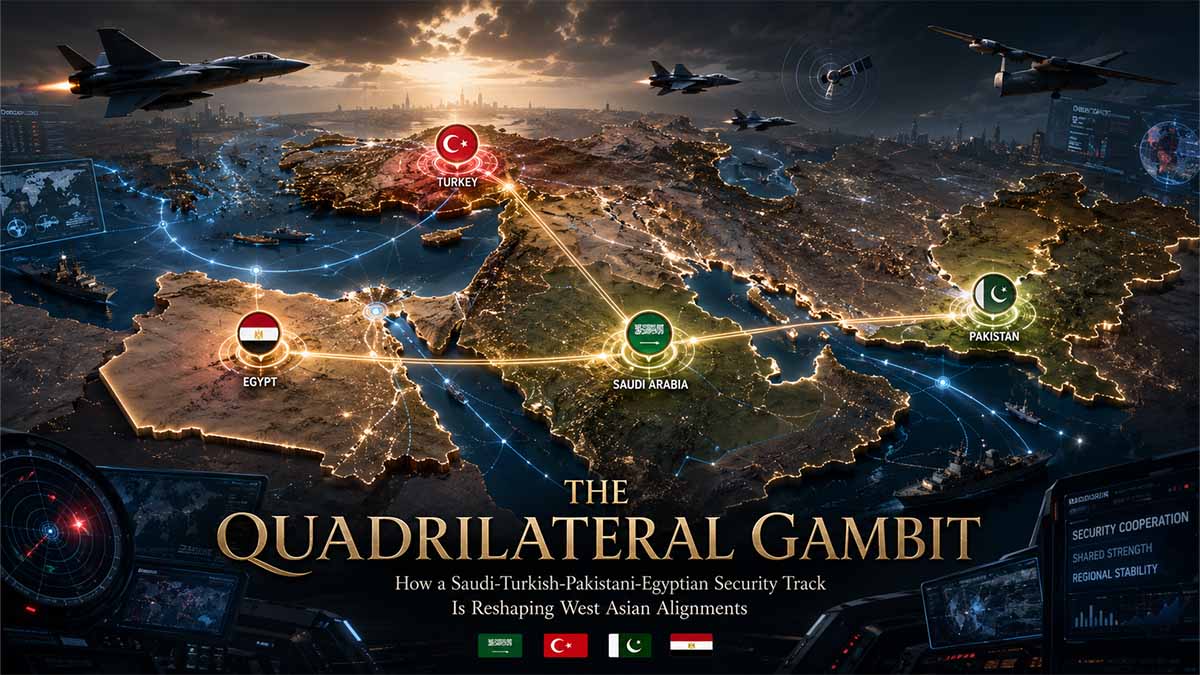
- A trilateral Pakistan–Saudi Arabia–Türkiye defense draft, reported in January 2026, expanded into a four-way “Quadrilateral Group” with Egypt after their foreign ministers met in Riyadh on 19 March 2026.
- The catalyst was the US–Israeli military campaign against Iran launched 28 February 2026, which struck Gulf confidence in Washington’s security umbrella.
- As of July 2026, the grouping has held at least four ministerial rounds (Riyadh, Antalya, Islamabad, Cairo) but has produced no communiqué, treaty text, or binding mutual-defense clause.
- Analysts and the IISS now describe it as an “institutionalized consultation mechanism” rather than a NATO-style alliance — a distinction that matters because Türkiye is a NATO member and cannot easily take on rival Article 5-style obligations.
- Structurally it rests on hard capability: Pakistan’s ~8,000 troops, JF-17s, and Chinese HQ-9 batteries deployed inside Saudi Arabia under the September 2025 Saudi–Pakistani Strategic Mutual Defense Agreement.
- Risks: it could harden a Sunni/Muslim-bloc identity against Iran, complicate Turkish NATO commitments, and entrench Pakistan in Gulf and Red Sea confrontations far from South Asia.
The Quadrilateral Gambit: Riyadh’s Post-American Security Wager
A New Architecture Born of a Failed Guarantee
When the United States and Israel launched their joint military campaign against Iran on 28 February 2026, they intended to neutralize a threat. They also, inadvertently, demonstrated to every Gulf capital that Washington’s security umbrella could not prevent direct strikes on Gulf soil. Within three weeks, on 19 March, the foreign ministers of Saudi Arabia, Türkiye, Pakistan and Egypt convened in Riyadh — on the margins of an Islamic summit condemning Iran’s retaliation — to discuss, for the first time as a four-party group, combining their security capabilities. That meeting, largely overlooked outside specialist circles, marks the starting point of the most consequential Gulf security realignment since the Abraham Accords.
The Trigger: A Blockade That Redrew the Calculus
The catalyst is measurable in barrels and basis points. Iran’s Revolutionary Guard Corps declared the Strait of Hormuz closed to commercial shipping on 4 March 2026; the International Energy Agency subsequently characterized the resulting disruption as the largest in the history of the global oil market. Combined output from Saudi Arabia, Kuwait, Iraq and the UAE fell by roughly 6.7 million barrels per day within a week, and by at least 10 million barrels per day by 12 March. Brent crude, trading near $72 before the campaign began, spiked toward $110–120 through March before settling near $70.65 on 2 July — a level well below the approximately $96 per barrel Bloomberg Economics estimates Saudi Arabia needs to balance its budget. Riyadh’s own Q1 2026 fiscal deficit reached $33.5 billion against a full-year target of $44 billion. The kingdom, in short, faced a simultaneous military exposure and fiscal contraction — precisely the conditions under which burden-sharing becomes structurally attractive rather than merely diplomatically convenient.
The Legal Foundation: One Treaty, Not Four
The institutional architecture rests on a single binding instrument: the Strategic Mutual Defense Agreement signed at Al-Yamamah Palace on 17 September 2025 by Crown Prince Mohammed bin Salman and Prime Minister Shehbaz Sharif, under which aggression against either signatory is treated as aggression against both. Everything built since is additive to that clause, not equivalent to it. Pakistan’s Minister for Defense Production, Raza Hayat Harraj, confirmed to Reuters in January 2026 that a parallel trilateral draft involving Türkiye had circulated for roughly ten months; Turkish Foreign Minister Hakan Fidan has consistently confirmed talks while stressing no agreement has been signed. Between 19 March and 22 June, the four foreign ministers — Prince Faisal bin Farhan Al-Saud, Fidan, Ishaq Dar and Badr Abdelatty — held four ministerial rounds in Riyadh, Islamabad, Antalya and Cairo, producing no communiqué and no treaty text. The International Institute for Strategic Studies has classified the grouping precisely: a “fluid consultation and coordination mechanism,” not a defense alliance. President Abdel Fattah el-Sisi’s call in Cairo for institutionalization remains, to date, aspirational.
The Hardware: Who Actually Bears the Cost of Deterrence
Behind the diplomatic ambiguity sits an unambiguous deployment. Reuters reporting, corroborated by multiple security sources, documents that Pakistan moved approximately 8,000 troops into Saudi Arabia beginning in early April 2026, alongside a squadron of roughly sixteen JF-17 Thunder fighters, two drone squadrons, and a Chinese-built HQ-9 air-defense system with a reported engagement range exceeding 200 kilometers, concentrated around the kingdom’s Eastern Province oil infrastructure. Saudi Arabia finances the deployment; Pakistani personnel operate every system. One government source described confidential pact language permitting expansion to as many as 80,000 troops — a figure neither government has confirmed. Türkiye’s contribution is industrial rather than expeditionary: the 2023 Baykar Akinci drone contract, worth approximately $3 billion and described by its manufacturer as the largest defense export agreement in Turkish history, included technology transfer to Saudi Arabian Military Industries; President Recep Tayyip Erdoğan announced on 5 February 2026 that Riyadh and Ankara were prepared to finalize joint investment in the KAAN fifth-generation fighter “at any moment,” a project partly driven by Washington’s earlier refusal to sell Saudi Arabia F-35s. Egypt, notably, has contributed neither troops nor hardware; its leverage derives instead from Suez Canal transit security, with canal revenues already reduced to roughly $7.2 billion in fiscal year 2023–2024 amid earlier Red Sea disruptions.
The Structural Ceiling: Why Ankara Will Not Sign
The framework’s evolution into a binding alliance faces one immovable constraint. Türkiye remains a NATO member hosting an estimated 20 to 50 American B61 nuclear gravity bombs at Incirlik Air Base under NATO’s nuclear-sharing arrangement. A formal mutual-defense treaty with Riyadh and Islamabad would risk direct collision with Article 5 obligations should Turkish territory ever be struck under circumstances where NATO and the quadrilateral pointed toward different responses. Ankara’s preferred model — arms co-production, intelligence sharing, joint training, coordinated diplomacy, but no signature — reflects that ceiling precisely. Pakistan carries the opposite asymmetry: it is the only member with a binding clause and deployed forces, yet it simultaneously served as the principal mediator between Washington and Tehran, with Prime Minister Sharif signing the Islamabad Memorandum ending the war on 18 June 2026, one day after Presidents Trump and Pezeshkian reached agreement. A state defending Saudi airspace against Iran while brokering peace with Iran is not a contradiction the framework has resolved; it is a contradiction it is currently managing.
The Fault Line Beneath the Fault Line
The sharper risk lies not in Tehran but in Abu Dhabi and Jerusalem. In late May 2026, President Trump telephoned the leaders of Saudi Arabia, the UAE, Qatar, Pakistan, Türkiye, Egypt and Jordan, urging immediate accession to the Abraham Accords ahead of any US-Iran settlement — a call from which Prime Minister Netanyahu was reportedly absent. Riyadh’s response has hardened, not softened: a Saudi source subsequently insisted normalization requires an “irreversible pathway” to Palestinian statehood. The Middle East Institute’s analysis identifies a parallel driver rarely stated publicly — Saudi Arabia’s deepening rivalry with the UAE, a state Riyadh increasingly associates with Israel on contested bilateral files. The UAE’s conspicuous absence from the quadrilateral, despite being approached in earlier Saudi-Turkish security talks alongside Qatar, is therefore not incidental. A grouping justified as an Iran hedge risks calcifying instead into an implicit counterweight to the Abraham Accords bloc, fracturing Gulf Cooperation Council cohesion along a second axis entirely unrelated to its founding rationale. On 23 July 2026, the quadrilateral’s four core members joined Indonesia, Jordan, Qatar and the UAE in a joint statement condemning Israeli actions at Al-Aqsa Mosque — evidence that diplomatic coordination is already widening beyond the Iran file, even as the security architecture beneath it remains legally undefined.
What Is at Stake
Three trajectories remain open, and the evidence supports none conclusively. The framework could plateau as consultative infrastructure, giving Riyadh indirect access to negotiations from which it is formally excluded. It could harden into binding collective defense, extending the Pakistan template — already replicated bilaterally with Kuwait via decree-law 73/2026, published 26 July — to Türkiye and Egypt. Or it could drift toward defining itself against a rival Gulf-Israeli axis, transforming a security response to Iranian missiles into an instrument of intra-Muslim bloc competition. For European and Italian institutional readers, the material stakes are immediate: any of these paths reshapes the reliability of Gulf energy supply, the terms on which Ankara’s defense industry expands into Arab markets, and the durability of an American security order that four capitals are now visibly, if cautiously, hedging against.
Navigational Index
- Origins and Strategic Drivers — why this framework emerged now, and what triggered its jump from rumor to ministerial process
- Architecture, Capability, and Command Questions — who actually provides the hardware, who would direct the framework, and how “collective” any defense commitment really is
- Bloc-Politics Risk — how the arrangement could sharpen rather than soften West Asia’s fault lines
Pillar 1: Origins and Strategic Drivers
The proposal’s public emergence traces to January 2026, when Pakistan’s Minister for Defense Production, Raza Hayat Harraj, confirmed to Reuters that a Pakistan-Saudi Arabia-Turkey agreement was already in the pipeline, and that the draft had been under review for roughly ten months — a timeline he explicitly distinguished from the bilateral Saudi–Pakistani Strategic Mutual Defense Agreement signed the previous September. Turkish Foreign Minister Hakan Fidan corroborated that talks were underway while stressing no agreement had been finalized.
The framework’s real acceleration, however, came from outside the trilateral track. The US–Israeli military campaign against Iran, launched on 28 February 2026, produced a range of unexpected consequences for regional security and alliance structures, as Iran retaliated against Gulf states after strikes on its civilian and military infrastructure. The closure of the Strait of Hormuz — first by Iran and then via a US naval blockade — triggered one of the most severe global economic disruptions in recent history, and the resulting insecurity drove a mass exodus of tourists and expatriates from Gulf cities. Within three weeks, on 19 March, the foreign ministers of Türkiye, Pakistan, Saudi Arabia, and Egypt convened in Riyadh on the sidelines of an Islamic summit condemning the Iranian strikes, where they discussed the possibility of combining their capabilities within a joint security framework, a meeting the Al Jazeera Centre for Studies frames as an early step toward a new regional security platform centred on cooperation and stability.
The pace since has been unusually fast for Gulf diplomacy. Between 19 March and 18 April alone, Saudi Arabia, Egypt, Pakistan, and Turkey held three foreign ministers’ meetings in thirty-one days — a cadence the International Institute for Strategic Studies described as a shift “from reactive coordination to institutionalised consultation”. By April, at the Antalya Diplomacy Forum, Egyptian Foreign Minister Badr Abdelatty publicly stated the four nations were “hammering out a security deal,” in a forum that drew more than 80 foreign ministers and provided diplomatic cover for undocumented side consultations. By June, Cairo hosted a fourth round, where President El-Sisi called for transforming the consultative mechanism into a more structured institutional framework capable of addressing the region’s increasingly complex political and security challenges.
Underlying all of this is a fiscal and material anxiety Gulf states rarely admit openly. Brent crude traded at $70.65 intraday on 2 July 2026 — back to pre-war levels for the first time since February, and well below the $80–85 per barrel fiscal breakeven estimated by the IMF and Oxford Economics, while Bloomberg Economics calculates Saudi Arabia actually requires $96 per barrel. The kingdom’s Q1 2026 deficit hit $33.5 billion against a full-year target of $44 billion. That squeeze is precisely why a framework that redistributes security costs — rather than one requiring fresh Saudi outlays — has political appeal in Riyadh.
Sources: House of Saud – Pact Explained · Al Jazeera Centre for Studies · House of Saud – New Security Axis · IISS-referenced coverage · Middle East Observer – Cairo meeting
Pillar 2: Architecture, Capability, and Command Questions
No party has signed a quadrilateral treaty, and every serious tracker is careful to say so. The quadrilateral is not a defence alliance: none of its members can offer the others collective defence, and none has proposed doing so. The IISS, in a formal May 2026 analysis, instead certified it as a “fluid consultation and coordination mechanism” that has evolved beyond ad hoc crisis response into a recognisable security architecture — the first time a premier Western defence institution treated the four-nation alignment as an emerging institutional reality rather than a string of bilateral courtesies. House of Saud
What gives the framework substance is not a shared command structure but overlapping bilateral capability. Pakistan’s commitment is the most concrete: under the September 2025 Strategic Mutual Defense Agreement, signed at Al-Yamamah Palace by Crown Prince Mohammed bin Salman and Prime Minister Shehbaz Sharif, aggression against one state is to be treated as aggression against both. On the ground, that translates into roughly 8,000 Pakistani troops, JF-17 squadrons, and Chinese HQ-9 air-defense batteries stationed inside Saudi Arabia, financed by Riyadh but operated by Pakistani personnel — a deployment sufficient to operate the air-defence batteries that would form the backbone of any integrated quad defensive posture. EURASIAN TIMES
Turkey supplies the industrial depth. Its Baykar Akinci armed drone deal, signed in 2023 at roughly $3 billion, was at the time the largest defence and aviation export contract in the history of the Turkish Republic, and Saudi operators completed Akinci training in October 2025; President Erdoğan’s February 2026 Riyadh visit added a Saudi investment stake in the KAAN stealth-fighter program. But Turkey’s NATO membership is the structural ceiling on how far this can go: a formal collective-defence treaty with Saudi Arabia and Pakistan would risk conflicts with Article 5 obligations, so Ankara’s preferred model is a defence-cooperation framework — arms co-production, intelligence sharing, joint training, coordinated diplomatic positions — that stops short of mutual-defence commitments.
Egypt’s role remains the least defined militarily and the most symbolically loaded — Cairo’s Suez Canal revenues, already reduced to roughly $7.2 billion in FY2023–2024 amid Red Sea disruptions, came under renewed pressure as insurers rerouted cargo away from the Eastern Mediterranean corridor, giving Egypt its own stake in regional deterrence even absent a formal Egyptian-Saudi defense clause. As for who “directs” any eventual structure, the honest answer from current reporting is: no one yet. Pakistan’s foreign ministry has confirmed active involvement in shaping the format through a high-level preparatory meeting in Islamabad, and bilateral ties were strengthened by the 2025 Strategic Mutual Defense Agreement, which the reporting frames as a foundation expected to support the emergence of a more structured security axis — but a chair, secretariat, or joint command has not been announced.
Sources: Al Jazeera Centre for Studies · House of Saud – Quadrilateral / IISS · House of Saud – Security Axis · Meta-Defense (FR)
Pillar 3: Bloc-Politics Risk — A Framework That Could Sharpen Divisions
The clearest evidence that the grouping is read regionally as an anti-Iran hedge, whatever its members say publicly, is its founding context: the group’s first ministerial session convened on 19 March on the sidelines of an Islamic summit whose stated purpose was to condemn Iranian attacks on Gulf states — the founding context is not incidental. That origin story creates an obvious risk: a “regional autonomy” project born at an anti-Iran summit is likely to be read in Tehran, and among Iran-aligned actors, as sectarian bloc consolidation rather than neutral collective security — regardless of the founders’ framing.
Analysts inside the process argue the opposite case: that it strengthens Saudi bargaining power without necessarily hardening divisions. Zahir Shah Sherazi, executive vice president of BOL News, has argued the structure lets Riyadh “spread its military risks and add political weight to its deterrence,” combining Turkish defense-industrial capacity, Pakistani military and nuclear-adjacent capability, and Saudi financial and diplomatic weight — while also, in his view, helping Riyadh offset reputational costs tied to the Israeli-Palestinian file. Others, including a March 2026 op-ed in the Eurasian Times, have warned Riyadh risks “trading sovereignty for reassurance” by leaning on Ankara and Islamabad the way it once leaned on Washington — an echo of criticism leveled at every Gulf state hosting foreign forces since 1990.
The expansion pattern beyond the core four also cuts both ways. On one hand, the process shows signs of genuine institutional widening: Pakistan formalized a separate defense pact with Kuwait via decree-law no. 73 of 2026, published in Kuwait’s official gazette on 26 July, establishing a framework for cooperation between the two armed forces focused on military training and education. On 23 July 2026, a broader eight-nation bloc — Türkiye, Egypt, Indonesia, Jordan, Pakistan, Qatar, Saudi Arabia, and the UAE — issued a joint foreign ministers’ statement condemning Israeli actions at Al-Aqsa Mosque, showing the quadrilateral’s core members increasingly coordinating diplomatically with a wider Muslim-majority coalition on Israel-Palestine, not only on Iran. On the other hand, this dual-track pattern (Iran-hedge plus Israel-Palestine solidarity) is exactly what could transform a defense-cooperation platform into a bloc defined in opposition to two different rivals simultaneously — raising the stakes for any member, especially Pakistan, whose obligations could pull it into confrontations (Red Sea shipping, Houthi threats, Gulf air defense) far removed from South Asian security interests. Pakistan has already warned Yemen’s Ansarallah-led government against threatening Saudi territory or Red Sea shipping, asserting a right to defend maritime interests that did not previously extend that far from home. Al Jazeera Centre for StudiesHouse of Saud
The UAE’s absence is also analytically significant: Saudi Arabia has launched talks to build what’s been described as a Sunni security axis with Turkey, Pakistan, Egypt and Qatar to offset a possible US pullback, but the United Arab Emirates are not part of it, and observers have noted sometimes divergent strategic objectives among partners that could weigh on overall cohesion. A framework built partly to hedge against Washington, while explicitly excluding one of the Gulf’s most capitalized and militarily active states, is itself a fault line — not evidence of unified “regional autonomy.”
Sources: House of Saud – Bloc Analysis · Eurasian Times – Kuwait Pact · GlobalSecurity.org – Joint Statement, 23 July 2026 · Meta-Defense – UAE exclusion
Türkiye–Saudi–Pakistan–Egypt Security Track: 2025–2026
Chapter 1: Origins and Strategic Drivers
1.1 The Deep Trigger: Operation Roaring Lion and the Collapse of the Gulf Security Assumption
The quadrilateral track cannot be understood as a discrete diplomatic initiative — it is a second-order consequence of a war. On 28 February 2026, US and Israeli forces launched a coordinated aerial campaign against Iran, and by that Sunday evening the IRGC had declared the Strait of Hormuz “no longer safe for international commerce,” effectively imposing a maritime blockade. Iran continued its own crude exports of roughly 2 million barrels per day until the United States itself imposed a naval blockade on 13 April 2026 — meaning the chokepoint was squeezed from both directions at different points in the conflict.
The economic shock was immediate and, by multiple accounts, historic. The International Energy Agency characterized the disruption as the largest supply disruption in the history of the global oil market. Collective oil production from Kuwait, Iraq, Saudi Arabia, and the UAE fell by a reported 6.7 million barrels per day by 10 March, and by at least 10 million barrels per day by 12 March. This is the material shock that reframed Gulf threat perception: it was not a political crisis of alliance with Washington but a material crisis of availability, as the Arab Gulf States Institute put it — American security guarantees had not prevented direct strikes on Gulf energy infrastructure, and a chokepoint the US Navy was expected to keep open had instead become a weapon used against the Gulf states themselves.
Table 1.1 — Oil Price Trajectory During the 2026 Iran War (a proxy for Gulf fiscal and threat-perception shock)
| Date | Brent Crude (approx.) | Event / Context |
|---|---|---|
| 27 Feb 2026 | ~$72/bbl | Pre-war baseline |
| 2 Mar 2026 | $80–82/bbl (+10–13%) | Initial strikes; Strait traffic disrupted |
| 5 Mar 2026 | >$84/bbl | Strait declared de facto closed (4 Mar) |
| Late Mar 2026 | ~$110/bbl (implied CPI) | US CPI hits 3.4% YoY, up from 2.4% in Feb |
| Peak (Mar–early Apr) | Tested ~$100–120/bbl range | QatarEnergy declares force majeure on exports |
| Apr–May 2026 (modeled) | Peak ~$94/bbl (WTI) | CEPR one-quarter-closure scenario |
| 28 Jun 2026 | $73.21/bbl (Aug futures) | Renewed US–Iran tit-for-tat strikes |
| 2 Jul 2026 | $70.65/bbl (intraday) | Back to pre-war levels; well below Saudi’s ~$96/bbl fiscal breakeven |
Sources: Al Jazeera · Brookings · CEPR/VoxEU · Bloomberg · FinancialContent MarketMinute
The strategic reading in Riyadh, Cairo, Ankara, and Islamabad is best understood through the fiscal-breakeven gap this created. Bloomberg Economics calculates Saudi Arabia requires roughly $96 per barrel to balance its budget, yet crude spent much of mid-2026 trading in the low-to-mid $70s — well below that threshold, while the kingdom’s Q1 2026 deficit reached $33.5 billion against a full-year target of $44 billion. A security framework that reduces reliance on expensive US force postures — and instead draws on Pakistani manpower and Turkish hardware at lower marginal cost — has direct fiscal logic, not just symbolic value, at a moment when the war that supposedly justified new defense spending was simultaneously collapsing the oil revenue meant to fund it. EURASIAN TIMES
1.2 From Bilateral Foundation to Trilateral Rumor (Sept 2025 – Jan 2026)
The immediate institutional precondition long predates the Iran war. The Saudi–Pakistani Strategic Mutual Defense Agreement, signed 17 September 2025 at Al-Yamamah Palace by Crown Prince Mohammed bin Salman and Prime Minister Shehbaz Sharif, established that aggression against one signatory would be treated as aggression against both — the first modern instance of Riyadh entering a mutual-defense clause with a non-Gulf Muslim-majority state. That agreement is the load-bearing wall the later quadrilateral structure leans on; every subsequent expansion (trilateral, then quadrilateral, then the Kuwait pact) has been additive to it rather than a replacement.
The jump from bilateral pact to trilateral rumor came via a parallel, quieter track. Pakistan’s Minister for Defense Production, Raza Hayat Harraj, told Reuters in mid-January 2026 that a Pakistan–Saudi Arabia–Türkiye defense draft had already been under review for approximately ten months — meaning the drafting process began around March 2025, five months before the Saudi-Pakistan pact was even signed, and nearly a full year before it became public. Turkish Foreign Minister Hakan Fidan confirmed talks were occurring but was careful to stress that nothing had been signed — a hedge pattern that recurs at every subsequent stage of the process.
Table 1.2 — Chronology: Rumor to Ministerial Process
| Date | Milestone | Status |
|---|---|---|
| ~Mar 2025 | Trilateral PK–SA–TR draft reportedly begins circulating | Confidential |
| 17 Sep 2025 | Saudi–Pakistan Strategic Mutual Defense Agreement signed | Formal, bilateral |
| 15 Jan 2026 | Pakistan’s Defense Production Minister confirms trilateral draft to Reuters | First public confirmation |
| 28 Feb 2026 | US–Israel military campaign against Iran begins | External shock |
| 4 Mar 2026 | Strait of Hormuz declared closed by Iran | Crisis deepens |
| 19 Mar 2026 | 1st Quadrilateral ministerial, Riyadh (OIC summit sidelines) | Egypt joins the process |
| 29 Mar 2026 | 2nd ministerial, Islamabad | Consultations continue |
| 17–19 Apr 2026 | 3rd ministerial, Antalya Diplomacy Forum | Egypt FM: “hammering out a security deal” |
| 22 Jun 2026 | 4th ministerial, Cairo | El-Sisi calls for institutionalization |
| 23 Jul 2026 | 8-nation joint statement (quad core + Indonesia, Jordan, Qatar, UAE) on Al-Aqsa | Diplomatic-track widening |
| 26 Jul 2026 | Pakistan–Kuwait defense pact formalized (decree-law 73/2026) | Bilateral layer expands |
Sources: Reuters via House of Saud · Al Jazeera Centre for Studies · Armenian Weekly · House of Saud – IISS · Middle East Observer · GlobalSecurity.org · Eurasian Times
1.3 Why Egypt, and Why March 19 Specifically
Egypt’s addition is often treated as incidental — a fourth flag added to a photo op — but the timing and venue argue against that reading. The 19 March meeting took place on the sidelines of an OIC summit convened specifically to address Iranian attacks on Gulf states; Egypt’s inclusion at that exact moment, rather than at an earlier or later bilateral touchpoint, suggests Cairo was pulled in because the crisis had acquired a dimension — Red Sea and Suez shipping security — that only Egypt could speak to authoritatively among the four. Egypt’s Suez Canal revenues had already fallen to approximately $7.2 billion in FY2023–2024 following earlier Red Sea shipping disruptions (the Houthi campaign), and came under renewed pressure in 2026 as insurers rerouted cargo away from the Eastern Mediterranean corridor entirely — giving Cairo its own acute stake in any framework addressing regional shipping-lane security, separate from Iran policy per se. The Armenian Weekly
1.4 The Three Structural Preconditions
Distilling the reporting, three independent conditions had to align simultaneously for this to move from rumor to ministerial process — and it’s worth being precise that none alone would likely have produced the outcome:
- A pre-existing bilateral treaty with teeth (Saudi–Pakistan SMDA, Sept 2025) that gave any wider framework a template and a legal starting point rather than requiring negotiators to build a mutual-defense concept from scratch.
- A live, visible military failure of the US security guarantee (the Feb–Jul 2026 Iran war), which converted a slow-burn hedging conversation among defense ministries into an urgent foreign-ministry-level process — the shift from Harraj’s low-key January confirmation to four ministers meeting within three weeks of the war’s outbreak is the clearest evidence of this compression.
- A parallel economic shock large enough to make burden-sharing attractive on its own fiscal terms — the IEA’s “largest supply disruption in history” framing, Saudi Arabia’s ~$96/bbl breakeven against ~$70–75/bbl actual prices, and Egypt’s Suez revenue erosion all independently pushed toward a framework that substitutes partner capability for expensive unilateral spending.
1.5 What This Origin Story Does Not Yet Establish
It’s worth stating plainly what the timeline above does not prove, because several outlets covering this have blurred the line between process and outcome. Four ministerial meetings in four months is a genuinely fast diplomatic cadence, but the IISS’s own characterization is “fluid consultation and coordination mechanism” — not treaty, not command structure, not binding mutual-defense clause extending beyond the existing Saudi-Pakistan bilateral. The 23 July eight-nation statement was about Al-Aqsa, not defense architecture, and the 26 July Pakistan-Kuwait pact is a separate bilateral instrument, not an expansion of the quadrilateral’s own legal scope. The honest state of the record, as of late July 2026, is: a real and accelerating diplomatic process, resting on one real bilateral treaty (Saudi-Pakistan) and one industrial partnership track (Turkey-Saudi), with the quadrilateral layer itself still consultative.
Chapter 2: Architecture, Capability, and Command Questions
2.1 The Central Finding: There Is No Joint Command
Before the capability data, the legal/institutional baseline has to be stated precisely, because it conditions how every number below should be read. Every serious institutional tracker — the IISS, Al Jazeera Centre for Studies, and the specialist outlets covering the ministerial rounds — converges on the same characterization: the quadrilateral is not a defence alliance. None of its members can offer the others collective defence, and none has proposed doing so. Three ministerial sessions between 19 March and 18 April produced zero communiqués, zero joint statements, and no document acknowledging the formation’s existence. What exists instead is a set of institutionalised channels that give Riyadh indirect reach into negotiations — the US-Iran nuclear track, the Hormuz shipping dispute, ceasefire mediation — from which Saudi Arabia is otherwise formally absent.
This means the “collective defence” the framework is popularly described as providing is, on the current record, entirely a function of bilateral instruments layered underneath a quadrilateral consultative shell — not a shared command. The table below separates what is legally binding from what is merely industrial cooperation or political consultation.
Table 2.1 — Legal Status of Each Bilateral/Multilateral Layer
| Instrument | Parties | Signed | Legal Character | Binding Mutual-Defense Clause? |
|---|---|---|---|---|
| Strategic Mutual Defense Agreement | Saudi Arabia–Pakistan | 17 Sep 2025 | Bilateral treaty | Yes — aggression against one = aggression against both |
| Trilateral defense draft | Pakistan–Saudi Arabia–Türkiye | Drafted ~Mar 2025; reported Jan 2026 | Draft, unsigned | Unknown/unconfirmed |
| Quadrilateral Group | Türkiye–Saudi Arabia–Pakistan–Egypt | First met 19 Mar 2026 | Consultative mechanism, no treaty text | No |
| Turkey–Saudi defense-industrial track | Türkiye–Saudi Arabia | Ongoing since 2023; expanded Feb 2026 | Commercial/industrial agreements | No (arms sales, not defense pact) |
| Pakistan–Kuwait defense pact | Pakistan–Kuwait | 26 Jul 2026 (decree-law 73/2026) | Bilateral framework agreement | Unconfirmed — reported as training/cooperation framework, not mutual-defense |
| 8-nation Al-Aqsa joint statement | Türkiye, Egypt, Indonesia, Jordan, Pakistan, Qatar, Saudi Arabia, UAE | 23 Jul 2026 | Diplomatic statement | No — political condemnation, not security instrument |
Sources: House of Saud – Bloc Analysis · House of Saud – Pact Explained · Eurasian Times – Kuwait Pact · GlobalSecurity.org
2.2 Who Actually Provides the Hardware: Pakistan’s Deployed Force Package
Pakistan is the only member currently providing combat-capable forces on Saudi soil, and the reporting on this deployment is unusually granular for a supposedly confidential pact. Reuters’ sourcing (corroborated across five outlets) describes a force that began arriving in early April 2026 under the September 2025 bilateral treaty:
Table 2.2 — Pakistan’s Deployed Force Package in Saudi Arabia (as of mid-2026)
| Asset Category | Reported Quantity | Details | Command/Financing |
|---|---|---|---|
| Ground troops | ~8,000 (pledge to expand) | Advisory, training, and combat-capable roles; adds to pre-existing smaller Pakistani contingents | Pakistani command; Saudi-financed |
| Fighter aircraft | ~16 (one squadron) | Mostly JF-17 Thunder, reportedly Block III variant with advanced avionics and beyond-visual-range missiles; jointly built with China | Pakistani personnel; based at King Abdulaziz Air Base |
| Drone units | 2 squadrons | Unspecified drone types, deployed alongside fighter squadron | Pakistani operated |
| Air defense system | HQ-9 (Chinese-origin) | Medium-to-long-range coverage, reported range >200 km; concentrated in Saudi Eastern Province (oil infrastructure) | Operated entirely by Pakistani personnel; Saudi-financed |
| Reported troop ceiling | Up to 80,000 | Confidential pact text reportedly allows expansion “to help secure Saudi borders alongside Saudi forces” — unconfirmed by either government | N/A |
Sources: Reuters via Daily Star · Reuters via Republic World · Times of Islamabad · Defence Security Asia · Haaretz/Reuters
A note on sourcing discipline here: figures vary slightly across outlets (one source cites 8,000–13,000 troops rather than a flat 8,000), and the 80,000 ceiling is attributed to a single anonymous government source describing confidential pact text — it should be read as a reported provision, not a confirmed operational plan. Neither Islamabad’s foreign/military office nor Riyadh’s government media office responded to requests for comment on the deployment specifics, per Reuters.
2.3 Turkey’s Contribution: Industrial Depth, Not Deployed Troops
Turkey’s role is structurally different from Pakistan’s: no Turkish troops are reported inside Saudi Arabia, and its contribution is almost entirely industrial/technological, run through commercial contracts rather than a mutual-defense clause.
Table 2.3 — Turkey–Saudi Defense-Industrial Track
| Program | Value/Scale | Status (as of mid-2026) | Strategic Significance |
|---|---|---|---|
| Baykar Akinci armed UCAV deal | ~$3 billion (signed 2023) | Called “the biggest defence and aviation export contract in the history of the Turkish Republic”; included tech transfer to Saudi Arabian Military Industries; Saudi production lines under construction | Saudi operators completed Akinci training Oct 2025 |
| KAAN 5th-gen stealth fighter | Reported interest in ~100 aircraft | Joint investment “could be implemented at any moment” per Erdoğan (Feb 2026); no signed contract confirmed as of Jul 2026 | Positions Turkey as alternative to blocked US F-35 sales to Riyadh |
| PARS Alpha 8×8 / Ejder Yalçın 4×4 armored vehicles | Advanced talks | Coproduction discussions ongoing | Ground-vehicle industrial base expansion |
| Erdoğan’s Feb 3, 2026 Riyadh visit | — | Produced “major” defense industry cooperation agreements (unspecified scope) | Signals political-level commitment beyond individual contracts |
Sources: Breaking Defense · Türkiye Today · Turkish Minute · Daily Sabah · Airforce Technology
Worth flagging: Saudi interest in KAAN is explicitly linked, per multiple Turkish and defense-trade outlets, to Washington’s earlier refusal to sell F-35s to Riyadh over its S-400 purchase history — meaning Turkey’s defense-industrial role in this framework is partly a byproduct of a separate US-Saudi arms friction, not solely a response to the Iran war. That is an important causal thread distinct from Chapter 1’s origin story.
2.4 The NATO Article 5 Problem — Why Ankara Won’t Sign a Treaty
This is the single largest structural constraint on the framework ever becoming a formal alliance, and it deserves to be stated with precision rather than left implicit. Turkey remains a NATO member with no intention of leaving the alliance, and it hosts an estimated 20 to 50 US-controlled B61 nuclear gravity bombs at Incirlik Air Base under NATO’s nuclear-sharing arrangement — meaning Ankara operates inside a nuclear-alliance architecture it has no independent authority over.
A formal collective-defense treaty with Saudi Arabia and Pakistan would create a genuine legal collision risk: if Turkish territory were attacked in a scenario where NATO’s Article 5 and a hypothetical quadrilateral mutual-defense clause pointed toward different response obligations, Ankara would face a direct conflict of treaty commitments. This is precisely why Ankara’s preferred model — as distinct from Islamabad’s, which has already signed a binding bilateral clause with Riyadh — is a defence-cooperation framework that stops short of mutual-defense commitments while still enabling arms co-production, intelligence sharing, joint training, and coordinated diplomatic positions.
Table 2.4 — Structural Constraint Comparison: Why Each Member’s Ceiling Differs
| Member | Existing Alliance Commitments | Constraint on Deeper Quad Integration | Observed Posture |
|---|---|---|---|
| Türkiye | NATO member; hosts US nuclear weapons (Incirlik) | Article 5 collision risk with any rival mutual-defense clause | Industrial/commercial cooperation only; no mutual-defense signature |
| Pakistan | No Western mutual-defense treaty; SCO/CPEC ties to China | Domestic economic dependence on Gulf remittances/financing; risk of overextension (Yemen, Red Sea) | Only member with a signed, binding mutual-defense clause (with Saudi Arabia) and deployed troops |
| Saudi Arabia | US strategic partnership (non-treaty); GCC | Reliance on US arms pipeline (F-15SA, Eurofighter, Rafale, contested F-35 access) | Funding/host nation; diversifying suppliers without breaking with Washington |
| Egypt | US strategic partnership; Camp David-era ties to Israel | Suez Canal revenue dependence on regional shipping stability; sensitivities around Israel-related coordination | Diplomatic/institutional driver (Cairo hosted 4th ministerial); no reported troop or hardware contribution |
Sources: Eurasian Times – Kuwait Pact (NATO/Incirlik detail) · House of Saud – Pact Explained · Defense Mirror (F-35 refusal context)
2.5 Command Question: Who Would Direct a More Formal Structure?
On the available record, this question has no answer yet — and the reporting is consistent in saying so. No secretariat, joint staff, chair, or rotating presidency has been announced across four ministerial rounds (Riyadh, Islamabad, Antalya, Cairo). The closest thing to an institutional signal is El-Sisi’s June 2026 call in Cairo to transform the consultative mechanism into a more structured institutional framework — a statement of aspiration, not a governance design.
What can be inferred from the pattern of ministerial venues and who convenes them:
- Saudi Arabia has hosted the founding session (Riyadh) and appears to be the primary convening power, consistent with its position as the framework’s principal financier and strategic beneficiary.
- Egypt hosted the most recent (4th) session and used it to publicly push for institutionalization — suggesting Cairo, despite contributing no reported hardware, is positioning itself as an institutional-design driver, plausibly to secure a seat proportionate to its Suez/Red Sea leverage rather than its military weight.
- Pakistan operates as the framework’s actual force provider but has taken the lowest public profile of the four — its Defense Production Minister’s January comments and the Reuters deployment reporting were the main public disclosures, with Islamabad declining direct comment when contacted for detail (The Cradle’s outreach to former PM Kakar and Minister Harraj went unanswered).
- Türkiye has been the most industrially assertive (KAAN, Akinci) but the most institutionally cautious (Fidan’s repeated “no agreement signed” framing), consistent with its NATO constraint above.
Table 2.5 — Ministerial Rounds and Apparent Institutional Role
| Round | Date | Host | Notable Statement/Action |
|---|---|---|---|
| 1st | 19 Mar 2026 | Riyadh | Founding session; sidelined at OIC summit condemning Iran strikes |
| 2nd | 29 Mar 2026 | Islamabad | Consultations continue; no communiqué |
| 3rd | 17–19 Apr 2026 | Antalya (Forum, not host capital) | Egypt FM: nations “hammering out a security deal” |
| 4th | 22 Jun 2026 | Cairo | El-Sisi calls for institutionalization into structured framework |
Source: Middle East Observer
2.6 How “Collective” Is Any of This, Really?
Bringing the chapter’s threads together: the word “collective” currently applies to exactly one bilateral relationship in this entire architecture — Saudi Arabia and Pakistan, via the September 2025 treaty. Everything else is either (a) unsigned drafts (the trilateral text), (b) commercial/industrial contracts dressed in strategic language (Turkey-Saudi), (c) a new but separate bilateral framework of unconfirmed bindingness (Pakistan-Kuwait), or (d) political consultation without legal commitment (the quadrilateral itself, and the 8-nation Al-Aqsa statement). A useful way to state the honest architecture, consistent with IISS’s own language: the quadrilateral is a hedge, not a treaty — its value to Riyadh lies in diversified diplomatic access and reduced reliance on any single patron, not in a legally enforceable promise that Turkish or Egyptian forces would fight for Saudi Arabia if attacked.
Chapter 3: Bloc-Politics Risk — How the Arrangement Could Sharpen Rather Than Soften West Asia’s Fault Lines
3.1 The Core Contradiction: A Security Framework Built by a War Mediator
The single most revealing fact about this framework’s bloc-politics risk is that its most militarily engaged member is simultaneously the region’s lead peace broker. Pakistani Prime Minister Shehbaz Sharif signed the “Islamabad Memorandum of Understanding” between the United States and Iran as mediator on 18 June 2026 — one day after Trump and Iranian President Masoud Pezeshkian agreed to the deal ending the war that began 28 February. That signature came roughly two months after Pakistani HQ-9 batteries and JF-17s had been positioned in Saudi Arabia’s Eastern Province explicitly to defend against the same Iranian threat Islamabad was simultaneously negotiating to de-escalate.
This is not a contradiction the reporting treats as incidental — one outlet’s headline framed the deployment reporting explicitly around whether Pakistan was playing a “double game.” The tension is structural, not accidental: Pakistan needs credibility with Tehran to remain the mediator of choice, but its treaty obligations to Riyadh require it to prepare to fight Iran if Saudi territory is struck. A quadrilateral framework that hardens around this contradiction — rather than resolving it — risks costing Pakistan the mediator role that gives it independent regional value, while not yet giving Riyadh full confidence in Islamabad’s alignment.
Table 3.1 — Pakistan’s Dual-Track Position (2026)
| Date | Role | Action |
|---|---|---|
| Sept 2025 | Security guarantor | Signs binding Strategic Mutual Defense Agreement with Saudi Arabia |
| Jan 2026 | Security architect | Confirms trilateral PK-SA-TR draft to Reuters |
| Early Apr 2026 | Security provider | Deploys 8,000 troops, JF-17s, HQ-9 to Saudi Eastern Province |
| Throughout Mar–Jun 2026 | Diplomatic mediator | Serves as “main mediator” between Washington and Tehran during active war |
| 18 Jun 2026 | Peace broker | Signs Islamabad Memorandum (US-Iran) as mediating signatory |
Sources: Arab Center DC · Daily Star/Reuters · Republic World
3.2 The Abraham Accords Pressure Point
A second, largely underappreciated fault line runs through Washington itself. In late May 2026, President Trump called the leaders of Saudi Arabia, the UAE, Qatar, Pakistan, Turkey, Egypt, and Jordan and publicly stated he wanted them to sign the Abraham Accords “immediately,” ahead of any US-Iran agreement — with Netanyahu notably not part of that call. This means three of the quadrilateral’s four members (Saudi Arabia, Turkey, Egypt — Egypt already has a peace treaty with Israel, but full Abraham Accords-style normalization is a different and higher bar) were being pushed by the same US administration to normalize with Israel at almost the exact moment they were building a security framework partly premised on reduced reliance on US guarantees.
Saudi Arabia’s response is the clearest data point: a Saudi source told international outlets there would be no normalization without an “irreversible pathway” to Palestinian statehood — a position that has hardened, not softened, since the Gaza war and the 2026 Iran conflict. An Israeli think tank (INSS) assessment found that pre-war Saudi commentary favoring normalization (a columnist calling Israel an “objective ally” against Iran in 2022; the Arab News editor calling normalization “highly likely” in 2023) reversed markedly after the war began. The Middle East Institute goes further, arguing that Saudi Arabia’s own rivalry with the UAE — which remains Abraham Accords-aligned and is seen by Riyadh as aligned with Israel on several contentious bilateral issues — may be part of what is pushing Saudi Arabia toward Pakistan and Turkey: it is too soon to say whether this represents “maximum flexibility” or the beginnings of a regional coalition to counterbalance Israel and the UAE simultaneously.
This is the sharpest possible articulation of the bloc-politics risk: a framework nominally about Iran could, via the Saudi-UAE rivalry, drift into implicitly counterbalancing a US-aligned Gulf partner (UAE) and Israel at the same time — which would be a very different and more destabilizing project than collective defense against Iranian missiles.
Table 3.2 — Quadrilateral Members’ Relationship to Israel/Normalization (mid-2026 status)
| Member | Formal Relations with Israel | Abraham Accords Status | 2026 Trend |
|---|---|---|---|
| Saudi Arabia | None | Repeatedly pressured by Trump to join; conditions on Palestinian statehood hardened post-war | Normalization “drifting away,” per MEI; Riyadh criticized Israel/US for not consulting it on the Iran campaign and for using its territory/airspace |
| Türkiye | Formal diplomatic relations exist but severely strained | Not an Accords signatory; unlikely candidate | No movement toward warmer ties during period |
| Egypt | Peace treaty since 1979 (separate track from Accords) | N/A — pre-dates Accords | Egypt joined 23 Jul 2026 joint statement condemning Israeli actions at Al-Aqsa |
| Pakistan | No diplomatic relations; historically among states that refused recognition after 1948 | Was named on Trump’s “sign immediately” call despite no relations at all | No indication of change |
Sources: Middle East Eye · Times of Israel · TIME · Middle East Institute · INSS · Horn Review
3.3 The UAE Exclusion as a Structural Fault Line, Not an Oversight
Chapter 2 noted the UAE’s absence from the quadrilateral. The Israel-normalization data above gives that absence sharper meaning. The Middle East Institute’s analysis frames it directly: Riyadh’s rivalry with Abu Dhabi has “boiled over” on several contentious bilateral files, Israel is seen in Riyadh as aligned with the Emiratis on those files, and Saudi public commentary has increasingly linked the UAE and Israel together as objects of criticism. Meanwhile, a separate defense-industry outlet reports Saudi Arabia is pursuing security talks with Turkey, Pakistan, Egypt, and Qatar to offset a possible US pullback — with the UAE specifically excluded and “sometimes divergent strategic objectives” among the actual partners flagged as a cohesion risk even among the included four.
This produces a layered risk structure: it’s not just Iran the framework implicitly hedges against — it’s also, at least partially, a US-aligned Gulf rival. That dual orientation is exactly the dynamic that could turn “collective defense” into “bloc politics”: a framework whose stated purpose is deterring Iranian aggression but whose underlying diplomatic logic also expresses Saudi-Emirati rivalry risks fracturing the wider GCC (Gulf Cooperation Council) rather than reinforcing regional security cohesion.
3.4 Comparative Fault-Line Matrix
Pulling together the origin data (Chapter 1), the capability/command data (Chapter 2), and this chapter’s relationship data into one reference matrix:
Table 3.3 — Quadrilateral Members: Cross-Cutting Alignments and Frictions (mid-2026)
| Dimension | Saudi Arabia | Türkiye | Pakistan | Egypt |
|---|---|---|---|---|
| Relationship to Iran | Direct target of 2026 strikes; deploying Pakistani air defense against it | No direct combat exposure; maintains trade/diplomatic ties | Active mediator (Islamabad Memorandum) while also treaty-bound to defend Saudi against it | Limited direct exposure; concerned with Red Sea/Suez spillover |
| Relationship to US | Strategic partnership; publicly criticized US/Israel for not consulting it on the Iran campaign and for using its territory | NATO member; hosts US nuclear weapons at Incirlik | No formal treaty; independent of US alliance structure | Strategic partnership; long-standing military aid relationship |
| Relationship to Israel | No relations; hardening anti-normalization stance | Formal but strained relations | No relations; historic non-recognition | 1979 peace treaty; joined 23 Jul 2026 statement condemning Israeli Al-Aqsa actions |
| Relationship to UAE | Rivalry, seen as boiling over on several bilateral files | Not a central factor | Not a central factor | Not a central factor |
| Fiscal exposure to war | ~$96/bbl breakeven vs ~$70–75/bbl actual; Q1 deficit $33.5B | Industrial exporter — benefits financially from Gulf demand | Receives Saudi financing for deployed troops | Suez revenue (~$7.2B FY23-24) exposed to shipping disruption |
| Domestic constraint on deeper bloc formation | UAE rivalry could push toward over-hardening the bloc as anti-Emirati/Israeli, not just anti-Iran | Article 5/NATO nuclear-sharing collision risk | Mediator credibility with Iran at risk if seen as a Saudi proxy force | Camp David-era ties to Israel + Muslim Brotherhood-era rift with Turkey (resolved 2025) as latent friction |
Sources: compiled from Middle East Institute, Meta-Defense, Arab Center DC, Eurasian Times, and Chapters 1–2 data above.
3.5 Three Plausible Trajectories
Rather than predicting a single outcome, the reporting supports three distinct, non-exclusive trajectories, each with a different bloc-politics implication:
Trajectory A — Consultative plateau. The framework stays exactly what IISS currently calls it: a fluid consultation mechanism providing Riyadh indirect access to negotiations it’s otherwise excluded from, without ever becoming binding. This is the lowest-risk path and the one most consistent with Turkey’s NATO constraints and Egypt’s cautious institutional signaling.
Trajectory B — Anti-Iran hardening. Continued Iranian pressure (Houthi attacks continuing into July 2026, per Horn Review) pushes the bloc toward more binding commitments modeled on the Saudi-Pakistan treaty, potentially extending Pakistan’s Kuwait-style bilateral template to Egypt and formalizing Turkish industrial cooperation into a security guarantee. This is the “collective defense” reading the framework advertises.
Trajectory C — Anti-normalization/anti-UAE drift. The Saudi-UAE rivalry and stalled Israel normalization pull the bloc toward an implicit identity as a counterweight to the Abraham Accords axis (UAE, Bahrain, and US pressure), not just to Iran. This is the trajectory the Middle East Institute flags as live but unconfirmed, and it is the one most likely to “sharpen rather than soften” West Asia’s divisions in the way the framing question anticipates — because it would pit one bloc of Muslim-majority states against another (UAE/Bahrain/Accords signatories) rather than unifying the region against a shared external threat.
The evidence as of late July 2026 does not allow confident selection among these three — the ministerial meetings, joint statements, and bilateral pacts documented above are consistent with all three trajectories simultaneously, and the framework’s own members (per Fidan’s repeated “no agreement signed” caveats) appear to be deliberately preserving that ambiguity rather than resolving it.


