














Executive Summary
BLUF: Ukraine’s and Moldova’s accession will not automatically move Europe’s industrial centre eastward, but it creates the institutional architecture through which such a shift could occur between 2026 and 2031.
The decisive mechanism is not enlargement alone; it is the convergence of reconstruction capital, defence procurement, TEN-T investment, agricultural integration and lower-cost manufacturing around a Poland–Ukraine–Romania–Moldova–Black Sea axis.
The opening of Cluster 6 on 14 July 2026 confirms that integration now includes trade, sanctions, foreign policy and defence alignment—not merely regulatory convergence.
EU infrastructure already places Ukraine and Moldova inside corridors connecting the Baltic, Danube, Black Sea and Aegean systems.
Northern Italy retains direct access through the Mediterranean and Baltic–Adriatic corridors, but Southern Italy lacks an equally mature terrestrial connection to the emerging eastern production geography.
Italian mechanical engineering, steel processing, construction technology, rail systems, energy equipment and agri-food machinery could capture reconstruction demand.
The same sectors face relocation risk where procurement, labour, energy, land and military demand become geographically concentrated farther east.
The most exposed policy domains are cohesion funding, the Common Agricultural Policy, defence-industrial investment and transport infrastructure.
Italy’s strategic objective must be to convert the Adriatic into the western maritime gateway of reconstruction rather than allow the Mediterranean to become the financial and logistical rear of an east-centred Europe.
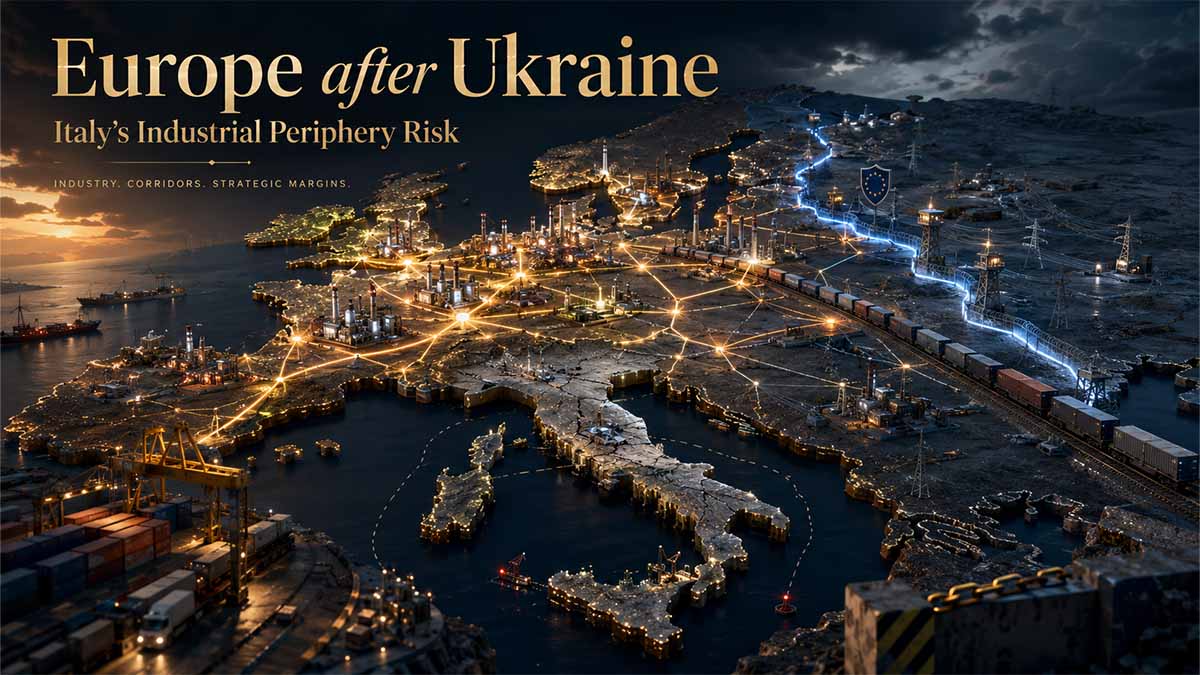
Europe after Ukraine: Italy’s Industrial Periphery Risk
Europe’s next industrial map is being drawn before Ukraine joins the Union. On 14 July 2026, Brussels opened negotiations with Ukraine and Moldova on external relations, trade, sanctions, security and defence. The formal act was diplomatic; the economic consequence is potentially continental. Reconstruction finance, military procurement, transport corridors and agricultural integration could consolidate a new axis from Poland through Ukraine and Romania to Moldova and the Black Sea. Italy can profit from that shift—but only if it supplies more than machinery. The real contest concerns where factories, logistics hubs, repair centres, energy equipment and industrial knowledge will be located. Without a coordinated response, the Adriatic may remain geographically central while Italy becomes peripheral to Europe’s most important capital-allocation cycle.
The Accession Accelerator
The third EU–Ukraine Accession Conference, held in Brussels on 14 July, opened Cluster 6: Chapter 30 on external relations and Chapter 31 on foreign, security and defence policy. The EU delegation was led by Irish Minister of State Thomas Byrne, with Enlargement Commissioner Marta Kos; Ukraine was represented by Deputy Prime Minister Taras Kachka. The decision came only one month after the opening of the fundamentals cluster on 15 June. Accession remains merit-based, but the sequence matters: trade rules, sanctions, procurement and security alignment are now advancing together. (Consiglio dell’Unione Europea)
Capital does not wait for the final treaty. Once investors expect regulatory convergence, guaranteed demand and EU-financed infrastructure, they begin to price Ukrainian and Moldovan assets as future components of the Single Market. The likely result is not a sudden exodus from Western Europe, but a cumulative reallocation: service centres first, then assembly, suppliers, maintenance and finally engineering. Poland and Romania can capture much of the first wave because they combine EU law, NATO protection and proximity to Ukrainian demand.
The Reconstruction Balance Sheet
The scale is no longer theoretical. The RDNA5 assessment, published on 23 February 2026 by the Government of Ukraine, World Bank, European Commission and United Nations, estimated reconstruction and recovery needs at almost $588 billion over ten years—more than €500 billion and nearly three times Ukraine’s estimated 2025 nominal GDP. Transport requires over $96 billion, energy almost $91 billion, housing nearly $90 billion, commerce and industry over $63 billion, and agriculture more than $55 billion. Ukraine identified over $15 billion of 2026 priorities, while at least $20 billion of urgent needs had already been addressed since February 2022. (Banca Mondiale)
The EU’s Ukraine Facility supplies up to €50 billion for 2024–2027; by June 2026, Brussels reported more than €42 billion mobilised in direct and indirect assistance. This is not only budget support. Guarantees, investment facilities and accession-linked reforms are lowering the effective cost of capital for projects that would otherwise remain unfinanceable under wartime risk. (European Commission)
The industrial paradox is evident. The same €500 billion-plus market that can fill Italian order books can also finance the factories that will later compete with them.
Defence Moves East
The strongest accelerator is defence. Regulation 2026/467 created a €90 billion Ukraine Support Loan for 2026–2027: €30 billion for budgetary assistance and €60 billion for defence procurement. For 2026 alone, the Council authorised up to €45 billion—€16.7 billion for budget support and €28.3 billion for Ukrainian defence-industrial capacity. On 25 June the Commission disbursed €3.2 billion; on 30 June it released €3.9 billion for drones, the first payment under a tranche of about €6 billion. (Defence Industry and Space)
EDIP adds a €1.5 billion European defence-industrial programme, including a €300 million Ukraine Support Instrument and more than €700 million for production increases in missiles, ammunition, counter-drone systems, electronic components and defence platforms. The Commission’s objective is explicit: modernise Ukraine’s defence technological and industrial base and integrate it progressively into Europe’s. (Defence Industry and Space)
This changes location economics. Battlefield feedback, rapid procurement and public funding favour plants, testing centres and maintenance facilities close to the eastern flank. Italy remains strong in aerospace, naval systems, electronics, propulsion and advanced mechanics, but risks being confined to high-end design while serial production, wiring, metal structures, repair and integration migrate east.
Italy’s Exposed Industries
Italian machinery and mechatronics remain formidable: more than 60,000 local units, €251 billion in turnover, €70 billion in value added and €148 billion in exports. Machinery and equipment alone include more than 18,000 enterprises. In April 2026, Italian exports rose 8.8% year-on-year; metals and fabricated products increased 32.9%, machinery 6.3% and electrical equipment 10.4%. (Ice)
These are precisely the sectors Ukraine needs: machine tools, pumps, valves, transformers, rolling stock, signalling, construction systems, packaging lines, irrigation, food processing and port equipment. Yet vulnerability differs by production stage. System engineering, software, certification and customised machinery remain difficult to relocate. Standard assemblies, wiring, basic fabrication, modular housing, rail maintenance and repetitive component production are mobile.
Steel is the clearest danger. Reconstruction will consume enormous volumes of beams, plate, reinforcement bar, pipe and fabricated structures. But Italy’s energy costs and unresolved primary-steel transition expose commodity production to modern eastern plants built with public support. Construction presents the same dilemma: Italian equipment can create prefabrication and processing capacity in Ukraine, Poland or Romania that later competes inside the Single Market. The strategic metric cannot be exports alone. It must measure Italian value retained through software, components, maintenance, intellectual property and equity participation.
Agriculture Without Illusions
Ukraine’s agricultural integration will also reshape the Common Agricultural Policy. No credible figure can yet be assigned to future Ukrainian direct payments: accession timing, transition periods and the post-2027 budget remain unsettled. The pressure, however, is structural. A large agricultural producer with lower land costs and substantial grain and oilseed capacity will compete for market access, infrastructure and eventually public support.
Italy’s opportunity lies upstream and downstream: tractors, irrigation, storage, milling, cold chains, packaging, traceability and premium processing. Its risk lies in enabling Ukrainian firms to move from commodity exports into higher-value food production. The winning model is not one-off machinery sales, but Italian-controlled platforms combining technology, licensing, brands and distribution.
The Corridor Contest
The new geography is already embedded in TEN-T. The Baltic Sea–Adriatic Corridor connects Poland, Czechia, Slovakia, Austria, Hungary and the Balkans with Bologna and the ports of Trieste, Venice, Ravenna and Bari. It includes more than 10,000 kilometres of rail, 5,500 kilometres of roads, twelve seaports, five Danube ports and twenty-eight rail-road terminals. The Mediterranean Corridor runs approximately 3,000 kilometres through Turin, Milan, Verona, Bologna, Padua, Venice and Trieste, then through Slovenia, Croatia and Hungary to Lviv. (Mobility and Transport)
This is Italy’s defensive line. Trieste and Monfalcone handled more than 64 million tonnes and 11,600 trains in 2025. Trieste alone moved about 60 million tonnes and 7,939 trains; Germany represented 32% of rail traffic, Austria 19% and Hungary 13%. The gateway exists, but its network remains stronger toward Central Europe than toward Romania, Moldova and Ukraine. (Porti Adriatico Orientale)
Venice and Chioggia handled 26.2 million tonnes and 533,000 TEU in 2025. Porto Marghera can become an industrial staging area for energy, water, housing and reconstruction modules. Bari recorded nearly 4 million tonnes of general cargo and 75,000 TEU in the first nine months of 2025, giving Southern Italy a possible Balkan and Ro-Ro gateway. (Porto Adriatico Settentrionale)
Yet four ports do not constitute a strategy. Italy needs a single Adriatic–Danube commercial product: scheduled rail and maritime services, common customs procedures, war-risk insurance, project finance, cargo tracking and defined transit times to Budapest, Romania, Moldova and Ukrainian interchange points.
The Southern Warning
The danger is not only national but territorial. In the first quarter of 2026, Italian exports rose 13.1% quarter-on-quarter in the South and Islands, yet the annual picture remained sharply differentiated: the South gained 7.1%, the Northeast fell 2.4% and the Islands lost 19%. Friuli-Venezia Giulia dropped 35.4% year-on-year, while Abruzzo rose 23.5%. (Istat)
These fluctuations are not enlargement effects, but they expose a fragmented industrial base. Northern Italy risks transferring production east to follow contracts. Southern Italy risks never entering the contracts at all. Taranto, Bari, Brindisi, Gioia Tauro, Campania’s rail and aerospace plants, and Puglia’s mechanical and agri-food industries must be connected to the same reconstruction platform as Trieste, Venice and Ravenna. Otherwise, eastern enlargement will deepen Italy’s internal divide before it weakens Italy’s European position.
The Five-Year Decision
The decisive period is 2026–2028. Italy should establish a permanent reconstruction platform linking government, ports, rail operators, manufacturers, SACE, SIMEST, CDP, banks and insurers; map the top tenders; and require public support to preserve domestic engineering and production content. By 2027, Trieste should operate scheduled eastern services, Venice and Ravenna dedicated industrial and project-cargo areas, and Bari a freight-oriented Balkan connection. By 2028, Italian-led consortia should control anchor projects in energy, rail, water, housing and defence.
Between 2029 and 2031, the system will harden. Supplier clusters will form, new plants will acquire scale and the next EU budget will redistribute attention among cohesion, agriculture, defence and enlargement. Late entry will mean subcontracting.
Italy does not need to stop Europe moving east. It needs to ensure that the movement passes through Italian technology, finance, ports and factories. The true risk is not Ukraine’s accession. It is allowing others to convert accession into industrial power while Italy limits itself to applauding the enlargement of the market.
Navigational Index
Pillar I — The eastern capital-allocation machine
Accession negotiations, reconstruction finance, defence-industrial integration, cohesion competition, agricultural convergence and the emergence of a new investment geography.
Pillar II — Italy’s industrial exposure
Mechanical engineering, steel, construction systems, rolling stock, energy equipment, agri-food machinery, ports, shipbuilding and productions vulnerable to eastern relocation.
Pillar III — The Adriatic counter-strategy
Trieste, Venice, Ravenna and Bari; Baltic–Adriatic and Mediterranean corridors; Danube connections; Black Sea trade; Italian participation requirements and five-year policy options.
Master Abstract
The opening of negotiations with Ukraine and Moldova on Cluster 6 on 14 July 2026 is strategically more consequential than its technical designation suggests. Cluster 6 includes Chapter 30 on external relations and Chapter 31 on foreign, security and defence policy, thereby extending the accession process into commercial alignment, international commitments, sanctions, security positions and defence cooperation. It follows the opening of the fundamentals cluster on 15 June 2026 and confirms that both candidates are moving from political association toward progressive incorporation into the Union’s regulatory and strategic operating system. Enlargement: EU opens accession negotiations with Ukraine on external relations policies – Council of the European Union – July 2026 and Enlargement: EU and Moldova start negotiations on external relations policies – European Commission – July 2026 document the exact scope and sequencing. The industrial implication is not that factories will abruptly migrate east, but that EU rules, procurement mechanisms, guarantees, infrastructure priorities and security requirements can progressively reduce the institutional distance separating Ukrainian and Moldovan productive assets from the Single Market. The resulting geography may favour a connected belt extending from Poland and Slovakia through western Ukraine to Romania, Moldova and the Black Sea, particularly if reconstruction procurement, defence manufacturing, energy interconnection and transport modernisation are bundled into long-duration investment programmes. The central analytical judgment is therefore conditional: eastern enlargement becomes an industrial relocation mechanism only when accession convergence is reinforced by concentrated infrastructure expenditure, preferential financing, skilled-labour availability, lower operating costs, defence demand and credible security guarantees. Under those conditions, capital does not merely follow lower wages; it follows subsidised networks, guaranteed demand, improved logistics and a political mandate to build resilience close to the Union’s eastern frontier.
The financial and physical foundations of this possible reorientation already exist. The Ukraine Facility permits up to €50 billion in EU support during 2024–2027 for recovery, reconstruction, modernisation and accession-related reforms, while the Commission reported in June 2026 that more than €42 billion had already been mobilised through direct and indirect assistance. The Ukraine Facility – European Commission – June 2026 and EU financial support to Ukraine – European Commission – June 2026 establish the scale and purpose of the instrument. This financing is being superimposed on a redesigned transport map. The Baltic Sea–Black Sea–Aegean Sea European Transport Corridor connects Finland, the Baltic states, Poland, Slovakia, Hungary, Romania, Bulgaria, Greece and Cyprus with Ukraine and Moldova; its branches link Warsaw and Lublin to Lviv and Odesa, Romania to Chișinău and Odesa, and southern routes to Constanța, Burgas, Thessaloniki and Athens. Baltic Sea–Black Sea–Aegean Sea Corridor – European Commission – July 2026 describes this architecture. The Rhine–Danube Corridor has also been extended toward Lviv, while the North Sea–Baltic Corridor reaches Kyiv and Ukrainian nodes, although the difference between European standard gauge and the wider gauge used in Ukraine remains a material bottleneck. Rhine–Danube Corridor – European Commission – July 2026 and North Sea–Baltic Corridor – European Commission – June 2026 show that Ukraine is being embedded in several continental corridors rather than treated as an isolated reconstruction zone. The emerging risk for Italy is consequently not simple exclusion, but relative dilution: each euro devoted to eastern rail interoperability, military mobility, border terminals, power grids and industrial parks increases the attractiveness of the eastern axis unless Italian firms and ports are contractually integrated into the same investment chains.
Defence and agriculture amplify this redistribution pressure because they connect strategic security to recurring public expenditure. The European Defence Industrial Strategy calls for stronger collaborative procurement, deeper intra-EU defence trade and closer integration with Ukrainian industry; its stated benchmarks include at least 40 percent collaborative procurement by 2030, intra-EU defence trade equal to at least 35 percent of the EU defence market and an increasing share of procurement budgets spent within Europe. First ever defence industrial strategy and a new defence industry programme to enhance Europe’s readiness and security – European Commission – March 2024 sets out these objectives. In March 2026, the Commission adopted a €1.5 billion EDIP work programme, with more than €700 million assigned to production increases in areas including counter-drone systems, missiles and ammunition; the programme also contains a €300 million Ukraine Support Instrument for the recovery and integration of the Ukrainian defence-technological and industrial base. EDIP: Commission adopts €1.5 billion work programme to boost European and Ukrainian defence industry – European Commission – March 2026 and EDIP: Forging Europe’s Defence – European Commission – July 2026 identify the allocations and integration objective. For Italy, this creates a dual outcome. Firms specialising in aerospace, electronics, naval systems, armoured vehicles, propulsion, ammunition machinery, sensors and advanced materials can enter Ukrainian-linked consortia and obtain durable demand. Conversely, assembly, maintenance, component production and testing may concentrate closer to Poland, Romania and Ukraine where operational requirements, military logistics and public support converge. Agriculture creates an analogous tension: Ukraine’s eventual integration would enlarge the Union’s cultivated area and introduce a major producer into the systems governing market access, income support and rural development. The precise post-accession CAP settlement has not yet been decided; any numerical allocation at this stage would therefore be speculative. The structural issue, however, is unavoidable: without reform, a larger eligible agricultural base would create distributional pressure on existing beneficiaries, including Italian cereals, oilseeds, livestock and processing chains, while increasing competition for cohesion resources needed by Southern Italy.
Italy is not geographically condemned to become a western industrial periphery because the revised TEN-T network gives it several points of access to the eastern transformation. The Baltic Sea–Adriatic Sea Corridor terminates through western and eastern branches connecting Bologna with Trieste, Venice, Ravenna and Bari, while linking the Adriatic system to Austria, Slovakia, Hungary, Slovenia, Croatia and Poland. Baltic Sea–Adriatic Sea Corridor – European Commission – May 2026 records more than 10,000 kilometres of railway, over 5,500 kilometres of road, twelve seaports and five inland-waterway ports connected with twenty-eight rail-road terminals. The Mediterranean Corridor also links Genoa, La Spezia, Turin, Milan, Verona, Bologna, Padua, Venice and Trieste through Slovenia, Croatia and Hungary toward Lviv, giving northern Italy a formal terrestrial connection to Ukraine. Mediterranean Corridor – European Commission – July 2026 confirms this alignment. The vulnerability lies in the difference between being drawn on a corridor map and controlling commercially competitive services. Italy requires adequate rail capacity from Adriatic ports, interoperable terminals, resilient Alpine crossings, customs digitalisation, project-finance vehicles, reconstruction insurance and regular maritime links capable of connecting Adriatic ports with Constanța, the lower Danube and eventually Ukrainian Black Sea ports. The highest-potential Italian supply chains are industrial machinery, electrical equipment, transformers, pumps, valves, rail systems, signalling, construction materials, prefabricated structures, water treatment, waste systems, food-processing equipment, cold chains, hospital technologies, telecommunications, cybersecurity and dual-use sensors. The most relocation-exposed activities are standardised components, labour-intensive assemblies, basic metal processing, wiring systems, agricultural inputs and high-volume production whose margins depend more on land, energy, labour and subsidies than on proprietary technology. Italy’s strategic defence is therefore not protectionism but contractual positioning: Italian participation must be embedded in EU procurement, Ukraine Facility investment, EDIP consortia, TEN-T projects and public-risk guarantees before the eastern production ecosystem becomes self-reinforcing.
The five-year outlook is best represented through competing hypotheses rather than a deterministic forecast. H₁, Eastern Industrial Pivot, assumes that reconstruction, military production, logistics and lower-cost manufacturing form a durable Poland–Ukraine–Romania axis; the initial analytical probability is assessed at 34 percent. H₂, Distributed European Reconstruction, assumes that projects are allocated across existing EU industrial systems and that Italian, German, French, Nordic and Central European suppliers retain high-value functions; its initial probability is 31 percent. H₃, Security-Constrained Integration assumes that continued military risk prevents large-scale fixed-capital relocation into Ukraine, favouring Poland and Romania as safer production platforms; its initial probability is 19 percent. H₄, Fiscal Fragmentation assumes that budget conflict over agriculture, cohesion and defence slows integration and limits transformative investment; its initial probability is 10 percent. H₅, Adriatic Counter-Pivot assumes that Italy successfully converts Trieste, Venice, Ravenna and Bari into reconstruction gateways and anchors Italian firms in eastern value chains; as an autonomous dominant outcome, its initial probability is 6 percent, although it can coexist with H₂. These are structured analyst priors, not measurements published by the cited institutions. A Monte Carlo-style strategic model for 2026–2031 should vary at least eight drivers: war termination and security guarantees, accession velocity, reconstruction-finance execution, relative energy prices, labour-cost convergence, TEN-T completion, defence-procurement localisation and the reform of CAP and cohesion policy. The preliminary model indicates that Italy’s peripheralisation risk becomes acute when four conditions occur simultaneously: eastern infrastructure execution exceeds Italian execution; EU procurement rewards proximity without strong cross-border consortium requirements; CAP and cohesion reform reduce Italy’s net receipts; and Italian ports fail to offer integrated rail-maritime services to the Danube and Black Sea. The appropriate policy metric is therefore not Ukraine’s formal accession date but Italy’s share of contracts, industrial partnerships, logistics flows and supported investment generated by the accession process before 2031.
Europe’s Industrial Gravity Shift
Structural Drivers
Italy Peripheralisation Index
Competing Hypotheses
Italian Sector Exposure Matrix
Pillar I — The Eastern Capital-Allocation Machine
Accession as an investment-allocation regime
The opening of Cluster 6 with Ukraine and Moldova on 14 July 2026 must not be interpreted as a ceremonial enlargement milestone. It establishes the political and legal transmission mechanism through which two candidate economies progressively align their trade policies, international commitments, sanctions regimes, security positions and defence-industrial relationships with the European Union. Cluster 6 contains Chapter 30 on external relations and Chapter 31 on foreign, security and defence policy; its activation followed the opening of the fundamentals cluster on 15 June 2026, producing a significant acceleration in the negotiating calendar. The industrial consequence is indirect but potentially decisive: accession negotiations reduce institutional uncertainty, create reform benchmarks, standardise commercial rules, strengthen administrative predictability and provide political justification for European guarantees, grants, procurement programmes and infrastructure interventions. Capital does not wait for the final accession treaty when public institutions have already supplied credible signals regarding future market integration. It begins to price future regulatory convergence, customs integration, access to European procurement, infrastructure interoperability and the probability that candidate-country assets will eventually operate within the Single Market. This is why enlargement can alter industrial geography years before membership. The eastern shift would not originate from a single decision to relocate production from Italy, France or Germany; it would emerge cumulatively as thousands of investment committees compare the expected return on factories, warehouses, maintenance centres, energy systems, agricultural processing plants and defence facilities in territories receiving exceptional public support. Enlargement: EU opens accession negotiations with Ukraine on external relations policies – Council of the European Union – July 2026 establishes the scope of the Ukrainian negotiations, while Third Accession Conference with the Republic of Moldova – Council of the European Union – July 2026 confirms the corresponding Moldovan process.
The operative mechanism can be represented as a capital-allocation chain rather than a political sequence:
EU ACCESSION INDUSTRIAL CLUSTERING MODEL
An interactive 3D structural visualizer mapping the geoeconomic feedback loop of EU accession—tracing how regulatory convergence, institutional guarantees, and TEN-T integration reduce capital costs to catalyze self-reinforcing industrial clusters.
The decisive variable is therefore not accession probability considered in isolation, but the interaction between accession credibility and the cost of capital. A project that would be unattractive under sovereign-war risk can become financeable when grants absorb first losses, guarantees reduce creditor exposure, EU-supported procurement creates long-term demand and corridor investments lower transport costs. This means that European public policy can transform locations that private investors previously regarded as frontier markets into subsidised strategic platforms. The resulting system resembles an investment escalator: institutional alignment lowers regulatory risk; guarantees lower financing risk; defence and reconstruction contracts lower demand risk; infrastructure lowers logistics risk; and the presence of initial anchor investors lowers coordination risk for subsequent suppliers. Once these effects converge geographically, industrial clustering can continue even after extraordinary subsidies decline.
The reconstruction balance sheet
The Ukraine Facility is the foundational civilian instrument of this emerging allocation system. It provides up to €50 billion for 2024–2027 and is structured around direct financial support, an investment framework and accession-related technical assistance. By 8 June 2026, regular payments under the Facility had brought disbursements above €29.5 billion. At the Ukraine Recovery Conference in Gdańsk on 26 June 2026, the Commission signed more than €1.1 billion in new agreements under the Ukraine Investment Framework, bringing EU commitments under that framework to €8.5 billion, expected by the Commission to mobilise almost €26 billion in investment. These figures matter because they show that the system is evolving beyond fiscal stabilisation toward leveraged capital formation. The distinction is critical: direct budget support keeps the Ukrainian state functioning, whereas guarantee-backed investment can determine where energy plants, industrial facilities, housing systems, municipal infrastructure and logistics platforms are built. The Ukraine Facility – European Commission – June 2026 provides the official disbursement and commitment timeline.
The Commission’s wider reconstruction architecture reinforces the leverage effect. At the 2025 Ukraine Recovery Conference in Rome, the Commission announced €2.3 billion in guarantee and grant agreements expected to unlock approximately €10 billion in investment across municipal and social infrastructure, housing, energy, private-sector development and strategic or dual-use industries. At the 2026 conference in Gdańsk, it launched the European Flagship Fund for the Reconstruction of Ukraine with €220 million in initial capital and an ambition to mobilise up to €7 billion for infrastructure, productive industries and other recovery projects. These are not equivalent to final investment realised on the ground; they are mobilisation targets contingent on project quality, co-financing, security and execution. Nevertheless, they reveal the intended architecture: limited public capital is being used to crowd in larger volumes of institutional, corporate and development finance. Recovery and reconstruction of Ukraine – European Commission – June 2026 sets out these instruments and mobilisation expectations.
| Instrument | Confirmed public envelope or commitment | Intended leverage or function | Industrial relevance |
|---|---|---|---|
| Ukraine Facility, 2024–2027 | Up to €50bn | Budget stability, reforms, reconstruction and investment | Establishes the core accession-linked funding platform |
| Facility disbursements by 8 June 2026 | More than €29.5bn | State continuity and reform-linked payments | Reduces sovereign and administrative discontinuity |
| Ukraine Investment Framework commitments by June 2026 | €8.5bn | Nearly €26bn expected investment mobilisation | Supports bankable infrastructure and private-sector projects |
| Rome URC guarantee and grant agreements, 2025 | €2.3bn | Approximately €10bn expected mobilisation | Housing, energy, municipalities and dual-use industry |
| Gdańsk URC agreements, 2026 | More than €1.1bn | Included within expanded UIF commitments | Infrastructure, renewable energy and defence-linked recovery |
| European Flagship Fund | €220m initial capital | Up to €7bn projected investment | Equity participation in productive and strategic assets |
The investment geography created by these instruments will be determined by project pipelines rather than national rhetoric. Municipalities and regions capable of preparing technically mature projects, securing land, completing environmental assessments, protecting assets, providing grid connections and coordinating with European financial institutions will attract disproportionate capital. Western and central Ukrainian regions could initially possess an advantage because of greater distance from the most exposed front-line areas, closer access to EU borders and stronger connectivity with Poland, Slovakia, Hungary and Romania. Kyiv and selected large industrial centres may retain administrative and technological advantages, while Black Sea regions possess long-term value but higher security exposure. Moldova can function as an adjacent services, logistics, energy and regulatory bridge, especially if its infrastructure becomes more deeply integrated with Romanian and Ukrainian networks. The capital-allocation machine therefore creates not one Ukrainian reconstruction market but a hierarchy of investable zones differentiated by security, connectivity, administrative capacity, labour supply and sectoral specialisation.
The 2026–2027 defence-finance acceleration
The civilian reconstruction system is now accompanied by a defence-financing structure of exceptional scale. In 2026, the European Union created a €90 billion Ukraine Support Loan for 2026–2027. For 2026, an implementing decision made up to €45 billion available, divided into €16.7 billion for budget support and €28.3 billion for Ukrainian defence-industrial capacities. The budget component included up to €8.35 billion through the Ukraine Facility and up to €8.35 billion through macro-financial assistance. On 25 June 2026, the Commission disbursed the first €3.2 billion instalment; on 30 June, it announced a further €3.9 billion disbursement focused on drones. The Commission stated that the defence component was designed to reconstruct, recover and modernise the Ukrainian defence technological and industrial base and facilitate its gradual integration into the European defence technological and industrial base. Commission disburses €3.9 billion for drones under the €90 billion Ukraine Support Loan – European Commission – June 2026 provides the official financial breakdown and integration objective.
This financial configuration substantially changes the economics of European defence location. Ukraine is no longer treated solely as an end-user receiving European equipment; it is being developed as a production, innovation and testing node inside an increasingly integrated European defence market. That change creates strong agglomeration incentives. Firms gain advantages by locating engineering teams, component suppliers, testing facilities, maintenance operations and production partnerships near Ukrainian demand, battlefield feedback and procurement authorities. Poland and Romania benefit because they can provide NATO and EU territory, improved security conditions, established logistics and proximity to Ukraine. Moldova may develop specialised functions in communications, repair, logistics, software, electronics, training support and dual-use services, although its size and institutional capacity impose limits. The likely industrial geography is therefore distributed: sensitive or capital-intensive facilities may remain inside established EU defence economies, while rapid-cycle manufacturing, integration, maintenance and selected production expand in Ukraine and neighbouring member states.
| 2026 defence-finance mechanism | Amount | Eligible or targeted geography | Capital-allocation effect |
|---|---|---|---|
| Ukraine Support Loan, 2026–2027 | Up to €90bn | Ukraine | Creates an exceptional sovereign and defence funding channel |
| 2026 authorised support | Up to €45bn | Ukraine | Front-loads fiscal and defence-industrial investment |
| 2026 defence-industrial component | €28.3bn | Ukrainian defence production and capacity | Makes Ukrainian industry a funded production base rather than only a recipient |
| 2026 budget support | €16.7bn | Ukrainian government and services | Supports macroeconomic continuity and procurement credibility |
| Initial loan instalment | €3.2bn | Ukraine | Begins operational deployment of the new facility |
| Drone-focused disbursement | €3.9bn | Ukrainian drone capability | Accelerates unmanned-system production and related supply chains |
The deeper implication for Italy is that the centre of gravity in defence procurement may increasingly follow operational urgency. Italy possesses major capabilities in aerospace, naval platforms, electronics, radar, propulsion, armoured systems, helicopters, munitions equipment, cybersecurity and space systems, but it risks losing relative influence where procurement increasingly favours rapid production, modularity, battlefield iteration and proximity to eastern military requirements. Italian firms can offset this risk by becoming design authorities, system integrators, component suppliers, financing partners and joint-venture leaders. Failure to enter consortia early could leave them competing for residual subcontracts after eastern and northern European relationships have become embedded.
EDIP and the institutional integration of Ukrainian production
The European Defence Industry Programme, adopted for 2026–2027, adds a further €1.5 billion in EU grants. More than €700 million is assigned to industrial reinforcement, €325 million to European Defence Projects of Common Interest, €240 million to common procurement, €100 million to equity support for start-ups and smaller defence firms, and additional resources to rapid innovation. The programme includes a dedicated €300 million Ukraine Support Instrument. Of this, the Commission’s March 2026 work programme allocated €260 million to collaborative production investments intended to rebuild Ukrainian capacity and integrate it into the wider European industrial base. EDIP: Commission adopts €1.5 billion work programme to boost European and Ukrainian defence industry – European Commission – March 2026 details the programme’s financial distribution.
The detailed calls demonstrate where the industrial clustering pressure will emerge. The programme assigns €180 million to missiles, ammunition and bombs, including air-defence munitions, deep-strike systems, rockets, smart bombs and loitering munitions. A further €80 million is dedicated to unmanned and counter-unmanned systems, including electronic-warfare-resilient platforms and interceptors. Separate industrial-reinforcement calls cover electronic components, avionics, multispectral cameras, printed circuit boards, semiconductor building blocks, lithium-polymer batteries, power electronics, forging, machining, composite materials, subsystem integration, Manufacturing-as-a-Service and the conversion of heavy industry for defence surge capacity. Ukraine-specific calls may fund joint filling plants, production lines, scale-up of Ukrainian systems, cross-border manufacturing and industrial conversion, with funding rates of up to 100 percent of eligible costs in designated cases. EDIP | Forging Europe’s Defence – European Commission – July 2026 provides the call architecture, funding rates and industrial categories.
The consequences extend beyond grant amounts. A production line financed under EDIP can become an anchor around which suppliers, engineers, testing laboratories, certification services and vocational training accumulate. The strongest allocation effect may therefore come from network externalities rather than the initial grant. Once a missile, drone or electronics facility is established in Poland, Romania, Ukraine or another eastern state, future procurement authorities will prefer suppliers able to deliver quickly, maintain equipment locally and integrate battlefield upgrades. This creates a dynamic of path dependence. Early public funding determines initial location; location attracts suppliers; suppliers reduce unit costs and lead times; lower costs improve the location’s competitiveness in later calls; and recurring procurement then consolidates the cluster.
EU DEFENCE GRANT INDUSTRIAL CLUSTERING MODEL
An end-to-end 3D structural visualizer mapping the catalytic feedback loop of European defense capital grants—tracing how initial non-repayable anchor funding establishes local supply ecosystems, slashes operational friction, wins competitive follow-on procurement, and locks in permanent defense-industrial hubs.
Evidence of the competitive intensity is already visible. The first EDIP call for energetic components received 83 proposals from companies across 23 member states and Norway. The call offered more than €165 million and was expected to generate total investment of up to €470 million through industry co-financing. The Commission planned to identify projects by September 2026. First EDIP Call closes and receives high number of proposals – European Commission – June 2026 confirms the proposal count and expected leverage.
From funding to strategic industrial corridors
The eastern capital-allocation machine becomes structurally powerful only when finance is connected to physical infrastructure. The revised TEN-T system incorporates Ukraine and Moldova into multiple European corridors. The Baltic Sea–Black Sea–Aegean Sea Corridor connects Finland, the Baltic states, Poland, Slovakia, Hungary, Romania, Bulgaria, Greece and Cyprus, with branches extending through Lublin toward Lviv, through Romania and Moldova toward Chișinău and Odesa, and southward toward Constanța, Burgas, Thessaloniki and Athens. The Rhine–Danube Corridor now extends toward Ukraine, while the North Sea–Baltic network has been expanded toward Ukrainian nodes. These routes do not guarantee immediate commercial performance: rail-gauge incompatibilities, border delays, missing terminals, security exposure, bridge capacity and underdeveloped intermodal systems remain substantial constraints. Nevertheless, corridor designation establishes eligibility, planning priority and long-term political visibility. It enables public authorities to coordinate road, rail, port, inland-waterway, energy and military-mobility investments around a common geography.
The investment significance is considerable. A manufacturing plant has greater value when it can reach Germany, Poland, Romania, the Black Sea and the Danube through multiple corridors; a port has greater value when rail connections link it to inland industrial clusters; and a defence plant has greater resilience when components can arrive through redundant routes. The emerging Poland–Ukraine–Romania–Moldova axis should therefore be understood as a network rather than a line. Poland provides industrial depth, logistics, financial credibility and a large internal market. Ukraine contributes demand, labour, technological experimentation, raw materials, agriculture and reconstruction needs. Romania supplies EU and NATO territory, Black Sea access, energy potential and a connection to Moldova. Moldova provides a potential regulatory and logistical hinge. The Black Sea connects the system to Turkey, the Caucasus, the eastern Mediterranean and global maritime routes.
| Node | Principal strategic function | Investment attractor | Limiting factor |
|---|---|---|---|
| Poland | Industrial and logistics platform | EU security, scale, rail and road links, defence demand | Labour-cost convergence and infrastructure congestion |
| Western Ukraine | Reconstruction and manufacturing zone | EU proximity, labour, industrial sites, public guarantees | War risk and insurance cost |
| Central Ukraine | Administrative and technology hub | Skilled labour, demand concentration, innovation | Infrastructure vulnerability |
| Romania | Black Sea and NATO gateway | Constanța, energy, EU legal framework, defence positioning | Administrative execution and infrastructure gaps |
| Moldova | Regulatory, services and transit hinge | EU accession path, Romanian integration, lower costs | Small market, institutional capacity, energy dependence |
| Black Sea ports | External trade and reconstruction gateway | Bulk logistics, energy, agriculture, container potential | Maritime security and insurance |
| Danube system | Inland transport multiplier | Lower-cost bulk movement, connection to Central Europe | Capacity, navigability and terminal bottlenecks |
The overlooked danger for Italy lies in the asymmetry between eastern corridor formation and Mediterranean fragmentation. Northern Adriatic ports are connected to Central Europe, but much of Southern Italy remains dependent on slower or less integrated inland logistics. If eastern public investment improves rail speeds, terminal capacity, customs processing and energy reliability faster than comparable projects in Italy, the relative cost of locating production in the east will fall. Industrial peripherality is not caused by absolute decline alone; it can arise when competing regions improve faster.
Cohesion competition and the future European budget
The accession of Ukraine and Moldova would create a major distributional challenge for EU cohesion policy. Cohesion funding is structured to reduce regional disparities and support less-developed territories, transition regions and competitiveness. Ukraine’s income levels, reconstruction requirements, infrastructure deficits and war damage would make it an exceptionally strong candidate for substantial support once it becomes eligible under future financial arrangements. Moldova would also likely qualify for significant assistance relative to its economic size. This does not mean that existing Italian allocations would automatically be transferred east; the legal design of the post-2027 Multiannual Financial Framework, transition periods, national co-financing rules, special reconstruction instruments and the timing of accession will determine actual outcomes. However, unless the overall budget grows materially, enlargement introduces a mathematical competition between existing recipients and new claimants.
For Italy, the primary exposure lies in the Mezzogiorno, where cohesion programmes finance transport, urban development, environmental infrastructure, employment, digitalisation, research and enterprise support. The eastern machine could create two simultaneous pressures. First, budgetary bargaining may redirect more resources toward the Union’s eastern frontier. Second, investors may interpret increased eastern allocations as a signal that roads, energy systems, industrial parks and human-capital programmes will improve faster there. Even when Italy retains nominal allocations, relative investment attractiveness can weaken if project execution remains slower. The strategic comparison must therefore distinguish between budget share and effective absorption. A smaller country capable of deploying funds rapidly can achieve a larger industrial effect than a larger recipient with delayed procurement, legal disputes and fragmented project governance.
A useful risk decomposition is:
| Cohesion-risk channel | Probability by 2031 | Impact on Italy | Transmission mechanism |
|---|---|---|---|
| Reduction in relative Italian budget share | Medium-high | High | Larger number of low-income eligible regions |
| Creation of special eastern instruments outside standard cohesion | High | Medium-high | Political priority and security rationale |
| Delayed Italian project execution | High | High | Relative loss despite retained nominal funding |
| Investor signalling toward eastern industrial zones | High | High | Public infrastructure predicts future private returns |
| Temporary protection of current recipients | Medium | Medium | Transition arrangements slow but do not remove pressure |
| Larger total EU budget offsets redistribution | Medium-low | Positive | Requires greater national contributions or common borrowing |
The central policy error would be to frame this as a zero-sum dispute over transfers alone. The more consequential question is whether cohesion money creates tradable industrial capacity. Eastern Europe may use EU resources to build rail terminals, energy infrastructure, defence facilities, cross-border logistics and industrial zones directly connected to reconstruction demand. If Italian resources remain concentrated in fragmented local projects without comparable supply-chain effects, nominal financial parity will conceal strategic divergence.
Agricultural convergence and the CAP shock
Agriculture represents the most politically sensitive component of eastern enlargement because Ukraine is not a marginal agricultural economy. Its accession would introduce a very large cultivated area, substantial grain and oilseed production, major storage and logistics requirements and a cost structure different from that of many existing EU producers. The final impact on the Common Agricultural Policy cannot yet be calculated because no definitive accession date, transition regime, payment model or future CAP budget has been agreed. Any precise forecast of Ukrainian direct payments would therefore be false precision. Nevertheless, the direction of pressure is clear: extending current support principles without reform would enlarge the eligible agricultural base and create a major fiscal burden; restricting Ukrainian eligibility would create political and competitive tensions; and reforming payments could redistribute support away from existing beneficiaries.
The eastern capital-allocation machine will affect agriculture through more than subsidies. Reconstruction finance will fund irrigation, storage, rail terminals, border facilities, processing plants, renewable energy and export logistics. Defence-related security improvements could reduce insurance premiums and unlock private investment in grain handling, food processing, fertilisers, agricultural machinery and bioenergy. Regulatory convergence will increase compliance costs but also improve access to the Single Market. Once Ukrainian farms, processors and exporters operate under more closely aligned EU standards, the competitive comparison will shift from tariffs toward scale, logistics, technology and production cost. Italian agriculture is unlikely to compete directly in all commodity segments, because much of Italy’s value lies in specialised, branded and higher-value products. The greatest exposure concerns feed-intensive livestock chains, cereal users, oilseed processors, standardised food intermediates and sectors where Italian producers bear higher land, labour, energy and environmental costs.
| Agricultural channel | Eastern advantage | Italian opportunity | Italian risk |
|---|---|---|---|
| Cereals and oilseeds | Scale, land availability, export potential | Machinery, storage, quality control | Price pressure on commodity-linked chains |
| Food processing | Reconstruction of modern facilities | Italian processing equipment and packaging | Relocation of standard processing capacity |
| Irrigation and water | Large reconstruction requirement | Pumps, valves, digital irrigation, engineering | Foreign competitors capture turnkey contracts |
| Agricultural logistics | New silos, terminals and rail systems | Port equipment and intermodal technology | Black Sea and Danube routes bypass Italian ports |
| Premium food | Limited immediate substitution | Italian brands, technology and certification | Counterfeit or lower-cost competitive positioning |
| CAP payments | Potential future eligibility | Joint programmes and technical assistance | Dilution or reform of existing support |
Italy’s optimal strategy is not to resist Ukrainian agricultural modernisation, because the scale of reconstruction makes such resistance politically and economically unsustainable. It should instead seek to dominate selected upstream and downstream layers: tractors and specialised machinery, irrigation systems, processing technology, packaging, cold chains, food safety, certification, traceability, port handling and high-value product partnerships. The strategic objective is to earn industrial returns from Ukrainian scale rather than compete with it solely at farm-gate level.
Liquidity flows, guarantees and the shadow cost of security
The most important “shadow” dimension is the conversion of political risk into a quantifiable financing premium. Reconstruction capital is constrained not only by physical destruction but by insurance availability, currency risk, contract enforcement, corruption exposure, energy interruption, labour mobility and the possibility of renewed military escalation. Public guarantees can absorb some of these risks, but their design will strongly influence geography. Projects near EU borders, major transport corridors, protected energy nodes or defence clusters may receive better financing terms than isolated facilities. This generates a security-adjusted investment gradient running westward from the front line toward Poland, Slovakia, Hungary, Romania and Moldova.
A simplified investment decision can be represented as:
LOCATION-ADJUSTED INVESTMENT VALUE (LAIV)
An interactive 3D quantitative valuation framework applying the geoeconomic capital equation—calculating net industrial location value by balancing core operating returns against five structural friction penalties and four policy-backed value accelerators.
An eastern location becomes competitive when public support and market access outweigh security and execution risks. This calculation also explains why neighbouring EU states may capture more investment than Ukraine itself during the first phase. A company can serve Ukrainian demand from Poland or Romania while benefiting from EU legal jurisdiction, NATO protection, established insurance markets and easier financing. Under the Security-Constrained Integration hypothesis, the industrial centre shifts east even without a major relocation inside Ukraine. Poland, Romania, Slovakia and selected Baltic states become the primary beneficiaries, while Ukraine supplies demand, innovation, labour and partnerships. This scenario is particularly relevant for Italy because it produces eastern redistribution even if the war remains unresolved.
Cybersecurity forms a second shadow dimension. Reconstruction platforms, defence procurement, energy networks, logistics systems and financial guarantees will depend on data integrity, identity verification, secure tendering and protection against espionage or sabotage. Cyber requirements can become non-tariff barriers. Firms lacking accredited security processes, sovereign-cloud arrangements, supply-chain traceability or trusted-component documentation may be excluded from sensitive contracts. Italy therefore requires a national participation architecture connecting industrial firms, banks, insurers, cybersecurity providers and public export-credit institutions. Individual companies cannot independently manage the full stack of war-risk insurance, sanctions compliance, cyber certification, procurement intelligence and local partnership due diligence.
China as a potential parallel capital allocator
Chinese official statements introduce a strategically relevant external variable. In February 2026, China’s foreign minister stated that Beijing supported a negotiated political settlement and a European role in shaping a future security architecture. In a separate official statement, China’s ambassador to Ukraine described China as Ukraine’s largest trading partner and largest source of imports and identified energy, manufacturing, transport, ports, industrial parks and trade as areas where Chinese engineering, equipment and logistics capabilities could contribute to post-war reconstruction. Wang Yi: China Supports Political Settlement of All Regional Hotspot Issues Through Dialogue – Ministry of Foreign Affairs of the People’s Republic of China – February 2026 and Ambassador of China to Ukraine: Ten Questions on Building a Community with a Shared Future for Mankind – Embassy of the People’s Republic of China in Ukraine – February 2026 provide the official Chinese framing.
This does not prove that Chinese firms will obtain large-scale access to EU-supported reconstruction. European security policy, procurement conditions, sanctions exposure, investment screening, critical-infrastructure rules and concerns over strategic dependencies may constrain participation, especially in defence, telecommunications, energy control systems and sensitive transport assets. However, China’s capabilities in construction, power equipment, batteries, renewable energy, rail systems, telecommunications hardware, electric vehicles, port equipment and industrial manufacturing mean that it cannot be excluded from the strategic analysis. Chinese participation could occur through commercial exports, Ukrainian procurement outside EU instruments, local subsidiaries, non-sensitive infrastructure contracts or partnerships with European intermediaries.
The competitive implication for Italy is twofold. First, Italian firms may face not only Polish, German, French, Turkish and Romanian competitors but also Chinese suppliers capable of offering integrated engineering, procurement, construction and financing packages. Second, Europe may respond by tightening local-content and trusted-supplier requirements, which could advantage Italian companies provided they participate early and demonstrate European supply-chain provenance. The reconstruction market may therefore bifurcate into a protected strategic segment dominated by EU and Ukrainian suppliers and a broader commercial segment where Chinese cost and scale remain influential.
Analysis of Competing Hypotheses
Five hypotheses capture the principal 2026–2031 trajectories. H₁ — Eastern Industrial Pivot assumes that EU guarantees, reconstruction finance, defence integration and transport investment create a durable Poland–Ukraine–Romania axis. H₂ — Distributed European Reconstruction assumes that established western and southern European companies retain high-value design, financing and systems-integration roles while production spreads across the Union. H₃ — Security-Constrained Neighbouring-State Boom assumes that persistent war risk prevents heavy fixed investment inside Ukraine but accelerates industrial expansion in Poland and Romania. H₄ — Fiscal and Political Fragmentation assumes that disagreement over budget contributions, agriculture, cohesion and procurement slows investment. H₅ — External Supplier Penetration assumes that Chinese, Turkish and other non-EU suppliers capture significant civilian reconstruction segments where European capacity, cost or execution proves insufficient.
| Diagnostic indicator | H₁ | H₂ | H₃ | H₄ | H₅ |
|---|---|---|---|---|---|
| Rapid TEN-T execution eastward | Strongly consistent | Consistent | Strongly consistent | Inconsistent | Consistent |
| High Ukrainian security confidence | Strongly consistent | Consistent | Inconsistent | Neutral | Consistent |
| EU procurement requires multinational consortia | Consistent | Strongly consistent | Consistent | Neutral | Inconsistent |
| Persistent conflict and high insurance cost | Inconsistent | Neutral | Strongly consistent | Consistent | Neutral |
| Major EU budget expansion | Strongly consistent | Strongly consistent | Consistent | Inconsistent | Neutral |
| CAP and cohesion conflict | Neutral | Neutral | Neutral | Strongly consistent | Neutral |
| Large Chinese infrastructure participation | Neutral | Inconsistent | Neutral | Consistent | Strongly consistent |
| Italian contract share above industrial weight | Inconsistent | Strongly consistent | Neutral | Neutral | Inconsistent |
A Bayesian update based on developments confirmed through July 2026 raises the probability of H₁ and H₃ relative to a pre-2026 baseline. The opening of two accession clusters within one month, the €90 billion Ukraine Support Loan, the €28.3 billion 2026 defence-industrial allocation, EDIP’s direct Ukrainian integration and the expansion of investment guarantees all strengthen the proposition that capital allocation is already shifting. At the same time, the continuation of hostilities and recurring attacks on infrastructure preserve a high probability that neighbouring EU states capture a larger early share of fixed investment. The posterior estimates below are analytical judgments rather than official forecasts.
| Hypothesis | Prior probability | July 2026 posterior | Principal reason for update |
|---|---|---|---|
| H₁ Eastern Industrial Pivot | 27% | 36% | Accession acceleration and unprecedented EU financial architecture |
| H₂ Distributed European Reconstruction | 31% | 27% | Still plausible, but proximity and localisation incentives are strengthening |
| H₃ Neighbouring-State Boom | 20% | 24% | Continued security risk favours Poland and Romania |
| H₄ Fiscal Fragmentation | 15% | 8% | Current political momentum and new instruments reduce near-term probability |
| H₅ External Supplier Penetration | 7% | 5% | Strategic screening limits access, though civilian opportunities remain |
Five-year capital-allocation outlook, 2026–2031
Between late 2026 and 2027, the eastern machine will remain dominated by defence, state stabilisation, emergency energy, transport repair and project preparation. EDIP calls, Ukraine Support Loan disbursements, drone production, ammunition capacity and reconstruction guarantees will determine the first generation of anchor projects. The critical intelligence indicators will be the geographic distribution of awarded EDIP projects, the number of EU–Ukraine joint ventures, the volume of SAFE or related defence finance involving Ukrainian production, and the proportion of Ukraine Investment Framework commitments reaching financial close. Between 2027 and 2028, assuming no major reversal, attention should shift toward industrial parks, electricity generation, grids, rail interoperability, housing, municipal infrastructure, materials production and private-sector lending. This is when Poland and Romania are likely to consolidate their roles as lower-risk staging platforms. Between 2028 and 2029, supplier clustering and labour-market specialisation could begin to produce self-reinforcing effects, particularly in drones, electronics, maintenance, engineering services, construction materials, agricultural machinery and logistics. Between 2029 and 2030, negotiations over the next EU budget, cohesion architecture and agricultural integration will become decisive. The eastern machine will either be institutionalised through a larger common budget and special enlargement instruments or constrained by distributional conflict. By 2031, the primary question will no longer be whether money has moved east, but whether the movement has generated autonomous industrial ecosystems capable of competing without exceptional support.
| Period | Dominant allocation mechanism | Likely beneficiaries | Principal Italian vulnerability |
|---|---|---|---|
| H₂ 2026–H₁ 2027 | Defence loans, EDIP, emergency energy, guarantees | Ukraine, Poland, Romania, major EU defence firms | Failure to enter early consortia |
| H₂ 2027–2028 | Industrial reconstruction and infrastructure pipelines | Western Ukraine, Polish and Romanian border regions | Machinery contracts awarded through non-Italian platforms |
| 2028–2029 | Supplier clustering and private co-investment | Established eastern industrial hubs | Relocation of standard component production |
| 2029–2030 | MFF, CAP and cohesion bargaining | Candidate states and eastern member states | Reduced relative fiscal priority for the Mezzogiorno |
| 2030–2031 | Mature logistics and integrated procurement | Poland–Ukraine–Romania–Black Sea network | Structural marginalisation of Mediterranean routes |
A Monte Carlo strategic model using 25,000 scenario iterations would vary security conditions, accession velocity, EU budget expansion, guarantee leverage, corridor completion, energy-price differentials, Ukrainian labour availability, procurement localisation and Italian contract penetration. The central simulated outcome is not a single accession date but a distribution of relative industrial shifts. Under a baseline configuration, the probability that the eastern axis captures a materially larger share of incremental European industrial investment by 2031 is assessed at approximately 61 percent. The probability that Italy experiences outright industrial decline because of enlargement alone is much lower, approximately 18 percent, because domestic policy, energy costs, productivity, demography and global demand remain independent drivers. The probability of relative Italian peripheralisation—defined as Italian investment and logistics growth trailing the eastern axis by at least one-third—is assessed at approximately 47 percent. That risk falls below 25 percent when Italy captures a strong share of reconstruction contracts, integrates Adriatic ports with Danube and Ukrainian logistics, and positions domestic firms inside defence and energy consortia. It rises above 70 percent when eastern infrastructure execution is high, Italian project absorption remains weak, cohesion resources are diluted and Italian firms remain subcontractors rather than consortium leaders.
Strategic judgment
The eastern capital-allocation machine is already operational, but its final geography remains contested. Its components are visible: accession benchmarks provide regulatory direction; the Ukraine Facility supplies fiscal and reform financing; the Ukraine Investment Framework converts guarantees into private investment; the Ukraine Support Loan channels unprecedented resources toward defence-industrial capacity; EDIP integrates Ukrainian companies into European production; TEN-T corridors organise transport investment; and future CAP and cohesion negotiations will determine the distributional settlement. None of these mechanisms independently moves Europe’s industrial centre. Together, they can.
Italy’s exposure derives from timing. Once reconstruction platforms, defence consortia, industrial parks and logistics routes are established, later entry becomes more expensive because relationships, standards, supplier qualifications and financing structures have already been fixed. The decisive period is therefore 2026–2028, not the eventual accession year. Italian banks must develop reconstruction-risk products; insurers must build war-risk and political-risk capacity; engineering firms must create permanent Ukrainian and Romanian project offices; defence companies must lead EU–Ukraine consortia; ports must establish commercially credible Adriatic–Danube–Black Sea services; and the Italian government must track contract capture at company and sector level. Without such intervention, Italy may remain formally central to the EU while becoming peripheral to its fastest-growing strategic investment zone.
Five-Year Eastern Capital-Shift Scenarios
Pillar II — Italy’s Industrial Exposure
The reconstruction paradox: demand without automatic Italian advantage
Ukraine’s reconstruction creates one of the largest prospective industrial markets available to European manufacturers, but the scale of demand does not guarantee that Italian production will capture it. The Fifth Rapid Damage and Needs Assessment, covering damage through 31 December 2025, estimates almost $588 billion, equivalent to more than €500 billion, in recovery and reconstruction requirements over ten years. Transport accounts for more than $96 billion, energy for almost $91 billion, housing for nearly $90 billion, commerce and industry for more than $63 billion, and agriculture for over $55 billion. These sectors map directly onto Italian specialisations: machine tools, pumps, valves, compressors, electrical equipment, construction technology, railway systems, agricultural machinery, packaging lines, steel products, maritime equipment and industrial automation. Yet the same reconstruction programme can weaken Italy if equipment production, component assembly and final-system integration migrate closer to the funded demand. Updated Ukraine Recovery and Reconstruction Needs Assessment Released – World Bank Group, Government of Ukraine, European Commission and United Nations – February 2026 provides the current official sectoral estimates. The strategic issue is therefore not whether Ukraine will require Italian products; it certainly will require products in categories where Italy has substantial capabilities. The decisive question is where those products will be designed, financed, manufactured, assembled, maintained and upgraded. Italy benefits maximally when reconstruction contracts generate orders for domestic factories and long-term service relationships. It benefits less when Italian firms supply only initial machinery while production ecosystems subsequently consolidate in Poland, Romania, Ukraine, Slovakia or other eastern locations. It loses strategically when Italian companies transfer assembly or supplier capacity eastward to remain eligible, reduce logistics costs or satisfy local-content expectations. The industrial exposure must therefore be separated into three layers: export opportunity, value-chain participation and location retention. A rising volume of Italian exports can coexist with erosion of domestic industrial depth if the most scalable phases of production move outside Italy.
| Reconstruction domain | Official ten-year need | Principal Italian capabilities | Main relocation mechanism |
|---|---|---|---|
| Transport | More than $96bn | Rail systems, signalling, rolling stock, bridges, terminals, road equipment | Production follows corridor contracts and local maintenance networks |
| Energy | Almost $91bn | Transformers, cables, switchgear, turbines, pumps, grid automation | Eastern plants gain from procurement proximity and energy-security funding |
| Housing | Nearly $90bn | Construction machinery, prefabrication, ceramics, glass, HVAC, lifts | Standardised systems reproduced in lower-cost regional factories |
| Commerce and industry | More than $63bn | Machine tools, automation, packaging, industrial engineering | Italian equipment seeds new eastern factories that later compete with Italy |
| Agriculture | More than $55bn | Tractors, irrigation, processing, packaging, cold chains | Assembly and servicing migrate nearer large agricultural users |
Mechanical engineering: Italy’s strongest opportunity and its most subtle vulnerability
Mechanical engineering is the sector most capable of converting Ukrainian reconstruction into Italian industrial growth because Italy’s competitive advantage is based less on mass production than on specialised machinery, customised systems, flexible engineering and dense networks of small and medium-sized suppliers. The Italian Trade Agency reports that the broader machinery and mechatronics system includes more than 60,000 local units, generates approximately €251 billion in turnover, €70 billion in value added and €148 billion in exports. Within machinery and equipment alone, Italy hosts more than 18,000 enterprises and ranks second in Europe by value added and export performance. Machinery & Mechatronics Industry – Italian Trade Agency – accessed July 2026 provides the official investment-promotion profile. In 2025, Italian mechanical exports remained just below €100 billion, while national goods exports reached €643 billion; in April 2026, exports of machinery and equipment were 6.3 percent higher than one year earlier. Export December 2025 – Italian Trade Agency – February 2026 and Italian exports in April 2026 – Italian Trade Agency – June 2026 establish the latest official export references. These strengths place Italy in an excellent position to supply concrete plants, cranes, earth-moving attachments, quarrying systems, machine tools, automated warehouses, pumps, compressors, water-treatment systems, food-processing lines and industrial robotics. The vulnerability arises after the first equipment cycle. Italian machinery frequently enables foreign customers to build productive capacity; when the customer is a newly subsidised eastern industrial cluster, the exported machine can become the capital foundation of a future competitor. If Italian manufacturers sell equipment without retaining software control, maintenance contracts, spare-parts relationships, financing influence or equity participation, they may accelerate the migration of downstream production while capturing only the initial sale. The optimal model is therefore not simple export but machinery-as-infrastructure: long-duration maintenance, digital monitoring, proprietary control systems, operator training, industrial data services and joint ownership of local production platforms.
The relocation risk within mechanical engineering is uneven. High-complexity, low-volume machinery that depends on tacit knowledge, local supplier interaction and continuous engineering modification remains comparatively anchored in Italy. Standardised components, repetitive fabrication, wiring, basic machining, frames, tanks and modular assemblies are substantially more mobile. A manufacturer may retain design and final validation in Emilia-Romagna, Lombardy, Veneto or Piedmont while transferring labour-intensive production to Poland, Romania or western Ukraine. Such a move can initially improve the company’s margins and reconstruction-market access, yet it reduces domestic employment multipliers and weakens lower-tier suppliers. The danger is especially acute for smaller subcontractors that do not own patents, software or direct customer relationships. They can be replaced by eastern suppliers after Italian prime contractors transfer technical drawings, quality procedures and production know-how to local partners. The relocation sequence generally follows a predictable pattern: first, local service centres are opened to support installed machinery; second, spare-parts inventories and repair activities move closer to customers; third, component fabrication is localised; fourth, assembly follows; finally, local engineering teams begin modifying products independently. Italy can interrupt this progression only by preserving control over the high-value layers and by ensuring that public export-credit support is tied to continuing Italian production content. Without such conditions, reconstruction can increase the revenues of Italian brands while reducing the proportion of value physically generated in Italy.
ITALIAN INDUSTRIAL PARTICIPATION LADDER
An interactive 3D structural visualizer mapping the 5-level strategic escalation model for international industrial participation—from low-margin one-off exports down to digital lifecycle locks, consortium leadership, and equity co-ownership in sovereign reconstruction assets.
Steel: reconstruction demand collides with Italy’s structural energy exposure
The Ukrainian recovery programme will require immense quantities of plate, beams, reinforcement bar, rail, pipe, coated products, fabricated structural steel and specialised alloys. Transport, housing, power grids, industrial reconstruction, bridges, ports and defence production all create steel-intensive demand. Italy possesses extensive downstream steel-processing capabilities and remains a major exporter of metals and fabricated metal products. In 2025, Italian exports of basic metals and metal products increased 9.8 percent, and in April 2026 the same broad category was 32.9 percent above April 2025. Foreign Trade and Import Prices, December 2025 – Istat – February 2026 and Italian exports in April 2026 – Italian Trade Agency – June 2026 document that recent export strength. This apparent advantage must be interpreted cautiously because Italian steel is highly exposed to electricity and gas costs, imported feedstock, environmental-compliance investment and uncertainty surrounding large primary-production assets. The government’s industrial plan for Acciaierie d’Italia identified an objective of returning production toward 6 million tonnes per year, while the proposed Direct Reduced Iron project associated with Gioia Tauro illustrates the attempt to create a lower-carbon domestic input base. Ex Ilva: Italy’s industrial policy passes through Taranto – Ministry of Enterprises and Made in Italy – June 2024 and Ex Ilva: Technical Committee on DRI plants in Gioia Tauro – Ministry of Enterprises and Made in Italy – August 2025 provide the official policy references.
The eastern relocation risk is not that Ukraine will immediately displace Italian specialty steel across every category. It is that reconstruction finance may create modern steelmaking, rolling and fabrication assets near lower-cost electricity, raw-material flows, military demand and massive domestic consumption. Ukraine historically possessed significant metallurgical capability, industrial labour and ore resources, while Poland and Romania offer EU jurisdiction and proximity. Reconstructed facilities could be designed around electric furnaces, direct reduction, renewable power and highly automated production, avoiding part of the legacy-cost burden that affects older western plants. Italian rolling mills and fabricators would then face competitors whose capital expenditure had been partially socialised through reconstruction or strategic-security instruments. The most exposed Italian activities are commodity-grade long products, basic fabricated structures, standard pipe, simple welded assemblies and energy-intensive intermediate processing. Less exposed are sophisticated stainless products, precision alloys, engineered components, certified defence materials and customised fabricated systems integrated with Italian machinery or construction expertise. Italy’s strategic response must combine domestic decarbonisation with contractual access to reconstruction. Selling steel into Ukraine is useful; controlling engineering specifications, fabrication packages and certification systems is more valuable. Italian steelmakers should enter consortia with bridge, rail, energy and port contractors so that steel is embedded within complete systems rather than sold as a replaceable commodity. The risk metric is therefore not tonnes exported but the percentage of Ukrainian reconstruction projects whose material standards, design packages and fabrication chains are controlled by Italian-led groups.
Construction systems: the battle between customised excellence and modular scale
Ukraine’s combined housing and infrastructure requirement creates a market for cement equipment, prefabricated concrete, insulation, glass, ceramics, façades, lifts, heating systems, water networks, demolition machinery, debris recycling and digital building management. Italy’s construction-industrial base is competitive in equipment, architectural materials, high-end components and specialised engineering. However, the reconstruction market will reward speed, standardisation, affordability, resilience and repeatability more than bespoke design. Approximately 14 percent of Ukraine’s housing stock had been damaged or destroyed by the end of 2025, affecting more than 3 million households, according to the RDNA5. Updated Ukraine Recovery and Reconstruction Needs Assessment Released – World Bank Group, Government of Ukraine, European Commission and United Nations – February 2026 provides the official assessment. This scale favours industrialised construction: standard modules, repeatable apartment systems, pre-engineered schools, district-heating packages, modular hospitals and prefabricated utility units. The industrial centre of such production will tend to move toward large reconstruction sites because transporting bulky modules over long distances is expensive. Italian suppliers of production lines, cement technology, glass machinery, ceramic machinery, HVAC systems and automation may capture substantial orders, but the factories using that equipment will often be built in Ukraine or neighbouring states. This is the clearest example of Italy supplying the capital goods that shift productive capacity eastward.
The sector can nevertheless generate durable Italian value if firms avoid competing solely in physical construction. Italian companies can control prefabrication technology, energy-efficiency design, seismic and blast-resilient engineering, waste-recovery systems, digital twins, water management and lifecycle maintenance. The highest-value reconstruction contracts will increasingly combine physical delivery with environmental compliance, energy performance, digital monitoring and financing. Italian groups that assemble these packages can retain engineering and intellectual-property functions at home while using local production for bulky components. The danger lies in uncontrolled technological diffusion: once eastern manufacturers acquire Italian production lines and learn to operate them, they may enter the broader EU construction market with lower costs. Italian machinery manufacturers should therefore use licensing, proprietary software, protected process parameters and recurring technical services rather than transferring complete know-how without safeguards. Publicly supported financing should favour projects where measurable Italian industrial content persists over the contract lifecycle. A reconstruction contract that produces one year of export revenue but creates a twenty-year competitor must be treated differently from a contract that establishes an Italian-controlled service and technology platform.
| Construction segment | Demand intensity | Italian competitive position | Relocation exposure |
|---|---|---|---|
| Construction machinery | Very high | Strong | Medium |
| Prefabrication lines | Very high | Strong | High downstream relocation |
| Ceramics and architectural finishes | High | Strong in quality segments | Medium-high in standard products |
| HVAC and district heating | Very high | Strong specialist base | Medium |
| Lifts and building automation | High | Strong technology potential | Medium |
| Modular housing fabrication | Very high | Limited scale advantage | High |
| Debris recycling equipment | Very high | Strong machinery opportunity | Low-medium |
| Water and wastewater systems | Very high | Strong systems-integration potential | Low if service contracts retained |
Rolling stock and railway systems: from domestic renewal to eastern interoperability
Transport is Ukraine’s largest quantified reconstruction category, exceeding $96 billion, and railway systems will be central because of Ukraine’s territorial scale, its role in agricultural exports, the vulnerability of Black Sea access and the strategic need for military and civilian mobility. Italy has relevant capabilities across high-speed trains, regional rolling stock, freight locomotives, braking systems, signalling, electrification, maintenance equipment and infrastructure engineering. The domestic railway investment cycle demonstrates the depth of this industrial ecosystem. Ferrovie dello Stato Italiane managed €18.3 billion of technical investment in 2025, including almost €12 billion for rail infrastructure, while Trenitalia received 108 new regional trains during the year, representing approximately €1 billion of investment. The regional-fleet programme foresees 1,081 new-generation trains in service by 2027 and an overall expenditure of €7 billion to renew approximately 80 percent of the fleet. FS Group 2025 Financial Statements – Ferrovie dello Stato Italiane – April 2026 and Trenitalia: 108 regional trains delivered in 2025 – Ferrovie dello Stato Italiane – February 2026 provide the official figures. FS also secured €150 million in green financing for freight rolling stock in 2025 and a further €500 million Eurofima bond in May 2026 for electric trains used in public service. New loan agreements for FS rolling-stock investment – Ferrovie dello Stato Italiane – November 2025 and New 20-year Eurofima bond – Ferrovie dello Stato Italiane – May 2026 document this financial capacity.
The eastern opportunity is substantial but technically complex because Ukraine’s broad-gauge railway system differs from the predominant European standard gauge. Reconstruction will require track renewal, bridges, terminals, border transhipment systems, variable-gauge solutions, signalling, electrification, depots, freight wagons and resilient control systems. Italian suppliers can participate, but the location economics favour Poland, Slovakia, Romania and Ukraine for maintenance and assembly. Railway assets cannot be efficiently supported from distant factories alone; depot proximity, spare-parts availability and local certification create durable industrial relationships. Consequently, Italian rolling-stock producers may establish or expand eastern facilities to qualify for tenders and provide lifecycle service. This can be commercially rational while still transferring employment and supplier demand away from Italy. The highest-risk categories are wagon assembly, bogie fabrication, metal structures, wiring and routine maintenance. The lower-risk and higher-value functions are vehicle architecture, signalling software, propulsion engineering, cybersecurity, diagnostics and fleet-management platforms. Italy should seek framework agreements that pair rolling-stock delivery with Italian-controlled signalling, digital maintenance and training systems. The central strategic target should be the interoperability layer connecting Ukrainian broad gauge to EU corridors. Whoever controls terminals, digital freight management, transhipment technology and cross-border certification will influence flows long after individual train orders are completed.
Energy equipment: an enormous market constrained by Italy’s own grid transition
Ukraine’s energy reconstruction requirement, estimated at almost $91 billion, encompasses generation, transmission, distribution, district heating, storage, renewable energy, substations, transformers and protection systems. Damaged or destroyed energy assets increased by approximately 21 percent between the fourth and fifth assessments, reflecting intensified attacks during 2025. Updated Ukraine Recovery and Reconstruction Needs Assessment Released – World Bank Group, Government of Ukraine, European Commission and United Nations – February 2026 documents this increase. Italian manufacturers of cables, transformers, switchgear, pumps, turbines, generators, control equipment and renewable-energy components can capture high demand. Yet Italy is simultaneously undertaking its own large grid-modernisation programme. Terna’s 2025 Development Plan envisages more than €23 billion in investment during 2025–2034, an increase in domestic transport capacity from approximately 16 GW to 39 GW, at least 65 GW of additional renewable integration by 2030 and roughly 40 percent more cross-border capacity. Grid Development Plan – Terna – 2025 provides these official targets. This creates a capacity-allocation problem: the same manufacturers may face strong demand from Italy, Ukraine, eastern Europe and wider EU decarbonisation projects. When order books are full, firms must decide where to expand factories. Eastern states may offer cheaper land, public incentives, proximity to reconstruction projects and lower labour costs. Italy offers existing clusters, engineering depth, domestic grid demand and established infrastructure. The location outcome will depend on permitting speed, electricity prices, workforce availability and investment support.
The most relocation-exposed segments are standard transformers, cable accessories, metal enclosures, support structures, basic switchgear and repetitive assembly. High-voltage engineering, advanced power electronics, grid software, protection systems and complex subsea or interconnector technologies are more defensible. Italy should leverage domestic grid investment as an anchor demand capable of justifying expanded Italian factories before eastern competitors secure equivalent scale. Terna’s procurement pipeline can become an industrial-policy instrument when coordinated with export finance and Ukraine reconstruction participation. A manufacturer that expands in Italy to serve both the domestic grid and Ukraine is preferable to one that uses Ukrainian orders as the justification for a new Romanian or Polish plant. This does not require excluding eastern production; it requires retaining critical components, research, system architecture and testing in Italy. The risk is particularly acute in energy because strategic procurement may increasingly contain resilience and trusted-supplier requirements. Italy must ensure its firms are classified as indispensable European capacity rather than high-cost vendors that can be substituted after technology transfer.
Agri-food machinery: profiting from Ukrainian scale without creating a direct competitor
Agriculture’s reconstruction requirement exceeds $55 billion, while Ukrainian accession will eventually bring a major agricultural producer into closer regulatory and commercial alignment with the Union. Italy’s direct farm-level exposure has been analysed under the Common Agricultural Policy, but the industrial opportunity lies in machinery, irrigation, sorting, milling, dairy processing, cold storage, packaging, bottling, traceability and waste recovery. Italian agri-food exports reached a record €72.4 billion in 2025, rising 4.9 percent, while packaging machinery alone recorded €6.48 billion in exports in 2024. Export December 2025 – Italian Trade Agency – February 2026 and Packaging and Wrapping Machinery – Italian Trade Agency – accessed July 2026 provide the official export references. The Ukrainian market can therefore generate orders across the full chain from field to retail. However, the industrial logic mirrors construction machinery: Italian equipment can modernise Ukrainian processing capacity, enabling Ukrainian firms to export higher-value flour, oils, animal feed, packaged foods and ingredients rather than raw commodities. This benefits Italian capital-goods producers while increasing competitive pressure on Italian food processors.
The key distinction is between complementary and substitutive investment. Irrigation systems, quality control, premium packaging and specialised processing can create Ukrainian demand for Italian technology without directly displacing high-value Italian brands. Standard milling, crushing, feed production, frozen-food processing and generic packaging may create direct competitors. Italian firms should therefore target technological layers where recurring software, consumables, maintenance and certification remain under their control. Joint ventures with Italian food companies can also direct Ukrainian agricultural scale into integrated value chains rather than independent competition. For example, an Italian firm may provide processing technology, brand architecture and EU distribution while Ukrainian partners provide commodities and local production. The value captured in Italy depends on who owns the customer relationship, product specifications and intellectual property. Machinery exports alone should not be used as the principal success indicator. The more relevant indicators are Italian-controlled processing capacity, licensing revenue, maintenance contracts and the share of finished products distributed through Italian networks.
Ports and logistics: Italy can serve reconstruction or be bypassed by it
Italian ports occupy a geographically favourable position between the Mediterranean, Adriatic, Balkans and Central Europe, but geography alone does not create reconstruction relevance. The principal eastern reconstruction routes can develop through Poland, the Baltic, the Danube, Romania and the Black Sea without using Italian gateways. Italy’s opportunity lies in specialised maritime services, project cargo, heavy machinery, steel, vehicles, energy equipment and containerised industrial exports. Trieste, Venice, Ravenna, Ancona, Bari, Taranto and Gioia Tauro can each perform different functions, but only if port capacity is integrated with competitive rail services, inland terminals, customs systems, warehousing and reliable links toward Austria, Slovenia, Hungary, Romania and Ukraine. The Ministry of Infrastructure and Transport maintains the official dataset for merchandise and passenger traffic across principal Italian ports, providing the empirical base required for corridor-level monitoring. Traffic of Goods and Passengers in Major Italian Ports – Ministry of Infrastructure and Transport – official open-data catalogue identifies the relevant national dataset. The strategic weakness is fragmentation: Italian ports compete against one another for traffic and investment rather than consistently presenting an integrated national reconstruction gateway.
The eastern relocation mechanism operates through logistics cost. Once factories are concentrated along a Poland–Ukraine–Romania axis, suppliers naturally locate near the same transport system. If Italian ports cannot provide frequent, digitally integrated and commercially competitive services to the Danube and Black Sea, cargo will move through northern European ports, Constanța, Polish terminals or direct land corridors. This affects more than port revenue. Logistics routes influence factory location because firms prefer sites with predictable inbound components and outbound distribution. Italy must therefore treat Adriatic–Danube connectivity as industrial policy, not port policy. A reconstruction corridor should combine maritime services, rail slots, customs pre-clearance, project-finance insurance, heavy-lift capacity and inland consolidation hubs. Trieste and Venice can connect northern Italian industry to Central Europe; Ravenna can handle bulk, project cargo and energy-related materials; Bari can support Balkan and eastern Mediterranean links; Taranto and Gioia Tauro can serve transhipment and heavy industrial projects if inland connections are competitive. The risk of peripherality is greatest where port growth is decoupled from manufacturing. A port can record container traffic while Italian factories lose reconstruction contracts. The relevant metric is the value of Italian industrial cargo and the number of reconstruction supply chains anchored in domestic port-industrial systems.
Shipbuilding and maritime systems: strong order books, but eastern naval demand will create new competitors
Italy enters the eastern enlargement cycle with a globally significant shipbuilding platform. Fincantieri reported €9.194 billion in revenue for 2025, €20.3 billion in new orders, a total workload of €63.2 billion, 97 vessels in the order book and delivery visibility extending to 2037. At 31 March 2026, total workload had increased further to €74.2 billion, including €42.7 billion of firm backlog. 2025 Financial Results Approved – Fincantieri – March 2026 and First Quarter 2026 Results Approved – Fincantieri – May 2026 provide the audited corporate figures. These numbers indicate that Italy’s principal shipbuilding group is not approaching Ukrainian reconstruction from a position of commercial weakness. Its capabilities span cruise vessels, defence platforms, offshore and specialised ships, underwater systems, equipment and infrastructure. Ukraine’s Black Sea security, port reconstruction, mine warfare, coastal surveillance, patrol requirements, autonomous systems and commercial fleet renewal can all create demand relevant to Italian industry.
The risk lies in the development of an eastern maritime-industrial ecosystem focused on smaller, modular, autonomous and combat-proven platforms. Ukraine’s wartime innovation has demonstrated the strategic value of unmanned surface and underwater systems, distributed manufacturing and rapid design iteration. These characteristics differ from the long-cycle, capital-intensive shipbuilding model in which Italy is strongest. Poland, Romania, Turkey and Ukraine may develop competitive clusters in patrol vessels, drones, repair, naval electronics and coastal systems. Italian shipyards could capture high-value system-integration and naval contracts while losing growth in smaller platforms and component manufacturing. Italy should connect its established shipbuilding strengths with Ukrainian operational innovation through controlled joint ventures, testing partnerships and European defence programmes. Fincantieri’s expanding underwater and systems businesses provide a potential platform, but domestic supplier participation must be protected. The strategic objective should be to absorb Ukrainian innovation into Italian-led architectures rather than merely financing new eastern competitors. Ports such as Trieste, Venice, Ravenna, Taranto and La Spezia can support repair, integration, testing and logistics, but this requires coordination between naval procurement, commercial shipbuilding, underwater technology and port strategy.
The relocation map: which Italian production stages are genuinely at risk
The probability of eastern relocation depends on five variables: labour intensity, standardisation, transport cost, local-service requirements and access to subsidies or procurement. Products that are highly customised, knowledge-intensive and relatively inexpensive to transport tend to remain in Italy. Bulky, repetitive or maintenance-intensive products are more likely to move closer to reconstruction markets. The distinction between entire sectors is therefore misleading; relocation occurs task by task. A machine-tool manufacturer may retain design, software and final testing in Italy while moving welding and frame production east. A train producer may retain engineering but establish assembly and maintenance in Poland or Romania. A transformer company may build standard units near Ukraine while preserving high-voltage research in Italy. A shipbuilder may retain naval architecture while sourcing more modules from eastern yards.
| Production stage | Relocation probability, 2026–2031 | Italian defensibility | Main trigger |
|---|---|---|---|
| Basic metal fabrication | High | Low-medium | Labour and energy cost, local-content rules |
| Wiring and electrical assembly | High | Medium | Labour intensity and proximity |
| Standard machinery frames | High | Low-medium | Repeatability and transport cost |
| Rolling-stock assembly | Medium-high | Medium | Tender localisation and depot networks |
| Maintenance and repair | High | Low | Asset proximity |
| Construction modules | Very high | Low | Bulky transport and speed |
| Standard transformers and switchgear | Medium-high | Medium | Grid procurement and factory incentives |
| Precision machining | Medium | High where quality-critical | Supplier qualification and know-how |
| Industrial software and controls | Low-medium | High | Intellectual property and cybersecurity |
| System engineering | Low | Very high | Tacit knowledge and certification |
| Naval architecture | Low | Very high | Complexity and institutional trust |
| Agricultural processing assembly | Medium-high | Medium | Local customer scale |
| Packaging-system engineering | Low-medium | High | Customisation and integration |
Italy’s most vulnerable companies are not necessarily large exporters but second- and third-tier suppliers dependent on a small number of prime contractors. When a prime contractor localises production abroad, these firms may lose volumes without being able to follow. They often lack the capital, management capacity and direct market access needed to establish foreign subsidiaries. An eastern relocation wave could therefore hollow out industrial districts while headline exports remain positive. The damage would appear through lower domestic subcontracting, weaker investment, lost apprenticeships and declining technical employment rather than dramatic factory closures. Monitoring must extend below national export statistics to supplier invoices, domestic-content ratios, production hours and employment by value-chain tier.
Regional exposure inside Italy
Northern Italy is best positioned to capture reconstruction demand because it contains the densest machinery, mechatronics, railway, electrical-equipment and metalworking clusters and enjoys better terrestrial access to Central and Eastern Europe. Lombardy, Veneto, Emilia-Romagna, Piedmont and Friuli-Venezia Giulia can integrate into eastern supply chains through existing export relationships and corridor infrastructure. However, they also face the greatest production-relocation pressure because their firms are the most likely to establish plants in Poland, Romania or Ukraine. Southern Italy faces a different risk: it may lose public investment priority and fail to capture reconstruction contracts despite possessing steel, aerospace, shipbuilding, rail, port and energy assets. Italian regional export data already show uneven resilience. In 2025, exports increased 13.2 percent in Central Italy, 3.2 percent in the South, 2.3 percent in the Northwest and 2.0 percent in the Northeast, while declining 11 percent in the Islands. In the fourth quarter alone, Southern and island exports fell 6.7 percent from the preceding quarter. Exports of Italian Regions, Fourth Quarter 2025 – Istat – March 2026 provides the official territorial evidence. These data do not measure enlargement effects, but they illustrate the absence of a single Italian industrial trajectory.
The Mezzogiorno could benefit from Ukraine reconstruction through Taranto steel, Campania rail and aerospace capabilities, Puglia’s machinery and food industries, Sicily’s maritime position, and Gioia Tauro’s logistics and potential DRI role. Yet these assets require integration. A southern port disconnected from rail and industrial procurement will not capture eastern reconstruction merely because it lies in the Mediterranean. A steel plant without competitive energy cannot benefit sustainably from reconstruction demand. A railway factory without consortium access will not win Ukrainian rolling-stock contracts. The peripheralisation risk is therefore institutional more than geographical. Northern Italy risks losing production abroad; Southern Italy risks never entering the new investment system.
Sectoral exposure scorecard
The following assessment combines reconstruction demand, Italian specialisation, relocation mobility, cost exposure and ability to retain intellectual property. Scores are analytical estimates on a scale from 0 to 100 rather than official forecasts.
| Sector | Reconstruction opportunity | Eastern relocation risk | Italian strategic resilience | Net exposure |
|---|---|---|---|---|
| Mechanical engineering | 92 | 61 | 78 | Medium-positive |
| Steel and fabricated metals | 88 | 76 | 52 | High risk |
| Construction systems | 94 | 73 | 64 | High but manageable |
| Rolling stock and rail systems | 90 | 68 | 72 | Medium-high |
| Energy equipment | 96 | 64 | 76 | Strong opportunity |
| Agri-food machinery | 85 | 57 | 79 | Positive if services retained |
| Ports and logistics | 82 | 71 | 55 | Execution-dependent |
| Shipbuilding and naval systems | 74 | 42 | 88 | Strategically favourable |
| Standard electrical assembly | 78 | 84 | 43 | Very high risk |
| Industrial software and automation | 86 | 31 | 89 | Strongly favourable |
Five-year outlook: 2026–2031
During 2026–2027, Italian firms will primarily face an access problem. Reconstruction and defence contracts will be structured through EU facilities, development banks, Ukrainian public authorities and multinational consortia. Companies already present in Poland, Romania or Ukraine will gain an informational and logistical advantage. The first industrial response will involve sales offices, service centres, repair facilities and local partnerships rather than mass relocation. Between 2027 and 2028, the first wave of manufacturing localisation is likely to affect construction modules, railway maintenance, machinery components, electrical assembly, agricultural-equipment service and fabricated steel. Italian prime contractors will face pressure to demonstrate local capacity and rapid delivery. Between 2028 and 2029, successful eastern sites will attract suppliers, training institutions and additional investment; this is the stage at which relocation can become self-reinforcing. Between 2029 and 2030, budget reform, accession progress and the maturity of Ukrainian investment guarantees will determine whether temporary localisation becomes permanent industrial geography. By 2031, Italy’s outcome will depend on whether its companies control technology and contracts or merely supplied equipment during the initial reconstruction phase.
| Time horizon | Expected industrial development | Italian opportunity | Italian threat |
|---|---|---|---|
| H₂ 2026–H₁ 2027 | Tender formation, service hubs, emergency supply | Enter consortia and establish project offices | Exclusion from procurement networks |
| H₂ 2027–2028 | First local assembly and maintenance | Supply machinery, software and training | Movement of low-tier production east |
| 2028–2029 | Supplier clustering | Acquire or partner with local firms | Loss of Italian subcontractors |
| 2029–2030 | Large infrastructure and industrial plants | Lead integrated engineering packages | New eastern competitors enter EU markets |
| 2030–2031 | Mature eastern production ecosystem | Retain system architecture and lifecycle services | Italy becomes design centre without manufacturing depth |
Strategic requirements for retaining industrial value in Italy
Italy requires a reconstruction-industrial strategy based on domestic-content retention rather than export promotion alone. Public guarantees and export finance should score projects according to Italian production, engineering, employment and supplier participation over the full contract lifecycle. A machinery export with no maintenance or technology control should receive less strategic support than a platform that preserves domestic design, digital services and component production. Italian banks should develop financing structures that bind reconstruction projects to Italian supply chains. Ports, railway operators, manufacturers and insurers should participate in common corridor consortia rather than submit disconnected proposals. Universities and technical institutes should train Ukrainian personnel in Italy, creating durable dependence on Italian standards and technology. Defence and civilian reconstruction strategies should be integrated because the same firms produce electronics, materials, vehicles, drones, energy systems and communications equipment for both markets.
The core industrial doctrine should be local presence without domestic hollowing-out. Italian companies will need facilities in Ukraine and neighbouring states, but these facilities must complement rather than replace Italian plants. Design authority, software, high-value components, certification, testing, data control and advanced manufacturing should remain anchored domestically. Government monitoring should identify when publicly supported firms reduce Italian content after receiving reconstruction-related assistance. The objective is not to prevent internationalisation; it is to prevent the public financing of irreversible industrial migration.
Italy Industrial Exposure Matrix
Pillar III — The Adriatic Counter-Strategy
From geographic proximity to corridor control
Italy cannot prevent Europe’s industrial centre of gravity from moving east by defending existing Mediterranean traffic patterns. It can prevent marginalisation only by converting the Adriatic into the western maritime entrance to the emerging Poland–Ukraine–Romania–Moldova–Black Sea production system. The distinction is fundamental. A port becomes strategically central not because large volumes cross its quays, but because it controls a significant share of the transport, financing, customs, warehousing, data and industrial services required by a priority economic corridor. Italy already possesses four complementary gateways—Trieste, Venice, Ravenna and Bari—that are formally integrated into European networks, but it does not yet operate them as a single reconstruction and enlargement platform. The revised Baltic Sea–Adriatic Sea European Transport Corridor connects its western branch to Bologna and the ports of Trieste, Venice, Ravenna and Bari. It contains more than 10,000 kilometres of railway, over 5,500 kilometres of road, twelve seaports, five Danube inland ports, twenty-eight rail-road terminals and fifty-two urban nodes. The Mediterranean Corridor, approximately 3,000 kilometres long, connects Genoa, La Spezia, Turin, Milan, Verona, Bologna, Padua, Venice and Trieste with Slovenia, Croatia, Hungary and Lviv, while also incorporating the Po inland-waterway system in northern Italy. Baltic Sea–Adriatic Sea Corridor – European Commission – 2026 and Mediterranean Corridor – European Commission – 2026 establish this formal geography. The legal and cartographic architecture therefore exists; the strategic deficit lies in commercial execution. Corridors drawn in European regulations do not automatically create train paths, reliable terminals, integrated port community systems, competitive freight rates, war-risk cover or scheduled services toward Romania and Ukraine. Italy’s counter-strategy must transform nominal TEN-T inclusion into corridor governance. That means treating the four ports not as interchangeable competitors but as specialised nodes within a national Adriatic system: Trieste as the principal rail gateway into Central Europe; Venice–Marghera as the industrial, project-cargo and circular-manufacturing platform; Ravenna as the bulk, construction-materials, energy and heavy-project hub; and Bari as the southern Ro-Ro, Balkan and eastern Mediterranean interface. The objective is not to funnel all cargo through one port. It is to give industrial customers a unified Italian offer in which cargo type, destination, rail capacity, financing and security determine the optimal gateway without forcing each port authority to recreate the entire service architecture independently.
THE ADRIATIC COUNTER-STRATEGY
An end-to-end 3D structural visualizer mapping the integrated Italian Adriatic maritime network—uniting Trieste, Venice, Ravenna, and Bari through a shared customs, data, finance, and reconstruction platform to anchor Central European and Ukrainian supply chains.
Trieste: the strongest existing gateway, but not yet an eastern reconstruction command centre
Trieste is the only Italian Adriatic port that already operates at the scale and rail intensity required to function as a continental gateway. The Trieste–Monfalcone port system exceeded 64 million tonnes in 2025. Trieste alone handled approximately 60 million tonnes, an increase of 0.72 percent, while the combined port and dry-port system managed 11,600 trains, up 3.85 percent. Trieste generated 7,939 trains, with Germany representing 32 percent of its rail traffic, Austria 19 percent and Hungary 13 percent; Budapest alone represented 12 percent of destinations. Monfalcone handled more than 4 million tonnes, up 19.38 percent, and 2,239 trains, up 21.16 percent. 2025 Annual Traffic Data for the Eastern Adriatic Port System – Port System Authority of the Eastern Adriatic Sea – January 2026 provides the official port and rail totals. These numbers demonstrate that Trieste is already integrated into the productive geography of Central Europe rather than operating primarily as an Italian consumption port. Its rail network reaches Germany, Austria, Hungary, Luxembourg and other inland markets, and this is precisely the capability required to serve an eastward-shifting Europe. Yet the current traffic map is oriented primarily north and northwest, not toward the full Danube–Romania–Moldova–Ukraine system. The counter-strategy must therefore add an eastern vector without weakening established northern services. This requires scheduled block trains or coordinated intermodal services toward Budapest, Romanian terminals and selected Ukrainian gateways; dedicated capacity for project cargo, energy equipment, steel, rolling stock and agricultural machinery; customs and sanctions-compliance expertise; and reconstruction-finance services capable of linking a shipment to the underlying EU, Ukrainian or development-bank contract. Trieste’s strategic value would rise sharply if it became not merely the arrival port for Asian or Turkish cargo but the Italian contracting and distribution platform for Ukraine reconstruction. The current balance-sheet position provides room for investment: the port authority closed 2025 with an administrative surplus exceeding €277 million, of which approximately €266 million was largely committed to investment. 2025 Financial Statement of the Ports of Trieste and Monfalcone – Port System Authority of the Eastern Adriatic Sea – April 2026 confirms this capacity.
Trieste’s principal constraint is railway resilience beyond the port perimeter. During 2025, works inside the port, the closure of the Tauern tunnel and disruption along Alpine routes caused longer routings and the cancellation of an estimated 7–9 percent of ordinary trains, even though total system rail traffic still grew. The first half of 2025 recorded 4,058 trains in Trieste, down 0.78 percent, while the Pontebbana and Tauern disruptions constrained recovery. First-Half 2025 Traffic Data – Port System Authority of the Eastern Adriatic Sea – July 2025 documents these bottlenecks. This exposes a core strategic vulnerability: a port can possess efficient terminals yet lose reliability because of works or congestion hundreds of kilometres inland. Reconstruction cargo will be unusually sensitive to delivery timing, heavy-load capability and route redundancy. Italy must therefore negotiate guaranteed freight capacity and alternative routings with Austria, Slovenia, Hungary, Croatia and Slovakia, treating cross-border rail availability as part of reconstruction policy. The existing Trieste–Bettembourg service illustrates what a mature corridor product looks like: eight weekly round trips, approximately twenty-four hours in each direction, 548 trains in 2025, around 35,700 TEU-equivalent units and 16,000 intermodal transport units, followed by 15 percent growth in the first half of 2026. Trieste–Bettembourg Rail Corridor – Port System Authority of the Eastern Adriatic Sea – July 2026 provides the official operating data. The reconstruction strategy should replicate this model eastward: named terminals, fixed schedules, measured transit times, identifiable cargo categories and contractual service commitments. A generic declaration that Trieste is “connected to Eastern Europe” is insufficient. By 2028, Italy should be able to publish the number of weekly reconstruction-oriented services from Trieste to Budapest, Arad, Curtici, Bucharest, Constanța, Chișinău-linked terminals and Ukrainian interchange points.
Venice–Marghera: the industrial port capable of converting cargo into production
Venice possesses a different strategic profile. In 2025, Venice and Chioggia handled approximately 26.2 million tonnes, an increase of 5.1 percent, with 533,000 TEU, up 11.2 percent, and a balanced cargo structure divided among general cargo, dry bulk and liquid bulk. Venice alone moved 25.29 million tonnes, including 532,762 TEU, while cement, lime, minerals, cereals, feed products and metallurgical cargo represented significant components of activity. During the twelve months ending in March 2026, the port exceeded 25 million tonnes, up 4.4 percent, while container traffic approached 540,000 TEU, up 9.8 percent. 2025 Traffic Statistics – North Adriatic Sea Port Authority – January 2026 and First Quarter 2026 Traffic Statistics – North Adriatic Sea Port Authority – April 2026 provide the official figures. Venice’s significance for the counter-strategy lies not in matching Trieste’s rail gateway role, but in combining port logistics with the industrial land, processing facilities and redevelopment potential of Porto Marghera. The port can function as a location where reconstruction cargo is assembled, finished, tested, consolidated or converted before shipment. Steel modules, transformers, prefabricated building components, recycling systems, water-treatment units, food-processing plants and energy equipment could be staged or partially manufactured in Marghera. This is strategically superior to a model in which Italy merely exports containerised goods, because it anchors production and employment to the port-industrial system. The Simplified Logistics Zone has already been used to accelerate a new industrial plastics-recycling investment in Marghera, demonstrating that procedural simplification can attract productive activity rather than only warehousing. Port of Venice Institutional Update – North Adriatic Sea Port Authority – April 2026 records the investment and the ZLS mechanism.
Venice must, however, overcome three structural limitations. First, its port and industrial areas require efficient last-mile road and rail access. The authority identifies direct connections with the Mediterranean and Baltic–Adriatic corridors through the A4, A27, E55 and surrounding network, but the existence of road links does not guarantee sufficient heavy-freight capacity or protection from urban congestion. Road Access – North Adriatic Sea Port Authority – official operational documentation specifies the current road architecture and planned improvements. Second, Venice must distinguish between container growth and strategic hinterland penetration. A rise in TEU is valuable only when full containers carry industrial cargo connected to Italian supply chains and when inland services reach reconstruction markets competitively. The first quarter of 2026 recorded a 13.6 percent increase in full containers, an encouraging indicator because full-container growth has greater commercial significance than empty repositioning, but this must be linked to destination data and rail modal share. Third, environmental and lagoon constraints impose limits and costs that other ports do not face. The counter-strategy should therefore avoid forcing Venice into every cargo category. Its priority should be high-value industrial and project cargo, circular-economy manufacturing, processing, containerised machinery and construction systems whose value per tonne justifies the complexity of the location. Marghera can become a reconstruction manufacturing campus where Italian firms preassemble modular energy, water, housing and industrial systems before onward transport through Trieste, Balkan routes or direct Adriatic services.
Ravenna: the construction, energy and bulk logistics arsenal
Ravenna is indispensable because Ukrainian recovery will involve extraordinary volumes of cementitious materials, steel products, aggregates, fertilisers, agricultural commodities, project cargo, offshore and energy equipment. Its competitive advantage derives from its industrial port configuration and specialisation in bulk, breakbulk and heavy cargo rather than from large-scale container transhipment. The Baltic Sea–Adriatic Corridor formally includes Ravenna, and the Mediterranean Corridor connects the northern Italian network to Slovenia, Croatia, Hungary and Lviv. The port’s capacity is being reshaped through the Ravenna Port Hub project, which includes deepening the Candiano and Baiona channels, adapting existing operational quays, constructing a new terminal in the Trattaroli peninsula and reusing dredged materials. The initial definitive project had a stated value of €235 million, while a CEF-supported infrastructure package carried an EU-linked grant commitment of approximately €31.47 million. Ravenna Port Hub Project Approval – Ministry of Infrastructure and Transport – 2017 and Ravenna Port Hub: Infrastructural Works – Ministry of Infrastructure and Transport – January 2025 update establish the project’s core components and financing. An additional national funding act for channel deepening records an allocation of €48.94 million, with payments continuing in 2025. Ravenna Port Hub Channel Deepening – Ministry of Infrastructure and Transport – May 2026 update provides the official concession data.
Ravenna should be designated the Italian reconstruction materials and heavy-project gateway. Its role would encompass outbound steel structures, cement equipment, prefabricated components, transformers, turbines, agricultural machinery and complete industrial modules; inbound agricultural products, fertiliser inputs and raw materials; and staging for Black Sea, Danube and Balkan projects. The port can also become a consolidation point where cargo from Emilia-Romagna, Lombardy, Veneto and central Italy is combined into project-specific shipments. Unlike ordinary liner cargo, reconstruction logistics will frequently involve oversized, non-standard or high-mass units that require heavy-lift cranes, specialised storage, engineering surveys and coordinated delivery windows. Ravenna’s counter-strategy must therefore include a national project-cargo registry identifying available quays, permissible axle loads, rail clearances, storage areas and heavy-lift capacity. It should also host a permanent engineering and customs unit capable of preparing route feasibility studies from Italian factories to final Ukrainian sites. The port’s weakness is that bulk specialisation can produce high tonnage but comparatively low value added if cargo merely passes through. To avoid this, industrial transformation must accompany logistics: steel fabrication, module assembly, equipment testing, packaging, repair, recycling and energy-related services should occur in the port zone. Ravenna’s future relevance will not be measured solely in tonnes but in the number of reconstruction projects for which it acts as the origin-management platform.
Bari: the southern hinge that must become more than a passenger and Ro-Ro gateway
Bari gives the counter-strategy its southern and Balkan dimension. The broader Southern Adriatic port system—Bari, Brindisi, Barletta, Manfredonia, Monopoli and Termoli—handled more than 12 million tonnes in the first nine months of 2025, more than 1.5 million ferry passengers and over 243,000 Ro-Ro and Ro-Pax vehicles. Bari recorded 1,480 ship calls, over 1.7 million tonnes of dry bulk, almost 4 million tonnes of general cargo and approximately 75,000 TEU during the same period. Its dry-bulk traffic grew by more than 30 percent, cereals by 40 percent, and container numbers by 35 percent. First Nine Months 2025 Traffic Results – Southern Adriatic Sea Port Authority – November 2025 provides the official system and Bari data. These volumes are lower than Trieste or Venice, but Bari’s strategic importance comes from its location at the intersection of Southern Italy, the western Balkans, Greece and the eastern Mediterranean. The Baltic–Adriatic Corridor formally reaches Bari, creating a north–south European connection that can be exploited for cargo moving between the Mezzogiorno and eastern reconstruction markets.
Bari cannot compete successfully by imitating Trieste. It should specialise in short-sea shipping, Ro-Ro logistics, humanitarian and reconstruction supplies, containerised machinery, agricultural inputs, food products and services to Albania, Montenegro, Greece and Balkan road networks. Its greater strategic mission is to connect the industrial and port assets of Southern Italy to enlargement demand. Puglia contains aerospace, rail, mechanical, agri-food, energy and construction capabilities; Taranto and Brindisi add steel, energy, industrial land and maritime capacity; Campania contributes rolling stock, aerospace and engineering. Without Bari and the Southern Adriatic system, these sectors may remain disconnected from the eastern allocation machine, forcing their cargo through northern ports or excluding them from time-sensitive projects. The port therefore requires freight-oriented investment that differs from passenger-terminal expansion: secure logistics areas, Ro-Ro lanes for project vehicles, customs facilities, cold chains, dangerous-goods handling, rail access, digital booking and scheduled services aligned with Balkan onward transport. The July 2026 inauguration of works at Molo San Cataldo signals continuing infrastructural development, but the policy test is whether new capacity produces a measurable increase in industrial cargo and intermodal services. Southern Adriatic Sea Port Authority Institutional Communications – July 2026 records the current infrastructure programme. Bari must become the southern assembly point for Italian reconstruction exports, with a common commercial platform linking regional manufacturers to public tenders, shipping capacity and inland Balkan carriers.
The Danube connection: Italy’s missing operational bridge
The Danube is the inland transport system that can convert Adriatic ports into gateways for Romania, Moldova and Ukraine. The Baltic–Adriatic Corridor already connects twelve seaports with five Danube inland ports and twenty-eight rail-road terminals, while the Mediterranean Corridor links northern Italy with Hungary and Lviv and incorporates the Po inland-waterway network. However, Italy currently lacks a unified commercial product that allows an industrial shipper to purchase an integrated Adriatic–Danube–Ukraine service with a defined price, delivery time, liability regime, customs process and insurance package. The route exists institutionally but remains fragmented operationally among port authorities, rail operators, terminal managers, inland-waterway companies, forwarders, customs administrations and insurers. The counter-strategy should therefore establish an Adriatic–Danube Reconstruction Corridor, not as a new physical corridor competing with TEN-T, but as a commercial and governance overlay across existing infrastructure. Its initial routes should connect Trieste and Venice to Budapest and Romanian rail terminals; Ravenna to Danube bulk and project-cargo services through Croatian, Hungarian or Romanian interfaces; and Bari to Balkan road–rail chains feeding Romania and the lower Danube. The corridor should publish end-to-end key performance indicators: port dwell time, border waiting time, train punctuality, cargo damage, customs clearance, sanctions screening and final-delivery reliability.
The principal technical challenge is mode switching. Cargo may arrive by sea, move by rail to Hungary or Romania, transfer to road or inland waterway, and enter Ukraine through different border points. Each transfer adds delay, documentation risk and potential loss. Heavy project cargo faces additional constraints from bridge limits, rail profiles and road permits. A permanent corridor-control tower should therefore combine physical logistics data with procurement data. Knowing that a transformer has reached Budapest is insufficient; the system must know the final project, delivery milestone, security requirement and contractual penalty. This is particularly important for publicly funded reconstruction, where auditability and evidence of delivery will determine payment. Italy should create a shared digital cargo identity usable across the four ports, rail operators, customs services and project-finance institutions. The identity would store origin, Italian content, contract reference, sanctions screening, insurance, terminal events and final acceptance. Such a system would transform logistics data into evidence of Italian industrial participation and would make it harder for domestic supply-chain value to disappear inside multinational contracts.
Black Sea trade: opportunity conditioned by maritime security
The Black Sea is the natural maritime terminus of the eastern industrial axis, but it remains subject to security, insurance, mine, infrastructure and sanctions risks. Italy must plan for multiple maritime configurations rather than assume unrestricted access to Ukrainian ports. Under a high-security scenario, regular services could connect Adriatic ports with Constanța, Ukrainian Black Sea ports and potentially Danube terminals, allowing machinery, steel, construction systems and energy equipment to move by short-sea routes. Under a constrained-security scenario, Constanța and lower-Danube nodes would remain the principal maritime gateways, with onward movement by river, rail or road. Under renewed disruption, land corridors through Poland, Slovakia, Hungary and Romania would absorb a greater share. The counter-strategy must therefore be multimodal by design. It should not depend on reopening one particular port or route; it should offer industrial customers several pre-engineered options whose cost and risk are continuously updated.
Italian ports should also distinguish between Black Sea trade and Ukraine reconstruction. Not every cargo routed through Constanța will serve Ukraine, and not every Ukrainian shipment will pass through the Black Sea. A credible strategy needs cargo-level attribution. The policy dashboard should track Italy-origin cargo destined for Ukrainian projects, Romanian staging hubs, Moldovan infrastructure and defence-industrial facilities. It should identify which port, rail route and financing instrument were used. This is necessary because conventional trade statistics can obscure strategic failure: Italian exports may rise to Romania while Italian companies lose ownership of the underlying supply chain, or port volumes may increase because of non-Italian transit cargo. The relevant metric is Italian-controlled value, defined as the value of design, manufacturing, financing, insurance, logistics and service activity retained by Italian entities.
| Route architecture | Security dependence | Best-suited cargo | Principal Italian gateway |
|---|---|---|---|
| Adriatic–Constanța–Ukraine | Medium-high | Containers, machinery, vehicles, energy equipment | Trieste, Venice, Bari |
| Adriatic–Danube inland chain | Medium | Bulk, project cargo, agricultural inputs | Ravenna, Venice |
| Trieste–Budapest–Romania–Ukraine rail | Low-medium | High-value industrial cargo, components, containers | Trieste |
| Northern Italy–Slovenia–Hungary–Lviv | Low-medium | Rail cargo, rolling-stock components, machinery | Trieste, Venice |
| Bari–Balkans–Romania road/Ro-Ro | Medium | Vehicles, food, modular and urgent cargo | Bari |
| Ravenna–Balkan/Black Sea project service | Medium-high | Steel structures, construction and energy modules | Ravenna |
The four-port division of labour
The Italian response will fail if each port pursues the same container, logistics and reconstruction narrative. The four nodes possess different assets, hinterlands and constraints. A national strategy must allocate functions while preserving commercial competition at terminal level. Trieste should lead long-distance rail and Central European distribution. Venice should lead industrial transformation, containerised machinery and port-based manufacturing. Ravenna should lead bulk, breakbulk, energy, construction materials and heavy project cargo. Bari should lead southern industrial access, Balkan Ro-Ro and short-sea networks. Secondary ports—Monfalcone, Chioggia, Brindisi, Ancona, Taranto and others—should be incorporated where they possess specific capacity rather than excluded from the system.
| Port | Core counter-strategy role | Existing evidence | Required upgrade | Failure mode |
|---|---|---|---|---|
| Trieste | Continental rail gateway and corridor command | About 60m tonnes and 7,939 trains in 2025 | Eastbound scheduled services, capacity guarantees, reconstruction desk | Remains oriented mainly to Germany and Austria |
| Venice | Industrial processing and containerised reconstruction systems | 25.29m tonnes, 532,762 TEU in 2025 | Rail penetration, Marghera industrial projects, digital consolidation | Container growth without eastern hinterland control |
| Ravenna | Bulk, construction, energy and project cargo | Hub deepening, new terminal and quay programme | Heavy-lift ecosystem, Danube services, industrial staging | High tonnage but low Italian value added |
| Bari | Balkan Ro-Ro and southern Italian gateway | Almost 4m tonnes general cargo and 75,000 TEU in nine months | Freight areas, rail access, scheduled Balkan industrial services | Passenger growth dominates freight strategy |
| Monfalcone | Metals, vehicles and overflow industrial capacity | Over 4m tonnes, 2,239 trains in 2025 | Integration with Trieste corridor governance | Operates as isolated specialised node |
| Brindisi/Taranto | Energy, heavy industry and southern project cargo | Large industrial sites and Ro-Ro potential | New industrial mission and inland connectivity | Energy-transition losses without replacement cargo |
Italian participation requirements
A successful Adriatic counter-strategy must impose measurable participation conditions. The first requirement is contract visibility. Italy needs a national database of EU-, Ukrainian-, EIB-, EBRD- and development-bank-supported reconstruction opportunities mapped to Italian sectors and ports. The second is consortium leadership. Italian firms must not enter only as equipment subcontractors after logistics and financing have been structured by northern or eastern European competitors. The third is financial integration: SACE, SIMEST, Cassa Depositi e Prestiti, commercial banks and insurers should construct combined products covering export credit, political risk, working capital, currency exposure, performance guarantees and war-related interruption. The fourth is logistics prequalification. A company submitting a Ukrainian tender should already have a verified port and inland route, not search for transport after contract award. The fifth is domestic-value retention. Public support should be linked to the share of engineering, production, software, certification and high-value components retained in Italy. The sixth is data sovereignty and cyber compliance, because defence, energy and infrastructure contracts will require secure documentation, supplier traceability and protection against hostile intelligence collection.
The governance architecture should be concentrated in a permanent Italian Adriatic Reconstruction Platform chaired jointly by the economic, foreign-affairs and transport administrations and including the four port authorities, rail infrastructure managers, freight operators, manufacturers, banks, insurers and regional authorities. It should not become another consultative body. Its mandate must include contract acquisition, corridor design, obstacle removal and monthly performance reporting. Each major reconstruction tender should receive a rapid assessment identifying Italian suppliers, potential consortium leaders, optimal port, inland route, financing requirements and security risks. The platform should maintain offices or embedded liaison teams in Warsaw, Bucharest, Chișinău, Kyiv and relevant Ukrainian regional centres. Its intelligence function should monitor not only public tenders but industrial-park development, foreign investment incentives, supplier localisation and competing logistics services.
RECONSTRUCTION CONTRACT CAPTURE SYSTEM (RCCS)
An end-to-end 3D structural visualizer mapping the systematic pipeline for international reconstruction procurement—from early tender intelligence and six-pillar consortium structuring to Adriatic shipment monitoring and multi-decade lifecycle revenue extraction.
Five-year policy options, 2026–2031
During the remainder of 2026, Italy should create the governance and measurement infrastructure. The immediate objective is to establish a common Adriatic reconstruction desk, identify the top one hundred contract opportunities, map Italian industrial capacity and publish baseline freight data for each port. Existing rail and maritime services should be evaluated against Ukrainian and Romanian destinations, with specific attention to cost, frequency, gauge transfer, heavy-cargo constraints and insurance. Italy should negotiate reconstruction clauses within EU transport and industrial programmes, ensuring that Adriatic corridors are recognised as essential redundancy for eastern enlargement. During 2027, the strategy must move from planning to scheduled services. Trieste should launch at least one branded reconstruction rail product toward a Romanian or Ukrainian-linked terminal; Venice and Ravenna should create dedicated project-cargo and assembly areas; Bari should establish an industrial Ro-Ro service aligned with Balkan onward transport. A shared digital cargo-identity pilot should become operational.
During 2028, Italy should scale industrial participation around anchor projects. Marghera and Ravenna should host assembly or preconstruction facilities tied to specific Ukrainian energy, housing, water or transport programmes. Trieste should increase eastbound rail frequency and create contingency routings. Bari should link Southern Italian industrial clusters to corridor procurement. Public financial support should begin reporting domestic content and lifecycle revenue rather than export value alone. During 2029, as accession and EU budget negotiations intensify, Italy should seek permanent CEF, cohesion, defence and reconstruction financing for the Adriatic–Danube system. The strategic goal should be recognition of the corridor as both civilian and military mobility infrastructure, capable of providing redundancy if northern or Black Sea routes are disrupted. During 2030–2031, the system should transition from extraordinary reconstruction logistics to a durable trade and production network connecting Italian industry with Poland, Ukraine, Romania, Moldova and the Black Sea. By that stage, success should be visible in recurring services, Italian-led industrial assets, maintenance contracts and supplier ecosystems rather than one-off emergency shipments.
| Deadline | Required policy output | Quantifiable indicator |
|---|---|---|
| December 2026 | Italian Adriatic Reconstruction Platform operational | One national opportunity and corridor database |
| June 2027 | First integrated reconstruction freight products | Fixed weekly rail or Ro-Ro services with published transit times |
| December 2027 | Shared financing and insurance facility | Number and value of supported contracts |
| 2028 | Port-based assembly and industrial staging | At least four anchor industrial projects across the system |
| 2029 | Adriatic–Danube recognition in EU funding architecture | CEF, cohesion, defence or enlargement funds committed |
| 2030 | Mature eastbound corridor network | Frequency, reliability and cargo-value targets reached |
| 2031 | Italian industrial participation protected | Domestic-value and lifecycle-revenue ratios maintained |
Risk matrix and competing hypotheses
Five competing hypotheses frame the effectiveness of the counter-strategy. H₁ — Trieste-Dominant Gateway assumes that Trieste captures most Italian reconstruction traffic through its superior rail system, with Venice, Ravenna and Bari acting as secondary feeders. H₂ — Integrated Four-Port System assumes that national governance allocates specialised functions and generates a network effect larger than any single port. H₃ — Northern European and Romanian Bypass assumes that Rotterdam, Hamburg, Polish ports, Koper, Rijeka and Constanța absorb the principal flows while Italian ports remain marginal. H₄ — Black Sea Normalisation assumes that improved maritime security shifts traffic directly toward Constanța and Ukrainian ports, reducing the value of long terrestrial routes but creating new short-sea opportunities. H₅ — Fragmented Italian Response assumes that port rivalry, delayed infrastructure and weak rail coordination prevent national integration. Current evidence supports H₁ more strongly than H₂ because Trieste already possesses continental rail scale, whereas the integrated national platform does not yet exist. H₃ remains a serious risk because eastern investment geography naturally favours routes through Poland and Romania. H₄ is contingent on security conditions, while H₅ becomes increasingly probable if no governance reform occurs by 2027.
| Hypothesis | July 2026 analytical probability | Leading indicators |
|---|---|---|
| H₁ Trieste-dominant Italian gateway | 31% | Eastbound rail services, Molo VIII execution, Budapest and Romanian traffic |
| H₂ Integrated four-port system | 24% | Shared platform, coordinated contracts, common data and financing |
| H₃ Northern/Romanian bypass | 27% | Constanța, Polish and northern European services expand faster |
| H₄ Black Sea normalisation | 10% | Lower insurance premiums and regular Ukrainian port calls |
| H₅ Fragmented Italian response | 8% | Duplicated projects, no shared KPIs, continued rail bottlenecks |
The probability of H₂ can rise above 40 percent by 2028 if Italy meets four conditions: a permanent national platform is operational; at least three ports offer complementary scheduled reconstruction services; financial and insurance products are integrated with logistics; and domestic-content measurement is mandatory. Conversely, H₃ can exceed 45 percent if Romania and Poland complete corridor investments faster, Italian cross-border rail remains unreliable and maritime services to the lower Danube remain sporadic. These probabilities are structured analytical estimates rather than official forecasts.
Performance metrics: measuring strategic centrality rather than tonnage
Traditional port statistics are inadequate for evaluating the counter-strategy. Total tonnes are dominated in some ports by crude oil or bulk cargo that may have little relationship to Ukrainian reconstruction. TEU totals can include transhipment, empties and cargo with no Italian industrial content. Train counts reveal intermodality but not destination value. Italy should therefore create a new set of Adriatic Strategic Participation Indicators. The first would measure Italian-controlled reconstruction cargo value. The second would track domestic manufacturing content. The third would measure the number of Italian-led consortia using each port. The fourth would calculate end-to-end transit reliability to eastern destinations. The fifth would measure lifecycle revenue from maintenance, software and services. The sixth would identify the number of Southern Italian firms participating in the system. The seventh would track modal resilience by calculating the availability of at least two alternative routes for critical cargo.
| Strategic KPI | Definition | 2031 target logic |
|---|---|---|
| Italian-controlled cargo value | Contract value attributable to Italian production, finance and logistics | Must grow faster than total port tonnage |
| Domestic-content ratio | Italian value added within supported contracts | Prevent export growth from masking relocation |
| Eastbound scheduled frequency | Weekly rail, Ro-Ro and maritime departures | Creates commercial credibility |
| End-to-end reliability | Share delivered within contracted window | Minimum level required for industrial customers |
| Reconstruction consortium share | Italian-led or co-led projects using Adriatic ports | Measures influence, not only traffic |
| Lifecycle revenue ratio | Maintenance, digital and service income relative to equipment sales | Protects long-term value |
| Southern participation rate | Mezzogiorno firms and cargo in supported projects | Prevents internal Italian peripheralisation |
| Route redundancy score | Critical cargo with two validated transport options | Improves resilience against disruption |
Strategic judgment
The Adriatic counter-strategy is not a port-development programme. It is an attempt to prevent Italy from becoming geographically close but economically peripheral to eastern enlargement. Trieste offers the strongest existing rail gateway and must extend its network eastward. Venice–Marghera can transform logistics into industrial production. Ravenna can control the heavy materials, energy and project-cargo flows required by reconstruction. Bari can connect Southern Italy with the Balkans and eastern Mediterranean. The Baltic–Adriatic and Mediterranean corridors provide the legal infrastructure; the Danube supplies the inland distribution logic; the Black Sea provides a conditional maritime outlet. What is missing is unified commercial governance.
Italy’s principal adversary is not another port. It is fragmentation: fragmentation among ports, between ports and railways, between industrial policy and transport policy, between banks and manufacturers, and between Northern and Southern Italy. Eastern enlargement will reward systems capable of combining capital, infrastructure, procurement and production. A collection of individually competent ports will lose to an integrated corridor whose customers can purchase transport, financing, customs, insurance and industrial delivery as one product. By 2031, Italy must be able to demonstrate that a significant part of Ukrainian and Moldovan reconstruction value enters Europe through Italian-controlled supply chains. Otherwise, the Mediterranean will remain a major maritime basin while becoming peripheral to Europe’s most strategic capital-allocation cycle.


