












Executive Summary
The Western Balkans’ accession process is becoming an industrial-allocation mechanism, not merely a constitutional or diplomatic project.
EU–Western Balkans trade in goods exceeded €87.7 billion in 2025, with machinery, base metals, minerals, chemicals and transport equipment already dominating bilateral flows.
The EU’s €6 billion Reform and Growth Facility will accelerate regulatory alignment, infrastructure modernisation and integration into the Single Market.
These measures will raise the strategic value of regional manufacturers, mines, grids, logistics nodes, telecommunications assets and specialised labour pools before formal accession.
The decisive contest will concern who acquires, finances, controls or technologically locks in those assets during the pre-accession window.
Italian exposure is significant because the region is simultaneously an industrial hinterland, an Adriatic security perimeter and a bridge toward Central Europe, the Black Sea and the Eastern Mediterranean.
Germany retains structural advantages in manufacturing chains; China is entrenched in metals, mining and infrastructure; Türkiye and Gulf investors can move rapidly through concentrated capital and political relationships.
The five-year outlook therefore points toward accelerated consolidation, selective foreign takeovers, state-backed joint ventures and competition for scarce industrial platforms.
Italy requires a coordinated acquisition-screening, industrial-finance and supply-chain strategy before regulatory convergence causes valuations to reprice upward.
The operative requirement is a continuously updated map of acquisition targets, ownership structures, concessions, liabilities, political exposure and post-accession strategic value.
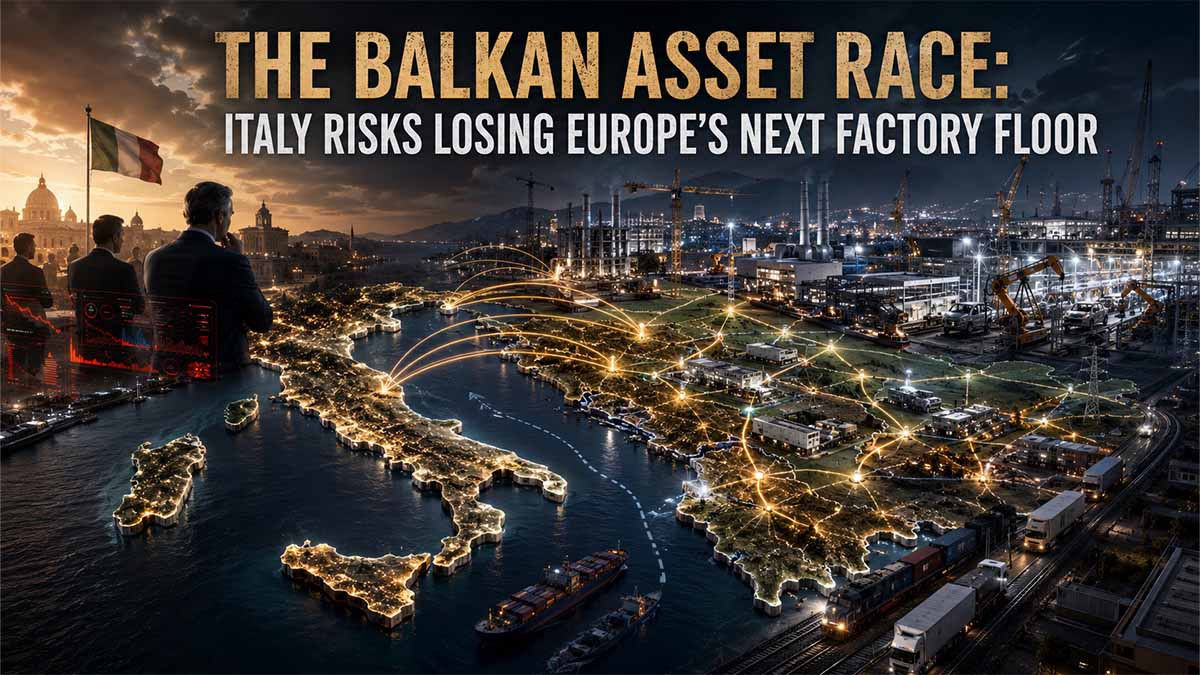
The Balkan Asset Race: Italy Cannot Afford to Arrive After Accession
Europe speaks of the Western Balkans in the language of reforms, democracy and security. Capital markets see something more immediate: an industrial system about to be repriced. Factories, mines, electricity networks, ports, engineering companies, telecommunications platforms and agricultural processors that still carry a Balkan political-risk discount are being drawn progressively into the European regulatory and financial perimeter. The issue for Italy is no longer whether enlargement should proceed, but who will own the productive capacity that enlargement makes more valuable. The answer will shape Italy’s supply chains, Adriatic security and economic influence well beyond the region—and will determine whether Rome can apply the same industrial logic to its second strategic frontier, the Sahel.
The Hidden Transfer
At the EU–Western Balkans Summit held in Tivat on 5 June 2026, European Council President António Costa described accession as a “crucial geopolitical investment.” Leaders placed gradual Single Market integration, regional economic cooperation, security and resilience at the centre of the process, backed by up to €6 billion under the Growth Plan for the Western Balkans. The previous day, the Council authorised negotiations to extend the EU’s “Roam Like at Home” system to the region. These measures may appear technical; economically, they are valuation events. Lower payment costs, interoperable digital systems, faster borders, common technical standards and more reliable energy and transport connections increase revenues while reducing the risk premium applied to Balkan companies.
The industrial base is already integrated with Europe. EU–Western Balkans trade in goods rose 5.2% in 2025, exceeding €87.7 billion. Machinery and appliances, base metals, minerals and chemical products dominated the region’s exports to the Union; EU sales were concentrated in machinery, transport equipment, metals, minerals and chemicals. Enlargement is therefore not creating an industrial relationship from nothing. It is upgrading an existing production platform whose ownership remains contested.
Public Money, Private Repricing
European finance is accelerating this transformation. On 4 February 2026, the European Investment Bank reported that the EIB Group had committed €822 million to the Western Balkans during 2025, including €664 million in loans and guarantees and €151.1 million in EU grants through the Western Balkans Investment Framework. The operations were expected to mobilise approximately €1.5 billion in total investment; 58% of the financing supported sustainable transport, with additional resources directed toward energy, education, healthcare and small businesses. The EIB approved €1.4 billion in new regional projects during the year and disbursed €610 million.
This money does more than construct roads or modernise power systems. A railway raises the value of nearby industrial land, freight operators and maintenance companies. A grid investment increases the bankability of renewables, storage and energy-intensive manufacturing. Digital customs systems reduce inventories and working capital. Compliance laboratories and emissions-monitoring companies become indispensable once European standards are enforced. The acquisition target is therefore rarely just a factory. It is a network of permits, engineers, energy access, logistics rights, industrial data and customer certifications that cannot be recreated quickly after ownership has consolidated.
The Competitors Are Already Inside
Italy is not entering an empty market. Germany has built the region’s deepest manufacturing hierarchy. Germany Trade & Invest reports that around 900 German-capital companies employ approximately 80,000 people in Serbia. Among the largest industrial commitments are about €900 million by Stada-Hemofarm, €430 million by ZF, €91 million by Bosch and €60 million by Siemens. German companies do not need to own every Balkan supplier to exercise control: they frequently determine technology, quality standards, software, delivery schedules and final customers across automotive, electronics and mechanical-engineering networks.
China has concentrated on harder strategic nodes. Germany’s federal trade agency estimated in April 2025 that Chinese investment represented around 30% of foreign direct investment in Serbia, with a focus on natural resources and export-oriented production. Beijing is now widening that position. On 26 May 2026, Chinese President Xi Jinping and Serbian President Aleksandar Vučić agreed to expand cooperation in artificial intelligence, the digital economy, green energy and advanced manufacturing. Serbia’s free-trade relationship with China and its gradual integration with the EU give Chinese-controlled production a potentially valuable bridge between two regulatory and commercial systems.
Türkiye is building a different architecture. At the Balkan Peace Platform meeting in Istanbul on 26 July 2025, Foreign Minister Hakan Fidan said participants had discussed trade, energy, connectivity, defence and defence-industrial cooperation, including how candidate countries could engage with the EU’s SAFE and ReArm Europe initiatives. Turkish influence rests on political access, construction capacity, regional banking and telecommunications relationships, and the ability to connect commercial agreements with defence and infrastructure cooperation.
Gulf investors add another form of competition: patient capital directed toward logistics, agriculture, energy and large infrastructure-linked assets. These actors do not need to reproduce Italy’s dense network of small and medium-sized enterprises. They can secure a limited number of high-leverage nodes—ports, storage, agricultural platforms or digital logistics systems—and influence entire value chains.
Italy’s Strong Position
Italy nevertheless possesses advantages that competitors cannot easily duplicate. More than 1,200 Italian-owned companies are registered in Serbia. According to the Italian Embassy in Belgrade, they employ around 50,000 people, including related industries, and contribute approximately 5.5% of Serbian GDP. Italian-controlled banks Intesa Sanpaolo and UniCredit together hold 27.1% of the Serbian banking market; Generali and UnipolSai-DDOR hold 32% of insurance. Stellantis began production of the Grande Panda at Kragujevac in early 2025, while Italian activity spans energy, agriculture, textiles, machinery and finance.
The commercial relationship is expanding. Italian–Serbian trade reached €4.5 billion in 2024; Italian industrial-machinery exports rose 17%. A planned €75 million Ariston investment in Niš includes a research-and-development centre, while Italian institutions are developing an intermodal connection between Cervignano del Friuli and Belgrade and examining a wider railway axis from Trieste. By the first nine months of 2025, bilateral trade had already reached €5.03 billion, up 13% year on year.
Albania is the other natural pillar. On 29 May 2026, Foreign Minister Antonio Tajani and Albanian Foreign Minister Ferit Hoxha reaffirmed implementation of the bilateral Strategic Cooperation Agreement and announced plans for a new business forum. For Rome, Albania is not simply a neighbouring market: it is the western gateway of Corridor VIII, an energy and logistics platform opposite southern Italy, and a strategic bridge toward North Macedonia, Bulgaria and the Black Sea.
The Missing Doctrine
Italy’s weakness is not absence; it is fragmentation. Banks evaluate borrowers, industrial groups protect their own supply chains, embassies promote trade, and CDP, SACE, SIMEST and ICE deploy separate instruments. What is missing is a common map identifying which Balkan assets are strategically indispensable to Italian industry.
That map should classify companies according to scarcity, ownership, debt, concessions, export licences, environmental liabilities, military relevance, energy connections, cybersecurity and exposure to foreign technology. Priority should go to assets that cannot be rebuilt rapidly: precision-machining firms with defence certification; grid and storage companies; ports and inland terminals; copper, bauxite and metal-processing platforms; industrial-software providers; fibre and data-centre operators; seed, fertiliser, cold-chain and food-processing companies.
The objective is not to purchase the largest enterprises indiscriminately. It is to prevent strategic lockout. A minority share carrying board rights, an offtake agreement, a right of first refusal or control of technology may be more valuable than a costly majority acquisition. Italy needs an acquisition doctrine capable of using ownership, finance and contractual control as complementary instruments.
A Five-Year Window
The operational horizon is 2026–2031. In the first year, Italy should establish a Balkan Strategic Asset Register and identify at least one hundred potential targets across Serbia, Albania, Bosnia and Herzegovina, North Macedonia, Montenegro and Kosovo. By 2027, a first acquisition wave should focus on relatively integrable businesses: precision engineering, energy services, cybersecurity, logistics and agro-processing. Between 2028 and 2029, as EU-funded corridors and energy projects advance, attention should shift toward ports, terminals, industrial land, grid assets and telecommunications infrastructure. By 2030, acquired companies should become regional consolidators, purchasing smaller suppliers and retaining specialised labour. In 2031, the emphasis should move from expansion to resilience: secure energy, protected data, NATO-compatible production and long-term integration with Italian research and procurement.
The financial instruments already exist, but not yet at the required strategic scale. A dedicated public-private Balkan acquisition platform—capitalised by CDP, SIMEST, Italian banks and industrial partners, with SACE risk protection and EIB or EBRD co-financing—could mobilise several billion euros without turning the state into a passive owner. The capital would finance not only purchase prices but also machinery, carbon reduction, cyber protection and European certification. A cheap acquisition without modernisation is not a strategic asset; it is a deferred liability.
The Sahel Connection
The Balkans and the Sahel appear to be different theatres. For Italy, they form one industrial-security equation. The Balkans provide nearshore factories, engineering, logistics and electricity connections. The Sahel contains critical agricultural systems, energy potential, mineral resources and transport corridors whose instability reaches North Africa and the Mediterranean.
On 7 April 2026, the World Bank approved new 2026–2031 Country Partnership Frameworks for Burkina Faso, Chad, Mali and Niger, centred on infrastructure, agricultural productivity, private-sector development and employment. The same categories that determine resilience in the Balkans—energy, transport, skills, finance and productive capacity—are decisive in preventing economic collapse and conflict in the Sahel.
Italy has already built an African policy vehicle. The Mattei Plan, launched at the Italy–Africa Summit of 28–29 January 2024, initially focused on education, healthcare, agriculture, water, energy and infrastructure. By 30 June 2026, the government reported more than 70 projects under implementation, supported by an architecture intended to mobilise public and private capital. Tajani has explicitly linked Sahel stability to Italian and European security, arguing that stronger institutions and economic opportunity reduce the space available to criminal networks and destabilising actors.
The lesson is direct. Italy cannot practise industrial strategy in the Balkans and development policy in the Sahel as separate disciplines. It needs a single doctrine of strategic economic presence: acquire and integrate productive assets where markets are converging; finance infrastructure and local enterprise where fragility threatens Mediterranean security; and connect both regions to Italian technology, ports, energy systems and industrial demand.
The Cost of Delay
The Western Balkans will not remain inexpensive simply because accession remains incomplete. Regulatory convergence itself will raise values. Infrastructure finance will reward location. Carbon rules will divide clean producers from stranded plants. Defence demand will reprice machining, explosives, electronics and vehicle-maintenance capacity. Foreign investors will continue to secure concessions, suppliers and digital platforms before political membership is settled.
Italy’s danger is not losing trade. It is remaining commercially ubiquitous while the decisive industrial switches are owned elsewhere. Rome has the geography, the banks, the machinery, the diplomatic credibility and the public financial institutions required to prevent that outcome. What it lacks is time. The Balkan factory Italy needs already exists. The question is whether Italy will recognise its value before somebody else buys the keys.
Navigational Index
Pillar I — Regulatory Convergence as Asset Repricing
How EU funding, Single Market access, standards alignment and infrastructure investment can transform undervalued Balkan assets into strategically scarce European industrial capacity.
Pillar II — The Contest for Industrial Control
How Italian, German, Chinese, Turkish, Emirati and other state-linked or privately controlled groups are positioning across defence, energy, mining, engineering, ports, telecommunications and agro-industry.
Pillar III — Italy’s Five-Year Acquisition Window
How Italy can identify, finance, protect and integrate strategic Balkan companies before ownership concentration, accession expectations and geopolitical competition close the present valuation gap.
Master Abstract
The central analytical error in the conventional enlargement debate is the assumption that accession is principally a transfer of institutions, legislation and European funding into the Western Balkans. In industrial terms, the direction of movement is more consequential and considerably less examined: enlargement progressively transfers Balkan productive assets into the regulatory, financial and competitive perimeter of the European Single Market, thereby altering their valuation, accessibility, financing cost, ownership attractiveness and strategic utility. At the EU–Western Balkans Summit held in Tivat on 5 June 2026, European and regional leaders formally connected gradual economic integration with enlargement, common security, resilience and the implementation of the Growth Plan. The European Council described accession as a geopolitical investment and confirmed that the Growth Plan could provide up to €6 billion for reforms and investment while advancing integration into the Single Market and the Common Regional Market — EU–Western Balkans Summit, 5 June 2026 – European Council – June 2026 — Official summit conclusions. This mechanism is industrially transformative because at least half of the Facility is intended to operate through the Western Balkans Investment Framework in support of transport, energy, green and digital connectivity, while the remainder is tied to reform performance and direct budget support — Overview of the Instrument for Pre-accession Assistance – European Commission – 2026 — Official financing overview. The policy architecture therefore reduces transaction friction around companies and infrastructure that are currently constrained by fragmented markets, governance weaknesses, obsolete equipment, financing premiums, limited interconnection and incomplete compliance with EU rules. Once those constraints are partially removed, a Serbian machining company, a Bosnian explosives producer, a North Macedonian electronics supplier, an Albanian port concession, a Montenegrin energy asset or a Kosovo telecommunications platform no longer represents only domestic capacity: it becomes a potential node in an enlarged European production system. Accession expectations consequently operate like a forward repricing instrument. Investors do not need to wait for membership; they need to acquire control before regulatory convergence, infrastructure upgrading and political de-risking are fully reflected in asset prices.
The industrial base under examination is not peripheral to the European economy. EU–Western Balkans trade in goods increased by approximately 5.2% in 2025, reaching more than €87.7 billion. The European Commission identifies machinery and appliances, base metals, minerals and chemical products among the EU’s principal imports from the region, while machinery, transport equipment, base metals and chemical products constitute leading EU exports — EU Trade Relations with the Western Balkans – European Commission – 2026 — Official trade profile. These categories reveal an economy already embedded in European industrial processes but often positioned in lower-margin stages: cable harnesses, metal processing, castings, fabricated components, automotive subassemblies, electrical equipment, basic chemicals, food processing and energy-intensive materials. The strategic contest is therefore not the creation of an industrial relationship from zero; it is the control of an existing but incompletely consolidated production ecosystem. The Commission’s 2025 call for private investment made this direction explicit by identifying integration into EU industrial supply chains, manufacturing modernisation, critical raw materials, clean energy, digital transition and sustainable transport as priority investment fields. Eligible projects required a minimum total value of €10 million and at least 15% equity or own-resource participation — Call for Private Investment in the Western Balkans – European Commission – April 2025 — Official investment call. The associated documentation specifically describes investment intended to integrate regional manufacturing into EU industrial supply chains and to secure environmentally responsible access to critical raw materials — Publication of the Call for Expressions of Interest – European Commission – April 2025 — Official sector criteria. This creates a selection effect: companies possessing export certifications, energy access, industrial land, specialised labour, defence-relevant tooling, mining rights, transmission connections or proximity to funded corridors become disproportionately valuable. The real acquisition target is frequently not the company’s current income statement but its embedded option value under future EU rules: permits that would be difficult to reproduce, brownfield industrial sites, engineering teams, concessions, grid positions, customs access and relationships with state buyers.
For Italy, the Western Balkans form a uniquely compressed strategic space in which industrial policy, national security, maritime access and supply-chain resilience converge. The Italian Ministry of Foreign Affairs defines the Adriatic–Balkan region as strategic because developments there have immediate consequences for Italian national security and notes that Italy is consistently among the principal commercial partners of the region, with substantial Italian investment, corporate presence and banking penetration — Regione adriatico-balcanica – Italian Ministry of Foreign Affairs and International Cooperation – 2026 — Official Italian regional policy. In July 2026, Foreign Minister Antonio Tajani described the Balkans as the connection between the Adriatic, the Eastern Mediterranean and Central Europe, linking enlargement to Corridor VIII, railways, ports, energy networks, digital infrastructure, strategic autonomy and supply-chain security — A Stronger Europe with the Accession of the Balkans – Italian Ministry of Foreign Affairs and International Cooperation – July 2026 — Official ministerial statement. That interpretation implies that Italy’s industrial interest cannot be confined to export promotion. A corridor without ownership of production nodes can channel value toward competitors; a port connection without influence over inland terminals, grid assets, maintenance companies and manufacturing clusters can make Italy a transit platform rather than the controlling hub of the resulting value chain. Germany benefits from long-established automotive and machinery networks; Chinese capital has demonstrated the capacity to combine infrastructure finance, mining, metallurgy and market access; Turkish groups possess geographic proximity, construction capability, banking links and political reach; Gulf investors can mobilise concentrated capital into ports, renewables, food, logistics and real estate-linked infrastructure. Italy’s comparative advantages—Adriatic geography, banking networks, engineering capabilities, mid-cap manufacturing, energy interconnection and political credibility—will not automatically translate into control. They require an acquisition doctrine capable of distinguishing ordinary commercial opportunities from assets whose importance derives from dual-use production, defence mobilisation, critical-mineral processing, electricity balancing, port access, telecommunications sovereignty, food security or control of industrial data.
The five-year outlook from 2026 to 2031 is consequently best represented as a race between regulatory convergence and ownership consolidation. In the baseline hypothesis H₁, EU integration proceeds unevenly but sufficiently to improve financing conditions, customs interoperability, digital payments, roaming, standards recognition and regional trade; this produces gradual appreciation of export-oriented companies and a wave of European majority acquisitions. In the acceleration hypothesis H₂, one or more frontrunner states achieve significant negotiating breakthroughs, sharply lowering perceived political risk and triggering a compressed repricing of ports, renewable pipelines, industrial parks, telecommunications towers, defence suppliers and mining concessions. In the fragmentation hypothesis H₃, accession slows, but strategic competition intensifies because non-EU actors exploit the delay to secure long-duration concessions, mineral rights, infrastructure positions and distressed companies before EU screening and state-aid disciplines become more restrictive. In the security-industrial hypothesis H₄, European rearmament, ammunition shortages, drone proliferation and pressure to shorten defence supply chains increase the value of Balkan metallurgy, explosives, vehicle maintenance, electronics and machining capabilities independently of formal accession. In the energy-convergence hypothesis H₅, grid modernisation, carbon regulation, renewable integration and interconnector expansion make hydroelectric assets, balancing capacity, battery projects, transmission contractors and energy-intensive industrial sites central to European resilience. These hypotheses are not mutually exclusive. The most probable trajectory is a compound regime in which partial accession progress coexists with defence-industrial urgency, energy transition and geopolitical competition. The appropriate Bayesian prior for a substantial increase in foreign strategic acquisitions before 2031 is therefore high; the posterior should rise further whenever a target country completes payment-linked reforms, opens or closes negotiation clusters, receives major WBIF financing, adopts EU-compatible energy regulation or announces privatisation and concession programmes.
The operational report must therefore be constructed as an ownership-and-control intelligence system rather than a static catalogue of prominent Balkan companies. Each target must be decomposed across at least ten dimensions: ultimate beneficial ownership; state participation and golden-share rights; audited revenue and debt; export concentration; principal customers; sanctions or politically exposed counterparties; industrial certifications; dependence on imported machinery or intellectual property; energy and logistics exposure; concessions, licences and land rights; workforce scarcity; cyber architecture; dual-use potential; environmental liabilities; and probable valuation under alternative accession timelines. A company may appear commercially weak yet remain strategically irreplaceable because it owns a rail-connected industrial site, a defence production authorisation, a mine-processing licence, a high-voltage connection, a deep-water berth or a workforce capable of operating specialised equipment. Conversely, a profitable enterprise may offer little strategic control if its technology, customers, finance and data are already locked into a non-Italian ecosystem. The acquisition map must distinguish available, contestable, politically protected, state-controlled, distressed, concession-dependent and strategically non-acquirable assets. It must also identify second-order targets: maintenance providers serving mines and power plants; software firms controlling industrial telemetry; laboratories providing conformity assessment; freight operators with customs authorisations; engineering institutes; seed and cold-chain companies; tower companies; and firms managing geospatial, energy or agricultural data. The decisive insight is that the “factory Italy needs” may not be a single factory. It is a network of permits, skills, energy access, logistics, data and production relationships that must be acquired or contractually secured before rival systems consolidate them.
Balkan Industrial Control & Asset-Repricing Simulator
Baseline: July 2026
Scenario Inputs
Projected Strategic-Asset Valuation Index
Pillar I — Regulatory Convergence as Asset Repricing
Enlargement’s Hidden Balance-Sheet Mechanism
The economically decisive feature of Western Balkan enlargement is not the eventual change in formal membership status; it is the progressive removal of the discounts currently embedded in regional asset prices. Those discounts arise from fragmented domestic markets, incomplete enforcement, non-equivalent technical standards, elevated financing costs, border delays, weak railway and energy interconnection, uncertain state-aid regimes, restricted access to European payment systems, carbon-intensive production and the possibility that political decisions may override commercial contracts. The European Union’s emerging model of “gradual integration” attacks these discounts before accession by selectively extending Single Market advantages in exchange for verified reforms. Regulation (EU) 2024/1449 explicitly establishes a €6 billion Reform and Growth Facility for 2024–2027, divided into €2 billion in grants and €4 billion in concessional loans, and identifies connectivity, sustainable transport, decarbonisation, energy, digital transition, education and skills as multiplier sectors. It also records the underlying convergence problem: Western Balkan GDP per capita in purchasing-power terms remains between roughly 30% and 50% of the EU average. This is not merely a development-policy observation. It quantifies the valuation gap that investors may attempt to capture before accession benefits are fully capitalised into company prices, concessions, industrial land and infrastructure rights. Regulation (EU) 2024/1449 establishing the Reform and Growth Facility for the Western Balkans – European Parliament and Council of the European Union – May 2024 — Verified official regulation. The Growth Plan reinforces this mechanism through seven operational channels: free movement of goods; movement of services and workers; participation in the Single Euro Payments Area; facilitated road transport; energy-market integration and decarbonisation; participation in the Digital Single Market; and integration into European industrial supply chains. Commission Presents a New Growth Plan for the Western Balkans – European Commission – November 2023 — Verified official Growth Plan announcement. In valuation terms, each channel reduces a different risk premium. Customs and standards alignment reduce the cost of market entry; SEPA lowers payment friction; energy integration improves predictability; infrastructure lowers logistics costs; and enforceable reforms decrease the discount rate investors apply to future cash flows.
The transformation can be represented as a regulatory-to-valuation transmission sequence rather than a conventional aid programme. A Western Balkan manufacturer with annual operating earnings of €10 million may appear inexpensive relative to an equivalent EU company because investors apply a high country-risk premium, discount recurring border delays, anticipate compliance expenditure and fear that customers will not accept its technical certifications. When EU-financed laboratories, customs systems, digital registries, railway links and product-conformity frameworks become operational, the company’s earnings do not need to double for its equity value to rise substantially. Its cost of capital can fall; European customers can sign longer contracts; banks can accept receivables more readily; industrial land can become collateral of higher quality; and competitors may be unable to reproduce its licences, workforce or location. Regulatory convergence therefore operates through both the numerator and denominator of enterprise valuation: expected cash flow rises while the risk-adjusted discount rate falls. The effect is especially strong where the asset contains scarce embedded rights—mining concessions, grid connections, environmental permits, defence authorisations, rail sidings, port berths, spectrum licences, water rights or industrial electricity contracts. These are not instantly replicable through greenfield investment. An accession-linked investor may consequently pay a premium over current earnings because it is purchasing a future EU-compatible production platform. The European Commission describes the Common Regional Market as a mechanism to overcome small fragmented markets, increase business competitiveness, attract investment and serve as a stepping-stone to the Single Market; the Commission has estimated that regional economic integration based on EU rules could add approximately 10% to Western Balkan economies. Growth Plan for the Western Balkans – European Commission – updated 2025 — Verified official Growth Plan portal. That potential growth is not distributed evenly. It is likely to accrue disproportionately to assets located near upgraded corridors, capable of passing EU conformity requirements, linked to cleaner energy and positioned within sectors where European supply chains lack redundancy.
EU ACCESSION & ASSET REPRICING MODEL
An interactive 3D structural visualizer mapping the systemic transformation from conditional funding to regulatory alignment, operational risk reduction, and pre-accession asset repricing.
Conditional Capital and the Creation of Investable Assets
The €6 billion Facility matters less as a stand-alone macroeconomic stimulus than as the financial core of a wider de-risking architecture. Payments are conditional on implementation of country-specific Reform Agendas, which means capital disbursement is linked to measurable changes in governance, public administration, the business environment, energy policy, digitalisation and fundamental rights. This conditionality can alter private-investment sequencing. A strategic investor can monitor reform milestones as leading indicators of future asset appreciation: adoption of a procurement law may improve access to public contracts; judicial reform may improve enforceability; state-owned-enterprise governance may reveal privatisation candidates; energy legislation may enable market coupling; and customs reform may reduce delivery uncertainty. At the infrastructure level, the Western Balkans Investment Framework blends European Commission grants, bilateral-donor resources, development-bank loans and national finance for strategic energy, transport, environmental, social and digital projects. About the Western Balkans Investment Framework – WBIF – 2026 — Verified official WBIF architecture. The European Investment Bank Group reported that in 2025 it committed €822 million in loans, guarantees and grants for Western Balkan projects, intended to mobilise approximately €1.5 billion of total investment. Sustainable transport represented 58% of the EIB Group’s financing, healthcare 20%, renewable energy 13% and education 4%; €151.1 million in EU grants was signed through the WBIF. EIB Group Invested €822 Million in the Western Balkans Countries in 2025 – European Investment Bank – February 2026 — Verified official EIB results. These figures show how public capital can create investable private ecosystems around infrastructure. A railway rehabilitation does not only improve the railway operator; it increases the strategic value of adjacent freight terminals, warehouses, aggregates producers, industrial parks, customs brokers, rolling-stock maintenance companies and factories whose address suddenly acquires a credible route to EU customers.
| Convergence instrument | Immediate operational effect | Valuation transmission | Assets most likely to reprice |
|---|---|---|---|
| Reform and Growth Facility | Reform-linked grants and concessional lending | Lower sovereign and regulatory risk premium | Banks, utilities, infrastructure contractors, regulated companies |
| WBIF blended finance | Converts project concepts into financed infrastructure | Raises land, concession and network-access values | Ports, terminals, grids, industrial zones, engineering firms |
| Single Market integration | Reduces legal and technical barriers | Expands addressable market and customer duration | Export manufacturers, laboratories, logistics and digital services |
| Common Regional Market | Aggregates six fragmented economies | Creates scale before formal accession | Retail, telecoms, food processing, payment platforms |
| SEPA participation | Reduces euro-payment cost and delay | Lowers working capital and transaction friction | SMEs, banks, e-commerce, cross-border service providers |
| Green Lanes | Faster border processing at key crossings | Improves delivery reliability and inventory turnover | Automotive suppliers, perishables, freight operators |
| Energy integration | Greater market access and pricing transparency | Improves bankability of generation and storage | Hydropower, renewables, batteries, transmission assets |
| TEN-T extension | EU corridor standards and coordinated investment | Creates scarcity premium around nodes and last-mile links | Ports, dry ports, rail terminals, industrial land |
| CBAM compliance | Monetises embedded carbon exposure | Separates clean producers from stranded industrial assets | Steel, aluminium, cement, fertilisers, electricity |
The Single Market Before Membership
The strongest repricing impulse will come from the partial delivery of Single Market functions before political accession. This changes the temporal logic of investment. Under the old approach, firms might wait for a country to join the EU before treating it as an integrated production location. Under gradual integration, investors can capture specific membership benefits earlier, sector by sector, while acquiring assets before complete legal convergence raises prices. Payment integration illustrates the effect. By July 2025, Albania, Montenegro, North Macedonia and Serbia had entered the geographical scope of SEPA, while Green Lane implementation was advancing at 11 of the busiest crossing points between the region and the EU. Western Balkans Leaders’ Meeting in Skopje Reaffirms Commitment for Swift Delivery of the Growth Plan – European Commission – July 2025 — Verified official progress report. On 5 May 2026, the Commission reported that 18 Serbian banks had joined SEPA schemes and estimated potential savings of up to €400 million for individuals and businesses through faster, cheaper and more reliable euro transactions. Commission Welcomes Serbia Joining SEPA Schemes – European Commission – May 2026 — Verified official SEPA announcement. For corporate valuation, this matters because payment delays increase working-capital needs, reduce supplier confidence and discourage small firms from serving cross-border customers. Removing those frictions can improve cash conversion without any change in factory output. Similarly, faster border processing increases the value of producers operating under just-in-time models. Automotive wiring, precision components, fresh food, pharmaceuticals and time-sensitive e-commerce goods cannot tolerate unpredictable customs queues. A company situated near an upgraded crossing may therefore acquire an infrastructure-induced competitive advantage that appears in higher margins, more stable contracts and lower inventory. The convergence process creates winners not simply by country or sector but by micro-location, certification readiness, digital connectivity and the capacity to exploit newly opened regulatory channels.
The importance of standards alignment extends beyond tariff-free access. Most Western Balkan goods already benefit from preferential trade arrangements with the EU, yet tariff preferences do not eliminate technical barriers, conformity costs, rules-of-origin complexity, veterinary controls, cybersecurity requirements, environmental disclosures or product-liability exposure. Regulatory convergence changes the quality of market access. A metal-processing company that can document emissions, trace raw materials, certify welding procedures, protect industrial data and meet EU occupational-safety rules becomes a different acquisition target from a nominally similar company that competes solely through low wages. The former can be integrated into aerospace, defence, automotive, electricity and railway supply chains; the latter risks becoming a stranded subcontractor. This produces a bifurcated valuation regime. “Compliance-ready” firms will attract strategic buyers and cheaper financing, while non-compliant firms will face concentrated capital expenditure, customer loss or distressed-sale pressure. The seven Single Market priorities therefore function as a due-diligence template. Acquisition teams should score targets against free movement of goods, service portability, euro-payment integration, logistics reliability, energy-market exposure, digital conformity and supply-chain integration. The result should not be treated as a binary accession score but as a measurable regulatory-option value. A company may be worth more because it is one reform milestone away from recognition, one rail project away from a European corridor, or one power-purchase agreement away from reducing CBAM exposure. Conversely, a superficially cheap cement plant or foundry may be economically impaired once carbon costs, environmental remediation and equipment replacement are fully incorporated.
Infrastructure as a Scarcity Multiplier
Transport convergence will redistribute industrial value geographically. The revised TEN-T architecture includes a dedicated Western Balkans–Eastern Mediterranean Corridor linking Central European member states with Adriatic and Eastern Mediterranean ports through the Western Balkans. It covers Italy, Austria, Slovenia, Croatia, Hungary, Bulgaria, Greece and Cyprus, together with Serbia, Bosnia and Herzegovina, Montenegro, Kosovo, Albania and North Macedonia. The Commission identifies severe rail deficiencies on central and south-eastern sections, including slow commercial speeds, incomplete electrification, deficient deployment of the European Rail Traffic Management System, poorly functioning multimodal freight terminals and weak road and rail connections between ports and their hinterlands. Western Balkans–Eastern Mediterranean Corridor – European Commission Directorate-General for Mobility and Transport – 2026 — Verified official corridor profile. These deficiencies are precisely what keep many assets undervalued. A port without a reliable rail hinterland is a local maritime facility; once connected to standardised European corridors, it becomes a regional gateway. An industrial site beside an obsolete railway has limited reach; after electrification, signalling upgrades and terminal construction, it may serve Central European customers. The same logic applies to maintenance firms, construction-material producers, freight-forwarding platforms, signalling contractors and owners of strategically located land. Infrastructure investment creates scarcity because the number of suitable nodes does not increase proportionally with transport efficiency. Improved connectivity can concentrate traffic into a limited set of ports, dry ports, junctions and border terminals, allowing their owners to capture network effects. Italy’s exposure is particularly important because the corridor’s maritime logic intersects with Trieste, the Adriatic system and routes toward Greece and the Eastern Mediterranean. Italian companies that wait until infrastructure completion may find that terminal rights, warehouse portfolios, rail operators and industrial parks have already been acquired by German, Chinese, Turkish or Gulf-linked capital.
The repricing process will not be linear because infrastructure delivery produces discontinuous jumps in expected value. Early project preparation may have little visible effect; loan approval reduces funding uncertainty; construction increases speculative interest; operational completion changes freight economics; and connection to surrounding networks determines whether value is fully realised. The WBIF portfolio demonstrates that projects extend well into the five-year horizon and beyond. An Albanian safe-and-sustainable transport programme received a €54.7 million WBIF grant with completion scheduled for November 2030. Safe and Sustainable Transport Programme – Western Balkans Investment Framework – October 2025 — Verified official project record. Active WBIF energy projects include approximately €25 million for a Serbian programme scheduled through 2029, while other Albanian transmission and hydropower investments extend into the early 2030s. Serbia Energy Investment Grant – Western Balkans Investment Framework – July 2025 — Verified official project record. Such timelines create identifiable acquisition phases. Before financial close, investors acquire optionality cheaply but accept execution risk. During construction, land and contractor values begin to rise. Near completion, strategic buyers pay for operational certainty. The optimal acquisition point varies by risk tolerance, but the highest returns are likely to occur before corridor advantages are reflected in audited cash flows. This requires intelligence collection at project level: procurement notices, environmental approvals, expropriation plans, terminal design, electrical capacity, last-mile routes and the corporate ownership of adjacent properties.
Energy Convergence, CBAM and Industrial Survival
Energy integration will create the most severe separation between appreciating and stranded Balkan assets because it combines market reform, physical infrastructure, decarbonisation and the European carbon price. The Energy Community has identified transposition of the Electricity Integration Package as a prerequisite for accelerated integration of Western Balkan electricity systems with the EU market. The stated objective is to unlock investment in power infrastructure and renewables while aligning regional markets with EU rules. Energy Community Secretariat at SET Trebinje 2025 – Energy Community – March 2025 — Verified official Energy Community statement. In December 2025, the Energy Community further described market integration, the Carbon Border Adjustment Mechanism and carbon markets as converging priorities and argued that integration before accession could attract modernisation and decarbonisation capital that individual small markets could not obtain independently. Cooperation on Western Balkans–EU Energy Integration Advances in Vienna – Energy Community – December 2025 — Verified official Energy Community assessment. The valuation implication is asymmetric. Hydropower plants with refurbishment potential, renewable pipelines with grid access, battery-storage sites, transmission contractors and industrial consumers capable of securing low-carbon electricity may appreciate sharply. Coal-dependent generators, inefficient smelters and factories unable to measure embedded emissions may decline despite low nominal production costs. From 1 January 2026, the EU’s definitive CBAM regime applies to imports of cement, iron and steel, aluminium, fertilisers, electricity and hydrogen. EU importers above the relevant threshold must become authorised CBAM declarants, report embedded emissions and surrender certificates whose price is linked to EU Emissions Trading System allowance prices; carbon prices already paid in the producing country may be deducted. CBAM Definitive Regime – European Commission Directorate-General for Taxation and Customs Union – January 2026 — Verified official CBAM rules.
CBAM converts environmental performance into a transaction-level financial variable. This changes acquisition due diligence across the region. Investors must calculate not only historical electricity expenditure but the carbon intensity of each megawatt-hour, the verifiability of emissions data, the probability of national carbon-pricing adoption, access to renewable power-purchase agreements and the cost of retrofitting furnaces, kilns or smelters. A Balkan steel, aluminium or cement producer may presently appear competitive because its power is cheap or environmental costs are partially externalised. Under CBAM, that apparent advantage can disappear at the EU border. The most valuable assets will therefore be those capable of demonstrating low embedded emissions, obtaining reliable renewable supply, installing measurement systems and passing independent verification. Grid-connected industrial zones near hydropower or new renewable capacity may command a premium over legacy industrial districts dependent on lignite. Power producers also divide into strategic categories: dispatchable hydropower and storage gain value as balancing assets; old coal capacity may retain domestic political importance but face declining export economics; transmission assets and market-coupling infrastructure become indispensable; and software providers controlling meter data, dispatch systems and emissions reporting gain importance disproportionate to their current revenue. The “industrial takeover” mechanism is therefore not simply foreign buyers purchasing cheap factories. It may involve acquiring the cleaner electricity source, grid position, telemetry company or verified data architecture on which an entire manufacturing cluster’s future EU access depends. Control of energy and carbon data can become control of market eligibility.
| Energy-industrial asset | Repricing direction, 2026–2031 | Principal catalyst | Principal impairment risk |
|---|---|---|---|
| Dispatchable hydropower | Strongly positive | Market coupling, balancing demand, refurbishment finance | Hydrological volatility, concession disputes |
| Solar and wind with secured grid access | Positive | EU finance, corporate PPAs, CBAM avoidance | Curtailment, permitting and grid congestion |
| Battery and pumped storage | Strongly positive | Intermittency management and cross-border balancing | Revenue-model uncertainty |
| Transmission and distribution contractors | Positive | Grid modernisation and interconnection | Procurement concentration |
| Low-carbon metals processing | Strongly positive | CBAM differentiation and EU supply-chain demand | Verification failure, imported-input exposure |
| Coal-dependent metals and cement | Negative without retrofit | Carbon-cost internalisation | Stranded equipment and customer loss |
| Emissions-data and industrial telemetry firms | Positive from low base | Mandatory reporting and verification | Cybersecurity and data-sovereignty concerns |
| Unmodernised coal generation | Structurally negative | Reduced export competitiveness | Political delay masking economic deterioration |
Competing External Systems and the Ownership Race
Regulatory convergence does not eliminate non-EU influence; it can increase the value of assets already controlled by external actors. China’s Serbian position is the clearest example. In May 2026, the Chinese and Serbian presidents stated their intention to expand cooperation in artificial intelligence, the digital economy, green energy and advanced manufacturing, while more than 20 cooperation documents were signed across political, economic, scientific, educational and legal fields. President Xi Jinping Holds Talks with Serbian President Aleksandar Vučić – Ministry of Foreign Affairs of the People’s Republic of China – May 2026 — Verified Chinese government source. In December 2025, China’s Ministry of Commerce reported that the bilateral free-trade agreement had accelerated trade and that both sides intended to deepen investment in the green economy, new-energy vehicles, automotive manufacturing, processing and infrastructure while supporting operation of the Budapest–Belgrade railway. Twelfth Session of the China–Serbia Intergovernmental Joint Commission – Ministry of Commerce of the People’s Republic of China – December 2025 — Verified Chinese government source. This matters because Chinese-controlled industrial capacity that becomes progressively compatible with EU rules can acquire dual access: it may benefit from Serbia’s EU convergence while retaining preferential commercial and financial connections with China. The resulting asset is not simply Balkan or Chinese; it becomes a bridge between regulatory systems. European acquisition policy must therefore distinguish between greenfield investment that expands capacity, foreign ownership of irreplaceable nodes and technological dependence that limits strategic autonomy even without majority equity control.
Russian influence follows a different pattern, concentrated more heavily in energy, political relationships and legacy infrastructure than in broad industrial expansion. A June 2025 Russian government record placed Serbian representation in discussions on producer-consumer energy balances alongside Russian, Turkish, Hungarian and OPEC officials, illustrating that Serbia’s energy positioning remains embedded in relationships outside the EU framework. World Energy Market in Search of a Balance Between Producers and Consumers – Government of the Russian Federation – June 2025 — Verified Russian government source. The analytical significance is not that Russian capital will necessarily outbid European buyers across all sectors. It is that energy contracts, ownership structures, sanctions exposure, technology dependencies and political bargaining can complicate the conversion of nominally available assets into EU-compatible industrial platforms. Convergence may force restructuring, divestment or costly compliance, creating acquisition opportunities but also sanctions, governance and supply risks. The five competing hypotheses are therefore: H₁, EU-led convergence produces predominantly European consolidation; H₂, Chinese-controlled platforms successfully adapt and retain strategic dominance; H₃, regulatory delay preserves a multi-vector Serbian and regional model; H₄, carbon and standards costs generate distressed asset sales; and H₅, governments protect strategic companies through state ownership, concessions or informal political barriers. The most plausible outcome is a composite of H₁, H₂ and H₄: growing European acquisition activity, durable Chinese positions in selected Serbian sectors and accelerated distress among carbon-intensive or weakly governed firms.
Five-Year Repricing Outlook, 2026–2031
The five-year outlook should be interpreted as a sequence of regulatory and financial thresholds rather than a single accession forecast. In 2026, SEPA implementation, CBAM’s definitive regime and early Growth Plan disbursements begin separating compliant from non-compliant companies. In 2027, the original Facility’s financing period ends, making reform implementation, absorption capacity and project execution visible to investors; companies in countries demonstrating reliable milestone delivery should receive lower risk premiums. Between 2028 and 2029, infrastructure projects approved in the first Growth Plan cycle will increasingly enter construction or operational phases, generating land-value changes, procurement consolidation and acquisitions around corridors, grids and industrial parks. By 2030, the Safe and Sustainable Transport Programme and other large projects will approach scheduled completion, while EU climate, digital and supply-chain rules will be more deeply embedded in corporate operations. By 2031, the distinction between nominally Balkan assets and functionally European industrial capacity should be much narrower in advanced sectors, even where formal accession remains incomplete. The central risk for Italy is temporal: waiting for legal certainty may eliminate the valuation advantage. Italian firms will face competitors willing to acquire during the reform phase, accept political risk and use state-backed finance, long-term procurement contracts or infrastructure packages to secure control. A disciplined Italian strategy would therefore classify assets by their proximity to regulatory unlocks rather than by current profitability alone. It should identify companies with EU-certification potential, ports and terminals located on future TEN-T flows, clean-energy access, carbon-measurement capability, engineering labour, defence-adjacent machinery and scarce licences.
The scenario probabilities below are analytical outputs, not official forecasts. A structured Bayesian assessment begins with a prior assumption that regulatory convergence will continue because the EU has enacted a binding Facility, approved national Reform Agendas, embedded the region in corridor planning and linked payments to milestones. The June 2026 Tivat summit strengthened that prior by reaffirming gradual integration, security cooperation and Growth Plan delivery as accession instruments. EU–Western Balkans Summit, Tivat – European Council – June 2026 — Verified official summit record. The posterior probability of meaningful regulatory convergence by 2031 is assessed at approximately 72%, but the probability of uniform convergence across all six partners is materially lower. A Monte Carlo-style scenario model using reform execution, EU funding absorption, infrastructure completion, energy alignment, political stability and external-actor persistence as independent but correlated drivers produces four broad outcomes: accelerated repricing, uneven integration, stalled convergence and geopolitical fragmentation. The modal outcome is uneven integration, in which selected countries, sectors and corridors appreciate rapidly while other assets remain impaired. This is strategically more demanding than uniform accession because it rewards granular intelligence. Investors must know which customs crossing, bank, grid zone, port, municipality, certification body or reform milestone changes the economics of a specific target. National averages will conceal the real acquisition opportunities.
| Scenario, 2031 | Estimated probability | Regulatory outcome | Asset-market consequence | Italian strategic implication |
|---|---|---|---|---|
| Accelerated convergence | 24% | Broad Single Market integration and rapid negotiation progress | Sharp repricing of ports, grids, manufacturers and digital assets | Acquire before formal breakthroughs |
| Uneven integration | 48% | Sectoral and country divergence | High premiums for compliant “islands” of capacity | Build target-level intelligence, not country-level assumptions |
| Reform stagnation | 18% | Delayed milestones and weak absorption | Distressed sales, low liquidity and political discounts | Selective acquisitions with strong protections |
| Geopolitical fragmentation | 10% | Competing EU, Chinese, Russian, Turkish and Gulf systems | Ownership lock-in and regulatory incompatibility | Prioritise sovereign-sensitive assets and data control |
STRATEGIC REPRICING TIMELINE (2026–2031)
A multi-temporal predictive framework mapping regulatory enforcement, facility execution, infrastructure builds, and final market control or lockout across the European integration sequence.
The principal warning indicator is not a headline privatisation. It is the accumulation of smaller regulatory changes that make an asset difficult to reproduce. A foreign investor may secure industrial land before railway completion, acquire a telemetry provider before emissions reporting becomes mandatory, finance a renewable plant before local manufacturers seek clean-power contracts, or take minority stakes with governance rights before an enterprise qualifies for EU-supported expansion. These transactions can lock in future industrial control without attracting the political attention associated with a full takeover. The correct intelligence unit is therefore the control stack: equity ownership, board rights, debt covenants, technology licences, long-term supply agreements, energy contracts, data hosting, concession duration, customer concentration and export certification. Italy’s acquisition doctrine should combine Cassa Depositi e Prestiti, commercial banks, export-credit instruments, industrial groups, regional utilities, defence companies and specialised private equity under a shared target-classification system. It should also distinguish strategic acquisition from ordinary foreign direct investment. The aim is not to purchase the largest Balkan companies indiscriminately; it is to secure those assets whose value rises non-linearly when EU rules, infrastructure and financing converge. The five-year window remains open, but regulatory progress itself will close it. Every successful milestone reduces risk, attracts more bidders and transfers part of the future accession gain from the eventual acquirer to the current owner.
Figure 1: Five-Year Balkan Asset-Repricing Scenarios
Analytical index, 2026 = 100. Values are scenario-model outputs, not market forecasts.
Pillar II — The Battle to Own the Balkans’ Industrial Core
Control Is More Important Than Trade
The contest for the Western Balkans is no longer adequately measured through bilateral trade, annual foreign-direct-investment flows or the number of foreign-owned factories. The decisive variable is industrial control: the capacity of an external actor to determine what a Balkan asset produces, where it purchases technology, how it finances expansion, which transport corridor it uses, where its operational data are stored, which markets receive its output and whether the enterprise can be redirected during an energy, military or supply-chain emergency. Control may arise through majority ownership, but it can also be established through secured debt, board rights, mining concessions, technology licences, engineering dependence, exclusive distribution arrangements, power-purchase agreements, long-term offtake contracts or control over the port, railway, bank and digital platform through which the company operates. This broader definition reveals that the region is being divided into overlapping foreign-controlled industrial systems rather than simply receiving capital from multiple countries. Italian groups possess dense banking, commercial and geographical links; German investors command extensive manufacturing and automotive networks; Chinese enterprises control strategic Serbian mining, steel and tyre-production platforms; Turkish companies combine construction, banking, telecommunications, defence relationships and cultural reach; while Emirati investors concentrate on logistics, agriculture, aviation connectivity and large infrastructure-linked platforms. The resulting competition is asymmetric. German and Italian firms generally operate within EU regulatory and financing systems, although their corporate strategies are not necessarily coordinated with national policy. Chinese investment frequently combines state diplomacy, construction capacity, trade agreements, technology and long-duration industrial ownership. Turkish penetration benefits from geographic proximity, rapid executive decision-making and the ability to connect commercial activity with bilateral political mechanisms. Gulf capital can purchase strategic positions without requiring the large managerial footprint typical of traditional European industrialisation. The operative question is therefore not which country “invests most,” but which actor is assembling the most durable control stack across production, finance, resources, infrastructure, data and political access.
INDUSTRIAL CONTROL STACK
An end-to-end 3D multi-layered structural hierarchy mapping geoeconomic leverage from diplomatic access, equity ownership, and financial covenants down to technological dependence, physical logistics, and market access.
Italy: A Dense Position Without a Unified Acquisition Doctrine
Italy enters the contest with structural advantages that no other actor fully replicates: physical proximity across the Adriatic, mature commercial relationships, strong recognition of Italian machinery and consumer brands, large Balkan diasporas in Italy, established banking subsidiaries and direct government support for accession. Yet Italy’s position is simultaneously broad and fragmented. In Serbia, official Serbian data presented at the January 2025 bilateral business forum indicated that more than 1,200 Italian companies employed approximately 24,000 people, while bilateral trade had surpassed €5 billion; Serbia accounted for roughly one-third of Italy’s commerce with the Western Balkans. More than 500 Italian and Serbian entrepreneurs attended the forum, whose sectoral agenda included energy transition, the circular economy, agri-technology, Industry 5.0, and physical and digital infrastructure. The Italian institutional architecture had already been expanded through offices or dedicated operations involving Cassa Depositi e Prestiti, SACE and SIMEST, creating the potential for an integrated capital package covering loans, guarantees, equity participation and export support. Forum imprenditoriale Italia–Serbia – Italian Ministry of Foreign Affairs and International Cooperation – January 2025 — Verified official source. Strong Interest of Italian Companies in Doing Business in Serbia – Government of Serbia – January 2025 — Verified official source. Italy also has a substantial position in Albania: the Italian Foreign Ministry reported bilateral trade of €3.2 billion in 2025 and described Italian corporate participation as strong and diversified across energy, infrastructure, defence, transport and steel. Tajani Meets Albanian Foreign Minister Ferit Hoxha – Italian Ministry of Foreign Affairs and International Cooperation – May 2026 — Verified official source. In North Macedonia, bilateral trade reached €558 million in 2024, including €365 million of Italian exports, while approximately 100 Italian companies were operating in the country; the priority sectors included Corridor VIII and Corridor X infrastructure, renewable energy, interconnections, waste management, advanced manufacturing and precision agriculture. North Macedonia–Italy Business Forum – Italian Ministry of Foreign Affairs and International Cooperation – July 2025 — Verified official source.
The deeper Italian advantage lies in finance. Intesa Sanpaolo maintains controlled banking subsidiaries in Serbia, Albania and Bosnia and Herzegovina, while its South-Eastern European structure also reaches Croatia and Slovenia. As of March 2026, the group reported approximately 1.342 million customers, 134 branches and 2,931 employees through Banca Intesa Beograd; around 200,000 customers, 34 branches and 706 employees in Albania; and approximately 147,000 customers, 43 branches and 600 employees in Bosnia and Herzegovina. The group classified itself as the leading banking group in Serbia, fourth in Albania and sixth in Bosnia and Herzegovina. Our Business – Intesa Sanpaolo – March/July 2026 — Verified audited corporate source. Intesa Sanpaolo Group Profile – Intesa Sanpaolo – July 2026 — Verified corporate source. UniCredit also publishes country financial reporting for Serbia and two separate Bosnia and Herzegovina operations, demonstrating another major Italian-controlled banking channel. Financial Reports from Our Countries – UniCredit – 2026 — Verified audited corporate source. These banks possess information and leverage that conventional industrial investors lack: borrower histories, cash-flow visibility, collateral data, supply-chain relationships and the ability to structure acquisition finance. Yet Italy has not fully converted this informational advantage into a coordinated industrial-control strategy. Banking subsidiaries often pursue commercial profitability; manufacturers pursue individual supply-chain needs; and public agencies support internationalisation without necessarily operating from a common classified map of strategic Balkan assets. Italy therefore possesses the components of an acquisition system but not yet a unified doctrine defining which defence suppliers, grid contractors, ports, telecommunications nodes, agro-industrial processors or mining-service companies must remain within an Italian or EU-aligned sphere.
Germany: Manufacturing Networks as Quiet Strategic Control
Germany’s Western Balkan position is less dependent on high-profile acquisitions and more deeply embedded in production architecture. German companies frequently control the customer relationship, technical specification, machinery configuration, quality system and export destination even where they do not own the local supplier. This produces a form of industrial control through supply-chain hierarchy. Germany Trade & Invest describes the region as an increasingly important nearshoring and manufacturing platform, driven by its proximity to the EU, industrial skills and lower labour costs. Serbia is the principal destination: approximately 900 German-capital companies operated there in 2025 and employed around 80,000 people. German investment was concentrated heavily in automotive components, electronics, machinery, pharmaceuticals, chemicals, building materials and renewable energy. Germany Trade & Invest identified major production investments including approximately €900 million by Stada-Hemofarm, €430 million by ZF, €91 million by Bosch, €60 million by Siemens and €33 million by Bizerba; ZF and Bosch also established research-and-development functions rather than limiting their Serbian operations to low-cost assembly. High Interest of German Companies in Serbia – Germany Trade & Invest – April 2025 — Verified German federal source. This combination of production and engineering is strategically important. Once an investor controls process design, embedded software, intellectual property, customer certification and the sequence of component delivery, the local factory becomes operationally dependent on the foreign parent even when local employment and procurement are substantial. Germany’s influence therefore lies not only in capital invested but in its ability to determine which Balkan facilities remain inside European automotive and industrial value chains during the transition from combustion engines toward electrification, batteries, power electronics and software-defined vehicles.
North Macedonia illustrates this network-control model. German wire-harness and electronics producers including Dräxlmaier, Kromberg & Schubert and ODW Elektrik established local manufacturing, while Macedonian facilities became important suppliers of wiring, seats, catalysts and electronic components to German automotive groups. Germany Trade & Invest also identified large investments by Deutsche Telekom, Gerresheimer, Kostal, BMZ Group and Kromberg & Schubert. BMZ’s planned battery investment was valued at approximately €65 million, with an initial employment objective of around 600 workers and a longer-term target of about 1,000. Production Centre on the EU’s Doorstep – Germany Trade & Invest – June 2025 — Verified German federal source. Western Balkans Becoming More Attractive for Investment – Germany Trade & Invest – 2023/2025 update — Verified German federal source. In Bosnia and Herzegovina, around 550 German-capital companies employed approximately 25,000 people by 2025. Named manufacturing platforms included Pass Automotive with around 1,000 employees, Mann+Hummel with approximately 770, and Mubea with about 700. German companies used Bosnia for brake systems, seats, filters, rubber products, composite materials and machined metal components feeding Volkswagen, BMW, Audi and wider European supply chains. Bosnia and Herzegovina Offers Incentives for Investors – Germany Trade & Invest – May 2025 — Verified German federal source. Germany’s weakness is exposure to automotive restructuring and energy transition: Balkan factories dependent on German combustion-engine demand may become distressed. Its strength is that German groups can selectively redirect, upgrade or close capacity based on their centralised product strategies. This places local governments in a dependent relationship, particularly where a single foreign plant dominates employment in a municipality.
China: Ownership of the Industrial Chokepoints
China has built the region’s most concentrated portfolio of strategic hard assets, primarily in Serbia. Rather than dispersing investment broadly across small and medium-sized manufacturers, Chinese groups have secured positions in industries that anchor upstream value chains: copper, gold, steel, tyres, rail infrastructure and increasingly advanced manufacturing and energy. The best-known example is HBIS Group’s acquisition of the Smederevo steel plant in 2016 for €46 million. Chinese official reporting states that monthly output subsequently rose from approximately 60,000 tonnes to 129,000 tonnes, that the plant employed around 5,000 local workers, and that HBIS invested hundreds of millions of dollars in equipment renovation and production modernisation. The site’s importance is magnified by its Danube port and by the development of associated industrial activities around steel, cement and glass. Steel Plant: Source of Happiness for a City – Ministry of Foreign Affairs of the People’s Republic of China – June 2024 — Verified Chinese government source. Control of Smederevo gives HBIS more than production capacity. It gives the group influence over Serbian steel exports, raw-material imports, river logistics, industrial employment and the decarbonisation trajectory of one of the country’s most politically sensitive factories. As the EU’s Carbon Border Adjustment Mechanism tightens, the capital required to modernise blast-furnace and energy systems may further increase dependence on the owner’s technology and financing.
The second Chinese chokepoint is mining. Serbian and Chinese state-level documents place mineral-resource security at the centre of bilateral cooperation. The May 2026 China–Serbia joint statement committed the two states to deepen cooperation in geology, mineral exploration and green mining, including joint research between geological institutions and measures intended to stabilise resource-industry supply chains. It also envisaged renewed local-currency swap arrangements, expanded renminbi settlement and financial support for bilateral trade and investment. Joint Statement on Continuing to Build the China–Serbia Community with a Shared Future – Ministry of Commerce of the People’s Republic of China – May 2026 — Verified original Chinese-language source. Chinese official reporting describes the revival of the Bor mining complex through investment by Zijin Mining, connecting mine ownership to local employment, municipal revenues and Serbian exports. How Cooperation with China Is Transforming Industries in Serbia – State Council Information Office of the People’s Republic of China – May 2026 — Verified Chinese government source. Copper is strategically more consequential than the annual profits of the mine. It is essential to electrical grids, renewable energy, electric vehicles, defence electronics and data-centre construction. Ownership therefore places China inside Europe’s future electrification supply chain while EU institutions seek greater security of critical raw materials. Serbia’s convergence with the Single Market may raise rather than diminish the strategic value of Chinese-controlled mining because it can improve logistics, standards and market proximity without necessarily changing ownership.
China’s third layer is export-oriented manufacturing. Linglong Tire’s Zrenjanin facility was presented by Serbian and Chinese sources as the largest greenfield investment in Serbian history and China’s first tyre-manufacturing plant in Europe. The facility was designed for annual production of approximately 13.62 million high-performance radial tyres, initially employing more than 1,200 workers, with the second phase expected to bring employment toward 1,835. The production system integrates artificial intelligence, mobile sensing and industrial robotics. China’s Tire Factory Begins Mass Production in Serbia – Belt and Road Portal of the People’s Republic of China – September 2024 — Verified official source. The strategic logic is clear: Chinese firms can manufacture within a European candidate country, benefit from comparatively low costs, access Serbian trade agreements and position capacity close to EU consumers. The China–Serbia free-trade agreement entered into force on 1 July 2024, while Chinese and Serbian ministries agreed in December 2025 to deepen cooperation in new-energy vehicles, green industries, automotive manufacturing, processing and infrastructure. Twelfth Session of the China–Serbia Intergovernmental Joint Commission – Ministry of Commerce of the People’s Republic of China – December 2025 — Verified official source. China’s portfolio thus forms a vertically connected structure: minerals feed metals; metals and imported components support manufacturing; rail and road projects reduce logistics friction; bilateral finance supports settlement; and state diplomacy protects continuity. No European actor presently demonstrates an equally integrated state-commercial architecture in Serbia.
| External actor | Principal mode of control | Core Balkan concentration | Strategic sectors | Control durability |
|---|---|---|---|---|
| Italy | Banking networks, SME ownership, trade finance, geographic integration | Serbia, Albania, Bosnia and Herzegovina, North Macedonia | Banking, machinery, energy, food, infrastructure, steel, transport | High but fragmented |
| Germany | OEM supply chains, engineering standards, wholly owned factories, R&D | Serbia, Bosnia and Herzegovina, North Macedonia | Automotive, electronics, machinery, pharmaceuticals, telecoms | Very high inside industrial chains |
| China | State-backed acquisitions, mining rights, infrastructure, bilateral finance | Predominantly Serbia | Copper, gold, steel, tyres, rail, advanced manufacturing | Extremely high at selected chokepoints |
| Türkiye | Construction, banking, telecoms, political networks, defence cooperation | Albania, Kosovo, Bosnia and Herzegovina, Serbia, North Macedonia | Construction, finance, energy, telecoms, defence, food | Broad and politically resilient |
| United Arab Emirates | Sovereign capital, logistics ownership, agriculture, connectivity | Serbia, with selective regional expansion | Ports, agribusiness, aviation, real estate-linked infrastructure | High where asset ownership is direct |
| Austria/Slovenia/Croatia | Banks, retail, energy and regional corporate integration | Region-wide, especially Bosnia and Herzegovina | Finance, retail, energy, manufacturing | High through legacy regional networks |
| United States/UK | Technology, business services, defence links, private equity | Serbia, Kosovo, Albania, North Macedonia | ICT, software, defence, services, energy | High in intangible and security-linked assets |
Türkiye: The Multi-Layered Regional Platform
Türkiye’s Balkan strategy operates across more layers than conventional foreign-investment statistics reveal. Ankara explicitly describes the Balkans as Türkiye’s physical gateway to the West and defines its policy around high-level political dialogue, collective security, maximum economic integration and preservation of the region’s multi-ethnic structure. Türkiye maintains trilateral mechanisms with Bosnia and Herzegovina and Serbia, and with Bosnia and Herzegovina and Croatia, allowing economic and infrastructure issues to be embedded in continuing political dialogue. Türkiye’s Policy Toward the Balkans – Ministry of Foreign Affairs of the Republic of Türkiye – current official policy — Verified official source. The July 2025 Balkan Peace Platform meeting broadened this approach into energy security, connectivity, capacity building, defence and defence-industrial cooperation. Foreign Minister Hakan Fidan explicitly connected regional industrial cooperation to the EU’s SAFE and ReArm Europe initiatives and stated that participating states would examine candidate-country rights and develop their own defence-industry cooperation based on complementary national capabilities. Press Conference Following the Balkans Peace Platform Foreign Ministers’ Meeting – Ministry of Foreign Affairs of the Republic of Türkiye – July 2025 — Verified official source. This is a significant evolution. Türkiye is positioning itself not only as a contractor or trading partner but as an organiser of a regional defence-production and connectivity ecosystem that could remain partially autonomous from EU industrial priorities.
Albania illustrates the depth of the Turkish platform. According to Türkiye’s Foreign Ministry, approximately 800 Turkish companies were active in Albania, total Turkish investment had reached around US$3.5 billion, and Turkish contractors had completed projects worth approximately US$1.8 billion. Bilateral trade totalled approximately US$965 million in 2025, with Turkish exports including iron and steel, cement, machinery parts, cables, household appliances, textiles and processed foods; imports from Albania included iron and steel products, non-ferrous minerals, petroleum oils and agricultural raw materials. Türkiye–Albania Relations – Ministry of Foreign Affairs of the Republic of Türkiye – 2026 — Verified Turkish-language official source. The composition is strategically relevant because Türkiye is simultaneously a supplier of construction inputs, machinery and consumer goods and a buyer of minerals and industrial products. Turkish influence also extends through banking, telecommunications and airport or infrastructure operations in parts of the region, even when individual ownership structures change over time. Its industrial advantage is speed: Turkish groups can use a common language of political partnership, contracting experience in emerging markets, flexible supplier networks and financing relationships stretching toward Gulf and Asian markets. Its vulnerability is that EU accession may eventually impose stricter procurement, state-aid, cybersecurity and foreign-investment-screening disciplines. Yet accession may also benefit Turkish-owned firms already established inside candidate countries by making their Balkan production bases more valuable and EU-compatible.
Emirati Capital: Logistics, Food Security and High-Leverage Nodes
The United Arab Emirates deploys a different model: fewer labour-intensive industrial networks, but concentrated control over strategic assets connecting food, logistics, transport and sovereign investment. DP World, ultimately associated with Dubai’s state economic architecture, owns the Port of Novi Sad through P&O Ports FZE following the Serbian privatisation completed in 2019. DP World reported that the port had approximately 800 metres of quay, capacity to serve five vessels simultaneously, 39,220 square metres of closed storage and approximately 100,000 square metres of open storage. The company announced plans for a 40,000-tonne silo, an intermodal container terminal and further modernisation of storage, handling and port infrastructure. DP World Novi Sad: One of the Most Productive Ports on the Danube – DP World – October 2020 — Verified corporate source. DP World’s current Serbian platform presents the facility as a connection point for Serbian crops and cargo through Novi Sad and the Black Sea port of Constanța. DP World Serbia – DP World – current corporate portal — Verified corporate source. Port ownership creates leverage over more than vessel handling. It can influence grain aggregation, storage, industrial imports, container flows, customs digitalisation and the routing of Serbian exports. DP World’s global strategy integrates ports, terminals, logistics, marine services and proprietary digital systems such as CARGOES, which digitise customs and shipment tracking. Annual Report 2024 – DP World – 2025 — Verified audited corporate source. This means a port acquisition can become a data and supply-chain acquisition.
Abu Dhabi’s strategic food-security capital provides a second layer. ADQ, which reported total assets of approximately US$225 billion as of 30 June 2024, describes itself as a sovereign investor focused on critical infrastructure and supply chains. Through its investment in Al Dahra, it controls or participates in agricultural assets across multiple countries, including Serbian dairy farms. ADQ reported that Al Dahra’s dairy operations in Serbia and the UAE together encompassed approximately 20,000 cows and annual milk-production capacity of around 80 million litres. ADQ to Expand Its Food and Agriculture Portfolio with Strategic Investment in Al Dahra – ADQ – 2024/2025 — Verified sovereign corporate source. The strategic logic is distinct from European nearshoring. Emirati investment seeks resilient food supply chains, agricultural land productivity, processing capacity and logistics connections that can serve Gulf demand. The Balkan region offers water, arable land, livestock, grain and proximity to Black Sea and Adriatic routes. This can generate competition with Italian agro-industry, whose interest lies not only in food imports but in controlling processing, branded production, machinery sales, seeds, irrigation, cold chains and geographical-indication supply systems. UAE capital may also combine food assets with logistics ownership, creating an integrated farm-storage-port-export chain. A fragmented set of Italian food processors can find itself competing against a sovereign-backed platform with patient capital and a strategic national food-security mandate.
Defence: The Emerging Contest Beneath the Civilian Economy
Defence represents the least transparent and potentially fastest-repricing layer of the ownership contest. The Western Balkans retain metallurgical, explosives, ammunition, vehicle-maintenance and specialised machining capabilities inherited from Yugoslav industrialisation. Many facilities remain state-owned or politically protected, limiting conventional acquisitions, but control can still be exercised through joint ventures, export relationships, licensed production, subcontracting, technology transfers and procurement dependence. Türkiye has moved most explicitly toward a regional defence-industry framework. At the July 2025 Balkan Peace Platform, Fidan confirmed that defence and defence-industrial cooperation were treated as a dedicated agenda item and linked to the implications of the EU’s SAFE and ReArm Europe instruments for candidate countries. Italy has also elevated security, food security, supply chains and connectivity within its Western Balkan diplomacy. The July 2026 Friends of the Western Balkans meeting in Rome was designed to promote the region’s contribution to European strategic autonomy, specifically including food security, supply chains and connectivity. Tajani Chairs the Friends of the Western Balkans Ministerial Meeting – Italian Ministry of Foreign Affairs and International Cooperation – July 2026 — Verified official source.
The contest will intensify because EU and NATO rearmament increase the value of apparently modest industrial assets. A privately owned machining company with military-grade welding certification, a chemical producer capable of explosives precursors, a forging plant, an electronics integrator or a vehicle-overhaul facility may become more strategically valuable than a larger civilian factory. German firms possess the deepest engineering and automotive networks and can redirect selected suppliers toward defence mobility, sensors or dual-use production. Italian groups have strengths in land systems, aerospace, naval systems, electronics and ammunition, as well as proximity to Adriatic transport corridors. Turkish companies offer drones, armoured vehicles, munitions and relatively rapid technology-transfer arrangements, often accompanied by high-level political support. Chinese participation is constrained by NATO security requirements but may remain relevant in machine tools, electronics, raw materials, telecommunications and civilian technologies with dual-use implications. The central control variable will often be certification and data rather than ownership. A factory dependent on Turkish design authority, German OEM software, Chinese machine tools or Italian customer approval is not strategically autonomous. The acquisition map must therefore include defence-adjacent companies that are not publicly classified as defence suppliers, together with their export licences, machine inventories, cybersecurity posture, beneficial owners, military end-users and access to financing.
Telecommunications and Industrial Data
Telecommunications control is the connective tissue linking every other sector. Mining, energy, logistics, defence and advanced manufacturing increasingly depend on cloud services, fibre networks, industrial sensors, secure mobile communications and real-time operational data. German capital holds a major structural position through Deutsche Telekom’s regional architecture and its investment in North Macedonia, which Germany Trade & Invest estimated at approximately €200 million through the Hungarian Telekom structure. Italy’s telecommunications ownership is less dominant than its banking position, but Italian financial institutions can fund data-centre, fibre and digital-service acquisitions. China’s bilateral agenda with Serbia explicitly includes information and communications, artificial intelligence, the digital economy, advanced manufacturing and e-commerce. In May 2026, China and Serbia signed more than 20 cooperation documents covering economic, scientific, educational and legal fields, while official statements identified artificial intelligence, green energy, the digital economy and advanced manufacturing as the next growth frontier. President Xi Jinping Holds Talks with Serbian President Aleksandar Vučić – Ministry of Foreign Affairs of the People’s Republic of China – May 2026 — Verified official source.
The critical risk is that industrial ownership and data control become separated. A mine may be Serbian or Chinese-owned, but its dispatch systems may depend on a third-country vendor; an Italian-owned factory may use Chinese sensors; a German supplier may transmit production data to servers outside the host state; a Turkish-managed airport or bank may rely on a distinct cybersecurity ecosystem. Control over operational data allows the external provider to understand throughput, energy consumption, maintenance cycles, customer volumes and production bottlenecks. In an emergency, software updates, authentication systems, spare parts or cloud access can become instruments of coercion. EU accession will raise cybersecurity and data-governance standards, but it may also accelerate consolidation by favouring foreign operators capable of financing compliance. Small local telecommunications, cloud and cybersecurity firms may be acquired by larger European, Turkish, Gulf or Asian platforms before they achieve scale. The intelligence requirement is therefore to map fibre ownership, tower ownership, data-centre capacity, cloud contracts, industrial-control-system vendors, government telecommunications suppliers and cross-border data routes. A conventional company registry will not reveal this architecture. The relevant question is who can observe, interrupt or reconfigure industrial activity.
Mining and Energy: Control of the Inputs to European Industry
The most consequential long-term contest concerns the ownership and processing of physical inputs: copper, gold, lead, zinc, bauxite, lithium prospects, hydropower, solar and wind sites, transmission connections and industrial electricity. China currently holds the most strategically concentrated mining position through its Serbian copper and gold assets, while the 2026 bilateral joint statement explicitly expands cooperation in geological exploration, green mining and supply-chain security. European investors retain advantages in environmental compliance, project finance, renewable-energy integration and access to EU customers, but they have often preferred greenfield renewable projects or minority positions to politically sensitive mine acquisitions. German companies have invested in Serbian wind, solar and wind-turbine component production; Siemens’ Serbian manufacturing presence includes components for wind power, while German investors in Bosnia and Herzegovina have targeted renewable energy. Italian diplomacy has similarly prioritised energy and infrastructure, but Italian ownership remains dispersed among banks, utilities, equipment suppliers, engineering firms and project developers rather than concentrated in a single state-backed Balkan resource platform.
The competition will intensify as EU carbon and industrial policy rewards low-carbon production. Control of hydropower, renewable projects and transmission capacity can determine which metal processors or manufacturers retain competitive access to the EU. A foreign investor owning both generation and industrial demand can internalise power pricing and guarantee carbon performance. A bank financing both assets can impose covenants linking production, emissions and cash flows. A port operator controlling bulk cargo can influence import costs for ores and export costs for processed metals. This is why sector-by-sector analysis is inadequate. China’s Bor mining complex, HBIS steel plant, Serbian rail projects and manufacturing investments form an interconnected system. UAE-controlled agriculture and port logistics can form another. Germany’s automotive factories, technical standards and renewable suppliers create a third. Italy’s banks, machinery firms, trade relationships and Adriatic corridors could create a fourth, but only if deliberately integrated. Without integration, Italian companies may finance or equip assets whose strategic output is ultimately controlled by competitors.
Agro-Industry: The Underestimated Strategic Battlefield
Agro-industry is often treated as a lower-technology sector, yet it contains multiple forms of strategic scarcity: agricultural land, irrigation rights, water access, grain storage, fertiliser distribution, seed genetics, veterinary systems, food-processing plants, cold chains, port silos and brand access to EU markets. Türkiye’s Albania relationship already includes extensive trade in cereals, flour products, processed foods, agricultural raw materials and industrial inputs. Approximately 800 Turkish firms and US$3.5 billion in investment give Ankara a broad platform from which to integrate food processing with retail, logistics and construction. UAE-backed Al Dahra brings sovereign food-security logic and Serbian dairy capacity into a global portfolio extending across grain, rice, animal feed, dairy and agricultural logistics. DP World’s Novi Sad port adds storage and river-export capacity relevant to Serbian crops. Italy maintains substantial advantages in food-processing equipment, packaging, dairy technology, agricultural machinery, branding, retail distribution and high-value transformation, while the Italian government’s planned 2026 business forum in Albania was expected to place particular emphasis on food.
The danger for Italy is that it continues to sell machinery and purchase products while sovereign-backed competitors acquire the underlying production and logistics systems. An Italian company may supply a bottling line, dairy plant or packaging technology but lack control over the farm, processor, warehouse and export terminal. A Gulf platform can accept lower near-term returns because the investment supports national food resilience. A Turkish group may integrate regional production into its retail, construction and transport networks. German retailers can impose standards and purchasing terms without owning farms. Chinese trade arrangements can open an alternative export market for Serbian wine, honey, beef, lamb and other products, reducing dependence on EU buyers. Chinese official data reported that Serbian exports to China rose from approximately US$22 million in 2013 to US$1.9 billion in 2024, while the bilateral framework promotes customs, sanitary, phytosanitary and food-safety cooperation. Agro-industrial control will therefore be determined by who owns certification, storage, processing and market access—not merely farmland.
Analysis of Competing Hypotheses
Five competing hypotheses define the likely ownership trajectory through 2031. H₁ — European Consolidation: EU accession, carbon rules, procurement alignment and European financing lead primarily Italian, German, Austrian, French and other EU companies to acquire Balkan assets. This hypothesis benefits from regulatory proximity and the fact that the EU remains the region’s dominant commercial partner, but it assumes European companies will accept political and execution risk before accession is complete. H₂ — Chinese Chokepoint Entrenchment: China retains and expands control over high-value Serbian mining, metals, manufacturing and infrastructure nodes, adapting them to EU rules while preserving ownership and bilateral financial channels. This is supported by the China–Serbia free-trade agreement, the 2026 strategic joint statement and state-backed cooperation in minerals, finance, customs, artificial intelligence and manufacturing. H₃ — Turkish Network Expansion: Türkiye deepens its position through construction, finance, telecommunications, defence cooperation, food and political partnerships, especially in Albania, Kosovo, Bosnia and Herzegovina and North Macedonia. H₄ — Gulf Platform Acquisition: UAE and other Gulf investors selectively acquire logistics, agribusiness, energy, aviation and real-estate-linked infrastructure using patient sovereign capital. H₅ — Balkan State Capitalism: regional governments retain control of defence, energy, mining and infrastructure champions, using foreign investors for finance and technology without relinquishing majority ownership.
The hypotheses are not mutually exclusive. The most probable outcome is segmented control: Germany dominates automotive and advanced manufacturing networks; Italy remains strong in banking, SMEs, machinery and Adriatic commerce; China holds selected Serbian upstream chokepoints; Türkiye builds broad political-commercial influence; Gulf capital controls specialised logistics and agricultural platforms; and host governments protect strategic state assets. A Bayesian assessment assigns the highest probability to segmented control because existing ownership patterns are already deeply established and because no actor possesses sufficient capital, political acceptance and sectoral expertise to dominate the entire region. The critical uncertainty is whether EU screening, carbon regulation and defence-industrial policy gradually shift strategic assets toward EU ownership or merely raise the value of non-EU-controlled platforms already operating inside candidate countries.
| Hypothesis | Prior probability | Principal confirming indicators | Principal disconfirming indicators | 2031 assessment |
| H₁ European consolidation | 30% | EU-backed M&A, CDP/EIB finance, accession acceleration, defence integration | Slow European decision-making, limited risk appetite | 29% |
| H₂ Chinese chokepoint entrenchment | 25% | New mining, EV, AI and manufacturing projects; renminbi finance | EU screening, sanctions or environmental constraints | 27% |
| H₃ Turkish network expansion | 20% | Defence joint ventures, bank/telecom acquisitions, Albanian and Bosnian projects | Financing constraints, EU procurement limits | 20% |
| H₄ Gulf platform acquisition | 12% | New port, food, energy and logistics purchases | Limited managerial depth, political resistance | 14% |
| H₅ Balkan state capitalism | 13% | Privatisation delays, sovereign funds, golden shares | Fiscal pressure and EU state-aid discipline | 10% |
The Five-Year Outlook: From Presence to Consolidation
Between 2026 and 2027, the contest will centre on positioning rather than headline takeovers. Investors will establish project vehicles, minority stakes, financing agreements, memoranda, engineering contracts and long-term purchase commitments before asset prices fully incorporate EU regulatory convergence. Chinese investment will likely focus on consolidating Serbia’s role in advanced manufacturing, mining and green energy under the bilateral 2026–2030 planning alignment. German groups will rationalise automotive suppliers, distinguishing plants capable of transitioning to electric mobility, batteries, power electronics and high-value engineering from those tied to declining combustion platforms. Italian institutions will expand business forums, credit lines, export guarantees and infrastructure engagement, but the decisive test will be whether they finance acquisitions rather than only exports. Turkish firms will seek opportunities in defence, energy, transport and digital connectivity, while Gulf investors will examine food, logistics, tourism-linked infrastructure and renewable assets.
Between 2028 and 2029, consolidation should accelerate as Growth Plan reforms, SEPA participation, transport projects and energy integration improve asset bankability. Companies capable of EU conformity, carbon reporting and supply-chain traceability will attract strategic premiums. Less compliant companies will face capital expenditure or sale. German and Italian banks will gain leverage through refinancing, while Chinese owners may inject capital into carbon-intensive steel and mining assets to preserve EU access. Turkish groups may pursue joint production in defence and machinery. Gulf platforms may integrate agriculture with logistics and processing. Between 2030 and 2031, the most valuable assets will increasingly be network nodes rather than isolated factories: clean-power connections, data centres, multimodal terminals, engineering laboratories, defence certifications, water rights, copper-processing capacity and digital customs platforms. The acquisition race will therefore shift from obvious large companies to firms controlling the hidden infrastructure of production.
Italy’s Required Counter-Strategy
Italy cannot compete effectively by replicating China’s state-enterprise model, Germany’s automotive hierarchy or the UAE’s sovereign-investment structure. It requires a specifically Italian architecture combining public finance, commercial banking, mid-sized industrial groups and sector-specific intelligence. The first requirement is a classified Balkan Strategic Asset Register covering beneficial ownership, financial condition, licences, concessions, customers, suppliers, technology dependencies, carbon exposure, energy connections, workforce, political relationships and potential military relevance. The second is a permanent acquisition facility involving CDP, SACE, SIMEST, Intesa Sanpaolo, UniCredit, Italian industrial associations and sector leaders. This facility should provide minority equity, acquisition debt, political-risk guarantees, vendor finance and post-acquisition technology investment. The third is a corridor strategy: Italian ownership should be prioritised around Corridor VIII, the Adriatic, the Danube interface, Western Balkans–Eastern Mediterranean TEN-T nodes and energy interconnectors. The fourth is a defence-industrial screening mechanism identifying civilian suppliers that can support ammunition, land systems, drones, electronics, shipbuilding or aerospace. The fifth is an agro-industrial strategy integrating machinery, seed, processing, cold-chain and port assets rather than treating food exports and imports separately.
The central Italian risk is not the disappearance of commercial presence. Italy will almost certainly remain one of the Western Balkans’ leading trading and investment partners. The risk is more precise: Italian companies may operate extensively inside an industrial system whose most strategic resources, digital platforms, logistics gateways and scale manufacturers are controlled by others. Italian banks may finance Chinese-owned exporters; Italian machinery may equip Turkish-controlled processors; Italian ports may handle goods whose inland terminals are owned by Gulf operators; Italian defence groups may discover that critical subcontractors depend on non-EU electronics or machine tools. Commercial activity without control can create exposure rather than autonomy. The next five years must therefore be treated as an ownership window. The assets most likely to determine Italy’s future position are not necessarily the largest or most profitable today. They are those capable of becoming scarce under EU accession: certified manufacturers, clean-energy nodes, port and rail interfaces, mining and metal-processing assets, telecom and data infrastructure, defence-adjacent engineering companies and vertically integrated food platforms.
Figure 2: Projected External Industrial-Control Index, 2026–2031
Composite analytical index integrating ownership, finance, infrastructure, technology, supply-chain and political leverage. Index values are scenario-model estimates, not official investment statistics.
Pillar III — Italy’s Five-Year Window to Acquire the Balkans’ Strategic Industrial Base
From Export Promotion to Industrial Ownership
Italy’s present Western Balkan position is commercially extensive but strategically incomplete. Italian enterprises sell machinery, purchase components, operate banks, participate in infrastructure projects and maintain thousands of supplier relationships across the Adriatic–Balkan space; however, these activities do not automatically confer control over the industrial assets that will appreciate most rapidly as EU accession advances. The decisive policy shift must therefore be from export promotion toward selective ownership of strategic capacity. The Italian state already possesses many of the institutional instruments required to execute this transition: the Ministry of Foreign Affairs and International Cooperation coordinates economic diplomacy; ICE provides market intelligence and business matching; SACE insures commercial and political risk; SIMEST offers subsidised finance and equity participation; Cassa Depositi e Prestiti can finance international expansion; and Italian banking groups possess substantial borrower-level information in Serbia, Albania and Bosnia and Herzegovina. In July 2026, the Italian Foreign Ministry stated that the reformed economic-diplomacy architecture operates through closer coordination among embassies, ICE, SACE, SIMEST and CDP. It also reported that SIMEST was making almost €1 billion in zero-rate financing available, including non-repayable components, while CDP had approved a €1.3 billion programme supporting Italian companies operating internationally. Obiettivo Export, il Sistema Paese incontra i Territori – Italian Ministry of Foreign Affairs and International Cooperation – July 2026 — Verified official source. These resources are significant, but they are not yet organised around a Balkan acquisition mandate. Italy continues to treat internationalisation predominantly as the extension of Italian production abroad or the support of exports from Italy. The strategic requirement is more ambitious: identify Balkan companies and infrastructure nodes whose future value will increase because of EU standards, energy-market integration, transport investment, defence demand, digitalisation and supply-chain relocation; acquire or secure them before that future value is fully priced; and then integrate them into Italian-controlled industrial systems. This does not require indiscriminate takeover activity. It requires a disciplined distinction between ordinary commercial assets and those that create control over production, logistics, resources, data, energy or military-relevant capability.
The five-year acquisition window exists because three clocks are advancing simultaneously. The first is the regulatory clock: candidate countries are aligning company law, procurement, energy regulation, customs systems, emissions measurement, payment infrastructure and investment rules with the European Union. The second is the capital clock: EU guarantees, EIB and EBRD financing, local-bank credit, private-equity funds and strategic investors are reducing the region’s financing deficit. The third is the ownership clock: Chinese, German, Turkish, Emirati, Austrian, regional and global private-equity groups are acquiring positions that will become difficult or expensive to dislodge. The interaction is self-reinforcing. Every completed reform lowers risk; lower risk attracts additional capital; additional capital raises valuations; higher valuations encourage governments and owners to delay sales or demand strategic premiums. By 2031, many assets currently available at Balkan valuation multiples may be priced as emerging EU industrial platforms. The European Commission’s 2025 private-investment call already targeted projects worth at least €10 million, requiring no less than 15% equity or own resources, in sectors including EU industrial supply-chain integration, critical raw materials, green transition, digitalisation and sustainable transport. EU Launches Call for Private Investment in the Western Balkans – European Commission – April 2025 — Verified official source. The accompanying documentation made clear that the Commission intended to build a pipeline of transformative projects that could receive policy support, technical assistance, guarantees or blended finance, without imposing a maximum project size. Publication of the Call for Expressions of Interest – European Commission – April 2025 — Verified official source. The market is therefore being prepared for institutional capital. Italy must enter before the process becomes a fully competitive auction among larger balance sheets.
The Target-Identification System
Italy’s first requirement is not a new fund but an intelligence infrastructure capable of identifying acquisition targets before they formally enter the market. Conventional databases list revenue, employees, shareholders and sector codes, but they rarely show the variables that create strategic value: hidden military certifications, industrial electricity connections, water rights, proprietary production tooling, port access, rail sidings, environmental permits, cybersecurity dependencies, public-procurement eligibility, concession expiry dates, specialised workforces or relationships with dominant foreign customers. A target-identification system must therefore combine corporate records with customs data, tender databases, environmental licences, energy-market registries, mining cadastres, telecommunications concessions, beneficial-ownership filings, judicial records, sanctions screening, financial statements, port statistics, satellite imagery and local-language reporting from official or audited sources. Each company should be classified according to five control questions. First, does it own a scarce physical or legal asset that cannot be reproduced rapidly? Second, can its output substitute for a vulnerable Italian or European supply-chain dependency? Third, will EU regulatory convergence increase its addressable market or reduce its financing cost? Fourth, could acquisition by a non-EU actor create a security, data, energy or logistics dependency for Italy? Fifth, can Italy integrate the asset into an existing national industrial champion, mid-cap group or consortium without destroying its local capabilities? A company that fails these tests may still be commercially attractive, but it should not consume strategic public capacity. A company that passes them should be tracked continuously even if its owners have not announced a sale.
The proposed system should assign every asset a dynamic Strategic Acquisition Score, not a static ranking. The score should be updated whenever a reform milestone is completed, an EU-funded railway or energy project advances, a competitor acquires a neighbouring asset, a concession approaches renewal, the company wins a defence or infrastructure contract, or new environmental obligations change its cost structure. A useful structure is: 25% scarcity, 20% EU-integration uplift, 15% supply-chain substitution, 15% security relevance, 10% acquisition feasibility, 10% integration compatibility and 5% political acceptability. High scarcity with low acquisition feasibility may justify a minority stake, offtake agreement or technology partnership rather than a takeover. High security relevance with uncertain commercial value may justify state-backed participation. Strong commercial growth with no strategic scarcity should remain a private transaction. Italy should also distinguish between primary targets, which directly produce strategic goods or control infrastructure, and enabling targets, which provide testing, maintenance, cybersecurity, industrial software, laboratory services, logistics, certification, technical education or environmental verification. The enabling category is particularly important because small firms can control operational bottlenecks while remaining below the attention threshold of foreign-investment screening. EBRD transactions demonstrate how relatively modest financing can transform regional companies. In 2025, the EBRD and the EU-backed Enterprise Expansion Fund II provided up to €25 million to support Viva Fresh Kosovo’s acquisition of Spar Albania, while in 2026 the EBRD provided up to €13 million for Kosovo-based Speeex to acquire three Swiss companies. EBRD and ENEF II Provide €25 Million to Viva Fresh Kosovo – European Bank for Reconstruction and Development – May 2025 — Verified institutional source. EBRD Extends €13 Million to Kosovo’s Speeex – European Bank for Reconstruction and Development – 2026 — Verified institutional source. These examples show that the ownership map can change through transactions far below the size normally monitored by national strategic-policy systems.
| Strategic class | Core indicators | Preferred Italian instrument | Maximum acceptable foreign dependency |
|---|---|---|---|
| Class A — Sovereign-critical | Defence production, ports, grids, telecom backbones, critical minerals, industrial data | CDP-led consortium, golden-share rights, public-private acquisition vehicle | Minimal |
| Class B — Supply-chain critical | Unique components, certified machining, electrical equipment, chemicals, logistics | Industrial buyer with SACE/SIMEST support | Controlled and substitutable |
| Class C — Enabling infrastructure | Laboratories, maintenance, industrial software, emissions verification, cold chains | Mid-cap consortium, private equity, bank finance | Moderate |
| Class D — Growth platform | Scalable food, digital, engineering or service business | Private-equity or corporate acquisition | Commercially manageable |
| Class E — Opportunistic | Distressed but replaceable capacity | Private capital without strategic state support | High tolerance |
| Class F — Exclusion/containment | Sanctions exposure, opaque ownership, unacceptable environmental liabilities | No acquisition; monitor and isolate | Not applicable |
Country-Level Acquisition Priorities
Italy should not apply a uniform regional strategy because the six Western Balkan economies offer different combinations of industrial depth, political risk, competition and accession momentum. Serbia offers the largest target universe and the greatest strategic complexity. It contains the deepest manufacturing base, the largest domestic market, strong automotive and machinery clusters, major mining and steel assets, developed banking and telecommunications systems, and significant Chinese, German, Italian, Russian, Turkish and Emirati exposure. The acquisition opportunity is therefore broad, but competition is intense and politically sensitive. Italian priority sectors should include Tier-2 and Tier-3 automotive suppliers capable of transitioning toward electric mobility; industrial machinery and precision engineering; energy-efficiency companies; grid equipment; defence-adjacent machining; agro-processing; logistics platforms linked to the Danube and TEN-T corridors; cybersecurity; and industrial software. Italy should avoid assuming that prominent assets are the only strategic targets. Chinese-controlled upstream platforms and German-controlled automotive factories may be effectively unavailable, but hundreds of local suppliers, maintenance companies and engineering firms remain contestable. The EBRD invested more than €800 million in Serbia during 2025 across 42 projects, with 84% directed toward the private sector; cumulative EBRD investment in the country exceeded €10 billion. EBRD Invested Over €800 Million in Serbia in 2025 – European Bank for Reconstruction and Development – 2026 — Verified institutional source. This financing intensity means Italian investors will not be entering an illiquid frontier but an increasingly institutionalised market where local companies can access alternative capital and therefore negotiate from greater strength.
Albania should be treated as Italy’s highest-priority strategic-integration market rather than merely its closest commercial partner. The country’s location opposite Puglia, its role in Corridor VIII, energy potential, ports, tourism-linked infrastructure, telecom market, food production and accelerating accession process create direct implications for southern Italy. Acquisition targets should include port and logistics services linked to Durrës and Vlorë, renewable generation and storage, grid and electrical contractors, food-processing and cold-chain assets, mining-service companies, fibre and cybersecurity firms, industrial parks and construction-material producers. Turkish investment and Gulf capital raise the urgency because both can move rapidly and can combine infrastructure with political relationships. North Macedonia offers a smaller but highly strategic manufacturing platform at the intersection of Corridor VIII and Corridor X. Italy should prioritise electronics, cable systems, precision manufacturing, battery-related components, logistics, renewable energy, industrial zones and agricultural technology. Bosnia and Herzegovina requires a more risk-segmented strategy because constitutional fragmentation, entity-level authorities and complex ownership structures complicate execution; however, it offers valuable defence, metalworking, automotive, wood-processing, hydropower, food and engineering capacity. Italian acquisition vehicles must therefore include political-risk insurance, entity-specific legal due diligence and contractual protections against administrative blockage. Montenegro offers fewer industrial companies but disproportionately valuable assets in ports, renewable energy, telecommunications, tourism-linked infrastructure and electricity interconnection. Kosovo offers the smallest conventional industrial base but a young technology workforce, business-process companies, mining potential, energy-transition needs and regional retail or service platforms. EBRD support for Kosovar technology and retail acquisitions demonstrates that local companies can become regional consolidators rather than passive takeover targets.
ITALIAN TARGET-IDENTIFICATION ARCHITECTURE
An interactive 3D structural visualizer mapping the intelligence collection pipeline, asset register mapping, dependency triangulation, scoring models, and strategic acquisition pathways across Balkan infrastructure.
Financing the Acquisition Campaign
Italy’s institutional financing system must be converted from a collection of parallel instruments into a single transaction architecture. For each strategic acquisition, one lead institution should assemble the financing stack rather than requiring the acquiring company to navigate multiple agencies independently. The stack could combine 10–20% sponsor equity, 10–25% SIMEST or CDP participation, 40–60% senior bank debt, SACE political and commercial-risk protection, an EIB or EBRD co-financing tranche, and EU guarantees or blended-finance support for post-acquisition decarbonisation and digitalisation. The transaction should be structured around total industrial transformation rather than purchase price alone. A €40 million acquisition may require an additional €20 million for emissions reduction, cybersecurity, machinery replacement and certification. Failure to finance the second phase can turn a cheap purchase into a stranded asset. SIMEST’s participation model is particularly relevant because equity or quasi-equity reduces leverage and signals state commitment. The Foreign Ministry reported that during the three years preceding June 2026, SIMEST approved 1,208 operations for southern Italian companies through Fund 394/81, with a combined value of €333 million, and 20 participatory investment operations worth €35.8 million. Tajani in Bari for the Second Stage of Obiettivo Export – Italian Ministry of Foreign Affairs and International Cooperation – June 2026 — Verified official source. This proves the equity instrument exists, but its scale must be increased and specifically directed toward cross-Adriatic ownership.
SACE can address the political and commercial risks that prevent Italian mid-cap companies from acquiring Balkan targets. Its ordinary instruments include insurance against non-payment, contract interruption, confiscation, expropriation, destruction, restrictions on capital repatriation and improper calling of guarantees. These protections were publicly restated in March 2026 in relation to conflict-affected markets, demonstrating the operational risk categories SACE can cover. Misure del Sistema Italia a sostegno delle imprese nei Paesi colpiti da eventi bellici – Italian Ministry of Foreign Affairs and International Cooperation – March 2026 — Verified official source. A Balkan acquisition facility should extend these tools to risks such as concession cancellation, discriminatory regulation, currency-transfer restrictions, politically driven procurement exclusion and local administrative obstruction. In parallel, Italy should exploit EU and EIB de-risking capacity. In 2025, the EIB Group committed €822 million in the Western Balkans and expected to mobilise approximately €1.5 billion of investment; the package included €664 million in loans and guarantees and €151.1 million in EU grants through the WBIF. It also launched an Innovation and Green Transformation Facility totalling €187 million in loans and EU grants for SME digitalisation, sustainable agriculture and climate-resilient technologies. EIB Group Invested €822 Million in the Western Balkans in 2025 – European Investment Bank – February 2026 — Verified institutional source. In April 2026, the EU and EIB announced €1.3 billion in financing for partner-country businesses and infrastructure, supported by a €362 million EFSD+ guarantee; the Western Balkans component included €99 million of guarantee support and €167 million designed to reduce risk for financial intermediaries lending to clean-energy, energy-efficiency and digital projects. EU and EIB to Boost Businesses in Partner Countries Through €1.3 Billion Financing – European Investment Bank – April 2026 — Verified institutional source.
| Illustrative acquisition stack | Share of total project | Function |
| Italian industrial sponsor equity | 15% | Ensures commercial accountability |
| CDP or SIMEST equity/quasi-equity | 15% | Reduces leverage and signals strategic commitment |
| Italian bank senior debt | 35% | Core acquisition financing |
| EIB/EBRD or local-bank co-financing | 15% | Extends maturity and validates governance |
| EU-backed guarantee/blended finance | 10% | Reduces green, digital or infrastructure risk |
| SACE-covered vendor or political-risk tranche | 10% | Protects against sovereign and transaction risks |
Italy should also create a dedicated Balkan Strategic Acquisition Fund with an initial target capitalisation of at least €1.5–2.0 billion, capable of mobilising a larger total transaction volume through leverage and co-investment. The fund should not behave as a conventional private-equity vehicle seeking rapid exits. Its mandate should permit long holding periods, minority positions with governance rights, pre-emptive capital injections, rescue acquisitions and co-investment with industrial partners. The scale is justified by competitor activity and by the expansion of regional private equity. In July 2026, the EBRD approved an equity commitment of up to €60 million to Accession Mezzanine Capital VI, a regional fund; in November 2025, it approved up to €30 million for Invera Private Equity Fund II, targeting SMEs primarily in Croatia, Slovenia and other Western Balkan markets. Accession Mezzanine Capital VI – European Bank for Reconstruction and Development – July 2026 — Verified institutional source. Invera Private Equity Fund II – European Bank for Reconstruction and Development – November 2025 — Verified institutional source. The private-equity market is therefore acquiring institutional depth. Without a dedicated Italian platform, attractive mid-market companies may be consolidated by Vienna-, Frankfurt-, London-, Istanbul- or Gulf-based funds before Italian strategic buyers become aware of them.
Protection Against Hostile or Misaligned Control
Acquisition policy must be accompanied by a protection strategy because Italy cannot secure every strategic asset through ownership. Some will remain state-controlled, some will be acquired by competitors and some will be politically unavailable. Italy therefore needs layered mechanisms to prevent assets central to Italian security from becoming instruments of external coercion. At the national level, Italy’s Golden Power framework already covers defence and national security and extends to strategic activities in energy, transport, communications and critical technologies. The Presidency of the Council maintains a dedicated Golden Power office responsible for analysis of strategic-sector investments and European cooperation. Ufficio Golden Power – Presidency of the Council of Ministers – current institutional structure — Verified official source. However, Golden Power generally protects assets located in Italy. The Balkan challenge is extraterritorial: a supplier outside Italy may become critical to an Italian defence company, grid operator, port or communications network without falling directly under Italian ownership screening. Italy should therefore create a Strategic External Dependency Register connected to Golden Power analysis. Italian companies in protected sectors would report foreign suppliers or infrastructure dependencies that cannot be substituted within a defined period. When a Balkan target enters that register, the government could support acquisition, diversification, long-term contracting or joint EU action.
EU foreign-investment policy is also moving toward broader and more harmonised screening. The European Commission’s proposed revision calls for all member states to maintain screening mechanisms, defines a minimum strategic-sector scope and extends scrutiny to investments formally made by EU entities but ultimately controlled by non-EU actors. It also identifies critical goods, technologies and projects of Union interest as mandatory areas of concern. Report on the Screening of Foreign Direct Investments into the Union – European Commission – October 2024 — Verified official source. Italy should press candidate countries to develop compatible screening regimes before accession, especially in ports, telecommunications, energy infrastructure, defence supply, critical minerals, cloud services and industrial data. Screening should not become a disguised barrier against legitimate investment; it should determine whether ownership creates access to sensitive data, control over essential services, dependence on foreign state finance or the ability to interrupt EU supply chains. Italy should also negotiate contractual protections when full acquisition is impossible: change-of-control clauses, pre-emption rights, security-of-supply obligations, escrowed source code, local data-storage requirements, audited cybersecurity standards, minimum-capacity commitments and restrictions on the transfer of strategic technology. In the mining and energy sectors, long-term offtake agreements and minority stakes can secure access without requiring majority ownership. In ports and telecommunications, governance rights and information barriers may matter more than nominal equity.
Integrating Acquired Companies into Italian Industry
Acquisition without integration merely changes ownership on paper. The strategic return arises when the Balkan company becomes part of an Italian-controlled production, technology and logistics system while retaining the advantages that made it valuable: local labour, permits, customer relationships, proximity to raw materials and access to regional markets. Integration should therefore follow a dual-anchor model. The Balkan company remains operationally rooted in its home economy, but its engineering, procurement, finance, cyber protection, energy transition and market access are linked to an Italian industrial parent or consortium. The first 100 days after acquisition should focus on beneficial-ownership clean-up, financial-control systems, sanctions compliance, cybersecurity, protection of intellectual property and retention of key engineers. The first two years should finance machinery upgrades, EU certification, emissions measurement, energy-efficiency projects, workforce training and supplier diversification. The third to fifth years should integrate research, product development, procurement and exports with Italian operations. The objective is not to turn Balkan plants into low-cost satellites. It is to build specialised cross-Adriatic production networks in which Italian and Balkan facilities perform complementary functions.
Sector-specific integration models are required. In defence, Balkan machining, ammunition, vehicle-maintenance and electronics firms should be connected to Italian design authority, NATO-standard cybersecurity and controlled supply chains. In energy, acquired developers and contractors should be linked to Italian utilities, equipment producers and grid technology. In mechanical engineering, Balkan plants should receive Italian automation, robotics and quality systems in exchange for long-term production allocation. In ports and logistics, Italy should integrate Adriatic ports, inland terminals, freight operators and customs technology into common routing platforms. In telecommunications, Italian-controlled assets must comply with EU cybersecurity rules and avoid opaque dependence on non-EU cloud or network suppliers. In agro-industry, integration should connect Balkan farms and processors with Italian machinery, seed technology, packaging, food safety, cold storage and branded distribution. The Clean Industrial Deal adds urgency because the Commission intends to mobilise more than €100 billion for clean manufacturing, strengthen local-content and resilience conditions, and review public procurement in strategic sectors. It also states that non-EU-controlled investments exceeding €100 million in sectors where the relevant country controls more than 40% of global manufacturing capacity—such as electric vehicles, batteries, solar products and critical raw materials—may face conditions concerning jobs, innovation, local value and resilience. Clean Industrial Deal – European Commission – current policy framework — Verified official source. Balkan assets integrated into Italian groups may therefore gain preferential positioning inside an emerging European industrial-security framework.
The Acquisition Sequence, 2026–2031
The execution calendar must front-load intelligence and option-building because the valuation gap will narrow before formal accession. During 2026, Italy should establish the strategic asset register, create sector teams and identify the first 100–150 priority companies and infrastructure nodes. It should also launch confidential approaches to owners, secure minority options, negotiate rights of first refusal and assemble local legal, technical and political due-diligence teams. The initial target list should be deliberately wider than the number of expected transactions because political, environmental and ownership risks will eliminate many candidates. During 2027, Italy should complete the first acquisition wave in sectors where integration is relatively straightforward: precision engineering, food processing, industrial services, energy-efficiency firms, logistics, cybersecurity and digital engineering. These transactions can demonstrate the model and create local credibility. At the same time, Italy should prepare larger and more sensitive acquisitions in defence-adjacent manufacturing, electricity infrastructure, ports and telecoms. During 2028, EU-funded infrastructure and regulatory convergence should begin producing more visible valuation effects. Italy should therefore execute its second wave before completed corridors and market-coupling arrangements attract global infrastructure funds. During 2029, the strategy should shift toward consolidation: acquired firms become platforms that purchase smaller local competitors and suppliers. During 2030–2031, Italy should protect and optimise the network rather than continue broad expansion, focusing on technology transfer, export allocation, resilience and control of strategic data.
| Year | Operational priority | Transaction objective | Principal failure risk |
| 2026 | Intelligence, target scoring, options, local teams | Secure early access to owners and data | Bureaucratic delay; public announcement before readiness |
| 2027 | First acquisition wave | Complete 10–20 mid-market transactions | Fragmented agency action; insufficient integration capital |
| 2028 | Infrastructure-linked acquisitions | Ports, energy, logistics, strategic land and digital nodes | Valuation inflation; competitor pre-emption |
| 2029 | Platform consolidation | Use acquired companies as regional buyers | Over-leverage; management-capacity constraints |
| 2030 | Strategic integration | Link production, R&D, energy and data systems | Cultural failure; loss of local talent |
| 2031 | Defence and resilience optimisation | Secure long-term control and EU eligibility | Regulatory lockout or hostile ownership concentration |
A realistic initial portfolio could include 25–35 transactions over five years rather than one or two symbolic acquisitions. Ten could involve engineering and advanced manufacturing; five energy and grid services; three to five logistics and port-adjacent assets; three telecommunications, data or cybersecurity firms; three agro-industrial platforms; and several defence-adjacent or critical-mineral service companies. Transaction sizes would vary widely, but a €1.5–2.0 billion public-private fund, combined with bank leverage, industrial co-investment and EU-backed financing, could support a total programme worth several billion euros. The aim should not be numeric expansion for its own sake. Each acquisition must create at least one of four outcomes: substitution of a strategic dependency, control of a scarce node, protection against hostile acquisition or creation of a regional consolidation platform.
Red-Team Assessment
The strongest argument against an Italian acquisition strategy is that it could waste public capital, provoke political resistance and encourage companies to purchase weak assets simply because they are labelled strategic. That risk is real. Balkan enterprises may have hidden liabilities, outdated equipment, informal labour practices, environmental remediation costs, political patrons, inflated related-party transactions or dependence on a single foreign customer. Publicly backed investors may also overpay because sellers understand the strategic motive. The answer is not to abandon the strategy but to impose strict red-team procedures. Every proposed acquisition should be tested against at least five competing explanations. H₁: the asset is genuinely undervalued because accession benefits are not priced. H₂: the low valuation correctly reflects structural obsolescence. H₃: the seller possesses adverse information. H₄: the strategic rationale is being exaggerated to obtain state finance. H₅: contractual control could achieve the same outcome more cheaply than ownership. No transaction should proceed until the acquisition team identifies evidence capable of falsifying its preferred hypothesis.
A second risk is retaliation or counter-positioning by foreign actors. Chinese, Turkish, Gulf or German groups may bid aggressively, offer host governments larger employment packages, bundle acquisitions with infrastructure or exploit political relationships unavailable to Italian buyers. Italy should not enter bidding wars for assets whose strategic value is replaceable. It should instead identify adjacent nodes, minority positions, technology control or alternative corridors. A third risk is that Balkan governments perceive the strategy as extraction or neo-colonial consolidation. Italy must therefore demonstrate local value: employment, training, retained headquarters, minority local ownership, supplier development, environmental modernisation and access to Italian markets. A fourth risk is managerial overstretch among Italian mid-sized firms. The acquisition fund must finance integration teams and local leadership, not only purchase prices. A fifth risk is political discontinuity in Rome. The strategy must therefore be institutionalised across CDP, SACE, SIMEST, the Foreign Ministry, Defence, Enterprise Ministry and Italian banks rather than depending on a single minister or administration.
Bayesian Outlook and Decision Thresholds
The probability that the current Balkan valuation gap remains substantially open through 2031 is low. A Bayesian model beginning with a 50% prior for material repricing should be updated upward by the existence of the €6 billion Reform and Growth Facility, rising EU and EIB guarantees, increasing private-equity activity, SEPA integration, CBAM implementation, transport investment and competitor acquisitions. The resulting posterior probability that strategically attractive assets become materially more expensive or less available before the end of 2031 is assessed at approximately 78%. The probability that Italy retains strong commercial exposure but fails to secure proportionate ownership of strategic nodes is assessed at approximately 61% under current policy continuity. The probability falls below 30% only if Italy establishes a dedicated acquisition vehicle, creates a shared intelligence register and completes a first transaction wave by 2027. These figures are analytical estimates, not official forecasts, and should be understood as decision-support outputs derived from the interaction of observable drivers.
The decision threshold must therefore be asymmetric. Italy should not wait for full certainty that a target will appreciate, because certainty will be reflected in the price. It should act when three conditions are met: the asset is strategically scarce; the downside can be contractually and financially bounded; and the value of losing the asset exceeds the cost of early intervention. This standard resembles an option strategy more than a conventional acquisition rule. Minority stakes, convertible instruments, pre-emption rights, conditional capital commitments and staged acquisitions allow Italy to buy future control without immediately assuming full risk. The strategy should also include an explicit no-acquisition option where ownership is too politically sensitive or operationally complex. In such cases, Italy can secure long-term production, energy, logistics or data rights. The objective is not possession as an ideological end. It is resilient access and influence over industrial decisions.
Strategic Conclusion
Italy’s five-year acquisition window is defined by a temporary mismatch between present valuations and future strategic utility. Western Balkan companies are still priced within economies characterised by fragmentation, governance risk, financing constraints and incomplete EU integration. Yet many already possess the physical assets, labour, licences, energy connections and geographic positions required by a larger European industrial system. As EU rules, infrastructure and finance reduce the surrounding risk, those embedded capabilities will become more valuable and more contested. Italian policy must therefore treat the Western Balkans not as an export destination at Europe’s edge but as an emerging extension of Italy’s own industrial-security perimeter.
The required response is a permanent acquisition architecture rather than episodic business diplomacy. Italy must identify targets before sale processes begin; finance them through coordinated public-private capital; protect strategic dependencies when ownership is impossible; and integrate acquired companies into cross-Adriatic production systems. The country already has many of the necessary institutions and financial tools. What is missing is a common target map, a dedicated capital pool, centralised transaction leadership and a political doctrine stating clearly which Balkan assets matter to Italian autonomy. The window will not close on a single date. It will close asset by asset—when a Chinese group secures a concession, a German supplier consolidates a manufacturing cluster, a Turkish company embeds its technology, a Gulf platform combines agriculture with logistics, or a private-equity fund acquires the last independent regional operator. Italy’s strategic failure would not be the absence of trade. It would be discovering in 2031 that it remains commercially present throughout the Balkans while the region’s decisive industrial switches are controlled elsewhere.
Figure 3: Italy’s Acquisition Window and Strategic Lockout Risk, 2026–2031
Analytical scenario model. The acquisition-window index measures availability, valuation advantage and contestability; lockout risk measures ownership concentration, regulatory repricing and competitor entrenchment.


