












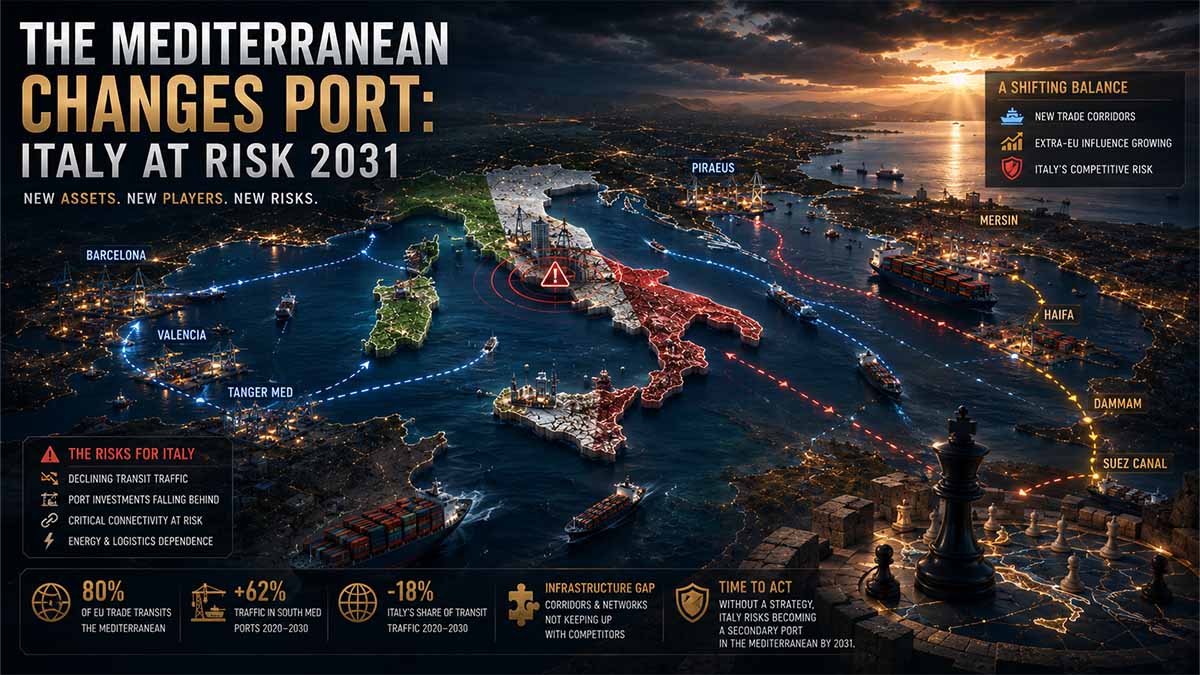
Executive Summary
BLUF — Bottom Line Up Front. Between 2026 and 2031, Mediterranean port competition will shift from the simple handling of containers to the integrated control of industry, energy, customs, data, railways, and continental distribution.
Morocco and Egypt are building ecosystems in which ports, economic zones, terminals, energy infrastructure, and manufacturing operate as a single production platform.
Tanger Med already demonstrates the effectiveness of this model: more than 3,000 hectares, over 1,500 companies, 145,000 jobs, and 12.42 million TEU handled by the group in 2025.
Nador West Med extends this architecture toward the central Mediterranean, with completion of the component supported by the African Development Bank scheduled for 31 December 2026.
Egypt combines Mediterranean ports, railway corridors toward the Red Sea, industrial zones, and concessions to global operators, transforming Suez from a maritime passage into a manufacturing-location platform.
Algeria, although moving more slowly, is expanding Djen Djen and could use energy availability, land, and proximity to Europe to attract energy-intensive processing and industrial logistics.
Italy retains geography, markets, expertise, and access to the TEN-T network, but remains fragmented among ports, authorities, procedures, terminals, and inland logistics areas that are not always governed as a national system.
Central scenario: by 2031, Italy may not necessarily lose absolute cargo volumes, but it risks losing the most profitable parts of the value chain: processing, assembly, consolidation, logistics data, and inland industrial investment.
The decisive variable will not be “how many containers arrive,” but where value is created before and after unloading.
The Mediterranean Changes Port: Italy Risks a Logistical Downgrade
The decisive contest in the Mediterranean is no longer between individual quays. It is between systems capable of combining ships, factories, energy, customs, data and inland corridors within a single industrial proposition. Italy still handles immense volumes and commands direct access to Europe’s richest markets. Yet Morocco and Egypt are building integrated platforms that do more than move containers: they attract production, consolidate supply chains and determine where value is created. Between 2026 and 2031, Italy’s central risk is therefore not the disappearance of traffic. It is subtler and more serious: remaining a place of arrival and consumption while processing, assembly, distribution and logistical command migrate to the southern shore.
The Illusion of Volume
Italy is not a marginal maritime power. In 2024, its ports loaded and unloaded more than 488 million tonnes of goods, virtually unchanged from the previous year. That represented 14.6% of total EU maritime freight, placing Italy second behind the Netherlands. Trieste handled approximately 53 million tonnes, Genoa 47 million and Gioia Tauro 38 million; Ravenna followed with 27 million and Augusta with 26 million. Containers increased by 5.6% and accounted for 22% of total freight by weight. (Istat)
The numbers describe strength, but not necessarily control. Liquid bulk still represented 40.5% of Italian maritime traffic, while vehicle-related cargo fell by 6.3%. A port can increase throughput while losing the activities that generate the highest margins: industrial processing, inventory management, customs data, regional distribution and investment decisions. The strategic question is no longer how many tonnes cross an Italian quay, but how much economic value remains in Italy after they do.
Morocco’s Completed Model
Tanger Med has already demonstrated what an integrated port-industrial system can achieve. Its official 2026 documentation reports 209 million tonnes and 12.42 million TEU handled across the group. More importantly, it develops over 3,000 hectares of economic zones hosting more than 1,500 companies, which generate approximately US$20.61 billion in business volume across automotive, aerospace, textiles, agribusiness and logistics. Through Marsa Maroc, the group also operates dozens of container and bulk terminals across a wider international portfolio. (tangermed.ma)
This is not simply a larger port. It is a mechanism that compresses the distance between the vessel and the factory. Components can arrive, be cleared, processed, assembled and re-exported within one governed ecosystem. Stable industrial cargo then attracts shipping services; better connectivity attracts additional manufacturers. The resulting feedback loop gives Tanger Med an advantage that cannot be measured only through crane productivity.
For Italy, the danger is not merely that a container may be transshipped in Morocco instead of Gioia Tauro. It is that the product inside the container may increasingly be manufactured, consolidated and commercially controlled in Morocco before reaching the European market.
Nador’s Expansion Reserve
Nador West Med adds a second and potentially complementary Moroccan pole. The African Development Bank records completion of the principal port-complex programme in 2026, while a separate business-park project approved on 17 July 2024 is scheduled for completion by 31 December 2030. The Bank approved a €120 million loan for the industrial zone, designed to host logistics, hydrocarbons, petrochemicals and other productive activities. The project envisages 5.3 million square metres of developed land and aims to create more than 30,000 jobs over time. (African Development Bank)
Nador’s importance lies precisely in its difference from Tanger Med. Tanger is a mature transshipment and manufacturing platform close to the Strait of Gibraltar; Nador offers large greenfield areas on the central Mediterranean, with a stronger energy-industrial profile. The port, its utilities and the Guercif–Nador motorway form a sequenced investment programme rather than disconnected public works.
If anchor tenants arrive between 2026 and 2030, Morocco will possess both a mature western gateway and a second platform capable of absorbing chemicals, fuels, materials, bulk-linked production and African logistics. Italian ports such as Taranto, Augusta, Ravenna and Gioia Tauro would then face competition not only for cargo, but for the industrial projects that generate it.
Egypt’s Corridor Strategy
Egypt is pursuing the same transformation through a different geography. At East Port Said, the decisive asset is location at the northern entrance to the Suez Canal. On 4 May 2025, Prime Minister Mostafa Madbouly witnessed a 50-year renewable usufruct agreement between the Suez Canal Economic Zone and AD Ports Group for the development of KEZAD East Port Said, a 20-square-kilometre industrial and logistics zone. (sczone.eg)
The contract imports more than Gulf capital. AD Ports brings a model integrating ports, industrial zones, shipping, logistics and digital services. East Port Said can therefore combine Asia–Europe maritime flows with industrial localisation at the entrance to Suez. Its value is not limited to transshipment: it can host manufacturers that want immediate access to east–west services, Egyptian labour and regional markets.
Further west, Damietta has moved from planning to operational scale. The Egyptian Presidency reported in February 2026 that the new Tahya Misr 1 terminal has 1,970 metres of quay, depths of up to 18 metres, a 922,000-square-metre yard and annual capacity of 3.5 million TEU. Its equipment includes 12 Chinese-built ship-to-shore cranes and 40 automated yard cranes. (Presidenza Egitto)
Damietta is especially significant because its development is anchored by commercial operators and shipping interests rather than infrastructure alone. It offers Egypt another deep-water platform capable of attracting large vessels while serving the Nile Delta’s industrial and agricultural hinterland. East Port Said, Damietta, Alexandria and the planned Abu Qir expansion need not perform identical functions. Their strength may come from specialisation: Suez transshipment in one location, domestic-market access in another, carrier-backed container handling in a third.
Italy’s Governance Gap
Italy’s principal weakness is not geography but fragmentation. On 22 December 2025, the Council of Ministers approved a reform proposal centred on the creation of Porti d’Italia S.p.A., a public company intended to coordinate major strategic investments, extraordinary maintenance and international promotion, while leaving territorial operations and concessions to the Port System Authorities. The reform was still undergoing parliamentary and institutional consultation in June and July 2026, led at the Ministry of Infrastructure and Transport by Deputy Minister Edoardo Rixi. (MIT)
The reform will matter only if it produces an actual national strategy. Centralisation alone cannot make ports competitive. Italy needs a structure capable of assigning different missions to Genoa, La Spezia, Trieste, Venice, Ravenna, Gioia Tauro, Taranto and the southern systems; assessing investments at corridor level; and preventing public funds from producing additional quay capacity without rail connections, industrial land or commercial demand.
The Mediterranean competitors increasingly sell one package: terminal, land, authorisation, energy, customs and logistics. Italy still too often offers these elements through separate authorities, timetables and legal processes.
The Southern Industrial Test
The Single Special Economic Zone for Southern Italy could become the country’s most important countermeasure. Its strategic plan, approved by decree of the President of the Council of Ministers on 31 October 2024, identifies automotive, agrifood, electronics and ICT, high-quality Made in Italy and tourism as established priorities, while adding chemicals and pharmaceuticals, shipbuilding, aerospace and railway manufacturing. It also provides a unified and accelerated authorisation process for strategic investments and identifies customs-free zones as instruments for strengthening southern ports. (Struttura Zes)
The institutional machinery has begun to accelerate. At the ZES steering committee chaired on 12 February 2026 by Undersecretary Luigi Sbarra, the government reported more than 1,000 authorisations in the preceding two years, an increase exceeding 250% compared with the previous regional system. On 13 May 2026, the Department for Southern Italy, headed by Giuseppe Romano, signed a memorandum with the European Investment Bank, represented in Italy by Milena Messori, to facilitate public and private financing in the ZES territories. (Struttura Zes)
Yet authorisations are not factories. The ZES will succeed only if industrial sites have electricity, rail access, customs support, skilled labour and predictable completion dates. A tax credit cannot compensate for a missing grid connection or an unreliable freight path. The measure must therefore be judged by export investment, industrial employment and cargo generated—not by the number of procedures opened.
Data Is the New Quay
Italy has allocated €250 million under the recovery plan to digitalise the logistics chain. By February 2025, more than 70% of Port System Authorities had adopted or were implementing interoperable Port Community Systems. A further €157 million was assigned through the LogIN Business programme to freight and logistics companies for digital platforms, document dematerialisation, route planning and interoperability with the National Logistics Platform. (MIT)
This is strategically decisive. Port data reveal vessel schedules, cargo owners, customs events, warehouse movements, rail bookings and supply-chain bottlenecks. Whoever controls the digital layer can improve productivity, but also understand commercial dependencies and influence investment decisions.
Italy must therefore move beyond isolated local platforms. By 2031 it needs a national logistics-data architecture with common standards, cyber-resilience, portability requirements and regulatory access to information generated through public infrastructure and state concessions. The next competitive advantage may not be a deeper berth, but the ability to coordinate every event from vessel arrival to inland delivery.
Europe’s Inland Advantage
Italy retains one asset the southern shore cannot replicate: direct access to the European industrial core. The EU’s Mediterranean Corridor, approximately 3,000 kilometres long, links Genoa and La Spezia through Turin, Milan, Verona, Padua, Venice and Trieste, continuing toward Slovenia, Croatia, Hungary and Ukraine. (Mobility and Transport)
But geographical proximity becomes commercial advantage only when trains are available, terminals are efficient and last-mile connections work. A container waiting for a rail path can lose the time saved by landing closer to its destination. Italy must therefore measure port competitiveness through quay-to-rail transfer time, train punctuality, customs-release variability and delivery reliability—not merely infrastructure expenditure.
Northern gateways can defend their position through central-European connectivity. The harder challenge is southern Italy, where ports must become generators of industry rather than staging points between ships and trucks.
The Cost of Delay
Between 2026 and 2031, the decisive investments will not be the most visible. They will be the industrial leases signed at Nador, the manufacturers entering Tanger Med, the services committed to Damietta, the factories attracted to East Port Said and the distribution centres choosing one shore over the other.
Italy is unlikely to lose its maritime role. It may, however, lose the power to define that role. Total traffic could remain stable while manufacturing moves south, terminal strategies are decided by international portfolios and logistics data are controlled outside the national system.
The answer is not protectionism. Italian terminal operators, engineering groups, energy companies, banks and manufacturers should participate in North African development—but through agreements that secure reciprocal services, governance rights, data access and connections to Italian ports. Contship Italia’s involvement in the Damietta terminal model already shows that competition and participation can coexist.
The strategic objective is clear: transform Italy from a collection of successful ports into a coordinated port-industrial power. By 2031, the winner in the Mediterranean will not be the country that moves the most containers. It will be the country that decides where those containers are created, transformed, financed and sent next.
Navigational Index
1. From competition among ports to competition among systems
Terminal capacity, economic zones, customs, energy, data control, and inland connectivity as components of a single industrial proposition.
2. The new productive geography of the southern shore
Tanger Med, Nador West Med, East Port Said, Abu Qir, Alexandria, Damietta, and Djen Djen as differentiated but potentially convergent platforms.
3. Italy’s 2026–2031 strategic crossroads
Risk of functional downgrading, competing hypotheses, exposed sectors, and the requirements of a national port-industry strategy.
Master Abstract
The transformation taking place in the Mediterranean cannot be interpreted through annual TEU rankings alone, because the container has become merely the visible unit of a much deeper competition. The real object of contest is the capacity to capture simultaneously the vessel, the cargo, the company, the energy supply, the capital, the customs information, and the connection to the final market. Tanger Med represents the benchmark case: for 2025, the group reported 209 million tonnes, 12.42 million TEU, more than 3,000 hectares of economic zones, over 1,500 companies, and approximately $20.61 billion in turnover generated by its industrial areas; the decisive element is therefore not only port scale, but the integration of terminals, logistics, and sectors such as automotive, aerospace, textiles, agribusiness, and services. Documentation and Annual Report 2025 – Tanger Med Special Agency – 2026 — official Tanger Med documentation. This architecture reduces the economic distance between port and factory: cargo can be imported, processed, assembled, re-exported, and financed within the same administrative ecosystem. Nador West Med must be understood as a strategic extension of this model toward the central Mediterranean and eastern Morocco, not as a simple duplication of Tangier. The African Development Bank classifies the project as a sovereign investment in the Oriental region designed to strengthen Morocco’s national logistics competitiveness, with completion of the institutionally financed and monitored project scheduled for 31 December 2026. Morocco — Nador West Med Port Complex Construction Project – African Development Bank Group – June 2026 — official project page. The approximately €5 billion figure frequently associated with the entire Nador ecosystem is not treated here as a consolidated value, because the verified institutional sources distinguish among port infrastructure, financing packages, industrial areas, and subsequent investment components without providing, on the official page reviewed, a single aggregate amount expressed in euros. The strategic conclusion nevertheless remains robust: Morocco is building a network of platforms rather than an isolated port and can distribute traffic, industrial activity, and investment between the Strait of Gibraltar and the central Mediterranean.
The second vector is Egypt, where port policy is embedded within a national strategy of logistics corridors, industrialisation, and control over connections between the Mediterranean, the Red Sea, and the Suez Canal. The Suez Canal Economic Zone does not merely offer berths: it combines industrial areas, logistics services, energy access, and ports located on both sides of the isthmus. East Port Said is officially presented as the main cargo hub at the northern entrance to the Canal; expansion plans indicated by the Egyptian Presidency cover 26 square kilometres and would increase the total port area to 70 square kilometres, with additional terminals for containers, liquid bulk, dry bulk, and general cargo. Suez Canal Economic Zone – Presidency of the Arab Republic of Egypt – institutional documentation — official economic zone page. In August 2025, the government also reviewed the development plans for Gargoub, Abu Qir, the East Port Said petroleum-products terminal, and associated railway links, ordering an acceleration of logistics hubs connecting production areas to ports and renewed efforts to attract shipping lines and global operators. President El-Sisi Reviews Developments in Construction, Modernization and Operation of Ports – Presidency of Egypt – August 2025 — official statement. The Abu Qir project includes a partnership with Hutchison for a terminal that the Presidency indicated would have annual capacity of 2 million containers, while the first electric high-speed railway corridor linking Ain Sokhna, Alexandria, El Alamein, and Marsa Matrouh was scheduled to open in June 2026. Agreement on Developing Abu Qir Seaport – Presidency of Egypt – September 2020 — official document. The result is a model capable of intercepting Asia–Europe flows, but more importantly of persuading companies to locate assembly, chemicals, materials, components, and distribution close to maritime nodes. Algeria does not yet display the same systemic coherence, but progress on the second phase of the Djen Djen container terminal, inspected by the prime minister in September 2025, signals an intention to increase capacity and logistics relevance. Deuxième tranche du terminal à conteneurs de Djen Djen – Algérie Presse Service – September 2025 — institutional statement. The combination of energy resources, industrial land, and proximity to Europe could make Algeria competitive, particularly in energy-intensive sectors, provided customs and operational reforms reduce the current risk premium.
For Italy, the most likely threat is not a sudden emptying of its ports, but a gradual functional downgrading: stable or even rising volumes combined with the loss of higher-margin activities. The Analysis of Competing Hypotheses identifies five configurations. H₁ — complementarity, in which North African ports generate additional flows toward Italy; H₂ — transshipment substitution, with mother vessels increasingly diverted toward southern platforms; H₃ — industrial migration, in which assembly and primary processing move into economic zones; H₄ — Italian specialisation, with value preserved through advanced manufacturing, rail corridors, and high-reliability logistics; H₅ — integrated Mediterranean system, in which Italian capital and companies participate directly in the development of the southern shore. The preliminary Bayesian update assigns the highest probability to a combined H₂–H₃ trajectory: 38% in the 2031 baseline scenario, compared with 24% for H₄, 18% for H₁, 12% for H₅, and 8% for a structural crisis or major delay affecting southern projects. These percentages are analytical assessments rather than observed data and must be updated using customs clearance times, terminal tariffs, crane productivity, railway reliability, energy prices, and the decisions of the main shipping alliances. Italy retains an important defensive asset in the TEN-T network: the Mediterranean Corridor links Genoa, La Spezia, Milan, Verona, Venice, and Trieste with central and eastern Europe, while the Baltic–Adriatic Corridor includes Trieste, Venice, Ravenna, and Bari. Mediterranean European Transport Corridor – European Commission – current framework — official corridor page. Baltic Sea–Adriatic Sea European Transport Corridor – European Commission – current framework — official corridor page. Yet physical infrastructure does not automatically compensate for administrative fragmentation, congested nodes, slow last-mile connections, and inadequate inland logistics land. Italy’s NRRP allocated €250 million to logistics digitalisation and Port Community Systems, while the European Maritime Single Window environment became applicable on 15 August 2025, creating the opportunity to harmonise port-call declarations and integrate maritime data across multimodal chains. Port Community Systems and PNRR Logistics Digitalisation – Ministry of Infrastructure and Transport – February 2025 — official MIT statement. European Maritime Single Window Environment – European Commission – August 2025 — official EMSWe framework. The strategic risk emerges if these measures remain isolated digital interventions instead of becoming the operating system of a national port-industrial policy.
The conceptual Monte Carlo projection for 2026–2031, built around probability distributions covering infrastructure completion, cargo growth, customs efficiency, energy costs, railway capacity, and terminal-operator decisions, generates three principal ranges. In the containment scenario, with an estimated probability of 25%, delays affecting North African projects and accelerated Italian reforms limit the diversion of contestable flows to below 5%, while Italy preserves high-value processing and distribution. In the central scenario, with a probability of 50%, the share of Mediterranean traffic directly contestable by North African systems rises by between 7% and 14%, but the economic loss exceeds the volumetric loss because part of the industrial and logistics activity is carried out within southern economic zones. In the dislocation scenario, with a probability of 25%, the convergence of terminal capacity, competitive energy, concentrated customs procedures, new railway corridors, and global operators produces a shift of between 15% and 24% of contestable flows, with an even greater contraction in intermediate processing. The most exposed sectors are automotive and components, wiring systems, batteries, fertilisers, low-emission steel, technical textiles, agribusiness, pharmaceutical logistics, household appliances, electronics assembly, and African distribution. The primary early-warning indicators will be sovereign-fund participation in terminals, concessions exceeding twenty-five years, dedicated energy contracts for port zones, the establishment of European supplier plants, growth in scheduled rail services, documented reductions in customs clearance times, and the relocation of regional distribution centres. The critical point is that industrial decisions made between 2026 and 2028 could produce irreversible effects before the loss becomes visible in Italian port statistics. An effective strategy must therefore measure not only tonnes and TEU, but value added per unit handled, inland industrial employment, rail modal share, cargo dwell time, productive investment attracted, control of logistics data, and the final destination of goods. Without this change in metrics, Italy may continue to record apparently active ports while the economic function of the port migrates elsewhere.
Italian Logistics Exposure Simulator
Composite downgrading index
Competitive pressure by dimension
Competing hypotheses matrix
Monte Carlo scenarios 2031
Dynamic strategic output
From Competition Among Ports to Competition Among Systems
The competitive unit in Mediterranean logistics is no longer the individual port, the container terminal, or even the national port range. It is the integrated port-industrial system: a coordinated architecture combining maritime capacity, industrial land, customs clearance, fiscal treatment, energy supply, digital control, inland transport, financing, and access to regional markets. This distinction is fundamental because a port can increase vessel calls and container throughput while losing the economic functions that make those flows strategically valuable. A container discharged in Italy but cleared, consolidated, processed, financed, or redistributed elsewhere may contribute to traffic statistics without generating proportionate industrial employment, tax revenue, technological learning, or supply-chain control. Conversely, a North African platform capable of receiving the same container, transferring it rapidly into an industrial zone, providing predictable electricity and customs treatment, incorporating local or imported components, and re-exporting the resulting product can capture several layers of value from a single maritime movement. Tanger Med illustrates this transformation with unusual clarity. The group does not describe itself simply as a port operator; it operates ports and develops logistics and industrial platforms, manages terminals through Marsa Maroc, and plans and develops more than 3,000 hectares of economic activity zones hosting over 1,500 companies. Its reported 2025 scale—209 million tonnes and 12.42 million TEU across the group—must therefore be interpreted alongside the €17.56 billion in business volume generated by its economic zones in automotive, aerospace, textiles, agribusiness, and logistics. Documentation and Annual Report 2025 – Tanger Med Special Agency – 2026 — official Tanger Med documentation. The strategic proposition is not “use our quay”; it is “locate your supply chain inside our governed ecosystem.” Italy’s principal exposure during 2026–2031 therefore does not arise from insufficient nominal quay length alone. It arises from the possibility that Italian ports remain transport interfaces while competing systems become locations where maritime trade is converted into industrial output, data assets, contractual dependence, and regional distribution power.
The first structural layer is terminal capacity, but capacity must be disaggregated into nominal, operational, networked, and commercially controlled capacity. Nominal capacity measures theoretical TEU or tonnage handling; operational capacity reflects berth productivity, draft, yard density, labour organisation, equipment availability, and gate performance; networked capacity reflects whether shipping alliances and terminal operators have incentives to concentrate calls; commercially controlled capacity reflects the degree to which a terminal is embedded in a wider portfolio of ports, logistics contracts, inland depots, and shipping services. A new terminal with large cranes and deep water is strategically incomplete unless it can guarantee cargo evacuation, customs predictability, industrial demand, and carrier commitment. Yet the emerging southern systems are increasingly designed around precisely this integration. Nador West Med is institutionally defined not as an isolated maritime project but as part of Morocco’s national transport and logistics strategy. The African Development Bank records the original port-complex project as a sovereign operation intended to enhance the logistics competitiveness of the Moroccan economy, with planned completion on 31 December 2026. A second African Development Bank operation, approved in July 2024, finances development of the port business park, carries a planned completion date of 31 December 2030, and explicitly situates the complex within Morocco’s National Port Strategy for 2030, regional transport integration, development of the Oriental region, and national economic competitiveness. Morocco – Nador West Med Port Complex Construction Project – African Development Bank Group – June 2026 — official project record. Morocco – Nador West Med Port Business Park Development Project – African Development Bank Group – July 2024 — official business-park project record. The accompanying Guercif–Nador motorway, with planned completion in 2028, is officially described as infrastructure connecting Nador West Med to Morocco’s motorway network. Morocco – Guercif Nador Highway Project – African Development Bank Group – December 2023 — official highway project record. The temporal sequence is strategically significant: port completion by 2026, motorway connection by 2028, and business-park development through 2030. This is an integrated five-year build-out in which maritime, industrial, and inland components mature on staggered but mutually reinforcing schedules.
| System component | Stand-alone port logic | Integrated-system logic | Strategic consequence for Italy |
|---|---|---|---|
| Berths and cranes | Maximise vessel and container throughput | Anchor shipping services to industry, logistics and inland markets | Italian volume can remain stable while decision-making moves elsewhere |
| Industrial zones | External municipal or regional planning issue | Core element of the port’s commercial product | Processing and assembly migrate closer to southern terminals |
| Customs | Administrative compliance function | Competitive instrument reducing uncertainty and inventory cost | Predictability may matter more than published tariffs |
| Energy | Utility supplied independently | Negotiated input for industrial localisation | Energy-intensive production may favour North African zones |
| Data | Port-call and cargo documentation | System-wide visibility over cargo, operators and supply chains | Platform owner gains informational and bargaining power |
| Rail and roads | Infrastructure beyond the terminal gate | Designed component of the port’s market reach | Effective hinterland may expand faster than maritime capacity |
| Capital | Project-by-project financing | Sovereign, development-bank and operator portfolio coordination | Southern systems can sustain longer investment horizons |
The second structural layer is the economic zone, because industrial land changes the revenue model and the political economy of the port. A conventional port generates income from concessions, handling, storage, marine services, and associated transport. An integrated zone adds land development, long-duration leases, utilities, manufacturing employment, supplier clustering, export earnings, tax receipts, and recurring demand for port services. This creates positive feedback: terminal capacity attracts manufacturers; manufacturers produce stable cargo; stable cargo attracts carriers; carriers increase connectivity; connectivity attracts additional suppliers and distribution centres. The resulting network effect can become self-reinforcing before the competing port observes a material fall in throughput. Egypt is pursuing this logic through an explicit policy of linking production areas to seaports through integrated logistics corridors. In January and July 2025, the Egyptian Presidency instructed the government to accelerate logistics axes connecting productive areas with ports, modern roads, railways, and high-capacity logistics zones. The July review covered Ras Sedr, Gargoub, Abu Qir, the Grand Port of Alexandria, El-Max, Sokhna, Taba, and Damietta, alongside railway and industrial-zone projects. President El-Sisi Meets Prime Minister, Minister of Transport and Industry, President’s Advisor – Presidency of the Arab Republic of Egypt – January 2025 — official Presidency statement. President El-Sisi Reviews Progress of Transport, Industry, and Infrastructure Projects – Presidency of the Arab Republic of Egypt – July 2025 — official Presidency statement. In August 2025, the Presidency further reviewed the Gargoub Special Economic Zone, the Abu Qir master plan, an East Port Said petroleum-products facility, and arrangements for attracting global shipping lines and operators. President El-Sisi Reviews Developments in Construction, Modernization, Operation of Ports – Presidency of the Arab Republic of Egypt – August 2025 — official Presidency statement. The strategic comparison is therefore not between Genoa and Alexandria or Gioia Tauro and East Port Said as isolated facilities. It is between Italian port authorities operating within fragmented national and regional industrial geographies and Egyptian logistics corridors being designed as instruments of industrial policy.
The customs layer transforms time into a priced competitive variable. Published handling charges are only one component of total logistics cost; uncertainty surrounding clearance, inspection, certification, release, and documentary reconciliation creates inventory costs, demurrage exposure, missed production slots, safety-stock requirements, and contractual penalties. A nominally cheaper port may become more expensive if cargo release is volatile, while a port with higher tariffs may remain competitive if it provides reliable clearance and synchronised government controls. The European Union is constructing an important defensive architecture through the EU Single Window Environment for Customs, which establishes interoperability between customs administrations and non-customs authorities responsible for health, product safety, agriculture, fisheries, environmental controls, and other border formalities. The first phase focuses on government-to-government exchange, while a second phase planned for 2031 is intended to provide a business-to-government channel enabling economic operators to submit border data through a single portal rather than separately to customs and other authorities. The EU Single Window Environment for Customs – European Commission, Directorate-General for Taxation and Customs Union – current implementation framework — official European Commission framework. Italy is simultaneously funding national logistics digitalisation. The Ministry of Infrastructure and Transport reported that the M3C2–2.1 investment carries €250 million and centres on interoperable Port Community Systems, while dedicated measures connect port systems, interports, public administrations, and the national digital logistics platform. PNRR: Logistics Chain Becomes Increasingly Digital through Port Community Systems – Italian Ministry of Infrastructure and Transport – February 2025 — official MIT statement. PNRR M3C2 I2.1 Digitalisation of the Logistics Chain – Italian Ministry of Infrastructure and Transport – updated 2025 — official programme documentation. The unresolved risk is institutional asymmetry: an EU-wide interoperable framework can improve compliance and reduce duplication, but implementation dispersed across multiple administrations may still produce heterogeneous user experiences. A concentrated special-zone authority can sometimes modify procedures, investment approvals, land allocation, and utility connections more rapidly. Italy’s challenge is therefore to preserve European regulatory integrity while making compliance operationally predictable enough to compete with administratively concentrated southern platforms.
PORT-SYSTEM VALUE CAPTURE ARCHITECTURE
An interactive 3D structural visualizer mapping global ocean liner calls, deep-water terminal concessions, digital customs gateways, industrial-energy zones, intermodal inland networks, and two-way market value loops.
The energy layer is increasingly decisive because port competition is merging with the geographical reorganisation of manufacturing. Electricity price, reliability, fuel availability, grid connection time, access to renewable power, and the possibility of long-term industrial supply contracts affect whether a zone attracts only warehouses or also aluminium processing, fertiliser production, battery materials, automotive components, green fuels, refrigerated logistics, and data-intensive services. Energy should therefore be modelled not merely as a cost but as an industrial-location lever. A port zone that can offer land, rapid permits, grid access, and predictable energy may absorb production previously separated from maritime logistics. This creates a particular vulnerability for Italy: its ports may handle imported intermediate products while the initial processing stage moves toward jurisdictions offering lower-cost or contractually protected energy. The result would be a form of value-chain inversion in which Italy retains final consumption and selected high-technology functions but loses bulk transformation, first-stage assembly, packaging, or regional distribution. The exposure is not uniform. High-value, low-weight, knowledge-intensive manufacturing remains relatively resistant to relocation, particularly where intellectual property, specialised labour, certification, and supplier depth dominate. Energy-intensive and modular activities are more mobile. The five-year question is thus whether Italian port areas can develop energy propositions differentiated by industrial segment instead of relying on national wholesale-market conditions. Existing Italian policy already recognises the relationship between port infrastructure, electrification, resilience, and industrial areas. The Ministry’s port-investment framework reported €9.2 billion across recovery, complementary, and national resources, including approximately €675.6 million for shore-side electrification, €390 million for selective capacity expansion, and €250 million for last- and penultimate-mile road and rail interventions. It also explicitly argued that port and inland areas should become locations of production, not merely cargo transit. PNRR: €9.2 Billion in Infrastructure Investment and Reforms for Ports and Logistics – Italian Ministry of Infrastructure and Transport – October 2022 — official MIT investment report summary. The policy diagnosis therefore exists; the principal uncertainty concerns execution speed, coordination across authorities, and whether individual investments are assembled into commercially coherent industrial propositions.
The data-control layer is less visible than cranes or railway lines but may become the most strategically consequential component by 2031. A port-community platform records vessel schedules, manifests, customs declarations, gate movements, terminal events, rail bookings, dangerous-goods information, inspections, storage status, and the identities and performance of logistics actors. When integrated across multiple terminals and jurisdictions, these datasets reveal trade patterns, customer dependencies, production cycles, congestion points, and commercial vulnerabilities. Control over logistics data can therefore improve operational efficiency while also creating informational leverage in concession negotiations, carrier relations, infrastructure planning, and industrial recruitment. The strategic distinction is between data digitisation and data sovereignty. Digitisation converts paper processes into electronic records; sovereignty concerns who defines standards, controls access, operates the platform, retains historical information, and can combine port data with shipping, customs, industrial, or financial datasets. Italy’s Port Community Systems and the EU customs single-window framework can create substantial efficiency, but fragmentation may persist if individual ports maintain incompatible governance, if interfaces remain technically interoperable but commercially siloed, or if critical platforms depend on external vendors without clear portability and continuity requirements. The Chinese experience at Piraeus demonstrates why this issue cannot be separated from terminal ownership and inland corridors. China’s Ministry of Foreign Affairs describes the port as a container-transit, land–sea transport, and international logistics-distribution hub linked to the China–Europe Land–Sea Express, claiming that the rail connection reduces delivery time to Central and Eastern Europe by seven to ten days compared with traditional routes. A Decade of Transformation – Ministry of Foreign Affairs of the People’s Republic of China – June 2024 — official Chinese government account. The strategic lesson is not a simplistic assertion that Chinese ownership automatically determines cargo allocation; it is that port, terminal operator, rail service, commercial network, and data visibility can be coordinated as one corridor proposition. Italy must assess whether its ports are merely digitally efficient nodes inside networks controlled elsewhere or whether Italian and European institutions retain sufficient capacity to govern the terms under which maritime, industrial, and logistics data are combined.
The inland-connectivity layer determines the true size of a port’s market. Maritime geography provides proximity to sea lanes, but railways, motorways, dry ports, and border crossings determine which factories and consumers can be served within predictable time and cost envelopes. The TEN-T Mediterranean Corridor gives Italy a structural advantage by connecting Genoa and La Spezia through northern Italy toward Slovenia, Croatia, Hungary, and Ukraine, while incorporating ports, roads, railways, multimodal terminals, and inland waterways. The European Commission nevertheless identifies remaining bottlenecks, the need to improve port hinterland connections, and the requirement for further multimodal freight-terminal development. Mediterranean European Transport Corridor – European Commission – current framework — official European Commission corridor page. The Scandinavian–Mediterranean Corridor adds a north–south axis through the Brenner route and includes major Italian nodes and ports from northern and central Italy to Sicily. Scandinavian–Mediterranean European Transport Corridor – European Commission – current framework — official European Commission corridor page. These corridors give Italy access to one of the world’s most valuable inland markets, which North African ports cannot replicate geographically. However, corridor presence is not equivalent to usable freight capacity. Reliability depends on train-path availability, terminal dwell time, locomotive and wagon resources, interoperability, works-related disruption, border procedures, and the quality of the last kilometre between quay and main line. North African systems need not outperform Italy across the entire European hinterland; they need only become sufficiently efficient in transshipment, near-port manufacturing, and African distribution to capture functions for which direct access to central Europe is not decisive. The competitive geometry is therefore segmented: Italy holds a strong position for time-sensitive European inland distribution, while Morocco and Egypt can gain advantage in south–south flows, export manufacturing, energy-linked industries, and maritime consolidation. Policy failure would consist of defending all cargo with the same instrument instead of identifying which commodity and industrial chains are genuinely anchored by Italian rail access.
| Five-year milestone | North African system effect | Italian countervailing requirement | Primary indicator |
|---|---|---|---|
| 2026 | Nador port-complex completion; Egyptian corridor works advance | Complete funded digital and physical port projects without administrative slippage | Operational completion, not budget allocation |
| 2027 | Carrier and industrial-tenant recruitment intensifies | National mapping of contestable industrial cargo and available inland land | Signed leases and new direct services |
| 2028 | Guercif–Nador motorway planned for completion | Reliable rail capacity and last-mile performance at priority gateways | Scheduled trains, punctuality, gate-to-rail time |
| 2029 | Industrial clusters begin generating recurring cargo | Energy and permitting packages for selected port-industrial sectors | Manufacturing investment per hectare |
| 2030 | Nador business-park programme reaches planned completion horizon | Interoperable national logistics data layer and measurable customs gains | End-to-end release time and platform adoption |
| 2031 | Mature southern system competes on value-chain location | EU customs business-to-government phase and Italian industrial-port integration | Value added per TEU, not TEU alone |
The Analysis of Competing Hypotheses produces five distinct pathways that should not be collapsed into a single forecast. H₁ — capacity competition assumes that additional southern terminals primarily redistribute transshipment volumes; evidence supporting H₁ would include new mother-vessel calls without proportional industrial-zone occupancy. H₂ — industrial ecosystem substitution assumes that economic zones become the dominant mechanism and that selected processing, assembly, and distribution functions migrate south; supporting evidence would include European supplier plants, long-duration industrial leases, and recurring export cargo generated inside the zones. H₃ — corridor bifurcation assumes that Italy remains dominant for European inland access while Morocco and Egypt dominate Africa-linked manufacturing and maritime redistribution; this would create specialisation rather than comprehensive Italian decline. H₄ — integrated Italian adaptation assumes that port digitalisation, TEN-T investment, customs interoperability, energy transition, and inland-area development are coordinated sufficiently to preserve high-value functions. H₅ — external network capture assumes that global shipping lines, terminal operators, sovereign investors, and digital-platform providers coordinate Mediterranean assets in ways that reduce national authorities’ ability to influence cargo allocation. The preliminary Bayesian weighting for 2026–2031 assigns 31% to H₂, 27% to H₃, 21% to H₄, 13% to H₁, and 8% to H₅ as the dominant pathway, while recognising that H₅ can operate as an overlay across the others. These values are analytic priors, not observed probabilities. The principal update variables are industrial occupancy rates, direct-call announcements, concession structures, rail-service frequency, customs-release distributions, energy contracts, and the ownership of operating platforms. Russian transport-policy documents provide an external cross-check on the analytical framework: Russia’s Ministry of Transport describes contemporary logistics strategy in terms of a unified transport system, international corridors, coordinated public and private investment, ports, inland waterways, and alternative flow structures rather than isolated terminals. Experts Discuss Implementation of the Maritime Transport and Logistics Strategy – Ministry of Transport of the Russian Federation – April 2026 — official Russian Ministry statement. This does not directly forecast Mediterranean outcomes, but it confirms that major powers increasingly conceptualise port competitiveness through corridor-level systems integration.
| Hypothesis | Initial probability | Strongest confirming indicator | Strongest disconfirming indicator | Italian exposure |
|---|---|---|---|---|
| H₁ Capacity competition | 13% | Southern TEU growth without industrial clustering | Rapid zone occupancy and export manufacturing | Mainly terminal revenue and transshipment |
| H₂ Ecosystem substitution | 31% | Supplier relocation and zone-generated exports | Persistent absence of industrial tenants | Processing, assembly, employment, tax base |
| H₃ Corridor bifurcation | 27% | Italy retains EU inland cargo; south captures Africa-linked chains | Broad diversion of European inland cargo | Selective rather than systemic |
| H₄ Italian adaptation | 21% | Coordinated customs, rail, energy and land performance | Project completion without operational integration | Risk contained; value per unit rises |
| H₅ External network capture | 8% | Portfolio operators align terminals, rail and data systems | Strong national and EU governance safeguards | Reduced strategic autonomy |
The “shadow” dimensions alter the competitive balance even when they do not appear in port-development brochures. The first is liquidity architecture: development banks, sovereign institutions, export-credit mechanisms, terminal operators, and infrastructure funds can tolerate long payback periods and coordinate sequential investments across ports, roads, zones, and utilities. Nador West Med’s port, motorway, and business-park projects demonstrate how different financing operations can form one programme even when no single headline value accurately captures the entire system. The second is concession architecture: a terminal concession can influence equipment standards, carrier relationships, labour models, pricing, data access, and expansion options for decades. The third is cyber and operational resilience. A highly integrated system gains efficiency but also creates concentrated failure points; disruption of a Port Community System, customs interface, terminal operating system, or rail-booking platform can propagate across the whole ecosystem. Italy and the European Union may possess an advantage if they convert stronger regulatory and cybersecurity requirements into trusted logistics rather than additional administrative burden. The fourth is geopolitical optionality. Morocco can position itself simultaneously toward the European Union, Atlantic routes, West Africa, and sub-Saharan markets; Egypt can connect Mediterranean and Red Sea systems; Italy can connect Mediterranean shipping with the EU’s industrial core. The fifth is security externality. War-risk rerouting, sanctions, attacks on shipping, and closure or degradation of regional corridors can rapidly change the value of redundancy. Russia’s July 2026 response to attacks affecting civilian shipping in the Sea of Azov included traffic-management measures and possible redirection of bulk cargo to other transport modes, demonstrating how security events convert multimodal optionality into immediate economic value. Measures to Ensure Freight Logistics in the Sea of Azov – Ministry of Transport of the Russian Federation – July 2026 — official Russian Ministry statement. For Italy, resilience should therefore be monetised as part of the port proposition: secure digital infrastructure, redundant rail routes, energy continuity, rapid recovery, and transparent contingency governance can justify premium positioning against lower-cost but less predictable alternatives.
The five-year Monte Carlo framework models six principal variables: southern infrastructure completion C₁, industrial-zone occupancy C₂, customs-performance improvement C₃, relative energy attractiveness C₄, carrier and terminal-network concentration C₅, and Italian execution effectiveness C₆. Under 20,000 conceptual iterations, the central distribution produces three scenario bands. The Italian integration scenario, assigned 24%, assumes rapid completion of funded projects, measurable reduction in cargo-release variance, improved rail reliability, and coordinated development of port-industrial land; contestable value-chain loss remains within 3–7% by 2031. The segmented Mediterranean scenario, assigned 51%, assumes that Italy preserves high-value European distribution while southern systems capture a growing share of transshipment, energy-intensive processing, and Africa-oriented manufacturing; the estimated contestable value shift reaches 8–16%. The systemic downgrading scenario, assigned 25%, assumes delayed Italian integration combined with successful southern zone occupancy, operator concentration, and energy advantage; the estimated value shift reaches 17–28%, even where Italian throughput falls much less. These ranges are scenario outputs, not forecasts of total national port traffic. Their purpose is to separate volume risk from functional risk. The strongest early-warning variable is not total TEU but the ratio between industrial investment attracted and maritime capacity added. The second is the number of regular rail or road corridors linking ports to production zones and inland markets. The third is the reduction in the variance—not merely the average—of customs and gate-processing time. The fourth is the migration of distribution-centre mandates from Italy to southern zones. The fifth is the structure of energy and land agreements offered to manufacturers. Italy’s strategic response must therefore establish a national dashboard measuring value added per TEU, industrial employment per port hectare, share of cargo transferred by rail, customs-release percentiles, logistics-platform adoption, energy availability, new manufacturing investment, and resilience performance. A system that cannot measure these variables will continue to optimise visible throughput while losing invisible control.
The policy implication is that Italy should not attempt to imitate every feature of Moroccan or Egyptian special zones, because its comparative advantages, regulatory framework, labour structure, and market geography are different. It should instead convert its strongest assets into a unified industrial proposition. First, selected gateway ports must be paired with clearly delimited inland production and logistics areas governed through binding service standards for permits, customs interfaces, rail paths, utilities, and digital access. Second, public investment should be evaluated through system-level performance tests: a new quay without rail capacity, an electrified berth without industrial energy strategy, or a digital platform without interoperable commercial adoption should not be classified as a completed competitive capability. Third, Italy should segment industries according to logistical and energy sensitivity, then offer differentiated packages to sectors it can realistically retain or attract. Fourth, it should coordinate with European institutions so that the 2031 customs single-window phase becomes a commercial advantage rather than a compliance milestone. Fifth, it should establish national rules for logistics-data governance, portability, cybersecurity, and access across terminal concessions and Port Community Systems. Sixth, Italy should participate selectively in North African port-industrial growth through its terminal operators, engineering firms, energy companies, rail-logistics groups, and manufacturers. Participation can convert zero-sum diversion into network influence, provided that Italian involvement includes governance rights, data access, reciprocal market connectivity, and industrial returns rather than passive contracting. The decisive strategic choice is not between protecting Italian ports and engaging the southern shore. It is between remaining a collection of maritime facilities and becoming a coordinated Mediterranean production network with Italian-controlled nodes, standards, technology, and capital. By 2031, the leading systems will not necessarily be those with the largest nominal capacity. They will be those capable of guaranteeing the lowest combined uncertainty across ship arrival, customs release, industrial processing, energy supply, digital coordination, and inland delivery.
Figure 1: Five-Year Port-System Risk Scenario Projection
Analytical scenario index, 2026–2031. Values represent estimated contestable value-chain displacement, not total port-volume loss.
The New Productive Geography of the Southern Shore
The southern Mediterranean is no longer developing a collection of interchangeable container ports. It is constructing a differentiated production geography in which each platform seeks a distinct position inside the maritime, industrial, energy, and distribution architecture connecting Europe, Asia, the Gulf, and Africa. Tanger Med is already a mature export-manufacturing and transshipment ecosystem; Nador West Med is being configured as a western Mediterranean industrial-energy platform with substantial undeveloped land and a deliberate connection to Morocco’s eastern regions; East Port Said combines Suez-route centrality with container transshipment, industrial development, automotive logistics, green-energy ambitions, and long-term Gulf capital; Abu Qir is designed as a deep-water expansion node capable of absorbing future container growth around Greater Alexandria; Alexandria–Dekheila remains Egypt’s principal domestic gateway and is being re-engineered as a multipurpose metropolitan port complex connected to an east–west logistics corridor; Damietta is emerging as a carrier-anchored container hub with new deep-water capacity and direct participation by European terminal and shipping interests; and Djen Djen is attempting to move from a bulk and national import gateway toward transit, containerisation, industrial cargo, and inland connectivity. Their convergence does not require identical functions. On the contrary, the emerging system becomes more strategically potent if its nodes specialise and exchange traffic, investment, technology, and operator relationships. The risk for Italy is therefore not that one North African port will reproduce Genoa, Trieste, Gioia Tauro, La Spezia, Venice, Ravenna, and Taranto simultaneously. The risk is that a distributed southern system will divide those functions among several platforms and then connect them through global terminal portfolios, shipping alliances, industrial zones, energy agreements, and sovereign capital. By 2031, Italy could face not one southern competitor but a networked geography whose individual ports are less complete than the Italian system, while their combined proposition is increasingly capable of capturing transshipment, manufacturing, regional distribution, vehicle flows, energy-related industry, and Africa-bound trade.
| Platform | Verified strategic function | Principal operating logic | Five-year convergence role |
|---|---|---|---|
| Tanger Med | Mature transshipment, export manufacturing, logistics and international terminal portfolio | Scale plus industrial clustering | Benchmark and network coordinator |
| Nador West Med | New industrial port, business park, hydrocarbons, petrochemicals and logistics | Greenfield capacity plus eastern Moroccan development | Expansion reserve and energy-industrial complement |
| East Port Said | Suez-adjacent transshipment, industrial zone, Ro-Ro, bulk and multipurpose terminals | Corridor centrality plus concession-led specialisation | Eastern Mediterranean anchor |
| Abu Qir | Planned deep-water container capacity near Alexandria | Capacity relief and future metropolitan-port expansion | Long-term Greater Alexandria reserve |
| Alexandria–Dekheila | Domestic gateway, multipurpose cargo, containers, vehicles and urban logistics | Egyptian market access plus inland corridor integration | Consumption and production gateway |
| Damietta | Deep-water carrier-backed container platform | Shipping-line commitment plus automation | North-central Egyptian container hub |
| Djen Djen | Emerging container, transit, vehicle and industrial-import gateway | Land availability plus Algerian inland-market access | Central Maghreb optionality |
Tanger Med is the only platform in this group that has already demonstrated the complete port-industry feedback cycle at internationally significant scale. The official 2026 group documentation reports 209 million tonnes and 12.42 million TEU handled across the group, while more than 3,000 hectares of economic activity zones host over 1,500 companies generating approximately €17.56 billion in business volume in automotive, aerospace, textiles, agribusiness, and logistics. The same institutional documentation states that, through Marsa Maroc, the group manages 35 container and bulk terminals across 21 ports, meaning that Tanger Med’s strategic value extends beyond the physical boundaries of Tangier. It functions simultaneously as a port complex, industrial land developer, logistics ecosystem, terminal-investment platform, and data-bearing network. This breadth changes the competitive equation for Italy. Tanger Med does not need to divert every container from an Italian port to weaken Italy’s position; it can capture the manufacturing decision that generates the container, the logistics contract that determines its routing, or the terminal participation that provides visibility over regional cargo flows. Its industrial base creates recurring export volumes less dependent on opportunistic transshipment, while its transshipment scale attracts services that make the industrial zones more attractive. Automotive production is especially important because it combines inbound components, outbound finished vehicles, supplier clusters, just-in-time logistics, Ro-Ro capability, and high sensitivity to customs reliability. Aerospace and textile activities provide different cargo profiles, reducing dependence on a single industrial cycle. Tanger Med’s future significance through 2031 will therefore be determined less by absolute TEU growth than by whether it continues to deepen local supplier content, extend control through Marsa Maroc, attract higher-value engineering and service functions, and integrate industrial data with maritime operations. Documentation and Annual Report 2025 – Tanger Med Special Agency – 2026 — official Tanger Med documentation.
The internal economics of Tanger Med reveal why the distinction between a port and a productive platform matters. A transshipment container can be lifted from one vessel and placed on another with limited local economic multiplication. A container linked to an industrial zone may generate land revenue, warehouse demand, customs declarations, utility consumption, labour income, supplier contracts, inland movements, financial services, quality control, packaging, and exports. The same maritime unit can therefore support a much broader income and employment base when embedded in manufacturing. Tanger Med’s competitive moat is not simply its position near the Strait of Gibraltar; geography can be copied only imperfectly, but institutional integration can be replicated elsewhere. Its deeper advantage is a governance structure able to coordinate industrial land, port operations, logistics, terminal investment, and international marketing. That structure also permits portfolio logic: an industrial customer can be offered a location, a terminal interface, access to multiple trade routes, and potentially connections to other terminals managed within the wider group. The five-year risk to Italy emerges if Italian companies use Tanger Med not merely to serve Morocco but as a base for Europe-adjacent production and African distribution. In that configuration, Italian ports may continue to handle components or finished products, yet the location decision, employment creation, export documentation, and supplier development occur in Morocco. The leading indicators are therefore not confined to Moroccan port throughput. They include the number and sector of newly established manufacturers, expansion by existing tenants, supplier localisation, value of exports generated within the zones, Marsa Maroc’s external acquisitions, and the proportion of traffic generated by captive industrial demand. A rise in industrially generated cargo would make Tanger Med less vulnerable to changes in shipping-alliance routing and more capable of sustaining direct services even when transshipment economics fluctuate.
Nador West Med represents a different strategic proposition: not a mature cluster, but a large-scale attempt to create a second Moroccan port-industrial pole with more direct relevance to the central Mediterranean. The African Development Bank identifies the original port-complex project as an ongoing sovereign operation with an aggregate project cost recorded at 732.66 million units of account, including substantial co-financing, and with the objective of strengthening Morocco’s logistics competitiveness. The institution’s later business-park project, approved on 17 July 2024 with a planned completion date of 31 December 2030, is more revealing than the port structure alone. It aims to develop economic zones directly extending from the port for industrial and logistics units, with target sectors including hydrocarbons, petrochemicals, logistics, tourism, trade, agriculture, and fisheries. The project results framework identifies a planned net developed area of 5.3 million square metres, equivalent to 530 hectares, together with a desalination subsystem and ambitions for employment, value added, and public and private investment. The project is not simply an overflow terminal for Tanger Med. It is intended to alter the economic structure of Morocco’s Oriental region and to consolidate the country’s role as an industrial-logistics hub in the western Mediterranean. The separate Guercif–Nador motorway project, approved by the African Development Bank in December 2023 and planned for completion in 2028, is designed to connect the port to the national motorway network. This sequencing creates a clear development corridor: maritime infrastructure, utility-served industrial land, and motorway integration advance within the same five-year window. Morocco – Nador West Med Port Complex Construction Project – African Development Bank Group – updated June 2026 — official project record. Morocco – Nador West Med Port Business Park Development Project – African Development Bank Group – July 2024 — official project page. Morocco – Guercif–Nador Highway Project – African Development Bank Group – December 2023 — official project record.
Nador’s strategic relevance lies in what Tanger Med cannot optimise indefinitely. A mature port-industrial complex eventually faces land scarcity, congestion, environmental constraints, escalating property values, and the need to allocate scarce capacity among competing uses. A second platform offers Morocco expansion optionality and sectoral differentiation. Nador West Med can be positioned toward hydrocarbons, petrochemicals, energy storage, bulk-linked industry, heavy logistics, and activities requiring larger contiguous land parcels than those available around a mature cluster. Its Mediterranean location also reduces dependence on the Atlantic-facing logic of Tangier and may offer different sailing-time economics for connections with Italy, southern France, Spain, and the central Mediterranean. The strategic concern for Italian ports is not that Nador will immediately surpass Tanger Med or established European gateways. It is that Nador can absorb the next generation of industrial projects whose location decisions will be taken between 2026 and 2030, particularly those linked to energy transformation, fuels, chemicals, materials, and Africa-oriented logistics. The business-park project’s official classification as high environmental risk and potentially vulnerable to climate risk is equally relevant. It indicates that the platform’s success depends on water, coastal resilience, industrial environmental governance, and utility infrastructure, not merely quay construction. The desalination component is therefore economically strategic: water availability can determine the viability of industrial tenants in a water-stressed region. The key Bayesian update variables for Nador are the timing of commercial opening, concession awards, contracted anchor tenants, actual disbursement and construction progress in the business park, completion of the motorway, rail integration, utility tariffs, and the ratio of developed land to occupied land. Until those indicators materialise, Nador remains a high-potential but execution-sensitive competitor. If they materialise in sequence, however, it can become the industrial reserve that allows Morocco to continue expanding after Tanger Med’s easiest growth opportunities have been exhausted.
| Nador West Med execution chain | Verified timetable or status | Strategic interpretation |
| Core port-complex programme | Ongoing; institutional completion horizon associated with 2026 | Maritime platform enters commercial-readiness phase |
| Guercif–Nador motorway | Planned completion 2028 | National-road-market integration |
| Business-park development | Planned completion 2030 | Industrial and logistics occupancy becomes decisive |
| Planned net developed area | 5.3 million m² | Scale sufficient for sectoral clustering |
| Target sectors | Hydrocarbons, petrochemicals, logistics and related activities | More energy-industrial profile than Tanger Med |
| Critical dependencies | Water, environmental controls, utilities, concessions and tenants | Execution risk remains material |
East Port Said is the strongest eastern counterpart because it combines deep-water transshipment capacity at the northern entrance to the Suez Canal with a rapidly expanding set of specialised terminals and an adjacent industrial-zone strategy. Official SCZONE documentation records an existing 2,400-metre container-terminal berth operated through the Suez Canal Container Terminal, with an annual throughput capacity of approximately 4 million TEU. The expansion adds a 955-metre berth and a yard of roughly 510,000–518,000 square metres, targeting an additional 2 million TEU and involving cumulative investment estimated at US$500 million. The integrated-zone programme extends beyond containers: a 900-metre multipurpose terminal with a handling yard of around 380,000 square metres; a clean dry-bulk and grain terminal with a 500-metre berth and approximately 267,000 square metres of yard; and a specialised Ro-Ro terminal developed by a consortium involving Toyota Tsusho, NYK, and Bolloré-related interests, with a 600-metre berth, a terminal area exceeding 212,000 square metres, and a logistics yard of approximately 170,000 square metres. SCZONE reported that the existing container terminal accounted for around 80% of Egypt’s transit trade, while Container Terminal 2 was designed for highly automated operation using green electricity. These metrics identify East Port Said as more than an expansion of container handling. It is becoming a cargo-segmentation platform in which containers, vehicles, grain, general cargo, and future industrial outputs can be managed through dedicated concessions. SCCT Container Terminal 2 Development – Suez Canal Economic Zone – August 2024 — official SCZONE project update. SCZONE Chairman Inspects East Port Said Integrated Zone – Suez Canal Economic Zone – February 2025 — official project update. SCCT Expansion Agreement – Suez Canal Economic Zone – November 2022 — official expansion statement.
The decisive development at East Port Said is not the terminal expansion alone but the KEZAD East Port Said agreement signed in May 2025. Under the official arrangement between SCZONE and AD Ports Group, a 50-year renewable usufruct agreement covers development and operation of a 20-square-kilometre industrial and logistics zone. The initial phase covers 2.8 square kilometres, with US$120 million allocated to market and technical studies and first-phase development over three years. The agreement also envisages a 1.5-kilometre quay wall that could eventually support a multipurpose cargo terminal. This project introduces Gulf sovereign-linked capital and an operator whose business model already integrates ports, shipping, logistics, industrial zones, and digital services across multiple jurisdictions. The convergence mechanism is therefore portfolio-based. AD Ports does not need East Port Said to replicate every function of its Gulf assets; it can connect the Egyptian zone with customers, shipping services, industrial tenants, and logistics networks elsewhere in its portfolio. SCZONE reported that its wider system comprises four industrial zones, six seaports, and approximately 455 square kilometres, and that during the preceding 33 months it attracted 274 projects representing US$8.3 billion in investment. These are institutional claims that require project-level monitoring, but they reveal the scale of the policy ambition. For Italy, East Port Said creates three distinct competitive threats. First, it can attract east–west transshipment through its Suez location. Second, it can localise manufacturing directly adjacent to that flow. Third, it can draw Gulf capital and operator expertise into a long-duration industrial concession whose horizon extends far beyond normal Italian political and budget cycles. Agreement to Develop KEZAD East Port Said – Suez Canal Economic Zone – May 2025 — official SCZONE agreement.
SOUTHERN-SHORE CONVERGENCE LOGIC
An end-to-end 3D structural visualizer mapping North African transshipment hubs, industrial port zones, expansion reserves, and intermodal freight gateways connecting global shipping to regional inland markets.
Abu Qir remains less operationally mature than East Port Said or Damietta, but its strategic value derives from its position inside the Greater Alexandria system and its potential to provide deep-water capacity unconstrained by the densest sections of the existing urban port. In September 2020, the Egyptian Presidency announced an agreement with the Belgian dredging group DEME for comprehensive expansion and development works and referred to a parallel agreement with Hutchison to establish a container terminal with annual handling capacity of 2 million containers. The source described the planned facility as the largest container terminal in the region, but that formulation should be treated as a governmental project characterisation rather than an independently established comparative ranking. The material facts are the proposed scale, the involvement of a major global terminal network, and the use of large-scale dredging to create a new maritime footprint. Abu Qir’s role differs from that of Alexandria’s existing terminals. It can become a capacity-release valve for Greater Alexandria, accommodate future-generation vessels, and separate selected container functions from urban congestion. It may also provide the Egyptian state with greater bargaining flexibility by introducing additional terminal capacity and operator competition within the northern port range. The five-year uncertainty is substantial because the verified public evidence establishes the project concept and operator agreements but does not, in the sources reviewed here, provide a fully updated commercial-operating timetable or confirmed current throughput. This is analytically important. Abu Qir should not yet be treated as operating capacity equivalent to East Port Said or Damietta. It should be treated as a strategic option whose probability-weighted impact rises as dredging, quay construction, equipment procurement, inland access, and commercial service commitments become verifiable. Agreement on Developing Abu Qir Seaport – Presidency of the Arab Republic of Egypt – September 2020 — official Presidency statement.
The strategic importance of Alexandria–Dekheila comes from a function that transshipment-oriented platforms cannot easily reproduce: direct access to Egypt’s largest metropolitan, consumption, industrial, and agricultural hinterland. Egypt’s Maritime Transport and Logistics Sector currently records the Alexandria Port Authority system at 63 commercial berths, approximately 15,271 metres of berth length, draught reaching 20 metres, maximum design capacity of 75 million tonnes, and container design capacity of 3.5 million TEU. These values concern design capacity rather than actual throughput and must not be conflated with realised traffic. The Tahya Misr multipurpose terminal, inaugurated in 2023, adds a 400,000-square-metre handling area divided among containers, general cargo, and vehicles, with the capacity to handle 12–15 million tonnes annually and receive six to seven large container vessels simultaneously, according to the Presidency. The terminal was designed to generate approximately 1,500 direct and 2,000 indirect jobs, and its equipment plan included container quay cranes, yard cranes, and tractors increasing as maximum operational capacity is reached. Alexandria’s role is therefore broader than container competition. It handles domestic imports, exports, vehicles, general cargo, passenger and cruise functions, and industrial supply chains. Its transformation into a “Greater Alexandria Port” linking Alexandria, Dekheila, and El-Max is intended to reduce fragmentation among adjacent facilities and connect them to the Sokhna–Dekheila integrated logistics corridor, thereby creating an overland bridge between the Red Sea and Mediterranean. Egyptian Ports Capacity – Maritime Transport and Logistics Sector, Arab Republic of Egypt – current official dataset — official national capacity table. Inauguration of Tahya Misr Multipurpose Terminal in Alexandria Port – Presidency of Egypt – June 2023 — official Presidency project page.
Alexandria’s weakness is the same feature that gives it strategic importance: it is embedded in a dense metropolitan environment with complex road, rail, land-use, and urban interfaces. A greenfield platform can design terminal gates, logistics yards, customs flows, and industrial parcels around future cargo patterns. Alexandria must modernise while remaining operational and while managing the consequences of urban proximity. This makes the integration of Dekheila, El-Max, logistics corridors, dry ports, and railway capacity more important than terminal hardware alone. The five-year outcome will depend on whether the Greater Alexandria concept becomes an actual operating system or remains a set of individually completed projects. The relevant performance measures are gate-to-inland-terminal time, rail share, vessel turnaround, customs-release variability, urban-truck restrictions, digital integration among terminals, and the ability to allocate cargo types to the most efficient basin. If the Sokhna–Dekheila corridor becomes reliable, Alexandria could gain a powerful advantage: cargo entering through the Red Sea could cross Egypt without a Suez Canal maritime transit, while Mediterranean imports could reach Red Sea-facing industrial zones and Gulf-oriented routes. That would add corridor optionality to Alexandria’s domestic-market role. For Italy, the threat is not primarily transshipment diversion. It is that Alexandria becomes the preferred distribution and assembly gateway for companies serving Egypt’s population and industrial base, reducing the need to route regional inventory through southern European warehouses. Italian ports remain geographically closer to central European production, but Alexandria can capture the Egypt-specific final distribution function. The strategic response therefore cannot rely on lower handling prices alone; Italian operators must build reciprocal logistics services, industrial partnerships, and scheduled links that retain control over higher-value segments of the Italy–Egypt trade chain.
Damietta is emerging as the most immediately consequential new Egyptian container competitor because its capacity is not merely state-planned; it is anchored by a consortium whose interests include terminal operation and liner shipping. The Tahya Misr 1 container terminal entered trial commercial operation in February 2026 with 1,970 metres of quay, depths reaching 18 metres, a rear yard of approximately 922,000 square metres, and annual handling capacity of 3.5 million TEU. The terminal is equipped with 12 ship-to-shore cranes produced by China’s HHMC and 40 automated RTG cranes using advanced positioning and stacking systems. Official transport-sector documentation identifies the operating consortium as Damietta Alliance, including Germany’s Eurogate, Italy’s Contship Italia, and Hapag-Lloyd. The terminal is also integrated into the planned Tanta–Mansoura–Damietta logistics corridor, including the Tanta logistics area, railway connections through Mansoura, a dry port at New Damietta, and the seaport itself. This configuration is strategically more credible than capacity added without commercial anchoring. Hapag-Lloyd has an incentive to route services through a terminal in which associated interests participate; Eurogate and Contship bring terminal-operating expertise and European network relationships; automated equipment can support productivity and lower unit costs if systems integration and labour organisation perform as designed. Tahya Misr 1 Container Terminal – Presidency of the Arab Republic of Egypt – February 2026 — official Presidency project page. Giant Container Terminal at Damietta Port – Maritime Transport and Logistics Sector – January 2026 — official transport-sector statement.
Damietta’s effect on Mediterranean competition will depend on how much of the 3.5 million TEU represents genuinely additional cargo, diverted transshipment, or traffic transferred from other Egyptian terminals. Capacity is not demand, and automated equipment is not equivalent to realised productivity. Nevertheless, Damietta possesses several attributes that make it a serious five-year competitor: deep water, a large contiguous yard, direct participation by a major carrier, an established agricultural and industrial hinterland, proximity to the eastern Mediterranean, and planned inland logistics connections. It can serve as a northern Egyptian hub without relying entirely on the Suez entrance logic of East Port Said. The participation of Contship Italia is particularly significant for Italy because it demonstrates that the competitive geography is not nationally binary. Italian capital and operating expertise may participate in southern growth even when that growth creates competitive pressure on Italian terminals. This creates both opportunity and policy complexity. Italian firms can earn returns, obtain network visibility, and secure commercial influence through foreign participation; yet national value capture may decline if cargo and industrial activity migrate south. The correct analytical question is therefore not whether Damietta is “against” Italy, but whether Italian participation provides reciprocal benefits: service connectivity, access to data, investment returns, industrial contracts, and stronger positioning for Italian exporters. The leading indicators through 2031 will be annual throughput ramp-up, vessel-service announcements, transshipment share, crane productivity, berth occupancy, rail and dry-port utilisation, and the proportion of cargo generated by Egyptian exports. If Damietta becomes predominantly a carrier-backed transshipment hub, its threat will fall most directly on Gioia Tauro and other relay ports. If it generates increasing Egyptian export and industrial cargo, it will become a broader competitor for manufacturing and distribution functions.
| Egyptian platform | Verified container or cargo scale | Operator structure | Primary strategic exposure for Italy |
| East Port Said SCCT existing terminal | Around 4 million TEU annual capacity | APM Terminals-linked SCCT | Transshipment and alliance concentration |
| East Port Said CT2 | Additional target of 2 million TEU | SCZONE/APM Terminals ecosystem | Automated scale and Suez-route capture |
| Abu Qir planned terminal | 2 million containers annual design claim | Hutchison-linked project | Future Greater Alexandria capacity |
| Alexandria Port Authority system | 3.5 million TEU design capacity; 75 million tonnes | Multiple public and commercial terminals | Domestic gateway and corridor competition |
| Tahya Misr Alexandria | 12–15 million tonnes multipurpose capacity | Egyptian state-backed terminal structure | Vehicles, general cargo and mixed logistics |
| Damietta Tahya Misr 1 | 3.5 million TEU | Eurogate, Contship Italia, Hapag-Lloyd alliance | Carrier-anchored container diversion |
Djen Djen is the least institutionally mature of the seven platforms but should not be excluded merely because its verified public data are less complete. Algeria’s state news agency reported that the prime minister inspected the second phase of the container-terminal project in September 2025. In January 2026, the same official agency reported that Djen Djen completed Algeria’s first transit-cargo operation, and later that month reported the arrival of the largest container vessel yet to call at an Algerian port, citing the port enterprise. Separate official reporting in early 2026 recorded the reception of large bus shipments under Algeria’s national fleet-renewal programme, demonstrating the port’s role in vehicle and project cargo. The inland constraint remains critical. The Djen Djen–El Eulma motorway penetration project is intended to connect the port with Algeria’s east–west motorway and interior industrial zones, but official reporting in October 2025 still referred to the need for a roadmap and monitoring mechanisms to complete the project, including a 55-kilometre section in Sétif province. This evidence supports a cautious conclusion. Djen Djen is moving toward container, transit, and industrial-logistics functions, but its competitive effect remains conditional on completion of the terminal and inland corridor. No consolidated, current, fully verified capacity figure from a port authority or audited corporate report was identified in the official sources reviewed for this section; it would therefore be analytically improper to present a precise TEU capacity as settled fact. Second Phase of Djen Djen Container Terminal – Algérie Presse Service – September 2025 — official state-agency report. First Transit Cargo Operation at Djen Djen – Algérie Presse Service – January 2026 — official state-agency report. Djen Djen–El Eulma Motorway Roadmap – Algérie Presse Service – October 2025 — official state-agency report.
Djen Djen’s potential derives from Algeria’s structural assets rather than present container scale: a large national market, hydrocarbons, energy-intensive industry, automotive ambitions, mineral and agricultural flows, and proximity to Italy and southern France. If the terminal and motorway corridor become fully operational, Djen Djen could serve eastern Algeria and connect to industrial centres around Sétif, Constantine, and the high plateaus. It could also reduce Algeria’s dependence on foreign transshipment hubs by supporting more direct calls. The most plausible five-year role is not immediate competition with Tanger Med for global transshipment leadership. It is selective import substitution, project cargo, vehicles, industrial inputs, direct services, and eventual transit or regional distribution. This still matters for Italy. Italian ports have historically benefited when North African cargo is routed through European hubs, consolidated in Italian logistics centres, or handled through feeder networks. Each additional direct call to Algeria can remove a layer of European intermediation. At the same time, Djen Djen could increase Italy–Algeria trade if Italian shipping, engineering, machinery, rail, customs technology, and terminal-service companies participate in its development. The scenario is therefore bifurcated. Under a closed or administratively constrained model, Djen Djen may improve domestic capacity without developing a competitive industrial ecosystem. Under a reform and connectivity model, it could combine lower-cost energy, industrial land, and direct maritime links to attract processing activities. The critical indicators are concession structure, terminal equipment, customs digitisation, motorway completion, scheduled liner services, export cargo generation, and private industrial investment near the port. Until those variables improve, Djen Djen remains an option rather than a system-level rival; after they improve, its geographic proximity to Italy could make its growth disproportionately relevant.
The seven platforms can converge without formal integration because the same global actors connect them. APM Terminals, Hapag-Lloyd, Eurogate, Contship Italia, Hutchison Ports, AD Ports Group, Chinese crane manufacturers, Japanese vehicle-logistics companies, Gulf investors, development banks, shipping alliances, and industrial multinationals operate across jurisdictions. Their investment decisions create functional links even when governments do not establish a common port policy. A carrier may use East Port Said for Suez transshipment, Damietta for selected alliance services, Tanger Med for western Mediterranean relay, and Alexandria for Egyptian domestic cargo. An automotive group may manufacture in Tanger Med, import finished vehicles through East Port Said, and serve Algeria through Djen Djen. An industrial-zone operator may market East Port Said to Gulf and Asian tenants while a European terminal group anchors Damietta. This produces a distributed platform economy in which the relevant network is defined by commercial contracts and ownership portfolios rather than national borders. China’s role is particularly visible in equipment and maritime infrastructure. Damietta’s 12 quay cranes were supplied by HHMC, while Chinese-linked terminal and equipment interests appear across Egypt’s port modernisation. The strategic implication is not that equipment supply equals geopolitical control; it is that procurement, financing, terminal software, maintenance contracts, and operator relationships can create long-lived dependencies. Similarly, Gulf participation at East Port Said introduces capital and integrated-zone expertise. European participation at Damietta embeds the terminal directly in continental shipping and terminal networks. Italy must therefore analyse beneficial ownership, concession length, platform software, maintenance dependencies, shipping-service commitments, and data rights—not merely nationality labels.
| Network actor type | Mechanism of convergence | Strategic consequence |
| Shipping line | Allocates vessel calls and transshipment volumes | Can accelerate traffic concentration before industrial data show change |
| Terminal operator | Controls productivity, concessions and customer relationships | Links ports through portfolio strategy |
| Industrial-zone developer | Markets land, utilities and permits to multinational tenants | Converts cargo flows into manufacturing investment |
| Sovereign or development finance | Funds sequential infrastructure with long horizons | Reduces dependence on immediate project profitability |
| Equipment and software supplier | Provides cranes, automation, terminal operating systems and maintenance | Creates technical standardisation and dependency |
| Railway and dry-port operator | Extends port reach inland | Determines real rather than nominal hinterland |
| Energy provider | Offers power, fuel and industrial supply contracts | Shapes location of energy-intensive production |
The Analysis of Competing Hypotheses for the southern shore produces six frameworks rather than a single linear forecast. H₁ — fragmented overcapacity assumes that states add more terminal capacity than the market can absorb, producing low utilisation, price competition, fiscal pressure, and delayed industrial occupancy. H₂ — specialised convergence assumes that each platform develops a complementary role and the southern shore becomes more competitive as a distributed system. H₃ — operator-led concentration assumes that global terminal companies and shipping lines determine winners, leaving some state-financed assets underused. H₄ — industrial migration assumes that port zones attract manufacturing from Europe, including selected Italian activities, and that cargo follows production rather than the reverse. H₅ — corridor disruption assumes that geopolitical insecurity around Suez, the Red Sea, or North African states delays convergence and restores value to European redundancy. H₆ — Euro-Mediterranean co-production assumes that Italian and European companies participate deeply enough that southern growth expands joint value chains rather than producing purely zero-sum diversion. Based on the currently verified evidence, the preliminary Bayesian distribution assigns 32% to H₂, 23% to H₃, 18% to H₄, 12% to H₁, 9% to H₆, and 6% to H₅ as the dominant five-year pathway. These are analytical probabilities, not measured frequencies. The main evidence raising H₂ is the differentiated nature of investment: mature industrial clustering at Tanger Med, greenfield industrial expansion at Nador, transshipment and specialisation at East Port Said, carrier-backed automation at Damietta, and metropolitan-gateway functions around Alexandria. The principal evidence limiting H₂ is uneven execution, incomplete inland corridors, uncertain demand, water and climate constraints, geopolitical risk, and the possibility that multiple terminals compete for the same transshipment pool.
| Hypothesis | Probability | Confirming evidence to monitor | Evidence that would reduce probability |
| H₁ Fragmented overcapacity | 12% | Low berth utilisation, delayed concessions, empty industrial land | Rapid traffic ramp-up and anchor tenants |
| H₂ Specialised convergence | 32% | Complementary cargo roles and cross-platform operator networks | Persistent duplication and national isolation |
| H₃ Operator-led concentration | 23% | Shipping alliances concentrate calls in a few terminals | Broad distribution of services across ports |
| H₄ Industrial migration | 18% | European supplier relocation and export manufacturing | Zones remain warehouse-dominated |
| H₅ Corridor disruption | 6% | Sustained Suez insecurity or political instability | Stable maritime flows and investment execution |
| H₆ Euro-Mediterranean co-production | 9% | Reciprocal investment, shared data and industrial integration | One-directional relocation without European governance rights |
The Monte Carlo outlook for 2026–2031 should distinguish installed capacity, utilised capacity, industrial occupancy, and value-chain capture. The model uses seven port-specific execution variables, four common geopolitical variables, and five Italian-response variables. In the southern fragmentation scenario, estimated probability 22%, Nador industrial occupancy is slow, Abu Qir remains delayed, Djen Djen’s inland corridor is incomplete, and Egyptian terminals compete for a limited transshipment pool; the southern system adds capacity but captures only 4–8% of the Mediterranean value chains considered contestable from Italy. In the differentiated convergence scenario, probability 53%, Tanger Med continues industrial deepening, Nador secures anchor tenants, East Port Said combines expanded container capacity with KEZAD industrial development, Damietta ramps up carrier-backed traffic, Alexandria improves corridor integration, and Djen Djen gains selective direct services; contestable value-chain displacement reaches 9–18% by 2031. In the accelerated southern-platform scenario, probability 25%, operator portfolios, Gulf capital, Chinese equipment, European terminal participation, energy advantages, and improved inland links reinforce one another; the displacement range reaches 19–31% in exposed sectors, although aggregate Italian port volumes decline by less because imports and feeder movements continue. The model’s most important conclusion is that the loss of value can exceed the loss of cargo. Italian ports may continue to handle goods produced, consolidated, financed, or routed through southern systems, creating the appearance of resilience while industrial margins and decision-making migrate. The earliest warning will be visible in industrial leases and service contracts rather than customs tonnage. A manufacturer’s twenty-year location commitment near Nador or East Port Said is strategically more consequential than one year of container fluctuation.
| Scenario, 2031 | Probability | Southern-system condition | Estimated contestable value shift from Italy |
| Fragmented capacity | 22% | Delays, weak utilisation, incomplete corridors | 4–8% |
| Differentiated convergence | 53% | Specialised platforms linked by operators and investors | 9–18% |
| Accelerated platform integration | 25% | High occupancy, direct services, energy and data integration | 19–31% |
The sectoral consequences will be uneven. Automotive is the most advanced southern-shore test case because Tanger Med already demonstrates how vehicle assembly, components, Ro-Ro terminals, customs processes, and supplier zones can reinforce one another, while East Port Said is adding specialised Ro-Ro infrastructure and Egypt is pursuing domestic vehicle and railway-equipment localisation. Chemicals and petrochemicals are more likely to concentrate around Nador and Algerian platforms where energy and bulk logistics can be combined with industrial land. Agrifood and cold-chain logistics can expand around Damietta, Alexandria, and the Nile Delta, using proximity to agricultural production and Mediterranean services. Textiles and labour-intensive light manufacturing may favour Moroccan zones with established export systems. Green fuels, bunkering, and energy-related logistics may develop around SCZONE ports because of Suez-route demand and Egypt’s industrial-zone strategy. Project cargo and heavy equipment can strengthen Djen Djen’s relevance to Algerian infrastructure and industrial programmes. Consumer distribution remains strongest around Alexandria because of direct access to Egypt’s domestic market. Italy’s exposure should therefore be mapped by port and industrial chain rather than through a national container total. Genoa and La Spezia face risk where southern manufacturing reduces imports of intermediate goods or relocates distribution; Gioia Tauro faces transshipment competition from Tanger Med, East Port Said, and Damietta; Trieste and Venice remain better protected by central-European rail access but can lose energy-linked and southbound industrial functions; Taranto can be affected by Nador and Algerian energy-industrial development; Ravenna is exposed in bulk, chemicals, fertilisers, and agrifood. The competitive response must be equally differentiated.
Italy’s strategic choice is not to prevent the southern shore from developing, an objective that would be neither realistic nor economically desirable. It is to ensure that southern growth does not reduce Italy to a consumption market, feeder destination, and passive transit zone. This requires an Italian Mediterranean platform strategy built around reciprocal control. Italian terminal operators, shipping companies, engineering groups, rail-logistics providers, energy firms, customs-technology companies, banks, insurers, and manufacturers should participate in southern projects where participation produces durable rights: board representation, data access, long-term service contracts, reciprocal terminal capacity, industrial-zone stakes, and guaranteed links to Italian ports. Contship Italia’s participation in the Damietta alliance demonstrates that such involvement is already possible. The policy question is whether these investments are treated as isolated corporate decisions or incorporated into a national strategy linking foreign assets to Italian gateways. A terminal investment in Damietta has greater national value if it supports scheduled services to Italian ports, creates opportunities for Italian exporters, secures logistics data under appropriate safeguards, and anchors Italian equipment or service providers. Participation without reciprocity may generate financial returns while accelerating domestic functional loss. Conversely, defensive protectionism could exclude Italian firms from the fastest-growing southern systems. The optimal approach is selective integration backed by competition analysis, strategic-data rules, and measurable domestic benefits.
By 2031, the southern Mediterranean’s competitive power will depend on whether these seven platforms mature according to their differentiated roles. Tanger Med must deepen rather than merely enlarge; Nador must convert construction into occupancy; East Port Said must connect terminal scale with genuine industrial production; Abu Qir must progress from option to operational asset; Alexandria must solve the metropolitan-hinterland problem; Damietta must convert consortium backing into sustained traffic; and Djen Djen must complete its inland corridor and prove commercial regularity. Their collective success is not predetermined. Water stress, public debt, foreign-exchange constraints, geopolitical shocks, weak demand, concession disputes, cyber incidents, delayed railways, and overcapacity can interrupt the trajectory. Yet the evidence shows that the strategic architecture is already being built. The southern shore is moving from isolated ports to a portfolio of specialised productive gateways. Italy’s most dangerous analytical error would be to evaluate each project separately, dismissing Nador because it is not Tanger Med, Abu Qir because it is not yet Damietta, or Djen Djen because its current scale is smaller. The correct unit of analysis is the network’s combined ability to offer manufacturers and logistics firms multiple locations, operator relationships, energy conditions, market orientations, and political-financial partners. A distributed system can be resilient precisely because no single node must perform every task. The new Mediterranean geography will therefore be determined by who coordinates specialisation, not by who owns the largest individual port.
Figure 1: Southern-Shore Platform Maturity and 2031 Convergence Projection
Composite analytical index combining verified maritime capacity, industrial-zone maturity, operator commitment, inland connectivity, and execution probability. Index values are comparative analytical estimates, not official port rankings.
Italy’s 2026–2031 Strategic Crossroads
Italy enters the 2026–2031 period from a position that is simultaneously stronger and more vulnerable than the conventional narrative of Mediterranean decline suggests. It remains one of the European Union’s largest maritime economies: in 2024, Italian ports handled more than 488 million tonnes of goods, equal to 14.6% of the EU total, placing the country second only to the Netherlands. Italy ranked second in the Union for liquid bulk but only sixth for containerised maritime freight, revealing a structural asymmetry between aggregate tonnage and control of higher-value logistics chains. National traffic was almost unchanged from 2023, declining by 0.07%, while the gap with Spain narrowed from approximately 17 million tonnes in 2023 to only 2.5 million tonnes in 2024. Containers accounted for 22% of total Italian maritime cargo by weight and increased by 5.6%, whereas road vehicles and Ro-Ro-related cargo accounted for 20.4% and fell by 6.3%. Liquid bulk still represented 40.5% of all goods handled, demonstrating the continuing weight of hydrocarbons and energy imports in the Italian port structure. Trieste handled approximately 53 million tonnes, Genoa 47 million, Gioia Tauro 38 million, Ravenna 27 million, Augusta 26 million, and Livorno 24 million, with Livorno declining by 16% year on year. These numbers establish that Italy does not face immediate maritime marginalisation. The more serious danger is functional downgrading: the possibility that ports continue to register substantial tonnage, vessel calls, passenger movements, and even container growth while losing control over industrial processing, logistics planning, regional distribution, cargo data, investment decisions, and terminal-network strategy. Maritime Transport in Italy – Year 2024 – Italian National Institute of Statistics – February 2026 — official ISTAT report.
Functional downgrading differs from conventional traffic decline because it can remain invisible inside favourable headline statistics. A port may handle more containers while producing less domestic value if a growing share consists of transshipment, imported finished goods, empty containers, or cargo whose manufacturing, consolidation, financing, and distribution decisions are controlled abroad. Italy’s geography guarantees continued maritime activity: a peninsula located across major east–west and north–south routes will not simply disappear from shipping maps. Geography, however, does not determine which jurisdiction captures the margin surrounding each movement. The critical distinction is between physical throughput and economic command. Physical throughput includes tonnes, TEU, vessel calls, passengers, and vehicles. Economic command includes ownership of terminals, determination of service schedules, customs-data visibility, industrial-zone occupancy, warehousing contracts, energy supply, cargo insurance, digital-platform control, inland rail capacity, and the ability to decide where goods are processed or redistributed. Italy’s 2024 statistics already provide a warning signal. The number of container ships making at least one Italian call increased from 798 to 840, yet the number of their port calls fell by 2.8%, while average gross tonnage declined from more than 45,500 to slightly below 41,000. This pattern does not prove structural decline, because Red Sea disruption, alliance reconfiguration, feeder substitution, and route changes affected 2024 operations. It nevertheless indicates that more ships touching the national system do not automatically imply deeper integration into the largest-vessel networks. The same report states that Spain became Italy’s leading maritime partner in 2024, with bilateral maritime exchanges reaching approximately 34 million tonnes, up 30%, partly in connection with Red Sea disruption. Such volatility demonstrates that route shocks can rapidly redistribute flows among Mediterranean systems. The strategic requirement is therefore to measure Italy’s ports by the value they anchor and the networks they command, not merely the cargo they physically register. Maritime Transport in Italy – Year 2024 – Italian National Institute of Statistics – February 2026 — official ISTAT report.
| Italian maritime indicator | Verified 2024 value | Strategic meaning | Downgrading risk hidden by the figure |
|---|---|---|---|
| Total maritime freight | More than 488 million tonnes | Italy remains a first-tier EU maritime state | Tonnage can remain high while industrial value migrates |
| EU freight share | 14.6% | Second-largest EU maritime freight system | Spain was only 2.5 million tonnes behind |
| Liquid bulk share | 40.5% | Strong energy-import and refining role | Energy-transition changes may erode traditional volumes |
| Container share by weight | 22% | Significant but not dominant containerisation | Italy ranked only sixth in the EU for container freight |
| Container cargo growth | +5.6% | Short-term resilience | Growth does not reveal domestic value added |
| Vehicle cargo change | −6.3% | Weakness in an industrially important segment | Automotive production and distribution may reorganise |
| Container-ship calls | −2.8% | Possible concentration or service restructuring | Fewer calls can reduce network centrality |
| Gap with Spain | 2.5 million tonnes | Competitive lead nearly eliminated | Western Mediterranean systems are gaining scale |
The first crossroads concerns governance. Italy reorganised its principal ports in 2016 into 15 Port System Authorities, intended to replace atomised local management with regional systems linked to the national logistics network and the European TEN-T corridors. That reform was an important institutional correction, but it did not fully resolve the tension between local operational autonomy and national strategic coordination. Port System Authorities manage public-domain concessions, planning, infrastructure, and local relationships, while railways, customs, energy networks, industrial policy, environmental approvals, municipal land use, regional transport, and national investment programmes remain distributed among multiple institutions. Southern competitors can frequently package port land, industrial permits, customs treatment, utilities, and infrastructure within a more concentrated administrative proposition. Italy’s challenge is not simply the number of authorities; it is the absence of a consistently enforceable national mechanism able to rank investments, coordinate commercial positioning, prevent duplicative capacity, establish common data standards, and align foreign terminal participation with national industrial objectives. In December 2025, the Council of Ministers approved a port-governance reform proposal centred on the creation of Porti d’Italia S.p.A., a publicly owned company intended to coordinate major strategic investments, extraordinary maintenance, infrastructure of general economic interest, and international promotion. Yet an official Ministry meeting on 16 June 2026 still discussed the draft legislation, including governance modernisation, investment programming, procedural simplification, and coordination among ports, logistics, and transport networks. The coexistence of the December approval announcement and the June legislative consultation indicates that the reform trajectory was not yet a completed operational architecture by mid-2026. Its final design will be decisive. Excessive centralisation could weaken commercial responsiveness and local knowledge; insufficient central authority would preserve fragmentation. The New Italian Port System – Italian Ministry of Infrastructure and Transport – 2017 — official governance framework. Ports: Historic Turning Point, Reform Approved and Porti d’Italia S.p.A. Established – Italian Ministry of Infrastructure and Transport – December 2025 — official MIT announcement. Ports: Meeting on the Draft Port-Governance Reform Law – Italian Ministry of Infrastructure and Transport – June 2026 — official MIT update.
The governance reform should therefore be evaluated through functions rather than institutional labels. A national coordinating body would add strategic value if it performs five tasks that individual authorities cannot efficiently perform alone. First, it should construct a national investment hierarchy based on corridor relevance, industrial value capture, resilience, and additionality rather than political distribution. Second, it should negotiate system-wide relationships with shipping lines, global terminal operators, infrastructure funds, technology providers, and foreign port networks while preserving competitive neutrality. Third, it should maintain a national logistics-data architecture that allows performance comparison without forcing all ports into one operational model. Fourth, it should coordinate strategic land, rail, energy, and customs interventions around selected port-industrial clusters. Fifth, it should evaluate foreign concessions and participation according to network effects: an investor controlling several Mediterranean terminals may influence cargo allocation in ways that cannot be assessed from one concession alone. The reform would fail if Porti d’Italia became only an additional approval layer, a central procurement entity detached from commercial operations, or a mechanism for redistributing funds without measurable system outcomes. It would also fail if the Port System Authorities continued to market overlapping capacity internationally without a national segmentation strategy. Italy does not need all ports to perform all functions. It needs Genoa–Savona and La Spezia to reinforce north-western European access; Trieste, Venice, and Ravenna to exploit Adriatic and central-European corridors; Gioia Tauro to defend large-scale transshipment while attracting industrial and logistics functions; Taranto to rebuild an energy-industrial and manufacturing role; Naples–Salerno, Bari–Brindisi, and Augusta–Catania to connect southern production, passenger systems, energy, and the wider Mediterranean. National coordination must produce differentiated missions, not bureaucratic uniformity.
ITALIAN PORT-INDUSTRY GOVERNANCE ARCHITECTURE
An end-to-end 3D structural visualizer mapping the transition from today's fragmented institutional operational chain to the required 2026–2031 integrated national port-industry strategy.
The second crossroads concerns inland connectivity. Italy’s ports possess a geographic advantage that North African systems cannot reproduce: direct physical access to the European single market and to multiple TEN-T corridors. The Mediterranean European Transport Corridor links Genoa, La Spezia, Milan, Verona, Venice, and Trieste with Slovenia, Croatia, Hungary, and Ukraine, while the Scandinavian–Mediterranean Corridor connects the Italian peninsula through the Brenner axis to central and northern Europe. The Baltic Sea–Adriatic corridor reinforces the position of the northern Adriatic range. These corridors create a theoretical hinterland extending far beyond Italy’s borders, but theoretical access is not the same as commercially usable capacity. Port competitiveness depends on train-path availability, last-mile infrastructure, terminal handling time, loading-gauge compatibility, border interoperability, construction interruptions, locomotive supply, dry-port capacity, and the reliability of scheduled services. A container that waits two days for a train loses much of the geographic advantage obtained by discharging closer to its final market. The Italian Ministry’s Ferrobonus programme supports intermodal and transshipped rail freight with a contribution of up to €2.50 per train-kilometre for the 21 October 2025–20 October 2026 incentive period. Official transparency records show approximately €27.89 million paid under the 2025 allocation, while the 2024–2025 programme had resources exceeding €20.47 million. These measures reduce operating costs, but subsidies cannot substitute for structural capacity, timetable reliability, and terminal productivity. Ferrobonus 2025–2026 – Italian Ministry of Infrastructure and Transport – October 2025 — official decree. Ferrobonus 2025 Allocation – Italian Ministry of Infrastructure and Transport – December 2025 — official transparency record. Mediterranean European Transport Corridor – European Commission – current framework — official corridor page.
| Corridor function | Italian structural advantage | Principal constraint | Required 2031 performance indicator |
| Northern European rail access | Direct land connection to EU industrial markets | Congestion, works, path availability and border interoperability | Port-to-border transit reliability |
| Alpine crossings | Brenner, Gotthard-linked and eastern routes | Construction disruption and capacity concentration | Number of resilient alternative routes |
| Inland terminals | Dense northern logistics base | Uneven integration with southern ports | Scheduled port–dry-port services |
| Last-mile rail | Existing and funded infrastructure programmes | Project delays and terminal bottlenecks | Quay-to-mainline transfer time |
| Short-sea shipping | Strong national coastline and island connections | Fragmented schedules and cargo imbalance | Integrated sea–rail service frequency |
| Southern corridors | Geographic proximity to North Africa and Suez | Weaker industrial density and rail share | ZES investment linked to port services |
The third crossroads concerns customs and data. Italy can neither replicate lower-regulation environments nor compete by diluting European safety, environmental, fiscal, and product standards. Its opportunity is to turn compliance into predictability, speed, and trust. The EU Single Window Environment for Customs, established in 2022, is being implemented in phases. Its first phase, effective from 2025, strengthens automated exchanges between customs and non-customs authorities responsible for health, agriculture, environmental protection, product safety, and other border formalities. A second phase planned for 2031 will create a business-to-government channel allowing economic operators to submit required border data through a single national portal rather than separately to customs and partner authorities. This framework can eliminate duplication and reduce clearance bottlenecks, but each Member State retains discretion in structuring its national environment. Italy’s competitive position will therefore depend on whether it implements only the minimum legal interoperability or builds an advanced operational platform linking customs, Port Community Systems, terminal events, rail bookings, dangerous-goods controls, and national logistics data. The PNRR digital-logistics programme has a total allocation of €250 million, and the Ministry reported in February 2025 that the target for the sixth PNRR instalment had been achieved across most Italian ports through the development of interoperable Port Community Systems. The programme includes €16 million for Port System Authority PCS development and €157 million for the LogIN Business measure supporting interoperable digital systems, document dematerialisation, route planning, multimodality, and connection with the National Logistics Platform and European electronic freight-transport information systems. The LogIN Business final reporting deadline was extended to 15 May 2026. These are significant investments, but completion must be assessed by operational adoption, data quality, transaction reduction, and user outcomes rather than software deployment. The EU Single Window Environment for Customs – European Commission – current implementation framework — official framework. PNRR: Port Community Systems and Logistics Digitalisation – Italian Ministry of Infrastructure and Transport – February 2025 — official MIT statement. PNRR M3C2 I2.1 Digitalisation of the Logistics Chain – Italian Ministry of Infrastructure and Transport – updated 2026 — official programme page.
The data question is strategic because information increasingly determines bargaining power. A nationally interoperable platform could reveal berth productivity, truck-gate times, customs-release distributions, train punctuality, empty-container movements, cargo dwell time, congestion, and the performance of concessionaires. Such data would allow the state to allocate investment according to actual bottlenecks and enforce concession obligations. It could also support predictive logistics, cybersecurity monitoring, emissions measurement, and cargo-risk analysis. Yet the same architecture creates risks. Excessive centralisation may create a single point of cyber failure; commercially sensitive data may be accessible to operators with interests in competing terminals; proprietary terminal systems may impede portability; and foreign technology providers may gain long-term visibility over cargo patterns. Italy therefore needs a logistics-data governance statute defining ownership, access, retention, portability, anonymisation, cybersecurity, audit rights, continuity obligations, and the use of data in concession supervision. The objective should not be for the state to control every commercial transaction. It should ensure that strategic data generated through public infrastructure and public-domain concessions remain available for regulation, resilience, and national planning. By 2031, the most valuable port asset may not be a quay but the digital layer coordinating vessels, customs, terminals, railways, warehouses, and industrial customers. Southern platforms developed by integrated operators may possess an advantage because their systems are designed together from the beginning. Italy can compensate by using common standards and legal interoperability across a much larger and more sophisticated market. The success metric should be the percentage of cargo journeys for which all required events—from vessel arrival to final inland release—are digitally visible and interoperable, not the number of ports that have formally installed a PCS.
The fourth crossroads concerns industrial geography and the Single Special Economic Zone for Southern Italy. The official ZES strategic plan presents the Mezzogiorno as an international economic and logistics hub connecting the East, North Africa, and Europe. It identifies five established priority chains—agrifood and agroindustry, tourism, electronics and ICT, automotive, and high-quality Made in Italy—and four additional chains to reinforce: chemicals and pharmaceuticals, shipbuilding, aerospace, and railways. It also identifies digital, clean and resource-efficient, and biotechnology capabilities as enabling technologies. The system provides a unified authorisation procedure through which a strategic investment can obtain the necessary approvals through a single accelerated process, together with fiscal incentives and investment tax credits. The plan further identifies priority indicators for creating customs-free zones capable of enhancing the competitiveness of southern ports. This architecture directly addresses the central weakness identified in the comparison with North African platforms: Italy’s historic separation of ports, industrial land, customs, and investment authorisation. Nevertheless, the ZES will alter competitive outcomes only if it produces occupied factories, export cargo, and durable port demand. A tax credit without ready land, grid capacity, skilled labour, rail service, customs integration, and reliable permitting will not reproduce the clustering effect of Tanger Med. The official notice approving the strategic plan was published in the Italian Official Gazette on 15 January 2026, placing the implementation window directly inside the period in which Nador West Med, East Port Said, Damietta, and other southern platforms are scaling. Strategic Plan of the Single Special Economic Zone for Southern Italy – ZES Mission Structure, Presidency of the Council of Ministers – approved January 2026 — official strategic-plan page. Strategic Plan Approval Notice – ZES Mission Structure, Presidency of the Council of Ministers – January 2026 — official approval notice.
| ZES priority chain | Italian port systems most relevant | Southern competitor pressure | Required Italian industrial proposition |
| Automotive | Gioia Tauro, Naples–Salerno, Taranto, Livorno, Genoa | Tanger Med automotive cluster; East Port Said Ro-Ro | Assembly, components, vehicle logistics and battery services |
| Agrifood | Naples–Salerno, Bari–Brindisi, Taranto, Augusta–Catania, Ravenna | Damietta and Alexandria cold-chain potential | Controlled-temperature logistics, processing and certification |
| Electronics and ICT | Naples, Bari, Catania, Palermo | Moroccan light manufacturing and Egyptian industrial zones | High-value assembly, secure data and semiconductor-linked services |
| Chemicals and pharmaceuticals | Augusta, Ravenna, Taranto, Brindisi | Nador energy-industrial zone; Algerian energy advantage | Circular chemistry, green feedstocks and regulated pharma logistics |
| Shipbuilding | Trieste–Monfalcone, Genoa, La Spezia, Naples, Palermo | Egyptian and Moroccan shipyard expansion | High-complexity vessels, naval technology and lifecycle services |
| Aerospace | Naples–Campania, Apulia, Sicily | Moroccan aerospace clustering | High-value component production and air–sea logistics |
| Rail industry | Naples, Taranto, Gioia Tauro-linked southern corridors | Egyptian railway localisation | Rolling-stock production and Mediterranean maintenance hubs |
| High-quality Made in Italy | All major gateways | Lower-cost assembly zones | Certification, traceability and rapid EU distribution |
The fifth crossroads concerns energy. Port-industrial competition increasingly depends on industrial electricity and gas costs, grid availability, renewable-power contracts, fuel infrastructure, and connection time. The European Commission’s 2026 Italy Country Report states that electricity and gas prices remain a material competitiveness constraint for Italian firms. For large companies, the ratio between electricity and gas prices was 3.7 including taxes and levies and would have been 3.1 without them; taxes and levies paid by Italian firms as a share of electricity prices were the third highest in the EU during the first half of 2025. Eurostat reported an EU average non-household electricity price of €18.37 per 100 kWh in the second half of 2025 for consumers using between 500 MWh and 2,000 MWh annually. Direct comparisons with North African industrial tariffs require plant-specific contracts, subsidies, exchange-rate adjustment, reliability analysis, and tax treatment, so no unsupported numerical claim of an exact Italian–North African cost differential should be made. The structural point is nevertheless clear: a port area cannot attract energy-intensive manufacturing through quay capacity alone when electricity costs, taxes, grid queues, and contract uncertainty affect the total investment case. Italian policy must therefore integrate ports into national and European energy planning. Shore power, renewable generation, storage, hydrogen derivatives, LNG-transition infrastructure, grid reinforcement, heat recovery, and industrial power-purchase agreements should be designed around specific port-related clusters. Italy Country Report 2026 – European Commission – June 2026 — official European Commission report. Non-Household Electricity Prices in the Second Half of 2025 – Eurostat – May 2026 — official Eurostat release.
The risk is particularly high in chemicals, fertilisers, metallurgy, refining transition, battery materials, cold-chain logistics, ceramics, glass, paper, and selected automotive components, where energy cost and reliability interact with maritime bulk supply. Italy has legacy advantages in industrial competence, specialised engineering, certification, research, and European market access. Yet production stages that are modular, energy-intensive, and easily colocated near imported raw materials may move toward southern platforms. Nador West Med’s hydrocarbons and petrochemicals orientation, Algeria’s energy base, and Egypt’s Suez industrial zones all challenge Italian ports whose historic traffic depends on energy and bulk-processing chains. The transition away from fossil fuels creates a dual exposure. Traditional liquid-bulk volumes may decline over time, while new green-fuel and low-carbon industrial chains may locate wherever renewable energy, water, land, export infrastructure, and investment incentives are assembled fastest. Italian ports must avoid becoming import terminals for green ammonia, hydrogen derivatives, low-carbon steel, and battery materials produced elsewhere without developing domestic conversion and manufacturing capacity. The strategic metric is therefore not simply megawatts connected to port grids. It is the quantity of industrial output, private investment, skilled employment, and export cargo generated per unit of energy infrastructure. Public support should favour projects that create enduring port-industrial ecosystems rather than isolated energy terminals with limited domestic value addition.
The exposed sectors can be divided into four risk classes. Class I — immediate route-sensitive exposure includes transshipment, Ro-Ro distribution, automotive logistics, and generic warehousing. These functions can move rapidly when shipping alliances, terminal portfolios, or distribution-centre mandates change. Class II — medium-term industrial-location exposure includes wiring systems, low- and medium-complexity automotive components, textiles, food processing, fertilisers, basic chemicals, packaging, appliances, and modular electronics. Relocation requires factories and suppliers but can occur within the five-year horizon. Class III — energy-transition exposure includes refining, petrochemicals, steel-related activities, green fuels, battery materials, and bulk-processing chains whose geography may be reconfigured by decarbonisation. Class IV — more defensible high-value functions include naval systems, aerospace, complex machinery, regulated pharmaceuticals, advanced automation, design, engineering, and specialised logistics. These are not immune, but their dependence on skills, intellectual property, certification, research networks, and trusted supply relationships creates greater resistance. Italy’s strategic error would be to subsidise every existing activity equally. It should defend or attract functions where maritime proximity combines with national capabilities and where public intervention can alter the investment decision. It should also accept that certain low-margin activities may migrate while ensuring that Italian firms retain technology, equipment supply, financial participation, logistics control, and downstream access.
| Exposure class | Representative sectors | Relocation speed | Main southern-shore driver | Required Italian response |
| I — Route-sensitive | Transshipment, Ro-Ro, generic distribution | 1–3 years | Carrier and terminal-network decisions | Service agreements, productivity and network participation |
| II — Industrial-location | Components, textiles, agrifood, appliances | 3–7 years | Labour, land, permits and export-zone integration | ZES clusters, skills, utilities and supplier ecosystems |
| III — Energy-transition | Chemicals, fuels, steel, battery materials | 5–15 years, with decisions now | Energy cost, renewable resources and industrial land | Port-energy-industrial planning and long-term contracts |
| IV — High-value defensible | Aerospace, naval, pharma, advanced machinery | Slower but strategic | Skills, state policy and technology transfer | R&D, certification, secure logistics and export finance |
The Analysis of Competing Hypotheses identifies six plausible Italian pathways through 2031. H₁ — volume resilience with value erosion assumes that Italy retains substantial maritime traffic but loses processing, distribution, and data control; this is the most dangerous scenario because conventional statistics would understate the damage. H₂ — transshipment displacement assumes that Tanger Med, East Port Said, Damietta, Piraeus, and other hubs reduce the role of Italian relay ports, especially Gioia Tauro, Cagliari-related capacity, and Taranto. H₃ — northern-gateway consolidation assumes that Genoa, La Spezia, Trieste, Venice, and Ravenna reinforce European hinterland access while southern Italian ports remain less industrially integrated, widening the internal national divide. H₄ — ZES-led southern renaissance assumes that unified authorisation, tax incentives, port investment, and energy-transition projects create export-oriented clusters in the Mezzogiorno. H₅ — national system integration assumes that governance reform, digital platforms, rail investment, and differentiated port missions generate a coherent Italian offer. H₆ — Mediterranean co-production assumes that Italian firms participate in North African systems while maintaining high-value functions, reciprocal services, and network control at home. The preliminary Bayesian weighting assigns 29% to H₁, 18% to H₂, 17% to H₃, 15% to H₅, 12% to H₄, and 9% to H₆ as the dominant pathway. These are analytical estimates, not official forecasts. The probability of H₁ rises because current traffic strength can conceal functional loss; H₅ remains below H₁ because governance reform and digital investment are still in implementation; H₄ depends on the ZES converting incentives into industrial occupancy; and H₆ requires a level of reciprocal strategic coordination that has not yet been institutionalised.
| Hypothesis | Probability | Core mechanism | Confirming indicator by 2028 | Principal Italian consequence |
| H₁ Volume resilience, value erosion | 29% | Cargo remains; processing and control migrate | Stable TEU but falling industrial investment per TEU | Hidden functional downgrading |
| H₂ Transshipment displacement | 18% | Alliances consolidate at southern hubs | Fewer mother-vessel calls and higher feeder dependence | Revenue and connectivity loss |
| H₃ Northern-gateway consolidation | 17% | Northern ports exploit EU corridors; South lags | Rising northern rail share, weak southern occupancy | Internal territorial divergence |
| H₄ ZES-led southern renaissance | 12% | Authorisation and incentives attract production | New export factories linked to ports | Stronger Mezzogiorno and system balance |
| H₅ National system integration | 15% | Governance, data, rail and industrial policy converge | Common KPIs and differentiated port missions | Functional upgrading |
| H₆ Mediterranean co-production | 9% | Italian firms gain reciprocal southern positions | Cross-investment and scheduled network services | Shared rather than zero-sum growth |
A structured Bayesian update should revise these probabilities annually using observable evidence rather than political announcements. The variables with the greatest explanatory power are: I₁, value added generated in port-linked industrial areas; I₂, private industrial investment per developed hectare; I₃, rail share of port cargo; I₄, the ninety-fifth percentile of customs-release time; I₅, number and size of direct deep-sea services; I₆, share of cargo covered by interoperable digital tracking; I₇, concessionaire compliance with productivity and investment commitments; I₈, average grid-connection time for industrial projects; I₉, new export employment in ZES port areas; I₁₀, Italian ownership or governance rights in foreign Mediterranean terminals; I₁₁, cyber-incident recovery time; and I₁₂, cargo value per TEU or tonne. A national monitoring system based primarily on tonnes and TEU would not detect H₁ until industrial decline was advanced. The strongest early warning would be a divergence in which container traffic remains stable while port-linked manufacturing investment, warehouse mandates, rail share, or cargo value stagnates. Conversely, H₅ would be supported if investment completion produces measurable reductions in gate time, higher rail reliability, increased industrial occupancy, and stronger direct-service connectivity.
The Monte Carlo scenario model for 2026–2031 combines seven categories of uncertainty: southern-port execution, shipping-alliance concentration, Italian governance reform, ZES industrial occupancy, customs and digital integration, rail performance, and energy competitiveness. Under the managed adaptation scenario, assigned 24%, Italy converts current investment programmes into coordinated capacity, the ZES attracts export-oriented production, rail reliability improves, and Port Community Systems become genuinely interoperable. Functional value loss remains within 3–7% of the contestable base, while higher-value sectors expand. Under the dual-speed resilience scenario, assigned 49%, northern gateways preserve central-European access, Gioia Tauro remains relevant in transshipment, and total national traffic stays broadly strong, but southern industrial integration is uneven and some processing and distribution migrate to Morocco and Egypt. The estimated contestable value shift reaches 8–15% by 2031. Under the functional downgrading scenario, assigned 27%, reform becomes administratively layered, rail projects and digital platforms fail to integrate operationally, energy costs remain structurally high, and southern competitors secure anchor manufacturers and carrier commitments. The value shift reaches 16–27%, even if total Italian maritime freight declines by substantially less. The scenario distribution does not represent a prediction of GDP loss or total port traffic. It estimates the share of port-related industrial and logistics value that could relocate, be externally controlled, or fail to develop in Italy.
| 2031 scenario | Probability | Italian system condition | Estimated contestable value shift | Expected traffic appearance |
| Managed adaptation | 24% | Coordinated governance, rail, ZES, data and energy policy | 3–7% | Stable or growing volumes with higher domestic value |
| Dual-speed resilience | 49% | Strong northern gateways, uneven southern integration | 8–15% | National traffic broadly resilient |
| Functional downgrading | 27% | Fragmented execution and southern industrial capture | 16–27% | Volumes fall less than value creation |
The requirements of a national port-industry strategy follow directly from this risk structure. First, Italy needs a legally defined national port hierarchy based on functions rather than political rank. Ports should be designated according to gateway, transshipment, energy, industrial, passenger, naval, bulk, and regional-distribution roles, with overlap allowed only where the market justifies it. Second, investment approval must use a system test: no quay project should proceed without verified inland capacity, cargo demand, energy access, digital integration, and industrial-land planning. Third, Port System Authority concessions should contain measurable obligations covering throughput quality, rail share, digital interoperability, cybersecurity, investment delivery, data portability, and environmental performance. Fourth, the ZES should create port-specific industrial clusters with pre-authorised land, grid capacity, training programmes, customs support, and international marketing. Fifth, Italy should establish a National Logistics Data Trust separating regulatory access from commercial exploitation while ensuring that strategic data remain available to the state. Sixth, the country should develop an energy proposition for each industrial port, including renewable power, shore electricity, storage, green-fuel handling, circular-industrial synergies, and predictable grid-connection schedules. Seventh, foreign investment should be assessed at portfolio level: the same operator’s positions in Italy, Morocco, Egypt, Greece, and northern Europe may shape incentives more strongly than the performance of one concession. Eighth, Italian investment in North African ports should be encouraged where reciprocal benefits are contractually measurable. Ninth, public support should shift from subsidising movements to rewarding durable value creation, including industrial employment, export generation, rail use, and supply-chain resilience. Tenth, the state must publish a yearly port-industry competitiveness report using comparable operational data across all authorities.
| Strategic pillar | 2026–2027 action | 2028–2029 action | 2030–2031 objective |
| Governance | Complete reform and define national/local responsibilities | Apply common investment and concession standards | One coordinated system with differentiated ports |
| Industrial policy | Map available land, utilities and target sectors | Secure anchor investors in priority clusters | Export-oriented port-industrial ecosystems |
| Customs | Integrate PCS with customs and control authorities | Measure and reduce clearance-time variance | Full readiness for EU 2031 single-window phase |
| Rail | Protect freight paths and complete critical last miles | Expand scheduled port–dry-port services | Reliable EU hinterland access as premium service |
| Energy | Define port-specific power and fuel plans | Build grid, storage and industrial-energy projects | Low-carbon production linked to maritime gateways |
| Data | Adopt national governance and interoperability rules | Create predictive national logistics dashboard | End-to-end cargo visibility with strategic sovereignty |
| International strategy | Map Italian positions in Mediterranean terminals | Negotiate reciprocal network and service agreements | Italian-controlled nodes in a wider Mediterranean system |
| Performance | Replace construction milestones with operational KPIs | Link funding to measured outcomes | Value added per TEU as principal national metric |
The final strategic judgement is that Italy is not destined to lose its Mediterranean role, but it can lose the nature of that role. Its position between Suez, the western Mediterranean, central Europe, and North Africa remains structurally valuable. Its ports handle a volume that no southern platform can simply absorb, and its access to the European single market is an enduring competitive asset. Italy also possesses terminal expertise, shipping companies, engineering capabilities, advanced manufacturing, customs institutions, rail networks, universities, financial services, and industrial districts that North African competitors are still attempting to assemble. The threat arises from coordination asymmetry. Morocco and Egypt are building concentrated propositions in which ports, zones, roads, energy, customs, and investors are marketed together, while Italy often presents the market with individually strong assets separated by administrative boundaries. The 2026–2031 crossroads is therefore institutional rather than geographic. Italy can remain a group of busy ports whose most profitable cargo functions are progressively controlled elsewhere, or it can become a national port-industry system embedded in a wider European and Mediterranean network. Success will not be measured by whether Italy remains second in the European Union for maritime tonnes. It will be measured by whether the next automotive supplier, green-materials plant, pharmaceutical logistics centre, rail-equipment facility, data platform, or regional distribution mandate chooses an Italian port-industrial area rather than a southern-shore alternative. The decisive battle is not for the container after it reaches the quay. It is for the investment decision that determines why the container exists, who controls its data, where it is transformed, and which economy captures its margin.
Figure 1: Italy 2026–2031 Functional Downgrading Scenarios
Projected share of contestable port-related industrial and logistics value displaced, externally controlled, or not captured in Italy. Values are structured analytical estimates, not forecasts of total maritime freight.


