








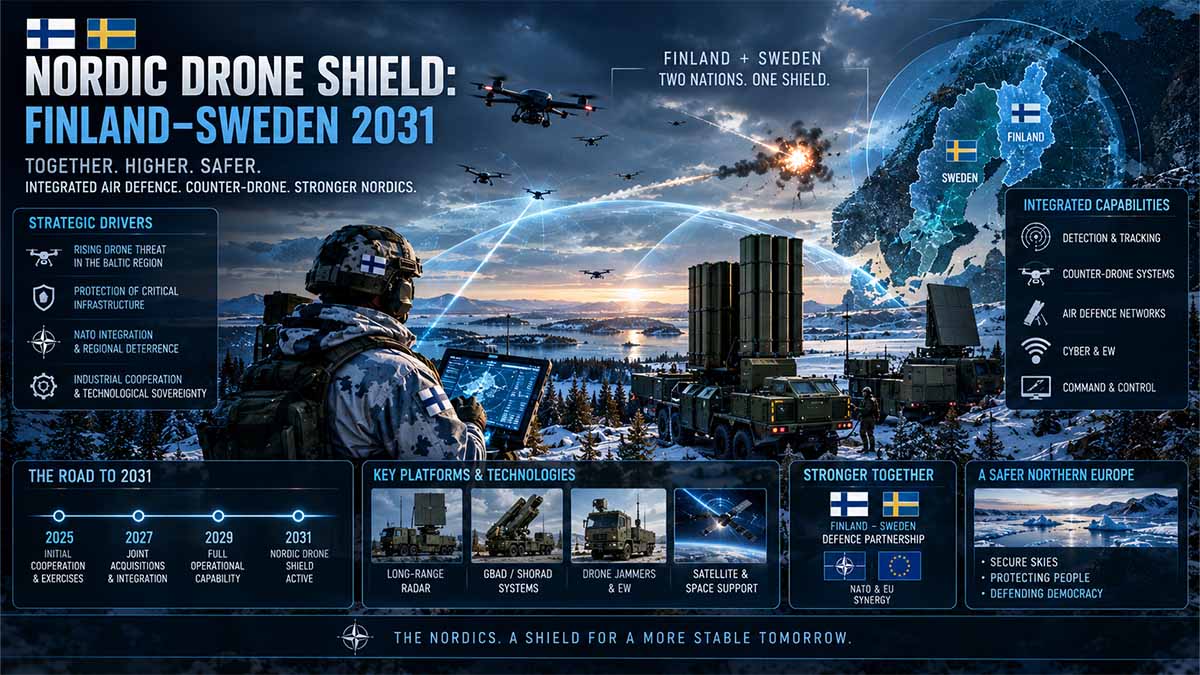
Executive Summary
- BLUF: the 28 August decision converts mature Finnish–Swedish interoperability into operational support for protecting Finnish territory.
- Sweden will contribute JAS 39 Gripen fighters and a Visby-class corvette at least until the end of 2026; Finnish command and sovereign decision-making remain decisive. Finland to cooperate more closely with Sweden in surveillance and protection of territorial integrity – Finnish Defence Forces – August 2026
- The official record confirms two armed drones entering Finland on 29 March and a precautionary emergency response on 15 May; it does not publicly confirm every causal or payload attribution contained in the supplied base text.
- The operational centre of gravity is not the individual interceptor but the integration of sensors, electronic warfare, command-and-control, identification and legally authorised effectors.
- Finland’s €50.2 million programme and Sweden’s counter-drone investments exceeding SEK 3.5 billion create complementary national layers rather than a single bilateral procurement project.
- The baseline five-year model assigns 59.0% to an institutionalised Nordic shield, 19.6% to episodic reinforcement and 21.4% collectively to capability lag, command friction or hybrid spillover.
- The principal 2026–2031 risk is adversarial adaptation: autonomous navigation, low-observable profiles, saturation, electronic deception and attacks below the threshold of armed aggression.
- Strategic success will depend on whether political integration produces a continuously usable operational picture, rapid attribution and an economically sustainable response architecture.
The new Nordic defense system emerges in the gray zone
On August 28, Finland and Sweden announced that they will jointly strengthen surveillance of Finnish territory and the ability to detect and counter drones. Viewed in isolation, the decision might seem like another step in the military cooperation accelerated by the two countries’ entry into NATO. In reality, it marks a more profound transition: Nordic defense is beginning to organize itself around threats that don’t necessarily come in the form of an overt attack, but rather cross the blurred line between incident, strategic pressure, and war.
Geography explains the urgency. On March 29, two drones entered southeastern Finland during Ukrainian attacks on Russian infrastructure in the Gulf of Finland. Finnish F/A-18s were scrambled, and the aircraft crashed near Kouvola. On May 15, the alarm was more serious: Helsinki received information that larger drones, equipped with larger explosive payloads, were likely to stray toward Finnish territory. Uusimaa received an emergency alert, surveillance was strengthened, and air and sea traffic was modified. The drones did not enter Finland, but the incident demonstrated that a country can be exposed to a weapon even without being the original target.
This is where cooperation with Stockholm gains value. Finland is not delegating its defense: in the 2026 supplementary budget, it allocated €50.2 million to counter-drone capabilities, including €44 million for the Border Guard and €6.2 million for the police. It is building a network of sensors, mobile systems, and neutralization tools along the Russian border, on the coasts, and around sensitive infrastructure. Sweden is adding technological depth, naval capabilities, air power, and a rapidly growing industrial base.
The Swedish LOKE system combines radar, electronic intelligence, electro-optical sensors, jamming, and engagement capabilities. Gute II brings the same logic to a more complex scale, integrating command and control, active and passive sensors, electronic warfare, and 30- and 40-millimeter guns. Orders related to the program totaled SEK 8.7 billion. Added to this expenditure is over SEK 3.5 billion for sensors, portable and vehicle-mounted jammers, warning systems, and interceptor drones. Deliveries, initially scheduled for 2036, have been brought forward to 2028.
The real innovation, however, lies not in the number of deployed devices. It lies in the ability to merge information gathered by the two countries, reduce the time between detection and decision, and choose the most appropriate effector for the risk. A drone is not just a flying platform: it is a complex system comprising navigation, radio links, software, an operator, and a logistics chain. If it depends on an external signal, it can be jammed or hijacked. If it flies autonomously, recognizes the terrain, and does not transmit, different sensors and, ultimately, a kinetic vehicle are needed.
This competition also has an economic dimension. Launching an expensive missile against every low-cost target means accepting the attacker’s strategy. Strikes can be designed to consume munitions, saturate command centers, disrupt civil aviation, and force the defender to keep personnel and systems on alert for extended periods. The real cost, therefore, is not the same as that of the interceptor: it includes sensors, personnel, energy, maintenance, false alarms, and suspended economic activity. Sustainable defense must use electronic jamming, interceptor drones, and cannons against less complex threats, reserving missiles and fighters for targets that justify the expense.
Then there remains the legal issue. Detecting an object does not mean being authorized to neutralize it. In peacetime, airports, energy companies, and telecommunications operators can detect a threat without having the power to jam frequencies or shoot down an aircraft. It is necessary to determine whether the object is civilian, criminal, hostile, or simply off course; which authority should assume command; whether the intervention is necessary and proportionate; and what risk the electronic jamming or falling debris poses.
The bilateral framework allows Swedish forces to operate in Finland even in peacetime, when Helsinki requests it. Since 2020, the Swedish government has been able to decide to send troops to assist Finland in preventing territorial violations. The Host Nation Support Agreement signed in 2022 further regulates mutual activities in peace, crisis, and war. However, integration does not erase sovereignty: the mission, powers, and possible use of force on Finnish soil must remain defined by a Finnish decision.
Between 2026 and 2031, the most likely scenario is not an open attack, but persistent pressure in the gray zone. Drones, satellite jamming, cyber reconnaissance, suspicious activity near undersea cables, and information campaigns can be employed separately or sequentially, leaving attribution uncertain. Finnish data show that 396 vessels reported satellite navigation interference in the first seven months of 2026, with the Gulf of Finland being the most exposed maritime area.
NATO responded by increasing its presence with Baltic Sentry and testing a network of over 70 autonomous air, sea, and underwater systems to monitor sensitive infrastructure and passages. But increased surveillance also leads to more encounters, more classified data, and more politically sensitive decisions. Any attribution of sabotage or a cyber attack must withstand technical, legal, and diplomatic scrutiny; otherwise, the information advantage could turn into a risk of escalation.
The Nordic shield will therefore not be judged solely by how many drones it can shoot down. The real measure will be its ability to distinguish an incident from a hostile operation, to act quickly enough to protect the territory, and with sufficient discipline to avoid handing control of the escalation over to the adversary. In the Baltics, the decisive line is no longer just the one drawn on the map: it is the one that separates an ambiguous signal from an irreversible decision.
Navigational Index
- From bilateral support to a Nordic operational shield
Force deployment, shared surveillance, command architecture and territorial-sovereignty safeguards. - The counter-UAS competition, 2026–2031
Sensors, EW, kinetic effectors, autonomous threats, saturation economics and industrial capacity. - Escalation, legal thresholds and shadow dimensions
Competing hypotheses, cyber exposure, information operations, procurement liquidity and Baltic spillover.
Master Abstract
The decision announced on 28 August 2026 is narrower in declared force composition, but strategically more consequential, than the supplied base text initially suggests. The Finnish Defence Forces state that Sweden will contribute JAS 39 Gripen fighters and a Visby-class corvette to surveillance and protection tasks in the Baltic region at least through the end of 2026. Swedish equipment is intended particularly to reinforce air surveillance and release Finnish resources for responding to violations or other incidents; the same statement connects the mission to regular Cross Border Training, the recognised maritime picture and the wider Nordic Air Power concept. Finland to cooperate more closely with Sweden in surveillance and protection of territorial integrity – Finnish Defence Forces – August 2026 This is therefore neither an improvised deployment nor evidence that Finland is transferring sovereign control of its airspace. It is an operational extension of an architecture developed through bilateral planning, reciprocal base support and compatible command procedures. Finnish Air Force documentation identifies the longstanding objectives of Finnish–Swedish air cooperation as interoperability in air operations, reciprocal base operations, compatible command-and-control procedures and a shared situational picture supporting joint missions. International Activities Develop Air Force Capability – Finnish Air Force – current institutional guidance The legal foundation is similarly concrete: the bilateral Host Nation Support memorandum signed on 7 June 2022 supports operational cooperation in peacetime, while a technical arrangement signed on 2 December 2025 clarified practical procedures. International Conventions – Ministry of Defence of Finland – December 2025 Swedish law also permits the government, following a Finnish request and in conformity with international law, to deploy Swedish armed forces—including air or naval units—to help prevent violations of Finnish territory in circumstances short of armed conflict. En lag om operativt militärt stöd mellan Sverige och Finland – Swedish Government Official Reports/Riksdag – April 2018 The strategic novelty is thus execution: capabilities and authorities previously developed for contingency readiness are being used for persistent territorial-surveillance reinforcement.
The immediate evidentiary chain begins on 29 March 2026, when slow-moving objects approached Finland’s territorial waters and Finnish F/A-18 Hornets were placed over the area. At 08:45, the Air Force visually identified one object south of Kouvola as a Ukrainian AN-196 drone, followed it and withheld fire because of the potential danger to civilians; it subsequently crashed north of Kouvola. A second drone also fell on Finnish territory. Ilmavoimat ylläpitää tehostettua valmiutta ilmatilan valvontaan ja vartiointiin – Finnish Air Force – March 2026 The Defence Forces later reported that the first aircraft retained an unexploded warhead, that radar tracking of slow targets was complicated by bird migration, and that peacetime interception had to balance the immediate threat against collateral risk. Press release updated on May 8: The Finnish Defence Forces prepares to establish temporary areas with airspace restrictions – Finnish Defence Forces – March/May 2026 These details expose the genuine operational problem: detection is not equivalent to classification, classification is not equivalent to lawful engagement, and engagement is not necessarily safe over populated territory. On 15 May, Finnish authorities received warning of drones that might stray toward the Helsinki–Porvoo area, increased air-surveillance personnel, adjusted the location and readiness of armed fighters, intensified the use of Army helicopters and naval vessels, raised Border Guard readiness and established a temporary aviation restriction. The warning was subsequently withdrawn without a confirmed incursion. Tiedotetta päivitetty 15.5.2026: Yleinen vaaratilanne ohi – Puolustusvoimat jatkaa tehostettua valvontaa – Finnish Defence Forces – May 2026 The accompanying civilian warning was explicitly described as precautionary. Director General for Rescue Services: Danger has passed, it is safe to go to school and work – Ministry of the Interior of Finland – May 2026 The public primary record does not establish the claim that Russian countermeasures caused the March deviations, nor does it disclose the alleged heavier payloads cited for May. Those propositions must remain unconfirmed rather than being elevated into intelligence judgments.
The five-year capability contest will be determined by whether Finland and Sweden can transform this event-driven response into a layered, distributed and economically sustainable system. Finland’s second supplementary budget earmarked €50.2 million, including €44 million for the Border Guard and €6.2 million for police capabilities, with development and use coordinated among the Defence Forces, Border Guard and police. Supplementary budget allocates funding for drone defence, removals from the country and citizenship test – Ministry of the Interior of Finland – June 2026 The declared architecture combines fixed detection and countermeasure systems along the eastern border and coastline with mobile capabilities deployable nationwide; Finland has separately applied for €35 million from the EU Border Management and Visa Policy Instrument. Government decides to apply for additional funding for detecting and countering drones – Ministry of the Interior of Finland – April 2026 Sweden contributes a different capability profile. Its LOKE system combines radar, signals intelligence, electro-optical sensors, jamming and engagement functions, while Swedish forces field soldier-carried, vehicle-mounted, naval and stationary counter-UAS solutions. Anti-drönarförmåga – Swedish Armed Forces – August 2026 Gute II adds common command-and-fire-control, active and passive sensors, electronic warfare, 30 mm and 40 mm guns, Giraffe 1X radar and electronic countermeasures, with initial deliveries scheduled across 2027–2028. FMV beställer svenskt luftvärnssystem – Swedish Defence Materiel Administration – April 2026 Sweden has allocated more than SEK 3.5 billion specifically to weapons, sensors, warning devices, jammers and interceptors, advancing final delivery from 2036 to 2028. More than SEK 5 billion for increased anti-drone capabilities and Gripen capabilities – Government Offices of Sweden – October 2025 The resulting system-of-systems will be credible only if it preserves an advantageous cost exchange: expensive fighters remain necessary for identification and sovereign air-policing, but routine defence against massed low-cost threats must migrate toward passive sensing, electronic defeat, guns and affordable interceptors.
The structured forecast applies five competing hypotheses rather than treating deeper integration as inevitable. H₁, an institutionalised Nordic shield, assumes Swedish surveillance becomes recurrent, sensor and command networks converge, and the bilateral mechanism becomes a regional operating model. H₂, episodic reinforcement, assumes deployments remain politically authorised responses to temporary pressure without permanent fusion. H₃, adaptation outruns procurement, anticipates that autonomous navigation, lower signatures, swarming and electronic hardening erode the advantage created by current acquisitions. H₄, command friction, holds that technical interoperability improves faster than peacetime identification, attribution and engagement authority. H₅, hybrid spillover, anticipates drones being combined with cyber intrusion, maritime interference, deceptive emissions and information operations below the armed-attack threshold. Conditioning equalised initial priors on the verified evidence—standing legal authorities, current deployment, existing cross-border air cooperation, funded procurement and deliveries expected by 2028—produces an initial analytic distribution of 59.0% for H₁, 19.6% for H₂, 5.6% for H₃, 5.0% for H₄ and 10.8% for H₅ across 10,000 seeded trials. These are structured estimates, not observed frequencies or classified intelligence. NATO’s commitment to invest more than USD 40 billion in counter-drone capabilities over five years strengthens the industrial and interoperability case for H₁, but also signals the scale of the perceived adaptation challenge. NATO’s Drone Edge – NATO – July 2026 The European Commission’s 2026 action plan adds civil–military testing, common performance requirements, high-risk-supplier assessment, production scaling and cross-border early-warning mechanisms. Action Plan on Drone and Counter Drone Security – European Commission – February 2026 In the shadow dimensions, procurement liquidity is therefore moving rapidly toward sensors and effectors, while cyber assurance, software supply chains and data governance become latent failure points. No verified primary evidence currently supports assigning mercenary formations a material role in the Finnish–Swedish counter-UAS mission, so that variable remains monitored but unactivated.
The geopolitical effect extends beyond bilateral defence. Sweden’s framework-nation role in NATO’s Forward Land Forces Finland, established in June 2026, places the surveillance decision within a larger northeastern-flank architecture, while Baltic Sentry and Eastern Sentry connect air, maritime, space and cyber awareness. Strengthening NATO’s eastern flank – NATO – June 2026 Yet tighter integration will also be interpreted through adversarial narratives. Russia’s Foreign Ministry publicly characterises the accession of Finland and Sweden as NATO expansion and the absorption of additional territory into the Alliance; this is evidence of Moscow’s declared information framing, not independent evidence of Russian operational intent. Ukraine, Europe and Global Security – Ministry of Foreign Affairs of the Russian Federation – June 2026 China’s official defence portal has likewise reproduced the narrative that NATO’s enlargement into Finland and Sweden reflects continued eastward expansion, providing a multilingual indicator of how the change is framed outside the Euro-Atlantic system rather than corroboration of battlefield causality. PLA Daily: Ten international military hotspots in 2022 – Ministry of National Defense of the People’s Republic of China – December 2022 Between 2026 and 2031, the most consequential threshold will therefore not be the arrival of an additional Swedish platform. It will be the moment at which a detection by one country can be classified, legally evaluated, assigned and countered through a common operational picture without losing national political control. If that chain becomes routine, Finland and Sweden will have created a prototype for distributed European territorial defence. If it remains dependent on exceptional warnings and bespoke authorisations, the partnership will still add capacity, but its deterrent value will remain episodic and vulnerable to saturation.
Adaptive deterrence under drone spillover
Analytic assumptions
Posterior scenario distribution
From Bilateral Support to a Nordic Operational Shield
Operational meaning of the August decision
The decision announced on 28 August 2026 marks the transition from bilateral interoperability as a contingency capability to bilateral interoperability as an active territorial-surveillance function. The publicly confirmed force package is precise: Sweden will participate with JAS 39 Gripen combat aircraft and a Visby-class corvette in the Baltic Sea region, with cooperation continuing at least until the end of 2026. The Swedish contribution is intended particularly to reinforce air surveillance, allowing the Finnish Defence Forces to preserve national assets for interception, territorial-violation response and other contingencies. The same official statement connects the deployment to regular Cross Border Training, the recognised maritime picture and the broader Nordic Air Power concept involving Finland, Sweden, Norway and Denmark. Finland to cooperate more closely with Sweden in surveillance and protection of territorial integrity – Finnish Defence Forces – August 2026 The operational significance therefore exceeds the number of deployed platforms. Sweden is supplying surveillance persistence, sensor coverage and force-generation relief; Finland retains the territorial depth, national warning system, interception infrastructure and sovereign responsibility for its airspace and waters. The arrangement does not publicly disclose detailed rules of engagement, tactical-control relationships, sensor-classification protocols or the circumstances under which a Swedish platform could apply force. Those omissions are operationally normal but analytically important: they prevent an evidence-based conclusion that Sweden has received autonomous engagement authority inside Finnish territory. The defensible judgment is narrower. Finland and Sweden have activated a prepared legal and military framework through which Swedish forces can support Finnish territorial-integrity functions during peacetime, while the final constitutional responsibility for Finnish territory remains with Finnish institutions. This is the first structural element of an operational shield: shared capacity without an acknowledged transfer of sovereignty.
Force deployment as a distributed operational system
The Swedish deployment should be analysed as a distributed force package rather than as an isolated reinforcement. In the air domain, Gripen aircraft can extend surveillance endurance, conduct visual identification, correlate airborne observations with ground radar tracks and reduce the burden placed on Finnish quick-reaction aircraft. Finland’s own documented peacetime procedure relies on a fixed radar network operating continuously, reinforced when necessary by mobile short-range radar, fighter aircraft, naval vessels and Army helicopters. Finnish authorities have also stated that fighters remain central because Finland must cover approximately 1,300 kilometres of land border and extensive maritime approaches, while ground-based systems cannot be positioned everywhere. The decision not to fire on a drone near Kouvola in March 2026 demonstrated that interception is a chain of legal and operational judgments rather than a mechanical response to radar detection: authorities had to identify the target, evaluate the threat, model the danger to civilians and determine whether kinetic action would create greater harm than continued tracking. Press release updated on May 8: The Finnish Defence Forces prepares to establish temporary areas with airspace restrictions – Finnish Defence Forces – March/May 2026 In the maritime domain, the Visby-class corvette adds mobile radar, electro-optical observation, communications and naval presence to an already established recognised maritime picture. Its value is not confined to tracking airborne objects: a corvette can correlate air, surface and electromagnetic activity across the Baltic operating environment, where drone flight paths, maritime traffic, electronic interference and critical-infrastructure protection increasingly overlap. The combined structure distributes sensing across different altitudes, locations and services. Its strategic advantage is redundancy; its primary vulnerability is fusion latency. If Swedish observations enter the Finnish decision chain too slowly, the deployment adds coverage but not decisive response speed.
| Operational layer | Swedish contribution | Finnish sovereign function | Five-year integration requirement |
|---|---|---|---|
| Air surveillance | JAS 39 Gripen, airborne identification, patrol persistence | National air picture, interception decisions, territorial-integrity enforcement | Common track standards and machine-speed sensor correlation |
| Maritime surveillance | Visby-class corvette, mobile Baltic sensing and naval presence | Finnish territorial-water control and national maritime response | Persistent recognised maritime picture and cross-domain alerting |
| Ground and border layer | Deployable Swedish counter-UAS and EW experience | Border Guard, police and Defence Forces counter-drone responsibilities | Compatible data formats, mobile sensors and authority-specific workflows |
| Sustainment | Reciprocal access, maintenance and logistical support | Host-nation infrastructure, permissions and force protection | Pre-agreed support packages, spares, secure communications and dispersal |
| Strategic reinforcement | Swedish NATO framework-nation role | Finnish territorial defence and national mobilisation | Alignment without merging constitutional command authority |
Shared surveillance and the sensor-to-decision architecture
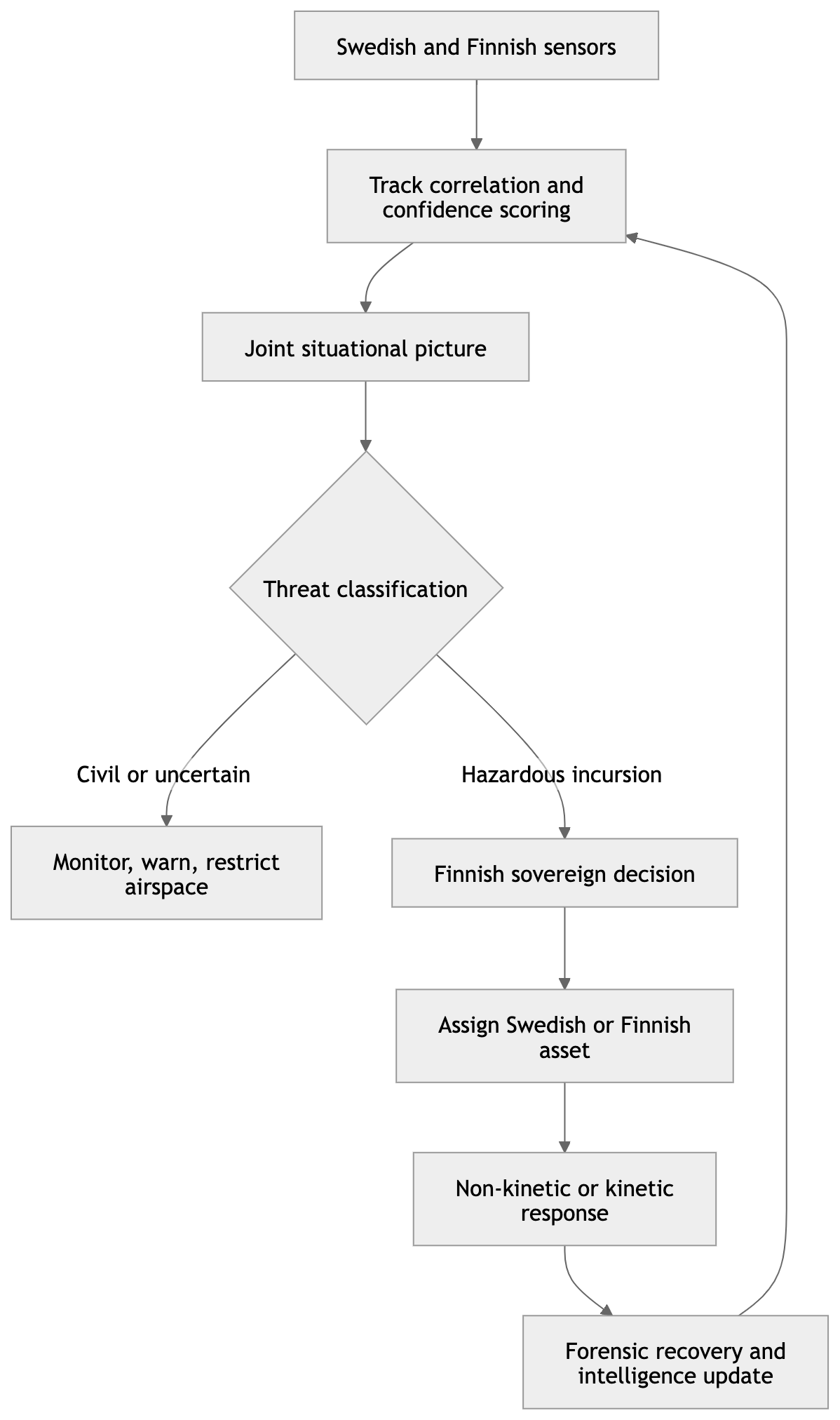
Finnish–Swedish air cooperation was designed before the August deployment around three interoperable areas: air operations, reciprocal base operations, and command-and-control. Finnish Air Force documentation states that the command-and-control objective is to establish the technical conditions and joint procedures through which the two air forces can share the situational picture required for operational decision-making and leadership, while the overarching goal is the ability to conduct joint air operations. The same framework includes regular Cross Border Training and reciprocal ground support at Finnish and Swedish bases. International Activities Develop Air Force Capability – Finnish Air Force – current institutional guidance The decisive issue for 2026–2031 will consequently be whether this architecture progresses from exchanging recognised tracks to producing a common, confidence-scored operational picture. A drone track is not a complete intelligence object. The system must associate radar behaviour, flight profile, electro-optical imagery, radio-frequency emissions, navigational anomalies, civil-air-traffic data and contextual intelligence before assigning a classification. It must also retain the provenance of every observation so that Finnish decision-makers can distinguish a Swedish sensor report from a Finnish radar track, determine confidence and identify unresolved contradictions. This requires more than network connectivity. It requires compatible metadata, synchronized timing, shared track identifiers, rules for eliminating duplicate detections, common thresholds for declaring an unidentified object hostile or hazardous and resilient procedures for operating during satellite-navigation disruption or cyberattack. Ramstein Flag 26 demonstrated that Nordic air forces can execute large multinational missions, but the Finnish Air Force also identified continuing lessons in information management and the integration of operational-planning systems. Ramstein Flag 26 strengthened Nordic Air Power as part of NATO – Finnish Air Force – June 2026 That finding defines the real five-year conversion problem: physical platforms are already interoperable enough to operate together, but a shield requires shared data to remain accurate, timely, attributable and operationally usable under deliberate electronic and cyber pressure.
Command architecture and the distinction between coordination and authority
The emerging architecture contains at least four command layers that must cooperate without becoming conceptually confused. The first is Finnish national command for territorial surveillance and territorial-integrity enforcement. The second is the bilateral Finnish–Swedish coordination mechanism supporting air, maritime and host-nation activities. The third is the Nordic operational layer developed through Nordic Air Power, joint exercises and common situational-awareness practices. The fourth is NATO’s regional command structure, including the Forward Land Forces Finland formation and the Alliance’s northeastern-flank planning. In June 2026, NATO’s multinational Forward Land Forces began operating in Finland and Sweden under Sweden as framework nation. Sweden committed a battalion battlegroup, a multinational staff element in Rovaniemi and approximately 600 personnel in 2026, with an option to expand to 1,200; the principal Swedish force is prepositioned in Boden for rapid reinforcement of northern Finland. Swedish troops to be placed under NATO command in FLF Finland – Government Offices of Sweden – June 2026 NATO separately confirms that Sweden leads the ninth multinational Forward Land Forces formation on the northeastern flank. NATO enhances security in the Arctic and High North – NATO – June 2026 This NATO structure strengthens reinforcement, logistics, planning and escalation resilience, but it should not be treated as proof that the August Gripen and Visby mission operates under the same command relationship. The public documentation does not disclose that relationship. A rigorous model must therefore distinguish operational coordination, tactical control, national command, NATO transfer of authority and sovereign permission to employ force. Conflating them would exaggerate the degree of integration and obscure the legal safeguards that make peacetime cooperation politically sustainable.
| Command layer | Principal function | Authority boundary | Failure mode |
|---|---|---|---|
| Finnish national command | Protect Finnish territory and determine national response | Finnish constitutional and statutory authority | Delayed classification or over-centralised approval |
| Bilateral Finnish–Swedish mechanism | Coordinate assets, support and shared surveillance | Decisions separately authorised by the two governments | Ambiguous tactical control or incompatible procedures |
| Nordic Air Power | Joint planning, bases, exercises and situational awareness | Does not independently replace national command | Technical integration without common operational doctrine |
| NATO regional command | Collective defence, reinforcement and multi-domain planning | Operates through agreed NATO command arrangements | Peacetime incident handled through an unnecessarily escalatory frame |
| Civil-authority network | Police, Border Guard, aviation safety and public warning | Authority varies by threat, location and legal classification | Information barriers or conflicting response mandates |
The legal mechanism and territorial-sovereignty safeguards
The legal framework reduces deployment latency but does not erase national discretion. Finland and Sweden signed their bilateral Host Nation Support memorandum on 7 June 2022. Finland’s Ministry of Defence states that the arrangement applies across security situations, establishes the basis for operational cooperation in peacetime and facilitates separately agreed support for foreign forces. Finland and Sweden to sign Host Nation Support Memorandum of Understanding – Ministry of Defence of Finland – June 2022 A technical arrangement signed on 2 December 2025 made practical procedures more precise and was prepared through cross-government cooperation because its execution affects several administrative branches. Minister of Defence Antti Häkkänen: We will strengthen the defence of Finland and Sweden through a new technical arrangement on host nation support – Ministry of Defence of Finland – December 2025 Sweden’s parallel legal evolution is equally important. Since October 2020, the Swedish government has been authorised under the Act on operational military support, 2020:782, to decide on deploying Swedish armed forces at Finland’s request to assist in preventing violations of Finnish territory and to receive Finnish military support in defined circumstances. Defence cooperation intensified in stages – Government Offices of Sweden – January 2024 These instruments solve different problems. The operational-support act provides Swedish domestic decision authority; the bilateral host-nation framework establishes conditions for access, support and activity on the other state’s territory; Finnish law and Finnish operational authority govern the protection of Finland’s territory. The sovereignty safeguard is therefore produced through layered consent: a Finnish request or acceptance, a Swedish deployment decision, agreed mission parameters, host-nation arrangements, nationally valid authorities and rules for transferring or retaining tactical control. The safeguard fails if political leaders treat the existence of a legal pathway as equivalent to automatic engagement authority. It succeeds when every mission order identifies geography, duration, permitted tasks, information-access rules, command relationships and termination conditions.
| Sovereignty gate | Required determination | Safeguard produced | Residual uncertainty |
|---|---|---|---|
| Political invitation | Finland requests or accepts defined Swedish support | Preserves Finnish consent | Public documents may omit mission scope |
| Swedish deployment decision | Sweden authorises forces under domestic law | Preserves Swedish democratic accountability | Decision speed during rapidly developing incidents |
| Host-nation activation | Logistics, access, communications and support are agreed | Prevents improvised foreign-force activity | Classification and information-sharing restrictions |
| Command assignment | Tactical relationships are specified for the mission | Prevents competing orders | Exact August 2026 arrangement is not public |
| Use-of-force authorisation | Threat, proportionality and civilian risk are evaluated | Protects sovereignty and population | Drone timelines may be shorter than approval timelines |
| Termination and review | Mission ends, renews or changes through political decision | Prevents indefinite normalisation without oversight | Temporary deployments may become functionally persistent |
Counter-UAS capacity as the material foundation of the shield
A durable operational shield cannot depend indefinitely on fighter patrols and a single naval deployment. The economic and tactical mismatch between inexpensive drones and high-cost air-policing sorties requires a layered architecture in which the least expensive adequate effect is assigned to each threat. Finland’s 2026 supplementary budget earmarked €50.2 million for counter-drone development, including €44 million for the Border Guard and €6.2 million for the police, with procurement and use coordinated among the Defence Forces, Border Guard and police. Supplementary budget allocates funding for drone defence, removals from the country and citizenship test – Ministry of the Interior of Finland – June 2026 Sweden’s October 2025 programme allocated more than SEK 3.5 billion to counter-drone weapons, sensors, warning devices, wearable and vehicle-mounted jammers and interceptors, advancing final delivery from 2036 to 2028. More than SEK 5 billion for increased anti-drone capabilities and Gripen capabilities – Government Offices of Sweden – October 2025 Sweden’s LOKE demonstrator combines radar, signals intelligence, electro-optical sensors, jamming and engagement capabilities; the Swedish Armed Forces explicitly define counter-UAS as action against the entire system comprising aircraft, control, data transmission and operator. Anti-drönarförmåga – Swedish Armed Forces – August 2026 The Gute II programme is still more consequential industrially: Sweden’s Defence Materiel Administration identifies orders worth SEK 8.7 billion covering common command-and-fire-control, active and passive sensors, electronic warfare, 30 mm and 40 mm guns, Giraffe 1X radar and associated vehicles, with deliveries scheduled through 2027–2028. FMV beställer svenskt luftvärnssystem – Swedish Defence Materiel Administration – April 2026 By 2031, the shield’s credibility will depend on integrating these effectors into a common assignment logic while preventing automatic escalation from detection to destructive action.
Competing hypotheses for the 2026–2031 transition
The Analysis of Competing Hypotheses yields five structurally distinct futures. H₁, the institutionalised Nordic operational shield, expects the August arrangement to become recurrent, with Swedish and Finnish sensors, bases, maritime surveillance and counter-UAS assets connected through routine command procedures. H₂, episodic reinforcement, expects Sweden to provide assets only during heightened warning periods, preserving cooperation but preventing a permanent integrated posture. H₃, NATO functional absorption, anticipates that bilateral arrangements remain legally important but operational planning migrates increasingly into NATO’s Nordic and northeastern-flank command structures. H₄, sovereignty and command friction, expects legal authority to exist while different evidentiary thresholds, rules of engagement, data restrictions or political approval timelines constrain rapid action. H₅, adversarial adaptation, anticipates that the shield develops materially but loses relative effectiveness as autonomous navigation, passive flight profiles, electronic deception, swarming or cyber operations complicate detection and classification. No hypothesis should be treated as mutually exclusive in every operational detail; the ACH procedure instead identifies which mechanism becomes dominant. Current evidence favours H₁ because forces have been deployed, HNS procedures have been refined, joint air operations are routinely exercised, Sweden leads FLF Finland and funded counter-UAS deliveries arrive before 2029. H₂ remains the strongest alternative because the publicly declared Gripen and Visby mission presently has a limited duration. H₃ gains support from NATO command integration but is weakened by the continuing legal importance of national territorial-integrity authorities. H₄ is plausible because the decisive engagement procedures remain undisclosed, while H₅ receives support from the accelerating technological and electronic-warfare competition but lacks direct evidence that the bilateral system has already been operationally defeated.
| Hypothesis | Initial prior | Evidence-adjusted 2026 probability | Baseline 2031 probability | Principal confirming indicator |
|---|---|---|---|---|
| H₁ Institutionalised Nordic shield | 30% | 39% | 59% | Recurring Swedish deployments and permanently connected surveillance |
| H₂ Episodic reinforcement | 25% | 29% | 18% | Assets repeatedly activated but withdrawn after each alert period |
| H₃ NATO functional absorption | 18% | 13% | 10% | Bilateral control functions migrate predominantly into NATO structures |
| H₄ Sovereignty or command friction | 15% | 10% | 5% | Delayed decisions, restricted data exchange or disputed authority |
| H₅ Adversarial adaptation | 12% | 9% | 8% | Persistent detection failures, EW disruption or saturation breakthroughs |
Bayesian update and Monte Carlo risk model
The Bayesian update begins with deliberately dispersed priors because the August deployment is new and its classified operational arrangements are unavailable. Evidence was grouped into five independent analytical families: E₁, demonstrated deployment continuity; E₂, legal and host-nation maturity; E₃, command-and-control interoperability; E₄, funded industrial delivery; and E₅, adversarial adaptation pressure. The posterior increases H₁ because E₁ through E₄ all provide positive likelihood ratios, while the declared end-of-2026 horizon prevents the model from collapsing H₂. The Monte Carlo layer then subjects the five-year transition to 50,000 simulated paths. Each path samples deployment continuity, sensor-fusion maturity, political decision latency, procurement delivery, communications resilience and adversarial adaptation from bounded distributions; the simulation is an analyst-generated forecasting instrument, not an empirical measurement or classified estimate. The baseline produces a 2031 modal result of 59% for H₁, with a modeled uncertainty interval of approximately 46–69% under moderate integration and threat-adaptation assumptions. H₂ settles near 18%, H₃ near 10%, H₄ near 5% and H₅ near 8%. The most sensitive variable is not procurement volume but the interaction between sensor-fusion maturity and sovereign decision latency. Increasing the number of radars or interceptors without shortening the interval between detection, classification and assignment produces diminishing returns. Conversely, faster decision-making without resilient identification increases the probability of misclassification and unintended escalation. NATO’s July 2026 commitment to invest more than USD 40 billion in counter-drone capabilities over five years strengthens the industrial-delivery variable and creates a marketplace for tested, compatible systems. NATO’s Drone Edge – NATO – July 2026 It does not, however, solve bilateral sovereignty or command design; those remain national and mission-specific.
| Model variable | Baseline score | 2031 direction | Sensitivity to H₁ | Critical warning threshold |
|---|---|---|---|---|
| Deployment continuity | 58/100 | Rising | Very high | Swedish support remains exceptional after 2028 |
| Sensor and C2 fusion | 67/100 | Rising | Very high | Track exchange remains manual or non-real-time |
| Legal decision speed | 62/100 | Moderately rising | Very high | Approval cycle exceeds tactical warning time |
| Industrial delivery | 71/100 | Strongly rising through 2028 | High | Major Gute II or Finnish procurement delay |
| Communications resilience | 60/100 | Uncertain | High | Repeated GNSS, datalink or cyber disruption |
| Adversarial adaptation | 64/100 | Rising | Negative | Autonomous saturation defeats current classification methods |
Shadow dimensions: cyber norms, liquidity and non-state actors
The shield’s visible military layer will depend on less visible systems of trust, capital and technical governance. The cyber dimension concerns who can access the shared picture, which software components can modify track data, how sensor provenance is authenticated and whether bilateral communications can continue during network compromise. Finland and Sweden co-lead NATO’s Innovation Range for Future Connectivity, focused on resilient and secure next-generation communications, indicating that connectivity is treated as an operational capability rather than an administrative utility. New NATO Innovation Range starts counter-drone technology testing in Latvia – NATO – March 2026 The European Commission’s 2026 Action Plan similarly prioritises interoperability, civil–military standards, counter-drone testing, certification, supplier-risk assessment and cross-border early-warning mechanisms. Action Plan on Drone and Counter Drone Security – European Commission – February 2026 Liquidity flows are concentrated increasingly in sensors, autonomous systems, electronic warfare, interceptors and production capacity: Finland’s national allocation, Sweden’s multi-billion-kronor programmes and NATO’s aggregate commitment create a strong capital signal, but they also generate risks of duplicated procurement, vendor lock-in and capability fragmentation. The mercenary or private-military-company dimension is presently a null but monitored variable. No verified primary source examined for this section links mercenary formations to the Finnish–Swedish territorial-surveillance mission. Non-state relevance instead lies primarily in commercial drone supply chains, privately operated critical infrastructure, telecommunications providers, software vendors and civilian aviation. The analytical discipline is to avoid filling an evidentiary absence with speculation: private military actors remain an indicator for future monitoring, not a current driver of the bilateral shield.
| Shadow dimension | Current evidence status | Potential operational effect | Priority indicator |
|---|---|---|---|
| Cyber compromise | Structurally credible; no disclosed breach of this mission | Corrupted tracks, delayed classification, false target generation | Authentication failures or unexplained track divergence |
| Supplier dependence | Material and increasing | Restricted upgrades, compromised components, delivery bottlenecks | Concentration in proprietary sensors or datalinks |
| Defence liquidity | Strongly positive | Faster procurement and production scaling | Contract execution and actual fielding by 2028 |
| Civil-infrastructure integration | Necessary but uneven | Better warning coverage or new attack surface | Integration of ports, airports, telecoms and energy operators |
| Information operations | Highly plausible | Public panic, pressure for overreaction, alliance-friction narratives | Coordinated false reports during real drone alerts |
| Mercenary dynamics | No verified operational linkage | Low current relevance | Evidence of proxy reconnaissance or contracted sabotage networks |
Geopolitical interpretation and multilingual cross-checking
Russian and Chinese official narratives do not independently verify the operational facts of the Nordic shield, but they reveal how the architecture is likely to be framed in adversarial information environments. A June 2026 article published through the Russian Foreign Ministry system describes NATO as having expanded eastward by absorbing Finland and Sweden. Article by Sergey Lavrov “Ukraine, Europe and Global Security” – Ministry of Foreign Affairs of the Russian Federation – June 2026 Another Russian diplomatic publication characterises Sweden’s post-accession development as accelerated organisational and technical integration into NATO. The EU’s militarisation – Permanent Mission of the Russian Federation to the European Union – November 2025 These are official Russian positions, not neutral threat assessments, but they indicate that Moscow is unlikely to describe Swedish participation in Finnish territorial surveillance as a narrowly defensive efficiency measure. China’s Ministry of National Defense portal has likewise presented Finnish and Swedish accession within a narrative of repeated NATO enlargement. PLA Daily: Ten international military hotspots in 2022 – Ministry of National Defense of the People’s Republic of China – December 2022 The multilingual comparison therefore supports a specific geopolitical judgment: the shield’s defensive legal design will not prevent it from being represented externally as an extension of NATO military infrastructure toward Russia. That perception increases the value of transparent political messaging, narrowly drafted mission mandates and disciplined public attribution. It also raises the probability of countermeasures below the armed-conflict threshold, including electronic interference, reconnaissance, cyber probing and narrative operations intended to exploit disagreements over sovereignty or escalation. The correct analytical use of Russian and Chinese sources is consequently diagnostic: they reveal declared framing and potential influence themes, while Finnish, Swedish, NATO and EU documents establish the operational facts.
Five-year outlook and decisive indicators
Between 2026 and 2027, the arrangement will remain a proof-of-operability phase. The principal tests will be whether Swedish air and maritime assets can enter Finnish surveillance cycles without creating parallel pictures, whether bilateral logistics function under sustained readiness and whether exercises rehearse the political-to-tactical decision chain rather than only platform interoperability. During 2027–2028, the centre of gravity will shift toward fielding: Swedish Gute II deliveries, expanded jammers and interceptors, Finnish Border Guard and police procurement, and improved NATO counter-drone availability should permit a transition from high-cost fighter-centric responses to layered assignment. The critical 2028 decision will be whether temporary Swedish participation becomes a recurring rotational mechanism or whether Finland instead absorbs the lessons into national capability. During 2029–2030, the decisive challenge will be adversarial adaptation. Autonomous navigation, reduced radio-frequency dependence and multi-axis saturation could weaken systems optimized for detecting and jamming remotely controlled drones. The shield will then require distributed passive sensors, software-defined command systems, alternative navigation, rapid intelligence updates and inexpensive effectors. By 2031, an operational shield should be measured through performance rather than declarations: the time required to create a correlated track; the proportion of detections classified without visual fighter identification; the ability to maintain the recognised picture during electronic attack; the number of bases capable of supporting the other country’s aircraft; the availability of non-kinetic and kinetic options; and the frequency with which command procedures are exercised under realistic legal constraints. Failure to publish operational details is not itself evidence of weakness, but persistent absence of observable exercises, deployments and procurement delivery would require lowering H₁ and raising H₂ or H₄.
Strategic judgment
The Nordic operational shield is emerging not because Finland and Sweden have created a supranational defence authority, but because they have assembled the conditions for rapid, reversible and legally controlled mutual support. Its resilience derives from this modularity. Sweden can supply aircraft, naval surveillance, electronic-warfare experience, deployable counter-UAS systems and NATO framework leadership; Finland supplies the geographic front line, territorial-surveillance infrastructure, host-nation depth, national interception authority and a mature whole-of-government security model. The architecture becomes strategically significant when those components operate as one sensor-to-decision system while remaining politically separable. The five-year baseline therefore favours institutionalisation, but not an unrestricted merger. The likely end state is a federated shield: shared tracks, reciprocal bases, interoperable effectors, common exercises and pre-negotiated support packages, combined with national control over force employment and escalation. Three conditions could invalidate that projection. First, an operational incident causing civilian casualties or contested attribution could slow political integration. Second, cyber or electronic disruption could demonstrate that the common picture is less resilient than national systems. Third, procurement could produce technically incompatible national layers despite political commitments to interoperability. Conversely, recurring Swedish deployments after 2026, demonstrable integration of Finnish and Swedish counter-UAS systems, shorter decision timelines and realistic exercises involving both civil and military authorities would raise H₁ above the present 59% baseline. The strategic test is therefore not whether Sweden can place forces in Finland; that question has been legally and operationally answered. The test is whether both states can repeatedly convert shared awareness into proportionate action faster than a changing threat can exploit the seams between detection, command, law and sovereignty.
Nordic operational-shield pathways, 2026–2031
The Counter-UAS Competition, 2026–2031
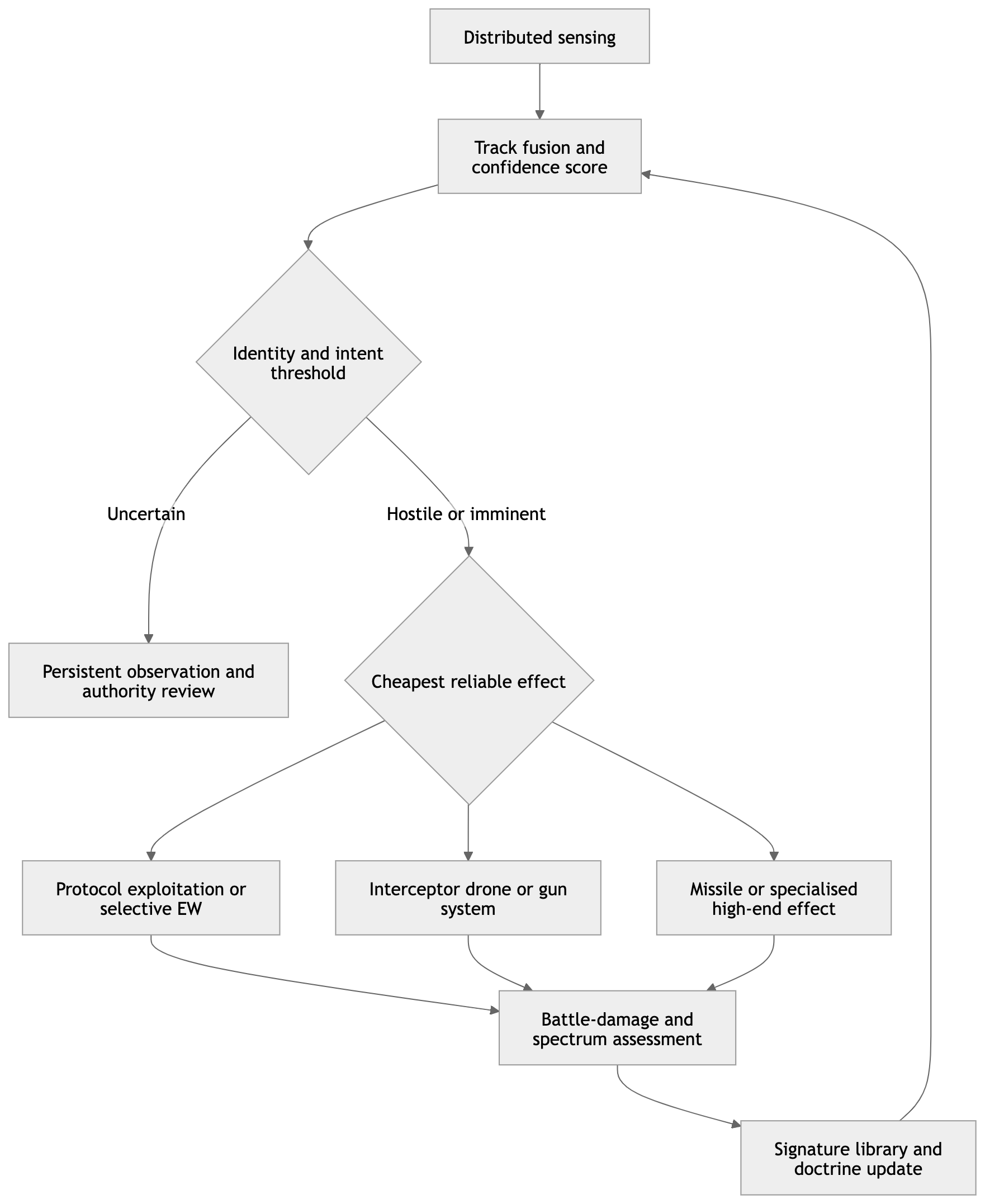
The decisive counter-UAS contest through 2031 will not be determined by possession of a single superior jammer, radar, gun or interceptor; it will be determined by whether defenders can construct an affordable, geographically distributed and continuously learning kill chain whose decision speed remains shorter than the attacker’s adaptation cycle. The relevant operational sequence is detect, correlate, classify, assign, engage, assess and update. Failure at any point can invalidate the entire system: a radar track without identification produces hesitation; identification without legal authority delays engagement; an authorised engagement without a suitable low-cost effector creates an economically irrational intercept; and a successful intercept without forensic exploitation forfeits intelligence about navigation, datalinks, components and launch networks. The European Commission accordingly treats drones and counter-drone systems as an integrated industrial-security problem encompassing artificial intelligence, autonomy, swarming, electronic-warfare resistance, testing infrastructure, cybersecurity, common standards and mass production, rather than as an isolated air-defence procurement category. Action Plan on Drone and Counter Drone Security – European Commission – February 2026 — Verified primary source. This systems interpretation is particularly important for Finland and Sweden, whose operating environment combines long borders, forests, coastal archipelagos, dense civilian electromagnetic activity, Arctic weather, critical maritime infrastructure and strict peacetime rules governing interference or weapons employment. The five-year competitive question is therefore not simply whether Nordic forces can destroy drones. It is whether they can maintain a sufficiently accurate common air picture, preserve communications under electromagnetic attack, discriminate hostile systems from lawful traffic, allocate the cheapest effective countermeasure, and replenish sensors and effectors faster than adversaries can change signatures, navigation methods, attack geometry and production volume.
Sensors: the classification problem precedes the engagement problem
Sensor effectiveness must be measured against the complete probability chain rather than nominal detection range. For analytical purposes, the probability of successful defeat can be decomposed as P₍defeat₎ = P₍detect₎ × P₍track₎ × P₍classify₎ × P₍authorize₎ × P₍engage₎ × P₍kill₎; Unicode parentheses avoid implying that these variables are independent, because weather, clutter, latency and electronic attack create strong correlations between them. A system achieving 95% performance at each of six stages produces an aggregate success probability of only approximately 74%, demonstrating why marginal improvements in fusion and command latency can outperform an expensive improvement confined to the final effector. Small drones present especially difficult signatures: low radar cross-section, flight near trees or buildings, low thermal contrast, intermittent radio emissions and speeds overlapping birds or civilian aircraft. Active radar supplies range and velocity but exposes emissions and encounters ground or sea clutter; passive radio-frequency detection can reveal command links and operators but becomes ineffective against pre-programmed, frequency-agile or emission-controlled aircraft; electro-optical and infrared sensors strengthen classification but depend on visibility, line of sight and automated image recognition; acoustic arrays can assist local warning but degrade under wind, machinery and urban noise. Sweden’s LOKE architecture reflects this requirement by combining radar, signals intelligence, electro-optical sensors, jamming and engagement functions, while the Swedish Armed Forces explicitly defines the threat as a system comprising aircraft, control, signal transmission and operator. Anti-drönarförmåga – Swedish Armed Forces – August 2026 — Verified primary source. By 2031, the critical sensor advantage will consequently reside in multi-phenomenology correlation, confidence scoring, automated anomaly detection and track continuity across administrative boundaries, not in the isolated specifications of any single sensor.
| Sensor layer | Principal contribution | Structural vulnerability | 2031 operational requirement |
|---|---|---|---|
| Active radar | Range, bearing, altitude and velocity | Clutter, low radar cross-section, emission exposure | Networked low-altitude coverage with adaptive classification |
| Passive RF/ELINT | Datalink detection, protocol analysis, operator geolocation | Autonomous, fibre-guided or emission-controlled threats | Wideband libraries updated from operational exploitation |
| Electro-optical/infrared | Visual confirmation and terminal tracking | Weather, obscuration, background temperature and line of sight | Automated multispectral classification with human verification |
| Acoustic sensing | Cheap local warning and directional cueing | Wind, traffic, machinery and short effective range | Distributed edge processing around protected sites |
| Civil aviation data | Deconfliction and reduction of false positives | Non-cooperative targets and incomplete low-altitude coverage | Machine-readable integration with sovereign military tracks |
| Space and airborne sensing | Wide-area cueing and launch-pattern analysis | Revisit limits, latency and atmospheric constraints | Cue-to-track integration rather than reliance on continuous custody |
Electronic warfare: scalable first response, declining universality
Electronic warfare will remain the lowest-cost and most scalable engagement layer where the target depends on external control, satellite navigation or an exploitable communications protocol, but its aggregate utility will decline if treated as a universal answer. A jammer may deny a command link, degrade video transmission, force a return-to-home routine, disrupt satellite-navigation reception or create a navigation error through spoofing; passive SIGINT may additionally identify the controller and permit law-enforcement action against the operator. These advantages are attractive in peacetime because they can provide reversible or non-explosive effects where kinetic fire would create unacceptable danger. The Swedish Armed Forces explicitly notes that disrupting communications can prevent incursions while helping locate the operator and that the legal space for kinetic engagement is normally constrained in peacetime. Anti-drönarförmåga – Swedish Armed Forces – August 2026 — Verified primary source. However, every success achieved through jamming incentivises the attacker to move toward inertial navigation, terrain matching, visual navigation, directional antennas, frequency agility, encrypted mesh networks, autonomous terminal recognition or pre-loaded routes. Broad-area jamming also imposes friendly costs by degrading military communications, emergency services, navigation, aviation systems and civilian infrastructure. The 2026 EU action plan recognises both the increasing electronic-warfare resistance of unmanned systems and the need for trusted chips, supply-chain risk assessment, security-by-design and an EU Trusted Drone Label. Action Plan on Drone and Counter Drone Security – European Commission – February 2026 — Verified primary source. The 2031 requirement is therefore cognitive and selective EW: receivers must identify waveform behaviour, infer control architecture, allocate power and spectrum precisely, assess whether interference achieved a mission kill, and preserve friendly-spectrum access. The defensive objective is not maximum radiated power; it is maximum hostile-system disruption per unit of spectrum, energy and collateral electromagnetic effect.
Kinetic effectors and the engagement ladder
Kinetic defence remains indispensable because autonomous, hardened or communications-independent threats may not present an exploitable electronic dependency, yet kinetic architecture must avoid substituting a high-cost air-defence missile for every inexpensive target. The rational engagement ladder begins with passive protection, manoeuvre, camouflage and deception; progresses through protocol exploitation and selective EW; then employs recoverable or expendable interceptor drones, cannon fire, proximity-fused ammunition or other short-range effectors; and reserves missiles and combat aircraft for threats whose speed, altitude, payload or trajectory justify their opportunity cost. Sweden’s Gute II represents a concrete layered approach rather than a single-weapon purchase. The Swedish Defence Materiel Administration identifies a shared command-and-fire-control system, active and passive sensors, electronic-warfare systems and kinetic effectors based on 30 mm and 40 mm guns within orders valued at SEK 8.7 billion. FMV beställer svenskt luftvärnssystem – Swedish Defence Materiel Administration – April 2026 — Verified primary source. Separately, Sweden allocated more than SEK 3.5 billion to weapons, sensors, warning devices, wearable and vehicle-mounted jammers and interceptors, accelerating final delivery from 2036 to 2028. More than SEK 5 billion for increased anti-drone capabilities and Gripen capabilities – Government Offices of Sweden – October 2025 — Verified primary source. These investments indicate that the Nordic model is moving toward engagement diversity and magazine depth. By 2031, success should be evaluated through cost per defended target-hour, simultaneous engagement capacity, reload time, probability of debris damage, training burden and replenishment rate—not merely probability of kill in controlled trials. Directed-energy systems may supplement this ladder where power, cooling, atmospheric conditions and dwell time permit, but they should be modelled as conditional capacity rather than effectively unlimited ammunition.
| Effector class | Best operational use | Economic advantage | Primary constraint |
|---|---|---|---|
| Selective EW | Link-dependent or navigation-dependent drones | Very low marginal engagement cost | Autonomous navigation and friendly-spectrum interference |
| Interceptor drone | Mobile defence against small and medium UAS | Favourable exchange ratio and flexible geometry | Launch rate, terminal guidance and interceptor inventory |
| Cannon and programmable ammunition | Repeated point defence and short-range saturation | Reloadable magazine and lower cost than missiles | Range, line of fire, debris and ammunition consumption |
| Short-range missile | Fast, high-payload or difficult targets | High terminal reliability | Expensive shots and limited magazine depth |
| High-energy laser | Clear-weather point defence | Low theoretical marginal shot cost | Power, cooling, atmospheric attenuation and dwell time |
| High-power microwave | Dense electronic swarms | Potential one-to-many effect | Hardening, electromagnetic compatibility and uncertain damage assessment |
| Fighter interception | Large, ambiguous or long-range aerial object | Wide-area reach and identification | Extreme cost, sortie availability and escalation sensitivity |
Autonomous threats and saturation geometry
Autonomy changes the competition because it removes vulnerable links from the defensive attack surface and converts individual drones into distributed decision nodes. A pre-programmed aircraft can continue after losing its controller; a visually navigating platform can operate despite satellite-navigation denial; a mesh-connected swarm can reroute information after losing individual members; and heterogeneous groups can distribute reconnaissance, jamming, decoy and strike functions across separate low-cost vehicles. The official Chinese military portal reported in March 2026 that the Atlas swarm system’s Swarm-2 vehicle can deploy 48 fixed-wing drones while a command vehicle can control as many as 96, with configurable reconnaissance, jamming and strike roles. Atlas Drone Swarm Operations System is Ready – Ministry of National Defense of the People’s Republic of China – March 2026 — Verified primary source. This official disclosure does not establish combat effectiveness, but it provides observable evidence that militaries are designing around coordinated mass and functional heterogeneity rather than one-aircraft/one-operator relationships. Chinese doctrinal material also describes swarms through the characteristics of scale, low cost, dispersion and saturation, while identifying decentralised networking and autonomous coordination as mechanisms for consuming defensive capacity. “蜂群”作战到底改变了什么 – Ministry of National Defense of the People’s Republic of China – July 2019 — Verified Chinese-language primary source. For Nordic defenders, the resulting problem is geometric: attacks may approach simultaneously from different altitudes and bearings, emit false signatures, exploit civilian corridors and direct decoys against radars or jammers while strike vehicles bypass them. Sensor fusion must therefore represent group behaviour, allocate effectors across correlated tracks and prevent the command system from spending its best weapons on the attacker’s least valuable objects. By 2031, autonomy will likely improve more rapidly than formal weapons certification, making software-update cadence and adversarial testing central readiness indicators.
Saturation economics and the cost-exchange contest
Saturation economics converts counter-UAS defence from a tactical interception problem into an endurance and capital-allocation problem. The attacker does not need every drone to penetrate; it needs enough objects, signatures and approach vectors to consume defensive attention, reveal sensor positions, empty ready magazines or force the defender to protect one location while leaving another exposed. The defender’s relevant metric is therefore not simply interceptor cost divided by target cost. It is total defensive-system cost—including sensors, crews, communications, maintenance, training, power, ammunition, false-alert responses and opportunity costs—divided by the expected damage prevented across a campaign. A low-cost interceptor can improve this relationship materially. During a NATO-documented 2025 demonstration, US officials reported that a Merops interceptor cost approximately USD 14,500, around one tenth of the stated cost of a Shahed-type target; NATO further relayed US claims that the system had defeated more than 1,000 Russian drones in Ukraine using approximately USD 15 million in interceptors against roughly USD 200 million in target losses. These remain officially reported claims rather than independently audited combat statistics. NATO and the US Army demonstrate low-cost counter-UAS system to protect NATO airspace – NATO – December 2025 — Verified primary source. Even a favourable interceptor-to-airframe ratio can nevertheless conceal a negative strategic exchange if attackers compel repeated alerts, halt aviation, disperse forces, exhaust personnel or expose electromagnetic order of battle. The Nordic objective should consequently be a portfolio whose average marginal engagement cost remains below the attacker’s marginal cost after accounting for defended value, while preserving expensive missiles for threats capable of catastrophic effects. Magazine depth, reload logistics and automated weapon assignment become strategic variables.
Industrial capacity: production velocity as operational power
Industrial advantage between 2026 and 2031 will depend less on prototype excellence than on the ability to standardise, certify, manufacture, repair and update heterogeneous systems at operational tempo. NATO’s Drone Edge commits Allies to invest more than USD 40 billion in counter-drone capabilities over five years, establish a NATO counter-drone marketplace and train five times as many drone operators by the end of 2027. NATO’s Drone Edge – NATO – July 2026 — Verified primary source. Capital, however, becomes capability only after contracts translate into components, integration, testing, delivered units, trained crews, spares and replenishment reserves. The Commission’s 2026 action plan therefore proposes civil-military industrial mapping, regulatory sandboxes, common testing methodologies, interoperable standards, production massification, an industrial forum and an additional EUR 200 million in European Defence Fund investment over two years, following approximately EUR 1 billion in earlier drone-related research. Action Plan on Drone and Counter Drone Security – European Commission – February 2026 — Verified primary source. NATO has also launched testing infrastructure in Latvia capable of supporting high-speed and high-altitude interceptor flights and open-environment EW trials, while Finland and Sweden co-lead the Future Connectivity innovation range. New NATO Innovation Range starts counter-drone technology testing in Latvia – NATO – March 2026 — Verified primary source. The binding constraints will include trusted semiconductors, optical assemblies, radar modules, radio-frequency components, energetic materials, motors, batteries, software-assurance personnel and access to representative test ranges. Procurement systems must therefore purchase upgradeable architectures and production options, not static configurations that become obsolete before fielding.
Structural analysis and competing hypotheses
The Analysis of Competing Hypotheses separates five plausible 2031 outcomes. H₁, layered defender advantage, assumes sensor fusion, selective EW, affordable kinetic effectors and common procurement mature quickly enough to keep penetration below strategically disruptive levels. H₂, oscillating parity, assumes recurring cycles in which defensive updates suppress one threat configuration before attackers alter navigation, signatures, frequencies or saturation tactics; neither side holds a durable advantage. H₃, autonomous saturation advantage, assumes low-cost autonomy and coordinated mass develop faster than classification, command authority and magazine depth. H₄, industrial fragmentation, assumes European and transatlantic investment remains divided across incompatible architectures, slow certification systems and insufficient component capacity. H₅, systemic disruption, assumes cyber compromise, corrupted training data, hostile supply-chain access or electromagnetic attack degrades several defensive layers simultaneously. Starting analytical priors were set at 25%, 25%, 20%, 17% and 13% respectively. Evidence E₁—NATO’s large procurement commitment—raises H₁ and H₂ while reducing H₄; E₂—Sweden’s compressed delivery schedules and Gute II integration—raises H₁; E₃—EU emphasis on interoperability, trusted components and mass production—reduces H₄ but confirms that fragmentation remains unresolved; E₄—demonstrated movement toward configurable swarms—raises H₂ and H₃; E₅—the persistence of legal, electromagnetic and classification constraints—raises H₂ and H₅. The resulting Bayesian judgement assigns 34% to H₁, 31% to H₂, 18% to H₃, 10% to H₄ and 7% to H₅. These figures are structured estimates rather than frequencies extracted from classified operational data; their principal value is to expose assumptions and show how new evidence should alter the assessment.
| Hypothesis | Prior | 2031 posterior | Principal confirming indicator | Principal disconfirming indicator |
|---|---|---|---|---|
| H₁ Layered defender advantage | 25% | 34% | Common tracks, low-cost effectors and rapid replenishment demonstrate reliable performance under saturation | Penetration rates rise despite higher expenditure |
| H₂ Oscillating parity | 25% | 31% | Offence and defence repeatedly exchange temporary advantages | One side sustains advantage across multiple adaptation cycles |
| H₃ Autonomous saturation advantage | 20% | 18% | Emission-controlled swarms overwhelm classification and magazines | Defenders achieve scalable one-to-many engagements |
| H₄ Industrial fragmentation | 17% | 10% | National systems remain incompatible and delivery schedules slip | Common standards and framework contracts generate volume |
| H₅ Systemic EW/cyber disruption | 13% | 7% | Shared data or command layers fail across several protected sectors | Segmentation and zero-trust validation contain compromise |
Monte Carlo outlook and sensitivity analysis
A Monte Carlo model with 50,000 synthetic trials was constructed to test the hypotheses against six uncertain variables: sensor-fusion maturity, command latency, EW effectiveness against autonomous systems, affordable-effector availability, industrial delivery reliability and adversary saturation pressure. Each variable was represented by a bounded distribution rather than a fixed forecast; correlations were introduced between sensor fusion and command latency, between procurement scale and delivery reliability, and between autonomy and resistance to electronic attack. Under the baseline distribution, the simulated outcome frequencies converge near the Bayesian posteriors: layered defender advantage 34%, oscillating parity 31%, autonomous saturation advantage 18%, industrial fragmentation 10% and systemic disruption 7%. Sensitivity testing identifies three dominant variables. First, affordable-effector availability has the largest effect on endurance because it controls both magazine depth and the willingness of commanders to engage ambiguous tracks. Second, sensor-to-authority latency determines how much nominal detection range becomes usable engagement time. Third, adversary autonomy determines whether EW remains a defeat mechanism or merely a temporary degradation layer. Raising threat adaptation and swarm coordination to the upper quartile while holding industrial delivery at its baseline reduces H₁ to approximately 23% and increases H₃ toward 31%. Conversely, combining shared track standards, a 25% improvement in decision latency and upper-quartile delivery reliability raises H₁ above 45%. The model therefore rejects expenditure alone as a sufficient explanatory variable. The most effective interventions are interoperable data structures, pre-authorised engagement logic, realistic testing, large inventories of affordable effectors and modular systems capable of rapid software and sensor replacement.
| Period | Expected competitive transition | Defensive priority | Early-warning indicator |
|---|---|---|---|
| 2026–2027 | Rapid procurement and testing expansion | Connect sensors, establish authority rules, build operator cadre | Contract awards without integration standards |
| 2027–2028 | Swedish systems and accelerated acquisitions enter service | Validate saturation performance and replenishment | Delivery numbers rise but availability remains low |
| 2028–2029 | Autonomous navigation and waveform agility spread | Improve passive sensing, visual navigation defeat and edge inference | Declining jammer mission-kill rate |
| 2029–2030 | Procurement shifts from systems to recurring production | Secure components, repair capacity and software pipelines | Spares and qualified labour constrain readiness |
| 2030–2031 | Network resilience becomes the principal differentiator | Segment command architecture and automate cross-border correlation | Shared data improves coverage but creates common-mode failure |
Shadow dimensions: cyber norms, private actors and liquidity flows
The shadow competition will operate through code, components, capital and contractors as much as through visible military deployments. Cybersecurity becomes operational because compromised firmware, poisoned detection models, manipulated track data or counterfeit components can produce false negatives, false positives or selective blindness without physically destroying a sensor. The Commission’s planned Union-wide security-risk assessment explicitly includes the information-and-communications-technology supply chains of drones and counter-drone capabilities, while mandatory Cyber Resilience Act requirements are scheduled to apply broadly from December 2027. Action Plan on Drone and Counter Drone Security – European Commission – February 2026 — Verified primary source. Cyber norms will consequently collide with operational necessity: authorities must determine when protocol exploitation constitutes lawful protective interference, how evidence is retained, whether automated countermeasures may affect civilian systems and which entity carries liability for algorithmic misclassification. The mercenary dimension is less likely to involve traditional armed contractors directly operating Nordic air defence than a distributed ecosystem of software specialists, dual-use drone companies, test-range providers, spectrum engineers and rapidly incorporated suppliers whose ownership, personnel access and update privileges may be opaque. Liquidity will influence which technologies survive the transition from demonstration to production. NATO’s 2026 Defence Industry Forum called on financial institutions to increase capital flows into defence production and innovation while launching mechanisms intended to connect civilian manufacturing capacity with defence demand. Tens of billions in new procurements revealed at the NATO Summit Defence Industry Forum in Ankara – NATO – July 2026 — Verified primary source. The risk is a bifurcation between well-capitalised integrators and fragile specialist suppliers whose failure could halt complete system chains.
Geopolitical cross-check and five-year judgement
Multilingual primary-source comparison reveals convergence on the technological trajectory but sharp divergence over political meaning. EU documents describe counter-drone development as a combined security, industrial, border-management and critical-infrastructure requirement, with the European Drone Defence Initiative intended to create interoperable detection, tracking and neutralisation capabilities connected among Member States and coordinated with NATO. Preserving Peace – Defence Readiness Roadmap 2030 – European Commission and High Representative – October 2025 — Verified primary source. Chinese official military material emphasises low-cost mass, autonomous coordination, distributed networks and saturation as mechanisms for overwhelming expensive defensive systems, offering a doctrinal stress test for Nordic assumptions even where China is not the immediate regional threat. “蜂群”作战到底改变了什么 – Ministry of National Defense of the People’s Republic of China – July 2019 — Verified Chinese-language primary source. Russian official messaging portrays Sweden’s NATO integration and European electronic-warfare cooperation as evidence of broader militarisation; this is an attributable state narrative, not independent evidence of operational intentions, but it indicates that expanded Nordic counter-UAS networks may be incorporated into Russian escalation messaging and intelligence targeting. The EU’s militarisation – Permanent Mission of the Russian Federation to the European Union – November 2025 — Verified Russian primary source. The central 2031 judgement is that defenders are more likely to prevent strategic breakthrough than to achieve permanent technical dominance. Finland and Sweden can build a credible layered shield if they treat sensors, authorities, communications, effectors, industrial replenishment and forensic learning as one system. Yet H₂ remains nearly as probable as H₁ because every defensive improvement generates incentives for autonomy, signature reduction, decentralisation and saturation. The durable advantage will belong to the side that learns and produces faster, not the side that fields the most impressive initial prototype.
Escalation, Legal Thresholds and Shadow Dimensions
The strategic problem: escalation below the threshold of war
The emerging Finnish–Swedish counter-UAS shield will operate inside an escalation environment deliberately structured to frustrate rapid attribution and complicate proportionate response. A drone crossing Finnish airspace may represent navigational deviation, criminal surveillance, intelligence preparation, political signalling, deliberate provocation or the opening phase of a coordinated military operation. The observable event can be identical while the underlying intent differs radically. This ambiguity gives the initiating actor an asymmetric advantage: it chooses the time, route, signature and degree of deniability, whereas the defending state must classify the incident, protect civilians, preserve evidence, respect aviation and spectrum law, consult allies and avoid an unnecessary escalation. NATO defines hybrid threats as combinations of overt and covert, military and non-military means—including disinformation, cyberattack, economic pressure, irregular forces and conventional military power—designed to blur the boundary between peace and conflict. Countering Hybrid Threats – NATO – January 2026 — Verified primary source. The Nordic counter-UAS architecture must therefore be designed as an escalation-management system, not merely an interception network. Its effectiveness will depend on whether it can transform uncertain sensor observations into legally defensible decisions without allowing caution to become paralysis. The most dangerous incidents between 2026 and 2031 are unlikely to begin with an unmistakable large-scale attack. They are more likely to combine low-altitude incursions, electronic interference, cyber reconnaissance, fabricated narratives and activity around critical infrastructure, forcing governments to decide whether apparently separate events constitute coincidence, cumulative coercion or coordinated hostile action.
Legal thresholds: detection does not equal authority to engage
The first legal threshold separates detection from intervention. Civilian infrastructure operators, airports, telecommunications companies and energy facilities may possess sophisticated sensors but generally lack authority to jam, spoof, seize or destroy an aircraft. The European Commission records that counter-drone powers remain dispersed across aviation, defence, police and telecommunications legislation; civilian operators commonly lack authority to neutralise threats, while active countermeasures are normally reserved for military or specialised police bodies because spectrum interference and kinetic action can endanger aviation and public safety. Action Plan on Drone and Counter Drone Security – European Commission – February 2026 — Verified primary source. The second threshold concerns identity and intent: an unauthorised drone is not automatically a hostile military object, and loss of communications does not prove deliberate aggression. The third concerns necessity and proportionality: the selected response must address the danger without generating greater harm through debris, uncontrolled descent or interference with emergency communications. The fourth concerns institutional competence—whether the police, Border Guard, Defence Forces or another authority commands the incident. The fifth concerns foreign participation. Finnish law permits troops providing assistance at Finland’s request to exercise powers defined in the assistance decision, but force must remain necessary, temporally limited and proportionate to the operation’s objective. Act on the Defence Forces – Ministry of Justice of Finland, Finlex – consolidated official translation — Verified primary source. Consequently, Swedish forces cannot simply import Swedish engagement practice into Finland. Their task, permitted powers, military resources and possible use of force must be articulated through the Finnish sovereign decision that activates assistance.
Bilateral authority and sovereign command
The bilateral framework reduces the political and administrative time required to request Swedish support, but it does not eliminate Finnish sovereignty or create an automatic binational right to employ force. Since October 2020, Sweden’s Act on Operational Military Support has authorised the Swedish government to deploy Swedish forces to help Finland prevent violations of Finnish territory and to receive Finnish forces for corresponding purposes. The 2022 bilateral host-nation arrangement subsequently established conditions for operations on each other’s territory in peace, crisis and war, including territorial surveillance and the assertion of territorial integrity. Defence Cooperation Intensified in Stages – Government Offices of Sweden – January 2024 — Verified primary source. These mechanisms solve the constitutional question of whether assistance can occur more effectively than they solve the operational question of when, against what and under whose immediate authority a weapon or jammer may be used. A resilient arrangement requires pre-negotiated mission categories, national caveats, delegation rules, positive identification standards, restricted engagement zones, electromagnetic coordination procedures and incident-recording requirements. The August 2026 decision to strengthen Finnish territorial surveillance and protection jointly, with an emphasis on detecting and countering drones, should be interpreted through this legal architecture. Sweden and Finland Are Deepening Cooperation on Territorial Surveillance and Protection of Territorial Integrity – Government Offices of Sweden – August 2026 — Verified primary source. Operational integration will be strategically credible only if every Swedish sensor track, jammer activation and potential engagement is linked to a recorded Finnish authority, an applicable rule, an accountable commander and a procedure for rapid escalation or termination.
| Decision threshold | Required determination | Default competent level | Principal escalation risk |
|---|---|---|---|
| T₁ Detection | Is the observation technically credible? | Sensor operator and surveillance centre | False track enters the operational picture |
| T₂ Classification | Civil, criminal, intelligence or military object? | Multi-authority fusion cell | Premature attribution |
| T₃ Imminence | Does the object threaten life, territory or infrastructure? | Finnish competent authority | Delay against a genuine attack |
| T₄ Effect selection | Observation, warning, EW, capture or kinetic defeat? | Designated incident commander | Disproportionate or unsafe intervention |
| T₅ Foreign-force activation | What may Swedish personnel do in Finland? | Finnish political and military decision | Sovereignty or command ambiguity |
| T₆ Alliance consultation | Does the incident threaten an Ally’s security? | National government and North Atlantic Council | Uncoordinated signalling |
| T₇ Collective defence | Does the cumulative impact amount to armed attack? | Allies individually and collectively | Strategic escalation under attribution uncertainty |
The escalation ladder is cumulative, not mechanical
Escalation should be modelled as a cumulative evidence process rather than a fixed staircase in which every incident automatically moves upward. Level E₀ consists of lawful or accidental activity requiring monitoring. E₁ covers unauthorised but non-hostile intrusion. E₂ includes recurrent probing, surveillance or operator behaviour indicating intelligence collection. E₃ combines airspace violations with GNSS interference, cyber reconnaissance, information manipulation or suspicious maritime activity. E₄ comprises a destructive or potentially lethal incident whose sponsor remains uncertain. E₅ represents attributable, coordinated hostile action producing significant physical, economic or societal effects. E₆ corresponds to an armed attack or cumulative campaign whose scale and consequences support collective-defence consideration. NATO’s legal and political architecture preserves deliberate ambiguity at the highest thresholds. Under Article 4, any Ally may request consultation whenever its territorial integrity, political independence or security is threatened; decisions remain consensual and consultation may produce national action, NATO support or a collective policy without reaching Article 5. The Consultation Process and Article 4 – NATO – September 2025 — Verified primary source. Significant cyber or hybrid attacks may amount to an armed attack, but invocation of Article 5 is decided case by case, with the affected Ally requesting or consenting to collective action. Collective Defence and Article 5 – NATO – November 2025 — Verified primary source. The strategic vulnerability lies between E₃ and E₅: accumulated coercive activity may cause serious disruption while each individual event remains too limited, deniable or legally ambiguous to justify a high-end response.
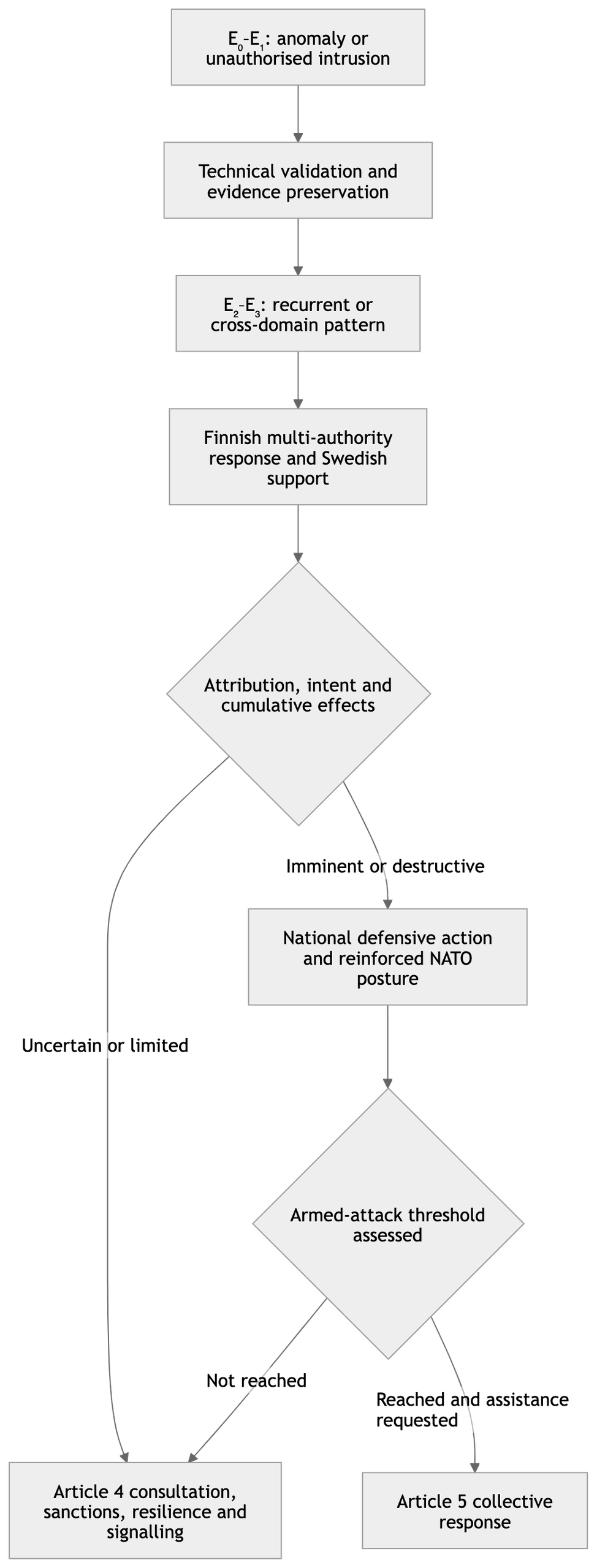
Analysis of competing hypotheses
Five hypotheses capture the principal trajectories through 2031. H₁, institutionalised deterrence, holds that Finnish–Swedish integration, NATO consultation and visible readiness reduce hostile probing while accidental incursions remain manageable. H₂, persistent grey-zone pressure, predicts recurring drones, electronic interference, cyber activity and information operations calibrated below the threshold that would generate a decisive collective response. H₃, accidental kinetic spillover, assumes that weapons or drones connected to the wider Russia–Ukraine theatre enter Nordic airspace and create casualties or infrastructure damage without an original intention to attack Finland or Sweden. H₄, coordinated hybrid escalation, anticipates a deliberately synchronised campaign combining airspace penetration, cyber disruption, maritime sabotage, navigation interference and influence operations to impose economic and political costs while obscuring attribution. H₅, legal-political fragmentation, predicts that disagreements over evidence, command, proportionality, privacy, spectrum use or alliance consultation delay action and weaken the bilateral shield. Starting priors were set at 24%, 31%, 18%, 17% and 10%. Evidence E₁—the existence of operational-support and host-nation mechanisms—raises H₁ and reduces H₅. Evidence E₂—the documented regional growth of hybrid, cyber and electronic interference—raises H₂ and H₄. Evidence E₃—the May 2026 Finnish warning concerning potentially straying explosive-laden drones—raises H₃. Evidence E₄—expanding NATO maritime and eastern-flank surveillance—raises H₁ but may also incentivise lower-signature pressure consistent with H₂. The posterior judgement is 28% H₁, 35% H₂, 16% H₃, 14% H₄ and 7% H₅. Persistent calibrated pressure is therefore the single most likely path, although managed deterrence remains nearly as plausible.
| Hypothesis | Prior | Posterior | Strongest supporting evidence | Principal falsifier |
|---|---|---|---|---|
| H₁ Institutionalised deterrence | 24% | 28% | Rehearsed bilateral authority and persistent NATO coverage reduce incidents | Intrusions increase despite demonstrated readiness |
| H₂ Persistent grey-zone pressure | 31% | 35% | Recurrent low-signature activity remains below decisive thresholds | Sustained decline in cross-domain incidents |
| H₃ Accidental kinetic spillover | 18% | 16% | Geographic proximity to strikes and countermeasures around the Gulf of Finland | Durable reduction in regional long-range drone operations |
| H₄ Coordinated hybrid escalation | 17% | 14% | Temporally correlated air, cyber, maritime and information incidents | Forensic evidence consistently shows unrelated causes |
| H₅ Legal-political fragmentation | 10% | 7% | Conflicting authorities or caveats delay engagement | Exercises demonstrate rapid, repeatable cross-border decisions |
Cyber exposure: the shield’s connective tissue is also its attack surface
Shared surveillance increases detection coverage but creates a larger digital attack surface whose compromise could produce effects more dangerous than the loss of an individual sensor. The relevant vulnerabilities extend across identity management, tactical datalinks, cloud services, software-update infrastructure, geospatial databases, maintenance laptops, vendor remote access, machine-learning pipelines and interfaces connecting military, police, border, aviation and maritime systems. An attacker does not need to shut down the entire network. Selectively delaying tracks, changing confidence scores, corrupting geofences or creating plausible false alarms could consume operators’ attention and reduce trust in the common picture precisely when a genuine intrusion occurs. Availability, integrity and provenance must therefore be treated as separate security properties: encrypted communications may remain confidential while manipulated data produces incorrect decisions. NATO stated in July 2026 that malicious Russian cyber activity had targeted Allied critical national infrastructure and government entities, linking cybercriminal enabling structures to the broader security problem. Statement of Condemnation by the North Atlantic Council of Russia’s Malicious Cyber Activities – NATO – July 2026 — Verified primary source. NATO also recognises that the cumulative impact of significant malicious cyber activities may, in certain circumstances, constitute an armed attack, while preserving case-by-case political judgement. Cyber Defence – NATO – July 2024 — Verified primary source. The 2031 architecture should consequently implement zero-trust access, hardware-rooted identity, signed sensor data, segmented national fallback modes, offline operating procedures and independent verification channels capable of preserving sovereign action if the shared layer becomes unavailable or suspect.
Information operations: control of interpretation after the incident
Information operations will target the interval between detection and authoritative attribution. In that interval, unofficial images, fabricated radar displays, recycled footage, false eyewitness accounts and contradictory explanations can shape public interpretation before governments complete technical analysis. A hostile narrative may claim that an accidental drone was a deliberate NATO provocation, that Swedish forces acted without Finnish consent, that countermeasures endangered civilians, or that authorities concealed a failed interception. The purpose need not be universal persuasion. It may be sufficient to create competing realities, intensify party-political disagreement, provoke demands for premature disclosure or make subsequent official evidence appear reactive and self-interested. NATO defines information threats as intentional, harmful, manipulative and coordinated activities conducted by state or non-state actors to weaken and divide the Alliance, its members and partners. NATO’s Approach to Counter Information Threats – NATO – October 2024 — Verified primary source. The EEAS similarly monitors foreign information manipulation and interference as an operational threat rather than merely inaccurate speech. Fourth EEAS Report on Foreign Information Manipulation and Interference Threats – European External Action Service – March 2026 — Verified primary source. An effective response requires a prepared evidence-release protocol: governments should distinguish confirmed facts from current assessments, publish timelines and decision authority, preserve uncertainty where evidence remains incomplete and correct errors without disguising the change. Strategic credibility will depend less on communicating first than on being consistently precise, attributable and auditable.
Procurement liquidity: appropriations are not deployable capability
Procurement liquidity concerns the speed and reliability with which political commitments become contracts, supplier working capital, production inputs, delivered systems and replenished inventories. A government may announce substantial funding while manufacturers remain unable to finance new production lines before contracts become firm, smaller suppliers face payment delays, testing capacity becomes congested or orders remain too fragmented to justify investment. Counter-UAS markets intensify this problem because operational requirements change faster than conventional procurement cycles. A radar, jammer or interceptor specified in 2026 may require different software, frequencies or terminal guidance before volume delivery in 2028. Liquidity must therefore include contractual flexibility for upgrades, minimum-order guarantees, advance payments tied to milestones, production-reservation options and mechanisms for rapid purchase after operational testing. NATO’s 2026 industry forum explicitly called on financial institutions to increase capital flows into defence production and innovation, launched the NATO Front Door for Industry and introduced the NATO Engine to connect defence demand with civilian manufacturing capacity. Tens of Billions in New Procurements Revealed at the NATO Summit Defence Industry Forum in Ankara – NATO – July 2026 — Verified primary source. The EU simultaneously proposes industrial mapping, mass production, testing infrastructure and support for emerging counter-drone companies. Action Plan on Drone and Counter Drone Security – European Commission – February 2026 — Verified primary source. The shadow risk is concentration: a system may appear nationally sovereign while depending on one foreign semiconductor, optical component, software library or venture-backed specialist whose failure interrupts the entire chain.
Baltic spillover: air, sea, spectrum and infrastructure form one theatre
The Baltic spillover problem is inherently multidomain. Airborne drones can cross borders or maritime approaches; GNSS interference can affect aviation, shipping, communications and timing-dependent infrastructure; suspicious vessels may operate near cables or pipelines; cyber incidents can disrupt port, energy or telecommunications systems; and information operations can merge these events into mutually reinforcing narratives. Finnish authorities demonstrated the civil-military consequences on 15 May 2026, when information that larger drones carrying heavier explosive payloads might stray into Finland prompted an emergency warning for Uusimaa, increased surveillance and counter-drone readiness, and changes to air and maritime traffic. The drones did not enter Finnish territory and military force was not used, illustrating both effective precaution and the difficulty of making decisions under uncertain trajectories. Authorities Worked Together Effectively to Counter Drone Threat – Prime Minister’s Office of Finland – May 2026 — Verified primary source. In the maritime domain, Finland recorded 396 vessels experiencing satellite-navigation interference through July 2026 under its revised reporting method, compared with 231 interference reports during 2025; Traficom identifies the Gulf of Finland as the country’s highest-risk maritime area and recommends navigation independent of satellite signals. Satellite Navigation Service Interferences in Finland – Finnish Transport and Communications Agency – July 2026 data — Verified primary source. These indicators do not establish a common perpetrator or unified campaign. They establish that regional systems are already operating in an environment where interference, spillover and attribution uncertainty can generate cascading safety and security consequences.
Maritime surveillance, attribution and proportional response
NATO’s Baltic Sentry activity expands deterrence and evidence collection by combining frigates, maritime-patrol aircraft, naval drones and national surveillance assets around critical undersea infrastructure. NATO Launches Baltic Sentry to Increase Critical Infrastructure Security – NATO – January 2025 — Verified primary source. Task Force X-Baltic subsequently tested more than 70 air, surface and subsurface uncrewed systems for persistent intelligence, surveillance, choke-point monitoring and infrastructure protection; NATO reports that the uncrewed fleet provided coverage at approximately one-third the cost of comparable crewed-frigate coverage. In February 2026, eight Allies—including Finland and Sweden—signed a letter of intent to move the initiative toward nationally owned capabilities taskable by NATO. Task Force X-Baltic – NATO Allied Command Transformation – 2026 — Verified primary source. Greater surveillance does not remove escalation risk; it changes its structure. Persistent sensing can deter overt sabotage and improve attribution, but it also creates more encounters, more classified evidence and more pressure to explain why authorities did or did not intervene. Boarding, impounding or arresting a vessel requires a legal basis connected to jurisdiction, safety, sanctions, flag status or evidence of unlawful conduct. Military surveillance cannot substitute for admissible forensic evidence, and suspicious behaviour does not automatically establish hostile state direction. The required architecture must therefore connect sensor records to chain-of-custody procedures, maritime authorities, prosecutors, intelligence assessments and NATO consultation. Its objective is not maximal confrontation at sea but sufficient evidentiary density to make deniable coercion increasingly costly and unsuccessful.
Multilingual narrative cross-check
Russian and Chinese official narratives do not independently verify Nordic threat assessments, but they illuminate how defensive measures may be represented externally and therefore how escalation signals could be misread or deliberately reframed. The Russian Federation’s official mission to the EU portrays Sweden’s NATO accession, the establishment of Commander Task Force Baltic and European electronic-warfare cooperation as components of continental militarisation. The EU’s Militarisation – Permanent Mission of the Russian Federation to the European Union – November 2025 — Verified Russian-language institutional source. Russian official messaging has similarly criticised major NATO exercises in Denmark, Finland, Norway and Sweden, providing an observable indication that routine reinforcement and surveillance activities may be incorporated into a narrative of encirclement. Dmitry Polyanskiy on Attempts to Undermine Efforts to Find a Settlement – Permanent Mission of the Russian Federation to the OSCE – June 2026 — Verified primary source. Chinese official military commentary has described Finnish and Swedish accession through the established Chinese narrative of repeated NATO eastward expansion. PLA Daily: Ten International Military Hotspots in 2022 – Ministry of National Defense of the People’s Republic of China – December 2022 — Verified Chinese primary source. These narratives do not mean that Nordic states should limit lawful defensive cooperation. They mean that signalling must distinguish surveillance, incident prevention and defensive readiness from preparations for offensive action. Transparency concerning exercises, command relationships and safety procedures can reduce genuine misperception, although it cannot prevent purposeful disinformation.
Monte Carlo outlook, 2026–2031
The five-year forecast uses 75,000 synthetic Monte Carlo trials across seven variables: incident frequency, attribution confidence, bilateral decision latency, cyber resilience, information-environment volatility, procurement conversion efficiency and cross-domain correlation. Each trial generates an escalation outcome after applying conditional relationships: higher incident frequency increases the probability of both deliberate testing and accidental spillover; greater cross-domain correlation raises H₄; slower decision latency raises H₅ and increases the consequences of H₃; stronger attribution and cyber resilience favour H₁; while improved deterrence without corresponding political de-escalation may redirect pressure toward H₂. Under the baseline assumptions, outcome frequencies converge around the Bayesian posterior: 28% institutionalised deterrence, 35% persistent grey-zone pressure, 16% accidental kinetic spillover, 14% coordinated hybrid escalation and 7% legal-political fragmentation. The most consequential tail is not the most likely hypothesis. H₄ has only a 14% baseline probability but produces the highest median disruption because simultaneous cyber, maritime, electromagnetic and informational pressure overloads separate legal and administrative channels. In a stress case combining upper-quartile information volatility, weak cyber integrity and a 30% increase in cross-domain correlation, H₄ rises to approximately 27%, while H₁ falls below 20%. In a resilience case featuring rehearsed bilateral authority, segmented command networks, rapid attribution support and high procurement conversion, H₁ rises to approximately 43%, and H₅ falls below 4%. The model therefore identifies command rehearsal, evidence integrity and system segmentation as more influential than raw sensor quantity alone.
| Period | Likely escalation pattern | Required safeguard | Warning indicator |
|---|---|---|---|
| 2026–2027 | More detections, warnings and jurisdictional testing | Common incident taxonomy and authority matrix | Divergent Finnish–Swedish classification of the same event |
| 2027–2028 | Increased cyber and EW pressure against integrated systems | National fallback modes and signed data provenance | Unexplained track loss or confidence-score manipulation |
| 2028–2029 | Information operations target foreign-force legitimacy | Pre-agreed public evidence protocol | Coordinated narratives preceding official notification |
| 2029–2030 | Maritime, air and infrastructure incidents become more correlated | Joint forensic and intelligence fusion | Repeated activity around multiple infrastructure classes |
| 2030–2031 | Deterrence depends on visible readiness and industrial endurance | Replenishment contracts and multinational exercises | Funding growth without improved operational availability |
Strategic judgement
The most probable 2026–2031 outcome is neither a stable Nordic sanctuary nor an uninterrupted path toward open conflict. It is a contested equilibrium in which Finland, Sweden and NATO improve detection, integration and resilience while hostile or opportunistic actors search for actions that impose costs without crossing a clearly actionable threshold. The operational shield will succeed if it can deny three adversarial objectives simultaneously: physical penetration, decision paralysis and narrative capture. Physical penetration requires layered sensors and effectors; decision paralysis requires pre-authorised legal and command pathways; narrative capture requires evidence preservation and disciplined public communication. These functions cannot be separated. A technically successful interception may become a political failure if debris harms civilians or authorities cannot explain the legal basis. Conversely, restraint may represent sound escalation management when an object poses no imminent danger, but it may be portrayed as weakness if the evidentiary rationale remains secret or fragmented. Procurement liquidity adds the temporal dimension: the system must continue receiving spares, software updates and affordable effectors after the initial acquisition cycle, otherwise a visible shield becomes progressively hollow. The critical strategic safeguard is sovereign redundancy inside allied integration. Finland must retain the ability to command and act if a shared network fails; Swedish forces must operate through explicit Finnish authority; and both countries must be able to exchange data without creating a single cyber point of failure. The strongest deterrent by 2031 will not be an automatic escalation mechanism. It will be a demonstrably controlled system capable of identifying incidents accurately, responding proportionately, absorbing disruption and escalating collectively when cumulative effects justify it.