
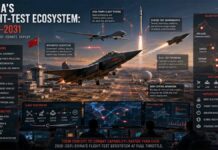
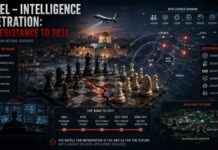
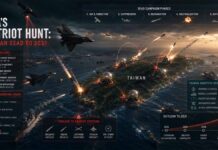






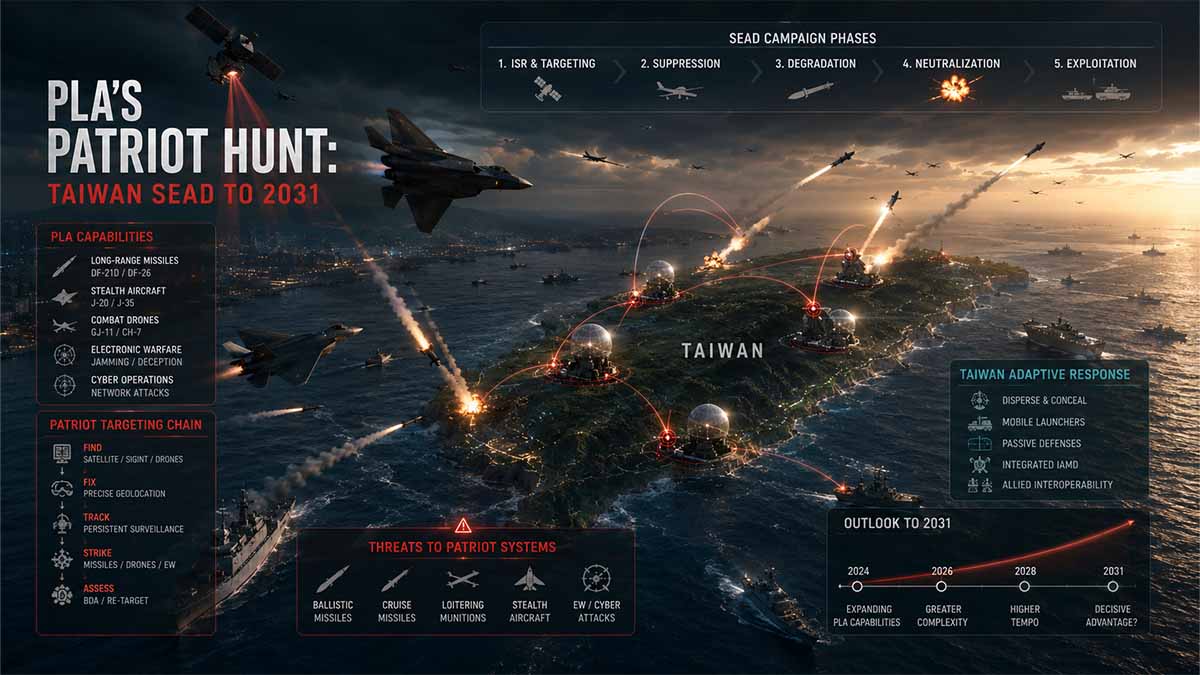
Executive Summary
- BLUF: The June 2026 drill demonstrates a credible tactical sensor-to-shooter chain, not proof that the PLA can dismantle Taiwan’s air-defence system under combat conditions.
- The integration of KVD-002, Z-10, Z-20T, laser designation and KD-9 weapons reveals advancing Army-aviation SEAD/DEAD procedures.
- The PAC-3 replica signals adversary-specific preparation, but the exercising formation belonged to the Xinjiang Military District, not the Taiwan-facing Eastern Theater Command.
- Beijing is adapting the logic of Task Force Normandy to networked warfare: expose one node, transmit coordinates, destroy it, assess damage, then widen the rupture.
- Taiwan’s mobile Patriot, Sky Bow, short-range defence, decoys, counter-UAS and distributed command architecture makes a 1991-style operational collapse improbable.
- Bayesian ACH assigns only 22% weight to the hypothesis that the exercise was principally a Taiwan-specific rehearsal; force-wide learning and strategic signalling jointly receive 58%.
- The baseline 2026–2031 Monte Carlo ensemble places persistent coercion above invasion: 43% gray-zone pressure, 26% blockade crisis, 12% limited strike, 9% invasion attempt and 10% stabilization.
- The decisive variable is not one helicopter raid, but whether the PLA can preserve C4ISR, electronic warfare, targeting and battle-damage assessment while Taiwan and intervening forces attack the network itself.
The Battle Before the Battle: China, Taiwan and the New Economics of Air Defence
Taiwan’s air war would begin before the first missile was launched. It would start with the accumulation of targeting data, cyber access, maritime pressure and financial fear: a campaign designed to expose defensive nodes, exhaust political attention and make commercial actors retreat before Beijing assumes the costs of open war. At the centre stands a deceptively simple question: can Taiwan preserve enough sensors, command links, launchers and interceptors to deny China a usable corridor? Patriot matters, but no missile battery can answer alone. What is taking shape is a contest between systems—one built to detect and dismantle, the other to disperse, discriminate and regenerate. Its outcome will shape not only the Taiwan Strait, but also semiconductor supply, maritime insurance, European industrial security and the credibility of Western deterrence.
From platforms to systems
The intellectual inheritance of Operation Desert Storm is visible in China’s shift from destroying platforms to paralysing operational networks. The Pentagon’s report published on 23/12/2025 describes the PLA’s Multi-Domain Precision Warfare as an emerging concept that integrates command systems, intelligence, surveillance, reconnaissance and data-enabled precision effects to identify and exploit weaknesses across an adversary’s operational architecture. It also identifies firepower strikes, maritime blockade and amphibious invasion among Beijing’s military options against Taiwan. Military and Security Developments Involving the People’s Republic of China 2025 – U.S. Department of Defense – December 2025.
The operational objective would not necessarily be the physical destruction of every Taiwanese battery. It would be sufficient to fracture the chain connecting detection, classification, engagement authority, launch and battle-damage assessment. A surviving launcher without targeting data is sterile; a functioning radar disconnected from command is isolated; an intact battery without reloads is a temporary asset. This is why Taiwan’s Ministry of National Defense recorded the presence of seven PLA Navy ships and six Chinese official vessels around the island between 06:00 on 27/08/2026 and 06:00 on 28/08/2026, even though no PLA aircraft were detected during that interval. PLA Activities in the Waters and Airspace Around Taiwan – Ministry of National Defense, Republic of China – August 2026. Persistent presence is not war, but it can collect the data, normalize the geography and test the response mechanisms upon which a future operation would depend.
Patriot is not a shield
Taiwan’s air defence is layered institutionally as well as technically. The Ministry of National Defense states that the Air-Defense Missile Command consolidated Patriot, Sky Bow, Hawk and other medium- and high-altitude missile forces within a unified structure. Introduction to the Air-Defense Missile Command – Ministry of National Defense, Republic of China – June 2015. That integration matters more than nominal range rings drawn on a map. Radar horizon, mountainous terrain, communications resilience, launcher movement, reload protection and the ability to transfer tracks between sensors determine whether overlapping systems constitute a real architecture or merely adjacent batteries.
President Lai Ching-te placed this challenge at the centre of Taiwan’s defence policy on 26/11/2025. He announced a planned NT$1.25 trillion investment over 2026–2033 covering the T-Dome, artificial-intelligence-enabled defensive decision-making and expanded indigenous industrial capacity. He also stated that defence expenditure, calculated according to NATO methodology, would exceed 3 per cent of GDP in 2026 and reach 5 per cent by 2030. President Lai Holds Press Conference on National Security Action Plans to Safeguard Democratic Taiwan – Office of the President, Republic of China (Taiwan) – November 2025.
Money, however, becomes deterrence only after it has been converted into delivered systems, trained personnel, protected magazines, alternative command nodes and tested procedures for operating under electronic attack. T-Dome will succeed only if damage to one layer does not collapse the others.
The blockade threshold
The most consequential Chinese option may be neither permanent gray-zone pressure nor immediate invasion, but the space between them. On 02/04/2025, China’s Ministry of National Defense said that Strait Thunder-2025A included identification, warning and expulsion, interception and detention, regional control, joint blockade and precision strikes against key targets. Chinese Military Launches “Strait Thunder 2025A” Exercise in Taiwan Strait – Ministry of National Defense of the People’s Republic of China – April 2025.
That vocabulary describes an escalation ladder capable of beginning as law enforcement and ending as military isolation. Beijing would not have to stop every merchant ship. Inspection notices, temporary exclusion areas, selected detentions and naval forces positioned behind coast-guard enforcement could be enough to persuade insurers, charterers and crews that Taiwan’s ports were no longer commercially accessible. Private actors could then reproduce part of a blockade’s economic effect without China physically sealing every approach.
Taipei is preparing for precisely this ambiguity. On 25/06/2026, Taiwan’s Whole-of-Society Defense Resilience Committee conducted a tabletop exercise focused on gray-zone aggression, high-intensity maritime coercion and the continuation of supply operations under pressure. President Lai Presides over Eighth Meeting of Whole-of-Society Defense Resilience Committee – Office of the President, Republic of China (Taiwan) – June 2026. The strategic contest would concern not only control of the sea, but also control of the legal narrative: who is judged to have escalated, who escorts commercial shipping and when coercive inspection becomes an internationally recognized blockade.
The cyber opening
Cyber operations compress the interval between political crisis and physical disruption. Access obtained for espionage can be retained for later use against telecommunications, port management, electric power, logistics or military command. This dual character makes pre-positioning difficult to distinguish from routine intelligence collection until activation occurs.
On 23/04/2026, the U.S. Cybersecurity and Infrastructure Security Agency and its partners published an advisory describing China-linked covert networks built from compromised edge, home and small-office devices. Such infrastructure can disguise operators and sustain access while complicating attribution. Defending Against China-Nexus Covert Networks of Compromised Devices – Cybersecurity and Infrastructure Security Agency – April 2026. The Pentagon’s 23/12/2025 report separately assesses that Chinese cyber operations would likely seek to obstruct military decision-making, logistics and force projection during a conflict.
The strategic danger is not a cinematic, nationwide blackout. Localized disruption may be more useful: delaying a port, corrupting the recognized air picture, interrupting fuel distribution or generating contradictory public information while maritime and missile pressure intensifies. Cyber effects would then multiply physical uncertainty rather than replace kinetic force.
The economics of exhaustion
Air defence is governed by opportunity cost. An expensive interceptor may be rationally fired against a cheaper weapon if it protects a command centre, radar or air base whose loss would unlock subsequent attacks. The decisive calculation is not missile price against missile price, but the value of the protected function and the cost of no longer having that interceptor available for the next engagement.
The scale of the industrial response is visible in the U.S. Army’s FY2027 Missile Procurement justification published in April 2026. It requests US$1.297528 billion in discretionary and US$10.931919 billion in mandatory funding for PAC-3 MSE, a combined US$12.229447 billion. The mandatory component is associated with the procurement of 2,554 MSE missiles to support expanded production. FY 2027 Missile Procurement, Army Budget Estimates – U.S. Department of the Army – April 2026.
Those figures demonstrate industrial ambition, not immediate Taiwanese availability. Factory throughput cannot replenish an island whose ports and airfields are contested. Taiwan must therefore create depth before a crisis through dispersed stocks, protected reload vehicles, domestic Sky Bow production, redundant power and communications, and lower-cost defences capable of filtering drones and decoys before they consume scarce high-tier interceptors.
The liquidity front
Financial pressure could arrive before physical interdiction. WTO data record Taiwan’s 2024 merchandise exports at US$474.6185 billion and imports at US$359.5979 billion. China accounted for 20.4 per cent of exports and 21.6 per cent of imports; the United States absorbed 23.5 per cent of exports, while the European Union received 7 per cent. Chinese Taipei Member Profile – World Trade Organization – 2025 data release.
These figures define the transmission channels of a crisis. Maritime insurance, trade finance, currency hedging, semiconductor inventories and freight capacity could be repriced as soon as commercial actors judged that coercion might interrupt access. The resulting withdrawals would not prove that a blockade had succeeded militarily, but they could accelerate supply stress and shorten political decision time. The relationship is reciprocal: disruption would also affect Chinese and international production networks that depend on Taiwanese components. Economic interdependence is therefore neither a guarantee of peace nor a cost-free weapon. It is a mechanism through which military uncertainty becomes global industrial exposure.
Europe’s strategic test
For Europe, Taiwan is not a distant territorial dispute detached from continental security. On 09/07/2026, the Council of the European Union stated that China’s increasingly assertive behaviour across the Taiwan Strait could affect European and Indo-Pacific security, stability and prosperity, and that a change in the status quo would have a profound global impact. The Threats and Challenges We Face – Council of the European Union – July 2026.
Italy’s position is already embedded within this framework. The joint statement issued by Prime Minister Giorgia Meloni and U.S. President Joe Biden on 27/07/2023 described peace and stability across the Taiwan Strait as instrumental to regional and global security and prosperity. Joint Statement from President Biden and Prime Minister Meloni – Embassy of Italy in Washington – July 2023. The G7 leaders meeting on 15–17/06/2026 again opposed unilateral changes to the status quo by force or coercion and called for cross-strait issues to be resolved peacefully. G7 Summit, Evian, France – European Council – June 2026.
Europe’s immediate instruments would be diplomatic coordination, cyber defence, export controls, maritime awareness, supply-chain protection and industrial allocation—not a replication of United States force posture. The harder question is whether European governments have prepared for simultaneous demands on air-defence production, semiconductor supply and maritime security while their own continent remains strategically exposed.
The cost of misreading
The gravest danger through 2031 is not necessarily a premeditated leap from patrols to invasion. It is an escalation sequence in which maritime enforcement, cyber disruption, defensive mobilization and commercial withdrawal reinforce one another faster than governments can communicate limits. A Chinese inspection regime could trigger shipping cancellations; those cancellations could be read in Beijing as evidence that coercion is working; Taiwanese escorts could then be treated as resistance to Chinese jurisdiction; cyber disruption could obscure intentions precisely when commanders require clarity.
Taiwan’s defence will therefore be judged by continuity rather than impermeability: whether priority assets remain protected, whether isolated sectors can still exchange targeting data, whether reloads reach surviving launchers and whether damaged functions return faster than China can assess and attack them again. Patriot is indispensable, but the real centre of gravity is the architecture connecting sensors, decisions, interceptors, industry and political endurance. The battle before the battle will be won by the side that preserves its system while forcing the other to reveal, expend and commit first.
Navigational Index
- From Desert Storm to system destruction — What the June exercise reveals, and what it cannot establish.
- Taiwan’s contestable air-defence architecture — Patriot survivability, layered defence and the economics of interceptor depth.
- The 2026–2031 escalation system — Bayesian hypotheses, scenario distribution and cyber, maritime and liquidity shadows.
Master Abstract
The evidentiary boundary
The verified event is narrower—and analytically more important—than the claim that China has demonstrated readiness to execute a “Desert Storm” against Taiwan. An official U.S. Army institutional assessment reports that, in early June 2026, the 84th Army Aviation Brigade of the Xinjiang Military District employed at least one KVD-002 unmanned aircraft with Z-10 attack helicopters and Z-20T assault helicopters against static and moving targets. Crews reportedly combined airborne reconnaissance, laser designation, 70-millimetre rockets and KD-9 precision-guided missiles, striking representations of HMMWVs and Patriot PAC-3 launchers while practising low-altitude, terrain-masked approaches and target-data exchange. Live-Fire Exercise Demonstrates the PLA Army’s Growing Capability to Destroy Air Defenses – U.S. Army War College, China Landpower Studies Center – August 2026. This establishes observable tactical integration; it does not establish combat effectiveness against a mobile, emitting intermittently, electronically protected and actively defended air-defence network. The available public record contains no validated measurements of datalink latency, probability of target misclassification, sortie-generation rate, jamming tolerance, loss rates, reattack time, weapon circular error, opposing-force sophistication or performance after command-node degradation. Geography also matters: a Xinjiang formation is institutionally relevant to PLA-wide modernization, but it is not itself evidence of assignment to an Eastern Theater Command Taiwan campaign. The analytically defensible judgment is therefore calibrated: the drill materially raises confidence that PLA Army aviation possesses developing SEAD/DEAD tactics, techniques and procedures; it only modestly raises confidence that those procedures are mature enough to open and sustain an exploitable corridor through Taiwan’s integrated air-defence system.
Normandy’s lesson, transformed
The historical analogy is operationally valid but technologically incomplete. On 17 January 1991, Task Force Normandy paired eight AH-64 Apache helicopters with four MH-53J Pave Lows to destroy two Iraqi early-warning sites and open a roughly 20-mile air corridor before the coalition’s main air attack; navigation, terrain-following flight, surprise, simultaneous engagement and physical destruction of power, communications and radar components created the breach. Task Force Normandy: The Deep Operation that Started Operation Desert Storm – U.S. Army University Press – January 2021. Beijing’s adaptation is not simple imitation. Its emerging model replaces the 1991 division between navigator and shooter with a distributed chain in which unmanned sensors, attack and assault helicopters, electronic-support platforms, space-based reconnaissance, precision missiles and higher headquarters can contribute different stages of detection, identification, designation, engagement and assessment. That architecture aligns with the PLA’s official U.S.-assessed concept of Multi-Domain Precision Warfare, which seeks to integrate C4ISR, big-data processing and artificial intelligence to identify critical weaknesses in an adversary’s operational system and concentrate cross-domain effects against them. Military and Security Developments Involving the People’s Republic of China 2025 – U.S. Department of Defense – December 2025. The June event should consequently be read as a laboratory for system rupture: not merely destroying a launcher, but disconnecting sensors from shooters, forcing defensive radars to reveal themselves, creating uncertainty inside command networks and opening temporary windows for follow-on missile, fixed-wing, naval-air or unmanned strikes. Its strategic significance lies in this choreography. Its weakness lies there too: every additional network dependency creates attack surfaces in communications, timing, authentication, electromagnetic control and centralized command.
From tactical vignette to Taiwan campaign
The Taiwan inference becomes stronger when the drill is placed beside the PLA’s documented theater-level trajectory, but it still remains an inference. China’s Ministry of National Defense stated that Strait Thunder-2025A trained identification, warning, interception, detention, joint blockade and precision strikes against key targets in the central and southern Taiwan Strait. Chinese Military Launches “Strait Thunder 2025A” Exercise – Ministry of National Defense of the People’s Republic of China – April 2025. The Pentagon subsequently assessed that Beijing was refining multiple coercive and military options—pressure below war, blockade, limited-force operations and an amphibious invasion—while exercising strikes against land and maritime targets and responses to prospective U.S. involvement. It recorded 3,067 PLA entries into Taiwan’s ADIZ during 2024, up from 1,641 in 2023, together with 38 joint combat-readiness patrols and simulated port blockades. Military and Security Developments Involving the People’s Republic of China 2025 – U.S. Department of Defense – December 2025. Within that larger campaign architecture, attack helicopters would represent one instrument among ballistic and cruise missiles, loitering munitions, electronic attack, cyber operations, special forces and fixed-wing aviation. Their plausible contribution would be geographically selective: exploiting terrain masking, attacking surviving mobile launchers, pursuing emitters displaced from fixed sites, supporting seizure of offshore islands or destroying air-defence nodes after longer-range fires had reduced the network. A direct low-altitude helicopter penetration across the Taiwan Strait before suppression by other domains would expose crews to maritime navigation hazards, early warning aircraft, fighters, dispersed short-range defences, machine cannon, man-portable missiles, counter-UAS systems and deception. The exercise therefore supports a layered campaign hypothesis, not the proposition that helicopters alone provide Beijing with a modern equivalent of Normandy.
Taiwan’s counternetwork
Taipei is not constructing a static line of Patriot batteries that can be defeated by finding and destroying a few launchers. President Lai Ching-te announced an intended NT$1.25 trillion special investment over 2026–2033, organized around the T-Dome, AI-enabled resilient defence and expanded indigenous production; he also stated objectives of exceeding 3% of GDP in defence spending in 2026 and reaching 5% by 2030. These are announced plans requiring legislative, industrial and implementation follow-through, not yet completed capabilities. President Lai Holds Press Conference on National Security Action Plans to Safeguard Democratic Taiwan – Office of the President, Republic of China – November 2025. Taiwan’s Ministry of National Defense describes a prospective architecture linking Patriot, Sky Bow, short-range air defence and AI-assisted decision support, while using surveillance UAVs, the Taiwan Tactical Network, counter-UAS equipment and long-range fires to compress its own sensor-to-shooter cycle and attack hostile launch platforms or maneuver elements. Minister Koo Presents Report on M109A7 and Other Major Weapons Procurement Programs – Ministry of National Defense, Republic of China – May 2026. The resulting contest is network against network: PLA success requires locating authentic rather than decoy emitters, maintaining targeting custody after launchers move, penetrating electronic and kinetic point defence, distinguishing radars from false signatures, and confirming destruction quickly enough for follow-on aircraft to exploit the breach. Taiwan’s success does not require preserving every battery; it requires preventing Beijing from converting localized losses into persistent air dominance. Mobility, passive sensors, fibre and redundant communications, emission control, rapid displacement, hardened command posts, reload dispersion and low-cost defences around high-value interceptors can therefore matter more than nominal launcher totals. Patriot remains vital, but its survival depends on a surrounding ecosystem rather than on interceptor performance in isolation.
Competing hypotheses and Bayesian update
The Analysis of Competing Hypotheses treats five explanations as mutually competing dominant interpretations, while recognizing that several may operate simultaneously. H₁ holds that the event principally represents force-wide institutional learning; H₂, a Taiwan-specific SEAD template; H₃, strategic signalling to the United States and regional Patriot operators; H₄, technical validation of a new aviation-UAV combination; and H₅, curated capability theatre designed to advertise success while concealing fragility. Starting priors of 35%, 18%, 18%, 9% and 20% were updated against five observations: the recognizable PAC-3 and HMMWV representations; the integration of unmanned ISR, helicopters and laser-guided weapons; the exercising unit’s Xinjiang affiliation; the absence from the released record of fixed-wing electronic attack, rocket-force fires and a reactive adversary; and deliberate public dissemination. The resulting structured posterior is H₁ 34%, H₂ 22%, H₃ 24%, H₄ 7% and H₅ 13%. These values are transparent analytic judgments, not statistical measurements. The PAC-3 target increases both H₂ and H₃; the unit’s location and limited joint-force representation constrain H₂; public release supports H₃ and H₅; and the observed sensor-shooter integration preserves H₁ as the strongest single explanation. The crucial disconfirming indicators for H₂ would be continued confinement of such drills to controlled ranges, persistent reliance on cooperative targets, failure to integrate electronic warfare or absence of Eastern Theater Command repetition. Confirming indicators would include night and adverse-weather maritime approaches, mobile emitter hunting, red-force deception, simultaneous cyber-electromagnetic disruption, battle-damage reassessment, rapid restrike and exercises linking Army aviation to Rocket Force, Air Force and naval fires. Until those indicators appear in verified official reporting, “China is ready” exceeds the evidence.
Five-year outlook and shadow dimensions
The baseline 2026–2031 Monte Carlo model uses 25,000 seeded trials, uncertain scenario coefficients and five drivers: PLA integration maturity, Taiwan IADS resilience, allied intervention credibility, Chinese cyber pre-positioning and political-trigger intensity. Its central distribution is 43% for sustained gray-zone pressure and increasingly realistic exercises, 26% for a quarantine or blockade crisis, 12% for a limited precision-strike episode, 9% for a full-scale invasion attempt and 10% for managed stabilization. These are conditional planning weights, not claims that war has a measurable actuarial frequency. The invasion branch rises most sharply when political triggers coincide with high PLA integration, weak Taiwanese resilience and declining intervention credibility; the blockade branch is less sensitive to amphibious readiness and more sensitive to coast-guard integration, legal warfare, cyber access and commercial-shipping compliance. Cyber activity is therefore not auxiliary: U.S. agencies assess that Volt Typhoon-associated infrastructure has been used to pre-position offensive capabilities that could disrupt critical services during a crisis. Defending Against China-Nexus Covert Networks of Compromised Devices – U.S. Cybersecurity and Infrastructure Security Agency and partners – April 2026. Liquidity and trade channels also shape coercive endurance: in 2024, China absorbed 20.4% of Taiwan’s exports and supplied 21.6% of its imports, while electronic integrated circuits dominated major export categories. Chinese Taipei: Tariff and Trade Data Country Profile – World Trade Organization – 2025 data release. Russia’s May 2026 joint declaration with China reinforces diplomatic alignment on the One-China principle but does not constitute verified evidence of Russian combat participation in a Taiwan contingency. Совместное заявление Российской Федерации и Китайской Народной Республики – President of Russia – May 2026. Likewise, no admissible official evidence presently supports a material mercenary role; the higher-probability auxiliary actors are coast-guard forces, maritime militia, commercial logistics, cyber proxies and coerced civilian shipping. Europe cannot treat the outcome as geographically remote: the EU Council formally judges that Taiwan Strait tensions can profoundly affect European security, stability and prosperity. Council Conclusions on the Implementation of the EU Strategy for Cooperation in the Indo-Pacific – Council of the European Union – October 2025.
PLA SEAD/DEAD Escalation Architecture
Change the strategic evidence
Five-year outcome distribution
Analysis of Competing Hypotheses
From Desert Storm to System Destruction: What the June Exercise Reveals—and What It Cannot Establish
The evidentiary boundary must be established before drawing operational conclusions. The available institutional account states that, in early June 2026, the PLA Army 84th Army Aviation Brigade conducted live-fire training involving at least one KVD-002 unmanned aircraft, Z-10 attack helicopters, Z-20T assault helicopters, laser designation, KD-9 precision-guided missiles, 70-millimeter rockets, and targets representing HMMWVs and Patriot PAC-3 launchers. It further interprets nap-of-the-earth flight, hunter–killer coordination, datalink-enabled target sharing, and airspace deconfliction as evidence of developing SEAD/DEAD tactics. However, the article expressly identifies itself as a “Quick Take,” says that such products are not formally cited academic studies, and disclaims official endorsement by the Department of the Army or wider United States government. Consequently, the correct intelligence treatment is not “the United States Army confirms that China rehearsed an attack on Taiwan,” but “an Army-hosted analytical product, deriving much of its event description from Chinese state television, assesses that the training is relevant to air-defense destruction.” Live-Fire Exercise Demonstrates the PLA Army’s Growing Capability to Destroy Air Defenses – U.S. Army War College China Landpower Studies Center – August 2026 — verified institutional account. This distinction materially limits the posterior probability assigned to claims about scenario intent. The exercise reliably supports judgments about practiced platform combinations and target types; it only moderately supports claims about maturing tactical concepts; and it provides weak standalone evidence for readiness to penetrate Taiwan’s operational air-defense architecture. A mock PAC-3 launcher is a semantically meaningful target, but target identity alone does not disclose whether planners were validating a Taiwan contingency, studying a generic technologically advanced opponent, testing weapons and crews, or communicating a deterrent signal to multiple audiences.
| Evidentiary layer | What is observable or institutionally reported | Defensible inference | What remains unproven |
|---|---|---|---|
| Platforms | KVD-002, Z-10, Z-20T and supporting helicopters participated | The brigade can assemble a mixed crewed–uncrewed aviation package | Force-wide proficiency or wartime availability |
| Weapons | Laser designation, KD-9 missiles and rockets were employed | Sensor-to-shooter handoff is being practiced | Resilience under jamming, deception or attrition |
| Targets | HMMWV and PAC-3-type mockups were attacked | Mobile Western air-defense systems are explicit training problems | A uniquely Taiwan-directed operational plan |
| Flight profile | Low-altitude approaches and coordinated attacks were reported | Crews are training radar-avoidance and surprise | Safe cross-strait navigation or penetration of a live IADS |
| Assessment | The Army-hosted analysis identifies SEAD/DEAD relevance | The event fits a wider system-destruction trajectory | Operational success against Taiwan or U.S. intervention |
The historical analogy to Task Force Normandy is technically useful only when decomposed into functions rather than copied as a template. On 17 January 1991, eight AH-64 Apache helicopters, navigationally supported by four MH-53J Pave Low helicopters, attacked two Iraqi early-warning radar sites to open an approximately twenty-mile corridor for follow-on coalition aircraft. The Pave Lows contributed precision navigation and terrain-following capability; the Apaches contributed destructive firepower, loiter capacity, visual battle-damage assessment, and re-engagement. The operation depended upon lengthy planning, rehearsals, simultaneous arrival, surprise, weak Iraqi adaptation during the terminal phase, and a broader coalition architecture already positioned to exploit the opening. Task Force Normandy: The Deep Operation that Started Operation Desert Storm – Army University Press – January 2024 — verified official history. The June exercise resembles this functional sequence: one platform detects or refines the target, another designates it, a shooter delivers precision effects, and the resulting aperture is conceptually exploitable by follow-on aircraft. Yet the analogy breaks at the operational boundary. Normandy attacked fixed early-warning nodes across permissive desert terrain from nearby bases, with carefully prepared routes and no maritime crossing. Taiwan presents mountainous terrain, dense civilian electromagnetic emissions, dispersed and mobile radars, decoys, redundant communications, short-range defenses protecting high-value batteries, hardened command facilities, rapid relocation, and likely allied intelligence support. Modern defensive networks also distribute sensing and engagement authority, meaning that destroying one radar need not blind the shooters it formerly controlled. The transferable lesson is therefore not “helicopters can recreate Normandy”; it is that local physical destruction becomes strategically valuable when it is synchronized with electronic attack, cyber disruption, deception, suppression fires, battle-damage assessment, and immediate exploitation before the defender reconstructs the network.
PLA System-Destruction Chain • Multi-Domain Sensing, Kill-Web Targeting, Engagement & Defensive Interruption Nodes
Multi-Domain Sensing & ISR: Space, Air, UAV & Electronic Reconnaissance
The initial surveillance link in the system-destruction chain. Integrates reconnaissance satellites, airborne early warning, high-altitude UAVs, and electronic sensing to map adversary disposition.
The more important evolution since Desert Storm is the transition from platform-centric attack to system destruction. The 2025 United States Department of Defense assessment describes the PLA’s developing concept of Multi-Domain Precision Warfare as an approach employing integrated command, control, communications, computers, intelligence, surveillance and reconnaissance; big-data processing; and rapid concentration of multi-domain effects against identified weaknesses in an adversary’s operational system. Military and Security Developments Involving the People’s Republic of China 2025 – U.S. Department of Defense – December 2025 — verified report. Under that logic, the Patriot launcher is not necessarily the decisive object. It is one node within a kill-and-survival network comprising surveillance radars, engagement-control stations, identification processes, communications relays, launchers, interceptors, maintenance elements, reload vehicles, electrical power, decoys, and external intelligence feeds. Destroying a launcher matters tactically; disrupting the network’s ability to form a coherent air picture, allocate interceptors, authorize engagements, and reconstitute degraded components matters operationally. The June package consequently reveals an attempt to shorten the chain from detection to engagement through crewed–uncrewed collaboration. It also suggests that Army aviation is being considered as one possible terminal-effector layer inside a larger joint campaign. That does not mean helicopters would lead a Taiwan attack. More plausible employment could occur after missile, cyber, electronic-warfare, and fixed-wing attacks had reduced defensive coverage, or against surviving mobile emitters exposed during reconstitution. In Bayesian terms, the observation raises the probability that Army aviation has an assigned or exploratory role in localized DEAD, but it raises only marginally the probability that helicopters would independently create the initial cross-strait corridor.
| System-destruction function | June exercise indicator | Operational requirement not demonstrated | Confidence |
|---|---|---|---|
| Find | KVD-002 reconnaissance and target acquisition | Persistent detection of concealed, mobile targets | Moderate |
| Fix | Shared targeting information | Resistance to spoofing and false emitters | Low–moderate |
| Track | Moving-target engagement was reported | Continuous custody across complex terrain | Moderate |
| Target | Laser designation and platform handoff | Joint authorization under communications attack | Moderate |
| Engage | KD-9 and rocket employment | Survival against layered short-range defenses | Moderate |
| Assess | UAV participation could support observation | Reliable concealed-damage assessment | Low |
| Re-attack | Coordinated aviation permits theoretical re-engagement | Demonstrated wartime cycle time and ammunition depth | Low |
| Exploit | SEAD/DEAD interpretation implies corridor creation | Immediate PLAAF/PLAN exploitation in a contested strait | Very low |
What the exercise reveals with the highest confidence is tactical grammar rather than strategic readiness. First, the brigade is practicing heterogeneous formations in which reconnaissance, designation, attack, and transport platforms occupy differentiated roles. Second, crews appear to be training low-altitude ingress as a means of compressing defensive warning time. Third, the use of mock Western systems indicates that the training audience is expected to understand the signatures, mobility and tactical importance of advanced air defenses. Fourth, the exercise publicly represents Army aviation as a contributor to joint fires, not merely as a battlefield transportation or close-support service. Fifth, it reflects a learning organization that converts foreign operational history into contemporary experimentation. The corresponding Chinese official vocabulary is broader than the June vignette: the Eastern Theater Command’s Strait Thunder-2025A announcement identified verification and identification, warning and expulsion, interception and detention, regional control, joint blockade, and precision attacks on key targets as exercise subjects. 海报丨东部战区组织“海峡雷霆-2025A”演练 – Ministry of National Defense of the People’s Republic of China – April 2025 — verified Chinese-language announcement. Cross-reading these events supports a hierarchy of training problems: theater-level isolation and control; joint detection and targeting; service-level delivery of effects; and tactical terminal attack. The June event occupies the lowest two levels and therefore cannot validate the entire hierarchy. Its greatest intelligence value lies in identifying the connective tissue under development—datalinks, deconfliction, sensor–shooter handoffs and low-altitude tactics—because those are prerequisites for operational integration. Its public visibility also has signaling value: it warns foreign air-defense operators that relocation and camouflage alone may be insufficient if unmanned sensors can maintain custody and hand targets to concealed rotary-wing shooters.
What the exercise cannot establish is more consequential than what it displays. It does not demonstrate that the KVD-002 could retain communications in the presence of broadband jamming, satellite-navigation interference, cyber compromise, deceptive emitters, obscurants, or kinetic counter-UAS attack. It does not show that low-flying helicopters could cross approximately one hundred nautical miles of water without terrain masking, preserve formation timing, avoid maritime surveillance, absorb weather variability, and arrive with sufficient fuel and weapons for combat and recovery. It does not demonstrate suppression of defending fighters, shipborne air defenses, airborne early warning, or short-range systems positioned around Patriot and indigenous batteries. It does not reveal rules for dynamic target authorization, friendly-fire prevention, loss of senior command, degraded-network mission command, or replacement of destroyed relays. It does not establish battle-damage assessment against decoys, buried cables, remote antennas, or radars that cease emitting before attack and reappear elsewhere. The Defense Department’s 2025 report independently assesses that the PLA may face difficulty with time-sensitive battle-damage assessment and re-attack because complex coordination across services can delay target confirmation and renewed engagement. Military and Security Developments Involving the People’s Republic of China 2025 – U.S. Department of Defense – December 2025 — verified report. Nor can the exercise establish campaign endurance. A successful first salvo may produce only a temporary aperture if Taiwan can disperse launchers, restore communications, activate passive sensors, reposition short-range defenses, and reconnect surviving nodes. The proper net assessment therefore separates “ability to execute a choreographed engagement under range conditions” from “probability of generating, widening and maintaining a contested operational corridor.”
An Analysis of Competing Hypotheses prevents the visually compelling Patriot strike from monopolizing interpretation. Five hypotheses explain the available observations without requiring mutually exclusive intent: H₁, force-development validation of emerging aviation tactics; H₂, a Taiwan-focused rehearsal nested within a larger campaign design; H₃, strategic signaling to the United States, Taiwan and regional partners; H₄, weapons, datalink or acquisition testing presented as operational training; and H₅, curated propaganda that selectively exposes strengths while concealing failure rates and enabling conditions. Prior weights were assigned from the normal multiplicity of PLA exercise objectives, then updated against four evidence classes: Western target representations, crewed–uncrewed coordination, location and geography, and deliberate public release. The resulting weights—H₁ 34 percent, H₂ 22 percent, H₃ 24 percent, H₄ 7 percent, and H₅ 13 percent—are structured judgments, not measured frequencies. H₂ rises because the target type and SEAD/DEAD sequence fit a Taiwan contingency, but it remains below H₁ because the reported exercise did not display cross-strait navigation, joint theater command, naval participation, operational electronic attack, or a live opposing force. H₃ remains substantial because public footage of Western equipment is intrinsically communicative. H₅ cannot be dismissed because edited state-media imagery provides no denominator for failed sorties, missed weapons, dropped links or maintenance aborts. The posterior conclusion is therefore narrower than the headline interpretation: the exercise is strong evidence of a relevant training vector, moderate evidence of purposeful signaling, and insufficient evidence of theater-level readiness.
| Hypothesis | Prior | Key confirming evidence | Key inconsistency or absence | Posterior |
|---|---|---|---|---|
| H₁: Tactical force development | 35% | Mixed-platform coordination and live weapons | No major inconsistency | 34% |
| H₂: Taiwan-specific rehearsal | 18% | PAC-3 representation and DEAD-relevant sequence | No maritime or theater-level component | 22% |
| H₃: Strategic signaling | 18% | Deliberate public imagery and recognizable targets | Tactical detail exceeds minimal signaling need | 24% |
| H₄: Equipment validation | 9% | Datalink and guided-weapon employment | Exercise involved broader tactical choreography | 7% |
| H₅: Curated capability display | 20% | Edited release with no failure denominator | Live-fire content still reflects real activity | 13% |
The five-year outlook is best expressed as conditional scenario weights rather than a deterministic war forecast. A 100,000-trial Monte Carlo model was constructed using a logistic-normal distribution around five mutually exhaustive pathways: sustained gray-zone coercion, blockade or quarantine, limited precision strikes, full invasion, and negotiated or deterrence-based stabilization. The baseline means were 39.9 percent, 25.7 percent, 13.2 percent, 9.4 percent, and 11.7 percent, respectively. Their 10th-to-90th-percentile ranges were 28.6–51.7, 16.8–35.6, 7.6–19.8, 4.8–15.1, and 5.5–19.5 percent. These are analytical weights conditioned on the present evidence set—not actuarial probabilities—and should be updated when observable indicators alter the underlying causal structure. The principal five-year movement is expected to be from episodic gray-zone activity toward more executable blockade and selective-strike options, because these pathways exploit growing joint detection and precision-attack capacity without immediately assuming the logistical burden of amphibious conquest. Taiwan’s declared response is to reach a higher state of joint readiness by 2027, develop more resilient deterrence by 2033, exceed 3 percent of GDP in defense expenditure during 2026, approach 5 percent by 2030, and finance a NT$1.25 trillion package covering the T-Dome, artificial-intelligence-enabled defense, and domestic industrial capacity. President Lai Holds Press Conference on National Security Action Plans to Safeguard Democratic Taiwan – Office of the President, Republic of China (Taiwan) – November 2025 — verified official statement. Taiwan’s Ministry of National Defense has separately described priorities including integrated air defense, tactical networking, surveillance unmanned aircraft, counter-UAS capability, precision fires, and resilient command arrangements. Minister Koo Presents Report on M109A7 and Other Equipment – Ministry of National Defense, Republic of China – May 2026 — verified official publication.
| Scenario | Model mean | 10th–90th percentile | Five-year directional pressure | High-value warning indicators |
|---|---|---|---|---|
| Gray-zone coercion | 39.9% | 28.6–51.7% | Gradual decline but remains modal | Persistent patrols, cyber intrusion, legal and economic coercion |
| Blockade or quarantine | 25.7% | 16.8–35.6% | Material increase | Inspection zones, reserve shipping mobilization, sustained joint cordons |
| Limited precision strike | 13.2% | 7.6–19.8% | Moderate increase | Dispersed missile loading, EW deployment, target-specific evacuation |
| Full invasion | 9.4% | 4.8–15.1% | Slow increase from low base | Amphibious concentration, medical mobilization, fuel and sealift requisition |
| Stabilization | 11.7% | 5.5–19.5% | Erodes absent political accommodation | Reciprocal force restraint, verified hotlines, durable crisis-management accords |
Interceptor economics and industrial depth will shape this competition as strongly as tactical proficiency. The United States Army’s FY2027 Missile Procurement justification records an approved increase in the Patriot Missile Segment Enhancement acquisition objective from 3,376 to 13,773 missiles and presents a major mandatory-funding request associated with 2,554 MSE interceptors, alongside base-budget procurement. FY 2027 Missile Procurement, Army Budget Estimates – U.S. Department of the Army – April 2026 — verified budget justification. The strategic implication is not that a stated procurement objective equals immediate operational inventory; it is that demand, production capacity, allied allocation and expenditure rates will interact over multiple years. China does not need to destroy every launcher if it can compel rapid interceptor consumption, interrupt reload movements, damage power or communications, and create uncertainty about which tracks merit engagement. Conversely, defenders do not need to intercept every attacking munition if dispersion, hardening, deception and rapid repair preserve sufficient network functionality. The decisive exchange ratio is therefore multidimensional: missile against interceptor, decoy against sensor attention, cyber access against recovery time, emitter activation against geolocation risk, and repair capacity against re-attack tempo. The June exercise illuminates only one endpoint in that competition. It says nothing reliable about PLA inventory depth, daily sortie generation, maintenance under attrition, the availability of trained replacement crews, or the ability to distribute targeting data after network fragmentation. Over the next five years, the most diagnostic exercise evolution would involve prolonged operations rather than visually impressive single strikes: repeated target relocation, adversarial jamming, degraded navigation, night and poor-weather maritime ingress, decoys, casualty replacement, contested recovery, ammunition reload, and follow-on attacks against reconstituted nodes.
The “shadow” dimensions further weaken any platform-only forecast. In cyber operations, the operational objective would be less theatrical than destroying a launcher: pre-positioned access could disrupt logistics, telecommunications, power, port activity, or decision-making during the hours when kinetic attacks attempt to fragment air defense. A multinational government advisory states that China-nexus actors have used covert networks of compromised devices to support persistent access and offensive preparation against critical infrastructure. Defending Against China-Nexus Covert Networks of Compromised Devices – Cybersecurity and Infrastructure Security Agency – April 2026 — verified government advisory. Cyber effects nevertheless remain probabilistic because access can be discovered, infrastructure replaced, malware isolated, and intended disruption rendered incomplete. In the irregular-force dimension, maritime militia, civilian shipping, commercial drones, contractors and requisitioned logistics could complicate attribution and widen the sensor network, but no verified primary-source evidence examined here establishes a mercenary assault component for the June exercise; this dimension should therefore remain an indicator category, not a factual claim. In the liquidity dimension, a crisis would propagate through trade finance, marine insurance, semiconductor inventories, collateral requirements, freight rates and currency hedging before physical interdiction became complete. WTO data record 2024 Chinese Taipei merchandise exports of approximately US$474.6 billion and imports of approximately US$359.6 billion, with China accounting for about 20.4 percent of exports and 21.6 percent of imports. Chinese Taipei Member Profile – World Trade Organization – 2025 — verified WTO trade data. Those exposures create coercive leverage but also impose reciprocal costs on China and global manufacturing, making blockade credibility partly a problem of market expectations and political endurance rather than purely naval geometry.
Multilingual primary sourcing also clarifies the external geopolitical envelope. Russia’s official position continues to support Beijing’s One-China principle and characterizes Taiwan as part of China, but the verified joint statement does not establish Russian combat participation in a Taiwan contingency. Совместное заявление Российской Федерации и Китайской Народной Республики – President of Russia – May 2025 — verified Russian-language statement. The analytically defensible Russian contribution is therefore indirect and conditional: diplomatic alignment, intelligence exchange, energy-market adjustment, opportunistic pressure in another theater, or political support could complicate Western crisis management, but assigning Russian forces to the PLA’s operational design would exceed the evidence. The European Union frames Indo-Pacific and European security as interconnected, warns that tension in the Taiwan Strait could affect security, stability and prosperity, opposes unilateral coercive changes, and identifies maritime security, cyber resilience, critical infrastructure and supply chains as cooperation priorities. Council Conclusions on the Implementation of the EU Strategy for Cooperation in the Indo-Pacific – Council of the European Union – October 2025 — verified Council document. European impact would probably materialize first through sanctions coordination, export controls, maritime awareness, cyber defense, insurance and industrial policy rather than direct participation in a helicopter-led DEAD operation. These external layers matter because system destruction is reciprocal: a PLA campaign would attack Taiwan’s military network, while external coalitions would attempt to degrade China’s access to data, capital, advanced components, shipping services and political legitimacy. The June exercise reveals almost nothing about Beijing’s ability to absorb that wider counter-system pressure.
The net assessment is consequently bounded but serious. The June event increases confidence that selected PLA Army aviation units are training to operate as components of a distributed sensor-to-shooter architecture against recognizable advanced air-defense targets. It supports the judgment that Chinese planners continue to translate Desert Storm lessons from platform destruction into multi-domain system disruption. It moderately increases the probability that rotary-wing forces could be tasked to exploit localized gaps, pursue surviving mobile batteries, or perform terminal attacks after missile and electronic effects have reduced defensive coherence. It does not demonstrate that China can blind Taiwan, maintain an air corridor, defeat a resilient integrated air-defense network, survive cross-strait ingress, coordinate Army and Air Force operations under attack, or sustain the battle-damage-assessment and re-attack cycle required for system collapse. The central warning indicator over 2027–2031 is therefore not another mock Patriot explosion. It is the appearance of adversarially designed exercises combining maritime navigation, realistic electronic opposition, mobile decoys, network degradation, joint theater command, repeated re-attacks, logistics under attrition, and immediate exploitation by follow-on forces. If those elements converge repeatedly—and if external intelligence observes matching stockpiling, readiness and mobilization behavior—the posterior probability of genuine campaign readiness should rise sharply. Until then, the June exercise is best classified as a meaningful fragment of a developing operational concept: more sophisticated than demonstration fire, less probative than a joint campaign rehearsal, and incapable by itself of establishing that the PLA can reproduce Desert Storm’s strategic asymmetry against a prepared Taiwan supported by external powers.
Figure 1: Five-Year Risk Scenario Projection
Interactive analytical weights for 2027–2031. Select a scenario to emphasize it, or apply a systemic-shock adjustment. Values are structured planning weights, not observed frequencies or deterministic forecasts.
Model logic: positive shock values increase blockade, limited-strike and invasion weights while proportionally reducing gray-zone and stabilization weights. Every year is renormalized to 100 percent. Baseline trajectories derive from the article’s structured scenario assessment and should be updated when new indicators emerge.
Taiwan’s Contestable Air-Defence Architecture: Patriot Survivability, Layered Defence and the Economics of Interceptor Depth
Taiwan’s air-defence problem is frequently misdescribed as a contest between individual Chinese missiles and individual Taiwanese interceptors. The actual contest is between two adaptive systems: a Chinese reconnaissance-strike architecture attempting to identify, isolate and collapse critical defensive nodes, and a Taiwanese architecture attempting to preserve enough sensing, command connectivity, firing capacity and interceptor depth to deny the attacker a usable operational corridor. Taiwan’s Ministry of National Defense records that its Air-Defense Missile Command consolidated Patriot, Sky Bow, Hawk and other medium- and high-altitude missile forces under a unified command structure, establishing an institutional foundation for integrated employment rather than independent battery operations. Introduction to the Air-Defense Missile Command – Ministry of National Defense, Republic of China – June 2015 — verified official description. The strategic value of this architecture is not measured by whether every incoming weapon is intercepted. It is measured by whether Taiwan can preserve the functions that matter—continuous warning, target discrimination, engagement authorization, interceptor allocation, launcher mobility and rapid reconstitution—through the period in which Beijing would attempt to generate air and maritime superiority. The architecture is therefore “contestable” in two senses. China can attack it physically and electronically, but Taiwan can also contest China’s ability to find, classify and destroy it. A surviving launcher without targeting data is operationally sterile; a destroyed radar may be tolerable if another sensor can furnish a usable track; a depleted battery can remain strategically valuable if its uncertain status forces China to allocate additional reconnaissance and strike capacity. Survivability is consequently a property of the network, not merely the hardness of each launcher.
Contestable Air-Defence Architecture • Early Warning, Layered Engagement (Patriot, Sky Bow, Short-Range) & PLA Attack Surfaces
External and National Sensors: Ground Radars, OTH Arrays & Allies
The foundational surveillance layer. Combines indigenous national sensors (such as Long Shan early-warning radars) with external sensor feeds to establish initial airspace domain awareness.
The first analytical distinction is between coverage and persistence. A map showing nominal missile envelopes can suggest that Taiwan possesses overlapping protection across much of the island, but range rings do not reveal radar horizon, mountainous masking, readiness status, sector limitations, simultaneous-engagement capacity, interceptor availability, communications integrity or the possibility that batteries must remain silent to survive. Patriot contributes high-value point and area defence against selected ballistic, cruise-missile and aerodynamic threats, while Sky Bow provides an indigenous layer that reduces complete dependence on foreign production and can be integrated with national sensors and command arrangements. Short-range systems, fighter aircraft, electronic warfare, counter-UAS assets, camouflage and passive protection form additional layers. Their purposes are not interchangeable. Long-range interceptors should be reserved for threats whose speed, trajectory, target and destructive potential justify their expenditure; short-range weapons should absorb lower-altitude or lower-cost threats when geometry permits; electronic attack and deception should remove targets from the kinetic engagement queue altogether. Taiwan’s announced T-Dome concept explicitly frames the objective as a multi-layered system combining high-level detection, effective interception, artificial-intelligence-supported decision-making and greater domestic industrial capability. President Lai Ching-te associated this program with a planned NT$1.25 trillion special investment over 2026–2033, a high-readiness target for joint units by 2027, defence spending exceeding 3 percent of GDP in 2026, and a planned rise toward 5 percent by 2030. President Lai Holds Press Conference on National Security Action Plans to Safeguard Democratic Taiwan – Office of the President, Republic of China (Taiwan) – November 2025 — verified official statement. Those commitments define the direction of travel, but neither an announced financial envelope nor nominal integration proves wartime endurance.
| Defensive layer | Principal function | Economic logic | Primary failure mode |
|---|---|---|---|
| Strategic and national sensors | Generate warning and shared tracks | One sensor can support several firing units | Detection, jamming or command disconnection |
| Patriot PAC-3/MSE | Defeat high-value ballistic and aerodynamic threats | Expensive interceptor reserved for consequential targets | Saturation, launcher localization, interceptor depletion |
| Sky Bow | Indigenous medium/high-altitude defence | Domestic production and sovereign sustainment | Fixed infrastructure exposure and production limits |
| Short-range air defence | Protect batteries, command nodes and infrastructure | Lower-cost terminal engagements | Limited defended footprint and reaction time |
| Fighters | Extend interception range and complicate attack planning | Reusable platform if bases and logistics survive | Runway attack, fuel disruption and sortie attrition |
| Electronic warfare | Break guidance, communications or targeting | Potentially defeats attacks without interceptor expenditure | Frequency adaptation and emitter localization |
| Decoys and mobility | Dilute Chinese reconnaissance and weapons allocation | Forces expenditure against uncertain targets | Pattern-of-life detection and inadequate deception |
| Hardening and repair | Preserve or restore operational functions | Converts damage into temporary degradation | Repeated attack, utility loss and repair bottlenecks |
Patriot survivability depends less on whether a launcher can withstand a direct hit than on whether the battery can prevent an accurate engagement from occurring. The defensive cycle begins before launch: emissions control, decoy placement, displacement schedules, route security, signature management and the separation of radars, launchers, command elements and reload assets determine how easily Chinese intelligence can convert detection into target-quality coordinates. Mobility is valuable only if movement does not generate an even more distinctive pattern. Repeated use of the same hide sites, predictable refuelling, civilian traffic displacement, communications bursts, thermal signatures and maintenance activity can expose a supposedly mobile unit. Conversely, a radar that radiates briefly, passes a track through a resilient network and displaces before Chinese battle-damage assessment closes the loop may remain operationally relevant even when it cannot provide continuous coverage. The PLA’s 2025 theater exercise vocabulary emphasized regional control, joint blockade and precision attacks on key targets, confirming that Beijing publicly frames Taiwan operations as an integrated control problem rather than an isolated missile duel. 海报丨东部战区组织“海峡雷霆-2025A”演练 – Ministry of National Defense of the People’s Republic of China – April 2025 — verified Chinese-language announcement. The most dangerous Chinese sequence would combine persistent surveillance, electronic reconnaissance and cyber access with low-cost decoys, ballistic or cruise-missile salvos, unmanned systems and terminal attacks on exposed survivors. Such sequencing seeks to force Taiwan into a dilemma: remain silent and concede temporary freedom of action, or radiate and reveal the nodes that enable the defensive network.
The second distinction is between interceptor inventory and interceptor depth. Inventory is the physical number of missiles held; depth is the number of militarily valuable engagements that the architecture can sustain after accounting for readiness, geographic distribution, launcher capacity, maintenance, target discrimination, firing doctrine and anticipated loss. A force holding four hundred interceptors does not possess four hundred equivalent defensive opportunities. Some weapons may be in storage, undergoing maintenance, allocated to sectors that cannot engage a particular trajectory, or unavailable because their radar, command or launcher components have been disrupted. Engagement doctrine may assign two interceptors to a threatening track, sharply increasing consumption. Conversely, a sophisticated discrimination process that identifies decoys, allows low-value threats to pass, or delegates engagements to cheaper systems can make a smaller inventory operationally deeper. The governing relation is therefore not a simple stock count but a dynamic burden: effective depth equals usable inventory multiplied by network availability and discrimination quality, divided by the average number of high-cost interceptors consumed per accepted engagement. None of these variables is publicly known with sufficient precision to calculate Taiwan’s classified endurance. Claims assigning a definitive number of combat days to the island’s Patriot inventory should therefore be treated as speculative unless supported by official operational data. The analytically useful question is conditional: under which combination of raid density, discrimination performance, firing policy, launcher losses and domestic replenishment would high-tier defensive capacity fall below the threshold required to protect command, air bases, ports and surviving mobile forces? That threshold can be crossed before the last interceptor is fired because commanders may retain a strategic reserve for later, more dangerous phases of the campaign.
| Variable | Depth-enhancing condition | Depth-eroding condition | Observable proxy |
|---|---|---|---|
| Track discrimination | Decoys rejected before engagement | Ambiguous tracks treated as lethal | Exercise rules and sensor-fusion performance |
| Shot doctrine | One interceptor for selected targets | Routine two-shot engagements | Test and operational firing patterns |
| Launcher availability | Dispersed, mobile and rapidly repairable | Concentrated or repeatedly localized | Frequency and realism of displacement exercises |
| Sensor continuity | Distributed tracks survive local radar loss | Battery dependent on organic radar | Cross-platform and cross-service integration |
| Reload cycle | Protected, rehearsed and geographically distributed | Reload vehicles exposed or roads interdicted | Night reload and degraded-logistics training |
| Domestic output | Sustained production of indigenous interceptors | Imported stocks dominate replenishment | Multi-year procurement and industrial contracts |
| Command resilience | Delegated engagement authority | Centralized authorization disrupted | Mission-command procedures under lost communications |
| Target prioritization | Defends war-sustaining functions | Expends weapons on nuisance attacks | Published doctrine and exercise target sets |
The economics are structurally asymmetric but not automatically favourable to the attacker. A cheap decoy can compel an expensive interception if the defender cannot determine whether it carries a lethal payload, while a single penetrator can generate damage far exceeding its acquisition cost if it disables a radar, command centre, electrical substation, fuel depot or runway-repair unit. Yet cost-exchange comparisons based only on missile prices omit the value of the defended asset and the cost imposed upon the attacker’s campaign. Firing a multimillion-dollar interceptor against a lower-cost missile may be economically rational if it preserves an air base, leadership node or functioning engagement radar whose loss would unlock subsequent attacks. The true marginal cost of interception is the opportunity cost of not having that interceptor available for the next threat. That opportunity cost grows as inventories decline and as the attacker’s remaining weapons become more consequential. United States procurement data illustrate the industrial scale required to change this equation. The United States Army’s FY2027 request identifies US$1.297528 billion in discretionary and US$10.931919 billion in mandatory funding for PAC-3 MSE, with the mandatory component associated with 2,554 missiles and an expanded acquisition objective of 13,773. FY 2027 Missile Procurement, Army Budget Estimates – U.S. Department of the Army – April 2026 — verified budget justification. These figures demonstrate the scale of the intended production acceleration, but they do not establish delivery dates to Taiwan or the island’s wartime allocation. Global demand, production lead times, solid-rocket motors, specialised electronics, test capacity and United States inventory requirements remain allocation constraints.
Industrial acceleration changes long-term deterrence more readily than it changes the first weeks of a sudden conflict. Lockheed Martin’s audited 2025 Annual Report records heightened demand and major PAC-3 MSE contracting while describing increased missile production as a central operational priority. Lockheed Martin 2025 Annual Report – Lockheed Martin Corporation – January 2026 — verified audited investor report. The relevant distinction is between annual factory throughput and forward-positioned availability. A production line delivering hundreds or eventually thousands of missiles annually supports deterrence, replenishment and coalition endurance, but it cannot instantly replace weapons on an island whose ports and airfields are blockaded, damaged or under persistent surveillance. Taiwan must therefore translate industrial investment into pre-conflict depth: dispersed storage, protected transport, indigenous component capacity, reload crews, repair stocks and secure inventory-management systems. Domestic Sky Bow production is strategically valuable not simply because locally manufactured interceptors may be less exposed to foreign political allocation, but because technical support, software adaptation and repair knowledge are geographically closer to the defended network. Nevertheless, domestic factories are themselves targetable and may depend on imported energetic materials, electronics or machine tools. The correct policy objective is not autarky but graceful degradation: no single foreign decision, port closure, factory strike, power loss or software compromise should eliminate an entire defensive layer. This requirement makes civil engineering, backup energy, component substitution, cyber protection and workforce continuity part of air defence. An interceptor that cannot be tested, transported, loaded or authorized is economically indistinguishable from an interceptor that does not exist.
Layering changes the exchange ratio only when command architecture can assign the right effector to the right threat quickly enough. Taiwan’s Ministry of National Defense has publicly linked existing Patriot, Sky Bow and short-range systems with artificial-intelligence-enabled decision support, tactical networking, surveillance unmanned aircraft and counter-UAS capability, while identifying command and control, all-domain ISR, medium-range missile defence and expanded domestic ammunition production as continuing requirements. Minister Koo Presents Report on M109A7 and Other Equipment – Ministry of National Defense, Republic of China – May 2026 — verified official publication. The economic ideal is an engagement ladder in which passive sensing and deception defeat some attacks without firing; electronic warfare diverts or disrupts another fraction; fighters or lower-cost weapons handle suitable aerodynamic targets; and scarce high-tier interceptors are reserved for ballistic missiles or weapons threatening irreplaceable nodes. The operational danger is that compression of warning time collapses this ladder. Hypersonic or manoeuvring threats, sea-skimming cruise missiles, dense drone formations and simultaneous cyber disruption can force engagement decisions before confidence is high. Automation may reduce latency, but it also introduces risks of corrupted data, classification error, adversarial deception and excessive centralization around decision-support software. Human authorization may preserve judgment while consuming critical seconds. The architecture must therefore support graduated autonomy: automated track correlation and recommendation, pre-authorized engagement zones for defined threat classes, and human control for ambiguous or politically consequential tracks. Exercises that merely demonstrate successful intercepts do not test this dilemma. The diagnostic exercise is one that penalizes wasteful firing, inserts decoys and civilian tracks, degrades communications, relocates sensors and forces operators to preserve a reserve while defended assets are simultaneously threatened.
An Analysis of Competing Hypotheses produces five plausible judgments about Taiwan’s emerging architecture. H₁ holds that T-Dome will create a genuinely resilient, integrated and economically discriminating network by 2031. H₂ holds that procurement will increase nominal capacity while command integration, reload protection and dispersed sustainment lag. H₃ holds that launcher and sensor survivability will improve, but interceptor depletion will remain the dominant failure mechanism. H₄ holds that cyber, electronic warfare and command disruption—not ammunition exhaustion—will cause the earliest operational collapse. H₅ holds that the architecture will remain functional but deliberately selective, protecting only the most consequential nodes while accepting extensive leakage elsewhere. Starting priors of 20, 27, 22, 16 and 15 percent were updated against Taiwan’s announced spending trajectory, existing institutional integration, the opacity of inventory and reload data, China’s expanding multi-domain strike options, and the absence of public evidence demonstrating sustained adversarial operations. The resulting posterior weights are H₁ 18 percent, H₂ 29 percent, H₃ 22 percent, H₄ 14 percent, and H₅ 17 percent. The most likely outcome is not complete success or sudden collapse but uneven modernization: substantially better sensing and integration, persistent vulnerabilities in ammunition economics and logistics, and increasing reliance on selective defence. H₁ does not rise despite the investment announcement because funding must still become delivered systems, trained crews, hardened infrastructure and validated doctrine. H₄ remains below the inventory-centered hypotheses because distributed command and manual fallback can reduce cyber effects, although no public evidence justifies confidence that those fallbacks would work under sustained attack.
| Hypothesis | Prior | Evidence increasing likelihood | Evidence decreasing likelihood | Posterior |
|---|---|---|---|---|
| H₁: Integrated resilient T-Dome succeeds | 20% | Large investment, AI integration, domestic production | Delivery, training and integration uncertainty | 18% |
| H₂: Procurement outruns integration | 27% | Multiple simultaneous acquisition programs | Existing unified missile command | 29% |
| H₃: Interceptor depletion dominates | 22% | Salvo density and uncertain wartime resupply | Layering and discrimination can conserve stocks | 22% |
| H₄: Network disruption dominates | 16% | PLA cyber/EW and precision-strike development | Delegation and alternate communications may limit effects | 14% |
| H₅: Selective defence remains viable | 15% | Rational prioritization preserves strategic assets | Political pressure to defend wider population centres | 17% |
The Monte Carlo stress test avoids pretending that Taiwan’s classified inventory is publicly known. Instead, it uses normalized interceptor-depth points and varies six parameters across 100,000 trials: initial usable depth, daily raid demand, the fraction of tracks assigned to expensive interception, interceptors fired per accepted engagement, limited daily replenishment, and cumulative survival of sensors, launchers and command connectivity. Under a discriminating-defence case—strong classification, restrained firing policy and high network survival—the mean remaining architecture-endurance index after seven days was 64.1 percent, with a 10th-to-90th-percentile range of 58.3–69.6 percent; 99.6 percent of trials retained at least half of the normalized starting effectiveness. Under central pressure, the mean fell to 30.3 percent, the 10th-to-90th range was 19.3–40.4 percent, and only 0.3 percent of trials retained half their starting effectiveness. Under saturation pressure, mean endurance approached 0.5 percent, while normalized high-tier inventory was exhausted in approximately 90 percent of trials. These outputs are sensitivity results, not predictions: changing the assumed starting depth or daily threat count changes the numerical outcome. Their strategic meaning is nevertheless robust. Discrimination quality and shots per engagement exert compounding effects because they alter consumption every day; network attrition multiplies inventory loss by making surviving interceptors unusable; and modest replenishment cannot compensate for a sustained high-intensity demand shock. The model therefore identifies the highest-return investments as improved target discrimination, lower-cost engagement layers, command continuity, protected reload operations and measures that force China to expend weapons against false targets.
| Seven-day stress case | Mean remaining endurance | 10th percentile | Median | 90th percentile | Trials retaining at least 50% |
|---|---|---|---|---|---|
| Discriminating defence | 64.1% | 58.3% | 64.4% | 69.6% | 99.6% |
| Central pressure | 30.3% | 19.3% | 31.1% | 40.4% | 0.3% |
| Saturation pressure | 0.5% | 0.0% | 0.0% | 0.0% | 0.0% |
The five-year outlook therefore turns on whether Taiwan can change the cost imposed by each Chinese target track. During 2027, the principal test will be whether high-readiness objectives become observable in dispersed command exercises, rapid launcher displacement, reload operations and cross-service sensor sharing. Between 2028 and 2029, the decisive issue will shift toward industrial and organizational absorption: whether special-budget appropriations produce fielded capabilities faster than the PLA improves reconnaissance, electronic attack and salvo coordination. By 2030, when Taiwan plans to approach 5 percent of GDP in defence spending, the architecture should be judged by its capacity to operate in fragments. Local defensive cells must continue fighting when higher command, commercial communications, electrical power and selected radars are unavailable. By 2031, nominal density matters less than whether the system can regenerate: repaired launchers, alternate sensors, restored databases, redistributed interceptors and replacement crews must return to the network faster than China can confirm damage and re-attack. The most important early-warning indicators are consequently behavioural rather than declaratory: repeated no-notice dispersal; successful engagements using remote rather than organic sensor tracks; reload under drone observation; operation under satellite-navigation denial; autonomous sector defence after command isolation; routine use of convincing radar and launcher decoys; protected indigenous production; and exercises that ration high-tier interceptors. If these indicators remain absent while procurement announcements expand, H₂ should gain probability. If Taiwan demonstrates them repeatedly under adversarial conditions, H₁ and H₅ should rise because resilience and selective defence would become more credible.
The shadow dimensions alter both attack and defence economics. Cyber access could corrupt the recognized air picture, delay engagement authorization, expose launcher movements or interrupt civilian infrastructure on which military systems depend. Commercial satellite imagery, maritime data, compromised cameras, telecommunications metadata and human pattern-of-life reporting could reduce the protective value of mobility without any conventional reconnaissance aircraft crossing Taiwan’s airspace. Irregular maritime actors or ostensibly civilian vessels might contribute surveillance, cable interference or blockade enforcement, but the verified sources examined here do not establish a mercenary component in Taiwan air-defence suppression; mercenary dynamics should therefore remain a collection requirement rather than an asserted capability. Financial markets create another operational layer. Insurance withdrawal, freight interruption, capital controls, currency pressure and semiconductor inventory shocks could compress political decision time while no missile battery had yet been destroyed. European exposure is consequently not limited to diplomatic alignment: shortages of advanced electronics, shipping disruption and competing demand for Patriot interceptors could affect European force planning and Taiwan’s replenishment simultaneously. Russia’s official diplomatic support for Beijing’s position may facilitate political coordination, but no verified official evidence establishes Russian participation in Taiwan-specific air-defence targeting. The central liquidity risk is allocation scarcity: high-tier interceptors, rocket motors, seekers and specialised electronics are demanded by the United States and several allied theaters at once. Taiwan’s survivability therefore depends partly on decisions made years before a crisis—production contracts, component stockpiles, licensed maintenance, shipping priority and pre-positioning—not merely on tactical performance after hostilities begin.
The final judgment is that Patriot remains essential but cannot be treated as the architectural centre of gravity in isolation. If Taiwan concentrates scarce high-tier interceptors around a small number of predictable sites, allows radars to become single points of failure, or relies on wartime replenishment through contested ports, additional missiles will delay rather than prevent system degradation. If it integrates Patriot with Sky Bow, short-range defences, fighters, passive sensors, electronic warfare, decoys and distributed command, every Chinese attack must solve a more expensive reconnaissance and allocation problem. The optimal architecture is not impermeable. It is deliberately porous, economically discriminating and operationally regenerative: it allows low-consequence leakage, preserves high-value interceptors for decisive threats, moves before the Chinese targeting cycle closes, and restores damaged functions before follow-on forces can exploit the gap. The greatest strategic mistake would be to measure success through aggregate interception percentage. A lower interception rate can represent disciplined defence if harmless or misdirected weapons are allowed to pass; a high rate can conceal impending failure if expensive interceptors are consumed against decoys. Taiwan’s decisive metric should be mission continuity: the percentage of priority assets retaining defended status, the number of autonomous sectors still exchanging tracks, median reload time, false-target expenditure imposed on China, and the time required to restore a degraded engagement chain. Over the next five years, these indicators will reveal whether T-Dome becomes a resilient combat architecture or merely a more expensive collection of batteries.
Figure 1: Seven-Day Interceptor-Depth Stress Test
Normalized architecture endurance under discriminating, central-pressure and saturation cases. Adjust raid intensity and defensive discrimination to examine how firing discipline changes the depletion curve. The index is comparative and does not represent Taiwan’s classified missile inventory.
Model mechanics: higher raid intensity steepens depletion; higher discrimination efficiency reduces expensive engagements. Curves are normalized comparative trajectories derived from the article’s 100,000-trial stress-test medians and are not claims about operational stockpiles, battery locations or firing doctrine.
The 2026–2031 Escalation System: Bayesian Hypotheses, Scenario Distribution and Cyber, Maritime and Liquidity Shadows
The Taiwan Strait should be modeled as an escalation system rather than a linear progression from peace to invasion. Its constituent actors can intensify pressure in one domain, retreat in another, communicate contradictory signals to different audiences and exploit ambiguity without crossing the political threshold associated with declared hostilities. The system’s principal states are persistent coercive equilibrium, maritime quarantine or blockade, limited precision attack, major joint invasion and negotiated stabilization; however, movement among them depends on feedback loops connecting military readiness, domestic politics, alliance expectations, economic exposure and leaders’ perceptions of control. A coercive patrol can serve reconnaissance, normalize presence, test Taiwan’s response time and prepare a future blockade while remaining below the threshold likely to trigger outside intervention. A cyber intrusion can collect intelligence during peacetime and retain latent disruptive potential for crisis activation. A customs or inspection regime can be presented as law enforcement while imposing blockade-like economic effects. Missile exercises can support deterrence, operational validation and psychological pressure simultaneously. The analytical problem is therefore not simply to estimate whether China will “invade Taiwan by 2027,” but to identify which combination of actions Beijing considers sufficiently effective, reversible and controllable to advance political objectives without producing unacceptable military or financial costs. The key escalation variable is perceived controllability: when leaders believe coercion can be geographically bounded, temporally limited and politically narrated as defensive, escalation becomes more attractive even if objective miscalculation risk is rising. Conversely, when either side interprets reversible preparation as proof of imminent attack, mobilization, market withdrawal and military countermeasures can create the very escalation that signaling was intended to avoid.
The 2026–2031 Escalation System • Gray-Zone Coercion, Selective Blockade, Precision Strikes, Joint Campaigns & Cross-Domain Feedback
Political Demand & Sovereignty Claim — Strategic Framing & Baseline Signaling
The foundational baseline of the escalation ladder. Establishes legal, historical, and political imperatives to justify subsequent coercive actions and shape international normative expectations.
The current baseline shows why binary peace–war classifications are inadequate. Between 6 a.m. on 27 August and 6 a.m. on 28 August 2026, Taiwan’s Ministry of National Defense reported detecting seven PLA Navy ships and six Chinese official vessels around Taiwan; it reported no PLA aircraft during that specific observation window and stated that Taiwan responded with combat air patrol aircraft, naval ships and coastal missile systems. PLA Activities in the Waters and Airspace Around Taiwan – Ministry of National Defense, Republic of China – August 2026 — verified official activity report. This single-day observation does not establish an upward or downward trend, but it illustrates the structural ambiguity: naval and “official” vessels can maintain pressure, collect information and normalize presence without the aircraft activity usually associated with a conspicuous joint exercise. The Chinese Ministry of National Defense has separately described Strait Thunder-2025A as involving verification and identification, warning and expulsion, interception and detention, regional control, joint blockade and precision strikes against key targets. Chinese Military Launches “Strait Thunder 2025A” Exercise in Taiwan Strait – Ministry of National Defense of the People’s Republic of China – April 2025 — verified official announcement. Taken together, these sources reveal a continuum extending from routine patrol presence to coercive inspection, detention, blockade and kinetic attack. The most plausible escalation pathway does not require Beijing to announce that it has crossed from one state to another. It can instead accumulate administrative, maritime and military actions until the practical effect resembles a blockade while responsibility for escalation remains politically contested.
The Bayesian framework begins with the scenario weights established in the preceding assessment: H₁, sustained gray-zone coercion, 39.9 percent; H₂, quarantine or blockade, 25.7 percent; H₃, limited precision strike, 13.2 percent; H₄, major invasion, 9.4 percent; and H₅, negotiated or deterrence-based stabilization, 11.7 percent. New evidence was assigned likelihood ratios of 1.05, 1.35, 1.15, 1.05 and 0.78 respectively. These ratios reflect three updates: Chinese exercise language increasingly operationalizes blockade and detention functions; Taiwan is preparing for high-intensity maritime coercion; and verified cyber reporting shows continued pre-positioning potential against critical infrastructure. The normalized Bayesian relation is posterior Hᵢ = prior Hᵢ × Lᵢ divided by Σ of all prior–likelihood products. The resulting posterior weights are H₁ 37.8 percent, H₂ 31.3 percent, H₃ 13.7 percent, H₄ 8.9 percent and H₅ 8.3 percent. These figures are not observed frequencies and should not be interpreted as precise war probabilities. They are transparent comparative judgments showing how the evidence changes relative plausibility. The strongest update favours H₂ because maritime coercion possesses strategic advantages unavailable to an immediate invasion: it is scalable, potentially reversible, legally contestable, compatible with coast-guard participation and capable of transferring the first escalation decision to Taiwan, commercial shipping or external powers. H₄ declines slightly after normalization because evidence of coercive preparation does not uniquely support invasion and because amphibious conquest remains the most logistically demanding option.
| Hypothesis | Prior | Evidence-sensitive likelihood ratio | Posterior | Principal falsifier |
|---|---|---|---|---|
| H₁: Persistent coercive equilibrium | 39.9% | 1.05 | 37.8% | Sustained mobilization incompatible with routine pressure |
| H₂: Quarantine or blockade | 25.7% | 1.35 | 31.3% | Verified drawdown of maritime control preparations |
| H₃: Limited precision strike | 13.2% | 1.15 | 13.7% | Durable crisis-management agreement with military restraint |
| H₄: Major joint invasion | 9.4% | 1.05 | 8.9% | Demobilization of amphibious, logistics and medical capacity |
| H₅: Stabilization | 11.7% | 0.78 | 8.3% | Reciprocal operational restraint and institutionalized dialogue |
H₁ remains the modal hypothesis because persistent coercion offers Beijing cumulative benefits without requiring a decisive confrontation. Recurrent naval, coast-guard, air, cyber and information operations can impose readiness costs, gather electronic intelligence, test response protocols, shape civilian expectations and reduce the political novelty of Chinese forces operating close to Taiwan. Each patrol also produces training data: Taiwan’s radar activation, sortie timing, command communications, coastal-missile deployment and public messaging can be observed and compared. The danger is that successful normalization can undermine crisis warning. If similar formations serve both peacetime coercion and wartime preparation, analysts may struggle to distinguish a routine pressure cycle from the opening of a blockade. Beijing could exploit that ambiguity by inserting decisive capabilities gradually, reducing the time available for Taiwan or the United States to mobilize without appearing to escalate first. The 2025 Department of Defense assessment states that the PLA continues to refine forceful unification options including amphibious invasion, firepower strikes and possible maritime blockade, while developing the information, cyber and long-range-strike capabilities required to impede intervention. Military and Security Developments Involving the People’s Republic of China 2025 – U.S. Department of Defense – December 2025 — verified official report. Under H₁, the most important five-year change is not the frequency of individual patrols but their connective quality: coast-guard and naval coordination, persistent eastern approaches, unmanned surveillance, logistics endurance, civilian-shipping integration and the ability to move quickly from observation to selective interdiction.
H₂ is the pivotal hypothesis because a quarantine can generate blockade effects without initially resembling conventional war. Beijing could announce inspection zones, environmental controls, customs requirements, prohibited cargo categories, navigation warnings or temporary exclusion areas and then use coast-guard vessels, maritime-safety agencies, aircraft and naval forces to enforce them selectively. Rather than attempt to stop every ship, it could target a small number of vessels, delay port access and create sufficient uncertainty for insurers, charterers and crews to withdraw voluntarily. The physical enforcement burden would then be transferred to private risk decisions. Taiwan’s government has recognized this intermediate threat. On 25 June 2026, the Whole-of-Society Defense Resilience Committee conducted a tabletop exercise focused on gray-zone aggression, high-intensity maritime coercion and supply operations under coercive conditions. President Lai Presides over Eighth Meeting of Whole-of-Society Defense Resilience Committee – Office of the President, Republic of China (Taiwan) – June 2026 — verified official account. The exercise is evidence of Taiwanese preparation, not proof of Chinese intent, but it confirms that Taipei regards maritime coercion as a distinct operational state rather than merely a prelude to invasion. A quarantine would test whether Taiwan, the United States, Japan and commercial operators agree on when coercion becomes a blockade and what actions are legally and militarily justified. Beijing’s advantage would lie in forcing this coalition to make repeated high-stakes decisions over individual inspections, escorts and port calls while China claims to be enforcing domestic jurisdiction.
H₃ and H₄ require separate treatment because limited strikes can occur without an invasion and may even be designed to avoid one. A limited attack could target selected radars, air-defence nodes, command facilities, ports, runways or political symbols after a declared “red-line” event, with Beijing presenting the action as punitive and complete. The intended mechanism would be coercive shock: demonstrate that Taiwan’s defences are penetrable, impose military costs and offer a pause before external powers organize a larger response. Yet precision does not guarantee escalation control. Taiwan may be unable to determine whether an initial salvo is limited or the first phase of a comprehensive campaign, especially if cyber disruption and electronic warfare obscure the operational picture. Defensive mobilization and attacks on Chinese launch systems could then be interpreted in Beijing as escalation, producing follow-on strikes. Major invasion remains less likely because it demands simultaneous control of air and sea approaches, large-scale lift, protected logistics, reinforcement and sustained operations against prepared defenders. The Department of Defense characterizes a large amphibious invasion as one of the PLA’s most difficult operations and notes continuing joint-command, battle-damage-assessment and coordination challenges. Military and Security Developments Involving the People’s Republic of China 2025 – U.S. Department of Defense – December 2025 — verified official report. H₄ should rise sharply only when political evidence and enabling mobilization converge: sealift requisition, reserve activation, medical preparation, fuel concentration, ammunition dispersal, communications restrictions and sustained joint rehearsals.
| Escalation state | Beijing’s likely objective | Principal instrument | Core control problem | Highest-value indicator |
|---|---|---|---|---|
| Persistent coercion | Exhaust and condition Taiwan | Patrols, exercises, cyber access, information pressure | Avoid creating unified counter-coalition | Repeated multi-agency presence without mobilization |
| Quarantine | Impose legal and commercial isolation | Coast guard, customs claims, selective inspection | Keep foreign intervention politically difficult | Inspection notices plus enforcement positioning |
| Blockade | Deny critical maritime flows | PLAN, CCG, air and missile forces | Sustain cordon and deter escorts | Eastern and southern closure with logistics support |
| Limited strike | Produce coercive shock | Precision missiles, cyber and electronic attack | Convince opponents the strike is bounded | Target-limited preparations and termination messaging |
| Invasion | Seize political and territorial control | Joint firepower, amphibious and airborne operations | Maintain lift, sustainment and reinforcement | Broad national mobilization and medical/logistics conversion |
The cyber shadow is not a parallel theater; it is a mechanism for altering decision time, attribution and confidence across every physical scenario. Cyber access can remain dormant during coercive equilibrium, support intelligence collection during quarantine and be converted into disruptive effects during kinetic escalation. Potential operational targets include military communications, port-management systems, telecommunications, electric power, fuel distribution, transport scheduling, financial messaging and the civilian networks through which authorities communicate with the population. The Department of Defense assesses that Chinese cyber actors have pursued access to critical infrastructure and that the PLA would likely seek to degrade command, logistics and mobilization while generating political and social disruption during conflict. Military and Security Developments Involving the People’s Republic of China 2025 – U.S. Department of Defense – December 2025 — verified official assessment. A multinational government advisory issued in April 2026 describes China-nexus covert networks constructed from compromised edge, home and small-office devices, allowing operators to disguise origin and support persistent activity. Defending Against China-Nexus Covert Networks of Compromised Devices – Cybersecurity and Infrastructure Security Agency – April 2026 — verified government advisory. The escalation danger lies in dual use: the same access point can support espionage or disruption, making intent difficult to infer before activation. Defensive discovery may itself trigger escalation if Beijing believes a strategic access portfolio is about to be eliminated and therefore faces a “use-it-or-lose-it” decision.
| Cyber condition | Peacetime interpretation | Crisis interpretation | Escalatory consequence |
|---|---|---|---|
| Persistent network access | Espionage and mapping | Pre-positioning for disruption | Pressure to remove access before crisis |
| Router-based covert network | Attribution avoidance | Command infrastructure for attacks | Greater uncertainty over attack origin |
| Port-system intrusion | Commercial espionage | Preparation to disrupt vessel flows | Amplifies quarantine without physical seizure |
| Power-sector access | Intelligence collection | Ability to interrupt military and civilian functions | Raises pressure for pre-emptive isolation |
| Telecom compromise | Surveillance | Public panic and military C2 degradation | Blurs military and civilian targeting |
| Financial-network disruption | Fraud or intelligence | Settlement interruption and confidence shock | Converts cyber effects into liquidity stress |
The maritime shadow operates through geometry, law and commercial psychology. Taiwan cannot treat every Chinese vessel as evidence of imminent attack, yet a blockade architecture can be assembled from forces already used in routine patrols. Coast-guard ships can establish an enforcement narrative; naval forces can remain over the horizon as deterrent cover; maritime militia or requisitioned civilian vessels can complicate classification and expand surveillance; aircraft and satellites can maintain tracking; and missile forces can threaten ships attempting to break the cordon. The decisive question would not be whether China physically seals every approach but whether commercial operators believe safe and insurable access still exists. A few highly visible detentions or near-collisions could cause a disproportionate reduction in traffic. Conversely, inconsistent enforcement may expose limited Chinese willingness to accept confrontation and encourage escorted shipping. The maritime escalation ladder therefore depends on thresholds that different actors may define differently: Taiwan could regard compulsory Chinese inspection as an attack on sovereignty; a shipping company might treat it as a contractual risk; an insurer might suspend coverage without judging its legality; and an external navy might await explicit violence before acting. Beijing could exploit these differences by alternating enforcement and restraint. The EU Council has warned that Taiwan Strait tensions can profoundly affect European and Indo-Pacific security, stability and prosperity and has identified maritime security, critical infrastructure, cyber resilience and supply-chain protection as areas requiring cooperation. Council Conclusions on the Implementation of the EU Strategy for Cooperation in the Indo-Pacific – Council of the European Union – October 2025 — verified official document. Maritime coercion thus becomes an alliance-coordination test before it becomes a naval battle.
The liquidity shadow can move faster than ships or missiles. Once market participants assign a material probability to quarantine, blockade or attack, they can reprice risk immediately through insurance premiums, freight rates, forward currency markets, collateral requirements, equity valuations, semiconductor inventories and supplier credit. These adjustments can produce real shortages before physical interdiction becomes comprehensive. A shipping company that withdraws vessels, a bank that tightens trade finance and a manufacturer that accelerates inventory purchases collectively transmit escalation across the global economy. WTO data record Taiwan’s 2024 merchandise exports at approximately 474.6 billion US dollars and imports at approximately 359.6 billion US dollars. China accounted for 20.4 percent of exports and 21.6 percent of imports, while the United States accounted for 23.5 percent of exports and the European Union approximately 7 percent. Chinese Taipei Member Profile – World Trade Organization – 2025 Data Release — verified official trade profile. These figures indicate both vulnerability and reciprocal exposure: China can exert pressure through cross-strait economic linkages, but disruption would also damage Chinese production networks and wider Asian trade. Liquidity escalation is nonlinear because confidence can remain stable until an operational threshold is crossed, then deteriorate abruptly. The highest-value indicators are therefore not only capital outflows or exchange-rate movements but changes in payment terms, war-risk exclusions, port-call cancellations, inventory hoarding and the withdrawal of unsecured trade credit.
A 100,000-trial Monte Carlo simulation was used to represent uncertainty around the updated hypotheses. Each annual scenario vector was sampled from a Dirichlet distribution with concentration 45, preserving the central scenario weights while allowing substantial dispersion. For 2027, the mean distribution was H₁ 37.8 percent, H₂ 31.3 percent, H₃ 13.7 percent, H₄ 8.9 percent and H₅ 8.3 percent. The model then applied gradual pressure toward more executable maritime-control and limited-strike options through 2031, while reducing the stabilization weight in the absence of institutionalized political accommodation. By 2031, the mean weights become persistent coercion 34 percent, quarantine or blockade 35 percent, limited strike 15 percent, invasion 11 percent and stabilization 5 percent. The 2031 10th-to-90th-percentile intervals are 25.1–43.1 percent for coercion, 26.1–44.2 percent for quarantine, 8.6–22.0 percent for limited strike, 5.5–17.2 percent for invasion and 1.5–9.4 percent for stabilization. The widening strategic risk does not arise primarily from a dramatic increase in invasion probability. It arises from the accumulation of capabilities usable below the invasion threshold: cyber access, coast-guard enforcement, persistent maritime surveillance, precision strike and economic coercion. The most consequential five-year transition is therefore H₂ overtaking H₁ as the modal pathway, not H₄ becoming dominant. The simulation remains a structured planning instrument rather than an actuarial forecast; its purpose is to expose sensitivity and force explicit comparison among competing explanations.
| Scenario | 2027 mean | 2029 mean | 2031 mean | 2031 10th–90th percentile |
|---|---|---|---|---|
| Persistent coercion | 37.8% | 36.0% | 34.0% | 25.1–43.1% |
| Quarantine or blockade | 31.3% | 33.0% | 35.0% | 26.1–44.2% |
| Limited precision strike | 13.7% | 14.0% | 15.0% | 8.6–22.0% |
| Major joint invasion | 8.9% | 10.0% | 11.0% | 5.5–17.2% |
| Stabilization | 8.3% | 7.0% | 5.0% | 1.5–9.4% |
The external system modifies these probabilities without controlling them. European governments are unlikely to determine operational outcomes in the first days of a Taiwan crisis, but European decisions concerning export controls, sanctions, maritime awareness, insurance, cyber defence and industrial allocation would influence the duration and economic consequences of coercion. The Council of the European Union stated in July 2026 that increasingly assertive behaviour across the Taiwan Strait could have a growing impact on European and Indo-Pacific security, stability and prosperity and that a change in the status quo would have profound global consequences. The Threats and Challenges We Face – Council of the European Union – July 2026 — verified official assessment. Russia provides a separate shadow. Moscow’s official political alignment with Beijing and endorsement of the One-China principle can strengthen Chinese diplomatic confidence or facilitate broader strategic coordination, but official Russian statements do not establish operational participation in Taiwan planning. Совместное заявление Российской Федерации и Китайской Народной Республики – President of Russia – May 2025 — verified Russian-language statement. The relevant risk is strategic simultaneity: pressure in Europe, the Arctic, the Middle East or cyberspace could divide United States and allied attention during a Taiwan crisis even without a formal joint military campaign. External actors therefore influence Beijing’s assessment of intervention capacity, coalition cohesion and sanctions endurance more than they determine the initial trigger.
The escalation-warning architecture for 2026–2031 must integrate military, cyber, maritime and liquidity evidence rather than ranking any one domain as decisive. Persistent coercion should remain the baseline when deployments are recurrent, politically signaled and unsupported by large-scale logistics conversion. Quarantine probability should rise when maritime-safety or customs measures are paired with coast-guard concentration, inspection preparations, eastern operating positions and communications directed at commercial shipping. Limited-strike probability should rise when missile units disperse, targeting activity intensifies, cyber access shifts from collection to disruption and Beijing issues demands with defined deadlines. Invasion probability should rise only when these indicators converge with national-scale enabling measures: sealift mobilization, reserve call-ups, medical expansion, fuel and ammunition concentration, civilian transport requisition and sustained joint-command activation. Liquidity indicators provide independent confirmation because informed commercial actors may react to operational changes not yet publicly explained. A simultaneous rise in war-risk insurance, vessel cancellations, semiconductor inventory accumulation and secured funding costs would be more diagnostic than market volatility alone. The final judgment is that the most likely escalation failure will not be a deliberate decision to move directly from routine patrols to invasion. It will be a cross-domain feedback accident in which maritime enforcement, cyber disruption, defensive mobilization and commercial withdrawal reinforce one another faster than political leaders can communicate limits. The central policy requirement is therefore not merely deterrent strength but escalation legibility: resilient hotlines, publicly understood thresholds, distributed crisis authority, commercial-shipping coordination and rehearsed mechanisms for terminating coercive episodes before they become self-sustaining conflict systems.
The 2026–2031 Escalation System • Gray-Zone Coercion, Selective Blockade, Precision Strikes, Joint Campaigns & Cross-Domain Feedback
Political Demand & Sovereignty Claim — Strategic Framing & Baseline Signaling
The foundational baseline of the escalation ladder. Establishes legal, historical, and political imperatives to justify subsequent coercive actions and shape international normative expectations.
The current baseline shows why binary peace–war classifications are inadequate. Between 6 a.m. on 27 August and 6 a.m. on 28 August 2026, Taiwan’s Ministry of National Defense reported detecting seven PLA Navy ships and six Chinese official vessels around Taiwan; it reported no PLA aircraft during that specific observation window and stated that Taiwan responded with combat air patrol aircraft, naval ships and coastal missile systems. PLA Activities in the Waters and Airspace Around Taiwan – Ministry of National Defense, Republic of China – August 2026 — verified official activity report. This single-day observation does not establish an upward or downward trend, but it illustrates the structural ambiguity: naval and “official” vessels can maintain pressure, collect information and normalize presence without the aircraft activity usually associated with a conspicuous joint exercise. The Chinese Ministry of National Defense has separately described Strait Thunder-2025A as involving verification and identification, warning and expulsion, interception and detention, regional control, joint blockade and precision strikes against key targets. Chinese Military Launches “Strait Thunder 2025A” Exercise in Taiwan Strait – Ministry of National Defense of the People’s Republic of China – April 2025 — verified official announcement. Taken together, these sources reveal a continuum extending from routine patrol presence to coercive inspection, detention, blockade and kinetic attack. The most plausible escalation pathway does not require Beijing to announce that it has crossed from one state to another. It can instead accumulate administrative, maritime and military actions until the practical effect resembles a blockade while responsibility for escalation remains politically contested.
The Bayesian framework begins with the scenario weights established in the preceding assessment: H₁, sustained gray-zone coercion, 39.9 percent; H₂, quarantine or blockade, 25.7 percent; H₃, limited precision strike, 13.2 percent; H₄, major invasion, 9.4 percent; and H₅, negotiated or deterrence-based stabilization, 11.7 percent. New evidence was assigned likelihood ratios of 1.05, 1.35, 1.15, 1.05 and 0.78 respectively. These ratios reflect three updates: Chinese exercise language increasingly operationalizes blockade and detention functions; Taiwan is preparing for high-intensity maritime coercion; and verified cyber reporting shows continued pre-positioning potential against critical infrastructure. The normalized Bayesian relation is posterior Hᵢ = prior Hᵢ × Lᵢ divided by Σ of all prior–likelihood products. The resulting posterior weights are H₁ 37.8 percent, H₂ 31.3 percent, H₃ 13.7 percent, H₄ 8.9 percent and H₅ 8.3 percent. These figures are not observed frequencies and should not be interpreted as precise war probabilities. They are transparent comparative judgments showing how the evidence changes relative plausibility. The strongest update favours H₂ because maritime coercion possesses strategic advantages unavailable to an immediate invasion: it is scalable, potentially reversible, legally contestable, compatible with coast-guard participation and capable of transferring the first escalation decision to Taiwan, commercial shipping or external powers. H₄ declines slightly after normalization because evidence of coercive preparation does not uniquely support invasion and because amphibious conquest remains the most logistically demanding option.
| Hypothesis | Prior | Evidence-sensitive likelihood ratio | Posterior | Principal falsifier |
|---|---|---|---|---|
| H₁: Persistent coercive equilibrium | 39.9% | 1.05 | 37.8% | Sustained mobilization incompatible with routine pressure |
| H₂: Quarantine or blockade | 25.7% | 1.35 | 31.3% | Verified drawdown of maritime control preparations |
| H₃: Limited precision strike | 13.2% | 1.15 | 13.7% | Durable crisis-management agreement with military restraint |
| H₄: Major joint invasion | 9.4% | 1.05 | 8.9% | Demobilization of amphibious, logistics and medical capacity |
| H₅: Stabilization | 11.7% | 0.78 | 8.3% | Reciprocal operational restraint and institutionalized dialogue |
H₁ remains the modal hypothesis because persistent coercion offers Beijing cumulative benefits without requiring a decisive confrontation. Recurrent naval, coast-guard, air, cyber and information operations can impose readiness costs, gather electronic intelligence, test response protocols, shape civilian expectations and reduce the political novelty of Chinese forces operating close to Taiwan. Each patrol also produces training data: Taiwan’s radar activation, sortie timing, command communications, coastal-missile deployment and public messaging can be observed and compared. The danger is that successful normalization can undermine crisis warning. If similar formations serve both peacetime coercion and wartime preparation, analysts may struggle to distinguish a routine pressure cycle from the opening of a blockade. Beijing could exploit that ambiguity by inserting decisive capabilities gradually, reducing the time available for Taiwan or the United States to mobilize without appearing to escalate first. The 2025 Department of Defense assessment states that the PLA continues to refine forceful unification options including amphibious invasion, firepower strikes and possible maritime blockade, while developing the information, cyber and long-range-strike capabilities required to impede intervention. Military and Security Developments Involving the People’s Republic of China 2025 – U.S. Department of Defense – December 2025 — verified official report. Under H₁, the most important five-year change is not the frequency of individual patrols but their connective quality: coast-guard and naval coordination, persistent eastern approaches, unmanned surveillance, logistics endurance, civilian-shipping integration and the ability to move quickly from observation to selective interdiction.
H₂ is the pivotal hypothesis because a quarantine can generate blockade effects without initially resembling conventional war. Beijing could announce inspection zones, environmental controls, customs requirements, prohibited cargo categories, navigation warnings or temporary exclusion areas and then use coast-guard vessels, maritime-safety agencies, aircraft and naval forces to enforce them selectively. Rather than attempt to stop every ship, it could target a small number of vessels, delay port access and create sufficient uncertainty for insurers, charterers and crews to withdraw voluntarily. The physical enforcement burden would then be transferred to private risk decisions. Taiwan’s government has recognized this intermediate threat. On 25 June 2026, the Whole-of-Society Defense Resilience Committee conducted a tabletop exercise focused on gray-zone aggression, high-intensity maritime coercion and supply operations under coercive conditions. President Lai Presides over Eighth Meeting of Whole-of-Society Defense Resilience Committee – Office of the President, Republic of China (Taiwan) – June 2026 — verified official account. The exercise is evidence of Taiwanese preparation, not proof of Chinese intent, but it confirms that Taipei regards maritime coercion as a distinct operational state rather than merely a prelude to invasion. A quarantine would test whether Taiwan, the United States, Japan and commercial operators agree on when coercion becomes a blockade and what actions are legally and militarily justified. Beijing’s advantage would lie in forcing this coalition to make repeated high-stakes decisions over individual inspections, escorts and port calls while China claims to be enforcing domestic jurisdiction.
H₃ and H₄ require separate treatment because limited strikes can occur without an invasion and may even be designed to avoid one. A limited attack could target selected radars, air-defence nodes, command facilities, ports, runways or political symbols after a declared “red-line” event, with Beijing presenting the action as punitive and complete. The intended mechanism would be coercive shock: demonstrate that Taiwan’s defences are penetrable, impose military costs and offer a pause before external powers organize a larger response. Yet precision does not guarantee escalation control. Taiwan may be unable to determine whether an initial salvo is limited or the first phase of a comprehensive campaign, especially if cyber disruption and electronic warfare obscure the operational picture. Defensive mobilization and attacks on Chinese launch systems could then be interpreted in Beijing as escalation, producing follow-on strikes. Major invasion remains less likely because it demands simultaneous control of air and sea approaches, large-scale lift, protected logistics, reinforcement and sustained operations against prepared defenders. The Department of Defense characterizes a large amphibious invasion as one of the PLA’s most difficult operations and notes continuing joint-command, battle-damage-assessment and coordination challenges. Military and Security Developments Involving the People’s Republic of China 2025 – U.S. Department of Defense – December 2025 — verified official report. H₄ should rise sharply only when political evidence and enabling mobilization converge: sealift requisition, reserve activation, medical preparation, fuel concentration, ammunition dispersal, communications restrictions and sustained joint rehearsals.
| Escalation state | Beijing’s likely objective | Principal instrument | Core control problem | Highest-value indicator |
|---|---|---|---|---|
| Persistent coercion | Exhaust and condition Taiwan | Patrols, exercises, cyber access, information pressure | Avoid creating unified counter-coalition | Repeated multi-agency presence without mobilization |
| Quarantine | Impose legal and commercial isolation | Coast guard, customs claims, selective inspection | Keep foreign intervention politically difficult | Inspection notices plus enforcement positioning |
| Blockade | Deny critical maritime flows | PLAN, CCG, air and missile forces | Sustain cordon and deter escorts | Eastern and southern closure with logistics support |
| Limited strike | Produce coercive shock | Precision missiles, cyber and electronic attack | Convince opponents the strike is bounded | Target-limited preparations and termination messaging |
| Invasion | Seize political and territorial control | Joint firepower, amphibious and airborne operations | Maintain lift, sustainment and reinforcement | Broad national mobilization and medical/logistics conversion |
The cyber shadow is not a parallel theater; it is a mechanism for altering decision time, attribution and confidence across every physical scenario. Cyber access can remain dormant during coercive equilibrium, support intelligence collection during quarantine and be converted into disruptive effects during kinetic escalation. Potential operational targets include military communications, port-management systems, telecommunications, electric power, fuel distribution, transport scheduling, financial messaging and the civilian networks through which authorities communicate with the population. The Department of Defense assesses that Chinese cyber actors have pursued access to critical infrastructure and that the PLA would likely seek to degrade command, logistics and mobilization while generating political and social disruption during conflict. Military and Security Developments Involving the People’s Republic of China 2025 – U.S. Department of Defense – December 2025 — verified official assessment. A multinational government advisory issued in April 2026 describes China-nexus covert networks constructed from compromised edge, home and small-office devices, allowing operators to disguise origin and support persistent activity. Defending Against China-Nexus Covert Networks of Compromised Devices – Cybersecurity and Infrastructure Security Agency – April 2026 — verified government advisory. The escalation danger lies in dual use: the same access point can support espionage or disruption, making intent difficult to infer before activation. Defensive discovery may itself trigger escalation if Beijing believes a strategic access portfolio is about to be eliminated and therefore faces a “use-it-or-lose-it” decision.
| Cyber condition | Peacetime interpretation | Crisis interpretation | Escalatory consequence |
|---|---|---|---|
| Persistent network access | Espionage and mapping | Pre-positioning for disruption | Pressure to remove access before crisis |
| Router-based covert network | Attribution avoidance | Command infrastructure for attacks | Greater uncertainty over attack origin |
| Port-system intrusion | Commercial espionage | Preparation to disrupt vessel flows | Amplifies quarantine without physical seizure |
| Power-sector access | Intelligence collection | Ability to interrupt military and civilian functions | Raises pressure for pre-emptive isolation |
| Telecom compromise | Surveillance | Public panic and military C2 degradation | Blurs military and civilian targeting |
| Financial-network disruption | Fraud or intelligence | Settlement interruption and confidence shock | Converts cyber effects into liquidity stress |
The maritime shadow operates through geometry, law and commercial psychology. Taiwan cannot treat every Chinese vessel as evidence of imminent attack, yet a blockade architecture can be assembled from forces already used in routine patrols. Coast-guard ships can establish an enforcement narrative; naval forces can remain over the horizon as deterrent cover; maritime militia or requisitioned civilian vessels can complicate classification and expand surveillance; aircraft and satellites can maintain tracking; and missile forces can threaten ships attempting to break the cordon. The decisive question would not be whether China physically seals every approach but whether commercial operators believe safe and insurable access still exists. A few highly visible detentions or near-collisions could cause a disproportionate reduction in traffic. Conversely, inconsistent enforcement may expose limited Chinese willingness to accept confrontation and encourage escorted shipping. The maritime escalation ladder therefore depends on thresholds that different actors may define differently: Taiwan could regard compulsory Chinese inspection as an attack on sovereignty; a shipping company might treat it as a contractual risk; an insurer might suspend coverage without judging its legality; and an external navy might await explicit violence before acting. Beijing could exploit these differences by alternating enforcement and restraint. The EU Council has warned that Taiwan Strait tensions can profoundly affect European and Indo-Pacific security, stability and prosperity and has identified maritime security, critical infrastructure, cyber resilience and supply-chain protection as areas requiring cooperation. Council Conclusions on the Implementation of the EU Strategy for Cooperation in the Indo-Pacific – Council of the European Union – October 2025 — verified official document. Maritime coercion thus becomes an alliance-coordination test before it becomes a naval battle.
The liquidity shadow can move faster than ships or missiles. Once market participants assign a material probability to quarantine, blockade or attack, they can reprice risk immediately through insurance premiums, freight rates, forward currency markets, collateral requirements, equity valuations, semiconductor inventories and supplier credit. These adjustments can produce real shortages before physical interdiction becomes comprehensive. A shipping company that withdraws vessels, a bank that tightens trade finance and a manufacturer that accelerates inventory purchases collectively transmit escalation across the global economy. WTO data record Taiwan’s 2024 merchandise exports at approximately 474.6 billion US dollars and imports at approximately 359.6 billion US dollars. China accounted for 20.4 percent of exports and 21.6 percent of imports, while the United States accounted for 23.5 percent of exports and the European Union approximately 7 percent. Chinese Taipei Member Profile – World Trade Organization – 2025 Data Release — verified official trade profile. These figures indicate both vulnerability and reciprocal exposure: China can exert pressure through cross-strait economic linkages, but disruption would also damage Chinese production networks and wider Asian trade. Liquidity escalation is nonlinear because confidence can remain stable until an operational threshold is crossed, then deteriorate abruptly. The highest-value indicators are therefore not only capital outflows or exchange-rate movements but changes in payment terms, war-risk exclusions, port-call cancellations, inventory hoarding and the withdrawal of unsecured trade credit.
A 100,000-trial Monte Carlo simulation was used to represent uncertainty around the updated hypotheses. Each annual scenario vector was sampled from a Dirichlet distribution with concentration 45, preserving the central scenario weights while allowing substantial dispersion. For 2027, the mean distribution was H₁ 37.8 percent, H₂ 31.3 percent, H₃ 13.7 percent, H₄ 8.9 percent and H₅ 8.3 percent. The model then applied gradual pressure toward more executable maritime-control and limited-strike options through 2031, while reducing the stabilization weight in the absence of institutionalized political accommodation. By 2031, the mean weights become persistent coercion 34 percent, quarantine or blockade 35 percent, limited strike 15 percent, invasion 11 percent and stabilization 5 percent. The 2031 10th-to-90th-percentile intervals are 25.1–43.1 percent for coercion, 26.1–44.2 percent for quarantine, 8.6–22.0 percent for limited strike, 5.5–17.2 percent for invasion and 1.5–9.4 percent for stabilization. The widening strategic risk does not arise primarily from a dramatic increase in invasion probability. It arises from the accumulation of capabilities usable below the invasion threshold: cyber access, coast-guard enforcement, persistent maritime surveillance, precision strike and economic coercion. The most consequential five-year transition is therefore H₂ overtaking H₁ as the modal pathway, not H₄ becoming dominant. The simulation remains a structured planning instrument rather than an actuarial forecast; its purpose is to expose sensitivity and force explicit comparison among competing explanations.
| Scenario | 2027 mean | 2029 mean | 2031 mean | 2031 10th–90th percentile |
|---|---|---|---|---|
| Persistent coercion | 37.8% | 36.0% | 34.0% | 25.1–43.1% |
| Quarantine or blockade | 31.3% | 33.0% | 35.0% | 26.1–44.2% |
| Limited precision strike | 13.7% | 14.0% | 15.0% | 8.6–22.0% |
| Major joint invasion | 8.9% | 10.0% | 11.0% | 5.5–17.2% |
| Stabilization | 8.3% | 7.0% | 5.0% | 1.5–9.4% |
The external system modifies these probabilities without controlling them. European governments are unlikely to determine operational outcomes in the first days of a Taiwan crisis, but European decisions concerning export controls, sanctions, maritime awareness, insurance, cyber defence and industrial allocation would influence the duration and economic consequences of coercion. The Council of the European Union stated in July 2026 that increasingly assertive behaviour across the Taiwan Strait could have a growing impact on European and Indo-Pacific security, stability and prosperity and that a change in the status quo would have profound global consequences. The Threats and Challenges We Face – Council of the European Union – July 2026 — verified official assessment. Russia provides a separate shadow. Moscow’s official political alignment with Beijing and endorsement of the One-China principle can strengthen Chinese diplomatic confidence or facilitate broader strategic coordination, but official Russian statements do not establish operational participation in Taiwan planning. Совместное заявление Российской Федерации и Китайской Народной Республики – President of Russia – May 2025 — verified Russian-language statement. The relevant risk is strategic simultaneity: pressure in Europe, the Arctic, the Middle East or cyberspace could divide United States and allied attention during a Taiwan crisis even without a formal joint military campaign. External actors therefore influence Beijing’s assessment of intervention capacity, coalition cohesion and sanctions endurance more than they determine the initial trigger.
The escalation-warning architecture for 2026–2031 must integrate military, cyber, maritime and liquidity evidence rather than ranking any one domain as decisive. Persistent coercion should remain the baseline when deployments are recurrent, politically signaled and unsupported by large-scale logistics conversion. Quarantine probability should rise when maritime-safety or customs measures are paired with coast-guard concentration, inspection preparations, eastern operating positions and communications directed at commercial shipping. Limited-strike probability should rise when missile units disperse, targeting activity intensifies, cyber access shifts from collection to disruption and Beijing issues demands with defined deadlines. Invasion probability should rise only when these indicators converge with national-scale enabling measures: sealift mobilization, reserve call-ups, medical expansion, fuel and ammunition concentration, civilian transport requisition and sustained joint-command activation. Liquidity indicators provide independent confirmation because informed commercial actors may react to operational changes not yet publicly explained. A simultaneous rise in war-risk insurance, vessel cancellations, semiconductor inventory accumulation and secured funding costs would be more diagnostic than market volatility alone. The final judgment is that the most likely escalation failure will not be a deliberate decision to move directly from routine patrols to invasion. It will be a cross-domain feedback accident in which maritime enforcement, cyber disruption, defensive mobilization and commercial withdrawal reinforce one another faster than political leaders can communicate limits. The central policy requirement is therefore not merely deterrent strength but escalation legibility: resilient hotlines, publicly understood thresholds, distributed crisis authority, commercial-shipping coordination and rehearsed mechanisms for terminating coercive episodes before they become self-sustaining conflict systems.
Figure 1: 2027–2031 Escalation Scenario Distribution
Interactive Bayesian scenario weights for persistent coercion, quarantine or blockade, limited precision strike, major invasion and stabilization. Adjust cyber activation and maritime coercion to explore cross-domain escalation. Values are analytical planning weights, not observed frequencies.
Interaction logic: positive cyber activation raises limited-strike and invasion weights while reducing stabilization. Positive maritime coercion shifts weight from persistent coercion toward quarantine or blockade. Every annual vector is automatically renormalized to 100 percent.