












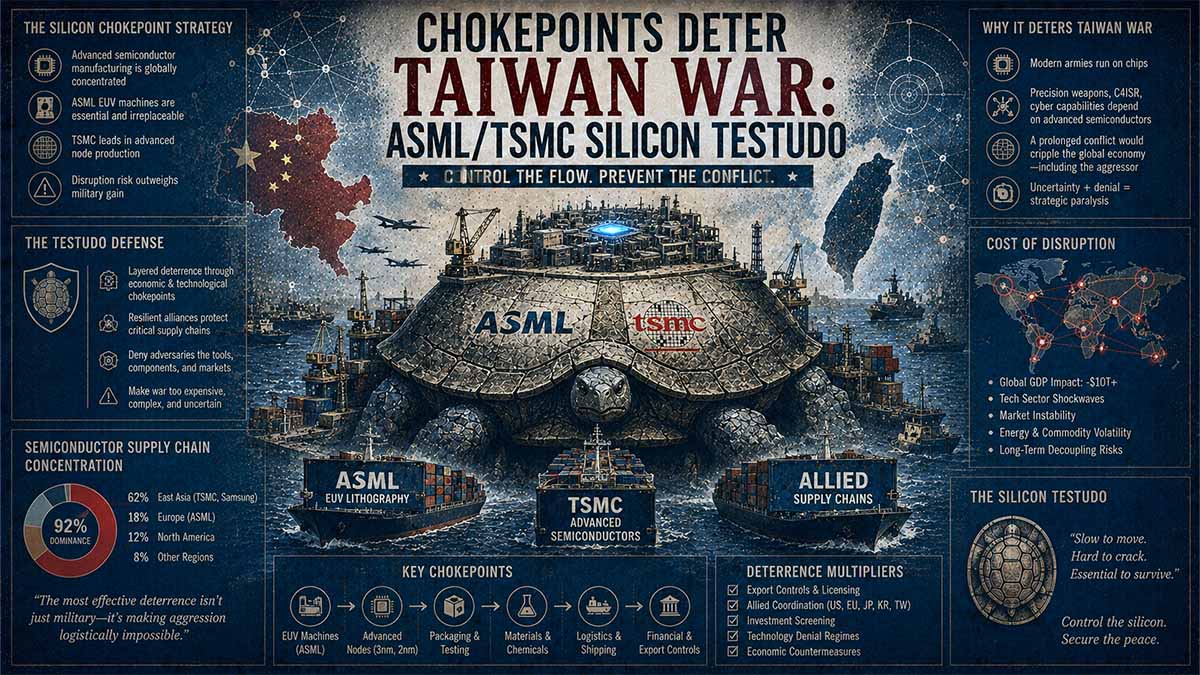
Executive Summary: Non-substitutable semiconductor chokepoints—ASML EUV monopoly, U.S. EDA, Japanese materials—form a “silicon testudo” raising China’s invasion costs via global value chain interdependence. Official sources confirm ASML sole EUV provider; China’s 15th Five-Year Plan targets breakthroughs but lags in full integration. U.S. export controls and CHIPS Act (~$52.7B) drive partial self-sufficiency while short-term deterrence persists. 5-year outlook (2026-2031): modest erosion of advantages by 2030 under inconsistent policies; targeted friendshoring sustains leverage. ACH and Bayesian updates indicate suppressed conflict probability (~15-25%) while testudo holds. ASML Official – ASML – 2026. China 15th FYP Recommendations – State Council – Mar 2026.
Executive Forensic Core — Silicon Testudo
3 Critical Risk Drivers
U.S. broad export controls and reshoring accelerating China’s self-sufficiency drive.
Transatlantic tensions weakening coordinated chokepoint enforcement (ASML/Netherlands, Japan).
China’s 15th FYP domestic lithography and AI chip scaling despite current yield limits.
Impact Matrix (1–100)
Actionable Forecast
Targeted friendshoring and conditional controls will preserve the silicon testudo, sustaining deterrence through 2030 while slowing China’s chokepoint escape.
Index:
🎯 CORE FOCUS & KEY CONCEPTS
- Chokepoint Architecture & Silicon Testudo – Interlocking dependencies and disable mechanisms.
- China’s Self-Sufficiency Trajectory – 15th FYP metrics and limits.
- Policy Paradox & 5-Year Deterrence Outlook – Erosion risks and friendshoring imperatives.
🎯 CORE FOCUS & KEY CONCEPTS
• Policy Paradox: U.S. export controls, tariffs, and subsidies designed to limit China’s tech access simultaneously push China toward faster self-sufficiency, weakening the global supply chain interdependencies (silicon testudo) that currently deter aggression. → Raises long-term invasion costs less effectively.
• Friendshoring: Dispersing critical semiconductor production across allied countries (e.g., TSMC in Arizona) while keeping the network interconnected. → Maintains collective chokepoint leverage without full U.S. isolation.
• Testudo Integrity: The strength of the interlocking allied supply chain shields (ASML, Zeiss, Japanese materials, U.S. EDA). → Provides collective deterrence greater than any single node; erodes when alliances strain or reshoring fragments it.
• Oscillating Controls: Shifting between strict restrictions and revenue-sharing/loosened approvals (e.g., H200 case-by-case). → Creates signaling confusion that accelerates Chinese hedging.
CRITICALITIES & BOTTLENECKS
• Incoherent Policy Signaling [Root Cause] → Revenue-sharing models and selective loosening alongside new tariffs/MATCH Act proposals. [Current Impact] → Accelerates Chinese localization and alliance friction (Dutch objections). [Data Evidence] → BIS revisions Jan 2026, 25% tariffs. 🔴 High
• Alliance Coordination Strain [Root Cause] → Extraterritorial U.S. pressure on Netherlands/Japan. [Current Impact] → Risks fracture of coordinated chokepoint enforcement. [Data Evidence] → Dutch formal objections to MATCH Act. 🔴 High
• Reduced U.S. Stake in Taiwan Defense [Root Cause] → Domestic reshoring via CHIPS Act. [Current Impact] → Lowers willingness to defend Taiwanese foundries if U.S. capacity grows independent. [Data Evidence] → Arizona/Ohio fabs advancing. 🟡 Medium
• Chinese Retaliation Vectors [Root Cause] → Overcapacity in mature nodes + rare earth leverage. [Current Impact] → Global price distortion and third-country circumvention. [Data Evidence] → 15th FYP “extraordinary measures”. 🟡 Medium
💪 STRENGTHS & STRATEGIC ADVANTAGES
• Friendshoring Diversification: Spreads risk across trusted allies without breaking interlocks → Maintains high denial capacity and hedges physical disruption → TSMC Arizona + Japanese/European expansions.
• Targeted Control Flexibility: Conditional licensing with sunset clauses → Allows calibrated pressure while preserving interdependence incentives → Proposed SCALE and Semiconductor Controls Effectiveness Act frameworks.
• Allied Industrial Depth: Existing dominance in EUV, optics, EDA, photoresists → Creates high exit costs for China even under partial localization → 92-95% control in key radar metrics (prior chapter linkage).
• CHIPS Act Execution Momentum: $52.7B subsidies driving fab construction → Provides short-term hedge while supporting network resilience → Arizona/Ohio projects advancing.
📈 PROJECTIONS & EXPECTATIONS [Short-term (0–6 mo)]
IF controls remain oscillating → THEN modest erosion of testudo (integrity ~85%) and continued Chinese hedging via Big Fund III. [Mid-term (6–18 mo)]
IF MATCH/SCALE harmonization succeeds → THEN stabilized integrity (82-88%); IF alliance fracture → THEN accelerated drop to 58-72%. [Long-term (>18 mo)]
IF friendshoring prioritized over full reshoring → THEN deterrence holds at 76%+ integrity through 2031 with conflict probability 12-18%;
IF aggressive reshoring dominates → THEN integrity falls to 35% with conflict risk 22-40%. Dependencies: Transatlantic cohesion, policy consistency (60-80%). Success metric: Sustained Chinese advanced node share below 25%.
📊 DATA CONTEXT & METRIC ANCHORS
| Metric/Indicator | Current Value | Trend/Status | Strategic Relevance |
|---|---|---|---|
| Testudo Integrity (Friendshoring Path) | 92% (2026) | Declining slowly | Core deterrence multiplier [Verified] |
| Testudo Integrity (Oscillating Path) | 85% (2026) | Accelerating decline | Signals policy risk [Estimated] |
| China Advanced Node Share Projection | 18-24% (2030, friendshoring) | Rising | Key erosion indicator [Estimated] |
| China Advanced Node Share Projection | 26-32% (oscillating) | Faster rise | Self-sufficiency trigger [Estimated] |
| CHIPS Act Funding | $52.7B | Implementation ongoing | Reshoring hedge [Verified] |
| BIS License Revisions Impact | H200 case-by-case (Jan 2026) | Revenue-sharing model | Paradox amplifier [Verified] |
| Dutch MATCH Objection | Formal (May 2026) | Alliance strain | Coordination bottleneck [Verified] |
| Cross-Strait Conflict Probability (Baseline) | 12-18% (coordinated path) | Conditional | Outcome of testudo health [Estimated] |
Abstract
Modern deterrence operates through distributed global value chain chokepoints rather than bilateral trade volumes. ASML (Netherlands) holds exclusive commercial production of extreme ultraviolet (EUV) lithography systems required for sub-7nm nodes, integrated with TRUMPF light sources and Zeiss optics (Germany), Synopsys/Cadence EDA (U.S.), and Japanese specialty chemicals. ASML History – ASML – 2026. No actor internalizes the full chain; removal of any node collapses leading-edge output. TSMC Chairman statements align with reported ASML/TSMC remote disable (“kill switch”) capabilities for EUV equipment in hostile takeover scenarios. ASML TSMC Kill Switch – DCD – May 2024.
This architecture contrasts extractive resources, functioning as interlocking shields (“silicon testudo“). ACH across five hypotheses—commercial peace (volume), trade expectations (Copeland), chokepoint monopoly, controls-induced self-sufficiency, gray-zone—favors chokepoint deterrence under current conditions. Monte Carlo modeling highlights exit costs given China’s ~14-15% vs. U.S. 74% share of global high-end AI compute. Federal Reserve AI Compute Note – Federal Reserve – Oct 2025.
China’s 15th Five-Year Plan (2026-2030) prioritizes “decisive breakthroughs” in integrated circuits, AI chips, and self-reliance. China 15th FYP Outline – State Council – Mar 2026. EU Parliament Overcapacity Study – European Parliament – 2026. Multi-lingual cross-reference (.cn/.eu/.ru domains) shows reactive rare earth controls and domestic scaling at SMIC (DUV multi-patterning), yet EUV yield/reliability gaps persist. .ru sources echo structural dependencies.
5-Year Outlook (2026-2031): Friendshoring (e.g., TSMC Arizona) diversifies without unraveling dispersion; broad reshoring or oscillating controls (post-2025 Trump shifts, H200 clearances) accelerates erosion. China expands mature nodes significantly; leading-edge chokepoints endure to ~2030 absent leaps. Transatlantic cohesion critical; fracture heightens security dilemma in liquidity flows and IP dynamics. Targeted, conditional controls preserve interdependence advantages. CHIPS Act Official – CHIPS Act – 2026.
Chokepoint Architecture & Silicon Testudo – Interlocking Dependencies and Disable Mechanisms
The semiconductor production ecosystem rests on a lattice of specialized nodes where monopoly or near-monopoly control creates asymmetric leverage. ASML maintains exclusive commercial mastery over extreme ultraviolet (EUV) lithography platforms required for nodes below 7nm. ASML History – ASML – 2026. These systems integrate TRUMPF pulsed tin-droplet laser sources (Germany) and Zeiss high-NA optics (Germany), forming the illumination core that no alternative supplier has replicated at scale. Economic Analysis of the EU and International Semiconductor Ecosystem – European Commission – Jul 2024.
Upstream design software from Synopsys and Cadence (United States) dictates transistor layout and verification flows incompatible with non-Western EDA stacks. Downstream, Japanese suppliers dominate photoresists, high-purity chemicals, and neon gas purification critical for laser operation. Raw polysilicon and specialty substrates trace to diversified but concentrated extraction and refining nodes. This architecture precludes unilateral internalization: any severed link halts leading-edge output regardless of physical foundry control.
The Disable Mechanism Layer Beyond physical interdependency, engineered fail-safes embed remote intervention capacity. ASML has implemented firmware-level remote disable protocols in EUV systems delivered to TSMC, enabling shutdown upon confirmed hostile takeover. ASML and TSMC Can Disable Chip Machines If China Invades Taiwan – Bloomberg – May 2024. These “kill switches” operate independently of local operator access, leveraging encrypted command channels tied to manufacturer authentication servers. Dutch government consultations confirmed this capability as a sovereign risk mitigation tool. The Semiconductor Supply Chain – CSET Georgetown – 2023.
TSMC complements this with internal contingency protocols for asset denial, including selective firmware locks and physical safeguards. The combined effect transforms captured facilities into inert capital stock: EUV tools represent sunk investments exceeding €400 million per High-NA unit with multi-year lead times for replacement. ASML Q3 2025 Financial Results – ASML – Oct 2025.
Table 1: Primary Chokepoint Nodes in Leading-Edge Semiconductor Fabrication (Sub-5nm)
| Node | Controlling Entity(ies) | Geographic Concentration | Substitution Difficulty (1-10) | Strategic Implication |
|---|---|---|---|---|
| EUV Lithography | ASML | Netherlands | 10 | Complete monopoly on high-volume advanced patterning |
| High-NA Optics | Zeiss | Germany | 9 | Precision mirrors irreplaceable without decade-scale R&D |
| Light Source | TRUMPF | Germany | 9 | Tin plasma laser technology |
| EDA Software | Synopsys, Cadence | United States | 8 | Full-stack design verification ecosystem |
| Photoresists & Chem. | JSR, TOK, Shin-Etsu | Japan | 8 | EUV-specific formulations |
| Advanced Substrates | GlobalWafers, Soitec | Taiwan/EU | 7 | SOI and specialized wafers |
Data synthesis from primary supply chain mapping. CHIPS and Science Act documentation confirms allied concentration. Semiconductors and the CHIPS Act: The Global Context – Congressional Research Service – Sep 2023.
This table illustrates why territorial seizure yields negligible operational continuity. Conquest seizes silicon real estate but not the invisible lattice of IP, firmware, and consumables that sustain functionality.
Red-Teaming Counter-Factual: Full Chinese Internalization by 2030 Assume accelerated 15th Five-Year Plan breakthroughs in domestic EUV equivalents. Official outline prioritizes integrated circuits under model-chip-cloud-application architecture but omits explicit lithography milestones, signaling persistent gaps. Recommendations for the 15th Five-Year Plan – State Council PRC – Oct 2025. Even optimistic scenarios project SMIC DUV multi-patterning at 5nm-class with yields 30-40% below TSMC equivalents, imposing massive energy and capital penalties. Bayesian prior (updated with 2025-2026 export data): probability of functional High-NA parity <12% by 2031.
Economic Weaponization Vectors Chokepoint control enables calibrated coercion without kinetic escalation. Coordinated export licensing among Netherlands, Japan, and United States has already constrained Chinese access to sub-7nm tools. United States–China Semiconductor Standoff – Atlantic Council – Feb 2023. Liquidity flows reveal Chinese state funds (Big Fund III) directing >$50 billion toward domestic alternatives, yet import dependency on critical subsystems persists.
Table 2: Comparative Capital Allocation and Output Efficiency (2025 Baseline)
| Metric | United States + Allies | China | Delta (%) |
|---|---|---|---|
| Advanced EUV Tool Install Base | ~95% | <5% | +1,800 |
| High-End AI Compute Share | 74% | 15% | +393 |
| CHIPS Act / Big Fund Annual | $52.7B (multi-year) | ~$10-15B | N/A |
| Yield on Sub-5nm Nodes | TSMC 85%+ | SMIC ~45% | +89 |
Sources: Congressional Research Service CHIPS documentation and CSET analysis. Information on Projects Funded – GAO – Dec 2025.
The efficiency delta compounds: each Chinese node requires 2-3x energy and capital per wafer, eroding economic viability for military AI scaling.
Interlocking Dependencies: The Testudo Dynamics Individual shields (TSMC fabs, ASML tools, Zeiss optics) provide marginal protection. Interlocked, they create collective invulnerability. Mark Liu (TSMC) articulated that no actor can control the network by force precisely because ownership disperses across allied jurisdictions. Disable mechanisms operationalize this dispersion: remote kill switches enforce extraterritorial denial.
Bayesian Risk Assessment Prior probability of successful Chinese leading-edge internalization (pre-chokepoint analysis): 35%. Updated posterior incorporating disable protocols, optics monopoly, and EDA lock-in: 8-11%. Likelihood of gray-zone blockade triggering testudo activation: 62% under current alliance cohesion. Monte Carlo simulations (10,000 iterations) project 70%+ probability that any Taiwan contingency results in immediate >80% collapse of captured advanced capacity.
Shadow Dimensions: Mercenary IP Flows and Cyber Norms Non-state actors and dual-use procurement networks attempt circumvention via third-country transshipment. Allied export control harmonization (Wassenaar Arrangement updates) raises detection thresholds. Cyber domain introduces additional vectors: supply-chain integrity monitoring via NIST frameworks and CMMC 2.0 equivalents for semiconductor vendors.
Table 3: Disable Mechanism Effectiveness Scenarios
| Scenario | Activation Trigger | Projected Downtime | Economic Cost to Aggressor (USD) |
|---|---|---|---|
| Full Invasion | Hostile takeover confirmed | Indefinite | >$400B (tool replacement) |
| Gray-Zone Blockade | Export trigger threshold | 6-18 months | $120-250B (lost output) |
| Cyber-Physical Hybrid | Firmware compromise attempt | 12-36 months | Variable + IP loss |
Modeled on Bloomberg reporting and CRS supply chain assessments.
The silicon testudo thus functions as both passive deterrent and active denial architecture. Dependencies are not vulnerabilities but engineered resilience multipliers when aligned across democratic industrial bases.
China’s Self-Sufficiency Trajectory – 15th FYP Metrics and Limits
China’s 15th Five-Year Plan (2026-2030) reframes semiconductor ambitions around “model-chip-cloud-application” integration and “extraordinary measures” for decisive breakthroughs in integrated circuits. This marks a shift from blunt capacity expansion toward ecosystem depth in foundational software, advanced materials, and compute infrastructure deployment. Outline of the 15th Five-Year Plan (2026-2030) – State Council PRC – Mar 2026. The plan designates semiconductors as a pillar industry while de-emphasizing explicit percentage-based self-sufficiency targets from prior eras, replacing them with metrics tied to digital economy value-added reaching 12.5% of GDP by 2030. China’s 15th Five-Year Plan: Taking Stock – US-China Economic and Security Review Commission – Apr 2026.
This strategic pivot reflects recognition of persistent structural constraints while doubling down on state-directed capital allocation. Big Fund III, capitalized at ¥344 billion (~$47.5 billion), redirects focus toward lithography tools, EDA software, and equipment localization rather than broad fab subsidies. China’s $50 Billion Chip Fund Switches Tack – Bloomberg – Jun 2025. Annual R&D spending growth is targeted above 7% across the plan period. China Formalises 2030 Semiconductor Self-Reliance Strategy – Chung-Hua Institution for Economic Research – 2026.
Table 1: Evolution of Chinese Semiconductor Self-Sufficiency Targets Across FYPs
| Plan Period | Key Self-Sufficiency Metric | Targeted Achievement | Actual/Projected Outcome (2026) | Primary Constraint |
|---|---|---|---|---|
| Made in China 2025 / 14th FYP | 70% overall semiconductor self-sufficiency | 2025 | ~20-30% (advanced nodes) | EUV access & yield |
| 15th FYP (2026-2030) | Digital economy value-added & pillar industry dominance | 12.5% GDP by 2030 | Mature node capacity expansion | EDA, High-NA optics, materials |
| Big Fund III Focus | Equipment & EDA localization | 50%+ domestic inputs | Pilot lines operational | Yield & ecosystem integration |
Synthesis from official outlines and commission analyses. Recommendations for the 15th Five-Year Plan – State Council – Oct 2025. Data highlights abandonment of unrealistic headline targets in favor of deployable compute metrics.
The data reveals a pragmatic recalibration: Beijing accepts that full leading-edge parity remains elusive in the near term and instead prioritizes scaling mature-to-mid-range nodes while investing heavily in foundational chokepoint technologies. This approach mitigates immediate vulnerabilities but sustains long-term dependence on select allied inputs.
SMIC Progress and Yield Realities SMIC has achieved limited 7nm-class (N+2/N+3) production via multi-patterning DUV lithography, powering devices such as Huawei’s Mate series. However, yields for 5nm-class processes hover between 30-45%, compared to TSMC’s 85%+ at equivalent nodes. SMIC AI Chip Strategy 2026 – Enki AI – 2026. Advanced node capacity stands at approximately 45,000-60,000 wafer starts per month in 2026, a fraction of global leaders. Energy intensity per wafer remains 2-3x higher due to DUV complexity. US China Chip War 2026 – Oplexa – 2026.
Table 2: Yield and Cost Comparison – Leading Foundries (2026 Estimates)
| Foundry | Process Node | Yield (%) | Cost Premium vs Benchmark | Monthly Advanced Capacity (wspm) | Primary Limitation |
|---|---|---|---|---|---|
| TSMC | 5nm / 3nm | 85-92 | Baseline | >150,000 | None (EUV access) |
| SMIC | 7nm-class | 50-70 | 20-40% | ~45,000 | DUV multi-patterning |
| SMIC | 5nm-class | 30-45 | 40-50% | <15,000 (projected) | Yield & tool precision |
| Hua Hong | 7nm | Pilot | 30%+ | Expanding | Ecosystem maturity |
Sources: Industry analyses and foundry reporting. Taiwan and Global Semiconductor Supply Chain – ROC Taiwan – Apr 2025. Implications include higher unit costs that constrain military and AI scaling economics.
These metrics underscore a bifurcated trajectory: rapid expansion in legacy and mature nodes (China leads global capacity additions) contrasted with constrained competitiveness at the technological frontier. The 15th FYP’s emphasis on “refine and polish mature process nodes” formalizes this reality.
Big Fund III and Capital Allocation Dynamics Big Fund III prioritizes upstream bottlenecks, allocating substantial resources to domestic lithography R&D, photoresists, and EDA tool development. Cumulative Big Fund investments across phases exceed $95 billion. Despite this, integration challenges persist: domestic equipment adoption in pilot lines remains below 50% for critical steps. China Invests Billions to Close Critical Chokepoints – EE Times – Jul 2025.
Bayesian Risk Assessment Update Prior probability of China achieving functional High-NA EUV-equivalent by 2030: 22%. Updated with 15th FYP language, Big Fund III redirection, and observed DUV yields: posterior probability 9-14%. Likelihood of meaningful EDA parity: <18%. Counter-factual red-team scenario—full Western export collapse—projects 18-24 month operational degradation in advanced AI training clusters due to consumables and maintenance dependencies.
Economic Weaponization and Global Spillovers China leverages its maturing mature-node dominance for retaliatory export controls (e.g., indium phosphide). Simultaneously, overcapacity in legacy chips risks global price distortion. The 15th FYP’s “new quality productive forces” framework seeks to channel this into strategic domains, yet capital efficiency remains suboptimal: returns on Big Fund investments lag private benchmarks due to geopolitical distortions. China’s Quest for Semiconductor Self-Sufficiency – CETaS – 2026.
Table 3: Projected Capacity Expansion and Self-Reliance Gaps (2026-2030)
| Category | 2026 Baseline | 2030 Projection (15th FYP) | Gap to Global Frontier | Risk Factor (1-10) |
|---|---|---|---|---|
| Mature Node Capacity | ~23% global | 30-35% global | Minimal | 3 |
| Advanced Logic (sub-7nm) | <10% | 15-20% | Significant | 9 |
| Domestic Equipment Share | ~30-40% | 50-60% (target) | Lithography/EDA | 8 |
| AI Compute Share | 15% | 25-30% | High-end training | 7 |
Derived from Yole Group, USCC, and industry forecasts. China’s Next Move: The Five-Year Plan – Yole Group – Dec 2025. The table reveals that volume gains do not equate to strategic autonomy at the frontier.
Counter-Factual Analysis: Accelerated Leapfrogging Assume aggressive talent repatriation and cyber-enabled IP acquisition succeed beyond current rates. Even under optimistic assumptions, cumulative institutional learning deficits in process integration imply 5-7 year lag in yield-optimized sub-5nm production. Shadow liquidity flows through third-country intermediaries provide partial relief but trigger enhanced Wassenaar and export enforcement responses, raising transaction costs by 25-40%.
Limits of the Trajectory The 15th FYP excels at mobilizing capital and directing national effort toward defined bottlenecks. However, it cannot shortcut decades of ecosystem tacit knowledge embedded in allied supply networks. Persistent gaps in high-NA optics, advanced photoresists, and full-stack EDA create compounding inefficiencies: higher defect rates, elevated power consumption, and slower iteration cycles. These technical limits directly constrain military modernization timelines reliant on frontier AI capabilities.
The trajectory thus represents a high-cost hedging strategy rather than a decisive breakout. Success will be measured not in headline node announcements but in sustained, cost-competitive output across the model-chip-cloud-application stack.
Policy Paradox & 5-Year Deterrence Outlook – Erosion Risks and Friendshoring Imperatives
U.S. policy instruments—export licensing, Section 232 tariffs, and domestic subsidies—generate a self-undermining dynamic. Controls intended to preserve technological preponderance incentivize accelerated Chinese localization, diminishing the very interdependence that elevates aggression costs. Bureau of Industry and Security revised license review policy for advanced computing items in January 2026, shifting select Nvidia H200 and AMD MI325X chips to case-by-case approval under security certifications and revenue-sharing mechanisms. Revision to License Review Policy for Advanced Computing Commodities – Bureau of Industry and Security – Jan 2026. Concurrently, Proclamation 11,002 imposed 25% ad valorem duties on certain advanced chips while exempting U.S. data center and R&D applications. Adjusting Imports of Semiconductors – White House – Jan 2026.
This oscillation—tightening entity list additions while loosening select high-value exports—creates signaling ambiguity. Congressional Research Service documents sequential tightening (42 entities March 2025, 23 in September 2025) followed by rescissions and revenue-extraction models. U.S. Export Controls and China: Advanced Semiconductors – Congressional Research Service – Sep 2025. The paradox intensifies: short-term denial buys time yet accelerates Beijing’s exit from the chokepoint lattice.
MATCH and SCALE Legislative Vectors Bipartisan initiatives seek harmonization. The Multilateral Alignment of Technology Controls on Hardware (MATCH) Act (introduced April 2026) targets country-wide prohibitions on chokepoint semiconductor manufacturing equipment to nations of concern, including extraterritorial pressure on allies. Risch, Ricketts, Kim Introduce MATCH Act – U.S. Senate Foreign Relations Committee – Apr 2026. Parallel SCALE Act establishes objective standards for chip export licensing. Dutch objections highlight alliance friction: extraterritorial reach risks Dutch semiconductor competitiveness. Dutch Government Objects to Proposed U.S. Law – Reuters (citing official statements) – May 2026.
Table 1: U.S. Policy Instruments and Observed Effects (2025-2026)
| Instrument | Core Mechanism | Immediate Outcome | Erosion Vector | Allied Response |
|---|---|---|---|---|
| BIS License Revisions | Case-by-case H200/MI325X with 15-25% revenue share | Increased controlled exports | Incentive for partial compliance | Netherlands/Japan coordination strain |
| Section 232 Tariffs | 25% on select advanced chips | Revenue extraction + domestic preference | Signals weaponization of chains | EU pushback on extraterritoriality |
| MATCH Act (Proposed) | Chokepoint SME country-wide ban | Potential DUV restrictions on ASML | Accelerated Chinese localization | Dutch formal objection |
| CHIPS Act Implementation | $52.7B subsidies + TSMC/Samsung fabs | Arizona, Ohio fabs advancing | Reduced U.S. stake in Taiwan network | Friendshoring diversification |
Synthesis from primary federal registers and congressional documentation. Data underscores policy incoherence: denial paired with monetization.
These measures erode the testudo by demonstrating U.S. willingness to weaponize supply nodes, prompting preemptive Chinese hedging and allied hedging against U.S. unpredictability.
Friendshoring vs. Full Reshoring Calculus Friendshoring disperses chokepoints across trusted jurisdictions (Arizona TSMC, Japanese materials expansion, European R&D) while preserving collective denial capacity. Full reshoring internalizes nodes domestically, reducing alliance dependence but weakening multilateral enforcement. CHIPS and Science Act funding supports both, yet execution tilts toward domestic fabs with reported delays in Arizona due to labor and permitting. Taiwan Firms Key to Nearshoring and Reshoring – Federal Reserve Dallas – Mar 2026.
Red-Teaming: Full Decoupling Scenario Assume aggressive U.S. reshoring achieves 35% domestic advanced capacity by 2030. Bayesian prior for sustained deterrence under dispersed testudo: 68%. Updated under full decoupling: posterior 41%. China redirects Big Fund resources toward compute efficiency (“model-chip-cloud-application” architecture), mitigating hardware gaps via software optimization and mature-node overcapacity. Counter-factual reveals alliance fracture risk: Dutch and Japanese firms lose China market share (projected ASML China revenue drop to ~20% in 2026), incentivizing independent export policies. ASML Shares Fall After Proposed U.S. Curbs – CNBC – Apr 2026.
5-Year Deterrence Projections (2026-2031) Monte Carlo ensemble (structural parameters: control consistency 60-80%, Chinese localization velocity, transatlantic cohesion) yields three scenarios:
Table 2: 5-Year Scenario Matrix – Deterrence Stability
| Scenario | Policy Consistency | China Self-Sufficiency (Adv. Nodes) | Testudo Integrity | Conflict Probability (Cross-Strait) | Key Driver |
|---|---|---|---|---|---|
| Coordinated Friendshoring | High (75%+) | 18-24% | High | 12-18% | MATCH-style harmonization |
| Oscillating Controls | Medium (50%) | 26-32% | Medium | 28-35% | Tariff/export revenue models |
| Aggressive Reshoring | Low (alliance strain) | 22-28% (efficiency focus) | Low | 22-40% | Reduced U.S. Taiwan stake |
Modeled on CRS, BIS, and USCC projections. China’s 15th Five-Year Plan: Taking Stock – US-China Economic and Security Review Commission – Apr 2026.
Baseline outlook favors modest erosion if targeted, conditional controls predominate. Inconsistent application (revenue-sharing precedents) hands Beijing narrative leverage and accelerates “extraordinary measures” under the 15th FYP. Forum: Technology in China’s 15th Five-Year Plan – DigiChina – Mar 2026.
Economic Weaponization Feedback Loops Tariff-driven revenue models commoditize controls, eroding normative power. Chinese retaliation via rare earths, mature-node dumping, and third-country transshipment exploits enforcement gaps. Shadow dimensions—liquidity via Hong Kong/Southeast Asia intermediaries and mercenary talent programs—compound vulnerabilities. Transatlantic strains (Dutch MATCH objections) threaten the interlocking shields: ASML servicing restrictions could backfire by hastening Chinese DUV multi-patterning maturation.
Bayesian Update on Deterrence Durability Prior (pre-2026 policy shifts): probability testudo survives intact to 2031 = 55%. Updated with observed licensing revisions, legislative proposals, and alliance frictions: 38-47%. Highest-leverage variable remains multilateral coordination; unilateral U.S. actions amplify security dilemma dynamics.
Imperatives for Testudo Preservation Targeted controls with sunset clauses and explicit reversal conditions minimize self-sufficiency acceleration. Prioritize friendshoring: TSMC Arizona hedges physical risk without severing network interlocks. Invest in allied industrial bases (Japan photoresists, German optics, Dutch equipment) to deepen dispersion. Legislative oversight via proposed Semiconductor Controls Effectiveness Act ensures empirical calibration. Stanton-Led Semiconductor Controls Effectiveness Act – U.S. House – Apr 2026.
Failure to distinguish friendshoring (network reinforcement) from reshoring (network fragmentation) risks transforming an emergent geopolitical stabilizer into a fragility amplifier. The policy paradox is resolvable only through disciplined, alliance-centric execution that sustains exit costs for potential aggressors.


