












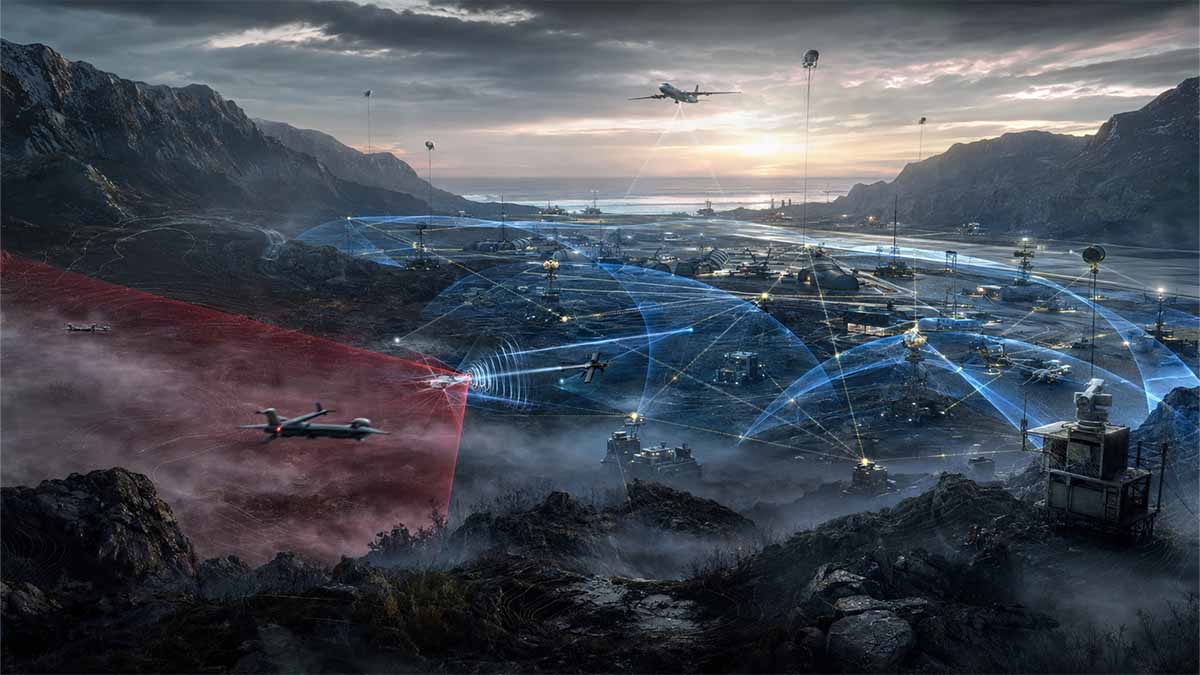
Executive Summary
- BLUF: Forward air bases remain vulnerable because legacy air defence architectures were designed primarily for discrete aircraft and missile threats, not persistent, multidirectional attacks combining drones, cruise missiles, electronic warfare and cyber disruption.
- The central weakness is architectural: fragmented sensing, divided service responsibilities, incompatible command systems and an incomplete low-altitude air picture.
- High-value interceptors cannot provide an economically sustainable answer to mass-produced, comparatively inexpensive threats.
- Effective defence requires one integrated battle-management layer connecting IAMD, C-UAS, electronic warfare, passive detection, local security and flight operations.
- Active interception must be combined with dispersal, hardening, deception, rapid repair, operational redundancy and offensive counter-air effects.
- The most dangerous attack profile is a coordinated system-of-systems campaign intended to paralyse decision-making rather than merely destroy aircraft.
- The 2026–2031 transition will depend more on command integration, sensor density, delegated authority and force regeneration than on any single interceptor.
- Five competing hypotheses and a Bayesian–Monte Carlo framework indicate that fragmented adaptation remains the most probable near-term trajectory.
- By 2031, survivable forward basing will require bases to function as distributed combat networks rather than geographically fixed installations.
The Air Base Is No Longer a Sanctuary
Drones, cruise missiles and low-altitude aircraft are exposing gaps that expensive interceptors alone cannot close. NATO will procure 700 PAC-2 and 200 PAC-3 missiles, while the United States is expanding integrated command structures and testing rapid runway recovery. The unresolved question is whether Western forces can connect sensors, weapons, hardened infrastructure and dispersed bases before offensive mass overtakes defensive production.
On 7 July 2026, NATO announced that its Support and Procurement Agency would acquire 700 PAC-2 and 200 PAC-3 missiles. The decision is substantial, but its meaning extends beyond the replenishment of Patriot inventories. It is an admission that Europe and the United States must rebuild air defence for a threat environment in which a forward base can face small drones, cruise missiles, conventional aircraft, ballistic weapons, electronic interference and cyber disruption during the same attack.
The central weakness is no longer the absence of sophisticated weapons. It is the interval between detection and decision, the separation between counter-drone and missile-defence commands, and the vulnerability of runways, fuel, communications and repair capacity after an interceptor misses. The next air-defence contest will be decided as much by software, production lines and civil engineers as by missiles.
The low-altitude seam
Traditional air-defence networks were built around recognizable aircraft and missile trajectories. Small drones and terrain-following weapons attack the geometry of that model. Earth curvature, terrain, buildings and electromagnetic clutter reduce the effective range of ground radar; low signatures complicate classification; autonomous navigation reduces dependence on radio links that can be jammed.
A detected object is not yet an engagement-quality target. Its track must be correlated with other sensors, identified as hostile, distinguished from friendly or civilian traffic, assigned to an available weapon and cleared for engagement. At low altitude, that chain can consume most of the available warning time.
NATO’s Integrated Air and Missile Defence Policy, approved on 13 February 2025, consequently defines the threat as extending from small, slow unmanned aircraft to cruise, ballistic and hypersonic missiles approaching from every direction, altitude and velocity. It requires persistent 360-degree surveillance and integration across land, air, maritime, space and cyber capabilities.
That policy also identifies a problem that procurement figures cannot solve: interoperability. A Patriot battery, a counter-drone jammer, an airborne-warning aircraft and an electro-optical sensor offer only partial protection if they maintain separate tracks, follow different engagement procedures or report through incompatible networks.
The United States is trying to replace these system-specific chains with networked command. On 15 August 2025, the US Army reported that its Lower Tier Air and Missile Defense Sensor had detected and classified an air-breathing target, after which the Integrated Battle Command System generated the engagement solution and commanded a successful intercept using a PAC-3 MSE missile. The official test report demonstrated a 360-degree sensor-to-shooter chain. It did not prove that every deployed system, service and ally can already operate this way under combat degradation.
One picture, one command
The command problem is moving from doctrine to regional organization. On 12 January 2026, US Central Command and regional partners opened the Middle Eastern Air Defense–Combined Defense Operations Cell inside the Combined Air Operations Center at Al Udeid Air Base in Qatar. The CAOC already included representatives from 17 nations. CENTCOM commander Admiral Brad Cooper described the new cell as a mechanism for sharing air-and-missile-defence responsibilities rather than merely exchanging warnings. The details appear in the CENTCOM release of 13 January.
This is the direction in which forward-base defence must evolve. Regional command allocates scarce interceptors and sets defended-asset priorities; local commanders need sufficient authority to act when communications fail or a low-flying target appears inside the wider decision cycle. Excessive centralization creates delay. Uncoordinated decentralization risks fratricide, duplicate engagements and the consumption of weapons needed for more dangerous targets.
The economic dilemma is equally severe. A low-cost drone can force the defender to reveal a radar, interrupt flight operations or fire a missile costing many times the value of the target. A mixed raid can use decoys to consume interceptors before more capable weapons arrive. The relevant calculation is therefore not simply probability of kill. It is the mission value protected, the weapon expended, the collateral risk created and the future engagement capacity surrendered.
This requires a layered family of effects: electronic disruption against radio-dependent systems; guns, rockets and interceptor drones for smaller targets; short- and medium-range missiles for cruise missiles, aircraft and larger unmanned systems; upper-tier weapons for ballistic threats; fighters where their range and flexibility justify the sortie cost. Directed energy may eventually provide a deeper electrical magazine, but industrial transition remains uncertain. A GAO assessment published in April 2023 found that US directed-energy programmes had not consistently completed the planning required to move prototypes into acquisition.
The industrial race
The expenditure curve is now shaping strategy. The US Army’s budget requests for seven air-and-missile-defence modernization efforts rose from 8.8 billion dollars in fiscal year 2021 to 11.8 billion in 2025. Yet the Government Accountability Office reported on 17 June 2025 that most of the reviewed efforts had not been fielded and that five of eight encountered performance or integration problems delaying production. These included LTAMDS, directed-energy M-SHORAD and the reviewed variants of the Indirect Fire Protection Capability.
NATO’s July 2026 order for 900 Patriot interceptors should therefore be read as a demand signal, not as immediately available inventory. Delivery schedules, annual throughput, crew formation, reload capacity and geographic allocation will determine its operational value. Belgium and the Netherlands also signed a memorandum for government-to-government procurement of air-defence systems, while Türkiye announced additional domestic production investments, according to the NATO statement of 7 July.
Europe is moving in the same direction, although its instruments remain smaller than the requirement. The European Commission’s European Defence Industry Programme carries 1.5 billion euros for industrial readiness, production expansion and security of supply. The European Defence Agency’s 2025 annual report records work on integrated air-and-missile defence, GNSS-denied drone operations and a catalogue covering more than 300 unmanned systems from over 200 manufacturers.
The strategic bottleneck is hidden below the prime contractor. Interceptors and radars depend on rocket motors, energetic materials, seekers, processors, power electronics, optical components, test facilities and cleared technicians. In July 2025, GAO found that the Pentagon’s supply-chain initiatives offered little visibility into much of the network below major subsystems. The official audit warned that foreign dependencies and single-source risks could remain undiscovered until a disruption occurred.
This matters directly to Italy. Its bases, aircraft and national air-defence assets operate within NATO’s wider architecture; Italian industry participates in European sensor, electronics, missile and aerospace chains. Rome’s 2026–2028 political priorities for defence identify joint-force integration as an essential requirement. The practical consequence is demanding: Italy must assess air-base protection not as a perimeter-security expense but as a combination of national infrastructure resilience, allied interoperability, industrial policy and operational continuity.
Surviving the hit
No credible architecture can promise to intercept every object. NATO’s 2025 policy therefore places passive defence alongside active interception: hardening, dispersal, camouflage, redundancy and measures intended to limit the consequences of impact.
The weakest point is often not the aircraft. A protected fighter cannot generate a sortie without fuel, weapons, maintenance release, communications and a usable operating surface. Hardening shelters while leaving pumps, substations or command links concentrated merely transfers vulnerability. The correct measure is the number of independent mission paths that remain after an attack.
The US Air Force’s Agile Combat Employment doctrine addresses this problem by organizing enduring bases and contingency locations into clusters. Aircraft, support personnel and equipment can move inside the adversary’s targeting cycle, complicating the reconnaissance-strike process. Dispersal, however, is expensive. Alternate sites need fuel, munitions, communications, airfield services, security, spare parts and repair equipment. A runway on a map is not an operational base.
Recovery is the final defensive layer. On 27 January 2025, during Operation Agile Spartan 25.1, the 379th Expeditionary Civil Engineer Squadron confronted a mock runway damaged by nine craters, including one measuring approximately 60 by 35 feet. The unit was given 48 hours to assess the damage, clear debris and restore the surface; according to the Air Force report published on 6 February, it completed the task 25 hours early.
That controlled exercise cannot reproduce continuing attack, unexploded ordnance, equipment losses or electronic disruption. It nevertheless captures the emerging doctrine: an air base remains defensible if penetration produces a temporary interruption rather than operational paralysis.
Between 2026 and 2031, the decisive metric will not be the number of incoming weapons destroyed. It will be the combat output retained after the first attack, the number of affordable engagements still available for the second, and the speed with which aircraft return to the air before the adversary completes another reconnaissance cycle. The air base is no longer a sanctuary. It must become a system built to fight while damaged.
Navigational Index
- The Threat System — Low-altitude penetration, saturation, electronic warfare, cyber effects, deception and adversarial reconnaissance.
- The Defensive Architecture — Integrated sensing, command and control, layered effectors, passive protection, dispersal and rapid regeneration.
- The 2026–2031 Outlook — Competing hypotheses, Bayesian indicators, modeled scenarios, industrial constraints and strategic decision points.
Master Abstract
Forward air-base defence has entered a structural discontinuity. The operational problem is no longer reducible to intercepting an aircraft, cruise missile or unmanned system after a radar produces a sufficiently stable track. The contemporary threat is a coordinated reconnaissance-strike architecture that combines persistent commercial and military surveillance, low-observable or terrain-masked ingress, inexpensive one-way attack systems, conventional aircraft, cruise and ballistic missiles, electronic attack, cyber intrusion, decoys and attacks against fuel, power, communications and runway-repair capacity. NATO formally recognizes a threat spectrum extending from small, slow and low-flying unmanned systems to cruise, ballistic and hypersonic missiles arriving from every direction, altitude and velocity; it consequently defines integrated air and missile defence as a permanent, 360-degree mission rather than a wartime reinforcement activity. NATO Integrated Air and Missile Defence Policy – North Atlantic Treaty Organization – February 2025 — Official policy. The decisive vulnerability nevertheless lies below this strategic formulation: local base-defence sensors, theatre-level radars, airborne surveillance, civilian air-traffic information, counter-drone systems, surface-to-air batteries and aircraft-control authorities frequently operate through different technical and organizational channels. A penetration therefore need not defeat every defensive component. It must exploit only one temporal, geometric or jurisdictional seam long enough to preserve surprise. Ground-based radar remains constrained by curvature, terrain, buildings, electromagnetic clutter and the target’s radar cross-section; airborne sensors improve the geometry but cannot guarantee persistent coverage, perfect classification or instant transfer of engagement-quality data. The initiating account supplied for this report contains consequential but officially unconfirmed assertions and is therefore excluded from the factual baseline. Its analytical value lies solely in the failure mechanism it raises: a mature defence network may possess advanced systems while still lacking a continuous, jointly controlled low-altitude engagement chain.
The correct unit of analysis is therefore the air-base combat ecosystem, not the interceptor battery. A survivable base needs mutually reinforcing layers: space, airborne and terrestrial warning; elevated and distributed radar; passive radio-frequency, electro-optical, infrared and acoustic detection; cooperative and non-cooperative identification; a common track architecture; automated but human-governed threat prioritization; electronic protection; non-kinetic defeat; guns and low-cost interceptors; medium- and high-tier missile defence; combat-air patrols; counter-reconnaissance; physical hardening; signature management; dispersal; redundant energy and communications; runway repair; logistics substitution; and rehearsed mission continuation under degraded conditions. The United States Air Force’s August 2025 doctrine advisory explicitly places air-base point defence inside the joint force’s wider integrated air and missile defence structure and emphasizes the requirement to prevent engagements against friendly unmanned aircraft and loitering munitions. Control Below the Coordinating Altitude Doctrine Advisory – United States Air Force Doctrine Center – August 2025 — Official doctrine advisory. This requirement exposes the command problem at its most difficult point: the defender must shorten the detect–identify–decide–engage–assess cycle without increasing fratricide, disrupting friendly sorties or allowing automation to make legally and operationally ambiguous decisions. Current experimentation demonstrates movement toward this integrated model. A United States–Saudi exercise placed American and Saudi air and ground controllers inside a combined base-defence operations centre, centralized counter-UAS fires and coordinated the full decision cycle across national systems. Red Sands IEC 25 Advances TF Spartan’s Combined C-UAS Operations and Experimentation – United States Army Air Defense Artillery Journal – February 2026 — Official operational account. CENTCOM also opened a multinational air-defence coordination cell at Al Udeid Air Base to strengthen regional information sharing and integrated command. U.S., Regional Partners Open New Air Defense Operations Cell in Qatar – United States Central Command – January 2026 — Official release. These developments are significant, but coordination cells become operationally decisive only when they can ingest heterogeneous sensors, distribute authenticated tracks, manage engagement authorities and continue functioning after network degradation.
The economic and industrial dimension is equally decisive because the attacker can deliberately manipulate the defender’s cost curve. A layered raid can force operators to choose among conserving expensive interceptors, accepting damage, or using weapons whose debris, electromagnetic effects or identification uncertainty create secondary risk. The United States Government Accountability Office found that Army budget requests for seven air-and-missile-defence modernization efforts rose from 8.8 billion to 11.8 billion dollars between fiscal years 2021 and 2025, while also identifying schedule, integration and performance risks across the portfolio. Air and Missile Defense: Efforts Would Benefit from More Comprehensive Assessments of Risks and Capabilities – United States Government Accountability Office – June 2025 — Official report. Europe has adopted a parallel requirement: its capability priorities explicitly call for counter-UAS systems integrated into existing air-defence command networks, combining kinetic and non-kinetic effectors against low, slow and small systems as well as swarms. 2023 EU Capability Development Priorities – European Defence Agency – November 2023 — Official capability priorities. The resulting strategic judgment is that forward-base defence cannot be made affordable through interceptor substitution alone. Its cost must be redistributed across passive survival measures, inexpensive terminal effects, electronic warfare, deception, autonomous sensing, repair capacity and distributed operations. The five principal competing hypotheses for 2026–2031 are: H₁, command integration outpaces threat evolution; H₂, layered defences improve but remain organizationally fragmented; H₃, cheap autonomous saturation overwhelms acquisition and production cycles; H₄, dispersal and deception reduce the strategic value of attacking fixed bases; and H₅, cyber-electromagnetic compromise becomes the dominant pathway to physical penetration. The initial Bayesian assessment assigns the greatest probability to H₂, because official programmes demonstrate real institutional movement but do not yet establish universal interoperability, sufficient magazine depth or resilient cross-service control. The accompanying Monte Carlo instrument is a transparent exploratory model, not a prediction: it tests how threat density, low-altitude sensor gaps, command latency, interceptor depth, passive protection and repair resilience alter mission-loss probability across repeated simulated attacks.
Forward Air-Base Resilience Simulator
Chapter 1 — The Threat System: Low-Altitude Penetration, Saturation, Electronic Warfare, Cyber Effects, Deception and Adversarial Reconnaissance, 2026–2031
1. The air base as a continuously observed combat system
The forward air base can no longer be treated as a protected logistical enclosure located behind a definable front line. It has become a continuously observed, digitally exposed and geographically fixed combat system whose runways, aircraft parking areas, fuel farms, weapons-storage facilities, electrical substations, communications nodes, air-defence sensors, access routes and operational rhythms can be mapped long before hostilities begin. The adversary’s objective is not necessarily to destroy the installation in a single attack. It is to construct a sufficiently detailed model of the base to identify when, where and how a limited number of effects can interrupt sortie generation, confuse defensive command, expose aircraft on the ground or force the defender to expend scarce interceptors. Persistent surveillance can draw on military satellites, commercial imagery, synthetic-aperture radar, electronic intelligence, unmanned reconnaissance, maritime and terrestrial sensors, cyber collection, commercially available geospatial information and inadvertent emissions from personnel or contractors. The RQ-4 Global Hawk illustrates the strategic reach of contemporary high-altitude, long-endurance surveillance: the United States Air Force describes it as providing broad-spectrum, all-weather, day-and-night intelligence, surveillance and reconnaissance for joint forces. RQ-4 Global Hawk Fact Sheet – United States Air Force – Current official edition verified August 2026 — Official fact sheet. Comparable functions are increasingly distributed across smaller and less expensive platforms, making reconnaissance more persistent and replaceable. The European Defence Agency’s 2025 activities included a catalogue containing more than 300 unmanned systems from over 200 manufacturers, projects addressing operations in GNSS-denied environments and work on military communications, navigation and surveillance resilience. European Defence Agency Annual Report 2025 – European Defence Agency – 2026 — Official annual report. This is not evidence that every listed platform has a military reconnaissance role; it is evidence of the breadth, commercialization and rapid diversification of the industrial ecosystem from which future reconnaissance and penetration capabilities can be assembled.
| Reconnaissance layer | Observable signature or dataset | Intelligence value to the attacker | Principal analytical consequence |
|---|---|---|---|
| Optical and multispectral imagery | Aircraft positions, shelters, construction, repair activity, camouflage changes | Identifies physical concentration and recurring parking patterns | Static hardening loses value when entrances, ventilation, support dependencies and operating cycles remain observable |
| Synthetic-aperture radar | Surface change, vehicle displacement, activity through cloud or darkness | Supports change detection despite weather and illumination | Night and adverse weather no longer guarantee concealment |
| Electronic intelligence | Radar modes, communications activity, frequency use, emitter location | Builds an electronic order of battle and reveals defensive readiness | Activating additional sensors may improve detection while exposing network structure |
| Small-UAS reconnaissance | Close imagery, thermal signatures, local line-of-sight mapping | Confirms target condition shortly before attack | Tactical surveillance can close the gap between strategic imagery and real-time targeting |
| Cyber reconnaissance | Network architecture, credentials, maintenance records, contractor access | Identifies software dependencies and exploitable trust relationships | Physical and digital attack planning become mutually reinforcing |
| Commercial and behavioural data | Traffic, procurement, accommodation, logistics and personnel routines | Supports pattern-of-life analysis without classified collection | Operational security failures outside the perimeter may reveal readiness inside it |
| Post-strike observation | Repair progress, runway clearance, dispersal routes, replacement equipment | Measures damage and supports re-attack decisions | Recovery activity becomes a new intelligence signature rather than the end of the engagement |
2. Low-altitude penetration as a geometry and decision problem
Low-altitude penetration exploits physics, geography and institutional latency simultaneously. Radar horizon, terrain masking, urban clutter, sea-surface returns, vegetation, buildings and the small radar cross-section of many unmanned systems reduce the time between first reliable detection and arrival at the defended asset. A ground sensor that is technically capable of detecting an object under test conditions may not produce an operationally useful track when the target follows terrain, approaches through dense clutter, changes speed, emits intermittently or resembles lawful civilian traffic. The critical variable is therefore not nominal radar range but effective warning time after detection, classification, identification, track correlation and dissemination have occurred. A target detected at short distance may generate only seconds or minutes for the base-defence operations centre to determine whether it is hostile, verify that it is not a friendly unmanned system, assign an effector, obtain engagement authority and ensure that the engagement will not endanger aircraft, personnel or surrounding civilian infrastructure. The Air Force’s current airspace-control doctrine makes the base commander responsible for planning, integrating and coordinating point defence through the Base Defense Operations Center, while linking the base-defence zone to wider airspace and air-defence authorities. Air Force Doctrine Publication 3-52: Airspace Control – United States Air Force – October 2025 — Official doctrine. The associated doctrine advisory requires air-base point defence to be integrated into theatre IAMD and specifically recognizes the need to avoid engaging friendly unmanned aircraft and loitering munitions. Control Below the Coordinating Altitude Doctrine Advisory – United States Air Force Doctrine Center – August 2025 — Official doctrine advisory. These provisions expose the central dilemma: stricter identification reduces fratricide but consumes time; delegated engagement reduces latency but increases legal, safety and coordination risk. Between 2026 and 2031, autonomous navigation, onboard perception and pre-programmed terrain following will further reduce the attacker’s dependence on continuous radio control, thereby weakening defences built primarily around detecting or jamming command links.
| Low-altitude penetration variable | Defensive assumption placed under stress | Attack-system adaptation, 2026–2031 | Projected effect on the engagement chain |
|---|---|---|---|
| Radar horizon | Distant sensors provide sufficient early warning | Terrain following, littoral routing and nap-of-the-earth profiles | Later first detection and compressed engagement time |
| Radar cross-section | Small objects remain distinguishable from clutter | Composite materials, smaller airframes and signature-aware routing | Increased false-negative and false-positive rates |
| Radio-frequency dependence | Jamming command links terminates the attack | Inertial navigation, visual navigation and onboard autonomy | Reduced effectiveness of link-denial measures |
| Predictable approach sector | Threat axes correspond to known launch geography | Mobile launch, indirect routing and waypoint programming | Requirement for persistent 360-degree coverage |
| Stable target behaviour | Track prediction supports rapid fire-control solutions | Speed, altitude and heading variation | Greater tracker workload and uncertain interception geometry |
| Clear hostile identification | Military targets are distinct from civilian air activity | Mimicry of commercial systems and operations near lawful traffic | Longer classification cycle and higher fratricide risk |
| Centralized control | A single command node improves coordination | Network attack, decoys and communications disruption | Centralization may become a single point of operational paralysis |
3. Saturation and the manipulation of defensive economics
Saturation is not merely the arrival of many vehicles at once; it is the deliberate construction of more simultaneous detection, classification and engagement problems than the defensive system can resolve within the available time, magazine and command capacity. The attacker can combine small reconnaissance drones, one-way attack systems, decoys, cruise missiles, ballistic missiles, conventional aircraft and electronic effects so that each layer forces a different defensive response. Cheap objects can compel radar activation, reveal emitter locations or consume expensive interceptors, while higher-value weapons follow through the resulting gap. False tracks can burden operators even when no physical vehicle reaches the perimeter. Repeated probes can measure reaction times, identify which radar modes appear under particular conditions and estimate how quickly batteries reposition or reload. The European Defence Agency identifies counter-UAS, counter-swarm systems, airborne early warning and autonomous platforms as connected air-domain capability priorities, while acknowledging command, interoperability, human-oversight and civil-technology integration challenges. Air Domain: Autonomous Systems Capability Development – European Defence Agency – Current official edition verified August 2026 — Official capability framework. The United States Government Accountability Office reported that Army requests for seven air-and-missile-defence modernization efforts increased from 8.8 billion dollars in fiscal year 2021 to 11.8 billion dollars in fiscal year 2025, but also found that programme-level risk assessments did not consistently aggregate technical, schedule, production and integration risks into a complete capability picture. Air and Missile Defense: Efforts Would Benefit from More Comprehensive Assessments of Risks and Capabilities – United States Government Accountability Office – June 2025 — Official report. Saturation therefore attacks four finite resources at once: interceptor inventory, sensor capacity, decision attention and recovery time. Even a technically successful defence may constitute an operational defeat if it expends disproportionate resources, interrupts friendly flight operations, reveals the defensive order of battle or leaves the base unable to defeat the next wave.
| Saturation mechanism | Immediate purpose | Secondary purpose | Scarce defensive resource attacked | Five-year trend |
|---|---|---|---|---|
| Mass one-way attack systems | Place multiple warheads near vulnerable infrastructure | Force broad radar coverage and repeated engagements | Low-cost interceptor inventory | Strong growth |
| Mixed-speed raid | Complicate track prioritization and engagement timing | Separate defensive layers temporally | Command attention and fire-control channels | Strong growth |
| Decoy-first sequencing | Trigger radar and interceptor use | Reveal emitter locations and response doctrine | Signature discipline and magazine depth | Strong growth |
| Multiazimuth attack | Defeat sector-oriented coverage | Stretch local security and observation teams | Sensor geometry and human supervision | Very strong growth |
| Repeated small probes | Measure readiness and reactions | Normalize alerts and generate fatigue | Operator attention and confidence | Persistent growth |
| Reconnaissance-strike loop | Update targeting during or after an attack | Enable rapid re-attack of repair operations | Recovery time and deception credibility | Very strong growth |
| Cyber-physical synchronization | Degrade networks as vehicles arrive | Create uncertainty about system status | Decision speed and data integrity | High-impact growth |
| High–low weapon mixture | Force use of different defensive tiers | Create interceptor-allocation dilemmas | Cross-layer coordination | Very strong growth |
A five-year force-planning assessment must consequently distinguish raid size from saturation intensity. A raid containing fifty identical objects may be less demanding than one containing twelve objects with heterogeneous speeds, signatures, navigation modes and political identification problems. The relevant analytic variable is the ratio between unresolved engagement tasks and the defender’s effective processing capacity during the shortest critical interval. For this report, Sₜ is defined as the number of simultaneous credible or ambiguous engagement demands at time t divided by the number that the integrated defence can detect, classify, assign and engage without unacceptable interference with friendly operations. When Sₜ exceeds 1, local saturation has occurred even if defensive missiles remain available. This formulation moves the analysis away from counting launchers and toward measuring the complete kill chain. It also explains why adding a new interceptor without increasing sensor coverage, communications resilience, identification speed and trained crews may produce little net improvement. Directed-energy systems could eventually reduce cost per engagement and increase effective magazine depth, but the GAO found that Department of Defense directed-energy programmes faced persistent transition problems and that the Air Force had not consistently completed key steps needed to move counter-UAS technologies into acquisition programmes. Directed Energy Weapons: DOD Should Focus on Transition Planning – United States Government Accountability Office – April 2023 — Official report. By 2031, saturation pressure is likely to rise faster than the number of high-end defensive batteries because software, commercial manufacturing and autonomy scale more rapidly than specialized radar, missile and trained-personnel production. The defensive answer must therefore include selective engagement, electronic attack, guns, low-cost interceptors, passive protection, target dilution and rapid restoration—not simply additional launches of premium missiles.
4. Electronic warfare and the conversion of uncertainty into a weapon
Electronic warfare transforms the air-base defence problem because it can degrade observation, navigation, communications and identification without producing an immediately visible physical effect. Jamming can reduce radar sensitivity, interrupt command links or deny satellite navigation; spoofing can introduce false position or timing information; deceptive emissions can generate phantom tracks; direction finding can reveal active sensor and communications nodes; cyber-electromagnetic activity can contaminate the data upon which automated classification and weapon assignment depend. The attacker does not need to eliminate every sensor. It needs to reduce confidence sufficiently that operators delay engagement, misallocate effectors, activate redundant systems prematurely or suspend friendly flight operations. The International Civil Aviation Organization has documented GNSS radio-frequency interference as a growing international aviation-safety problem and recommends surveillance independent of GNSS, resilient air-ground communications, independent timing and fallback navigation infrastructure. GNSS Interference and Mitigating Measures – International Civil Aviation Organization Asia-Pacific Office – July 2024 — Official working paper. ICAO’s official publication register also includes its April 2024 state letter on aviation-safety concerns arising from GNSS interference, a December 2024 bulletin on spoofing and a joint ICAO–ITU–IMO statement calling for protection of satellite-navigation services. ICAO Publications Related to GNSS Radio-Frequency Interference – International Civil Aviation Organization – Updated 2025 — Official publication register. For a forward air base, GNSS disruption creates effects beyond aircraft navigation: timing errors may affect network synchronization, surveillance correlation, logistics tracking and communications; spoofing may cause internally consistent but geographically false data; broad jamming may disrupt friendly and civilian systems simultaneously. The defensive requirement is not simply an anti-jamming receiver but a resilient position-navigation-timing architecture capable of detecting disagreement among satellite, inertial, terrestrial, visual and network-derived references.
| Electronic-warfare attack vector | Targeted defensive function | Observable symptom | Dangerous misdiagnosis | Required resilience principle |
|---|---|---|---|---|
| GNSS jamming | Navigation and network timing | Loss or degradation of satellite lock | Equipment malfunction or atmospheric anomaly | Independent timing and alternative navigation |
| GNSS spoofing | Position, altitude and time integrity | Plausible but false coordinates or timestamps | Acceptance of internally consistent false data | Cross-checking across dissimilar sensors |
| Radar noise jamming | Detection and tracking | Reduced range or elevated noise floor | Belief that no objects are present | Passive sensing and frequency agility |
| Deceptive radar techniques | Track formation and classification | False targets, altered range or velocity | Allocation of weapons to nonexistent objects | Multisensor correlation and confidence scoring |
| Data-link interference | Sensor-to-command and command-to-effector connectivity | Intermittent or delayed track updates | Local equipment failure | Edge processing and predelegated control |
| Direction finding | Sensor and command-node survivability | No immediate visible effect | Failure to recognize that emissions are being mapped | Emission control, mobility and decoys |
| Protocol exploitation | Identification and command integrity | Incorrect labels, duplicated tracks or rejected messages | Operator error | Authentication, segmentation and zero-trust validation |
| Electromagnetic decoy | Defensive resource allocation | Apparently credible emitter or aircraft signature | Genuine target classification | Behavioural and cross-domain validation |
From 2026 through 2031, the most consequential development will be the convergence of electronic attack with autonomous navigation. Radio-frequency jamming remains effective against systems that require continuous operator control or satellite navigation, but future attack vehicles will increasingly combine inertial measurement, terrain-reference navigation, optical flow, stored imagery, visual recognition and opportunistic signals. The European Defence Agency reported that its 2025 work included projects specifically addressing drone operations in GNSS-denied environments, indicating that such resilience is becoming an institutional development priority rather than an experimental niche. European Defence Agency Annual Report 2025 – European Defence Agency – 2026 — Official annual report. China’s official foreign-investment guide identifies the low-altitude economy, artificial intelligence, advanced semiconductors, high-end equipment and aerospace as targeted industrial-growth areas in several provinces. This civilian-industrial evidence does not prove military transfer, but it establishes a growing commercial base in components, autonomy, communications and manufacturing with potential dual-use relevance. Foreign Investment Guide of the People’s Republic of China 2024 – State Council of the People’s Republic of China – November 2024 — Official government guide. The United States Department of Defense separately assesses that the People’s Liberation Army is expanding electronic-warfare, direction-finding, radar and integrated reconnaissance capabilities. Military and Security Developments Involving the People’s Republic of China 2025 – United States Department of Defense – December 2025 — Official annual report. Taken together, these sources support a bounded judgment: the technical barrier to autonomous, electronically resilient low-altitude penetration will continue to decline, while the burden on the defender will shift from denying radio links to defeating vehicles that can complete portions of their missions after communications loss.
5. Cyber effects and the pre-kinetic preparation of the battlespace
Cyber operations expand the attack surface beyond weapons and military networks to include contractors, maintenance systems, building controls, logistics providers, civilian telecommunications, power management, cloud services, software updates and unmanned systems used by the defender itself. A cyber campaign against a forward air base can serve at least six operational purposes: collect information before the conflict; map trust relationships and network topology; degrade defensive sensors or communications; alter data without creating obvious outages; interfere with recovery and logistics; and generate false indications that distract operators during a physical attack. The most dangerous cyber effect is not necessarily complete network denial, which may be rapidly recognized and trigger fallback procedures. A more sophisticated operation preserves enough functionality to maintain user confidence while selectively delaying messages, corrupting timestamps, mislabelling tracks, suppressing alerts or manipulating maintenance status. This converts cyber access into decision advantage. The Cybersecurity and Infrastructure Security Agency warns that UAS platforms can expose sensitive information and networks when their communications, data storage, software and supporting services are not adequately secured. UAS Cybersecurity – Cybersecurity and Infrastructure Security Agency – Current official guidance verified August 2026 — Official guidance. CISA and the Federal Bureau of Investigation have also issued specific guidance concerning potential network and information risks associated with certain foreign-manufactured unmanned systems. Cybersecurity Guidance: Chinese-Manufactured Unmanned Aircraft Systems – Cybersecurity and Infrastructure Security Agency and Federal Bureau of Investigation – January 2024 — Official joint guidance. These documents concern defensive and civilian UAS cybersecurity, but the architectural lesson transfers directly to base defence: every sensor, interceptor, drone, mobile device and analytics service added to the defensive network may improve coverage while simultaneously creating a new credential, software dependency, telemetry path or supply-chain trust relationship.
| Cyber phase | Likely objective | Potential operational indicator | Consequence if synchronized with an air attack | Intelligence confidence |
|---|---|---|---|---|
| Long-term access preparation | Establish persistence through suppliers or contractors | Unusual authentication, dormant accounts, anomalous update traffic | Enables delayed activation during crisis | Moderate |
| Network and identity mapping | Identify operators, privileges and data paths | Repeated low-volume queries and credential testing | Accelerates target selection and privilege escalation | High |
| Data collection | Obtain schedules, maintenance status and defensive configuration | Exfiltration from logistics or engineering systems | Improves timing and target discrimination | High |
| Integrity attack | Alter tracks, alerts, inventories or readiness records | Small discrepancies across independent systems | Creates false confidence or unnecessary engagements | Moderate–high |
| Availability attack | Interrupt networks, power management or communications | Coordinated service degradation | Compresses command time during physical penetration | High |
| Recovery interference | Delay repair, parts allocation or damage reporting | Corrupted work orders and logistics records | Extends mission interruption after limited physical damage | Moderate |
| Influence and attribution manipulation | Create uncertainty about responsibility or system failure | Conflicting narratives and fabricated technical evidence | Delays political and military response | Moderate |
The cyber–physical interaction produces a nonlinear risk. If physical sensors remain intact but their data cannot be trusted, the base may possess surveillance without situational awareness. If engagement systems remain operational but authorization networks fail, the base may possess weapons without usable command. If aircraft survive but maintenance, fuel accounting or runway-status data become unreliable, the base may retain matériel without generating sorties. Defensive architecture must therefore assume that network data will sometimes be delayed, duplicated, corrupted or unavailable and must preserve a degraded-mode capability with local sensing, authenticated fallback communications, offline mission data, independent timing and preplanned engagement authorities. Between 2026 and 2031, artificial intelligence will create both opportunities and additional vulnerabilities. Machine-assisted track correlation can reduce operator overload, but adversarial examples, poisoned training data, sensor disagreement and automation bias may cause an apparently sophisticated system to fail confidently. The European Defence Agency’s work on trustworthy artificial intelligence emphasizes assurance, human oversight, data-centric security, operational-domain definition and independent verification and validation. Trustworthiness for AI in Defence – European Defence Agency – May 2025 — Official white paper. For air-base defence, these are operational necessities rather than abstract governance requirements: an algorithm that cannot express uncertainty, explain conflicting sensor evidence or continue safely outside its trained operational domain may accelerate the wrong decision more efficiently than a human-centered system.
6. Deception, ambiguity and the attack on defensive cognition
Deception converts the defender’s own procedures into exploitable constraints. A raid can contain physical decoys, false radio-frequency signatures, spoofed transponder-like signals, deliberately conspicuous reconnaissance platforms, simulated launch preparations, fabricated cyber indicators and harmless objects intended to establish a misleading pattern. Repeated low-level incursions can condition operators to expect nuisance activity; conversely, conspicuous exercises and threatening deployments can sustain a high alert level until fatigue, maintenance burdens and interceptor repositioning reduce readiness. Deception works particularly well around air bases because the defender must simultaneously protect military assets, preserve civilian safety, avoid fratricide, sustain flight operations and comply with national rules governing electronic interference and the use of force. An unidentified low-altitude track may be hostile, civilian, friendly, malfunctioning or deliberately ambiguous. Each additional category increases the information required before engagement. CISA’s official guidance for critical-infrastructure operators emphasizes the need to understand routine local UAS activity, facility-specific characteristics and suspicious deviations rather than treating every observed drone as equivalent. Suspicious Unmanned Aircraft System Activity Guidance – Cybersecurity and Infrastructure Security Agency – November 2025 — Official guidance. In a military environment, the same principle must be expanded into an adversarial baseline: routine patterns can be imitated, false anomalies can be manufactured, and apparently benign traffic can serve as a sensor or decoy. The attacker can therefore exploit both thresholds—remaining below the threshold that produces engagement or exceeding it repeatedly until the threshold is informally raised. Effective defence requires behavioural baselines, multimodal correlation and explicit recording of why an object was classified, not merely whether it was detected.
| Deception technique | Cognitive mechanism exploited | Likely defensive error | Counter-analysis requirement |
|---|---|---|---|
| Repeated harmless intrusion | Habituation and alert fatigue | Delayed reaction to a later armed platform | Longitudinal pattern analysis and escalation thresholds |
| High-signature decoy | Salience bias | Engagement of the most visible rather than most dangerous object | Threat ranking based on capability, geometry and intent |
| False electronic order of battle | Confirmation bias | Incorrect assessment of launch sites or attack direction | Multisource validation and source-independence testing |
| Mimicry of commercial traffic | Legal and classification uncertainty | Excessive identification delay | Behavioural anomaly analysis and protected decision rules |
| Fabricated network warning | Automation bias | Diversion of operators to a nonexistent cyber incident | Independent validation and segregated monitoring |
| Feigned sensor suppression | Premature defensive reconfiguration | Unnecessary activation or displacement of reserve systems | Controlled emission and deception-aware readiness procedures |
| False damage indicators | Availability bias and confusion | Misallocation of repair forces | Physical verification through independent channels |
| Narrative manipulation | Political pressure and attribution uncertainty | Delayed response or premature accusation | Evidence grading and protected forensic chains |
Adversarial reconnaissance and deception should be modeled as a continuous learning competition rather than two separate phases. Every defensive response can reveal information: radar activation discloses emitter characteristics; interceptor launch reveals coverage and reaction time; evacuation exposes protected routes; rapid-repair deployment identifies equipment locations; dispersal reveals alternate operating sites; public statements can confirm damage or defensive success. The base must therefore manage not only physical signatures but the information produced by its own survival actions. Deception must include concealment of true operational capacity, presentation of false concentrations, movement of emitters, controlled use of decoys, variable operating schedules and disciplined public communication. However, deceptive measures can create internal safety risks if they are not synchronized with friendly forces. False emitters, simulated equipment and altered movement patterns may confuse allied intelligence, pilots or local defenders. This reinforces the need for an authoritative, compartmented deception-control mechanism linked to airspace control and base defence. The central 2026–2031 trend is that inexpensive autonomy will permit attackers to distribute reconnaissance, decoy and strike functions across different vehicles and dynamically reassign roles. A platform that fails to locate a target may become a communications relay; a detected vehicle may deliberately expose itself; a reconnaissance system may provide terminal updates to another vehicle; and surviving assets may assess damage for a second wave. The defensive implication is categorical: classification by airframe type will become less reliable than classification by observed behaviour, network role, trajectory and relationship to the wider attack pattern.
7. Shadow dimensions: proxies, commercial ecosystems, cyber norms and liquidity flows
The threat system extends into domains that conventional air-defence planning often treats as peripheral. Proxy forces, private technical specialists, criminal procurement networks, front companies, cyber contractors and commercial drone suppliers can provide reconnaissance, component acquisition, software modification, training or plausible deniability. Their importance lies less in replacing state military capacity than in lowering attribution confidence and widening the number of pathways through which technology, money and operational knowledge can move. Commercially available flight controllers, cameras, communications modules, processors, batteries, motors, satellite-navigation receivers and machine-vision software can be sourced through legitimate global trade before being modified or combined for military use. Financial flows may pass through small importers, online payment systems, informal transfer networks, charities, construction companies or logistics intermediaries whose normal commercial profile provides cover for dual-use procurement. The resulting intelligence problem is not solved by tracking completed weapons. It requires monitoring component clusters, unusual order combinations, repeated transshipment, payment fragmentation, company-director overlap, freight routing and the movement of technical personnel. China’s official low-altitude industrial strategy demonstrates the scale at which civilian aviation, autonomy and advanced-equipment ecosystems may expand, but it does not by itself establish diversion or hostile intent. Foreign Investment Guide of the People’s Republic of China 2024 – State Council of the People’s Republic of China – November 2024 — Official government guide. Evidence integrity requires preserving that distinction: industrial capacity is an enabling condition, not proof of a specific military transfer.
Cyber norms create a second shadow dimension. GNSS interference, attacks on civilian telecommunications, compromise of dual-use cloud systems and exploitation of commercial UAS infrastructure may generate effects that cross borders and affect civilian aviation even when the intended target is military. ICAO’s 2025 Assembly working paper recalled the international requirement that satellite-navigation services remain free from harmful interference and urged states to refrain from jamming or spoofing affecting civil aviation. Ensuring the Resilience of ICAO Communications, Navigation and Surveillance Systems and Services – International Civil Aviation Organization – April 2025 — Official Assembly working paper. The operational problem is that a belligerent may accept civilian disruption, deny responsibility, describe interference as defensive or exploit the difficulty of geolocating intermittent emitters. Liquidity and attribution therefore interact: dispersed financing supports dispersed technical activity, while proxy use complicates the political decision to retaliate. The relevant warning indicators include procurement surges in motors, batteries and communications modules near known proxy networks; movement of electronic-warfare specialists; establishment of apparently civilian drone-training facilities; purchase of high-resolution imagery covering military regions; cyber reconnaissance against contractors; and coordinated influence narratives anticipating a supposed accident or defensive failure. None is independently dispositive. Bayesian warning requires evaluating their temporal convergence, geographic alignment, source independence and consistency with observed force posture. The threat system becomes strategically significant when reconnaissance, financing, technical preparation, cyber access and physical launch capacity begin to reinforce the same operational hypothesis.
8. Analysis of Competing Hypotheses and Bayesian update
Five hypotheses structure the 2026–2031 forecast. H₁ holds that integrated sensing, command modernization and layered effectors will improve faster than adversarial penetration systems, reducing net base vulnerability. H₂ holds that technical defences will improve but organizational fragmentation, uneven coalition interoperability and limited magazine depth will preserve exploitable seams. H₃ holds that autonomous mass, commercial manufacturing and mixed-threat saturation will outpace acquisition cycles, increasing vulnerability despite greater defence spending. H₄ holds that dispersal, deception, hardened infrastructure and rapid repair will reduce the strategic return from attacking any single base, shifting the contest from interception to resilience. H₅ holds that cyber-electromagnetic compromise will become the principal enabling pathway, with physical penetration increasingly dependent on corrupted sensing, timing or command rather than purely aerodynamic evasion. The initial prior distribution is H₁ 17%, H₂ 34%, H₃ 22%, H₄ 15% and H₅ 12%. These values are structured analytic judgments, not measured frequencies. The strongest evidence supporting H₂ is the coexistence of significant modernization with official acknowledgement of incomplete risk integration, command complexity and interoperability requirements. NATO requires persistent 360-degree surveillance and rapid detection, decision and engagement across the entire threat spectrum. NATO Integrated Air and Missile Defence Policy – North Atlantic Treaty Organization – February 2025 — Official policy. Yet the policy’s breadth also demonstrates how many technical and national components must cooperate successfully.
| Evidence indicator | H₁ | H₂ | H₃ | H₄ | H₅ | Analytical interpretation |
|---|---|---|---|---|---|---|
| Deployment of common, cross-service track architecture | Strongly consistent | Moderately consistent | Inconsistent | Neutral | Moderately inconsistent | Would reduce organizational seams if operationally resilient |
| Continued separate C-UAS and IAMD command chains | Inconsistent | Strongly consistent | Moderately consistent | Neutral | Moderately consistent | Preserves latency and duplicated identification |
| Rapid growth of autonomous, GNSS-independent attack systems | Inconsistent | Moderately consistent | Strongly consistent | Moderately consistent | Moderately consistent | Reduces value of communications jamming |
| Large-scale dispersal and deceptive basing | Neutral | Moderately consistent | Moderately inconsistent | Strongly consistent | Moderately consistent | Dilutes target value but expands command requirements |
| Repeated integrity attacks against sensor or logistics data | Inconsistent | Moderately consistent | Neutral | Moderately inconsistent | Strongly consistent | Indicates shift from denial toward trusted-data manipulation |
| Expansion of low-cost interceptor production | Strongly consistent | Moderately consistent | Moderately inconsistent | Neutral | Neutral | Improves exchange ratio but not necessarily classification capacity |
| Persistent shortages of trained crews and reload capacity | Inconsistent | Strongly consistent | Strongly consistent | Moderately consistent | Moderately consistent | Limits operational benefit of hardware growth |
| Demonstrated rapid runway and mission-system recovery | Moderately consistent | Neutral | Moderately inconsistent | Strongly consistent | Moderately inconsistent | Reduces benefit of limited physical damage |
A notional Bayesian update using currently verified evidence raises H₂ from 34% to approximately 37%, H₃ from 22% to 25%, H₄ from 15% to 17%, leaves H₅ near 12%, and lowers H₁ from 17% to approximately 9%. The reduction of H₁ does not imply that defence modernization will fail; it reflects the higher evidentiary threshold required to conclude that defence will improve faster than every relevant threat component. A decisive future update toward H₁ would require evidence of operationally deployed common tracks, resilient machine-to-machine data exchange, cross-service engagement authority, repeated success in dense mixed-threat trials, adequate trained personnel and sustainable low-cost effector production. An update toward H₃ would follow evidence of autonomous swarm coordination under communications denial, rapid adversarial reconstitution after losses, or persistent defensive expenditure ratios incompatible with sustained operations. An update toward H₄ would require measurable reductions in sortie interruption following attacks, successful operation from alternate locations and demonstrated deception against adversarial reconnaissance. An update toward H₅ would require verified incidents in which corrupted data, timing or authentication—not physical sensor destruction—produced a material defensive failure. This framework prevents the report from treating every new drone, radar or cyber incident as equally significant; evidence matters only to the extent that it discriminates among competing explanations.
9. Monte Carlo scenario model and five-year outlook
The Monte Carlo model supporting this forecast uses 50,000 notional attack campaigns per annual period and varies six normalized drivers: low-altitude sensor challenge, attack density, electronic-warfare pressure, cyber-integrity pressure, adversarial reconnaissance persistence and defensive organizational adaptation. It does not simulate a named base, weapon system or classified engagement envelope. Each campaign draws uncertain values around annual central estimates and calculates whether the combined pressure exceeds a modeled defensive threshold. Correlation is introduced between reconnaissance and saturation because better observation improves raid timing; between electronic warfare and cyber effects because both target information integrity; and between defensive adaptation and attack complexity because visible defensive improvements stimulate adversarial counter-adaptation. The principal output is not a literal probability that a particular installation will be destroyed. It is the estimated probability that a representative, insufficiently integrated forward base will experience mission-significant penetration or interruption under a coordinated attack. Under the baseline adaptation pathway, median modeled risk rises from approximately 42% in 2026 to 61% in 2031. Under accelerated integration—common tracks, resilient timing, passive sensors, distributed command, low-cost effectors, hardening and rehearsed recovery—the 2031 median falls to approximately 34%. Under fragmented adaptation, it rises to approximately 72%. These are analytic scenario outputs rather than observed data and should be used to compare pathways, not to forecast casualties or damage.
| Year | Dominant threat-system development | Baseline mission-significant interruption risk | Accelerated-integration pathway | Fragmented-adaptation pathway | Primary warning indicator |
|---|---|---|---|---|---|
| 2026 | Proliferation of mixed reconnaissance and one-way attack packages | 42% | 37% | 48% | Increasing multiazimuth exercises and repeated probes |
| 2027 | Greater autonomy under partial GNSS and communications denial | 46% | 36% | 53% | Visual navigation and onboard target-recognition demonstrations |
| 2028 | Wider cyber-electromagnetic synchronization | 50% | 35% | 59% | Track-integrity anomalies during physical incursions |
| 2029 | Distributed swarm roles and adaptive decoy behaviour | 54% | 34% | 64% | Dynamic reassignment of reconnaissance, relay and strike functions |
| 2030 | Persistent reconnaissance linked to rapid re-attack | 58% | 34% | 68% | Shortening interval between damage assessment and renewed attack |
| 2031 | Mature system-of-systems penetration against command and recovery | 61% | 34% | 72% | Simultaneous targeting of sensing, decision, sortie and repair functions |
The five-year outlook is therefore neither technological determinism nor a prediction of inevitable defensive collapse. The attacker holds an advantage in experimentation because software, flight profiles, decoys and commercial components can be modified rapidly, while the defender must satisfy safety, interoperability, legal and sustainment requirements. The defender nevertheless possesses structural advantages when it integrates national and coalition sensors, uses dissimilar detection modes, delegates authority responsibly, distributes aircraft and logistics, conceals genuine capacity and restores operations faster than the attacker can assess results. By 2031, the distinction between air defence, cybersecurity, electronic protection, force protection and airfield engineering will become analytically obsolete at the installation level. They will constitute one mission-assurance architecture. The most dangerous future base is not the one with the fewest interceptors; it is the one whose sensors, commands, networks, aircraft operations and recovery forces still operate as separate administrative systems during a compressed engagement. Conversely, the most survivable base will not necessarily destroy every incoming object. It will deny the attacker reliable reconnaissance, prevent a limited penetration from becoming mission paralysis, preserve enough command integrity to continue fighting and restore sortie generation before the reconnaissance-strike loop can complete another cycle.
Low-altitude pressure, 2031
Saturation pressure, 2031
EW pressure, 2031
Cyber-integrity pressure, 2031
Reconnaissance persistence, 2031
Chapter 2 — The Defensive Architecture: Integrated Sensing, Command and Control, Layered Effectors, Passive Protection, Dispersal and Rapid Regeneration, 2026–2031
1. From platform defence to mission-assurance architecture
A viable forward-air-base defence architecture cannot be designed as a collection of radars, interceptor batteries and counter-drone devices positioned around a runway. It must be constructed as an integrated mission-assurance system whose purpose is to preserve combat generation through reconnaissance, attack, damage, network degradation and repeated re-engagement. The distinction is fundamental: a platform-centric architecture evaluates whether individual threats were intercepted, whereas a mission-centric architecture evaluates whether aircraft continued to launch, command remained coherent, fuel and weapons remained distributable, damaged operating surfaces were restored, and the adversary failed to convert limited physical effects into prolonged operational paralysis. NATO’s current policy treats Integrated Air and Missile Defence as a continuous 360-degree activity spanning peacetime, crisis and conflict and explicitly requires active defence, passive defence, surveillance, command and control, resilience and offensive support to function as parts of one system. It also states that passive measures must minimize the vulnerability of critical infrastructure and limit the consequences of successful impacts. NATO Integrated Air and Missile Defence Policy – North Atlantic Treaty Organization – February 2025 — Official policy. This establishes the correct conceptual baseline: interception is one component of survivability, not its synonym. The architecture must assume that some threats will penetrate, some sensors will be unavailable, communications will become intermittent, identification will remain ambiguous and the attacker will observe recovery operations. Its effectiveness therefore depends on six mutually reinforcing layers: integrated sensing; resilient command and control; a graduated family of kinetic and non-kinetic effectors; physical and electromagnetic protection; distributed combat generation; and rapid regeneration. Weakness in any layer can invalidate investment in the others. A sophisticated sensor network without engagement authority generates awareness without action; extensive interceptors without reliable identification create fratricide and expenditure risk; hardened shelters without dispersed fuel and maintenance protect aircraft that cannot fly; repaired runways without restored communications produce usable pavement but no coherent air operation.
| Architectural layer | Primary operational purpose | Principal failure condition | Essential performance measure | Required redundancy |
|---|---|---|---|---|
| Integrated sensing | Produce a persistent, fused and confidence-scored air picture | Unobserved approach, fragmented tracks or false classification | Time from first observation to engagement-quality track | Radar, passive RF, EO/IR, acoustic, airborne and external feeds |
| Command and control | Convert data into lawful, prioritized and timely action | Latency, incompatible networks, lost authority or corrupted data | Detect–identify–decide–engage–assess cycle time | Distributed nodes, local fallback and predelegated authority |
| Layered effectors | Defeat heterogeneous threats at sustainable cost | Wrong weapon assignment, magazine depletion or sector gaps | Probability of defeat weighted by cost and future inventory | Non-kinetic, guns, low-cost interceptors, medium and upper tiers |
| Passive protection | Reduce damage when interception fails | Concentration, exposed dependencies or poor signature control | Mission loss per successful penetration | Hardening, concealment, decoys and infrastructure segmentation |
| Dispersal | Complicate targeting and reduce single-base dependence | Predictable alternate sites or unsustainable logistics | Combat output retained after loss of one operating location | Base clusters, contingency locations and distributed support |
| Rapid regeneration | Restore minimum combat capability after attack | Slow assessment, unexploded ordnance, missing materials or repeat attack | Time to minimum operating surface and resumed sortie generation | Prepositioned repair sets, trained teams and alternate operating surfaces |
2. Integrated sensing: from isolated detection to a distributed confidence network
Integrated sensing must be evaluated as a network of dissimilar observations rather than as the nominal range of its most powerful radar. The defensive problem involves targets extending from small, slow and low-flying unmanned aircraft to cruise missiles, conventional aircraft and ballistic systems, each producing different signatures and each stressing different parts of the surveillance architecture. No single sensor simultaneously provides uninterrupted 360-degree coverage, resistance to electronic attack, reliable classification in clutter, long range, low false-alarm rates and engagement-quality precision. The appropriate architecture therefore combines long-range surveillance radar, elevated and airborne sensing, sector and fire-control radars, passive radio-frequency detection, electro-optical and infrared systems, acoustic arrays, civilian air-traffic information, space-derived warning, friendly aircraft tracks, local observation posts and intelligence reporting. Fusion is not simply displaying these feeds on one screen. It requires time synchronization, coordinate alignment, common track identifiers, source-provenance retention, duplicate-track resolution, uncertainty calculation and rules for handling disagreement. A radar track, passive emission and infrared observation should remain analytically distinguishable even after they contribute to a composite object, because operators must know whether apparent confidence results from genuinely independent evidence or repeated transmission of the same original report. The United States Army describes the Integrated Battle Command System as a “plug-and-fight” architecture intended to use any integrated sensor to support engagement with the most appropriate weapon. Center Supports Battle Command System from Lab to Field – United States Army – July 2025 — Official Army account. In an August 2025 test, the Lower Tier Air and Missile Defense Sensor detected, tracked and classified an air-breathing target; IBCS processed the data, generated an engagement solution and commanded a successful intercept using a PAC-3 MSE interceptor. Army Successfully Demonstrates LTAMDS 360-Degree Capability – United States Army – August 2025 — Official Army release. The result validates a specific test chain, not universal operational maturity, but it demonstrates the architectural movement from system-bound sensors and launchers toward networked sensing and weapon assignment.
| Sensor family | Core contribution | Principal strength | Principal limitation | Best fusion partner | Priority, 2026–2031 |
|---|---|---|---|---|---|
| Long-range active radar | Wide-area detection and trajectory development | Range, volume search and track continuity | Horizon, clutter, emission vulnerability | Airborne sensing and passive RF | Maintain, distribute and harden |
| 360-degree lower-tier radar | Detection and fire-control support against multidirectional threats | Improved azimuth coverage and engagement geometry | Cost, electronic visibility and deployment footprint | IBCS-type C2 and remote launchers | Accelerate fielding and interoperability |
| Airborne early warning | Look-down observation beyond ground radar geometry | Extended horizon and regional coverage | Limited persistence, high-value platform and task saturation | Ground radar and theatre C2 | Protect, network and supplement |
| Passive RF sensing | Detection and geolocation of emitters without revealing own position | Low signature and electronic-order-of-battle value | Ineffective against non-emitting autonomous vehicles | EO/IR and active radar | Expand substantially |
| Electro-optical and infrared | Classification, identification and terminal tracking | High evidentiary value and passive operation | Weather, line of sight and field-of-view limitations | Radar cueing and acoustic detection | Densify around critical sectors |
| Acoustic sensing | Low-cost indication of small propulsion systems | Passive, distributable and inexpensive | Environmental noise and limited precision | EO/IR confirmation | Use as a supplementary edge layer |
| Space-derived warning | Launch detection and theatre-level warning | Strategic coverage and early cueing | Limited local classification for small low-altitude targets | Airborne and terrestrial networks | Improve downlink speed and local utility |
| Civil air-traffic data | Identification of cooperative traffic | Reduces ambiguity and fratricide risk | Spoofing, incomplete coverage and non-cooperative threats | Military identification architecture | Authenticate and segregate |
| Human observation | Contextual recognition and last-resort confirmation | Flexible reasoning and local knowledge | Fatigue, subjectivity and limited range | All technical sensors | Preserve as a resilient fallback |
The sensor architecture must be distributed geographically and computationally. Geographical distribution reduces terrain and horizon gaps; computational distribution ensures that local nodes can maintain a usable air picture when wide-area communications are degraded. The network should operate according to a graceful-degradation model: loss of the regional fusion node reduces coordination but does not erase local tracks; loss of a high-power radar reduces range but does not eliminate passive observation; loss of satellite timing triggers authenticated local timing rather than systemic desynchronization. Project Flytrap 4.5 focused specifically on data exchange between the Forward Area Air Defense Command and Control system and the Integrated Sensor Architecture, illustrating that interoperability is being treated as an operational test problem rather than a purely technical interface question. Army Enhances C-UAS Data Flow and Interoperability During Project Flytrap 4.5 – United States Army Capability Program Executive, Intelligence and Spectrum Warfare – January 2026 — Official programme account. For 2026–2031, the decisive sensor metric should be Tₑ, the elapsed time between first defensible observation and an authenticated, engagement-quality track available to the responsible commander. Increasing detection range matters only if data reaches the decision authority in time, retains source integrity and can cue a suitable effector. Sensor procurement should therefore be judged against operational vignettes involving clutter, electronic attack, communications loss, coalition data restrictions, civilian traffic and simultaneous mixed threats rather than laboratory detection range alone.
3. Command and control: the decisive centre of gravity
Command and control is the architecture’s central nervous system because it determines whether distributed sensors and effectors behave as one defence or as adjacent collections of equipment. The central design challenge is to combine strategic coordination with tactical speed. Theatre command must allocate scarce high-tier interceptors, manage defended-asset priorities, coordinate airborne and ground-based defence, preserve coalition situational awareness and prevent conflicting engagements. Local commanders must retain enough authority to respond within seconds when communications are intermittent or a low-altitude threat emerges inside the wider network’s decision cycle. Excessive centralization creates latency and a single point of paralysis; uncontrolled decentralization risks duplicate engagements, fratricide, electromagnetic interference and depletion of weapons needed for more dangerous targets. The required model is distributed control with centralized intent: senior command establishes defended-asset priorities, weapons-control status, allocation rules and escalation boundaries, while local nodes execute within authenticated constraints and report results whenever connectivity permits. The United States Air Force’s current airspace-control doctrine positions the Base Defense Operations Center as the focal point through which the base commander plans, directs, integrates and controls point-defence activities within the base-defence zone. Air Force Doctrine Publication 3-52: Airspace Control – United States Air Force – October 2025 — Official doctrine. This local function must remain connected to the Area Air Defense Commander, Air Operations Center, Army air-defence structures, host-nation authorities, civil aviation and coalition networks. The architecture must answer in advance who owns the track, who classifies it, who can authorize electronic attack, who assigns a weapon, who deconflicts airspace, who evaluates the engagement and who decides that a damaged base can resume flight operations.
| Command function | Theatre-level responsibility | Base-level responsibility | Degraded-mode fallback | Principal risk |
|---|---|---|---|---|
| Air-picture formation | Fuse regional, space, airborne and coalition data | Maintain local tracks and facility-specific context | Local multisensor picture | Divergent track identities |
| Identification | Establish common identification criteria | Apply local behavioural and visual evidence | Preapproved confidence thresholds | Fratricide or delayed engagement |
| Defended-asset prioritization | Allocate protection across the theatre | Rank local mission-essential functions | Commander’s preplanned priority list | Protection of visible rather than mission-critical assets |
| Weapon assignment | Preserve scarce inventories and cross-sector coverage | Select locally available effectors | Rule-based local assignment | Cost-exchange failure and duplicate fire |
| Engagement authority | Establish rules and escalation boundaries | Execute within delegated authorities | Time-limited predelegation | Paralysis or unlawful engagement |
| Airspace deconfliction | Coordinate fighters, UAS, missiles and civil traffic | Protect local arrivals, departures and repair teams | Procedural corridors and restricted zones | Friendly collision or weapon conflict |
| Damage and recovery status | Reallocate regional missions and assets | Validate runway, fuel, communications and weapons status | Physical reporting through alternate channels | False declaration of readiness |
| Coalition coordination | Manage releasability, national caveats and common warning | Integrate host-nation and allied systems | Liaison officers and shared minimum data | Information latency and incompatible authority |
Operational developments in the Middle East demonstrate movement toward combined command structures. In January 2026, United States Central Command and regional partners opened the Middle Eastern Air Defense–Combined Defense Operations Cell inside the Combined Air Operations Center at Al Udeid Air Base to improve integrated air-and-missile-defence coordination. U.S., Regional Partners Open New Air Defense Operations Cell in Qatar – United States Central Command – January 2026 — Official release. At Red Sands, a combined base-defence operations centre coordinated American and Saudi air and ground systems through a common detect–identify–decide–engage–assess process; the exercise included fixed and mobile LIDS, guns, missiles, electronic warfare, fighters and attack helicopters under combined control arrangements. Red Sands IEC 25 Advances TF Spartan’s Combined C-UAS Operations and Experimentation – United States Army Air Defense Artillery Journal – February 2026 — Official operational account. The experiment’s importance lies less in any individual weapon than in its exposure of the coordination burden: United States air systems, United States ground systems, Saudi air systems and Saudi ground systems initially represented four distinct C2 groupings. The five-year requirement is to make combined control routine, resilient and technically scalable without erasing national authorities. Every track should carry classification confidence, time of observation, contributing sensors, current engagement status and releasability markings. Every effector should report readiness, location, coverage, inventory and applicable restrictions. The command architecture must also retain human authority over lethal engagements while using automation to manage track correlation, prioritization and information routing.
4. Layered effectors and the sustainable engagement economy
Layered defence must match threat characteristics, engagement geometry, collateral risk and inventory value with the least costly effector capable of producing the required result. A single interceptor type cannot economically or technically defeat the full spectrum from small commercial-derived drones to ballistic missiles. Upper-tier systems protect against high-altitude or ballistic threats; medium-tier systems address aircraft, cruise missiles and selected missile classes; short-range systems protect against low-altitude aircraft, rockets, cruise missiles and larger unmanned systems; counter-UAS systems address smaller platforms through electronic attack, guns, interceptor drones, rockets, missiles or directed energy. Fighters and helicopters can extend defended areas or engage targets beyond the range of ground systems, but they introduce sortie, deconfliction and cost burdens. Passive measures remain part of the effector logic because refusing a low-value engagement may be rational when the threatened object is protected by hardening, concealment or redundancy. The Army’s modernization portfolio examined by GAO included LTAMDS, M-SHORAD, directed-energy M-SHORAD and several Indirect Fire Protection Capability variants, reflecting the effort to fill different parts of the defensive spectrum. GAO found, however, that five of eight reviewed systems experienced performance or integration problems that delayed transition into production, including directed-energy M-SHORAD, all reviewed IFPC variants and LTAMDS. Air and Missile Defense: Efforts Would Benefit from More Comprehensive Assessments of Risks and Capabilities – United States Government Accountability Office – June 2025 — Official report. The finding does not negate the systems’ value; it demonstrates that future force planning cannot equate programme existence with fielded, integrated and supportable capacity.
| Defensive tier | Representative effect | Best-suited target set | Main advantage | Main constraint | Required 2031 condition |
|---|---|---|---|---|---|
| Pre-launch disruption | Intelligence-led interdiction and offensive counter-air | Launch units, control nodes and reconnaissance systems | Reduces raid mass before engagement | Intelligence, authority and escalation requirements | Integrated with defensive planning |
| Airborne engagement | Fighters, helicopters and airborne weapons | Aircraft, cruise missiles and larger UAS | Extends interception geometry | Sortie cost, persistence and airspace deconfliction | Shared tracks and rapid cueing |
| Upper tier | Ballistic-missile interceptors | Ballistic and selected advanced missile threats | Strategic-area protection | High cost and limited inventories | Strict allocation and defended-asset prioritization |
| Medium tier | Surface-to-air missiles | Aircraft, cruise missiles and larger UAS | Broad threat coverage | Magazine depth and reload burden | Networked launchers and mixed-interceptor inventory |
| Short range | Guns, rockets and compact missiles | Low-altitude aircraft, cruise missiles and Group 2–3 UAS | Local responsiveness | Limited defended footprint | Dense, mobile and 360-degree deployment |
| Non-kinetic C-UAS | RF disruption, protocol exploitation and navigation denial | Radio-dependent or inadequately hardened UAS | Low marginal engagement cost | Reduced effect against autonomy and preprogrammed navigation | Continuous software and threat-library updates |
| Interceptor drones | Reusable or expendable aerial interception | Small and medium UAS | Potentially favourable cost and flexible geometry | Weather, autonomy and airspace complexity | Mature identification and safe terminal control |
| Directed energy | High-energy laser or microwave effects | Small UAS and selected swarm elements | Deep electrical magazine | Weather, dwell time, power and transition maturity | Operational reliability and power resilience |
| Passive defeat | Hardening, decoys, concealment and redundancy | All threats when penetration occurs | Preserves capability without consuming interceptors | Does not prevent observation or temporary disruption | Included in engagement doctrine |
An engagement-value model should therefore compute more than probability of kill. For each potential engagement, the command system should estimate Vₑ, defined as expected mission loss avoided minus interceptor expenditure, collateral risk, opportunity cost and the value of information revealed to the attacker. A small drone approaching an empty decoy position may not justify a premium missile; a similar vehicle approaching exposed command infrastructure may demand immediate engagement. This requires target-context data inside the fire-control architecture, not merely track kinematics. The defended-asset list must be dynamic because aircraft movement, fuel distribution, runway status and command-node relocation change the consequences of penetration. Interceptor conservation should not be understood as reluctance to fire; it is the disciplined preservation of future defensive capacity. The architecture should maintain multiple defeat mechanisms against every major threat class so that electronic resistance, adverse weather or inventory depletion does not remove the entire layer. By 2031, the most important procurement metric will be sustainable engagements per defended operating day, including reload, power, maintenance, crews and transport—not the number of launchers delivered.
5. Passive protection: designing for penetration without conceding the mission
Passive defence begins from the assumption that an adversary able to generate sufficient scale, surprise or technical diversity will eventually place effects inside the defended perimeter. The objective is to prevent penetration from producing catastrophic or persistent mission loss. Physical hardening protects aircraft, personnel, command facilities, fuel and munitions; spacing prevents one weapon from damaging multiple assets; revetments limit fragmentation; underground or protected distribution reduces exposure; camouflage and thermal management reduce detection; decoys redirect weapons; redundant utilities isolate failures; and mobile command posts prevent destruction of one building from eliminating control. Passive protection also includes operational practices: varying aircraft parking patterns, minimizing visible concentrations, limiting unnecessary emissions, concealing repair stockpiles, separating primary and backup networks, protecting maintenance data and avoiding predictable logistics schedules. NATO policy explicitly requires passive air-and-missile-defence measures to complement active defence and reduce the vulnerability of critical assets and infrastructure. NATO Integrated Air and Missile Defence Policy – North Atlantic Treaty Organization – February 2025 — Official policy. The United States Air Force’s installation-planning instruction similarly directs investment toward adaptive, resilient and mission-supporting infrastructure rather than treating facilities as administratively separate from combat readiness. Department of the Air Force Instruction 32-1015: Integrated Installation Planning – United States Department of the Air Force – April 2025 — Official instruction.
| Passive-protection measure | Threat effect reduced | Mission dependency protected | Failure if used alone | Quantitative planning metric |
|---|---|---|---|---|
| Hardened aircraft shelters | Blast, fragmentation and selected direct effects | Aircraft availability | Entrances, utilities and taxi routes remain targetable | Aircraft surviving per successful warhead |
| Revetments and spacing | Multi-aircraft fragmentation damage | Fleet concentration | Requires land and may increase support distances | Maximum assets exposed to one impact |
| Buried or segmented fuel | Fire, blast and cascading loss | Sortie endurance | Distribution points and pumps remain vulnerable | Fuel throughput retained after node loss |
| Protected munitions storage | Detonation and inventory loss | Sustained weapon generation | Transport routes may reveal storage patterns | Usable munitions retained after penetration |
| Decoys and false emitters | Precision targeting and reconnaissance confidence | True aircraft, radar and C2 positions | Predictable or low-fidelity decoys become ineffective | Probability of adversarial misallocation |
| Redundant power and microgrids | Grid failure and infrastructure attack | Sensors, C2, repair and maintenance | Fuel supply or control software may remain vulnerable | Hours of autonomous critical-load operation |
| Network segmentation | Cyber propagation and data corruption | Command and logistics integrity | Poor identity control can bridge segments | Mission services preserved after compromise |
| Camouflage and emission control | Optical, thermal and RF detection | Location uncertainty | Persistent multispectral surveillance may expose patterns | Reduction in reliable adversarial track confidence |
| Distributed command posts | Decapitation and single-node failure | Engagement authority and sortie control | Incompatible data or unclear succession | Time to transfer command under attack |
| Protected repair stocks | Repeat attack on regeneration capacity | Runway and infrastructure recovery | Fixed stockpiles can be mapped | Repair cycles available after first strike |
The principal weakness of passive protection is dependency migration. Hardening aircraft without protecting fuel, weapons, maintainers, power and runway access merely moves the critical vulnerability. Similarly, dispersing fuel tanks without redundant pumping and quality-control equipment creates nominal inventory that cannot be delivered safely. A rigorous design must construct a mission-dependency graph identifying every function needed to generate a sortie and the minimum number of independent paths by which that function can be supplied. If mission function M₁ requires command, aircraft, crew, fuel, weapon, maintenance release and operating surface, the loss of any single mandatory input can reduce output to zero despite survival elsewhere. The architecture should therefore prioritize removal of single points of failure rather than equal protection of all assets. Passive investments should be evaluated by marginal combat output retained, not by square metres hardened or facilities completed.
6. Dispersal and Agile Combat Employment
Dispersal converts targeting from a problem of locating a small number of fixed concentrations into a problem of continuously determining which among many locations is active, valuable and vulnerable. The United States Air Force defines Agile Combat Employment as a proactive and reactive scheme of manoeuvre executed inside threat timelines to increase survivability while generating combat power. Its doctrine introduces the base cluster: an enduring location linked with one or more contingency locations organized for mutual protection and manageable command and control. Agile Combat Employment – United States Air Force Doctrine Center – August 2022 — Official doctrine note. Effective dispersal does not simply relocate aircraft. It distributes fuel, munitions, maintainers, communications, security, arresting systems, airfield services, spare parts and decision authority while preserving sufficient coordination to generate sorties. Dispersion without sustainment creates stranded aircraft; dispersion without communications creates isolated detachments; dispersion without deception merely multiplies known targets; and dispersion without host-nation agreements may fail at the political or legal level. The architecture must therefore distinguish an enduring main operating base, prepared contingency locations, austere operating sites, civilian or dual-use airfields where authorized, and temporary mission-generation points. Each site requires a defined operational package and a known period of independent endurance.
| Site category | Typical role | Infrastructure level | Defensive burden | Logistical burden | Principal intelligence risk |
|---|---|---|---|---|---|
| Main operating base | High-output command, maintenance and logistics hub | Extensive and permanent | Highest-value target requiring layered defence | Efficient but concentrated | Persistent adversarial mapping |
| Semi-permanent contingency location | Alternate combat-generation site | Prepared runway, selected fuel and support | Moderate local defence plus regional coverage | Moderate prepositioning requirement | Activity changes reveal activation |
| Austere contingency location | Short-duration dispersed operations | Limited services and mobile support | Primarily local C-UAS, security and concealment | High transport and personnel burden | Predictable support convoys |
| Civil or dual-use airfield | Surge, recovery or selected support missions | Existing civilian infrastructure | Complex rules, identification and collateral constraints | Potentially efficient but politically sensitive | Publicly available infrastructure data |
| Highway or expeditionary strip | Emergency or highly temporary operation | Minimal and mission-specific | Limited active defence; relies on concealment and mobility | Very high per-sortie support burden | Preparation activity can reveal intended use |
| Remote sensor or effector node | Extends air picture or engagement geometry | Small distributed footprint | Must survive independently and avoid capture | Resupply and power constraints | Electronic emissions disclose position |
Dispersal generates a targeting dilemma only when movement and activation cycles remain uncertain. If the same aircraft repeatedly use the same alternate location, or if fuel convoys, communications emissions and personnel accommodation reveal site activation, the adversary can reconstruct the distributed architecture. Deception, emission control and variable operating patterns must therefore accompany movement. In January 2025, Operation Agile Spartan 25.1 evaluated coalition responsiveness from dispersed locations across the United States Central Command area, linking the concept to regional partner operations rather than a purely national basing model. AFCENT Leads Air Force’s Agile Combat Employment Model – United States Air Forces Central – January 2025 — Official Air Force report. In the Pacific, engineering work restored Tinian’s North Field and established it as a semi-permanent contingency location supporting the main operating base on Guam, illustrating that dispersal requires years of construction and repeated engineering rotations rather than last-minute aircraft relocation. Doctrine Paragon: Tinian – United States Air Force – May 2025 — Official Air Force account. Between 2026 and 2031, dispersal effectiveness will depend on pre-negotiated access, prepositioned repair and support equipment, mobile fuel systems, mission-data distribution, protected communications and personnel trained for multiple functions. The correct measure is not the number of available airfields but the number that can generate combat-relevant sorties under attack without unsustainable reinforcement.
7. Rapid regeneration: recovery as an active combat function
Rapid regeneration converts damage from a strategic result into a temporary operational condition. The recovery sequence begins during the attack: sensors and command systems must preserve an accurate record of impacts, unexploded ordnance, damaged utilities, fires, contamination and remaining operating surfaces. After the immediate threat subsides, engineering and explosive-ordnance-disposal teams must assess hazards, identify a minimum operating strip, clear debris, repair craters, restore markings and lighting where required, verify pavement performance, re-establish power and communications, and certify the surface for the aircraft types assigned. Recovery is not complete when pavement is repaired; it is complete when command, maintenance, fuel, weapons, security, rescue and air-traffic functions can safely produce sorties. The Air Force’s 2024 rapid-airfield-damage-recovery publication provides standardized methods for damage assessment and crater repair, including different procedures according to apparent crater size. Air Force Tactics, Techniques, and Procedures 3-32.10: Introduction to Rapid Airfield Damage Recovery – United States Department of the Air Force – November 2024 — Official technical publication. The Air Force Civil Engineer Center’s Readiness Directorate maintains standardized methodologies and technical support for expeditionary engineering and emergency-service missions. AFCEC Readiness Directorate – United States Air Force Civil Engineer Center – Current official edition verified August 2026 — Official readiness resource.
| Regeneration phase | Core actions | Key dependency | Operational metric | Main re-attack vulnerability |
|---|---|---|---|---|
| Immediate hazard control | Fire suppression, casualty response, EOD warning and site isolation | Trained teams and protected communications | Time to establish safe access priorities | Concentration of emergency responders |
| Damage assessment | Map craters, debris, utilities and unexploded ordnance | Sensors, reconnaissance and engineering judgement | Time to verified damage picture | Visible survey activity reveals intended repair area |
| Minimum operating surface selection | Identify shortest viable surface for priority aircraft | Aircraft requirements and pavement condition | Time to surface decision | Adversary can target selected strip |
| Debris and upheaval removal | Clear operating path and unstable pavement | Heavy equipment and protected operators | Area cleared per hour | Equipment is slow, visible and difficult to replace |
| Crater repair | Cut, excavate, backfill, compact and cap | Materials, machinery and quality control | Repair time per crater and load classification | Stockpiles and machinery become precision targets |
| Utility restoration | Restore power, lighting, fuel and communications | Redundant networks and mobile generators | Percentage of critical load restored | Repair nodes may expose backup architecture |
| Certification | Validate pavement, navigation, safety and operating limits | Engineering and airfield authorities | Time from repair completion to release | Administrative latency prolongs outage |
| Sortie regeneration | Reconstitute aircraft, crews, fuel, weapons and control | Whole-base integration | Time to first and sustained sortie | Premature concentration during restart |
A January 2025 exercise in the CENTCOM area required the 379th Expeditionary Civil Engineer Squadron to assess damage, clear debris and repair a runway containing nine craters, including one approximately 60 by 35 feet, against a 48-hour limit; the Air Force reported completion 25 hours ahead of the allotted time, implying approximately 23 hours for the exercise sequence. Ninth Air Force’s Largest-Ever RADR Exercise Executed by 379th ECES – United States Air Force – February 2025 — Official Air Force report. This is a controlled exercise result, not a combat guarantee. Actual recovery could be slowed by continuing attack, chemical contamination, unexploded ordnance, personnel casualties, loss of equipment, damaged access roads, electronic interference or absence of replacement materials. The correct readiness metric is therefore a distribution of regeneration times under increasingly severe conditions, not one best-case time. Bases should exercise at least three standards: unopposed technical repair; repair under communications and equipment degradation; and repeated repair under continuing threat. Recovery teams need deception because visible repair work reveals which surface the defender intends to reopen. Alternate repair sites, false activity, concealed materials and rapid certification procedures can complicate re-attack.
8. Five-year implementation architecture and quantitative risk model
The 2026–2031 transition should proceed through capability packages rather than isolated procurement lines. The first package is the common operational picture: standardized track data, source provenance, authenticated timing, cross-domain exchange and local degraded-mode processing. The second is distributed decision authority: predelegated engagement rules, coalition liaison, succession procedures and tested local autonomy. The third is the engagement economy: diversified effectors, inventory visibility, reload planning and target-value-based weapon assignment. The fourth is passive survival: hardening, spacing, deception, segmented utilities and protected repair stocks. The fifth is distributed combat generation: base clusters, contingency access, mobile support and logistics concealment. The sixth is regeneration: damage sensing, EOD, runway repair, utility restoration and mission recertification. GAO’s 2025 review found that the Army increased requests for selected air-and-missile-defence modernization efforts by approximately 3 billion dollars after its 2021 modernization strategy, but most reviewed modernization efforts had not yet been fielded and several encountered integration or performance delays. Air and Missile Defense: Efforts Would Benefit from More Comprehensive Assessments of Risks and Capabilities – United States Government Accountability Office – June 2025 — Official report. This evidence supports a central forecast: the limiting factor through 2031 will not be the absence of promising technologies but the speed at which they become integrated, trained, supplied, interoperable and available at operational scale.
| Year | Required architectural milestone | Quantitative readiness target | Principal dependency | Failure signal |
|---|---|---|---|---|
| 2026 | Establish authoritative sensor and C2 baseline | At least 90% of critical local sensors represented in one authenticated track environment during exercises | Interface standards and network security | Parallel displays with divergent track identities |
| 2027 | Implement degraded-mode command and local engagement | Local defence retains at least 60% of essential functions during regional-network loss | Delegated authority, edge processing and training | Base loses engagement capacity when disconnected |
| 2028 | Build sustainable layered engagement economy | At least three materially different defeat mechanisms for each priority low-altitude threat class | Procurement, software updates, power and training | Premium interceptors remain default against low-cost threats |
| 2029 | Operationalize protected base clusters | Each priority mission supported by at least two validated alternate operating locations | Host-nation access, logistics and communications | Alternate sites exist nominally but cannot sustain sorties |
| 2030 | Integrate passive protection and deception into IAMD exercises | No single successful penetration can eliminate more than one critical mission path | Infrastructure investment and dependency mapping | Hardened assets remain dependent on exposed fuel, power or C2 |
| 2031 | Demonstrate repeated regeneration under attack | Restore a minimum combat-generation capability after two sequential simulated attack cycles | RADR, EOD, spares, protected repair stocks and command resilience | First repair succeeds but second attack causes prolonged closure |
The Monte Carlo model for this chapter uses 100,000 notional campaign iterations across three defensive pathways: fragmented modernization, baseline integration and accelerated mission assurance. Each iteration varies sensor availability, track-fusion latency, command connectivity, classification reliability, effector depth, passive-protection effectiveness, dispersal endurance and regeneration time. Correlations are imposed between sensor availability and command quality, between hardening and regeneration burden, and between dispersal and logistical complexity. The output is the modeled probability that a representative forward air base preserves at least 60% of planned combat-generation capacity through an attack-and-recovery cycle. Under fragmented modernization, median mission preservation reaches only 43% by 2031 because additional hardware is offset by C2 seams, inventory imbalance and slow recovery. Under baseline integration, it rises from 41% in 2026 to 62% in 2031. Under accelerated mission assurance, it reaches approximately 81% in 2031, driven not by perfect interception but by lower concentration, faster local decisions, better weapon assignment, protected dependencies and rapid restoration. These are structured analytic outputs, not empirical predictions or disclosed military performance. Their purpose is to quantify architectural leverage: improvements in sensing alone produce diminishing returns, whereas coordinated improvements across C2, passive protection and regeneration create multiplicative resilience.
82 / 100
78 / 100
70 / 100
74 / 100
80 / 100
Chapter 3 — The 2026–2031 Outlook: Competing Hypotheses, Bayesian Indicators, Modeled Scenarios, Industrial Constraints and Strategic Decision Points
1. Strategic baseline: the race between threat adaptation and defensive integration
The 2026–2031 outlook for forward-air-base defence is defined by an asymmetric race between two different innovation systems. The offensive system benefits from commercially available components, rapid software iteration, distributed manufacturing, modular payloads, operational experimentation and comparatively low political cost when inexpensive systems are lost. The defensive system must satisfy safety, reliability, coalition interoperability, electromagnetic compatibility, legal authority, cybersecurity, production certification, operator training and long-term sustainment requirements before a capability can be fielded at scale. This structural asymmetry does not make defensive failure inevitable, but it means that spending growth alone cannot be treated as evidence that vulnerability is declining. The United States fiscal year 2025 defence budget requested 28.4 billion dollars for missile-defence capabilities, while the Army increased requests for selected air-and-missile-defence modernization efforts from approximately 8.8 billion dollars in fiscal year 2021 to 11.8 billion dollars in fiscal year 2025. Department of Defense Releases the President’s Fiscal Year 2025 Defense Budget – United States Department of Defense – March 2024 — Official budget release. Air and Missile Defense: Efforts Would Benefit from More Comprehensive Assessments of Risks and Capabilities – United States Government Accountability Office – June 2025 — Official report. Yet GAO found that most of the reviewed modernization efforts had not been fielded and that five of eight experienced performance or integration problems delaying production. The strategic variable is therefore not authorized funding but the conversion rate from demand signal to tested, networked, crewed, supplied and operational capability. NATO’s 2026 Ankara Summit announced more than 50 billion dollars in new procurements, while Allies established initiatives addressing lower-air threats, passive surveillance and multinational acquisition. The Ankara Summit Declaration – North Atlantic Treaty Organization – July 2026 — Official declaration. These commitments materially strengthen the demand environment, but the outcome will depend on whether aggregated orders produce interoperable architecture and durable capacity rather than parallel national inventories with incompatible command chains.
| Strategic variable | 2026 verified baseline | Direction to 2031 | Defensive significance | Principal uncertainty |
|---|---|---|---|---|
| Threat autonomy | Increasing use of onboard navigation, machine vision and communications-denied operation | Strong expansion | Reduces the value of command-link jamming | Reliability under complex terrain, weather and countermeasures |
| Attack mass | Commercial and military production ecosystems support larger unmanned fleets | Strong expansion | Increases simultaneous track and engagement demand | Ability to coordinate heterogeneous raids at scale |
| Defensive investment | United States and NATO members are expanding air-defence procurement | Strong expansion | Supports sensors, interceptors and C2 modernization | Delivery schedules, training and industrial throughput |
| C2 integration | IBCS, coalition cells and combined exercises demonstrate progress | Moderate expansion | Can convert separate systems into a coherent engagement network | Cyber resilience, releasability and national caveats |
| Passive protection | NATO policy and ACE doctrine elevate resilience and dispersal | Moderate expansion | Reduces the operational value of successful penetration | Infrastructure cost and implementation speed |
| Production depth | Long-term contracts and procurement aggregation are expanding | Moderate expansion from constrained base | Improves replenishment and deterrence endurance | Sub-tier suppliers, energetics, electronics and workforce |
| Repair and regeneration | RADR doctrine and exercises are increasingly integrated into readiness | Moderate expansion | Converts damage into temporary interruption | Repeated attacks, equipment loss and protected stockpiles |
| Adversarial reconnaissance | Space, airborne, cyber and commercial sensing continue to proliferate | Very strong expansion | Compresses concealment and recovery timelines | Defender’s ability to create targeting uncertainty |
2. Five competing hypotheses for 2031
The outlook is organized around five mutually distinguishable hypotheses rather than a single linear forecast. H₁ — Integrated Defence Advantage holds that common sensor networks, resilient command, low-cost effectors and coalition integration improve faster than the threat system, producing a measurable decline in mission-significant penetration by 2031. H₂ — Fragmented Modernization holds that states acquire more radars, interceptors and counter-UAS systems but fail to eliminate jurisdictional, technical and doctrinal seams; local capability improves while system-level vulnerability persists. H₃ — Saturation Dominance holds that autonomous production, low-cost attack mass and mixed-threat raids outpace defensive magazine growth, producing recurrent penetration even where detection improves. H₄ — Resilience Substitution holds that the defender accepts incomplete interception and instead preserves combat output through hardening, deception, dispersal, redundant logistics and rapid regeneration, reducing the strategic value of attacking fixed installations. H₅ — Cyber-Electromagnetic Primacy holds that the decisive attack vector shifts toward data integrity, timing, communications and decision support, with physical penetration increasingly enabled by corrupted or unavailable defensive information. These hypotheses can coexist operationally, but they generate different dominant explanations and therefore different investment priorities. H₁ predicts decreasing dependence on local improvisation because integrated architecture works as designed. H₂ predicts repeated discovery of gaps between nominally advanced components. H₃ predicts worsening interceptor exchange ratios and growing emphasis on low-cost terminal systems. H₄ predicts declining correlation between physical damage and sortie loss. H₅ predicts incidents in which intact sensors and weapons fail to produce effective defence because command data cannot be trusted.
| Hypothesis | Initial prior | Core causal proposition | Evidence that would strongly support it | Evidence that would weaken it | Primary investment implication |
|---|---|---|---|---|---|
| H₁ — Integrated Defence Advantage | 15% | Network integration and production scale overtake threat adaptation | Repeated mixed-raid defeats under degraded communications with sustainable expenditure | Persistent interoperability failures or excessive premium-interceptor use | Accelerate common architecture and multinational fielding |
| H₂ — Fragmented Modernization | 35% | Hardware improves, but C2, doctrine and service seams remain | Parallel command chains, delayed identification and incompatible data | Routine cross-service operation under one engagement process | Prioritize governance, interfaces, authorities and training |
| H₃ — Saturation Dominance | 24% | Offensive mass scales faster than defensive engagement capacity | Raid growth, magazine depletion and persistent cost-exchange disadvantage | Low-cost, high-volume defeat mechanisms prove reliable | Expand production, non-kinetic defeat and target dilution |
| H₄ — Resilience Substitution | 16% | Dispersal and rapid regeneration reduce the value of penetration | Sortie output recovers rapidly despite repeated damage | Alternate sites prove logistically unsustainable or easily targeted | Fund hardening, base clusters, repair and mobile support |
| H₅ — Cyber-Electromagnetic Primacy | 10% | Data and timing compromise become the main penetration enablers | Track corruption, command delay or false readiness causes operational failure | Dissimilar offline systems repeatedly preserve trusted control | Harden data, timing, identity and degraded-mode command |
The initial priors give H₂ the largest weight because verified evidence shows substantial modernization alongside unresolved integration and production risks. GAO found that rapid acquisition pathways did not eliminate performance and integration problems, and Department of Defense supply-chain visibility remains insufficient below major subsystem levels. Defense Industrial Base: Actions Needed to Address Risks Posed by Dependence on Foreign Suppliers – United States Government Accountability Office – July 2025 — Official report. H₃ receives the second-highest prior because offensive scale and autonomy can expand through broader industrial ecosystems than those available for specialized defensive missiles and radars. H₄ remains significant because NATO policy explicitly integrates passive defence and because Agile Combat Employment is shifting the operational objective from preserving a single base to preserving combat power across a distributed cluster. H₅ receives a lower prior not because cyber-electromagnetic effects are unimportant, but because publicly verifiable evidence remains insufficient to conclude that they have replaced physical saturation as the dominant pathway. H₁ remains plausible but carries the lowest near-term structural support among the three principal kinetic hypotheses because full integration requires simultaneous progress across equipment, interfaces, doctrine, training, production and coalition authority.
3. Bayesian indicator framework and evidence updates
The Bayesian framework evaluates evidence according to its discriminatory power rather than its visibility. A new procurement announcement weakly supports H₁ because it establishes intent but not delivered capability; the same announcement may also support H₂ if countries buy systems without common C2. A successful mixed-threat exercise under electronic attack and partial network loss would support H₁ much more strongly because H₂ predicts difficulty under precisely those conditions. Evidence receives a likelihood score for each hypothesis, is weighted by source reliability and operational relevance, and then updates the prior distribution. The current update incorporates six verified evidence groups: NATO procurement aggregation; field demonstrations of integrated sensor-to-shooter chains; GAO-identified programme delays; incomplete sub-tier supply-chain visibility; expansion of passive-defence and dispersed-basing doctrine; and rising defence-company backlogs. Applying moderate likelihood ratios produces a posterior distribution of approximately H₁ 13%, H₂ 36%, H₃ 25%, H₄ 17% and H₅ 9%. These figures are not statistical observations of future events. They formalize how the presently available evidence changes relative confidence. H₁ loses two points because demonstrations have not yet established widespread operational scale; H₂ gains one point because modernization and fragmentation remain simultaneously visible; H₃ gains one point because high demand and industrial constraints support the prospect of continuing magazine pressure; H₄ gains one point because passive defence and dispersion are becoming institutional rather than experimental; and H₅ loses one point because verified public evidence remains less discriminating than the evidence supporting kinetic saturation and organizational seams.
| Bayesian indicator | Observed or required value | Likelihood under H₁ | H₂ | H₃ | H₄ | H₅ | Collection priority |
|---|---|---|---|---|---|---|---|
| Mixed-threat engagement under degraded communications | Multiple sensors and effectors remain operational after regional C2 loss | Very high | Low | Medium | Medium | Low | Critical |
| Premium-interceptor expenditure ratio | Declining share of expensive missiles used against low-cost threats | High | Medium | Low | Medium | Neutral | Critical |
| Time to common track | Sensor observation reaches authorized shooter without manual re-entry | Very high | Low | Neutral | Neutral | Medium | Critical |
| Distributed sortie generation | Alternate sites sustain operations for several days without major reinforcement | Medium | Neutral | Low | Very high | Medium | Critical |
| Recovery after second attack | Base restores a minimum operating surface after sequential damage | Medium | Neutral | Low | Very high | Neutral | High |
| Production lead-time reduction | Contract award converts into delivered operational inventory faster | High | Medium | Low | Neutral | Neutral | High |
| Track-integrity anomalies | False, delayed or duplicated tracks appear during attacks | Low | Medium | Medium | Low | Very high | Critical |
| Sub-tier supplier visibility | Government can identify critical raw-material and component dependencies | High | Low | Low | Neutral | Medium | High |
| Coalition engagement authority | Multinational systems operate under preagreed decision rules | Very high | Low | Neutral | Medium | Neutral | Critical |
| Defensive mobility | Sensors and launchers reposition without losing network connectivity | High | Medium | Low | High | Medium | High |
| Evidence event verified through August 2026 | Direction of update | Strength | Analytical reason |
|---|---|---|---|
| NATO announces acquisition of 700 PAC-2 and 200 PAC-3 missiles through NSPA | H₁ upward; H₃ slightly downward | Moderate | Aggregated procurement improves potential inventory depth but does not establish delivery timing or local integration |
| GAO identifies delays across LTAMDS and IFPC variants | H₂ and H₃ upward | Strong | Demonstrates that accelerated pathways do not eliminate transition and integration constraints |
| IBCS–LTAMDS–PAC-3 MSE test demonstrates integrated engagement | H₁ upward | Moderate | Validates a critical sensor–C2–effector chain under test conditions |
| NATO formalizes passive defence and 360-degree IAMD | H₄ upward | Moderate | Institutionalizes resilience beyond interception |
| DOD lacks visibility into much of the sub-tier supplier network | H₂ and H₃ upward | Strong | Production plans may contain undiscovered material and foreign-dependency constraints |
| Combined defence cells and multinational exercises expand | H₁ upward; H₂ downward | Moderate | Reduces organizational fragmentation if arrangements persist beyond exercises |
| Defence contractors report rising backlogs | H₃ upward in near term; H₁ upward in longer term | Moderate | Strong demand supports investment but competes for finite labour, components and test capacity |
| Directed-energy transition remains inconsistent | H₃ upward | Moderate | Delays a potentially important low-marginal-cost counter-saturation layer |
NATO’s July 2026 initiative to acquire 700 PAC-2 and 200 PAC-3 missiles is a major demand-aggregation signal. NATO Deputy Secretary General Announces New Initiatives in Space, Strike Capabilities and Air Defence – North Atlantic Treaty Organization – July 2026 — Official announcement. However, the Bayesian value of this announcement must remain bounded. The figure describes intended procurement, not immediate inventory, annual delivery, geographic allocation, crew readiness or integration with local counter-UAS and command networks. It strongly supports the proposition that Allies recognize magazine depth as a strategic problem; it only moderately supports the conclusion that the problem will be solved by 2031. The update should become stronger only when production contracts, annual deliveries, training completions and operational assignment are verified.
4. Monte Carlo scenario architecture
The scenario model runs 150,000 notional campaigns for each annual period from 2026 through 2031. It models a representative forward-base cluster rather than a named installation and contains twelve uncertain inputs: reconnaissance persistence, raid density, low-altitude detection gap, electronic-warfare pressure, cyber-integrity pressure, sensor availability, command latency, identification confidence, sustainable engagements, passive-protection effectiveness, dispersal endurance and regeneration time. The variables are not treated as independent. Reconnaissance persistence is positively correlated with raid efficiency; electronic warfare is correlated with command latency and sensor availability; dispersal reduces target concentration but increases logistical strain; hardening reduces damage but may lengthen reconstitution if entrances, utilities or support systems are affected; and improved C2 increases engagement efficiency but may create systemic dependence unless local fallback remains available. A campaign is scored as a defensive success when the base cluster preserves at least 60% of planned combat-generation capacity over the first 96 hours and restores at least 75% by the end of the modeled recovery period. This definition deliberately avoids equating successful defence with intercepting every threat. An attack can penetrate while the campaign remains a defensive success if mission output, command continuity and regeneration survive.
| Scenario | 2031 modeled probability | Central mechanism | Defensive posture | Primary industrial requirement | Strategic warning |
|---|---|---|---|---|---|
| S₁ — Integrated Resilience Breakthrough | 18% | Common C2, passive sensing and low-cost effectors mature together | Distributed, interoperable and rapidly regenerating | Multi-year production plus open interfaces | Integration tests become routine across services and allies |
| S₂ — Managed Contestation | 31% | Defence improves but remains under recurring pressure | Layered defence with selective penetration and recovery | Stable missile, sensor and repair-material production | Mission output preserved despite periodic interruption |
| S₃ — Fragmented Shield | 27% | National and service systems improve without full integration | Strong local systems connected by fragile coordination | High procurement but uneven standardization | Duplicate tracks, manual data transfer and sector gaps persist |
| S₄ — Saturation and Magazine Crisis | 17% | Attack mass and autonomy outpace sustainable engagements | Premium interceptors consumed faster than replenishment | Low-cost interceptors, energetics and surge manufacturing | Exchange ratios deteriorate during repeated raids |
| S₅ — Systemic C2 Failure | 7% | Cyber-electromagnetic attack corrupts the defensive picture | Hardware survives but trusted coordination collapses | Resilient timing, secure software and offline fallback | Intact systems fail to produce timely engagements |
| Scenario output, 2031 | Median combat capacity retained after first attack | Median recovery to 75% capacity | Premium-interceptor stress | Coalition interoperability | Confidence interval |
|---|---|---|---|---|---|
| S₁ — Integrated Resilience Breakthrough | 78% | 14 hours | Low–moderate | High | Wide |
| S₂ — Managed Contestation | 64% | 28 hours | Moderate | Moderate–high | Moderate |
| S₃ — Fragmented Shield | 51% | 45 hours | High | Low–moderate | Moderate |
| S₄ — Saturation and Magazine Crisis | 38% | 67 hours | Critical | Variable | Wide |
| S₅ — Systemic C2 Failure | 29% | 76 hours | Indeterminate because weapons may remain unused | Very low | Very wide |
The weighted 2031 outcome produces a median probability of approximately 57% that a forward-base cluster operating under the baseline modernization pathway preserves the defined mission threshold. Accelerated integration raises the modeled probability to approximately 76%, while delayed or fragmented implementation lowers it to approximately 39%. The difference is produced primarily by interactions among command latency, weapon assignment, passive protection and regeneration rather than by the number of upper-tier interceptors alone. Sensitivity testing identifies five dominant variables: sustainable engagements per 24 hours; time to an authenticated common track; percentage of critical functions with independent backups; duration for which dispersed sites can operate without resupply; and time to restore the minimum operating surface after sequential attack. A 20% improvement in sensor range without faster classification or command produces less than a four-point improvement in mission preservation. A 20% reduction in C2 latency combined with a 20% increase in low-cost engagement depth produces an eleven-to-fourteen-point improvement. Adding rapid regeneration and dispersed logistics raises the gain to approximately eighteen points. The model therefore supports a clear strategic judgment: architectural integration has multiplicative value, while isolated technical improvements exhibit diminishing returns.
5. Industrial capacity: demand is expanding faster than proven throughput
The industrial constraint is not reducible to final assembly. Air-base defence depends on seekers, guidance electronics, propulsion, energetic materials, rocket motors, radar modules, processors, power electronics, cooling systems, optical components, secure communications, software, test equipment, specialized machine tools, trained labour, environmental testing and government acceptance capacity. A production line can possess unused physical floor space while remaining constrained by one qualified sub-tier supplier, one energetic material, one test chamber or one category of cleared engineer. The Department of Defense’s industrial strategy implementation plan identifies resilient supply chains, workforce readiness, flexible acquisition and economic deterrence as interdependent priorities. DOD Lays Out Plan to Implement National Defense Industrial Strategy – United States Department of Defense – October 2024 — Official implementation announcement. NATO’s updated Defence Production Action Plan emphasizes aggregated demand, accelerated capacity growth, interoperability and materiel standardization. Updated Defence Production Action Plan – North Atlantic Treaty Organization – February 2025 — Official action plan. These policies correctly identify demand certainty as essential: firms will not invest in buildings, tools, workforce and suppliers for a short procurement spike whose continuation is uncertain.
| Industrial bottleneck | Why it is structurally difficult | Effect on defensive architecture | Leading indicator | Mitigation decision |
|---|---|---|---|---|
| Solid rocket motors and energetics | Specialized chemistry, safety regulation and limited qualified facilities | Constrains interceptor production across multiple programmes | Orders grow faster than motor deliveries | Multi-year contracts and geographically diverse capacity |
| Seekers and RF components | Complex electronics, testing and semiconductor dependencies | Limits precision and performance against difficult targets | Rising lead times and supplier concentration | Dual sourcing and modular interfaces |
| Radar transmit-receive modules | Advanced materials, fabrication yield and integration requirements | Slows expansion of persistent 360-degree sensing | Unit cost or delivery slippage | Common modules, yield investment and long-term demand |
| Power and thermal systems | Directed energy and high-performance radar require stable high power | Limits deployment of deep-magazine systems | Power subsystem delays exceed weapon delays | Base microgrids, storage and standardized power architecture |
| Secure processors and software | Cyber certification and continuous threat-library updates | Determines track fusion and electronic-defence adaptability | Software releases trail hardware fielding | Software factories, open architecture and continuous verification |
| Test and acceptance infrastructure | Each production increase creates additional test demand | Finished equipment may wait for qualification | Test queue grows despite factory output | Expand government and contractor test capacity |
| Skilled workforce | Engineers and technicians require years of training and clearances | Restricts simultaneous expansion across programmes | Vacancy and overtime growth | Apprenticeships, retention and production automation |
| Sub-tier visibility | Governments may know prime contractors but not raw-material dependencies | Hidden foreign or single-source risk | Supplier failure appears without prior warning | Contractual data-sharing and supply-chain mapping |
| Maintenance and spares | Procurement often prioritizes launchers and missiles over sustainment | Reduces operational availability after fielding | Cannibalization and low mission-capable rates | Performance-based sustainment and war-reserve spares |
| Repair materials and heavy equipment | Airfield recovery competes with civilian construction demand | Slows regeneration after attack | Insufficient protected stocks at contingency locations | Prepositioning, standard repair sets and alternate suppliers |
GAO reported that Department of Defense efforts had provided little visibility into much of the vast supplier network below major subsystems and that existing initiatives were fragmented and limited in scope. Defense Industrial Base: Actions Needed to Address Risks Posed by Dependence on Foreign Suppliers – United States Government Accountability Office – July 2025 — Official report. The finding is strategically important because a production forecast based only on prime-contractor capacity may overstate surge potential. Expansion requires every critical sub-tier to increase output at compatible rates. A missile manufacturer cannot compensate for a shortage of motors, seekers or qualified energetic materials by adding final-assembly shifts. Government visibility must therefore extend to material origin, capacity utilization, tooling, lead times, sole-source exposure, foreign dependency and substitution time.
6. Corporate backlog, capital allocation and the liquidity dimension
Audited corporate disclosures demonstrate that defence demand is expanding, but backlog must not be misread as available military inventory. RTX reported a total company backlog of approximately 268 billion dollars at the end of 2025 across its commercial and defence businesses and stated that it was investing in production capacity for munitions and sensors. RTX 2025 Annual Report – RTX Corporation – February 2026 — Audited annual report. Northrop Grumman reported a company backlog of 95.7 billion dollars at 31 December 2025, with funded and unfunded obligations extending across multiple business sectors. Northrop Grumman 2025 Form 10-K – Northrop Grumman Corporation – January 2026 — Audited annual filing. These figures signal sustained demand and provide a basis for investment, but they also indicate competition among programmes for engineers, production equipment, suppliers and capital. They cannot be disaggregated into deployable air-base-defence capacity without programme-specific delivery data.
| Financial or industrial indicator | Verified value | Valid inference | Invalid inference |
|---|---|---|---|
| RTX total backlog, end-2025 | 268 billion dollars | Demand is high across commercial aerospace and defence portfolios | 268 billion dollars of air-defence equipment is available |
| Northrop Grumman backlog, end-2025 | 95.7 billion dollars | Long-duration demand supports production planning | IBCS deliveries can be inferred directly from total backlog |
| NATO Ankara procurements | More than 50 billion dollars announced | Allies are aggregating demand and expanding acquisition | All announced equipment will be operational immediately |
| NSPA Patriot procurement initiative | 700 PAC-2 and 200 PAC-3 missiles | Significant multinational demand for interceptor replenishment | Delivery years, allocation and readiness are already known |
| European Defence Industry Programme | 1.5 billion euros | EU-level industrial support and joint readiness are increasing | Funding alone resolves air-defence production constraints |
| United States FY2025 missile-defence request | 28.4 billion dollars | Missile defence remains a high budget priority | The full amount supports forward-air-base defence |
Liquidity affects capacity through contract duration, advance procurement, supplier financing, inventory policy and the cost of capital. Prime contractors can finance expansion more readily than small sub-tier firms, which may face long payment cycles, specialized tooling costs and uncertain follow-on orders. Multi-year procurement reduces demand uncertainty, but only if quantities, indexation, government-furnished equipment and termination risk are structured credibly. The liquidity problem is therefore asymmetric: large backlogs can coexist with vulnerable small suppliers. Strategic stockpiles of components and repair materials tie up capital and may be disfavoured under peacetime efficiency metrics, yet they provide resilience during conflict. Governments must decide whether they are purchasing finished systems or purchasing surge capacity, supplier survival and inventory depth. These are different products and require different contractual instruments.
7. European industrial constraints and the interoperability problem
The European Union’s industrial strategy recognizes that high-intensity warfare requires the capacity to mass-produce ammunition, drones, air-defence missiles, strike systems and intelligence-surveillance-reconnaissance capabilities. A New European Defence Industrial Strategy: Achieving EU Readiness Through a Responsive and Resilient European Defence Industry – European Commission and High Representative of the Union for Foreign Affairs and Security Policy – March 2024 — Official joint communication. The European Defence Industry Programme provides 1.5 billion euros to strengthen and modernize the European defence industry, expand production capacity and improve security of supply. European Defence Industry Programme: Forging Europe’s Defence – European Commission – Current official edition verified August 2026 — Official programme page. The funding is strategically relevant but small relative to the total capital required for continent-wide air-and-missile defence, protected infrastructure, interceptor inventories and base regeneration. Its greatest value may lie in reducing coordination barriers, supporting common procurement and incentivizing cross-border capacity rather than independently financing the required architecture.
| European constraint | Operational manifestation | 2026–2031 consequence | Required policy choice |
|---|---|---|---|
| National procurement fragmentation | Multiple systems, interfaces and support chains | Higher lifecycle cost and slower coalition integration | Joint requirements and common data standards |
| Sovereign preference | Governments protect domestic industrial capability | Duplication and reduced economies of scale | Balance sovereignty with multinational specialization |
| Non-European dependencies | Key sensors, missiles or components sourced externally | Political and logistical exposure during crisis | Diversify supply while retaining interoperability |
| Limited common funding | EU instruments remain small relative to national budgets | Uneven implementation across Member States | Expand shared procurement and capacity financing |
| Certification differences | Systems require separate national approvals | Delayed fielding and software updates | Mutual recognition and common test frameworks |
| Export-control complexity | Components cross several jurisdictions | Production and repair delays | Pre-negotiated wartime transfer arrangements |
| Competing capability priorities | Air defence competes with artillery, armour, naval and cyber investment | Underfunded low-tier and passive defence | Mission-based prioritization and multi-year plans |
| Workforce dispersion | Specialist labour distributed among national champions | Difficulty scaling several programmes simultaneously | European training and mobility initiatives |
| Infrastructure exposure | Production plants and logistics hubs are geographically fixed | Industrial capacity itself becomes a target | Industrial passive defence and redundant production |
| Data-releasability restrictions | Coalition sensors cannot always share full track data | Incomplete common air picture | Minimum shared data model and sovereign gateways |
The European strategic decision is not whether to choose national sovereignty or integration; it is where sovereignty must reside. Sovereignty may be stronger when nations retain assured access to a multinational production network than when each maintains a small, incomplete national chain. Conversely, dependence on one foreign supplier for a critical interceptor or software component may create strategic vulnerability even if joint procurement reduces cost. The correct model is selective interdependence: common architectures and pooled demand combined with deliberate redundancy, licensing, repair rights, source-code arrangements where appropriate, and geographically distributed production.
8. Shadow constraints: cyber exposure, industrial espionage and security capacity
Industrial expansion enlarges the attack surface. New suppliers, subcontractors, digital engineering platforms, remote maintenance, cloud collaboration and accelerated hiring create additional opportunities for cyber intrusion, intellectual-property theft, sabotage and supply-chain compromise. GAO reported that the Defense Counterintelligence and Security Agency conducted more than 4,600 industrial-security reviews in fiscal year 2025, documented over 800 security violations, and tracked more than 1,000 open security vulnerabilities associated with cleared contractor facilities. DCSA performed this mission with more than 470 industrial-security personnel and expenditure exceeding 160 million dollars. Industrial Security: DOD Should Improve Oversight of Contractor Facilities – United States Government Accountability Office – April 2026 — Official report. These figures do not establish that specific air-defence programmes were compromised. They demonstrate the scale of the security-governance burden already associated with the cleared industrial base.
| Shadow-risk dimension | Transmission pathway | Strategic consequence | Early-warning indicator | Required countermeasure |
|---|---|---|---|---|
| Industrial cyber intrusion | Supplier networks, cloud platforms and remote access | Theft, disruption or manipulation of design and production data | Repeated access attempts against sub-tier firms | Mandatory security baselines and incident sharing |
| Counterfeit components | Complex global electronics supply chains | Reliability failure and hidden maintenance risk | Documentation inconsistencies and abnormal failure rates | Traceability, destructive testing and approved sourcing |
| Insider access | Rapid hiring and contractor turnover | Sabotage, espionage or data leakage | Privilege anomalies and unusual data movement | Continuous evaluation and least-privilege access |
| Supplier financial distress | Inflation, payment delay and uncertain orders | Sudden loss of sole-source capacity | Covenant stress, workforce departure and delivery slippage | Supplier financing and strategic acquisition support |
| Industrial concentration | One facility produces a critical component | Physical or cyber single point of failure | Capacity expansion without geographic redundancy | Distributed production and protected reserve tooling |
| Foreign investment and acquisition | Ownership changes in critical sub-tiers | Loss of control over technology or supply | Unexpected beneficial-ownership change | Investment screening and supplier mapping |
| Skilled-labour competition | Multiple programmes recruit from same workforce | Delayed production and quality decline | Vacancy, overtime and rework growth | Training pipelines and retention incentives |
| Information operations | Manipulated claims about shortages or system failures | Political pressure and distorted allocation decisions | Coordinated unverifiable narratives | Evidence-controlled public communication |
Industrial cybersecurity is not separate from air-base defence because corrupted software, delayed components or compromised maintenance data can reduce operational availability without any attack on the base itself. The architecture must extend trusted configuration management from design through production, deployment, software update, maintenance and battlefield repair. A sensor or command node whose software provenance cannot be established is a potential integrity risk inside the defensive network.
9. Strategic decision points, 2026–2031
The decision calendar contains several points after which delay becomes difficult to reverse. In 2026, states must determine whether counter-UAS, short-range defence, Patriot-class systems, airborne surveillance and base command will share a common track and engagement architecture or remain separate programme communities. In 2027, they must determine whether procurement contracts purchase annual quantities or create durable surge capacity, second sources and protected sub-tier inventories. In 2028, they must validate whether alternate airfields can generate sustained sorties under communications and logistics degradation. In 2029, they must decide whether passive protection and regeneration receive funding comparable to visible interceptor programmes. In 2030, they must demonstrate multinational operation under degraded C2 rather than merely during scripted connectivity. By 2031, they must possess sufficient industrial and operational depth to withstand repeated campaigns, not one exemplary engagement.
| Decision year | Strategic decision | Option A | Option B | Consequence of delay |
|---|---|---|---|---|
| 2026 | Common C2 architecture | Mandate open, authenticated interfaces and shared track standards | Continue platform-specific command chains | Fragmentation becomes embedded in new procurement |
| 2026 | Defended-asset methodology | Prioritize mission dependencies dynamically | Defend visible platforms and facilities statically | Interceptors may protect assets that cannot generate combat power |
| 2027 | Production contracting | Multi-year demand, advance procurement and supplier investment | Annual contracting and surge assumptions | Industry avoids irreversible capital expansion |
| 2027 | Low-cost engagement layer | Field guns, electronic attack, interceptor drones and selected directed energy | Continue premium-interceptor dependence | Cost-exchange ratio deteriorates |
| 2028 | Dispersed basing | Validate base clusters with fuel, weapons, repair and command | Count nominal runway availability | Alternate sites fail when activated |
| 2028 | Supply-chain transparency | Map sub-tier materials, ownership and capacity | Rely on prime-contractor assurance | Hidden dependencies emerge during crisis |
| 2029 | Passive protection | Harden, segment, deceive and preposition repair stocks | Concentrate funding on active defence | Successful penetration creates disproportionate mission loss |
| 2029 | Workforce strategy | Build operator, maintainer, engineer and production pipelines | Treat personnel as downstream support | Delivered systems remain under-crewed or unavailable |
| 2030 | Coalition authority | Predelegate multinational engagement rules | Negotiate during crisis | Decision latency defeats technical capability |
| 2030 | Repeated-attack exercise | Test second- and third-wave recovery | Certify through single-event exercises | Regeneration plans prove brittle |
| 2031 | Strategic reserve | Maintain missiles, spares, motors, radar modules and repair materials | Optimize peacetime inventory | Production cannot replace combat consumption |
The single most consequential decision is whether governments define air-base defence as an equipment portfolio or as a measurable combat-output system. The equipment approach counts radars, launchers and missiles. The mission approach measures authenticated warning time, sustainable engagements, command continuity, aircraft dispersal, utility redundancy, repair duration, alternate-site endurance and sorties preserved. Only the second approach reveals whether investment is reducing operational risk.
10. Final judgments and five-year warning matrix
The most likely 2031 outcome is neither a seamless defensive shield nor widespread base obsolescence. It is a contested equilibrium in which integrated networks, greater procurement and improved resilience reduce some vulnerabilities while autonomous saturation, persistent reconnaissance and industrial constraints create new ones. The posterior weighting places H₂ — Fragmented Modernization at approximately 36% and H₃ — Saturation Dominance at 25%, indicating a combined 61% probability that organizational or capacity limitations remain the dominant explanation for residual vulnerability. H₄ — Resilience Substitution at 17% represents the most important positive alternative because it does not depend on perfect interception. H₁ — Integrated Defence Advantage at 13% remains achievable but requires evidence of operational scale rather than demonstrations. H₅ — Cyber-Electromagnetic Primacy at 9% remains a high-impact, lower-probability pathway that deserves disproportionate protection because its effects could invalidate otherwise intact hardware.
| Indicator threshold | Green condition | Amber condition | Red condition | Strategic meaning |
|---|---|---|---|---|
| Common-track latency | Engagement-quality track distributed automatically within operational requirement | Manual correlation remains necessary in selected sectors | Separate systems maintain conflicting tracks | C2 integration is not operational |
| Sustainable engagement ratio | Daily defeat capacity exceeds modeled repeated-raid demand | Capacity adequate for one major wave | First wave consumes critical inventory | Magazine crisis approaching |
| Low-cost defeat share | Majority of small-UAS engagements use sustainable effects | Mixed use of premium and low-cost systems | Premium missiles remain routine | Cost-exchange model is failing |
| Alternate-site endurance | Several days of independent combat generation | Limited endurance with frequent resupply | Alternate site requires immediate main-base support | Dispersal is nominal |
| Minimum operating surface recovery | Repeatedly achieved under degraded conditions | Achieved only in controlled exercises | Recovery depends on intact communications and equipment | Regeneration is brittle |
| Sub-tier supplier visibility | Critical materials and second sources mapped | Major components known, lower tiers incomplete | Prime-level visibility only | Surge forecasts are unreliable |
| Coalition engagement authority | Preagreed and exercised | Liaison arrangements without full delegation | National approval required for each engagement | Political latency remains operational vulnerability |
| Cyber-integrity fallback | Local authenticated operation persists after network loss | Reduced local capability | Loss of regional network halts engagement | Systemic C2 failure risk |
| Passive-protection depth | No single impact removes a critical mission path | Selected assets hardened | Critical fuel, power or C2 remains concentrated | Penetration can cause disproportionate loss |
| Production-to-delivery conversion | Capacity investments produce rising annual deliveries | Orders grow faster than output | Backlogs rise while delivery stagnates | Demand is not becoming readiness |
The final strategic judgment is that forward-air-base defence in 2031 will be determined by the defender’s ability to integrate uncertainty, not eliminate it. The successful architecture will detect through multiple modalities, preserve local authority under network degradation, allocate weapons according to mission value, absorb limited penetration, disperse combat power, restore damaged infrastructure and replenish itself at a rate compatible with repeated attack. The unsuccessful architecture may possess more expensive equipment but remain unable to fuse it into a resilient operational system. Industrial policy, command reform and passive protection are therefore not supporting activities around air defence; they are constituent layers of air defence itself.
13%
36%
25%
17%
9%


