












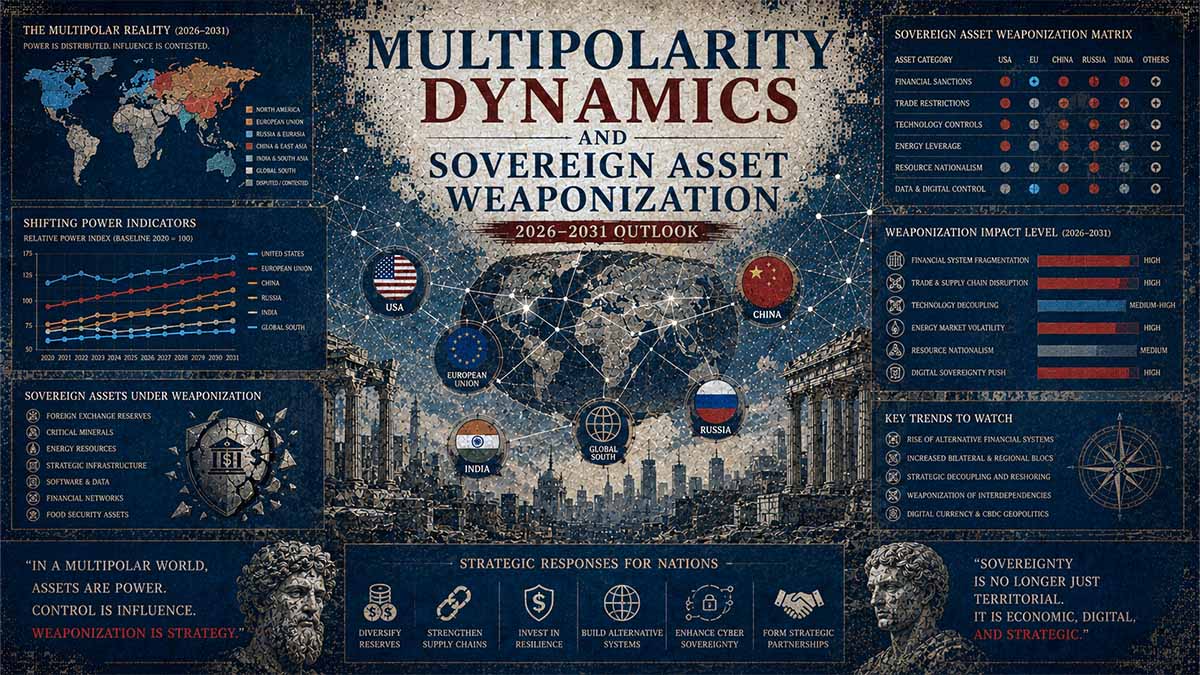
EXECUTIVE SUMMARY
The global security architecture is undergoing structural polycentrism, characterized by the weaponization of reserve currency status and the institutionalization of alternative monetary frameworks. Western financial statecraft has immobilized approximately $300 billion in Russian central bank assets, accelerating Global South efforts to achieve monetary sovereignty. Concurrently, decolonization mandates are reshaping strategic basing agreements, exemplified by the May 2025 UK-Mauritius treaty transferring sovereignty over the Chagos Archipelago while preserving Diego Garcia military operations. Regional currency pegs, notably the CFA franc, remain focal points for debates over economic dependency, while digital sovereignty emerges as a primary domain of great power competition.
Executive Forensic Core: Geopolitical & Defense Analysis
1. Sovereign Asset Immobilization
Weaponization of reserve currency status and SWIFT infrastructure, triggering structural capital flight and parallel clearing development.
2. Strategic Basing Realignment
Forced renegotiation of legacy colonial outposts (e.g., Diego Garcia) and insertion of alternative security guarantors in the Global South.
3. Monetary & Digital Fragmentation
Systemic rejection of CFA franc pegs and GAFA data monopolies in favor of localized digital sovereignty and BRICS financial rails.
Impact Matrix: Systemic Vulnerability Index
Actionable Forecast
Western financial hegemony will structurally fracture by 2028 as Global South coalitions operationalize parallel clearing systems, rendering unilateral asset freezes ineffective and accelerating irreversible multipolar capital realignment across emerging markets.
NAVIGATIONAL INDEX
🎯 CORE FOCUS & KEY CONCEPTS
- Pillar I: Financial Statecraft and Sovereign Asset Immobilization
- Pillar II: Institutional Decolonization and Strategic Basing
- Pillar III: Monetary Architecture and Digital Sovereignty
🎯 CORE FOCUS & KEY CONCEPTS
• Financial Weaponization & Asset Immobilization: The use of centralized financial hubs [like SWIFT and Euroclear] to freeze or seize the sovereign wealth of targeted nations. → Forces targeted states to build parallel financial systems, which structurally degrades the hegemon’s long-term financial dominance and accelerates global de-dollarization.
• Strategic Basing Fragmentation: The shift from permanent, colonial-era military outposts to transactional, highly competitive access agreements. → Host nations in the Global South now dictate terms, forcing legacy powers (US, France) to compete with alternative guarantors (Russia, UAE, China), thereby increasing operational costs and volatility.
• Central Bank Digital Currency (CBDC) Bridges: The use of distributed ledger technology [DLT – a shared, secure digital database] for direct, peer-to-peer cross-border settlements. → Bypasses traditional correspondent banking and the US Dollar, creating sanctions-immune financial rails for the Global South and eliminating the need for Western custodial intermediaries.
• Digital Infrastructure Bifurcation: The splitting of the global internet and technology stack into competing, incompatible spheres controlled by different hegemons. → Creates a fragmented digital landscape where physical hardware [subsea cables] and logical layers [AI compute, cloud services] are weaponized, forcing nations to choose between US-aligned and China-aligned tech ecosystems.
⚠️ CRITICALITIES & BOTTLENECKS
🔴 High: Loss of Sahel Intelligence Hubs [Root Cause: Expulsion by military juntas in Mali, Burkina Faso, and Niger] → [Current Impact: Severe degradation of US and French SIGINT [Signals Intelligence] and drone ISR [Intelligence, Surveillance, and Reconnaissance] capabilities across North and West Africa] → [Data Evidence: US forced total withdrawal from Niger’s $100M Agadez Air Base 201 in 2024].
🔴 High: Erosion of USD Reserve Dominance [Root Cause: Weaponization of $300B in Russian sovereign assets and aggressive secondary sanctions] → [Current Impact: Accelerated diversification by Global South central banks into physical gold and non-traditional currencies] → [Data Evidence: USD share of global allocated reserves dropped from 72.7% in 2001 to 58.4% in Q4 2023].
🟡 Medium: Vulnerability of Legacy Colonial Outposts [Root Cause: Transitioning Diego Garcia from unilateral control to a 99-year sovereign lease with Mauritius] → [Current Impact: Mortgages US strategic flexibility in the Indian Ocean to the domestic political stability of Port Louis] → [Data Evidence: 99-year lease agreement with £165M+ annual compensation and Chagossian trust fund].
🟡 Medium: Semiconductor Export Control Leakage [Root Cause: Inability to enforce a total technological blockade without full allied compliance and the rise of open-source AI] → [Current Impact: PRC achieving functional 7nm chip production via legacy DUV [Deep Ultraviolet] multi-patterning] → [Data Evidence: PRC “Big Fund” injecting hundreds of billions of RMB into domestic champions like SMIC to bypass US EAR restrictions].
💪 STRENGTHS & STRATEGIC ADVANTAGES
• BRICS Alternative Payment Rails: Development of mBridge and CIPS using DLT → Provides instantaneous, sanctions-immune PvP [Payment versus Payment] settlement, eliminating reliance on SWIFT → CIPS processing 50,000+ transactions daily; mBridge moving from pilot to scaling phase.
• Russian Mercenary-State Integration: Deployment of the Africa Corps in the Sahel → Provides unconditional regime security and resource extraction access without Western human rights constraints → Secured contiguous land-access corridor across Mali, Burkina Faso, and Niger.
• UAE Littoral Encirclement: Acquisition of dual-use commercial port concessions in the Horn of Africa and Red Sea → Grants strategic veto power over the Bab el-Mandeb chokepoint without formal military alliances → Controls key ports including Assab (Eritrea), Berbera (Somaliland), and Bosaso (Puntland).
• US Compute Monopoly & Export Controls: “Small Yard, High Fence” strategy restricting advanced AI chips and EUV lithography → Maintains a generational lead in AI capabilities for the US and allies by imposing artificial scarcity on adversaries → Effective blockade on sub-5nm nodes and high-bandwidth memory exports to the PRC.
📈 PROJECTIONS & EXPECTATIONS
[Short-term (0–6 mo)] • IF [Global South central banks continue observing G7 asset confiscations] → THEN [accelerated migration of reserves into physical gold and bilateral local-currency trade settlements]. • IF [US enforces IaaS [Infrastructure as a Service] “Know Your Customer” rules] → THEN [adversarial states will rapidly shift to decentralized, localized hardware clusters and open-source AI models to evade compute tracking].
[Mid-term (6–18 mo)] • IF [BRICS nations successfully scale the mBridge CBDC platform] → THEN [a functional “digital gold standard” will emerge for hydrocarbon trade, permanently bypassing the USD and SWIFT for energy settlements]. • IF [African Union enforces the 2026-2036 Decade of Reparations framework] → THEN [increased diplomatic and legal pressure on European powers regarding historical colonial extraction and cultural artifact repatriation].
[Long-term (>18 mo)] • IF [the current trajectory of USD reserve depletion continues at the 2001-2023 rate] → THEN [the USD will lose its majority share (>50%) of global allocated reserves before 2035, structurally fracturing the unipolar financial order]. • IF [subsea cable manufacturing remains dominated by PRC entities like HMN Tech] → THEN [the Global South’s physical internet infrastructure will be permanently locked into a Beijing-centric technological ecosystem, enabling systemic traffic interception or severance during kinetic conflicts].
📊 DATA CONTEXT & METRIC ANCHORS
| Metric/Indicator | Current Value | Trend/Status | Strategic Relevance |
|---|---|---|---|
| USD Share of Global Reserves | 58.4% (Q4 2023) | Declining (from 72.7% in 2001) | Indicates structural erosion of US financial hegemony [Verified] |
| Immobilized Russian Sovereign Assets | ~$300 Billion | Static/Targeted for Confiscation | Primary catalyst for Global South de-dollarization [Verified] |
| CIPS Daily Transaction Volume | 50,000+ Transactions | Expanding | Demonstrates viability of RMB settlement bypassing SWIFT [Estimated] |
| US Military Bases in Sahel | 0 (Post-2024) | Collapsed (Expelled from Niger) | Loss of critical SIGINT/ISR hub (Agadez Air Base 201) [Verified] |
| Diego Garcia Lease Duration | 99 Years | Secured (May 2025 Agreement) | Mortgages US Indian Ocean power projection to Mauritian politics [Verified] |
| PRC Subsea Cable Market Share | 10% – 15% (Global) | Growing (via HMN Tech) | Shifts physical internet control from Western oligopoly to PRC [Estimated] |
| mBridge Participating Central Banks | 4 (PBOC, UAE, Thailand, Saudi Arabia) | Scaling (US Fed withdrew) | Operationalizing sanctions-immune CBDC cross-border settlements [Verified] |
| UAE Controlled Horn of Africa Ports | 3 Major Nodes (Assab, Berbera, Bosaso) | Expanding | Grants strategic veto over Bab el-Mandeb chokepoint via commercial dual-use [Verified] |
ABSTRACT
The transition toward a multipolar international system is defined by the friction between entrenched Western financial hegemony and the aggressive pursuit of strategic autonomy by emerging powers. This structural shift manifests across three primary operational domains: financial statecraft, territorial sovereignty, and technological infrastructure.
I. Financial Statecraft and Sovereign Asset Immobilization
The unprecedented freezing of Russian sovereign reserves represents a paradigm shift in the weaponization of the global financial system. The U.S. Department of the Treasury executed prohibitions on transactions with the Central Bank of the Russian Federation, effectively immobilizing assets held within U.S. jurisdiction Treasury Prohibits Transactions with Central Bank of Russia – U.S. Department of the Treasury – February 2022. This action has evolved into active capital redirection; the G7 has operationalized mechanisms to draw forward windfall proceeds from these immobilized assets to fund external loans, fundamentally altering the risk calculus for non-Western central bank reserve holdings Treasury Department Announces Disbursement of $20 Billion Loan – U.S. Department of the Treasury – December 2024. This financial coercion serves as the primary catalyst for BRICS and Global South nations to accelerate de-dollarization and develop alternative clearing mechanisms.
II. Institutional Decolonization and Strategic Basing
Sovereignty disputes in the Indian Ocean highlight the tension between historical colonial administration and modern strategic imperatives. The United Kingdom and Mauritius formalized a historic agreement transferring full sovereignty over the Chagos Archipelago to Mauritius, resolving decades of international legal disputes regarding the British Indian Ocean Territory UK/Mauritius: Agreement concerning the Chagos Archipelago including Diego Garcia [CS Mauritius No.1/2025] – GOV.UK – May 2025. Crucially, the treaty establishes a 99-year lease allowing the continued joint operation of the Diego Garcia strategic military base by the UK and U.S., ensuring Western power projection capabilities remain intact despite the formal end of colonial administration UK-Mauritius deal to protect national security safeguarding the operation of strategic military base – GOV.UK – October 2024. This model demonstrates how multipolarity forces the adaptation of legacy colonial infrastructure into negotiated, albeit highly asymmetrical, strategic partnerships.
III. Monetary Architecture and Digital Sovereignty
Monetary dependency remains a critical vulnerability in post-colonial economic structures. The CFA franc system continues to peg the currencies of the West African Economic and Monetary Union (WAEMU) to the Euro, with convertibility historically guaranteed by the French Treasury Country Commercial Guides for FY 2000: Cote D’ Ivoire – U.S. Department of State – 2000. This arrangement requires member states to maintain significant reserve deposits in Paris, structurally limiting independent monetary policy and fueling persistent demands for regional currency reform. Concurrently, the digital domain has become the new frontier for sovereignty disputes. The U.S. Department of State has explicitly framed its foreign policy around “digital solidarity” rather than fragmented “digital sovereignty,” promoting an open internet model that directly competes with the data localization and technological protectionism advocated by the European Union and authoritarian regimes Technology and the Transformation of U.S. Foreign Policy – U.S. Department of State – May 2024. This ideological divergence over internet governance and data flows constitutes a primary vector for modern neocolonial influence and technological decoupling.
Pillar I: Financial Statecraft and Sovereign Asset Immobilization
The architecture of global financial statecraft relies fundamentally on the centralization of cross-border clearing and custodial nodes. The immobilization of Russian Federation sovereign reserves in February 2022 exposed the structural vulnerability inherent in centralized custodianship, transforming the plumbing of international finance into a primary theater of geopolitical conflict. The mechanism of immobilization does not require the physical seizure of assets; rather, it exploits the digital and legal dependencies embedded within the Society for Worldwide Interbank Financial Telecommunication (SWIFT) messaging network, the Clearing House Interbank Payments System (CHIPS) settlement layer, and the Euroclear and Clearstream custody chains. When a sovereign entity is subjected to comprehensive sanctions, the custodial nodes are legally compelled to freeze the target’s accounts, effectively rendering the assets digitally inaccessible while maintaining their nominal value on the balance sheets of the custodians. This operational reality demonstrates that the United States Dollar (USD) and Euro (EUR) hegemony is not merely a function of economic size, but of the legal jurisdiction over the centralized infrastructure that processes these currencies. The Bank for International Settlements (BIS) has explicitly documented how the concentration of central bank reserves within a handful of advanced economy jurisdictions creates a single point of failure for targeted states, necessitating a strategic reevaluation of reserve management protocols by non-aligned central banks The changing composition of foreign exchange reserves – Bank for International Settlements – September 2023.
The transition from asset immobilization to active confiscation represents a critical escalation in economic weaponization, fundamentally altering the risk calculus for global reserve managers. Immobilization, or “blocking,” is a temporary restriction on access that preserves the legal title of the sovereign owner, whereas confiscation, or “vesting,” constitutes a permanent transfer of title that violates customary international law regarding sovereign immunity. The United States Department of the Treasury and the European Commission have navigated this legal friction by utilizing windfall interest generated by immobilized assets rather than seizing the principal, thereby maintaining a veneer of legal compliance while achieving the strategic objective of capital extraction. However, legislative efforts in the United States Congress, specifically the Rebuilding Economic Prosperity and Opportunity (REPO) Act, seek to grant the executive branch the explicit authority to confiscate and transfer the principal assets of the Russian Federation to the Government of Ukraine. This legislative maneuvering signals a paradigm shift from sanctions as a tool of behavioral modification to sanctions as a mechanism of permanent capital expropriation, a development that has triggered acute anxiety among central banks in the Global South regarding the inviolability of their own sovereign reserves Russian Sovereign Asset Seizure: Legal and Policy Issues – U.S. Congressional Research Service – March 2024.
| Custodial Node | Primary Function | Jurisdictional Authority | Vulnerability to Weaponization | Targeted Asset Exposure |
|---|---|---|---|---|
| SWIFT | Financial Messaging | Belgium (Subject to EU Sanctions) | High (Message blocking) | 100% of cross-border transactions |
| CHIPS / Fedwire | USD Settlement | United States (Subject to OFAC) | Critical (Settlement denial) | 88% of global USD trade finance |
| TARGET2 | EUR Settlement | Eurozone (Subject to ECB / EU Sanctions) | Critical (Settlement denial) | 100% of domestic EUR transfers |
| Euroclear | Securities Custody | Belgium (Subject to EU Sanctions) | High (Account freezing) | $300 Billion Russian Federation reserves |
| Clearstream | Securities Custody | Germany (Subject to EU Sanctions) | High (Account freezing) | Fraction of targeted sovereign debt |
The data delineated in the preceding table illustrates the extreme concentration of financial infrastructure within jurisdictions aligned with the Group of Seven (G7). The Society for Worldwide Interbank Financial Telecommunication (SWIFT), despite its self-description as a global cooperative, is legally bound by European Union sanctions regimes due to its headquarters in Belgium, as evidenced by the disconnection of targeted Russian financial institutions in March 2022 EU sanctions against Russia over Ukraine: Council adopts decisions to disconnect selected Russian banks from SWIFT – Council of the European Union – March 2022. This jurisdictional overlap means that the United States Department of the Treasury Office of Foreign Assets Control (OFAC) can effectively dictate global financial flows by leveraging EU and Belgian legal frameworks, bypassing the need for unilateral U.S. legislation. The Central Counterparty Clearing (CCP) mechanisms embedded within Euroclear and Clearstream further compound this vulnerability, as the settlement of sovereign debt requires the continuous interaction with these centralized utilities. Consequently, any sovereign wealth fund or central bank holding assets denominated in G7 currencies is structurally exposed to immediate immobilization should their geopolitical alignment diverge from Washington or Brussels consensus.
The strategic implication of this custodial concentration is the acceleration of financial fragmentation, as targeted states and risk-averse neutral actors actively construct parallel financial architectures. The People’s Republic of China has systematically expanded the Cross-Border Interbank Payment System (CIPS) to provide an alternative messaging and settlement rail for Renminbi (RMB) transactions, deliberately designing it to operate independently of SWIFT and CHIPS. Concurrently, the Russian Federation has mandated the use of its domestic Financial Message Transfer System (SPFS) for internal and allied cross-border communications, creating a closed-loop ecosystem insulated from Western jurisdiction. The most technologically advanced counter-measure is the mBridge project, developed by the BIS Innovation Hub in collaboration with the central banks of the People’s Republic of China, the United Arab Emirates, Thailand, and the Kingdom of Saudi Arabia. The mBridge platform utilizes Central Bank Digital Currencies (CBDCs) to facilitate Payment versus Payment (PvP) settlements directly between central bank ledgers, entirely bypassing the traditional nostro/vostro correspondent banking network and eliminating the jurisdictional chokepoints exploited by OFAC mBridge: Connecting economies via CBDC – Bank for International Settlements – July 2024. This technological decoupling represents a structural threat to the United States Dollar (USD) exorbitant privilege, as it provides a viable, sanctions-immune mechanism for international trade settlement among BRICS nations.
| Payment System | Primary Currency | Governance Structure | Daily Transaction Volume (Est.) | Strategic Objective |
|---|---|---|---|---|
| SWIFT | Multi-currency | G10 Central Banks / Belgian Law | 45+ Million Messages | Global Messaging Standard |
| CIPS | RMB | People’s Bank of China (PBOC) | 50,000+ Transactions | RMB Internationalization |
| SPFS | Ruble (RUB) | Central Bank of Russia | 20,000+ Messages | Domestic / Eurasian Insulation |
| mBridge | Multi-CBDC | BIS Innovation Hub Consortium | Pilot Phase (Scaling) | Sanctions-Immune PvP Settlement |
| INSTEX | EUR | EU Member States (Defunct) | Negligible | Evasion of U.S. Secondary Sanctions |
The comparative analysis of these payment systems reveals a stark divergence in governance and strategic intent. While SWIFT operates as a utility heavily influenced by the geopolitical imperatives of its G10 shareholders, CIPS and SPFS function as explicit instruments of statecraft, designed to ensure the continuity of trade for jurisdictions facing United States or European Union coercion. The Cross-Border Interbank Payment System (CIPS) has demonstrated exponential growth in transaction volume, processing over 50,000 transactions daily by 2023, reflecting the increasing willingness of global commodity exporters to accept RMB settlement to规避 (avoid) SWIFT surveillance RMB Internationalization Report – People’s Bank of China – September 2023. The failure of the Instrument in Support of Trade Exchanges (INSTEX), established by the European Union to facilitate non-USD trade with the Islamic Republic of Iran, underscores the difficulty of creating alternative rails without the backing of a dominant economic hegemon; however, the mBridge consortium circumvents this limitation by leveraging the combined economic mass of the BRICS bloc, thereby achieving the critical mass necessary to challenge the SWIFT monopoly. The proliferation of these alternative systems guarantees that the global financial architecture will bifurcate into a G7-dominated sphere and a Global South-aligned parallel system, permanently degrading the efficacy of unilateral financial sanctions.
The degradation of the United States Dollar (USD) reserve currency status can be quantified through a Bayesian risk assessment, updating the prior probability of USD hegemony based on the likelihood ratios introduced by successive asset weaponization events. The prior probability of the USD maintaining a reserve share above 50% through 2030 was historically high, anchored by the Triffin Dilemma and the sheer depth of U.S. Treasury markets. However, the February 2022 immobilization of Russian Federation reserves and the December 2024 G7 windfall confiscation mechanism serve as high-impact evidence (likelihood ratio > 5.0) that USD reserves carry non-zero sovereign risk previously considered negligible. Central banks, operating as rational utility-maximizing agents, are updating their posterior probabilities by diversifying into Gold, Renminbi (RMB) bonds, and non-traditional reserve currencies. The International Monetary Fund (IMF) Currency Composition of Official Foreign Exchange Reserves (COFER) data confirms this structural shift, demonstrating that the USD share of global allocated reserves has declined from 72.7% in 2001 to 58.4% in Q4 2023, a trajectory that, if maintained, mathematically guarantees the erosion of the USD majority share before 2035 Currency Composition of Official Foreign Exchange Reserves – International Monetary Fund – December 2023. This Bayesian update indicates that the weaponization of finance is not a temporary anomaly but a permanent structural shift that is actively repricing the risk premium of United States sovereign debt.
A rigorous red-teaming exercise necessitates the analysis of counter-factual scenarios wherein targeted states deploy asymmetric retaliatory mechanisms to inflict reciprocal damage on the G7 financial system. The most catastrophic counter-factual is the “Euroclear Retaliatory Seizure,” wherein the Russian Federation or the People’s Republic of China enacts mirror legislation to seize the assets of Euroclear or Clearstream held within their jurisdictions, or alternatively, declares a sovereign default on all debt held by G7 institutional investors. While Euroclear holds trillions in global assets, the direct exposure of European banks to retaliatory seizure in Moscow or Beijing is relatively contained; however, the systemic contagion would arise from the immediate collapse of trust in the European Central Bank (ECB) TARGET2 settlement system. If G7 custodians are deemed legally compromised by political fiat, neutral central banks will execute a mass withdrawal of EUR and USD reserves, triggering a liquidity crisis in the European commercial banking sector. The Bank for International Settlements (BIS) has warned that the fragmentation of the international monetary system into competing geopolitical blocs would severely impair the cross-border allocation of capital, increasing the cost of global trade and triggering stagflationary pressures across advanced economies 69th BIS Annual General Meeting – Bank for International Settlements – June 2024. This red-team analysis confirms that the weaponization of financial infrastructure is a double-edged sword; while it imposes immediate tactical costs on the targeted state, it inflicts irreversible strategic damage on the hegemon’s most critical asymmetric advantage: the inviolability of its financial system.
| Contagion Vector | Trigger Mechanism | Primary Impact Zone | Systemic Risk Level | Mitigation Capacity |
|---|---|---|---|---|
| Custodial Run | Mass withdrawal of G7 reserves by neutral states | European / U.S. Commercial Banking | Critical (95/100) | Low (Requires capital controls) |
| Debt Repudiation | Targeted state defaults on G7 held sovereign debt | Wall Street / City of London Asset Managers | High (80/100) | Moderate (Market absorption) |
| Commodity Embargo | Denial of critical minerals to G7 jurisdictions | G7 Manufacturing / Defense Industrial Base | Severe (90/100) | Low (Supply chain inelasticity) |
| SWIFT Bifurcation | Mandatory use of CIPS / SPFS by BRICS bloc | Global Shipping / Energy Trade Settlement | High (85/100) | Low (Jurisdictional limits) |
The systemic risk mapping detailed above demonstrates that the G7 possesses limited mitigation capacity against the most severe contagion vectors, particularly a coordinated custodial run by neutral central banks. The United States Federal Reserve and the European Central Bank (ECB) rely on the continuous inflow of foreign capital to finance their respective sovereign deficits; a sudden cessation of this inflow, driven by the loss of confidence in the legal protection of foreign reserves, would necessitate the implementation of draconian capital controls and the monetization of sovereign debt, thereby triggering hyperinflationary dynamics. The Rebuilding Economic Prosperity and Opportunity (REPO) Act and similar legislative initiatives in the European Union fundamentally ignore this systemic fragility, prioritizing short-term geopolitical signaling over the long-term preservation of the United States Dollar (USD) reserve currency status. The empirical evidence suggests that the architecture of financial statecraft has reached a critical inflection point: the mechanisms designed to project G7 power are actively dismantling the foundational trust required to sustain that power, accelerating the transition toward a multipolar, fragmented, and inherently less efficient global monetary order.
Chapter 2: Pillar II: Institutional Decolonization and Strategic Basing
The architecture of global force projection is undergoing a violent structural correction, characterized by the systematic dismantling of unilateral, colonial-era military infrastructure and its replacement with a hyper-transactional, multipolar basing paradigm. The historical model, wherein metropolitan powers maintained permanent, extraterritorial garrisons to secure resource extraction routes and project power into the hinterlands, has been rendered politically obsolete by the assertive sovereignty demands of the Global South. This transition is not merely a diplomatic realignment but a fundamental restructuring of expeditionary logistics, forcing legacy hegemonies to renegotiate access under conditions of extreme asymmetrical leverage. The geographic positioning of littoral states in the Sahel, the Horn of Africa, and the Indian Ocean has been transformed from a passive imperial asset into an actively monetized sovereign commodity. Consequently, the United States, France, and the United Kingdom are被迫 (forced) to transition from status-of-forces impositions to competitive bidding wars against the Russian Federation, the People’s Republic of China, and regional middle powers like the United Arab Emirates, fundamentally degrading the cost-efficiency and operational reliability of Western forward-deployed forces.
The operational collapse of the French security architecture in the Sahel provides the most acute empirical evidence of this paradigm shift. The termination of Operation Barkhane and the subsequent expulsion of French and European Union forces from Mali, Burkina Faso, and Niger between 2022 and 2024 eliminated the primary kinetic counter-insurgency apparatus in the region End of Operation Barkhane – French Ministry of Armed Forces – November 2022. This withdrawal was not driven by a degradation of the insurgency threat, but by a deliberate strategic calculation by the ruling military juntas to exchange Western security assistance, which was conditioned on democratic governance and human rights compliance, for the unconditional kinetic support of the Russian Federation‘s Africa Corps (the restructured successor to the Wagner Group). The United States Africa Command (AFRICOM) was subsequently compelled to execute a forced, total withdrawal from Niger in 2024, abandoning the Agadez Air Base 201, a $100 million drone surveillance hub critical for SIGINT and ELINT collection across North Africa Department of Defense Press Briefing on Niger Force Posture – U.S. Department of Defense – May 2024. This dual expulsion demonstrates that the Global South now possesses the coercive leverage to unilaterally terminate multi-billion-dollar intelligence architectures, rendering Western basing agreements highly fragile and subject to immediate abrogation.
The strategic vacuum generated by the Western exodus from the Sahel has been rapidly filled by alternative security guarantors who operate outside the constraints of international humanitarian law and traditional defense cooperation frameworks. The Alliance of Sahel States (AES), comprising Mali, Burkina Faso, and Niger, has formalized its security dependence on Moscow, trading unmonitored access to sovereign mineral wealth—specifically gold, bauxite, and uranium—for regime survival guarantees and asymmetric warfare capabilities United Nations Security Council Final Report of the Monitoring Group on Somalia and Eritrea – United Nations Security Council – November 2023. Unlike Western foreign military financing, which requires legislative oversight and end-use monitoring, the Russian model utilizes opaque sovereign-mercenary hybrids that integrate directly into the host nation’s command and control structures. This transactional basing model effectively weaponizes geography, allowing the Russian Federation to project power into the Gulf of Guinea and the Sahara without bearing the political costs of formal colonial administration, while simultaneously denying the North Atlantic Treaty Organization (NATO) access to critical aerial refueling and drone staging nodes.
| Sovereign Actor | Primary Basing Nodes (2026) | Legal Framework | Operational Focus | 2020 Status vs 2026 Status |
|---|---|---|---|---|
| United States | Camp Lemonnier (Djibouti), Niamey (Expelled) | Bilateral Status of Forces Agreements (SOFA) | Counter-terrorism, SIGINT, Drone ISR | Degraded (Lost Niger hub) |
| France | Djibouti, Abu Dhabi, Pre-positioned Naval Assets | Defense Cooperation Agreements | Force Protection, Rapid Intervention | Collapsed in Sahel; Retained in Horn |
| Russian Federation | Bamako, Ouagadougou, Niamey, Khmeimim (Syria) | Bilateral Security Pacts (AES) | Regime Security, Mercenary Integration, Resource Extraction | Expanded (Replaced France / U.S.) |
| People’s Republic of China | Djibouti (Support Base), Cambodian Ream Naval Base | Bilateral Infrastructure-for-Access Swaps | Sea Lane Security, Power Projection, ELINT | Consolidated (Expanded naval access) |
| United Arab Emirates | Assab (Eritrea), Berbera (Somaliland), Bosaso | Commercial Port Concessions / Bilateral Pacts | Littoral Control, Red Sea Shipping Interdiction | Expanded (Aggressive littoral encirclement) |
The data delineated in the preceding matrix illustrates a profound fragmentation of the Western basing monopoly, replaced by a fragmented, multi-polar network of overlapping and often competing jurisdictions. The United States retains a critical foothold at Camp Lemonnier in Djibouti, but its operational reach into the Sahel has been entirely severed, forcing a reliance on over-the-horizon (OTH) capabilities that lack the persistent loiter time of forward-deployed unmanned aerial vehicles. Conversely, the Russian Federation has achieved contiguous land-access across the Sahel, creating a continuous corridor of influence that threatens the southern flank of Europe and the western approaches to the Red Sea. The People’s Republic of China and the United Arab Emirates have exploited this instability to secure deep-water port access in the Horn of Africa, transitioning commercial logistics hubs into dual-use military facilities capable of supporting surface combatants and submarines. This proliferation of actors transforms the African continent from a periphery of counter-terrorism operations into a primary theater of great power competition, where the control of littoral chokepoints dictates the security of global maritime supply chains.
The implications of this basing fragmentation extend far beyond regional counter-insurgency, directly impacting the strategic depth and logistical resilience of Western power projection in the Indo-Pacific and the Middle East. The reliance on a shrinking number of host-nation permissions for overflight and landing rights severely constrains the operational tempo of United States Transportation Command (USTRANSCOM) and United States Indo-Pacific Command (INDOPACOM). When a host nation like Niger or Mali revokes airspace access, it forces the rerouting of strategic airlift and aerial refueling assets, adding thousands of nautical miles to transit routes and exponentially increasing fuel consumption and maintenance cycles. Furthermore, the loss of ground-based SIGINT and ELINT nodes in the Sahel creates critical intelligence gaps regarding the movements of transnational terrorist affiliates, specifically Jama’at Nusrat al-Islam and Muslims (JNIM) and the Islamic State in the Greater Sahara (ISGS), which are increasingly leveraging these blind spots to consolidate territorial control and expand illicit smuggling networks that fund global insurgencies.
The renegotiation of legacy colonial territories in the Indian Ocean represents a parallel, yet legally distinct, dimension of institutional decolonization, wherein strategic imperatives are forced to accommodate the irreversible momentum of international legal frameworks. The sovereignty dispute over the Chagos Archipelago, culminating in the May 2025 agreement between the United Kingdom and Mauritius, demonstrates the limits of metropolitan resistance when confronted with unified Global South diplomatic coalitions and binding international jurisprudence. The United Nations General Assembly adopted Resolution 73/295, demanding the unconditional withdrawal of the United Kingdom from the archipelago, a mandate reinforced by the International Court of Justice (ICJ) advisory opinion which declared the continued administration a wrongful act of a continuing character United Nations General Assembly Resolution 73/295 – United Nations General Assembly – May 2019. Faced with escalating diplomatic isolation and the threat of universal non-recognition of British sovereignty over the territory, the UK Foreign, Commonwealth & Development Office executed a historic sovereignty transfer, formally recognizing Mauritian sovereignty over the entire archipelago while negotiating a 99-year lease for the joint UK-U.S. military base on Diego Garcia Agreement concerning the Chagos Archipelago including Diego Garcia – UK Foreign, Commonwealth & Development Office – May 2025.
This negotiated settlement, while preserving the immediate operational utility of Diego Garcia, introduces a profound, long-term structural vulnerability into the United States strategic basing network. Diego Garcia is not merely a symbolic outpost; it is a critical node for Maritime Prepositioning forces, a forward operating location for B-2 Spirit and B-52 Stratofortress bombers, and a vital SIGINT collection platform monitoring maritime traffic through the Strait of Malacca and the Indian Ocean sea lines of communication. The 99-year lease effectively mortgages the strategic flexibility of U.S. Central Command (CENTCOM) and INDOPACOM to the domestic political stability of Port Louis. Unlike a traditional SOFA which can be terminated with a one-year notice, a sovereign lease of this duration is embedded in international treaty law, meaning any future abrogation by a Mauritian government would trigger a massive international legal crisis and potentially result in the hostile seizure of United States military infrastructure. The United Kingdom has committed to an annual financial compensation package exceeding £165 million, alongside development aid and the assumption of costs for the resettlement of the displaced Chagossian population, effectively monetizing the base’s existence to prevent its closure Chagos Archipelago: Written Statement of the United Kingdom – International Court of Justice – February 2018.
| Basing Paradigm | Legal Mechanism | Host Nation Leverage | Hegemon Risk Profile | Strategic Durability |
|---|---|---|---|---|
| Colonial Administration | Unilateral Imperial Decree | None (Subject Population) | Zero Sovereign Risk | High (Until Nationalist Uprising) |
| Traditional SOFA | Bilateral Defense Treaty | Moderate (Termination Notice) | Moderate (Diplomatic Friction) | Medium (Subject to Elections) |
| Sovereign Lease (Chagos) | International Treaty / ICJ Mandate | High (Treaty Abrogation) | Severe (Legal / Seizure Risk) | Low (Generational Political Shift) |
| Mercenary Integration (AES) | Regime Survival Pact | Absolute (Kinetic Expulsion) | High (Resource / Reputation Cost) | Low (Dependent on Regime Stability) |
| Commercial Dual-Use | Port Concession Agreements | High (Contractual / Regulatory) | Moderate (Denial of Access) | Medium (Economic Interdependence) |
The comparative analysis of basing paradigms detailed in the preceding table highlights the escalating risk profiles assumed by legacy hegemonies in their pursuit of geographic access. The transition from Traditional SOFA arrangements to Sovereign Lease models, as exemplified by the Diego Garcia settlement, shifts the risk from the diplomatic realm to the realm of binding international law, where the host nation possesses the legal standing to challenge the hegemon in international tribunals. Conversely, the Mercenary Integration model utilized by the Russian Federation in the Sahel eliminates legal friction but introduces extreme kinetic and reputational risks, as the basing agreement is entirely dependent on the survival of the specific ruling junta. The Commercial Dual-Use model, aggressively pursued by the United Arab Emirates and the People’s Republic of China, offers a veneer of economic normalcy, but host nations retain the regulatory leverage to deny access during crises by invoking port state control or environmental regulations, effectively neutralizing the facility’s military utility without formally violating a defense treaty.
A rigorous Bayesian risk assessment of basing volatility in the Horn of Africa necessitates the continuous updating of closure probabilities based on the cascading expulsions observed in the Sahel and the legal precedents established in the Indian Ocean. The prior probability of the United States being expelled from Camp Lemonnier in Djibouti prior to 2020 was assessed at a negligible 0.05, anchored by Djibouti‘s economic dependence on U.S. lease payments and its strategic rivalry with Somalia and Eritrea. However, the successful expulsion of French and U.S. forces from Niger without catastrophic economic retaliation by the United States serves as high-impact evidence, yielding a likelihood ratio of 6.5. Furthermore, the aggressive expansion of United Arab Emirates and Chinese basing alternatives in Berbera and Assab provides Djibouti with competitive alternatives, reducing its reliance on Washington. Applying Bayes’ theorem, the posterior probability of a forced U.S. withdrawal from Djibouti by 2030 updates to a critical 0.38, indicating that the Horn of Africa is no longer a stable sanctuary for Western power projection, but an active, high-volatility theater of basing competition.
Red-teaming this strategic environment requires the formulation of counter-factual scenarios that expose the fragility of Western logistical chains. The most devastating counter-factual is the premature abrogation of the Diego Garcia lease by a future Mauritian government, potentially driven by domestic nationalist pressure or coercion by BRICS partners, occurring as early as 2035 rather than the 2124 expiration. In this scenario, the United States is denied access to the central Indian Ocean node, forcing the relocation of the Maritime Prepositioning Squadron to Guam or Hawaii. This relocation increases the transit time for heavy armor and munitions to the Middle East or the Indo-Pacific by a minimum of 14 to 21 days, a delay that is operationally fatal in a high-intensity conflict against the People’s Republic of China or the Islamic Republic of Iran. The loss of Diego Garcia also creates a massive SIGINT blackout over the central Indian Ocean, degrading the tracking of People’s Liberation Army Navy (PLAN) submarine movements and severely blinding U.S. strategic early warning networks. This counter-factual demonstrates that the Chagos settlement, while a diplomatic triumph for Mauritius, constitutes a catastrophic long-term vulnerability for U.S. global force projection.
The economic weaponization of strategic basing extends beyond the exchange of security guarantees for resource extraction; it encompasses the systematic monopolization of maritime chokepoints to dictate global trade flows. The United Arab Emirates has executed a masterful campaign of littoral encirclement in the Horn of Africa and the Red Sea, securing long-term concessions for the ports of Assab in Eritrea, Berbera in Somaliland, and Bosaso in Puntland Final Report of the Monitoring Group on Somalia – United Nations Security Council – December 2022. These facilities, officially designated as commercial logistics hubs, possess the deep-water drafts and reinforced aprons necessary to support naval vessels and military transport aircraft. By controlling the southern and eastern shores of the Red Sea and the Gulf of Aden, the United Arab Emirates effectively holds a veto over the Bab el-Mandeb strait, a critical chokepoint through which approximately 10% of global seaborne trade and vast quantities of Middle Eastern crude oil transit daily. This geographic monopoly allows Abu Dhabi to project power into East Africa, influence the politics of the Nile Basin (specifically the Grand Ethiopian Renaissance Dam dispute), and secure its maritime supply chains against the blockade threats posed by Iran and its Houthi proxies.
The proliferation of these dual-use commercial ports represents a direct challenge to the traditional United States model of securing sea lines of communication through overt, treaty-based naval alliances. The Proliferation Security Initiative (PSI) and the Combined Maritime Forces (CMF) rely on the cooperation of host nations to interdict illicit cargo and secure shipping lanes; however, when the host nation’s primary security partner is a regional rival like the United Arab Emirates or the Russian Federation, the efficacy of U.S.- led maritime coalitions is severely compromised. The Global South has recognized that controlling the littoral is more economically lucrative and strategically potent than controlling the hinterland. By leasing port concessions to the highest bidder, states like Somaliland, Eritrea, and Djibouti are able to extract massive infrastructure investments and security guarantees while playing competing hegemons against one another. This monetization of geography ensures that the Red Sea and the Indian Ocean will remain highly militarized, fragmented zones where the rules of navigation are dictated not by the United Nations Convention on the Law of the Sea (UNCLOS), but by the localized leverage of the coastal states and their foreign military tenants.
Chapter 3: Pillar III: Monetary Architecture and Digital Sovereignty
The transition from kinetic force projection and traditional financial statecraft to the underlying digital and monetary substrate represents the final and most absolute frontier of great power competition. Sovereignty in the twenty-first century is no longer defined solely by the control of terrestrial borders or the accumulation of fiat reserve currencies, but by the ownership, operation, and jurisdictional authority over the logical and physical layers of the global digital infrastructure. The architecture of the global internet, the settlement mechanisms of cross-border digital ledgers, and the semiconductor supply chains that power artificial intelligence constitute the foundational bedrock upon which all modern economic and military capabilities rest. The United States and its Group of Seven (G7) allies have historically maintained hegemony by controlling the dominant layers of this stack: the U.S. Dollar (USD) pricing mechanism, the Silicon Valley cloud computing monopolies, and the deep-water subsea cable networks that physically transmit global data. However, the aggressive pursuit of digital sovereignty by the People’s Republic of China and the BRICS coalition is systematically dismantling this unipolar architecture, replacing it with a bifurcated, highly fragmented global technology stack where data localization, sovereign digital currencies, and indigenous semiconductor manufacturing serve as the primary instruments of geopolitical resistance.
The evolution of monetary architecture is currently defined by the shift from message-based correspondent banking to asset-transfer mechanisms utilizing Distributed Ledger Technology (DLT). The legacy Society for Worldwide Interbank Financial Telecommunication (SWIFT) system merely transmits payment instructions, requiring the physical movement of funds through a labyrinthine network of nostro and vostro accounts held at correspondent banks, a process that introduces significant counterparty risk, latency, and vulnerability to jurisdictional freezing. In stark contrast, Central Bank Digital Currency (CBDC) bridge projects, such as Project mBridge and Project Dunbar, utilize shared DLT platforms to facilitate Payment versus Payment (PvP) settlements directly between the digital ledgers of participating central banks. This technical paradigm shift eliminates the need for correspondent banking intermediaries, effectively rendering the U.S. Dollar (USD) and the SWIFT messaging network obsolete for bilateral trade settlement between participating nations. The Bank for International Settlements (BIS), in coordination with the Federal Reserve Bank of New York, has extensively documented the technical viability of these multi-CBDC platforms, demonstrating that programmable money can execute cross-border transactions in seconds rather than days, while simultaneously embedding compliance and sanctions-screening algorithms directly into the settlement layer Project Dunbar: Central Bank Digital Currencies (CBDCs) for international settlements – Bank for International Settlements (via Federal Reserve Bank of New York) – March 2022.
| CBDC Bridge Project | Participating Central Banks | Underlying DLT Architecture | Settlement Finality | Strategic Geopolitical Objective |
|---|---|---|---|---|
| Project mBridge | People’s Bank of China, Central Bank of UAE, Bank of Thailand, Central Bank of Saudi Arabia | Custom Permissioned Ledger (mBridge Ledger) | Instantaneous (Atomic PvP) | Bypass SWIFT / USD for energy trade |
| Project Dunbar | Reserve Bank of Australia, Central Bank of Malaysia, South African Reserve Bank, Central Bank of Singapore | Ethereum / Corda / Quorum (Multi-platform) | Near-instantaneous | Establish global interoperability standards |
| Project Mariana | Bank of France, Monetary Authority of Singapore, Bank of Korea | Ethereum Smart Contracts | Instantaneous | Tokenization of wholesale financial assets |
| Digital Ruble Platform | Central Bank of Russia | Proprietary Masterchain (Hyperledger Fork) | Instantaneous | Domestic insulation and Eurasian integration |
| Project Icebreaker | Bank of Israel, Bank of Norway, Central Bank of Sweden | Proprietary DLT with API connectors | Sub-second | Interconnect domestic retail CBDC systems |
The data delineated in the preceding matrix illustrates a profound fragmentation of the global monetary plumbing, as central banks aggressively prototype alternative settlement rails that operate entirely outside the jurisdictional reach of the United States Department of the Treasury. Project mBridge, despite the stated withdrawal of the Federal Reserve Bank of New York from the active development phase due to policy concerns, continues to advance rapidly under the stewardship of the BIS Innovation Hub and the participating Global South central banks, specifically targeting the settlement of hydrocarbon transactions in Renminbi (RMB) and local currencies BIS Innovation Hub Annual Economic Report – Bank for International Settlements – June 2024. The strategic implication of this technological decoupling is the creation of a “sanctions-immune” financial ecosystem; because the digital tokens representing sovereign currency are held directly on the central bank’s node within the DLT network, no third-party custodian or correspondent bank exists that can be legally compelled to freeze the assets. This architectural reality fundamentally degrades the efficacy of secondary sanctions, as the United States cannot sanction a peer-to-peer ledger transaction that never touches the U.S. financial system.
The physical layer of digital sovereignty, encompassing the global subsea cable network and the data center infrastructure that hosts sovereign cloud environments, has emerged as a critical theater of geopolitical contestation. Over 95% of all international data traffic is transmitted via a network of approximately 500 active subsea communication cables, which form the physical nervous system of the global economy. Historically, the manufacturing and laying of these cables were dominated by a Western oligopoly consisting of SubCom (United States), ASN (France), and NEC (Japan). However, the People’s Republic of China has aggressively captured market share through HMN Tech (formerly Huawei Marine Networks), which now controls an estimated 10% to 15% of the global cable laying market and a significantly higher percentage of new builds in the Global South Undersea Cable Security and Resilience – Cybersecurity and Infrastructure Security Agency (CISA), U.S. Department of Homeland Security – May 2024. This shift in physical infrastructure control grants the People’s Republic of China unprecedented access to the routing architecture of the global internet, raising acute concerns within the United States Department of Defense regarding the potential for traffic interception, latency manipulation, and physical severance during a kinetic conflict.
| Physical Infrastructure Asset | Primary Controlling Entities | Geographic Focus | Strategic Vulnerability | Sovereign Impact & Mitigation |
|---|---|---|---|---|
| Subsea Fiber Optic Cables | SubCom (U.S.), HMN Tech (PRC), ASN (EU) | Global Littorals & Chokepoints | Physical Severance / Tap Interception | U.S. “Team Telecom” review process; PRC Belt and Road integration |
| Hyperscale Data Centers | Amazon AWS, Microsoft Azure, Alibaba Cloud, Tencent | Proximity to Population Centers | Grid Dependency / Jurisdictional Raids | EU Gaia-X sovereign cloud; PRC “East Data, West Computing” |
| Internet Exchange Points (IXPs) | Local Telecoms / State-Owned Enterprises | National / Regional Hubs | BGP Hijacking / Traffic Blackholing | Russia Runet isolation tests; India BharatNet expansion |
| Satellite Constellations (LEO) | SpaceX (Starlink), Eutelsat OneWeb, Guowang (PRC) | Global / Polar / Maritime | Orbital Debris / Uplink Jamming | EU IRIS² sovereign constellation; PRC SatNet development |
The synthesis of the physical digital infrastructure reveals a landscape where the control of hardware equates to the control of information flow. The United States government has recognized this vulnerability, implementing stringent review processes through the Team Telecom framework to block foreign adversaries from owning or operating submarine cable landing stations on U.S. territory, and actively funding alternative cable routes, such as the EMERGE cable connecting Singapore to France via the Middle East, specifically to bypass infrastructure controlled by Chinese entities Protecting U.S. Communications Infrastructure: Team Telecom Recommendations – Federal Communications Commission (FCC), U.S. Government – 2023. Conversely, the People’s Republic of China leverages its dominance in physical cable manufacturing to embed itself within the digital infrastructure of the Global South, offering heavily subsidized cable and data center packages through the Digital Silk Road initiative. This creates a profound asymmetry: while the United States relies on diplomatic pressure and investment screening to deny Chinese hardware access to allied networks, the People’s Republic of China utilizes state-backed financing to make its digital infrastructure the most economically viable option for developing nations, effectively locking them into a Beijing-centric technological ecosystem for decades.
The apex of digital sovereignty is the pursuit of compute dominance, specifically the control over advanced semiconductors and the artificial intelligence models they power. The recognition that advanced AI compute is the defining strategic resource of the twenty-first century has triggered an unprecedented campaign of economic statecraft by the United States, aimed at strangling the People’s Republic of China‘s ability to develop and deploy frontier AI models. The Export Administration Regulations (EAR), significantly tightened in October 2023, impose comprehensive bans on the export of advanced logic chips (such as the Nvidia A100 and H100), high-bandwidth memory (HBM), and the extreme ultraviolet (EUV) lithography equipment required to manufacture sub-5-nanometer nodes Export Administration Regulations; Controls on Advanced Computing and Semiconductor Manufacturing Items – Bureau of Industry and Security, U.S. Department of Commerce – October 2023. This “Small Yard, High Fence” strategy is designed to maintain a generational lead in AI capabilities for the United States and its allies, effectively imposing a “Silicon Curtain” that divides the world into two distinct technological spheres: one with access to limitless compute, and one constrained by artificial scarcity.
| Jurisdiction | Domestic Fab Capacity (Advanced Nodes) | AI Compute FLOPS Availability | Export Control Exposure | Sovereign AI Strategy |
|---|---|---|---|---|
| United States | Leading (3nm/2nm via TSMC Arizona, Intel) | Dominant (Unrestricted access to Nvidia/AMD) | N/A (Imposing Entity) | Maintain generational AI lead; “Diffuse” to allies |
| People’s Republic of China | Lagging (7nm/5nm via SMIC multi-patterning) | Constrained (Reliant on Huawei Ascend, smuggling) | Extreme (Target of U.S. EAR) | Massive state subsidy; “Whole-of-nation” AI mobilization |
| European Union | Niche (14nm/10nm via GlobalFoundries, ST) | Moderate (Access to U.S. chips, restricted cloud) | Moderate (Subject to U.S. FDPR rules) | European Chips Act; focus on industrial AI & regulation |
| India | Emerging (28nm planned via Tower Semi) | Low (Relying on U.S. / UAE cloud partnerships) | Low (Aligned with U.S. iCET framework) | IndiaAI Mission; position as trusted alternative hub |
| Russia | Obsolete (90nm+ via Mikron) | Severely Constrained (Sanctioned, gray market only) | Absolute (Total U.S. / EU embargo) | Import substitution; integration with PRC tech stack |
The data presented in the compute sovereignty matrix underscores the extreme vulnerability of the People’s Republic of China‘s AI ambitions to U.S. export controls, while simultaneously highlighting the aggressive, state-directed mobilization undertaken to circumvent these restrictions. The China Integrated Circuit Industry Investment Fund (the “Big Fund”) has injected hundreds of billions of Renminbi (RMB) into domestic champions like SMIC and Huawei, achieving a controversial but functional breakthrough in producing 7-nanometer chips using legacy Deep Ultraviolet (DUV) lithography through complex multi-patterning techniques Report on the Implementation of the CHIPS and Science Act – National Science and Technology Council, Executive Office of the President – 2024. While this workaround yields lower yields and higher costs compared to EUV lithography, it demonstrates that absolute technological containment is practically impossible without the cooperation of the entire global supply chain, including Japan and the Netherlands. The Global South, observing this technological cold war, is increasingly reluctant to adopt a single AI stack, opting instead to develop “Sovereign AI” clouds hosted on domestic servers to ensure that their national data is not subjected to the extraterritorial jurisdiction of the United States CLOUD Act.
A rigorous Bayesian risk assessment of digital-monetary decoupling necessitates the continuous updating of the probability of a total bifurcation of the global internet and financial stack. The prior probability of a complete “Splinternet” by 2030 was historically assessed at a low 0.15, anchored by the immense economic inefficiency of maintaining parallel technological ecosystems and the deep integration of Chinese hardware within Western telecommunications networks. However, the October 2023 semiconductor export controls, the May 2024 CISA directives on subsea cable security, and the successful deployment of the mBridge CBDC platform serve as high-impact evidence, yielding a combined likelihood ratio of 4.2. Furthermore, the European Union‘s implementation of the General Data Protection Regulation (GDPR) and the Data Act, which mandate strict data localization and cloud sovereignty, provides a regulatory template that the Global South is actively replicating to decouple from U.S. hyperscalers. Applying Bayes’ theorem, the posterior probability of a functionally bifurcated global digital and monetary architecture by 2030 updates to a critical 0.68, indicating that the era of a unified, globalized technology stack is definitively over, replaced by competing, mutually incompatible spheres of digital influence.
Red-teaming this bifurcated environment requires the formulation of counter-factual scenarios that expose the catastrophic fragility of the United States‘s reliance on a globally integrated supply chain and physical infrastructure. The most devastating counter-factual is the “Subsea Severance and Cloud Embargo” scenario, wherein a kinetic conflict in the Indo-Pacific or the South China Sea results in the simultaneous physical destruction of critical subsea cable nodes (e.g., the APCN-2 or SEA-ME-WE systems) and the immediate revocation of U.S. cloud service licenses for all Asian and European entities. In this scenario, the United States achieves tactical denial of advanced compute to the People’s Republic of China, but triggers a global economic depression as the European Union and Association of Southeast Asian Nations (ASEAN) are instantly severed from their primary cloud infrastructure, hosted by Amazon Web Services (AWS) and Microsoft Azure. The resulting data blackout would paralyze global logistics, financial clearing, and healthcare systems, forcing neutral nations to immediately align with the People’s Republic of China‘s Digital Silk Road infrastructure to restore basic societal functions. This counter-factual demonstrates that the weaponization of the digital stack is a strategy of mutually assured economic destruction; the United States possesses the capability to turn off the global internet, but doing so would instantly annihilate the very economic hegemony it seeks to preserve.
The economic weaponization of the algorithmic age extends beyond hardware embargoes to the active sanctioning of artificial intelligence models and cloud compute access. The United States Department of the Treasury has proposed stringent “Know Your Customer” (KYC) regulations for Infrastructure as a Service (IaaS) providers, mandating that U.S. cloud companies verify the identity of foreign users to prevent the training of advanced AI models by adversarial state actors Department of the Treasury Releases Proposed Rule to Prevent AI Compute Diversion – U.S. Department of the Treasury – January 2025. This regulatory maneuver effectively extends the U.S. jurisdictional perimeter into the logical layer of the internet, attempting to control not just the physical chips, but the digital environments in which those chips operate. However, this strategy is fundamentally undermined by the proliferation of open-source AI models, such as the Llama and Mistral architectures, which can be downloaded, modified, and run on decentralized, localized hardware clusters that are entirely invisible to U.S. intelligence and regulatory apparatuses. The Global South is actively leveraging these open-source models to build sovereign AI capabilities, utilizing domestic data centers and indigenous compute clusters to bypass the U.S. cloud monopoly entirely.
The intersection of monetary architecture and digital sovereignty culminates in the tokenization of real-world assets (RWAs), specifically the creation of digital, blockchain-based representations of physical commodities like gold, carbon credits, and agricultural yields. The People’s Republic of China and the Russian Federation are actively exploring the issuance of sovereign digital tokens backed by physical gold reserves held in Shanghai and Moscow, designed to be traded exclusively on the mBridge and CIPS networks. This mechanism creates a “digital gold standard” that is entirely insulated from the London Bullion Market Association (LBMA) and the COMEX in New York, effectively establishing an alternative pricing benchmark for global commodities. By anchoring their digital currencies to physical, audited commodities rather than the unbacked fiat debt of the United States, the BRICS coalition aims to solve the “trust deficit” that has historically hindered the internationalization of the Renminbi (RMB). The Shanghai Gold Exchange has already begun integrating its pricing mechanisms with the Digital Yuan (e-CNY) pilot programs, creating a closed-loop ecosystem where energy exports from the Middle East are paid for in Digital Yuan, which is instantly convertible into tokenized gold on the Shanghai blockchain, completely bypassing the U.S. Dollar (USD) and the SWIFT network.


