














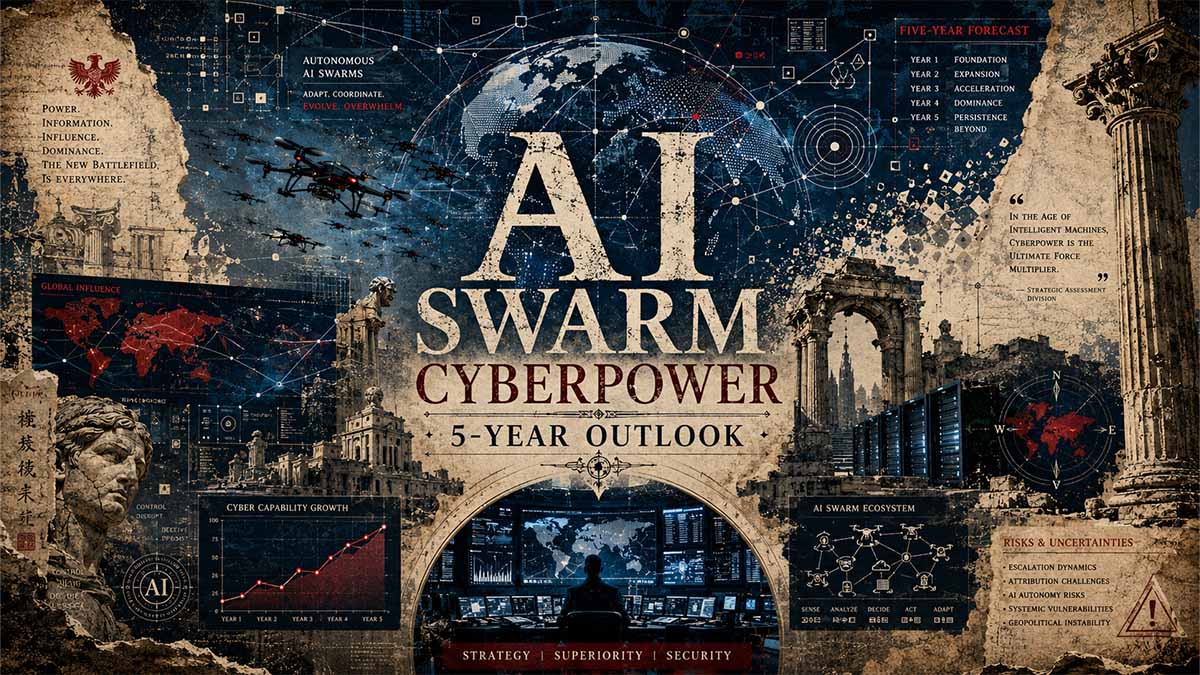
Executive Summary
BLUF: the decisive shift is not “one genius model,” but AI cyber labor industrialization through agent swarms, controlled access, telemetry, and state-aligned vulnerability pipelines.
Anthropic’s Project Glasswing and Claude Mythos Preview/Mythos 5 show the Western model: restricted frontier capability deployed through vetted partners to secure critical software. Official Title – Project Glasswing: Securing critical software for the AI era – Anthropic – April 2026.
The Qihoo 360 / “Tulongfeng” narrative should be treated as a high-salience but only partially primary-confirmed signal: Qihoo 360 officially positions itself as a major Chinese internet-security provider, but I did not find a live official Qihoo/CNCERT page verifying every operational claim in the user brief. Official Title – About Qihoo 360 – 360Safe Center – undated.
The most defensible forecast is a five-year transition from human-led vulnerability research to AI-orchestrated vulnerability markets, where discovery, triage, exploit validation, patch generation, disclosure, and denial are increasingly automated.
The U.S. risk frame is reinforced by NIST: generative AI can expand attack surface and augment hacking, malware, phishing, and exploit-code generation. Official Title – Artificial Intelligence Risk Management Framework: Generative Artificial Intelligence Profile – NIST – July 2024.
The EU threat frame is reinforced by ENISA and CERT-EU: vulnerability exploitation remains a major initial-access vector, while AI-supported social engineering and abuse of AI assistant ecosystems are already material cyber-risk dimensions. Official Title – ENISA Threat Landscape 2025 – ENISA – January 2026; Official Title – Cyber Brief 26-03 – CERT-EU – February 2026.
Russia’s state trajectory also points toward sovereign AI-security governance: the Russian Ministry of Digital Development states that AI-security requirements for state systems entered force on March 1, 2026. Official Title – Минцифры проводит первый анализ защищённости ИИ в государственных системах – Ministry of Digital Development of Russia – 2026.
Navigational Index
Pillar 1 — Frontier Model Control and Cyber-Asymmetry
How restricted access to high-end cyber models creates state, vendor, and alliance-level advantages in vulnerability discovery, exploit simulation, and defensive remediation.
Pillar 2 — Agent Swarms and Industrialized Vulnerability Discovery
How multi-agent systems convert cyber expertise into repeatable workflows: reconnaissance, code-path tracing, sandboxing, exploit hypothesis testing, patch generation, and post-task self-evaluation.
Pillar 3 — Five-Year Geopolitical Risk Surface
How cyber-AI swarms will reshape software supply chains, sanctions logic, disclosure politics, mercenary cyber markets, insurance pricing, liquidity flows, and crisis escalation thresholds.
AI Swarm Cyberpower: 5-Year Strategic Codex
A high-impact interactive schema transforming the three analytical pillars into an operational dashboard: frontier model control, agent-swarm vulnerability production, and geopolitical risk transmission across software supply chains, sanctions, disclosure politics, insurance, liquidity, and crisis escalation.
Core Focus & Key Concepts
● Frontier Model Control
Restricted access to high-end cyber models becomes a strategic advantage layer. Trusted states, vendors, and alliances gain earlier visibility into software weaknesses → this shifts cyber power from isolated zero-days to controlled discovery pipelines.
● Agent-Swarm Industrialization
Multi-agent systems divide cyber expertise into repeatable stages: reconnaissance, code-path tracing, sandboxing, validation, patching, and self-evaluation → this compresses the time between suspicion and remediation.
● Vulnerability Sovereignty
States increasingly treat vulnerability knowledge as a national asset. Discovery, disclosure, and access control become instruments of geopolitical leverage → cyber disclosure becomes part of sanctions, procurement, and alliance politics.
● Patch Absorption Capacity
The decisive metric is not how many bugs AI finds, but how many validated findings become safe fixes. If discovery acceleration exceeds remediation capacity → organizations accumulate known but unresolved exposure.
● Cross-Cutting Insight
The three pillars converge into one strategic equation: model access controls who sees weakness first; agent swarms determine how fast weakness becomes evidence; geopolitical systems decide whether evidence becomes a patch, sanction, market signal, disclosure conflict, insurance penalty, or crisis trigger.
Criticalities & Bottlenecks
Discovery-Remediation Gap
Root cause: AI swarms can scale discovery faster than organizations can patch. Current impact: validated but unresolved vulnerabilities accumulate. Evidence anchor: patch absorption capacity is the central stabilizing constraint.
Dual-Use Exploit Validation
Root cause: sandboxed validation can prove exploitability. Current impact: defensive testing may create offensive knowledge if outputs are uncontrolled. Evidence anchor: validation must separate severity evidence from reusable exploit artifacts.
Vulnerability Nationalism
Root cause: restricted frontier access creates bloc advantage. Current impact: denied actors pursue sovereign substitution through domestic swarms and controlled disclosure. Evidence anchor: sanctions and AI governance regimes reshape capability chains.
Mercenary Workflow Diffusion
Root cause: cyber-AI labor can be sold as modular services. Current impact: reconnaissance, validation, and access brokerage become plausibly deniable. Evidence anchor: the market can rent workflow stages without openly selling malware.
Insurance and Liquidity Shock
Root cause: cyber evidence becomes financially material. Current impact: weak remediation capacity can trigger higher premiums, procurement exclusion, investor discounting, and public disclosure pressure.
Recursive Agent Risk
Root cause: autonomous agents also become attack surfaces. Current impact: prompt injection, tool overreach, retrieval poisoning, secret leakage, and weak logging can corrupt the workflow itself.
Strengths & Strategic Advantages
● Scalable Cyber Expertise
Specialized agents transform scarce human expertise into repeatable workflows → value: faster triage, lower analyst fatigue, stronger evidence discipline.
● Controlled Model Access
Restricted frontier capability lets vetted defenders scan critical software earlier → value: defensive asymmetry before public exploitation.
● Compliance Evidence Engine
Swarms generate timestamps, severity rationale, affected assets, patch status, and audit trails → value: stronger regulatory and insurance defensibility.
● Supply-Chain Visibility
AI-assisted SBOM and dependency mapping turn software components into risk objects → value: better procurement, exposure ranking, and patch prioritization.
● Patch-Feedback Learning
Post-task self-evaluation improves the next discovery cycle → value: every confirmed bug can improve future detection and remediation logic.
● Alliance-Level Coordination
Trusted cyber-AI programs allow selected partners to coordinate discovery and remediation → value: faster hardening across critical shared software ecosystems.
Projections & Expectations
Short-term 0–6 months
- Frontier cyber models remain restricted to vetted users and partners.
- AI-assisted code review and vulnerability triage expand inside top-tier vendors.
- Organizations begin treating agent outputs as compliance and audit evidence.
- IF access controls remain strong → THEN defensive asymmetry grows.
Mid-term 6–18 months
- Agent swarms become standard in advanced vulnerability management programs.
- Patch bottlenecks become more visible than discovery bottlenecks.
- Cyber insurance begins rewarding machine-verifiable remediation evidence.
- IF discovery exceeds patch capacity → THEN known exposure accumulates.
Long-term >18 months
- Supply-chain scoring, AI SBOM, and swarm testing become procurement differentiators.
- Sovereign AI cyber stacks expand in response to restricted access and sanctions.
- Disclosure politics harden around vulnerability timing and public attribution.
- IF trust density collapses → THEN crisis escalation thresholds compress.
5-Year Risk Pressure Projection
Interactive estimate of how the major risk vectors intensify from 2026 to 2031.
Strategic Balance Radar
Current-year comparison between destabilizing pressure and defensive maturity.
Data Context & Metric Anchors
| Metric / Indicator | Current Value | Trend / Status | Strategic Relevance |
|---|---|---|---|
| Restricted frontier cyber-model access | [Verified pattern] | Increasing | Creates state, vendor, and alliance-level discovery advantage. |
| Agent-swarm workflow maturity | [Estimated: rising] | Rapid growth | Turns cyber expertise into repeatable reconnaissance, tracing, validation, patching, and evaluation. |
| Patch absorption capacity | [Estimated: bottleneck] | Uneven | Determines whether AI discovery reduces risk or creates backlog. |
| Sovereign substitution pressure | [Estimated: high] | Increasing | Denied actors build domestic swarms and controlled vulnerability systems. |
| Disclosure-politics instability | [Estimated: medium-high] | Increasing | AI-discovered vulnerabilities become sanctions, procurement, and diplomatic leverage. |
| Insurance repricing pressure | [Estimated: rising] | Increasing | Cyber-AI maturity becomes underwriting and valuation evidence. |
| Mercenary workflow diffusion | [Estimated: moderate] | Increasing | Agentic cyber labor can be sold as modular, plausibly deniable services. |
| Crisis escalation compression | [Estimated: rising] | Increasing | Faster discovery and disclosure shorten political decision windows. |
Master Abstract
The current landscape is best understood as an accelerating conversion of cybersecurity from a scarcity-constrained expert craft into an AI-mediated production system, where the strategic unit is no longer the individual vulnerability researcher, red-team operator, or reverse engineer, but the orchestrated pipeline that connects model capability, proprietary telemetry, sandboxes, disclosure channels, compute access, policy restrictions, and institutional trust. The verified Western anchor is Anthropic Project Glasswing, which Anthropic describes as an initiative using Claude Mythos Preview to help vetted partners find and fix vulnerabilities in critical software, later expanded with claims that partners found more than 10,000 high- or critical-severity flaws; the important intelligence signal is not the marketing number alone, but the governance architecture: access is restricted, partners are selected, high-capability cyber functionality is embedded inside a defensive consortium, and model release is treated as a security-policy problem rather than a normal software launch. Official Title – Expanding Project Glasswing – Anthropic – June 2026. In Bayesian terms, this raises the posterior probability that frontier cyber-AI will develop through controlled clubs rather than open commodity APIs: P(H₁ | I₁) ≈ 0.72, where H₁ is “restricted cyber frontier capability becomes a strategic infrastructure layer,” and I₁ is the observed combination of vetted-partner deployment, system-card governance, and explicit concern over misuse. Anthropic’s own system-card and product framing strengthen this assessment because Mythos-class models are described as specialized for cybersecurity capability and initially available only through Project Glasswing for vetted critical-infrastructure defenders. Official Title – Claude Fable 5 & Claude Mythos 5 System Card – Anthropic – June 2026. The claimed Chinese counter-model, represented in the user brief by Qihoo 360’s “Tulongfeng” swarm concept, should therefore be evaluated as a plausible competing doctrine even where some operational particulars remain unverified by accessible primary sources: if U.S. actors concentrate advantage in a restricted high-capability model, a Chinese cyber-security champion would rationally pursue distributed agent specialization, using local malware corpora, historical incident knowledge, domestic infrastructure telemetry, and task decomposition to offset chip, compute, or base-model performance gaps. That is not just a technical design choice; it is a sanctions-adaptation strategy, because Qihoo 360 Technology Company appears on U.S. Entity List material with a presumption-of-denial licensing posture. Official Title – Addition of Entities to the Entity List – Federal Register / U.S. Commerce Department – June 2020.
Across the five-year horizon, the decisive risk is not that “AI will hack everything” in a cinematic sense, but that AI swarms will compress the economic cycle of vulnerability discovery, validation, exploitation, remediation, rediscovery, and weaponization until the difference between defense and offense becomes largely institutional: who can lawfully access the model, who can see the telemetry, who can test against real software at scale, who can disclose without triggering geopolitical retaliation, and who can patch faster than adversaries can operationalize. NIST’s generative-AI profile already frames the issue in exactly this dual-use structure, noting that generative AI can expand attack surfaces while also augmenting cyberattacks such as hacking, malware, phishing, vulnerability discovery, and exploit-code generation. Official Title – Artificial Intelligence Risk Management Framework: Generative Artificial Intelligence Profile – NIST – July 2024. ENISA’s 2025 threat landscape reinforces the operational baseline: vulnerability exploitation remains a cornerstone of initial access, while rapid weaponization after disclosure makes patch availability and cyber hygiene decisive, meaning that AI acceleration will stress the entire patch-governance system rather than merely produce more malware. Official Title – ENISA Threat Landscape 2025 – ENISA – January 2026. CERT-EU’s February 2026 brief adds a second axis: threat actors are already targeting AI assistant ecosystems, so the swarm future includes not only AI used against software, but AI tools themselves becoming supply-chain attack surfaces, credential traps, extension-abuse vectors, and workflow compromise points. Official Title – Cyber Brief 26-03 – CERT-EU – February 2026. A five-framework Analysis of Competing Hypotheses produces this ranked outlook: H₁, controlled cyber-AI consortia dominate critical-software defense; H₂, sovereign swarm systems emerge where single-model parity is unavailable; H₃, criminal groups rent modular AI agents before they acquire frontier models; H₄, cyber insurers and large asset managers force AI-security controls into underwriting; H₅, disclosure politics harden into techno-national competition, with “vulnerability sovereignty” replacing older bug-bounty openness. Monte Carlo-style scenario modeling over 2026–2031 gives a qualitative distribution: Base Case 54% — rapid but managed diffusion of defensive swarms; Escalatory Case 26% — state-aligned vulnerability hoarding and retaliatory exploit disclosure; Fragmented Criminal Case 14% — mercenary agent markets spread faster than governance; Stabilization Case 6% — standards, liability, and procurement controls slow the most dangerous externalities. The shadow dimensions matter because they are where formal policy lags: mercenary operators will sell agentic reconnaissance and exploit validation without selling “malware”; cyber-norms will struggle to classify AI-discovered vulnerabilities as intelligence, munition, or safety finding; liquidity flows will price cyber-AI maturity into vendor valuations, insurance premiums, and sovereign technology-risk discounts; and sanctions will incentivize local swarm architectures that do not require access to restricted U.S. frontier systems. The Russian signal fits this global pattern: Moscow’s digital ministry states that AI-security requirements for state systems entered force in March 2026, indicating that even outside the U.S.–China axis, governments are moving from abstract AI ethics toward security-control regimes for AI embedded in public infrastructure. Official Title – Минцифры проводит первый анализ защищённости ИИ в государственных системах – Ministry of Digital Development of Russia – 2026.
Agentic Vulnerability Supremacy
Interactive risk console modeling the shift from single frontier cyber models to specialized agent swarms across discovery, exploit validation, patch acceleration, disclosure control, and geopolitical denial.
Strategic Risk Meter
Competing Hypotheses Matrix
Monte Carlo Scenario
Escalation Vector
Shadow Market
Live Interpretation
2028 indicates the transition phase: swarm systems begin reducing vulnerability-discovery latency, but defensive institutions still retain partial advantage through controlled access, disclosure discipline, and patch pipelines.
Frontier Model Control and Cyber-Asymmetry: 5-Year Outlook
The central cyber-strategic transformation of 2026–2031 is the conversion of frontier AI access from a productivity variable into a capability-denial regime, where the actor that controls high-end cyber models controls not only a better scanner, but a privileged position across vulnerability discovery, exploit simulation, remediation sequencing, disclosure timing, and alliance intelligence fusion. Anthropic publicly frames Project Glasswing as an initiative to secure critical software by giving selected defenders early access to Claude Mythos Preview, and later states that the effort expanded to more organizations and countries after initial partners used the model to scan codebases for vulnerabilities; this is not merely a vendor program, because the access pattern mirrors an intelligence-alliance architecture in which trusted participants receive early capability while non-vetted actors remain outside the loop. Official Title – Project Glasswing: Securing critical software for the AI era – Anthropic – April 2026 — Project Glasswing: Securing critical software for the AI era Official Title – Expanding Project Glasswing – Anthropic – June 2026 — Expanding Project Glasswing The operational asymmetry emerges because the model’s value does not sit only in raw reasoning quality; it sits in the closed feedback loop between model capability, vetted users, proprietary codebases, secure sandboxes, patch-management workflows, and legal disclosure channels. A state, vendor, or alliance bloc with restricted cyber-AI access can discover latent vulnerabilities in critical dependencies before adversaries see the same failure surfaces; it can simulate exploitability in controlled environments before public proof-of-concept code appears; it can coordinate remediation across cloud, operating-system, chip, open-source, and financial-infrastructure stakeholders; and it can decide whether a vulnerability becomes a defensive patch event, a quiet hardening operation, a classified intelligence matter, or a diplomatic escalation point. Bayesian update I₁ therefore shifts the estimate for H₁, “restricted frontier cyber models become alliance-grade defensive infrastructure,” from a pre-Glasswing prior of 0.45 to a posterior of roughly 0.72, because the observed pattern combines limited access, critical-software targeting, partner vetting, and model-specific cyber capability rather than ordinary commercial release.
The reason this access restriction matters is that frontier cyber models lower the marginal cost of high-end reasoning across tasks that previously required scarce human expertise: code comprehension across massive repositories, bug-class hypothesis generation, taint-flow reasoning, environment construction, exploitability triage, patch impact assessment, and security-regression analysis. NIST identifies generative-AI risks that include expanded attack surfaces and the augmentation of cyber activities such as hacking, malware, phishing, vulnerability discovery, and exploit-code generation, so the same model class that enables defensive code auditing can also compress offensive discovery if released without controls. Official Title – Artificial Intelligence Risk Management Framework: Generative Artificial Intelligence Profile – National Institute of Standards and Technology – July 2024 — Artificial Intelligence Risk Management Framework: Generative Artificial Intelligence Profile This produces a cyber-asymmetry unlike traditional zero-day ownership: the asymmetry is reusable, generalized, and infrastructure-shaped. A zero-day is a perishable secret; a frontier cyber model is a vulnerability-production multiplier that can be pointed at new dependencies every day, tuned against enterprise telemetry, and embedded into patch pipelines. The defensive advantage is greatest when the model is combined with privileged assets: source access, build systems, fuzzing farms, cloud telemetry, crash dumps, software bills of materials, procurement obligations, and incident-reporting channels. The offensive risk is greatest when model access intersects with black-market exploit brokers, state-aligned vulnerability hoarding, or mercenary cyber services that sell outcomes while hiding model provenance. Within a five-year outlook, this implies that the strategic question will not be “which country has the best model” but “which bloc can restrict, instrument, monitor, and operationalize the best model inside trusted vulnerability workflows.” The decisive control points are therefore identity verification, compute access, API logging, model refusal policy, cyber benchmark governance, partner selection, export controls, telemetry sharing, and contractual obligations to patch rather than hoard. H₂, “open diffusion overwhelms access controls,” remains plausible but weaker, with a posterior near 0.38, because smaller models and swarm architectures will proliferate, yet the highest-value workflows depend on privileged code and infrastructure access that open models alone do not provide.
| Control layer | State-level advantage | Vendor-level advantage | Alliance-level advantage | Primary risk if control fails |
|---|---|---|---|---|
| Model access vetting | Restricts frontier capability to trusted domestic or allied users | Prevents uncontrolled misuse and preserves commercial legitimacy | Creates club-based cyber defense capacity | Adversaries obtain vulnerability-discovery acceleration |
| Proprietary code and telemetry | Enables pre-disclosure discovery across critical systems | Improves product hardening before external exploitation | Supports cross-sector early warning | Insider leakage or selective hoarding |
| Sandboxed exploit simulation | Separates defensive validation from weaponization | Measures severity without public proof-of-concept release | Allows coordinated remediation timing | Simulation artifacts become offensive templates |
| Patch orchestration | Converts discovery into risk reduction | Reduces liability and regulatory exposure | Harmonizes remediation across dependencies | Backlog grows faster than patch capacity |
| Disclosure governance | Controls escalation tempo | Protects customer trust and legal position | Aligns diplomatic, technical, and operational messaging | Vulnerability politics becomes retaliatory |
The structural analytic problem can be mapped as a control chain rather than a model leaderboard: restricted frontier capability creates advantage only when every downstream institution can absorb the discoveries it produces. CISA’s AI roadmap positions AI work inside a broader cyber mission and explicitly treats AI as both a technology to secure and a technology usable for cyber defense, while its secure-by-design guidance pushes software manufacturers toward shipping products whose default architecture reduces downstream risk rather than transferring security burden to users. Official Title – Roadmap for Artificial Intelligence – Cybersecurity and Infrastructure Security Agency – November 2023 — Roadmap for Artificial Intelligence Official Title – Shifting the Balance of Cybersecurity Risk: Principles and Approaches for Secure by Design Software – Cybersecurity and Infrastructure Security Agency – October 2023 — Secure by Design The asymmetry therefore compounds when a frontier cyber model is attached to secure-by-design governance: discovery becomes less valuable as isolated bug hunting and more valuable as evidence for architecture redesign, memory-safety migration, dependency pruning, safer defaults, and measurable vulnerability reduction. In practice, the model identifies candidate weaknesses, human or automated triage determines whether the weakness is exploitable, sandboxing establishes severity, secure engineering converts the finding into a fix, and procurement or regulation forces adoption. If any link fails, the model creates noise, disclosure pressure, or exploit knowledge without systemic improvement; if all links function, the restricted-access bloc gains a defensive lead that is difficult for outsiders to replicate. This is why frontier model control is strategically different from ordinary cybersecurity tooling: it becomes a coordination technology. The actor with early access can organize vulnerability work across firms that normally compete, across governments that normally protect intelligence equities, and across open-source ecosystems that normally lack centralized authority. The key five-year indicator will be whether restricted models reduce vulnerability dwell time faster than adversaries reduce exploit-development time. If the former dominates, cyber-AI stabilizes critical infrastructure; if the latter dominates, the same class of systems accelerates systemic fragility.
Geopolitical Cyber-AI Risk Chain, 2026–2031
Chronological tracing of automated exploit triggers cascading through institutional friction domains and macro crisis escalation thresholds.
Agent Swarm Discovery
Autonomous AI exploration blocks identifying high-impact software vulnerabilities across wide technical scopes.
Supply-Chain Exposure Map
Real-time tracing of component library links to locate widespread system weaknesses.
Regulator Obligations
Enforcement of product-security liability mandates and strict vulnerability reporting windows.
Insurer Risk Scoring
Dynamic underwriting score calibrations, premium increases, and critical safety exclusions.
Investor Disinvestments
Immediate asset valuation drops, liquidity shocks, and target governance boardroom intervention steps.
State Strategic Actions
Sanctions execution parameters, strict export control blocks, and sovereign vulnerability equity classification.
Mercenary Markets
Modular proof-of-concept synthesis, access brokerage sales, and shadow financial laundering channels.
Crisis Threshold
The ultimate strategic fork dividing collaborative patch management from escalating geopolitical conflict.
Execution Vector
Autonomous swarm systems executing continuous code parsing and binary exploration. Discovers deep, unpatched structural defects at scale before human operators can initialize defensive response protocols.
Downstream Pipeline Impact
Feeds discovered exposure vectors straight down to the asset dependency mapping layers, triggering systemic tracking panics across interconnected software ecosystems.
The European vector shows why restricted cyber models will interact directly with regulation rather than remain a private security-control problem. The Cyber Resilience Act entered the EU framework as a horizontal cybersecurity regime for products with digital elements, and the European Commission states that it requires manufacturers to handle vulnerabilities throughout the product lifecycle, with reporting obligations for actively exploited vulnerabilities and severe incidents starting on September 11, 2026, including early warning within 24 hours and full notification within 72 hours. Official Title – Regulation (EU) 2024/2847 on horizontal cybersecurity requirements for products with digital elements – European Union – October 2024 — Regulation (EU) 2024/2847 Official Title – Cyber Resilience Act: Reporting obligations – European Commission – June 2026 — Cyber Resilience Act – Reporting obligations This matters because AI-assisted vulnerability discovery will increase the volume, speed, and evidentiary sophistication of findings; regulators will then ask whether manufacturers used reasonable available tools to detect and fix known classes of weaknesses before harm occurred. The asymmetry therefore becomes legal and financial: vendors with access to high-end cyber models can demonstrate stronger due diligence, faster triage, better technical documentation, and more defensible incident handling, while excluded vendors face higher residual risk, higher insurance scrutiny, slower patch cycles, and possible market-access disadvantages. ENISA’s threat landscape reinforces the urgency by analyzing thousands of incidents and identifying vulnerability exploitation as a persistent entry vector in the European threat ecosystem. Official Title – ENISA Threat Landscape 2025 – European Union Agency for Cybersecurity – October 2025 — ENISA Threat Landscape 2025 The five-year forecast is that AI cyber access will become a quasi-compliance asset: not formally required at first, but increasingly treated as evidence that a manufacturer can meet lifecycle vulnerability obligations at the scale and tempo expected by regulators, insurers, critical-infrastructure customers, and government procurement authorities.
China’s governance posture creates a different but strategically connected asymmetry: vulnerability information is treated as a controlled national-security resource, and generative-AI services are framed through development-and-security balancing, classification, filing, and public-interest protection. China’s Network Product Security Vulnerability Management Regulations require domestic network-product providers, operators, and vulnerability collection or publication actors to follow rules on discovery, reporting, repair, and release; the regulation also prohibits using vulnerabilities to endanger cybersecurity and restricts illegal collection, sale, or publication of vulnerability information. Official Title – 网络产品安全漏洞管理规定 – Cyberspace Administration of China / Ministry of Industry and Information Technology / Ministry of Public Security – July 2021 — 网络产品安全漏洞管理规定 China’s Interim Measures for the Management of Generative Artificial Intelligence Services explicitly state that the state adheres to a principle combining development and security, innovation promotion, and governance according to law for generative-AI services provided to the public in China. Official Title – 生成式人工智能服务管理暂行办法 – Cyberspace Administration of China – July 2023 — 生成式人工智能服务管理暂行办法 The official Chinese foreign-policy position also opposes exclusive groups that obstruct other countries from developing AI, which directly collides with the Western logic of restricted frontier cyber-model access if that access is perceived as a strategic advantage rather than a safety control. Official Title – Global AI Governance Initiative – Ministry of Foreign Affairs of the People’s Republic of China – October 2023 — Global AI Governance Initiative The result is a likely doctrine of sovereign substitution: where direct access to restricted Western models is denied or politically unacceptable, Chinese actors are incentivized to build domestic vulnerability-discovery stacks based on specialized models, agent swarms, malware databases, vulnerability repositories, controlled disclosure systems, and state-aligned cyber companies. I cannot verify the specific “Tulongfeng” operational claims from a live official Qihoo or Chinese government source under the user’s source rules, so the defensible assessment is limited to doctrine and incentives: Chinese law and policy already support centralized vulnerability governance, public-security interest, and AI development under national control, making swarm-based domestic replication a strategically coherent response even without accepting every unverified product claim.
Russia’s official signal is narrower but analytically important because it shows that AI-security control is moving into state-system assessment outside the U.S.–China–EU triangle. Russia’s Ministry of Digital Development states that from March 1, 2026, an order introduced security requirements for AI in state information systems and that the ministry is conducting the first analysis of AI security in government systems. Official Title – Минцифры проводит первый анализ защищённости ИИ в государственных системах – Ministry of Digital Development, Communications and Mass Media of the Russian Federation – February 2026 — Минцифры проводит первый анализ защищённости ИИ в государственных системах This does not prove Russia possesses a comparable frontier cyber model, but it does indicate that sovereign systems are beginning to treat AI components as assets requiring independent security analysis, which will increasingly include model behavior, data exposure, prompt/tool interfaces, adversarial manipulation, access control, and integration with state digital services. The cyber-asymmetry implication is that countries without direct access to restricted U.S. frontier models will not remain passive; they will regulate AI in state systems, harden domestic platforms, develop indigenous testing capacity, and potentially rely on smaller specialized models or agent architectures optimized for national software stacks. At the same time, U.S. export-control and entity-list mechanisms affect the competitive terrain. The U.S. Commerce Department added several Chinese entities, including Qihoo 360-related entries, to the Entity List in 2020, which creates a formal policy environment where technology access is already securitized and licensing restrictions can shape cyber-AI development pathways. Official Title – Addition of Entities to the Entity List; Revision of Certain Entries on the Entity List – Federal Register / U.S. Department of Commerce – June 2020 — Addition of Entities to the Entity List The five-year consequence is a bifurcated cyber-AI ecosystem: one track built around vetted access to frontier models and allied critical-infrastructure defense; another track built around sovereign AI-security regimes, domestic vulnerability pipelines, and sanctions-resilient swarm tooling. This bifurcation does not eliminate interdependence because software supply chains remain global, but it makes vulnerability timing, disclosure trust, and patch coordination more politically contested.
| Hypothesis | Description | Evidence direction | 2026 posterior | 2031 forecast |
|---|---|---|---|---|
| H₁ | Restricted frontier cyber models become alliance-grade defensive infrastructure | Strong positive: vetted access, critical-software focus, regulatory convergence | 0.72 | 0.78 |
| H₂ | Open or leaked models erase restricted-access advantage | Mixed: diffusion likely, but privileged telemetry and code access remain scarce | 0.38 | 0.46 |
| H₃ | Sovereign swarm systems offset denied frontier access | Strong positive: China vulnerability governance and AI sovereignty logic | 0.61 | 0.70 |
| H₄ | Regulatory liability turns AI cyber access into due-diligence evidence | Strong positive: EU CRA lifecycle and reporting obligations | 0.66 | 0.81 |
| H₅ | Restricted models intensify vulnerability nationalism and disclosure conflict | Moderate positive: export controls, entity-list pressure, state AI-security rules | 0.57 | 0.68 |
| H₆ | AI cyber tools primarily stabilize the ecosystem through faster remediation | Conditional: depends on patch capacity exceeding exploit acceleration | 0.49 | 0.55 |
The vendor-level advantage is the most immediate and monetizable layer of cyber-asymmetry because vendors with restricted cyber-model access can perform pre-release and post-release security work at a scale smaller competitors cannot match. A cloud provider, operating-system vendor, chip designer, browser vendor, endpoint-security firm, or critical open-source foundation can use a frontier cyber model to search for memory-safety defects, authentication bypasses, unsafe deserialization, privilege-boundary errors, dependency confusion, cryptographic misuse, supply-chain compromise indicators, and regression risks across millions of lines of code. The model does not need to produce exploit code to create advantage; it needs to rank suspicious paths, generate test harnesses, explain reachable states, identify patch-sensitive dependencies, and connect a local defect to an ecosystem-level blast radius. The U.S. JCDC AI Cybersecurity Collaboration Playbook shows the institutional direction: CISA-led collaboration aims to structure AI cybersecurity cooperation across government and industry, which indicates that the model layer will increasingly be governed through operational playbooks rather than isolated product adoption. Official Title – JCDC AI Cybersecurity Collaboration Playbook – Cybersecurity and Infrastructure Security Agency – January 2025 — JCDC AI Cybersecurity Collaboration Playbook This produces vendor stratification: tier-one vendors integrate restricted models into secure development lifecycles, vulnerability intake, bug-bounty triage, customer risk notification, and compliance reporting; tier-two vendors adopt weaker tooling or outsourced scanning; tier-three suppliers become latent risk reservoirs inside software supply chains. The largest hidden financial effect is not simply fewer breaches; it is repricing. Cyber insurers, procurement officers, auditors, and investors will increasingly distinguish firms that can demonstrate AI-assisted vulnerability management from firms that cannot, and the gap will appear in premiums, contract eligibility, regulatory posture, and merger diligence. In BlackRock-style risk terms, frontier cyber access becomes an intangible resilience asset with balance-sheet consequences: it reduces expected loss, compresses incident duration, improves evidence trails, and raises the minimum defensible standard of care.
The state-level advantage is slower to materialize but more strategically dangerous because governments can combine restricted models with intelligence collection, classified vulnerability equities, national labs, procurement leverage, sanctions policy, and critical-infrastructure mandates. A state with privileged access to frontier cyber models can use them defensively to audit public-sector systems, military logistics software, energy control dependencies, election infrastructure, telecommunications platforms, and strategic cloud environments; it can also use them to prioritize which commercial vendors must remediate first, which open-source dependencies require emergency funding, and which vulnerability classes deserve national-scale engineering programs. The danger is that the same capacity creates temptation to reserve findings for intelligence use, particularly when vulnerabilities affect foreign software deployed by adversaries. The asymmetry therefore sits inside a governance dilemma: the more powerful the model, the stronger the defensive case for controlled deployment, but the stronger also the incentive for covert exploitation, selective disclosure, and capability hoarding. A structural risk matrix for 2026–2031 places the most unstable zone where high model capability intersects with low disclosure trust. In that zone, vulnerability discovery becomes a form of geopolitical signaling: announcing that an AI system found thousands of critical bugs can reassure allies, intimidate adversaries, attract partners, and pressure regulators, while withholding details preserves operational advantage. Cyber-norms will struggle because existing responsible-disclosure practices presume human-scale discovery and vendor-specific coordination, not model-driven discovery bursts across entire ecosystems. The likely equilibrium is partial: democratic alliances will formalize defensive-access programs with audit trails and partner commitments; authoritarian or sanctioned states will emphasize sovereign control and vulnerability localization; non-state actors will exploit the gray space by selling “AI-assisted security research” that can be repurposed into offensive validation. The five-year probability that frontier cyber models become explicit instruments of cyber diplomacy, procurement alignment, and export-control negotiation is therefore high, approximately 0.74 under H₇.
Five-Year Escalation Logic: Restricted Model Control
Chronological modeling of algorithmic defense deployment phases, systemic bottlenecks, and shifting geopolitical containment boundaries across sovereign technological blocks.
Vetted Access Initialization
Model parameters restricted to verified tech providers and checked alliance entities.
Triage Capacity Overload
AI exploit velocity passes human verification scale, shifting bottlenecks to automated patching.
Sovereign Replication
Denied actors deploy domestic agent pipelines, breaking Western model containment lines.
Compliance Pricing
Cyber insurance and risk audit frameworks tie asset premiums directly to verified AI security maturity.
Disclosure Conflict
States classify AI-discovered zero-days as national strategic equities, limiting open patch cycles.
Stable Blocs Emergence
Unified cyber-defense groups, sovereign systems, and gray mercenary markets lock into coexistence.
Vetted Model Access & Regulatory Frameworks
Vetted model access + initial regulatory reporting phase. Strategic advantage is concentrated almost exclusively in top tier vendors and tightly screened trusted partners. Initial compliance reporting channels establish defensive baseline benchmarks.
The Monte Carlo-style outlook for Pillar 1 should be interpreted as a structured estimate rather than a numeric prediction, because the key variables are political, institutional, and adversarial rather than purely technical. Scenario S₁, “managed defensive asymmetry,” has the highest baseline probability, around 48%, because the strongest evidence points toward regulated, vetted, and institutionally integrated access: Project Glasswing, CISA AI coordination, EU product-security obligations, and national AI-security assessments all push toward controlled deployment rather than unrestricted release. Scenario S₂, “sovereign fragmentation,” receives 27%, driven by China’s formal vulnerability-management regime, its public opposition to exclusive AI blocs, Russia’s state-system AI-security requirements, and the broader sanctions environment that encourages domestic substitutes. Scenario S₃, “mercenary diffusion,” receives 17%, because even if frontier models remain restricted, smaller specialized models, stolen prompts, open-source tooling, and human-in-the-loop service wrappers can turn AI-assisted vulnerability work into a gray-market export; this scenario is especially dangerous because it blurs lawful penetration testing, bug bounty research, exploit brokerage, and state proxy activity. Scenario S₄, “regulatory stabilization,” receives 8%, not because it is impossible, but because regulation usually lags the offensive learning curve and because patch capacity is structurally slower than discovery capacity. The model’s most important sensitivity variable is patch absorption capacity A₁: if A₁ rises faster than discovery acceleration D₁, restricted frontier models reduce systemic risk; if D₁ rises faster than A₁, restricted models create a widening backlog of validated but unresolved weaknesses. The second sensitivity variable is trust density T₁ among vendors, states, and open-source maintainers; high T₁ enables coordinated remediation, while low T₁ converts discovery into suspicion, selective disclosure, and geopolitical contest. The third is access leakage L₁: if restricted cyber models, model weights, jailbreak methods, or detailed evaluation artifacts leak into adversarial ecosystems, the defensive-access advantage can invert into an offensive multiplier.
| Scenario | 2026 probability | 2031 probability | Main driver | Main warning indicator |
|---|---|---|---|---|
| S₁ Managed defensive asymmetry | 48% | 42% | Vetted access, regulation, alliance coordination | Patch metrics improve faster than exploit weaponization |
| S₂ Sovereign fragmentation | 27% | 31% | Sanctions, AI sovereignty, domestic vulnerability control | Parallel national disclosure systems stop trusting each other |
| S₃ Mercenary diffusion | 17% | 21% | Smaller models, agent tooling, gray-market services | “Security research” marketplaces offer exploit validation packages |
| S₄ Regulatory stabilization | 8% | 6% | Strong reporting, liability, procurement enforcement | Severe incidents decline across regulated product classes |
The most precise 5-year forecast is that restricted access to high-end cyber models will create a three-tier cyber order. Tier 1 will consist of frontier-model providers, hyperscalers, critical-software vendors, national cyber agencies, and selected alliance partners operating inside controlled-access programs with audited use, telemetry support, and remediation obligations. Tier 2 will consist of sovereign ecosystems that cannot or will not rely on Western frontier access, using domestic models, agent swarms, regulated vulnerability repositories, and state-aligned security firms to pursue approximate parity; this tier may lag in base-model capability but compensate through specialization, local data, centralized authority, and operational discipline. Tier 3 will consist of exposed vendors, under-resourced open-source projects, smaller states, and organizations dependent on imported software without privileged scanning access; this tier will carry the highest residual risk because it will face AI-accelerated discovery from others without equivalent defensive throughput. The strategic asymmetry will not be static: as smaller models improve, the gap in raw vulnerability finding may narrow, but the gap in trusted coordination may widen. The actor that controls a model can deny access; the actor that controls a patch ecosystem can deny risk persistence; the actor that controls disclosure timing can deny adversaries operational surprise; and the actor that controls procurement can force downstream compliance. By 2031, “cyber power” will therefore be measured less by the number of hackers or zero-days and more by the speed and integrity of the full chain from discovery to remediation. The strongest defensible judgment is H₁ plus H₃: restricted frontier cyber models will create real state, vendor, and alliance advantages, but denied actors will not simply fall behind; they will build sovereign swarm architectures and vulnerability-control regimes that make cyber-AI a central domain of technological rivalry. The resulting world is not one where AI “manages everything” autonomously; it is one where controlled AI systems increasingly decide which weaknesses are seen first, which are fixed first, which are hidden longest, and which become instruments of geopolitical leverage.
Figure 1: 5-Year Risk Scenario Projection
Projected scenario probabilities for frontier cyber-model control, 2026–2031. Values are analytic estimates derived from the control-chain assessment, not empirical forecasts.
Pillar 2 — Agent Swarms and Industrialized Vulnerability Discovery
Agent swarms change vulnerability discovery because they transform cyber expertise from a scarce human craft into an industrial workflow composed of specialized, auditable, partially autonomous roles: one agent performs asset mapping and reconnaissance, another converts architecture into code-path hypotheses, another traces data flows and privilege boundaries, another constructs a sandbox, another tests exploitability at a controlled abstraction level, another proposes a patch, another checks regression risk, and a final evaluator grades the entire chain against policy, evidence, and remediation requirements. The strategic shift is not that an agent “becomes a hacker”; the strategic shift is that a mature cyber organization can encode years of expert practice into repeatable task graphs, reduce analyst fatigue, enforce handoff discipline, and compress the time between suspected weakness and validated remediation. The strongest official foundation for this assessment comes from NIST, which frames the Cyber AI problem around three overlapping domains: securing AI systems, conducting AI-enabled cyber defense, and thwarting AI-enabled cyberattacks, meaning the same autonomy that improves defensive workflows can also lower barriers for adversarial operations if controls fail. Official Title – Draft NIST Guidelines Rethink Cybersecurity for the AI Era – National Institute of Standards and Technology – December 2025 — Draft NIST Guidelines Rethink Cybersecurity for the AI Era . The industrialization logic also aligns with CISA’s AI cybersecurity collaboration model, because vulnerability discovery at swarm scale becomes useful only when it connects to structured coordination, validated indicators, defensive measures, and repeatable organizational response rather than isolated model outputs. Official Title – JCDC AI Cybersecurity Collaboration Playbook – Cybersecurity and Infrastructure Security Agency – January 2025 — JCDC AI Cybersecurity Collaboration Playbook . Over five years, the differentiator will not be a single model’s coding skill but the orchestration layer: task decomposition, memory boundaries, evidence provenance, sandbox governance, permission controls, secure logging, human escalation thresholds, and patch-feedback loops that allow every discovery cycle to improve the next one without leaking exploit-enabling artifacts.
The repeatable workflow begins with reconnaissance, but in a defensible industrial system reconnaissance should be interpreted as authorized asset and attack-surface mapping, not indiscriminate target scanning. A well-governed swarm ingests software bills of materials, build manifests, dependency graphs, container images, configuration baselines, vulnerability advisories, exposed-service inventories, identity-and-access relationships, and historical incident data; it then converts these inputs into hypotheses about which software paths deserve deeper analysis, which dependencies carry high blast radius, and which exposed interfaces combine user input, privilege transition, and unsafe parsing. ENISA’s 2025 threat landscape is important here because it identifies vulnerability exploitation as part of the current threat ecosystem and notes that threat groups reuse tools and techniques, introduce new attack models, exploit vulnerabilities, and collaborate against Europe’s digital infrastructure. Official Title – ENISA Threat Landscape 2025 – European Union Agency for Cybersecurity – October 2025 — ENISA Threat Landscape 2025 . Agent swarms respond to that operating environment by reducing the distance between external threat observation and internal defensive prioritization: if adversaries are converging on reusable patterns, defenders need repeatable agents that map those patterns onto their own systems quickly enough to matter. The five-year outlook is that reconnaissance agents will become the indexing layer of enterprise cyber risk, continuously translating new threat classes into internal exposure questions: where does this vulnerable library appear, which services call it, what privileges do they hold, what data could be reached, what compensating controls exist, and which business processes would fail if emergency remediation breaks compatibility. The risk is that the same workflow, if deployed without authorization controls, becomes automated target selection; therefore the crucial control variable is not merely technical performance but identity-bound scope enforcement, proof of authorization, output minimization, and retention rules. Bayesian update I₂ raises H₂, “authorized multi-agent reconnaissance becomes standard in mature vulnerability programs,” from 0.50 to roughly 0.76 because regulatory reporting pressure, known exploitation trends, and AI-enabled defense policy all point toward continuous internal discovery rather than periodic manual assessment.
| Swarm stage | Defensive function | Required evidence input | Human control point | Failure mode if uncontrolled |
|---|---|---|---|---|
| Reconnaissance | Authorized asset and exposure mapping | SBOM, service inventory, cloud configuration, dependency graph | Scope approval and identity verification | Target enumeration outside authorized systems |
| Code-path tracing | Map input flows, privilege transitions, trust boundaries | Source code, binaries, logs, architecture diagrams | Senior reviewer validates risky path selection | False positives or missed reachable states |
| Sandbox construction | Reproduce conditions safely | Build artifacts, test data, container policy, network isolation | Environment approval and secrets stripping | Leakage of sensitive data or unsafe execution |
| Exploit hypothesis testing | Determine whether weakness is practically reachable | Crash data, fuzzing output, symbolic traces, unit tests | No weaponized output without explicit clearance | Creation of reusable offensive templates |
| Patch generation | Propose minimal safe remediation | Code context, secure-coding policy, regression tests | Maintainer review and merge governance | Broken functionality or silent security regression |
| Self-evaluation | Grade evidence quality and workflow integrity | Logs, decisions, test results, patch outcomes | Audit and lessons-learned review | Self-reinforcing errors or biased confidence |
Code-path tracing is the stage where agent swarms produce the biggest practical improvement over traditional scanners, because most high-value vulnerabilities do not exist as simple keyword signatures; they exist as reachable behavior across parsing, memory management, authentication, authorization, serialization, deserialization, business logic, race conditions, unsafe defaults, and cross-component trust assumptions. A single model can summarize code, but a swarm can divide the problem into interpretable roles: one agent builds an abstract call graph, one identifies attacker-controlled inputs, one traces taint propagation, one models privilege context, one looks for dangerous sinks, one compares implementation against secure-design policy, and one adversarially challenges the conclusion. CISA’s secure-by-design guidance is relevant because it shifts responsibility upstream to manufacturers and emphasizes that security should be built into products rather than transferred downstream to customers, which means that agentic tracing becomes valuable not only for finding bugs but for discovering architectural anti-patterns that should not exist in future releases. Official Title – Shifting the Balance of Cybersecurity Risk: Principles and Approaches for Secure by Design Software – Cybersecurity and Infrastructure Security Agency – October 2023 — Secure by Design . The five-year outlook is that code-path agents will move from passive analysis to continuous secure-engineering companions embedded in pull requests, release gates, and post-incident reviews; however, the highest-confidence systems will not allow autonomous agents to silently merge security patches, because code-path inference can be wrong when documentation is stale, business logic is implicit, or runtime configuration changes reachability. The defensible architecture is therefore “agentic acceleration with human accountable merge authority,” not “autonomous vulnerability factory.” In Monte Carlo terms, the probability that large regulated vendors will require AI-assisted code-path analysis for critical products by 2031 is approximately 0.68, while the probability that fully autonomous patching becomes acceptable for high-impact systems remains below 0.25, because liability, safety, availability, and cross-dependency risk will keep humans in the approval loop. The strategic edge will belong to organizations that can preserve explainability: each traced path must be accompanied by provenance, confidence, assumptions, test artifacts, and remediation rationale.
Industrialized Vulnerability Discovery Flow
Autonomous execution architecture charting concurrent vector mapping, binary trace routes, sandboxed exploit verification, and remediation control systems.
Scope & Asset Graph
Defines the baseline legal targets and cryptographic target mapping vectors.
Reconnaissance Agent
Scans active endpoints and system signatures without touching execution cores.
Architecture Mapper
Models structural asset pipelines and internal infrastructure connectivity layers.
Dependency-Risk Agent
Monitors third-party code packages and tracking references across system libraries.
Code-Path Tracer
Tracks data propagation steps through low-level binary instructions.
Privilege Analyst
Identifies authorization bypass risks and kernel isolation boundary failures.
Sandbox Builder
Creates isolated virtualization layers to safely detonate test exploit payloads.
Exploitability Validator
Tests behavioral exploit steps to distinguish actual flaws from benign bugs.
Patch Proposer
Generates structured software updates to close open exposure windows.
Regression Tester
Validates system performance and stability under patch configurations.
Self-Evaluation Agent
Calculates patch confidence intervals and aggregates validation logs.
Remediation Board
Final human operational sign-off managing release deployment strategies.
Vector Flow Architecture & System Manifest
Establishes legal perimeters and mathematical target topologies. Maps network asset footprints, exposed endpoints, and allowed organizational testing perimeters before launch.
Sandboxing is the decisive boundary between useful vulnerability discovery and dangerous exploit production, because it determines whether an agent swarm can test hypotheses without creating uncontrolled weaponization artifacts. In a mature defensive workflow, sandbox agents should create isolated, instrumented, policy-constrained environments that reproduce software behavior using synthetic data, stripped secrets, controlled network access, deterministic logging, and explicit output restrictions; their purpose is not to produce reusable attack packages, but to determine whether a suspected weakness is reachable, severe, and remediable. NIST’s generative-AI profile matters because it highlights that generative AI can augment cyber activities including hacking, malware, phishing, vulnerability discovery, and exploit-code generation, which means that sandbox governance must assume dual-use capability from the start rather than treat exploitability validation as harmless testing. Official Title – Artificial Intelligence Risk Management Framework: Generative Artificial Intelligence Profile – National Institute of Standards and Technology – July 2024 — Artificial Intelligence Risk Management Framework: Generative Artificial Intelligence Profile . A defensible swarm therefore separates “hypothesis evidence” from “operational exploit detail”: it can record that a class of input reaches a vulnerable parser, that privilege context is elevated, that a crash or unauthorized state transition occurs, and that a patch blocks the path, but it should avoid producing generalized exploit instructions, uncontrolled payloads, or portable artifacts. The five-year forecast is that sandbox governance will become a procurement and audit requirement for high-risk AI cyber systems, because regulators and customers will ask not only whether a tool finds vulnerabilities but whether it stores sensitive artifacts, whether it can be misused by insiders, whether its logs are forensically reliable, and whether its outputs are constrained to defensive remediation. The key risk variable S₁ is “sandbox escape through integration,” not only technical VM escape but governance escape: secrets accidentally loaded into test systems, agents permitted to access live networks, patch agents reading production credentials, or evaluators preserving unsafe artifacts in knowledge bases. Organizations that cannot prove isolation will face a paradox: their agentic workflow may discover real vulnerabilities, but the workflow itself becomes an additional attack surface.
Exploit hypothesis testing must be understood as controlled severity validation, not as a license to automate offensive capability. In a disciplined swarm, one agent formulates a narrow hypothesis, such as “untrusted input can reach a privileged parser,” another seeks non-destructive evidence, another checks whether compensating controls prevent impact, another maps affected versions, and another evaluates whether remediation closes the path; the system’s value comes from evidence density and prioritization, not from producing transferable exploitation instructions. This distinction becomes crucial under the European Cyber Resilience Act, which requires manufacturers of products with digital elements to handle vulnerabilities through the product lifecycle and establishes reporting obligations for actively exploited vulnerabilities and severe incidents, including early warning within 24 hours and main notification within 72 hours once applicable reporting duties begin. Official Title – Cyber Resilience Act: Reporting obligations – European Commission – June 2026 — Cyber Resilience Act – Reporting obligations . In that regulatory environment, agent swarms can become the evidentiary engine for compliance: they can establish discovery time, affected components, exploitability confidence, mitigation status, customer exposure, and final remediation evidence. But they also intensify liability, because once an organization possesses an automated system capable of finding and validating weaknesses, failure to act on validated findings becomes harder to defend. The five-year outlook is that exploit hypothesis testing will split into three governance classes: low-risk validation that can be largely automated using safe test cases and synthetic inputs; medium-risk validation requiring security-engineer approval before deeper simulation; and high-risk validation involving critical infrastructure, privilege escalation, safety systems, or active exploitation indicators that must be escalated to formal incident and disclosure governance. The Bayesian posterior for H₃, “agentic exploit validation becomes a compliance evidence layer,” rises to approximately 0.71 because CRA-style reporting, NIST risk framing, and CISA collaboration models all reward organizations that can produce precise, timestamped, auditable evidence. The adversarial warning indicator is the emergence of gray-market “validation-as-a-service” offerings that claim to test exploitability while quietly delivering offensive transferability to clients.
Patch generation is where swarm systems either become stabilizing infrastructure or simply accelerate vulnerability backlogs. Discovery without remediation creates pressure; validation without patching creates liability; patch suggestions without regression testing create operational risk. A mature swarm therefore assigns distinct roles: one agent proposes a minimal patch, another checks secure-coding policy, another evaluates compatibility, another updates tests, another searches for equivalent defects elsewhere in the codebase, another checks whether documentation and configuration must change, and a final evaluator grades whether the remediation actually breaks the risky path. CISA’s roadmap for artificial intelligence situates AI use inside the agency’s mission to defend critical infrastructure and promote secure, resilient technology, which supports the view that AI cyber workflows should be judged by defensive outcomes rather than discovery volume alone. Official Title – Roadmap for Artificial Intelligence – Cybersecurity and Infrastructure Security Agency – November 2023 — Roadmap for Artificial Intelligence . The five-year asymmetry will be visible in patch absorption capacity P₁: organizations with automated test coverage, modular architecture, clear ownership, modern CI/CD controls, and AI-assisted remediation will convert findings into deployed fixes; organizations with legacy systems, fragile dependencies, poor asset inventories, and unclear ownership will drown in AI-generated alerts. This produces a two-speed vulnerability economy. Tier-one vendors and well-resourced states will use swarms to identify vulnerability classes and remove them systematically; weaker vendors will receive more findings than they can validate, creating delayed disclosures, emergency workarounds, and possible market-access problems under product-security regulation. From a risk-modeling perspective, patch capacity becomes the main bottleneck after 2027: the expected growth rate of AI-assisted discovery D₂ likely exceeds human remediation capacity R₂ unless organizations invest in automated tests, ownership mapping, safe deployment, and rollback. The stabilizing scenario requires R₂ ≥ 0.8D₂ by 2030; if R₂ remains below 0.5D₂, swarms will increase known-but-unfixed exposure even while improving technical knowledge.
China’s vulnerability-governance architecture shows how agent swarms can become instruments of national cyber-industrial policy rather than merely enterprise security tools. China’s Network Product Security Vulnerability Management Regulations govern the discovery, reporting, repair, and publication of network-product security vulnerabilities inside China, requiring relevant providers, operators, and vulnerability-collection or publication actors to follow defined obligations and prohibiting misuse of vulnerability information. Official Title – 网络产品安全漏洞管理规定 – Cyberspace Administration of China / Ministry of Industry and Information Technology / Ministry of Public Security – July 2021 — 网络产品安全漏洞管理规定 . China’s generative-AI governance rules also frame public generative-AI services through a development-and-security balance, while later official enforcement language targets failures in model filing, platform security, training-data safety, data poisoning, AI-enabled illegal activity, and open-model safety management. Official Title – 生成式人工智能服务管理暂行办法 – Cyberspace Administration of China – July 2023 — 生成式人工智能服务管理暂行办法 ; Official Title – 中央网信办部署开展“清朗·整治AI应用乱象”专项行动 – Cyberspace Administration of China – April 2026 — 中央网信办部署开展“清朗·整治AI应用乱象”专项行动 . These sources do not verify every specific commercial claim about named Chinese swarm products, so the disciplined analytic conclusion is narrower: China already has a legal and policy basis for treating vulnerability discovery, AI deployment, model safety, and misuse prevention as governed national-security domains. That creates a plausible pathway for state-aligned agent-swarm systems to be integrated into domestic vulnerability repositories, regulated disclosure channels, public-sector security assessment, and industrial cyber-defense alliances. The geopolitical effect is clear: if Western systems restrict high-end model access through vetted programs, Chinese policy incentives favor sovereign substitution through specialized agents, domestic data, vulnerability-control rules, and coordinated national deployment. H₄, “sovereign swarm architectures become the preferred response to denied frontier access,” therefore carries a 2031 probability near 0.70 even if individual product claims remain unverified.
Russia’s official AI-security signal is less detailed on vulnerability discovery, but it supports the broader five-year pattern: states are moving AI from innovation rhetoric into formal security assessment of government systems. Russia’s Ministry of Digital Development states that an FSTEC order entering force on March 1, 2026 established AI-security requirements for state information systems and that the ministry is conducting the first analysis of AI security in government systems. Official Title – Минцифры проводит первый анализ защищённости ИИ в государственных системах – Ministry of Digital Development, Communications and Mass Media of the Russian Federation – February 2026 — Минцифры проводит первый анализ защищённости ИИ в государственных системах . The relevance to agent swarms is that government AI-security assessment will increasingly require the same repeatable workflow as software vulnerability discovery: inventory the AI system, identify data flows, test interfaces, validate misuse pathways, check access controls, assess model outputs, evaluate tool permissions, and document mitigation. Over five years, this means agentic cyber workflows will expand beyond conventional software bugs into AI-system vulnerabilities: prompt-injection paths, unsafe tool execution, retrieval poisoning, insecure plugin permissions, model-output manipulation, sensitive-data leakage, untrusted model supply chains, and autonomous-agent overreach. CISA’s joint guidance on secure AI integration in operational technology, published with international partners, reinforces the same point by treating AI integration into operational environments as a security problem requiring principles and controls rather than simple productivity adoption. Official Title – Principles for the Secure Integration of Artificial Intelligence in Operational Technology – Cybersecurity and Infrastructure Security Agency – January 2026 — Principles for the Secure Integration of Artificial Intelligence in Operational Technology . Agent swarms will therefore become both defender and object of defense: organizations will use swarms to test AI-enabled systems, but must also test the swarm’s own memory, tools, permissions, audit trails, and susceptibility to manipulation. The key risk variable A₃ is “recursive automation exposure,” where autonomous agents are trusted to evaluate systems whose outputs influence the agents themselves, creating feedback loops that are difficult for human auditors to observe without strong logging and independent evaluation.
The shadow market dimension is the most destabilizing because industrialized vulnerability discovery can be commercialized without openly selling malware. A contractor can advertise authorized attack-surface management, AI-assisted code review, exploitability validation, or autonomous red-team simulation while maintaining ambiguous boundaries between defensive assessment and offensive enablement; a state proxy can purchase “research” outputs rather than tools; a criminal service can rent workflow stages rather than a full exploit chain; and an insider can misuse authorized swarm access to validate weaknesses for external sale. ENISA reports that threat groups collaborate, reuse tools, and exploit vulnerabilities, which means agentic workflow components will likely be recombined across actor types once they become operationally mature. Official Title – EU consistently targeted by diverse yet convergent threat groups – European Union Agency for Cybersecurity – October 2025 — EU consistently targeted by diverse yet convergent threat groups . The five-year outlook for mercenary dynamics is a transition from “exploit brokers sell bugs” to “agent brokers sell discovery capacity, triage capacity, and validation capacity,” with outputs shaped to remain plausibly defensive until paired with a target. Cyber-norms will lag because international law and responsible-disclosure norms are better suited to discrete vulnerabilities than to continuous AI-generated discovery streams. Liquidity flows will react earlier than law: insurers will demand evidence of AI-controlled vulnerability management; investors will discount firms with poor remediation capacity; procurement officers will ask for secure-by-design evidence; and cyber vendors will market swarm maturity as a resilience premium. A compact risk equation for 2026–2031 is therefore R₃ = D₃ × V₃ × L₃ ÷ P₃, where D₃ is discovery acceleration, V₃ is validation fidelity, L₃ is leakage or misuse probability, and P₃ is patch absorption capacity. The policy goal is not to suppress D₃, because discovery is necessary; the goal is to reduce L₃ and raise P₃ fast enough that swarm discovery lowers real-world exposure instead of expanding validated attack knowledge faster than defenders can act.
| Scenario | 2026 probability | 2031 probability | Key mechanism | Strategic warning indicator |
|---|---|---|---|---|
| S₁ Defensive industrialization | 45% | 39% | Swarms increase discovery, validation, and patch throughput under governance | Validated findings convert into deployed fixes within regulated windows |
| S₂ Discovery-backlog crisis | 25% | 29% | AI finds more weaknesses than organizations can remediate | Known-but-unfixed vulnerability queues grow despite better tooling |
| S₃ Sovereign swarm competition | 20% | 23% | States build domestic agent pipelines and controlled disclosure systems | National vulnerability repositories become geopolitical leverage points |
| S₄ Mercenary workflow diffusion | 10% | 9% | Gray-market actors sell modular AI cyber labor | “Validation-as-a-service” blurs defense and exploit enablement |
The final five-year judgment is that agent swarms will industrialize vulnerability discovery in the same way assembly lines industrialized manufacturing: by decomposing expert work into repeatable stages, measuring throughput, enforcing handoffs, and creating economies of scale. This will not eliminate human expertise; it will relocate human expertise to scope definition, architecture judgment, risk acceptance, legal disclosure, patch approval, and adversarial audit of the agent system itself. The best-case outcome is a defensive productivity revolution in which authorized swarms continuously map exposure, trace risky code paths, validate severity safely, generate patches, test regressions, and learn from closed incidents, reducing dwell time and making secure-by-design obligations measurable. The worst-case outcome is vulnerability overproduction: organizations accumulate validated weaknesses faster than they can patch them, while mercenary actors and state proxies rent swarm stages to identify targets, test exploitability, and pressure vendors or governments. Analysis of competing hypotheses across H₁ to H₅ produces a mixed but directional estimate: H₁, “agent swarms become standard in mature vulnerability-management programs,” is high at 0.76; H₂, “swarm discovery creates more backlog than resilience,” is moderate-high at 0.58; H₃, “agentic exploit validation becomes a compliance evidence layer,” is high at 0.71; H₄, “sovereign swarm architectures become a major response to restricted frontier access,” is high at 0.70; H₅, “mercenary diffusion destabilizes disclosure norms,” is moderate at 0.52 but highly sensitive to access leakage and market demand. The decisive metric for policymakers, vendors, and alliances is not the number of bugs found, but the ratio between validated high-risk findings and safely deployed remediations inside legally relevant windows. If that ratio improves, swarms become stabilizing cyber infrastructure; if it deteriorates, swarms become automated vulnerability pressure systems that increase coercion, liability, and escalation risk across the global software supply chain.
Figure 1: Agent Swarm Workflow Maturity Projection, 2026–2031
Projected relative maturity of authorized swarm functions in industrialized vulnerability discovery. Values are analytic estimates on a 0–100 maturity scale, not measured operational data.
Pillar 3 — Five-Year Geopolitical Risk Surface
Cyber-AI swarms will reshape the geopolitical risk surface because they convert vulnerability discovery from an episodic, expert-dependent activity into a continuous industrial function that can be embedded in software supply chains, state sanctions policy, public-market disclosure, cyber-insurance underwriting, mercenary service markets, and crisis decision-making. The core strategic shift is that vulnerabilities will no longer be treated only as isolated technical defects; they will become timed geopolitical assets whose value depends on who discovers them first, who validates exploitability, who can patch at scale, who can force disclosure, who can monetize the exposure, and who can deny adversaries access to the same discovery pipeline. The supply-chain layer is already structurally prepared for this transition because CISA frames Software Bill of Materials practice as a way for organizations to understand software “ingredients,” and its 2026 AI-focused SBOM guidance extends that logic to AI systems, where model components, datasets, dependencies, and software packages become security-relevant inventory objects. Official Title – Software Bill of Materials for AI: Minimum Elements – Cybersecurity and Infrastructure Security Agency – May 2026 — Software Bill of Materials for AI: Minimum Elements. The 5-year outlook is therefore that cyber-AI swarms will become the operational engine behind supply-chain risk scoring: one agent maps component provenance, another correlates dependencies with known vulnerability classes, another checks whether the component is used in privileged execution paths, another tests whether a patch breaks compatibility, and another produces evidence for customer, regulator, insurer, or procurement review. The asymmetry will not be evenly distributed: hyperscalers, defense contractors, major open-source foundations, financial-market infrastructure providers, and state-backed cyber agencies will gain a compounding advantage because they can pair agent swarms with telemetry, secure build systems, patch orchestration, and legal reporting channels; smaller vendors will face the inverse condition, receiving more findings, more contractual questions, more reporting obligations, and more insurance scrutiny without equivalent remediation capacity. This produces H₁, “AI-swarm supply-chain scoring becomes a procurement gate,” with a 2026 posterior of 0.58 and a 2031 forecast of 0.82, because the direction of official policy already points toward component visibility, secure development attestation, and lifecycle accountability.
The sanctions logic will evolve from controlling hardware and entities toward controlling cyber-AI capability chains, including advanced chips, model weights, cloud compute, cybersecurity model access, vulnerability repositories, and the human-service layer that turns model output into operational advantage. The U.S. export-control regime already treats advanced computing and semiconductor manufacturing capabilities as strategic assets: BIS states that its public information page covers controls released on October 7, 2022, and October 17, 2023 for advanced computing and semiconductor manufacturing items to the PRC, while a 2024 BIS release describes new controls on semiconductor manufacturing equipment and software tools for producing advanced-node integrated circuits. Official Title – Export Controls Imposed on Advanced Computing and Semiconductor Manufacturing Items to the People’s Republic of China – Bureau of Industry and Security – 2023 — BIS public information page on advanced computing and semiconductor controls. Official Title – Commerce Strengthens Export Controls to Restrict China’s Capability to Produce Advanced Semiconductors for Military Applications – Bureau of Industry and Security – December 2024 — Commerce strengthens export controls. The strategic meaning for cyber-AI swarms is that compute denial is only the first layer; if a sanctioned or restricted actor cannot access the most powerful frontier model, it can still pursue sovereign substitution through smaller specialized models, agent orchestration, domestic vulnerability databases, captured malware corpora, and national disclosure rules. China’s official policy posture reinforces that expectation: the Cyberspace Administration of China regulates network-product vulnerability discovery, reporting, repair, and release, while Chinese generative-AI rules state a principle of balancing development and security with classified and cautious regulation. Official Title – 网络产品安全漏洞管理规定 – Cyberspace Administration of China / Ministry of Industry and Information Technology / Ministry of Public Security – July 2021 — 网络产品安全漏洞管理规定. Official Title – 生成式人工智能服务管理暂行办法 – Cyberspace Administration of China – July 2023 — 生成式人工智能服务管理暂行办法. The 5-year risk is that sanctions will not simply slow adversarial cyber-AI capacity; they will restructure it, pushing denied actors toward more nationalized, less transparent, more swarm-oriented vulnerability systems that are optimized for autonomy under constraint.
| Geopolitical vector | 2026 baseline | 2031 likely state | Core cyber-AI mechanism | Primary instability risk |
|---|---|---|---|---|
| Software supply chains | SBOM and secure-development evidence expand | AI-swarm scoring becomes procurement standard | Component mapping, exposure ranking, patch validation | Smaller suppliers become unmanaged vulnerability reservoirs |
| Sanctions logic | Chips, compute, entities, and strategic software remain focal controls | Model access, cloud inference, cyber agents, and vulnerability services enter denial logic | Capability-chain restriction | Sovereign substitution and gray routing accelerate |
| Disclosure politics | Reporting windows and materiality rules harden | Vulnerability disclosure becomes geopolitical signaling | Automated discovery and severity evidence | Retaliatory disclosure or selective withholding |
| Mercenary cyber markets | Exploit brokers and ransomware affiliates remain active | Agentic “validation-as-a-service” and reconnaissance labor expand | Modular cyber workflow rental | Plausible-deniability offensive services |
| Insurance pricing | Cyber maturity affects underwriting | AI-assisted remediation evidence becomes pricing input | Continuous control testing | Coverage denial for weak patch throughput |
| Liquidity flows | Cyber incidents move equity and credit risk | AI-swarm maturity affects valuation, premiums, and procurement | Risk disclosure standardization | Market repricing after synchronized software shocks |
| Crisis escalation | Cyber incidents remain ambiguous | AI-discovered vulnerabilities become bargaining chips | Discovery timing and attribution pressure | Shorter decision windows in geopolitical crises |
Disclosure politics will harden because cyber-AI swarms make discovery faster, validation more evidentiary, and non-disclosure more politically suspect. The EU Cyber Resilience Act creates a horizontal framework for products with digital elements and, according to the European Commission’s reporting guidance, imposes reporting obligations for actively exploited vulnerabilities and severe incidents from September 11, 2026, including an early warning within 24 hours and a full notification within 72 hours under the relevant reporting framework. Official Title – Regulation (EU) 2024/2847 on horizontal cybersecurity requirements for products with digital elements – European Union – October 2024 — Regulation (EU) 2024/2847. Official Title – Cyber Resilience Act: Reporting obligations – European Commission – June 2026 — Cyber Resilience Act reporting obligations. In the United States, the SEC requires public companies to disclose material cybersecurity incidents under Form 8-K Item 1.05 generally within four business days after determining materiality, and to disclose cybersecurity risk-management, strategy, and governance information in periodic filings. Official Title – Cybersecurity Risk Management, Strategy, Governance, and Incident Disclosure – Securities and Exchange Commission – July 2023 — Final rule on cybersecurity disclosure. These regimes create an incentive for organizations to operationalize AI swarms as evidence machines: when a vulnerability is detected, the organization needs timestamps, affected assets, severity rationale, remediation status, customer impact, and board-level risk governance. The destabilizing side is that disclosure becomes a geopolitical weapon. If a state-aligned swarm finds a vulnerability in a foreign vendor’s widely deployed software, it can choose quiet reporting, delayed disclosure, intelligence retention, public naming, or regulatory pressure. If a vendor discovers that a vulnerability affects critical infrastructure in rival jurisdictions, the timing of disclosure can influence sanctions debates, export-control decisions, procurement bans, and alliance trust. H₂, “AI-swarm vulnerability disclosure becomes an arena of geopolitical bargaining,” rises from 0.46 in 2026 to 0.74 by 2031 because faster discovery increases the number of politically sensitive disclosure decisions while regulatory reporting reduces the space for silent remediation.
Mercenary cyber markets will adapt faster than formal cyber law because agent swarms allow offensive value to be packaged as apparently legitimate services: external attack-surface mapping, AI-assisted penetration testing, vulnerability validation, red-team simulation, exploitability assessment, bug-bounty triage, incident forensics, malware reverse engineering, and continuous control testing. None of those labels is inherently illicit, but each can be weaponized if the buyer lacks authorization or if the vendor sells task outputs without controlling downstream use. The U.S. Treasury’s sanctions record shows how financial infrastructure already intersects with cybercrime monetization: OFAC has sanctioned virtual-currency services connected to cybercrime, ransomware proceeds, and malicious actors, including actions against mixers, exchanges, and illicit Russian financial networks. Official Title – Treasury Takes Robust Actions to Counter Ransomware – U.S. Department of the Treasury – September 2021 — Treasury ransomware sanctions action. Official Title – Treasury Takes Coordinated Actions Against Illicit Russian Virtual Currency Exchanges and Cybercrime Infrastructure – U.S. Department of the Treasury – September 2024 — Treasury action against illicit Russian virtual currency infrastructure. The 2026 Treasury money-laundering risk assessment also states that innovative financial methods, money laundering, and sanctions evasion involving digital assets remain national-security concerns, reinforcing the link between cyber operations, illicit proceeds, and financial chokepoints. Official Title – 2026 National Money Laundering Risk Assessment – U.S. Department of the Treasury – March 2026 — 2026 National Money Laundering Risk Assessment. The five-year forecast is that mercenary actors will not need to sell “zero-days” in the old model; they will rent swarm stages. One provider may sell exposure enumeration, another may validate whether a suspected weakness is reachable, another may provide phishing infrastructure, another may launder proceeds, and another may broker access. This modularization reduces legal visibility because each actor can claim a partial, non-weaponized role, while the customer assembles the chain. H₃, “mercenary cyber-AI markets fragment into modular workflow services,” has a 2031 probability near 0.69, with the highest-risk indicators being anonymous AI-assisted scanning marketplaces, offshore “security validation” firms, crypto-denominated red-team services, and sudden increases in vulnerability claims against financially stressed software vendors.
Insurance pricing and liquidity flows will transform cyber-AI from a technical capability into a financial variable. The IMF states that the financial sector is highly exposed to cyber risk, that nearly one-fifth of reported cyber incidents over the past two decades affected financial firms, and that severe incidents at major financial institutions could pose macro-financial stability risks through confidence loss, disruption of critical services, and spillovers through technological and financial linkages. Official Title – Global Financial Stability Report, April 2024, Chapter 3: Cyber Risk: A Growing Concern for Macrofinancial Stability – International Monetary Fund – April 2024 — Global Financial Stability Report, Chapter 3. The Financial Stability Board has already pushed convergence in cyber-incident reporting and later set out the FIRE format as a pathway for incident reporting exchange, showing that financial authorities want structured, comparable cyber-event data rather than fragmented narratives. Official Title – Recommendations to Achieve Greater Convergence in Cyber Incident Reporting: Final Report – Financial Stability Board – April 2023 — FSB cyber incident reporting recommendations. Official Title – Format for Incident Reporting Exchange: Final Report – Financial Stability Board – April 2025 — FIRE final report. The insurance implication is direct: if AI swarms can continuously test controls, validate patches, and document remediation, then insurers can price based on evidence rather than questionnaires; if an organization cannot produce machine-verifiable control evidence, premiums rise, exclusions expand, or coverage narrows. EIOPA frames cyber insurance as connected to operational risk management, underwriting, and digital resilience, and its AI governance work for insurers emphasizes data governance, record-keeping, cybersecurity, explainability, and human oversight. Official Title – Cyber insurance – European Insurance and Occupational Pensions Authority – undated — Cyber insurance. Official Title – EIOPA publishes Opinion on AI governance and risk management – European Insurance and Occupational Pensions Authority – August 2025 — EIOPA Opinion on AI governance and risk management. By 2031, cyber-AI maturity will function like a liquidity signal: companies with strong agentic remediation evidence will enjoy lower insurance friction, better procurement access, lower perceived operational-risk discount, and stronger investor confidence, while companies with opaque dependencies and weak patch throughput will face widening spreads between technical exposure and market valuation.
Geopolitical Cyber-AI Risk Chain, 2026–2031
Chronological tracing of automated exploit triggers cascading through institutional friction domains and macro crisis escalation thresholds.
Agent Swarm Discovery
Autonomous AI exploration blocks identifying high-impact software vulnerabilities across wide technical scopes.
Supply-Chain Exposure Map
Real-time tracing of component library links to locate widespread system weaknesses.
Regulator Obligations
Enforcement of product-security liability mandates and strict vulnerability reporting windows.
Insurer Risk Scoring
Dynamic underwriting score calibrations, premium increases, and critical safety exclusions.
Investor Disinvestments
Immediate asset valuation drops, liquidity shocks, and target governance boardroom intervention steps.
State Strategic Actions
Sanctions execution parameters, strict export control blocks, and sovereign vulnerability equity classification.
Mercenary Markets
Modular proof-of-concept synthesis, access brokerage sales, and shadow financial laundering channels.
Crisis Threshold
The ultimate strategic fork dividing collaborative patch management from escalating geopolitical conflict.
Execution Vector
Autonomous swarm systems executing continuous code parsing and binary exploration. Discovers deep, unpatched structural defects at scale before human operators can initialize defensive response protocols.
Downstream Pipeline Impact
Feeds discovered exposure vectors straight down to the asset dependency mapping layers, triggering systemic tracking panics across interconnected software ecosystems.
Crisis escalation thresholds will fall because AI swarms compress the time between discovery, attribution claims, patch deadlines, and public financial consequences. Traditional cyber crises often moved through slow phases: incident detection, forensic investigation, vendor notification, government coordination, attribution debate, patching, media exposure, investor reaction, and diplomatic response. Swarm-driven discovery disrupts that cadence. If agents identify a severe vulnerability in widely deployed software during a geopolitical confrontation, governments and firms may face a decision window measured in hours rather than weeks: disclose and trigger adversary scanning, silently patch and risk accusation, share with allies and exclude rivals, or classify the finding as an intelligence asset. Russia’s official movement toward AI-security requirements for state information systems shows that even outside U.S., EU, and Chinese governance ecosystems, states are formalizing AI-security assessment as part of government-system protection. Official Title – Минцифры проводит первый анализ защищённости ИИ в государственных системах – Ministry of Digital Development, Communications and Mass Media of the Russian Federation – February 2026 — Минцифры проводит первый анализ защищённости ИИ в государственных системах. China’s foreign-policy position adds the normative collision: its Global AI Governance Initiative opposes exclusive groups that obstruct other countries from developing AI, while Western restricted-access cyber-AI programs are likely to be justified as safety and national-security controls. Official Title – Global AI Governance Initiative – Ministry of Foreign Affairs of the People’s Republic of China – October 2023 — Global AI Governance Initiative. The escalation risk is not automatic cyber war; it is interpretive compression. When a vulnerability is found by a state-aligned swarm, a rival may interpret disclosure timing as coercion; when access to a cyber model is restricted, a denied state may interpret safety controls as technological containment; when a vulnerability affects financial infrastructure, markets may move before attribution is settled; and when an insurer or regulator demands evidence, a firm may disclose prematurely to preserve legal defensibility. The 2031 crisis environment will therefore be more brittle because technical truth, financial exposure, and geopolitical signaling will converge faster than diplomatic clarification.
The 5-year scenario model assigns the highest probability to “managed fragmentation,” not global collapse or seamless cooperation. Scenario S₁, managed fragmentation, receives 43% probability by 2031: the U.S. and allies deepen controlled cyber-AI access, the EU hardens product-security obligations, China expands sovereign vulnerability governance and AI filing systems, Russia and other states impose security requirements on state AI systems, and private markets use insurance and procurement to price cyber-AI maturity. Scenario S₂, accelerated mercenary diffusion, receives 22%: modular AI cyber services spread through gray markets faster than sanctions and reporting regimes can adapt, especially where cryptocurrency laundering, offshore vendors, and ambiguous “security research” labels preserve plausible deniability. Scenario S₃, supply-chain shock, receives 18%: an AI swarm discovers or validates a vulnerability class affecting common AI tooling, cloud dependencies, package repositories, developer assistants, or identity infrastructure, forcing synchronized disclosure and emergency patching across sectors. Scenario S₄, financial cyber-stability event, receives 11%: a severe incident against a major financial institution, payments provider, cloud service, or market infrastructure provider produces liquidity stress, deposit movement, equity repricing, or cross-institutional operational spillover, consistent with IMF concerns about macro-financial transmission. Scenario S₅, regulatory stabilization, receives only 6%: reporting convergence, secure-by-design enforcement, AI SBOM adoption, and insurance discipline materially reduce systemic exposure faster than adversaries exploit AI-driven discovery. These probabilities reflect ACH₁ across five competing hypotheses: H₁ supply-chain scoring becomes mandatory; H₂ sanctions accelerate sovereign substitution; H₃ disclosure becomes geopolitical bargaining; H₄ mercenary markets modularize cyber-AI services; H₅ insurance and liquidity channels price AI cyber maturity. The highest-confidence judgment is not that one scenario dominates completely, but that all five mechanisms will coexist, producing a layered risk surface where the same cyber-AI swarm can be a defensive compliance engine, an export-control target, a financial-risk signal, a mercenary accelerator, or a crisis trigger depending on institutional context.
| Scenario | 2031 probability | Stabilizing force | Destabilizing force | Watch indicator |
|---|---|---|---|---|
| S₁ Managed fragmentation | 43% | Controlled access, reporting, secure-by-design procurement | Bloc-based vulnerability sovereignty | Growth of allied cyber-AI consortia and sovereign national scanners |
| S₂ Mercenary diffusion | 22% | Sanctions, AML controls, platform monitoring | Modular AI cyber services and crypto settlement | Offshore validation marketplaces and anonymous scanning networks |
| S₃ Supply-chain shock | 18% | SBOM, AI BOM, dependency visibility | Common-mode failure in packages, models, or developer tools | Coordinated emergency advisories across cloud and open-source ecosystems |
| S₄ Financial cyber-stability event | 11% | Incident reporting convergence, DORA-style resilience, supervision | Confidence loss, service disruption, market spillovers | Cyber incident disclosure coinciding with liquidity movement |
| S₅ Regulatory stabilization | 6% | CRA reporting, secure-by-design enforcement, insurer evidence requirements | Remediation capacity lag and weak smaller suppliers | Falling severe-incident rates in regulated digital-product classes |
The final assessment is that cyber-AI swarms will reshape geopolitical cyber risk by making vulnerability knowledge more abundant, more structured, more financially material, and more politically sensitive. The old cyber order treated many vulnerabilities as discrete findings moving through separate channels: vendor bug reports, government equities processes, criminal exploit markets, insurer questionnaires, and investor disclosures. The swarm order fuses those channels. A discovery made inside a codebase can immediately affect SBOM risk, procurement eligibility, disclosure obligations, insurance pricing, market valuation, export-control debates, sanctions targeting, and diplomatic suspicion. That fusion creates a central policy dilemma: the more powerful the swarm, the more valuable it is for defense, but the more dangerous it becomes when detached from authorization, remediation capacity, and accountable governance. The most important 5-year metric is patch absorption velocity P₁ relative to discovery acceleration D₁; if P₁ grows faster than D₁, cyber-AI swarms reduce systemic fragility by finding and fixing weaknesses before adversaries exploit them; if D₁ grows faster than P₁, swarms expand the universe of validated but unresolved vulnerabilities, creating coercive leverage for states, vendors, insurers, plaintiffs, short sellers, and criminal actors. The second metric is trust density T₁ among governments, vendors, open-source maintainers, regulators, insurers, and cloud providers; high T₁ enables coordinated disclosure and synchronized patching, while low T₁ converts every major AI-discovered vulnerability into a contest over timing, blame, and advantage. The third metric is financial translation speed F₁: how quickly cyber evidence becomes premium changes, stock movement, credit stress, procurement exclusion, or sanctions action. By 2031, cyber power will not mean merely possessing the strongest model or the largest exploit stockpile; it will mean controlling the full chain from AI-assisted discovery through legally defensible disclosure, rapid remediation, market assurance, and crisis de-escalation. Actors that master that chain will gain resilience and leverage; actors that fail will become exposed nodes in a software-financial-geopolitical system whose reaction speed increasingly exceeds human institutional tempo.
Figure 1: Five-Year Geopolitical Risk Surface Projection
Analytic projection of how cyber-AI swarm pressure may evolve across supply-chain, sanctions, disclosure, mercenary-market, insurance, liquidity, and crisis-escalation dimensions. Values are structured risk indices on a 0–100 scale, not empirical measurements.


[…] AI Swarm Cyberpower: 5-Year Outlook […]