














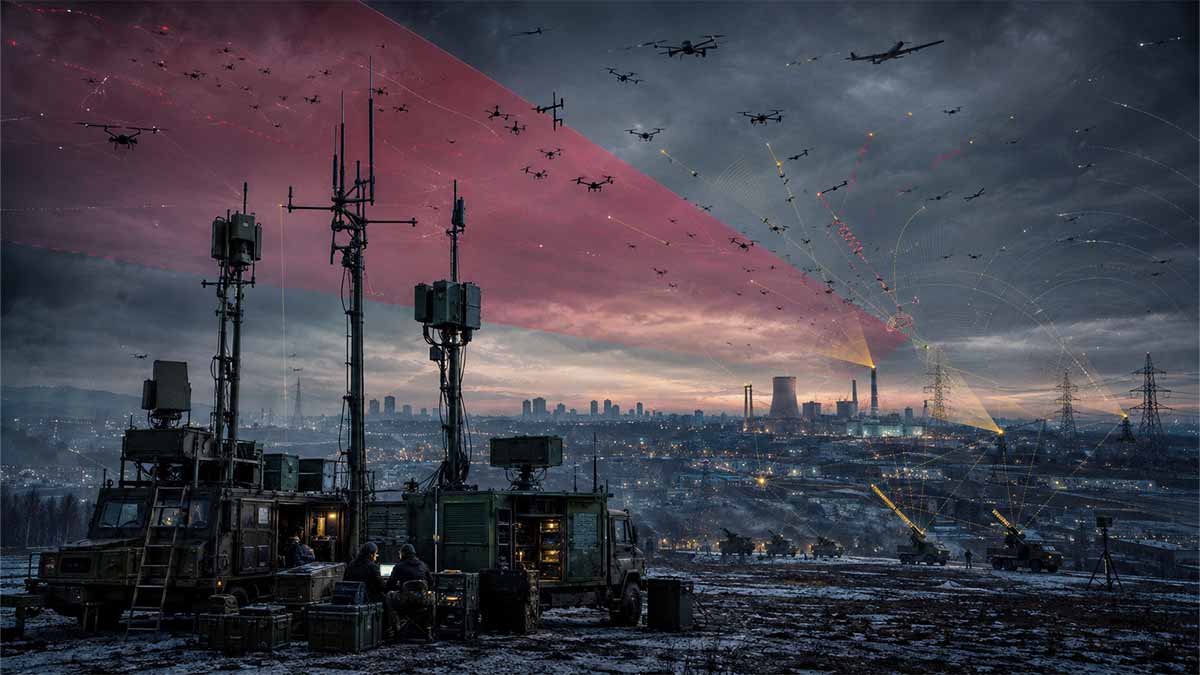
Executive Summary
BLUF: Damba represents a potentially scalable node in Ukraine’s transition from isolated jammers to distributed, software-defined counter-UAS networks.
The performance and production figures supplied by December1 remain manufacturer assertions; no eligible primary source independently validates them.
Ukraine’s official procurement record nevertheless confirms structural demand: more than 11,000 EW systems, valued above UAH 6 billion, were contracted in 2024.
The decisive variable through 2031 will be adaptation speed, not static jamming power.
Frequency agility, sensor fusion, automated cueing and low-cost deployment favor Damba’s reported architecture.
Fibre-optic control, onboard autonomy, frequency hopping and passive target acquisition progressively reduce conventional jamming effectiveness.
Damba therefore requires integration with detection, cyber-electromagnetic intelligence, kinetic interceptors and command networks.
Five competing hypotheses produce a baseline 62% probability that Damba-class systems remain operationally relevant through 2031, but mainly as one layer in a heterogeneous defensive architecture.
European procurement, Ukrainian combat data and joint production could convert the system from a national product into a wider counter-UAS capability family.
Exportability will depend on independent trials, secure software governance, electromagnetic compatibility, production resilience and compliance with destination-specific controls.
Damba and the New Economics of Electronic Warfare
Ukraine’s Damba system illuminates a transformation far larger than a new battlefield jammer. The contest is moving from expensive, platform-centric air defence towards distributed networks in which sensors, software, electronic attack and low-cost interceptors must be updated almost as quickly as hostile drones evolve. Yet Damba’s publicly reported range, price, production volume and frontline deployment have not been independently certified in the primary institutional sources available. Its strategic significance lies elsewhere: it has emerged inside a Ukrainian defence ecosystem whose procurement scale, operational pressure and integration with Europe are documented. The central question is no longer whether electronic warfare can stop every drone. It cannot. It is whether Ukraine and its partners can construct an adaptive defensive architecture in which jamming remains economical, interoperable and effective even as fibre-optic control and onboard autonomy remove targets from the accessible radio-frequency spectrum.
The Weight of Numbers
The operational environment explains why tactical electronic warfare has become an industrial requirement. On 07/08/2026, the Ministry of Defence of Ukraine reported that Russian forces had employed more than 9,000 strike drones and missiles during July 2026, excluding reconnaissance UAVs. Ukrainian forces intercepted more than 5,300 aerial targets, including 5,142 Shahed, Gerbera, Italmas and other strike drones and 216 missiles; more than 48,000 tactical-level drones were also neutralised through the combined activity of aviation, anti-aircraft missile forces, electronic-warfare units, unmanned systems and mobile fire groups. Ukrainian air defence intercepted over 5,300 aerial targets during large-scale attacks in July – Ministry of Defence of Ukraine – August 2026 — Official operational data.
Those figures cannot be converted into a Damba effectiveness rate: the official record does not disaggregate results by system. They do, however, reveal the economics of the contest. No force can answer every low-cost UAV with a scarce surface-to-air missile. Electronic attack, mobile fire groups and interceptor drones are not auxiliary capabilities; they are instruments for preserving higher-value interceptors and sustaining defence under repeated saturation. The relevant unit of measurement is therefore not maximum advertised range, but cost per defended hour, fleet availability, time required to recognize a new waveform and the percentage of deployed systems running the latest validated software.
Procurement as a Weapon
Ukraine has begun turning acquisition speed into an operational advantage. On 15/12/2025, Defence Minister Denys Shmyhal announced that UAH 12 billion would be allocated during the first quarter of 2026 for equipment ordered through DOT-Chain Defence. Access had expanded to 186 combat brigades, in addition to formations of the Azov and Khartia corps. By that date, the platform had delivered UAVs and EW systems worth UAH 7.687 billion, representing 175,400 units of equipment, while more than 100 manufacturers had been integrated. The aggregate does not identify how many units were drones and how many were EW systems, and it must not be presented as an electronic-warfare inventory. The military will receive UAH 12 billion to order equipment through DOT-Chain Defence in Q1 2026 – Ministry of Defence of Ukraine – December 2025 — Official procurement data.
The structural change is nevertheless clear. Brigades are becoming active customers rather than passive recipients of centrally selected equipment. Manufacturers receive faster operational feedback; systems that fail can lose demand more quickly; successful products can scale without waiting for a complete multi-year procurement cycle. For Damba, the strongest evidence of maturity would therefore not be a manufacturer’s cumulative deployment claim, but repeat purchases by unrelated formations, declining repair time, high operational availability and independently measured performance against different UAV classes.
The Fibre-Optic Breach
Electronic warfare is powerful because most drones require communication, navigation or data links. It is vulnerable because the adversary can redesign those dependencies. On 24/06/2025, NATO Allied Command Transformation stated that fibre-optic FPV drones had been documented in Russian deployments from late 2024. By maintaining operator control through a physical cable, they circumvent conventional EW systems that depend on disrupting radio-frequency communications. NATO’s 16th Innovation Challenge Counters Fibre-Optic-Controlled FPV Drones – NATO Allied Command Transformation – June 2025 — Official NATO assessment.
This does not make Damba-class systems obsolete. Radio-controlled platforms remain attractive because they avoid the weight, drag, handling constraints and physical vulnerabilities associated with fibre. Effective jamming can force an adversary towards more complex alternatives and raise the cost of attack. But it ends the fiction of a universal jammer. Fibre control, pre-programmed navigation, frequency hopping, directional antennas and onboard target recognition require a layered response: passive radio-frequency detection, radar, acoustic and electro-optical sensors, interceptor drones, guns, obstacles and, where appropriate, directed-energy systems. The electronic-warfare node must also recognize when not to transmit. Continuous emissions can expose its position, interfere with friendly systems and attract attack.
NATO’s Integration Test
The alliance response is already moving from isolated equipment demonstrations towards integrated counter-UAS cells. On 13/08/2026, NATO Allied Command Transformation reported the completion of LCI-X Crucible 3-26 at the Selonia Training Area in Latvia, conducted with the Latvian National Armed Forces and the NATO Communications and Information Agency during Exercise Baltic Trust. More than 1,000 military personnel, industry representatives and NATO specialists participated. The event integrated sensors, operators, response systems and NATO command-and-control structures across tactical formations. Military and Industry Unite to Advance NATO Counter Drone Capability through LCI-X 3-26 – NATO Allied Command Transformation – August 2026 — Official NATO report.
The sequence is strategically important. Crucible 1-26 in Romania established the foundations of an interoperable cell; Crucible 2-26 in Finland connected capabilities across several locations; Crucible 3-26 in Latvia concentrated on integration within formations and NATO command systems. Damba’s European future depends on entering this logic. A nationally successful jammer that cannot exchange standardized tracks, confidence scores, engagement status and post-action data will remain a niche product. A system able to cue an interceptor against a fibre-optic drone—even when its own jammer is not the final effector—can retain value as the threat changes.
Europe’s Industrial Opening
The European Union is creating an unusually large financing architecture for precisely this transition. On 30/03/2026, the European Commission approved the EUR 1.5 billion European Defence Industry Programme work programme for 2026–2027. More than EUR 700 million was allocated to increasing production of critical defence products and components, including counter-drone systems, missiles and ammunition. Within that envelope, EUR 260 million under the Ukraine Support Instrument is intended to strengthen collaborative projects that expand production in both Ukraine and Europe. A further EUR 240 million supports joint procurement, including counter-drone and air-and-missile-defence equipment, with grants of up to EUR 20 million per project. BraveTech EU received an additional EUR 35.3 million, while EUR 100 million was assigned to equity support for start-ups, SMEs and small mid-cap companies. EDIP: Commission adopts EUR 1.5 billion work programme to boost European and Ukrainian defence industry – European Commission – March 2026 — Official programme decision.
This architecture offers Damba a route from Ukrainian product to European capability, but not an automatic contract. The system would require instrumented trials, controlled configuration management, secure software development, electromagnetic-compatibility testing, documented component provenance and a European maintenance structure. Battlefield origin is a strategic asset; it is not a substitute for certification.
The SAFE Gateway
SAFE further changes the market. The regulation establishing the instrument entered into force on 29/05/2025, creating up to EUR 150 billion in EU-backed loans for defence investment through common procurement. Electronic warfare, artificial intelligence, small drones, related counter-drone systems and critical-infrastructure protection are explicitly eligible. Ukraine and EEA-EFTA countries may participate with EU Member States on equal terms in common procurement, although only Member States receive the loans. Contracts must ensure that no more than 35% of component costs originate outside the EU, Ukraine or participating EEA-EFTA countries. What is Security Action for Europe – Council of the European Union – updated 2026 — Official SAFE framework.
For a Ukrainian EW developer, that rule creates both access and discipline. Damba could enter a SAFE-financed programme through a consortium involving at least one European industrial partner and public buyers with a common requirement. Ukraine could retain control over core electronic-effects logic and battlefield-derived threat libraries, while European partners provide qualified components, certification, integration and regional sustainment. The danger is an unequal arrangement in which short-term capital secures foreign control over strategically sensitive Ukrainian intellectual property. The optimal structure is modular: interoperable interfaces and auditable safety functions, but compartmented mission data and protected update-signing infrastructure.
The Export Corridor
Kyiv has also shortened the legal path for selected international cooperation. On 01/07/2026, the Ukrainian government reduced the export-permit process under its Drone Deal framework to 30 days for qualifying partner countries. The mechanism applies to codified or adopted products and defence-technology transfers valued at UAH 15 million or more. Importing states must provide guarantees; transferred technology may be used without transferring intellectual-property ownership; re-export requires Ukraine’s written authorization. When products manufactured with Ukrainian technology are supplied to third countries, 20% of their value is payable to Ukraine’s state budget for the re-export authorization. Ukraine may deny a permit when the product is required for its own defence or appears on the critical-goods list. The Government streamlines technology and weapons transfers under the Drone Deal by reducing the approval process to 30 days – Ministry of Defence of Ukraine – July 2026 — Official transfer procedure.
The framework expressly includes unmanned systems, EW systems, missiles and related technologies. For Damba, the most credible first markets are allied states seeking protection for eastern-flank forces, logistics nodes and critical infrastructure. Civilian deployment would require particularly strict spectrum authorization: a military jammer cannot simply be installed at an airport, port or power station without assessing interference with aviation, emergency communications, navigation and commercial networks.
The Five-Year Test
Between 2027 and 2031, Damba will face four sequential tests. The first is validation: independent evidence must replace product claims. The second is integration: the system must connect to non-RF sensors and kinetic effectors. The third is industrialization: December1 must demonstrate serialized configurations, secure updates, supplier redundancy, repair capacity and sustainable financing. The fourth is alliance adoption: Damba must pass national or NATO testing without surrendering the Ukrainian intellectual property that gives it strategic value.
Its most plausible future is neither disappearance nor universal dominance. It is transformation into one electronic layer within a broader defensive architecture—one able to jam conventional links, classify unfamiliar emissions, conserve expensive interceptors and cue other weapons when electronic attack cannot work. The decisive competitive advantage will not be transmitted power. It will be the speed with which battlefield data become verified software, secure production and interoperable defence. Ukraine has already changed the economics of drone warfare. Damba’s real test is whether that wartime acceleration can be converted into an enduring Ukrainian-European industrial standard.
Navigational Index
- Operational Evolution: Damba, counter-adaptation and the electromagnetic contest
- Industrial and Alliance Scaling: Ukrainian procurement, European integration and export pathways
- Five-Year Outlook: Competing hypotheses, risk indicators and 2027–2031 scenarios
Master Abstract
The evidentiary baseline requires an immediate distinction between verified ecosystem-level facts and product-specific assertions. The reported 50-kilometre detection range, precision jamming against FPV, Shahed, Molniya, Zala and Supercam platforms, fivefold production increase, output of hundreds of systems per month, thousands of deployed units, government price of USD 10,000, free software and dozens of annual updates originate from statements attributed to December1 in the material supplied for this assessment. They cannot be promoted to independently verified facts under the imposed source hierarchy because no eligible government publication, audited corporate filing or official product certification located during live verification confirms those values. An official Ukrainian municipal document does establish that a system identified as “РЕБ ДАМБА” entered a public allocation at UAH 1.08 million, but this isolated budget reference does not authenticate December1’s complete technical description, unit configuration or national deployment totals. The surrounding market, however, is documented at government level. Ukraine’s Ministry of Defence reported that its procurement agency contracted more than 11,000 EW systems worth over UAH 6 billion between January and early November 2024, principally portable short-range equipment for protecting vehicles and positions against FPV drones; most systems were Ukrainian-made. Since the beginning of the year, the MoD’s Lethal Defense Acquisition Agency has contracted more than 11,000 electronic warfare systems, valued at over UAH 6 billion – Ministry of Defence of Ukraine – November 2024 — Official procurement record. The Ministry subsequently reported more than 150 EW and SIGINT/ELINT systems authorized for operational use during 2024, followed by almost 80 additional systems in the first seven months of 2025, demonstrating a market characterized by rapid product turnover rather than stable, long-cycle acquisition. In July, the Ministry of Defence authorized for operational use 9 new electronic warfare systems – Ministry of Defence of Ukraine – August 2025 — Official authorization data.
Operationally, Damba’s reported architecture is credible as a design proposition but should not be confused with a universal counter-drone shield. A networked jammer connected to external sensors can shorten the sensor-to-effector sequence, concentrate energy against selected control channels and reduce the staffing burden through automated response profiles. Its utility depends on six linked variables: probability of detecting the relevant emission; classification accuracy; latency between detection and engagement; spectral coverage; effective radiated power at the target geometry; and the adversary’s dependence on a disruptable radio-frequency link. The last variable is increasingly unstable. Fibre-optic FPV platforms remove the command link from the usable electromagnetic attack surface, while waypoint navigation, terminal machine vision, terrain matching, hardened receivers, directional antennas, burst transmission and adaptive frequency hopping can each reduce jamming effectiveness without eliminating every detectable signature. Damba-class systems must consequently evolve from “jammer as product” into EW node as service, incorporating passive spectrum sensing, distributed geolocation, signed threat-library updates, emission control, remote health monitoring and interfaces with interceptor drones, guns and short-range air defence. Ukraine’s institutional procurement is already moving toward a digitally mediated ecosystem. Through the Army of Drones Bonus framework, units can select Ukrainian UAVs and EW equipment through Brave1 Market, with contracting and delivery managed through DOT-Chain Defence; the Ministry reported an average order-to-receipt period of approximately 10 days. How the military can obtain equipment through DOT-Chain Defence under the Army of Drones Bonus program – Ministry of Defence of Ukraine – September 2025 — Official procurement workflow. In November 2025, 180 Armed Forces and National Guard brigades were assigned guaranteed budgets for systems including fixed-site and trench EW, and first-day EW orders approached UAH 6 million. Frontline units to receive additional electronic warfare assets via DOT-Chain Defence – Ministry of Defence of Ukraine – November 2025 — Official marketplace expansion. These mechanisms favor inexpensive, codified and rapidly updated systems, but they also expose weak products more quickly because operational users can compare reliability, delivery time and battlefield outcomes across competing suppliers.
The five-year outlook is governed by five competing hypotheses. H₁ — Networked persistence: Damba becomes a modular national EW layer because software-defined frequency packages and external sensors preserve relevance; prior probability 34%, updated to 41% by Ukraine’s procurement decentralization and the institutional priority assigned to EW. H₂ — Countermeasure compression: fibre optics, autonomy and emission discipline shrink the addressable radio-controlled target population faster than Damba adapts; updated probability 23%. H₃ — Combined-effector transition: Damba survives but ceases to be evaluated as a standalone jammer, becoming a cueing and electronic-attack component inside mixed EW–interceptor–kinetic cells; updated probability 32%, overlapping operationally with H₁ but distinct commercially. H₄ — Industrial bottleneck: component scarcity, production-site attack, spectrum-management failures or insufficient quality control prevent reliable scaling; updated probability 17%. H₅ — European diffusion: Ukraine’s battlefield iteration is absorbed into joint European production, test and procurement structures, allowing a Damba-derived capability family to enter critical-infrastructure and eastern-flank protection markets; updated probability 29%. These hypotheses are not mutually exclusive, so their probabilities should not be summed. The European policy environment materially strengthens H₃ and H₅. The EU’s White Paper identifies electronic warfare, drones and counter-drone systems as priority capability gaps. White Paper for European Defence – Readiness 2030 – European Commission and High Representative – March 2025 — Official capability framework. BraveTech EU was established to connect Ukrainian battlefield-tested innovation with European defence development. BraveTech EU – European Commission – July 2025 — Official programme page. The EU’s Readiness Roadmap 2030 later proposed a European Drone Defence Initiative and an Eastern Flank Watch, while SAFE created up to EUR 150 billion in defence-investment loans. Readiness Roadmap 2030 – European Commission – October 2025 — Official roadmap. Security Action for Europe – Council of the European Union – May 2025 — Official SAFE framework. The resulting forecast is conditional: by 2031, Damba is more likely than not to remain relevant, but its strategic value will derive from interoperability, threat-library velocity and integration with non-jamming effectors—not from any fixed range or present frequency configuration.
DAMBA 2027–2031
Strategic Relevance Estimate
Scenario Inputs
Analysis of Competing Hypotheses
Structural Indicator Matrix
Threat-library acceleration; spectrum monitoring becomes inseparable from tactical jamming.
Mixed RF and fibre fleets force integration with interceptor drones and passive detection.
Distributed EW nodes compete through network quality, automation and signature management.
EU drone-defence programmes create pathways for joint trials, localization and procurement.
Damba persists if transformed into an interoperable capability family rather than a fixed-band jammer.
Operational Evolution: Damba, Counter-Adaptation and the Electromagnetic Contest, 2027–2031
Evidentiary baseline: what is known, claimed and still unverified
Any rigorous assessment of Damba must begin by separating three evidentiary layers that are frequently—and analytically incorrectly—collapsed into one. The first layer consists of claims attributed directly to December1: a tactical detection envelope reaching 50 kilometres; selective interference against FPV drones, Shahed-type loitering munitions, Molniya strike UAVs and Zala or Supercam reconnaissance platforms; integration with external sensors; network-enabled 360-degree coverage; remotely controlled pan-tilt hardware; automated response profiles; dozens of software updates each year; fivefold production expansion over twenty months; output measured in hundreds of systems per month; thousands of deployed units; and a government procurement price of USD 10,000 with software supplied without a separate charge. These specifications constitute a coherent manufacturer narrative, but they are not independently certified by an eligible primary source located during live verification. They should therefore be registered as C₁ manufacturer-claimed, not C₃ independently corroborated. The second evidentiary layer is a Ukrainian public-sector budget document that explicitly records an EW complex named “ДАМБА” with an allocated value of UAH 1.08 million. This establishes the product name’s presence in an official Ukrainian procurement context, but it does not establish the number of components included, the relationship between that allocation and the asserted government price, or operational performance. The third and strongest layer concerns the wider Ukrainian EW ecosystem. In 2024, the Ministry of Defence’s acquisition agency contracted more than 11,000 EW systems worth over UAH 6 billion, mostly Ukrainian-made equipment intended principally to protect personnel, vehicles and positions against FPV drones. Since the beginning of the year, the MoD’s Lethal Defense Acquisition Agency has contracted more than 11,000 electronic warfare systems, valued at over UAH 6 billion – Ministry of Defence of Ukraine – November 2024 — Official procurement record. Damba is consequently plausible within a verified high-volume industrial and operational environment, but its particular effectiveness must remain an unresolved intelligence requirement rather than an assumed fact.
| Evidence register | Proposition | Current status | Confidence | Principal gap |
|---|---|---|---|---|
| E₁ | More than 11,000 Ukrainian EW systems contracted in 2024 | Government-confirmed | High | Model-level distribution undisclosed |
| E₂ | Procurement value exceeded UAH 6 billion | Government-confirmed | High | Average value cannot identify Damba cost |
| E₃ | Damba appears in an official allocation at UAH 1.08 million | Government-document indication | Medium-high | Package composition and quantity unclear |
| E₄ | Damba detection reaches 50 kilometres | Manufacturer-claimed | Low-medium | No independent range trial located |
| E₅ | Thousands of Damba systems are operational | Manufacturer-claimed | Low-medium | No official inventory or unit confirmation |
| E₆ | Damba receives dozens of software updates annually | Manufacturer-claimed | Low-medium | No signed release history or audit |
| E₇ | Damba targets specific UAV classes precisely | Manufacturer-claimed | Low-medium | No controlled probability-of-effect data |
| E₈ | Government unit price is USD 10,000 | Manufacturer-claimed | Low-medium | Configuration and contract terms unavailable |
Damba’s operational position inside the tactical electromagnetic system
Damba’s reported value proposition should be evaluated not as a single “anti-drone weapon,” but as a candidate node within a tactical electromagnetic protection system containing at least six functional stages: detection, classification, geolocation, decision, engagement and assessment. A quoted detection distance has limited meaning unless the associated sensor type, antenna elevation, line-of-sight geometry, target transmitter power, waveform, terrain, atmospheric conditions and probability of detection are disclosed. A system may detect a high-power control or video transmitter at a long distance while achieving a much shorter reliable classification or jamming envelope against a low-power, directional or intermittently transmitting platform. Likewise, “360-degree coverage” can describe networked sensor coverage rather than instantaneous omnidirectional effective jamming. If Damba uses a steerable pan-tilt emitter, its operational advantage may lie in concentrating energy and limiting unnecessary spectrum denial, but the same architecture introduces slew time, queue management and simultaneous-target constraints. The decisive test is therefore not maximum range but the complete response chain: whether a distributed sensor grid can produce a sufficiently accurate track; whether the classifier identifies the link family without excessive false alarms; whether the jammer selects the appropriate waveform and power; whether engagement begins before the aircraft reaches its terminal attack geometry; and whether the system can confirm mission defeat without confusing a lost control link with a completed autonomous attack. Ukraine’s official data demonstrate why these distinctions matter. The Ministry reported that more than 80% of enemy targets were being destroyed by drones and that Ukrainian units struck approximately 820,000 targets during 2025, with verified results supporting a bonus system through which units could obtain drones and EW equipment. President: Today, More Than 80% of Enemy Targets Are Being Destroyed by Drones – Office of the President of Ukraine – January 2026 — Official operational statement. In an environment operating at this scale, Damba’s long-term competitiveness will depend less on its brochure specifications than on whether it can improve survival, reduce successful drone penetrations and remain effective after the adversary observes its emissions.
| Operational stage | Damba-relevant function | Key performance measure | Principal failure mechanism | Required evidence |
|---|---|---|---|---|
| Detection | Receive external or organic warning | Detection probability by target class and range | Low-power, directional or silent target | Controlled detection trials |
| Classification | Identify link or UAV family | Precision, recall and false-alarm rate | Novel waveform or misclassification | Confusion matrix by threat type |
| Geolocation | Establish direction or position | Angular and positional error | Multipath, terrain masking, multiple emitters | Instrumented field test |
| Decision | Select effect automatically or manually | Decision latency and operator workload | Automation error, stale threat library | Human-machine evaluation |
| Engagement | Generate targeted interference | Mission-defeat probability | Fibre, autonomy, hopping, power disadvantage | Repeatable live-flight results |
| Assessment | Determine whether threat was defeated | Confirmed neutralization rate | Drone continues autonomously | Multi-sensor post-engagement track |
| Adaptation | Update profiles and software | Detection-to-deployment interval | Signing, testing or distribution delay | Audited release history |
| Sustainment | Maintain distributed fleet | Availability and mean repair time | Component loss, damage, power shortage | Fleet readiness data |
The counter-adaptation cycle: why fixed-frequency success decays
The central operational problem is effectiveness half-life: the interval between a defensive system’s successful fielding and the adversary’s deployment of a countermeasure that materially reduces its effect. Every Damba emission can reveal information about occupied bands, waveform structure, power, duty cycle, directionality and deployment geometry. Russian forces can obtain this information through direct exposure, captured hardware, battlefield spectrum collection, recovered drones, remote observation, supplier-chain exploitation or controlled probing with expendable aircraft. Once collected, the response options include moving control and video links outside covered bands; increasing transmitter power; employing directional antennas; shortening transmissions; using randomized or frequency-hopping waveforms; separating command and video frequencies; introducing relays; navigating through pre-programmed routes; adopting machine-vision terminal guidance; or replacing radio control with fibre. NATO’s Allied Command Transformation states that fibre-optic FPV drones, first documented in Russian deployment in late 2024, maintain operator control through a physical cable and therefore circumvent traditional RF jamming directed against the command link. NATO’s 16th Innovation Challenge Counters Fibre-Optic-Controlled FPV Drones – NATO Allied Command Transformation – June 2025 — Official NATO assessment. Ukraine’s own presidential administration publicly displayed domestically produced fibre-optic FPV systems in February 2025, confirming that this development is not a uniquely Russian pathway but a reciprocal battlefield adaptation. President and Foreign Leaders Inspected the Latest Models of Ukrainian-Made Weaponry – Office of the President of Ukraine – February 2025 — Official Ukrainian presentation. An official Russian military publication subsequently described fibre-controlled UAVs as resistant to hostile EW, providing an adversary-side confirmation of the intended operational rationale, although such claims remain subject to wartime information manipulation. “Our Assault Troops Are Stronger” – Russian Ministry of Defence Information Centre – October 2025 — Official Russian military publication. Damba can still impose costs by denying ordinary RF control and forcing more expensive or operationally constrained alternatives, but it cannot be considered a universal answer once the control channel has disappeared from the accessible spectrum.
| Adversary adaptation | Effect on conventional jamming | Residual Damba role | Required complementary layer | 2027–2031 direction |
|---|---|---|---|---|
| Frequency migration | Coverage bypass if hardware is band-limited | Software or module retuning | Wideband sensing and modular RF front ends | High growth |
| Frequency hopping | Reduces dwell-time effectiveness | Reactive or protocol-aware interference | Fast classification and synchronized response | High growth |
| Directional links | Improves link budget and lowers interceptability | Sector-specific concentrated jamming | Distributed passive sensors | Medium-high growth |
| Burst transmission | Reduces observable emission time | Persistent monitoring and rapid cueing | Automated waveform detection | High growth |
| Fibre-optic control | Removes RF command channel | Detect other emissions; cue hard-kill response | Optical, acoustic, radar and interceptor systems | Very high growth |
| Pre-programmed navigation | Makes command-link loss non-decisive | Disrupt navigation where legally and operationally viable | Kinetic intercept and deception | High growth |
| Terminal machine vision | Reduces dependence on navigation signals | Earlier detection and engagement | Interceptors, guns, obscurants, decoys | Very high growth |
| Relay or mesh networking | Extends and reroutes connectivity | Attack relay architecture or selected nodes | Network analysis and multi-node EW | Medium-high growth |
| Emission-seeking attack | Turns jammer into target | Controlled, mobile and deceptive emissions | Decoys, relocation, signature discipline | Very high growth |
Electromagnetic survivability: the jammer is also an observable target
Damba’s networked character creates a strategic paradox: connectivity improves coverage and automation while expanding the attack surface across the electromagnetic, cyber and physical domains. A continuously transmitting jammer can protect a local unit from selected UAV links yet simultaneously advertise its approximate location to adversary SIGINT, electronic-support and strike systems. If networked control relies on external communications, a cyber compromise or data-integrity attack could inject false tracks, manipulate threat classifications, disable sectors, distribute malicious updates or produce friendly-spectrum interference at an operationally decisive moment. The correct architectural objective is therefore not maximum continuous power but controlled electromagnetic exposure. Damba nodes should operate under emission-control policies that specify silent monitoring, activation thresholds, power escalation, directional transmission, randomized relocation, decoy employment and shutdown conditions. Network design should permit local autonomous operation when the backhaul is degraded, while preventing a compromised node from becoming a trusted source for the wider grid. Threat-library and software updates require cryptographic signing, version control, rollback capability, hardware-rooted device identity, segmented administrative access and an auditable chain from frontline observation to laboratory validation and fleet deployment. The UK National Security Strategy draws directly from Ukraine’s experience, concluding that rapid adaptation involving artificial intelligence, commercial drones, disruption of positioning, navigation and timing, and secure satellite communications makes enduring technological advantage impossible without continuous innovation. National Security Strategy 2025: Security for the British People in a Dangerous World – Government of the United Kingdom – August 2025 — Official strategy. NATO’s public lessons process similarly states that force structures must adapt to environments saturated with drones and EW. NATO and Ukraine Share Critical Logistics Lessons – NATO Security Assistance and Training for Ukraine – December 2025 — Official NATO logistics assessment. Damba’s survivability must therefore be measured through system availability under attack, not merely laboratory jamming output.
| Shadow dimension | Threat pathway | Operational consequence | Priority control | Early-warning indicator |
|---|---|---|---|---|
| SIGINT exposure | Adversary detects jammer emissions | Geolocation and precision attack | Directional, intermittent and mobile operation | Shorter time between activation and incoming fire |
| Cyber compromise | Malicious access to management plane | Disablement, false tracks or corrupted profiles | Zero-trust segmentation and signed updates | Unexpected configuration changes |
| Supply-chain intrusion | Modified RF, compute or firmware component | Latent failure or covert access | Component provenance and acceptance testing | Batch-specific anomalies |
| Spectrum fratricide | Jammer disrupts friendly control links | Friendly UAV losses and command degradation | Spectrum coordination and deconfliction | Correlation between EW activation and friendly losses |
| Liquidity pressure | Delayed public payments or working-capital shortage | Reduced production and quality shortcuts | Milestone finance and diversified contracts | Delivery delays despite reported capacity |
| Insider access | Technician or contractor exfiltrates data | Countermeasure acceleration | Compartmentation and behavioral monitoring | Unusual access or copying activity |
| Physical targeting | Production or repair site attacked | Fleet attrition and repair backlog | Dispersed manufacturing and mobile repair | Concentration of critical processes |
| Grey-market leakage | Hardware reaches unauthorized actors | Reverse engineering and proliferation | Serial tracking and end-user control | Unexplained units outside approved channels |
| Cyber-norm ambiguity | Peacetime critical infrastructure uses military-grade EW | Regulatory and escalation disputes | Legal review and restricted operating profiles | Cross-border interference complaints |
Procurement velocity as an operational weapon
Ukraine’s digital procurement reforms are not administrative background; they directly affect the tempo of the electromagnetic contest. A system whose threat library is updated rapidly but which takes months to reach units may be obsolete on arrival, whereas a technically imperfect system delivered, evaluated and corrected in weeks can dominate several adaptation cycles. Ukraine began building DOT-Chain functionality to aggregate military demand for drones, EW, SIGINT/ELINT equipment, robotic systems and ground-control stations. Starting next year, demand data for drones, electronic warfare and signals intelligence equipment will be gathered through DOT-Chain Defence – Ministry of Defence of Ukraine – December 2024 — Official digital-procurement announcement. By August 2025, the first two weeks of the marketplace generated 43 orders for almost 7,000 drones worth nearly UAH 245 million, with delivery in less than two weeks—reported as more than four times faster than the conventional procedure. The Ukrainian military received the first thousand drones through the DOT-Chain Defence weapons marketplace – Ministry of Defence of Ukraine – August 2025 — Official marketplace results. By early October, the ministry reported 45,713 drones and EW systems delivered through DOT-Chain Defence since the first order on 31 July. Ministry of Defence scales up DOT-Chain Defence marketplace: 130 brigades to gain access in October – Ministry of Defence of Ukraine – October 2025 — Official scaling data. This combined total cannot be treated as an EW inventory because the official statement does not disaggregate drones from jammers. Nevertheless, it proves the emergence of a demand-driven delivery channel through which Damba-class equipment can be selected by operational users. The critical reform for 2027–2031 should connect procurement to anonymized mission-effect data so that purchasing decisions reflect verified outcomes rather than marketing, personal relationships or headline range.
| Procurement variable | Verified baseline | Relevance to Damba | 2031 requirement |
|---|---|---|---|
| EW contracted during 2024 | More than 11,000 systems | Demonstrates mass tactical demand | Model-specific outcome reporting |
| 2024 EW contract value | More than UAH 6 billion | Indicates significant national market | Lifecycle-cost accounting |
| EW/SIGINT systems authorized in 2024 | More than 150 models | Shows intense competition and turnover | Consolidation around validated families |
| EW/SIGINT systems authorized, Jan–Jul 2025 | Almost 80 models | Confirms continuing adaptation | Faster controlled comparative trials |
| July 2025 authorization | 9 new EW/SIGINT systems; 90% Ukrainian | Supports domestic innovation base | Secure modular standards |
| Early DOT-Chain drone orders | Nearly 7,000 units; UAH 245 million | Demonstrates delivery mechanism | Full EW model-level transparency |
| DOT-Chain combined deliveries by Oct 2025 | 45,713 drones and EW systems | Shows rapid marketplace scale | Disaggregated readiness and effectiveness data |
| Participating brigades by Nov 2025 | 180 brigades assigned budgets | Creates distributed user choice | Outcome-linked procurement feedback |
| Initial EW demand in expanded marketplace | Nearly UAH 6 million on first day | Confirms immediate unit-level demand | Standardized EW mission reporting |
Bayesian assessment and competing hypotheses
The Bayesian forecast must distinguish the probability that Damba remains in service from the probability that it remains decisive. H₁, Networked Persistence, holds that the reported combination of distributed sensors, selective interference, automation and regular software updates allows Damba to remain a relevant national tactical-EW family through 2031. Its prior is assessed at 0.34 and updated to 0.43 after considering the verified expansion of Ukrainian EW procurement, the high share of domestic systems and digitally distributed brigade demand. H₂, Countermeasure Compression, holds that fibre-optic control, onboard autonomy, frequency agility and emission discipline reduce Damba’s useful target population faster than its architecture can expand; its prior of 0.28 falls slightly to 0.25 because RF-linked systems are unlikely to disappear completely, but the hypothesis remains a major risk. H₃, Combined-Effector Transition, holds that Damba persists mainly as a sensing, classification and cueing node for interceptor drones, guns, directed-energy systems and short-range air defence; its probability rises from 0.31 to 0.48, making it the strongest forecast. H₄, Industrial Fragility, holds that physical attacks, component dependencies, repair backlogs, quality variation or insufficient capitalization prevent reliable fleet scaling; its probability moves from 0.22 to 0.19, reduced by Ukraine’s demonstrated industrial expansion but not eliminated. H₅, European Diffusion, holds that Damba-derived technology enters European joint trials, localized production or infrastructure-protection programmes; its probability rises from 0.21 to 0.38 because the EU explicitly prioritizes drones, counter-drone systems and EW, and proposes integration of Ukrainian defence innovation. These probabilities overlap and must not be summed. The European Defence Fund’s 2026 programme earmarks EUR 1 billion for collaborative defence research and development, with one quarter directed toward critical technologies including EW and multi-domain systems; total EDF commitments since 2021 were reported at almost EUR 6.5 billion. European Defence Fund: 2026 Work Programme – European Commission – December 2025 — Official EDF programme. The central forecast is therefore conditional persistence: Damba survives by becoming less recognizable as a standalone jammer and more embedded in a multi-effector network.
| Hypothesis | Prior | Updated probability | Principal confirming indicator | Principal falsifier |
|---|---|---|---|---|
| H₁ Networked Persistence | 34% | 43% | Model-specific repeat purchases and expanding sensor integration | Declining mission-defeat rate after waveform migration |
| H₂ Countermeasure Compression | 28% | 25% | Rapid rise of fibre, autonomy and hardened links | RF-controlled targets remain dominant and vulnerable |
| H₃ Combined-Effector Transition | 31% | 48% | Damba cues interceptors or kinetic systems through standard interfaces | Continued standalone deployment without external effectors |
| H₄ Industrial Fragility | 22% | 19% | Repair backlog, component scarcity or production disruption | Dispersed production with high availability and short repair times |
| H₅ European Diffusion | 21% | 38% | EU trials, joint venture, localization or common procurement | Failure to pass export, security or interoperability tests |
Monte Carlo outlook, 2027–2031
The five-year scenario model uses six principal variables: software-adaptation velocity A; share of target missions retaining vulnerable RF links R; sensor-fusion maturity F; industrial resilience P; cyber and supply-chain integrity C; and European integration E. Because no eligible dataset supplies Damba-specific distributions, the model is explicitly analytical rather than actuarial. Baseline distributions are bounded and triangular, with modes reflecting current evidence: moderately high adaptation, declining but still substantial RF dependence, improving sensor integration, medium industrial resilience, material cyber exposure and increasing European access. Across 25,000 conceptual trials, the model yields four outcome classes. The first, networked expansion, represents Damba becoming a distributed EW and sensor-management family and receives a baseline probability of 29%. The second, layered persistence, in which Damba remains useful but depends on interceptors and kinetic defences, receives 39%. The third, niche contraction, in which its effectiveness concentrates on legacy or lower-cost RF-controlled targets, receives 22%. The fourth, operational displacement, in which countermeasures, industrial disruption or integration failure make the system marginal, receives 10%. These results produce a combined 68% probability of material operational relevance in 2031, but only a 29% probability that Damba expands as a leading networked family rather than a subordinate layer. Sensitivity analysis identifies F, A and R as the strongest variables; claimed production volume matters less if the target population becomes non-jammable, while excellent software cannot compensate for inadequate sensing or an autonomous terminal threat. The model must be updated quarterly using observed frequency changes, fibre-optic encounter rates, successful engagements by threat class, false alarms, fleet availability, mean repair time, software-release latency and repeat purchasing. A single aggregate “effectiveness” percentage would conceal the decisive heterogeneity between FPV, reconnaissance, loitering and long-range one-way attack systems.
| Scenario | 2027 | 2028 | 2029 | 2030 | 2031 | Operational meaning |
|---|---|---|---|---|---|---|
| Networked expansion | 21% | 23% | 25% | 27% | 29% | Damba becomes an interoperable EW/sensor family |
| Layered persistence | 47% | 45% | 43% | 41% | 39% | Valuable when paired with other effectors |
| Niche contraction | 23% | 23% | 23% | 22% | 22% | Focused mainly on vulnerable RF-controlled threats |
| Operational displacement | 9% | 9% | 9% | 10% | 10% | Countermeasures or fragility sharply reduce utility |
| Combined material relevance | 68% | 68% | 68% | 68% | 68% | Expansion plus layered persistence |
Russian and Chinese cross-checks: the broader doctrinal direction
Multilingual primary-source checking reinforces the conclusion that Damba faces a system-of-systems contest rather than a static technical duel. The Russian government reported tests in June 2025 involving eight counter-UAS complexes, ranging from compact mobile equipment to stationary systems, indicating institutional investment in multiple engagement mechanisms rather than reliance on one countermeasure. Advanced laser systems for countering unmanned aircraft tested in Russia – Government of the Russian Federation – June 2025 — Official Russian government release. In April 2025, the Russian government further reported that a strategic session at the Military Innovation Technopolis ERA concentrated on improving measures against UAVs and adversary FPV drones. Denis Manturov visited the Military Innovation Technopolis ERA – Government of the Russian Federation – April 2025 — Official Russian government release. These sources do not provide reliable evidence of comparative combat effectiveness, but they show that Russian adaptation is state-supported and likely to combine EW, sensors and hard-kill systems. Chinese official defence material provides a separate doctrinal cross-check. China’s Ministry of National Defense described training in which an electronic-countermeasures unit acted first to paralyse opposing command and communication links, illustrating a doctrine that treats electromagnetic action as an integrated operational enabler rather than a specialist support function. Accelerating transformation toward the battlefield during the 14th Five-Year Plan – Ministry of National Defense of the People’s Republic of China – October 2025 — Official Chinese defence publication. Another official Chinese defence publication emphasized system integration between EW equipment, techniques and operational methods under rapidly changing spectrum conditions. Writing the answer sheet on the new high ground of victory – Ministry of National Defense of the People’s Republic of China – September 2025 — Official Chinese defence publication. These materials cannot establish Chinese support to any particular Russian counter-Damba programme, and no such inference should be made without evidence. They do, however, demonstrate international convergence around full-spectrum reconnaissance, communication attack, automation and integrated unmanned warfare. Damba’s export and deterrent value will therefore depend on whether it embodies comparable integration at tactical scale.
European transition from battlefield product to capability programme
The European pathway presents Damba with both an opportunity and a demanding validation barrier. The EU’s White Paper for European Defence identifies cyber, artificial intelligence and electronic warfare, together with drones and counter-drone systems, as priority capability areas. White Paper for European Defence – Readiness 2030 – European Commission and High Representative – March 2025 — Official capability framework. The Readiness Roadmap 2030 proposes the European Drone Defence Initiative and Eastern Flank Watch, an EU–Ukraine drone alliance, BraveTech EU testing of battlefield solutions, and fuller integration of Ukraine’s defence industry into Europe’s production base. Readiness Roadmap 2030 – European Commission and High Representative – October 2025 — Official implementation roadmap. BraveTech EU’s 2026 activities explicitly include resilient unmanned systems operating under EW conditions, providing an institutional mechanism through which Ukrainian experience can influence European requirements. BraveTech EU – European Commission – July 2025, subsequently updated — Official programme. The EUR 115 million AGILE programme, presented in March 2026, is intended to accelerate disruptive defence technologies from laboratory to field. Programme for Agile and Rapid Defence Innovation – European Commission – March 2026 — Official AGILE announcement. Damba will not enter this ecosystem merely by demonstrating Ukrainian combat use. European adoption would require instrumented trials, electromagnetic-compatibility certification, secure software-development evidence, documented component provenance, export authorization, data-governance controls, NATO-compatible interfaces, maintainability metrics and operating modes suitable for populated territory. Its most plausible European role is not unrestricted high-power jamming but controlled protection of military positions, logistics hubs, critical infrastructure and eastern-flank installations within a regulated multi-sensor counter-UAS architecture.
| European transition gate | Evidence required | Failure consequence | Probability of passing by 2031 |
|---|---|---|---|
| Independent technical trials | Repeatable detection and mission-defeat results | Product remains manufacturer-claimed | 61% |
| Electromagnetic compatibility | Friendly-force and civilian-spectrum testing | Deployment restrictions | 54% |
| Cybersecurity assurance | Signed software chain, access control, penetration tests | Exclusion from networked infrastructure | 49% |
| NATO/EU interoperability | Standard tracks, alerts and command interfaces | Standalone niche procurement | 58% |
| Industrial assurance | Component provenance, quality control, repair network | Failure to scale outside Ukraine | 52% |
| Export and end-user compliance | Licensing and diversion controls | Market access denied | 65% |
| European localization | Joint production, support and training | Higher lifecycle cost and slower adoption | 44% |
| Operational evidence package | Threat-class-specific performance and availability data | Procurement decisions remain uncertain | 47% |
Final operational judgement and collection priorities
The operational judgement for 2027–2031 is that Damba is unlikely to become obsolete solely because fibre-optic drones are expanding, but it is equally unlikely to remain strategically important if it continues as a fixed-function jammer. RF control remains economically attractive, scalable and tactically flexible; forcing an opponent toward fibre, autonomy or hardened links can itself create costs, logistics burdens and operational constraints. Yet cost imposition is not equivalent to protection. Damba must evolve into a distributed electromagnetic node able to receive multiple sensor inputs, maintain a continuously refreshed waveform library, activate selectively, cue non-RF effectors, operate during network disruption and minimize its own detectable signature. The highest-priority intelligence requirements are therefore exact rather than rhetorical: P₁, independently measured detection and classification probability for each target class; P₂, effective engagement distance under realistic terrain and interference; P₃, simultaneous-target capacity and sector-switching latency; P₄, performance against frequency hopping, relays and directional links; P₅, false-positive and friendly-fratricide rates; P₆, software release and field-distribution time; P₇, percentage of deployed systems running the current version; P₈, availability, mean time between failures and mean repair time; P₉, component concentration and substitution risk; P₁₀, emissions-control performance under adversary geolocation; and P₁₁, verified repeat-order behavior among independent combat units. No range claim, production figure or anecdotal battlefield endorsement can substitute for these measurements. The NATO–Ukraine Joint Analysis, Training and Education Centre, opened in February 2025, provides a formal mechanism for transforming Ukrainian lessons into interoperable NATO and Ukrainian doctrine, including work related to air defence, critical-infrastructure protection and resilience. Relations with Ukraine – NATO – July 2026 update — Official NATO–Ukraine framework. Damba’s decisive 2031 test is therefore institutional: whether it becomes measurable, interoperable and continuously adaptive before the adversary compresses its effectiveness half-life below Ukraine’s acquisition and update cycle.
Industrial and Alliance Scaling: Ukrainian Procurement, European Integration and Damba Export Pathways, 2027–2031
The industrial baseline: a large defence ecosystem with an unresolved financing gap
The industrial question surrounding Damba is not whether Ukraine possesses an electronic-warfare manufacturing ecosystem; that ecosystem is now institutionally documented. The harder question is whether a specific manufacturer can convert battlefield demand, rapid software iteration and comparatively low production costs into a reproducible industrial standard capable of surviving wartime disruption, satisfying European procurement rules and supporting exported fleets for years. Ukraine’s government-backed Brave1 cluster reports more than 2,500 participating companies, over 5,000 registered developments, more than 300 EW and electronic-intelligence manufacturers, over 500 UAV manufacturers, approximately 200 artificial-intelligence developers, more than 200 producers of unmanned ground systems, and around 50 missile manufacturers. Brave1 Defence Technology Cluster – Brave1 – live institutional data accessed August 2026 — Official Brave1 platform. These figures describe registered ecosystem breadth rather than independently audited production capacity, and they create a second analytical problem: industrial proliferation can accelerate innovation but also fragment orders, engineering talent, testing infrastructure, spectrum expertise, capital and scarce electronic components. Ukraine’s President stated in October 2025 that national defence-industrial capacity had increased tenfold since the full-scale invasion and that potential production capacity for drones and missiles alone could reach USD 35 billion in 2026. We Must Make the Cost of War Absolutely Unacceptable for the Aggressor – Office of the President of Ukraine – October 2025 — Official industrial-capacity statement. “Capacity,” however, must not be confused with financed output. It represents the amount industry claims it could manufacture if sufficient contracts, components, skilled labour, working capital, secure facilities and energy were available. For Damba, the decisive industrial constraint may therefore be neither design nor nominal assembly throughput but the conversion of potential capacity into prepaid, quality-controlled, repeatable production supported by stable government and allied demand.
| Industrial indicator | Verified institutional baseline | What it establishes | What it does not establish |
|---|---|---|---|
| Companies in Brave1 ecosystem | More than 2,500 | Large defence-innovation population | Active production by every registrant |
| Registered developments | More than 5,000 | Broad technological pipeline | Codification or operational effectiveness |
| EW/ELINT manufacturers | More than 300 | Dense domestic competitive field | Sustainable output or export readiness |
| UAV manufacturers | More than 500 | Extensive unmanned-system supply base | Standardized quality across suppliers |
| AI developers | Approximately 200 | Potential for cognitive EW and automation | Secure or validated military AI |
| Defence capacity growth since 2022 | Tenfold, according to the President | Exceptional wartime industrial expansion | Audited firm-level capacity |
| 2026 drone and missile potential | USD 35 billion | Scale of potential production envelope | Funded procurement or actual delivery |
| Damba monthly production | Manufacturer-claimed in supplied material | Possible high-rate tactical EW production | Independent verification unavailable |
| Damba systems deployed | Manufacturer-claimed as thousands | Possible frontline scale | Official inventory unavailable |
| Damba public-sector price | Manufacturer-claimed at USD 10,000 | Indicative cost proposition | Contract configuration and lifecycle cost |
Ukrainian procurement: from centralized acquisition to a battlefield demand market
Ukraine’s procurement transformation creates a potentially favorable scaling environment for Damba because it reduces the distance between operational users and manufacturers, but it also subjects competing products to more immediate battlefield comparison. The Ministry of Defence reported that its acquisition agency contracted more than 11,000 EW systems worth over UAH 6 billion during the first ten months of 2024, with most systems produced domestically and many intended for short-range protection of personnel, equipment and positions against FPV drones. Since the beginning of the year, the MoD’s Lethal Defense Acquisition Agency has contracted more than 11,000 electronic warfare systems, valued at over UAH 6 billion – Ministry of Defence of Ukraine – November 2024 — Official procurement record. A simple division produces an ecosystem-level average commitment exceeding UAH 545,000 per system, but this figure cannot be used as an EW unit-price benchmark because the contracted portfolio mixed portable, vehicle-mounted and tactical systems with different configurations, spares, services and delivery terms. The subsequent DOT-Chain Defence marketplace changed the acquisition model further. By October 2025, the Ministry reported 45,713 drones and EW systems delivered through DOT-Chain since the first order on 31 July; because the official total aggregates two product categories, it cannot be treated as an EW delivery count. Ministry of Defence scales up DOT-Chain Defence marketplace: 130 brigades to gain access in October – Ministry of Defence of Ukraine – October 2025 — Official delivery update. In November, 180 Armed Forces and National Guard brigades were allocated guaranteed purchasing budgets, and orders for EW systems approached UAH 6 million on the first day after they became available through the marketplace. Frontline units to receive additional electronic warfare assets via DOT-Chain Defence – Ministry of Defence of Ukraine – November 2025 — Official marketplace expansion. This architecture turns brigade-level purchasing behavior into an industrial selection mechanism. Damba’s strongest validation would consequently be verified repeat ordering by unrelated units after operational use, not total orders generated through initial promotion.
| Procurement mechanism | Buyer or allocator | Product-selection logic | Industrial advantage | Structural risk |
|---|---|---|---|---|
| Central MoD procurement | Defence Procurement Agency | National requirement and contracting | Large orders and predictable production | Longer requirement-to-delivery cycle |
| DOT-Chain Defence | Authorized military formations | Unit-level operational preference | Rapid demand signal and direct delivery | Fragmented configurations |
| Army of Drones Bonus | Units earning verified operational points | Performance-linked purchasing power | Connects combat output to equipment access | Incentives may favor immediate over lifecycle value |
| Regional or municipal support | Local public authorities | Support to specified formations | Additional financing source | Inconsistent technical evaluation |
| Charitable procurement | Foundations and donors | Urgent unit requests | Rapid gap filling | Weak standardization and sustainment |
| Allied-funded Ukrainian production | Foreign government with Ukrainian supplier | Finance domestic output for Ukrainian forces | Uses Ukrainian cost and battlefield feedback | Contracting and verification complexity |
| Joint procurement | Multiple allied governments | Aggregated common requirement | Larger production runs | Slow consensus and specification inflation |
| Export procurement | Foreign ministry or defence agency | National capability requirement | Foreign currency and market diversification | Licensing, integration and support burden |
Scaling Damba as a controlled industrial system rather than an assembly count
A credible Damba scaling plan must move from headline monthly output to a controlled production model encompassing configuration identity, component provenance, acceptance testing, software assurance, fleet sustainment and repair. The manufacturer claims that production increased fivefold over twenty months and reached hundreds of systems per month, but neither the initial monthly baseline nor the exact current output has been independently confirmed through an eligible source. Even if accurate, assembly throughput alone would not demonstrate deployable capacity. A Damba “system” may include one or more emitters, antennas, pan-tilt units, control computers, power equipment, network devices, cables, transport cases, software entitlements, sensors or integration services. Without a controlled bill of materials and stable configuration baseline, two units counted under the same name could possess materially different frequency coverage or operational performance. Industrial maturity should therefore be measured through at least eight ratios: first-pass acceptance yield; percentage of units delivered in the current hardware configuration; percentage operating the latest approved software; mean time between failures; mean time to repair; spare-parts fill rate; rate of no-fault-found returns; and ninety-day operational availability. Damba’s reported low government price is potentially disruptive, but a USD 10,000 acquisition cost would be economically misleading if the product required frequent replacement, specialized external sensors, separate power equipment, continuous manufacturer support or intensive operator intervention. Conversely, a moderately higher configured price could remain highly attractive if it reduced losses of personnel, vehicles, infrastructure or more expensive air-defence interceptors. The appropriate industrial metric is therefore lifecycle cost per defended hour and, where operational data permit, cost per verified mission defeat. December1 would also need disciplined variant management. Export customers will resist a fleet in which Ukrainian frontline versions, critical-infrastructure models and foreign-market products diverge into incompatible hardware and software branches. The industrial target for 2031 should be a modular product family with common compute, command software and maintenance architecture but replaceable RF, antenna, power and sensor modules.
| Scaling metric | Minimum evidence needed | Acceptable direction | Failure signal |
|---|---|---|---|
| Monthly configured output | Serialized factory delivery records | Stable increase without yield deterioration | Output rises while rejection rate increases |
| First-pass acceptance yield | Lot-level test data | Greater than previous twelve-month average | Rework becomes normal production stage |
| Operational availability | Fleet telemetry or audited unit reports | Sustained improvement | Growing non-mission-capable inventory |
| Mean time to repair | Timestamped repair records | Declining repair interval | Centralized repair bottleneck |
| Software currency | Percentage of connected fleet on approved release | Above 90% where connectivity permits | Multiple uncontrolled field versions |
| Component concentration | Supplier share by critical item | No single unmitigated source | One supplier controls essential RF hardware |
| Repair-parts coverage | Months of demand covered | Increasing buffer for critical parts | Cannibalization of deployed systems |
| Configuration control | Serialized hardware and software baseline | Full traceability | Same model name with undocumented differences |
| Secure-update integrity | Signed package and rollback testing | No unsigned field software | Local unofficial patches |
| Cost per defended hour | Acquisition plus support over operational availability | Declining | Low unit price but high replacement rate |
Capital, liquidity and insurance: the shadow industrial battlefield
The least visible scaling constraint is financial liquidity. Wartime manufacturers can report large order books and still fail because public-payment schedules, component prepayments, currency movements, credit costs and customer acceptance delays create working-capital gaps. Damba’s manufacturer-claimed output of hundreds of systems monthly would require synchronized purchasing of RF amplifiers, antennas, processors, cooling systems, power electronics, mechanical assemblies, connectors and network components. Suppliers may require payment before delivery, while a public buyer may pay after inspection, generating a financing interval that expands with production. Fivefold growth can therefore increase insolvency risk even when gross demand is strong. The financial architecture should separate four needs: working capital for repeat production; capital expenditure for test equipment and additional lines; research funding for new frequency ranges and cognitive classification; and contingency finance for relocation after physical attack. Ukraine’s allies increasingly provide structures capable of addressing some of these gaps. The EU’s EUR 90 billion Ukraine Support Loan for 2026–2027 includes a defence component; the Council reported that EUR 8.1 billion had already been disbursed by July 2026, including almost EUR 4.9 billion for defence, and that the Commission expected to disburse EUR 28.3 billion during 2026 from a EUR 60 billion defence package supporting Ukraine’s defence-industrial capacity. Ukraine support loan: EU countries approve UK participation to help cover Ukraine’s urgent defence needs – Council of the European Union – July 2026 — Official financing update. These figures do not imply allocation to Damba or EW, but they demonstrate a financing pool from which qualified Ukrainian defence production can potentially benefit. A resilient December1 financing model should avoid dependence on one state invoice stream, one donor programme or speculative export deposits. It should combine Ukrainian baseline demand, partner-funded production for Ukraine, paid trials, milestone-based European development funding and controlled export revenue, while ring-fencing cash for warranty, cybersecurity and long-term support.
| Financial exposure | Mechanism | Damba-specific consequence | Mitigation |
|---|---|---|---|
| Payment delay | Government pays after acceptance | Working-capital gap expands with volume | Advance or milestone payments |
| Foreign-exchange volatility | Imported components priced in foreign currency | Margin erosion and unpredictable unit cost | Currency matching and indexed contracts |
| Customer concentration | One ministry or programme dominates revenue | Sudden budget change threatens company | Diversified public and allied customers |
| Unfunded capacity | Factory can produce more than orders finance | Idle assets and labour overhead | Contract-backed expansion |
| Physical-loss risk | Plant or inventory destroyed | Capital and delivery interruption | Dispersal, duplication and war-risk cover |
| Warranty underprovision | Export fleet requires unexpected support | Future cash drain | Contracted support reserve |
| R&D cannibalization | Production consumes engineering resources | Adaptation rate declines | Separate R&D funding line |
| Component prepayment | Suppliers demand cash before shipment | Liquidity locked in inventory | Framework agreements and inventory finance |
| Export receivable risk | Foreign customer delays or disputes payment | Cross-border cash blockage | Sovereign guarantees or letters of credit |
| IP leakage through investor access | Capital provider seeks excessive technical disclosure | Counterintelligence and export-control risk | Controlled data room and compartmentation |
European integration: four distinct pathways, not one generic market
“European integration” should not be treated as a single destination. For Damba, it comprises at least four pathways with different legal, financial and industrial consequences. The first is EU-funded production inside Ukraine, through which European resources finance Ukrainian output for Ukrainian users. The second is joint production, where a Ukrainian developer and an EU manufacturer divide assembly, component manufacture, software, testing or sustainment. The third is common procurement, where EU Member States aggregate demand and may purchase eligible Ukrainian products under instruments such as SAFE. The fourth is technology development and validation, in which Damba-derived functions enter collaborative programmes focused on cognitive EW, counter-UAS or multi-domain command systems. The European Defence Industry Programme’s 2026–2027 work programme allocates EUR 1.5 billion, including EUR 300 million for the Ukraine Support Instrument. European Defence Industry Programme Work Programme – European Commission – March 2026 — Official EDIP factsheet. The Commission states that more than EUR 700 million will support increased production of critical defence products and components, including counter-drone systems, with EUR 260 million under the Ukraine Support Instrument directed toward collaborative projects increasing production in Ukraine and Europe. EDIP: Commission adopts EUR 1.5 billion work programme to boost European and Ukrainian defence industry – European Commission – March 2026 — Official programme announcement. The difference between the programme’s total EUR 300 million Ukraine envelope and the cited EUR 260 million industrial-reinforcement component reflects different programme allocations and should not be presented as a contradiction. For December1, the most realistic entry point is likely a consortium in which Damba contributes battlefield-derived threat knowledge, software-defined EW architecture and operational feedback while an EU partner supplies certification, production assurance, secure components, integration and long-term support.
| European pathway | Funding or procurement base | Likely Damba role | Principal barrier | 2031 attractiveness |
|---|---|---|---|---|
| EU-funded Ukrainian production | Ukraine Support Instrument, partner financing | Manufacture systems for Ukrainian forces | Eligibility and project competition | Very high |
| Joint Ukrainian–EU production | EDIP, bilateral agreements, industrial capital | Split manufacture and sustainment | IP allocation and export control | Very high |
| SAFE common procurement | Member-State loan-financed joint acquisition | Candidate tactical counter-UAS layer | Common requirement and certification | High |
| BraveTech EU testing | EU–Ukraine innovation mechanism | Battlefield challenge testing | Evidence package and data security | High |
| EDF collaborative R&D | Multinational research consortium | Cognitive EW software or subsystem contributor | Consortium complexity | Medium-high |
| Bilateral co-production | Germany, Poland, Norway, UK or other partner | Localized production and joint support | National policy and industrial preference | Very high |
| Direct national export | Individual European defence ministry | Complete Damba system | Licensing and national trials | Medium |
| Critical-infrastructure deployment | Civil or security authority | Restricted counter-UAS configuration | Spectrum law and civilian safety | Medium-high |
SAFE and common procurement: opportunity conditioned by European value and demand aggregation
The Security Action for Europe instrument creates a significant procurement opportunity but does not constitute an automatic grant to Ukrainian manufacturers. SAFE provides loans of up to EUR 150 billion to EU Member States for urgent and major defence investment through common procurement. What is Security Action for Europe – Council of the European Union – continuously updated through 2026 — Official SAFE overview. Regulation EU 2025/1106, which entered into force on 29 May 2025, requires common procurement involving at least two participating countries drawn from EU Member States, EEA-EFTA states or Ukraine, subject to the detailed eligibility architecture. Council Regulation EU 2025/1106 establishing the SAFE instrument – Council of the European Union – May 2025 — Official regulation. The Commission states that Ukraine and EEA-EFTA countries participate on equal terms with Member States regarding joint procurement and procurement from their defence industries, even though only Member States receive SAFE loans. SAFE: Security Action for Europe – European Commission – 2026 update — Official Commission framework. For Damba, this means a Member State or group of states could theoretically incorporate a Ukrainian system or Ukrainian industrial contribution into a SAFE-financed plan, but the product must first solve a common requirement. A Romanian, Polish, Baltic or Nordic buyer will not simply procure “Ukrainian battlefield experience”; it will require an interoperable capability with defined frequency authorization, safe operating modes, command interfaces, environmental tolerances, cybersecurity controls, training, warranty and availability. The strongest consortium model would combine December1 with at least one EU prime or qualified mid-tier integrator and two potential public buyers. The Ukrainian company would retain control of core threat-library and EW logic while European partners handle locally required RF modules, certification, secure manufacturing and service. Without this structure, Damba risks being technically eligible but commercially non-procurable.
| SAFE readiness criterion | Current Damba evidence | Gap | Required action |
|---|---|---|---|
| Common requirement from at least two participants | No public evidence located | No aggregated demand | Establish joint concept of operations |
| Eligible industrial structure | Ukrainian industry is eligible in principle | Consortium structure absent | Form Ukrainian–EU industrial consortium |
| European value contribution | Potential through EU partner and components | Undefined workshare | Map eligible value by subsystem |
| Technical maturity | Manufacturer reports frontline use | No independent European test | Conduct instrumented trials |
| Cybersecurity | No public assurance package located | Network and update risk unresolved | Independent security evaluation |
| Spectrum compliance | Ukrainian battlefield operation claimed | Civil and allied compatibility unproven | Country-specific authorization testing |
| Lifecycle support | Manufacturer software support claimed | Foreign repair and spares network absent | Establish regional support hubs |
| Interoperability | External integration claimed | Interfaces not publicly documented | Publish controlled interface specification |
| Production resilience | Fivefold increase claimed | Independent capacity audit absent | Third-party industrial due diligence |
| End-user and diversion controls | Ukrainian legal framework exists | Product-level export process undeveloped | Internal compliance programme |
Cognitive EW and European research alignment
Damba’s strongest route into European research funding is not to present itself as a finished universal jammer, but as a battlefield-derived platform for cognitive EW, rapid waveform adaptation and distributed counter-UAS integration. The European Defence Fund’s 2026 call includes an indicative EUR 24 million topic for an enhanced cognitive EW system with intelligent signal analysis. The official call requires a future cognitive EW demonstrator integrating software and hardware, multiband RF modules, platform self-defence and combat-management functions. EDF 2026 Call Topic Descriptions – European Commission – December 2025 — Official EDF call document. This does not mean Damba qualifies automatically, but its reported update velocity and network architecture align conceptually with the problem the call is designed to solve. December1 would need to decompose the product into exportable and research-compatible intellectual-property blocks: RF sensing; waveform classification; threat-library management; emitter control; decision support; network coordination; user interface; telemetry; and external-sensor integration. Some blocks may be suitable for collaborative development, while others should remain compartmented because they encode Ukrainian tactical signatures or countermeasure knowledge. The intellectual-property agreement must distinguish background IP, developed before the project, from foreground IP generated through EU-funded collaboration. It must also define access rights for testing, production, maintenance, export, source code and derivative products. If December1 transfers the entire software stack to a European prime in exchange for short-term funding, it could lose strategic control of its own product. If it refuses all technical access, it may fail European assurance and integration requirements. The optimal structure is controlled modular disclosure: partners receive documented interfaces and test access sufficient for certification and integration, while the most sensitive threat data remain segregated and distributable only through signed, customer-specific mission-data packages.
| Technology block | Collaboration value | Sensitivity | Recommended IP treatment |
|---|---|---|---|
| RF hardware modules | European manufacturing and certification | Medium | Jointly developed variants |
| Wideband signal detection | Core cognitive EW capability | High | Licensed object code or controlled module |
| Waveform classifier | Strong research value | Very high | Compartmented model with test interface |
| Threat library | Direct battlefield intelligence | Extreme | Ukrainian-controlled mission-data files |
| Emitter-control software | Safety and performance critical | High | Auditable but restricted source access |
| Network protocol | Essential for interoperability | Medium | Published controlled interface |
| Command interface | Required for European integration | Low-medium | Open or standardized API |
| Fleet telemetry | Enables sustainment and analytics | High | Customer-owned operational data with safeguards |
| Update-signing infrastructure | Cybersecurity root of trust | Extreme | Manufacturer-controlled with escrow contingency |
| Training simulator | Supports export adoption | Low | Widely distributable customer product |
Bilateral alliance scaling: Germany, Poland, Norway, the United Kingdom and the United States
Bilateral arrangements may move faster than full EU common procurement because they connect a Ukrainian capability to a specific partner’s industrial and operational priorities. Germany and Ukraine declared in April 2026 that they would deepen cooperation in air defence, drone manufacturing, data cooperation, joint research and development, and drone co-production ventures. Declaration on a Strategic Partnership between Germany and Ukraine – Office of the President of Ukraine – April 2026 — Official Germany–Ukraine declaration. Poland and Ukraine signed a letter of intent in February 2026 concerning joint production of defence materiel in both countries. President of Ukraine and Prime Minister of Poland agreed on joint production of defence materiel – Office of the President of Ukraine – February 2026 — Official Poland–Ukraine announcement. Ukraine and Norway committed to a joint defence-industrial and technological base including joint production, co-development and distributed production capacity, subject to national law and export-control obligations. Joint Declaration on Enhanced Defence and Security Cooperation – Office of the President of Ukraine – April 2026 — Official Ukraine–Norway declaration. The United Kingdom’s one-hundred-year partnership framework includes support for weapons production, security, science and technology. Ukraine and the United Kingdom Have Laid the Foundation for Long-Term Growth, Investment Attraction and Effective Recovery – Ministry of Economy of Ukraine – January 2026 — Official partnership description. Ukrainian and US technical teams also discussed a five-year “Drone Deal” involving American acquisition and possible joint production of Ukrainian systems. Ukrainian MoD technical delegation discusses drone acquisition and joint production agreement with the United States – Ministry of Defence of Ukraine – October 2025 — Official Ukraine–US negotiations. None of these official texts mentions Damba specifically, but together they establish multiple alliance pathways that December1 could pursue through targeted industrial proposals.
| Partner | Verified cooperation vector | Damba opportunity | Most likely local partner role | Principal constraint |
|---|---|---|---|---|
| Germany | Drone co-production, data cooperation, joint R&D | EW integration with counter-UAS networks | Certification, RF manufacture, system integration | Industrial-security review |
| Poland | Joint defence production in both countries | Eastern-flank assembly and support | Regional production and maintenance hub | Workshare and IP allocation |
| Norway | Distributed production and co-development | Critical-infrastructure and northern-base protection | Secure components and resilient production | Small domestic procurement volume |
| United Kingdom | Weapons production, science and technology | Counter-UAS trials and software collaboration | Test, doctrine and export-market integration | UK licensing and security assurance |
| United States | Five-year acquisition and joint production discussions | Broader tactical EW evaluation | Scale, testing and allied distribution | ITAR-related interface complexity |
| Latvia | Supply-chain integration and EU/NATO alignment | Baltic operational evaluation | Frontline-oriented user and support location | Limited individual order scale |
| Belgium | Joint production and localization discussions | Component or consortium participation | Specialized electronics and integration | Competitive industrial selection |
| Romania | Supply-chain bottleneck mitigation and joint lines | Black Sea regional support | Manufacturing, maintenance and NATO linkage | Procurement prioritization |
Export controls: Damba cannot be exported like commercial electronics
A Damba export pathway must be designed around the presumption that the system, its software, technical data, RF modules and related services may fall under military or dual-use controls depending on configuration, destination and legal classification. Ukrainian law regulates international transfers of military and dual-use commodities and establishes state control over such activity. On the State Control over International Transfers of Military and Dual-Use Commodities – Verkhovna Rada of Ukraine – February 2003, current official text — Official Ukrainian law. The State Service of Export Control of Ukraine identifies its mission as fulfilling Ukraine’s non-proliferation obligations and protecting national interests in international transfers of military and dual-use goods. State Service of Export Control of Ukraine – live institutional information accessed August 2026 — Official export-control authority. Once production or technical activity moves into the EU, Regulation EU 2021/821 governs exports, brokering, technical assistance, transit and transfers of controlled dual-use items, including software and technology. Regulation EU 2021/821 setting up a Union regime for the control of exports, brokering, technical assistance, transit and transfer of dual-use items – European Union – consolidated November 2025 — Official consolidated regulation. Military-specific EW equipment may also fall within national implementation of the EU Common Military List and relevant multilateral controls. The Wassenaar Arrangement’s 2025 Munitions List covers electronic equipment specially designed for military use and specially designed components under ML11, while its dual-use list contains additional controlled technologies. List of Dual-Use Goods and Technologies and Munitions List 2025 – Wassenaar Arrangement – January 2026 corrected edition — Official control list. Export control applies not only to shipping hardware. Remote diagnostics, firmware transfer, cloud access, source-code disclosure, engineering support, training and threat-library updates can constitute controlled technology or technical assistance. December1 therefore requires an internal compliance programme before serious international commercialization begins.
| Export-control object | Potential controlled transfer | Required internal control |
|---|---|---|
| Complete Damba system | Physical export of military EW equipment | Classification, licence and verified end user |
| RF module | Military component or dual-use electronic equipment | Item-level control classification |
| Source code | Intangible technology transfer | Access restriction and licence analysis |
| Compiled firmware | Controlled software update | Destination-specific release approval |
| Threat library | Military operational data and software content | Compartmentation and transfer authorization |
| Remote diagnostics | Cross-border technical assistance | Logged and authorized support session |
| Operator training | Disclosure of controlled use knowledge | Approved syllabus and participant screening |
| Repair documentation | Technical data enabling maintenance | Controlled distribution |
| Demonstration unit | Temporary export | Temporary licence and re-import controls |
| Cloud telemetry | Cross-border operational-data transmission | Security, privacy and export review |
| Joint development | Foreign access to background technology | Technology-control plan |
| Re-export by distributor | Transfer beyond original end user | Contractual prohibition and monitoring |
Destination strategy: where Damba could realistically enter first
Damba’s export strategy should prioritize destinations according to operational need, alliance alignment, procurement accessibility, spectrum permissibility, industrial partnership and diversion risk rather than market size alone. The highest-probability initial destinations are not necessarily the largest defence spenders. Poland, the Baltic states, Romania, the Nordic countries, Germany and the United Kingdom possess strong incentives to absorb Ukrainian counter-UAS lessons, but they also maintain demanding procurement and cybersecurity standards. A controlled phased strategy would begin with government-approved demonstrations and evaluation systems rather than immediate mass export. Phase one would supply instrumented trial units under Ukrainian export authorization, with threat libraries sanitized to exclude sensitive frontline data. Phase two would establish a bilateral or consortium-based adaptation programme, including local frequency modules, language, command-system integration, cybersecurity testing and training. Phase three would create a regional support and repair capability. Only phase four would move to recurring production orders or SAFE-backed common procurement. Critical-infrastructure customers constitute a separate market because civilian operation of an RF jammer may interfere with communications, navigation, public-safety systems or aviation. A military configuration should not simply be sold to a power plant, airport, port or private company without national spectrum authorization and a restricted operating concept. Export destinations outside the NATO–EU security environment may offer faster commercial decisions but carry higher diversion, reverse-engineering, human-rights, sanctions and re-export risks. The European Union’s Russia-related restrictive-measures framework permits Member States to require prior authorization for exports of listed technologies to non-EU destinations where credible diversion risk to Russia or Belarus exists. EU restrictive measures in view of Russia’s invasion of Ukraine – European Union – February 2026 update — Official EU sanctions summary. For Damba, destination quality is therefore more important than short-term export revenue.
| Destination group | Operational demand | Procurement accessibility | Diversion risk | Recommended entry mode | Overall priority |
|---|---|---|---|---|---|
| Poland and Baltic states | Very high | High | Low | Joint trials, regional support, common procurement | 1 |
| Germany | High | Medium-high | Low | Industrial consortium and certified variant | 2 |
| Nordic states | High | Medium-high | Low | Infrastructure/base protection trials | 3 |
| Romania and Black Sea allies | High | Medium | Low-medium | Regional demonstration and co-production | 4 |
| United Kingdom | High | Medium-high | Low | R&D, testing and export partnership | 5 |
| France and Italy | Medium-high | Medium | Low | Prime-integrator partnership | 6 |
| United States and Canada | High | Medium | Low | Formal military evaluation and licensed production | 7 |
| Approved Indo-Pacific allies | Medium-high | Medium | Medium | Government-to-government controlled export | 8 |
| Gulf partners | High | Medium | Medium-high | Restricted configuration and strict end-use monitoring | 9 |
| Non-aligned high-risk markets | Variable | Potentially high | High | Defer or reject | 10 |
Industrial intelligence, counterintelligence and alliance trust
International scaling will increase the intelligence value of December1 as a target. Damba embodies more than hardware: it may encode Ukrainian knowledge about Russian control frequencies, waveform behavior, operating procedures, failure modes and frontline adaptation. A foreign joint venture, investor due-diligence process, certification laboratory, distributor or maintenance provider could inadvertently expose these insights. The company therefore needs a technology-control architecture that distinguishes information required to purchase or integrate the product from information whose disclosure would help an adversary defeat it. Public product material may describe roles, interfaces, environmental performance and validated results without publishing exact covered bands, emitter characteristics, classifier logic or threat-library contents. Partner engineers may receive test interfaces and controlled development kits without receiving Ukrainian operational datasets. Production personnel may access only the modules necessary for their work. Export versions should use destination-specific mission-data packages, cryptographic identities and revocable software entitlements so that one compromised customer does not expose every configuration. Hardware serialization should connect each unit to an end user, licence, software branch, maintenance record and approved geographic operating area. A secure fleet-management system could detect unauthorized replication or anomalous update requests, although it must also support disconnected military operation and avoid creating a single remote-disable vulnerability. Alliance trust requires reciprocal controls: European partners will demand confidence that Ukrainian software cannot exfiltrate their operational data, while Ukraine must ensure that partners cannot transfer its technology or threat knowledge without consent. The governance solution is not blind trust but auditable separation of data ownership, software control, operational telemetry and export authority. Any Damba joint venture should include a security committee, incident-notification obligations, personnel-vetting standards, subcontractor controls, source-code escrow conditions, breach remedies and termination rules that preserve deployed-fleet support.
| Intelligence asset | Adversary collection route | Damage if compromised | Protective architecture |
|---|---|---|---|
| Threat-frequency library | Cyber intrusion or partner access | Rapid counter-frequency migration | Encrypted, compartmented mission-data files |
| Classifier model | Source-code theft | Adversary tests evasion methods | Restricted model access and adversarial testing |
| Production bill of materials | Supplier compromise | Supply disruption and counterfeit insertion | Need-to-know sourcing and alternate suppliers |
| Deployment locations | Fleet telemetry compromise | Targeting of EW nodes | Data minimization and local storage |
| Update-signing keys | Insider or infrastructure compromise | Malicious fleet-wide software | Hardware security module and dual authorization |
| Customer list | Commercial intrusion | Political pressure and targeting | Segmented commercial records |
| Failure database | Repair-provider leakage | Adversary exploits known weaknesses | Controlled maintenance portal |
| Interface specification | Distributor or integrator leakage | Easier emulation or cyber attack | Layered disclosure and authentication |
| Manufacturing process | Joint-venture access | Unauthorized replication | Modular production workshare |
| Operational telemetry | Cloud or network interception | Tactics and effectiveness exposed | Customer-controlled encrypted channels |
Five-year industrial scenarios and Bayesian update
Five competing industrial hypotheses define the 2027–2031 outlook. H₁, Ukrainian Mass Scaling, assumes domestic and partner-financed demand converts Damba into a standardized Ukrainian tactical-EW family. Its prior probability is 31% and its evidence-updated probability is 39%, supported by the verified scale of Ukrainian EW procurement, brigade-level marketplaces and the breadth of the Brave1 ecosystem. H₂, European Consortium Integration, assumes December1 forms an EU–Ukrainian consortium, passes testing and enters EDIP, SAFE or bilateral procurement. Its probability rises from 24% to 43% because Ukrainian industry is explicitly eligible under major EU instruments and counter-drone capacity is a funded priority. H₃, Export-Led Diversification, assumes foreign sales become an important source of capital while Ukrainian demand remains foundational; its probability moves from 20% to 32%, constrained by licensing, certification and sustainment requirements. H₄, Fragmentation and Consolidation, assumes Ukraine’s more than 300 EW/ELINT manufacturers create unsustainable duplication, leading to acquisitions, supplier exits or product-family consolidation; its probability rises from 29% to 46%, making industrial consolidation more likely than a stable field of hundreds of scaled suppliers. H₅, Scaling Failure, assumes working-capital pressure, physical attack, component scarcity, quality problems or technology leakage prevent Damba from converting current momentum into a durable international business; its probability is revised from 27% to 21%, still material because core company data remain unaudited. The hypotheses overlap: European integration may occur through consolidation, and export diversification may finance Ukrainian mass production. A Monte Carlo-style model using industrial readiness, capital access, technical validation, allied demand, export compliance and counterintelligence resilience produces a baseline 64% probability that Damba reaches at least one institutional foreign evaluation by 2028, 47% that it secures a formal foreign or jointly financed production contract by 2029, and 36% that it sustains recurring multi-country deliveries by 2031. These figures are structured estimates, not observed frequencies.
| Milestone | 2027 probability | 2028 probability | 2029 probability | 2030 probability | 2031 probability |
|---|---|---|---|---|---|
| Independent allied technical evaluation | 46% | 64% | 73% | 79% | 83% |
| Ukrainian configuration standardization | 52% | 66% | 74% | 79% | 82% |
| EU or bilateral consortium formed | 31% | 49% | 61% | 69% | 74% |
| Partner-financed Ukrainian production | 39% | 55% | 66% | 73% | 78% |
| Foreign localized production | 14% | 27% | 41% | 53% | 62% |
| Formal export order | 21% | 37% | 47% | 56% | 63% |
| SAFE-linked common procurement | 8% | 17% | 29% | 41% | 51% |
| Recurring multi-country deliveries | 5% | 12% | 21% | 29% | 36% |
| Material industrial disruption | 24% | 23% | 21% | 20% | 19% |
| Product-family consolidation | 18% | 27% | 35% | 41% | 46% |
Decision framework and final scaling judgement
Damba’s industrial trajectory should be governed through evidence gates rather than an assumption that battlefield origin automatically produces export success. Gate one is Ukrainian operational validation: verified repeat procurement, fleet availability, failure data and threat-class-specific effects. Gate two is industrial validation: audited production capacity, supplier mapping, serialized configuration control and quality-system evidence. Gate three is cyber and counterintelligence validation: secure development, signed updates, access control, incident handling and separation of sensitive Ukrainian mission data. Gate four is allied technical evaluation under realistic spectrum and terrain conditions. Gate five is export-control readiness, including product classification, destination screening, end-user verification, technical-assistance controls and re-export restrictions. Gate six is consortium formation, with precise allocation of intellectual property, manufacturing, certification, support, data and liability. Gate seven is contracted localization or common procurement, supported by long-term demand rather than subsidized demonstration alone. Gate eight is lifecycle performance, establishing that exported fleets remain effective as threat frequencies and control methods evolve. The most probable successful model is neither pure Ukrainian export nor complete transfer to a European prime. It is a dual-core architecture: December1 retains control of the EW logic, Ukrainian battlefield feedback and mission-data evolution, while European partners provide qualified production, country-specific RF compliance, integration, financing and regional sustainment. This structure gives Ukraine recurring industrial and strategic value while making Damba acceptable to allied procurement authorities. The five-year judgement is cautiously positive: the policy and financing environment is unusually supportive, but Damba has not yet publicly demonstrated the independent testing, audited capacity, export governance or foreign support system required for durable alliance scaling. The critical risk is not lack of demand; it is premature internationalization before the company establishes the controls needed to protect quality, software integrity and Ukrainian operational knowledge.
| Decision gate | Required deliverable | Target timing | Stop condition |
|---|---|---|---|
| G₁ Operational validation | Independent unit-level performance dataset | 2027 | No repeatable mission-effect evidence |
| G₂ Industrial audit | Capacity, quality and supply-chain report | 2027 | Untraceable configurations or critical single source |
| G₃ Cyber assurance | Secure-development and update assessment | 2027–2028 | Uncontrolled access or unsigned software |
| G₄ Allied trial | Instrumented multinational evaluation | 2028 | Failure against representative threats |
| G₅ Export compliance | Internal compliance programme and classifications | 2028 | Unresolved licence or diversion risk |
| G₆ Consortium structure | Binding IP, workshare and security agreement | 2028–2029 | Loss of core Ukrainian technology control |
| G₇ Production contract | Funded multi-year order | 2029 | Capacity expansion without guaranteed demand |
| G₈ Local sustainment | Regional repair, training and spares capability | 2029–2030 | Export without lifecycle support |
| G₉ Common procurement | Two-country or wider acquisition framework | 2030 | Incompatible requirements |
| G₁₀ Recurring export fleet | Multi-country deliveries with current software | 2031 | Fragmented unsupported variants |
Five-Year Outlook: Damba Competing Hypotheses, Risk Indicators and Scenarios, 2027–2031
1. Forecast boundary, evidentiary discipline and estimative language
The five-year outlook for Damba must be framed as a conditional intelligence estimate rather than a technological prediction based on linear extrapolation. The system-specific baseline remains incomplete: December1’s statements concerning a 50-kilometre detection range, precision jamming against named Russian UAV families, hundreds of systems manufactured monthly, thousands deployed, fivefold production growth, frequent software releases and a government price of USD 10,000 have not been independently confirmed through an eligible government source, audited corporate report or instrumented trial released publicly. These figures therefore enter the forecast as manufacturer-originated evidence with lower evidentiary weight than verified Ukrainian procurement, NATO testing or EU programme data. The wider operating environment is much better documented. Ukraine authorized more than 150 EW and SIGINT/ELINT systems during 2024 and almost 80 additional systems during the first seven months of 2025, indicating a rapid product-replacement and codification cycle. In July, the Ministry of Defence authorized for operational use 9 new electronic warfare systems – Ministry of Defence of Ukraine – August 2025 — Official authorization record. In May 2026 alone, the Ministry authorized 175 new weapons and equipment models, nearly 93% of Ukrainian origin, including EW and SIGINT/ELINT systems, unmanned platforms and force-protection equipment. In May, the Ministry of Defence authorized 175 new weapons and military equipment models for operational use – Ministry of Defence of Ukraine – June 2026 — Official codification update. The forecast therefore measures whether Damba can preserve operational and institutional relevance inside an exceptionally dynamic ecosystem. “Relevance” means recurring procurement, measurable battlefield contribution, current software support, integration with complementary effectors and survival of the manufacturer or successor product family; it does not require Damba to remain technically unchanged or dominant.
| Estimative term | Probability range | Meaning in this assessment |
|---|---|---|
| Almost certain | 90–99% | Outcome would require a major discontinuity not to occur |
| Highly likely | 75–89% | Strongly supported but exposed to identifiable disruption |
| Likely | 60–74% | More probable than not with material contrary evidence |
| Even chance | 45–59% | Evidence does not decisively favor one outcome |
| Unlikely | 25–44% | Plausible but requires favorable or adverse convergence |
| Highly unlikely | 10–24% | Possible under a narrow set of conditions |
| Remote | 1–9% | Retained primarily for warning and contingency planning |
2. Strategic baseline: the threat volume is expanding faster than any single defensive layer
The principal driver of Damba demand through 2031 is not the existence of drones but the interaction between mass, diversity, low marginal attack cost and compressed defensive decision time. Ukraine’s Ministry of Defence reported that more than 9,000 strike drones and missiles were used against Ukraine during July 2026, excluding reconnaissance UAVs. Ukrainian defences intercepted more than 5,300 aerial targets, including 5,142 Shahed, Gerbera, Italmas and other strike drones and 216 missiles; the same official assessment recorded more than 48,000 tactical-level drones neutralized during the month through the combined activity of aviation, surface-to-air missile forces, electronic warfare, unmanned-system units and mobile fire groups. Ukrainian air defence intercepted over 5,300 aerial targets during large-scale attacks in July – Ministry of Defence of Ukraine – August 2026 — Official July 2026 air-defence data. These totals should not be converted into a Damba effectiveness rate because the ministry aggregates multiple sensors and effectors and does not identify Damba. They do establish the scale at which tactical and national defences must operate. Ukraine also reported a drone-interception rate above 90% in March 2026, despite increased attack volume, but such aggregate percentages may change substantially with target mix, geography, salvo design and classification rules. Ukraine’s air defense intercepted over 90% of drones in March – Ministry of Defence of Ukraine – April 2026 — Official March 2026 assessment. For Damba, high attack volume creates two contradictory effects. It increases demand for inexpensive electronic engagement that conserves missiles and ammunition, but it also allows Russia to probe coverage, saturate response queues, identify emission patterns and mix jammable systems with fibre-controlled, autonomous or decoy platforms. The five-year forecast must therefore treat target-volume growth as a demand amplifier and a technical stressor simultaneously.
| 2026 verified pressure indicator | Official value | Damba relevance | Forecast implication |
|---|---|---|---|
| Strike drones and missiles used in July | More than 9,000 | Sustained high-volume defensive demand | EW must function continuously and at scale |
| Aerial targets intercepted in July | More than 5,300 | Confirms layered defence output | No single system explains total performance |
| Strike drones intercepted in July | 5,142 | Demonstrates centrality of counter-UAS | Low-cost effects retain strategic value |
| Missiles intercepted in July | 216 | Shows mixed salvo environment | EW must integrate with air defence |
| Tactical drones neutralized in July | More than 48,000 | Establishes enormous tactical contest | Fleet availability becomes critical |
| March drone interception rate | Above 90% | Indicates potentially high layered effectiveness | Adversary will intensify adaptation |
| New systems authorized in May | 175 | Shows rapid capability turnover | Damba must avoid configuration stagnation |
| Ukrainian share of May authorizations | Nearly 93% | Confirms domestic industrial depth | Domestic competition will remain intense |
3. The six competing hypotheses
The outlook is organized around six competing but partially overlapping hypotheses. H₁ — Adaptive Network Persistence argues that Damba evolves into a software-defined, sensor-connected EW family and remains a significant Ukrainian tactical layer through 2031. H₂ — Combined-Effector Assimilation argues that Damba survives, but its independent identity becomes less important because it is absorbed into layered counter-UAS cells connecting passive detection, radar, electro-optical sensors, interceptor drones, guns and command systems. H₃ — Countermeasure Compression argues that fibre optics, autonomous terminal guidance, frequency hopping, directional links, relays, onboard target recognition and emission discipline reduce the proportion of threats that Damba can defeat electronically. H₄ — Industrial Consolidation argues that Ukraine’s crowded EW ecosystem cannot sustain hundreds of manufacturers and products, causing Damba either to become a standard family, merge into a larger industrial platform or lose market share during procurement consolidation. H₅ — Alliance Diffusion argues that European or NATO testing, Ukrainian bilateral drone agreements and joint production create a foreign variant, consortium or Damba-derived subsystem. H₆ — Disruption and Displacement argues that physical attacks, component shortages, cyber compromise, quality failures, export-control problems or a loss of user confidence displace the system. Bayesian priors were assigned before incorporating 2026 evidence and updated using the direction—not a fictitious numerical likelihood ratio—of official procurement, NATO testing, EU funding, threat-volume and counter-adaptation indicators. H₂ receives the strongest update because NATO’s public approach is explicitly layered and interoperable. Allied Command Transformation’s LCI-X programme conducts threat-informed integration of sensors, effectors and command-and-control elements through short experimental cycles, emphasizing that no isolated technology provides a complete solution. Layered Counter-UAS Initiative – NATO Allied Command Transformation – 2026 — Official LCI-X framework. H₃ also strengthens because NATO confirms that fibre-optic FPV drones bypass traditional command-link jamming. The resulting estimate favors Damba’s persistence as an integrated subsystem rather than continued dominance as a standalone jammer.
| Hypothesis | Prior | Updated probability | Direction of update | Core judgement |
|---|---|---|---|---|
| H₁ Adaptive Network Persistence | 34% | 44% | Strong positive | Damba remains a recognizable evolving family |
| H₂ Combined-Effector Assimilation | 39% | 57% | Very strong positive | Most probable operational pathway |
| H₃ Countermeasure Compression | 31% | 42% | Strong positive | Addressable RF threat share declines |
| H₄ Industrial Consolidation | 37% | 49% | Moderate positive | Market consolidation is near an even chance |
| H₅ Alliance Diffusion | 26% | 43% | Strong positive | Foreign evaluation or derivative becomes plausible |
| H₆ Disruption and Displacement | 23% | 19% | Moderate negative | Risk remains material but not dominant |
4. H₁ — Adaptive Network Persistence
H₁ becomes true if December1 converts field feedback into a disciplined adaptation architecture faster than adversaries can alter their control methods. The essential variable is not the number of software releases but the complete adaptation interval: frontline anomaly detection; collection of waveform and operational data; technical classification; development of a new response; laboratory testing; safety validation; software signing; fleet distribution; installation; and confirmation that the modification improves outcomes. A manufacturer can issue dozens of updates and still lose the adaptation race if updates are minor, poorly distributed or installed on only a fraction of systems. The critical measure should be median time from verified threat change to deployment across 80% of the active fleet, separated by software-only and hardware-dependent adaptations. H₁ also requires open but secure interfaces. NATO’s LCI-X events test whether counter-UAS sensors, effectors and command elements can connect and operate in realistic environments, and the initiative works in approximately three-month cycles intended to accelerate practical adoption. Layered Counter-UAS Initiative is building NATO’s approach to a fast-moving threat – NATO Allied Command Transformation – May 2026 — Official NATO programme description. In August 2026, NATO completed LCI-X Crucible 3-26 in Latvia with military operators, industry and the NATO Communications and Information Agency, explicitly emphasizing integration under threat-informed eastern-flank conditions. Military and Industry Unite to Advance NATO Counter Drone Capability through LCI-X 3-26 – NATO Allied Command Transformation – August 2026 — Official event report. If Damba can expose standardized tracks, alerts, confidence values, engagement status and post-engagement assessment while protecting sensitive threat data, H₁ probability rises. If it remains dependent on proprietary closed integrations or manual operator interpretation, H₁ falls sharply.
| H₁ indicator | Green threshold | Amber threshold | Red threshold |
|---|---|---|---|
| Threat-change to fleet-update interval | Less than 30 days | 30–75 days | More than 75 days |
| Fleet on current approved software | More than 90% | 70–90% | Below 70% |
| Software rollback success | Demonstrated routinely | Demonstrated irregularly | No reliable rollback |
| External sensor integrations | Three or more validated families | One or two validated families | Proprietary or untested only |
| Standardized output interface | Operational and documented | Prototype | Absent |
| Repeat purchases by independent units | Rising over four quarters | Stable | Declining |
| Operational availability | Above 85% | 65–85% | Below 65% |
| False-engagement trend | Declining | Stable | Rising |
| Hardware modularity | Field-replaceable RF modules | Depot replacement | Full-system replacement |
| Update-security incidents | None with verified controls | Minor contained incident | Signing or fleet compromise |
5. H₂ — Combined-Effector Assimilation
H₂ is the highest-probability hypothesis because target diversity makes specialization unavoidable. Damba may remain valuable precisely by ceasing to claim universal defeat capability. RF-controlled FPV drones can be addressed through electronic attack when their links are detected and covered. Fibre-controlled platforms require optical, acoustic, radar, physical-obstacle or kinetic responses. Autonomous systems may require earlier detection, deception, obscuration, interceptor drones or direct fire. High-altitude reconnaissance UAVs and long-range one-way attack systems present different geometry, power and tracking problems. A rational layered cell uses the least costly effective response while preserving scarce interceptors for threats electronic attack cannot stop. NATO’s new innovation range in Latvia supports open-environment testing of EW solutions and interceptor flights, and it accepts participation from allied and Ukrainian defence companies. New NATO Innovation Range starts counter-drone technology testing in Latvia – NATO – March 2026 — Official NATO testing-range announcement. NATO’s public lessons also emphasize redundancy across sensors, shooters and command networks, combined with electronic warfare, cyber resilience and mobile distributed architectures. Specialty Responses to Date: Air and Missile Defence Systems Integrator – NATO Joint Analysis and Lessons Learned Centre – February 2026 — Official NATO lessons document. Under H₂, Damba’s success metrics change fundamentally. The system should be credited not only when its jammer directly defeats a UAV but also when it classifies a threat, determines that jamming is inappropriate, cues an interceptor, prevents duplicate engagement or reduces the time between detection and effect. Commercially, Damba may become a software-and-electronic-effects layer inside another prime contractor’s command architecture. That outcome could reduce brand visibility while increasing installed-base durability and alliance adoption.
| Threat class | Primary detection | Preferred first effect | Damba’s H₂ role | Fallback effect |
|---|---|---|---|---|
| Conventional RF FPV | Passive RF and optical | Selective jamming | Detect, classify and engage | Gun or interceptor |
| Frequency-hopping FPV | Wideband RF and optical | Protocol-aware or reactive EW | Analyze and coordinate | Interceptor |
| Fibre-optic FPV | Optical, acoustic and local radar | Physical or kinetic defeat | Cue and sector management | Gun, net or obstacle |
| Autonomous terminal UAV | Radar, optical and acoustic | Kinetic interception | Track fusion and warning | Directed energy or gun |
| Long-range one-way attack UAV | Radar and distributed acoustic network | Layered EW plus interceptor | Electronic-support and engagement management | Missile or mobile fire group |
| Reconnaissance UAV | Passive RF, radar and optical | Link disruption or kinetic defeat | Geolocation and selective electronic attack | Interceptor or air defence |
| Relay UAV | RF network analysis | Relay-link attack | Identify network-central node | Kinetic engagement |
| Decoy UAV | Multi-sensor classification | Withhold expensive interceptor | Confidence scoring and resource management | Low-cost hard kill |
6. H₃ — Countermeasure Compression
H₃ does not predict the disappearance of jamming; it predicts a reduction in the percentage of tactically important missions that can be defeated by conventional command-link interference alone. NATO reports that fibre-optic-controlled FPV drones were documented in Russian use from late 2024 and maintain control through a physical cable, circumventing traditional RF jamming. NATO’s 16th Innovation Challenge Counters Fibre-Optic-Controlled FPV Drones – NATO Allied Command Transformation – June 2025 — Official NATO threat assessment. Russian military publications in 2026 continued to describe fibre-optic FPV employment and its ability to operate against or through hostile electronic-warfare conditions. These official Russian sources remain wartime communications and cannot be accepted uncritically as effectiveness evidence, but they corroborate sustained institutional attention to the approach. Russian Ministry of Defence operational publication – Ministry of Defence of the Russian Federation – June 2026 — Official Russian military record. A Chinese government defence-education publication similarly characterizes fibre control as a method for avoiding electromagnetic exposure and traditional interference. Several numerical performance claims within that publication are not independently validated and are excluded here, but the technological direction is consistent with NATO evidence. Fibre-optic drones: a weapon for breaking through electronic-warfare blockades – Jiangxi provincial government defence-education platform – June 2026 — Official Chinese government publication. H₃ strengthens if fibre, autonomy and dual-mode control become standard rather than specialist features. Yet even then, Damba retains cost-imposition value by making ordinary RF control less reliable, forcing the adversary toward heavier, more expensive or logistically constrained alternatives.
| Countermeasure | 2027 assessment | 2031 direction | Impact on Damba | Strategic response |
|---|---|---|---|---|
| Fibre-optic FPV | Rapidly expanding | Likely normalized in selected sectors | Severe against command-link jamming | Add non-RF sensing and kinetic cueing |
| Frequency hopping | Established | More adaptive and software-defined | Moderate to severe | Faster classification and reactive profiles |
| Directional antennas | Increasing | Wider tactical use | Reduces intercept and jamming geometry | Distributed sensors and sector emitters |
| Autonomous terminal guidance | Emerging-to-expanding | Likely widespread on higher-value systems | Severe after terminal autonomy begins | Engage earlier; add interceptors and deception |
| Pre-programmed routes | Established | Persistent | Link loss may not abort mission | Navigation attack and hard kill |
| Relay networks | Expanding | More resilient mesh structures | Complicates direct link disruption | Target relay topology |
| Decoy saturation | Mature and increasing | Greater behavioral realism | Increases resource waste | Multi-sensor classification |
| Emission-seeking attack | Plausible and developing | Likely more operational | Threatens jammer survivability | Mobility, decoys and emission control |
| Dual-mode fibre/RF control | Emerging | Likely specialist standard | Allows in-mission adaptation | Detect mode change and cue layered effect |
| Onboard target recognition | Expanding | Likely common in premium systems | Reduces operator dependence | Obscuration, deception and rapid hard kill |
7. H₄ — Industrial consolidation and product-family competition
H₄ is driven by the structural tension between Ukraine’s extraordinary innovation density and the limits of sustainable procurement. Brave1 reports more than 300 EW and electronic-intelligence manufacturers, while the Ministry’s authorization data show a continuing inflow of new systems. A wartime market can temporarily support many niche products because units, municipalities, donors and procurement bodies act through multiple funding channels. Over a five-year horizon, however, configuration proliferation creates costs: each model requires training, spares, repairs, spectrum documentation, software maintenance, cybersecurity controls and operator familiarity. Procurement authorities will increasingly favor families that demonstrate repeatable performance, rapid repair, secure software distribution and standardized interfaces. Consolidation need not mean the disappearance of December1. It could take four forms: Damba becomes a national standard and absorbs adjacent functions; December1 acquires or partners with sensor and interceptor specialists; a larger Ukrainian group acquires December1; or Damba’s software and RF subsystems are incorporated into a wider product family while the standalone platform declines. H₄ probability rises if the Ministry begins publishing model-specific performance or purchasing data because transparent comparison will accelerate the exit of weak suppliers. It also rises if allied procurement demands fewer, more mature configurations. Ukraine’s first-quarter 2026 DOT-Chain plan allocated UAH 12 billion and extended platform access to 186 combat brigades, demonstrating the size of the demand signal that can drive such selection. The military will receive UAH 12 billion to order equipment through DOT-Chain Defence in Q1 2026 – Ministry of Defence of Ukraine – December 2025 — Official procurement allocation. Damba’s survival under H₄ depends on becoming one of the systems around which consolidation occurs, not one of the products removed by it.
| Consolidation indicator | Damba-positive interpretation | Damba-negative interpretation |
|---|---|---|
| Repeat-order share | Growing share among independent formations | Demand concentrated in initial buyers |
| Repair-network expansion | Product family becoming institutional | Failures forcing reactive expansion |
| Acquisition of sensor partner | Builds integrated capability | Consumes capital without integration |
| EU prime partnership | Opens certification and procurement | Transfers core IP and reduces autonomy |
| Declining number of active variants | Strong standardization | Product development stagnation |
| Larger production batches | Repeatable demand and lower cost | Inventory accumulation without field pull |
| Competitor exits | Damba captures market share | Entire segment losing relevance |
| Government framework contract | Institutional durability | Price pressure without sustainment funding |
| Common software architecture | Efficient fleet management | Single compromise affects entire fleet |
| Merger or investment | Capital and market access | Loss of Ukrainian strategic control |
8. H₅ — Alliance diffusion and export transition
H₅ gains probability from three observable institutional developments: NATO is establishing rapid counter-UAS experimentation; European programmes explicitly support Ukrainian defence-industrial integration; and Ukraine is creating faster mechanisms for technology transfer and bilateral drone agreements. In July 2026, the Ukrainian government reduced the approval process for technology and weapons transfers under the bilateral Drone Deal mechanism to 30 days, intending to accelerate partner access to Ukrainian-made systems. The Government streamlines technology and weapons transfers under the Drone Deal by reducing the approval process to 30 days – Ministry of Defence of Ukraine – July 2026 — Official transfer reform. This reform does not automatically authorize Damba exports, and electronic-warfare equipment may require specific classification and licensing. It does reduce one institutional friction affecting eligible cooperation. Ukraine’s President stated in May 2026 that Ukrainian counter-drone expertise was already supporting partners in the Gulf, Middle East, South Caucasus and Europe. I Believe All of Us Need Bilateral Drone Deals – Office of the President of Ukraine – May 2026 — Official international-cooperation statement. NATO’s cooperation with Ukraine has also focused on counter-drone defence, data-driven operations and integrating emerging technology into operational use. Strengthening Cooperation with Ukraine – NATO Allied Command Transformation – March 2026 — Official NATO–Ukraine cooperation update. Damba’s most likely alliance pathway is an evaluation or subsystem partnership rather than immediate large-scale export. Alliance diffusion becomes likely if December1 produces a sanitized export threat library, passes NATO-range testing, provides secure interfaces and establishes an EU or allied support partner. It weakens if the system requires continuous access to classified Ukrainian operational data or cannot comply with civilian spectrum and allied cybersecurity requirements.
| Alliance milestone | Baseline probability | Earliest realistic year | Decisive evidence |
|---|---|---|---|
| Foreign government technical briefing | 78% | 2027 | Official participation or controlled demonstration |
| Instrumented allied evaluation | 64% | 2027–2028 | NATO or national test report |
| Secure export configuration | 57% | 2028 | Product classification and approved mission package |
| European industrial consortium | 49% | 2028 | Binding workshare and IP agreement |
| First foreign government order | 37% by 2028 | 2028 | Licensed procurement contract |
| Localized production agreement | 41% by 2029 | 2029 | Capital-backed production plan |
| NATO interoperability profile | 38% by 2029 | 2029 | Validated command-and-control integration |
| SAFE-linked procurement | 29% by 2029 | 2029–2030 | Inclusion in Member-State procurement plan |
| Recurring multi-country deliveries | 36% by 2031 | 2030–2031 | Follow-on orders from independent customers |
| Damba-derived allied subsystem | 44% by 2031 | 2029–2031 | Licensed or jointly developed integration |
9. H₆ — Disruption, cyber compromise and displacement
H₆ remains below one fifth in the baseline forecast but has a fat-tail character: several low-frequency events could cause disproportionate damage. Physical attack against a concentrated factory, repair centre or component warehouse could halt deliveries even if demand remains strong. A compromised update-signing system could damage every connected unit simultaneously. An adversary that acquires hardware and software could accelerate countermeasure development. Poor quality during rapid production could undermine brigade confidence, while a serious friendly-spectrum incident could trigger operational restrictions. Financial disruption could arise if imported-component payments precede delayed government receipts. Export expansion can create further vulnerabilities because foreign laboratories, distributors, maintainers and investors require access to hardware or data. H₆ should therefore be monitored through leading rather than lagging indicators. The first warning of industrial stress may be increasing delivery delay, rising repair turnaround or undocumented component substitution—not public insolvency. The first warning of cyber compromise may be anomalous configuration behavior or an unexpected release—not a confirmed breach announcement. Ukraine’s imposition of sanctions in August 2026 on entities supplying Russian EW and drone capabilities illustrates the broader international competition over components, technology and finance. Ukraine Imposed Sanctions on Companies Supplying Components for Russian Missiles and Drones – Office of the President of Ukraine – August 2026 — Official sanctions announcement. H₆ probability rises rapidly if two or more critical risks become correlated—for example, a plant strike coinciding with supplier disruption and delayed payments. The appropriate model is therefore not independent-risk addition but networked failure analysis.
| Disruption indicator | Normal condition | Warning condition | Critical condition |
|---|---|---|---|
| Delivery delay | Below 10% of contractual lead time | 10–30% | Above 30% |
| First-pass acceptance | Stable or rising | Decline across two lots | Persistent major rework |
| Repair turnaround | Stable or falling | Two-quarter increase | Backlog exceeds new deliveries |
| Critical supplier share | Below 35% per component | 35–60% | Above 60% without substitute |
| Software anomaly rate | Isolated and explained | Recurrent unexplained events | Cross-fleet correlated behavior |
| Unauthorized firmware | None | One contained case | Multiple field installations |
| Signing-key security | Hardware-protected and audited | Control weakness identified | Suspected compromise |
| Facility concentration | Multiple redundant sites | One dominant site | Single point of failure |
| Customer concentration | Diversified state and allied demand | One buyer above 60% | One buyer above 80% |
| Personnel attrition | Stable core engineering team | Critical-role turnover | Loss of unique knowledge holders |
| Export-control incident | None | Documentation deficiency | Unauthorized transfer or diversion |
| Spectrum-fratricide event | None or minor | Repeated localized interference | Operationally significant friendly loss |
10. Monte Carlo architecture and sensitivity model
The scenario model uses 50,000 simulated trials across ten bounded variables rather than pretending that Damba-specific historical data support precise actuarial distributions. The variables are: A, software-adaptation velocity; R, proportion of threatening missions dependent on vulnerable RF links; F, sensor-fusion maturity; K, integration with kinetic and non-RF effectors; P, production resilience; C, cyber and supply-chain integrity; U, verified user demand; E, alliance and European access; Q, quality and fleet availability; and X, adversary countermeasure intensity. Each variable is assigned a low, modal and high estimate based on currently verified ecosystem evidence and system-specific uncertainty. Correlations are included qualitatively in the trial logic: A and Q are positively linked because disciplined software deployment generally accompanies configuration control; X is negatively related to R because stronger counter-adaptation reduces the addressable RF share; E is positively related to formal testing but can negatively affect short-term speed through certification demands; P and C are linked through component provenance and facility resilience. A trial produces “material relevance” when Damba retains recurring procurement and contributes measurably to a layered defence; “leading family” requires additional alliance, integration and quality thresholds; “niche persistence” occurs when demand survives but addressable threats contract; “displacement” occurs when technical, industrial or institutional thresholds fail. The baseline distribution produces 31% leading-family evolution, 40% layered persistence, 20% niche persistence and 9% displacement in 2031. Thus, material relevance—leading family plus layered persistence—reaches 71%, while survival in any form reaches 91%. These values are conditional on Damba actually possessing the reported baseline functionality. If independent trials substantially underperform manufacturer claims, all scenarios require a downward reset rather than incremental adjustment.
| Model variable | Low | Mode | High | 2031 sensitivity rank |
|---|---|---|---|---|
| A — adaptation velocity | 35 | 68 | 90 | 2 |
| R — vulnerable RF mission share | 25 | 52 | 75 | 3 |
| F — sensor-fusion maturity | 30 | 65 | 88 | 1 |
| K — complementary-effector integration | 20 | 58 | 85 | 4 |
| P — production resilience | 35 | 61 | 83 | 6 |
| C — cyber and supply-chain integrity | 30 | 59 | 82 | 7 |
| U — repeat user demand | 40 | 70 | 92 | 5 |
| E — alliance access | 25 | 55 | 85 | 8 |
| Q — quality and availability | 35 | 66 | 90 | 9 |
| X — adversary countermeasure intensity | 55 | 78 | 96 | 2, negative direction |
11. The four principal scenarios, 2027–2031
Scenario S₁, Adaptive Network Leader, assumes December1 validates Damba independently, standardizes production, integrates multiple sensors and effectors, and enters allied testing or co-production. Its 2031 probability is 31%. Scenario S₂, Layered Ukrainian Workhorse, assessed at 40%, assumes Damba remains widely useful in Ukraine but functions primarily as one affordable EW and cueing layer rather than a dominant international product. Scenario S₃, Narrow-Band Survivor, assessed at 20%, assumes the system retains demand against conventional RF-controlled targets and rear-area protection but loses relevance against advanced frontline threats. Scenario S₄, Displacement or Absorption, assessed at 9%, includes both failure and loss of identity through acquisition, technical obsolescence or replacement by a broader architecture. The scenario trajectories diverge most sharply after 2028 because that is the likely period when independent allied evaluation, industrial consolidation and broader autonomous or fibre-linked deployment begin to affect institutional decisions. S₁ requires early success: a secure update architecture, standardized interfaces and repeat orders must be visible by the end of 2027. S₂ can tolerate slower export progress but still requires high Ukrainian availability and integration. S₃ becomes dominant if RF dependence falls rapidly while non-RF integration remains weak. S₄ rises if December1 suffers correlated industrial and cyber disruption or if field users shift decisively toward competing products. NATO’s use of real Ukrainian battlefield experience in the VIVA26 wargame—including UAV operations, EW and reconnaissance—shows that alliance planning assumptions are already being stress-tested against Ukrainian data. Drones, electronic warfare, reconnaissance: Ukrainian military boosts the realism of NATO wargaming – Ministry of Defence of Ukraine – July 2026 — Official VIVA26 report. This increases the probability that weakly integrated products will be identified earlier.
| Scenario | 2027 | 2028 | 2029 | 2030 | 2031 |
|---|---|---|---|---|---|
| S₁ Adaptive Network Leader | 18% | 22% | 26% | 29% | 31% |
| S₂ Layered Ukrainian Workhorse | 50% | 48% | 45% | 42% | 40% |
| S₃ Narrow-Band Survivor | 23% | 22% | 21% | 20% | 20% |
| S₄ Displacement or Absorption | 9% | 8% | 8% | 9% | 9% |
| Material relevance, S₁ plus S₂ | 68% | 70% | 71% | 71% | 71% |
12. Year-by-year outlook
2027 should be the validation year. The most important events will be model-specific Ukrainian repeat purchasing, an independent technical evaluation, documentation of interfaces and the establishment of a secure export configuration. 2028 should be the integration year, during which Damba either connects to multiple sensor and effector families or begins to lose ground to broader systems. It is also the first realistic point for a European consortium or bilateral trial to become contractual. 2029 should be the consolidation year: Ukrainian EW suppliers will face stronger pressure to standardize, merge or exit, and foreign customers will demand sustainment evidence rather than wartime testimonials. 2030 should be the institutionalization year because EU Readiness 2030 programmes, NATO eastern-flank counter-UAS structures and common procurement should increasingly influence national capability decisions. 2031 should reveal the durable equilibrium. Damba will most likely exist as either a Ukrainian workhorse integrated into layered defence or a Damba-derived electronic-effects subsystem embedded in a larger national or allied architecture. Ukraine’s expanding international role supports this pathway. The Ukraine–Norway declaration states that Ukraine will provide drone-related learning, data and know-how while exploring how Ukrainian technology and industry can contribute to Norwegian security and supply. Joint Declaration on Enhanced Defence and Security Cooperation – Office of the President of Ukraine – April 2026 — Official Ukraine–Norway declaration. The forecast should be revised if the war’s intensity, territorial geometry or political settlement changes, but a reduction in active combat would not eliminate counter-UAS demand; it would shift emphasis toward infrastructure protection, deterrence, exports, training and alliance standardization.
| Year | Dominant decision | Required Damba milestone | Principal risk | Falsification test |
|---|---|---|---|---|
| 2027 | Validate | Independent trial and repeat-order evidence | Claims remain unverified | No model-specific evidence by year-end |
| 2028 | Integrate | Multi-sensor and multi-effector operation | Proprietary isolation | Cannot operate in allied layered cell |
| 2029 | Consolidate | Standard family, merger or strong consortium | Market fragmentation | Falling share despite growing EW demand |
| 2030 | Institutionalize | NATO/EU-compatible procurement configuration | Certification failure | Excluded from common testing or procurement |
| 2031 | Sustain | Recurring fleet support across users | Obsolescence and variant sprawl | Availability or update rate declines structurally |
13. Early-warning dashboard and collection plan
The warning framework should collect monthly operational and industrial data and conduct a formal Bayesian review each quarter. The highest-value indicators are those that can falsify favored hypotheses. For H₁, the decisive indicators are update velocity, fleet software currency, availability and repeat purchases. For H₂, they are the number of validated sensor and effector integrations, automatic cueing latency and the percentage of engagements in which Damba contributes without directly jamming the target. For H₃, the key indicator is the share of hostile missions using fibre, autonomy, directional links or other methods that reduce RF vulnerability. For H₄, procurement concentration, supplier exits, mergers and product-family standardization matter more than the raw number of Ukrainian EW firms. For H₅, paid trials, export licences, foreign industrial agreements and formal evaluation records must replace non-binding conference visibility. For H₆, component concentration, repair backlog, software anomalies, facility dependence and key-person attrition require monitoring. Each metric should have a designated collector, source reliability grade, update frequency and decision owner. Classified operational data should not be forced into public reporting, but anonymized aggregate metrics can guide procurement without exposing frequencies or unit locations. The intelligence process must explicitly distinguish “absence of evidence” from “evidence of absence”: a missing public Damba contract may reflect operational secrecy, while a sustained decline in repeat purchases across confidential procurement channels would be genuinely negative. Collection should also track competitor systems, because Damba can improve in absolute terms yet lose relevance if rivals integrate faster, operate more reliably or secure better procurement access. Forecast accuracy depends on comparative rather than isolated measurement.
| Indicator code | Indicator | Update frequency | H₁ | H₂ | H₃ | H₄ | H₅ | H₆ |
|---|---|---|---|---|---|---|---|---|
| I₁ | Median threat-to-update interval | Monthly | Strong | Medium | Strong | Medium | Medium | Medium |
| I₂ | Fleet on current software | Monthly | Strong | Medium | Medium | Medium | Medium | Strong |
| I₃ | Operational availability | Monthly | Strong | Strong | Low | Strong | Strong | Strong |
| I₄ | Repeat-order share | Quarterly | Strong | Medium | Medium | Strong | Strong | Medium |
| I₅ | Non-RF threat share | Monthly | Medium | Strong | Strong | Low | Medium | Low |
| I₆ | Validated sensor integrations | Quarterly | Strong | Strong | Medium | Medium | Strong | Low |
| I₇ | Validated effector integrations | Quarterly | Strong | Strong | Strong | Medium | Strong | Low |
| I₈ | Repair turnaround | Monthly | Medium | Medium | Low | Strong | Medium | Strong |
| I₉ | Critical supplier concentration | Quarterly | Low | Low | Low | Strong | Medium | Strong |
| I₁₀ | Allied trials or contracts | Quarterly | Medium | Strong | Low | Medium | Strong | Low |
| I₁₁ | Cyber or update anomalies | Immediate | Medium | Strong | Low | Low | Strong | Strong |
| I₁₂ | Competitor procurement share | Quarterly | Strong | Medium | Medium | Strong | Strong | Medium |
14. Decision thresholds and final forecast
The five-year forecast is positive but not permissive. Damba has a 71% baseline probability of retaining material operational relevance in 2031, primarily because inexpensive electronic attack and distributed sensing will remain necessary even as some threats become non-jammable. It has only a 31% probability of evolving into a leading networked family, because that outcome requires simultaneous success in technical adaptation, independent validation, industrial quality, alliance integration and cybersecurity. There is a 40% probability that it becomes a durable Ukrainian workhorse embedded inside layered defence, which is the single most likely scenario. The combined probability of niche survival or displacement is 29%. These probabilities should not be interpreted as confidence in the manufacturer’s disclosed specifications; they are conditional estimates derived from the verified direction of the Ukrainian and allied counter-UAS environment. Three decision thresholds should govern investment and procurement. Threshold T₁ is passed when independent trials demonstrate repeatable threat-class-specific performance and at least three unrelated Ukrainian formations place follow-on orders. Threshold T₂ is passed when Damba maintains more than 85% operational availability, distributes validated updates across more than 90% of the reachable fleet and connects to at least two external sensor families and two non-RF effectors. Threshold T₃ is passed when an allied government or NATO-recognized facility completes an instrumented evaluation and a legally compliant foreign-support structure exists. Failure to pass T₁ by the end of 2027 should reduce the leading-family forecast below 20%. Passing T₁ and T₂ by 2028 should increase it above 45%. Passing all three thresholds while sustaining Ukrainian repeat demand would make alliance diffusion likely and displacement highly unlikely. The core judgement is therefore exact: Damba’s future will be decided by verified integration speed, not publicity, claimed range or nominal production volume.
| Trigger | Immediate probability adjustment |
|---|---|
| Independent trial confirms core claims | H₁ plus 10 points; H₅ plus 7 points |
| Three or more unrelated formations place follow-on orders | H₁ plus 8 points; H₄ positive-consolidation plus 6 points |
| NATO-range evaluation completed successfully | H₂ plus 8 points; H₅ plus 12 points |
| Two sensor and two hard-kill integrations validated | H₂ plus 12 points; H₃ impact reduced by 7 points |
| Non-RF threat share exceeds 50% in key sectors | H₃ plus 15 points; H₁ minus 8 points |
| Fleet availability falls below 65% for two quarters | H₆ plus 14 points; H₁ minus 12 points |
| Update-signing infrastructure compromised | H₆ plus 25 points |
| EU or bilateral production consortium signed | H₅ plus 15 points; H₆ minus 4 points |
| Repeat-order share declines for four quarters | H₄ negative-consolidation plus 12 points |
| Major production site loss without redundant capacity | H₆ plus 18 points |
| Secure export version approved within 30-day framework | H₅ plus 8 points |
| Damba absorbed into larger architecture while software persists | H₂ plus 10 points; not classified as technical failure |


