













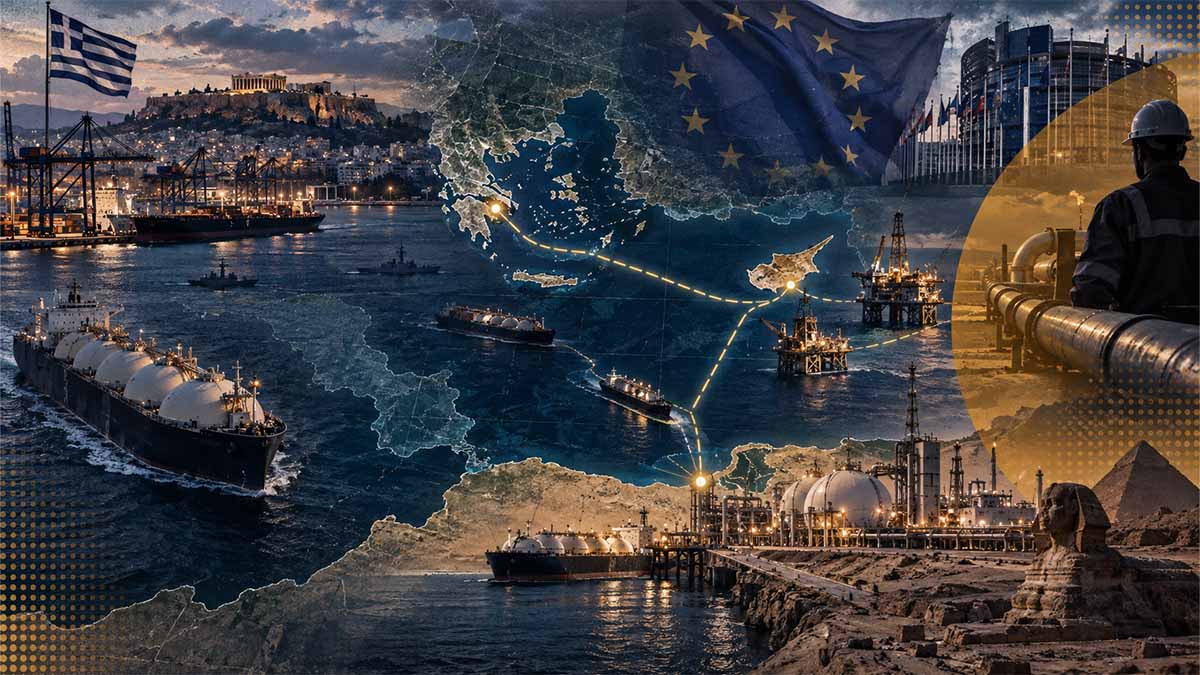
Scope: This assessment examines the emerging Cyprus–Egypt–Greece gas architecture from the 2025 Cyprus–Egypt agreements through the current September 2026 position, tests its value as a Mediterranean alternative to LNG routes exposed to the Strait of Hormuz and Red Sea, and assesses its probable development through 2031, with particular attention to Cronos, Egyptian liquefaction infrastructure, Israeli feed-gas commitments, the Greek Vertical Gas Corridor, EastMed and the implications for Italy, France, Germany, the United Kingdom and the European Union.
Executive Summary / BLUF
The central judgment is that Cyprus–Egypt–Greece is becoming a credible European gas-security workaround, but it is not yet an integrated European gas hub: the upstream and Egyptian segments have crossed important commercial thresholds, most decisively with Eni’s 28 July 2026 Final Investment Decision for Cronos, whereas the Greek northbound segment is operational but remains constrained by capacity, tariff economics and the absence in the public record of a dedicated Cronos-to-Greece sales or transport chain. Eni states that Cronos contains more than 3 Tcf of gas initially in place, should reach approximately 500 MMscf/d, and is targeted to deliver first gas in 2028, using existing Zohr facilities before liquefaction at Damietta and export primarily to Europe; the company will market 50% of the LNG volumes, corresponding to approximately 1.4 Mtpa. Eni announces Final Investment Decision for Cyprus’ Cronos project — Eni — Jul 2026
The strategic advantage is geographical rather than merely volumetric, because Cypriot gas transported by pipeline to Egypt and liquefied at Mediterranean terminals can sail directly into European Mediterranean receiving terminals without transiting either Hormuz, Bab al-Mandeb or the Red Sea; this matters materially in 2026 because the U.S. Energy Information Administration records that approximately 20% of global LNG trade passed through Hormuz in 2024, while the EU’s EUNAVFOR ASPIDES was still providing protection to commercial vessels in the Red Sea as recently as September 2026. About one-fifth of global LNG trade flows through the Strait of Hormuz — U.S. EIA — Jun 2025
The principal weakness is that Egypt itself has become a substantial LNG importer because domestic production has been insufficient to meet demand, meaning that the same state attempting to operate as an Eastern Mediterranean export hub has simultaneously constructed a large LNG-import system to protect its domestic balance; Egypt’s Ministry of Petroleum reported in June 2026 that four FSRUs at Ain Sokhna and Damietta provide approximately 2.7 Bcf/d of regasification capacity, while the EIA records Egyptian LNG imports rising from approximately 0.3 Bcf/d in 2024 to 1.2 Bcf/d in 2025 because of a domestic supply shortage. From Egypt’s FSRUs at Ain Sokhna — Egyptian Ministry of Petroleum — Jun 2026
The balance of evidence therefore supports a hybrid judgment: Europe is not merely renting Egyptian terminals, because Cyprus is committing upstream resources, Eni and TotalEnergies are integrating fields with existing Egyptian assets, Israel has entered long-duration export arrangements with Egypt, and Greece is developing a genuine south-to-north transmission architecture; nevertheless, Europe does not yet control an integrated supply chain comparable with a dedicated pipeline system, since Egypt retains domestic balancing requirements, individual commercial contracts determine LNG destination, Vertical Corridor capacity must be booked competitively, and no verified public instrument dedicates Cronos molecules specifically to Greece or the Vertical Corridor.
Europe’s Mediterranean Gas Workaround Is Becoming Real — but Control Still Stops in Egypt
Europe’s most credible Eastern Mediterranean gas strategy is no longer the direct EastMed pipeline that has repeatedly slipped through permitting and financing schedules, but a less sovereign and more commercially pragmatic chain linking Cypriot production, Egyptian liquefaction and Greek northbound infrastructure. The contradiction is now explicit: on 28 July 2026 Eni and TotalEnergies reached Final Investment Decision on Cronos, targeting first gas in 2028 and roughly 500mn cubic feet per day, while Egypt itself required about 1.2bn cubic feet per day of LNG imports in 2025 to cover a domestic supply shortage. Europe is therefore building access to new Mediterranean gas faster than it is building control over it. The fiscal advantage is clear, because existing Zohr-linked infrastructure, Damietta LNG and the Vertical Corridor avoid a new €5.2bn EastMed commitment; the security cost is equally clear, because conversion, destination and transport remain divided among governments, companies and regulated capacity markets.
Reusing Egypt beats waiting for EastMed
Cronos has changed the commercial hierarchy of Eastern Mediterranean projects because Eni’s 28 July 2026 Final Investment Decision moved more than 3tn cubic feet of gas initially in place from discovery status into a sanctioned development, with first production targeted for 2028 and a planned plateau of about 500mn cubic feet per day. The development sends Cypriot gas through existing Egyptian infrastructure associated with Zohr before liquefaction at Damietta, allowing Eni and TotalEnergies to monetise Block 6 without constructing a new Cypriot LNG complex.
That model now has a significant time advantage over EastMed. The European Commission’s December 2025 project fiche still placed the roughly 1,900km pipeline, designed for up to 12bn cubic metres per year, in permitting and carried an estimated cost of €5.2bn, with commissioning shown for December 2028. An earlier Commission implementation plan published in March 2018 had envisaged construction completion in 2024. What has slipped on the direct-pipeline route has therefore strengthened the commercial case for using infrastructure already built in Egypt.
The choice is not between ambition and retreat. It is between capital-intensive sovereignty and faster monetisation through shared assets. Cronos requires new offshore development but avoids a new liquefaction complex, while EastMed requires a new deep-water trunk system whose timetable has already moved by several years. The structural shift is that operators are no longer waiting for the region’s ideal geopolitical architecture before commercialising its gas.
The numbers say Egypt has capacity but not yet surplus
Egypt’s Mediterranean liquefaction system is large enough to matter but too underfed to be treated as assured export capacity. Damietta can liquefy about 5mn tonnes per year, while Idku’s two trains provide 7.2mn tonnes per year, giving roughly 12.2mn tonnes of combined nominal capacity. Cronos alone will not fill that system: Eni expects the project to support about 2.8mn tonnes per year of LNG, split into approximately 1.4mn tonnes marketed by Eni and 1.4mn tonnes by TotalEnergies.
The binding constraint is therefore feed gas, not liquefaction hardware. Egypt’s LNG imports rose from about 0.3bn cubic feet per day in 2024 to 1.2bn cubic feet per day in 2025, while by June 2026 the Ministry of Petroleum reported four floating storage and regasification units with combined capacity of roughly 2.7bn cubic feet per day. A country importing LNG at that scale cannot assume that every additional Cypriot or Israeli molecule will become an export cargo.
That tension determines the economics of the entire workaround. An Israeli molecule consumed in an Egyptian power station can indirectly release another molecule for Damietta; a Cypriot molecule entering Egypt can instead be absorbed by domestic demand if the internal deficit remains wide. Europe’s effective supply is therefore not the sum of Cronos, Aphrodite and Israeli contract volumes, but the residual surplus after Egypt balances its own system.
Cronos is firm; Aphrodite is still one decision behind
Cronos is the first Cypriot project in this architecture to cross Final Investment Decision, while Aphrodite remains commercially less mature despite its scale. Cyprus approved the revised Aphrodite Development and Production Plan on 14 February 2025, with a best-estimate 5.6tn cubic feet of gas in place and a proposed floating production facility capable of roughly 800mn cubic feet per day, but the project had entered Front-End Engineering Design rather than FID by the 2026 cut-off.
That distinction matters because the Egyptian-hub thesis becomes durable only when several independent feed streams overlap. Aphrodite’s 2025 development concept carried an estimated cost of about $4bn on a 100 per cent basis, while the partners approved roughly $106mn of FEED work in December 2025 and expected FID in 2027. Until that decision is taken and binding export arrangements are completed, Aphrodite remains prospective second-wave supply rather than bankable LNG feed.
Israel is already further advanced commercially. The Leviathan partners obtained approval for about 130bn cubic metres of additional exports to Egypt and in January 2026 approved a $2.36bn expansion designed to lift annual field production toward roughly 21bn cubic metres from 2029. That gives Egypt a large external pipeline source before Aphrodite arrives, but it also deepens Egypt’s dependence on supply exposed to Israeli export policy and regional security disruption.
Europe owns more of the chain than the “rental” thesis suggests
The argument that Europe is merely renting Egyptian terminals is too crude because ownership is already distributed across the chain. Eni operates Cronos and holds 50 per cent of Block 6, while TotalEnergies owns the other 50 per cent; both companies expect to market approximately 1.4mn tonnes per year of LNG from the development. At Damietta, Eni owns 50 per cent of SEGAS, with EGAS holding 40 per cent and EGPC 10 per cent.
That structure gives European companies significant control over production economics, liquefaction rights and LNG marketing, but it does not give European governments sovereign command over the molecule. Damietta operates in Egyptian jurisdiction, depends on Egyptian processing and national-system conditions, and historically remained idle from November 2012 until its restart in 2021 despite the plant itself still existing.
The more accurate description is therefore shared infrastructure under Egyptian territorial control. Europe owns important pieces of the asset base and the commercial portfolio, while Cairo controls the conversion environment through which the gas must pass. The decisive right is not equity alone but deliverability.
Greece has built the route; the market has not yet filled it
The downstream architecture is also real but commercially immature. Alexandroupolis entered commercial operation on 1 October 2024 with sustainable regasification capacity of about 5.5bn cubic metres per year, while the Greece-Bulgaria Interconnector currently provides 3bn cubic metres per year and is designed to expand toward 5bn cubic metres per year.
The Vertical Corridor now links Greece through Bulgaria, Romania and Moldova into Ukraine through bundled products rather than isolated bilateral bookings, but early commercial use remained modest. Route 1 offered roughly 31.356GWh per day of bundled firm capacity for June 2025, yet the July 2025 auction produced only 0.4mn cubic metres per day of booked capacity for August. The physical route existed; the price signal was weaker.
That is why tariff reform has become more important than another ribbon-cutting. In March 2026 the participating transmission operators and the European Commission agreed a framework for daily, monthly, quarterly and annual capacity products from gas year 2026-27, replacing a system dependent on temporary discounts. The test after October 2026 is whether traders buy long-duration capacity without exceptional inducements.
Italy and France control molecules; Germany mainly gets market relief
Italy has the strongest corporate position because Eni sits across Cronos, Damietta and LNG marketing, giving Rome indirect exposure to the most vertically integrated commercial position in the chain. France holds the other half of Cronos through TotalEnergies and an equivalent 1.4mn-tonne marketing entitlement, but without the same disclosed 50 per cent ownership position in Damietta.
Germany is positioned differently because no comparable German ownership role in Cronos or Damietta appears in the dossier. Its benefit comes through increased European liquidity: Mediterranean LNG delivered into Southern Europe can reduce competition for Atlantic Basin cargoes and ease pressure elsewhere in the integrated market, even if no Cronos molecule physically reaches a German terminal.
The United Kingdom is further removed from the chain. In 2025 nearly 70 per cent of UK gas imports came from Norway and 76 per cent of UK LNG imports came from the United States, while Qatar accounted for about 1 per cent of UK gas supply. Britain therefore gains principally through global LNG substitution and price effects rather than through direct ownership or physical access to the Cyprus-Egypt-Greece route.
The next 24 months will decide whether this is a hub or an insurance policy
Between September 2026 and the targeted 2028 start of Cronos, the decisive evidence will not be another memorandum but execution: offshore construction on Cronos, an Aphrodite FID, progress on the $2.36bn Leviathan expansion, sustained Egyptian gas-balance improvement, long-term Vertical Corridor bookings after October 2026 and identifiable European offtake commitments for the roughly 2.8mn tonnes per year of Cronos LNG.
If those pieces align, Europe will have built something more durable than spare-terminal access: a multi-source Mediterranean supply system in which European companies control substantial upstream and marketing rights, Egypt provides conversion and Greece provides regulated northbound distribution. If they do not, the same infrastructure will remain valuable but episodic, operating as an insurance mechanism when price and security conditions justify it rather than as a baseload corridor.
The cost of inaction will not fall evenly. Egypt will continue paying for imported LNG if domestic production remains insufficient; Cyprus will carry the opportunity cost of delayed monetisation if Aphrodite stalls; Italy and France will lose the advantage conferred by Eni and TotalEnergies if downstream capacity remains uncontracted; Bulgaria, Romania, Moldova and Ukraine will pay through continued exposure to narrower supply options; and Germany will bear part of the price through tighter European LNG competition. The next 12 to 24 months will determine whether Europe converts access into contractual control, or merely discovers that it owns pieces of a system whose decisive middle remains elsewhere.
Navigational Index
| Thematic pillar | Decision question |
|---|---|
| Eastern Mediterranean production and Egyptian conversion | Whether Cronos, Aphrodite and Israeli feed gas can transform Egyptian infrastructure from intermittently under-fed assets into a durable Mediterranean LNG-export platform without being absorbed by Egypt’s domestic deficit. |
| Greek entry point and the Vertical Corridor | Whether LNG landing in Greece can move north at commercially meaningful scale through Bulgaria, Romania, Moldova and Ukraine rather than merely expanding Greek terminal optionality. |
| European strategic ownership versus infrastructure rental | Whether Europe is creating durable control over production, processing, transport and market access, or remaining dependent on Egyptian terminals, company-controlled LNG portfolios and commercially allocated cross-border capacity. |
Master Abstract
Cronos changes the credibility of the Cyprus–Egypt leg
The most important development since the Cyprus–Egypt framework agreements of February 2025 is that Cronos has moved beyond diplomatic intent into an investment-sanctioned development: Eni announced FID on 28 July 2026, targets first gas in 2028, places resources at more than 3 Tcf GIIP, and expects plateau production of approximately 500 MMscf/d; rather than constructing an independent Cypriot LNG plant, the development will send gas into existing Egyptian infrastructure associated with Zohr before transfer to Damietta LNG, thereby monetising Cyprus’s offshore resource through assets that already exist on the Egyptian Mediterranean coast. Eni explicitly describes Europe as the primary intended LNG market and states that its own marketing entitlement will represent approximately 1.4 Mtpa, which makes Cronos considerably more concrete than the repeated Eastern Mediterranean concepts that have remained trapped between feasibility studies, permitting and geopolitical negotiation. Eni announces Final Investment Decision for Cyprus’ Cronos project — Eni — Jul 2026
The institutional foundation predates that FID and is materially stronger than a memorandum alone: Cyprus and Egypt signed the relevant Block 6 host-government framework in Cairo on 17 February 2025, Cyprus subsequently reported three commercial agreements on 20 October 2025 involving facility operators, EGAS, Eni and TotalEnergies, and the Egyptian Ministry described those instruments as establishing the operational and commercial framework for transport, supply, processing, liquefaction and infrastructure use for Cronos gas. The distinction matters because the chain now contains both sovereign arrangements and commercial implementation agreements rather than relying only on political declarations. Cyprus Ministry announcement on the three Cronos commercial agreements — Oct 2025
Egypt possesses significant nominal liquefaction infrastructure, although nominal capacity must not be confused with available export capacity: the Egyptian Ministry of Petroleum states that Damietta can liquefy approximately 5 Mtpa, while the Idku complex contains two trains with combined capacity of 7.2 Mtpa, producing a calculated aggregate nameplate figure of approximately 12.2 Mtpa across the two Mediterranean complexes. Idku’s official 2024 presentation also recorded more than one thousand cargoes exported since operations began in 2005, while Damietta exported approximately 7.2 million tonnes between its February 2021 restart and early 2023; the infrastructure is therefore physically established, but actual export utilisation depends on whether feed gas is available after Egyptian domestic requirements are met. Minister of Petroleum visits Damietta LNG Plant — Egyptian Ministry of Petroleum — Jun 2026
The Egyptian paradox is the decisive constraint
Egypt’s claim to be an Eastern Mediterranean gas hub coexists with a structural fact that materially qualifies the proposition: the country has had to rebuild LNG-import capability to support its own power and industrial system, with the Ministry reporting in June 2026 that three FSRUs at Ain Sokhna and a fourth at Damietta provide roughly 2.7 Bcf/d of regasification capacity; the ministry explicitly characterises these units as instruments for receiving imported LNG, regasifying it and injecting it into the national network during peak demand. The EIA independently records that Egyptian LNG imports increased to approximately 1.2 Bcf/d in 2025 from 0.3 Bcf/d in 2024, attributing the rise to a domestic supply shortage, so available liquefaction nameplate capacity cannot legitimately be treated as continuously exportable capacity. Global LNG trade volumes reached record high in 2025 — U.S. EIA — Jul 2026
Cronos is important precisely because it partly solves this feed-gas problem without requiring Egypt to finance an entirely new export complex, and Eni goes further by stating that the project will enable the restart of Damietta LNG and restore structural LNG exports from Egypt; nevertheless, the underlying commercial agreements permit Cypriot gas to be used either in Egypt or liquefied for export, and the March 2026 Egyptian-Cypriot framework explicitly seeks to maximise Cypriot gas utilisation through Egypt while supporting Egyptian domestic requirements. Consequently, European security gains will depend not simply on Cypriot production but on contractual destination rights, Egyptian system balance, liquefaction availability and the price at which exporters prefer European markets to Egyptian domestic sales. Joint Declaration on the Strategic Partnership between Cyprus and Egypt — May 2026
Israel strengthens the hub while deepening Egypt’s dependence
The Israel–Egypt dimension makes the Egyptian platform more robust while simultaneously making its political economy more complex, because the Leviathan partners amended their Egyptian export arrangements in August 2025 to add approximately 130 bcm of contracted quantities, initially increasing obligated deliveries through a first tranche and linking the much larger second tranche to expansion conditions; NewMed Energy subsequently announced that the partners reached FID for a $2.36 billion Leviathan expansion, designed to raise annual production to approximately 21 bcm with expansion output expected from 2029. NewMed describes the approximately 130 bcm Egyptian transaction as being worth about $35 billion, although that value is a company estimate rather than an independently guaranteed realised revenue figure. Leviathan Partners Approve FID for Leviathan Expansion — NewMed Energy — Jan 2026
This creates what can defensibly be described as commercial lock-in rather than geopolitical lock-in: Egypt obtains a large long-duration external gas source capable of feeding domestic consumption or supporting export infrastructure, while Leviathan obtains an anchor market sufficiently material to underpin field expansion; however, Israeli gas entering Egypt does not automatically become European LNG, because Egyptian power demand, contractual purchaser rights, transmission availability and liquefaction economics intervene between the producing field and the eventual cargo destination. The strategic consequence is nonetheless substantial, because the Egyptian system is evolving from a national production-and-export configuration toward a multi-origin aggregation platform incorporating Egyptian, Israeli and Cypriot molecules.
The Greece connection exists, but not yet as a dedicated Cronos corridor
The Greek part of the architecture should be distinguished carefully from the Cyprus–Egypt contracts because the public official record reviewed for this assessment does not establish a dedicated commercial arrangement under which Cronos LNG is committed to Alexandroupolis, Revithoussa or any particular Greek buyer; what exists instead is a physically compatible chain in which Mediterranean LNG can reach Greek terminals and then enter an increasingly coordinated northbound transmission system. Greece informed the EU Council in December 2025 that the Vertical Corridor links Greek LNG infrastructure with Bulgaria, Romania and ultimately Ukraine, while ICGB states that Routes 1, 2 and 3 permit diversified gas to move through the south-to-north system and that Routes 2 and 3 became available from 22 December 2025 following regulatory approvals in Greece, Bulgaria, Romania, Moldova and Ukraine. New routes for natural gas deliveries to Ukraine — ICGB — Dec 2025
The Alexandroupolis FSRU provides a material entry asset rather than a theoretical node, with its Greek operating permit recording a maximum sustainable regasification rate equivalent to 5.5 bcm/year and a higher technical maximum annual gas-production figure of 8.3 bcm/year under specified operating conditions; ICGB, meanwhile, has pursued expansion of the Greece–Bulgaria Interconnector from 3 to 5 bcm/year, illustrating that the Vertical Corridor is being enlarged but has not yet become an unconstrained continental trunk line. The policy significance is therefore not that Greece can absorb all future Eastern Mediterranean LNG, but that northern Greek infrastructure offers a gateway into Southeast and Eastern Europe that did not exist at comparable scale before the post-2022 diversification programme.
The Mediterranean route removes two major maritime exposure points
A Cronos–Egypt–European Mediterranean cargo does not require passage through the Strait of Hormuz or Bab al-Mandeb, and this route characteristic gained greater importance after maritime insecurity became persistent rather than episodic; the EIA calculated that approximately one-fifth of global LNG trade transited Hormuz in 2024, overwhelmingly associated with Qatar and the UAE, while noting that disruptions at Bab al-Mandeb had already shifted Qatari trade patterns away from Europe. The EU’s own maritime-security operation confirms that Red Sea risk has not disappeared, because EUNAVFOR ASPIDES continued providing close protection to merchant vessels during August and September 2026, while the IMO’s incident record documents renewed lethal attacks in the southern Red Sea during July 2025. EUNAVFOR ASPIDES Close Protection — EEAS — Sep 2026
This does not make Eastern Mediterranean LNG immune from geopolitical risk, because production and transmission assets remain exposed to regional conflict, Israeli-Egyptian interdependence introduces a separate political-security pathway, and liquefaction concentrates supply through a limited number of Egyptian installations; nevertheless, the route provides chokepoint diversification, which is analytically different from supplier diversification and potentially valuable even if total volumes remain modest compared with Europe’s aggregate gas market. The principal European benefit is therefore resilience at the margin: gas originating within the Eastern Mediterranean can reach European Mediterranean ports without depending on the Gulf-to-Red-Sea maritime geometry that governs much Qatari LNG trade.
EastMed is losing the race against reuse of existing infrastructure
The contrast with the proposed EastMed pipeline is unusually clear in the official European record, because the Commission’s December 2025 PCI fiche still listed the roughly 1,900-km, up-to-12 bcm/year pipeline as being in permitting, with construction scheduled only from December 2026 and commissioning in December 2028, notwithstanding a promoter-supplied FID date of June 2023; the same fiche places estimated project cost at approximately €5.2 billion and explicitly warns that the project information is supplied by the promoter and is not guaranteed by CINEA. EastMed Pipeline PCI 15.2 — European Commission/CINEA — Dec 2025
The slippage is measurable rather than rhetorical, because an earlier Commission implementation plan updated in March 2018 expected FEED to finish by the end of 2020, an FID around June 2021 and construction to conclude in 2024, whereas the December 2025 record moved FEED completion to June 2024, permitting toward November 2026 and commissioning to December 2028; against that chronology, Cronos has already obtained FID using a shorter development concept based substantially on existing Egyptian assets. The comparison does not prove that EastMed will never be built, but it explains why upstream producers presently possess a stronger commercial incentive to monetise discoveries through Egypt than to wait for a new deep-water trunk pipeline whose financing, permitting and construction burden remains considerably larger.
Key Evidence Table
| Indicator | Value/status | Reference date | Definition/scope | Issuer | Exact source |
|---|---|---|---|---|---|
| Cronos FID | Approved | 28 Jul 2026 | Development of Block 6 Cronos field | Eni | |
| Cronos gas initially in place | >3 Tcf | Jul 2026 | GIIP reported by operator | Eni | |
| Cronos planned plateau | 500 MMscf/d | Jul 2026 | Planned production rate | Eni | |
| Cronos first gas target | 2028 | Jul 2026 | Company development target, not completed production | Eni | |
| Eni-marketed Cronos LNG | 1.4 Mtpa | Jul 2026 | 50% of LNG volumes according to Eni | Eni | |
| Damietta LNG capacity | ≈5 Mtpa | Jun 2026 | Liquefaction nameplate/operating-system capacity | Egyptian Ministry of Petroleum | |
| Idku LNG capacity | 7.2 Mtpa | Oct 2024 | Two liquefaction trains combined | Egyptian Ministry of Petroleum | |
| Combined Egyptian Mediterranean liquefaction | ≈12.2 Mtpa | Calculated | 5.0 + 7.2 Mtpa; nominal capacity, not guaranteed output | Calculated from Egyptian Ministry data | |
| Egyptian LNG imports | 1.2 Bcf/d | 2025 | Up from 0.3 Bcf/d in 2024 because of domestic supply shortage | U.S. EIA | |
| Egyptian LNG regasification fleet | ≈2.7 Bcf/d | Jun 2026 | Four FSRUs serving domestic system | Egyptian Ministry of Petroleum | |
| Additional Leviathan–Egypt contract quantity | ≈130 bcm | Aug 2025 agreement | Additional quantities under amended export agreement, subject to tranche conditions | NewMed Energy filing | |
| Leviathan expansion | $2.36bn; ≈21 bcm/y | Jan 2026 FID | 100%-basis project budget and planned annual production | NewMed Energy | |
| Alexandroupolis sustainable regasification | 5.5 bcm/y | Operating permit | Maximum sustainable rate | Greek permit/Gastrade | |
| IGB expansion objective | 3 → 5 bcm/y | 2025 | Greece–Bulgaria interconnector | ICGB | |
| Hormuz share of global LNG trade | ≈20% | 2024 | Global LNG trade transiting the strait | U.S. EIA | |
| EastMed pipeline capacity | up to 12 bcm/y | Dec 2025 fiche | Proposed Cyprus–Crete–Greece pipeline | European Commission/CINEA | |
| EastMed estimated cost | €5.2bn | Dec 2025 fiche | Promoter-provided PCI cost | European Commission/CINEA | |
| EastMed current planned commissioning | Dec 2028 | Dec 2025 fiche | Promoter implementation schedule | European Commission/CINEA |
Eastern Mediterranean Gas Workaround
The emerging chain does not depend on a single new megaproject; it combines new Cypriot production with existing Egyptian processing and liquefaction assets, Mediterranean LNG shipping, Greek regasification and an expanding northbound transmission system.
Cyprus — Cronos
FID reached in July 2026, planned plateau approximately 500 MMscf/d and first gas targeted for 2028.
Egypt — Zohr system
Cronos gas is planned to use existing Egyptian processing infrastructure before transfer to Damietta.
Damietta + Idku
Calculated combined nominal liquefaction capacity; actual export availability depends on feed gas and Egyptian domestic requirements.
Northern Greece
Alexandroupolis maximum sustainable regasification rate under the operating permit.
Vertical Corridor
IGB expansion supports scalable south-to-north flows toward Bulgaria and the wider corridor to Romania, Moldova and Ukraine.
| Node | Verified metric | Status |
|---|---|---|
| Cronos | >3 Tcf GIIP; ≈500 MMscf/d planned plateau | FID; first gas targeted 2028 |
| Damietta | ≈5 Mtpa LNG | Existing Egyptian infrastructure |
| Idku | 7.2 Mtpa LNG | Existing two-train infrastructure |
| Alexandroupolis | 5.5 bcm/y sustainable regasification | European receiving node |
| IGB | 3 bcm/y with expansion toward 5 bcm/y | Vertical Corridor component |
Sources: Eni, July 2026; Egyptian Ministry of Petroleum and Mineral Resources, October 2024 and June 2026; Greek Alexandroupolis operating permit; ICGB official project disclosures. Capacity denotes technical or nameplate capacity where stated and must not be interpreted as guaranteed throughput.
The component reproduces only verified operator or governmental data and deliberately distinguishes physical capacity from realised flows, because the latter depend on feed gas, commercial bookings, terminal utilisation and regulatory approvals.
Europe Is Building an Option, Not Yet Controlling a Hub
A genuine European-controlled hub would require more than geographically convenient infrastructure: it would require sufficiently predictable upstream volumes, assured rights to Egyptian processing and liquefaction, commercial control over a meaningful portion of LNG output, regasification capacity in Europe, northbound transmission capacity and contractual arrangements capable of directing molecules toward markets where disruption has created scarcity. The present architecture satisfies several of these conditions but not all of them, because Cronos is investment-sanctioned, Egyptian liquefaction exists, Israeli supply is increasingly contracted into Egypt and the Vertical Corridor is functioning, yet the public record does not establish a European institutional mechanism controlling the allocation of Egyptian LNG exports or reserving Cronos output for the Vertical Corridor.
The more precise description as of September 2026 is therefore an Eastern Mediterranean aggregation-and-conversion system connected to a European distribution network, rather than a single European-owned hub: Egypt supplies the central conversion infrastructure, international companies control important upstream and marketing positions, Cyprus contributes new reserves, Israel contributes large pipeline volumes, Greece provides a European landing and northbound routing platform, while EU regulation and infrastructure policy improve the downstream network. This configuration is less sovereign and less linear than a dedicated EastMed pipeline, but it is also cheaper in incremental infrastructure, faster to commercialise and capable of adapting cargo destination to regional market conditions.
Italy: The Strongest Strategic Corporate Position
Italy occupies the most direct commercial position among the major European states because Eni operates Cronos with a 50% interest, controls the development concept, participates in Egyptian upstream and liquefaction infrastructure and will market half of the LNG output attributed by the company to the project; this gives an Italian-controlled major unusually strong visibility across production, processing and LNG commercialisation even though the gas itself is not legally or physically reserved for Italy. Eni’s strategy therefore gives Rome an indirect strategic advantage without creating sovereign ownership of supply, while the possible future Poseidon connection means that Italy would also sit at the western end of the proposed EastMed architecture if that project eventually advances.
For Italian policy, the immediate value of Cronos lies less in constructing another national supply corridor than in increasing the pool of Mediterranean LNG available within short sailing distance of Italian terminals while reducing exposure to routes involving Hormuz and the Red Sea; this complements, rather than replaces, Italy’s existing diversification through pipelines and LNG. The central policy risk is therefore contractual rather than geological: if Egyptian domestic requirements or higher-priced external buyers absorb the incremental gas, Italy benefits from a deeper regional market without possessing guaranteed access to the molecules that created it.
France: Upstream Ownership Without National Destination Control
France has a similarly direct but structurally different position because TotalEnergies is Eni’s partner in Cyprus Block 6, while the French company is also represented within the ownership structure of the Egyptian LNG complex at Idku according to the EIA’s official Egyptian energy profile; France therefore has corporate exposure to both the Cypriot upstream resource base and Egyptian LNG infrastructure even though French national supply is not contractually synonymous with TotalEnergies’ commercial portfolio.
The French strategic value is primarily portfolio resilience: additional Eastern Mediterranean LNG gives a globally active French energy company greater flexibility to allocate cargoes among European and international markets, while France itself possesses substantial LNG import capability and was among the EU’s largest LNG importers in 2024. This makes Paris less dependent on the Greek northbound leg than Central and Southeastern European states, but potentially more influential commercially because French corporate capital is embedded upstream and in Egyptian LNG infrastructure.
Germany: The Downstream Security Beneficiary
Germany’s exposure is more clearly downstream because no comparable German corporate position in Cronos is established by the reviewed public record, whereas the country’s interest arises from European market integration, Russian-gas replacement and the ability of additional LNG landed in Southern Europe eventually to displace competing demand elsewhere in the continental system. Eurostat records that natural gas represented 29% of Germany’s imported energy products in 2024, while the EU has now enacted a schedule to terminate remaining Russian LNG and pipeline-gas imports, making marginal alternative supply and internal transmission capacity more valuable even where the molecules do not flow physically into Germany. Energy in Europe — 2026 edition — Eurostat
Germany’s principal interest is therefore in reducing European congestion and competition for Atlantic LNG rather than securing ownership of Cronos output itself: every additional commercially viable Mediterranean source that can supply Greece, Bulgaria, Romania or Italy potentially frees other molecules and infrastructure capacity elsewhere in the interconnected European market. The limitation is that the Vertical Corridor remains oriented primarily toward Southeast and Eastern Europe, so German benefits will be indirect unless wider European network economics transmit the incremental supply through price and substitution effects.
United Kingdom: Limited Direct Security Gain, Significant Market Gain
The United Kingdom is less exposed to the specific Hormuz–Eastern Mediterranean substitution than several continental states because official British statistics show that nearly 70% of UK natural-gas imports in 2025 came from Norway, while the United States supplied 76% of UK LNG imports and Qatari gas represented only a small share; the UK government stated in March 2026 that approximately 1% of UK gas supply in 2025 came from Qatar. A Cronos–Egypt supply chain therefore provides a smaller direct physical-security benefit to Britain than it does to gas-importing systems more heavily dependent on globally traded LNG or Southeast European infrastructure. Iran, the Middle East and UK energy: factsheet — DESNZ — Mar 2026
The indirect benefit remains material because LNG is globally fungible at the margin: additional Mediterranean production reduces competition for Atlantic Basin cargoes during disruption, and British terminals can themselves act as a balancing source for continental Europe through interconnection. The UK’s role should therefore be understood primarily through global LNG-market liquidity and European price formation rather than participation in the Cyprus–Egypt–Greece physical chain.
European Union: A Resilience Architecture Rather Than a Replacement Supply System
For the European Union collectively, the strategic importance of the chain lies in diversification of route, source and infrastructure ownership, particularly as the Union completes its withdrawal from Russian gas; the Council records a legally binding phase-out structure under which long-term Russian LNG imports are prohibited from 1 January 2027 and long-term pipeline imports from 30 September 2027, subject to the regulation’s specified transitional provisions. Against that timetable, additional Eastern Mediterranean gas becoming available around 2028 would enter a European market in which Russian supply is intended to have largely disappeared as a structural balancing source. Ending Russian energy imports — Council of the European Union
The volumes should nevertheless remain in proportion: Cronos at approximately 500 MMscf/d is strategically relevant but cannot replace the continental gas system’s principal suppliers, while Alexandroupolis and the IGB similarly represent valuable corridors rather than continent-scale substitutes. Their importance is best understood through redundancy—another producing basin, another liquefaction route, another Mediterranean entry point and another northbound transmission direction—because European energy security after 2022 increasingly depends on avoiding excessive reliance on any single exporter, maritime chokepoint or pipeline axis.
Principal Gaps and Watch Indicators
| Issue capable of changing the assessment | Present public record | Indicator that would strengthen the “regional hub” judgment | Indicator that would weaken it |
|---|---|---|---|
| Cronos execution | FID taken; first gas targeted for 2028 | EPC/subsea awards, development drilling and schedule milestones consistent with 2028 startup | Material capex deferral, drilling delay or first-gas revision |
| Damietta export availability | ≈5 Mtpa physical capacity, but Egypt simultaneously imports LNG | Sustained feed-gas availability and resumed structural liquefaction exports | Continued domestic deficit absorbs incremental Cypriot or Israeli supply |
| Cronos destination | Eni says exports primarily to Europe | Binding offtake or portfolio allocation visibly directing substantial volumes to EU terminals | Material long-term allocation outside Europe |
| Greece linkage | Physically compatible but no dedicated Cronos–Greece contract verified | Capacity booking, SPA or shipping programme connecting Egyptian LNG with Greek terminals | Greek terminal/corridor congestion or persistent under-booking |
| Vertical Corridor scale | Routes operational; IGB expansion proceeding | Completion of 5 bcm/y IGB capacity and commercially sustained northbound bookings | Repeated tariff intervention required to generate utilisation |
| Leviathan expansion | FID approved; output expansion targeted around 2029 | On-schedule infrastructure completion and sustained Egyptian purchases | Security interruptions, export restrictions or expansion delay |
| EastMed pipeline | Permitting; 2028 promoter schedule | Permit completion, financing close and demonstrable construction mobilisation | Further commissioning slippage or continued reliance on study/permitting status |
| Egyptian domestic balance | Large LNG-import system remains necessary | Domestic production recovery reduces imported LNG requirement | Persistent or growing import requirement competes with liquefaction feed gas |
The most consequential collection gap is the absence from the accessible public record of the commercial destination architecture for Cronos LNG, including long-term sales agreements, terminal nominations and dedicated European capacity bookings; without those instruments it is possible to establish that the gas is intended principally for Europe, but not that Greece, Italy, Central Europe or any specific national market possesses assured access.
A second material gap concerns the precise post-2028 balance between Egyptian domestic gas demand, domestic production, Israeli imports and Cypriot feed gas, because liquefaction availability cannot be derived mechanically from the nominal 12.2 Mtpa combined capacity of Damietta and Idku while Egypt is simultaneously maintaining approximately 2.7 Bcf/d of LNG-regasification capacity to secure domestic supply.
The third decisive observation concerns EastMed: its December 2028 commissioning date should presently be treated as a project schedule rather than an operational forecast, because the Commission fiche records permitting as the current implementation status and because earlier official schedules have already moved substantially; a legally completed permitting process, committed financing and physical construction mobilisation would materially change the comparison between the pipeline option and the Egyptian LNG route.
Net Assessment
The emerging Cyprus–Egypt–Greece architecture is strategically more important than its individual capacity figures imply because it combines several forms of redundancy simultaneously: Cypriot upstream supply, Israeli pipeline imports into Egypt, Egyptian Mediterranean liquefaction, geographically short LNG access to Europe and a Greek transmission system increasingly capable of moving gas north rather than relying exclusively on historical east-west routes. Its central advantage over EastMed is time and sunk infrastructure; its central advantage over Gulf LNG is chokepoint avoidance; and its central advantage for Southeastern Europe is directional optionality through Greece and the Vertical Corridor.
The architecture nevertheless falls short of a fully constituted European hub because ownership and control remain fragmented among sovereign states, international producers, Egyptian infrastructure operators, LNG marketers and European transmission-system operators, while Egypt’s own gas deficit creates a continuing competition between domestic consumption and export monetisation. The strongest defensible conclusion as of 15 September 2026 is therefore that Europe is building access to a hub rather than building a hub it controls: Egypt supplies the indispensable conversion platform, Cyprus and Israel are enlarging the feed-gas pool, Greece is constructing the European distribution gateway, and European companies possess important commercial positions, but a fully integrated corridor will exist only when upstream production, Egyptian export availability, LNG destination commitments and northbound capacity bookings become simultaneously durable.
That distinction should guide policy because the correct objective is not necessarily to reproduce EastMed through another capital-intensive piece of infrastructure; it is to convert today’s modular system into contractual resilience, using diversified upstream sources, enforceable access to Egyptian processing and liquefaction, sufficient European regasification, competitive northbound transmission and commercially credible long-term demand. If those elements materialise between 2028 and 2031, Cyprus–Egypt–Greece can become one of Europe’s meaningful secondary gas-security axes; if they do not, Cronos will still be commercially significant, but Europe will largely have acquired additional LNG from infrastructure it does not institutionally control rather than a new strategic supply corridor of its own.
Cyprus–Egypt–Greece: Europe’s Underbuilt Gas Workaround
BLUF (Bottom Line Up Front): The emerging Cyprus–Egypt–Greece gas configuration has matured into a pragmatic European energy security workaround, but falls short of an integrated, European-controlled gas hub. Upstream monetisation crossed a decisive threshold with Eni’s 28 July 2026 Final Investment Decision (FID) on Cronos (>3 Tcf GIIP, 500 MMscf/d plateau targeted for 2028, routing via Zohr to Damietta LNG). Geopolitically, the Mediterranean shuttle bypasses the high-risk maritime chokepoints of Hormuz (20% of global LNG trade) and the Red Sea (Bab al-Mandeb). However, the systemic vulnerability remains domestic Egyptian gas absorption: Egypt operates 2.7 Bcf/d of regasification capacity across 4 FSRUs to counter power deficits, with imports jumping from 0.3 Bcf/d (2024) to 1.2 Bcf/d (2025). Concurrently, Greece’s Vertical Gas Corridor provides physical entry but lacks verified dedicated offtake or transport agreements binding Cronos molecules directly to Athens.
Cronos Upstream Maturation and the Brownfield Monetisation Concept
Block 6 Upstream Sanctioning
Eni sanctioned the Cronos field on 28 July 2026 with an estimated Gas Initially in Place (GIIP) exceeding 3 Tcf and planned plateau production of ~500 MMscf/d (~5.1 bcm/y). First gas is targeted for 2028 via an offshore subsea tie-back directly into Egypt’s existing Zohr offshore production facilities.
Sovereign & Commercial Binding
The development builds on the 17 February 2025 Cairo host-government framework and three commercial contracts ratified on 20 October 2025 among EGAS, Eni, TotalEnergies, and infrastructure operators. This brownfield strategy saves billions in capital expenditure compared to a standalone greenfield Cypriot LNG facility.
Liquefaction & European Offtake
Molecules landed at Zohr will transit to the Damietta LNG plant (~5 Mtpa nameplate) for export primarily to Europe. Eni retains marketing rights to 50% of the project’s LNG volume (~1.4 Mtpa), reactivating Damietta’s export cycles while feeding incremental supply directly into the Mediterranean basin.
Table 1: Audited Technical & Infrastructure Baseline (As of 15 September 2026)
Controlling empirical metrics cross-referenced across Eni, Egyptian Ministry of Petroleum, US EIA, NewMed Energy, Gastrade, and EU CINEA.
| Indicator | Audited Metric / Status | Scope & Operating Parameters | Controlling Issuer | Strategic Assessment Value |
|---|---|---|---|---|
| Cronos FID & GIIP | Approved 28 Jul 2026; >3 Tcf GIIP | Cyprus Block 6; plateau 500 MMscf/d; first gas targeted 2028. | Eni SpA | Transforms Cypriot offshore from stranded discovery to investment-sanctioned production. |
| Eni Cronos Marketing | 1.4 Mtpa (50% LNG volume) | Offtake primarily allocated for European continental import terminals. | Eni SpA | Direct equity LNG pathway into Europe, mitigating Mediterranean spot volatility. |
| Egyptian Liquefaction | 12.2 Mtpa aggregate nameplate | Damietta (~5.0 Mtpa) + Idku (7.2 Mtpa across two liquefaction trains). | Egyptian Min. of Petroleum | Sufficient hardware ceiling, but export operations are gated by domestic power balance. |
| Egypt Regas Fleet | 2.7 Bcf/d capacity; imports 1.2 Bcf/d | 4 FSRUs (Ain Sokhna & Damietta); imports rose from 0.3 Bcf/d (2024) to 1.2 Bcf/d (2025). | U.S. EIA / Egypt Ministry | The central bottleneck: domestic supply deficit risks consuming transit feed gas. |
| Leviathan Expansion | $2.36bn FID; ~130 bcm export deal | Raises production to ~21 bcm/y by 2029; contract valued by NewMed at ~$35bn. | NewMed Energy / Delek | Creates commercial lock-in, stabilizing Egyptian throughput via regional pipeline tie-ins. |
| Alexandroupolis FSRU | 5.5 bcm/y (sustainable) / 8.3 bcm/y (max) | Greek commercial entry permit; feeds south-to-north Vertical Gas Corridor. | Gastrade / Greek RAE | Key northern entry gate providing redundant reception capacity for Mediterranean spot LNG. |
| IGB Expansion | 3 bcm/y → 5 bcm/y target | Greece–Bulgaria Interconnector; Routes 2 & 3 opened to Ukraine in Dec 2025. | ICGB AD | Expands off-take corridors through Bulgaria, Romania, and Moldova into Ukrainian storage. |
| EastMed Pipeline | €5.2bn cost; Dec 2028 schedule | Up to 12 bcm/y; 1,900 km subsea; status listed as “in permitting” in Dec 2025 PCI fiche. | European Commission / CINEA | Losing commercial viability race to brownfield Egyptian LNG routing concepts. |
Table 2: Sovereign Positioning Across Key European States & Institutional Actors
Evaluating strategic alignment, corporate exposure, gas routing leverage, and supply chain exposure.
| Jurisdiction / Entity | Corporate & Physical Exposure | Primary Strategic Interest | Downstream Routing Mechanics | Vulnerability / Constraint |
|---|---|---|---|---|
| ITALY | Eni operates Cronos (50%), controls Damietta share, markets 1.4 Mtpa LNG. | Direct Mediterranean equity LNG supply; short sailing distance to Panigaglia, Piombino, Ravenna. | Short-haul LNG carriers across Mediterranean; potential Poseidon tie-in if built. | No sovereign entitlement: Eni markets portfolio volumes based on commercial netback prices. |
| FRANCE | TotalEnergies partners in Cyprus Block 6 (50%) and holds an equity share in Idku LNG. | Portfolio flexibility; expands Mediterranean trading options to serve Fos Cavaou / Montoir. | Supplies French regasification terminals or re-exports based on European gas spreads. | Corporate ownership does not guarantee physical gas flows to French domestic consumers. |
| GERMANY | Zero upstream equity; 29% gas import reliance in 2024; phase-out of Russian gas by 2027. | Reduces continental competition for Atlantic LNG cargoes by supplying Southeastern Europe. | Indirect substitution: Mediterranean volumes displace demand on northern European trunklines. | Vertical Corridor does not reach Germany directly; benefits depend on broader European price arbitrage. |
| UNITED KINGDOM | 70% gas from Norway; 76% LNG from US; Qatari imports fell to ~1% in 2025. | Supports global LNG liquidity, stabilizing TTF and NBP pricing benchmarks. | UK terminals operate as an Atlantic balancing system connected via European interconnectors (IUK/BBL). | Minimal direct exposure; gains are linked to broader market stability rather than physical molecules. |
| EUROPEAN UNION | Mandates full phase-out of Russian LNG by 1 Jan 2027 and pipeline gas by 30 Sep 2027. | Establishing redundant non-Russian supply routes for vulnerable Balkan and CEE markets. | Alexandroupolis → IGB → BRUA corridor → Ukrainian underground gas storage (Bilche-Volytsko-Uherske). | Lack of long-term EU-backed joint procurement contracts for Egyptian liquefaction offtake. |
Deep Structural Breakdown: Strategic Vectors & Bottlenecks
Analysing the balance between brownfield infrastructure speed, Egyptian domestic demand, and corridor economics.
The Chokepoint Hedge
Roughly 20% of global LNG trade moved through the Strait of Hormuz in 2024, while persistent drone and missile threats in the Bab al-Mandeb corridor have forced Qatari shipments to reroute around the Cape of Good Hope. EUNAVFOR ASPIDES continues escort operations in late 2026. The Cyprus–Egypt–Greece axis avoids both chokepoints, allowing short-haul voyages directly across the Mediterranean.
The Egyptian Domestic Dilemma
Egypt’s role as an export hub faces friction from its own energy deficit. Domestic production shortfalls drove imports to 1.2 Bcf/d in 2025. Cairo has moored 4 FSRUs (2.7 Bcf/d capacity) to avoid rolling blackouts. Under the March 2026 bilateral framework, Cypriot feed gas can be diverted to Egypt’s national grid if local prices or shortages prioritize domestic power balance over Damietta LNG exports.
The EastMed Replacement Reality
The EastMed subsea pipeline (€5.2bn, 12 bcm/y) remains in permitting, with commercial operation pushed back to late 2028. Upstream developers have turned to brownfield Egyptian LNG routing instead of funding deep-water pipeline assets. Connecting Cronos directly to Zohr and Damietta enables production by 2028, effectively outcompeting EastMed through capital efficiency.
Forensic Strategic Key Judgments
Synthesized assessments derived from field development plans, trade flows, and geopolitical chokepoint data.
Cronos FID Secures the Upstream Baseline
Eni’s July 2026 sanctioning moves Cyprus offshore from exploratory studies to an active project targeting 500 MMscf/d by 2028, securing feed gas for regional infrastructure.
Egyptian Domestic Absorption Threatens Export Reliability
With four FSRUs deploying 2.7 Bcf/d of regasification capacity, Egypt’s domestic deficit means that regional feed gas (Cronos and Leviathan) may be consumed locally rather than exported to Europe.
Chokepoint Diversification Exceeds Volumetric Scale
The value of the axis lies in bypassing Hormuz (20% global LNG) and the Red Sea, offering Europe a direct, short-haul Mediterranean supply route during Middle Eastern maritime disruptions.
Leviathan Expansion Anchors the Conversion Platform
NewMed’s $2.36bn FID and ~130 bcm export amendment provide the long-term volume needed to run Egyptian infrastructure as a regional gas aggregation hub.
The Vertical Corridor Lacks Dedicated Offtake Binding
While Alexandroupolis (5.5 bcm/y) and the IGB (expanding to 5 bcm/y) connect into Ukraine, no verified commercial instruments commit Cronos LNG specifically to Greece or the Vertical Corridor.
Europe is Gaining Access, Not Control
Rather than establishing a European-owned pipeline network, the system relies on commercial contracts and Egyptian terminals, delivering valuable regional supply options without sovereign operational control.
Open Official Record Gaps
- Unpublished Cronos SPAs: Absence of public long-term sales and purchase agreements (SPAs) linking Damietta export cargoes to specific European regasification terminals.
- Egyptian Net Feed Balance: Unclear net balance calculations for post-2028 Egyptian power demand, leaving open how much feed gas can be liquefied versus consumed locally.
- EastMed Financial Viability: Ongoing lack of private equity commitments or final investment decisions for the €5.2bn EastMed subsea pipeline project.
- Vertical Corridor Tariff Harmonisation: Unresolved transmission tariff structures across Greece, Bulgaria, Romania, and Moldova required to support long-term booking rates into Ukraine.
Observable Watch Indicators (Horizon 2026–2031)
Eastern Mediterranean Production and Egyptian Conversion
Principal judgment
The Eastern Mediterranean is moving from a collection of commercially disconnected gas discoveries toward a recognisable production-and-conversion system centred on Egypt, but the decisive constraint is no longer the physical existence of liquefaction capacity; it is whether Egypt can secure enough incremental feed gas from Cyprus, Israel and its own offshore fields to operate Damietta and Idku as sustained export assets after satisfying a domestic gas balance that has deteriorated sufficiently to require large-scale LNG imports. The evidence available as of 15 September 2026 supports a differentiated judgment: Cronos has crossed the threshold from prospective resource to investment-sanctioned development and therefore constitutes the strongest new source of future export feed gas; Leviathan provides the largest contracted external supply stream and is becoming structurally embedded in Egypt's gas balance; Aphrodite has advanced into FEED but remains one investment decision behind Cronos; while Egypt's domestic production deficit remains sufficiently large that foreign molecules entering its network cannot automatically be counted as LNG-export molecules available to Europe. Eni announces Final Investment Decision for Cyprus’ Cronos project — Eni — Jul 2026
The resulting architecture is nevertheless strategically consequential because Egypt possesses what Cyprus and Israel individually lack: two established Mediterranean liquefaction complexes, an extensive domestic gas network, large offshore processing assets and existing commercial structures capable of receiving gas from several jurisdictions, while Cyprus contributes undeveloped reserves and Israel contributes already-producing fields whose export infrastructure is being expanded. The strongest interpretation is therefore not that Egypt has already restored its former position as a continuously exporting LNG hub, but that it is constructing the conditions for a multi-origin Eastern Mediterranean gas aggregation system in which Cypriot and Israeli production can progressively substitute for declining or insufficient Egyptian feed gas, thereby raising the utilisation value of infrastructure whose physical capacity substantially exceeds the volumes Egypt can presently supply from its domestic production alone.
Cronos has become the anchor project because it has crossed FID
Cronos is the most important change in the regional supply equation because Eni announced the Final Investment Decision on 28 July 2026, making it the first major Cypriot offshore gas development to move into an investment-sanctioned execution phase rather than remaining at the level of discovery, conceptual development or government-to-government agreement. Eni reports more than 3 trillion cubic feet of gas initially in place, expects production to reach approximately 500 million standard cubic feet per day, targets first gas in 2028, and intends to transport the production to Egypt for processing through existing Zohr infrastructure before onward transfer to Damietta for liquefaction and export, primarily to European markets. Eni announces Final Investment Decision for Cyprus’ Cronos project — Eni — Jul 2026
The significance of this design lies in the decision not to construct an autonomous Cypriot LNG system, because the project instead monetises a new offshore resource by integrating it with infrastructure that already exists across the maritime boundary in Egypt, thereby reducing the amount of new midstream construction required before commercialisation and shortening the route between reservoir development and an established liquefaction plant. Eni describes the project explicitly as an infrastructure-synergy development and states that contractual agreements have established the terms for use of the existing Zohr facilities and Damietta LNG plant as well as LNG commercialisation, which means that the development has moved materially beyond the political framework stage that often delays cross-border Eastern Mediterranean gas projects.
The planned production rate also deserves closer attention because 500 MMscf/d corresponds to approximately 5.2 bcm per year before allowing for operating availability, processing requirements and conversion losses, meaning that Cronos is large enough to become a material feed-gas source for a single LNG train but not large enough by itself to transform Egypt into a high-utilisation two-terminal export system. This distinction is particularly important when comparing the field with the nominal combined liquefaction capability of Damietta and Idku, because infrastructure capacity considerably exceeds Cronos production and therefore still requires Egyptian, Israeli or additional Cypriot gas if sustained utilisation is to be achieved across both plants. The conversion to approximately 5.2 bcm per year is calculated from Eni's stated 500 MMscf/d plateau and should be treated as a volumetric approximation rather than as a contractual annual delivery commitment.
Eni's commercial disclosure reinforces the scale relationship because the company expects to market 50% of the LNG volumes associated with Cronos, equivalent to approximately 1.4 million tonnes per annum, which implies an overall project LNG stream of roughly twice that level if the marketing split described by the company is realised; this represents commercially meaningful European supply but remains substantially below Egypt's total liquefaction nameplate capacity. Eni further states that Cronos will enable the restart of Damietta and restore structural LNG exports from Egypt, a proposition that is important but should remain explicitly attributed to the operator because actual export continuity will depend on plant utilisation, Egyptian domestic demand, feed-gas allocation and future operational conditions that cannot yet be independently established for 2028 and beyond.
Cronos is therefore the strongest present evidence that the Egyptian-hub concept is becoming investable rather than merely diplomatic, because an FID converts expected capital spending and project execution into a qualitatively different category from a memorandum, development plan or preliminary engineering study; however, the correct analytical category remains investment-sanctioned future supply rather than existing supply, since first gas is still targeted for 2028 and the development must complete the offshore production, subsea connection and Egyptian integration works required to achieve that schedule.
Aphrodite is potentially larger upstream, but commercially less mature
Aphrodite provides the second major Cypriot component of the emerging system, although its present status is materially different from Cronos because the field has an approved development plan and has entered Front-End Engineering Design but has not yet reached FID. The Cypriot Ministry of Energy approved the modified Development and Production Plan on 14 February 2025, while the official Cyprus hydrocarbon service currently gives a best-estimate gas-in-place figure of 5.6 Tcf as of 2023, making Aphrodite a potentially significant regional resource even though gas-in-place must not be confused with technically recoverable, commercially recoverable or contractually deliverable volumes. Joint Statement on the approval of the Aphrodite Development and Production Plan — Republic of Cyprus — Feb 2025
The operator-backed development concept foresees an independent floating production facility with maximum capacity of approximately 800 MMcf/d and four initial producing wells, with the gas then exported by subsea pipeline into the Egyptian transmission system, according to NewMed Energy's regulatory disclosure concerning the approved development plan. The same filing indicated an estimated development cost of approximately $4 billion on a 100% basis before completion of the required technical-economic studies, while specifically cautioning that development and FID depend on FEED results, pipeline commercial arrangements, gas-sales agreements, regulatory approvals and financing; these qualifications materially distinguish Aphrodite from Cronos and prevent its nominal production capacity from being treated as firm future supply.
By December 2025, the Aphrodite partners — Chevron, Shell and NewMed — had approved commencement of FEED with a scope of approximately $106 million, and NewMed stated that FID was expected in 2027, while negotiations continued among the partners, Cyprus, Egypt, the Cyprus Hydrocarbons Company and EGAS on the binding arrangements required for export into Egypt. The Egyptian Ministry was still describing the technical and commercial agreements as being accelerated in June 2026, which confirms that the route to Egypt is the agreed development direction but that the complete commercial structure had not yet reached the same maturity as Cronos. Aphrodite Partners to Commence Front-End Engineering Design — NewMed Energy — Dec 2025
The distinction between 5.6 Tcf gas in place reported by the Cypriot authorities and NewMed's March 2026 contingent-resource estimates is also analytically important, because these figures describe different resource categories rather than contradictory assessments; NewMed's updated filing reports approximately 2,881 Bcf as the 2C best estimate of contingent resources remaining classified as “development pending”, while the Cypriot government figure describes best-estimate gas in place. The difference illustrates why regional supply analyses should not add headline discovery figures as though each cubic foot were commercially deliverable, because geological gas-in-place, contingent resources, recoverable reserves and annual production capacity represent different stages of the resource-to-market chain.
If Aphrodite ultimately reaches FID on the present concept, its planned maximum production capacity would be substantial relative to Cronos and could materially deepen the Egyptian feed-gas pool; however, the critical condition is not merely completing the offshore production facility, but completing a commercial export architecture under which the pipeline connection, Egyptian network access, processing arrangements and eventual gas destination are sufficiently defined to justify construction. As of September 2026, the defensible position is consequently that Aphrodite represents probable second-wave capacity under active engineering development, whereas Cronos constitutes the first Cyprus-to-Egypt project that has already crossed the final investment threshold.
Israeli gas is no longer supplementary to Egypt's balance; it is becoming structurally embedded
The Israeli component differs fundamentally from Cronos and Aphrodite because Leviathan is already a producing field supplying the Egyptian market, and the commercial framework has expanded from short-to-medium-term regional trade into a much larger long-duration commitment. NewMed's December 2025 regulatory filing records that the Leviathan partners obtained approval from Israel's Petroleum Commissioner for approximately 130 bcm of additional exports to Egypt, following the August 2025 amendment to the existing export agreement, while the filing refers to additional transmission arrangements associated with the Nitzana project that are intended to support the enlarged export flow. Receipt of Export Permit for the Leviathan Project — NewMed Energy — Dec 2025
The commercial commitment was reinforced in January 2026 when the Leviathan partners approved the expansion project at an estimated $2.36 billion on a 100% basis, with NewMed stating that annual reservoir production would increase to approximately 21 bcm and that completion and commencement of production from the expansion were expected in 2029; the company directly links the expansion to both Israeli domestic demand and implementation of the approximately 130 bcm Egyptian export agreement. Leviathan Partners Approve Final Investment Decision for Leviathan Expansion — NewMed Energy — Jan 2026
This creates a deeper form of Egyptian-Israeli energy interdependence than would exist under opportunistic spot trading, because a very large contracted export quantity, a multibillion-dollar upstream expansion and additional transmission infrastructure are now being developed within the same commercial ecosystem; nevertheless, the term “lock-in” should be used precisely, since the arrangement constitutes contractual and infrastructure lock-in rather than irrevocable geopolitical dependence, and the actual security of flows remains exposed to operational outages, force-majeure conditions, domestic Israeli energy-security policy and regional military escalation. The U.S. EIA's Eastern Mediterranean assessment records several precautionary shutdowns of Israeli gas infrastructure during periods of conflict, including disruption in June 2025, which demonstrates that physical proximity shortens transport routes but does not eliminate geopolitical supply risk.
For Egypt, Israeli gas has an additional value that is easy to mischaracterise because not every imported molecule needs to be liquefied for the import to strengthen the LNG-export system; an Israeli molecule consumed domestically in Cairo, Alexandria or an Egyptian power station can indirectly free an Egyptian or Cypriot molecule elsewhere in the network for liquefaction, so the economically relevant variable is the integrated national gas balance rather than the legal nationality of the molecule entering Damietta or Idku. This fungibility within the Egyptian network is precisely why external pipeline supply can support export capacity even when specific cargoes cannot be traced back to a single field, although contractual, technical and quality constraints still matter at individual network interfaces.
The same mechanism can work in the opposite direction, because a worsening domestic shortage can absorb incremental Israeli or Cypriot production before it reaches an LNG train; this is the core reason why the Leviathan expansion should not be added arithmetically to Cronos and Aphrodite and then labelled “European export capacity”, since Egypt is simultaneously a destination market whose domestic deficit has become large enough to support a major import infrastructure programme of its own.
Egypt's domestic deficit is the controlling constraint on the hub model
The most important counterweight to the hub thesis is the deterioration in Egypt's domestic gas balance, because the country that owns the Eastern Mediterranean's only operational LNG export complexes has simultaneously become a major LNG importer. The U.S. EIA reported that Egyptian LNG imports rose from approximately 0.3 Bcf/d in 2024 to 1.2 Bcf/d in 2025, explicitly attributing the increase to a domestic supply shortage, while its Eastern Mediterranean regional assessment records that Egyptian dry-gas production peaked at approximately 2.4 Tcf in 2021 before weakening as mature fields declined and technical problems constrained Zohr output. Global liquefied natural gas trade volumes reached record high in 2025 — U.S. EIA — Jul 2026
The scale of the Egyptian response illustrates that this is not a marginal seasonal adjustment, because the Ministry of Petroleum reported in June 2026 that the country was operating four floating storage and regasification units — three at Ain Sokhna and one at Damietta — with combined regasification capacity of approximately 2.7 Bcf/d, specifically to secure supplies for electricity generation, industry and other consumers during peak periods. The ministry characterises LNG imports as complementary to domestic production, while also stating that domestic production remains the central component of supply; analytically, however, the existence of 2.7 Bcf/d of import capability demonstrates the magnitude of the contingency infrastructure that Egypt now considers necessary to defend the domestic market. From Egypt’s FSRUs at Ain Sokhna: Minister emphasizes readiness to meet summer gas demand — Egyptian Ministry of Petroleum — Jun 2026
Egypt's government is simultaneously attempting to reverse the supply deterioration through domestic drilling and field optimisation, and the July 2026 announcement that BP's Fayoum North-4 sidetrack was expected to add approximately 80 MMcf/d illustrates the incremental-production strategy being pursued across mature and new assets; the ministry explicitly linked that work to reducing import dependence and narrowing the gap between production and domestic consumption. Such additions are operationally valuable but remain small relative to the scale of the regasification capacity installed, which means that the central Egyptian energy-policy objective through the late 2020s is likely to remain a combination of domestic-production recovery, external pipeline imports and LNG imports rather than an immediate return to uninterrupted surplus production.
A further quantitative indication is supplied by GASCO's 2025 operating data, reported by the Egyptian Ministry in April 2026, according to which approximately 2.3 trillion cubic feet of natural gas were received and transmitted through the national grid during 2025 to meet domestic requirements; the figure describes system throughput rather than domestic consumption in the statistical sense and therefore should not be equated directly with final demand, but it reinforces the scale of the internal network against which incremental export feed gas must compete.
The correct decision variable for European planners is consequently not Egyptian LNG nameplate capacity in isolation, but surplus liquefiable gas after domestic balancing, because an LNG terminal that can technically produce several million tonnes per year has little strategic value to Europe during periods when the national system must instead import LNG through an FSRU to keep power stations and industry supplied. The EIA reached essentially the same structural conclusion in its country assessment, stating that rising consumption and declining production had forced Egypt toward imports and warning that, without a durable solution, Egypt's ambition to operate as a regional LNG export hub would remain constrained.
Damietta illustrates both the opportunity and the fragility
Damietta is the clearest physical manifestation of the emerging hub model because it is an established liquefaction asset, is already tied commercially to Eni, has previously operated with substantial European-facing LNG marketing and is the designated liquefaction destination for Cronos. The Egyptian Ministry of Petroleum reported during a June 2026 inspection that the plant has capacity of approximately 5 million tonnes of LNG annually, is technically ready to receive and liquefy Cypriot gas, and is being positioned to resume an export role when Cypriot production becomes available. Minister of Petroleum and Mineral Resources Visits Damietta LNG Plant — Egyptian Ministry of Petroleum — Jun 2026
Eni's own corporate history provides an important warning against treating liquefaction infrastructure as equivalent to reliable export capability, because the company records that Damietta, with gas-processing capacity described in 2021 as 7.56 bcm per year, had been idle since November 2012 before resuming production in February 2021 after the resolution of commercial disputes and renewed feed-gas availability. The ownership restructuring completed in 2021 left SEGAS, the plant owner, 50% owned by Eni, 40% by EGAS and 10% by EGPC, while Eni also obtained LNG rights and marketed early restart cargoes directly into Europe. Eni closes agreement with partners for restart of Damietta LNG plant — Eni — Mar 2021
The historical sequence is analytically valuable because Damietta's experience demonstrates that physical liquefaction capacity can persist through years in which commercial exports are absent, with utilisation determined by upstream supply, domestic allocation, contractual rights and economics rather than merely plant availability; the same distinction must therefore be applied to the current Cronos strategy. Eni's assertion that Cronos will restore “structural LNG exports” should be interpreted as a commercially significant operator expectation supported by a sanctioned field and existing infrastructure, but not yet as an empirically established post-2028 export pattern.
The June 2026 Egyptian ministry visit also exposes an unusually important operational duality because Damietta was described not only as a future Cypriot-gas liquefaction and export asset, but as part of the country's LNG import system through storage and regasification arrangements associated with the Energos Winter FSRU; the same geographic node is therefore participating in both directions of Egypt's gas-security strategy.
This apparent contradiction is better understood as infrastructure optionality than policy incoherence, because Egypt is attempting to preserve the ability to import LNG when domestic supply is short while retaining the ability to liquefy and export gas when network balances produce a surplus; however, that flexibility has direct consequences for Europe because it means that access to the terminal does not guarantee export utilisation throughout the year. A commercially robust European supply corridor therefore requires not just physical terminal availability but enough upstream feed gas to keep the export side of this bidirectional system economic after Egyptian demand is satisfied.
Idku expands the theoretical export envelope but does not solve the feed-gas problem
The second Egyptian liquefaction complex at Idku materially enlarges the region's export potential, with Shell's historical operating data identifying two LNG trains with combined productive capacity of 7.2 million tonnes per annum, or approximately 3.6 Mtpa per train; unlike Damietta, however, Idku is not currently identified in the official Cronos development chain, meaning that its relevance lies primarily in the broader aggregation potential of the Egyptian system rather than in a dedicated Cronos commercial route.
Taken together with the Egyptian ministry's approximately 5 Mtpa figure for Damietta, the two complexes provide around 12.2 Mtpa of nominal liquefaction capacity, but this calculated total is an infrastructure ceiling assembled from plant capacities and must not be interpreted as current available export output. The gap between nominal capacity and realised export supply is precisely what the Egyptian deficit has exposed, because terminals with substantial liquefaction hardware can remain partially or entirely underused when upstream production is insufficient or the domestic market commands priority.
This distinction provides the strongest answer to the question of whether Cronos, Aphrodite and Israel can transform intermittently under-fed assets into a durable LNG platform: they can theoretically provide the missing feed-gas layer, but only in combination, because Cronos alone supplies only part of the required feedstock, Aphrodite is not yet investment-sanctioned, Israeli imports are simultaneously needed for Egypt's internal balance, and Egyptian domestic production remains variable. The regional hub therefore becomes progressively more credible as several supply streams overlap, rather than depending on any single field reaching first gas.
The emerging architecture is deliberately multi-origin
The Egyptian government is now extending the same infrastructure-reuse logic beyond Cronos and Aphrodite, which is strategically significant because it indicates that Cairo's hub policy is becoming a systematic development model rather than a pair of bilateral projects. In August 2026, Egypt's Ministry of Petroleum stated that it was working with ExxonMobil and QatarEnergy on implementation mechanisms for a memorandum intended to examine connection of their Cypriot discoveries with Egyptian infrastructure for eventual re-export, explicitly describing Cronos as the first project, Aphrodite as the next, and the ExxonMobil/QatarEnergy discoveries as a subsequent layer of integration. Minister discusses implementation mechanisms to connect ExxonMobil Cyprus discoveries to Egyptian infrastructure — Egyptian Ministry of Petroleum — Aug 2026
The Cypriot government's own exploration record supports the existence of a larger undeveloped resource base, including a current best-estimate gas-in-place figure of 3.7 Tcf for Glaucus as of 2022, although those resources remain at an earlier development stage and cannot presently be incorporated into a firm export forecast. Their importance is therefore optional rather than operational: if additional Cypriot fields progress to appraisal, development planning and FID, Egypt's liquefaction infrastructure becomes progressively less dependent on the output trajectory of any one reservoir.
This portfolio logic is central to the economics of an LNG hub because liquefaction plants are capital-intensive assets whose utilisation improves when they can receive feed gas from several independent producing systems; aggregating Zohr and other Egyptian fields with Leviathan, Cronos, potentially Aphrodite and later Cypriot discoveries reduces the risk that decline or outage at one source renders an entire LNG train commercially stranded. The countervailing effect is that a larger number of cross-border suppliers also introduces more regulatory interfaces, contractual dependencies and geopolitical failure points, meaning that diversification reduces geological concentration while potentially increasing governance complexity.
Egypt is effectively attempting to arbitrage two gas systems at once
The most distinctive feature of the Egyptian strategy is that the country is attempting to operate simultaneously as a domestic gas-security system and a regional LNG-conversion system, which means that the same infrastructure network must serve different economic objectives depending on seasonal demand, domestic production and external prices. When domestic production is inadequate, FSRUs allow imported LNG to enter the national grid; when indigenous and imported pipeline gas together exceed internal requirements, liquefaction plants can convert surplus gas into globally tradable LNG; and when additional Cypriot gas arrives under infrastructure-access arrangements, Egypt can capture processing, transport and liquefaction value without bearing the full upstream development cost of those resources.
This structure is potentially more flexible than a dedicated point-to-point pipeline because LNG does not require the exporter to determine the final European destination at the moment the offshore resource is developed, while buyers can redirect cargoes according to hub prices, storage conditions and regional scarcity; however, flexibility for the commercial seller does not necessarily equate to supply security for a particular European state. Eni's right to market approximately 1.4 Mtpa from Cronos materially improves portfolio availability, but unless destination clauses, long-term sales agreements or strategic procurement arrangements dedicate part of that volume to specific European markets, the cargo remains a commercial commodity rather than a sovereign reserve.
This is the point at which the phrase “Europe is renting Egyptian terminals” becomes partly correct but analytically incomplete, because European companies are not passive terminal customers: Eni owns 50% of SEGAS, operates Cronos and has associated LNG marketing rights, while TotalEnergies participates in Cronos and Shell participates in Aphrodite and Egyptian LNG infrastructure; European corporate capital is therefore embedded across several layers of the value chain. At the same time, the Egyptian state controls crucial territorial infrastructure and the domestic gas network, EGAS and EGPC hold material interests in Damietta, and Egyptian energy-security requirements necessarily condition how the national system is operated, so Europe does not possess sovereign control over the complete chain.
The numerical balance shows why all three external sources matter
| Supply or infrastructure element | Verified present status | Relevant scale | What the figure does establish | What it does not establish |
|---|---|---|---|---|
| Cronos | FID completed; first gas targeted 2028 | >3 Tcf GIIP; ≈500 MMscf/d planned plateau | A sanctioned new Cypriot production source linked specifically to Egypt and Damietta | Guaranteed 2028 delivery or continuous LNG exports |
| Aphrodite | Approved development plan; FEED underway | 5.6 Tcf best-estimate GIIP; proposed facility up to ≈800 MMcf/d | A potentially larger second Cypriot feed source under engineering development | FID, final recoverable volume, binding export quantity or startup date |
| Leviathan additional Egypt contract | Export permit granted; expansion at FID | ≈130 bcm additional contracted exports; field expansion toward ≈21 bcm/y production | Deepening long-term Israeli supply integration with Egypt | That the contracted gas will be liquefied rather than consumed domestically |
| Damietta | Existing and technically ready | ≈5 Mtpa LNG | Physical liquefaction infrastructure available for Cypriot gas | Continuous export utilisation |
| Idku | Existing two-train complex | ≈7.2 Mtpa LNG | Additional Egyptian liquefaction envelope | Dedicated access for Cronos or Aphrodite |
| Egyptian LNG import system | Four FSRUs operational in Jun 2026 | ≈2.7 Bcf/d regasification | Egypt can compensate for domestic shortages at significant scale | A permanent import requirement at full capacity |
| Egyptian LNG imports | Material increase in 2025 | ≈1.2 Bcf/d versus ≈0.3 Bcf/d in 2024 | Domestic deficit was large enough to require substantial LNG imports | The exact 2028–2031 domestic deficit |
The evidence in the table is drawn directly from Eni, the Republic of Cyprus, NewMed regulatory filings, the Egyptian Ministry of Petroleum, Shell's institutional records and the U.S. Energy Information Administration; importantly, several quantities describe maximum design capacities or company plans rather than actual future flows, so they should not be aggregated into a single headline export figure.
The 2028–2031 window is the real test of whether the hub becomes structural
The present project timetable creates a potentially important convergence during the late 2020s, because Cronos targets first gas in 2028, Aphrodite's partners are aiming for an FID after completion of FEED, and Leviathan's expanded production is expected from 2029; if those schedules broadly hold while Egyptian domestic output stabilises, Egypt could receive materially more pipeline and offshore feed gas during a relatively concentrated period.
That convergence would strengthen liquefaction economics through higher asset utilisation, increase the volume of Mediterranean LNG available without Hormuz or Red Sea transit, and make Egypt increasingly useful as the regional conversion point between Eastern Mediterranean upstream production and globally tradable LNG; nevertheless, the system would still not behave as an automatic export machine because each incremental source enters an Egyptian market with its own demand growth, power-generation requirements and industrial consumers. The question that matters is therefore whether aggregate incremental feed gas exceeds the domestic deficit by a sufficiently durable margin, rather than whether individual projects reach impressive plateau rates.
The most favourable pathway would combine on-time Cronos commissioning, Aphrodite FID followed by timely construction, Leviathan expansion by approximately 2029, partial recovery in Egyptian production and enough LNG-market value to justify sustained operation of Damietta and Idku; under those conditions, Egypt would cease to be merely a country possessing underused liquefaction equipment and would become an aggregation hub whose export capacity is supported by several independent upstream provinces.
A less favourable but still plausible pathway would see Cronos enter production while Egyptian domestic production remains weak and power-sector gas demand absorbs a large part of additional Israeli and Cypriot supply, in which case Damietta could export periodically without the Egyptian system generating the sustained surplus required for both liquefaction complexes to operate at high utilisation; in that configuration, Europe would gain additional Mediterranean cargo availability but not the durable regional supply axis implied by the strongest “hub” narrative.
The weakest pathway would involve delay to one or more Cypriot developments, disruption to Israeli exports or renewed deterioration in Egyptian production, forcing Cairo to maintain heavy LNG imports and allocating much of the incoming regional pipeline gas to domestic consumption; the existing terminals would remain strategically useful physical assets, but the Eastern Mediterranean system would continue to exhibit the paradox of importing LNG through one part of the infrastructure while possessing idle liquefaction capability elsewhere.
What would make the Egyptian platform genuinely durable
Durability requires several conditions to exist simultaneously rather than sequentially, because a regional LNG hub cannot be sustained by geological resources without production infrastructure, by production without cross-border transport, by transport without available liquefaction, or by liquefaction without a gas surplus after domestic demand is met. The public record currently establishes the first three layers more strongly than it establishes the fourth: Cronos is sanctioned, Aphrodite is engineering toward FID, Leviathan is expanding, and Damietta and Idku physically exist, whereas the future Egyptian supply-demand balance remains the largest unresolved variable.
The second requirement is contractual depth, because long-lived infrastructure becomes more defensible when upstream producers possess predictable processing and liquefaction rights and buyers possess sufficient offtake certainty to support financing; Cronos has advanced substantially in this respect because Eni states that project agreements already govern use of Zohr facilities, Damietta and LNG commercialisation, whereas Aphrodite is still completing the technical and commercial instruments necessary for its export connection.
The third requirement is supply-source redundancy, under which Egyptian domestic production, Israel, Cronos, Aphrodite and eventually further Cypriot discoveries collectively prevent the system from becoming excessively dependent on one reservoir; Egypt's August 2026 discussions with ExxonMobil and QatarEnergy show that this broader model is already being pursued institutionally, although none of those later-stage discoveries should be counted as firm supply before development plans and FIDs exist.
The fourth requirement is security resilience, because Israeli field shutdowns during periods of conflict demonstrate that geographically short supply chains remain exposed to military disruption, while offshore pipelines, production facilities and Egyptian coastal terminals themselves constitute concentrated infrastructure nodes. A diversified supply pool mitigates but does not eliminate this vulnerability, particularly if a large share of the regional balance eventually depends on a limited number of offshore production hubs and cross-border pipelines.
The fifth requirement is sufficient European demand and commercial price support through the 2030s, because liquefaction utilisation depends on the spread between feed-gas costs, processing and shipping costs and destination-market prices; the public official record supports the political objective of European diversification but does not establish future commercial spreads sufficiently robustly to justify a deterministic export-volume forecast, and no unsupported price model is therefore appropriate at this stage.
Strategic implications for Europe
For Europe, the principal value of this production-and-conversion architecture is not that Cronos or Aphrodite will replace a major existing supplier, because their expected scale is materially smaller than continental demand; the value lies instead in creating another independent source-and-route combination whose upstream fields sit in the Eastern Mediterranean, whose liquefaction is on Egypt's Mediterranean coast and whose cargoes can reach Southern European terminals without traversing Hormuz or Bab al-Mandeb. The system therefore contributes most strongly to resilience under disruption rather than to aggregate European volume dominance.
Its second advantage is developmental speed relative to infrastructure built entirely from scratch, because Cronos demonstrates that offshore resources can be connected to Egyptian processing and LNG facilities without waiting for an entirely new trans-Mediterranean export system; the decision to reuse Zohr and Damietta infrastructure is exactly the type of brownfield integration capable of shortening project schedules and lowering incremental infrastructure requirements, even though new subsea infrastructure remains necessary offshore Cyprus.
Its third advantage is portfolio flexibility, because LNG exported from Damietta or Idku is not constrained to one fixed European landfall in the way that a dedicated pipeline is constrained by its route, while commercially controlled cargoes can respond to demand across Italy, France, Greece, Spain, Northwest Europe or other destinations depending on shipping economics and terminal capacity. That flexibility is strategically useful to the European market as a whole but also explains why no member state should equate an upstream corporate interest with guaranteed national supply.
The principal European vulnerability is correspondingly control rather than access, because the chain relies on Egyptian territory and domestic infrastructure at the conversion stage, individual corporate portfolios at the marketing stage, and market allocation rather than a dedicated EU procurement system at the destination stage. The current architecture therefore gives Europe increasing access to Eastern Mediterranean gas without giving European institutions comprehensive command over the molecules once they enter the Egyptian commercial system.
Key judgments
Cronos is now the decisive near-term project because its July 2026 FID, targeted 2028 first gas, approximately 500 MMscf/d planned plateau and explicit use of Zohr and Damietta convert the Cyprus–Egypt concept from diplomatic strategy into a sanctioned industrial project, although actual first gas and sustained LNG exports remain future execution milestones rather than established facts.
Aphrodite materially strengthens the longer-term supply case but should not yet be counted as firm Egyptian feed gas, because the revised development plan is approved and FEED is underway, while FID, binding commercial agreements, financing and final pipeline arrangements remain conditions of development.
Israel has become structurally important to Egypt's gas balance rather than merely a supplementary supplier, because approximately 130 bcm of additional Leviathan exports have received an Israeli export permit and a $2.36 billion expansion has been sanctioned to raise Leviathan production toward approximately 21 bcm annually, although those exports will serve both Egyptian domestic requirements and potentially wider regional gas-market functions.
Egyptian liquefaction capacity is not the binding physical constraint at present; available surplus feed gas is, because Damietta and Idku together offer approximately 12.2 Mtpa of nominal liquefaction capacity while Egypt simultaneously imported approximately 1.2 Bcf/d of LNG in 2025 and maintained roughly 2.7 Bcf/d of regasification capacity by June 2026.
The Egyptian hub becomes strategically durable only if multiple supply streams overlap after 2028 while Egyptian domestic production stabilises sufficiently to produce an exportable surplus, because foreign gas that merely replaces imported LNG or fills the domestic deficit strengthens Egyptian energy security without necessarily increasing European LNG availability.
Europe is therefore acquiring access to an increasingly credible regional conversion platform rather than a gas corridor it institutionally controls, which gives the system considerable resilience value but leaves destination security dependent on contracts, commercial incentives, Egyptian balancing requirements and the operational continuity of a politically exposed Eastern Mediterranean network.
What would change the assessment
A materially stronger assessment would follow verified completion of Cronos offshore construction on schedule, sustained evidence that the 2028 startup remains intact, a binding Aphrodite FID accompanied by final export and pipeline agreements, physical progress on Leviathan's expansion and Nitzana transmission capacity, measurable recovery in Egyptian indigenous gas production, and a sustained return of Damietta and Idku to export utilisation rather than isolated cargo activity.
A materially weaker assessment would follow a Cronos schedule revision, failure of Aphrodite to reach FID, new restrictions or prolonged interruptions affecting Israeli exports, further deterioration of Egyptian domestic output, or evidence that incremental regional gas is being overwhelmingly absorbed by Egypt's electricity and industrial sectors while the country continues importing large LNG volumes for domestic balancing.
Open official record
The public record does not yet establish the post-2028 allocation mechanism between Egyptian domestic consumption and LNG exports for Cronos-derived or additional Israeli gas, while commercially sensitive gas-sales agreements, seasonal nomination structures and future terminal-utilisation schedules remain either non-public or incomplete; those records would be necessary to convert current infrastructure and production plans into a defensible forecast of sustained European LNG volumes.
The public record also does not yet establish the final binding Aphrodite export architecture, including all gas-sales, transportation, Egyptian network-access and destination arrangements required to move the field from FEED into FID and subsequently into production, while the Egyptian Ministry was still working to complete relevant technical and commercial agreements in June 2026.
The decisive unresolved quantitative record is Egypt's future integrated gas balance for 2028–2031, because no presently available official series can establish with sufficient confidence the combination of indigenous production, domestic consumption, Israeli pipeline imports, Cypriot inflows, LNG imports and export-terminal feed gas during that period; until that balance becomes observable, nominal liquefaction capacity should remain analytically separated from reliably exportable LNG supply.
Eastern Mediterranean Production and Egyptian Conversion
BLUF (Bottom Line Up Front): The Eastern Mediterranean has transitioned from fragmented discoveries toward an integrated production-and-conversion architecture anchored by Egypt's coastal infrastructure. The controlling constraint is no longer nominal liquefaction hardware (12.2 Mtpa nameplate across Damietta and Idku), but feed-gas availability following Egypt's acute domestic deficit, which drove imports to 1.2 Bcf/d in 2025 and necessitated 2.7 Bcf/d in FSRU regasification capacity. Eni's 28 July 2026 Final Investment Decision on Cronos (>3 Tcf GIIP, ~500 MMscf/d targeting first gas in 2028 via Zohr to Damietta) anchors near-term export resumption, while Leviathan's $2.36bn expansion toward 21 bcm/y structurally reinforces cross-border throughput. Europe secures meaningful portfolio resilience and chokepoint avoidance, yet achieves commercial access rather than sovereign institutional control over the physical molecules.
Cronos Sanctioning: Infrastructure Reuse and Damietta Reactivation
Block 6 Execution Baseline
Eni’s FID confirms >3 Tcf GIIP and a planned plateau of ~500 MMscf/d (~5.2 bcm/y) targeting first gas in 2028. The development bypasses the massive capital requirements of a greenfield Cypriot LNG plant by tying subsea infrastructure directly into Zohr offshore facilities, feeding molecules into the Egyptian processing grid.
Liquefaction & Marketing Split
Cronos gas will be liquefied at the 5.0 Mtpa Damietta complex (SEGAS: Eni 50%, EGAS 40%, EGPC 10%). Eni will directly market 50% of the project's LNG volume (~1.4 Mtpa), primarily for European destinations, providing critical brownfield monetisation while testing Egyptian terminal export availability.
Scale vs. Combined Capacity
While ~5.2 bcm/y is sufficient to feed a single LNG train, it represents only a fraction of Egypt’s 12.2 Mtpa combined liquefaction capacity. Operating both Damietta and Idku at high utilisation requires aggregating Leviathan, Aphrodite, and domestic Egyptian production to fill the remaining structural gap.
Table 1: Eastern Mediterranean Production & Conversion Infrastructure Matrix
Audited empirical data from Eni, Republic of Cyprus, NewMed Energy, Egyptian Ministry of Petroleum, Shell, and U.S. EIA.
| Asset / Element | Verified Status | Relevant Scale / Capacity | What the Evidence Establishes | What the Evidence Does Not Establish |
|---|---|---|---|---|
| Cronos (Cyprus Block 6) | FID taken (28 Jul 2026); First gas target 2028 | >3 Tcf GIIP; ≈500 MMscf/d plateau (≈5.2 bcm/y) | Sanctioned new Cypriot offshore supply tied specifically to Zohr and Damietta. | Guaranteed 2028 startup or continuous European LNG deliveries under force majeure. |
| Aphrodite (Cyprus Block 12) | DPP approved (Feb 2025); $106m FEED underway | 5.6 Tcf GIIP; 2,881 Bcf 2C contingent; ≈800 MMcf/d FPF | A major second-wave upstream source under active engineering development. | FID approval, final capital structure, binding export agreements, or firm startup date. |
| Leviathan (Israel Offshore) | $2.36bn expansion FID; Export permit approved | ≈130 bcm additional contract; expansion to ≈21 bcm/y | Deepening long-term Israeli pipeline integration into the Egyptian gas balance. | That contracted molecules will be liquefied for export rather than absorbed domestically. |
| Damietta LNG (SEGAS) | Operational; dual role (export + FSRU import tie-in) | ≈5.0 Mtpa liquefaction (7.56 bcm/y gas capacity) | Established physical liquefaction facility ready to process Cypriot feed gas. | Continuous year-round export runs, given local grid demand and FSRU presence. |
| Idku LNG (ELNG) | Operational; 2 liquefaction trains | 7.2 Mtpa liquefaction nameplate (≈3.6 Mtpa per train) | Provides significant additional Mediterranean export ceiling for regional aggregators. | Dedicated commercial allocation or physical tie-ins for Cronos or Aphrodite gas. |
| Egyptian FSRU Fleet | 4 operational units (3 Ain Sokhna, 1 Damietta) | ≈2.7 Bcf/d combined regasification capacity | Massive contingency capability deployed to prevent power blackouts and grid failure. | A permanent long-term requirement at full nameplate utilization. |
| Egyptian LNG Imports | Surged from 0.3 Bcf/d (2024) to 1.2 Bcf/d (2025) | 4x annual import expansion (U.S. EIA data) | Demonstrates the scale of Egypt's domestic production deficit since the 2021 peak. | The precise post-2028 domestic shortfall across power, industrial, and retail sectors. |
Table 2: Upstream-to-Conversion Development Chronology & Commercial Horizons
Timeline, milestones, capital requirements, and pipeline routing across key Eastern Mediterranean gas assets.
| Project / Route | Lead Operators | Capex / Budget | Targeted Startup | Midstream Routing & Conversion Infrastructure |
|---|---|---|---|---|
| Cronos Monetisation | Eni (50%, op), TotalEnergies (50%) | Sanctioned under FID | 2028 (First Gas) | Subsea tie-back to existing Zohr offshore processing → Damietta LNG plant → European export. |
| Aphrodite Export | Chevron (35%, op), Shell (35%), NewMed (30%) | ≈$4.0bn total; $106m FEED | 2027 FID Target | Floating Production Facility (800 MMcf/d) → subsea export pipeline → Egyptian national gas grid. |
| Leviathan Expansion | Chevron (39.66%), NewMed (45.34%), Ratio (15%) | $2.36bn approved FID | 2029 (Expansion Gas) | Subsea gathering → Nitzana pipeline transmission → Egyptian transmission system (dual export/domestic). |
| ExxonMobil / QatarEnergy | ExxonMobil (op), QatarEnergy | Appraisal / MoU stage | Post-2029 Horizon | Framework under evaluation (Aug 2026 MoU) to tie Glaucus (3.7 Tcf GIIP) into Egyptian export infrastructure. |
Deep Structural Breakdown: Strategic Vectors & Systemic Bottlenecks
Deconstructing the core operational dynamics shaping the Eastern Mediterranean conversion system.
The Feed-Gas Arbitrage Dilemma
Egypt operates simultaneously as a domestic gas-security network and an international LNG-conversion platform. With dry-gas output falling from its 2.4 Tcf peak in 2021 and Zohr facing production challenges, Egyptian GASCO grid throughput (~2.3 Tcf in 2025) prioritizes keeping power stations online. Incoming cross-border molecules (Israeli or Cypriot) can be consumed internally to relieve shortages rather than converted into export LNG.
The Brownfield Acceleration Advantage
Reusing existing Egyptian infrastructure represents a major commercial advantage over building greenfield assets. The EastMed deep-water subsea pipeline (€5.2bn) remains delayed in permitting, whereas the Cronos concept leverages existing offshore platforms and coastal liquefaction trains to reach first gas by 2028. This brownfield strategy saves billions in capital expenditure and shortens execution timelines.
Multi-Origin Aggregation Resilience
An LNG aggregation hub gains operational stability by drawing feedstock from multiple independent upstream basins. Combining Egyptian domestic fields with Israeli pipeline supply (Leviathan), Cypriot deep-water assets (Cronos, Aphrodite), and potentially Glaucus hedges against outages at any single reservoir. However, cross-border complexity also introduces multi-jurisdictional regulatory and geopolitical exposure.
Forensic Strategic Key Judgments
Definitive intelligence assessments derived from regulatory filings, sovereign decrees, and operator disclosures.
Cronos FID Anchors the Regional Export Strategy
Eni's July 2026 investment decision converts the Cyprus-to-Egypt gas concept into a sanctioned industrial development targeting 500 MMscf/d by 2028, routing gas through Zohr to Damietta.
Aphrodite Remains Second-Wave Capacity
Despite an approved development plan and 5.6 Tcf GIIP, Aphrodite is advancing through a $106m FEED program with FID targeted for 2027, making it a follow-on supply stream rather than immediate feed gas.
Israeli Supply is Structurally Integrated into Egypt
The ~130 bcm export expansion and $2.36bn Leviathan expansion create long-term energy interdependence between Israel and Egypt, providing steady pipeline flows to offset Egyptian domestic shortfalls.
Surplus Feed Gas is the Binding Constraint, Not Nameplate
Damietta and Idku provide 12.2 Mtpa of nominal capacity, but exports are restricted by Egypt's domestic power demand, which required 1.2 Bcf/d in LNG imports in 2025 and 2.7 Bcf/d in FSRU regas capacity.
Structural Hub Status Requires Multiple Overlapping Inflows
Cronos alone cannot sustain high utilisation across Egypt's export terminals. The hub becomes viable only when Cypriot, Israeli, and recovering Egyptian production flow together between 2028 and 2031.
Europe Gains Commercial Access, Not Sovereign Control
European firms (Eni, TotalEnergies) hold key equity and marketing rights, but European governments do not control physical molecule allocation, which remains subject to market pricing and Egyptian grid balance.
Open Official Record Gaps
- Post-2028 Allocation Formulas: Unclear contractual priority between domestic Egyptian grid allocation and export liquefaction at Damietta during summer peak demand periods.
- Binding Aphrodite Export Architecture: Incomplete commercial and pipeline transit agreements required to link Aphrodite’s floating production facility into Egyptian coastal receiving terminals.
- Long-Term European Offtake Commitments: Absence of public long-term sales and purchase agreements (SPAs) binding Cronos or Egyptian LNG directly to European utilities beyond Eni portfolio volumes.
- Egyptian Domestic Production Trajectory: Scarcity of verified multi-year forecasts on whether domestic drilling (e.g. Fayoum North-4) can arrest broader base-load decline in mature fields.
Observable Watch Indicators (Horizon 2026–2031)
Greek Entry Point and the Vertical Corridor
Principal judgment
The Greek entry system has now advanced beyond symbolic optionality, because LNG received in Greece can be transported under approved commercial products through Bulgaria, Romania and Moldova into Ukraine, while the necessary transmission operators have created coordinated booking structures, tariff discounts and expanding technical capacity specifically for that south-to-north movement; nevertheless, the evidence available as of 15 September 2026 does not yet support the stronger proposition that the Vertical Corridor is operating at sustained, commercially mature scale comparable with its technical potential. The decisive distinction is between infrastructure that exists, capacity that can theoretically be offered, capacity actually purchased by shippers and gas physically transported over the entire route, and on that hierarchy the corridor has conclusively demonstrated physical and regulatory functionality but has only partially demonstrated durable commercial depth. The most defensible assessment is therefore that Greece has become a genuine entry gateway for Southeast and Eastern Europe, while the Vertical Corridor remains in the transition from strategically enabled route to routinely utilised commercial artery. Strengthening regional energy security: Greece’s pivotal role in diversification of gas supply — Council of the European Union — Dec 2025
The chapter's controlling conclusion is consequently narrower than the political language often attached to the project: the corridor already matters strategically, because it creates a non-Russian physical and commercial route that connects Mediterranean LNG and Caspian gas with Ukraine, but its future significance will be determined by economics rather than engineering alone. The operators themselves have acknowledged this distinction, with the Ukrainian TSO stating in May 2025 that technical capacity was insufficient without commercially attractive transmission conditions and warning that fragmented application of European tariff rules could leave the infrastructure underused; the subsequent sequence of discounted Route 1, Route 2 and Route 3 products, followed by the March 2026 agreement on a longer-term tariff methodology, demonstrates that cumulative transit cost rather than the absence of pipe was the central impediment to turning the corridor into a commercially routine route. GTSOU held a meeting with ACER delegation — Gas TSO of Ukraine — May 2025
Greece now possesses more than one LNG entry mechanism
Greece's strategic importance derives from the fact that the Vertical Corridor is not tied to a single supply source, because the Greek transmission system can receive LNG through existing terminals, pipeline gas through TAP and potentially additional Mediterranean LNG streams in the future; this makes the corridor fundamentally different from a dedicated upstream-to-market pipeline whose utilisation depends on one producing basin. The Greek government's December 2025 submission to the Council of the European Union described the Vertical Corridor explicitly as the link between Greek LNG infrastructure and the gas systems of Bulgaria, Romania and ultimately Ukraine, while presenting northbound transmission as an instrument for reducing reliance on historical east-to-west supply routes.
The most strategically placed new asset is the Alexandroupolis Independent Natural Gas System, which entered commercial operation on 1 October 2024 and consists of an offshore FSRU connected to the Greek national system through a 28-kilometre high-pressure pipeline. Gastrade's operating permit records a normal sustainable regasification capability of approximately 5.5 bcm per year, while the technical configuration permits a higher maximum annual gas-production figure of approximately 8.3 bcm per year under the permit's specified conditions; these figures describe infrastructure capability rather than guaranteed annual terminal throughput. Commercial Operations of Gastrade’s Alexandroupolis LNG Terminal begins — Gastrade — Oct 2024
The location of Alexandroupolis is particularly important because the FSRU lies close to the Greek-Bulgarian border and can inject regasified LNG into the northern Greek system near the IGB and TAP junctions, thereby avoiding the requirement that every northbound molecule travel from southern Greece through the entire length of the domestic system. Gastrade currently describes Alexandroupolis as a regional gateway capable of feeding Greece, Bulgaria, Romania, Moldova and Ukraine eastward, as well as other Central and Southeast European markets, although this remains a statement of network reach rather than evidence that the terminal is already delivering at full scale to each of those destinations. Alexandroupolis INGS — Gastrade
Revithoussa remains strategically relevant because the Vertical Corridor is not technically dependent on Alexandroupolis alone, while Route 1 and the DESFA system allow LNG introduced elsewhere into Greece to participate in northbound transport; this redundancy matters because Alexandroupolis itself experienced a prolonged operational disruption during 2025. The wider Greek gateway should therefore be understood as a multi-entry national transmission platform feeding several possible northbound interfaces, rather than as a single-terminal system.
Alexandroupolis demonstrated why nominal terminal capacity cannot be treated as firm corridor capacity
The strongest warning against equating nameplate capacity with dependable regional supply came only months after commercial startup, because Gastrade suspended regasification services in late January 2025 after damage to booster pumps aboard the FSRU; the operator subsequently announced that services would resume in August 2025 at only 25% of maximum sustainable capacity, or approximately 41.5 GWh/day, before capacity was progressively restored. Resumption of Regasification Services — Gastrade — May 2025
By 12 September 2025, Gastrade had raised maximum available regasification capacity to 90.8 GWh/day, while on 21 October 2025 the operator reported a further increase to 136.2 GWh/day, demonstrating substantial restoration but also illustrating the difference between licensed terminal capacity and actual operating capability at a particular date. Increase of Maximum Regasification Capacity — Gastrade — Sep 2025
This episode is analytically important because the Vertical Corridor's true capacity is determined by the lowest available constraint across a chain of terminals, compressors, interconnectors and cross-border booking points, meaning that a temporary failure at the Greek LNG entry node can reduce deliverability even when the downstream Trans-Balkan network remains physically intact. The corridor therefore gains resilience as additional Greek entry capacity and alternative sources are added, but commercial users will price operational reliability alongside nominal capacity when deciding whether to commit volumes over a long transit path.
The Alexandroupolis outage also strengthens the case for retaining multiple Greek entry options rather than concentrating regional security around a single FSRU, because a mature Vertical Corridor should be able to receive gas through Alexandroupolis, Revithoussa and TAP, while future additional terminals or interconnections would increase redundancy further. This is one reason that the corridor should be judged as a system of interconnected supply routes rather than as a single pipeline project.
IGB is the first critical bottleneck between Greek optionality and northbound scale
The Interconnector Greece–Bulgaria provides the most direct physical bridge between the Greek system and the Bulgarian market for gas arriving around Komotini, with ICGB recording a pipeline length of approximately 182.6 kilometres and current technical capacity of 3 bcm per year, expandable to approximately 5 bcm per year through infrastructure upgrades. Infrastructure — ICGB
The importance of that distinction is considerable because Alexandroupolis possesses normal sustainable regasification capacity of approximately 5.5 bcm/year, whereas IGB presently operates at 3 bcm/year, so the Greek-Bulgarian interconnector can become the binding constraint if the objective is to move a large share of Alexandroupolis output directly north through the IGB route. The comparison does not mean that the remaining Greek LNG is stranded, because alternative transmission paths exist through DESFA and Kulata/Sidirokastron, but it demonstrates why regional capacity cannot be inferred from the largest single figure anywhere in the chain.
The physical line itself was constructed with the possibility of transmitting approximately 5 bcm/year, while the present limitation is associated with metering, pressure and associated system conditions at Komotini and Stara Zagora; ICGB has therefore pursued the reconstruction and enhancement necessary to raise usable capacity rather than replacing the pipeline itself. Official announcement on IGB expansion — ICGB
Commercial utilisation of IGB is no longer hypothetical, because ICGB reported that between the beginning of commercial operation on 1 October 2022 and the end of October 2025 the line transported approximately 39.85 million MWh from Greece to Bulgaria, alongside approximately 1.92 million MWh in virtual reverse flow, while January–October 2025 alone accounted for approximately 8.49 million MWh northbound; ICGB further reported that the interconnector provided more than half of Bulgarian domestic gas consumption, demonstrating that IGB already performs a substantial national-security role even before the entire Greece-to-Ukraine corridor reaches comparable utilisation. The IGB pipeline transports over 39 million MWh since commercial operations launch — ICGB — Nov 2025
That distinction is crucial to the central question: Greece-to-Bulgaria movement is commercially established, while Greece-to-Ukraine movement remains less mature, so the existence of heavy IGB utilisation cannot automatically be used as evidence that the full Vertical Corridor already operates at the same commercial depth.
Route 1 proved that the entire Trans-Balkan chain can be sold as a single commercial product
The most consequential regulatory development occurred in 2025 when transmission operators in Greece, Bulgaria, Romania, Moldova and Ukraine created a bundled firm-capacity product specifically for gas moving from Greece into Ukraine, because the arrangement reduced the need for a trader to construct separate capacity positions independently at every national border. The first Route 1 product covered the path through Kulata/Sidirokastron, Negru Voda 1/Kardam, Isaccea 1/Orlovka, Kaushany and Grebenyky, using the Trans-Balkan system in reverse to its historical dominant direction. Bundled capacity product for natural gas deliveries to Ukraine — Gas TSO of Ukraine — May 2025
For June 2025 the operators offered approximately 31.356 GWh/day of bundled Route 1 capacity through the Regional Booking Platform, confirming that the route was not simply a political declaration but an auctionable transmission product backed by firm cross-border capacity.
The commercial evidence, however, immediately reveals the gap between technical possibility and market depth, because GTSOU reported that the auction conducted on 28 July 2025 resulted in only 0.4 million cubic metres per day of Route 1 capacity being booked for August, albeit a 2.6-fold increase compared with the previous booking level. Booking for the Route 1 bundled capacity product has increased by 2.6 times — Gas TSO of Ukraine — Jul 2025
This is perhaps the single most important empirical datapoint for assessing whether the Vertical Corridor was initially commercially mature, because 0.4 million cubic metres per day is real booked demand but remains small compared with the multi-bcm annual capacities discussed for Greek terminals and interconnectors. Annualising that booking mechanically would produce approximately 0.146 bcm/year, but such annualisation is only a scale illustration because the product was monthly and should not be presented as an annual flow commitment; what the auction establishes is that traders were prepared to purchase full-route capacity, while also showing that initial demand remained considerably below the infrastructure's theoretical potential.
The need to discount Route 1 tariffs is equally significant, because the product was offered with a 25% reduction in the summed monthly reserve prices, while GTSOU's own segment carried a 46% discount, confirming that the unmodified cumulative cost of traversing multiple tariff zones was regarded as an obstacle to commercial utilisation.
Route 2 and Route 3 were designed to connect Alexandroupolis and TAP more directly to Ukraine
The limitations of Route 1 led the operators to create two additional products whose topology is much more relevant to northern Greek entry infrastructure. Route 2 begins at the Amfitriti interconnection point in the DESFA system, continues through Komotini and IGB to Stara Zagora, and then follows the Trans-Balkan chain through Negru Voda, Isaccea, Moldova and Grebenyky into Ukraine, while Route 3 begins directly from IGB's interconnection with TAP at Komotini before following the same northbound path. ICGB ready to launch discounted capacity routes to Ukraine — ICGB — Aug 2025
The distinction is strategically important because Route 2 makes the northern Greek transmission system and Alexandroupolis-compatible supply directly relevant to a dedicated Ukraine product, while Route 3 provides an analogous path for gas entering from TAP; the two products therefore allow the market to select between LNG-origin and pipeline-origin supply while using the same downstream Bulgarian–Romanian–Moldovan–Ukrainian axis.
National regulators in Greece, Bulgaria, Romania, Moldova and Ukraine approved Route 2 and Route 3 in December 2025, and the products became available from 22 December 2025 alongside Route 1 on the Regional Booking Platform, with ICGB applying a 46% discount to its standard monthly tariff to support utilisation. New routes for natural gas deliveries to Ukraine will be available starting on 22 December — ICGB — Dec 2025
The route design also imposed destination restrictions intended to preserve the special pricing mechanism for Ukrainian supply rather than allowing traders to book discounted corridor capacity and exit into intermediate national markets; the Route 2 regulatory documentation specifies that holders cannot use the special product to trade through the virtual points or domestic delivery points of Greece, Bulgaria, Romania or Moldova, with the capacity auctioned as a coordinated monthly product through RBP.
This restriction reveals the underlying regulatory logic: the operators were not merely selling generic transport capacity but constructing a protected commercial lane from Southern Europe to Ukraine, using tariff concessions and destination limitations to solve the economics of traversing several national transmission systems.
The tariff problem was serious enough to require a second redesign in 2026
The clearest evidence that infrastructure alone was insufficient is found in the operators' own continued redesign of the commercial framework, because by March 2026 GTSOU, DESFA, Bulgartransgaz, Transgaz, Vestmoldtransgaz and ICGB had reached a new arrangement with the European Commission intended to replace temporary discounted products with a more durable and EU-compliant tariff methodology. The agreement provides for a full range of daily, monthly, quarterly and annual capacity products beginning with gas year 2026–2027, starting in October 2026, with a transparent pricing framework intended to improve long-term commercial planning. Agreement between TSOs and the European Commission on the Vertical Corridor — Gas TSO of Ukraine — Mar 2026
This change is more consequential than the political rhetoric surrounding the corridor because a route cannot become a mature commodity pathway if traders can only rely on temporary, regulator-specific monthly discounts negotiated for emergency conditions; durable annual and quarterly products are necessary if suppliers are to enter longer-term LNG procurement agreements, book terminal slots, secure downstream transmission and hedge price exposure across the complete route. The March 2026 framework therefore moves the corridor closer to a normalised market structure, although the commercial outcome cannot yet be judged because the full methodology becomes operative from October 2026, after the cut-off date of this assessment.
The same transitional character is visible in the April 2026 decision to extend Route 1, Route 2 and Route 3 through the end of gas year 2025–2026, with Bulgartransgaz stating that an auction on 22 April 2026 would offer up to 23.7 GWh/day for Route 1 and up to 36.9 GWh/day in aggregate for Routes 1–3. The offer of route products developed by the operators along the Vertical Corridor is extended — Bulgartransgaz — Apr 2026
These figures should be interpreted as capacity made available rather than capacity booked or physically transported, and that distinction remains central to assessing commercial maturity.
Bulgaria is the point at which Greek optionality becomes regional security
Bulgaria provides the first proof that northbound Greek gas can become strategically material rather than merely technically possible, because IGB has already supplied more than half of Bulgarian domestic consumption according to ICGB's November 2025 operational summary.
The country also occupies the principal branching position between IGB and the reconstructed Trans-Balkan network, meaning that northbound gas must pass through Bulgarian infrastructure before entering Romania on the principal corridor toward Moldova and Ukraine. Bulgartransgaz has consequently invested in increasing capacity at several interfaces, while the operator reports that technical capacity at Kulata/Sidirokastron is scheduled to increase to approximately 93.0 GWh/day from 1 October 2026, with the final phase expected to raise it further to approximately 102.8 GWh/day in January 2027. Increased natural gas transmission capacities for the next gas year — Bulgartransgaz
At the Bulgaria–Romania interface, the operators have identified Negru Voda/Kardam as another key expansion point, with DESFA's November 2025 route documentation stating that implementation of the Vertical Corridor is intended to raise available capacity there from approximately 5.03 bcm/year to 9.41 bcm/year.
Those expansions are significant because the corridor cannot scale simply by adding Greek LNG terminal capacity; each downstream segment must be able to accommodate the same northbound flow, and a bottleneck at the Bulgarian–Romanian border would negate additional capacity installed upstream at Alexandroupolis or Komotini.
Romania is not merely a transit state
Romania's role is structurally different from Bulgaria's because the country can eventually become both a transit corridor and a significant regional producer, meaning that the Vertical Corridor may aggregate rather than simply transmit southern gas. The Trans-Balkan infrastructure through Romania has been adapted for northbound operation, and DESFA's official description of Routes 2 and 3 records that Transgaz completed reverse-flow works on the relevant T2 and T3 sections so that additional volumes arriving from Bulgaria can move toward Moldova and Ukraine.
This creates an important commercial consequence because future Romanian Black Sea production can enter the same regional market that is being opened to Greek LNG, which means that the Vertical Corridor may develop into a multi-source market-clearing axis rather than remaining a dedicated LNG evacuation route. Such diversity strengthens resilience but also increases competition for downstream capacity, and therefore terminal availability in Greece does not guarantee that Greek-origin gas will always be the marginal source selected for Ukraine or Moldova.
Romania's geographic position also means that it is the point at which the corridor joins the older Trans-Balkan transmission architecture that historically carried Russian gas southward; the current project is consequently based in significant part on reversing and commercially repurposing existing sunk infrastructure rather than constructing an entirely new Greece–Ukraine pipeline. This feature sharply reduces the capital intensity of the corridor compared with greenfield pipeline proposals, while increasing dependence on cross-border tariff harmonisation and coordinated system operation.
Moldova converts the route from an EU internal corridor into a wider security architecture
Moldova's participation matters because the corridor cannot reach Ukraine through the southeastern Trans-Balkan route without coordinated operation through the Moldovan transmission system, while Moldova itself has a strategic interest in diversified non-Russian supply. The special products therefore include Kaushany/Căușeni and Grebenyky among the coordinated interconnection points and bring Vestmoldtransgaz into the common booking structure alongside the EU transmission operators and GTSOU.
The institutional achievement here is greater than the physical distance might suggest because a commercially usable Greece-to-Ukraine product has to reconcile access rules, tariff methodologies, capacity nominations and technical balancing across several separate jurisdictions, including a non-EU transit system and wartime Ukraine; the creation of a single route auction therefore solves a market-fragmentation problem that ordinary bilateral interconnector capacity would leave unresolved.
At the same time, every additional jurisdiction increases contractual and regulatory complexity, which is why cumulative tariffs became such a severe problem during the first implementation phase. The corridor's commercial competitiveness therefore depends on institutional integration just as much as on compressor capacity.
Ukraine provides the strongest demand case, but not necessarily continuous demand at any price
Ukraine gives the Vertical Corridor a strategically compelling destination because Russian gas transit through the Ukrainian system ceased on 1 January 2025, leaving the country's transmission operator to operate without the historical east-to-west Russian flow while simultaneously seeking alternative import paths. GTSOU explicitly identified the strengthened southern direction, including the Vertical Corridor, as one of the measures prepared for this zero-transit environment. The Ukrainian GTS has been operating without Russian gas transit starting from January 1, 2025 — GTSOU
Ukraine also possesses extensive underground storage and a transmission grid that can give imported gas a role beyond immediate domestic consumption, which is why the Ukrainian TSO has argued that the route can support wider Central and Eastern European energy security rather than functioning solely as an emergency import pipe.
Actual willingness to book the corridor nevertheless depends on delivered gas price relative to alternatives from Poland, Slovakia, Hungary or other routes, because Ukraine is connected to several European entry points and traders will favour the cheapest combination of commodity price and transmission charges subject to security considerations. The existence of Ukrainian demand is therefore a necessary but insufficient condition for sustained high utilisation of the Greek corridor.
This market discipline explains why GTSOU repeatedly emphasised the commercial issue rather than merely requesting greater physical capacity, while the July 2025 booking of 0.4 million cubic metres per day provides direct evidence that the route could attract demand once tariffs were reduced but had not yet reached a scale approaching the corridor's full technical capability.
The corridor has already carried commercially purchased non-Russian gas toward Ukraine
The first important proof that the south-to-north architecture can support actual commodity transactions rather than only booked capacity came when GTSOU welcomed the initial arrangement under which Naftogaz purchased Azerbaijani gas from a SOCAR Group company for transportation through the Trans-Balkan corridor, demonstrating that the Greek and southeastern route can support commercially sourced non-Russian gas entering Ukraine.
This matters analytically because the Vertical Corridor should not be defined exclusively as an LNG corridor; it is better understood as a southern supply aggregation corridor, capable of transporting gas sourced from LNG terminals, TAP and potentially regional Black Sea production. Such source flexibility increases utilisation prospects because the fixed pipeline infrastructure does not depend on one LNG origin, one loading terminal or one upstream producer.
The implication for future Cypriot or Egyptian LNG is therefore important but conditional: a Damietta cargo carrying Cronos-derived LNG would not require any special redesign of the northbound infrastructure once delivered to a Greek terminal, because the gas would become part of the Greek transmission balance and could theoretically be nominated into the same corridor products available to other non-Russian supply; however, the public record reviewed does not establish any Cronos-specific terminal booking, sale agreement or Vertical Corridor capacity reservation, so such a chain remains a physically credible future commercial pathway rather than an already contracted project.
The 2026 long-term tariff reform is the commercial turning point
The March 2026 agreement between the participating TSOs and the European Commission should be treated as the most important commercial development after creation of the routes themselves because it addresses the problem identified from the beginning: a trader moving gas from Greece to Ukraine must cross several separately regulated networks, and the accumulated capacity charges can destroy the competitiveness of an otherwise available physical route.
The new approach will introduce daily, monthly, quarterly and annual products from October 2026, thereby replacing an emergency-style series of time-limited monthly products with a framework capable of supporting longer-term procurement and transport planning. This transition is critical if Greek LNG is to move north at genuinely significant scale, because LNG supply contracts, vessel schedules, regasification slots and national pipeline bookings must be commercially coordinated months or years rather than merely weeks in advance.
The operators' decision to create a long-term structure also provides indirect evidence that the earlier discounted products did not by themselves constitute an adequate permanent market design, since otherwise no redesign would have been required. The stronger interpretation is that 2025 demonstrated physical feasibility and some shipper demand, while 2026 is the year in which regulators and TSOs are attempting to convert the route into a normal commercial product.
The decisive test therefore begins after the present cut-off date: if annual and quarterly capacity is materially booked for gas year 2026–2027 and subsequent years without repeated exceptional discounts or emergency interventions, the corridor will have crossed the threshold from strategic option to structurally competitive transport route; if utilisation remains dependent on temporary tariff relief, wartime urgency or public-sector procurement, its strategic value will remain high but its commercial maturity will remain limited.
Capacity expansion is occurring, but it should not be confused with demand
The infrastructure operators are simultaneously enlarging several parts of the system, including the planned increase of IGB from 3 to 5 bcm/year, Bulgarian enhancements at Kulata/Sidirokastron, greater capability at Negru Voda/Kardam and wider corridor work toward the Western Balkans.
By July 2026, the Vertical Corridor group had expanded its discussions to include the transmission operators of Serbia and North Macedonia, while eleven operators participated in work on available capacity, interconnection requirements, investment needs and implementation schedules; in September 2026 the initiative was formally broadened further through a new memorandum welcoming those Western Balkan operators. Vertical Corridor enters a new phase with expansion into the Western Balkans — ICGB — Jul 2026
This geographic expansion strengthens the corridor's strategic network value but should not be misread as evidence of equivalent commercial utilisation, because memoranda, working groups and planned infrastructure investments represent future optionality, while capacity bookings and physical nominations represent market demand. The current record contains stronger evidence of political and technical integration than of sustained high-volume Greece-to-Ukraine throughput.
The infrastructure hierarchy shows where the corridor can tighten
| Corridor element | Verified technical or commercial status | Relevant scale | Assessment |
|---|---|---|---|
| Alexandroupolis FSRU | Operational; normal sustainable regasification capacity | ≈5.5 bcm/y | Large enough to supply a material regional volume, although 2025 outage demonstrates operational-risk exposure |
| Alexandroupolis maximum permit figure | Technical maximum annual gas production | ≈8.3 bcm/y | Upper technical envelope, not dependable annual throughput |
| IGB | Commercially operating | 3 bcm/y | Established Greece–Bulgaria bottleneck relative to full FSRU potential |
| IGB expansion | Upgrade pathway | Up to ≈5 bcm/y | Would substantially improve direct Alexandroupolis-to-Bulgaria capability |
| Kulata/Sidirokastron | Expansion from Oct 2026 | ≈93.0 GWh/d, rising further in 2027 | Strengthens alternative Route 1 path |
| Negru Voda/Kardam | Corridor expansion objective | ≈5.03 → 9.41 bcm/y | Critical Bulgaria–Romania interface |
| Route 1 June 2025 offer | Bundled firm capacity | ≈31.356 GWh/d | Demonstrates sizeable capacity availability |
| Route 1 Aug 2025 booking | Actual booked capacity | 0.4 mcm/d | Commercial demand existed but was initially modest |
| Routes 1–3 Apr 2026 offering | Available auction capacity | Up to 36.9 GWh/d combined | Expanded commercial optionality, not evidence of booked flow |
| 2026–27 tariff framework | Daily/monthly/quarterly/annual products from Oct 2026 | Commercial framework | Principal test of sustained market demand begins after cut-off |
The figures above come from Gastrade, ICGB, Bulgartransgaz and GTSOU, while the comparison deliberately distinguishes technical capability, offered capacity and booked capacity because combining them into a single “corridor capacity” figure would materially overstate the degree of realised commercial utilisation.
Vertical Corridor: From Greek Entry Capacity to Ukrainian Delivery
The decisive distinction is between infrastructure that can move gas and capacity that the market actually purchases; the corridor is technically continuous, while commercial utilisation remains substantially below its full theoretical envelope.
Alexandroupolis
Normal sustainable LNG regasification capacity, with a higher technical permit ceiling.
Komotini / IGB
Current IGB technical capacity, with expansion pathway toward approximately 5 bcm/y.
Stara Zagora
IGB has already become a major source of diversified supply for Bulgaria.
Negru Voda / Kardam
Expansion target on a critical Trans-Balkan interface.
Isaccea
Trans-Balkan infrastructure repurposed for northbound transmission.
Kaushany
Integrated into Routes 1–3 and the common booking architecture.
Grebenyky
Route 1 capacity booked for August 2025, proving demand but not yet corridor-scale utilisation.
| Segment | Verified indicator | Analytical meaning |
|---|---|---|
| Alexandroupolis | ≈5.5 bcm/y sustainable regasification | Substantial entry potential |
| IGB | 3 bcm/y, expandable toward 5 bcm/y | Current direct northbound constraint |
| Route 1 initial offering | 31.356 GWh/d for June 2025 | Meaningful physical capacity offered |
| Route 1 Aug 2025 booking | 0.4 mcm/d | Commercial proof at modest scale |
| Routes 1–3 Apr 2026 offering | Up to 36.9 GWh/d combined | Growing commercial optionality |
| Gas year 2026–27 | Daily, monthly, quarterly and annual products | Transition toward durable commercial framework |
Sources: Gastrade operating permit and operational notices; ICGB infrastructure and flow data; Bulgartransgaz capacity notices; Gas TSO of Ukraine capacity-product and booking disclosures. Technical capacity, available capacity and booked capacity are intentionally shown separately.
Commercially meaningful scale requires more than moving individual cargoes
A commercially meaningful corridor should satisfy at least four observable conditions simultaneously: sufficiently large terminal entry capability, continuous firm cross-border capacity, transmission tariffs that permit the delivered gas price to compete with alternative routes, and recurrent shipper bookings across several seasons rather than isolated emergency transactions. Greece and its partners now satisfy the first two conditions substantially, have made major progress on the third and have not yet conclusively demonstrated the fourth.
The network's physical scale is already strategically relevant because Alexandroupolis alone provides approximately 5.5 bcm/year of normal sustainable regasification capacity, IGB can currently transfer 3 bcm/year, Bulgarian–Romanian capacity is being expanded and the historical Trans-Balkan network can technically carry gas north through Moldova into Ukraine.
Commercial evidence remains thinner because the strongest published early booking figure for the complete Greece-to-Ukraine product was 0.4 mcm/day for August 2025, while subsequent official announcements concentrate more heavily on capacity availability, regulatory approvals and new product design than on large sustained booked quantities. The absence of publicly reported high utilisation is not proof that no additional commercial activity occurred, but the protocol requires the assessment to remain within what the official record establishes rather than infer market scale from political ambition.
The appropriate conclusion is therefore that the Vertical Corridor has crossed the threshold from concept to usable market infrastructure but has not yet crossed the threshold from usable infrastructure to demonstrably high-utilisation commercial corridor.
The economics of LNG landing in Greece remain demanding
Even if an LNG cargo can be landed at competitive Mediterranean shipping cost, a trader intending to sell the gas in Ukraine must still pay for regasification, Greek transmission, potentially IGB, Bulgarian transmission, Romanian transmission, Moldovan transit and Ukrainian entry, while also bearing commodity, balancing, capacity and financing costs across several markets. This cost stack explains why transmission discounts became a central policy instrument and why GTSOU explicitly warned that fragmented application of the EU tariff network code could make the route uneconomic even when technical capacity was available.
The March 2026 long-term tariff solution is designed to address this structural problem, but its success should be judged by booked annual and quarterly capacity after October 2026 rather than by the existence of the agreement itself.
This economic constraint is particularly relevant to the hypothetical future Cronos–Damietta–Greece chain, because Egyptian liquefaction and Mediterranean shipping do not eliminate the cost of moving gas hundreds of kilometres north through several transmission systems; East Mediterranean LNG would therefore compete against U.S. LNG delivered elsewhere in Europe, Azerbaijani gas through TAP, Romanian offshore gas, storage withdrawals and imports from alternative European borders.
A Cypriot-origin cargo will consequently use Greece as a northbound gateway only when the combined delivered economics and security value favour that route, not because the physical chain exists.
Ukraine can make the route strategic even at volumes below its maximum
The corridor does not need to operate at its full technical ceiling to have strategic utility, because marginal supply has disproportionate value during periods of low storage, infrastructure damage, winter demand or disruption elsewhere in Europe. A route capable of moving several hundred million cubic metres or eventually several billion cubic metres annually can materially improve optionality even if it remains small compared with total European gas consumption.
This distinction is especially important for Ukraine, where supply security depends on having several independent import directions rather than maximising one corridor alone; the Vertical Corridor complements connections through Poland, Slovakia and Hungary and provides access to supply sources that those northern and western routes cannot necessarily deliver independently. GTSOU has explicitly framed the route in this diversification context rather than as a single replacement for all other import paths.
Commercial underutilisation therefore does not mean strategic irrelevance, but strategic relevance should likewise not be confused with mature economic utilisation.
The route becomes materially more valuable if Eastern Mediterranean LNG emerges after 2028
The timing of the Greek infrastructure programme aligns potentially well with the projected arrival of Cronos gas around 2028, because the Vertical Corridor's principal cross-border capacity investments and long-term tariff architecture are being developed several years before significant new Cypriot LNG volumes are expected to reach the market. If Cronos enters production on schedule and Damietta exports LNG structurally, Greece would possess an established northbound transport pathway rather than needing to construct a new regional pipeline after those volumes become available.
That timing creates an important optionality value for European buyers: Egyptian LNG could be delivered directly to Italy or France when western markets offer the strongest economics, while cargoes could instead land in northern Greece and enter the Vertical Corridor when Bulgaria, Romania, Moldova or Ukraine face greater scarcity.
The limitation is contractual, because nothing in the verified public record establishes that the Eni-marketed Cronos volumes will be dedicated to Alexandroupolis, Revithoussa or any Vertical Corridor capacity product; the connection is therefore commercially feasible but not contractually locked in.
This is the correct analytical distinction between infrastructure integration and project integration: the infrastructure is becoming capable of carrying Eastern Mediterranean LNG north, but Cronos itself remains linked officially to Egypt and European LNG markets generally rather than to Greece specifically.
Greece is becoming a regional balancing node rather than simply an LNG importer
The deeper strategic transformation lies in Greece's changing market function, because the country now possesses several attributes of a regional balancing node: LNG import capability, pipeline access through TAP, bidirectional links with neighbouring systems, an increasingly liquid domestic market and multiple northbound pathways capable of serving markets beyond Greek consumption.
The Vertical Corridor reinforces this role because gas entering Greece no longer needs to remain inside the Greek market; it can be sold northward under dedicated bundled products or through ordinary network capacity depending on commercial conditions.
This is substantially different from the early European LNG model in which national terminals were designed predominantly to satisfy domestic demand, and it supports the broader European objective of creating infrastructure capable of reallocating supply dynamically during regional shortages.
At the same time, a hub requires liquidity and repeated market transactions, not merely physical interconnection, which means that Greece's evolution should be judged by trading depth, terminal utilisation, northbound bookings and price convergence as much as by new pipelines.
The strongest argument for the corridor is that it repurposes sunk infrastructure
Unlike EastMed or another large greenfield trunk pipeline, much of the Vertical Corridor is based on infrastructure that already exists, particularly the Trans-Balkan system built originally for a different supply direction. The principal investment challenge is therefore targeted expansion, compressor capability, metering upgrades and regulatory coordination rather than construction of a completely new Greece-to-Ukraine pipeline.
This brownfield character gives the corridor an important strategic advantage because additional supply sources can be incorporated incrementally without requiring one binary multibillion-euro investment decision.
The disadvantage is institutional fragmentation, because infrastructure crossing several regulated systems produces cumulative tariffs and booking complexity that a single integrated pipeline operator would not necessarily face, which explains why tariff harmonisation became the key commercial issue after physical reverse-flow capability had already been established.
The Vertical Corridor should consequently be understood as an institutional-integration project built upon existing pipes, not simply as an infrastructure-construction project.
The corridor's strongest weakness is that commercial utilisation can be crowded out by cheaper alternatives
A shipper selecting a route into Ukraine or Central Europe compares the total delivered cost of gas rather than the geopolitical attractiveness of the route in isolation, and cheaper supply through Poland, Hungary, Slovakia or future Romanian domestic production can therefore reduce utilisation of Greek LNG infrastructure even when the southern system remains available.
This competitive pressure is economically healthy because it prevents infrastructure from becoming strategically privileged regardless of cost, but it also means that high utilisation cannot be assumed from political commitments to diversification.
The corridor becomes most valuable when disruption raises the price or reduces availability of competing routes, while periods of abundant supply may leave part of the technical capacity unused.
This cyclical utilisation profile would not make the infrastructure economically irrational if the security value is sufficiently high, but policymakers should distinguish insurance capacity from baseload commercial capacity when assessing its performance.
The widening into the Western Balkans increases network value but complicates the original thesis
The July and September 2026 decisions to involve Serbia and North Macedonia broaden the corridor beyond its initial Greece–Bulgaria–Romania–Moldova–Ukraine axis and could eventually create additional outlets for Greek LNG, thereby raising infrastructure utilisation and regional liquidity.
This expansion also means that future Greek LNG volumes may be distributed among several regional markets rather than move principally to Ukraine, which reduces the analytical value of measuring the corridor solely through Greece-to-Ukraine throughput.
A mature Vertical Corridor may therefore resemble a regional network with several entry and exit branches, rather than one linear pipeline from Alexandroupolis to Grebenyky.
That evolution would strengthen the hub interpretation while simultaneously making molecule-specific tracing increasingly meaningless, because gas introduced at one node would affect prices, flows and available capacity throughout a broader interconnected region.
Five-year outlook
Through 2031, the principal development to watch is whether the new gas-year 2026–2027 commercial framework generates long-term bookings sufficient to justify continued capacity expansion without extraordinary discounts, because that outcome would provide stronger evidence of market demand than any additional political declaration.
The first favourable indicator would be material annual or quarterly capacity commitments on Routes 1–3 or successor products beginning in October 2026, especially if utilisation persists beyond emergency winter procurement.
The second would be completion of IGB's expansion toward 5 bcm/year, because that would bring the interconnector closer to the sustainable regasification scale of Alexandroupolis and materially reduce the current mismatch between terminal capacity and direct northbound pipeline capacity.
The third would be sustained operation of Alexandroupolis without recurrence of the prolonged booster-pump outage experienced in 2025, because long-term shippers will value reliability as strongly as nominal capacity.
The fourth would be regular commercially purchased LNG cargoes or pipeline gas entering Greece specifically for onward movement beyond Bulgaria, particularly into Moldova or Ukraine, because this would demonstrate that the corridor is functioning as a regional import route rather than merely redistributing supply within the first two markets.
The fifth would be commencement of Cronos exports around 2028 followed by identifiable sales into Greek terminals or regional portfolio arrangements, because that would directly link the Eastern Mediterranean production thesis with the northbound distribution architecture examined here.
Key judgments
Greece is already more than a terminal option because a continuous regulated and physically usable path now exists from Greek entry points through Bulgaria, Romania and Moldova into Ukraine, while Routes 1, 2 and 3 convert that physical path into auctionable bundled capacity products rather than requiring traders to assemble each border crossing independently.
The corridor has nevertheless not yet demonstrated sustained utilisation at a scale comparable with its infrastructure potential, because the clearest early official booking evidence records only 0.4 million cubic metres per day for Route 1 in August 2025, despite materially greater capacity being offered.
The main barrier has been commercial rather than purely technical, because cumulative cross-border tariffs were sufficiently burdensome that operators introduced coordinated discounts and subsequently negotiated a new long-term methodology with the European Commission for daily, monthly, quarterly and annual products beginning in October 2026.
Alexandroupolis materially strengthens Greek northbound capability with approximately 5.5 bcm/year of sustainable regasification capacity, but its 2025 outage demonstrates why the terminal's licensed or nominal capacity cannot be treated as continuously available corridor capacity.
IGB is presently a material direct bottleneck relative to the full sustainable capacity of Alexandroupolis because it operates at approximately 3 bcm/year, although its design and ongoing expansion pathway allow an increase toward approximately 5 bcm/year.
The Bulgaria leg is already commercially mature at national-market scale, with IGB having transported approximately 39.85 million MWh northbound between October 2022 and October 2025 and supplying more than half of Bulgarian domestic demand according to ICGB, while the farther Greece-to-Ukraine route remains less commercially mature.
The Vertical Corridor's strategic value exceeds its present observed throughput because it gives Ukraine and Southeast Europe access to LNG, Caspian gas and potentially future regional production through a common south-to-north architecture that no longer depends on historical Russian east-to-west flows.
A future Cronos–Damietta–Greece–Ukraine chain is technically credible but not yet contractually established, because the public record shows no binding commitment dedicating Cronos LNG to Greek terminals or Vertical Corridor capacity.
What would change the assessment
A substantially stronger assessment would require publication of meaningful annual or quarterly capacity bookings under the new gas-year 2026–2027 tariff framework, sustained physical flows through the entire Greece–Bulgaria–Romania–Moldova–Ukraine chain, continued reliable operation of Alexandroupolis, completion of IGB and Bulgarian–Romanian expansion works, and commercial contracts linking Mediterranean LNG cargoes with Greek regasification and onward transport.
The assessment would strengthen further if capacity demand becomes sufficiently robust that tariff discounts cease to function as the principal inducement for use of the route, because commercially durable infrastructure should ultimately compete on delivered cost, flexibility and reliability rather than on repeated exceptional regulatory concessions.
A weaker assessment would follow persistent low booking rates after October 2026, recurrent operational restrictions at Alexandroupolis, delays in IGB or Trans-Balkan expansion, or evidence that alternative European import routes consistently undercut the Greek corridor to such an extent that northbound capacity remains structurally underutilised.
A materially different assessment would also follow large-scale Romanian or Black Sea production entering regional markets, because that gas could simultaneously strengthen the Vertical Corridor as a regional system and reduce the specific commercial need to move LNG from Greece all the way to Ukraine.
Open official record
The principal unresolved official record is the actual booking and nomination profile for Routes 1, 2 and 3 after the December 2025 launch and during 2026, because the sources reviewed establish capacity availability, tariff structures and the continuation of the products but do not provide a sufficiently complete monthly series of booked and physically delivered quantities to establish sustained corridor utilisation with the precision required for a certified assessment.
A second material gap concerns the gas-year 2026–2027 annual and quarterly auction results under the new long-term tariff methodology, because the framework has been agreed and becomes effective from October 2026 but its market uptake cannot yet be observed at the 15 September 2026 cut-off.
A third gap concerns the eventual completion dates and firm usable capacities of all expansion projects along the chain, particularly IGB and downstream Bulgarian–Romanian interfaces, because project objectives and announced technical capacities should not be treated as commissioned capacity before the relevant infrastructure enters operation.
A fourth gap concerns the origin and destination of future LNG cargoes received in Greece, because terminal intake data alone cannot establish whether a particular cargo ultimately supplies the Greek market, Bulgaria, Romania, Moldova or Ukraine.
The fifth and strategically decisive gap remains the absence of any public binding Cronos-to-Greece or Egyptian-LNG-to-Vertical-Corridor commercial contract, without which the Cyprus–Egypt–Greece chain should remain classified as an increasingly coherent infrastructure option rather than a vertically contracted supply corridor.
Net assessment: Greece has decisively moved beyond the role of a national LNG consumer and now possesses the infrastructure and regulatory architecture required to function as a Southern European entry platform for gas moving north toward Bulgaria, Romania, Moldova and Ukraine; however, the Vertical Corridor should still be described as commercially emerging rather than commercially mature, because available physical capacity and political importance currently exceed the public evidence of sustained end-to-end market utilisation. Its strategic value is already real, while its final commercial significance will be determined principally by the post-October-2026 tariff regime, the completion of capacity expansions and the willingness of traders to purchase long-term south-to-north transmission without extraordinary inducements.
Greek Entry Point and the Vertical Corridor
BLUF (Bottom Line Up Front): The Greek gas-transmission network has successfully transformed from a national import terminal into a functional southern gateway capable of routing LNG north through Bulgaria, Romania, and Moldova into Ukraine via coordinated bundled capacity products (Routes 1, 2, and 3). However, as of September 2026, the Vertical Corridor remains in transition from a strategically enabled route to a routinely utilized commercial artery. While infrastructure exists—anchored by the Alexandroupolis FSRU (5.5 bcm/y sustainable regas capacity) and the Interconnector Greece-Bulgaria (IGB, currently 3 bcm/y expanding to 5 bcm/y)—commercial uptake has been constrained by cumulative cross-border tariff structures, prompting a new long-term tariff methodology agreed with the European Commission effective October 2026.
Alexandroupolis FSRU: Operational Envelope and Entry Redundancy
Regasification Parameters
Entering commercial operations on 1 October 2024, the Alexandroupolis FSRU provides a sustainable regasification capability of ~5.5 bcm/y (with a technical maximum of ~8.3 bcm/y). Located near the Greek-Bulgarian border, it injects regasified LNG directly into northern transmission nodes without requiring southbound travel.
Operational Vulnerability
Terminal outages demonstrate that nominal capacity is distinct from operating availability. Following booster pump damage in January 2025, services resumed at 25% capacity before scaling back up to 136.2 GWh/day by late October 2025, validating the requirement for multi-entry redundancy (Revithoussa, TAP).
The IGB Bottleneck
The Interconnector Greece–Bulgaria (ICGB) operates at 3 bcm/y while Alexandroupolis provides 5.5 bcm/y, making IGB the primary physical bottleneck for northbound flows. Ongoing infrastructure upgrades target an expansion to 5 bcm/y to match regional entry capacity.
Table 1: Vertical Corridor Infrastructure & Technical Capacity Baseline
Controlling empirical metrics from Gastrade, ICGB, Bulgartransgaz, Gas TSO of Ukraine (GTSOU), and DESFA.
| Corridor Element | Technical / Commercial Status | Relevant Scale / Capacity | Operating Significance | Controlling Issuer |
|---|---|---|---|---|
| Alexandroupolis FSRU | Commercial operation since Oct 2024; recovered from 2025 outage. | 5.5 bcm/y (sustainable); 8.3 bcm/y (technical peak). | Primary northern Greek LNG entry gateway; connects directly to IGB/TAP. | Gastrade S.A. |
| Interconnector Greece–Bulgaria (IGB) | Operating; transported ~39.85m MWh northbound (Oct 2022 – Oct 2025). | 3 bcm/y current; upgrading toward 5 bcm/y. | Supplies >50% of Bulgarian domestic demand; primary northbound physical bottleneck. | ICGB AD |
| Route 1, 2, 3 Bundled Products | Active on RBP; Routes 2 & 3 approved Dec 2025; extended through gas year 2025–2026. | Up to 36.9 GWh/d aggregate auction offer (April 2026). | Enables single-auction multi-border booking from Greece through Ukraine. | GTSOU / TSOs |
| Kulata/Sidirokastron (Bulgaria) | Expansion scheduled for Oct 2026 and Jan 2027. | Expanding to 93.0 GWh/d (Oct 2026) → 102.8 GWh/d (Jan 2027). | Key interface strengthening the alternative Route 1 trans-Balkan transmission path. | Bulgartransgaz |
| Negru Voda/Kardam (Romania) | Infrastructure upgrade underway for reverse-flow Trans-Balkan corridor. | Expanding from ~5.03 bcm/y to 9.41 bcm/y. | Crucial Bulgaria–Romania border interface preventing downstream transit choking. | Transgaz / DESFA |
| Long-Term Tariff Framework | Agreed March 2026 between TSOs and European Commission. | Daily, monthly, quarterly, annual products from Oct 2026. | Replaces temporary monthly discounts with a durable, EU-compliant pricing structure. | European Commission / TSOs |
Table 2: Commercial Utilisation Metrics vs. Technical Capacity
Comparing theoretical system capacity against realised market bookings along the Vertical Corridor.
| Metric Category | Published Figure / Event | Context & Operating Date | Analytical Assessment |
|---|---|---|---|
| Route 1 Capacity Offered | 31.356 GWh/day | June 2025 auction offering via Regional Booking Platform (RBP). | Proves technical availability of bundled multi-border transmission capacity. |
| Route 1 Actual Booking | 0.4 million cubic metres/day | August 2025 auction results (reported by GTSOU July 2025). | Demonstrates the wide gap between theoretical corridor capacity and initial market demand. |
| Tariff Intervention | 25% overall discount (46% on GTSOU segment) | Initial 2025 monthly emergency products. | Confirms that cumulative unadjusted border tariffs were a major commercial barrier. |
| Western Balkan Expansion | Serbia & North Macedonia TSOs integrated | July–September 2026 memoranda. | Broadens network topology from a linear route into a regional balancing grid. |
Deep Structural Breakdown: Commercial Friction & Regulatory Integration
Deconstructing why technical infrastructure requires normalized tariff frameworks to achieve commercial maturity.
The Cumulative Tariff Stack
Moving gas from Greece to Ukraine requires paying transmission charges across multiple separately regulated jurisdictions. Without coordinated discounting (Route 1-3) and the upcoming March 2026 long-term tariff framework (effective October 2026), accumulated border tariffs render Southern LNG uncompetitive against alternative European entry points.
Brownfield Repurposing vs. Greenfield Capex
The Vertical Corridor succeeds commercially by reversing and repurposing historical Trans-Balkan infrastructure rather than constructing a multibillion-euro greenfield trunk line. This brownfield approach reduces capital intensity while transferring the primary challenge from civil engineering to regulatory and tariff harmonisation.
Insurance Capacity vs. Baseload Flow
Cyclical utilisation is an inherent feature of transit corridors. During high-price spikes or supply disruptions elsewhere, the Vertical Corridor acts as a vital regional insurance policy. During periods of abundant supply, lower-cost alternative routes may crowd out Greek entry points, leaving portions of the technical capacity unused.
Forensic Strategic Key Judgments
Synthesized analytical conclusions on Greek entry infrastructure, bundled products, and transit economics.
Greece is a Functional Regional Gateway
Physical and regulatory functionality is established: gas received at Alexandroupolis and Revithoussa can move north under coordinated multi-operator booking products.
Commercial Depth is Still Emerging
Initial booking volumes (e.g., 0.4 mcm/d for Route 1 in August 2025) demonstrate that market demand remains modest compared with the corridor's theoretical multi-bcm capacity.
Tariff Alignment is the Decisive Commercial Enabler
The March 2026 TSO agreement introducing standardized daily, monthly, and annual products from October 2026 replaces emergency discounts with a normal market pricing structure.
IGB Represents the Immediate Physical Bottleneck
Alexandroupolis provides 5.5 bcm/y of sustainable regasification, but IGB operates at 3 bcm/y, making interconnector upgrades to 5 bcm/y essential for full system throughput.
Operational Reliability Governs Shipper Decisions
Outages such as the 2025 booster pump failure at Alexandroupolis highlight the vulnerability of single-terminal entry nodes and reinforce the value of multi-entry redundancy.
Strategic Value Exceeds Immediate Commercial Scale
Even with moderate baseline utilisation, the corridor delivers high strategic value by establishing a permanent non-Russian south-to-north supply route for Ukraine and the Balkans.
Open Official Record Gaps
- Post-Launch Nomination Series: Lack of a complete public monthly series of physical gas flows and confirmed capacity bookings for Routes 1–3 through 2026.
- Tariff Uptake Post-October 2026: Insufficient empirical data on how shippers will bid under the new long-term tariff framework starting in gas year 2026–2027.
- Downstream Bottleneck Resolution: Complete commissioning dates for Bulgarian and Romanian border upgrades (Kulata, Negru Voda) matching expanded FSRU inflows.
- Cronos-to-Corridor Contracts: Absence of public commercial instruments dedicating Eni’s Cronos LNG output to Greek transmission paths.
Observable Watch Indicators (Horizon 2026–2031)
European Strategic Ownership versus Infrastructure Rental
Principal judgment
Europe is not merely renting Egyptian infrastructure, but neither has it created a sovereignly controlled Eastern Mediterranean gas corridor, because the emerging system distributes control across several fundamentally different layers: European companies hold powerful upstream equity positions in Cyprus and material liquefaction and marketing rights in Egypt; Cyprus retains sovereign authority over its offshore resources; Egypt controls the indispensable processing, domestic transmission and liquefaction jurisdiction through which the Cypriot gas must pass; Greece and Bulgaria possess substantial ownership positions in the receiving and northbound infrastructure; European transmission rules provide regulated third-party access rather than exclusive strategic reservation; and the LNG itself enters company-controlled international portfolios rather than an EU-controlled allocation mechanism. The resulting architecture is therefore best characterised as European commercial influence embedded inside a host-state-controlled and market-allocated infrastructure chain, rather than either a fully European-owned energy corridor or a simple Egyptian terminal-rental arrangement.
The distinction matters because ownership of an upstream field, equity in a liquefaction plant, terminal shareholding, transmission-system ownership and control over the final destination of a gas molecule are not interchangeable concepts, while much contemporary discussion of the Eastern Mediterranean implicitly collapses them into a single idea of “European access”; in reality, Cronos demonstrates substantial European corporate control at the production and marketing stages, Damietta demonstrates shared European-Egyptian ownership but Egyptian territorial and regulatory control, Alexandroupolis demonstrates multinational European infrastructure ownership combined with open-access obligations, and the Vertical Corridor demonstrates that northbound capacity must still be commercially booked rather than politically reserved for any particular producer or member state.
The strongest overall assessment is consequently that Europe is building strategic optionality through ownership fragments rather than strategic autonomy through vertical integration, and this difference will determine how much protection the system actually provides during a severe supply shock: European companies can own resources and market LNG, European transmission operators can own receiving and transport infrastructure, and EU law can regulate access, but none of those mechanisms alone guarantees that a specific volume of Cypriot or Egyptian LNG will be available to a specific European state at a specific moment of scarcity.
Cronos gives Europe unusually strong upstream corporate control
At the upstream level, Cronos is the strongest part of the European-control argument because the producing consortium is entirely composed of two major European companies, with Eni holding 50% and acting as operator while TotalEnergies holds the remaining 50%, and both companies jointly took the Final Investment Decision on 28 July 2026 for a project designed explicitly to export LNG to Europe through Egypt. TotalEnergies states that the development will produce approximately 500 million cubic feet per day, corresponding to approximately 2.8 Mtpa of LNG, with production expected to begin in 2028, while both Eni and TotalEnergies have separately stated that they will market 50% of the project's LNG, approximately 1.4 Mtpa each.
This ownership structure gives European corporate actors far greater commercial influence than would exist if Cyprus merely sold undeveloped gas to an Egyptian state buyer at the maritime boundary, because Eni and TotalEnergies participate in field development, production economics, infrastructure agreements and LNG marketing, while Eni additionally holds a major ownership position in the Damietta liquefaction plant through SEGAS. The chain therefore contains an unusual degree of corporate continuity between offshore production and liquefaction, even though that continuity is not equivalent to sovereign European control because the companies are commercial entities operating under Cypriot and Egyptian jurisdiction rather than agencies allocating gas according to EU security policy.
Cronos consequently provides Europe with something stronger than ordinary commodity-market exposure but weaker than dedicated strategic supply, because a field controlled commercially by Eni and TotalEnergies and intended principally for European LNG markets is more aligned with European energy interests than production marketed entirely by non-European actors, yet commercial management remains governed by corporate portfolio optimisation, contractual obligations and prevailing prices rather than by an EU-wide emergency allocation authority. TotalEnergies' own July 2026 statement is explicit that the project contributes to Europe through LNG supply, while Eni describes Cronos as part of the expansion of its global LNG portfolio, thereby illustrating simultaneously the European orientation of the project and the global commercial nature of the molecules once liquefied.
Corporate ownership is strategically relevant, but it is not sovereign ownership
The distinction between a European company and European political control is essential because governments can influence regulatory environments, sanctions, emergency mechanisms and infrastructure policy, but shareholders and company management retain commercial responsibilities that do not convert automatically into national or EU supply guarantees. An Eni-controlled LNG cargo can strengthen European resilience by increasing the volume available to Eni's European customer base, while TotalEnergies can use its share to support European portfolio demand, but neither contractual statement reviewed establishes that those volumes are reserved exclusively for Italy, France, Greece, Germany or any other individual European market.
This distinction becomes particularly important during extreme price dislocation, because destination flexibility increases the commercial value of LNG precisely by allowing portfolio managers to redirect cargoes toward the market offering the strongest combination of contractual obligation and price; such flexibility is beneficial to overall market efficiency but means that corporate ownership should not be interpreted as sovereign command. The earlier Damietta restructuring demonstrates the point directly because Eni stated in 2020 that the 3.78 bcm per year of LNG portfolio volumes associated with its liquefaction rights would be available FOB without destination restrictions, which is commercially valuable precisely because the company can allocate those cargoes according to portfolio requirements rather than a fixed national destination.
Europe therefore possesses commercial leverage without complete allocation authority, and this is one of the most important differences between the emerging Eastern Mediterranean system and a government-reserved strategic asset such as mandatory gas stocks, state-owned storage or a dedicated bilateral pipeline supply agreement.
Cyprus owns the resource jurisdiction, but not the conversion infrastructure
Cyprus occupies a strong sovereign position at the production stage because Cronos lies within Cypriot offshore Block 6 and the development depends upon agreements concluded under Cypriot jurisdiction, yet Cyprus deliberately selected an export architecture that externalises processing and liquefaction to Egypt rather than constructing a sovereign Cypriot LNG complex. The February 2025 Host Government Agreement signed by Cyprus, Egypt, Eni and TotalEnergies formalised the cross-border development framework, while the October 2025 commercial agreements subsequently established operating and commercial arrangements for transportation, supply, processing, liquefaction for export and use of Egyptian infrastructure.
This development choice produces a clear strategic trade-off because Cyprus avoids the cost, construction time, financing burden and environmental footprint associated with creating a new liquefaction complex, while obtaining access to infrastructure capable of bringing its first gas discovery into commercial production substantially faster; however, Cyprus simultaneously relinquishes the possibility of controlling the entire conversion chain within its own territory, thereby making Egyptian facilities, network access, regulatory cooperation and commercial agreements indispensable to project execution.
The structure therefore increases economic control over the resource while reducing sovereign control over the export pathway, which is not necessarily a strategic error because infrastructure sharing can deliver a superior commercial outcome, but it does mean that Cyprus cannot transform Cronos into LNG independently if Egyptian processing or liquefaction becomes unavailable.
Egypt controls the pivotal middle of the chain
The strongest Egyptian leverage lies not in ownership of Cronos itself but in control over the middle infrastructure that transforms offshore pipeline gas into a globally tradable commodity, because the Cronos contractual architecture depends on Egyptian processing facilities associated with Zohr, Egyptian gas-network infrastructure and the Damietta LNG plant before the product reaches international shipping markets. Egypt's Ministry of Petroleum described the October 2025 agreements as regulating transport, supply, processing, liquefaction, export and infrastructure use, thereby placing multiple decisive conversion functions within Egyptian jurisdiction.
This means that Egypt occupies the system's principal conversion chokepoint, because European corporate control over the Cypriot upstream does not eliminate the requirement to use Egyptian territory, facilities and regulatory arrangements before LNG can be produced. Egypt's strategic position is strengthened further by Cairo's deliberate policy of using the same infrastructure to connect future Cypriot discoveries, including Aphrodite and potentially ExxonMobil/QatarEnergy discoveries, with the Egyptian system for processing and re-export.
The resulting dependence should not be exaggerated into an assumption that Egypt can arbitrarily appropriate contracted volumes, because infrastructure usage, tariff, handling, processing and commercial agreements create legally enforceable rights and obligations whose details govern the relationship; nevertheless, the public record does not disclose every contractual safeguard, capacity priority, force-majeure clause or domestic-emergency provision, so the precise allocation of operational risk between the producing consortium and Egyptian institutions cannot be completely reconstructed from publicly accessible material.
For European strategic planning, this means that the Egyptian leg should be understood as contractually secured infrastructure dependency, which is significantly stronger than informal political reliance but materially weaker than infrastructure located inside the European regulatory jurisdiction.
Damietta is shared infrastructure rather than an Egyptian monopoly
The strongest counterargument to the proposition that Europe is merely “renting Egyptian terminals” is the ownership structure of Damietta itself, because the SEGAS company that owns the liquefaction plant is 50% owned by Eni, 40% by the Egyptian Natural Gas Holding Company EGAS and 10% by the Egyptian General Petroleum Corporation EGPC, according to Eni's completed 2021 restructuring.
The plant therefore cannot accurately be characterised as an Egyptian state asset temporarily leased to European producers, because one of Europe's largest integrated energy companies possesses half of the equity, associated gas-purchase rights and substantial liquefaction rights, while the Egyptian state companies collectively possess the other half; Damietta is more accurately described as a joint European-Egyptian industrial asset operating under Egyptian sovereignty.
The distinction is strategically important because equity ownership gives Eni considerably more influence over plant economics and LNG portfolio access than a simple tolling customer would possess, while the 2020 restructuring transferred to Eni rights corresponding to approximately 3.78 bcm per year of LNG portfolio volumes on an FOB basis without destination restrictions.
At the same time, Eni's 50% ownership does not remove the plant from Egyptian law, the Egyptian gas system or Egyptian domestic energy-security considerations, and the plant cannot operate commercially without feed gas being available inside a national system whose balancing requirements are ultimately affected by Egyptian production and consumption.
Damietta therefore embodies the entire ownership dilemma in one asset: Europe does not merely rent it, Egypt does not exclusively own it, and neither side independently controls its usable export output.
The history of Damietta proves that ownership cannot substitute for feed gas
The earlier shutdown of Damietta between November 2012 and its restart in 2021 demonstrates why corporate ownership and contractual rights alone cannot guarantee strategic utilisation, because Eni itself recorded that the plant remained idle for years despite the existence of its physical liquefaction infrastructure, with production resuming only after the commercial disputes had been resolved and sufficient gas supply became available.
This historical experience has direct implications for Europe's current strategy because the strongest form of control is not equity ownership but control over the complete sequence from upstream resource to deliverable molecule, and the Egyptian gas deficit described in the preceding chapter shows that one of the most important links in that sequence remains outside European institutional command.
A European producer can hold half of an LNG plant and half of a Cypriot field while still being unable to generate an export cargo if the cross-border development is delayed, Egyptian processing infrastructure is unavailable or the integrated gas system cannot supply the necessary feedstock under the relevant commercial arrangements.
The question of strategic ownership must therefore be evaluated through deliverability, not merely shareholding.
The Cronos marketing structure is stronger than ordinary terminal rental
The July 2026 Cronos disclosures materially strengthen Europe's position because Eni and TotalEnergies each state that they will market 50% of the LNG, approximately 1.4 Mtpa apiece, effectively placing the entire expected Cronos LNG output into the commercial portfolios of two European-headquartered energy companies rather than leaving the molecules entirely under Egyptian state marketing control.
This arrangement is strategically significant because it gives European companies direct commercial access to the gas after conversion rather than requiring European utilities to compete for all of the resulting cargoes through an Egyptian state exporter, while also creating a strong incentive for those companies to integrate Cronos with their existing customer portfolios, trading desks, shipping arrangements and European regasification positions.
The resulting system resembles a European-controlled upstream and marketing envelope wrapped around an Egyptian conversion platform, which is considerably more integrated than simple infrastructure rental but still depends operationally on Egyptian facilities located outside EU jurisdiction.
If the development operates as disclosed, the strongest European control lies at the beginning and end of the chain — production equity and LNG marketing — while Egypt controls the indispensable middle.
Alexandroupolis introduces a different ownership model
The Greek receiving system has a substantially more Europeanised ownership structure because Gastrade identifies five equal strategic shareholders in the Alexandroupolis LNG terminal: Elmina Copelouzou, GasLog Cyprus Investments, DEPA Commercial, Bulgartransgaz and DESFA, with earlier company disclosures explicitly identifying each as holding 20%.
This structure gives the terminal an unusual transnational composition because Greek private capital, a shipping investor, Greece's public-sector-associated gas company, Bulgaria's transmission operator and Greece's transmission operator all participate directly in the asset, thereby embedding the interests of both the receiving state and the first major northbound transit market into the same infrastructure company.
The strategic implication is different from Damietta because Alexandroupolis is not merely connected to the European market; it is structurally part of the European regulated gas system and is owned in significant part by entities whose principal activities are inside EU energy markets.
Nevertheless, Gastrade's Conditions of Use define the company as terminal owner and operator and establish a formal access framework for terminal users, meaning that ownership of the terminal does not grant an individual member state automatic command over every regasification slot or every cargo arriving at the facility.
The result is European jurisdiction plus commercial access, not national reservation.
DESFA shows why regulated ownership differs from strategic exclusivity
DESFA represents an even clearer example of the distinction between European ownership and exclusive control because the Greek transmission operator is itself owned 34% by the Greek state and 66% by Senfluga, a consortium of European infrastructure investors, while DESFA is certified as an ownership-unbundled transmission-system operator whose third-party access and tariff activities are subject to regulatory supervision.
DESFA also owns 20% of Gastrade, thereby linking Greece's national transmission system directly with Alexandroupolis at the equity level, while its own corporate documentation states that it provides regulated third-party access transparently and on a non-discriminatory basis.
This arrangement strengthens Europe's infrastructure sovereignty because the relevant receiving and transmission assets sit inside EU law, but it simultaneously limits the extent to which governments can reserve the system exclusively for preferred geopolitical cargoes; the European regulatory model deliberately transforms infrastructure from proprietary strategic control into regulated common access.
This characteristic is not a weakness in ordinary market conditions because transparent third-party access increases competition and improves infrastructure utilisation, but during an extreme supply emergency it means that ownership of the network and entitlement to capacity remain legally and commercially distinct.
DEPA adds Greek public-sector exposure to the terminal without creating exclusive national control
DEPA's presence in Gastrade further embeds the Greek state in the receiving infrastructure because DEPA's 2024 financial statements record that, following the December 2024 restructuring and absorption of HRAFD into HCAP, HCAP became the sole shareholder of DEPA, making the company's Gastrade participation part of a wider Greek public-sector ownership chain.
Together with the Greek state's direct 34% position in DESFA, this gives Athens meaningful indirect ownership exposure to the Alexandroupolis terminal through more than one corporate route, while Bulgaria participates through Bulgartransgaz.
The architecture therefore creates a stronger regional public-interest alignment than an LNG terminal wholly owned by a global private operator would provide, but it still does not mean that Athens can allocate terminal slots outside the governing commercial and regulatory framework.
Greece consequently controls jurisdiction, network policy and significant equity, while commercial users control cargo procurement and booked capacity.
The Vertical Corridor is commercially allocated infrastructure, not sovereign reserved capacity
The transition from Greek entry infrastructure to the wider Vertical Corridor reduces direct strategic control further because the gas must traverse several independently regulated transmission systems before reaching Romania, Moldova or Ukraine, while Routes 1, 2 and 3 were deliberately designed as bundled commercial products rather than sovereignly reserved geopolitical lanes.
The operators' tariff discounts and subsequent March 2026 framework for daily, monthly, quarterly and annual capacity products demonstrate that shippers obtain access through market booking rather than through automatic allocation to a particular upstream project or producer.
This model has important advantages because it allows LNG from Egypt, the United States or other suppliers, Azerbaijani pipeline gas and potentially Romanian production to compete for the same infrastructure, thereby increasing liquidity and reducing dependence on one producer.
The same openness means that Cronos enjoys no privileged right to the Vertical Corridor merely because it is European-facing gas, and any future Cronos cargo landing in Greece would still require terminal capacity, transmission nominations and downstream capacity to be booked under the relevant market rules.
The corridor therefore provides Europe with infrastructure sovereignty without molecule sovereignty.
Ownership becomes progressively weaker as the molecule moves north
The architecture can be understood as a series of declining and shifting control rights rather than as a single ownership chain:
| Layer | Principal actors | European control position | Main residual dependency |
|---|---|---|---|
| Cronos resource and production | Cyprus; Eni 50%; TotalEnergies 50% | Strong commercial European control through 100% European corporate participation | Cypriot sovereign licensing and offshore execution |
| Subsea export to Egypt | Cronos consortium; Cyprus; Egypt | Contractually secured but shared | Bilateral agreements, subsea integrity and Egyptian reception |
| Zohr-linked processing | Egyptian infrastructure; Eni-linked operational ecosystem | Material corporate influence but Egyptian territorial control | Egyptian operating system and infrastructure availability |
| Damietta LNG | SEGAS: Eni 50%, EGAS 40%, EGPC 10% | Strong shared ownership | Egyptian jurisdiction, feed gas and domestic balance |
| Cronos LNG marketing | Eni and TotalEnergies | Very strong commercial European control | Portfolio optimisation and contractual sales rather than EU allocation |
| Mediterranean shipping | Portfolio companies / vessel operators | Flexible commercial control | Freight, insurance, shipping availability and market price |
| Alexandroupolis | Gastrade shareholder consortium | Strong EU/regional infrastructure ownership | Open-access commercial allocation |
| Greek transmission | DESFA | EU-regulated European infrastructure control | Non-discriminatory third-party access obligations |
| IGB / Bulgaria | ICGB and participating state-linked entities | Strong regional European control | Capacity booking and physical bottlenecks |
| Romania–Moldova–Ukraine route | Multiple TSOs | Institutionally coordinated rather than vertically owned | Cumulative tariffs, nominations and multi-jurisdictional operation |
| Final destination | Utilities, traders, portfolio holders | Market determined | Relative prices, contracts and security priorities |
The table demonstrates why neither “European hub” nor “rented Egyptian terminal” adequately describes the system, because different layers exhibit different forms of control and no single actor commands all of them.
The decisive concept is control rights rather than asset ownership
Strategic energy control should be measured through at least five distinct rights: the right to produce the resource, the right to use processing and liquefaction capacity, the right to market the resulting LNG, the right to regasify and transmit the commodity, and the right to determine its final destination.
On Cronos, European companies possess exceptionally strong rights over production and marketing, while infrastructure agreements provide access to processing and liquefaction; at Damietta, Eni also possesses equity and liquefaction rights, giving the project an unusually integrated corporate structure.
The weakness emerges at the final allocation stage because neither Eni nor TotalEnergies has publicly committed its marketed Cronos volume to a specific European state, Greek terminal or Vertical Corridor route, and therefore the project strengthens Europe's collective LNG pool without yet establishing dedicated strategic delivery to a particular market.
This is a fundamentally different security proposition from a long-term point-to-point pipeline contract with reserved capacity.
Europe's regulatory model deliberately prevents monopoly control downstream
An important paradox arises because the same EU rules that reduce political discretion over transport capacity also make the system more resilient by preventing one supplier or owner from monopolising essential infrastructure.
DESFA's certified ownership-unbundled status and its requirement to provide transparent, non-discriminatory third-party access illustrate this model, while the bundled Vertical Corridor products similarly create standardised access rather than exclusive rights for one geopolitical supplier.
European strategic autonomy should therefore not be measured by whether Brussels can “own” every cubic metre moving through the system, because the EU's internal energy architecture is intentionally market-based and cross-border; the more appropriate question is whether Europe controls enough jurisdiction, diversified infrastructure, regulatory authority and alternative supply to prevent a hostile or unreliable external actor from possessing decisive leverage.
Measured against that standard, the Cyprus–Egypt–Greece system improves European autonomy materially even without vertically integrated ownership.
Egypt remains indispensable precisely because Europe chose speed over duplication
Constructing new European-owned liquefaction infrastructure in Cyprus would theoretically remove part of the Egyptian dependency, but it would also require a major new industrial project whose cost, environmental permitting, financing and utilisation risk would have to be justified against existing Egyptian capacity.
The Cronos decision instead uses existing Zohr-linked facilities and Damietta, which Eni describes as delivering cost efficiencies, lower environmental impact and faster time to market.
Europe has therefore effectively chosen infrastructure reuse over infrastructure sovereignty, at least for the first Cypriot development.
This is commercially rational because liquefaction is one of the most capital-intensive stages in the LNG chain and existing underutilised capacity can be economically superior to duplication, but it means that Europe obtains resilience through partnership with Egypt rather than through elimination of Egyptian dependency.
The relevant strategic question is consequently not whether Egypt can be removed from the architecture, but whether the legal, commercial and political relationship is sufficiently reliable that Egyptian dependence remains manageable.
The Egypt relationship is reciprocal rather than one-directional dependence
European dependence on Egyptian conversion infrastructure is partially offset by Egypt's own dependence on foreign capital, upstream resources and export monetisation, because Cairo's regional-hub strategy requires Cypriot gas, Israeli imports, international oil-company investment and access to European LNG markets to achieve high utilisation of its infrastructure.
Egypt's August 2026 discussions with ExxonMobil and QatarEnergy explicitly frame the connection of additional Cypriot discoveries to Egyptian infrastructure as a means of maximising utilisation and re-exporting gas, confirming that Cairo itself has an economic interest in attracting third-party gas rather than merely granting access as a political concession.
Cronos therefore creates mutual infrastructure dependence: Cyprus and the European producers need Egyptian processing and liquefaction, while Egypt benefits from Cypriot feed gas to monetise underused infrastructure, earn processing and export value and strengthen its regional-hub position.
This reciprocity reduces the risk of arbitrary denial relative to a purely unilateral dependency, although it does not eliminate political, operational or domestic-supply risk.
Israeli gas adds volume but weakens the concept of European ownership
The Israeli-Egyptian component strengthens the physical sustainability of Egypt's gas system while simultaneously making the hub less exclusively European in strategic character, because Israeli gas can support Egyptian domestic demand and indirectly free other molecules for liquefaction, but the supply originates outside EU jurisdiction and remains governed by Israeli export policy and bilateral commercial contracts.
The enlarged Leviathan export relationship therefore makes Egyptian conversion infrastructure more viable while increasing the number of sovereign actors on which the overall system depends.
This distinction matters because a resilient hub can be strengthened by diversified non-European supply even while European ownership of the complete chain becomes less coherent.
Strategic autonomy and supply diversification are therefore related but not identical objectives.
Europe controls the market into which the gas is sold more strongly than the source from which it comes
The EU's decision to phase out Russian gas fundamentally changes the strategic value of Eastern Mediterranean supply because it creates a legally reinforced requirement for alternative gas sources, while the Council records that long-term Russian LNG imports are prohibited from 1 January 2027 and long-term pipeline gas from 30 September 2027, subject to the regulation's transitional provisions.
By the time Cronos is scheduled to begin production in 2028, the European market should therefore operate under a substantially different supplier structure from the pre-2022 system, increasing the value of alternative sources that are commercially controlled by European companies even if they depend on non-EU processing infrastructure.
Europe's strongest strategic power may consequently reside not in owning every stage of production but in controlling the regulatory and demand environment of the destination market, because access to the world's largest integrated regional gas market can create powerful commercial incentives for producers and portfolio companies to direct available LNG toward Europe.
Market gravity is not equivalent to guaranteed supply, but it is a form of strategic leverage.
Italy possesses the strongest corporate vertical position
Among the major European states, Italy is structurally the best positioned because Eni operates Cronos, owns 50% of the project, owns 50% of SEGAS at Damietta and has established LNG portfolio and marketing rights connected with the Egyptian liquefaction system.
This gives Italy an indirect corporate position extending from upstream development through liquefaction and LNG marketing that no purely downstream European consumer possesses.
The distinction between corporate and sovereign control must nevertheless remain explicit, because the Italian government does not automatically obtain Eni cargoes during a continental shortage simply by virtue of Eni's national origin.
Italy's strategic advantage is therefore visibility, corporate influence and portfolio proximity rather than legally reserved national supply.
France controls the other half of Cronos but not the liquefaction plant
France's exposure is concentrated upstream and in LNG marketing because TotalEnergies holds the other 50% of Block 6 and announced that it will market 1.4 Mtpa, equal to half of projected Cronos LNG output.
Unlike Eni, however, TotalEnergies does not possess the same disclosed 50% ownership position in Damietta, producing a slightly less vertically integrated corporate structure across the specific Cronos chain.
France nevertheless benefits from one of its largest energy companies controlling half of Cyprus's first gas development and directly marketing the associated LNG, which provides Paris with substantial corporate exposure to the emerging Eastern Mediterranean supply system.
Again, the appropriate category is strategic commercial influence rather than sovereign possession.
Germany is primarily a market beneficiary rather than an asset owner
Germany is positioned much farther downstream because the public official record reviewed does not establish a German corporate ownership role comparable with Eni or TotalEnergies in Cronos, Damietta or the principal Greek receiving infrastructure.
Its security benefit therefore arises primarily from increased supply entering the wider European market, reduced competition for other LNG cargoes and greater south-to-north network flexibility.
Germany's position demonstrates why European ownership should not be reduced to national corporate shareholding, because an additional Mediterranean supply source can lower systemic scarcity for German consumers even when no German entity owns the upstream resource.
Berlin's principal interest is therefore market integration and enforceable cross-border access, rather than direct ownership of the Eastern Mediterranean chain.
The United Kingdom is even more detached from physical ownership
The United Kingdom occupies an even more indirect position because it is outside the EU internal-market regulatory system and has no material ownership role established in the reviewed official record across Cronos, Damietta, Alexandroupolis or the core Vertical Corridor infrastructure.
British benefits arise through global LNG liquidity and price effects rather than through direct strategic control of the chain.
The UK therefore illustrates the outer limit of the ownership thesis: additional Eastern Mediterranean LNG can strengthen a European energy market broadly conceived while providing very little direct British asset control.
The EU has regulatory power without corporate command
At the Union level, Brussels does not own Cronos, Damietta or Alexandroupolis, but it exercises substantial strategic influence through the legal framework governing internal transmission, infrastructure access, competition, supply security and the phase-out of Russian gas.
This makes EU power fundamentally regulatory rather than proprietary, because the Union can shape how infrastructure inside its jurisdiction is operated and interconnected but cannot direct Eni, TotalEnergies or Egypt as though they were components of a centrally owned gas monopoly.
That architecture has historically been designed precisely to avoid vertically integrated monopoly control and to encourage competition, meaning that judging EU security exclusively through asset ownership would misread the institutional design of the European energy market.
The more useful measure is whether EU rules, diversified suppliers and physical interconnection collectively prevent one external actor from acquiring veto power over supply.
Strategic control is strongest before Egypt and after Egypt, but weakest inside Egypt
The geometry of the chain produces a striking pattern because European control is strongest at the upstream and downstream ends while the central conversion stage remains under mixed jurisdiction.
At the upstream end, Eni and TotalEnergies together own 100% of Cronos under Cypriot sovereign authority.
At the conversion stage, Eni owns 50% of Damietta but the plant operates inside Egypt, depends on Egyptian infrastructure and shares ownership with EGAS and EGPC.
At the downstream end, Greece's LNG and transmission infrastructure sits within the EU regulatory space and has substantial Greek, Bulgarian and other European ownership, while transport is provided under regulated market-access conditions.
The chain is therefore not one of simple dependence but one of alternating control zones.
The strategic weakness is not foreign ownership; it is the absence of dedicated destination rights
The most consequential missing element is not another equity stake but a set of binding downstream destination commitments that would connect a defined volume of Cronos LNG to a particular European receiving terminal or regional security requirement.
As long as Eni and TotalEnergies market their volumes through global portfolios, the project increases Europe's aggregate supply pool but does not guarantee that Greece or the Vertical Corridor will receive a predetermined quantity.
This distinction matters most during a systemic LNG shortage when Asian, Latin American or other buyers may compete aggressively for flexible cargoes.
A dedicated European offtake contract, capacity reservation or portfolio commitment would therefore strengthen strategic control more directly than modest additional equity ownership in infrastructure already subject to regulated access.
Portfolio control can be more valuable than infrastructure ownership
Conversely, it would be incorrect to assume that infrastructure ownership is always the superior strategic position, because control of LNG marketing can provide greater flexibility than ownership of a terminal that remains subject to third-party access obligations.
Eni's and TotalEnergies' combined marketing entitlement over projected Cronos LNG allows them to decide how those volumes integrate into broader portfolios, while a minority or even majority shareholder in a regulated terminal cannot simply exclude other users.
The commercial value chain therefore contains different forms of power: field ownership controls production economics, liquefaction rights control conversion access, portfolio rights control cargo allocation, and transmission capacity controls delivery timing.
Strategic resilience requires enough influence over all four.
Full European vertical integration is neither currently present nor necessarily economically optimal
A fully sovereign European chain would require Cyprus or another EU actor to control production, build and operate its own liquefaction facility, own the shipping logistics, reserve receiving-terminal capacity and secure dedicated northbound transmission.
Such an architecture would maximise formal control but duplicate infrastructure and concentrate enormous capital in assets that may operate for only part of their economic life as European gas demand declines under decarbonisation policy.
The Egyptian-conversion model sacrifices some sovereign control in exchange for lower incremental capital requirements, faster monetisation and use of sunk infrastructure.
The policy question is therefore not whether maximum ownership is desirable in the abstract, but whether the reduction in capital burden and time-to-market adequately compensates for the additional external dependency.
For Cronos, the FID suggests that the commercial sponsors believe that it does.
The system is more resilient than a single dedicated pipeline precisely because it is not vertically closed
There is also a strategic advantage to the fragmentation that initially appears to weaken control, because the same open architecture that prevents Europe from commanding every molecule allows supply to enter from multiple origins and leave through multiple destinations.
A vertically closed pipeline from Cyprus to one European landfall would provide stronger control over a particular route but weaker flexibility if upstream production, destination demand or infrastructure conditions changed.
The emerging architecture can combine Cypriot gas, Israeli gas, Egyptian production, LNG shipping, TAP, Greek regasification and the Trans-Balkan system, which creates a mesh rather than a single line.
Its resilience therefore derives from substitutability, not ownership purity.
What Europe is actually building
The most precise description is that Europe is building a strategically aligned commercial ecosystem around an Egyptian conversion hub rather than constructing a sovereignly integrated gas corridor.
That ecosystem contains four important elements of European control: European upstream equity in Cronos, European corporate equity and liquefaction rights at Damietta, European ownership and regulation of receiving and transmission assets in Greece and Bulgaria, and European demand that gives the LNG a natural destination market.
It simultaneously contains four important external dependencies: Egyptian territorial and regulatory control over processing and liquefaction, Israeli supply exposure within Egypt's broader gas balance, company-controlled LNG portfolio allocation and commercially auctioned capacity through the Vertical Corridor.
Neither side of this ledger can be removed without distorting the actual system.
Strategic-control matrix
| Control dimension | Present position | European control | Residual exposure | Assessment |
|---|---|---|---|---|
| Upstream Cronos equity | Eni 50%, TotalEnergies 50% | Very high corporate control | Cyprus sovereign jurisdiction | Strong |
| Cronos development execution | Eni operator | High | Offshore execution risk | Strong |
| Cronos marketing rights | Eni 1.4 Mtpa; TotalEnergies 1.4 Mtpa | Very high corporate control | Portfolio allocation | Strong |
| Egyptian processing | Existing Egyptian infrastructure | Partial corporate influence | Egyptian territorial and operating control | Moderate |
| Damietta ownership | Eni 50%; EGAS 40%; EGPC 10% | High but shared | Egyptian co-ownership and jurisdiction | Moderate–strong |
| Feed-gas availability | Egyptian + Israeli + future Cypriot supply | Limited institutional control | Egyptian domestic deficit and regional disruptions | Weak–moderate |
| LNG shipping destination | Portfolio-controlled | High commercial flexibility | Global price competition | Moderate–strong |
| Alexandroupolis ownership | Five equal regional shareholders | High European/regional control | Commercial-access obligations | Strong |
| Greek transmission | DESFA, EU-regulated | High jurisdictional control | Third-party access rules | Strong |
| Vertical Corridor capacity | Bundled auctioned products | Strong regulatory coordination | Commercial booking and tariff economics | Moderate |
| Final national allocation | Market/contract determined | Limited EU-wide command | Competing buyers and contractual obligations | Weak–moderate |
| Emergency European resilience | Multiple sources and routes | Growing | No vertically reserved Cronos corridor | Moderate and improving |
The matrix reinforces the central finding that Europe's strongest positions are corporate and regulatory, while its weakest position remains guaranteed destination allocation.
What would convert the system from optionality into strategic control
The first material change would be the conclusion of long-term European offtake agreements for identifiable portions of Cronos LNG, particularly agreements aligned with specific European terminals or regional security requirements rather than entirely flexible global portfolio sales.
The second would be long-term reservation of regasification and northbound transport capacity that connects those offtake rights physically with Southeast or Central European markets, thereby reducing the risk that terminal or pipeline congestion blocks delivery during scarcity.
The third would be contractual transparency regarding the priority and continuity of access to Egyptian processing and Damietta liquefaction, because those rights represent the critical external dependency between upstream ownership and LNG availability.
The fourth would be continued expansion of alternative European entry infrastructure so that Cronos cargoes can reach more than one receiving market, thereby preventing excessive reliance on Greece or any other terminal.
The fifth would be restoration of Egypt's domestic gas balance to the point at which liquefaction can operate structurally without competing against persistent large-scale domestic import requirements, because ownership of liquefaction rights has limited strategic value when insufficient feed gas is available.
What would indicate that Europe is merely renting the system
The “infrastructure rental” interpretation would strengthen materially if Cronos volumes were absorbed primarily into Egyptian domestic demand, if Damietta operated only intermittently despite Cronos production, if Eni and TotalEnergies redirected substantial volumes outside Europe, if no long-term European terminal capacity were secured, or if Vertical Corridor utilisation remained dependent on temporary tariff subsidies and emergency procurement.
It would strengthen further if Egyptian regulatory or domestic-supply requirements materially constrained contracted liquefaction access, because such an event would demonstrate that upstream European ownership cannot overcome host-state control over the conversion layer.
No such conclusion is established by the present public record, and the July 2026 FID instead indicates that the sponsors consider the contractual framework sufficiently robust to commit capital, but the relevant contractual provisions remain incompletely public and should therefore not be reconstructed beyond what the disclosed agreements establish.
What would indicate that a genuine European strategic hub is emerging
The stronger “hub” interpretation would become increasingly defensible if Cronos begins production on schedule in 2028, Damietta resumes sustained LNG exports, Aphrodite reaches FID and joins the same Egyptian aggregation model, additional Cypriot discoveries progress toward development, Alexandroupolis and other European terminals receive regular Eastern Mediterranean cargoes, and the Vertical Corridor begins carrying large annual or quarterly booked volumes without extraordinary tariff intervention.
The combination would not produce a fully sovereign European system, but it would create enough redundancy, ownership alignment and contractual depth for the hub to function as a durable strategic supply architecture rather than an opportunistic use of spare Egyptian liquefaction capacity.
The EastMed comparison exposes the fundamental trade-off
The unresolved EastMed pipeline remains strategically important because it represents the opposite philosophy: direct physical infrastructure from the Eastern Mediterranean toward European territory would reduce dependence on Egyptian liquefaction and LNG shipping but require substantial capital, lengthy permitting, difficult offshore engineering and a sufficiently large long-term gas-demand case.
Cronos through Egypt instead exploits existing infrastructure and global LNG flexibility, trading stronger sovereign route control for faster commercialisation and lower incremental infrastructure requirements.
The persistent slippage of EastMed therefore does more than delay one pipeline; it effectively reinforces the Egyptian-hub architecture by making existing liquefaction the more credible near-term monetisation route for Cypriot gas.
Europe is consequently making a revealed strategic choice through investment timing, even without formally abandoning EastMed: it is monetising Eastern Mediterranean gas through shared infrastructure now while retaining direct-pipeline optionality for later.
Italy, France, Germany and the United Kingdom occupy fundamentally different ownership positions
Italy benefits from the deepest vertical corporate integration because Eni controls the Cronos operatorship, half of the upstream equity, half of Damietta and a substantial LNG marketing position; this makes Italy the European state most closely linked institutionally to the complete upstream-to-LNG chain, although none of those positions converts automatically into a sovereign Italian entitlement.
France possesses exceptionally strong upstream and marketing exposure through TotalEnergies' 50% Cronos position and 1.4 Mtpa marketing entitlement, but less direct ownership of the specific Damietta conversion node disclosed in the official record.
Germany is primarily exposed through the integrated European market and therefore benefits from increased system liquidity rather than direct ownership, making Berlin dependent on the effectiveness of European interconnection, price transmission and open-access infrastructure.
The United Kingdom stands further outside the physical and regulatory chain and benefits mainly through global LNG substitution and price effects rather than direct asset ownership.
The four country lenses therefore demonstrate why “European ownership” cannot be treated as a single variable.
European ownership is sufficient to influence the chain but insufficient to command it
The decisive distinction is between influence and command, because European actors possess enough equity, contractual rights and regulatory power to influence almost every layer of the architecture, while no European actor possesses unilateral authority over the complete sequence from Cypriot reservoir to final consumer.
Eni can operate Cronos and co-own Damietta but cannot independently control Egyptian domestic balancing.
TotalEnergies can market half the LNG but cannot independently reserve the Vertical Corridor.
Greece can host LNG terminals and transmission infrastructure but cannot compel a Cronos cargo to discharge there.
The EU can regulate internal-market infrastructure but cannot direct Egyptian processing assets as part of its own transmission system.
This fragmentation is the defining strategic characteristic of the architecture.
Net assessment
Europe is not merely renting Egyptian terminals, because European companies own the entire Cronos upstream consortium, Eni owns half of Damietta and possesses associated liquefaction rights, Eni and TotalEnergies are positioned to market the project's LNG directly, and European or European-linked entities own substantial shares of the Greek receiving and transmission infrastructure through which those cargoes could move north. The asset structure therefore contains significantly more European commercial ownership than the “rental” thesis implies.
Europe is equally not building a vertically controlled sovereign gas hub, because Egypt remains the indispensable processing and liquefaction jurisdiction, the LNG enters corporate portfolios rather than an EU-controlled allocation pool, Greek terminal access remains commercially regulated, and Vertical Corridor capacity remains booked by market participants across independently operated networks.
The most defensible description is consequently that Europe is constructing a distributed-control energy architecture in which corporate ownership, host-state sovereignty, EU regulation and market allocation coexist rather than being consolidated under one authority.
That model has a strategic advantage because it avoids the enormous cost and time required to duplicate existing Egyptian infrastructure while allowing European companies and transmission operators to control enough of the chain to influence supply direction materially.
Its weakness is equally clear because ownership fragments do not by themselves guarantee delivery during scarcity, and the missing link remains dedicated destination security.
The principal policy objective should therefore not be to replace Egyptian infrastructure merely to achieve formal ownership, but to deepen contractual control around the existing architecture through enforceable liquefaction rights, diversified European receiving options, longer-term terminal and transmission bookings, transparent emergency-access mechanisms and sufficient alternative routes to prevent any single external node from becoming a veto point.
If those mechanisms are established while Cronos begins production in 2028 and the Vertical Corridor matures commercially, the Eastern Mediterranean system will increasingly resemble a European-aligned strategic hub even though part of its infrastructure remains outside EU territory.
If they are not established, the system will still enlarge Europe's LNG pool, but its contribution will remain primarily commercial optionality purchased through Egyptian conversion capacity rather than strategic supply controlled end-to-end by Europe.
Key judgments
Europe possesses unusually strong corporate control over Cronos because Eni and TotalEnergies each own 50% of Block 6 and each expects to market approximately 1.4 Mtpa of project LNG, placing the upstream resource and the resulting LNG commercialisation principally in European corporate hands.
Damietta should not be characterised as an Egyptian terminal simply rented by European producers because SEGAS is owned 50% by Eni, 40% by EGAS and 10% by EGPC, while Eni possesses substantial liquefaction and LNG portfolio rights associated with the plant.
Egypt nevertheless controls the chain's indispensable middle layer because Cronos requires Egyptian processing and liquefaction infrastructure before LNG can be exported, while those assets operate under Egyptian territorial jurisdiction and within an Egyptian gas system whose domestic balance remains strategically significant.
Greece provides stronger European infrastructure sovereignty than Egypt because Alexandroupolis and DESFA sit inside EU jurisdiction and have substantial Greek, Bulgarian and wider European ownership, yet terminal and pipeline access remains regulated and commercially allocated rather than nationally reserved.
The Vertical Corridor gives Europe regulatory and physical control over northbound infrastructure without guaranteeing control of individual molecules, because capacity remains an auctioned commercial right and no verified Cronos-specific reservation exists.
Italy possesses the strongest European corporate vertical position through Eni, France possesses the other major upstream and marketing position through TotalEnergies, Germany benefits predominantly through market integration, and the United Kingdom remains primarily an indirect global-LNG beneficiary.
The principal unresolved weakness is destination security rather than asset ownership, because neither Eni's nor TotalEnergies' disclosed Cronos volumes are publicly committed to a specific European terminal, member state or Vertical Corridor path.
Europe is therefore building strategic influence and resilience rather than end-to-end sovereign ownership, which can be sufficient for energy security if diversified infrastructure and enforceable contracts make dependence on any single non-EU node non-critical.
What would change the assessment
The assessment would move decisively toward European strategic control if long-term European offtake agreements reserve material Cronos volumes, if terminal slots and northbound capacity are secured for those volumes, if Aphrodite and additional Cypriot discoveries join the same architecture, and if Egypt's domestic gas balance improves sufficiently for liquefaction rights to translate consistently into export cargoes.
It would move toward infrastructure rental if European upstream ownership continues without dependable Egyptian liquefaction availability, if LNG portfolios are systematically redirected outside Europe, if Greek entry and Vertical Corridor capacity remain largely unbooked, or if future domestic Egyptian requirements override the economic ability to sustain LNG exports.
The most informative evidence will therefore be contractual and operational rather than political: long-term sales agreements, liquefaction nominations, terminal reservations, cross-border capacity bookings, recurring cargo destinations and realised annual throughput will reveal whether strategic control is deepening more clearly than declarations of regional partnership.
Open official record
The public record does not disclose the full contractual terms governing Cronos access to Egyptian processing and Damietta liquefaction, including all priority, interruption, liability, force-majeure and domestic-emergency provisions, and those instruments would materially improve the assessment of how resilient European commercial rights remain under severe Egyptian supply stress.
The public record does not yet establish long-term destination commitments for the approximately 2.8 Mtpa of Cronos LNG, even though Eni and TotalEnergies each state that they will market approximately 1.4 Mtpa, and this remains the most important missing evidence for determining whether the gas constitutes European strategic supply or simply European-controlled flexible LNG.
The record also does not establish any binding Cronos–Alexandroupolis–Vertical Corridor capacity chain, meaning that the complete Cyprus–Egypt–Greece–Ukraine architecture remains physically compatible and increasingly commercially plausible without yet constituting one integrated contractual corridor.
Finally, the October 2026 commencement of the Vertical Corridor's new daily, monthly, quarterly and annual tariff framework lies beyond the 15 September 2026 cut-off, so its capacity to convert European-controlled supply into durable northbound market access remains an observable test rather than an established result.
Final judgment: Europe is neither constructing a fully sovereign Eastern Mediterranean gas system nor passively renting Egyptian liquefaction capacity; it is building a hybrid strategic network in which European companies control much of the upstream resource and LNG marketing, Egyptian institutions and shared assets control the conversion stage, and European-regulated infrastructure controls downstream market access, with the system's ultimate strategic value depending less on who owns each asset than on whether enforceable rights across those assets can guarantee deliverability when market conditions become adverse.
European Strategic Ownership versus Infrastructure Rental
BLUF (Bottom Line Up Front): Europe is neither merely renting Egyptian terminals nor exercising sovereign control over a vertical Eastern Mediterranean gas corridor. Instead, control is distributed across distinct layers: European majors hold 100% upstream equity in Cronos (Eni 50%, TotalEnergies 50%) and marketing rights (~2.8 Mtpa total; 1.4 Mtpa each); Cyprus retains resource sovereignty; Egypt governs the indispensable processing and liquefaction middle (Damietta SEGAS: Eni 50%, EGAS 40%, EGPC 10%); and Greek/Bulgarian entry assets operate under EU-regulated third-party access rules. The architecture is a distributed-control commercial ecosystem where corporate portfolio optimisation coexists with host-state jurisdiction, offering high market resilience but lacking dedicated sovereign destination security.
Cronos Upstream Equity and European Corporate Control
100% European Consortia
At the upstream stage, Cronos provides unusually strong European corporate control: Eni holds 50% as operator and TotalEnergies holds 50%. Both took FID on 28 July 2026, committing to market 50% of LNG output (~1.4 Mtpa each) primarily for European destinations.
Corporate vs. Sovereign Command
European corporate equity does not equal sovereign European command. Eni and TotalEnergies manage cargoes through global portfolio optimisation and netback pricing, meaning volumes are not legally reserved for any specific national market during price dislocation.
The Missing Link: Destination Rights
The defining strategic vulnerability is the absence of dedicated destination commitments. While corporate portfolios gain flexible supply, European states lack guaranteed physical allocation rights without binding long-term sales and purchase agreements (SPAs).
Table 1: Strategic-Control Matrix Across the Supply Chain
Evaluating European control versus residual host-state dependencies from upstream production to final destination.
| Control Dimension | Present Position & Actors | European Control Level | Main Residual Dependency | Strategic Assessment |
|---|---|---|---|---|
| Upstream Cronos Equity | Eni (50%, op), TotalEnergies (50%) | Very High (100% European) | Cypriot sovereign licensing & offshore execution | Strong corporate control over resource extraction economics. |
| Cronos Marketing Rights | Eni (1.4 Mtpa); TotalEnergies (1.4 Mtpa) | Very High Corporate | Portfolio optimisation vs. specific EU state allocation | Placing LNG into European portfolios without national destination lock. |
| Damietta Ownership (SEGAS) | Eni (50%), EGAS (40%), EGPC (10%) | High but Shared | Egyptian jurisdiction, feed gas & domestic balance | Bilateral co-ownership subject to host-state grid balancing. |
| Feed-Gas Availability | Egyptian production + Israeli imports + Cronos | Limited Institutional Control | Egyptian domestic deficit & regional outages | The decisive physical bottleneck; deficit risks absorbing export feed. |
| Alexandroupolis Terminal | 5 equal shareholders (20% each: Copelouzou, GasLog, DEPA, Bulgartransgaz, DESFA) | High European/Regional | Open-access commercial slot allocation rules | Multinational regional infrastructure ownership under EU regulation. |
| Final National Allocation | Market determined via TSO auctions & portfolio trading | Limited EU-Wide Command | Competing global buyers & contractual netbacks | Commercial flexibility prevents sovereign redirection during scarcity. |
Table 2: Comparative National Corporate Postures (Italy, France, Germany, UK)
Evaluating how major European states interface with Eastern Mediterranean production and infrastructure assets.
| State / Actor | Corporate Integration Position | Primary Security Benefit | Structural Constraint / Vulnerability | Overall Governance Mode |
|---|---|---|---|---|
| ITALY | Eni operates Cronos (50%), co-owns Damietta SEGAS (50%), holds major LNG marketing rights. | Deepest vertical corporate integration; short sailing distance to Italian terminals. | Eni is a global portfolio manager; cargoes are not legally reserved for Rome. | Corporate Proximity & Visibility |
| FRANCE | TotalEnergies holds 50% of Cronos and 1.4 Mtpa marketing entitlement. | Strong upstream equity and global LNG portfolio flexibility. | Less direct equity ownership in the specific Damietta conversion node. | Upstream Equity & Trading |
| GERMANY | Zero upstream equity; relies on integrated European market access and transmission. | Reduces continental scarcity; supported by Vertical Corridor flows into CEE. | Completely downstream; depends on broader EU price arbitrage and open access. | Market Integration Beneficiary |
| UNITED KINGDOM | Outside EU internal market; no direct asset ownership in Cronos/Damietta/Vertical Corridor. | Indirect benefit via global LNG market liquidity and TTF/NBP pricing stability. | Zero direct control over Mediterranean molecules or transit infrastructure. | Global Liquidity Recipient |
Deep Structural Breakdown: The Control Paradox
Analysing why corporate equity does not translate into sovereign allocation command during severe supply shocks.
Corporate Portfolio Optimisation
Eni and TotalEnergies control 100% of Cronos upstream equity and ~2.8 Mtpa of marketing rights. However, as publicly traded corporations, their primary duty is commercial profitability and portfolio balancing. During severe global price dislocation, destination flexibility allows them to direct cargoes to the highest-paying market, bypassing specific national supply demands.
Regulated Access vs. Monopolisation
European infrastructure (DESFA, Alexandroupolis) operates under unbundled third-party access rules. While multinational European ownership is robust, EU law deliberately prohibits terminal operators or transmission companies from reserving capacity exclusively for favored states or producers. Access is allocated via transparent market auctions.
The Advantage of Architectural Mesh
The fragmentation of control—distributed across Cypriot licensing, Egyptian co-ownership (Damietta), Greek terminal shares, and unbundled transport—creates a resilient mesh rather than a rigid pipeline. While it lacks top-down command, it avoids single points of failure and allows gas to flow dynamically across alternative nodes.
Forensic Strategic Key Judgments
Definitive analytical assessments derived from corporate ownership structures, regulatory frameworks, and governance models.
Cronos Upstream Equity is 100% European
Eni and TotalEnergies control the entire producing consortium and hold equal 1.4 Mtpa marketing entitlements, giving European majors direct command over project economics.
Damietta is Shared Co-Ownership, Not Rental
SEGAS is owned 50% by Eni and 50% by Egyptian state entities (EGAS 40%, EGPC 10%), creating a joint industrial asset operating within Egyptian jurisdiction.
Destination Allocation Remains Market-Determined
Because Eni and TotalEnergies manage cargoes globally, and Greek/Bulgarian infrastructure operates under unbundled third-party access, no specific European state possesses guaranteed physical allocation.
Brownfield Reuse Trumps Greenfield Sovereignty
Choosing Egyptian conversion infrastructure over building a sovereign Cypriot LNG plant trades absolute political control for capital efficiency and faster time-to-market.
Regulatory Compliance Prevents National Monopoly
The EU unbundling model (DESFA) and multi-shareholder terminal governance (Alexandroupolis) ensure open, non-discriminatory access, intentionally preventing exclusive national reservation.
Destination Security is the Principal Missing Link
The primary vulnerability is not asset ownership, but the absence of binding long-term sales and purchase agreements dedicating specific volumes to vulnerable European entry points.
Open Official Record Gaps
- Unpublished Cronos SPAs: Lack of public long-term sales and purchase agreements committing Eni and TotalEnergies marketing volumes to specific European terminals.
- Host-State Intervention Clauses: Incomplete public disclosure of Egyptian emergency priority clauses governing Damietta liquefaction feed-gas diversion during domestic deficits.
- Capacity Auction Prioritisation: Unresolved operational protocols for how unbundled terminal operators (Alexandroupolis) handle competing international spot bidders during supply crises.
- National Entitlement Mechanisms: Absence of formal EU-level or member-state mechanisms to compel portfolio energy majors to prioritize domestic European supply over global netbacks.


