












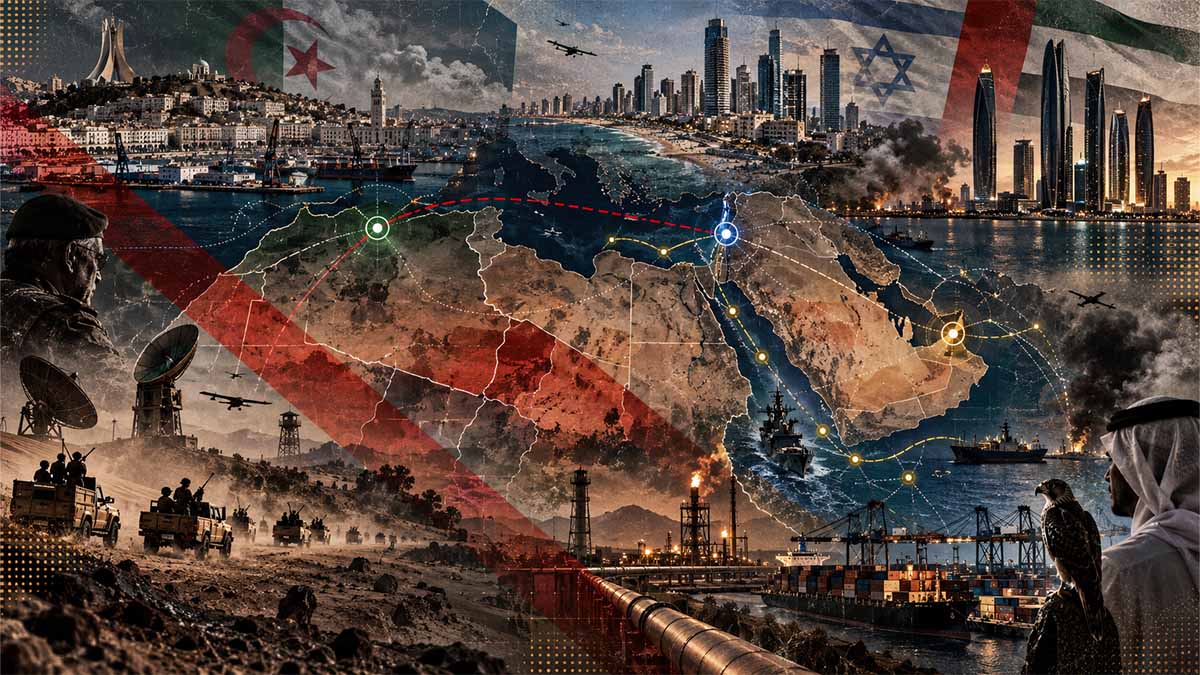
Scope: This assessment examines the deterioration of Algeria–United Arab Emirates relations culminating in the Algerian rupture of 10 September 2026, the degree to which UAE–Israeli and UAE–Moroccan strategic cooperation is relevant to that confrontation, Algeria’s military relationship with Russia, and the resulting security implications from the Maghreb through the Sahel and Red Sea, with a five-year analytical horizon to 2031.
Executive Summary / BLUF
The available official record supports the judgment that Algeria and the United Arab Emirates have crossed from prolonged political antagonism into an overt interstate confrontation, but it does not establish that the rupture can be reduced to a single UAE–Israeli strategy directed against Algeria, nor does it publicly substantiate the most serious Algerian-linked allegations concerning Emirati sponsorship of Kabylie separatism. On 10 September 2026, Algeria formally severed diplomatic relations after accusing the UAE of increasingly “provocative or hostile” conduct, ordered the Emirati ambassador to leave within 48 hours, and subsequently closed Algerian airspace to UAE-registered civil and military aircraft from midnight on 11 September, while temporarily exempting commercial services serving Algiers until the end of 2026. These are documented state measures rather than rhetorical escalation. Algerian Ministry of Foreign Affairs statement, 10 September 2026
The rupture sits inside a wider regional pattern in which Abu Dhabi has simultaneously encountered major sovereignty disputes involving Yemen and Somalia, while its regional security model intersects with Israel and Morocco in strategically important theatres, although these relationships do not constitute a single documented command structure or unified anti-Algerian coalition. Somalia terminated its UAE agreements covering ports, government institutions, security and defence cooperation in January 2026, while Saudi Arabia and the UAE publicly issued contradictory official accounts after Saudi-led coalition aircraft struck weapons and military vehicles unloaded at Mukalla from ships arriving from Fujairah in December 2025. Somali Ministry of Foreign Affairs decision on UAE agreements Saudi coalition statement on Mukalla UAE Foreign Ministry response on Yemen
Algeria’s military response to deteriorating regional geometry is increasingly centred on high-end Russian aerospace capability and strategic autonomy, but the public first-order record requires precision regarding the Su-57: Rostec confirms that Su-57 export deliveries are under way, and Russian state entities have openly marketed the aircraft to Middle Eastern and North African customers, yet the retrieved Russian and Algerian official record reviewed for this assessment does not publicly identify Algeria as the recipient or establish the number, basing, readiness status or mission-capable inventory of Algerian Su-57 aircraft. Rostec on Su-57E export deliveries, September 2026
The strategic significance therefore lies less in proving a formal Abu Dhabi–Tel Aviv axis against Algiers than in recognising an increasingly interconnected regional security architecture in which Algeria confronts Moroccan–Israeli military cooperation, Emirati support for Moroccan sovereignty claims over Western Sahara, UAE commercial and security infrastructure across the Red Sea and African littoral, Russian military penetration of North Africa and the Sahel, and competing sovereignty projects around Somalia, Somaliland, Libya and Western Sahara. For European governments, the resulting risk is not a conventional Maghreb war as the base case, but a progressively securitised regional system in which military procurement, airspace restrictions, proxy alignments, ports, separatist questions, Russian access and diplomatic recognition interact more closely than they did before 2025.
Algeria and the UAE: The Maghreb Rivalry Becomes a Regional Contest
Algeria’s decision on 10 September 2026 to sever diplomatic relations with the United Arab Emirates, expel its ambassador within 48 hours and close Algerian airspace to UAE-registered aircraft marks more than another quarrel inside the Arab system. It exposes a collision between two competing models of regional power: Algeria’s defence of territorial sovereignty and established state borders, and an Emirati network built around ports, security partnerships and relationships with actors operating below or alongside central governments. The immediate confrontation is bilateral, but its geography is not. From Yemen and Sudan to Somaliland, Kabylie, Western Sahara and the Sahel, the same dispute now intersects with Israel’s expanding relationship with Morocco and with infrastructure capable of converting diplomatic alignment into durable strategic presence.
Algiers did not break relations over a single incident
The Algerian decision came after President Abdelmadjid Tebboune had already signalled a fundamental reassessment of Abu Dhabi’s regional behaviour. In a televised interview in July 2026, Tebboune referred to an unnamed Gulf state involved in Libya, Sudan and Yemen with the phrase: “Wherever they set foot, blood flows.” When Algeria finally broke relations on 10 September, the measure was accompanied by an aviation restriction from midnight the following day, although commercial flights to and from Algiers were exempted until year-end. Abu Dhabi answered through Anwar Gargash, diplomatic adviser to UAE President Mohammed bin Zayed, who argued that interstate relations should be managed through “reason, communication and clarity of interests.” The contradiction was already complete: Algeria was treating Emirati regional behaviour as a cumulative security problem, while Abu Dhabi was presenting the dispute as one that should remain within conventional diplomacy.
The timing strengthened Algiers’s argument that the disagreement could not be isolated from events elsewhere. One week before the diplomatic rupture, a UN fact-finding mission on Sudan reported “reasonable grounds to believe” that external networks, including some operating through the UAE, were supplying the Rapid Support Forces in Darfur with fighters, weapons and training. The significance for Algeria was not that Sudan itself determined policy toward Abu Dhabi, but that another theatre had produced documentary allegations connecting Emirati territory or networks with armed actors operating beyond the formal state system.
Three governments challenged Abu Dhabi within nine months
The diplomatic cost to the UAE had already begun accumulating before Algeria acted. On 30 December, a Saudi-led coalition struck weapons and vehicles that had arrived at Yemen’s Mukalla Port aboard two ships from Fujairah, after Riyadh described its national security as a red line and accused Abu Dhabi of arming Southern Transitional Council separatists advancing into Hadhramaut and Al-Mahra. The UAE denied that the shipment contained weapons but subsequently announced the withdrawal of its remaining forces after Yemen’s Saudi-backed Presidential Leadership Council issued a 24-hour ultimatum.
Somalia followed. Five days after Southern Transitional Council leader Aidarous al-Zubaidi reportedly travelled through Somaliland and Mogadishu before reaching Abu Dhabi, Somalia’s federal government annulled agreements with the UAE covering ports, security cooperation and defence. The decision explicitly included Berbera, Bosaso and Kismayo, with Mogadishu citing “strong evidence” of activity undermining national sovereignty, unity and political independence; implementation remained uncertain in Somaliland and Puntland, but the institutional message was unambiguous. Two regional diplomats subsequently told Bloomberg that Saudi officials had encouraged Mogadishu to act, suggesting that the Yemen dispute was already transmitting political consequences into the Horn of Africa.
Sudan supplied a third pressure point. An 83-page Human Rights Watch report published in May 2026 found evidence that Abu Dhabi-based Global Security Services Group appeared to have recruited hundreds of Colombian contractors who fought alongside the Rapid Support Forces around El-Fasher. On 3 September, a UN mission reported that as many as 2,000 former Colombian soldiers may have joined the conflict, with some allegedly trained at a military-style facility in Ghayathi in the UAE before operating drones and artillery in Darfur. Abu Dhabi rejected the findings as a “false media campaign.” The sequence matters because Algeria’s rupture came after Saudi Arabia, Somalia and international investigators had each raised different questions about Emirati-linked security activity; it was not created in an informational vacuum.
Kabylie turns external rivalry into an internal-security question
For Algiers, the most sensitive escalation concerns Kabylie because it moves the contest from foreign theatres toward Algeria’s own territorial integrity. The Movement for the Self-Determination of Kabylie, or MAK, operates from Paris and was designated a terrorist organisation by Algeria in 2021. Algerian state media has alleged that UAE diplomats maintained contacts with the movement, but no supporting evidence has been made public, a limitation acknowledged even in commentary sympathetic to Abu Dhabi. The distinction is important: Algerian suspicion is politically consequential, but direct Emirati sponsorship of the MAK is not established by the dossier.
What is documented is the internationalisation of the Kabylie question elsewhere. On 14 December 2025, the MAK’s government-in-exile proclaimed a “Federal Republic of Kabylie” during a ceremony in Paris. On 14 January 2026, Likud Knesset member Dan Illouz, who is of Moroccan Jewish descent, tabled an urgent motion calling for Israel to examine recognition of Kabylie and characterised Algeria as part of an “Iranian evil axis.” The Jerusalem Institute for Strategy and Security had already advocated political support that could eventually lead to diplomatic recognition, while MAK founder Ferhat Mehenni had addressed Knesset members as early as 2012.
For Algeria, these developments change the strategic meaning of an otherwise weak separatist movement. Once Kabylie enters parliamentary debate in Israel while Algeria’s principal regional rival, Morocco, develops an increasingly sophisticated security relationship with Israel, domestic separatism becomes connected to external military and diplomatic competition even without proof of a coordinated campaign.
Somaliland shows how ports can harden political facts
The Somaliland case gives that Algerian concern a concrete precedent. Israel recognised Somaliland in December 2025, becoming the first UN member to do so, only twelve days after the MAK’s Paris proclamation. The UAE, meanwhile, had already established a substantial material interest there: DP World holds a 30-year concession at Berbera, Somaliland’s principal port, alongside a longstanding Emirati security presence. When Arab and Islamic governments issued a joint statement condemning Israel’s recognition, the UAE declined to sign it.
The importance of this model lies in the interaction between political recognition and infrastructure. Recognition can alter diplomatic status; ports, security relationships and transport links can make a contested entity economically and strategically more viable. The dossier records reports alleging an Emirati role in facilitating Israel’s Somaliland move, but it does not establish that involvement as fact. What it does establish is a structural convergence: the territory recognised by Israel already contains infrastructure operated from the UAE, demonstrating how diplomatic and commercial networks can reinforce one another without requiring formal annexation or a conventional military alliance.
Morocco gives the Gulf–Israel relationship military weight
The western end of this emerging system runs through Morocco. In November 2020, two months after the UAE signed the Abraham Accords, Abu Dhabi became the first Arab government to open a consulate in Laayoune in Western Sahara, whose independence Algeria has supported since 1975. Morocco restored relations with Israel one month later. What began as diplomatic alignment subsequently acquired a substantial security component.
In early January 2026, the third Morocco–Israel Joint Military Committee met in Tel Aviv to establish its work programme for the year, while Israeli officials described Morocco as Israel’s most important security partner in Africa. The relationship is no longer confined to political recognition: according to the dossier, Morocco operates Israel Aerospace Industries’ Barak MX air-defence system, Elbit Systems’ ATMOS howitzers and Hermes 900 drones. In November 2025, BlueBird Aero Systems, half-owned by IAI, opened a facility at Benslimane outside Casablanca to manufacture SpyX loitering munitions, described as the first plant of its type in North Africa.
The military-industrial mechanism matters more than symbolism. Procurement creates dependence on training, maintenance, software, munitions and supply chains; local production pushes the relationship further by embedding defence manufacturing inside Morocco itself. Spanish defence outlet Escudo Digital has additionally reported that Israeli-built surveillance and strike drones are stationed at Mahbes in Western Sahara near the Algerian border. The dossier does not independently verify that deployment, but if accurate it would place Israeli-origin platforms close to Tindouf, where the Sahrawi refugee camps and Polisario leadership are based.
Dakhla converts geopolitical alignment into a Sahel corridor
Morocco’s response to the regional contest is not confined to weapons. Its Atlantic Initiative seeks to give landlocked Mali, Niger, Burkina Faso and Chad maritime access through the Dakhla Atlantic Port, a $1.6 billion project reported to be 70 percent complete in November 2025. The location is strategically decisive: the port lies in Western Sahara, the same disputed territory where Abu Dhabi maintains its consulate and where Algeria supports the Sahrawi independence cause.
On 24 July 2026, Mali reaffirmed its commitment to the Moroccan corridor, only thirteen days after restoring diplomatic relations with Algeria. That juxtaposition captures the problem facing Algiers more accurately than any claim of a rigid anti-Algerian bloc. Sahel governments can maintain relations with Algeria while participating in an infrastructure project that strengthens Morocco’s Atlantic strategy; Abu Dhabi can support Morocco through diplomacy and investment; Israel can reinforce Rabat through defence technology. The cumulative effect does not require every participant to share the same objective. It creates a network in which Morocco can connect Western Sahara to the Sahel economically while linking itself to Israel militarily and to the UAE politically.
The next 24 months will price the cost of strategic separation
The decision taken on 10 September 2026 has therefore moved Algeria beyond a bilateral dispute into a contest over how regional influence is organised. Abu Dhabi’s problem is that the methods that generated access — relationships with ports, security actors and politically contested territories — have now produced direct resistance from Saudi Arabia, Somalia and Algeria within nine months. Algiers’s problem is different: breaking diplomatic relations does not remove the networks it considers threatening, while Morocco’s Israeli procurement, the $1.6 billion Dakhla Atlantic Port, the Berbera concession and the internationalisation of Kabylie continue independently of Algeria’s decision.
Over the next 12–24 months, the cost of inaction will fall primarily on governments that continue to treat Western Sahara, Kabylie, Somaliland, Yemen, Sudan and the Sahel as disconnected disputes. Morocco is already converting external partnerships into defence systems and infrastructure; the UAE has demonstrated that commercial reach can coexist with security relationships; Israel has shown that recognition policy can move into contested territorial questions. Algeria, meanwhile, has chosen diplomatic separation rather than accommodation. The risk is not that these theatres automatically become one conflict, but that decisions taken in one increasingly change the military, economic and diplomatic calculations in the others. The institutions that fail to recognise that transmission mechanism will pay through reduced leverage, narrower crisis options and higher security costs once infrastructure and alliances are already fixed in place.
Navigational Index
The Maghreb strategic rupture
The transformation of Algeria–UAE rivalry from political hostility into formal diplomatic separation, the Morocco–Israel security relationship, Western Sahara and Kabylie, and the degree to which these theatres are becoming connected in Algerian strategic thinking.
Military power, Russian access and escalation geometry
Algeria’s Russian defence relationship, the Su-57 question, high-end air power, Moroccan acquisition of Israeli systems, U.S. sanctions exposure, and the consequences of increasingly capable opposing air, missile, drone and surveillance architectures across North Africa.
Ports, proxies and the wider regional contest
The UAE’s presence from Yemen and Somalia to Libya and the Red Sea, divergent Saudi–Emirati interests, the interaction between commercial infrastructure and security policy, and the implications for European energy, migration, shipping, counterterrorism and Mediterranean stability.
Master Abstract
The diplomatic rupture is established; its complete causal chain is not
Algeria’s decision of 10 September 2026 represents an unusually severe bilateral step whose legal and diplomatic content is independently visible in Algerian state documentation: the Ministry of Foreign Affairs stated that the UAE had persisted in “provocative or hostile” actions despite repeated Algerian warnings, declared that available means of preserving bilateral relations had been exhausted, severed diplomatic relations and gave the Emirati ambassador 48 hours to comply with the decision. Statement by the Algerian Ministry of Foreign Affairs — 10 September 2026 Algeria then converted diplomatic rupture into a concrete transport and security restriction when the Ministry of National Defence announced that, from 00:00 on 11 September 2026, Algerian airspace would be closed to civil and military aircraft registered in the UAE, with a temporary exception for UAE commercial flights serving Houari Boumediene International Airport until the end of 2026. Algerian Ministry of National Defence airspace decision Abu Dhabi did not answer with reciprocal sanctions or an equivalent diplomatic escalation; the UAE Foreign Ministry instead stated that it valued relations with all countries and hoped Algeria’s measure would prove temporary, which indicates that the two governments were already operating under markedly different escalation preferences immediately after the rupture. UAE Ministry of Foreign Affairs response, 10 September 2026
The available official record nevertheless does not publicly enumerate the Emirati acts that constituted Algeria’s casus ruptio, and this limitation is analytically important because the diplomatic statement itself does not identify Kabylie, Israel, Morocco, Western Sahara, Sudan, Libya, Somalia or the Sahel as the specific trigger. Algeria’s accusations therefore establish the Algerian government’s attribution of hostile conduct to Abu Dhabi, but they do not independently prove each underlying allegation. This distinction is particularly necessary regarding claims of direct UAE support for the Movement for the Self-Determination of Kabylie, because the publicly retrieved official evidence does not yet establish a documented financial, operational or command relationship between UAE state organs and the movement. Any assessment that presents such support as established fact would therefore exceed the present documentary record.
The UAE–Israel–Morocco convergence is real, but its organisational limits matter
What can be established is a substantial strategic convergence among the UAE, Israel and Morocco that directly touches several Algerian security sensitivities, although the evidence does not support describing the three governments as a unified operational alliance against Algeria. Israel and Morocco have progressively institutionalised military cooperation since restoration of relations, including through an agreed mechanism for a joint military committee, training and operational-intelligence cooperation; the IDF publicly recorded those areas during the first official Israeli military visit to Morocco in 2022. Israel Defense Forces record of military cooperation with Morocco At the diplomatic level, the UAE has supported Morocco’s territorial position through its presence in Laayoune, while Algeria remains the principal regional supporter of the Polisario Front and the Sahrawi independence claim, meaning that Emirati and Algerian policy is structurally opposed on one of Algiers’s most important regional files.
Israel’s recognition of Somaliland in late December 2025 added another precedent with obvious relevance to Algerian concerns regarding territorial fragmentation, because the Organisation of Islamic Cooperation subsequently convened an extraordinary ministerial session and adopted a resolution explicitly addressing Israel’s recognition of Somaliland as an independent state, while reaffirming Somalia’s sovereignty, national unity and territorial integrity. OIC resolution transmitted to the United Nations on Somaliland recognition However, the Arab League record introduces an important qualification to claims of an automatically coordinated UAE–Israel position on Somaliland: the extraordinary Arab League session condemning Israeli recognition was chaired by Hamad Obaid al-Zaabi, the UAE permanent representative, demonstrating that Abu Dhabi’s institutional behaviour within the Arab League cannot simply be equated with Israel’s policy. This does not eliminate evidence of overlapping Emirati commercial interests in Somaliland, but it materially weakens any formulation suggesting that the UAE officially adopted Israel’s recognition policy.
Abu Dhabi’s wider African and Red Sea posture is encountering increasing sovereignty resistance
Algeria’s decision also occurred after a sequence of unusually serious disputes involving Emirati regional activity elsewhere, which helps explain why Algerian perceptions of Abu Dhabi are now embedded in a broader debate over sovereignty, ports, security partnerships and non-state actors rather than confined to bilateral diplomacy. On 12 January 2026, Somalia announced the termination of all agreements with the UAE covering port operations, government institutions and security and defence cooperation, explicitly stating that the decision was intended to protect Somalia’s sovereignty, territorial integrity and national unity and that the affected arrangements involved Berbera, Bosaso and Kismayo. Somali Ministry of Foreign Affairs — termination of UAE agreements The measure therefore constitutes direct first-party evidence of a second Arab-African government framing part of Abu Dhabi’s external engagement as a sovereignty problem, although implementation authority over all of the affected ports is complicated by Somalia’s federal and territorial fragmentation.
The Yemen record is still more striking because Riyadh and Abu Dhabi produced directly conflicting official descriptions of the same physical event. Saudi-led coalition forces stated that two vessels arriving at Mukalla from Fujairah on 27–28 December 2025 had disabled their tracking systems and unloaded weapons and combat vehicles intended to support Southern Transitional Council forces, after which coalition aircraft conducted a limited strike against the cargo. Saudi Press Agency — Coalition statement on Mukalla The UAE Foreign Ministry categorically rejected the allegation that the shipment contained weapons, stated that the vehicles were intended for Emirati forces rather than a Yemeni faction and said their movement had been coordinated at senior level with Saudi Arabia, thereby creating an unresolved intergovernmental factual dispute rather than a record that permits the Saudi account to be treated automatically as established truth. UAE Ministry of Foreign Affairs statement on Yemen
The significance for Algeria is not that these events prove a single Emirati master strategy, but that they reinforce an observable pattern in which commercial access, security partnerships, local armed actors and questions of sovereignty repeatedly overlap around UAE regional activity, while the exact degree of state direction varies by theatre and remains contested.
Sudan introduces a documented transnational dimension but remains evidentially disputed
Sudan has become another important part of the argument over external support networks, although attribution requires exceptional discipline because Sudan and the UAE are directly interested parties. United Nations proceedings during 2026 contained Sudanese accusations that Colombian personnel had been recruited, transported and trained through UAE-linked networks before deployment alongside the Rapid Support Forces, including allegations concerning training in the Emirates and transit through Libya and other African nodes; the UAE rejected the broader accusatory framing and argued in UN proceedings that Sudan was using the forum to divert attention from the war’s central issues. These records demonstrate that the allegations reached formal United Nations proceedings and were not merely media claims, but statements made by Sudan to UN bodies remain attributed national claims rather than independent UN findings unless separately established by a competent investigative mechanism.
This distinction will remain central throughout the dossier because the geopolitical importance of the Sudan file lies precisely in whether future UN, sanctions, judicial or investigative records move parts of the evidentiary chain from allegation to independently supported finding. The presence of foreign combatants, logistics networks and private intermediaries would materially strengthen the argument that modern Emirati regional power projection often operates through hybrid structures extending beyond conventional bilateral defence cooperation, but the institutional identity, state control and chain of command of individual networks must be established separately before broader conclusions are drawn.
Algeria’s Russian air-power trajectory is strategically consequential even where aircraft identity remains unresolved
The strongest military proposition in the current public record is that Russia has moved the Su-57 into the export phase and is actively pursuing Middle Eastern and North African markets, while the weakest part of the publicly accessible official record is the identity and operational status of the export recipient. Rostec stated in December 2025 that the Su-57 was “already being exported,” while in September 2026 it stated that deliveries to foreign partners were under way; Rosoboronexport had earlier publicly offered not merely aircraft sales but potential localisation of Su-57E production for foreign customers. Rostec — Su-57 export and Product 177 programme
The evidence therefore supports the proposition that Russia has crossed the threshold from marketing to export delivery, but it does not, in the official documentation retrieved here, justify writing that Algeria’s Su-57 fleet size, combat readiness, basing arrangement or weapons integration are established facts. The same distinction applies to the strategic balance: possession of a fifth-generation platform would not by itself establish operational superiority, because actual combat effect would depend on pilot conversion, weapons stocks, low-observable maintenance, sensor fusion, airborne early-warning support, electronic warfare, sortie generation, mission planning and integration with Algeria’s wider air-defence network. Consequently, photographic or journalistic identification of aircraft should be treated as significant corroborative evidence in later chapters rather than substituted for an official inventory record.
The United States is nevertheless actively examining Algeria’s Russian military relationship. The Senate Foreign Relations Committee held a 3 February 2026 hearing entitled Countering Terrorism in North Africa: Opportunities and Challenges, with Robert Palladino appearing as the State Department’s senior Bureau of Near Eastern Affairs official; the committee’s public record confirms the hearing and witness status, although the landing page itself does not reproduce the claimed Su-57 or CAATSA exchange and therefore cannot by itself substantiate the precise quotations attributed to Palladino elsewhere. U.S. Senate Foreign Relations Committee hearing record This means that any definitive assessment of sanctions exposure must be grounded in the transcript, testimony or a subsequent executive-branch determination rather than inferred simply from the existence of the hearing.
The regional system is increasingly multipolar rather than bipolar
The most important analytical correction to a simple Algeria–Russia versus UAE–Israel–Morocco model is the persistence of cross-cutting relationships. Moscow and Abu Dhabi have overlapping interests in parts of Libya; Russia’s partnerships in the Sahel can place it close to governments whose relations with Algeria have periodically deteriorated; Saudi Arabia and the UAE remain deeply interconnected despite their Yemen dispute; Morocco simultaneously deepens ties with Israel while maintaining major relations with Gulf, European and U.S. partners; Algeria cooperates extensively with European states despite its Russian defence dependence; and Abu Dhabi maintains institutional roles within Arab organisations even when its commercial or security interests elsewhere create friction with individual Arab governments.
This geometry makes competitive network-building a more defensible description than two coherent regional blocs, because the relevant states share partners in one theatre while competing in another, and transactional relationships remain more important than formal alliance discipline across much of Africa and the Middle East. The resulting strategic danger is therefore fragmentation rather than bloc consolidation: repeated disputes over territorial recognition, port access, military basing, arms transfers, local armed formations, separatist movements and infrastructure investment can increasingly connect otherwise separate crises, allowing a bilateral event in one theatre to alter threat perception in another.
Algeria’s rupture changes the escalation environment even without military confrontation
The closure of Algerian airspace to UAE-registered aircraft is particularly important because it demonstrates that the confrontation has already moved beyond diplomatic symbolism into the regulation of physical access. Restrictions of this type create practical costs, establish precedents for further transport, investment or security measures and make reciprocal escalation administratively easier if the confrontation deepens. Algeria possesses additional instruments ranging from investment and corporate scrutiny to intelligence cooperation, air-service restrictions and diplomatic lobbying within African, Arab and multilateral institutions, while the UAE possesses substantially greater external capital deployment capacity and extensive commercial networks across Africa.
Neither government has yet publicly crossed the much more consequential thresholds represented by broad economic sanctions, asset seizures, military mobilisation against the other or direct kinetic action, meaning that the current state should be classified as high-intensity diplomatic and strategic confrontation rather than armed interstate conflict. That distinction matters because the principal pathway to deterioration is cumulative: new evidence regarding covert political activity, recognition of a separatist entity, expansion of foreign military infrastructure around Algeria, sanctions triggered by Russian procurement or another confrontation involving UAE-linked actors could change Algerian threat perception substantially even without a bilateral military incident.
Europe cannot treat the confrontation as peripheral to Mediterranean security
For Europe, the most consequential exposure is not simply diplomatic relations with Algeria or the UAE but the interaction between North African stability, energy supply, migration routes, defence procurement, Russian influence and Western Sahara. Italy has unusually strong incentives to prevent a deterioration of Algeria’s external relations because Algeria is a central Mediterranean security interlocutor and an important energy partner, while Rome simultaneously maintains dense commercial and political ties with the UAE and therefore has greater potential than many European capitals to preserve channels with both sides. France faces a more politically difficult problem because its relationships with Algeria and Morocco remain historically burdened, its domestic political environment is unusually sensitive to Maghreb developments and Kabylie activity has a substantial French territorial dimension, which makes any securitisation of Algerian separatism directly relevant to Paris rather than an external North African issue.
Germany has less direct colonial or military exposure to the Maghreb rivalry but substantial interests in European energy diversification, regional trade, migration management and the credibility of EU foreign policy, meaning that Berlin’s principal strategic interest is preventing bilateral disputes from fragmenting European policy toward North Africa. The United Kingdom, operating outside the EU, possesses greater bilateral flexibility but must balance defence and investment relations with Gulf states against counterterrorism, maritime-security and North African stability interests; London would therefore face a difficult intelligence and diplomatic problem if allegations concerning proxy or separatist support moved from political accusation to evidentially documented state activity.
At the European Union level, the policy challenge is even more structural because the EU must simultaneously engage Algeria as an energy and Mediterranean-security partner, Morocco as a major trade and migration partner, and the UAE as a capital, energy and diplomatic actor, while maintaining legal positions regarding Western Sahara and managing the strategic consequences of Russian military penetration of North Africa. The European interest is therefore not served by mechanically adopting any regional actor’s geopolitical narrative, but by distinguishing verifiable state actions from attribution claims and monitoring whether the present confrontation begins affecting energy infrastructure, arms transfers, European investment screening, maritime access, migration cooperation or intelligence relationships.
Key Evidence Table
| Indicator | Value/status | Reference date | Definition/scope | Issuer | Exact source |
|---|---|---|---|---|---|
| Algeria–UAE diplomatic relations | Severed; UAE ambassador given 48 hours | 10 Sep 2026 | Formal bilateral diplomatic relations | Algerian Ministry of Foreign Affairs | Official Algerian MFA statement |
| Algerian airspace | Closed to UAE-registered civil and military aircraft, with temporary commercial-flight exception to Algiers | From 00:00, 11 Sep 2026 | UAE-registered aircraft entering/leaving Algerian airspace | Algerian Ministry of National Defence | Official Algerian defence statement |
| UAE official response | Hopes Algerian rupture is temporary; stresses continued regard for Algerian people | 10 Sep 2026 | UAE diplomatic position | UAE Ministry of Foreign Affairs | Official UAE response |
| Somalia–UAE agreements | Terminated | 12 Jan 2026 | Ports, government institutions, security and defence cooperation, including Berbera, Bosaso and Kismayo | Somali Ministry of Foreign Affairs | Somali MFA decision |
| Mukalla shipment | Saudi coalition says weapons and combat vehicles were unloaded from ships arriving from Fujairah | 27–30 Dec 2025 | Military cargo at Mukalla | Saudi-led coalition / SPA | Saudi coalition statement |
| Mukalla shipment — UAE position | UAE denies weapons were aboard and says vehicles were for UAE forces | 30 Dec 2025 | Same incident; directly conflicting official account | UAE Ministry of Foreign Affairs | UAE statement |
| Israeli recognition of Somaliland | Recognition triggered extraordinary OIC action affirming Somali territorial integrity | Dec 2025–Jan 2026 | Diplomatic recognition / territorial sovereignty | OIC document transmitted to UN | UN-hosted OIC resolution S/2026/26 |
| Su-57 export status | Export deliveries officially stated to be under way | 2025–Sep 2026 | Su-57E export programme; recipient not identified in cited official record | Rostec | Rostec export statement |
| U.S. scrutiny of North African security | Senate hearing with State Department NEA senior official Robert Palladino | 3 Feb 2026 | U.S. congressional oversight; landing page does not itself prove specific CAATSA/Su-57 quotation | U.S. Senate Foreign Relations Committee | Official hearing record |
| Morocco–Israel military cooperation | Formal cooperation framework includes training and operational/intelligence areas | Publicly documented since 2022 | Bilateral military cooperation | Israel Defense Forces | IDF official record |
Principal Gaps and Watch Indicators
The decisive intelligence gap is the evidentiary content behind Algeria’s description of UAE conduct as hostile, because the Algerian Foreign Ministry has formally attributed such conduct to Abu Dhabi without publicly specifying the acts that crossed the threshold for severing relations; disclosure of diplomatic démarches, intelligence evidence, financial records, communications with Algerian separatist organisations or criminal proceedings would materially change the assessment.
A second major gap concerns Algerian Su-57 acquisition and operational status, because Russian state industry confirms foreign export deliveries without identifying the recipient in the official records retrieved for this report; an Algerian Ministry of National Defence inventory statement, Russian export disclosure, identifiable acceptance documentation, imagery proving persistent Algerian basing, training records or weapons-integration evidence would move the proposition from strong external reporting toward verified fielded capability.
A third watch indicator is the status of Kabylie in Israeli or Emirati state policy, because parliamentary initiatives, think-tank advocacy and political contact do not equal formal recognition or covert state support; an Israeli cabinet measure, Knesset legislation, UAE government instrument, documented state financing or formal liaison mechanism would constitute a qualitatively different level of involvement.
A fourth indicator is further Algerian economic or transport restrictions against UAE interests, because the airspace measure has already demonstrated willingness to translate political rupture into physical-access controls, while investment reviews, cancellation of concessions, asset restrictions or broader aviation measures would demonstrate that the confrontation is moving into sustained economic coercion.
A fifth indicator is the trajectory of Morocco–Israel defence integration, particularly deployments, indigenous production, intelligence-sharing arrangements, air- and missile-defence architecture, long-range precision systems and persistent ISR presence near Algeria or Western Sahara, because these variables influence Algerian force-planning more directly than diplomatic symbolism alone.
A sixth indicator concerns U.S. treatment of Algeria’s Russian procurement, because movement from congressional questioning to a formal CAATSA determination, waiver analysis or sanctions action would convert an Algeria–Russia defence relationship into a material U.S.–Algeria policy crisis and could further reinforce Algerian incentives to diversify political partnerships outside the Western system.
A seventh indicator is the institutional treatment of UAE-linked support networks in Sudan, because a UN investigative finding, sanctions designation, judicial determination or verified documentary record establishing command, financing or logistics would have substantially greater evidentiary weight than allegations made by one belligerent against another.
A final indicator is whether Saudi–Emirati competition remains compartmentalised, because the Mukalla incident demonstrates that even closely connected Gulf powers can publicly dispute military activity involving local armed partners; sustained Saudi resistance to Emirati regional networks would fundamentally complicate any model treating the Gulf as a unified component of an anti-Algerian alignment.
Net Assessment
The public record as of 15 September 2026 supports a strong but narrower judgment than the proposition that Abu Dhabi’s alliance with Tel Aviv has directly transformed its rivalry with Algiers into an organised regional confrontation: the Algeria–UAE relationship has undeniably entered open confrontation, and UAE–Israeli–Moroccan strategic convergence materially intensifies Algerian threat perceptions, particularly through Western Sahara, Moroccan military modernisation and questions of territorial fragmentation, but the presently verified record does not establish a centrally coordinated Emirati–Israeli campaign against Algeria or prove UAE sponsorship of Kabylie separatism.
The more consequential structural development is the formation of an increasingly interconnected security environment extending from the western Maghreb through Libya and the Sahel to the Red Sea, within which Abu Dhabi, Algiers, Rabat, Tel Aviv, Moscow, Riyadh and local African actors operate through overlapping rather than fully aligned networks. Algeria is responding to that environment through diplomatic exclusion, strategic autonomy and high-end military modernisation, while Morocco is deepening an Israeli-enabled defence transformation and the UAE continues to use commercial, political and security relationships across multiple African theatres.
If Algeria is ultimately confirmed as the operational recipient of the Su-57E, the significance will extend beyond the acquisition of another combat aircraft because it would give the Maghreb its first fielded fifth-generation export platform and increase pressure on Morocco and its partners to improve counter-stealth sensing, airborne early warning, electronic warfare, integrated air defence and long-range precision capabilities; until the recipient, fleet size and operational availability are established through competent evidence, however, that conclusion must remain conditional rather than presented as a verified change in the regional order.
The most credible five-year risk is therefore not a predetermined Algeria–UAE or Algeria–Israel war, but accelerating strategic bifurcation around military technology, territorial recognition, ports, infrastructure, airspace, separatist politics and external great-power partnerships, accompanied by a higher probability that crises previously treated as geographically separate will increasingly influence one another. For European governments, the central policy problem will be maintaining relations with Algeria, Morocco and the Gulf without importing their competing threat narratives into European policy, while simultaneously preventing Russia from exploiting widening Maghreb divisions and ensuring that economic infrastructure, defence cooperation and diplomatic recognition do not unintentionally become escalation mechanisms.
Abu Dhabi, Tel Aviv and Algiers: Emerging Strategic Confrontation Across Maghreb, Sahel and Red Sea
Algeria and the UAE have officially crossed from prolonged political antagonism into direct interstate confrontation following the formal severance of relations on 10 September 2026, expulsion of the UAE ambassador (48h window), and total airspace closure to UAE-registered aircraft enacted on 11 September 2026. While Algerian perceptions are exacerbated by Moroccan–Israeli military integration and UAE port expansions across the African littoral, the primary verified record does not corroborate a single coordinated Abu Dhabi–Tel Aviv master offensive, nor does it publicly substantiate state sponsorship of Kabylie separatism (MAK). The strategic danger lies in systemic multipolar friction: transactional networks across the Maghreb, Sahel, and Red Sea are binding previously compartmentalized territorial disputes into an escalatory cascade.
Dimension 01: Algeria–UAE Bilateral Severance & Airspace Interdiction
Algerian MFA officially condemned persistent “provocative and hostile conduct” by Abu Dhabi, declaring all diplomatic remediation avenues exhausted. Algerian Ministry of National Defence closed sovereign airspace to all UAE civil and military aircraft starting midnight 11 September 2026 (commercial flights to Houari Boumediene Airport temporarily exempt through late 2026).
The Algerian diplomatic decree does not enumerate specific operational triggers (Western Sahara, Israel, MAK, Libya, or Sudan). Algiers links UAE conduct to state subversion and Kabylie separatism, yet public official archives lack documented financial, logistical, or command ties directly attributing MAK sponsorship to UAE organs.
The UAE Foreign Ministry declined reciprocal expulsion or retaliation, voicing hope that the measure is temporary while reiterating goodwill toward the Algerian people. This response exposes stark divergence: Algiers views bilateral relations via an existential zero-sum security lens, while Abu Dhabi prefers compartmentalized containment.
Primary Audited Evidence Matrix // Verified Baseline Decisions
| Analytical Indicator | Audited Value / Status | Reference Date | Scope & Strategic Context | Issuing Entity & Source |
|---|---|---|---|---|
| Algeria–UAE Relations | Severed; Amb. 48h | 10 Sep 2026 | Termination of bilateral diplomatic apparatus due to sustained “provocative conduct”. | Algerian MFA Statement |
| Algerian Airspace Restriction | Closed (Selective Exemption) | 11 Sep 2026 | Civil & military UAE tail numbers barred; temporary corridor to Algiers airport through 2026. | Algerian Min. Nat. Defence |
| UAE Official Posture | Conciliatory / Restraint | 10 Sep 2026 | Non-reciprocal response; frames break as temporary while upholding goodwill to Algerian citizenry. | UAE Ministry Foreign Affairs |
| Somalia–UAE Agreements | Unilaterally Revoked | 12 Jan 2026 | Canceled port operations and security accords regarding Berbera, Bosaso, and Kismayo. | Somali MFA Official Decree |
| Mukalla Port Cargo Incident | Kinetic Interdiction | 27–30 Dec 2025 | Saudi-led air strike on Fujairah-origin cargo vessels unloading combat gear for STC forces. | Saudi Press Agency / Coalition |
| Mukalla Counter-Narrative | Categorical Denial | 30 Dec 2025 | UAE states vehicles were destined strictly for UAE forces, denying illicit arms transfers to STC. | UAE Ministry Foreign Affairs |
| Somaliland Recognition Friction | OIC Diplomatic Pushback | Dec 2025 – Jan 2026 | Israeli recognition rejected via OIC Res S/2026/26; UAE chaired Arab League censure session. | UN Doc S/2026/26 / Arab League |
| Su-57 Felon Aerospace Export | Active Delivery Phase | Sep 2026 | Rostec confirms Su-57E deliveries underway abroad; customer identity unstated in public records. | Rostec State Corp / Product 177 |
| US Sanctions Scrutiny (CAATSA) | Congressional Inquiry | 3 Feb 2026 | Senate SFRC hearing on North African terror & defence vectors; R. Palladino testimony. | US Senate Foreign Relations Comm. |
| Morocco–Israel Military Pact | Institutionalized | 2022–2026 Active | Bilateral Joint Military Committee, operational ISR, EW platforms, and drone coproduction. | Israel Defense Forces Records |
Deep Structural Breakdown: Theatre Friction Points & Operational Paradoxes
Sovereignty & Separatism
The diplomatic dispute stems from contrasting stances on self-determination and territorial integrity. While the UAE opened a consulate in Laayoune in support of Moroccan claims over Western Sahara, Algeria serves as the primary regional backer of the Polisario Front.
Algeria views UAE influence through the lens of national security, perceiving potential risks of regional encirclement and vulnerability around Kabylie, even while formal state-backed sponsorship channels lack open evidentiary proof.
Aerospace Balance (Su-57)
Rostec confirmation that Su-57E deliveries are proceeding introduces a prospective 5th-generation stealth combat platform to North Africa. Yet fielding a low-observable airframe does not instantly secure localized air dominance.
Actual combat potential hinges on sensor fusion, engine maintainability, pilot conversion hours, and datalink integration with legacy Algerian air defence assets against Moroccan air defences reinforced by Israeli EW/radar systems.
Littoral Infrastructure & Ports
Abu Dhabi’s maritime approach links logistical concession management with security infrastructure spanning Berbera, Bosaso, and Kismayo, triggering institutional counter-actions from the federal government in Mogadishu.
Simultaneously, the December 2025 Mukalla cargo strike highlights emerging friction between Saudi stabilization strategies and Emirati support for southern formations, challenging assumptions of a unified Gulf consensus.
European Diplomatic Dilemma
European partners face competing priorities: Italy depends on Algerian natural gas transit while expanding UAE commercial relationships; France balances domestic sensitivities regarding Maghreb affairs alongside regional security dynamics.
Consequently, Europe seeks to prevent regional fragmentation without taking sides in Mediterranean territorial claims or disrupting established bilateral partnerships.
Forensic Strategic Key Judgments // Synthesis of Intelligence Records
The diplomatic rupture and selective closure of Algerian airspace constitute tangible, institutional state actions. This regulatory friction imposes immediate routing constraints on civil and military transports, formalizing what had been a protracted covert rivalry into open interstate confrontation.
While Israeli–Moroccan defence integration and UAE–Moroccan strategic ties overlap, public documentation does not demonstrate a single integrated command structure. The UAE’s leadership of an Arab League session criticizing Somaliland recognition reflects institutional hedging rather than seamless alignment with Tel Aviv.
Russian state confirmation of Su-57 export deliveries reinforces Algeria’s focus on advanced aerospace assets. However, available official records do not verify Algerian fleet sizes, deployment bases, or complete system integration, keeping direct operational assessments speculative.
Somalia’s termination of UAE security and port accords, combined with Saudi operational pushback at Mukalla, demonstrates that commercial and security initiatives face pushback from local states seeking to defend sovereign prerogatives.
Formal Sudanese submissions to the UN Security Council alleging UAE involvement in supply chains and personnel transit illustrate the transnational dimension of regional conflicts, though definitive attribution remains politically contested.
The primary security risk across the Maghreb and Red Sea through 2031 is not symmetric conventional warfare between Algiers and Abu Dhabi, but structural geopolitical polarization, where isolated diplomatic disputes can generate cross-regional escalation.
Open Official Record Gaps
- Evidentiary Core of Algerian Rupture: The official Algerian MFA communiqué omits specific operational triggers, keeping the precise causes of the severance classified.
- Algerian Su-57 Fielding: While Rostec confirms foreign export deliveries, accessible state registries do not officially confirm Algerian delivery totals, home airbases, or frontline unit integration.
- Direct Kabylie Separatism Links: Public records lack verified paper trails demonstrating UAE state funding or operational tasking directed to the MAK leadership.
- US CAATSA Determination: Senate records confirm hearing oversight on North African developments, but formal executive sanctions or waiver determinations regarding Russian hardware remain unissued.
Observable Strategic Watch Indicators (2026–2031)
The Maghreb Strategic Rupture
Principal judgment
The rupture between Algeria and the United Arab Emirates should be understood as the formalisation of a broader strategic divergence that had already been developing across several interconnected theatres, but the available official record does not support reducing that divergence to a single, centrally directed Emirati–Israeli campaign against Algeria. What is firmly established is that Algeria now perceives its external security environment through an increasingly integrated lens in which Emirati alignment with Morocco over Western Sahara, the deepening Morocco–Israel defence relationship, Algerian allegations concerning hostile activity affecting national cohesion, and the appearance of foreign-linked security risks in Kabylie are no longer treated as isolated files. The analytical significance of the events of September 2026 therefore lies not merely in the loss of diplomatic relations with Abu Dhabi, but in the emergence of an Algerian threat picture in which sovereignty, territorial integrity, separatism, military technology and external power projection increasingly intersect.
That perception is partly grounded in documented policy convergence among Algeria’s competitors and partly in allegations that remain incompletely substantiated in the public record. Abu Dhabi has formally endorsed Moroccan sovereignty over Western Sahara and maintains a consulate in Laayoune; Israel formally recognised Moroccan sovereignty over Western Sahara in July 2023 and has developed institutionalised strategic, intelligence and operational military cooperation with Morocco; Algeria continues to define Western Sahara as an unfinished decolonisation process in which self-determination remains indispensable; and the Algerian Ministry of National Defence stated in July 2026 that army security services had arrested six alleged members of the Movement for the Self-Determination of Kabylie, or MAK, including four Moroccan nationals. These are individually documented developments. What has not yet been established through competent public records is a direct Emirati chain of command, financing mechanism or operational relationship linking Abu Dhabi to the MAK, or an official trilateral UAE–Israel–Morocco structure designed specifically to destabilise Algeria. That distinction determines both the evidentiary ceiling and the strategic judgment of this chapter.
From antagonism to formal interstate rupture
Algeria’s decision of 10 September 2026 represented a qualitative escalation because the Algerian government did not characterise the dispute as a temporary diplomatic disagreement, a recalled ambassador or a protest over a single event, but stated that it was responding to what it described as an accumulation of “provocative or hostile actions” by the United Arab Emirates after repeated warnings had failed to alter Emirati conduct. The Ministry of Foreign Affairs said that all means of preserving bilateral relations had been exhausted, formally notified the Emirati ambassador of the decision and granted him 48 hours to comply.
This wording is unusually important because it indicates cumulative attribution rather than reaction to one discrete incident, yet the same official statement did not specify the underlying acts, individuals, financial transfers, intelligence operations or third-country relationships that constituted the alleged hostile activity. Consequently, the diplomatic rupture itself is an established fact, while the complete evidentiary basis for Algeria’s accusation remains non-public. That distinction prevents the analytical record from treating every subsequent Algerian or media allegation concerning Abu Dhabi as proven merely because the bilateral relationship was terminated.
Algeria immediately translated the political decision into a measure affecting physical access when the Ministry of National Defence announced that, from 00:00 on 11 September 2026, Algerian airspace would be closed to all civil and military aircraft registered in the UAE, whether arriving from or departing for the Emirates, while Emirati commercial flights serving Algiers were temporarily exempted until the end of 2026 because the existing contract remained in force until that date. The design of the measure is analytically revealing because Algeria did not impose an immediate total aviation embargo, but instead separated a strategic prohibition from an existing commercial obligation, suggesting that the government was prepared to escalate materially while still managing contractual and civilian consequences.
Abu Dhabi adopted a markedly different public posture. The UAE Ministry of Foreign Affairs stated on the same day that the Emirates remained committed to developing relations with all states, expressed hope that Algeria’s decision would prove temporary and emphasised the preservation of ties between the Emirati and Algerian peoples. The absence of an immediate reciprocal diplomatic or aviation measure does not prove that Abu Dhabi accepts Algeria’s interpretation of events, but it demonstrates that the initial Emirati escalation posture was restrained and that the two states did not enter the rupture with symmetrical public strategies.
The result is a relationship that has crossed an institutional threshold even though it has not crossed a military one. Diplomatic rupture, expulsion of an ambassador and closure of sovereign airspace create bureaucratic and legal conditions that make further escalation easier because bilateral channels narrow at precisely the moment when misperceptions become more consequential. The short-term risk is therefore less a deliberate Algeria–UAE military confrontation than the progressive removal of mechanisms capable of containing new disputes involving Morocco, Western Sahara, Libya, the Sahel, political movements or intelligence allegations.
Western Sahara is the most important structural fault line
The Western Sahara dispute provides the clearest documented point at which Emirati policy, Israeli policy and Algerian policy move in opposite strategic directions, because Abu Dhabi and Tel Aviv have both adopted positions supporting Moroccan sovereignty while Algeria maintains that sovereignty cannot be predetermined before the Sahrawi population exercises self-determination.
The United Nations continues to list Western Sahara as a Non-Self-Governing Territory, a status dating from 1963, and the UN decolonisation system records that the territory remains on the agenda of the Special Committee on Decolonization. MINURSO, whose mandate remains active, was originally established to monitor the ceasefire, identify eligible voters and organise a referendum, and the mission continues to state that the referendum has never taken place; since the breakdown of the ceasefire in 2020, MINURSO has remained deployed on both sides of the disputed territory to monitor military developments, investigate conflict-related incidents and support de-escalation.
This legal and institutional baseline is important because the positions taken by individual governments do not themselves alter Western Sahara’s UN classification. Algeria explicitly reiterated this interpretation in April 2025 after Washington reaffirmed support for the Moroccan autonomy plan, stating that Western Sahara remained a question of unfinished decolonisation and that the territory’s population retained a right to self-determination under the UN framework. President Abdelmadjid Tebboune repeated the same substantive position in March 2026, during a joint press appearance with Italian Prime Minister Giorgia Meloni, when he called for a political solution allowing the Sahrawi people to exercise what Algeria described as their inalienable right to self-determination.
Resolution 2797, adopted by the Security Council on 31 October 2025, extended the mandate of MINURSO until 31 October 2026; the resolution passed with eleven votes in favour, three abstentions and Algeria not participating in the vote, and the official UN record confirms that Western Sahara remained a Security Council agenda item rather than a settled sovereignty question. Algeria subsequently stated that the final text preserved what it regarded as essential parameters for negotiations, including the right to self-determination, while its foreign minister argued that any sustainable settlement still required agreement between Morocco and the Polisario Front.
Against this backdrop, Emirati policy is unequivocal. On 4 November 2020, the UAE opened a consulate general in Laayoune and explicitly described that decision as an expression of support for Morocco’s position; the UAE’s own diplomatic mission in Rabat now states that the Laayoune consulate demonstrates the Emirates’ “permanent support for the territorial integrity of the Kingdom of Morocco.” In January 2021, Foreign Minister Sheikh Abdullah bin Zayed went further by reaffirming UAE support for Moroccan sovereignty over the whole territory claimed by Rabat and for Morocco’s autonomy initiative.
From Algeria’s strategic perspective, the importance of the Emirati consulate is therefore not primarily consular. It represents an official Arab-state endorsement of Rabat’s sovereignty position in a territory that Algeria considers legally unresolved and subject to decolonisation, meaning that Abu Dhabi has taken a formal position on one of the most sensitive components of Algerian regional policy. The effect is magnified because the UAE was not acting alone in the wider diplomatic environment: the United States recognised Moroccan sovereignty in December 2020, while Israel subsequently moved in the same direction.
Israel converted normalisation into a Moroccan security partnership
The Morocco–Israel relationship is more consequential for Algeria than diplomatic normalisation alone because its military dimension has been formalised at the institutional, intelligence and operational levels. During the first official Israeli military working visit to Morocco in March 2022, senior Israeli officers including the head of the Strategy and Third-Circle Directorate, the head of the International Cooperation Division and a senior Military Intelligence operations officer met Moroccan military leadership, discussed training, operational and intelligence cooperation, signed a memorandum covering areas of military cooperation and agreed to establish a joint military committee responsible for a work programme.
The relationship quickly moved beyond initial liaison activity. During Chief of the General Staff Aviv Kohavi’s official visit to Morocco in July 2022, Israeli and Moroccan military leaders discussed cooperation in training, operations and intelligence, and the IDF subsequently stated that the two militaries had agreed on a joint work plan for 2023; Kohavi publicly characterised their cooperation as extending across the strategic, intelligence and operational levels. This first-party Israeli documentation is more significant than general descriptions of “normalisation” because it establishes that the relationship was deliberately designed to create repeatable military mechanisms rather than one-off political gestures.
Israel then added a territorial component to that strategic relationship when, on 17 July 2023, it formally recognised Moroccan sovereignty over Western Sahara; Israel’s own diplomatic representation in Morocco records the decision and states that the recognition was conveyed by Prime Minister Benjamin Netanyahu to King Mohammed VI. The combination of military cooperation and territorial recognition matters to Algeria because it joins two separate Algerian threat categories: enhancement of Moroccan military capacity and erosion of the diplomatic position supporting Sahrawi self-determination.
The historical sequence is particularly important. In December 2020, the trilateral declaration among Morocco, Israel and the United States restored Morocco–Israel relations and recorded Washington’s proclamation recognising Moroccan sovereignty over Western Sahara. Three years later, Israel itself adopted the same sovereignty position. The trajectory therefore moved from normalisation, to military institutionalisation, to recognition of Morocco’s territorial claim, making the Israeli relationship with Rabat qualitatively different from a conventional diplomatic reopening.
That does not automatically mean that every Israeli defence activity in Morocco is directed against Algeria, because military partnerships generally serve multiple objectives and the official Israeli record describes broader regional interests rather than a declared anti-Algerian mission. Nevertheless, Algeria cannot reasonably separate the relationship from its own threat environment when the neighbouring state with which it has severed diplomatic relations receives direct defence cooperation from Israel while both Israel and the UAE support Rabat’s sovereignty claim in Western Sahara.
The UAE and Israel converge on Morocco without forming a documented anti-Algerian command structure
The strongest defensible judgment is therefore one of strategic convergence, not proven trilateral operational coordination. The UAE supports Moroccan sovereignty over Western Sahara and maintains diplomatic infrastructure in Laayoune; Israel supports Moroccan sovereignty and maintains a structured military relationship with the Moroccan armed forces; Morocco is consequently the point where Emirati diplomatic positioning and Israeli military-strategic cooperation most visibly intersect.
The Abraham Accords created an additional political framework connecting these relationships. The UAE and Israel normalised relations in September 2020, while Morocco restored relations with Israel three months later through a separate trilateral process involving Washington; Israeli diplomatic material explicitly presents these developments as part of a broader regional normalisation architecture. This common architecture reduces political and institutional friction among Abu Dhabi, Rabat and Tel Aviv and creates channels through which defence, investment, diplomatic and technological relationships can develop simultaneously.
Yet common architecture does not equal a common chain of command, and no first-order record retrieved for this assessment establishes a trilateral UAE–Israel–Morocco organisation whose mission is to contain, destabilise or militarily pressure Algeria. The distinction is strategically important because state interests overlap only partially: Abu Dhabi’s relationship with Morocco predates the Abraham Accords by decades, Israel’s defence cooperation with Morocco has its own security logic, the UAE maintains independent relations with Israel and with other North African and Sahel actors, and Morocco itself retains strategic partnerships with the United States, France, Spain and multiple Gulf states that cannot be reduced to an Emirati–Israeli framework.
The more accurate formulation is that Algeria is confronting an adverse network effect in which several states pursuing their own interests nevertheless strengthen the same Moroccan strategic position. Even without a formal anti-Algerian coalition, their cumulative actions can create effects that Algeria experiences as coalition-like: greater Moroccan diplomatic legitimacy over Western Sahara, more sophisticated military cooperation, improved access to Israeli technology, deeper Gulf financial and political backing and an increasingly unfavourable external narrative around the territorial dispute.
That difference between organisational alliance and convergent strategic effect should remain central to the dossier, because overstating coordination would weaken the assessment precisely where the documented regional shift is already substantial enough to matter without such extrapolation.
Kabylie has moved from a domestic-security issue into Algeria’s external threat narrative
Kabylie represents a more difficult evidentiary domain because the Algerian state formally treats the MAK as a terrorist organisation and increasingly associates it with foreign destabilisation, while the public record does not yet provide equivalent proof for every alleged external sponsor.
On 13 July 2026, the Algerian Ministry of National Defence announced that army security services had dismantled what it called a six-person criminal group belonging to the MAK in Tizi Ouzou, including four Moroccan nationals allegedly residing illegally in Algeria. According to the ministry, the group had been active during the legislative-election period with the objective of disrupting the electoral process and preventing participation. The ministry reiterated the arrests in its operational report covering 8–14 July.
This is a first-order Algerian security claim and therefore establishes what the Algerian Ministry of National Defence says it discovered and did; it does not independently establish Moroccan state direction of those individuals, because nationality is not equivalent to government control. No public Moroccan command document, financial transaction, intelligence order or judicially tested evidentiary record reviewed for this chapter links the four alleged Moroccan nationals directly to Moroccan state organs.
Algerian official and state-media narratives nevertheless go further. By August 2026, Algerian state reporting was presenting the MAK as serving what it described as a “Makhzen-Zionist” agenda, thereby integrating separatism, Morocco and Israel into a single national-security narrative. These statements are important as evidence of Algerian threat perception, but they cannot be treated as independent verification of Israeli or Moroccan operational control.
The evidentiary standard becomes even more important regarding the UAE. Public allegations have circulated linking Abu Dhabi to contacts with the MAK, but the official records retrieved for this chapter do not establish a UAE state financing channel, intelligence liaison mechanism, weapons transfer, operational tasking structure or formal political commitment to Kabylie separatism. The 10 September Algerian rupture statement does not name the MAK or Kabylie, and the UAE’s response similarly avoids the substance of Algeria’s allegations.
Accordingly, the proposition that the UAE directly sponsors the MAK remains unresolved in the public official record. This is not equivalent to concluding that no such relationship exists; it means that the documentary threshold required to present it as established fact has not been met. The records that would materially resolve the issue would include financial tracing, official diplomatic communications, authenticated intelligence or judicial evidence, documented meetings involving serving Emirati officials, or a public Algerian evidentiary dossier explaining the conduct behind the September rupture.
Why Kabylie and Western Sahara are increasingly connected in Algerian strategic thinking
The linkage between Kabylie and Western Sahara does not depend on demonstrating that the two cases are legally or politically equivalent, because they are not. Western Sahara remains on the United Nations list of Non-Self-Governing Territories and is subject to an established UN political process; Kabylie is internationally recognised as part of Algeria and no competent international organisation has accorded the MAK an equivalent territorial status.
The connection instead arises from reciprocal perceptions of territorial vulnerability. Algeria supports Sahrawi self-determination and rejects Moroccan sovereignty over Western Sahara, while Morocco regards the territory as integral to the kingdom; Algeria, conversely, regards Kabylie as an indivisible part of the Algerian state and treats separatist activity there as a national-security threat. This creates a structurally dangerous political geometry because each side can interpret activity concerning the other’s most sensitive territorial issue through the lens of retaliation, strategic pressure or asymmetric destabilisation even where direct coordination cannot be demonstrated.
Israel’s recognition of Moroccan sovereignty over Western Sahara intensifies that asymmetry from Algiers’s perspective because Israel is not merely an outside diplomatic actor: it has an institutionalised security relationship with Morocco. Algeria’s Foreign Ministry reacted to the 2023 Israeli recognition by explicitly describing the Israeli and Moroccan positions as coordinated and by asserting that the move violated what Algeria considers the Sahrawi right to self-determination. That statement cannot establish collusion as an objective fact, because it is Algeria’s diplomatic interpretation, but it is strong first-party evidence that Algiers itself sees the Moroccan and Israeli territorial agendas as strategically linked.
The UAE’s position adds a third layer because Abu Dhabi has independently and explicitly endorsed Moroccan sovereignty and physically embedded that support through its consulate in Laayoune. Once Algeria also began alleging Emirati hostile conduct in 2026, a pre-existing Emirati policy favouring Rabat on Western Sahara naturally became part of the threat context even if it was not itself the immediate trigger for rupture.
The emerging Algerian conceptual map therefore appears to connect territorial sovereignty, external military partnership and internal separatism: Morocco contests Algeria’s regional position over Western Sahara; Israel strengthens Morocco militarily and politically; Abu Dhabi supports Rabat’s territorial position and is now accused by Algeria of hostile activity; and Algeria’s security services claim foreign-linked involvement in MAK activity. Not all of these propositions have equal evidentiary status, but their convergence is sufficient to explain why Algerian strategic thinking is becoming increasingly holistic rather than compartmentalised.
The Morocco–Israel relationship changes the military meaning of the Western Sahara dispute
Western Sahara historically centred on sovereignty, self-determination and the military confrontation between Morocco and the Polisario Front, but the deepening Morocco–Israel relationship adds capabilities and strategic relationships that alter how Algeria must plan for escalation even when those capabilities are not deployed directly in the disputed territory.
The Israeli military record demonstrates cooperation in intelligence, operational affairs, training and exercises, while subsequent work plans established continuity rather than episodic contact. This matters because intelligence integration and training relationships often generate strategic effects beyond the acquisition of a particular weapons platform: they can improve doctrine, targeting cycles, operational planning, command-and-control practices, interoperability and access to defence-industrial ecosystems.
From an Algerian perspective, the issue therefore becomes less whether a particular Israeli-origin system is stationed at a specific Western Saharan location and more whether Morocco’s overall ability to detect, understand, deter and strike threats is being progressively improved through foreign partnerships. Public reporting on individual Israeli systems can contribute to that assessment, but under the evidentiary rules governing this dossier, platform-by-platform operational claims require official procurement, manufacturer, government or independently verifiable technical evidence before they are treated as fielded capability.
This distinction is essential because military balance is determined by more than procurement announcements. A weapon ordered is not necessarily delivered; a delivered system is not necessarily operational; an operational platform is not automatically integrated into a national command architecture; and a nominal inventory does not prove sustained readiness. Later military chapters will therefore separate confirmed procurement, reported delivery, demonstrated operation and assessed strategic effect rather than collapsing them into one category.
Morocco’s wider regional integration further complicates Algeria’s security calculus
Morocco is not becoming dependent on one external strategic partner; it is simultaneously deepening relationships with the United States, European states, Gulf countries and Israel, which makes the Moroccan position more resilient than a narrow “Israeli proxy” framing would suggest. In July 2026, Morocco hosted the African Maritime Forces Summit in Rabat in partnership with U.S. Naval Forces Europe-Africa and U.S. Marine Forces Europe-Africa, with participation from countries including the UAE, France, Italy, Spain and the United Kingdom.
The importance of such events is institutional rather than symbolic because they demonstrate Morocco’s ability to position itself simultaneously within U.S.-led security networks, European partnerships, Gulf relationships and African maritime-security structures. That breadth limits Algeria’s ability to counter Moroccan alignment by targeting any single bilateral relationship and increases the diplomatic cost of a wider Maghreb confrontation.
France’s relationship with Morocco has also entered a substantially deeper phase, with the Moroccan government stating in July 2026 that agreements concluded during the bilateral high-level meeting complemented 22 strategic agreements worth nearly €10 billion signed during President Emmanuel Macron’s October 2024 visit. This is not evidence of an anti-Algerian strategy, but it demonstrates the extent to which Morocco’s diplomatic and economic network extends far beyond Abu Dhabi and Tel Aviv.
For Algeria, the strategic challenge is consequently not encirclement in a literal military sense but relative network disadvantage: Rabat has constructed multiple overlapping external partnerships capable of reinforcing its diplomatic, economic, infrastructure and defence position, while Algeria has retained substantial strategic autonomy but remains heavily dependent on different sets of partners for security, energy and diplomatic support.
The Algerian threat model is moving toward counter-network logic
The response visible in 2026 suggests that Algeria increasingly treats threats less as bilateral disputes than as interconnected networks capable of operating across diplomatic, security, information and economic domains. The rupture with Abu Dhabi was accompanied by an aviation restriction rather than merely rhetorical condemnation; the Western Sahara dispute is framed through international law and great-power recognition; MAK is treated within a counterterrorism framework; Morocco is increasingly assessed through its foreign military partnerships; and Israel is viewed not simply as a Middle Eastern actor but as an emerging participant in North African security architecture.
This integrated threat model has an internal logic even where individual allegations remain unverified, because the same foreign actor can influence Algeria through several mechanisms without participating in a formally declared coalition. Diplomatic recognition can alter legitimacy; defence cooperation can change military capability; investment can strengthen political alignment; intelligence partnerships can enhance situational awareness; and support for political organisations can affect internal security. The policy response can therefore also become cross-domain, involving diplomacy, airspace, procurement, counterintelligence, alliance diversification and information policy.
The danger is that such a model can become self-reinforcing if every action by an opposing state is interpreted through a single hostile framework. Government-grade analysis must therefore distinguish between three separate categories: documented adverse action, strategic convergence that produces adverse effects without documented coordination, and attributed hostile activity not yet substantiated by publicly available first-order evidence. Algeria’s rupture with the UAE belongs to the first category as a documented state response to an official Algerian accusation; UAE–Israeli support for Morocco belongs largely to the second; direct Emirati sponsorship of Kabylie separatism currently remains in the third.
Abu Dhabi’s role is strategically important even without proof of covert intervention
The absence of publicly verified evidence establishing direct Emirati operational support to the MAK does not make the UAE irrelevant to Algeria’s strategic concerns because Abu Dhabi has already taken several documented positions that materially favour Rabat.
The UAE opened its Laayoune consulate before Morocco restored relations with Israel and has described its support for Moroccan territorial integrity as longstanding and permanent. It subsequently became part of a wider normalisation environment in which Israel’s relationship with Morocco deepened rapidly and Israel eventually adopted the Moroccan sovereignty position over Western Sahara.
From Algiers, those developments can reasonably be interpreted as a deterioration in its regional diplomatic environment even without clandestine Emirati action. Western Sahara is not a peripheral foreign-policy preference for Algeria; Algerian leaders repeatedly connect it to self-determination, decolonisation and regional security, while Foreign Minister Ahmed Attaf has stated that Algeria’s security and stability are inseparable from those of its neighbourhood.
That means an Emirati policy that structurally strengthens Morocco over Western Sahara already touches a core Algerian interest. If credible evidence of Emirati political or financial support to Algerian separatism were subsequently established, the strategic meaning would change sharply because Abu Dhabi would then be moving from support for Algeria’s external rival to involvement in an issue Algiers defines as internal territorial security. The public record currently does not permit that second proposition to be written as fact.
The September rupture narrows Algeria’s room for compartmentalisation
Before formal severance, Algeria theoretically retained the ability to disagree with Abu Dhabi over Morocco, regional intervention or political alignments while preserving economic and diplomatic channels in other fields. The September decision materially reduces that capacity because the government has now declared Emirati behaviour incompatible with normal sovereign relations and has imposed a national-airspace restriction as a direct consequence.
Once relations reach that stage, previously separate disagreements tend to be interpreted cumulatively. Emirati support for Moroccan sovereignty over Western Sahara ceases to be merely a position on an international dispute and becomes part of a broader dossier of adverse conduct; Moroccan–Israeli military cooperation ceases to be viewed only as Rabat’s sovereign procurement choice and becomes part of a changing balance of power; MAK activity involving alleged Moroccan nationals becomes potentially connected to foreign policy; and new Israeli or Gulf initiatives are more likely to be interpreted within an existing adversarial framework.
This does not make Algerian perceptions objectively correct in every instance, but perceptions affect deterrence and escalation even when the underlying evidence is incomplete. A government assessing Maghreb stability must therefore analyse both the objective distribution of capabilities and the threat models through which regional governments interpret those capabilities.
The asymmetry between Algeria and Morocco is increasingly diplomatic as well as military
One of the most important changes in the Maghreb is that the rivalry between Algeria and Morocco is no longer confined to military expenditure, border closure and Western Sahara diplomacy. Morocco has increasingly succeeded in translating bilateral partnerships into diplomatic positions favourable to its sovereignty claim, while Algeria continues to anchor its counter-position in the UN decolonisation framework.
The UAE’s explicit support and Israel’s 2023 recognition reinforce Rabat’s claim, while Washington maintains recognition of Moroccan sovereignty and several European governments have moved closer to Morocco’s autonomy proposal even when they have not formally recognised sovereignty. Algeria has reacted sharply to those developments, including in April 2025 when it criticised the U.S. position and in later statements when it objected to European shifts toward the Moroccan autonomy framework.
The effect is a widening gap between legal-institutional status and political recognition dynamics. Western Sahara remains listed by the UN as a Non-Self-Governing Territory, yet individual states increasingly support Moroccan sovereignty or autonomy. That divergence creates strategic ambiguity because Morocco can point to expanding bilateral recognition while Algeria can point to the unchanged UN decolonisation status.
Neither argument eliminates the other. The diplomatic balance is shifting in Morocco’s favour among several significant partners, while the multilateral legal framework remains unresolved. That combination is precisely what makes Western Sahara increasingly central to the broader Maghreb strategic rupture rather than less important.
The strategic danger is reciprocal territorialisation of the rivalry
The most destabilising pathway would be the transformation of the Morocco–Algeria rivalry from competition over Western Sahara into reciprocal involvement in each other’s territorial cohesion.
At present, the two questions remain fundamentally different in international law and institutional status, yet the political narratives surrounding them increasingly overlap. Algeria alleges hostile foreign influence involving the MAK and announced in July that four Moroccan nationals had been arrested within a MAK-linked group; Morocco continues to consolidate foreign recognition for its Western Sahara position; Israel has formally recognised Moroccan sovereignty; and Algeria now accuses the UAE of unspecified hostile conduct after Abu Dhabi had already aligned diplomatically with Rabat over the disputed territory.
If any state formally recognised an independent Kabylie entity, established official political relations with a Kabylie separatist government, financed it openly or created security cooperation with it, Algeria would almost certainly interpret the measure as a qualitatively different escalation because it would move the rivalry directly onto Algerian sovereign territory. Conversely, any additional Algerian military or diplomatic commitment to the Polisario could be interpreted in Rabat as further confirmation that Algeria is not merely a neighbouring observer but an active strategic opponent.
The resulting escalation geometry would be highly dangerous precisely because neither government would necessarily regard its own actions as symmetrical. Algeria considers Western Sahara an unresolved decolonisation question; Morocco considers it sovereign territory. Morocco might therefore portray external contact with Kabylie separatists as reciprocal political leverage, while Algeria would reject any such equivalence outright. A rivalry operating through incompatible legal premises creates greater escalation risk than one governed by a common understanding of reciprocal limits.
What the current record does and does not establish
| Proposition | Evidentiary status as of 15 Sep 2026 | Assessment |
|---|---|---|
| Algeria severed diplomatic relations with the UAE | Established | Official Algerian MFA decision of 10 Sep 2026. |
| Algeria closed its airspace to UAE-registered aircraft subject to a temporary commercial exception | Established | Official Algerian Ministry of National Defence decision. |
| UAE supports Moroccan sovereignty over Western Sahara | Established | UAE MFA statements and Laayoune consular presence. |
| Israel recognises Moroccan sovereignty over Western Sahara | Established | Israeli MFA diplomatic record. |
| Morocco and Israel maintain institutionalised military cooperation | Established | IDF records covering joint committee, training, intelligence and operational cooperation. |
| Western Sahara remains a UN-listed Non-Self-Governing Territory | Established | United Nations decolonisation record. |
| Algerian security services arrested six alleged MAK members including four Moroccan nationals in July 2026 | Established as an official Algerian assertion and reported action | Algerian Ministry of National Defence. |
| Moroccan state organs directed the arrested MAK-linked individuals | Not publicly established | Nationality does not establish state control; no competent documentary chain located. |
| UAE state organs finance or direct the MAK | Not publicly established | No first-order public financial, intelligence, judicial or diplomatic record retrieved establishing such a relationship. |
| UAE, Israel and Morocco operate a formal anti-Algerian command structure | Not established | Strategic convergence is documented; unified operational command is not. |
| Algeria increasingly links Morocco, Israel, separatism and external threats within one security narrative | Supported as a judgment about Algerian threat perception | Algerian official statements, security actions and Western Sahara policy increasingly point in this direction. |
Key judgments
The Algeria–UAE confrontation is now institutional rather than rhetorical, because Algeria has severed diplomatic relations and restricted UAE aircraft access to sovereign airspace, while the stated justification is accumulated hostile conduct rather than a transient bilateral dispute.
Western Sahara is the most firmly documented strategic bridge connecting the UAE, Morocco, Israel and Algeria, because Abu Dhabi and Tel Aviv explicitly support Moroccan sovereignty while Algeria continues to treat the territory as an unresolved decolonisation question requiring self-determination.
The Morocco–Israel relationship has crossed from diplomatic normalisation into institutionalised military cooperation, with official Israeli records documenting strategic, intelligence, operational and training cooperation and a recurring work programme between the armed forces.
Kabylie has become part of Algeria’s external-security narrative, but the evidence must remain carefully tiered, because Algeria has documented arrests of alleged MAK members including Moroccan nationals, while direct Moroccan state control and Emirati sponsorship remain unproven in the first-order public record.
The region is moving toward competitive network politics rather than two rigid blocs, because Morocco combines Israeli, U.S., European and Gulf partnerships while Algeria maintains different relationships with Russia, Europe, African partners and multilateral institutions; the security consequence is that separate diplomatic, military and territorial disputes increasingly reinforce one another without requiring a formal alliance structure.
The most serious medium-term escalation pathway is reciprocal territorialisation, in which Western Sahara ceases to be the only sovereignty dispute shaping Algeria–Morocco rivalry and external support for Algerian separatist actors becomes a recognised instrument of interstate competition; the public record does not establish that threshold has yet been crossed by the UAE, but Algerian rhetoric and security practice indicate that Algiers is increasingly concerned about precisely such a development.
What would change the assessment
The assessment would strengthen materially in favour of a coordinated UAE–Israel–Morocco pressure strategy if documentary evidence emerged showing formal trilateral planning directed at Algeria, state financing or tasking of the MAK, intelligence liaison specifically concerning Algerian domestic destabilisation, official recognition of a Kabylie separatist entity, or authenticated records connecting Emirati institutions to covert political activity inside Algeria.
The assessment would weaken if Algeria restored diplomatic relations with Abu Dhabi without obtaining identifiable policy concessions, if no additional evidence of Emirati hostile activity emerged, if Morocco–Israel military cooperation remained limited to conventional bilateral training without strategically relevant deployment or intelligence integration, or if Algerian authorities materially reduced rather than expanded the linkage they draw between Morocco, Israel, the UAE and internal separatist threats.
A significant change would also occur if Morocco and Algeria resumed sustained high-level political dialogue, because re-establishing a functioning bilateral channel would reduce the incentive for both governments to interpret third-country partnerships as instruments of indirect confrontation; no such structural reconciliation is currently visible in the verified record reviewed for this chapter.
Open official record
The most important missing record is the specific evidentiary dossier underlying Algeria’s 10 September accusation of repeated Emirati hostile activity, because the Ministry of Foreign Affairs announced the conclusion but did not publicly disclose the acts, communications, intelligence findings or financial evidence that produced it.
A second missing record concerns any direct UAE–MAK relationship, because no publicly accessible official document reviewed here establishes financing, political sponsorship, intelligence cooperation, logistical assistance or operational direction by Abu Dhabi.
A third unresolved issue is the extent and current content of Morocco–Israel military cooperation after the publicly documented initial work programmes, because first-order public information confirms the institutional framework but does not provide a complete inventory of deployed systems, operational readiness, intelligence-sharing mechanisms or geographic employment.
A fourth missing record concerns the evidentiary chain behind Algerian allegations of foreign direction of MAK activity, because the July 2026 Defence Ministry announcement establishes arrests and Moroccan nationality for four suspects but does not publicly provide court-tested evidence demonstrating Moroccan government tasking.
A fifth collection requirement is the future diplomatic treatment of Kabylie by Israel or other external states, because parliamentary debate, advocacy and contact would remain analytically distinct from executive recognition, state financing or formal diplomatic engagement.
No decision-useful quantitative visualisation is supportable for this chapter because the decisive evidence concerns legal status, diplomatic alignment, institutional relationships and unresolved attribution rather than a sufficiently consistent numerical series; assigning numerical weights to these relationships would create artificial precision rather than analytical value.
The Maghreb Strategic Rupture: Structural Polarization, Asymmetric Alliances, and Territorial Contagion
The formal rupture between Algeria and the United Arab Emirates on 10 September 2026 marks the institutional codification of an escalating structural divide across North Africa and the Middle East, transforming diplomatic friction into state-directed physical access denial via sovereign airspace closure. While Algerian security architecture increasingly views its vulnerabilities through an integrated lens—combining Emirati consular presence in Laayoune, institutionalized Morocco–Israel military cooperation, and alleged external covert subversion in Kabylie—the audited official record does not establish a single, unified trilateral command axis designed to destabilize Algiers, nor does it publicly substantiate direct UAE state funding or operational tasking of the Movement for the Self-Determination of Kabylie (MAK). The critical danger through 2031 is not a pre-planned trilateral conspiracy, but an adverse network effect and reciprocal territorialization, wherein compartmentalized disputes over Western Sahara and internal regional autonomy intersect into an irreversible escalation cycle.
Dimension 01: Diplomatic Severance & Selective Airspace Interdiction
Algerian MFA formally terminated bilateral relations, granting the UAE ambassador 48 hours to leave the country. The measure was accompanied by a Ministry of National Defence order closing sovereign airspace to all UAE-registered civil and military aircraft from midnight 11 September 2026, while carving out a temporary exemption for commercial flights to Houari Boumediene Airport until late 2026.
The Algerian MFA cited an accumulation of "provocative and hostile actions" rather than a singular incident, yet the public decree did not disclose specific underlying financial records, intelligence dossiers, operational intercepts, or third-country actions. While the institutional rupture is established fact, the underlying legal triggers remain classified.
Abu Dhabi declined to match Algiers with reciprocal diplomatic expulsions or aviation bans, expressing hope that the measure is temporary and highlighting enduring ties with the Algerian people. This highlights a clear divergence in public escalation posture: Algeria treats the impasse as an acute sovereignty violation, whereas the UAE pursues compartmentalized diplomacy.
Primary Audited Evidence Matrix // Audited Record as of 15 September 2026
| Factual Proposition | Audited Status | Reference Baseline | Evidentiary Scope & Content | Issuing Entity & Source |
|---|---|---|---|---|
| Algeria Severance of UAE Relations | Established Fact | 10 Sep 2026 | Bilateral relations severed; ambassador given 48h to depart over persistent hostile conduct. | Algerian Ministry of Foreign Affairs |
| Algerian Airspace Interdiction | Established Fact | 11 Sep 2026 | Airspace closed to UAE civil/military flights; temporary commercial waiver to Algiers through 2026. | Algerian Ministry of National Defence |
| UAE Sovereignty Recognition (Western Sahara) | Established Fact | 4 Nov 2020 / Jan 2021 | Opened Consulate General in Laayoune; affirms permanent support for Moroccan territorial integrity. | UAE MFA / Embassy Rabat Records |
| Israeli Sovereignty Recognition (Western Sahara) | Established Fact | 17 Jul 2023 | Formally recognized Moroccan sovereignty; letter transmitted from PM Netanyahu to King Mohammed VI. | Israeli MFA Diplomatic Records |
| Morocco–Israel Military Cooperation | Established Fact | Mar 2022 / Jul 2022 | Institutionalized joint military committee, operational planning, intelligence, and joint work plans. | Israel Defense Forces (IDF) Official Record |
| Western Sahara UN Decolonisation Status | Established Fact | Active (Res 2797 / Oct 2025) | UN-listed Non-Self-Governing Territory; MINURSO mandate extended to 31 Oct 2026. | UN Security Council / Special Committee |
| Arrests of MAK Members in Tizi Ouzou | Established Action | 13 Jul 2026 | Dismantling of 6-person cell (including 4 Moroccan nationals) accused of election disruption. | Algerian Ministry of National Defence |
| Moroccan State Direction of MAK Cell | Not Publicly Established | Jul–Aug 2026 | Suspect nationality does not prove state command; no public judicial or military paper trail located. | Unsubstantiated in Open Record |
| UAE Direct Sponsorship / Financing of MAK | Not Publicly Established | Sep 2026 | Zero official documentation proving financial channels, arms transfers, or operational tasking. | Unsubstantiated in Open Record |
| Unified Anti-Algerian Command Structure | Not Established | 2020–2026 | Documented convergence of national interests exists; integrated trilateral military coalition does not. | Rigorous Analytical Distinction |
Deep Structural Breakdown // Paradoxes, Network Dynamics & Escalation Chokepoints
Legal Status vs Sovereign Alignment
A growing divergence separates international legal architecture from diplomatic realignments: Western Sahara remains a UN Non-Self-Governing Territory overseen by MINURSO, yet unilateral recognitions by the US, Israel, and the UAE solidify Morocco's control on the ground.
Algeria continues to assert the right to self-determination as an absolute requirement under international law, viewing bilateral consulate openings in Laayoune as attempts to bypass UN-sponsored negotiations.
Network Alliances vs Single Command
Algerian planners face what functions practically as an adverse coalition, even in the absence of a unified tripartite war council. Morocco’s partnerships provide overlapping diplomatic, financial, and technological backing.
Rabat's participation in Western exercises (e.g., the African Maritime Forces Summit) alongside French and Gulf partners creates diplomatic resilience, preventing Algiers from isolating Morocco through bilateral pressure.
Institutional Military Integration
The Morocco–Israel military relationship has progressed beyond diplomatic symbolism into institutionalized defence planning, formalizing working groups across intelligence, ISR, and electronic warfare.
For Algeria, this shifts the military calculation. The challenge lies less in individual weapon systems and more in Morocco’s enhanced operational planning, command cycles, and intelligence processing.
Reciprocal Territorialization
The most volatile escalation pathway is the reciprocal territorialization of regional competition. As Algeria maintains support for Sahrawi self-determination, it simultaneously links MAK activities in Kabylie to foreign interference.
If regional rivals move toward open support or diplomatic engagement with Kabylie separatists, Algiers is likely to view it as a direct challenge to sovereign integrity, sharply raising the risk of escalation.
Forensic Strategic Key Judgments // Evaluated Findings
The Algerian rupture of 10 September 2026, combined with immediate airspace interdiction, reflects an institutional break driven by cumulative grievances rather than a symbolic dispute. The selective exemption for commercial flights to Algiers until late 2026 reveals a calculated response that limits collateral friction while establishing an escalatory precedent.
Emirati consular presence in Laayoune and Israeli recognition of Moroccan sovereignty directly counter Algeria’s regional security framework. While the UN continues to classify Western Sahara as a Non-Self-Governing Territory under MINURSO oversight, expanding bilateral recognitions alter diplomatic dynamics, intensifying Algerian perceptions of regional pressure.
Cooperation between the IDF and the Royal Moroccan Armed Forces has transitioned into an institutionalized structure involving joint working groups, intelligence exchange, and doctrine integration. This structural collaboration presents a long-term challenge for Algerian defence planning that extends beyond the acquisition of specific weapon systems.
Algerian official reporting confirms the July 2026 arrests of MAK-linked individuals, including four Moroccan nationals. However, open public records do not establish Moroccan state command or direct Emirati financial and logistical sponsorship, requiring a clear analytical distinction between state claims and independently audited findings.
Regional dynamics reflect fluid, multi-layered networks rather than fixed military blocs. Morocco maintains ties across the US, Europe, and the Gulf alongside Israel, while Algeria leverages its autonomy through Russian defence procurement and European energy partnerships, creating complex, cross-cutting dependencies.
The most serious risk to regional stability through 2031 is the mutual targeting of internal territorial cohesion. If bilateral disputes shift from competing claims over Western Sahara to overt external backing of domestic separatist movements, existing diplomatic firebreaks would likely collapse, significantly increasing the probability of direct conflict.
Open Official Record Gaps
- Specific Triggers of the 10 September Rupture: The Algerian MFA statement announced the severance of ties based on accumulated hostile acts, without detailing the underlying intelligence, operational incidents, or financial channels.
- UAE–MAK Financial & Command Connections: No first-order government documentation, banking records, or judicial filings publicly substantiate direct UAE funding or operational liaison with the Movement for the Self-Determination of Kabylie.
- Moroccan State Direction of MAK Detainees: While Algerian defence statements verify the arrest of Moroccan nationals in Tizi Ouzou, open records do not provide court-tested evidence demonstrating official Moroccan intelligence tasking.
- Scope of Moroccan–Israeli System Deployment: While institutional cooperation frameworks are publicly documented, details regarding specific system deployments, data-sharing protocols, and readiness levels remain classified.
Observable Strategic Watch Indicators (2026–2031)
Military Power, Russian Access and Escalation Geometry
Principal judgment
The military balance emerging across the Maghreb is no longer adequately described as a conventional Algeria–Morocco competition measured principally by fighter numbers, armour inventories and defence expenditure, because both states are moving toward networked air warfare in which sensors, airborne persistence, long-range weapons, unmanned systems, electronic warfare, integrated air defence and external intelligence relationships increasingly determine the value of individual platforms. Algeria retains the larger and more deeply Russian-derived high-end combat architecture, while Morocco is pursuing a qualitatively different model based on diversification, interoperability with Western forces and accelerating access to Israeli air-defence, surveillance and precision-strike technologies; neither model presently establishes decisive regional air superiority, but their interaction is raising both the technical sophistication and the escalation sensitivity of any future confrontation.
The Su-57 question is strategically significant but requires unusually strict evidentiary separation. Russia has officially confirmed that the aircraft has entered the export phase and that the first foreign customer received two aircraft that Russian industry says entered combat duty, but Moscow has not identified that customer in the first-order public statements retrieved for this assessment, and the Algerian Ministry of National Defence has not published an official inventory entry confirming Su-57 service, fleet size, basing, weapons integration or operational availability. Rostec stated in December 2025 that the Su-57 was already being exported, while United Aircraft Corporation management publicly described delivery of the first two aircraft to an unnamed foreign partner; consequently, the cumulative open-source evidence pointing to Algeria is important, but “Algeria operates an operational Su-57 fleet” remains a stronger proposition than the official record presently establishes. Rostec’s December 2025 Su-57 statement confirms export activity but not the recipient.
The wider military relationship with Moscow, by contrast, is beyond dispute. Algeria and Russia maintained formal military-technical cooperation throughout 2025 and 2026, with Algerian Chief of Staff General Saïd Chanegriha meeting the director of Russia’s Federal Service for Military-Technical Cooperation twice in late 2025 and describing a renewed expansion of bilateral military cooperation, while Russian Northern Fleet vessels visited Algiers in March 2026 under the official bilateral military cooperation programme. At the same time, Algeria has deliberately prevented this relationship from becoming a formal strategic dependency by expanding military dialogue with Washington: Algeria and the United States signed a defence-cooperation memorandum in January 2025, and by June 2026 Chanegriha was explicitly describing Algeria as committed to non-alignment, sovereign decision-making and diversified defence relationships. Algerian Ministry of National Defence, 23 September 2025, Algerian Ministry of National Defence, 27 November 2025, Algerian Ministry of National Defence, 9 June 2026.
The result is not an Algerian transition into a Russian alliance confronting a Western-aligned Morocco, but a more unstable configuration in which Algeria seeks to preserve strategic autonomy while operating a predominantly Russian-origin combat system, whereas Morocco is embedding increasingly capable Israeli and Western technology into a broader multinational security network. This creates a growing risk of competitive force development without a corresponding regional arms-control architecture, particularly because the newest capabilities are specifically designed to compress warning time, penetrate or deny airspace, find mobile targets and link sensors to shooters more rapidly.
Russia remains Algeria’s principal high-end military-technical partner
The Algerian–Russian defence relationship is structurally deeper than any individual aircraft acquisition because it encompasses decades of platform procurement, training, sustainment, military-technical consultation and operational familiarity, while current official Algerian records demonstrate that the institutional relationship remained active even after Russia’s invasion of Ukraine and the subsequent expansion of Western sanctions.
On 23 September 2025, General Saïd Chanegriha received Dmitry Shugaev, director of Russia’s Federal Service for Military-Technical Cooperation, at the Algerian People’s National Army headquarters, where the two sides reviewed bilateral military cooperation and Chanegriha stated that recent high-level exchanges had generated a “renewed dynamic” and broadened the prospects for partnership. The Algerian Ministry of National Defence’s official record is particularly valuable because it confirms not merely political cordiality but direct engagement with the Russian agency responsible for military-technical relations.
Shugaev returned to the same headquarters on 27 November 2025, when the official Algerian statement recorded discussions specifically concerning the state of military and technical cooperation between the two countries. Algerian Ministry of National Defence, 27 November 2025. The timing is significant because this second meeting occurred shortly after Russian industry announced the first Su-57 export delivery to an unnamed customer, although temporal proximity alone does not establish that the meeting concerned the aircraft.
The relationship extends beyond procurement. On 11 March 2026, the Russian Northern Fleet anti-submarine ship Severomorsk and tanker Kama entered the port of Algiers for four days under what Algeria explicitly described as implementation of the 2026 Algerian–Russian bilateral military cooperation programme; the programme included exchanges between naval personnel intended to share maritime knowledge and experience. Algerian Ministry of National Defence, 11 March 2026.
This institutional depth matters because advanced combat aircraft cannot be treated independently of the ecosystem that supports them. High-end Russian-origin fighters require weapons stocks, simulator infrastructure, maintenance expertise, technical documentation, ground-support equipment, software configuration, engine sustainment and access to spare components; therefore, even if Algeria gradually diversifies suppliers, its existing force architecture creates powerful incentives for continued military-technical interaction with Moscow.
The relationship is nevertheless better characterised as deep dependence within a policy of political non-alignment than as alliance membership, because Algerian defence policy simultaneously maintains channels with Russia, NATO members, China and other partners while resisting formal bloc alignment.
The Su-57 export threshold has been crossed, but the Algerian inventory remains officially opaque
Russia crossed a major industrial and strategic threshold when the Su-57 moved from an exclusively domestic programme to an export programme. At Airshow China in November 2024, Rosoboronexport chief Alexander Mikheyev stated that Russia had signed its first contracts for the export version of the fighter, although he did not identify the customer. Rosoboronexport announcement reported by TASS.
By December 2025, Rostec was publicly stating that the Su-57 was already being exported, while describing continuing upgrades derived from Russian combat experience and introducing the Product 177 engine, which the company says produces 16,000 kgf of afterburning thrust and is intended to improve performance and provide growth potential for further modernisation. These are manufacturer claims concerning the aircraft’s design and export status rather than independently validated performance data, but they confirm that the programme is no longer confined to Russia’s own Aerospace Forces. Rostec, “The Su-57 Made Its First Flight with the Product 177,” 22 December 2025.
United Aircraft Corporation chief Vadim Badekha separately stated in November 2025 that the first foreign partner had received two Su-57 aircraft and that they had begun combat duty, but the buyer was not named in the official Russian announcement reproduced publicly. That omission is decisive for evidentiary purposes because the identity of the customer cannot be inferred solely from Russia’s acknowledgement that the delivery occurred.
Algeria is nevertheless not an arbitrary candidate. The Algerian military leadership has shown direct and sustained interest in fifth-generation aviation: during its February 2025 participation in an international aerospace exhibition, the Algerian Ministry of National Defence specifically recorded that Chanegriha observed demonstrations involving both the Russian Su-57 and the American F-35, while inspecting major aviation and air-defence exhibitors. Algerian Ministry of National Defence, February 2025. This establishes interest and exposure, not acquisition.
Consequently, three separate propositions must remain distinct. Russia has signed Su-57 export contracts; Russia has delivered the first aircraft to an unnamed foreign customer; and Algeria is widely identified outside the official Russian disclosure as that customer. Only the first two are directly established by the first-order public record reviewed here. Until the Algerian Defence Ministry, Rosoboronexport, UAC or another competent first-party institution formally identifies Algeria, the recipient question remains analytically strong but officially unresolved.
Even confirmed Su-57 possession would not by itself establish Algerian air superiority
The designation “fifth generation” can distort strategic analysis if it is treated as a synonym for automatic superiority. A small number of Su-57Es would provide Algeria with a potentially important low-observable, sensor-rich and long-range combat platform, but combat effectiveness depends on the wider kill chain rather than the aircraft alone, particularly against a neighbouring state operating modern surface-to-air missiles, distributed sensors, electronic warfare and unmanned reconnaissance systems.
Aircraft availability is one variable. Pilot conversion is another. Weapons certification, mission-data preparation, engine support, low-observable maintenance, ground crew proficiency, secure communications, electronic warfare libraries and integration with national command-and-control architecture are equally relevant. An aircraft that has been delivered but cannot sustain high sortie rates under combat conditions is strategically different from an aircraft that has been fully absorbed by an operational squadron.
Russia’s own manufacturer describes the Su-57 as capable of engaging air, ground and maritime targets in contested electronic environments and emphasises its stealth characteristics, but these remain claims by the producer and should not be converted automatically into measured combat performance against Western or Israeli systems. Rostec’s official Su-57 description.
The strategic value for Algeria would nevertheless be substantial if the platform becomes operational in meaningful numbers, because a lower-observable fighter operating alongside Algeria’s established Sukhoi fleet would complicate Moroccan early warning and air-defence planning, require investment in multi-band sensing and passive detection, and increase the value of distributed radar networks, airborne surveillance and electronic intelligence.
The more important effect could therefore be force-development pressure rather than immediate combat dominance: even a limited Algerian Su-57 capability would incentivise Morocco to spend more heavily on counter-stealth detection, long-range interception, electronic warfare and dispersal, while Algeria would face reciprocal pressure to improve networking, weapons integration and survivability against increasingly sophisticated Moroccan air-defence systems.
Algeria has already demonstrated deployable Sukhoi air power beyond its own territory
The most important recent official evidence concerning Algeria’s operational air power does not involve the Su-57 but the Su-30, because Algeria demonstrated in August 2026 that it could deploy combat aircraft with aerial-refuelling support beyond its immediate national airspace.
On 30 August 2026, the Algerian Ministry of National Defence announced that four Sukhoi Su-30 fighters, organised as two patrols and accompanied by an aerial tanker, had deployed to Niamey at the request of Nigerien authorities during a security crisis. Algerian Ministry of National Defence, 30 August 2026.
This deployment provides more decision-useful evidence of Algerian regional air-power maturation than unverified claims concerning individual aircraft deliveries because it demonstrates several capabilities simultaneously: political authorisation for expeditionary combat aviation, fighter deployment outside Algeria, cross-border mission planning, tanker support and an ability to translate bilateral security relationships into physical military presence.
The tanker component is especially important because aerial refuelling changes the geometry of Algerian combat aviation. It extends endurance, allows more flexible routing, increases time on station and reduces the degree to which fighters are constrained by direct-distance calculations from home bases. Even without disclosing the tanker type, Algeria’s official acknowledgement that one accompanied the Su-30 formation establishes a capability relevant to future operations across the Sahel and western Mediterranean.
The Niger deployment also demonstrates that Algeria’s air force is not being structured solely around defence against Morocco. Its strategic geography extends southward across an enormous Saharan frontier where state instability, armed groups, drone proliferation and contested relations among Sahel governments increasingly affect Algerian security.
Algerian air defence doctrine is adapting explicitly to fifth-generation aircraft, drones and missiles
An unusually important Algerian doctrinal signal appeared on 7 August 2025, when Chanegriha inaugurated the new headquarters of the Territory Air Defence Forces Command and publicly described the changing aerial threat environment in terms that closely match the technologies now transforming the Maghreb.
He stated that airspace had become one of the decisive operational factors in modern warfare and explicitly identified fourth- and fifth-generation aircraft, low-flying small drones and missiles of different ranges as challenges even for advanced militaries, while ordering Algeria’s air-defence forces to maintain rigorous airspace control and optimise operational readiness. Algerian Ministry of National Defence, 7 August 2025.
This statement is analytically more important than a generic declaration of modernisation because it identifies the threat categories around which Algerian air-defence planning is being organised. It also demonstrates that Algeria itself does not assume stealth aircraft render air defence irrelevant; instead, the military is treating stealth, low-altitude unmanned systems and missiles as concurrent challenges requiring layered detection and response.
Operational experience reinforces that priority. On 1 April 2025, an Algerian territorial air-defence unit shot down what the Defence Ministry described as an armed reconnaissance drone after it crossed approximately two kilometres into Algerian airspace near Tin-Zaouatine. Algerian Ministry of National Defence, 1 April 2025. Whatever the wider political dispute surrounding the aircraft’s origin, the event establishes that unmanned cross-border penetration has moved from a theoretical concern into an actual Algerian air-defence mission.
The combination of that incident, the doctrinal statements of August 2025 and continued exercises integrating air and air-defence units indicates that Algeria is investing not simply in fighter procurement but in airspace denial as a national strategic function.
Morocco’s response is increasingly architectural rather than platform-centric
Morocco’s military transformation follows a substantially different trajectory because Rabat is combining systems originating in several defence ecosystems rather than relying predominantly on one supplier family.
The most consequential Israeli contribution is the construction of a defence relationship that formally includes intelligence cooperation and military training. An Israeli government securities filing records that Israel and Morocco signed a defence memorandum of understanding on 24 November 2021, formalising defence relations and establishing a basis for cooperation including intelligence and military training. State of Israel 2022 prospectus.
The significance is greater than any one purchase because intelligence, training and institutional interaction facilitate integration across multiple platforms. A radar, interceptor, unmanned aircraft or precision munition gains greater military value when embedded in common situational awareness and command processes.
BARAK MX illustrates the architectural character of Israeli technology particularly clearly. Israel Aerospace Industries describes the system as a network-centric integrated air and missile defence architecture capable of connecting multiple sensors, battle-management systems and interceptors, including ground and naval air-defence elements. IAI’s official BARAK MX technical description.
According to IAI and the Israeli Ministry of Defense, the system family is designed against aircraft, helicopters, drones, cruise missiles and tactical ballistic threats, with interceptor configurations publicly described at 35, 70 and 150 kilometres. Israeli Ministry of Defense technical description of BARAK MX. Those performance figures describe the system family rather than proving the exact Moroccan configuration.
A French Ministry of Armed Forces/DGA industrial reference published for 2026 records that IAI delivered BARAK MX air-and-missile defence systems to Morocco and Cyprus during 2024, providing unusually strong government-level corroboration that Morocco is not merely a reported buyer but a recipient. The French record does not, however, publish Morocco’s battery count, interceptor allocation, readiness status or full deployment geography; those details therefore remain outside the verified first-order baseline.
The strategic consequence is that Moroccan air defence is becoming more difficult to analyse as a collection of discrete batteries because the technology itself is designed around distributed sensing and networked engagements. If integrated effectively, such systems reduce the operational value of simply comparing Algerian fighter radius with Moroccan interceptor range.
BARAK MX changes the defensive problem without creating an impenetrable shield
BARAK MX should not be treated as a territorial “dome,” because no modern air-defence system guarantees interception across an entire state and all systems remain vulnerable to saturation, electronic warfare, suppression, deception, terrain masking, low-altitude penetration and depletion of interceptor inventories.
Its importance is instead that it introduces several characteristics directly relevant to Algeria: distributed networking, engagement against multiple aerial threat classes, active-radar-guided interceptors, and potential ranges extending to 150 kilometres in the longest-range configuration. Israel Ministry of Defense BARAK MX description.
Israel has also moved the system from export marketing into documented combat experience. On 22 June 2025, the Israeli Ministry of Defense announced the first operational use of its ground-based BARAK system, stating that it intercepted a UAV entering Israeli territory. Israel Ministry of Defense, “First Operational Use of the ‘Barak’ System”. This does not prove performance against stealth aircraft, saturation attacks or all missile categories, but it establishes that the wider system has moved beyond developmental testing.
For Moroccan force planning, the attraction is therefore not simply the theoretical ability to intercept an Algerian aircraft at a specified distance but the construction of a layered defensive environment in which fighter aircraft must account for several sensor and interceptor zones, increasing mission-planning complexity and placing a premium on electronic warfare and stand-off weapons.
For Algeria, the implications extend directly to the value proposition of the Su-57. A low-observable aircraft becomes more useful where opposing air defences are sophisticated, but equally, sophisticated air-defence networks increase the requirement for stealth, electronic attack, decoys, intelligence preparation and long-range weapons. The two investments are therefore strategically interactive rather than independent.
Israel’s defence-industrial expansion gives Morocco access to a rapidly scaling ecosystem
The military implications of Israel–Morocco cooperation should also be assessed against the wider industrial context because Israeli defence exports are expanding at exceptional speed. Israel’s Ministry of Defense reported in June 2026 that Israeli defence exports reached an all-time record $19.2 billion in 2025, nearly 30 percent higher than in 2024 and more than double their level five years earlier; government-to-government agreements represented approximately $10 billion, more than half of total deal volume. Israel Ministry of Defense, 2 June 2026.
This matters for Morocco because it is building its relationship not with an isolated niche supplier but with an industrial base expanding simultaneously in air defence, unmanned systems, precision weapons, radar, electronic warfare, space and command-and-control.
The trend has accelerated further through large integrated architectures. On 31 August 2026, Israel and Greece signed an approximately €3 billion agreement for the “Achilles Shield,” under which Israel will supply a multilayered architecture combining David’s Sling, SPYDER, BARAK MX, multi-mission radars and national command-and-control infrastructure. Israel Ministry of Defense, 31 August 2026.
The Greece deal is not evidence about Morocco itself, but it shows the type of integrated architecture Israeli industry is now capable of exporting. The strategic question for the Maghreb is therefore whether Morocco’s Israeli acquisitions remain a collection of discrete systems or evolve toward a comparable sensor-to-shooter architecture connecting air defence, UAVs, radar, electronic warfare and command systems.
That transition, rather than any single procurement, would constitute the more important change in the regional military balance.
The drone layer is eroding the distinction between surveillance and strike
The proliferation of unmanned systems is especially destabilising because drones perform roles that were previously distributed among expensive reconnaissance aircraft, strike platforms and artillery observers, while their lower cost makes persistent presence and attrition more sustainable.
Algeria’s April 2025 interception near Tin-Zaouatine demonstrates that drones already operate across politically sensitive borders in the region. Algerian Ministry of National Defence. Morocco’s defence relationship with Israel creates access to an industrial ecosystem in which UAVs, loitering weapons, electro-optical sensors and electronic warfare are major export sectors, although individual Moroccan system claims require platform-specific confirmation before being placed in the verified inventory.
Operationally, the key issue is not merely whether either state owns armed drones, because modern unmanned warfare centres on the reconnaissance–strike complex: finding a target, maintaining track continuity, transmitting coordinates, allocating a weapon and assessing the result. A modest strike drone connected to effective surveillance can therefore create greater battlefield effect than a more sophisticated aircraft operating within a weak information network.
Western Sahara is particularly suited to such systems because long distances, sparse population, exposed infrastructure and dispersed military positions increase the value of persistent surveillance. The same geography creates vulnerabilities, however, because line-of-sight communications, ground-control stations, launch sites and data links can become targets for electronic or kinetic attack.
The growing presence of drones therefore compresses the time between observation and engagement, making tactical events more politically dangerous: an unmanned aircraft crossing a disputed boundary can trigger air-defence action long before political leaders have determined whether the penetration was deliberate.
Surveillance is becoming as important as weapons range
A central weakness in simplistic air-power comparisons is that advertised weapons range is meaningless without target-quality information. A long-range interceptor cannot engage what the operator has not detected and identified, while a long-range strike weapon cannot reliably hit a mobile target without locating and updating it.
The military competition is therefore increasingly a contest in ISR — intelligence, surveillance and reconnaissance — and battle management. Morocco’s access to Israeli radar, unmanned and defence-electronics technology creates opportunities to improve this layer, while Algeria’s emphasis on territorial air defence and its Russian-origin aviation architecture provides a different route to persistent airspace monitoring.
IAI describes BARAK MX specifically as capable of integrating different sensors and allowing interconnected units to use one another’s assets to conduct engagements beyond an individual unit’s local reach. IAI BARAK MX architecture. This is strategically important because networked defence changes the meaning of geographical range: the radar detecting an aircraft need not necessarily belong to the firing unit that eventually launches the interceptor.
The same principle applies offensively. If Moroccan or Algerian networks become capable of transmitting target information rapidly between ground radar, UAVs, fighter aircraft and missile batteries, the regional competition becomes increasingly dependent on communications resilience, cyber defence, electronic protection and identification discipline.
This also creates escalation risks, because highly networked systems reward rapid decisions. A command architecture designed to exploit fleeting targeting opportunities can shorten the interval available for political verification during ambiguous incidents.
Russian technology gives Algeria depth but also creates wartime supply-chain exposure
Russia’s role provides Algeria with access to sophisticated systems and a defence relationship that has survived major geopolitical shocks, but dependence on Russian-origin platforms also creates vulnerabilities that have become more important since 2022.
Russia continues simultaneously to equip its own armed forces and pursue exports. Rostec announced continued domestic deliveries of Su-57 and Su-34 aircraft under the Russian state defence procurement programme in 2025. Rostec/UAC domestic aircraft delivery announcement. The significance for Algeria is that export production competes indirectly with Russian domestic rearmament requirements, engineering capacity and sanctioned supply chains.
This does not establish that Algeria is currently experiencing shortages, nor can Russian production constraints be inferred solely from wartime demand. It does mean, however, that the lifecycle reliability of Russian-origin fleets cannot be assessed only through acquisition announcements; munitions replenishment, radar components, engines, electronics, maintenance cycles and software support must also be considered.
The deeper the technological sophistication of the system, the greater the potential dependency. A modern fighter is not an isolated asset that can be stocked once and maintained indefinitely without manufacturer involvement. If Algeria becomes the Su-57E’s first foreign operator, the programme would create an especially close technical relationship because Algeria would be sustaining a new export configuration with a limited international user base.
That creates strategic leverage in both directions: Moscow gains a prestigious export customer and long-term sustainment relationship, while Algiers gains access to a platform unavailable from most Western suppliers, but Algeria also becomes dependent on a comparatively narrow maintenance and upgrade pipeline.
Washington’s sanctions problem is real, but sanctions are not automatic
The potential U.S. response to large Algerian purchases from Russia is governed principally by Section 231 of the Countering America’s Adversaries Through Sanctions Act, which requires sanctions against a person determined to have knowingly engaged in a significant transaction with a person operating for or on behalf of Russia’s defence or intelligence sectors. U.S. State Department guidance states that such a determination is made from the totality of circumstances, including the transaction’s nature and magnitude, its effect on U.S. national-security and foreign-policy interests and its relationship to the Russian defence sector. U.S. State Department CAATSA Section 231 guidance.
The same guidance provides an important distinction highly relevant to Algeria: ordinary maintenance and spare-parts activity has generally been treated differently from a new shipment representing a qualitative capability upgrade, while major transfers of funds to the Russian defence sector increase sanctions risk. State Department explanation of Section 231 implementation.
A newly delivered fifth-generation combat aircraft would therefore create a substantially more serious CAATSA issue than routine maintenance of legacy Russian equipment because it would constitute precisely the type of qualitative upgrade that U.S. guidance has identified as potentially significant.
The law has previously been enforced against major Russian weapons acquisitions. Washington imposed Section 231 sanctions on China’s Equipment Development Department following transactions with Rosoboronexport involving Su-35 fighters and S-400 equipment, and later sanctioned Turkey’s Presidency of Defense Industries over the S-400 acquisition. State Department action against China and State Department action against Turkey.
These precedents demonstrate that combat aircraft and strategic air-defence procurement can meet the significance threshold, but they do not establish an automatic statutory outcome for Algeria because implementation involves executive determinations, the identity of transaction counterparties, waiver provisions and broader U.S. security interests.
The paradox is that U.S.–Algerian military cooperation has strengthened while sanctions exposure has increased
The most consequential political variable is that potential CAATSA exposure is emerging at the same time Washington and Algiers are deliberately expanding defence cooperation.
On 22 January 2025, General Chanegriha and U.S. Africa Command chief General Michael Langley signed a Military Cooperation Memorandum of Understanding, which AFRICOM and Algeria independently confirmed. U.S. Africa Command, 23 January 2025 and Algerian Ministry of National Defence.
By 9 June 2026, Chanegriha was telling Admiral George Wikoff, commander of U.S. Naval Forces Europe-Africa and NATO Joint Force Command Naples, that bilateral military relations were experiencing “renewed momentum” and that Algeria and the United States were working to implement the memorandum in the context of a strategic partnership based on mutual respect. In the same statement, however, he emphasised Algeria’s commitment to non-alignment, independence and sovereign decision-making. Algerian Ministry of National Defence, 9 June 2026.
This creates an important U.S. policy dilemma. Sanctioning Algeria over Russian aircraft would advance the statutory objective of imposing costs on Russia’s defence industry, but it could simultaneously damage a developing U.S.–Algerian military relationship at a moment when Washington has security interests in the Sahel, Mediterranean and counterterrorism domains.
CAATSA itself allows a national-security waiver under specified conditions, and the State Department’s published statutory material makes clear that defence cooperation with the affected state and U.S. strategic interests can enter the assessment. State Department Sections 231 and 235.
The resulting issue is therefore not simply whether Algeria has bought Russian equipment, but whether Washington judges the transaction sufficiently significant to justify sanctioning an increasingly important regional security partner despite the potential diplomatic cost.
The February 2026 Senate hearing made the contradiction politically visible
On 3 February 2026, the U.S. Senate Foreign Relations Committee’s Subcommittee on Near East, South Asia, Central Asia and Counterterrorism held a hearing entitled “Countering Terrorism in North Africa: Opportunities and Challenges,” with Robert Palladino, then the senior State Department official for Near Eastern Affairs, appearing as a witness. Official Senate Foreign Relations Committee hearing page.
Palladino’s written testimony emphasised the importance of U.S. counterterrorism relationships in North Africa and the broader American interest in the region. Official written testimony. The committee record therefore establishes high-level scrutiny of Algeria and regional security, although the written statement itself does not substantiate every quotation subsequently attributed to the hearing concerning the Su-57 or prospective sanctions.
That distinction matters because congressional pressure, executive concern and formal sanctions determination are three different stages. A senator can demand sanctions without the executive branch finding that all statutory requirements have been satisfied; an administration official can describe a transaction as problematic without issuing a Section 231 determination; and even a sanctionable transaction can generate waiver questions if national-security considerations justify them.
The correct judgment as of September 2026 is therefore that a confirmed Algerian Su-57 acquisition creates credible and potentially serious CAATSA exposure, but no official source reviewed for this chapter establishes that Washington has imposed CAATSA sanctions on Algeria over the aircraft.
Sanctions would have effects beyond the aircraft purchase itself
If Washington moved from warning to formal sanctions, the consequences would extend well beyond Algeria’s Russian procurement because CAATSA Section 235 offers a menu of measures involving property transactions, export licensing, U.S. financial-system access, debt and equity restrictions, Export-Import Bank support, government procurement and visa-related consequences, with Section 231 requiring at least five statutory sanctions when the determination applies. State Department CAATSA guidance.
The strategic effect would depend heavily on which Algerian entity was designated and which sanctions were selected. Measures directed at a procurement institution would not necessarily amount to comprehensive sanctions against Algeria, yet they could complicate banking relationships, technology purchases, insurance, multinational defence cooperation and future acquisition of Western components.
The secondary political effect might be larger than the direct material effect because Algiers would almost certainly interpret sanctions on a core sovereign-defence decision as pressure on its non-aligned foreign policy, potentially increasing incentives to deepen cooperation with Russia or China rather than reducing them.
Washington therefore faces a classic coercive-policy problem: sanctions strong enough to deter further Russian procurement might also produce the strategic countereffect of pushing Algeria away from an emerging U.S. military relationship.
The United States has incentives to preserve Algeria as a security interlocutor
The January 2025 memorandum was not an isolated gesture. Algeria and the United States have maintained regular military dialogue, and the Algerian Defence Ministry described the 2026 relationship with Washington as gaining momentum. Algerian Ministry of National Defence, June 2026.
Algeria’s relevance has increased because instability in the Sahel, terrorism, trafficking networks and deterioration of relations among several Sahel governments have made Algeria’s geography and military capabilities increasingly important. Its August 2026 deployment of four Su-30 aircraft to Niger demonstrated a capacity to influence security events in the immediate region that few North African states possess. Algerian Ministry of National Defence, 30 August 2026.
This creates a plausible U.S. preference for managed pressure rather than automatic rupture, particularly if Washington believes Algeria can be encouraged gradually to diversify away from Russian dependence.
The problem is that an Su-57 transaction, if officially confirmed, would represent movement in the opposite direction: not maintenance of inherited Russian equipment but acquisition of one of Russia’s highest-profile new combat systems.
Morocco’s Israeli relationship partially offsets Algeria’s Russian technological advantage
At the level of aircraft alone, Algeria’s access to advanced Sukhoi platforms appears to favour Algiers in high-end Russian combat aviation, while Morocco’s principal combat-aircraft relationships remain rooted in Western systems; however, the relevant strategic comparison increasingly extends beyond fighter type.
Morocco’s relationship with Israel provides access to domains in which Israeli industry is particularly competitive: integrated air defence, electronic warfare, unmanned surveillance, loitering weapons, radars, precision strike and command-and-control. Israel’s government records the 2021 defence memorandum as encompassing intelligence and military training, giving the relationship institutional breadth rather than limiting it to commercial procurement. State of Israel official filing.
This architecture can compensate for limitations in raw fighter numbers because a defender that detects threats earlier, shares tracks across units, denies airspace through multiple interceptor layers and uses persistent unmanned surveillance can increase the difficulty of offensive operations without matching the attacker aircraft-for-aircraft.
Conversely, Algeria’s Russian-origin systems give it substantial offensive and defensive depth, particularly if new fighters, stand-off weapons and air-defence sensors are successfully integrated into a coherent national network.
The competition is therefore beginning to resemble Russian-origin penetration and denial technologies versus an increasingly Western–Israeli Moroccan sensor-and-interceptor architecture, although both sides retain equipment from multiple sources and neither can be reduced to one national technology stack.
The emerging balance favours deterrence but creates stronger incentives for pre-emption during crisis
Improved defensive capability can reduce the attractiveness of attack because both sides face higher expected losses, but modern air and missile systems can simultaneously create incentives for early action because some of their most valuable components are vulnerable before hostilities begin.
Long-range radar, command centres, missile launchers, airbases, tanker aircraft, UAV ground stations and communications infrastructure are all high-value targets. If either Algeria or Morocco believes that war is imminent, the incentive to disable the opponent’s air-defence network or strike aircraft on the ground before they disperse can increase sharply.
This creates a classic first-mover problem even where neither government seeks war. Military systems designed to improve deterrence can reduce crisis stability if decision-makers fear that waiting will allow the adversary to gain a decisive initial advantage.
The danger is heightened by the geography of the Maghreb because key military infrastructure and politically sensitive territories are relatively close in operational terms, while the closed Algeria–Morocco land border eliminates some routine military-to-military interaction that might otherwise reduce ambiguity.
Drone incursions, radar tracks, electronic interference or military exercises near Western Sahara could therefore become disproportionately dangerous if each side begins interpreting ambiguous activity as preparation for a disabling first strike.
Low-cost drones challenge expensive air-defence economics
The proliferation of inexpensive unmanned systems introduces an additional problem because the economics of interception can strongly favour the attacker.
High-performance surface-to-air interceptors are designed for threats whose destruction justifies expensive engagements, whereas small reconnaissance or one-way attack drones can be produced and launched in larger numbers. The defender must therefore decide whether to spend sophisticated interceptors against comparatively inexpensive targets, accept penetration risk or develop cheaper counter-UAS layers.
Israel’s BARAK family itself demonstrates why layered architecture matters: the manufacturer offers different interceptors and networking precisely because not every threat should be engaged identically. IAI BARAK MX.
For Algeria, Chanegriha’s August 2025 warning concerning small low-flying drones indicates that this problem is already recognised at the highest military level. Algerian Ministry of National Defence.
The future contest is therefore unlikely to be solved exclusively by more sophisticated fighters and long-range missiles; electronic warfare, passive detection, guns, short-range missiles, directed energy and inexpensive interceptors will become increasingly important because the side that can sustain defence economically over repeated engagements gains a major advantage.
Electronic warfare will determine how much of the nominal capability survives first contact
As the Maghreb becomes more networked, it becomes more dependent on the electromagnetic spectrum. Radar, datalinks, satellite navigation, UAV control, tactical communications and active seekers all create opportunities for jamming, deception, geolocation and cyber-electromagnetic attack.
This is one reason advertised platform ranges cannot be treated as guaranteed wartime performance. A missile battery theoretically capable of engaging a target at long distance depends on the quality of its sensor track and communications; an unmanned aircraft depends on navigation, command links and data transmission; a fighter depends increasingly on digital mission systems and networked information.
The stronger both states become electronically, the more likely a future confrontation would involve an intense effort to degrade the opponent’s information architecture before or alongside kinetic strikes.
This is also where external partnerships can matter disproportionately. Israeli and Russian combat experience, doctrine and electronic-warfare development can influence Moroccan and Algerian capabilities even where specific equipment transfers remain undisclosed.
For intelligence assessment, therefore, the most important future procurement announcements may not be visually dramatic fighter or missile purchases but quieter acquisitions involving electronic intelligence, secure communications, radars, cyber protection and electronic attack.
Space-based surveillance would further expand the competition
A mature sensor-to-shooter architecture increasingly extends above the atmosphere because commercial and military satellites can provide persistent reconnaissance, mapping, communications and targeting support.
If Morocco deepens access to Israeli space technology, or Algeria acquires more capable remote-sensing and military satellite support from Russia, China or other partners, the ability of either state to conceal large force movements, airbase activity or missile deployments would diminish.
Greater transparency can improve deterrence by reducing uncertainty, but persistent surveillance can also accelerate targeting because a state with reliable imagery and rapid dissemination can identify vulnerable assets sooner.
The strategic shift would therefore be from episodic reconnaissance to near-continuous battlespace awareness, particularly around Western Sahara, Tindouf, major airbases and strategic infrastructure.
Public official records reviewed for this chapter do not establish a sufficiently detailed bilateral military-space architecture to quantify such a shift, so satellite-related procurement claims should remain separated from the verified air-defence baseline until specific programmes are officially documented.
Neither Algeria nor Morocco currently possesses an obvious path to uncontested air supremacy
The available evidence does not support describing either state as possessing uncontested regional air superiority because Algeria’s advantages in Russian-origin combat aviation are counterbalanced by questions surrounding integration, sustainment and the operational status of its newest platforms, while Morocco’s rapidly improving air-defence and external-technology relationships do not negate Algeria’s larger and geographically dispersed military structure.
The balance is also mission-dependent. Defending Moroccan strategic infrastructure, protecting Algerian airspace, conducting strikes across Western Sahara, suppressing enemy air defence, maintaining persistent ISR, and operating deep into the Sahel impose different requirements.
A force optimised for territorial air defence can deny an opponent freedom of action without being capable of conducting deep offensive counter-air operations. A sophisticated fighter can conduct penetration missions without establishing persistent control over the entire airspace. A drone fleet can maintain surveillance without surviving against dense electronic warfare.
For this reason, aggregate rankings or simple platform-count comparisons would misrepresent the actual balance.
The most consequential shift is the expansion of contested airspace
The military meaning of the new competition is ultimately geographical. Algeria is seeking to preserve control over an enormous airspace stretching from the Mediterranean deep into the Sahara, while Morocco is strengthening defence of its northern strategic centres and southern territory, including the Western Sahara theatre.
Longer-range sensors and interceptors expand the volume of airspace that can become tactically contested without changing national borders. Fighters using stand-off weapons can influence areas they never physically enter, while drones and satellites expand surveillance far beyond the location of their operators.
Consequently, the operational boundary between peace and conflict is becoming less spatially obvious. A radar can illuminate an aircraft without firing; a UAV can collect data across a border without a manned incursion; electronic warfare can interfere with systems without visible kinetic damage; and long-range missiles can strike without the launching aircraft approaching the target.
These technologies therefore increase the number of actions that can be interpreted as hostile before conventional warfare begins.
Russian access to Algeria is significant but should not be exaggerated into basing rights
The March 2026 Severomorsk port call and continuing military-technical meetings demonstrate privileged Russian access and institutional cooperation, but no first-order public record reviewed for this chapter establishes a permanent Russian combat base in Algeria, exclusive Russian access rights or a treaty obligation requiring Algerian military support for Russian operations.
This distinction is essential because access is not basing, military cooperation is not alliance, and procurement dependence is not political subordination.
Algeria continues to engage Washington directly and has publicly reaffirmed non-alignment. The January 2025 military-cooperation memorandum with the United States and subsequent U.S. military visits provide strong evidence that Algiers is deliberately maintaining strategic optionality rather than subordinating its defence policy to Moscow. AFRICOM memorandum announcement and Algerian statement of June 2026.
The stronger judgment is therefore that Russia retains structural military-technical access to Algeria through equipment, sustainment, institutional cooperation and naval interaction, while Algeria simultaneously limits the political implications through diversified partnerships.
The escalation geometry now extends beyond the Algeria–Morocco frontier
The Algerian deployment to Niger confirms that its air-power planning extends southward, while Russian naval access links the relationship to the Mediterranean; Moroccan security partnerships connect Rabat to U.S., Israeli, European and Gulf networks; and Western Sahara creates a persistent forward military theatre between the two principal Maghreb rivals.
The result is an escalation geometry with several overlapping directions rather than a single front.
To the west, Algeria faces Morocco and the Western Sahara dispute.
To the south-west, Tindouf and the Sahrawi refugee camps remain strategically sensitive.
To the south, instability in Mali, Niger and the wider Sahel creates drone, terrorism and state-security challenges.
To the north, Mediterranean maritime and air approaches connect Algeria directly to NATO operating space and European energy infrastructure.
To the east, Libya remains fragmented and exposed to competing foreign security relationships.
This geography makes strategic warning more difficult because military modernisation intended for one direction can be interpreted as threatening in another.
A confirmed Algerian Su-57 fleet would alter planning before it altered outcomes
If future first-order evidence confirms that Algeria possesses operational Su-57Es, the immediate consequence would not be automatic Algerian dominance but a major change in Moroccan and Western contingency planning.
Morocco would need to assume that some Algerian combat missions could be conducted with reduced radar signature and improved sensor fusion relative to Algeria’s legacy fighter fleet. Defensive planning would consequently place greater emphasis on sensor diversity, passive detection, infrared search-and-track, distributed radar, airborne early warning, electronic intelligence and long-range interceptors.
Algeria, conversely, would need to protect a small and exceptionally valuable fleet because the strategic prestige and limited quantity of the aircraft could make their bases, shelters and maintenance infrastructure priority targets.
A low-number fifth-generation fleet therefore creates an unusual paradox: it improves penetration capability while simultaneously generating high-value assets whose loss would carry military and political significance.
The aircraft’s contribution would become genuinely transformational only if Algeria combines it with reliable weapons, trained crews, secure mission planning, resilient maintenance and integration with broader ISR and electronic-warfare networks.
Key evidence and evidentiary status
| Capability or issue | Verified public status | What is established | What remains unresolved |
|---|---|---|---|
| Algeria–Russia military-technical cooperation | Established | Repeated senior meetings with Russia’s Federal Service for Military-Technical Cooperation and formal 2026 bilateral military programme. Algerian MDN | Complete procurement schedule and contract values remain non-public. |
| Russian naval access to Algeria | Established, episodic | Severomorsk and Kama visited Algiers in March 2026 under bilateral programme. Algerian MDN | No verified permanent Russian basing right. |
| Su-57 export contracts | Established | Rosoboronexport publicly stated that first export contracts had been signed. TASS/Rosoboronexport | Contract customer initially undisclosed. |
| First Su-57 foreign delivery | Established by Russian industry | Two aircraft delivered to an unnamed foreign partner; Su-57 officially described as being exported. Rostec | Recipient identity in first-order public disclosure. |
| Algeria as Su-57 operator | Strong external indication; not fully established in retrieved first-order inventory record | Algeria has deep Russian aviation ties and demonstrated high-level Su-57 interest. | Official Algerian fleet declaration, numbers, basing, readiness and weapons integration. |
| Algerian Su-30 operational capability | Established | Four Su-30s deployed to Niger with aerial tanker support in August 2026. Algerian MDN | Total mission-capable inventory not publicly established here. |
| Algeria focus on fifth-generation, UAV and missile threats | Established doctrinally | Algeria’s air-defence chief explicitly identified these categories as central emerging threats. Algerian MDN | Exact sensor/interceptor disposition remains classified or non-public. |
| Morocco–Israel defence framework | Established | 2021 defence MoU formalised intelligence and military-training cooperation. Government of Israel | Full classified work programme and intelligence-sharing mechanisms. |
| BARAK MX capability | Established technically | Networked air defence; multiple interceptor classes; designed for aircraft, UAVs, cruise and tactical ballistic threats. IAI | Exact Moroccan configuration and interceptor stocks. |
| BARAK MX delivery to Morocco | Supported by French government industrial record | French DGA reference records 2024 delivery to Morocco. | Battery count, deployment map and current mission-capable rate. |
| CAATSA exposure | Legally real, outcome unresolved | Significant Russian defence transactions can trigger at least five Section 235 measures after a U.S. determination. U.S. State Department | No verified final U.S. sanctions determination against Algeria over Su-57 in the reviewed record. |
| U.S.–Algeria defence cooperation | Established and expanding | Military Cooperation MOU signed January 2025; high-level engagement continued in 2026. AFRICOM | Extent to which Russian procurement will constrain expansion. |
Strategic balance: what matters more than headline inventory
The most useful comparison is not whether Algeria possesses more Russian fighters or Morocco has purchased more Israeli systems, but whether either state can assemble the complete chain necessary to detect, decide and engage under wartime pressure.
| Operational function | Algeria | Morocco | Strategic significance |
|---|---|---|---|
| High-end combat aviation | Strong Russian-origin combat-air base; confirmed Su-30 operational deployment; Su-57 question remains partly opaque | Western-origin combat-air structure with growing external interoperability | Algeria retains important platform depth, but network quality determines usable advantage |
| Integrated air defence | High national priority; dedicated Territory Air Defence Forces; Russian-origin architecture | Increasing Israeli-origin network-centric capabilities including BARAK MX | Airspace penetration becomes harder for both sides |
| UAV/ISR | Relevant but detailed inventory incompletely public in first-order sources | Israeli relationship offers access to strong UAV, radar and ISR ecosystem | Persistent surveillance increasingly shapes targeting |
| Electronic warfare | Strategically important but detailed capabilities largely non-public | Israeli defence ecosystem provides potentially significant technology access | EW can neutralise nominal platform advantages |
| Aerial refuelling | Operationally demonstrated in Niger mission | Current first-order record reviewed here insufficient for equivalent conclusion | Extends Algerian combat endurance and geographic reach |
| External military networks | Russia plus diversified partners; formal U.S. dialogue expanding | U.S., Israel, European partners and Gulf relationships | Morocco has broader Western network access; Algeria preserves greater autonomy |
| Sanctions vulnerability | Significant because of Russian military procurement | Lower exposure to Russian-defence sanctions | Could affect Algeria’s future diversification and finance |
The comparison demonstrates why no single procurement presently resolves the strategic balance. Algeria’s principal advantage is mass, experience with Russian systems, strategic depth and potentially superior high-end combat-air technology, while Morocco’s principal advantage is access to a wider Western–Israeli technology and interoperability ecosystem whose value increases as warfare becomes more networked.
Key judgments
Russia remains Algeria’s indispensable high-end military-technical supplier, but Algeria is not behaving as a Russian treaty ally, because the official record shows continuing deep cooperation with Moscow alongside the January 2025 U.S.–Algeria military memorandum, high-level American military engagement and explicit Algerian reaffirmation of non-alignment. Algerian Ministry of National Defence, June 2026.
The Su-57 export event is real, while the precise Algerian operational picture remains insufficiently disclosed in first-order records, because Russia confirms export contracts and delivery of the first aircraft but has not publicly identified the customer in the strongest official material reviewed here; consequently, aircraft numbers, basing and combat readiness should not be written as certified Algerian facts until a competent record closes that gap. Rostec.
Algeria already possesses demonstrable regional air-power reach independent of the Su-57, because its August 2026 deployment of four Su-30 fighters to Niger with aerial-refuelling support proves that the Algerian Air Force can conduct politically authorised expeditionary fighter operations beyond national territory. Algerian Ministry of National Defence.
Morocco’s Israeli relationship is changing the military balance primarily through architecture rather than one headline platform, because the bilateral defence framework includes intelligence and training while Israeli technology emphasises interconnected radar, battle management, air defence, unmanned systems and precision engagement. Government of Israel and IAI.
BARAK MX materially increases the complexity of Algerian penetration planning but cannot be treated as an impenetrable shield, because its networked architecture and interceptor family improve layered defence while remaining subject to ordinary limitations involving sensor coverage, magazine depth, electronic warfare, saturation and readiness. Israel Ministry of Defense.
U.S. sanctions exposure is substantive rather than hypothetical in legal terms, but an Algerian sanctions outcome is not automatic, because Section 231 requires an executive determination concerning a significant transaction and contains waiver architecture linked to U.S. national-security interests, while Washington is simultaneously deepening military cooperation with Algeria. State Department CAATSA guidance and AFRICOM’s 2025 Algeria memorandum.
The most important strategic transformation is the progressive fusion of fighters, drones, missiles, radar and electronic warfare into competing reconnaissance–strike and air-denial networks, which means future Maghreb military power will depend increasingly on information dominance, integration and sustainment rather than simple equipment totals.
The resulting balance strengthens deterrence while simultaneously making crises more brittle, because increasingly valuable radar, command, tanker, airbase and missile assets create incentives for early suppression if either side believes conflict has become unavoidable.
What would change the assessment
The assessment would shift substantially toward an Algerian high-end air-power advantage if the Algerian or Russian government formally disclosed a meaningful Su-57E fleet; if imagery and official operational reporting demonstrated permanent Algerian basing, routine squadron operations, integrated weapons and sustained training; or if Algeria demonstrated the aircraft within joint live-fire exercises under realistic electronic-warfare conditions.
The assessment would shift toward a stronger Moroccan defensive advantage if official evidence established multiple fully operational BARAK MX batteries integrated with long-range radar, additional Israeli air-defence layers, airborne early warning, robust electronic warfare and a national battle-management network capable of fusing external and domestic sensor data.
The sanctions assessment would change immediately if the U.S. administration issued a formal CAATSA Section 231 determination, announced a waiver, designated an Algerian procurement entity or published evidence identifying the Russian counterparty to a specific Algerian transaction.
The wider strategic balance would change if Morocco acquired a substantially more capable fighter fleet with advanced long-range weapons, or if Algeria obtained reliable long-range stand-off weapons and sufficient fifth-generation aircraft to operate beyond a boutique force.
Evidence of permanent Russian basing, exclusive military access or operational use of Algerian facilities for Russian combat missions would also fundamentally alter the political assessment because it would move the relationship from military-technical partnership toward a different category of strategic presence; no such conclusion is supported by the first-order records reviewed here.
Open official record
The most consequential missing record remains an official identification of the first Su-57E export customer, accompanied by delivery numbers, operational unit, acceptance date and configuration; without that documentation, Algeria’s role remains highly consequential but not fully certified at the evidentiary level required by this dossier.
A second gap is the exact Moroccan BARAK MX force structure, including the number of batteries, interceptor mix, radar types, deployment locations and readiness status, because confirmation of delivery does not by itself establish nationwide coverage or sustained wartime capacity.
A third gap concerns Algeria’s airborne early-warning, tanker and electronic-warfare force structure, because the Niger deployment confirms tanker-supported fighter operations without revealing the broader scale of those enabling fleets.
A fourth concerns the current status of Algerian Su-35 and Su-34 deliveries, where substantial external reporting exists but the first-order Algerian and Russian records reviewed for this chapter do not provide a sufficiently clear platform-by-platform delivery ledger to treat reported quantities and dates as certified facts.
A fifth gap concerns the Morocco–Israel classified military work programme, including intelligence-sharing arrangements, electronic-warfare cooperation, UAV integration and whether Israeli-origin systems are connected through a common national battle-management architecture.
A sixth is the U.S. executive assessment of Algeria under CAATSA, because public law and congressional scrutiny establish exposure but do not yet establish the final enforcement decision.
A final gap concerns wartime sustainment on both sides: public inventories reveal far less about interceptor stocks, long-range air-to-air missiles, precision-strike munitions, engine availability, spare parts and sortie-generation capacity than about nominal platforms, yet these variables would be decisive in any confrontation lasting more than the opening phase.
No decision-useful quantitative visualisation is supportable from the verified record because the most strategically important variables — operational availability, interceptor stocks, integrated sensor coverage, mission-capable aircraft, electronic-warfare capacity and Su-57 recipient status — are either undisclosed or definitionally inconsistent; plotting nominal platform figures would therefore produce a misleading representation of the actual combat balance.
Military Power, Russian Access and Escalation Geometry: Networked Air Warfare in the Maghreb
The Maghreb military balance has transitioned from a traditional attrition paradigm of platform counting to a competition between networked kill chains, electronic warfare, and sensor-to-shooter responsiveness. While Russia has officially confirmed export deliveries of the 5th-generation Su-57 to an undisclosed partner, public Algerian official inventories have not formally verified operational fielding, unit basing, or weapons integration. Concurrently, Morocco has complemented its Western combat architecture with Israeli networked air-and-missile defences (BARAK MX) and intelligence-sharing pacts. Algeria's strategic depth—demonstrated by expeditionary tanker-supported Su-30 deployments to Niger in August 2026—contrasts with Morocco's architectural integration. This dynamic reinforces tactical deterrence while introducing dangerous first-mover incentives during acute regional crises.
Dimension 01: Su-57 Felon Export Status & Russian Military-Technical Ecosystem
Rosoboronexport confirmed initial export contracts at Airshow China (Nov 2024), and Rostec confirmed in Dec 2025 that the Su-57 is being exported, highlighting the Product 177 engine (16,000 kgf thrust). UAC management verified the delivery of the first two aircraft into combat duty with an unnamed foreign partner.
While General Chanegriha inspected Su-57 and F-35 demonstrations in Feb 2025, neither the Algerian Ministry of National Defence nor Moscow has released an official inventory entry confirming Algerian Su-57 fleet size, active home basing, or operational status. Algerian ownership remains an analytical inference rather than a verified fact.
Possessing low-observable airframes does not equate to regional air dominance. Operational effectiveness depends on mission-data generation, pilot conversion, low-observable coating maintenance, secure tactical datalinks, and integration into Algeria's Territory Air Defence Forces against integrated Moroccan radar networks.
Primary Audited Evidence Matrix // Audited Defence Indicators
| Capability / Issue | Verified Status | What Is Established | What Remains Unresolved | Issuing Entity & Source |
|---|---|---|---|---|
| Algeria–Russia Military-Technical Ties | Established | Senior bilateral sessions with FSMTC (Sep/Nov 2025); official 2026 military cooperation programme. | Procurement values, delivery ledgers, and contract schedules remain classified. | Algerian MDN Communiqués |
| Russian Naval Access to Algiers | Established Episodic | Northern Fleet ASW ship Severomorsk and tanker Kama port call in Algiers (11–15 Mar 2026). | Does not establish permanent basing rights, combat staging, or formal treaty alliances. | Algerian MDN Official Record |
| Su-57 Export Contracts & Delivery | Established Industrial | Rosoboronexport export contracts signed; UAC confirms first 2 units delivered to foreign partner. | Foreign customer not publicly identified in first-order Russian state records. | Rostec / UAC / TASS |
| Algerian Su-57 Operational Fielding | Unverified Officially | High-level inspection of platform by Gen. Chanegriha; widespread third-party reporting. | Official Algerian fleet declaration, unit readiness, basing location, and weapons integration. | Unconfirmed in Open Record |
| Expeditionary Su-30 Deployment | Established Operational | Four Su-30s deployed to Niamey, Niger with dedicated aerial refuelling tanker (30 Aug 2026). | Exact tanker airframe type and total expeditionary sortie-generation sustainability. | Algerian Ministry Nat. Defence |
| Algerian Air Defence Doctrine | Established Doctrinal | Territory Air Defence HQ focus on 5th-gen fighters, low-flying UAS, and multi-range missiles. | Deployment layout of passive radars and layered surface-to-air interceptors. | Chanegriha Address (Aug 2025) |
| Morocco–Israel Defence Framework | Established Institutional | Defence MoU signed 24 Nov 2021 formalising intelligence cooperation and military training. | Classified bilateral work programme, operational datalinks, and specific weapon transfers. | State of Israel Prospectus / IDF |
| BARAK MX Delivery to Morocco | Corroborated | French DGA/Armed Forces industrial reference records IAI delivery to Morocco during 2024. | Battery quantity, interceptor inventory (35/70/150 km variants), and geographic basing. | French MoD / DGA 2026 Reference |
| US CAATSA Sanctions Risk | Substantive Risk | Sec. 231 mandates sanctions for significant Russian acquisitions; SFRC hearing held 3 Feb 2026. | No executive sanctions determination or waiver enacted against Algeria to date. | US State Dept / US Senate SFRC |
| US–Algeria Bilateral Defence Ties | Established Bilateral | AFRICOM MoU signed 22 Jan 2025; high-level naval dialogue with Adm. Wikoff in June 2026. | Durability of cooperation if high-profile Russian fighter deals are formally sanctioned. | US AFRICOM / Algerian MDN |
| Operational Function | Algeria (Force Posture) | Morocco (Force Posture) | Strategic Significance |
|---|---|---|---|
| High-End Combat Aviation | Heavy Sukhoi fleet (Su-30MKA, Su-34/35 indications); Su-57 prospective export recipient. | Western-origin fleet (F-16 Viper modernisations); deep interoperability with NATO standards. | Algeria holds platform mass and low-observable potential; Morocco counters via avionics and external linkages. |
| Integrated Air Defence (IAMD) | Territory Air Defence Forces command; layered Russian SAM batteries (S-300PMU2/S-400 series). | Networked Israeli BARAK MX architecture with 35–150 km active radar interceptors. | Airspace penetration becomes increasingly hazardous for both sides; shift toward stand-off munitions. |
| Aerial Refuelling (AAR) | Demonstrated operational capability supporting 4x Su-30s deployed to Niamey, Niger. | Current first-order public records do not document comparable expeditionary operations. | Extends Algerian combat radius, loiter time, and flexible routing across the Sahel and Mediterranean. |
| UAV / Electronic Warfare (EW) | Demonstrated counter-drone intercepts (Tin-Zaouatine); doctrine highlights low-RCS threats. | Access to Israeli loitering weapons, Heron/Hermes UAVs, and EW sensor suites. | Persistent tactical ISR and loitering strikes compress decision cycles and elevate first-strike incentives. |
| External Network Resilience | Strategic autonomy policy; Russian equipment reliance balanced with US AFRICOM engagement. | Multilateral integration: US, Israel, France, UAE, and NATO African Maritime Summits. | Morocco leverages network depth and supply security; Algeria preserves independent strategic posture. |
Deep Structural Breakdown // Paradoxes, Architecture & Escalation Chokepoints
5th-Gen Platform vs Kill Chain
The introduction of 5th-generation stealth platforms does not provide automatic air superiority. The Su-57 relies on an entire support ecosystem: low-observable radar-absorbent maintenance, pilot conversion, engine sustainment, and secure digital mission planners.
Without integration into a national command, control, and early-warning network, a small fighter fleet risks becoming a high-value target for pre-emptive counter-air strikes.
Network-Centric IAMD (BARAK MX)
Morocco's integration of the Israeli BARAK MX represents a shift from individual SAM batteries to a distributed, network-centric sensor-to-shooter architecture.
By linking radar, battle management, and interceptors (35 to 150 km), this architecture challenges conventional flight planning, forcing Algerian strike planners to rely on stand-off weapons, electronic jamming, and saturation tactics.
Cost Asymmetry & Drone Proliferation
Unmanned systems challenge the economics of modern air defence: expendable reconnaissance and strike drones can be fielded in numbers that deplete expensive surface-to-air interceptors.
Algeria's interception of a reconnaissance drone near Tin-Zaouatine in April 2025 and its August 2025 doctrine update reflect efforts to balance expensive interceptors with electronic warfare and point-defence guns.
The CAATSA vs AFRICOM Dilemma
US policy balances conflicting regional priorities: Section 231 of CAATSA targets Russian defence transactions, yet AFRICOM formalised defence cooperation with Algeria via an MOU in January 2025.
Imposing sanctions on Algeria risks alienating a key security partner in the Sahel and Mediterranean, while granting broad waivers could weaken the enforcement credibility of US sanctions policy.
Forensic Strategic Key Judgments // Evaluated Findings
Algeria maintains deep military-technical cooperation with Moscow through equipment, sustainment, and regular naval calls (e.g., Severomorsk in March 2026). However, this does not constitute a formal military alliance: Algiers continues to assert a policy of non-alignment and actively maintains bilateral defence dialogue with the United States.
Russian state industry has officially confirmed the export of the Su-57 and the handover of the first two units to an unnamed foreign customer. While external reporting frequently identifies Algeria as the recipient, open official records lack formal confirmation of Algerian fleet numbers, basing, or operational status.
The deployment of four Algerian Su-30s supported by an aerial refuelling tanker to Niamey, Niger, in August 2026 demonstrates established expeditionary capabilities. This deployment highlights an ability to conduct cross-border missions and project power southward across the Sahel, extending well beyond national airspace defence.
Morocco's military modernization focuses on architectural integration rather than isolated platform acquisitions. Backed by the 2021 defence MoU with Israel and confirmed BARAK MX deliveries, Rabat is developing a networked system connecting multi-mission radar, battle management, and long-range interceptors.
A formal acquisition of new Russian 5th-generation combat aircraft meets the legal definition of a qualitative upgrade under CAATSA Section 231. However, executive enforcement remains discretionary, as US policymakers must weigh sanctions compliance against the risk of disrupting counterterrorism and maritime cooperation with Algiers.
While advanced air defences enhance general deterrence, they also create incentives for pre-emption during high-stakes crises. The concentration of airbases, radar sites, and command centres near borders incentivizes early suppression strikes to degrade an opponent's sensor network before forces disperse.
Open Official Record Gaps
- Su-57 Export Customer Identification: Official Russian and Algerian registries have not publicly named the recipient of the first delivered export aircraft, omitting operational tail numbers, squadrons, and delivery ledgers.
- Moroccan BARAK MX Operational Order of Battle: Official French trade references verify deliveries, but the total number of deployed batteries, radar types, interceptor stocks, and deployment sites remain classified.
- Algerian Force-Multiplier Capacity: The Niger deployment confirms operational aerial refuelling, but the overall inventory of tankers, AEW&C platforms, and standoff electronic warfare aircraft is not fully documented in public records.
- US CAATSA Executive Determination: Congressional hearings confirm scrutiny of North African defence acquisitions, but formal executive sanctions or statutory national-security waivers have not been officially declared.
Observable Strategic Watch Indicators (2026–2031)
Ports, Proxies and the Wider Regional Contest
Principal judgment
The United Arab Emirates has built one of the Middle East’s most geographically dispersed networks of commercial access, logistics infrastructure, political partnerships and security relationships, stretching from the Gulf of Aden and the Red Sea through the Horn of Africa to eastern Libya, but the verified record does not support describing every component of that network as a military base system or every local partner as an Emirati proxy. The strategically significant development is subtler: commercial ports, transport corridors, aviation routes, security relationships and relationships with sub-state authorities increasingly occupy the same geography, giving Abu Dhabi access and influence that can serve economic objectives during normal conditions while acquiring security relevance during crises.
During 2025–2026, several parts of this architecture generated unusually serious sovereignty disputes. Saudi Arabia publicly accused the UAE of pressuring the Southern Transitional Council to conduct military operations in Hadramawt and Al-Mahrah that threatened Saudi national security, while the Saudi-led coalition separately alleged that vessels arriving from Fujairah delivered weapons and combat vehicles to Mukalla; Abu Dhabi categorically rejected both the accusation that it directed Yemeni factions and the allegation that the shipment contained weapons, while acknowledging that the vehicles were intended for UAE forces operating in Yemen. Saudi Ministry of Foreign Affairs statement of 30 December 2025 and UAE Ministry of Foreign Affairs statement of 30 December 2025.
Less than two weeks later, Somalia terminated its agreements with the UAE covering port operations, government institutions, security and defence cooperation, explicitly including arrangements involving Berbera, Bosaso and Kismayo and presenting the decision as necessary to protect sovereignty, territorial integrity and national unity. Somali Ministry of Foreign Affairs, 12 January 2026. At almost the same time, the United Nations Panel of Experts on Libya was documenting an intensification of the UAE–eastern Libya airbridge, noting that military and civilian cargo flights to military bases in eastern Libya had at least doubled between October 2024 and October 2025 compared with the preceding reporting period; the same report identified Libya as a transit and operational base for Colombian fighters subsequently deployed in support of the Rapid Support Forces in Sudan. UN Security Council Panel of Experts on Libya, S/2026/224, 24 March 2026.
These developments do not establish a single centrally managed Emirati military corridor connecting Yemen, Somalia, Libya and Sudan, but they demonstrate that the distinction between logistics geography and security geography has become increasingly difficult to maintain. That matters directly to Algeria because eastern Libya lies on Algeria’s immediate strategic perimeter, while the same transport networks connect the Mediterranean to the Sahel, Sudan, the Red Sea and Gulf of Aden; it matters equally to Europe because Libya remains the dominant departure point on the Central Mediterranean migration route, Algeria supplied approximately 35 bcm of pipeline gas and LNG to the EU in 2025, and Red Sea instability continues to require a dedicated EU naval operation to defend commercial navigation. European Commission, REPowerEU — four years on, Council of the European Union, EUNAVFOR ASPIDES extension, 23 February 2026.
The Emirati model is based on access rather than formal territorial control
Abu Dhabi’s regional reach is often described through the language of “bases” or “ports,” but those categories can obscure the diversity of the underlying arrangements because a commercial concession, a security-cooperation agreement, a naval visit, an airbridge, a military facility and support to a local actor have very different legal and strategic meanings. The more defensible analytical concept is access architecture, meaning a collection of relationships that can provide movement, logistics, political influence, commercial leverage or security options without requiring permanent Emirati sovereignty or treaty basing rights.
DP World’s presence in Berbera illustrates the commercial end of that architecture particularly clearly. The company states that it obtained a 30-year concession in 2016 to manage and develop Berbera, with planned investment of up to $442 million, while the first expansion phase produced a 400-metre quay, a 17-metre draft and annual container capacity of approximately 500,000 TEU; DP World has also envisaged a subsequent expansion toward two million TEU annually. DP World, Berbera port expansion.
The strategic relevance lies not merely in the port itself but in the corridor attached to it. DP World and Ethiopia’s Ministry of Transport signed a memorandum envisaging as much as $1 billion in supply-chain infrastructure along the Ethiopian side of the Berbera Corridor, while DP World currently operates a shipping route connecting Berbera with Jebel Ali through Aden and Djibouti and describes the system as an alternative gateway for Ethiopia and the wider Horn of Africa. DP World–Ethiopia Berbera Corridor MoU and DP World Somaliland network.
Nothing in those commercial documents proves that Berbera port operations themselves constitute a military project, and treating a globally active logistics company as synonymous with Emirati military command would be analytically unsound; nevertheless, large-scale maritime infrastructure inevitably generates strategic optionality because container terminals, road corridors, warehousing, fuel access, deep-water facilities and regular shipping connections also determine how quickly personnel and materiel can move during emergencies.
This is precisely why host-state sovereignty becomes so important: infrastructure is strategically neutral only when all parties accept the legal and political authority governing it, whereas contested sovereignty can convert an economic asset into a geopolitical instrument regardless of its original commercial purpose.
Somalia transformed the port question into a sovereignty confrontation
The Federal Government of Somalia’s decision of 12 January 2026 is therefore one of the most consequential events in the wider Emirati regional contest because Mogadishu did not challenge only a particular commercial contract but terminated what it described as the entire set of UAE agreements covering ports, government institutions, security and defence cooperation, specifically identifying arrangements involving Berbera, Bosaso and Kismayo. The Somali government said the decision responded to activities it regarded as hostile and destabilising and invoked the principles of sovereignty, territorial integrity and non-interference. Somali Ministry of Foreign Affairs, “Somalia Ends All Agreements with the United Arab Emirates”.
The decision exposes the central political vulnerability of the Emirati port model in fragmented states: commercial agreements that appear durable when negotiated with regional authorities can become contested if the internationally recognised central government rejects the competence of those authorities to conclude them, while the physical infrastructure may remain under the control of actors outside the central government’s effective reach.
Berbera is the clearest example because Somaliland has exercised de facto autonomous government for decades but remains internationally recognised as part of Somalia, while Puntland enjoys a different federal status and possesses substantial regional autonomy without claiming the same degree of separate statehood. Consequently, the legal and political position of an agreement concluded with Hargeisa cannot simply be equated with an arrangement negotiated with Puntland, even when both are included in a federal cancellation decision.
DP World’s commercial record demonstrates the scale of the assets whose status became politically contested. At Berbera, the company increased container-handling capacity to roughly 500,000 TEU annually and established an accompanying economic zone; at Bosaso, DP World and the Puntland government signed a construction agreement in December 2022 covering expansion of the quay, container areas and port-access infrastructure, with the explicit objective of creating more direct feeder connections to Dubai and regional hubs. DP World Bosaso construction agreement.
The strategic issue for Abu Dhabi is therefore not whether the infrastructure exists, because it plainly does, but which authority can validly authorise, regulate or terminate access to it, and whether political recognition by external actors changes the balance between federal sovereignty and de facto territorial control.
Somaliland connects the commercial and geopolitical layers
Israel’s December 2025 recognition of Somaliland heightened this problem because it moved the status of the territory from an unresolved African sovereignty question into a wider Middle Eastern strategic debate while Emirati-linked commercial infrastructure remained central to Somaliland’s external economic access.
It would nevertheless be incorrect to infer from this coincidence that the UAE formally endorsed Israeli recognition. As established in the previous chapter, Arab League records show that the extraordinary session condemning Israeli recognition was chaired by the UAE’s permanent representative, demonstrating that Abu Dhabi’s formal multilateral behaviour did not simply mirror Israeli policy.
The strategic connection is therefore not proven diplomatic coordination but infrastructure asymmetry: Israel altered Somaliland’s international political position while an Emirati company continued to operate the territory’s principal internationally oriented port and associated trade corridor, meaning two of Algeria’s increasingly important regional competitors were simultaneously relevant to different dimensions of the same territorial issue without requiring a common operational plan.
For Algeria, Somalia and other states concerned about territorial fragmentation, that distinction does not eliminate the strategic concern because an unrecognised or partially recognised entity can acquire greater resilience when external diplomatic recognition, deep-water infrastructure, trade corridors and security relationships accumulate over time, even if each originates from a separate bilateral relationship.
Yemen exposed an unprecedented Saudi–Emirati security divergence
The events surrounding Mukalla in December 2025 are particularly significant because they generated a direct public dispute between Saudi Arabia and the UAE over military activity in a theatre where the two governments had previously operated within the same coalition.
On 30 December 2025, the Saudi-led Joint Forces Command stated that two vessels had arrived at Mukalla from Fujairah on 27 and 28 December without coalition authorisation, that their tracking systems had been disabled and that they unloaded what the coalition described as a substantial quantity of weapons and combat vehicles intended to support Southern Transitional Council forces in Hadramawt and Al-Mahrah; Saudi coalition aircraft subsequently struck the unloaded material after the Yemeni Presidential Leadership Council requested action. Saudi Press Agency, Joint Forces Command statement.
Saudi Arabia’s Foreign Ministry then made an even more politically consequential allegation by publicly expressing disappointment at what it described as UAE pressure on Southern Transitional Council forces to conduct military operations near Saudi Arabia’s southern borders, characterising the resulting situation in Hadramawt and Al-Mahrah as a threat to Saudi national security. Saudi Ministry of Foreign Affairs statement, 30 December 2025.
Abu Dhabi categorically rejected the Saudi account, denied directing any Yemeni actor against Saudi interests, stated that the Mukalla shipment contained no weapons, explained that the vehicles were intended for UAE forces themselves rather than a Yemeni faction and said their movement had been coordinated with Riyadh at a senior level. The UAE also maintained that its presence in Yemen continued to derive from an invitation by Yemen’s recognised government within the framework of the Saudi-led coalition and was intended to support legitimacy and counterterrorism. UAE Ministry of Foreign Affairs, 30 December 2025.
The two official accounts therefore cannot be silently reconciled: Saudi Arabia said weapons and combat vehicles were being supplied to the STC without proper authorisation, while the UAE said there were no weapons and that the vehicles belonged to Emirati forces themselves. The discrepancy concerns the core factual question and remains unresolved in the available first-order record.
The Saudi–Emirati dispute reveals competing conceptions of order
The Mukalla confrontation matters beyond Yemen because it demonstrates that Saudi Arabia and the UAE, despite their deep bilateral ties and broad strategic overlap, do not necessarily define regional stability in the same way.
Saudi policy in Yemen has traditionally prioritised protection of the kingdom’s long southern frontier, preservation of a sufficiently coherent Yemeni state structure and containment of security threats capable of penetrating Saudi territory, whereas Emirati policy has developed especially close relationships with southern and coastal actors whose local priorities can diverge from those of the internationally recognised central government.
The December 2025 crisis exposed the strategic consequence of those differences because STC advances in eastern Yemen potentially changed the balance around Hadramawt and Al-Mahrah, territories whose proximity to Saudi Arabia transforms local Yemeni factional activity into a Saudi border-security concern. Riyadh therefore treated developments that Abu Dhabi regarded through a different political and security lens as a direct national-security issue.
This does not mean that Saudi Arabia and the UAE have entered a general strategic rupture. Indeed, only four days before the Mukalla strike, the UAE publicly welcomed Saudi efforts to promote security and stability in Yemen and reaffirmed cooperation with Riyadh. UAE Ministry of Foreign Affairs, 26 December 2025. The rapid transition from public coordination to mutually contradictory official accusations instead illustrates how regional partnerships can remain strong at the state level while producing sharp conflict over specific local actors and geographic zones.
For Algeria, this is an important corrective to any assumption that the Gulf operates as a unified geopolitical bloc, because Riyadh itself demonstrated that it can oppose Emirati activity when Abu Dhabi’s local partnerships are perceived to threaten Saudi sovereignty or border security.
Libya is the most consequential bridge between the Emirati network and the Maghreb
Libya is strategically different from Yemen and Somalia because it directly borders Algeria and sits inside the European Mediterranean security system, while its fractured political and military institutions allow external access networks to operate through several competing authorities.
The UN Panel of Experts’ final report S/2026/224, submitted on 24 March 2026 and covering the period from October 2024 to February 2026, provides unusually significant documentary evidence concerning this environment because the Panel states that military and civilian cargo flights to military bases in eastern Libya at least doubled between October 2024 and October 2025, with particular emphasis on what it explicitly calls the “United Arab Emirates–eastern Libya airbridge.” UN Security Council Panel of Experts on Libya, S/2026/224.
The report further identifies multiple flight routes and operators connecting the UAE, eastern Libya and Bosaso in Somalia, demonstrating that the logistical geography is not confined to a bilateral UAE–Libya axis but crosses the Horn of Africa and central Mediterranean systems. The Panel also identified armed groups’ use of a shipping line controlled by a UAE-based dual Libyan–Saint Kitts and Nevis national as part of methods for circumventing the Libyan arms embargo. UN Panel of Experts, S/2026/224.
Most significantly, the report states that Libyan territory was used for the transfer of Colombian fighters to the Sudan, that those fighters transited with LAAF support through Subul al-Salam and that Kufrah became a major stopover, while Libya functioned not merely as a transit point but as an “operational, logistical and tactical base” reinforcing regional spillover. UN Panel of Experts on Libya, paragraph 38.
These findings transform eastern Libya from a local civil-conflict theatre into a potential regional logistics hinge, connecting the Mediterranean, the Sahara, the Horn of Africa and Sudan.
The Haftar system sits at the centre of the east-Libyan access problem
The Libyan Arab Armed Forces under Khalifa Haftar and his family have progressively consolidated political, economic and security power in eastern Libya, while the UN Panel of Experts has repeatedly documented the capacity of the LAAF and associated actors to exercise control over state functions and military infrastructure.
The Panel’s 2026 report describes arrangements through which material could be procured across Libya’s political divide and notes that influential Libyan businessmen based in the UAE played an initiating role in one such bilateral arms-procurement mechanism involving high-level representatives of the Government of National Unity and the LAAF under Ibrahim al-Dabaiba and Saddam Haftar. UN Panel of Experts on Libya, S/2026/224.
This matters because eastern Libya is simultaneously important to several outside actors, including Russia, Egypt and the UAE, meaning support relationships are overlapping rather than exclusive. Moscow’s military footprint and the UAE’s logistical access can coexist around the same Libyan political-military structure without those two external powers sharing identical objectives.
For Algeria, the implication is particularly sensitive because an externally connected military authority dominates much of Libya’s east and south-east, while the borderlands around southern Libya connect directly with the Sahel and Sudan. A strengthening of Haftar-linked forces therefore affects not merely Libyan politics but Algerian assessments of cross-border trafficking, Russian access, Sudanese conflict spillover and foreign military movement across the Sahara.
The Libya–Sudan connection demonstrates how regional theatres are becoming physically linked
The UN evidence concerning Colombian fighters provides the clearest example of what has changed because it moves analysis beyond ideological affinity or diplomatic alignment and documents the physical movement of personnel across theatres.
On 28 April 2026, the UN Security Council’s Sudan sanctions committee listed several individuals connected with the recruitment and financing of Colombian former military personnel supporting the Rapid Support Forces. Its narrative summary for Claudia Viviana Oliveros states that between 350 and 380 Colombian fighters, mostly former military personnel, were recruited through several private security firms and that the fighters provided the RSF with infantry, artillery, drone, vehicle-operation and training capabilities. UN Security Council Sudan Sanctions Committee — Claudia Viviana Oliveros Forero.
The corresponding UN listing for Mateo Andrés Duque Botero states that he played a central role in financing former Colombian military personnel in Sudan and that associated U.S.-based companies conducted wire transfers amounting to millions of U.S. dollars during 2024 and 2025 in connection with the recruitment architecture. UN Security Council Sudan Sanctions Committee — Mateo Andrés Duque Botero.
These UN sanctions findings establish the recruitment and deployment network and the role of Colombian personnel alongside the RSF, while the Libya Panel independently establishes their transit through LAAF-controlled territory; however, allegations concerning direct UAE governmental command of the entire operation require separate attribution, because Sudan has made extensive accusations against Abu Dhabi that remain statements by a belligerent government unless corroborated by an independent competent mechanism.
This evidentiary separation does not diminish the regional significance. What is already independently documented is a network in which foreign combat personnel moved through Libya toward Sudan, eastern Libyan forces facilitated that transit, UAE–eastern Libya aviation links expanded sharply and the same wider region contains Emirati commercial and security access points extending to the Horn of Africa.
Ports and airbridges create a system of strategic optionality
The crucial characteristic of this network is that different transport modes reinforce one another. Maritime concessions provide heavy-cargo access and storage capacity; airports and airfields allow faster movement of personnel and high-value cargo; road corridors connect ports with inland markets or military theatres; commercial shipping and logistics companies create routine traffic patterns within which security-related movements can be more difficult to distinguish; and political relationships with regional authorities determine whether access survives central-government opposition.
The UN Libya report’s description of the UAE–eastern Libya airbridge illustrates the aviation layer, while Berbera and Bosaso represent the maritime infrastructure layer and Mukalla demonstrates how port access becomes politically explosive when the nature and ownership of cargo are disputed.
The resulting capability should not be described as a unified military logistics command without evidence of centralised management. It is better understood as redundant regional access, because different commercial, political and security relationships provide multiple routes through which influence, cargo, personnel and diplomacy can move.
For a relatively small state, this is strategically valuable because influence is generated not by territorial mass but by the ability to connect geographically distant theatres through logistics, capital and partnerships.
Commercial infrastructure can acquire geopolitical value without losing its commercial function
The interaction between commerce and security does not require the commercial purpose of a port to be fictitious. Berbera demonstrates precisely the opposite: DP World has invested heavily in capacity, productivity and connectivity because the port has a genuine economic proposition as an alternative route for Ethiopian and Horn of Africa trade, while the same infrastructure inevitably has strategic relevance because it sits close to the Bab el-Mandeb and connects directly to Jebel Ali.
DP World reports that its initial Berbera investment expanded the port’s annual container capacity to 500,000 TEU, while its sustainability disclosures describe a longer-term development strategy designed to integrate the port, corridor and economic zone and project substantial effects on Somaliland’s economy. DP World Sustainable Development Impact Disclosure — Somaliland.
Strategic analysis must therefore resist two symmetrical errors: describing every commercial project as covert military infrastructure exaggerates the evidence, while treating major transport infrastructure as geopolitically neutral ignores the basic mechanics of state power.
A port that can handle larger vessels, move containers rapidly, connect to highways and maintain regular service to a major Gulf hub is economically valuable precisely because it improves logistical access; in crisis conditions, the same logistical characteristics can become strategically important even without formal militarisation.
The Red Sea is no longer a peripheral maritime theatre for Europe
The security environment surrounding these networks is becoming more consequential because the Red Sea itself remains a contested commercial corridor. The International Maritime Organization reported renewed attacks against international shipping during July and August 2026 and described the Red Sea as a critical maritime corridor whose continued disruption threatens freedom of navigation, seafarers and global supply chains. International Maritime Organization, Red Sea security page and IMO Secretary-General statement, 23 July 2026.
The European Union has responded institutionally rather than rhetorically. On 23 February 2026, the Council extended EUNAVFOR ASPIDES until 28 February 2027, allocating nearly €15 million in common costs for the twelve-month extension and reaffirming that the mission exists to protect commercial vessels and freedom of navigation in the Red Sea and surrounding waters. Council of the European Union, 23 February 2026.
This means that European naval forces are already operating inside the same broad maritime system in which Emirati infrastructure, Saudi security interests, Yemeni armed actors and Horn of Africa ports increasingly interact.
The strategic problem for Europe is therefore not hypothetical: instability affecting Bab el-Mandeb, the Red Sea or Suez directly increases shipping distance, insurance exposure, naval-protection requirements and supply-chain risk for European economies.
Europe’s energy exposure makes Algeria part of the same strategic equation
The connection to Algeria is particularly important because Mediterranean stability now intersects directly with Europe’s post-Russian energy-security architecture. The European Commission states that Algeria supplied approximately 35 billion cubic metres of gas to the European Union in 2025, counting both pipeline gas and LNG, and continues to describe Algeria as a major and reliable supplier within the Union’s diversification strategy. European Commission, REPowerEU — four years on.
During the sixth EU–Algeria High-Level Energy Dialogue on 12 February 2026, Brussels and Algiers explicitly described natural gas as a common strategic issue and discussed greater European hydrocarbons investment, renewable electricity, hydrogen and future electricity interconnections; the Commission also noted the SouthH₂ Corridor and the broader ambition to integrate Algerian energy more deeply into the European system. European Commission, EU–Algeria High-Level Energy Dialogue, 12 February 2026.
Consequently, any regional confrontation that destabilised Algeria, intensified conflict in neighbouring Libya or caused severe disruption across Mediterranean transport infrastructure would affect Europe through more than foreign-policy channels because it would intersect with gas security, future hydrogen infrastructure, electricity interconnection plans and investment protection.
Europe therefore has an interest in preventing the Algeria–UAE dispute from becoming another mechanism through which already fragmented Libyan, Sahelian and Red Sea conflicts become connected.
Libya remains Europe’s principal migration-security exposure within the network
The migration dimension is even more immediate. An EU Council document prepared in 2026 states that the Central Mediterranean remained the principal irregular migration route into the EU during 2025, recording more than 66,000 irregular border crossings to Italy and Malta, while departures from Libya accounted for approximately 89 percent of total departures on that route. The same EU assessment notes that eastern Libya had also become relevant to movements toward Greece through Crete and Gavdos. Council of the European Union, migration external-dimension assessment, 2026.
That statistic transforms the political fragmentation of Libya into a direct European internal-security issue because the actors controlling Libyan territory, ports, coastlines and smuggling corridors influence migration flows that reach EU borders.
The problem becomes more complex when the same armed and political ecosystems are linked to fuel smuggling, foreign military support, mercenary transit or control of state institutions. The UN Panel of Experts’ 2026 report describes extensive armed-group influence over Libyan state functions and continuing illicit fuel activity, while EUNAVFOR MED IRINI continues to monitor both maritime and aviation activity connected with enforcement of the UN arms embargo. UN Panel of Experts S/2026/224 and EUNAVFOR MED IRINI May 2026 activity report.
In May 2026 alone, IRINI reported 563 radio hailings of merchant vessels, nine friendly approaches, one flag-verification boarding, monitoring of 80 suspect flights, 25 airports or landing strips and 16 ports or oil terminals. These figures do not prove violations by any particular external actor, but they demonstrate the scale of the surveillance burden imposed on Europe by Libya’s fragmented security environment. EUNAVFOR MED IRINI, May 2026.
Migration, arms trafficking and counterterrorism increasingly occupy the same terrain
European policy often treats migration, counterterrorism, sanctions enforcement and arms control as separate portfolios, yet the physical geography through which these problems move is substantially overlapping.
Ports used for ordinary commerce can also receive sanctioned cargo; aircraft transporting civilian goods can use airports frequented by military flights; roads carrying humanitarian or commercial traffic can be exploited by weapons smugglers or armed groups; and the political authorities controlling those facilities often regulate both security cooperation and migration enforcement.
This overlap does not mean that migrant-smuggling organisations, terrorist organisations, armed groups and foreign state networks are interchangeable, because their objectives and structures are distinct. It does mean that institutional fragmentation creates shared logistical opportunities, and controlling a road, airport, border crossing or port can generate influence across several illicit and legitimate markets simultaneously.
EUNAVFOR MED IRINI’s mandate itself reflects this convergence because the operation is tasked primarily with implementation of the UN arms embargo while also contributing to countering illicit petroleum exports, disrupting human-smuggling business models and supporting relevant Libyan institutions. EEAS description of Operation IRINI.
The European security challenge is therefore not simply to stop one category of flow but to prevent fragmented territorial authority from turning central Mediterranean infrastructure into a multi-purpose marketplace for coercive actors.
Italy faces the most immediate European exposure
Italy is the European state for which the convergence of Algeria, Libya, migration and Mediterranean logistics is most directly strategic because geography compresses these issues into a single national-security environment.
The Italian Foreign Ministry identifies the Central Mediterranean route, principally through Libya and Tunisia, as one of the core irregular migration routes reaching Italy and Malta, while Rome has built the Rome Process and the Mattei Plan around a policy that connects development, migration, energy and security rather than treating them as unrelated fields. Italian Ministry of Foreign Affairs, migration flows to the EU and Italian Ministry of Foreign Affairs, Rome Process Steering Committee, 27 January 2026.
The latter initiative contains an especially important paradox for the present assessment: Italy’s Foreign Ministry records that the Rome Process–Mattei Plan Financing Facility was created jointly by Italy, the African Development Bank and the UAE, meaning Abu Dhabi is simultaneously a partner in an Italian development-and-migration architecture and a state whose activities have generated increasingly serious disputes with Algeria, Somalia and Saudi Arabia. Italian Ministry of Foreign Affairs, 27 January 2026.
Rome therefore has little interest in choosing between Algiers and Abu Dhabi. Algeria is central to Italian and European energy security and to Mediterranean stability; the UAE is an important capital and development partner; Libya remains central to Italian migration and security policy. Italy’s rational interest is consequently to preserve compartmentalised relationships and prevent geopolitical rivalry from contaminating operational cooperation on energy, Libya and migration.
This gives Rome a potentially useful diplomatic role precisely because it maintains consequential relationships with all sides, but it also creates vulnerability if those actors begin demanding political alignment on issues such as Western Sahara, Libya or Gulf–Maghreb security competition.
France faces the problem through Libya, the Maghreb and Mediterranean sovereignty
France has a different exposure because its strategic interests combine Libya, Algeria, Morocco, the Sahel and a much larger domestic political relationship with North Africa.
Paris continues formally to support Libyan unity, sovereignty and UN mediation, while the French Foreign Ministry states that it has remained involved in security dialogue involving both eastern and western Libyan military actors and supports withdrawal of foreign forces and mercenaries. France Diplomatie, Libya political and economic relations.
French policy therefore has an inherent tension: France seeks functioning relationships with eastern Libya while simultaneously supporting an international process intended to reunify Libyan institutions and limit foreign military interference. The appearance of intensified UAE-linked air traffic to eastern Libya and the use of LAAF-controlled territory for transregional mercenary movement consequently affects an arena in which Paris has longstanding diplomatic and security interests.
France also defines the Mediterranean itself as a strategic priority, with its Foreign Ministry noting that the sea carries approximately 30 percent of world maritime trade despite representing only 0.8 percent of global sea surface, and Paris has repeatedly emphasised sovereignty, maritime law and regional stability in its Mediterranean policy. France Diplomatie, French Mediterranean policy.
For France, the principal risk is therefore that regional competition further fragments Libya while simultaneously aggravating relations between Algeria and Morocco, leaving Paris managing two interdependent North African disputes whose bilateral diplomatic sensitivities are already substantial.
Germany’s interest centres on preventing Libya from becoming a permanent regional transmission belt
Germany possesses less direct military exposure than Italy or France but has a particularly important institutional role because Berlin initiated the Berlin Process on Libya in 2019, which the German Foreign Office continues to identify as a central contribution to supporting UN-led political stabilisation.
The German government’s current country assessment states that repeated confrontations between eastern and western Libya deepened political and social division and reiterates Germany’s continuing commitment to the Berlin Process and the October 2020 ceasefire. German Federal Foreign Office, Germany and Libya, updated 3 March 2026.
Berlin also increasingly sees Libya through a migration and humanitarian-security lens. In July 2026, the German government explicitly described Libya as part of the EU’s immediate neighbourhood, noted that only about 300 kilometres of Mediterranean Sea separate Libya from the European Union and stated that roughly one million people had fled to Libya from Sudan since the renewed Sudanese conflict began in 2023. German Federal Foreign Office, 12 July 2026.
That migration link makes the documented movement of fighters and logistics between Libya and Sudan strategically relevant to Germany even when Germany is not directly involved in the underlying proxy networks, because the same regional instability drives displacement toward Libya and potentially onward toward Europe.
Germany’s principal interest is consequently institutional: preserving the UN arms embargo, limiting foreign military networks, supporting a unified Libyan political process and preventing Sudan–Libya–Sahel instability from becoming a permanent corridor transmitting people, weapons and conflict northward.
The United Kingdom is exposed through maritime security, sanctions and North African migration policy
The United Kingdom’s position differs again because London operates outside EU institutions but retains significant naval, commercial, sanctions and diplomatic interests in the Red Sea and Libya.
The British government stated at the UN Security Council on 13 August 2026 that renewed Houthi drone and missile attacks against Saudi Arabia and international shipping had produced a serious escalation in the wider region, while the Foreign Office separately condemned threats to impose a maritime blockade and emphasised the importance of freedom of navigation in the Red Sea. UK Foreign, Commonwealth & Development Office, 13 August 2026 and FCDO statement, 21 July 2026.
London also maintains its own Libya sanctions regime under the Libya (Sanctions) (EU Exit) Regulations 2020, which the government describes as serving objectives including peace and security, political transition and prevention of migrant smuggling and human trafficking. UK Government, Libya sanctions statutory guidance, updated 1 May 2026.
The UK therefore has two directly relevant policy instruments that are independent of the European Union: maritime-security activity around the Gulf and Red Sea, and autonomous sanctions enforcement regarding Libya.
Its strategic challenge is balancing these interests against its deep bilateral relationships with Gulf states, including the UAE, without allowing commercial or defence ties to weaken enforcement of UN sanctions or maritime-security norms.
Europe collectively faces an interconnected rather than sectoral threat
At EU level, the consequences of these regional networks converge more clearly than they do in any individual national ministry because Brussels simultaneously manages energy diversification, migration, naval security, sanctions enforcement, development assistance and political stabilisation.
The Commission describes Algeria as the EU’s third-largest gas supplier and identifies the relationship as one of mutual energy dependence, while the February 2026 High-Level Energy Dialogue reaffirmed ambitions for increased gas cooperation, hydrogen and electricity connectivity. European Commission, EU–Union for the Mediterranean energy cooperation.
At the same time, the EU is maintaining two maritime-security operations relevant to the wider geography: ASPIDES in the Red Sea, where it protects freedom of navigation, and IRINI in the Mediterranean, where it contributes to enforcement of the Libyan arms embargo while monitoring smuggling and illicit petroleum activity. Council of the EU — ASPIDES and EEAS — Operation IRINI.
The geopolitical significance is that Europe is already militarily and institutionally present at both ends of the maritime system in which Emirati access networks operate: the Red Sea/Gulf of Aden in the east and the central Mediterranean in the west.
If instability increasingly connects those theatres through Libya, Sudan and the Horn of Africa, European security policy can no longer treat them as independent operational environments.
Red Sea disruption transmits directly into European economic security
The strategic importance of Red Sea access has increased further because recent Middle Eastern conflict has demonstrated how rapidly disruption of maritime chokepoints can generate economic consequences well beyond the region.
An April 2026 EU implementing decision concerning market disruption recorded that attacks on energy infrastructure and closure of the Strait of Hormuz had increased global oil prices and interrupted trade in key raw materials, while warning that disruption affecting both Hormuz and Suez could produce longer-lasting energy-price and supply consequences inside the Union. EUR-Lex, Commission Implementing Decision (EU) 2026/889.
This underscores a wider principle: infrastructure around the Arabian Sea, Gulf of Aden and Red Sea is not simply regional infrastructure, because shipping routes passing through these corridors form part of Europe’s industrial supply chain.
Consequently, any contest involving Yemeni ports, Emirati logistics networks, Saudi border security, Somali territorial disputes or Red Sea armed actors acquires European economic significance whenever it threatens navigation or forces traffic onto longer alternative routes.
Counterterrorism creates both incentives for Emirati access and risks from fragmented authority
The UAE repeatedly justifies parts of its regional security presence through counterterrorism, and this rationale cannot be dismissed because Yemen, Somalia and Libya all contain or have contained active jihadist organisations capable of exploiting weak state institutions.
The UAE’s December 2025 Yemen statement specifically identified al-Qaeda, the Houthis and the Muslim Brotherhood among the security threats shaping its policy and argued that Emirati presence in Yemen had supported both restoration of the recognised government and counterterrorism. UAE Ministry of Foreign Affairs.
The strategic complication is that counterterrorism partnerships frequently rely on local forces whose political agendas extend beyond counterterrorism, creating a risk that a force initially useful against jihadist organisations subsequently becomes an instrument in a territorial or governmental power struggle.
Yemen provides a particularly clear example because the Southern Transitional Council can simultaneously be a partner against jihadist threats and a political-military actor pursuing southern autonomy, while Saudi Arabia and the UAE can therefore agree on counterterrorism yet disagree sharply over the territorial consequences of empowering the same local network.
The lesson for European policy is that tactical effectiveness against terrorist organisations cannot be treated as a sufficient test of strategic stability, because strengthening a capable local armed actor can reduce one security threat while increasing another.
The wider contest is producing regional “dual-use geopolitics”
The common characteristic linking Berbera, Bosaso, Mukalla and eastern Libya is therefore not that each facility has the same military function, but that economic, logistical and security functions increasingly coexist in the same infrastructure networks.
A commercial port can facilitate regional development and provide strategic access; a cargo route can carry legitimate trade while also becoming relevant to sanctioned transfers; a local partner can suppress terrorism while simultaneously challenging central sovereignty; an airport can serve civilian aviation while participating in an airbridge to military bases; and a road corridor can integrate markets while also enabling rapid movement across strategically important territory.
This dual-use character does not itself establish illicit conduct, but it makes governance, ownership, inspection authority and host-government consent critical variables in determining whether infrastructure contributes to stability or intensifies geopolitical competition.
The sovereignty disputes now confronting Abu Dhabi are therefore not incidental to its infrastructure model; they are the point at which that model encounters its political limits.
Algeria sees the eastern Libyan network from a fundamentally different perspective
For Algeria, eastern Libya is not an abstract regional arena because it sits directly on Algeria’s frontier and connects to several threats already central to Algerian strategic planning: arms trafficking, terrorism, cross-border instability, foreign military activity, Sahel conflict and Russian access.
This creates an important paradox in Algeria’s relations with external powers. Russia is Algeria’s principal high-end defence supplier but also maintains significant relationships in eastern Libya; the UAE is now an openly hostile diplomatic actor from Algeria’s perspective and has documented logistical connections with eastern Libyan military infrastructure; European states cooperate extensively with Algeria while also maintaining relationships with Morocco, the UAE and Libyan actors.
Algerian strategy therefore cannot be based on fixed blocs. Instead, Algiers must assess specific access relationships around its perimeter, because the same external state can be a partner in one domain and a source of concern in another.
The UN Panel’s documentation of a UAE–eastern Libya airbridge is consequently more strategically important to Algiers than generic speculation about Emirati intentions, because it provides first-order evidence that an actor with which Algeria has now severed diplomatic relations possesses sustained logistical connectivity to military infrastructure in a neighbouring fragmented state. UN Panel of Experts S/2026/224.
Saudi resistance complicates any concept of an Emirati-led regional bloc
The Saudi–Emirati confrontation over Mukalla also has substantial implications for Algeria because it demonstrates that resistance to Emirati regional behaviour is not confined to states politically opposed to Abu Dhabi.
Saudi Arabia is one of the UAE’s closest strategic partners, shares many regional concerns with Abu Dhabi and has cooperated extensively with it in Yemen, yet Riyadh publicly characterised the alleged Emirati pressure on the STC as a threat to Saudi national security. Saudi Ministry of Foreign Affairs, 30 December 2025.
The significance lies in the threshold Saudi Arabia crossed: disagreement was not kept private, and the military coalition actually struck material that the UAE said belonged to its own forces.
This suggests that the principal fault line is not simply between “pro-UAE” and “anti-UAE” governments but between Abu Dhabi’s regional access model and the sovereignty calculations of individual states whenever the two cease to align.
That distinction helps explain why Somalia, Saudi Arabia and Algeria — states with very different alliances, political systems and regional interests — could each develop acute disputes with the UAE within a relatively short period without forming a common political front.
Key evidence
| Theatre | Verified UAE-linked presence or activity | Countervailing official position or dispute | Strategic significance |
|---|---|---|---|
| Yemen | UAE acknowledges forces operating in Yemen and vehicles shipped for their use; Saudi coalition records ships arriving from Fujairah at Mukalla | Saudi Arabia alleges UAE pressure on STC and unauthorised weapons delivery; UAE categorically denies both accusations concerning weapons and political direction | Demonstrates serious Saudi–Emirati divergence over local partners and border security |
| Somalia | Port, security and defence relationships existed across Berbera, Bosaso and other arrangements | Federal Government terminated UAE agreements on 12 Jan 2026, citing sovereignty and destabilisation concerns | Tests whether infrastructure agreements with sub-state authorities can survive federal rejection |
| Berbera | DP World 30-year concession, up to $442m investment, 500,000-TEU capacity after first expansion phase | Somaliland’s sovereignty remains internationally contested by Somalia | Commercial infrastructure acquires strategic importance because of location and contested authority |
| Bosaso | DP World–Puntland port-development agreement | Somalia included Bosaso arrangements in federal cancellation decision | Shows constitutional and federal complexity of Emirati regional agreements |
| Eastern Libya | UN Panel records UAE–eastern Libya airbridge and increased cargo traffic | Libya remains under UN arms embargo and institutionally divided | Directly affects Algerian perimeter and EU Mediterranean security |
| Libya–Sudan | UN Panel establishes passage of Colombian fighters through LAAF territory toward Sudan | Complete state-command chain remains incompletely public | Demonstrates physical linkage between previously separate conflict theatres |
| Red Sea | UAE commercial and security interests operate inside wider Gulf–Horn logistics system | Continued attacks on commercial shipping require EU and international maritime protection | Converts regional instability into global trade and European economic-security risk |
| Europe | EU maintains energy dependence on Algerian supply and operations ASPIDES and IRINI | Europe must simultaneously cooperate with Algeria, Morocco, UAE and fragmented Libyan authorities | Limits scope for bloc alignment and increases value of compartmentalised diplomacy |
Strategic implications for Mediterranean stability
The cumulative evidence supports the judgment that the Mediterranean, Sahel, Horn of Africa and Red Sea are increasingly functioning as one partially connected strategic system, not because every conflict has the same cause but because infrastructure and armed networks increasingly transmit effects from one theatre into another.
A crisis around eastern Libya can influence Algeria’s border security and European migration; a Sudanese conflict can push refugees into Libya while fighters move in the opposite direction; a Somali sovereignty dispute can affect ports and air routes connected to Gulf actors; conflict in Yemen can threaten the Bab el-Mandeb and European shipping; and deterioration in Algeria’s relations with Abu Dhabi can influence how Algiers assesses Emirati-linked activity in neighbouring Libya.
This network effect is the principal reason the current Algeria–UAE rupture matters beyond bilateral diplomacy. If Algiers begins systematically treating UAE activity in Libya, the Sahel and the Horn as parts of a single hostile architecture, its countermeasures could extend far beyond the bilateral relationship and intersect with states and companies that do not themselves share Abu Dhabi’s political objectives.
Conversely, if the UAE interprets Algerian resistance as an obstacle to its broader African strategy, investment, diplomatic competition and relationships with regional actors could become increasingly politicised.
The principal danger is therefore progressive securitisation of infrastructure, whereby ports, logistics corridors, investment projects and aviation routes are judged increasingly according to their strategic sponsor rather than their immediate economic function.
Key judgments
The UAE possesses a genuine regional access network, but it should not be described as a unified chain of Emirati military bases, because the verified record ranges from commercial DP World concessions and economic corridors to security agreements, aviation routes, acknowledged military presence and relationships with local armed actors, each governed by different authorities and legal arrangements.
The Saudi–Emirati confrontation over Mukalla constitutes one of the strongest pieces of evidence that Abu Dhabi’s regional model can collide even with the security interests of its closest partners, because Saudi Arabia publicly accused the UAE of pressuring the STC and struck cargo arriving from Fujairah, while the UAE categorically rejected the central Saudi allegations. Saudi coalition statement and UAE response.
Somalia’s January 2026 termination of UAE agreements transformed commercial and security access into an explicit sovereignty dispute, because Mogadishu simultaneously targeted port, governmental, security and defence arrangements and expressly framed the decision through sovereignty and territorial integrity. Somali MFA.
Libya is the most strategically consequential node for Algeria and Europe, because the UN has documented intensified UAE–eastern Libya air connectivity while also establishing that LAAF-controlled territory became an operational transit zone connecting foreign fighters to the Sudanese conflict. UN Panel of Experts S/2026/224.
Commercial infrastructure and security influence increasingly overlap without becoming identical, because facilities such as Berbera have substantial independent commercial logic while simultaneously creating logistics capabilities that acquire geopolitical value during crisis. DP World Berbera.
The emergence of a coherent anti-Algerian UAE–Israel–Morocco–Haftar bloc is not established by the available official record, because relationships remain cross-cutting and Saudi opposition to Emirati conduct in Yemen demonstrates that regional alignments can diverge sharply by theatre.
European exposure is multidimensional rather than merely diplomatic, because Algeria supplied approximately 35 bcm of gas to the EU in 2025, Libya generated the overwhelming majority of Central Mediterranean departures during the period assessed by the Council, and the EU simultaneously operates maritime-security missions in both the central Mediterranean and the Red Sea. European Commission, Council of the EU migration assessment, and Council of the EU — ASPIDES.
Italy has the highest immediate European exposure because energy, Libya and migration intersect directly with Italian national interests; France must manage the interaction between Maghreb rivalry and Libyan stabilisation; Germany has a particular institutional stake through the Berlin Process and migration consequences; and the United Kingdom combines autonomous sanctions tools with major freedom-of-navigation interests in the Red Sea.
The five-year strategic risk is not that one actor will control the entire corridor from the Gulf to the Mediterranean, but that increasingly connected networks of infrastructure, armed actors and foreign partnerships will make geographically separate crises mutually reinforcing, increasing the probability that a dispute originating in Yemen, Sudan, Somalia or Libya generates consequences for Algerian security and European economic or migration policy.
What would change the assessment
The assessment would shift toward a substantially more integrated Emirati military-access model if future UN investigations, host-government records or authenticated procurement documents demonstrated centralised command over facilities extending from the Horn of Africa through eastern Libya, recurring military use of commercially operated ports under formal state arrangements, or a consistent state-controlled air and maritime logistics chain linking UAE territory to multiple active conflict theatres.
It would shift in the opposite direction if the Saudi–Emirati Yemen dispute were institutionally resolved, Somalia restored agreements with Abu Dhabi on mutually recognised federal terms, UAE-linked air traffic to eastern Libya decreased materially, and infrastructure relationships increasingly returned to clearly civilian commercial frameworks separated from regional military competition.
The Libya assessment would change most sharply if the UN Panel documented direct state responsibility for specific embargo violations, if eastern and western Libyan military institutions achieved genuine unification, or if foreign military and mercenary networks were verifiably dismantled rather than merely reflagged.
The European risk assessment would increase substantially if instability disrupted Algeria’s gas-export infrastructure, if renewed Libyan conflict materially increased Central Mediterranean departures, if Red Sea attacks forced sustained diversion of commercial shipping around the Cape, or if UAE–Algerian confrontation began affecting commercial investment, aviation, energy infrastructure or European companies operating across both jurisdictions.
Open official record
The first major evidentiary gap concerns the complete status of UAE security access at Berbera, Bosaso and other Horn of Africa facilities, because commercial port documentation is considerably more transparent than security arrangements and historical facilities do not establish current operating rights.
The second concerns the implementation of Somalia’s January 2026 cancellation decision, because a federal declaration does not automatically establish effective termination at facilities controlled by Somaliland or Puntland authorities.
The third concerns the full composition and purpose of the UAE–eastern Libya airbridge, where the UN Panel documents substantially increased traffic but does not publicly identify the cargo and state sponsor of every flight.
The fourth concerns current UAE–LAAF security arrangements, including any formal agreements, basing permissions, logistics contracts or intelligence relationships, none of which should be reconstructed from flight activity alone.
The fifth concerns the December 2025 Mukalla cargo, because Saudi Arabia and the UAE issued mutually incompatible official accounts concerning whether the vessels carried weapons, while no independently verified public inspection record presently resolves the dispute.
The sixth concerns the complete financing and command chain for foreign fighters moving toward Sudan, where UN sanctions bodies and the Libya Panel have established recruitment, financing and transit components while the precise relationship between private intermediaries and individual governments remains partly contested.
The seventh concerns the security consequences of DP World’s expanding Berbera Corridor, because the commercial scale is documented but the boundary between civilian logistics access and any host-authorised security use remains insufficiently transparent in the current official record.
The final gap is European contingency planning, particularly the degree to which energy security, Red Sea maritime protection, Libyan sanctions enforcement and Central Mediterranean migration planning have been integrated into a single cross-theatre risk framework, because existing EU instruments still divide these functions among separate policy and operational structures even as the underlying regional networks increasingly intersect.
No decision-useful quantitative visualisation is supportable from the verified record because the relevant datasets combine fundamentally different measures — commercial port capacity, irregular migration flows, cargo-flight frequency, energy volumes and naval operational activity — whose aggregation into a single index would create arbitrary weighting and misleading precision rather than improve decision-making.
Ports, Proxies and the Wider Regional Contest: Red Sea, Horn of Africa and Mediterranean Transmission Belts
The United Arab Emirates has constructed an extensive, flexible network of commercial maritime concessions, aviation airbridges, and sub-state security relationships extending from the Gulf of Aden through the Horn of Africa to eastern Libya. However, the audited public record refutes the existence of a single, centrally directed military base system or an integrated anti-Algerian bloc. Rather, commercial transport infrastructure (e.g., DP World at Berbera and Bosaso) exhibits strategic dual-use optionality, generating severe friction with host-state sovereignty. In early 2026, this friction triggered Somalia’s unilateral abrogation of all UAE port and security agreements and an unprecedented public Saudi military interdiction at Mukalla, while UN reporting independently confirmed that eastern Libyan air corridors served as transit hubs for foreign combatants bound for Sudan. For European capitals dependent on Algerian gas (35 bcm in 2025) and exposed to central Mediterranean migration flows (89% departing Libya in 2025), these previously distinct conflicts are operating as an interconnected geopolitical transmission belt.
Theatre 01: Somali Accords Revocation & Horn of Africa Port Concessions
The Somali Federal Government unilaterally terminated all bilateral agreements with the UAE covering port management, government agencies, and defence cooperation, specifically citing Berbera, Bosaso, and Kismayo as violations of its territorial sovereignty and national unity.
DP World holds a 30-year concession at Berbera (up to $442m investment, 500k TEU capacity) with an economic corridor to Ethiopia, while expanding Bosaso with the Puntland administration. This highlights the vulnerability of the Emirati model: long-term commercial contracts negotiated with sub-state entities remain legally vulnerable to central state challenge.
Israel's December 2025 recognition of Somaliland shifted local port dynamics into wider Middle Eastern strategic friction. However, the UAE chaired the Arab League extraordinary session condemning that recognition, demonstrating institutional hedging rather than automatic political coordination with Tel Aviv.
Primary Audited Evidence Matrix // Trans-Regional Contested Indicators
| Theatre / Facility | Verified UAE Presence | Countervailing Position / Dispute | Audited Reference | Strategic Significance |
|---|---|---|---|---|
| Somalia (Berbera / Bosaso / Kismayo) | DP World Concessions | Federal Government terminated all UAE port, state, and security pacts on 12 Jan 2026. | Somali MFA Official Decree | Exposes limits of commercial concessions when concluded with contested sub-state administrations. |
| Berbera Port & Corridor (Somaliland) | 30-Yr Lease / $442m | Somalia rejects Hargeisa's legal capacity to lease territorial infrastructure. | DP World Disclosures | Connects Horn gateway to Ethiopia ($1B corridor MoU) while sitting adjacent to Bab el-Mandeb chokepoint. |
| Yemen (Mukalla Port, Hadramawt) | Military Cargo Unloaded | Saudi air strike on cargo (30 Dec 2025); Riyadh accuses UAE of illicit arms transfers to STC. | Saudi Coalition / SPA | Direct public clash between Gulf partners; Saudi Arabia cites southern border security threats. |
| Yemen (Emirati Formal Rebuttal) | Official Categorical Denial | UAE states shipment carried no arms and was intended solely for UAE forces with prior coordination. | UAE Ministry Foreign Affairs | Unresolved intergovernmental factual dispute over weapons proliferation and proxy manipulation. |
| Eastern Libya (LAAF Logistics Airbridge) | Doubled Flight Frequency | Cargo flights to eastern bases doubled (Oct 2024–Oct 2025); circumventing UN arms embargo. | UN Panel of Experts S/2026/224 | Establishes eastern Libya as a trans-regional logistical hinge bordering Algeria's eastern perimeter. |
| Libya–Sudan (RSF Foreign Fighters) | Documented Transit | 350–380 Colombian personnel transited Kufrah & Subul al-Salam to fight for RSF in Sudan. | UN Sudan Sanctions (Apr 2026) | Physical movement of mercenary elements confirms structural integration of separate conflict zones. |
| Red Sea / Bab el-Mandeb Chokepoint | Commercial Transit | Attacks on merchant shipping continue through mid-2026; EUNAVFOR ASPIDES extended to 2027. | IMO Reports / Council of the EU | Directly impacts European supply chains, driving inflation, rerouting, and maritime naval costs. |
| European Energy & Migration Interface | Multi-Vector Ties | Algerian gas supplies (35 bcm in 2025) contrast with 89% of central Mediterranean migrant departures from Libya. | European Commission / EU Council | Constrains European policy options, incentivizing compartmentalized diplomacy over rigid regional alignments. |
Deep Structural Breakdown // Dual-Use Nodes, Geopolitical Chokepoints & Transmission Belts
Dual-Use Infrastructure Dynamics
The Emirati footprint relies on dual-use infrastructure rather than conventional military garrisons. Deep-water container ports, customs free zones, and highway corridors (e.g., Berbera–Ethiopia) serve commercial trade during peacetime but can provide rapid logistics support during crises.
This dual utility blurs the lines between commercial enterprise and sovereign power projection, creating regulatory disputes whenever central host governments seek to reassert authority.
Saudi–Emirati Security Divergence
The Mukalla interdiction on 30 December 2025 disproves the assumption of a unified Gulf bloc. Riyadh prioritizes securing its southern land borders and preserving central Yemeni state stability, while Abu Dhabi has built partnerships with southern coastal groups (STC).
When STC maneuvers expanded toward Hadramawt and Al-Mahrah, Riyadh viewed them as direct national security risks, illustrating how tactical competition can strain even close strategic partnerships.
The Libyan Strategic Transmission Belt
Eastern Libya under LAAF control functions as an operational logistics hub linking the Mediterranean to Sub-Saharan conflicts. UN Security Council reporting confirms that Colombian combatants transited Kufrah to bolster RSF formations in Sudan.
For Algeria, this activity represents foreign logistics staging directly on its eastern flank, complicating border security and anti-smuggling efforts across the Sahara.
European Policy Tradeoffs
European governments balance competing priorities across multiple fronts: Italy relies on Algerian gas imports (35 bcm) and UAE joint development capital through the Mattei Plan, while managing migration flows from Libyan shores.
Simultaneously deploying naval assets under EUNAVFOR ASPIDES in the Red Sea and IRINI in the Mediterranean highlights how Europe must protect vital transit corridors while maintaining functional ties with all major regional actors.
Forensic Strategic Key Judgments // Evaluated Baseline
The UAE's regional influence is built on commercial concessions, logistics corridors, and sub-state partnerships rather than formal sovereign military bases. This access architecture provides operational agility during normal conditions but generates political friction whenever central host governments contest the authority of local partners.
The Saudi air interdiction of cargo unloaded from Fujairah vessels at Mukalla and the public exchange of conflicting statements demonstrate that Gulf security policies can sharply diverge. Saudi border security concerns over Hadramawt override shared strategic interests, disproving the assumption of a unified Gulf coalition.
Mogadishu's cancellation of all UAE port and security agreements across Berbera, Bosaso, and Kismayo in January 2026 highlights the legal vulnerabilities facing infrastructure deals made with regional administrations. The dispute demonstrates how commercial investments can become entangled in contested state sovereignty.
UN Panel of Experts reporting confirming a doubling of cargo flights on the UAE–eastern Libya airbridge, combined with verified transit of Colombian personnel to Sudan, demonstrates that eastern Libya serves as an operational transit zone linking Mediterranean and Sub-Saharan security dynamics.
Europe's Mediterranean interests are interconnected: securing 35 bcm of Algerian gas while monitoring migration routes through Libya (89% of central arrivals in 2025) and deploying naval forces under EUNAVFOR ASPIDES prevents European policymakers from treating North African and Red Sea security as separate theatres.
The primary strategic risk across the Maghreb and Red Sea is the increasing politicization of commercial infrastructure. Ports, air corridors, and trade routes are increasingly evaluated through the lens of strategic rivalry, raising the likelihood that localized crises trigger cross-regional economic and security countermeasures.
Open Official Record Gaps
- Cargo Manifest Verification at Mukalla: Direct contradictions between Saudi strike reports and official UAE statements regarding the presence of weapons on vessels arriving from Fujairah remain unverified by independent inspection reports.
- Federal Somali Enforcement Capacity: Mogadishu’s January 2026 cancellation of UAE agreements does not reflect the operational reality at facilities controlled by regional authorities in Somaliland and Puntland.
- UAE–Eastern Libya Flight Manifests: While UN reporting confirms an increase in air traffic between the UAE and eastern Libyan bases, cargo contents and administrative authorizations for individual flights are not fully documented in public records.
- State Sponsorship Chains for Sudan Fighters: UN sanctions filings detail the recruitment and transit of Colombian personnel, but direct operational tasking by foreign state agencies remains a matter of diplomatic dispute.


