














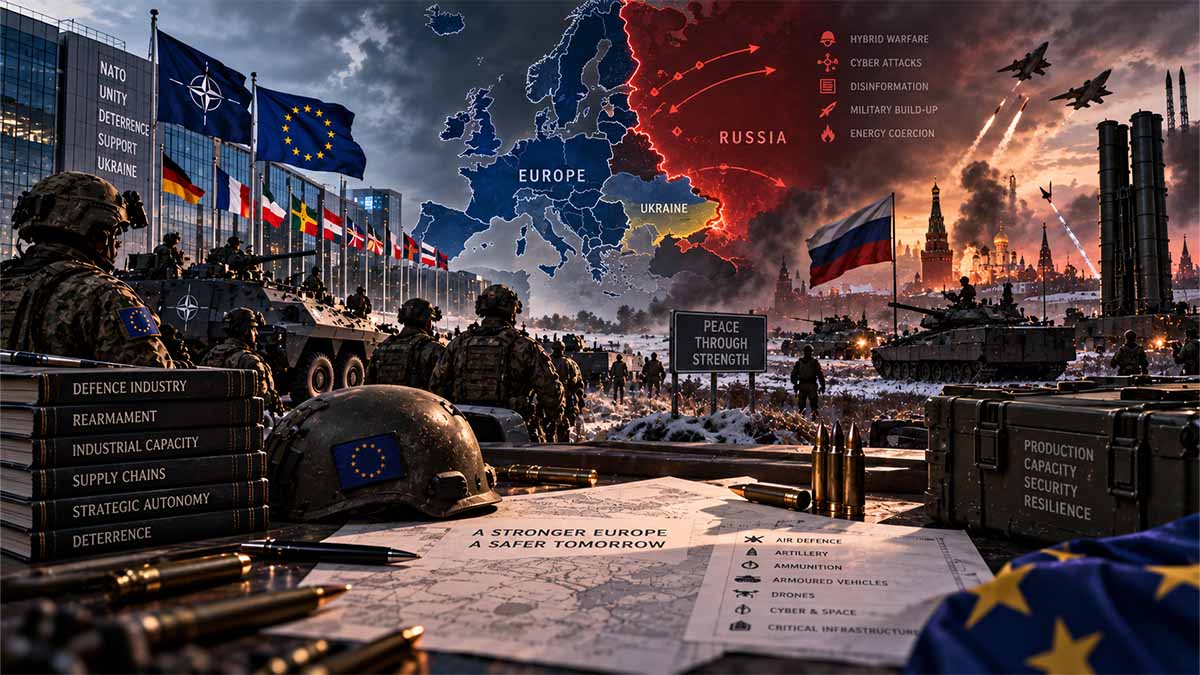
Scope: This dossier assesses whether direct conflict between Russia and European NATO members represents a credible security threat or primarily a commercially driven narrative, distinguishing current confrontation, military contingency planning and industrial incentives, with separate European Union, Italian, French, German and British perspectives and an outlook to October 2031.
Executive Summary / BLUF
The evidence supports a real security risk accompanied by a substantial commercial expansion, rather than either inevitable European war or a threat manufactured solely to sell weapons.
War is already occurring in Europe through Russia’s invasion of Ukraine; direct Russia–NATO war is a separate outcome that the reviewed public record does not establish as imminent.
Denmark’s intelligence assessment of 24 September 2026 identifies a low but growing risk of limited Russian attacks, while considering an actual invasion unlikely. fe-ddis.dk
On 30 September, NATO Secretary General Mark Rutte stated that there was no imminent threat to NATO territory and described the alliance as defensive. NATO Transcript
The supplied Lavrov report establishes neither an authenticated NATO decision to attack Russia nor the contents of a purported operational plan.
Commercial gains are documented: Rheinmetall reported first-half 2026 sales of €5.227 billion and an operating result of €786 million. Rheinmetall
The policy test is whether expenditure delivers usable defensive capability under accountable procurement, while preserving mechanisms that prevent a limited incident from becoming a wider war.
Europe’s Rearmament Must Buy Readiness, Not Just Revenue
Europe’s rearmament is creating financial commitments faster than it is producing evidence of usable collective defence. The contradiction matters because the Danish Defence Intelligence Service’s assessment of 24 September 2026 distinguishes a low but growing risk of limited military attacks from the conditional development of capabilities for a larger war, while the European Commission’s Readiness Roadmap 2030 schedules major improvements several years ahead. Governments must protect themselves during that interval without treating every industrial expansion as a security achievement. The governing test is whether expenditure reduces a specific vulnerability within a relevant timeframe. Otherwise, taxpayers finance commitments that constrain future budgets, manufacturers record orders before forces receive usable equipment, and diplomatic choices become tied to a procurement cycle whose commercial momentum can outlast its strategic justification.
The warning clock is conditional; public commitments are binding
The Danish Defence Intelligence Service’s September 2026 assessment retains approximate intervals of six months for a local war, two years for a regional war in the Baltic Sea region and five years for a large-scale European war. Those estimates depend on the Ukraine conflict ending or freezing, Russian conventional capabilities growing faster than Western capabilities, and Russia judging that the United States cannot or will not support European NATO countries. They describe conditional capability development, not an attack decision or a countdown beginning on publication day.
The same DDIS assessment separates those timelines from the possibility of limited attacks while the Ukraine war continues. That distinction changes the investment question: a government preparing only for a large conventional campaign could leave transport, energy networks or defence production exposed to disruption much sooner. Procurement must therefore serve different timescales without allowing the largest scenario to absorb resources needed for immediate protection.
The Commission’s Readiness Roadmap 2030 creates a second clock: initial capacity for the European Drone Defence Initiative by the end of 2026, full functionality by the end of 2027, and a functional Eastern Flank Watch by the end of 2028. These are proposed milestones, not certificates of completed protection. The interval between a threat assessment and a delivery target is where governments must demonstrate what works now, what remains vulnerable and which temporary arrangements can close the gap.
The numbers reveal a race between expenditure and absorption
France’s enacted August 2026 military programming revision sets expenditure at €57.1 billion in 2026 and €75.7 billion in 2030, excluding pensions, within a €435.7 billion envelope for 2024–2030. Germany’s 2026 provision combines €82.7 billion for the defence ministry with €25.5 billion from the special fund; its 2027 draft provides €109.7 billion and a further €30 billion respectively. The amounts establish financial scale, but they cannot establish how quickly trained personnel, maintenance capacity and operationally accepted equipment expand alongside expenditure.
The fiscal starting positions differ sharply. Eurostat’s first-quarter 2026 gross public debt ratios were 138.9% of GDP for Italy, 117.6% for France and 64.4% for Germany. These figures do not determine whether a particular defence investment is justified. They determine how costly repeated implementation failures can become: expenditure that delivers late still consumes borrowing capacity and competes with other public functions.
Industrial accounts expose another timing difference. In the first half of 2026, Rheinmetall reported €5.227 billion in sales and €786 million in operating profit, while operating free cash flow from continuing operations was negative €1.616 billion. Profitability can coexist with substantial cash absorption during expansion. The policy implication is that governments must distinguish industrial growth from delivered security, and examine whether public payments finance demonstrable progress or merely move financing pressure from suppliers to the state.
A contract can mature after the danger it is meant to address
Italy’s September 2026 DDX contract illustrates why the delivery calendar belongs at the centre of strategic assessment. Its €3.7 billion value includes €1.3 billion in options, while the two ships are scheduled for delivery in 2033 and 2035. They may serve a defensible long-term naval requirement, but neither delivery falls within the report’s outlook to October 2031. Their value cannot be counted as protection already available during that horizon.
The DDX example does not argue against long-lived platforms. It requires governments to explain the bridge between the capability they possess and the capability they are purchasing. A programme delivering in 2033 needs an explicit account of the crews, maintenance, existing equipment and supporting infrastructure that will sustain the relevant mission before delivery. Otherwise, the programme’s industrial visibility can conceal an operational interval that remains unresolved.
The Rheinmetall Unterlüss expansion shows the same transmission problem at a shorter timescale. The dossier records a €500 million investment, planned production of 140,000 artillery rounds in 2026 and 350,000 in 2027, alongside initial deliveries in the low five figures in July 2026. Factory investment, production targets and deliveries are separate measures. Only the last can begin to close an immediate equipment shortage, and delivery itself still requires acceptance, allocation and supporting arrangements.
The Commission’s Readiness Roadmap 2030 should therefore be read as a sequence of operational obligations. Its end-2028 objective for projects, contracts and financing to address priority shortfalls precedes its end-2030 target for receipt of SAFE-funded procurements. Governments must preserve that distinction in public reporting: a financed solution can remain an unresolved vulnerability until the equipment arrives and performs.
Fiscal flexibility cannot repair implementation failure
The national escape clause covering 2025–2028 allows flexibility of up to 1.5% of GDP for qualifying defence expenditure under the framework described in the dossier. That provision changes the fiscal treatment of expenditure; it does not improve the quality of requirements or accelerate a delayed production line. Treating flexibility as an expenditure target would turn a security exception into pressure to commit funds before implementation capacity is established.
Security Action for Europe, or SAFE, similarly changes access to financing without removing the need to repay loans. Italy’s €14.9 billion request received approval in February 2026. Approval establishes access under the instrument, rather than evidence of completed procurement or operational readiness. For a country whose first-quarter 2026 gross debt ratio stood at 138.9% of GDP, the distinction between available finance and effective protection has direct consequences for future budgets.
SAFE’s ceiling of 35% for components originating outside the eligible area is calculated on component costs, not simply on the headline contract value. That rule requires examination of the supply chain beneath the final platform. A procurement can satisfy an industrial objective yet remain dependent on a vulnerable input, while rapid access to an existing system can involve a different dependency. The relevant judgment must consider both the rule and the operational consequences of the chosen supplier structure.
The Commission’s end-2027 milestone of at least 40% joint procurement poses a related accounting challenge. Shared purchasing can reduce fragmentation only where requirements, interfaces and support arrangements are compatible. A favourable percentage would reveal little if the denominator were unclear or if formally joint contracts produced systems that participating forces could not sustain together.
Europe’s national contributions must work as one system
Germany’s Operationsplan Deutschland describes a contingency requirement to move up to 800,000 allied personnel and 200,000 vehicles through the country within six months. Those figures express the scale of the planning task, not verified available throughput. They nevertheless identify a decisive collective constraint: forces purchased elsewhere in Europe depend on German transport, fuel, accommodation, repair and medical arrangements to reach their destination in usable condition.
Italy’s defence directive for 2026–2028 places the wider Mediterranean among its priorities and identifies ports, airports, logistics nodes, pipelines and submarine cables as protection concerns. France’s National Strategic Review 2025 calls for preparation for possible major high-intensity engagement near Europe during 2027–2030, accompanied by domestic hybrid disruption. These documents point to distinct national exposures. Collective planning must reconcile them without assuming that the same scarce assets can fulfil several commitments simultaneously.
France’s July 2026 resilience decisions—securing vital supplies, preparing a major electricity blackout exercise and simplifying reserve participation—provide a concrete test of that reconciliation. Domestic continuity supports military endurance, but an announced exercise is still a future evaluation. Its strategic value will come from the failures it identifies and the corrective work completed afterwards.
The British government’s parliamentary answer of 15 September 2026 states that its NATO Interoperability Roadmap was completed in January and implementation began thereafter. The roadmap remains unpublished because it contains sensitive planning information. That leaves room for protected scrutiny of exercise results and aggregate performance: secrecy can protect operational detail without preventing oversight from asking whether interoperability improved.
The UK–Norway Lunna House Agreement, published in August 2026, further demonstrates why external cooperation must be judged through implementation. It identifies northern maritime and wider defence cooperation but expressly creates no legally binding rights or obligations. Political alignment needs supporting arrangements and resources before it becomes an operational contribution. The European Council’s June 2026 call to accelerate capability coalitions reinforces the same point: cooperation is a means of producing capability, not evidence that capability already exists.
The next two years will expose who bears the gap
Between October 2026 and October 2028, the Commission’s roadmap places several ambitions under review: initial and then full Drone Defence Initiative capacity, the joint-procurement milestone, and a functional Eastern Flank Watch. Governments should face scrutiny over whether these deadlines produce accepted capabilities, tested coverage and sustainable support. Counting contracts against milestones would obscure the interval during which populations and essential services remain exposed.
Germany’s Operationsplan Deutschland makes transport operators, civilian authorities and support providers part of the reinforcement system. If the required alternatives are not tested, those actors would confront emergency demands precisely when their normal services are under pressure. Italy’s 2026–2028 directive and France’s July 2026 resilience agenda identify a parallel domestic burden: infrastructure operators and public services would have to absorb disruption that military procurement alone cannot prevent.
SAFE financing and the 2025–2028 fiscal flexibility framework make the taxpayer’s exposure more durable than the immediate political announcement. If delivery fails, governments retain financial commitments while seeking replacement protection. Households would bear the consequences through pressure on other spending or taxation; armed forces would operate through the capability gap; and civilian operators would be expected to compensate for insufficient preparation.
The DDIS assessment of 24 September 2026 supports serious preparation without establishing inevitable war. The Commission’s Readiness Roadmap 2030 supplies dates against which that preparation can be examined. Over the next 12–24 months, the decisive choice is whether governments publish and correct the gap between commitment and performance. If they do not, industrial revenue can advance while protection remains incomplete—and the cost of that divergence will fall on the public institutions, service operators and taxpayers expected to sustain a crisis.
Navigational Index
Pillar I — The Threat, the Narrative and the Authority to Fight
- Chapter 1 — What “Europe versus Russia” Actually Means
- Chapter 2 — Lavrov, NATO Planning and the Evidence of Intent
- Chapter 3 — Collective Defence, National Authority and Escalation
Pillar II — Rearmament, Industrial Profits and Public Exposure
- Chapter 4 — From Security Commitments to Contracts and Deliveries
- Chapter 5 — Defence Companies, Commercial Incentives and Procurement Accountability
- Chapter 6 — Financing, Infrastructure and the Economic Costs of Confrontation
Pillar III — National Choices and the Five-Year Outlook
- Chapter 7 — Italy, France, Germany, the United Kingdom and EU Coordination
- Chapter 8 — Conflict Pathways, Warning Indicators and the Outlook to 2031
- Chapter 9 — Courses of Action and Final Net Assessment
Master Abstract
A credible threat does not establish an inevitable war
The central question requires separating three propositions: whether armed conflict already exists in Europe, whether Russia and NATO could enter direct hostilities, and whether governments or companies benefit from presenting that prospect as urgent. These propositions can coexist without proving one another. The British Strategic Defence Review identifies Russia’s full-scale invasion of Ukraine in 2022 as a strategic inflection point and argues for preparation to deter a wider conflict. It constitutes evidence of the government’s threat assessment and policy response; it does not establish that another war has been scheduled. The Strategic Defence Review 2025 — UK Government — Jun 2025. GOV.UK
The strategic judgment is therefore conditional: direct conflict is a credible contingency demanding preparation, but its occurrence depends on political decisions, military opportunities, alliance responses and escalation control. Describing it as inevitable would erase those mechanisms. Describing it as purely commercial would require evidence that the underlying danger was knowingly fabricated, rather than evidence that suppliers profit from the response.
“Europe” also requires precision. The EU, European NATO members, individual governments and Ukraine have different powers and obligations. An attack on a NATO member raises a collective-defence question; support for Ukraine and EU industrial financing involve different decisions. Treating these institutions as a single actor obscures who can authorise force and who bears the consequences.
Lavrov’s statement leaves the decisive proposition unproven
The supplied article contains a consequential distinction within its own wording: its framing concerns NATO war plans “against Russia”, while the question reportedly put to Lavrov concerns planning in the event of a Russian attack. Planning how to respond to an attack is not documentary proof of an intention to initiate one.
The specific 6 October remarks could not be corroborated against an accessible Russian Foreign Ministry transcript in this research session. They therefore remain attributed reporting supplied by the user. No authenticated operational document accompanying that report establishes NATO approval of an offensive war.
An opened NATO transcript provides a more specific public baseline. On 30 September 2026, Rutte acknowledged an exchange with Russia but declined to disclose the Russian letter’s precise contents. He reiterated NATO’s defensive position and said there was no imminent threat to alliance territory. These are attributable institutional statements, not independent proof of every military intention. Remarks by NATO Secretary General at Euronews Defence & Space Summit — NATO — Sep 2026. NATO Transcript
The defensible conclusion is narrower than either side’s rhetoric: publicly acknowledged defence planning exists, while a NATO political decision to launch war against Russia is not established by the reviewed record. Classified planning cannot be reconstructed from a headline.
The immediate danger concerns limited attacks and escalation
Denmark’s Defence Intelligence Service offers a materially different assessment from claims of a predetermined continental invasion. Its 24 September document warns of a low but growing risk of limited Russian military attacks against neighbouring NATO countries, potentially even while the Ukraine war continues. It identifies possible attacks on infrastructure supporting Ukraine and limited troop deployments, while judging an actual invasion unlikely. Vurdering af truslen fra Rusland — Danish Defence Intelligence Service — Sep 2026, pp. 2–3. fe-ddis.dk
The analytical implication is that the dangerous transition may begin with a bounded action intended to divide allies, followed by disagreement over attribution, proportionality and response. A limited initiating action can produce consequences exceeding its original purpose if governments interpret subsequent moves as preparations for a larger attack.
The Washington Treaty provides a collective-defence obligation, but Article 5 leaves each ally to take the action it deems necessary, including armed force. Article 11 requires implementation through national constitutional processes. Neither provision makes every incident an automatic declaration of general war. The North Atlantic Treaty — NATO — Apr 1949, Articles 5 and 11. NATO Official text
This discretion supports calibrated responses, although disagreement can also weaken deterrence if an adversary expects collective action to fail.
The defence business is measurable; the claim of manufactured war is not
Rheinmetall’s first-half 2026 disclosure reports sales growth of 39%, operating-result growth of 74% and a 15.0% operating margin. Its €80.5 billion “Rheinmetall Backlog” includes expected call-offs from framework agreements, making it broader than firm outstanding orders alone. Financial report for first half of 2026 – Strong sales growth and record profitability — Rheinmetall — Aug 2026. Rheinmetall
These results demonstrate substantial commercial gains. They do not demonstrate that the company created the security threat or caused governments to seek war. Establishing that stronger allegation would require evidence connecting commercial intervention to distorted intelligence, procurement decisions or escalation policy.
Nevertheless, a real threat does not validate every purchase. Governments should assess expenditure against delivery schedules, sustainment costs, interoperability and operational availability. A programme can be justified in principle yet poorly priced, late or unsuitable for the contingency invoked to support it.
The commercial incentive also need not favour actual war. Sustained peacetime procurement can generate long-term revenues, whereas direct conflict can threaten factories, transport, labour and financing. The analytically supportable concern is whether threat messaging and concentrated industrial interests weaken scrutiny—not an unsupported assumption that every beneficiary wants hostilities.
Public financing is a commitment, not completed military capability
The Hague declaration commits allies to defence and security-related expenditure of 5% of GDP annually by 2035, comprising at least 3.5% for core defence and up to 1.5% for broader security-related purposes, with a review in 2029. It records a political spending commitment, not current expenditure or deployed capability. The Hague Summit Declaration — NATO — Jun 2025. NATO Official text
SAFE similarly authorises up to €150 billion in repayable EU loans. The wider ReArm Europe/Readiness 2030 proposal seeks to leverage over €800 billion through several mechanisms; that figure is not a single appropriated EU arms budget. SAFE: Council adopts €150 billion boost for joint procurement on European security and defence — Council of the European Union — May 2025. Consilium
The assessment must therefore follow the chain from financing authority to contract, delivery, training and usable capability. Increasing the first element does not establish completion of the others.
National and European Implications
Italy — Constitutional authority and industrial benefit require separate assessment
Article 11 of Italy’s Constitution repudiates war as an instrument of aggression against the freedom of other peoples and as a means of settling international disputes; it also permits, on equal terms with other States, limitations of sovereignty necessary for an international order ensuring peace and justice among nations, and promotes international organisations pursuing those purposes. Article 78 assigns to the Houses of Parliament the decision on a state of war and the granting of the necessary powers to the Government. Article 87 provides that the President commands the Armed Forces, presides over the Supreme Council of Defence and declares the state of war decided by the Houses. Read together, these provisions establish substantive constitutional limits and institutional responsibilities, rather than an absolute prohibition on lawful collective self-defence. Any military action must comply with those limits and applicable international law, including the conditions governing self-defence under Article 51 of the UN Charter; anticipated industrial benefits provide no independent legal justification. www.quirinale.it
- The Constitution of the Republic of Italy — Articles 11, 78 and 87. Chamber of Deputies, English edition incorporating amendments through 22 October 2023; hosted by the Presidency of the Republic.
- Charter of the United Nations — Article 51. Recognition of individual and collective self-defence in the event of an armed attack, subject to the conditions specified in the Charter.
- The North Atlantic Treaty — Articles 1, 5 and 11. Peaceful settlement of disputes, collective defence under Article 51 of the UN Charter, and implementation in accordance with national constitutional processes.
Industrial exposure is concrete: Leonardo reported €16.259 billion in new orders and €58.581 billion in backlog for the first half of 2026. The backlog includes the effect of consolidating Iveco Defence Vehicles, so its reported growth cannot be attributed entirely to new demand. Leonardo: Board of Directors Approves H1 2026 Results — Leonardo — Jul 2026, pp. 2–3. emarketstorage.it
Italy’s policy task is to test industrial programmes against defensive requirements and financing capacity, while keeping decisions on military employment under the appropriate constitutional authority.
France — Announced ambition must be tested against delivery
In July 2025, President Emmanuel Macron announced a €64 billion defence-budget objective for 2027 and explicitly linked military independence with financial independence and increased industrial production. This is an announced objective, not evidence of completed 2027 expenditure. Discours aux armées depuis l’Hôtel de Brienne — Presidency of France — Jul 2025. Élysée
The French assessment should examine whether the funding trajectory delivers the capabilities invoked to justify it. Industrial sovereignty can support resilience, but national industrial preference still requires scrutiny of cost, compatibility and time to operational effect.
Germany — Greater fiscal freedom increases the need for outcome scrutiny
Germany’s Finance Ministry explains that specified defence and security expenditure above 1% of nominal GDP can fall outside the borrowing restriction following constitutional changes. Its February 2026 report budgets €100.9 billion for that defined category; this is not identical to a NATO expenditure total. Sollbericht 2026: Bundeshaushalt, KTF und SVIK — Federal Ministry of Finance — Feb 2026. Sollbericht 2026: Bundeshaushalt, KTF und SVIK
The German challenge is to convert expanded fiscal authority into timely capability. Larger appropriations can finance necessary investment, but their security value depends on procurement execution, personnel and sustainment rather than the borrowing exemption itself.
United Kingdom — Readiness and economic policy are explicitly connected
The British defence review calls for warfighting readiness, stronger homeland resilience and industrial reform, while presenting defence investment as a source of employment and prosperity. Its financial framework distinguishes a 2.5% GDP commitment for 2027 from a conditional ambition to reach 3% in the following Parliament. The Strategic Defence Review 2025 — UK Government — Jun 2025. GOV.UK
That explicit connection makes the commercial dimension legitimate to examine. The operational test remains whether procurement and organisational changes produce readiness; promised employment is not a substitute for military effectiveness.
European Union — Coordination can reduce fragmentation but does not remove fiscal liability
SAFE generally promotes procurement involving at least two participating countries and provides loans repayable by beneficiary states. Its structure seeks economies of scale and interoperability. SAFE: Council adopts €150 billion boost for joint procurement on European security and defence — Council of the European Union — May 2025. Consilium
Joint procurement can improve efficiency when countries agree on requirements. Where national industrial preferences dominate, common financing can instead preserve incompatible programmes. The relevant measure is the capability delivered per unit of public expenditure.
Key Evidence Table
Financial figures are reported nominal euros. Corporate measures, national budget categories and NATO GDP targets are not directly interchangeable.
| Indicator | Value/status | Reference date | Definition/scope | Issuer | Exact source |
|---|---|---|---|---|---|
| Limited Russian attack risk | Low but growing | 24 Sep 2026 | Intelligence assessment; distinct from invasion | Danish Defence Intelligence Service | Vurdering af truslen fra Rusland, pp. 2–3 |
| Imminent threat to NATO territory | Rutte stated none | 30 Sep 2026 | Attributed alliance assessment | NATO | Euronews Defence & Space Summit remarks |
| NATO expenditure commitment | 5% of GDP by 2035 | 25 Jun 2025 | At least 3.5% core defence; up to 1.5% broader purposes | NATO | The Hague Summit Declaration |
| SAFE financing | Up to €150bn | Adopted 27 May 2025 | Repayable loans; not grants or completed spending | Council of the EU | SAFE adoption announcement |
| Rheinmetall sales / operating result | €5.227bn / €786m | H1 2026 | Group financial measures | Rheinmetall | H1 2026 financial disclosure |
| Rheinmetall Backlog | €80.5bn | 30 Jun 2026 | Includes expected framework call-offs | Rheinmetall | H1 2026 financial disclosure |
| Leonardo orders / backlog | €16.259bn / €58.581bn | H1 / 30 Jun 2026 | Backlog affected by IDV consolidation | Leonardo | H1 2026 results, pp. 2–3 |
Competing Explanations
These explanations can overlap; their standing concerns the evidence reviewed, not numerical probabilities.
| Hypothesis | Diagnostic support | Disconfirming evidence or limitation | Indicators | Current standing |
|---|---|---|---|---|
| Rearmament primarily responds to a real security threat | Official threat assessments and preparation for collective defence | Institutional assessments do not establish inevitability or validate every programme | Verified hostile actions, force posture and demonstrable capability gaps | Best-supported explanation |
| A real threat is amplified to advance commercial and political interests | Strong corporate growth; governments explicitly connect defence and economic policy | Benefit does not establish deliberate threat distortion | Lobbying disclosures, unsupported procurement rationales, audit findings | Plausible supplementary explanation; deliberate manipulation unproven |
| The threat is principally fabricated to sell weapons | Commercial beneficiaries exist | No reviewed evidence establishes fabrication; official assessments distinguish different conflict risks | Documentary proof of knowingly false assessments or fabricated incidents | Weakly supported |
| NATO has decided to initiate war against Russia | Allegation in the supplied report’s framing | No authenticated decision or operational record; NATO publicly states a defensive position | Authorised offensive decision, corroborated deployment orders and preparations | Not established |
Principal Gaps and Watch Indicators
| Consequential gap | Record or observation needed | Effect on assessment |
|---|---|---|
| Exact Lavrov remarks | Russian Foreign Ministry transcript or complete official recording of the 6 Oct press conference | Establishes wording and context; does not itself prove NATO intent |
| Purported NATO plan | Authenticated document, date, approval authority and initiating conditions | Distinguishes a contingency from an authorised operation |
| Near-term attack preparation | Corroborated force concentrations, logistics and deployment orders | Would strengthen the case for imminent conventional risk |
| Attribution of serious incidents | Competent investigative findings and disclosed supporting evidence | Helps distinguish deliberate attack, accident and deception |
| Procurement effectiveness | Contract awards, deliveries, acceptance records and audit findings | Tests whether expenditure closes the stated capability gaps |
| Commercial distortion of policy | Lobbying records, conflicts of interest and documented decision influence | Could strengthen the case that interests are shaping threat presentation |
The strongest warning of wider war would be a combination of operational preparation and political commitment to employ force. Expenditure growth alone cannot establish that combination. Conversely, delayed deliveries, incompatible purchases or adverse audit findings would weaken claims about the effectiveness of rearmament without proving that the security threat itself is fictitious.
Open-source analytical assessment · 06 October 2026 · Outlook to October 2031
Europe–Russia
Real war risk. Expanding defence business.
A decision framework linking security assessments, military authority, industrial gains and public accountability.
NATO target by 2035
At least 3.5% core defence; up to 1.5% broader defence and security-related purposes. Review in 2029.
A spending commitment, not current expenditure or fielded capability. Source 1
SAFE loan capacity
Up to €150 billion in repayable EU loans for participating member states.
Not a grant fund or proof of completed spending. Source 2
Rheinmetall operating result
First half of 2026; reported sales €5.227 billion; operating margin 15.0%.
Commercial gains do not establish causation of war. Source 3
Pillar I · Threat, narrative and authority
Three propositions require different evidence
A real security confrontation
Official assessmentDenmark’s intelligence service assessed a low but growing risk of limited Russian attacks, while judging an actual invasion unlikely.
24 September 2026. This is an intelligence assessment, not a numerical forecast. Source 4
Planning for collective defence
Institutional positionRutte stated that there was no imminent threat to NATO territory and reiterated the alliance’s defensive position.
30 September 2026. Preparedness does not establish a decision to initiate war. Source 5
A decision to attack Russia
Not establishedThe reviewed record contains no authenticated NATO political decision or operational document establishing an approved offensive war.
The supplied Lavrov report remains attributed reporting; an accessible official transcript was not corroborated in the preceding assessment.
Why Denmark’s warning and NATO’s reassurance can coexist
The statements address different outcomes. A limited attack, sabotage or an incident with disputed attribution does not require the same preparations as a full-scale invasion. The danger is that an initially bounded action produces a wider confrontation through retaliation, misinterpretation or failed alliance coordination.
Analytical mechanism, not an assertion that this pathway will occur. Sources: 4, 5.
Collective defence and national authority
Article 5 of the North Atlantic Treaty requires assistance following an armed attack, with each ally taking the action it deems necessary, including armed force. Article 11 requires implementation through national constitutional processes.
Neither provision makes every incident an automatic declaration of general war. Attribution, the applicable legal threshold and the selected response remain consequential.
Pillar II · Rearmament and public exposure
The business is measurable; intent needs separate proof
Leonardo: growth with and without IDV
H1 2026 versus H1 2025 · percentage change · linear scale, 0–50%. Decorative depth does not encode an additional variable.
The like-for-like comparison excludes the IDV contribution. This reveals how acquisition scope affects reported growth; it is not a measure of war risk.
The route from money to usable capability
Nonquantitative dependency scheme · each stage requires separate evidence.
Financing and budget approval
A commitment or loan ceiling establishes permitted funding; it does not establish expenditure.
Contracts, production and deliveries
Orders and framework ceilings must be distinguished from accepted equipment and completed deliveries.
Training, sustainment and availability
Delivered equipment becomes useful through personnel, maintenance, integration and operational availability.
Analytical audit framework. No readiness score or completion percentage is assigned.
Exact chart data and financial definitions
| Metric | Reported | Like-for-like |
|---|---|---|
| New orders | 44.6% | 38.8% |
| Revenues | 12.2% | 8.2% |
| EBITA | 34.3% | 25.8% |
EBITA is the company’s reported operating-performance measure; it is not net income and is not assumed identical to Rheinmetall’s operating-result definition. No cross-company profitability ranking is presented. Source 7
Policy dates are milestones, not a countdown to war
Assessment baseline
24 September: Danish threat assessment.
30 September: Rutte’s public remarks.
6 October: dossier cut-off.
NATO review
Review of the expenditure trajectory and balance in light of the strategic environment and capability targets.
Spending target
Hague commitment: 5% of GDP annually for the defined defence and security-related categories.
Schematic spacing: these cards do not encode proportional time intervals. The dossier forecast horizon ends in October 2031; the 2035 policy target lies beyond it.
Pillar III · National choices and coordination
Europe is not a single decision-maker
Authority and industrial exposure
Constitutional Articles 11, 78 and 87 frame aggression, parliamentary war powers and the President’s functions. Leonardo’s H1 2026 backlog was €58.581bn, including IDV consolidation.
Decision test: distinguish constitutional authority, defensive requirements and industrial benefits.
Announced ambition and financing
Macron announced a €64bn defence-budget objective for 2027 in July 2025. This is an announced objective, not completed expenditure.
Decision test: check enacted appropriations, deliveries, compatibility and affordability against the stated ambition.
Fiscal authority and execution
The February 2026 Finance Ministry report budgets €100.9bn for its defined defence and security category. That category is not identical to NATO expenditure.
Decision test: assess whether greater borrowing flexibility produces timely operational outcomes.
Readiness and the defence dividend
The 2025 defence review links readiness, resilience, industrial reform and economic benefits. Its framework distinguishes the 2.5% GDP commitment for 2027 from a conditional 3% ambition.
Decision test: separate promised employment and procurement inputs from demonstrated military effectiveness.
Common financing does not remove national liability
SAFE generally promotes procurement involving at least two participating countries and provides repayable loans. Coordination can improve scale and interoperability when participating states agree on requirements.
Decision test: capability delivered per unit of public expenditure, rather than financing volume alone. Source 2
Auditable evidence table
Nominal euros unless stated otherwise. Policy commitments, loan ceilings, corporate measures and national budget categories are not additive or directly interchangeable.
| Indicator | Value / status | Date, scope and limitation | Issuer / source |
|---|---|---|---|
| Limited attack risk | Low but growing | 24 Sep 2026; attributed intelligence assessment, distinct from invasion. | Danish Defence Intelligence Service · Source 4, pp. 2–3 |
| Imminent threat | Rutte stated none | 30 Sep 2026; public NATO assessment of threat to alliance territory. | NATO · Source 5 |
| NATO commitment | 5% of GDP by 2035 | 25 Jun 2025; at least 3.5% core defence and up to 1.5% broader purposes. | NATO · Source 1 |
| SAFE | Up to €150bn | Adopted 27 May 2025; repayable loans, not grants or completed outlays. | Council of the EU · Source 2 |
| Rheinmetall sales | €5.227bn | H1 2026; company-reported group sales. | Rheinmetall · Source 3 |
| Rheinmetall operating result | €786m | H1 2026; operating margin 15.0%; not net income. | Rheinmetall · Source 3 |
| Rheinmetall Backlog | €80.5bn | 30 Jun 2026; includes expected framework-agreement call-offs. | Rheinmetall · Source 3 |
| Leonardo new orders | €16.259bn | H1 2026; reported growth 44.6%, like-for-like growth 38.8%. | Leonardo · Source 7, pp. 2–3 |
| Leonardo backlog | €58.581bn | 30 Jun 2026; reported growth affected by IDV consolidation. | Leonardo · Source 7, pp. 2–3 |
Competing explanations: evidence, not scores
A real threat drives preparedness
Official assessments support a security rationale. That rationale does not validate every programme or establish inevitable war.
Interests can amplify a real threat
Commercial growth and economic-policy objectives are documented. Deliberate manipulation requires separate documentary evidence.
The threat is principally fabricated
Beneficiaries exist, but the reviewed record does not establish fabrication of the underlying threat.
NATO has decided to initiate war
No authenticated decision or approved offensive operation was established in the preceding assessment.
Analytical judgments. These explanations can overlap; the labels are not calibrated probability bands.
What would change the assessment?
Preparation plus intent
- Corroborated force concentrations.
- Logistics and deployment orders.
- Political commitment to employ force.
Would strengthen an assessment of imminent conventional risk.
Attribution and response
- Competent findings on serious incidents.
- Evidence of deliberate attacks.
- Failure of response coordination.
Would clarify whether a bounded event is developing into wider confrontation.
Policy distortion or poor delivery
- Documented conflicts of interest.
- Unsupported procurement rationales.
- Audit findings and delivery failures.
Could weaken the case for particular programmes without disproving the underlying security risk.
Official and first-party source record
- The Hague Summit Declaration — NATO — Jun 2025
- SAFE: Council adopts €150 billion boost for joint procurement on European security and defence — Council of the European Union — May 2025
- Financial report for first half of 2026 – Strong sales growth and record profitability — Rheinmetall — Aug 2026
- Vurdering af truslen fra Rusland — Danish Defence Intelligence Service — Sep 2026, pp. 2–3.
- Remarks by NATO Secretary General at Euronews Defence & Space Summit — NATO — Sep 2026
- The North Atlantic Treaty — NATO — Apr 1949, Articles 5 and 11.
- Leonardo: Board of Directors Approves H1 2026 Results — Leonardo — Jul 2026, pp. 2–3; first-party disclosure hosted by eMarket STORAGE.
- The Constitution of the Republic of Italy — Presidency of the Republic — undated consolidated English text, Articles 11, 78 and 87.
- Discours aux armées depuis l’Hôtel de Brienne — Presidency of France — Jul 2025
- Sollbericht 2026: Bundeshaushalt, KTF und SVIK — Federal Ministry of Finance — Feb 2026
- The Strategic Defence Review 2025 — UK Government — Jun 2025
Pillar I — The Threat, the Narrative and the Authority to Fight
Evidence cut-off: 6 October 2026. Assessment horizon: October 2031.
Chapter 1 — What “Europe versus Russia” Actually Means
Judgment: “Europe versus Russia” describes several different relationships: an existing war involving Ukraine, European support for Ukraine, preparations to defend NATO territory, and the possibility of direct fighting between Russia and individual European states. Combining these relationships into one expression obscures who would fight, under whose authority, and for what objective.
The first analytical task is therefore to identify the actors and the threshold being discussed. A confrontation over sanctions is not equivalent to an exchange of fire. A weapons supplier is not automatically a participant in hostilities. A national deployment is not necessarily a NATO operation. An attack on an EU state does not always engage the same treaty obligations as an attack on a NATO member.
1.1 Europe is a geographical space with overlapping security institutions
NATO and the European Union have substantially overlapping memberships, but different purposes, instruments and decision procedures.
| Membership relationship | Number of states | States outside the overlap | Consequence for this assessment |
|---|---|---|---|
| NATO membership | 32 | Includes nine states outside the EU | NATO collective defence extends beyond the EU |
| EU membership | 27 | Includes four states outside NATO | EU membership alone does not confer NATO Article 5 protection |
| Members of both organisations | 23 | Calculated from the official membership lists | Most EU states operate within both frameworks |
| NATO members outside the EU | 9 | Albania, Canada, Iceland, Montenegro, North Macedonia, Norway, Türkiye, United Kingdom, United States | A NATO–Russia confrontation would have a transatlantic dimension |
| EU members outside NATO | 4 | Austria, Cyprus, Ireland, Malta | Their assistance arrangements require a separate assessment |
Sources: NATO — Member countries and European Union — Country profiles. The overlap figures are calculations from those lists. NATO Topic
This distinction matters operationally. A European coalition could conduct an operation involving only some NATO members. The remaining allies would not become participants merely because the participating countries belonged to NATO. Conversely, a collective defence operation could depend heavily on American and Canadian forces, making “Europe alone” an inaccurate description.
It also matters politically. An EU statement, a NATO decision and a national authorisation are separate acts. Agreement in one institution cannot be assumed to supply every approval required in another.
1.2 The boundary between supporting a war and fighting it
A useful assessment separates political involvement, material support and direct military participation.
| Activity | What it establishes | What it does not establish by itself | Evidence needed for a stronger conclusion |
|---|---|---|---|
| Sanctions and diplomatic pressure | Political and economic confrontation | Direct participation in hostilities | Evidence of attributable military action |
| Financing and equipment transfers | Material support for a belligerent | Automatic status as a party to the conflict | Evidence concerning the supplier’s actual military role |
| Training and maintenance | Support to military capability | A universal conclusion about conflict-party status | Location, function, command relationship and operational involvement |
| Intelligence support | Assistance that may affect military operations | The same legal status in every case | The nature and integration of the support |
| National forces conducting hostile operations against Russian forces | A direct military relationship requiring legal assessment | Participation by every European state | Identification of the forces, state attribution and operation |
| A NATO-led operation | An operation under an alliance framework | Identical contributions or permissions from all allies | The collective decision and national implementation records |
The ICRC states that transferring weapons or equipment alone does not make the supplying state a party to an international armed conflict. Its analysis distinguishes this from a state’s effective involvement in military operations against another belligerent. That distinction concerns conflict-party status; it does not remove separate obligations governing arms transfers.
Source: ICRC — Arms transfers to parties to armed conflict: what the law says, 3 June 2024. ICRC
The practical implication is that “Europe is already at war” needs a defined meaning. It may describe extensive political involvement. It cannot substitute for evidence identifying which states are conducting hostilities.
The reverse mistake is also possible: treating the absence of a formal declaration as proof that no armed conflict exists. The ICRC explains that an international armed conflict is determined by attributable hostile force between states and the circumstances on the ground, without requiring a declaration of war.
Source: ICRC — Frequently Asked Questions: International Armed Conflict, 23 December 2025. International Committee of the Red Cross
1.3 The forward military presence is multinational and geographically distributed
NATO’s public eastern-flank record, updated on 29 September 2026, lists nine multinational battlegroups. Its composition table is dated June 2026.
| Host state | Framework nation |
|---|---|
| Bulgaria | Italy |
| Estonia | United Kingdom |
| Finland | Sweden |
| Hungary | Hungary |
| Latvia | Canada |
| Lithuania | Germany |
| Poland | United States |
| Romania | France |
| Slovakia | Spain |
Source: NATO — Strengthening NATO’s eastern flank, updated 29 September 2026. NATO Topic
NATO states that these formations differ in size and composition. The decision to scale formations to brigade size applies where and when required; the existence of nine battlegroups does not establish nine identical brigades permanently deployed forward. Contributions can also include forces stationed at home that are available for rapid deployment. The formations are integrated into NATO’s command structure.
This creates a particular escalation mechanism. A local attack could affect personnel from several contributing countries, immediately widening the political stakes. The number of flags represented, however, does not reveal the number of troops available at the point of attack or their ability to sustain combat.
Assessment: Multinational presence can strengthen deterrence by making an attack consequential for several governments. Its credibility still depends on reinforcement, survivability, logistics and usable authority. These are different tests from counting contributing states.
1.4 Three military quantities that must remain separate
Public debate often adds together forward forces, readiness commitments and exercise participation. Doing so produces a total with little operational meaning.
| Public measure | Published quantity | What the quantity measures | Main limitation |
|---|---|---|---|
| Eastern-flank battlegroups | 9 | Multinational formations in specified host states | Formation count does not establish uniform strength |
| Vilnius reinforcement planning announcement | 300,000 troops at high readiness | A force-readiness commitment associated with defence planning | It is not a count of troops continuously stationed at Russia’s borders |
| Steadfast Defender 2024 announcement | Approximately 90,000 personnel | Planned participation across an exercise running from January to May 2024 | Participation over several months is not one simultaneous combat deployment |
Sources: NATO — Eastern-flank posture; NATO — Vilnius decisions, 11 July 2023; NATO — Joint press conference, 18 January 2024. NATO Topic
For the five-year outlook, the more useful questions concern conversion:
- How much warning time is needed to move assigned forces?
- Are transport, ammunition and maintenance available?
- Can units operate together under contested communications?
- Are the necessary national deployment permissions already arranged?
- Can the force continue operating after the first deployment?
A nominal readiness commitment becomes militarily meaningful only when those conditions are satisfied. Public numbers provide evidence of ambition and organisational scale, but cannot settle the delivery question.
1.5 Geography determines how a confrontation could develop
The following is an analytical map of exposure, rather than a forecast of attacks.
| Operational setting | Principal vulnerability to examine | Evidence that would sharpen the assessment |
|---|---|---|
| Baltic land and air space | Short decision times and reinforcement demands | Warning arrangements, air defence coverage and tested reinforcement times |
| Northern Europe and the Arctic | Distance, weather and dispersed infrastructure | Cold-weather sustainment, protected transport and surveillance availability |
| Black Sea approaches | Interaction between maritime, air and land operations | Operational restrictions, surveillance and force-protection arrangements |
| European transport corridors | Dependence on bridges, railways, ports and civilian operators | Demonstrated capacity under disruption |
| Communications and energy networks | A disruption can affect civilian services and military operations together | Attribution, redundancy and recovery performance |
NATO identifies civil preparedness as supporting continuity of government, essential services and military operations. Its seven baseline resilience requirements cover government continuity, energy, uncontrolled movement of people, food and water, mass casualties, communications and transport.
Source: NATO — Resilience, civil preparedness and Article 3, updated 18 September 2026. NATO Topic
This broadens the meaning of preparedness. Hospitals, power restoration, telecommunications and transport capacity can materially affect defence without increasing the number of combat platforms. Their value should be assessed through continuity and recovery measures.
Key judgments
- The actors in a possible wider war must be identified individually; “Europe” supplies neither a single command nor a single national authorisation.
- The forward presence makes a local confrontation potentially multinational, while its military effectiveness depends on reinforcement and sustainment.
- Equipment support, readiness commitments and direct hostilities require separate evidence.
What would change the assessment
The strongest changes would be attributable hostile operations between Russian and NATO-state forces, sustained deployment under crisis orders, or documented changes that substantially shorten the time needed to conduct major operations.
Open official record
Public sources do not establish a complete, comparable inventory of deployable forces, ammunition endurance, reinforcement performance and national restrictions across the alliance. Those gaps prevent a defensible numerical probability of a wider war.
Chapter 2 — Lavrov, NATO Planning and the Evidence of Intent
Judgment: The supplied Lavrov report raises a question about how contingency planning is presented. It does not establish that NATO has authorised an attack on Russia. The appropriate test examines the provenance of the statement, the conditions attached to the alleged plan, and whether military preparation is accompanied by evidence of a political decision to initiate force.
2.1 What the supplied report establishes
The article’s framing and its description of the triggering condition point in different directions. A headline about plans “against Russia” can suggest initiation. Planning “in the event of a Russian attack” describes a conditional response.
| Element in the supplied material | Evidence category | What can reasonably be concluded |
|---|---|---|
| Remarks attributed to Lavrov | Reported official statement | The supplied report presents Moscow as alert to NATO planning |
| Reference to reports about NATO plans | Second-order claim | It does not disclose the underlying operational document |
| “In the event of a Russian attack” | Conditional formulation | The reported contingency concerns responding to an attack |
| Alleged assurances from Rutte and Whitaker | Attributed statements within the report | Exact wording requires separate authentication |
| Reference to preventing threats through Russia’s military operation | Russian justification as reported | It does not independently establish the necessity or legality of that operation |
| Reference to Kaliningrad | Warning concerning Russian territory | It does not establish that NATO has selected or authorised an attack |
Provenance: Sputnik — Lavrov on NATO’s reported war plans, 6 October 2026. This link identifies the user-supplied report. Its webpage could not be independently retrieved, and an authenticated Russian Foreign Ministry transcript was not obtained; the quotations remain attributed rather than independently verified.
That limitation should narrow the conclusion. It does not justify declaring the statement false. It also prevents treating the article as independent confirmation of a secret NATO decision.
2.2 What NATO has publicly authorised
The 2023 Vilnius communiqué records approval of a new family of regional defence plans, alongside requirements involving forces, command arrangements, resources and exercises. This is an official acknowledgment of substantive military planning.
Source: NATO — Vilnius Summit Communiqué, 11 July 2023. OTAN Texte officiel
The communiqué does not disclose the complete operational plans. It therefore supports a finding that NATO has organised plans for collective defence; it cannot authenticate a particular alleged target list, initiation order or classified rule of engagement.
An important operational distinction follows. A defensive campaign can include counterattacks and strikes intended to stop an attack. The presence of offensive military tasks within a contingency does not, by itself, establish a political intention to begin an unlawful war. The relevant questions remain the trigger, objective, authority and actual circumstances of force.
2.3 Planning, preparation and intent occupy different evidentiary levels
The following framework is an analytical test. It is not a claim that every war follows the same sequence.
| Evidentiary level | Typical observable material | Strongest supported inference | Remaining uncertainty |
|---|---|---|---|
| Threat description | Speeches and strategy documents | Officials identify an adversary or risk | Whether the description reflects precise intelligence |
| Contingency planning | Approved plans or official acknowledgment | An institution prepares for specified conditions | Whether those conditions will occur |
| Capability preparation | Training, infrastructure and force assignment | The institution improves its ability to act | Whether the capability is intended for initiation or response |
| Crisis preparation | Exceptional deployments, mobilisation and logistics | Authorities prepare for a concrete emergency | The intended operation and trigger |
| Political authorisation | Cabinet, parliamentary or alliance decision | An operation has received specified approval | Conditions, scope and remaining restrictions |
| Execution | Operational orders and attributable action | Force is being employed | Full objectives and subsequent escalation choices |
The strongest assessment comes from mutually reinforcing evidence. A threatening statement, an exceptional deployment and a formal operational decision are more informative together than any one of them alone.
Conversely, routine preparation can be narrated as imminent attack if its conditional character is omitted. A genuine offensive preparation could also be concealed under defensive language. The method must therefore test conduct and authority as well as stated purpose.
2.4 Indicators of initiation require context
| Indicator | Why it deserves attention | Why it is insufficient alone | Corroboration to seek |
|---|---|---|---|
| Large exercise | Demonstrates coordination and some operational capability | Exercises also test reinforcement and readiness | Unscheduled extension, altered mission and crisis logistics |
| Ammunition accumulation | Improves endurance | Can replenish depleted stocks | Distribution to operational units and accompanying orders |
| Forward logistics | Enables sustained operations | Also supports defensive reinforcement | Exceptional fuel, medical, maintenance and transport activity |
| Long-range strike capability | Expands the available target set | Can support deterrence or response | Targeting policy, authorisation and operational employment |
| Mobilisation | Expands available personnel | Can reflect precaution under perceived threat | Scale, destinations and command arrangements |
| Public deadline or ultimatum | Can narrow political room for compromise | Can also be coercive bargaining | Concrete demands and preparations to enforce them |
| Diplomatic evacuation | May indicate expectation of danger | May follow general caution | Alignment with military and governmental emergency measures |
Assessment: The decisive issue is convergence. A single ambiguous observation supports investigation. A sustained combination of unusual military measures, narrowed diplomacy and attributable authorisation can support a much stronger warning.
This approach avoids assigning an arbitrary percentage to war risk. It also makes the assessment revisable: readers can see which observations would move it.
2.5 The security dilemma can operate without an agreed intention to fight
Consider the interaction as a sequence of interpretations:
| Action | Possible interpretation by its initiator | Possible interpretation by the other side | Resulting danger |
|---|---|---|---|
| Additional forward forces | Protection and reassurance | Reduced warning time for an attack | Counter-deployment |
| Expanded exercises | Testing readiness | Rehearsal for initiation | Higher alert and surveillance |
| Longer-range weapons | Credible response capability | Threat to rear areas | Broader target planning |
| Dispersal of forces | Protection against surprise | Preparation for combat | Increased uncertainty |
| Sharper deterrent statements | Warning against aggression | Evidence of hostile intention | Less political room to compromise |
These are possible mechanisms, not verified motives in a particular incident.
Their importance is that a confrontation can become more dangerous even when both governments claim defensive aims. Faster response requirements increase the cost of misinterpretation. Dispersed forces complicate monitoring. Public commitments can make later restraint politically difficult.
The remedy is not to assume all preparations are benign. It is to distinguish observable capability changes from inferred intention, and to preserve communication about exercises, incidents and operational boundaries.
2.6 Who can turn a narrative into an alliance decision?
NATO states that its decisions are made by consensus, without majority voting. The Secretary General facilitates this process; a speech by the Secretary General is not a substitute for the collective decision of member governments.
Source: NATO — Consensus decision-making, updated 30 June 2023. NATO Topic
This creates a necessary documentary distinction:
| Public material | Appropriate evidentiary use |
|---|---|
| Secretary General’s speech | Evidence of the position expressed and political messaging |
| National minister’s statement | Evidence of that government’s expressed position |
| Military commander’s testimony | Evidence of the commander’s assessment or stated requirement |
| Agreed summit communiqué | Evidence of collectively approved commitments |
| National deployment authorisation | Evidence of the permission granted to that state’s forces |
| Authenticated operational order | Evidence of the instructed military action |
Authority determines the weight of the document. A military requirement can influence a decision without itself granting permission to execute an operation.
2.7 Where “war business” enters the narrative
Commercial incentives can affect advocacy, urgency and the choice of proposed solutions. Establishing that influence requires evidence linking actors to decisions.
| Hypothesis | Evidence needed | Conclusion the evidence would support |
|---|---|---|
| A threat has been exaggerated | Contradictions with substantiated threat assessments; distortion of assumptions | Criticism of the public threat presentation |
| A company influenced policy | Disclosed contacts, submissions, lobbying records and decision correspondence | A documented influence pathway |
| A purchase was commercially favoured | Requirement changes, tender conditions and evaluation records | Assessment of procurement fairness |
| A real threat was used to justify a weak purchase | A mismatch between the operational gap and delivered capability | Criticism of the proposed solution |
| Commercial actors caused a decision to initiate war | Evidence connecting those actors to the initiation decision | A much stronger causal finding |
A profitable procurement programme establishes a beneficiary. It does not, by itself, identify the cause of a war decision. Equally, a real threat does not establish that every purchase is justified.
The analytical task is to trace the sequence from threat assessment to requirement, political approval and contract. The financial and procurement records belong to Pillar II; the issue here is whether the narrative supplies a justified premise.
Key judgments
- The supplied report does not authenticate an offensive NATO initiation decision.
- Publicly acknowledged defence planning is substantial, but its existence cannot resolve every question about classified tasks.
- Intent should be assessed through converging political, military and documentary evidence.
- Commercial influence and commercial benefit are separate propositions requiring different records.
What would change the assessment
An authenticated plan containing an initiation directive, a corresponding political authorisation, or a sustained convergence of exceptional military preparations would materially strengthen the case for offensive intent. Verified conditional instructions and crisis communications could clarify the opposite assessment.
Open official record
The exact Lavrov transcript, the reports underlying his answer, complete NATO operational plans and relevant classified instructions remain outside the verified record used here.
Chapter 3 — Collective Defence, National Authority and Escalation
Judgment: A collective defence commitment creates obligations, but it does not supply one uniform procedure for every state to employ force. International legality, alliance coordination, national permission and operational command must be examined separately. At the same time, those processes should not be imagined as a compulsory queue that prevents an attacked state from defending itself.
3.1 The international legal baseline
The UN Charter requires peaceful settlement of disputes and prohibits threats or uses of force inconsistent with Article 2(4). Article 51 preserves individual and collective self-defence if an armed attack occurs, pending necessary Security Council measures, with immediate reporting requirements.
Sources: United Nations — Charter Article 2 and United Nations — Charter Article 51. Codification Division Publications
Three conclusions follow for this report.
First, identifying another state as a threat does not itself demonstrate a legal entitlement to attack it.
Second, alliance approval and international legality are different questions. A domestic or alliance decision cannot, by itself, establish compliance with the Charter.
Third, determining that an armed conflict exists does not determine whether its initiation was lawful. Humanitarian rules govern conduct once applicable, including for a party whose resort to force was unlawful.
Source: ICRC — International Armed Conflict FAQ. International Committee of the Red Cross
3.2 What the NATO treaty does—and what requires further decisions
| Provision | Principal function | Consequence for a Russia-related crisis |
|---|---|---|
| Article 3 | Maintain and develop capacity to resist armed attack | Preparedness precedes any decision to fight |
| Article 4 | Consultation when an ally considers its security, territorial integrity or political independence threatened | Consultation can occur before an armed attack |
| Article 5 | Assistance following a covered armed attack | Each ally takes the action it considers necessary, potentially including armed force |
| Article 6 | Defines the geographical scope of Article 5 | Coverage must be checked against the circumstances |
| Article 11 | Implementation through constitutional processes | National requirements remain relevant |
Source: NATO — North Atlantic Treaty, 4 April 1949. NATO Official text
Article 5 imposes an assistance obligation, while allowing national determination of the action required. Assistance can therefore differ across allies.
NATO’s explanation also states that Article 4 consultations are not a necessary precondition for Article 5 action. The treaty does not prescribe a single triggering procedure; NATO identifies an armed attack and the attacked ally’s request or consent as the relevant conditions. Collective coordination does not exclude unilateral or bilateral action.
Source: NATO — Collective defence and Article 5, updated 12 November 2025. NATO Topic
Thus, “automatic war” is an inadequate description. So is “nothing happens until every parliament votes.” Immediate defence, national emergency powers and alliance coordination can operate concurrently, depending on the state and circumstances.
3.3 The EU mutual-assistance obligation is a separate framework
Article 42(7) concerns armed aggression on the territory of an EU member. The EEAS describes invocation and implementation as member-state responsibilities. Assistance is legally obligatory once activated, while its form is determined in relation to the attacked state’s needs.
The provision preserves the particular security and defence policies of certain members and recognises NATO’s role for states belonging to that alliance.
Source: EEAS — Implementation of Article 42(7), working document of 19 January 2022, publicly released portions. data.consilium.europa.eu
The analytical consequence is especially important for the four EU states outside NATO. Their EU obligations and assistance arrangements need examination in their own terms. They should not be treated as though they possess identical NATO guarantees or defence policies.
3.4 Italy, France, Germany and the UK have different deployment procedures
This comparison concerns ordinary frameworks for overseas military action. Exceptional constitutional arrangements for a major attack or national state of defence require their own assessment.
| State | Principal decision structure | Parliamentary involvement | Material timing rule |
|---|---|---|---|
| Italy | Government proposes mission-specific decisions; the chambers authorise international missions | Parliament may authorise, impose commitments or refuse | An accelerated route exists for previously identified high-readiness forces |
| France | Executive initiates overseas interventions | Parliament receives information and controls continuation beyond the constitutional period | Information within 3 days; approval for continuation beyond 4 months |
| Germany | Government requests approval for armed overseas deployments under the parliamentary participation framework | Prior approval is the normal rule; urgent exceptions require subsequent handling | Section 5 permits specified urgent deployments without prior consent |
| United Kingdom | Government exercises the royal prerogative | A convention provides an opportunity for Commons debate, subject to emergency circumstances | No general statutory requirement for a prior parliamentary vote |
Sources: Italian Chamber of Deputies — International missions, 2026 procedures; France — Constitution, Article 35; Germany — Parliamentary Participation Act, Section 3 and Section 5; UK House of Commons Library — Military action: Parliament’s role, 12 March 2026. temi.camera.it
Italy. The current parliamentary explanation distinguishes new missions from continuation of existing missions. Mission records identify geography, objectives, legal basis, assets, personnel ceilings, duration and financial requirements. For designated high-readiness contingents, the accelerated procedure provides for a parliamentary decision within five days after transmission of the actual-employment decision and a government report within ninety days.
Those five-day and ninety-day rules describe procedural obligations. They should not be converted into a general claim that all Italian military action follows one timetable.
France. Article 35 distinguishes a declaration of war, which Parliament authorises, from an overseas intervention initiated by the executive. Initial parliamentary information can lead to debate without a vote; continuation beyond four months requires authorisation. The distinction gives the executive substantial initial latitude while preserving a later parliamentary decision.
Germany. Section 3 requires the government’s request to specify the mission, area, legal basis, personnel ceiling, capabilities, expected duration, costs and financing. Parliament accepts or rejects the request rather than amending it. Section 5 addresses urgent circumstances; if the required subsequent approval is refused, the deployment must end.
United Kingdom. The Commons Library describes deployment as a government prerogative and notes inconsistency in application of the debate convention. Political accountability can therefore be substantial without a legally established general prior-vote requirement.
Assessment: An alliance planning exercise should identify these differences before a crisis. Otherwise, a military plan can assume forces are available faster, or for broader tasks, than their governments have authorised.
3.5 Authority must match the actual mission
A permission to deploy does not necessarily answer every question about employing force. A useful scrutiny record would distinguish the following fields.
| Field | Question to answer | Why it matters |
|---|---|---|
| Objective | What outcome is the force authorised to pursue? | Prevents an open-ended interpretation of the mission |
| Geography | Where may it operate? | Identifies whether expansion requires further approval |
| Legal basis | What entitlement is relied upon? | Separates political support from legal justification |
| Personnel and assets | What is the authorised ceiling? | Distinguishes permission from available capability |
| Command | Who gives operational orders? | Clarifies national and multinational responsibilities |
| Use of force | Which tasks are permitted, within disclosure limits? | Distinguishes protection, combat and other functions |
| Duration and review | When must authority be renewed? | Creates a point for reassessment |
| Termination | What conditions end or alter the mission? | Makes restraint and withdrawal operationally concrete |
This is a proposed analytical checklist. It does not imply that complete rules of engagement should be public. Parliamentary scrutiny can examine sensitive material under appropriate procedures, while the public record should still identify the mission’s purpose and limits.
3.6 Escalation thresholds involve different questions
| Event | Immediate analytical question | Potential response framework | Principal uncertainty |
|---|---|---|---|
| Threatening rhetoric | Is the threat credible and operationally supported? | Diplomacy, consultation and preparedness | Intention |
| Suspected sabotage | What happened, and to whom is it attributable? | Investigation, protection and potentially further measures | Attribution and severity |
| Severe cyberattack | Do its effects amount to an armed attack? | Case-specific national and alliance assessment | Effects, origin and legal characterisation |
| Attributable hostile force between states | Which forces acted against whom? | Self-defence and armed-conflict analysis | Scope and responsibility |
| Attack affecting multinational deployed forces | Which states and treaty circumstances are engaged? | National responses and collective coordination | Coverage and operational context |
| Sustained attacks on allied territory | How can the attack be stopped and defence sustained? | Wider collective defence measures | Duration and escalation management |
NATO states that significant cyber, hybrid and space-related attacks can fall within Article 5, subject to case-specific assessment. It does not identify every cyber intrusion or infrastructure incident as an armed attack.
Source: NATO — Collective defence and Article 5. NATO Topic
The dangerous interval may occur before attribution is complete. Governments can face pressure to protect infrastructure and demonstrate resolve while still investigating responsibility. The assessment should record both the confidence in attribution and the consequences of delaying protective action.
3.7 Nuclear arrangements add another layer of authority
Conventional collective defence and nuclear employment must be distinguished.
| Framework | Verified public position | Implication |
|---|---|---|
| NATO nuclear policy | Nuclear forces remain under political control; France does not participate in the Nuclear Planning Group | NATO nuclear consultation is not a single European release authority |
| US weapons deployed in Europe | NATO states that the United States retains absolute custody and control | Hosting does not transfer ownership or unilateral employment authority |
| French policy announced in March 2026 | Macron proposed “forward deterrence” while retaining presidential final authority | European cooperation does not create joint control of French nuclear weapons |
| Russian declaratory policy, assessed by FOI | FOI identifies expanded language addressing supporting states and coalitions | Broader threats require analysis without assuming an automatic use threshold |
Sources: NATO — Nuclear deterrence policy and forces; Élysée — Île Longue speech, 2 March 2026; Swedish Defence Research Agency — Russia’s Updated Basic Principles for Nuclear Deterrence, March 2025. NATO Topic
Macron’s announcement contemplated closer cooperation, including exercises and possible temporary deployment of strategic air components. An announcement should be distinguished from completed implementation.
For Russia, the cited source is a Swedish government research assessment, rather than a directly authenticated Russian decree in this report. FOI explicitly warns that declaratory principles are neither a precise operational blueprint nor a strict constraint on use: a presidential decision would depend on the conflict and political circumstances.
Assessment: Nuclear rhetoric can influence conventional choices by raising the expected cost of escalation. It cannot supply a reliable mechanical prediction. Equally, no analyst should assume that every conventional clash would immediately become nuclear.
3.8 What matters through October 2031
The authority question has a practical five-year dimension: can states make rapid, lawful and bounded decisions under pressure?
| Priority to monitor | Evidence of improvement | Evidence of continuing weakness |
|---|---|---|
| National permission aligned with assigned forces | Tested decision procedures and clearly defined missions | Deployments whose permitted tasks remain unresolved |
| Crisis attribution | Joint investigation and information-sharing exercises | Conflicting claims without an agreed evidentiary basis |
| Reinforcement authority | Arranged movement permissions and rehearsed procedures | Plans depending on emergency approvals never tested |
| Escalation control | Working incident channels and clear review points | Expanding missions without reassessment |
| Democratic scrutiny | Mission-specific objectives, reporting and renewal | Broad commitments with little performance information |
| Civil continuity | Tested recovery of government and essential services | Defence plans assuming uninterrupted civilian systems |
These are assessment criteria, rather than predictions of government conduct. They provide a way to judge preparedness without treating expenditure or rhetoric as adequate substitutes.
Key judgments
- Assistance obligations, international legality, national permission and operational command are distinct.
- Article 5 creates an obligation to assist without prescribing identical military action by every ally.
- National procedures differ materially, including in their parliamentary timing and emergency provisions.
- Direct hostilities can begin without a formal declaration of war.
- Nuclear declarations require careful interpretation and do not establish an automatic escalation sequence.
What would change the assessment
Material changes would include revised national deployment laws, authenticated operational mandates, demonstrated emergency decision procedures, altered nuclear authority arrangements, or direct incidents that engage self-defence and collective-assistance obligations.
Open official record
Full rules of engagement, classified national restrictions, nuclear employment instructions and emergency command arrangements are not publicly established by the sources used here. These gaps limit conclusions about the speed, scope and controllability of an actual wartime response.
Pillar II — Rearmament, Industrial Profits and Public Exposure
Evidence cut-off: 6 October 2026. Assessment horizon: October 2031.
Chapter 4 — From Security Commitments to Contracts and Deliveries
Judgment: Rearmament becomes strategically credible when expenditure produces usable capability within the period of exposure. A political commitment, a financing approval, a procurement contract and an operational delivery represent different stages. The central risk is that governments incur financial obligations faster than industry and the armed forces can convert them into sustained military effectiveness.
This chapter examines that conversion. It does not revisit the threat assessment or the authority to employ force established in Pillar I.
4.1 The expenditure chain contains several separate commitments
The relationship between public money and military capability is often compressed into the announcement of a large number. That compression conceals where the commitment is binding, where expenditure remains optional, and where delivery depends on additional decisions.
| Stage | What has actually occurred | Financial significance | Evidence required to establish progress |
|---|---|---|---|
| Political spending commitment | Government announces an intended level of effort | Creates expectations; does not itself place orders | Approved budget and implementation timetable |
| Multi-year programming | Resources and programmes are scheduled | Establishes a planning framework | Annual appropriations and programme revisions |
| Financing approval | A lender or public institution approves assistance | Makes funding available subject to conditions | Loan agreement, disbursement and repayment terms |
| Procurement award | A supplier receives a contract | Creates obligations within its contractual scope | Firm quantities, options, milestones and termination provisions |
| Customer advance | Money is transferred before completion | Supports supplier liquidity and exposes the buyer | Guarantees, milestone controls and recovery rights |
| Production | Equipment or services are manufactured | Costs and accounting revenue may accumulate | Production records and quality assurance |
| Acceptance | The customer accepts a specified delivery | Establishes contractual performance at that stage | Acceptance certificate and unresolved deficiencies |
| Operational integration | Equipment joins a functioning military system | Additional personnel, infrastructure and support costs arise | Training, certification, interoperability and availability |
| Sustained capability | The force can continue operating | Recurring costs become decisive | Maintenance performance, stocks and replenishment capacity |
Analytical framework: These stages should be tracked separately for each major programme. Their sequence can overlap, particularly in development contracts, but none should be treated as a universal substitute for the others.
Revenue recognition is especially important. A company can recognise revenue as work progresses under applicable accounting requirements. That revenue does not necessarily signify that an equivalent quantity of finished equipment has entered operational service.
Similarly, public expenditure can occur before delivery through advances, or after delivery through deferred payment arrangements. Comparing annual expenditure with annual equipment deliveries therefore requires examination of the payment schedule.
4.2 National expenditure and NATO common funding are different financial systems
Most allied defence expenditure remains national. NATO’s common budgets support functions such as command structures, operations and shared infrastructure; they do not constitute a central treasury buying all allied equipment.
NATO identifies common budgets and programmes of up to €5.3 billion in 2026, compared with approximately €4.6 billion in 2025. These figures must not be confused with aggregate national defence spending.
Source: NATO — Funding NATO. NATO Topic
The distinction changes the accountability question. A national contract must be assessed against the purchasing government’s requirement, funding and acceptance process. An alliance capability target can explain the requirement, but does not by itself reveal the terms of the national procurement.
4.3 Italy’s DDX programme illustrates why contract headlines require decomposition
On 24 September 2026, Orizzonte Sistemi Navali announced a contract with OCCAR for two Italian Navy DDX destroyers. The headline value is approximately €3.7 billion, including approximately €1.3 billion in options. Scheduled ship deliveries are 2033 and 2035.
| DDX programme element | Published amount or date | Interpretation |
|---|---|---|
| Total announced contract value | Approximately €3.7bn | Includes optional expenditure |
| Options within that value | Approximately €1.3bn | Must be distinguished from the non-optional portion |
| Contract value excluding stated options | Approximately €2.4bn | Arithmetic difference, using rounded published amounts |
| Options as share of headline value | Approximately 35.1% | Calculated; not a measure of delivery risk |
| Announced Fincantieri sub-supply contract | Approximately €1.8bn, including €0.8bn in options | A component of the programme, not an additional programme to add to €3.7bn |
| Announced Leonardo sub-supply contract | Approximately €1.7bn, including €0.48bn in options | Also part of the same contractual structure |
| First ship delivery | 2033 | Outside this report’s horizon |
| Second ship delivery | 2035 | Outside this report’s horizon |
Source: Leonardo — Orizzonte Sistemi Navali signs DDX contract, 24 September 2026. Calculations use the release’s rounded figures. leonardo.com
The strategic implication is temporal. This programme can sustain engineering, production preparation and industrial investment during 2026–2031. Its published delivery schedule does not support counting either new ship as an operational contribution within that period.
That does not make the investment unnecessary. It establishes a requirement for a separate account of the capability available before delivery: existing vessels, maintenance, weapons, training and any interim measures.
The contractual scope also includes development, production, logistic studies and initial support. Dividing the headline value by two would therefore produce a misleading “price per ship”, especially because the numerator includes options and activities beyond hull construction.
Assessment: Long-term replacement programmes and immediate readiness measures should be evaluated together, with their different delivery dates visible. Otherwise, a government can announce substantial future capability while leaving the current exposure insufficiently addressed.
4.4 Ammunition: an opened factory is not the same as full output
Rheinmetall’s Unterlüß plant provides a more immediate industrial example. The company’s September 2025 announcement described investment of almost €500 million and a ramp-up schedule. Its July 2026 release subsequently reported initial deliveries from that plant to Ukraine.
| Industrial milestone | Published evidence | What it establishes |
|---|---|---|
| Factory investment | Almost €500m | A substantial physical investment |
| Announced 2026 site delivery schedule | 140,000 rounds | A schedule stated in September 2025 |
| Announced full site capacity | Up to 350,000 shells annually in 2027 | A future capacity objective |
| July 2026 delivery announcement | Low five-figure quantity of projectiles, with propellant charges from other sites | Evidence of deliveries commencing from the new plant |
| Completion of that particular order | Remaining deliveries scheduled by end-2026 | An outstanding contractual milestone |
| July 2026 group production ambition | Around 1.5m 155mm projectiles annually by 2030 | A group-wide ambition, distinct from one site’s output |
Sources: Rheinmetall — Unterlüß factory opening, 5 September 2025 and Rheinmetall — First Unterlüß deliveries to Ukraine, 14 July 2026. The 2025 schedule is presented as an announcement, not as verified 2026 output. Rheinmetall
This record demonstrates tangible industrial activity. It does not disclose enough information to establish the plant’s full annual utilisation, customer acceptance totals or the destination of all output.
Ammunition accounting also requires consistent units. Projectiles, propellant charges, fuzes and complete rounds are related products, but should not be indiscriminately added together. Production across an international corporate network must also be distinguished from production within a particular European jurisdiction.
4.5 EU industrial support targets the production chain
The Commission’s March 2024 ASAP allocation identified 31 projects, with €513 million from EU and Norwegian budgets, intended to support approximately €1.4 billion in total supply-chain investment.
The distribution reveals where the Commission identified bottlenecks:
| ASAP measure announced in March 2024 | Published amount or objective |
|---|---|
| EU and Norwegian project funding | €513m |
| Expected total investment with co-financing | Around €1.4bn |
| Funding for powder manufacturing capacity | €248m |
| Funding for explosives manufacturing capacity | €124m |
| Supported additional annual powder capacity | More than 10,000 tonnes |
| Supported additional annual explosives capacity | More than 4,300 tonnes |
| European ammunition capacity objective | 2m shells annually by end-2025 |
Source: European Commission — Ammunition production and defence industry allocations, 15 March 2024. These are funding allocations and announced objectives; the source does not independently verify their completion by October 2026. defence-industry-space.ec.europa.eu
The industrial lesson is that final assembly cannot outrun its inputs indefinitely. Expanding shell-body production has limited military value if explosives, propellant, testing or certification remain constrained.
Assessment: The appropriate measure of success is accepted, usable output supported by reliable inputs. Announced capacity should be accompanied by evidence of commissioning, utilisation and delivery.
4.6 Delivery must be assessed as a system
The UK National Audit Office’s July 2025 F-35 audit illustrates the difference between obtaining platforms and obtaining the intended capability. It identified problems involving maintenance, spare parts, personnel and supporting arrangements.
For October 2024–January 2025, the audit found maintenance-related unavailability at more than twice the programme target rate, and supply-related unavailability more than two-thirds above the target rate. Actual percentages were withheld for security reasons. These are historical audit findings, not a claim about the fleet’s October 2026 condition.
Source: UK National Audit Office — The UK’s F-35 capability, July 2025, paragraphs 1.26–1.27. nao.org.uk
A procurement assessment should consequently track:
| Dimension | Useful performance measure | Failure concealed by a purchase headline |
|---|---|---|
| Delivery | Accepted units against contractual schedule | Equipment manufactured but not accepted |
| Availability | Mission-capable proportion over a defined period | An expanding fleet with inadequate usable strength |
| Personnel | Trained crews and maintainers against requirement | Equipment without sufficient qualified operators |
| Weapons | Certified stocks and replenishment capacity | Platforms unable to perform intended missions |
| Support | Repair turnaround and spare-parts supply | Prolonged downtime |
| Integration | Tested communications and interoperability | Systems that function separately but poorly together |
| Endurance | Ability to sustain specified activity | Initial readiness without replenishment |
Key judgments
- A spending announcement should be followed through to acceptance and sustained capability.
- Contract options, subcontracts and financing approvals must remain separately identified.
- Programmes delivering after 2031 cannot be credited as new operational platforms within this report’s horizon.
- Industrial capacity figures require consistent definitions and evidence of realised output.
What would change the assessment
Verified delivery acceleration, accepted production totals, improved operational availability and resolved input bottlenecks would strengthen the conclusion that financial commitments are producing timely capability.
Open official record
The examined releases do not disclose complete programme payment schedules, acceptance records, utilisation rates or all support obligations. These gaps prevent a comprehensive calculation of delivered capability per euro spent.
Chapter 5 — Defence Companies, Commercial Incentives and Procurement Accountability
Judgment: Defence companies are commercial beneficiaries of sustained rearmament, but their financial results describe different business models and accounting measures. Procurement accountability requires examining how returns are earned, who finances production, which risks remain with the taxpayer, and whether the purchased capability performs.
The strongest scrutiny does not begin by assuming that profit is evidence of wrongdoing. It begins by testing whether public payments purchase the required output on terms proportionate to the supplier’s contribution and risk.
5.1 Financial growth is neither uniform nor entirely attributable to European rearmament
The latest available half-year disclosures show differences in orders, margins and cash.
| Company | H1 2026 activity measure | Published operating measure | Published cash measure |
|---|---|---|---|
| Rheinmetall | €5.227bn sales | €786m operating result; 15.0% margin | –€1.616bn operating free cash flow from continuing operations |
| Leonardo | €10.003bn revenue | €780m EBITA; 7.8% return on sales | –€249m free operating cash flow |
| BAE Systems | £15.772bn group-defined sales | £1.701bn underlying EBIT; 10.8% return on sales | +£1.791bn free cash flow |
| Dassault Aviation | €4.157bn adjusted net sales | €330m adjusted operating income; 7.9% margin | €10.099bn “available cash” at 30 June—a stock, not cash flow |
Sources: Rheinmetall — H1 2026 release; Leonardo — H1 2026 financial report; BAE Systems — H1 2026 results; Dassault Aviation — H1 2026 financial release. Rheinmetall
These measures are not an accounting-standardised ranking. EBITA, underlying EBIT and adjusted operating income have different definitions. BAE separately reports IFRS revenue of £14.615 billion and operating profit of £1.504 billion.
Source: BAE Systems — Half-yearly report 2026. Half Yearly Report
The results also cover international customers and, in some cases, civilian activities. They cannot be attributed entirely to preparations for a European conflict with Russia.
5.2 Orders show different commercial cycles
Using each company’s disclosed orders and sales or revenue:
| Company | H1 2026 orders | Corresponding sales/revenue | Calculated order-to-sales ratio |
|---|---|---|---|
| Leonardo | €16.259bn | €10.003bn | 1.63 |
| BAE Systems | £16.4bn | £15.772bn | 1.04 |
| Dassault Aviation | €2.878bn | €4.157bn | 0.69 |
Sources: Leonardo — H1 report; BAE Systems — H1 results; Dassault Aviation — H1 release. Ratios are calculations using company-specific measures and rounded inputs. leonardo.com
A ratio above one indicates that orders booked during the period exceeded the corresponding activity measure. It does not establish delivery speed, profitability or customer readiness.
Dassault provides an instructive counterexample to a uniform “boom” narrative. Its half-year orders fell from €8.075 billion in 2025 to €2.878 billion in 2026, while deliveries increased from seven to twelve Rafale. Large contracts make half-year order intake uneven; execution of earlier orders can raise revenue while current orders decline.
Source: Dassault Aviation — H1 2026 financial release. dassault-aviation.com
Assessment: Sustained demand should be examined over a programme cycle. One strong reporting period does not establish that every supplier has equivalent growth, negotiating power or delivery capacity.
5.3 Backlog definitions determine how much future demand is actually committed
Rheinmetall’s headline backlog includes expected framework call-offs. BAE’s group-defined backlog includes unfunded orders and its share of equity-accounted investments. These are disclosed definitions, not hidden accounting irregularities.
| Backlog component | Published amount at 30 June 2026 |
|---|---|
| Rheinmetall order backlog | €56.342bn |
| Rheinmetall framework backlog | €24.126bn |
| Rheinmetall headline backlog | €80.467bn |
| BAE group-defined order backlog | £84.0bn |
| Unfunded orders included in BAE backlog | £5.4bn |
| BAE IFRS order book | £62.7bn |
Sources: Rheinmetall — H1 2026 report, backlog definitions and BAE Systems — H1 2026 report, alternative performance measures. Rheinmetall component totals differ slightly because of rounding. Half-yearly financial report 2026 (1/1-30/6/206)
BAE’s IFRS order book is not obtained simply by subtracting unfunded orders from its headline backlog; its reconciliation also adjusts for equity-accounted investments.
For public exposure, the important classification is whether a figure represents a funded order, an unfunded commitment, an option or an expected call-off. For industrial planning, all may influence capacity decisions, but with different certainty.
5.4 Acquisition growth must be separated from growth in the existing business
Leonardo’s acquisition of IDV changed its consolidation perimeter. Its own comparison provides a more precise account:
| Leonardo H1 2026 growth measure | Reported growth | Growth excluding IDV contribution |
|---|---|---|
| New orders | 44.6% | 38.8% |
| Revenue | 12.2% | 8.2% |
| EBITA | 34.3% | 25.8% |
The approximately €1.6 billion acquisition was completed on 18 March 2026. The company identifies it as an important contributor to the rise in net debt.
Source: Leonardo — H1 2026 financial report, group results. leonardo.com
The underlying business still grew substantially. The adjustment establishes that acquisitions explain part of the headline increase. Buying an existing business changes ownership and reported scale; it does not automatically create an equivalent amount of new European production capacity.
5.5 Customer advances redistribute financing risk
BAE attributes its strong first-half cash inflow to substantial customer advances. Rheinmetall attributes its continuing-operations cash outflow to factors including advance-payment timing, inventories, receivables and capacity expansion.
Sources: BAE Systems — H1 2026 results and Rheinmetall — H1 2026 release. Newsroom
An advance can be economically justified when it enables tooling, inventory purchases and supplier investment. It also changes who finances unfinished production.
| Commercial arrangement | Supplier benefit | Public-buyer exposure | Recommended protection |
|---|---|---|---|
| Advance payment | Earlier liquidity | Payment precedes completed performance | Guarantees and recoverable advances |
| Milestone payment | Funding linked to progress | A milestone may be passed before operational usefulness | Clear evidence and acceptance conditions |
| Price indexation | Protection against specified cost increases | Buyer absorbs agreed inflation exposure | Defined indices and auditable application |
| Cost reimbursement | Reduced supplier exposure to eligible costs | Buyer bears more cost uncertainty | Cost verification and incentive design |
| Firm price | Greater supplier cost exposure | Failure or renegotiation risk if assumptions prove unrealistic | Credible costing and performance remedies |
| Long-term support agreement | Recurring revenue and planning certainty | Dependence on the supplier after purchase | Availability standards, data rights and exit provisions |
Assessment: These arrangements should be evaluated as risk allocations. Their names do not establish whether the final price is reasonable.
5.6 Profit regulation offers a concrete accountability mechanism
For qualifying UK single-source contracts, the 2026/27 baseline profit rate is 9.10% on contract cost, compared with 8.56% in 2025/26. It is a starting point in the applicable pricing framework, rather than a universal ceiling on defence-company profitability.
Sources: UK Parliament — Defence contract profit rates, 16 March 2026 and SSRO — 2026 contract profit rate assessment. UK Parliament
A simple illustration shows why this rate should not be compared directly with a corporate sales margin:
| Simplified illustration | Amount |
|---|---|
| Assumed eligible cost | 100.00 |
| Profit calculated at 9.10% of cost | 9.10 |
| Resulting price | 109.10 |
| Profit as percentage of that price | 8.34% |
Calculation: This example excludes capital servicing, adjustments and other contractual provisions. It illustrates the different denominators; it does not price an actual contract.
At EU level, the Commission identifies Directive 2009/81/EC as the specialised framework for defence and sensitive security procurement.
Source: European Commission — Defence procurement. European Commission
Specialised procurement can accommodate security requirements while retaining a demand for documented value. Where competition is limited, scrutiny of costs, alternatives, performance and contractual risk becomes more consequential.
5.7 Accountability should test where the value is captured
| Question | Record to examine | Finding that would require further scrutiny |
|---|---|---|
| Was the requirement independently established? | Operational assessment and alternatives analysis | Requirement substantially shaped around one supplier’s product |
| Was urgency substantiated? | Programme timetable and threat-related delivery need | Emergency treatment without a corresponding delivery advantage |
| Were prices challenged? | Cost analysis, benchmarks and negotiation records | Weak evidence supporting price escalation |
| Was capacity actually added? | Investment, commissioning and production records | Public support without corresponding output |
| Were contractual failures addressed? | Acceptance deficiencies and remedies | Repeated waiver without documented justification |
| Did support improve readiness? | Availability and repair performance | Payments rising while usable capability stagnates |
| Did the taxpayer finance excessive risk? | Advances, guarantees and termination liabilities | Buyer assumes downside without adequate protection |
These are proposed scrutiny tests, not findings of misconduct against the companies examined.
The economic interest in retaining long programmes is real: recurring production and support improve revenue visibility. The public interest is to obtain reliable capability while retaining the ability to challenge costs and change course. Well-designed contracts can align those interests; weak contracts can leave the government paying for delay or dependency.
Key judgments
- Commercial gains differ substantially across companies, programmes and reporting measures.
- Backlog must be decomposed before it is treated as guaranteed future revenue or public expenditure.
- Advances can accelerate production while increasing public exposure before completion.
- Profit assessment requires examination of costs, risk, performance and contractual terms.
What would change the assessment
Programme-level evidence of pricing, realised productivity, protected advances and consistently achieved delivery and availability milestones would permit a stronger conclusion about value for money.
Open official record
Consolidated financial statements do not reveal the profit earned on each public contract, all negotiation terms or the allocation of every programme risk. They support commercial analysis, but cannot alone establish procurement fairness or misconduct.
Chapter 6 — Financing, Infrastructure and the Economic Costs of Confrontation
Judgment: The public cost of rearmament extends beyond acquisition prices. It includes financing, personnel, maintenance, infrastructure, inventories and the economic resources committed over time. Europe’s principal fiscal challenge is to sustain capability after temporary financing arrangements and initial procurement announcements have passed.
6.1 Financing instruments perform different functions
| Instrument | What it supplies | What it does not establish |
|---|---|---|
| National appropriation | Authority to spend within a budget | Completion of the programme |
| SAFE loan | Financing repayable by the beneficiary state | A grant or completed procurement |
| EU fiscal flexibility | Temporary room within fiscal rules | New revenue or cancellation of debt |
| Industrial grant | Support for an eligible investment | Guaranteed utilisation or accepted military output |
| EIB financing | Funding for eligible projects and businesses | Financing for every defence product |
| Private finance | Capital subject to return and risk requirements | Elimination of future public contractual obligations |
The central distinction is between funding and financing. Financing supplies money at a particular time. Funding determines who ultimately bears the cost through revenue, reduced expenditure elsewhere, debt service or other resources.
6.2 SAFE changes access to finance without removing repayment obligations
SAFE provides long-maturity loans to beneficiary member states. Its procurement conditions also seek common purchasing and European industrial participation.
The Council’s adoption explanation specifies that components originating outside the EU, EEA-EFTA states and Ukraine should not exceed 35% of the estimated component cost of the end product, subject to the instrument’s applicable arrangements. That is a component-cost test; it should not be presented as a blanket percentage of every contract’s total value.
Source: Council of the EU — SAFE adoption and functioning, 27 May 2025. Consilium
The 2026 implementation record provides more concrete national figures:
| Country or decision | Verified stage | Published amount |
|---|---|---|
| Italy | Commission country report records requested SAFE loans | €14.9bn |
| Italy | Council’s April release records inclusion in the 17 February approval batch | Approval recorded; not proof of full disbursement |
| France | Council adopted implementing decision on 10 April 2026 | Maximum loan approximately €15.09bn |
| France | Pre-financing identified in that decision announcement | Approximately €2.26bn |
| Czechia | Same Council decision batch | Maximum loan €2.06bn; pre-financing €309m |
Sources: European Commission — Italy country report, 3 June 2026 and Council of the EU — SAFE decisions for France and Czechia, 10 April 2026. economy-finance.ec.europa.eu
An approved maximum, a signed loan agreement and money received are separate observations. The April release described agreements and pre-financing disbursements as subsequent steps. It cannot independently verify their later completion.
Assessment: Loan evaluation should compare interest, maturity and procurement benefits with the alternative funding route. It should also identify whether the loan enables genuinely additional procurement or changes the financing of purchases already planned.
6.3 Temporary fiscal flexibility leaves a longer-term sustainability question
The national escape clause permits specified deviations from fiscal expenditure paths. The Council describes a four-year period beginning in 2025, with annual flexibility through 2028 capped at 1.5% of GDP.
Source: Council of the EU — National escape clause for defence expenditure. Consilium
The economic implication is that a temporarily accommodated increase can create obligations lasting much longer. Personnel recruited, equipment purchased and infrastructure built require subsequent operation and support.
| Expenditure | Initial commitment | Continuing obligation |
|---|---|---|
| Personnel expansion | Recruitment and training | Pay, retention and associated benefits |
| New platforms | Purchase and integration | Maintenance, overhaul and upgrades |
| Larger ammunition stocks | Procurement and storage | Inspection, replacement and replenishment |
| New bases and depots | Construction | Staffing, security, utilities and maintenance |
| Digital systems | Acquisition and deployment | Cyber protection, licences, updates and support |
| Industrial reserve capacity | Investment or support | Cost of maintaining readiness when utilisation falls |
The period after 2028 therefore deserves explicit attention. A government should demonstrate how recurring costs will be funded under the applicable future fiscal framework, without assuming an extension that has not been approved.
6.4 Italy, France and Germany enter the cycle with different debt positions
Eurostat’s provisional first-quarter 2026 figures provide a consistent gross-debt comparison:
| State | General government gross debt | Debt/GDP | Change from Q1 2025 |
|---|---|---|---|
| Italy | €3,158.191bn | 138.9% | +1.7 percentage points |
| France | €3,536.068bn | 117.6% | +4.0 percentage points |
| Germany | €2,902.035bn | 64.4% | +2.4 percentage points |
Source: Eurostat — Government debt, release of 21 July 2026. These are provisional end-Q1 figures, not October debt estimates. Eurostat
For the UK, the ONS reports public sector net debt of £2,985.5 billion, or 93.8% of GDP, at the end of August 2026.
Source: Office for National Statistics — Public sector finances, August 2026, released 22 September. Office for National Statistics
The UK measure is net debt and has a different institutional scope. It should not be inserted into the gross-debt table as though it were directly equivalent.
Debt ratios alone do not determine borrowing capacity. Interest costs, maturity, growth, revenues and the credibility of the fiscal path also matter. Nevertheless, they establish why an identical expenditure increase can carry different fiscal consequences across countries.
6.5 France: the enacted path is larger, but remains subject to execution
France’s amended military programming law, effective in August 2026, provides the following current-price trajectory, excluding pensions:
| Year | Original 2023 trajectory | Updated statutory trajectory |
|---|---|---|
| 2026 | €53.7bn | €57.1bn |
| 2027 | €56.9bn | €63.3bn |
| 2028 | €60.4bn | €69.5bn |
| 2029 | €63.9bn | €72.6bn |
| 2030 | €67.4bn | €75.7bn |
The law identifies €36 billion in additional resources for 2026–2030 and an updated total of €435.7 billion for 2024–2030. It explains that displayed rounded values do not reproduce every exact difference.
Source: Légifrance — Military programming law, Article 4, version effective 19 August 2026. Légifrance
The updated 2030 figure is €18.6 billion, or approximately 32.6%, above the displayed 2026 figure. This is nominal growth, not a calculation of additional equipment volume.
Assessment: France’s test is whether annual execution preserves the intended purchasing power and capability milestones. The statutory trajectory is stronger evidence than an earlier proposal, but does not establish future deliveries or realised spending.
6.6 Germany: expanded fiscal capacity requires a coherent transition between funding channels
Germany’s July 2026 government draft and financial plan identify:
| German funding component | 2026 target | 2027 government draft |
|---|---|---|
| Defence Ministry budget | €82.7bn | €109.7bn |
| Bundeswehr special fund | €25.5bn | €30.0bn |
| Combined displayed components | €108.2bn | €139.7bn |
Source: German Federal Ministry of Finance — 2027 draft budget and financial plan, 6 July 2026. Combined amounts are arithmetic sums; they are not a separately verified NATO expenditure total. The 2027 figures remain identified here as a government draft. bundesfinanzministerium.de
The financial plan shows no further Bundeswehr special-fund expenditure in 2028–2030, alongside substantially larger planned ministry budgets.
Assessment: The transition must preserve programme funding while avoiding double counting between the special fund and the ordinary budget. Germany’s ability to authorise expenditure is only one condition; delivery also depends on procurement capacity, construction, workforce and suppliers.
6.7 Italy and the UK face different combinations of exposure
Italy. The combination of substantial debt, requested SAFE financing and long-term equipment programmes requires a consolidated view of loan repayment, existing commitments and future support costs. The DDX schedule demonstrates that industrial expenditure can be substantial before the associated platforms become available. Evaluation should therefore identify both the near-term capability gain and the financing profile of longer programmes.
United Kingdom. The public buyer’s exposure includes domestic programme commitments and dependence on international delivery and support systems. The F-35 audit demonstrates why procurement costs cannot be assessed independently of engineers, infrastructure, weapons and maintenance. A larger budget can still leave capability below requirement if these supporting resources remain constrained.
Source for the UK capability relationship: National Audit Office — The UK’s F-35 capability. NAO report
6.8 Infrastructure should be evaluated through network performance
The European Court of Auditors’ 2025 military-mobility audit examined a €1.7 billion EU allocation for 2021–2027, supporting 95 projects in 21 states. It found weaknesses in prioritisation, coordination and funding predictability. These are audit-period findings; they should not be presented as a complete statement of conditions in October 2026.
Source: European Court of Auditors — Military mobility audit findings, 5 February 2025. eca.europa.eu
The economic issue is connectivity. An upgraded port has limited reinforcement value if a connecting bridge, rail segment or authorisation process remains the binding constraint.
| Infrastructure investment | Performance to measure | Economic question |
|---|---|---|
| Port capacity | Loading, unloading and onward movement | Does the whole corridor operate faster? |
| Bridges and roads | Weight capacity and route continuity | Has the critical restriction been removed? |
| Rail systems | Throughput and transfer requirements | Are national interfaces compatible? |
| Fuel and electricity | Supply continuity and restoration | Are redundant systems usable in an emergency? |
| Maintenance facilities | Repair time and supported throughput | Does investment improve availability? |
| Communications | Resilience and recovery | Can essential functions continue under disruption? |
Civilian benefits should be counted where substantiated. A transport or energy project can improve ordinary economic performance and defence resilience together. That dual benefit must be demonstrated through use and performance rather than inferred from the “dual-use” designation.
6.9 EIB financing supports a wider industrial and infrastructure ecosystem
The EIB Group reports more than €4 billion in security and defence financing in 2025 and a €4.5 billion target for 2026. Its current eligibility explanation continues to exclude weapons and ammunition, while allowing eligible equipment and infrastructure dedicated to military or police use.
Sources: EIB Group — 2025 financing results; EIB Group — 2026 financing target; EIB — Security and defence eligibility. eib.org
These figures cannot be added indiscriminately to procurement budgets. An industrial loan can support the capacity used to deliver a national contract; adding both as though they purchased two separate outputs would overstate the economic activity.
6.10 Purchasing power and debt service require explicit sensitivity tests
The following calculations are illustrations, not forecasts, interest quotations or estimates of actual defence inflation.
Fixed procurement budget: initial purchasing capacity of 100 identical units.
| Increase in unit cost | Units affordable with unchanged budget | Reduction in quantity |
|---|---|---|
| 0% | 100.0 | 0% |
| 10% | 90.9 | 9.1% |
| 20% | 83.3 | 16.7% |
| 30% | 76.9 | 23.1% |
Method: Divide the original quantity by one plus the assumed cost increase. Specifications remain unchanged.
A nominal budget increase can therefore fail to produce a comparable increase in physical output. Price effects, specification changes and quantity changes should be separately reported.
Illustrative financing: €10 billion fully outstanding for one year.
| Assumed annual interest rate | Annual interest |
|---|---|
| 3% | €300m |
| 4% | €400m |
| 5% | €500m |
Method: Principal multiplied by the assumed rate; excludes amortisation, fees and phased drawdown.
A one-percentage-point difference produces €100 million in annual interest on this assumed principal. Actual comparisons require the loan’s drawdown and repayment profile.
6.11 Confrontation creates costs outside defence accounts
The Council’s January 2026 gas decision introduces a further economic transition. It describes a full prohibition on Russian LNG from the beginning of 2027 and pipeline gas from autumn 2027, with transition arrangements. Its background estimate places Russian gas at approximately 13% of EU imports in 2025, worth more than €15 billion annually.
Source: Council of the EU — Stepwise prohibition of Russian gas imports, 26 January 2026. Consilium
Those import values are not an estimate of the cost of replacement. Replacement costs depend on alternative supplies, contracts, infrastructure, demand and market conditions.
| Economic channel | Exposure to examine | Required evidence |
|---|---|---|
| Energy substitution | Different prices and supply arrangements | Contract prices, volumes and infrastructure costs |
| Transport and insurance | Higher costs under disruption | Freight, insurance and route data |
| Public borrowing | Debt service and refinancing | Actual issuance terms and maturity profiles |
| Industrial resources | Competition for labour, equipment and inputs | Vacancies, delivery times and sector-specific prices |
| Civilian investment | Projects delayed or displaced | Budget decisions and investment execution |
| Business confidence | Investment postponed under uncertainty | Surveys and realised capital expenditure |
| Export activity | Additional industrial revenue | Orders, deliveries and domestic value added |
Defence production can support employment, exports and specialist skills. Those benefits should be measured alongside imported content, displaced activity and continuing public costs. Contract revenue is not equivalent to net national economic gain.
Key judgments
- Financing improves access to money without eliminating its ultimate cost.
- Temporary fiscal flexibility requires a credible account of recurring expenditure after 2028.
- National budget trajectories differ in legal status, scope and financing structure.
- Infrastructure performance depends on complete networks and supporting systems.
- Economic benefits and costs require separate measurement; neither can be inferred from headline contract values.
What would change the assessment
Executed budgets, verified loan disbursements and terms, accepted deliveries, demonstrated infrastructure performance and funded support plans would materially improve the assessment of affordability and economic value.
Open official record
The sources examined do not provide a consolidated European account of acquisition payments, loan repayments, support obligations, guarantees and optional commitments through 2031. Nor do they establish a defensible aggregate net economic cost of confrontation. Producing either figure would require programme-level reconciliation rather than addition of public announcements.
Pillar III — National Choices and the Five-Year Outlook
Evidence cutoff: 6 October 2026. Outlook: October 2031.
This pillar examines national priorities, the conditions under which confrontation could widen, and the choices that could reduce both military danger and public exposure. Official commitments are distinguished from demonstrated results. The scenario tables and proposed performance measures are analytical frameworks, not government forecasts.
Chapter 7 — Italy, France, Germany, the United Kingdom and EU Coordination
Judgment: European security will depend on whether different national contributions form a functioning system. Four countries can increase their individual capabilities while leaving the collective response vulnerable to disrupted transport, incompatible communications, unavailable support services or conflicting political priorities.
The practical question is therefore: which country supplies which essential function, under what conditions, and with what evidence that it can perform?
7.1 Italy: managing simultaneous demands
Italy’s defence directive for 2026–2028, issued in its 2025 edition, identifies the wider Mediterranean as a priority strategic area. It also highlights the protection of ports, airports, logistics nodes, pipelines and submarine cables, alongside the need for faster adaptation to evolving military technology. These are stated priorities; the directive does not establish that the required protection is already operational. Italian Ministry of Defence — Strategic directive 2026–2028. AI_FINAL CON FIRMA
The resulting national choice is how to preserve capacity for simultaneous demands. A force committed to one theatre can remain formally available for another while lacking the maintenance time, crews, transport or ammunition needed to move promptly.
Italy should consequently distinguish between a force contribution that can be sustained and one that can be announced. The planning test should include what happens when maritime protection, overseas commitments and continental reinforcement compete for the same assets.
| Proposed Italian planning test | What it would establish | Evidence needed |
|---|---|---|
| Simultaneous deployment exercise | Whether two commitments can be supported without exhausting essential capabilities | Personnel, transport and maintenance results |
| Port disruption exercise | Whether military reception can continue while civilian commerce remains functioning | Tested alternative facilities and diversion times |
| Extended naval deployment | Whether rotations remain sustainable beyond the opening phase | Crew availability, repair access and replenishment performance |
| Critical infrastructure restoration | Whether disruption can be contained without prolonged national interruption | Recovery times and independent exercise evaluation |
| Annual commitment review | Whether overseas obligations still match available resources | A documented comparison of commitments and usable forces |
These are proposed tests, not claims about current Italian performance.
A useful strategic contribution need not reproduce every capability fielded by larger allies. Italy can improve collective security by making selected contributions reliable, protecting the infrastructure on which they depend, and specifying where additional commitments would exceed sustainable capacity.
7.2 France: connecting military ambition to national endurance
France’s 2025 National Strategic Review calls for preparation for possible major, high-intensity engagement near Europe during 2027–2030, accompanied by increased hybrid attacks on national territory. It sets a 2030 ambition encompassing military preparedness, industrial resilience and participation by public, private and civil society actors. This is a planning requirement and an intended future condition, not a prediction that war will occur during those years. SGDSN — National Strategic Review 2025, English translation. Courtesy translation
France’s July 2026 interministerial resilience decisions provide a more concrete domestic agenda: securing vital supplies, preparing a major electricity blackout exercise and simplifying reserve and citizen engagement arrangements. The announcement establishes decisions and planned work; it does not report successful completion of the blackout exercise. SGDSN — National resilience priorities, July 2026. SGDSN
The central French implementation question is whether the military and civilian systems can sustain each other during prolonged disruption.
| Proposed French performance test | Strategic purpose | Failure that would matter |
|---|---|---|
| Prolonged electricity disruption exercise | Preserve essential public services and military support | Backup systems fail before restoration |
| Reserve activation exercise | Convert registered personnel into useful reinforcement | Administrative mobilisation exceeds operational needs |
| Dispersed maintenance exercise | Continue repairs when a principal facility is unavailable | Excessive dependence on one location |
| Allied communications exercise | Make national capabilities usable within a coalition | Data cannot be exchanged securely and promptly |
| Vital-supply continuity assessment | Protect national endurance | Critical imports or domestic distribution have no tested alternative |
Analytical recommendations.
Strategic autonomy should be assessed through freedom of action: the ability to maintain operations when an external supplier, communication service or support arrangement becomes unavailable. Domestic ownership alone does not establish that freedom.
7.3 Germany: reinforcement depends on a functioning transit system
Germany’s public explanation of Operationsplan Deutschland describes a planning requirement to move up to 800,000 allied personnel and 200,000 vehicles through Germany within six months in a contingency. Support includes transport, accommodation, fuel, maintenance and medical services, with substantial reliance on civilian partners. These figures describe the scale of a planning requirement; they are not an audited demonstration of available throughput. Bundeswehr — Operationsplan Deutschland. bundeswehr.de
The same explanation distinguishes military support planning from wider civil protection responsibilities. This matters because a functioning military corridor can still be undermined by disruption to civilian electricity, communications or supply services. Bundeswehr — Civil and military responsibilities. bundeswehr.de
Germany’s contribution should therefore be assessed partly through the reliability of the network connecting arriving forces to their destination.
| Reinforcement function | Proposed stress condition | Measurement |
|---|---|---|
| Rail movement | Principal route unavailable | Additional transit time and alternative capacity |
| Road movement | Civilian congestion and infrastructure restrictions | Convoy completion and clearance times |
| Fuel distribution | One major supply point disabled | Continuity of replenishment |
| Medical support | Civilian and military demand rise together | Treatment and evacuation capacity |
| Digital coordination | Primary communications interrupted | Time to restore usable command information |
| Civilian support | A major contracted provider cannot perform | Availability and activation time of substitutes |
Analytical stress tests.
This exposes a collective vulnerability: equipment held elsewhere in Europe can have limited deterrent value if reinforcement cannot arrive in time. Infrastructure, repair and reception arrangements should be treated as operational capabilities.
7.4 United Kingdom: interoperability requires evidence beyond a roadmap
In a parliamentary answer dated 15 September 2026, the British government stated that its NATO Interoperability Roadmap had been completed in January 2026, with implementation beginning thereafter. It covers common standards, digital integration, training, exercises and capability development. The roadmap itself will not be published because it contains defence planning information. UK Parliament — NATO Interoperability Roadmap. UK Parliament
This establishes a government-reported implementation framework. It leaves an important public evidence gap: how much interoperability has actually improved?
The UK–Norway Lunna House Agreement, published in August 2026, identifies cooperation concerning the northern flank, North Atlantic and High North. Its text expressly states that it is not an international treaty and creates no legally binding rights or obligations. Operational results consequently depend on the arrangements and resources used to implement it. UK Government — Lunna House Agreement. GOV.UK
For the United Kingdom, an appropriate performance test would examine whether coalition operations remain functional when communications degrade, repairs become necessary or a partner cannot provide an expected contribution. Sensitive details can remain protected while aggregate exercise outcomes receive parliamentary scrutiny.
7.5 A division of labour with explicit dependencies
The following allocation is an analytical proposal. It is not an agreed national specialisation plan.
| Country | Function to emphasise in collective planning | Essential dependency | Result that would demonstrate progress |
|---|---|---|---|
| Italy | Sustainable Mediterranean protection and selected continental contributions | Maritime logistics, maintenance and simultaneous-task planning | Commitments remain supportable during overlapping crises |
| France | High-intensity military contribution linked to domestic resilience | Supplies, reserves, protected communications and repair capacity | Operations continue through substantial domestic disruption |
| Germany | Reception, transit and sustainment of reinforcement | Civil authorities, transport operators and critical services | Forces reach their destinations despite route disruption |
| United Kingdom | Coalition integration and northern maritime cooperation | Shared standards, partner access and support arrangements | Multinational operations remain effective under degraded conditions |
| EU coordination | Cross-border removal of shared capability constraints | National implementation and compatible operational requirements | A joint project closes a verified collective shortfall |
Specialisation also creates dependence. A country taking responsibility for an essential function must provide partners with credible performance evidence and contingency arrangements. Otherwise, division of labour merely concentrates the risk of failure.
7.6 EU coordination: deadlines are assessment points
The Commission’s Readiness Roadmap contains dated proposals, including a 40% joint-procurement milestone by the end of 2027, arrangements to close priority capability shortfalls by the end of 2028, and receipt of SAFE-funded procurements by the end of 2030. These must be tracked as milestones rather than recorded as completed achievements. European Commission — Readiness Roadmap 2030. European Commission
| Roadmap milestone | Stated deadline | Evidence needed to judge delivery |
|---|---|---|
| Initial Drone Defence Initiative capacity | End 2026 | Tested capability and defined coverage |
| Joint procurement reaches at least 40% | End 2027 | Published denominator and consistent accounting |
| Drone Defence Initiative fully functional | End 2027 | Operational acceptance and sustainment arrangements |
| Eastern Flank Watch functional | End 2028 | Demonstrated surveillance and coordination |
| Priority shortfalls covered by projects, contracts and financing | End 2028 | Gap-by-gap implementation records |
| SAFE-funded procurements received | End 2030 | Acceptance records and explanation of remaining gaps |
Deadlines: Commission proposals. Evidence requirements: this assessment. Roadmap objectives and milestones. European Commission
The European Council’s June 2026 conclusions welcomed ongoing work but also called for faster capability coalitions, production and innovation. That is evidence of political direction and continuing implementation needs, not certification that the relevant systems are complete. European Council — Conclusions reported for 18–19 June 2026. Consilium
Key judgment: National choices become collective security only when interfaces work: transport between countries, data between systems, support between services and decisions between governments.
What would change the assessment: Independently evaluated exercises demonstrating reliable reinforcement, sustained operations and civilian continuity would justify greater confidence. Repeated milestone slippage without corrective action would weaken it.
Chapter 8 — Conflict Pathways, Warning Indicators and the Outlook to 2031
Judgment: The five-year outlook should be built around conditions and observable changes. A date on a readiness document cannot establish either an appointment with war or a guarantee of safety.
8.1 Separate the pathways
The Danish Defence Intelligence Service’s September 2026 public summary distinguishes escalating hybrid activity, a low but growing risk of limited military attacks, and an invasion considered unlikely but no longer excluded. These are official intelligence judgments, carrying uncertainty; they should not be converted into invented numerical probabilities. DDIS — Threat assessment announcement, 24 September 2026. fe-ddis.dk
The analytical implication is that warning systems need to distinguish several mechanisms.
| Analytical pathway | Mechanism | Main warning problem | Principal protective response |
|---|---|---|---|
| Persistent coercion | Disruption and intimidation below sustained interstate combat | Establishing attribution across apparently separate incidents | Infrastructure protection, investigation and continuity |
| Limited deliberate attack | A bounded military action intended to obtain political leverage | Determining whether further attacks are being prepared | Immediate protection and coordinated decision-making |
| Unintended escalation | An incident produces retaliation and further confrontation | Distinguishing accident, local action and authorised policy | Rapid communication and disciplined response |
| Regional conventional conflict | Sustained operations across a geographically limited theatre | Detecting preparations and reinforcement requirements | Usable defensive forces and reliable logistics |
| Wider European war | Prolonged conflict involving multiple countries and theatres | Recognising a comprehensive mobilisation pattern | National endurance and coalition sustainment |
| Managed reduction of confrontation | Verifiable restraint and negotiated arrangements reduce exposure | Separating durable change from a temporary pause | Verification and reciprocal, reversible measures |
Scenario framework developed for this report. These are alternatives and interacting possibilities, not compulsory stages.
A limited attack need not develop into a regional war. Conversely, a crisis can escalate quickly without passing through a neat sequence. Political decisions, attribution errors and beliefs about the opponent’s willingness to respond can alter the pathway.
8.2 What the six-month, two-year and five-year estimates mean
DDIS retains conditional estimates of Russian readiness for different scales of war:
| Approximate interval | Capability described |
|---|---|
| Six months | Local war in a country bordering Russia |
| Two years | Regional war involving several countries in the Baltic Sea region |
| Five years | Large-scale war on the European continent |
The stated assumptions are that the Ukraine war ends or freezes, Russian conventional capabilities grow faster than Western capabilities, and Russia judges that the United States cannot or will not support European NATO countries. The same assessment says limited attacks could occur while the Ukraine war continues. DDIS — Full assessment, pages 2–3. fe-ddis.dk
These are conditional capability estimates. They do not establish that an attack has been decided or that the five-year clock began on the publication date.
For the outlook to 2031, the relevant task is to monitor whether the assumptions become more or less applicable. A ceasefire should be assessed through what follows it: force disposition, verification, reconstitution and political conduct.
8.3 Warning indicators need context and corroboration
The following framework proposes what analysts should examine. It does not claim that these indicators are currently present.
| Indicator category | More concerning development | Why it matters | Alternative explanation to test |
|---|---|---|---|
| Force disposition | Sustained concentration with support units and equipment | May indicate capacity for prolonged operations | Exercise, rotation or replacement of losses |
| Logistics | Persistent forward movement of fuel, ammunition and repair resources | Makes military concentration more usable | Stock replenishment or scheduled training |
| Medical preparation | Expanded treatment and evacuation arrangements near potential operating areas | Can support expectations of casualties | Civil emergency or exercise preparation |
| Command activity | Changes consistent with a specific operational mission | May connect capabilities to intended employment | Routine command reform |
| Infrastructure targeting | Correlated disruption of transport, energy and defence support | Could reduce reinforcement or national endurance | Criminal activity, unrelated failures or mixed causes |
| Political demands | Coercive demands accompanied by matching military changes | Can connect action to a political objective | Bargaining without preparation for attack |
| Allied coordination | Conflicting operational commitments or unexplained support gaps | May affect perceptions of collective response | Temporary administrative or scheduling problems |
| Civil continuity | Repeated failure of essential services under stress | Increases vulnerability during a crisis | Underinvestment unrelated to hostile activity |
A single photograph of military movement is weak evidence of a campaign. A corroborated pattern involving combat forces, logistics, command arrangements and sustained activity is more significant.
The assessment should also distinguish evidence of capability, evidence of preparation and evidence of a decision. These categories can overlap, but they are not interchangeable.
8.4 Escalation can emerge from competing interpretations
A dangerous incident creates several simultaneous uncertainties: who caused it, whether it was authorised, whether another incident is expected and what response would stop further action.
A rapid response can prevent additional damage while political authorities continue investigating. Protective measures therefore need not depend on immediate public certainty about attribution.
| Decision problem | Information required | Error to avoid |
|---|---|---|
| Protect the affected population | Location, immediate hazards and service disruption | Waiting for political attribution before taking protective action |
| Identify the perpetrator | Technical evidence, intelligence and corroboration | Treating an initial claim as established fact |
| Assess further danger | Wider activity and preparations | Assuming the event is isolated without checking |
| Select a response | Objective, expected effects and potential counteraction | Responding without a defined outcome |
| Communicate publicly | Confirmed facts and explicit uncertainties | Presenting speculation as certainty |
| Maintain crisis contact | Reliable channel and authorised interlocutors | Allowing communication failure to become evidence of intent |
Analytical decision framework.
Crisis communication should be prepared before a crisis. Its purpose is to clarify facts, convey limits and reduce avoidable misinterpretation while governments retain the ability to protect their populations.
8.5 The United States variable should be measured operationally
The European outlook should assess available support through concrete functions rather than interpreting every political statement as a change in military posture.
| Function to monitor | Evidence of continuity | Development requiring reassessment |
|---|---|---|
| Reinforcement | Exercised movement and funded reception arrangements | Removal of essential deployment capacity |
| Intelligence support | Continued information exchange and usable access | Material restriction or interruption |
| Air and missile defence | Integrated exercises and sustained support | Unreplaced loss of an essential contribution |
| Logistics | Replenishment, maintenance and transport arrangements | Withdrawal of critical services without substitutes |
| Command integration | Regular multinational planning and exercised procedures | Incompatible or disconnected operational arrangements |
Proposed monitoring criteria; no assertion of current withdrawal.
European responsibility should increase by closing verified gaps. Confidence would rise if European forces could sustain essential functions through temporary interruption of external support.
8.6 A structured outlook to October 2031
The periods below are analytical review windows. They are not predictions of when an attack will occur.
| Review window | Main question | Evidence of improvement | Evidence of deterioration |
|---|---|---|---|
| October 2026–2027 | Can authorities prevent disruption from becoming paralysis? | Effective restoration, credible investigations and completed corrective actions | Repeated interruption of essential services or unresolved response gaps |
| 2028–2029 | Are shared capabilities becoming usable? | Accepted systems, functioning interfaces and sustained exercise performance | Contracts progress while operational availability remains inadequate |
| 2030–October 2031 | Can Europe sustain a prolonged crisis? | Tested reinforcement, maintenance, personnel depth and civil continuity | Capability gaps remain after declared deadlines |
| Throughout | Is the political environment becoming more stable? | Verifiable restraint and working crisis arrangements | Coercion accompanied by corroborated preparations |
A stronger Europe by 2030 would not mechanically produce either peace or war. It could reduce incentives to attack by increasing the expected cost. Political actors could nevertheless misjudge the speed, credibility or consequences of that improvement.
8.7 Monitor evidence that lowers concern
A warning system that records only alarming developments becomes incapable of recognising improvement.
| Potential de-escalatory development | Verification needed | Why it could lower concern |
|---|---|---|
| Reduction of forward military concentration | Persistence and removal of supporting infrastructure | Reduces immediately usable capacity |
| Implemented incident-prevention arrangements | Evidence that contacts work during real incidents | Reduces avoidable escalation |
| Greater exercise transparency | Consistency between notification and observed activity | Makes unusual preparation easier to identify |
| Sustained reduction in attributed hostile activity | Several reporting periods and improved detection confidence | Suggests a change beyond a temporary pause |
| Verified settlement implementation | Compliance with agreed obligations | Reduces exposure to renewed fighting |
| Reciprocal restraint measures | Observable performance by all participating parties | Establishes a basis for further negotiated steps |
Analytical indicators.
Key judgment: The danger to 2031 depends on the interaction of Russian capability and choices, European performance, allied cohesion and the evolution of the Ukraine conflict. No single budget, speech or date can resolve that assessment.
What would change the assessment: Corroborated operational preparations would raise concern more sharply than rhetoric alone. Verified restraint, improved continuity and demonstrated defensive performance would lower it.
WordPress insertion — conditional capability timeline
Paste this single graph fragment into a WordPress Custom HTML block beside Section 8.2. The bars show approximate intervals in months, with a 3D visual effect. They do not show attack probabilities or calendar deadlines.
Conditional capability intervals
DDIS assessment, 24 September 2026. Approximate intervals, not predicted attack dates. Scale: full width = 60 months.
Chapter 9 — Courses of Action and Final Net Assessment
Judgment: The strongest policy combines usable defensive capability, civilian endurance, disciplined crisis management and evidence-based review. Each element addresses a different failure mechanism; none can substitute for all the others.
The recommendations below are this report’s proposals. Their deadlines and measures are not existing government commitments.
9.1 Compare courses of action by consequences
| Policy approach | Potential benefit | Principal weakness | Assessment |
|---|---|---|---|
| Preserve existing activity with limited adaptation | Avoids immediate organisational disruption | Leaves changing vulnerabilities insufficiently addressed | Requires evidence that existing performance is adequate |
| Accelerate capability expansion without stronger evaluation | Can increase resources quickly | Risks acquiring systems that do not solve the binding constraint | Speed needs operational acceptance and independent review |
| Prioritise diplomacy while postponing resilience improvements | Maintains political engagement | Leaves society exposed if negotiations fail | Diplomacy needs a sustainable protective foundation |
| Integrate preparedness, verification and diplomacy | Addresses military, civilian and political risks together | Demands sustained coordination and honest reporting | Most robust across the scenarios examined |
A coherent approach should remain useful even if one central assumption proves wrong. Civil continuity, reliable communications, effective maintenance and transparent evaluation provide value across several outcomes.
9.2 Establish a practical sequence
| Proposed deadline | Action | Responsible function | Reviewable result |
|---|---|---|---|
| Within 90 days | Identify essential capabilities with no workable substitute | Defence planners and civilian infrastructure authorities | Prioritised vulnerability register |
| Within 90 days | Test crisis contact and public-information procedures | Foreign affairs, defence and civil protection | Documented exercise and corrected failures |
| Within 12 months | Exercise reinforcement with a major route unavailable | Transport authorities, armed forces and operators | Measured diversion and arrival performance |
| Within 12 months | Exercise prolonged interruption of essential services | Civil protection and service operators | Restoration results and funded corrective work |
| During 2028 | Review operational progress against shared milestones | National audit institutions and authorised oversight bodies | Evidence of delivered capability and unresolved gaps |
| By 2030 | Evaluate sustainment under simultaneous military and civilian pressure | Whole-government exercise authorities | Independent assessment of endurance |
| By October 2031 | Reassess priorities against the changed threat and demonstrated results | Governments and legislatures | Decisions to continue, modify or end specific measures |
The vulnerability register should be selective. Its purpose is to identify failures capable of disabling essential functions, assign ownership and ensure corrective action. A long catalogue without prioritisation would dilute responsibility.
9.3 Give each country a concrete implementation priority
| Country | Proposed immediate priority | Follow-through | Oversight question |
|---|---|---|---|
| Italy | Test support for simultaneous commitments | Align rotations, maintenance and infrastructure protection | Which commitments remain sustainable under overlapping crises? |
| France | Connect resilience decisions to measured exercises | Correct supply, reserve and continuity failures | What improved between successive tests? |
| Germany | Test reinforcement with disrupted civilian networks | Strengthen alternative routes and support arrangements | Can movement and sustainment continue after major disruption? |
| United Kingdom | Demonstrate coalition interoperability under degraded conditions | Validate communications, repair and support interfaces | Which improvements have been independently evaluated? |
| EU coordination | Track collective gaps through consistent evidence | Resolve cross-border obstacles and incompatible requirements | Which verified shortfalls have actually narrowed? |
Proposed priorities derived from the national roles examined in Chapter 7.
Implementation should also prevent double counting. A scarce capability promised to several missions cannot be assumed to serve all of them simultaneously.
9.4 Use performance measures that reveal weaknesses
A credible assessment needs stable definitions. Otherwise, a favourable headline can result from changing the population measured, excluding difficult cases or lowering the required standard.
| Proposed measure | Definition | Interpretation limit |
|---|---|---|
| Mission-capable availability | Equipment able to perform the specified mission, divided by the relevant fleet | Requires a consistent mission and reporting period |
| Deployability | Forces reaching a specified destination within the required interval | Arrival alone does not establish combat effectiveness |
| Sustainment endurance | Duration supported under a defined consumption and repair scenario | Depends on the scenario’s intensity |
| Restoration time | Time required to recover an essential service after disruption | Must distinguish partial from full restoration |
| Coalition interoperability | Successful completion of predefined multinational tasks | One exercise cannot validate every operating condition |
| Personnel resilience | Ability to rotate, replace and support qualified personnel | Headcount alone does not measure skills or retention |
| Corrective-action completion | Verified closure of failures identified in evaluation | Administrative closure is insufficient without retesting |
No cross-country percentage should be presented without comparable definitions. A smaller force with higher measured readiness is not automatically more capable of fulfilling a different mission.
Detailed vulnerabilities may require protection. Oversight can still receive classified evidence, while public reporting explains methods, aggregate results and whether significant failures were corrected.
9.5 Preserve diplomacy as a working capability
Diplomacy contributes most when it has specific objectives, reliable channels and verifiable outcomes.
| Proposed diplomatic measure | Purpose | Evidence of usefulness |
|---|---|---|
| Regular crisis-channel tests | Ensure communication is available during an incident | Successful contact and authorised participation |
| Incident-prevention discussions | Reduce dangerous interaction | Agreed procedures used in practice |
| Exercise transparency arrangements | Improve interpretation of military activity | Notifications consistent with observed behaviour |
| Reciprocal restraint measures | Reduce selected risks | Observable compliance and mechanisms for addressing violations |
| Settlement implementation monitoring | Distinguish commitments from performance | Independent verification against agreed obligations |
Engagement should be reviewed by what it achieves. Continued conversation without observable restraint may still preserve a useful channel, but it should not be reported as a reduction in military capability or hostile activity.
9.6 Define how policy can change
A five-year strategy needs criteria for adjustment. Measures introduced during heightened concern should receive periodic review rather than becoming permanent by default.
| Development | Proposed adjustment |
|---|---|
| Corroborated preparations for military action | Accelerate protective readiness and strengthen coordinated crisis decisions |
| Repeated essential-service disruption | Prioritise restoration, redundancy and investigation |
| Better capability demonstrated in exercises | Reassess remaining gaps and avoid duplicating resolved requirements |
| Major milestone failure | Redirect implementation around the specific cause |
| Verified reduction in confrontation | Consider reciprocal, reversible reductions in selected measures |
| Durable settlement with sustained compliance | Rebalance resources while preserving essential protection |
| No meaningful improvement after repeated intervention | Review the programme’s design and continued justification |
This creates accountability in both directions. Governments must explain why additional measures are necessary and why existing measures should continue.
9.7 Final net assessment
The central question has four distinct parts.
| Question | Assessment |
|---|---|
| Is direct confrontation a real possibility? | Yes. Official assessments identify credible pathways, with different scales and conditions. |
| Is a wider European war established as inevitable? | No. Conditional capability estimates do not establish a decision to attack. |
| Can commercial interests influence policy? | They warrant scrutiny, but their role must be demonstrated through evidence of influence and decisions. |
| What should determine policy success? | Reduced vulnerability, demonstrated capability, controlled escalation and accountable use of public resources. |
The military outlook through 2031 remains conditional. Europe’s position will improve if national contributions become interoperable, reinforcement remains reliable and essential civilian functions survive disruption. It will weaken if declared progress conceals unavailable forces, fragile support systems or unresolved coordination failures.
The evidence supports preparing for several forms of confrontation without treating the largest scenario as a settled forecast. The DDIS assessment provides one official basis for that differentiated approach; its estimates remain conditional and should be updated as the underlying assumptions change. DDIS — September 2026 assessment. fe-ddis.dk
The final assessment is that a wider Europe–Russia war is a real risk requiring disciplined preparation, while “pure war business” is an insufficient explanation without evidence that commercial interests caused or materially distorted particular decisions. The appropriate response is to test both security claims and policy results: what danger is being addressed, what protection has been demonstrated, what costs remain, and what evidence would justify changing course.