










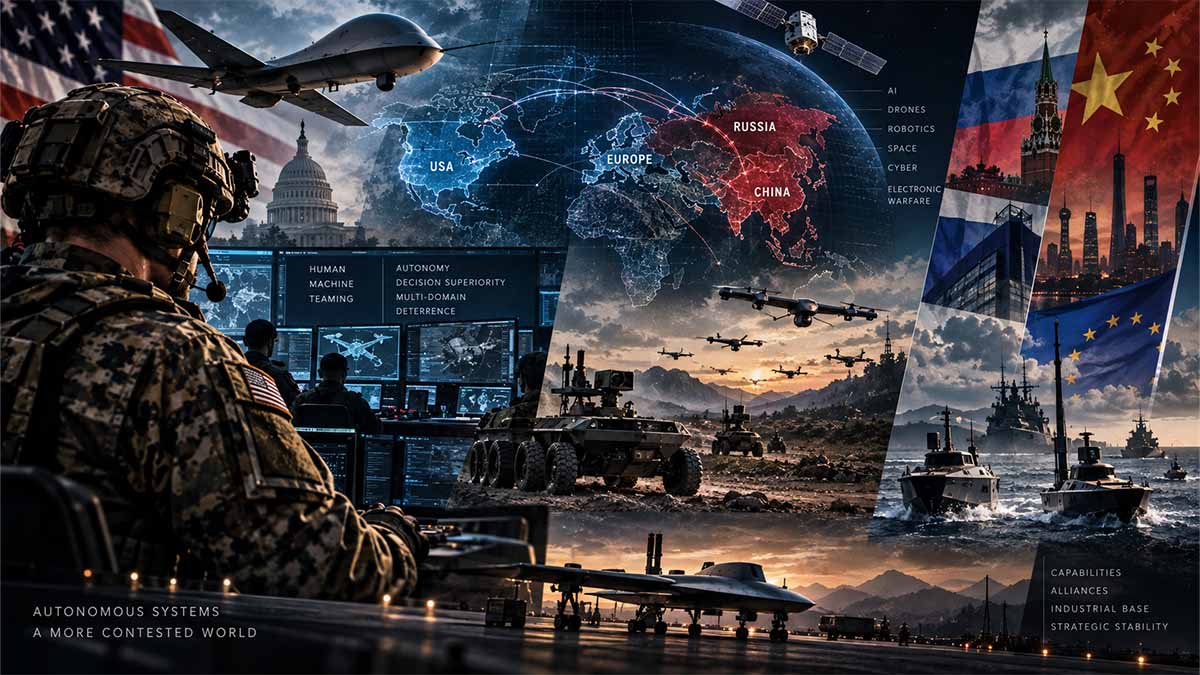
Scope: This assessment examines the accelerating institutionalisation of autonomous warfare, artificial intelligence, robotics, uncrewed systems and machine-enabled command across the United States, Russia, China, the European Union, Italy, France, Germany and the United Kingdom, with particular attention to the transition from technological experimentation to operational organisations, acquisition systems, industrial capacity and military doctrine over the 2026–2031 horizon. It applies a decision-grade open-source standard that separates verified fact, institutional position and analytical judgment. Testo incollato
Executive Summary / BLUF
The decisive development in autonomous warfare is no longer the drone itself. It is the emergence of military institutions designed to learn, acquire, modify, produce and employ autonomous systems at software-industrial speed. The United States’ newly announced Autonomous Warfare Command concept, Project Agincourt and Project Meridian therefore matter less as isolated programmes than as an attempt to redesign the organisational machinery connecting battlefield demand, commercial technology, procurement authority, experimentation, force structure and doctrine. The September 30 directive envisages a pathway toward a four-star functional combatant command, while Project Agincourt is intended to prototype an acquisition model in which operators, innovators and manufacturers are placed inside repeated adaptation cycles. The current official DIU architecture already points in the same direction through dedicated Autonomous Warfare, Kill Web and AI Crosscutter portfolios, while a January 2026 initiative committed $100 million to an Autonomous Vehicle Orchestrator competition intended to coordinate heterogeneous autonomous fleets. Diu
Russia has travelled toward institutionalisation from the opposite direction: combat adaptation preceded organisational consolidation. Moscow created a distinct Unmanned Systems Forces structure around the accumulated operational experience of formations including the Rubicon Centre, and Russian official statements in 2026 describe a unified training system and UAV deliveries running at more than twice the 2025 level. China is pursuing a still broader transformation in which autonomy is not merely a separate drone enterprise but part of the PLA’s transition toward an intelligent military system, with President Xi Jinping in 2026 explicitly calling for expanded military application of unmanned intelligent technologies and greater system integration. Kreml Speciale
Europe is moving rapidly but through a structurally different model. The EU is creating funding, industrial and collaborative mechanisms rather than a supranational operational command; NATO is building common acquisition, experimentation and operator pipelines; and the leading European powers are developing distinct national models. France is moving particularly quickly in mass procurement and state-industry iteration; the United Kingdom is constructing an explicit AI-autonomy transformation architecture backed by multi-billion-pound investment; Italy has established AI, robotic autonomous systems, swarming and manned-unmanned teaming as formal defence technology priorities; Germany is integrating uncrewed, loitering and autonomous systems across its future force while retaining an especially visible emphasis on human decision authority in lethal employment. Ministère des Armées
The strategic competition should therefore not be reduced to a ranking of national drone inventories. The relevant measures are adaptation latency, software-update velocity, production scalability, access to expendable components, electronic-warfare resilience, operator generation, data architecture, command authority and the ability to convert combat observations into procurement decisions before an adversary completes the same cycle. On those variables, no public record currently supports a defensible claim that any single actor has achieved comprehensive superiority across autonomous warfare as a whole.
The principal uncertainty is institutional conversion: announced reforms, experiments and budgets do not automatically become deployable military power. The central analytical question for the next five years is whether the United States and European allies can convert their advantages in advanced computing, capital, aerospace, software and allied interoperability into repeatable mass production and rapid battlefield adaptation, while Russia attempts to industrialise a combat-driven innovation model and China combines large-scale manufacturing with increasingly sophisticated AI-enabled military integration.
Europe’s Autonomous-Warfare Problem Is No Longer Technology. It Is Conversion.
Europe is entering the autonomous-warfare era with more money, more laboratories and more defence-industrial capacity than at any point in the post-Cold War period, yet the decisive constraint is increasingly organisational rather than technological. EU defence expenditure reached €418 billion in 2025 and is projected by the European Defence Agency to rise to €454 billion in 2026, while equipment procurement reached €115 billion; nevertheless, only 24% of equipment procurement was collaborative, below the EDA’s 35% benchmark. European Defence Agency — Defence spending €418 billion in 2025, €454 billion projected in 2026 The contradiction now defining European military modernisation is therefore not insufficient ambition but insufficient conversion: national technological excellence is expanding faster than the common architecture needed to turn French, German, Italian, British and wider European systems into interoperable combat power.
More money will not repair fragmented procurement
The numbers expose the problem more clearly than political declarations. EU defence spending increased from €343 billion in 2024 to €418 billion in 2025, while defence R&D reached approximately €17 billion and is projected to approach €20 billion in 2026; yet collaborative procurement remained at 24%, meaning that most of Europe’s procurement surge still travels through national acquisition structures. European Defence Agency — Defence Data 2025–2026 This matters more for autonomous systems than for many conventional platforms because fragmentation multiplies across control software, datalinks, sensors, electronic-warfare interfaces, navigation systems, AI validation procedures and maintenance chains. Twenty national drone fleets can therefore increase nominal inventories while simultaneously creating twenty incompatible digital ecosystems.
The EU has begun to attack this problem through financing rather than rhetoric. SAFE provides up to €150 billion in loans for defence investment and common procurement, while the European Defence Industry Programme carries €1.5 billion and reserves €325 million for European Defence Projects of Common Interest. Council of the European Union — Security Action for Europe European Commission — Five European Defence Projects of Common Interest The financial architecture is therefore beginning to exist; the unresolved issue is whether common money produces common requirements or merely subsidises parallel national purchases.
Autonomous warfare punishes Europe’s old platform logic
The industrial unit of autonomous warfare is no longer the airframe. It is a stack consisting of sensors, communications, processors, navigation, propulsion, software, AI models, electronic warfare, payloads, test infrastructure and command architecture. The European Defence Fund’s 2025 selection committed €1.07 billion to 57 projects, including AI, drones and counter-drone systems, while the completed ALTISS programme demonstrated a European swarm concept in which one operator can supervise the formation through AI-assisted mission planning and dynamic task allocation. European Commission — €1.07 billion in 57 defence projects European Commission — ALTISS autonomous swarm project
That changes the procurement transmission mechanism. A French sensor, German vehicle, Italian electronic-warfare payload and British autonomy stack do not need to become one European product, but they do need interfaces allowing data, tasking and threat information to circulate without bespoke gateways. The alternative is industrial sophistication without operational scale: multiple excellent systems whose combined output is weaker than the sum of their parts because national software, security rules and mission-control architectures remain closed.
France, Germany, Italy and Britain solve different parts of the same equation
France brings a strong state-industry integration mechanism through the Direction générale de l’armement and in 2026 continued expanding rapid drone procurement and experimentation; Germany contributes manufacturing depth, land systems, sensors, industrial automation and the capacity to convert prototypes into repeatable production; Italy contributes aerospace, defence electronics, naval integration, underwater systems and a Mediterranean operational geography in which air, surface, subsurface and electromagnetic autonomy converge. The first EDA Operational Experimentation Campaign for autonomous systems was conducted in Italy in 2025, bringing multinational air and ground systems into a common test environment rather than another conference room. European Defence Agency — OPEX 2025
The United Kingdom sits outside EU institutions but cannot be removed from the European equation. On 29 June 2026, London announced more than £5 billion over four years for drone transformation, while the Defence Investment Plan couples uncrewed systems with future combat aircraft, naval autonomy and land-force transformation. UK Government — UK drone transformation backed by more than £5 billion In September 2026, Dstl and the British Army completed a realistic software-defined swarm experiment, providing a direct bridge between industrial investment and operational testing. UK Government — Dstl drone swarm accelerates Army autonomy ambition
The most useful European model may consequently be functional specialisation rather than forced industrial uniformity: France as a high-end combat-system integrator, Germany as an industrial scaling engine, Italy as a cross-domain aerospace-electronics-maritime integrator, and Britain as a major autonomy and digital-force contributor. The political problem is that these strengths are governed through different institutions, budgets and procurement laws; the technical problem is whether their systems can still communicate at machine speed.
The first real test is whether Europe can buy together
The European Defence Agency’s 2025 activity already shows the size of the coordination problem: 87 capability and research projects worth €558 million, support for 10 PESCO projects, 42 EDF initiatives worth more than €300 million, and a government-to-government matchmaking platform containing more than 400 projects and 50 identified capability needs. European Defence Agency — Annual Report 2025 In May 2026, EU defence ministers backed a stronger EDA and the creation of a dedicated collaborative defence procurement structure, explicitly intended to manage multiple procurement projects while expanding operational experimentation. European Defence Agency — Ministers pave the way for a stronger EDA
This is where institutional reform becomes measurable. Europe does not need another mechanism for identifying that drones, AI, electronic warfare and autonomous systems matter; it needs mechanisms that turn a common requirement into a common contract before the technology changes. The 2026 PESCO progress report covers 74 projects and records increasing delivery activity in artificial intelligence, electronic warfare, maritime security and military mobility. European Defence Agency — More PESCO projects enter delivery phase The relevant indicator for 2027 will therefore be how many of these structures generate serial acquisition rather than additional coordination layers.
The cheapest drone can still impose the most expensive defence problem
Autonomous warfare also imposes a brutal cost-exchange constraint. On 13 July 2026, the British Ministry of Defence awarded £3.16 million to three suppliers under the Low-Cost Air Defence Effectors programme, part of the five-nation LEAP initiative involving the UK, Poland, France, Italy and Germany. The programme exists because large numbers of inexpensive drones cannot sustainably be answered with scarce high-cost interceptors. UK Government — Low-cost air defence contracts
This industrial logic favours European integration because counter-drone defence depends less on national prestige platforms than on common detection, identification, electronic warfare, command-and-control and low-cost interception. The Commission’s 2026 EDF portfolio now includes programmes such as EURODAMM, LUMINA, SKYRAPTOR and TALON, all oriented toward affordable mass or intelligent loitering systems rather than another generation of scarce exquisite assets. European Commission — Result of the EDF 2025 Calls Europe is therefore being forced into a high-low industrial model in which sophisticated crewed platforms coexist with systems expected to be produced, lost and replaced in large numbers.
The alliance problem begins where EU financing ends
The institutional boundary between the European Union and NATO is not administrative detail; it determines whether EU-funded systems become usable coalition capabilities. On 24 June 2026, the leaders of France, Germany, Italy, Poland and the United Kingdom committed through the E5 format to closer industrial cooperation in air defence, unmanned systems, AI and long-range strike while explicitly linking European capacity with NATO interoperability. UK Government — E5 Leaders’ Statement, 24 June 2026
This division of labour is structurally coherent only if EU industrial instruments and NATO military standards converge. EU institutions can finance R&D, production capacity and common procurement; NATO determines much of the operational framework within which European forces will fight collectively. The wrong outcome would be a European-funded autonomous ecosystem requiring extensive technical conversion before entering NATO command networks. The correct measure of success is therefore not the percentage of hardware carrying a European label, but whether European systems can exchange tracks, receive mission tasking, operate under coordinated electronic warfare and enter multinational sensor-to-effector chains without bespoke national gateways.
The next 24 months will decide whether rearmament buys scale or duplication
By the end of 2027, the financial and institutional choices made in 2026 will begin to reveal whether Europe is building an autonomous-warfare architecture or simply accelerating national procurement. The first indicators will be concrete: whether collaborative procurement moves materially above the 24% recorded in 2025; whether SAFE converts part of its €150 billion capacity into genuinely multinational orders; whether the strengthened EDA turns its new procurement mandate into contracts; whether EDF programmes such as ALTISS and the 57-project 2025 portfolio move from demonstration toward force adoption; and whether five-nation initiatives such as LEAP reach common production rather than remain nationally segmented competitions. European Defence Agency — Defence Data 2025–2026 Council of the European Union — SAFE
The cost of failure will not be borne primarily by Brussels institutions. It will fall on national defence budgets forced to finance duplicative control systems, small production runs, separate certification, incompatible datalinks and repeated integration work; on European manufacturers denied the order volumes needed to industrialise; and ultimately on armed forces required to fight through architectures designed nationally but expected to operate collectively. Europe has already moved beyond the stage at which insufficient spending explains its defence weakness. Over the next 12–24 months, the more expensive failure would be to spend at €454 billion-a-year scale while preserving the fragmentation of a much smaller defence market.
Navigational Index
Pillar I — Autonomous Warfare Becomes an Organisational System
The first pillar examines the transition from remotely piloted platforms toward institutionalised autonomous warfare: specialised commands and service structures, AI-enabled command and control, human-machine teaming, swarms, distributed sensing, autonomous navigation, electronic-warfare adaptation, training systems and new military career structures. It places the emerging American command architecture beside Russia’s Unmanned Systems Forces, China’s intelligentisation programme and the more distributed European approaches.
Pillar II — The New Defence-Industrial Contest Is About Adaptation as Much as Production
The second pillar examines the industrial mechanism beneath autonomous warfare: attritable platforms, components, sensors, compute, software, semiconductors, communications, navigation, propulsion, electronic warfare, AI models, test infrastructure, venture capital, traditional primes, startups and acquisition authorities. The central issue is whether militaries can transform commercial innovation into fielded capability repeatedly rather than merely procure individual drone types.
Pillar III — Europe Faces a Choice Between National Excellence and System-Level Integration
The third pillar analyses the European Union, NATO and the national ecosystems of Italy, France, Germany and the United Kingdom, assessing how separate strengths in aerospace, AI, robotics, missiles, naval systems, electronics and defence manufacturing can be converted into interoperable autonomous combat systems without creating incompatible fleets, duplicated programmes or external technological dependencies.
Master Abstract
The military revolution is moving from the platform to the institution
The September 2026 American initiatives mark a potentially important change in the organisation of military technological power because they seek to place autonomous warfare inside a durable command, acquisition and personnel architecture rather than leaving it distributed among individual programmes. The Project Agincourt material establishes two intertwined missions: create the pathway toward an Autonomous Warfare Command and, simultaneously, prototype a procurement system in which operational forces, innovators and competitive manufacturers interact continuously rather than sequentially. This logic extends an earlier U.S. shift. The July 2025 Drone Dominance memorandum directed the military departments to increase access to low-cost UAS, empower dedicated programme offices and treat drone dominance as a competition in process as well as technology, while the Defense Innovation Unit now explicitly describes an Autonomous Warfare portfolio centred on air, ground and maritime unmanned systems, computer vision, automated target recognition and counter-UAS. Media Defense
This is strategically different from buying more remotely piloted aircraft. A conventional acquisition organisation normally optimises requirements, certification, contracting and sustainment around relatively stable platforms whose development cycles can last years or decades. Contemporary autonomous warfare creates almost the opposite condition: sensors, navigation techniques, communications protocols, machine-learning models, electronic countermeasures and enemy tactics can change within weeks. Consequently, the military organisation capable of modifying software, payloads, frequencies, production processes and tactics faster than the adversary can generate countermeasures gains an advantage that cannot be measured simply by counting platforms. The Pentagon’s January 2026 Autonomous Vehicle Orchestrator challenge illustrates this transition particularly clearly: the Department did not solicit another individual vehicle, but a scalable, vehicle-agnostic orchestration capability through which operator intent could coordinate autonomous systems at fleet level, backed by a prize structure of up to $100 million. Diu
There is, however, an important documentary caveat. The September 30 material directs the establishment pathway toward a four-star functional combatant command with a target establishment date of October 1, 2027, while DIU’s presently accessible Autonomous Warfare page describes a recently created “sub-unified command.” Those formulations should not yet be treated as interchangeable. Congressional action, the eventual Unified Command Plan or other formal establishment instruments, command relationships and delegated acquisition authorities will determine the final legal and organisational configuration. Diu
Project Meridian moves the competition beyond drones
Project Meridian broadens the American initiative beyond present-day unmanned warfare. Its mandate encompasses the future battlefield and explicitly connects artificial intelligence, autonomy, robotics, directed energy, biotechnology and other emerging technologies to capability-gap identification and future development. The project is intended to draw substantially on expertise outside the Pentagon and submit its findings within 120 days, by January 28, 2027, while the Joint Staff and military services are expected to connect relevant future-warfare work to the project.
Its importance therefore lies in whether it becomes an effective requirements-discovery mechanism rather than another forecasting exercise. The Pentagon already possesses advanced research organisations, laboratories, service innovation structures, acquisition executives and DIU; the unresolved institutional problem is not the absence of organisations capable of imagining new technology, but the fragmentation between identification of operational problems, prototype development, testing, budget authority, contracting, production and force adoption. Project Meridian can materially affect future capability only if its recommendations migrate into funded programmes, exercises, doctrine and production. The existing Defense Innovation Unit model provides one mechanism: DIU publicly states that it uses commercial-solution procedures and Other Transaction authority to move prototype awards substantially faster than conventional acquisition pathways, while its present organisation embeds autonomy and AI as dedicated portfolios rather than peripheral technology themes. Diu
The underlying American concept is therefore becoming a high-low military architecture rather than a wholesale replacement of traditional weapons. High-end aircraft, submarines, long-range weapons, stealth, space systems and sophisticated sensing remain central, but increasingly coexist with larger numbers of cheaper autonomous or semi-autonomous systems that can provide reconnaissance, deception, communications relay, electronic warfare, logistics, decoys and strike. The 2025 Drone Dominance directive explicitly framed the objective in terms of expanding low-cost UAS while changing procurement and training, and the FY2026 defence budget request identified $3.187 billion for counter-unmanned systems, compared with $2.247 billion enacted for FY2025, a requested increase of $940 million. Media Defense
Russia has transformed battlefield adaptation into a military branch
Russia’s trajectory differs markedly because sustained combat employment has served simultaneously as operational laboratory, requirements generator, training environment and selection mechanism. At the Russian Defence Ministry board meeting reported by the Kremlin in late 2025, the leadership identified formation of the Unmanned Systems Forces as a central organisational priority, cited the Rubicon detachments as a leading element, and directed completion of the new branch during 2026 together with expanded provision of jam-resistant reconnaissance and strike UAVs, AI-enabled systems, ground-control stations, relay equipment and autonomous power supplies. Kreml Speciale
By mid-2026 the Russian Defence Ministry’s official communications stated that UAV deliveries to the forces had increased by more than twofold compared with 2025 and that a unified system for training Unmanned Systems Forces specialists and units had been created. These remain Russian government assertions and should not be converted automatically into independently verified operational-effectiveness figures, but they constitute strong evidence of institutional and production priorities. Telegram Russia’s distinctive strength is therefore not simply a particular airframe; it is the compression of the loop between combat observation, tactical modification, electronic-warfare adaptation, operator training and renewed deployment.
The same model also exposes Russian vulnerabilities. Rapid scaling can generate uneven manufacturing standards, dependence on commercial and imported electronic components, fragmented software ecosystems, inconsistent training and highly variable quality between formations. Public Russian statements establish organisational expansion and increasing supply, but they do not provide a sufficiently transparent dataset to determine mission-capable inventories, loss replacement ratios, component provenance or system-wide autonomous capability. Those distinctions are essential because remotely controlled FPV mass, automated target recognition, navigation autonomy, coordinated swarming and autonomous lethal engagement are technologically and doctrinally different capability levels.
China is building autonomy inside a larger intelligent military system
China’s model is broader and potentially more consequential over the long term because Beijing treats autonomy as one element in the transformation of the entire military information architecture. In 2026, Xi Jinping explicitly called for strengthening the military application of unmanned intelligent technologies, expanding network-information-system development and gradually establishing an intelligent military system, while simultaneously emphasising system integration, combat-oriented testing and military training. eng.mod.gov.cn Chinese Ministry of National Defense doctrinal publications have for years described future warfare in terms of interconnected intelligent forces, human-machine cooperation, autonomous unmanned systems, swarming and integrated operational networks, indicating that these ideas precede the latest hardware demonstrations. Ministero della Difesa
The resulting Chinese challenge is therefore less analogous to creating an autonomous drone service than to embedding artificial intelligence and machine-enabled coordination across reconnaissance, targeting, command, electronic operations and multi-domain force employment. A recent NATO Defense College analysis of Chinese documentary sources from 2000–2025 identifies the pursuit of “intelligentized warfare” as a persistent feature of the Chinese military discourse, although open-source evidence remains insufficient to equate doctrinal ambition with achieved system-level operational performance. NDC NATO The key analytical distinction is between technological demonstration and operational integration: China’s industrial scale and civilian technology ecosystem create substantial potential, but public evidence does not establish that every conceptual element of intelligentised warfare has already matured into a fielded, interoperable joint-force capability.
France is constructing a rapid state-industry drone cycle
Among the principal European powers, France has produced some of the clearest evidence of a deliberate transition from small-scale experimentation to procurement at relevant volume. The French DGA delivered the first 1,000 low-cost combatant drones in January 2026 after a procurement process launched less than a year earlier; in May 2026 it ordered another 5,000 Delco combatant drones, with delivery required by early 2027. The programme emerged from the state-industry Pacte drones aériens de défense, which by February 2026 included more than 170 companies, and the first thousand systems were produced at a unit price reported officially as below €1,000. Ministère des Armées
This is important because France is testing not only the equipment but the procurement mechanism itself: simplified operational requirements, direct interaction between the state and a broad industrial ecosystem, short competitive cycles, sovereign or European component requirements and large follow-on orders when a solution works. The French 2026 budget framework allocated €600 million for drones and robots, with the stated objective of accelerating dronisation across the three services, while the Army’s current transformation narrative integrates drones, robotics, electronic warfare, AI and collaborative combat rather than treating each as a separate technology programme. Ministère des Armées
France has therefore moved closer to a continuous capability-generation model, although no public French instrument examined here establishes a national organisational equivalent to the planned American autonomous-warfare combatant command. Its present comparative strength is the increasingly short line between DGA, operational forces and domestic manufacturers; its challenge is to scale this method across heavier, longer-range, maritime and increasingly autonomous systems while preserving interoperability, cyber resilience and industrial depth.
The United Kingdom has adopted the most explicit European force-transformation blueprint
The UK’s 2025 Strategic Defence Review articulated perhaps Europe’s clearest published conceptual model for integrating autonomous warfare across an entire force. It calls for conventional and digital warfighters to operate together, places drones, AI and autonomy alongside traditional armour and artillery, requires uncrewed and autonomous systems in high numbers and defines future forces around integrated digital targeting networks. Particularly significant is its proposed 20-40-40 land-force mix: approximately 20% crewed platforms, 40% reusable uncrewed platforms and 40% consumables such as missiles, shells and one-way-effect drones. GOV.UK
The financing signal is also substantial. The British government announced more than £4 billion for autonomous systems during the current Parliament, alongside almost £1 billion for directed-energy weapons. In August 2026 the Ministry of Defence established the Rapid AI Delivery Taskforce, allocating £100 million through the Defence Investment Plan and giving it a mandate to accelerate operational deployment of AI, autonomy and frontier technologies across military commands. In September 2026, Dstl reported a British Army software-defined swarm experiment conducted in a realistic military environment, connecting the institutional policy to active technical experimentation. GOV.UK
The British model is consequently moving toward a combination of central digital architecture, rapid delivery structures, service experimentation and large protected investment rather than a single autonomy command. The SDR also required establishment of an initial operating capability for a Defence Uncrewed Systems Centre by February 2026, although the public documents reviewed for this assessment do not provide sufficient current evidence to certify the centre’s complete operating status or final authority structure. GOV.UK
Italy is establishing the technological architecture but still faces the scaling test
Italy’s defence policy has moved decisively toward AI and autonomous systems as formal capability areas. The 2026 Defence Strategy on Artificial Intelligence calls for systemic and systematic integration of AI across the Ministry of Defence, while the 2026 National Military Research Plan explicitly includes autonomous robotic systems and UxV across all operational domains, swarming, hardening, manned-unmanned teaming, armed drones and loitering munitions. Difesa This represents a considerably broader framework than isolated UAV procurement because it places AI, autonomous systems, electronic resilience and collaborative employment inside national military research priorities.
Italy also possesses a potentially valuable experimentation infrastructure. In July 2025 the Italian Army’s CEPOLISPE at Montelibretti hosted the first European operational experimentation campaign for autonomous UAV and UGV systems coordinated by the European Defence Agency and the Italian National Armaments Directorate; Italian defence planning simultaneously includes autonomous underwater systems for ISR, anti-submarine warfare and protection of critical subsea infrastructure. Difesa
The principal Italian issue is therefore not absence of technological competence. It is whether experimentation, defence research, large national industrial champions, specialist SMEs and military users can be connected through shorter recurring acquisition cycles capable of producing expendable and software-defined systems in volume. The public record demonstrates strategic direction and technical activity, but it does not yet establish an Italian equivalent to either the Russian specialised branch, the proposed U.S. autonomy command, or the scale of the UK’s publicly committed autonomy investment. That distinction should remain visible rather than being obscured by the sophistication of individual Italian programmes.
Germany is integrating autonomy while retaining explicit human decision authority
Germany’s publicly documented approach is more distributed across force modernisation than organisationally concentrated. Bundeswehr material published in 2026 describes future land combat incorporating loitering munitions whose sensors and software can autonomously identify potential targets while the operator retains the decision to engage, and it anticipates future use of drone swarms for saturation, disruption and attack. Separate 2026 Bundeswehr experimentation demonstrated almost autonomous casualty evacuation using aerial and ground unmanned systems. Bundeswehr
This model reflects an important distinction that will increasingly shape European defence: autonomy in navigation, reconnaissance, coordination, classification and decision support does not require identical delegation of lethal authority. Germany’s longer-term force architecture also includes FCAS concepts in which crewed aircraft interact with unmanned remote carriers through a networked combat architecture. Bundeswehr
The German case therefore demonstrates considerable technological engagement but no public evidence, in the material reviewed here, of a dedicated autonomous-warfare organisational structure comparable with Russia’s new branch or the American command proposal. Germany’s challenge will be to combine its substantial industrial, sensor, aerospace, land-systems and software capabilities with faster field experimentation and procurement while preserving the legal, certification and human-control requirements that remain unusually visible in its official treatment of autonomous weapons.
Europe is building the connective tissue, but not a European autonomous army
The European Union is increasingly addressing the industrial and technological layer that individual member states cannot efficiently reproduce alone. In April 2026 the Commission announced €1.07 billion for 57 European Defence Fund projects, including AI, drones and counter-drone technologies, while the 2026 EDF work programme includes a €23 million challenge for AI-based tactical situational awareness using swarms of small robots and drones. In September 2026 the Council identified its first five European defence projects of common interest, explicitly including drones and counter-drone capabilities alongside maritime, space, air-defence and eastern-flank projects. Defence Industry and Space
NATO is moving simultaneously on the operational-alliance layer. The July 2026 Drone Edge initiative states that Allies intend to invest more than $40 billion in counter-drone capabilities over five years and train five times as many military drone operators by the end of 2027. NATO’s 2026 digital strategy also calls for tactical-edge AI inference, federated data architectures and cross-domain sensor-to-effector integration, while multinational experimentation in the Baltic has already brought autonomous air and maritime systems into operationally relevant surveillance missions. NATO
The resulting European architecture is therefore multilayered rather than centralized: national militaries own forces; national governments procure most equipment; the EU finances collaborative technology and industrial capacity; EDA facilitates experimentation; NATO develops standards, operational integration and collective demand; and multinational programmes attempt to connect these layers. This structure provides technological diversity and political resilience but can produce slower decisions, fragmented requirements, competing national certification systems and insufficient production volumes unless procurement is aggregated.
Key Evidence Table
| Indicator | Value/status | Reference date | Definition/scope | Issuer | Exact source |
|---|---|---|---|---|---|
| U.S. autonomous-warfare institutionalisation | Pathway directed toward a four-star functional command; target date 1 Oct 2027 | 30 Sep 2026 | Announced organisational objective; final establishment authorities remain to be resolved | U.S. defence leadership | Supplied commissioning material ; current DIU institutional description Diu |
| U.S. autonomous fleet orchestration | $100 million prize challenge | 13 Jan 2026 | Vehicle-agnostic command/orchestration technology for autonomous fleets | Defense Innovation Unit | Diu |
| U.S. counter-unmanned systems | $3.187bn FY2026 request, versus $2.247bn FY2025 enacted | FY2026 | Counter-unmanned systems budget category, not total autonomy expenditure | U.S. Department of Defense Comptroller | Comptroller |
| Russia | Dedicated Unmanned Systems Forces under formation/scaling | 2025–2026 | Separate armed-forces structure; official Russian record | Kremlin / Russian MoD | Kreml Speciale |
| Russian UAV supply | More than 2× 2025 deliveries, according to MoD | 2026 | Official assertion; does not establish mission-capable inventory | Russian Ministry of Defence | Telegram |
| China | Expanded military use of unmanned intelligent technology and establishment of an intelligent military system | 2026 | Strategic modernisation direction | PRC Ministry of National Defense / CMC reporting | eng.mod.gov.cn |
| France | 5,000 Delco drones ordered after first 1,000 delivered | May–Jun 2026 | French Army micro-drone procurement | DGA | Ministère des Armées |
| France | €600m for drones and robots | FY2026 proposal | Dronisation across three services | French Ministry of Armed Forces | Ministère des Armées |
| United Kingdom | >£4bn for autonomous systems this Parliament | Announced Jun 2025 | Defence-wide autonomy investment envelope | UK Government / MOD / Treasury | GOV.UK |
| United Kingdom | £100m Rapid AI Delivery Taskforce | Aug 2026 | AI, autonomy and frontier-technology rapid operational adoption | UK MOD | GOV.UK |
| Italy | AI, RAS/UxV, swarming and MUM-T identified as formal military research priorities | 2026 | National Military Research Plan | Italian Ministry of Defence | Difesa |
| Germany | Autonomous target recognition demonstrated with human engagement decision retained | 2026 | Bundeswehr future-land-warfare experimentation | Bundeswehr | Bundeswehr |
| EU | €1.07bn / 57 EDF projects | 15 Apr 2026 | 2025 EDF selection, including AI/drone/counter-drone work | European Commission | Defence Industry and Space |
| NATO | >$40bn counter-drone investment over five years; 5× drone-operator training by end-2027 | Jul 2026 | Alliance-level declared programme | NATO | NATO |
The Strategic Divergence
The evidence supports four distinct institutional models rather than one homogeneous global race. The United States is attempting to institutionalise adaptation itself, connecting operational demand, commercial technology and acquisition authority through a dedicated command structure and innovation ecosystem. Russia is institutionalising combat-derived practice, converting the lessons and organisational forms generated by prolonged battlefield use into a separate branch. China is embedding autonomy inside a larger intelligentisation project, where unmanned systems become nodes in an AI-enabled information and command architecture. Europe is building a federation of national and supranational mechanisms, technologically sophisticated but dependent on interoperability, common demand signals and industrial aggregation to achieve scale. Diu
These models have different failure modes. The American risk is institutional proliferation without sufficient simplification: a new command will add little if requirements, appropriations, testing, export controls, safety certification and procurement remain slower than technological change. Russia’s risk is that extraordinarily rapid wartime adaptation produces tactical innovation without equivalent quality control, standardisation and strategic technological depth. China’s risk is the familiar gap between ambitious system-level doctrine and the difficulty of validating highly autonomous architectures under genuine wartime friction. Europe’s risk is fragmentation: world-class individual technologies can coexist with insufficient production volumes, incompatible national acquisition cycles and continuing dependencies in electronics, propulsion, cloud infrastructure, communications and software components.
The central measure of military-technological power is consequently changing. In the industrial wars of the twentieth century, replacement tonnage, factories, manpower and munitions output were decisive indicators. They remain essential, but autonomous warfare introduces an additional variable: how quickly an armed force can discover that a system no longer works, diagnose why, redesign it, manufacture the revision, update operators and tactics, and return it to combat. This cycle—the military equivalent of continuous software deployment combined with wartime manufacturing—will increasingly determine whether numerical mass remains useful after an adversary adapts.
Principal Gaps and Watch Indicators
Formal status of AUTOWARCOM. The decisive U.S. document will be the instrument establishing command status, command relationships, four-star leadership, force-provision arrangements, budgetary authorities and acquisition powers. The current discrepancy between the four-star functional-command objective described in the commissioning material and DIU’s “sub-unified command” terminology should remain unresolved until that record appears. Diu
Whether Agincourt changes procurement behaviour rather than terminology. The strongest indicator will not be creation of another office but documented reductions in requirement-to-contract and test-to-production timelines, repeated competitions, authority transferred toward operational commands and evidence that unsuccessful systems are rapidly terminated while successful systems receive follow-on production. The existing DIU model already describes prototype awards in months and direct pathways toward production, creating a measurable baseline against which Agincourt can eventually be judged. Diu
Project Meridian’s conversion into funded capability. Its January 28, 2027 report will matter only if recommendations subsequently appear in budgets, service requirements, exercises, test programmes and production contracts. The report’s treatment of AI, autonomy, robotics, directed energy and biotechnology will also reveal whether Washington defines future warfare around individual technological categories or around an integrated military architecture.
Russian force completion and standardisation. Observable indicators include the documented structure and size of the Unmanned Systems Forces, training throughput, dedicated brigades and regiments, standardisation of control systems, electronic-warfare resilience, deployment of AI-enabled navigation or target-recognition systems and evidence that the Rubicon model can be replicated without substantial degradation in quality. Moscow’s own 2025 board guidance explicitly linked branch completion to improved jam-resistant and AI-enabled systems. Kreml Speciale
Chinese transition from intelligentisation doctrine to verified joint-force practice. The most diagnostic evidence will be large exercises demonstrating heterogeneous autonomous systems functioning under degraded communications, distributed command, multi-domain sensor-to-effector integration and rapid human-machine decision cycles rather than isolated demonstrations of advanced platforms. Beijing’s 2026 guidance explicitly connects unmanned intelligent technologies with system integration and realistic testing, making these observable benchmarks particularly relevant. eng.mod.gov.cn
European convergence or fragmentation. The decisive indicators will be multinational procurement quantities, common standards, sovereign or trusted component chains, shared testing infrastructure, software interoperability and whether the EU’s new common-interest defence projects develop from political designation into orders and production. The Council’s September 2026 designation of common projects covering drones and counter-drone systems creates a concrete institutional point from which progress can now be measured. Consiglio dell’Unione Europea
France’s ability to reproduce the Delco cycle at higher capability levels. The 1,000-plus-5,000 procurement sequence demonstrates speed and volume for micro-drones; the stronger test will be whether similarly compressed acquisition cycles appear in loitering munitions, collaborative combat, maritime autonomy, counter-UAS and longer-range systems. Ministère des Armées
The United Kingdom’s passage from strategy to force composition. The SDR contains unusually explicit targets for autonomy, digital targeting and a future high-low mix, while the £4 billion envelope and TF RAID provide financial and institutional mechanisms. The watch question is whether these produce deployable unit structures, serial orders and an interoperable digital backbone rather than parallel technology projects. GOV.UK
Italy’s transition from research leadership to industrialised operational mass. Italy’s formal priorities now include AI, autonomous systems, swarming, MUM-T and armed unmanned systems, and its experimentation infrastructure has already supported European autonomous-system trials. The decisive next evidence would be recurring procurement at scale, operational formations designed around these systems and demonstrably shortened transition times between national research, experimentation and production. Difesa
Germany’s balance between autonomy and human control. German official demonstrations presently show significant machine autonomy while retaining the human operator’s engagement decision. The evolution of this model—especially in swarms, collaborative combat aircraft, loitering systems and machine-speed targeting—will be a key indicator of how one of Europe’s largest military-industrial powers reconciles operational speed with legal and ethical control architecture. Bundeswehr
Net Assessment
The evidence does not support describing the emerging transformation merely as a “drone revolution.” Drones are the visible manifestation of a deeper shift in which software, autonomy, sensors, communications, electronic warfare, artificial intelligence, industrial production and military organisation are merging into continuously adaptable combat systems. The strategic unit of competition is therefore increasingly the entire learning-and-production network behind the weapon, not the weapon alone.
The United States’ September 2026 initiatives are significant because they explicitly attack the institutional dimension of that problem. If the intended command receives meaningful force-design, requirements, testing and acquisition authority, AUTOWARCOM would represent an attempt to make autonomous warfare a permanent joint military enterprise rather than a collection of service programmes. Project Agincourt would provide its acquisition engine, while Project Meridian would look further forward to the technologies and operating environments that could redefine the battlefield beyond today’s drone-centric paradigm. The three initiatives are consequently best understood as different time horizons of the same institutional challenge: field what works now, build an organisation capable of continuous adaptation, and identify the technological systems that will matter next.
Russia demonstrates why the adaptation problem cannot wait for perfect institutions: battlefield pressure has forced rapid development of specialised drone formations, dedicated training, electronic counter-countermeasures and a separate Unmanned Systems Forces structure. China demonstrates why the problem cannot be restricted to drones: the PLA’s stated objective is a progressively intelligent military system in which autonomy, networking and AI alter the broader command-and-combat architecture. Europe demonstrates why technological excellence alone is insufficient: France, the UK, Italy and Germany possess major technological and industrial assets, but their strategic value increasingly depends on whether Europe can aggregate demand, establish common technical architectures and generate serial production at the pace now required by modern conflict. Kreml Speciale
The five-year contest will consequently be determined by a relatively small number of measurable variables: time from operational requirement to fielding; cost per useful military effect; production surge capacity; resilience without GPS or continuous communications; autonomous operation under electronic attack; sensor-to-effector latency; software-update frequency; human-machine command architecture; interoperability; operator and maintainer throughput; component security; and the percentage of successful prototypes that actually become serially produced military capabilities. These measures provide a more defensible framework for judging progress than headline announcements or inventories alone.
Autonomous Warfare: From Platforms to Adaptive Military Systems
The emerging strategic competition is no longer defined primarily by the number of drones that a military can purchase or manufacture, but by its capacity to connect operational demand, artificial intelligence, autonomous systems, industrial production, software adaptation, electronic-warfare resilience, acquisition authority and force employment inside a continuously functioning institutional architecture.
The decisive variable in autonomous warfare is increasingly adaptation velocity: the time required to detect that a capability is becoming ineffective, identify the operational cause, redesign software or hardware, manufacture the revised system, retrain operators and return the capability to combat. The United States, Russia, China and the principal European military powers are moving toward this requirement through fundamentally different institutional models.
Strategic Models
The Emerging U.S. Autonomous-Warfare Architecture
The American model attempts to connect immediate operational adaptation, permanent organisational authority and longer-horizon technological forecasting rather than treating autonomy as a collection of independent procurement programmes.
Project Agincourt
Designed to prototype a new acquisition mechanism in which operators, innovators and competitive manufacturers participate in repeated development and field-adaptation cycles.
Autonomous Warfare Command
Proposed four-star functional combatant-command architecture intended to define joint needs, integrate service-provided forces, conduct realistic testing and accelerate the fielding of autonomous and robotic capabilities.
Project Meridian
Future-warfare initiative examining AI, autonomy, robotics, directed energy, biotechnology and other advanced technologies in order to identify capability gaps and connect technological forecasting with future force development.
Four Competing Institutional Models
The comparison deliberately avoids synthetic scores because the available official evidence does not support a defensible common numerical scale across fundamentally different military systems.
United States
Adaptation architecture- Project Agincourt
- Planned AUTOWARCOM pathway
- Project Meridian
- DIU autonomy portfolios
- Vehicle-agnostic autonomous orchestration
Russia
Wartime adaptation- Unmanned Systems Forces
- Rubicon-derived operational experience
- Dedicated training structures
- EW-resistant system priority
- Accelerated wartime production
China
Intelligentisation- Unmanned intelligent technologies
- Human-machine cooperation
- Network-information integration
- Multi-domain system integration
- Large industrial manufacturing base
Europe
Federated model- National force ownership
- EU collaborative funding
- EDA experimentation
- NATO standards and training
- Multinational procurement challenge
European Advanced-Technology Powers
France, the United Kingdom, Italy and Germany possess different combinations of aerospace, electronics, artificial intelligence, robotics, missiles, naval systems and defence-industrial capacity, but their autonomous-warfare pathways are not institutionally identical.
France
Rapid procurement cycleThe DGA delivered the first 1,000 low-cost Delco combatant drones in 2026 and subsequently ordered another 5,000, while the wider Pacte drones aériens de défense has brought together more than 170 industrial participants.
United Kingdom
Force transformationThe Strategic Defence Review established an explicit autonomy-oriented force architecture, while the government announced more than £4 billion for autonomous systems during the Parliament and subsequently created the Rapid AI Delivery Taskforce.
Italy
Technology-to-scale transitionItalian defence planning includes AI integration, autonomous robotic systems across operational domains, swarming, hardened systems, MUM-T, armed drones and loitering systems, while Italy has also hosted European operational experimentation involving autonomous UAV and UGV platforms.
Germany
Human-controlled autonomyBundeswehr experimentation covers autonomous target recognition, uncrewed ground and aerial systems, loitering munitions, swarming concepts and FCAS remote carriers, but the public model remains distributed across force modernisation rather than concentrated within a dedicated autonomy command.
Strategic Comparison Without Artificial Scoring
Each category represents an institutional characteristic documented in the underlying evidence; no numerical ranking or unsupported probability is assigned.
Decision-Relevant Watch Indicators
These indicators would provide stronger evidence of genuine force transformation than announcements, prototype demonstrations or nominal inventories alone.
Requirement-to-Fielding Time
Whether operational requirements can move through experimentation, contracting and deployment quickly enough to remain relevant against changing enemy countermeasures.
Software Update Velocity
Frequency with which autonomous platforms, targeting systems, navigation logic and electronic-warfare responses can be modified after operational feedback.
Industrial Surge Capacity
Ability to increase production of expendable platforms, propulsion, sensors, electronics and communications systems without creating critical supply bottlenecks.
EW and Navigation Resilience
Demonstrated performance when satellite navigation, communications links and conventional remote control are degraded or denied.
Human-Machine Command
Capacity to control multiple heterogeneous autonomous systems without increasing operator workload beyond operationally sustainable levels.
Prototype-to-Production Conversion
Percentage of successful demonstrations that generate serial contracts, deployable formations, trained personnel and sustainable logistics.
Selected Verified Sources
- United States Department of Defense / Defense Innovation Unit — Autonomous Warfare
- Defense Innovation Unit — Autonomous Vehicle Orchestrator Prize Challenge
- U.S. Department of Defense — Unleashing U.S. Military Drone Dominance
- Kremlin — Russian Defence Ministry Board Meeting
- Ministry of National Defense of the People’s Republic of China — Military modernisation and unmanned intelligent technologies
- French Ministry for the Armed Forces / DGA — Order for 5,000 Delco combatant drones
- UK Government — Strategic Defence Review 2025
- Italian Ministry of Defence — Defence Strategy on Artificial Intelligence
- Bundeswehr — Gefechtsfeld der Zukunft
- European Commission — €1.07 billion for 57 European Defence Fund projects
- NATO — NATO’s Drone Edge
Pillar I — Autonomous Warfare Becomes an Organisational System
Principal judgment
Autonomous warfare is entering a second institutional phase in which the central military problem is no longer how to acquire individual unmanned platforms, but how to reorganise command authority, personnel structures, data architectures, tactical formations, testing regimes and procurement systems around machines that can sense, navigate, coordinate and increasingly execute portions of a mission with decreasing requirements for continuous human control. The important distinction is between possessing unmanned equipment and possessing an autonomous-warfare system: the latter requires sensors capable of generating machine-readable information, resilient communications and positioning, software able to interpret that information, command-and-control architectures capable of allocating tasks across multiple systems, human operators trained to supervise increasingly large machine formations, and institutions capable of modifying all of those components faster than opposing forces can develop countermeasures.
The evidence available by 1 October 2026 indicates that the United States, Russia, China and the principal European military powers are all moving beyond the traditional one-aircraft/one-operator paradigm, but through markedly different organisational mechanisms. Washington is attempting to create permanent institutional authority around autonomous warfare while simultaneously changing acquisition and specialist career structures. Russia is converting wartime experimentation and dedicated drone formations into a formal branch of the armed forces. China is integrating unmanned and intelligent capabilities into a much larger transformation of joint command, information systems and what official Chinese language increasingly describes as an intelligent military system. European states remain organisationally more distributed, although the United Kingdom, France, Germany and Italy are each moving beyond stand-alone drone procurement toward combinations of autonomy, artificial intelligence, collaborative combat, swarming, digital targeting and human-machine teaming, while NATO increasingly provides the standards, training objectives and interoperability framework connecting national developments. U.S. Defense Innovation Unit — Autonomous Warfare Diu
From remotely piloted vehicles to machine formations
The first generation of modern military unmanned systems was conceptually conservative. An aircraft, surface vessel or ground vehicle removed the human being from the physical platform while reproducing many of the organisational relationships associated with a crewed system: an operator controlled the vehicle, additional personnel interpreted its sensors, communications links transmitted instructions and imagery, and higher headquarters incorporated the resulting information into conventional command processes. That architecture delivered substantial advantages in endurance and personnel protection, but it did not fundamentally solve the scaling problem because each additional vehicle generated corresponding requirements for operators, communications capacity, analysts and command attention.
The next organisational threshold is consequently one-to-many control, in which a human supervises several systems while increasing portions of navigation, formation management, sensor processing, route selection, obstacle avoidance and task allocation are performed by machines. The U.S. Army’s professional discussion of its emerging 15X and 150U unmanned-system personnel explicitly describes a transition from the historical 1:1 operator-vehicle model toward 1:N human-machine teaming involving heterogeneous air, land and littoral systems. The same Army material identifies large AI models, edge computing and autonomous multidomain navigation as competencies that future unmanned-system specialists will need to understand. U.S. Army Aviation Digest — Mission Command for Drone Forces lineofdeparture.army.mil
The United Kingdom has already demonstrated a limited practical version of this transition. In a 2025 Defence Science and Technology Laboratory trial, one operator controlled three uncrewed air and ground vehicles, which were able to detect and classify threats; the Ministry of Defence stated that subsequent work would extend the concept toward swarming for intelligence, surveillance and reconnaissance. This does not establish operational swarm capability across the British force, but it provides concrete evidence that organisational design is beginning to move from platform piloting toward supervisory control of multi-vehicle formations. UK Ministry of Defence — Successful trial paves the way for improved reconnaissance on Army operations GOV.UK
China is experimenting along a comparable technological trajectory but embeds it inside larger combined-arms formations. During the May–June 2026 Steppe Partner 2026 exercise, Chinese and Mongolian forces conducted force-on-force training involving what China’s Ministry of National Defense described as the integrated employment of unmanned and intelligent equipment and manned-unmanned teaming. Earlier PLA material had shown multi-type aerial drones and unmanned ground vehicles participating in coordinated confrontational exercises. Chinese Ministry of National Defense — Steppe Partner 2026 Chinese Ministry of National Defense — Swarming Unmanned Drones in Coordinated Exercise eng.mod.gov.cn
The organisational consequence is substantial: once one operator supervises several heterogeneous systems, military manpower shifts away from manual piloting toward mission management, exception handling, data interpretation, electromagnetic-spectrum management, software supervision and tactical orchestration. Autonomous warfare therefore does not remove the human organisation behind the weapon. It changes what that organisation must know how to do.
The institutional stack of autonomous warfare
A useful way to understand the emerging transformation is to separate the autonomous-warfare system into institutional layers rather than platforms.
| Institutional layer | Traditional unmanned model | Emerging autonomous-warfare model | Organisational consequence |
|---|---|---|---|
| Human control | Operator pilots individual vehicle | Human supervises multiple platforms and intervenes by exception | Fewer direct-control tasks; greater mission-management burden |
| Navigation | GPS/INS plus operator control | Increasing onboard navigation, terrain interpretation and route adaptation | Greater reliance on edge computing and onboard sensing |
| Sensor processing | Data transmitted for human interpretation | Onboard or distributed machine classification and prioritisation | Intelligence processing moves closer to the tactical edge |
| Command and control | Platform-specific ground control station | Multi-platform orchestration and common mission architecture | C2 software becomes a combat system in its own right |
| Communications | Persistent link normally required | Mesh networking, intermittent communication and degraded-link operation | Communications resilience becomes inseparable from autonomy |
| Targeting | Human-intensive sensor-to-shooter chain | AI-assisted detection, fusion, prioritisation and decision support | Decision cycles compress; governance becomes more demanding |
| Force design | Drone sections attached to traditional units | Organic unmanned formations and autonomous systems integrated across echelons | Force structure itself changes |
| Acquisition | Platform procurement | Recurring hardware/software adaptation | Continuous acquisition becomes operationally necessary |
| Personnel | Pilot/operator/maintainer | Robotics specialist, autonomy integrator, data/AI specialist, EW specialist | New career fields and technical command roles emerge |
| Training | Platform qualification | Multi-agent control, EW-denied operation, AI supervision and combined-arms integration | Training architecture becomes substantially more complex |
| Sustainment | Spare parts and conventional maintenance | Hardware + software + data + compute + spectrum + component replacement | Logistics becomes digital-industrial as well as mechanical |
This transformation explains why relatively modest-looking organisational initiatives can be more consequential than acquisition announcements. A military that procures tens of thousands of unmanned systems but cannot integrate them into command networks, generate trained operators, maintain spectrum access, update mission software or replace vulnerable components may possess numerical mass without sustainable autonomous combat power.
The United States is separating autonomy from platform ownership
The American transformation is increasingly visible at three organisational levels: joint authority, service implementation and specialist personnel.
At the joint level, the Defense Innovation Unit now maintains a dedicated Autonomous Warfare portfolio covering unmanned systems across air, land and maritime domains, automated target recognition, computer vision and counter-UAS. DIU explicitly describes itself as the commercial engine supporting the Pentagon’s emerging autonomous-warfare command structure, which is important because it links the institutional demand signal to companies outside the traditional prime-contractor system rather than treating commercial technology merely as a peripheral research source. Defense Innovation Unit — Autonomous Warfare Diu
The Department’s July 2025 Unleashing U.S. Military Drone Dominance memorandum had already laid several foundations for this transformation by directing broader delegation of authority for drone procurement and operation, expanding access to American-produced systems and explicitly defining drone dominance as a process race requiring closer integration between manufacturers and frontline troops. It also required drone capability to be incorporated into relevant force-on-force training rather than remain isolated in demonstrations and specialist units. U.S. Department of Defense — Unleashing U.S. Military Drone Dominance Media Defense
At the Army level, this is being translated into operational deadlines. Department of Defense reporting on Army transformation records a requirement to field unmanned systems and ground- or air-launched effects in every Army division by the end of 2026, integrate more mobile and affordable counter-UAS capabilities into manoeuvre platoons in 2026 and companies in 2027, and enable AI-driven command and control at theatre, corps and division headquarters by 2027. The Army had already conducted a brigade exercise involving more than 200 drones, demonstrating that the organisational question is increasingly how large formations incorporate autonomous and remotely controlled systems rather than whether individual units possess them. U.S. Department of Defense — Hegseth Tasks Army to Transform to Leaner, More Lethal Force Ministero della Difesa
At the Marine Corps level, the July 2026 creation of the Marine Corps Robotics Integration Group is another indicator of institutionalisation. MCRIG was established as the Corps’ focal point for Group 1 and Group 2 small-UAS and counter-UAS training integration, standardisation and coordination. This matters because autonomous-warfare capacity requires a common training baseline and doctrinal vocabulary; without standardisation, rapid proliferation of commercially derived systems can create incompatible procedures, uneven qualification standards and fragmented tactical employment. U.S. Marine Corps — Establishment of the Marine Corps Robotics Integration Group Marines
The emerging American organisational model can consequently be represented as follows:
| Function | Institutional mechanism | Current documentary status | Operational purpose |
|---|---|---|---|
| Joint autonomous warfare | Dedicated autonomous-warfare command architecture | Institutional pathway under development | Joint requirements, integration, exercises and force design |
| Commercial acquisition | DIU Autonomous Warfare portfolio | Active | Accelerate entry of commercial systems |
| Service force integration | Army transformation directives | Active implementation | Embed unmanned effects at division and lower echelons |
| Standardisation | Marine Corps Robotics Integration Group | Established July 2026 | Standardise sUAS/C-UAS training and coordination |
| Counter-autonomy | Joint Interagency Task Force 401 | Established 2025 | Coordinate counter-UAS efforts across agencies |
| AI expertise | Army 49B AI/ML officer career field | Initial selections beginning 2026 | Build uniformed AI specialists |
| Robotics expertise | Army 390A Robotics Technician | New specialist pathway | Integrate, fabricate and manage tactical RAS |
| UAS technical leadership | Army 150U | Existing and expanding role | Integrate UAS, EW, C-UAS, RAS, networks and AI |
Defense Innovation Unit — Autonomous Warfare U.S. Army — AI and machine-learning career path U.S. Army Recruiting Command — 390A Robotics Technician U.S. Army Recruiting Command — 150U UAS Operations Technician Diu
Personnel is becoming a technological capability
One of the least visible but potentially most important transformations concerns military career structures. Autonomous warfare creates a persistent institutional problem when advanced software and robotics expertise exists primarily among contractors, laboratories or temporary project teams rather than inside operational formations. A force can procure sophisticated systems yet remain unable to modify, integrate or tactically exploit them without external support.
The U.S. Army’s new 49B Artificial Intelligence and Machine Learning officer area of concentration directly addresses this problem. The first transfer cohort was scheduled to begin selection in January 2026, with reclassification by the end of FY2026. The Army describes the field as a uniformed cadre able to build, deploy and maintain AI-enabled systems and explicitly includes robotics and autonomous systems among its applications. U.S. Army — Army establishes new AI, machine learning career path for officers Esercito degli Stati Uniti
The 390A Robotics Technician represents an even more tactical institutional adaptation. The Army defines these warrant officers as specialists assigned at brigade or group level and above who can plan robotics and autonomous-system operations, integrate them into broader schemes of manoeuvre, engineer and fabricate robotic solutions, manage attritable systems and their sensor or kinetic payloads, and provide capabilities directly to tactical formations. U.S. Army Recruiting Command — 390A Robotics Technician Esercito degli Stati Uniti
Existing 150U UAS Operations Technicians are also being defined more broadly than conventional drone operators. Their current duty description encompasses electronic warfare, counter-UAS, robotics and autonomous systems, network engineering, data analytics, AI, frequency-spectrum management and airspace integration. The personnel architecture is therefore beginning to mirror the technical convergence occurring inside the systems themselves. U.S. Army Recruiting Command — 150U UAS Operations Technician Esercito degli Stati Uniti
This produces a profound doctrinal implication. The future unmanned-systems officer or technician increasingly resembles a combination of aviation specialist, roboticist, network engineer, spectrum manager, intelligence integrator and software-enabled tactical operator. The organisational unit built around autonomous systems must consequently contain technical expertise that conventional force structures often concentrated far above brigade or division level.
Command and control is becoming the decisive weapon
Autonomous platforms cannot generate system-level military advantage unless they are connected to an architecture capable of distributing information and assigning effects. This is why the emerging transformation increasingly centres on orchestration rather than individual aircraft.
The American Autonomous Vehicle Orchestrator initiative is significant precisely because it is intended to create a vehicle-agnostic mechanism through which human intent can control heterogeneous autonomous fleets rather than requiring a separate control architecture for every platform. The competition carries a potential prize pool of up to $100 million, indicating that the Department regards multi-platform orchestration as a major capability problem rather than a peripheral software feature. Defense Innovation Unit — Autonomous Vehicle Orchestrator Prize Challenge
The British model is moving in a similar direction through the Digital Targeting Web. Dstl defines this architecture as a network connecting sensors, deciders and effectors across domains, supported by AI and designed to function in contested cyber and electromagnetic environments. The significance is organisational rather than merely digital: if an ISR drone, ground sensor, aircraft, artillery battery, missile launcher and autonomous vehicle can exchange targeting information through a common architecture, the command system—not the platform—becomes the central mechanism determining combat tempo. UK Defence Science and Technology Laboratory — Building the Digital Targeting Web GOV.UK
China’s published force-development language points toward the same systemic problem. The 20th Party Congress report called for accelerated development of unmanned and intelligent combat capabilities while simultaneously improving joint-operation command, reconnaissance and early warning, joint strikes, battlefield support and integrated logistics. In 2026 Xi Jinping again called for greater military application of unmanned intelligent technologies together with network-information systems and systematic integration of combat capability. These official formulations are important because they locate autonomous systems inside the joint command architecture, not as an independent equipment category. Chinese Ministry of National Defense — Report to the 20th CPC National Congress Chinese Ministry of National Defense — Xi stresses political guidance, innovation in military modernization eng.mod.gov.cn
C2 evolution across the principal systems
| Actor | Emerging C2 concept | Machine role | Human role | Evidence threshold reached |
|---|---|---|---|---|
| United States | Heterogeneous autonomous-fleet orchestration; AI-enabled headquarters C2 | Navigation, perception, fleet coordination, target-support functions | Mission intent, command authority, intervention and tactical integration | Programmes and force directives documented |
| Russia | Dedicated unmanned formations integrated into combined operations | Reconnaissance, strike, relay, increasing AI-enabled functions | Unit command, mission assignment, tactical adaptation | Combat use and organisational formation documented |
| China | Intelligent military system linked to network-information architecture | Intelligent sensing, unmanned operation, coordination, machine-assisted decision support | Joint command and political-military authority | Doctrine, exercises and fielded equipment documented; system-wide maturity not publicly demonstrated |
| United Kingdom | Digital Targeting Web and Integrated Force | Fusion, classification, machine-speed connectivity and autonomous platform control | Sensor-effector selection, command judgment and mission supervision | Architecture and experimental implementation documented |
| Continental Europe | Predominantly programme- and service-specific architectures | Varies by programme | Strong retained human authority, particularly in lethal decisions | Fragmented but expanding experimentation |
This comparison should not be interpreted as an effectiveness ranking. Public documentation permits comparison of organisational direction, but does not provide a common evidence base from which combat performance or system-level maturity could be numerically scored.
Russia is converting battlefield adaptation into permanent force structure
Russia’s development is institutionally significant because it reflects a transition from dispersed drone teams toward dedicated formations capable of conducting combined unmanned operations. At the Russian Defence Ministry board meeting reported by the Kremlin in late 2025, formation of the Unmanned Systems Forces was identified as a priority for completion during 2026, with the stated objective of moving from individual groups and crews performing separate missions toward joint operations conducted by units and formations. President of Russia — Defence Ministry Board Meeting Kreml Speciale
The same official account provides unusually useful organisational detail. It identifies the Rubicon detachments as a leading formation; directs provision of jam-resistant reconnaissance and strike UAVs, including systems incorporating artificial intelligence; and couples the new force with ground-control stations, communications, relay equipment and autonomous power sources. These elements show that Moscow’s institutionalisation is not simply a decision to create an administrative drone branch. It is attempting to aggregate the complete technical ecosystem necessary for sustained unmanned operations. President of Russia — Defence Ministry Board Meeting Kreml Speciale
The Russian statement also reported that more than 1,000 equipment items had undergone testing under combat conditions during 2025, including improved Geran-2 UAVs, loitering munitions, fibre-optic FPV drones, ground robotic systems and transport platforms. Because this is a Russian government account produced during an ongoing war, the figures should be treated as official assertions rather than independently verified measures of effectiveness, but they provide evidence of a deliberate institutional mechanism linking testing and operational use. President of Russia — Defence Ministry Board Meeting Kreml Speciale
A particularly important concept in the Russian material is the described 10–15 kilometre “drone line” in which layered UAV deployment creates persistent exposure for forces moving toward the forward edge. Regardless of the exact geometry in individual sectors, the institutional implication is clear: unmanned systems are becoming part of the physical structure of the battlespace rather than episodic ISR or strike assets. This drives corresponding changes in ground-force mobility, camouflage, electronic warfare, air defence, logistics and tactical command. The same Russian source reports expanded use of FPV interceptors and increased emphasis on tactical EW and layered counter-UAS defences, demonstrating that autonomous-warfare institutions and counter-autonomy institutions are evolving simultaneously. President of Russia — Defence Ministry Board Meeting Kreml Speciale
Russia’s emerging organisational cycle
| Stage | Institutional mechanism | Military effect |
|---|---|---|
| Battlefield identification | Frontline formations expose tactical requirements | Shortens discovery of technical deficiencies |
| Specialist concentration | Rubicon and comparable formations | Accumulates operational expertise |
| Combat testing | Large numbers of systems tested under wartime conditions | Selects viable configurations rapidly |
| Tactical dissemination | Techniques transmitted to wider formations | Converts local learning into force-wide practice |
| Branch formation | Unmanned Systems Forces | Creates permanent command, training and force-development structure |
| Technical adaptation | Jam resistance, fibre-optic control, AI functions, relay networks | Responds to electronic and tactical countermeasures |
| Counter-autonomy | FPV interceptors, air defence and EW | Integrates drone defence into the same transformation |
The decisive question for Russia is whether this wartime learning mechanism can be converted into a standardised professional branch without losing the decentralised improvisation that helped generate it. Standardisation improves training, logistics and interoperability, but excessive standardisation can also slow adaptation in a technology environment where control links, frequencies, sensors and countermeasures change continuously.
China’s objective is not a drone force but an intelligent military system
China represents a fundamentally different organisational problem because the PLA’s official direction is not centred on creating a dedicated drone service comparable to Russia’s emerging branch. Instead, unmanned systems are being incorporated into the transition from mechanisation and informationisation toward what Chinese official language increasingly describes as the application of intelligent technologies across the force.
In July 2026 Xi Jinping instructed the military to enhance application of unmanned intelligent technologies, develop network-information systems, progressively establish an intelligent military system, strengthen system-level integration and conduct rigorous combat-oriented testing and evaluation. Chinese Ministry of National Defense — Xi stresses political guidance, innovation in military modernization eng.mod.gov.cn
The Ministry of National Defense reinforced that direction in August 2026, describing simultaneous development through mechanisation, informationisation and intelligent technologies while calling for the effective supply of advanced combat capability and systemic integration. Chinese Ministry of National Defense — Regular Press Briefing, 7 August 2026 eng.mod.gov.cn
Operational training provides additional evidence that this is moving beyond abstract doctrine. The PLA has publicly shown multi-type drones and ground vehicles in confrontational exercises and described MUM-T offensive training during Steppe Partner 2026. Chinese official military media has also characterised autonomous swarm behaviour as a developing form of combat involving AI-based coordination from detection through engagement. These official descriptions establish institutional interest and experimentation, but they do not independently demonstrate that the PLA possesses mature large-scale autonomous swarming under the full conditions of electronic warfare, communications degradation and combat attrition. Chinese Ministry of National Defense — Autonomous Drone Swarms eng.mod.gov.cn
The distinction matters analytically. A military can demonstrate autonomous formations during controlled training without possessing a resilient wartime architecture capable of sustaining hundreds or thousands of heterogeneous systems after communications nodes are destroyed, navigation is jammed, training pipelines are stressed and replacement equipment enters from multiple manufacturers. The relevant test of China’s intelligentisation is therefore system robustness, not demonstration sophistication.
Electronic warfare is turning autonomy into a necessity
One of the most consequential changes in unmanned warfare is that electronic warfare is not simply threatening autonomous systems; it is accelerating the requirement for greater autonomy.
Traditional remotely piloted systems are dependent on at least two external services: positioning and communications. If satellite navigation is spoofed or denied and the control link is jammed, a platform whose intelligence remains primarily at the ground station rapidly loses operational value. Autonomy moves part of the decision process onto the vehicle itself, allowing navigation, obstacle avoidance, mission continuation, sensor processing or return logic to continue with reduced connectivity.
This is visible in current American acquisition. DIU’s autonomous-warfare portfolio includes systems specifically designed to operate in GPS- or communications-denied environments, while its Blue EMI work addresses frequency-hopping communications intended to sustain control and video links under active jamming and interference. Defense Innovation Unit — Long Range, One-Way Attack Defense Innovation Unit — Blue EMI Diu
Russia’s official requirement for jam-resistant reconnaissance and strike UAVs, ground relays and AI-enabled systems reflects the same battlefield pressure. President of Russia — Defence Ministry Board Meeting Kreml Speciale
European technology development is moving in the same direction. French Ministry of Armed Forces reporting from Eurosatory 2026 highlighted distributed-autonomy architectures in which multiple drones can exchange information, automatically divide tasks and continue functioning when GPS or communications are disrupted. The systems described were industrial exhibits rather than certified French operational capabilities, so the evidence demonstrates the technological direction of the market rather than French force readiness. French Ministry of Armed Forces — Eurosatory 2026 Ministère des Armées
The electronic-warfare/autonomy relationship
| Threat to unmanned force | Conventional response | Autonomous response | Institutional requirement |
|---|---|---|---|
| GPS jamming | Restore or change navigation signal | Visual, inertial, terrain or multi-sensor navigation | Onboard compute and navigation models |
| Control-link jamming | Increase power/change frequency | Continue mission with reduced external control | Mission autonomy and rules for degraded communications |
| Data-link interception | Encryption/frequency management | Reduce continuous transmission requirements | Edge processing |
| Command-node destruction | Re-establish central control | Distributed coordination | Mesh networking and decentralised C2 |
| Sensor deception | Human verification | Multi-sensor fusion and confidence assessment | AI testing and verification |
| Rapid enemy adaptation | Replace equipment or doctrine | Software and mission-model update | Continuous integration between operator and developer |
The resulting paradox is that the more aggressively militaries contest the electromagnetic spectrum, the less sustainable continuous remote control becomes. Electronic warfare is consequently creating a technological incentive to move decision functions from the communications network onto the platform.
Swarms alter command span rather than merely increasing numbers
The term swarm is frequently used too loosely. A large number of drones operating simultaneously does not necessarily constitute a swarm. A more analytically useful distinction is between mass deployment, centrally coordinated formations and systems exhibiting distributed task allocation or collaborative autonomous behaviour.
| Configuration | Vehicle behaviour | Human-machine relationship | Principal scaling constraint |
|---|---|---|---|
| Massed remote control | Many individually controlled vehicles | Approximately one operator per vehicle or small team | Personnel and spectrum |
| Multi-vehicle control | One station controls several vehicles | One-to-many supervision | Human cognitive workload |
| Coordinated autonomy | Vehicles execute assigned roles semi-autonomously | Human defines mission and constraints | Software assurance and networking |
| Distributed swarm | Vehicles share information and redistribute tasks | Human supervises collective behaviour | Emergent behaviour, trust and verification |
| Heterogeneous autonomous formation | Air, land, maritime or subsurface systems collaborate | Commander directs effects rather than platforms | Cross-domain C2 and interoperability |
The UK experimentation involving one operator and three vehicles represents the second category. The U.S. vehicle-agnostic orchestration effort aims toward the third and potentially fourth. Chinese exercises involving multiple drone and ground-vehicle types point toward heterogeneous formation concepts. French industrial observations at Eurosatory describe distributed architectures in which drones automatically divide tasks. None of these should be treated automatically as evidence of unlimited self-organising combat swarms.
This distinction is important because the organisational burden changes at each stage. The primary difficulty in deploying ten remotely piloted aircraft is generating ten effective control channels and enough operators. The primary difficulty in deploying one hundred collaborative autonomous systems is instead validating the software, preventing cascading errors, managing identification and deconfliction, ensuring resilience when parts of the network disappear, and giving commanders a comprehensible representation of what the machine formation is doing.
Distributed sensing compresses the battlefield
Autonomous warfare is also changing reconnaissance because low-cost sensors can increasingly be distributed across large numbers of expendable platforms. The resulting problem for command organisations is not simply collecting additional imagery but processing an overwhelming quantity of data quickly enough to produce operational effects.
The British Digital Targeting Web explicitly links sensors, deciders and effectors, representing the institutional solution to this problem. UK Defence Science and Technology Laboratory — Building the Digital Targeting Web GOV.UK
The U.S. DIU structure similarly separates but connects an Autonomous Warfare portfolio, an AI Crosscutter and a Kill Web portfolio, the latter focused on AI-integrated sensing and targeting. This organisational separation is revealing because autonomy, machine intelligence and targeting are treated as linked but distinct capability problems. Defense Innovation Unit Diu
The operational consequence is a shift from reconnaissance as collection toward reconnaissance as continuous machine-assisted interpretation. If a formation deploys hundreds of inexpensive visual, infrared, acoustic, electromagnetic and maritime sensors, transmitting every raw data stream to central headquarters becomes technically and organisationally inefficient. Increasing portions of filtering, classification and prioritisation therefore need to occur at the edge, with headquarters receiving alerts, tracks, confidence measures or fused operational pictures rather than unprocessed sensor feeds.
That in turn creates a new vulnerability: the integrity of the algorithms performing classification becomes part of the intelligence chain. An error in automated recognition can propagate into targeting, resource allocation or threat assessment far faster than an individual human analyst’s error. AI testing, evaluation and traceability are consequently becoming combat-readiness functions rather than merely regulatory concerns.
NATO is building the interoperability layer
For European forces, NATO’s principal contribution is not to replace national autonomy programmes but to create the interoperability, testing, training and procurement environment in which independently developed systems can operate together.
NATO’s revised AI strategy specifically identifies interoperability between AI systems, an Alliance-wide testing, evaluation, verification and validation landscape, AI-ready personnel, standards, assessment processes and the integration of AI into Allied capability development as required outcomes. It also identifies accountability in human-machine teaming as a governance problem that must be addressed as civilian dual-use technologies are transferred into military environments. NATO — Summary of NATO’s Revised Artificial Intelligence Strategy NATO
By July 2026, NATO’s Drone Edge initiative had added two measurable force-generation targets: more than $40 billion in counter-drone investment over five years and a commitment to train five times as many military drone operators by the end of 2027. NATO is also developing a counter-drone marketplace intended to increase access to NATO-tested and compatible systems. NATO — NATO’s Drone Edge NATO
The operator target is strategically important because it acknowledges that hardware availability alone cannot generate autonomous-warfare capacity. NATO faces the challenge of creating sufficiently large technical workforces while maintaining interoperability among national equipment, doctrine and certification systems.
At the 2026 Ankara Summit Defence Industry Forum, NATO also announced a first public demand signal to industry, an Innovative Solutions Catalogue, a new industry front door and the NATO Engine, intended to connect defence and civilian manufacturing capacity. These structures indicate that NATO is moving beyond standard-setting toward direct attempts to shape industrial responsiveness and procurement velocity. NATO — Defence Industry Forum, Ankara 2026 NATO
The United Kingdom is building an Integrated Force rather than a drone branch
The British model deserves separate treatment because its Strategic Defence Review 2025 provides one of Europe’s clearest descriptions of how autonomous systems are intended to alter the entire force. The review rejects simple platform counting as a sufficient measure of military effectiveness and instead describes military power as generated by dynamic networks of crewed, uncrewed and autonomous assets connected by data. It calls for autonomous and uncrewed systems to be incorporated into the Integrated Force in high numbers over five years and connects them explicitly to a common digital foundation and digital targeting architecture. UK Government — Strategic Defence Review 2025 GOV.UK
The same document defines different implementations by service. The Royal Navy is directed toward hybrid carrier air wings combining F-35B aircraft with autonomous collaborative platforms and expendable systems, increasingly autonomous mine warfare and integrated crewed/uncrewed anti-submarine warfare. The Army is directed toward an approximate 20-40-40 force mix consisting of 20% crewed platforms, 40% reusable uncrewed systems and 40% consumables such as missiles, shells and one-way-effect drones. The RAF’s future combat-air architecture is expected to combine crewed aircraft, autonomous collaborative platforms and multi-domain connectivity. UK Government — Strategic Defence Review 2025 GOV.UK
The organisational objective is therefore not a British autonomous-warfare service. It is an autonomy-saturated conventional force in which existing services retain ownership of domains but increasingly rely on common digital, data and targeting architectures.
France is shortening the state–operator–industry loop
France’s institutional model is less centralised around a new command and more focused on compressing the relationship between operational need, experimentation and procurement. Its significance lies in the attempt to make autonomy and drones part of continuous capability development rather than a sequence of long platform programmes.
French defence authorities are simultaneously developing counter-swarm systems, anti-jamming capabilities, autonomous underwater systems and collaborative drone architectures. The Ministry of Armed Forces’ 2026 technology material explicitly identifies drone swarms, autonomous maritime systems, electromagnetic threat detection and counter-drone systems as active areas of development and experimentation. French Ministry of Armed Forces — Protection and Surveillance Innovation French Ministry of Armed Forces — Autonomous Underwater Drone Swarm Ministère des Armées
France’s organisational advantage is that the Direction générale de l’armement, operational forces and the Agence de l’innovation de défense can provide relatively direct institutional interfaces between testing, qualification and procurement. Its structural challenge is ensuring that rapid micro-UAS experimentation scales into interoperable command architectures spanning land, air, maritime, space and electromagnetic operations rather than generating multiple technologically sophisticated but separate ecosystems.
Germany’s model places autonomy inside existing combat systems
Germany is following a comparatively integrated rather than institutionally separate pathway. Its current public model places autonomous functions inside existing combined-arms modernisation, including loitering systems, future collaborative air combat, unmanned reconnaissance and increasingly autonomous logistical or casualty-evacuation tasks.
The key German distinction is the visibility of human decision authority. Bundeswehr material describing future land warfare notes systems capable of autonomously detecting potential targets while explicitly retaining the engagement decision with the operator. This illustrates a European organisational problem that becomes more significant as machines move from navigation and sensing toward combat decision support: command architecture must specify not simply what machines can technically perform, but which decision authorities remain assigned to humans. Bundeswehr — Gefechtsfeld der Zukunft
This can impose additional verification and user-interface requirements, but it does not necessarily imply slower tactical operation. A properly designed human-on-the-loop or human-in-the-loop architecture can automate search, navigation, classification, cueing and prioritisation while reserving specific legally or politically sensitive decisions for authorised personnel.
Italy is building the enabling architecture before mass force restructuring
Italy’s 2026 military research framework formally identifies Robotic Autonomous Systems, UxV across all operational domains, swarming, hardening and Manned-Unmanned Teaming as research priorities and separately includes armed drones and loitering munitions. This is important because it demonstrates that the Italian defence establishment understands autonomy as a multidomain architecture rather than an aviation subcategory. Italian Ministry of Defence — PNRM 2026 Call Difesa
The Italian institutional challenge differs from the American or Russian one. Italy already possesses significant aerospace, electronics, naval, sensor, cyber and defence-system integration capabilities. Its principal unresolved question is how those capabilities are converted into organic force structures and recurring procurement cycles for attritable systems, especially when technology refresh intervals are substantially shorter than those of conventional aircraft, ships and armoured vehicles.
For Italy, this makes three organisational transitions particularly important: the movement from research projects to repeatable operational experimentation; the integration of MUM-T into unit doctrine rather than platform-specific programmes; and the emergence of personnel able to manage autonomy, data, EW and robotics inside deployable formations. The official research framework establishes the technological direction, but the public record does not yet demonstrate a national institutional structure equivalent to the United States’ emerging autonomy command architecture or Russia’s dedicated Unmanned Systems Forces.
Europe currently has capabilities before it has a single autonomous-warfare institution
The European position is therefore best described as distributed institutionalisation.
| Layer | United States | Russia | China | European model |
|---|---|---|---|---|
| Central autonomous-warfare institution | Emerging dedicated joint architecture | Dedicated Unmanned Systems Forces | Integrated into broader PLA intelligentisation | No equivalent supranational command |
| Service integration | Extensive and accelerating | Increasingly formalised | Embedded in PLA modernisation | Nationally variable |
| AI/data architecture | Joint and service-level programmes | Less publicly transparent | Core component of intelligentisation | NATO standards + national architectures |
| Dedicated personnel | Rapidly expanding specialist career fields | Dedicated force and operator structures | Integrated through PLA training/reform | Uneven by state |
| Training | Force-on-force integration increasing | Combat-driven | Combat-oriented exercises | National + NATO |
| Procurement | Multiple rapid-acquisition pathways | Wartime production/adaptation | State-industrial integration | National procurement + EU/NATO instruments |
| Human-machine teaming | Explicitly expanding | Battlefield-driven | Explicit doctrinal and training focus | Strongly developing |
| Swarming | Development and orchestration programmes | Operational experimentation | Exercises and doctrinal emphasis | Significant R&D; uneven fielding |
| EW-driven autonomy | Explicit acquisition requirement | Central battlefield requirement | Integrated electronic/information warfare context | Increasing priority |
| Interoperability problem | Primarily joint-service | Primarily force standardisation | Primarily system integration | National + NATO cross-border interoperability |
Europe’s lack of a single autonomous-warfare command should not automatically be interpreted as a weakness. NATO is not a national military service, and the EU does not command member-state armed forces. A European architecture will therefore necessarily be federated. The critical issue is whether federation becomes interoperability or merely fragmentation.
NATO’s revised AI strategy provides the beginnings of the institutional answer through common testing, evaluation, verification and validation, workforce development and interoperability objectives, while Drone Edge adds large-scale operator training and a common counter-UAS market. NATO — Revised AI Strategy NATO — Drone Edge NATO
The most consequential metric is the human-to-machine ratio
The most useful quantitative measure of autonomous-force development may eventually be neither total platform inventory nor defence expenditure, but the ratio between human supervisory capacity and machine combat mass.
A one-to-one drone architecture scales almost linearly: increasing the fleet from 500 to 5,000 systems ultimately demands a corresponding expansion in operators, support staff, control channels and command interfaces. A mature one-to-many architecture changes that equation. If one trained operator can supervise three, ten or eventually dozens of systems while autonomy handles routine navigation, formation keeping and sensor management, then machine mass can increase considerably faster than specialist manpower.
The numerical relationship is not yet sufficiently standardised across militaries to support international ranking, because the meaning of “operator” differs between FPV systems, ISR aircraft, autonomous ground vehicles, maritime systems and collaborative swarms. Nevertheless, current evidence shows that the ratio is moving in a strategically important direction.
| Observable development | Verified example | Institutional meaning |
|---|---|---|
| 1 operator : multiple platforms | UK trial: one operator controlling three air/ground vehicles | Demonstrates reduced direct-control burden |
| 1:N doctrine | U.S. Army professional framework for AI-enabled heterogeneous drone forces | Personnel and command doctrine adapting to autonomy |
| Large-scale operator expansion | NATO target: 5× number of drone operators by end-2027 | Hardware growth still requires substantial human capacity |
| Fleet orchestration | U.S. AVO programme | Attempts to make control platform-agnostic |
| Distributed task allocation | Emerging swarm architectures | Human role shifts from piloting to mission supervision |
UK Ministry of Defence — Multi-vehicle autonomy trial U.S. Army Aviation Digest — Mission Command for Drone Forces NATO — Drone Edge GOV.UK
Autonomous warfare will redistribute command authority
The deeper institutional consequence is therefore not simply technological. It concerns who is authorised to decide, at what echelon, and at what speed.
Conventional military command frequently assumes that scarce sophisticated systems are centrally allocated because they are expensive, limited and strategically valuable. Attritable autonomous systems create the opposite pressure. If low-cost systems are numerous, tactically disposable and dependent on adaptation to local electromagnetic and physical conditions, excessive centralisation can remove much of their value. Tactical units require authority to configure payloads, update software, modify control techniques, procure replacements and alter employment methods without waiting for long headquarters cycles.
The American drone-dominance directive explicitly delegates greater procurement and operational authority toward warfighters, while the Army’s new robotics specialists are intended to exist inside tactical formations. U.S. Department of Defense — Unleashing U.S. Military Drone Dominance U.S. Army Recruiting Command — Robotics Technician Media Defense
Russia’s battlefield model has generated the same pressure through necessity: tactical adaptation to jamming, fibre-optic control, FPV interception and changing drone employment cannot be managed exclusively through long central procurement cycles. President of Russia — Defence Ministry Board Meeting Kreml Speciale
The emerging organisational paradox is consequently that highly networked autonomous warfare can require more decentralised tactical authority. The network connects more systems centrally, but battlefield survivability often demands that local formations continue functioning after central connectivity deteriorates.
Human control is moving from continuous action to rule-setting and exception management
The increasingly important conceptual distinction is between human control over each machine action and human authority over the mission.
In traditional remote operation, the human directly generates many platform actions. In increasingly autonomous architectures, the human can instead define the geographical boundary, mission objective, target category, timing, formation rules, engagement restrictions and abort criteria, while the system performs lower-order functions automatically.
This change can be expressed as a hierarchy:
| Decision level | Increasingly automatable? | Human institutional role |
|---|---|---|
| Stabilisation / vehicle control | Yes | Certification and monitoring |
| Navigation | Yes | Route constraints and mission limits |
| Formation coordination | Increasingly | Supervisory control |
| Sensor management | Increasingly | Priority definition |
| Detection | Increasingly | Model validation |
| Classification | Increasingly | Confidence thresholds and review |
| Target prioritisation | Technically possible, governance varies | Rules, authorisation and oversight |
| Weapon release | Jurisdiction and doctrine dependent | Command authority remains central |
| Mission termination | Increasingly automated under preset conditions | Establish termination logic and override |
| Campaign objectives | No meaningful autonomous delegation in current public doctrine | Human political and military command |
NATO’s AI strategy explicitly recognises the need to address accountability in human-machine teaming and establishes lawfulness, responsibility and accountability, explainability and traceability, reliability, governability and bias mitigation as principles for responsible AI use. NATO — Revised AI Strategy NATO
Chinese military media has itself acknowledged risks arising from AI target-recognition errors, system failure and external interference and has discussed the continuing problem of maintaining human control as AI enters command-and-control and unmanned systems. This is noteworthy because it demonstrates that the governance problem is not confined to NATO states, although public Chinese documentation does not provide sufficient detail to map exactly how decision authority is implemented across different PLA weapon categories. Chinese Ministry of National Defense — When war hits AI fast-forward eng.mod.gov.cn
Institutional maturity should be measured by conversion, not announcements
A rigorous assessment of autonomous-warfare development should therefore separate at least six different states that public discussion frequently conflates:
| Status | Meaning | What it does not prove |
|---|---|---|
| Announced | Government or military states intention | Funding, acquisition or deployment |
| Funded | Money is authorised or allocated | Successful development |
| Prototyped | System exists and functions under test conditions | Field reliability |
| Exercised | Used in military training | Combat effectiveness |
| Fielded | Delivered to operational formations | Availability at scale |
| Institutionalised | Doctrine, training, personnel, procurement and command structures support recurring use | Superiority over another force |
This distinction is particularly important in autonomous warfare because software demonstrations and prototype platforms can advance much faster than military institutions. The strategic advantage belongs not to the actor that presents the most impressive demonstration, but to the one capable of repeatedly progressing systems through the entire chain from prototype → field experiment → doctrine → trained personnel → serial procurement → operational employment → feedback → upgraded version.
Key judgments
The transformation now visible across the major military powers establishes that autonomous warfare is becoming an institutional category of military power rather than a niche technology category. The strongest evidence is not the growing number of UAV announcements but the appearance of dedicated commands and branches, specialist military occupations, multi-platform C2 programmes, operator-expansion targets, common AI governance frameworks and explicit requirements for force-wide integration.
The United States is attempting the most visible redesign of institutional authority, combining autonomy-specific organisations, service transformation, specialist careers and faster commercial acquisition. Its central test is whether these structures actually compress acquisition and adaptation cycles rather than adding new layers to an already complex defence bureaucracy.
Russia has reached institutionalisation through sustained battlefield exposure and is converting specialist drone formations into a permanent Unmanned Systems Forces structure. The Russian system benefits from direct wartime feedback but faces a different challenge: translating highly adaptive battlefield practice into standardised training, equipment and command structures without suppressing local innovation.
China’s transformation is structurally broader. Its official objective is not simply unmanned mass but an intelligent military system in which autonomous capabilities, information networks and joint command evolve together. Its key unresolved question is the extent to which that architecture remains resilient and effective under contested wartime conditions that cannot be replicated fully in peacetime exercises.
Europe is not following a single institutional model. The United Kingdom is reorganising toward an Integrated Force built around autonomy and digital targeting; France is shortening the operator-industry-acquisition loop; Germany is embedding autonomous functions within conventional force structures while retaining explicit human authority in critical decisions; and Italy has formally established multidomain autonomous systems, swarming and MUM-T as technological priorities but still faces the institutional challenge of converting advanced research and industry into recurring operational mass. NATO increasingly supplies the missing interoperability layer through common AI governance, testing, procurement mechanisms and a fivefold operator-training objective by the end of 2027. NATO — Drone Edge NATO
The defining military variable is therefore shifting from the number of autonomous platforms possessed to the institutional capacity to command, sustain, modify and regenerate them under combat pressure. An effective autonomous-warfare organisation will have to treat software, data, electronic warfare, communications, operators, engineers, acquisition officers, manufacturers and tactical commanders as components of the same combat system.
What would change the assessment
The assessment would change materially if the United States establishes a permanent autonomous-warfare command but gives it only coordination responsibilities rather than meaningful authority over requirements, testing, force design or acquisition; if Russia fails to convert the Unmanned Systems Forces from wartime specialist formations into reproducible force-wide institutions; if Chinese exercises begin demonstrating independently verifiable large-scale heterogeneous autonomous operations under sustained electronic and communications degradation; or if European countries move from nationally separated projects toward shared operational autonomy standards, common control architectures and multinational procurement at substantial scale.
Additional evidence of one operator supervising large numbers of heterogeneous systems under realistic contested conditions would be particularly important because it would demonstrate that autonomy is beginning to solve the manpower-scaling problem rather than merely automating individual vehicle functions.
The other decisive indicator will be training. Hardware inventories can expand rapidly when funding becomes available; generating enough personnel who understand robotics, AI, data, electromagnetic operations, autonomous navigation, software assurance and combined-arms integration takes substantially longer. NATO’s objective of multiplying trained drone operators by five by the end of 2027 and the U.S. creation of dedicated AI and robotics career fields therefore deserve to be monitored as closely as platform contracts. NATO — Drone Edge U.S. Army — AI/ML career field U.S. Army Recruiting Command — 390A Robotics Technician NATO
Open official record
Several records remain necessary before the emerging institutional structures can be assessed with substantially higher confidence: the final legal and command architecture of the proposed American autonomous-warfare command; its relationship with the Joint Staff, combatant commands, services and acquisition executives; the eventual personnel establishments and order of battle of Russia’s Unmanned Systems Forces; more detailed PLA documentation showing how intelligentised command functions are distributed between theatre commands and services; British evidence on the operational maturity of the Defence Uncrewed Systems Centre; and European evidence showing whether NATO interoperability initiatives translate into common autonomous C2 interfaces rather than compatibility at the platform or communications level alone.
These missing records are not peripheral. They will determine whether autonomous warfare becomes another category of advanced military equipment or produces the considerably deeper transformation now beginning to appear in the public record: a military institution designed around machines that learn, coordinate and operate at a tempo traditional command and acquisition structures were never built to sustain.
Pillar II — The New Defence-Industrial Contest Is About Adaptation as Much as Production
Principal judgment
The industrial contest beneath autonomous warfare is no longer determined principally by which country can manufacture the largest number of airframes. The more consequential competition is whether a defence ecosystem can continuously convert commercial technology, battlefield feedback, software revision, component substitution, electronic-warfare adaptation and industrial scale into fielded military capability before the adversary completes the same cycle. This changes the meaning of defence-industrial strength. Traditional measures such as factory capacity, order books, annual procurement volumes and prime-contractor scale remain necessary, but they are no longer sufficient because autonomous systems are built around technologies whose refresh cycles are measured in months rather than decades, whose performance depends heavily on commercial electronics and software, and whose usefulness can degrade abruptly when opposing forces discover effective jamming, interception, spoofing or counter-autonomy techniques.
The United States currently possesses the clearest institutional architecture for linking venture-backed commercial technology to defence acquisition, including the Defense Innovation Unit, Other Transaction pathways, rapidly expanding autonomous-warfare portfolios and a FY2026 defence budget request containing approximately $13.4 billion for autonomous and remotely operated systems across air, land and maritime domains. U.S. Department of Defense — FY2026 Budget Request Russia is developing a different industrial model in which wartime production, distributed suppliers, specialised UAV production centres and direct operational feedback compress development cycles, while official Russian planning simultaneously seeks greater technological independence in components and civilian-military unmanned-system production. President of Russia — Meeting on Developing Unmanned Aircraft Systems China benefits from a far broader commercial manufacturing ecosystem encompassing electronics, batteries, electric motors, telecommunications, machine vision, robotics and civilian drones, but public official records do not permit a defensible conversion of that industrial breadth into a precise measure of PLA autonomous-war production capacity. Europe possesses highly sophisticated technology and industrial champions but remains comparatively fragmented in procurement scale, capital formation and demand aggregation, which explains the increasing emphasis placed on the European Defence Fund, the European Defence Industry Programme, common procurement and dedicated drone-industrial initiatives. European Commission — European Defence Fund
The industrial object has changed: the weapon is now a technology stack
The defence-industrial base of autonomous warfare must be understood as a multilayer stack because the airframe itself increasingly represents only one component of military effectiveness. A relatively inexpensive unmanned platform can become strategically valuable when combined with resilient navigation, high-quality sensors, edge computing, secure communications, machine vision and robust software; conversely, an advanced airframe can become operationally marginal if its navigation, communications or onboard processing are defeated.
| Industrial layer | Principal technologies | Why it matters militarily | Principal industrial vulnerability |
|---|---|---|---|
| Structure | Composite, polymer, aluminium, additive manufacturing | Determines weight, range, survivability and manufacturing speed | Production tooling and materials |
| Propulsion | Electric motors, ICE engines, turbines, propellers | Determines endurance, payload and range | Motors, magnets, engines, power electronics |
| Energy | Lithium batteries, fuel systems, generators | Determines endurance and payload trade-offs | Cells, cathode materials, battery management systems |
| Navigation | GNSS, inertial measurement units, visual navigation, terrain matching | Enables operation under degraded positioning | Imported sensors and algorithms |
| Communications | RF modules, mesh radios, datalinks, SATCOM | Connects platforms to operators and other systems | Jamming, spectrum congestion, semiconductor dependence |
| Sensors | EO/IR, radar, acoustic, RF, LiDAR | Creates target and environmental awareness | Detector supply chains and optics |
| Compute | GPUs, NPUs, FPGAs, CPUs, edge accelerators | Enables autonomy and onboard perception | Semiconductor fabrication and export controls |
| Software | Autopilot, mission management, swarm logic, AI models | Determines behaviour and adaptation speed | Certification and integration latency |
| Payload | ISR, EW, kinetic, relay, decoy | Converts mobility into military effect | Mission-specific production bottlenecks |
| Ground architecture | Control stations, servers, mission planning | Orchestrates fleets and processes data | Proprietary interfaces |
| Test infrastructure | Ranges, digital twins, simulators, EW labs | Determines how rapidly systems can be validated | Slow certification cycles |
| Industrial data | Telemetry, mission logs, failure data | Enables iterative improvement | Data fragmentation and classification |
| Capital | Government funding, venture capital, private equity | Determines whether startups can survive scaling | Procurement uncertainty |
This layered structure has an important consequence: industrial sovereignty cannot be established merely by assembling the final drone domestically. A system that is locally manufactured but depends on foreign flight controllers, navigation sensors, RF modules, processors, batteries or optical components remains exposed to supply disruption and export restrictions. Conversely, insisting that every subsystem be domestically produced can increase cost and slow innovation. The strategic challenge is therefore to identify which layers require sovereign or trusted supply and which can remain commercially global.
Attritability is changing the economics of defence production
The defining industrial characteristic of many autonomous systems is not simply low cost but acceptable loss economics. Traditional high-end weapons are designed around platform preservation because each asset is expensive, scarce and difficult to replace. Attritable autonomous systems reverse this logic: the platform is expected to be exposed, consumed, lost or technologically superseded, and therefore its military value depends on whether replacement cost remains below the effect generated.
That does not imply that all autonomous systems must be inexpensive. Long-endurance ISR aircraft, large autonomous underwater vehicles and collaborative combat aircraft can remain expensive and reusable. The important development is the emergence of an industrial spectrum between reusable strategic systems and disposable tactical systems.
| Industrial category | Typical economic logic | Production priority | Design priority | Replacement logic |
|---|---|---|---|---|
| Strategic reusable autonomy | High unit cost, high capability | Reliability and survivability | Endurance, payload, secure C2 | Long lifecycle |
| Reusable tactical autonomy | Moderate cost | Production capacity and modularity | Mission flexibility | Repair or replace |
| Attritable systems | Lower cost relative to target/effect | High-volume serial production | Adequate performance at acceptable cost | Rapid replacement |
| Consumable one-way systems | Designed for single mission | Maximum production throughput | Cost, range, payload | Continuous replenishment |
| Software-defined autonomous effect | Hardware may remain constant | Software iteration | Adaptability | Update rather than replace |
The United Kingdom has explicitly begun budgeting around this logic. The government’s 2026 defence-investment framework allocates more than £5 billion over four years to drone transformation, including £650 million for inexpensive expendable autonomous systems such as drones and uncrewed ground vehicles, while the broader Defence Investment Plan links autonomous systems to the redesign of land, maritime and air capabilities. UK Government — £15 Billion New Funding Boost to Transform Armed Forces UK Government — Defence Investment Plan Funding Explainer
The strategic importance of the £650 million figure lies less in its absolute size than in the procurement category it creates: the government is explicitly purchasing systems whose economic logic assumes disposability. That requires a procurement model closer to munitions replenishment than traditional aircraft acquisition.
Production scale matters, but production refresh rate matters more
Industrial analysis of drones frequently focuses on output volume. That is necessary but incomplete because the effectiveness of an unmanned system can collapse long before the factory stops producing it. A datalink that works today may become vulnerable after an adversary deploys a new jammer; a navigation architecture may fail when GNSS denial improves; a computer-vision model may become less reliable after camouflage techniques change; a radio-frequency signature may become detectable after new electronic-support measures are introduced.
The industrial system therefore needs two capacities simultaneously:
physical throughput, meaning the ability to produce large numbers of systems, components and payloads;
and design turnover, meaning the ability to introduce revised versions without stopping production for long certification and procurement cycles.
This relationship can be expressed operationally:
| Industrial variable | Traditional defence logic | Autonomous-warfare requirement |
|---|---|---|
| Product baseline | Stable configuration | Frequently revised configuration |
| Certification | Long pre-production process | Continuous or modular revalidation |
| Production tooling | Optimised for long runs | Designed for rapid configuration changes |
| Software | Supporting subsystem | Core combat capability |
| Supplier qualification | Long-term fixed supplier base | Broader and faster supplier substitution |
| Obsolescence | Multi-year lifecycle issue | Potentially monthly battlefield issue |
| User feedback | Periodic modification programme | Continuous operational input |
| Upgrade cycle | Block upgrades | Continuous releases |
| Testing | Dedicated developmental phase | Persistent developmental-operational loop |
| Production success | Quantity delivered | Quantity that remains operationally relevant |
The industrial power best positioned for autonomous warfare is consequently not simply the country with the largest drone factory, but the one capable of changing the factory output fastest without collapsing quality control.
The United States is trying to connect capital markets directly to combat capability
The United States possesses a structural advantage that most competitors cannot reproduce at comparable scale: a deep commercial technology sector combined with large venture-capital markets, advanced software engineering, cloud infrastructure, semiconductor design capability and a defence budget capable of providing large follow-on orders. The weakness historically has been conversion. Many commercial firms can build prototypes, but the Department has often struggled to move prototypes into funded programmes of record and serial production.
The Defense Innovation Unit exists precisely at this boundary. DIU describes its mission as converting commercial products into military capability and states that its contracting model is designed to provide a clear pathway from commercial solutions to large-volume defence contracts at commercial speed. Defense Innovation Unit — Solutions The organisation now describes autonomous warfare as one of its principal portfolios, alongside the Kill Web and AI-related programmes, demonstrating that commercial-sector integration is no longer peripheral to the Department’s autonomy strategy. Defense Innovation Unit — About DIU
The FY2026 budget gives scale to this transition. The Department of Defense budget request identifies approximately $13.4 billion for autonomous and remotely operated systems across air, land and maritime domains. U.S. Department of Defense — FY2026 Budget Request This figure should not be interpreted as a single autonomous-warfare programme because it aggregates multiple platforms and activities, but it demonstrates that autonomy has moved firmly into the procurement and R&D mainstream rather than remaining an experimental niche.
The American conversion chain
| Stage | Industrial actor | Government mechanism | Main failure risk |
|---|---|---|---|
| Commercial invention | Startups, software companies, electronics firms | Private capital | Technology not designed for military environments |
| Defence discovery | DIU, service innovation organisations | Commercial solution opening / rapid solicitation | Too many prototypes |
| Prototype | Startup + operational sponsor | Other Transaction or rapid agreement | No follow-on budget |
| Operational test | Combatant/service units | Exercises and field experiments | Requirements change during testing |
| Production decision | Program office / service acquisition authority | Procurement appropriation | Valley of death |
| Scale | Manufacturer + suppliers | Multi-year or larger production contracts | Component bottlenecks |
| Continuous adaptation | Operator + developer | Software/hardware update pathway | Certification latency |
The unresolved American industrial question is therefore not whether sufficient innovation exists. It is whether acquisition and appropriations can move rapidly enough to prevent the prototype-to-production gap from absorbing the commercial advantage.
Venture capital is becoming part of defence mobilisation
The autonomous-systems sector differs from traditional defence because much of the underlying technology is financed before the military becomes the customer. AI models, robotics, computer vision, commercial satellites, communications software, electric propulsion and edge computing all originate partly in markets much larger than defence.
That changes the defence-industrial financing mechanism. Governments are no longer funding every technology from basic research to production; instead, they attempt to capture technologies financed by private capital at the point where they become militarily useful.
The model provides several advantages:
| Commercial-capital advantage | Defence consequence |
|---|---|
| Private financing absorbs early technical risk | Government can acquire more mature technology |
| Large civilian markets increase production volumes | Components can be cheaper than bespoke military equivalents |
| Competitive startup environment accelerates iteration | More technological alternatives |
| Software companies recruit from larger talent pools | Faster AI and autonomy development |
| Commercial infrastructure already exists | Shorter fielding pathway |
The model also creates vulnerabilities. Venture-backed companies require scalable revenue and cannot indefinitely survive demonstrations without orders. Defence customers often demand security, export restrictions, specialised manufacturing and long qualification processes that conflict with commercial business models. The industrial challenge is therefore to provide predictable demand quickly enough that commercially successful technology does not abandon the defence market.
DIU’s emphasis on pathways to large-volume defence contracts is a direct institutional response to this problem. Defense Innovation Unit — Solutions
Traditional primes and startups perform different industrial functions
The emerging autonomous-warfare economy should not be interpreted as a simple replacement of legacy defence companies by startups. The two industrial categories possess different strengths.
| Capability | Traditional prime | Technology startup |
|---|---|---|
| Large-scale systems integration | Strong | Usually limited |
| Security accreditation | Mature | Variable |
| Manufacturing infrastructure | Extensive | Often initially limited |
| Government contracting experience | Extensive | Limited |
| Software iteration speed | Historically slower | Often rapid |
| Risk tolerance | Moderate | High |
| Access to venture capital | Lower relevance | Central |
| Platform lifecycle management | Strong | Developing |
| Rapid product pivoting | Difficult | Strong |
| Global sustainment | Strong | Usually weak |
| Integration into classified architectures | Strong | Variable |
The most effective autonomous-warfare industrial ecosystems are therefore likely to become hybrid structures, with traditional primes providing integration, security, certification and large-scale support while startups contribute software, sensors, autonomy stacks and rapidly evolving subsystems.
The policy problem is whether the prime becomes an integration platform or a bottleneck. If innovative companies must surrender intellectual property, wait years for subcontracting approval or redesign products around proprietary architectures, the speed advantage disappears. Open architectures, modular interfaces and government-owned integration standards therefore become industrial policy instruments rather than merely technical preferences.
Software-defined warfare changes the procurement unit
The most important industrial shift may ultimately be that the physical platform is ceasing to be the complete procurement unit.
In a conventional programme, the government buys an aircraft, vehicle or missile whose configuration remains broadly stable until a scheduled upgrade. In software-defined autonomous warfare, the government increasingly acquires a continuously evolving capability consisting of hardware, software, models, data, compute and integration services.
This introduces entirely new questions:
| Procurement question | Traditional platform | Software-defined autonomous system |
|---|---|---|
| What is purchased? | Hardware platform | Hardware + software + data + updates |
| When is acceptance complete? | Delivery/qualification | Never fully static |
| What determines effectiveness? | Physical specifications | Algorithms + hardware + data |
| Who owns improvement data? | Government/programme office | Potentially shared with vendor |
| How is configuration controlled? | Block standard | Continuous versioning |
| How are vulnerabilities corrected? | Modification programme | Software update |
| How is competition maintained? | Competing platforms | Interoperable software and hardware modules |
| What creates vendor lock-in? | Spare parts and proprietary subsystems | Data formats, APIs, models and cloud architecture |
The industrial danger is that autonomous-warfare procurement can produce software monopolies embedded inside hardware fleets. A military may own thousands of platforms but remain dependent on one company for mission-planning software, model updates, data processing or control interfaces. This makes open architectures and data rights strategically important.
Semiconductors have become a battlefield-industrial dependency
Autonomous systems rely on processors at multiple levels: flight controllers, communications systems, image processors, navigation computers, AI accelerators and ground-based servers. This creates a defence dependence on a semiconductor industry whose economics are overwhelmingly civilian.
The challenge differs by chip category. Many tactical drones do not require the world’s most advanced semiconductor nodes; mature microcontrollers, FPGAs and commercial processors may be sufficient. More sophisticated autonomous perception, sensor fusion and onboard AI can require increasingly powerful edge processors, while large-scale model training depends on advanced data-centre accelerators.
| Semiconductor class | Autonomous-warfare role | Supply-chain concern |
|---|---|---|
| Microcontrollers | Flight control, power management | Volume and substitution |
| RF chips | Communications and electronic warfare | Export control and specialised fabrication |
| FPGAs | Signal processing and adaptable hardware | Limited supplier base |
| GNSS/navigation chips | Positioning | Jamming/spoofing resilience |
| Edge AI processors | Machine vision and autonomy | Advanced manufacturing dependency |
| GPUs/AI accelerators | Training and high-end processing | Advanced-node production concentration |
| Memory | Mission data and processing | Commodity-cycle volatility |
| Power electronics | Motors, charging, energy control | Materials and fabrication capacity |
The industrial significance is that a drone-manufacturing nation can still be semiconductor-dependent. The strategically relevant metric is therefore not airframe production alone but the percentage of critical electronic functions that can be sustained under export restrictions or supply disruption.
China possesses a manufacturing advantage that extends far beyond military drones
China’s most important industrial advantage in autonomous warfare is the breadth of its civilian manufacturing ecosystem. Commercial drones, batteries, electric motors, consumer electronics, telecommunications equipment, optical systems and robotics all contribute capabilities that can be transferred into military or dual-use supply chains.
Official Chinese defence reporting increasingly presents unmanned systems as a major technological development area, while PLA exercises demonstrate expanding integration of drones, robotic vehicles and intelligent equipment. Chinese Ministry of National Defense — Unmanned Equipment in Coordinated Exercise Chinese military reporting has also described systems such as the Atlas swarm architecture, whose manufacturer states that a single ground vehicle can deploy 48 fixed-wing drones while a command vehicle can control up to 96. This remains a manufacturer-linked capability claim rather than independently demonstrated combat performance, but it illustrates the industrial direction toward packaged swarm infrastructure rather than individual drones. Chinese Ministry of National Defense — Atlas Drone Swarm Operations System
China’s manufacturing structure potentially offers four important advantages:
| Chinese industrial characteristic | Military relevance |
|---|---|
| Large electronics supply chains | Rapid sourcing of motors, controllers, cameras and communications |
| Large battery industry | Lower-cost electric propulsion and greater production resilience |
| Large civilian drone sector | Existing airframes, suppliers and engineering talent |
| Extensive telecom infrastructure | Communications and networking technology |
| Robotics manufacturing | Transferable actuators, sensors and control systems |
| Scale in commercial AI | Computer vision and machine-learning talent |
The limitation is evidentiary: civilian industrial scale cannot automatically be converted into military output. Public Chinese sources provide substantial evidence of technological development and military experimentation but much less transparent evidence regarding PLA procurement quantities, unit costs, military semiconductor inventories or wartime replacement capacity. Any exact comparison with American or European defence production would therefore exceed the official public record.
Russia is attempting to create an industrial ecosystem under battlefield pressure
Russia’s unmanned-systems industry is developing under radically different conditions because production is being driven by active wartime consumption and sanctions-related pressure on components.
The Russian government has established a national unmanned-aircraft programme explicitly intended to stimulate domestic demand, expand serial production, develop component manufacturing and reduce technological dependence. Government of Russia — Strategy for Development of Unmanned Aviation to 2030 The programme encompasses civilian applications, but the industrial infrastructure, component localisation and manufacturing capacity it develops have obvious dual-use relevance.
At a 2025 meeting on unmanned-aircraft development, the Kremlin highlighted a research-and-production centre in Samara designed as infrastructure for resident companies developing UAS technology. President of Russia — Meeting on Developing Unmanned Aircraft Systems Russia has also established production infrastructure intended to support a domestic component base for drones. Government of Russia — Russian UAV Production Centre
By 2026, official Russian statements were claiming substantial growth in civilian UAV production. One presidential transcript cited approximately 100,000 UAVs produced in 2025 and a plan for 330,000 in 2026 within the context discussed. These figures should be treated strictly as Russian official production claims and should not be conflated with military combat-drone production or battlefield deliveries. President of Russia — Official Transcript
This distinction is essential:
| Russian figure/category | What it establishes | What it does not establish |
|---|---|---|
| Civil UAV national programme | State support for industrial capacity | Military output |
| UAV production centres | Manufacturing infrastructure | Combat effectiveness |
| Civil production claims | Scale of broader drone ecosystem | Number of military drones |
| Military UAV delivery claims | Defence supply trend | Independent production verification |
| Battlefield use | Operational demand signal | Sustainable long-term industrial capacity |
Russia’s central industrial challenge remains component substitution. Domestic airframes and assembly do not eliminate dependence on electronics, sensors, motors, machine tools and other industrial inputs. The long-term success of Russia’s autonomous-warfare industry therefore depends less on final assembly than on whether sanctions pressure forces durable substitution in the component layers that determine reliability and performance.
Europe is attempting to solve fragmentation through common financing
Europe’s principal defence-industrial problem is not technological absence but fragmented demand. National governments fund different platforms, use different procurement schedules and protect different industrial ecosystems, which can prevent potentially competitive European technologies from reaching production quantities comparable with larger unified markets.
The European Defence Fund represents the R&D side of the response. The Fund has a total €7.3 billion budget for 2021–2027, and the European Commission states that approximately €6.5 billion had already been invested in defence research and development by early 2026. European Commission — European Defence Fund
The 2025 EDF selection announced in April 2026 provides a particularly useful picture of the emerging industrial structure:
| EDF 2025 result | Value |
|---|---|
| Selected projects | 57 |
| Planned EU investment | €1.07 billion |
| Capability-development initiatives | 32 |
| Funding for development initiatives | €675 million |
| Research projects | 25 |
| Funding for research projects | €332 million |
| Participating entities | 634 |
| Countries represented | 26 EU states + Norway |
| SME share of participants | >38% |
| Funding received by SMEs | >21% |
| Proposals received | 410 |
| Increase in proposals from previous year | 37% |
European Commission — €1.07 Billion in 57 Defence Projects
These figures show that the European industrial problem is not simply funding volume. The Fund is being used deliberately to broaden participation beyond major primes, with SMEs representing more than 38% of participants in the latest selected portfolio and receiving more than 21% of funding. The Commission is also introducing Financial Support to Third Parties, allowing larger EDF projects to distribute smaller grants to startups and SMEs. European Commission — European Defence Fund
ALTISS demonstrates what European industrial integration can produce
The recently completed ALTISS project provides a useful case study because it links software, sensors, communications and autonomous swarm control rather than treating the drone as a standalone airframe.
ALTISS was selected through the EDF and completed in December 2025. It was led by the SME Magellium and included Sagax, Radionor and M3S Belgium. The architecture combines high-resolution optical sensing, communications intelligence, onboard image processing, AI-assisted mission planning and autonomous task allocation. Critically, the European Commission states that a single operator can oversee the swarm, moving beyond the traditional one-drone/one-pilot/one-payload-operator architecture. European Commission — ALTISS Autonomous Swarm Project
ALTISS is industrially significant because it demonstrates the shift in value distribution within autonomous warfare:
| Component | Industrial contribution |
|---|---|
| UAV airframes | Physical persistence and coverage |
| Optical sensor | High-resolution detection |
| COMINT payload | RF detection and geolocation |
| AI mission planning | Operator workload reduction |
| Dynamic task allocation | Multi-platform coordination |
| Onboard analytics | Reduced bandwidth requirement |
| Sensor cross-cueing | Faster target localisation |
The project therefore illustrates why European competitiveness cannot be measured by identifying which company manufactures the airframe. The value resides in the integrated stack.
EDIP attempts to move Europe from research toward industrial readiness
The European Defence Industry Programme addresses a different problem from the EDF. Whereas the EDF primarily supports collaborative research and development, EDIP is designed to strengthen production readiness and common procurement.
The Council describes EDIP as providing €1.5 billion in grants for 2025–2027 to increase European defence-industrial responsiveness and support common procurement. Council of the European Union — European Defence Industry Programme
The significance of EDIP lies in institutional continuity. Europe historically has often succeeded in collaborative research but struggled to translate projects into harmonised procurement because participating states ultimately returned to national acquisition programmes. EDIP attempts to create a bridge between collaborative technology and aggregated demand.
In September 2026 the Council identified the first five European Defence Projects of Common Interest, explicitly covering drones and counter-drone systems, maritime and seabed defence, space, air and missile defence and the eastern flank. Council of the European Union — First Five European Defence Projects of Common Interest One of those projects, DECODER, is designed specifically around coordinated development and scaling of drone and counter-drone capabilities. Council of the European Union — EDPCI Annex
This represents a structural evolution from “European cooperation” toward European production coordination.
France is building volume while preserving a national integration authority
France’s industrial approach is characterised by a strong central procurement authority in the DGA combined with an increasingly broad ecosystem of smaller drone and robotics companies.
The French 2026 defence budget framework allocates €600 million to drones and robots, explicitly intended to accelerate the rapid dronisation of operational units. French Ministry for the Armed Forces — Projet de loi de finances 2026
The value of the French model lies in the DGA’s capacity to connect:
requirement → test → qualification → contract → production.
This can mitigate one of the principal weaknesses of highly decentralised innovation systems, where prototypes multiply but responsibility for certification and serial production remains fragmented.
France’s industrial challenge is different from America’s. The United States must prevent a large procurement bureaucracy from slowing an extremely dynamic commercial sector. France must preserve rapid innovation while operating within a smaller domestic market and ensuring that industrial consolidation does not reduce technological diversity.
The United Kingdom is building a procurement system explicitly around rapid autonomy
The British model increasingly treats autonomous systems as both a military capability and an industrial-policy sector.
The government has committed £5 billion to drones and autonomous systems under the Defence Investment Plan, including the previously noted £650 million for inexpensive expendable autonomous systems and £300 million for Collaborative Combat Aircraft development. UK Government — Defence Investment Plan Funding Explainer
At the innovation end of the pipeline, UK Defence Innovation announced more than £140 million for drone and counter-drone technology during its first year of operation. UK Government — Rapid £140 Million Boost for Drone and Counter-Drone Technology
The UK has also begun experimenting with multinational low-cost counter-drone procurement. In July 2026 the Ministry of Defence awarded £3.16 million to three suppliers to develop low-cost interceptors under a five-nation European programme. UK Government — UK Leads Europe with Contracts for Low-Cost Air Defence Systems
UK autonomy-industrial funding architecture
| Instrument | Publicly stated amount | Industrial function |
|---|---|---|
| Drone/autonomous systems investment | £5bn | Broad transformation |
| Inexpensive expendable autonomous systems | £650m | Mass attritable capability |
| Collaborative Combat Aircraft | £300m | Higher-end autonomous aviation |
| UKDI drone/counter-drone investment | >£140m | Innovation and new entrants |
| Low-cost interceptor contracts | £3.16m | Multinational rapid development |
UK Government — Defence Investment Plan Funding Explainer UK Government — UKDI Drone Investment UK Government — Low-Cost Air Defence Contracts
The pattern is more important than any single programme: Britain is financing both high-end collaborative autonomy and low-cost disposable mass, which reflects an industrial high-low architecture rather than an attempt to identify one universal unmanned platform.
Italy’s industrial opportunity lies in integration rather than commodity mass alone
Italy’s defence-industrial position should not be evaluated solely by whether it can reproduce very large quantities of inexpensive commercial-style drones. Its stronger structural advantages lie in system integration, aerospace, sensors, radar, electronic warfare, communications, naval technology, propulsion and complex defence electronics, all of which become increasingly valuable as autonomous systems move beyond simple remote piloting.
The 2026 National Military Research Plan explicitly identifies robotic and autonomous systems, UxVs across operational domains, swarming, hardening and Manned-Unmanned Teaming among its relevant research areas. Italian Ministry of Defence — PNRM 2026
For Italy, the central industrial question is therefore whether the national ecosystem can develop a two-layer production model:
| Layer | Italian strategic objective |
|---|---|
| High-value systems layer | Sensors, mission systems, EW, autonomy, naval systems, aerospace integration |
| Attritable mass layer | Lower-cost drones, loitering systems, expendable payload carriers |
| Common architecture | Open interfaces connecting both layers |
| Component resilience | Trusted European supply chains |
| Test infrastructure | Faster military validation |
| SME integration | Bring specialised robotics/software firms into defence procurement |
| Export scaling | Use European demand to support larger production runs |
A purely high-end industrial strategy would risk producing technologically advanced systems in insufficient quantity. A purely low-cost strategy would place Italy in direct competition with much larger commodity electronics and drone-manufacturing ecosystems. The economically coherent position is therefore high-value autonomy integrated with European-scale production of expendable systems.
Germany’s potential strength lies in industrial depth rather than speed alone
Germany brings a different industrial profile: advanced mechanical engineering, automotive-scale manufacturing, electronics, sensors, industrial automation, software, aerospace and defence manufacturing. These characteristics are highly relevant to autonomous systems because the sector sits at the convergence of robotics and mass manufacturing.
The present public German record is less explicit than the British or French one regarding a single dedicated national autonomy-investment envelope. It would therefore be incorrect to manufacture a directly comparable figure. Germany’s strategic industrial value lies instead in its potential to contribute:
- high-quality sensors and optics;
- industrial automation;
- vehicle manufacturing;
- propulsion and power systems;
- electronic subsystems;
- ground robotics;
- air-defence integration;
- future combat-air systems.
The limitation is procurement tempo. Germany’s defence-industrial challenge is to determine whether a procurement culture historically designed around highly engineered, long-lived systems can accommodate systems that may be obsolete within one or two years.
Test infrastructure is becoming part of production capacity
Autonomous systems cannot be industrialised safely simply by increasing factory output because every significant software, sensor or communications change can alter behaviour.
Testing therefore becomes an industrial bottleneck.
| Test environment | Function |
|---|---|
| Hardware-in-the-loop laboratory | Validate control systems without full flight |
| Simulation | Test thousands of scenarios cheaply |
| Digital twin | Model specific platform and environment |
| EW chamber/range | Evaluate jamming and spoofing resilience |
| Live range | Validate physical behaviour |
| Force-on-force exercise | Evaluate tactical relevance |
| Operational deployment | Expose system to genuine adversarial adaptation |
| Telemetry analysis | Feed results into next software/hardware version |
The strategic metric should therefore include test throughput: how many meaningful system modifications can be evaluated and released per month.
This is why European programmes such as EDF swarm projects matter beyond their technological outputs. They build common experimentation practices and reduce the cost of repeatedly validating multinational systems.
Counter-drone production creates a second industrial race
Every increase in autonomous-system production generates demand for counter-autonomy systems. The economics of this interaction are particularly important because expensive interceptors can become strategically unsustainable when used against inexpensive drones.
The British July 2026 low-cost interceptor initiative explicitly addresses this problem, funding three suppliers to develop lower-cost weapons against large-scale drone and missile threats. UK Government — UK Leads Europe with Contracts for Low-Cost Air Defence Systems
The counter-drone industrial stack now includes:
| Counter-UAS layer | Technologies |
|---|---|
| Detection | Radar, RF, acoustic, optical |
| Classification | AI-assisted sensor fusion |
| Soft kill | Jamming, spoofing, cyber/electronic attack |
| Hard kill | Guns, missiles, interceptor drones |
| Directed energy | Lasers, high-power microwave |
| Command | Automated threat prioritisation |
| Cost optimisation | Match interceptor cost to threat cost |
This means the autonomous-warfare economy is inherently recursive: drones stimulate counter-drone production, counter-drone systems stimulate more autonomous navigation and EW resilience, and those improvements stimulate new countermeasures. Industrial success therefore depends on participating in the entire adaptation cycle rather than dominating only one generation of technology.
The supply chain is becoming more important than the prime contractor
A traditional defence-industrial analysis often begins with large companies. Autonomous warfare requires starting lower in the supply chain.
The most strategically important companies may ultimately be those producing components that appear commercially mundane but cannot be substituted quickly:
- inertial measurement units;
- RF front ends;
- low-noise amplifiers;
- optical sensors;
- thermal detectors;
- high-density batteries;
- rare-earth magnets;
- electric motors;
- secure microcontrollers;
- FPGAs;
- AI accelerators;
- GNSS-resistant navigation systems;
- high-efficiency power electronics;
- datalink modules.
The critical industrial question is therefore not simply who produces the drone, but which component failure would stop production across multiple drone families simultaneously.
This creates a different concept of industrial concentration. Ten independent drone companies do not create true supply diversity if all ten depend on the same processor, motor or optical sensor.
A more rigorous industrial-resilience framework
The emerging autonomous-warfare industrial base can be assessed across nine variables without resorting to unsupported national scoring.
| Variable | What should be measured | Why it matters |
|---|---|---|
| Manufacturing throughput | Systems/month | Determines replacement capacity |
| Component independence | Share of critical inputs from trusted sources | Determines sanction resilience |
| Design refresh time | Days/months between battlefield feedback and revised production | Determines adaptation advantage |
| Software release frequency | Update cycle | Determines tactical relevance |
| Test throughput | Number of validated changes per period | Prevents innovation bottlenecks |
| Supplier diversity | Number of qualified alternatives | Reduces single-point failure |
| Prototype conversion | Share reaching serial production | Measures acquisition effectiveness |
| Capital availability | Funding available before procurement | Sustains innovation ecosystem |
| Demand certainty | Multi-year government commitments | Enables factory investment |
A country can therefore possess high production volume but low adaptability, or high innovation but poor production conversion. Both are incomplete forms of industrial power.
The EU is beginning to construct a continental drone-industrial policy
The direction of European policy became clearer in 2026. The Commission’s defence-industrial planning explicitly calls for development of European industrial capacity in airborne drones, greater coordination with the emerging Drone Alliance and use of instruments including EDIP and the SAFE framework. Council of the European Union — Commission Defence Industrial Document COM(2026)81
The newly identified DECODER European Defence Project of Common Interest moves this approach toward coordinated development and scale in drone and counter-drone capability. Council of the European Union — EDPCI Annex
This is strategically important because Europe’s autonomous-warfare problem cannot be solved efficiently through 27 independent national industrial strategies. Semiconductor sourcing, test infrastructure, software standards, propulsion, counter-UAS and large production runs all benefit from aggregation.
The difficulty will be maintaining competition while achieving scale. Excessive consolidation could reproduce the slow innovation cycles Europe is attempting to escape. Excessive fragmentation could preserve innovation but prevent mass production.
The decisive industrial contest is the adaptation loop
The defence-industrial architecture of autonomous warfare can ultimately be reduced to one recurring cycle:
| Phase | Required capability | Industrial failure if absent |
|---|---|---|
| Observe | Collect battlefield telemetry and operator feedback | Problems remain invisible |
| Diagnose | Identify why the system failed | Wrong redesign |
| Modify | Change software, hardware or tactics | System becomes obsolete |
| Validate | Test under realistic conditions | Unreliable revisions |
| Produce | Manufacture revised configuration | Prototype trap |
| Distribute | Deliver to operational formations | Innovation remains centralised |
| Train | Update operators and maintainers | Capability not exploited |
| Re-observe | Measure effectiveness against enemy adaptation | Cycle stops |
The actor capable of completing this loop fastest while maintaining sufficient quality becomes more dangerous than an actor that merely possesses a larger initial inventory.
The United States, China, Russia and Europe are solving different industrial problems
| Actor | Principal industrial advantage | Central problem | Most important adaptation mechanism |
|---|---|---|---|
| United States | Capital, software, AI, aerospace, defence budget | Prototype-to-production conversion | DIU + acquisition reform + private capital |
| China | Manufacturing scale and broad electronics ecosystem | Verification of military integration and strategic dependence on some advanced technologies | Civil-military technology absorption and large industrial networks |
| Russia | Direct wartime feedback and urgent demand | Component constraints, sanctions and long-term quality/scale balance | Battlefield-driven iterative production |
| European Union | Advanced technology across multiple states | Fragmented demand and production scale | EDF + EUDIS + EDIP + common procurement |
| France | Central procurement authority and strong defence industry | Scaling rapid innovation across more complex systems | DGA-led state-industry cycles |
| United Kingdom | Explicit autonomy funding and flexible innovation ecosystem | Converting multiple rapid initiatives into sustained volume | UKDI + Defence Investment Plan |
| Italy | High-end integration, electronics, aerospace and naval capability | Mass production and shorter procurement cycles | National R&D + European industrial aggregation |
| Germany | Industrial engineering and manufacturing depth | Acquisition tempo and adaptation speed | Integration of defence and industrial manufacturing capacity |
This table is not a ranking. It identifies structurally different industrial mechanisms and constraints using the official record available as of 1 October 2026.
What the next industrial threshold looks like
The next stage will be reached when autonomous-system production begins to resemble continuous industrial deployment rather than conventional defence manufacturing.
Such a system would possess:
- modular hardware in which sensors, radios, compute and payloads can be replaced without redesigning the entire platform;
- software architectures capable of frequent updates;
- government test infrastructure able to validate those updates rapidly;
- multiple qualified suppliers for critical components;
- factories able to change configurations without long shutdowns;
- contractual mechanisms allowing rapid follow-on orders;
- standard interfaces enabling different manufacturers to compete at subsystem level;
- battlefield telemetry that returns automatically into engineering processes;
- financing mechanisms capable of sustaining startups between prototype and mass production;
- sufficient production depth to accept attrition without exhausting inventory.
None of the actors examined publicly demonstrates all of these attributes at mature scale. The industrial contest is therefore still open.
Key judgments
Autonomous warfare is pushing defence industry away from the twentieth-century model in which states procured small numbers of highly optimised platforms through long development cycles. The emerging model requires a portfolio of reusable, attritable and consumable autonomous systems supported by continuous software and hardware adaptation.
The United States possesses the strongest publicly visible interface between private technology capital and military acquisition and is requesting approximately $13.4 billion for autonomous and remotely operated systems in FY2026, but its strategic test remains whether commercial innovation can be converted consistently into serial production rather than remaining trapped in prototype programmes. U.S. Department of Defense — FY2026 Budget Request
China’s fundamental industrial advantage is the breadth of its manufacturing ecosystem rather than a single military-drone programme. Its electronics, batteries, robotics and commercial UAV sectors create a deep potential supply base, although the official public record does not permit precise estimates of military conversion rates or wartime autonomous-system output.
Russia is creating a wartime adaptation economy in which battlefield demand feeds directly into design and manufacturing while national programmes attempt to expand domestic production capacity and reduce component dependence. Official Russian production claims demonstrate ambition and scaling but should not be equated automatically with independently verified military capacity. President of Russia — Meeting on Developing Unmanned Aircraft Systems
Europe possesses extensive technological capability but must overcome fragmented procurement. The €7.3 billion EDF, the €1.07 billion 2025 project selection, the €1.5 billion EDIP, the first European Defence Projects of Common Interest and emerging drone-industrial initiatives show that the EU is increasingly trying to connect research, SMEs, industrial scale and common demand. European Commission — European Defence Fund European Commission — EDF 2025 Results Council of the European Union — European Defence Industry Programme
France and the United Kingdom currently provide the clearest European evidence of large dedicated autonomy-related funding and accelerated procurement structures, whereas Italy’s comparative advantage lies more heavily in high-value integration and Germany’s in industrial engineering depth. The European strategic requirement is consequently not to make every state identical, but to connect these complementary strengths through common standards, component resilience and aggregated procurement.
The most important industrial metric for the next phase will not be annual drone output in isolation. It will be time from battlefield failure to corrected serial production.
What would change the assessment
The assessment would change materially if the United States demonstrates sustained conversion of large numbers of non-traditional autonomous-system suppliers into recurring high-volume contracts; if China publishes credible evidence showing the scale at which its civilian electronics and drone ecosystem is being converted into military autonomous capability; if Russia demonstrates durable localisation of high-value electronic components under continuing external restrictions; or if Europe moves from collaborative R&D toward genuinely aggregated multinational orders measured in tens of thousands of systems rather than dozens or hundreds.
A second decisive indicator will be whether governments begin purchasing software, models and autonomy services independently from the platform manufacturers. That would indicate that autonomous warfare has fully crossed from platform-centric acquisition into modular software-defined procurement.
A third indicator will be the emergence of defence factories able to switch rapidly between configurations using the same core production line. Such flexibility would allow the industrial base to respond directly to countermeasures rather than waiting for new programmes.
A fourth indicator will be supply-chain substitution time: the number of weeks or months required to replace a processor, radio, sensor, motor or navigation component after access is lost. This may become one of the most consequential but least publicly visible indicators of autonomous-warfare resilience.
Open official record
The public record remains incomplete on several variables necessary for a fully quantitative comparison: current military UAV production volumes by country; validated unit costs for equivalent system classes; inventories of critical electronics; percentage of components originating from domestic or trusted suppliers; monthly software-release rates; percentage of prototypes reaching serial production; production surge capacity; mission-capable inventory after attrition; and the actual time required to introduce battlefield-driven changes into manufacturing.
Those gaps prevent a defensible national ranking, but they do not obscure the larger transformation. Autonomous warfare is changing defence industry from a system optimised primarily for producing weapons into one that must be capable of producing adaptation itself.
Pillar III — Europe Faces a Choice Between National Excellence and System-Level Integration
Principal judgment
Europe’s autonomous-warfare problem is no longer principally one of technological discovery. The continent already possesses advanced aerospace companies, missile manufacturers, radar houses, electro-optical specialists, telecommunications groups, naval integrators, robotics companies, artificial-intelligence laboratories, automotive-scale industrial engineering, semiconductor capabilities and a rapidly expanding population of defence startups. The unresolved strategic problem is whether those assets can be converted into a European system of systems whose components can exchange data, share targeting information, operate through compatible command-and-control architectures, procure sufficient quantities collectively, draw upon resilient European supply chains and remain interoperable with NATO forces while individual governments retain sovereignty over employment.
The quantitative imbalance between investment and integration is increasingly visible. Defence expenditure by the EU-27 reached €418 billion in 2025, 20% higher than in 2024, and the European Defence Agency projects €454 billion for 2026; equipment procurement reached €115 billion in 2025, yet collaborative procurement accounted for only 24% of equipment spending, still below the long-standing EDA benchmark of 35%. Research and development expenditure reached approximately €17 billion in 2025 and is expected to approach €20 billion in 2026. Europe is therefore no longer dealing primarily with insufficient aggregate financial resources: it is dealing with the effectiveness with which increasingly large national budgets are converted into common capabilities. Default
European Defence Agency — Defence spending €418 billion in 2025, €454 billion projected in 2026
For autonomous systems this distinction is especially important because fragmentation operates at multiple levels simultaneously: platform families, control stations, datalinks, cryptography, electronic-warfare interfaces, mission software, data formats, AI validation standards, navigation systems, maintenance chains and operator training. Europe can therefore manufacture excellent national systems while still producing an aggregate military architecture in which those systems cannot be combined efficiently at machine speed. The central European issue is accordingly shifting from “Can Europe build advanced autonomous systems?” toward “Can European autonomous systems function as one operational architecture when required?”
Europe is spending at strategic scale but still procuring through national structures
The first structural fact is that European defence spending has changed dramatically since 2022. EDA data show EU defence expenditure increasing from €240 billion in 2022 to €279 billion in 2023, €343 billion in 2024 and €418 billion in 2025, with €454 billion projected for 2026. Defence investment is projected to represent approximately 36% of total expenditure in 2026, while equipment procurement has moved from €88 billion in 2024 to €115 billion in 2025. Default
European Defence Agency — Defence Data portal
| EU-27 defence indicator | 2024 | 2025 | 2026 projection | Strategic significance |
|---|---|---|---|---|
| Total defence expenditure | €343bn | €418bn | €454bn | Aggregate resources are rising rapidly |
| Defence spending / GDP | 1.9% | 2.2% | 2.4% | Structural rather than marginal increase |
| Equipment procurement | €88bn | €115bn | — | Larger acquisition market |
| Defence R&D | €13bn | €17bn | €20bn | Increasing capacity for next-generation technology |
| Collaborative equipment procurement | — | 24% | — | Still below 35% EDA benchmark |
| Defence investment share | 31% | >32% | 36% | Growing emphasis on modernisation |
The policy problem is that spending can expand faster than integration. A country that urgently procures a nationally available system can improve its own readiness while simultaneously increasing European heterogeneity. This tension is particularly strong during rapid rearmament because immediate requirements favour systems already in production, whereas standardisation normally requires governments to agree requirements before procurement begins. EDA itself notes that short-term capability needs have encouraged acquisition of existing solutions and that greater collaborative procurement is required to obtain economies of scale, reduce duplication and improve interoperability. Default
European Defence Agency — Defence Data 2024–2025
The European problem is therefore temporal as well as institutional: national urgency operates today; system integration pays its largest dividend later. An effective European architecture has to achieve both without requiring states to postpone urgent acquisitions until a single common platform is negotiated.
The strategic issue is not one European drone but a European autonomous architecture
A system-level European approach does not require every country to purchase the same unmanned aircraft. Such complete platform standardisation would be unrealistic and could reduce technological competition. The more consequential requirement is functional interoperability.
A European autonomous-warfare architecture would need common or mutually compatible rules at several layers.
| Integration layer | What must be interoperable | Consequence if fragmented |
|---|---|---|
| Mission command | Tasking and control protocols | National systems cannot be reassigned across forces |
| Tactical data | Track, sensor and targeting information | Data remains trapped inside national networks |
| Identification | Friendly, hostile and unknown classification | Increased fratricide and deconfliction burden |
| Communications | Secure radio and datalink architectures | Coalition connectivity becomes gateway-dependent |
| AI interfaces | Model output and confidence information | Machine-generated intelligence cannot be interpreted consistently |
| Navigation | Resilient positioning architectures | Differing degradation under EW attack |
| Autonomy control | Mission constraints and supervisory commands | Operators require platform-specific interfaces |
| Electronic warfare | Spectrum coordination and threat libraries | Allied systems can interfere with one another |
| Logistics | Batteries, motors, payloads, repair concepts | Large multinational sustainment burden |
| Software | APIs, update mechanisms, cyber requirements | Vendor and national lock-in |
| Testing | Safety, reliability and autonomy validation standards | Repeated national certification |
| Training | Operator and commander qualification | Personnel are not interchangeable |
| Data governance | Ownership and battlefield-data sharing | Learning remains nationally compartmented |
System-level integration therefore means standardising interfaces rather than necessarily standardising every machine. This distinction is critical. A French reconnaissance UAV, German unmanned ground vehicle, Italian electronic-warfare payload and British autonomous surface vessel could remain nationally produced while contributing to a common force if their data, command, identification and mission-management systems can interact.
Collaborative procurement remains the most visible structural gap
The European Defence Agency has maintained a collective benchmark under which 35% of defence equipment procurement should be conducted collaboratively. EDA’s latest figures put collaborative procurement at approximately 24% in 2025. The EU’s Defence Readiness Roadmap now seeks convergence toward 35% and envisages at least 40% of procurement being organised jointly by the end of 2027, while also pursuing a political objective that at least 55% of defence investment procurement originate from the European Defence Technological and Industrial Base. Default
European Commission — Defence Readiness Roadmap 2030
Those targets reveal how substantial the integration challenge remains. Moving from 24% collaborative procurement to 40% organised jointly would not simply require additional funding; it would require alignment of national requirements, procurement calendars, industrial workshare, security rules, export policy, sustainment concepts and military doctrine.
The procurement-integration gap
| Measure | Current/latest public position | Policy objective |
|---|---|---|
| Collaborative equipment procurement | 24% in 2025 | EDA benchmark: 35% |
| Joint procurement under Readiness Roadmap | Below intended future level | At least 40% by end-2027 |
| Procurement from EDTIB | Varies by Member State/category | Political objective: ≥55% |
| EU defence spending | €418bn in 2025 | €454bn projected 2026 |
| EU equipment procurement | €115bn in 2025 | Rising with national budgets |
The ratio between these figures is strategically more revealing than total expenditure alone. Europe can spend more while becoming less interoperable if increased budgets are channelled predominantly toward unrelated national solutions.
SAFE transforms EU borrowing capacity into a procurement instrument
The Security Action for Europe — SAFE mechanism represents a major structural change because it allows the European Union to provide up to €150 billion in loans specifically intended to support rapid defence investment through common procurement. The regulation entered into force on 29 May 2025 and uses EU borrowing capacity to finance eligible defence acquisitions. Consiglio dell’Unione Europea
Council of the European Union — Security Action for Europe (SAFE)
For autonomous warfare, the importance of SAFE is not simply that additional money becomes available. Its systemic value depends on whether the financing conditions cause governments that would otherwise run separate national competitions to aggregate demand around compatible families of systems.
A successful common procurement architecture could produce several effects simultaneously:
| SAFE/common procurement effect | System-level consequence |
|---|---|
| Aggregated orders | Larger production runs |
| Common specifications | Higher interoperability |
| Joint certification | Lower duplicated testing cost |
| Coordinated delivery | More coherent force generation |
| Longer production horizon | Industry can invest in capacity |
| Shared sustainment | Lower lifecycle complexity |
| Common supplier qualification | Greater component resilience |
| Larger European market | Better conditions for SMEs to scale |
The decisive issue will therefore be the quality of the common requirement. A multinational order for incompatible national variants would generate less integration than a smaller programme built around shared interfaces and sustainment.
EDIP adds the industrial layer that procurement alone cannot provide
The European Defence Industry Programme moved into implementation in March 2026 with a €1.5 billion multiannual work programme. More than €700 million is dedicated to reinforcing production capacity for categories including electronic components, platforms, energetic materials, missiles, ammunition and drone/counter-drone systems. EDIP also assigns €325 million to European Defence Projects of Common Interest. Defence Industry and Space
European Commission — EDIP Work Programme adopted
This creates an important distinction between buying systems and building the capacity to produce systems.
SAFE primarily addresses financing of acquisition. EDIP addresses industrial readiness, supply and collaborative production. EDF addresses research and development. EDA increasingly addresses requirements, experimentation and procurement coordination. NATO addresses military capability requirements, standards and interoperability.
The emerging European architecture can therefore be represented as a chain:
| European instrument | Principal function | Relevance to autonomy |
|---|---|---|
| CARD | Identify common capability gaps | Defines where collaboration is needed |
| EDA Capability Development | Harmonise requirements | Reduces divergence before procurement |
| HEDI / future CEDI | Innovation and experimentation | Tests new autonomous technologies |
| EDF | Collaborative R&D | Develops technologies and demonstrators |
| EDIP | Industrial scale and common procurement support | Expands production capacity |
| SAFE | Large-scale financing | Enables aggregate procurement |
| EDPCI | Strategic multinational industrial projects | Creates system-level programmes |
| NATO NDPP | Alliance capability requirements | Anchors capabilities in operational planning |
| NATO standards | Interoperability | Enables multinational employment |
The emerging system is therefore institutionally richer than it was several years ago. Its vulnerability is not absence of instruments but whether those instruments form a continuous pipeline.
The European Defence Agency is moving toward a substantially stronger integrating role
A significant development occurred on 28 September 2026 when EU Member States approved plans to strengthen the European Defence Agency around four areas: research, technology, innovation and experimentation; capability development; establishment of a collaborative procurement centre; and expanded policy support and external partnerships. The Agency’s workforce is expected to rise to nearly 300 personnel, approximately 25% higher than before the reinforcement. Default
European Defence Agency — Member States approve strengthening of EDA
The institutional significance is considerable because the gap between European innovation and European procurement has historically been distributed among different national authorities. EDA’s reinforced structure creates the possibility of connecting common capability planning → operational experimentation → joint requirement → procurement support under one institutional roof, while leaving actual force ownership with Member States.
EDA’s 2025 activity illustrates the scale from which this expansion is beginning. The Agency reported 87 ad hoc capability and research-and-technology projects worth €558 million, support for 10 PESCO projects and 42 European Defence Fund initiatives valued above €300 million, together with a government-to-government matchmaking platform containing more than 400 projects and 50 identified capability needs. Default
European Defence Agency — Annual Report 2025
Those numbers demonstrate activity, not yet system-level integration. The meaningful test will be how many projects evolve from experimentation or matchmaking into common procurement contracts and operational formations.
HEDI is being transformed because Europe recognises the innovation-to-capability gap
The Hub for EU Defence Innovation — HEDI, created in 2022, was established to accelerate the passage from technological ideas to usable military capabilities. In 2026 EDA published the HEDI 2.0 model specifically around the objective of moving innovation “from idea to capability.” Default
European Defence Agency — HEDI 2.0: Advancing defence innovation from idea to capability
The decision of September 2026 to evolve HEDI into a Centre for European Defence Innovation — CEDI reflects recognition that innovation needs a more permanent and structured institutional portfolio. The transition is intended to expand the connection between innovators, national defence establishments and capability development. Default
European Defence Agency — Strengthening of EDA and transformation of HEDI
For autonomous warfare this institutional evolution matters because the decisive bottleneck is rarely invention alone. European laboratories can generate autonomous navigation, machine vision, swarm algorithms or robotic systems; military advantage emerges only after those technologies survive operational testing, certification, procurement and integration.
OPEX is beginning to create a European operational experimentation layer
The first EDA Operational Experimentation Campaign — OPEX 2025, conducted in Italy, focused on autonomous systems for cross-domain logistics and lasted five weeks. Air and ground unmanned systems from several countries were tested in battlefield simulations, with the explicit purpose of accelerating military adoption. Default
European Defence Agency — OPEX 2025: Autonomous systems for cross-domain logistics
The industrial participants publicly recognised by EDA included platforms from companies and organisations such as Schiebel, Beyond Vision, Łukasiewicz-PIAP, Alisys Robotics and ARX Robotics, illustrating the genuinely multinational nature of the experimentation environment. Default
European Defence Agency — HEDI Operational Campaign 2025 participants
The 2026 campaign in Portugal moves the concept from proof of principle toward what EDA describes as a broader multinational experimentation network, explicitly intended to accelerate transition from demonstration to adoption by European armed forces. Default
European Defence Agency — Portugal to host OPEX 2026
This is a strategically important institutional development because autonomous systems require frequent operational experimentation. A Europe-wide experimentation infrastructure can reduce a major source of duplication: twenty or more national militaries independently testing comparable navigation, logistics, communications or swarming technologies.
The European Drone Defence Initiative moves integration toward a continental mission architecture
The Defence Readiness Roadmap 2030 identifies the European Drone Defence Initiative as one of four flagship projects alongside Eastern Flank Watch, the European Air Shield and the European Space Shield. The roadmap set an objective of initial capacity by the end of 2026 and full functionality by the end of 2027. Defence Industry and Space
European Commission — Defence Readiness Roadmap 2030
The significance of the initiative lies in its potential to force integration across multiple technologies that European states have historically acquired separately. A meaningful continental drone-defence architecture requires:
| Functional layer | Required integration |
|---|---|
| Detection | Radar, RF, optical, acoustic and space-derived data |
| Identification | Common threat classification |
| Tracking | Shared and persistent tracks |
| Command | Cross-border C2 architecture |
| Electronic response | Coordinated jamming without mutual interference |
| Interception | Allocation of appropriate kinetic or non-kinetic effector |
| Airspace management | Integration with civilian and military traffic |
| Intelligence | Shared signatures and threat libraries |
| Industrial supply | Continuous replenishment of sensors and interceptors |
| Training | Common procedures and exercises |
A drone-defence architecture is therefore intrinsically more system-oriented than a drone-procurement programme. It cannot function effectively if each state treats detection, electronic warfare and interception as isolated sovereign networks.
The EU’s 2026 drone-security plan extends integration beyond defence ministries
The European Commission’s February 2026 Action Plan on Drone and Counter-Drone Security extends the issue beyond armed forces into critical infrastructure, borders, internal security, testing, industrial capacity and dual-use AI command-and-control. Among its measures are investment in production scale-up, a proposed EU trusted drone label, a Drone and Counter-Drone Industrial Forum, an EU counter-drone centre of excellence, annual large-scale exercises and a €250 million call for land and maritime border surveillance. Strategia Digitale Europea
European Commission — Action Plan on Drone and Counter-Drone Security
This broadens Europe’s integration problem from military interoperability into civil-military security architecture. The same classes of sensors, identification systems, electronic-warfare tools and AI-enabled C2 can be relevant to military installations, airports, ports, borders, power infrastructure and public events, but different legal authorities govern their use.
Europe therefore faces an unusual advantage and complication simultaneously. Civil and military demand can support a larger industrial market, but fragmented legal authority can make common deployment significantly harder.
Ukraine is becoming an external integration engine for European autonomy
The European Commission’s 2026 action plan explicitly calls for an EU Drone Alliance with Ukraine, intended to connect Europe’s industrial base with Ukraine’s rapidly evolving drone and counter-drone ecosystem, alongside exchanges involving pilots, engineers and maintenance specialists. Defence Industry and Space
European Commission — Strengthening Defence Readiness against Drone Threats
This creates an important structural opportunity because Europe and Ukraine possess complementary assets. Ukraine has accumulated intensive operational knowledge of electronic warfare, low-cost systems, rapid modification and frontline integration. European states possess larger formal R&D budgets, advanced sensors, aerospace engineering, certification systems and substantial financial capacity.
The integration problem is to transfer operational lessons without freezing them into slow programmes. A system designed from Ukrainian battlefield experience but delivered only after a five-year European qualification cycle would lose much of the information advantage that generated it.
Europe–Ukraine complementarity
| Ukrainian contribution | European contribution | Potential system effect |
|---|---|---|
| High-frequency battlefield feedback | Industrial engineering | Faster design refinement |
| EW adaptation experience | Advanced electronics | More resilient systems |
| Low-cost production techniques | Access to capital | Larger production scale |
| Operator-developed tactics | Formal doctrine/training systems | Faster force diffusion |
| High attrition data | Test and certification infrastructure | Better reliability modelling |
| Decentralised innovation | Large defence contractors | Transition to sustainable production |
The key institutional question is therefore not simply whether Europe purchases Ukrainian systems or Ukraine receives European funding, but whether a continuous bilateral learning architecture emerges.
EDPCI creates a potential bridge between national capability and continental infrastructure
Under EDIP, €325 million has been allocated for European Defence Projects of Common Interest, and the Commission proposed five initial large-scale projects in July 2026 covering drones and counter-drone systems, maritime and seabed defence, space, air and missile defence, and the eastern flank. Defence Industry and Space
European Commission — Five European Defence Projects of Common Interest
The conceptual importance of EDPCI is that it treats some defence capabilities as European infrastructure-like projects, not merely collections of national purchases.
That distinction is highly relevant to autonomous warfare because several enabling capabilities inherently cross borders:
- shared space-based sensing;
- continental air and drone defence;
- secure military communications;
- threat-signature databases;
- cross-border electronic-warfare coordination;
- resilient logistics;
- command-and-control software;
- multinational testing infrastructure.
Autonomous systems become strategically more valuable when these common enabling layers exist.
France’s comparative role is sovereign capability combined with European-scale cooperation
France enters the integration problem with a defence establishment historically structured around a high degree of strategic and technological sovereignty. This provides advantages in areas where European dependence would create operational vulnerability, but it also means French integration tends to favour cooperation that preserves national decision authority and a substantial domestic industrial role.
For autonomous warfare, France brings important capabilities in aerospace, missiles, radars, electronic warfare, electro-optics, naval systems, secure communications and military AI. The strategically important issue for the European system is therefore not whether France relinquishes national autonomy but whether French systems expose sufficiently interoperable interfaces to operate inside European and NATO mission architectures.
The French model is particularly relevant where high-end autonomy intersects with existing strategic platforms. Collaborative combat aviation, unmanned maritime systems, counter-UAS, electronic warfare and battlefield robotics require integration with sophisticated crewed systems rather than the creation of an isolated drone fleet.
The wider European implication is that sovereign capability and interoperability are not mutually exclusive. National control can remain over weapons and sensitive technologies while interfaces, data standards and mission protocols are coordinated multinationally.
Germany’s role is potentially that of Europe’s industrial-scale integrator
Germany’s contribution to autonomous-warfare integration is structurally different. Its strengths in industrial automation, land systems, sensors, electronics, manufacturing engineering and increasingly defence software position it to contribute heavily to the transition from prototype technology to repeatable European production.
One of the most consequential integration mechanisms is the expanding UK-German defence relationship. The 2025 bilateral action plan implementing the Trinity House Defence Agreement includes continued UK-German coordination on the development, procurement and doctrine of uncrewed aerial systems, alongside a joint air-force “Flight Plan” for future connectivity. It also links both countries to deep precision strike and broader land-system cooperation. Bundesregierung.info
German Federal Government — UK-Germany Action Plan and Trinity House cooperation
This is significant because it moves beyond joint industrial development toward doctrinal coordination. In autonomous warfare, common doctrine determines whether separately manufactured systems can actually be used coherently.
Germany’s integration challenge is therefore to combine its industrial scale with procurement mechanisms capable of supporting rapid technological change. Its potential European contribution is greatest where large production programmes require industrial discipline, quality assurance and integration into existing mechanised formations.
Italy occupies a strategically important bridge between land, air, maritime and Mediterranean architectures
Italy’s role is potentially distinctive because its defence-industrial base spans aerospace, helicopters, electronics, radars, naval construction, underwater systems, missiles, cyber capabilities and complex systems integration. This gives Italy relevance not simply as a producer of individual unmanned platforms but as a contributor to cross-domain autonomous architecture.
The decision to host the first EDA OPEX campaign for autonomous systems in 2025 is significant in this respect. The campaign used Italian facilities to test multinational air and ground autonomous systems under operationally relevant logistics scenarios, effectively positioning Italy as part of the emerging European test-and-validation infrastructure. Default
European Defence Agency — OPEX 2025 in Italy
Italy’s geographical position also makes system integration particularly relevant. Mediterranean maritime security, critical seabed infrastructure, ports, southern approaches, NATO’s southern flank and increasingly contested logistics routes create requirements extending across air, surface, subsurface, space and electromagnetic domains. Autonomous architectures designed only around land warfare would therefore leave important Italian operational requirements unresolved.
A mature Italian contribution to European autonomy would consequently have several layers:
| Italian capability layer | Potential European-system function |
|---|---|
| Aerospace integration | Manned-unmanned teaming and ISR |
| Defence electronics | Sensors, C2 and electronic warfare |
| Naval industry | Surface and subsurface autonomy |
| Underwater systems | Seabed infrastructure and maritime surveillance |
| Helicopter/aeronautical expertise | Collaborative aviation |
| Missile integration | Sensor-to-effector architecture |
| Mediterranean geography | Cross-domain experimentation environment |
| OPEX experience | Multinational autonomous-system testing |
The central issue is not whether Italy builds every layer domestically, but whether it positions its strongest capabilities inside interoperable European architectures while retaining the capacity to act nationally when required.
The United Kingdom remains indispensable to European system integration despite being outside the EU
Any analysis that equates “European defence” with “EU defence” becomes incomplete when autonomous warfare is considered. The United Kingdom remains one of Europe’s largest defence spenders, hosts a major aerospace and missile industrial base, possesses advanced AI and autonomy programmes and maintains deep bilateral defence-industrial relationships with France and Germany.
The Strategic Defence Review 2025 explicitly adopts a “NATO First” policy, requires greater interoperability with allies and identifies the Lancaster House relationship with France and Trinity House relationship with Germany as mechanisms for developing shared capabilities, industrial capacity and strategic depth. It also directs development of common standards and deeper collaboration in autonomy, AI, electromagnetic warfare, modelling and simulation. GOV.UK
UK Government — Strategic Defence Review 2025
The UK has separately committed more than £4 billion to autonomous systems during the current Parliament, giving its integration choices considerable industrial significance. GOV.UK
UK Government — Major £5 billion technology investment
The European architecture therefore has to accommodate a structural reality: some of its most important defence technologies sit outside EU institutional mechanisms. NATO, bilateral agreements and flexible multinational programmes consequently remain indispensable alongside EU instruments.
NATO provides the operational architecture that EU industrial instruments cannot replace
The European Union can finance research, incentivise industrial capacity, organise collaborative procurement and support technology development. It does not replace NATO’s military command structure or the NATO Defence Planning Process.
This distinction becomes particularly important in autonomous warfare. A European drone, sensor or AI-enabled targeting system can be technically sophisticated and economically European but still generate limited alliance value if it cannot exchange information through NATO-compatible networks.
NATO’s updated Defence Production Action Plan is organised around three central functions: aggregating demand, addressing industrial capacity constraints and increasing interoperability. The 2025 update broadened attention to raw materials and supply-chain vulnerabilities. NATO
NATO — Increasing defence industrial production
In July 2026 NATO adopted a new Strategy for Industry-NATO Cooperation, explicitly linking industrial production capacity with NATO Defence Planning Process requirements and the transformation of Allied forces. NATO
NATO — Strategy for Industry-NATO Cooperation
The effective European architecture is consequently not EU or NATO. It is a layered system in which EU financial and industrial tools can strengthen the capability base while NATO provides the operational framework into which much of that capability must ultimately fit.
EU–NATO complementarity has a specific technological meaning
The phrase “EU–NATO complementarity” becomes analytically useful only when translated into technical responsibilities.
| Requirement | EU comparative role | NATO comparative role |
|---|---|---|
| Defence R&D funding | Strong | Limited/directly different mechanisms |
| Industrial subsidies | Strong | Not core NATO function |
| Common procurement financing | SAFE / EDIP | NSPA and Allied mechanisms |
| Industrial capacity mapping | Commission/EDA | Alliance industrial planning |
| Operational requirements | Member States/EDA contribution | NDPP central role |
| Tactical standards | Supporting role | Core NATO function |
| Command architecture | Limited EU military structures | NATO command structure |
| Collective defence plans | Not equivalent | Core Alliance function |
| Multinational exercises | EU/EDA specialised activity | Large Alliance-scale role |
| AI interoperability | EU technology/regulatory contribution | NATO military standards and policy |
| Cross-border infrastructure | EU financial/regulatory leverage | Military requirement definition |
This division suggests that duplication is not inevitable if institutions remain focused on their comparative roles. Duplication becomes dangerous when parallel systems generate conflicting standards, funding conditions or command architectures.
A European common digital foundation is more important than a common airframe
Future interoperability increasingly depends on software and data rather than mechanical compatibility.
A European force composed of different national vehicles can operate effectively if those vehicles use compatible digital architectures. Conversely, a force operating similar airframes can remain fragmented if mission software, encryption, targeting data and command systems cannot communicate.
The system-level priority is consequently a federated combat cloud rather than a universal drone.
Such an architecture would require:
- common data models for tracks, targets and sensor observations;
- secure cross-domain information exchange;
- machine-readable rules for access and release;
- interoperable mission-management APIs;
- consistent identity and authentication;
- standard methods for expressing AI confidence;
- agreed cyber and software-security baselines;
- resilient edge computing;
- compatibility with NATO command-and-control systems;
- national sovereignty controls over sensitive data and weapon release.
This is where national sovereignty and integration become technologically reconcilable. Data can be federated without every state exposing every dataset, and autonomous systems can be interoperable without surrendering national engagement authority.
Artificial intelligence creates a new interoperability problem: models themselves
Traditional military interoperability centred primarily on ammunition standards, radio frequencies, datalinks, logistics and command procedures. AI introduces an additional layer because two allied systems can observe the same object yet classify it differently.
This produces several new integration variables.
| AI integration problem | Operational consequence |
|---|---|
| Different training datasets | Different classifications |
| Different confidence thresholds | Different recommendations |
| Different model update schedules | Coalition behaviour diverges over time |
| Opaque proprietary models | Allies cannot audit outputs |
| Incompatible metadata | AI output cannot enter shared C2 |
| Different national legal controls | Same AI function cannot be used identically |
| Cyber-compromised model | False information propagates across coalition networks |
| Data-poisoning attack | Shared learning can distribute corrupted behaviour |
Europe therefore requires not only interoperable platforms but some degree of AI assurance interoperability.
A future coalition commander may need to know not merely that a German, French or Italian sensor has generated a track, but what level of machine confidence supports the classification, what sensor combination produced it and whether the model has been validated against an agreed standard.
This is one reason why European-level testing and NATO AI assurance mechanisms may become strategically significant even when the underlying algorithms remain nationally or commercially owned.
Electronic warfare makes European spectrum integration unavoidable
Autonomous warfare will also force deeper coordination in the electromagnetic spectrum.
Large numbers of drones require communications channels, navigation aids, telemetry, data transfer and often video links. Counter-drone systems simultaneously attempt to jam, spoof or exploit those communications. In a multinational force, poorly coordinated friendly jamming can disable allied autonomous systems as effectively as hostile electronic attack.
The problem becomes especially severe when national formations operate different proprietary datalinks.
Europe therefore requires system-level mechanisms for:
- dynamic frequency allocation;
- coalition electronic-order-of-battle sharing;
- automated spectrum deconfliction;
- common threat libraries;
- interoperable frequency-hopping systems;
- rapid reprogramming;
- emission-control doctrine;
- blue-force identification for autonomous systems.
Electronic warfare integration is consequently a prerequisite for autonomous-force integration, not an adjacent capability.
Counter-drone integration may arrive faster than offensive autonomy integration
Counter-UAS could become the first European autonomous-warfare area to achieve genuine continental integration because the operational requirement is inherently shared. Airports, ports, military bases, critical infrastructure, energy installations and borders face similar low-altitude threats regardless of national platform preferences.
The Commission’s 2026 Action Plan consequently links industrial scale-up, detection, regulatory coordination, testing, infrastructure protection and civil-military cooperation rather than treating counter-drone capability as a narrow military acquisition programme. Strategia Digitale Europea
European Commission — Drone and Counter-Drone Security Action Plan
Counter-drone integration can also generate standards that later migrate into offensive autonomous systems: common detection formats, airspace information, identification protocols, spectrum coordination and command interfaces.
The European Drone Defence Initiative may therefore serve as an integration laboratory for the wider autonomous force.
System integration creates a second-order industrial dilemma
Common standards produce military efficiencies, but standardisation can also reshape industrial competition.
If one control architecture becomes dominant, companies that own that architecture can acquire disproportionate influence across the European market. The continent therefore faces a choice between several technical-economic models.
| Architecture | Advantage | Risk |
|---|---|---|
| Single prime-controlled ecosystem | Rapid integration | Vendor lock-in |
| National proprietary ecosystems | Sovereignty | Fragmentation |
| Government-owned open architecture | Competition and modularity | Governance complexity |
| NATO common standard + national implementation | Alliance interoperability | Slower consensus |
| EU-defined common interface | European market scale | Potential overlap with NATO |
| Hybrid open architecture | Balances competition and sovereignty | Requires strong configuration control |
For autonomous warfare, open modular architectures provide an especially important potential compromise. Governments can change sensor, autonomy software, payload or communications supplier without replacing the entire platform.
That would allow Europe to preserve national industrial competition while integrating at system level.
National excellence is valuable only if it remains connectable
The strategic value of Europe’s national industrial diversity should not be underestimated. Competition among French, German, Italian, British, Nordic, Baltic, Central European and other technology ecosystems can create more innovation than a single continental monopoly.
The problem emerges when technological diversity becomes architectural isolation.
National excellence remains compatible with system-level integration when five conditions are met:
| Condition | Required outcome |
|---|---|
| Common interfaces | Systems can exchange information |
| Common operational standards | Units can work together |
| Compatible security architecture | Data can cross national boundaries |
| Common testing baseline | Capability claims have comparable meaning |
| Procurement portability | Governments can integrate multiple suppliers |
Europe therefore does not face a binary choice between national industry and European integration. The relevant choice is between national excellence connected through common architecture and national excellence trapped inside incompatible sovereign ecosystems.
France, Germany, Italy and the UK provide complementary rather than identical capabilities
A more useful European comparison is consequently functional.
| Country | Particularly relevant industrial/system functions | Integration contribution |
|---|---|---|
| France | Aerospace, missiles, radar, EW, naval systems, sovereign C2 | High-end combat-system integration |
| Germany | Industrial manufacturing, land systems, electronics, sensors, automation | Scale and production engineering |
| Italy | Aerospace, naval systems, electronics, sensors, underwater technology | Cross-domain Mediterranean integration |
| United Kingdom | AI, aerospace, missiles, autonomy, digital targeting | Digital and autonomous force architecture |
| Nordic/Baltic ecosystems | Communications, software, sensors, unmanned systems | Agile innovation and northern/eastern operational adaptation |
| Central/Eastern Europe | Land systems, munitions, growing drone sectors | Production scale and proximity to eastern requirements |
The system-level objective is not to eliminate overlap. Some overlap is essential for competition and resilience. The objective is to prevent unnecessary duplication where only one or a small number of common infrastructures are required.
Integration should be deepest where network effects are strongest
Not every capability requires the same level of European integration.
A useful distinction is between sovereign competition layers and common infrastructure layers.
Areas where national diversity can remain high
- airframes;
- payload designs;
- propulsion solutions;
- individual AI models;
- tactical concepts;
- manufacturing processes;
- specialist effectors.
Areas where fragmentation generates disproportionate operational cost
- secure datalinks;
- identification protocols;
- battlefield data standards;
- mission interfaces;
- digital targeting architecture;
- software-security standards;
- electronic-warfare deconfliction;
- AI assurance;
- test methodology;
- cross-border logistics information.
The strongest case for integration therefore exists at the layers where the value of one system rises when more allied systems connect to it.
Europe’s true scale is hidden by national accounting
European defence analysis often compares individual states with the United States or China, which can obscure aggregate European capacity.
EU Member States collectively spent €418 billion on defence in 2025, while R&D expenditure reached €17 billion and equipment procurement €115 billion. Those figures represent a substantial market capable of sustaining sophisticated autonomous-system industries if purchasing power is aggregated effectively. Default
European Defence Agency — Defence Data 2025–2026
The relevant European equation is therefore not simply:
27 national defence budgets = fragmentation.
The more accurate formulation is:
27 national budgets + common requirements + compatible digital architecture + aggregated demand = potential continental scale.
Whether Europe reaches the second configuration remains unresolved.
The principal integration chokepoints
The European transition can be assessed against nine chokepoints.
| Chokepoint | Current structural problem | Indicator of progress |
|---|---|---|
| Requirements | National specifications diverge | Common requirement documents |
| Procurement | Different calendars and budgets | Multinational framework contracts |
| C2 | National/proprietary architectures | Open common interfaces |
| Data | National restrictions and formats | Federated battlefield data standards |
| AI | Different validation rules | Common assurance methodology |
| Spectrum | National EW procedures | Coalition dynamic spectrum management |
| Testing | Duplicated national validation | Permanent multinational ranges/OPEX |
| Supply chain | Multiple external dependencies | Shared European supplier qualification |
| Sustainment | National spare-part ecosystems | Multinational repair and support networks |
This provides a more meaningful measure of European progress than counting how many joint declarations or autonomous-system programmes exist.
The central tension is between urgency and architecture
Europe now has to modernise rapidly while avoiding the creation of another generation of fragmentation.
These objectives can conflict.
Urgent acquisition rewards systems already available.
Interoperability rewards common requirements.
Innovation rewards competition.
Production scale rewards standardisation.
Sovereignty rewards national control.
Supply resilience rewards diversification.
Low cost rewards commercial components.
Security rewards trusted supply chains.
Rapid software updates reward flexible certification.
Military assurance rewards rigorous validation.
There is no institutional arrangement that maximises all of these variables simultaneously. European integration therefore requires deliberate trade-offs rather than a single universal model.
A plausible European system-of-systems architecture
A defensible architecture would not require a European autonomous-warfare command or a single continental supplier. It would instead create several interoperable layers.
| Layer | Primary ownership | European integration requirement |
|---|---|---|
| Political authority | National governments | Agreed crisis consultation |
| Weapon-release authority | National military command | Compatible rules and interfaces |
| Force ownership | National armed forces | NATO operational integration |
| Platform procurement | National/common programmes | Common standards |
| Industrial production | Private/national industries | Aggregated demand |
| Common enabling infrastructure | EU/NATO/national mix | Maximum interoperability |
| Data exchange | Federated | Common schemas/security |
| Testing | National + EDA/NATO | Mutual recognition |
| AI assurance | National + NATO/EU frameworks | Common minimum standards |
| Logistics | National + multinational | Shared support where efficient |
This model preserves political sovereignty while integrating the technical architecture beneath it.
Key Evidence Table
| Indicator | Verified position | Date | System-level implication |
|---|---|---|---|
| EU-27 defence expenditure | €418bn | 2025 | Continental-scale demand exists |
| Projected EU expenditure | €454bn | 2026 | Integration urgency increases |
| EU equipment procurement | €115bn | 2025 | Large acquisition market |
| Collaborative procurement | 24% | 2025 | Fragmentation remains substantial |
| EDA collaborative benchmark | 35% | Long-standing | Integration target not yet met |
| Joint procurement objective | ≥40% | End-2027 | Major intended structural shift |
| European procurement objective | ≥55% from EDTIB | Readiness framework | Industrial sovereignty objective |
| SAFE | Up to €150bn | From 2025 | Common-procurement financing |
| EDIP | €1.5bn | 2026 programme | Industrial capacity/common procurement |
| EDPCI allocation | €325m | 2026 | Pan-European industrial projects |
| EDIP production reinforcement | >€700m | 2026 | Components and production capacity |
| EDA projects in 2025 | 87 worth €558m | 2025 | Growing collaborative portfolio |
| EDA project matchmaking | >400 projects / 50 needs | 2025–26 | Demand coordination infrastructure |
| EDA personnel | Nearly 300 after expansion | 2026 | Greater institutional capacity |
| UK autonomous investment | >£4bn | Current Parliament | Major non-EU European capability |
| EU Drone Security border call | €250m | 2026 | Civil-military counter-UAS integration |
Sources: Default
EDA Defence Data 2025–2026
SAFE — Council of the EU
EDIP Work Programme — European Commission
What system-level integration would actually look like by 2030
The meaningful end state is not a continent operating identical drones. It is a European force in which a sensor or autonomous platform fielded by one state can contribute information to a multinational network; a commander from another state can incorporate that information into an operational picture; an appropriate national or multinational effector can be allocated; electronic-warfare activity is coordinated rather than mutually disruptive; software changes can be validated against common standards; and replacement systems can be procured through supply chains large enough to sustain wartime attrition.
The Readiness Roadmap 2030 explicitly moves policy in that direction by connecting capability coalitions, collaborative procurement, European industrial sourcing and flagship programmes in drone defence, air defence, space and the eastern flank. Defence Industry and Space
European Commission — Readiness Roadmap 2030
By 2030 the relevant indicators will therefore not be the number of autonomous-system projects Europe has initiated, but:
| Indicator | Evidence of genuine integration |
|---|---|
| Common procurement share | Sustained movement toward 35–40% or higher |
| Common interfaces | Multiple national platforms using same mission architecture |
| Cross-border C2 | Operational multinational autonomous missions |
| Joint testing | Routine EDA/NATO experimentation |
| AI assurance | Mutual recognition of validation standards |
| EW integration | Coalition spectrum management |
| Industrial scale | Multinational production contracts |
| Supplier resilience | Multiple trusted European suppliers for critical components |
| Data integration | Federated battlefield data exchange |
| Ukraine integration | Continuous battlefield-to-European-industry learning |
| Sustainment | Cross-national maintenance and component interchange |
| Software velocity | Coalition-compatible updates measured in weeks/months rather than programme cycles |
Key judgments
Europe’s strategic position cannot be understood as a shortage of advanced technology. The evidence points instead to an integration deficit between national excellence and continental operational scale. Defence expenditure has grown sufficiently that procurement architecture, interoperability and industrial organisation are becoming more decisive constraints than the absolute volume of money available. EU Member States spent €418 billion on defence in 2025 and €115 billion on equipment procurement, yet only 24% of equipment procurement was collaborative. Default
European Defence Agency — Defence Data 2025–2026
The emerging European architecture is nonetheless materially more developed than a simple collection of national initiatives. SAFE provides up to €150 billion of financing; EDIP supplies industrial incentives and common-procurement mechanisms; EDF supports collaborative R&D; EDA is gaining a collaborative procurement centre and transforming HEDI into CEDI; OPEX is establishing multinational experimentation; EDPCI creates large European industrial projects; and the Readiness Roadmap provides specific capability and procurement milestones. Defence Industry and Space
European Commission — EDIP
The European Drone Defence Initiative is particularly important because it can force integration across sensing, electronic warfare, command and control, interception, airspace management and industrial production. Its strategic significance therefore extends beyond counter-drone defence; it can become a test case for whether Europe is capable of constructing a true multi-state sensor-to-decision-to-effector architecture. Defence Industry and Space
European Commission — Readiness Roadmap 2030
France, Germany, Italy and the United Kingdom should not be understood as competing versions of one ideal model. They supply different components of a European autonomous ecosystem: France contributes sovereign high-end combat-system integration; Germany contributes industrial engineering and manufacturing depth; Italy contributes aerospace, electronics, naval and cross-domain Mediterranean capability; and the United Kingdom contributes major autonomy investment, digital-force architecture and important bilateral links to both France and Germany. The system-level requirement is therefore connectivity among specialised national strengths, not elimination of those differences.
The United Kingdom’s position demonstrates why European defence integration cannot be built through EU structures alone. EU financing and industrial policy are increasingly consequential, but NATO, bilateral agreements such as Trinity House and Lancaster House, and multinational programmes remain essential for incorporating major non-EU European defence capabilities. The UK Strategic Defence Review explicitly embeds this model through NATO-first interoperability and deeper cooperation with France and Germany. GOV.UK
UK Government — Strategic Defence Review 2025
The decisive architectural choice for Europe is consequently not national sovereignty versus European defence. The more accurate distinction is between sovereignty exercised through interoperable systems and sovereignty exercised through isolated national systems. Autonomous warfare strongly favours the first model because machine-speed operations magnify the cost of incompatible data, communications and command architectures.
What would change the assessment
The assessment would strengthen materially toward system-level European integration if the share of collaborative procurement moves from 24% toward the 35–40% range; if SAFE produces large multinational autonomous-system orders rather than parallel national purchases; if EDPCI drone and counter-drone projects generate operational architecture rather than industrial studies; if the European Drone Defence Initiative reaches the roadmap’s stated full-functionality milestone; and if EDA’s new procurement centre begins generating repeatable joint acquisitions. Default
European Defence Agency — Strengthened EDA procurement role
Evidence would also become substantially stronger if multinational exercises demonstrate that autonomous systems produced in several European countries can exchange sensor data, receive cross-national tasking, function under coordinated electronic warfare and pass targeting information into NATO command networks without manually constructed gateways. That would represent a qualitative transition from platform interoperability to machine-level operational interoperability.
Conversely, continued growth in European national defence expenditure without significant improvement in collaborative procurement, common data standards or shared C2 would indicate that rearmament is increasing national capacity faster than European system coherence. The financial resources would still improve military capability, but the autonomous-warfare architecture would remain predominantly a federation of national systems rather than an integrated European system.
Open official record
Several decisive elements remain insufficiently visible in the public record. There is not yet a comprehensive public mapping of the command-and-control interfaces that will underpin the European Drone Defence Initiative; no common open dataset identifies which European unmanned-system families can exchange mission data directly; AI assurance standards remain under development; national restrictions on operational data sharing vary considerably; and public documentation does not yet establish how rapidly SAFE-funded multinational procurement will alter the current 24% collaborative-procurement level.
The public record is also incomplete regarding multinational electronic-warfare deconfliction, interoperability of autonomous mission-control software, ownership and portability of battlefield training data, mutual recognition of autonomous-system certification and the extent to which national military clouds can support federated AI-enabled operations.
Those gaps define the real test of Pillar III. Europe already possesses national technological excellence. It is now constructing the financial, procurement, experimentation and institutional mechanisms capable of linking those strengths. The unresolved question for the remainder of the decade is whether those mechanisms will mature sufficiently fast to transform many excellent national capabilities into one operationally coherent European architecture without suppressing the industrial diversity that created those capabilities in the first place.
Copyright of debuglies.com – Even partial reproduction of the contents is not permitted without prior authorization Reproduction reserved