












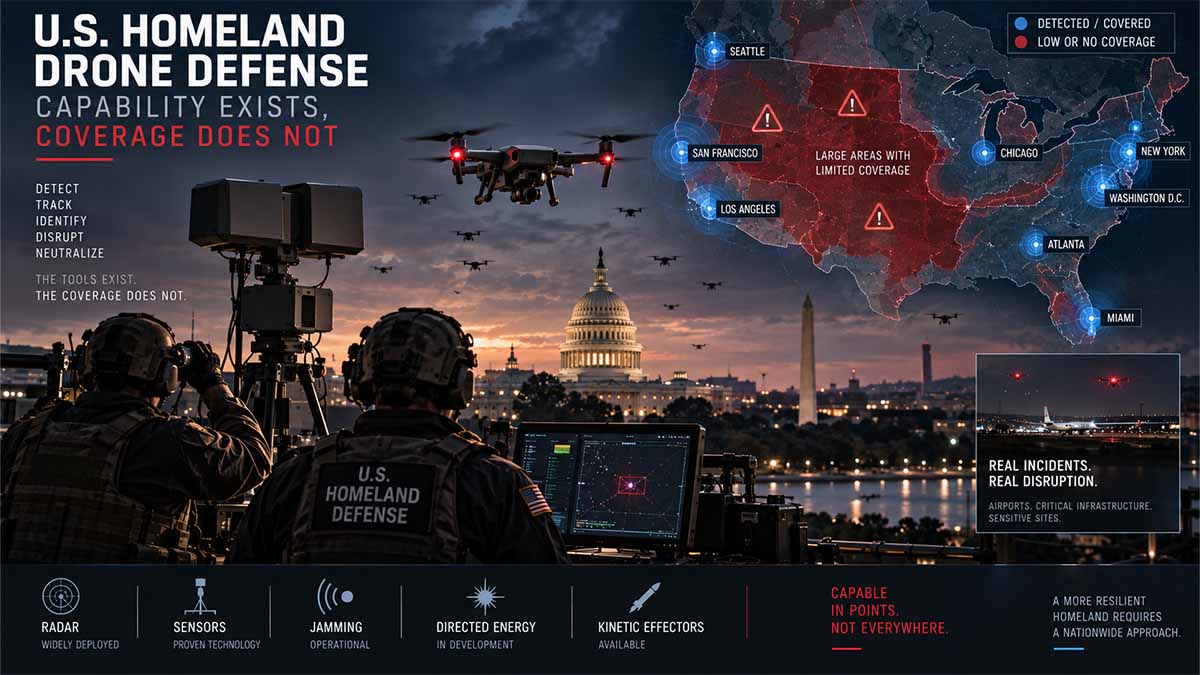
Scope: United States homeland counter-unmanned aircraft-system posture as of 29 September 2026, examining military installations, federal facilities, borders, mass gatherings and critical infrastructure, with a forward assessment through 2031 focused on detection, identification, command-and-control, legal authority, defeat capacity, industrial scalability and the specific challenge presented by coordinated and autonomous drone mass. This structure follows the FULL DOSSIER first-delivery architecture required by the supplied analytical protocol. Testo incollato
Executive Summary / BLUF
- The United States possesses credible counter-UAS technologies and has demonstrated operational defeat of hostile or unauthorized drones, including kinetic, non-kinetic and directed-energy effects, but the public official record does not establish a continuous national defensive architecture capable of reliably detecting, classifying, tracking and defeating a coordinated drone swarm across the geographically dispersed military, infrastructure and civilian targets that constitute the homeland attack surface. USNORTHCOM itself describes more than 350 homeland installations with varying degrees of defensive capability and criticality, while simultaneously developing deployable fly-away teams and additional detect-track-identify-defeat capacity. northcom.mil
- The principal vulnerability is therefore architectural rather than technological: sensor coverage is incomplete, different agencies possess different statutory authorities, civilian airspace constraints complicate active mitigation, installations retain local defensive responsibilities, critical infrastructure is predominantly outside the military perimeter, and the economics of defending thousands of potential targets against inexpensive attritable aircraft remain unfavorable. The Department of Defense formally identified production capacity, technology innovation, authorities, policy, open architectures, system integration and force structure as outstanding Replicator 2 problems rather than solved conditions. Media Difesa
- Material progress since 2024 is nevertheless evident. USNORTHCOM became the Defense Department’s homeland C-sUAS synchronizer; JIATF-401 subsequently became the principal organization for accelerating counter-drone delivery at scale; updated homeland policy expanded commander discretion; federal rules effective 1 July 2026 created a framework for qualified state, local, tribal and territorial agencies to exercise counter-UAS authorities; and operational forces have now used high-energy lasers against cartel-linked drones on the southern border. northcom.mil
- These advances principally improve point and regional defense; they do not by themselves solve saturation. The December 2024 Defense Department counter-unmanned-systems strategy explicitly identifies future systems that will be more autonomous, more networked, capable of longer loiter, larger payloads and swarm behavior, while the department’s response emphasizes defenses able to confront larger numbers of increasingly capable autonomous systems. Media Difesa
- The strategic requirement through 2031 is consequently a transition from isolated counter-drone equipment toward a distributed homeland air-surveillance and engagement ecosystem in which inexpensive sensors, Remote ID and other cooperative data, passive RF detection, radar, electro-optical/infrared systems and intelligence feeds are fused into common operational pictures, while commanders and law-enforcement authorities gain scalable low-collateral effectors suitable for dense civilian airspace. Current federal experimentation and procurement indicate that this transition has begun, but the verified public record does not demonstrate that it has reached nationwide operational maturity. Governo di Guerra
- The five-year risk is asymmetric: commercial drone integration is simultaneously increasing legitimate traffic density while autonomy, alternative communications links and swarm coordination reduce the usefulness of defenses that depend disproportionately upon detecting conventional control signals; successful homeland defense will therefore require discrimination between legitimate and hostile traffic at machine speed, not merely additional interceptors. The FAA’s 2025 integration concept already described more than 800,000 registered drones, while federal research programs have explicitly tested threats using cellular communications, airborne detection and multisensor data fusion. Amministrazione Federale dell’Aviazione
- The decisive uncertainty is not whether additional counter-UAS systems will be fielded—they already are—but whether the United States can scale sensors, authorities, trained personnel, command integration and economically sustainable effectors quickly enough that a sophisticated adversary cannot exploit the enormous difference between defending selected protected sites and protecting the broader homeland against simultaneous, geographically distributed attacks.
America’s drone problem is no longer detection. It is scale.
The United States has already demonstrated that it can detect, track and defeat unmanned aircraft over its own territory; what it has not yet demonstrated is that it can do so at the scale required by a coordinated, multi-axis and geographically distributed attack. That distinction now matters more than any individual counter-drone technology. By September 2026, USNORTHCOM was operating across a homeland environment containing more than 350 military installations with uneven defensive coverage, JIATF-401 had deployed more than $20 million in counter-UAS systems to priority southern-border sites in roughly four months, and Joint Task Force–Southern Border had reported more than 300 drone defeats during 2026. The fiscal, industrial and security stakes are therefore converging: the United States possesses functioning tools, but its defence will depend on whether sensors, authorities, command networks, interceptors and factories can be scaled before adversaries learn to saturate them.
The United States has crossed the technical threshold but not the systems threshold
The 2026 operational record is no longer one of prototypes alone. By 4 September, Joint Task Force–Southern Border had reported more than 300 UAS defeats during the calendar year, including more than 100 in August, while the Army Multipurpose High-Energy Laser had defeated 11 cartel-linked drones since its first operational employment on 24 August. These figures matter because they establish that kinetic, non-kinetic and directed-energy counter-UAS systems are no longer confined to demonstrations.
They do not establish swarm resilience. A system that can defeat repeated individual targets may still fail when track volume, engagement channels, operator workload, thermal margins or interceptor stocks are saturated simultaneously. No figure in the dossier establishes national simultaneous-track capacity, validated multi-wave engagement depth, average regeneration time or the number of sites capable of sustaining several attack waves without external reinforcement. The strategic gap is therefore not between “having” and “not having” counter-UAS capability, but between successful local engagements and sustainable system throughput.
That is why Replicator 2 is more important than any one interceptor contract. Its September 2024 direction did not define the problem narrowly as a procurement shortage; it identified production capacity, technology innovation, authorities, policy, open-system architecture, system integration and force structure as the barriers to protecting critical installations and force concentrations, with an objective of materially improved capability within 24 months of congressional funding approval. The programme is, in effect, an attempt to turn counter-drone defence from equipment acquisition into institutional scaling.
The numbers show a force that is moving quickly but still buying in small lots
The disparity between operational urgency and current procurement scale is visible in the numbers. JIATF-401 deployed more than $20 million in counter-UAS technology to priority southern-border locations within approximately four months, but the first Replicator 2 purchase announced in January 2026 involved only two DroneHunter F700 systems. In February, JIATF-401 announced a $5.2 million agreement for the Bumblebee V2 low-cost kinetic interceptor, with deliveries scheduled to begin in March.
Those purchases are meaningful because they open rapid-acquisition pathways and establish different effector classes, not because they yet amount to national mass. Project Flytrap 5.0 evaluated more than 20 counter-UAS systems under common standards, while Falcon Peak 26.2, conducted from 31 August to 25 September 2026 at Yuma Proving Ground, was designed to test emerging technologies under homeland-relevant conditions and increase emphasis on low-collateral defeat.
The pattern is clear. The United States is still in the stage of selecting, standardising and integrating a portfolio. The 2031 requirement is fundamentally different: serial production, regional inventories, common command interfaces and enough attritable systems to continue fighting after the first wave.
The cost-exchange ratio will decide whether success is sustainable
Counter-UAS economics are becoming as important as probability of kill. Electronic warfare can be repeatedly employed at low marginal cost where hostile aircraft still depend on exploitable control links; low-cost interceptor drones can defeat RF-independent targets but consume physical inventory; high-energy lasers offer deep electrical magazines but remain constrained by line of sight, dwell time, thermal management and environmental conditions; conventional projectile systems provide another layer but create ammunition and collateral-risk constraints.
The architecture therefore cannot be built around a single “best” weapon. It must push each target toward the cheapest adequate engagement method while preserving finite high-value effectors for threats that require them. The $5.2 million Bumblebee V2 agreement and the first Replicator 2 DroneHunter purchase point in this direction because both seek lower-cost, lower-collateral solutions rather than relying exclusively on missile-class interception.
Directed energy is the most visible attempt to change magazine economics. The 11 AMP-HEL defeats reported by 4 September 2026 demonstrate real operational use, but they do not answer the harder saturation question: how many targets can one system service consecutively before beam dwell time, heat dissipation or target transition becomes limiting? The dossier contains no public national figure for this. Until those throughput metrics exist, “deep magazine” should not be confused with “unlimited rate of fire”.
Swarm defence is becoming a command-and-control problem before it becomes a firepower problem
A coordinated swarm can overwhelm a defender without physically defeating every interceptor. It can saturate sensor processing, create false tracks, exploit classification delays, force expenditure on decoys, overload command networks or attack several sites simultaneously so that mobile reinforcement cannot concentrate.
This is why JIATF-401’s institutional role matters. By September 2026, its second interagency summit brought together more than 200 leaders and experts from 75 departments and agencies. That scale reflects the real problem: military services, FAA, DHS, law-enforcement bodies and infrastructure operators cannot operate separate tactical pictures during a high-tempo attack.
Project Flytrap’s assessment of the Integrated Battle Command System–Maneuver common tactical user interface is therefore more strategically important than it first appears. The requirement is to move beyond a shared display toward a network able to correlate tracks, assess target priority, identify which effectors can engage, check inventory and legal availability, allocate the least costly suitable response and immediately reassign another system if the first engagement fails.
The 2031 threshold is not merely a “common operating picture”. It is common resource allocation under saturation.
Industrial capacity is the hidden magazine behind every interceptor
The most serious long-term constraint may sit outside the operational system entirely. In August 2026, the U.S. government’s Section 232 action concluded that domestic UAS and component production remained insufficient to meet national-security needs reliably or support wartime surge at adequate scale. The identified dependencies included motors, electronic speed controllers, lithium-ion batteries and docking stations.
That matters directly to counter-UAS defence because many low-cost interceptors rely on the same commercial industrial base as the systems they are intended to destroy. An architecture built around attritable drone interceptors is sustainable only if motors, batteries, electronics and airframes can be produced faster than combat consumes them.
The policy response is substantial but slow by operational standards. The August 2026 measures imposed a 100 per cent ad valorem duty on certain larger or security-sensitive UAS, thermal-imager-equipped systems, docking stations and specified critical components, while smaller UAS and additional components received 25 per cent duties. A component tariff under Annex III is scheduled to take effect on 9 February 2027, while approved onshoring plans are expected to commit to construction before 20 January 2029.
Those dates define the industrial risk. Procurement demand is accelerating in 2026, but some of the manufacturing capacity intended to support it will not physically mature until later in the decade.
Point defence will fail if regional depth does not emerge
USNORTHCOM’s more than 350 homeland military installations already have varying defensive capability and criticality. That alone makes a nationally uniform point-defence model unrealistic. A thousand interceptors stored centrally do not protect a site that requires them within minutes, and a deployable counter-UAS team cannot reinforce several geographically separated attacks at once.
The emerging architecture therefore needs four levels of depth: site-level ready inventory for immediate engagements; regional reserves capable of reinforcing multiple facilities within hours; national reserves able to rebalance between regions; and an industrial replenishment pipeline replacing what operations consume.
Fly-away kits remain valuable within this structure. An 11-person USNORTHCOM team deployed to Minot Air Force Base in October 2025 and successfully engaged more than 100 targets of interest while obtaining operational certification. But the same fact demonstrates the limitation of mobile reinforcement: one team can close one gap at one time. Distributed attacks are specifically designed to exploit that scarcity.
By 2031, resilience will therefore be measured less by how many counter-drone systems exist nationally than by where they are positioned, how quickly they can be replenished, and whether one region can support another without exposing a second vulnerability.
The next 12–24 months will show whether Washington is building a network or another collection of programmes
The decisive evidence will arrive before 2031. Over the next 12–24 months, Replicator 2 must move beyond demonstration quantities into larger follow-on orders; JIATF-401’s common testing standards must influence procurement rather than remain an evaluation tool; industrial onshoring must begin producing measurable capacity rather than policy announcements; and interoperability exercises must prove that several geographically separated sites can share tracks, magazines and effector status during realistic multi-wave attacks.
The cost of failure will not fall on one institution. The Department of Defense will carry the operational burden of defending more than 350 homeland installations with uneven local capability; DHS and other federal agencies will face pressure to extend protection across borders and critical infrastructure; state and local authorities will inherit a larger role in distributed response; private infrastructure operators will bear the consequences where persistent active defence remains unavailable; and the industrial base will absorb the cost of accelerated procurement if foreign dependencies remain unresolved.
By 2027 and 2028, the relevant question will no longer be whether the United States has good counter-drone technologies. It will be whether those technologies have become a regionalised, interoperable and replenishable defensive system. If they have not, the attacker’s advantage will not come from superior engineering. It will come from forcing a fragmented defence to spend, decide and react faster than its institutions and factories can sustain.
Navigational Index
- The Detection and Situational-Awareness Problem — why homeland drone defense begins with persistent low-altitude awareness, why traditional air-defense architectures do not automatically solve the small-UAS problem, and why autonomous, low-signature and RF-independent systems increase the difficulty of separating legitimate aviation from hostile activity.
- The Engagement, Authority and Infrastructure-Protection Problem — how military command authorities, FAA responsibility for national airspace, federal counter-UAS statutes, newly expanded state and local authorities, privacy requirements and collateral-risk constraints determine where an identified drone can actually be neutralized.
- The Swarm-Scale Transition to 2031 — whether Replicator 2, JIATF-401, distributed sensors, low-cost kinetic interceptors, electronic warfare, directed energy, domestic industrial expansion and interagency command integration can transform today’s point defenses into a resilient architecture capable of absorbing saturation and multi-axis attacks.
Master Abstract
The United States is building a counter-drone architecture while the threat is changing faster than the architecture
The central analytical judgment is that the United States has moved beyond the stage at which homeland counter-UAS defense consisted predominantly of isolated technologies, temporary protective deployments and authorities concentrated within a small number of federal organizations, yet it has not reached the materially different condition of possessing an integrated national shield against massed low-cost unmanned systems. The distinction is important because individual counter-UAS capabilities can perform effectively without producing strategic coverage. USNORTHCOM states that more than 350 Defense Department installations exist within the homeland with differing levels of defensive capability and criticality and that responsibility for defending each installation remains with its local commander and military service, while NORTHCOM provides coordination and deployable assistance. Its establishment of C-UAS fly-away kits is therefore evidence of improving response capacity but simultaneously demonstrates why mobile reinforcement remains necessary when fixed capability is uneven. Homeland C-sUAS — U.S. Northern Command northcom.mil
The problem becomes substantially larger when the protected universe expands beyond military installations. The Executive Branch has formally identified critical infrastructure, large airports, federal facilities, military installations, land borders and mass gatherings as environments requiring strengthened drone protection, while directing agencies to expand detection, tracking and identification capacity and examine broader facility designation. This policy trajectory reflects an underlying structural reality: a drone attack does not need to overcome the continental air-defense system if it can be launched locally from a vehicle, building, vessel or concealed position relatively close to its target. The relevant defensive geometry therefore differs from the traditional problem of intercepting aircraft or missiles approaching the continent from distance. Restoring American Airspace Sovereignty — The White House — Jun 2025 The White House
Detection is the first strategic bottleneck
Counter-UAS defense comprises a sequence rather than a weapon: detect → track → identify → classify → authorize → engage → assess, and failure at any upstream stage can render a sophisticated interceptor irrelevant. The Department of Defense’s published strategy therefore places detection, tracking and characterization alongside active and passive defenses rather than treating interception as an independent solution. The same strategy warns that unmanned systems are becoming more capable, affordable, autonomous and networked and specifically anticipates greater numbers, longer endurance, improved cooperation among systems and swarm behavior. Fact Sheet: Department of Defense Strategy for Countering Unmanned Systems — Department of Defense — Dec 2024 Media Difesa
No single sensor technology provides universal coverage against this spectrum. Radar can extend surveillance but must separate small drones from birds, ground clutter and civilian traffic; passive radio-frequency systems are valuable when detectable command or telemetry signals exist but become less decisive against pre-programmed, autonomous or alternative-link systems; electro-optical and infrared sensors can provide identification but are constrained by range, weather, line of sight and processing requirements. GAO had already identified electromagnetic interference, small airborne objects, false detections, unpredictable trajectories and limited engagement ranges among the problems facing counter-drone systems, while current Defense guidance explicitly presents radar, EO/IR and RF detection as complementary rather than interchangeable sensor types. Science & Tech Spotlight: Counter-Drone Technologies — U.S. Government Accountability Office — Mar 2022 GAO JIATF 401 Publishes Guide to Counter-Drone Technology and Privacy Protections — Department of War — Mar 2026 Governo di Guerra
The problem will become harder as legitimate unmanned traffic grows. The FAA’s May 2025 integration concept recorded more than 800,000 registered drones already incorporated into the National Airspace System and envisaged routine scalable beyond-visual-line-of-sight operations over the succeeding decade. Homeland defense must therefore develop inside an increasingly populated low-altitude environment rather than inside sterile military airspace. The operational task is consequently not simply to detect aircraft but to distinguish authorized, anomalous, negligent and hostile aircraft quickly enough for an intervention decision to remain useful. Drone Integration: Concept of Operations — Federal Aviation Administration — May 2025 Amministrazione Federale dell’Aviazione
Federal research priorities reveal that policymakers recognize this problem. DHS research planning has included detection of drones using cellular communications links, airborne drone-detection platforms, Remote ID integration into the Team Awareness Kit, long-range passive radar and multisensor data fusion. Those programs are analytically significant because they indicate movement away from dependence upon one sensor modality or one identifiable control link toward heterogeneous sensor fusion, which is the architecture required against increasingly autonomous targets. Department of Homeland Security Science and Technology Research, Development and Innovation — DHS Dipartimento della Sicurezza Nazionale
The engagement problem is inseparable from law, airspace safety and collateral damage
Detecting an aircraft does not establish authority to destroy it. USNORTHCOM explicitly notes that the military does not manage U.S. airspace and that FAA authority remains central, while Defense Department counter-UAS operations within the homeland depend upon particular statutory authorities and protected-facility designations. This creates a fundamentally different engagement environment from an overseas battlefield because radio-frequency interference, projectiles, interceptor drones and directed-energy systems can interact with civilian aviation, communications systems, navigation infrastructure, people and property. Homeland C-sUAS — U.S. Northern Command northcom.mil
The federal framework changed substantially during 2025–26. Executive Order 14305 directed expanded federal use of available detection authorities, revised guidance, real-time access to Remote ID information for appropriate agencies, guidance for critical-infrastructure operators and expanded counter-UAS capacity. Restoring American Airspace Sovereignty — Executive Order 14305 — Jun 2025 The White House The military’s December 2025 homeland policy then expanded commander flexibility, including defensive action beyond installation fence lines and broader criteria for what constitutes a threat, while retaining the requirement to operate under applicable domestic authorities. Fact Sheet: C-UAS Policy in the U.S. Homeland — Department of War — Feb 2026 Media Difesa
A second major transition occurred when the SAFER SKIES implementation framework became effective on 1 July 2026. The DHS-DOJ interim final rule established a structured mechanism under which qualified state, local, tribal and territorial law-enforcement and correctional agencies can conduct defined counter-UAS operations, including requirements for certification, technology authorization, spectrum coordination, airspace approval, notification, mitigation reporting, privacy and compliance. This materially enlarges the potential national response network, although legal authority should not be confused with installed sensor coverage, trained crews or physical inventory. Counter-UAS Authority for State, Local, Tribal, and Territorial Law Enforcement and Correctional Agencies — DHS/DOJ — Jul 2026 GovInfo
The FCC simultaneously issued spectrum measures intended to facilitate authorized counter-UAS activity by those agencies, illustrating why spectrum management is itself part of the defensive architecture rather than an administrative afterthought. Counter-UAS Spectrum Authority for State, Local, Tribal, and Territorial Law Enforcement and Correctional Agencies under the SAFER SKIES Act — Federal Communications Commission — Jul 2026 FCC Documents
Operational success against individual drones does not establish swarm-defense sufficiency
The 2026 operational record provides important evidence that counter-UAS technologies are moving from experimentation toward actual homeland employment. On 4 September 2026, Joint Task Force–Southern Border reported that forces had defeated more than 300 UAS during calendar year 2026, including more than 100 during August, and that the Army Multipurpose High-Energy Laser system had defeated 11 cartel-linked UAS between its initial employment on 24 August and 4 September. USNORTHCOM Operational Update: Cartel Drone Defeats at the Southern Border — U.S. Northern Command — Sep 2026 northcom.mil
This is strategically important because directed energy offers an attractive cost-per-engagement model against inexpensive aircraft and avoids some ammunition-depth constraints associated with conventional interceptors, but the publicly released operational record does not establish performance against simultaneous large-scale saturation, adverse weather, mixed drone types, autonomous navigation, multiple approach axes or attacks designed deliberately to exhaust sensor and engagement capacity. Those distinctions are required under the technical evidence standard because fielded capability, operational employment and swarm-proven capability are different evidentiary categories. The official Defense strategy itself continues to frame larger numbers of increasingly autonomous systems as a future stressing case rather than a solved requirement. Fact Sheet: Department of Defense Strategy for Countering Unmanned Systems — Department of Defense — Dec 2024 Media Difesa
The government’s continuing experimentation reinforces that conclusion. Falcon Peak 26.2, conducted at Yuma Proving Ground from 31 August through 25 September 2026, was designed to demonstrate new technologies, examine southern-border conditions and expand emphasis on low-collateral defeat capabilities. A mature nationwide architecture would still require experimentation because threats evolve, but the specific emphasis on integration, demonstration and accelerated maturation demonstrates that significant portions of the capability set remain under development. USNORTHCOM, JIATF-401 Launch Falcon Peak 26.2 Experiment at Yuma Proving Ground — U.S. Northern Command — Aug 2026 northcom.mil
The economics of defense remain potentially as important as interceptor performance
The strategic asymmetry is pronounced because inexpensive drones impose costs not only when they penetrate defenses but whenever defenders must maintain sufficient sensors, trained crews, communications networks and interceptors to prevent penetration. The Defense Department has explicitly acknowledged the cost imbalance between inexpensive unmanned systems and comparatively expensive countermeasures and has made reducing that imbalance an element of its counter-unmanned-systems approach. Austin Signs New Strategy for Countering Effects of Unmanned Systems — Department of Defense — Dec 2024 Dipartimento della Difesa
The resulting portfolio increasingly contains different layers rather than a single interceptor class. JIATF-401 awarded a $5.2 million agreement for Bumblebee V2 low-collateral kinetic interceptors in January 2026 and has trained forces with interceptor-drone systems intended to complement other defenses. JIATF 401 Announces Kinetic Counter-Drone System; Enhancing Warfighter Lethality — Department of War — Feb 2026 Governo di Guerra At the same time, JIATF-401 and FAA conducted high-energy-laser testing specifically to address safe domestic employment and national-airspace integration. JIATF-401, FAA to Conduct Advanced Counter-Drone Laser Test at White Sands Missile Range — Department of War — Mar 2026 Governo di Guerra
A sustainable swarm-defense architecture would probably require exactly this layered cost structure: non-kinetic effects where technically and legally viable, inexpensive kinetic interceptors when electronic defeat is ineffective, directed energy where atmospheric and operational conditions permit, and substantially more expensive effectors only against targets whose characteristics justify them. The unresolved question is whether the United States can produce and deploy those layers at a density matching the number of assets requiring protection.
Critical infrastructure is the strategic scale problem
Military installations constitute only one part of the attack surface. DHS and CBP budget documentation explicitly describes counter-UAS requirements for northern and southern borders and national-level special events and identifies potential drone attacks on infrastructure and personnel, smuggling and surveillance as operational threats. CBP FY 2026 Congressional Budget Justification — Department of Homeland Security Dipartimento della Sicurezza Nazionale The September 2026 meeting between USNORTHCOM and DHS leadership similarly focused on creating complementary interoperable capabilities to protect critical national infrastructure against Class 1 through Class 3 small-UAS threats, with explicit emphasis on sensor integration and domain-awareness architecture. USNORTHCOM and DHS leaders strengthen interagency collaboration to safeguard the United States — U.S. Northern Command — Sep 2026 northcom.mil
The significance of this transition should not be understated. Defending selected air bases permits relatively predictable perimeters, known authorities, trained military personnel and controlled deployment of specialized equipment; protecting electricity generation and transmission assets, refineries, telecommunications nodes, ports, airports, water systems, chemical plants, data centres, sporting venues and transportation infrastructure introduces thousands of potential locations, multiple private owners, different regulators and widely varying environments. A system optimized for an isolated military installation therefore cannot simply be multiplied mechanically across civilian infrastructure.
Replicator 2 addresses exactly the unresolved scaling problem
The September 2024 Replicator 2 direction is unusually revealing because it lists the barriers the Department expected the program to overcome: production capacity, technology innovation, authorities, policies, open-system architecture, system integration and force structure. Its explicit objective was to deliver meaningfully improved counter-small-UAS protection to critical assets within 24 months after congressional funding approval. Secretary of Defense Memorandum: Replicator 2 Direction and Execution — Department of Defense — Sep 2024 Media Difesa
Actual procurement began during 2026, including the first Replicator 2 acquisition by JIATF-401 for DroneHunter F700 systems. That acquisition demonstrates program execution, but two purchased systems cannot be interpreted as evidence of nationwide protection, and the significance resides principally in the acquisition mechanism and architecture being established. Joint Interagency Task Force Announces First Replicator 2 Purchase to Counter Homeland Drone Threats — Department of War — Jan 2026 Governo di Guerra
JIATF-401 also reported that more than $20 million of counter-UAS technology was deployed to priority southern-border sites within four months, using site surveys to identify gaps and construct layered sensing, tracking and neutralization. This provides a useful model of the emerging doctrine: perform local threat and terrain analysis, integrate multiple sensing and defeat mechanisms and connect them to an operational command structure rather than install a uniform appliance everywhere. Joint Interagency Task Force 401 Enhances Counter-UAS Capability to Protect the Southern Border — Department of War — Apr 2026 Governo di Guerra
The threat and the commercial ecosystem are advancing simultaneously
The United States is intentionally accelerating legitimate drone adoption while strengthening counter-drone defenses. Executive policy issued in June 2025 called for routine BVLOS operations, broader integration into national airspace and strengthening of the domestic UAS industrial base. Unleashing American Drone Dominance — The White House — Jun 2025 The White House By August 2026, the Administration had also imposed substantial tariffs on specified foreign UAS and components following a Section 232 national-security finding and introduced incentives intended to increase American production capacity. Adjusting Imports of Unmanned Aircraft Systems and Unmanned Aircraft Systems Components into the United States — The White House — Aug 2026 The White House
These policies address an important industrial dimension, but domestic manufacturing resilience and homeland defensive sufficiency are not equivalent propositions. The counter-UAS problem requires not merely American-made drones but affordable radars, passive RF receivers, EO/IR systems, compute infrastructure, datalinks, effectors, power systems, software, trained operators, sustainment and sufficient manufacturing surge capacity to replace consumables during prolonged operations.
Swarming changes the problem from interception to resource competition
A coordinated swarm creates operational stresses that are nonlinear relative to an isolated drone because multiple aircraft can simultaneously consume sensor tracks, identification capacity, engagement channels, interceptors and human attention. Swarm autonomy can further reduce dependence upon a vulnerable central controller, while geographically separated launch cells can complicate attribution and defeat the assumption that an incoming threat will traverse long-range surveillance sectors before reaching a target. The Department of Defense’s own strategy explicitly places increasingly autonomous, networked and swarming unmanned systems inside its anticipated threat development rather than treating swarm warfare as a speculative abstraction. Fact Sheet: Department of Defense Strategy for Countering Unmanned Systems — Department of Defense — Dec 2024 Media Difesa
This changes the relevant measure of defensive effectiveness. A system capable of destroying 95 percent of isolated test targets would not necessarily provide adequate protection if a simultaneous attack generated more valid tracks than its command architecture could process or more engagements than its available effectors could service. Publicly available official documents reviewed for this assessment do not provide a national-level figure for simultaneous track capacity, interceptor magazine depth, sensor coverage percentage, probability of kill against autonomous swarms or the percentage of critical infrastructure with operational counter-UAS coverage. Those omissions prevent a defensible quantitative estimate of nationwide swarm resilience.
The 2026–2031 outlook is therefore a race between integration and adversary adaptation
The balance of verified evidence supports a five-year trajectory in which U.S. homeland counter-UAS protection becomes substantially more capable while remaining uneven. Expanded legal authority, JIATF-401, NORTHCOM synchronization, Replicator 2, multisensor fusion, affordable interceptor drones and directed-energy experimentation all address known weaknesses rather than peripheral problems. The September 2026 interagency summit involving more than 200 leaders and experts from 75 departments and agencies demonstrates that institutional integration has become an explicit operational priority. DOW Hosts 2nd Interagency Summit to Strengthen Counter-Drone Defense — Department of War — Sep 2026 Governo di Guerra
The unresolved challenge is that adversaries do not need to reproduce an American integrated-air-defense system to create a homeland security problem. Commercially derived aircraft, improvised payloads, autonomous navigation, local launch, alternate communications, decoys and coordinated timing lower the entry threshold substantially. Consequently, success by 2031 should not be measured principally by the number of counter-UAS devices acquired, but by whether the United States can maintain sufficiently persistent low-altitude awareness, distribute engagement authority, fuse information across jurisdictions, regenerate inexpensive defensive effects and continue operating critical functions even when some drones penetrate the defensive layer.
Key Evidence Table
| Indicator | Value/status | Reference date | Definition/scope | Issuer | Exact source |
|---|---|---|---|---|---|
| Defense installations within homeland | More than 350, with varying defensive capability and criticality | Current NORTHCOM public posture | DoD installations in USNORTHCOM homeland mission area | USNORTHCOM | Homeland C-sUAS northcom.mil |
| Homeland C-sUAS synchronization | USNORTHCOM designated lead synchronizer | Nov/Dec 2024 | Continental United States and Alaska DoD operations | Department of Defense / USNORTHCOM | United States Northern Command Assigned as DOD’s Lead Synchronizer northcom.mil |
| Replicator 2 objective | Improved protection of critical installations and force concentrations; 24-month fielding objective after funding approval | Sep 2024 | Counter-small-UAS | Department of Defense | Replicator 2 Direction and Execution Media Difesa |
| Identified Replicator 2 barriers | Production, innovation, authorities, policies, open architecture, system integration, force structure | Sep 2024 | Department-wide capability development | Department of Defense | Replicator 2 Direction and Execution Media Difesa |
| Registered civilian drone environment | >800,000 registered drones | May 2025 CONOPS | U.S. National Airspace System | FAA | Drone Integration: Concept of Operations Amministrazione Federale dell’Aviazione |
| Expanded SLTT C-UAS framework | Interim final rule effective 1 Jul 2026 | Jul 2026 | State, local, tribal and territorial law-enforcement and correctional agencies | DHS / DOJ | Counter-UAS Authority for State, Local, Tribal, and Territorial Law Enforcement and Correctional Agencies GovInfo |
| Border C-UAS investment | More than $20 million deployed in approximately four months | Apr 2026 report | Priority southern-border locations | JIATF-401 | JIATF 401 Enhances Counter-UAS Capability to Protect the Southern Border Governo di Guerra |
| Operational UAS defeats | >300 in calendar 2026 by Sep. 4; >100 in Aug 2026 | 4 Sep 2026 | JTF-Southern Border operating environment | USNORTHCOM | USNORTHCOM Operational Update: Cartel Drone Defeats at the Southern Border northcom.mil |
| High-energy-laser operational employment | 11 cartel-linked UAS defeated with AMP-HEL since 24 Aug | 4 Sep 2026 | Southern-border operations | USNORTHCOM / JTF-SB | USNORTHCOM Operational Update northcom.mil |
| Interagency institutional scale | >200 participants from 75 departments/agencies | Aug/Sep 2026 | Counter-drone homeland coordination | JIATF-401 | DOW Hosts 2nd Interagency Summit to Strengthen Counter-Drone Defense Governo di Guerra |
| Future threat characteristics officially identified | More numerous, autonomous, networked, longer-loitering, larger-payload and swarm-capable systems | Dec 2024 strategy | Mid- and long-term unmanned-system threat | Department of Defense | Fact Sheet: Strategy for Countering Unmanned Systems Media Difesa |
Principal Gaps and Watch Indicators
National sensor coverage remains unquantified in the public record. No reviewed first-order source establishes what percentage of high-value military installations, nuclear-related facilities, airports, border sectors or civilian critical-infrastructure sites possess persistent multi-sensor counter-UAS surveillance, nor does the public record provide a national map of detection range, overlap or blind areas. A material change in the assessment would occur if NORTHCOM, DHS or another competent authority published standardized coverage metrics rather than inventory counts.
Simultaneous-track and engagement capacity is not publicly established. Official documents demonstrate interception of individual and repeated drone threats but do not disclose validated performance against operationally realistic large swarms. The most important future indicators are therefore exercises involving dozens or hundreds of simultaneous heterogeneous targets, deliberately saturated command-and-control systems, autonomous targets without conventional RF control links and attacks approaching from multiple bearings.
Magazine depth remains a strategic variable. Drone-on-drone interceptors are promising because their economics may be substantially more favorable than high-end missiles, while directed energy potentially alters the cost equation further; however, operational swarm resilience depends upon interceptor stocks, recharge and duty-cycle constraints, weather effects, power availability, spare parts and replacement production rather than nominal weapon availability alone. Replicator 2 contract volume, production-rate disclosures and sustained multi-wave exercises would materially clarify this issue. JIATF 401 Announces Kinetic Counter-Drone System Governo di Guerra
Civilian-infrastructure deployment remains the most consequential scaling question. The July 2026 regulatory framework materially expands the pool of entities capable of lawful counter-UAS operations, but certification and authority do not automatically produce sensors, operators, command networks or effectors. The strongest positive indicator would be the emergence of persistent regional counter-UAS networks covering clusters of airports, energy infrastructure, government facilities and mass gatherings rather than temporary event-specific deployments. Counter-UAS Authority for State, Local, Tribal, and Territorial Law Enforcement and Correctional Agencies GovInfo
Sensor fusion against non-cooperative aircraft will be decisive. Remote ID improves discrimination when compliant aircraft broadcast valid information, but a sophisticated hostile system should not be assumed to cooperate with regulatory identification architecture. Continued federal investment in radar, passive RF, EO/IR, airborne detection and fused common operating pictures therefore constitutes a more important indicator of mature homeland defense than Remote ID adoption alone. Department of Homeland Security Science and Technology Research, Development and Innovation Dipartimento della Sicurezza Nazionale
Autonomous navigation is a critical technology signpost. Defenses optimized around disrupting operator-to-drone communications will become progressively less sufficient as systems navigate from onboard maps, vision, inertial navigation, terrain matching or other locally processed guidance. The Defense Department’s explicit expectation of increasing autonomy and networking means successful future testing against RF-silent or communications-denied targets should be treated as a major capability milestone. Fact Sheet: Strategy for Countering Unmanned Systems Media Difesa
Common command-and-control architecture will determine whether thousands of local defenses behave as one system. The September 2026 NORTHCOM-DHS effort specifically focused on interoperable platforms, sensor integration and shared domain awareness, while JIATF-401’s interagency summit involved 75 departments and agencies; future publication of common data standards, cross-agency track sharing, automated threat correlation and tested hand-off procedures would substantially strengthen the assessment. USNORTHCOM and DHS leaders strengthen interagency collaboration to safeguard the United States northcom.mil DOW Hosts 2nd Interagency Summit to Strengthen Counter-Drone Defense Governo di Guerra
Critical-infrastructure resilience must ultimately complement interception. No counter-UAS architecture can credibly guarantee the destruction of every attacking aircraft across continental-scale geography. A mature strategy therefore requires physical hardening, redundancy, dispersed control systems, rapid repair, backup communications, spare transformers and other sector-specific continuity mechanisms so that occasional penetration does not generate strategic disruption. This is an analytical implication of the attack-defense geometry rather than evidence that any particular infrastructure sector presently lacks such measures.
Visualisation — From Drone Detection to Homeland Defence
The verified record supports a dependency-chain visualisation because the principal vulnerability is produced by the cumulative relationship between surveillance, classification, legal authority, command integration and available effectors rather than by one independently measurable national readiness score.
Homeland Counter-UAS Dependency Chain
A hostile drone is defeated only if every necessary stage functions within the available decision and engagement time; expanding interceptor inventories therefore cannot compensate automatically for gaps earlier in the chain.
Detect
Radar, RF, EO/IR, Remote ID and other sensors establish that an airborne object exists.
Persistent national coverage not publicly established.
Track
Tracks must persist through clutter, terrain, buildings and potentially large numbers of simultaneous objects.
Fusion architecture expanding.
Identify & Classify
Systems distinguish legitimate traffic, anomalous activity and potentially hostile aircraft.
Harder as civilian UAS density grows.
Authorize
Military, federal or qualified SLTT authorities determine whether and how mitigation is legally permissible.
Authority expanded materially in 2025–26.
Engage
Electronic, kinetic, interceptor-drone or directed-energy effects attempt to neutralize the target.
Multiple operational layers emerging.
Regenerate
The network must retain sensors, energy, ammunition, communications and trained crews through repeated attack waves.
Swarm-scale endurance remains publicly unresolved.
| Verified transition | Current evidence | Remaining question |
|---|---|---|
| Point defence → layered defence | JIATF-401, Replicator 2, interceptor drones and directed-energy activity | Can sufficient layers be deployed across the national target set? |
| Federal-only response → distributed authority | 2026 SAFER SKIES implementation framework | How rapidly will certified SLTT capacity become operational at scale? |
| Single-sensor detection → sensor fusion | Radar, RF, EO/IR, Remote ID and DHS fusion experimentation | Can RF-independent autonomous threats be detected reliably? |
| Individual threats → saturation problem | DoD strategy explicitly anticipates larger numbers, autonomy and swarming | What simultaneous track and engagement capacity has been validated? |
Sources: U.S. Northern Command Homeland C-sUAS posture; Department of Defense Strategy for Countering Unmanned Systems; Replicator 2 direction; DHS/DOJ 2026 counter-UAS rule; FAA Drone Integration CONOPS; DHS counter-UAS research documentation. Status statements above distinguish documented activity from unresolved national-scale capability.
The overall judgment therefore remains deliberately narrower than either “the United States cannot defend itself against drones” or “the United States now possesses an effective counter-drone shield.” The verified September 2026 position lies between those propositions: the United States possesses increasingly effective counter-UAS technologies, broadened authorities, operational experience and an accelerating institutional architecture, but publicly available evidence does not establish a persistent nationwide capability able to absorb a sophisticated, autonomous and geographically distributed swarm attack against the breadth of U.S. military and civilian critical infrastructure. The strategic contest through 2031 will consequently be determined less by invention of another individual counter-drone weapon than by whether detection, classification, authorities, command-and-control, affordable engagement capacity, industrial production and infrastructure resilience can be integrated at national scale before offensive drone systems acquire still greater autonomy, density and coordination.
Capability Exists — Coverage, Integration and Swarm Resilience Remain the Strategic Problem
The diagram distinguishes the existence of individual counter-UAS technologies from the substantially harder requirement of creating a persistent, legally usable and economically sustainable homeland defence architecture capable of detecting, classifying and defeating simultaneous unmanned threats across military installations, borders, federal facilities, mass gatherings and civilian critical infrastructure.
Principal judgment: the United States has operational counter-UAS sensors, interceptors, electronic effects and directed-energy systems, together with expanding legal authorities and a rapidly developing interagency architecture; however, the public official record does not establish continuous nationwide coverage or validated capacity to absorb a sophisticated, autonomous and geographically distributed drone-swarm attack against the full homeland target set.
The Counter-UAS Kill Chain
Detect
Radar, passive RF, EO/IR, Remote ID and other sensors must first establish that an airborne object exists.
National persistent coverage is not publicly established.Track
The system must maintain the track through clutter, terrain, buildings and potentially numerous simultaneous objects.
Multi-sensor fusion architecture is expanding.Identify
Legitimate aviation, compliant drones, anomalous traffic and potential threats must be distinguished quickly enough to preserve engagement time.
Increasing civilian UAS density raises discrimination complexity.Authorize
A detected threat must fall within an applicable military, federal or qualified SLTT legal authority before mitigation.
Authorities broadened materially during 2025–26.Engage
Electronic warfare, interceptor drones, kinetic systems or directed energy must neutralize the target without unacceptable collateral consequences.
Multiple defeat layers are operational or entering service.Regenerate
Sensors, power, communications, crews and effectors must remain available through repeated or simultaneous attack waves.
Swarm-scale endurance remains publicly unresolved.Why the Threat Is Becoming Harder
Defensive Architecture — Relative Maturity
Bars are qualitative visual representations of the analytical architecture and are not numerical readiness scores or government measurements.
The Strategic Transition
Current Model
Selected military bases, border sectors, major events and specially protected facilities receive layered counter-UAS protection according to mission, threat and authority.
Transition Underway
NORTHCOM synchronization, JIATF-401, Replicator 2, SAFER SKIES implementation, sensor fusion and new low-collateral effectors are pushing the system toward broader interoperability.
Required End State
Distributed low-altitude awareness, common operational pictures, delegated lawful engagement, scalable low-cost defeat systems and resilient critical infrastructure functioning as a national architecture.
Core Strategic Problem
The critical question through 2031 is not whether the United States can destroy individual drones, because operational evidence demonstrates that it can; the decisive question is whether hundreds of local counter-UAS deployments, multiple federal and local authorities, diverse sensor families and several classes of effectors can be integrated quickly enough that an attacker cannot create local superiority through saturation, autonomy, surprise or simultaneous attacks against geographically dispersed infrastructure.
Verified Baseline and Remaining Gaps
| Domain | Verified Record | Status | What Remains Unresolved |
|---|---|---|---|
| Military installations | USNORTHCOM publicly identifies more than 350 homeland DoD installations with varying defensive capability and criticality. | Established | Percentage possessing persistent multisensor coverage and swarm-capable defensive depth is not publicly established. |
| Operational defeat | Joint Task Force–Southern Border reported more than 300 UAS defeats during calendar year 2026 by early September. | Established | Performance against simultaneous large heterogeneous swarms is not established by the cited operational record. |
| Directed energy | AMP-HEL was operationally used against cartel-linked drones during 2026 southern-border operations. | Established | Sustained performance under saturation, weather and multiple-axis attack conditions remains publicly unresolved. |
| Interagency authorities | Federal policy and the 2026 SAFER SKIES implementation framework materially broaden the potential counter-UAS response network. | Developing | Legal authority does not itself establish deployed sensors, trained operators or nationwide mitigation capacity. |
| Sensor integration | Federal programs are developing radar, RF, EO/IR, Remote ID, airborne sensing and multisensor fusion. | Developing | Nationwide interoperability, common track management and coverage density remain unverified. |
| Critical infrastructure | Federal policy explicitly identifies airports, borders, federal facilities, military installations, critical infrastructure and mass gatherings as protection priorities. | Developing | Public evidence does not establish comprehensive national defensive coverage of the civilian infrastructure universe. |
| Swarm defence | DoD strategy formally identifies larger numbers, networking, autonomy and swarming as anticipated threat characteristics. | Unresolved | National simultaneous-track capacity, engagement-channel capacity, magazine depth and validated saturation thresholds remain undisclosed or unestablished publicly. |
U.S. Northern Command — Homeland C-sUAS
Department of Defense — Strategy for Countering Unmanned Systems
Department of Defense — Replicator 2 Direction and Execution
Federal Aviation Administration — Drone Integration: Concept of Operations
The White House — Restoring American Airspace Sovereignty
DHS / DOJ — Counter-UAS Authority for State, Local, Tribal, and Territorial Agencies
U.S. Northern Command — Operational Update: Cartel Drone Defeats at the Southern Border
U.S. Northern Command — Falcon Peak 26.2 Experiment
U.S. Northern Command — USNORTHCOM and DHS Interagency Counter-UAS Collaboration
The Detection and Situational-Awareness Problem
Principal Judgment
The central weakness in U.S. homeland counter-UAS defence is no longer simply the absence of individual detection technologies, because radar, radio-frequency sensing, electro-optical and infrared systems, Remote ID, airborne sensing and increasingly sophisticated multisensor fusion are all present in the federal capability portfolio; the more consequential problem is that these capabilities do not yet constitute a persistent, interoperable and nationally distributed low-altitude surveillance architecture able to convert the enormous volume of legitimate, ambiguous and hostile activity in U.S. airspace into a reliable real-time threat picture. USNORTHCOM currently describes more than 350 homeland military installations with varying degrees of defensive capability and criticality, and the command’s counter-UAS mission explicitly includes the development of detect, track, identify and defeat capabilities rather than treating detection as an already-solved prerequisite. Homeland C-sUAS — U.S. Northern Command
The operational implication is fundamental: an interceptor cannot engage an aircraft that has not been detected, a command centre cannot allocate an effector to a track whose identity is uncertain, and an installation commander gains little decision advantage from an alert that arrives only after an aircraft has entered the immediate target area. Effective homeland counter-UAS defence therefore depends upon producing decision time, and decision time is generated by detection range, track persistence, classification confidence, network latency, cross-agency information sharing and the ability to correlate several sensor types before a low-altitude object reaches a protected asset. JIATF-401’s current doctrine reflects exactly this architecture, describing radar, electro-optical/infrared and radio-frequency detection as complementary passive sensing mechanisms that must be integrated with mission-command and other systems rather than treated as stand-alone solutions. JIATF 401 Publishes Guide to Counter-Drone Technology and Privacy Protections — Joint Interagency Task Force 401 — Mar 2026
The intelligence problem becomes more difficult as the threat moves away from conventional remotely piloted commercial drones toward aircraft that are smaller, faster, autonomous, intermittently connected or entirely independent of an external radio-frequency control channel. The Department of Defense’s current testing framework explicitly states that hostile small UAS are becoming progressively more difficult to detect, classify and defeat as commercially available systems become faster and smaller, while JIATF-401 has imposed common evaluation standards precisely because system performance cannot be meaningfully understood without comparable detection and classification data across different threats and environments. The Standard Guidelines for Test and Evaluation of Counter-Unmanned Aircraft Systems Technologies — Joint Interagency Task Force 401 — Mar 2026
Low-Altitude Airspace Is a Different Surveillance Problem
The conventional North American air-defence architecture was historically designed primarily around threats whose altitude, speed, radar cross-section, flight profile and approach geometry differ substantially from those of small UAS. Small drones can operate at very low altitude, exploit terrain and urban clutter, remain below or within the clutter environment of sensors optimized for larger aircraft, launch from locations already inside the continental defensive perimeter and approach targets with little warning time. This does not make traditional radar irrelevant, but it changes the surveillance physics and the density of sensors required to provide persistent local awareness.
The distinction was already visible in formal congressional testimony several years before the current modernization effort. In the official record of the House Armed Services Committee’s 2021 hearing on homeland defence, then-NORAD and USNORTHCOM commander General Glen VanHerck stated that NORAD had limited capability to detect small-UAS swarm attacks, explicitly citing the small radar signature of commercially available aircraft, and described the requirement to use data analytics, machine learning and existing sensors to increase warning and decision space. That evidence is historical rather than a description of 2026 capability, but it establishes that the detection deficit is structural rather than a problem discovered only after recent battlefield experience. National Security Challenges and U.S. Military Activity in North and South America — House Armed Services Committee — Apr 2021
The current architecture is being redesigned around this lower-altitude operating environment. In September 2026, USNORTHCOM and the Department of Homeland Security specifically focused their interagency effort on protecting national critical infrastructure against Class 1 through Class 3 small-UAS threats, emphasizing sensor-integration frameworks, domain awareness and interoperable civil-military platforms rather than merely increasing the number of independent local sensors. USNORTHCOM and DHS Leaders Strengthen Interagency Collaboration to Safeguard the United States — U.S. Northern Command — Sep 2026
That distinction is essential because the limiting variable for homeland defence is not necessarily whether one radar can detect one drone under favourable conditions; the strategic requirement is whether a distributed network can detect multiple different objects across varying terrain, weather, RF environments and civilian traffic densities while preserving track identity and communicating the resulting information rapidly enough for operational action.
The Detection Problem Has Four Separate Layers
The phrase “drone detection” can conceal several technically different functions that should not be treated as interchangeable.
| Detection layer | Operational question | Required output | Principal failure mode | Consequence if unresolved | Official basis |
|---|---|---|---|---|---|
| Initial detection | Is an airborne object present? | Detection event, approximate position and time | Object remains below threshold, hidden by clutter or outside sensor coverage | No defensive process begins | Counter-Unmanned Aircraft Systems Technology Guide — DHS |
| Tracking | Where is the object moving and will the track persist? | Continuous trajectory, speed, altitude and heading | Track loss, fragmentation or misassociation between multiple objects | Decision-makers lose approach geometry and warning time | JIATF-401 Standard Guidelines for Test and Evaluation — Mar 2026 |
| Classification | Is the object a drone rather than a bird, crewed aircraft, balloon or other target? | Object class with defensible confidence | False positive or uncertain classification | Security forces may waste attention or delay engagement | Counter-Unmanned Aircraft Systems Technology Guide — DHS |
| Identification | What drone is it, who or what controls it, and is it authorized? | Type, Remote ID where available, operator/control information, mission context | Non-cooperative aircraft, spoofed or absent identification, autonomous flight | Hostile and legitimate traffic remain difficult to discriminate | Remote Identification of Drones — FAA |
| Threat determination | Does the track represent danger to the protected asset? | Operationally actionable threat classification | Insufficient context or delayed fusion of multiple data sources | Engagement window contracts or disappears | JIATF-401 Announces Updated Guidance to Counter Drone Threats in the Homeland — Jan 2026 |
This layered structure matters because improvements at one stage do not automatically solve failures elsewhere. A high-performance radar can generate a track without identifying the operator; Remote ID can provide useful identity information without constituting a physical detector for a non-compliant aircraft; an RF receiver may identify a commercial control protocol but provide little or no information against an autonomous aircraft using no detectable command link; and EO/IR imagery can confirm an aircraft visually without providing the long-range persistent search function needed to find it initially.
Radar Provides Volume Search but Must Solve the Clutter Problem
Radar remains indispensable because it does not require a drone to cooperate, broadcast identification or maintain an external command link, and it can provide range, bearing, altitude and velocity information continuously across a monitored volume. Its importance therefore increases as adversaries move toward autonomous and RF-independent systems. At the same time, the small size, low altitude and relatively low velocity of many drones place their signatures close to the environmental conditions that generate false tracks from birds, vegetation, vehicles, buildings and other clutter, particularly in urban or complex terrain.
The Department of Homeland Security’s technical evaluation framework therefore does not treat “radar detection range” as a single universal specification; instead, it asks how detection probability varies with range, what minimum radar cross-section can be detected, how clutter affects performance and whether the sensor can distinguish drones from other airborne objects. Counter-Unmanned Aircraft Systems Technology Guide — Department of Homeland Security
This has a direct implication for procurement. A radar’s manufacturer’s maximum range does not provide a decision-grade measure of homeland counter-UAS performance unless the target type, altitude, radar cross-section, weather, terrain, clutter environment, detection probability and false-alarm rate are specified. JIATF-401’s March 2026 adoption of common test-and-evaluation standards addresses exactly this problem by requiring counter-UAS evaluations to record a standardized set of core data so that performance from different systems and test events can be compared rather than relying on incompatible manufacturer claims. The Standard Guidelines for Test and Evaluation of Counter-Unmanned Aircraft Systems Technologies — Joint Interagency Task Force 401 — Mar 2026
Radar technology is also evolving beyond dedicated defence sensors. NIST published 2025 research examining the use of 5G New Radio waveforms as radar illumination for airborne-object detection, illustrating the broader technological direction in which existing communications infrastructure can potentially contribute to passive or opportunistic sensing rather than every defensive site depending exclusively upon purpose-built radar emitters. The research does not establish an operational nationwide capability, but it demonstrates that spectrum and communications infrastructure are increasingly being investigated as part of the low-altitude sensing problem. Detecting Airborne Objects with 5G NR Radars — National Institute of Standards and Technology — Oct 2025
Radio-Frequency Detection Is Powerful but Becomes Less Reliable as Autonomy Increases
RF detection can provide an unusually valuable form of situational awareness because it may reveal not only that a drone is present but also characteristics of its radio protocol, telemetry activity or control architecture, potentially enabling identification or localization of the operator. JIATF-401’s 2026 sensor guidance specifically identifies RF detection alongside radar and EO/IR as one of the principal passive sensor families used for homeland counter-UAS awareness. Counter-UAS Operations: Safeguarding Freedoms and Preserving Privacy — JIATF-401 — Mar 2026
The architectural limitation is equally important: RF detection depends upon a signal that can be observed. A conventional commercial drone using a recognizable control and telemetry link provides a fundamentally different detection opportunity from an aircraft executing a pre-programmed route, navigating through onboard computer vision or inertial guidance, communicating only intermittently, using cellular connectivity or transmitting through an unfamiliar waveform. This is why federal research has increasingly examined alternative communications environments rather than assuming that all hostile aircraft will expose a conventional operator-to-drone radio link.
The strategic consequence is that an RF-centric defensive architecture would become progressively less robust as autonomy improves. RF sensing should therefore be treated as a high-value source of identity and attribution information inside a broader sensor network, not as the universal physical detection layer upon which national low-altitude surveillance can safely depend.
Electro-Optical and Infrared Sensors Are Primarily Confirmation and Classification Assets
EO/IR systems provide what radar and many RF systems cannot: visual or thermal information capable of confirming aircraft type, configuration, payload characteristics and behavior. Their value is especially high during the transition from an anonymous track to an engagement-quality identification, because the difference between an authorized inspection drone, an aircraft inadvertently entering protected airspace and an aircraft carrying a visible payload may become apparent through imagery.
The same technology is constrained by physical line of sight, atmospheric conditions, contrast, target size, field of regard and the requirement to point the sensor toward the relevant sector. DHS technical guidance therefore evaluates EO/IR not merely according to nominal imaging range but according to azimuth and elevation coverage, probability of detection, dwell time required for correct classification and the system’s ability to separate drones from birds, aircraft and ground traffic. Counter-Unmanned Aircraft Systems Technology Guide — Department of Homeland Security
For homeland defence, EO/IR consequently performs best when cued by another sensor rather than tasked with continuously searching enormous volumes of airspace. Radar or RF systems can provide the initial alert and approximate position, after which the optical sensor can slew toward the track and add classification evidence. This produces a much more efficient architecture than requiring each modality to solve the entire problem independently.
Sensor Modalities Solve Different Parts of the Problem
| Sensor or data source | Detects non-cooperative aircraft | Can assist identification | Dependent on RF transmission | Principal environmental constraint | Most useful operational role | Major residual vulnerability |
|---|---|---|---|---|---|---|
| Active radar | Yes | Limited-to-moderate through track characteristics and classification algorithms | No | Ground clutter, small radar cross-section, terrain masking and object density | Persistent volume search and track generation | False tracks and difficulty classifying very small targets |
| Passive RF | Only when observable emissions exist | Often strong against known protocols | Yes | Spectrum congestion, unknown waveforms, weak or absent emissions | Early detection, protocol recognition, operator or link characterization | Autonomous or RF-silent aircraft |
| EO camera | Yes, within line of sight | Strong visual confirmation | No | Weather, lighting, target size, line of sight | Confirmation and detailed classification | Limited search volume and range |
| IR camera | Yes, when thermal contrast permits | Moderate-to-strong depending on signature | No | Atmospheric attenuation and target thermal contrast | Night operation and confirmation | Small low-power platforms may offer limited signature |
| Acoustic sensor | Yes, where sound exceeds ambient background | Potentially, with known signature libraries | No | Urban noise, wind and limited useful range | Local supplementary cueing | Short range and environmental sensitivity |
| Remote ID reception | Only compliant broadcasting aircraft | Strong for cooperative identification | Yes, by design | Broadcast reception and data authenticity | Rapid elimination or confirmation of legitimate traffic | Malicious aircraft can be non-compliant; absence alone does not prove hostility |
| UTM / authorization data | No physical detection | Strong for cooperative operational context | Digital network dependent | Data availability, operator participation and latency | Deconfliction of legitimate operations | Does not physically discover an unknown aircraft |
| Multisensor fusion | Depends on contributing sensors | Strongest overall architecture | Not necessarily | Data quality, correlation errors, latency and interoperability | Common air picture and threat determination | Architecture complexity and cross-agency data integration |
The table deliberately avoids generic range figures because no defensible universal detection range exists across these technologies; JIATF-401’s move toward standardized test data and DHS’s sensor-specific evaluation criteria both show that meaningful performance is conditional upon target characteristics and environment rather than reducible to a single manufacturer’s distance specification. The Standard Guidelines for Test and Evaluation of Counter-Unmanned Aircraft Systems Technologies — JIATF-401 — Mar 2026 Counter-Unmanned Aircraft Systems Technology Guide — DHS
Remote ID Is an Identification Layer, Not a Homeland Sensor Shield
Remote ID materially improves law-enforcement and security situational awareness because compliant aircraft broadcast identification and location information that can be received by other parties, allowing authorities to associate a detected drone with registration and operational context. The FAA explicitly describes Remote ID as a foundational element for more complex drone integration and as a mechanism that assists federal agencies and law enforcement in locating the control station when an aircraft appears to be operating unsafely or where it is prohibited. Remote Identification of Drones — Federal Aviation Administration
The security value is real, but its limitations are equally important. The FAA’s DiSCVR law-enforcement tool specifically warns that an absence of matching data does not necessarily indicate that a drone is unlawful or unauthorized, because Remote ID and registration information must be interpreted within the broader operational context. FAA DiSCVR Tool — Federal Aviation Administration
Remote ID should therefore be understood as a cooperative-identification mechanism comparable in analytical function to a digital identity layer, not as proof that every airborne object can be detected or attributed. An adversarial system may fail to transmit, transmit misleading information, operate under a regulatory exception, use an aircraft below relevant registration thresholds in some operating circumstances, or simply be detected by physical sensors without producing an immediately correlatable digital identity.
The distinction becomes especially important as low-altitude traffic expands. A well-designed defensive architecture should use Remote ID to remove known legitimate traffic rapidly from the threat-analysis workload, thereby allowing radar, RF and EO/IR resources to concentrate on aircraft that remain uncorrelated or behave anomalously.
The Legitimate-Traffic Problem Will Become More Difficult, Not Less
The surveillance burden cannot be assessed solely by examining hostile drone capability because the background environment is simultaneously becoming denser. FAA rules cover extensive commercial and governmental use of small UAS weighing below 55 pounds, while recreational aircraft commonly operate at or below 400 feet in uncontrolled airspace under applicable rules. Small Unmanned Aircraft Systems Regulations — Federal Aviation Administration — Jul 2026 Recreational Flyers and Community-Based Organizations — Federal Aviation Administration
The FAA’s evolving UAS Traffic Management architecture is specifically designed to manage increasing numbers of low-altitude operations, particularly beyond-visual-line-of-sight missions, through automated distributed digital services rather than conventional voice-based air traffic control. The FAA states that UTM supports functions including flight planning, authorization, surveillance and conflict management and is intended to enable multiple BVLOS drone operations in airspace where conventional air traffic services are not provided. Unmanned Aircraft System Traffic Management — Federal Aviation Administration
This produces an important future convergence between aviation management and homeland defence. UTM was designed primarily for safe management of cooperative aircraft rather than hostile-target detection, but its operational data can potentially provide the “known legitimate” layer against which physical counter-UAS sensors identify unexplained tracks. The more reliable the cooperative traffic picture becomes, the more quickly an anomalous object can be isolated for additional scrutiny.
However, the architecture cannot assume that absence from UTM or Remote ID equals hostility, because technical failures, regulatory exceptions, data latency and legitimate non-participating operations may exist. Effective situational awareness therefore requires correlation, not binary database matching.
Data Density Is Already Substantial
The challenge is not theoretical. In December 2024, the Defense Department stated that more than one million drones were registered in the United States and approximately 8,500 drones were operating on an average day, while emphasizing that the overwhelming majority represented legitimate recreational, commercial, engineering, agricultural, law-enforcement and other uses. Those figures should be treated as a December 2024 official snapshot rather than current 2026 totals, but they demonstrate the scale of the benign background against which security systems must detect anomalous behavior. Reports of Drone Incursions Taken Seriously, DOD Spokesman Says — Department of Defense — Dec 2024
The FAA separately reports receiving more than 100 drone-sighting reports near airports every month, with quarterly public datasets continuing through the second quarter of 2026. These are reports rather than independently validated hostile incursions, and they therefore cannot be converted into a threat count, but their continuing volume illustrates why visual reports alone cannot constitute an adequate national situational-awareness system. Drone Sightings Near Airports — Federal Aviation Administration
The distinction between sightings, detections, tracks and verified incursions is essential:
| Data category | What it proves | What it does not prove | Analytical use |
|---|---|---|---|
| Public/pilot sighting report | Someone reported observing a possible UAS | Confirmed drone presence, identity, intent or threat | Indicator of airspace-management workload |
| Sensor detection | A sensor registered an object or signal meeting detection criteria | Correct classification or hostile intent | Initial situational awareness |
| Correlated track | Multiple observations are associated with a continuing object trajectory | Aircraft identity or operator intent | Generates warning time and approach geometry |
| Identified UAS | Evidence supports classification as an unmanned aircraft | Hostility | Reduces ambiguity |
| Unauthorized incursion | Aircraft is operating within a restricted or protected context without authorization | Malicious purpose | Security escalation |
| Threat determination | Operational criteria support treating the aircraft as dangerous | Broader attribution or strategic sponsor | Enables defensive decision-making |
This vocabulary matters because public reporting frequently collapses these categories, producing inflated or misleading interpretations of homeland drone activity.
Military Installation Incursions Demonstrate the Identification Burden
The Defense Department reported that approximately 350 UAS detections occurred over 100 U.S. military installations during 2024, according to testimony subsequently summarized by the Department in 2025. The statistic is significant not because it demonstrates 350 hostile attacks—it does not—but because it establishes that military installations already face recurring low-altitude events requiring detection, correlation, classification and attribution. Top NORTHCOM, NORAD Officer Highlights Homeland Security Concerns During Senate Testimony — Department of Defense
That same operational environment explains why current policy no longer treats the physical fence line as the natural starting point for drone defence. JIATF-401’s January 2026 guidance explicitly removed the previous fence-line limitation and recognizes unauthorized surveillance of designated facilities as a threat condition, thereby increasing the value of detecting and identifying suspicious aircraft before they arrive directly above the protected installation. JIATF-401 Announces Updated Guidance to Counter Drone Threats in the Homeland — Jan 2026
From a situational-awareness perspective, this converts range into decision time. Earlier detection produces more opportunity to correlate a track against known aviation activity, cue optical sensors, assess trajectory, identify a potential control location, alert authorities and determine whether mitigation is warranted.
The Southern Border Shows the Scale of the Data-Fusion Problem
One of the clearest official demonstrations of the scale problem comes from the southern border. During the development of JIATF-401’s interagency framework, its director stated that USNORTHCOM and Joint Task Force–Southern Border personnel had recorded approximately 3,000 drone incursions over the border during the preceding year and observed more than 60,000 drones immediately south of the border looking into the United States. The statement is an official operational assertion rather than an independently published sensor dataset, but it illustrates the volume with which an integrated surveillance network may be required to contend. Dozens of Federal Agencies Initiate Counter-UAS Collaboration — Department of Defense
More important than the numbers themselves is the institutional response. JIATF-401 explicitly described the requirement as a communications and data-sharing problem rather than simply a hardware problem, calling for a common air picture incorporating drones and for mechanisms capable of combining information originating from classified radar systems and unclassified sensors. The same initiative identified proliferation of active and passive sensors along the southern border as a requirement for improved air situational awareness. Dozens of Federal Agencies Initiate Counter-UAS Collaboration — Department of Defense
This represents one of the most consequential developments in current U.S. counter-UAS doctrine because it reframes the detection problem from sensor acquisition to distributed information architecture.
A Common Air Picture Is More Important Than a Larger Number of Independent Sensors
Installing more sensors without integrating their data can increase information volume without proportionately increasing situational awareness. Radar A may detect an unidentified object, an RF sensor operated by another agency may observe a relevant transmission, a police unit may receive Remote ID data and an optical system may acquire imagery, yet the operational value remains limited if these observations reach different command systems and cannot be correlated rapidly into one track.
The emerging U.S. architecture is therefore moving toward federation rather than simple sensor accumulation. USNORTHCOM and DHS stated in September 2026 that their current effort includes interoperable DHS platforms built around NORTHCOM’s sensor-integration frameworks and domain-awareness architecture, while JIATF-401 has explicitly described its objective as integrating sensors, effectors and mission-command systems into a distributed network. USNORTHCOM and DHS Leaders Strengthen Interagency Collaboration to Safeguard the United States — Sep 2026 JIATF 401 Publishes Guide to Counter-Drone Technology and Privacy Protections — Mar 2026
The southern-border deployment model provides additional evidence of this approach. JIATF-401 did not describe its 2026 activity simply as purchasing sensors; it conducted site surveys to identify location-specific capability gaps and then integrated sensing, tracking and neutralization components into layered local architectures. More than $20 million in counter-UAS technology was deployed to priority southern-border sites within approximately four months, but the more analytically important fact is that the systems were selected according to local terrain, mission and capability gaps rather than installed as a uniform national package. JIATF 401 Enhances Counter-UAS Capability to Protect the Southern Border — Apr 2026
Data Architecture Becomes a Detection Capability in Its Own Right
Situational awareness should therefore be understood as the output of a data architecture rather than a sensor. The relevant operational chain increasingly looks like this:
| Data input | Primary information generated | Correlation value | Principal limitation if isolated |
|---|---|---|---|
| Radar | Physical object and trajectory | Confirms actual airborne presence | May not establish identity |
| Passive RF | Emission, waveform, possible controller relationship | May characterize platform or operator | No signal means no RF detection |
| EO/IR | Visual/thermal confirmation | Supports classification and payload assessment | Requires cueing and line of sight |
| Remote ID | Cooperative digital identity and location | Rapidly identifies many legitimate aircraft | Non-cooperative targets remain |
| FAA authorization data | Whether known activity was approved | Eliminates legitimate operations from threat queue | No physical confirmation |
| UTM services | Planned low-altitude operations and strategic deconfliction | Future high-value cooperative operating picture | Focused on safe integration rather than hostile detection |
| Intelligence reporting | Threat actor capability, methods and indicators | Adds behavioral context | May not produce real-time local track |
| Local law-enforcement reporting | Human observations and ground context | Supports operator localization and incident reconstruction | Variable reliability |
| Military sensors | Higher-end detection and classified data in some areas | Adds coverage and potentially superior track quality | Classification and sharing restrictions |
| Commercial/private infrastructure sensors | Site-specific local awareness | Potentially extends coverage dramatically | Standardization and data-access problems |
The strategic value emerges only when those sources are fused quickly enough to determine whether an unexplained object represents routine aviation, regulatory noncompliance, criminal activity, intelligence collection or a direct physical threat.
Classification Becomes the Core Problem Under High Traffic Density
As the number of legitimate operations rises, the analytical burden increasingly shifts from pure detection toward classification. A sensor network that detects every small airborne object but cannot efficiently distinguish benign aircraft from threats can create a different type of vulnerability: information saturation.
The FAA’s UTM program illustrates the trajectory of the legitimate operating environment. Its architecture is intended to enable multiple BVLOS operations through automated services and APIs, while strategic deconfliction and real-time airspace constraints progressively replace manual coordination for high-tempo low-altitude activity. The FAA explicitly notes that legacy methods such as NOTAM review are poorly suited to automated operations occurring at close proximity and high tempo. Unmanned Aircraft System Traffic Management — Federal Aviation Administration
Homeland security systems will therefore increasingly need to consume machine-readable aviation context at the same speed that sensors generate tracks. Human operators manually examining every radar return or database entry will not scale to an environment containing large numbers of simultaneous legitimate autonomous operations.
The future problem can therefore be expressed as:
Physical detection + cooperative aviation data + automated correlation + behavioral anomaly detection = actionable low-altitude situational awareness.
The public official record demonstrates development of each component, but it does not yet demonstrate that this complete chain exists nationally.
False Positives and False Negatives Have Opposite but Equally Serious Costs
A false negative allows a hostile aircraft to approach without sufficient warning, whereas a false positive may cause the defender to allocate scarce sensors, interceptors, airspace restrictions or security personnel against legitimate activity. Both errors become more consequential as traffic increases.
The operational objective should therefore not be maximum raw detection sensitivity in isolation, because a sensor that produces excessive false alarms can reduce rather than improve effective awareness. The relevant metric is the system’s ability to maintain high probability of detection while preserving acceptable false-alarm rates and reliable classification under representative operating conditions.
This is another reason the March 2026 standardized evaluation framework is important: meaningful counter-UAS testing increasingly needs to measure performance against representative object types and operating environments rather than merely confirming that a system detects a cooperative test drone under controlled conditions. The Standard Guidelines for Test and Evaluation of Counter-Unmanned Aircraft Systems Technologies — JIATF-401 — Mar 2026
FAA Detection Testing Shows That Civil-Airspace Compatibility Remains an Active Engineering Requirement
The FAA has continued dedicated evaluation of drone-detection technologies because sensors deployed around airports and civilian infrastructure must not interfere with aircraft navigation or other aviation systems. During an April 2025 test in Cape May, New Jersey, the FAA and its research partners used more than 100 commercial off-the-shelf drones during a two-week evaluation and explicitly examined both detection effectiveness and potential interference with FAA or aircraft navigation systems. FAA Drone Detection Testing — Federal Aviation Administration — Apr 2025
The agency stated that this was part of a broader sequence of off-airport detection tests following earlier work in Alaska and planned additional testing in New Mexico, North Dakota and Mississippi. The FAA also noted that its UAS Detection and Mitigation Systems Aviation Rulemaking Committee had produced 46 recommendations addressing the safe integration of detection and mitigation systems into the National Airspace System. FAA Drone Detection Testing — Federal Aviation Administration — Apr 2025
This matters because an architecture that works well on an overseas military base cannot automatically be transferred into an airport, city centre or energy-infrastructure corridor where electromagnetic compatibility and civil-aviation safety become system-level design constraints.
Autonomous and RF-Independent Drones Alter the Sensor Balance
The movement toward autonomy does not make drones invisible, but it removes one of the most useful signatures available to current counter-UAS systems: the continuous external control link. An aircraft using onboard navigation can still be detected physically by radar, EO/IR or acoustic sensors, yet RF detection may provide little or no warning and operator localization may become substantially more difficult.
The resulting change can be represented as follows:
| Threat architecture | Radar | RF detection | EO/IR | Remote ID | Operator localization | Principal defensive difficulty |
|---|---|---|---|---|---|---|
| Commercial remote-controlled drone | Strongly relevant | Strongly relevant | Relevant | Often available if compliant | Frequently possible | Distinguishing authorized from unauthorized activity |
| Modified commercial drone with Remote ID disabled | Strongly relevant | Often relevant | Relevant | Unavailable | Potentially possible | Identity and intent assessment |
| Cellular-controlled drone | Strongly relevant | Depends on detection architecture | Relevant | Potentially absent | More complex | Signal attribution within dense communications environment |
| Pre-programmed autonomous drone | Strongly relevant | Limited if no active control link | Relevant | Potentially absent | Often difficult | Detection must rely heavily on physical signature |
| Vision/inertial autonomous drone | Strongly relevant | Potentially minimal | Relevant | Potentially absent | Very difficult during flight | RF-dependent architectures lose much of their advantage |
| Coordinated heterogeneous swarm | Essential but capacity-stressed | Useful only for transmitting elements | Important but capacity-constrained | Mixed | Difficult | Track correlation, classification and saturation |
These judgments are architectural rather than manufacturer-specific and follow from the physical dependency of RF sensors on observable emissions and the federal government’s explicit move toward multisensor architectures rather than single-modality solutions. JIATF 401 Publishes Guide to Counter-Drone Technology and Privacy Protections — Mar 2026
Swarms Create a Data-Saturation Problem Before They Create an Interceptor Problem
The usual discussion of swarm defence focuses on the number of interceptors required, but the first saturation point may occur earlier in the kill chain. A swarm generates multiple simultaneous tracks, each of which must be detected, maintained, correlated, classified and prioritized. If a defensive sensor network cannot maintain a coherent track picture, the engagement layer receives incomplete or contradictory information even if sufficient effectors physically exist.
The relevant variables therefore include:
| Situational-awareness variable | Why it matters during swarm attack | Public national metric available? |
|---|---|---|
| Simultaneous sensor-track capacity | Determines how many aircraft can be followed concurrently | No public national metric identified |
| Track-refresh rate | Determines whether high-speed maneuvering objects remain accurately localized | No national value published |
| Track continuity | Prevents one aircraft from becoming several fragmented tracks or disappearing in clutter | No national value published |
| Multi-sensor correlation latency | Determines how quickly radar, RF and EO/IR observations become one operational track | No national value published |
| Classification throughput | Determines how many tracks can be assessed without human bottleneck | No national value published |
| False-alarm rate under saturation | Determines whether decoys or clutter consume operator attention | No national value published |
| Cross-agency data latency | Determines whether remote sensors provide information before engagement windows close | No national value published |
| Classified-to-unclassified track sharing | Determines whether military data can support civilian or interagency decisions | Architecture under active development |
| Automated prioritization | Determines which tracks receive scarce identification and engagement resources first | Public implementation status incomplete |
This absence of published national metrics is itself important. The public record demonstrates extensive testing and operational deployment, but it does not allow an external analyst to calculate a defensible nationwide probability of detection or swarm-tracking capacity.
Site-Specific Detection Is Becoming the Operational Model
A mature counter-UAS sensor architecture cannot be designed around one national configuration because local conditions determine which sensor combinations are useful. Mountainous terrain creates line-of-sight and masking problems; cities increase RF congestion, buildings and radar clutter; airports contain dense legitimate aviation activity; borders require long linear surveillance areas; nuclear or strategic installations may justify greater sensor density; and mass gatherings require temporary high-confidence awareness within heavily populated environments.
JIATF-401’s southern-border approach therefore began with site surveys designed to identify local capability gaps before equipment was deployed. JIATF 401 Enhances Counter-UAS Capability to Protect the Southern Border — Apr 2026
The resulting architecture is more analogous to a network of tailored defensive cells linked into a larger common operating picture than to one uniform continental radar fence.
The National Capital Region Is an Important Integration Laboratory
JIATF-401 has publicly identified the National Capital Region as an environment in which agencies can examine how sensors operated by different organizations track targets as they move through shared airspace, how information reaches decision-makers and how that information can be connected to authorities capable of responding. Dozens of Federal Agencies Initiate Counter-UAS Collaboration — Department of Defense
This is analytically significant because it moves beyond proving that sensors work independently and tests the handoff problem: a drone may enter coverage belonging to one agency, transit another jurisdiction, cross an installation boundary and approach critical infrastructure managed by a third organization. Persistent situational awareness requires that the track remain intelligible through those transitions.
The future national architecture will therefore depend upon common track identifiers, standardized data formats, interoperable APIs, security classifications that do not prevent operational sharing and clearly defined rules for which agency becomes responsible when a track crosses jurisdictional boundaries.
Detection Architecture by Homeland Environment
| Environment | Dominant surveillance problem | Highest-value sensing mix | Cooperative-data contribution | Primary unresolved problem |
|---|---|---|---|---|
| Military installation | Early detection before perimeter penetration | Radar + RF + EO/IR | Remote ID and FAA data useful for discrimination | Uneven capability across installations |
| Airport | Separating legitimate aircraft and drones from unauthorized UAS without aviation interference | Radar + EO/IR + Remote ID + aviation data | Extremely high | Safety and electromagnetic compatibility |
| Urban critical infrastructure | Buildings, clutter, high RF density and short engagement geometry | Distributed short-range radar + RF + optical + network data | High | Line-of-sight and false positives |
| Rural energy infrastructure | Large geographic footprint and sparse security presence | Radar + passive RF + remote sensing | Moderate | Cost of persistent coverage |
| Southern border | Large linear area, cross-border observation and frequent UAS activity | Distributed active/passive sensing + shared air picture | Variable | Scale and cross-domain data sharing |
| Mass gathering | Dense civilian environment and temporary high-value target | Portable radar + RF + EO/IR + Remote ID | High | Rapid attribution with minimal false alarms |
| Port/coastal infrastructure | Complex background, water approaches and mobile launch positions | Radar + EO/IR + RF | Moderate | Separation of maritime, airborne and ground clutter |
| National Capital Region | Multiple agencies, dense restricted airspace and high consequence of misclassification | Federated multisensor architecture | Very high | Interagency track correlation and authority handoff |
The table represents analytical synthesis based on the officially documented sensor roles, FAA airspace structure and current interagency integration efforts rather than a claim that every listed environment currently possesses the architecture shown.
Artificial Intelligence Will Matter Primarily at the Classification and Correlation Layer
Machine learning is often presented as a method for detecting drones, but its highest near-term value may lie in reducing the human burden associated with classification, correlation and anomaly detection. Radar data can be used to distinguish flight characteristics, EO imagery can support object recognition, RF signatures can be matched against libraries, and distributed data can be correlated into a single track more rapidly than a human operator manually comparing several displays.
The underlying requirement is nevertheless high-quality training and validation data. An algorithm trained predominantly on a small number of commercial quadcopters in controlled conditions cannot automatically be assumed to identify novel fixed-wing aircraft, modified drones, birds, balloons or intentionally deceptive targets under different weather and terrain conditions. This reinforces the importance of JIATF-401’s standardized testing regime and shared performance repository, which are intended to create a more coherent evidence base across counter-UAS systems. Joint Interagency Task Force Enables Standardized Counter-UAS Assessment — May 2026
During Project Flytrap 5.0, the new standards were applied while more than 20 different counter-UAS systems were evaluated in an operational environment, with performance and interoperability data made available across participating services and government organizations. Joint Interagency Task Force Enables Standardized Counter-UAS Assessment — May 2026
The future advantage therefore comes less from one proprietary algorithm than from an institutional system capable of continuously collecting representative sensor data, identifying classification errors, updating models and comparing performance against evolving threat types.
The Critical Metric Is Decision Space
The most useful way to evaluate detection architecture is not simply “maximum detection range” but the time created between reliable threat recognition and arrival at the defended asset.
A simplified operational relation is:
Decision space = reliable detection distance − classification distance − command latency − engagement preparation requirement, expressed as available time at target velocity.
The exact values cannot be calculated nationally because the relevant official parameters are not publicly available and differ by system and site; however, the conceptual implication is decisive. Extending raw radar range has limited value if classification remains delayed until the target approaches closely, while faster automated correlation can materially increase decision space even without changing sensor range.
This explains why current U.S. policy emphasizes detection beyond the installation fence line and why NORTHCOM has repeatedly linked sensor integration to improved domain awareness rather than treating surveillance as a purely local perimeter-security function. JIATF-401 Announces Updated Guidance to Counter Drone Threats in the Homeland — Jan 2026
The 2026–2031 Detection Architecture Is Moving Toward a Federated Low-Altitude Network
The balance of current evidence supports a future architecture composed of multiple overlapping layers rather than one national sensor system.
The first layer will remain site-specific physical sensing using radar, RF, EO/IR and other technologies optimized to terrain and target profile.
The second layer will increasingly consist of cooperative identity and authorization data from Remote ID, FAA systems and UTM services, allowing legitimate traffic to be separated from unexplained tracks more rapidly. Remote Identification of Drones — FAA Unmanned Aircraft System Traffic Management — FAA
The third layer will consist of automated sensor fusion and common air pictures that correlate tracks across organizational boundaries, an architecture already explicitly pursued by JIATF-401, DHS and USNORTHCOM. USNORTHCOM and DHS Leaders Strengthen Interagency Collaboration to Safeguard the United States — Sep 2026
The fourth layer will increasingly require machine-assisted classification, anomaly detection and prioritization so that growing civilian drone traffic does not overwhelm human operators.
The fifth layer must connect the sensor picture to response authorities without introducing delays that erase the decision time generated by earlier detection.
The public record indicates that the United States is moving toward this model, but it does not demonstrate that the architecture currently exists at continuous national scale.
Key Judgments
The detection problem is fundamentally a network and discrimination problem rather than a simple radar-shortage problem, because the United States already possesses multiple physical sensing technologies but must correlate them with cooperative aviation data and operational context rapidly enough to separate hostile, unauthorized and legitimate aircraft.
Traditional continental air-defence systems cannot simply be assumed to provide complete small-UAS awareness because small drones operate at different altitudes, signatures, speeds and launch geometries; current NORTHCOM-DHS activity confirms that dedicated low-altitude sensor integration remains an active homeland-defence requirement. USNORTHCOM and DHS Leaders Strengthen Interagency Collaboration to Safeguard the United States — Sep 2026
RF sensing will remain valuable but cannot form the sole foundation of future defence because autonomy, pre-programmed navigation and alternative communications can reduce the observable control-link signature upon which RF detection depends; consequently, radar and other physical sensors become more important as adversarial systems become less cooperative.
Remote ID and future UTM services can substantially improve threat discrimination by defining large parts of the legitimate operating picture, but neither constitutes a physical detection guarantee against a deliberately non-cooperative aircraft. FAA DiSCVR Tool Unmanned Aircraft System Traffic Management — FAA
The swarm problem begins at the sensor and data layers before it reaches the effector layer because a defender must preserve simultaneous tracks, classify them, avoid false associations and prioritize targets under saturation conditions; the public official record does not disclose national capacity for these functions.
The most consequential development through 2031 will therefore be the emergence, or failure to emerge, of a federated low-altitude common air picture capable of integrating military, DHS, FAA, law-enforcement and potentially infrastructure-owner sensor data without creating unacceptable latency, security or privacy barriers.
What Would Change the Assessment
The assessment would improve materially if USNORTHCOM, DHS, JIATF-401 or another competent federal authority demonstrated and documented a persistent multi-agency low-altitude surveillance network covering several geographically separated critical-infrastructure regions, with common track identifiers surviving jurisdictional handoffs and validated performance against both cooperative and non-cooperative aircraft.
A second major positive indicator would be publication of standardized results showing high probability of detection and track continuity against autonomous, RF-silent, small-signature targets in urban clutter and under simultaneous multi-target loading, particularly if tested through the JIATF-401 common evaluation regime. The Standard Guidelines for Test and Evaluation of Counter-Unmanned Aircraft Systems Technologies — Mar 2026
The assessment would weaken if growing BVLOS and autonomous civilian operations substantially increase low-altitude traffic before identification and correlation systems achieve comparable scalability, because the resulting density would expand the classification burden and create more opportunities for hostile activity to hide within legitimate traffic patterns.
The assessment would also weaken if adversarial systems increasingly demonstrate autonomous navigation, minimal RF emissions, terrain-following flight or coordinated decoy behavior faster than multisensor fusion architectures can be deployed, because those characteristics directly attack the assumptions underlying many existing detection systems.
Open Official Record
The current public record does not establish the percentage of U.S. military installations possessing persistent multi-sensor detection coverage, the corresponding percentage of civilian critical infrastructure protected by comparable systems, the national low-altitude sensor-coverage map, average reliable detection distances against representative Class 1–3 threats, track continuity under realistic clutter, national false-alarm rates or the simultaneous-track capacity of deployed homeland counter-UAS networks.
The public record also does not disclose a validated nationwide figure for the time required to correlate military, FAA, DHS and law-enforcement sensor information into a common track, nor does it establish how widely classified military sensor data can currently be converted into actionable unclassified information for civilian partners during a rapidly developing incident.
Finally, no reviewed official source provides a national-scale operational demonstration in which a geographically distributed network detected, correlated and maintained tracks on a large heterogeneous swarm containing RF-controlled, autonomous, decoy and non-cooperative aircraft while simultaneously distinguishing legitimate civilian drone traffic. Until such evidence becomes public, national swarm situational awareness should be regarded as an architecture under accelerated development rather than a demonstrated mature homeland capability.
The Engagement, Authority and Infrastructure-Protection Problem
Principal Judgment
The decisive homeland counter-UAS constraint begins after a suspicious aircraft has already been detected and identified: which institution possesses lawful authority to interfere with it, under what factual threshold, in which airspace, using which technology, and with what obligation to protect civil aviation, communications systems, privacy, property and persons on the ground. The current U.S. framework is no longer accurately described as a narrow federal monopoly because Congress materially expanded State, local, Tribal and territorial law-enforcement authority through the SAFER SKIES Act in December 2025 and DHS and DOJ placed the implementing rule into effect on 1 July 2026; nevertheless, mitigation remains a highly conditioned sovereign function rather than a general right possessed by airports, utilities, stadium operators or private critical-infrastructure owners. The operative statute now allows qualified SLTT agencies to disrupt, seize control of, confiscate, disable, damage or destroy threatening UAS under defined circumstances, but requires training, certification, approved technology, federal coordination, spectrum authorization, airspace procedures, reporting and privacy safeguards. GovInfo Counter-UAS Authority for State, Local, Tribal, and Territorial Law Enforcement and Correctional Agencies — Federal Register — Jul 2026
For the Department of Defense, 10 U.S.C. §130i remains the central statutory mechanism for protecting covered military facilities and assets. It permits detection, warning, disruption, seizure, confiscation and reasonable force against a UAS when necessary to mitigate the defined threat to a covered facility or asset, but it simultaneously requires coordination with the Department of Transportation and incorporates explicit safeguards concerning privacy, property damage, personal injury and, where practicable, operator identification or warning before more intrusive action. The December 2025 policy revision subsequently gave installation commanders greater operational latitude, removed the earlier fence-line limitation, permitted unauthorized surveillance of designated facilities to contribute directly to a threat determination and enabled covered-facility designation authority to move downward through the military chain of command. Codice degli Stati Uniti 10 U.S.C. §130i — Protection of Certain Facilities and Assets from Unmanned Aircraft
The resulting architecture is therefore neither a conventional air-defence model nor an ordinary law-enforcement model. It is a distributed legal-operational system in which aviation authority, security authority, spectrum authority, constitutional safeguards and physical-force authority intersect at the moment of engagement. That architecture is becoming materially more capable, but its complexity itself creates operational friction: a technically feasible countermeasure may still be unusable at a particular location because the responsible entity lacks statutory authority, the technology is not on an authorized list, the relevant RF emission has not received spectrum authorization, airspace coordination has not occurred, collateral risk exceeds the acceptable level, or the target does not yet satisfy the applicable threat threshold.
Authority Is Fragmented by Mission, Not Merely by Geography
The U.S. system allocates counter-UAS authority principally according to the institution being protected, the identity of the responding agency and the legal basis for mitigation rather than creating one national organization with unrestricted domestic engagement authority. This produces overlapping but legally distinct protection regimes for military installations, federal law-enforcement missions, nuclear-security sites, airports, correctional facilities, large public gatherings and privately owned infrastructure.
| Actor | Primary authority | What the authority can include | Principal protected universe | Critical limitation |
|---|---|---|---|---|
| Department of Defense | 10 U.S.C. §130i | Detect, identify, monitor, track, warn, disrupt communications/control, seize control, confiscate, disable, damage or destroy with reasonable force | DoD covered facilities and assets designated through the statutory/policy process | Action must address a threat to a covered facility or asset and remain coordinated with DOT/FAA where aviation safety or airspace is implicated. Codice degli Stati Uniti |
| DHS | 6 U.S.C. §124n(a)(1) | Full spectrum of detection and mitigation actions described in §124n(b)(1) | Covered facilities/assets, law-enforcement and homeland-security missions | Covered-facility designations and risk-based processes remain important; aviation effects require DOT/FAA coordination. Codice degli Stati Uniti |
| DOJ | 6 U.S.C. §124n(a)(1) | Detection through reasonable-force mitigation | Covered facilities/assets, public protection and law-enforcement missions | Authority operates within statutory safeguards and interagency coordination mechanisms. Codice degli Stati Uniti |
| SLTT law-enforcement and correctional agencies | 6 U.S.C. §124n(a)(2) as amended by SAFER SKIES | Detection, warning, confiscation and—after higher-tier certification—disruption, control seizure and reasonable-force disablement/destruction | People, facilities/assets, large-scale gatherings, critical infrastructure and correctional facilities | Training, certification, approved technologies, federal coordination, spectrum compliance, privacy rules and reporting are mandatory. GovInfo |
| Department of Energy / NNSA | 10 U.S.C. §6227 | Detect through reasonable-force destruction | Identified NNSA facilities, national-security laboratories, nuclear-weapons production facilities and specified nuclear assets | Authority is tied specifically to defined nuclear-security facilities/assets. Codice degli Stati Uniti |
| FAA | Federal aviation statutes and regulations | Airspace regulation, restrictions, coordination, aviation-safety assessment and enforcement | National Airspace System | FAA does not constitute a general domestic kinetic C-UAS force; it regulates the airspace within which mitigation occurs. Amministrazione Federale dell’Aviazione |
| FCC / federal spectrum authorities | Communications Act authorities plus SAFER SKIES implementation | Authorize relevant RF-emitting technologies and spectrum use | RF environment affected by counter-UAS operations | SAFER SKIES did not erase independent federal spectrum-law requirements. GovInfo |
| Private critical-infrastructure owner | Property, security and detection authorities subject to federal law; possible FAA restriction process | Primarily detection, operational response and referral to authorized law enforcement | Owner’s facility | Ownership of infrastructure does not itself confer general authority to jam, seize or destroy aircraft. FAA’s 2026 proposed restriction regime creates an airspace restriction, not an electronic or physical barrier. Amministrazione Federale dell’Aviazione |
This distinction is strategically important because the United States can possess enough counter-UAS hardware to protect a site while the entity physically controlling that site may still lack authority to activate the mitigation component. An electrical utility, airport authority or stadium operator may therefore have highly capable detection infrastructure yet depend upon a federal or certified SLTT partner for active interdiction.
The DoD Engagement Model Has Shifted from Perimeter Defence to Threat-Based Defence
The most important military change is not the acquisition of another effector but the modification of the decision boundary within which an installation commander can act. JIATF-401’s January 2026 public description of the revised DoD guidance states that the policy removed the previous fence-line limitation, recognized unauthorized surveillance of a designated facility as a threat indicator and permitted commanders to make threat determinations using the totality of circumstances. Service Secretaries were also authorized to designate covered facilities or assets using risk assessments, with authority capable of delegation to Service Chiefs. Governo di Guerra JIATF-401 Announces Updated Guidance to Counter Drone Threats in the Homeland — Jan 2026
That change addresses a serious temporal problem in domestic base defence. If an installation commander had to wait until an aircraft physically crossed the installation perimeter before a threat could be addressed, a fast small UAS might leave insufficient time for warning, identification, collateral assessment and engagement. The current policy instead allows defensive planning to address the developing threat outside the fence while remaining bounded by §130i, applicable airspace coordination and the requirement that action relate to protection of a covered facility or asset. USNORTHCOM’s 2025 Minot certification exercise explicitly treated the legal plan as part of the operational system: the installation’s §130i defence plan had to be revised to accommodate the fly-away counter-UAS capability, and NORTHCOM personnel worked through the statutory and interagency requirements while the technical system itself was being certified. northcom.mil USNORTHCOM Counter-Small UAS Fly-Away Kit Attains Operational Certification — Nov 2025
This produces an important operational conclusion: authority is itself a readiness variable. A base with sensors and effectors but an obsolete defence plan, incomplete delegations, insufficient FAA coordination or untrained personnel is not operationally equivalent to a base possessing the same equipment under a current §130i framework.
The Statutory Engagement Ladder Is Deliberately Graduated
Neither §130i nor §124n creates a binary choice between doing nothing and shooting down an aircraft. Congress established a graduated spectrum of measures whose legal and physical consequences increase progressively.
| Engagement stage | DoD §130i | DHS/DOJ §124n | Certified SLTT under current §124n | Operational significance |
|---|---|---|---|---|
| Detect / identify / monitor / track | Yes | Yes | Yes, subject to applicable certification when statutory relief is required | Establishes awareness without physically altering flight |
| Warn operator | Yes | Yes | Yes | Creates an opportunity for voluntary compliance before force |
| Disrupt control / communications | Yes | Yes | Yes, with mitigation certification | Can terminate threat without projectile impact but may create RF and aviation effects |
| Seize / exercise control | Yes | Yes | Yes, with mitigation certification | Transfers control rather than destroying aircraft |
| Confiscate aircraft | Yes | Yes | Yes under applicable detection/warning certification framework | Typically occurs when physical possession becomes possible |
| Disable / damage / destroy using reasonable force | Yes | Yes | Yes, with mitigation certification | Highest physical collateral-risk category |
The current U.S. Code expressly permits these actions for DoD under 10 U.S.C. §130i(b)(1)(A)–(F) and for DHS, DOJ and qualifying SLTT agencies under 6 U.S.C. §124n(b)(1). Codice degli Stati Uniti
The practical value of this ladder is that the defender can select an effect proportionate to the available information and environment rather than using the most destructive mechanism by default. The legal design also explains why the future homeland counter-UAS inventory must contain multiple effector classes: a kinetic interceptor appropriate for an isolated military range is not automatically the preferred solution above a refinery, airport apron, crowded stadium or dense city centre.
SAFER SKIES Has Changed the State and Local Landscape Substantially
Before the 2025 legislative change, the principal federal mitigation authorities were concentrated in a small number of departments. The SAFER SKIES Act, enacted within the FY2026 National Defense Authorization Act, changed this structure by extending defined §124n authorities to State, local, Tribal and territorial law-enforcement and correctional agencies, subject to federal conditions. The implementing DHS/DOJ interim final rule became effective 1 July 2026 and creates a two-tier certification regime rather than treating every counter-UAS action as equivalent. GovInfo
The lower tier governs detection and warning activities requiring statutory authority, while mitigation actions—including disruption, exercising control and reasonable-force disablement or destruction—require training and certification through the FBI’s National Counter-UAS Training Center, designated as the national schoolhouse. Detection and warning certification can be delivered through an online curriculum, while mitigation requires the more demanding national-schoolhouse process. GovInfo
SAFER SKIES Operational Requirements
| Requirement | Detection / warning tier | Mitigation tier | Strategic purpose |
|---|---|---|---|
| Agency participation under §124n | Required | Required | Establishes lawful institutional basis |
| Personnel certification | Required where §124n authority/relief is used | Required | Prevents ad hoc use of protected powers |
| National schoolhouse attendance | Not necessarily required for detection/warning | Required for mitigation | Standardizes higher-risk engagement competence |
| Authorized technology list | Required | Required | Prevents uncontrolled deployment of unvalidated systems |
| Agency implementation policy | Required | Required | Converts statute into local operating procedures |
| C-UAS operations plan | Applicable | Applicable, with stronger coordination burden | Establishes command and procedural architecture |
| Federal airspace coordination | Depending on system/operation | Required where relevant | Protects NAS operations |
| Spectrum authorization | Required for systems involving RF emissions | Required for RF-emitting mitigation | Protects communications and lawful spectrum users |
| Real-time ATC notification | Generally not triggered merely by passive detection | Required upon mitigation activation under the rule | Protects nearby aircraft and ATC operations |
| Post-operation reporting | Required under rule | Required, with mitigation-specific data | Enables oversight and audit |
| Privacy/data rules | Required | Required | Constrains communications collection and retention |
The statutory and regulatory architecture therefore expands capacity without producing unregulated decentralization. Congress enabled potentially thousands of additional law-enforcement entities to participate in counter-UAS missions, but the implementing rule intentionally makes high-consequence mitigation considerably harder to obtain than passive detection certification. GovInfo
Federal Criminal-Law Relief Does Not Eliminate Every Other Legal Constraint
One of the most important legal distinctions in the current framework is frequently lost in public discussion. Sections 130i and 124n provide specific statutory relief from otherwise relevant federal prohibitions involving aircraft interference, communications interception, computer access and related conduct when the authorized agency acts within the statute. They do not produce a blanket suspension of every federal legal regime potentially implicated by the technology.
The 2026 DHS/DOJ rule explicitly states that SAFER SKIES did not waive independent Communications Act provisions regulating licensing, interfering devices, jamming and unauthorized transmissions. Consequently, an SLTT agency wishing to deploy a system that emits radio waves must obtain the appropriate FCC approval even when its underlying counter-UAS action is authorized by §124n. GovInfo FCC Counter-UAS Spectrum Authority for SLTT Agencies under the SAFER SKIES Act — Jul 2026
This creates a layered authorization structure:
| Legal question | Controlling issue | Why separate approval matters |
|---|---|---|
| May the agency counter the UAS? | §130i, §124n, §6227 or another specific authority | Establishes substantive security authority |
| May the agency collect/intercept the relevant communications? | Statutory counter-UAS exception plus constitutional/privacy limits | Determines lawful information acquisition |
| May the equipment transmit RF energy? | FCC/NTIA spectrum framework | Prevents harmful interference and unauthorized emissions |
| May the operation affect nearby aviation? | FAA/DOT coordination and NAS-safety procedures | Protects crewed aircraft and air-navigation services |
| May force be used against the aircraft? | Statutory mitigation authority plus reasonableness and collateral-risk requirements | Controls destructive action |
| May the resulting communications data be retained? | Privacy provisions and implementing rules | Limits secondary surveillance use |
| Can a private owner perform the same action? | Separate statutory inquiry | Facility ownership does not transfer federal mitigation powers |
The strategic implication is straightforward: counter-UAS engagement authority is compositional. Possessing one legal authorization does not necessarily answer every other regulatory question generated by the same system.
FAA Authority Makes the National Airspace System a Hard Constraint on Engagement
Domestic counter-UAS activity occurs inside the National Airspace System, not on an unconstrained battlefield. The FAA therefore occupies an unusually important position even when another department holds the actual mitigation authority. FAA guidance states that authorized C-UAS activity can disrupt, disable or seize control of an aircraft and that legally authorized federal departments must coordinate with the FAA to assess and mitigate risks to the NAS. Amministrazione Federale dell’Aviazione UAS Detection, Mitigation, and Response on Airports — FAA
At airports, the distinction is even sharper. FAA guidance requires Part 139 certificated airports to maintain an approved UAS Response Plan within their Airport Certification Manual addressing interruption of airport operations and safe continuation or restoration of crewed-aircraft activity, coordinated with ATC, airport operations, TSA and law enforcement. The FAA simultaneously states that it does not support unauthorized mitigation by entities lacking statutory C-UAS authority. Amministrazione Federale dell’Aviazione
This produces a structural asymmetry: an airport operator can be responsible for managing the consequences of a drone incursion without itself possessing unrestricted authority to destroy the offending aircraft.
Airport Counter-UAS Responsibility Matrix
| Function | Airport operator | FAA / ATC | Authorized federal/SLTT security actor |
|---|---|---|---|
| Detect suspicious UAS | Can deploy coordinated detection systems | Provides technical/safety coordination | Can also detect under own authorities |
| Determine effect on airport operations | Yes | Yes | Provides threat/security input |
| Close runway or alter airport operations | Operational role | Air-traffic role | Not primary function |
| Establish airspace procedures | No unilateral national authority | Yes | Participates in coordination |
| Arrest/operator enforcement | Limited to own police authority if applicable | Civil aviation enforcement role | Law-enforcement role |
| Jam/control/seize UAS | Not merely by virtue of being an airport | Not FAA’s ordinary operational function | Only with applicable statutory authority |
| Physically destroy UAS | Not by ownership alone | Not ordinary FAA role | Possible under qualifying mitigation authority |
| Restore normal aviation operations | Yes | Yes | Security coordination role |
The architecture is consequently designed around coordinated consequence management, not only engagement.
Real-Time ATC Notification Is Now an Explicit Mitigation Requirement for SLTT Operations
The 2026 implementing rule provides unusually concrete evidence of how closely counter-UAS engagement is tied to aviation safety. When a certified SLTT agency activates a C-UAS system for mitigation, the rule requires notification to air-traffic control within five minutes of activation or as soon as operationally practicable, followed by notification when the mitigation action terminates. GovInfo
Importantly, the requirement is not limited to electronic jamming. The rule explains that RF-emitting systems may interfere with aircraft communications, but a non-RF mitigation action can also affect aviation because a defeated drone can descend unpredictably or generate falling debris. The same real-time awareness requirement therefore applies to mitigation generally unless the relevant DOT/FAA procedure provides otherwise. GovInfo
This reveals an important operational principle:
The engagement problem does not end when the hostile drone is destroyed; destruction itself creates a new aviation and ground-safety problem.
A drone defeated directly above an airport approach path, occupied stadium, chemical plant, transformer yard or public street can create secondary hazards even when the primary intercept succeeds.
Collateral Risk Determines Which Effectors Are Operationally Usable
The strongest domestic counter-UAS system is not necessarily the system with the greatest nominal probability of kill. The useful system is the one that can achieve the required defensive effect while remaining legally and physically employable in its intended environment.
Effector Constraints in Domestic Environments
| Effector class | Primary advantage | Principal collateral mechanism | Airspace concern | Spectrum concern | Typical domestic constraint |
|---|---|---|---|---|---|
| RF disruption / jamming | Potentially non-kinetic and repeatable | Loss of control may cause uncontrolled descent; interference can extend beyond target | Aircraft communications/navigation may be affected | High | Requires tightly controlled spectrum and operational authorization |
| Protocol takeover / control seizure | Can land or redirect aircraft rather than destroy it | Incorrect identification or failed takeover | Lower physical risk if successful | Potentially significant | Depends on system compatibility and lawful communications access |
| Interceptor drone | Can provide discriminating physical engagement | Mid-air collision, falling interceptor and target debris | Requires airspace deconfliction | Lower than jammer depending on system | Still creates kinetic debris footprint |
| Projectile / gun system | Potentially rapid and effective | Missed rounds, ricochet, falling projectiles, drone debris | Severe near civilian aviation | Low RF concern | Highly environment-dependent |
| Directed energy — laser | Deep magazine potential and no projectile flight path | Beam safety, fire risk, defeated aircraft descent | Requires strict aircraft deconfliction | Limited RF issue | Atmospheric conditions and line-of-sight matter |
| High-power microwave / electromagnetic effect | Potentially useful against multiple electronic targets | Unintended electronic effects | Aircraft-system interaction must be considered | High electromagnetic compatibility concern | Domestic electromagnetic environment can sharply constrain use |
| Physical capture/net | Lower destructive footprint in some scenarios | Falling captured system, entanglement | Localized | Low | Range and target-performance limitations |
This table is analytical synthesis rather than a claim that every listed system is currently approved for every federal or SLTT operator. The governing rule instead requires agencies to use technologies appearing on jointly maintained federal authorized-technology lists, precisely because legality and operating risk depend upon the specific implementation rather than only the broad effector category. GovInfo
Privacy Is an Operational Constraint, Not an Administrative Appendix
Counter-UAS systems can collect more than aircraft coordinates. Certain RF technologies can intercept command communications; optical systems may capture persons or property; identification systems can associate an aircraft with an operator; and data fusion can generate patterns about individual behavior. Congress therefore embedded privacy requirements directly into the statutory authorities rather than leaving them to optional agency policy.
Under 10 U.S.C. §130i, DoD rules must ensure that communications interception and use remain consistent with the First and Fourth Amendments and applicable federal law, that interception occurs only to the extent necessary for an authorized action and that records are generally not maintained longer than 180 days unless specified exceptions apply. Codice degli Stati Uniti
The SAFER SKIES implementing rule imposes a comparable architecture on SLTT activity. Communications records generally may not be retained beyond 180 days unless an authorized official determines that an exception applies, including investigation or prosecution of a violation, direct support for an ongoing security operation, litigation or another applicable legal requirement. Where the ongoing-security-operation exception is used, the data must be reviewed at 90-day intervals, and retention beyond 180 days must be reported to the FBI portal within 30 days of the determination. GovInfo
Privacy and Data-Governance Requirements
| Information issue | Federal/SLTT constraint | Operational implication |
|---|---|---|
| Interception of UAS control communications | Must occur within statutory authority and constitutional limits | Counter-UAS collection cannot become unrestricted communications surveillance |
| Scope of collection | Must be tied to authorized counter-UAS purpose | Systems should minimize irrelevant communications acquisition |
| First Amendment activity | Explicit statutory sensitivity | Protected expressive activity cannot automatically become threat evidence merely because a drone is present |
| Fourth Amendment | Expressly preserved | Detection technology does not eliminate constitutional search considerations |
| Ordinary communications retention | Generally limited to 180 days under applicable frameworks | Long-term intelligence exploitation is not the default |
| Ongoing security operation exception | Longer retention possible under conditions | Creates an auditable rather than unlimited exception |
| Review of ongoing-operation data | 90-day review intervals under the SLTT rule | Requires continued justification |
| Notification of extended retention | FBI portal notification within 30 days of determination | Federal oversight follows local retention decisions |
| External disclosure | Restricted to authorized purposes | Data acquired for C-UAS defence cannot be freely redistributed |
The privacy structure therefore affects architecture design directly. A system that collects more data than operators can lawfully retain or process may create a compliance burden without proportional defensive value.
Private Critical Infrastructure Remains the Central Authority Gap
The most difficult national-scale problem arises because a large proportion of U.S. critical infrastructure is not a military installation, federal facility or police-controlled property. Electric utilities, telecommunications networks, chemical facilities, transportation hubs, financial infrastructure, data centres, industrial sites and other privately operated assets may face the threat directly while lacking an independent general statutory power to interfere with aircraft.
Executive Order 14305 recognized this structural problem by directing DHS and FAA to issue guidance helping private critical-infrastructure owners employ technologies to detect, track and identify drones and drone signals, while separately directing a federal risk-based assessment of whether critical infrastructure, large airports, federal facilities, military installations and the northern and southern borders should receive expanded covered-facility treatment. The White House Executive Order 14305 — Restoring American Airspace Sovereignty — Jun 2025
The distinction between airspace restriction and active protection is critical. In May 2026, the FAA proposed a rule creating a process through which qualifying critical-infrastructure operators could seek an Unmanned Aircraft Flight Restriction (UAFR) over their facilities. The FAA fact sheet explicitly states that the restriction would establish lateral and vertical airspace limits but would not constitute a physical or electronic barrier. Amministrazione Federale dell’Aviazione Restricting Drones Near Critical Infrastructure Sites — FAA — May 2026
In other words, a flight restriction can make entry unlawful and simplify enforcement, but it cannot stop a malicious aircraft whose operator is prepared to violate the rule.
The Proposed Critical-Infrastructure Restriction Framework Is Broad but Still Regulatory
The May 2026 FAA proposal identified the following eligible infrastructure categories for the petition process: chemical, commercial, communications, critical manufacturing, dams, defence industrial base, emergency services, energy, financial services, food and agriculture, government services and facilities, healthcare and public health, information technology, nuclear reactors/materials/waste, transportation systems, and water and wastewater. Amministrazione Federale dell’Aviazione
Proposed UAFR Architecture
| Feature | Proposed FAA rule |
|---|---|
| Eligible applicants | Operators of qualifying critical-infrastructure sites |
| Justification | Aviation safety, protection of people/property, national security or homeland security |
| Standard UAFR | Permits qualifying operations meeting specified safety/security requirements |
| Special UAFR | Restricts drone operations unless FAA and site operator expressly approve |
| Geographic definition | Specific lateral and vertical boundaries |
| Physical barrier | None |
| Electronic barrier | None |
| Full-time restriction | 24 hours per day |
| Part-time restriction | 24 hours/day but no more than 290 consecutive days annually |
| Proposed effective period | 5 years, renewable |
| Enforcement trigger | Site operator contacts law enforcement after violation |
| Operator consequences | FAA licensing action, fines and potential criminal consequences depending on conduct |
These elements are contained in the FAA’s May 2026 proposal and should not be presented as a final operational regime unless and until the rulemaking process produces a final rule. Amministrazione Federale dell’Aviazione
The regulatory model is useful because it allows authorities to distinguish legitimate operations from prohibited entry and creates a clearer enforcement basis, but from a defence perspective it remains a deterrence and attribution layer rather than an interceptor.
Different Infrastructure Sectors Produce Different Engagement Problems
The phrase “critical infrastructure protection” can obscure enormous differences between target environments. The same effector that is tolerable above an isolated military installation can be unacceptable near an airport approach corridor or densely populated chemical complex.
| Infrastructure environment | Primary consequence of successful drone attack | Primary mitigation constraint | Authority problem | Most important second-order effect |
|---|---|---|---|---|
| Electric substations / generation | Physical damage, local or cascading service interruption | Debris entering energized equipment; large site network | Many assets privately operated | Defensive action itself must not damage high-voltage infrastructure |
| Nuclear-security enterprise | Severe security consequence | Extremely low tolerance for penetration | DOE/NNSA possesses specific statutory authority under §6227 for defined assets | Airspace and nuclear-site security procedures must integrate |
| Commercial nuclear power / nuclear materials outside NNSA covered universe | Radiological/security implications depending on site | Highly sensitive physical environment | Authority depends on facility status and applicable agency support | Misclassification can trigger major operational consequences |
| Airport | Collision hazard, runway closure, traffic disruption | Crewed aviation and navigation systems | Airport operator may not itself possess mitigation authority | Countermeasure can disrupt more aviation than the drone |
| Port | Vessel, fuel, cargo or terminal disruption | Dense RF/industrial environment and water approaches | Multi-agency jurisdiction | Falling debris or RF effects can affect maritime operations |
| Chemical facility | Release, fire or process interruption | Extremely low tolerance for accidental impact | Often privately controlled | A successful intercept can still introduce ignition or impact risk |
| Telecommunications site | Network degradation | Distributed site geography | Private ownership | Economically difficult to station dedicated mitigation everywhere |
| Data centre | Power/cooling interruption or physical damage | Urban/suburban location | Private ownership | Collateral effect on surrounding properties |
| Water/wastewater | Process disruption or contamination risk | Large open-air treatment infrastructure | Local/public ownership varies | Sustained protection across dispersed sites |
| Stadium / mass gathering | Direct casualty or panic potential | Extremely dense population | Requires law-enforcement/federal event architecture | Falling drone/interceptor debris becomes part of engagement calculus |
| Correctional facility | Contraband delivery, surveillance | Short-range recurring threat | SAFER SKIES explicitly includes correctional agencies/facilities | High-volume routine threat differs from strategic-attack scenario |
| Defence industrial base | Production interruption or sensitive surveillance | Frequently private property adjacent to civilian areas | Mixed federal/private protection architecture | Espionage and kinetic-threat thresholds may differ |
The important policy distinction is that national coverage cannot be produced simply by distributing identical counter-UAS weapons across all critical infrastructure. Authority, surrounding population density, aviation geometry, spectrum environment and consequence of failed interception differ substantially between sectors.
Energy and Nuclear Assets Illustrate Why Facility Status Matters
Department of Energy authority has its own statutory foundation. Following the 2025 recodification, 10 U.S.C. §6227 authorizes the Secretary of Energy to detect, warn, disrupt, seize, confiscate, disable, damage or destroy UAS threatening defined covered nuclear facilities and assets, including NNSA-owned or contracted facilities, national-security laboratories and nuclear-weapons production facilities. Codice degli Stati Uniti 10 U.S.C. §6227 — Protection of Certain Nuclear Facilities and Assets from Unmanned Aircraft
That authority should not be generalized automatically to every energy facility. A commercial power substation, refinery, pipeline compressor station or telecommunications site does not become part of the DOE nuclear-security authority merely because it is nationally important. This is precisely why the expansion of SLTT authority and FAA critical-infrastructure restriction mechanisms matters: they provide additional security pathways for infrastructure outside the narrow federal facility categories.
Mass Gatherings Expose the Most Difficult Collateral-Risk Geometry
Mass gatherings represent a distinct engagement problem because the protected population and the collateral-risk population are the same people. Defeating a hostile aircraft directly over a crowded venue can prevent the primary attack while simultaneously creating falling-debris or panic hazards.
Executive Order 14305 therefore directed DOJ and DHS to explore integrating counter-UAS operational responses into Joint Terrorism Task Force arrangements for mass gatherings and directed federal agencies toward a National Training Center with initial emphasis on major events including the 2026 FIFA World Cup and 2028 Los Angeles Olympics. The White House
SAFER SKIES likewise expressly includes venues or sets of venues used for large-scale public gatherings or events within the universe that qualifying SLTT agencies can protect. GovInfo
This materially improves the legal framework for event protection because it moves authority closer to the agencies already responsible for public safety, but it also increases the importance of standardized training: hundreds of local agencies cannot be permitted to improvise radio-frequency, kinetic or airspace-sensitive mitigation procedures around dense civilian populations.
Correctional Facilities Demonstrate Why Decentralization Was Politically Attractive
Correctional facilities face a qualitatively different drone problem from military bases: repeated contraband delivery can occur using commercially available platforms with short flight paths and limited warning. SAFER SKIES explicitly incorporates correctional agencies and facilities and provides a dedicated training structure within the 2026 implementing rule. GovInfo
This is analytically important because it demonstrates why a purely federal response architecture could not scale. A federal C-UAS team cannot plausibly be stationed at every prison, public event and critical-infrastructure site. The new legislation therefore begins to distribute capability downward while attempting to preserve federal standards for the actions with the greatest aviation, spectrum, privacy and physical-force consequences.
The Five-Minute Notification Rule Reveals the Real Domestic Engagement Geometry
The requirement that an SLTT agency notify air traffic control within five minutes of mitigation activation or as soon as operationally practicable reveals how compressed domestic counter-UAS decision cycles can become. GovInfo
Consider the operational sequence required after an identified threat crosses the engagement threshold:
| Sequence | Required decision | Failure consequence |
|---|---|---|
| Threat determination | Does the aircraft satisfy the legal/operational threshold? | Premature action or delayed defence |
| Authority confirmation | Which agency has statutory mitigation authority? | Unlawful intervention or lost time |
| Technology selection | Which authorized effector fits this environment? | Excessive collateral or ineffective engagement |
| Spectrum status | Is RF activity lawfully authorized? | Harmful interference / regulatory violation |
| Airspace deconfliction | What crewed aircraft are exposed? | Collision or navigation hazard |
| Ground-risk calculation | Where will the target/interceptor/debris land? | Injury or infrastructure damage |
| Mitigation activation | Execute selected effect | Threat defeated or engagement fails |
| ATC notification | Inform air-traffic system within prescribed framework | Uncoordinated aviation response |
| Termination notification | Confirm end of mitigation | Airspace restrictions may persist unnecessarily |
| Evidence preservation | Preserve relevant aircraft/data lawfully | Lost attribution/prosecution opportunity |
| Reporting | Submit federal operational record | Oversight and certification consequences |
Counter-UAS response time is therefore consumed not only by the physical weapon’s engagement cycle but also by authority latency.
Reducing authority latency without removing safeguards will be one of the most important institutional challenges through 2031.
Command-and-Control Must Incorporate Legal Status at Machine Speed
A mature homeland counter-UAS command system cannot merely display a red aircraft symbol and ask an operator to decide what to do. The engagement picture increasingly needs to contain machine-readable information concerning:
| Required operational attribute | Why it matters |
|---|---|
| Target identification confidence | Determines whether destructive action is proportionate |
| Airspace authorization status | Distinguishes lawful presence from violation |
| Protected-site status | Determines whether specific statutory authority applies |
| Responding-agency authority | Identifies which institution may act |
| Operator certification status | Confirms personnel are authorized for the selected action |
| Effector authorization | Ensures technology appears on applicable approved lists |
| Spectrum status | Determines whether an RF-emitting option is available |
| Crewed-aircraft proximity | Alters engagement safety calculation |
| Ground-impact zone | Alters acceptable kinetic/laser/interceptor geometry |
| Sensitive infrastructure | Determines whether debris or electromagnetic effects create greater danger than the UAS |
| Privacy/data-handling rules | Governs collection and post-event retention |
| Lead agency | Prevents contradictory engagements by multiple organizations |
This is one reason the emerging counter-UAS problem is increasingly a software-defined command problem rather than only a weapons problem. A distributed national architecture must present both the tactical track and the legal-operational status required to act on that track.
Private Owners Need an Escalation Architecture, Not Merely Detection Equipment
For most private infrastructure operators, the realistic near-term objective is not independent kinetic engagement but a pre-arranged escalation architecture linking local detection to agencies holding mitigation authority.
A high-quality protection plan should therefore distinguish at least five institutional states:
| State | Private operator role | Government role |
|---|---|---|
| Normal operation | Monitor airspace; maintain approved detection systems | Maintain contact architecture |
| Unidentified UAS | Validate track; correlate with authorized site operations | Receive relevant information where thresholds justify |
| Unauthorized incursion | Initiate security protocol; document activity | FAA/law enforcement assessment and possible enforcement |
| Credible threat | Support evacuation/shutdown/hardening actions | Authorized agency assumes mitigation decision |
| Active attack | Execute continuity/emergency measures | Authorized federal/SLTT C-UAS and public-safety response |
This is substantially more realistic than assuming that every refinery, power plant or telecommunications company will eventually receive independent authority to jam or destroy aircraft.
The SAFER SKIES implementing rule itself anticipates continuing protection requests from critical-infrastructure and airport owners and requires reporting that can inform future federal judgments about whether existing authorities adequately protect those sectors. GovInfo
That provision is strategically significant because it creates a potential empirical basis for future legislative expansion: if protection requests systematically exceed the capacity of authorized agencies, Congress will have data showing that the authority architecture itself has become a bottleneck.
The Central Policy Problem Is Coverage of Authority, Not Only Coverage of Sensors
The United States can increase radar and optical coverage much faster than it can responsibly create unrestricted mitigation authority, because destructive or electronic intervention in domestic airspace affects aviation safety, communications infrastructure and constitutional rights.
The most relevant national metric is therefore not merely:
What percentage of critical infrastructure can see a drone?
It is:
What percentage of critical infrastructure can detect a threat, transfer the track to an authorized entity, obtain a legally valid decision, select an operationally safe effector and execute mitigation before the threat reaches the asset?
No reviewed official public source provides that end-to-end national percentage.
Authority Coverage Can Be Analytically Separated into Five Levels
| Level | Capability state | National implication |
|---|---|---|
| Awareness only | Site can detect or receive reports of UAS | Threat known, but no direct mitigation pathway necessarily exists |
| Detection + law-enforcement link | Site can rapidly transfer incident data | Improves response but may remain too slow for fast attack |
| Pre-planned authorized support | Federal/SLTT C-UAS actor is integrated into facility response planning | Meaningfully reduces authority latency |
| Persistent authorized presence | Certified mitigation personnel and systems are routinely available | Provides practical defensive capability |
| Integrated automated response architecture | Track, authority, airspace, effector and command data are fused in real time | Required for high-tempo swarm defence |
The United States is moving from the second and third states toward the fourth at selected priority sites, but public evidence does not establish the fifth state across national critical infrastructure.
What the Current Legal Architecture Solves
The 2025–26 reforms address several problems that previously constrained homeland counter-UAS activity.
They broaden the number of agencies capable of obtaining lawful mitigation authority; establish a national training structure; impose technology approval; clarify federal oversight; integrate FAA airspace procedures; address spectrum authorization explicitly; establish real-time ATC notification; formalize privacy protection; improve DoD commander flexibility; support broader critical-infrastructure airspace restrictions; and create a statutory mechanism through which SLTT agencies can protect large gatherings, correctional facilities and critical infrastructure. GovInfo
This is a substantial institutional change and should not be understated.
What the Current Architecture Does Not Yet Solve
It does not establish a standing mitigation capability at every critical-infrastructure site; does not give every private operator independent authority to interfere with aircraft; does not remove FAA safety constraints; does not override all federal spectrum rules; does not eliminate First or Fourth Amendment requirements; does not make every commercially available C-UAS product legally employable; does not eliminate collateral damage from kinetic or non-kinetic action; and does not solve the operational requirement to determine which agency acts when multiple jurisdictions overlap.
Most importantly, it does not guarantee that an authorized and trained mitigation team can physically reach or electronically cover every site before a short-range locally launched aircraft reaches its target.
Infrastructure Protection Must Therefore Become Layered Beyond Interception
Because active mitigation cannot be ubiquitous, critical-infrastructure policy cannot rest on the assumption that every hostile UAS will be intercepted. The engagement architecture should instead sit inside a broader resilience model comprising airspace restrictions, surveillance, operator enforcement, physical hardening, standoff distance, redundancy, rapid shutdown where appropriate, continuity arrangements, emergency response and rapid repair.
This is not a substitute for counter-UAS defence. It is recognition that interception probability can never rationally be treated as 100 percent across continental-scale infrastructure.
The highest-consequence infrastructure should consequently be assessed not only according to the probability of a drone reaching the perimeter but also according to the effect if one aircraft penetrates successfully.
Key Authority and Infrastructure Findings
| Finding | Verified status | Decision implication |
|---|---|---|
| DoD possesses broad statutory C-UAS mitigation authority for designated covered facilities/assets | Established under 10 U.S.C. §130i Codice degli Stati Uniti | Military protection can incorporate active defeat, subject to statutory and aviation safeguards |
| DoD policy now permits broader defensive geometry beyond the historical fence line | Established in 2026 guidance Governo di Guerra | Decision time can increase if legal plans are updated locally |
| DHS and DOJ possess full federal §124n authorities | Established Codice degli Stati Uniti | Federal law-enforcement/homeland-security C-UAS capability remains central |
| SLTT agencies now have statutory access to mitigation authority | Established, effective through 2026 framework GovInfo | National capacity can expand beyond small federal teams |
| SLTT mitigation requires national-schoolhouse certification | Established GovInfo | Expansion will be governed by training throughput |
| RF-emitting systems remain subject to separate spectrum requirements | Established GovInfo | Statutory C-UAS authority alone does not authorize jamming |
| Mitigation requires real-time ATC notification under the SLTT framework | Established; five minutes or as soon as operationally practicable GovInfo | Airspace coordination is operational, not merely administrative |
| Communications data retention is constrained | Established, ordinarily 180 days under applicable regime GovInfo | Large-scale C-UAS networks require privacy-by-design |
| Private critical infrastructure can seek stronger airspace restriction under proposed FAA framework | Proposed, not final as of May 2026 Amministrazione Federale dell’Aviazione | Regulatory protection is expanding |
| FAA UAFR would physically stop an intruding drone | False; FAA expressly states it is not a physical/electronic barrier Amministrazione Federale dell’Aviazione | Restriction must be paired with response capacity |
| Nationwide authorized mitigation coverage of civilian critical infrastructure | Not publicly established | Remains a principal homeland vulnerability |
| National authority-response time from private-site detection to authorized engagement | Not publicly established | Authority latency remains an important unresolved metric |
What Would Change the Assessment
A major improvement would be demonstrated if DHS, DOJ and the FBI published evidence that large numbers of SLTT agencies had moved beyond detection certification into mitigation certification and that those agencies were geographically distributed around major infrastructure and population centres rather than concentrated in a small number of event-security units. The SAFER SKIES rule provides the institutional mechanism; training throughput, certification counts and operational integration will determine whether it becomes a true national capability. GovInfo
The assessment would also improve if federal agencies published standardized response-time data showing that private critical-infrastructure detections can be handed to an authorized mitigation element rapidly enough to engage short-range threats, particularly where launches originate only a few kilometres from a target.
A further positive signpost would be widespread pre-coordination between FAA, certified SLTT units and critical-infrastructure owners, with protected-site operations plans specifying permitted technologies, airspace procedures, spectrum approvals, impact zones and lead-agency authority before an incident occurs.
The assessment would weaken if critical-infrastructure UAFRs expanded significantly without equivalent growth in authorized mitigation capacity, because regulatory prohibitions predominantly affect compliant operators while a deliberately hostile actor can ignore them.
The assessment would weaken more substantially if autonomous and locally launched UAS reduce available warning time faster than the legal-operational engagement cycle can be compressed, because the effective vulnerability would then migrate from sensor coverage to decision authority even at sites possessing excellent detection.
Open Official Record
The public official record does not provide a current national count of SLTT agencies holding mitigation-level SAFER SKIES certification, the geographic distribution of those teams, the number of infrastructure sites covered by standing mutual-aid agreements, or the average response time from a private critical-infrastructure alert to arrival or activation of an authorized mitigation capability.
It does not establish what percentage of major airports have immediate access to an authorized active C-UAS unit, how many power-generation or transmission facilities have pre-coordinated federal or SLTT mitigation plans, how many chemical or telecommunications sites possess dedicated government response arrangements, or what proportion of high-consequence public venues can sustain simultaneous C-UAS operations during a multi-site incident.
The public record also does not establish a national standard for acceptable debris footprint, acceptable RF interference radius, kinetic engagement exclusion zones or directed-energy employment geometry across the different infrastructure categories. The 2026 rule establishes procedural safeguards, but site-specific operational thresholds remain partly dependent upon technology, environment and agency procedures. GovInfo
Finally, no reviewed official public source demonstrates an end-to-end national exercise in which multiple simultaneous hostile UAS incidents occurred across military, airport, private critical-infrastructure and mass-gathering environments while different federal and SLTT agencies successfully transferred authority, coordinated with FAA and spectrum regulators, employed different effectors and maintained uninterrupted protection of the National Airspace System.
The resulting net assessment is therefore that the United States has substantially strengthened the legal foundation for homeland counter-UAS engagement, but the principal unresolved strategic problem has shifted from whether authority exists to whether authorized capability can be positioned, coordinated and exercised rapidly enough across the civilian infrastructure universe to matter during a short-warning or geographically distributed attack.
The Swarm-Scale Transition to 2031
Principal Judgment
The central strategic question for U.S. homeland counter-UAS defence through 2031 is no longer whether individual technologies can detect or destroy individual drones, because that threshold has already been crossed; the relevant question is whether the United States can transform a collection of locally effective systems into a distributed, economically sustainable and command-integrated defensive architecture whose aggregate capacity does not collapse when an adversary simultaneously increases target numbers, approach axes, platform diversity, autonomy and geographic dispersion. The Department of Defense formally defined this scaling problem when it created Replicator 2, identifying production capacity, technology innovation, authorities, policies, open-system architecture, system integration and force structure as the barriers that had to be overcome to provide materially improved protection for critical installations and force concentrations. The September 2024 direction set an expectation of meaningful capability improvement within 24 months of congressional funding approval, demonstrating that the program was conceived as an institutional scaling mechanism rather than as the procurement of a single counter-drone weapon. Secretary of Defense Memorandum: Replicator 2 Direction and Execution — Department of Defense — Sep 2024
The U.S. transition is now visible across several mutually reinforcing lines of effort. JIATF-401 has become the principal operational mechanism for consolidating counter-UAS requirements, testing and rapid fielding; Replicator 2 has begun purchasing low-collateral interceptors; Project Flytrap is standardizing comparative evaluation across competing systems; Falcon Peak is exposing emerging technologies to homeland-specific operational conditions; the southern border is functioning as a real-world deployment environment; directed energy has moved from demonstration into operational use; low-cost kinetic interceptors are entering the force; and the federal government has explicitly identified dependence on foreign UAS components as a national-security industrial vulnerability. Joint Interagency Task Force Announces First Replicator 2 Purchase to Counter Homeland Drone Threats — JIATF-401 — Jan 2026 USNORTHCOM Operational Update: Cartel Drone Defeats at the Southern Border — U.S. Northern Command — Sep 2026
None of those developments, however, establishes that the United States has already solved swarm-scale defence. The public record still does not disclose validated national figures for simultaneous-track capacity, engagement-channel concurrency, interceptor inventory depth, directed-energy duty cycle under sustained attack, reload or regeneration time, autonomous target classification under saturation, regional stockpiles, replacement-production rates or the number of protected sites capable of fighting through several consecutive waves without external reinforcement. The correct assessment is therefore that the United States has entered the transition from point defence to system defence, but swarm resilience will depend upon whether acquisition, industrial production, command integration and low-cost engagement scale faster than offensive autonomy and mass.
Saturation Changes the Unit of Analysis from Weapon Performance to System Throughput
The defining characteristic of a saturation attack is not simply that many drones are present; it is that the number, timing and geometry of threats are designed to exceed one or more finite defensive resources. Those resources can include sensor processing, track capacity, communications bandwidth, human attention, authorization bandwidth, engagement channels, interceptors, laser dwell time, electrical power, launch positions, reload capacity or command-and-control connectivity.
A counter-UAS architecture can therefore possess technically excellent components and still fail as a system if one bottleneck reaches exhaustion before the others.
The Swarm-Defence Throughput Chain
| Defensive resource | What saturation attempts to exhaust | Relevant performance variable | Consequence of exhaustion | Public national metric |
|---|---|---|---|---|
| Sensor processing | Number of simultaneous detections | Concurrent detection capacity | Threats remain untracked or merge into clutter | Not publicly established |
| Track management | Number of persistent correlated tracks | Track capacity and refresh rate | Targets are lost, duplicated or misassociated | Not publicly established |
| Classification | Number of objects requiring rapid discrimination | Automated classification throughput | Engagement delayed or legitimate traffic misclassified | Not publicly established |
| Command network | Volume of track and engagement data | Latency, bandwidth, resilience | Local systems lose common operational picture | Not publicly established nationally |
| Engagement channels | Number of threats that can be attacked concurrently | Simultaneous engagements per system | Remaining tracks continue unopposed | System-specific data not consolidated publicly |
| Interceptor inventory | Number of expendable kinetic effects | Ready rounds / ready interceptors | Defensive magazine is depleted | National inventory not publicly disclosed |
| Directed-energy capacity | Time and power available for repeated engagements | Dwell time, thermal management, power availability | Rate of engagement falls during sustained attack | Operational national figures not public |
| EW spectrum capacity | Number and diversity of controllable RF links | Protocol coverage and electronic attack capacity | Autonomous/RF-independent threats remain unaffected | No national figure |
| Human decision capacity | Number of concurrent anomalous tracks | Operator workload and automation | Decision latency increases | Not publicly established |
| Industrial replenishment | Ability to replace expended systems | Monthly production and surge capacity | Tactical success becomes strategically unsustainable | Public figures incomplete |
| Repair and regeneration | Damage to sensors and effectors | Mean time to repair / reconstitution | Defensive layer degrades between attack waves | National figures not public |
The Department’s own 2024 counter-unmanned-systems strategy effectively recognizes this systemic problem by directing the force to improve active and passive defence, streamline authorities, use integrated open modular systems, increase experimentation, accelerate acquisition and reduce the cost imbalance between drones and countermeasures rather than attempting to solve the problem through one preferred technology. Fact Sheet: Department of Defense Strategy for Countering Unmanned Systems — Dec 2024
The strategic implication is that the correct measure of swarm resilience is throughput under sustained stress, not demonstration probability of kill against isolated targets.
Replicator 2 Is Best Understood as an Industrial and Architectural Experiment
Replicator 2 differs from a conventional platform acquisition because its originating memorandum explicitly identifies a collection of institutional barriers rather than defining one weapon specification. The areas named by the Department—production capacity, technology innovation, authorities, policy, open-system architecture, system integration and force structure—cover almost the entire pathway between a promising prototype and a deployable national defensive network. Replicator 2 Direction and Execution — Department of Defense — Sep 2024
This is significant because the United States does not principally suffer from an absence of counter-drone concepts; it suffers from the much harder problem of selecting technologies quickly, establishing common interfaces, obtaining sufficient quantities, training operators, distributing them geographically, connecting them to command systems and refreshing the portfolio as threat technology changes.
Replicator 2 Problem Set
| Barrier explicitly identified by DoD | Why it matters at swarm scale | What would constitute meaningful progress by 2031 |
|---|---|---|
| Production capacity | A swarm can force high expenditure even when every engagement succeeds | Sustained serial production sufficient to replace wartime consumption |
| Technology innovation | Offensive UAS characteristics change faster than traditional acquisition cycles | Repeated insertion of improved sensors, algorithms and effectors without replacing entire architecture |
| Authorities | Local systems are useless if operators cannot act within available engagement time | Delegated, pre-coordinated authority appropriate to mission and location |
| Policy | Different installations and services can employ the same equipment differently | Common operational standards with mission-specific flexibility |
| Open-system architecture | Closed proprietary systems slow integration of new sensors and effectors | Vendor-independent interfaces and modular component replacement |
| System integration | Excellent stand-alone products do not automatically create layered defence | Common C2 able to assign any appropriate effector to a validated track |
| Force structure | Equipment requires trained personnel, sustainment and command ownership | Dedicated organizations and scalable operating concepts |
The first Replicator 2 acquisition illustrates this philosophy. In January 2026, JIATF-401 announced the purchase of two DroneHunter F700 systems, expected for delivery by April, describing the procurement as the first step in a tailored approach rather than as a mass-fielding decision. The system uses radar and artificial intelligence to detect and track small low-altitude drones and employs a reusable interceptor that captures targets using a tethered net, allowing recovery of the target for forensic analysis while reducing collateral effects. Joint Interagency Task Force Announces First Replicator 2 Purchase to Counter Homeland Drone Threats — Jan 2026
The small initial quantity should not be interpreted as evidence of national-scale fielding; its analytical importance is that Replicator 2 is beginning to create an acquisition route through which commercially derived technologies can enter the homeland defence portfolio without waiting for a traditional major-program cycle.
JIATF-401 Is Becoming the Integrator Between Technology Markets and Operational Forces
JIATF-401’s importance is increasingly institutional rather than merely technical. The task force was established in August 2025 and by September 2026 had reached the point where its second interagency summit brought together more than 200 leaders and experts from 75 departments and agencies, reflecting a scale of coordination that a service-specific counter-drone office could not provide. DOW Hosts 2nd Interagency Summit to Strengthen Counter-Drone Defense — Sep 2026
The task force performs at least five strategically distinct functions:
| JIATF-401 role | Swarm-scale significance |
|---|---|
| Requirement aggregation | Prevents dozens of organizations from solving the same problem independently |
| Rapid procurement | Shortens time between commercially viable technology and operational deployment |
| Common test standards | Allows comparison of competing technologies using shared evidence |
| Interagency synchronization | Connects military, aviation, law-enforcement and homeland-security requirements |
| Operational feedback loop | Transfers field performance data back into procurement and development |
The most important of these may ultimately be standardization. In March 2026 JIATF-401 adopted common Standard Guidelines for Test and Evaluation of Counter-Unmanned Aircraft Systems Technologies, requiring evaluations to collect a shared core dataset so that the Department can build one coherent evidence base rather than accumulating incompatible demonstrations. The Standard Guidelines for Test and Evaluation of Counter-Unmanned Aircraft Systems Technologies — JIATF-401 — Mar 2026
That procedural change is potentially more important than any one interceptor contract because large-scale defence requires comparative procurement: the government must know whether one solution performs better than another under the same target profiles, environmental conditions and operational constraints.
Project Flytrap Is Beginning to Convert Counter-UAS Testing into a Common Evidence Base
Project Flytrap 5.0 provides one of the clearest examples of this transition. During the 2026 iteration in Lithuania, more than 20 different counter-UAS systems were evaluated in an operational environment involving U.S., British and Australian forces and industry partners, while JIATF-401’s common standards were applied so that performance data could be used by participating services and government agencies rather than remaining isolated inside one exercise. Joint Interagency Task Force Enables Standardized Counter-UAS Assessment — May 2026
The exercise also assessed the Integrated Battle Command System–Maneuver common tactical user interface, explicitly examining how disparate counter-UAS systems could be integrated through a shared command-and-control framework. Joint Interagency Task Force Enables Standardized Counter-UAS Assessment — May 2026
This is precisely the layer that separates a collection of counter-drone systems from an architecture.
A mature system should allow the command network to ingest a validated track, determine which effectors can reach it, identify which have sufficient inventory and legal authorization, choose the lowest-cost suitable engagement mechanism and reassess immediately if the first attempt fails. The public record does not establish that this level of automated resource allocation has been achieved nationally, but Project Flytrap demonstrates that integration is now being treated as a test objective rather than assumed to emerge automatically after procurement.
Falcon Peak Is the Homeland-Specific Experimentation Layer
The Falcon Peak sequence provides a second, geographically distinct experimentation pathway focused directly on U.S. homeland requirements. Falcon Peak 26.2, running from 31 August to 25 September 2026 at Yuma Proving Ground, is the fourth experiment in the series and the first at Yuma; USNORTHCOM states that the event is intended to address southern-border conditions, demonstrate emerging technologies, expand emphasis on low-collateral defeat, improve mission-partner collaboration and provide immediate industry feedback capable of accelerating technology maturation. USNORTHCOM, JIATF-401 Launch Falcon Peak 26.2 Experiment at Yuma Proving Ground — Aug 2026
The immediate-feedback model matters because swarm warfare creates an unusually short technology cycle. A procurement architecture in which operational lessons require several years to modify system requirements will consistently lag commercial drone innovation. The current experimentation regime attempts to compress that loop:
operational problem → industry demonstration → instrumented assessment → operator feedback → procurement decision → field deployment → new operational data
This is a substantially different model from conventional long-duration platform acquisition and is structurally better suited to software-intensive and commercially derived technologies.
The Southern Border Is Functioning as a Real-World Counter-UAS Testbed
The southern border now provides operational data that laboratory testing cannot replicate. JIATF-401 reported in April 2026 that it had deployed more than $20 million in counter-UAS technology to priority border locations within four months, following site surveys designed to identify capability gaps and build layered architectures combining sensing, tracking and neutralization. Joint Interagency Task Force 401 Enhances Counter-UAS Capability to Protect the Southern Border — Apr 2026
By 4 September 2026, Joint Task Force–Southern Border reported defeating more than 300 unauthorized UAS during calendar year 2026, including more than 100 during August alone, using both kinetic and non-kinetic systems. USNORTHCOM Operational Update: Cartel Drone Defeats at the Southern Border — Sep 2026
These figures do not establish performance against a military swarm attack, because repeated border incursions are operationally different from a synchronized saturation strike, but they provide something strategically valuable: recurring live engagements that produce maintenance, operator, command-and-control and reliability data under non-scripted conditions.
The transition to swarm defence will depend heavily upon whether those operational datasets feed back into training and acquisition rather than remaining localized border experience.
No Single Effector Family Can Provide Swarm Resilience
The economics and physics of the problem strongly favor layered engagement. A sophisticated attacker can deliberately mix drone types so that one defensive technique works against some targets but not others. RF disruption may defeat remotely piloted commercial systems while having little effect on pre-programmed autonomous aircraft; kinetic interceptors remain useful against RF-independent targets but consume physical inventory; high-energy lasers potentially provide very low marginal engagement cost but require line of sight, dwell time and adequate environmental conditions; interceptor drones provide precision and potentially lower collateral risk but still require launch capacity and sufficient inventory.
Effector Portfolio for Saturation Defence
| Effector family | Primary strategic advantage | Swarm-scale constraint | Magazine characteristic | Most suitable target condition |
|---|---|---|---|---|
| Electronic warfare / protocol disruption | Potentially rapid and low marginal cost | Ineffective against some autonomous or unfamiliar-link systems; spectrum effects must be controlled | Effectively deep where signal architecture remains exploitable | Conventional RF-controlled UAS |
| Command-link takeover | Can recover aircraft intact and limit debris | Protocol-dependent and technically target-specific | Software-defined rather than ammunition-limited | Compatible commercial platforms |
| Low-cost interceptor drone | Can engage RF-independent aircraft with comparatively controlled effects | One interceptor may be expended per target; launch throughput matters | Physical inventory limited | Small UAS requiring precision kinetic defeat |
| Reusable capture interceptor | Can recover target for exploitation and reduce destructive collateral effects | Capture geometry and interceptor cycle time can limit throughput | Potentially reusable | Individual/small numbers in controlled airspace |
| Gun/projectile system | Mature kinetic mechanism with rapid engagement potential | Ammunition, safety and collateral footprint | Finite but potentially large | Suitable military/permissive engagement geometry |
| High-energy laser | No projectile inventory and potentially favorable marginal shot economics | Line of sight, atmospheric propagation, dwell time, thermal load and power | Deep electrical magazine but not unlimited engagement rate | Visible targets in appropriate environmental conditions |
| High-power microwave/electromagnetic effect | Potential to affect electronic systems across a broader engagement volume | Electromagnetic compatibility, target hardening and domestic use constraints | Power-driven | Multiple electronically vulnerable targets |
| Passive protection / hardening | Does not require successful interception | Does not prevent surveillance or all attack types | Persistent | Assets where complete air denial is unrealistic |
The strategic objective is not to select one “best” effector but to ensure that the defensive command architecture can match the cheapest adequate effect to the target while preserving scarce high-end capacity.
Low-Cost Kinetic Interceptors Are an Attempt to Correct the Cost-Exchange Ratio
In February 2026 JIATF-401 announced a $5.2 million agreement for the Bumblebee V2 counter-drone system, with deliveries scheduled to begin in March. The system is described as a low-cost, low-collateral first-person-view multirotor designed to neutralize hostile small UAS through drone-on-drone collision. JIATF 401 Announces Kinetic Counter-Drone System; Enhancing Warfighter Lethality — Feb 2026
The procurement is strategically relevant because the Department’s own counter-unmanned-systems strategy explicitly identifies the mismatch between inexpensive attacking drones and costly defensive countermeasures as a problem that must be reduced. Austin Signs New Strategy for Countering Effects of Unmanned Systems — Department of Defense — Dec 2024
The correct comparison, however, is not simply interceptor cost versus drone cost. The relevant economic equation contains at least five components:
defensive system capital cost + ready interceptor inventory + operator/sustainment cost + cost of failed engagement + value of protected asset
A defender can rationally use an interceptor more expensive than the attacking drone if the protected transformer, aircraft, command node or populated venue is worth orders of magnitude more; the strategic problem emerges when the adversary can repeatedly force the defender to consume scarce or slow-to-replace effectors.
Directed Energy Changes Magazine Economics but Does Not Eliminate Throughput Limits
Directed energy represents one of the most important potential changes in swarm-defence economics because the limiting resource moves from stored physical interceptors toward electrical generation, cooling, optics, target dwell time and system availability.
The U.S. operational transition became concrete in August 2026 when Joint Task Force–Southern Border used the Army Multipurpose High-Energy Laser to defeat cartel-linked UAS. By 4 September, USNORTHCOM reported 11 UAS defeated with AMP-HEL since its first border employment on 24 August. USNORTHCOM Operational Update: Cartel Drone Defeats at the Southern Border — Sep 2026
The operational use followed a deliberate FAA safety process. In March 2026 JIATF-401 and FAA conducted high-energy-laser testing at White Sands as part of a multi-year effort to integrate such technologies safely into U.S. national airspace; on 10 April, the departments announced completion of a safety assessment determining that, with the evaluated controls, the system did not create an undue increase in risk to passenger aircraft. JIATF-401, FAA to Conduct Advanced Counter-Drone Laser Test at White Sands Missile Range — Mar 2026 FAA and DOW Sign Landmark Safety Agreement to Protect Southern Border — Apr 2026
Directed energy nevertheless should not be described as an infinite-magazine solution.
Directed-Energy Scaling Variables
| Variable | Why it matters during saturation | Public operational metric available? |
|---|---|---|
| Electrical power | Determines sustained system operation | System-dependent; national figures unavailable |
| Thermal management | Repeated firing generates heat that must be dissipated | Operational limits generally not public |
| Beam dwell time | One target may require energy to remain concentrated for a period | System/target dependent |
| Target transition time | Limits how quickly the weapon can move between tracks | No national metric |
| Atmospheric propagation | Dust, haze, rain and turbulence can affect laser performance | Known physical constraint; site-specific performance not public |
| Line of sight | Physical obstruction prevents engagement | Structural constraint |
| Optical-component durability | Sustained operation imposes maintenance requirements | No national readiness data |
| Target hardening | Reflective/thermal designs can increase required engagement energy | Threat-dependent |
| Simultaneous engagements | One beam director ordinarily services a finite number of targets at a time | Public swarm-capacity metric unavailable |
| Power regeneration | Determines recovery between sustained high-tempo engagements | Not publicly quantified |
The correct judgment is therefore that directed energy can dramatically deepen the economic magazine without automatically creating unlimited engagement throughput.
Electronic Warfare Provides the Deepest Potential Magazine but Faces Adversary Adaptation
Electronic defeat can theoretically offer the most favorable cost exchange because one electronic system may affect repeated targets without consuming physical ammunition. This makes EW particularly attractive during mass attacks involving commercial or commercially derived drones whose control links and navigation dependencies remain exploitable.
The limitation is adaptation. The Defense Department’s 2024 strategy specifically identifies increasing autonomy, artificial intelligence and networking as characteristics changing the unmanned-system threat environment. DoD Announces Strategy for Countering Unmanned Systems — Dec 2024
An attacker can reduce vulnerability to electronic defeat through pre-programmed navigation, inertial systems, onboard machine vision, alternative communications, frequency agility, hardened links or simple terminal autonomy. The implication is not that EW becomes obsolete; instead, EW becomes one layer whose effectiveness will vary by threat population.
Cost-Magazine Logic by Effector Type
| Effector | Physical round consumed? | Potential repeated-use advantage | Principal saturation risk |
|---|---|---|---|
| RF disruption | No conventional projectile | Very high | Target becomes RF-independent or spectrum becomes congested |
| Protocol takeover | No conventional projectile | Very high where compatible | Protocol diversity and encryption |
| Laser | No kinetic round | High | Dwell time, heat, atmosphere and power |
| HPM / electromagnetic | No conventional round | High | Target hardening and electromagnetic safety |
| Reusable capture interceptor | Potentially recoverable | Moderate | Turnaround time and capture throughput |
| Collision interceptor drone | Usually yes | Lower unit cost than many missile systems | Inventory depletion and launch capacity |
| Gun/projectile | Yes | High firing rate where safely usable | Ammunition expenditure and collateral risk |
| Missile-class interceptor | Yes | High target performance | Cost exchange and magazine depth |
A successful national architecture will need to move threats down this hierarchy wherever possible, reserving costly finite interceptors for targets that cannot be defeated through cheaper mechanisms.
Multi-Axis Attacks Create Geometry Problems That Additional Inventory Alone Cannot Solve
A large magazine cannot compensate for an effector that can physically cover only one sector, one altitude band or one target at a time. Multi-axis attacks deliberately exploit defensive geometry by forcing sensors and weapons to divide attention.
A protected site therefore requires analysis of at least:
- azimuth coverage, because terrain, buildings and sensor placement can produce directional gaps;
- vertical coverage, because targets may approach at materially different altitudes;
- minimum engagement range, because some systems cannot respond effectively to threats emerging extremely close to the target;
- maximum useful range, because theoretical sensor range can exceed practical identification or engagement range;
- effector slew or transition time, because rapid target switching becomes critical under saturation;
- launch-position geometry, particularly for interceptor drones;
- line-of-sight corridors, particularly for optical systems and lasers;
- crossfire and debris restrictions, which can eliminate otherwise available engagement sectors.
The operational requirement is therefore not merely “more interceptors” but sufficient geographically distributed engagement nodes that no single direction constitutes an exploitable low-capacity sector.
Open Architecture Determines Whether the United States Can Change Faster Than the Threat
The specific reference to open-system architecture and system integration in the Replicator 2 directive is analytically important because counter-UAS technologies have unusually short obsolescence cycles. Replicator 2 Direction and Execution — Sep 2024
A closed counter-UAS system ties sensor, software, command interface and effector into one proprietary stack. If the threat evolves beyond one component, the government may have to replace or heavily modify the entire system. An open architecture instead allows a new radar, classification model or interceptor to be introduced without redesigning every other layer.
Closed Architecture versus Modular Swarm Defence
| Architecture characteristic | Closed system | Open/modular architecture |
|---|---|---|
| Sensor replacement | Vendor-dependent | Potentially component-level |
| New effector integration | Requires proprietary integration | Common interfaces can accelerate integration |
| Algorithm refresh | Platform-specific | Can be separated from hardware where designed appropriately |
| Cross-service interoperability | More difficult | Easier if standards are enforced |
| Competition after initial purchase | Reduced | Multiple suppliers can compete at component level |
| Technology refresh speed | Slower | Potentially faster |
| Vendor lock-in | Higher | Lower |
| Resilience to supplier failure | Lower | Higher where substitutes exist |
| Swarm-specific software updates | Potentially slow | More readily distributed across network |
Project Flytrap’s use of a common tactical interface and shared evaluation data represents an early institutional mechanism for moving toward this model. Joint Interagency Task Force Enables Standardized Counter-UAS Assessment — May 2026
Command Integration Must Evolve from Common Awareness to Automated Resource Allocation
The first stage of integration is producing a common track picture; the more difficult stage is using that picture to allocate defensive resources at swarm speed.
A mature system should be able to answer, for each validated hostile track:
Which effectors can reach it?
Which legal authority applies?
Which effector has sufficient inventory?
Which engagement has the lowest collateral risk?
Which option preserves the most scarce capacity for later threats?
What happens if the first engagement fails?
This represents a computational allocation problem rather than only a display problem.
Required Swarm-Scale Command Functions
| Command function | Point-defence architecture | Swarm-resilient architecture |
|---|---|---|
| Track presentation | Local operator display | Multi-site correlated operational picture |
| Target identification | Human-led | Machine-assisted with human oversight |
| Threat prioritization | Sequential/local | Dynamic across multiple concurrent tracks |
| Effector assignment | Manual | Algorithmically assisted resource allocation |
| Engagement coordination | Individual weapon control | Cross-effector deconfliction |
| Magazine awareness | Local count | Network-wide inventory status |
| Re-engagement | Operator-driven | Automatic reassignment after failed intercept |
| Cross-site support | Limited | Regional mutual reinforcement |
| Data sharing | System/vendor specific | Open standards and federated networks |
| Learning after engagement | Local after-action process | Rapid enterprise-wide performance update |
The public record demonstrates movement toward integrated command interfaces but does not establish that this full allocation architecture has been fielded across the homeland.
Autonomous Defence Will Become Necessary as Track Numbers Exceed Human Processing Capacity
A swarm containing tens or hundreds of aircraft can create a tempo at which human operators cannot manually perform every correlation, prioritization and weapon-assignment decision fast enough to preserve the engagement window. This does not imply fully autonomous lethal action must necessarily follow; it means machine assistance will increasingly be required upstream of the final engagement decision.
The most plausible near-term automation functions include:
| Automation function | Operational value |
|---|---|
| Sensor correlation | Prevents one aircraft from appearing as several independent tracks |
| Classification | Reduces human workload across large track volumes |
| Behavior analysis | Identifies converging trajectories or coordinated motion |
| Threat scoring based on observable behavior | Directs operator attention to the most time-sensitive tracks |
| Effector availability matching | Identifies which defensive systems can physically engage |
| Cost-aware effector recommendation | Preserves expensive or scarce weapons where cheaper options suffice |
| Re-engagement logic | Detects failed intercept and reallocates another system |
| Magazine management | Prevents early overconsumption of finite interceptors |
| Predictive maintenance | Identifies degraded sensors or effectors before attack |
| After-action analytics | Updates performance models from operational outcomes |
The quality-control challenge will be substantial because classification errors under saturation can propagate rapidly through an automated architecture. JIATF-401’s standardized testing regime therefore becomes a prerequisite for trusted automation rather than merely an acquisition convenience. The Standard Guidelines for Test and Evaluation of Counter-Unmanned Aircraft Systems Technologies — Mar 2026
Industrial Depth Is the Hidden Requirement Behind Every Counter-UAS Layer
Counter-UAS discussions often focus on the final weapon, but sustained homeland defence requires industrial capacity across radar electronics, processors, optical sensors, RF components, electric motors, batteries, propulsion systems, launch mechanisms, airframes, power electronics, cooling equipment, lasers, interceptor drones, software and replacement parts.
The U.S. government’s August 2026 Section 232 action provides unusually explicit official evidence regarding the underlying UAS industrial base. The Commerce Department found that the United States remained highly reliant on foreign UAS and component supply chains and specifically identified dependencies involving motors, electronic speed controllers, lithium-ion batteries and docking stations; the same finding concluded that domestic industry did not produce enough UAS and UAS components to meet national-security needs reliably or support wartime surge at adequate speed and scale. Adjusting Imports of Unmanned Aircraft Systems and Unmanned Aircraft Systems Components into the United States — White House — Aug 2026
Although this finding addresses the UAS industrial ecosystem broadly rather than only counter-UAS interceptors, it is directly relevant because many low-cost kinetic countermeasures themselves are drones and therefore depend on the same motors, batteries, controllers, electronics and manufacturing ecosystem.
The 2026 Industrial Policy Response Is Significant but Its Effects Will Lag
The August 2026 proclamation imposed a 100 percent ad valorem duty on certain larger or security-sensitive UAS, thermal-imager-equipped UAS, docking stations and specified critical components, while imposing 25 percent duties on smaller UAS and additional component categories; the component tariff scheduled under Annex III takes effect on 9 February 2027, while an onshoring program is intended to incentivize new U.S. manufacturing facilities. Adjusting Imports of Unmanned Aircraft Systems and Unmanned Aircraft Systems Components into the United States — Aug 2026
The same proclamation requires approved onshoring plans to commit to construction before 20 January 2029, indicating that the government’s own industrial policy assumes that material expansion of domestic production will take place over several years rather than immediately. Adjusting Imports of Unmanned Aircraft Systems and Unmanned Aircraft Systems Components into the United States — Aug 2026
Industrial Resilience Timeline
| Period | Principal transition | Strategic significance |
|---|---|---|
| 2026 | Rapid counter-UAS procurement, testing, tariffs and onshoring incentives begin converging | Industrial vulnerability formally recognized |
| 2027 | Additional component tariffs take effect; Replicator 2 fielding cycle deepens | Domestic suppliers face increased demand and investment incentives |
| 2028 | Larger procurement data set available from Replicator 2/JIATF-401 fielding | Government can identify which systems are scalable rather than merely effective |
| By Jan 2029 | Deadline embedded in qualifying onshoring commitments for construction activity | Manufacturing expansion should become physically observable |
| 2029–2031 | Potential maturity period for expanded domestic component and interceptor production | Determines whether tactical counter-UAS capacity can become sustainable national depth |
This timeline is not a forecast of guaranteed industrial success; it represents the observable implementation sequence established by current policy.
Domestic Production Must Be Measured in Wartime Consumption Terms
Manufacturing capacity should not be evaluated simply by annual peacetime unit output. A swarm-defence industrial base must be able to replace the rate at which systems are consumed during sustained operations.
The relevant equation is:
Net defensive inventory change = production + repair + recovered reusable systems − combat expenditure − training expenditure − losses − maintenance attrition.
A system can therefore be highly effective yet strategically unsustainable if its monthly operational consumption exceeds monthly replacement.
Industrial Metrics Required for a Serious 2031 Assessment
| Metric | Why it matters | Current public transparency |
|---|---|---|
| Monthly interceptor production | Determines sustainable engagement volume | Limited |
| Maximum surge production | Determines wartime expansion capacity | Not publicly established nationally |
| Critical-component domestic share | Measures foreign dependency | Government identifies vulnerability, but detailed sector-wide figures are incomplete |
| Battery production capacity | Critical for drone-based interceptors | No consolidated C-UAS figure |
| Motor / ESC production capacity | Critical for attritable interceptors | Official dependency identified; detailed capacity incomplete |
| Laser component supply chain | Determines DE scaling | No comprehensive public national figure |
| Radar production throughput | Determines coverage expansion | System-specific |
| Mean repair time | Determines regeneration | Not nationally disclosed |
| Reusable-interceptor recovery rate | Determines effective magazine economics | System-specific |
| Supplier concentration | Measures industrial single points of failure | Not fully public |
| Software update cycle | Measures adaptability against changing threats | Program-specific |
| Government procurement lead time | Determines response to new adversary technology | Improving under rapid-acquisition mechanisms but not one national metric |
Until these data exist, statements that the United States has “scaled” counter-UAS defence should be treated cautiously.
Scale Requires Geographic Distribution, Not Merely Larger Central Inventories
Homeland defence differs fundamentally from defence of one expeditionary base because potential targets are geographically dispersed across the continental United States. National inventory therefore matters less than inventory positioned within operationally relevant response time.
A thousand interceptors stored at a remote depot do not provide the same protection as smaller ready inventories distributed across defended regions.
A swarm-resilient architecture therefore requires at least four inventory echelons:
| Echelon | Function | Required characteristic |
|---|---|---|
| Site-level ready inventory | Immediate engagement | Available within seconds/minutes |
| Regional reserve | Replenishes multiple defended sites | Available within hours |
| National operational reserve | Rebalances regions after sustained threat | Strategic mobility and centralized prioritization |
| Industrial replenishment pipeline | Replaces consumed stocks | Continuous production rather than emergency restart |
The public record does not provide comprehensive national figures for these layers.
Fly-Away Kits Solve Gaps but Are Not a Substitute for Persistent Coverage
USNORTHCOM has developed deployable counter-small-UAS fly-away kits specifically to address gaps at installations and provide rapidly relocatable capability. In October 2025, an 11-person team deployed to Minot Air Force Base and successfully engaged more than 100 targets of interest while attaining operational certification. USNORTHCOM’s Counter-Small UAS Fly-Away Kit Attains Operational Certification — Nov 2025
These kits are operationally valuable because they create flexibility and can reinforce priority sites after threat indications change.
They also reveal an unavoidable scaling limit: a mobile team can be in only one place at one time.
A geographically distributed multi-site attack is therefore specifically designed to reduce the value of scarce mobile reinforcement.
The transition to 2031 must consequently move from reactive reinforcement of gaps toward a combination of persistent local capability and mobile strategic reserve.
Swarm Resilience Requires Defence of the Counter-UAS System Itself
An attacker need not direct every drone against the ultimate infrastructure target. Some aircraft can be used to attack sensors, communications nodes, interceptor launchers, power systems or command vehicles.
This creates a second-order problem rarely captured by simple interceptor-versus-drone comparisons.
Likely Defensive-System Attack Surfaces
| Defensive component | Potential attack effect | Required resilience measure |
|---|---|---|
| Radar | Blinding of local sector | Multiple overlapping sensors and rapid replacement |
| EO/IR sensor | Loss of classification capability | Distributed optical coverage |
| RF receiver | Reduced signal awareness | Sensor diversity |
| Network gateway | Fragmentation of common air picture | Redundant communications paths |
| Power source | Loss of multiple defensive systems simultaneously | Backup power and distributed generation |
| Interceptor launcher | Reduction in engagement throughput | Dispersed launch points |
| Laser system | Loss of high-capacity effector | Mobility, concealment and alternative kinetic layer |
| Command post | Loss of coordination | Distributed command and degraded-mode operations |
| Data link | Isolation of site from regional network | Local autonomous fallback |
| Ammunition/interceptor storage | Magazine destruction | Dispersed inventory and hardened storage |
A truly resilient architecture therefore needs the ability to continue fighting after individual counter-UAS nodes are lost.
Degraded-Mode Operation Is a Core Requirement for 2031
A highly networked defence gains enormous efficiency from shared information, but networking also creates dependence. If communications are disrupted, each site must retain enough local sensing, decision and engagement capability to operate in a degraded state.
The architecture should therefore be designed around two simultaneous modes:
Networked mode, in which regional command systems optimize engagement across several sites;
Local fallback mode, in which individual sites continue defending themselves after loss of external connectivity.
This principle is particularly important against sophisticated adversaries capable of combining drones with cyber attack, RF interference or physical attacks on telecommunications infrastructure.
Multi-Site Attacks Are More Strategically Stressful Than One Large Swarm
A single large swarm concentrates the attacker’s mass but also concentrates the defender’s attention and may allow neighboring units to reinforce the attacked location. A smaller number of drones launched simultaneously against several geographically separated sites can create a more difficult command and logistics problem.
Consider three attack architectures:
| Attack form | Offensive objective | Defensive stress |
|---|---|---|
| Single-site mass swarm | Saturate one defended object | Track and interceptor capacity |
| Multi-axis local swarm | Exploit directional and engagement geometry | Sensor coverage, weapon slew, command allocation |
| Distributed multi-site attack | Force strategic dispersion of defence | Regional inventory, command coordination and reinforcement capacity |
| Repeated waves | Exhaust magazines and maintenance capacity | Regeneration and industrial replenishment |
| Mixed autonomous/RF-controlled attack | Defeat dependence on one effector family | Layered defence requirement |
| Decoy + strike package | Consume defensive resources before real attack | Classification and fire-discipline requirement |
| Counter-defence attack | Destroy sensors/effectors first | Defensive-system resilience |
The 2031 architecture must therefore be judged against combinations of these conditions rather than one standardized swarm scenario.
Decoys Can Reverse the Cost Exchange Even Without Penetrating the Target
An attacker does not need every drone to carry a meaningful payload. Low-cost decoys can force defenders to expend expensive or scarce interceptors if identification confidence is insufficient.
This changes the economics of swarm warfare because the attacker’s objective becomes forcing the defender to spend, not merely achieving kinetic penetration.
A defender that cannot distinguish low-value decoys from genuine attack aircraft may consume finite inventory disproportionately during the first wave.
The required response is a combination of:
- higher-confidence classification;
- cheap electronic or directed-energy engagement where possible;
- automatic prioritization by trajectory and observable behavior;
- disciplined rules governing expenditure of high-cost interceptors;
- sufficient passive protection so that every uncertain track does not demand immediate destruction.
Replicator 2 Will Succeed Only If It Produces Portfolio Competition Rather Than Another Fixed Program
The danger in any rapid initiative is that a successful early system becomes institutionalized long after the threat has evolved. The counter-UAS environment makes that risk unusually serious because commercial drone technology can change faster than traditional defence procurement.
Replicator 2’s strongest potential advantage is therefore not simply procurement speed but continuous competition among component technologies.
An effective model would allow the government periodically to replace:
- the weakest-performing radar;
- outdated RF libraries;
- classification algorithms;
- interceptor designs;
- command software;
- battery technology;
- directed-energy components;
without replacing the entire architecture.
The combination of open architecture and standardized JIATF-401 testing creates the institutional foundation for this approach, but its success will depend upon whether procurement contracts preserve genuine interoperability rather than creating new proprietary dependencies.
Interagency Integration Is Moving from Coordination to Operational Architecture
The September 2026 JIATF-401 summit involving more than 200 leaders and experts from 75 departments and agencies demonstrates the breadth of the institutional problem. DOW Hosts 2nd Interagency Summit to Strengthen Counter-Drone Defense — Sep 2026
At swarm scale, however, meetings and liaison relationships are insufficient. Integration must become operational.
Institutional Transition Required
| Current/legacy condition | Required 2031 condition |
|---|---|
| Agencies exchange incident information | Agencies exchange live machine-readable tracks |
| Separate sensor networks | Federated sensor network |
| Locally selected countermeasures | Shared effector status and availability |
| Manual request for support | Predefined machine-assisted support workflow |
| Agency-specific testing | Common performance repository |
| Different command interfaces | Interoperable command layer |
| Local inventory visibility | Regional magazine awareness |
| Post-event lessons learned | Near-real-time operational feedback |
| Temporary event integration | Standing regional integration |
| Bilateral agreements | Multi-agency doctrine and technical standards |
This is the difference between interagency cooperation and interagency combat architecture.
The Most Important 2031 Transition Is from Platform-Centric to Network-Centric Counter-UAS
The mature architecture should not be organized around protecting individual branded systems. It should be organized around functions:
sense → classify → correlate → prioritize → assign → engage → reassess → regenerate.
Any compatible sensor should theoretically be able to contribute to the common picture; any authorized effector should theoretically be selectable against a suitable track; and the network should continue operating when individual nodes disappear.
This produces a fundamentally different procurement philosophy from buying one integrated box for each installation.
Point Defence versus Swarm-Resilient Network
| Characteristic | Point-defence model | Swarm-resilient model |
|---|---|---|
| Unit of defence | Installation | Regional network |
| Sensor ownership | Local | Federated |
| Command picture | Site-specific | Shared |
| Effector assignment | Local/manual | Network-aware |
| Magazine awareness | Local | Regional |
| Reinforcement | Reactive | Preplanned |
| System architecture | Vendor stack | Modular/open |
| Data standard | Proprietary or local | Enterprise standard |
| Testing | Product-level | System-of-systems |
| Threat model | Individual incursion | Sustained multi-axis/multi-site attack |
| Logistics | Routine support | Wartime regeneration |
| Industry relationship | Vendor procurement | Continuous technology competition |
| Operational objective | Defeat present drone | Sustain mission under repeated attack |
This shift is already visible in official strategy, Replicator 2 architecture requirements, common testing and integrated command experiments, but it remains incomplete. Fact Sheet: Department of Defense Strategy for Countering Unmanned Systems — Dec 2024
2026 Baseline versus 2031 Required Condition
| Domain | Verified 2026 position | Condition required for credible 2031 swarm resilience |
|---|---|---|
| Operational experience | Hundreds of border UAS defeats reported | Repeated exercises against coordinated heterogeneous swarms |
| Directed energy | Operational AMP-HEL defeats demonstrated | Multiple distributed systems with known sustained engagement performance |
| Low-cost kinetic interception | Bumblebee V2 acquisition underway | Large serial inventories with assured domestic replenishment |
| Reusable interceptors | First Replicator 2 DroneHunter purchase initiated | Broad deployment where capture is operationally useful |
| Testing | Common JIATF-401 standards adopted | Enterprise performance database driving automated procurement decisions |
| Experimentation | Flytrap and Falcon Peak active | Continuous threat-replication and rapid refresh cycle |
| Command integration | Common interfaces under evaluation | Regional cross-service/interagency resource allocation |
| Industrial policy | Foreign dependency formally recognized; tariffs/onshoring measures initiated | Domestic surge production demonstrated |
| Component resilience | Motors, ESCs, batteries and docking systems identified as dependencies | Diversified domestic/allied supply chains |
| Deployment model | Mix of fixed defences and fly-away teams | Persistent local capability backed by regional reserves |
| Swarm testing | Operational experimentation expanding | Validated multi-wave, multi-axis, multi-site stress testing |
| Regeneration | Public evidence limited | Measured repair/reload/replacement cycle under sustained attack |
The gap between these two columns is the actual 2026–2031 modernization problem.
Three Strategic Development Pathways Through 2031
The official record does not support defensible numerical probabilities for future swarm resilience, but three pathways provide useful analytical signposts.
Integrated Scaling Pathway
Under this pathway, Replicator 2 avoids becoming a narrow equipment program and instead institutionalizes continuous portfolio competition; JIATF-401’s test standards become mandatory across major federal counter-UAS procurement; open interfaces allow multiple sensor and effector vendors to compete; low-cost interceptors enter genuine serial production; laser systems expand at sites where they provide operational advantage; domestic component production grows under the 2026 industrial-policy framework; and interagency C2 evolves into regional common operational networks.
The decisive sign would not be another technology announcement but demonstrated defence of several geographically separated targets during a coordinated saturation exercise while inventories, tracks and effectors are shared across the network.
Uneven Scaling Pathway
Under this pathway, the United States continues fielding strong counter-UAS capability at priority military installations, borders, major events and strategic facilities but national architecture remains heterogeneous. Some sites receive lasers and layered interceptors while others continue relying on fly-away support or limited local capability; command networks improve but remain partly service- or agency-specific; domestic production increases but key components remain supply-constrained.
This pathway would produce a considerably stronger homeland defence posture than existed in 2024 while leaving exploitable geographic and institutional asymmetries.
Adversary-Outpaces-Integration Pathway
Under the adverse pathway, offensive systems adopt autonomous navigation, coordinated mass, decoys, counter-defence targeting and alternative communications faster than U.S. testing and procurement can refresh the defensive portfolio. Closed vendor architectures proliferate, interceptor consumption exceeds production, critical components remain externally dependent and the number of protected sites grows faster than available crews and systems.
The principal warning sign would be repeated introduction of new defensive equipment without corresponding evidence of improved system-wide throughput under saturation.
Indicators That the Transition Is Working
The most useful indicators over the next five years are measurable rather than rhetorical.
| Indicator | Positive sign | Warning sign |
|---|---|---|
| Replicator 2 procurement | Increasing quantities across complementary effector classes | Small demonstration purchases without follow-on scale |
| Production | Multi-year serial contracts and published capacity expansion | Persistent prototype-level output |
| Domestic components | New motor, battery, electronics and airframe manufacturing | Continued foreign single-source dependency |
| Open architecture | Multiple vendor systems using shared interfaces | Vendor-specific C2 islands |
| Test regime | Common standards used across services and agencies | Repeated bespoke demonstrations |
| Swarm exercises | Multi-axis, multi-wave heterogeneous threats | Predominantly single-target testing |
| Command integration | Shared track and magazine data | Parallel agency pictures |
| Automated allocation | Operator receives validated cross-effector recommendations | Manual single-system engagement only |
| Directed energy | Repeated operational use and deployment to additional suitable sites | Technology remains confined to isolated demonstrations |
| Low-cost kinetics | Sustained deliveries and training stocks | Small contract quantities |
| Industrial regeneration | Production exceeds realistic sustained expenditure in exercises | Exercise consumption exceeds replacement capacity |
| Geographic distribution | Regional networks and reserves | Heavy concentration at a few priority sites |
| Degraded operation | Sites continue defending after network disruption | Central-network loss disables local defence |
| Interagency integration | Operational common picture across federal/SLTT participants | Coordination remains meeting-driven |
| Infrastructure resilience | Hardening and continuity integrated with interception | Strategy assumes near-perfect shoot-down rate |
Principal Strategic Bottlenecks to 2031
The first bottleneck is production, not invention
The public record already contains a large number of counter-UAS technologies. The more difficult problem is manufacturing enough of the successful systems and their components to create meaningful inventory depth. The Commerce Department’s 2026 finding that domestic UAS production remains insufficient for national-security surge requirements is therefore directly relevant to the counter-interceptor problem. Adjusting Imports of Unmanned Aircraft Systems and Unmanned Aircraft Systems Components into the United States — Aug 2026
The second bottleneck is integration
A hundred effective stand-alone systems do not equal one effective network. Replicator 2’s explicit focus on open architecture and Project Flytrap’s use of common command interfaces show that the Department recognizes this distinction. Replicator 2 Direction and Execution — Sep 2024
The third bottleneck is engagement economics
If each hostile drone forces expenditure of a substantially more expensive finite interceptor, the attacker can impose strategic cost even without penetrating the defence. The Department has explicitly committed to reducing this imbalance. Austin Signs New Strategy for Countering Effects of Unmanned Systems — Dec 2024
The fourth bottleneck is adaptation speed
The offensive system does not remain static while the defender procures against it. Counter-UAS programs therefore require a software and portfolio refresh cycle closer to commercial technology than to traditional platform acquisition.
The fifth bottleneck is regional depth
A capability concentrated at a small number of defended sites cannot absorb a distributed attack. Persistent site defence, regional reserves and mobile reinforcement must function together.
The sixth bottleneck is command automation
Human decision-making cannot scale linearly with the number of simultaneous tracks. Machine-assisted classification and resource allocation will increasingly become necessary even where final destructive engagement remains under human authorization.
Key Judgments
Replicator 2 is strategically relevant because it targets the barriers between technology and scale rather than simply procuring another interceptor. Its explicit focus on production, open architecture, integration and force structure indicates that the Department understands that swarm defence is a system-of-systems challenge. Replicator 2 Direction and Execution — Department of Defense — Sep 2024
JIATF-401 is emerging as the institutional mechanism capable of connecting operational requirements, interagency partners, test data, industry and rapid acquisition. Its adoption of common test standards, support to Project Flytrap, Replicator 2 procurement role and coordination of more than 75 departments and agencies provide stronger evidence of institutional consolidation than isolated equipment purchases would provide. The Standard Guidelines for Test and Evaluation of Counter-Unmanned Aircraft Systems Technologies — Mar 2026 DOW Hosts 2nd Interagency Summit to Strengthen Counter-Drone Defense — Sep 2026
Directed energy has crossed an important threshold from experimental promise to documented homeland operational employment, but the available official evidence supports only the conclusion that the capability works under specific operational conditions, not that it can independently absorb large-scale saturation. USNORTHCOM Operational Update: Cartel Drone Defeats at the Southern Border — Sep 2026
Low-cost kinetic interceptors will remain necessary even if electronic and directed-energy systems expand, because the future threat population will include systems for which RF-based defeat is ineffective and environmental conditions will not always favor laser employment.
Industrial capacity may become the decisive constraint after technical integration improves. The August 2026 Section 232 findings explicitly identify insufficient domestic UAS/component production and dependencies in motors, electronic speed controllers, batteries and other subsystems; because counter-drone interceptors increasingly use the same commercial industrial ecosystem, offensive and defensive mass depend partly upon the same manufacturing base. Adjusting Imports of Unmanned Aircraft Systems and Unmanned Aircraft Systems Components into the United States — White House — Aug 2026
The most important transition through 2031 is therefore not from one interceptor model to another but from locally optimized point defence to a federated regional network capable of sharing tracks, allocating effectors, managing magazines, operating after partial system loss and replenishing its inventory faster than sustained attack consumes it.
What Would Change the Assessment
The assessment would improve materially if Replicator 2 moves from early acquisitions into large serial orders across multiple complementary effector categories, particularly if procurement documentation demonstrates sustained annual production rather than small batches intended primarily for evaluation.
It would improve further if JIATF-401 publishes results from operationally representative tests in which heterogeneous swarms containing RF-controlled, autonomous, high-speed, low-signature and decoy aircraft attack from several bearings simultaneously, while multiple counter-UAS systems operate through a common command layer using standardized data.
A particularly strong indicator would be a multi-installation exercise demonstrating that one site can use sensor information generated by another site, that regional command can reassign interceptor capacity dynamically, and that local units continue functioning after deliberate network degradation.
The assessment would strengthen substantially if domestic manufacturing announcements become verified production: completed U.S. facilities, measurable motor and battery output, expanded interceptor assembly, diversified suppliers and wartime surge demonstrations. The 2026 onshoring framework creates policy incentives but should not be counted as production until capacity physically exists. Adjusting Imports of Unmanned Aircraft Systems and Unmanned Aircraft Systems Components into the United States — Aug 2026
The assessment would weaken if Replicator 2 generates a growing inventory of proprietary systems that cannot share tracks or command interfaces, because additional hardware would increase logistical complexity without proportionately increasing network resilience.
It would weaken if operational experience shows that electronic warfare becomes progressively less effective as autonomous navigation spreads while kinetic interceptor production remains insufficient to replace the resulting shift in expenditure.
It would weaken materially if directed-energy systems demonstrate limited availability during adverse weather or sustained multi-target engagements without enough complementary kinetic capacity to compensate.
The most serious negative indicator would be an operational event or major exercise in which local counter-UAS systems remain technically functional but the defensive architecture fails because of track overload, command latency, interceptor depletion or inability to regenerate between attack waves; such an outcome would demonstrate that the central vulnerability had migrated from component performance to system throughput.
Open Official Record
The official public record does not currently establish the total FY2026 or planned FY2027–2031 Replicator 2 procurement quantity across all counter-UAS systems, aggregate acquisition value, projected interceptor production rate, required installation coverage, minimum ready-magazine requirement or industrial surge objective.
It does not disclose national ready inventories for low-cost kinetic interceptors, reusable counter-drone systems, high-energy-laser systems or other effectors, nor does it provide enough information to calculate how many simultaneous engagements can be sustained across the homeland before regional or national reserves would be required.
No reviewed first-order source provides a national measurement of cost per successful engagement by effector type under standardized conditions, which prevents a defensible public comparison of the economic sustainability of EW, lasers, drone interceptors, gun systems and other defeat mechanisms.
The public record does not establish the aggregate simultaneous-track capacity of homeland C-sUAS command systems, simultaneous weapon-assignment capacity, average machine-to-machine C2 latency, proportion of fielded systems using open interoperable interfaces, or percentage of counter-UAS sites capable of sharing engagement-quality tracks outside their parent service or agency.
Public documentation demonstrates that more than 20 systems were assessed during Project Flytrap 5.0 and that common standards are now being used, but detailed comparative performance results are not publicly available. Joint Interagency Task Force Enables Standardized Counter-UAS Assessment — May 2026
No reviewed public source provides sufficient technical data to determine AMP-HEL’s sustained engagement rate against a large swarm, including representative dwell time, target-transition time, thermal limits, atmospheric degradation envelope or maximum consecutive engagement sequence. The documented 2026 operational defeats demonstrate real capability but not saturation capacity. USNORTHCOM Operational Update: Cartel Drone Defeats at the Southern Border — Sep 2026
The public record also does not establish whether domestic manufacturing capacity for motors, batteries, electronic speed controllers and related components will expand quickly enough to support large-scale attritable interceptor production before the 2029–2031 period. The August 2026 government findings establish the dependency and create an onshoring mechanism, but physical manufacturing capacity must be measured through actual factory construction, annual production and demonstrated surge output rather than announced investment. Adjusting Imports of Unmanned Aircraft Systems and Unmanned Aircraft Systems Components into the United States — Aug 2026
Most importantly, no reviewed official public record demonstrates a homeland exercise in which multiple geographically separated high-value sites simultaneously absorbed coordinated multi-axis attacks containing mixed autonomous and RF-controlled drones over several consecutive waves while maintaining continuous command integration, avoiding interceptor exhaustion and regenerating defensive capacity between attacks.
Until that standard is demonstrated, the defensible 2026 assessment is that the United States has entered a serious and increasingly coherent transition toward swarm-scale defence, with important progress visible in acquisition, testing, operational employment, industrial policy and interagency integration, but the final requirement—sustained system-level resilience under saturation—remains a capability to be proven rather than one established by the public record.
From Point Defence to Swarm-Scale Resilience
The strategic transition is no longer about proving that individual counter-UAS technologies work. The requirement through 2031 is to build a distributed architecture capable of sustaining detection, classification, command, engagement and regeneration under simultaneous multi-axis and multi-site attack while preserving economic and industrial endurance.
Principal judgment: the United States has entered a credible transition toward swarm-scale defence through Replicator 2, JIATF-401, rapid procurement, standardized testing, low-cost interceptors, directed energy, electronic warfare, open-system architecture and industrial onshoring; however, public evidence does not yet establish that these components can sustain system-level throughput under a coordinated saturation attack involving heterogeneous, autonomous and geographically distributed threats.
The Swarm-Defence Throughput Chain
Sense
Multiple sensors must detect every relevant target despite clutter, low altitude and distributed approach geometry.
Coverage is improving, but not nationally uniform.Classify
The system must separate hostile aircraft, decoys and legitimate traffic fast enough to preserve decision time.
Classification throughput can become a saturation point.Correlate
Radar, RF, optical and intelligence data must resolve into persistent shared tracks.
Common data architectures are still developing.Prioritize
Threats must be ranked by trajectory, target value, payload indicators and time-to-impact.
Machine assistance becomes increasingly necessary.Assign
The command network must select the cheapest adequate effector with sufficient inventory and legal availability.
Cross-effector automated assignment is not yet demonstrated nationally.Engage
Electronic, kinetic and directed-energy systems must neutralize multiple targets without exceeding collateral constraints.
Multiple operational effectors now exist.Regenerate
The architecture must restore inventory, power, cooling, operators, communications and damaged nodes between attack waves.
This remains the least publicly demonstrated layer.Replicator 2 — What the Program Is Actually Trying to Scale
Production Capacity
Swarm resilience requires sustained manufacturing of interceptors, sensors and components rather than one-time demonstration quantities.
Industrial ConstraintOpen Architecture
New sensors, algorithms and effectors must be inserted without replacing the full defensive stack.
Architecture RequirementSystem Integration
Counter-UAS components must function as a coherent network instead of independent vendor systems.
Transition UnderwayForce Structure
Equipment requires trained crews, sustainment organizations, regional reserves and clear command ownership.
Scaling RequirementCurrent Effector Portfolio
Electronic Warfare
Potentially very low marginal engagement cost where hostile aircraft remain dependent on exploitable RF links.
Low-Cost Interceptor Drones
Useful against targets that cannot be defeated electronically and potentially cheaper than missile-class solutions.
High-Energy Laser
Operational use has now been demonstrated and offers deep electrical magazine potential.
Reusable Capture Systems
Reduce destructive collateral effects and can preserve captured aircraft for technical exploitation.
Gun / Projectile Systems
Mature kinetic option with potentially high firing rate where geography and collateral constraints permit.
High-Power Microwave
Potentially useful against multiple electronically vulnerable systems across an engagement volume.
Passive Protection
Hardening, redundancy and continuity reduce the strategic consequence of incomplete interception.
Regional Reserve
Mobile teams and deployable systems reinforce high-risk locations and restore defensive depth after sustained attack.
The bars above are qualitative architectural illustrations and are not official readiness scores, probabilities of kill or comparative government ratings.
Swarm Saturation — Where the System Can Break
| Defensive Layer | Finite Resource | Adversary Saturation Method | Operational Failure | 2031 Requirement |
|---|---|---|---|---|
| Sensor network | Processing and track capacity | Large number of simultaneous small targets | Untracked or fragmented objects | Distributed sensor fusion with high concurrent-track capacity |
| Classification | Human and algorithmic processing | Decoys, mixed aircraft types and legitimate traffic | Delayed engagement or wasted interceptors | Machine-assisted discrimination under representative clutter |
| Command network | Bandwidth, latency and node survivability | Track volume plus cyber or RF disruption | Loss of common operational picture | Redundant distributed C2 with local fallback modes |
| Electronic warfare | Protocol coverage and electromagnetic access | Autonomous navigation or hardened communications | Threat remains unaffected | EW as one layer rather than primary universal solution |
| Kinetic interceptors | Ready physical inventory | Repeated attack waves | Magazine depletion | Large serial production and regional reserves |
| Directed energy | Dwell time, power and thermal margin | Rapid simultaneous arrivals | Engagement rate falls below threat arrival rate | Multiple distributed emitters plus complementary kinetic layer |
| Industrial base | Replacement production | Long-duration operational expenditure | Defence becomes tactically successful but strategically unsustainable | Production must exceed long-run combat consumption |
Point Defence versus Swarm-Resilient Architecture
Point-Defence Model
- Single installation or event as the defensive unit.
- Local sensors and local command picture.
- Manual effector assignment.
- Local inventory visibility.
- Vendor-specific hardware stacks.
- Reactive mobile reinforcement.
- Single-wave threat assumption.
- Testing focused on individual systems.
- Limited ability to continue after node loss.
Swarm-Resilient Model
- Regional network becomes the defensive unit.
- Federated sensors feed a shared common air picture.
- Machine-assisted threat and effector allocation.
- Regional magazine awareness and dynamic redistribution.
- Open interfaces permit rapid technology substitution.
- Persistent local capability backed by regional reserve.
- Multi-wave and multi-axis threat assumption.
- System-of-systems testing under saturation.
- Degraded-mode operation after partial network loss.
Industrial Scaling — What Must Exist Behind the Interceptors
Motors and Electronic Speed Controllers
These are core dependencies for many low-cost interceptor drones and are specifically identified in current federal industrial-policy findings.
Supply-Chain ExposureLithium-Ion Batteries
Attritable interceptor fleets require sustained battery production, replacement stocks and reliable sourcing during surge demand.
Scaling ConstraintRadar / Optical Electronics
Expansion of geographic defensive coverage depends on production of sensors, processors and replacement modules, not only interceptors.
Coverage ConstraintPower Electronics and Cooling
Directed-energy growth depends upon power generation, thermal management and high-reliability electrical subsystems.
Directed-Energy RequirementSoftware and Algorithms
Threat classification, sensor correlation and resource allocation will require shorter update cycles than conventional weapons programs.
Adaptation RequirementRegional Sustainment
Swarm defence requires maintenance, reload, repair and inventory redistribution close enough to defended regions to restore combat power rapidly.
Regeneration Requirement2026 Baseline versus Required 2031 Condition
| Domain | Verified 2026 Position | 2031 Condition Required for Swarm Resilience |
|---|---|---|
| Operational experience | Hundreds of border UAS defeats reported during 2026. | Repeated multi-wave, multi-axis swarm exercises against mixed autonomous threats. |
| Directed energy | Operational AMP-HEL employment documented. | Multiple deployed systems with known sustained engagement performance and regional coverage. |
| Low-cost kinetic interceptors | Rapid procurement underway. | Large serial inventories with assured domestic replenishment. |
| Reusable interceptors | First Replicator 2 purchase initiated. | Operational deployment where capture offers collateral or intelligence advantage. |
| Testing | Common JIATF-401 standards adopted. | Enterprise database comparing systems under representative conditions. |
| Command integration | Common interfaces and interoperability under evaluation. | Regional automated resource allocation across multiple agencies and effectors. |
| Industrial base | Foreign dependence formally identified and onshoring policy initiated. | Demonstrated domestic surge capacity for critical components and interceptors. |
| Deployment model | Mix of local defences and deployable fly-away capability. | Persistent site-level coverage with regional reserves and national rebalancing. |
| Regeneration | Public data limited. | Measured reload, repair and reconstitution performance under sustained attack. |
Attack Architectures That Must Be Defeated
Single-Site Mass Swarm
Attempts to overwhelm local track, classification and interceptor capacity through numerical concentration.
Magazine StressMulti-Axis Local Attack
Forces sensors and effectors to divide attention across several approach directions and line-of-sight sectors.
Geometry StressDistributed Multi-Site Attack
Prevents mobile forces and regional reserves from concentrating at one defended location.
Strategic DispersionRepeated Waves
Seeks to exhaust ammunition, cooling margins, maintenance capacity and operator endurance over time.
Regeneration StressDecoy + Strike Package
Forces expenditure of scarce interceptors against low-value targets before primary attack aircraft arrive.
Classification StressCounter-Defence Attack
Targets radar, communications, launchers, power systems and command nodes before attacking the protected asset.
System Survival StressIndustrial and Deployment Echelons
| Echelon | Function | Required Response Time | Strategic Role |
|---|---|---|---|
| Site-level ready inventory | Immediate engagement | Seconds to minutes | Prevents first-wave penetration |
| Regional reserve | Replenishes and reinforces several sites | Hours | Absorbs local depletion and threat migration |
| National operational reserve | Strategic redistribution | Hours to days | Rebalances national defensive depth |
| Industrial replenishment | Replaces consumed and damaged systems | Continuous | Determines long-duration sustainability |
Three Development Pathways to 2031
Integrated Scaling
Replicator 2 evolves into continuous portfolio competition, JIATF-401 testing becomes enterprise standard, open architecture enables rapid insertion of new sensors and effectors, domestic production expands and regional C2 networks coordinate several sites simultaneously.
Uneven Scaling
Priority bases, borders and strategic facilities receive advanced systems while national architecture remains heterogeneous, industrial growth is partial and cross-agency integration remains incomplete.
Adversary Outpaces Integration
Autonomous navigation, swarm coordination, decoys and counter-defence tactics mature faster than U.S. procurement, industrial replenishment and command integration.
Indicators of a Genuine Swarm-Resilient Transition
| Indicator | Positive Sign | Warning Sign |
|---|---|---|
| Replicator 2 procurement | Large follow-on orders across complementary effector classes | Persistent prototype-scale purchases |
| Industrial capacity | New factories and measurable production increases | Continued dependence on foreign single-source components |
| Open architecture | Multiple vendors integrate through common interfaces | Closed proprietary C2 islands |
| Swarm exercises | Multi-axis, multi-wave heterogeneous threat sets | Predominantly single-target demonstrations |
| Command integration | Regional shared tracks, inventory and effector status | Parallel agency command pictures |
| Automation | Machine-assisted classification and effector assignment | Manual processing dominates large track volumes |
| Directed energy | Repeated deployment with sustained operational data | Continued reliance on limited demonstrations |
| Regeneration | Measured repair, reload and replacement under realistic attack tempo | Exercise expenditure exceeds replacement capacity |
Strategic End State
The 2031 requirement is not a larger collection of local counter-drone weapons. It is a federated homeland defence network in which distributed sensors generate a shared air picture, machine-assisted command systems prioritize threats, several effector families are allocated according to target type and cost, regional inventories reinforce depleted sites, local units continue operating after communications degradation, and domestic industry can replace expendable systems faster than sustained attack consumes them. Until those conditions are demonstrated together under realistic multi-wave and multi-site saturation, swarm-scale homeland resilience remains an architecture under construction rather than a fully proven capability.
Department of Defense — Replicator 2 Direction and Execution
Department of Defense — Strategy for Countering Unmanned Systems
JIATF-401 — First Replicator 2 Counter-UAS Purchase
JIATF-401 — Standard Guidelines for Test and Evaluation
JIATF-401 — Project Flytrap 5.0 Standardized Assessment
USNORTHCOM — Falcon Peak 26.2
JIATF-401 — Southern Border Counter-UAS Deployment
USNORTHCOM — Operational Drone Defeats at the Southern Border
JIATF-401 — Bumblebee V2 Counter-Drone System
JIATF-401 / FAA — High-Energy Laser Safety Testing
FAA / Department of War — High-Energy Laser Safety Agreement
The White House — UAS Industrial Base and Import Adjustment Measures
JIATF-401 — Second Interagency Counter-Drone Summit