














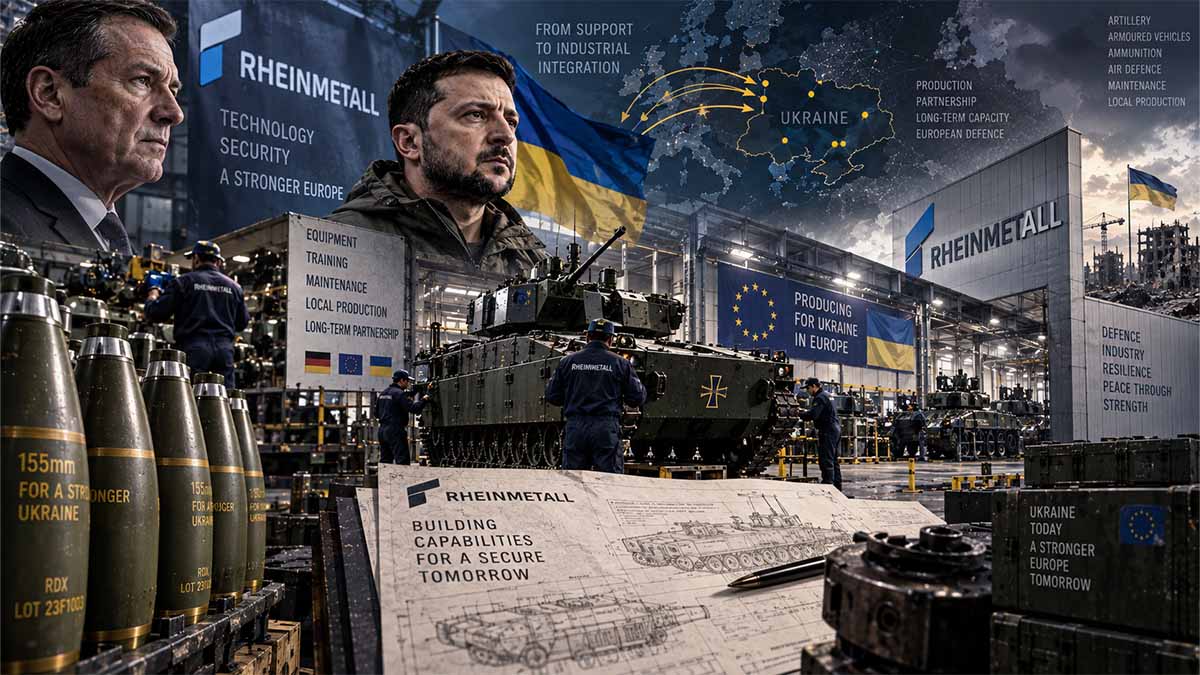
Scope: This assessment examines Rheinmetall’s documented military deliveries, ammunition-production expansion, air-defence systems, armoured vehicles, maintenance infrastructure and Ukrainian industrial presence from Russia’s full-scale invasion in February 2022 through 27 September 2026, while separating completed deliveries from contracts, production targets, corporate operational claims and future programmes, and placing the relationship within the wider German, Italian, French, British and European defence-industrial architecture.
Executive Summary / BLUF
- Rheinmetall’s 23 September 2026 disclosure substantially confirms the central factual architecture of the supplied account: the company reports hundreds of thousands of 155 mm artillery rounds, hundreds of thousands of 35 mm Gepard rounds, tank and mortar ammunition, a three-digit number of Marder 1A3 infantry fighting vehicles, a high double-digit aggregate of Leopard 1A5 and Leopard 2A4 tanks, several Lynx vehicles, 20 Caracal vehicles, several hundred military trucks, Skynex and Skyranger air-defence systems, and a double-digit number of SurveilSPIRE systems. These remain first-party corporate delivery figures rather than independently audited cumulative inventories. Rheinmetall — A powerful partner at Ukraine’s side — 23 September 2026 Rheinmetall
- The strategically significant development is the movement from stock transfer toward recurring industrial replenishment: Rheinmetall’s new Werk Niedersachsen at Unterlüß has begun producing ammunition for Ukraine, while the wider group network also manufactures Ukrainian orders in Spain and supplies propellant charges through other sites. Rheinmetall — From Unterlüß to Ukraine — 14 July 2026 Rheinmetall
- Werk Niedersachsen represents a major structural expansion rather than a temporary Ukraine-specific production line: Rheinmetall invested almost €500 million, plans capacity of up to 350,000 artillery shells annually, and originally scheduled full capacity for 2027. Rheinmetall — A new era at Rheinmetall: Ammunition factory opening in Unterlüß Rheinmetall
- Rheinmetall’s role now extends beyond supply into sustainment: Rheinmetall Ukrainian Defense Industry LLC, owned 51% by Rheinmetall Landsysteme and 49% by Ukrainian Defense Industry, has maintained and repaired combat vehicles in western Ukraine since June 2024, materially reducing the distance between equipment delivery and battlefield regeneration. Rheinmetall Ukrainian Defense Industry LLC Rheinmetall
- Air defence has become a particularly important industrial bridge: Rheinmetall states that Skynex is operational in Ukraine and that Skyranger 35 systems on Leopard 1 chassis have been supplied; the latter programme is produced and integrated by Rheinmetall Italia S.p.A. in Rome, making Italy directly embedded in the Rheinmetall–Ukraine supply chain. Rheinmetall — Skyranger 35 to be supplied to Ukraine Rheinmetall
- Germany remains the principal state anchor behind much of the system: Berlin states that it has provided or earmarked approximately €57.6 billion in military aid to Ukraine since February 2022, while the government had increased military Ukraine support for 2026 to €11.5 billion, with air defence, artillery, ammunition and drones identified as priority clusters. Federal Government — How Germany is supporting Ukraine Bundesregierung
- The wider European system is no longer reducible to bilateral German assistance: the Council of the EU reports €93 billion in EU and member-state military support, while the €90 billion Ukraine Support Loan for 2026–2027 contains an indicative €60 billion defence-industrial component, creating a large financing architecture into which European and Ukrainian production can increasingly be integrated. Council of the EU — EU military support for Ukraine Consiglio dell’Unione Europea
- The principal uncertainty is therefore not whether Rheinmetall is supplying Ukraine on a large scale—the public record establishes that—but how much of announced European industrial capacity translates into sustained monthly delivered output, operational availability and replenishment at Ukrainian unit level, because exact delivery schedules, consumption rates, readiness levels and combat-loss replacement requirements remain only partially public.
Rheinmetall’s Ukraine Bet Is Becoming a European Industrial System
Rheinmetall’s 23 September 2026 account of its support to Ukraine looks, at first sight, like another catalogue of wartime deliveries: hundreds of thousands of 155 mm rounds, a three-digit number of Marder infantry fighting vehicles, Leopard tanks, Skynex and Skyranger air-defence systems, trucks and reconnaissance equipment. The more consequential story is industrial. A company that entered the war largely through refurbishment and emergency procurement is now tied to a network of new ammunition production, cross-border maintenance, Ukrainian repair capacity and European public financing. The question for the next 12–24 months is no longer whether Europe can announce more support, but whether factories, repair hubs and Ukrainian localisation can convert commitments into recurring output before legacy stocks, fiscal room and political attention become the binding constraints. Rheinmetall, 23 September 2026
Rheinmetall is no longer selling hardware; it is selling endurance
The clearest break with the emergency phase came in June 2024, when Rheinmetall Ukrainian Defense Industry LLC, owned 51% by Rheinmetall Landsysteme and 49% by Ukrainian Defense Industry, began repairing Western combat vehicles inside Ukraine. The institutional vehicle had existed since 18 October 2023, but in-country maintenance changed the economics of the relationship: every Marder or Leopard no longer represented merely a delivery but a continuing demand for technicians, diagnostic equipment, components and repair capacity. Rheinmetall has complemented that Ukrainian hub with battle-damage repair at Satu Mare in Romania and the roughly 12,000 m² Lithuania Defense Services facility in Jonava, creating a geographically distributed sustainment system rather than a single export route. Rheinmetall Ukrainian Defense Industry Rheinmetall Service Hubs
That distinction matters because the constraint in a prolonged war is not the number of vehicles formally transferred but the number returned to service after damage and mechanical failure. Rheinmetall has not disclosed monthly repair throughput, spare-parts fulfilment rates or average turnaround time for the Ukrainian, Romanian or Lithuanian facilities, so the effectiveness of the network cannot be measured from the public record. What is established is the architecture itself: by June 2024 Ukrainian technicians trained in Germany were already working in the western Ukrainian facility, while Rheinmetall was supplying tooling, components and technical supervision. Rheinmetall, 11 June 2024
A €500 million factory changes the argument from stocks to flows
The new ammunition plant at Unterlüß is the clearest financial expression of the shift. Rheinmetall invested almost €500 million in Werk Niedersachsen, built in about 15 months, with a production ramp announced at 25,000 artillery rounds in 2025, 140,000 in 2026 and up to 350,000 a year at full capacity. On 14 July 2026 the company said that a low five-figure Ukrainian order for RH1412 155 mm projectiles was already more than half delivered from the new facility, while its September 2026 account placed total Rheinmetall 155 mm deliveries to Ukraine across the group at hundreds of thousands of rounds. Rheinmetall, 5 September 2025 Rheinmetall, 14 July 2026
The production geography is wider than Germany. A Ukrainian contract announced on 30 June 2026 covers a low five-figure quantity of 155 mm ammunition manufactured by Rheinmetall Expal Munitions in Spain, while another NATO member ordered several thousand additional rounds for Ukraine on 7 July 2026. The corporate balance sheet shows why this matters beyond Ukraine: at 30 June 2026 Rheinmetall reported €80.5 billion of group backlog, including €25.274 billion in Weapon and Ammunition, €28.829 billion in Vehicle Systems and €4.218 billion in Air Defence. Production for Kyiv now competes for the same skilled labour, explosives, electronics and factory capacity demanded by a much broader European rearmament cycle. Rheinmetall H1 2026 financial report
Germany finances the machine, but Brussels is building the balance sheet
Germany remains the national anchor. The Federal Government reports approximately €57.6 billion in military assistance provided or earmarked since February 2022, while around €11.5 billion is provided for military support in the 2026 federal budget. The April 2026 German-Ukrainian Strategic Partnership goes further than procurement: it provides for a bilateral Defence Industry Working Group, additional joint ventures and cooperation on ammunition, air defence, missiles and drones. Rheinmetall is therefore one large industrial executor of German policy, but it is not equivalent to German assistance as a whole. German Federal Government — support to Ukraine German-Ukrainian Strategic Partnership, 14 April 2026
Brussels is changing the scale and structure of the financing problem. The Council of the EU puts combined EU and member-state military support at about €93 billion, while the €90 billion Ukraine Support Loan for 2026–2027 carries an indicative €60 billion defence-industrial and procurement component; for 2026, the framework gives access to €28.3 billion for Ukrainian defence-industrial capacity. SAFE adds up to €150 billion in loans for common defence procurement, with Ukraine eligible to participate in qualifying projects. These instruments do not guarantee production, but they replace part of the old stop-start funding cycle with purchasing power that manufacturers can plan against. Council of the EU — military support for Ukraine Council of the EU — €90 billion Ukraine Support Loan
Italy is inside Rheinmetall’s chain while France is building a parallel one
Italy’s role is industrially more important than the limited public valuation of its military packages suggests. Law No. 27 of 27 February 2026 extends Italian authority to transfer military and civil-defence equipment to Ukraine through 31 December 2026, while the 2026 international-missions framework allocates €15.44 million and up to 260 personnel to NATO, EU, coalition and bilateral support activities. More directly, Rheinmetall Italia in Rome is responsible for production and integration of the Leopard 1-based Skyranger 35 ordered for Ukraine under a contract in the three-digit-million-euro range. Italian Parliament — Law No. 27/2026 Rheinmetall — Skyranger 35 for Ukraine
France and Italy are simultaneously building an air-defence track that has nothing to do with Rheinmetall. The 14 July 2026 French-Ukrainian declaration envisages four Franco-Italian SAMP/T NG systems for Ukraine, temporary deployment of two existing SAMP/T complexes, five GM400 radars, one GF300 and one Kronos radar, accelerated Aster 30 deliveries and licensed Aster 30 production in Ukraine. The financing link is equally important: Ukraine intends to draw on the EU Ukraine Support Loan for the new SAMP/T NG systems. Europe is therefore not converging on one dominant defence company; it is creating several overlapping industrial networks financed increasingly through common European mechanisms. Élysée — France–Ukraine Joint Declaration, 14 July 2026
Britain has re-entered the European procurement circuit without rejoining the EU
The United Kingdom reported in July 2026 that it had committed £16 billion in military support within £25 billion of total assistance, while £3.75 billion of military expenditure is assigned to 2026. A £752 million package announced on 18 June 2026 included 150,000 Ukrainian-produced drones and more than 350 air-defence missiles and radars, illustrating a model in which British financing supports production inside Ukraine as well as procurement from British industry. UK Government — support to Ukraine factsheet UK Ministry of Defence, 18 June 2026
The institutional novelty came on 13 July 2026, when London and Brussels agreed to make British manufacturers eligible for procurement financed through the EU Ukraine Support Loan, subject to a British contribution to the relevant borrowing costs. At that date €7.1 billion had already been disbursed under the loan, approximately €3.9 billion for defence and €3.2 billion for budget support. The arrangement does not recreate EU membership, but it does recognise that a European defence-production market financed at this scale becomes difficult to divide neatly along post-Brexit institutional lines. UK–EU Joint Statement, 13 July 2026
The next 24 months will test factories, not communiqués
By September 2026, the financial architecture is ahead of the industrial evidence. Rheinmetall can point to a new German factory, Spanish 155 mm production, Italian Skyranger integration, Ukrainian repair activity and a planned Ukrainian ammunition facility; the EU can point to a €90 billion Support Loan and SAFE’s €150 billion lending capacity; Germany and the United Kingdom can point to multi-year national commitments. What is still missing from the public record is equally material: stable Ukrainian serial production at the planned Rheinmetall ammunition plant, disclosed high-volume Lynx production for Ukraine, exact Skyranger delivery numbers, factory-level output against the 350,000-round Unterlüß capacity target and repair-throughput data from the Ukrainian, Romanian and Lithuanian hubs. Rheinmetall — Ukrainian ammunition factory
Over the next 12–24 months, the cost of that gap will fall in different places depending on where conversion fails. If financing runs ahead of production, European governments pay through higher procurement costs and delayed force recapitalisation; if repair capacity lags fleet expansion, Ukraine pays through lower operational availability; if localisation stalls, Kyiv remains dependent on cross-border supply chains precisely when Europe is attempting to make support more durable. Rheinmetall’s transformation from supplier to industrial partner is therefore real, but the decisive metric by 2027–2028 will not be the value of announced programmes. It will be how much ammunition, maintenance capacity and Ukrainian production those programmes produce repeatedly, on schedule and without requiring another emergency reconstruction of the supply chain.
Navigational Index
| Thematic pillar | Analytical purpose |
|---|---|
| Industrialised supply: ammunition, armour and air defence | Establish what Rheinmetall has actually delivered, what has merely been ordered, where production occurs, and how the portfolio has evolved from refurbished legacy systems toward newly produced ammunition and next-generation systems such as Lynx, Skynex and Skyranger. |
| From delivery to endurance: repair, logistics and Ukrainian industrial integration | Examine the Ukrainian repair joint venture, cross-border maintenance, trucks, reconnaissance systems, medical infrastructure and the proposed expansion of production inside Ukraine, determining whether Rheinmetall is becoming a persistent sustainment architecture rather than simply an equipment vendor. |
| European strategic architecture: Germany, Italy, France, the United Kingdom and the EU | Separate Rheinmetall-specific activity from the wider European military-support system, identifying Germany’s financing and manufacturing role, Italy’s direct industrial participation, the separate Franco-Italian air-defence track, British support programmes and the increasingly important EU financing architecture. |
Master Abstract
The September disclosure substantiates the scale of the relationship, but not every implied conclusion
Rheinmetall’s 23 September 2026 corporate account provides the strongest consolidated first-party record currently available for the specific claims contained in the supplied narrative. It states that its deliveries to Ukraine encompass large- and medium-calibre ammunition, air-defence systems, combat vehicles, satellite-derived intelligence, military logistics and mobile medical infrastructure, while its Ukrainian joint venture provides vehicle maintenance and repair. The company reports that hundreds of thousands of 155 mm artillery rounds and hundreds of thousands of 35 mm Gepard rounds have been supplied, with cumulative ammunition deliveries across calibres reaching several million rounds; it additionally reports a three-digit number of Marder 1A3 vehicles, a high double-digit aggregate of Leopard 1A5 and Leopard 2A4 tanks, several Lynx systems, several hundred trucks, 20 Caracal vehicles and a double-digit number of SurveilSPIRE systems. These figures establish exceptional breadth, but Rheinmetall is an interested contracting party, and its characterization of itself as one of Ukraine’s most important industrial partners should therefore be treated as a corporate institutional position rather than an independently established ranking among suppliers. Rheinmetall — A powerful partner at Ukraine’s side Rheinmetall
A significant part of the ammunition picture is independently compatible with earlier German government disclosures, although the datasets cannot simply be added because they use different dates, institutional scopes and supplier definitions. Germany’s last detailed public equipment ledger, frozen at 17 April 2025, recorded 140 Marder infantry fighting vehicles delivered, 103 Leopard 1A5 tanks under the German-Danish project, 18 German Leopard 2A6 tanks, 60 Gepard systems, 330,000 rounds of Gepard ammunition and two Skynex systems with ammunition, while additional Marders, Leopard 1s, Gepards, Skynex systems and substantial ammunition quantities remained in preparation or implementation. The government subsequently discontinued updating that detailed inventory, meaning that Rheinmetall’s September 2026 totals cannot be completely reconciled against a contemporary German itemised public ledger. The correct analytical conclusion is therefore that the scale and categories are strongly substantiated, whereas precise cumulative supplier-attributed totals remain partly dependent upon Rheinmetall’s own accounting. German Federal Government — Weapons and military equipment for Ukraine Bundesregierung
Ammunition is becoming an industrial flow rather than an inventory-transfer programme
The most consequential change is visible at Unterlüß in Lower Saxony, because the Ukraine supply relationship is now being fed by newly created European manufacturing capacity rather than relying solely upon existing inventories and refurbishment. Rheinmetall opened Werk Niedersachsen after approximately 15 months of construction and almost €500 million of investment, with announced capacity of up to 350,000 artillery projectiles per year once fully ramped. In July 2026, Rheinmetall disclosed that Ukraine had become the first recipient of 155 mm ammunition from the new factory: a low five-figure order of RH1412 projectiles, accompanied by propellant charges from other production sites, was already more than halfway delivered and was scheduled for completion before the end of 2026. By 23 September the company described the plant as having produced a five-digit quantity of 155 mm rounds for Ukraine, while total Rheinmetall 155 mm deliveries to the country across its production network had reached the hundreds of thousands. Rheinmetall — From Unterlüß to Ukraine: first artillery-ammunition delivery from Werk Niedersachsen Rheinmetall
This production architecture extends beyond Germany. A separate Ukrainian order announced on 30 June 2026 covers a low five-figure number of 155 mm projectiles and propellant charges manufactured by Rheinmetall Expal Munitions in Spain, with completion planned for the first quarter of 2027, while another NATO member state commissioned several thousand additional 155 mm rounds for Ukraine through Rheinmetall with completion before April 2027. Rheinmetall’s first-half 2026 financial reporting provides a useful industrial cross-check because it identifies artillery and medium-calibre ammunition for Ukraine as material contributors to Weapon and Ammunition segment sales; group sales reached €5.2 billion during H1 2026, while total Rheinmetall backlog stood at €80.5 billion and the Weapon and Ammunition backlog at approximately €25.3 billion. These corporate financial figures do not measure Ukrainian deliveries directly, but they demonstrate that Ukraine-related ammunition production is embedded within a far larger European capacity-expansion cycle rather than constituting an isolated emergency contract. Rheinmetall — Major order from Ukraine for 155 mm artillery ammunition Rheinmetall — H1 2026 financial report Rheinmetall
Cannon-based air defence has become one of the most distinctive elements of Rheinmetall’s Ukrainian portfolio
The company’s Ukrainian air-defence architecture links three generations of cannon-based systems. Germany initially transferred Gepard vehicles from existing stocks, while Rheinmetall rebuilt 35 mm ammunition manufacturing capacity at Unterlüß after receiving a February 2023 order for 300,000 Gepard rounds; a further 180,000-round HEI-T order, financed by Germany and booked in December 2024, was scheduled to begin delivery in 2026. Rheinmetall now reports cumulative 35 mm deliveries to Ukraine in the hundreds of thousands. The industrial significance lies in the restoration of a production line for an ammunition type whose wartime demand had again become strategically relevant after the original supply chain was no longer sufficient for sustained Ukrainian consumption. Rheinmetall — Replenishment for air defence: 35 mm Gepard ammunition for Ukraine Rheinmetall
Rheinmetall’s September 2026 publication additionally states that Skynex has been used against drones and Kh-101 cruise missiles in Ukraine and that the Leopard 1-based Skyranger 35 has now been supplied. The underlying Skyranger contract, announced in October 2025, was valued in the three-digit-million-euro range, financed by an unnamed EU member state through proceeds associated with immobilised Russian assets, and assigned for production and integration to Rheinmetall Italia S.p.A. in Rome. This gives the Italian industrial base a direct role in a Rheinmetall programme intended for Ukrainian operational service rather than merely an indirect political-support role. Rheinmetall’s statements regarding successful Ukrainian interception performance remain first-party operational claims, however; without public engagement records from the Ukrainian armed forces or another competent first-order operational source, they should not be transformed into independently established kill probabilities or comparative cost-effectiveness metrics. Rheinmetall — Skyranger 35 on Leopard 1 for Ukraine Rheinmetall
Armoured-vehicle support is evolving from refurbishment toward a potential new production relationship
The vehicle portfolio demonstrates a similar transition between legacy regeneration and new manufacture. Marder 1A3 and Leopard platforms represent the recovery, refurbishment and transfer of established European systems, including through Germany’s Ringtausch equipment-exchange arrangements, under which partner countries transferred older equipment to Ukraine and received Western replacements. Rheinmetall states that a three-digit number of Marder 1A3s and a high double-digit aggregate of Leopard 1A5 and Leopard 2A4 tanks have been provided through its activities and associated programmes. The newer Lynx KF41 represents a different industrial pathway: a December 2025 contract covered an initial five vehicles, financed by the German government and scheduled for delivery from early 2026, after which Rheinmetall indicated an intended transition toward additional batches and eventual Ukrainian production. By September 2026 the company stated that a number of Lynx systems had been handed over, but it did not publish an exact delivered total in its consolidated Ukraine account. Rheinmetall — First Lynx KF41 batch for Ukraine Rheinmetall
The difference between these programmes matters analytically because Marder and Leopard support predominantly exploits an existing European vehicle ecosystem, whereas Lynx potentially creates a new Ukrainian force structure linked to a contemporary production family, long-term spare-parts requirements, configuration management, training and eventually domestic industrial participation. Rheinmetall and Ukraine had already signed a broader cooperation framework in June 2024 identifying artillery ammunition and infantry fighting vehicle production as prospective cooperation areas, but planned production should not be confused with operating Ukrainian serial manufacture. The public record confirms the ambition and the initial vehicle procurement; it does not yet establish mature Ukrainian Lynx production at fleet scale. Rheinmetall — Strategic cooperation between Rheinmetall and Ukraine Rheinmetall
The repair network is strategically as important as the headline deliveries
Rheinmetall Ukrainian Defense Industry LLC has operated since 18 October 2023 as a 51:49 venture between Rheinmetall Landsysteme and state-owned Ukrainian Defense Industry, and since June 2024 it has maintained and repaired combat vehicles in western Ukraine. The repair hub initially concentrated on Marder vehicles, with expansion to Leopard systems contemplated, while Rheinmetall’s September 2026 account states that armoured personnel carriers and main battle tanks are currently serviced at the western Ukrainian facility and that additional German-built systems are intended to be repaired at further Ukrainian locations. The group also participates with KNDS in a Lithuanian maintenance facility serving Western equipment used by Ukrainian forces. This structure shortens the sustainment chain between combat damage, component replacement and return to service, although public sources do not disclose throughput, mean repair time, spare-parts availability or the proportion of damaged vehicles successfully regenerated. Rheinmetall — Ukrainian maintenance and repair centre Rheinmetall Ukrainian Defense Industry LLC Rheinmetall
The less visible support categories reinforce the same pattern of institutional embedding. Rheinmetall reports several hundred trucks operating in Ukraine, including 26 recently delivered new vehicles; 20 Caracal 4×4 vehicles are reported in Ukrainian service with airborne and special-operations formations; and a double-digit number of SurveilSPIRE reconnaissance systems has been delivered. The SurveilSPIRE programme was originally commissioned at the request of the German government and combines relocatable observation towers, day/night imaging, autopiloted mini-drones and a control system. Rheinmetall also states that its medical systems are deployed across Ukraine and that ten field hospitals are intended to have been handed over by the end of 2026, with more than 100 Ukrainian medical personnel trained. Because 27 September precedes the end-of-year delivery deadline, the figure of ten must remain classified as an announced year-end objective rather than a completed total. Rheinmetall — Automated SurveilSPIRE reconnaissance systems for Ukraine Rheinmetall
Germany is the state-financing and industrial anchor of the Rheinmetall relationship
The German government’s role is materially larger than procurement sponsorship for individual Rheinmetall contracts. Berlin states that since the beginning of the full-scale invasion it has provided or earmarked approximately €57.6 billion in military assistance to Ukraine, alongside more than €43.3 billion in bilateral civilian support, while a January 2026 government briefing recorded €11.5 billion of military Ukraine-support funding for 2026, much of it committed through existing project lines covering air defence, drones, artillery and ammunition. The relationship was also elevated institutionally through the German-Ukrainian Strategic Partnership of April 2026, whose priorities include defence-industry consultations and a joint German-Ukrainian defence-industry working group. Rheinmetall should therefore be understood partly as an industrial execution mechanism within German security policy, although individual contracts also originate directly from Ukraine, other NATO members and other EU states. Federal Government — How Germany is supporting Ukraine Bundesregierung
That distinction prevents a common analytical error: Rheinmetall support is not synonymous with German military aid, and German military aid is not synonymous with Rheinmetall deliveries. Germany funds systems from multiple manufacturers, transfers Bundeswehr equipment, finances industrial procurement and participates in multinational mechanisms; Rheinmetall simultaneously executes contracts financed by Ukraine, Germany, unidentified NATO members and other EU states. The resulting network is therefore public-private and multinational, with national governments providing finance and political authority while industrial groups provide manufacturing, integration, refurbishment and sustainment.
Italy is already inside the Rheinmetall chain; France and the United Kingdom belong to adjacent European support architectures
Italy has the clearest direct role after Germany in the specific Rheinmetall architecture because the Skyranger 35 systems for Ukraine are produced and integrated at Rheinmetall Italia in Rome. This matters beyond the immediate Ukrainian order: Italy itself became the first NATO state to introduce Rheinmetall’s Skynex configuration including the Revolver Gun Mk3 35 mm, creating potential industrial and technical overlap between systems acquired for national defence and those supplied to Ukraine. Rheinmetall — First Skynex system handed over to Italy Rheinmetall
France is not publicly identified as a financing or production actor in the Rheinmetall deliveries examined here, and it would therefore be incorrect to merge French assistance into the Rheinmetall account. France nevertheless represents a parallel European industrial pathway: the 14 July 2026 French-Ukrainian joint declaration envisages Ukrainian acquisition of Franco-Italian SAMP/T NG systems, accelerated Aster 30 missile deliveries and licensed Aster 30 production in Ukraine authorised jointly by France and Italy. The relevance is structural rather than contractual—the European model is increasingly moving toward a combination of finished-system transfers, industrial procurement and production localisation inside Ukraine. Élysée — Joint declaration by France and Ukraine — 14 July 2026 elysee.fr
The United Kingdom likewise operates a substantial but separate assistance chain rather than a documented Rheinmetall-specific one in the evidence reviewed for this assessment. On 8 September 2026, the UK announced another £100 million winter air-defence package containing interceptors, large-calibre artillery ammunition and drones, while its June package had committed 150,000 Ukrainian-produced drones and more than 350 air-defence missiles and radars by the end of 2026. The British case therefore confirms the broader European movement toward recurring procurement, Ukrainian production and air-defence replenishment, but the available official evidence does not justify attributing these British programmes to Rheinmetall. UK Ministry of Defence — Winter air-defence package for Ukraine — 8 September 2026 GOV.UK
EU financing is turning bilateral programmes into a continental defence-industrial system
At European Union level, the financial architecture is increasingly capable of sustaining programmes larger than traditional bilateral donations. The Council records approximately €93 billion in military support by the EU and its member states, while the €90 billion Ukraine Support Loan for 2026–2027 allocates an indicative €60 billion to defence-industrial capacity and procurement. Ukraine can also participate on equal terms in common procurement under the SAFE instrument, and 15 of the 19 national SAFE plans submitted in 2025 contain projects involving Ukraine. These mechanisms do not establish that any specific future Rheinmetall order will receive EU funding, but they enlarge the institutional financing environment in which Rheinmetall, other European manufacturers and Ukrainian companies can operate. Council of the EU — EU military support for Ukraine Council of the EU — €90 billion support loan to Ukraine Consiglio dell’Unione Europea
The resulting strategic picture is therefore more consequential than a conventional arms-transfer story. Rheinmetall now connects German sovereign financing, newly built German ammunition capacity, Spanish ammunition production, Italian air-defence integration, Ukrainian repair activity, regional maintenance infrastructure and prospective Ukrainian manufacturing. The strongest evidence supports describing this as an emerging trans-European sustainment network. It does not yet justify describing it as a fully autonomous Ukrainian production ecosystem, because critical volumes of ammunition, vehicles, air-defence components, financing, specialist repair capacity and sophisticated manufacturing remain externally supplied or dependent upon multinational industrial chains.
Key Evidence Table
| Indicator | Value/status | Reference date | Definition/scope | Issuer | Exact source |
|---|---|---|---|---|---|
| Rheinmetall 155 mm deliveries to Ukraine | Hundreds of thousands of rounds reported cumulatively | 23 Sep 2026 | Rheinmetall-wide deliveries; exact cumulative number not published | Rheinmetall AG | A powerful partner at Ukraine’s side Rheinmetall |
| First Werk Niedersachsen Ukraine production | Low five-figure quantity; more than half of the relevant order already delivered in July | 14 Jul 2026 | RH1412 155 mm projectiles from Unterlüß plus propellant charges from other sites | Rheinmetall AG | From Unterlüß to Ukraine Rheinmetall |
| Werk Niedersachsen planned capacity | Up to 350,000 artillery shells/year | Full capacity originally planned for 2027 | New production site at Unterlüß, Lower Saxony | Rheinmetall AG | A new era at Rheinmetall: factory opening in Unterlüß Rheinmetall |
| Werk Niedersachsen investment | Almost €500 million | Plant opened 2025 | Production site plus associated expansion at Unterlüß | Rheinmetall AG | Factory opening in Unterlüß Rheinmetall |
| Additional Ukraine 155 mm contract | Low five-figure rounds and propellant charges; completion planned Q1 2027 | 30 Jun 2026 | Manufactured at Rheinmetall Expal Munitions, Spain | Rheinmetall AG | Major order from Ukraine: 155 mm artillery ammunition Rheinmetall |
| 35 mm Gepard follow-on order | 180,000 rounds, following earlier 300,000-round order | Order booked Dec 2024; deliveries from 2026 | German-funded HEI-T ammunition | Rheinmetall AG | 35 mm Gepard ammunition for Ukraine Rheinmetall |
| Marder 1A3 delivered by Rheinmetall | Three-digit quantity | 23 Sep 2026 | Corporate cumulative delivery statement | Rheinmetall AG | A powerful partner at Ukraine’s side Rheinmetall |
| Leopard 1A5/2A4 supplied by Rheinmetall | High double-digit aggregate | 23 Sep 2026 | Several delivery batches; exact type split withheld | Rheinmetall AG | A powerful partner at Ukraine’s side Rheinmetall |
| Initial Lynx KF41 procurement | Five vehicles, German-financed | Contract Dec 2025; delivery scheduled from early 2026 | First batch, Ukrainian configuration | Rheinmetall AG | Rheinmetall to supply Lynx to Ukraine Rheinmetall |
| Skyranger 35 programme | Three-digit-million-euro order; systems subsequently reported supplied | Contract announced 10 Oct 2025; supply reported Sep 2026 | Leopard 1 chassis; financed by an EU country; production/integration in Rome | Rheinmetall AG | Skyranger 35 for Ukraine Rheinmetall |
| Caracal 4×4 vehicles | 20 delivered | 23 Sep 2026 | Tactical vehicles for airborne/special forces use | Rheinmetall AG | A powerful partner at Ukraine’s side Rheinmetall |
| SurveilSPIRE | Double-digit number delivered | 23 Sep 2026 | Mobile counter-UAS/reconnaissance architecture | Rheinmetall AG | A powerful partner at Ukraine’s side Rheinmetall |
| Ukrainian maintenance JV | Operating since Oct 2023; vehicle repairs since Jun 2024 | Current through Sep 2026 | 51% Rheinmetall / 49% Ukrainian Defense Industry | Rheinmetall / UDI | Rheinmetall Ukrainian Defense Industry LLC Rheinmetall |
| Field-hospital programme | 10 systems targeted by end-2026 and over 100 Ukrainian medical personnel to be trained | 23 Sep 2026 | End-year target, not yet a completed total on assessment date | Rheinmetall AG | A powerful partner at Ukraine’s side Rheinmetall |
| German military assistance | Approx. €57.6 billion provided or earmarked | Aug 2026 | Bilateral German military support since Feb 2022, including future earmarks | German Federal Government | How Germany is supporting Ukraine Bundesregierung |
| German Ukraine military-support allocation for 2026 | €11.5 billion | Jan 2026 government statement | 2026 military-support funding; substantial share tied to continuing projects | German Federal Government | Federal Government press conference — 21 January 2026 Bundesregierung |
| EU/member-state military assistance | Approximately €93 billion | Reviewed 21 Sep 2026 | EU and member-state support to Ukrainian armed forces | Council of the EU | EU military support for Ukraine Consiglio dell’Unione Europea |
| Ukraine Support Loan | €90 billion, including indicative €60 billion for defence-industrial capacity/procurement | 2026–2027 | EU borrowing backed by EU budget | Council of the EU | Council finalises €90 billion support loan to Ukraine Consiglio dell’Unione Europea |
Principal Gaps and Watch Indicators
Exact delivered inventories. Rheinmetall’s September 2026 account uses ranges such as “three-digit,” “high double-digit,” “hundreds of thousands” and “several million.” A current German or Ukrainian itemised delivery ledger identifying supplier, system, quantity and delivery date would materially improve the assessment, particularly because Germany’s former detailed public list ceased updating after 17 April 2025. Bundesregierung
Werk Niedersachsen realised throughput. The distinction between the plant’s planned annual capacity of 350,000 artillery shells, the five-digit quantity produced for Ukraine, and total Rheinmetall deliveries from all production sites must remain explicit. Monthly production and acceptance records would establish how rapidly the plant is approaching its stated design capacity. Rheinmetall
Lynx fleet scale. The first publicly identified contract covered five KF41 vehicles, while the September account states only that a number of Lynx systems have been handed over. Confirmation of the exact delivered fleet, follow-on contracts and the commencement of any Ukrainian assembly or production would mark an important transition from demonstration-scale introduction to sustained fleet adoption. Rheinmetall
Skyranger 35 deployment status. Rheinmetall now states that the system has been supplied, but the public record reviewed here does not provide the exact number handed over, operational units, readiness rate or combat engagement log. Those records would determine whether Skyranger has progressed from initial delivery to recurring operational employment. Rheinmetall
Air-defence effectiveness. Corporate statements concerning Gepard cost-effectiveness and successful Skynex engagements against drones and Kh-101 cruise missiles constitute relevant first-party evidence but do not disclose engagement numbers, ammunition expenditure per interception, target discrimination performance or failure rates. Ukrainian operational reporting or auditable engagement datasets would be required for comparative effectiveness judgments. Rheinmetall
Repair throughput and fleet availability. The Ukrainian and Lithuanian maintenance infrastructure is established, but public documentation does not disclose repair-cycle times, spare-parts constraints, numbers of vehicles processed or return-to-service rates. These indicators are more decision-relevant to endurance than nominal delivery totals once a substantial fleet is in service. Rheinmetall
Ukrainian manufacturing localisation. Rheinmetall has documented plans for Ukrainian production of ammunition and selected vehicle systems, while European governments are simultaneously moving toward licensed and co-produced systems inside Ukraine. The decisive indicator will be the transition from memoranda, construction or industrial preparation to repeatable serial output from Ukrainian territory. Rheinmetall — Joint venture to produce artillery ammunition in Ukraine
Rheinmetall–Ukraine: From Equipment Transfers to an Embedded Wartime Industrial System
The verified public record indicates a transition from emergency equipment transfer toward a geographically distributed system combining state financing, ammunition manufacturing, armoured-vehicle supply, air defence, logistics, maintenance and prospective Ukrainian production.
Strategic System Architecture
From sovereign finance to battlefield sustainmentFinancing and procurement authority
Germany, Ukraine, EU member states and wider European mechanisms provide the financial and governmental framework through which major equipment and ammunition programmes are contracted.
- Germany: approx. €57.6bn military support provided or earmarked
- Germany: €11.5bn military-support funding for 2026
- EU/member states: approx. €93bn military support
Distributed European manufacturing
Rheinmetall manufacturing capacity now spans newly expanded German ammunition production, Spanish artillery-ammunition manufacturing, Italian air-defence integration and other group facilities supplying components and propellant charges.
- Unterlüß: 155 mm production
- Spain: additional 155 mm orders
- Rome: Skyranger 35 integration
Ammunition, armour and air defence
Rheinmetall reports extensive deliveries covering artillery ammunition, Gepard ammunition, Marder vehicles, Leopard tanks, Lynx vehicles, Skynex, Skyranger, trucks, Caracal vehicles and surveillance systems.
- Hundreds of thousands of 155 mm rounds
- Three-digit quantity of Marder 1A3
- High double-digit Leopard 1A5 / 2A4 aggregate
Repair, logistics and medical support
The support model now includes in-country maintenance, regional repair infrastructure, military trucks, reconnaissance systems and deployable medical facilities rather than ending with the transfer of equipment.
- Repair activity in western Ukraine since June 2024
- Lithuanian maintenance infrastructure
- Ten medical centres targeted by end-2026
Persistent replenishment architecture
The emerging model links industrial capacity with recurrent battlefield replacement and maintenance, reducing reliance on one-off transfers while creating deeper long-term European industrial commitments to Ukrainian force sustainment.
- Recurring production instead of stock depletion alone
- Shorter repair and regeneration chain
- Potential transition toward Ukrainian localisation
Industrial Geography and Country Roles
Direct Rheinmetall participation is separated from adjacent European support architecturesFinancing, ammunition production and procurement anchor
Germany underwrites major Ukraine programmes while Rheinmetall’s Unterlüß complex supplies newly produced ammunition; Berlin also finances individual equipment programmes and has institutionalised bilateral defence-industrial cooperation with Kyiv.
Skyranger 35 production and integration
Rheinmetall Italia in Rome is responsible for production and integration of the Leopard 1-based Skyranger 35 systems ordered for Ukraine, making Italy a directly identifiable node in the Rheinmetall–Ukraine defence-industrial chain.
Additional 155 mm ammunition production
Rheinmetall Expal Munitions in Spain is manufacturing an additional low five-figure Ukrainian order for 155 mm projectiles and associated propellant charges scheduled for completion during the first quarter of 2027.
Repair, maintenance and prospective production
Rheinmetall Ukrainian Defense Industry LLC provides local vehicle repair and maintenance, while further cooperation frameworks envisage deeper ammunition and vehicle manufacturing inside Ukraine without yet establishing mature fleet-scale serial production.
Separate European air-defence industrial pathway
France is not publicly identified as a direct actor in the Rheinmetall programmes assessed here, but Franco-Italian SAMP/T NG and Aster cooperation with Ukraine demonstrates the broader European movement toward industrial localisation and recurring air-defence supply.
Independent British procurement and air-defence support
British support represents a substantial parallel architecture involving interceptors, artillery ammunition, drones and Ukraine-linked procurement, but available official evidence does not justify attributing those programmes to Rheinmetall.
Continental procurement and industrial financing
EU mechanisms increasingly connect national military assistance with common procurement, Ukraine participation in SAFE and a €90 billion support-loan architecture containing an indicative €60 billion defence-industrial component for 2026–2027.
Cross-border repair capacity
Rheinmetall participates with KNDS in Lithuanian maintenance infrastructure supporting Western military equipment used by Ukraine, providing depth to a sustainment chain that increasingly extends beyond Germany and Ukrainian territory.
One network, multiple sovereign customers
Rheinmetall contracts associated with Ukraine originate from multiple financing authorities, meaning that corporate deliveries cannot automatically be equated with German bilateral aid and that the system is structurally multinational.
Verified Capability and Delivery Picture
Published quantities are preserved exactly where Rheinmetall uses ranges rather than precise totals155 mm artillery ammunition
Hundreds of thousandsRheinmetall-reported cumulative deliveries to Ukraine across its production network; the precise total is not publicly disclosed.
Delivered · corporate totalUnterlüß production capacity
Up to 350,000 / yearAnnounced design capacity for artillery projectiles once the new Werk Niedersachsen reaches its planned production level.
Capacity · not realised outputWerk Niedersachsen investment
≈ €500 millionRheinmetall investment in the newly established ammunition-production complex at Unterlüß.
Industrial investment35 mm Gepard ammunition
300,000 + 180,000 orderedOriginal production programme followed by a further German-financed HEI-T order, with follow-on deliveries beginning in 2026.
Ordered / deliveringMarder 1A3
Three-digit quantityRheinmetall’s September 2026 cumulative corporate delivery description; an exact supplier-attributed number was not disclosed.
DeliveredLeopard 1A5 / 2A4
High double-digit aggregateMultiple delivery batches reported by Rheinmetall, without a public type-by-type supplier allocation in the September disclosure.
DeliveredLynx KF41
Initial batch: 5 contractedGerman-financed first procurement announced in December 2025; Rheinmetall subsequently stated that several Lynx vehicles had been handed over.
Contract + corporate delivery reportCaracal 4×4
20 vehiclesRheinmetall-reported delivery for Ukrainian airborne and special-operations formations.
DeliveredMilitary trucks
Several hundredRheinmetall reports an extensive fleet in Ukrainian service, including recently delivered new vehicles.
DeliveredSurveilSPIRE
Double-digit numberMobile observation and counter-UAS architecture integrating sensors, towers, mini-drones and command functionality.
DeliveredSkynex
Operationally deployedRheinmetall reports Ukrainian operational employment, including engagements against UAVs and cruise missiles; detailed engagement logs remain non-public.
Corporate operational claimField medical infrastructure
10 centres by end-2026Stated end-year programme objective and therefore not treated as a completed total as of 27 September 2026.
Year-end targetThe Structural Transition
What has changed since the first phase of post-2022 military assistanceStock Transfer
Initial European assistance relied heavily upon existing inventories, refurbishment and transfers of established systems such as Gepard, Marder and Leopard vehicles.
Industrial Replenishment
New and expanded ammunition-production lines increasingly replace finite stock depletion with recurring manufacturing, while newly produced systems such as Lynx and Skyranger enter the support portfolio.
Embedded Sustainment
Repair capacity in Ukraine, neighbouring maintenance hubs, logistics platforms, surveillance equipment and prospective local production increasingly connect delivery directly to long-term force regeneration.
What the Public Record Still Does Not Establish
Indicators capable of changing the assessmentEvidence Matrix
Distinguishing observed status from announced capacity and corporate operational reporting| System / domain | Publicly established status | Evidence category | Critical qualification |
|---|---|---|---|
| 155 mm artillery ammunition | Hundreds of thousands reported delivered | Rheinmetall first-party record | Exact cumulative figure not disclosed |
| Unterlüß plant | Operational and producing for Ukraine | Manufacturer production record | 350,000/year is planned capacity, not realised 2026 output |
| Marder 1A3 | Three-digit quantity reported supplied | Manufacturer delivery record | Supplier-specific cumulative number not published precisely |
| Leopard 1A5 / 2A4 | High double-digit aggregate reported supplied | Manufacturer delivery record | No current public split by exact model and financing channel |
| Lynx KF41 | Initial five-vehicle contract; subsequent handovers reported | Contract + manufacturer update | No evidence yet of fleet-scale Ukrainian serial production |
| Skynex | In Ukrainian service | Manufacturer + prior government delivery record | Detailed combat engagement records remain non-public |
| Skyranger 35 | Contracted and subsequently reported supplied | Manufacturer record | Exact delivered quantity and readiness rate not public |
| Ukraine repair JV | Operational since 2024 | Joint-venture institutional record | Repair throughput and turnaround time not published |
Principal Official and First-Party Sources
- Rheinmetall — A powerful partner at Ukraine’s side — 23 September 2026
- Rheinmetall — From Unterlüß to Ukraine: first artillery-ammunition delivery from Werk Niedersachsen — 14 July 2026
- Rheinmetall — A new era at Rheinmetall: Ammunition factory opening in Unterlüß
- Rheinmetall — Major order from Ukraine for 155 mm artillery ammunition — 30 June 2026
- Rheinmetall — Skyranger 35 on Leopard 1 for Ukraine — 10 October 2025
- Rheinmetall — Rheinmetall to supply Lynx infantry fighting vehicles to Ukraine
- Rheinmetall — Rheinmetall Ukrainian Defense Industry LLC
- German Federal Government — How Germany is supporting Ukraine
- Council of the European Union — EU military support for Ukraine
- Council of the European Union — Council finalises €90 billion support loan to Ukraine
Industrialised supply: ammunition, armour and air defence
Principal judgment
The most important industrial change in Rheinmetall’s support to Ukraine is not simply that the company has delivered more ammunition and combat vehicles, but that the supply model has moved through three distinct industrial stages: first, the recovery and refurbishment of existing European stocks such as Marder 1A3, Leopard 1A5 and Leopard 2A4; second, the reconstruction or expansion of ammunition lines specifically capable of replenishing wartime consumption, most visibly in 35 mm and 155 mm production; and third, the introduction of newly manufactured systems such as Lynx KF41, Skynex and Skyranger 35 whose future sustainment depends on continuing industrial output rather than finite legacy inventories. Rheinmetall’s September 2026 consolidated account states that deliveries to Ukraine now include hundreds of thousands of 155 mm artillery rounds, hundreds of thousands of 35 mm Gepard rounds, tank and mortar ammunition, a three-digit number of Marder 1A3 vehicles, several Lynx vehicles, a high double-digit aggregate of Leopard 1A5 and Leopard 2A4 tanks, Skynex and Skyranger air-defence systems and other equipment; however, because those totals are published by Rheinmetall itself and frequently expressed as bands rather than exact figures, they should be read as an authoritative first-party account of the company’s own activity rather than as an independently audited inventory of Ukrainian operational holdings. Rheinmetall — A powerful partner at Ukraine’s side, 23 September 2026 Rheinmetall
The deeper industrial significance lies in the overlap among ammunition, armoured vehicles and gun-based air defence, because these are not independent product categories: the usefulness of Marder, Leopard, Gepard, Skynex and Skyranger depends on a sustained flow of medium- and large-calibre ammunition, while the transition to Lynx and Skyranger introduces a requirement for new production, configuration management, spares, training and long-term maintenance. Rheinmetall’s H1 2026 financial reporting demonstrates that this industrial expansion is material to the company itself, with Weapon and Ammunition sales reaching €1.757 billion, up 33% year-on-year, while artillery and medium-calibre ammunition for Ukraine were explicitly identified among the principal sales drivers; the same division carried a backlog of approximately €25.274 billion at 30 June 2026, while Rheinmetall’s total group backlog stood at €80.5 billion. Rheinmetall — Financial report for first half of 2026, 6 August 2026 Rheinmetall
Ammunition has become the industrial centre of gravity
The 155 mm supply chain offers the clearest evidence of the transition from emergency procurement to structured industrial replenishment because Ukraine is now being supplied from several different Rheinmetall production nodes and through several financing mechanisms rather than through a single bilateral contract. Rheinmetall disclosed on 14 July 2026 that the new Werk Niedersachsen at Unterlüß had begun supplying Ukraine directly for the first time, with a low five-figure quantity of RH1412 155 mm projectiles, more than half of that specific order already delivered at the date of the announcement and completion scheduled before the end of 2026; propellant charges for the order came from other Rheinmetall locations, illustrating that even a projectile described as being produced at Unterlüß belongs to a distributed production chain rather than to a completely self-contained factory process. Rheinmetall — From Unterlüß to Ukraine: first artillery-ammunition delivery from Werk Niedersachsen, 14 July 2026 Rheinmetall
A separate direct Ukrainian order announced on 30 June 2026 covers a low five-figure quantity of ER02A1 B/B 155 mm projectiles and M203 propellant charges, carries a contract value in the high double-digit millions of euros, is manufactured at Rheinmetall Expal Munitions in Spain and is scheduled for completion during the first quarter of 2027. Only one week later, Rheinmetall announced a second 2026 procurement route under which an unidentified NATO member state commissioned several thousand additional 155 mm projectiles and propellant charges for Ukraine, with a contract value in the mid double-digit millions of euros and delivery expected before April 2027; those projectiles are also manufactured by Rheinmetall Expal Munitions in Spain, whereas the DM72 modular charges originate from Nitrochemie. Rheinmetall — Major order from Ukraine for 155 mm artillery ammunition, 30 June 2026 Rheinmetall Rheinmetall — Military aid from a NATO member state: Rheinmetall supplies artillery ammunition to Ukraine, 7 July 2026 Rheinmetall
This differentiation between purchaser, financier, production site and final recipient is analytically important because “Rheinmetall ammunition for Ukraine” now includes at least three distinguishable contracting architectures: direct Ukrainian procurement, German-financed procurement and procurement by other NATO or EU countries for Ukrainian use. It would therefore be inaccurate to attribute every Rheinmetall round delivered to Ukraine to German bilateral aid, just as it would be inaccurate to treat every German-financed round as having originated from a German production site.
Verified ammunition contract and production matrix
| Programme | Contracting / financing structure | Quantity publicly disclosed | Contract value | Industrial origin | Delivery status as publicly established | Source |
|---|---|---|---|---|---|---|
| Werk Niedersachsen 155 mm order | Ukraine-bound production from new German plant; financing structure not specified in the July release | Low five-figure quantity | Not disclosed | Unterlüß, Germany; propellant charges from other Rheinmetall sites | More than half delivered by 14 Jul 2026; completion due in 2026 | Rheinmetall, 14 Jul 2026 Rheinmetall |
| Direct Ukrainian 155 mm procurement | Ukrainian customer | Low five-figure quantity | High double-digit €m | Expal Munitions, Spain; ER02A1 B/B + M203 charges | Production under way; completion scheduled Q1 2027 | Rheinmetall, 30 Jun 2026 Rheinmetall |
| NATO-state 155 mm procurement for Ukraine | Unidentified NATO member state | Several thousand projectiles plus charges | Mid double-digit €m | Expal Munitions, Spain; Nitrochemie charges | Production under way; completion before Apr 2027 | Rheinmetall, 7 Jul 2026 Rheinmetall |
| German 155 mm framework contract | Germany as primary purchaser; Ukraine, Netherlands, Estonia and Denmark among recipient/participant states | Framework volume not allocated by recipient | Up to €8.5bn gross | Rheinmetall production network | Deliveries from 2025; initial call-off approximately €880m | Rheinmetall, 20 Jun 2024 Rheinmetall |
| 120 mm mortar ammunition | German government financing for Ukraine | Around 100,000 rounds | Lower three-digit €m | Rheinmetall network, including capabilities expanded through Expal acquisition | Delivery programme announced for approximately two years from late 2023 | Rheinmetall, 8 Nov 2023 Rheinmetall |
| Gepard 35 mm initial order | German Ministry of Defence acting for Ukraine | 300,000 rounds | Low three-digit €m | Unterlüß, Germany | Production line reconstructed; deliveries began from 2023 | Rheinmetall, 15 Feb 2023 Rheinmetall |
| Gepard 35 mm follow-on | Ukrainian Ministry of Defence order, financed by Germany | 180,000 HEI-T rounds | High double-digit €m | Unterlüß, Germany | Order booked Dec 2024; delivery starting 2026 | Rheinmetall, 6 Jan 2025 Rheinmetall |
| Leopard 2 120 mm ammunition framework | Bundeswehr framework agreement, including ammunition for Ukraine | Several hundred thousand rounds potentially available across framework; Ukraine allocation not disclosed | Framework expanded to approx. €4bn | Rheinmetall 120 mm production network | First call-off approx. €309m; Ukraine included among intended recipients | Rheinmetall, 13 Jul 2023 Rheinmetall |
The German government’s last detailed public inventory provides an important state-level benchmark against which Rheinmetall’s corporate disclosures can be checked, although the two datasets cannot be added because the German list covers equipment from both Bundeswehr and industrial stocks and is not supplier-specific. As of 17 April 2025, Berlin recorded 454,000 rounds of 155 mm artillery ammunition already delivered, more than 200,000 additional 155 mm rounds in preparation or implementation, 330,000 rounds of Gepard ammunition already delivered, 34,000 rounds of 120 mm mortar ammunition, and more than 60 million rounds of small-arms ammunition; the same page explicitly states that its detailed inventory would no longer be updated after that date, creating a significant transparency break for all subsequent reconciliation work. German Federal Government — Diese Waffen und militärische Ausrüstung liefert Deutschland an die Ukraine, status 17 April 2025 Bundesregierung
The Unterlüß ramp is more important than any single Ukraine order
Werk Niedersachsen was brought into operation after approximately 15 months of construction and almost €500 million of investment, with Rheinmetall stating at the September 2025 opening that the roughly 30,000 m² facility was expected to produce 25,000 artillery rounds in 2025, 140,000 rounds in 2026 and eventually as many as 350,000 rounds annually once full capacity was reached; rocket-motor production was also planned at the site, while approximately 500 jobs were expected to be associated with the broader expansion. Rheinmetall — Ceremonial opening of new ammunition factory, 5 September 2025 Rheinmetall
These figures must nevertheless be treated as a production ramp rather than as evidence that 350,000 rounds are already being produced annually, because the July 2026 Ukraine announcement refers only to a low five-figure order from that plant, while the September 2026 consolidated Ukraine account states that a five-figure quantity of 155 mm rounds had been produced there for Ukrainian use. The distinction between factory design capacity, scheduled annual output, contracted production and completed deliveries is critical because collapsing those categories would materially exaggerate the present industrial flow. Rheinmetall — A powerful partner at Ukraine’s side, 23 September 2026 Rheinmetall
Unterlüß production ramp: what is actually established
| Metric | Publicly stated value | Nature of number | Analytical treatment |
|---|---|---|---|
| Plant investment | Almost €500m | Realised investment announced by Rheinmetall | Industrial commitment already undertaken |
| Construction period | Approx. 15 months | Historical completion period | Realised |
| Plant footprint | Approx. 30,000 m² | Physical facility size | Realised |
| 2025 production objective | 25,000 rounds | Annual production target stated at opening | Must not be treated automatically as audited realised output |
| 2026 scheduled production/delivery | 140,000 rounds | Planned annual ramp stated in Sep 2025 | Distinct from the low-five-figure Ukraine-specific order |
| Full-capacity objective | Up to 350,000 rounds/year | Design/planned annual capacity | Capacity, not actual output |
| Ukraine production reported Sep 2026 | Five-figure quantity | Corporate-reported realised production | Ukraine-specific but not precisely enumerated |
| Rheinmetall-wide Ukraine 155 mm deliveries | Hundreds of thousands | Corporate cumulative delivery band | Includes other production sites, not only Unterlüß |
Source: Rheinmetall — Werk Niedersachsen opening and Rheinmetall — Ukraine support overview, 23 September 2026. Rheinmetall
There is also an important official-vintage inconsistency that should remain visible rather than being silently harmonised: Rheinmetall stated at the September 2025 Unterlüß opening that the group planned to produce approximately 1.5 million artillery shells annually from 2027 onwards across its production network, whereas its June and July 2026 Ukraine ammunition announcements describe the objective as approximately 1.5 million 155 mm shells annually by 2030. The public documents do not explain whether this reflects a revised timetable, a narrower definition limited specifically to 155 mm ammunition, a changed production-network perimeter or updated corporate planning; accordingly, the defensible position is to preserve both vintages rather than claim a single settled date. Rheinmetall — Factory opening in Unterlüß, 5 September 2025 Rheinmetall — Major order from Ukraine, 30 June 2026 Rheinmetall
Gepard created an industrial problem that Rheinmetall had to solve
The Gepard programme illustrates how the war converted an apparently obsolete ammunition line into a strategically relevant production capability, because Germany could transfer Gepard systems to Ukraine more quickly than sufficient quantities of compatible 35 mm ammunition could initially be secured. Rheinmetall responded by recreating production capacity at Unterlüß and received an order in February 2023 for 300,000 rounds, divided equally between 150,000 APDS-T and 150,000 HEI-T rounds, with an order value in the low three-digit-million-euro range; a later order booked in December 2024 added 180,000 HEI-T rounds, financed by Germany, with deliveries beginning in 2026. Rheinmetall — 300,000 rounds for Gepard, 15 February 2023 Rheinmetall Rheinmetall — Replenishment for air defence, 6 January 2025 Rheinmetall
The production response matters because it changes the constraint from “how many rounds can be found in existing inventories” to “how rapidly can industrial throughput be sustained,” which is a fundamentally different supply problem. Germany’s April 2025 ledger recorded 60 Gepard vehicles and 330,000 rounds of Gepard ammunition already delivered, with another ten Gepard systems and additional ammunition listed as in preparation or implementation; because the detailed German inventory was then frozen, subsequent Rheinmetall statements that cumulative 35 mm deliveries to Ukraine had reached the “hundreds of thousands” cannot be precisely reconciled with a later state inventory. German Federal Government — Weapons and military equipment for Ukraine, 17 April 2025 Bundesregierung
The 35 mm industrial line has also acquired wider importance because Gepard ammunition is no longer an isolated product family inside the Ukraine portfolio: Rheinmetall’s newer Skynex and Skyranger systems use programmable AHEAD 35 mm airburst ammunition, creating technological continuity between restored Gepard ammunition production and a new generation of cannon-based air-defence systems. Rheinmetall states that AHEAD ammunition is programmed to release sub-projectiles at a calculated point and that, once fired, the projectile cannot be redirected through electronic countermeasures; these are manufacturer specifications and design claims, not independently measured Ukrainian combat-effectiveness statistics. Rheinmetall — Skyranger 35 to be supplied to Ukraine, 10 October 2025 Rheinmetall
Air defence has evolved from transferred legacy hardware to newly manufactured architecture
The public record supports a clear technological sequence from Gepard, an existing Cold War-era self-propelled gun system restored to operational relevance through new ammunition production, to Skynex, a newly manufactured distributed air-defence architecture, and then to Skyranger 35, which combines a newly produced modern air-defence turret with a refurbished Leopard 1 tracked chassis. The distinction is industrially important because the three systems occupy different points on the spectrum between stock reutilisation and new-build manufacturing.
Germany’s last detailed delivery ledger recorded two Skynex air-defence systems with ammunition already delivered by 17 April 2025, with another two listed as in preparation or implementation. Rheinmetall’s earlier commercial disclosure for two Skynex systems valued the associated contract at approximately €182 million, with an additional memorandum covering HX trucks worth approximately €12 million; the original 2022 announcement did not publicly identify the customer as Ukraine, while Rheinmetall’s later consolidated Ukraine account establishes that Skynex entered Ukrainian service. German Federal Government — Ukraine military-support inventory Bundesregierung Rheinmetall — Supplying international customer with Skynex, 9 December 2022 Rheinmetall
Skyranger 35 represents a further stage because Rheinmetall announced in October 2025 that systems based on the Leopard 1 chassis had been ordered for Ukraine under a contract worth a three-digit-million-euro amount, financed by an EU country through proceeds associated with immobilised Russian assets, with production and integration assigned to Rheinmetall Italia S.p.A. in Rome. The turret incorporates the KDG 35/1000 revolver cannon, which Rheinmetall specifies at 1,000 rounds per minute with an effective range of up to 4,000 metres, while the company’s 23 September 2026 Ukraine account subsequently stated that the Leopard 1-based Skyranger 35 had been supplied; the exact number delivered, acceptance date, operational unit and combat-readiness rate remain undisclosed. Rheinmetall — Leopard 1 Skyranger 35 to Ukraine, 10 October 2025 Rheinmetall Rheinmetall — A powerful partner at Ukraine’s side, 23 September 2026 Rheinmetall
Air-defence industrial progression
| System | Industrial character | Ukrainian status | Ammunition | Production / integration implication | Evidence limitation |
|---|---|---|---|---|---|
| Gepard | Legacy platform transferred from stocks | In service since 2022; Germany recorded 60 delivered by Apr 2025 | 35 mm APDS-T / HEI-T | Required reconstruction of 35 mm production capacity at Unterlüß | Exact post-Apr-2025 fleet and ammunition totals not publicly reconciled |
| Skynex | New-production modular air-defence system | Two systems documented by Germany as delivered by Apr 2025; Rheinmetall reports operational use | 35 mm programmable AHEAD | Creates continuing requirement for modern medium-calibre production | Ukrainian engagement performance primarily reported by manufacturer |
| Skyranger 35 / Leopard 1 | Hybrid: modern turret on legacy tracked chassis | Contracted Oct 2025; Rheinmetall states supplied by Sep 2026 | 35 mm AHEAD | Production and integration performed by Rheinmetall Italia in Rome | Exact delivered number and unit readiness not public |
| Future missile integration for Skyranger | Product-development capability | Not established as delivered to Ukraine | Guided missiles in addition to cannon | Would broaden engagement architecture | Rheinmetall describes future integration capability; this is not evidence of Ukrainian fielding |
Sources: German Federal Government, 17 April 2025, Rheinmetall Skyranger contract, 10 October 2025, and Rheinmetall Ukraine overview, 23 September 2026. Bundesregierung
The wider corporate numbers reinforce the conclusion that cannon-based air defence is becoming a structurally larger Rheinmetall business rather than remaining a Ukraine-specific niche, because the Air Defence segment generated €478 million of sales in H1 2026, compared with €295 million in H1 2025, while Rheinmetall Nomination rose to €1.534 billion and segment backlog reached €4.218 billion; Rheinmetall attributed the sales increase principally to progress on Skynex and Skyranger projects for European customers. Those figures cannot be assigned exclusively to Ukraine, but they demonstrate that Ukraine-bound systems are being produced inside a much larger European demand cycle that should improve industrial utilisation while simultaneously creating competition for delivery slots. Rheinmetall — H1 2026 financial report Rheinmetall
Marder demonstrates the limits and advantages of refurbishment economics
Marder supply has followed a fundamentally different industrial model from Lynx because Rheinmetall began restoring former Bundeswehr Marder 1A3 vehicles from its own stocks in spring 2022, initially at its own expense, using facilities at Unterlüß and Kassel; the first German-government order covered 20 vehicles delivered in March 2023, another 20 were ordered in May 2023, a further 40 were commissioned in August 2023, and subsequent German-financed batches continued through 2024 and 2025. At the September 2023 stage Rheinmetall stated that the Unterlüß and Kassel refurbishment system could deliver up to ten Marder vehicles per month, which provides one of the few publicly disclosed throughput indicators for the vehicle regeneration programme. Rheinmetall — Further 20 Marder IFVs, 23 June 2023 Rheinmetall Rheinmetall — Further 40 Marder IFVs, 11 September 2023 Rheinmetall
By April 2024 Rheinmetall stated that a three-digit number had already been transferred through direct deliveries and Ringtausch programmes, and in December 2024 it received another German-financed order for 20 Marder 1A3 vehicles scheduled for delivery during the first half of 2025. The German government’s April 2025 inventory subsequently recorded 140 Marder vehicles with spare parts already delivered, although that government number encompasses Bundeswehr and industrial stocks and therefore should not be treated as an exact Rheinmetall-only total; Rheinmetall’s September 2026 statement continues to use the broader formulation that it has supplied a “three-digit number” of Marder 1A3s. Rheinmetall — 20 more Marder 1A3s, 17 December 2024 Rheinmetall German Federal Government — Ukraine military-support inventory Bundesregierung
Marder procurement chronology without double counting known batches
| Date | Contract / delivery event | Quantity | Financing | Status or significance |
|---|---|---|---|---|
| Mar 2023 | First Rheinmetall batch dispatched | 20 | Germany | First company-supplied Marder 1A3 batch |
| May–Jun 2023 | Second Rheinmetall order | 20 | Germany | Summer 2023 delivery programme |
| Aug–Sep 2023 | Further order | 40 | Germany | Brought contracted Rheinmetall direct supply to 80 at that point |
| Mar–Sep 2024 | Additional order announced Apr 2024 and delivered by end-Q3 | 20 | Germany | Same batch should not be counted twice merely because order and delivery were announced separately |
| Dec 2024 | Further order | 20 | Germany | Delivery scheduled H1 2025 |
| 17 Apr 2025 German state ledger | Total Marder delivered by Germany from Bundeswehr and industrial stocks | 140 | Germany | Government-wide number, not Rheinmetall-only attribution |
| Sep 2026 Rheinmetall statement | Corporate cumulative description | Three-digit quantity | Multiple routes | Exact company total not disclosed |
Sources: Rheinmetall, 23 June 2023, Rheinmetall, 11 September 2023, Rheinmetall, 25 October 2024, Rheinmetall, 17 December 2024, and German Federal Government, 17 April 2025. Rheinmetall
The economic advantage of the Marder route was speed: an existing industrial platform, existing stocks and established overhaul expertise allowed Rheinmetall to return vehicles to service without waiting for a complete new-production cycle. The limitation is equally clear: refurbishment is ultimately constrained by the number, physical condition and configuration of recoverable legacy vehicles, whereas serial production of a newer platform can theoretically continue as long as supply-chain capacity, financing and orders remain available.
Lynx marks the transition from inventory recovery to new-build fleet creation
The first Ukrainian Lynx KF41 contract therefore represents a qualitatively different stage rather than simply another infantry-fighting-vehicle delivery. Rheinmetall announced in January 2026 that a contract signed in December 2025 covered five newly produced Lynx KF41 vehicles, financed by Germany for a mid double-digit-million-euro amount, configured specifically for the Ukrainian armed forces and equipped with the two-person Lance turret; importantly, Rheinmetall explicitly described the intended next step as additional batches followed by production in Ukraine. Rheinmetall — Rheinmetall to supply Lynx to Ukraine, 12 January 2026 Rheinmetall
Rheinmetall’s September 2026 update states that “a number” of Lynx systems had by then been handed over, but it does not publish a precise cumulative quantity or establish that the planned larger-scale acquisition has yet occurred. This distinction is critical because the industrial threshold separating an evaluation or initial-batch programme from an established fleet is not the existence of several vehicles but the appearance of repeat production orders, stable configuration, training pipelines, depot-level sustainment, dedicated spare-parts provisioning and predictable annual delivery volumes; the public record available through 27 September 2026 confirms the first step but does not yet document all of the latter elements. Rheinmetall — A powerful partner at Ukraine’s side, 23 September 2026 Rheinmetall
Leopard supply combines direct transfer, refurbishment and indirect Ringtausch effects
The Leopard picture requires especially careful accounting because direct deliveries to Ukraine, joint multinational procurement and Ringtausch replacements for other European countries represent different physical flows. In November 2023, Ukraine awarded Rheinmetall a German-financed contract for 32 Leopard 1-family systems, comprising 25 Leopard 1A5 main battle tanks, five Bergepanzer 2 armoured recovery vehicles and two driver-training vehicles, with refurbishment taking place at Unterlüß and Kassel and the order also covering training, logistics, spare parts and maintenance. Rheinmetall — Rheinmetall supplies Ukraine with Leopard 1 systems, 14 November 2023 Rheinmetall
A separate Dutch-Danish procurement contracted Rheinmetall to deliver 14 Leopard 2A4 tanks directly to Ukraine, with the Netherlands placing the contract and the Netherlands and Denmark jointly financing it; Rheinmetall described the value as being in the lower three-digit-million-euro range and scheduled deliveries during 2024. These vehicles had been acquired from inventories of previous user nations and upgraded before transfer, again illustrating how Rheinmetall’s early Ukraine vehicle support largely converted existing European matériel into operational Ukrainian capability rather than relying on new tank production. Rheinmetall — Supplying Ukraine with 14 Leopard 2A4 tanks, 27 June 2023 Rheinmetall
Ringtausch should be recorded separately because the vehicles delivered by Rheinmetall to states such as Slovakia, Greece and the Czech Republic did not necessarily themselves go to Ukraine. Under the mechanism, partner states transferred Soviet-designed or other equipment from their own inventories to Ukraine and received Western replacement platforms from Rheinmetall; Slovakia, for example, was contracted to receive 15 Leopard 2A4 tanks, while a second Czech Ringtausch agreement covered 14 Leopard 2A4 tanks and one Buffalo recovery vehicle for the Czech armed forces. These transactions expanded Ukraine’s access to heavy equipment indirectly while simultaneously accelerating the conversion of Central and Eastern European fleets toward Western platforms, but counting the replacement Leopard 2A4s as Ukrainian deliveries would distort the physical flow. Rheinmetall — Tank swap with Slovakia, 16 November 2022 Rheinmetall Rheinmetall — Second ring swap with the Czech Republic, 12 August 2024 Rheinmetall
Direct delivery and Ringtausch must remain separated
| Route | Rheinmetall equipment destination | What Ukraine receives | Example | Analytical classification |
|---|---|---|---|---|
| Direct German-financed supply | Ukraine | Rheinmetall equipment itself | Marder 1A3; Leopard 1 systems | Direct delivery |
| Dutch-Danish procurement | Ukraine | 14 upgraded Leopard 2A4 | 2023 contract, deliveries scheduled 2024 | Direct multinational-financed delivery |
| Slovakia Ringtausch | Slovakia | Slovak equipment transferred to Ukraine | Slovakia receives 15 Leopard 2A4 | Indirect support |
| Greece Ringtausch | Greece | Greek Soviet-designed IFVs / equipment transferred to Ukraine | Greece receives refurbished Marder 1A3 | Indirect support |
| Czech Ringtausch | Czech Republic | Czech military transfers equipment to Ukraine | 14 Leopard 2A4 + Buffalo in second agreement | Indirect support |
| Future Ukrainian production | Ukraine | New domestically produced systems | Proposed Lynx and ammunition localisation | Planned industrial localisation, not yet equivalent to mature serial output |
Sources: Rheinmetall — Greece Ringtausch, Rheinmetall — Slovakia Ringtausch, Rheinmetall — Czech Ringtausch, and Rheinmetall — Leopard 2A4 direct Ukraine contract. Rheinmetall
The portfolio now contains four different industrial models
The decisive distinction across Rheinmetall’s Ukrainian portfolio is therefore not simply between ammunition, infantry fighting vehicles, tanks and air defence, but among four production models that carry different endurance characteristics.
| Industrial model | Representative systems | Primary source of supply | Scaling constraint | Ukraine relevance |
|---|---|---|---|---|
| Legacy refurbishment | Marder 1A3, Leopard 1A5, Leopard 2A4 | Recoverable European inventories and Rheinmetall-held stocks | Finite number and condition of available hulls | Rapid initial reinforcement but inherently inventory-limited |
| Legacy platform + rebuilt ammunition production | Gepard | Existing vehicle fleet plus reconstructed 35 mm line | Ammunition throughput and remaining platform availability | Extends operational life of transferred systems substantially |
| New-production system | Lynx KF41, Skynex | Active industrial production | Orders, manufacturing capacity, suppliers, financing and training | Potentially scalable beyond legacy stocks |
| Hybrid new/legacy integration | Skyranger 35 on Leopard 1 | Modern turret/effectors integrated onto existing chassis | Availability of chassis plus new turret and ammunition production | Accelerates fielding while exploiting existing tracked-platform base |
The industrial progression from the first row toward the third does not mean that newer systems automatically replace older systems on a one-for-one basis, because the two models solve different problems: refurbishment maximises the immediate utility of available stocks, while new production builds repeatable future supply. The Ukrainian portfolio currently combines both, which is one reason Rheinmetall can simultaneously describe hundreds of legacy-derived combat vehicles in the supply chain and continue developing orders for newly produced platforms. Rheinmetall — Ukraine support overview, 23 September 2026 Rheinmetall
Ukrainian ammunition production remains strategically important but publicly unresolved
The next structural threshold would be the transfer of meaningful ammunition production onto Ukrainian territory. Rheinmetall and a Ukrainian partner signed an agreement in February 2024 for an intended 51:49 joint venture designed to produce a six-digit annual quantity of 155 mm ammunition, including propellant charges, and in July 2024 Rheinmetall announced a Ukrainian government order in the low three-digit-million-euro range covering the complete technical equipment of an ammunition factory through commissioning, with the intention at that time of beginning production within approximately 24 months. Rheinmetall — Joint venture to produce artillery ammunition in Ukraine, 19 February 2024 Rheinmetall Rheinmetall — Equipment for ammunition factory in Ukraine, 24 July 2024 Rheinmetall
That timetable would place the original intended production-start window around mid-2026, yet the official Rheinmetall material retrieved through 27 September 2026 does not provide a sufficiently specific public confirmation that the planned six-digit annual Ukrainian production line has entered stable serial output. The evidentiary distinction is therefore important: the project, joint-venture structure, equipment contract and intended capacity are documented, but mature realised production at the announced scale is not established by the public first-party record reviewed for this chapter.
Industrial and financial data show that Ukraine production is embedded in a much larger expansion cycle
Ukraine-specific deliveries increasingly depend on whether Rheinmetall can expand total industrial capacity without allowing the much larger European order book to create new bottlenecks. At 30 June 2026 the company reported €80.5 billion in total backlog, compared with €56.0 billion one year earlier; Vehicle Systems backlog reached €28.829 billion, Weapon and Ammunition €25.274 billion, Air Defence €4.218 billion, and Digital Systems €20.646 billion. The scale of these figures means that Ukrainian production now competes for labour, machinery, specialist materials and production slots inside an extraordinary Europe-wide rearmament cycle, even though framework contracts and state financing simultaneously justify investments that would have been uneconomic under pre-2022 demand levels. Rheinmetall — H1 2026 financial report Rheinmetall
| Rheinmetall segment | H1 2026 sales | Year-on-year change | Backlog at 30 Jun 2026 | Direct relevance to Ukraine supply |
|---|---|---|---|---|
| Vehicle Systems | €2.431bn | +28% | €28.829bn | Marder, Lynx, Leopard-related vehicle work, logistics platforms |
| Weapon and Ammunition | €1.757bn | +33% | €25.274bn | 155 mm, medium-calibre, tank and other ammunition; Ukraine explicitly named as sales driver |
| Air Defence | €478m | +62% | €4.218bn | Skynex and Skyranger production |
| Digital Systems | €820m | +23% | €20.646bn | Wider reconnaissance, command and defence systems rather than the core focus of this chapter |
| Rheinmetall Group | €5.227bn | +39% | €80.5bn | Demonstrates overall industrial load and expansion environment |
Source: Rheinmetall — Financial report for first half of 2026, 6 August 2026. Rheinmetall
The industrial implication is not that Ukraine necessarily receives a diminishing share of production, because government prioritisation and dedicated contracts can protect delivery schedules, but rather that nominal installed capacity and practical available capacity for Ukraine are not the same variable. A factory may possess high design throughput while other national contracts, qualification requirements, maintenance cycles, upstream propellant constraints, explosives availability, metalworking capacity and acceptance procedures determine how much output is actually available for Ukrainian delivery during a particular quarter.
Supply-status matrix: what is delivered, ordered, planned and still unverified
| Capability | Delivered / fielded evidence | Contracted but not fully evidenced as delivered | Announced future element | Critical unresolved point |
|---|---|---|---|---|
| 155 mm ammunition | Rheinmetall reports hundreds of thousands cumulatively delivered | Multiple 2026 orders run into 2027 | Further network expansion | Precise Rheinmetall cumulative quantity and monthly Ukrainian flow |
| 35 mm Gepard ammunition | Hundreds of thousands reported; German ledger recorded 330,000 by Apr 2025 | 180,000-round follow-on order begins delivery in 2026 | Continued production | Current cumulative delivery after Apr 2025 |
| 120 mm mortar rounds | Deliveries began under German-financed programme | Approximately 100,000-round order programme | No separate new programme established here | Exact delivered balance |
| 120 mm tank ammunition | Rheinmetall says supplied; German framework includes Ukraine | Large German framework | Continuing call-offs | Ukraine-specific quantity not public |
| Marder 1A3 | Three-digit quantity established | Additional batches historically ordered | Legacy refurbishment can continue only while stocks permit | Exact corporate cumulative total |
| Leopard 1A5 | Direct German-financed systems and wider multinational programme documented | Further government programmes historically listed | Maintenance and sustainment continue | Exact Rheinmetall-only cumulative direct total |
| Leopard 2A4 | 14 direct Dutch-Danish-financed tanks documented, plus Rheinmetall’s broader cumulative statement | Ringtausch replacement deliveries to partners continue | No Ukrainian new-production Leopard programme established | Corporate aggregation mixes several delivery mechanisms |
| Lynx KF41 | Rheinmetall reports handover of several systems | First five-vehicle contract publicly quantified | Further batches and Ukrainian production envisaged | Whether procurement has reached fleet scale |
| Skynex | Two systems documented by German government by Apr 2025 | Additional systems listed in preparation at that date | Wider European production continues | Exact Ukrainian post-Apr-2025 inventory and combat performance |
| Skyranger 35 | Rheinmetall states systems supplied by Sep 2026 | Original contract worth three-digit €m | Missile integration described as future capability | Exact number, readiness status and operational record |
| Ukrainian ammunition factory | Project, equipment contract and target capacity documented | Industrial implementation initiated | Six-digit annual 155 mm ambition | Public confirmation of mature serial production remains absent |
Principal sources: Rheinmetall Ukraine overview, German Federal Government equipment ledger, Rheinmetall Lynx contract, Rheinmetall Skyranger contract, and Rheinmetall Ukrainian ammunition-factory project. Rheinmetall
Key judgments
The ammunition relationship is structurally more important than the headline armoured-vehicle totals, because artillery, tank, mortar and medium-calibre ammunition must be replenished continuously whereas a combat vehicle is principally a capital asset whose military value depends on continued maintenance, ammunition and spare-parts supply; Rheinmetall’s H1 2026 disclosure that Ukrainian artillery and medium-calibre ammunition were major sales drivers confirms that Ukraine-related demand has moved beyond isolated emergency purchases into recurring industrial activity. Rheinmetall — H1 2026 financial report Rheinmetall
The portfolio is undergoing a measurable transition from refurbishment toward production, but that transition is incomplete: Marder, Leopard and Gepard programmes still depend substantially on legacy platforms and existing hulls, whereas Lynx, Skynex, Skyranger turrets and new-production ammunition increasingly depend on active industrial throughput; consequently, the long-term sustainability of the relationship will be determined less by the remaining stock of old European platforms and more by the rate at which newly manufactured ammunition and systems can be delivered and maintained.
Unterlüß is strategically important but should not be treated as synonymous with the entire Rheinmetall Ukraine ammunition flow, because Ukrainian 155 mm orders are also being produced in Spain and propellant charges originate from other Rheinmetall facilities, while the company’s total reported 155 mm deliveries to Ukraine are substantially larger than the five-digit quantity attributed specifically to Werk Niedersachsen. Rheinmetall — From Unterlüß to Ukraine Rheinmetall
Skyranger 35 is especially significant industrially because it combines legacy and new-production economics, using the Leopard 1 chassis while placing a contemporary 35 mm air-defence system on top of it, and because integration in Rome makes the programme explicitly transnational rather than a purely German manufacturing activity. Rheinmetall — Skyranger 35 to Ukraine Rheinmetall
Lynx remains the principal indicator of whether the vehicle relationship will cross from refurbishment into genuine new-fleet creation, because the existing public record establishes an initial five-vehicle German-financed batch and subsequent handovers but does not yet demonstrate a mature Ukrainian fleet, repeat high-volume procurement or serial Ukrainian manufacture. Rheinmetall — Lynx for Ukraine, 12 January 2026 Rheinmetall
What would change the assessment
A verified announcement that the planned Ukrainian 155 mm factory has entered sustained serial production at the previously described six-digit annual scale would materially alter the present assessment because it would shift part of the ammunition chain from external European replenishment toward domestic wartime production; similarly, a large follow-on Lynx procurement with disclosed annual delivery numbers would demonstrate that the platform has crossed from initial introduction to fleet formation. Rheinmetall — Joint venture to produce artillery ammunition in Ukraine Rheinmetall
A renewed official German delivery ledger, or a Ukrainian Ministry of Defence inventory capable of reconciling manufacturer-specific supplies after 17 April 2025, would also materially improve confidence because it would allow the current corporate bands—“three-digit,” “high double-digit,” “hundreds of thousands” and “several million”—to be translated into audited delivery totals without relying on inference. German Federal Government — archived detailed support ledger Bundesregierung
Finally, exact Skyranger delivery quantities, Ukrainian acceptance records, Skynex engagement data and ammunition expenditure figures would permit a much stronger assessment of whether the rapid expansion of cannon-based air defence is delivering the operational efficiency claimed by Rheinmetall, rather than merely establishing that the systems have been supplied.
Open official record
The public record does not currently establish an exact Rheinmetall-specific cumulative count for every Marder, Leopard or Lynx delivered to Ukraine through 27 September 2026; it does not disclose the exact number of Skyranger 35 systems already handed over; it does not provide a current German state delivery inventory after the archived ledger dated 17 April 2025; it does not establish audited monthly output from Werk Niedersachsen against the announced 2026 production ramp; it does not explain the apparent change between Rheinmetall’s September 2025 statement targeting approximately 1.5 million artillery rounds annually from 2027 and later 2026 statements placing approximately 1.5 million 155 mm annual production at 2030; and it does not yet provide sufficiently precise first-party evidence that the proposed Ukrainian ammunition facility has entered stable serial production at its announced six-digit annual scale.
From delivery to endurance: repair, logistics and Ukrainian industrial integration
Principal judgment
Rheinmetall’s relationship with Ukraine has crossed an important institutional threshold: the company is no longer functioning only as a manufacturer whose responsibility largely ends when matériel crosses the Ukrainian border, because an increasingly integrated sustainment structure now extends from Ukrainian workshops and trained Ukrainian technicians to battle-damage repair facilities in Romania, multinational maintenance capacity in Lithuania, Rheinmetall-controlled spare-parts channels, heavy logistics vehicles, distributed reconnaissance services, satellite-derived intelligence, mobile surgical infrastructure and joint ventures intended eventually to transfer selected manufacturing functions onto Ukrainian territory. The strongest evidence for this conclusion is not a corporate slogan but the emergence of permanent or semi-permanent infrastructure: Rheinmetall Ukrainian Defense Industry LLC has operated since 18 October 2023 as a 51:49 joint venture between Rheinmetall Landsysteme and the Ukrainian state-owned Ukrainian Defense Industry; combat vehicles have been repaired in western Ukraine under that structure since June 2024; and Rheinmetall states that it is continuing to enlarge its institutional presence in the country. Rheinmetall — Rheinmetall Ukrainian Defense Industry LLC Rheinmetall
The correct analytical qualification is equally important, because embedded sustainment is considerably more advanced than embedded manufacturing. The public record establishes operating repair capability, Ukrainian technical personnel, imported specialist tooling, local spare-parts activity, foreign repair hubs, medical and reconnaissance support, and a functioning Ukrainian corporate entity; however, it does not yet establish that Rheinmetall has achieved mature serial production of major armoured vehicles or the planned large-calibre ammunition output on Ukrainian territory. The system should therefore be described as a persistent sustainment architecture with partially implemented industrial localisation, rather than as a fully Ukrainianised Rheinmetall manufacturing ecosystem. Ukraine’s Ministry of Defence confirmed in June 2024 that Ukrainian specialists were working at the joint Rheinmetall facility under German technical supervision and that future production of new equipment was envisaged, while Rheinmetall’s current corporate description continues to identify repair and maintenance as the operational activity already established and joint production as the next stage. Ministry of Defence of Ukraine — Opening of Rheinmetall armoured-vehicle repair and production workshop in Ukraine, 11 June 2024 Rheinmetall — Rheinmetall Ukrainian Defense Industry LLC Міністерство оборони України
The Ukrainian joint venture is the institutional core of the sustainment model
Rheinmetall Ukrainian Defense Industry LLC is structurally different from an export contract because it gives Rheinmetall a legally constituted operating platform inside Ukraine rather than merely a customer relationship with the Ukrainian Ministry of Defence. The venture was registered and began operating on 18 October 2023, with Rheinmetall Landsysteme holding 51% and Ukrainian Defense Industry holding 49%, after German competition approval and corresponding Ukrainian and Polish authorisations; its defined remit extends beyond servicing to maintenance, assembly, production and development of military vehicles, even though service and maintenance were explicitly identified as the first operational phase. Ukraine’s government independently described the venture at its creation as a mechanism both for maintenance and repair of equipment supplied by partners and for localisation of Rheinmetall products inside Ukraine. Rheinmetall — Rheinmetall AG and Ukrainian Defense Industry JSC establish joint venture in Kyiv, 24 October 2023 Cabinet of Ministers of Ukraine — Leaders of German and Ukrainian defence industries establish joint venture, 24 October 2023 Rheinmetall
This ownership and activity structure matters because it creates an institutional mechanism through which technical knowledge, tools, maintenance documentation, local labour and eventually manufacturing processes can be anchored in Ukraine rather than repeatedly imported as external assistance. Rheinmetall had framed the cooperation as a step-by-step creation of defence-technology capabilities domiciled in Ukraine as early as May 2023, including technology transfer, additional Ukrainian industrial capacity and greater local value added; the October 2023 venture therefore operationalised a progression that had been announced several months earlier rather than representing a standalone repair contract. Rheinmetall — Strategic cooperation in Ukraine: Rheinmetall and Ukroboronprom forge ties, 13 May 2023 Rheinmetall
Institutional integration matrix
| Dimension | Publicly established status | Evidence | Analytical significance |
|---|---|---|---|
| Corporate vehicle | Rheinmetall Ukrainian Defense Industry LLC operating since 18 Oct 2023 | Rheinmetall — JV profile | Creates a permanent Ukrainian legal and industrial presence rather than an export-only relationship |
| Ownership | 51% Rheinmetall Landsysteme / 49% Ukrainian Defense Industry | Rheinmetall — JV establishment | Places operational control with Rheinmetall while retaining Ukrainian state-industry participation |
| Initial operational function | Vehicle service and maintenance | Rheinmetall — JV profile | Lowest-risk localisation step and immediate contribution to fleet readiness |
| Wider authorised scope | Assembly, production and development of military vehicles | Rheinmetall — JV profile | Provides corporate framework for deeper localisation without proving serial production has started |
| Repair activity | Operating in western Ukraine since June 2024 | Rheinmetall — repair hub | Demonstrates realised in-country industrial activity |
| Ukrainian workforce | Ukrainian specialists working at joint facility; German partner provides technical supervision | Ukraine Ministry of Defence, 11 Jun 2024 | Transfers operational knowledge into Ukrainian personnel rather than maintaining full foreign dependence |
| Future localisation | Selected Rheinmetall products intended for joint Ukrainian production | Rheinmetall — JV profile | Strategic objective remains broader than presently verified output |
Repair has become geographically layered rather than concentrated at one site
The public evidence now supports a three-layer repair geometry around Ukraine. The first layer is the western Ukrainian facility operated through Rheinmetall Ukrainian Defense Industry, where Marder vehicles were initially maintained and overhauled and where Rheinmetall’s September 2026 account states that armoured vehicles and main battle tanks are being serviced; the second is the Satu Mare service hub in Romania, close to the Ukrainian frontier, specifically configured for battle-damage repair of Ukrainian Marder vehicles; and the third is Lithuania Defense Services in Jonava, a Rheinmetall–KNDS joint venture with permanent infrastructure capable of supporting several Western combat-vehicle families and where Rheinmetall confirms Ukrainian vehicles are also repaired. Rheinmetall — Service Hubs Rheinmetall — A powerful partner at Ukraine’s side, 23 September 2026 Rheinmetall
The architecture is therefore not a simple binary choice between “repair in Ukraine” and “send equipment back to Germany.” Different levels of work can be distributed according to technical complexity, equipment type, damage severity, spare-part availability and available infrastructure, while Rheinmetall’s parent logistics organisation remains connected to each node. The company describes its service hubs as interfaces between operating-country fleets and Rheinmetall in Germany, with either permanent secured facilities or temporary fully equipped workshops available depending on requirements; the Romanian hub additionally uses a standardised and modular workshop concept in which crane and storage capacity can be adapted to the system being repaired. Rheinmetall — Service Hubs Rheinmetall
Repair and maintenance geography
| Sustainment node | Institutional structure | Confirmed functions relevant to Ukraine | Public infrastructure data | Strategic role | Principal missing metric |
|---|---|---|---|---|---|
| Western Ukraine | Rheinmetall Ukrainian Defense Industry LLC, 51:49 JV | In-country maintenance and repair; Marder established first, later reporting includes Leopard 1; wider German systems planned | Existing Ukrainian infrastructure supplemented with specialist tools, spares and equipment | Shortens evacuation distance and embeds Ukrainian technicians | Vehicles processed per month; average repair cycle; percentage returned to service |
| Satu Mare, Romania | Rheinmetall Landsysteme service hub | Combat battle-damage repair for Ukrainian Marder 1A3 | Modular workshop, adjustable crane/storage capacity; established within weeks of order | Near-border intermediate repair node for damaged Ukrainian vehicles | Annual throughput and severity categories handled |
| Jonava, Lithuania | Lithuania Defense Services, Rheinmetall/KNDS JV | Maintenance and logistics for Western fleets; Rheinmetall confirms Ukrainian vehicles are repaired there | Approx. 12,000 m² site, permanent infrastructure and direct rail connection | Deeper multinational rear-area maintenance capacity | Number and type of Ukrainian systems repaired |
| Germany | Rheinmetall parent facilities and supply network | Specialist training, component support, OEM sourcing, refurbishment expertise | Multiple Rheinmetall industrial locations | Upstream technical, training and supply-chain backbone | Share of Ukraine repairs still requiring return to Germany |
Sources: Rheinmetall — Opening of the maintenance and repair centre in Ukraine, 11 June 2024, Rheinmetall — Service Hubs, and Rheinmetall/KMW — Joint venture for servicing NATO vehicles in the Baltic States, 8 June 2022. Rheinmetall
The Satu Mare node is particularly important because Rheinmetall explicitly describes it as a facility for combat battle-damage repair rather than ordinary scheduled maintenance. The company states that the facility was established in northern Romania in immediate proximity to the Ukrainian border specifically to preserve the operational availability of Marder vehicles supplied to Ukraine, and that standardisation of the workshop structure allowed the site to reach operational readiness within only a few weeks after the initial order. This is evidence of an expeditionary industrial model in which repair capacity itself becomes modular and relocatable, although Rheinmetall does not disclose how many Ukrainian vehicles have passed through the site or how severe the damage repaired there has been. Rheinmetall — Service Hub Satu Mare Rheinmetall
The Lithuanian node has a different function and scale. Lithuania Defense Services was created by Rheinmetall and KMW, now KNDS Deutschland, before the Ukrainian sustainment requirement reached its later scale; its Jonava maintenance and logistics centre occupies approximately 12,000 square metres, has a direct rail connection and was originally designed to support Lithuanian and NATO vehicles including Boxer, Leopard 2, PzH 2000 and tactical logistics platforms. By September 2026 Rheinmetall explicitly stated that vehicles belonging to the Ukrainian Armed Forces were also repaired there, effectively incorporating an existing NATO eastern-flank maintenance investment into the Ukrainian sustainment system. Rheinmetall/KMW — Joint venture for servicing NATO vehicles in the Baltic States, 8 June 2022 Rheinmetall — A powerful partner at Ukraine’s side, 23 September 2026 Rheinmetall
Human capital and spare parts are the connective tissue of the network
The Ukrainian repair hub is not simply foreign-owned equipment placed inside a local building. Before the formal June 2024 opening, Ukrainian personnel had already been trained at Rheinmetall facilities in Germany in functions including industrial mechanics and mechatronics, after which they returned to Ukraine and began working on the relevant systems; Rheinmetall simultaneously introduced specialist tooling, spare parts and other equipment into the western Ukrainian facility while retaining local infrastructure wherever it was already usable. Rheinmetall — Opening of the maintenance and repair centre in Ukraine, 11 June 2024 Rheinmetall
Rheinmetall’s own description of spare-parts management is revealing because the company states that it draws simultaneously upon original manufacturers, internal reprocessing, partner companies, reactivated historical supply chains and increasing Ukrainian local production. This means the sustainment architecture should not be understood as one centrally controlled spare-parts warehouse but as a multi-source industrial network designed to recover components wherever available and gradually shift portions of the value chain closer to Ukraine. The public record, however, does not disclose fill rates, average lead times, critical component shortages, cannibalisation rates or the proportion of repairs delayed by missing parts, all of which would be required to evaluate the network’s actual readiness performance rather than its institutional architecture. Rheinmetall — Opening of the maintenance and repair centre in Ukraine, 11 June 2024 Rheinmetall
Sustainment chain and measurable status
| Function | Verified mechanism | Quantitative evidence | What this establishes | What remains unknown |
|---|---|---|---|---|
| Technician training | Ukrainian personnel trained at Rheinmetall sites in Germany | Exact vehicle-technician total not disclosed | Technical knowledge is being transferred to Ukrainian personnel | Training pipeline size, certification levels, retention |
| Local maintenance | Western Ukrainian Rheinmetall–UDI hub | Operating since Jun 2024 | Routine and overhaul work occurs inside Ukraine | Monthly throughput |
| Battle-damage repair | Satu Mare, Romania | Facility operational within weeks of commissioning | Damaged Ukrainian Marder fleet has dedicated near-border support | Number repaired and average turnaround |
| Rear-area multinational repair | Jonava, Lithuania | Approx. 12,000 m² site | Existing NATO infrastructure is being used for Ukrainian fleets | Ukraine-specific share of capacity |
| Spare-parts supply | OEM channels + Rheinmetall + partners + reactivated supply chains | No consolidated value published | Supply chain extends beyond Rheinmetall-owned production | Parts availability and lead-time performance |
| Local sourcing | Rheinmetall states Ukrainian local production is being integrated | No percentage disclosed | Initial localisation extends into sustainment inputs | Local-content share |
| German technical supervision | Confirmed by Ukrainian Ministry of Defence | No staffing number disclosed | Knowledge transfer does not yet imply complete technical autonomy | Dependence on German specialists over time |
Sources: Rheinmetall repair-hub release, Ukraine Ministry of Defence, and Rheinmetall Service Hubs. Rheinmetall
Logistics vehicles turn the relationship into a transport system rather than a collection of weapon platforms
Rheinmetall’s wheeled-vehicle contribution is significant not because military trucks attract the same attention as tanks or air-defence systems, but because every distributed repair and supply architecture requires transportation of ammunition, spare parts, damaged equipment, containerised medical facilities, command elements and other loads. Germany commissioned Rheinmetall in December 2022 to supply 26 newly manufactured HX 8×8 high-mobility hook-loading trucks to Ukraine under an order worth a double-digit-million-euro amount, with delivery already beginning at the time of announcement; Rheinmetall’s September 2026 consolidated account states more broadly that several hundred Rheinmetall trucks are currently in use in Ukraine, although this later corporate fleet figure is not broken down by procurement contract, customer, financing source or exact vehicle type and therefore should not be equated with the original 26-truck German order. Rheinmetall — Supplying Ukraine with brand new logistic trucks, 22 December 2022 Rheinmetall — A powerful partner at Ukraine’s side, 23 September 2026 Rheinmetall
The HX family is particularly relevant to the sustainment system because the platform is a military-off-the-shelf logistics family rather than a Ukraine-specific vehicle, creating commonality with other European operators and therefore a potentially wider maintenance and component base. Rheinmetall additionally confirms that HX vehicles are used to transport elements of the Skynex air-defence system, illustrating that the logistics fleet is not independent of the weapons architecture but serves as its mobility layer. Rheinmetall — A powerful partner at Ukraine’s side, 23 September 2026 Rheinmetall
A separate tactical-mobility category is represented by the Caracal, of which Rheinmetall reports 20 vehicles transferred to Ukraine, with Ukrainian special forces operating the platform since 2024; because these vehicles serve airborne and special-forces missions rather than the heavy logistical role of HX trucks, they should not be aggregated with the heavy truck fleet when evaluating sustainment capacity. Rheinmetall — Caracal air assault vehicle for Special Forces, 23 February 2026 Rheinmetall
Wheeled mobility support
| Category | Verified quantity/status | Function within wider architecture | Procurement evidence | Limitation |
|---|---|---|---|---|
| HX 8×8 hook-loader trucks | 26 under original German-financed order | Heavy logistics, modular load transport | Rheinmetall, 22 Dec 2022 | Represents one contract, not whole fleet |
| Rheinmetall trucks in Ukraine | Several hundred reported in use by Sep 2026 | General military logistics | Rheinmetall, 23 Sep 2026 | No exact type-by-type or contract-by-contract accounting |
| Caracal 4×4 | 20 reported handed over | Tactical mobility for airborne/special forces | Rheinmetall, 23 Feb 2026 | Tactical mobility rather than heavy sustainment |
| FST medical transport | Eight-system follow-on alone requires 24 RMMV heavy trucks plus trailers | Moves surgical facilities close to operational areas | Rheinmetall, 9 Aug 2024 | Medical logistics fleet is embedded within separate FST contract |
SurveilSPIRE demonstrates a second form of integration: Rheinmetall as system integrator rather than sole manufacturer
The reconnaissance component is important because it shows that Rheinmetall’s Ukrainian role is not confined to equipment it designs and manufactures internally. The first publicly disclosed SurveilSPIRE contract was announced on 28 February 2023 at a value in the double-digit-million-euro range and was placed at the request of the German government, while Rheinmetall partnered with the Estonian company DefSecIntel, whose mobile surveillance towers form the core of the system; a further German government order followed in October 2023 at a value in the low double-digit millions of euros, with deliveries already under way when the contract was announced. Rheinmetall — Supplying Ukraine with automated reconnaissance systems, 28 February 2023 Rheinmetall — Another order for automated reconnaissance systems for Ukraine, 5 October 2023 Rheinmetall
The architecture combines mobile towers with day/night electro-optical sensors, autopiloted mini-drones, command-and-control equipment and transport vehicles, while Rheinmetall states that the tower can be erected by three personnel, operates automatically, can use 4G and Starlink links for video transmission and incorporates solar panels to reduce dependence on fixed power infrastructure; the October 2023 configuration additionally allowed provision of a 5G network. By September 2026 Rheinmetall reported that a double-digit number of SurveilSPIRE systems had been delivered, but it did not publish an exact total, individual system coverage, operational availability or interception performance. Rheinmetall — Another order for automated reconnaissance systems, 5 October 2023 Rheinmetall — A powerful partner at Ukraine’s side, 23 September 2026 Rheinmetall
Reconnaissance-support progression
| Capability | Initial public contract | Later development | Status by Sep 2026 | Rheinmetall’s role |
|---|---|---|---|---|
| SurveilSPIRE first procurement | Double-digit €m; German-government sponsored; delivery already started Feb 2023 | Follow-on procurement later in 2023 | Double-digit number of systems reported delivered | Prime/system integrator working with Estonia’s DefSecIntel |
| SurveilSPIRE follow-on | Low double-digit €m, Oct 2023 | Transport, sensors, drones and C2 included | Operational quantity not precisely disclosed | Integrates foreign technology into German-funded support |
| Communications layer | 4G/Starlink; 5G capability reported in follow-on configuration | Supports remote transmission and command post connectivity | System-level functionality documented | Network/system integration |
| Power autonomy | Solar-supported sustained tower operation | Reduces dependence on fixed grid/fuel for sensor post | Design characteristic | Enables dispersed operation |
| Satellite reconnaissance | German-funded Rheinmetall/ICEYE arrangement from Oct 2024 | Dedicated SAR satellite capacity and wider constellation access | Continues as data-service capability | Commercial intermediary/integrator rather than satellite manufacturer |
Sources: Rheinmetall — SurveilSPIRE February 2023, Rheinmetall — SurveilSPIRE October 2023, and Rheinmetall — ICEYE satellite imagery for Ukraine. Rheinmetall
The satellite layer considerably widens the definition of sustainment. Since early October 2024, Ukraine has received additional synthetic-aperture-radar imagery through a Rheinmetall–ICEYE arrangement financed by the German Ministry of Defence; the contract includes dedicated satellite capacity and access to the wider ICEYE constellation, which at the time of Rheinmetall’s announcement comprised 38 satellites launched since 2018. This is not equipment maintenance in the conventional sense, but it creates a continuing service relationship in which Rheinmetall helps provide an operational data flow rather than a one-time physical delivery, making the company part of the information-support infrastructure surrounding Ukrainian forces. Rheinmetall — Rheinmetall and ICEYE cooperate to provide Ukraine with satellite imagery, 11 November 2024 Rheinmetall
Medical infrastructure has developed into a repeatable logistics programme
Rheinmetall’s medical-support programme has evolved more substantially than a simple reference to “field hospitals” suggests. The first major system was a €9 million turnkey mobile field hospital, ordered in September 2022 and transferred to Ukraine in 2023, containing 32 patient beds, eight of them intensive-care beds, together with an operating theatre, sterilisation capacity, X-ray and computed-tomography diagnostics, laboratory, pharmacy and associated administrative infrastructure; Rheinmetall classified the facility as compliant with NATO Role 2 medical-support standards, while ten Ukrainian personnel underwent a 14-day course covering assembly, dismantling and operation before the handover. Rheinmetall — Military aid package: Rheinmetall transfers mobile field hospital to Ukrainian armed forces, 12 September 2023 Rheinmetall
The follow-on architecture is smaller, more mobile and intended for forward surgical stabilisation. A June 2023 order worth approximately €8 million covered two Forward Surgical Team stations, each consisting of three truck-and-trailer sets and six containers, with reception and triage, X-ray, pre-operative, surgical and intensive-care functions; an independent support container with generator and water supply can maintain autonomous operation for at least 48 hours. The two initial systems were financed through Germany’s Enable & Enhance Initiative and scheduled for delivery in late 2023 and early 2024. Rheinmetall — Rheinmetall to supply Ukraine with two Forward Surgical Team stations, 21 June 2023 Rheinmetall
A much larger follow-on order placed in August 2024 added eight further FST systems for a contract value in the mid double-digit-million-euro range, again through the German government’s Enable & Enhance mechanism, with deliveries beginning in 2024 and scheduled for completion by the end of 2026. Each of those eight systems includes three Rheinmetall MAN Military Vehicles heavy trucks and trailers, meaning that the follow-on procurement alone embeds 24 heavy trucks into the medical-support package, in addition to the six-container medical modules and planned recurring training of Ukrainian personnel. Rheinmetall — Support for Ukraine: follow-up order for eight additional Forward Surgical Team stations, 9 August 2024 Rheinmetall
By July 2025 Rheinmetall confirmed delivery of the fourth mobile rescue station and stated that further systems and associated training would continue through the end of 2026. The modular system delivered at that stage again consisted of three truck-trailers with two expandable container modules on each, providing triage, emergency care, X-ray, surgery and intensive-care capability, demonstrating that the medical programme had become a repeatable production and training stream rather than a one-off humanitarian or military-medical donation. Rheinmetall — Fourth mobile rescue station delivered to the Armed Forces of Ukraine, 11 July 2025 Rheinmetall
Medical-support programme
| Component | Contract / delivery value | Physical configuration | Training | Verified status |
|---|---|---|---|---|
| Mobile Role 2 field hospital | Approx. €9m | 32 beds; 8 ICU beds; operating theatre; CT/X-ray; laboratory; pharmacy | 10 Ukrainians; 14 days | Delivered 2023 |
| First two Forward Surgical Team stations | Approx. €8m | Each: 3 truck-trailer sets, 6 containers, surgery/ICU/X-ray/triage | Training included | Delivered late 2023 / early 2024 |
| Eight additional FST stations | Mid double-digit €m | Each includes 3 RMMV HGVs + trailers; 6-container medical system | One-week Ukrainian training programmes envisaged annually | Delivery 2024–end 2026 |
| Transport vehicles embedded in eight-system follow-on | 24 heavy trucks | 3 HGVs × 8 FST systems | Integrated with medical-system operation | Part of same contract |
| Fourth mobile rescue station | Fourth system publicly confirmed delivered | Three truck-trailers, six expandable container modules | Ukrainian personnel trained | Confirmed Jul 2025 |
| End-2026 programme | Ten rescue stations is the most defensible reading of the German-language record | Distributed medical infrastructure across Ukraine | More than 100 Ukrainian medical personnel targeted for training | Completion target, not a confirmed Sep-2026 delivered total |
Sources: Rheinmetall — field hospital, September 2023, Rheinmetall — two FST stations, Rheinmetall — eight additional FST stations, and Rheinmetall — fourth rescue station. Rheinmetall
There is an important source-language discrepancy in Rheinmetall’s September 2026 material that should not be silently reproduced. The English version says that “10 field hospitals” will have been handed over by the end of 2026, whereas the company’s German-language original uses “10 Rettungsstationen”, meaning rescue or medical stations; the procurement history—two original Forward Surgical Team stations followed by an eight-system order—also corresponds exactly to ten mobile rescue stations, while the separate 32-bed Role 2 field hospital is a different and larger system. The most defensible interpretation is therefore that the end-2026 target concerns ten rescue/FST stations in addition to the separately delivered field hospital, but the translation inconsistency itself remains part of the record and should be acknowledged rather than concealed. Rheinmetall — Ein starker Partner an der Seite der Ukraine, German-language original, 23 September 2026 Rheinmetall — English-language Ukraine overview Rheinmetall
The localisation ladder is clear, but only its lower stages are fully operational
Rheinmetall’s Ukrainian industrial integration can be organised as a sequence from service localisation to manufacturing localisation, and the public record shows very different maturity levels at each step. Maintenance and repair have been operational since 2024; workforce training and specialist tooling are established; local supply chains are explicitly being integrated; assembly, production and development are legally inside the remit of the vehicle joint venture; and separate agreements exist for artillery-ammunition manufacturing and future infantry-fighting-vehicle production, but the last stages have not yet been demonstrated publicly at serial industrial scale. Rheinmetall — Rheinmetall Ukrainian Defense Industry LLC Rheinmetall — Strategic cooperation between Rheinmetall and Ukraine, 12 June 2024 Rheinmetall
Localisation maturity assessment
| Stage | Evidence threshold | Status as of 27 Sep 2026 | Supporting record |
|---|---|---|---|
| Local corporate presence | Registered operating entity inside Ukraine | Established | Rheinmetall Ukrainian Defense Industry LLC |
| Local workforce | Ukrainian technicians performing work in-country | Established | Ukraine Ministry of Defence |
| Local maintenance | Routine/overhaul operations performed in Ukraine | Established | Rheinmetall repair hub |
| Local spare-parts integration | Ukrainian supply-chain participation | Established in principle; scale undisclosed | Rheinmetall repair hub |
| Vehicle assembly / production authority | JV remit permits assembly and production | Institutionally established | Rheinmetall JV profile |
| Serial production of new major vehicles | Repeated factory output documented in Ukraine | Not publicly established | Rheinmetall strategic cooperation framework |
| Ammunition-plant project | Factory equipment ordered and operating JV planned | Project established | Rheinmetall ammunition-factory order |
| Serial output from Ukrainian Rheinmetall ammunition plant | Commissioned line producing repeatable output | Not established in current public record | Rheinmetall ammunition-factory order |
The 2024 strategic-cooperation memorandum illustrates the difference between ambition and realised capability particularly clearly. Rheinmetall and Ukraine identified artillery-ammunition production and infantry-fighting-vehicle production as concrete future projects, and the company said that a contemplated framework agreement for several hundred Lynx vehicles would include training, maintenance and repair; yet the wording explicitly described that large framework as still to be concluded. By January 2026, when Rheinmetall announced the first production contract for Ukrainian-configured Lynx vehicles, it still described production in Ukraine as a “next step” after additional procurement, showing that localisation remained prospective rather than mature serial production. Rheinmetall — Strategic cooperation between Rheinmetall and Ukraine, 12 June 2024 Rheinmetall — Rheinmetall to supply Lynx to Ukraine, 12 January 2026 Rheinmetall
The ammunition-plant project is the strongest test of whether localisation moves from intent to sovereignty
A separate localisation pathway concerns artillery ammunition rather than vehicles. In February 2024 Rheinmetall and a Ukrainian partner signed a memorandum for a new Ukrainian ammunition joint venture in which Rheinmetall would again hold 51% and the Ukrainian partner 49%, with an intended production volume described as a six-digit annual quantity of 155 mm ammunition, including corresponding propellant charges. Rheinmetall — Joint venture with Ukrainian partner: Rheinmetall to produce artillery ammunition in Ukraine, 19 February 2024 Rheinmetall
The project moved beyond an MoU in July 2024 when the Ukrainian government ordered from Rheinmetall the complete technical equipment of the factory through commissioning, with an order value in the low three-digit-million-euro range; the company stated that infrastructure preparation was already taking place, that Rheinmetall and its Ukrainian partner would jointly operate the plant and that the intention was to start ammunition production within 24 months. Rheinmetall — Ammunition factory to be built in Ukraine: Rheinmetall receives order to deliver production line, 24 July 2024 Rheinmetall
That published 24-month objective points toward approximately July 2026, but the official Rheinmetall material located through 27 September 2026 does not publicly establish commissioning of that Ukrainian production line or serial output at the proposed six-digit annual scale. This does not establish that the facility is non-operational, because the absence of a public announcement is not proof of absence, but it does mean that the analytical status must remain “project under implementation / commissioning not publicly verified” rather than “operational ammunition factory.” The distinction is especially important because Rheinmetall is publishing frequent updates on ammunition deliveries from Germany and Spain during 2026 while not providing an equivalent current production declaration for the proposed Ukrainian facility. Rheinmetall — Ukrainian ammunition-factory order, 24 July 2024 Rheinmetall — From Unterlüß to Ukraine, 14 July 2026 Rheinmetall
From vendor to availability provider
The combined structure reveals a material change in Rheinmetall’s economic and operational role. A traditional equipment sale generates value primarily through procurement and delivery, whereas the Ukrainian model increasingly generates a life-cycle relationship involving spare parts, repairs, workshop equipment, technician training, cross-border logistics, transport fleets, sensor networks, satellite-data access, field medicine and prospective local production. Each additional Western platform operating in Ukraine potentially creates a recurring requirement for Rheinmetall or associated partners to provide technical support for years rather than months, and the existence of Ukrainian, Romanian and Lithuanian repair nodes reduces the extent to which sustainment must be improvised separately for each delivery.
Rheinmetall’s expanding Ukraine relationship by economic function
| Relationship type | Example | One-off or recurring | Degree of Ukrainian localisation |
|---|---|---|---|
| Equipment sale | Combat vehicle or system delivery | Primarily one-off capital transaction | Low |
| Spare-parts supply | Components through OEM and partner channels | Recurring | Increasing |
| Maintenance contract | Ukrainian/Romanian/Lithuanian hubs | Recurring | Medium to high depending on site |
| Technical training | Ukrainian technicians and medical personnel | Recurring | High human-capital transfer |
| Logistics fleet | HX and medical transport vehicles | Capital + recurring support | Moderate |
| Sensor-system integration | SurveilSPIRE | Capital + software/network support | Limited manufacturing localisation |
| Intelligence service | ICEYE SAR imagery | Recurring information service | Low physical localisation but deep operational integration |
| Mobile medical infrastructure | Role 2 hospital and FST stations | Capital + training + support | Operational deployment inside Ukraine |
| Joint vehicle production | Intended future Rheinmetall–UDI activity | Potentially recurring manufacturing | High if serialised |
| Ammunition factory | Planned Ukrainian competence centre | Potentially continuous production | Very high if commissioned at scale |
Sources: Rheinmetall Ukrainian Defense Industry, Rheinmetall Service Hubs, Rheinmetall SurveilSPIRE, Rheinmetall–ICEYE, and Rheinmetall Ukrainian ammunition-factory project. Rheinmetall
The available evidence therefore supports describing Rheinmetall as an availability and sustainment provider as well as an equipment manufacturer, although the public record does not provide the metrics required to determine how successful that model is quantitatively. No official source reviewed here provides a consolidated fleet-availability percentage, average mean time to repair, battle-damage return-to-service rate, spare-parts fulfilment rate or average logistics lead time for Rheinmetall-supported Ukrainian systems, meaning that the architecture can be demonstrated far more confidently than its aggregate operational efficiency.
Key evidence table
| Indicator | Verified value/status | Reference date | Interpretation | Exact source |
|---|---|---|---|---|
| Rheinmetall–UDI vehicle JV operational | Since 18 Oct 2023 | Current through Sep 2026 | Permanent corporate presence in Ukraine | Rheinmetall — JV profile |
| JV ownership | 51% / 49% | Since establishment | Rheinmetall-controlled German-Ukrainian venture | Rheinmetall — JV establishment |
| Ukrainian repair hub | Operational since Jun 2024 | Sep 2026 | In-country sustainment is realised | Rheinmetall — repair hub |
| Satu Mare hub | Operational | Current Rheinmetall service-hub record | Dedicated battle-damage repair for Ukrainian Marder fleet | Rheinmetall — Service Hubs |
| Lithuania Defense Services | Approx. 12,000 m², direct rail link | Since 2022; Ukrainian repairs later confirmed | Multinational rear-area maintenance node | Rheinmetall/KMW — Lithuania JV |
| HX original Ukraine order | 26 new HX 8×8 trucks | Dec 2022 | German-financed logistics package | Rheinmetall — HX Ukraine |
| Wider Rheinmetall truck fleet | Several hundred reported in use | 23 Sep 2026 | Corporate fleet-level statement | Rheinmetall — Ukraine overview |
| SurveilSPIRE | Double-digit number delivered | 23 Sep 2026 | Recurring reconnaissance/counter-UAS architecture | Rheinmetall — Ukraine overview |
| Initial field hospital | €9m; 32 beds; 8 ICU | Delivered 2023 | Full Role 2 mobile hospital | Rheinmetall — field hospital |
| First FST procurement | 2 systems; ~€8m | Jun 2023 contract | Forward surgical capability | Rheinmetall — two FSTs |
| Follow-on FST procurement | 8 systems; mid double-digit €m | Aug 2024 contract | Brings planned FST/rescue-station programme to ten | Rheinmetall — eight FSTs |
| Heavy trucks in eight-FST package | 24 trucks + trailers | 2024–2026 delivery programme | Medical capability includes its own logistics component | Rheinmetall — eight FSTs |
| Ukrainian medical personnel | >100 targeted for training by end-2026 | Sep 2026 corporate plan | Training institutionalises capability | Rheinmetall — German-language Ukraine overview |
| Ukrainian ammunition production line | Low three-digit €m technical-equipment order | Jul 2024 | Industrial localisation project | Rheinmetall — ammunition factory |
| Intended ammunition-factory commissioning | Within 24 months from Jul 2024 announcement | Original target ≈ Jul 2026 | Target cannot be treated as confirmed commissioning | Rheinmetall — ammunition factory |
Key judgments
The Ukrainian repair venture is no longer an experimental institutional arrangement. Its legal structure has existed since October 2023 and operating repair activity has been documented since June 2024, while Ukraine’s Ministry of Defence confirms Ukrainian technical personnel working at the facility under Rheinmetall supervision; this establishes a durable in-country sustainment function even though throughput statistics remain unavailable. Rheinmetall — Ukrainian JV Ukraine Ministry of Defence Rheinmetall
Rheinmetall has created redundancy by distributing maintenance across several jurisdictions rather than concentrating it exclusively inside Ukraine. Western Ukraine provides proximity to the operating fleet, Romania provides dedicated near-border battle-damage repair and Lithuania provides a deeper NATO-area maintenance and logistics environment with established multi-platform infrastructure; the mechanism reduces dependence on a single support site, although the public record does not disclose utilisation rates or repair capacity at any of the nodes. Rheinmetall — Service Hubs Rheinmetall
The logistics fleet is part of the weapons system rather than an auxiliary category. Rheinmetall’s hundreds-of-trucks statement, dedicated HX procurement, medical-system transport packages and use of HX vehicles to move air-defence elements demonstrate that the company’s Ukrainian footprint increasingly connects combat platforms to the transport infrastructure required to move components, loads and specialised modules. Rheinmetall — HX trucks Rheinmetall — Ukraine overview Rheinmetall
Reconnaissance further changes Rheinmetall’s role from manufacturer to integrator and service provider. SurveilSPIRE is built around technology from Estonia’s DefSecIntel and integrated into German-funded Ukrainian packages by Rheinmetall, while the ICEYE agreement supplies continuing SAR imagery rather than a conventional transferred weapon system; these arrangements demonstrate that the company can occupy a contractual and systems-integration position even where another company owns the underlying sensor or satellite technology. Rheinmetall — SurveilSPIRE Rheinmetall — ICEYE Rheinmetall
Medical support has become a genuine programme of record rather than a single field-hospital donation. The sequence from one large Role 2 facility to two Forward Surgical Team systems, an eight-system follow-on order, embedded logistics vehicles and recurring Ukrainian training demonstrates standardisation and repetition, although Rheinmetall’s September 2026 English and German pages use inconsistent terminology for the planned ten-system total and therefore require explicit qualification. Rheinmetall — eight additional FST systems Rheinmetall — German 2026 Ukraine overview Rheinmetall
The strongest limitation on describing the relationship as an embedded Ukrainian industrial system remains production localisation. Repair, training and sustainment are operationally established, but the vehicle-production and ammunition-production ambitions remain only partly realised in the public record; notably, Rheinmetall’s July 2024 ammunition-factory announcement envisaged Ukrainian production within 24 months, yet a September 2026 public confirmation of serial output at the proposed plant has not been located. Rheinmetall — ammunition factory, 24 July 2024 Rheinmetall
What would change the assessment
The assessment would move from persistent sustainment architecture toward embedded Ukrainian industrial system if Rheinmetall or the Ukrainian government published verifiable commissioning records for the planned ammunition factory, documented repeat production batches from Ukrainian territory, established serial local vehicle assembly rather than future intent, and disclosed a measurable Ukrainian-local-content share for spare parts and components. The most important indicators are therefore factory acceptance and commissioning records, production quantities by month or quarter, locally manufactured component lists, Ukrainian workforce numbers, localisation percentages and follow-on vehicle manufacturing contracts rather than additional memoranda or announcements. Rheinmetall — ammunition-factory project Rheinmetall — strategic cooperation framework Rheinmetall
The assessment of sustainment effectiveness itself would change most substantially if official records disclosed fleet-availability rates, repair turnaround times, battle-damage-repair throughput, spare-parts lead times, repeat-failure rates and numbers of systems returned to service by each hub, because infrastructure presence alone cannot determine whether operational availability is high or low. Rheinmetall’s public material establishes that the network exists and describes its intended purpose, but does not publish these performance variables. Rheinmetall — Service Hubs Rheinmetall — Ukrainian repair hub Rheinmetall
Open official record
The exact number of vehicles repaired by Rheinmetall inside Ukraine is not publicly disclosed; the monthly throughput of the Satu Mare and Jonava facilities for Ukrainian systems is not published; no official source reviewed here provides average repair time or return-to-service rates; Rheinmetall has not disclosed the percentage of spare parts sourced from Ukrainian companies; the current total of Ukrainian technicians trained specifically for vehicle maintenance is not publicly quantified; the “several hundred” Rheinmetall truck figure is not disaggregated by model or financing route; the precise cumulative SurveilSPIRE delivery number remains expressed only as a double-digit quantity; the end-2026 medical programme contains a terminology conflict between the English “field hospitals” formulation and the German “Rettungsstationen”; and the official public record reviewed through 27 September 2026 does not establish serial production at the planned Rheinmetall ammunition facility in Ukraine or mature serial manufacture of Rheinmetall armoured vehicles on Ukrainian territory. Rheinmetall — A powerful partner at Ukraine’s side, 23 September 2026 Rheinmetall — Ein starker Partner an der Seite der Ukraine, German original Rheinmetall — Ukrainian ammunition-factory project
European strategic architecture: Germany, Italy, France, the United Kingdom and the EU
Principal judgment
The European support architecture surrounding Ukraine in 2026 has moved beyond the earlier model in which individual governments predominantly transferred national stocks or financed isolated procurements, because the decisive mechanisms now operate simultaneously at bilateral, multinational, EU-budgetary, capital-market and defence-industrial levels. Germany remains the strongest national financing and industrial anchor among the countries examined, with approximately €57.6 billion of military assistance provided or earmarked since February 2022 and around €11.5 billion budgeted for military support in 2026, while its April 2026 strategic partnership with Ukraine formally links procurement, defence-industrial joint ventures, air defence, drones, ammunition, long-range systems and the implementation of the EU Ukraine Support Loan. Bundesregierung German Federal Government — How Germany is supporting Ukraine
Italy occupies a different position: its aggregate military contribution is less transparently published than Germany’s, but its role is increasingly important at the intersection of industrial production, air defence and multinational European mechanisms. Italian law authorises continued transfers of military and civil-defence equipment to Ukraine through 31 December 2026, with parliamentary documentation explicitly prioritising logistics, medical support and protection against air, missile, drone and cyber attacks; Italy additionally budgets €15.44 million and up to 260 personnel for its 2026 participation in NATO, EU, coalition and bilateral support initiatives including EUMAM Ukraine and NATO Security Assistance and Training for Ukraine. Parlamento Italian Parliament — Law No. 27 of 27 February 2026
France, meanwhile, is building a largely separate industrial track centred on aviation, missile defence and Franco-Italian systems rather than Rheinmetall. The United Kingdom combines large bilateral military expenditure with an increasingly sophisticated industrial-cooperation architecture and, since July 2026, access for British manufacturers to the EU’s €90 billion Ukraine Support Loan procurement system. Above all of these national layers, the European Union is becoming the financial and regulatory integrator: EU and member-state military support is estimated at €93 billion, SAFE offers up to €150 billion in loans for common defence procurement, and the €90 billion Ukraine Support Loan allocates an indicative €60 billion to defence-industrial capacity and defence procurement during 2026–2027. Consiglio dell’Unione Europea Council of the EU — EU military support for Ukraine
Attribution discipline: Rheinmetall is one industrial actor inside a much larger European architecture
A central analytical requirement is to avoid treating European support to Ukraine as if Rheinmetall were the industrial executor of every German, Italian, French, British or EU programme. The public record supports a much narrower conclusion: Rheinmetall is unusually important in German-financed ammunition, armour, logistics, maintenance and selected air-defence programmes; Rheinmetall Italia has a documented direct role in integrating the Leopard 1-based Skyranger 35 for Ukraine in Rome; but the Franco-Italian SAMP/T and SAMP/T NG programmes belong principally to the Eurosam/MBDA–Thales industrial architecture, while British programmes rely upon UK and Ukrainian manufacturers and EU mechanisms distribute procurement across a much broader eligible industrial base. Rheinmetall
Attribution-control matrix
| Architecture / programme | Rheinmetall-specific? | Principal institutional actor | Industrial character | Correct analytical treatment |
|---|---|---|---|---|
| German Rheinmetall ammunition, Marder, Lynx and associated programmes | Yes, where individual contracts identify Rheinmetall | German government / Ukraine / Rheinmetall | Direct bilateral procurement and industrial production | Can be attributed to Rheinmetall where contract evidence exists |
| Skyranger 35 for Ukraine | Yes | Financing EU country + Rheinmetall | Production/integration at Rheinmetall Italia, Rome | Direct Italian industrial participation through Rheinmetall |
| German €57.6bn military-support aggregate | No | Federal Government of Germany | Entire German military-support portfolio | Must not be equated with Rheinmetall revenue or contracts |
| Italian military-support authorisation | No | Italian Government / Parliament | National transfer authority | Covers multiple systems and suppliers |
| Franco-Italian SAMP/T NG | No | France, Italy, Eurosam industrial structure | Joint missile-defence programme | Separate from Rheinmetall |
| Aster 30 licensed production in Ukraine | No | France + Italy + associated industrial consortium | Missile localisation | Separate industrial pathway |
| UK £16bn cumulative military support | No | UK Government | Broad bilateral military assistance | Cannot be attributed to Rheinmetall |
| UK-Ukraine drone-production partnerships | No | UK / Ukrainian industry | Bilateral industrial co-production | Separate innovation/manufacturing model |
| EU €93bn military-support estimate | No | EU + member states | Aggregate European support | Includes many governments, manufacturers and instruments |
| €90bn Ukraine Support Loan | Potentially accessible, not Rheinmetall-specific | EU / Ukraine | Capital-market-funded procurement architecture | Rheinmetall can potentially benefit through qualifying contracts but does not own the mechanism |
| SAFE | Potentially accessible | EU / member states | Common-procurement finance | Industrial eligibility mechanism, not a Rheinmetall programme |
Sources: Rheinmetall — Skyranger 35 for Ukraine Council of the EU — EU military support for Ukraine UK Government — UK support to Ukraine factsheet
Germany: from bilateral donor to strategic defence-industrial partner
Germany’s 2026 architecture is unusually significant because budgetary scale, bilateral institutionalisation and industrial procurement are moving in the same direction. The Federal Government states that Germany has provided or earmarked approximately €57.6 billion in military support since the start of the full-scale invasion and that approximately €11.5 billion in military assistance is provided for in the 2026 federal budget. These two figures are different variables: €57.6 billion is a cumulative amount containing assistance already provided and future commitments, whereas €11.5 billion is the budgeted 2026 flow and must not be added mechanically to the cumulative figure without checking whether it is already embedded in the earmarked total. Bundesregierung
The April 2026 German-Ukrainian Strategic Partnership substantially deepens this structure. Rather than limiting the bilateral relationship to procurement, Germany and Ukraine agreed to conduct regular high-level defence-industry consultations, establish a joint German-Ukrainian Defence Industry Working Group, promote additional joint ventures, deepen cooperation on ammunition and air defence, expand drone co-production, conduct joint research and innovation, and coordinate implementation of the EU Ukraine Support Loan. The document also lists contracts for GEM-T Patriot missiles, additional IRIS-T launchers and Ukrainian-developed long- and medium-range strike drones, demonstrating that German industrial cooperation is broader than Rheinmetall and increasingly incorporates Ukrainian manufacturers. Bundesregierung German Federal Government — Declaration on a strategic partnership between Germany and Ukraine, 14 April 2026
Germany is therefore developing a dual industrial strategy. One branch finances European manufacturers, including Rheinmetall and German air-defence suppliers; the second seeks to incorporate Ukrainian technological capabilities, particularly in drones, long-range systems and eventually missile development, into a bilateral industrial network. The strategic partnership specifically envisages increasing both German and Ukrainian manufacturing and development of air-defence systems and missiles and establishing drone co-production ventures, meaning that Berlin’s policy is moving from purchasing equipment for Ukraine toward producing equipment with Ukraine. Bundesregierung
Germany: strategic architecture
| Indicator | Verified 2026 status | Institutional significance |
|---|---|---|
| Cumulative military support provided or earmarked | ≈ €57.6bn | Largest disclosed national envelope among countries examined |
| Military assistance in 2026 federal budget | ≈ €11.5bn | Sustains procurement beyond emergency transfers |
| Germany–Ukraine relationship | Strategic Partnership since Apr 2026 | Institutionalises long-term defence cooperation |
| Defence-industry mechanism | Joint German-Ukrainian Defence Industry Working Group | Moves cooperation beyond individual contracts |
| Air-defence cooperation | Joint manufacturing/development explicitly envisaged | Links procurement and industrial policy |
| Drone policy | Co-production, data cooperation and joint R&D | Integrates Ukrainian battlefield innovation |
| EU financing interface | Joint implementation of Ukraine Support Loan | Connects bilateral German industry with EU financing |
| Rheinmetall position | Major but non-exclusive German supplier | Must remain separated from aggregate German military aid |
Sources: German Federal Government — 2026 federal budget German Federal Government — Strategic Partnership with Ukraine
The broader German defence budget also matters because the Ukraine programme operates inside an expanding national military-industrial base rather than as an isolated foreign-assistance line. Germany’s regular defence budget rises from €62.4 billion to €82.7 billion in 2026, with another €25.5 billion from the Bundeswehr special fund, and Berlin states that large procurement projects and ammunition are among the principal uses of this expenditure. That broader domestic demand creates stronger incentives for new manufacturing capacity but simultaneously means that Ukrainian contracts compete with Bundeswehr recapitalisation and NATO requirements for industrial throughput. Bundesregierung
Italy: a smaller financial footprint but increasingly strategic industrial positioning
Italy’s role requires more careful differentiation because the government does not provide an updated public euro valuation of its military equipment transfers comparable with Germany’s €57.6 billion figure, and significant details of Italian equipment packages remain classified. It is therefore methodologically incorrect to manufacture a direct Italy–Germany monetary comparison from incomplete official data.
What is publicly established is the legal continuation of Italian assistance. Law No. 27 of 27 February 2026, converting Decree-Law No. 201 of 31 December 2025, extends until 31 December 2026 the authority to transfer military and civil-defence equipment to the Ukrainian government. Parliamentary examination specifies priority for logistics, medical equipment and systems intended to defend against air, missile, drone and cyber attacks. Parlamento Italian Parliament — Law No. 27/2026 and conversion of Decree-Law No. 201/2025
The Italian 2026 international-missions framework separately allocates €15.44 million to national participation in NATO, EU, coalition and bilateral initiatives supporting Ukraine and authorises up to 260 personnel, including participation in EUMAM Ukraine and NATO Security Assistance and Training for Ukraine. This figure should not be interpreted as the value of Italian weapons supplied to Kyiv: it is the financial requirement for the relevant military mission/support activity. Parlamento
Italy’s industrial importance is larger than those mission-budget figures imply. Rheinmetall Italia’s Rome facility performs production and integration of the Skyranger 35 systems ordered for Ukraine, while Italy simultaneously participates in the separate Franco-Italian SAMP/T and SAMP/T NG architecture. In June 2026, Rome and Paris explicitly identified Aster missiles and SAMP/T NG as central programmes in a bilateral industrial roadmap intended to strengthen interoperability and the European technological and industrial defence base. Rheinmetall Italian Embassy in Paris — Italy–France intergovernmental defence summit, June 2026
Italy has also begun building a distinct bilateral industrial relationship with Ukraine. During President Zelenskyy’s April 2026 visit to Rome, Italian authorities described the launch of an Italian-Ukrainian Drone Deal covering joint production of unmanned systems and cooperation across air defence, ammunition, maritime systems, logistics, cyber security and critical-infrastructure protection. This is institutionally important because it places Italy alongside Germany, France and the United Kingdom in the emerging shift from equipment transfer toward co-production and technology integration. Ambasciata d’Italia Kiev Embassy of Italy in Kyiv — Italian meetings with the President of Ukraine, 15 April 2026
Italy: three separate layers that should not be conflated
| Italian layer | Instrument | Quantified public evidence | Rheinmetall relationship |
|---|---|---|---|
| National military-transfer authority | Law No. 27/2026 | Valid through 31 Dec 2026 | Covers all authorised Italian support, not Rheinmetall alone |
| Operational multinational support | EUMAM, NSATU and bilateral/coalition initiatives | 260 personnel; €15.44m programmed requirement | Institutionally separate |
| Rheinmetall-specific production | Skyranger 35 integration | Three-digit-million-euro overall contract, exact Italian industrial share undisclosed | Direct Rheinmetall Italia role |
| Franco-Italian air defence | SAMP/T and SAMP/T NG | Programme-level quantities discussed with France and Ukraine | Not Rheinmetall |
| Aster industrial cooperation | Accelerated deliveries and licensed production | Ukrainian production authorised in 2026 | Not Rheinmetall |
| Italian-Ukrainian Drone Deal | Joint development/production framework | Financial envelope not publicly established in source reviewed | Separate bilateral industrial pathway |
France: air defence and licensed production define a separate strategic track
France’s most important 2026 contribution to the industrial architecture described here is not connected to Rheinmetall. The 14 July 2026 French-Ukrainian declaration creates a major aviation and air-defence pathway in which Ukraine intends to procure four Franco-Italian SAMP/T NG systems, with financing to be requested from the 2026 and 2027 tranches of the EU Ukraine Support Loan. The same package includes five GM400 radars, one GF300 radar and one Kronos radar, with the GF300 intended to reach Ukraine before the end of 2026 as the first component of the new architecture and the five GM400 systems scheduled by the end of 2027. elysee.fr Élysée — Joint declaration by France and Ukraine, 14 July 2026
France additionally committed to deploy two existing SAMP/T complexes temporarily while the new SAMP/T NG systems are being produced, with their return envisaged following delivery of the replacement systems. France and Italy also agreed to accelerate previously agreed Aster 30 missile deliveries by October 2026 and authorised licensed production of Aster 30 missiles in Ukraine, while France separately authorised Ukrainian production of AASM guided weapons and SCALP missiles. elysee.fr
These measures reveal a substantially different model from early-war donations because future EU financing, European production and Ukrainian licensed manufacturing are being connected inside the same capability programme. The SAMP/T NG pathway is consequently an example of how the EU Ukraine Support Loan can convert a bilateral or binational defence relationship into a European-financed industrial programme, rather than simply reimbursing a government for equipment removed from national stockpiles.
Franco-Italian air-defence architecture for Ukraine
| Capability | 2026 decision/status | Delivery / implementation horizon | Industrial significance |
|---|---|---|---|
| SAMP/T NG | Ukraine intends to procure 4 systems | Modules from 2027 as produced/qualified | Major new Franco-Italian air-defence procurement |
| Existing SAMP/T | 2 systems to be deployed temporarily | During NG production period | Bridges capability gap before new systems arrive |
| GF300 radar | 1 | Before end-2026 | First SAMP/T NG component |
| GM400 radar | 5 | Before end-2027 | Expands surveillance architecture |
| Kronos radar | 1 | Included in USL schedules | Italian component within broader architecture |
| Aster 30 | Accelerated deliveries | By Oct 2026 for agreed quantity | Immediate interceptor replenishment |
| Aster 30 Ukrainian production | Licensed by France and Italy | Authorised before end-2026 | Moves supply chain toward Ukrainian production |
| AASM | Licensed Ukrainian production authorised | From 2026 framework | Expands Ukrainian manufacturing autonomy |
| SCALP | Licensed Ukrainian production authorised | From 2026 framework | Long-range industrial cooperation |
Source: Élysée — France–Ukraine Joint Declaration, 14 July 2026
The United Kingdom has built the most developed non-EU bilateral-industrial architecture
The United Kingdom’s model differs from Germany’s because London combines large bilateral assistance with long-term export finance, direct procurement from Ukrainian manufacturers, industrial co-production and, since July 2026, participation in the EU Ukraine Support Loan procurement architecture despite remaining outside the European Union.
The UK government reported in July 2026 that it had committed £25 billion in total support, including £16 billion in military support, up to £5.6 billion in non-military commitments and a £3.5 billion export-finance cover limit for reconstruction and defence projects. For 2026 specifically, the government states that military expenditure will total £3.75 billion, combining £3 billion of military support with the third and final instalment of the UK’s Extraordinary Revenue Acceleration loan contribution; London also maintains a commitment to provide at least £3 billion annually in military support until 2030–31 and for as long as required under government policy. GOV.UK UK Government — UK support to Ukraine factsheet, updated 24 July 2026
The industrial composition is increasingly important. A £752 million package announced on 18 June 2026 includes 150,000 Ukrainian-produced drones and more than 350 air-defence missiles and radars scheduled by the end of 2026, demonstrating that UK financial support is being used partly to stimulate production inside Ukraine rather than exclusively to purchase British-built equipment. GOV.UK UK Ministry of Defence — £750 million package for 150,000 drones and air defence
The 17 March 2026 Enhanced Security and Defence Industrial Collaboration Declaration pushes this approach further by defining a bilateral model based on joint defence-industrial development, shared technology and production, while the UK simultaneously opened or planned a Kyiv industry centre intended to connect British defence companies more directly with Ukrainian operational and industrial demand. GOV.UK UK–Ukraine Enhanced Security and Defence Industrial Collaboration Declaration
United Kingdom: financial and industrial architecture
| Indicator | Public value/status | Analytical significance |
|---|---|---|
| Total UK commitment since full-scale invasion | £25bn | Includes military and non-military support |
| Military support | £16bn cumulative | Broad national total, not individual-contract value |
| 2026 military support | £3.75bn | Current-year military financing |
| Long-term annual commitment | £3bn/year | Gives defence industry longer planning horizon |
| UK Export Finance cover | £3.5bn | Enables defence/reconstruction projects |
| Air-defence commitments reported July 2026 | >£600m | Dedicated capability stream |
| Ukrainian-produced drones due in 2026 | 150,000 | Direct financing of Ukrainian industrial output |
| Missiles/radars in June package | >350 | Air-defence reinforcement |
| Ukrainian personnel trained under INTERFLEX | >63,000 | Human-capital contribution |
| International Fund for Ukraine pledges | >£2.7bn | UK-administered multinational procurement |
| Ukraine Support Loan access | UK industry admitted to eligible procurement pool | Connects British manufacturing to EU-financed Ukrainian procurement |
Sources: UK support to Ukraine factsheet UK–EU statement on UK participation in the Ukraine Support Loan
UK participation in the EU loan breaks down the post-Brexit industrial boundary
The agreement announced on 13 July 2026 and subsequently approved by EU states is strategically important because UK manufacturers become eligible suppliers under the defence component of the EU’s €90 billion Ukraine Support Loan. Under the arrangement, the United Kingdom is required to make a fair and proportionate contribution to borrowing costs linked to the value of contracts awarded to UK companies. The agreement therefore does not transform the UK into a member of the EU defence budget but creates a contractual bridge through which Ukrainian procurement financed by EU borrowing can flow to British defence companies. GOV.UK
By 13 July, the joint UK–EU statement reported that €7.1 billion had already been disbursed under the Support Loan, including approximately €3.9 billion for defence and €3.2 billion for budgetary support, with another defence disbursement expected shortly thereafter. This marks a significant change from the earlier European model in which national governments financed most military procurement from their own budgets or the European Peace Facility reimbursed transfers from stocks. GOV.UK
The European Union is becoming the financial operating system of the architecture
The EU layer has evolved most dramatically because it now performs four functions that were largely separate earlier in the war: reimbursement of assistance, financing of common procurement, financing of industrial capacity, and direct integration of Ukrainian manufacturers into European programmes.
The Council’s military-support account, reviewed on 21 September 2026, estimates total EU and member-state assistance to the Ukrainian armed forces at €93 billion, including €6.4 billion under the European Peace Facility and €11.7 billion already associated with the Ukraine Support Loan. Between 2022 and 2025, the EPF financed military matériel and training-related measures and also channelled €3.4 billion of revenues from immobilised Russian assets into military support. Consiglio dell’Unione Europea
The institutional centre of gravity is increasingly the €90 billion Ukraine Support Loan for 2026–2027. Its indicative structure assigns €30 billion to macroeconomic support and €60 billion to defence-industrial capacity and procurement. For 2026 alone, the Council approved access to €45 billion, of which €28.3 billion is assigned to support Ukrainian defence-industrial capacities, while the remainder is divided between macro-financial assistance and the Ukraine Facility. Consiglio dell’Unione Europea Council of the EU — Council finalises €90 billion support loan to Ukraine
EU military-financial architecture
| EU mechanism | Financial scale | Function | Ukraine industrial access |
|---|---|---|---|
| EU + member-state military support | €93bn | Aggregate support to Ukrainian armed forces | Broad aggregate |
| European Peace Facility | €6.4bn mobilised 2022–2025 | Equipment, ammunition, missiles, training support | Indirect through member-state assistance |
| Immobilised-asset revenues through EPF | €3.4bn | Military support | Financing stream rather than manufacturer programme |
| Ukraine Support Loan | €90bn | Budget + defence support, 2026–27 | Direct defence procurement |
| Defence component of USL | Indicative €60bn | Defence-industrial capacity and procurement | Ukraine, EU and eligible partner-country industries |
| 2026 defence-industrial allocation | €28.3bn accessible in 2026 framework | Accelerated procurement and industrial investment | Major potential industrial demand |
| SAFE | Up to €150bn loans | Member-state common defence procurement | Ukraine participates on equal terms in eligible procurement |
| National SAFE plans involving Ukraine | 15 of 19 submitted plans | Cooperative industrial projects | Direct participation by Ukrainian firms |
| Ukraine Support Instrument | €300m | Ramp-up and cooperative procurement with Ukrainian industry | Explicit industrial integration |
| ASAP | €500m | Expand EU ammunition/missile production | Indirectly supports Ukraine delivery capacity |
| EUMAM funding | €610m | Training and associated equipment | Military human-capital support |
| EUMAM personnel trained | 97,000 Ukrainians | Force-generation mechanism | 24 EU states providing modules/personnel |
Sources: Council of the EU — EU military support for Ukraine Council of the EU — €90 billion Ukraine Support Loan
SAFE adds another dimension because its €150 billion loan capacity is formally directed to EU member states, but Ukraine is permitted to participate on equal terms in common procurement and Ukrainian companies are eligible by default. By September 2026, 15 of the 19 national SAFE plans submitted by member states contained projects involving Ukraine. This substantially reduces the conceptual distinction between “European defence industrial policy” and “aid to Ukraine”: Ukrainian companies increasingly become participants in programmes intended simultaneously to equip European forces and support Ukraine. Consiglio dell’Unione Europea
The European Defence Industry Programme’s Ukraine Support Instrument, endowed with €300 million, adds a dedicated industrial mechanism intended to incentivise cooperative procurement and finance the expansion of Ukrainian defence-manufacturing capacity, while changes adopted in December 2025 permit Ukraine to associate with the European Defence Fund, extending integration into collaborative defence research and development. Consiglio dell’Unione Europea
EU policy is beginning to reverse the direction of technology transfer
Early European military support was overwhelmingly asymmetric: Europe transferred equipment, ammunition and training to Ukraine. By 2026, the Commission explicitly describes Ukrainian industry as a source of technology relevant to European defence readiness, particularly in drones, counter-drone systems and AI, and in July 2026 the Commission and Ukraine established a new defence-industrial partnership intended to scale joint drone and counter-drone production by the end of 2026 and anti-ballistic missile cooperation by 2028. European Commission European Commission — EU military support and EU–Ukraine defence-industrial cooperation
This change is strategically significant because it creates two-way industrial integration. European firms provide capital-intensive manufacturing, missiles, radars, armoured systems and production infrastructure, while Ukrainian industry contributes rapid development cycles, drone engineering, battlefield testing and operational feedback. The resulting architecture is different from a conventional donor-recipient relationship because Ukrainian technology is increasingly intended to feed back into European capabilities.
The anti-ballistic coalition introduces another multinational layer above national programmes
France, Germany, Italy and the United Kingdom joined Denmark, the Netherlands, Norway, Spain, Sweden and Ukraine in July 2026 in launching an Integrated Anti-Ballistic Missile Coalition, whose stated purpose is to develop an integrated defensive missile architecture through collective effort, technological openness and trusted industrial cooperation. Unlike SAMP/T NG, Patriot or Skyranger procurement, this coalition is not itself a single weapons contract and should therefore not be represented as a procurement quantity. Its importance is institutional: it provides a multinational umbrella under which national and industrial capabilities can potentially be coordinated around ballistic-missile defence. Ministero degli Affari Esteri Italian Ministry of Foreign Affairs — Joint Declaration establishing the Integrated Anti-Ballistic Missile Coalition
This produces a layered architecture rather than a unified European command structure: national governments still control most procurement and national industrial policy; bilateral partnerships determine many co-production arrangements; EU instruments increasingly finance and regulate procurement; and coalitions coordinate capability-specific development. These layers overlap, but they are not institutionally interchangeable.
Comparative national architecture
| Variable | Germany | Italy | France | United Kingdom | European Union |
|---|---|---|---|---|---|
| Public cumulative military figure | ≈€57.6bn provided/earmarked | No comparable current public aggregate in reviewed official record | No directly comparable current aggregate used here | £16bn military | €93bn EU + member states |
| Public 2026 military-support figure | ≈€11.5bn | Equipment-transfer values largely non-public; Ukraine mission support €15.44m | Programme-specific rather than single aggregate in sources used | £3.75bn | USL allows €28.3bn defence-industrial support in 2026 |
| Main 2026 institutional model | Strategic bilateral defence partnership | Legal transfer authority + bilateral industrial cooperation | Strategic capability procurement and licensing | Long-term bilateral finance + industrial co-production | Financial/regulatory integration |
| Rheinmetall-specific participation | Extensive | Direct via Rheinmetall Italia on Skyranger | No central role in principal programmes analysed | Not central to principal programmes analysed | Potential supplier under eligible procurement |
| Major air-defence pathway | Patriot, IRIS-T, Rheinmetall systems | Skyranger + Franco-Italian SAMP/T family | SAMP/T NG, Aster 30 | Interceptors, missiles, radars | Financing, common procurement |
| Ukraine co-production | Drones, future systems, joint ventures | Drone Deal and broader defence cooperation | Aster 30, AASM, SCALP licensing | Drones and other technology sharing | Drone Deal, SAFE, USI, EDF |
| Industrial-financing mechanism | National budget + EU USL | National authority + EU mechanisms | National/USL combination | National budget + export finance + USL access | EU borrowing, SAFE, EPF, EDIP |
| Training / institutional integration | Bilateral + UDCG mechanisms | EUMAM/NSATU; up to 260 personnel in relevant 2026 support framework | Bilateral and coalition structures | INTERFLEX >63,000 trained | EUMAM 97,000 trained |
| Strategic direction | Bilateral industrial integration | Selective industrial positioning | High-end capability localisation | Technology and production partnership | Continental defence-market integration |
The table deliberately avoids ranking national contributions because the public figures are not definitionally comparable: Germany’s €57.6 billion includes support provided and earmarked; the UK’s £16 billion is a cumulative military commitment; Italy does not disclose an equivalent current aggregate for classified equipment packages; France’s relevant official documentation is largely capability-specific; and the EU’s €93 billion figure incorporates member-state assistance and therefore overlaps with national totals. Bundesregierung
Financing is shifting from depletion of inventories toward predictable demand
The most consequential structural change is financial rather than technological. Early assistance depended heavily upon national decisions to release equipment from inventories, after which governments attempted to replenish those stocks. The 2026 architecture increasingly provides multi-year purchasing power before the equipment exists, allowing manufacturers to build capacity against predictable demand.
Germany’s €11.5 billion annual envelope, the UK’s £3 billion annual commitment, the EU’s €90 billion Support Loan, SAFE’s €150 billion lending capacity and national bilateral agreements all reduce the demand uncertainty that constrained defence investment before 2022. Bundesregierung
That does not eliminate supply constraints. Capital-market financing can create purchasing power much faster than factories can produce missiles, explosives, propellant, seekers, rocket motors, gun barrels, electronics or trained industrial labour. The principal constraint is therefore increasingly shifting from political authorisation of funding toward physical industrial throughput and supply-chain depth.
The Ukraine Support Loan changes the relationship between sovereignty and procurement
The procurement rules attached to the €90 billion Support Loan are strategically important because the €60 billion defence component is structured to direct demand toward Ukraine, the EU, EEA-EFTA countries and eligible third-country industries, with derogations where urgent military requirements cannot otherwise be met. Consequently, the EU is no longer functioning only as a reimbursement mechanism; it is using common borrowing and procurement eligibility to influence where future Ukrainian defence expenditure generates industrial capacity. Consiglio dell’Unione Europea
The UK’s negotiated entry demonstrates the effect clearly: London had to establish a specific participation arrangement, including a contribution to borrowing costs, before British defence manufacturers could fully access procurement funded under the facility. GOV.UK
For Rheinmetall, this means EU financing can create substantial potential demand, but the existence of the Support Loan does not prove that any particular Rheinmetall programme is financed from it. Contract-level attribution remains necessary.
Strategic convergence exists, but national industrial models remain different
Germany, Italy, France and the United Kingdom increasingly converge on four principles: multi-year support, expansion of European production, deeper Ukrainian industrial participation and integration of air and missile defence. Their implementation models nevertheless differ substantially.
Germany combines very large national financing with an increasingly institutionalised German-Ukrainian defence-industrial relationship. Italy operates through more opaque national equipment packages but occupies strategically relevant industrial nodes in both Rheinmetall and Franco-Italian air defence while opening a new Ukrainian drone-cooperation track. France concentrates strongly on high-end aviation, radar, missile and air-defence cooperation and has begun authorising licensed production of major weapons in Ukraine. The United Kingdom combines large bilateral funding, export finance, Ukrainian production contracts and extensive technology sharing, while its participation in the EU Support Loan reconnects British industry to an EU-financed procurement market.
The European Union increasingly sits above these national pathways, not as their replacement but as their financial and regulatory multiplier.
Financial architecture by mechanism rather than country
| Mechanism | Scale | Funding source | Main recipient / borrower | Industrial effect |
|---|---|---|---|---|
| German 2026 Ukraine military assistance | €11.5bn | German federal budget | Ukraine / procurement programmes | Sustains bilateral orders |
| UK 2026 military support | £3.75bn | UK government + ERA component | Ukraine / military procurement | Funds UK and Ukrainian output |
| UK long-term military commitment | £3bn annually | UK budgets | Ukraine | Improves multi-year demand visibility |
| Ukraine Support Loan | €90bn | EU capital-market borrowing backed by EU budget | Ukraine | Combines budget and industrial financing |
| USL defence component | Indicative €60bn | EU borrowing | Ukrainian defence procurement / industrial capacity | Potentially largest common European defence-procurement channel for Ukraine |
| 2026 USL defence-industrial amount | €28.3bn | EU mechanism | Ukraine | Immediate annual industrial purchasing capacity |
| SAFE | Up to €150bn | EU-backed loans | EU member states | Expands common procurement, including projects with Ukraine |
| EPF | €6.4bn for Ukraine 2022–25 | Intergovernmental EU mechanism | Member-state support / EUMAM | Reimbursement and equipment support |
| Ukraine Support Instrument | €300m | EU defence-industry programme | Ukrainian/cooperative industry | Dedicated production-capacity integration |
| ASAP | €500m | EU budget | European ammunition/missile industry | Manufacturing-capacity expansion |
| UK Export Finance ceiling | £3.5bn | UK sovereign export-finance capacity | Ukraine-linked reconstruction/defence contracts | Supports British industrial participation |
Sources: German Federal Government — Budget 2026 UK Government — Ukraine factsheet Council of the EU — Ukraine Support Loan
Key judgments
Germany is moving from being primarily a national financier and procurement sponsor toward a structurally integrated bilateral defence-industrial relationship with Ukraine. The decisive evidence is not only the €11.5 billion 2026 allocation but the April 2026 strategic partnership, which institutionalises industrial consultations, a bilateral working group, joint ventures, drone co-production, missile and air-defence cooperation and coordinated use of the EU Ukraine Support Loan. Bundesregierung
Italy’s strategic relevance cannot be measured accurately from the publicly visible euro value of its weapons transfers because that dataset is incomplete. What can be established is that Italy retains legal authority for equipment transfers through the end of 2026, participates operationally in EUMAM and NSATU, hosts direct Rheinmetall production/integration for Skyranger 35, is a co-owner of the SAMP/T/Aster industrial pathway with France and has opened a broader bilateral industrial cooperation track with Ukraine. Parlamento
France is developing a high-end capability-localisation model distinct from Rheinmetall’s architecture. The four intended SAMP/T NG systems, temporary deployment of two existing SAMP/T complexes, associated radar package and authorised Aster 30, AASM and SCALP production indicate a movement toward licensed Ukrainian manufacture of sophisticated European weapons rather than continued reliance solely on completed-system transfers. elysee.fr
The United Kingdom increasingly combines the characteristics of a bilateral military donor, an industrial investor and an external participant in EU procurement mechanisms. Its £16 billion cumulative military commitment, £3.75 billion 2026 military support, 150,000 Ukrainian-produced drone programme and participation in the Ukraine Support Loan make it an important example of post-Brexit defence-industrial interdependence with both Ukraine and the EU. GOV.UK
The European Union is becoming the architecture’s principal financial integrator. The combination of the €90 billion Support Loan, its indicative €60 billion defence component, SAFE, the Ukraine Support Instrument, EUMAM, European Defence Fund association and joint industrial programmes increasingly determines not only how Ukraine obtains military capability but also where that capability will be produced and which industries can compete for the resulting demand. Consiglio dell’Unione Europea
The strategic centre of gravity has therefore moved from “aid allocation” toward “defence-industrial integration.” The relevant question is increasingly not merely which country transfers the largest inventory of equipment, but which financing mechanisms create sustainable manufacturing, which national and Ukrainian industries become interoperable, which production is localised in Ukraine, and whether European procurement instruments can convert nominal financial commitments into physical systems at the required rate.
What would change the assessment
The assessment of Germany would materially change if future budgets reduced the currently programmed multi-year military-support trajectory or if the bilateral Defence Industry Working Group failed to generate the joint ventures and co-production arrangements identified in the April 2026 strategic partnership. Conversely, disclosed contracts implementing German-Ukrainian missile, air-defence or drone co-production at significant scale would strengthen the conclusion that the bilateral relationship has evolved into genuine industrial integration. Bundesregierung
Italy’s position would become substantially clearer if Rome published a current cumulative valuation or detailed inventory of military packages supplied after the older public eight-package figure, because the present classification of many national transfers prevents a definitionally consistent financial comparison with Germany or the United Kingdom. The implementation status and financial scale of the 2026 Italian-Ukrainian Drone Deal will also be a decisive indicator. Ambasciata d’Italia Kiev
For France and Italy, the most important observable milestones are contract execution for the four SAMP/T NG systems, delivery of the GF300 and GM400 radar components, delivery of accelerated Aster 30 stocks and tangible commencement of licensed Aster 30 production inside Ukraine. Until manufacturing output appears, authorisation to produce should remain analytically separate from production itself. elysee.fr
At EU level, the decisive indicator is conversion of the nominal €60 billion defence component into signed contracts, factory investment and delivered systems. The Council already records €11.7 billion of military support under the Ukraine Support Loan and €28.3 billion available for defence-industrial capacity in the 2026 implementation framework, but financial authorisation alone cannot establish the speed at which industrial capacity is translated into battlefield supply. Consiglio dell’Unione Europea
Open official record
The current official record does not provide a definitionally comparable cumulative military-support figure for Italy equivalent to Germany’s approximately €57.6 billion or the United Kingdom’s £16 billion; detailed Italian military-transfer packages remain only partly public. The financing source behind the Rheinmetall Skyranger 35 contract remains identified by Rheinmetall only as an unnamed EU country, preventing defensible attribution to Italy or another specific government despite production and integration taking place in Rome. Rheinmetall
The precise distribution of the EU Ukraine Support Loan’s future €60 billion defence component among German, Italian, French, British, Ukrainian and other eligible manufacturers is not yet established, and no defensible supplier-level forecast should be constructed from the aggregate envelope. Consiglio dell’Unione Europea
The public record also does not yet establish factory-scale Ukrainian production of all systems authorised for localisation in the 2026 bilateral declarations; licensed production authority, industrial agreement, contracted production line, first completed article and mature serial output remain separate evidentiary stages and should continue to be reported separately.


