











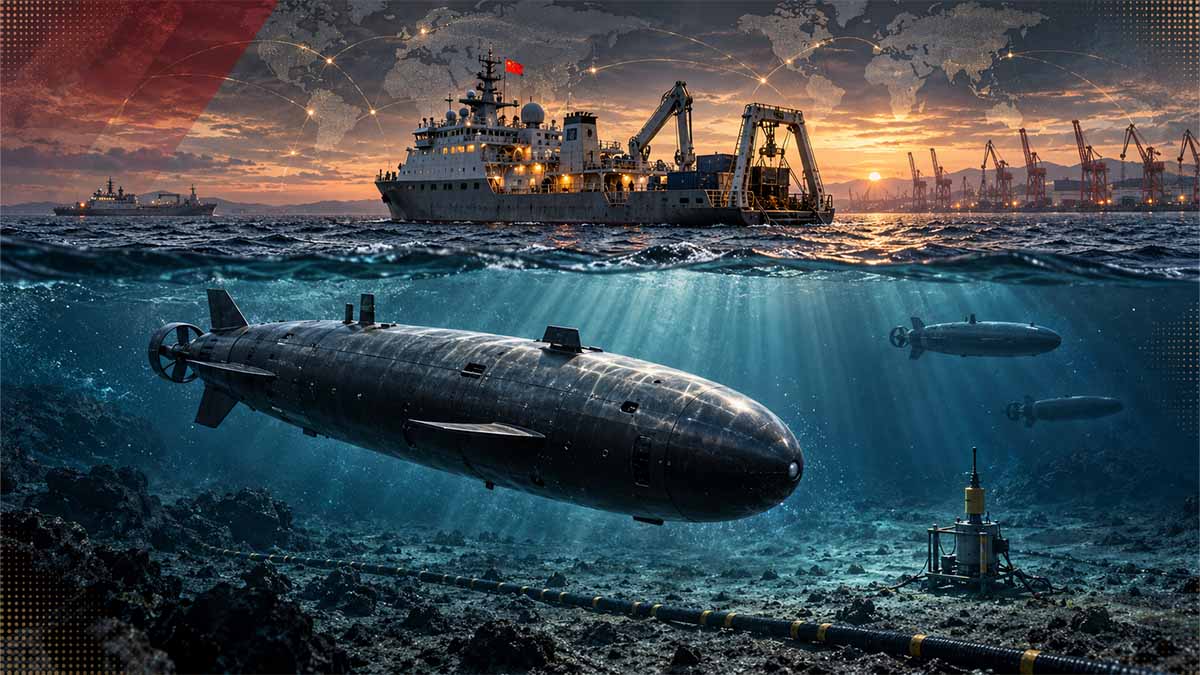
This assessment examines China’s emerging underwater-drone support architecture alongside developments in the United States, Australia, Europe, Israel, Japan and South Korea, distinguishing documented capabilities from announced ambitions and assessing their strategic implications through 2031.
Executive Summary
The strategic significance of underwater drones increasingly depends on the infrastructure that deploys, recovers, maintains and commands them. China’s apparent development of additional dedicated support vessels therefore deserves attention, but the accessible official record does not establish the mission, embarked capacity, operational status or fleet assignment of the newly discussed hulls. International developments nevertheless demonstrate that the wider technological transition is substantive: Australia disclosed additional undersea payload integration on 19 October 2026; the United Kingdom reported a heavyweight-torpedo launch from an experimental uncrewed submarine in September; and industry documented delivery of BlueWhale to Germany in February. These represent different stages of development, rather than interchangeable evidence of operational maturity. The decisive question is which countries can sustain useful underwater missions repeatedly, at acceptable cost and with reliable command arrangements.
The Undersea Drone Race Will Be Won in the Support Budget
China’s apparent investment in underwater-drone support ships confronts Western governments with a procurement choice: buy more autonomous vehicles, or build the operating infrastructure that makes those vehicles useful. The distinction now carries fiscal and industrial consequences. On 19 October 2026, Australia disclosed further payload integration across its unmanned maritime programmes, while European governments were pursuing different combinations of experimental submarines, imported systems and infrastructure services. Yet the public record remains far stronger on contracts and demonstrations than on sustained operational performance. The governing question is therefore whether governments will finance complete mission capabilities or accumulate equipment whose maintenance, integration and decision structures remain unfinished. Through 2031, the advantage will accrue to countries that turn autonomous hardware into repeatable military output and shorter infrastructure disruptions.
The spending figures buy different things
Australia’s A$1.7 billion Ghost Shark contract, announced on 10 September 2025, covers delivery, maintenance and continued development over five years. Fincantieri’s July 2026 announcement envisaged approximately €600 million in initial expenditure on an underwater-sector acquisition programme. Britain’s December 2022 Cetus contract committed £15.4 million to an experimental vehicle, while its December 2025 Atlantic Bastion announcement identified £14 million in combined government and industry seed funding. These figures cannot sustain a league table of national ambition: Australia is purchasing an evolving capability and its support; Fincantieri is acquiring industrial holdings; Britain is financing a test platform and early development.
The same accounting discipline applies to European infrastructure funding. The Commission’s February 2026 allocation of €347 million for strategic submarine-cable projects included a €20 million repair-module call. A second €40 million repair-capacity call followed in June, alongside €5.8 million announced for the first two Regional Cable Hubs in the Baltic and Mediterranean. Adding every announcement together would risk counting related programme envelopes twice. More consequentially, treating those allocations as delivered protection would confuse budget authority with operational capacity.
Japan’s FY2026 documentation exposes another common distortion. Approximately ¥100.1 billion supports initiatives intended to establish SHIELD in FY2027, within a broader unmanned-defence allocation of approximately ¥277 billion on a contract basis. Neither amount is a dedicated underwater-drone budget. The fiscal question is not which government has announced the largest number, but which expenditure resolves the constraint preventing an accepted mission from being performed.
Payload cooperation matters more than a common submarine
Australia’s 19 October 2026 press conference clarified the current AUKUS industrial proposition. Defence Industry Minister Pat Conroy identified common payloads and sensors as the focus of undersea cooperation, while the partners retain their own platforms. Ghost Shark exports were discussed separately. That distinction allows governments to preserve national designs and industrial participation while seeking economies in mission equipment; it does not establish an allied decision to purchase the same vehicle.
The American portfolio illustrates why that separation matters. The US Pacific Fleet Submarine Force reported an Orca transit exceeding 1,000 nautical miles in July 2026, but also documented three Yellow Moray tactical sorties near Norway in 2025, launched and recovered through USS Delaware’s standard torpedo tubes without divers. These are different operating models. Their value lies in the missions they can support, not in whether one platform can claim to supersede the other.
AUKUS cooperation will produce savings only where shared payloads avoid repeated engineering. Power requirements, software interfaces, safety evidence and customer acceptance can turn one nominally common system into several national integration projects. Australia’s latest disclosure establishes a direction; contracts and accepted configurations must establish whether that direction reduces duplication or merely gives it a common programme name.
Europe is choosing where to own the value chain
Fincantieri’s proposed integration of Next Geosolutions, WSense, Graal Tech and Defcomm seeks to connect survey services, underwater communications, robotic vehicles and surface systems. The industrial mechanism is clear: a supplier of platforms and equipment can move toward recurring service revenue by assuming responsibility for a larger part of the customer’s task. Italy’s potential gain is therefore broader than ownership of a particular drone. Its exposure is that corporate integration may advance faster than the public customer’s ability to specify, accept and govern the resulting service.
France has separated its requirements more explicitly. Naval Group’s UCUV framework concerns a combat demonstrator; the Thales–Exail SLAMF arrangement covers eight mine-detection AUVs, with eight more optional; Exail’s deep-seabed development targets reconnaissance and surveillance to 6,000 metres. Maintaining distinct programmes avoids forcing one vehicle to satisfy incompatible tasks. It also requires the customer to coordinate support, information and procurement decisions across them.
Germany chose accelerated introduction through BlueWhale, following Baltic testing in November 2024 and a first handover in February 2026. Britain has used Excalibur to investigate military applications while placing autonomous systems within Atlantic Bastion’s wider sensing concept. The European division is consequently not between countries embracing or resisting autonomy. It concerns where governments retain design responsibility, where they buy available technology and whether successful experiments receive funded routes into routine service.
Repair capacity puts a measurable limit on protection
The International Cable Protection Committee reports approximately 150–200 submarine telecommunications cable faults annually, with 70–80% attributed to accidental human activities, principally fishing and anchors. Those figures do not resolve the cause of any individual incident, and they do not describe submarine power cables. They do establish that a protection policy organised exclusively around hostile underwater vehicles would neglect the largest documented recurring source of damage.
The June 2026 European repair call translates resilience into a concrete requirement: applicants should identify at least three compatible vessels, and equipment should be installable within a maximum of three days after a vessel reaches the designated port or yard. That is not a three-day cable-repair promise. It leaves transit, fault assessment, access, weather and the repair itself outside the installation clock. The distinction reveals where security expenditure can fail: equipment may exist while the organisation required to mobilise it remains incomplete.
The Porto Declaration of 3 February 2026 accordingly recommends predictable permitting, fewer administrative barriers and a single government contact point. Its recommendations are non-binding, and a contact point does not inherit every statutory power. Governments must still connect operators, ports, customs, emergency bodies and competent authorities. An underwater sensor that detects damage sooner cannot compensate for a repair vessel waiting on an unresolved authorisation.
Fast acquisition cannot waive technical maturity
The US Government Accountability Office’s July 2026 assessment found that eighteen of forty programmes entering the Middle Tier of Acquisition pathway between 2018 and 2025 began with immature technologies. That is not an underwater-drone failure rate. It is evidence against the assumption that selecting an accelerated procurement route removes development risk. Speed becomes credible when a bounded capability can be accepted, while immature elements are developed against separate decisions.
The French SLAMF order demonstrates why scope matters: eight firm vehicles and eight options are different commitments. Australia’s Ghost Shark contract similarly combines production with continuing development, making configuration control central to what the customer is buying. A payload demonstrated on one vehicle cannot silently become a capability attributed to every delivered platform. Expansion should follow evidence that the accepted combination can be supported, rather than the publicity surrounding an individual trial.
Britain’s JSP 936 framework addresses governance and assurance throughout the defence-AI lifecycle. Its procurement implication is practical: software changes require identifiable responsibility, records and proportionate retesting. A modular vehicle remains a supplier dependency if the customer lacks the rights, documentation or access needed to maintain it or integrate alternatives. Sovereignty resides partly in those contractual provisions, not solely in the location of the assembly line.
The next two years will charge the cost of unfinished decisions
Over the next 12–24 months, the relevant tests will be whether SHIELD’s FY2027 objective produces accepted functions, whether European cable-repair funding produces mobilisable equipment and whether AUKUS payload cooperation produces usable cross-platform arrangements. China’s apparent support-ship expansion should be assessed through the same discipline: identifiable operators, recurring integrated deployments and servicing evidence would change the judgment more than another unusual hull.
The costs of inaction will fall on different balance sheets. Defence ministries will carry vehicles that cannot generate the expected output; infrastructure operators will retain restoration delays that additional monitoring does not remove; industrial suppliers will face uncertain follow-on demand after successful demonstrations. Fincantieri’s service ambition, Germany’s accelerated acquisition and Britain’s experimental programme will each be tested by the customer’s next decision. Buying hardware is a commitment. Funding the personnel, interfaces, permissions and support that make it useful is the choice that determines whether that commitment earns its cost.
Navigational Index
Pillar I — China’s Maritime Support Architecture and the Changing Undersea Battlespace
- Chapter 1 — From Individual Vehicles to Sustained Underwater Operations
Support vessels, launch and recovery, maintenance, autonomy and the distinction between experimental activity and deployable force structure. - Chapter 2 — China’s Emerging Architecture: Industrial Capacity, Mission Ambiguity and Operational Reach
- The Chinese support-ship question, established scientific infrastructure, alternative employment pathways and evidence required to assess military integration.
- Chapter 3 — Persistence, Detection and Escalation Beneath the Surface
- Surveillance, mine warfare, infrastructure operations, payload employment and the constraints on sustained contested operations.
Pillar II — Competing International Solutions and Industrial Models
- Chapter 4 — The United States and Australia: Long-Endurance Vehicles, Modular Payloads and AUKUS Integration
Orca, Ghost Shark and the relationship between autonomous endurance, shore support and expeditionary sustainment. - Chapter 5 — Europe’s Divergent Approaches: Italy, France, Germany and the United Kingdom
- National capabilities, industrial structures, experimentation, procurement and critical-infrastructure requirements.
- Chapter 6 — Wider International Competition: Israel, Japan, South Korea and Strategic Outliers
- Sensor platforms, coastal defence, fleet integration and the limits of comparison between reusable drones and specialised strategic weapons.
Pillar III — Strategic Exposure, Governance and Decisions to 2031
- Chapter 7 — Infrastructure Security, Industrial Dependencies and Alliance Coordination
Submarine cables, offshore assets, repair capacity, shared interfaces and information governance. - Chapter 8 — Development Pathways and Observable Indicators
- Alternative trajectories, evidence thresholds and the transition from demonstrations to sustained fleet employment.
- Chapter 9 — Policy Options and Final Net Assessment
- Procurement priorities, experimentation standards, support infrastructure and measures of operational value.
Master Abstract
The support system determines the strategic value of the vehicle
The central development in autonomous undersea warfare is the gradual assembly of complete operating systems around individual vehicles. A large underwater drone acquires greater military value when a navy can transport it to the relevant theatre, prepare its payload, release it safely, retrieve its information, recover the vehicle and return it to service. A dedicated support ship could bring these functions closer to an operating area and reduce dependence on distant ports. It could also concentrate expensive equipment and specialist personnel aboard a conspicuous surface platform. The resulting balance depends on geography, protection requirements and the frequency with which vehicles need physical servicing. Consequently, the emergence of an apparent carrier or tender should prompt an assessment of the whole operating cycle; its appearance alone cannot establish patrol persistence, combat readiness or the number of missions that an embarked fleet can sustain.
The United States illustrates an alternative architectural choice. Boeing describes Orca as designed for pier-side launch and recovery without a dedicated support vessel, with a declared range of up to 6,500 nautical miles and a removable modular payload section. These are manufacturer specifications, rather than evidence that every configuration has demonstrated the advertised performance. Nevertheless, the design clarifies an essential distinction: a navy can seek reach through the endurance of individual vehicles, through forward support ships, or through a combination of both. A visible difference in support fleets therefore cannot, by itself, establish which country possesses the stronger autonomous undersea capability. boeing.com
China’s industrial foundation is established; the new military architecture remains unresolved
China already possesses documented experience with an unmanned-systems mothership in the scientific sector. The Second Institute of Oceanography, under the Ministry of Natural Resources, recorded the delivery of Zhu Hai Yun on 12 January 2023, following trials that included autonomous navigation and unmanned surface-vehicle launch and recovery. The institute reported twelve continuous hours of autonomous navigation during those trials. This establishes relevant experience in integrating a host ship, robotic systems, operators and operating procedures. It does not establish that a scientific vessel and a prospective naval UUV tender share the same mission architecture, equipment or readiness standards. 自然资源部第二海洋研究所
For the newly discussed Chinese hulls, the decisive official records remain unavailable in the material successfully verified for this assessment. Their operators, assigned missions, handling limits, embarked vehicles and acceptance status cannot responsibly be presented as settled facts. The distinction matters because a broadly similar configuration could support several overlapping functions: development trials, training, oceanographic work, maintenance support or eventual operational deployment. Even confirmation that two ships exist would not independently establish a serial procurement programme or an expeditionary combat capability. The strongest defensible judgment is conditional: if China demonstrates repeated deployment and recovery of large UUVs, supported by embarked maintenance and sustained deployments, the ships would represent a consequential extension of its underwater operating infrastructure. Evidence of that operating cycle would carry greater analytical weight than additional photographs of completed hulls.
Australia’s latest disclosure shifts attention toward payloads
On 19 October 2026, Australia’s defence ministers announced development and integration of payloads across Ghost Shark, Speartooth and BlueBottle, identifying examples that include supply caches, sea mines and uncrewed aerial vehicles. Some payloads were scheduled to participate in the AUKUS Maritime Big Play Pacific exercise in San Diego during the following week. The release also identified investment of up to A$5.8 billion over the decade in autonomous and uncrewed undersea warfare capabilities, including A$1.7 billion for the Ghost Shark fleet. These are Australian-dollar programme commitments, not expenditure on dedicated motherships. The announcement does not establish that every listed payload is integrated on every named platform. Defence Ministers
The strategic implication is that platform development and mission development are becoming increasingly interdependent. Endurance without a useful payload provides limited military effect; a sophisticated payload without dependable navigation, servicing and command arrangements creates a different limitation. Shared experimentation can expose these dependencies, although an exercise announcement remains distinct from a completed demonstration or an operational deployment. Australia’s disclosure consequently strengthens the case for assessing undersea autonomy as an integrated capability while preserving the distinction between announced integration work and demonstrated fleet performance.
Britain and Germany demonstrate different routes toward military utility
The Royal Navy’s 30 September 2026 announcement documented a trial in which XV Excalibur fired and controlled a US Navy Mk48 Mod 4 heavyweight torpedo. The experiment used an inert, recoverable torpedo, and the navy described it as the beginning of a series intended to increase in scope and complexity. Excalibur remains an experimental platform. The event demonstrates a specific integration achievement; it does not establish an operational squadron, autonomous target selection or unrestricted authority to release weapons. royalnavy.mod.uk
Germany’s BlueWhale represents a different emphasis. IAI and TKMS announced delivery to the German Navy at Eckernförde on 25 February 2026, following Baltic testing. Their statement describes reconnaissance, acoustic collection, above- and below-water target detection and seabed mine-location functions. Delivery is a concrete milestone, while the manufacturers’ descriptions of mission performance retain their status as first-party claims. Together, the British and German cases show why a single international ranking would be misleading: a weapons-integration experiment and delivery of an autonomous sensor platform answer different operational questions. IAI
Europe already has relevant mothership experience
The Belgian-Dutch mine-countermeasures programme offers an important comparison because it explicitly combines a host ship with surface, underwater and aerial robotic systems. Naval Group’s November 2025 documentation describes a twelve-vessel programme, with a published configuration including two Inspector 125 surface drones, three A-18 autonomous underwater vehicles and associated mine-identification and neutralisation equipment. This is a documented support-ship architecture for a defined mission. It should not be treated as equivalent to a tender for very large, long-endurance underwater vehicles. naval-group.com
France’s industrial contribution is particularly relevant through Naval Group and Exail’s respective roles in the programme. Its wider strategic significance lies in system integration: host-ship design, handling machinery, mission software, unmanned vehicles and maintenance arrangements must function together. The appropriate European comparison with China therefore extends beyond hull size to the reliability and completeness of the operating system. Published equipment lists are useful evidence of design scope; they remain insufficient to establish mission availability across different sea conditions or sustained wartime performance.
Italy’s opportunity lies in connecting maritime robotics with infrastructure services
Italy’s industrial direction increasingly links underwater vehicles with sensors, communications, handling equipment and offshore services. On 17 June 2026, Eni and Fincantieri announced an agreement granting IDS an exclusive licence for worldwide commercialisation and industrial development of Clean Sea, Eni’s robotic technology for monitoring marine ecosystems and subsea infrastructure. In July, Fincantieri announced agreements concerning Next Geosolutions, WSense, Graal Tech and Defcomm, spanning survey services, underwater communications, autonomous underwater vehicles and autonomous surface vehicles. The announcement distinguished acquisition agreements from completion conditions; it should not be read as proof that all transactions and integration activities had already concluded. fincantieri.com
These developments support an industrial option for Italy: integrating inspection, environmental knowledge, communications and intervention support into persistent infrastructure services. Their military value would depend on subsequent requirements, procurement and operational validation. Civil inspection competence cannot automatically be translated into survivability or effectiveness under hostile conditions. Equally, concentrating exclusively on combat payloads would overlook the importance of detecting anomalies, establishing what happened and supporting restoration.
Asian programmes broaden the competition beyond large vehicles
Japan’s 2026 defence white paper places UUV acquisition within SHIELD, a planned layered coastal-defence architecture combining aerial, surface and underwater unmanned systems with crewed forces. Its stated objective is establishment during fiscal year 2027; that date is a programme target, not evidence of completed deployment. South Korea’s Hanwha describes development of unmanned surface and underwater systems intended to operate within existing naval command structures, an industrial statement of direction rather than a verified fleet inventory. mod.go.jp
These approaches reinforce the distinction between vehicle size and operational purpose. Large vehicles may support endurance and payload capacity, while smaller systems can serve distributed surveillance or specialised coastal missions. Israel’s participation through BlueWhale further demonstrates that the competitive landscape includes partnerships between vehicle developers, sensor specialists and naval integrators. International comparison must therefore preserve differences in mission, development stage and support requirements rather than grouping all underwater drones into a single category.
Key Evidence Table
| Indicator | Value/status | Reference date | Definition/scope | Issuer | Exact source |
|---|---|---|---|---|---|
| Chinese scientific mothership experience | Zhu Hai Yun delivered following trials | 12 Jan 2023 | Scientific unmanned-systems host ship; not confirmation of the newly discussed naval hulls | Second Institute of Oceanography | Official delivery account. 自然资源部第二海洋研究所 |
| US alternative support architecture | Orca designed for pier-side launch and recovery | Current product page, accessed 19 Oct 2026 | Manufacturer-declared design; dedicated host ship not required | Boeing | XLUUV product documentation. boeing.com |
| Australian payload development | Integration work publicly disclosed | 19 Oct 2026 | Multiple platforms and payload examples; platform-specific combinations not fully disclosed | Australian defence ministers | Australia advances undersea warfare capabilities. Defence Ministers |
| British weapon integration | Inert heavyweight-torpedo launch and control reported | 30 Sep 2026 announcement | Experimental demonstration using XV Excalibur | Royal Navy | Official trial account. royalnavy.mod.uk |
| German autonomous sensor platform | BlueWhale delivery announced | 25 Feb 2026 | Delivery milestone following Baltic testing | IAI and TKMS | Joint delivery announcement. IAI |
| European drone-support ships | Twelve vessels in Belgian-Dutch programme | 4 Nov 2025 record | Mine-countermeasures architecture; programme total, not delivered inventory | Naval Group and Exail | Oostende programme statement. naval-group.com |
| Italian infrastructure robotics | Clean Sea industrial-development licence announced | 17 Jun 2026 | Commercial and industrial agreement | Eni and Fincantieri | Joint technology agreement. fincantieri.com |
| Japanese coastal architecture | SHIELD targeted for FY2027 | 2026 white paper | Planned integration of multiple unmanned categories | Japanese Ministry of Defense | Unmanned defence capability chapter. mod.go.jp |
| EU infrastructure resilience | €347 million allocated to strategic submarine-cable projects | 5 Feb 2026 | CEF Digital allocation; not a military-UUV procurement budget | European Commission | Cable-security announcement. Shaping Europe’s digital future |
Competing Pathways
Three pathways merit continued examination, although the available evidence does not support numerical probabilities or a firm ranking for the newly discussed Chinese ships.
| Pathway | Strategic meaning | Evidence that would strengthen it | Evidence that would weaken it |
|---|---|---|---|
| Predominantly experimental support | Ships accelerate trials, training and vehicle development | Repeated instrumented trials and changing embarked configurations | Sustained deployments with stable operational units |
| Specialised operational support | Ships sustain selected missions or regional deployments | Named operators, accepted mission packages and repeated deployment-recovery cycles | Prolonged trials without documented operational acceptance |
| Wider expeditionary architecture | Ships support persistent activity beyond nearby bases | Serial procurement, overseas logistics and repeated distant operations | Continued dependence on fixed local facilities |
These pathways can overlap during programme maturation. Additional hulls would strengthen the evidence of investment, but only operating patterns would establish how that investment translates into military reach.
Principal Gaps and Watch Indicators
The most consequential Chinese evidence would be an attributable programme designation, identification of the operating organisation and documented launch-and-recovery activity involving identifiable vehicles. Acceptance records, sustained deployments and visible maintenance arrangements would help distinguish development infrastructure from an operational support fleet. A claimed ability to threaten distant bases or continental coastlines requires separate evidence concerning vehicle endurance, navigation, payloads and command arrangements.
For international comparison, the principal missing measures are repeated mission completion, recovery reliability, maintenance burden and availability over time. Those measures would allow governments to assess sustained output rather than nominal inventories or isolated demonstrations.
For Europe, infrastructure protection also requires a response after detection. The Commission’s February 2026 package explicitly included support for adaptable cable-repair modules, illustrating the connection between monitoring and restoration capacity. The practical decision is how to connect naval awareness, commercial inspection, incident assessment and repair without assuming that purchasing additional drones resolves the entire problem. Shaping Europe’s digital future
Undersea Drone Fleets
China and the global race for maritime persistence: how host ships, autonomous vehicles, mission payloads and support networks fit together.
Three routes to underwater persistence
Conceptual comparison. Card height, depth and position encode no numerical score or ranking.
Forward support at sea
A surface host can bring handling equipment, technicians and servicing closer to the operating area.
China: scientific mothership experience is documented. The roles and acceptance status of the newly discussed naval hulls remain unresolved.
Trade-off: support proximity versus exposure and concentration of assets. Source 1
Shore launch and autonomy
A vehicle uses its own range and endurance to reduce dependence on a dedicated host ship.
United States: Boeing describes Orca as designed for pier-side launch and recovery, with up to 6,500 nautical miles of range.
Manufacturer-declared design, not a readiness measurement. Source 2
Host, drones and control
Specialised host ships combine robotic vehicles, handling systems and mission management for a defined task.
Belgium / Netherlands: the rMCM programme integrates surface, underwater and aerial systems for mine countermeasures.
Different mission and vehicle scale from a large-UUV tender. Source 6
The mission cycle that turns hardware into capability
Each stage depends on the previous stage; recovery feeds maintenance and preparation for another sortie. The sequence describes an analytical operating model, not verified performance of a particular fleet.
- PrepareMission definition, payload integration and vehicle checks.
- DeployShore or host-ship launch; transit to the operating area.
- ExecuteNavigation, sensing or authorised payload employment.
- RecoverVehicle retrieval and transfer of collected information.
- ServiceInspection, energy replenishment and repairs.
- RegenerateValidate availability and prepare the next mission.
Different milestones, different meanings
Equal-size 3D-style event blocks; dates are labels, not a proportional time axis. These events are not a maturity ladder.
rMCM architecture
Naval Group publishes host-ship and robotic-system configuration.
Programme recordBlueWhale
IAI and TKMS announce delivery to the German Navy.
DeliveryExcalibur
Royal Navy reports firing and controlling an inert heavyweight torpedo.
Trial reportAustralian payloads
Government discloses integration work across multiple unmanned platforms.
Integration disclosureThe global capability landscape
Compare operating concepts and documentary status. Categories describe evidence types; they do not assign countries a common readiness level.
10 entries · Full comparison
| Country / actor | Operating concept | Documented milestone / claim | Interpretation limit | Evidence type |
|---|---|---|---|---|
| China | Scientific host ship; new naval hulls unresolved | Zhu Hai Yun delivery documented in 2023 [1] | Scientific operation is not evidence of naval acceptance | Documented / unresolved |
| United States | Long-endurance, shore-launched vehicle | Orca: up to 6,500 nautical miles declared range [2] | Manufacturer specification; not a fleet readiness measure | Declared design |
| Australia | Modular vehicles and payload integration | Supply-cache, mine and UAV payload examples disclosed [3] | Not every payload is confirmed on every platform | Integration announced |
| United Kingdom | Experimental weapon integration | Excalibur fired and controlled an inert Mk48 Mod 4 [4] | Trial achievement; not an operational squadron | Demonstrated trial |
| Germany / Israel | Autonomous sensor-platform partnership | BlueWhale delivery announced, 25 February 2026 [5] | Delivery does not establish sustained availability | Delivery announced |
| Belgium / Netherlands / France | Mine-countermeasures host ships and drones | 12-vessel rMCM programme; 3 A-18 AUVs in published configuration [6] | Programme total is not delivered inventory | Documented programme |
| Italy | Infrastructure robotics and industrial integration | Clean Sea commercialisation and development agreement [7] | Agreement is not military operational acceptance | Agreement announced |
| Japan | Layered coastal defence | SHIELD targets establishment in FY2027 [8] | Future target; multiple unmanned categories | Planned architecture |
| South Korea | Integration with existing naval command systems | Hanwha describes crewed-uncrewed development [9] | Industrial direction; no verified fleet count here | Development stated |
| European Union | Cable monitoring, resilience and repair | €347m allocated to strategic cable projects [10] | CEF Digital allocation; not military UUV procurement | Funding allocation |
What would change the assessment?
Confirm the operating role
Named operator, programme designation, identifiable embarked vehicles and repeated launch-and-recovery activity.
Measure repeatability
Mission completion, recovery reliability, servicing burden and sustained availability over time.
Connect detection to repair
Link monitoring, incident assessment and restoration capacity. Additional drones alone do not complete the response system.
Sources and interpretation
Sources retained from the accompanying assessment. Official announcements establish what the issuer reported; manufacturer specifications remain attributed claims. Unknown quantities are not represented as zero. No invented scores, probabilities or cross-programme budget comparisons are used.
Open the source register
- China: Zhu Hai Yun deliverySecond Institute of Oceanography · 12 Jan 2023
- Orca XLUUV specificationsBoeing · undated; accessed 19 Oct 2026
- Australia: undersea payload integrationAustralian defence ministers · 19 Oct 2026
- Excalibur torpedo trialRoyal Navy · 30 Sep 2026
- BlueWhale deliveryIAI / TKMS · 25 Feb 2026
- Belgian-Dutch rMCM programmeNaval Group / Exail · 4 Nov 2025
- Clean Sea technology agreementEni / Fincantieri · 17 Jun 2026
- SHIELD coastal defence plansJapan Ministry of Defense · 2026 white paper
- Integrated maritime systemsHanwha · 24 Feb 2026
- Cable-security investmentEuropean Commission · 5 Feb 2026
Pillar I — China’s Maritime Support Architecture and the Changing Undersea Battlespace
Chapter 1 — From Individual Vehicles to Sustained Underwater Operations
Operational availability is the decisive measure of an underwater fleet
The transition from an experimental underwater vehicle to a deployable military capability occurs when an operating organisation can repeatedly deliver a defined mission under representative conditions, recover the system where recovery is intended, restore its configuration and prepare it for subsequent employment. This is a more demanding threshold than completing a long transit, demonstrating an autonomous manoeuvre or launching a payload. Each achievement can establish an important technical proposition, but none independently establishes that the vehicle, its support infrastructure and its command organisation can maintain useful output over an extended deployment. For governments evaluating autonomous underwater systems, the relevant unit of analysis is therefore the mission-capable operating system: vehicles, handling equipment, energy provision, maintenance personnel, software, communications, mission planning and the procedures governing their interaction.
This distinction has direct acquisition consequences. The US Government Accountability Office’s September 2022 examination of the Extra Large Unmanned Undersea Vehicle programme found that the effort was at least US$242 million, or 64%, above its original estimate, and at least three years late at that historical assessment point. GAO attributed important difficulties to starting fabrication without adequately demonstrating production readiness and to redesign requirements affecting critical components. These figures describe the programme’s position in 2022; they are not presented as its October 2026 cost or schedule. Their continuing relevance is the acquisition mechanism they expose: a predecessor demonstrator does not remove the integration risks associated with a substantially different military configuration. Extra Large Unmanned Undersea Vehicle: Navy Needs to Employ Better Management Practices to Ensure Swift Delivery to the Fleet — US Government Accountability Office — September 2022, with subsequent recommendation updates. U.S. GAO
A fleet assessment should consequently distinguish physical ownership from practical availability. A vehicle awaiting software clearance, replacement seals, battery inspection or a compatible recovery system remains part of the inventory, but it cannot necessarily contribute to the assigned operation. Equally, a functioning vehicle may be available for seabed survey while remaining unsuitable for a different payload or environmental condition. Readiness is mission-specific, and aggregation across configurations can conceal rather than clarify operational strength.
Table 1.1 — Evidence required to establish an operational underwater capability
| Assessment dimension | What can be established | Evidence required | What does not establish it |
|---|---|---|---|
| Physical inventory | Vehicles exist and have been transferred or accepted | Delivery records, acceptance documentation, attributable inventory statements | Construction imagery or manufacturer order announcements |
| Technical performance | A specified function worked under stated conditions | Instrumented trials identifying configuration, environment and results | A general claim of successful testing |
| Mission integration | Vehicle, payload and command arrangements function together | End-to-end mission trials with an identified payload and control architecture | Separate successful tests of individual components |
| Operational suitability | Personnel can use and support the system effectively | Representative operating periods, training results and maintenance evidence | A contractor-supported demonstration alone |
| Sustained availability | Useful output can be maintained over time | Mission completion, downtime, repair and servicing records | Nominal endurance or fleet size |
| Deployment resilience | Operations remain viable when support conditions deteriorate | Testing of interrupted communications, equipment failures and alternative support arrangements | An uninterrupted mission in favourable conditions |
Analytical assessment framework; the table assigns no readiness rating to an individual programme.
Launch and recovery determine the usable operating window
The launch-and-recovery problem is especially important because underwater endurance and surface handling operate under different constraints. A vehicle may remain capable of submerged operation while the host ship cannot safely recover it. Conversely, a support ship may remain seaworthy while its handling arrangements have reached an operational limit. The practical deployment window is bounded by the most restrictive element of the combined system, including the vehicle’s configuration, the handling equipment, the ship’s motion and the procedures available to the crew.
A crane’s nominal lifting capacity does not resolve this problem. Safe handling also depends on dynamic loads, attachment arrangements, capture geometry, vehicle buoyancy and the interaction between ship and vehicle during the transition through the water surface. A photographed lifting tower may indicate substantial handling infrastructure, but it cannot reveal the certified operating envelope or demonstrate autonomous recovery. Counting visible towers therefore provides a weak basis for estimating simultaneous UUV operations, sortie generation or embarked capacity.
A current commercial development illustrates where engineering effort is being directed. On 30 September 2026, Kongsberg Maritime announced a contract for an integrated AUV hangar and subsea docking system for a research vessel being built by VARD for Inkfish. The proposed installation combines below-surface launch, recovery and docking with internal handling arrangements, including a skidding system and overhead crane. The company states that moving docking below the surface reduces wave effects and expands the operating window. Delivery is planned for the end of 2027: this is evidence of a contracted engineering approach, not an already delivered capability aboard that vessel. Kongsberg Maritime to deliver AUV hangar and subsea docking system for new research vessel — Kongsberg Maritime — September 2026.
The significance extends beyond the commercial application. Purpose-built underwater-drone support vessels should be assessed as handling and servicing installations whose naval utility depends on their performance at the interfaces between ship, vehicle and water. Hull dimensions matter, but the operational advantage may reside in less visible features: protected preparation spaces, integrated diagnostics, the ability to move vehicles internally and recovery equipment that reduces dependence on favourable surface conditions.
Table 1.2 — Support architectures and their principal constraints
| Architecture | Potential operating advantage | Principal dependency | Consequence for assessment |
|---|---|---|---|
| Pier-side launch and recovery | Concentrates servicing and preparation at established facilities | Port access and sufficient vehicle transit endurance | Long range must be assessed alongside time and energy consumed reaching the mission area |
| Dedicated surface support ship | Brings handling, technicians and stores closer to operations | Host availability, protection and recovery envelope | Embarked capacity is useful only if servicing and recovery can sustain it |
| Containerised package aboard a suitable vessel | Permits transport and mobilisation across different host platforms | Host compatibility, installation and operating procedures | Transportability does not establish immediate operational interchangeability |
| Submarine-hosted deployment | Integrates underwater vehicles with a submerged parent platform | Vehicle dimensions, interfaces and launch-and-recovery integration | Demonstrated compatibility is configuration-specific |
| Subsea docking or resident support | Can reduce repeated surface handling | Docking reliability, energy provision and intervention requirements | A docking demonstration does not establish unattended service over long periods |
These architectures can coexist within the same force. The table compares dependencies rather than ranking effectiveness.
Maintenance moves the human workload rather than eliminating it
An uncrewed vehicle removes personnel from the vehicle itself, but it does not remove the requirement for engineering expertise, mission preparation, inspection, fault diagnosis and configuration control. The workforce changes location and composition. A support organisation may require fewer personnel exposed aboard a submerged platform while demanding more specialist effort in battery management, software assurance, acoustic systems and data exploitation.
The maintenance problem also changes with mission duration. Components exposed to seawater and repeated pressure cycles must retain their integrity; sensors must remain sufficiently clean and calibrated; propulsion and buoyancy systems must continue operating within acceptable limits. DARPA’s Manta Ray programme explicitly identifies corrosion, biofouling, material degradation, energy management and mission management as problems that must be addressed to enable long-duration operation without human-present support. These are programme objectives, not evidence that all such problems have been solved. Manta Ray — Defense Advanced Research Projects Agency — programme description, accessed October 2026.
The strategic consequence is that increasing vehicle endurance does not automatically reduce the support burden in proportion. Longer missions may reduce the frequency of recovery, but they also increase the importance of reliability, fault tolerance and confidence in the vehicle’s condition before departure. A maintenance regime that works for short, closely supervised sorties may be inadequate for a prolonged deployment in which physical intervention is unavailable.
A useful performance measure is mission-capable hours delivered per unit of total support effort, assessed for a defined mission and environment. This would capture the personnel, facilities and servicing time required to generate useful output. It would also discourage procurement comparisons that treat the absence of an onboard crew as a complete measure of reduced operating cost.
Table 1.3 — Measures that reveal whether a fleet can sustain operations
| Measure | Definition for reporting | Why it matters | Main comparability limitation |
|---|---|---|---|
| Mission completion rate | Assigned missions completed to stated criteria divided by missions initiated | Separates successful deployment from successful mission delivery | Mission difficulty and acceptance criteria must be comparable |
| Recovery success rate | Successful planned recoveries divided by attempted recoveries | Reveals a critical recurring operational dependency | Assisted and autonomous recovery should be reported separately |
| Turnaround time | Time from recovery to release for the next assigned mission | Determines how quickly inventory becomes available again | Routine servicing and major repair should not be combined |
| Maintenance effort | Personnel-hours required over a defined operating period | Exposes the human workload behind uncrewed operations | Contractor support and shore labour must be included consistently |
| Mission-capable availability | Proportion of the reporting period available for the specified mission | Connects ownership with usable force output | Availability changes with payload and software configuration |
| Data delivery timeliness | Time between collection and delivery to the authorised user | Distinguishes immediate operational utility from delayed intelligence value | Bulk collection and time-sensitive warning have different requirements |
| Support-system downtime | Time that handling, charging or command equipment prevents operation | Identifies bottlenecks outside the vehicle | Host-ship downtime must be distinguished from vehicle downtime |
Proposed reporting measures; no undisclosed programme values are inferred.
Autonomy must be assessed by function and operating conditions
The term “autonomous” can conceal major differences between navigation, obstacle avoidance, mission adaptation, target recognition and weapon employment. A vehicle may navigate independently along a planned route while requiring human review of collected data. Another may identify candidate objects onboard but lack authority to alter the mission beyond predetermined limits. The policy and engineering implications depend on which functions are automated, the circumstances in which they operate and the consequences of failure.
Commercial documentation already reflects this functional distinction. Kongsberg describes HUGIN configurations capable of operator-supervised, semi-autonomous or autonomous operation, with deployment from dedicated vessels, suitable alternative vessels or shore. Its published system description also identifies containerised operator consoles, launch-and-recovery equipment and vehicle transport arrangements. These are manufacturer descriptions of available configurations, rather than evidence that any vessel can immediately operate any HUGIN system. HUGIN Autonomous Underwater Vehicle — Kongsberg Discovery — product documentation, accessed October 2026.
For naval assessment, autonomy should be treated as a distribution of responsibilities between software, operators and commanders. The operational question is whether the allocation remains effective when environmental conditions change, communications are interrupted or the mission cannot continue as planned. A system that behaves predictably within a narrow authorised task can be more useful than a nominally more autonomous system whose behaviour is difficult to validate.
Integration is becoming a distinct capability in its own right
The support architecture need not take the form of a newly built dedicated mothership. HII’s 2026 account of its integration work describes several routes: torpedo-tube launch and recovery, automated surface-ship handling and a capture arrangement intended for amphibious ships with well decks. The company also reported an April 2026 Defense Innovation Unit contract for submarine launch-and-recovery development. These statements show that existing naval platforms are being considered as hosts through different interfaces; they do not establish that every described system has entered operational service. HII Leading in Technologies to Integrate Unmanned Systems with Naval Platforms — HII — 2026.
The implication is that comparisons based solely on dedicated support-ship inventories will systematically miss part of the competitive landscape. A country may pursue specialised tenders, adapt existing platforms, emphasise shore-launched endurance or combine these approaches. The relevant comparison is the support network’s ability to generate the required mission at the required place and time, including the burden imposed on its host platforms.
Organisational readiness is equally consequential. GAO’s 15 June 2026 assessment of US naval robotic and autonomous systems identified leadership and organisational challenges affecting progress. Its findings reinforce the distinction between possessing technology and establishing the authority, priorities and institutional arrangements needed to use it consistently. Robotic Autonomous Systems: Navy Needs to Address Leadership and Organizational Challenges to Meet Urgent Needs — US Government Accountability Office — June 2026.
Key judgments
The most informative evidence of an operational underwater fleet is repeated mission delivery supported by documented recovery, servicing and command arrangements. Endurance, payload capacity and hull counts remain relevant inputs, but none substitutes for availability.
Support-ship design should be assessed through its handling envelope and maintenance throughput. Visible infrastructure establishes the presence of equipment; it does not establish certified performance or sustainable sortie generation.
Autonomy is operationally meaningful only when its functions, limitations and human responsibilities are defined. Procurement should evaluate the complete mission configuration rather than a general claim of autonomous operation.
What would change the assessment
Confidence would increase with representative operating records showing repeated missions, recovery outcomes, servicing requirements and availability across different conditions. Evidence of a low-maintenance operating cycle would strengthen the case for expanding vehicle numbers; evidence that host equipment or specialist labour constrains output would instead strengthen the case for investment in support capacity.
Open official record
The principal unresolved comparison concerns sustained output. Public announcements frequently identify vehicles, contracts and demonstrations, while disclosing much less about turnaround, maintenance effort and mission-capable availability. Without those measures, international readiness rankings would imply precision that the available evidence cannot sustain.
Chapter 2 — China’s Emerging Architecture: Industrial Capacity, Mission Ambiguity and Operational Reach
China’s strongest documented advantage is the breadth of its supporting ecosystem
China’s emerging underwater architecture should be assessed through the relationship between shipbuilding, research institutions, specialist equipment, operating personnel and access to the sea. The newly discussed support hulls are potentially important, but the broader industrial foundation is more firmly documented than their specific military role. Official Chinese institutional records identify established support ships with substantial endurance, laboratories, positioning equipment and deep-submergence handling systems. These records demonstrate an ability to construct and operate complex offshore support platforms. They do not establish that scientific fleets form part of a naval UUV command structure.
This distinction permits a more precise judgment than either dismissing scientific capability as strategically irrelevant or treating it as proof of military intent. Scientific operations can develop expertise in underwater navigation, acoustic positioning, vehicle handling and engineering support. Whether that expertise transfers into a particular naval programme depends on institutional links, equipment compatibility, procurement decisions and operational requirements that must be established separately.
The available official record therefore supports an assessment of industrial and operational potential, while leaving the assignment and readiness of the newly discussed naval support ships unresolved.
Existing support ships provide measurable evidence of engineering capacity
The Institute of Deep-sea Science and Engineering’s published specifications describe materially different support platforms. Tansuo Yi Hao is listed as a 94.45-metre, 6,250-tonne full-load displacement vessel with range exceeding 10,000 nautical miles, endurance exceeding 60 days, DP-2 dynamic positioning and eleven laboratories. These specifications describe the host ship, not the independent endurance or military reach of an embarked underwater vehicle. R/V Tan Suo Yi Hao — Chinese Academy of Sciences Large Research Infrastructures User Service Platform — April 2025.
Tansuo Er Hao’s institutional record identifies a 100-tonne stern A-frame, with a separately specified 50-tonne guide mechanism, alongside a ten-tonne telescopic crane, acoustic communication and underwater positioning equipment. These figures must retain their equipment-specific definitions: they are not interchangeable lifting ratings and cannot be used to infer the dimensions or mass of an undisclosed naval UUV. R/V Tan Suo Er Hao — Institute of Deep-sea Science and Engineering, Chinese Academy of Sciences — December 2024.
Table 2.1 — Published specifications of established Chinese deep-sea support ships
| Indicator | Tansuo Yi Hao | Tansuo Er Hao | Tansuo San Hao |
|---|---|---|---|
| Length overall | 94.45 m | 87.25 m | 103.98 m |
| Full-load displacement | 6,250 tonnes | 6,832.6 tonnes | 10,200 tonnes |
| Maximum speed | 14.5 knots | 14.2 knots | 16 knots |
| Published range | More than 10,000 nautical miles | At least 15,000 nautical miles | At least 15,000 nautical miles |
| Published self-sustaining endurance | More than 60 days | At least 60 days | At least 75 days |
| Dynamic-positioning notation | DP-2 | DP-2 | DP-2 |
| Published personnel complement | Not used here | 25 crew and 35 scientific personnel | 32 crew and 48 scientific personnel |
| Distinctive support characteristic | Eleven laboratories and deep-sea operating equipment | Heavy stern handling equipment and thirteen laboratories | PC4 ice strengthening and unrestricted navigation notation |
Sources: Tansuo Yi Hao — CAS — April 2025; Tansuo Er Hao — IDSSE-CAS — December 2024; Tansuo San Hao — IDSSE-CAS — December 2024.
Operator-published specifications, not independently measured performance. Endurance and range are separate characteristics and should not be assumed to apply simultaneously at maximum speed or under every operating condition.
These ships illustrate why the support ecosystem matters. Laboratories, workshops, positioning systems and operating spaces permit much more than transport. They support equipment preparation, data processing, fault diagnosis and the development of procedures. Their strategic relevance lies partly in the accumulated ability to conduct complex operations repeatedly, although transferring that competence into contested military employment would introduce requirements that scientific service does not itself validate.
Guangzhou’s special-purpose shipbuilding competence is directly documented
The industrial significance of Guangzhou Shipyard International can be established without assuming the identity of the newly discussed UUV-support vessel. A Chinese Academy of Sciences account records that GSI built Tansuo San Hao, with construction beginning in June 2023 and completed over an approximately eighteen-month period. The vessel departed the yard on 26 December 2024 and arrived at Sanya on 29 December. This documents delivery of a complex research platform by the same industrial organisation attracting attention in the support-ship discussion; it does not establish that the vessels share a design lineage or military programme. Tansuo San Hao enters service at Sanya — Chinese Academy of Sciences Guangzhou Branch — December 2024.
A separate 2 September 2026 China Classification Society announcement identifies GSI as builder of a deep-diving work support ship for the Ministry of Transport’s Shanghai Salvage Bureau, with the Shanghai Ship Research and Design Institute responsible for design. The published description includes electric azimuthing propulsion and tasks such as deepwater lifting, flexible-pipe installation, diving support and emergency evacuation. This is a civil support project whose construction had commenced; it should not be conflated with the newly discussed naval hull. Construction begins on a CCS-surveyed deep-diving work support ship — China Classification Society — September 2026.
The analytical consequence is twofold. First, there is a documented industrial basis for producing ships with demanding handling and support functions. Second, the same breadth of special-purpose construction makes visual identification more difficult. Substantial cranes, work decks, positioning equipment and accommodation can support several civil or military missions. Yard location and unusual appearance narrow the possibilities, but do not establish the customer or operational purpose.
Table 2.2 — What the industrial record establishes
| Documentary observation | Supported conclusion | Unsupported extension |
|---|---|---|
| GSI built Tansuo San Hao | The yard has delivered a complex deep-sea research support vessel | Every unusual GSI support hull is part of the same programme |
| A new GSI-built salvage-support project began construction in 2026 | The yard remains active in demanding offshore support work | The salvage project identifies the newly discussed UUV tender |
| Established Chinese support ships carry substantial handling systems | Relevant equipment and operating expertise exist | An undisclosed military ship has identical lifting capacity |
| Research vessels have published long-range specifications | China possesses host platforms intended for distant scientific operations | Embarked military UUVs possess the same range |
| Multiple institutions participate in ship development and operation | The industrial and research ecosystem is extensive | A unified naval command relationship has been demonstrated |
Sources: CAS Guangzhou Branch — December 2024; China Classification Society — September 2026; IDSSE-CAS support-ship specifications.
Expeditionary scientific activity demonstrates experience under demanding conditions
Published specifications establish intended capability; completed expeditions provide a different form of evidence. The Chinese Academy of Sciences reported that a 98-day Arctic voyage, returning on 27 October 2025, included 43 Fendouzhe dives and coordinated underwater operations involving Jiaolong. The account describes operations supported by Tansuo San Hao and claims development of a coordinated ship-submersible operating mode in heavy ice. These are first-party institutional reports of scientific operations, and their broader claims of precedence should remain attributed rather than adopted as independently established international comparisons. Chinese Scientists Pioneer “Ship-Submersible Coordination” Operations in the Arctic — Chinese Academy of Sciences — October 2025. english.cas.cn
The military relevance is indirect but substantive. Such expeditions expose crews and engineers to prolonged support requirements, variable environmental conditions and coordination between ships and submerged systems. They can generate practical experience that is difficult to acquire through isolated harbour trials. Nevertheless, manned scientific diving, autonomous underwater patrol and contested naval operations impose different demands. A successful research expedition establishes experience in its documented mission; military transfer remains an analytical possibility requiring additional evidence.
The expedition also demonstrates why published endurance figures should not be interpreted as a universal operational ceiling. Voyage duration can include port calls, replenishment, different operating tempos and periods when particular equipment is not deployed. A ninety-eight-day voyage and a published seventy-five-day self-endurance specification do not necessarily conflict, but neither can be used to reconstruct the ship’s unreported logistics.
Classification rules indicate a maturing engineering framework
China Classification Society’s 2025 Guidelines for Survey of Unmanned Submersibles, effective 1 January 2026, replaced the 2019 edition. Its published revision summary identifies changes concerning working depth, design pressure, post-construction testing, buoyancy-related equipment and, for remotely operated vehicles, control stations, umbilicals and launch-and-recovery systems. This is evidence that the domestic classification framework is adapting to a broader and more demanding underwater-vehicle sector. It is not evidence of certification, military acceptance or combat suitability for a particular platform. Guidelines for Survey of Unmanned Submersibles 2025 — China Classification Society — December 2025; effective January 2026.
Its significance lies in the institutionalisation of engineering requirements. An industry becomes more scalable when design review, inspection, testing and documentation become repeatable processes. However, classification and naval acceptance serve different purposes. Even a fully documented civilian safety assessment would not establish resistance to interference, mission-system security or the performance of an armed configuration.
Table 2.3 — Evidence layers that must remain separate
| Evidence layer | Principal question answered | Example of an appropriate record | Remaining limitation |
|---|---|---|---|
| Design specification | What is the system intended to do? | Operator or manufacturer specification | Intended performance may not have been demonstrated |
| Classification and survey | Has the system met the applicable surveyed requirements? | Class certificate and survey documentation | Scope may exclude military mission requirements |
| Technical trial | Did a defined function work? | Instrumented test report | Results apply to the tested configuration and conditions |
| Customer acceptance | Has the customer accepted the delivered system? | Acceptance statement or delivery record | Acceptance is not sustained operational availability |
| Operational deployment | Has the system been employed by the operating organisation? | Attributable deployment record | Deployment alone does not establish mission success |
| Sustained mission performance | Can useful output be maintained? | Repeated mission and support records | Public disclosure may remain incomplete |
The new support-ship question requires programme-specific evidence
The public discussion of apparent Chinese underwater-drone tenders raises a legitimate strategic question, but the official records examined here do not establish the newly discussed hulls’ programme designation, assigned operator, vehicle complement or operational acceptance. Their purported dimensions, internal arrangements and mission roles should therefore not be combined into an apparently complete technical specification.
A stern opening, substantial handling structures and a flight deck could be consistent with a UUV-support role. Their diagnostic value would increase if accompanied by identifiable embarked underwater vehicles, repeated handling activity, support personnel or an attributable customer statement. Until those connections are established, a technically plausible interpretation remains an interpretation.
Nor does a second hull automatically demonstrate operational serial production. Multiple ships can serve comparative experimentation, training and development as well as frontline employment. Conversely, an experimental programme can create infrastructure that later becomes operationally important. The distinction should be resolved through deployment patterns and institutional evidence rather than an assumption that research and combat roles are mutually exclusive.
Table 2.4 — Programme-specific observations and their analytical value
| Observation sought | Proposition it would strengthen | What it would still leave unresolved |
|---|---|---|
| Identifiable UUV embarked aboard the ship | Physical compatibility with a particular vehicle | Accepted mission role and sustained operating rate |
| Repeated launch-and-recovery cycles | Practical handling integration | Performance across different conditions |
| Named naval operator or unit | Formal military assignment | Readiness and mission effectiveness |
| Embarked workshops and servicing activity | Support extends beyond transport | Repair depth, spare-parts endurance and throughput |
| Repeated distant deployments | Expeditionary employment is becoming routine | Independent vehicle reach and contested survivability |
| Common equipment across several ships | Possible standardisation | Procurement scale and operational doctrine |
| Acceptance or commissioning announcement | Programme has passed a formal institutional milestone | Availability and mission success over time |
Collection framework; these observations are not asserted to have occurred.
Reach must be assessed as a chain of dependencies
The strategic reach of a support architecture comprises several different distances and periods: the ship’s transit, the vehicle’s transit, time in the mission area, communications opportunities, recovery requirements and the interval before replenishment or repair. Adding host-ship range to a claimed vehicle range would produce an attractive figure but an unreliable operational conclusion. Such a calculation would ignore mission energy, the requirement to return, equipment condition and the availability of support.
The conditional advantage of a mobile tender is that it can change the starting point of an underwater mission and bring selected services closer to it. Its countervailing weakness is dependence on the tender itself. A concentrated support platform may improve efficiency while creating a single point of disruption. A distributed arrangement may reduce that concentration but impose additional demands for compatible interfaces, spare parts and trained personnel.
For China, the consequential threshold would be evidence that the industrial foundation has been converted into a repeatable naval support system. That would require more than additional ship construction: it would involve common vehicle interfaces, trained operating units, maintenance provision and deployments demonstrating that the host and its embarked systems can function together over time.
Key judgments
China’s established scientific and offshore-support fleets provide measurable evidence of relevant industrial competence, handling capacity and expeditionary experience. That foundation makes the development of more ambitious UUV-support arrangements technically credible.
The official evidence does not yet connect every element of that foundation to the newly discussed naval hulls. Civil capability, institutional research and military assignment must remain separate propositions.
The strongest sign of a strategic change would be repeated integrated operations involving identifiable vehicles and a named operating organisation, supported by evidence of servicing and deployment continuity.
What would change the assessment
A programme-specific official statement, acceptance record or documented deployment would substantially improve confidence about the new ships’ roles. Repeated operations beyond nearby facilities would strengthen the expeditionary interpretation, especially if the same vehicle configurations and support arrangements appeared consistently.
Open official record
The consequential gaps concern ship identity, customer, mission assignment, embarked systems, handling limits and sustained operating patterns. Established research-ship specifications cannot fill these gaps, and their endurance or lifting ratings should not be transferred to undisclosed naval platforms.
Chapter 3 — Persistence, Detection and Escalation Beneath the Surface
Persistence has value only when it produces a timely and usable result
Underwater persistence can support surveillance, environmental observation, mine countermeasures and infrastructure inspection, but remaining at sea is not itself a mission outcome. Operational value depends on what a system can detect, how reliably it can classify the observation, how accurately it can locate it and whether the resulting information reaches the appropriate authority in time to influence a decision. A persistent sensor that produces a delayed but high-quality seabed record may be useful for investigation while contributing little to immediate warning. A system transmitting frequent alerts may improve responsiveness while creating additional communications and information-management demands.
NATO’s Centre for Maritime Research and Experimentation describes autonomous anti-submarine warfare as a system-of-systems problem involving sensing, signal processing, cooperative behaviour and operational analysis. Its 2025 account explicitly examines variables including coverage, speed, endurance, recharging, crewing, maintenance support and cost. The significance is methodological: underwater surveillance performance depends on the interaction of platforms and support conditions, rather than vehicle numbers alone. Autonomous Anti-Submarine Warfare — NATO Centre for Maritime Research and Experimentation — Annual Report 2025.
Detection, classification and attribution impose different burdens
Detection establishes that a sensor has registered an event or object. Classification assesses what it may be. Localisation establishes its position to a stated degree of accuracy, while tracking requires continuity over time. Attribution adds another evidentiary burden: identifying who was responsible and, where relevant, establishing intent. These stages should not be collapsed into the claim that an underwater system can “monitor” or “protect” an area.
For infrastructure security, the distinction is particularly consequential. An object close to a cable may be relevant to an investigation without establishing interference. A vessel movement associated with an acoustic event may justify inspection without proving sabotage. Protection requires decisions about verification, response and continuity of service, and those decisions involve authorities beyond the operator of the underwater sensor.
CMRE’s 9 July 2025 account of its Baltic work offers a concrete example. Fixed seabed sensors detected a **proxy anchor—a ballast mooring—**and the resulting acoustic information was fused with vessel-tracking data through NATO’s MAINSAIL tool. The trial explored an alerting chain; it did not demonstrate automatic attribution of a real sabotage incident. Preserving that distinction is essential when translating an experiment into a security assessment. Anchor Alert: NRV Alliance detects undersea threats in Baltic first — NATO Centre for Maritime Research and Experimentation — July 2025.
Table 3.1 — From sensor observation to an accountable decision
| Stage | Required output | Principal risk | Appropriate evidentiary standard |
|---|---|---|---|
| Detection | A recorded observation or event | Noise or irrelevant contacts trigger alerts | Sensor record and detection conditions |
| Classification | A supported object or event category | Ambiguous signatures receive excessive confidence | Comparison with validated categories and alternatives |
| Localisation | Position with stated uncertainty | Search or response proceeds to the wrong location | Traceable positioning and uncertainty |
| Tracking | Continuity between successive observations | Separate contacts are incorrectly merged | Consistent evidence over time |
| Operational interpretation | Assessment of relevance to the mission | Benign activity is treated as hostile | Context, corroboration and competing explanations |
| Attribution | Supported identification of responsibility | Technical association is mistaken for proof of intent | Multiple evidence streams and competent review |
| Response | Authorised and proportionate action | Action exceeds the evidence or authority available | Defined responsibility and documented decision basis |
Analytical framework; not a claim that an existing system performs every stage autonomously.
Communications constrain supervision and data delivery
Underwater wireless communications impose a different operating environment from terrestrial radio. NTT’s technical account identifies acoustic propagation at approximately 1,500 metres per second, together with multipath effects, Doppler variation and environmental noise. It also reports experimental results exceeding 1 Mbit/s at 300 metres, and 5 Mbit/s at eighteen metres, under the respective tested arrangements. These results demonstrate that high-rate local underwater links are possible; they do not establish equivalent performance over oceanic distances or in every environment. Underwater Acoustic Communication Technology for Wireless Remotely Operated Vehicles — NTT Technical Review — August 2023.
A simple propagation calculation illustrates why supervision cannot be assumed to behave like an immediate connection. Using the approximately 1,500 m/s reference speed, the physical travel time for a signal increases with distance before processing, protocol overhead, retransmission and other delays are added.
Table 3.2 — Illustrative acoustic propagation delay
| Illustrative path length | Calculated one-way propagation time | Calculated minimum round-trip propagation time |
|---|---|---|
| 1.5 km | 1 second | 2 seconds |
| 15 km | 10 seconds | 20 seconds |
| 30 km | 20 seconds | 40 seconds |
Calculated as distance divided by 1,500 m/s, using the reference value reported by NTT Technical Review — August 2023. These distances are illustrative calculation inputs, not claims of achievable communications range. Actual sound speed and total latency vary.
The implication is not that human supervision is impossible. It is that command arrangements must distinguish decisions requiring immediate intervention from those that can be bounded in advance. Mission plans, safe responses to interruption and the allocation of onboard processing become central to the architecture. Increasing autonomy may reduce communications demand, but it also increases the importance of validating what the system will do when the operator cannot observe or influence every step.
Interoperability adds another constraint. Systems may communicate physically while remaining unable to exchange information in a form that their command organisations can use. CMRE’s 2025 annual report distinguishes work on STANAG 4817, concerning command and control of unmanned systems, from STANAG 4748/JANUS, concerning digital underwater signalling. These standards address different layers; a common signalling method does not by itself provide common mission semantics or decision authority. Maritime Unmanned Systems Enablers — NATO Centre for Maritime Research and Experimentation — Annual Report 2025.
Cooperative operations require more than a common communications link
A network becomes operationally useful when participants share an adequate understanding of position, time, task status and the meaning of exchanged data. Without those elements, adding vehicles can increase the volume of observations without producing a coherent picture. The support architecture must therefore include data management and operational procedures alongside communications equipment.
CMRE reported approximately 100 interoperability test cases during CWIX25 involving systems from Italy, Portugal, Turkey, Germany, France and Poland. The exercise integrated live Baltic maritime inputs into the wider test environment. This demonstrates organised work on cross-system integration, rather than proof that all participating equipment is universally interchangeable. Sea Signals: Baltic data drives NATO integration at CWIX25 — NATO Centre for Maritime Research and Experimentation — June 2025.
The scale of subsequent experimentation is also material. NATO’s account of REPMUS 2026, held from 31 August to 25 September, reports more than 3,700 participants, 300 unmanned systems, 60 research-and-development companies and representatives of 36 navies. These are exercise-wide figures across unmanned categories, not a UUV inventory. Their analytical value is to show the breadth of the integration effort and the number of interfaces that collective operations must address. REPMUS 2026 in Portugal brings together NATO Allies to test uncrewed maritime systems — NATO — October 2026. NATO News
Mission categories produce different strategic effects
Surveillance, mine countermeasures, infrastructure inspection and payload delivery can use related technologies while producing different risks and obligations. The same endurance improvement may benefit each mission, but the evidence needed to establish effectiveness differs. Survey requires positioning and data quality; mine countermeasures require reliable identification and safe disposition; time-sensitive surveillance requires useful reporting; weapon employment introduces an additional requirement for lawful and accountable decisions.
Table 3.3 — Mission requirements and strategic limits
| Mission category | Principal operational contribution | Critical performance requirement | Main limit on interpretation |
|---|---|---|---|
| Environmental and seabed observation | Improves knowledge of operating conditions and physical changes | Repeatable, accurately located data | Collection capability does not establish hostile intent |
| Infrastructure inspection | Documents asset condition and anomalies | Baseline comparison, coverage and timely review | Anomaly detection does not establish cause or responsibility |
| Mine countermeasures | Supports detection, classification, identification and neutralisation | Reliable discrimination and a verified clearance process | Detecting candidate objects does not establish a cleared area |
| Anti-submarine surveillance | Adds sensing opportunities and distributed observations | Classification, localisation, tracking and integration | A contact does not establish persistent track continuity |
| Logistics and payload transport | Moves mission equipment or supplies | Delivery accuracy, payload integrity and support compatibility | Payload volume does not establish a specific accepted mission |
| Armed employment | Provides a means of applying force | Validated performance, authority and legal compliance | Autonomous navigation does not establish autonomous weapon authority |
Mission-level analysis; no undisclosed payload is assigned to a Chinese platform.
The potential of persistent systems is therefore uneven. They may be particularly useful where repeated observation matters more than rapid movement or where a defined sensing task can continue with limited intervention. Their contribution becomes harder to assess when the mission depends on rapidly changing contacts, uncertain classification or immediate transmission to another force element. Endurance can increase opportunities to collect information, but cannot guarantee that the information will be decisive.
Mine warfare combines military utility with enduring uncertainty
Mine-related missions illustrate why delivery platforms and military effects must be evaluated separately. A UUV may contribute to finding mines, identifying them, supporting neutralisation or transporting a payload intended for mine warfare. These functions differ in equipment, authority and operational consequence. A general statement that a vehicle supports “mine warfare” does not establish which function has been demonstrated.
The strategic importance of mine-related uncertainty is that an unresolved hazard can affect access before the full technical picture is known. Decisions about commercial movement and military clearance may depend on confidence in the area, rather than the confirmed presence of numerous devices. This makes documentation, location accuracy and subsequent clearance part of the capability’s strategic significance.
The same concern applies to systems intended to remain unattended. The International Committee of the Red Cross’s March 2026 briefing explains its view that international humanitarian-law obligations continue to fall on the humans using autonomous weapon systems, while identifying difficulties in anticipating and limiting their effects. That is a statement of the ICRC’s legal and humanitarian analysis; it should not be transformed into an assertion that every unresolved issue has already been settled by a new treaty. Autonomous Weapon Systems and International Humanitarian Law: Selected Issues — International Committee of the Red Cross — March 2026.
Escalation can begin with uncertainty over mission and control
An uncrewed system reduces the immediate risk to personnel aboard the vehicle, but its loss or interference can still have political significance. The reaction would depend on the circumstances: location, mission, behaviour, attribution and the wider relationship between the states involved. Removing an onboard crew changes one component of escalation; it does not remove the possibility of escalation itself.
A further source of instability is uncertainty about payload and intent. An underwater vehicle may be collecting environmental data, conducting an inspection or carrying mission equipment that cannot be identified externally. A support ship’s appearance may reveal little about the particular configuration deployed. In a crisis, that uncertainty can encourage a precautionary interpretation, especially near sensitive infrastructure or military operating areas.
This is a conditional risk mechanism, not evidence that a particular Chinese deployment has been assigned a hostile mission. Its policy relevance lies in separating three questions: what the system can physically do, what its operator has authorised it to do and what another actor reasonably believes it may be doing. These questions can produce different answers.
Table 3.4 — Escalation pathways and measures that could reduce uncertainty
| Pathway | Mechanism | Evidence needed before a firm conclusion | Potential risk-reduction measure |
|---|---|---|---|
| Misidentified activity | Benign or ambiguous operations are interpreted as hostile | Behaviour, location, mission context and corroborating data | Clearer operational communication where compatible with security |
| Unexplained loss of contact | Technical failure is interpreted as interference | System logs, environmental conditions and communications records | Predetermined reporting and incident-investigation procedures |
| Infrastructure incident | Damage is associated with nearby underwater activity | Physical examination and multiple independent evidence streams | Preserve records and distinguish detection from attribution |
| Autonomous mission continuation | A vehicle continues after circumstances change | Authorised mission limits and interruption behaviour | Validated limits, termination conditions and accountability |
| Payload ambiguity | Observers assume a more threatening configuration | Identifiable configuration or credible disclosure | Mission-specific transparency where feasible |
| Support-platform disruption | Interference with one host affects several vehicles | Actual servicing dependencies and available alternatives | Redundant support arrangements and recoverable mission plans |
Conditional analytical pathways, not predictions or findings of misconduct.
Civil autonomy standards and military weapon rules address different problems
Regulatory developments should be interpreted within their actual scope. IMO adopted its non-mandatory Maritime Autonomous Surface Ships Code in May 2026, with effect from 1 July 2026. The organisation states that it applies to relevant commercial cargo ships under SOLAS Chapter I. It is therefore not a general authorisation regime for military UUV operations, nor does it resolve the law governing armed underwater activity. Its relevance here is narrower: it formalises attention to operating modes, oversight, responsibility and safety in a related surface-shipping context. FAQ: Autonomous shipping — International Maritime Organization — current guidance accessed October 2026.
Weapons autonomy introduces a separate issue. The ICRC’s 8 October 2026 explanation distinguishes systems that select and apply force without further human intervention from other uses of automation, and advocates new legally binding restrictions. That advocacy is a proposed regulatory direction, not a statement that its preferred instrument has already entered into force. The distinction matters because improvements in navigation, docking or survey autonomy do not establish either the technical capability or the legal authority for autonomous weapon employment. Frequently asked questions: Autonomous weapon systems — International Committee of the Red Cross — October 2026.
Support ships redistribute visibility and vulnerability
A mobile tender can allow underwater vehicles to disperse while concentrating maintenance, stores and communications aboard a surface host. This creates a structural trade-off. Concentration can improve servicing efficiency and simplify coordination, but may make the support relationship easier to observe and more vulnerable to disruption. Distributing support can reduce reliance on one ship, but increases the number of locations, interfaces and personnel arrangements that must remain functional.
The strategic balance therefore cannot be resolved by asking whether drones are more survivable than crewed platforms in the abstract. It depends on the entire mission chain. A vehicle that remains difficult to detect may still depend on a support platform whose interruption prevents subsequent sorties. A shore-supported system may avoid a dedicated tender while becoming more dependent on port access and long vehicle transits. A resilient architecture would need to manage these dependencies explicitly.
For China’s emerging support-ship question, this is the central operational test. Dedicated tenders would be consequential if they increase the quantity, duration or geographical reach of useful underwater missions. They would be less transformative if handling limits, maintenance demand or command arrangements prevent the ships from converting embarked inventory into sustained output. The decisive evidence remains operating performance, assessed across repeated missions rather than inferred from hull form.
Key judgments
Persistence expands the opportunity to collect information or perform a task, but its military value depends on classification, localisation, reporting and an accountable response. An underwater presence should not be equated with continuous surveillance or effective control of an area.
Communications and interoperability constrain the operating architecture. Physical connectivity, shared data formats and decision authority are separate requirements, each requiring validation.
Escalation risk arises partly from uncertainty about mission, payload and control. Uncrewed systems can reduce direct personnel exposure while leaving substantial political and operational consequences.
What would change the assessment
Evidence of reliable, repeated missions under interrupted communications, representative environmental conditions and realistic support constraints would strengthen confidence in sustained contested employment. Conversely, repeated dependence on exceptional contractor assistance, narrow recovery windows or unverified data-processing chains would indicate that the practical capability remains more limited than vehicle specifications suggest.
Open official record
For the newly discussed Chinese support architecture, the consequential unknowns extend beyond ship identity to mission performance: communications arrangements, information delivery, recovery reliability, authorised payloads and operating procedures. Until these are documented, the industrial foundation can be assessed with greater confidence than the resulting contested operational capability.
Pillar II — Competing International Solutions and Industrial Models
Chapter 4 — The United States and Australia: Long-Endurance Vehicles, Modular Payloads and AUKUS Integration
The American and Australian programmes pursue complementary forms of scale
The United States and Australia are developing autonomous undersea capabilities through different acquisition structures, industrial relationships and operational priorities. Their programmes overlap in the pursuit of long endurance and adaptable payloads, but they should not be interpreted as competing versions of a single standard submarine. The American approach includes a large modular vehicle, submarine-launched systems and specialised payload research; Australia has placed a substantial production, maintenance and development commitment behind Ghost Shark while retaining other autonomous maritime platforms. The strategic significance of AUKUS lies in the possibility of connecting these national investments through shared mission technologies, rather than requiring every participant to procure the same underwater vehicle.
The distinction became explicit in the Australian ministerial press conference of 19 October 2026. Defence Industry Minister Pat Conroy stated that current AUKUS Pillar II activity centres on common payloads and sensors, while the partners possess their own platforms to carry them. He separately described efforts to export Ghost Shark. This is evidence of an emerging division between platform procurement and mission-system cooperation; it is not an announcement that the United States or United Kingdom has selected Ghost Shark for acquisition. Press Conference, Sydney — Australian Defence Ministers — October 2026.
That division offers a practical route to cooperation. Partners can preserve national vehicle designs, industrial participation and operational preferences while seeking compatibility in selected sensors, payload interfaces and mission applications. Its success would depend on whether integration costs remain manageable across different platforms. Common equipment can reduce duplicated development, but a nominally shared payload may still require separate engineering, testing and acceptance work for each host vehicle.
Orca’s significance lies in payload capacity and independent deployment
Boeing’s current Orca documentation describes a hybrid-powered vehicle with a removable 34-foot, approximately 10.4-metre, payload section, a declared range of up to 6,500 nautical miles, and a design intended for pier-side launch and recovery without a dedicated support vessel. The manufacturer also identifies inertial navigation supported by Doppler velocity logs and depth sensors. These characteristics indicate a platform designed around considerable mission volume and endurance, rather than a narrowly specialised inspection vehicle. They remain manufacturer-declared specifications, whose applicability depends on configuration and operating conditions. XLUUV — Boeing — product documentation accessed October 2026.
The distinction between declared range and documented activity is now supported by a more recent operational-development milestone. In an August 2026 account, the US Pacific Fleet Submarine Force reported that an Orca had completed a transit exceeding 1,000 nautical miles in July 2026. The statement establishes a long-distance transit achievement; it does not disclose enough information to equate that event with the full advertised endurance, a completed combat mission or sustained availability across several vehicles. Pacific Submarine Force Commander visits USS Theodore Roosevelt as RIMPAC 26 concludes — Commander, Submarine Force, US Pacific Fleet, published through DVIDS — August 2026. dvidshub.net
The procurement implication is that Orca should be evaluated as a platform for carrying and supporting substantial mission packages. A large payload section creates options, but it also creates choices: additional energy storage, sensors, mission equipment and other payloads compete for space, weight and integration resources. Maximum performance claims from different configurations cannot be combined into a single assumed operational profile.
Table 4.1 — Orca: specification, demonstrated milestone and unresolved procurement questions
| Dimension | Publicly documented position | Evidence category | Procurement significance |
|---|---|---|---|
| Deployment architecture | Designed for pier-side launch and recovery | Manufacturer specification | Reduces dependence on a dedicated host ship, while preserving dependence on suitable shore support |
| Propulsion | Hybrid arrangement combining batteries and marine diesel generation | Manufacturer specification | Supports a different endurance model from a battery-only vehicle |
| Declared range | Up to 6,500 nautical miles | Manufacturer specification | Requires configuration and operating assumptions before mission-level comparison |
| Payload section | Removable 34-foot section | Manufacturer specification | Creates substantial integration capacity without establishing which payloads are accepted |
| Long-distance transit | More than 1,000 nautical miles completed in July 2026 | US Navy-reported milestone | Demonstrates progress in long-distance operation |
| Fleet availability | Not established by the cited records | Consequential information gap | Prevents conversion of platform specifications into a reliable force-output estimate |
Sources: Boeing XLUUV documentation; US Pacific Fleet Submarine Force account — August 2026.
The US portfolio extends beyond one large vehicle
The same US Pacific Fleet account provides evidence of a separate pathway: USS Delaware and the Yellow Moray system completed three tactical sorties near Norway in 2025, with launch and recovery through standard torpedo tubes and without diver assistance. These results concern a different vehicle class and support arrangement from Orca. Their importance is the demonstration that the American undersea-autonomy portfolio includes integration with existing submarines, rather than relying exclusively on shore-launched large vehicles. Pacific Submarine Force Commander visits USS Theodore Roosevelt as RIMPAC 26 concludes — US Pacific Fleet Submarine Force — August 2026.
This portfolio structure distributes development risk. A large independent vehicle can offer payload volume and endurance, while a smaller submarine-hosted system can exploit an existing platform’s mobility and operating organisation. Neither necessarily replaces the other. They impose different demands on the host force, including the use of submarine space, handling interfaces and mission-planning capacity.
Payload-development programmes also require careful temporal treatment. DARPA’s Hunter reference page describes a phased effort to develop a payload-delivery device, integrate it into an extra-large UUV and conduct testing. Crucially, the page now marks the programme as complete and states that the content is no longer maintained. Its stated objectives cannot be presented as a current development schedule, nor does programme completion by itself establish operational deployment of the resulting technology. Hunter — Defense Advanced Research Projects Agency — completed-programme reference page accessed October 2026.
The broader American model is therefore best understood as a portfolio of platforms, interfaces and mission technologies. Its potential advantage is the ability to address different missions through different hosts. Its institutional challenge is ensuring that successful component development results in funded, supported and accepted fleet capabilities.
Ghost Shark combines acquisition with continuing development
Australia’s 10 September 2025 announcement committed A$1.7 billion to Ghost Shark through a five-year contract covering delivery, maintenance and continued development. The government stated that approximately A$140 million had previously been invested in the platform, payloads and production facilities since the collaborative arrangement began in 2022. These amounts describe different stages and scopes of investment; they should not be added without examining the underlying accounting treatment, and neither provides a defensible unit price. Equipping the Royal Australian Navy with next generation autonomous undersea vehicles — Australian Defence Ministers — September 2025.
The contract structure is strategically consequential because it treats development as continuing alongside deliveries and support. That can allow the vehicle to evolve as payloads mature, but it also requires disciplined control of configurations. Vehicles delivered at different stages may not possess identical capabilities, and an upgrade demonstrated on one configuration should not automatically be attributed to every delivered platform.
The government’s industrial figures also indicate that Ghost Shark is intended to support a domestic production network. The September 2025 announcement identified more than forty Australian supply-chain companies, around 120 existing jobs supported at Anduril Australia and more than 150 additional company jobs, with a further 600 supply-chain jobs expected. The latter figures are announced employment effects, not audited realised outcomes. Equipping the Royal Australian Navy with next generation autonomous undersea vehicles — Australian Defence Ministers — September 2025.
Table 4.2 — Australian commitments: quantities, periods and interpretation
| Indicator | Published figure or status | Reference period | What the figure represents |
|---|---|---|---|
| Ghost Shark contract | A$1.7 billion | Announced September 2025; five-year term | Delivery, maintenance and continued development |
| Earlier government investment | Approximately A$140 million | Since the 2022 collaborative arrangement | Platform, payload and production-facility development |
| Contracted vehicle quantity | Described publicly as “dozens”; precise number withheld | Reaffirmed October 2026 | Programme scale, not a disclosed delivered inventory |
| First vehicle transfer | Provided for testing and acceptance early in 2026 | Ministerial statement, October 2026 | Transfer into the acceptance process |
| Wider autonomous undersea investment | Up to A$5.8 billion over the decade | October 2026 statement | Broader portfolio including Ghost Shark |
| Delivered fleet total | Not publicly specified in the cited statement | October 2026 | Cannot be inferred from contract value |
Sources: Ghost Shark acquisition announcement — September 2025; Sydney press conference — October 2026; Australia advances undersea warfare capabilities — October 2026.
The October 2026 disclosure requires a platform-by-platform reading
Australia’s latest official release identifies payload-development and integration activity across Ghost Shark, Speartooth and BlueBottle, with examples including supply caches, sea mines and uncrewed aerial vehicles. Some payloads were scheduled to participate in Maritime Big Play Pacific in San Diego during the week of 19 October. Because the release addresses several platforms collectively, it should not be interpreted as confirming every payload on every vehicle. Australia advances undersea warfare capabilities — Australian Defence Ministers — October 2026.
The accompanying press conference contains more expansive manufacturer statements about Ghost Shark’s payload possibilities. These should retain their attribution. Anduril’s chief executive described mine and cache delivery, tube-launched aerial systems and the potential for torpedoes and other effectors. Such statements identify the company’s account of capability and development direction; they do not replace payload-specific government acceptance records. Press Conference, Sydney — Australian Defence Ministers — October 2026.
Table 4.3 — How to interpret the Australian payload record
| Public statement | Defensible conclusion | Conclusion that would exceed the record |
|---|---|---|
| Government identifies payload integration across several platforms | Multiple mission applications are being developed within the portfolio | Every listed payload is accepted on every named platform |
| Some payloads will participate in an exercise | Further allied experimentation is planned | The exercise has already demonstrated all announced functions |
| Manufacturer describes additional effectors | The supplier is pursuing or advertising a broader mission set | All configurations are operationally accepted |
| First vehicle supplied for testing and acceptance | Navy has received a vehicle for that process | Acceptance automatically covers all subsequent payloads |
| AUKUS focuses on common payloads and sensors | Mission-system cooperation is a stated priority | Partners have agreed to standardise on Ghost Shark |
Sources: Joint capability release — October 2026; Ministerial press conference — October 2026.
AUKUS can create common demand without creating a common fleet
The industrial opportunity is substantial if shared mission requirements produce equipment that several national platforms can use. A supplier could then support a wider market without each country financing a complete parallel development programme. Participating navies could also compare performance across different hosts and preserve alternatives if one platform encounters delays.
The countervailing risk is fragmentation beneath a common label. Payload dimensions, power provision, software interfaces, safety requirements and acceptance procedures may differ sufficiently to make each installation a distinct project. Cooperation would then generate political visibility without equivalent economies in engineering or support.
For procurement authorities, the relevant tests are consequently practical: which interfaces are agreed, which configurations are funded, who owns the integration responsibility and which partner accepts the resulting equipment. The Australian statement about common payloads and sensors is an important direction of travel, but it should be assessed through subsequent contracts and demonstrations rather than treated as a completed common architecture.
Key judgments
The United States is pursuing several undersea-autonomy pathways, with Orca providing one large-platform option rather than defining the entire portfolio. Australia’s Ghost Shark commitment is distinguished by a contract that combines production, support and continued development.
AUKUS currently offers a mechanism for cooperation across different national platforms. Its industrial value will depend on reducing integration duplication while preserving clear responsibility for acceptance and support.
Public contract values cannot support meaningful unit-cost comparisons where quantities, development content and support obligations differ or remain undisclosed.
What would change the assessment
The strongest additional evidence would be payload-specific acceptance milestones, disclosed delivery progress and funded common-interface arrangements. Confirmed allied procurement of a shared payload would demonstrate a different degree of convergence from participation in the same exercise.
Open official record
The principal gaps concern accepted vehicle configurations, delivered quantities, payload-specific maturity and the costs attributable separately to development, production and support. These gaps prevent a reliable comparison of cost per operational mission between Orca and Ghost Shark.
Chapter 5 — Europe’s Divergent Approaches: Italy, France, Germany and the United Kingdom
Europe is developing several industrial and procurement models
European activity is not converging on a single autonomous submarine or a uniform support-ship concept. Italy’s most visible development is industrial integration across technologies and services; France is pursuing distinct combat-demonstrator, mine-countermeasures and deep-seabed programmes; Germany has accelerated the introduction of an existing international platform; and the United Kingdom is using experimental vehicles and a broader surveillance initiative to connect autonomous technologies with established forces.
These differences reflect separate choices about where to retain sovereign design authority, where to acquire available equipment and where to organise multinational cooperation. They also create different fiscal exposures. An acquisition of technology companies, a vehicle-development contract and an early-stage sensor programme purchase different things. Comparing their headline values as if they represented expenditure on equivalent fleets would obscure rather than illuminate national priorities.
Italy: industrial integration seeks to capture a larger share of the value chain
Fincantieri’s July 2026 programme concerning Next Geosolutions, WSense, Graal Tech and Defcomm expands its intended role from the supply of platforms and equipment toward the delivery of integrated underwater services. The company announced initial expenditure of approximately €600 million, financed through proceeds from a €500 million capital increase completed in February 2026 and other resources. These are corporate transaction and financing figures, not Italian naval procurement appropriations. Fincantieri creates an international underwater champion — Fincantieri — July 2026.
The commercial logic is to connect functions that would otherwise be purchased from different suppliers: survey services, vehicle technologies, communications and surface support. For customers, an integrated offer could simplify responsibility for mission delivery. For the supplier, it can create recurring service relationships rather than revenue concentrated around individual equipment deliveries. Its success would depend on integration performance, customer demand and the ability to preserve the specialist capabilities of the acquired businesses.
The legal and accounting status of the transactions must remain precise. Fincantieri’s first-half 2026 release described the July agreements and prospective integration. A further 27 July 2026 announcement recorded an agreement with reinvesting NextGeo management shareholders involving 4.13% of NextGeo’s capital at execution. Neither statement alone establishes completion of every transaction or full consolidation of every business by the assessment date. First half 2026 results approved — Fincantieri — 2026; Agreement with NextGeo reinvesting shareholders — Fincantieri — July 2026.
Table 5.1 — Italy’s industrial model: activity and decision relevance
| Industrial element | Documented direction | Potential customer value | Principal implementation question |
|---|---|---|---|
| Marine survey and geoscience | Intended expansion through NextGeo | Connects equipment with offshore mission services | Can service delivery and technology development be integrated effectively? |
| Underwater communications | WSense cooperation and transaction programme | Supports connected monitoring and data exchange | Which applications achieve accepted performance? |
| Underwater vehicles | Graal Tech transaction programme | Adds specialised robotic technologies | How are product development and customer support scaled? |
| Uncrewed surface systems | Defcomm transaction programme | Adds surface components to the broader offering | How are interfaces and responsibility allocated? |
| Infrastructure monitoring | WSense integration into the DEEP system announced | Connects sensing with protection and environmental applications | What is delivered, contracted and operationally accepted? |
Sources: Fincantieri underwater transaction programme — July 2026; Fincantieri–WSense technological and commercial agreement — February 2026.
The February 2026 WSense agreement is particularly relevant because it identifies a product-level application: integration of wireless technologies into Fincantieri’s DEEP infrastructure-monitoring and protection system, alongside civil environmental and structural monitoring. This demonstrates that the industrial strategy extends beyond the acquisition of companies. It does not disclose a national deployment inventory or establish comprehensive coverage of Italian subsea infrastructure. Fincantieri: agreement with WSense for the co-development of technological and commercial wireless solutions — Fincantieri — February 2026.
For Italy, the policy opportunity is to align industrial capability with clearly contracted operational services. The implementation risk is that corporate breadth could be mistaken for a delivered national security system. Government customers still need to specify responsibility, information access, acceptance criteria and continuity arrangements.
France: separate programmes preserve separate mission requirements
France’s approach is more clearly divided by mission. Naval Group’s annual report records a 28 December 2023 DGA framework agreement for the design, construction and testing of a combat underwater demonstrator, with work on controlled decision-making autonomy and secure autonomous navigation. It also records subsequent components notified at the end of 2024 concerning energy systems, sonar and vehicle design. These are evidence of a structured development programme; they do not establish operational fielding of a combat fleet. Annual Report 2024, section VIII.4 — Naval Group — published 2025.
Mine countermeasures follow a different procurement path. Thales and Exail’s November 2024 announcement identifies eight AUVs, with eight additional vehicles in option, based on an extended A18-M and integrating the SAMDIS 600 sonar for SLAMF. The optional quantity must remain separate from the firm quantity. The announcement establishes the contracted programme scope, not delivery of sixteen vehicles. Thales and Exail partner to deliver next-generation mine-detection AUVs for SLAMF — Exail — November 2024.
Deep-seabed capability represents a third track. Exail’s account of its DGA selection describes development of an AUV intended to operate to 6,000 metres, drawing on Ulyx architecture and directed toward seabed reconnaissance and surveillance. Development selection and intended operating depth should not be presented as proof of completed naval acceptance. Exail selected by French defence procurement agency to develop the French Navy’s ultra-deepwater AUV — Exail — programme announcement.
Table 5.2 — France’s three principal development tracks
| Track | Published programme content | Quantitative anchor | Industrial structure | Evidentiary limit |
|---|---|---|---|---|
| Combat underwater demonstrator | Vehicle design, autonomy, navigation, energy and sonar work | Framework agreement dated 28 December 2023 | DGA–Naval Group | Demonstrator development is not fleet deployment |
| SLAMF mine-detection AUV | Extended A18-M with SAMDIS 600 | Eight firm; eight optional | Thales–Exail | Options are not exercised orders or deliveries |
| Ultra-deep seabed AUV | Reconnaissance and surveillance development | Intended depth up to 6,000 m | DGA selection of Exail | Design objective is not accepted operational performance |
Sources: Naval Group Annual Report 2024; SLAMF announcement — Exail; Ultra-deepwater AUV announcement — Exail.
This separation reduces the pressure to make one vehicle satisfy every mission. A mine-detection procurement can advance while combat autonomy remains under development; seabed observation can draw on scientific technology without waiting for a large combat platform. The corresponding management burden is coordination: mission-specific projects must still fit the navy’s training, support and information arrangements.
France’s industrial position also has an export dimension, but national programmes and export products should not be aggregated into a single French operational inventory. Industrial competence can be extensive even where the domestic navy has accepted only particular configurations.
Germany: accelerated procurement converts available technology into national capability
Germany’s BlueWhale introduction provides a different case. The Bundeswehr’s 25 February 2026 account identifies a 10.9-metre vehicle, 1.12 metres in diameter, weighing 5.5 tonnes, developed through cooperation between IAI ELTA and TKMS ATLAS Elektronik. It records German testing in November 2024, including underwater-target detection and tracking and covert surface reconnaissance, followed by accelerated procurement and the first handover in 2026. Blue Whale: Marine erhält neues Unterwassersystem — Bundeswehr — February 2026. bundeswehr.de
The industrial choice is to introduce an existing internationally developed platform through domestic integration and national testing. This can shorten the interval between evaluation and acquisition compared with developing every major component domestically. It also places importance on the division of design authority, support responsibility and access to mission-relevant software and technical information.
Germany’s approach should therefore be evaluated through the capability it intends to introduce, rather than through a general preference for either sovereign development or imported equipment. The practical questions concern acceptance, training, mission-system integration and the ability to sustain the chosen configuration. A successful accelerated purchase can deliver useful capacity, but the public description of procurement speed does not itself establish the number of simultaneously available vehicles or their mission performance over time.
The United Kingdom: experimentation is being linked to a wider sensing architecture
The British record requires attention to the difference between original procurement assumptions and later configuration descriptions. The December 2022 Cetus contract was valued at £15.4 million and described a planned twelve-metre vehicle weighing seventeen tonnes. The December 2025 Excalibur handover account described the experimental platform as twelve metres long and nineteen tonnes. The later figure should be used for that later description; the two values should not be averaged or treated as evidence of a precisely quantified performance change without additional documentation. £15.4 million contract for first cutting-edge Navy crewless submarine — UK Ministry of Defence — December 2022; Atlantic Bastion plans advancing as XV Excalibur handed to Royal Navy — Submarine Delivery Agency and Ministry of Defence — December 2025.
Excalibur’s role is to reduce uncertainty about military payloads and operating concepts. Its value should consequently be judged partly by what it enables the customer to decide: which missions justify procurement, which interfaces work and which technologies require further development. That is different from the value of a vehicle already acquired for routine operational employment.
Atlantic Bastion extends the British approach beyond an individual testbed. The government’s 8 December 2025 announcement identified £14 million in combined Ministry of Defence and industry seed funding, proposals from twenty-six firms and technology demonstrators from twenty companies. It described an intended architecture connecting autonomous systems, warships, aircraft and digital infrastructure. These are early programme and participation figures, not the cost or inventory of a completed surveillance network. UK unveils new undersea warfare technology to counter threat from Russia — UK Ministry of Defence — December 2025.
Table 5.3 — European financial figures that must not be treated as equivalent spending
| Country | Published figure | Date | What is being financed | Why direct comparison would mislead |
|---|---|---|---|---|
| Italy | Approximately €600 million initial expenditure | July 2026 | Corporate acquisition programme | Purchases industrial holdings and capabilities |
| United Kingdom | £15.4 million | December 2022 | Cetus experimental-vehicle contract | Funds a specific development and test platform |
| United Kingdom | £14 million combined public/industry commitment | December 2025 | Atlantic Bastion early development and testing | Covers an initial programme stage, not a complete fleet |
| France | Eight vehicles plus eight optional | November 2024 | SLAMF AUV procurement scope | Quantity is disclosed; comparable contract value is not established here |
| Germany | First BlueWhale handover | February 2026 | Introduction of an autonomous underwater system | The cited official account does not provide a comparable programme total |
Sources: Fincantieri acquisition announcement; Cetus contract; Atlantic Bastion announcement; SLAMF announcement; Bundeswehr BlueWhale account.
European cooperation can preserve specialisation while reducing fragmentation
The four national models offer complementary capabilities, but complementarity does not automatically produce interoperability. Italy’s service-oriented industrial strategy, France’s mission-specific programmes, Germany’s accelerated introduction and Britain’s experimentation could support cooperation if customers define common interfaces, testing requirements and support responsibilities.
The principal coordination risk is fragmented demand. Companies may develop similar components against different national specifications, while navies face separate training, integration and support arrangements. Conversely, forcing premature platform standardisation could eliminate useful competition or impose a compromise vehicle that serves none of the missions particularly well.
A more feasible option is selective convergence around interfaces, evidence requirements and supportable mission packages. National authorities would retain responsibility for acceptance and employment, while reducing avoidable duplication in the elements that do not require unique designs.
Table 5.4 — National approaches and the next consequential decision
| Country | Distinctive approach | Potential strength | Principal risk | Next consequential decision |
|---|---|---|---|---|
| Italy | Integrate technologies with offshore services | Connects industrial capability with recurring mission delivery | Corporate integration outpaces accepted operational products | Convert integrated offerings into clearly specified customer contracts |
| France | Maintain separate mission-specific programmes | Preserves tailored requirements and development pathways | Coordination burden across several capability lines | Demonstrate progression from development to accepted configurations |
| Germany | Acquire and integrate available technology | Can accelerate introduction | Dependence on partner-controlled elements | Establish sustainable support and national mission integration |
| United Kingdom | Use testbeds within a broader hybrid-force concept | Links experiments to future force choices | Demonstrators proliferate without follow-on procurement | Identify which successful trials receive funded operational adoption |
Analytical comparison based on the programme records cited above.
Key judgments
Europe’s competitive position is distributed across different industrial and procurement models. No single national programme represents the full European undersea-autonomy portfolio.
Italy’s principal opportunity lies in integrated services and technology ownership; France’s in distinct mission capabilities; Germany’s in accelerated introduction; and Britain’s in converting experimentation into a wider operational architecture.
The decisive fiscal distinction is between buying technology, developing a vehicle, acquiring a mission system and sustaining a service. Headline spending figures conceal these differences unless their scope is preserved.
What would change the assessment
Evidence of completed industrial integration, accepted mission configurations and funded follow-on procurement would strengthen confidence in each model. Multinational contracts for shared interfaces or support arrangements would provide stronger evidence of European convergence than common participation in demonstrations.
Open official record
The principal gaps concern transaction completion, accepted configurations, operational quantities and the allocation of integration and support responsibilities. Public programme announcements establish substantial activity, but do not yet support a common European availability or cost ranking.
Chapter 6 — Wider International Competition: Israel, Japan, South Korea and Strategic Outliers
International competition is expanding through partnerships and mission-specific systems
The wider market is developing through several routes that do not require a country to build a large dedicated mothership or a complete autonomous-submarine industry. Israel’s export strategy centres on a sensor-oriented platform and partnerships; Japan is embedding unmanned systems within a broader coastal-defence architecture; South Korean industry is connecting robotics with shipbuilding and combat systems; and other developers are pursuing smaller mission-specific vehicles. These approaches can generate military value without reproducing the architecture associated with very large UUVs.
The comparison becomes less useful when reusable sensing platforms are placed alongside specialised strategic weapons simply because both operate underwater without an onboard crew. Their political purpose, support arrangements, risk tolerance and measures of effectiveness differ substantially. A defensible international assessment must preserve those differences.
Israel: partnership extends the platform beyond its original industrial base
Israel’s significance in this field is demonstrated by the international development and commercial positioning of BlueWhale. Germany’s introduction was examined in Chapter 5; a separate prospective route appeared in the agreement between IAI and Hellenic Aerospace Industry to offer the system to the Hellenic Navy. The published memorandum envisages HAI participation in production and technological development. An offer supported by an industrial memorandum is not a Greek procurement award. IAI and HAI sign strategic MoU to offer the Hellenic Navy the BlueWhale autonomous submarine system — Israel Aerospace Industries — 2025.
This partnership model can give an exporter access to national industrial relationships, local support capacity and a route to adapting the product for a customer’s requirements. For the prospective customer, local participation may improve access to support and future development. The actual value depends on the contractual division of responsibility, the depth of technology access and whether an acquisition follows.
IAI’s 29 March 2026 account emphasises BlueWhale’s mine-countermeasures application, describing the combination of mission-specific synthetic-aperture sonar with processing algorithms and autonomous mission execution. These remain manufacturer claims about the platform’s capabilities; the article does not provide a complete independent trial dataset. BlueWhale: The Silent Hunter — Israel Aerospace Industries — March 2026.
The industrial lesson is that a platform’s export potential may depend as much on sensor integration and customer partnerships as on vehicle manufacture. A country does not need to dominate every layer of the supply chain to hold a valuable position, but it must offer credible integration and support.
Table 6.1 — Export-partnership milestones and their meaning
| Milestone | What it establishes | What remains to be demonstrated |
|---|---|---|
| Industrial memorandum | Parties intend to cooperate within the stated scope | Binding customer purchase and funded implementation |
| Local production proposal | A route to domestic industrial participation is being offered | Actual workshare, facilities and production responsibility |
| Technology-development role | Partner participation is envisaged | Rights, access and responsibility established in contract |
| National testing | Customer evaluates a configuration | Acceptance and procurement outcome |
| Delivery | A system has been transferred under the relevant arrangement | Sustained national capability and support |
| Follow-on acquisition | Customer commits to additional systems | Whether scale improves availability and operating cost |
Analytical framework applied to the IAI–HAI memorandum and distinguished from the German acquisition record.
Japan: the budget prioritises a layered coastal architecture
Japan’s FY2026 budget documentation provides a quantitative basis for evaluating its direction. The Ministry of Defense identifies approximately ¥100.1 billion for initiatives intended to establish SHIELD in FY2027, combining unmanned aerial, surface and underwater assets. The same document identifies a broader ¥277 billion allocation for unmanned defence capabilities on its contract-basis allocation table. These figures describe different scopes and must not be added together as separate UUV funding. FY2026 Budget: Key Points — Japan Ministry of Defense — December 2025, pages 6–7.
A particularly relevant detail appears in the SHIELD breakdown: the small multipurpose UUV is associated with the Ground Self-Defense Force, while several surface and aerial elements involve other services. The plan therefore extends beyond a conventional navy-only acquisition model. It also identifies work toward simultaneous control of different unmanned platforms. These are budgeted initiatives and an establishment objective, not proof that the architecture had reached full operational capability by October 2026. FY2026 Budget: Key Points — Japan Ministry of Defense — page 7. mod.go.jp
The strategic logic differs from an oceanic large-UUV programme. Japan is organising unmanned systems around a layered defence problem, with particular attention to combining relatively inexpensive assets with crewed forces. Its effectiveness would depend on how the services coordinate acquisition, training and operational control. A rapidly acquired inventory can create useful options, but the budget’s multi-service character makes organisational integration a central implementation issue.
Table 6.2 — Japan’s published budget architecture
| Indicator | Published value or assignment | Scope | Interpretation |
|---|---|---|---|
| Broader unmanned defence allocation | Approximately ¥277 billion | FY2026 contract-basis allocation | Covers multiple unmanned categories |
| SHIELD-related initiatives | Approximately ¥100.1 billion | FY2026 budget | A more specific package within the wider unmanned effort |
| Establishment objective | FY2027 | SHIELD architecture | Future implementation target |
| Small multipurpose UUV | GSDF-associated element | SHIELD component list | Underwater systems are not confined to a naval-only concept |
| Simultaneous control | Introduction promoted in parallel | Multiple unmanned platforms | Integration objective, not proof of completed interoperability |
Source: FY2026 Budget: Key Points — Japan Ministry of Defense — pages 6–7.
South Korea: the industrial proposition connects several established businesses
Hanwha’s maritime strategy combines shipbuilding, combat management, unmanned platforms and energy systems. Its 5 June 2025 MADEX account describes the joint presentation of Hanwha Ocean, Hanwha Systems and Hanwha Aerospace, including shipbuilding and submarine expertise, combat-management systems and lithium-ion energy storage. Its February 2026 explanation extends the concept to unmanned surface and underwater systems intended to operate within existing naval architectures. These statements establish industrial strategy and development direction, rather than a verified operational UUV inventory. Hanwha presents integrated defence vision at MADEX 2025 — Hanwha — June 2025; Why maritime power now depends on integrated systems — Hanwha — February 2026.
The potential advantage is that autonomous systems can be developed alongside the platforms and command systems with which they are intended to operate. That may simplify the allocation of engineering responsibility and create export opportunities through broader naval packages. The risk is that a broad corporate offering can make development ambition appear equivalent to accepted military capability.
The distinction is especially important when reading exhibition material. A corporate display may include concepts, prototypes and mature products together. Their presence in the same portfolio does not establish that they share a common acceptance status or have been tested as one integrated force.
Table 6.3 — South Korea’s industrial model and the evidence needed to assess it
| Industrial contribution | Potential role in an integrated offering | Evidence that would demonstrate progression |
|---|---|---|
| Shipbuilding and platform design | Hosts and interfaces for unmanned systems | Identified integration contracts and completed trials |
| Combat-management systems | Mission coordination and operator interaction | Accepted software interfaces and customer testing |
| Energy-storage expertise | Endurance and power-system development | Configuration-specific safety and performance acceptance |
| Unmanned platform development | Additional sensing or mission capacity | Customer delivery and operating-unit assignment |
| Lifecycle support | Maintenance and future upgrades | Contracted support arrangements and service performance |
Sources: Hanwha MADEX 2025 account; Hanwha integrated maritime systems account — February 2026.
India illustrates the value of smaller mission-specific systems
A complete international comparison must include developments below the large-UUV category. On 14 November 2025, India’s Ministry of Defence announced that DRDO’s Naval Science and Technological Laboratory had developed a new generation of man-portable AUVs for mine countermeasures. The release describes side-scan sonar, underwater cameras, onboard classification algorithms and acoustic communication between vehicles. It reported successful harbour-related field trials and anticipated production readiness within the following months. That forecast should not be converted into a confirmed production or delivery milestone without a subsequent record. DRDO develops new generation man-portable autonomous underwater vehicles for mine-countermeasure missions — Indian Ministry of Defence, Press Information Bureau — November 2025.
The significance is that practical adoption can begin with bounded missions and a relatively modest physical support footprint. A smaller system does not provide the same payload capacity or endurance as an extra-large vehicle, but it may address a clearly defined requirement with less platform-specific infrastructure.
This creates an important industrial pathway. Domestic developers can establish competence in sensors, navigation, onboard processing and support through a focused application, then decide whether larger vehicles are justified. The progression is not automatic, but it avoids making entry into underwater autonomy dependent on an expensive oceanic platform programme.
Norway’s commercial technology base is a consequential part of the wider market
Kongsberg’s HUGIN Endurance illustrates a different source of competition: a technology family serving both defence and commercial applications. The company reported completion of factory acceptance testing following sea trials culminating in March 2024, and described a shore-operating configuration with up to fifteen days at sea and approximately 1,200 nautical miles of travel with a full battery complement. Those values are manufacturer-stated performance characteristics and should not be transferred to a different payload or battery configuration. Mission accomplished for the first HUGIN Endurance — Kongsberg Discovery — 2024.
The competitive significance lies in an industrial base that can develop technology against more than one customer community. Commercial survey and inspection can provide recurring demand, operational feedback and product-support experience. Defence applications add different requirements, but they need not begin with an entirely separate vehicle lineage.
For national procurement authorities, this offers an alternative to both full sovereign development and acquisition of a bespoke military platform. The customer can seek an established technical foundation and finance the mission-specific changes it requires. The resulting dependence on the supplier must still be managed, particularly where software, navigation or specialised sensors are central to the system.
Strategic weapons must remain outside reusable-fleet comparisons
Russia’s Poseidon belongs in a different analytical category. US Senate defence-hearing material concerning the FY2025 request described it as a nuclear-armed transoceanic weapon under development and testing. That historical official description supports its treatment as a strategic weapon programme; it does not establish its operational status in October 2026. Department of Defense authorization request for FY2025 and the Future Years Defense Program — US Senate Armed Services Committee hearing record.
North Korea’s Haeil claims require similar discipline. Japan’s National Institute for Defense Studies discusses the underwater attack craft and notes reported similarities with Poseidon in its 2026 China Security Report. An analytical comparison is not proof of equivalent propulsion, range, warhead integration or Russian technology transfer. Those propositions require their own evidence. China Security Report 2026, Chapter Three — National Institute for Defense Studies, Japanese Ministry of Defense.
The error to avoid is treating these strategic systems as unusually large members of the same procurement market as reusable survey and sensor platforms. A reusable vehicle is assessed partly through repeated output, recovery and support economics. A strategic weapon is assessed through different questions involving deterrence, delivery credibility, command arrangements and consequences of use. Similar physical environments do not make the programmes operationally interchangeable.
Table 6.4 — Categories that require different measures of effectiveness
| Category | Representative cases | Primary assessment question | Inappropriate shortcut |
|---|---|---|---|
| Reusable sensing platform | BlueWhale; survey-oriented AUVs | Does it deliver useful, repeatable information? | Treating sensor presence as continuous area control |
| Mission-specific mine-countermeasures system | Indian MP-AUV; French SLAMF AUV | Does it perform the assigned detection and classification task? | Equating detected objects with a cleared area |
| Large modular mission vehicle | Orca; Ghost Shark | Which payload configurations are accepted and supportable? | Combining all advertised maxima into one mission profile |
| Layered unmanned defence architecture | Japan’s SHIELD | Can multiple systems contribute coherently to the assigned defence task? | Treating a budget target as completed deployment |
| Strategic underwater weapon | Poseidon; claimed Haeil-type systems | What is established about strategic purpose and technical maturity? | Ranking it as a reusable fleet asset by size or endurance |
Category framework based on the programme records cited throughout Chapters 4–6; no common maturity score is assigned.
The emerging industrial competition concerns responsibility as much as hardware
Across these programmes, the central commercial question is who assumes responsibility for delivering a complete mission capability. Some suppliers offer vehicles; others connect vehicles with sensors, command systems and support; still others seek to sell continuing offshore services. These business models expose governments to different dependencies.
A vehicle purchase may preserve customer flexibility but leave integration work with the navy. An integrated package may simplify responsibility while increasing dependence on a principal supplier. A service contract can provide access to capability without owning every asset, but requires careful treatment of information rights, continuity and the distinction between civil services and military tasks.
The strongest procurement strategy is therefore mission-led. Governments should identify the result they require, determine which responsibilities they must retain and contract explicitly for the remaining functions. Vehicle dimensions and national branding remain relevant industrial information, but they cannot answer those institutional questions.
Key judgments
Israel’s partnership model, Japan’s layered defence plan, South Korea’s integrated industrial offering and India’s focused mine-countermeasures development demonstrate that international competition extends well beyond large autonomous submarines.
Commercially rooted technology families can be strategically important because they bring operating experience, support networks and recurring demand. Their defence suitability nevertheless requires mission-specific acceptance.
Strategic underwater weapons must be assessed separately from reusable drones. Neither announced tests nor broad similarities establish equivalent capability, deployment status or technology transfer.
What would change the assessment
Firm procurement following an industrial memorandum, accepted multi-service integration in Japan, customer-specific underwater-system deliveries from South Korean suppliers and confirmed Indian production would materially strengthen the respective programme assessments. For strategic outliers, attributable contemporary records of technical and operational milestones would be required before revising status judgments.
Open official record
The principal gaps concern the passage from partnership to purchase, from development to acceptance and from broad industrial capability to identifiable customer configurations. The wider market is demonstrably expanding, but its programmes remain too different in mission, accounting scope and maturity to support a defensible single international ranking.
Pillar III — Strategic Exposure, Governance and Decisions to 2031
Chapter 7 — Infrastructure Security, Industrial Dependencies and Alliance Coordination
Strategic exposure is determined by the consequences of disruption
The security implications of autonomous underwater systems cannot be assessed solely through the vulnerability of an individual cable, pipeline or offshore installation. The more consequential question is whether disruption would interrupt an essential service, whether alternative capacity would remain available and how quickly the affected function could be restored. A physically damaged telecommunications cable may produce limited immediate disruption where traffic can be rerouted; a smaller incident affecting a geographically isolated connection or a shared supporting facility may have much greater consequences. Effective protection therefore requires an assessment of service dependencies alongside the physical condition of underwater assets.
This distinction is increasingly reflected in international policy. The International Advisory Body on Submarine Cable Resilience’s final report, approved on 10 July 2026, identifies geographical concentration, dependence on a small number of cable systems and delays in repair among the principal resilience challenges. Its recommendations address monitoring, permitting, route diversity and preparedness rather than treating surveillance as a sufficient solution. These are international recommendations, not a binding allocation of operational authority. Global recommendations will help safeguard vital telecommunications infrastructure — International Telecommunication Union — July 2026.
For defence planners, the implication is that undersea drones should be evaluated as one component of a wider continuity system. They can contribute observations, inspections and selected interventions, but their value depends on whether the information changes a decision or reduces the consequences of an incident. A monitoring programme that generates more alerts without improving verification, mobilisation or restoration may increase institutional workload without producing a proportionate resilience benefit.
The threat baseline must include ordinary damage as well as deliberate interference
The International Cable Protection Committee reports approximately 150–200 submarine telecommunications cable faults annually, with 70–80% attributed to accidental human activities, principally fishing and anchors. Its published figures apply to telecommunications cables; it explicitly states that equivalent global statistics are unavailable for submarine power cables. The distinction matters because risks, maintenance arrangements and service consequences differ between infrastructure categories. Media enquiries and frequently asked questions — International Cable Protection Committee — accessed October 2026.
These figures do not diminish the strategic importance of deliberate interference. They establish that protection measures should address a large recurring accidental-risk burden while retaining the ability to recognise and investigate hostile activity. The same source states that the ICPC does not investigate or confirm the causes of individual incidents. Its aggregate statistics consequently cannot resolve attribution in a particular case, and neither heightened geopolitical tension nor the presence of unusual vessels substitutes for incident-specific evidence.
The practical consequence is an all-hazards investment strategy. Better route information, maritime awareness, diverse connections and faster repair can reduce losses from several causes. Specialist security capabilities remain necessary where deliberate interference is a credible concern, but their contribution should be assessed against the wider resilience requirement rather than through an assumption that every future incident will result from an adversary’s underwater vehicle.
Table 7.1 — Infrastructure categories require different continuity measures
| Infrastructure category | Principal service consequence | Important dependency beyond the submerged asset | Appropriate continuity question |
|---|---|---|---|
| Telecommunications cable | Loss or degradation of connectivity | Alternative routes, landing facilities, terrestrial backhaul and available capacity | Can essential traffic continue if this connection becomes unavailable? |
| Electricity interconnector | Reduced transfer capacity between power systems | Grid conditions, alternative generation and replacement equipment | Can the connected systems absorb the loss under the relevant operating conditions? |
| Subsea pipeline | Interruption of transport or potential release | Isolation arrangements, alternative supply and integrity assessment | Can the affected service be maintained safely through another route or source? |
| Offshore energy installation | Reduced production or evacuation of output | Export connections, access, inspection and maintenance support | Which supporting component governs restoration? |
| Landing or coastal interface | Potential interruption of several connected functions | Power, physical access, communications and common facilities | Does nominal route diversity conceal a shared point of failure? |
Analytical dependency framework. Telecommunications fault statistics should not be transferred to the other categories.
Repair capacity is becoming an explicit security investment
European initiatives in 2026 show a shift from identifying exposure toward funding practical response capacity. On 23 June 2026, the Commission announced €5.8 million for the first two Regional Cable Hubs, covering the Baltic and Mediterranean, alongside a €40 million call for submarine communications-cable repair capacity. The announcement establishes funding decisions and a call for proposals; it does not establish that the resulting hubs and repair equipment were fully operational by October. Commission funds first Regional Cable Hubs and launches €40 million call for cable repair capacity — European Commission — June 2026.
The associated HaDEA call provides unusually concrete operational requirements. Applicants should identify at least three vessels that are, or will be, configured to receive the repair modules, while ports or shipyards should be capable of installing those modules within a maximum of three days after the vessel’s arrival, following an authorised request. This is an installation requirement, not a commitment to repair a cable within three days. Transit, access, weather, fault assessment and the repair operation itself remain separate parts of the response. CEF-Digital second call for proposals to increase Europe’s submarine cable repair capacities — European Health and Digital Executive Agency — June 2026. hadea.ec.europa.eu
The significance is institutional as well as technical. The call targets public organisations with an emergency-response mandate and envisages intervention where market operators cannot provide the necessary response. It therefore addresses a contingency layer around the commercial maintenance system rather than assuming that government should replace normal industry arrangements.
Table 7.2 — European cable-resilience measures: financial and operational scope
| Measure | Published commitment or requirement | Reference date | What is established | What remains unproven |
|---|---|---|---|---|
| Strategic submarine-cable projects | €347 million allocation | February 2026 | Programme funding allocation | Completed projects and realised resilience gains |
| Initial repair-module call | €20 million | February 2026 | Funding opportunity | Delivered and mobilised equipment |
| Second repair-capacity call | €40 million | June 2026 | Further funding opportunity | Selected projects and operational readiness |
| First two Regional Cable Hubs | €5.8 million | June 2026 | Funding announced for Baltic and Mediterranean hubs | Effective information-sharing and response performance |
| Compatible vessel provision | At least three vessels identified by applicants | June 2026 call | Required deployment flexibility | Simultaneous availability during an incident |
| Module installation | Maximum three days after vessel arrival | June 2026 call | Target for installation at host port or yard | Total mobilisation, transit or restoration time |
Sources: Commission cable-security announcement — February 2026; Commission Regional Cable Hubs announcement — June 2026; HaDEA repair-capacity call — June 2026.
The broader allocation and individual calls have related scopes. They should not be added together without reconciling their programme coverage.
Restoration depends on administrative readiness as well as equipment
A repair vessel and suitable equipment cannot produce an immediate response if access, customs, permissions or responsibility remain unresolved. The Porto Declaration of 3 February 2026 recommends clearer and more predictable permitting arrangements, a single government contact point and measures addressing barriers involving customs, cabotage and marine planning. The declaration explicitly presents these as non-binding recommendations. Porto Declaration on Submarine Cable Resilience — International Advisory Body on Submarine Cable Resilience — February 2026.
The policy implication is that restoration preparedness should be tested before an incident. Governments and operators need to know which authority receives a request, which records are required, how equipment enters the jurisdiction and who coordinates competing demands. A single contact point can simplify communication, but it does not automatically consolidate every statutory power into one office. Its effectiveness depends on pre-agreed relationships with the authorities that retain the relevant responsibilities.
For offshore energy assets, the same institutional principle applies, although the legal and technical procedures differ. Response planning should identify the competent operator and public bodies for each infrastructure type rather than applying a telecommunications-cable arrangement indiscriminately.
Alliance coordination must connect military awareness with operator knowledge
NATO’s Critical Undersea Infrastructure Network brings together Allies, industry and relevant actors to improve information exchange and situational awareness. Its first meeting in May 2024 included energy operators and addressed both established infrastructure and expanding offshore wind activity. The network provides a coordination mechanism; it should not be interpreted as transferring ownership of commercial assets or national investigative authority to NATO. NATO holds first meeting of Critical Undersea Infrastructure Network — NATO — May 2024.
That civil-military interface remains active. NATO’s 17 April 2026 meeting with industry considered energy vulnerabilities and critical undersea infrastructure security following briefings from Allied Maritime Command and the Energy Security Centre of Excellence. The relevance is that infrastructure continuity and military preparedness are being discussed together, rather than as unrelated policy fields. NATO Allies and industry representatives meet on energy and critical undersea infrastructure security — NATO — April 2026.
An effective arrangement would preserve the different kinds of knowledge held by the participants. Operators understand service behaviour, maintenance history and technical constraints; public authorities determine applicable powers and emergency priorities; military organisations contribute relevant awareness and capabilities. Cooperation fails when information is exchanged without a clear recipient, an agreed purpose or a decision process capable of using it.
Table 7.3 — Proposed allocation of coordination responsibilities
| Function | Principal responsible actor | Necessary supporting participants | Required output |
|---|---|---|---|
| Asset condition and service monitoring | Infrastructure operator | Equipment suppliers and maintenance providers | Validated condition and service-impact information |
| National incident coordination | Competent national authority | Operators, regulators and emergency services | Agreed priorities and a documented response plan |
| Security assessment | Authorised national security and investigative bodies | Operators and relevant maritime authorities | Evidence-based assessment with stated uncertainty |
| Repair mobilisation | Operator or designated emergency-response organisation | Vessel providers, ports, customs and permitting authorities | Confirmed equipment, access and mobilisation arrangements |
| Allied situational awareness | National representatives and relevant NATO structures | Participating Allies and authorised industry partners | Shareable information supporting coordination |
| Cross-border service continuity | Affected operators and competent authorities | Neighbouring jurisdictions and regional mechanisms | Coordinated restoration and continuity decisions |
Recommended functional allocation, subject to national law and contractual arrangements; not a statement that all states currently use this structure.
Information governance is part of physical resilience
Undersea-security data can include commercially sensitive routes, asset conditions, acoustic records, vessel movements and investigative material. Sharing everything with every participant would create avoidable exposure; withholding everything would undermine coordinated response. The appropriate design is purpose-based access, with different users receiving the information necessary for their role.
A useful distinction is between operational notification, technical investigation and strategic assessment. An emergency coordinator may need an immediate service-impact statement without access to the full engineering dataset. An investigator may require original records and their provenance. A military organisation may need relevant maritime observations without receiving unrestricted commercial network information. These products should be connected, but they need not be identical.
CMRE’s 2025 report describes work on multi-domain information fusion, vessel-trajectory classification and the use of sparse identification data to assess possible anchor-dragging behaviour. It also identifies reduction of false alarms as a research objective. This supports investment in analysis and verification alongside collection; it does not establish that an algorithm can determine hostile intent from vessel movement alone. Data Knowledge and Operational Effectiveness — NATO Centre for Maritime Research and Experimentation — Annual Report 2025.
Table 7.4 — Minimum information-governance provisions for shared monitoring
| Provision | Purpose | Failure it helps prevent |
|---|---|---|
| Defined ownership and permitted use | Establish who controls data and how it may be used | Unauthorised reuse or disputes during an incident |
| Provenance and time records | Preserve the origin and sequence of observations | Unsupported reconstruction of events |
| Separation of observations from assessments | Distinguish sensor output from interpretation | An analytical conclusion being mistaken for raw evidence |
| Role-based access | Give each participant information appropriate to its responsibility | Excessive disclosure or operational exclusion |
| Version and correction history | Retain changes to classifications and conclusions | Earlier errors persisting in downstream systems |
| Retention and preservation rules | Support operations and subsequent investigation | Loss of relevant records or unnecessary accumulation |
| Supplier-access controls | Define remote support and maintenance privileges | Dependence on undocumented access arrangements |
Industrial dependencies require explicit contractual treatment
A state can own vehicles while remaining dependent on a supplier for software updates, mission-system integration, diagnostics or replacement components. Such dependence is not inherently unacceptable: specialised support can be efficient and necessary. It becomes strategically problematic when the customer does not understand which functions it can perform independently and which depend on continuing external access.
Contracts should therefore identify the rights required for routine operation, maintenance, data export, replacement of components and transition to another supplier. Open interfaces are useful only if documentation, testing access and commercial rights make them usable. A formally modular system may remain practically closed if the customer cannot obtain the information needed to integrate alternatives.
The Commission’s July 2026 non-binding resilience guidance reinforces the broader importance of technical, organisational and security measures against multiple hazards. Its application must follow the relevant legal scope and national implementation; it should not be treated as a general mandate for every subsea operator or as authority for military intervention. Commission issues guidance to strengthen resilience of critical infrastructure — European Commission — July 2026.
Key judgments
The strongest protection architecture combines service continuity, verification and restoration. Monitoring is valuable when it helps prevent disruption, prioritise intervention or shorten recovery.
Repair preparedness depends on compatible equipment, available vessels and administrative arrangements. A module-installation target is only one part of the restoration process.
Alliance cooperation should connect military awareness with operator expertise while preserving national authority, commercial responsibilities and appropriate information controls.
What would change the assessment
Confidence would increase with demonstrated regional-hub operation, completed repair-module exercises and evidence that cross-border access arrangements shorten mobilisation. Conversely, recurring delays caused by permissions, unavailable vessels or unclear responsibilities would indicate that additional sensing capacity is not addressing the principal constraint.
Open official record
The consequential gaps concern realised restoration performance, simultaneous repair demand and the practical operation of public-private information exchange. Funding allocations and institutional announcements establish intent and resources; they do not establish the service continuity achieved.
Chapter 8 — Development Pathways and Observable Indicators
The most defensible outlook to 2031 is uneven expansion
The evidence supports continued expansion of underwater autonomy, but not a uniform transition to interchangeable fleets of large autonomous submarines. Programmes differ in mission, technical maturity, industrial structure and customer requirements. The more defensible working judgment is that selected applications will progress into sustained use while others remain experimental, enter redesign or encounter limits that make narrower employment more attractive.
This judgment does not imply a fixed adoption timetable. It follows from the diversity of programmes examined in Pillar II and from broader acquisition evidence. GAO’s July 2026 annual assessment found that eighteen of forty programmes entering the US Middle Tier of Acquisition pathway between 2018 and 2025 began with immature technologies. This is a finding across the assessed acquisition population, not a UUV-specific failure rate, and cannot be used as a numerical probability for an individual underwater programme. Weapon Systems Annual Assessment: Requiring Mature Technologies Could Enable Shift to Rapid Delivery — US Government Accountability Office — July 2026. U.S. GAO
The significance for forecasting is that a procurement route designed for speed does not remove technical uncertainty. Equally, a developmental delay does not establish that the underlying mission lacks value. Analysts should track the relationship between technical progress, accepted mission scope and institutional commitment rather than interpreting every announcement as acceleration or every setback as programme failure.
Four development pathways can coexist
The following pathways are not mutually exclusive scenarios and are not assigned numerical probabilities. They describe different forms of development that may occur simultaneously across countries and missions.
Table 8.1 — Alternative pathways through 2031
| Pathway | Defining development | Supporting indicators | Evidence that would weaken it | Strategic implication |
|---|---|---|---|---|
| Selective operational adoption | Bounded missions move into routine use | Accepted configurations, recurring deployments and funded support | Continuing exceptional contractor intervention or repeated redesign | Incremental capability growth without wholesale force replacement |
| Platform growth ahead of integration | Vehicle procurement expands faster than mission acceptance | More orders and deliveries than accepted payload combinations | Stable common configurations and demonstrated integration | Larger inventories produce less output than expected |
| Shared mission technologies across national platforms | Partners converge on selected sensors, payloads and interfaces | Joint contracts, cross-platform acceptance and common support arrangements | Persistent host-specific redesign or incompatible information systems | Cooperation produces practical scale without one standard vehicle |
| Infrastructure-service expansion | Commercial and public customers buy recurring monitoring and response services | Multi-year service contracts and continuity exercises | Weak customer demand or failure to deliver usable outputs | Industrial growth extends beyond equipment sales |
Conditional analytical pathways derived from the programme and acquisition evidence; no outcome is presumed.
The first pathway would represent substantive progress even if the systems remain limited to specific applications. A navy does not need universal autonomy to obtain useful capability from a reliable mission package. The second pathway is the principal procurement risk: physical assets accumulate while the combinations that make them useful remain unresolved.
The third pathway offers a way to preserve national industrial choices while reducing duplication. Its decisive evidence would be accepted cross-platform capability, not merely common terminology. The fourth could become especially important for infrastructure protection because customers may value a verified service result more than ownership of a particular vehicle.
Evidence thresholds should change the assessment, not merely enlarge the inventory
Forecasting improves when the analyst specifies what new evidence would justify a stronger conclusion. Construction, delivery, acceptance, recurring deployment and sustained mission delivery are different thresholds. Their significance depends on the proposition being assessed.
A construction image may materially improve confidence that a hull exists while doing little to establish its mission. A delivery statement can establish transfer while leaving configuration and support unresolved. A detailed trial report may provide stronger evidence of a specific function than a broad operational claim. The value of evidence comes from the question it answers, not its promotional prominence.
Table 8.2 — Proposed thresholds for revising programme judgments
| Judgment under review | Threshold that would justify revision | Evidence insufficient on its own |
|---|---|---|
| A programme has moved beyond exploratory development | Customer accepts an identified mission configuration | A new prototype or exhibition appearance |
| Production is becoming repeatable | Several accepted systems share a controlled configuration and support arrangement | An order for additional vehicles |
| A support ship generates expeditionary value | Repeated integrated deployments show that it supports the assigned mission | Completion of another hull |
| Multinational interoperability is established | A shared mission function works across identified national systems under agreed procedures | Participation in the same exercise |
| A service model is viable | Customers renew or expand contracts after verified delivery | An industrial partnership announcement |
| A capability can scale | Support capacity and mission output expand alongside inventory | A higher planned production rate |
| Development risk has narrowed | Previously unresolved functions pass representative tests | A revised schedule without corresponding evidence |
Assessment thresholds, not a universal certification standard.
China’s pathway should be evaluated through institutional conversion
For China, the most important change would be the conversion of relevant industrial capacity into a recognisable naval operating structure. Additional support ships would increase the scale of the question, but the decisive evidence would concern the customer, operating units, embarked configurations and repeated employment.
A progression toward operational tenders would become more persuasive if identifiable vehicles appeared consistently with the same host ships, handling activity became repeatable and deployments were associated with a named organisation. A primarily experimental interpretation would remain credible if configurations changed frequently and activity remained concentrated around development facilities.
These indicators must not be treated as a checklist in which every missing public item counts against the programme. Disclosure practices differ, and operational information may remain unavailable. The correct response to limited access is to retain uncertainty, rather than interpreting silence as either proof of secrecy-driven success or evidence of failure.
Allied progress will depend on acceptance and support decisions
For the United States, Australia and European programmes, the most informative future records will often be administrative rather than visually striking: accepted configurations, production decisions, support contracts, funded upgrades and assignment to operating organisations. These records determine whether a successful experiment becomes an enduring capability.
An important indicator is whether customers retain a stable mission requirement while allowing the technology to evolve. Frequent changes in the intended task can undermine comparability between trials and delay a coherent acceptance decision. Conversely, freezing every technical feature too early can prevent useful improvements. The required balance is a stable operational problem with controlled, testable changes to the solution.
GAO’s testing review identifies early involvement of testers, iterative evaluation, digital engineering and continuing user feedback as leading practices. It also records policy gaps and incomplete implementation. These findings support a development approach in which evidence is accumulated throughout the programme, rather than deferred to a final demonstration. Weapon Systems Testing: DOD Needs to Update Policies to Better Support Modernization Efforts — US Government Accountability Office — 2026.
The 2027–2031 horizon should be managed through decision windows
Calendar dates are useful for organising scrutiny, but they should not substitute for programme evidence. The following windows are proposed review periods, not forecasts that particular capabilities will be delivered by those dates.
Table 8.3 — Proposed review windows through 2031
| Review window | Principal question | Evidence to examine | Decision consequence |
|---|---|---|---|
| 2027 | Are announced near-term projects producing accepted outputs? | Acceptance records, functioning support arrangements and completed mobilisation exercises | Continue, narrow or redesign individual commitments |
| 2028 | Are successful configurations becoming repeatable? | Common baselines, recurring procurement and support performance | Determine whether larger production commitments are justified |
| 2029 | Are national systems cooperating beyond demonstrations? | Cross-platform acceptance, shared support and recurring joint tasks | Expand cooperation where demonstrated |
| 2030 | Are lifecycle burdens consistent with the original business case? | Repair, upgrade, staffing and total support costs | Adjust fleet composition and contracting models |
| 2031 | Has additional inventory produced additional useful output? | Mission delivery, resilience outcomes and opportunity costs | Rebalance the portfolio against alternative capabilities |
Recommended review structure. National decisions should advance or pause when evidence warrants, rather than waiting mechanically for a listed year.
The value of these windows is that they connect technical information with a decision. A review that simply restates milestones cannot correct a programme whose support burden has grown or whose mission has changed. The authority conducting the review should be able to alter scope, redirect funding or require additional evidence.
Indicators of stagnation should be treated as evidence, not embarrassment
Persistent developmental activity can be productive, but programmes should be examined for signs that experimentation is no longer reducing uncertainty. Warning indicators include repeated announcement of the same function without a stronger evidentiary basis, recurring schedule resets, increasing dependence on exceptional support and the addition of new missions before the original configuration has been accepted.
The opposite mistake is terminating useful development because a test exposes a failure. A failed test can improve the programme if the cause is understood, the corrective action is bounded and the result informs the next decision. The relevant distinction is between learning that changes the design or requirement and activity that postpones a decision without narrowing the uncertainty.
Table 8.4 — Progress and stagnation indicators
| Area | Evidence of productive development | Evidence requiring closer scrutiny |
|---|---|---|
| Technical learning | Failures produce documented corrective actions and retesting | The same unresolved issue reappears without a changed approach |
| Mission scope | Requirements remain clear as implementation improves | New tasks accumulate before the original task is accepted |
| Configuration | Tested changes are recorded and controlled | Results are compared across undisclosed configurations |
| Production | Manufacturing decisions follow evidence of readiness | Quantity commitments precede resolution of critical dependencies |
| Support | Operating units progressively assume routine responsibility | Exceptional contractor involvement remains indispensable |
| Customer decisions | Trials lead to adoption, narrowing or termination | Demonstrations continue without a funded transition decision |
Key judgments
The most credible outlook is differentiated growth, with some mission packages progressing faster than others. Inventory expansion and practical capability expansion should be tracked separately.
Evidence thresholds should be tied to specific judgments and funding decisions. Additional images, demonstrations and orders have value only insofar as they resolve a consequential question.
The principal warning sign is not a failed test, but repeated activity that fails to narrow uncertainty or support a decision.
What would change the assessment
Demonstrated cross-platform acceptance, recurring operational contracts and support capacity that expands with inventory would strengthen the outlook for broader deployment. Repeated redesign, fragmented configurations and rising support burdens would favour a narrower assessment centred on specialised applications.
Open official record
The principal forecasting gaps concern lifecycle economics, accepted mission combinations and the support burden at larger scale. Numerical probabilities would not be defensible without defined outcomes and a documented forecasting method; none are assigned here.
Chapter 9 — Policy Options and Final Net Assessment
Procurement should purchase a defined result and the means to sustain it
The central policy choice is how to convert investment into a useful operational result without committing prematurely to an architecture whose principal dependencies remain unresolved. A government should first identify the mission gap, the authority responsible for the result and the evidence required to accept it. Vehicle selection, support arrangements and industrial participation should follow from that definition.
This does not require delaying all procurement until every possible uncertainty has disappeared. It requires separating a bounded initial capability from later ambitions and making further commitments conditional on evidence. A smaller accepted mission package can provide both immediate value and a reliable foundation for expansion, while a broad requirement can consume resources without producing a coherent configuration.
GAO’s July 2026 annual assessment recommends that rapid acquisition efforts integrating multiple technologies begin with mature technologies or develop immature elements separately. Applied to underwater systems, that supports a distinction between procuring a deliverable capability and financing exploratory technology work. Both may be justified, but they should have different objectives and decision criteria. Weapon Systems Annual Assessment: Requiring Mature Technologies Could Enable Shift to Rapid Delivery — US Government Accountability Office — July 2026.
A staged portfolio offers greater flexibility than a single dominant platform commitment
A balanced portfolio would contain three related but distinguishable forms of expenditure: capability that can be accepted against a current requirement, experimentation directed at named uncertainties and shared support or infrastructure that benefits several systems. This structure reduces the risk that a delayed vehicle immobilises the entire policy response.
The allocation should depend on the mission. Infrastructure protection may justify immediate work on baselines, data access and repair coordination while a novel vehicle remains under development. A military sensing requirement may justify a limited accepted configuration while a more ambitious payload is tested separately. Dedicated support ships may be justified where recurring deployment demand and servicing requirements demonstrate their value, rather than because another country is constructing unusual hulls.
Table 9.1 — Policy options and implementation trade-offs
| Option | Authority responsible | Expected effect | Implementation burden | Time to effect | Reversibility | Principal risk |
|---|---|---|---|---|---|---|
| Acquire a bounded, accepted mission package | Defence customer and acquisition authority | Provides a defined capability | Integration, training and support | Near term if suitable equipment exists | Moderate | Limited capability is presented as satisfying a broader requirement |
| Fund targeted experimentation | Capability sponsor and test authority | Resolves named technical or operational questions | Trial access, instrumentation and user participation | Depends on the question tested | High before production commitments | Trials continue without a transition decision |
| Strengthen shared support capacity | Defence logistics authority or designated service organisation | Improves output across several systems | Facilities, personnel and compatible equipment | Incremental | Moderate | Support design becomes tied to one supplier prematurely |
| Contract infrastructure-monitoring services | Competent public customer or asset operator | Purchases a recurring information or inspection result | Data rights, acceptance and continuity arrangements | Potentially near term | High if transition rights are retained | Supplier dependence or unclear responsibility |
| Expand repair preparedness | Emergency authority and infrastructure operators | Shortens mobilisation and restoration delays | Equipment, vessels, permissions and exercises | Incremental | Moderate | Equipment exists but cannot be mobilised |
| Build dedicated large-UUV support ships | Naval capability and procurement authorities | Supports recurring expeditionary operations | High capital, personnel and lifecycle burden | Longer term | Low after construction commitments | Demand or vehicle maturity fails to justify the ship |
Recommended option framework. Time-to-effect descriptions are conditional planning judgments, not programme delivery forecasts.
The options are complementary. A state can acquire an available mission package while testing a novel payload and improving shared support. The principal discipline is to avoid charging the same expected benefit to several projects or allowing a demonstration budget to conceal the unfunded cost of eventual deployment.
Experimentation should be designed around decisions
A test programme should identify what decision the evidence will support before the trial begins. For example, the question may concern whether a specific host can operate a vehicle, whether an agreed data product meets the user’s requirement or whether an operating unit can assume routine responsibility. A general objective to “demonstrate autonomy” is too broad to determine what success means.
The trial should identify the configuration, operating conditions, support provided and criteria for interpreting the result. Failures and incomplete runs should remain part of the record. Contractor assistance should be documented because it affects the interpretation of personnel and support requirements.
GAO’s 2026 testing review supports early tester involvement, iterative testing and continuing user feedback. Digital models can help explore conditions and focus physical trials, but their use does not remove the need to establish whether the model represents the relevant system and environment. Weapon Systems Testing: DOD Needs to Update Policies to Better Support Modernization Efforts — US Government Accountability Office — 2026.
Table 9.2 — Proposed acceptance gates
| Gate | Decision to be made | Required evidence | Consequence if evidence is insufficient |
|---|---|---|---|
| Mission definition | Is the requirement sufficiently clear? | Named user, operational purpose and acceptance criteria | Narrow the requirement before selecting equipment |
| Configuration readiness | Is the proposed combination testable? | Defined hardware, software, payload and support arrangement | Continue development without assuming production readiness |
| Representative demonstration | Does the configuration meet the assigned task? | Recorded trials under relevant conditions | Correct, retest or reduce scope |
| User adoption | Can the operating organisation employ it routinely? | Training, procedures, support and user assessment | Retain experimental status |
| Scale decision | Will additional procurement increase useful output? | Support capacity, cost evidence and a credible demand case | Limit quantity and address the constraint |
| Upgrade acceptance | Does the change preserve or improve the accepted capability? | Change impact assessment and proportionate retesting | Do not extend earlier acceptance automatically |
Recommended acquisition gates; not an assertion that all national programmes use this sequence.
Software assurance must continue after delivery
Underwater vehicles and their mission systems evolve through software changes as well as physical modification. A new algorithm, sensor interface or mission-management function can alter behaviour without visibly changing the vehicle. Acceptance should therefore apply to a controlled configuration, with a process for determining which changes require additional testing.
The United Kingdom’s JSP 936, published in November 2024, provides a relevant national example. The Ministry of Defence describes it as its principal framework for dependable AI, covering governance, development and assurance throughout the lifecycle, including safety, quality, security and human oversight. It is a UK defence policy framework, not a universal international certification for autonomous maritime systems. JSP 936: Dependable Artificial Intelligence in defence, Part 1 — UK Ministry of Defence — November 2024. GOV.UK
For procurement, the practical requirement is a clear division of responsibility for approving updates, preserving records, investigating unexpected behaviour and maintaining the accepted configuration. The customer should also know what happens if the supplier withdraws support or if a particular update cannot be authorised.
Support investment should follow measured constraints
The appropriate support infrastructure depends on what limits output. If the constraint is a shortage of trained personnel, additional vehicles may increase idle inventory. If it is equipment mobilisation, investment in compatible modules and ports may have greater value. If it is mission-system integration, a new ship may add little until the accepted configuration exists.
A support business case should therefore identify the expected operating demand, alternative ways to meet it and the consequences of downtime. Dedicated facilities and vessels can be efficient when demand is stable and recurring, but create fixed commitments that are difficult to reverse. Shared or modular arrangements may offer greater flexibility while imposing additional coordination requirements.
This is particularly important when evaluating an apparent foreign advantage. A dedicated support vessel should not be copied solely because it is visible. The relevant question is whether the same mission can be delivered more effectively through a different combination of shore facilities, existing ships and deployable support.
Operational value should be measured at the mission and service levels
A procurement authority needs a small set of measures connecting expenditure with results. Detailed engineering indicators remain necessary for diagnosis, but the senior decision-maker should be able to distinguish useful mission output, support burden and service resilience.
Table 9.3 — Recommended measures of operational value
| Measure | Definition | Decision supported | Reporting safeguard |
|---|---|---|---|
| Accepted mission output | Tasks meeting agreed quality criteria over the reporting period | Whether the capability fulfils its assigned purpose | Report incomplete and failed tasks |
| Timely information delivery | Accepted information received within the user’s decision window | Whether sensing produces operational value | Define the window before measurement |
| Total support cost per accepted task | Relevant operating and support expenditure divided by accepted tasks | Whether the current approach remains economical | Identify included costs and task difficulty |
| Recovery and restoration contribution | Reduction in mobilisation or restoration delay attributable to the capability | Whether infrastructure investment improves continuity | Separate installation, transit and repair time |
| Transition burden | Time and resources needed to change supplier or configuration | Whether dependencies are manageable | Include data, tooling, documentation and retraining |
| Upgrade disruption | Loss of accepted capability during modification and retesting | Whether improvement is being delivered sustainably | Record downtime and configuration changes |
| Alternative-capacity contribution | Essential service sustained through available substitutes | Whether resilience extends beyond physical asset protection | Test availability during shared disruption |
Proposed performance measures. Targets should be set by the responsible customer using mission evidence, rather than invented common scores.
Cost per task should not be used mechanically. A more demanding task may justify higher expenditure, and a rarely used contingency capability can have substantial value. The measure is useful when scope and assumptions remain explicit and when it informs a comparison with realistic alternatives.
National priorities should reflect the distinct industrial positions already established
For Italy, the immediate policy opportunity is to convert industrial integration into accepted services and mission packages, with particular attention to information rights and the relationship between civil operators and public customers. The principal risk is assuming that ownership of several specialist businesses creates an operational national system without the necessary contracting and acceptance work.
For France, the priority is disciplined transition across separate capability lines. Combat-demonstrator research, mine countermeasures and deep-seabed systems should retain their distinct requirements while sharing support and technical foundations where evidence justifies it.
For Germany, the central task is to consolidate accelerated acquisition through sustainable national operation, support and configuration control. The value of speed is realised when introduction produces reliable capability, rather than ending at delivery.
For the United Kingdom, the priority is to connect successful experiments with funded adoption decisions. A broad hybrid-force vision requires choices about which functions become routine, which remain developmental and which should be discontinued.
Table 9.4 — Recommended national decision agenda
| Actor | Immediate priority | Institutional lead | Evidence required before expansion |
|---|---|---|---|
| Italy | Contract integrated services and bounded mission packages | Relevant public customer, operators and industrial integrator | Accepted outputs, clear data rights and verified support |
| France | Move successful mission-specific configurations toward adoption | DGA and the operating navy | Configuration-specific acceptance and funded sustainment |
| Germany | Consolidate introduction into recurring national use | Defence procurement and naval operating authorities | Training, support and mission performance |
| United Kingdom | Select experiments for funded transition | Navy capability sponsor and acquisition authorities | User-backed adoption decision and support provision |
| European Union | Connect regional monitoring with practical restoration capacity | Commission programmes and participating national authorities | Functioning hubs, compatible equipment and mobilisation exercises |
| NATO | Improve shared awareness and operational coordination | Relevant NATO structures and national representatives | Usable information exchange and rehearsed responsibilities |
Policy recommendations derived from the national models examined in Pillar II and the resilience mechanisms assessed in Chapter 7.
A practical implementation sequence can preserve reversibility
The first stage should establish the baseline: current mission demand, service dependencies, existing support capacity, applicable responsibilities and the gaps that additional investment is intended to close. This can often begin before a major platform decision.
The second stage should test the proposed operating arrangement, including the less visible elements: information exchange, operator participation, support access and mobilisation. Tests should be proportionate to the decision, with explicit treatment of what remains unproven.
The third stage should expand only the combinations that demonstrate value. Larger commitments should follow evidence that the supporting organisation can absorb them and that additional inventory will produce additional useful output.
Table 9.5 — Proposed implementation sequence
| Period after policy adoption | Recommended action | Reviewable result | Expansion condition |
|---|---|---|---|
| First six months | Define missions, responsibilities, dependencies and evidence requirements | Approved baseline and decision plan | Customer and authorities agree on the problem |
| Six to eighteen months | Conduct representative trials and coordination exercises | Recorded results, costs and unresolved issues | Critical dependencies are understood |
| Eighteen to thirty-six months | Adopt bounded capabilities and strengthen support | Accepted configurations and recurring operating arrangements | Output and support performance justify growth |
| Thereafter to 2031 | Expand, modify or discontinue portfolio elements | Evidence-based reassessment of capability and opportunity cost | Continued value relative to alternatives |
Recommended planning sequence, not a prediction of delivery times or a substitute for national budget procedures.
Final net assessment
China’s apparent investment in dedicated underwater-drone support ships is strategically important because it raises the possibility of moving from individual vehicles toward a more extensive deployment and servicing architecture. The official record examined in this dossier establishes a relevant Chinese industrial and scientific foundation, while leaving the newly discussed hulls’ precise naval assignments, accepted vehicle complements and sustained operating performance unresolved. The appropriate response is continued programme-specific assessment, with particular attention to repeated integrated deployments, rather than either dismissing the ships or assigning them capabilities that their appearance cannot establish.
The international comparison shows that strategic competition is developing through several architectures. Large independent vehicles, submarine-hosted systems, specialised mine-countermeasures packages, industrial service models and layered coastal arrangements address different requirements. Their importance will depend less on whether they resemble one another than on whether their customers can turn them into accepted, supported and repeatable capabilities. Shared payloads and interfaces may enable cooperation across different platforms, but only where integration and responsibility are demonstrated.
For infrastructure security, the strongest conclusion is that undersea autonomy should be integrated with continuity and restoration policy. The International Telecommunication Union’s 2026 recommendations emphasise repair, permitting, route diversity and preparedness alongside monitoring. A government that acquires more sensors without resolving access, repair and coordination constraints may improve awareness while leaving the consequences of disruption largely unchanged. Global recommendations will help safeguard vital telecommunications infrastructure — International Telecommunication Union — July 2026.
Through 2031, the most defensible policy is therefore a staged portfolio: acquire clearly defined capabilities, experiment against named uncertainties, fund the support that governs output and preserve the ability to change course. The decisive advantage will belong to organisations that can connect industrial capacity, accepted technology, operating authority and sustained results.
Final key judgments
A visible platform advantage is not necessarily an operational advantage. Support ships, long-endurance vehicles and modular payloads become strategically consequential when their operating organisations demonstrate recurring useful output.
Infrastructure resilience requires prevention, continuity and restoration. Monitoring should be judged by its contribution to those outcomes.
Procurement should preserve a clear distinction between experimentation and accepted capability, while providing a funded route from one to the other.
No defensible single ranking of national underwater-drone power can be produced from the public record used here. Mission-specific comparisons offer a stronger basis for policy.
What would change the final assessment
The judgment would strengthen toward broader military transformation if multiple programmes demonstrate accepted payload configurations, recurring deployments, sustainable support and practical cross-platform cooperation. It would narrow toward specialised applications if inventories expand while integration, maintenance and institutional adoption remain persistent constraints.
For China specifically, attributable operational assignment and repeated integrated employment would materially alter the assessment. For infrastructure protection, demonstrated reductions in disruption and restoration delays would provide stronger evidence of progress than additional announcements of monitoring equipment.
Open official record
The remaining consequential gaps concern programme-specific readiness, lifecycle costs, supplier dependencies, accepted mission authority and performance at larger scale. These limits do not negate the significance of the technological transition. They define the evidence required before governments should convert promising development into larger and less reversible commitments.