












Scope: Assessment of the November 2026 political rupture between the Kurdistan Democratic Party and the Patriotic Union of Kurdistan, its constitutional, military, fiscal and geopolitical consequences for federal Iraq, and the strategic positions of Baghdad, Tehran, Ankara and Washington through 2031.
Executive Summary / Bottom Line Up Front
Principal judgment: Iraqi Kurdistan faces its most consequential institutional cohesion test in two decades. The immediate danger is not formal territorial partition but the emergence of competing executive authorities within a constitutionally recognised federal region.
On 4 November 2026, the Kurdistan Parliament resumed proceedings after prolonged paralysis, with 52 of 100 members attending against a quorum requirement of 51. On 5 November, PUK leader Bafel Talabani announced his party’s withdrawal from the Kurdistan Regional Government and threatened reciprocal appointments to senior regional offices.
The rupture threatens the foundations of the political settlement that brought rival Kurdish administrations together in 2006. It also creates uncertainty over command authority, public administration, budget transfers, oil revenues and security coordination.
The September 2026 announcement of Peshmerga unification provides an important institutional counterweight. Nevertheless, reorganising forces under a common ministry does not by itself establish whether military cohesion can withstand renewed political competition.
Baghdad remains the indispensable fiscal and constitutional counterpart. Negotiations over the 2027 federal budget continued on 8 November despite the political rupture.
Tehran’s diplomatic engagement with Erbil is documented, but the available official record does not establish an Iranian agreement to engineer the parliamentary outcome. Ankara’s security and energy interests favour functional coordination; Washington has a strategic interest in avoiding deterioration of Kurdish security institutions.
Net assessment: Prolonged administrative dualism is a more immediate and credible danger than formal secession or renewed large-scale Kurdish civil war. The decisive uncertainty is whether political confrontation develops into separate fiscal, security and coercive command structures.
Iraqi Kurdistan’s Political Fracture: How Rival Administrations Could Weaken Kurdish Autonomy Without Changing a Single Border
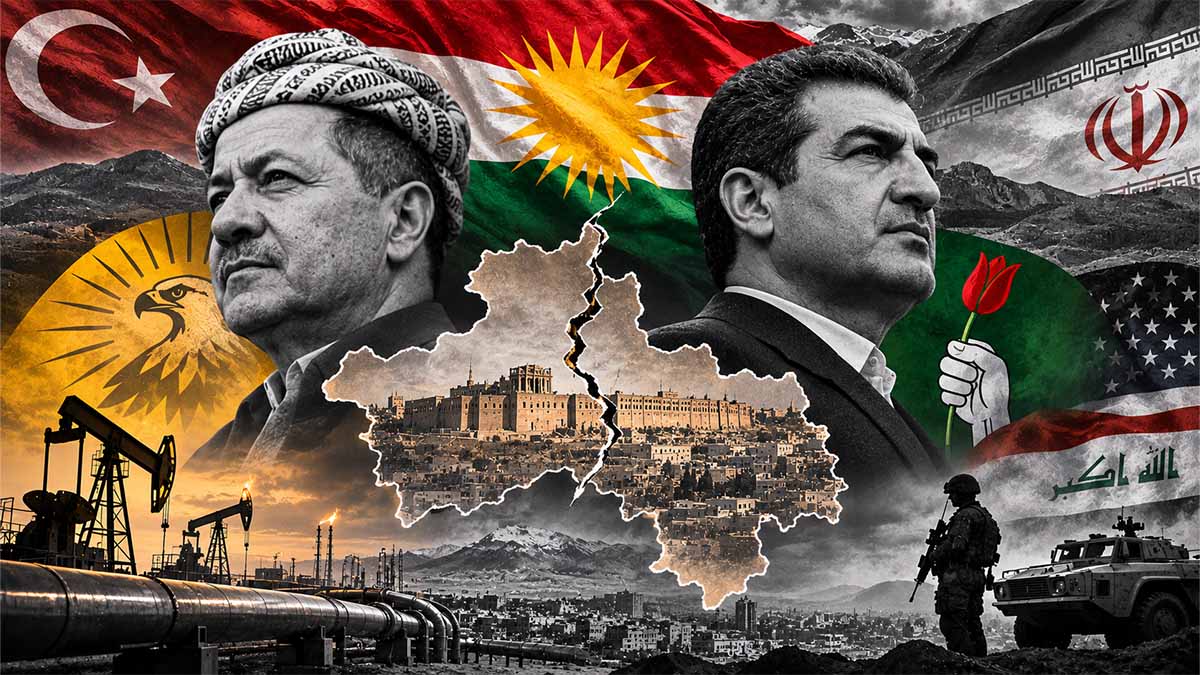
The confrontation between the Kurdistan Democratic Party and the Patriotic Union of Kurdistan threatens to turn Iraq’s constitutionally recognised Kurdish autonomy into a system of competing authorities, weakening its financial bargaining power, military cohesion and regional influence without requiring formal partition. On 4 November 2026, the Kurdistan Parliament resumed proceedings with 52 of its 100 members present. One day later, Patriotic Union of Kurdistan (PUK) President Bafel Talabani announced his party’s withdrawal from the regional government and threatened reciprocal executive appointments. The dispute now intersects with negotiations over Iraq’s 2027 federal budget, the September reorganisation of the Peshmerga and the withdrawal of international coalition forces. Baghdad, Tehran, Ankara and Washington have different interests in the outcome, but the immediate institutional danger is already identifiable: a government may retain its constitutional status while progressively losing the authority to govern.
The Parliament Reopened, but the Government Lost Its Political Consensus
The 4 November 2026 parliamentary session ended almost two years of institutional paralysis following the October 2024 elections. With 52 members attending against a reported quorum requirement of 51, legislators elected Vala Fareed as Speaker, Rami Noori as Deputy Speaker and Muna Qahwachi as Parliamentary Secretary. The Kurdistan Democratic Party (KDP) defended the proceedings as a lawful exercise of parliamentary authority. The PUK rejected their legitimacy, arguing that the process disregarded the political partnership underpinning regional government. The distinction is consequential: satisfying a numerical quorum does not automatically establish an accepted executive coalition, while political objections do not themselves invalidate a parliamentary decision. Kurdistan Parliament Reconvenes — KRG Representation in the United States — November 2026.
The confrontation became more serious on 5 November, when PUK President Bafel Talabani announced withdrawal from the outgoing Kurdistan Regional Government (KRG). His warning that the PUK could appoint its own regional president, prime minister and ministers transformed a procedural disagreement into a challenge concerning executive authority. The verified record establishes a threatened competing administration, not its complete legal or operational creation. Yet the distinction between intention and implementation offers limited reassurance if public officials subsequently begin receiving incompatible appointments, administrative instructions or financial authorisations. Full Statement by PUK President Bafel Jalal Talabani — PUK Media — November 2026.
The political danger is rooted in a settlement whose durability has always depended on cooperation between competing organisations. The 21 January 2006 agreement unified the previously separate KDP-led administration in Erbil and Duhok and PUK-led administration in Sulaymaniyah. It consolidated the governmental framework without eliminating the parties’ independent political organisations. Twenty years later, the unresolved issue is whether a common regional administration can continue operating when its principal political sponsors reject the same institutional procedures. Welcome to the Kurdistan Region of Iraq — Kurdistan Regional Government — 2009.
The Budget Numbers Reveal Why Neither Side Can Easily Afford Separation
The financial relationship with Baghdad exposes the material limits of Kurdish political fragmentation. In its 10 November 2026 assessment of federal budget relations from 2014 to 2025, the KRG reported approximately IQD 1.767 quadrillion in Iraqi federal budgets, more than IQD 245 trillion in allocations attributed to the region before deductions, approximately IQD 146 trillion after deductions and only IQD 41 trillion in actual federal transfers. It also disputed sovereign-expenditure deductions exceeding IQD 65 trillion. These are regional government calculations, not accounts independently reconciled with the federal treasury. Their significance is the persistent difference between budgetary allocation and cash received, which complicates the financing of salaries, services and investment. KRG Fiscal Assessment, 2014–2025 — Kurdistan Regional Government — November 2026.
The annual figures reveal the degree of financial volatility. The KRG reported no federal transfers in 2016 and 2017, followed by IQD 0.4 trillion in 2022, IQD 4.69 trillion in 2023, IQD 10 trillion in 2024 and IQD 9.59 trillion in 2025. The final two years accounted for approximately 47.8% of the reported 2014–2025 transfer total. This concentration illustrates why the timing and predictability of federal payments can matter as much as the nominal allocation written into a budget. It does not mean the region received no revenue from other sources during years when federal transfers were absent. KRG Fiscal Assessment — November 2026.
The dispute is already moving into the 2027 federal budget. The KRG cites the 2024 census as establishing a regional population share of 14.14%, against a proposed budget share of 12.70%, a difference of 1.44 percentage points. A separate controversy concerns the treatment of sovereign expenditures in the 2023–2025 budget period: the KRG calculates an approximately IQD 8.2 trillion difference between the deduction methodology it attributes to Baghdad and its own proposed alternative. Neither difference automatically constitutes an adjudicated financial liability. Both demonstrate how allocation formulas, accounting definitions and expenditure classifications influence the resources available to the regional government. KRG Fiscal Assessment — November 2026.
A revealing counterweight is the MyAccount public payroll programme. In October 2026, the regional Ministry of Finance and Economy reported 1,016,000 beneficiaries paid through the system during the September salary cycle: 422,000 in Erbil, 372,000 in Sulaymaniyah, 197,000 in Duhok and 25,000 in Halabja. An attempt to establish competing treasuries would therefore confront an existing financial infrastructure operating across the principal political areas. The test of administrative unity is not whether politicians continue communicating, but whether these payment and authorisation systems continue functioning under recognised public authority. Over 1 Million Public Sector Beneficiaries Paid Through MyAccount — KRG Ministry of Finance and Economy — October 2026.
Oil Infrastructure Turns Political Division into a Commercial Liability
The energy sector reveals why control of territory does not necessarily translate into control of revenue. Under the 17 March 2026 arrangement announced by the KRG negotiating team, federal and regional authorities agreed to establish a joint committee dealing with oil exports through the Kurdistan–Ceyhan pipeline. The announcement envisaged the return of export revenues to the federal treasury and coordinated protection of production infrastructure. The document establishes an agreed framework, not independently verified subsequent export volumes or receipts. Any competing regional authority would therefore confront an institutional system linking production, transportation, marketing and public revenue beyond its own geographical area. Statement by the KRG Negotiating Team Regarding Oil Exports — Kurdistan Regional Government — March 2026.
The commercial stakes extend beyond existing exports. At the 9 November 2026 meeting between KRG Prime Minister Masrour Barzani and Iraqi Federal Prime Minister Ali Al-Zaidi, the KRG reported federal plans to raise Iraqi oil production to 7 million barrels per day by 2030 and 10 million by 2032, including a projected contribution approaching one million barrels per day from Kurdistan Region fields. These are policy projections, not verified future capacity. Their realisation would require financing, infrastructure, security and coherent regulatory authority. Parallel governments issuing conflicting authorisations would increase uncertainty over the institutions competent to approve projects and administer revenues. Meeting of the Federal and Regional Prime Ministers — Kurdistan Regional Government — November 2026.
The same 9 November meeting addressed an attack on the Khor Mor gas field the previous night. Both prime ministers condemned the incident and discussed infrastructure protection. The published account does not establish the perpetrators or a connection to the KDP–PUK dispute. Nevertheless, the episode demonstrates how security vulnerability and administrative uncertainty can converge around energy assets. Investors require identifiable contracting authorities, predictable payments and functioning protection arrangements; a politically fragmented executive would make those requirements more difficult to satisfy even without additional physical damage. Federal and Regional Prime Ministers’ Meeting — November 2026.
Military Unification Faces Its First Major Political Test
The military contradiction is particularly acute. On 10 September 2026, the Kurdistan Ministry of Peshmerga Affairs announced the completion of the reorganisation integrating the historically distinct Force 70 and Force 80 structures. The formal arrangement, presented on 21 September, comprised 11 divisions, two mechanised support commands, one commando unit and two area commands. The official achievement was substantial in institutional terms, but formation counts do not demonstrate operational readiness or guarantee compliance with a unified chain of command during a political crisis. Peshmerga Unification and Reorganisation — Kurdistan Ministry of Peshmerga Affairs — September 2026.
Nine days after the reorganisation ceremony, the international coalition’s military mission in Iraq formally concluded on 30 September 2026. The UK Ministry of Defence confirmed the transition towards Iraqi-led security responsibilities, while the regional Peshmerga ministry raised concerns over aerial threats and the absence of a replacement air-defence arrangement. The ministry also reported more than 1,000 drone and ballistic missile strikes during the earlier regional conflict involving the United States, Israel and Iran, a figure that remains an attributed regional claim rather than a fully independently reconciled incident series. The withdrawal altered the external support environment just before the political rupture, increasing the importance of effective Iraqi and Kurdish command coordination. Conclusion of the Global Coalition’s Military Mission in Iraq — UK Ministry of Defence — September 2026; KRG Ministry of Peshmerga Affairs Statement — September 2026.
The immediate danger is not proven mobilisation for another Kurdish civil war. It is the possibility that competing political authorities could contest appointments, financing or operational instructions within military institutions officially reorganised only weeks earlier. Such a development would complicate coordination with the Iraqi Army and the protection of infrastructure and borders. The public record does not establish a generalised collapse of Peshmerga command, making the distinction between political fragmentation and military disintegration indispensable.
Tehran and Ankara Can Gain Leverage but Cannot Ignore the Costs of Disorder
Iran and Türkiye have different interests in the Kurdish dispute. Tehran’s established security priority concerns Iranian Kurdish opposition organisations and implementation of Iraq–Iran border-security arrangements. On 8 November 2026, Kurdistan Region President Nechirvan Barzani received an Iranian delegation for discussions including regional security cooperation and existing understandings. The meeting demonstrates official Iranian engagement with Erbil; it does not prove an undisclosed bargain determining the parliamentary outcome. Iranian Delegation Meeting — Kurdistan Region Presidency — November 2026.
Ankara’s position combines counterterrorism concerns involving the PKK with substantial commercial exposure to Iraq. Türkiye’s Foreign Ministry reports USD 16.8 billion in bilateral trade during 2025, including USD 12.4 billion in Turkish exports, alongside 1,145 contracting projects with a cumulative reported value of approximately USD 36.5 billion. The planned 1,200-kilometre Development Road adds a longer-term infrastructure interest. These are Iraq-wide figures, not Kurdistan-specific revenues, but they show why instability in northern Iraq can carry costs beyond counterterrorism operations. Relations Between Türkiye and Iraq — Turkish Ministry of Foreign Affairs — Official Institutional Record.
Political fragmentation could make Kurdish leaders more dependent on negotiations with neighbouring governments, strengthening external bargaining positions. Yet separate administrative authorities could also produce inconsistent implementation of border agreements, complicate transport and weaken the reliability of governmental commitments. Iran and Türkiye may both favour effective security arrangements without sharing a strategy for Kurdish internal politics. Their overlapping interests do not establish coordinated intervention.
Washington and European governments confront a different constraint: continuing institutional cooperation without replacing Iraq’s constitutional decision-making authority. An October 2026 meeting between Kurdistan Region President Nechirvan Barzani and US Consul General Gwendolyn Green addressed Kurdish internal unity and government formation. The United Kingdom affirmed continued bilateral defence cooperation after the coalition transition; Germany concluded its military mission while maintaining diplomatic relations; and Italy discussed further Peshmerga training and capacity development in September. These separate positions indicate an interest in reliable institutions, not a common commitment to impose a political settlement. US Consular Meeting — Kurdistan Region Presidency — October 2026; Italian Military Delegation Meeting — Ministry of Peshmerga Affairs — September 2026.
The Next 24 Months Will Reveal Who Controls the Institutions—and Who Bears the Costs
Between November 2026 and November 2028, the decisive development will be whether the parliamentary rupture produces incompatible executive appointments, separate treasury arrangements or contradictory military orders. A negotiated KDP–PUK settlement could restore an accepted government without eliminating the underlying competition. Extended caretaker administration could maintain essential services while postponing reform. Administrative dualism would be more costly: Baghdad could face competing claims over financial authority, international partners could encounter uncertainty over security counterparts, and commercial operators could confront conflicting regulatory decisions. None of these outcomes requires formal territorial partition.
The civilian exposure is measurable. UNHCR registered 343,556 refugees and asylum-seekers in Iraq on 31 October 2026, including 144,282 in Erbil, 91,587 in Duhok and 38,430 in Sulaymaniyah. Those three governorates accounted for approximately 79.8% of the registered national total. A breakdown of regional administrative cooperation could complicate documentation, education, health care and humanitarian access without producing a new armed conflict. The figures establish existing service exposure, not displacement caused by the November dispute. UNHCR Iraq Operational Data — October 2026.
The legal limit remains explicit. Articles 117–121 of Iraq’s Constitution recognise the Kurdistan Region and define the framework of regional autonomy; they do not transform party-controlled administrations into independently recognised federal entities. A political settlement can resolve the distribution of offices, but only functioning legal, financial and security institutions can preserve the authority attached to those offices. Constitution of the Republic of Iraq — Iraqi Supreme Judicial Council — 2005.
The cost of inaction would consequently fall first on public employees dependent on predictable payments, citizens requiring uninterrupted services, businesses exposed to uncertain contracting authority and security institutions expected to maintain command cohesion. Baghdad would face more difficult financial and security coordination, while the Kurdish parties would risk surrendering bargaining power to external counterparts. The danger is not that Kurdistan’s borders will necessarily change. It is that the value of its constitutional autonomy could decline while those borders remain exactly where they are.
Navigational Index
Pillar I — Kurdish Political Authority and the Constitutional Order
- Chapter 1. The Historical Foundations of Kurdish Dual Administration: Civil Conflict, Reconciliation and the 2006 Settlement
- Chapter 2. The November 2026 Institutional Rupture: Parliamentary Legitimacy, Party Authority and Competing Administrations
- Chapter 3. Federal Constitutional Architecture: Baghdad, Erbil, Sulaymaniyah and the Limits of Regional Autonomy
Pillar II — Security, Fiscal Sovereignty and Regional Power Competition
- Chapter 4. Military Fragmentation and the Peshmerga: Command Structures, Territorial Control and Escalation Risks
- Chapter 5. Oil, Public Finance and Economic Interdependence: Budgetary Transfers, Border Revenues and Infrastructure
- Chapter 6. Tehran and Ankara: Border Security, Kurdish Armed Movements, Diplomatic Leverage and Energy Corridors
- Chapter 7. Washington, Baghdad and International Partners: Strategic Repositioning, Security Guarantees and Diplomatic Constraints
Pillar III — Strategic Futures and Institutional Decision Architecture
- Chapter 8. Regional Security Spillovers: Iraq, Syria, Iran, Türkiye and the Wider Kurdish Political Geography
- Chapter 9. Alternative Political Settlements and the 2026–2031 Strategic Outlook
- Chapter 10. Government Policy Options, Early-Warning Indicators and Final Strategic Assessment
Master Abstract
A political rupture with constitutional and security consequences
The Kurdistan Region’s November 2026 crisis represents a confrontation over the distribution of power within an institutional framework that has depended on cooperation between two historically competing political organisations. The Kurdistan Democratic Party (KDP), with its principal political centre in Erbil, and the Patriotic Union of Kurdistan (PUK), centred in Sulaymaniyah, have maintained distinct political constituencies, administrative networks and security traditions even after the formal consolidation of regional government in 2006. The resumption of parliamentary activity on 4 November and the PUK’s withdrawal the following day transformed a prolonged government-formation dispute into an explicit challenge to the authority of regional institutions.
The immediate parliamentary facts are comparatively clear. According to the Kurdistan Regional Government’s representation in Washington, 52 members attended the session, electing Vala Fareed as Speaker, Rami Noori as Deputy Speaker and Muna Qahwachi as Parliamentary Secretary. The KDP characterises the proceedings as lawful parliamentary reactivation. The PUK rejects their legitimacy and has explicitly threatened to replicate executive appointments in areas under its influence. The verified record therefore establishes competing political claims, but not yet a completed constitutional or territorial division. Kurdistan Parliament Reconvenes After Nearly Two Years, Elects New Leadership — KRG Representation in the United States — Nov 2026 Representation in the United States
Statement by the Spokesperson — Kurdistan Democratic Party Foreign Relations Office — Nov 2026Foreign Relations Office
The institutional legitimacy problem
The central problem extends beyond whether a parliamentary quorum was technically satisfied. The KDP regards parliamentary majority action as a legitimate means of overcoming political paralysis, while the PUK regards partnership and prior political agreement as indispensable to the legitimacy of regional governance. These are competing conceptions of institutional authority rather than interchangeable interpretations of the same procedure.
On 5 November, Bafel Talabani publicly declared the PUK’s immediate withdrawal from the outgoing government. His statement rejected the parliamentary outcome and threatened corresponding appointments of a regional president, prime minister and ministers if the KDP pursued unilateral appointments. Such declarations establish a credible political intention to contest executive authority, but their implementation remains a separate evidentiary question. A rival administration would become materially consequential when it independently exercises budgetary control, issues binding administrative instructions, controls public institutions or commands security forces without effective coordination with Erbil. Full Statement by PUK President Bafel Jalal Talabani — PUK Media — Nov 2026 pukmedia.org
The distinction is critical because federal Iraq recognises the Kurdistan Region as a constitutional entity. A withdrawal from a regional cabinet does not automatically dissolve the region, establish another federal region or alter the constitutional allocation of responsibilities. Nevertheless, a sustained divergence between formal authority and actual administrative control could create a parallel system of governance, particularly where security, public employment, procurement and financial administration depend on party-controlled institutions.
The unfinished transformation of Kurdish security power
Military cohesion is the most consequential potential transmission mechanism between political confrontation and wider instability. For decades, the historical distinction between PUK-associated Force 70 and KDP-associated Force 80 reflected the persistence of rival political-military structures. On 10 September 2026, the Kurdistan Ministry of Peshmerga Affairs announced that their unification and reorganisation had been completed. A ceremony on 21 September identified a new structure comprising 11 military divisions, two mechanised support commands, one commando unit and two area commands under a unified command arrangement. MoPA Announces Completion of Peshmerga Unification and Reorganisation — Kurdistan Ministry of Peshmerga Affairs — Sep 2026 حکومەتی هەرێمی كوردستان
Peshmerga Unification and Reorganisation Officially Announced — Kurdistan Ministry of Peshmerga Affairs — Sep 2026حکومەتی هەرێمی كوردستان
The reform constitutes a significant declared institutional achievement, yet the evidence does not establish how independently the unified chain of command would operate during direct conflict between its principal political sponsors. The relevant test is not simply the existence of new military formations but whether operational orders, appointments, logistics, financing and rules of engagement remain unified during political disagreement. An administrative division could coexist with continued military coordination; conversely, competing security orders could turn an otherwise reversible political dispute into a territorial crisis.
The September withdrawal timetable for United States forces adds a separate strategic complication. On 28 September, the Ministry of Peshmerga Affairs stated that American forces would withdraw on 30 September under the agreed transition arrangements. The ministry also expressed concern about aerial threats and the absence of a replacement air-defence system. This is an official regional assessment of its security exposure, not independent proof of the present effectiveness or insufficiency of every component of Iraq’s air-defence architecture. KRG Ministry of Peshmerga Affairs Statement — Kurdistan Ministry of Peshmerga Affairs — Sep 2026 حکومەتی هەرێمی كوردستان
Fiscal interdependence limits the feasibility of separation
The economic dimension may ultimately constrain political fragmentation more effectively than diplomatic appeals. The regional government depends on a complex relationship with Baghdad concerning public-sector salaries, federal budget allocations, oil exports, non-oil revenues and administrative expenditure. The federal government, in turn, must manage national fiscal obligations, hydrocarbon revenues and relations with the constitutionally recognised regional authorities.
On 8 November 2026, a high-level KRG delegation arrived in Baghdad for negotiations over the draft 2027 federal budget, including constitutional financial entitlements and civil-service payments. The continuation of these negotiations demonstrates that the regional-federal administrative relationship had not been publicly replaced by separate formal arrangements at that point. High-Level KRG Delegation in Baghdad for Talks — Kurdistan Regional Government — Nov 2026 حکومەتی هەرێمی كوردستان
A further fiscal signal came from the KRG’s 10 November publication summarising an analysis of federal budget relations from 2014 to 2025. The regional authorities reported more than IQD 65 trillion in deductions attributed to sovereign expenditures and approximately IQD 41 trillion in federal budget transfers during that period. These are claims from a regional government financial assessment, rather than independently reconciled federal accounts. Their importance lies in the scale of the contested fiscal relationship and the political sensitivity of revenue distribution, not in treating the figures as a verified measure of federal liability. Kurdistan Region Charged IQD 65 Trillion for Iraq’s Sovereign Expenditures — KRG Department of Media and Information — Nov 2026 حکومەتی هەرێمی كوردستان
A durable administrative separation would therefore confront substantial practical problems: allocation of personnel and financial obligations, control of customs and border revenues, accountability for expenditures, management of oil infrastructure, and the legal identity of the authority negotiating with federal ministries. The failure to resolve those issues could weaken both Kurdish political centres, even without a formal constitutional alteration.
Regional powers confront a changing bargaining environment
The interests of Iran, Türkiye, the United States and the federal government intersect in Kurdistan but should not be reduced to a single external strategy. Iran has direct security interests involving its western border and Iranian Kurdish armed opposition movements. Türkiye has enduring concerns about armed Kurdish networks, northern Iraqi security and commercial corridors. Baghdad has constitutional and fiscal responsibilities and seeks to preserve functional relationships with the region. Washington’s interests involve Iraqi stability, regional security cooperation and the sustainability of Kurdish military institutions.
The available official evidence establishes Iranian diplomatic engagement with Erbil but does not substantiate a covert Iranian agreement determining the November parliamentary result. On 8 November, Kurdistan Region President Nechirvan Barzani received an Iranian delegation. The presidential account identifies security cooperation, regional stability and existing security understandings between Iran and Iraq, including the Kurdistan Region, as subjects of discussion. These are significant diplomatic facts, but they do not establish that Tehran ordered, purchased or negotiated the parliamentary votes. President Nechirvan Barzani Receives a Delegation from the Islamic Republic of Iran — Kurdistan Region Presidency — Nov 2026 سەرۆکایەتی هەرێمی کوردستان
The wider strategic danger is competitive external engagement with increasingly autonomous Kurdish political centres. Where external powers can obtain concessions from either Erbil or Sulaymaniyah independently, incentives for a unified Kurdish negotiating position weaken. Conversely, all four principal external stakeholders possess interests that could favour preventing a severe security breakdown. This produces a complex balance: fragmentation may increase the bargaining leverage of outsiders while simultaneously threatening the stability on which their security and economic interests depend.
Strategic judgment for 2026–2031
The near-term outlook is best understood as a contest between institutional fragmentation and functional interdependence. Political separation is already observable in the withdrawal decision and mutual rejection of legitimacy. Administrative fragmentation is possible but requires additional operational evidence. Military fragmentation remains a higher-consequence development whose occurrence is not established by the public record reviewed here.
Three structural constraints will determine the trajectory: the ability of Kurdish leaders to sustain separate administrative systems, the willingness of Baghdad to negotiate through a unified regional authority, and the ability of security institutions to preserve coherent command arrangements. External diplomatic engagement may either facilitate compromise or harden competing positions, depending on the commitments offered to each party.
The principal five-year risk is not necessarily two formally recognised Kurdish regions. It is the gradual consolidation of incompatible political and administrative authorities within one formally recognised region, thereby reducing governance efficiency, economic bargaining power and crisis-management capacity. A negotiated power-sharing settlement would weaken this assessment; independently operating rival treasuries, competing military orders or sustained federal recognition of separate negotiating authorities would strengthen it.
Key Evidence Table
The following indicators establish the documentary baseline for evaluating the political rupture. Political-party statements are treated as evidence of the issuing party’s position; institutional announcements are distinguished from independently demonstrated implementation.
| Indicator | Value / status | Reference date | Definition / scope | Issuer | Exact source |
|---|---|---|---|---|---|
| Parliamentary reactivation | 52 of 100 legislators; quorum requirement 51 | 4 Nov 2026 | Attendance and election of parliamentary leadership | KRG Representation in the US | Parliament Reconvenes — Nov 2026 |
| Parliamentary leadership | Vala Fareed, Rami Noori, Muna Qahwachi | 4 Nov 2026 | Speaker, Deputy Speaker and Parliamentary Secretary | KRG Representation in the US | Parliament Reconvenes — Nov 2026 |
| PUK government withdrawal | Immediate withdrawal announced | 5 Nov 2026 | Political withdrawal, not legally established territorial partition | PUK | Full Statement — Nov 2026 |
| Competing executive authority | Reciprocal senior appointments threatened | 5 Nov 2026 | Declared political intention; implementation not demonstrated | PUK | Full Statement — Nov 2026 |
| Peshmerga reorganisation | Completion announced | 10 Sep 2026 | Ministry-reported integration of former Forces 70 and 80 | Ministry of Peshmerga Affairs | Unification Announcement — Sep 2026 |
| Military organisational structure | 11 divisions, 2 support commands, 1 commando unit, 2 area commands | 21 Sep 2026 | Declared structure, not independent readiness measurement | Ministry of Peshmerga Affairs | Reorganisation Ceremony — Sep 2026 |
| US withdrawal | Withdrawal scheduled for 30 Sep 2026 | 28 Sep 2026 | Regional ministry’s announced withdrawal timetable | Ministry of Peshmerga Affairs | Security Statement — Sep 2026 |
| Federal budget negotiations | Delegation arrived in Baghdad | 8 Nov 2026 | Discussions concerning draft FY2027 budget and entitlements | KRG | Baghdad Talks — Nov 2026 |
| Disputed federal expenditure deductions | More than IQD 65 trillion | 2014–2025 | KRG calculation of deductions associated with sovereign expenditures | KRG Finance / Media authorities | Fiscal Assessment — Nov 2026 |
| Federal transfers | Approximately IQD 41 trillion | 2014–2025 | Federal transfers reported in KRG’s fiscal assessment | KRG Finance / Media authorities | Fiscal Assessment — Nov 2026 |
| Iran–Kurdistan security engagement | Presidential meeting confirmed | 8 Nov 2026 | Diplomatic and security discussions; no verified secret bargain | Kurdistan Region Presidency | Iranian Delegation Meeting — Nov 2026 |
The numerical indicators require careful interpretation. The 52-member parliamentary attendance establishes that the reported quorum threshold was reached; it does not independently resolve every potential challenge to the legal legitimacy of the proceedings. The Peshmerga figures describe announced organisational structures, not verified combat-ready inventories. Likewise, the two fiscal figures refer to different accounting categories and cannot legitimately be subtracted to establish a net financial entitlement without a complete reconciliation of the underlying budget accounts.
Competing Explanations and Strategic Pathways
The available record supports three principal pathways. They describe alternative medium-term outcomes rather than proven intentions, and the present evidence does not justify assigning numerical probabilities.
| Pathway | Diagnostic support | Disconfirming evidence / constraints | Decisive indicators | Current standing |
|---|---|---|---|---|
| Negotiated restoration of power-sharing | Shared constitutional status, fiscal interdependence, continuing federal negotiations and common security interests | Explicit rejection of parliamentary legitimacy and reciprocal political threats | Renewed KDP–PUK negotiations, mutually accepted executive appointments, agreed government formation | Institutionally feasible; no verified settlement |
| Prolonged administrative dualism | PUK withdrawal, competing legitimacy claims and historical party-controlled networks | Unresolved financing, shared legal obligations, announced Peshmerga unification | Separate administrative instructions, personnel systems, budget execution and formal federal contacts | Principal near-term risk |
| Security fragmentation and coercive escalation | Historical military rivalry, territorial spheres of influence and political polarisation | Recent unified-command reform and potentially prohibitive economic and political costs | Contradictory military orders, armed deployments, checkpoint incidents or breakdown of joint command | Higher-impact contingency; not established as the present outcome |
Why administrative dualism is the principal risk
An organisation seeking to preserve its political influence does not necessarily need to achieve legally recognised partition. It can obtain substantial bargaining leverage by controlling administrative services, withholding cooperation, appointing alternative officials and demonstrating that the recognised government cannot implement decisions across its nominal jurisdiction.
Such a strategy can be politically attractive because it occupies an intermediate position between accepting an unfavourable settlement and initiating armed confrontation. It also carries substantial risks: employees can receive contradictory instructions, public contracts can become contested, fiscal accountability can deteriorate and disputes over security jurisdiction can become more difficult to resolve.
The historical experience of the 1990s illustrates why the distinction between political rivalry and coercive escalation matters. The Washington reconciliation process of September 1998 addressed not only political relations but also administrative unification, revenue sharing and the prevention of renewed fighting. The United States, Türkiye and the United Kingdom subsequently endorsed the reconciliation framework through the Ankara Process. The contemporary dispute does not reproduce those earlier circumstances automatically, but it raises similar institutional questions concerning the relationship between political authority, revenue and armed power. History of the Department of State During the Clinton Presidency — US Department of State — Historical Record Joint Declaration on the Ankara Process — US Department of State — Nov 1998
Principal Intelligence Gaps and Watch Indicators
The most important unresolved questions concern implementation rather than political declarations.
| Intelligence requirement | Present limitation | Observable evidence required | Strategic significance |
|---|---|---|---|
| Administrative separation | No complete verified inventory of agencies operating independently | Official administrative orders, ministry directives and appointment records | Determines whether political withdrawal becomes institutional separation |
| Parliamentary legality | Competing party interpretations remain unresolved | Complete procedural record, parliamentary rules and competent judicial decisions | Determines the legal durability of the November parliamentary leadership |
| Military command cohesion | Formal reorganisation announced, but stress-tested operational independence not established | Command directives, deployment orders and documented coordination arrangements | Distinguishes political confrontation from security-system fragmentation |
| Fiscal control | Separate future revenue and expenditure mechanisms not established | Treasury instructions, banking arrangements and federal budget implementation records | Determines the financial feasibility of rival administrations |
| Iranian influence | Diplomatic engagement confirmed; alleged political bargain not established | Formal agreements, authenticated official communications or attributable institutional disclosures | Separates routine security diplomacy from material intervention |
| Turkish security posture | A comprehensive current policy on the Kurdish internal dispute is not established | Turkish government statements, bilateral security agreements and documented operational changes | Determines whether Ankara prioritises mediation, containment or federal centralisation |
| American policy | Future diplomatic and security commitments remain uncertain | State Department, Department of Defense and formal security-cooperation records | Tests the durability of external support for regional institutional cohesion |
| Federal recognition | Continued KRG–Baghdad engagement established; recognition of competing regional authorities not established | Federal correspondence, budget decisions and published institutional agreements | Determines whether internal dualism gains a federal administrative dimension |
Decision-relevant monitoring priorities
The first threshold is the formal constitution of a rival executive apparatus, evidenced by named officials, allocated responsibilities, identifiable administrative offices and independent decisions. Political speeches alone do not satisfy this threshold.
The second is divergence in security command. Contradictory instructions to military formations, competing claims over installations or documented restrictions on government officials would materially increase the assessed risk of coercive escalation.
The third is independent fiscal administration. A durable parallel government would require access to revenues, payment systems and public employment mechanisms. The absence of an independently supportable financial structure would constrain its ability to operate beyond a limited political confrontation.
The fourth is a change in Baghdad’s formal treatment of the regional authorities. Separate federal negotiations, differentiated budget arrangements or official recognition of competing administrative structures would indicate a potentially consequential transformation of the relationship between the Iraqi federal state and its Kurdistan Region.
The fifth is external security conditionality. Evidence that Iran, Türkiye or the United States has linked assistance, access, economic cooperation or security commitments to specific outcomes in the KDP–PUK confrontation would alter the assessment of external leverage and political incentives.
Strategic Net Assessment
The crisis is not simply a disagreement about parliamentary offices. It reveals the continuing tension between the institutional architecture of Kurdish autonomy and the competing political organisations on which that architecture was historically constructed.
The KDP’s parliamentary initiative demonstrates the capacity to exercise legislative majority procedures despite political resistance. The PUK’s withdrawal demonstrates the continuing capacity of a major regional party to contest the practical authority of institutions from which it feels excluded. Neither development alone establishes that a second regional administration has acquired sustainable administrative, fiscal and military independence.
For Baghdad, the central question is whether Kurdish institutional fragmentation reduces the region’s negotiating capacity while introducing new implementation problems for the federal state. For Tehran and Ankara, the consequences concern border security, armed Kurdish organisations and regional influence. For Washington, they concern institutional reliability, military cooperation and the longer-term resilience of a strategic partner.
The determining variable will be the relationship between political legitimacy and operational control. If the parties preserve unified military command, continue functioning budget arrangements and establish a mutually accepted executive settlement, the crisis may remain politically serious but institutionally reversible. If they instead create independently financed administrations backed by competing security authorities, the constitutional unity of the Kurdistan Region could coexist with a substantially fragmented system of government.
The central strategic conclusion is therefore that the restoration of parliamentary activity does not, by itself, resolve the regional governance crisis. Its significance depends on whether the newly activated institution can command acceptance across the political and administrative structures that constitute the Kurdistan Region.
No decision-useful visualisation is supportable from the verified record without presenting disputed administrative or security relationships as settled facts.
IRAQI KURDISTAN: THE FRACTURE OF POWER
KDP–PUK rivalry, competing institutions, federal finance and regional power competition. Interactive evidence dashboard, 2026–2031.
Institutional & geopolitical architecture
Select a node to inspect documented relationships. Lines represent the labelled relationships, not quantified influence.
3D institutional indicators
Reported 2014–2025 figures
The values refer to different accounting categories in a regional government assessment. They cannot be subtracted to calculate a verified net federal liability.
From military reorganisation to political rupture
Three alternative political pathways
Qualitative scenarios, not statistical forecasts. No numerical probability is assigned.
What would change the strategic assessment?
Official records & institutional statements
| Indicator | Documented status | Date | Source |
|---|
PILLAR I — KURDISH POLITICAL AUTHORITY AND THE CONSTITUTIONAL ORDER
Iraqi Kurdistan: Historical Fragmentation, Parliamentary Legitimacy and the Constitutional Limits of Competing Administrations
Chapter 1. The Historical Foundations of Kurdish Dual Administration: Civil Conflict, Reconciliation and the 2006 Settlement
Principal Judgment: The 2006 Settlement Unified Government Without Eliminating the Political Foundations of Dual Power
The institutional crisis confronting the Kurdistan Region in November 2026 cannot be adequately understood as an isolated disagreement between political parties over the composition of a regional parliament. Its deeper significance derives from the historical separation between the formal institutions of Kurdish self-government and the political organisations that originally established, defended and administered distinct areas of Iraqi Kurdistan. The Kurdistan Democratic Party (KDP) and the Patriotic Union of Kurdistan (PUK) developed separate organisational structures, territorial bases, political networks and security institutions before agreeing to consolidate their administrations in 2006. The resulting unified government created a common executive framework, but institutional integration proceeded through negotiated political accommodation rather than the immediate disappearance of the parties’ independent organisational power. This distinction is fundamental: the legal existence of a unified government does not necessarily demonstrate that every mechanism of public administration, political recruitment, security command and territorial influence has become independent of the parties that historically controlled it.
The January 2006 unification agreement provides the clearest documentary benchmark for this assessment. In an official institutional publication, the Kurdistan Regional Government identifies 21 January 2006 as the date of the agreement that consolidated two previously separate administrations. The document states that Sulaymaniyah had been governed by a PUK-led administration, whereas Erbil and Duhok had been governed by a KDP-led administration. The distinction was explicitly administrative, not merely electoral: separate political centres exercised governmental responsibilities within different geographical areas. The importance of the 2006 agreement was therefore not confined to replacing two sets of political leaders with a common cabinet. It was intended to transform competing sources of territorial executive authority into a regional governmental system capable of representing Iraqi Kurdistan as a single political and administrative entity. Welcome to the Kurdistan Region of Iraq, pp. 17–18 — Kurdistan Regional Government Board of Investment — 2009.
The contemporary confrontation demonstrates why that historical distinction remains politically relevant. A government can possess legal authority across an entire region while its practical capacity to implement decisions depends upon the continued cooperation of political organisations with established territorial networks. Where the institutions responsible for appointments, public administration, security and financial implementation remain exposed to competing party loyalties, a political confrontation can develop into administrative fragmentation without any formal declaration of separation. Such a development would not automatically reproduce the civil conflict of the 1990s; nevertheless, it would revive the central institutional problem that the 2006 agreement was designed to overcome: whether the Kurdistan Region operates through a single effective executive authority or through competing centres exercising different degrees of control over public institutions.
From the Post-1991 Political Order to Competing Territorial Administrations
The contemporary system of Kurdish regional government developed out of the institutional transformation that followed the 1991 uprisings against the Iraqi government and the subsequent emergence of Kurdish self-government in northern Iraq. The withdrawal of much of Baghdad’s direct administrative presence created opportunities for Kurdish political organisations to establish local governmental structures, but it did not resolve competition over leadership, territorial influence or the distribution of administrative resources. The establishment of a regional legislature in 1992 represented an important attempt to create a common political institution; however, the institutional development of Kurdish autonomy occurred within an environment where the leading parties possessed distinct organisational constituencies and substantial independent capacities. The Kurdistan Regional Government’s historical account records the establishment of the Kurdistan National Assembly in July 1992 and the adoption of Law No. 1 as an early foundation of regional legislative authority. Kurdistan Parliament — KRG Representation in the United States — Institutional Record.
The decisive structural weakness of the early political order was the absence of a sufficiently consolidated institutional mechanism capable of regulating competition between the two dominant organisations. The existence of representative institutions did not automatically settle disagreements over the exercise of executive authority, the territorial administration of public services or the political control of armed forces. Where political organisations have independent capacities to provide security, distribute resources and appoint officials, electoral competition can become inseparable from disputes over the institutions implementing electoral results. This creates a governance problem that differs substantially from ordinary parliamentary disagreement. In a consolidated parliamentary system, political parties compete to control offices within a widely accepted administrative structure. In the Kurdish case, historical competition also concerned the relationship between party organisations and the administrative structures themselves.
The subsequent Kurdish internal conflict exposed the consequences of that institutional weakness. Political competition developed into armed confrontation during the 1990s, and the eventual division of government between KDP- and PUK-controlled areas produced separate territorial administrations. The division was sustained by the capacity of each political organisation to operate within its own area, rather than by the establishment of separate internationally recognised states. The resulting distinction between political jurisdiction and practical authority is essential for interpreting the present crisis. The historical precedent is not simply that two Kurdish political parties fought; it is that public authority became territorially differentiated within an area whose political future depended upon their eventual reconciliation.
The geographical separation had important administrative implications. Erbil and Duhok formed the principal area of the KDP-led administration, while Sulaymaniyah formed the principal area of the PUK-led administration. This did not mean that each party possessed exclusive political support within its area or that local communities were politically homogeneous. It meant that administrative institutions and political authority were organised principally around different centres of power. The arrangement demonstrates how territorial influence can become embedded within governmental practice without constituting a separate constitutional or sovereign status. Such distinctions matter because the November 2026 confrontation could produce renewed administrative divergence even if neither party successfully establishes a legally recognised second government.
The 1998 Reconciliation Process: The Strategic Logic of Institutional Reunification
The reconciliation efforts of the late 1990s were designed to address a political-security problem with consequences extending beyond the internal distribution of Kurdish offices. Armed rivalry weakened the ability of the Kurdish parties to establish coherent regional institutions, complicated their relationships with Baghdad and increased the importance of outside diplomatic engagement. The reconciliation process associated with the September 1998 Washington meetings between Masoud Barzani and Jalal Talabani therefore carried a wider institutional objective: reducing the possibility that disagreements between political organisations would once again determine the operational boundaries of government.
The United States played a facilitating role in the reconciliation effort, while relations with neighbouring states formed part of the surrounding diplomatic environment. The available official historical account identifies the September 1998 agreement as a major stage in the movement towards reconciliation. Its underlying strategic logic was that cooperation between the principal Kurdish organisations would strengthen the capacity of Kurdish institutions to function, reduce the possibility of renewed internal confrontation and improve the political position of Iraqi Kurds within a future Iraqi political settlement. Welcome to the Kurdistan Region of Iraq — Kurdistan Regional Government Board of Investment — 2009.
The enduring lesson of that process concerns the relationship between political agreements and their implementation. A reconciliation agreement can establish common objectives and create a framework for political cooperation, but the durability of the resulting settlement depends upon institutional arrangements that regulate appointments, administrative jurisdiction and the exercise of coercive authority. Where those arrangements remain dependent upon continuing negotiations between powerful organisations, reconciliation can become a recurring political process rather than an irreversible institutional achievement. The distinction is particularly important when interpreting claims that the contemporary crisis represents an inevitable return to the 1990s. Historical similarities do not establish that the same outcome will recur. The constitutional environment, federal institutions, electoral arrangements and regional security structures have changed substantially. What persists is the institutional question of whether political competition can be managed without producing competing governmental authorities.
Constitutional Recognition Before Administrative Unification
A critical feature of the Kurdish political settlement is the order in which its principal legal and institutional developments occurred. The Iraqi Constitution of 2005 recognised the Kurdistan Region and its existing authorities as a federal region before the two principal Kurdish administrations completed their formal unification agreement in January 2006. Article 117(First) expressly recognises the Kurdistan Region within the Iraqi federal system. Article 141 preserves the legal force of legislation adopted in the Kurdistan Region since 1992, together with decisions of its government, including judicial decisions and contracts, subject to the conditions established by the Constitution and subsequent competent legal action. These provisions demonstrate that Kurdish institutional continuity formed an explicit element of Iraq’s post-2003 constitutional settlement. Constitution of the Republic of Iraq, Articles 117 and 141 — Iraqi Supreme Judicial Council — 2005.
The sequence has major legal significance. Constitutional recognition in 2005 and executive unification in 2006 were related but distinct developments. The Constitution established the recognised position of the Kurdistan Region within the Iraqi federation; the subsequent political agreement sought to consolidate the internal exercise of regional governmental authority. The constitutional recognition of the region did not depend upon the permanent absence of disputes between the KDP and PUK, but neither did it authorise either political party to replace the recognised regional framework with an independently constituted administration through unilateral political action. The region’s constitutional status and the distribution of authority within its institutions must therefore be analysed separately.
The distinction also demonstrates the limits of interpreting the 2006 settlement as a complete transfer of political loyalty from party structures to neutral public administration. The settlement established an institutional framework within which political rivalry could be managed; it did not prove that the underlying organisational networks had ceased to exist. A political party may participate in a common cabinet while continuing to exercise influence through local administrations, public appointments and its political constituency. Such influence is not, by itself, evidence of illegality or governmental separation. It becomes institutionally consequential when governmental decisions are implemented through conflicting administrative chains or when public authorities refuse to recognise decisions adopted through the institutions legally responsible for issuing them.
The January 2006 Agreement as an Administrative Transformation
The unification agreement of 21 January 2006 should be understood as an attempt to resolve three interdependent problems: the existence of competing executive administrations, the limited ability of regional institutions to exercise uniform authority and the political costs of maintaining separate governmental systems within a region seeking recognition as a coherent federal entity. The creation of a unified Kurdistan Regional Government provided a common institutional centre in Erbil and created the basis for coordinated administration across the previously divided areas. According to the official KRG institutional publication, the unified executive was organised around the regional prime minister, a coalition government and ministries established to exercise governmental responsibilities across the region. This was an identifiable transformation in the formal architecture of government, rather than merely a symbolic agreement between party leaders. Structure of the KRG, p. 17 — Kurdistan Regional Government Board of Investment — 2009.
Yet the success of formal consolidation must be evaluated according to its institutional function rather than the assumption that unification immediately eliminated political competition. The existence of a common executive enables public authorities to coordinate legislation, administrative appointments, financial responsibilities and relations with federal institutions. It also creates a framework within which disagreements can be resolved without resorting to separate territorial administrations. However, the effectiveness of that arrangement depends upon whether the principal political organisations continue to accept the authority of the common institutions when those institutions produce decisions that one party considers unfavourable.
A particularly important distinction concerns the difference between political power-sharing and the operation of government. Power-sharing arrangements can provide a practical mechanism for sustaining cooperation between organisations that command significant political support and possess historically established administrative influence. Such arrangements may also create vulnerabilities when the parties treat participation in government as a condition of recognising the legitimacy of governmental decisions. In that situation, disagreements over cabinet composition or appointments may become disputes over the existence and authority of the governmental framework itself. The November 2026 crisis presents precisely this type of institutional concern: whether a party’s withdrawal from the executive can remain a political act within the existing system or becomes an attempt to establish a separate system of executive authority.
The Persistence of Dual Political Structures After Formal Unification
The continued relevance of the historical KDP–PUK division should not be interpreted as proof that formal reunification failed. A more precise assessment is that the unified regional government developed within a political environment where both parties retained independent organisational identities and remained central to the operation of the regional political system. Parliamentary competition, coalition formation, ministerial appointments and political representation provided mechanisms through which disagreements could be managed without dissolving the common administration. The durability of this system depended in part upon the willingness of the principal actors to distinguish between the outcomes of political competition and the continuing legitimacy of regional institutions.
A particularly revealing development occurred on 10 September 2026, when the Kurdistan Ministry of Peshmerga Affairs announced completion of the unification and reorganisation of the Peshmerga forces previously associated with the historical Force 70 and Force 80 structures. The ministry described the achievement as the result of a prolonged process of institutional reform undertaken with Kurdish and international support. The fact that the ministry was still implementing the formal consolidation of these historically distinct military organisations in 2026 illustrates the extended timescale separating political agreements from institutional integration. It does not establish that the forces remained operationally divided after the announcement, but it demonstrates that the removal of historical organisational distinctions was a continuing policy objective long after the establishment of the unified government. MoPA Announces Completion of Peshmerga Unification and Reorganisation — Kurdistan Ministry of Peshmerga Affairs — September 2026.
The September 2026 ceremony also offers an important qualification to the narrative of renewed political fragmentation. The official account records the participation of President Nechirvan Barzani, Prime Minister Masrour Barzani and Deputy Prime Minister Qubad Talabani, alongside senior federal Iraqi and Kurdish military officials. Their participation demonstrates that a major institutional reform was publicly supported across the regional executive before the November political rupture. The ministry identified 11 military divisions, two support commands, one commando unit and two area commands within the reorganised structure. These are organisational figures, not a verified measurement of combat readiness or political independence. Nevertheless, the institutional reform represents an identifiable mechanism through which the unified regional framework might resist renewed political fragmentation. Peshmerga Unification and Reorganisation Officially Announced — Kurdistan Ministry of Peshmerga Affairs — September 2026.
The most important historical observation is therefore that Kurdish unity developed through several different processes operating on different timescales. Constitutional recognition, executive unification, electoral participation and military integration were related developments, but they were not identical achievements. They also involved different legal instruments and institutional responsibilities. Treating them as interchangeable would obscure both the strengths of the regional system and the mechanisms through which it could become fragmented.
Historical Institutional Development: Documentary Comparison
| Period | Institutional development | Documented significance | Structural issue addressed | Limitation for present analysis |
|---|---|---|---|---|
| 1991–1992 | Emergence of Kurdish self-government and establishment of regional legislative institutions | Formation of an identifiable regional political framework | Creation of representative and administrative authority | Does not establish complete centralisation of coercive power |
| Mid-1990s | KDP–PUK internal conflict and separate territorial administrations | Different political organisations exercised authority in separate geographical areas | Competition over executive power and territorial administration | Historical circumstances differ materially from 2026 |
| September 1998 | Washington reconciliation process | Major step towards political accommodation | Reduction of conflict and restoration of cooperation | Implementation must be distinguished from the agreement itself |
| 2005 | Iraqi Constitution recognises the Kurdistan Region | Establishes the region’s position within federal Iraq | Constitutional identity and federal-regional relations | Does not settle every internal political dispute |
| 21 January 2006 | KDP–PUK administrative unification agreement | Formal consolidation of rival regional administrations | Single executive governmental framework | Does not demonstrate complete dissolution of party networks |
| September 2026 | Ministry announces Peshmerga unification | Formal reorganisation of historically distinct military formations | Unified command-and-control architecture | Does not independently establish resilience during political confrontation |
The principal documentary basis for the historical administrative division and the 2006 agreement is the KRG’s institutional history, pp. 17–18 — 2009. The constitutional transition is established by the Iraqi Constitution, Articles 117 and 141 — Iraqi Supreme Judicial Council — 2005. The contemporary military-institutional benchmark is established by the Ministry of Peshmerga Affairs’ September 2026 reorganisation announcement.
Institutional Lessons of the Historical Settlement
The historical record supports a conclusion more specific than the general proposition that Kurdish political unity is fragile. The Kurdistan Region developed a constitutional and executive structure through which two previously competing administrations could exercise common governmental authority, but the operation of that structure has depended upon political cooperation between organisations that remain independently influential. This creates an institutional vulnerability whenever those organisations cease to recognise the same procedures for resolving disputes. The vulnerability is not automatically military: political competition can continue through elections, legislation, cabinet negotiations and judicial procedures without producing armed confrontation. Its significance lies in the possibility that disagreement over the legitimacy of governmental decisions may eventually affect the willingness of public institutions to implement those decisions.
The 2006 settlement also indicates why the cost of renewed separation could be substantially greater than the immediate political advantages sought by either party. The unified government has acquired constitutional responsibilities, developed common administrative procedures and established formal relations with federal institutions and international partners. Reversing those functions would require more than allocating parliamentary offices to rival parties. It could raise questions about the continuity of government decisions, employment relationships, public contracts, administrative jurisdiction and the authority of officials representing the Kurdistan Region before the federal government. These questions represent potential consequences of administrative divergence, not outcomes already demonstrated in November 2026.
The principal historical judgment is that the 2006 settlement should be assessed as an institutional framework for managing competition rather than as proof that political competition had permanently disappeared. The renewed confrontation tests whether the framework can accommodate severe political disagreement without reverting to the parallel administration that preceded unification.
Key Judgments — Chapter 1
The historical division between Erbil–Duhok and Sulaymaniyah was an administrative reality documented by the regional government’s own institutional history. The 21 January 2006 agreement consolidated these previously separate arrangements within a unified executive framework, while Iraq’s 2005 Constitution supplied the region’s recognised federal status. The length of the subsequent military-integration process demonstrates that political and organisational consolidation operated on different timescales. The historical record therefore establishes the institutional significance of renewed administrative separation, but it does not establish that the events of November 2026 will necessarily reproduce the armed confrontation of the 1990s.
What Would Change the Assessment
The assessment of historical continuity would be weakened by authoritative evidence showing that the regional executive, administrative agencies and security institutions had become operationally independent of party-controlled chains across all relevant governmental functions. Conversely, authenticated instructions requiring public officials to operate through competing party-specific administrative systems would strengthen the judgment that historical structures of dual power remain capable of influencing present governance.
Open Official Record
The original signed text of the 21 January 2006 administrative unification agreement, including any operative implementation annexes, remains consequential for determining precisely which governmental functions were required to be consolidated and whether the agreement contained enforceable mechanisms for resolving subsequent disputes. A complete publicly accessible implementation history would be necessary to assess the extent to which the agreement’s individual institutional commitments were fulfilled. The historical official documentation establishes the unification and the previous administrative division, but does not provide a complete audited account of every subsequent transfer of authority.
Chapter 2. The November 2026 Institutional Rupture: Parliamentary Legitimacy, Party Authority and Competing Administrations
Principal Judgment: A Procedurally Restored Parliament Has Produced a Crisis of Executive Recognition
The institutional rupture of November 2026 presents a particularly difficult constitutional and political problem because the competing parties are not simply disputing the distribution of offices within an otherwise uncontested parliamentary process. They are advancing incompatible interpretations of the authority through which the political institutions of the Kurdistan Region may legitimately operate. The KDP maintains that the reactivation of parliament through the participation of a sufficient number of elected legislators represents the restoration of democratic institutional functioning after prolonged paralysis. The PUK maintains that the proceedings disregarded the political partnership required to govern the region and consequently rejects the legitimacy of governmental appointments arising from the session. This confrontation creates a distinction between parliamentary procedural authority, coalition legitimacy and executive recognition. The principal concern is that a parliamentary leadership may be capable of exercising its formal functions while a major political organisation refuses to recognise the institutional decisions that follow.
The difficulty is compounded by the duration of the preceding government-formation crisis. Parliamentary elections were conducted on 20 October 2024, and the sixth parliamentary term began with the swearing-in of legislators on 2 December 2024. Yet the parties failed to establish a mutually accepted parliamentary leadership and a new regional cabinet during the subsequent period. The institutional deadlock therefore lasted almost two years before the proceedings of 4 November 2026. This delay must be distinguished from the normal duration of coalition negotiations: an extended inability to establish functioning legislative leadership creates difficulties for executive accountability, parliamentary scrutiny and the procedures through which government formation advances. The official regional representation in Washington expressly identifies the November session as an attempt to restore parliamentary functions and initiate the formation of the Kurdistan Regional Government’s tenth cabinet. Kurdistan Parliament Reconvenes After Nearly Two Years, Elects New Leadership — KRG Representation in the United States — November 2026.
The precise institutional issue is not whether a parliament should remain inactive until every major political organisation agrees with the composition of its leadership. Nor is it whether a numerical majority can automatically resolve every legal and political objection raised by the opposition. The issue is whether the procedures actually employed satisfy the applicable regional legal framework and whether the resulting executive authority can exercise its responsibilities without converting party opposition into rival governmental structures. These are separate questions, requiring different evidence and potentially different legal remedies.
Electoral Representation and the Transformation of the Parliamentary Framework
The 2024 parliamentary elections were conducted under an institutional framework substantially different from that used during earlier periods of Kurdish self-government. The Kurdistan Parliament previously comprised 111 seats, including a larger number of seats reserved for minority communities. Following developments associated with the Iraqi Federal Supreme Court’s intervention in the region’s electoral arrangements, the parliamentary structure was reduced to 100 seats, including five seats allocated to minority representation. The regional system was also organised around four electoral constituencies: Erbil, Sulaymaniyah, Duhok and Halabja. According to the KRG’s institutional account, the five minority seats comprised three Christian seats and two Turkmen seats. These changes are relevant because the legal composition of the legislature determines both the majority threshold and the representation of communities whose participation can become decisive in closely contested parliamentary proceedings. Kurdistan Parliament: Structure and Parliamentary Elections — KRG Representation in the United States — Institutional Record.
The Federal Supreme Court’s intervention also created a broader dispute concerning the relationship between federal judicial review and the autonomy of the Kurdistan Region’s legislative institutions. In March 2024, the Kurdistan Region’s Consultative Council challenged aspects of the Court’s electoral decisions, arguing that the Court had exceeded its proper constitutional function and interfered with regional legislative authority. This was the regional institution’s legal position, not an independently established finding that the federal court’s decisions were unconstitutional. The controversy demonstrates that the framework governing parliamentary elections had already become the subject of jurisdictional disagreement before the November 2026 crisis emerged. Statement of the Kurdistan Region Consultative Council Concerning Federal Supreme Court Decisions — Kurdistan Regional Government Ministry of Justice — March 2024.
The distinction between electoral representation and government formation is particularly significant in a fragmented legislature. Winning the largest number of parliamentary seats does not necessarily provide a party with the capacity to govern alone, and the ability to assemble a quorum for a parliamentary session does not necessarily establish that a stable coalition exists to support a complete executive programme. The November events illustrate both propositions. The KDP succeeded in obtaining sufficient parliamentary participation to restore legislative leadership, but the PUK’s response demonstrated that the political settlement necessary to sustain an agreed regional executive remained unresolved. Parliamentary arithmetic can therefore remove one institutional obstacle while leaving the underlying distribution of executive authority contested.
The Parliamentary Session of 4 November: What the Official Record Establishes
On 4 November 2026, 52 members of the 100-seat Kurdistan Parliament attended the session that elected new parliamentary leadership. The KRG’s official representation reported that the applicable quorum requirement was 51 members. The proceedings resulted in the election of Vala Fareed of the KDP as Speaker, Rami Noori, representing the Christian community, as Deputy Speaker, and Muna Qahwachi, representing the Turkmen community, as Parliamentary Secretary. The same institutional account records that the session proceeded despite a boycott by the PUK and the New Generation Movement, with the participation of legislators from other political backgrounds, including individuals who had declared themselves independent. The official account further states that the members present unanimously elected the parliamentary leadership and that the new Speaker intended to advance the legal procedures relating to regional presidential selection and formation of the tenth cabinet. Kurdistan Parliament Reconvenes After Nearly Two Years, Elects New Leadership — KRG Representation in the United States — November 2026.
The proceedings establish a narrow but important numerical fact. With 52 members present in a legislature of 100 seats, the reported attendance exceeded the required quorum by one member. This establishes satisfaction of the numerical threshold stated by the regional representation, but numerical quorum and comprehensive procedural legality should not be treated as synonymous. A complete legal assessment also depends upon the applicable rules governing the convening of the session, notification of members, recognition of parliamentary mandates, election of presiding officers, the handling of procedural objections and any subsequent competent judicial interpretation. The official parliamentary account confirms the outcome of the proceedings; it does not independently dispose of all potential legal challenges.
The political significance of the attendance threshold is nevertheless substantial. A legislative session conducted with 52 members is institutionally more vulnerable to changes in attendance than one supported by a broad parliamentary consensus, because withdrawal by even a small number of participants could affect future proceedings requiring the same quorum. This does not invalidate decisions already adopted, nor does it establish that participants will withdraw from subsequent sessions. It demonstrates that the ability to maintain a functioning legislature may depend upon the continuing cooperation of members whose political affiliations and relationships with their original parliamentary blocs have become contested.
The participation of minority representatives also requires careful treatment. Representatives of Christian and Turkmen communities obtained senior parliamentary offices during the proceedings, but those appointments should not automatically be interpreted as proof of unanimous political support among all members of those communities. The official record establishes the identities and representative capacities of the officeholders; broader conclusions concerning community preferences would require electoral or institutional evidence beyond the leadership election itself.
Parliamentary Majority, Procedural Legality and Political Consensus
The KDP’s public position is grounded in the argument that an elected legislature cannot remain indefinitely inactive because major political organisations refuse to participate in its proceedings. In its statement published on 5 November, the party described the 4 November session as lawful and democratic, argued that it had overcome a prolonged institutional vacuum and stated that parliamentary participation remained open to other political organisations. The statement also attributed responsibility for the preceding parliamentary paralysis to decisions taken by the PUK and the New Generation Movement. These are the KDP’s institutional and political assertions, not neutral judicial findings concerning responsibility for the deadlock. Statement by the Spokesperson of the Kurdistan Democratic Party — KDP Foreign Relations Office — November 2026.
The PUK advances a fundamentally different interpretation. Its leadership argues that the parliamentary proceedings violated the political principles through which the region should be governed and that the outcome cannot be accepted as the legitimate foundation for subsequent executive appointments. This position gives priority to the political character of the region’s power-sharing arrangements and to the claim that a government established without agreement between its principal political organisations would lack the necessary legitimacy to exercise authority throughout the region. The PUK’s argument therefore combines objections to the procedure with objections to the prospective distribution of executive power. Full Statement by PUK President Bafel Jalal Talabani — PUK Media — November 2026.
These competing claims must be separated into three dimensions. The first is legal validity, which depends upon the relevant constitutional provisions, regional laws, parliamentary rules and binding judicial decisions. The second is democratic legitimacy, which concerns the relationship between electoral representation, parliamentary decision-making and the right of elected members to participate in government formation. The third is political sustainability, which concerns whether the resulting institutions can function across the region when major political organisations refuse to cooperate. A decision may be legally valid yet politically difficult to implement; a political agreement may be broadly accepted yet require formal legal procedures before acquiring institutional effect. The analytical error would be to collapse these dimensions into a single judgment.
The constitutional principle of democratic government cannot be reduced to either indefinite consensus or unrestricted majority action. Majority decision-making is a fundamental instrument of parliamentary governance, but it operates within legal procedures that define the powers of institutions and protect the rights of elected representatives. Political consensus can be necessary for effective governance in deeply divided societies, but it does not automatically possess superior legal authority over applicable legislation or procedural rules. The November crisis demonstrates the consequences of failing to establish a sufficiently accepted relationship between these two principles.
The PUK Withdrawal of 5 November: From Opposition to Non-Recognition
The PUK’s decision on 5 November represented an escalation because its leadership did not confine its objections to parliamentary procedure or the distribution of ministerial offices. Bafel Talabani announced the party’s immediate withdrawal from the regional government and rejected the recognition of appointments arising from the contested parliamentary process. He also stated that if the KDP appointed a regional president, prime minister or ministers, the PUK could make corresponding appointments. The statement thus presented an explicit possibility of competing executive authorities, rather than merely withholding political support from a parliamentary leadership election. Full Statement by PUK President Bafel Jalal Talabani — PUK Media — November 2026.
The precise wording and institutional context of the announcement are important because the political decision to withdraw from an outgoing government does not by itself establish the legal creation of another executive authority. The PUK president’s statement demonstrates rejection of the existing political process and the declared willingness to respond through parallel appointments. It does not independently establish that a complete rival cabinet has been legally constituted, that separate government budgets have been adopted or that all administrative departments in PUK-influenced areas have ceased reporting through the recognised regional framework. Treating those potential consequences as completed facts would overstate the verified evidence.
The PUK statement also included allegations that public money had been used to influence or intimidate parliamentarians. Such accusations are potentially serious because authenticated evidence of bribery, coercion or unlawful interference could affect the legitimacy and legal consequences of parliamentary proceedings. However, the public party statement constitutes an allegation by an interested political actor, not a competent investigative or judicial finding. The KDP, for its part, alleged that intimidation had been directed against members of parliament and their families. These accusations cannot responsibly be converted into findings against either political organisation without independent evidence and appropriate legal determination. Full Statement by PUK President Bafel Jalal Talabani — PUK Media — November 2026; Statement by the Spokesperson of the Kurdistan Democratic Party — KDP Foreign Relations Office — November 2026.
The significance of these reciprocal allegations extends beyond the reputations of the parties. A parliamentary crisis involving allegations of coercion raises questions about whether members can exercise their mandates independently, whether the legislative leadership can conduct proceedings without intimidation and whether disputes can be investigated through institutions whose authority is accepted by the competing actors. The most consequential documentary requirements would include formal complaints, authenticated evidence, decisions of competent investigative bodies and judicial records identifying the applicable law and established facts. In their absence, the allegations remain contested political claims.
The Emerging Administrative Problem: Withdrawal, Authority and Institutional Continuity
The withdrawal announcement creates a practical question concerning the status of public officials associated with the PUK who occupy positions within the regional administration. Political affiliation and public office are not legally identical. A minister or senior official may belong to a particular political organisation while exercising responsibilities assigned through laws, appointment instruments and the institutional structure of government. Withdrawal by a political party from a coalition does not necessarily terminate every public appointment or transfer statutory responsibilities to the party’s political leadership. The relevant legal consequences depend upon the procedures governing resignation, dismissal, replacement, delegated authority and the continued operation of a caretaker administration.
This distinction is particularly important when political decisions are communicated through administrative structures. A public official may receive a party instruction to withdraw from political participation, but the legal status of governmental decisions made by that official depends upon the authority under which the official is acting. Similarly, an official may decline to participate in a cabinet meeting without necessarily possessing the legal authority to establish a separate administrative body. The critical threshold is crossed when competing political instructions begin to determine the operation of public institutions independently of the legally recognised chain of authority.
The latest available public position of Qubad Talabani provides an additional indication of the continuing confrontation. On 10 November 2026, the PUK’s official media organisation reported that the deputy prime minister met the consuls general of Germany and France and the acting consul general of the Netherlands, explaining the regional political disagreement and reaffirming the PUK team’s commitment to implementing the decisions of the party’s Leadership Council. This is evidence of the party’s continued political position and international diplomatic engagement. It does not, by itself, establish recognition of a separate regional executive by the European governments represented at the meeting. Qubad Talabani: PUK Team Is Committed to Implementing PUK Leadership Council’s Decisions — PUK Media — November 2026.
The meeting is nevertheless institutionally relevant because it demonstrates how competing political centres can maintain their own diplomatic communication while formally operating within the same constitutional region. Contact with foreign diplomatic representatives is not equivalent to the recognition of an independent government. Diplomatic meetings can serve many purposes, including gathering information, preventing escalation and understanding the positions of political actors. Their significance would change if foreign governments began entering into formal agreements with competing institutions or treating rival authorities as independently competent to exercise governmental powers assigned to the recognised regional administration.
Distinguishing Political Rupture from an Operationally Separate Government
The term administrative separation should be applied with precision. A complete administrative separation would require a demonstrable divergence in the institutions responsible for making and implementing governmental decisions. Political announcements are evidence of intention; separate administrative orders are evidence of implementation; independently functioning public institutions provide evidence of operational separation. These categories can develop sequentially, but they should not be treated as interchangeable.
A parallel executive would become practically significant if it could appoint officials through a recognised internal system, issue instructions implemented by public agencies, manage identifiable expenditure and revenue streams, direct public services and exercise effective authority over security institutions within a defined area. The legal validity of such actions would remain a separate question under Iraqi constitutional and regional law. An administration can exercise de facto power without acquiring de jure recognition; conversely, a legally recognised administration may face difficulties implementing its decisions in areas where political cooperation has collapsed.
This distinction also guards against premature conclusions concerning territorial partition. The existence of powerful political constituencies in Erbil, Duhok and Sulaymaniyah does not establish internationally recognised boundaries between competing governments. Nor do party declarations necessarily define the administrative jurisdiction of every local institution. A meaningful assessment of territorial separation would require evidence identifying the agencies, facilities, personnel and geographical areas placed under separate authority. In the absence of that evidence, the more defensible conclusion is that the political rupture presents a credible mechanism for administrative dualism, rather than proving that complete dual administration has already been established.
Institutional Status Matrix: The November 2026 Rupture
| Institutional question | Established evidence | Legal or operational interpretation | Remaining uncertainty |
|---|---|---|---|
| Was parliament reactivated? | Session held on 4 November with 52 members present | Reported numerical quorum was achieved | Final adjudication of any procedural challenges |
| Was parliamentary leadership elected? | Speaker, Deputy Speaker and Secretary elected | Parliamentary leadership positions were filled through the reported proceedings | Consequences of possible legal challenges |
| Did the KDP endorse the proceedings? | Formal public party statement supporting legality | Explicit political recognition of parliamentary process | Whether all subsequent executive appointments will be accepted |
| Did the PUK withdraw from government? | Formal announcement by the PUK president | Political withdrawal from the outgoing regional government | Legal status of each officeholder and administrative function |
| Did the PUK reject future appointments? | Explicit refusal to recognise appointments arising from the process | Challenge to the legitimacy of subsequent executive authority | Whether parallel appointments will actually be made |
| Were coercion allegations raised? | Both parties issued allegations | Allegations may be legally material if substantiated | Authenticated evidence, investigations and judicial findings |
| Is a second executive legally recognised? | No competent recognition instrument established in the examined record | Political non-recognition does not constitute a new federal region | Future administrative and judicial decisions |
| Is administrative separation complete? | No complete official inventory establishes this | Parallel authority remains an operational question | Departmental instructions, payroll and financial records |
| Does the 2027 federal budget process continue? | KRG delegation arrived in Baghdad on 8 November | Existing regional-federal negotiation channels remain active | Whether Baghdad will alter its administrative interlocutors |
Sources: Parliamentary Session — KRG Representation in the United States — November 2026; KDP Statement — November 2026; PUK Presidential Statement — November 2026; KRG Delegation in Baghdad — November 2026.
The Institutional Cost of Non-Recognition
The most immediate administrative consequence of prolonged non-recognition would be uncertainty regarding the authority through which public institutions are expected to operate. A legislature can elect a presiding officer, but its decisions must be implemented through executive and administrative structures. An executive can issue orders, but those orders require officials who recognise their authority, financial systems capable of supporting implementation and mechanisms through which disputes can be resolved. Political parties may attempt to exercise influence over these processes, but their success depends upon the response of institutions and officials rather than political declarations alone.
This creates an asymmetry between the costs of political confrontation and the requirements for effective government. Rejecting the legitimacy of a parliamentary session can be accomplished through a party decision, while establishing a durable alternative administration requires sustained organisational capacity, reliable financing, competent personnel and the ability to maintain public services. The latter requirements create substantial constraints on the practical feasibility of separation. Equally, however, a political organisation does not necessarily need to establish a complete rival government to disrupt the operation of the recognised administration. Selective non-cooperation can delay appointments, interrupt coordination and produce legal uncertainty over decisions involving multiple institutions.
The implications for ordinary public administration could be significant if the disagreement extends beyond political offices. Public employees require clear lines of authority; contractors require legally competent counterparties; administrative courts require identifiable governmental decisions; and citizens require predictable procedures for obtaining services. Where competing officials issue incompatible decisions, the same institution may face simultaneous demands from authorities claiming different sources of legitimacy. The result could be administrative paralysis without formal institutional separation. These are foreseeable mechanisms of deterioration, not established consequences already measured across the region.
The strategic importance of the crisis therefore lies in its potential to transform a problem of political representation into a problem of governmental capacity. A legally functioning legislature and a politically contested executive can coexist, but their coexistence becomes progressively more difficult when a major political organisation rejects the authority of future governmental appointments.
Key Judgments — Chapter 2
The parliamentary session of 4 November satisfied the reported numerical quorum and elected new legislative leadership, but this does not independently resolve every procedural challenge. The PUK’s withdrawal on 5 November constituted an explicit political rupture and included a threat to establish corresponding executive positions. The available official record does not establish that a complete rival administration has already been constituted or recognised. Reciprocal allegations of intimidation and improper influence remain unproven. The principal institutional danger is that persistent rejection of parliamentary and executive authority could generate incompatible administrative chains while the Kurdistan Region continues to exist as a single constitutional entity.
What Would Change the Assessment
An authoritative judicial ruling addressing the specific parliamentary procedures would materially affect the legal assessment of the November session. Mutually accepted government-formation arrangements would weaken the expectation of prolonged institutional confrontation. Conversely, authenticated executive appointment instruments, instructions terminating cooperation between governmental agencies or separate legally consequential financial arrangements would strengthen the conclusion that political confrontation is developing into operationally distinct administrations.
Open Official Record
The most consequential outstanding documents are the complete minutes and attendance records of the 4 November parliamentary proceedings, the applicable consolidated parliamentary rules, formal objections submitted by political parties or individual legislators, competent judicial determinations and official instruments governing the status of ministers and senior officials following the PUK withdrawal. These records would permit a more definitive assessment of procedural legality, the continuing authority of officeholders and the distinction between political non-recognition and legally effective executive separation.
Chapter 3. Federal Constitutional Architecture: Baghdad, Erbil, Sulaymaniyah and the Limits of Regional Autonomy
Principal Judgment: The Iraqi Constitution Recognises One Kurdistan Region, Not Competing Party-Based Federal Authorities
The constitutional significance of the Kurdish political confrontation is determined by a distinction between the legal existence of the Kurdistan Region, the internal distribution of authority among its institutions and the administrative practices through which governmental decisions are implemented. Iraq’s 2005 Constitution expressly recognises the Kurdistan Region as a federal region and protects important elements of its institutional autonomy. It also reserves specified powers to federal authorities and establishes a national constitutional order within which regional institutions must operate. Neither a political party’s withdrawal from government nor a parliamentary leadership dispute automatically changes that constitutional structure. The central legal question is therefore not whether a political organisation can declare that it no longer recognises an executive administration, but whether a legally competent process has altered the institutions through which governmental authority may be exercised.
Article 1 defines Iraq as a federal, independent and sovereign state with a parliamentary democratic system. Article 116 identifies the components of the federal system, including the capital, regions, decentralised governorates and local administrations. Article 117 expressly recognises the Kurdistan Region and its existing authorities as a federal region. Together, these provisions establish a constitutional framework that is neither a unitary system of unlimited central government authority nor a confederation of independently sovereign territorial administrations. The Kurdistan Region possesses constitutionally recognised powers, but those powers exist within the Iraqi federal system and are exercised through institutions governed by applicable constitutional and regional law. Constitution of the Republic of Iraq, Articles 1 and 116–117 — Iraqi Supreme Judicial Council — 2005.
This framework has direct consequences for the relationship between Erbil and Sulaymaniyah. Erbil is the seat of the regional government, while Sulaymaniyah forms part of the constitutionally recognised Kurdistan Region. The existence of a distinctive political constituency, historical administrative apparatus or strong party organisation in Sulaymaniyah does not automatically transform it into a separate constitutional region. At the same time, the Constitution does not require every administrative function to be physically concentrated in Erbil. Decentralised implementation of regional policies can occur within a unified governmental structure, provided that the competent legal authorities retain their constitutionally assigned responsibilities. The legal boundary is therefore between authorised administrative decentralisation and the creation of an independently constituted authority exercising powers that the law assigns elsewhere.
Regional Recognition Under Articles 116–121
The constitutional position of the Kurdistan Region must be distinguished from the procedures governing the possible establishment of new federal regions. Article 117 recognises the existing Kurdistan Region. Articles 118 and 119 address the formation of additional regions, including the legislative framework for their creation and the role of referendums initiated through constitutionally specified procedures. Article 120 provides for regional constitutions, subject to conformity with the Iraqi Constitution, while Article 121 establishes the rights of regional authorities to exercise legislative, executive and judicial powers except for powers reserved exclusively to federal institutions. These provisions provide a constitutional foundation for regional self-government while making clear that the establishment of a new regional entity requires more than a unilateral political declaration. Constitution of the Republic of Iraq, Articles 117–121 — Iraqi Supreme Judicial Council — 2005.
The relevance of Article 119 requires careful interpretation. The provision establishes procedures through which one or more governorates may seek to form a region, subject to the relevant referendum process and implementing legislation. It does not mean that a political party can simply designate a governorate under its influence as a new federal region. Nor does it establish that the internal division of an already recognised region can be achieved automatically by invoking the political preferences of a party controlling part of its administration. The legal implications of any proposal to alter the existing Kurdistan Region’s territorial or institutional composition would require examination of the applicable constitutional provisions, implementing laws, competent governmental decisions and potentially judicial interpretation.
The present political crisis has not established such a process. The PUK’s public withdrawal announcement concerns the legitimacy of the regional government and the possibility of corresponding executive appointments. It is not, on the verified official record, a completed constitutional procedure for establishing another federal region. The distinction is essential because de facto administrative control, constitutional recognition and sovereign authority are three different legal and political concepts. They can interact, but none can be assumed from the existence of another.
Article 121 also establishes a broader institutional principle: regional governmental authority is exercised by the region’s institutions, rather than being constitutionally vested in whichever political party possesses the greatest influence within a particular geographical area. A party may control a parliamentary majority, participate in cabinet formation or exercise influence over governmental appointments. Those political capacities do not automatically grant it an independent constitutional competence to establish alternative executive or judicial authorities outside the procedures recognised by law.
The Distribution of Federal and Regional Competence
The Iraqi Constitution distributes public authority through a combination of exclusive federal powers, shared competences and residual authority allocated to regions and governorates. This design is central to understanding why an internal Kurdish political confrontation can generate consequences extending beyond regional institutions.
Article 110 reserves important responsibilities to the federal government, including foreign policy and diplomatic representation, national security policy, the establishment and management of armed forces for the protection of Iraq’s borders, sovereign fiscal and customs policy, currency issuance, monetary policy and preparation of the national budget. Article 114 identifies shared responsibilities, including aspects of customs administration, electricity, environmental policy, development planning, public health, education and internal water resources. Article 115 establishes the treatment of competences not exclusively assigned to the federal government and the priority of regional law in specified areas of shared authority where disagreement arises. Article 121 further recognises regional legislative, executive and judicial competence, subject to the Constitution’s allocation of exclusive federal powers. Constitution of the Republic of Iraq, Articles 110, 114, 115 and 121 — Iraqi Supreme Judicial Council — 2005.
The interaction of these provisions does not establish a simple hierarchy in which Baghdad possesses unlimited authority over regional affairs. Nor does it establish that regional autonomy permits independent exercise of federal sovereign functions. The constitutional structure requires the competent institutions to determine which authority possesses responsibility for a given function, whether the power is exclusive or shared, and how conflicts are to be resolved. The answer may differ across sectors. A regional authority may exercise substantial autonomy over internal administration while remaining subject to the federal constitutional framework governing foreign affairs, national monetary policy and the country’s international legal obligations.
This distribution of competence means that a proposed rival administration in Sulaymaniyah would encounter several distinct constitutional problems. First, it would need to establish the legal source of its claimed authority within the Kurdistan Region. Second, it would need to identify which governmental powers it could exercise without displacing the authority of existing regional institutions. Third, it would have to demonstrate that its arrangements did not purport to exercise responsibilities reserved to the federal government. Fourth, any claim to constitute a separate federal region would require a legal process different from ordinary political withdrawal or the unilateral appointment of public officials.
A political organisation’s ability to influence local administrations does not eliminate these requirements. Even where the practical implementation of public policy is geographically decentralised, the legal competence to issue decisions remains governed by applicable laws and appointment instruments. The critical constitutional question is therefore the source and scope of authority, not merely the location from which an official operates.
Constitutional Allocation of Authority and Consequences for Competing Administrations
| Constitutional provision | Competence or legal principle | Institution principally concerned | Implication for the Kurdish dispute |
|---|---|---|---|
| Article 1 | Federal sovereignty and parliamentary democratic government | Iraqi constitutional institutions | A regional political rupture does not change Iraq’s sovereign status |
| Article 5 | Popular sovereignty and constitutional legitimacy | All public authorities | Political legitimacy must operate through recognised democratic institutions |
| Article 6 | Peaceful transfer of power through constitutional mechanisms | Federal and regional political systems | Coercive replacement of lawful processes would raise constitutional concerns |
| Article 93 | Federal Supreme Court jurisdiction over specified constitutional and governmental disputes | Federal Supreme Court | Competent judicial review may determine constitutional questions arising from the crisis |
| Article 94 | Federal Supreme Court decisions are final and binding | All authorities | Binding judgments cannot be disregarded solely because a party rejects them politically |
| Article 110 | Exclusive federal responsibilities | Federal government | Regional actors cannot independently assume reserved sovereign powers |
| Articles 111–112 | Hydrocarbon ownership and specified joint management principles | Federal and regional authorities | Competing regional bodies cannot assume independent ownership of national resources |
| Article 114 | Shared competences | Federal and regional institutions | Coordination is required in sectors involving shared authority |
| Article 115 | Residual and shared-competence rules | Regions, governorates and federal government | Regional autonomy has constitutional protection but defined limits |
| Article 117 | Recognition of the Kurdistan Region | Kurdistan Region and Iraqi federation | Recognition concerns the region, not separate KDP- or PUK-based constitutional entities |
| Articles 118–119 | Procedures for creating federal regions | Constitutionally competent institutions and electorate | New regional status cannot be created by party declaration alone |
| Article 120 | Regional constitutional authority | Recognised regions | Regional constitutional arrangements must conform to the Iraqi Constitution |
| Article 121 | Regional legislative, executive, judicial and security powers | Competent regional institutions | Autonomous powers are exercised within the constitutional framework |
| Article 140 | Procedure concerning disputed territories | Federal executive and other competent institutions | The Kurdish dispute does not itself settle disputed-territory status |
| Article 141 | Continuity of regional laws and governmental decisions | Kurdistan Region and competent authorities | Regional legal continuity survives ordinary political changes, subject to constitutional limits |
The operative provisions are available in the Constitution of the Republic of Iraq — Iraqi Supreme Judicial Council — 2005. The table distinguishes constitutional authority from the political ability to influence its exercise. It does not imply that every provision automatically resolves the particular procedural questions raised by the November parliamentary session.
The Federal Supreme Court as a Constitutional Arbiter
The constitutional framework also establishes a judicial mechanism for resolving certain disputes involving federal and regional governmental authority. Article 93 assigns the Federal Supreme Court responsibility for constitutional review, interpretation of the Constitution and resolution of specified disputes involving the federal government, regional governments and other public authorities. Article 94 provides that the Court’s decisions are final and binding upon all authorities. These provisions mean that constitutional disputes cannot be conclusively resolved merely through competing political declarations. They also mean that an interested political organisation’s interpretation of a constitutional provision cannot be treated as a binding legal judgment without a competent adjudicative decision. Constitution of the Republic of Iraq, Articles 93–94 — Iraqi Supreme Judicial Council — 2005.
The Court’s previous involvement in Kurdish institutional affairs demonstrates both the practical significance and the political sensitivity of this jurisdiction. In 2024, changes to the parliamentary electoral structure generated disagreement between the federal judicial interpretation and the position advanced by the Kurdistan Region’s Consultative Council. The latter argued that aspects of the Court’s intervention exceeded the proper boundaries of constitutional review. The controversy is significant because it indicates that the institutions participating in the contemporary crisis have operated within an already contested understanding of federal judicial authority. Nevertheless, political objections to a judgment do not themselves negate the constitutional rule that final decisions of the Federal Supreme Court are binding. Statement of the Kurdistan Region Consultative Council Concerning Federal Supreme Court Decisions — Kurdistan Regional Government Ministry of Justice — March 2024.
For the present dispute, the decisive legal questions would concern the proper interpretation of the applicable parliamentary rules, the authority of officeholders and the validity of particular governmental acts. Jurisdiction would depend upon the nature of the dispute and the relevant federal or regional legal provisions. It would be inaccurate to assume that every political disagreement between the KDP and PUK automatically falls within the Federal Supreme Court’s original jurisdiction or that the Court has necessarily issued a dispositive ruling on the November 2026 parliamentary session.
The difference between judicial competence and political enforceability must also be acknowledged. A binding judicial decision can clarify the law, but its practical implementation may require cooperation from the executive administration and other governmental institutions. If those institutions are politically fragmented, a legally authoritative judgment may still encounter implementation difficulties. This does not reduce its binding legal character; it identifies a potential problem of institutional compliance.
The Constitutional Status of Sulaymaniyah
Sulaymaniyah’s significance derives from its status as a major political and administrative centre within the Kurdistan Region and from the historical influence of the PUK. The city and surrounding governorate possess administrative institutions and political constituencies distinct from those of Erbil and Duhok, but such distinctions do not in themselves create a separate federal jurisdiction. The Constitution recognises regions and establishes provisions for governorates and local administration. The powers exercised by officials in Sulaymaniyah therefore depend upon the legal framework governing regional administration and the competence delegated to particular authorities.
The possibility of administrative dualism must consequently be distinguished from legitimate decentralisation. Public services may be administered through institutions located in different governorates without compromising regional unity. Governmental offices may maintain their own budgets, staffing structures and operating procedures while remaining subordinate to a common legal authority. Decentralisation becomes politically and legally problematic when a public agency refuses to recognise the authority of the institution legally competent to supervise it, or when competing executive authorities issue incompatible instructions concerning the same governmental function.
A meaningful assessment would therefore require examining whether officials in Sulaymaniyah continue to exercise delegated regional powers or claim independent executive powers incompatible with the recognised regional administration. The practical distinction could be visible in appointment documents, ministry reporting procedures, payroll instructions, procurement authorisations and governmental correspondence. Without such evidence, the existence of a powerful PUK organisation in Sulaymaniyah cannot establish that the governorate has acquired a separate constitutional status.
This conclusion also protects against an overly centralised interpretation of regional government. The recognition of Erbil as the seat of government does not imply that political participation, administrative representation and public investment should be concentrated exclusively there. Regional unity is compatible with geographically distributed public administration and institutional pluralism. The constitutional issue arises when the legal identity of the government itself becomes contested.
Public Administration, Governmental Continuity and the Status of Officials
The most immediate consequences of a prolonged executive confrontation are likely to arise in public administration rather than through formal constitutional declarations. Governmental functions require legally identifiable officials with authority to approve expenditure, issue instructions, sign contracts, employ personnel and represent public institutions. Where the political leadership disputes the legitimacy of the executive, uncertainty can develop over whether appointments and administrative decisions are binding upon agencies located in areas influenced by opposing parties.
A distinction must be maintained between the political decision of a party to withdraw from government and the legal consequences for individual public officials. A party may demand the resignation of its representatives, but a ministerial office does not automatically cease to exist because the political organisation associated with its holder withdraws from a coalition. The applicable legal procedures for resignation, dismissal, replacement and caretaker responsibilities determine the continuing authority of officeholders. Similarly, a regional deputy minister or director-general may possess statutory or delegated responsibilities that continue until lawfully changed. The precise legal answer requires the relevant appointment instruments and regional legislation; it cannot be inferred solely from the public statement of a political party.
Administrative continuity is particularly important where governmental functions involve obligations owed to citizens or third parties. Public salaries, social services, contractual payments and administrative authorisations may depend upon decisions taken over extended periods. If officials begin applying different chains of authority, the resulting difficulty may not be immediately visible through the announcement of a second government. It could instead emerge through inconsistent procedures, delayed payments or uncertainty regarding who is legally entitled to act on behalf of a ministry. These would constitute indicators of administrative fragmentation, but their existence must be established through records rather than presumed.
Article 141 provides an additional constitutional consideration by recognising the continuity of regional legislation and governmental decisions adopted since 1992, subject to the provision’s legal qualifications. The existence of this continuity principle is important because it indicates that regional legal authority cannot be presumed to disappear with every change in political leadership. Nevertheless, Article 141 does not itself establish the validity of every future administrative act or authorise unilateral replacement of the institutions responsible for implementing regional law. Constitution of the Republic of Iraq, Article 141 — Iraqi Supreme Judicial Council — 2005.
Baghdad’s Constitutional Position: Recognition, Finance and Administrative Interlocutors
The federal government occupies a distinctive position because it must manage relations with the constitutionally recognised Kurdistan Region while respecting the distribution of powers established by the Constitution. Baghdad is not merely an external observer of Kurdish political affairs. It possesses constitutional responsibilities in areas including national budgeting, sovereign fiscal policy and the implementation of federal legislation. At the same time, those responsibilities do not provide unrestricted authority to determine the internal leadership of regional political institutions outside the relevant legal framework.
The continuation of federal-regional negotiations on 8 November 2026 provides an important institutional observation. The KRG formally announced that a high-level regional delegation had travelled to Baghdad to discuss the draft 2027 federal budget, constitutional financial entitlements and payments due to regional civil servants. This demonstrates that the existing framework of negotiations between the regional and federal governments remained operational at that date. It does not establish that Baghdad had resolved the legitimacy dispute between the KDP and PUK, nor that every participant in the regional political confrontation accepted the authority of the delegation. High-Level KRG Delegation in Baghdad for Talks — Kurdistan Regional Government — November 2026.
The federal budget relationship becomes legally complex when internal regional authority is contested. Baghdad must identify the governmental counterpart competent to negotiate financial arrangements and implement obligations affecting the Kurdistan Region. A political party may exercise considerable influence within the Iraqi federal legislature or hold positions in federal institutions, but that does not automatically make its regional political organisation an independent governmental counterpart under the Constitution. Political representation in Baghdad and legal representation of the Kurdistan Region are distinct institutional questions.
If the federal government were to negotiate separately with rival administrative authorities, the legal implications would depend upon the subject of those negotiations and the capacities in which the parties acted. Technical contacts with officials from different governorates would not necessarily imply constitutional recognition of separate administrations. By contrast, official federal instruments treating two competing executives as independently competent to represent the Kurdistan Region could create a significant institutional conflict requiring legal clarification. The critical threshold would therefore be an identifiable change in federal administrative practice or legal recognition, not the mere existence of political communication with both parties.
Fiscal Federalism and Constitutional Entitlements
The constitutional framework governing regional public finance is particularly significant because administrative authority cannot be sustained independently of the legal capacity to obtain and spend public resources. Article 110 assigns national budget preparation and sovereign fiscal policy to federal authorities. Article 121(Third) provides for fair allocations from federal revenues to regions and governorates, taking account of their responsibilities, resources, needs and population. Article 106 establishes principles relating to the monitoring and equitable distribution of federal revenues. These provisions create a constitutional framework for financial relations but do not, on their own, establish a complete annual transfer amount without the applicable legislation, budget provisions and implementation decisions. Constitution of the Republic of Iraq, Articles 106, 110 and 121 — Iraqi Supreme Judicial Council — 2005.
For a rival administration, the financial implications would be substantial. A declaration of political independence from the regional executive does not automatically confer authority to receive federal budget allocations, open accounts on behalf of the recognised regional government or incur obligations in its name. The lawful expenditure of public resources depends upon budget authorisation, financial control, procurement rules and the legal capacity of the officials executing payments. Even where a political organisation possesses influence over local institutions, that influence does not establish that it may unilaterally assume the financial powers assigned to regional ministries or federal authorities.
The position of public employees is especially sensitive because salary administration involves both legal entitlement and institutional implementation. A teacher, health worker or administrative official may be employed by a public institution located in a governorate where one party enjoys substantial influence. The legal basis of the employee’s remuneration, however, depends upon the relevant employment arrangements and funding mechanisms. If competing authorities issue incompatible payment instructions or attempt to establish separate payroll systems, questions arise concerning legal authority, financial accountability and the continuity of employment obligations. A legally sustainable resolution would require identifying the competent employer, the budgetary source of payment and the authorised financial intermediary.
These mechanisms create an important constraint on the feasibility of administrative separation. Political leadership can declare the existence of a competing administration, but maintaining public services requires predictable financial flows and institutions capable of accounting for their use. The greater the dependence upon federally authorised resources and common regional administrative systems, the more difficult it becomes to sustain a genuinely separate executive without formal legal arrangements.
Hydrocarbon Resources and the Boundaries of Regional Authority
The constitutional treatment of oil and gas further illustrates why administrative fragmentation cannot be analysed solely through party control of territory. Article 111 establishes that oil and gas belong to the people of Iraq throughout its regions and governorates. Article 112 provides for the management of oil and gas extracted from existing fields by the federal government together with the governments of producing regions and governorates, subject to the constitutional provisions concerning equitable distribution. The relationship between federal and regional hydrocarbon powers has been politically and legally contested, but the Constitution does not simply assign ownership of oil and gas to whichever regional political organisation exercises influence over a producing area. Constitution of the Republic of Iraq, Articles 111–112 — Iraqi Supreme Judicial Council — 2005.
A potential administrative separation within the Kurdistan Region would therefore raise questions concerning the identity of the authority authorised to negotiate contracts, receive payments and supervise relevant facilities. Such questions would require examination of federal and regional hydrocarbon legislation, binding judicial decisions and contractual arrangements. They cannot be resolved by assuming that political influence over an area confers independent ownership of its natural resources.
The significance of this constitutional principle extends beyond oil production. Public infrastructure, border facilities, telecommunications networks and administrative assets may operate within overlapping federal and regional regulatory frameworks. Changes in practical control do not automatically alter legal ownership, the validity of contractual obligations or the jurisdiction of competent regulators. This creates the possibility of a particularly costly form of fragmentation in which rival authorities seek to exercise control over assets whose legal and financial obligations remain embedded in common institutional systems.
Internal Security and the Limits of Regional Coercive Authority
Article 121(Fifth) recognises the regional government’s competence to establish and organise internal security forces, including police, security services and regional guards. This provision must be read alongside Article 110, which reserves responsibility for national security policy and the establishment and management of armed forces for Iraq’s defence and border protection to federal authorities. The constitutional arrangement therefore recognises important regional security responsibilities while maintaining a broader federal framework for national defence. Constitution of the Republic of Iraq, Articles 110 and 121 — Iraqi Supreme Judicial Council — 2005.
The political crisis becomes constitutionally serious if competing organisations seek to exercise coercive authority through institutions operating outside legally established command arrangements. The issue is not merely whether a particular military or police formation historically maintained political loyalties. The legal question is whether its present orders, appointments and operations derive from competent public authority. A security institution may contain personnel with different political affiliations while remaining legally subordinate to a single command. Conversely, formally unified institutions may encounter operational difficulties if competing political leaders issue instructions that conflict with the recognised command structure.
The September 2026 Peshmerga reorganisation is relevant because it establishes that a unified institutional command was formally announced shortly before the November dispute. However, the legal existence of that structure should not be mistaken for independent evidence of its ability to function during a direct confrontation between the principal political organisations. The present constitutional assessment therefore identifies the competent legal framework, while the operational consequences of command fragmentation require separate examination of military directives, deployments and actual institutional behaviour. Peshmerga Unification and Reorganisation Officially Announced — Kurdistan Ministry of Peshmerga Affairs — September 2026.
International Relations and the Constitutional Status of External Engagement
The division of constitutional competence also affects the ability of Kurdish political organisations and regional institutions to conduct international relations. Article 110 reserves foreign policy and diplomatic representation to federal authorities. Article 121( Fourth) permits regional and governorate offices within Iraqi embassies and diplomatic missions for cultural, social and developmental affairs. These provisions demonstrate that regional international engagement can exist within the Iraqi constitutional system without conferring independent sovereignty or unrestricted treaty-making authority upon regional political organisations. Constitution of the Republic of Iraq, Articles 110 and 121 — Iraqi Supreme Judicial Council — 2005.
The distinction is important because international engagement can occur at several different institutional levels. Foreign representatives may meet regional presidents, ministers, governors, political parties or civil society organisations. Such meetings may be entirely consistent with ordinary diplomatic practice and do not necessarily imply recognition of independent governmental competence. The legal significance changes when an official agreement purports to establish obligations in fields reserved to federal authorities or when external actors treat a political organisation as possessing independent sovereign authority.
On 8 November 2026, the Kurdistan Region Presidency officially reported a meeting between President Nechirvan Barzani and an Iranian delegation. The published account stated that discussions included relations between Iraq, the Kurdistan Region and Iran, alongside security cooperation, regional stability and existing security understandings. The record establishes diplomatic engagement with the recognised regional presidency. It does not establish that Iran has legally recognised a second Kurdish administration or that any undisclosed arrangement has altered the constitutional authority of the regional government. President Nechirvan Barzani Receives a Delegation from the Islamic Republic of Iran — Kurdistan Region Presidency — November 2026.
The distinction also applies to the meetings reported on 10 November between Qubad Talabani and European diplomatic representatives. Diplomatic contact with a political leader involved in the regional dispute is evidence of communication, not recognition of the legal legitimacy of every position advanced by that leader. Without official instruments demonstrating a change of diplomatic recognition or legally binding commitments, conclusions concerning external acceptance of competing regional governments would be premature. Qubad Talabani: PUK Team Is Committed to Implementing PUK Leadership Council’s Decisions — PUK Media — November 2026.
Disputed Territories and the Constitutional Consequences of Regional Fragmentation
The relationship between Kurdish political unity and disputed territories also requires constitutional precision. Article 140 concerns the implementation of procedures relating to Kirkuk and other disputed territories, including normalisation, a census and a referendum intended to determine the preferences of the affected population. The Constitution specified a deadline of 31 December 2007 for completion of the relevant process. The provision remains important to the constitutional discussion of territorial and administrative authority, but the legal and political status of disputed territories cannot be changed merely by decisions taken within the KDP–PUK confrontation. Constitution of the Republic of Iraq, Article 140 — Iraqi Supreme Judicial Council — 2005.
Fragmentation within the Kurdistan Region could nevertheless affect the capacity of Kurdish political organisations to negotiate positions concerning disputed territories. Political bargaining is distinct from the legal procedures necessary to resolve territorial status. A divided Kurdish representation may have less ability to advance a coherent position in negotiations with federal authorities, but such a consequence would depend upon the parties’ actual behaviour and the institutional processes involved. It would not itself establish a change in territorial jurisdiction.
The central constitutional principle is that political influence, negotiated administrative arrangements and legally defined territorial status must be kept separate. This is particularly important in a region where historical political control and legal jurisdiction have not always coincided.
Institutional Competence and Legal Constraints: Decision Matrix
| Proposed or possible action | Relevant authority | Constitutional or legal limitation | Evidence necessary to establish legal effect |
|---|---|---|---|
| Elect parliamentary leadership | Kurdistan Parliament under applicable regional law | Proper procedural compliance and competent judicial review | Session minutes, parliamentary rules, legal objections, judgments |
| Form a regional cabinet | Competent regional institutions | Appointment procedures and legally valid governmental authority | Appointment decrees, parliamentary decisions, applicable laws |
| Withdraw ministers from government | Relevant officials and competent appointing authorities | Party decisions do not automatically determine every officeholder’s legal status | Resignation instruments, dismissal orders, caretaker provisions |
| Establish separate administrative departments | Competent governmental authorities | Cannot displace powers legally assigned to other institutions | Founding instruments, delegated powers, administrative orders |
| Create a separate federal region | Constitutionally competent actors under Articles 118–119 and applicable law | Requires prescribed constitutional and statutory procedures | Initiation documents, referendum and competent legal acts |
| Negotiate federal budget entitlements | Federal and competent regional institutions | Federal budget authority and constitutional revenue provisions | Budget legislation, official agreements, implementation records |
| Exercise regional internal security powers | Legally competent regional authorities | Federal-national security competences remain applicable | Security legislation, appointment and command instruments |
| Conduct international agreements | Authorities constitutionally empowered for the relevant subject | Exclusive federal foreign-policy powers | Official agreements, legal authority, federal authorisation |
| Alter hydrocarbon administration | Competent federal and regional authorities under applicable law | Constitutional resource ownership and governing judicial decisions | Legislation, contracts, judicial decisions and official approvals |
| Resolve constitutional disputes | Competent courts, including the Federal Supreme Court where jurisdiction exists | Judicial decisions must follow applicable procedures | Filed proceedings, jurisdictional decisions and final judgments |
This matrix derives its constitutional structure from the Constitution of the Republic of Iraq, Articles 93–94 and 110–121 — Iraqi Supreme Judicial Council — 2005. It identifies legal responsibilities and evidentiary requirements; it does not prejudge the outcome of any particular proceeding.
Constitutional Continuity and the Difference Between De Jure and De Facto Authority
The most consequential legal distinction in the present crisis is between recognised institutional authority and practical administrative control. The Iraqi Constitution recognises the Kurdistan Region and allocates governmental powers through a federal structure. Political organisations may nevertheless exercise substantial practical influence over specific public institutions or geographical areas. The existence of such influence does not automatically invalidate the constitutional framework, but it can create significant problems where political control and legal authority cease to coincide.
A de facto administration may be capable of issuing instructions and obtaining compliance from officials within a particular territory. That does not necessarily mean it possesses the legal authority to exercise all governmental functions claimed in those instructions. Conversely, a constitutionally recognised government may possess formal competence while experiencing difficulties implementing its decisions. The assessment of each situation requires different types of evidence: legal instruments for de jure authority and verifiable administrative behaviour for de facto control.
This distinction also determines the evidentiary threshold for concluding that the Kurdistan Region has returned to the historical system of rival administrations. The threshold would not be satisfied merely by the existence of two political centres, competing public statements or separate meetings with foreign diplomats. It would require identifiable governmental functions being exercised through incompatible authorities. The most consequential functions include executive appointments, public financial administration, statutory regulation, public employment and internal security. Their separation would represent a substantive transformation in governmental operation even if the Constitution continued to recognise only one Kurdistan Region.
The institutional consequences would be especially serious if different authorities attempted to exercise the same governmental competence simultaneously. An official appointment made by one authority could be rejected by another; a public contract could be signed by an individual whose legal competence was disputed; financial instructions could be issued through competing channels; and administrative or judicial decisions could become difficult to implement consistently. These conflicts would not necessarily amount to constitutional partition, but they could reduce the practical effectiveness of regional autonomy.
The Limits of Federal Intervention
The constitutional role of Baghdad must also be assessed without assuming that political fragmentation provides an unrestricted basis for federal intervention in regional affairs. The federal government possesses exclusive powers in areas identified by the Constitution and has responsibilities for preserving Iraq’s unity and sovereignty. These powers coexist with the recognised autonomy of the Kurdistan Region. Political disagreement within the region does not itself eliminate its constitutional rights or permit the federal government to assume every regional responsibility without a lawful basis.
A federal response to institutional fragmentation would therefore need to distinguish between actions necessary to discharge federal responsibilities and actions affecting powers constitutionally allocated to the region. Federal budget implementation, national monetary policy and sovereign international obligations fall within constitutionally defined federal functions. Regional government formation and internal administration involve legal competences that cannot simply be displaced through political preference. The appropriate legal basis would depend upon the specific governmental function, the applicable legislation and any competent judicial determination.
This creates a difficult institutional balance. If Baghdad refuses to engage with regional authorities until the KDP and PUK reach a political agreement, it could impede implementation of federal obligations that affect the population. If it engages separately with competing political centres without a legally defined basis, it could contribute to the fragmentation of regional authority. The federal government’s challenge is therefore to maintain implementation of its constitutional responsibilities without converting political communication into an unsupported recognition of rival governmental institutions.
A Constitutional Pathway for Preserving Administrative Continuity
The constitutional framework suggests that the least legally disruptive means of resolving the immediate institutional problem would involve restoring an accepted distinction between political competition and the continuing authority of public institutions. This does not necessarily require eliminating political disagreements or imposing a particular coalition arrangement. It requires ensuring that parliamentary procedures, executive appointments, financial authorisations and administrative instructions operate through legally competent institutions.
A negotiated political settlement could provide the conditions necessary for that continuity, but its legal effects would still depend upon compliance with the applicable institutional procedures. Similarly, a judicial decision could clarify particular legal questions without necessarily resolving the broader political dispute. Administrative measures designed to preserve public services would require clear legal authority and financial accountability. Political consensus, judicial adjudication and administrative continuity therefore perform different functions within the constitutional system.
The most important point is that the constitutional framework protects both the existence of the Kurdistan Region and the allocation of powers among its institutions. It does not guarantee that political organisations will cooperate, but it supplies a legal standard against which competing claims can be evaluated. The effectiveness of that standard depends upon the willingness and capacity of institutions to implement legally binding decisions.
Key Judgments — Chapter 3
The Iraqi Constitution recognises the Kurdistan Region as a single federal region and establishes the legal distribution of authority between federal and regional institutions. A political withdrawal by the PUK does not automatically create another federal region or establish an independent constitutional executive. Articles 118–119 provide procedures relevant to the creation of regions, while Articles 110–121 define important limits and protections governing federal and regional competence. The Federal Supreme Court possesses constitutionally defined jurisdiction over relevant disputes, and its final decisions are binding upon public authorities. The legal risk of the November confrontation lies less in immediate constitutional partition than in the potential emergence of competing administrative practices that undermine the exercise of legally recognised governmental authority.
What Would Change the Assessment
The constitutional assessment would require revision if competent legal authorities adopted binding decisions altering the institutional status of particular governmental bodies, clarifying the validity of the November parliamentary proceedings or recognising a legally constituted change in regional arrangements. The operational assessment would change if official records demonstrated sustained separate executive appointments, autonomous governmental expenditure or incompatible administrative orders across public institutions. Conversely, legally valid appointments accepted across the regional administration, continued compliance with binding judicial decisions and the maintenance of common public financial procedures would strengthen the conclusion that the crisis remains within the existing constitutional framework.
Open Official Record
A definitive legal evaluation requires the consolidated regional legislation governing parliament, the presidency, cabinet formation and administrative appointments; the complete official proceedings of the 4 November session; any filed challenges and resulting judicial decisions; and the formal instruments defining the responsibilities of officials affected by the PUK withdrawal. The full legal basis of any subsequently proposed parallel executive would also need to be examined. Without those documents, the Constitution establishes the governing framework, but it does not determine every disputed question concerning the implementation of regional parliamentary and executive procedures.
Pillar I — Final Institutional Assessment
The three chapters establish that the November 2026 crisis operates simultaneously within three different institutional dimensions. The historical dimension concerns the long development of Kurdish self-government through political organisations that previously exercised separate territorial authority. The parliamentary dimension concerns the validity, legitimacy and practical consequences of restoring legislative leadership without the participation of major political organisations. The constitutional dimension concerns the distribution of governmental authority within the Iraqi federation and the legal limits applicable to any attempt to establish competing regional administrations.
These dimensions are connected, but they should not be treated as interchangeable. Historical precedent demonstrates that Kurdish administrative separation is institutionally possible; it does not establish that separation has already occurred. Parliamentary proceedings establish that elected representatives resumed legislative activity and selected leadership; they do not independently resolve all procedural objections or guarantee an accepted executive settlement. Constitutional recognition establishes the legal identity and powers of the Kurdistan Region; it does not guarantee that every public institution will automatically implement decisions adopted by the recognised authorities.
The governing institutional judgment is that the Kurdistan Region faces a conflict between formal constitutional continuity and the possibility of divergent executive implementation. The political rupture is documented, while complete administrative separation remains unestablished. The decisive issue is whether the legally recognised institutions of the region retain effective authority over government formation, public administration and the execution of binding decisions, or whether competing political organisations develop operationally independent administrative structures within the same constitutional territory.
The historical settlement of 2006 remains relevant because it created the unified executive framework now under political strain. The constitutional settlement of 2005 remains relevant because it defines the legal status of the region regardless of the political rivalry occurring within it. The distinction between those two settlements provides the proper foundation for assessing the subsequent security, financial and geopolitical consequences of the crisis.
PILLAR II — SECURITY, FISCAL SOVEREIGNTY AND REGIONAL POWER COMPETITION
Iraqi Kurdistan’s Strategic Exposure: Military Command, Energy Revenues, Border Security and the Reconfiguration of International Influence
Chapter 4. Military Fragmentation and the Peshmerga: Command Structures, Territorial Control and Escalation Risks
Principal Judgment: Formal Military Unification Has Created a Common Command Architecture Whose Operational Resilience Remains Untested by the Present Political Crisis
The most consequential security question arising from the confrontation between the Kurdistan Democratic Party and the Patriotic Union of Kurdistan concerns whether the recently reorganised Peshmerga forces can preserve unified command authority during a period of direct political disagreement between the organisations historically associated with their constituent formations. The institutional significance of this question extends beyond the possibility of armed confrontation between Kurdish factions. It affects the reliability of regional defence arrangements, the protection of strategically important infrastructure, the relationship between Kurdish forces and the Iraqi security establishment, and the ability of international partners to maintain coherent military cooperation with the Kurdistan Region. An administration experiencing political fragmentation may continue to operate essential security functions if its armed forces retain a recognised command structure, professional discipline and established procedures for resolving conflicting instructions. Conversely, a government whose armed forces become subject to competing operational authorities can experience a deterioration in territorial security even before an organised internal conflict begins.
The available official evidence establishes an unusually important sequence. On 10 September 2026, the Kurdistan Ministry of Peshmerga Affairs announced that the unification and reorganisation of Peshmerga forces had been completed, including the historically distinct Force 70 and Force 80 structures. On 21 September, the reorganisation was formally presented through an official ceremony attended by senior Kurdish political and military authorities, representatives of the Iraqi security establishment and international partners. Less than two months later, the regional political confrontation raised new questions about the authority of institutions operating within a government whose principal political organisations had ceased to recognise the same executive process. The immediate military concern is therefore not the absence of a formally unified structure, but the uncertainty surrounding its ability to function independently of competing political instructions. MoPA Announces Completion of Peshmerga Unification and Reorganisation — Kurdistan Ministry of Peshmerga Affairs — September 2026; Peshmerga Unification and Reorganisation Officially Announced — Kurdistan Ministry of Peshmerga Affairs — September 2026.
A military formation’s formal incorporation into a unified ministry is an important institutional event, but it does not independently establish that all personnel, logistics arrangements, communications systems, financial processes and operational procedures have become permanently insulated from political influence. Such conclusions would require evidence concerning the implementation of the reorganisation and the manner in which orders are actually issued and obeyed. Equally, the existence of political confrontation does not establish that the Peshmerga have fragmented. The official record reviewed through 10 November does not demonstrate a generalised breakdown of the newly announced military command structure. The strategic assessment must therefore distinguish a documented institutional reform from the unverified possibility that the reform could be reversed or undermined.
The September 2026 Reorganisation: A Military Structure With Identifiable Command Components
The September announcements provide specific organisational information relevant to assessing the structure that would be exposed to any future political-military divergence. The Ministry of Peshmerga Affairs described the reorganised forces as comprising 11 military divisions, two support commands identified with mechanised formations, one commando unit and two area commands. The ministry also stated that the two area commands had formally assumed their duties. The ceremony was attended by Kurdistan Region President Nechirvan Barzani, Prime Minister Masrour Barzani, Deputy Prime Minister Qubad Talabani and Minister of Peshmerga Affairs Shoresh Ismail, together with senior military officials. The presence of political leaders associated with both principal Kurdish organisations illustrates that the reorganisation was publicly presented as a collective institutional achievement before the subsequent political rupture. Peshmerga Unification and Reorganisation Officially Announced — Kurdistan Ministry of Peshmerga Affairs — September 2026.
The announced structure should not be interpreted as an order of battle establishing the number of deployable soldiers, armoured vehicles, artillery systems or combat-ready formations. The description of 11 divisions establishes an organisational count; it does not establish that each division possesses identical personnel strength, equipment, training or operational availability. Likewise, the existence of two mechanised support commands does not permit a reliable calculation of armoured capability without corresponding equipment and readiness records. The single commando unit is an organisational designation, not proof of a particular special-operations capacity. The two area commands identify a command arrangement, but the public announcement does not establish the complete geographical boundaries, delegated authorities or contingency procedures associated with each command.
These distinctions are particularly important because the reorganisation is being assessed during political confrontation. A superficial reading of military structure could generate either excessive confidence in centralised control or an unsupported conclusion that historical party affiliations necessarily determine present operational obedience. Neither position is defensible without evidence identifying actual command arrangements and the behaviour of military institutions under stress.
The available ministerial statement identifies the reorganisation as a process conducted with the participation of the historical Force 70 and Force 80 commands and supported by international coalition partners, particularly the United States. This demonstrates that the reform was not limited to the creation of a new administrative label. It involved a publicly declared organisational process incorporating previously distinct forces into a common framework. However, the precise legal and operational instruments governing the transfer of command responsibilities, financial authority and personnel administration have not been established in sufficient detail to support a comprehensive readiness assessment. MoPA Announces Completion of Peshmerga Unification and Reorganisation — Kurdistan Ministry of Peshmerga Affairs — September 2026.
Declared Peshmerga Organisation: Capability and Evidence Matrix
| Component | Officially reported status | September 2026 baseline | Military function | What the evidence establishes | What remains unestablished |
|---|---|---|---|---|---|
| Ministry of Peshmerga Affairs | Unified command authority announced | 10 September | Ministerial command and military administration | Formal organisational consolidation | Complete operational independence from party influence |
| Former Force 70 structures | Incorporated into reorganisation | 10 September | Historically distinct military formations | Ministry reports completion of integration | Detailed personnel distribution and actual command compliance |
| Former Force 80 structures | Incorporated into reorganisation | 10 September | Historically distinct military formations | Ministry reports completion of integration | Unit-level readiness and retained legacy structures |
| Military divisions | 11 | 21 September | Principal military formations | Official organisational count | Personnel, equipment, deployment and combat readiness |
| Mechanised support commands | 2 | 21 September | Mechanised support organisation | Existence of two announced commands | Equipment inventories, serviceability and logistical capacity |
| Commando unit | 1 | 21 September | Specialised military formation | Official organisational designation | Force strength and operational capabilities |
| Area commands | 2 | 21 September | Geographical and operational command | Commands formally assumed duties | Detailed command boundaries and contingency arrangements |
| Coalition-supported reform | International participation acknowledged | September | Training and institutional development | Official acknowledgement of coalition support | Quantified effect on operational readiness |
| Political resilience | Not established | November 2026 | Continuity under political disagreement | No verified system-wide command collapse in the records examined | Response to contradictory political or operational instructions |
The distinction between formation counts and operational capability has direct consequences for military planning. A force can possess an identifiable command structure while facing limitations in communications interoperability, equipment availability, sustainment or institutional accountability. Conversely, organisational reform can improve the conditions for unified action even before every modernisation objective is completed. The available official statements establish the reorganisation as a significant declared institutional development, but they do not provide the detailed operational evidence necessary to determine its effectiveness under conditions of internal political crisis.
The Command-and-Control Problem: Five Separate Dimensions of Military Cohesion
The military consequences of the political confrontation should be evaluated through five distinct dimensions rather than a single assumption concerning party loyalty. The first concerns legal command authority: which institutional office is empowered to issue binding military orders, approve appointments and exercise ministerial supervision. The September announcements identify a common ministry and command structure, but a comprehensive legal assessment would require the applicable statutes, organisational orders and appointment instruments. The second concerns operational command, meaning the ability to issue coherent instructions to military formations and obtain timely compliance. A unified organisational chart provides an intended arrangement; demonstrated operational cohesion requires evidence of how that arrangement functions during contingencies.
The third dimension concerns logistical and financial support. Military units depend on personnel administration, salaries, procurement, maintenance, fuel, transportation and communications. If political disagreement affects the institutions responsible for these functions, military effectiveness can deteriorate without an immediate change in the nominal chain of command. The fourth dimension concerns territorial responsibility. Area commands must understand their operational boundaries and procedures for cooperating with adjacent formations and other Iraqi security authorities. Political disagreement can become militarily significant if it generates uncertainty concerning which command is responsible for responding to incidents in a particular area. The fifth dimension concerns professional institutional identity: whether commanders and personnel regard themselves as accountable primarily to lawful military authorities or to competing political organisations.
These dimensions should not be conflated. A formation may maintain professional command discipline while encountering financial delays; a ministry may preserve financial continuity while facing disagreements over appointments; and territorial coordination may remain effective despite intense political disputes at the executive level. The most consequential deterioration would occur when several dimensions fail simultaneously. For example, competing political appointment orders combined with disputed financial authority and contradictory territorial instructions could undermine the ability of commanders to determine which decisions possess lawful military authority. Such a situation would create a materially different security environment from one characterised only by political disagreement.
The military assessment also requires distinguishing command fragmentation from combat escalation. A command dispute can produce uncertainty, delayed responses or institutional paralysis without armed confrontation. An armed incident would represent a further escalation requiring evidence concerning the parties involved, the applicable orders and the circumstances of the event. Large-scale internal conflict would require additional conditions, including sustained mobilisation, the availability of forces and a failure of political or military deconfliction mechanisms. The existence of historical Kurdish military rivalry does not establish that these conditions are presently satisfied.
Territorial Security and the Problem of Overlapping Responsibilities
The geography of Iraqi Kurdistan creates an additional difficulty because political areas of influence, regional administrative boundaries and security responsibilities are not necessarily identical. Security institutions must protect population centres, roads, government facilities and economically important infrastructure, while federal Iraqi authorities retain responsibilities concerning national security and the country’s borders. The practical need for cooperation extends to areas where authority is sensitive or contested. The United Nations documented this broader requirement in its reporting on Iraq, recording a 2022 National Security Council decision to develop border-guard deployments along Iraq’s frontiers with Iran and Türkiye, alongside coordination with the Kurdistan Regional Government and the Ministry of Peshmerga Affairs. The UN reporting provides evidence that federal-regional military coordination had already become an explicit requirement in the management of external border security. Report of the Secretary-General on the Implementation of Resolution 2631 (2022), S/2023/58, para. 27 — United Nations Security Council — January 2023.
This existing division of responsibilities matters because the military consequences of Kurdish political fragmentation would not be confined to locations where the two principal parties exercise strong political influence. The security effects could extend to interfaces between regional formations and federal forces, including the coordination of patrols, intelligence exchange, incident notification and the protection of strategically important routes. A breakdown in communication at such interfaces could reduce the effectiveness of established security procedures even without any deliberate decision to abandon cooperation.
The most important operational consideration is the requirement for continuity of command and communication during an incident. Where a security event occurs near the boundary of two administrative areas or within a sector involving federal-regional responsibilities, the relevant authorities must determine who has operational jurisdiction, which force can respond and how information is shared. If those procedures are contested, delays and duplication of effort become possible. The assessment does not establish that such a breakdown has occurred in November 2026; it identifies the mechanism through which political fragmentation could affect security performance.
The September 2026 Coalition Transition and the Air-Defence Question
The formal conclusion of the international coalition’s military mission in Iraq introduced a separate strategic variable immediately before the Kurdish political rupture. In a statement dated 28 September 2026, the Ministry of Peshmerga Affairs declared that United States forces would withdraw from Iraq, including the Kurdistan Region, on 30 September 2026. The ministry associated the withdrawal with the agreed transition arrangements among the international coalition, Iraq and the United States. It also expressed concern that the departure would not be accompanied by an alternative air-defence system, warning that the region faced substantial aerial security threats. These statements establish the regional ministry’s assessment of the security transition, but they should not be interpreted as a complete independent inventory of the air-defence systems available across Iraq. KRG Ministry of Peshmerga Affairs Statement — Ministry of Peshmerga Affairs — 28 September 2026.
The significance of this statement is reinforced by the British Ministry of Defence’s announcement on 30 September that the coalition mission against Daesh in Iraq had concluded and that coalition forces, including British personnel, had departed under the transition to security arrangements led by the Iraqi government. The British statement described the transfer of primary security responsibility to Iraqi forces and the Kurdish Peshmerga as the result of more than a decade of operations, training and capacity building. This provides an independent official confirmation of the coalition mission’s formal conclusion, although it does not establish that every bilateral military relationship or security-cooperation activity ceased on that date. Conclusion of the Global Coalition’s Military Mission in Iraq — United Kingdom Ministry of Defence — 30 September 2026.
The Peshmerga ministry’s September statement also claimed that more than 1,000 drones and ballistic missiles had struck the Kurdistan Region during the conflict involving the United States, Israel and Iran. This figure is significant as an official regional security assertion, but the published statement does not provide a complete incident-level dataset distinguishing attempted attacks, successful impacts, intercepted weapons, military targets and civilian infrastructure. It therefore cannot independently support a calculation of interception rates, weapon effectiveness, strike frequency or damage intensity. The ministry expressly linked its concern about the withdrawal to the absence of a replacement air-defence arrangement and emphasised that Iraqi national airspace falls within federal responsibility. KRG Ministry of Peshmerga Affairs Statement — Ministry of Peshmerga Affairs — 28 September 2026.
This creates an important intersection between internal political cohesion and external security responsibilities. Air defence requires coordination across military command, surveillance, communications, civilian protection and the allocation of national responsibilities. Political fragmentation can complicate such coordination if different authorities dispute who may request assistance, transmit information or authorise protective measures. However, the presence of a regional political dispute does not itself establish any reduction in radar performance, interception capability or national air-defence readiness. Those conclusions would require technical and operational evidence that has not been established in the official record examined.
Military Transition and Security Exposure: Comparative Assessment
| Security issue | Official baseline | Directly established consequence | Potential exposure from political fragmentation | Evidence needed for further assessment |
|---|---|---|---|---|
| Peshmerga command | Unified ministry structure announced in September 2026 | Formal reorganisation | Conflicting operational authority | Command orders and unit-level implementation |
| Force composition | 11 divisions and specified support structures | Organisational structure | Uneven coordination or resource allocation | Personnel and readiness records |
| Coalition mission | Formal conclusion on 30 September 2026 | Transition of primary security responsibility | Greater reliance on Iraqi and Kurdish institutional coordination | Subsequent bilateral security arrangements |
| Air-defence concerns | Regional ministry reported absence of a replacement arrangement | Officially stated security concern | Competing requests and unclear coordination procedures | Federal and regional defence plans |
| Aerial attack exposure | Regional ministry reported more than 1,000 drone and ballistic missile strikes | Attributed regional claim | Increased complexity of civilian and military response | Incident-level and technical evidence |
| Border security | Federal-regional coordination recorded by the UN | Established institutional requirement | Disruption of liaison arrangements | Border-command directives and incident records |
| International training | Italy and the UK engaged with Peshmerga reform in September | Official diplomatic and military contacts | Uncertainty over institutional counterpart and programme continuity | Bilateral commitments and implementation records |
Sources: Peshmerga Reorganisation — Ministry of Peshmerga Affairs — September 2026; Peshmerga Ministry Security Statement — September 2026; Conclusion of Coalition Military Mission — UK Ministry of Defence — September 2026; UN Secretary-General Report S/2023/58 — January 2023.
International Military Assistance and the Professionalisation of the Peshmerga
The September 2026 transition did not eliminate the policy interest of European governments in the development of Kurdish security institutions. Official records establish that military-diplomatic engagement with the Ministry of Peshmerga Affairs continued immediately before the coalition mission concluded, with a particular focus on professionalisation, training and the future of institutional cooperation. These developments are relevant because external military assistance can support professional command structures, but its effectiveness depends upon the existence of an identifiable and reliable institutional counterpart.
On 16 September 2026, the ministry’s chief of staff, Lieutenant General Issa Ozer, received an Italian delegation headed by Ambassador Niccolò Fontana and including Consul General Tommaso Sansone, embassy representatives and the Italian military attaché. The official account stated that the discussions concerned the continuation of cooperation between the ministry and Italian military advisers after the coalition mission ended. Lieutenant General Ozer briefed the delegation on the completed Peshmerga reorganisation, while the Italian representatives reaffirmed continued support for capacity building and human-resource development. This establishes an official commitment to continuing forms of cooperation, but the statement does not identify a new quantified military aid package, binding programme budget or future deployment schedule. MoPA Chief of Staff Receives Official Italian Delegation — Kurdistan Ministry of Peshmerga Affairs — September 2026.
A separate meeting on 10 September involved Minister Shoresh Ismail and a British military-diplomatic delegation including Lieutenant General Edward Allgren, British Consul General Holly Vair and Defence Attaché Brigadier Will Davis. The ministry reported that the discussions addressed the completed unification process, continued military cooperation and the development of Peshmerga capabilities. According to the official statement, the British delegation reaffirmed support for the Peshmerga and the importance of the security partnership. These contacts demonstrate that the UK and Italy were treating the Peshmerga reform as an institutional project with relevance beyond the immediate coalition withdrawal. They do not establish that the two governments had undertaken identical commitments or that their future programmes would necessarily continue unchanged. KRG Minister Receives High-Level UK Delegation — Kurdistan Ministry of Peshmerga Affairs — September 2026.
The distinction between political support and military implementation is particularly important. Diplomatic statements can confirm an intention to maintain cooperation, but actual force development requires authorised programmes, trained personnel, equipment maintenance, financial commitments and suitable security conditions. A political rupture that leaves the ministry and command structure functioning may allow institutional assistance to continue. A rupture that creates competing military authorities would raise different questions concerning accountability, eligibility, end-use monitoring and the identity of the authority entitled to receive assistance. The latter would be a substantial constraint for governments providing training or equipment through formally established security-cooperation channels.
Escalation Mechanisms and Military Decision Thresholds
The potential deterioration of security cohesion can be described through a sequence of observable changes without assigning unsupported probabilities. The initial stage would involve political non-cooperation while military institutions continue to exercise their responsibilities through the unified chain of command. A second stage could involve disputes over military appointments, the allocation of funds or the authority to approve operational decisions. A third would involve identifiable competing orders or the refusal of formations to cooperate across command boundaries. A further escalation could involve coercive restrictions on officials, armed deployments against competing governmental institutions or direct military incidents. Each stage would represent a qualitatively different level of institutional deterioration, but the stages should not be interpreted as an inevitable progression.
The distinction matters because preventative decisions should be proportionate to the evidence. Political confrontation alone does not justify assuming that military units are preparing for internal conflict. Disputed appointments may require institutional clarification rather than emergency military measures. Contradictory operational orders would require immediate attention to command authority and deconfliction procedures. Verified armed incidents would require an assessment of their location, participants and potential for further escalation. The importance of maintaining these distinctions is heightened by the presence of external security threats, since excessive concentration on internal political rivalry could divert attention from responsibilities that remain essential regardless of the political dispute.
The official record through 10 November supports a clear but limited conclusion: a unified Peshmerga command structure was formally established in September, international partners acknowledged the reform, and regional authorities expressed substantial concern about the security environment following the coalition transition. It does not establish that the military reorganisation has collapsed, that the principal Kurdish parties have begun organised armed confrontation or that existing security institutions have ceased coordinating with federal authorities.
Key Judgments — Chapter 4
The September 2026 Peshmerga reorganisation constitutes the most important documented institutional constraint on a return to military dualism. Its declared structure comprises 11 divisions, two mechanised support commands, one commando unit and two area commands. The conclusion of the coalition military mission on 30 September created a separate transition in the regional security environment, while the Ministry of Peshmerga Affairs identified aerial threats and the absence of a replacement air-defence arrangement as major concerns. The principal unresolved question is whether the unified military command can maintain effective authority if political disagreement begins to affect appointments, financing, operational orders or security responsibilities.
What Would Change the Assessment
Authenticated evidence of contradictory command orders, politically directed military appointments, competing deployments or operational refusals would materially weaken confidence in the durability of military unification. Conversely, continued operation of the two area commands under a recognised ministry, documented federal-regional military coordination and functioning international training arrangements would strengthen the conclusion that political fragmentation has not translated into a generalised security breakdown.
Open Official Record
The most consequential missing evidence comprises the formal command directives implementing the September reorganisation, authorised military organisational tables, appointment instruments, budgetary responsibilities, standing coordination procedures with Iraqi federal forces and the post-September bilateral security arrangements replacing coalition structures. Without these records, a definitive operational assessment of the new military architecture would exceed the available evidence.
Chapter 5. Oil, Public Finance and Economic Interdependence: Budgetary Transfers, Border Revenues and Infrastructure
Principal Judgment: Fiscal Fragmentation Would Undermine the Financial Mechanisms on Which Both Kurdish Political Centres Depend
The economic consequences of an institutional division within Iraqi Kurdistan would be determined less by the ability of competing political organisations to administer particular cities than by their capacity to control, account for and sustain the financial flows necessary to operate government. The region’s fiscal architecture combines federal budget allocations, hydrocarbon-related revenues, non-oil public receipts, employment expenditure and infrastructure obligations within a system whose legality and implementation have repeatedly generated disputes between Erbil and Baghdad. This architecture is particularly sensitive to political fragmentation because the governmental body negotiating with Baghdad, the institution authorised to receive funds and the public agencies responsible for expenditure must be identifiable and legally competent. A political organisation may influence an important geographical area without possessing an independently sustainable treasury, and an administration may control revenue-generating facilities while remaining dependent upon common financial systems for salaries, procurement and the delivery of public services. The critical economic danger is consequently not simply the possible redistribution of resources between the KDP and PUK, but the potential creation of incompatible financial authorities operating over assets, liabilities and public obligations that remain legally and operationally interconnected.
A substantial new documentary basis for evaluating these exposures became available on 10 November 2026, when the Kurdistan Regional Government published the principal findings of an analytical and statistical assessment prepared by its Department of Media and Information in coordination with the Ministry of Finance and Economy. The underlying report was described as having been issued on 7 November and examined federal budget relations over the 12-year period from 2014 to 2025. The regional authorities asserted that Iraq’s federal budgets across the period amounted to approximately IQD 1.767 quadrillion, that the Kurdistan Region’s allocation before deductions exceeded IQD 245 trillion, that the post-deduction allocation was approximately IQD 146 trillion, and that actual federal transfers totalled approximately IQD 41 trillion. The KRG also claimed that deductions attributed to sovereign expenditures exceeded IQD 65 trillion. These figures are official regional government accounting claims, not an independently reconciled audit agreed between Baghdad and Erbil. Their analytical significance lies in the size of the fiscal dispute, the difference between legal allocations and reported transfers, and the dependence of essential governmental functions upon recurring negotiations over the interpretation and execution of federal budget arrangements. Kurdistan Region Charged IQD 65 Trillion for Iraq’s Sovereign Expenditures but Received None of the Allocated Funds — Kurdistan Regional Government Department of Media and Information — November 2026.
The fiscal dispute is not identical to the political confrontation between the Kurdish parties, but the two problems can reinforce one another. If federal financial transfers are unpredictable, regional political organisations may compete more intensely over available revenues and expenditure authority. If the regional administration becomes politically divided, Baghdad may encounter additional difficulties establishing which authority can provide the information, guarantees and accounting controls required for federal budget execution. These mechanisms can create a cycle in which financial scarcity intensifies political confrontation while political confrontation makes financial coordination more difficult. The cycle is not inevitable, because federal and regional officials may preserve technical cooperation notwithstanding political disagreements. Nevertheless, it identifies why public finance is among the most important constraints on the formation of durable competing administrations.
The 2014–2025 Federal Budget Record: Allocations, Transfers and the Difference Between Legal Entitlement and Cash Received
The KRG’s November assessment provides a more detailed annual account of the relationship between federal budget allocations and funds transferred to the region. The figures must be understood through the distinction between three separate quantities: the federal budget or reported actual federal expenditure for a given year, the KRG’s calculated net allocation for that year, and the amount it reports as actually transferred by Baghdad. The first refers to the broader federal fiscal framework; the second represents the allocation asserted by the regional authorities under the applicable calculation; and the third represents the reported cash flow received. These quantities are not interchangeable. An allocation does not necessarily constitute an actual payment, a reported transfer does not by itself establish that all statutory obligations were satisfied, and a difference between the two does not automatically prove an immediately enforceable financial debt without examining the governing law, the accounting basis, applicable conditions and offsetting obligations.
The historical annual series reveals a highly uneven transfer pattern. The KRG reports federal transfers of IQD 2.28 trillion in 2014, IQD 2.47 trillion in 2015, no transfers in 2016 and 2017, IQD 2.85 trillion in 2018, IQD 5.31 trillion in 2019, IQD 2.18 trillion in 2020, IQD 1.2 trillion in 2021, IQD 0.4 trillion in 2022, IQD 4.69 trillion in 2023, IQD 10 trillion in 2024, and IQD 9.59 trillion in 2025. The individual figures sum to approximately IQD 40.97 trillion, consistent with the regional government’s rounded 12-year total of IQD 41 trillion. This arithmetic confirms internal consistency of the published transfer series at its displayed precision; it does not independently verify the underlying transactions against federal treasury disbursement records. Kurdistan Region Charged IQD 65 Trillion for Iraq’s Sovereign Expenditures but Received None of the Allocated Funds — Kurdistan Regional Government Department of Media and Information — November 2026.
Annual Federal Budget Allocations and Transfers, 2014–2025
All financial values in IQD trillion. Figures reproduced from the KRG’s published fiscal assessment; they are not a jointly reconciled federal-regional account.
| Year | Federal budget / reported expenditure | KRG calculated net allocation | Reported federal transfers | Transfer share of federal total | Salary months reportedly covered |
|---|---|---|---|---|---|
| 2014 | 174.6 | 20.0 | 2.28 | 1.30% | 3 |
| 2015 | 119.5 | 14.8 | 2.47 | 2.07% | 3 |
| 2016 | Not specified | 13.1 | 0 | — | 0 |
| 2017 | Not specified | 11.6 | 0 | — | 0 |
| 2018 | 104.1 | 6.8 | 2.85 | 2.74% | 3 |
| 2019 | 133.1 | 9.9 | 5.31 | 3.99% | 6 |
| 2020 | 148.0* | 18.7 | 2.18 | 1.48% | 3 |
| 2021 | 129.9 | 11.4 | 1.20 | 0.92% | 1 |
| 2022 | 122.0* | 15.4 | 0.40 | 0.33% | 1 |
| 2023 | 198.9 | 16.5 | 4.69 | 2.36% | 5 |
| 2024 | 211.8 | 20.9 | 10.00 | 4.73% | 11 |
| 2025 | 211.8 | 20.9 | 9.59 | 4.53% | 10 |
| 2014–2025 | Approx. 1,767 | Approx. 146 after deductions | Approx. 41 | 2.04% reported annual average | 46 months in total, as reported |
The KRG publication explicitly characterises the federal totals for 2020 and 2022 as expenditure figures. They should not automatically be treated as directly comparable to enacted-budget appropriations for every other year. The annual net allocations shown for 2016 and 2017 are available without corresponding federal totals in the published summary. The reported 46-month salary-coverage figure is the regional government’s aggregate assessment; it should not be independently reconstructed by summing rounded individual-year coverage estimates without the underlying payroll series.
The table identifies an important temporal pattern. Reported transfers were particularly limited between 2016 and 2022, whereas substantially larger amounts were transferred in 2024 and 2025. The final two years accounted for IQD 19.59 trillion of the approximately IQD 40.97 trillion obtained by summing the published annual values, or approximately 47.8% of the reported 12-year transfer total. This derived percentage describes the distribution of reported transfers across the period; it is not a measure of the region’s share of Iraq’s budget, the degree of compliance with federal law or the proportion of the region’s expenditure actually funded by Baghdad.
A further important distinction concerns the interpretation of zero transfers in 2016 and 2017. The regional publication explicitly records no federal transfers for those years under its reporting definition. This does not establish that the Kurdistan Region had zero public revenue, zero expenditure or no alternative sources of financing. Regional economic activity and public finance may involve other revenues, borrowing arrangements, deferred obligations and direct oil-related receipts. A complete fiscal assessment therefore requires multiple accounts rather than treating federal transfers as the entirety of regional government resources.
Sovereign Expenditure Deductions: The Principal Accounting Dispute
The KRG’s November financial assessment places considerable emphasis on the classification and calculation of expenditures treated as sovereign federal obligations. According to the published summary, the number of categories classified as sovereign expenditures increased from 10 to 100 beginning in 2015. The regional authorities contend that the resulting deductions substantially reduced the amount attributed to the Kurdistan Region, notwithstanding the fact that some of the expenditures concerned responsibilities administered by the federal government. The report states that more than IQD 65 trillion was deducted over the 2014–2025 period and that the region did not receive corresponding allocations from the relevant sovereign spending categories. These claims concern the allocation of federal expenditures, not an independently established transfer of IQD 65 trillion from a regional treasury to Baghdad. The distinction is fundamental because a budgetary deduction applied before determining a net allocation is not necessarily identical to a cash payment or financial asset transferred between institutions. Kurdistan Region Charged IQD 65 Trillion for Iraq’s Sovereign Expenditures but Received None of the Allocated Funds — Kurdistan Regional Government Department of Media and Information — November 2026.
The regional government’s assessment identifies a particularly consequential disagreement concerning the 2023–2025 federal budget period. It reports sovereign expenditures of approximately IQD 142.3 trillion, representing around 23% of the federal budget, and states that the federal calculation attributed approximately IQD 18.1 trillion to the Kurdistan Region using a 12.67% share of sovereign expenditure. The KRG argues that an alternative calculation should instead apply the relevant percentage to its reported pre-deduction budgetary allocation of IQD 78.8 trillion, producing a figure of approximately IQD 9.9 trillion. The regional government describes the difference as approximately IQD 8.2 trillion over the three-year period, corresponding to a rounded annual average of IQD 2.7 trillion. These values reflect the KRG’s calculation and argument; the legal validity of the alternative formula has not been independently established by the documents examined.
The numbers reveal why the denominator used in fiscal calculations is politically and economically consequential. Applying a fixed percentage to total sovereign expenditure produces a different result from applying it to a narrower budgetary base. Neither method can be selected as legally authoritative solely because it produces a higher or lower amount. The appropriate calculation requires examining the enacted budget law, the definition of sovereign expenditures, any relevant executive implementation rules and the allocation of costs and responsibilities among federal and regional institutions. The existence of an accounting disagreement is established by the KRG’s published position; the final financial entitlement would require reconciliation with the federal government’s complete accounting records and applicable legal instruments.
Fiscal Calculation Comparison, 2023–2025
| Accounting element | KRG-reported value | Period | Interpretation |
|---|---|---|---|
| Total sovereign expenditure | IQD 142.3 trillion | 2023–2025 | Federal expenditure category used in the contested calculation |
| Sovereign expenditure share of federal budget | Approximately 23% | 2023–2025 | KRG-published proportion |
| Regional percentage used in federal calculation | 12.67% | 2023–2025 | Allocation parameter applied to sovereign expenditures |
| Deduction under reported federal method | Approximately IQD 18.1 trillion | 2023–2025 | KRG description of the federal calculation |
| Regional pre-deduction budgetary allocation | IQD 78.8 trillion | 2023–2025 | Alternative calculation base proposed by KRG |
| Deduction under KRG alternative | Approximately IQD 9.9 trillion | 2023–2025 | Regional government’s proposed result |
| Difference between methods | Approximately IQD 8.2 trillion | 2023–2025 | Contested deduction difference, not an adjudicated debt |
| Annualised difference | Approximately IQD 2.7 trillion | Three-year average | Rounded derived annual figure published by KRG |
The importance of the dispute for the internal Kurdish political confrontation lies in its effect on fiscal predictability. When governmental institutions cannot reliably determine the amount or timing of budgetary transfers, they face greater difficulty authorising expenditure, preparing procurement commitments and maintaining regular salary payments. Such conditions can increase competition between political organisations over the institutions administering available resources. In a fragmented regional administration, uncertainty could develop over who is entitled to submit financial documentation, negotiate compliance conditions, receive transfers and account for expenditure. The practical burden would not necessarily fall evenly across different governorates or public services, because expenditure responsibilities and the administrative location of institutions differ. Without detailed fiscal accounts by governorate and ministry, however, the scale and distribution of such effects cannot responsibly be quantified.
The 2027 Budget: Population Share, Fiscal Representation and the Dispute Over the Allocation Formula
The 2027 federal budget negotiations introduce another quantitative disagreement. The KRG’s November assessment cites the 2024 Iraqi population census, stating that the Kurdistan Region accounted for 14.14% of Iraq’s population, while the draft 2027 federal budget proposed a regional share of 12.70%. The difference between these two figures is 1.44 percentage points. The discrepancy is relevant because population can be an important component of intergovernmental fiscal allocation, but it does not independently establish the complete legally required budgetary share. Fiscal distribution may also depend upon statutory provisions, expenditure obligations, transfers administered directly by federal ministries and other recognised variables. The population percentage and draft budget percentage therefore identify a negotiating issue, rather than automatically establishing a legally enforceable shortfall of 1.44% of the entire federal budget. Kurdistan Region Charged IQD 65 Trillion for Iraq’s Sovereign Expenditures but Received None of the Allocated Funds — Kurdistan Regional Government Department of Media and Information — November 2026.
The negotiations had been developing for several months before the November political rupture. On 8 September 2026, a KRG delegation arrived in Baghdad to participate in discussions concerning the preparation of the 2027 budget. The delegation included Finance and Economy Minister Awat Sheikh Janab, Natural Resources Minister Kamal Mohammad, Council of Ministers Diwan President Omed Sabah, Council Secretary Amanj Rahim, Coordination and Follow-up Department head Abdulhakim Khasro and Deputy Planning Minister Sirwan Mohammed. The agenda covered civil-service positions, staffing, investment projects, operating expenditure, governorate development, salaries and the oil portfolio. This composition reveals the breadth of the fiscal negotiations: they were not limited to obtaining a single transfer percentage, but involved the administrative and economic mechanisms through which federal resources would be translated into regional expenditure. KRG Delegation Arrives in Baghdad for 2027 Budget Talks — Kurdistan Regional Government Department of Media and Information — September 2026.
On 9 September, the KRG delegation met relevant federal ministries, including the federal finance and planning authorities. The KRG’s official record identifies Faleh Sari as the federal finance minister and acting planning minister involved in those discussions. The regional government characterised participation in federal budget preparation as an important opportunity to present its proposals, while reporting that the federal side supported continued dialogue and consideration of the region’s legal and financial entitlements. The significance is institutional rather than merely ceremonial: direct participation in budget preparation allows disputes about allocations, spending classifications and implementation procedures to be raised before the legislative framework is finalised. KRG Delegation Holds Baghdad Talks on 2027 Federal Budget — Kurdistan Regional Government Department of Media and Information — September 2026.
The regional government subsequently expanded its position in October. Its 7 October announcement identified salaries and other payments due to pensioners, public employees, families of those killed in conflict, political prisoners, social welfare beneficiaries, Peshmerga personnel and internal security forces as areas requiring explicit protection. The KRG also argued that salary payments should not be subjected to conditions that could delay or reduce transfers under the criterion of actual expenditure. This illustrates an important distinction between aggregate budget negotiations and the distributional consequences of implementing individual budget provisions. Even where governments agree upon a general allocation, disputes concerning eligible beneficiaries, staffing records, expenditure certification and payment conditions can determine whether public employees receive funds on schedule. High-Level KRG Delegation Heads to Baghdad for Federal Budget Talks — Kurdistan Regional Government Department of Media and Information — October 2026.
By 8 November, a further delegation had arrived in Baghdad to discuss the draft legislation and the preservation of financial entitlements. This continuation demonstrates that formal federal-regional budget negotiations were proceeding despite the deterioration in relations between the principal Kurdish political organisations. It does not prove that a complete agreement had been reached or that future financial transfers would occur without interruption. High-Level KRG Delegation in Baghdad for Talks — Kurdistan Regional Government Department of Media and Information — November 2026.
Oil Exports, the Kurdistan–Ceyhan Pipeline and the Federal Treasury
Hydrocarbon infrastructure represents a second major dimension of economic interdependence because production, transportation, export administration and the distribution of revenues involve institutions operating at different levels of government and across international borders. The Kurdistan–Ceyhan pipeline connects northern Iraqi oil infrastructure with the Turkish Mediterranean export terminal at Ceyhan, creating an economic relationship in which regional production and transportation facilities are linked to federal fiscal arrangements and Turkish transit infrastructure. This infrastructure cannot be assessed as an isolated source of political revenue under the exclusive control of one Kurdish party. Its commercial operation requires coordination among producers, infrastructure operators, governmental authorities and the institutions responsible for marketing and receiving export proceeds.
On 17 March 2026, the KRG negotiating team published an official statement concerning discussions with the Iraqi federal government on the export of oil from the Kirkuk fields and the resumption of Kurdistan Region exports through the pipeline to Ceyhan. The statement reported agreement to establish a joint committee between the Federal Ministry of Oil and the KRG Ministry of Natural Resources to undertake the necessary technical and administrative steps. It also stated that revenues from exported oil would be returned to the federal treasury and that both sides had agreed to take security measures to protect oil fields and maintain export continuity. This document provides unusually direct evidence of the integration between infrastructure operations, regional-federal cooperation and the allocation of oil revenues. It establishes the parties’ publicly announced arrangement in March, but does not independently provide actual subsequent export volumes, realised sales proceeds or a complete record of implementation through November. Statement by the KRG Negotiating Team Regarding Oil Exports — Kurdistan Regional Government — March 2026.
The economic implications of this arrangement are substantial. A pipeline may physically transport crude oil from production facilities through regional territory to an international terminal, but the economic value of those exports depends upon verified volumes, commercial pricing, transportation charges, contractual entitlements and the identity of the authority receiving the proceeds. If revenues are transferred to the federal treasury under a joint arrangement, the ability of regional institutions to finance expenditure depends partly on the subsequent budgetary relationship with Baghdad. A competing regional administration would therefore face important constraints even if it exercised influence over facilities located within its geographical area. Control over physical infrastructure does not automatically create independent legal authority to market oil, receive export revenues or disregard existing contractual obligations.
The distinction between announced export arrangements and actual performance is particularly important. The March statement recorded an intention to begin operations following technical preparations, but a definitive assessment of realised exports would require verified monthly throughput, shipment documentation, marketing records and federal treasury receipts. No reliable figure for pipeline utilisation, average selling price, transport tariff or regional share of export proceeds can be inferred solely from the announcement. Such omissions are material because multiplying an assumed volume by an assumed oil price would produce a speculative fiscal estimate rather than an evidence-based assessment.
Non-Oil Revenues, Border Crossings and the Economics of Territorial Control
Border crossings and non-oil revenues introduce a different economic problem. Customs duties, administrative fees, taxation and commercial services may generate public receipts, but the allocation of those receipts depends upon the applicable legal framework and the institutions authorised to collect, record and spend them. The geographic location of a border crossing does not automatically determine which political organisation is legally entitled to its revenue. Iraqi federal customs responsibilities, regional administrative arrangements and specific agreements must be examined separately.
A prolonged administrative division could create competing incentives for authorities operating near economically important crossings. Each political centre might seek greater influence over collection procedures or attempt to secure resources necessary for public expenditure. However, such behaviour would need to be demonstrated through official collection instructions, financial accounts or changes in administrative practice. The public records examined do not provide a sufficiently complete, comparable and current breakdown of customs revenues by border crossing and beneficiary institution to quantify the economic viability of separate KDP- and PUK-influenced administrations.
This evidentiary limitation matters because gross customs collections should not be treated as net disposable revenue. Collection figures may include taxes owed to federal institutions, amounts subsequently distributed through regional arrangements, administrative costs and revenue subject to legal restrictions. Nor can the economic value of a crossing be inferred from the volume of vehicles or goods passing through it without information concerning the applicable tariffs, declarations, exemptions and actual collection rates. A defensible assessment of territorial revenue dependence therefore requires a treasury-level account, not an extrapolation from geographic control.
There is also a broader economic consequence. Differing administrative requirements at crossings, along roads or within regional commercial networks could increase transaction costs for businesses even when physical routes remain open. Inconsistent documentation, uncertain payment obligations and different authorisation procedures may reduce predictability for traders, contractors and logistics operators. These are recognised economic transmission mechanisms, but their actual effect in November 2026 cannot be quantified without evidence of the relevant administrative changes.
Infrastructure, Investment and the Cost of Political Fragmentation
Regional infrastructure creates economic interdependence because its value often depends upon continuity across administrative areas. Roads, electricity networks, water systems, hospitals, communications infrastructure and supply chains commonly serve populations and commercial activities beyond the jurisdiction of a single local authority. Their operation requires maintenance budgets, regulatory decisions, staffing and procurement arrangements extending over time. A political division that interrupts the authority responsible for those functions could generate costs even if no physical infrastructure is damaged.
The relevance of public investment is demonstrated by the inclusion of investment projects, operating expenditure and governorate development allocations in the KRG’s 2027 budget negotiations. These categories represent different functions within public finance. Operating expenditure supports recurring governmental activity; capital investment finances projects whose benefits and costs may extend over many years; and governorate development allocations address geographically distributed public needs. Treating all three as interchangeable would obscure the consequences of delayed or contested budget implementation. A government may preserve salary payments while postponing investment, or maintain capital projects while reducing other expenditure. The resulting economic effects would differ substantially. KRG Delegation Arrives in Baghdad for 2027 Budget Talks — Kurdistan Regional Government Department of Media and Information — September 2026.
The implications for investors arise primarily from uncertainty over legal authority and the continuity of contracts. Businesses operating in the Kurdistan Region may depend upon licences, land-use rights, administrative approvals, public procurement and infrastructure access. If competing political authorities make incompatible claims concerning those functions, a company may face uncertainty about the validity of authorisations or the institution responsible for resolving disputes. This could increase perceived counterparty risk and complicate investment decisions. It would not automatically invalidate existing contracts, since their legal status depends upon the applicable law and competent authorities. Nevertheless, the possibility of inconsistent administrative implementation can become economically consequential before any definitive judicial resolution occurs.
Fiscal Dependence Matrix: What Each Administration Would Need to Operate Independently
| Financial or economic function | Required institutional capability | Constraint under prolonged dual administration | Official evidence needed |
|---|---|---|---|
| Public payroll | Lawful employer, verified personnel records, payment authority | Competing instructions or disputed salary liabilities | Payroll registers, budget authorisations and bank instructions |
| Federal transfers | Recognised governmental counterpart and lawful allocation | Uncertainty over who can receive and account for funds | Federal treasury transfers and official agreements |
| Hydrocarbon revenue | Marketing authority, export contracts and treasury arrangements | Physical control does not establish ownership of proceeds | Export invoices, legal agreements and treasury receipts |
| Customs and border fees | Competent collecting authority and financial reconciliation | Competing claims over revenue attribution | Crossing-level revenue accounts and applicable customs rules |
| Public procurement | Valid contracting authority and approved funding | Disputed signatories and payment obligations | Contract awards, appropriations and payment records |
| Infrastructure maintenance | Operating budgets and continuous service administration | Delayed maintenance and fragmented responsibility | Agency budgets and service-performance records |
| Public investment | Capital budgets and legally competent project authorities | Suspension or duplication of project commitments | Approved capital programmes and expenditure reports |
| Debt and contingent liabilities | Identifiable debtor and enforceable obligations | Disputes over the assumption of existing liabilities | Audited financial statements and contractual documentation |
| Fiscal reporting | Consistent accounting definitions and reporting procedures | Incompatible revenue and expenditure accounts | Consolidated governmental accounts |
The fundamental economic conclusion is that political influence over territory and the capacity to finance an administration are fundamentally different matters. The latter requires lawful access to recurring revenues, reliable payment systems, identifiable liabilities and the ability to sustain public services over time. The fiscal evidence demonstrates considerable dependence on contested budgetary arrangements and shared hydrocarbon infrastructure, but it does not establish a complete consolidated balance sheet for either Kurdish political centre.
Key Judgments — Chapter 5
The available official regional financial assessment reports approximately IQD 1.767 quadrillion in federal budgets over 2014–2025, more than IQD 245 trillion in pre-deduction allocations attributed to the Kurdistan Region, approximately IQD 146 trillion in post-deduction allocations and approximately IQD 41 trillion in federal transfers. The KRG also disputes sovereign expenditure deductions exceeding IQD 65 trillion and identifies an approximately IQD 8.2 trillion difference between alternative calculation methods for 2023–2025. These are material, attributable regional accounting claims requiring reconciliation with federal records. The continued 2027 budget negotiations and the documented federal-regional oil-export arrangements demonstrate that regional public finance depends upon institutional cooperation whose disruption could constrain both competing Kurdish political centres.
What Would Change the Assessment
A jointly reconciled federal-regional fiscal account would materially alter the confidence assigned to the disputed financial figures. Audited revenue accounts by governorate, border crossing and public agency would permit a more precise assessment of the economic capacity of any emerging parallel administration. A legally binding and demonstrably implemented oil-revenue arrangement, together with a predictable budget-transfer mechanism, would reduce the principal financial constraints identified here. Conversely, separate treasury arrangements or legally consequential disputes over federal transfers would increase the assessed risk of fiscal fragmentation.
Open Official Record
The critical missing records comprise complete audited federal and regional accounts for 2014–2025, the detailed calculations underlying sovereign expenditure deductions, enacted budget provisions and implementing instructions, reconciled treasury transfer records, verified petroleum export and revenue data, border-crossing revenue statements and the final legislative text of the 2027 federal budget when adopted. These documents are necessary to distinguish political claims over financial entitlements from independently established liabilities and to quantify the fiscal viability of any competing administrative structure.
Chapter 6. Tehran and Ankara: Border Security, Kurdish Armed Movements, Diplomatic Leverage and Energy Corridors
Principal Judgment: Iran and Türkiye Possess Different Security Priorities, but Both Have Strong Incentives to Prevent Iraqi Kurdistan from Becoming an Unpredictable Border-Security Environment
The regional geopolitical significance of the Kurdish institutional confrontation derives from the interaction between local political authority and the security priorities of two neighbouring states whose policies cannot be adequately described through a common theory of external interference. Iran and Türkiye maintain different relationships with Iraqi Kurdish political organisations, operate through different diplomatic and security mechanisms, and assign importance to different armed movements and cross-border infrastructure. Both possess an interest in preventing the emergence of security conditions that could affect their domestic stability or create opportunities for armed groups operating across national boundaries. Yet neither state’s strategic interests necessarily translate into an unconditional commitment to restoring the previous distribution of authority between the KDP and PUK. The principal issue is whether the regional political crisis changes the institutional counterpart through which Tehran and Ankara pursue border security, diplomatic cooperation and economic access.
A divided Kurdistan Region could create additional opportunities for external bargaining because rival political organisations may seek diplomatic recognition, security accommodation or economic support from neighbouring states. At the same time, fragmentation could make the implementation of security agreements more difficult by creating uncertainty concerning which public authority can issue instructions, supervise relevant institutions and ensure compliance across the territory. This produces an important strategic tension. External governments might obtain greater negotiating leverage over individual Kurdish political actors while losing some of the operational benefits associated with a coherent regional administration. The decisive factor would be the extent to which political rivalry changes actual security cooperation rather than merely generating competing diplomatic statements.
Iran’s Strategic Priority: Preventing Cross-Border Armed Activity
Iran’s principal documented security interest in the Kurdistan Region concerns the presence and activity of Iranian Kurdish opposition organisations and the implementation of security arrangements designed to prevent Iraqi territory from being used for operations directed against Iran. This is not a new concern originating in November 2026. The United Nations recorded the implementation of the Iraq–Iran security agreement as an important regional security issue in October 2023, noting efforts undertaken by Iraqi authorities, including the Kurdistan Region, to strengthen border security. The UN Special Representative expressly identified dialogue, joint committees and the implementation of agreements as the relevant mechanisms for addressing these concerns, while emphasising the requirements of international law. This official multilateral record establishes the significance of the bilateral security relationship and the role of the regional authorities in its implementation. Briefing to the United Nations Security Council by Special Representative Jeanine Hennis-Plasschaert — United Nations Assistance Mission for Iraq — October 2023.
The underlying mechanism is straightforward but institutionally demanding. A border-security agreement is effective only when the parties possess the capacity to implement agreed restrictions, maintain communication channels, monitor relevant activities and respond to violations. Where the implementation area includes territory administered by regional institutions, federal authorities may depend upon cooperation from those institutions. Political fragmentation can complicate that process if governmental instructions are not recognised uniformly or if separate local authorities apply different approaches to security cooperation. Nevertheless, the existence of a dispute between the KDP and PUK does not itself establish that Iran’s border-security concerns have intensified or that the existing security arrangements have ceased operating.
The Iranian position also requires distinguishing between recognised diplomatic engagement and alleged covert influence over Kurdish parliamentary decisions. A government may seek political accommodation with a regional authority because that authority possesses an established role in implementing security agreements. This does not establish that the government has engineered the composition of a legislature or entered into an undisclosed bargain with a political party. Such claims would require independent documentary support, including authenticated agreements, official communications or competent investigative findings. The political timing of diplomatic meetings can indicate that a subject has become salient, but timing alone cannot establish the content of undisclosed negotiations.
The 8 November Iranian Delegation: What the Presidential Record Establishes
On 8 November 2026, Kurdistan Region President Nechirvan Barzani received an Iranian delegation. According to the official regional presidential account, the discussions addressed relations between Iraq, the Kurdistan Region and Iran, opportunities to expand cooperation, security coordination and regional stability. The meeting also considered existing security understandings and agreements involving Iraq, the Kurdistan Region and Iran. The statement emphasised dialogue and peaceful solutions as mechanisms for addressing regional disputes. These are documented diplomatic subjects with direct relevance to Tehran’s security interests. However, the official account does not identify a new bilateral agreement altering the Kurdistan Region’s internal political arrangements, nor does it confirm an Iranian commitment to support one Kurdish party against the other. President Nechirvan Barzani Receives a Delegation from the Islamic Republic of Iran — Kurdistan Region Presidency — November 2026.
The timing of the meeting is strategically significant because it occurred after the regional parliamentary controversy had escalated into a dispute over executive recognition. Nevertheless, the diplomatic record supports a narrower conclusion than an allegation of direct Iranian orchestration. Tehran was maintaining official contact with the recognised regional presidency and discussing matters that fall within its longstanding security concerns. Whether the meeting also involved specific political commitments concerning the dispute between the KDP and PUK cannot be determined from the published statement.
A further distinction concerns the institutional position of the Kurdish presidency. Meeting the president of the Kurdistan Region is not equivalent to engaging exclusively with the KDP as a political organisation, even where the officeholder has a party affiliation. Official diplomatic activity involving a recognised regional institution should not automatically be interpreted as a party-to-party alliance. The question of whether the presidency’s communications influence the internal political dispute would require evidence identifying particular commitments, instructions or decisions arising from the encounter.
Tehran’s Strategic Incentives Under Alternative Kurdish Administrative Arrangements
A functioning unified regional administration offers Iran the advantage of an identifiable institutional counterpart capable of coordinating with Baghdad and implementing security commitments across regional agencies. Such an arrangement may reduce the number of separate negotiations necessary to address border-security issues and clarify the governmental authority responsible for compliance. The potential disadvantage from Tehran’s perspective is that a unified regional administration may possess greater bargaining capacity and be less dependent upon external support than politically fragmented authorities. These propositions describe possible mechanisms of bargaining power; they do not establish a current Iranian preference for administrative division.
A politically divided regional system could offer Iran opportunities to negotiate with separate Kurdish political centres and potentially obtain cooperation concerning specific security objectives. However, such arrangements could also produce inconsistent implementation, uncertainty about the legal status of commitments and greater difficulty coordinating with the Iraqi federal government. The durability of any arrangement would depend upon the actual control exercised by the participating authority over the relevant agencies and territory. Diplomatic commitments made by political leaders do not necessarily guarantee operational compliance by security organisations or public administrators.
The interaction with Baghdad is decisive. Iran’s documented security arrangements have been pursued through relations with the Iraqi state, including cooperation involving the Kurdistan Region. A strategy that depended exclusively upon a local Kurdish political organisation without an effective federal counterpart could create additional legal and diplomatic complications. The more important question is therefore whether Iran’s existing security objectives can continue to be implemented through recognised federal and regional channels as Kurdish political tensions develop.
Türkiye’s Strategic Priority: Counterterrorism, Iraqi Territorial Integrity and Bilateral Security Cooperation
Türkiye’s interests differ in emphasis and institutional structure. The Turkish Ministry of Foreign Affairs identifies the preservation of Iraq’s political unity and territorial integrity, the expansion of trade and infrastructure cooperation, and counterterrorism—particularly concerning the Kurdistan Workers’ Party (PKK)—as central elements of its relationship with Iraq. The ministry’s official account names Kandil, Sinjar, Mahmur Camp and Sulaymaniyah among areas associated with Ankara’s concerns about the PKK presence in Iraq. It also records the development of formal security-cooperation mechanisms between Ankara and Baghdad, including Iraq’s March 2024 designation of the PKK as a banned organisation and the 15 August 2024 memorandum on military, security and counterterrorism cooperation signed by the two countries’ defence ministers. These are official Turkish government statements concerning its security policy and bilateral arrangements; they should not be treated as independent proof of every allegation concerning armed-group activity in the named locations. Relations Between Türkiye and Iraq — Republic of Türkiye Ministry of Foreign Affairs — Official Country Relations Record.
The Turkish record identifies several institutional mechanisms through which Ankara pursues its objectives. The High-Level Strategic Cooperation Council was established in 2009, while the High-Level Security Mechanism developed into a forum for security and counterterrorism coordination. The Turkish Ministry of Foreign Affairs records the fifth meeting of the security mechanism in Antalya on 13 April 2025, followed by a joint declaration concerning cooperation against shared security challenges. This institutional development demonstrates that Ankara’s relationship with Iraq involves formal mechanisms extending beyond contacts with individual Kurdish political organisations. Relations Between Türkiye and Iraq — Republic of Türkiye Ministry of Foreign Affairs — Official Country Relations Record.
This institutional structure matters for evaluating the possible consequences of Kurdish fragmentation. If Ankara can address border-security concerns through Baghdad and recognised regional institutions, the existence of rival Kurdish political centres may not necessarily produce an immediate change in Turkish policy. However, fragmentation could complicate implementation if the institutions responsible for local administration and security coordination no longer act through a coherent chain of authority. Türkiye could then face a choice between strengthening federal channels, expanding practical engagement with different Kurdish authorities or seeking additional guarantees concerning the operation of security arrangements. The available official record does not demonstrate which choice Ankara would make in response to a durable Kurdish administrative division.
Turkish Security Operations and the Distinction Between State Policy and Legal Assessment
The Turkish Ministry of Foreign Affairs states that its cross-border operations against organisations it considers threats to national security are conducted in accordance with international law and Turkey’s right of self-defence under Article 51 of the United Nations Charter. This is an official legal and policy position advanced by the Turkish government. It does not independently resolve every question concerning the legality of particular military operations, the requirements of necessity and proportionality, the territorial sovereignty of Iraq or the relevance of consent from competent Iraqi authorities. Those questions require examination of the specific operation, applicable international law, the position of the Iraqi government and any relevant legal determinations. Relations Between Türkiye and Iraq — Republic of Türkiye Ministry of Foreign Affairs — Official Country Relations Record.
The distinction is especially important where political and administrative boundaries within the Kurdistan Region are contested. Local political influence does not automatically confer authority to consent to foreign military operations on behalf of the Iraqi state. Nor does an internal dispute necessarily alter international legal obligations concerning sovereignty or the use of force. A government engaging with a Kurdish political organisation may obtain practical cooperation relevant to a security operation, but the legal basis of the operation remains a separate matter governed by the relevant international and domestic legal frameworks.
An additional analytical issue concerns the tendency to interpret Turkish engagement with Kurdish political actors exclusively through the history of their relationships with the PKK. Security concerns are central to Ankara’s policy, but official Turkish records also identify economic, transport, diplomatic and infrastructure cooperation as major dimensions of relations with Iraq. The weight assigned to these interests may change according to the security environment. A strategy aimed solely at weakening one Kurdish political organisation could conflict with broader Turkish interests if it destabilised transport networks, border commerce or institutional cooperation with Baghdad.
The Türkiye–Iraq Economic Relationship: Quantifiable Interests Beyond Border Security
Türkiye’s official foreign ministry record identifies a substantial economic relationship with Iraq that provides an important counterweight to a purely security-based interpretation of Ankara’s incentives. According to the ministry, bilateral trade reached USD 16.8 billion in 2025, comprising approximately USD 12.4 billion in Turkish exports and USD 4.4 billion in imports from Iraq. The same record reports that Turkish companies had undertaken 1,145 contracting projects in Iraq with a combined value of approximately USD 36.5 billion. These figures refer to the Türkiye–Iraq relationship as a whole and must not be misrepresented as trade or investment exclusively attributable to the Kurdistan Region. They nevertheless establish the scale of economic interests affected by the stability of Iraq’s commercial and transport environment. Relations Between Türkiye and Iraq — Republic of Türkiye Ministry of Foreign Affairs — Official Country Relations Record.
The Turkish ministry also identifies the Development Road Project as a major element of the bilateral economic agenda. The project envisages a transport corridor of approximately 1,200 kilometres, combining road and rail infrastructure to connect Iraq’s Al-Faw port area with Türkiye. The ministry records the signing of bilateral and quadrilateral memoranda involving Iraq, Türkiye, Qatar and the United Arab Emirates in April 2024. These are documented policy and infrastructure commitments; the published description does not establish that the complete corridor has been constructed or achieved its planned operating capacity. The strategic relevance is that Türkiye’s interests in Iraq include long-term commercial connectivity and the development of transport infrastructure whose economic benefits require reliable security and institutional cooperation. Relations Between Türkiye and Iraq — Republic of Türkiye Ministry of Foreign Affairs — Official Country Relations Record.
Türkiye–Iraq Economic and Institutional Exposure
| Indicator | Official value or status | Reference period | Strategic relevance | Evidentiary limitation |
|---|---|---|---|---|
| Bilateral trade | USD 16.8 billion | 2025 | Scale of commercial interdependence | Entire Türkiye–Iraq relationship, not Kurdistan alone |
| Turkish exports to Iraq | USD 12.4 billion | 2025 | Turkish commercial market exposure | No regional breakdown established |
| Turkish imports from Iraq | USD 4.4 billion | 2025 | Iraqi supply relationship, including crude oil | No verified Kurdistan-specific share |
| Turkish contracting projects | 1,145 projects | Cumulative, as reported | Long-term industrial and infrastructure exposure | Contract values do not equal realised annual expenditure |
| Combined project value | Approximately USD 36.5 billion | Cumulative, as reported | Scale of contracting commitments | Not a measure of investment currently at risk |
| Development Road | Approximately 1,200 km envisaged | Project plan | Proposed Gulf–Türkiye transport connectivity | Planned route, not completed operating capacity |
| April 2024 bilateral agreements | 27 legal texts reported | April 2024 | Broad institutional cooperation | Individual provisions require examination |
| May 2025 agreements | 11 legal documents reported | May 2025 | Continued bilateral institutional development | Signing does not establish complete implementation |
| Security cooperation memorandum | Signed 15 August 2024 | 2024 | Formal bilateral counterterrorism framework | Operative provisions and implementation must be assessed separately |
The economic figures demonstrate why Ankara’s strategic calculus cannot be reduced to a binary preference for Kurdish unity or Kurdish division. Political fragmentation could increase leverage in particular negotiations while threatening commercial predictability, transport security and longer-term economic projects. Conversely, a unified Kurdish administration could facilitate regional coordination while pursuing political or security policies that Ankara finds objectionable. Turkish preferences must therefore be assessed by the specific institutional functions at stake rather than by assuming that the weakening of Kurdish bargaining capacity necessarily serves all Turkish interests.
The November 2026 Turkish Diplomatic Record
Two developments on 10 November 2026 offer additional insight into the current direction of Turkish-Kurdish political engagement. First, the Kurdistan Region Presidency announced that President Nechirvan Barzani had received Ali Babacan, leader of Türkiye’s Democracy and Progress Party, together with his delegation. The official statement records discussions concerning relations between Türkiye, Iraq and the Kurdistan Region, the peace process in Türkiye and wider regional developments. The participants emphasised the value of political dialogue and the potential contribution of a successful peace process to regional stability. The meeting was attended by Türkiye’s consul general in Erbil. It is important not to misidentify this encounter as a negotiation conducted by the Turkish government itself: Babacan is a political party leader, and the presence of a consul does not transform the meeting into a binding bilateral governmental agreement. President Nechirvan Barzani Receives Ali Babacan — Kurdistan Region Presidency — November 2026.
Second, the presidency announced that Nechirvan Barzani would travel to Antalya at the invitation of Turkish President Recep Tayyip Erdoğan to participate in the leaders’ summit associated with COP31, scheduled to begin on 11 November. The announcement demonstrates the continuation of high-level official contact between the regional presidency and Türkiye. However, because the visit was still prospective at the adopted cut-off date, it cannot be described as a completed meeting or used as evidence of any agreement subsequently reached. President Nechirvan Barzani to Visit Türkiye — Kurdistan Region Presidency — November 2026.
The distinction between completed meetings, announced visits and binding commitments is particularly important in a politically contested environment. Diplomatic engagement may indicate that an institution remains an accepted interlocutor, but it does not necessarily establish support for the internal political decisions of the person holding office. Ankara’s continued engagement with the regional presidency is consistent with its established relations with Erbil, yet it does not provide sufficient evidence to conclude that Türkiye has endorsed a particular outcome in the dispute between the KDP and PUK.
Competing External Leverage: Iran and Türkiye Compared
| Strategic dimension | Iran | Türkiye | Consequence of Kurdish administrative fragmentation |
|---|---|---|---|
| Principal documented security concern | Iranian Kurdish opposition movements and border security | PKK-related security concerns and cross-border stability | Greater difficulty implementing uniform regional security measures |
| Primary interstate counterpart | Iraqi federal authorities, with regional participation | Iraqi federal authorities through diplomatic and security mechanisms | Increased complexity if regional institutions issue incompatible instructions |
| Relevant official framework | Iraq–Iran security arrangements referenced by UN and regional presidency | High-Level Security Mechanism and 2024 counterterrorism memorandum | Existing agreements may depend on coherent regional implementation |
| November 2026 diplomatic evidence | 8 November delegation received by regional president | 10 November political meeting; official presidential visit announced | Engagement does not equal recognition of rival administrations |
| Commercial and infrastructure exposure | Cross-border economic cooperation, with no verified comparable figure in the examined records | USD 16.8 billion bilateral Iraq trade in 2025; major contracting and corridor interests | Security disruption could affect commerce and logistical reliability |
| Legal consideration | Iraqi sovereignty and applicable cross-border security arrangements | Iraqi sovereignty, self-defence claims and bilateral security agreements | Local political consent does not replace applicable state-level legal authority |
| Potential strategic advantage from fragmentation | Additional political interlocutors and bargaining possibilities | Additional negotiating options over local security arrangements | Possible leverage gains, but not an established preference |
| Principal countervailing consideration | Reliability of border-security implementation | Counterterrorism coordination, trade and infrastructure continuity | Fragmentation may impose costs on both governments |
The comparative evidence is grounded in the UN Security Council briefing on Iraq–Iran security cooperation — October 2023, the Kurdistan Region Presidency’s Iranian delegation statement — November 2026, and the Turkish Ministry of Foreign Affairs’ official account of relations with Iraq.
Distinguishing Diplomatic Access from Strategic Control
External governments may acquire influence through several mechanisms: access to political leaders, security cooperation, economic dependencies, infrastructure relationships and the ability to offer or withhold assistance. These mechanisms should not be treated as equivalent. Diplomatic access demonstrates an opportunity for communication, not necessarily the ability to determine political outcomes. Economic dependence can create bargaining leverage, but its effectiveness depends upon the availability of alternatives and the distribution of costs. Security cooperation can create institutional influence, but implementation may require mutual consent, legal authority and operational capacity. The November crisis creates potential opportunities for all these mechanisms, but the available official evidence does not establish that either Iran or Türkiye possesses decisive control over the internal political choices of the KDP or PUK.
A further analytical problem concerns the interpretation of apparent convergence between foreign governments. Iran and Türkiye may both favour effective border-security arrangements while disagreeing over the treatment of particular Kurdish organisations or the distribution of regional influence. Their interests can therefore overlap without constituting a coordinated strategy. A common preference for preventing uncontrolled armed activity is not proof of cooperation to engineer a specific parliamentary outcome. Such cooperation would require evidence of joint decisions, coordinated measures or documented agreements directed at the political dispute.
The strongest conclusion supported by the record is that the Kurdish confrontation intersects with established regional security arrangements and important economic relationships. Its geopolitical consequences will be determined by whether it disrupts the operation of those arrangements or changes the practical authority of the institutions responsible for implementing them.
Key Judgments — Chapter 6
Iran’s documented priority concerns the implementation of border-security arrangements addressing armed activity directed against its territory. Türkiye’s documented priorities include counterterrorism, the territorial integrity of Iraq, commercial relations and transport connectivity. The Turkish government’s official figures establish USD 16.8 billion in bilateral trade with Iraq in 2025 and substantial accumulated contracting activity, demonstrating that its interests are not exclusively military. The November Iranian diplomatic meeting and Turkish political engagement establish continued external contact with regional institutions but do not prove recognition of separate Kurdish administrations or covert agreements determining the parliamentary outcome. Administrative fragmentation could increase the bargaining opportunities available to external actors while simultaneously making the implementation of their security and economic objectives less reliable.
What Would Change the Assessment
The assessment of external influence would change materially if authenticated official documents demonstrated specific political commitments by Iran or Türkiye concerning the establishment of rival Kurdish administrations, if security agreements were formally modified to accommodate separate regional authorities, or if bilateral economic or security measures were explicitly conditioned upon the KDP–PUK confrontation. Conversely, continued implementation of existing state-level agreements through recognised federal and regional institutions would strengthen the conclusion that external actors are prioritising functional security cooperation over institutional fragmentation.
Open Official Record
The most consequential unresolved records include the operative implementation documents associated with Iraq–Iran border-security arrangements, the full applicable texts and implementation measures of Turkish-Iraqi counterterrorism agreements, official decisions concerning any changes to military presence or security coordination, and the agreements governing relevant transport and energy infrastructure. Current policy statements establish the principal security objectives of Tehran and Ankara, but they do not constitute a complete operational record of their activities within the Kurdistan Region.
Chapter 7. Washington, Baghdad and International Partners: Strategic Repositioning, Security Guarantees and Diplomatic Constraints
Principal Judgment: The End of the Coalition Military Mission Has Increased the Importance of Iraqi Institutional Responsibility While Leaving International Security Cooperation Dependent on Political Stability
The international consequences of the Kurdish political rupture must be assessed against a major change in Iraq’s security architecture: the formal conclusion of the Global Coalition’s military mission on 30 September 2026 and the transition towards arrangements led by the Iraqi government and supported through continuing bilateral relationships. This transition changes the institutional environment in which Washington and European governments interact with the Kurdistan Region. The previous coalition framework provided a common military structure through which international partners could assist Iraqi security forces and the Peshmerga. Its formal conclusion does not imply that all security cooperation has terminated, but it makes the legal authority, organisational coherence and accountability of Iraqi and Kurdish institutions increasingly important to future assistance. In this environment, a confrontation that threatens the integrity of regional governmental authority creates concerns beyond domestic Kurdish politics. It raises questions concerning the durability of military reform, the effectiveness of counterterrorism cooperation, the protection of international personnel and the capacity of recognised institutions to implement security commitments.
The British Ministry of Defence’s 30 September 2026 announcement provides an official confirmation of the transition. It stated that Operation Inherent Resolve’s coalition mission in Iraq had concluded, that coalition forces including British personnel had departed, and that Iraqi security forces and the Kurdish Peshmerga were expected to assume primary responsibility for the country’s security. The ministry simultaneously affirmed Britain’s intention to continue supporting Iraq through a bilateral defence partnership. This distinction between the conclusion of a coalition military mission and the continuation of bilateral cooperation is essential. It prevents two opposite analytical errors: treating the withdrawal as evidence that foreign governments have abandoned all security interests in Iraq, or treating previous coalition arrangements as if their operational authorities and commitments necessarily remained unchanged. Conclusion of the Global Coalition’s Military Mission in Iraq — United Kingdom Ministry of Defence — September 2026.
For Washington, the central problem is therefore not simply whether Kurdish political unity is desirable. It concerns the institutional reliability of a regional security partner within a country whose federal government has assumed the leading role in the post-coalition security framework. For Baghdad, the issue concerns the capacity to coordinate national security responsibilities with regional institutions while managing unresolved budgetary and political disputes. For European governments, the principal questions concern the continuation of training and institutional support, the security of diplomatic personnel, the consistency of their assistance with Iraqi sovereignty and the risk that regional political competition could undermine reforms supported over many years. These interests overlap, but they are not identical and should not be presented as a unified Western position.
Washington’s Position Before the November Rupture: Internal Unity and Government Formation
The strongest available official evidence concerning the United States’ approach to the regional political impasse predates the November parliamentary confrontation. On 14 October 2026, Kurdistan Region President Nechirvan Barzani received United States Consul General Gwendolyn Green. The regional presidency reported that the meeting addressed relations among the United States, Iraq and the Kurdistan Region, the internal political situation, and relations between Erbil and Baghdad. The official account stated that the participants emphasised the importance of Kurdish internal unity and accelerating the formation of a new regional cabinet. They also discussed resolving outstanding federal-regional issues on a constitutional basis. This record establishes that institutional cohesion and government formation were already subjects of direct American diplomatic engagement before the parliamentary rupture intensified. President Nechirvan Barzani Receives US Consul General — Kurdistan Region Presidency — October 2026.
The meeting is significant because it demonstrates an identifiable diplomatic concern with institutional functionality rather than simply the distribution of partisan power. A coherent regional cabinet provides an interlocutor capable of coordinating administrative decisions, representing governmental interests and implementing agreements. A prolonged government-formation crisis complicates those functions even where parliamentary elections have taken place and existing officials continue to administer public affairs. The American position reflected in the October meeting is therefore consistent with an interest in restoring predictable regional governance. It does not establish that Washington endorsed the specific parliamentary proceedings of 4 November, accepted the legality of every subsequent appointment or committed itself to compelling the parties to reach a particular political settlement.
The distinction between diplomatic preference and intervention capability is fundamental. Washington may encourage dialogue, support institutional reform and maintain relations with recognised authorities without possessing either the legal mandate or political willingness to determine Kurdish executive appointments. Any assessment claiming that the United States has decided to impose a settlement, deliberately permit administrative partition or withdraw recognition from a regional institution would require evidence beyond the October diplomatic statement. The available official record supports the conclusion that the United States considered internal unity important; it does not establish a comprehensive post-5 November policy instrument directed at the dispute.
The Transformation of American Leverage After the Military Transition
The September coalition transition affects the forms through which American influence can be exercised. During an active coalition mission, military engagement may involve deployed personnel, advisory structures, operational coordination and force-development activities organised under the relevant multinational arrangements. Following the mission’s conclusion, security cooperation depends upon the particular bilateral agreements, diplomatic arrangements and legally authorised programmes that remain in force. These mechanisms may preserve significant influence, but their operational scope cannot be inferred from the historical presence of coalition forces.
The Ministry of Peshmerga Affairs’ September declaration credited the United States and other coalition partners with supporting the unification of the Peshmerga under the ministry’s command structure. It expressly associated that cooperation with a memorandum of understanding and called for continued assistance in the subsequent phase. This statement establishes the regional ministry’s position concerning the importance of external support, but the published material does not provide the full operative provisions, implementation schedule or post-transition financial commitments associated with the memorandum. MoPA Announces Completion of Peshmerga Unification and Reorganisation — Kurdistan Ministry of Peshmerga Affairs — September 2026.
The principal question for American security cooperation is whether the institutions receiving assistance can continue to demonstrate lawful command authority and accountable implementation. Assistance directed at a unified ministry may become difficult to administer if competing political authorities dispute the ministry’s control over its constituent forces. Such a problem could affect programme eligibility, equipment accountability, training arrangements and the identification of responsible command personnel. Conversely, if the Peshmerga remain integrated under a recognised ministry, the political dispute may have less direct impact upon the institutional basis for assistance.
A separate issue concerns the perception of American security commitments. Kurdish political actors may interpret the coalition withdrawal through their broader historical relationship with the United States, but political perceptions should not be mistaken for the legal contents of American security guarantees. The examined official records do not establish a new treaty-level American obligation to defend the Kurdistan Region independently of Iraq, nor do they establish the total termination of bilateral support. The appropriate assessment must remain between those extremes.
Baghdad’s Position: National Security Coordination and the Post-Coalition Framework
Baghdad’s role is more immediate than that of any external government because Iraq’s federal institutions retain constitutional responsibilities for national security, federal finance and relations with other states. The withdrawal of coalition forces increased the importance of practical coordination between the Iraqi Army, the Peshmerga and other national security organisations. The fact that the Kurdistan Region possesses recognised internal security powers does not remove the requirement for coordination in areas involving national defence, border security or threats extending across federal and regional jurisdictions.
On 13 October 2026, Nechirvan Barzani received Iraq’s National Security Advisor, Qassim Al-Abboudi. The official presidential account states that the meeting addressed the security situation following the withdrawal of coalition forces, the continuing terrorist threat and the importance of strengthening coordination among the Peshmerga, the Iraqi Army and other security institutions. The participants also discussed Iraq’s security policy and the need for joint institutional cooperation. This record is important because it identifies federal-regional security coordination as an active official priority immediately before the November confrontation. President Nechirvan Barzani Receives Iraq’s National Security Advisor — Kurdistan Region Presidency — October 2026.
The strategic consequences of political fragmentation would depend upon whether that coordination remains functional. A federal government can maintain official relations with recognised regional security institutions even when regional parties disagree. However, operational coordination may become difficult if different political centres claim authority to issue military instructions, approve deployments or represent the region in security negotiations. Baghdad would then face an institutional problem distinct from ordinary political mediation: identifying the authority capable of making commitments that can be implemented across the relevant security organisations.
This does not automatically confer a right upon Baghdad to replace regional authorities or to disregard the constitutional distribution of competence. It establishes that federal security responsibilities must be discharged through arrangements consistent with the Constitution and applicable law. The appropriate response to institutional uncertainty would depend upon the precise governmental function involved, whether binding legal authority is contested and whether an actual security incident requires immediate coordination.
The Federal Government’s Dual Exposure: Security Responsibility and Fiscal Dependence
The federal government’s position is complicated by the simultaneous requirement to maintain national security coordination and administer the financial relationship with the Kurdistan Region. Security institutions require recurring expenditure for personnel, maintenance, procurement and logistical support. Public-sector finances, in turn, depend upon the functioning of governmental institutions and the availability of reliable security conditions for revenue collection and infrastructure operations. A deterioration in either relationship can therefore affect the other.
The 2027 budget negotiations demonstrate that Baghdad and Erbil were attempting to address the financial relationship through continuing formal contacts. In September, October and November 2026, KRG delegations engaged with federal authorities concerning financial entitlements, salaries, public administration, investment and hydrocarbon commitments. The continuation of this process is evidence of institutional cooperation, but it does not establish that all disputed fiscal questions were resolved. KRG Delegation Holds Baghdad Talks on 2027 Federal Budget — Kurdistan Regional Government — September 2026; High-Level KRG Delegation in Baghdad for Talks — Kurdistan Regional Government — November 2026.
The difficulty for the federal government would increase if regional political organisations began submitting incompatible claims concerning financial authority or the implementation of security commitments. Baghdad might be able to continue technical discussions with different officials without changing its constitutional position. However, an agreement requiring a single regional administration to implement particular obligations would become more difficult to execute if the institutions responsible for implementation did not accept a common authority.
The principal federal interest is consequently institutional continuity rather than political agreement for its own sake. Baghdad requires regional counterparts capable of implementing financial arrangements and cooperating on national security matters. A political settlement that restored executive cooperation would facilitate those functions, but a settlement reached without clear administrative authority could leave many practical problems unresolved.
The United Kingdom: Bilateral Defence Cooperation After Operation Inherent Resolve
The United Kingdom occupies a distinctive position because its official record provides both confirmation of the coalition transition and evidence of continued high-level security engagement with the Kurdistan Region. On 10 September 2026, the regional presidency reported a meeting with Vice Admiral Edward Ahlgren, the United Kingdom’s senior defence adviser for the Middle East and North Africa. The discussions covered security and defence cooperation, Peshmerga unification, federal control of arms and the continuing threat from ISIS. The British representative reaffirmed the importance of maintaining security cooperation with Iraq and the Kurdistan Region. This meeting demonstrates that British engagement with Kurdish military reform was continuing during the final phase of the coalition mission. President Nechirvan Barzani Receives UK Defence Senior Advisor — Kurdistan Region Presidency — September 2026.
A further and more politically consequential meeting occurred on 19 October 2026, when the regional president received UK National Security Adviser Jonathan Powell, accompanied by British Ambassador Irfan Siddiq and other officials. According to the regional presidency, the discussions covered military and security cooperation, counterterrorism, regional stability, the internal political situation, formation of the new regional cabinet, Erbil–Baghdad relations and diplomatic de-escalation. This is a particularly important official record because it demonstrates that British high-level engagement explicitly incorporated Kurdish government formation and internal institutional stability before the November rupture. The meeting should not, however, be interpreted as an undertaking by Britain to determine the composition of the regional government or provide military guarantees in response to an internal dispute. President Nechirvan Barzani Meets with UK National Security Adviser — Kurdistan Region Presidency — October 2026.
The United Kingdom’s institutional interest therefore spans two connected but distinct areas. The first concerns national and regional security cooperation after the conclusion of coalition operations. The second concerns political stability sufficient to support reliable implementation of that cooperation. A regional administration capable of making and executing institutional commitments provides a clearer counterpart for defence engagement. Competing regional authorities could complicate programme accountability and the political conditions under which assistance is provided. These are prospective constraints, not proof that British cooperation has already been suspended.
Germany: The End of a Military Mission and the Continuity of Institutional Relations
Germany’s position must be evaluated separately from Britain’s because the official evidence identifies a distinct transition in its military presence. On 7 September 2026, a German delegation including Colonel Torsten Piecha, commander of German forces in the Kurdistan Region, met Minister of Peshmerga Affairs Shoresh Ismail. The regional ministry reported that the discussions concerned the conclusion of the German military mission and the continuation of cooperation supporting Peshmerga reform. On 8 September, Lieutenant General Issa Ozer met members of the German military mission to mark its departure and acknowledge its contributions to training, logistics, medical support and capability development. These records demonstrate a transition from the previously deployed military mission towards an intended continuation of institutional relationships, without establishing a new programme identical in scale or mandate to the one ending. KRG Minister Receives Official German Delegation — Kurdistan Ministry of Peshmerga Affairs — September 2026; MoPA Chief of Staff Bids Farewell to German Military Mission — Kurdistan Ministry of Peshmerga Affairs — September 2026.
The German government’s own statements provide an additional limitation on the interpretation of future military engagement. During the federal government press briefing of 30 September 2026, a representative of the German Defence Ministry stated that German armed forces were leaving Iraq at the request of the Iraqi government, while distinguishing the military mission from the continuing presence of military attaché personnel. The statement did not provide a detailed new operational deployment programme. This establishes that the departure was part of an official German military transition and that the continuation of diplomatic-military representation should not be equated with the continuation of the former military mission. Federal Government Press Briefing, 30 September 2026 — German Federal Foreign Office — September 2026.
Germany also maintained diplomatic engagement with the regional presidency. On 6 October 2026, Nechirvan Barzani received the new German consul general in Erbil, Christian Oelfke. The official account referred to Germany’s previous military, political and humanitarian support and to the intention to expand relations. The meeting demonstrates diplomatic continuity following the military withdrawal, but it does not establish a new military deployment or an independently negotiated security guarantee for the Kurdistan Region. President Nechirvan Barzani Receives the New German Consul General — Kurdistan Region Presidency — October 2026.
Germany’s principal documented exposure thus concerns the preservation of institutional reform, diplomatic relations and the continuity of appropriate support mechanisms after the military mission’s conclusion. A fragmented regional administration could complicate these objectives by making the legal and operational identity of the receiving institutions less clear. The nature and magnitude of any future German assistance would require further official programme documents rather than assumptions based on past military commitments.
Italy: Training, Advisory Cooperation and the Future of Institutional Capacity Building
Italy’s documented role is particularly important because the September 2026 official record identifies direct discussions concerning the continuation of cooperation with military advisers after the end of the coalition mission. The meeting of 16 September involved Ambassador Niccolò Fontana, Consul General Tommaso Sansone, embassy officials and the Italian military attaché. The regional ministry’s chief of staff, Lieutenant General Issa Ozer, presented the completed Peshmerga reorganisation and discussed the possibility of more specialised cooperation. The Italian delegation reaffirmed support for capacity building and human-resource development. These are identifiable areas of institutional assistance, but the published account does not disclose a quantified future training budget, procurement commitment or authorised deployment scale. MoPA Chief of Staff Receives Official Italian Delegation — Kurdistan Ministry of Peshmerga Affairs — September 2026.
The relevance of Italy’s contribution lies in the institutional nature of the activities under discussion. Human-resource development, military education and advisory cooperation can support the professionalisation of armed forces by strengthening administrative procedures, command competence and personnel management. Their effectiveness depends upon the continuity of the receiving institutions and the ability to implement training and administrative reforms. Where a military force is undergoing reorganisation, sustained institutional support can be important even without providing new combat equipment.
Political fragmentation could nevertheless complicate the implementation of such programmes. If competing authorities disputed the appointment of senior military officials or the competence of the ministry to supervise particular formations, an external partner could face uncertainty concerning the legality and accountability of the institutions receiving assistance. This would affect not only programme design but also the responsibilities of the government providing support. The available record does not demonstrate that Italy has encountered these problems following the November rupture, but it establishes why the durability of a unified ministry is material to the continuation of the type of cooperation discussed in September.
France: Security Exposure, Diplomatic Engagement and the Limits of the Available Military Record
France presents a different evidentiary profile. The official record examined establishes concerns concerning the regional security environment, particularly aerial threats and the implications for travel and civilian transport, but does not provide a comparable September 2026 French military agreement defining a new post-coalition Peshmerga assistance programme. On 10 September 2026, the French Ministry for Europe and Foreign Affairs published a security warning concerning an increase in incidents in Iraqi Kurdistan, including drone attacks affecting the area around Erbil International Airport. The ministry also identified disruptions to air connections and advised French nationals to exercise heightened caution. This is an official assessment of travel-related security exposure; it should not be converted into an independent quantified assessment of the region’s air-defence capabilities. Iraq: Latest Travel Alerts and Security Developments — French Ministry for Europe and Foreign Affairs — September 2026.
The significance of this warning is broader than the protection of individual travellers. International aviation, diplomatic access and commercial mobility depend upon predictable security conditions. A region experiencing recurring aerial threats may face disruption to transport services and additional costs associated with risk management. Political fragmentation could complicate coordination over civil protection and emergency administration, but the French warning does not establish that the November KDP–PUK confrontation caused the incidents described in September. The two developments are analytically connected through the question of institutional resilience, not through a demonstrated direct causal relationship.
France’s relevant interests also include diplomatic engagement with Kurdish political institutions. However, meetings between French representatives and individual Kurdish leaders must be distinguished from formal governmental commitments. The evidence available does not justify asserting that France has adopted a new policy recognising rival Kurdish administrations, that it has committed to a particular security intervention or that it has endorsed one party’s position in the parliamentary dispute.
European and American Engagement: Comparative Institutional Matrix
| Actor | Documented engagement | Reference date | Principal policy function | Established limitation | Consequence if regional institutions fragment |
|---|---|---|---|---|---|
| United States | Consular meeting addressing unity and cabinet formation | 14 October 2026 | Political stability and federal-regional relations | No verified commitment to impose a settlement | Greater uncertainty over recognised governmental counterpart |
| United States / coalition | Peshmerga reform support acknowledged by regional ministry | September 2026 | Military professionalisation | Full post-transition programme not established | Potential complications in assistance accountability |
| Iraqi federal government | National Security Advisor meeting with regional president | 13 October 2026 | Army–Peshmerga coordination and counterterrorism | Operational implementation not fully documented | Difficulty maintaining coherent national security coordination |
| Iraqi federal government | 2027 budget negotiations | September–November 2026 | Fiscal implementation and public-sector entitlements | Final settlement not demonstrated | Competing claims over expenditure and financial authority |
| United Kingdom | Coalition mission formally concluded | 30 September 2026 | Transition to Iraqi-led security responsibility | Not equivalent to termination of all bilateral support | Greater importance of dependable regional institutions |
| United Kingdom | National Security Adviser meeting | 19 October 2026 | Defence cooperation and political stability | No evidence of imposed political solution | Greater diplomatic and security coordination burden |
| Germany | Military mission concluded; institutional cooperation discussed | September 2026 | Post-mission security relationships | No equivalent new deployment mandate established | Uncertainty over continuity of institutional programmes |
| Italy | Military advisory and capacity-building discussions | 16 September 2026 | Training and personnel development | No new quantified programme established | Need to verify authority and accountability of receiving institutions |
| France | Official security warning concerning drone incidents and transport disruption | 10 September 2026 | Protection of nationals and situational awareness | Not evidence of a new military assistance programme | Potentially more complex risk management and crisis coordination |
The principal supporting records are the US Consular Meeting — Kurdistan Region Presidency — October 2026, UK National Security Adviser Meeting — Kurdistan Region Presidency — October 2026, German Federal Government Press Briefing — September 2026, Italian Military Delegation Meeting — Kurdistan Ministry of Peshmerga Affairs — September 2026, and French Security Advisory — September 2026.
The European Union: Coordination Without an Identical National Security Mandate
The interests of European states in Iraqi Kurdistan overlap in areas including counterterrorism, diplomatic stability, humanitarian considerations and the protection of international personnel. Nevertheless, the official records demonstrate that national governments have pursued different forms of engagement and have experienced different transitions in their military presence. The United Kingdom’s bilateral defence approach, Germany’s military withdrawal, Italy’s advisory discussions and France’s security warning cannot legitimately be combined into a single assertion that Europe has adopted a uniform post-coalition military policy towards Iraqi Kurdistan.
The European Union must likewise be distinguished from its member states. EU institutions possess their own diplomatic, financial and civilian-policy responsibilities, while national governments retain separate authority over many military and security decisions. An EU-level assessment would require identifying the specific legal instrument, mission mandate, financial commitment or institutional decision through which the Union acts. The existence of similar national interests does not establish a collective EU commitment, and national military assistance should not be attributed to EU institutions without an appropriate legal basis.
The practical consequence is that European responses to the Kurdish political rupture are likely to depend upon the mandates and exposure of individual institutions. Governments responsible for military advisory programmes may prioritise command accountability; diplomatic authorities may focus on political dialogue and the continuity of recognised institutions; and consular authorities may emphasise the protection of nationals and access to essential transport. These priorities are compatible but not identical. The available official record does not support assigning them a common intervention strategy or a single numerical assessment of willingness to act.
The Diplomacy of Non-Recognition: Why Political Contact Is Not a Security Guarantee
An important risk in interpreting the current crisis is the tendency to treat diplomatic meetings as evidence of an external government’s willingness to protect or recognise a political actor. This inference is unreliable. Diplomatic contact may establish that an actor is politically relevant, that a government seeks information or that officials wish to encourage a particular form of dialogue. It does not necessarily establish support for the actor’s institutional claims, much less a legally binding commitment to intervene militarily or financially.
This distinction applies equally to Washington, European governments and the Iraqi federal administration. A meeting with a political leader in Sulaymaniyah does not create an independent regional government. A meeting with the recognised presidency in Erbil does not necessarily endorse every political decision of the KDP. A discussion between federal and regional security officials does not automatically resolve disputes concerning the legality of executive appointments. The legal significance of each interaction depends upon the capacity of the participants, the relevant institutional authority and whether the encounter produces a formal governmental instrument.
The distinction also matters for deterrence and crisis management. Political leaders may overestimate the willingness of external partners to support them during an institutional confrontation if they interpret routine diplomatic engagement as a commitment. Conversely, they may underestimate external interest in stability if they regard the conclusion of a military mission as proof that all foreign support has disappeared. Both errors could affect their evaluation of the costs and benefits of escalation. The appropriate evidence would consist of explicit policy decisions, formal agreements, authorised programmes and actual implementation, rather than interpretations of diplomatic symbolism.
Baghdad and Washington: Complementary Interests, Different Authorities
The Iraqi federal government and the United States may share an interest in preventing the deterioration of Kurdish security institutions, but their legal positions differ fundamentally. Baghdad exercises constitutional authority within Iraq and possesses responsibilities for national defence, federal finance and relations with the Kurdistan Region. Washington is an external partner operating through diplomacy, security-cooperation arrangements and the legal authorities governing its own foreign policy. The United States cannot acquire Iraqi constitutional competence merely through the existence of a strategic partnership, while Baghdad cannot treat international military assistance as a substitute for the domestic legal procedures governing regional institutions.
This distinction shapes the available responses to the crisis. Baghdad can address federal budget implementation and security coordination through its own competent institutions. Washington may encourage institutional cooperation and maintain forms of security assistance authorised by relevant agreements. European governments may support professionalisation, facilitate dialogue and maintain diplomatic contact. None of these activities necessarily requires recognition of competing Kurdish administrations. Indeed, the effectiveness of many such activities depends upon the existence of a sufficiently coherent governmental counterpart.
The most consequential possibility would be a failure to distinguish the different roles of external and domestic authorities. If a Kurdish political organisation sought external recognition as a substitute for legal regional authority, it could create conflict with the Iraqi constitutional framework. If Baghdad used external security concerns as a basis for measures exceeding its lawful competence, it could generate additional federal-regional disputes. If international partners attempted to preserve military cooperation without clarifying which institutions possessed legitimate command authority, they could encounter accountability problems. The appropriate institutional distinction is therefore between facilitating cooperation and replacing the legal decision-making responsibilities of competent authorities.
International Diplomatic Constraints and the Risk of Miscalculation
The official record indicates that international partners have maintained diplomatic engagement with Kurdish and federal institutions during the transition from coalition operations. This creates opportunities to communicate concerns, support administrative continuity and discourage actions that could undermine security coordination. However, the ability of external actors to resolve the dispute is constrained by the legal authority of Iraqi institutions, the political interests of the Kurdish parties and the scope of the international commitments actually in force.
A prolonged confrontation could produce miscalculation in several ways. One party might assume that international support for political stability translates into support for its preferred parliamentary procedure. Another might interpret diplomatic contact as evidence that foreign governments would accept a rival administration. Federal officials might regard the existence of competing political interlocutors as an opportunity to alter established negotiating arrangements, while international partners could underestimate the extent to which administrative decisions depend upon party cooperation. These possibilities are analytical risks, not documented intentions.
The decisive evidence would emerge through formal governmental action. Written recognition of a particular institutional counterpart, the conclusion or suspension of an assistance agreement, a change in financial-transfer arrangements or a binding governmental decision concerning security coordination would provide a stronger basis for assessing external influence than ordinary diplomatic meetings. Until such evidence appears, the most defensible conclusion is that international governments retain substantial interests in Kurdish stability while the scope of their willingness to intervene in the internal political dispute remains uncertain.
Diplomatic and Security Decision Matrix
| Policy action | Competent authority | Potential institutional benefit | Principal constraint | Required evidence before treating it as implemented |
|---|---|---|---|---|
| Restore regional executive dialogue | Kurdish political institutions and parties | Reduces competing claims over governmental authority | Political disagreement over legitimacy and appointments | Formal negotiations and accepted procedural outcome |
| Maintain federal-regional military coordination | Iraqi and legally competent regional security authorities | Preserves security responsibilities after coalition withdrawal | Risk of conflicting operational instructions | Joint directives and documented implementation |
| Continue bilateral training | Relevant foreign and Iraqi/regional authorities | Supports military professionalisation | Mandate, funding, personnel and end-use accountability | Authorised bilateral programme records |
| Protect federal budget execution | Competent Iraqi financial institutions | Maintains legally authorised public expenditure | Disputed calculations and institutional counterparts | Budget law and treasury implementation |
| Support diplomatic de-escalation | Authorised diplomatic authorities | Improves communication and may reduce miscalculation | External influence cannot replace domestic legal authority | Formal statements, agreements or documented facilitation |
| Provide civilian security information | Diplomatic and consular authorities | Supports protection of nationals and mobility | Information does not itself reduce underlying threats | Official advisories and operational arrangements |
| Recognise a new regional government | Competent constitutional authorities under applicable law | Could clarify an otherwise contested legal status if lawful procedures were satisfied | Constitutional limits and required procedures | Binding legal instruments and competent decisions |
This matrix describes the allocation of responsibilities rather than recommending a particular intervention. Its principal significance is that the legal and operational consequences of each action depend upon the authority adopting it and the evidence demonstrating its implementation.
Key Judgments — Chapter 7
The formal conclusion of the coalition military mission on 30 September 2026 has increased the importance of Iraqi-led security arrangements and coherent regional institutions. The United States’ documented diplomatic position before the November rupture emphasised Kurdish internal unity and government formation, but the available record does not establish a commitment to impose a particular settlement. Baghdad remains the indispensable constitutional counterpart for federal security and financial responsibilities. The United Kingdom has documented its transition towards bilateral defence cooperation, Germany has concluded its military mission while maintaining diplomatic engagement, Italy has discussed continued military advisory and capacity-building activity, and France has identified material regional security risks affecting mobility and the protection of nationals. These positions reveal overlapping interests in stability but do not constitute an identical international intervention strategy.
What Would Change the Assessment
The assessment would change if the United States or European governments adopted formal measures conditioning security cooperation on specific political arrangements, if Baghdad altered the legal identity of the regional institutions with which it conducts official business, or if the recognised Ministry of Peshmerga Affairs ceased to function as the common institutional counterpart for military assistance. Conversely, demonstrable continuity in bilateral training, federal-regional security coordination and legally authorised public finance would strengthen the conclusion that international security cooperation can remain functional despite severe regional political disagreement.
Open Official Record
The most important unresolved documents include the full post-coalition bilateral security agreements, authorised assistance programmes and implementation schedules; the governing instruments for continuing Peshmerga reform; formal federal-regional security coordination directives; official diplomatic decisions concerning the November political rupture; and any agreements affecting the status or protection of international personnel. Without those instruments, the existence of diplomatic contact or political support cannot responsibly be converted into a claim of binding security guarantees.
Pillar II — Consolidated Strategic Assessment
The security, economic and diplomatic records establish a more complex picture than a simple division between two Kurdish political organisations supported by competing foreign governments. Military integration, fiscal interdependence, border-security obligations and international partnerships create powerful constraints on the feasibility of durable administrative separation. At the same time, each of those systems contains institutional dependencies that could become vulnerable if the political confrontation begins to affect the authority through which decisions are implemented.
The military dimension presents the clearest immediate distinction between formal achievement and operational uncertainty. The Ministry of Peshmerga Affairs announced a unified command structure in September 2026, with 11 divisions, two mechanised support commands, one commando unit and two area commands. That reform provides an institutional mechanism capable of preserving military cohesion, but its effectiveness under direct political confrontation requires evidence concerning command compliance, financing and operational coordination. The end of the coalition mission on 30 September adds a separate requirement for reliable Iraqi-led security arrangements. The available record does not establish that the reorganisation has collapsed, and assertions of an imminent return to generalised Kurdish armed conflict would exceed the verified evidence.
The economic record demonstrates why the political confrontation cannot be understood independently of the federal fiscal relationship. The KRG’s November 2026 assessment identifies approximately IQD 41 trillion in reported federal transfers over 2014–2025, substantial disputes over sovereign expenditure deductions and unresolved questions concerning the proposed 2027 budget. These figures establish the scale of the regional government’s stated financial concerns, although their final legal and accounting significance requires reconciliation with federal records. The March 2026 oil-export statement further demonstrates that regional economic arrangements involve coordination with Baghdad and international pipeline infrastructure. These dependencies constrain the capacity of either Kurdish political centre to establish a financially autonomous administration without a legally and operationally sustainable revenue system.
The regional geopolitical dimension reveals competing and partly overlapping incentives. Iran prioritises security arrangements concerning its border and Iranian Kurdish opposition movements. Türkiye combines counterterrorism objectives with extensive economic and infrastructure relations with Iraq. Both can benefit from coherent implementation of security agreements while potentially acquiring additional negotiating opportunities if Kurdish political authority becomes fragmented. Official diplomatic engagement does not establish covert control over the parliamentary dispute, and the examined evidence does not justify treating Tehran and Ankara as participants in a single coordinated strategy concerning the internal distribution of Kurdish authority.
The international dimension reflects a transition from coalition military operations towards Iraqi-led security arrangements and continuing bilateral partnerships. Washington, Baghdad, London, Berlin, Rome and Paris possess different legal authorities, institutional responsibilities and forms of exposure. Their documented interests generally favour predictable governmental and security cooperation, but those interests do not establish a common policy of intervention in the dispute between the KDP and PUK.
The principal judgment of Pillar II is that political fragmentation becomes strategically dangerous when it changes the operation of security command, public finance or binding governmental arrangements—not merely when rival political leaders refuse to cooperate. The most consequential evidence would be contradictory military orders, independent treasury arrangements, formal changes in federal recognition or documented external commitments to competing authorities. In the absence of those developments, the region’s existing security and economic interdependencies remain substantial constraints on complete separation, even though they do not guarantee a negotiated political settlement.
PILLAR III — STRATEGIC FUTURES AND INSTITUTIONAL DECISION ARCHITECTURE
Iraqi Kurdistan, 2026–2031: Regional Contagion, Political Settlement Pathways, Sovereignty Risks and the Conditions for Institutional Survival
Chapter 8. Regional Security Spillovers: Iraq, Syria, Iran, Türkiye and the Wider Kurdish Political Geography
Principal Judgment: Kurdish Institutional Fragmentation Could Transmit Instability Across Borders Without Producing a Unified Transnational Kurdish Confrontation
The strategic consequences of a prolonged political rupture in Iraqi Kurdistan extend beyond the immediate relationship between Erbil and Sulaymaniyah because the region occupies a critical position within an interconnected security environment involving Iraq, Syria, Iran and Türkiye. Yet the mechanisms through which instability could spread are fundamentally different from the existence of a unified Kurdish political or military project. Kurdish communities, political parties and armed organisations operate within distinct national legal systems, confront different security circumstances and maintain relationships that cannot be reduced to a single organisational command. A deterioration in the Kurdistan Region’s institutional cohesion could influence developments elsewhere through border administration, population displacement, political signalling, economic disruption and changes in security cooperation. It would not automatically unify Kurdish organisations across the four countries or create a common military strategy.
The principal danger is what may be described as institutional spillover rather than territorial contagion. A regional government experiencing competing claims to executive authority may find it more difficult to implement border-security arrangements, coordinate humanitarian services, maintain consistent relations with neighbouring states and represent its interests in regional diplomatic processes. These vulnerabilities can become consequential even if the internationally recognised borders remain unchanged and no additional armed confrontation develops. The causal sequence depends upon the deterioration of specific governmental functions, not upon assumptions about the political identity or intentions of Kurdish populations.
This distinction is particularly important in the security environment of 2026. Syria has undergone a major reconfiguration of political and military authority in its northeast. Iraq is adjusting to the conclusion of the international coalition’s military mission. Iran continues to attach importance to security arrangements involving its western frontier and Iranian Kurdish opposition movements. Türkiye maintains extensive counterterrorism and economic interests in northern Iraq while also pursuing a domestic political process concerning its Kurdish question. The Kurdistan Region’s political cohesion therefore matters to several neighbouring governments, but it matters for different reasons and through different institutions.
The Syrian Dimension: A Changing Security Settlement in the Northeast
The most important new regional security development concerns the relationship between the Syrian government and the Syrian Democratic Forces (SDF). During January 2026, Syria experienced renewed confrontation in northern and northeastern areas as negotiations over the integration of SDF-controlled institutions encountered major difficulties. On 22 January, United Nations Assistant Secretary-General Khaled Khiari informed the Security Council that talks intended to implement an earlier agreement had failed to produce sufficient progress, that clashes had occurred in Aleppo and that the security situation had deteriorated significantly. He reported a sequence of territorial and political developments, including the announcement on 18 January of a ceasefire and integration agreement, followed by continued difficulties concerning implementation.
The UN account identified a central problem that is directly relevant to Iraqi Kurdistan’s future: the difference between political agreement and the actual integration of military and administrative institutions. In Syria, the issue concerned the incorporation of previously autonomous security and governmental arrangements into the Syrian state’s institutional framework. The negotiations therefore addressed not merely the cessation of hostilities but the command structures, administrative responsibilities and political rights that would determine the durability of a settlement. The Syrian case cannot be treated as legally equivalent to Iraqi Kurdistan, which possesses explicit recognition within Iraq’s federal Constitution. Nevertheless, it demonstrates how disagreements concerning institutional integration can become a source of military confrontation when political commitments and implementation arrangements diverge. Briefing to the Security Council on Syria — United Nations Department of Political and Peacebuilding Affairs — January 2026.
On 30 January 2026, the United Nations Secretary-General welcomed an agreement between the Syrian government and the SDF and urged its implementation, particularly regarding the peaceful integration of northeastern Syria, the rights of Syrian Kurds and the safe, voluntary and dignified return of displaced people. The Secretary-General’s intervention is important because it identified institutional integration and the protection of minority rights as complementary requirements for stability, rather than treating either military centralisation or political autonomy as sufficient in isolation. It also placed civilian protection and displacement within the framework of the political settlement. Statement Attributable to the Spokesperson for the Secretary-General on Syria — United Nations — 30 January 2026.
The Kurdistan Region’s presidency adopted a corresponding public position. On 20 January, Nechirvan Barzani expressed concern about the confrontation between Syrian government forces and the SDF, warning of the consequences for regional security and the possibility of renewed Islamic State activity. He called for an end to hostilities and for the protection of Kurdish and other communities within Syria’s future constitutional arrangements. On 30 January, he welcomed the agreement between Damascus and the SDF, referring specifically to the integration of military and administrative institutions, Kurdish civil and educational rights, and the return of refugees. These statements establish an official Kurdish regional interest in a negotiated Syrian settlement, but they do not confer Iraqi governmental authority over Syrian institutions or demonstrate operational control over Syrian Kurdish forces. Statement from the President of the Kurdistan Region — Kurdistan Region Presidency — 20 January 2026; President Nechirvan Barzani Welcomes the Agreement Between the Syrian Government and the SDF — Kurdistan Region Presidency — 30 January 2026.
The January agreement’s implementation remained a matter of continuing institutional negotiation. In a Security Council briefing on 15 May 2026, the United Nations reported progress on integrating SDF formations into the Syrian national military structure and on negotiations concerning civilian administration and education. The briefing referred to an understanding that four brigades would be incorporated into the national army, while discussions concerning additional personnel and broader institutional integration continued. This distinction is decisive: a proposed military integration arrangement and completed transfer of operational command are not interchangeable. The record demonstrates progress in the negotiating framework but does not independently establish that every military or administrative component had completed integration. The associated primary record is the United Nations Security Council’s 15 May 2026 meeting record, S/PV.10151 — United Nations.
For Iraqi Kurdistan, the relevance of these developments is not that Syrian Kurdish forces would necessarily intervene in an Iraqi political dispute. The more defensible concern is that instability in one Kurdish political environment could influence the diplomatic expectations, security priorities and administrative capacities of actors in another. A prolonged rupture between Erbil and Sulaymaniyah might weaken the capacity of Kurdish political leaders in Iraq to act as coherent interlocutors concerning developments in Syria, while conflicting positions among Iraqi Kurdish parties could reduce the consistency of political communication across the border. Conversely, successful implementation of the Syrian agreement could reduce some of the regional uncertainty associated with competing armed structures and create more favourable conditions for cross-border humanitarian and commercial coordination.
Distinguishing Rojava, Iraqi Kurdistan and the Syrian Democratic Forces
The political geography of Kurdish communities creates a strong temptation to interpret developments in northern Syria and northern Iraq as components of a single regional confrontation. Such an interpretation would obscure significant institutional differences. The Kurdistan Region of Iraq is recognised under the Iraqi Constitution as a federal region possessing defined legislative, executive, judicial and internal security powers. Northeastern Syria’s arrangements concern the relationship between the Syrian state and institutions previously administered under a different political-military structure. The SDF is an armed organisation operating within the Syrian security environment; the Iraqi Peshmerga are regional forces operating under the constitutional and institutional framework of Iraq. Neither should be assumed to possess authority over the other.
The distinction between political solidarity and institutional command is equally important. Kurdish leaders may express concern over developments affecting Kurdish communities in neighbouring states without exercising governmental authority over those communities. The PUK president’s 5 November statement referred to developments in Rojava, the peace process in Türkiye and Kurdish communities in Iran. These references establish that the PUK leadership places its domestic political position within a broader Kurdish political perspective. They do not establish a coordinated cross-border security operation or a legally constituted transnational authority. Full Statement by PUK President Bafel Jalal Talabani — Patriotic Union of Kurdistan — 5 November 2026.
This distinction affects the interpretation of regional escalation. Political statements can shape expectations and diplomatic relationships, but the transmission of armed conflict requires additional mechanisms: movement of organised personnel, material support, command coordination, permissive territory or changes in the behaviour of recognised security authorities. The available official record does not demonstrate that the November political confrontation has produced such developments across the Iraqi-Syrian border.
Population Displacement: A Quantifiable Regional Exposure
The refugee dimension provides a more concrete and measurable channel through which deterioration in regional governance could affect neighbouring states and international organisations. The Kurdistan Region already supports a substantial population of refugees and asylum-seekers, principally from Syria. This creates obligations and operational requirements involving public services, documentation, housing, education, health care, employment and humanitarian coordination. A disruption in regional administration could therefore affect vulnerable populations without the emergence of a new refugee movement.
According to UNHCR’s Iraq operational data, 343,556 refugees and asylum-seekers were registered in Iraq as of 31 October 2026, including 303,360 people from Syria. The Syrian population represented approximately 88.3% of the total. UNHCR also recorded 8,739 people from Iran, 6,871 from Türkiye, 1,836 from Sudan and 22,750 classified under other or various origins. These figures describe the registered refugee and asylum-seeker population in Iraq, not the total population of displaced Iraqis or a forecast of new arrivals. Iraq Operation — Refugees and Asylum Seekers, 31 October 2026 — United Nations High Commissioner for Refugees.
The governorate distribution is especially relevant because it reveals that humanitarian responsibilities are geographically concentrated in areas exposed to the political dispute. UNHCR recorded 144,282 refugees and asylum-seekers in Erbil, 91,587 in Duhok and 38,430 in Sulaymaniyah. Taken together, these three governorates hosted 274,299 registered individuals, or approximately 79.8% of the national total, calculated from the UNHCR figures. The calculation concerns these three governorates only and should not be represented as the complete official population of every administrative area within the Kurdistan Region. The figures demonstrate the scale of humanitarian service exposure in the principal Kurdish governorates. They do not prove that refugees are presently fleeing because of the KDP–PUK dispute. Iraq Operation — Refugees and Asylum Seekers by Governorate, 31 October 2026 — UNHCR.
Humanitarian Exposure by Governorate, 31 October 2026
| Governorate | Registered refugees and asylum-seekers | Share of Iraq total, calculated | Principal administrative relevance |
|---|---|---|---|
| Erbil | 144,282 | 42.0% | Urban service provision, documentation, education and health care |
| Duhok | 91,587 | 26.7% | Refugee camps, municipal services and cross-border humanitarian coordination |
| Sulaymaniyah | 38,430 | 11.2% | Continuity of services under potential administrative divergence |
| Baghdad | 46,485 | 13.5% | Federal government and humanitarian coordination |
| Nineveh | 2,188 | 0.6% | Interface between regional and federal service systems |
| Kirkuk | 1,841 | 0.5% | Local administrative and documentation coordination |
| Erbil + Duhok + Sulaymaniyah | 274,299 | 79.8% | Concentration of registered humanitarian exposure |
| Iraq total | 343,556 | 100% | National registered refugee and asylum-seeker population |
Source: UNHCR Iraq Operational Data Portal — Population by Governorate — 31 October 2026. Percentages for the three-governorate aggregate are calculated from the displayed counts and rounded to one decimal place.
The operational significance of this concentration is not limited to refugee camps. UNHCR reports that a substantial proportion of refugees in Iraqi Kurdistan reside outside camps, including in urban and peri-urban communities, and obtain services through systems involving public institutions and humanitarian partners. Administrative fragmentation could affect those systems through uncertainty regarding residence documentation, institutional authorisation, school administration or access to public services. It could also increase the cost of humanitarian operations if different authorities required separate permissions or applied inconsistent administrative procedures. These effects are plausible mechanisms rather than documented consequences of the November political rupture. The distinction is essential because refugee population figures provide a measure of existing exposure, not evidence that harm has already occurred. Refugees in Iraq — United Nations High Commissioner for Refugees — Institutional Overview.
The camp population provides a second administrative consideration. UNHCR’s October 2026 dataset identifies substantial registered populations in Domiz 1, Darashakran, Gawilan, Domiz 2, Arbat, Qushtapa and Kawergosk, among other locations. These sites require predictable access to infrastructure, health services, local authorities and humanitarian operations. A politically divided regional administration might still preserve these services through cooperation among local institutions, federal authorities and international agencies. However, humanitarian continuity cannot be assumed merely from the absence of armed confrontation; it depends upon the functioning of ordinary administrative systems.
Refugee Camp Exposure and Continuity Requirements
| Registered location | UNHCR-reported population | Reference date | Principal continuity issue |
|---|---|---|---|
| Domiz 1 | 28,853 | 31 Oct 2026 | Health, sanitation, municipal coordination and basic services |
| Darashakran | 11,891 | 31 Oct 2026 | Administrative access and education |
| Gawilan | 11,387 | 31 Oct 2026 | Humanitarian access and public-service coordination |
| Domiz 2 | 10,605 | 31 Oct 2026 | Service continuity and local administrative procedures |
| Arbat | 9,564 | 31 Oct 2026 | Service delivery and institutional coordination |
| Qushtapa | 8,500 | 31 Oct 2026 | Health, education and documentation |
| Kawergosk | 8,110 | 31 Oct 2026 | Municipal services and humanitarian access |
| Basirma | 1,695 | 31 Oct 2026 | Continuing access to essential services |
| Akre Settlement | 891 | 31 Oct 2026 | Local service and humanitarian coordination |
| Bardarash | 6 | 31 Oct 2026 | Residual registered population; not evidence of full site closure |
Source: UNHCR Iraq Operation — Refugees and Asylum Seekers by Camp, 31 October 2026. The table reproduces reported registered populations rather than independently verified physical occupancy or camp operating capacity.
The policy implication is that civilian protection and administrative continuity should form part of any assessment of regional security deterioration. A narrow focus on armed groups could miss early evidence that governance is weakening. Delayed documentation, interruption of public-service access or conflicting administrative requirements could affect substantially larger populations than those directly involved in a security incident. These indicators are particularly useful because they may be observable before a complete breakdown of governmental relations.
The Iranian Frontier: Security Agreements and the Problem of Uneven Implementation
The Iranian dimension of regional spillover concerns whether political fragmentation affects the implementation of existing border-security commitments. The security relationship between Iraq and Iran involves the Iraqi federal government and, where relevant, Kurdish regional institutions. An effective agreement requires operational coordination, recognised authority and the capacity to prevent activities prohibited by the arrangement. The official meeting between Nechirvan Barzani and an Iranian delegation on 8 November 2026 demonstrates that security understandings and regional stability remained active subjects of diplomatic engagement. It does not establish the conclusion of a new agreement concerning the political dispute between the KDP and PUK. President Nechirvan Barzani Receives a Delegation from the Islamic Republic of Iran — Kurdistan Region Presidency — 8 November 2026.
The vulnerability associated with administrative fragmentation lies in possible differences between the authority formally responsible for implementing security commitments and the authority exercising practical control over particular institutions. If a governmental agency operating near the border receives incompatible instructions or if federal-regional liaison procedures are interrupted, the implementation of existing agreements could become less predictable. This would not necessarily indicate deliberate non-compliance by either Kurdish party; operational difficulties can arise from uncertainty over jurisdiction, appointments and responsibility.
The political consequences could be wider if Tehran interpreted administrative non-cooperation as a deterioration in the effectiveness of security arrangements. Such an assessment might increase diplomatic pressure on Baghdad or the regional authorities. However, a claim that Iran would necessarily respond through military action or support for one Kurdish party would require evidence not established in the official records examined. The more defensible early-warning question is whether existing security-cooperation channels continue to function and whether competent Iraqi authorities report specific implementation problems.
Türkiye’s Frontier: Counterterrorism and the Economic Cost of Inconsistent Authority
The Turkish dimension combines security and commercial exposure. Ankara’s documented concerns include the PKK, the prevention of cross-border armed activity and the continuation of formal security cooperation with Baghdad. At the same time, the Turkish government identifies extensive commercial, infrastructure and investment relationships with Iraq. These interests make the deterioration of border administration and transport security potentially consequential even without a major military confrontation.
The immediate spillover mechanism would be uncertainty regarding the institutions responsible for border and territorial security coordination. A change in the internal political balance of Iraqi Kurdistan does not automatically alter the legal basis of Turkish-Iraqi agreements or permit unilateral modification of international borders. It could nevertheless complicate the implementation of arrangements where different regional agencies must communicate with federal authorities and neighbouring states.
Economic effects could develop through increased administrative unpredictability affecting transport, customs procedures, commercial authorisations or infrastructure operations. Such effects should not be treated as established solely because Kurdish politics has become polarised. A defensible assessment would require records showing actual changes in border processing, trade flows, transport restrictions or operational security measures. The Turkish Ministry of Foreign Affairs’ official account establishes the scale of Ankara’s national commercial and security interests, but it does not provide an incident-level assessment demonstrating disruption caused by the November Kurdish political crisis. Relations Between Türkiye and Iraq — Republic of Türkiye Ministry of Foreign Affairs — Official Institutional Record.
Iraq’s Domestic Security Geography: The Risk of Fragmentation Beyond Party Strongholds
The most immediate territorial spillover risk may arise inside Iraq rather than across international borders. The relationship between the Kurdistan Region and adjacent federal areas involves security coordination, transport infrastructure, population movements and administrative responsibilities whose effects are not confined to the two principal Kurdish political centres. Disagreements concerning regional governmental authority could become especially consequential where federal and regional institutions must implement shared arrangements.
An internal security deterioration would not necessarily begin with direct armed confrontation between KDP- and PUK-associated formations. It could emerge through disputes over administrative responsibilities, incompatible orders affecting movement, uncertainty concerning the protection of public facilities or delays in responding to incidents. Such changes could alter the operational environment for federal institutions and create additional demands for coordination. The analytical distinction is between territorial jurisdiction, operational responsibility and party influence. These may overlap in practice, but they are not equivalent legal concepts.
The threat of attacks against energy infrastructure introduces another dimension. On 9 November 2026, the KRG reported that Prime Minister Masrour Barzani met Iraqi Federal Prime Minister Ali Al-Zaidi in Baghdad. According to the official account, both condemned an attack on the Khor Mor gas field the previous night and discussed the need to prevent further attacks against regional economic and energy infrastructure. The statement identifies a concrete security incident occurring during the political crisis and records federal-regional concern about protecting strategically important assets. It does not identify the perpetrators or establish that the attack was caused by the KDP–PUK confrontation. Prime Minister Barzani and Prime Minister Al-Zaidi Emphasize Fundamental Resolution of Disputes — Kurdistan Regional Government — 9 November 2026.
The distinction between coincidence and causation is indispensable. An attack occurring during a political dispute may exploit the broader security environment, but its motivation and operational origins cannot be inferred from timing alone. A comprehensive assessment would require competent investigative findings, technical evidence and official incident reporting. Nevertheless, the attack demonstrates why the protection of critical infrastructure cannot be treated as a secondary concern while regional leaders dispute executive authority.
Regional Spillover Transmission Matrix
| Geographic interface | Established baseline | Possible transmission mechanism | Observable indicator | Evidentiary limitation |
|---|---|---|---|---|
| Iraqi Kurdistan–Syria | Syrian government–SDF integration process documented by UN | Political signalling, humanitarian movements and changes in security cooperation | Official cross-border agreements, displacement figures, security incidents | No proven coordinated armed escalation originating from November crisis |
| Iraqi Kurdistan–Iran | Existing security understandings and November diplomatic engagement | Uneven implementation of border commitments | Formal complaints, security-committee decisions, verified incidents | No authenticated covert bargain established |
| Iraqi Kurdistan–Türkiye | Bilateral security architecture and major Iraqi commercial interests | Changes in border coordination and transport reliability | Official security measures, customs data and transport interruptions | No verified crisis-induced trade collapse |
| Kurdistan Region–federal Iraq | Constitutional authority and national security responsibilities | Competing administrative instructions and disputed operational responsibility | Federal directives, joint-command records, official disputes | Political disagreement alone is insufficient |
| Refugee administration | 343,556 registered refugees and asylum-seekers in Iraq | Service interruption, inconsistent documentation or displacement | UNHCR population movements and service-delivery reports | Existing population is not a new displacement forecast |
| Critical energy facilities | Khor Mor attack condemned on 9 November | Infrastructure disruption and increased security-coordination burden | Investigative findings, production and service interruptions | Attack attribution and link to party dispute unestablished |
The matrix integrates evidence from the United Nations’ Syria statement — January 2026, UNHCR Iraq operational data — October 2026, Kurdistan Region Presidency’s Iranian meeting statement — November 2026, and KRG account of the federal prime ministers’ meeting — November 2026.
Key Judgments — Chapter 8
The most credible regional spillover pathways involve the disruption of institutional coordination, humanitarian services, border-security implementation and critical infrastructure protection rather than the automatic emergence of a unified transnational Kurdish military confrontation. The Syrian government’s integration negotiations with the SDF demonstrate the regional importance of converting political agreements into functioning administrative and security arrangements, while remaining legally distinct from Iraqi Kurdistan’s constitutional position. UNHCR’s October 2026 data establish a substantial existing refugee and asylum-seeker population concentrated in Kurdish governorates, creating a measurable civilian-service exposure. The 9 November condemnation of the attack on Khor Mor identifies a current infrastructure-security concern but does not establish a causal link to the Kurdish party dispute.
What Would Change the Assessment
The regional spillover assessment would strengthen if official records demonstrated changes in border-security cooperation, contradictory commands affecting federal-regional security interfaces, materially increased refugee movements or sustained interruptions to humanitarian services. Verified attacks against critical infrastructure accompanied by competent evidence linking them to the political confrontation would represent a more substantial change. Conversely, continued implementation of regional security agreements, stable humanitarian access and effective federal-regional protection arrangements would indicate that the political rupture has not developed into a broader regional security crisis.
Open Official Record
The principal unresolved requirements concern the implementation status of the Syrian government–SDF agreements, official Iraqi-Iranian and Iraqi-Turkish security coordination records, current border incident reports, the results of investigations into attacks against regional energy facilities, and humanitarian data capable of distinguishing pre-existing displacement from movements arising after the November political confrontation. These records are necessary to establish causation rather than relying upon geographical proximity or political association.
Chapter 9. Alternative Political Settlements and the 2026–2031 Strategic Outlook
Principal Judgment: The Most Consequential Choice Is Between Reconstructing a Functioning Executive Settlement and Institutionalising a System of Competing Administrative Authorities
The medium-term future of the Kurdistan Region will depend upon whether the principal political organisations can agree on rules for exercising governmental authority that remain effective when one party is dissatisfied with the distribution of power. This is a more demanding objective than restoring diplomatic contact or allocating cabinet portfolios. A durable settlement must address the relationship between parliamentary decisions, executive appointments, administrative implementation, public financial accountability and security command. If these relationships remain contingent upon successive political bargains, the region could experience recurring crises even after the present confrontation is temporarily resolved. Conversely, an agreement that establishes legally recognised procedures for appointments, accountability and the resolution of disputes could improve institutional resilience without requiring the disappearance of political rivalry.
The analytical horizon from November 2026 to November 2031 is therefore not best understood as a prediction that Kurdistan will either reunify or divide. Several intermediate outcomes are possible. A negotiated government could restore executive coordination while leaving unresolved party competition. A prolonged caretaker arrangement could preserve basic services without securing an agreed political settlement. Competing administrations could exercise increasing operational autonomy while remaining within the territory of one recognised constitutional region. A more serious deterioration could involve competing coercive structures, but this would require additional security developments beyond those established in the current official record.
The most defensible assessment is that administrative dualism constitutes the principal near-term institutional danger, while negotiated restoration of executive cooperation remains a credible alternative. The current evidence does not justify treating renewed civil war as the inevitable outcome or assigning numerical probabilities to individual scenarios. There is no sufficiently comparable official base-rate series demonstrating how often political crises of this specific constitutional and security character produce each possible outcome. The analysis must consequently rely upon observable conditions, institutional mechanisms and the identification of developments that would support or weaken competing pathways.
Scenario Construction: Four Distinct Political Outcomes
Four scenarios provide a useful framework for assessing how the dispute could evolve. They are designed to identify materially different institutional outcomes rather than to produce a numerical distribution of future events. Their boundaries are defined principally by the extent of executive cooperation, the independence of administrative structures and the operation of security institutions.
Scenario A — Negotiated restoration of a unified executive. The KDP and PUK reach a mutually accepted arrangement concerning the exercise of parliamentary and executive authority. Government formation proceeds through competent regional institutions, ministerial responsibilities are assigned through legally recognised procedures, and the parties agree to implement the resulting decisions. The principal advantage of this outcome is the restoration of a coherent governmental counterpart for Baghdad and international partners. Its principal limitation is that the settlement could remain dependent upon future political cooperation unless it also clarifies how procedural disputes are to be resolved. The official statement issued by Nechirvan Barzani on 4 November provides a relevant institutional basis for this pathway because it explicitly called for participation by political forces, dialogue, compromise and the resolution of disagreements within the parliamentary framework. Statement by President Nechirvan Barzani — Kurdistan Region Presidency — 4 November 2026.
Scenario B — Extended caretaker governance and unresolved coalition formation. Political organisations remain unable to agree on a new executive arrangement, but the existing administrative apparatus continues delivering essential services through caretaker or transitional mechanisms. The legislature may function in some areas while government formation remains contested. This scenario would preserve more institutional continuity than a complete separation, but its costs could accumulate through delayed policy decisions, uncertainty regarding appointments and restrictions on the ability to implement reforms requiring an accepted cabinet. Its sustainability would depend upon the legal powers retained by caretaker officials and whether financial and security institutions continue to recognise their authority.
Scenario C — Prolonged administrative dualism. The principal parties begin exercising competing forms of executive authority in their respective areas of influence while the formal constitutional recognition of the Kurdistan Region remains unchanged. This outcome would be materially different from ordinary political opposition because public agencies would increasingly receive instructions, appointments or financial authorisations through incompatible administrative chains. The PUK president’s 5 November statement establishes a political basis for examining this scenario because it expressly threatened reciprocal executive appointments. It does not establish that the scenario has already been implemented. Full Statement by PUK President Bafel Jalal Talabani — Patriotic Union of Kurdistan — 5 November 2026.
Scenario D — Coercive escalation and security fragmentation. Political competition develops into disputes affecting military or internal security command, potentially including incompatible operational instructions, competing deployments or armed incidents. This scenario has greater security consequences than administrative dualism because it could undermine the protection of civilian populations, critical infrastructure and regional borders. It is not, however, established by the current political confrontation. The September completion announcement for Peshmerga reorganisation provides an institutional counterweight, and no generalised collapse of the unified military structure has been demonstrated in the examined official records. MoPA Announces Completion of Peshmerga Unification and Reorganisation — Kurdistan Ministry of Peshmerga Affairs — 10 September 2026.
These four pathways are not entirely mutually exclusive over the five-year horizon. A caretaker arrangement may develop into a negotiated settlement or administrative dualism; a period of dual administration could be followed by reintegration; and a security incident could occur without producing sustained military fragmentation. For that reason, they should be treated as alternative institutional trajectories with possible transitions rather than as four permanently exclusive outcomes requiring probabilities summing to 100%.
Conditions Required for a Durable Negotiated Settlement
An agreement between the KDP and PUK could restore the functioning of government relatively quickly if its principal terms addressed the immediate disputes over parliamentary procedure and executive appointments. However, the durability of such an arrangement would depend upon whether the parties established a predictable relationship between electoral representation, political partnership and governmental accountability. Without that relationship, the underlying disagreement could reappear whenever a future election changes parliamentary arithmetic or a political organisation considers itself excluded from executive decision-making.
A durable settlement would require distinguishing issues that can be resolved through ordinary legislative procedure from those requiring additional political agreement. Parliamentary leadership elections, legislative scrutiny and the adoption of ordinary laws should operate under the applicable parliamentary framework. Government formation may require coalition negotiations and legally prescribed appointments. The parties can negotiate the distribution of offices, but the resulting agreement must be implemented through competent institutions. A political bargain that bypasses essential legal procedures may produce short-term accommodation while introducing new problems concerning the validity of appointments or executive decisions.
The settlement would also need to define the status of decisions made during the disputed period. If the parties agree to recognise the legitimacy of the parliamentary leadership elected on 4 November, the route towards executive formation may become clearer. If they instead agree upon procedural adjustments, those changes would need to comply with the law and preserve the rights of elected representatives. In either case, the central objective would be to prevent disagreement over one parliamentary session from becoming a continuing basis for refusing to implement governmental decisions.
The relationship between party leadership and public officials is another essential issue. A political organisation may demand loyalty from its members, but public office involves responsibilities governed by law. A durable settlement would need to ensure that ministers and senior administrators can discharge their statutory duties without receiving incompatible instructions from party structures. This does not require prohibiting political affiliation or eliminating coalition government. It requires establishing which decisions are binding in the exercise of public authority and how disputes concerning those decisions are adjudicated.
Fiscal Administration as a Test of Settlement Credibility
The credibility of any political agreement will depend partly upon whether financial obligations continue to be implemented through a recognised administrative framework. The Kurdistan Region’s public payroll provides a particularly useful institutional indicator because it combines financial authority, banking systems, personnel administration and the practical delivery of public services. An arrangement that restores political dialogue while leaving salary administration contested would provide only a limited form of stabilisation.
A significant operational development is the expansion of the KRG’s MyAccount payroll programme. In October 2026, the Ministry of Finance and Economy announced that more than one million public-sector beneficiaries were being paid through the system. The official report identified 1,016,000 beneficiaries in the September salary cycle, comprising 422,000 in Erbil, 372,000 in Sulaymaniyah, 197,000 in Duhok and 25,000 in Halabja. It also stated that more than 1.1 million public-sector beneficiaries had registered for bank accounts, that over one million cards had been delivered and that participating banks had deployed nearly 800 ATMs across the Kurdistan Region. These figures describe programme coverage reported by the regional government; they do not establish that every eligible person has received every salary entitlement on time. Over 1 Million Public Sector Beneficiaries Paid Through MyAccount — Kurdistan Regional Government Ministry of Finance and Economy — 11 October 2026.
This programme creates a potentially important institutional constraint on fiscal fragmentation. Where public-sector payments are administered through accounts with licensed financial institutions and supported by centrally maintained beneficiary information, the system provides a mechanism for financial continuity that may be more resistant to informal administrative interference than fragmented cash-payment arrangements. Its effectiveness depends, however, upon the integrity of beneficiary records, the legal authority to approve payments, the availability of sufficient funds and the ability of financial institutions to operate across the region.
The programme should not be treated as proof that the regional payroll has become completely independent of political influence. Its governance and access controls would require technical assessment. Nevertheless, the official distribution of beneficiaries demonstrates that the digital payroll system extends across governorates associated with different political centres. In a prolonged administrative confrontation, the continuity of that system would provide an observable measure of whether financial infrastructure remains operationally unified.
MyAccount Payroll Distribution: Administrative Continuity Indicator
| Governorate | Beneficiaries | Share of reported programme total, calculated | Settlement significance |
|---|---|---|---|
| Erbil | 422,000 | 41.5% | Continuity of centrally administered public payroll |
| Sulaymaniyah | 372,000 | 36.6% | Critical test of financial integration across political areas |
| Duhok | 197,000 | 19.4% | Continuity of public-sector banking and salary payments |
| Halabja | 25,000 | 2.5% | Inclusion of smaller governorate administrations |
| Total | 1,016,000 | 100% | Reported programme coverage in the September salary cycle |
Source: Over 1 Million Public Sector Beneficiaries Paid Through MyAccount — KRG Ministry of Finance and Economy — 11 October 2026. Percentages are calculated from the published governorate counts and rounded to one decimal place.
The significance of the Sulaymaniyah figure is especially important. The reported programme coverage of 372,000 beneficiaries demonstrates that a substantial part of the payroll infrastructure is organised through a common system serving an area associated with the PUK’s principal political centre. If those payments continue through the existing programme despite the political rupture, this would provide evidence of continued financial-administrative cooperation. If competing authorities attempt to replace or interrupt the system, the relevant indicators would include official changes to payment authorisation, beneficiary registration, account administration or the recognition of financial instructions. Such developments should be assessed through banking and governmental records rather than unverified claims concerning payment disruption.
The Strategic Importance of the 9 November Federal Prime Ministers’ Meeting
A significant development occurred on 9 November 2026, when KRG Prime Minister Masrour Barzani met Iraqi Federal Prime Minister Ali Al-Zaidi in Baghdad. According to the official KRG statement, the two leaders addressed the protection of energy infrastructure following the attack on the Khor Mor gas field, the region’s constitutional financial entitlements, public-sector salaries, oil and non-oil revenue administration, the 2027 federal budget and the proposed federal Oil and Gas Law. This meeting is strategically important because it demonstrates that substantive federal-regional executive negotiations continued while the internal Kurdish political dispute remained unresolved. Prime Minister Barzani and Prime Minister Al-Zaidi Emphasize Fundamental Resolution of Disputes — Kurdistan Regional Government — 9 November 2026.
The meeting also introduced material long-term hydrocarbon production aspirations. The KRG reported that the federal prime minister outlined plans to increase Iraq’s oil output to 7 million barrels per day by 2030 and 10 million barrels per day by 2032, including a projected contribution approaching one million barrels per day from fields in the Kurdistan Region. These figures are official reported policy projections, not demonstrated production capacity or independently verified investment outcomes. Their significance lies in the scale of the intended expansion and the importance attributed to coordinated hydrocarbon development. They should not be converted into future revenue estimates without evidence concerning investment requirements, production schedules, field performance, export capacity, commercial prices and government fiscal terms.
The existence of these plans provides an additional strategic argument against prolonged institutional fragmentation. Large-scale hydrocarbon development requires predictable regulatory authority, contractual arrangements, infrastructure planning, security and financial coordination. Competing regional executives could complicate the approval and implementation of projects involving federal and regional institutions. Conversely, an accepted governmental settlement could improve the conditions for negotiating the proposed Oil and Gas Law and establishing more durable revenue arrangements.
The official record does not establish that the planned output levels are technically or financially achievable. Nor does the meeting prove that Baghdad has settled the internal legitimacy dispute between the KDP and PUK. It demonstrates that federal-regional economic objectives remain substantial and that the competing Kurdish political centres must consider the opportunity costs associated with prolonged administrative confrontation.
Four Scenarios Compared: Institutional Function, Constraints and Five-Year Consequences
| Dimension | Negotiated executive settlement | Extended caretaker administration | Administrative dualism | Security fragmentation |
|---|---|---|---|---|
| Parliamentary process | Mutually accepted procedures | Continued disputes over government formation | Competing recognition of legislative decisions | Legislative authority potentially undermined by coercion |
| Executive authority | Single recognised administration | Existing administration continues with limitations | Parallel executive claims and potentially separate practices | Governmental authority affected by competing armed commands |
| Public payroll | Common payment authorisation | Continued payments subject to administrative capacity | Risk of incompatible payment instructions | Potential disruption from security and financial deterioration |
| Federal budget | Negotiation through accepted regional counterpart | Negotiations continue under transitional arrangements | Baghdad may face competing institutional claims | Security and fiscal coordination become more difficult |
| Security command | Unified ministry maintained | Existing command survives political deadlock | Command arrangements under political pressure | Contradictory operational orders or sustained breakdown |
| Border-security implementation | Coherent institutional responsibility | Technical cooperation possible | Uneven application of commitments | Increased risk of incidents and coordination failures |
| International engagement | Recognised governmental counterpart | Diplomacy continues with transitional authorities | Foreign governments face competing claims | Assistance and diplomatic activity may become constrained |
| Economic development | Improved predictability | Project delays remain possible | Contracting and regulatory uncertainty | Increased risk of infrastructure disruption |
| Civilian services | Potentially stable | Dependent on caretaker competence | Inconsistent administration possible | Serious continuity risks |
| Evidence that would identify the outcome | Accepted appointments and formal agreement | Legally continued caretaker functions | Separate operative administrative instructions | Verified competing military orders or armed incidents |
The scenarios are supported by the Kurdistan Region Presidency’s appeal for parliamentary dialogue — 4 November 2026, PUK leadership’s withdrawal declaration — 5 November 2026, KRG Ministry of Finance and Economy’s payroll data — October 2026, and federal-regional prime ministers’ meeting — 9 November 2026.
The 2026–2031 Strategic Horizon: Three Decision Periods
The first period, extending from November 2026 through the formation of the next regional governmental arrangement, will be dominated by the relationship between political declarations and administrative implementation. The principal indicators concern appointments, parliamentary participation, ministerial instructions and the continued operation of payroll and security institutions. The key question is whether the dispute remains within the sphere of political negotiation or begins altering the institutions responsible for governmental decisions. A rapid negotiated settlement would weaken the expectation of administrative separation. Conversely, independent executive appointments accompanied by functioning separate administrative mechanisms would indicate that the dispute has acquired an operational character.
The second period, broadly covering 2027–2028, will depend upon the implementation of the federal budget and the ability of the regional institutions to maintain financial and security coordination. The 2027 federal budget is especially important because it provides a concrete legal and administrative framework through which financial entitlements, expenditure responsibilities and federal-regional obligations can be implemented. Failure to reach a durable political agreement could complicate those arrangements if rival authorities claim responsibility for the same governmental functions. Conversely, predictable transfers, sustained banking-system continuity and transparent financial reporting could constrain fragmentation even where political disagreements remain unresolved.
The third period, extending towards 2031, concerns institutional consolidation and the capacity of the regional government to participate in longer-term economic and security development. The projected expansion of Iraqi hydrocarbon output, the future of federal Oil and Gas Law negotiations, continuing border-security arrangements and the professionalisation of the Peshmerga all require stable institutions capable of implementing commitments over several years. Political instability that remains confined to electoral and coalition competition may be manageable within this horizon. Instability that produces sustained divergence in governmental authority could instead weaken the capacity to undertake multi-year projects and maintain international partnerships.
The three periods should not be treated as deterministic stages. A major security incident, new judicial decision, unexpected political compromise or external diplomatic development could alter the sequence. The value of the horizon lies in identifying different types of institutional decisions and their consequences, not in asserting that the conflict must pass through a fixed progression.
Macro-Fiscal Conditions and the Limits of Future Policy Choices
The strategic outlook is also constrained by Iraq’s wider economic environment. The International Monetary Fund’s 2025 Article IV assessment, published in July 2025, identified substantial fiscal vulnerabilities arising from expenditure expansion, declining oil prices and weak non-oil revenue growth. The IMF estimated that Iraq’s non-oil economic growth had slowed from 13.8% in 2023 to 2.5% in 2024, and reported that the oil price required to balance the fiscal budget had risen from approximately USD 54 per barrel in 2020 to USD 84 in 2024. These are historical estimates and analytical findings from the 2025 consultation; they should not be presented as realised results for November 2026. IMF Executive Board Concludes 2025 Article IV Consultation with Iraq — International Monetary Fund — July 2025.
The IMF’s assessment matters because a fiscal system facing pressure from public expenditure and dependence on hydrocarbon revenues has less room to absorb additional administrative inefficiency. Political fragmentation could increase the difficulty of maintaining consistent budget execution, particularly if financial responsibilities are contested or if institutions duplicate functions. The magnitude of any additional cost cannot be quantified from the available official records, because there is no verified estimate of the expense of maintaining rival Kurdish administrations. Nevertheless, the IMF’s analysis establishes that fiscal resilience is a material constraint on Iraqi public policy, making the avoidance of unnecessary administrative disruption economically relevant.
Strategic Outlook Indicators, 2026–2031
| Indicator | Baseline at cut-off | Direction supporting stabilisation | Direction indicating deterioration | Primary verification source |
|---|---|---|---|---|
| Government formation | Political withdrawal and disputed parliamentary legitimacy | Mutually recognised cabinet appointments | Parallel executive appointments implemented | Regional gazette, parliament and official decrees |
| Public payroll | More than 1 million beneficiaries reported through MyAccount | Continued cross-governorate payment administration | Separate or incompatible authorisation systems | Ministry of Finance and Economy and licensed banks |
| Federal budget | Negotiations over 2027 ongoing | Enacted and implemented allocation arrangements | Competing regional claims disrupt implementation | Federal budget law and treasury records |
| Military command | September unification announced | Continued common command and recognised appointments | Authenticated contradictory command instructions | Ministry of Peshmerga Affairs and competent security institutions |
| Hydrocarbon governance | Federal-regional negotiations continuing | Agreed legal and operational arrangements | Conflicting contracting or revenue instructions | Federal and regional oil authorities |
| Critical infrastructure | Khor Mor attack condemned on 9 November | Effective protection and documented incident response | Repeated disruptions with weak coordination | Competent investigative and energy authorities |
| Humanitarian access | Large registered refugee population concentrated in Kurdish governorates | Stable documentation and service access | Measured service interruption or displacement | UNHCR and competent public agencies |
| Diplomatic engagement | Continued contacts with federal and international authorities | Recognition of coherent institutional counterpart | Formal engagement with incompatible claimed executives | Official diplomatic instruments |
| Border-security coordination | Existing bilateral and regional mechanisms | Continued joint implementation | Verified breakdown of liaison or compliance | National security authorities and formal agreements |
The indicators are grounded in the KRG payroll disclosure — October 2026, UNHCR Iraq population data — October 2026, KRG federal prime ministers’ meeting — November 2026, and KRG Peshmerga reorganisation announcement — September 2026.
Key Judgments — Chapter 9
A negotiated executive settlement remains institutionally feasible, but its durability would depend upon resolving the relationship between parliamentary procedures, executive appointments and the implementation of governmental decisions. Extended caretaker governance could preserve essential services while postponing the underlying political settlement. Administrative dualism represents the principal near-term risk because it could develop through competing executive instructions without requiring formal territorial partition. Security fragmentation is a more consequential contingency requiring additional evidence. The MyAccount payroll system, covering more than one million reported beneficiaries, provides a measurable indicator of continuing financial-administrative integration, while the federal-regional prime ministers’ meeting of 9 November demonstrates that major economic and security negotiations remain active.
What Would Change the Assessment
A legally implemented government-formation agreement, accepted across the principal regional institutions, would materially improve the outlook. Continued common payroll administration, predictable budget transfers and functioning military coordination would strengthen that improvement. The assessment would deteriorate if competent official records established parallel executive appointments accompanied by independent financial administration, contradictory security orders or formal federal treatment of rival institutions as separately authorised representatives of the Kurdistan Region.
Open Official Record
The decisive records for the five-year outlook include the final legally operative government-formation instruments, the enacted 2027 federal budget, audited payroll and treasury statements, implementation records concerning the proposed Oil and Gas Law, verified production and export programmes, and the formal military and security arrangements governing the post-coalition period. Without those records, numerical probabilities and quantified projections of the economic costs of partition would constitute unsupported precision.
Chapter 10. Government Policy Options, Early-Warning Indicators and Final Strategic Assessment
Principal Judgment: Preserving Institutional Continuity Requires Separate Political, Legal, Financial and Security Decisions Under Clearly Identified Public Authorities
The policy problem facing the governments and institutions concerned with Iraqi Kurdistan is not simply to obtain a public declaration of reconciliation between the KDP and PUK. The more consequential requirement is to preserve the functioning of governmental responsibilities while resolving the dispute over political legitimacy through competent institutions. The regional political confrontation involves several decision systems that operate under different legal mandates: the parliament and regional executive, the Iraqi federal government, public financial institutions, military and security commands, diplomatic authorities and humanitarian organisations. A response that treats these institutions as interchangeable could create additional legal uncertainty even if it temporarily reduces political tension. Conversely, an approach that distinguishes their responsibilities can preserve essential services and security cooperation while political negotiations continue.
The strategic objective should therefore be framed in terms of institutional continuity, lawful authority and prevention of coercive escalation. These objectives do not require the federal government or international partners to select the political winners of the dispute. They require public institutions to exercise their competences through recognised procedures, ensure that existing obligations continue to be implemented and prevent disagreements over governmental appointments from compromising civilian protection or security command.
The significance of this approach is reinforced by the position publicly adopted by Kurdistan Region President Nechirvan Barzani on 4 November 2026. The president welcomed the reconvening of parliament, encouraged political organisations to participate in its work and identified dialogue, compromise and partnership as essential to preserving regional stability. The statement provides evidence of an institutional preference for resolving disagreements through the existing regional political framework. It does not establish that the principal parties have accepted a common settlement or that the legal consequences of the contested session have been conclusively determined. Statement by President Nechirvan Barzani — Kurdistan Region Presidency — 4 November 2026.
The policy options below distinguish the authority responsible for a particular action, the expected institutional effect, the resources and implementation requirements involved, the likely time-to-effect, reversibility and potential unintended consequences. They are not presented as measures already adopted. Their purpose is to identify choices that can be evaluated against the existing public record and the lawful competences of the participating institutions.
A Structured Institutional Response: Preventing Political Disagreement from Becoming Administrative Breakdown
The first policy priority concerns the continuity of governmental decisions independently of the parties’ negotiations over executive offices. A government-formation dispute can continue for a substantial period while public institutions maintain essential administrative functions. However, such continuity depends upon legally competent officials, predictable expenditure authority and the capacity to resolve disagreements over the validity of particular administrative acts. The relevant authorities would therefore need to establish, through applicable law and formal decisions, which officials retain responsibility for ongoing services, which decisions require additional authorisation and how the validity of contested appointments is to be determined.
This does not mean that caretaker governance should be treated as an acceptable permanent substitute for an elected and accountable executive. Transitional authority may be necessary to preserve continuity, but its scope and duration must remain legally defined. A prolonged arrangement operating without effective legislative scrutiny or clear governmental responsibility could create problems of democratic accountability even where public services continue. The appropriate balance requires maintaining essential functions while preserving the lawful procedures through which a new government can be constituted.
The distinction is particularly important for public financial administration. The regional government’s expanded electronic payroll system offers an identifiable mechanism through which payments may continue across different governorates. However, the programme’s operation depends upon authorised financial instructions and banking arrangements. A public policy aimed at continuity would therefore need to preserve the integrity of payment authorisation and beneficiary records without allowing a party’s political position to determine whether legally entitled employees receive their salaries. The regional finance ministry’s published data establish that MyAccount has substantial coverage across Erbil, Sulaymaniyah, Duhok and Halabja, providing a measurable administrative system through which such continuity can be assessed. Over 1 Million Public Sector Beneficiaries Paid Through MyAccount — Kurdistan Ministry of Finance and Economy — October 2026.
Policy Option A — A Legally Structured Political Settlement
The first option would involve an agreement among the relevant Kurdish political organisations to resolve the immediate executive dispute through a formal process consistent with the applicable parliamentary and regional legal framework. The agreement would need to establish the procedure for forming the executive, the status of appointments and the mechanisms through which disagreements concerning governmental decisions would be addressed. Its practical advantage would be to restore an accepted political basis for governmental authority and reduce the danger that public officials receive incompatible instructions.
The competent actors would include the political organisations, elected parliamentarians and regional officials responsible for the appointment and operation of governmental institutions. Where legal questions remain contested, competent courts would retain their respective adjudicative responsibilities. The political parties could negotiate a settlement, but they could not by private agreement eliminate the binding authority of applicable law or judicial decisions.
The implementation burden would consist principally of political negotiation, formal appointment procedures and administrative measures necessary to restore cooperation. The time-to-effect could be comparatively short for an agreement concerning immediate parliamentary or executive offices, but longer for measures requiring institutional reform. A negotiated arrangement would be reversible in political terms because future elections and parliamentary decisions could alter the distribution of power, but legally valid appointments and decisions would remain subject to the procedures governing their amendment or replacement.
The principal risk would be an agreement that restores office-sharing while leaving the underlying relationship between party authority and public administration unresolved. Such an arrangement might terminate the immediate confrontation without creating procedures capable of managing future disagreements. Its durability would therefore depend upon whether the settlement addresses institutional compliance as well as political representation.
Policy Option B — A Protected Administrative Continuity Framework
The second option would establish, through competent governmental decisions, a framework protecting the continuation of essential public functions while political negotiations proceed. Such a framework would focus upon public-sector salaries, health services, education, humanitarian access, essential infrastructure and financial administration. Its purpose would not be to create a separate authority above existing institutions, but to clarify the lawful responsibilities of officials and agencies during the period of political uncertainty.
The principal implementation requirement would be an authoritative inventory of functions that must continue regardless of the dispute. Each function would need an identified legal basis, responsible institution, funding mechanism and procedure for addressing conflicting instructions. Financial measures would require coordination with the competent federal and regional authorities, including the institutions responsible for public payroll and licensed financial intermediaries.
This approach could begin producing administrative benefits as soon as competent authorities clarify responsibilities and implement the relevant instructions. Its longer-term effectiveness would depend upon continued cooperation and reliable funding. The measures would be reversible or adjustable through ordinary lawful administrative procedures once an accepted government-formation arrangement is established.
The principal risk is that an administrative continuity mechanism could become a substitute for resolving the political dispute. If officials relied indefinitely upon transitional arrangements without restoring accountable government, the resulting system could preserve services while weakening normal governmental responsibility. The option should therefore be evaluated as a continuity instrument, not a permanent constitutional settlement.
Policy Option C — Formal Protection of Unified Security Command
The third option would preserve the chain of command established through the September 2026 Peshmerga reorganisation by requiring military and internal security institutions to operate through legally competent authorities. Its objective would be to prevent political disagreement from producing contradictory operational instructions, contested military appointments or uncertainty concerning responsibility for protecting civilians and critical infrastructure.
The Ministry of Peshmerga Affairs and other competent Iraqi and regional security authorities would hold the relevant responsibilities, subject to the constitutional allocation of powers. The option would not require the creation of a new armed formation or the transfer of military authority to an external government. It would require clarity concerning appointments, command reporting, incident coordination and the relationship between military authority and party political instructions.
The administrative burden could be limited where existing command arrangements remain effective. It would become substantially greater if competing authorities had already issued incompatible orders or if the implementation of the September reorganisation were found to be incomplete. The immediate effect would be the reduction of ambiguity concerning lawful operational command; longer-term effects would depend upon professional training, administrative discipline and continued financial support.
The principal risk is that a measure presented as protecting military unity could itself become politicised if one party regards its implementation as an attempt to alter the balance of command authority. The legitimacy of the approach therefore depends upon reliance on established legal competences and verifiable institutional procedures rather than partisan appointment decisions. The September ministry statement provides the formal baseline against which subsequent developments should be assessed. MoPA Announces Completion of Peshmerga Unification and Reorganisation — Kurdistan Ministry of Peshmerga Affairs — September 2026.
Policy Option D — A Federal-Regional Fiscal Implementation Arrangement
The fourth option would address the financial consequences of political uncertainty through legally recognised budgetary and treasury mechanisms. Its principal objective would be to protect the implementation of federal obligations and regional public expenditure while disputes concerning financial entitlements are resolved through the applicable constitutional and legislative framework. This approach would distinguish salary payments and essential services from unresolved accounting disagreements over historical allocations, sovereign expenditure deductions and hydrocarbon revenues.
The competent authorities would include the federal ministries responsible for finance and planning, the KRG’s legally recognised financial institutions and other bodies authorised under the enacted budget and applicable regulations. The key requirement would be the identification of a governmental counterpart legally capable of receiving, administering and accounting for funds. If competing Kurdish political actors claimed authority over the same expenditure, that claim would require competent legal resolution rather than informal recognition of whichever authority exercised greater practical influence.
The implementation burden would include budgetary authorisation, reconciliation of accounts, reliable beneficiary records and procedures for reporting transfers and expenditure. The potential time-to-effect would depend on the governing budget law and the availability of funds. A provisional arrangement could preserve essential payments while longer-term disputes remain unresolved, but it should not be presented as a final adjudication of historical financial claims.
The principal risk would be the use of financial administration as an instrument of political pressure, potentially affecting citizens and public employees regardless of their political affiliations. A further risk concerns the establishment of payment channels without clear accountability, which could increase legal and fiscal uncertainty. The continuation of formal negotiations over the 2027 federal budget provides an existing institutional process through which these issues can be addressed. High-Level KRG Delegation in Baghdad for Talks — Kurdistan Regional Government — 8 November 2026.
Policy Option E — International Support Conditioned on Institutional Accountability
The fifth option would involve international partners continuing appropriate diplomatic, technical and security cooperation through legally competent Iraqi and regional institutions while avoiding measures that could imply recognition of competing unconstitutional authorities. Such an approach would preserve the distinction between supporting governmental capacity and selecting the internal political leadership of the Kurdistan Region.
The participating foreign governments would act through their own legal and budgetary authorities, bilateral agreements and established diplomatic channels. Their assistance would need to remain consistent with Iraqi sovereignty and the applicable mandates governing personnel, equipment and financial commitments. The principal benefit would be continuity of institutional support, particularly for military professionalisation, civilian administration and the protection of vulnerable populations.
Implementation requirements would differ by country and programme. Military training may require authorised personnel, facilities and end-use accountability; civilian technical assistance may require institutional access and verified administrative counterparts; humanitarian support depends upon protection mandates and operational arrangements. These differences mean that the United States, United Kingdom, Germany, Italy, France and European institutions cannot be treated as a single implementing authority.
The time-to-effect would also vary. Diplomatic engagement can occur rapidly, while changes to assistance programmes may require budget approval, legal review and operational preparation. The principal risk would be that external assistance unintentionally strengthens competing political administrations or is interpreted as endorsement of one party’s position. The appropriate safeguard is to distinguish the support of lawful public functions from the political legitimacy of the actors participating in the dispute.
Comparative Policy Decision Matrix
| Policy option | Competent authority | Expected effect | Implementation burden | Time-to-effect | Reversibility | Principal risk |
|---|---|---|---|---|---|---|
| A. Negotiated executive settlement | Kurdish political actors and legally competent regional institutions | Restores accepted governmental authority | Political agreement, legal procedures and appointments | Potentially short for immediate settlement; longer for reforms | Political arrangements adjustable under law | Agreement resolves offices but not institutional weaknesses |
| B. Protected administrative continuity | Competent regional and federal administrative authorities | Preserves essential services during negotiations | Legal clarification, staffing and financial coordination | Immediate to medium-term, depending on implementation | Transitional measures can be modified lawfully | Caretaker mechanisms become prolonged substitutes for accountable government |
| C. Unified security command protection | Ministry of Peshmerga Affairs and competent security institutions | Reduces danger of contradictory military authority | Command verification, appointments and coordination | Immediate for clarification; longer for institutional consolidation | Subject to lawful command reform | Command arrangements become politicised |
| D. Federal-regional fiscal implementation | Federal and regional financial authorities | Protects authorised transfers and expenditure | Budget law, accounting reconciliation and payment systems | Dependent on enacted legal and funding arrangements | Interim measures adjustable under law | Financial channels become politicised or inadequately audited |
| E. Accountable international cooperation | Foreign governments and competent Iraqi/regional counterparts | Maintains diplomatic and institutional support | Programme mandates, funding, legal compliance and monitoring | Varies by programme | Agreements adjustable under their terms | Assistance unintentionally reinforces rival authorities |
The policy options are informed by the Kurdistan Region Presidency’s institutional statement — November 2026, Peshmerga reorganisation record — September 2026, KRG’s 2027 budget-negotiation record — November 2026, and UK Ministry of Defence’s post-coalition transition statement — September 2026.
Early Warning Must Distinguish Political Conflict from Operational Institutional Failure
A useful early-warning framework should identify observable changes in governmental behaviour rather than relying upon broad descriptions of political tension. Statements threatening administrative separation are important because they reveal intentions, but they do not establish implementation. Parliamentary disputes may be consequential, but their effects depend upon whether competent institutions continue functioning. Diplomatic meetings may indicate external interest, but they do not necessarily imply recognition or intervention. The most valuable indicators are therefore those that demonstrate a change in authority, the execution of public decisions or the capacity to protect essential functions.
The principal categories are executive authority, public finance, security command, federal recognition, civilian services and external commitments. Each should be monitored through records issued by the institution legally responsible for the relevant function. Political-party statements remain useful evidence of the parties’ positions, but they cannot replace administrative orders, payment records or competent judicial findings.
A distinction should also be made between a warning indicator and a decision threshold. An indicator identifies a development that may require further assessment. A threshold identifies evidence sufficiently consequential to justify a particular institutional response by the competent authority. For example, a speech threatening parallel appointments is a warning indicator; publication and implementation of legally consequential rival appointment instruments would constitute stronger evidence of administrative divergence. Similarly, a political accusation concerning military mobilisation requires verification, whereas authenticated contradictory operational orders would justify immediate attention by competent command authorities.
Early-Warning and Decision Threshold Framework
| Domain | Early-warning observation | Material decision threshold | Required verification | Consequential institutional response |
|---|---|---|---|---|
| Executive authority | Public threats of parallel appointments | Rival executive instruments issued and implemented | Official appointment records and competent legal review | Clarification of lawful authority |
| Parliament | Boycotts or contested procedures | Binding judgment or legally consequential procedural invalidity | Parliamentary record and judicial decision | Implementation of competent legal determination |
| Public administration | Officials report incompatible instructions | Agencies formally operate under competing executive authorities | Authenticated ministry directives and agency records | Administrative continuity and jurisdictional clarification |
| Public payroll | Disputes over payment authorisation | Verified disruption of legally due payments attributable to competing authority | Treasury, banking and payroll records | Protection of lawful payment arrangements |
| Military command | Political allegations concerning deployments | Authenticated contradictory orders or refusal of lawful command | Competent military records and incident reports | Immediate lawful command clarification and deconfliction |
| Federal relations | Separate political contacts with Baghdad | Formal recognition of incompatible regional governmental authorities | Federal instruments and official correspondence | Constitutional and administrative review |
| Critical infrastructure | Threat reporting or isolated incidents | Verified sustained disruption affecting essential services | Investigative and operating records | Protection and continuity measures by competent authorities |
| Humanitarian services | Reports of administrative obstacles | Documented interruption affecting protected populations | UNHCR and service-provider records | Humanitarian access and protection coordination |
| External intervention | Diplomatic meetings or statements | Binding assistance or recognition measures favouring rival authorities | Official agreements and governmental decisions | Legal and diplomatic assessment |
| Border security | Allegations of weakened cooperation | Verified failure to implement applicable security commitments | Joint-committee and competent security records | Restoration of authorised coordination mechanisms |
The threshold framework is anchored in the PUK’s official withdrawal statement — November 2026, the KRG’s documented payroll system — October 2026, the UNHCR Iraq operation’s current population data — October 2026, and the KRG’s official account of the Khor Mor infrastructure-security issue — November 2026.
Public Financial Transparency as a Means of Reducing Institutional Conflict
The fiscal dimension requires particular attention because accounting disagreements can become a recurring source of political confrontation even after an agreement concerning executive appointments has been reached. The KRG’s November 2026 assessment identifies substantial differences between its calculation of federal budget allocations and the transfers reported as received during 2014–2025. The fact that those differences are politically consequential does not establish that the regional government’s interpretation is legally definitive. A durable settlement would require common definitions, agreed reporting periods and procedures through which competing calculations can be reconciled with the applicable budget legislation.
The most useful financial information would distinguish budgetary authorisations from actual transfers, federal and regional expenditure obligations, amounts withheld under specific legal provisions, revenue collected by the region and payments made directly by federal institutions. Without those distinctions, public debate can treat accounting categories as though they were interchangeable. For example, a calculated regional allocation may differ from the amount actually transferred because of legal conditions, offsetting obligations or accounting treatment. Whether those differences are lawful and accurately calculated requires examination of the governing instruments and the underlying accounts.
Transparency can reduce conflict only where it produces records capable of supporting institutional decisions. Publication of aggregate figures may improve public awareness, but it cannot substitute for reconciled treasury statements, audited accounts and clear descriptions of the legal basis for deductions. The strongest policy architecture would therefore combine disclosure with an agreed process for examining disagreements. Such a process would not automatically resolve political disputes, but it would reduce the scope for incompatible interpretations of the same financial transactions. The KRG’s own publication provides evidence of the magnitude of the dispute and a starting point for documentary reconciliation. Kurdistan Region Charged IQD 65 Trillion for Iraq’s Sovereign Expenditures but Received None of the Allocated Funds — Kurdistan Regional Government — 10 November 2026.
Protection of Critical Infrastructure and the Separation of Security from Political Competition
The attack on the Khor Mor gas field reported in the 9 November federal-regional prime ministers’ meeting demonstrates the importance of protecting infrastructure whose operation is relevant to the wider economy. Energy facilities can be strategically significant because interruptions may affect industrial operations, electricity generation, public expenditure and commercial confidence. However, the operational consequences of a specific attack must be established through competent incident reporting and reliable service data. The meeting statement confirms that the attack was condemned and that protection of infrastructure was discussed; it does not provide a complete technical assessment of damage, production losses or the identity of the perpetrators. Prime Minister Barzani and Prime Minister Al-Zaidi Emphasize Fundamental Resolution of Disputes — Kurdistan Regional Government — 9 November 2026.
The policy lesson is that essential infrastructure should not become dependent upon the outcome of partisan negotiations. Its protection requires competent security authorities, established emergency procedures and administrative continuity. A political settlement may improve the environment for these arrangements, but protection cannot be suspended until agreement is reached. Equally, infrastructure incidents should not be used to attribute responsibility to political opponents without evidence. Conflating an attack with an ongoing political dispute can create additional incentives for escalation and obscure the actual security problem.
The interaction between infrastructure protection and regional political stability is particularly important because critical facilities may serve populations and economic activities across administrative boundaries. Disagreement over governmental authority should not imply that energy, water, transport or communications services can be treated as exclusive political assets. Their legal ownership, operational administration and service obligations must be distinguished from party influence in surrounding areas.
Humanitarian Continuity and the Protection of Civilian Rights
Civilian protection provides a separate standard against which the conduct and consequences of the political dispute should be evaluated. The region’s substantial refugee and asylum-seeker population depends upon predictable access to public and humanitarian services. The UNHCR data for 31 October 2026 establish that hundreds of thousands of registered individuals are present in Iraq, with the largest concentrations in the principal Kurdish governorates. This exposure does not mean that a new humanitarian emergency has already developed, but it establishes that administrative deterioration could affect people who are not participants in the political confrontation. UNHCR Iraq Operation — Population and Governorate Distribution — 31 October 2026.
The relevant policy measures would involve maintaining access to documentation, health care, education, humanitarian facilities and lawful residence procedures. Their implementation would depend upon competent public authorities and humanitarian organisations rather than political-party declarations. Where legal or administrative disagreements arise, the guiding requirement would be to preserve access to essential services while the competent institutions determine the appropriate procedures.
Humanitarian neutrality also has an important institutional consequence. Assistance should be delivered according to applicable protection mandates and assessed needs, not according to the political allegiance of a governorate or the position of local party organisations. A divided administrative environment may increase the practical burden of obtaining permissions and coordinating services, but it does not justify treating the affected population as a party to the political dispute.
International Engagement and the Problem of Conflicting Diplomatic Signals
External governments can contribute to institutional continuity through diplomatic communication, technical support and assistance provided under recognised legal arrangements. Their influence is most useful when it reduces uncertainty concerning governmental responsibilities rather than amplifying competition over political recognition. A particular danger arises when political actors interpret international meetings as commitments to support their preferred constitutional interpretation. The official record establishes continued engagement by several foreign governments with regional institutions, but these contacts do not constitute binding guarantees concerning the internal distribution of power.
The diplomatic distinction is especially relevant for governments maintaining security-cooperation programmes. Assistance to a recognised ministry may depend upon the ministry’s ability to exercise lawful command and account for resources. If competing authorities challenge that capacity, the foreign government may need to review the legal and operational conditions under which assistance can continue. Such a review should be based upon the applicable programme authority and verified institutional facts, not an assumption that political confrontation necessarily invalidates existing cooperation.
The most defensible diplomatic objective is therefore to maintain communication with relevant political actors while preserving the distinction between political consultation and legal recognition. Contacts with the KDP or PUK may be appropriate for understanding the dispute, but formal governmental arrangements should remain consistent with the Iraqi constitutional framework and the legal capacities of the institutions involved.
Final Net Assessment: The Strategic Risk Is the Erosion of Effective Regional Government Within an Unchanged Constitutional Framework
The evidence assembled across the dossier supports a conclusion that is more precise than the proposition that Iraqi Kurdistan is returning inevitably to its historical division. The Kurdistan Region possesses a recognised constitutional status, established public institutions, recently reorganised security forces, major financial relationships with Baghdad and an extensive network of international engagements. These arrangements create substantial practical constraints on a complete institutional rupture. They also create vulnerabilities because their functioning depends upon the continued ability of public authorities to issue decisions that are accepted and implemented across the region.
The November 2026 confrontation has demonstrably damaged the political relationship between the principal Kurdish organisations. The parliamentary session of 4 November and the PUK withdrawal announcement of 5 November represent incompatible political positions concerning the legitimacy of the regional institutional process. However, the evidence does not establish that the Kurdistan Region has already been divided into two legally recognised governments or that its unified military command has ceased functioning. The distinction between political rupture and operational separation remains central to a defensible assessment.
The fiscal and administrative evidence identifies important mechanisms through which the dispute could either be contained or become more consequential. A payroll system reportedly serving more than one million beneficiaries across the principal governorates provides a practical example of common administrative infrastructure. Federal budget negotiations, including the meeting between the two prime ministers on 9 November, demonstrate that major governmental relationships continue despite political disagreement. These are significant indications of institutional continuity, though they do not resolve the underlying legitimacy dispute.
The regional security environment increases the importance of preserving that continuity. Syria’s institutional integration negotiations, border-security agreements involving Iran and Türkiye, the post-coalition transition in Iraq and the protection of critical energy infrastructure all require coherent governmental counterparts. A fragmented regional administration could complicate these arrangements without necessarily producing territorial partition or direct armed confrontation. The greatest strategic danger is therefore a prolonged divergence between formal governmental authority and actual administrative control.
For the 2026–2031 horizon, the principal determinant will be whether the political organisations and competent public institutions establish an accepted mechanism for resolving executive disputes while preserving the authority of common security, financial and administrative structures. A settlement limited to the distribution of offices may reduce immediate confrontation but leave the institutional vulnerabilities intact. A settlement that restores lawful decision-making and clarifies the responsibilities of public authorities would provide stronger foundations for continuity.
The final strategic judgment is that the Kurdistan Region’s autonomy is most vulnerable when the institutions through which that autonomy is exercised become internally incompatible. The constitutional status of the region may remain formally unchanged, yet its practical capacity to negotiate with Baghdad, implement public policy, maintain military cohesion and protect essential services could weaken if competing political organisations establish separate administrative chains. The available official evidence supports treating this as a material strategic risk, not as an outcome already completed.
Final Key Judgments
The political rupture is established, but comprehensive administrative partition is not. The September 2026 Peshmerga reorganisation remains an important declared institutional achievement, and no generalised collapse of its command structure has been demonstrated. The continuation of federal-regional budget negotiations and the operation of region-wide public financial systems provide evidence of functional interdependence. The humanitarian concentration in Kurdish governorates increases the civilian consequences of administrative deterioration. The regional positions of Iran, Türkiye, Washington and European governments create additional diplomatic and security considerations but do not establish that external actors have agreed upon a common strategy for determining the outcome of the KDP–PUK dispute.
The principal requirement for future assessment is to distinguish political intentions from legally and operationally implemented decisions. Formal rival executive appointments, independent fiscal administration, contradictory security orders, legally consequential changes in federal recognition and verified disruptions to public services would materially alter the judgment. Until such developments are established, the strongest conclusion remains that Iraqi Kurdistan faces a severe institutional cohesion crisis within an existing constitutional and administrative framework whose principal functions continue to provide substantial constraints on complete separation.
Final Open Official Record
The documents most capable of changing the overall assessment are the legally operative records of regional government formation; competent judicial decisions concerning the parliamentary dispute; formal executive and administrative instructions issued following the PUK withdrawal; verified payroll and treasury accounts; the enacted 2027 federal budget and its implementation measures; military command directives demonstrating the operation of the unified Peshmerga structure; competent investigation records concerning attacks on critical infrastructure; and official international agreements that materially alter security or financial cooperation.
The absence of these records from the examined evidence should not be converted into a finding that no such actions have occurred. It defines the boundary between what can presently be established from official sources and what would require further verification.


