















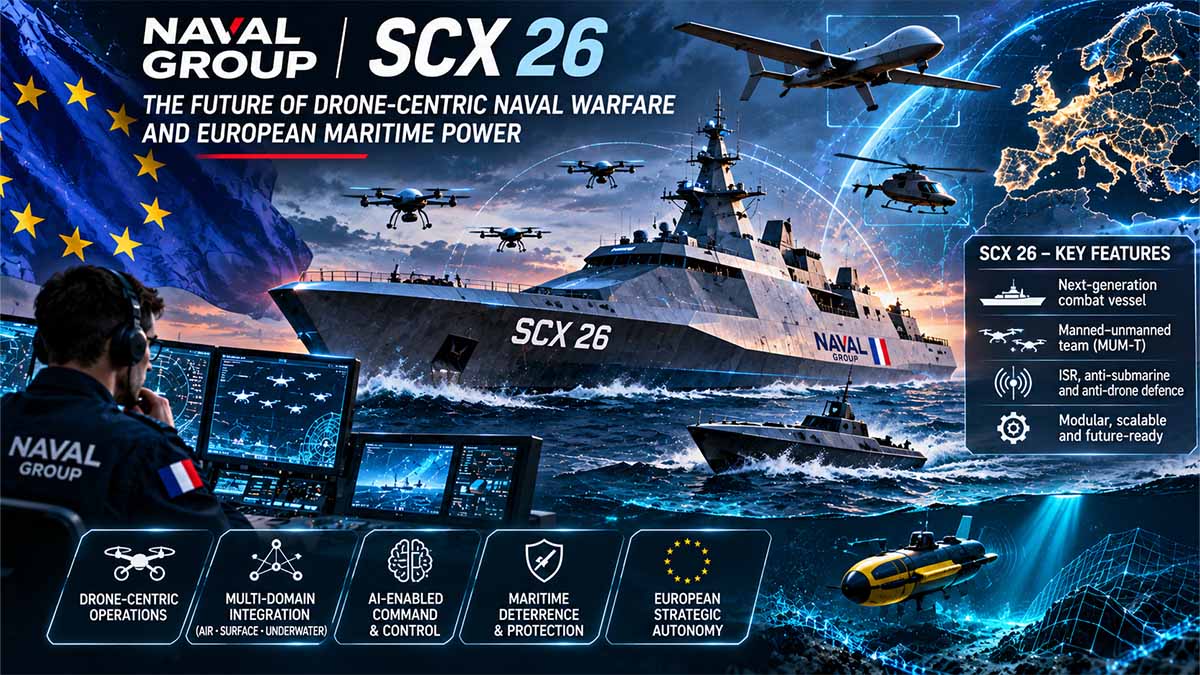
Strategic Assessment of Hybrid Fleets, Autonomous Combat Systems, Directed-Energy Weapons, Naval Industrial Capacity and High-Intensity Maritime Operations
Scope: This assessment examines the SCX 26 concept unveiled at Euronaval 2026, its implications for European and NATO naval warfare, the maturity of its constituent technologies, and the operational, industrial and procurement decisions facing France, Italy, Germany and the United Kingdom through November 2031.
Executive Summary / Bottom Line Up Front
Principal judgment: Naval Group’s SCX 26 represents a substantive shift in naval design philosophy: from the warship as an individual weapons platform towards the warship as a command, sensing, deployment and sustainment node within a distributed force. It does not, however, establish that the proposed combination of capabilities can yet be delivered as an operational vessel.
Unveiled on 3 November 2026, the research concept proposes a 170-metre, 8,000-tonne combatant with a design speed of 30 knots, range exceeding 8,000 nautical miles, more than 100 vertical-launch missile silos, an electromagnetic gun, a 100-kW laser and facilities for deploying aerial, surface and underwater unmanned systems. Naval Group describes a crew of 150, with accommodation for 100 additional personnel. These are proposed design characteristics, not demonstrated operational performance. Naval Group’s SCX 26 Concept Ship Targets Future High-Intensity Naval Combat — Ocean News, reproducing the manufacturer’s statement — Nov 2026
The strategic premise is supported by actual experimentation: NATO’s REPMUS 2026 involved approximately 300 unmanned systems, more than 3,700 participants, 60 research-and-development companies and representatives of 36 navies. This demonstrates the scale of multinational experimentation, not the existence of an interoperable combat-ready fleet. REPMUS 2026 in Portugal Brings Together NATO Allies to Test Uncrewed Maritime Systems — NATO — Oct 2026
The most consequential uncertainties concern power generation and cooling, autonomous-system recovery in adverse sea conditions, contested communications, missile resupply, cyber resilience and the survivability of a relatively concentrated command platform.
Decision consequence: European governments have stronger near-term evidence for expanding autonomous capabilities aboard existing and contracted vessels than for immediately initiating procurement of a new SCX 26-class combatant. The concept’s strategic value is presently greater as a framework for defining future operational requirements, technology demonstrators and fleet architectures than as a basis for a near-term acquisition commitment.
THE €18 BILLION WARNING: EUROPE’S NEXT NAVAL WAR WILL BE DECIDED BY INDUSTRIAL CAPACITY, NOT WARSHIP FIREPOWER
Naval Group’s SCX 26 offers a vision of drone-centric maritime warfare. Germany’s procurement failure, Britain’s new hybrid fleet and NATO’s autonomous experiments expose the financial and industrial constraints behind Europe’s naval ambitions.
Europe’s naval industry is approaching a consequential contradiction: it can design increasingly sophisticated warships faster than governments can guarantee their production, integration and operational availability. Naval Group’s SCX 26, unveiled on 3 November 2026, proposes an 8,000-tonne combatant capable of coordinating autonomous systems across three domains. Yet Germany cancelled a frigate programme approaching €18 billion in June 2026, while Britain is preparing an entirely new generation of hybrid combatants and France and Italy remain committed to existing construction programmes. The choice is no longer simply between conventional warships and autonomous platforms. It concerns whether European governments can finance, manufacture and sustain a new model of maritime warfare without weakening their current fleets. The SCX 26 exposes the central industrial question: Europe’s future naval strength will depend less on the weapons a ship can carry than on the military capability its industrial system can continuously deliver.
The 8,000-Tonne Concept Conceals a Much Larger Industrial Commitment
Naval Group’s SCX 26 is not an approved procurement programme. Presented at Euronaval on 3 November 2026, it remains a research concept exploring the architecture of a future high-intensity naval combatant. Its proposed specifications are nevertheless revealing: approximately 170 metres in length, 8,000 tonnes of displacement, a maximum design speed of 30 knots, an intended range exceeding 8,000 nautical miles, more than 100 vertical-launch missile silos, a 100-kW laser and an electromagnetic gun. The vessel would accommodate 150 core crew members and up to 100 additional personnel, supporting an extensive system of aerial, surface and underwater drones. The distinction between proposed and operational capability is decisive: none of these characteristics establishes that the complete configuration has been engineered, financed or qualified for military service. Naval Group — SCX 26 Concept Announcement, November 2026.
The industrial ambition goes considerably beyond constructing a large hull. A combatant combining missile batteries, advanced radar, electronic warfare, high-energy weapons and autonomous-vehicle facilities requires a tightly integrated architecture of electrical generation, cooling, communications, software and mechanical handling systems. A 100-kW laser rating does not indicate the installation’s total electrical consumption, while an electromagnetic launcher introduces separate demands for energy storage, component durability and repeated firing. The missile magazine cannot be translated into a defined defensive capacity without knowing the actual weapons configuration. These uncertainties are not marginal engineering details. They determine displacement growth, supplier requirements, shipyard workload and the ultimate price of the vessel.
The most consequential SCX 26 innovation is its proposed role as a command and sustainment platform for distributed autonomous assets. That design may increase operational reach, but it also concentrates command functions, maintenance requirements and high-value equipment aboard one vessel. A larger network of drones is useful only when the fleet can deploy, recover, maintain and replace those systems under sustained operational conditions. The future warship is therefore not merely a more powerful combatant; it is a substantially more demanding industrial and logistical system.
Germany’s €18 Billion Failure Establishes the Price of Undeliverable Ambition
On 24 June 2026, the German Ministry of Defence terminated the F126 frigate procurement project after substantial delays, escalating expenditure and contractual risks made continuation unacceptable. The projected acquisition cost of six frigates had approached €18 billion. Berlin instead proposed a replacement programme based on eight MEKO A-200 DEU frigates: approximately €6.3 billion for an initial four vessels, with a further four estimated at €5.3 billion. The resulting €11.6 billion represents the combined value of the two proposed tranches, not a finalized expenditure commitment for eight delivered ships. German Ministry of Defence — Termination of the F126 Programme, 24 June 2026.
The financial comparison is striking but must be interpreted correctly. Dividing the published estimates produces an arithmetic average of approximately €3 billion per planned F126, against €1.575 billion for each vessel in the proposed initial MEKO tranche and €1.325 billion in the optional second tranche. These figures are not directly comparable recurring construction costs: the designs, equipment, contractual provisions and acquisition scopes differ. Their importance is institutional. Germany concluded that the original acquisition route could no longer deliver an acceptable relationship between cost, schedule and military requirements. Its anti-submarine warfare requirement remained; the industrial solution was rejected.
The consequences extend beyond the cancellation of one contract. Defence expenditure does not immediately create qualified shipyard labour, available integration facilities or specialist suppliers. When a naval programme fails, the state risks losing years of capability development while existing vessels remain responsible for operational commitments. Germany’s decision demonstrates that industrial execution has become a direct component of military readiness. For any future SCX 26-class acquisition, the warning is clear: combining multiple immature technologies within a single construction programme could multiply contractual and scheduling risks before the navy receives its first operational vessel.
France and Italy Are Building Ships While Britain Is Redesigning the Fleet
France’s position is different because Naval Group is already delivering ships through established programmes. On 17 October 2025, the company delivered Amiral Ronarc’h, the first of five French Defence and Intervention Frigates. The FDI is a 4,500-tonne, 122-metre combatant, developed around an advanced digital architecture. On 31 August 2026, Sweden signed a contract for four FDI-based Luleå-class air-defence frigates, with deliveries planned to begin in 2030. This strengthens the international production foundation of the design, but it also adds obligations to an industrial organization already responsible for major French naval programmes. Naval Group — Delivery of the First FDI, October 2025; Government Offices of Sweden — Defence Cooperation with France, August 2026.
Italy offers a second demonstration of the distinction between industrial research and production. Under OCCAR supervision, the FREMM programme had delivered ten frigates to Italy and eight to France by June 2026. Two additional Italian FREMM EVO frigates passed their Critical Design Review in December 2025, with deliveries scheduled for June 2029 and June 2030. Their modernization incorporates upgraded combat management, sensors, communications and cyber-resilient systems. This approach develops additional capability through an established production and integration structure rather than relying on the immediate introduction of an entirely new class. OCCAR — FREMM In-Service Support, June 2026; OCCAR — FREMM EVO Critical Design Review, December 2025.
Britain, meanwhile, has made the most explicit move towards the future hybrid fleet. On 29 June 2026, the Ministry of Defence announced plans for at least six Common Combat Vessels to replace the six Type 45 destroyers, with deliveries anticipated from the early 2030s. The intended architecture combines crewed combatants with proposed Type 91 unmanned missile platforms, Type 92 underwater sensing systems, Type 93 extra-large unmanned underwater vehicles and Type 94 sensor platforms. These categories describe future capabilities, not a fully delivered autonomous fleet. Alongside eight Type 26 and five Type 31 frigates, they indicate a structural change in British naval planning: combat power would increasingly be distributed across different types of platform rather than concentrated exclusively in conventional surface ships. UK Ministry of Defence — Common Combat Vessel Programme, June 2026.
The divergence is significant. France is developing future concepts while expanding an established frigate family. Italy is modernizing through existing industrial and cooperative structures. Germany has abandoned an unsatisfactory procurement route. Britain is defining a new hybrid-fleet architecture. These are four different responses to the same strategic pressure, with no common European acquisition commitment for an SCX 26-class vessel.
NATO’s 300 Drones Expose the Difference Between Experimentation and Combat Readiness
NATO’s REPMUS 2026 exercise brought together approximately 300 unmanned systems, more than 3,700 participants, representatives of 36 navies and 60 research-and-development companies. The figures demonstrate the scale of multinational experimentation, but they do not constitute an inventory of 300 combat-ready NATO systems. The distinction matters because purchasing or testing autonomous platforms is not equivalent to sustaining a force capable of operating under disrupted communications, adverse conditions and prolonged maintenance demands. NATO — REPMUS 2026, October 2026.
The Alliance is already attempting to close that gap. On 12 February 2026, eight NATO members—Denmark, Estonia, Finland, Germany, Latvia, Lithuania, Poland and Sweden—agreed to accelerate the acquisition of maritime capabilities following Task Force X-Baltic experimentation. NATO reported that 70 aerial and maritime drones had been deployed and tested between March and October 2025. Task Force X-Arctic subsequently extended experimentation towards persistent maritime awareness across the North Atlantic and High North, with further demonstration activity planned for 2027. These programmes reveal where institutional priorities are moving: towards common information architectures, interoperable platforms and the ability to convert exercises into operational capacity. NATO — Baltic Maritime Acquisition Cooperation, February 2026; NATO Allied Command Transformation — Task Force X-Arctic, September 2026.
NATO’s Rapid Adoption Action Plan, adopted on 25 June 2025, establishes a general objective of bringing suitable technological products from identified requirements to acquisition and integration within 24 months. That timetable cannot be applied to the construction of a new 8,000-tonne combatant. It does, however, expose a growing contradiction in naval procurement: autonomous sensors and software may develop through relatively short cycles, while the ships intended to support them require long construction and qualification programmes. A fleet designed around fixed technologies risks becoming outdated before delivery. A fleet built without stable technical interfaces risks becoming too expensive to modernize. NATO — Rapid Adoption Action Plan, June 2025.
Brussels Can Finance Cooperation, Not Replace National Naval Budgets
The European Union is expanding defence-industrial support, but the financial instruments available do not amount to a centralized European naval procurement budget. The European Defence Industry Programme provides €1.5 billion for 2025–2027, including €300 million allocated to support Ukraine’s defence industry. The AGILE programme, adopted in October 2026, provides €115 million for smaller defence companies developing emerging technologies. Separately, the European Patrol Corvette development action received a maximum European Defence Fund grant allocation of €154.5 million for the relevant development phase. These figures concern different programmes and expenditure categories; they cannot be combined into a single fund available for constructing future surface combatants. Council of the European Union — European Defence Industry Programme; Council of the European Union — AGILE, October 2026; OCCAR — European Patrol Corvette Development, June 2024.
The legal framework reinforces this division of responsibility. Directive 2009/81/EC governs qualifying defence and security procurement, while Article 346 of the Treaty on the Functioning of the European Union permits member states, under defined conditions, to protect essential security interests. National governments retain substantial authority over military requirements, contracts and expenditure. NATO can identify capability needs and establish interoperability standards, but it cannot transform an industrial concept into a funded national warship programme. The result is a fragmented acquisition structure in which cooperation can reduce duplication, yet divergent national requirements and industrial interests can limit the benefits of common development. Directive 2009/81/EC — European Parliament and Council, July 2009; NATO Defence Planning Process.
The fiscal constraint is inseparable from the industrial one. Naval Group reported approximately €4.4 billion in revenue and an €18.2 billion order book for financial year 2024, with orders received reaching €8.2 billion. Those historical figures establish the scale of its contractual activity, not a pool of funding available for SCX 26. An additional large combatant programme would require separate authorization, engineering expenditure, manufacturing capacity and long-term support commitments. A substantial order book can provide industrial continuity while simultaneously limiting the resources available for another major development effort. Naval Group — Annual Report 2024, April 2025.
The Next 24 Months Will Test Europe’s Ability to Turn Naval Innovation into Available Forces
Between November 2026 and November 2028, Europe’s decisive naval test will be the conversion of existing commitments into measurable capability. NATO’s planned 2027 Arctic demonstrations must clarify whether heterogeneous autonomous systems can sustain coordinated operations outside controlled trials. Britain must translate its Common Combat Vessel announcement into credible design and acquisition milestones. Germany must advance its replacement frigate programme without reproducing the financial and contractual difficulties of F126. France and Italy must protect existing production schedules while integrating new technical requirements. SCX 26, without an approved construction programme or published acquisition budget, cannot credibly be counted among vessels expected to enter service during that period.
The cost of inaction will not fall exclusively on defence ministries. In February 2026, the European Commission announced €347 million in support for submarine cable-security activities and described undersea cables as carrying approximately 99% of intercontinental internet traffic. In June, it announced €5.8 million for initial Baltic and Mediterranean regional cable hubs and a €40 million call supporting repair capacity. The figures establish the economic importance of maritime resilience, but they do not demonstrate that sufficient protection or restoration capability has already been delivered. Surveillance without repair capacity leaves an incomplete response system; advanced naval platforms without adequate maintenance and replenishment leave an incomplete military system. European Commission — Submarine Cable Security, February 2026; European Commission — Regional Cable Hubs and Repair Capacity, June 2026.
The financial consequences of inadequate sustainment are already measurable elsewhere. In August 2026, the US Government Accountability Office reported more than 15,000 lost operational days associated with attack-submarine maintenance problems over approximately a decade, generating an estimated $3.4 billion in expenditure while the affected vessels failed to provide operational capability. These are American figures, not an estimate of European losses, but the institutional mechanism is directly relevant: a fleet can absorb substantial public resources without producing the expected operational availability. US Government Accountability Office — Navy Readiness and Submarine Maintenance, August 2026.
The immediate choice is therefore not whether Europe should construct the SCX 26. It is whether governments will finance a naval architecture that can be delivered, maintained and adapted while preserving existing military commitments. Over the next 12–24 months, failure to establish credible integration standards, production schedules and sustainment arrangements will increase the risk of further procurement delays and continued capability gaps. Defence budgets will absorb the financial consequences; shipyards and specialized suppliers will bear the disruption of unstable orders; naval crews will face the operational burden of prolonged service with existing equipment; and European businesses dependent on secure maritime transport and communications will remain exposed to the economic consequences of disruption.
The strategic measure of Europe’s next naval generation will not be the number of missiles advertised in a future warship. It will be the number of capable vessels and autonomous systems that European industry can deliver, integrate and keep operational when they are required.
Navigational Index
PILLAR I — NAVAL WARFARE ARCHITECTURE AND OPERATIONAL TRANSFORMATION
- Chapter 1 — The SCX 26 Concept: Architecture, Specifications and Capability Maturity
- Chapter 2 — The Hybrid Fleet: Multi-Domain Drones, Command Networks and Human Control
- Chapter 3 — Combat Survivability: Missile Saturation, Directed Energy, Electromagnetic Weapons and Vulnerability
PILLAR II — INDUSTRIAL FEASIBILITY, PROCUREMENT AND EUROPEAN NAVAL POWER
- Chapter 4 — From Research Concept to Warship Production: Technology Readiness, Shipbuilding Capacity and Financial Exposure
- Chapter 5 — European Naval Adaptation: France, Italy, Germany and the United Kingdom
- Chapter 6 — NATO Interoperability, European Defence Cooperation and the Governance of Autonomous Maritime Operations
PILLAR III — STRATEGIC RISKS, FUTURE PATHWAYS AND DECISION FRAMEWORK
- Chapter 7 — High-Intensity Conflict Scenarios, Force-Protection Requirements and the 2026–2031 Outlook
- Chapter 8 — Strategic Choices, Industrial Priorities, Watch Indicators and Final Net Assessment
Master Abstract
The Emergence of the Hybrid Naval Combat System
The principal transformation represented by SCX 26 is architectural rather than simply quantitative. Its proposed missile capacity and advanced weapons attract attention, but its more important innovation lies in the relationship between a crewed combatant, its embarked autonomous systems and the wider naval force. Naval Group describes an adaptable platform incorporating two integrated sections, a modular flex zone, separated sensor and weapon installations, and an extensive aft mission bay for handling drones and helicopters. The ship is intended to coordinate reconnaissance, surveillance, electronic warfare, anti-submarine operations and force protection across several operating domains. This approach implies that a vessel’s military effectiveness would depend increasingly on the quality, persistence and survivability of the information and engagement network it can sustain, rather than on the performance of its onboard weapons alone. Naval Group’s SCX 26 Concept Ship Targets Future High-Intensity Naval Combat — Ocean News — Nov 2026
The operational attraction is substantial. Distributed sensors can extend maritime awareness beyond the immediate coverage of a single vessel, while unmanned platforms can undertake selected missions without exposing crewed ships to the same degree of danger. Yet distribution does not automatically guarantee survivability. A fleet centred on one command ship may exchange the limitations of a single-platform combat model for new dependencies on communications, data fusion, mission planning, cyber protection and the availability of launching and recovery facilities. The critical question is therefore whether the SCX 26 architecture could preserve effective command and combat capability when individual drones, network links or onboard systems become degraded or unavailable. Neither the published design specifications nor the available experimentation records demonstrate that level of integrated wartime resilience.
The Difference Between Technological Ambition and Military Capability
SCX 26 combines technologies at markedly different stages of maturity. Vertical-launch missile architectures and naval radar, sonar and combat-management systems have an established procurement and operational history. Maritime unmanned systems are progressing through trials, demonstrations and defined procurement programmes. High-energy lasers have demonstrated specific military applications, but their operational effectiveness remains dependent on atmospheric conditions, target characteristics, engagement geometry and the ability to provide electrical power and cooling. Electromagnetic railguns remain particularly demanding because successful integration requires not only projectile acceleration but also durable launch components, energy storage, repeated firing, thermal management and shipboard electromagnetic compatibility. The European Defence Agency’s PILUM programme established a research foundation for electromagnetic artillery, while its successor THEMA was intended to prepare a firing-range demonstration by 2028. This is evidence of sustained technical development, not proof of an operational naval weapon suitable for SCX 26. Ambitious Electromagnetic Railgun Project Surpasses Expectations — European Defence Agency — Sep 2023
These distinctions are consequential for fleet planning. More than 100 launch silos do not establish the number, type or mix of missiles actually carried, the rate at which threats could be engaged, or the ship’s capacity to replenish its weapons at sea. Similarly, a 100-kW laser rating describes intended weapon output, not the total electrical power required by the complete installation or the number of targets it can defeat under operational conditions. The US Government Accountability Office has identified weather, range and cooling as important constraints on directed-energy systems. Claims of inexpensive engagements and effectively unlimited magazines therefore remain conditional on demonstrable performance, power availability, target tracking and sustained operational endurance. Science & Tech Spotlight: Directed Energy Weapons — US Government Accountability Office — May 2023
European Procurement Reality and the Industrial Transition
The most convincing evidence that European naval warfare is moving towards hybrid fleets comes not from SCX 26 itself but from programmes already passing through construction, delivery, experimentation and procurement. Naval Group delivered France’s first FDI frigate, Amiral Ronarc’h, on 17 October 2025. The manufacturer’s published specification gives the FDI a displacement of 4,500 tonnes, length of 122 metres and crew of 125, with accommodation for 28 additional personnel. The French programme covers five vessels. Naval Group Delivers the First Defence and Intervention Frigate — Naval Group — Oct 2025
An important subsequent industrial development occurred on 31 August 2026, when Sweden announced that its Defence Materiel Administration had signed a contract with Naval Group for four air-defence frigates, with deliveries planned to begin in 2030. This matters because it gives a European shipbuilder an additional contractual foundation for developing advanced, digitally integrated surface combatants. It does not establish that Sweden has adopted SCX 26 or that the frigates will include all of the technologies proposed in the concept. Sweden and France Intensify Defence Cooperation — Government Offices of Sweden — Aug 2026
National approaches nevertheless diverge. Italy is developing FREMM EVO combatants and experimenting with integrated naval capabilities. Germany has expanded its maritime unmanned-aircraft plans but officially terminated the F126 frigate procurement project in June 2026 because of significant delays, cost increases and unacceptable programme risks. The United Kingdom has employed a different model by adapting an existing Royal Fleet Auxiliary vessel to carry and support autonomous mine-countermeasures systems. These records demonstrate that hybridisation is not synonymous with purchasing an entirely new class of large warships; it is also possible through modernisation, modular mission systems, specialised autonomous vessels and modified support platforms. OCCAR FREMM Programme Marks the First Steel Cutting Ceremony for the Italian Follow-On Ship — OCCAR — Jul 2026; Verteidigungsministerium beendet das Rüstungsprojekt Fregatte F126 — Bundeswehr — Jun 2026; RFA Lyme Bay Departs Gibraltar with Array of Minehunting Kit — Royal Navy — May 2026
Strategic Implications Through 2031
The five-year outlook favours accelerating the integration of autonomous maritime systems into existing naval structures while pursuing selected next-generation combatant technologies in parallel. This judgment rests on the different levels of documented commitment: current programmes provide contract milestones, delivery schedules, experimental results and named procuring authorities, whereas SCX 26 remains a theoretical design without a publicly established acquisition decision, approved construction schedule or disclosed programme budget. France’s Defence Innovation Agency and Naval Group have also agreed to develop a large unmanned underwater combat-vehicle demonstrator, with sea trials scheduled to begin in 2028. That initiative has a more specific development pathway than the complete SCX 26 concept. La France lance le développement d’un démonstrateur de drone sous-marin océanique polyvalent — Agence de l’innovation de défense — Nov 2026
The decisive strategic issue is whether maritime forces can turn distributed experimentation into reliable, sustainable and interoperable combat power. A larger command warship may enable extensive mission management and layered defence, but it also concentrates valuable personnel, communications and weapons within an identifiable asset requiring protection and support. Smaller distributed platforms may reduce concentration but impose separate burdens in command coordination, maintenance, availability and logistics. A sound procurement policy therefore has to evaluate the whole force rather than an individual hull. By 2031, the most important indicators will be the demonstrated performance of multi-domain autonomous systems under contested conditions, the integration of their command systems with existing warships, the maturity of high-power electrical and weapons systems, and whether European authorities fund a clearly defined operational requirement for a large future naval combatant.
Key Evidence Table
The following distinguishes manufacturer specifications and announced plans from established delivery, contract and exercise records. The table does not treat demonstrations, orders or intended performance as equivalent to operational readiness.
| Indicator | Value/status | Reference date | Definition/scope | Issuer | Exact source |
|---|---|---|---|---|---|
| SCX 26 programme status | Research concept; not an identified approved procurement programme | 3 Nov 2026 | Manufacturer’s prospective design | Naval Group | SCX 26 concept statement, reproduced by Ocean News |
| Proposed hull | 170 m; 8,000 tonnes | Nov 2026 | Published design characteristics; loading basis not specified | Naval Group | SCX 26 concept statement |
| Proposed mobility | 30 knots; range over 8,000 nautical miles | Nov 2026 | Design targets; endurance assumptions not published | Naval Group | SCX 26 concept statement |
| Proposed weapons | More than 100 VLS silos; electromagnetic gun; two Rampart launchers; 100-kW laser | Nov 2026 | Proposed installations, not demonstrated integrated capability | Naval Group | SCX 26 concept statement |
| Personnel | 150 crew; 100 additional places | Nov 2026 | Proposed accommodation, not validated combat manning | Naval Group | SCX 26 concept statement |
| French FDI baseline | 4,500 tonnes; 122 m; first unit delivered | 17 Oct 2025 | Contracted five-frigate French programme | Naval Group | FDI delivery release, pp. 1–2 |
| Swedish frigate contract | Four air-defence frigates; deliveries planned from 2030 | 31 Aug 2026 | Signed procurement contract, not delivered capability | Swedish Government | Defence cooperation announcement |
| REPMUS 2026 | 300 unmanned systems; over 3,700 participants; 36 navies represented; 60 R&D companies | 31 Aug–25 Sep 2026 | Multinational experimentation, not deployed force inventory | NATO | REPMUS 2026 exercise report |
| French UCUV | Development agreement; first sea trials planned in 2028 | Nov 2026 | Large underwater combat-drone demonstrator | French Defence Innovation Agency | UCUV development announcement |
| German F126 | Six planned frigates will not be procured under the terminated project | 24 Jun 2026 | Procurement cancellation | German Ministry of Defence | Official Bundeswehr announcement |
| Italian FREMM EVO | Two contracted ships, deliveries scheduled for 2029 and 2030 | 23 Jul 2026 | Existing cooperative production programme | OCCAR | FREMM EVO production milestone |
| UK naval autonomy | RFA Lyme Bay adapted for autonomous mine-countermeasures operations | May 2026 | Existing vessel used as an unmanned-system support platform | Royal Navy | RFA Lyme Bay operational preparation |
| Electromagnetic railgun research | Firing-range demonstration targeted for 2028 under THEMA | Sep 2023 programme announcement | Research objective; not shipboard operational qualification | European Defence Agency | PILUM/THEMA programme assessment |
Quantitative and Capability Interpretation
The figures require three distinctions.
First, design capacity is not combat availability. The stated number of launch silos does not establish missile stock, interceptor compatibility, effective engagement capacity or operational resilience under repeated attacks. The vessel’s projected speed and range likewise remain design targets whose propulsion, load and operating assumptions are not fully specified in the published concept statement.
Second, multinational experimentation is not force deployment. REPMUS 2026 demonstrates the scale of allied testing and the growing importance of interoperability, but its 300 systems should not be counted as combat-ready NATO assets. The distinction is particularly important when considering claims about mass, persistence and the ability to replace losses.
Third, technology readiness varies within the same proposed vessel. Existing naval missile systems, digital combat architectures and certain unmanned platforms provide a credible development foundation. That foundation cannot automatically validate the combined performance of an electromagnetic gun, high-energy laser, advanced sensors and several simultaneous drone-control functions aboard a single future vessel.
Competing Strategic Pathways
The available record supports three distinct, potentially overlapping pathways for European naval development. Their relative standing reflects the existence of procurement commitments and demonstrated development activity, not numerical forecasts.
| Hypothesis | Diagnostic support | Disconfirming evidence or constraints | Indicators | Current standing |
|---|---|---|---|---|
| A — Large hybrid command combatants become a new fleet category | SCX 26 architecture; requirement for integrated air, surface and underwater operations; increasingly complex missile threats | No identified SCX 26 procurement authority, funded construction programme or integrated validation of the complete design | Formal operational requirement; funded preliminary design; propulsion and power architecture; shipyard allocation | Plausible longer-term pathway, not a committed programme |
| B — Existing and contracted warships absorb autonomous capabilities incrementally | FDI construction and procurement; UK unmanned-system mothership adaptation; French UCUV demonstrator; NATO experimentation | Legacy hull limits, electrical power margins, launch-and-recovery constraints and interoperability burdens | Certified mission modules; repeatable sea trials; signed integration contracts; operational acceptance | Strongest documented near-term pathway |
| C — Distributed unmanned forces reduce the requirement for very large dedicated command ships | Development of smaller uncrewed maritime systems; multinational network experimentation; ability to operate some systems from support vessels or shore | Communications dependence, limited payloads, endurance, logistics and command coordination | Independent mission persistence; loss-tolerant networks; scalable production; demonstrated sustained operations | Credible complementary pathway; substitution remains unproven |
Pathway B has the strongest immediate documentary foundation because it rests on real programmes and platforms. Pathway A would become substantially more credible if a navy adopted an explicit requirement for a large hybrid command combatant and funded engineering work addressing the complete ship. Pathway C would gain standing if smaller autonomous platforms demonstrated sustained maritime operations without requiring an increasingly vulnerable central command node.
These pathways are not mutually exclusive. A future European fleet could combine new large combatants, modernised frigates, support vessels and distributed unmanned systems. The strategic question is their optimal balance, not whether one technology universally replaces another.
Principal Gaps and Watch Indicators
The public record establishes SCX 26’s proposed architecture but does not resolve several questions essential for procurement, military planning and future force design.
| Critical gap | Why it changes the assessment | Observable record or threshold |
|---|---|---|
| Approved operational requirement | Determines whether the design addresses a navy’s validated needs or remains industrial research | Formal defence-ministry requirement, capability programme or procurement notice |
| Electrical power architecture | High-energy weapons, radars, electronic warfare and mission systems compete for generation, storage and cooling resources | Published integrated power-system design and representative load-testing results |
| Drone deployment and recovery performance | A large mission bay has limited combat value if sorties cannot be sustained in demanding sea conditions | Published trials specifying drone categories, recovery rates and operating sea states |
| Contested-network resilience | Loss or degradation of links could compromise coordinated sensing and mission execution | Assessed trials under electronic interference, degraded navigation and communications failure |
| Integrated weapons maturity | A proposed laser or railgun cannot be treated as a usable defensive layer without representative trials | Documented naval integration tests, engagement results, duty cycle and maintainability evidence |
| Missile and unmanned-system replenishment | Combat endurance depends on stocks, repair, maintenance and resupply, not merely installed launch capacity | Approved logistics concept and measured sustainment performance |
| Crew workload and autonomy governance | Additional drones and sensors increase the volume of tasks requiring supervision and authorization | Human-factors trials, operator workload assessments and approved command procedures |
| Industrial and financial feasibility | A large multi-technology platform may face compounded integration, schedule and cost risks | Budget authorization, industrial workshare, costed design baseline and procurement milestones |
| Operational survivability | Concentrating fleet coordination aboard one valuable hull could create a consequential vulnerability | Force-level exercises testing command continuity after partial system or platform loss |
Decision-Relevant Assessment of the Gaps
The most important unresolved dependency is integrated performance under degraded conditions. Naval architectures normally rely on multiple subsystems functioning together, but SCX 26 increases the importance of integration because its prospective military value comes from the coordination of remote sensors, autonomous vehicles, weapons, communications and human operators.
The ability to deploy numerous drones is not equivalent to an ability to command them effectively. Similarly, an extensive missile installation does not by itself establish protection against a complex saturation attack, particularly where identification, tracking, weapon assignment, engagement timing and command decisions must occur simultaneously.
The proposed design’s potential advantage therefore depends on whether its autonomous-system network and defensive architecture can continue to function when subject to interference, attrition, technical failures and restricted resupply. This is also the central test of whether the concept would deliver additional combat power rather than merely redistribute the same vulnerabilities across a larger and more technologically complex platform.
Analytical Visualisation — Hybrid Fleet Dependency Architecture
The verified design description supports a qualitative representation of the operational relationships between the command vessel, autonomous assets, onboard systems and fleet sustainment. The scheme below represents proposed functional dependencies, not a validated operational configuration or demonstrated combat performance.
WordPress-ready HTML component — self-contained, responsive, with visible source attribution.
SCX 26 — The Hybrid Naval Combat Architecture
Functional dependencies described by the manufacturer. Research concept, November 2026.
Crewed Combat and Command Platform
SCX 26 concept: onboard sensors, combat management, human command decisions, communications, weapons coordination and mission-bay operations.
Air, Surface and Underwater Systems
Unmanned assets extend intelligence, surveillance, reconnaissance, electronic warfare and anti-submarine capabilities.
Layered Shipboard Protection
Proposed VLS weapons, Rampart launchers, laser, electromagnetic gun and secondary artillery. Integrated effectiveness remains unverified.
Deployment, Recovery and Maintenance
Aft mission bay, lifting equipment, drone handling, reconfiguration and technical support. Operational sortie rates are not published.
Wider Naval Force and Allied Networks
Coordination with crewed ships, aircraft and unmanned platforms. Interoperability depends on communications and shared operational procedures.
Sources: Naval Group’s SCX 26 concept statement, reproduced by Ocean News, 4 November 2026; NATO, REPMUS 2026, 8 October 2026. Diagram shows intended functional relationships only.
The scheme makes the fundamental strategic trade-off explicit: greater distribution of sensing and mission execution can extend a naval force’s operational reach, but it also creates dependencies that must be addressed through resilience, autonomy governance, communications architecture and logistics. An effective hybrid fleet therefore requires more than a ship equipped to carry drones. It requires a verified capability to coordinate, replace, support and protect them as part of an enduring combat system.
Opening Net Assessment
As of 6 November 2026, the SCX 26 should be understood as a credible industrial exploration of future naval architecture, but not yet a credible scheduled procurement capability. Its conceptual direction is supported by developments already visible across NATO exercises, French and Swedish frigate programmes, British autonomous mine warfare and European research into advanced naval weapons.
The principal near-term opportunity for European governments lies in applying those developments to existing and contracted fleets while reducing the uncertainties surrounding future large combatants. Procurement decisions for a design comparable to SCX 26 should depend on evidence that its proposed systems can be integrated into a resilient, maintainable and financially supportable platform—not simply on the presence of advanced technologies in its specification.
The strategic test of the next five years is whether European navies can convert the promise of hybrid fleets into sustained operational effectiveness across air, surface and underwater domains, including when communications, logistics and individual platforms are disrupted.
PILLAR I — NAVAL WARFARE ARCHITECTURE AND OPERATIONAL TRANSFORMATION
Naval Group SCX 26: Engineering the Transition from Conventional Surface Combatants to Distributed, Autonomous and High-Intensity Naval Warfare
Chapter 1 — The SCX 26 Concept: Architecture, Specifications and Capability Maturity
Strategic Judgment: The Critical Innovation Is the Integration of Combat Power, Autonomous Systems and Naval Architecture
The significance of Naval Group’s SCX 26 lies in a fundamental reconsideration of how a major surface combatant should be designed, equipped, sustained and employed in a maritime environment increasingly shaped by autonomous systems, missile saturation, electronic warfare and the need for continuous technological adaptation. Its most consequential feature is not the proposed concentration of more than 100 vertical-launch missile silos, nor the combination of advanced sensors with an electromagnetic gun and a high-energy laser. It is the decision to make the deployment, recovery, maintenance and operational coordination of unmanned vehicles an organizing principle of the entire vessel rather than an auxiliary capability accommodated within a conventional warship. This changes the underlying architecture of naval combat: the effectiveness of the ship becomes inseparable from the aircraft, surface vehicles, underwater systems, remote sensors and other platforms operating around it. Such an arrangement can extend the number of locations from which information is collected and military effects are delivered, but it also introduces additional requirements concerning data integrity, communications continuity, onboard infrastructure, human supervision and the resilience of a distributed combat network. The central engineering question is whether these systems can remain mutually supportive when their operating environment deteriorates, rather than whether they can function individually under controlled conditions.
Naval Group presented SCX 26 at Euronaval in Paris on 3 November 2026 as a theoretical research concept intended to explore future naval requirements and combinations of established and emerging technologies. This status is essential to the assessment. The project is neither an identified French Navy construction programme nor a vessel whose integrated systems have completed operational qualification. The manufacturer’s stated purpose is to examine the architecture and technology combinations needed for future maritime combat, including the relationship between the ship and a wider hybrid naval force. Consequently, its specifications describe a design proposition, not a government-approved military requirement or a demonstrated performance baseline. The manufacturer’s published explanation identifies adaptability, survivability, distributed operations and collaborative combat as interconnected design objectives. This makes SCX 26 an important indicator of European naval industrial thinking, while leaving open whether its final configuration, acquisition cost, construction schedule and operational doctrine could satisfy the requirements of a particular navy. Naval Group Unveils Its New Concept Ship Designed for Naval Warfare of the Future — Naval Group — 3 November 2026, manufacturer press release; Euronaval 2026: Naval Group Presents Its Vision of Future Naval Fleets — Naval Group — 3 November 2026, manufacturer statement reproduced by SP’s Naval Forces.
Physical Architecture: Displacement, Mission Volume and the Engineering Consequences of Modularity
The proposed vessel measures approximately 170 metres in length, with a design displacement of 8,000 tonnes, a maximum intended speed of 30 knots and a stated range exceeding 8,000 nautical miles. Its accommodation model provides for a core complement of 150 sailors and up to 100 additional personnel, potentially including command staff, autonomous-system operators, mission specialists and other embarked teams. These figures imply a large, multi-role surface combatant rather than a specialized drone carrier with limited defensive capability. The design seeks to combine a high-density missile battery, advanced air- and missile-defence sensors, underwater surveillance capabilities, significant unmanned-system capacity and command facilities within one hull. Such concentration creates a difficult naval architectural problem because the competing systems require different combinations of internal volume, weight distribution, structural support, electromagnetic separation, access routes, cooling, electrical power and protection. Missile-launch installations impose constraints on the spaces around and beneath their cells; sensor masts affect topweight and stability; mission bays require large openings, handling systems and movement corridors; and directed-energy weapons impose electrical and thermal demands that cannot be understood from the physical dimensions of the weapons themselves.
The manufacturer describes the architecture as two integrated sections separated by a configurable flex zone, together with a large aft mission bay incorporating lifting equipment and a high-capacity elevator. The distinction between this arrangement and genuine unrestricted modularity is important. A flexible space can facilitate equipment replacement or the installation of new mission capabilities, but it cannot eliminate the fundamental requirements of ship stability, structural integrity, fire safety, machinery integration and combat-system compatibility. Any future module would still need sufficient electrical supply, cooling, secure communications, maintenance access and electromagnetic compatibility. Likewise, a mission bay designed for several categories of unmanned vehicle requires much more than empty deck volume: safe handling paths, secure storage, equipment servicing, charging or refuelling arrangements, protection against mechanical damage, management of hazardous materials and the ability to separate maintenance operations from combat-system activities. If these functions compete for the same space, lifting equipment or personnel, the effective operational capacity of the bay may be considerably lower than its nominal storage capacity suggests. The strategic value of the design therefore depends on the number of systems it can launch, recover, repair and return to service during a sustained deployment, not simply the number that could be accommodated inside the hull. Naval Group Unveils Its New Concept Ship Designed for Naval Warfare of the Future — Naval Group — November 2026.
The reported dimensions also require careful treatment. Published accounts of the concept have described a displacement in the 8,000–10,000-tonne range, depending on configuration, while the manufacturer’s headline concept figure is 8,000 tonnes. Without a complete design-weight statement specifying whether these figures represent standard displacement, design displacement or full-load displacement, they should not be treated as interchangeable. The apparent precision of a single displacement figure can conceal major engineering questions. Additional missile capacity, larger embarked unmanned systems, greater fuel or energy-storage requirements, stronger protective arrangements and more extensive cooling systems all affect the design-weight balance. If a future customer required additional capabilities, the consequences could include changes in displacement, propulsion, internal arrangement and overall cost. The public record therefore supports the description of an approximately 8,000-tonne concept, but not a conclusion that every proposed subsystem can be accommodated within a fixed displacement without further design compromises.
The Engineering Baseline: Declared Parameters and Outstanding Verification
| Architectural parameter | Published SCX 26 design | Engineering significance | Verification required |
|---|---|---|---|
| Overall length | Approximately 170 m | Determines hull volume, arrangement flexibility and shipyard compatibility | Approved general arrangement and detailed design |
| Displacement | Approximately 8,000 t; higher configuration-dependent figures reported | Defines weight, stability and growth constraints | Standard, full-load and maximum design displacements |
| Beam | Approximately 24 m in exhibition reporting | Influences stability, internal volume and port compatibility | Manufacturer-approved dimension and hydrostatic data |
| Maximum speed | 30 knots, intended | Requires substantial propulsion and shaft-power capacity | Propulsion design, power curve and sea trials |
| Operating range | More than 8,000 nautical miles, intended | Indicates projected oceanic deployment capability | Speed, fuel load, weather and reserve assumptions |
| Core crew | 150 | Establishes proposed manning model | Watchkeeping, maintenance and damage-control workload analysis |
| Additional accommodation | 100 personnel | Supports command functions and specialized teams | Embarked personnel and habitability requirements |
| Missile capacity | More than 100 VLS silos of different classes | Potentially substantial offensive and defensive magazine | Cell dimensions, missile compatibility and final configuration |
| Laser installation | 100-kW class | Introduces electrical, thermal and beam-control requirements | Integrated power and performance qualification |
| Electromagnetic gun | Rapid-fire concept | Demands pulsed energy storage and launcher durability | Demonstrator, endurance and naval integration testing |
| Unmanned-system facilities | Large aft mission bay, elevator and handling equipment | Enables multi-domain deployment and maintenance | Launch/recovery limits, sortie generation and operational testing |
| Survivability architecture | Separated systems, distributed launchers and two masts | Intended to reduce concentration of critical equipment | Damage-control and survivability assessment |
| Combat management | Digitally integrated, AI-supported concept | Enables multi-platform coordination | Cybersecurity, system integration and human-factor validation |
Source for the manufacturer’s design characteristics: Naval Group concept announcement — 3 November 2026. Additional dimensional reporting is treated as provisional; validation requirements are analytical, not published test results.
The table illustrates a broader procurement concern: the number of publicly described features is not a measure of technological maturity. Some elements can be built around established naval engineering principles, while others require substantial development or integration work. An approved detailed design would need to reconcile propulsion, electrical power, heat rejection, combat systems, communications, mission handling, weapon safety and crew requirements as one engineering system. The challenge is compounded by the intention to preserve flexibility for capabilities that do not yet have stable dimensional or power requirements. Growth margins are therefore not optional conveniences: they determine whether the ship could accommodate future technology without expensive structural changes or loss of existing capability. Conversely, allocating excessive growth margins for uncertain future equipment can increase displacement, construction expenditure and operating costs without delivering immediate military utility. The appropriate balance would depend on a formally defined operational requirement and independently assessed technology-development assumptions, neither of which has been publicly established for SCX 26.
Propulsion, Electrical Generation and the Emergence of an Energy-Constrained Warship
One of the most consequential engineering issues concerns the relationship between propulsion and the ship’s future electrical demand. Specialist reporting from Euronaval describes a proposed combined diesel-electric and gas-turbine architecture, commonly designated CODLAG. Such an arrangement can provide flexibility across operating conditions, but its effectiveness depends on the actual machinery configuration, the division between propulsion and electrical generation, and the ship’s intended operating profile. A large combatant moving at high speed while conducting intensive sensor operations and supporting several unmanned systems may face substantial simultaneous demand for propulsion, generation, cooling and onboard mission services. The proposed laser and electromagnetic gun intensify this issue because their requirements involve not only energy consumption but also the timing and concentration of electrical demand. A continuously operating sensor system, a laser engaging successive targets and an electromagnetic launcher drawing pulsed energy present different engineering challenges, even when their average power consumption appears manageable. Naval Group SCX26: Future Combat Ship Concept — Future Warfare Magazine — 5 November 2026.
A critical distinction must be made between energy generation capacity, power distribution capability and the capacity to deliver short-duration peak loads. An electromagnetic launcher can require rapid discharge from an energy-storage subsystem, creating demands that differ substantially from conventional ship services. The ship’s distribution architecture would also need to prevent disturbances from compromising mission-critical electronics, navigation equipment or other weapons. High-energy lasers introduce a different constraint: the electrical power drawn by the installation exceeds the useful optical output because conversion, tracking, beam control and thermal management all require resources. Accordingly, the stated 100-kW laser rating cannot be interpreted as a 100-kW total electrical requirement. No verified public SCX 26 data establish the proposed generators’ combined output, power-management architecture, storage capacity, cooling reserve or simultaneous operating limits. Without these figures, assertions that the ship could continuously employ its most demanding sensors and weapons while sustaining peak propulsion and drone-support operations would exceed the available evidence.
This leads to an important conclusion for future naval design. Electrical power and thermal capacity increasingly become strategic resources that must be allocated among competing combat functions. A future ship may possess the physical space for new weapons but lack the power or cooling necessary to employ them effectively. Conversely, designing for maximum future electrical demand may impose substantial immediate costs in machinery, fuel consumption and ship volume. A mature SCX 26 design would therefore require a comprehensive electrical-load analysis covering normal cruising, high-speed transit, intensive combat, degraded machinery operation and simultaneous mission-system use. It would also need to identify which functions receive priority when power availability becomes restricted. These are not secondary installation details; they determine the vessel’s real operational capability under demanding conditions.
Sensor Architecture: Detection, Identification and the Limitations of Information Superiority
The proposed sensor suite includes a UHF radar intended to support ballistic missile defence, a comprehensive anti-submarine sonar installation and advanced electronic warfare capabilities. The separation of sensors across two masts is intended to contribute to redundancy and survivability, while the ship’s broader design anticipates the integration of information collected by embarked and external platforms. This architecture is potentially valuable because modern maritime threats cannot all be observed effectively by a single sensor operating in one frequency range or physical domain. Airborne targets, surface contacts and underwater objects produce different signatures, and the ability to combine detections can improve situational understanding. Nevertheless, a sensor’s ability to detect an object does not establish that it can classify the object correctly, maintain a sufficiently accurate track, support a particular weapon’s engagement requirements or discriminate reliably among hostile, friendly and neutral contacts. This distinction becomes especially important when the targets include manoeuvring missiles, small drones and underwater vehicles whose detection characteristics differ substantially. Naval Group Concept Ship Press Release — Naval Group — 3 November 2026.
The proposed UHF radar illustrates the difference between a strategic design objective and a complete missile-defence capability. Radar performance depends on antenna characteristics, transmitted power, signal processing, target characteristics, propagation conditions and the ability to integrate observations into the wider combat-management system. An early indication of a demanding aerial or ballistic target is operationally useful only if sufficient information becomes available for reliable tracking and engagement. Against certain high-speed or manoeuvring threats, the time between detection, identification, engagement authorization and interception may be limited, placing demanding requirements on the entire defensive architecture. It would be premature to conclude that the proposed sensor arrangement could defeat particular missile types merely because a radar is described as being intended for ballistic missile defence. Such a conclusion would require published performance evidence, defined threat models and validated weapon integration.
The underwater dimension introduces additional complexity because acoustic detection depends on environmental conditions and cannot be evaluated through the same assumptions as air surveillance. Sonar performance varies with factors including water-column characteristics, background noise, target signature, geometry and system configuration. The prospect of combining hull-mounted or towed sensors with autonomous underwater vehicles creates opportunities for spatially distributed surveillance, but it also requires reliable time alignment, data interpretation and confidence assessment. A wider sensing network can generate more information without necessarily reducing uncertainty if the observations are inconsistent, delayed or incorrectly correlated. The fundamental engineering objective is therefore not maximum sensor volume but a coherent, verifiable maritime picture from which commanders can make defensible decisions.
Mission-Bay Architecture and the Operational Economics of Unmanned Systems
The SCX 26 mission bay represents a change in the allocation of internal ship volume. Traditional combatants generally prioritize propulsion, weapons, aviation support, sensors, accommodation and established naval auxiliary systems. A drone-centric vessel must reserve substantial capacity for vehicles that may vary considerably in size, endurance, propulsion, handling requirements and mission equipment. Aerial drones may require launch, landing, charging, aviation-support or electronic-maintenance facilities. Surface drones must be handled safely in a moving marine environment, with recovery equipment suited to the vessels’ displacement and geometry. Underwater vehicles introduce additional technical requirements concerning deployment, retrieval, pressure-resistant equipment, inspection and the management of their energy systems. Attempting to support all three domains from one mission bay can create a highly adaptable platform, but it can also produce competing demands for space and specialist crews. The ability to exchange one mission package for another must therefore be distinguished from the ability to conduct every mission simultaneously.
The manufacturer’s broader unmanned-systems portfolio provides relevant industrial context. Naval Group’s published product architecture identifies SEAQUEST surface systems, SEAGENT underwater systems, STEERIS autonomy and mission solutions, and SEALKEN onboard integration arrangements, including docking concepts for aerial, surface and underwater vehicles. These are relevant because they show that the company has been developing constituent technologies beyond the SCX 26 concept itself. However, a product-family description does not prove that every proposed system has achieved operational qualification, nor does it establish that all can be integrated aboard the concept vessel without additional development. The manufacturer’s materials describe standardised interfaces as an important design objective, but the actual performance and compatibility of a complete embarked drone package must be established through representative tests. Naval Book 2025 — Naval Group — April 2025, pp. 34–35.
The economic question is equally substantial. An autonomous vehicle that can be deployed repeatedly may reduce certain categories of personnel exposure and extend the reach of a task group, but its cost-effectiveness depends on acquisition price, expected service life, attrition, maintenance labour, spare parts, mission equipment and recovery performance. A low purchase price does not automatically translate into low operational cost, particularly when expendable systems require continuous replenishment or more sophisticated vehicles demand specialised maintenance. The possibility of repairing, modifying or manufacturing selected components aboard a mothership could reduce some logistics delays, but it does not remove dependence on qualified materials, electronic components, batteries, sensors, weapons and inspection procedures. Any claim that the SCX 26 could function as an autonomous drone-production centre would require evidence of onboard industrial equipment, production throughput, quality assurance and supply requirements. These are not established by the public design description.
Capability Maturity: Separating Naval Construction Experience from Experimental Technology
A distinction between technological readiness and system integration readiness is essential. A navy can procure a mature radar, an established missile launcher and a proven unmanned vehicle without having a mature combat system capable of employing all three together under high-intensity conditions. Similarly, components demonstrated on shore may face different demands when installed aboard a moving warship subject to vibration, saltwater exposure, limited space, mechanical shock and constrained maintenance. The most substantial integration risks often emerge at the boundaries between subsystems: information transfer, timing synchronization, electrical compatibility, fire-control integration, damage-control arrangements, human-machine interfaces and the management of failures. These boundaries become more numerous when the ship is expected to coordinate autonomous platforms belonging to different manufacturers, national forces and operating domains.
| Capability family | Public evidence of maturity | SCX 26-specific position | Principal outstanding validation |
|---|---|---|---|
| Large conventional surface-combatant hull | Extensive global naval construction experience | Proposed design | Detailed engineering, hydrodynamics and survivability |
| Vertical-launch missile systems | Existing operational naval technology | High-density mixed installation proposed | Exact missile configuration and integration |
| Multi-function naval sensors | Established operational systems in various classes | Integrated advanced sensor architecture proposed | Performance and system-level qualification |
| Electronic warfare equipment | Established naval capability | Advanced capability proposed | Installation and integration specifications |
| Maritime drones | Demonstrations, exercises and selected operational applications | Multi-domain embarked fleet proposed | Sustained multi-domain mission operations |
| Drone docking and recovery | Manufacturer solutions and experimentation | Large integrated bay proposed | Recovery limits, availability and throughput |
| AI-supported mission management | Development and experimentation by industry and NATO | Major command-support function envisaged | Human factors, cybersecurity and degraded-mode performance |
| High-energy laser | Tested demonstrators and selected acquisition programmes | 100-kW-class installation proposed | Naval installation, duty cycle and threat-specific effectiveness |
| Electromagnetic railgun | Research and demonstrator development | Rapid-fire installation proposed | Reliability, power storage, launcher life and naval qualification |
| Integrated ship-level combat system | No identified SCX 26 prototype or acceptance record | Conceptual system of systems | Comprehensive platform-level testing |
The strongest conclusion from this comparison is that SCX 26’s feasibility cannot be inferred by combining the separate maturity claims of its components. Ship-level maturity requires a configuration in which the systems operate together without unacceptable performance penalties, maintenance burdens or vulnerabilities. The concept’s proposed survivability and modularity therefore remain engineering hypotheses until demonstrated through relevant design assessments and representative tests. This distinction should guide any government evaluation of the concept, particularly if future procurement proposals attempt to translate its publicly advertised specifications directly into operational requirements.
Chapter 1 — Key Judgments
The SCX 26 is best understood as a proposed integrated naval architecture rather than an advanced destroyer awaiting a production decision. The most technically consequential design features concern mission-space integration, the interaction between propulsion and electrical demand, sensor and weapons coordination, and the accommodation of autonomous systems across several domains. The published concept establishes the intended functions and approximate principal dimensions, but it does not provide the complete engineering evidence necessary to confirm displacement growth margins, electrical endurance, launch-and-recovery performance or integrated survivability. The next substantive advance would be an approved design baseline supported by detailed physical, power, thermal, mission-handling and human-factors requirements. A formal naval acquisition decision would be more significant still, because it would establish whether a customer considers the concept’s potential operational advantages sufficient to justify the cost and technological risk of constructing such a vessel.
What would change the assessment: Release of an authorized preliminary design, verified integrated power and thermal architecture, validated mission-bay trials, independent survivability analysis and evidence that a naval customer has formally adopted a requirement for a large hybrid combatant.
Open official record: No publicly established SCX 26 construction contract, approved programme budget, finalized weapons configuration or complete technical qualification record was identified as of 6 November 2026.
Chapter 2 — The Hybrid Fleet: Multi-Domain Drones, Command Networks and Human Control
Strategic Judgment: Autonomous Naval Warfare Will Be Determined by Network Reliability, Mission Coordination and the Ability to Continue Operations After System Degradation
The transformation from conventional naval task groups to hybrid fleets is not principally a change in the number of drones available to a commander. It is a change in the organisation of maritime surveillance, mission execution, command authority and the use of information across a force composed of crewed and uncrewed systems. A conventional combatant normally concentrates many essential activities within the same hull, while a hybrid fleet distributes selected functions among platforms that can operate independently or collaboratively. This distribution creates opportunities to increase persistence, broaden surveillance and separate certain missions from crewed vessels. However, the resulting operational system becomes dependent on coordination mechanisms that must function across different communications environments, equipment standards, national authorities and levels of autonomy. The presence of several unmanned vehicles does not establish a hybrid-fleet capability unless the force can allocate missions, maintain an accurate common operating picture, supervise autonomous behaviour, recover from equipment losses and continue operating when communications are restricted. Network resilience and command continuity are therefore central measures of military capability, not secondary technical characteristics.
The most relevant official evidence comes from NATO’s Task Force X-Arctic experimentation in 2026. Allied Command Transformation reported that a first integrated trial took place off Iceland in June and July aboard the NATO research vessel Alliance, using sensors, unmanned assets and a shared data framework to detect and track targets. Subsequent experimentation at REPMUS in Portugal tested the architecture with a much larger and more varied collection of participating systems. NATO identified three central components: a data-sharing layer, a digital command-and-control architecture and a mission-engineering layer. These functions allow commanders to coordinate systems contributed by different participants and to adapt tasking as operational requirements change. The September 2026 official report described the experimentation as the first test of the architecture at that scale and presented it as a step towards further Arctic trials. The importance of the programme lies in demonstrating that multi-domain integration is an active NATO development objective supported by actual experiments rather than merely a theoretical proposition. It does not establish that the architecture has reached complete operational maturity or proven its resilience under sustained wartime attack. Task Force X-Arctic Takes Its Next Step at REPMUS 2026 — NATO Allied Command Transformation — 24 September 2026.
Distributed Maritime Awareness and the Problem of Persistent Surveillance
Maritime awareness is one of the strongest potential applications of uncrewed systems because it depends on collecting information across environments too large or too difficult to monitor continuously using only crewed combatants. A single warship operates within the physical limitations of its sensors, environmental conditions and the geometry of the surrounding sea and airspace. External autonomous platforms can create additional observation positions, enabling a naval force to collect information from areas that would otherwise require the movement of a valuable crewed vessel or aircraft. Surface vehicles may provide persistent observation in selected areas, while underwater platforms can collect information where radio-frequency sensing is ineffective. Aerial systems can contribute a wider perspective on surface activity. The value of combining these capabilities is potentially substantial, but the resulting information has to be interpreted carefully: simultaneous detections from several sensors can represent the same contact, unrelated objects or observations of differing reliability. Increasing sensor coverage without maintaining reliable identity management can create uncertainty rather than eliminate it.
The operational objective is a consistent, time-sensitive understanding of the maritime environment rather than the indiscriminate collection of the largest possible data volume. This requires information systems capable of handling observations with different accuracy, reporting delays, geographic references and confidence levels. It also requires mechanisms for distinguishing between a genuine change in target behaviour and apparent movement caused by sensor error, communications latency or inconsistent measurements. A distributed force will not necessarily possess uniform access to the same information at the same moment, especially when assets operate underwater or beyond reliable communications coverage. Commanders must therefore be able to understand not only what the network reports but also when each observation was obtained, how it was generated and how confidently it can be associated with other information. These requirements become particularly important when the information is used to support consequential military decisions.
NATO’s official account of Task Force X-Arctic identifies persistent awareness across the North Atlantic, Arctic and High North as a central programme objective. The use of a distributed network is relevant in such environments because the geographic scale, difficult conditions and limited availability of crewed assets can make continuous surveillance demanding. The Centre for Maritime Research and Experimentation reported that REPMUS 2026 brought together 3,700 participants, representatives of 36 navies, 60 companies, 13 academic institutions and approximately 300 unmanned systems. The exercise therefore provides a substantial evidence base for examining interoperability at scale. Those figures describe the wider experimental environment; they must not be represented as the operational complement of Task Force X-Arctic or the number of systems a single future SCX 26 would control. Task Force X-Arctic Scales Up at REPMUS 26 — NATO Centre for Maritime Research and Experimentation — 9 October 2026; REPMUS 2026 in Portugal Brings Together NATO Allies to Test Uncrewed Maritime Systems — NATO — 8 October 2026.
The Functional Architecture of a Hybrid Naval Force
| Functional layer | Operational purpose | Principal technical dependency | Consequence of degradation | Required evidence of effectiveness |
|---|---|---|---|---|
| Distributed sensing | Collect observations across several maritime domains | Sensor performance, positioning and time references | Reduced coverage or inconsistent observations | Validated detection and reporting performance |
| Information integration | Combine observations into a coherent operating picture | Data quality, correlation and information exchange | Duplicate, delayed or contradictory tracks | Tested data fusion and information integrity |
| Mission planning | Assign appropriate tasks to available platforms | Asset status, mission priorities and operational restrictions | Inefficient allocation or incomplete task execution | Representative multi-asset mission trials |
| Communications | Exchange instructions, status and operational information | Network access, bandwidth and resistance to interference | Loss of coordination or delayed supervision | Degraded-link and recovery testing |
| Autonomous execution | Perform authorized tasks within defined constraints | Reliable onboard control, navigation and decision functions | Unpredictable behaviour or mission interruption | Validated autonomy operating envelope |
| Human command | Establish priorities, limits and authorizations | Accurate system presentation and manageable workload | Delayed, confused or unauthorized decisions | Human-factors and operational evaluations |
| Physical support | Launch, recover, inspect and maintain vehicles | Handling equipment, environmental conditions and spare parts | Reduced availability and sortie generation | Sustained onboard operating trials |
| Fleet sustainment | Replace losses and preserve operational endurance | Industrial supply, transport and maintenance | Declining force effectiveness over time | Demonstrated replenishment and repair capacity |
The table identifies a structural issue that is often concealed by the language of autonomous swarms. A distributed force is not necessarily decentralized in its command structure. It may contain many physically independent vehicles but remain heavily dependent on one command node for task assignment, mission approval, data processing or operational coordination. If the command vessel becomes unavailable, the force’s ability to continue operating will depend on which functions can be retained by individual vehicles and which can be transferred to other authorized command centres. Consequently, a resilient architecture should be assessed not only by the number of connected platforms but also by the availability of alternative command paths, the integrity of delegated instructions and the ability to operate safely when portions of the network are disconnected. The public SCX 26 concept does not establish a complete command-continuity architecture, while NATO’s experimentation provides relevant evidence that allied organizations are actively developing and testing the underlying coordination functions.
Aerial Autonomous Systems: Extending Observation and Managing Aviation Constraints
Uncrewed aerial vehicles can potentially expand surveillance coverage, provide additional observation perspectives and support missions that would otherwise require a crewed helicopter or aircraft. Their value to a large surface combatant is not defined exclusively by endurance or payload but by the ability to operate as part of a wider information and mission-management system. For example, aerial observations may complement shipboard radar and surface sensors, helping commanders understand activity beyond the ship’s immediate observational geometry. However, the use of aerial systems aboard a combatant imposes specific operational constraints: launch and recovery must account for vessel movement, wind conditions, available deck space, aviation safety procedures and interactions with other embarked aircraft. Systems optimized for operation from fixed land facilities may require substantial modification for maritime employment.
A ship designed to handle several categories of aircraft also requires a coherent aviation-management concept. The available flight deck, hangar or mission-bay capacity cannot be assumed to support unlimited simultaneous aircraft movements. The recovery of one unmanned vehicle may conflict with helicopter operations, maintenance activity or the handling of another system. The relevant measure is the ability to generate and sustain useful missions while managing the physical and personnel resources required for aviation activity. Crew workload remains material because remotely operated aircraft can require active supervision, while more autonomous vehicles still demand mission planning, monitoring and maintenance. Accordingly, the economic case for an airborne unmanned capability should consider not just the number of aircraft acquired but also their availability, recovery reliability, useful mission duration and integration with the command structure of the host ship.
Surface Autonomous Systems: Endurance, Mission Flexibility and the Importance of Human Authorization
Uncrewed surface vessels offer several possible functions within a hybrid force, including surveillance, environmental assessment, protection and other specialized operations. Their technical advantages depend on the characteristics of each platform, particularly its endurance, communications equipment, navigation systems, seakeeping performance and ability to operate under supervision. A small surface vehicle may be less expensive to procure than a major combatant, but its mission reliability can be affected by environmental conditions, maintenance needs and the practical difficulty of recovering it at sea. Larger vehicles may offer greater payload and endurance but can introduce higher costs and more demanding handling requirements. Neither category should be assessed simply as a cheaper replacement for crewed ships without considering the actual mission being performed.
French defence innovation programmes provide a concrete illustration of this development pathway. The DANAÉ initiative, launched in January 2026, seeks to develop armed autonomous surface systems for port protection and ship escort. The French Defence Innovation Agency identifies SeaOwl, an industrial grouping involving SEAir, ÆGIR, MBDA and Diades Marine, and another grouping involving SIREHNA, Couach and Naval Group among the partners selected after the first phase of experimentation. These are identifiable industrial activities directed towards specific naval requirements, rather than evidence that the future SCX 26 will carry a particular surface-drone model. Their significance is that France is investigating surface autonomy in defined operational contexts while the broader concept of a hybrid combatant remains exploratory. The distinction between an experimental programme with named participants and a fully qualified naval capability remains essential. Dronisation et ruptures technologiques : les innovations de la DGA et de l’AID à Euronaval 2026 — French Ministry of the Armed Forces — 29 October 2026.
The presence of weapons on an unmanned vessel creates a separate issue of authority and accountability. Remote control, autonomous navigation and autonomous selection of military targets are distinct functions. A vehicle may navigate independently while requiring a human operator to authorize any use of force. Alternatively, a system may possess automated defensive functions under carefully defined operating constraints. These distinctions must be preserved in any assessment of hybrid fleets because the term autonomous does not specify the degree of human involvement in the decision to employ weapons. It would be incorrect to infer from SCX 26’s proposed drone-coordination capability that the vessel is intended to delegate unrestricted engagement authority to artificial intelligence. The manufacturer expressly emphasizes the continuing role of people in operational decision-making.
Underwater Autonomous Systems: Persistent Maritime Presence and the Limits of Communications
Underwater autonomy presents a different set of engineering and operational problems from aerial and surface systems. Water severely restricts the practical use of conventional radio-frequency communications, meaning that underwater vehicles cannot ordinarily be supervised through the same continuous communications arrangements used by surface ships or aerial platforms. Depending on the technology employed, underwater communication may involve acoustic systems with constrained data rates and variable propagation characteristics, or the need for vehicles to surface or use other communication arrangements. This makes the design of the onboard mission logic especially important. The vehicle may need to continue an approved task for an extended period without receiving frequent instructions, while retaining the ability to respond safely to unexpected conditions or internal faults. The result is a stronger dependence on validated autonomous behaviour, robust navigation and clearly defined mission limits.
France’s Unmanned Combat Underwater Vehicle (UCUV) development programme provides a significant example of this requirement. The French Ministry of the Armed Forces describes the future vehicle as an autonomous, cyber-secured and adaptable underwater combat system, with a published indicative mass exceeding 10,000 kg, a length greater than 10 metres, and dimensions of approximately 2 metres in width and height. The official project description identifies Naval Group, Photospace, Exail, Thales and Sirehna among the industrial participants. These figures concern the UCUV development project and should not be interpreted as the dimensions or payload capacity of an underwater vehicle already selected for SCX 26. The French programme is nevertheless relevant because it establishes a national effort to develop larger underwater autonomous capabilities rather than relying only on small research vehicles. Projet Technologique de Défense — Unmanned Combat Underwater Vehicle — French Ministry of the Armed Forces.
The underwater dimension also changes the meaning of persistence. A vehicle able to remain deployed for an extended period may enhance surveillance or provide other useful capabilities, but endurance alone does not establish effective operational contribution. A mission requires reliable positioning, appropriate sensors, data storage, fault management and some mechanism for retrieving or transmitting the information collected. For certain tasks, a vehicle’s ability to return safely and deliver recorded observations may be as important as its theoretical maximum time underwater. For others, the time sensitivity of information can make communications constraints decisive. A large hybrid combatant could support several underwater missions, but it would need a deployment and recovery system suited to the vehicles’ physical characteristics and sea conditions. The public SCX 26 record does not specify how large underwater vehicles would be handled or which classes of vehicle could be safely supported by its proposed mission bay. This is a material limitation, particularly when the potential underwater complement includes systems substantially larger than conventional inspection drones.
Human Command, Artificial Intelligence and the Limits of Automated Decision-Making
The hybrid-fleet model creates a potentially significant increase in the number of simultaneous observations, mission requests, system alerts and operational decisions presented to commanders. Artificial intelligence and automation can assist by organizing information, identifying patterns, monitoring system states and proposing mission allocations. However, an automated recommendation does not carry the same authority as a command decision, and high-quality automation does not eliminate the need to understand the conditions under which a system’s output is reliable. A sophisticated interface may present a seemingly coherent operating picture even when some of its underlying observations are delayed, incomplete or incorrectly associated. The operational risk is not simply that an autonomous system could malfunction, but that human operators might accept an inaccurate machine-generated interpretation without understanding its limitations. A future command vessel therefore requires interfaces that communicate confidence, uncertainty, source quality and system status in a form appropriate to the decision being made.
The International Committee of the Red Cross makes an important distinction between automated or remotely operated systems and autonomous weapons that select and apply force without further human intervention. Its October 2026 guidance emphasizes that a remotely piloted armed drone is not necessarily an autonomous weapon, while a system that independently selects and attacks targets can raise distinct legal and humanitarian concerns. The ICRC also states that existing international humanitarian law applies to autonomous weapons, and advocates further prohibitions and restrictions. These recommendations represent the institution’s legal and policy position, not an assertion that a new universally binding treaty governing all autonomous weapons has already entered into force. For a hybrid warship, the immediate implication is that mission autonomy, navigation autonomy, target recognition and engagement authority should be specified separately. Frequently Asked Questions: Autonomous Weapon Systems — International Committee of the Red Cross — 8 October 2026.
A relevant parallel regulatory development occurred in commercial shipping, where the International Maritime Organization adopted the first non-mandatory Maritime Autonomous Surface Ships Code in May 2026, effective from 1 July 2026. The instrument addresses autonomous and remotely operated commercial cargo ships and emphasizes safety, operational limitations, cybersecurity, remote-operation arrangements and human responsibility. It should not be misrepresented as a directly applicable combat-system certification regime for military warships, which occupy a different legal and operational context. Nevertheless, the framework illustrates how an international maritime authority is addressing the need to define operating modes, system limitations, responsibilities and safety assurance before allowing complex autonomous activities to become routine. The IMO has identified 2030 as the expected adoption horizon for a mandatory version, with entry into force anticipated in 2032, subject to the subsequent regulatory process. IMO Adopts First Global Code for Autonomous Ships — International Maritime Organization — 22 May 2026; Autonomous Shipping: Frequently Asked Questions — International Maritime Organization.
Human Control and System Assurance Requirements
| Decision or function | Potential automation role | Required human or institutional control | Principal assurance question |
|---|---|---|---|
| Route planning | Generate or update navigation options | Approved mission boundaries and navigation responsibilities | Can the system remain safe outside expected conditions? |
| Sensor interpretation | Correlate observations and propose classifications | Review consequential uncertainty and conflicting evidence | Can operators identify unreliable conclusions? |
| Asset allocation | Recommend suitable vehicles for missions | Commander establishes priorities and authorization limits | Does automated tasking respect operational constraints? |
| Autonomous vehicle navigation | Execute approved movement and obstacle-avoidance functions | Defined operating envelope and intervention mechanisms | Does the vehicle respond appropriately to failures? |
| Electronic warfare activity | Assist detection and system management | Rules governing authorization and operational restrictions | Can unintended interference be identified and controlled? |
| Target identification | Support analysis of possible military objectives | Applicable engagement authority and legal requirements | Can distinctions and uncertainty be assessed adequately? |
| Employment of force | Execute only functions allowed by the approved system and mission framework | Legally and operationally defined authorization and accountability | Are effects sufficiently predictable and controllable? |
| Emergency response | Detect abnormalities and initiate approved protective procedures | Command responsibility and defined escalation rules | Can operators recover control after system degradation? |
| Post-mission assessment | Record performance, decisions and faults | Independent review and command accountability | Is the record complete enough to reconstruct consequential events? |
This allocation should be regarded as an analytical framework for system requirements, not as a description of approved SCX 26 operating procedures. The fundamental distinction is between automating the execution of a task and transferring authority over the consequences of that task. A ship that coordinates numerous autonomous systems may benefit from automated scheduling and information processing, while still retaining human control over mission objectives, operating limits and consequential decisions. The effectiveness of this arrangement depends on personnel training, well-defined procedures, trustworthy information and the ability to intervene when systems deviate from expected behaviour. A nominal human authorization requirement is insufficient if the operator receives inadequate information or has no practical opportunity to exercise informed judgment.
Cybersecurity, Communications Integrity and Resilience of Distributed Command
A distributed combat architecture increases the number of systems participating in the exchange and interpretation of operational information. Different vehicles may possess different software, communications equipment, maintenance arrangements and update cycles. This diversity can provide operational flexibility, but it also creates additional assurance and interoperability requirements. The central cyber issue is the reliability of the information and instructions exchanged across the force. If a sensor report is corrupted, misattributed or delayed, an information-fusion system may produce an inaccurate representation of the maritime environment. If the status of an unmanned vehicle is uncertain, the command system may make inappropriate assumptions about its availability. If communications are interrupted, operators must know whether a vehicle will continue its assigned mission, return to a recovery point, suspend selected functions or enter another approved state. These questions concern safe system behaviour and command continuity rather than offensive cyber techniques.
The NATO Task Force X-Arctic experiments are important because they explicitly address the architecture connecting different capabilities. Their principal contribution is the development and testing of a shared coordination framework across multiple participating systems. Nevertheless, public exercise statements do not provide all the information necessary to assess the architecture’s resistance to sustained communications disruption, data-integrity failures or complex combinations of technical faults. Nor do they establish that a future SCX 26 could assume NATO’s entire command-network architecture without modification. A government evaluating the hybrid-fleet concept would therefore need a system-assurance framework defining interoperability requirements, operating limits, fault tolerance and authorization responsibilities. The strongest evidence would come from repeatable exercises involving degraded communications, equipment failures and changes in the composition of the participating force.
The strategic trade-off is particularly important for a large command ship. Centralizing mission coordination can simplify authority and improve the integration of information, but concentrating too many indispensable command functions in one vessel creates a potentially consequential dependency. A more distributed command arrangement may offer resilience by allowing responsibilities to be transferred, yet it can also increase synchronization requirements and complicate oversight. The appropriate architecture is not necessarily one of complete centralization or complete decentralization. It is a structure in which authority remains clear, essential functions can be recovered or transferred, and individual systems retain the ability to behave safely within their authorized limits when disconnected. The public evidence supports the importance of this design principle but does not establish the precise arrangement that would provide the best performance for SCX 26.
The Difference Between Demonstrated Interoperability and Operational Readiness
NATO’s 2026 experimentation establishes that large numbers of heterogeneous autonomous systems can be brought into a shared experimental environment and that progress has been made in their coordination. It does not establish the wartime availability of those systems or the ability of a single national or multinational task group to sustain them indefinitely. Experimental participation counts include systems supplied for research, testing and evaluation; they should not be converted into deployable combat inventories. Similarly, successful task allocation in one exercise does not demonstrate performance under every environmental, technical or operational condition. To establish operational readiness, a navy would require defined acceptance standards, personnel qualifications, maintenance procedures, supply arrangements, cybersecurity assurance, mission authorization rules and evidence that the integrated system meets the relevant requirements consistently.
The distinction matters because the hybrid-fleet concept could otherwise produce an inaccurate impression of rapidly expanding military strength. A navy with 100 unmanned systems acquired from several suppliers may possess substantial technical potential, but the useful operational contribution depends on how many systems are available, how often they can be deployed, whether their payloads meet the mission requirement and how effectively they can be coordinated with other forces. The operational denominator is not simply the number of vehicles purchased. It includes serviceable inventory, mission-compatible payloads, trained personnel, deployment opportunities, maintenance resources and the ability to replace systems that become unavailable. A future SCX 26 could contribute to this process by concentrating support and coordination functions, but its actual force-multiplying effect would have to be demonstrated through fleet-level trials rather than inferred from its intended role.
Chapter 2 — Key Judgments
Hybrid maritime warfare should be evaluated through the performance of the entire operational system, including data integration, communications, mission management, human supervision, autonomous execution, physical support and sustainment. The most important verified development during 2026 was NATO’s progress in testing multi-domain coordination at scale, complemented by national programmes addressing specific categories of unmanned platform. These developments support the strategic direction represented by SCX 26, but they do not validate its prospective ability to command a large fleet of autonomous systems under high-intensity conditions. The decisive issue is whether distributed assets improve persistence and effectiveness without introducing unacceptable dependencies on central command, fragile communications or unsustainable maintenance arrangements.
What would change the assessment: Repeatable multinational trials demonstrating sustained mission performance, transfer of command functions after equipment or network failures, reliable data integration across national systems and operational acceptance of defined autonomous-system packages.
Open official record: No public SCX 26 command architecture, approved human-machine authority model, comprehensive cyber-assurance assessment or fleet-level operational qualification record has been established.
Chapter 3 — Combat Survivability: Missile Saturation, Directed Energy, Electromagnetic Weapons and Vulnerability
Strategic Judgment: The Principal Challenge Is Not Maximizing Installed Firepower but Preserving Combat Effectiveness Under Simultaneous and Sustained Threats
The survivability of a future surface combatant cannot be measured adequately by its displacement, missile-launch capacity, sensor sophistication or number of defensive weapons considered separately. High-intensity maritime combat requires a vessel to detect and interpret threats, maintain an accurate understanding of the operating environment, allocate appropriate defensive resources, preserve command continuity and sustain essential functions despite disruption or damage. The difficulty becomes greater when several categories of threat must be addressed within overlapping periods of time and when the ship is simultaneously responsible for coordinating unmanned vehicles, supporting other warships and protecting its own onboard systems. The proposed SCX 26 configuration attempts to address these demands through a combination of substantial missile capacity, advanced sensors, close-range defensive systems, directed-energy technology, an electromagnetic gun and physical separation of selected critical equipment. Yet the effectiveness of that combination cannot be established by adding together the advertised properties of individual components. The relevant measure is the ability of the complete ship and its surrounding force to preserve essential combat functions under realistic operational pressure.
Naval Group’s concept incorporates more than 100 vertical-launch silos of several classes, two Rampart multipurpose launching systems, a proposed 100-kW laser, a rapid-fire electromagnetic gun and remotely operated secondary weapons. The manufacturer also identifies the distribution of launchers between the bow and stern, two masts, and segregation of important systems as features intended to improve resilience. These design choices indicate an emphasis on combining long-range weapons with additional defensive options and reducing dependence on a single installation. They do not establish how many targets could be engaged simultaneously, which missile types would be carried, the endurance of the directed-energy system or the ability to maintain operations after significant damage. Those questions require validated information about weapon integration, fire-control capacity, power allocation, protection and damage-control performance. Naval Group Unveils Its New Concept Ship Designed for Naval Warfare of the Future — Naval Group — 3 November 2026.
Missile Saturation and the Limits of Magazine Depth
Missile saturation is a difficult defensive problem because an attacking force can create more engagement demands than a ship can manage within the available time and resources. The difficulty is not limited to the total number of incoming weapons. Threats may differ in flight profile, speed, manoeuvrability, physical signature and approach geometry, while some detected objects may not warrant the same defensive response as others. A defensive system must maintain reliable tracks, establish priorities, apply the relevant rules of engagement and select appropriate weapons while preserving enough capacity to respond to subsequent threats. Increasing the number of installed launch cells can improve the available missile magazine, but it does not proportionally increase every other element of defensive performance. Radar processing, information quality, engagement coordination, interceptor characteristics, command authority and the number of usable firing opportunities remain consequential. These requirements become more demanding when the ship is operating as part of a wider force whose defensive arrangements must also be coordinated.
The proposed figure of more than 100 VLS silos is therefore strategically important but requires careful interpretation. A launch cell is not necessarily equivalent to one immediately available engagement, because the number and type of missiles associated with each launcher depend on the selected installation and its compatibility with particular weapons. A future vessel could allocate launch capacity among air defence, missile defence, land attack and other roles, making the effective defensive magazine dependent on its assigned mission and actual loading plan. A nominally large launcher installation could consequently contain a smaller number of defensive interceptors than a simple count of total cells would suggest. Conversely, certain compatible systems may permit different missile-packing arrangements. The available SCX 26 documentation does not establish a finalized launcher configuration or approved missile inventory. It would therefore be inappropriate to calculate a definite number of defensive engagements or a specific saturation-resistance threshold from the published cell count alone.
A further distinction concerns physical magazine capacity and sustained access to ammunition. An operational warship can exhaust selected missile types even while retaining unused cells containing weapons intended for different missions. Replacement stocks, transport, handling procedures and the ability to reload under deployed conditions therefore form part of the effective combat capability. This concern has been explicitly recognized by the United States Navy, which demonstrated its Transferable Rearming Mechanism aboard the cruiser USS Chosin in October 2024. The demonstration showed that reloading a vertical-launch system while a ship was underway was technically feasible under the conditions tested, representing progress towards reducing dependence on port-based replenishment. It did not mean that every VLS-equipped warship immediately acquired routine at-sea reloading capability. For SCX 26, no equivalent public replenishment architecture has been established, and the existence of an extensive initial missile magazine cannot be taken as proof of prolonged combat endurance. Secretary of the Navy Remarks on the First At-Sea Reloading of a Vertical Launching System — United States Navy — 15 October 2024.
The Defensive Capacity Problem: A Comparative Assessment of Weapon Functions
| Defensive capability | Primary intended contribution | Principal advantage | Principal limitation | SCX 26 evidence status |
|---|---|---|---|---|
| Long-range defensive missiles | Engagement of eligible threats at significant distance | Established guided-interceptor technology | Finite inventory, target compatibility and engagement restrictions | Large mixed VLS installation proposed |
| Short-range guided weapons | Additional defensive coverage against selected nearby threats | Potentially supports multiple defensive layers | Finite ammunition and system-dependent performance | Two Rampart launchers proposed |
| High-energy laser | Selected line-of-sight engagements using concentrated energy | Potentially low marginal energy cost per successful engagement | Weather, optical tracking, dwell time, cooling and power | 100-kW-class installation proposed |
| Electromagnetic gun | High-velocity kinetic effects without conventional propellant | Potential for different projectile and engagement economics | Pulsed power, thermal effects, launcher wear and integration | Rapid-fire concept only |
| Remotely operated secondary guns | Additional local defensive functions | Established general class of naval weapon | Range, tracking and ammunition limitations | 360-degree secondary coverage proposed |
| Electronic warfare | Detection, assessment and selected electromagnetic defensive effects | Can complement conventional defensive systems | Effectiveness depends on threat, environment and equipment | Advanced suite proposed |
| Distributed sensing | Wider observation and potential warning contribution | Multiple observation positions | Data quality, communications and coordination | Conceptual multi-platform integration |
| Physical redundancy | Reduction of dependence on individual ship systems | May improve continuity after certain failures | Additional weight, complexity and remaining common dependencies | Segregation and distributed arrangements proposed |
The table shows that the proposed defensive architecture contains systems with different operational roles and substantially different engineering requirements. A laser does not provide the same engagement characteristics as a guided missile, and an electromagnetic gun does not automatically replace conventional close-range defence. A robust ship design would seek complementary capabilities while recognizing that each remains subject to its own physical and operating limits. It must also avoid creating new common dependencies that negate the benefits of diversification. For example, several nominally independent defensive installations may still depend on the same power distribution, cooling arrangements, command infrastructure or sensor information. Their physical separation is useful only to the extent that essential supporting functions remain sufficiently resilient.
Directed-Energy Weapons: The Difference Between a 100-kW Laser and a Validated Naval Defence Capability
High-energy lasers are potentially important to maritime defence because they offer a method of applying concentrated energy without consuming a conventional missile or gun projectile for each engagement. This can alter the economics of certain defensive tasks, particularly where the prospective target is relatively inexpensive and repeated missile engagements would impose substantial ammunition costs. A laser also has different response characteristics from a conventional guided interceptor, since the energy propagates at the speed of light. However, this does not eliminate the need to detect, identify, track and engage a target effectively. The beam must remain appropriately directed, and the required effect depends on the target’s physical characteristics, the distance, atmospheric conditions and the energy delivered over time. A statement about laser power is therefore only one input into assessing defensive effectiveness.
The United States Government Accountability Office, in its May 2023 assessment of directed-energy weapons, identified several fundamental limitations affecting their operational employment. High-energy lasers generally require a sufficiently reliable line of sight, and their effectiveness can be reduced by atmospheric conditions including fog and storms. Cooling requirements and the characteristics of the target also affect performance. GAO further emphasized the challenges of transferring prototypes into operational acquisition programmes, notwithstanding successful demonstrations. These findings are directly relevant to the proposed SCX 26 laser because they concern technological and operational constraints that cannot be resolved merely by installing a higher-output device. The exact performance of a future 100-kW-class naval system would require its own validated operating envelope and testing evidence. Science & Tech Spotlight: Directed Energy Weapons — US Government Accountability Office — 25 May 2023; Directed Energy Weapons: DOD Should Focus on Transition Planning — US Government Accountability Office — 17 April 2023.
One of the most significant misconceptions surrounding laser weapons concerns the idea of unlimited ammunition. Unlike a missile launcher, a laser does not consume a conventional physical interceptor during each engagement, but it remains dependent on energy generation, cooling capacity, system condition and the time required to achieve the intended effect. A ship may have adequate total fuel to generate electricity over a long period while lacking the instantaneous electrical or thermal capacity to sustain repeated demanding engagements. A weapon’s useful firing capacity is therefore determined not only by available energy but also by its duty cycle, thermal limits, tracking performance, maintenance requirements and compatibility with other ship functions. An effective evaluation would need to establish how performance changes during prolonged operations and when multiple demands are imposed on the vessel’s electrical system. No public SCX 26 documentation provides these parameters.
The British DragonFire Programme: Evidence of Progress and the Limits of Comparison
The United Kingdom provides an important European case because its directed-energy programme has progressed beyond an abstract future-ship concept. On 20 November 2025, the British Ministry of Defence announced a £316 million contract with MBDA UK for the delivery of DragonFire systems to the Royal Navy, with installation on a Type 45 destroyer planned from 2027. The announcement followed trials involving high-speed drones capable of travelling at up to 650 km/h, including demonstrated tracking and engagement activity reported by the ministry. The government also described a potential laser engagement cost of approximately £10 per shot. These figures illustrate a real acquisition and demonstration pathway, although the reported cost is a programme-specific claim about the cost of an engagement rather than a comprehensive measure of weapon ownership, maintenance, integration and lifecycle expenditure. Boost for Armed Forces as New Laser Weapon Takes Down High-Speed Drones — UK Ministry of Defence — 20 November 2025.
The Royal Navy’s official account adds that DragonFire is intended to complement the existing defensive capabilities of the Type 45 rather than eliminate the need for missile systems and conventional weapons. Its published comparison between an approximately £10 laser shot and a Sea Viper missile costing more than £1 million illustrates why directed-energy systems attract attention in the context of defensive expenditure. Nevertheless, the comparison cannot be treated as an interchangeable cost-per-kill ratio. A missile and a laser may have different ranges, target restrictions, engagement envelopes and probabilities of producing the required effect. Their costs also include different categories of investment and support. A valid economic assessment would compare the systems against defined threats and operating conditions, including the probability of a successful engagement, energy and maintenance burdens, and the consequences of failure. £316m Deal for Royal Navy’s First Laser Weapon After Successful High-Speed Drone Trials — Royal Navy — 20 November 2025.
The British programme is also relevant because it demonstrates the importance of a defined procurement pathway. DragonFire has a named acquiring government, an announced industrial contract, publicly reported trials and an intended ship installation. SCX 26’s laser remains a proposed feature within a research concept. The two programmes therefore provide evidence about different stages of technological development and should not be presented as equivalent. Nor should the tested performance of DragonFire be transferred automatically to a separate 100-kW naval installation whose design and integration characteristics have not been disclosed. The broader significance is that European naval forces are investigating directed energy through both incremental adaptation of existing ships and conceptual development of future combatants, with materially different levels of technical and financial commitment.
Directed-Energy Evidence: The Principal Quantitative Distinctions
| Indicator | Documented value or status | Interpretation | Source |
|---|---|---|---|
| SCX 26 proposed laser | 100-kW class | Manufacturer’s design specification, not a validated shipboard capability | Naval Group, November 2026 |
| DragonFire contract | £316 million | Contract for further development and Royal Navy delivery, not a per-ship acquisition cost | UK Ministry of Defence, November 2025 |
| DragonFire planned installation | From 2027 | Announced deployment schedule, not evidence of completed installation | UK Ministry of Defence, November 2025 |
| Demonstrated drone target-speed category | Up to 650 km/h | Test-related figure; not a general maximum interceptable speed | UK Ministry of Defence, November 2025 |
| DragonFire engagement-cost claim | Approximately £10 per shot | Government estimate of marginal firing cost, not lifecycle cost | Royal Navy, November 2025 |
| Sea Viper cost comparison | More than £1 million per missile, according to the Royal Navy | Indicative comparison, not a like-for-like effectiveness assessment | Royal Navy, November 2025 |
| General laser limitations | Weather, range, cooling and operational integration | Identified technical constraints affecting the weapon class | US GAO, May 2023 |
This evidence does not justify deriving a fixed percentage reduction in defensive expenditure from the substitution of lasers for missiles. Such a calculation would require an explicit threat mix, demonstrated engagement performance, acquisition and sustainment costs, system availability and a defined operational period. The figures currently available establish that some laser engagements may involve much lower marginal ammunition expenditure than guided missiles, but they do not establish how many conventional interceptors a particular navy could safely replace. The distinction is strategically important because defence planners must optimize military effectiveness and availability rather than only minimizing the nominal cost of individual engagements.
Electromagnetic Railguns: High-Velocity Kinetic Capability and the Persistent Engineering Barrier
The proposed electromagnetic gun is among the least mature components of the SCX 26 weapons architecture. Electromagnetic railguns use electrical energy to accelerate projectiles through electromagnetic forces instead of relying on the chemical propulsion employed by conventional guns. Their potential attraction lies in the possibility of achieving high projectile velocities and developing different combinations of range, kinetic effect and ammunition economics. However, the engineering difficulty extends well beyond launching an individual projectile successfully. A militarily useful system would need to maintain reliable performance over repeated firings, withstand severe mechanical and thermal stresses, preserve the condition of its launch components, manage substantial electrical demands and integrate safely with the ship’s other equipment. A successful laboratory experiment or firing-range demonstration therefore cannot be equated with a qualified naval artillery installation.
The European Defence Agency’s PILUM programme provides particularly relevant evidence. Launched in April 2021 and assessed at its final meeting in September 2023, PILUM examined three central technological areas: the electromagnetic launcher, the projectile and electrical energy storage and conversion. EDA reported advances in wear-resistant materials intended to improve launcher durability, the study of hypervelocity projectiles and progress in energy-storage concepts. The agency described a projectile concept intended for speeds of up to Mach 6, with work assessed at Mach 5 through wind-tunnel experiments and computer simulations. It also reported a 25% increase in energy density under specific operational conditions for a capacitive energy-storage approach, while continuing to investigate an inductive concept. These findings are meaningful research achievements, but they are not evidence that a complete naval weapon has been demonstrated at the intended performance level. The successor THEMA project was intended to prepare for electromagnetic railgun testing on a firing range by 2028. Ambitious Electromagnetic Railgun Project Surpasses Expectations, Raising Potential of Future Artillery Systems — European Defence Agency — 28 September 2023.
The practical consequences for ship design are substantial. An electromagnetic launcher imposes demands on the machinery and electrical architecture that differ from those of a conventional gun. Electrical energy must be generated and made available in a form suitable for the launcher, potentially involving intermediate storage and rapid discharge. The resulting system must manage heat, component wear, electromagnetic effects and safe operation in the shipboard environment. Repeated firing is especially demanding because the stresses imposed on components may accumulate more rapidly than in a system tested only through isolated shots. The proposed rapid-fire characteristic therefore cannot be accepted as an established capability without evidence of sustained firing trials, component life, maintenance requirements and system-level reliability.
An additional economic distinction concerns the cost of the projectile compared with the cost of achieving a military effect. A projectile may avoid some components required by a guided missile, but the resulting system could still involve substantial investment in electrical generation, storage, launcher maintenance and targeting support. A high-speed kinetic weapon may also face target-specific limitations that prevent it from replacing guided missiles across every defensive or offensive role. Consequently, no defensible SCX 26 cost-saving estimate can be calculated from the manufacturer’s present description. The appropriate conclusion is that electromagnetic artillery could eventually provide a complementary capability, while its integration into a deployable high-intensity naval combat system remains dependent on technical development and validation.
The Integration Problem: Electrical Power, Heat and Combat-System Competition
Combining missiles, lasers, an electromagnetic gun, advanced radars, electronic warfare equipment and extensive autonomous-system support creates an important design dependency: the ship must allocate electrical and cooling resources among functions whose demands vary over time. The problem is more complex than simply providing a generator with a sufficiently large nominal output. Certain systems demand relatively continuous electrical supply; others require intermittent high-power operation; and some impose substantial cooling demands even after a period of use. The ship must manage these functions without creating unacceptable disturbances in navigation, communications, sensors or other mission-critical equipment. Damage or malfunction affecting power distribution can also influence several otherwise independent systems, potentially undermining the redundancy achieved through their physical separation.
The existence of separate weapon installations therefore does not guarantee independence at the system level. A warship might retain multiple physically intact defensive weapons while losing the ability to employ them effectively because of damage to shared cooling, power-management or information-processing functions. Similarly, a ship designed to coordinate numerous autonomous systems may face competition between combat-system processing, communications equipment and other electrically demanding activities. These issues require integrated engineering assessments rather than isolated manufacturer specifications. A developed design would need to establish operational priorities, reserve margins, safe degraded operating modes and the consequences of losing individual components. The public SCX 26 specification does not supply the necessary electrical-load, cooling-capacity or system-redundancy data to determine whether the proposed architecture can meet all demands simultaneously.
Survivability Beyond Weapons: Physical Damage, System Redundancy and Command Continuity
The SCX 26 design incorporates separation and redundancy in selected systems, with sensors and weapons distributed across the vessel. These arrangements indicate an intention to avoid excessive concentration of critical capabilities in a single location. Their effectiveness, however, depends on the ship’s complete internal design, including structural compartments, equipment distribution, protected connections, fire protection and the organization of damage-control functions. A ship can contain several redundant installations yet remain vulnerable to a shared dependency or loss of essential supporting equipment. Redundancy must therefore be evaluated at the level of the complete mission function. The relevant question is whether navigation, command, defensive engagement, communications and essential ship services can continue after a specified failure or damage event, not simply whether a second physical component exists.
The challenge becomes more consequential when the combatant is intended to serve as the operational hub of a hybrid force. Its loss or temporary unavailability could affect more than the weapons and sensors installed aboard the hull. It might also interrupt the coordination, recovery and maintenance of external autonomous vehicles and reduce the effectiveness of other participating platforms. This creates a potential concentration of operational responsibilities even though the surrounding sensors and vehicles are physically distributed. The concept of distributed warfare therefore requires more than dispersing platforms: it requires preserving the ability to command and sustain them when individual nodes become unavailable. A future SCX 26-like vessel would need to be assessed as part of a wider operational architecture that includes alternative command arrangements and the ability to maintain essential functions through system degradation.
The published evidence does not justify treating the ship’s proposed physical configuration as proof of enhanced survivability against any particular weapon or attack profile. Such conclusions would require access to representative design and assessment evidence, including the performance of damage-control arrangements and the vulnerability of essential services. Nor can a lower observable signature, even if successfully achieved, guarantee protection against modern maritime surveillance. A combatant’s detectability and survivability depend on multiple forms of observation, environmental conditions and operational behaviour. The combination of a large hull, significant communications requirements and extensive deployed systems creates a complex balance between capability and exposure, which cannot be reduced to a single measure of stealth or defensive strength.
The Strategic Vulnerability Matrix: Consequences for a Large Hybrid Command Vessel
The following is a qualitative analysis of capability dependencies, not an assessment of exploitable component locations or a ranking of attack methods. No numerical risk scores have been assigned because the public record does not support defensible likelihood estimates or detailed vulnerability probabilities.
| Capability or dependency | Potential operational consequence of degradation | Existing design response or relevant consideration | Evidence required to establish resilience |
|---|---|---|---|
| Command and combat-management functions | Reduced coordination of sensors, weapons and autonomous platforms | Digitally integrated architecture; proposed system separation | Validated command continuity and recovery procedures |
| Electrical generation and distribution | Restriction of weapons, sensors and ship services | Engineering redundancy implied by concept design | Integrated failure and load-testing results |
| Thermal management | Reduced sustained performance of electrically intensive systems | Cooling capacity not publicly established | Full thermal operating envelope |
| Distributed sensor network | Lower confidence in the operating picture | Multiple onboard and external sensors proposed | Tests with missing, inconsistent or delayed observations |
| Communications architecture | Reduced supervision and coordination of external vehicles | Network-centric concept | Demonstrated degraded-network operation |
| Mission-bay handling capability | Lower unmanned-system availability and recovery capacity | Integrated lifting and elevator arrangements | Sea-state and sustained handling trials |
| Missile inventory and replenishment | Declining capacity for selected engagements over time | Large initial VLS installation proposed | Defined magazine mix and replenishment concept |
| Crew and specialist personnel | Reduced capacity to operate and maintain complex systems | 150 core crew plus 100 additional places proposed | Workload, watchkeeping and damage-control validation |
| Software and data integrity | Unreliable operational information or mission execution | AI-supported and digitally integrated architecture proposed | Independent cybersecurity and software assurance |
| Fleet-level command continuity | Loss of coordination functions affecting other platforms | Hybrid-fleet operating concept | Exercises demonstrating transfer and continuation of essential functions |
The matrix reveals that several of the most consequential survivability questions cannot be answered by the proposed weapons inventory. They concern endurance, personnel, information integrity, maintenance and the relationship between the vessel and the external systems it supports. A future acquisition authority would therefore require assessment of the complete operational architecture, not merely confirmation that the ship carries a specified number of weapons. This also has implications for cost and procurement governance: a platform that appears highly capable in its initial configuration could become expensive to maintain or difficult to modernize if its critical dependencies are insufficiently understood during design.
The Economic Logic of Layered Defence and the Limits of Cost-Exchange Arguments
The introduction of lower-cost defensive systems is often justified by the disparity between relatively inexpensive attacking platforms and costly guided interceptors. This concern is legitimate, but the economics of defensive engagement require a broader framework. An apparently inexpensive shot may not be effective against every threat, while a costly missile may provide capabilities that the cheaper system cannot reproduce. The proper comparison therefore depends on the expected effectiveness against the relevant target, the cost of acquiring and maintaining the complete defensive system, the availability of ammunition or electrical power, and the consequences of an unsuccessful engagement. A layered architecture can improve flexibility by allowing commanders to employ different systems where they are appropriate, but the economic value of each layer depends on validated operating limits and integration.
A further issue is the distinction between the cost of defeating an individual target and the cost of maintaining a ship’s effective protection during a prolonged operation. Missiles require physical stocks and replenishment; guns require ammunition and maintenance; lasers require electrical and thermal resources; electromagnetic launchers introduce substantial energy-storage and durability demands. Electronic warfare and distributed sensors may contribute without consuming conventional ammunition, but they have their own equipment, personnel and support requirements. Evaluating the relative merits of these capabilities therefore requires a lifecycle perspective. In particular, the purchase price of a weapon is an incomplete measure of the resources needed to maintain its operational effectiveness.
| Cost or effectiveness dimension | Guided missile | Conventional gun | High-energy laser | Electromagnetic railgun |
|---|---|---|---|---|
| Consumable per engagement | Guided interceptor | Ammunition | Electrical energy and system wear | Projectile plus electrical energy and system wear |
| Principal operating constraint | Missile inventory and engagement envelope | Ammunition, mechanical performance and range | Beam effectiveness, power, cooling and atmospheric conditions | Launcher durability, energy storage and firing performance |
| Replenishment dependence | Physical missile supply | Physical ammunition supply | Energy generation and maintenance | Projectile supply, energy and launcher maintenance |
| Established naval maturity | Extensive | Extensive | Demonstrators and selected procurement programmes | Research and demonstrator development |
| Performance in poor visibility | Depends on the integrated system and threat | Depends on system and operating conditions | Can be significantly affected by atmospheric conditions | Depends on fire-control and weapon performance |
| Ability to replace all other defensive weapons | No | No | Not established | Not established |
| SCX 26 integration status | Proposed | Secondary weapons proposed | Proposed 100-kW-class installation | Proposed rapid-fire installation |
The table reinforces the need to avoid an overly simplified concept of technological replacement. Lasers, guided missiles and kinetic weapons perform different functions under different operating conditions. Their effectiveness cannot be compared using the marginal expenditure of a single shot without accounting for the intended target and mission. The strategic objective of a layered defence is to provide several appropriate response options while ensuring that the overall system remains sustainable, controllable and reliable. The extent to which SCX 26 could achieve that objective remains an open engineering and operational question.
The Difference Between a Highly Armed Combatant and a Survivable Fleet
A large hybrid command vessel could offer considerable military value by bringing together command facilities, missiles, sensors and autonomous-system support. Nevertheless, the concentration of these capabilities also creates a potentially high-consequence asset whose loss would have implications beyond the vessel itself. The strategic question is not whether a large combatant possesses advantages over smaller platforms, because the answer depends on the mission. It is whether the complete force gains more effectiveness and resilience from concentrating selected capabilities aboard a central vessel than from distributing them among several platforms. Concentration can reduce coordination complexity and provide greater onboard support capacity; distribution can reduce dependence on any single hull but increase the burden of communications, maintenance and coordination. Both arrangements involve compromises.
This means that the SCX 26 should be evaluated through mission-level comparisons rather than isolated technical attributes. A fleet architecture designed primarily for persistent maritime surveillance may favour different combinations of platforms from one intended for high-intensity air and missile defence. A force emphasizing underwater awareness may require different sensor and support arrangements from one focused on long-range strike. A hybrid combatant intended to undertake several of these missions must manage their competing requirements, particularly when equipment, personnel and available time are limited. The benefit of a large flexible platform lies in its ability to adapt across missions, but flexibility can become costly if it requires retaining extensive equipment and support arrangements that are rarely employed simultaneously.
A defensible assessment would consequently compare alternatives using consistent measures of mission effectiveness, availability, endurance, personnel requirements, industrial support and cost. It would also consider how capabilities are distributed across the force and whether essential functions can continue when a particular platform is unavailable. Such an approach avoids assuming that a vessel with more weapons or more drones necessarily provides greater strategic value. It also avoids the opposite assumption that a sufficiently large number of smaller autonomous systems could replace every function performed by a sophisticated crewed combatant. The available evidence supports a future in which both categories contribute to maritime operations, while their optimal distribution remains dependent on validated operational requirements and technological performance.
High-Intensity Naval Warfare Through 2031: What the Evidence Can and Cannot Establish
The period from November 2026 to November 2031 provides a meaningful horizon for examining technology development, experimentation and acquisition decisions, but it is not sufficient grounds for predicting that an SCX 26-class ship will enter service. The concept has no publicly established construction contract or development schedule. The European Defence Agency’s electromagnetic artillery programme is directed towards further demonstrator testing; the United Kingdom’s DragonFire programme has a more immediate procurement pathway; and NATO’s autonomous maritime experimentation continues to address interoperability at scale. These activities support the expectation of further development in the constituent technologies, but they do not establish a common delivery schedule for an integrated future combatant.
The principal indicators should therefore concern observable milestones rather than invented probabilities of deployment. Evidence of a formal naval requirement, funded preliminary design, representative power-system testing, validated multi-domain mission handling and integrated weapons trials would materially increase confidence in the feasibility of a large hybrid command ship. Conversely, persistent difficulties with thermal management, launcher durability, communications resilience or programme affordability would weaken the case for pursuing the complete configuration within a near-term procurement cycle. Improvements in unmanned-system interoperability could also alter the preferred architecture by making it easier to distribute command and support functions across existing ships and other platforms, reducing the need for a single dedicated mothership.
The most consequential technological outcome would be the demonstrated ability to sustain effective combat operations after parts of the integrated system have become unavailable. Such evidence would be more significant than the announcement of an additional weapon installation or a larger theoretical drone complement. It would show that the future platform offers not merely a concentration of advanced technologies but a resilient military capability. Until that evidence exists, SCX 26 remains a valuable reference design for evaluating future naval requirements, with a wider set of unresolved questions than a mature acquisition programme.
Chapter 3 — Key Judgments
The proposed SCX 26 weapons architecture recognizes an important challenge in modern maritime defence: maintaining effective protection against numerous and diverse threats while preserving ammunition, electrical capacity, command continuity and operational endurance. Its combination of conventional guided weapons, directed energy, electromagnetic artillery and physically separated systems may provide additional defensive options, but the different technology families remain at unequal stages of maturity. The extensive VLS installation is a meaningful design objective, yet the defensive capacity cannot be established without the actual missile configuration. The 100-kW laser represents a proposed capability whose integrated effectiveness requires testing, while the electromagnetic gun remains dependent on further research and development. The most important survivability issue lies in the operation of the whole vessel and its surrounding network, including shared dependencies that may affect several systems simultaneously.
The central strategic conclusion is that future naval combat power must be assessed through sustained, integrated and recoverable mission performance rather than the nominal accumulation of weapons and autonomous platforms. SCX 26 illustrates how major shipbuilders are responding to this requirement, but its publicly available specifications do not yet demonstrate that the proposed architecture achieves it.
What would change the assessment: Published evidence of an integrated weapons and electrical architecture, representative testing of directed-energy and electromagnetic systems, validated defensive mission performance, documented replenishment arrangements, and fleet-level exercises examining the continuity of essential command functions under system degradation.
Open official record: The public record does not establish the final missile mix, engagement capacity, laser duty cycle, electromagnetic launcher endurance, combined electrical and thermal load, complete survivability assessment or operational acceptance standards for SCX 26.
PILLAR II — INDUSTRIAL FEASIBILITY, PROCUREMENT AND EUROPEAN NAVAL POWER
Naval Group SCX 26: From Advanced Naval Architecture to Industrial Sovereignty, Procurement Execution and European Maritime Defence Integration
Chapter 4 — From Research Concept to Warship Production: Technology Readiness, Shipbuilding Capacity and Financial Exposure
Strategic Judgment: Europe’s Principal Naval Industrial Challenge Is Converting Technological Ambition into Deliverable, Affordable and Maintainable Combat Capability
The industrial feasibility of a future warship comparable to Naval Group’s SCX 26 cannot be established through an examination of its proposed military characteristics alone. The decisive question is whether a European naval industrial system already committed to submarines, frigates, surface-combatant modernization, strategic deterrence and export programmes could develop, manufacture, integrate and sustain an additional class of technologically demanding vessels without creating unacceptable delays, financial exposure or operational capability gaps. This requires treating naval construction as an interconnected industrial process involving multiple shipyards, specialist suppliers, government procurement authorities, software developers, weapons manufacturers, testing organizations and maintenance providers. A large surface combatant is not a single industrial product assembled from readily interchangeable components. Its performance depends on the coordinated delivery of structural assemblies, propulsion equipment, combat systems, sensors, weapons, communications infrastructure, electrical distribution, software, safety equipment and qualified personnel. The integration of emerging technologies increases the number of dependencies and creates uncertainty over the point at which technical development can be translated into an enforceable production contract. Consequently, a research concept may be strategically persuasive and technically promising while remaining unsuitable for immediate acquisition.
The European experience provides unusually strong evidence of this distinction. During 2026, France and Sweden advanced a contractual naval partnership based on an established frigate family; Italy continued the construction of improved FREMM combatants under OCCAR supervision; Germany terminated its F126 frigate acquisition after concluding that delays, cost escalation and contractual risks had become unacceptable; and the United Kingdom announced a new approach to its future surface fleet, combining major crewed combatants with proposed unmanned vessels. These developments show that European governments are responding to changing maritime requirements through several competing procurement and industrial strategies. They also demonstrate that programme execution, not simply technological ambition, has become an important determinant of naval power. Germany’s official termination decision of 24 June 2026 is especially consequential: the government estimated that the six proposed F126 frigates could have involved expenditure approaching €18 billion, whereas the replacement approach envisaged an initial four MEKO A-200 DEU frigates costing approximately €6.3 billion, with an option for four additional vessels valued at approximately €5.3 billion. These were government procurement estimates and proposals, not completed deliveries or final lifecycle-cost comparisons. German Ministry of Defence Terminates the F126 Frigate Procurement Project — Bundeswehr — 24 June 2026.
The German case establishes a central principle for evaluating future naval programmes: an advanced design provides no strategic benefit if industrial execution prevents it from reaching the fleet within an operationally relevant timeframe. Procurement programmes must therefore be assessed through schedule credibility, engineering maturity, contractual accountability, supplier readiness and available financial resources. The SCX 26 currently has no publicly documented acquisition decision, construction budget, finalized industrial allocation or approved production timetable. Accordingly, assigning a construction price or commissioning date would be speculative. The appropriate analytical approach is to identify which conditions would have to be satisfied before a government could responsibly transition the concept into development, and to compare those conditions against actual European programmes that have passed defined procurement and production milestones.
Naval Group’s Industrial Foundation: Capacity, Financial Structure and Existing Contractual Commitments
Naval Group possesses an established industrial base encompassing surface vessels, submarines, naval systems, propulsion engineering, underwater weapons and fleet maintenance. Its manufacturing and engineering network connects specialized French facilities rather than concentrating every activity in a single shipyard. Lorient is particularly important for surface-vessel construction, while Cherbourg supports submarine programmes; Brest and Toulon provide substantial fleet-support capabilities; Nantes-Indret contributes propulsion and energy expertise; Ollioules specializes in combat systems, software and cybersecurity; and Saint-Tropez supports underwater weapons and autonomous-system activities. This distribution provides specialist competence, but it also means that additional production programmes require coordination across sites whose existing commitments are not interchangeable. An increase in surface-ship orders cannot automatically be fulfilled by transferring submarine-construction capacity, just as the availability of a hull-building facility does not guarantee the availability of advanced radar, propulsion or combat-system integration resources. Naval Group’s own industrial documentation identifies the importance of this specialized structure, while its financial reports demonstrate the long-term nature of the contract portfolio supporting the enterprise. Naval Group Annual Report 2024 — Naval Group — April 2025, pp. 2–4, 14.
The company’s published consolidated results for financial year 2024 provide a verified historical reference for assessing industrial scale, although they must not be represented as the company’s current November 2026 financial position. Naval Group reported approximately €4.4 billion in consolidated revenue, €8.2 billion in orders received, an €18.2 billion year-end order book, operating profit before amortization of fair-value differences of approximately €307.4 million, and consolidated net profit of approximately €265.6 million. International activities represented 29% of annual revenue, while the reported book-to-bill ratio reached 1.88. The order book was distributed over several years, with the company indicating that 22% was scheduled for execution in 2025, 17% in 2026, 12% in 2027, 10% in 2028 and 39% thereafter. These are the company’s historical execution expectations as reported for 31 December 2024, not a current backlog forecast. The figures are valuable because they show the financial and contractual scale of the industrial enterprise and the extent to which naval production is organized around multi-year obligations. They do not establish free manufacturing capacity for a new combatant class, nor do they disclose the cost of developing SCX 26. Naval Group Annual Report 2024 — Naval Group — April 2025, p. 14.
Naval Group: Verified Financial and Industrial Reference Indicators
| Indicator | Verified value | Reference period | Analytical significance |
|---|---|---|---|
| Consolidated revenue | Approximately €4.4 billion | FY2024 | Historical scale of annual industrial activity |
| Consolidated orders received | €8.2 billion | FY2024 | Historical volume of new contractual commitments |
| Consolidated order book | €18.2 billion | 31 December 2024 | Historical value of contracted future activity |
| Book-to-bill ratio | 1.88 | FY2024 | Orders exceeded annual revenue |
| International revenue contribution | 29.0% | FY2024 | Importance of export and international business |
| Operating profit before fair-value amortization | €307.4 million | FY2024 | Accounting measure of operating performance |
| Consolidated net profit | €265.6 million | FY2024 | Historical earnings after applicable charges |
| Net cash plus specified investment securities | €1.043 billion | 31 December 2024 | Defined reported financial liquidity measure |
| Order-book execution scheduled for 2025 | 22% | Projection made at end-2024 | Historical delivery and revenue-conversion schedule |
| Order-book execution scheduled for 2026 | 17% | Projection made at end-2024 | Historical contractual execution expectations |
| Order-book execution scheduled for 2027 | 12% | Projection made at end-2024 | Continuing multi-year industrial commitments |
| Order-book execution scheduled for 2028 | 10% | Projection made at end-2024 | Longer-term contractual exposure |
| Order-book execution thereafter | 39% | Projection made at end-2024 | Significant long-duration commitments |
Source: Naval Group Annual Report 2024 — Naval Group — April 2025, Management Report, pp. 14–15.
These figures should not be confused with the financial resources available to a hypothetical new programme. An order book is a stock of contractual activity expected to be executed over time, not cash available for discretionary investment. Similarly, consolidated revenue measures activity recognized during a financial year rather than physical shipyard throughput. A government considering an additional large combatant programme would need information on the shipbuilder’s production commitments, available labour hours, engineering capacity, facilities, specialist suppliers and the financial responsibilities allocated between government and industry. The 2024 liquidity measure cannot be interpreted as a development budget for SCX 26, and operating profit cannot be assumed to finance a new class of vessels independently. Naval contracts commonly involve extensive government oversight, negotiated payment schedules, long-term industrial commitments and specific obligations concerning the delivery and maintenance of military equipment. The presence of a strong existing contract portfolio can support investment and industrial continuity while simultaneously reducing short-term flexibility to accept additional major programmes.
A further industrial consideration concerns ownership and strategic authority. Naval Group is part of France’s sovereign defence industrial structure, with the French state holding a controlling interest and Thales serving as a significant industrial shareholder. This governance arrangement creates an important distinction between the objectives of a commercial manufacturer and those of a government procuring military capabilities. Naval Group can develop concepts and propose advanced architectures, but it cannot independently determine French Navy force structure, government acquisition priorities or the allocation of public defence expenditure. Such decisions depend on national requirements, budgetary authorization, procurement procedures and the government’s wider industrial policy. The industrial opportunity presented by SCX 26 therefore remains conditional on a customer determining that its proposed capabilities meet an operational requirement not more effectively satisfied through existing or alternative platforms.
From Concept to Contract: The Procurement Milestones That Establish Real Industrial Progress
The most useful evidence for understanding the transition from naval research to production comes from programmes that have undergone formal engineering review, contractual authorization and physical construction. Italy’s FREMM EVO programme provides a particularly instructive example. OCCAR reported that the programme completed its System Design Review on 20 May 2025, after which the engineering process progressed towards the Critical Design Review. On 19 December 2025, OCCAR announced that the Critical Design Review had been completed across three areas: the platform, the combat system, and the complete warship including integrated logistics support. The organization stated that this milestone marked the transition towards production and confirmed the planned delivery of the two vessels in June 2029 and June 2030. These records demonstrate the importance of structured design verification, including support arrangements, before a complex naval programme can be treated as a mature manufacturing undertaking. FREMM EVO System Design Review Achieved — OCCAR — 20 May 2025; FREMM EVO Programme Critical Design Review Milestone Achieved — OCCAR — 19 December 2025.
The implications for SCX 26 are substantial. A manufacturer may publish an integrated design vision that appears technically coherent, but a preliminary or critical design review requires a much more demanding demonstration that the design satisfies documented requirements. These include weight and stability, electrical loads, equipment interfaces, safety arrangements, software architecture, machinery integration, manufacturing feasibility, maintenance requirements and acceptance criteria. The presence of several technologies at different maturity levels can increase the risk that design decisions will have to be revisited as development proceeds. A change to an electromagnetic launcher’s electrical demand, for example, can affect power-generation requirements and internal arrangements; a change in unmanned-vehicle dimensions can affect mission-bay handling systems; and a modification to a radar or weapon installation can influence structural support and electromagnetic compatibility. The procurement challenge is therefore to stabilize the architecture sufficiently for manufacturing while preserving reasonable provisions for future upgrades. This requires an explicit configuration-management process and a contractual framework defining how technical changes affect cost, schedule and responsibility.
The Industrial Maturity Framework for a Future SCX 26 Programme
| Development gate | Evidence normally required | SCX 26 public status | Principal industrial exposure |
|---|---|---|---|
| Strategic capability definition | Approved military need and operational concept | No approved customer requirement identified | Risk of developing capabilities without funded demand |
| Feasibility assessment | Technical alternatives, cost range and initial integration studies | Research concept publicly presented | Unresolved system-level feasibility |
| System requirements review | Traceable technical and operational requirements | No published review identified | Incomplete customer requirements |
| Preliminary design review | Initial architecture, engineering calculations and integration allocation | No published approval identified | Weight, power, cooling and arrangement uncertainty |
| Critical design review | Mature detailed design and production readiness | No published approval identified | Configuration instability |
| Long-lead procurement | Contracted major components and production arrangements | No SCX 26 procurement established | Supplier availability and obsolescence exposure |
| Construction authorization | Signed contracts, authorized funding and production baseline | Not established | Unquantified construction commitments |
| Launch and outfitting | Completed major hull construction and system installation | Not applicable | Manufacturing and integration risks remain theoretical |
| Harbour and sea acceptance | Verified platform and combat-system performance | Not applicable | No integrated operational qualification |
| Military acceptance | Contractual delivery and national certification | Not applicable | No acquisition pathway |
| Operational service | Trained crew, support arrangements and accepted capability | Not applicable | No fielded capability |
This framework is an analytical procurement model rather than a claim that Naval Group has announced these milestones for SCX 26. It is particularly important to distinguish design reviews from technology demonstrations. A research programme can successfully demonstrate individual subsystems without resolving the full ship’s engineering requirements. Conversely, a warship based on established components can encounter serious integration difficulties even after its initial design has been accepted. For a new hybrid combatant, the critical design process would need to address both the physical hull and the changing digital architecture through which sensors, weapons and autonomous systems interact. Software integration also creates continuing responsibilities after ship delivery, including configuration control, cybersecurity maintenance, compatibility testing and the management of upgrades supplied by different contractors.
The German F126 Cancellation: A Quantified European Warning on Programme Risk
Germany’s decision to terminate the F126 programme provides the strongest recent European example of how procurement execution can become more consequential than the theoretical advantages of the equipment being acquired. On 24 June 2026, the German Ministry of Defence announced that the six planned F126 frigates would not be procured. The government attributed the decision to major delays, substantial cost increases and risks that could no longer be calculated acceptably. It explained that the original contractor, Damen Schelde Naval Shipbuilding, had been unable to meet the agreed financial and scheduling framework, while the examination of a possible replacement contractor did not produce an acceptable solution. The ministry also identified contractual consequences that could have affected potential compensation claims. These findings illustrate that defence procurement risk includes commercial and legal exposure in addition to engineering difficulty. Verteidigungsministerium beendet das Rüstungsprojekt Fregatte F126 — Bundeswehr — 24 June 2026.
The German government stated that the projected acquisition cost of the six F126 frigates had reached a magnitude of approximately €18 billion. It proposed replacing them with eight MEKO A-200 DEU frigates, with an estimated acquisition expenditure of €6.3 billion for the first four ships and €5.3 billion for a further four, subject to the appropriate parliamentary approvals and contractual decisions. The arithmetic provides a useful illustration of the published estimates: the initial four-ship tranche corresponds to approximately €1.575 billion per vessel, while the optional four-ship tranche corresponds to approximately €1.325 billion per vessel, calculated by dividing each published tranche estimate by four. The total of the two tranches is approximately €11.6 billion. These are arithmetic averages of the announced procurement estimates, not audited unit production costs, and the tranches cannot automatically be assumed to contain identical equipment, support provisions or financial conditions. Similarly, dividing the approximately €18 billion F126 estimate by six produces a nominal average of €3 billion per ship, but does not establish the precise recurring cost of constructing each vessel.
German Procurement Estimates: F126 and MEKO A-200 DEU
| Procurement indicator | F126 | MEKO A-200 DEU proposal | Interpretation |
|---|---|---|---|
| Planned number of vessels | 6 | 8 | Different programme scope |
| Government acquisition estimate | Approximately €18 billion | Approximately €11.6 billion across two tranches | Estimates announced in June 2026 |
| Initial contract/tranche | Terminated programme | 4 ships, approximately €6.3 billion | Subject to parliamentary and contractual decisions |
| Further tranche | Not applicable following termination | Option for 4 ships, approximately €5.3 billion | Option not equivalent to completed purchase |
| Arithmetic estimated expenditure per ship | Approximately €3.0 billion | Approximately €1.575 billion first tranche; €1.325 billion second | Derived averages, not comparable recurring production costs |
| Primary operational requirement | Anti-submarine warfare and associated naval tasks | Anti-submarine warfare replacement priority | Capabilities and design specifications differ |
| June 2026 procurement status | Cancelled | Proposed replacement programme | Not delivered naval capability |
| Principal documented concern | Delays, cost escalation and contractual risk | Accelerated capability acquisition using another design approach | Outcome dependent on subsequent execution |
Source and calculation inputs: German Ministry of Defence — F126 Termination and MEKO Replacement Proposal — 24 June 2026.
The comparison is not evidence that a MEKO A-200 DEU offers the same military capability as an F126 at a lower price. The vessels differ in design and potentially in the extent of equipment, mission systems, support arrangements and endurance that they can provide. The important finding is institutional: Germany concluded that the original acquisition could no longer satisfy the required balance of time, cost and implementation risk, and therefore changed the programme architecture. The strategic cost of delayed procurement cannot be understood solely through the expenditure already incurred. It also includes the possibility that naval forces may have to operate older equipment for longer, undertake interim modernization measures or accept a temporary shortage of particular capabilities. The German Navy’s anti-submarine warfare requirement remained important after the cancellation; the acquisition vehicle changed because the original industrial solution had become unsatisfactory.
For SCX 26, this experience argues against initiating construction before the most consequential technology and integration risks have been reduced. A ship combining a novel mission architecture, significant electrical demands and advanced weapons could face multiple sources of technical uncertainty simultaneously. Assigning all the risks to one prime contractor may simplify contractual responsibility but does not eliminate them. Dividing the programme among several suppliers may distribute specialist work while increasing interface and coordination burdens. The procurement authority must therefore distinguish between risks that can be managed through conventional contract provisions and risks arising from technologies that have not yet demonstrated the required performance. Contractual penalties cannot compensate for a military capability that cannot be delivered within the operationally relevant period.
Shipbuilding Capacity: Why Facilities, Labour and Specialist Suppliers Cannot Be Treated as Interchangeable Resources
European shipbuilding capacity is often described through the number of active shipyards, employees or vessels under construction, but none of these indicators independently establishes the ability to deliver an additional large combatant. Industrial capacity is multidimensional. Hull construction requires suitable facilities, welding and fabrication capacity, lifting equipment and production planning. Propulsion integration depends on machinery suppliers, specialist installation teams and acceptance procedures. Combat-system installation requires electrical and software expertise, secure testing facilities and access to approved equipment. Weapons integration introduces additional qualification and safety requirements. Even where a shipyard has sufficient physical space, the programme can be constrained by a limited number of engineers qualified to conduct integration, specialist subcontractors with long delivery schedules or government testing resources already committed elsewhere.
Naval Group’s French production network illustrates this specialization. Lorient’s role in surface-ship construction cannot be separated from the contribution of other sites responsible for propulsion, systems, support and underwater technologies. The larger European industrial base adds further complexity through cross-border suppliers, national security controls and different contractual arrangements. A future SCX 26 programme would therefore require an integrated capacity assessment covering the lead shipyard and the supply network rather than simply determining whether a sufficiently large construction dock or assembly area exists. The assessment would also need to consider overlap with existing frigate, submarine and maintenance commitments. A decision to increase production in one category could create pressures elsewhere if the same specialist labour or suppliers are required.
The labour dimension is especially important because naval construction involves skills that cannot always be expanded quickly. Recruitment increases potential workforce capacity, but inexperienced personnel require training and supervision, while design engineers, combat-system specialists and skilled production workers may not be immediately substitutable. A large order can justify long-term investment in workforce development, yet this benefit materializes only if procurement commitments remain sufficiently predictable to support hiring, apprenticeships and capital investment. Conversely, irregular orders and abrupt programme changes can produce periods of underutilization followed by sudden shortages. The strategic objective should therefore be to establish a stable industrial workload compatible with the naval force-development plan, rather than continually oscillating between ambitious procurement announcements and emergency attempts to resolve delivery shortfalls.
The Supply Chain and the Industrial Consequences of Technological Sovereignty
A future hybrid combatant would depend on a supply chain extending beyond conventional naval construction into power electronics, advanced computing, secure software, specialized materials, energy-storage technologies, sensors, communications equipment and autonomous-system components. Some items would be supplied by established defence manufacturers, while others could originate from firms whose principal business is outside traditional military shipbuilding. This creates opportunities for broader industrial participation, including innovative small and medium-sized enterprises, but it also increases the importance of supplier qualification, long-term support and control over sensitive technical information. The procurement authority must establish which components are essential to operational sovereignty and which can be acquired through competitive international supply arrangements without creating unacceptable dependence.
The term industrial sovereignty should not be interpreted as requiring every component to be manufactured domestically. Its practical meaning concerns the ability to obtain, maintain, modify and support essential defence capabilities under the conditions in which a government expects to use them. A domestic final assembly line does not by itself provide sovereign control over a combat system if critical software, encryption, source documentation or replacement components remain controlled by external suppliers. Similarly, national ownership of a design does not guarantee independent manufacturing capability when certain specialized industrial processes are available from only a small number of producers. Procurement contracts should therefore distinguish between ownership of intellectual property, access to technical information, maintenance rights, export approvals, software modification authority and the ability to manufacture or obtain replacement parts during prolonged operations.
For SCX 26, this issue is particularly important because its conceptual value depends on extensive integration of equipment and software that may evolve at different rates. A rigid proprietary architecture could make future changes expensive or create dependence on a limited supplier network. More open technical interfaces may facilitate competition and adaptation, but they also require careful definition of security, testing and interoperability requirements. The industrial objective is not unrestricted openness; it is controlled technical interoperability with sufficient contractual rights and documentation to maintain the system throughout its intended service life. The procurement authority would need to establish these conditions before awarding a major construction contract, because negotiating access rights after a critical system has been integrated can substantially reduce commercial leverage.
Financial Exposure: Why the Cost of a Future Combatant Cannot Be Estimated from Displacement Alone
It would be methodologically unsound to calculate the acquisition cost of SCX 26 by multiplying its approximate displacement by a historical cost-per-tonne figure drawn from unrelated ships. The cost of military shipbuilding is determined by the combination of hull construction, propulsion, combat systems, weapons, integration, development expenditure, production quantity, national requirements and contractual support provisions. Two warships of comparable displacement can have substantially different costs if their sensors, missile installations, automation requirements or propulsion systems differ. A first-of-class vessel may also carry non-recurring engineering costs that are subsequently distributed across a larger production run, making the number of ships ordered an important financial variable. Price comparisons must specify whether they include research, design, equipment, ammunition, government-furnished systems, training, infrastructure, maintenance and taxes, as well as the currency and price year used.
The financial exposure of an SCX 26-class programme would include several categories that cannot presently be quantified from verified public data. These include the development cost of the integrated combat architecture; qualification of emerging weapons; adaptation of manufacturing facilities; acquisition of long-lead equipment; construction of the first vessel; subsequent production costs; training and simulation facilities; shore infrastructure; initial spare parts; missile and drone inventories; and through-life maintenance and modernization. The total procurement expenditure would depend on which of these categories were included in the main shipbuilding contract and which were funded through other government programmes. Accordingly, the absence of an official SCX 26 budget is not a minor information gap: it prevents any defensible conclusion about the economic feasibility of constructing the vessel or the number of units a government could afford.
Required Financial Structure for a Future Programme
| Cost category | Required information | Main financial risk | Current SCX 26 public position |
|---|---|---|---|
| Concept and feasibility | Funded studies and engineering scope | Research expenditure without customer commitment | No public programme budget |
| Non-recurring engineering | Detailed design, prototypes and qualification | Development costs exceeding initial estimates | Not disclosed |
| Shipyard investment | Facilities, tooling and production adaptation | Capital expenditure preceding production certainty | Not disclosed |
| Hull and machinery | Construction and propulsion contracts | Supplier and production-cost escalation | Not disclosed |
| Combat systems | Sensors, computing, integration and software | Integration changes and recurring software costs | Not disclosed |
| Weapons integration | Launcher, fire-control and qualification costs | Delays linked to immature technology | Not disclosed |
| Autonomous-system package | Vehicles, payloads, handling and technical support | Variable equipment configuration and replacement needs | Not disclosed |
| Training and infrastructure | Crew preparation, simulation and shore facilities | Incomplete operational-support arrangements | Not disclosed |
| Initial support | Spare parts, documentation and maintenance capability | Reduced availability after delivery | Not disclosed |
| Lifecycle sustainment | Maintenance, modernization, software and major refits | Long-term costs omitted from initial affordability | Not disclosed |
| Risk and contingency | Defined provision for technical and schedule uncertainty | Unfunded changes and contractual disputes | Not disclosed |
A responsible acquisition decision would therefore require a costed baseline distinguishing development from production and production from lifecycle sustainment. It would also require an explicit treatment of technical contingency, schedule uncertainty and the sensitivity of total expenditure to the number of vessels ordered. No numerical probability distribution or Monte Carlo estimate is supportable without a documented cost model and defensible input assumptions. Creating such a simulation from arbitrary distributions would produce artificial precision rather than meaningful intelligence.
European Cooperative Production as an Industrial Alternative
The European Patrol Corvette programme demonstrates an alternative mechanism for converting common naval requirements into industrial development. In June 2024, OCCAR reported that the European Defence Fund had selected the second phase of the Modular and Multirole Patrol Corvette programme, involving an industrial consortium including Navantia, Fincantieri, Naval Group, Naviris and Hydrus. The European Defence Fund contribution was described as a maximum €154.5 million grant for the relevant development action, alongside national contributions. The programme envisaged work extending towards 2029, including a Critical Design Review and at least two prototypes representing different configurations. These figures describe a defined European development activity and cannot be interpreted as the purchase price of operational corvettes. Modular and Multirole Patrol Corvette Programme Selected for the Second European Defence Fund Development Phase — OCCAR — 5 June 2024.
The relevance of this programme is not that a patrol corvette can directly substitute for a much larger hybrid combatant. Rather, it demonstrates how multiple European governments and shipbuilders can share development activity around common requirements, while preserving configurations intended to satisfy different naval missions. Such an approach can potentially distribute engineering expenditure, facilitate common technical interfaces and support a broader production base. However, multinational participation also creates governance challenges. Governments may disagree over weapons, propulsion, industrial workshare, export conditions or the timing of national procurement decisions. An agreement to fund common design work does not automatically establish a shared acquisition programme, and the economic benefits of cooperation depend on the degree of actual equipment commonality and the number of ships eventually ordered. The European Patrol Corvette therefore illustrates both the opportunity and the coordination burden associated with cooperative naval industrial development.
Chapter 4 — Key Judgments
The industrial foundation needed to develop a large hybrid combatant exists across several European companies and national shipbuilding systems, but its availability for a specific SCX 26 programme has not been established. Naval Group possesses extensive experience in complex surface and underwater naval systems, yet that experience cannot substitute for a formally approved requirement, complete engineering design, validated integration programme and funded production plan. The German F126 cancellation demonstrates that programme execution and contractual risk can overturn a major naval acquisition even when the underlying operational requirement remains valid. By contrast, the structured FREMM EVO design-review and production process illustrates the documentary milestones through which an approved warship programme advances towards delivery. The central financial conclusion is that no defensible SCX 26 acquisition or lifecycle cost can be calculated from the current public record. Any future decision would require explicit treatment of industrial capacity, non-recurring engineering, technology maturity, contractual allocation of risk, support infrastructure and the interaction with existing national procurement commitments.
What would change the assessment: A formal naval customer requirement, funded preliminary development, published programme-governance arrangements, defined industrial allocation, completed engineering reviews and an authorized acquisition-cost baseline.
Open official record: A complete SCX 26 programme budget, shipyard capacity allocation, contractual acquisition structure, qualified supply chain and lifecycle-support plan have not been publicly established.
Chapter 5 — European Naval Adaptation: France, Italy, Germany and the United Kingdom
Strategic Judgment: Europe Is Developing Several Distinct Models of Future Naval Power, with Divergent Industrial Structures, Procurement Timetables and Approaches to Hybrid Warfare
The European response to the transformation of naval warfare is neither uniform nor centrally directed. France, Italy, Germany and the United Kingdom operate different naval forces, maintain different industrial structures and face different procurement constraints. Their choices cannot be evaluated solely through the number of ships ordered or the sophistication of new technologies announced by national defence ministries. Naval force development is shaped by geographic responsibilities, alliance commitments, existing fleets, available shipyards, the maturity of national industrial suppliers and the ability of governments to sustain investment across several budget cycles. In the context of SCX 26, the decisive comparison is therefore between competing national approaches to generating future combat capability. France is combining a strong sovereign naval-industrial base with a programme of advanced frigate production and development of autonomous maritime systems. Italy is advancing a modernized fleet through established cooperative procurement arrangements and an industrial system that extends from hull construction to complex combat-system integration. Germany has demonstrated a willingness to abandon an unsatisfactory major acquisition and prioritize a replacement procurement route to address naval capability requirements. The United Kingdom has moved towards a hybrid-fleet model in which large crewed combatants are intended to operate alongside several proposed categories of unmanned maritime platform.
These differences are strategically consequential because the transition to autonomous maritime warfare does not take place in an industrial vacuum. Governments must preserve existing fleet readiness while funding replacement vessels, recruiting and retaining qualified personnel, and acquiring the equipment necessary to support new operating concepts. Naval procurement decisions also compete with submarine programmes, maritime patrol aircraft, naval aviation, missile inventories, shore infrastructure and maintenance expenditure. The future role of an SCX 26-like ship consequently depends on whether a navy identifies a requirement that cannot be met adequately through its existing procurement portfolio or by distributing the relevant functions across several platforms. A national programme designed around a large hybrid command vessel may be justified where the operating requirements support it, but it may also compete directly with investments needed to address more immediate shortages in escort availability, anti-submarine warfare, air defence or logistical support.
France: Sovereign Naval Integration, FDI Production and the Industrial Logic of Future Combat-System Development
France possesses one of Europe’s most comprehensive naval defence industrial structures, with national capabilities spanning submarines, large surface combatants, naval propulsion, combat systems, missiles, sensors and underwater technologies. The French state exercises its procurement authority through national defence institutions, including the Direction générale de l’armement, while industrial companies such as Naval Group, Thales and MBDA provide different components of the wider combat-system ecosystem. This structure enables France to coordinate advanced technological development with established military programmes, although coordination does not remove the constraints imposed by budgets, supplier capacity and competing acquisition priorities. The industrial significance of SCX 26 lies partly in its potential to consolidate technologies being developed across this national ecosystem into a future surface-combatant architecture. Nevertheless, the existence of a comprehensive domestic industrial base does not establish that the French Navy requires a vessel of this type or that the government intends to finance its construction.
The Frégate de Défense et d’Intervention, or FDI, is a more immediate indicator of France’s surface-combatant industrial progress. Naval Group delivered the first vessel, Amiral Ronarc’h, on 17 October 2025, under a French programme covering five frigates. The ship’s architecture integrates modern combat systems within a 4,500-tonne design, providing a production and support foundation for future technical development. France’s use of an existing programme to incorporate advanced digital systems is industrially significant because it permits improvements to be introduced through defined procurement and qualification processes rather than requiring the simultaneous development of an entirely new class. The FDI therefore offers evidence of France’s ability to deliver a digitally integrated combatant, while its specifications and operational role differ substantially from those proposed for SCX 26. Naval Group Delivers the First Defence and Intervention Frigate — Naval Group — 17 October 2025.
The French industrial position strengthened further on 31 August 2026, when Sweden signed a procurement contract with Naval Group for four air-defence frigates based on the French FDI design. The Swedish government identified the new vessels as the Luleå class, with the first delivery planned for 2030 and the remaining ships to follow successively. The contract was accompanied by a bilateral framework agreement intended to deepen defence cooperation between France and Sweden. This is a significant development because it expands the contractual and industrial basis of the FDI family beyond the original French procurement and establishes a further opportunity for collaboration on combat systems, support and industrial development. It does not mean that the Swedish Navy has ordered SCX 26 or that all French and Swedish frigates will carry identical equipment. Sweden and France Intensify Defence Cooperation — Government Offices of Sweden — 31 August 2026.
The Swedish contract also illustrates how an export decision can influence European naval industrial capacity. A common design family may support longer production continuity, justify investment in manufacturing and technical skills, and provide opportunities for component commonality. However, national configurations can introduce differences in sensors, weapons, communications, training and support. The practical benefits of commonality therefore depend on the systems actually shared and the contractual arrangements governing upgrades, maintenance and replacement equipment. For Naval Group, a larger international customer base may strengthen the commercial foundation for future technology development, but it can also increase production obligations and demands on specialist suppliers. It would be premature to infer spare capacity for an SCX 26 programme solely from the acquisition of additional FDI-based vessels.
France’s longer-term naval industrial challenge is to preserve competence across several strategically important categories of vessel while avoiding excessive concentration of engineering capacity. Surface-combatant construction, submarine development, maintenance and autonomous-system programmes all draw on specialized industrial resources. Future naval requirements must therefore be assessed in terms of the combined workload imposed on the national industrial base. An additional large combatant programme would need to demonstrate that it could be developed without compromising the delivery or support of capabilities already incorporated into approved national plans. The most credible pathway would involve a clearly defined operational requirement and a development process in which technical risks are reduced before the government assumes major construction commitments.
France: Principal Programme and Industrial Evidence
| Programme or industrial activity | Verified commitment or status | Relevant date | Strategic interpretation |
|---|---|---|---|
| French FDI programme | Five frigates ordered | Programme baseline | Established national surface-combatant acquisition |
| Amiral Ronarc’h | First FDI delivered | 17 October 2025 | Evidence of industrial delivery |
| Swedish Luleå-class acquisition | Four FDI-based frigates contracted | 31 August 2026 | Export programme and bilateral industrial cooperation |
| Swedish first delivery | Planned for 2030 | Contractual schedule | Future delivery, not present force availability |
| SCX 26 | Manufacturer research concept | November 2026 | Potential future architecture without approved procurement |
| French naval industrial structure | Specialized surface-vessel, submarine, system and support facilities | Established industrial network | Significant sovereign capabilities with competing commitments |
Sources: Naval Group — FDI Delivery — October 2025; Government Offices of Sweden — Naval Procurement and Defence Cooperation — August 2026; Naval Group Annual Report 2024 — April 2025.
France’s strategic opportunity is therefore not necessarily to acquire SCX 26 in its published form. It is to use the concept to inform future requirements while continuing to develop technologies that can improve existing and future vessels. Such an approach would preserve flexibility regarding displacement, propulsion, weapons and autonomous-system capacity. It would also allow the government to avoid committing prematurely to equipment whose integration requirements have not yet been validated. The industrial advantage of this strategy is that it can support a continuing development pipeline while preserving the ability to select a future combatant configuration according to actual operational and financial requirements.
Italy: FREMM EVO, Cooperative Procurement and the Strategic Importance of Industrial Execution
Italy’s naval modernization is particularly relevant because it demonstrates the relationship between national military requirements and a cooperative European industrial structure. Fincantieri, Leonardo, Orizzonte Sistemi Navali and other suppliers form an important part of the Italian naval industrial base, while OCCAR provides the contractual and programme-management framework for several multinational activities. The Italian model combines domestic industrial participation with international programme coordination, enabling the country to preserve national expertise while benefiting from selected areas of shared development and acquisition. This structure does not eliminate differences between national equipment configurations, but it provides an institutional framework for managing programmes whose participants share an interest in maintaining naval production and technological competence.
The FREMM EVO programme provides a detailed example of this approach. On 31 July 2024, OCCAR signed Contract Amendment 26 on behalf of Italy and France, integrating the production of two additional Italian frigates in the EVO configuration. Construction subsequently advanced through defined milestones. The first steel cutting for the initial vessel took place on 3 April 2025 at Fincantieri’s Riva Trigoso facility, followed by the first full-block ceremony on 8 July 2025. The programme completed its System Design Review in May 2025 and Critical Design Review in December 2025. The two vessels are planned for delivery in June 2029 and June 2030. These are documented programme milestones, making the FREMM EVO a stronger foundation for assessing Italian naval industrial capacity than speculative future ship designs. FREMM Contract Amendment 26 Signed on Behalf of Italy and France — OCCAR — 31 July 2024; FREMM EVO Programme Critical Design Review Milestone Achieved — OCCAR — 19 December 2025.
The technical development of FREMM EVO also reveals Italy’s emphasis on improving the existing combatant architecture rather than treating every new technology as a justification for a completely new class. OCCAR identifies a cyber-resilient ship-management system, modifications to electrical distribution and environmental-control arrangements, the SADOC 4 combat-management system, improved radar capabilities and upgrades to electronic warfare, communications and tactical data links. The importance of these improvements is not simply their individual technical performance. They demonstrate that the Italian programme addresses the underlying systems needed to sustain a modern combatant throughout its service life. Cyber resilience, electrical distribution and digital integration are particularly consequential because they influence the ability of a vessel to accommodate later equipment upgrades. FREMM EVO First-of-Class Full Block Ceremony — OCCAR — 8 July 2025.
The industrial implications extend beyond the two new frigates. OCCAR’s June 2026 account of the FREMM support programme confirmed that ten FREMM frigates had been delivered to Italy and eight to France, with the two additional Italian EVO vessels under construction. This establishes a delivered Franco-Italian baseline of 18 frigates, distinct from the two follow-on units still in production. OCCAR also reported that Portugal had expressed a requirement for three FREMM EVO frigates, while integration into the programme was under consideration. A stated requirement is not equivalent to a signed procurement contract, and the possible Portuguese acquisition should not be included in confirmed production totals. Nevertheless, the interest demonstrates the wider European relevance of an established multi-mission frigate architecture. FREMM In-Service Support Contract Amendment No. 1 Signature — OCCAR — 12 June 2026.
A second important element concerns the modernization of the existing Horizon-class air-defence combatants. The Franco-Italian Horizon Mid-Life Upgrade programme addresses four ships, two Italian and two French. OCCAR’s published programme schedule envisages delivery of the upgraded vessels beginning with the first Italian ship by the end of 2027, followed by the second Italian unit in 2029, the first French ship at the end of 2029 and the second French ship at the end of 2030. The programme concentrates on improvements to air warfare and electronic warfare capabilities, together with the integration of updated equipment and supporting systems. This provides a practical illustration of how European navies are preserving the value of existing high-end combatants while funding new construction. The industrial benefit lies partly in maintaining technical competence across modernization and production activities, although those activities can also compete for engineering and integration resources. Horizon MLU/FREMM Programme — OCCAR — Programme Information.
Italy: Verified Production and Modernization Milestones
| Activity | Quantity | Principal milestone | Delivery or completion horizon |
|---|---|---|---|
| Italian FREMM baseline | 10 delivered | OCCAR delivery record | Completed by June 2026 |
| French FREMM baseline | 8 delivered | OCCAR delivery record | Completed |
| Italian FREMM EVO | 2 contracted | Contract amendment signed July 2024 | June 2029 and June 2030 |
| FREMM EVO first steel | First of two ships | 3 April 2025 | Production milestone |
| FREMM EVO Critical Design Review | Programme-wide design review | 19 December 2025 | Completed |
| Horizon-class modernization | 4 ships across Italy and France | Established cooperative upgrade programme | Planned deliveries 2027–2030 |
| Portuguese FREMM EVO interest | Requirement for 3 reported | Programme integration under consideration | Not a confirmed delivery programme |
Sources: OCCAR — FREMM Support Programme, June 2026; OCCAR — FREMM EVO Critical Design Review, December 2025; OCCAR — Horizon Modernization Programme.
The Italian case also demonstrates the value of separating incremental modernization from new-class development. An upgraded FREMM is not an SCX 26-equivalent vessel, but the introduction of improved communications, sensors and digital management can provide a foundation for future integration of autonomous systems. The question for Italian naval planning is whether subsequent requirements justify a larger dedicated command combatant, additional frigate modernization, specialized unmanned platforms or a combination of these approaches. Each alternative would impose different demands on industrial capacity and naval expenditure. In particular, a large new vessel could offer considerable integrated mission capability but would need to compete with modernization and maintenance activities essential to the existing fleet’s availability.
Italy’s industrial advantage lies in the presence of shipbuilding and combat-system expertise combined with an established cooperative procurement framework. Its vulnerability is the possibility that too many simultaneous development and construction commitments could increase pressure on specialist suppliers and skilled labour. A future multinational hybrid combatant programme would therefore require careful alignment of workshare, technical responsibilities and support arrangements. Italy’s experience with FREMM and Horizon modernization provides an institutional foundation for such cooperation, but the existence of this foundation does not establish political agreement on a future SCX 26-type acquisition.
Germany: Procurement Reset, Industrial Accountability and the Priority of Deliverable Anti-Submarine Capability
Germany’s 2026 naval procurement decisions reveal a markedly different strategic challenge. The cancellation of the F126 programme was not a rejection of the operational importance of anti-submarine warfare, nor did it establish that Germany no longer required major surface combatants. The German Ministry of Defence explicitly identified the need to preserve a credible anti-submarine warfare capability while changing the procurement route after the original acquisition became unacceptable. The proposed replacement involved eight MEKO A-200 DEU frigates, with the intention of obtaining a design capable of supporting the navy’s principal mission requirements within a more acceptable financial and scheduling framework. The procurement decision demonstrates an emphasis on executable capability rather than continuation of an increasingly problematic programme.
The German Navy’s public description of the MEKO A-200 DEU identifies a vessel of approximately 4,000 tonnes displacement, 121 metres in length and a core crew of 121 personnel. The planned equipment includes bow and towed sonar systems, MU90 lightweight torpedoes, a Sea Tiger helicopter and a range of defensive and offensive weapons. These characteristics are important because they show how Germany proposed to address a defined operational requirement using a more compact combatant than the cancelled F126. The relevant comparison is therefore between the capability needed for a specific naval mission and the industrial and financial consequences of the chosen platform. A larger ship may provide additional space, endurance and equipment capacity, but those advantages become strategically irrelevant if acquisition difficulties prevent delivery when needed. Neue MEKO-Fregatten der Marine bereits im Bau — Bundeswehr — 2026.
Germany’s industrial problem also concerns the distribution of responsibility among ship designers, prime contractors, construction yards and government acquisition authorities. The F126 experience demonstrates that a procurement structure involving several industrial participants can become difficult to recover when contractual performance deteriorates. Replacing the prime contractor was considered but ultimately judged insufficient to rescue the programme on acceptable terms. This provides an important caution for any future multinational hybrid combatant, particularly one dependent on several advanced systems and supplier networks. The choice of a technically ambitious design must be accompanied by enforceable arrangements governing design ownership, interfaces, technical information, supplier responsibility, performance assessment and the consequences of changes in industrial leadership.
The German position differs from France’s in a further respect. France is using a domestic naval prime contractor to develop a future concept while continuing established production programmes. Germany’s immediate challenge is to resolve a procurement failure and restore confidence in the ability to deliver a specific naval capability. The two countries may share NATO requirements and access to European industrial suppliers, but their acquisition priorities are not identical. For Germany, the strategic value of a future SCX 26-like platform would need to be weighed against the immediate requirement for additional operationally useful escorts and the financial consequences of introducing another technically demanding programme. The 2026 evidence favours concentrating near-term effort on acquisition execution, anti-submarine capability and the modernization of existing naval assets rather than assuming that a new large hybrid combatant is an immediate solution.
United Kingdom: The Common Combat Vessel and an Explicit Transition Towards a Hybrid Fleet
The United Kingdom provides the clearest documented national example of a future naval force architecture resembling the strategic direction explored by SCX 26. On 29 June 2026, the British Ministry of Defence announced plans to procure at least six Common Combat Vessels, intended to replace the current fleet of six Type 45 destroyers, with delivery expected from the early 2030s. The government described the future vessel as the Royal Navy’s first hybrid warship, designed to coordinate uncrewed systems operating in the air, on the surface and underwater. The announcement also stated that the Common Combat Vessel would replace earlier plans for a Type 83 destroyer, representing a change in the proposed architecture of future British maritime air defence. This is a significant industrial and strategic commitment, but the announcement should be understood as the beginning of a programme-development pathway rather than evidence that the full technical design and acquisition cost have been finalized. At Least Six New Air Defence Warships to Defend UK Waters and Boost Shipbuilding — UK Ministry of Defence — 29 June 2026.
The British announcement identifies a future naval force built around eight Type 26 frigates, five Type 31 frigates, the proposed Common Combat Vessels and several categories of uncrewed system. These include the Type 91 unmanned missile platform, Type 92 underwater sensing systems, Type 93 extra-large uncrewed underwater vehicles and Type 94 sensor platforms. The naming of these categories is important because it indicates that British naval planning is not limited to placing drones aboard conventional ships. It envisages distinct classes of uncrewed capability integrated into a wider force. However, a category included in an official future-force statement is not equivalent to an established operational inventory or a completed acquisition contract. The public announcement does not establish that every proposed system is funded, under construction or available for service.
The UK model also provides a different solution to the concentration problem associated with very large command combatants. Rather than assuming that every new function should be installed aboard a single major vessel, the announced architecture envisages crewed platforms operating alongside separate unmanned systems. The future Common Combat Vessel is intended to provide command and high-end combat capability while enabling other platforms to contribute sensing or effects. This resembles the broader philosophy explored by SCX 26, but the eventual British design may differ substantially in displacement, weapons, propulsion and industrial organization. It would be inaccurate to describe the British programme as an acquisition of Naval Group’s concept or as evidence that the SCX 26 configuration has been selected internationally. The strategic convergence lies in the stated hybrid-fleet requirement, not in a common approved ship design.
The United Kingdom already possesses major shipbuilding commitments supporting this transition. The Royal Navy’s Type 26 programme comprises eight frigates being constructed by BAE Systems in Glasgow, while five Type 31 frigates are being built by Babcock at Rosyth. The Royal Navy describes the Type 31 as a 5,700-tonne, 138.7-metre general-purpose frigate with accommodation for approximately 115 crew, provisions for mission-specific equipment and future weapons growth. These details demonstrate the distinction between a current construction programme and an emerging future combatant requirement. Type 31 has an established design and manufacturing pathway; the Common Combat Vessel is positioned at an earlier stage of development. Scottish Shipbuilding Security and Economy Boost as Warship Named — UK Government — 22 May 2025; Inspiration Class Type 31 Maritime Security Frigate — Royal Navy — Official Class Information.
The British industrial strategy also emphasizes the employment and regional economic consequences of naval procurement. During a visit to Rosyth on 7 August 2026, the Ministry of Defence reported that the Type 31 programme supported 2,500 skilled jobs across Scotland and the wider UK supply chain, including 400 apprenticeships established through associated educational partnerships. These are government-reported employment and training figures associated with a specific programme; they should not be interpreted as an estimate of the employment effects of the future Common Combat Vessel. Nevertheless, they demonstrate how naval acquisition can sustain industrial skills and regional manufacturing capacity, making procurement continuity an economic policy consideration in addition to a military requirement. Scotland Is Powering Britain’s Future Defence — UK Ministry of Defence — 7 August 2026.
United Kingdom: Current Construction and Announced Future Force Structure
| Capability or programme | Published quantity | Industrial or procurement status | Stated horizon |
|---|---|---|---|
| Type 26 frigates | 8 | Established shipbuilding programme | Progressive construction and delivery |
| Type 31 frigates | 5 | Established construction programme at Rosyth | Fleet entry through the early 2030s |
| Type 45 destroyers | 6 | Existing fleet targeted for replacement | Remain relevant during transition |
| Common Combat Vessel | At least 6 | Announced future procurement and design-development programme | Delivery expected from early 2030s |
| Type 91 | Quantity not established | Proposed unmanned missile-platform category | Future force-development pathway |
| Type 92 | Quantity not established | Proposed uncrewed underwater sensing category | Future force-development pathway |
| Type 93 | Quantity not established | Proposed extra-large uncrewed underwater vehicle category | Future force-development pathway |
| Type 94 | Quantity not established | Proposed uncrewed sensor-platform category | Future force-development pathway |
| Type 31 employment contribution | 2,500 jobs supported | Government-reported industrial employment | August 2026 statement |
| Type 31 apprenticeships | 400 | Government-reported training contribution | August 2026 statement |
Sources: UK Ministry of Defence — Common Combat Vessel Announcement — 29 June 2026; Royal Navy — Inspiration Class; UK Ministry of Defence — Rosyth Industrial Employment — 7 August 2026.
The British programme is consequently one of the most relevant national developments for assessing the potential strategic demand for future hybrid command combatants. It demonstrates that at least one major European navy has formally articulated the requirement for a new vessel intended to coordinate crewed and uncrewed systems while retaining high-end air-defence responsibilities. Yet the existence of this requirement does not resolve the technical and financial uncertainties associated with the eventual design. The British government must still translate the future-force architecture into contractually defined ships, unmanned platforms, operating procedures and support systems. The industrial challenge resembles the one that a future SCX 26 acquisition would face: the new platform and its associated autonomous systems must be developed as an integrated operational capability rather than as unrelated procurement lines.
Comparative European Naval Procurement Assessment
| Strategic dimension | France | Italy | Germany | United Kingdom |
|---|---|---|---|---|
| Principal industrial model | Sovereign naval prime contractor supported by specialized national suppliers | National shipbuilding and systems industry integrated with cooperative European programmes | National and international industrial procurement with revised acquisition arrangements | Domestic construction through major national shipbuilders |
| Relevant current construction | FDI and associated naval programmes | FREMM EVO | MEKO A-200 DEU replacement pathway | Type 26 and Type 31 |
| Principal 2026 development | Swedish contract for four FDI-based frigates | FREMM EVO production and modernization commitments | F126 termination and replacement proposal | Common Combat Vessel announced |
| Hybrid-fleet direction | Manufacturer research and national autonomy development | Incremental digital modernization and collaborative capability development | Immediate focus on deliverable naval requirements | Explicit future crewed-uncrewed force architecture |
| Most important documented industrial exposure | Competing national and export commitments | Coordination of production, modernization and supply chain | Programme execution, cost and contractual recovery | Integration of new hybrid design with existing construction obligations |
| Evidence of SCX 26 acquisition | None | None | None | None |
| Main procurement implication | Validate requirements before new-class commitment | Preserve production and modernization discipline | Restore delivery credibility | Translate announced hybrid architecture into approved designs |
| Principal national decision authority | French government and defence procurement institutions | Italian government and national naval procurement institutions | German government and Bundestag budgetary authorization | UK government and Ministry of Defence |
The comparison shows that European naval power cannot be assessed through an assumed common development trajectory. France has a strong research and industrial position, Italy possesses substantial cooperative procurement experience, Germany is addressing the consequences of a major programme failure, and the United Kingdom has adopted a more explicit future hybrid-fleet architecture. These approaches could converge through shared technologies and interoperability standards, but they are not presently equivalent acquisition programmes. The SCX 26 concept may influence future naval requirements across Europe, yet the immediate industrial decisions of each government will remain shaped by its existing commitments, available financing and operational priorities.
Chapter 5 — Key Judgments
France, Italy, Germany and the United Kingdom are all adapting their naval capabilities, but they are doing so through materially different industrial and procurement mechanisms. The most significant distinction concerns the maturity of national commitments. France’s FDI and Sweden’s Luleå-class contract demonstrate an established design moving through production and export acquisition. Italy’s FREMM EVO programme provides evidence of structured engineering review and scheduled production, while Horizon modernization illustrates continued investment in existing combatants. Germany’s termination of F126 exposes the financial and operational consequences of procurement failure. The United Kingdom’s Common Combat Vessel announcement establishes a direct national commitment to developing the future hybrid-combatant concept, although its complete engineering and financial characteristics remain under development. Together, these developments support the judgment that European naval modernization is advancing, but industrial delivery credibility, not conceptual sophistication alone, will determine the contribution of each programme to future maritime power.
What would change the assessment: New national acquisition decisions, revised construction schedules, signed contracts for autonomous maritime systems, evidence of common technical architectures and changes in the delivery status of existing shipbuilding programmes.
Open official record: No European government has publicly committed to constructing SCX 26 in its published configuration. The future design, full programme budget and integrated acquisition structure of the British Common Combat Vessel also require further official specification.
Chapter 6 — NATO Interoperability, European Defence Cooperation and the Governance of Autonomous Maritime Operations
Strategic Judgment: European Naval Integration Will Depend More on Common Interfaces, Acquisition Governance and Operational Authority Than on Purchasing Identical Warships
The development of future hybrid naval forces creates an institutional challenge that is as important as the construction of new ships: European governments must establish how nationally acquired combatants, autonomous systems, sensors and command networks can operate together without sacrificing sovereignty over military decisions or creating unsustainable technical dependencies. A vessel such as the proposed SCX 26 could provide substantial coordination capacity, but its contribution to NATO operations would depend on compatibility with allied command arrangements, information-sharing systems, operational procedures and technical standards. The presence of advanced national equipment does not guarantee multinational interoperability. A system may function effectively within one navy while remaining difficult to integrate with assets supplied by another country because of incompatible communications, proprietary software, different technical interfaces, information-security restrictions or divergent operating procedures. These problems become more consequential as fleets incorporate larger numbers of autonomous platforms developed by different companies and national authorities. The strategic objective is therefore to enable distributed military capabilities to operate as a coordinated force while preserving appropriate national control over procurement, deployment and the use of military force.
NATO defines interoperability as the ability of allied forces to act together coherently, effectively and efficiently in pursuit of tactical, operational and strategic objectives. Its standardization framework addresses technical, procedural, material and administrative dimensions, including equipment compatibility, communications, terminology, training and operational processes. A Standardization Agreement, or STANAG, records an agreement by participating nations to implement a standard, but the existence of a STANAG does not automatically establish that every national system complies with it or has passed operational qualification. Implementation remains a matter of national decisions, technical integration, verification and continuing maintenance. This distinction is especially important for autonomous maritime systems because software configurations and digital interfaces may change more frequently than the underlying ship platforms. Interoperability must consequently be maintained throughout the equipment lifecycle rather than treated as a certification exercise completed once at delivery. Standardization — NATO — Official Topic Assessment; Interoperability: Connecting Forces — NATO — Official Topic Assessment.
NATO Defence Planning: Alliance Requirements Do Not Eliminate National Procurement Sovereignty
The NATO Defence Planning Process (NDPP) provides the institutional framework through which alliance capability requirements are identified, distributed among members and assessed over time. NATO describes a five-step process involving political guidance, determination of requirements, allocation of capability targets, facilitation of implementation and review of results. The process seeks to ensure that national forces collectively provide the capabilities needed for alliance missions while preserving national responsibility for procurement decisions. This is especially relevant to SCX 26 because an allied requirement for maritime surveillance, air defence or anti-submarine warfare does not necessarily dictate the acquisition of a particular ship class. Different governments may satisfy related military requirements through different combinations of surface combatants, aircraft, submarines, unmanned platforms and supporting infrastructure. The effectiveness of those national contributions depends on whether they can be integrated into the wider alliance structure. NATO Defence Planning Process — NATO — Updated 16 April 2025.
The NDPP is consequently a useful mechanism for evaluating the strategic demand for hybrid maritime capabilities, but it should not be interpreted as evidence that NATO has endorsed SCX 26 or established a procurement requirement for ships of that particular design. NATO identifies capability requirements and encourages interoperable solutions; participating governments retain responsibility for choosing how they will meet their obligations. A future naval acquisition could therefore contribute to several capability categories without necessarily becoming an alliance-wide standard platform. Conversely, a national procurement programme could produce a technically sophisticated warship whose equipment or support arrangements limit its usefulness in multinational operations. This creates a need to consider interoperability during the requirements and design stages rather than attempting to resolve incompatibilities after construction.
The interaction between NATO requirements and national acquisition authority also has financial consequences. A government may determine that an advanced multi-role platform offers operational advantages but is unaffordable within its national investment plan. Another government may prefer a less complex vessel combined with specialized autonomous systems. NATO’s capability-based planning approach allows flexibility in how military effects are generated, provided the agreed requirements can be met. This flexibility is important for European industrial policy because it permits more than one technical solution while creating incentives to standardize interfaces, information exchange and operational procedures. In this framework, the greatest contribution of an SCX 26-like concept may be the development of a flexible integration architecture capable of accommodating assets from several countries, rather than the creation of a single warship design that every participating navy must adopt.
NATO’s Maritime Unmanned Systems Standards: From Experimental Compatibility to Repeatable Operational Integration
The NATO Centre for Maritime Research and Experimentation has been developing technical capabilities intended to improve the interoperability of maritime unmanned systems. Its Maritime Unmanned Systems Enablers programme, funded by Allied Command Transformation, includes work on interoperable command and control, underwater communications, modelling and simulation. The Centre’s 2025 annual report identifies STANAG 4817 as a central framework for multi-domain command and control of unmanned systems. CMRE reports that it is the lead author of Volume III, addressing maritime unmanned systems, and that a draft implementation has been incorporated into its Command and Control for Maritime Robotic Exploitation infrastructure. The work has supported experimentation during exercises and activities including REPMUS, Dynamic Messenger, CWIX and Task Force X-Baltic Sentry. These are important developments because they show that NATO is addressing interoperability at the level of technical architecture rather than relying exclusively on coordination between individual national operators. Maritime Unmanned Systems Enablers — NATO Centre for Maritime Research and Experimentation — Annual Report 2025.
The same programme also addresses underwater communications through work associated with STANAG 4748, commonly known as JANUS, which provides a standardized digital underwater signalling approach. This is consequential because underwater systems face communication constraints different from those affecting aerial and surface platforms. The ability to establish a common underwater signalling framework can improve the prospects for cooperation among systems developed by different suppliers, although it does not guarantee high-bandwidth communication or remove the physical limitations of underwater acoustic propagation. The distinction between signalling interoperability and complete mission interoperability remains essential. Two vehicles may exchange messages using a common standard while still being unable to perform coordinated missions because their command functions, navigation assumptions, sensor formats or operational procedures differ. Maritime Unmanned Systems Enablers Programme — NATO Science and Technology Organization — 2024 Highlights.
For a future large hybrid combatant, the implications are direct. A command system that supports national unmanned vehicles must also be evaluated against allied interoperability requirements if it is intended to operate in multinational task groups. This includes compatibility with approved data formats, the ability to identify and supervise participating platforms, and arrangements for managing information from equipment operating under different national restrictions. The economic significance is equally important: standardized technical interfaces can reduce the need for bespoke integration work when equipment is replaced or new suppliers enter a programme. However, the financial benefit will depend on actual implementation and maintenance of common standards. A nominal commitment to interoperability cannot substitute for verified conformance, testing and technical documentation.
Technical and Institutional Interoperability Requirements
| Interoperability domain | Relevant NATO or institutional mechanism | Required practical outcome | Main implementation constraint |
|---|---|---|---|
| Alliance capability planning | NATO Defence Planning Process | National contributions aligned with allied capability requirements | Different national procurement priorities |
| Equipment and system compatibility | NATO standardization framework | Ability to connect and operate equipment coherently | Proprietary interfaces and national configurations |
| Unmanned-system command and control | STANAG 4817 development and implementation activities | Consistent coordination of heterogeneous unmanned platforms | Different software and control architectures |
| Underwater communications | STANAG 4748/JANUS | Standardized underwater digital signalling | Physical communications limitations and incomplete higher-level compatibility |
| Operational procedures | Allied doctrine, exercises and training | Predictable multinational command and mission processes | Differences in national procedures |
| Information management | NATO information-sharing and security arrangements | Reliable exchange of authorized operational information | Classification, releasability and cybersecurity |
| Human control | National command authority and approved engagement procedures | Clear authorization and accountability | Different national rules and system capabilities |
| Procurement coordination | National agencies, OCCAR and European instruments | Reduced duplication and improved programme execution | Divergent industrial and budgetary interests |
| Support and maintenance | Contractual logistics and national support arrangements | Sustained multinational availability | Different spare parts, software versions and supplier dependencies |
The importance of this framework extends beyond purely technical compatibility. A multinational fleet must be able to establish who has authority to assign missions, change priorities, access information and authorize consequential actions. Technical integration without clear command relationships can produce uncertainty over responsibility, while a coherent command structure may be undermined if participating platforms cannot exchange the information required to execute its instructions. The most effective architecture therefore combines technical standards with validated procedures and explicit responsibility. This is particularly important for autonomous systems, where a platform may continue executing an approved task without continuous operator intervention. The command structure must define the limits of that behavior and the circumstances under which responsibility or control can be transferred.
The European Defence Agency: Connecting National Maritime Requirements to Cooperative Capability Development
The European Defence Agency (EDA) provides an additional institutional framework for identifying common capability priorities and facilitating cooperation among EU member states. Its published maritime capability priorities include Naval Combat and Maritime Interdiction, Underwater and Seabed Warfare, and Maritime Domain Awareness, with autonomous systems relevant across these areas. The agency identifies several programmes and cooperation activities involving unmanned underwater vehicles, autonomous mine countermeasures, medium-size semi-autonomous surface vehicles and seabed infrastructure protection. These priorities are strategically relevant because they address different functional elements of a hybrid fleet without requiring all participating states to procure identical surface combatants. Maritime Domain: Autonomous Systems and Capability Development Priorities — European Defence Agency.
In September 2026, the EDA reported that several Permanent Structured Cooperation projects had progressed towards implementation and procurement-related activities. In the maritime domain, the Essential Elements of European Escort (4E) project had agreed common operational requirements for future European escort ships, while the Critical Seabed Infrastructure Protection (CSIP) project was preparing technology demonstrations. The agency also identified progress concerning maritime autonomous mine-countermeasures systems and medium-size semi-autonomous surface vehicles. This is important because it distinguishes the development of common requirements from the subsequent acquisition of equipment. Agreement on requirements can facilitate cooperation, but it does not by itself create a construction contract, establish common funding or guarantee that national governments will acquire the same configuration. More PESCO Projects Enter Delivery Phase, Report Shows — European Defence Agency — 10 September 2026.
The 4E initiative is particularly relevant to future combatants because it concerns the possibility of common requirements for European escort vessels. However, the existence of an agreed operational baseline does not establish a direct link to SCX 26 or imply that participating governments intend to procure a vessel of comparable displacement and weapons capacity. The significance lies in the institutional opportunity to define common requirements before separate national programmes become technically incompatible. A common European requirement may support industrial competition and collaborative development, but it must be specific enough to guide equipment integration while allowing countries to accommodate legitimate operational differences. Excessive standardization can create a design that satisfies no participant particularly well; insufficient standardization can eliminate the intended benefits of cooperation. Effective programme governance therefore requires a carefully defined balance between common components and national flexibility.
European Defence Financing: The Difference Between Industrial Support and Warship Acquisition Budgets
European Union defence-industrial instruments have expanded, but their financial scope must be interpreted accurately. On 8 December 2025, the Council of the European Union adopted the European Defence Industry Programme (EDIP), providing €1.5 billion in grants for 2025–2027, including €300 million allocated to a dedicated instrument supporting Ukraine’s defence industry. The programme is intended to strengthen European defence production, support common procurement, improve security of supply and facilitate longer-term industrial cooperation. Its structure permits funding for eligible collaborative activities, but it is not a centrally controlled European naval fleet budget and does not constitute an authorization to construct SCX 26-class vessels. The Council identifies common procurement actions involving at least three countries, including at least two EU member states, among the activities that may receive support under the programme. European Defence Industry Programme: Council Gives Final Approval — Council of the European Union — 8 December 2025.
A further development occurred on 12 October 2026, when the Council adopted the regulation establishing the AGILE programme, a €115 million instrument intended to support smaller defence companies developing emerging technologies. The Council described the initiative as a means of helping companies progress from prototypes towards operational capability, including through development and testing support. The instrument is expected to become operational from early 2027. This is relevant to autonomous maritime systems because innovative companies may develop sensors, communications equipment, software or specialized platforms that require further testing and integration before they can be adopted by armed forces. Nevertheless, AGILE is not a substitute for national procurement funding and its total budget is not evidence that any particular naval technology has received financing. Programme for Agile and Rapid Defence Innovation: Council Gives Final Green Light — Council of the European Union — 12 October 2026.
The distinction between industrial development grants and military acquisition expenditure is particularly important for future naval programmes. A European instrument may finance a feasibility study, development activity, prototype or qualifying industrial investment without funding the subsequent purchase of complete warships. National governments must still make procurement decisions and provide the expenditure necessary to acquire and operate their forces. An industrial development project may therefore demonstrate technical progress without establishing a market large enough to sustain production. Conversely, a national procurement commitment may proceed without EU grant support. The financing architecture is fragmented by design because defence remains substantially a national responsibility, while EU instruments seek to strengthen cooperation and the industrial base.
European Defence Instruments and Maritime Industrial Relevance
| Instrument or programme | Documented financial scale | Principal function | Potential maritime relevance | Important limitation |
|---|---|---|---|---|
| European Defence Industry Programme | €1.5 billion, 2025–2027 | Industrial readiness, common procurement and security of supply | Collaborative procurement and production support | Not a dedicated shipbuilding budget |
| EDIP Ukraine Support Instrument | €300 million within the EDIP envelope | Support for Ukrainian defence industry | Wider defence-industrial cooperation | Cannot be counted as additional funding beyond the €1.5 billion |
| AGILE | €115 million | Prototype-to-capability support for innovative SMEs | Sensors, autonomy, software and other emerging systems | Not direct financing of large warship construction |
| European Patrol Corvette development action | Maximum €154.5 million EDF grant under the cited development phase | Design development and prototype work | Common naval design and industrial cooperation | Grant is not complete programme acquisition expenditure |
| PESCO maritime projects | Project-dependent; no common aggregate amount established here | Common requirements and cooperative development | Unmanned vessels, mine warfare and seabed protection | Participation does not guarantee procurement |
| NATO capability planning | No single acquisition budget established by the NDPP | Capability targets and interoperability | Alignment of national fleet contributions | National governments retain procurement responsibility |
Sources: Council of the European Union — EDIP; Council of the European Union — AGILE, October 2026; OCCAR — European Patrol Corvette Development, June 2024; NATO — Defence Planning Process.
The financing figures in this table belong to different programmes, funding periods and expenditure categories and must not be summed into a purported European naval modernization budget. The €300 million Ukraine instrument is included within the €1.5 billion EDIP envelope, while the European Patrol Corvette grant relates to a separate development action. The instruments also differ in the activities they are authorized to support. These distinctions matter because strategic assessments frequently overstate the resources available for new military capabilities by combining public grant allocations, national spending plans and procurement estimates without reconciling their definitions. The available evidence supports the conclusion that EU institutions are expanding support for collaborative defence-industrial development, but does not establish a centralized European financing mechanism capable of independently purchasing a fleet of large hybrid combatants.
Defence Procurement Law: National Authority, European Competition and the Conditions for Cooperative Acquisition
The legal structure governing European defence procurement creates additional constraints on industrial cooperation. Directive 2009/81/EC establishes a specialized procurement framework for certain contracts in the defence and security sectors. It addresses procedures for awarding qualifying contracts while recognizing the distinctive characteristics of military procurement, including security of information, security of supply and the sensitivity of certain equipment. The directive operates within the wider EU legal framework and does not remove the national authority of governments over defence requirements and expenditure. Its application depends on the relevant contract, contracting authority and any applicable exclusions or derogations. The European procurement framework must also be considered alongside Article 346 of the Treaty on the Functioning of the European Union, which permits member states, under specified conditions, to take measures considered necessary for the protection of essential security interests connected with arms, munitions and war material. The existence of such a provision does not establish an unrestricted exemption for every defence purchase; the conditions and legal justification matter. Directive 2009/81/EC on Defence and Security Procurement — European Parliament and Council — 13 July 2009.
For a future multinational combatant, these rules have practical consequences concerning competition, contract structure, security-sensitive information and the allocation of industrial responsibilities. Governments may wish to preserve domestic production capabilities while simultaneously seeking cost reductions through common procurement. They may also impose requirements concerning the protection of classified technical information, access to software, export approvals and the availability of spare parts. These objectives can produce tension when industrial participants operate across national jurisdictions. A cooperative programme therefore requires more than agreement on military requirements; it needs a legally coherent framework governing procurement authority, contractual responsibility, intellectual property, national security restrictions and the rights of each participant to modify or export the resulting equipment.
OCCAR provides one institutional mechanism for managing multinational armament programmes, but its participation does not eliminate national decision-making. Cooperative acquisition structures can reduce duplication and support common equipment, provided participating states agree on requirements, financing, industrial arrangements and governance. When national configurations diverge substantially, the economic benefits may diminish because common components and development work represent a smaller share of the overall programme. This is particularly relevant to hybrid warships, where changes to the combat system, sensors, communications or autonomous-system package may be more consequential than differences in the basic hull. A programme with a common vessel design but incompatible mission systems could fail to deliver the intended interoperability benefits.
The Legal Governance of Autonomous Weapons and Human Command Responsibility
The integration of autonomous systems into military fleets creates obligations that cannot be resolved solely through technical certification. International humanitarian law limits the means and methods of warfare and imposes requirements concerning the conduct of hostilities. Article 36 of Additional Protocol I to the Geneva Conventions requires each High Contracting Party, when studying, developing, acquiring or adopting a new weapon, means or method of warfare, to determine whether its employment would be prohibited under applicable international law in some or all circumstances. This obligation is particularly relevant where a new military system performs functions that materially affect the selection of targets or the application of force. The legal review must assess the relevant characteristics and intended employment of the system, rather than treating the word autonomous as sufficient to determine legality. Additional Protocol I to the Geneva Conventions, Article 36 — International Committee of the Red Cross Treaty Database — 8 June 1977; A Guide to the Legal Review of New Weapons, Means and Methods of Warfare — International Committee of the Red Cross — 2020.
The distinction between autonomous navigation, mission management and autonomous employment of weapons remains essential. A vessel may navigate independently under an approved operating plan without possessing authority to select and attack military objectives. A sensor system may use machine-learning methods to classify objects while leaving engagement decisions to authorized personnel. A defensive installation may perform automated functions within defined limits, subject to applicable law and operating procedures. These configurations raise different legal and assurance questions. They cannot be treated as equivalent merely because all employ automation or artificial intelligence. The International Committee of the Red Cross emphasizes that existing international humanitarian law applies to autonomous weapons, while advocating additional restrictions on systems whose effects cannot be adequately predicted or controlled. Its position is relevant to understanding the legal and humanitarian concerns, but its policy recommendations should not be described as binding treaty provisions unless adopted through the applicable legal process. Frequently Asked Questions: Autonomous Weapon Systems — International Committee of the Red Cross — 8 October 2026.
The multinational dimension introduces a further complication. A warship may be technically capable of directing an unmanned platform supplied by another nation, but the authority to assign missions or authorize particular activities depends on the legal and operational arrangements governing the participating forces. NATO interoperability does not automatically transfer national command authority. Governments may retain restrictions on how their forces and equipment can be employed, and multinational commanders must operate within the applicable framework. A technically integrated hybrid fleet therefore requires procedures for managing national restrictions, mission authorization and the transfer of control between participating forces. These arrangements are especially important where unmanned systems can continue operating after communications with a central command platform are interrupted.
International Maritime Regulation and the Limits of Civilian Autonomous-Shipping Frameworks
The development of autonomous commercial shipping provides useful technical and regulatory experience, but civilian shipping instruments should not be applied automatically to military combatants. The International Maritime Organization’s work on the Maritime Autonomous Surface Ships Code addresses the safety, operating arrangements and responsibilities associated with autonomous commercial vessels. The framework is relevant to questions such as remote operation, system limitations, navigation safety and cybersecurity, but warships and other government vessels operated for non-commercial purposes are subject to a different legal context. The requirements applicable to naval operations must therefore be assessed through the relevant maritime conventions, national rules, international law and military procedures rather than assuming that a commercial autonomy code provides a complete legal basis for combat operations. Maritime Autonomous Surface Ships — International Maritime Organization — Official Programme Information.
The significance of civilian regulatory development lies principally in the methods used to define and verify safe autonomous operation. A system must have a clearly specified operating environment, established responsibilities, documented performance limits and procedures for responding to abnormalities. These principles are relevant to military technology assurance, although military applications introduce additional requirements concerning operational security, force protection, authorization and the conduct of hostilities. An SCX 26-like vessel intended to coordinate autonomous surface vehicles would therefore require a national military assurance framework capable of addressing both navigation safety and mission-specific military functions. The existence of commercial standards may inform technical development, but it cannot replace military certification or applicable legal reviews.
European Industrial Cooperation: The Difference Between Shared Platforms, Shared Systems and Shared Operational Capability
European naval cooperation is often presented as an opportunity to reduce costs through the acquisition of common vessels. The economic logic is credible where several countries can use substantially similar designs, order sufficient quantities to support efficient production and maintain common equipment over time. However, naval programmes demonstrate that commonality exists at several different levels. Governments can share an entire platform, selected machinery and sensors, combat-management software, communications standards, maintenance facilities or only certain development activities. The operational and economic value of cooperation depends on which of these elements are genuinely common and whether national differences can be managed without extensive redesign. A shared hull may produce manufacturing benefits while leaving most combat-system expenditure nationally specific. Conversely, compatible command and communication systems may provide significant operational interoperability even when the underlying ships are different.
The European Patrol Corvette and FREMM programmes provide examples of different forms of cooperation. FREMM has produced substantial numbers of operational vessels under a long-running Franco-Italian programme, while preserving national configurations and supporting subsequent modernization. The European Patrol Corvette initiative seeks to develop common design foundations and several proposed configurations through cooperation among governments and shipbuilders. These approaches differ in maturity and scope, but both demonstrate that industrial collaboration can occur without complete equipment uniformity. For future hybrid fleets, cooperation may be particularly valuable in developing common autonomous-system interfaces, training arrangements, support infrastructure and software assurance procedures. These functions could potentially be shared across several ship classes, reducing the need for every navy to develop an isolated architecture.
A future SCX 26-derived programme would therefore face a choice between several forms of industrial cooperation. A multinational group could seek to develop and acquire a common large combatant, share selected systems while constructing nationally configured vessels, or coordinate the development of autonomous-system technology for installation aboard different existing and future ships. None of these options is automatically preferable. A common ship programme could provide production scale but create extensive negotiations over national requirements and industrial workshare. Shared subsystem development could be more flexible but require demanding interface and certification arrangements. Independent national programmes could preserve procurement autonomy but increase duplication. The appropriate choice would depend on the degree of genuine requirement commonality, the scale of intended acquisition and the ability of participating governments to establish durable financial commitments.
Governance Comparison: Alternative European Cooperation Models
| Governance model | Principal advantage | Principal institutional burden | Industrial implication | Relevance to future hybrid fleets |
|---|---|---|---|---|
| National prime contractor and national procurement | Clear national authority and programmatic responsibility | Government bears concentrated financial and programme exposure | Supports national industrial continuity | Suitable where requirements and funding are predominantly national |
| Multinational common-platform programme | Potential economies of development and production | Negotiation of requirements, workshare and procurement commitments | May support common production and sustainment | Attractive where several navies require similar vessels |
| Shared subsystem development | Common technology without identical hull requirements | Interface management, certification and intellectual-property governance | Enables specialist cooperation | Relevant to sensors, autonomy, communications and combat systems |
| Common standards with separate national acquisition | Preserves national design and procurement flexibility | Continuous conformance testing and implementation | Supports a competitive multi-supplier environment | Particularly relevant to unmanned-system integration |
| Cooperative research and experimentation | Shares selected technical risk and promotes knowledge exchange | Limited ability to guarantee subsequent procurement | Supports early-stage development | Suitable for immature technologies and operational concepts |
| Multinational support arrangements | Potential improvements in logistics and availability | National security, contractual and configuration constraints | Can strengthen sustained fleet support | Relevant after deployment and throughout modernization |
The most consequential distinction in this comparison is between cooperation that produces common technical capability and cooperation that produces common equipment ownership. NATO and EU institutions can support coordination, standards, research and selected procurement activities, but national governments remain responsible for many of the most important decisions concerning military expenditure and force structure. Successful integration therefore requires a governance model that preserves political accountability while allowing technical compatibility to develop across national boundaries.
Industrial Security, Software Sovereignty and the Management of Sensitive Defence Information
The digital architecture of future combatants creates a substantial industrial governance issue because the value of the platform depends increasingly on software and information systems that may require continuous modification after delivery. Ownership of the physical vessel does not automatically provide the government with the technical rights or capabilities needed to maintain every software component independently. A procurement authority must establish whether it possesses access to necessary documentation, software interfaces, security updates and configuration information. It must also determine which modifications require the involvement of the original supplier and how changes will be assessed for compatibility with other systems. These concerns are particularly important where autonomous vehicles are supplied by several companies and must remain compatible with a common mission-management architecture.
Multinational cooperation adds another layer of complexity through information-security rules, export controls and restrictions on the transfer of sensitive technology. A system may be technically interoperable with allied equipment while national authorities limit the information that can be exchanged or the circumstances under which certain functions may be activated. The operational architecture must account for these restrictions rather than assuming unrestricted sharing. Similarly, a common European development programme must define the ownership and licensing arrangements for resulting intellectual property, particularly where participating companies or governments may subsequently wish to export equipment to third countries. The absence of clear arrangements can undermine industrial cooperation after development expenditure has already been committed.
For an SCX 26-like programme, these issues would influence the choice of prime contractor, software architecture, suppliers and long-term support model. A government seeking sustained sovereign capability would need contractual provisions that permit essential maintenance, verification and adaptation over the platform’s service life. A multinational programme would need additional agreements governing access to shared technical information and the responsibilities associated with modifying common components. The industrial significance of these arrangements is that they can determine the cost and feasibility of future modernization as strongly as the initial purchase price of the equipment.
NATO and EU Coordination: Complementary Institutions with Different Authorities
NATO and the European Union have overlapping interests in European defence capability, but their institutional responsibilities are not interchangeable. NATO’s principal concern in this context is the ability of allied forces to meet agreed military requirements and operate together. Its defence-planning and standardization mechanisms seek to improve capability delivery and interoperability. EU defence-industrial instruments, by contrast, concentrate on strengthening the European technological and industrial base, facilitating collaborative development and procurement, and addressing industrial and supply-chain constraints. These functions can reinforce one another, but neither institution replaces the national governments responsible for purchasing and operating most European naval forces.
The distinction matters because a programme can support European industrial development without satisfying a priority NATO military requirement, just as a nationally acquired capability can contribute significantly to NATO while receiving no EU industrial grant support. An effective European naval strategy should therefore connect military requirements to industrial investment without assuming that the same institution controls both. The most practical opportunities lie in identifying common capability needs, reducing unnecessary duplication in technology development and ensuring that nationally acquired equipment remains compatible with allied operational arrangements. This approach may support a diverse fleet of national combatants and autonomous systems rather than a single standardized European warship.
Principal Governance Dependencies Through 2031
| Governance question | Competent institution or authority | Required decision or evidence | Strategic consequence if unresolved |
|---|---|---|---|
| Which military capability is required? | National defence authorities and NATO capability-planning processes | Defined operational requirement and alliance contribution | Procurement may not address the principal capability gap |
| Who finances the acquisition? | National governments and authorized procurement bodies | Approved budget and contractual commitment | Industrial development may not lead to production |
| Who controls technical interfaces? | National acquisition authorities, industry and relevant standardization bodies | Documented standards, rights and qualification procedures | Vendor dependence and interoperability limitations |
| Who authorizes military missions? | National and applicable multinational command authorities | Approved command and operational arrangements | Unclear responsibility or restricted employment |
| How are autonomous weapons reviewed? | Competent national legal and defence authorities | Applicable weapons review and approval procedures | Legal and operational uncertainty |
| Who provides continuing software support? | Contracting authority and qualified suppliers | Support rights, maintenance arrangements and assurance requirements | Degrading interoperability and lifecycle availability |
| How are national restrictions managed? | Participating governments and multinational commanders | Agreed operational procedures and information-sharing rules | Fragmented multinational execution |
| How are common projects governed? | Participating states, OCCAR or other authorized mechanisms | Workshare, configuration, financing and accountability agreements | Cost increases, delays or programme fragmentation |
| How is interoperability verified? | National testing authorities and relevant NATO structures | Repeatable conformance and operational trials | Nominal compatibility without dependable joint operation |
This framework highlights why the governance of future hybrid naval forces cannot be postponed until after ships and autonomous systems have been procured. Decisions about technical interfaces, authority, contractual rights and security restrictions influence the architecture of the equipment itself. If these arrangements are established too late, governments may be forced to negotiate costly modifications or accept limitations on multinational operations. Conversely, early agreement on common requirements and interfaces can preserve national procurement flexibility while reducing the risk of incompatible systems. The most significant benefits of cooperation may therefore emerge from disciplined coordination before construction rather than from attempts to standardize fleets after delivery.
Strategic Assessment: The Institutional Architecture Must Develop at the Same Pace as the Technology
The evidence available in November 2026 shows that European institutions and NATO are developing complementary mechanisms for the transition towards more autonomous maritime operations. NATO is advancing standards and demonstrating coordination architectures; the EDA and PESCO framework are supporting common requirements and cooperative development; OCCAR continues to manage major multinational naval programmes; and EU financing instruments are expanding support for industrial readiness and innovative defence technologies. These activities demonstrate substantial institutional engagement, but they do not establish that Europe has already achieved a unified hybrid-fleet architecture. The decisive tests remain the conversion of common requirements into funded procurement, the adoption of interoperable technical interfaces and the ability to sustain multinational operations under national legal and command arrangements.
The SCX 26 concept should therefore be interpreted within a wider European transition in which future naval power will depend on three interconnected capacities: the ability to deliver advanced military equipment, the ability to integrate that equipment across national forces, and the ability to govern its employment through accountable institutions. A sophisticated combatant that cannot operate effectively with allied systems would provide a narrower strategic benefit than its individual specifications might suggest. Conversely, interoperable autonomous platforms can increase the usefulness of existing ships without requiring every navy to acquire identical vessels. The most promising European approach is therefore to preserve the flexibility of national force development while strengthening common technical, operational and industrial foundations.
Chapter 6 — Key Judgments
NATO and EU institutions are creating important foundations for the development of interoperable hybrid fleets, but the transition remains incomplete. NATO’s defence-planning and standardization processes provide mechanisms for aligning national capabilities, while CMRE’s work on STANAG 4817 and underwater communications addresses the technical integration of unmanned systems. The European Defence Agency’s maritime priorities and PESCO projects contribute to common requirements, and instruments such as EDIP and AGILE support selected industrial-development activities. Nevertheless, these mechanisms do not establish a centralized European naval procurement authority or guarantee that common research will produce common military equipment. The legal responsibilities associated with autonomous weapons, national command authority and sensitive technical information further require explicit governance arrangements.
The decisive institutional conclusion is that European maritime power will depend increasingly on the compatibility of systems, the credibility of acquisition programmes and the preservation of accountable command structures across national forces. An SCX 26-like vessel could contribute to this transition, but its value would depend on successful integration within these wider structures rather than on its individual design characteristics.
What would change the assessment: Formal adoption and implementation of relevant interoperability standards across national fleets, funded collaborative procurement decisions, documented multinational qualification of autonomous maritime systems and agreed arrangements for command authority, software support and technical information sharing.
Open official record: No publicly established multinational acquisition programme for SCX 26, common European procurement commitment for a comparable large hybrid combatant, or complete multinational certification framework covering its proposed autonomous-system architecture has been identified.
PILLAR III — STRATEGIC RISKS, FUTURE PATHWAYS AND DECISION FRAMEWORK
Chapter 7 — High-Intensity Conflict Scenarios, Force-Protection Requirements and the 2026–2031 Outlook
Strategic Judgment: The Decisive Test of Future Naval Power Is the Ability to Sustain Military Effectiveness During Prolonged Disruption, Not the Possession of the Most Advanced Individual Warship
The strategic environment confronting European navies requires a reassessment of the relationship between military capability, operational endurance, maritime infrastructure protection and the industrial resources needed to sustain a fleet during prolonged international confrontation. A future surface combatant comparable to Naval Group’s SCX 26 would not operate in isolation from these conditions. Its strategic value would depend on whether the wider naval force could preserve essential functions as operational demands increased, individual platforms became unavailable, maritime communications were disrupted and logistics systems faced sustained pressure. The distinction between technological capability and enduring military power is central. A sophisticated vessel may offer substantial surveillance, command and defensive capacity under favorable conditions while contributing less than expected if its associated support network cannot maintain operational availability. Conversely, a fleet comprising less sophisticated but more numerous and maintainable platforms may preserve a greater proportion of its capabilities over time, depending on the missions required. This does not establish that smaller systems are inherently superior to large combatants. It establishes that military effectiveness must be assessed across the complete force, including availability, resilience, maintenance, replenishment and the ability to recover from disruption.
The emerging European maritime security environment provides evidence that the relevant mission set extends beyond conventional fleet engagements. NATO’s Baltic Sentry, launched on 14 January 2025, was designed to strengthen the protection of critical undersea infrastructure through a combination of naval vessels, maritime patrol aircraft, uncrewed systems and cooperation with civilian authorities and industry. On 12 February 2026, eight NATO Allies—Denmark, Estonia, Finland, Germany, Latvia, Lithuania, Poland and Sweden—agreed to accelerate the acquisition of technology-enabled maritime capabilities following Task Force X-Baltic experimentation. NATO reported that the programme had enabled the deployment and testing of 70 aerial and maritime drones between March and October 2025. The agreement represented an effort to move from experimentation towards national acquisition and deployment, rather than a declaration that all experimental systems had entered permanent operational service. Together, these developments demonstrate that persistent surveillance, infrastructure protection and the integration of relatively rapidly acquired technologies have become concrete European defence priorities. They also provide an alternative operational pathway to the immediate development of a new large command combatant. NATO Launches Baltic Sentry to Increase Critical Infrastructure Security — NATO — 14 January 2025; NATO Allies Agree to Expedite Innovation Adoption and Integration for Baltic Sea Security — NATO — 12 February 2026.
The strategic implications are substantial because European maritime security is increasingly concerned with both military threats and the continuity of economic infrastructure. Commercial shipping, undersea data connections, electrical interconnectors, ports, energy terminals and associated services form an interconnected system supporting European economic activity. The disruption of one component does not necessarily produce systemic failure, because alternative routes and redundancies may exist, but multiple simultaneous disruptions can create additional costs and complicate recovery. Naval forces contribute through surveillance, deterrence, maritime presence and support for competent national authorities; they cannot independently guarantee the protection of every commercial vessel or submarine cable. The correct force-planning question is therefore how different naval and civilian capabilities can be combined to improve detection, response and recovery without consuming disproportionate numbers of expensive combatants in continuous routine patrols.
The Three Strategic Operating Environments: Baltic Sea, North Atlantic–Arctic and Mediterranean
European maritime defence requirements differ considerably across geographic areas, making it inappropriate to assume that a single future warship configuration would provide the optimal solution everywhere. The Baltic Sea involves relatively confined waters, dense commercial activity, critical infrastructure, numerous coastal states and overlapping national responsibilities. The North Atlantic and Arctic introduce much greater operating distances, difficult weather conditions, demanding communications environments and the strategic importance of transatlantic connections. The Mediterranean combines major commercial shipping routes, numerous coastal jurisdictions, naval access requirements and critical maritime infrastructure connecting Europe with North Africa and the Middle East. These distinctions affect the relative importance of persistence, endurance, autonomous-system support, command arrangements and the ability to sustain operations at distance.
NATO’s Task Force X-Arctic directly addresses the North Atlantic and High North requirement. Allied Command Transformation reported that experimentation off Iceland in June and July 2026 integrated sensors, uncrewed assets and a shared information architecture, while subsequent trials at REPMUS in Portugal examined the ability to coordinate a much larger collection of heterogeneous systems. The programme’s stated objective is a persistent multi-domain maritime-awareness capability able to operate across remote northern environments. The official development pathway envisages further experimentation in Norway and a more comprehensive demonstration during summer 2027. These are planned or experimental milestones, not evidence that a permanent autonomous surveillance network already provides uninterrupted coverage of the Arctic. Task Force X-Arctic Takes Its Next Step at REPMUS 2026 — NATO Allied Command Transformation — 24 September 2026; Task Force X-Arctic Scales Up at REPMUS 26 — NATO Centre for Maritime Research and Experimentation — 9 October 2026.
For the Baltic, the priority is often the continuity and quality of surveillance across an area containing multiple commercial and infrastructure activities. A high-end combatant can contribute sensors, coordination and military presence, but persistent observation may also be achieved through combinations of coastal systems, aircraft, unmanned vessels and civilian reporting arrangements. The North Atlantic creates a different requirement: endurance, the ability to operate over large distances and reliable support become more important because assets may be separated by considerable distances and adverse conditions can restrict their availability. In the Mediterranean, the relationship between military surveillance and economic security is particularly significant because disruptions affecting maritime transport and communication routes can produce consequences beyond the immediate area. A future hybrid combatant could contribute to each environment, but a navy would have to demonstrate that its capabilities justify the opportunity cost of assigning such a valuable ship to the particular mission.
Geographic Operating Requirements and Strategic Consequences
| Maritime theatre | Documented institutional activity | Principal defence requirement | Non-military dependency | Implication for future hybrid combatants |
|---|---|---|---|---|
| Baltic Sea | Baltic Sentry; Task Force X-Baltic; multinational procurement cooperation | Persistent maritime awareness and infrastructure protection | Submarine cables, energy connections, commercial shipping | Sustained integration of surveillance assets and national authorities |
| North Atlantic | NATO maritime operations; Task Force X-Arctic | Maritime awareness, transatlantic security and force continuity | Transatlantic communications and transport | Long-endurance support and resilient multinational coordination |
| Arctic and High North | Arctic Sentry and planned further Task Force X-Arctic experimentation | Persistent presence in demanding environmental conditions | Communications, logistics and limited supporting infrastructure | Environmental qualification, endurance and recoverable operations |
| Mediterranean | EU maritime-security cooperation and regional cable-security initiatives | Maritime security, regional coordination and protection of critical connections | Energy routes, ports, commercial shipping and communications | Integration of maritime surveillance with regional security and logistics |
| European maritime approaches | National and allied defence activities | Protection of sea access and availability of naval forces | Ports, shipyards and maritime support services | Fleet-level sustainability rather than isolated platform performance |
The table identifies operating requirements rather than specific military deployment plans. No inference should be drawn about the precise location of vulnerable military facilities or the most effective method of attacking particular infrastructure. The strategic conclusion is that Europe requires different combinations of surveillance, combat capability and logistical support across its maritime regions. A large hybrid command ship may offer advantages in some missions, but the ability to maintain continuous regional awareness is not necessarily proportional to the displacement or weapons capacity of the vessels employed.
Scenario One — Prolonged Maritime Confrontation Without General Naval War
The first plausible strategic pathway involves prolonged international confrontation in which European navies face persistent surveillance demands, contested maritime activity, infrastructure-security incidents and the need to demonstrate credible military presence without entering sustained major combat. This scenario is supported by existing NATO activity in the Baltic and Arctic regions and by European measures to strengthen critical undersea infrastructure protection. It does not require the assumption that every suspicious incident is attributable to a hostile government or that every disruption constitutes a military attack. Attribution is an independent evidentiary question, and the distinction between accident, negligence, criminal activity and hostile state action can have significant legal and political consequences. Maritime authorities therefore require mechanisms for collecting reliable observations and preserving evidence while avoiding premature conclusions about responsibility.
Under these conditions, the principal naval requirement is persistence. A government may need to monitor a large area for an extended period, investigate irregular activity and coordinate with civilian authorities without permanently assigning all of its major combatants to surveillance duties. Autonomous systems may contribute by extending observation and reducing some categories of personnel-intensive activity, provided their availability and data quality meet the mission requirement. A command-capable surface vessel could support these activities, but the economic justification for using a highly armed 8,000-tonne-class combatant would depend on whether high-end weapons and command facilities are required throughout the assignment. In many circumstances, a combination of smaller patrol assets, aircraft, shore-based support and specialized autonomous systems may represent a more proportionate allocation of resources. This is a force-structure judgment based on differing mission demands, not an assertion that such a combination could replace a high-end combatant in every security environment.
The European Commission’s Cable Security Action Plan, adopted in February 2025, provides an important policy framework for this scenario because it addresses prevention, detection, response, recovery and deterrence across submarine cable infrastructure. On 5 February 2026, the Commission announced €347 million allocated through an amended Connecting Europe Facility Digital work programme for strategic cable-security projects, including a €20 million call intended to improve repair capacity. On 23 June 2026, it announced €5.8 million for the first regional cable hubs in the Baltic and Mediterranean and a separate €40 million call supporting submarine communication-cable repair capacity. These amounts relate to specific instruments and announcements and should not be added together without confirming the underlying budget allocations and potential overlaps. The significant development is the institutional recognition that infrastructure resilience involves both surveillance and the practical ability to restore damaged systems. Commission Increases Submarine Cable Security with €347 Million Investment and New Toolbox — European Commission — 5 February 2026; Commission Funds First Regional Cable Hubs and Launches €40 Million Call for Cable Repair Capacity — European Commission — 23 June 2026.
The principal strategic consequence is that future naval planning must address the relationship between military presence and the resilience of civilian maritime systems. A high-end warship can contribute to deterrence and surveillance, but the restoration of damaged communications infrastructure depends on specialist civilian and commercial capabilities, appropriate permissions, technical equipment and suitable operating conditions. Protection and recovery are complementary rather than interchangeable. A force structure that maximizes armed naval presence while neglecting infrastructure repair and civilian coordination could still experience substantial economic disruption. Conversely, a maritime security architecture that invests only in surveillance without adequate response arrangements may identify incidents without being able to mitigate their consequences.
Scenario Two — Regional Crisis with Simultaneous Maritime Security and Military Readiness Requirements
A second pathway involves an international crisis in which European governments must maintain heightened naval readiness while simultaneously protecting commercial maritime activity and critical infrastructure. The defining difficulty would be competition for the same personnel, vessels and logistical services across multiple missions. Major combatants may be required for deterrence, allied integration and high-end military tasks, while national authorities continue to demand surveillance, investigation and security support in territorial and surrounding waters. The crisis need not escalate into major combat for this competition to become consequential. Extended deployments, higher maintenance burdens and the reassignment of ships between tasks can reduce the availability of vessels for other missions.
The strategic advantage of a hybrid force would lie in the ability to distribute selected tasks without requiring every observation or activity to be conducted directly by a major combatant. However, this benefit depends on the autonomous systems being operationally sustainable and compatible with national and allied command arrangements. Systems that perform effectively during short exercises may face different constraints during months of persistent deployment, including maintenance, personnel rotation, replacement components and the availability of suitable supporting facilities. A high-end command ship may increase coordination capacity, but it remains part of the same broader maintenance and logistical system. Concentrating additional functions aboard one vessel can improve operational efficiency in some circumstances while also increasing the consequences of that vessel becoming temporarily unavailable.
For European governments, the relevant planning issue is the allocation of scarce high-end naval assets. A fleet that must maintain standing commitments, support national maritime security and preserve crisis-response capacity cannot assume that every vessel is simultaneously available. Official inventories measure the number of ships belonging to a navy, while operational availability depends on maintenance, crew readiness, equipment condition, training and other factors. A future force assessment should therefore distinguish between nominal fleet size, mission-capable vessels, vessels available within a defined notice period and forces that can be sustained over time. These measures are not interchangeable. A sophisticated new platform may improve the capability of the vessels available for operations without necessarily increasing the number that can be kept at sea, especially if its maintenance demands are substantial.
Scenario Three — Sustained High-Intensity Maritime Conflict
The third pathway concerns an extended period of major maritime combat in which European naval forces must preserve military effectiveness despite attrition, intensive weapons expenditure, equipment damage and restrictions on support activity. This scenario is the most demanding because it combines the immediate requirements of combat with the cumulative consequences of sustained operations. The availability of a naval force would depend on its ability to maintain existing vessels, restore damaged equipment, replace expended supplies and replenish lost platforms. Initial combat capability and prolonged operational endurance can diverge substantially. A force may possess advanced weapons and sensors at the beginning of a confrontation while facing reduced effectiveness later if the relevant ammunition, technical support and replacement equipment cannot be supplied at the required rate.
It would be inappropriate to infer that SCX 26 could sustain a particular number of engagements or days of combat from its published concept specifications. Such an assessment would require mission-specific information concerning equipment availability, ammunition expenditure, maintenance requirements, operating conditions and the performance of supporting logistics. These data are not publicly established for the proposed vessel. The appropriate strategic analysis therefore concerns the relationship between demand and sustainable supply rather than predicting individual engagement outcomes. At a conceptual level, the endurance of a naval force is affected by the rate at which essential resources are consumed and the ability of the supporting system to restore them. The same principle applies to conventional missiles, specialized autonomous vehicles and shipboard technical components, although each involves different replenishment and maintenance requirements.
The significance of this challenge is supported by broader official evidence on naval sustainment. In March 2025, the United States Government Accountability Office reported that the US Navy had experienced persistent shipbuilding delays, cost increases and capability shortfalls despite a near doubling of its shipbuilding budget over two decades. A separate August 2026 GAO assessment found that attack-submarine maintenance delays over approximately ten years had resulted in more than 15,000 lost operational days and an estimated $3.4 billion in costs. These figures concern the United States Navy and must not be applied directly to European fleets or used to estimate SCX 26 sustainment costs. They nevertheless demonstrate that maintenance capacity and industrial execution can have consequences measured in thousands of lost operational days, not merely delayed accounting milestones. Navy Shipbuilding: Enduring Challenges Call for Systemic Change — US Government Accountability Office — 25 March 2025; Navy Readiness: Actions Needed to Address Costly Attack Submarine Maintenance Challenges — US Government Accountability Office — 27 August 2026.
The central risk for European naval modernization is therefore the possibility of expanding nominal military capability faster than the supporting industrial and logistical system can sustain it. A large hybrid combatant may offer significant mission capacity, but the benefit would be reduced if its advanced equipment demanded maintenance resources that were difficult to provide during high-intensity operations. Similarly, a distributed fleet containing numerous autonomous systems may exhibit favorable initial operating characteristics but require a continuous replacement and repair system to maintain effectiveness over time. Future force planning should consequently compare operational availability and sustainable mission output, rather than relying exclusively on the number of platforms acquired.
Strategic Scenario Comparison
| Scenario | Principal operating demand | Most relevant capability | Principal sustainability challenge | Implication for a future SCX 26-type vessel |
|---|---|---|---|---|
| Prolonged confrontation below major war | Persistent surveillance, maritime presence and infrastructure security | Distributed sensing, information integration and appropriate response capacity | Continuous coverage and coordination with civilian authorities | High-end command capacity may be useful but not always economically proportionate |
| Regional crisis | Military readiness alongside continuing maritime-security obligations | Flexible task allocation and available multi-role forces | Competing commitments and maintenance requirements | Value depends on availability and ability to coordinate additional assets |
| Sustained high-intensity conflict | Preservation of military effects during prolonged disruption | Combat-capable forces supported by replenishment, repair and command continuity | Equipment attrition, ammunition, maintenance and industrial replacement | Initial firepower must be evaluated against sustainable operational endurance |
| Prolonged infrastructure disruption | Detection, attribution support, restoration and economic resilience | Maritime awareness combined with civil-commercial repair capacity | Specialist repair equipment and cross-border coordination | Naval capabilities cannot replace civilian recovery infrastructure |
| Technological competition without direct conflict | Capability modernization and industrial adaptation | Experimentation, modular upgrades and repeatable integration | Risk of investing in immature or obsolete solutions | Research concept can inform requirements without immediate construction |
These scenarios are not mutually exclusive and should not be assigned probabilities without an appropriate model or documented base rates. A prolonged confrontation can coexist with infrastructure disruption, and a regional crisis may create heightened technology-acquisition requirements without developing into major combat. Their value is to identify how different operating demands alter the relative contribution of particular naval capabilities. Under some conditions, persistent surveillance and low operating costs may be dominant; under others, high-end combat performance and the ability to maintain military effectiveness during repeated operations may become more important. A procurement programme should therefore be evaluated against a portfolio of missions rather than a single assumed future conflict.
The Industrial Duration of Maritime Conflict: Force Availability, Repair and Replacement
The duration of a naval confrontation creates a connection between fleet effectiveness and the wider industrial economy. Military vessels depend on specialized maintenance facilities, qualified technicians, replacement machinery, weapons, electronics and supporting services. Some items can be obtained through established commercial supply chains, while others require restricted manufacturing capabilities, security approvals or long production periods. The ability to expand production during a crisis depends on prior investment, available equipment, skilled labour and the time required to qualify additional suppliers. A fleet can therefore encounter a sustained capability shortfall even where public expenditure is available, because financial authorization cannot immediately create specialized production capacity. This is one reason why industrial readiness must be assessed before an emergency rather than treated as a purely financial decision made after a crisis begins.
For future hybrid fleets, the industrial requirement is more complex than traditional ship maintenance because autonomous vehicles may be produced and updated through shorter development cycles. This creates an opportunity to introduce improvements more frequently, but it also requires procedures for maintaining compatibility with the wider force. Replacing one model of autonomous vehicle with a newer system may alter software, communications, maintenance and training requirements. A system that is commercially available in substantial quantities may still require military qualification or adaptation before use in a particular mission. The industrial objective should therefore be to develop a stable integration framework that permits the controlled introduction of improved equipment without requiring repeated redesign of the entire combat system.
The official NATO Rapid Adoption Action Plan, endorsed on 25 June 2025, provides a relevant benchmark. The Alliance adopted a general objective of bringing new technological products from the identification of a requirement to acquisition and integration within 24 months, with iterative testing, evaluation, verification and validation generally targeted within 12 months and market research within approximately three months. These are policy objectives for suitable technological products, not guarantees that any particular system can be delivered within those periods. They should not be transferred to the construction of an advanced large warship, which involves substantially different design and industrial commitments. Their relevance lies in encouraging governments to separate technologies that can be adopted rapidly from those requiring longer-term development. Summary of NATO’s Rapid Adoption Action Plan — NATO — 25 June 2025, paragraphs 8–16.
The Economic Consequences of Maritime Infrastructure Disruption
Europe’s exposure to maritime disruption extends beyond the replacement cost of damaged equipment. Submarine cables support international communications, financial activity and digital services; maritime transport connects European producers and consumers with international markets; and ports provide infrastructure through which energy, industrial materials, manufactured products and essential supplies move. A disruption affecting these activities can generate costs through service interruption, delayed transport, temporary substitution, insurance expenditure, security measures and additional investment in resilience. The scale of the economic impact depends on the duration of the disruption, available alternatives, the criticality of the affected service and the ability of public and private organizations to restore operations. It would be inappropriate to translate the damage to one cable or maritime asset into a fixed percentage loss of European GDP without detailed sectoral and network information.
The European Commission’s February 2026 statement that submarine data cables carry approximately 99% of intercontinental internet traffic illustrates their strategic importance. However, this percentage describes the general role of submarine cables in intercontinental connectivity; it does not measure Europe’s economic dependence on any individual route, identify the share of traffic that cannot be rerouted, or quantify the consequences of a specific incident. A resilient system may continue operating through alternative paths even after an individual component fails, while simultaneous disruptions or limited repair capacity can increase the consequences. The Commission’s emphasis on regional cable hubs and repair capacity therefore addresses a critical aspect of maritime resilience that cannot be delivered by naval combatants alone. Commission Increases Submarine Cable Security with €347 Million Investment and New Toolbox — European Commission — 5 February 2026.
Official European Maritime Resilience Indicators
| Indicator | Verified figure or status | Reference date | What it establishes | What it does not establish |
|---|---|---|---|---|
| Intercontinental internet traffic carried by submarine data cables | Approximately 99%, according to the Commission | February 2026 | Global importance of submarine cable systems | The cost of a specific European cable disruption |
| EU cable-security work-programme allocation | €347 million | February 2026 announcement | Financial support for specified cable-security activities | Total European expenditure on maritime protection |
| Cable repair capacity call | €20 million | February 2026 | Initial funding opportunity under the referenced programme | Completed repair capability |
| First regional cable hubs | €5.8 million | June 2026 | Support for Baltic and Mediterranean regional hubs | Fully operational monitoring coverage |
| Additional repair-capacity call | €40 million | June 2026 | Further announced financial support | Completed acquisition of repair vessels or equipment |
| Task Force X-Baltic deployment and testing | 70 aerial and maritime drones | March–October 2025 | Scale of the recorded experimental activity | Permanent deployed inventory |
| Eight-nation Baltic acquisition cooperation | Eight NATO Allies | February 2026 | Political commitment to accelerate capability acquisition | Eight completed national procurement programmes |
Sources: European Commission — Cable Security Investment and Toolbox — February 2026; European Commission — Regional Cable Hubs and Repair Capacity — June 2026; NATO — Baltic Maritime Innovation Cooperation — February 2026.
The figures demonstrate measurable institutional activity but should not be interpreted as proof that the relevant security and resilience problems have been solved. Financial allocations must be converted into delivered capabilities, while exercises must be followed by sustainable operating arrangements. A future naval strategy should evaluate whether these activities reduce the consequences of disruption and improve the availability of information needed by decision-makers. This requires distinguishing announced investment, contracted work, delivered equipment and demonstrated operational performance.
The 2026–2031 Outlook: Four Technological and Strategic Pathways
The most defensible five-year assessment is that European maritime forces will continue to develop hybrid capabilities through a combination of incremental modernization, deployment of specialized uncrewed systems and longer-term work on new combatant designs. The relative speed of each pathway will depend on its technological maturity and procurement requirements. Digital integration and the adaptation of existing systems can often proceed without constructing a new class of ship, although qualification and compatibility remain necessary. New large combatants require substantially greater engineering and financial commitments, while experimental weapons face additional uncertainty arising from unresolved performance and integration requirements. Consequently, the available evidence supports a differentiation between technologies that may become more widely integrated by 2031 and complete future warship architectures that are unlikely to achieve operational maturity on the same schedule without an approved acquisition programme.
The first pathway involves progressive integration of autonomous systems into established fleets. This is supported by the existing NATO experimentation and acquisition initiatives and by national modernization programmes. Its principal advantages are the ability to use existing ships and supporting infrastructure while introducing new functions incrementally. The limitations concern the available space, power, communications and handling capacity of individual platforms, together with the complexity of integrating equipment that was not anticipated in the original design.
The second pathway involves specialized uncrewed platforms operating as independent elements of a wider fleet. This approach may support persistence and distribute selected mission functions without concentrating every capability aboard a large combatant. Its principal challenges concern endurance, maintainability, command arrangements and the ability to sustain operations across several environmental and operational conditions. The current NATO programmes provide a documented basis for continued experimentation, but not proof that all proposed categories will become operational by 2031.
The third pathway involves new-generation hybrid combatants, including the British Common Combat Vessel programme and conceptual architectures such as SCX 26. This approach seeks to incorporate autonomous-system coordination into the initial design rather than adding it later. It may offer advantages in onboard integration and future flexibility, but it requires stable requirements, substantial financing and extensive engineering work. The United Kingdom’s June 2026 announcement anticipated deliveries of at least six Common Combat Vessels from the early 2030s. This places their intended arrival at or beyond much of the assessment horizon, while no comparable delivery schedule exists for SCX 26. At Least Six New Air Defence Warships to Defend UK Waters and Boost Shipbuilding — UK Ministry of Defence — 29 June 2026.
The fourth pathway concerns the selective integration of directed-energy and other advanced weapons. Certain directed-energy programmes have entered identifiable acquisition pathways, while electromagnetic artillery remains dependent on further development. The existence of a procurement programme for one technology does not justify assuming that a complete combination of advanced weapons will be available for integration into a large hybrid vessel by 2031. The more defensible outlook is that individual technologies will advance at different rates and that future warship architectures will have to accommodate these differences.
Five-Year Strategic Outlook Matrix
| Period | Documented baseline or future milestone | Analytical implication | Principal uncertainty |
|---|---|---|---|
| 2026 | Baltic procurement cooperation; Task Force X-Arctic trials; Common Combat Vessel announcement | Institutional commitment to hybrid naval development is established | Conversion from plans and trials to deployable capability |
| 2027 | NATO’s planned Arctic multi-domain situational-awareness demonstration | Opportunity to validate operation across difficult maritime environments | Performance, sustainability and interoperability under representative conditions |
| 2027–2028 | Continued autonomous-system procurement and technology qualification under national programmes | Potential expansion of usable capabilities aboard existing platforms | Funding, technical acceptance and maintenance |
| 2028–2029 | Further development and qualification of selected emerging naval technologies | Possible narrowing of technical uncertainty for future systems | Whether individual advances can be integrated into a complete combatant |
| 2029–2030 | Scheduled FREMM EVO deliveries; planned start of Swedish FDI-based frigate deliveries | Existing European construction programmes continue to shape fleet modernization | Actual delivery performance and support readiness |
| 2030–2031 | Further maturation of national hybrid-fleet architectures | Possible stronger basis for defining future large combatant requirements | Absence of a funded SCX 26 procurement programme |
| Beyond much of the horizon | British Common Combat Vessel deliveries expected from early 2030s | New-build hybrid combatants may become more prominent later | Detailed design, cost, schedule and acquisition execution |
The 2027 NATO demonstration and national delivery schedules are stated objectives or plans, not guaranteed outcomes. The later entries concerning capability maturation are analytical possibilities rather than official procurement commitments. No numerical probability of SCX 26 construction or commissioning can be supported from the current record.
The Principal Strategic Warning: Operational Availability May Become More Important Than Nominal Fleet Size
The cumulative evidence indicates that the central European naval risk is not simply technological inferiority. It is the possibility that increasingly sophisticated procurement programmes produce capabilities whose operational availability, integration and support requirements exceed the resources available to sustain them. A major new combatant can add substantial nominal capacity but may also create new maintenance obligations, specialized workforce demands and industrial dependencies. Uncrewed systems can extend military capabilities but may require substantial replacement, integration and support activity. A force that is impressive in a procurement announcement may therefore perform differently when assessed over sustained deployments and multiple simultaneous national commitments.
A strategically sound future naval architecture must consequently preserve a balance between advanced capability and practical availability. It should avoid excessive dependence on a single valuable platform while recognizing that some missions require sophisticated crewed combatants whose functions cannot be reproduced by small autonomous systems. It should also preserve the ability to adapt as technology changes, because a warship expected to remain in service for decades cannot be designed around assumptions that every current experimental system will mature exactly as expected. The enduring advantage will belong to fleets whose institutional, industrial and operational structures allow them to integrate new capabilities without undermining existing readiness.
Chapter 7 — Key Judgments
The 2026–2031 horizon is more likely to be characterized by expansion and refinement of hybrid maritime capabilities than by the operational introduction of an SCX 26-class vessel. NATO’s Baltic and Arctic activities demonstrate a real requirement for distributed maritime surveillance and the integration of autonomous systems, while EU cable-security measures establish the economic importance of maritime infrastructure resilience. High-intensity conflict analysis further indicates that the availability of ships, ammunition, repair capacity and specialized personnel is as consequential as the sophistication of onboard weapons. The most important strategic risk is an imbalance between advanced acquisition programmes and the capacity to sustain their capabilities during prolonged disruption.
What would change the assessment: Formal procurement decisions for new hybrid combatants; successful completion of NATO’s planned 2027 experimentation milestones; demonstrated sustained availability of multinational autonomous systems; improvements in naval maintenance capacity; and evidence that new capabilities can be introduced without materially reducing existing fleet readiness.
Open official record: Comparable European fleet-level readiness data, validated SCX 26 operational endurance, a complete sustainment model for a large hybrid command vessel and a funded construction schedule remain unavailable in the public evidence reviewed.
Chapter 8 — Strategic Choices, Industrial Priorities, Watch Indicators and Final Net Assessment
Strategic Judgment: European Naval Authorities Should Prioritize Verified Operational Capability, Industrial Resilience and Adaptable Force Architecture Before Committing to a New Generation of Large Hybrid Combatants
The final strategic decision concerning future hybrid naval warfare is not whether autonomous systems should become a permanent element of European maritime forces. The official record already establishes that NATO and several national governments are investing in their development, experimentation and acquisition. The more consequential decision concerns how those systems should be integrated into a sustainable force structure, which capabilities should remain concentrated aboard crewed combatants, which functions can be distributed among independent platforms, and how governments should allocate finite industrial and financial resources between immediate capability requirements and longer-term technological development. A future combatant comparable to SCX 26 may offer substantial military utility if it can combine high-end command functions, advanced defensive capabilities and sustained support for unmanned systems in a configuration that is affordable and operationally resilient. However, neither the novelty of the architecture nor the nominal capacity of the proposed vessel is sufficient justification for immediate acquisition. The correct standard is whether the resulting force would deliver greater sustained military effectiveness than credible alternatives at an acceptable cost, within an achievable schedule and without creating excessive dependence on immature technology.
The strongest evidence supporting this approach comes from the divergence between the rapid adoption of selected autonomous technologies and the much longer process required to develop major warships. NATO’s Rapid Adoption Action Plan establishes a general objective of acquiring and integrating suitable new technological products within 24 months, whereas the British Common Combat Vessel programme, announced in June 2026, anticipates delivery beginning in the early 2030s. These timetables concern different categories of capability and should not be treated as directly comparable production commitments. Their strategic significance lies in the need for two complementary acquisition processes: one capable of introducing useful technologies quickly, and another responsible for ensuring that large, long-lived military platforms are designed and constructed with sufficient engineering maturity. Attempting to accelerate an immature combatant through the same procedures used for a small technological product could increase the risk of cost escalation, delayed delivery and incomplete integration. Conversely, requiring every autonomous-system improvement to follow the acquisition timetable of a major warship could prevent navies from adopting technologies that address immediate operational needs. Summary of NATO’s Rapid Adoption Action Plan — NATO — 25 June 2025; At Least Six New Air Defence Warships to Defend UK Waters and Boost Shipbuilding — UK Ministry of Defence — 29 June 2026.
A coherent European strategy should therefore preserve multiple development options while imposing strict requirements on the evidence used to authorize major expenditure. Existing combatants can provide platforms for integrating selected autonomous capabilities and improving information systems. Specialized unmanned vehicles can address particular requirements without waiting for the construction of an entirely new warship. Experimental programmes can reduce the uncertainty surrounding advanced weapons and mission-support technologies. New-generation hybrid combatants can then be considered where a validated operational requirement demonstrates that the necessary capabilities cannot be provided more effectively through existing ships and distributed systems. These approaches are complementary rather than mutually exclusive, but their relative priority should change as evidence accumulates. Procurement flexibility is valuable only if it is accompanied by clear decision criteria that determine when to continue, modify, defer or terminate an investment.
Four Strategic Acquisition Choices for European Naval Authorities
The principal alternatives can be grouped into four acquisition strategies. Each involves different authorities, investment profiles, implementation burdens and risks. Their comparison should be based on the operational effect to be delivered rather than on the sophistication of the proposed technology.
Option A — Incremental integration into existing and contracted combatants. This approach would prioritize the introduction of compatible autonomous systems, updated information-management functions and selected mission-support equipment aboard vessels already in service or under construction. Its strongest advantage is the possibility of using established shipbuilding and maintenance arrangements while limiting the need for a completely new platform design. The approach is particularly relevant where the required capability can be added without extensive structural modification or unacceptable interference with existing ship functions. However, older hulls may have limited growth capacity, and major modifications can become disproportionately expensive if the original architecture lacks the necessary space, electrical margins or supporting infrastructure. The acquisition authority would therefore need a vessel-by-vessel technical assessment before approving integration.
Option B — Specialized distributed autonomous platforms supported by existing command infrastructure. This approach would concentrate investment on autonomous systems designed for defined missions while retaining existing ships, shore facilities and other authorized centres for command and support. It could improve persistence and permit the rapid introduction of new technology without waiting for a major combatant programme. Its principal limitations concern sustained maintenance, environmental performance, information integration and the possibility that support requirements grow faster than the number of vehicles acquired. The strategic benefit depends on the ability to use the systems as part of an enduring operational capability rather than merely purchasing large nominal inventories.
Option C — A phased hybrid-combatant development programme. This approach would establish a formal operational requirement for a future crewed command vessel and fund design, integration and representative testing before committing to full construction. It offers an appropriate development pathway where a government believes that a large integrated platform may be needed but the present technical evidence is insufficient for a production decision. The principal benefit is the ability to preserve a future acquisition option while making major expenditure contingent on engineering and operational progress. The principal drawback is the time and development funding required before a new vessel becomes available. It also creates a risk that research expenditure continues without a sufficiently clear national requirement or realistic acquisition prospect.
Option D — Immediate commitment to a new large hybrid-combatant production programme. This approach would seek to accelerate construction by committing to a future vessel before all its constituent technologies and integration requirements have been fully demonstrated. It could provide an early demand signal to industry and encourage investment in production capacity, but it would expose governments to substantial uncertainty concerning engineering changes, delivery schedules, support arrangements and final military performance. The public SCX 26 record does not presently provide sufficient evidence to quantify these risks or establish that immediate construction would deliver an operational advantage. The option would become more defensible only after a customer had adopted a verified requirement, resolved the principal system-integration uncertainties and established a credible programme budget.
Strategic Acquisition Options: Decision Comparison
| Decision dimension | Option A: Existing-ship integration | Option B: Distributed autonomous systems | Option C: Phased new-combatant development | Option D: Immediate new-class procurement |
|---|---|---|---|---|
| Principal authority | National naval procurement authority | National procurement authority and relevant operational commands | Defence ministry and authorized acquisition agency | Government, legislature where required, and acquisition authority |
| Expected military effect | Additional capability from existing vessels | Wider distribution of selected mission functions | Future integrated command and combat capability | Eventual introduction of a new major combatant |
| Main implementation burden | Technical compatibility and vessel modification | Qualification, support and interoperability | Requirements, engineering and testing | Complete construction and integration programme |
| Time-to-effect | Depends on modification scale and qualification | Potentially shorter for mature systems | Development before operational delivery | Determined by full programme execution |
| Reversibility | Moderate before major structural alteration | Relatively high for modular acquisitions | High during early feasibility stages | Low after major construction commitments |
| Principal downside | Integration complexity and loss of ship availability during modification | Support fragmentation and variable platform reliability | Development expenditure without eventual procurement | Cost growth, delay and capability shortfall |
| Industrial consequence | Supports modernization and integration activity | Expands participation by specialized suppliers | Preserves future design capability | Creates large production commitments |
| Financial evidence required | Costed modification and support baseline | Unit, lifecycle and mission-support costs | Approved development and technology-risk budget | Full acquisition and lifecycle-cost baseline |
| Present evidentiary position | Supported by existing modernization pathways | Supported by documented experimentation and selected acquisition activity | Suitable as an evaluative pathway for SCX 26 | Insufficient SCX 26-specific acquisition evidence |
The comparison does not establish a universal ranking valid for every European navy. Its purpose is to distinguish decisions that can be justified through existing programmes from those requiring additional evidence. For example, a navy facing an immediate surveillance requirement might obtain greater short-term benefit from specialized autonomous systems, while another navy approaching the end of an established combatant class’s service life may have stronger reasons to begin a new-ship design programme. The most important policy implication is that development expenditure and production authorization should be treated as separate decisions, with different evidentiary requirements and different levels of financial commitment.
Procurement Discipline: Why Design Maturity Must Precede Irreversible Industrial Commitments
A recurring problem in major defence acquisition is the assumption that unresolved engineering questions can be managed adequately after production has begun. In practice, design changes introduced during construction can affect installed equipment, production sequencing, supplier contracts and the qualification of completed systems. The resulting costs extend beyond additional engineering hours because work may have to be repeated, components replaced or delivery milestones revised. A government seeking to accelerate a new combatant must therefore distinguish between activities that can safely proceed in parallel and those that depend on a stable design. Early procurement of long-lead equipment may be justified where specifications are sufficiently mature, while premature construction of a hull based on unsettled system requirements can create substantial rework risk.
The US Government Accountability Office’s assessment of naval shipbuilding provides a direct institutional warning. In March 2025, GAO reported that the US Navy’s Constellation-class frigate programme had begun construction before completion of the ship design, contributing to a projected delay of at least three years for the first vessel. The agency linked this case to broader weaknesses in business cases, design maturity and acquisition execution. Although the US programme is not identical to SCX 26, the underlying procurement principle is transferable: a major shipbuilding contract should not rely on the assumption that unresolved design issues will be absorbed without material consequences. The appropriate response is not to prohibit innovation, but to isolate experimental technologies and require sufficient maturity before they become indispensable components of the production baseline. Navy Shipbuilding: Enduring Challenges Call for Systemic Change — US Government Accountability Office — 25 March 2025.
This principle is particularly important for a future combatant expected to remain in service through several technological generations. The government must avoid two opposite risks. The first is premature technological commitment, where expensive and immature equipment becomes integral to the ship before its requirements are stable. The second is premature technological closure, where the design is finalized without sufficient provisions for future adaptation, making later modernization costly or impractical. The appropriate balance requires a stable core architecture with controlled technical interfaces, engineering margins and defined procedures for introducing new capabilities. Such provisions must themselves be verified, because describing a design as modular does not establish that future equipment can be integrated without material changes.
Decision Authorities, Implementation Burdens and Consequences
| Strategic course of action | Competent authority | Required authorization | Expected effect | Main burden | Principal risk |
|---|---|---|---|---|---|
| Upgrade selected existing ships | National defence ministry and procurement agency | Approved modification programme and budget | Earlier availability of selected new functions | Ship-specific engineering and qualification | Disruption of existing fleet availability |
| Acquire specialized autonomous systems | National defence authorities | Defined requirements, contracts and acceptance criteria | Increased mission capacity in selected roles | Maintenance, software and training | Procurement of systems without sustainable support |
| Fund a future hybrid-combatant design | National defence ministry | Authorized research and development budget | Reduction of design and technology uncertainty | Engineering and representative testing | Continued investment without production decision |
| Initiate multinational development | Participating national governments and authorized programme body | Cooperative agreement and funding commitments | Shared development and potential commonality | Governance and requirements coordination | Divergent national requirements |
| Establish common technical interfaces | National acquisition bodies and relevant standardization organizations | Approved technical standards and conformance procedures | Improved interoperability and supplier flexibility | Testing and configuration management | Nominal standards without real implementation |
| Expand naval maintenance capacity | National governments and support organizations | Infrastructure and workforce investment | Improved operational availability | Facilities, specialist labour and long-term funding | Investment not aligned with fleet requirements |
| Improve maritime infrastructure resilience | Civilian infrastructure authorities, governments and eligible EU mechanisms | Authorized resilience and repair programmes | Reduced duration and consequences of disruption | Cross-sector coordination and specialist resources | Surveillance investment without adequate restoration capability |
| Commit to new-class production | National government and competent budgetary authority | Mature design, full cost baseline and procurement authorization | Eventual delivery of a new high-end combatant | Long-term industrial and financial commitments | Delays, cost escalation and incomplete capability |
The distinction between authority and implementation is fundamental. A defence ministry can approve a capability requirement but may require parliamentary authorization for expenditure. A procurement agency can manage a contract without controlling the industrial capacity of every supplier. A multinational programme organization can coordinate participating states but cannot eliminate their national budgetary responsibilities. Likewise, NATO can identify capability priorities and support interoperability, while member governments retain substantial authority over acquisition decisions. The effectiveness of a future naval strategy consequently depends on aligning the institutions responsible for requirements, financing, manufacturing and operational acceptance.
The Strategic Role of NATO’s Rapid Adoption Policy
NATO’s 2025 Rapid Adoption Action Plan provides a useful institutional mechanism for separating mature technological products from longer-term developmental projects. The policy aims to improve the speed at which eligible technologies are identified, tested, procured and integrated, while accepting a more iterative approach to innovation. It also recognizes the importance of smaller companies and non-traditional suppliers whose development cycles may differ from those of established defence manufacturers. This is particularly relevant to autonomous maritime systems, where sensors, software and specialized vehicles may evolve more rapidly than the service life of the ships supporting them. Summary of NATO’s Rapid Adoption Action Plan — NATO — 25 June 2025.
The policy should not be misinterpreted as a mandate to accept immature systems without adequate assurance. It explicitly recognizes the need for testing, evaluation, verification and validation. The operational objective is to reduce unnecessary delay while maintaining an appropriate evidentiary basis for military adoption. For a future hybrid combatant, the practical consequence is that different elements of the programme should follow different development pathways. Software and certain autonomous mission systems may be suitable for iterative improvement, while the hull, propulsion machinery and major integrated systems require more stable engineering decisions. A procurement structure that treats every subsystem as equally mature or equally adaptable is likely to create unnecessary risk.
NATO reinforced this direction through its Innovation Scale-Up Package, agreed in July 2026, which builds on the rapid-adoption framework and emphasizes the integration of new technological products into national armed forces. The package recognizes that innovative suppliers need credible adoption pathways and that experimentation must lead to practical acquisition decisions. Its significance lies in institutional support for moving beyond demonstration towards sustained military use, rather than in the announcement of a specific large warship acquisition. NATO Innovation Scale-Up Package — NATO — 8 July 2026.
The Industrial Priority: Capacity to Sustain a Fleet Is as Important as Capacity to Construct One
Naval industrial strategy must address the difference between building additional vessels and maintaining their availability throughout service. A shipyard capable of constructing a combatant may not possess sufficient facilities or workforce capacity to undertake every major refit, repair or equipment modernization required during its operational life. Maintenance and construction can also compete for skilled labour, specialist equipment and supplier attention. Increasing production commitments without parallel investment in support infrastructure may therefore create a larger fleet on paper without producing a proportionate increase in ships available for missions.
The operational implications can be demonstrated through the US Navy’s documented maintenance difficulties. In August 2026, GAO reported more than 15,000 lost operational days associated with attack-submarine maintenance delays and idle time over approximately a decade, with an estimated $3.4 billion spent sustaining crews and submarines that did not provide operational capability during those periods. The agency also identified the possibility of substantial additional costs associated with delays to decommissioning activity. These findings concern a different navy and vessel category, but they establish that maintenance bottlenecks can create measurable military and financial losses. European governments should therefore require evidence that major acquisition programmes are compatible with long-term support capacity, rather than treating sustainment as a secondary budget item to be resolved after delivery. Navy Readiness: Actions Needed to Address Costly Attack Submarine Maintenance Challenges — US Government Accountability Office — 27 August 2026.
For SCX 26, the implication is that a future acquisition assessment would require more than an estimate of construction expenditure. It would need to examine the availability of specialist maintenance personnel, access to qualified replacement components, software-support arrangements, technical infrastructure and the consequences of future modernization. The programme should also establish how additional autonomous systems would be maintained over time and whether the support arrangements for those systems could evolve independently from the host vessel. A design whose military usefulness depends on rapid technological adaptation should not be bound to a support framework that makes each modification excessively slow or expensive.
Sovereign Industrial Capacity and European Cooperation
Industrial sovereignty in naval defence involves the ability to sustain essential capabilities under demanding political and operational circumstances. It does not require every component to be manufactured by the same national supplier, but it does require governments to understand which dependencies could restrict availability, maintenance or modernization. For a future hybrid fleet, these dependencies may concern specialist shipbuilding facilities, software support, sensors, communications equipment, energy systems, weapons and qualified technical personnel. Their significance depends on whether alternative suppliers exist, whether technical documentation is available and whether national authorities possess the rights needed to maintain or modify the equipment.
European cooperation can reduce some of these constraints through shared development, common interfaces and larger production volumes, but it can also create additional coordination requirements. The critical issue is whether cooperation produces measurable improvements in availability, affordability or interoperability. A joint programme with several participating countries may appear attractive because it distributes development expenditure, yet the benefits can be reduced if national requirements diverge or if industrial workshare arrangements prevent efficient production. Conversely, cooperation on selected components or software interfaces may deliver substantial advantages without requiring the acquisition of identical vessels. The preferred form of cooperation should therefore reflect the actual degree of common operational need.
The European Defence Agency identifies naval combat, underwater warfare and maritime domain awareness as principal maritime capability priorities, with autonomous systems relevant across these fields. These priorities provide a basis for examining common technological requirements without presupposing a single platform design. The strategic opportunity is to establish a European industrial environment in which several shipbuilders and specialized suppliers can develop compatible systems that governments may integrate into different classes of vessel. This would preserve competition and national procurement flexibility while reducing the costs associated with incompatible proprietary architectures. Maritime Domain: Autonomous Systems and Capability Development Priorities — European Defence Agency.
National Strategic Choices: France, Italy, Germany and the United Kingdom
France’s principal strategic choice is how to translate its extensive naval-industrial capabilities into future combat requirements without undermining existing national and export commitments. Naval Group’s development of SCX 26 indicates an interest in future large hybrid combatants, but a research concept cannot replace the government’s responsibility to define the operational need and determine whether a dedicated new class is justified. France could preserve substantial technological flexibility by supporting demonstrators and advanced integration research while relying on existing construction programmes to maintain near-term fleet development. The principal risk of premature commitment would be the creation of a new industrial workload before the requirements and supporting technologies are sufficiently mature. Conversely, deferring all future-combatant research could weaken the industry’s ability to prepare for later requirements. The appropriate balance is a disciplined development pipeline in which continued investment depends on identifiable technical progress and a plausible acquisition pathway.
Italy faces a different strategic decision because its modernization is closely connected to an established construction and support system, including FREMM EVO and other national naval programmes. The country’s industrial strength lies in the ability to construct complex vessels and integrate advanced mission systems through both domestic and cooperative frameworks. The strategic priority should be to preserve delivery credibility while developing the technical interfaces and supporting systems needed for future autonomous operations. This approach would permit the introduction of additional capability without assuming that a completely new large warship is the only route to modernization. The principal risk is industrial fragmentation or excessive competition for specialized engineering resources if several major new development commitments overlap. Italy’s potential contribution to a future European hybrid-fleet programme could therefore be particularly valuable in design integration, production engineering and common support arrangements, provided national procurement obligations remain protected.
Germany’s immediate strategic priority is the restoration of confidence in major naval procurement after the termination of F126. The government’s June 2026 decision demonstrates that financial and scheduling risks can become sufficient grounds to abandon an acquisition even where the military requirement remains important. Germany should therefore evaluate future hybrid capabilities through their contribution to defined naval missions and the credibility of the associated delivery schedule. A new large combatant concept may eventually become relevant, but the public evidence does not support treating it as a near-term substitute for a disciplined replacement programme. The principal risk is repeating the institutional conditions that contributed to the previous procurement failure: insufficient control over programme complexity, delayed recognition of industrial difficulties and inadequate alignment between contractual commitments and achievable delivery.
The United Kingdom is in a more explicit transition towards a future hybrid naval force. The announced Common Combat Vessel programme provides a government-defined direction for future high-end air defence combined with command of unmanned systems. This makes the UK a significant case for observing whether the hybrid-combatant concept can be translated into a viable acquisition programme. However, the announcement does not establish that all technical requirements, costs and schedules have been resolved. British authorities must determine how the new vessels will integrate with existing frigate programmes and separately developed autonomous platforms, while preserving sufficient industrial capacity for construction and long-term support. The central challenge is to prevent an ambitious future-force architecture from creating additional uncertainty in the delivery of capabilities already under contract. At Least Six New Air Defence Warships to Defend UK Waters and Boost Shipbuilding — UK Ministry of Defence — 29 June 2026.
National Decision Priorities Through 2031
| Country | Principal near-term priority | Longer-term strategic choice | Decision authority | Main downside to manage |
|---|---|---|---|---|
| France | Preserve current naval programme execution and develop relevant technologies | Determine whether a dedicated large hybrid combatant meets a validated requirement | French government and national defence procurement institutions | Premature addition of a complex industrial programme |
| Italy | Deliver existing modernization and construction commitments | Integrate future autonomous capabilities through national and cooperative frameworks | Italian government and authorized procurement bodies | Competition for specialist industrial capacity |
| Germany | Restore procurement delivery credibility and address defined capability requirements | Evaluate future architectures after stabilization of the acquisition pathway | German government and relevant parliamentary budgetary authority | Repetition of cost and schedule failures |
| United Kingdom | Advance existing construction and define the Common Combat Vessel architecture | Establish a sustainable hybrid air-defence force | UK government, Ministry of Defence and authorized acquisition bodies | Design uncertainty and integration with wider fleet programmes |
| European Union collectively | Support industrial cooperation and relevant technology development | Strengthen common interfaces and industrial resilience | EU institutions within their respective competences and participating member states | Fragmented expenditure without measurable common capability |
| NATO collectively | Improve operational interoperability and accelerate adoption of suitable technologies | Establish sustainable multinational hybrid-force integration | NATO institutions and participating national governments | Experimental compatibility failing to translate into deployable capability |
These priorities are analytical recommendations, not descriptions of national decisions that have already been adopted in full. They reflect the different procurement positions and institutional responsibilities established in the official record. The comparison also shows that European coordination should not be measured by the degree to which governments select identical ships. A more useful measure is whether their national investments provide complementary and interoperable capabilities while preserving the industrial capacity needed to sustain them.
Decision Thresholds: When Should a Government Advance an SCX 26-Class Programme?
A responsible procurement framework requires criteria that separate continued development from construction authorization. The most useful thresholds are not arbitrary numerical technology scores, but documentary and engineering milestones that can be verified by the competent authority. A government should be able to identify the operational requirement, demonstrate why existing alternatives are insufficient, establish that the principal technologies can be integrated, and show that the programme is financially sustainable. Failure to meet one of these conditions does not necessarily justify cancellation of all research; it may justify deferral, redesign or continued testing. The purpose of the thresholds is to prevent the accumulation of irreversible commitments before the evidence supports them.
The first threshold concerns operational necessity. A naval authority should identify the missions for which a large hybrid combatant is required and explain why a combination of existing ships and separate autonomous platforms would not provide an acceptable alternative. This assessment should consider the number of vessels available for deployment, the consequences of losing individual platforms, the need for sustained support and the different operating environments in which the future force would be employed.
The second threshold concerns technical feasibility. A future programme should demonstrate that the integrated power, cooling, weapons, sensor and mission-support architecture meets defined performance and safety requirements. The existence of commercially available components or successful standalone demonstrations is not sufficient evidence. The relevant question is whether the proposed complete system can operate reliably in the conditions for which the ship is being designed.
The third threshold concerns industrial execution. The procurement authority must establish a credible production plan supported by available facilities, qualified suppliers, workforce arrangements and a stable design. The programme must also account for existing national shipbuilding and maintenance commitments. A construction schedule that assumes unavailable industrial capacity is not a meaningful acquisition plan.
The fourth threshold concerns financial sustainability. The government should possess a costed baseline covering non-recurring engineering, construction, weapons integration, support infrastructure, training and lifecycle maintenance. Financial contingency should be based on documented risks rather than arbitrary percentages. The government should also consider the opportunity cost of allocating resources to a new class rather than to alternative capabilities.
The fifth threshold concerns operational and institutional integration. The future vessel must be compatible with the national and multinational command structures in which it is expected to operate. Requirements concerning human authority, system assurance, information security and technical interoperability should be established before the combat architecture becomes difficult to modify. These conditions influence not only legal compliance but also the military utility of the completed platform.
Proposed Acquisition Decision Gates
| Gate | Required record | Continue when | Defer or redesign when | Authority responsible |
|---|---|---|---|---|
| Operational requirement | Approved capability requirement and alternatives analysis | The requirement is defined and the proposed architecture offers demonstrable added value | Existing alternatives satisfy the requirement more efficiently or the mission remains unclear | Naval command and defence ministry |
| Technical feasibility | Independent engineering assessment and representative tests | Principal interfaces and performance requirements are demonstrated | Essential technologies remain incompatible or unqualified | Acquisition agency and qualified technical authorities |
| Industrial readiness | Production plan, supplier commitments and workforce assessment | Critical production resources and delivery arrangements are credible | Long-lead dependencies or capacity shortages make delivery assumptions unsupported | Acquisition agency and industrial programme authority |
| Financial approval | Authorized acquisition and sustainment cost baseline | The programme fits a sustainable investment plan | Essential costs are excluded or assumptions cannot be substantiated | Government and competent budgetary authority |
| Legal and command assurance | Applicable reviews, procedures and authorization arrangements | Responsibilities and operational limits are defined | Consequential authority or assurance requirements remain unresolved | Competent national legal and military authorities |
| Production authorization | Mature design and contractually defined deliverables | Technical, industrial and financial evidence supports construction | Design instability creates material rework risk | Government procurement authority |
| Operational acceptance | Completed testing, training and support arrangements | The complete system meets agreed requirements | Major capabilities remain unavailable or insufficiently qualified | National military acceptance authority |
These thresholds should be applied separately to the ship and to major mission-system packages where their development schedules differ. The government may be able to approve construction of a mature baseline vessel while continuing development of certain optional future capabilities, provided the design does not depend on those capabilities to satisfy its essential operational requirement. Conversely, if an unproven technology is indispensable to the justification for the new class, its qualification should precede the corresponding irreversible commitment. The objective is to preserve meaningful flexibility without using modularity as a justification for concealing unresolved engineering risks.
Watch Indicators: The Evidence That Should Change the Assessment Between 2026 and 2031
The strategic assessment must remain responsive to developments that establish, weaken or change the case for future hybrid combatants. The most important indicators are those that demonstrate progression from concepts and experimentation to accepted operational capability. Announcements of additional research initiatives may indicate continued institutional interest, but they do not carry the same evidentiary weight as signed acquisition contracts, completed technical qualification or delivery of functioning equipment. Similarly, a programme’s scheduled completion date is not proof of completion. The relevant records must establish what occurred, which authority accepted the outcome and whether the system met its intended requirements.
The NATO Task Force X programme provides a useful example. Allied Command Transformation has outlined further demonstrations intended to improve multi-domain maritime awareness and coordination in the Arctic and North Atlantic. Successful completion of those activities would strengthen the evidence supporting distributed maritime systems, while difficulties with reliability, environmental performance or multinational integration would identify issues requiring further development. Neither result would automatically determine the viability of SCX 26, because the ship incorporates additional functions, but the findings would be relevant to its proposed command architecture. Task Force X-Arctic Takes Its Next Step at REPMUS 2026 — NATO Allied Command Transformation — 24 September 2026.
Strategic Watch Register
| Indicator | Baseline as of November 2026 | Confirmation signal | Warning signal | Decision affected |
|---|---|---|---|---|
| SCX 26 customer requirement | Research concept without approved procurement | Formal naval requirement and authorized development funding | No customer requirement despite continued conceptual promotion | Whether to advance beyond feasibility |
| Integrated hybrid command systems | NATO experimentation and national development | Repeatable multinational operational qualification | Persistent integration or data-quality failures | Scope of future combat-system investment |
| NATO Arctic programme | Further trials and demonstrations planned | Completion of documented milestones with measured results | Delays or inconclusive performance | Maritime surveillance acquisition priorities |
| Autonomous-system sustainment | Experimental and selected procurement programmes | Verified long-duration operating and maintenance performance | High maintenance burden or limited availability | Fleet-support investment |
| High-energy naval weapons | Selected national acquisition and test programmes | Successful naval integration and operational acceptance | Integration or reliability problems | Weapons architecture and reserve capacity |
| Electromagnetic artillery | Research and demonstrator development | Representative repeated-firing qualification | Continued component-life or energy-management limitations | Whether to include as an essential requirement |
| European procurement execution | Several programmes at different maturity levels | Delivery and acceptance against approved baselines | Cost escalation, restructuring or cancellation | New-class procurement confidence |
| Industrial workforce and facilities | Specialized national shipbuilding networks | Verified capacity investment and stable workload | Delays attributable to skills or supplier shortages | Production schedule and national investment |
| Maritime infrastructure resilience | EU funding and regional coordination measures | Operational repair and information-sharing arrangements | Funding without completed capabilities | Civil-military maritime security planning |
| Multinational interoperability | Standards development and NATO trials | Conformance and operational acceptance across participating forces | National systems remain incompatible | Common procurement and integration standards |
| Future combatant cost baseline | No published SCX 26 acquisition estimate | Authorized costed design and lifecycle assessment | Expenditure commitments before adequate design maturity | Government production authorization |
The register deliberately avoids artificial numerical thresholds. Where a programme has published a formal deadline or acceptance criterion, that record should be used to assess performance. Where no such criterion exists, a researcher should not invent percentages of readiness or probability estimates. The principal task is to identify whether developments materially change the evidence supporting a decision. A verified completed test is more significant than another announced intention; a construction contract is more significant than a manufacturer’s concept illustration; and an operational acceptance record is more significant than a successful research demonstration.
Strategic Competition Between Alternative Naval Architectures
The future structure of European naval forces may develop through several overlapping architectural models. One model concentrates advanced command, weapons and mission-support functions aboard large crewed combatants. A second distributes selected capabilities among more numerous vessels and autonomous platforms. A third relies primarily on the continued modernization of established ship classes while introducing compatible autonomous systems through incremental upgrades. Each model may offer advantages under different conditions, and no public evidence establishes that one will dominate every future maritime mission.
The centralized model offers the possibility of extensive onboard support and integration, but creates a greater concentration of military and financial value in each vessel. Its effectiveness depends on the ability of the ship to remain available and to preserve essential functions when supporting networks or equipment are degraded. The distributed model can broaden the locations from which military capabilities are provided and reduce dependence on individual platforms, but it requires reliable coordination and an industrial system capable of supporting more numerous assets. The incremental model may be financially and technically more manageable in the near term, but it can eventually encounter limits imposed by the original architecture of existing vessels.
The most defensible strategic judgment is that future European fleets will contain elements of all three models. The relative balance should depend on the operational requirements, the availability of proven technologies and the economics of maintaining capability throughout the fleet’s service life. A large hybrid combatant should not be rejected merely because some functions can be distributed, but neither should it be adopted on the assumption that greater displacement and more numerous onboard systems automatically generate superior military value. The acquisition authority must compare the complete force-level outcome, including the number of mission-capable assets and the ability to sustain them over time.
Comparing the Three Future Fleet Architectures
| Evaluation criterion | Large integrated command combatants | Distributed autonomous force | Incrementally modernized existing fleet |
|---|---|---|---|
| Potential concentration of command functions | High | Depends on command structure | Depends on existing ship architecture |
| Platform-level support capacity | Potentially substantial | Distributed across support arrangements | Limited by available host infrastructure |
| Flexibility of individual autonomous systems | Dependent on integrated interfaces | Potentially high | Dependent on modification and compatibility |
| Exposure to loss of an individual major platform | Potentially consequential | Can be distributed, depending on design | Determined by fleet composition |
| Complexity of information integration | High | Potentially high across numerous platforms | Variable across legacy systems |
| Long-term technical adaptability | Depends on growth capacity and architecture | May permit more frequent platform replacement | Constrained by original design margins |
| Initial acquisition burden | Potentially substantial | Distributed across procurement categories | Depends on upgrade scope |
| Support and maintenance structure | Concentrated in major combatant and mission systems | Broad support and replacement requirements | Builds on existing infrastructure |
| Main strategic uncertainty | Feasibility and sustainability of the complete integrated platform | Coordination and sustainable multi-platform effectiveness | Ability of legacy designs to absorb new capabilities |
| Present European evidence | Research concepts and emerging new-build programmes | Experimentation and selected procurement commitments | Established modernization and integration activity |
This comparison is qualitative and does not imply that one model is universally more economical or survivable. A defensible quantitative comparison would require common mission assumptions, fleet availability data, acquisition and support costs, and evidence concerning operational performance. The absence of these inputs prevents the creation of a reliable cost-effectiveness ranking. The appropriate decision is to preserve more than one viable pathway until the evidence allows their military and economic consequences to be compared.
Industrial Priorities for European Defence Authorities
The most important industrial priority is the establishment of sufficient capacity to support existing fleets while developing the technologies required for future operations. This involves several connected decisions. Governments must maintain a predictable pipeline of shipbuilding and maintenance work so that suppliers can invest in facilities and personnel. They must also preserve technical expertise in system integration, software assurance and naval engineering. New technologies should be introduced through programmes that define their intended military function and provide an achievable route towards acceptance. Finally, industrial cooperation should be directed towards areas where genuine commonality can improve performance or reduce expenditure.
This requires a change in the way procurement success is evaluated. A programme should not be considered successful merely because it has received funding, awarded a contract or launched a ship. The final measure is whether a capability has been delivered, accepted, supported and made available for the missions it was intended to perform. The same distinction applies to innovation programmes. A technically successful prototype can provide valuable knowledge even if it does not enter service, but its development expenditure should not be counted as an increase in operational capability. Public reporting should preserve these categories rather than combining commitments, demonstrations and deliveries into a single measure of defence modernization.
The institutional importance of this approach is demonstrated by NATO’s continuing effort to connect innovation with real acquisition pathways. Allied Command Transformation reported in July 2026 that Task Force X-Baltic had progressed from experimental activity towards a second phase in which participating nations were leading procurement and deployment. This transition is strategically significant because it creates a route through which validated technologies may become part of national force structures. It is also a reminder that the decisive responsibility for many capabilities remains with national authorities rather than with NATO research organizations. Task Force X Expands NATO’s Route from Technology to Operations — NATO Allied Command Transformation — 23 July 2026.
The Relationship Between Military Investment and European Economic Resilience
The financial consequences of naval modernization should be evaluated in two directions. Defence procurement can support skilled employment, research, industrial development and domestic manufacturing, while imposing substantial claims on public resources. At the same time, an inadequate maritime security posture can increase exposure to disruptions affecting international commerce, critical infrastructure and the continuity of essential services. Neither effect justifies an unrestricted expansion of naval expenditure. Industrial benefits must be supported by evidence concerning actual production, employment and value added, while the economic benefits of additional military capability depend on the degree to which the investment reduces relevant risks or preserves essential functions.
This distinction is especially important when considering major technologically advanced programmes. A new combatant may support an extensive industrial supply chain, but its expenditure represents a public resource commitment that could alternatively fund maintenance, additional vessels, autonomous systems, infrastructure or other defence priorities. A credible economic assessment should therefore consider the incremental benefit generated by the proposed acquisition rather than treating all expenditure as an independent economic gain. Domestic industrial activity and military effectiveness are related but distinct outcomes. A procurement decision may support employment while failing to deliver the intended capability on time; conversely, an acquisition involving international suppliers may provide substantial military value while generating a different distribution of domestic economic benefits.
The same principle applies to maritime infrastructure protection. European Commission funding for submarine cable security and repair capacity addresses a defined economic resilience requirement, but the eventual benefit depends on the implementation of the projects and their ability to improve the response to actual disruptions. Government expenditure should therefore be assessed through delivered infrastructure, operational coordination and recovery capability rather than through announcements alone. Commission Funds First Regional Cable Hubs and Launches €40 Million Call for Cable Repair Capacity — European Commission — 23 June 2026.
The Principal Decision for European Governments
The central decision arising from the SCX 26 concept is whether Europe should pursue a new category of large hybrid command combatant as a distinct procurement priority or continue developing hybrid capabilities through a combination of existing ships, autonomous platforms and selective new construction. The available evidence does not support an immediate universal answer. National maritime requirements differ, and the relative value of each architecture depends on the missions that governments need to perform. However, the record does support a clear sequence for decision-making: operational requirements should be defined before platform selection; technologies essential to the proposed design should be validated before irreversible commitments; industrial capacity should be assessed against existing workloads; and financial authorization should reflect the complete cost of delivering and sustaining the capability.
A government that follows this sequence can preserve the option of acquiring a large hybrid combatant without assuming that the final design must reproduce the full SCX 26 concept. The vessel’s ultimate displacement, weapons, autonomous-system capacity and support arrangements should result from the operational requirement and engineering evidence. A future design might retain some of the concept’s central features while excluding technologies that remain insufficiently mature or reallocating functions to separate platforms. Such an outcome would not necessarily constitute a failure of the original concept. Research concepts are valuable precisely because they allow future configurations to be investigated before governments commit to production.
Final Net Assessment: The Future of Naval Warfare Is a Force-Architecture Problem, Not a Competition to Build the Largest Autonomous Warship
The SCX 26 represents an important expression of European naval industrial thinking because it places autonomous-system coordination at the centre of a major surface-combatant concept. Its proposed architecture reflects the expectation that future maritime forces will depend increasingly on the integration of crewed and uncrewed platforms, advanced sensors, digital command functions and adaptable mission systems. The design is therefore strategically relevant even without an approved acquisition programme. Its principal contribution is to expose the technical, operational and institutional questions that governments must answer before the next generation of naval combatants can be defined.
The most important finding of this assessment is that the effectiveness of future naval forces will depend on the ability to generate and sustain coordinated military capability across multiple platforms, rather than on the nominal performance of individual vessels. This conclusion follows from the relationship between maritime operating requirements, industrial capacity, technical integration and operational availability. A large command combatant may offer valuable coordination and support functions, but those functions must be maintained under demanding conditions and integrated with the wider fleet. Autonomous systems may improve persistence and expand selected capabilities, but their usefulness depends on reliable operation, maintenance and command arrangements. Advanced weapons may introduce additional defensive options, but their integration must be justified by verified performance rather than theoretical advantages.
The second major finding concerns the consequences of procurement execution. Europe possesses substantial naval industrial expertise, but the ability to convert that expertise into delivered and sustainable capabilities differs among national programmes. The German F126 cancellation demonstrates that major acquisition failures can impose significant financial and operational consequences. Established European frigate programmes show the value of structured engineering review, industrial continuity and contractual discipline. The British Common Combat Vessel announcement provides evidence of a future hybrid-combatant requirement, while NATO’s experimentation indicates an increasingly developed approach to distributed maritime systems. These developments support continued innovation but do not establish that every proposed technology can be combined immediately into a reliable new warship.
The third finding concerns the strategic economics of maritime security. European governments must allocate resources among high-end combatants, autonomous systems, existing fleet readiness, industrial capacity and the protection of critical infrastructure. These investments are related, but they are not interchangeable. Military surveillance cannot replace submarine cable repair capacity, and advanced shipbuilding cannot compensate for inadequate maintenance infrastructure. Likewise, a large inventory of autonomous vehicles does not guarantee persistent operational capability unless support, interoperability and replacement arrangements are effective. A credible strategy must therefore evaluate the complete system of military and economic resilience, recognizing that the operational consequences of maritime disruption may extend far beyond the vessels directly involved.
The fourth finding concerns the importance of institutional governance. NATO provides mechanisms for defining common capability requirements and improving interoperability, while European institutions support industrial cooperation and technology development. National governments retain substantial responsibility for procurement, command authority and the use of military force. A future hybrid fleet must reconcile these responsibilities with increasingly interconnected technical systems. The ability to exchange information and coordinate autonomous platforms is essential, but it does not remove the need for clear authority, reliable assurance and accountable decisions. Institutional interoperability is therefore as important as technical interoperability.
The fifth and final finding concerns the time horizon. Between November 2026 and November 2031, the strongest documentary basis supports further integration of autonomous maritime systems, continued modernization of existing fleets and progressive development of selected future-combatant technologies. A large new hybrid warship may become a credible procurement option if governments establish the relevant requirements and the industrial system demonstrates that the design can be delivered and sustained. SCX 26 itself does not currently possess an approved programme budget or construction schedule, and no defensible evidence supports assigning it a firm commissioning date. The concept’s significance should consequently be measured by its influence on future requirements and technology development rather than by an assumed near-term addition to naval inventories.
The resulting strategic recommendation is to pursue a phased, evidence-driven European hybrid-fleet transformation while preserving the option of developing a dedicated large command combatant once its operational necessity, technological feasibility, industrial deliverability and financial sustainability have been established. This approach does not reduce the ambition of future naval modernization. It directs that ambition towards capabilities whose military contribution can be demonstrated, whose costs can be audited and whose operational availability can be maintained. The principal measure of success will not be the announcement of the most technologically sophisticated warship, but the ability of European naval forces to remain effective, interoperable and sustainable in an increasingly demanding maritime security environment.
Final Decision Register
| Strategic determination | Assessment as of 6 November 2026 | Required next evidence | Decision consequence |
|---|---|---|---|
| Hybrid maritime warfare is a substantive development direction | Supported by NATO experimentation and national programmes | Continued operational trials and acquisition results | Maintain development and integration priorities |
| A large hybrid command combatant may offer additional military utility | Credible conceptual proposition | Comparative mission and force-architecture assessment | Preserve as a future acquisition option |
| SCX 26 is ready for immediate production authorization | Not established | Approved requirements, mature design, cost baseline and acquisition authority | No evidence-based justification for immediate construction commitment |
| Autonomous systems can improve selected maritime functions | Supported in specific experimental and programme contexts | Sustained operational and support performance | Prioritize validated applications |
| A distributed force can replace every function of a major crewed combatant | Not established | Mission-specific comparative operational evidence | Avoid unsupported platform-substitution assumptions |
| Directed-energy and electromagnetic technologies can be integrated without major additional development | Not established | Representative qualification and ship-level integration evidence | Treat technology maturity as a separate acquisition condition |
| European shipbuilding capacity is sufficient for an additional large programme | Not established for SCX 26 | Programme-specific capacity and workforce analysis | Evaluate industrial commitments before procurement |
| NATO and EU frameworks can support interoperability and cooperation | Established institutional mechanisms exist | National implementation and operational conformance | Develop common interfaces and coordinated requirements |
| Maritime infrastructure resilience requires civilian and military capabilities | Supported by NATO and European Commission programmes | Delivered monitoring, response and repair capacity | Integrate naval security with wider economic resilience |
| The 2026–2031 outlook supports confirmed SCX 26 commissioning | No supporting procurement record | Contract, approved schedule, construction and acceptance milestones | Do not incorporate the vessel into confirmed force projections |
Final assessment: Naval Group’s SCX 26 should remain an analytically significant reference architecture for future European naval warfare, while government acquisition decisions should be based on validated military requirements, demonstrated system integration, industrial execution and sustainable lifecycle expenditure. The most defensible European strategy is neither an immediate commitment to an unqualified large combatant nor an assumption that autonomous platforms can replace every existing naval function. It is the controlled development of a hybrid force whose components can be integrated, maintained, replenished and adapted over time.
Final unresolved official records: The principal outstanding documents are an approved SCX 26 customer requirement, a complete engineering and industrial feasibility assessment, a costed development and acquisition baseline, an authorized construction schedule, and representative evidence of integrated operational performance. Without these records, its future status cannot be elevated from research concept to funded and deliverable naval programme.


