












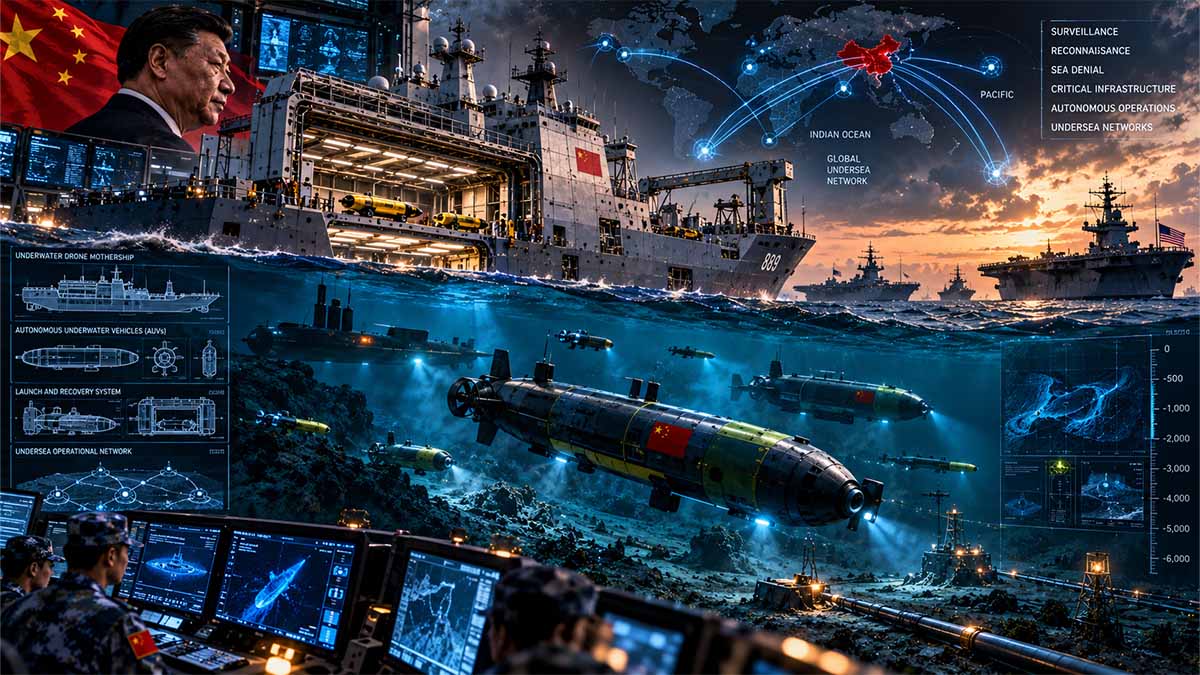
Strategic implications for undersea warfare, autonomous naval logistics, maritime intelligence, critical seabed infrastructure and the global balance of maritime capabilities, 2026–2031.
Scope. This assessment examines the emergence of two suspected Chinese motherships for extra-large unmanned underwater vehicles (XLUUVs), the evidence from Shanghai and Guangzhou through 26 October 2026, and the implications for Chinese naval development, Indo-Pacific competition, NATO, the European Union and the principal European maritime powers over the period to 2031.
Executive Summary — Bottom Line Up Front
Principal judgment. China’s construction of two similarly conceived but differently configured vessels with specialised stern-handling arrangements represents credible evidence of a developing support architecture for large unmanned underwater systems. It is not yet evidence of an operationally available, scalable XLUUV force.
Commercial satellite analysis places the first vessel at Hudong-Zhonghua’s Changxing Island facility in Shanghai and the second at the Longxue Island shipbuilding complex near Guangzhou. The larger hull is assessed at approximately 204 metres, compared with an estimated 150 metres for the smaller vessel. Both feature substantial internal mission spaces and unusual stern arrangements consistent with the possible launch and recovery of large submerged vehicles.
The existence of two variants is more significant than a simple increase in hull count. It suggests the possibility of parallel engineering development, operational experimentation and an attempt to resolve the logistical requirements of sustained underwater autonomy.
The decisive military capability, if demonstrated, would be the conversion of individual XLUUV missions into repeatable operational cycles: deployment, autonomous task execution, recovery, maintenance, energy replenishment, data exploitation and redeployment.
This would potentially increase Chinese undersea presence without requiring an equivalent expansion of crewed submarine deployments. It would also introduce vulnerabilities associated with concentrating maintenance, recovery and possibly command-support functions aboard identifiable surface vessels.
The principal unresolved questions concern launch-and-recovery performance, vehicle compatibility, operating endurance, maintenance capacity, fleet integration, communications security and actual operational availability. None can be established reliably from external imagery alone.
For the United States and Allied navies, the immediate consequence is an intelligence and force-development requirement, not a demonstrated deterioration in the existing naval balance. The relevant comparison is increasingly between integrated undersea operating systems rather than individual submarines or support ships.
European implications are especially important for the protection of submarine cables, offshore energy infrastructure, naval access and the ability of NATO and national authorities to sustain a common underwater operational picture.
Net assessment: China’s emerging mothership architecture warrants sustained strategic attention because it could provide the logistical foundation of persistent distributed underwater operations. Whether it becomes a significant change in maritime power depends on operational achievements that remain publicly unproven.
China’s Underwater Motherships: The New Contest for Naval Power Beneath the Surface
China may be approaching a consequential threshold in naval development, but its significance is being measured in the wrong units. Two unusual vessels observed at shipyards in Shanghai and Guangzhou suggest that Beijing is investing not merely in extra-large unmanned underwater vehicles (XLUUVs), but in the infrastructure required to sustain them at sea. The distinction carries immediate consequences for naval procurement, industrial competitiveness and the security of critical maritime infrastructure. A fleet of autonomous submarines has limited strategic value if it cannot be recovered, maintained, recharged and integrated into naval intelligence systems. The emerging competition is therefore not primarily about who builds the most underwater drones, but who can turn autonomous technology into persistent, reliable and economically sustainable maritime power. China’s new ships make that ambition credible. They do not yet demonstrate its achievement.
Two Chinese shipyards reveal a more consequential industrial decision
Commercial satellite imagery acquired between September and October 2026 identified two large Chinese vessels with unusual stern-handling arrangements, substantial enclosed mission spaces and characteristics consistent with the deployment and recovery of large underwater vehicles. The first appeared at Hudong-Zhonghua’s Changxing Island shipyard in Shanghai, where imagery dated 10 September showed an advanced construction stage and subsequent observations on 14 October confirmed that the vessel was afloat. The second emerged near Guangzhou, with archival satellite imagery dated 2 October linking its construction to the Guangzhou Shipyard International complex on Longxue Island.
The larger Shanghai vessel measures approximately 204 metres in length and 30 metres in beam. The Guangzhou platform is estimated at 150 metres. Their stern configurations also differ: the Shanghai design features twelve prominent vertical structures of differing heights, compared with six more uniform structures on the smaller vessel. These figures describe externally observed architecture, not confirmed underwater vehicle capacity or operational performance.
Their importance lies in the decision to construct two related but distinct platforms at separate industrial facilities. A single specialised vessel could remain an isolated research experiment. Two configurations suggest a potentially broader development requirement, whether through parallel prototyping, differentiated missions or competing engineering solutions. None of these explanations has been formally confirmed by the People’s Liberation Army Navy.
The industrial distinction is substantial. China appears to be examining the infrastructure needed to make large autonomous underwater systems recoverable and reusable from mobile maritime platforms. If successful, this would permit underwater missions to become part of a repeated operating cycle rather than remain dependent upon individual demonstrations or permanent coastal facilities.
The unresolved questions are equally important. Neither ship has been publicly demonstrated as an operational XLUUV mothership. Their assigned vehicles, maintenance capacity, command arrangements and readiness remain unconfirmed. China has demonstrated specialised shipbuilding investment, not yet a deployable autonomous underwater force.
The decisive numbers expose a competition over infrastructure, not tonnage
The strategic consequences become clearer when China’s construction activity is compared with the established programmes of its principal competitors.
The United States accepted its first Boeing Orca XLUUV test asset, designated XLE0, in December 2023, following initial testing. France’s Direction générale de l’armement contracted Naval Group in December 2023 to develop an unmanned combat underwater vehicle demonstrator, with the stated objective of evaluating a system exceeding 10 metres and 10 tonnes. Germany received its first Blue Whale large underwater vehicle on 25 February 2026, measuring 10.9 metres in length, 1.12 metres in diameter and weighing 5.5 tonnes. Britain’s experimental XV Excalibur, a 12-metre underwater vehicle developed through Project Cetus, was handed over for continued testing in December 2025.
These measurements are not directly comparable indicators of naval capability. They describe different classes of development, acquisition and experimentation. Nor does the delivery of an experimental vehicle establish fleet-wide operational availability.
The more significant Allied decision came on 30 May 2026, when Australia, the United Kingdom and the United States announced their first AUKUS Pillar II signature project, dedicated to interoperable underwater vehicle payloads and enabling technologies, with initial deliveries intended from 2027. The programme explicitly addresses common control systems, shared standards and compatibility across different national platforms.
That commitment followed Australia’s Maritime Big Play, reported on 19 February 2026, in which more than 200 military personnel, scientists and industry participants from the three AUKUS partners evaluated approximately 30 next-generation capabilities. The Australian-developed Speartooth underwater vehicle was employed as a platform for testing new payload configurations.
The figures reveal different institutional priorities. China’s suspected motherships point towards the physical support of underwater vehicles; AUKUS is formally investing in multinational interoperability; the European programmes demonstrate national approaches to vehicle development and maritime surveillance. None establishes decisive superiority.
Naval autonomy will be judged by mission availability, not prototype performance
The central engineering problem is the difference between keeping an underwater vehicle submerged and keeping an autonomous force operational.
A vehicle can possess considerable endurance while remaining unavailable for significant periods because of maintenance, technical inspection, energy replenishment or mission preparation. Dedicated motherships could alter this relationship by moving selected support functions closer to operational areas, reducing the need for every mission to terminate at a permanent naval base.
That model changes the economic calculation. The relevant measure becomes the sustained output of a complete system: underwater vehicles, recovery machinery, technical personnel, onboard energy services, software assurance, command arrangements and information processing.
The possible advantage is considerable, but so is the dependency. A mothership supporting several autonomous platforms becomes a concentrated logistical asset. Its mechanical failure, unavailability or inability to conduct recovery operations could interrupt multiple missions even when the underwater vehicles themselves remain functional.
This creates a contradiction in distributed naval warfare. Autonomous systems disperse activity beneath the surface while potentially concentrating essential support functions aboard identifiable ships above it.
The United Kingdom’s Atlantic Bastion, incorporated into the Strategic Defence Review 2025 and reinforced through December 2025 announcements, addresses the wider problem through a layered surveillance concept combining conventional warships, autonomous vehicles, acoustic detection and artificial intelligence. The programme illustrates why underwater autonomy must be understood as part of an integrated naval operating system rather than as a substitute for crewed platforms.
China’s vessels may eventually serve a comparable systems-integration purpose through a different support architecture. Their actual effectiveness will depend upon repeated recovery operations, reliable mission preparation, compatible underwater vehicles and the capacity to convert collected information into usable naval intelligence.
The seabed has become an economic security exposure
The development of large autonomous underwater systems carries consequences beyond submarine warfare because the underwater environment supports a substantial share of the world’s communications and energy infrastructure.
At its February 2025 international summit, the International Telecommunication Union reported that more than 99% of international data traffic passed through approximately 500 submarine telecommunications cables extending over 1.7 million kilometres. These installations support financial transactions, digital services, international communications and the operations of both public and private institutions.
The exposure is not uniform: alternative routes, spare capacity and repair arrangements differ across networks. Nevertheless, infrastructure disruption can produce economic consequences far removed from the location of physical damage.
The European Union has begun translating this vulnerability into a more structured investment framework. Following Commission Recommendation (EU) 2024/779 and the EU Action Plan on Cable Security adopted on 21 February 2025, the European Commission published its Cable Security Toolbox on 5 February 2026 and announced €347 million under the Connecting Europe Facility Digital programme.
The allocation included €60 million for cable repair modules, €20 million for smart monitoring equipment and €267 million planned for priority cable projects during 2026–2027. These are programme allocations and calls, not completed expenditure or operationally installed capacity.
The distinction is politically important. Monitoring infrastructure can improve knowledge of damage or abnormal conditions, but it cannot independently restore a severed connection. Repair capacity reduces service interruption, while alternative routes can limit the economic consequences of failure. A complete resilience policy requires all three.
NATO’s Baltic Sentry, launched on 14 January 2025, similarly reflects the increasing connection between maritime surveillance and critical infrastructure protection. It combines conventional maritime assets with emerging surveillance technologies and coordination among Allied authorities.
No verified evidence connects China’s newly observed motherships with attacks on submarine cables or other infrastructure. Their relevance lies in the potential expansion of underwater observation and the growing difficulty of distinguishing military reconnaissance, scientific activity and legitimate infrastructure inspection without reliable attribution.
Europe’s industrial response remains divided among four national models
Europe is not developing a single autonomous underwater force. Its principal maritime powers are pursuing different combinations of industrial sovereignty, procurement and operational integration.
Italy has concentrated its approach around the Polo Nazionale della Dimensione Subacquea at La Spezia. By June 2025, the Italian Navy reported participation by more than 110 organisations, including industrial companies, universities and research centres. The related NATO Underwater Centre of Excellence initiative attracted delegations from 12 Allied and eight partner countries during its February 2025 establishment conference. On 21 January 2026, Italy and Greece signed its Operational Memorandum of Understanding, advancing the establishment process without independently establishing completion of NATO accreditation.
The Italian challenge is to turn this institutional and industrial concentration into validated naval capabilities. Research capacity, industrial participation and international cooperation have economic value, but they cannot substitute for operational testing, compatible systems and procurement continuity.
France has followed a more directly defined national development pathway through Naval Group’s large underwater combat drone demonstrator. Its July 2026 decision to order twelve additional drones under the SLAM-F future mine-countermeasures programme, together with arrangements for drone-carrying vessels, demonstrates a separate commitment to the practical deployment of unmanned maritime systems. The combat underwater demonstrator and SLAM-F have different missions and cannot be treated as one operational programme.
Germany has advanced through acquisition of the Blue Whale system, developed through cooperation between TKMS ATLAS Elektronik and Israel Aerospace Industries’ ELTA organisation. Its intended functions include underwater reconnaissance and submarine detection. The procurement illustrates the advantages of international industrial cooperation, alongside the continuing importance of technical support, information security and national operating authority.
The United Kingdom combines Atlantic Bastion, XV Excalibur and AUKUS Pillar II participation. Its approach links North Atlantic surveillance requirements to wider technological cooperation, although common standards and future programme deliveries remain distinct from proven operational readiness.
For NATO, these differences present an interoperability challenge. For the European Union, they create an industrial-policy question: which technologies require sovereign national control, and where could common standards reduce duplication without compromising sensitive capabilities?
The cost of fragmentation is not simply higher expenditure. It is the possibility that advanced national systems will remain unable to exchange information or support one another effectively when operating within the same maritime environment.
The next 24 months will test whether construction becomes naval power
Between October 2026 and October 2028, the evidence most likely to change the assessment will not be the appearance of another unusual Chinese hull. It will be authenticated demonstrations of repeated underwater vehicle deployment, recovery, maintenance and redeployment, accompanied by evidence of naval command integration and operationally useful intelligence collection.
China’s two suspected motherships may remain experimental platforms. They may develop into specialised assets supporting selected missions, or become part of a larger system capable of sustaining distributed underwater operations. The present record does not establish which outcome will occur.
During the same period, AUKUS’s planned 2027 initial deliveries will test the credibility of its interoperability commitments. France’s demonstrator programme, Germany’s Blue Whale acquisition and Britain’s Atlantic Bastion will face the distinction between technical development and reliable military employment. Italy’s institutional investment must similarly demonstrate that research cooperation can produce equipment and procedures suitable for sustained naval operations.
The financial consequences will fall first on defence ministries and public procurement systems if specialised equipment is purchased before its integration and maintenance requirements are settled. Industrial suppliers will face the costs of incompatible standards and changing technical specifications. Infrastructure operators and the European economies dependent upon them will remain exposed where monitoring, redundancy and repair capacity fail to advance together.
The central policy choice is therefore measurable: governments can continue evaluating maritime strength primarily through individual platforms and announced programmes, or require evidence of the complete operational systems those investments are supposed to deliver.
China’s emerging XLUUV mothership architecture does not yet overturn the naval balance. It demonstrates why that balance can no longer be assessed through submarine inventories and surface-fleet tonnage alone. By October 2028, the decisive difference between ambition and capability will be visible in the reliability of autonomous operations, the interoperability of supporting systems and the extent to which underwater information actually improves naval decision-making. Governments that finance platforms without those supporting functions will bear the cost in underused equipment, weaker operational resilience and reduced returns on defence investment.
Navigational Index
Pillar I — Industrial Evidence, Naval Architecture and the Transition to Operational Capability
- Chapter 1. The Shanghai and Guangzhou Vessels: Imagery, Construction Evidence and Design Interpretation
- Chapter 2. Parallel Prototyping, Technical Maturation and the Institutional Logic of China’s Undersea Modernisation
- Chapter 3. The Autonomous Undersea Sustainment Chain: Recovery, Maintenance, Energy, Software, Communications and Data
Pillar II — Operational Reach, Seabed Security and the Changing Economics of Maritime Power
- Chapter 4. Distributed Underwater Presence, Surveillance and Maritime Situational Awareness
- Chapter 5. Anti-Submarine Warfare, Intelligence Collection and the Strategic Importance of Critical Seabed Infrastructure
- Chapter 6. Surface Support Ships as Operational Enablers and Centres of Vulnerability
Pillar III — Global Naval Competition, Allied Adaptation and Strategic Outlook to 2031
- Chapter 7. China, the United States and the Indo-Pacific Undersea Balance
- Chapter 8. NATO, the European Union, Italy, France, Germany and the United Kingdom: Differentiated Strategic Exposure
- Chapter 9. Development Pathways, Warning Indicators, Policy Choices and the Final Strategic Assessment
Master Abstract
The appearance of a second Chinese vessel potentially dedicated to large autonomous underwater systems raises an institutional and operational question that is more important than the novelty of its external design: whether the People’s Liberation Army Navy is developing the logistical capacity to sustain underwater missions beyond the limitations imposed by individual vehicle endurance and permanent shore installations. The emerging evidence is consistent with such a development, although it does not yet prove the mission assignment or operational readiness of either ship. The larger vessel at Shanghai and the smaller example associated with Guangzhou share a general architectural concept while differing in dimensions and stern-handling configurations. This combination is consistent with parallel experimentation, variant specialisation or an evolving support-ship design, but cannot establish which explanation the Chinese authorities have adopted.
The strategic mechanism is the transformation of autonomous underwater vehicles from individually deployed systems into elements of a supportable maritime network. Vehicle endurance matters, but force-level persistence depends on the capacity to recover platforms, conduct maintenance, replenish energy, transfer mission data, update instructions and return them to operational service. Dedicated motherships could relocate part of this supporting infrastructure to sea, allowing successive missions to be conducted without requiring every vehicle to return to a permanent coastal base. In favourable conditions, this would improve the feasibility of geographically distributed surveillance and potentially increase the frequency with which autonomous underwater assets could contribute to a wider naval intelligence picture.
That advantage is conditional rather than automatic. Autonomous underwater vehicles cannot provide genuinely continuous situational awareness unless collected information reaches command authorities in a usable form and timeframe. Underwater communication limitations, uncertain vehicle reliability, the complexity of recovery operations and the need to maintain specialised support personnel all constrain the promised operational benefits. The mothership also becomes a potential concentration of risk: a visible surface platform whose loss or disruption could compromise multiple underwater missions. The resulting architecture therefore combines greater dispersion of operational effects with possible centralisation of logistical dependencies.
This development matters internationally because naval competition is increasingly influenced by the quality and persistence of underwater information, not solely by the number of surface combatants or crewed submarines. The United States, United Kingdom and NATO have already documented investments in unmanned underwater systems and integrated maritime surveillance. Meanwhile, the European Union is strengthening measures to protect submarine cables and associated infrastructure. These initiatives are not direct evidence of a response to the Chinese vessels; they demonstrate that several maritime powers are adapting to a shared strategic problem: sustaining awareness, security and operational resilience beneath the surface.
The principal assessment for 2026–2031 is that China’s two suspected support ships should be viewed as a potentially significant enabling investment whose eventual military value will be determined by repeated sea operations, integrated mission cycles, logistical reliability and demonstrated employment. Additional construction would strengthen the evidence of industrial commitment, but only operational performance can establish the emergence of a deployable XLUUV force capable of affecting the regional or global maritime balance.
Key Evidence Table
The available record supports a physical and institutional baseline, but not quantitative estimates of XLUUV endurance, payload, sortie generation or operational coverage. Dimensions derived from commercial imagery remain approximate observations rather than officially declared ship specifications.
| Indicator | Value / status | Reference date | Definition and scope | Issuer / provenance | Exact source |
|---|---|---|---|---|---|
| Larger suspected mothership | Approximately 204 m length, 30 m beam | Sept.–Oct. 2026 | Image-derived hull measurements, not official specifications | Vantor imagery, assessed by Janes | Janes imagery assessment |
| Shanghai construction site | Hudong-Zhonghua, Changxing Island | 14 Oct. 2026 imagery | Vessel observed afloat alongside the facility | Commercial satellite imagery | Janes assessment |
| Second suspected mothership | Approximately 150 m length | Oct. 2026 | Provisional image-based estimate | Specialist imagery interpretation | Naval News, 18 Oct. 2026 |
| Guangzhou construction attribution | Longxue Island, GSI/COMEC facility | 2 Oct. 2026 imagery | Satellite-supported attribution; not official confirmation | Planet Labs imagery interpreted by TWZ | TWZ, 18 Oct. 2026 |
| Stern-handling configurations | Twelve structures on Shanghai design; six on Guangzhou design | Sept.–Oct. 2026 | Visible design comparison; mechanism and function unconfirmed | Specialist imagery interpretation | Naval News |
| US XLUUV programme | First Orca test asset accepted | Dec. 2023 | Developmental milestone, not proof of fleet readiness | US Naval Sea Systems Command | NAVSEA, 20 Dec. 2023 |
| British underwater autonomy | Atlantic Bastion publicly announced | 8 Dec. 2025 | Integrated surveillance architecture combining autonomous and crewed systems | UK Ministry of Defence | UK MoD |
| NATO critical infrastructure security | Baltic Sentry launched | 14 Jan. 2025 | Maritime security and infrastructure-surveillance activity | NATO | NATO |
| EU submarine cable security | €347 million work-programme allocation | 5 Feb. 2026 | Strategic cable-related projects, including repair capabilities; not a Chinese-specific response | European Commission | European Commission |
The distinction between imagery evidence and institutional evidence is essential. The Chinese ship observations originate from commercial imagery and specialist interpretation; no accessible Chinese governmental or naval document independently confirms that either vessel has been designated an XLUUV mothership. Accordingly, these sources support attributed physical observations, not definitive claims of official mission assignment.
In the Guangzhou case, the available specialist assessments also differ in confidence. TWZ attributes construction to Guangzhou Shipyard International on the basis of a 2 October Planet Labs image, while Naval News treats the Longxue Island yard as a plausible origin and cautions that further imagery is needed to establish the builder and fitting-out destination. This discrepancy concerns the strength of the attribution, rather than whether the unusual second hull was observed.
Competing Explanations and Development Pathways
The appearance of two ships supports three distinct but potentially overlapping explanations. The evidence is sufficiently specific to compare them, although not to assign numerical probabilities. The central analytical distinction is between industrial experimentation, preparation for an operational support capability and broader naval auxiliary development whose final mission remains unsettled.
| Hypothesis | Diagnostic support | Disconfirming evidence or limitation | Indicators | Current standing |
|---|---|---|---|---|
| H1 — Parallel experimental platforms | Different hull sizes and handling arrangements consistent with evaluating alternative designs | No publicly verified experimental programme or comparative trial results | Sea trials, handling demonstrations, design modifications | Plausible; consistent with observed differences |
| H2 — Initial operational XLUUV support architecture | Two purpose-configured hulls potentially designed for deployment, recovery and onboard support | No confirmed operational vehicle complement, readiness status or deployments | Repeated recovery cycles, vehicle integration, distant operations | Strategically consequential but not demonstrated |
| H3 — Broader naval auxiliary or technology-development function | Large mission spaces could accommodate functions beyond XLUUV operations | Similar unusual stern configurations strengthen the case for a common specialised mission | Final equipment fit, official designation, observed mission activities | Remains possible; insufficient evidence for exclusion |
The evidence presently favours the narrower conclusion that China is developing specialised maritime support capabilities potentially associated with large autonomous underwater vehicles. H1 and H2 could describe successive stages of the same programme rather than competing endpoints.
The repeated appearance of unusual architectural features makes a common design requirement more credible than an interpretation based on one isolated experimental ship. Nevertheless, neither design similarity nor construction tempo establishes that Beijing has approved an operational force structure, selected final vehicle types or validated the ability to conduct sustained autonomous operations.
The evolution from H1 towards H2 would become materially more credible through repeated observations of operationally relevant recovery activity. Conversely, continued shipyard modifications without corresponding sea operations would suggest that the technology remains in an engineering and experimentation phase.
Principal Gaps and Watch Indicators
Mission designation and institutional ownership. No publicly verified Chinese naval designation, programme document or formal mission description establishes the intended function of either ship. Confirmation through an authoritative naval announcement or other authenticated primary documentation would materially strengthen the baseline. Shipyard imagery is insufficient to establish whether the vessels belong to an operational command, technical establishment or experimentation programme.
Launch-and-recovery capability. The stern structures suggest specialised handling arrangements, but the imagery does not establish their actual working mechanism, sea-state limitations or compatibility with individual underwater vehicles. Observation of repeated launches and recoveries would provide the most consequential evidence that the concept is moving beyond physical construction.
Autonomous vehicle integration. The public record does not identify a verified complement of XLUUVs assigned to these platforms. The capacity to support several vehicles, inferred from available space, must not be confused with an actual deployed inventory. Evidence of vehicles operating routinely with the support ships would distinguish nominal design capacity from realised operational capability.
Forward sustainment and logistical independence. It remains unknown how much maintenance, energy replenishment, technical preparation and mission-data exploitation could be performed aboard either vessel. The decisive indicator would be the completion of successive missions without the underwater vehicles returning to permanent shore facilities after each recovery.
Command connectivity and information exploitation. No verified evidence identifies the intended relationship between the ships, underwater vehicles and Chinese naval command networks. Observable demonstrations of integrated mission management would strengthen the assessment that the architecture supports a persistent intelligence or operational function rather than isolated vehicle testing.
Survivability and operational resilience. The effect of disruption to a mothership cannot be assessed without knowing how many vehicles depend on it, which support functions are duplicated elsewhere and whether recovery can be transferred between platforms. The presence of two ships does not establish logistical redundancy unless their systems and procedures are demonstrably interoperable.
Fleet-scale development. Further construction would be significant, particularly if additional vessels repeated identifiable design features. However, serial construction would establish industrial commitment more directly than operational readiness. Repeated deployments, maintenance performance and sustained mission cycles would remain the stronger indicators.
These gaps matter because the strategic value of an autonomous underwater system is cumulative. Industrial capacity creates platforms; engineering reliability makes deployment repeatable; logistics sustains operations; data exploitation transforms observations into intelligence; and naval integration determines whether intelligence produces an operational advantage. A failure at any transition can substantially reduce the strategic return on the entire investment.
Strategic Transmission Mechanism
The relationship between the observed ships and possible changes in the maritime balance can be represented as a conditional dependency chain. The component below distinguishes the physical evidence from the operational functions that would still require demonstration.
From Dedicated Support Ships to Undersea Power
Evidence-to-effect framework: proposed causal relationships, not verified operational achievements.
Specialised ship architecture
Two distinct Chinese hulls with unusual stern-handling configurations and extensive mission spaces.
At-sea sustainment
Reliable vehicle deployment, recovery, inspection, maintenance, energy replenishment and redeployment.
Persistent distributed presence
Successive underwater missions supported without mandatory return to a permanent shore base after every cycle.
Mission-data exploitation
Collection must be validated, processed and integrated into naval command systems.
Improved undersea awareness
Potentially better surveillance continuity, infrastructure monitoring and support to naval decision-making.
Concentrated support risk
Mission disruption if identifiable surface ships become unavailable or their recovery and support functions are degraded.
Interpretation: Only the initial architectural observations
are supported by publicly reported imagery. All subsequent stages are
conditional mechanisms requiring operational verification.
No performance figures, sortie rates or probabilities are assumed.
Sources:
Janes, 2026;
Naval News, 18 October 2026.
The principal strategic conclusion of this opening assessment is that China may be creating an important new supporting layer of its maritime force structure. The observed vessels provide credible evidence of investment in specialised support infrastructure, but the decisive capability remains contingent on achieving sustained, repeatable and integrated underwater operations.
Consequently, the appropriate analytical threshold for identifying a genuine change in the naval balance is not the completion of two unusual hulls. It is the demonstrable conversion of those hulls into dependable enabling platforms for autonomous underwater missions, with measurable improvements in operational continuity and maritime situational awareness. Until such evidence becomes available, the architecture should be treated as an emerging capability with potentially substantial consequences, rather than an accomplished shift in undersea superiority.
CHINA’S UNDERSEA POWER SHIFT
The Emerging XLUUV Mothership Architecture
An evidence-governed assessment of two suspected Chinese underwater-drone support ships, their architectural differences, logistical dependencies, potential operational functions and consequences for international maritime security.
Observed physical evidence Conditional capability assessment Operational evidence gapsTwo Hulls, One Emerging Operational Concept
Commercial imagery and specialist interpretation identify two unusually configured Chinese vessels. Their differing dimensions and stern arrangements suggest that more than one technical configuration may be under examination. Neither ship’s intended XLUUV role has been officially confirmed in the examined public record.
Hudong-Zhonghua, Changxing Island
Suspected XLUUV support vesselEstimated overall length from imagery analysis.
Estimated beam: approximately 30 m.
Stern architecture: twelve prominent structures of differing heights, interpreted as possible elements of a specialised handling arrangement.
Imagery reference: September–October 2026. Designation, mission assignment and readiness are unconfirmed.
Longxue Island Shipbuilding Complex
Suspected second XLUUV support vesselProvisional overall-length estimate.
Construction attribution: Guangzhou Shipyard International / COMEC facility, based on satellite-image interpretation.
Stern architecture: six comparatively uniform structures associated with a possible specialised recovery arrangement.
Satellite reference: 2 October 2026. Builder attribution and mission designation remain provisional.
Assessment: The general architectural similarity is consistent with a common specialised support requirement. Differences in size and handling arrangements are consistent with parallel experimentation or differentiated roles, but do not establish either explanation conclusively.
Image-Derived Dimensions and Visible Stern Structures
The following 3D-effect bar graphs use a common zero-based scale within each comparison. Values are approximate or provisional imagery interpretations. The graphs do not represent officially declared ship specifications.
Estimated Hull Length
Metres | Axis: 0–220 | Approximate measurements
Indicative difference: approximately 54 metres. This comparison measures reported external length only, not vehicle capacity or logistical performance.
Prominent Stern Structures
Visible structure count | Axis: 0–12
These counts describe interpreted visible features. They must not be converted into estimates of underwater-vehicle complement, simultaneous recovery capacity or sortie rate.
What Is Observed, What Is Inferred, What Remains Unknown
This matrix prevents construction evidence from being mistaken for demonstrated operational capability. Public specialist reporting provides the vessel-specific observations; official documentation supports the wider Allied institutional context.
| Indicator | Documented observation | Interpretation | Evidence status |
|---|---|---|---|
| Shanghai vessel | Large unusual hull at Changxing Island, observed afloat in October 2026 imagery. | Possible dedicated support ship for large unmanned underwater vehicles. | Mission inferred |
| Guangzhou vessel | Second unusual hull linked to Longxue Island imagery and subsequent visual material. | Possible second support vessel sharing an emerging architectural concept. | Attribution provisional |
| Different configurations | Different estimated hull lengths and stern arrangements. | Parallel prototyping or different support roles are possible. | Analytical judgment |
| At-sea recovery | No verified repeated XLUUV recovery cycle established in the examined material. | Required to demonstrate practical sustainment capability. | Not demonstrated |
| Force integration | No confirmed deployed XLUUV complement or operational command relationship. | Essential to establish fleet-scale mission effectiveness. | Open question |
| Strategic effect | No verified measurement of persistent underwater coverage or mission output. | Potential increase in distributed surveillance and sustained presence. | Conditional |
The Six Functions Required for Persistent Autonomous Undersea Operations
The mothership’s potential strategic contribution lies in supporting a repeatable cycle, not merely launching underwater vehicles. Each 3D-effect block describes a necessary function. This is an analytical dependency model, not a verified Chinese operating procedure.
Mission Preparation
Establish mission parameters, vehicle condition, operational authority and required data before deployment.
Deployment and Recovery
Achieve safe, repeatable handling of large underwater vehicles across operationally relevant maritime conditions.
Autonomous Mission Execution
Conduct authorised underwater activity while accounting for navigation, sensing and communication limitations.
Maintenance and Energy
Inspect the vehicle, resolve technical faults and replenish the resources required for subsequent operations.
Secure System Management
Manage software configurations, communications security, mission updates and the integrity of control systems.
Data Exploitation and Retasking
Retrieve and validate observations, integrate them into the maritime picture and prepare subsequent missions.
Critical analytical distinction: A long-endurance underwater vehicle does not automatically produce force-level persistence. Persistence depends on reliable recovery, rapid restoration of mission availability, information management and subsequent redeployment.
Distributed Underwater Effects, Concentrated Surface Dependencies
Dedicated support ships could improve the sustainment of dispersed underwater systems, while creating identifiable dependencies above the surface. These columns compare mechanisms, not measured risk probabilities or operational effectiveness.
Operational Opportunities
Repeatable missions could improve the continuity of underwater observation.
Multiple underwater systems could collect observations across geographically separated operating areas.
Mobile support could reduce dependence on returning every vehicle to a fixed shore facility.
Repeated inspection missions could supplement existing surveillance of strategically relevant underwater installations.
Autonomous collection could complement conventional naval sensors and crewed submarine operations.
Dependencies and Vulnerabilities
Unavailability of a mothership could disrupt multiple dependent autonomous missions.
Underwater transmission constraints may delay or restrict the operational use of data.
Sea conditions, vehicle failures and handling constraints may limit mission continuity.
Software and mission-data systems require secure management throughout repeated cycles.
Surface protection, logistics and command arrangements remain necessary in contested areas.
Three Plausible Interpretations of the Two-Vessel Programme
The hypotheses are not necessarily mutually exclusive. They describe potentially overlapping development purposes and stages. No numerical confidence percentages have been assigned.
Parallel Experimental Platforms
PlausibleDifferent configurations could support comparative engineering trials and iterative refinement of underwater vehicle handling procedures.
Decisive indicators: repeated trials, design revisions and documented recovery demonstrations.
Initial Operational Support Architecture
Not establishedThe ships could become an initial framework for deploying and sustaining autonomous underwater vehicles away from permanent shore bases.
Decisive indicators: routine deployments, reliable turnaround and observable fleet integration.
Broader Specialised Naval Auxiliary Role
Remains possibleTheir large mission spaces and handling arrangements might serve several experimental or naval support functions rather than an exclusively XLUUV mission.
Decisive indicators: official designations, final installed equipment and observed operational employment.
Differentiated Implications for Major Maritime Powers
These assessments identify distinct strategic exposures and established institutional responses. They do not imply that every initiative listed was launched in response to the Chinese vessels.
Undersea Support Architecture
The strategic objective under assessment is the integration of autonomous vehicles, sustainment, data exploitation and naval command. Operational maturity remains unconfirmed.
XLUUV Development and Integration
The Orca programme provides an established US developmental reference. Competitive assessment requires distinguishing test-system delivery from operational fleet availability.
Atlantic Bastion and Autonomous Awareness
British programmes explicitly link autonomous systems, acoustic surveillance and maritime intelligence within a broader undersea architecture.
Mediterranean Undersea Resilience
The national underwater domain and NATO-related research initiatives at La Spezia reinforce the importance of naval experimentation, industrial integration and infrastructure security.
Global Maritime and Submarine Responsibilities
Autonomous systems present opportunities to supplement surveillance and seabed observation, while demanding integration with existing naval command and submarine operations.
Baltic and North Sea Infrastructure Security
Maritime surveillance, civil-military coordination and protection of underwater infrastructure form a particularly relevant national security interface.
Collective Maritime Situational Awareness
Baltic Sentry illustrates the growing importance of integrated monitoring and coordinated protection of critical underwater infrastructure.
Cable Security and System Resilience
EU measures address prevention, detection, response, repair and resilience for submarine cable networks and associated infrastructure.
Future Operating Environment
The maturity of Chinese autonomous undersea sustainment could influence regional surveillance requirements, information security and naval resilience, subject to demonstrated deployments.
2026–2031: From Observed Hulls to Potential Naval Capability
This is an evidence-and-decision sequence, not a forecast of when Chinese milestones will occur. The later stages identify capabilities that would require demonstration during the adopted assessment horizon.
2026 Baseline
Two unusual hulls observed through commercially available imagery and specialist analysis. Specialised mission remains inferred.
Technical Validation
Evidence required: repeated launches, recoveries, technical servicing and reliable onboard support functions.
Operational Integration
Evidence required: assigned vehicle complements, routine mission cycles, data exploitation and command-system integration.
Force-Level Persistence
Evidence required: sustained operations, resilient support arrangements and demonstrable continuity of underwater presence.
| Watch indicator | Positive evidence | What it would establish | Remaining limitation |
|---|---|---|---|
| Repeated recovery trials | Documented launch-and-recovery cycles | Technical handling feasibility | Does not alone establish sustained deployment |
| Integrated vehicle complement | Observed or officially identified assigned XLUUVs | Vehicle-to-host integration | Does not establish readiness rates |
| Forward sustainment | Successive missions supported at sea | Reduced mission dependence on fixed bases | Does not prove contested-environment resilience |
| Data and command integration | Authenticated evidence of operational information exchange | Progress towards fleet-level employment | Timeliness and reliability must still be assessed |
| Additional standardised vessels | Further hulls sharing confirmed mission architecture | Possible industrial expansion or design consolidation | Production is not equivalent to operational availability |
| Sustained distributed operations | Repeatable multi-vehicle missions over time | Stronger evidence of persistent undersea capability | Actual military effect remains mission dependent |
The Decisive Variable Is Sustainable Underwater Presence
Industrial development: Two suspected specialised support ships make China’s investment in possible XLUUV sustainment infrastructure more credible than a single isolated experimental hull.
Operational transmission: The relevant mechanism connects reliable recovery, maintenance, energy replenishment, software management and intelligence exploitation to repeated autonomous missions.
Competitive consequence: If these functions mature, Chinese naval forces could obtain more persistent distributed underwater observation and additional operational flexibility.
Countervailing exposure: The same system could concentrate essential supporting functions aboard identifiable ships, making resilience and continuity of support central determinants of effectiveness.
Assessment as of 26 October 2026: The available evidence supports an emerging support-architecture hypothesis, not a conclusion that China has achieved operational XLUUV superiority or demonstrated fleet-scale deployment.
PILLAR I — INDUSTRIAL EVIDENCE, NAVAL ARCHITECTURE AND THE TRANSITION TO OPERATIONAL CAPABILITY
China’s Emerging XLUUV Mothership Programme: Industrial Verification, Parallel Naval Experimentation and the Engineering Foundations of Persistent Autonomous Undersea Operations
Open-Source Institutional Intelligence Assessment | Evidence cut-off: 26 October 2026 | Strategic horizon: 2026–2031
Chapter 1. The Shanghai and Guangzhou Vessels: Imagery, Construction Evidence and Design Interpretation
The emergence of a distinct naval support architecture
China’s development of two large, unusually configured vessels at separate shipbuilding facilities represents a more consequential industrial indicator than the appearance of a single experimental naval platform. The significance of the discovery is not confined to the prospect that the People’s Liberation Army Navy may eventually operate dedicated motherships for extra-large unmanned underwater vehicles. It lies in the observable investment in the physical infrastructure required to integrate underwater autonomous systems with mobile surface platforms, an engineering undertaking that differs substantially from the development of the underwater vehicles themselves. A navy can acquire or demonstrate autonomous underwater vehicles without possessing the means to sustain them over repeated deployments at sea. Building specialised ships with extensive internal mission spaces, stern openings and apparent lifting arrangements suggests an attempt to address that supporting requirement at the level of naval architecture. As of 26 October 2026, commercial satellite imagery and publicly circulated photographs provide credible evidence of two separate hulls sharing important design characteristics. They do not establish that either vessel has entered operational service, that both have an officially designated XLUUV mission, or that China has demonstrated an integrated system capable of repeatedly deploying and recovering very large underwater vehicles under operational conditions. The defensible conclusion is therefore that Beijing appears to be investing in a specialised naval support capability whose ultimate function may extend well beyond experimental vehicle handling, but whose operational maturity remains unproven.
The evidentiary foundation is stronger than a single social-media sighting because the observations derive from several dated imaging events, identifiable shipbuilding locations and separately conducted specialist analyses. The first vessel was identified at Hudong-Zhonghua’s Changxing Island facility in Shanghai, where commercial imagery documented a large hull with an unusual stern arrangement. The second emerged in images recorded around Guangzhou, and subsequent examination of historical satellite imagery connected it to the Longxue Island shipbuilding complex. Janes reported that satellite imagery acquired on 14 October showed the larger Shanghai vessel afloat alongside the shipyard, while earlier images had placed it under construction in mid-September. The smaller vessel appeared in material distributed through Chinese social media, and historical imagery examined by Janes supported an origin at Longxue Island. The important distinction is that the physical presence of the vessels is substantially better supported than the precise operational purpose attributed to their specialised structures. China Launches Vessels Potentially Designed to Support Large UUVs — Janes — October 2026.
Shanghai: construction chronology and the significance of the stern arrangement
The Shanghai vessel provides the more extensive photographic and satellite record, making it the principal architectural reference against which the Guangzhou design can be assessed. Imagery obtained by The War Zone from Vantor and dated 10 September 2026 showed the vessel at an advanced stage of construction. The same investigation identified evidence of construction activity at Hudong-Zhonghua from at least April 2026 and examined additional satellite imagery dated 24 August. This chronology matters because it establishes an observable progression from a hull under construction to a vessel subsequently seen afloat, rather than relying on a single image interpreted without a construction history. It also permits a more disciplined distinction between structures already integrated into the ship and equipment potentially associated with subsequent fitting-out. A cradle-like platform visible near the stern during construction, together with the unusually extensive enclosed superstructure and a series of vertical supporting members, strengthens the hypothesis that the vessel has been designed around the movement and handling of large payloads. The spatial arrangement is particularly relevant because a conventional naval auxiliary would not necessarily require such an extensive combination of enclosed mission volume, stern access and specialised vertical structures. Nevertheless, the observed geometry does not independently establish the operating sequence, the dimensions of vehicles intended for handling or the environmental conditions under which recovery would be possible. China Appears to Be Building a Mothership for Large Uncrewed Submarines — The War Zone — 24 September 2026.
The dimensions reported by Janes place the Shanghai hull at approximately 204 metres in length and 30 metres in beam, measurements derived from satellite imagery rather than published Chinese naval specifications. The length is strategically meaningful principally because it establishes the scale of the host platform: this is not a small unmanned-systems launch craft, but a substantial vessel with considerable space potentially available for mission handling, technical work and supporting equipment. The ratio between length and beam, approximately 6.8 based on those indicative measurements, offers a basic description of the hull’s external proportions; it does not establish displacement, internal volume, stability, propulsion performance or seakeeping behaviour. The same caution applies to the comparison with conventional amphibious vessels of broadly similar length. External dimensional comparability may help identify the scale of an unfamiliar platform, but it cannot establish comparable displacement, aviation capacity, survivability or logistical capability. The ship’s naval-grey external appearance, reported in photographs published after the initial satellite observations, is consistent with a possible military destination. It is not independently sufficient to determine its formal status, service assignment or classification.
The central architectural feature is the large opening at the stern and the associated structures extending above the after mission area. The September imagery revealed twelve prominent vertical members, including six larger elements paired with six shorter ones, while a substantial cradle-like platform was visible alongside the ship. The War Zone described the platform as approximately 50 metres long, based on imagery interpretation, and connected the arrangement to the possibility of raising, lowering or transferring very large underwater payloads. Naval News subsequently reported that the system could be intended to move a cradle through a well-deck-like stern arrangement, permitting the handling of underwater vehicles significantly larger than those normally associated with shipborne autonomous missions. These observations provide stronger evidence of a specialised handling requirement than the mere presence of a stern opening. However, the approximately 50-metre cradle dimension is not a declared maximum payload length, and the twelve vertical structures are not equivalent to twelve independent launch positions. Their number cannot legitimately be converted into estimates of simultaneous vehicle capacity, recovery frequency or internal storage arrangements. China Appears to Be Building a Mothership for Large Uncrewed Submarines — The War Zone — 24 September 2026; Second Possible Chinese UUV Mothership Appears in Guangzhou — Naval News — 18 October 2026.
The apparent provision for moving large loads through an internal or partially enclosed stern handling area is particularly relevant to the engineering interpretation. Launching an autonomous underwater vehicle is only one function in the wider operating cycle; recovering the same vehicle and returning it safely to an area where maintenance and preparation can occur may be more demanding. A conventional deck crane can move loads between a ship and the surrounding water, but its suitability for repeated handling of very large, hydrodynamically shaped vehicles depends on factors including load control, vessel movement, the relative motion of the payload and available working space. A cradle arrangement could address some of these constraints by supporting the vehicle over a larger portion of its length and providing a more controlled transition between water and ship. This is an engineering explanation of the apparent design logic, not evidence that the Shanghai vessel has demonstrated such a system. Whether recovery occurs through a flooded well deck, a mechanically lowered platform or a more complex combination of arrangements cannot be settled from the publicly available external observations. The distinction has direct analytical consequences because different mechanisms impose different limitations on sea conditions, maintenance accessibility, recovery duration and the types of underwater vehicle that can be supported.
The forward superstructure and extended enclosed mission volume deserve attention independent of the stern mechanism. An unusually substantial superstructure extending over much of the ship’s length would be consistent with requirements for sheltered payload handling, technical accommodation or protected maintenance spaces, although no public compartment plan confirms that interpretation. Such internal capacity would become operationally important if the vessel were expected to support underwater systems whose sensitive mechanical, electrical or computing equipment could require inspection and intervention after recovery. An enclosed working environment could also provide more predictable conditions for mission preparation, reduce exposure of equipment to adverse weather and potentially limit external observation of payload handling. Yet these advantages depend on the actual internal configuration. External imagery cannot establish whether the vessel contains fully equipped maintenance workshops, specialised energy systems, autonomous-vehicle control centres or secure data-processing facilities. The assessment must therefore separate the architectural possibility of accommodating those functions from verified evidence that the equipment has been installed.
Other visible features offer limited additional guidance. The vessel’s forward deck arrangement and openings within or near the superstructure have prompted suggestions of possible aviation-support functions, while external exhaust arrangements indicate provision for conventional ship propulsion and auxiliary machinery. Neither observation proves helicopter-operating capability, aviation certification or a particular propulsion specification. In particular, an apparently suitable deck area should not be equated with a commissioned flight deck, and openings that resemble hangar access points do not establish an aircraft complement. These details matter to an intelligence assessment because they illustrate the limits of imagery-derived classification: ship geometry can reveal design choices and possible functional priorities, but only the later fitting-out process, sea trials and observed operations can establish which of those possibilities were incorporated into the completed platform.
Guangzhou: the second hull and the strengthening of the industrial evidence
The emergence of the Guangzhou vessel in October 2026 materially changed the evidentiary context of the Shanghai discovery. A single highly specialised ship can be interpreted as a one-off experimental platform, a research vessel, a naval auxiliary with an unusual mission or a prototype whose future remains uncertain. A second hull sharing a substantial portion of the design’s defining architecture makes the hypothesis of a broader development requirement more credible. The initial public evidence consisted of short video sequences and still images showing the vessel under tow on the Pearl River near Guangzhou. Naval News identified surrounding landmarks that supported the reported location, including the presence of the GAC research and development complex, while also noting that the authenticity of the original footage had not been conclusively established. Its analysis described a ship apparently still undergoing completion, with visible scaffolding and an absence of some sensor and communications equipment. These details are material because a vessel under tow in an apparently incomplete condition should not be described as commissioned, mission-ready or operationally available. Second Possible Chinese UUV Mothership Appears in Guangzhou — Naval News — 18 October 2026.
The War Zone subsequently examined archival Planet Labs imagery from 2 October 2026 and attributed construction of the smaller ship to Guangzhou Shipyard International’s Longxue Island facility. Janes independently reported that historical commercial satellite imagery associated the smaller vessel with Longxue Island. This substantially improves confidence in the construction-location assessment, although source distinctions remain relevant. Naval News initially treated the builder attribution as provisional and identified other facilities as possible locations for subsequent fitting-out, whereas The War Zone expressed greater confidence that the hull had been constructed at GSI. These accounts should not be collapsed into a single assertion of identical evidentiary confidence: they differ in the extent of retrospective imagery examined and the distinction between construction origin and the location of subsequent completion work. Furthermore, the same Planet Labs image and its subsequent interpretations do not become independent evidence merely because several publications repeat the conclusion. The strongest formulation is that the GSI construction attribution is supported by historical satellite examination, while the vessel’s final fitting-out arrangements and formal naval designation remain publicly unresolved. Second Chinese Submarine Drone Mothership Emerges — The War Zone — 18 October 2026; China Launches Vessels Potentially Designed to Support Large UUVs — Janes — October 2026.
At approximately 150 metres, the Guangzhou vessel is substantially shorter than the Shanghai design. More important than this reduction in length is the simultaneous preservation of the features most closely associated with the suspected mission. The smaller ship retains a raised forward superstructure, substantial mission space towards the stern and an unusual handling arrangement positioned around the after opening. Naval News identified six extended vertical structures of broadly similar height, compared with the twelve mixed-height members visible on the Shanghai vessel. It also described differences in hull shaping, including the more pronounced inward angling of the upper hull on the larger design and the more conventional external lines of the smaller vessel. The exhaust arrangements and superstructure geometry also differ, although the significance of those differences for installed machinery cannot be determined without technical records. These observations suggest that the Guangzhou hull is not simply an exact, uniformly scaled reproduction of the Shanghai ship. It is better understood as a related configuration whose common features may reflect a shared mission requirement and whose differences could reflect alternative engineering solutions, different intended operating conditions or distinct mission capacities. Second Possible Chinese UUV Mothership Appears in Guangzhou — Naval News — 18 October 2026.
The approximately 54-metre difference in reported overall length is a useful descriptive measurement, but should not be used to infer the difference in payload volume or underwater vehicle capacity. A vessel’s effective mission capacity depends on deck arrangements, internal compartment dimensions, structural reinforcement, the machinery required for handling operations and the amount of space allocated to fuel, electrical generation, accommodation and maintenance. The two ships could therefore have significantly different support capabilities despite sharing the same broad architectural purpose. Equally, they might employ related handling equipment within differently sized host platforms. Neither proposition has yet been established. The significance of the visible differences is that they create an identifiable basis for subsequent comparison: if future imagery reveals common handling sequences, interchangeable vehicle types or similar recovery mechanisms, the hypothesis of a common operational architecture would strengthen. If the two vessels instead demonstrate different roles, the initial interpretation would require revision.
Quantitative comparison and evidentiary boundaries
| Architectural indicator | Shanghai vessel | Guangzhou vessel | Analytical significance |
|---|---|---|---|
| Construction location | Hudong-Zhonghua, Changxing Island | Longxue Island, attributed to GSI | Two distinct industrial sites associated with specialised construction |
| Identified construction evidence | At least April 2026 | 2 October 2026 archival imagery | Dates establish observation windows, not contract award or construction commencement |
| Important dated imagery | 24 August, 10 September and 14 October 2026 | 2 October imagery and October video material | Stronger documented chronological sequence for Shanghai |
| Reported overall length | Approximately 204 m | Approximately 150 m | Different overall design scales |
| Reported beam | Approximately 30 m | No comparably verified figure established | Beam comparison cannot be completed |
| Length difference | Baseline | Approximately 54 m shorter | Calculated from approximate estimates; indicative only |
| Length ratio | 1.00 | Approximately 0.74 | Does not measure relative displacement or internal capacity |
| Visible stern structures | 12 mixed-height members | 6 generally uniform members | Differing handling-system geometries |
| Stern arrangement | Large opening with associated cradle-like structure | Large opening with modified lifting arrangement | Common feature supports a possible shared mission requirement |
| Superstructure | Extensive enclosed volume | Smaller but similarly arranged mission volume | Potential support-space requirement, not confirmed internal function |
| Observed completion state | Afloat in 14 October imagery | Under tow, with incomplete equipment indicated | Neither observation establishes commissioned status |
| Confirmed XLUUV complement | Not publicly established | Not publicly established | No reliable estimate of vehicle capacity |
| Demonstrated recovery performance | Not publicly established | Not publicly established | Operational feasibility remains unproven |
| Published official mission designation | Not established in examined record | Not established in examined record | Classification remains provisional |
Sources: Janes — October 2026, The War Zone — 24 September 2026, Naval News — 18 October 2026 and The War Zone — 18 October 2026. The ratios are calculated from approximate reported dimensions. These specialist interpretations do not constitute Chinese official confirmation.
The table highlights a critical asymmetry in the available information. The physical evidence is sufficient to support comparison of the two hulls’ external arrangements, but it is not sufficient to compare their displacement, vehicle-handling capacity, operational endurance, electrical architecture, installed computing capability or survivability. Any attempt to derive those quantities from vessel length alone would create false precision. In particular, ship length and the number of visible lifting structures should not be used as proxies for the number of autonomous vehicles that could be carried. Without compartment plans, actual vehicle dimensions and information about the configuration of the handling mechanism, even a nominal capacity estimate would depend upon assumptions not contained in the verified record.
The limits of classification from commercial satellite imagery
The principal intelligence value of satellite imagery lies in establishing observable physical relationships over time. It can identify a hull’s presence, location, external development, broad structural proportions and selected changes between acquisition dates. When supported by suitable imagery, it can also establish whether a vessel was afloat or ashore, identify large visible modifications and compare structures across different construction locations. These functions are powerful because they do not depend upon an official announcement of a programme. Their limits are equally important: an external image normally cannot establish the internal configuration of a specialised vessel, validate machinery operation or prove that a ship performs the mission for which analysts believe it has been designed.
The nature of the imagery also affects what can be inferred. A single satellite observation may be obscured by the vessel’s orientation, building structures, shadows or incomplete installation. Aerial or satellite images taken at different angles may exaggerate or conceal particular features, especially on a ship with large enclosed spaces and unusual protruding mechanisms. Social-media photography may provide valuable alternative perspectives, but carries separate questions of provenance, acquisition date, editing and whether the material depicts the same vessel associated with a satellite observation. The fact that no obvious manipulation has been identified does not independently establish the full authenticity or accuracy of every associated claim. This is why the combination of repeated satellite observations and independently identifiable geographical features matters more than any single dramatic image.
There is a further distinction between a vessel being purpose-designed for a specialised operation and that operation having been officially identified. The unusual stern structures strongly suggest that conventional cargo carriage is unlikely to be the only design consideration. The association with large autonomous underwater systems is strengthened by the apparent cradle configuration and by the resemblance between the two ships. Nevertheless, specialised submersible handling is also relevant to some research and technical-support missions. A scientific or developmental role cannot be excluded merely because the ship resembles a naval auxiliary. The eventual distinction may depend less on the external architecture than on the vehicles actually handled, the organisations operating the ship and the patterns of deployment once construction and fitting-out are complete.
The principal judgment of Chapter 1 is that the public evidence establishes a two-vessel specialised shipbuilding development more convincingly than it establishes the final naval mission of either hull. The industrial observation is concrete: China has produced two large ships with closely related unusual handling architectures at different shipbuilding locations. The functional interpretation is persuasive but provisional: both appear suitable for supporting unusually large submersible systems. The operational conclusion remains unresolved: neither ship has been publicly demonstrated as a sustained XLUUV operating platform. This distinction establishes the evidentiary foundation for examining why separate prototypes might be useful and what institutional commitments would be necessary to convert them into an enduring naval capability.
Chapter 2. Parallel Prototyping, Technical Maturation and the Institutional Logic of China’s Undersea Modernisation
From shipbuilding experimentation to systems-level naval development
The existence of two distinct support-ship configurations introduces a more important question than whether the Shanghai or Guangzhou design will ultimately prove superior: whether China’s naval-industrial system is beginning to treat autonomous underwater operations as a coordinated engineering problem involving several classes of equipment, specialised organisations and repeatable operational procedures. The transition from experimental technology to naval capability requires much more than the successful manufacture of an autonomous vehicle or the construction of a ship capable of transporting it. The vehicle, its handling apparatus, the host vessel, maintenance equipment, communications arrangements and the organisational procedures governing their use must operate as a compatible system. A failure in any one of these elements can prevent the others from producing the military effect anticipated during development. Parallel construction of differently configured support ships is consistent with an attempt to investigate such dependencies through practical engineering experience rather than relying exclusively on simulation, design calculations or isolated demonstrations. This interpretation is strengthened by the presence of two substantial hulls whose defining mission arrangements remain similar despite differences in size and structure, but it remains an analytical inference because no public Chinese programme document identifies the ships as components of a formally organised comparative development effort.
The organisational advantage of parallel prototyping is that it allows a defence-industrial system to explore alternative engineering solutions before committing to a common standard. In a conventional linear acquisition model, a programme may establish a preliminary design, produce a prototype, conduct tests and progressively refine that design before approving further construction. Parallel experimentation can instead expose different technical approaches to practical evaluation during overlapping periods, particularly when the underlying operational requirement is sufficiently clear but the best engineering solution has not been established. For a ship intended to handle very large underwater vehicles, such uncertainty could concern how the payload is physically supported, how it is brought aboard, how much sheltered working space is required, how the vehicle is transferred between recovery and maintenance positions, and how the handling arrangement affects the host vessel’s overall dimensions. The appearance of two Chinese designs with markedly different lengths and stern configurations is consistent with those possibilities. It is not proof that the shipbuilders are conducting a formally structured competitive design programme, nor does it establish that one configuration has been selected for eventual serial production.
The distinction between technical experimentation and operational experimentation is particularly important. Technical experimentation establishes whether equipment can perform its intended function and whether repeated use remains reliable within defined conditions. Operational experimentation examines whether the equipment can support actual naval procedures, including mission planning, personnel allocation, handling frequency, maintenance demands and interactions with other forces. A recovery mechanism might function successfully in an isolated engineering trial but prove cumbersome when integrated with the requirements of a ship conducting multiple missions. Conversely, a system that appears mechanically less efficient in a controlled test could prove operationally attractive if it simplifies maintenance or reduces the burden on specialist personnel. Parallel prototyping becomes strategically valuable when it permits these engineering and operational considerations to inform one another. The final design should not merely be capable of moving a vehicle between water and ship; it should support the repeated generation of useful underwater missions without imposing an unacceptable logistical burden.
The possible advantages of China’s two observed configurations must therefore be assessed in relation to the different questions each might answer. The larger Shanghai platform could provide greater flexibility for technical experimentation if its extensive mission volume accommodates alternative handling arrangements, additional equipment or multiple stages of maintenance. The smaller Guangzhou vessel might offer a different balance between host-ship size and specialised handling functions. These propositions follow from the observed dimensions and general architecture, not from verified information about their installed equipment. There is currently no reliable basis for claiming that the Shanghai ship carries more XLUUVs, that the Guangzhou platform costs less to operate, or that either design has superior recovery performance. What can be established is that their differing physical configurations create an opportunity for testing alternative approaches to a common problem if the vessels are ultimately used as suspected.
The industrial significance of Shanghai and Guangzhou as separate construction environments
The use of separate shipbuilding facilities is itself relevant to the industrial interpretation. Hudong-Zhonghua’s Changxing Island complex operates within China’s major naval and commercial shipbuilding environment, while the shipbuilding facilities associated with Guangzhou Shipyard International on Longxue Island have been connected with a broad range of specialised vessels. These industrial environments possess different physical facilities, production histories and supplier relationships, although the publicly available evidence does not identify how responsibilities for the two suspected motherships were formally allocated. The War Zone’s October 2026 investigation associated the Guangzhou vessel with GSI through archival satellite examination, while Naval News documented the yard’s involvement in various naval auxiliary and experimental vessel categories, including replenishment ships, submarine support vessels and unusual surface platforms. This broader activity matters because a shipyard already engaged in specialised naval construction may have relevant experience in accommodating complex equipment, integrating unconventional internal arrangements and producing vessels that do not conform to standard combatant designs. It does not, however, establish which technologies or suppliers are common to the suspected XLUUV support ships. Second Chinese Submarine Drone Mothership Emerges — The War Zone — 18 October 2026; Second Possible Chinese UUV Mothership Appears in Guangzhou — Naval News — 18 October 2026.
An important institutional consequence of developing specialised systems across more than one shipbuilding location is the potential to separate the common operational requirement from the particular industrial solution selected to meet it. If two shipyards can produce related support-ship architectures, their outputs may provide evidence about which aspects of the design are essential and which can be modified without compromising the intended mission. In practical terms, a common requirement might concern the ability to handle a defined category of underwater vehicle, while choices relating to hull dimensions, internal handling machinery, machinery placement and accommodation arrangements remain open. A programme organised in this way could eventually achieve design convergence after comparing alternative solutions. It could also produce specialised variants intended for different support functions. A third outcome would be the retention of both vessels as experimental assets with no immediate progression to fleet construction. None of these possibilities should be presented as a documented Chinese acquisition decision.
The potential industrial benefits are counterbalanced by the costs of fragmentation. Different hulls can generate different spare-parts requirements, maintenance procedures, training burdens and equipment interfaces. If two support ships are intended to operate with the same underwater vehicles but use incompatible handling apparatus, the resulting system might be less flexible than one built around a common standard. If their maintenance arrangements differ substantially, technicians may require ship-specific qualifications and tooling. If software and control interfaces are not standardised, moving an autonomous vehicle between support platforms could require additional preparation. The practical advantage of parallel prototyping therefore depends upon whether the development process eventually captures the lessons of comparison and converts them into common operating requirements. Otherwise, experimentation risks producing two specialised but individually constrained assets whose combined operating capability is less than the sum suggested by their construction.
This problem is familiar across complex defence programmes, but it is unusually consequential for autonomous underwater support because interoperability extends into mechanical handling as well as electronics and software. A crewed naval helicopter can be supported by different ships only when relevant operating requirements are satisfied; similarly, a large underwater vehicle cannot necessarily be recovered by every vessel fitted with an apparently suitable stern opening. Compatibility would depend on the physical characteristics of the vehicle, its connection points, the handling equipment and the procedures used to bring it aboard. The simultaneous development of vehicles and host ships could therefore create design dependencies that are difficult to eliminate later. An early decision about vehicle dimensions, for example, could shape the internal arrangement of future support ships. Conversely, limits imposed by the recovery apparatus could constrain future vehicle designs.
The relationship between China’s XLUUV development and specialised support vessels
The suspected motherships did not emerge in a complete informational vacuum. Earlier satellite reporting had identified unusually large Chinese autonomous underwater vehicle designs, while public Chinese defence-industry material has illustrated interest in substantial unmanned submersible systems. Naval News reported in October 2026 that satellite observations suggested the existence of at least two very large Chinese UUV designs in the approximate 35–45-metre category. Separately, The War Zone had examined a Chinese shipbuilding concept for a large reconfigurable unmanned submarine in November 2024. These are distinct categories of evidence: imagery analysis of physical vehicles is not identical to a manufacturer’s concept illustration, and neither establishes a completed operational system. The relevance to the two suspected support ships is the presence of a plausible associated technology-development environment. The approximate size of certain publicly observed Chinese underwater vehicles makes specialised recovery infrastructure a credible engineering requirement. Nevertheless, no examined official record demonstrates that those particular vehicles have been assigned to either of the two newly observed ships. Second Possible Chinese UUV Mothership Appears in Guangzhou — Naval News — 18 October 2026; Giant Uncrewed Submarine Put Forward by Chinese Shipbuilder, Possibly Linked to Existing Design — The War Zone — 14 November 2024.
The relationship between vehicle development and mothership development has consequences for the pace of technical maturation. If host ships are developed only after the underwater vehicles have completed their own testing, the programme may face a lengthy additional period during which handling systems, maintenance facilities and operating procedures must be designed around an already established vehicle. By contrast, overlapping development would permit host-ship engineers and underwater vehicle designers to address interface requirements during the same broad phase of experimentation. Such an approach could reduce the risk that a vehicle performs effectively underwater but proves unnecessarily difficult to recover, maintain or prepare for subsequent missions. The opposite danger also exists: committing to expensive ship architecture before underwater vehicle requirements stabilise may produce support platforms optimised for systems whose final specifications subsequently change. The existence of two candidate support-ship configurations could be consistent with an effort to preserve flexibility during that period of uncertainty, but no public evidence establishes whether their construction schedules were formally coordinated with any particular underwater vehicle programme.
From a defence-industrial perspective, this is a problem of systems engineering rather than individual platform performance. The intended operational effect is produced by a network of mutually dependent assets. Requirements must therefore be established for the interfaces between those assets, not simply for the assets themselves. A vehicle that can navigate autonomously must still be recoverable; a ship capable of recovering it must have the necessary technical and electrical services; a functioning maintenance arrangement must return the vehicle to readiness; and mission data must be processed securely enough to support subsequent operational decisions. A deficiency at one interface can reduce the effectiveness of the entire system. The value of iterative experimentation is that it exposes these interactions before an organisation commits to wider deployment.
Industrial maturation is not equivalent to operational readiness
One of the most consequential analytical errors in evaluating emerging Chinese military technologies is to treat the existence of sophisticated equipment as evidence that the corresponding operational capability has matured. The relationship between manufacture, demonstration, acceptance, training and deployed readiness is sequential but not automatic. A completed hull may still require extensive equipment installation and testing. A successful demonstration may validate only a restricted operating condition. An accepted platform may still lack a trained operating organisation or sufficient technical support to maintain regular missions. An inventory of vehicles may contain units that are unavailable because of maintenance or software issues. For an autonomous underwater support architecture, these distinctions are especially important because the operational product is not a single launch or successful recovery, but the reliable completion of successive mission cycles.
The United States provides a useful official reference for the language of developmental milestones. In December 2023, the US Navy announced acceptance of the first Boeing Orca XLUUV test asset, designated XLE0, following initial testing. The announcement identified the delivery as a step in a programme intended to develop a modular autonomous underwater system. It did not present that milestone as proof that an operational fleet had already achieved sustained availability. The comparison is not intended to establish that China and the United States are following equivalent technical pathways. It demonstrates why an observed physical platform, a developmental test asset and a deployable military capability must be evaluated as different stages. U.S. Navy Accepts Delivery of First Extra Large Unmanned Undersea Vehicle Test Asset System — Naval Sea Systems Command — 20 December 2023.
The Chinese programme should be evaluated against the same evidentiary distinctions. As of the adopted cut-off, the observable completion of substantial support-ship hulls demonstrates an industrial achievement. The unusual stern arrangements suggest a demanding technical objective. Their possible relationship with large unmanned underwater vehicle development supports the hypothesis of wider systems integration. But the public record does not establish acceptance trials, operational doctrine, crew training standards, maintenance availability or fleet-level readiness. It would therefore be premature to infer that the People’s Liberation Army Navy has already resolved the central operational challenges simply because it has invested in physical platforms designed to address them.
Institutional learning, personnel and doctrinal formation
Naval experimentation has an institutional dimension that is often less visible than ship construction but potentially more influential in determining future capability. A new type of support ship requires operating procedures that may not correspond closely to those used for conventional naval auxiliaries. Its personnel must understand the interactions between ship manoeuvring, recovery equipment, submerged vehicle behaviour, maintenance requirements and mission-control arrangements. Commanders must determine how vehicle operations are authorised, how missions are altered when information becomes available, how technical failures affect tasking and how responsibility is allocated between shipboard specialists and higher naval authorities. These questions cannot all be resolved by engineers working solely from theoretical models. They require practical experimentation, repeated exercises and the accumulation of institutional knowledge.
The distinction between an autonomous vehicle and an autonomous naval operation is important here. An underwater vehicle may navigate and execute portions of a mission without continuous human control while remaining dependent upon human direction for mission selection, operational priorities and decisions with strategic consequences. Its level of onboard autonomy does not, by itself, establish the degree of independent authority assigned to it. A support ship may therefore remain a focal point for mission planning, vehicle supervision and technical oversight even when the vehicle is capable of extended periods of autonomous underwater activity. The resulting doctrine must specify not only how the equipment functions, but how its operation is integrated into the naval command structure.
The institutional challenge is compounded when several vehicles are involved. Simultaneous or sequential missions introduce requirements for coordinating preparation, recovery, maintenance and tasking among multiple assets. Personnel availability, equipment access and mission priorities may compete for the same limited support resources. A ship that can physically accommodate several vehicles could still sustain only a restricted level of operational activity if each mission requires extensive maintenance or data processing. Conversely, a more modest platform could make a substantial operational contribution if its assigned missions are technically reliable and its support procedures are efficient. These differences illustrate why operational effectiveness cannot be read from vessel dimensions or visible handling equipment.
The possible doctrinal value of the Shanghai and Guangzhou configurations is therefore linked to the diversity of operational experience they could generate. If the two ships use different handling approaches, their crews and technical organisations might encounter different limits, failure modes and maintenance requirements. These experiences could inform common training standards or eventual selection of one handling architecture. If their missions differ, they could reveal how much support infrastructure is required for different categories of autonomous underwater operation. In either case, the most valuable output of experimentation would be validated operating knowledge rather than the mere demonstration that an underwater vehicle can be transported by ship.
The danger of drawing an overly ambitious conclusion from the current imagery is that institutional capability remains largely invisible. Satellite observations do not identify how many technical specialists are assigned to the programme, how responsibility is divided between shipyards and naval units, or whether the People’s Liberation Army Navy has approved formal doctrine for sustained large-vehicle operations. The existence of two ships makes these institutional questions more important, but it does not answer them.
The implications of common standards and programme consolidation
The transition from experimental variants to a repeatable naval support capability would require decisions about standardisation. Common standards could concern the physical interface between underwater vehicle and recovery equipment, the procedures governing launch and recovery, the maintenance documentation used by technicians, the software architecture through which missions are prepared and the formats in which information is transferred. Standardisation matters because it allows the support system to operate as an integrated network rather than as a collection of bespoke equipment. Without it, each vessel could become tied to a narrow family of vehicles or require substantial reconfiguration when tasked with supporting a different system.
However, premature standardisation could also be detrimental if critical technical requirements remain unresolved. The more useful development sequence would be one in which experimentation establishes which interfaces must be common and which areas require flexibility. Such an approach would allow future underwater vehicles to evolve without demanding complete redesign of every support platform. It could also permit different hull sizes to support a common family of underwater systems while carrying differing quantities of equipment or performing different logistical functions. The two Chinese designs may be relevant to precisely this question, but the available evidence does not reveal whether they share compatible handling interfaces or whether their apparent similarities conceal fundamentally different internal systems.
This leads to a more demanding criterion for judging Chinese industrial progress. Further construction of related hulls would be significant, but the strongest evidence of programme maturation would be the emergence of repeatable design standards supported by successful operation. Serial production of vessels whose mission arrangements remain unvalidated could enlarge an inventory without proportionately increasing effective capability. Conversely, a small number of successfully tested vessels could generate valuable engineering and doctrinal knowledge even without immediate fleet expansion. The critical distinction is between industrial scale and the industrial ability to produce reliable, supportable military systems.
Development pathways and their observable consequences
| Development pathway | Engineering objective | Institutional requirement | Evidence that would support the pathway | Principal limitation |
|---|---|---|---|---|
| Parallel technical prototypes | Compare handling and integration arrangements | Coordinated testing and evaluation | Different recovery systems subjected to observable trials | No formal comparative programme confirmed |
| Differentiated support variants | Support different vehicle or mission categories | Mission-specific requirements and training | Distinct but repeatable operational roles | No official role allocation available |
| Common-design consolidation | Standardise essential operating interfaces | Shared technical standards and configuration control | Convergence in later vessels and vehicle compatibility | Two hulls alone cannot establish convergence |
| Experimental research support | Develop underwater technology and operating knowledge | Research, test-range and technical coordination | Test deployments and repeated engineering modifications | Does not imply operational fleet assignment |
| Initial fleet-support capability | Sustain repeated vehicle missions at sea | Naval command integration, trained crews and logistics | Routine deployments and recoveries beyond test activity | Readiness and availability remain unproven |
| Broader industrial production | Reproduce a validated support architecture | Supplier capacity, maintenance system and acceptance standards | Additional vessels with demonstrated common systems | Construction rate is not operational effectiveness |
This comparison identifies why the number of observed hulls is an incomplete measure of programme status. The two-vessel observation is compatible with several development pathways, some of which could coexist. Experimental vessels can become operational assets, specialised variants can share common interfaces, and a successful prototype can inform future production. The distinguishing evidence will emerge from the vessels’ actual use, the degree of compatibility between their equipment and the institutional structures responsible for sustaining them.
Strategic assessment of China’s development model
The principal significance of parallel development is that it can accelerate learning across several technical and organisational dimensions. It does not necessarily accelerate every stage of acquisition, and it may introduce additional costs through duplicated equipment, different maintenance requirements and more complex training. Its strategic value depends upon whether the lessons generated by alternative configurations are captured, compared and incorporated into operationally useful standards. The Chinese shipbuilding environment provides the visible industrial basis for such an approach, but the existence of the required institutional coordination remains an unresolved proposition.
A second implication concerns the relationship between industrial experimentation and strategic intent. Building specialised support ships is evidence of willingness to devote resources to a potential capability. It is not, by itself, proof that a particular future military doctrine has been adopted. The apparent movement beyond a single prototype makes long-term interest more credible, while remaining compatible with the possibility that Beijing is still evaluating the economic and operational value of large autonomous underwater systems. Strategic assessment should therefore focus on whether the programme begins to produce repeatable operational practices, not on assigning definitive intent to every unusual shipyard observation.
The principal judgment of Chapter 2 is that China’s two suspected motherships indicate a potentially important systems-development effort in which naval architecture, autonomous-vehicle engineering and operational experimentation may be evolving together. The observable industrial investment is meaningful, but the decisive evidence of maturation will be common interfaces, validated procedures, institutional integration and repeatable operational performance. The next analytical problem is therefore logistical: what must these ships actually do, and with what reliability, for large autonomous underwater vehicles to become a sustainable maritime capability rather than a series of isolated technical demonstrations?
Chapter 3. The Autonomous Undersea Sustainment Chain: Recovery, Maintenance, Energy, Software, Communications and Data
The transition from vehicle endurance to force-level operational persistence
The central operational challenge facing any navy seeking to employ extra-large unmanned underwater vehicles at scale is not simply extending the distance an individual vehicle can travel or the period it can remain submerged. It is establishing a system capable of converting individual deployments into a sustained sequence of available missions. This distinction determines whether autonomy creates a durable increase in naval presence or merely permits occasional deployments of technically sophisticated equipment. Every underwater vehicle operates within a wider support environment that governs its preparation, maintenance, energy supply, software configuration, communications, intelligence exploitation and eventual redeployment. A vehicle with considerable endurance may still contribute only intermittently to naval operations if recovery is technically difficult, maintenance periods are prolonged or the information collected cannot be exploited in a timely manner. Conversely, a more limited vehicle operating within a reliable support system may deliver greater cumulative operational value because it can complete missions consistently and return to service with predictable technical effort.
For this reason, the possible emergence of dedicated Chinese XLUUV motherships has significance beyond the movement of large underwater vehicles between ship and sea. The vessels may represent an attempt to reposition elements of the supporting industrial and technical system closer to the operating area. A fixed shore installation can provide extensive maintenance facilities, reliable electrical infrastructure, secure communications and access to specialist engineering personnel. Its geographic location, however, may require an autonomous vehicle to devote part of its available energy and operating time to transit between the base and the mission area. A support ship operating nearer the intended deployment area could reduce some of those constraints, provided it possesses the necessary technical equipment and can remain available under the prevailing maritime conditions. The potential advantage is therefore the redistribution of logistical functions rather than the elimination of logistical dependence.
This distinction also establishes a limit to the concept of maritime autonomy. An underwater system may operate without a crew and may execute substantial portions of its mission without direct external control, but it remains part of an organisation that must sustain its material condition, determine its tasks and interpret the information it produces. Autonomous operation does not imply autonomous maintenance, autonomous procurement of replacement parts, independent command authority or unlimited endurance. A mothership can reduce particular dependencies upon shore facilities while introducing others, notably the need to sustain a large surface vessel whose personnel, equipment and services are essential to the underwater mission cycle.
The logistical architecture must therefore be assessed as a chain of interdependent functions. Vehicle recovery makes maintenance possible; maintenance restores technical availability; energy replenishment supports the next deployment; software and mission preparation establish the conditions for safe operation; communications permit coordination when technically feasible; and data exploitation determines whether the previous mission has generated useful information. These stages need not occur in a rigid sequence, and some may overlap. Their importance lies in the fact that the failure or prolonged interruption of any essential function can delay the return of a vehicle to operational service. The ultimate measure of the architecture is the quality, continuity and usefulness of the missions it enables, rather than the external size of the support platform.
Launch and recovery as the fundamental engineering constraint
The handling of a large autonomous underwater vehicle creates a complex interaction between a moving ship, a submerged or partially submerged payload and the mechanical equipment intended to control the transfer. Unlike a vehicle operating on a stable land surface, an underwater system approaching a ship is exposed to environmental forces that influence its position and movement relative to the host platform. The support ship itself moves in response to waves, while water conditions near the hull can complicate the controlled positioning of a large object. The recovery apparatus must therefore accommodate relative motion without imposing unacceptable structural loads upon the vehicle, its connection points or the handling machinery. This is why the apparent emphasis on specialised stern arrangements is relevant to the suspected Chinese design. The engineering problem is not limited to lifting a heavy object: it involves achieving a reliable transition between two different operating environments while preserving the technical integrity of the equipment being recovered.
A cradle-based system offers a plausible means of distributing mechanical support over a substantial part of a vehicle’s structure. By contrast, lifting arrangements dependent upon a limited number of suspension points may require different structural provisions and load-control procedures. Neither approach can be judged superior in the absence of information about the intended vehicle, the handling mechanism and the operating conditions for which the system was designed. The larger engineering question is whether recovery can be performed predictably and repeatedly, including when the underwater vehicle has suffered a fault or cannot execute its normal approach procedure. A handling system demonstrated only with a fully functioning vehicle under favourable conditions would not establish the same level of operational resilience as one validated across a broader range of recoverable technical failures.
Reliability is particularly significant because recovery is often a prerequisite for the next mission. If the vehicle cannot be brought aboard safely, maintenance may be impossible, energy replenishment delayed and collected information potentially unavailable. The resulting loss is therefore not confined to a single handling event. It can affect mission scheduling and the availability of personnel and equipment required for subsequent operations. A technically sophisticated underwater vehicle can become operationally ineffective if its support system cannot reliably recover it.
The difference between nominal lifting capacity and practical recovery capacity must also be preserved. A mechanical apparatus may be designed for a particular maximum load, but that figure alone would not demonstrate the ability to recover a vehicle at sea. Operational performance depends on dynamic loading, structural margins, sea conditions, handling geometry and the procedures used by personnel. Similarly, the presence of a large internal opening does not establish that every physically compatible vehicle can be recovered through it. Accessibility, clearances, the means of securing the payload and its movement into a suitable maintenance position are all relevant to whether the system can support repeated operations.
These considerations help explain why a purpose-built mothership might offer advantages over an otherwise capable naval auxiliary adapted for occasional underwater vehicle deployment. A vessel conceived around the recovery mission could incorporate handling arrangements into its structural layout from the beginning, potentially allowing a more coherent relationship between the water interface, equipment movement and internal technical spaces. A conversion or multipurpose vessel might face greater constraints if the necessary routes and machinery were not incorporated into its original design. This is an engineering distinction, not evidence that the Chinese vessels have demonstrated greater performance than adapted alternatives.
Maintenance, inspection and the restoration of technical readiness
Recovery is operationally valuable only if it creates access to the technical resources required to return the underwater vehicle to service. The maintenance burden of a large autonomous vehicle would depend on its actual design, operating environment, mission duration and onboard equipment, none of which has been established for the systems potentially associated with the Chinese motherships. Nevertheless, the general support requirements can be defined without inventing specifications. A recovered vehicle must be assessed for its material condition, the health of its propulsion and navigation systems, the integrity of relevant seals and interfaces, the condition of its energy system and any faults recorded during the mission. Where necessary, technical intervention must restore the equipment to the required state before another deployment is authorised.
The distinction between inspection and repair is important. Some post-mission checks may be routine and comparatively straightforward, while others could reveal problems requiring extensive intervention. A ship intended to support repeated missions must therefore possess an appropriate relationship between onboard maintenance capacity and access to shore facilities. It may be practical to perform selected inspections, component changes and configuration updates aboard the support vessel while reserving major repairs for permanent installations. Such a division could improve availability without requiring the mothership to reproduce every capability of a naval maintenance base. However, the effective division of work would depend on vehicle design and the available onboard machinery. No public evidence establishes which maintenance tasks the Shanghai or Guangzhou vessels can actually perform.
Maintenance planning introduces a further distinction between the availability of one vehicle and the availability of a supported force. When multiple systems depend on the same technicians, equipment or working spaces, maintenance requirements can compete with one another. The loss of a critical component or a fault in a shared support system might affect several vehicles even when their individual technical condition is otherwise satisfactory. This makes the reliability of the support architecture an operational consideration in its own right. It also means that the number of vehicles physically carried aboard a ship provides little information about how many can be kept available for consecutive missions.
A dedicated mothership might mitigate such problems through protected maintenance spaces, organised technical storage and facilities designed around the requirements of underwater systems. Equally, the concentration of maintenance functions in one ship could create a dependency that is difficult to replace during an extended deployment. The operational value of onboard workshops would therefore be determined not simply by their presence but by the range of faults they can address, the speed with which they restore equipment and the degree to which their supporting supplies can be replenished.
The institutional consequences are equally substantial. Reliable maintenance requires technical records, configuration discipline, qualified personnel and consistent criteria for returning equipment to service. A system in which each vehicle is repaired through improvised procedures may be adequate for limited experimentation but poorly suited to sustained operations. Fleet-level use requires predictable methods of identifying faults, recording interventions and determining whether the restored system meets mission requirements. These organisational functions are less visible than cranes or hangars, yet they are essential to the transition from technical demonstration to an operationally supportable force.
Energy replenishment and the limits of autonomous endurance
Energy is one of the most consequential constraints on sustained underwater operations because it connects the vehicle’s mission performance directly to the capacity of its support organisation. The nature of that relationship depends on the vehicle’s actual propulsion and energy architecture. Public imagery of the Chinese motherships does not establish whether their associated vehicles would use batteries, hybrid arrangements, fuel-based generation or another technology. Consequently, claims about charging times, refuelling procedures, energy-storage capacity or mission range would be unsupported. The analytical question is instead what facilities would be necessary for the host ship to restore the energy resources required by whichever vehicle types it is intended to support.
If a vehicle uses rechargeable electrical storage, energy replenishment may require substantial onboard generation, conversion, distribution, protection and thermal-management capability. If it uses another replenishable energy source, different storage, transfer and safety requirements would apply. Some systems may require both electrical services and additional consumables. The mothership must therefore be considered a possible energy-support platform whose suitability cannot be established without information about the actual vehicle and installed machinery. A large hull may accommodate additional equipment, but size alone does not demonstrate that suitable electrical or fuel-handling systems have been provided.
The relationship between energy capacity and mission planning is also more complex than a simple maximum-range figure. Energy requirements are influenced by the activities performed during the mission, the vehicle’s operating environment, the need to preserve sufficient resources for recovery and the possibility that unexpected conditions require adjustments. Endurance claims based on idealised operating conditions may therefore have limited value for assessing repeated naval operations. The supporting organisation must be capable of determining whether the remaining energy is sufficient for authorised activity and whether the next mission can begin safely after replenishment and technical checks.
A forward-positioned mothership could become strategically useful by allowing energy restoration closer to a deployment area, reducing the need for every vehicle to conduct a complete return transit to a distant facility. But this benefit would be conditional on the ship’s own capacity to remain supplied. Energy transferred to underwater vehicles must ultimately be generated, stored or delivered through a broader logistical system. A mothership therefore shifts the geographical distribution of energy demand rather than removing it. Its ability to sustain repeated missions could depend on its installed machinery, available supplies, maintenance condition and access to further replenishment.
This creates an important distinction between local operational independence and complete logistical independence. A support ship might permit an XLUUV to operate without returning to a fixed underwater vehicle base, yet still require conventional maritime resupply. The resulting architecture can nevertheless be useful if the mother vessel’s replenishment requirements are easier to accommodate than repeated returns by each underwater vehicle. Whether that condition applies to the Chinese designs remains unknown.
Software configuration, mission assurance and technical authority
Large autonomous underwater systems rely upon software to perform functions that, in crewed platforms, are often supervised continuously by personnel physically present aboard the vessel. The precise level of autonomy and the software architecture of the Chinese systems are not publicly established, but the general implications for support are clear. A vehicle must receive mission information, preserve the integrity of its operating configuration, manage relevant sensor and navigation inputs and respond appropriately to circumstances anticipated by its design. The host organisation must therefore maintain procedures for verifying software versions, authorising configuration changes and confirming that a vehicle remains suitable for the assigned mission.
Software updates introduce an additional operational consideration because correcting one problem can unintentionally affect another function. A support organisation that changes an autonomous vehicle’s configuration between missions must know what has changed and whether the modification has been tested to the necessary standard. This requires configuration management rather than ad hoc replacement of software components. The greater the number of vehicles and the more varied their mission equipment, the more important it becomes to preserve compatible, documented configurations.
The presence of a mothership could allow selected technical checks and updates to occur closer to the operating area. However, the availability of a platform capable of loading software is not sufficient to establish secure or reliable mission configuration. Access controls, version integrity, validation procedures and operational authorisation remain essential. An improperly configured vehicle could fail to execute its mission, collect unreliable information or behave differently from what its operators expect. These consequences are especially relevant where a system must operate for extended periods without the possibility of frequent external intervention.
The institutional question concerns the allocation of responsibility. The personnel preparing a vehicle must be able to distinguish between engineering permission to operate and command authority to conduct a mission. A technical specialist may confirm that equipment is functioning according to its approved configuration without possessing authority to determine where or for what purpose it will be used. Conversely, a commander may approve a mission without being able to determine independently whether every software component meets its technical requirements. Effective operation therefore depends on arrangements that connect engineering assurance with command decisions while preserving the different responsibilities of each.
Autonomy also creates a need for explicit boundaries around decisions that remain subject to human authority. The ability to execute programmed underwater activity does not establish permission to take any action that might be technically possible. In an operational organisation, vehicle behaviour must remain consistent with the authorised mission and applicable command requirements. The degree to which future Chinese systems will distribute decision-making between onboard software, mothership personnel and shore-based naval authorities cannot be established from the available evidence. It is nonetheless a decisive doctrinal question because the value of autonomy depends partly on whether commanders can rely on the system to carry out authorised tasks without introducing unacceptable uncertainty.
Underwater communications and the limits of continuous control
Communications represent a fundamental constraint on the relationship between autonomous underwater vehicles and the wider naval command system. The underwater environment does not generally permit the same communications arrangements available to vessels, aircraft or other systems operating in air and space. The behaviour of electromagnetic signals in seawater, the properties of underwater acoustic transmission and the requirements of covert operation all impose limitations upon how information can be exchanged. Different communication methods offer different combinations of range, data capacity, delay and operational exposure. The relevant strategic point is that persistent underwater presence cannot be assumed to provide persistent high-capacity communication with command authorities.
This creates an important separation between autonomous mission execution and the availability of mission information. A vehicle may remain submerged and gather observations for an extended period without transferring all of those observations immediately. The resulting data may become available only at designated communication opportunities or after physical recovery. Such a system could still be valuable for intelligence collection, environmental observation or the reconstruction of activity over time. It would not necessarily provide the near-real-time information required for rapidly changing tactical decisions.
A dedicated mothership could provide a means of periodically re-establishing a high-capacity information connection through recovery or other supported communication arrangements. Information collected underwater could then be transferred for processing, checked against other sources and used to prepare subsequent instructions. In this model, the support vessel functions as a potential information-integration point, not merely as a mechanical recovery platform. Its contribution to maritime situational awareness would depend upon the timeliness, integrity and operational relevance of the data cycle.
The distinction between continuous collection and continuous situational awareness is essential. Continuous or repeated sensor activity may accumulate substantial information, but operational awareness requires that information to be interpreted and connected to a meaningful picture of the maritime environment. A vehicle’s observations may be delayed, incomplete or dependent upon assumptions about its own position and sensor performance. Processing may reveal that some observations are ambiguous or that information collected at different times cannot be combined without additional verification. The supporting organisation must therefore manage uncertainty rather than treating every collected measurement as an immediately actionable fact.
The mothership’s communications systems would also need to support interaction with the broader naval organisation, but the public evidence does not establish what equipment the Chinese vessels will carry or how communications will be divided between them and shore installations. This is particularly important for the Guangzhou vessel, which appeared in publicly circulated imagery before completion of some visible communications and sensor arrangements. External absence of equipment at a particular stage of construction is not proof that the final vessel will lack it. Equally, the eventual installation of antennas would not establish the nature of the information exchanged or the degree of integration achieved.
Data exploitation and the transformation of observations into operational knowledge
The information produced by underwater autonomous systems becomes strategically valuable only when it can be used to reduce uncertainty, improve understanding or support an authorised decision. A vehicle may collect environmental measurements, survey a designated area or record activity relevant to a particular intelligence requirement. The usefulness of the resulting information depends upon its quality, contextual interpretation and relationship to other sources. Where observations are incomplete or delayed, analysts must preserve that uncertainty rather than treating the output as a definitive account of events beneath the surface.
A mothership potentially provides a location where collected information can be retrieved, validated and prepared for onward transmission. Whether substantial processing would actually occur aboard the Chinese vessels remains unverified. Some functions could be performed aboard ship, while more demanding exploitation might remain dependent on shore-based organisations. The choice would affect the time between collection and use, the technical burden on the mothership and the volume of data requiring transmission to other authorities.
Data integrity is particularly important because an autonomous system may operate without continuous external confirmation of its observations. Errors in navigation, sensor calibration, timing or software configuration can affect the interpretation of collected information. An effective exploitation process must therefore preserve the relationship between the observation and the circumstances in which it was made. Without that context, a large volume of data may produce little reliable intelligence.
The potential scale of autonomous collection introduces a further institutional problem: additional data does not automatically produce proportional improvement in analysis. A naval organisation must possess the ability to distinguish relevant information from routine observations, recognise contradictions, preserve records and distribute useful findings to the authorities that need them. If the volume of collected material grows more rapidly than processing and analytical capacity, the intelligence value of the system can be constrained despite successful deployments.
This is why the relationship between motherships and naval command systems is strategically important. The support vessel could become one element of a larger information architecture connecting underwater sensors to operational planners and maritime commanders. That architecture would determine whether data collected in separate missions contributes to a cumulative understanding of an operating area or remains fragmented across individual vehicles and support units. The latter outcome could reduce the benefits of increased underwater presence.
The complete sustainment architecture: functional dependencies and failure consequences
The following table consolidates the operational requirements into an audit framework. It does not assert that the Chinese vessels possess any particular equipment. Instead, it identifies the functions that would have to be demonstrated before the ships could be credited with sustaining a reliable XLUUV force.
| Sustainment function | Required operational result | Principal dependency | Consequence of failure | Evidence required to establish Chinese capability |
|---|---|---|---|---|
| Vehicle deployment | Controlled transfer into the water and safe mission initiation | Handling apparatus, ship procedures and compatible vehicle interfaces | Mission delay, technical damage or loss of availability | Documented repeated deployment trials |
| Vehicle recovery | Reliable retrieval after mission completion | Recovery equipment, navigation coordination and suitable operating conditions | Inability to maintain or redeploy vehicle | Repeated recoveries under documented conditions |
| Post-mission inspection | Identification of faults and material condition | Trained personnel, diagnostic equipment and maintenance records | Undetected defects or delayed technical clearance | Observed support procedures or authoritative technical records |
| Corrective maintenance | Restoration of essential system functions | Workshops, tools, components and engineering authority | Reduced mission availability | Demonstrated onboard servicing and subsequent redeployment |
| Energy replenishment | Restoration of energy required for the next mission | Compatible replenishment infrastructure and host-ship supplies | Reduced mission frequency or forced shore return | Verified replenishment equipment and use |
| Software assurance | Approved and verified operating configuration | Configuration management, secure access and technical validation | Unreliable operation or mission-integrity failure | Documented configuration and acceptance procedures |
| Command integration | Transmission of authorised mission requirements | Compatible control systems and recognised command authority | Fragmented tasking or loss of coordination | Authenticated integration demonstrations |
| Data transfer | Reliable retrieval of collected information | Compatible interfaces, storage and secure communications | Delayed or lost intelligence value | Demonstrated information retrieval and transmission |
| Intelligence exploitation | Conversion of observations into usable assessments | Data quality, processing capacity and analytical validation | Large data volume without corresponding awareness | Evidence of operational information integration |
| Sustained logistics | Continued support of ships and vehicles away from permanent bases | Maritime resupply, personnel and maintenance capacity | Interrupted deployment cycle | Successive missions during an extended deployment |
| Redundancy and continuity | Preservation of essential functions when equipment becomes unavailable | Alternative support arrangements and compatible procedures | Multiple missions disrupted by one support failure | Demonstrated transfer or restoration of supporting functions |
The importance of this framework lies in its treatment of operational effectiveness as a chain of functions rather than an attribute of a single platform. It also identifies a hierarchy of evidence. The presence of a large internal mission space may support the possibility of maintenance activity, but it does not demonstrate the ability to complete an onboard repair. The presence of handling structures may support an intended recovery function, but it does not prove reliable recovery. The presence of communications equipment may establish technical installation, but not information integrity or effective command integration. Each stage requires evidence appropriate to the specific capability being assessed.
Availability, mission turnaround and the economics of sustained operations
The relationship between recovery, maintenance and redeployment introduces a quantitative concept that is analytically important even when the necessary numerical inputs are unavailable: the fraction of time during which a vehicle can perform useful missions rather than remain in transit, maintenance or preparation. A long underwater endurance figure may appear impressive in isolation, but mission availability depends upon the whole operating cycle. Time spent conducting useful activity must be distinguished from time spent reaching or leaving the operating area, awaiting support, undergoing maintenance and preparing for another deployment.
A forward support ship could alter that balance by reducing some forms of transit and allowing certain activities to be performed closer to the mission area. Yet its presence may introduce other requirements, including coordinated rendezvous, safe recovery conditions and limits imposed by available maintenance spaces. The net effect cannot be determined without operational data. A reduction in return transit could improve availability, while lengthy onboard recovery and servicing procedures could offset part of that advantage. Similarly, a support vessel capable of handling several vehicles might still generate relatively few missions if essential maintenance equipment or specialist personnel are available only intermittently.
A rigorous comparative assessment would therefore require evidence about actual operating cycles rather than relying on nominal endurance or capacity claims. Particularly consequential would be observations showing whether a vehicle can complete one mission, be recovered, serviced and redeployed without shore intervention, and whether the process can be repeated consistently. The evidence would need to distinguish a single successful demonstration from routine operation across multiple cycles. It would also need to identify whether the support ship remained in an experimental environment or operated under conditions representative of its intended service.
There is no evidentiary basis for calculating Chinese mission-generation rates, force availability percentages or the number of vehicles required to sustain a given area of underwater presence. Publishing such figures would imply knowledge of vehicle reliability, transit requirements, maintenance demand and support capacity that the present record does not provide. The absence of those numbers does not prevent assessment of the underlying mechanism. It simply means that the magnitude of any operational improvement remains unknown.
Maritime logistics beyond the permanent naval base
The ability to sustain underwater vehicles away from shore depends upon the mothership’s position within a wider maritime logistical network. A specialised support vessel must itself remain supplied and technically available. Its machinery, equipment and personnel require support that cannot be assumed to originate entirely from onboard resources. The extent to which the ship can remain away from port will depend on its actual design, supply capacity, technical condition, crew requirements and access to replenishment. None of those variables has been established for the Chinese vessels from the currently available imagery.
This creates a dependency structure in which the mothership provides forward support to autonomous vehicles while relying on conventional maritime logistics. The arrangement could nevertheless be operationally advantageous if it allows several underwater missions to be sustained through one mobile support platform instead of repeated independent returns to fixed facilities. The potential efficiency arises from consolidating specialised support functions and placing them nearer to the operating area. Its limitation is that the consolidated platform becomes an important part of the operational system, and disruption to its availability can affect multiple dependent missions.
The architecture must therefore be distinguished from genuine logistical self-sufficiency. A mothership may support underwater operations at substantial distance from its home base without being independent of the wider fleet. Its continuing effectiveness may depend upon naval access, maritime security, conventional supply arrangements and the availability of technical assistance. Such dependencies become more consequential as the operating environment becomes less permissive. The ability to sustain operations in one maritime area does not establish the same capability in another.
Operational geography must also be assessed in relation to mission requirements rather than simply the distance between the support ship and Chinese territory. A deployment far from shore has limited value if the underwater vehicle spends most of its usable operating period moving between the ship and the assigned task. Equally, operating a mothership closer to a particular area may improve local support while increasing the host vessel’s exposure to operational constraints. There is therefore no universal relationship under which greater mothership range automatically produces greater effective underwater presence. The actual benefit depends upon how the deployment area, vehicle mission and support cycle interact.
Centralised support and the resilience of the autonomous force
Dedicated motherships create a tension between efficiency and resilience. Concentrating technical personnel, specialised machinery, mission preparation and data-management functions aboard one vessel may improve coordination and reduce duplication. The same concentration can increase dependence upon the continued availability of that ship. If a particular underwater vehicle can only be recovered or serviced by one specialised platform, the interruption of that platform’s operations could compromise the vehicle’s subsequent mission cycle. If several vehicles share the same support resources, one disruption could affect multiple missions.
The existence of two broadly related Chinese vessels could potentially provide alternative support arrangements, but this cannot be presumed. Redundancy depends on compatibility and the practical ability to transfer essential functions. Two ships with different dimensions and handling arrangements do not automatically form an interchangeable support network. If each operates with different vehicles or requires distinct technical procedures, the system may contain duplicated categories of equipment without providing full operational substitution. Establishing resilience would therefore require evidence that maintenance, recovery and mission-management functions can continue when one support asset is unavailable.
Resilience also concerns the ability to recover from ordinary equipment failure. A complex support ship may experience technical problems unrelated to the underwater vehicles it serves. A recovery apparatus, electrical service or mission-support system that becomes unavailable could interrupt operations even when the ship remains seaworthy. The naval organisation must therefore distinguish between general ship availability and the availability of the specific mission functions required for autonomous vehicle support. A support ship may be able to navigate and communicate while being unable to recover its assigned vehicles. Conventional measures of vessel readiness may not adequately express that distinction.
These considerations reinforce the need to define operational capability at the level of the integrated system. A technically capable host vessel, an advanced underwater vehicle and a functioning command network may each represent considerable investments, but the practical outcome depends upon their simultaneous availability and compatibility. The resulting system can be stronger than its individual elements when they operate reliably together, or weaker than expected when an essential dependency remains fragile.
Personnel, specialist skills and the institutional burden of autonomy
The absence of crews aboard underwater autonomous vehicles should not be confused with the absence of labour requirements. Operational autonomy changes where human work is performed and how technical decisions are organised. Personnel remain necessary for maintenance, logistics, command, mission preparation and the interpretation of collected information. The balance between those functions will depend upon the sophistication of the vehicle and the extent to which automated diagnostic and support processes have been validated.
A mothership supporting large underwater vehicles would therefore require personnel with relevant technical and operational competencies. The exact size and composition of such a crew cannot be established for the Chinese ships. The organisational challenge is nevertheless identifiable: ship operations, vehicle engineering, mission systems and information management must be coordinated within one supporting institution. A navy accustomed to conventional auxiliary operations may need to develop additional procedures and qualifications when underwater autonomous systems become a central part of a ship’s mission.
The accumulation of experience is especially important where the equipment is novel. During early experimentation, engineers may remain closely involved in troubleshooting and interpreting the results of trials. Over time, a mature operational system would need to translate that specialist knowledge into repeatable procedures that can be performed by trained naval personnel. Without this transition, operational availability may remain dependent upon a small pool of development specialists. Such a dependency can constrain scalability even if additional ships and vehicles are produced.
The Chinese public record does not establish whether this institutional transition has begun, how training responsibilities are distributed or whether the suspected motherships are intended primarily for engineering organisations or operational naval formations. Future evidence of routine exercises, standardised procedures and sustained deployment by identifiable naval units would be particularly important in distinguishing an experimental support capability from a regular fleet function.
Technical maturation and the thresholds for operational credibility
The evidence required to establish a credible Chinese XLUUV sustainment capability should correspond to progressively more demanding levels of performance. The initial threshold is physical compatibility: a support ship must be able to embark, deploy or recover a vehicle of the intended type. The second threshold is technical reliability: those operations must be repeatable and sufficiently predictable to support planned activity. The third is logistical sufficiency: the ship must restore the vehicle to readiness through the required maintenance and replenishment functions. The fourth is organisational integration: personnel and command systems must be able to plan, execute and assess the resulting missions. The fifth is sustained operational performance: the complete process must function over successive cycles without becoming dependent upon constant intervention from a permanent development facility.
These thresholds are analytically distinct. A ship may satisfy the first without satisfying the second; a vehicle may be recovered reliably without being maintainable aboard ship; and a technically successful mission may produce intelligence that arrives too late to affect the decision for which it was collected. Consequently, claims of capability should always identify the threshold actually demonstrated.
The following table defines how different observations would affect an assessment of programme maturity.
| Evidence threshold | Required demonstration | Conclusion supported | Conclusion not yet supported |
|---|---|---|---|
| Physical integration | Vehicle and host equipment shown to be compatible | Basic handling feasibility | Routine mission capability |
| Technical validation | Repeated controlled handling operations | Recovery-system reliability under tested conditions | Reliability in all intended conditions |
| Onboard restoration | Maintenance and energy replenishment performed successfully | Selected support functions available at sea | Comprehensive maintenance independence |
| Integrated mission cycle | Launch, mission execution, recovery and redeployment | Repeatable operational cycle | Sustained fleet-level availability |
| Command and data integration | Mission information transferred and operationally exploited | Functioning information relationship | Continuous real-time awareness |
| Extended supported operation | Successive missions without mandatory shore return | Evidence of forward sustainment | Full resilience in contested conditions |
| Multi-vehicle force employment | Coordinated missions with available support capacity | Emerging force-level integration | Strategic superiority over an adversary |
| Resilient support network | Essential functions maintained despite support disruptions | Greater operational continuity | Invulnerability or assured mission success |
This framework places the suspected Chinese ships within a coherent capability-development sequence without inventing a timetable for completion. The visible construction record supports the proposition that specialised host vessels are being developed. It does not yet demonstrate the subsequent thresholds. The significance of any future trials should therefore be assessed against the actual functions validated rather than described through broad claims that China has acquired a fully operational unmanned underwater fleet.
The industrial and strategic consequences of solving the sustainment problem
If China successfully develops a reliable mobile support architecture, the strategic consequence would be a change in the relationship between autonomous underwater vehicle technology and the geographical persistence of naval activity. The ability to conduct one long mission is valuable, but the ability to conduct successive missions from a forward support platform could increase the continuity with which underwater systems are made available. The resulting benefit would derive from the combination of vehicle autonomy and the logistics necessary to regenerate that autonomy after use. This is the principal transmission mechanism connecting specialised support ships to a potentially more durable naval presence beneath the surface.
The development would also change how investment requirements should be evaluated. A programme built around autonomous underwater vehicles alone might emphasise vehicle production and technical performance. An integrated support architecture requires investment in host ships, maintenance infrastructure, trained personnel, information systems and conventional maritime logistics. These supporting expenditures do not necessarily produce visible frontline capability when assessed separately, but they determine whether the underlying autonomous technology can deliver sustained operational value.
This introduces a different measure of industrial effectiveness. The number of vehicles produced remains relevant, but cannot substitute for evidence about how many can be kept available, maintained and effectively tasked. The number of support ships also remains relevant, but must be interpreted in relation to their actual support capacity and compatibility with the vehicles they serve. A fleet consisting of numerous technically impressive underwater systems could perform poorly if the logistics required to return them to operational service are inadequate. Conversely, a smaller but well-supported force could potentially generate more consistent activity.
The operational advantages would remain conditional on the resilience of the motherships and their supporting networks. The host ships would be substantial surface assets, not invisible extensions of the underwater vehicles. Their contribution would depend upon their ability to remain available, undertake specialised operations and continue receiving the technical and logistical support needed to sustain their own functions. Under conditions in which those requirements cannot be satisfied, the benefits of mobile support would diminish. The architecture could distribute activity beneath the surface while concentrating essential dependencies in a limited number of vessels.
This is the central strategic trade-off associated with the suspected Chinese development. Autonomy offers the prospect of dispersing sensors and operational activity across underwater areas without requiring a crew aboard every vehicle. Dedicated support ships offer the prospect of maintaining that activity without returning each vehicle to shore after every mission. But the supporting functions are not eliminated; they are concentrated, reorganised and made dependent upon the availability of mobile maritime infrastructure. The resulting system can extend operational flexibility only to the extent that its supporting infrastructure remains reliable.
Pillar I — Consolidated Technical and Institutional Assessment
The evidence reviewed across these three chapters supports a differentiated judgment about the status and potential significance of China’s emerging XLUUV mothership architecture. The physical industrial baseline is relatively strong: two unusual hulls have been observed at identifiable Chinese shipbuilding locations, with the larger Shanghai vessel measuring approximately 204 metres and the smaller Guangzhou design approximately 150 metres. Their shared forward superstructures, extensive mission areas and specialised stern arrangements support the hypothesis of a common underwater payload-handling requirement. Their differing dimensions and vertical handling structures are consistent with alternative design approaches, but the evidence does not reveal whether those differences represent parallel prototypes, specialised operational variants or a process of progressive design refinement.
The institutional inference is more conditional. Construction at two facilities indicates that the apparent requirement is not represented solely by one unusual shipyard experiment. It does not establish a formally approved class of XLUUV motherships, serial production plans or an operational deployment concept. Such conclusions would require additional evidence concerning the ships’ final equipment, intended vehicles, operating units and tested capabilities.
The technical significance lies in the sustainment problem the ships appear designed to address. Large autonomous underwater vehicles cannot generate persistent naval presence through endurance alone. Their military value depends on the reliability of recovery, maintenance, energy replenishment, software assurance, command arrangements and information exploitation. A dedicated support vessel could bring selected functions closer to the operating area and support repeated missions, but only if the necessary systems are installed, compatible and demonstrably reliable.
Three consequences follow. First, the emergence of a possible mobile support architecture increases the strategic relevance of China’s investment in large underwater autonomy because it addresses a practical constraint on repeated employment. Second, the development creates requirements for industrial standardisation, specialised personnel, maintenance procedures and command integration that cannot be satisfied simply by building additional hulls. Third, the architecture introduces dependencies upon identifiable support vessels whose availability may become critical to the operational effectiveness of dispersed underwater systems.
The decisive unresolved proposition as of 26 October 2026 is whether China can convert this industrial architecture into a repeatable, supportable and resilient naval operating system. The available record supports serious attention to the development, but not a conclusion that operational-scale underwater autonomy has already been achieved.
Further assessment will depend upon evidence of actual vehicle handling, onboard servicing, repeated deployment cycles, technical compatibility between the two host designs and the institutional arrangements connecting autonomous vehicles to Chinese naval command systems. These observations would permit the analysis to advance beyond the current architectural evidence and evaluate whether the programme is producing measurable increases in operational availability.
The logical progression from Pillar I is therefore to the military consequences of an architecture that successfully crosses those thresholds. The relevant questions for Pillar II concern how sustained autonomous underwater presence might affect surveillance, intelligence collection, anti-submarine warfare, seabed infrastructure security and the balance between distributed underwater capabilities and the vulnerability of the surface vessels supporting them. Those consequences cannot be inferred from ship construction alone; they depend upon the technical and institutional conditions established here.
PILLAR II — OPERATIONAL REACH, SEABED SECURITY AND THE CHANGING ECONOMICS OF MARITIME POWER
Chapter 4. Distributed Underwater Presence, Surveillance and Maritime Situational Awareness
The transformation of underwater presence into a continuous intelligence requirement
The potential significance of China’s emerging XLUUV mothership architecture extends beyond the number of autonomous systems that the People’s Liberation Army Navy might eventually place beneath the surface. It concerns the relationship between maritime presence, intelligence continuity and the ability of naval commanders to operate with a sufficiently reliable understanding of an environment that remains inherently difficult to observe. Conventional comparisons of naval power tend to emphasise the number, tonnage, armament and performance of identifiable platforms. These measures remain important, but they do not adequately capture the value of persistent underwater information or the operational consequences of having better knowledge of activity in a particular maritime area. An autonomous system that contributes regularly to a coherent underwater surveillance picture may generate military value without possessing offensive weapons or replacing a crewed submarine. Its contribution could arise from improving the interpretation of environmental conditions, supporting the detection of unusual activity and reducing uncertainty that would otherwise require the employment of more complex or scarce naval assets.
The emerging Chinese support-ship development should be evaluated against this wider transformation rather than interpreted as a direct numerical addition to the country’s submarine inventory. The presence of two specialised vessels potentially capable of handling very large autonomous underwater vehicles is relevant because dedicated support infrastructure could eventually improve the continuity of underwater deployments. Yet the existing observations demonstrate neither persistent underwater surveillance nor a completed Chinese operational network. The assessment therefore concerns a potential transmission mechanism from mobile support capacity to more sustained collection, and from sustained collection to more useful maritime situational awareness. The mechanism is strategically plausible because underwater intelligence depends upon observing phenomena that are geographically dispersed, temporally variable and often only partially accessible to conventional sensors. Its magnitude, however, remains unquantifiable in the absence of verified information concerning the vehicles, their actual mission equipment, their operational availability and the command systems through which their information would be exploited.
The importance of this distinction is reinforced by Allied institutional developments that predate the latest Chinese shipyard observations. On 12 October 2023, NATO defence ministers endorsed the Digital Ocean Vision, a programme intended to improve maritime situational awareness from the seabed to space by coordinating national and Allied surveillance capabilities, including satellites and autonomous systems operating below, on and above the sea surface. The initiative establishes that the integration of distributed sensing platforms is already recognised as a strategic requirement within the Alliance. It does not demonstrate that NATO has completed the envisioned architecture, nor was it a reaction to the Chinese vessels observed in 2026. Its significance is conceptual and institutional: effective maritime awareness increasingly requires the combination of different types of sensors, communications networks, analytical capabilities and command authorities rather than reliance upon a single class of naval platform. NATO Defence Ministers Launch Initiative to Enhance Maritime Surveillance Capabilities — NATO — 12 October 2023.
Presence, coverage and awareness are distinct operational outputs
A critical analytical distinction must be maintained between the physical presence of an underwater vehicle, the geographical area over which its sensors can produce useful observations and the operational awareness ultimately available to a commander. These three outputs are related but cannot be treated as interchangeable. A vehicle may remain active for an extended period while collecting information relevant to only a restricted environment. Several vehicles may operate simultaneously without achieving effective coverage if their observations are insufficiently coordinated or poorly matched to the information requirement. A broad collection effort may also fail to improve the operational picture if observations are delayed, ambiguous or not integrated with other sources.
The useful measure of underwater presence is therefore not simply the number of vehicles deployed. It is the degree to which their activity can reduce uncertainty over an area and period relevant to a particular naval mission. Different missions require different forms of continuity. Environmental observation may benefit from repeated measurements over extended periods, while the detection of time-sensitive activity can require information to become available much more rapidly. Infrastructure monitoring may depend upon comparing successive observations against an established baseline, whereas anti-submarine surveillance may require the integration of fleeting indications from several sensor systems. A single architecture may contribute to several functions, but its suitability must be established separately for each one.
This creates a distinction between geographical distribution and operational coherence. Distributing autonomous vehicles across several areas can broaden the locations from which information is collected, but a geographically dispersed force becomes more useful when its observations are related through common definitions, consistent data handling and appropriate tasking arrangements. Without those elements, a larger number of collection platforms can produce a fragmented record whose operational interpretation remains uncertain. Conversely, a carefully coordinated system of relatively few vehicles may contribute more effectively to a specific intelligence requirement if the observations are sufficiently reliable and can be compared with other sources.
Underwater awareness also differs from surface maritime monitoring because relevant objects and environmental conditions are not continuously visible through conventional optical or satellite observation. Surface imagery can establish the position and movement of identifiable vessels under suitable observation conditions. Beneath the surface, the available picture frequently depends on indirect measurements, intermittent observations and the interpretation of signals affected by the surrounding environment. Acoustic propagation varies with underwater conditions, and an observed signal may not establish a unique source without further corroboration. Environmental changes can influence sensor performance and the apparent character of what is being observed. Consequently, an improved underwater operational picture requires both additional collection and the capacity to understand the limitations of each observation.
Autonomous systems could contribute to that process by performing repeated observations in areas where maintaining crewed platforms continuously would create substantial demands on personnel and naval resources. Their possible advantage is not that they remove uncertainty, but that they create additional opportunities to observe, compare and interpret conditions over time. The quality of the resulting awareness would depend upon sensor suitability, positional accuracy, the completeness of the observations and their integration with existing maritime intelligence. None of these performance variables has been publicly established for the Chinese vehicles potentially associated with the newly observed support ships.
The strategic importance of the underwater information baseline
An operationally useful maritime surveillance system requires a basis for distinguishing ordinary conditions from potentially consequential changes. This is particularly important beneath the surface, where an isolated observation may have several explanations and where environmental variability can complicate interpretation. A series of observations conducted over time can provide a reference against which later information is assessed. Such a baseline may concern the underwater environment itself, routine maritime activity or the physical condition of a designated area. Its value emerges from comparability and continuity rather than from the volume of individual measurements.
The availability of autonomous underwater vehicles could change the cost and organisational burden of maintaining such reference information. Crewed naval assets perform multiple functions and must be allocated according to operational priorities. Assigning a high-value crewed platform to a prolonged collection requirement may therefore impose an opportunity cost by preventing its employment elsewhere. Autonomous systems could assume selected repetitive tasks, potentially allowing the crewed force to concentrate on activities requiring greater tactical flexibility, specialised equipment or direct command judgment. This would constitute force multiplication only if the autonomous system delivered information of sufficient quality and if its support requirements did not absorb resources disproportionate to its contribution.
For China, the possible strategic value would be especially relevant wherever the People’s Liberation Army Navy seeks a more consistent understanding of underwater operating conditions and activity beyond those areas covered by permanent installations or existing patrol arrangements. This is a conditional proposition, not evidence that either suspected mothership has already conducted such operations. The geography of an eventual deployment would matter because maritime environments differ in depth, acoustic properties, traffic, hydrography and political sensitivity. The same autonomous platform could therefore generate different operational value in different areas. No credible quantitative estimate of the additional area China could monitor can be derived from the existence of two support ships.
The resulting intelligence value would also depend upon whether collected data could be converted into useful operational knowledge. If observations are available only after a mission concludes, they may be valuable for historical comparison, environmental assessment or subsequent planning, while offering limited assistance with rapidly developing events. If selected information can be transmitted during the mission, it may support more timely assessments, although underwater communications limitations would still affect capacity and reliability. The distinction between delayed collection and timely awareness is central to judging whether autonomy improves the speed of naval decision-making or primarily expands the volume of information available for later exploitation.
Distributed surveillance and the changing allocation of crewed naval assets
The emergence of more persistent autonomous surveillance could affect the employment of crewed submarines without necessarily reducing their importance. A crewed submarine combines mobility, trained personnel, sophisticated sensors and mission capabilities within a single platform. It can perform activities that autonomous systems may not be equipped or authorised to undertake. Its deployment also entails substantial requirements for personnel, maintenance and specialised naval infrastructure. Where an autonomous vehicle can perform a narrowly defined collection task effectively, the navy may gain greater flexibility in reserving crewed platforms for missions that depend on their broader capabilities.
This would change the composition of the naval surveillance effort rather than establish the superiority of one platform category over another. Autonomous vehicles could contribute supplementary observations, environmental information or repeated monitoring. Crewed submarines, surface vessels, maritime patrol aircraft and fixed surveillance systems would continue to provide different forms of sensing, command flexibility and operational response. The strategic advantage would arise from coordinating these capabilities so that information collected by one component improves the effectiveness of the others.
The resulting relationship is not necessarily linear. Adding an autonomous vehicle does not automatically eliminate a crewed patrol requirement, and a larger autonomous inventory does not guarantee equivalent savings in conventional naval resources. Some missions may require the presence of a crewed asset regardless of the information available from autonomous systems. Others may become more efficient if routine observations can be obtained through less demanding platforms. Still others may require additional personnel and analytical capacity precisely because autonomous systems generate more information than the existing organisation can readily exploit.
The operational economics of this transition must therefore include the costs of supporting the autonomous force, not merely the absence of a crew aboard the underwater vehicle. The relevant comparison is between complete mission-delivery systems. A crewed naval deployment includes the vessel, its personnel and its supporting organisation; an autonomous deployment includes the vehicle, mission-control functions, maintenance arrangements, recovery infrastructure, information processing and the personnel responsible for those activities. Without comparable lifecycle data, it would be misleading to claim a particular cost saving from Chinese XLUUV employment.
The potential advantage nevertheless remains substantial in principle: autonomy permits some underwater activity to occur without placing personnel aboard each submerged platform. This could alter the relationship between operating tempo and direct human exposure, particularly for repetitive surveillance and observation. But reducing onboard personnel exposure does not eliminate operational risk. The loss of specialised equipment, degradation of critical data or interruption of the support organisation may still impose significant military costs.
The distinction between distributed sensing and real-time maritime awareness
The expression real-time situational awareness requires particular care when applied to underwater autonomy. In a fully connected terrestrial or airborne surveillance architecture, frequent transmission of sensor information can support the rapid updating of a common operational picture. Underwater systems operate under different physical constraints, making continuous high-capacity information exchange more difficult. Consequently, an underwater surveillance architecture may combine delayed high-volume data retrieval with more limited exchanges during deployment. This affects both the timeliness and the certainty of the information available to decision-makers.
An autonomous underwater vehicle that collects information for later retrieval can improve understanding of historical activity without necessarily allowing immediate operational response. A system able to transmit selected indications during a mission may provide more timely awareness, but the usefulness of those indications will depend upon their reliability and the surrounding context. Neither model should be described as inherently superior; the appropriate approach depends upon the mission’s information requirements.
This distinction has consequences for interpreting the possible role of Chinese motherships. A mobile support vessel might provide a means of retrieving data from underwater systems and connecting it to broader naval information networks. Such an arrangement could improve the exploitation of collected observations without establishing continuous command connectivity between the ship and all deployed vehicles. The presence of a support platform does not overcome the physical limits of underwater communication, and it does not demonstrate that the People’s Liberation Army Navy possesses a real-time distributed underwater surveillance network.
The same distinction applies to the use of artificial intelligence and automated analysis. Software may assist in processing large quantities of sensor information, but automated classification depends upon the quality and suitability of the underlying data. Poorly contextualised observations can produce misleading assessments irrespective of the sophistication of the analytical system. Reliable maritime awareness therefore requires mechanisms for validating uncertain observations and preserving the distinction between a sensor indication, a classified object and a confirmed operational event.
NATO’s Digital Ocean Vision is relevant because it explicitly recognises the need to coordinate surveillance capabilities across different environments, from seabed systems to satellites. The initiative’s institutional logic is that maritime awareness becomes more useful when information is integrated across existing national and Allied systems. The same principle would apply to a Chinese architecture if Beijing successfully connected autonomous underwater collection to the wider naval intelligence system. The observation of a dedicated support ship, however, cannot establish that such integration has occurred. NATO Defence Ministers Launch Initiative to Enhance Maritime Surveillance Capabilities — NATO — 12 October 2023.
Geographic persistence and the redistribution of maritime surveillance requirements
The principal geographical effect of mobile XLUUV support would be to create additional options for locating underwater collection activity. Fixed installations provide continuity within areas appropriate to their placement, but their locations are not readily changed. Crewed patrols can be redirected, but their employment must account for the requirements of personnel and other missions. Autonomous vehicles supported from mobile platforms could potentially provide a more flexible intermediate capability: relocatable underwater observations sustained through a surface-based support organisation.
Such flexibility would matter only when the support system could operate at a useful distance from the area of interest and when vehicle missions could be completed within their demonstrated limits. A mothership stationed too far from its assigned operating area might offer little advantage over shore support. A ship operating closer to the area might improve access while facing greater constraints on its own movement and availability. These are mission-dependent trade-offs that cannot be reduced to a single estimate of operating radius.
The potential significance for the western Pacific follows from the region’s concentration of strategic maritime interests and the importance that China, the United States and regional partners attach to underwater intelligence and naval access. The precise geographical employment of the newly observed Chinese vessels is not established. Their possible future use in support of surveillance near major maritime approaches, strategically important waterways or naval operating areas must therefore remain an assessed possibility rather than a documented deployment plan.
Moreover, the political consequences of autonomous presence can differ from its technical consequences. An underwater system operating within an area subject to competing jurisdictional claims or significant military activity may generate uncertainty concerning its purpose and controlling authority. Even an unarmed vehicle engaged in information collection could create diplomatic or operational friction if encountered by another state’s forces. Increased underwater activity may therefore complicate maritime interactions before it produces a measurable change in combat capability.
For naval planners, this introduces a requirement to distinguish presence from intent. An observed underwater vehicle may be associated with environmental research, intelligence collection, infrastructure inspection or another function. The technical capacity to undertake more sensitive activities does not prove that those activities are occurring. A balanced assessment must integrate the operating context, available evidence and institutional attribution before assigning strategic meaning to an individual deployment.
Measuring the operational value of distributed underwater surveillance
A useful assessment of autonomous underwater presence would compare several distinct operational outputs rather than rely on one aggregate measure. The duration of deployment establishes how long a vehicle remains away from support facilities, but says little about the proportion of that time spent generating relevant information. The geographical extent of a mission establishes where observations might be made, but not whether the available sensors provide meaningful coverage. The volume of information collected establishes a technical output, but not its quality or timeliness. The availability of processed observations establishes an intelligence product, but not necessarily an operational decision advantage.
These distinctions become more important as maritime forces integrate autonomous systems into larger surveillance architectures. A programme could demonstrate increased deployment duration without corresponding improvement in sensor effectiveness. It could produce more sensor recordings while overwhelming existing analytical capacity. It could improve environmental mapping while contributing little to time-sensitive anti-submarine activity. Each of these outcomes would represent a different level and type of capability, and only mission-specific evidence could establish their respective value.
| Operational dimension | Relevant measure | Military significance | Essential qualification |
|---|---|---|---|
| Underwater presence | Time during which a vehicle is operating in the assigned environment | Indicates availability for underwater activity | Presence does not establish useful collection |
| Mission-effective observation | Time and location of validated sensor observations relevant to the assigned task | Indicates whether presence produces information | Sensor suitability and environmental conditions matter |
| Geographical distribution | Number and separation of operating areas with useful observations | Indicates breadth of collection | Does not establish continuous area coverage |
| Temporal continuity | Frequency and comparability of observations over time | Supports change detection and persistent awareness | Gaps may limit interpretation |
| Information latency | Delay between observation and availability to authorised users | Determines suitability for time-sensitive decisions | Late data may retain analytical value |
| Classification reliability | Ability to distinguish relevant phenomena without unsupported attribution | Reduces uncertainty and false conclusions | Requires mission-appropriate validation |
| Cross-platform integration | Use of observations alongside other naval information sources | May improve the common operational picture | Requires compatible processing and information governance |
| Operational availability | Proportion of a supported force capable of performing assigned missions | Reflects actual usable force capacity | Cannot be inferred from nominal inventory |
| Response relevance | Whether information supports a timely and authorised operational decision | Connects intelligence to military effect | Collection alone is not operational success |
| Resilience of coverage | Ability to maintain useful observation when an individual component becomes unavailable | Reduces dependence on isolated systems | Requires demonstrated redundancy |
The table contains no asserted Chinese performance values because the public record does not provide the data necessary to calculate them. Its purpose is to establish the standard by which future evidence should be interpreted. In particular, any claim that the two suspected motherships substantially expand Chinese surveillance coverage would require information about the supported vehicles, their operational areas, mission-effective observation and the continuity of the information produced. The ships’ physical existence cannot satisfy those requirements.
The strategic consequences of better information rather than greater platform numbers
The longer-term implication of autonomous underwater surveillance is that maritime advantage may increasingly depend on the relationship between physical forces and the information available to them. A navy with a strong conventional fleet but incomplete understanding of underwater activity may face uncertainty that limits how confidently it can employ that force. A navy capable of obtaining more reliable environmental and operational information may improve its planning and allocation of resources without proportionately increasing the number of major combatants present in every area.
This does not imply that intelligence alone can substitute for naval forces. Situational awareness can inform decisions, but actual control, protection and response require appropriate assets and lawful command authority. Better underwater observation may reveal a problem without providing the means to resolve it. The strategic benefit becomes more substantial when improved awareness is integrated with the ability to make decisions and act upon them.
The potential Chinese development should therefore be understood as a possible contribution to the informational foundations of naval power. Dedicated motherships may eventually permit a wider and more regular pattern of autonomous underwater activity, but the resulting effect on the maritime balance would depend on the quality of information generated and its usefulness to the broader fleet. The existence of two support ships makes this possibility more credible as a development objective. It does not demonstrate that China has already acquired a persistent, integrated surveillance system.
The principal judgment of Chapter 4 is that autonomous underwater systems could change maritime competition by increasing the continuity, geographical flexibility and cumulative intelligence value of underwater observation. The decisive variable is not the number of XLUUVs deployed, but the degree to which their missions provide validated and timely information that improves naval decisions. China’s emerging support architecture is relevant because it may eventually support that continuity; the operational evidence needed to establish such an advantage remains unavailable.
Chapter 5. Anti-Submarine Warfare, Intelligence Collection and the Strategic Importance of Critical Seabed Infrastructure
The expanding strategic relationship between undersea intelligence and national economic security
The potential integration of large autonomous underwater vehicles into sustained naval operations introduces a second strategic consequence that extends beyond the conventional military purpose of detecting opposing submarines. Underwater surveillance now intersects directly with the security of communications, financial transactions, energy supply, offshore installations and the physical infrastructure supporting modern economies. This relationship is not new, but its importance has increased as governments have become more conscious of the dependence of essential services upon installations that are geographically dispersed, difficult to monitor continuously and often operated by commercial organisations rather than military authorities. Autonomous underwater systems could strengthen a maritime power’s capacity to understand these environments by contributing repeated observations and specialised inspections. Their relevance is therefore simultaneously military, economic and institutional. The same technological category that might support naval reconnaissance could, when appropriately equipped and authorised, assist in examining the condition of an underwater installation or gathering environmental information relevant to infrastructure security.
The scale of this infrastructure dependence is substantial. At the international submarine cable resilience summit held in Abuja on 26–27 February 2025, the International Telecommunication Union reported that more than 99% of international data traffic was carried through a global network of approximately 500 submarine telecommunications cables extending over 1.7 million kilometres. These figures describe the international telecommunications infrastructure and must not be confused with the number of power cables, pipelines or naval sensor networks. They also do not mean that every connection depends upon one vulnerable physical route. Networks may incorporate route diversity and alternative capacity, although the availability of effective redundancy varies by location. The central strategic implication is that disruption beneath the sea surface can produce consequences extending far beyond the immediate maritime area, particularly where essential communications are concentrated within a limited number of routes or where repair requires specialised resources. International Summit Outlines Steps to Improve Resilience of Submarine Telecommunications Cables Worldwide — International Telecommunication Union — 27 February 2025.
The relationship between XLUUV development and infrastructure security must nevertheless be handled carefully. No examined evidence establishes that the newly observed Chinese motherships have conducted missions near submarine cables, energy installations or military sensor networks. Nor is there evidence connecting the vessels to specific incidents involving damage to civilian infrastructure. Their strategic relevance follows from the general capabilities that recoverable underwater vehicles might eventually provide, including repeated observation, inspection and intelligence collection. These capabilities are not equivalent to the ability or intention to interfere with infrastructure, and they should not be treated as proof of hostile activity. A defensible assessment distinguishes the technical possibility of examining the seabed from evidence that a particular platform has conducted such an operation.
Autonomous vehicles and the future of anti-submarine warfare
Anti-submarine warfare depends on the ability to discover, classify, track and, where authorised, respond to submerged contacts under conditions of considerable environmental uncertainty. It is not reducible to the possession of a particular sensor or the availability of a large number of surveillance platforms. Underwater acoustic propagation, environmental variability, contact ambiguity and the limitations of individual sensors make anti-submarine operations dependent upon the interpretation of information from several sources. Autonomous underwater vehicles could potentially contribute to this process by undertaking selected observation and environmental-information missions, but their utility would depend upon the sensors carried, the relevance of their collection areas and the arrangements through which the resulting information is interpreted.
The principal contribution of persistent autonomous systems to anti-submarine warfare could arise before any opposing submarine is positively identified. Better knowledge of underwater conditions may help a naval organisation understand the limitations of its surveillance picture and assess the confidence that should be attached to particular observations. Repeated information collection can also support comparisons across time, potentially helping analysts identify changes requiring further investigation. These activities are less visible than a dramatic demonstration of submarine detection, yet they can contribute to the quality of operational assessments.
A second possible contribution concerns the allocation of surveillance tasks. Conventional anti-submarine forces include ships, maritime patrol aircraft, helicopters, submarines and other systems whose availability must be managed across competing missions. Where autonomous platforms can perform selected supporting functions, they may allow those higher-value assets to be employed more selectively. This does not establish that XLUUVs could replace conventional anti-submarine systems. Many anti-submarine missions require timely information, complex classification and operational judgment that may not be achievable through delayed autonomous collection alone.
A third implication concerns the distinction between detection and tracking. A sensor observation that suggests the presence of an underwater contact does not necessarily establish its identity, precise location or subsequent movement. Reliable tracking requires observations of sufficient quality and continuity to support an ongoing assessment. An autonomous vehicle might contribute useful indications without providing the information necessary to maintain a track over time. Claims that large underwater drones can autonomously locate and follow submarines therefore require mission-specific evidence concerning sensor performance, information processing and operational conditions. None is available for the vehicle complement potentially associated with the Chinese support ships.
The limitation becomes particularly important when considering the role of communications. An autonomous platform may collect information that is valuable for subsequent analysis while remaining unable to provide sufficiently timely updates for a developing anti-submarine engagement. A distributed system could consequently offer a significant intelligence advantage without delivering the real-time tactical performance sometimes associated with networked military systems. The appropriate conclusion is not that such surveillance lacks value, but that its operational role must be defined with reference to the timeliness and reliability of the information produced.
The United Kingdom’s Atlantic Bastion programme provides a documented institutional example of the broader approach. Announced on 8 December 2025, the initiative seeks to combine autonomous platforms, artificial intelligence, warships and aircraft in an integrated North Atlantic undersea surveillance and defence framework. The British Ministry of Defence explicitly links this approach to concerns about Russian submarine activity and the protection of underwater infrastructure. The announcement establishes British governmental intent and the programme’s stated architecture; it does not independently demonstrate that every proposed capability has reached full operational maturity. Its significance for evaluating China’s suspected motherships is that it demonstrates how undersea autonomy is increasingly being treated as one component within a wider maritime intelligence and operational system. UK Unveils New Undersea Warfare Technology to Counter Threat from Russia — UK Ministry of Defence — 8 December 2025.
Intelligence collection and the distinction between information access and military effect
The intelligence potential of large autonomous underwater vehicles extends beyond anti-submarine activity. Underwater vehicles may be designed for environmental measurements, hydrographic surveys, acoustic observations, inspection of selected areas or other authorised collection functions. The relevance of these missions depends upon the equipment actually carried, not simply the size of the host vehicle. A large platform may provide opportunities to accommodate different equipment, but its external dimensions do not establish a particular sensor suite or intelligence capability.
Environmental knowledge may have strategic value because underwater conditions influence navigation, sensing and the interpretation of observations. Information concerning a maritime area can help a naval organisation assess how its systems might perform there. Such information can accumulate over time, allowing later observations to be considered against a previously established record. Yet the existence of environmental data should not be equated with the ability to detect every relevant naval movement. Intelligence quality depends upon the completeness, currency and suitability of the information for the decision being made.
There is also a distinction between collecting information and exercising influence. A naval force may possess detailed knowledge of a maritime area while lacking the means or authority to control events there. Similarly, an autonomous vehicle may observe infrastructure or record environmental changes without being capable of protecting the installation or preventing interference. This difference is particularly important in discussions of seabed control, a term that is sometimes used too broadly to describe any military activity occurring near the ocean floor.
Effective seabed security may require the ability to understand the condition of an installation, recognise relevant changes, determine whether intervention is justified and organise an appropriate response. These functions involve different organisations and assets. An autonomous underwater vehicle could support observation or inspection without independently satisfying the requirements for protection, attribution or response. The availability of repeated underwater observations would be valuable, but it would not remove the need for command authority, specialist intervention capabilities and cooperation with the infrastructure operator.
The intelligence implications also extend to attribution. An underwater anomaly may arise from environmental conditions, technical failure, accidental physical interference or deliberate activity. Distinguishing between these explanations can require evidence beyond the observations obtained from a single underwater vehicle. For example, information about the physical condition of a damaged installation may help establish what happened to it, but may not establish who was responsible or whether the event was intentional. This distinction matters because politically consequential attribution should not be based on technical ambiguity converted into premature certainty.
Submarine telecommunications cables and systemic economic exposure
Submarine telecommunications cables represent a particularly important category of underwater infrastructure because they support large volumes of international data exchange. Their economic significance extends through communications providers to financial institutions, multinational companies, cloud services, public administrations and other organisations dependent upon reliable international connectivity. Disruption may therefore affect economic functions far removed from the physical location of the affected infrastructure. The severity of the consequences depends upon network design, available alternatives, spare capacity, the location of the interruption and the time required to restore service.
The ITU’s February 2025 figures provide a useful global baseline, but they should not be interpreted as indicating that the entire network is uniformly exposed. Approximately 500 cables spanning more than 1.7 million kilometres represent a diverse system with substantial variation between routes, landing points and regions. A network with several geographically independent alternatives may be more resilient than one dependent upon a limited number of connections. Conversely, concentration within particular corridors can create strategic exposure even when the global system contains numerous cables. The relevant vulnerability is therefore not simply cable length or cable count, but the relationship between infrastructure concentration, alternative capacity and recovery capability. International Summit Outlines Steps to Improve Resilience of Submarine Telecommunications Cables Worldwide — International Telecommunication Union — 27 February 2025.
Autonomous underwater systems could contribute to the protective side of this environment by assisting with observation, inspection and the identification of changes in selected areas. Their usefulness would depend upon the purpose of the inspection, the characteristics of the cable environment and the extent to which collected information could be compared with reliable records. A system capable of inspecting part of a cable route would not necessarily provide continuous surveillance of the entire route. Furthermore, the detection of damage after it has occurred is different from the detection of activity in sufficient time to prevent an incident.
The role of autonomous systems should therefore be evaluated within a broader resilience architecture incorporating infrastructure design, route diversification, physical maintenance, repair capacity and coordination between public authorities and operators. These functions are complementary. Improved surveillance can reduce uncertainty about the condition of infrastructure, while additional repair capacity can reduce the duration of a service interruption. Neither automatically substitutes for the other.
Europe’s institutional response: from cable protection to an integrated resilience framework
The European Union has progressively developed a more structured approach to submarine infrastructure security, reflecting the importance of digital connectivity and the recognition that infrastructure resilience cannot be addressed solely through national measures. Commission Recommendation (EU) 2024/779, adopted on 26 February 2024 and published in the Official Journal on 8 March, identified actions for assessing and strengthening submarine cable security and supporting new or upgraded cable infrastructure through projects of European interest. The recommendation addressed the coordination of national and European action and recognised the strategic implications of reliance upon infrastructure crossing several jurisdictions. Commission Recommendation (EU) 2024/779 on Secure and Resilient Submarine Cable Infrastructures — European Commission — February 2024.
The institutional framework was subsequently developed through the EU Action Plan on Cable Security, adopted by the Commission and the High Representative on 21 February 2025. The plan addresses the resilience cycle through prevention, detection, response, recovery and deterrence. This sequence is significant because it treats cable security as a combination of risk reduction, situational awareness and restoration capacity rather than a purely military surveillance problem. The European Commission’s October 2025 risk-assessment work, conducted with the Submarine Cable Infrastructures Expert Group, then provided a basis for identifying vulnerabilities, dependencies and measures requiring further attention. On 5 February 2026, the Commission published its Cable Security Toolbox and priorities for Cable Projects of European Interest, extending the policy framework into more specific implementation measures. Submarine Cable Security Toolbox and Cable Projects of European Interest — European Commission — 5 February 2026.
The financial commitments announced in February 2026 provide a concrete measure of the Union’s intended response. The Commission amended the Connecting Europe Facility Digital Work Programme to allocate €347 million to strategic submarine cable projects. The associated programme identified €60 million in 2026 calls for cable repair modules, €20 million for smart cable monitoring equipment and €267 million planned for priority cable projects across 2026 and 2027. These components sum to the announced €347 million programme allocation. The figures concern funding allocations and calls, not verified completed expenditure or installed capacity. They therefore demonstrate policy and budgetary intent rather than the final operational effectiveness of the financed projects. Commission Increases Submarine Cable Security with €347 Million Investment and New Toolbox — European Commission — 5 February 2026; Commission Makes Available €200 Million for Submarine Cable and Digital Infrastructure Projects — European Commission — 17 March 2026.
The distinction between the two types of monitoring addressed by this policy is strategically important. Autonomous underwater vehicles can move through an environment to collect observations at selected locations. Smart cable systems, by contrast, can incorporate monitoring components into infrastructure itself, potentially producing information associated with the cable environment. These approaches serve different purposes. Mobile inspection may provide flexibility and additional context, while infrastructure-integrated monitoring may offer continuity at locations where suitable equipment is installed. A mature protective architecture could combine both forms of information without assuming that one can replace the other.
The Commission also identified 13 Cable Projects of European Interest, intended to guide funding priorities over a longer implementation period. These projects reflect a strategic objective of strengthening connectivity and resilience through infrastructure investment, not merely detecting possible interference. This matters because underwater security depends upon system design before an incident, awareness during its development and restoration afterwards. The introduction of additional routes or improved repair arrangements can reduce the consequences of disruption even when the original incident cannot be prevented. €347 Million to Protect Europe’s Submarine Cables — European Commission, EU Blue Economy Observatory — 11 February 2026.
European cable-security investments: verified financial baseline
| Instrument or initiative | Verified value or status | Date | Strategic function | Evidentiary qualification |
|---|---|---|---|---|
| Commission Recommendation (EU) 2024/779 | Adopted | 26 February 2024 | National and European coordination on cable security and resilience | Recommendation, not evidence of completed national implementation |
| EU Action Plan on Cable Security | Adopted | 21 February 2025 | Prevention, detection, response, recovery and deterrence | Strategic policy framework |
| EU cable infrastructure risk assessment | Published through expert-group work | October 2025 | Identification of vulnerabilities, threats and dependencies | Analytical basis for subsequent measures |
| Cable Security Toolbox | Published | 5 February 2026 | Risk-mitigation measures and policy coordination | Publication does not establish full implementation |
| Connecting Europe Facility Digital cable allocation | €347 million | February 2026 programme amendment | Strategic submarine cable projects | Programme allocation, not completed expenditure |
| Repair-module calls | €60 million | 2026 | Strengthening restoration capacity | Funding allocation; installed capacity requires separate verification |
| Smart cable monitoring call | €20 million | 2026 | Infrastructure-associated environmental and incident monitoring | Call funding, not achieved surveillance coverage |
| Priority cable project calls | €267 million | Planned for 2026–2027 | Projects of European Interest | Planned calls rather than verified project completion |
| Cable Projects of European Interest | 13 identified areas | February 2026 | Strategic connectivity and resilience priorities | Identification does not establish operational infrastructure |
| March CEF Digital calls | €200 million, comprising €180 million backbone connectivity and €20 million smart upgrades | 17 March 2026 | Implementation calls within the wider funding framework | Not additive to the €347 million programme as a separate total |
Official sources: European Commission — Cable Security Toolbox, February 2026, European Commission — €347 Million Programme, February 2026, European Commission — March 2026 Funding Calls. The March calls are implementation measures within the broader financial architecture and are not added again to the headline allocation.
The financial structure illustrates that the European response is not confined to observing or deterring maritime threats. It also seeks to improve the ability to restore damaged infrastructure and strengthen alternative connectivity. These functions address different forms of vulnerability. Surveillance may help establish what occurred and support an appropriate response; repair capability limits the duration of disruption; and additional infrastructure may reduce dependence upon a limited number of connections. The interaction is especially important where the immediate consequences of an incident are economic rather than military.
China’s possible development of sustained XLUUV operations does not alter the stated legal purposes of these European measures, nor is there evidence that the programme was designed specifically to counter the newly observed Chinese ships. It does, however, reinforce the strategic relevance of an underwater security architecture capable of operating in an environment containing more autonomous systems, greater sensor density and potentially more complex attribution problems.
Offshore energy installations and the relationship between physical protection and continuity of supply
The security implications extend from telecommunications to offshore energy infrastructure, including submarine electricity connections, energy installations and pipelines. These assets differ substantially in their technical characteristics, geographical distribution and repair requirements, so they should not be combined into a single undifferentiated category of underwater infrastructure. Nevertheless, they share the characteristic that physical disruption in a maritime environment can create consequences for services delivered on land. The severity of those consequences depends on network design, available alternatives, operational conditions and the ability of responsible organisations to restore functionality.
Autonomous underwater inspection could support the assessment of selected energy installations by providing observations of their physical condition. The potential advantage lies in obtaining information that might otherwise require specialised vessels or other inspection arrangements. However, the ability to inspect an installation does not establish the capability to protect it against interference. Protection involves additional functions, including assessing threats, maintaining appropriate surveillance, assigning authority for response and preserving the ability to conduct repairs.
The distinction between civilian infrastructure management and military maritime security is especially important. Infrastructure operators possess technical knowledge of their installations and are responsible for aspects of their operation and maintenance. National authorities exercise relevant regulatory, security and law-enforcement responsibilities, while naval forces may contribute capabilities appropriate to their legal mandates. Effective coordination requires that information from these different organisations can be interpreted and acted upon without obscuring responsibility.
For autonomous underwater systems, this creates an institutional integration requirement. Information collected by a military system may have technical relevance to an infrastructure operator, while information held by the operator may assist the military in understanding normal installation conditions. The two organisations nevertheless operate under different authorities and may apply different restrictions to information sharing. The value of maritime surveillance therefore depends partly upon governance arrangements rather than exclusively upon the quality of the sensors.
NATO’s Baltic Sentry and the military adaptation to infrastructure exposure
The Baltic Sea has provided an important institutional example of the increasing relationship between undersea security, maritime awareness and the integration of different military assets. On 14 January 2025, NATO launched Baltic Sentry following heightened concern about incidents affecting critical undersea infrastructure. The Alliance described an enhanced maritime activity involving frigates, maritime patrol aircraft and new technologies, including naval drones, intended to improve its ability to observe and respond to potentially destabilising activity. NATO also emphasised integration of national surveillance assets and cooperation through mechanisms involving the private sector. NATO Launches Baltic Sentry to Increase Critical Infrastructure Security — NATO — 14 January 2025.
The significance of Baltic Sentry lies in its operational and institutional scope. The initiative recognises that physical protection of widely distributed underwater installations cannot be provided exclusively through the permanent presence of a warship near every asset. It requires coordination across surveillance systems, military forces and infrastructure organisations, with an emphasis on improving awareness of activity that might threaten critical installations. Autonomous technologies are relevant within this architecture because they can contribute additional observation capabilities, but their value depends upon the broader response system.
The participating Baltic Sea governments also established a political framework for coordinated action. In their joint statement of 14 January 2025, Denmark, Estonia, Finland, Germany, Latvia, Lithuania, Poland and Sweden expressed concern over damage to undersea infrastructure and supported enhanced surveillance and coordinated measures. The statement referred to the role of Commander Task Force-Baltic at Rostock and the development of an integrated regional picture concerning critical infrastructure. This is strategically important because it identifies a command-and-information problem rather than merely an equipment shortage. The participating governments sought to strengthen the relationship between national information, regional coordination and the ability to respond. Joint Statement of the Baltic Sea NATO Allies Summit — Participating Governments — 14 January 2025.
NATO’s maritime institutional architecture had already expanded before Baltic Sentry. A Critical Undersea Infrastructure Coordination Cell was established in February 2023, followed by additional NATO–EU cooperation and the creation in May 2024 of the NATO Maritime Centre for the Security of Critical Undersea Infrastructure within Allied Maritime Command, together with a Critical Undersea Infrastructure Network involving Allied and private-sector participants. These measures reflect the importance of collecting and coordinating information across organisations with different responsibilities and resources. NATO’s Maritime Activities — NATO — Institutional Overview.
This institutional development provides an important counterpoint to the Chinese mothership observations. China’s possible capability would concern the deployment and sustainment of underwater autonomous systems. NATO’s publicly documented initiatives concern the integration of surveillance, maritime presence and infrastructure protection across Allied organisations. They address different dimensions of the same broad strategic environment. No evidence establishes that either architecture has achieved complete underwater awareness, and neither should be described as eliminating uncertainty beneath the surface.
The difference between critical infrastructure surveillance, protection and control
A central strategic error would be to treat the ability to observe underwater infrastructure as equivalent to the ability to control the surrounding seabed. Observation is an information function. Protection requires measures capable of reducing the likelihood or consequences of harmful activity. Control is a stronger proposition involving the ability to influence access and activity within an area, subject to relevant operational and legal limits. Each function requires different evidence and potentially different assets.
Autonomous underwater vehicles may support observation and inspection. Their ability to contribute to protection would depend upon the wider command and response architecture. Claims of seabed control would require evidence of a substantially broader capability, including sustained awareness and the means to act upon relevant information. The presence of large autonomous systems therefore should not be taken as proof that a navy can deny access to underwater infrastructure or impose control over extensive seabed areas.
The distinction also matters for assessing potential escalation. A state may interpret activity near sensitive underwater installations as a security concern even where the activity’s purpose remains ambiguous. Yet suspicion does not establish intent. The increasing availability of autonomous underwater platforms could create additional occasions on which naval forces encounter systems whose ownership, mission and instructions are not immediately apparent. Managing such encounters will require careful distinction between observable behaviour, technical capability and legally or politically consequential attribution.
An additional complication is that civilian research and commercial activities may use technologies resembling those employed by naval autonomous systems. Underwater robotics, environmental surveying and infrastructure inspection have legitimate civilian applications. The fact that an autonomous vehicle is physically capable of approaching an installation does not establish that it has a military mission. A credible intelligence assessment must therefore avoid categorising all underwater autonomy as hostile activity while recognising that some technologies can support both civilian and defence-related functions.
The economic meaning of seabed security in an increasingly autonomous maritime environment
The growing significance of seabed security changes the relationship between naval power and economic resilience. Historically, a substantial part of naval strategy has concerned the movement of ships, access to ports and the protection of maritime trade. Those functions remain fundamental, but modern economies also depend upon infrastructure installed beneath the sea that carries information or energy independently of visible ship movements. The security of this infrastructure cannot be understood exclusively through traditional measures of fleet strength.
Underwater autonomy could contribute to a more comprehensive understanding of these assets and their surrounding environment. Its strategic value would be greatest where improved observation reduces uncertainty, assists responsible organisations in identifying relevant changes and supports timely decisions. It would be lower where collected information cannot be interpreted reliably, arrives too late or lacks a connection to an effective protective or recovery capability.
The economic implications also depend upon the consequences of disruption. A naval surveillance programme that improves detection but leaves repair arrangements unchanged may provide information without materially reducing the duration of service interruption. Conversely, investments in route diversity and restoration capacity may reduce economic losses without significantly improving the ability to identify the cause of an incident. These measures should therefore be evaluated as complementary components of resilience.
The principal judgment of Chapter 5 is that the strategic relevance of large autonomous underwater vehicles lies partly in their capacity to extend maritime intelligence into an environment where military operations and essential civilian infrastructure increasingly intersect. The security consequences cannot be reduced to a competition over underwater weapons or sensors. They concern the reliability of information, the distinction between observation and protection, the ability to attribute incidents and the resilience of economic systems dependent upon installations beneath the surface. China’s two suspected motherships could eventually contribute to that competition, but the available record does not establish any operational deployment, infrastructure-related mission or hostile activity associated with them.
Chapter 6. Surface Support Ships as Operational Enablers and Centres of Vulnerability
The strategic paradox of distributed underwater operations supported by concentrated surface infrastructure
The development of large autonomous underwater systems introduces a structural contradiction into contemporary maritime warfare. Their principal attraction is the possibility of distributing operational activity across multiple submerged platforms without requiring a crew aboard every vehicle. Their supporting organisation, however, may depend upon a relatively small number of substantial surface vessels equipped with specialised personnel, machinery and information systems. The resulting architecture disperses certain operational functions while concentrating the infrastructure required to sustain them. This contradiction does not invalidate the concept of an autonomous underwater force, but it makes the protection, availability and substitutability of its support platforms central determinants of operational effectiveness. A mothership may enable several underwater vehicles to operate independently of one another, yet the inability of that ship to perform its assigned mission could affect all the vehicles dependent upon its services.
The distinction between the autonomy of the vehicle and the autonomy of the operational system is therefore decisive. A submerged platform may be capable of executing an authorised task without continuous external direction while remaining dependent upon a host organisation for recovery, technical restoration, information exploitation and subsequent employment. If the host vessel becomes unavailable, the underwater vehicle may continue its current mission within the limits of its design, but its next operational cycle could be compromised. Consequently, a navy assessing the value of dedicated motherships must consider not only how much additional underwater activity they enable, but also the extent of the resulting dependence upon assets that are more observable than the vehicles they support.
The two suspected Chinese motherships make this issue particularly relevant because both appear to be substantial surface platforms rather than small, easily distributed support craft. Commercial imagery and specialist interpretation indicate vessels of approximately 204 and 150 metres respectively, with unusual stern arrangements consistent with specialised underwater vehicle handling. These dimensions establish the physical scale of the emerging support infrastructure, but they do not establish the ships’ defensive equipment, operational survivability or the number of underwater systems dependent upon either vessel. The first-order observation is therefore that China may be investing in relatively large enabling platforms for distributed underwater operations. The corresponding vulnerability must be assessed conditionally: concentration creates a potentially important dependency, but the degree of risk depends upon how the ships are employed, protected and integrated with alternative support arrangements. China Launches Vessels Potentially Designed to Support Large UUVs — Janes — October 2026; Second Possible Chinese UUV Mothership Appears in Guangzhou — Naval News — 18 October 2026.
Operational concentration and the distinction between valuable assets and centres of gravity
A specialised support ship may be a high-value operational asset without necessarily constituting a strategic centre of gravity. The distinction matters because the terminology of military vulnerability is sometimes applied too broadly. A centre of gravity should be understood in relation to the capability, freedom of action or cohesion upon which a force depends. A mothership might be indispensable to a particular group of underwater vehicles while remaining only one component of the wider navy’s operational structure. Its significance would therefore vary according to the number of dependent systems, the availability of alternative support and the importance of the missions being sustained.
Where a support ship provides unique capabilities that cannot be replaced during the relevant operational period, its loss of availability could have effects extending beyond its own immediate mission. If underwater vehicles require specialised recovery equipment unavailable elsewhere, the interruption of that support function may constrain their subsequent employment. If technical servicing can be transferred to other vessels or shore facilities, the effect may instead be limited to additional transit, reduced efficiency or temporary interruption. The relevant measure is not simply the importance of the ship, but the extent to which the surrounding operational architecture can continue functioning without it.
This produces a useful distinction between three categories of dependency. A support function may be unique, meaning that no practical substitute is available within the operating arrangement. It may be redundant, meaning that another platform or facility can perform the same essential function. Or it may be recoverable, meaning that the function can be restored after a period of repair, reconfiguration or relocation. These categories would have different implications for operational continuity, but the public record does not establish which applies to the suspected Chinese vessels.
The existence of two similar ships does not automatically establish redundancy. They may be intended for different vehicle types, different operating organisations or different technical functions. Even if they support the same broad category of underwater vehicles, their handling systems may not be interchangeable. The observation that one has twelve prominent stern structures while the other has six is therefore relevant to the potential compatibility problem, but not sufficient to resolve it. The operational resilience of the emerging architecture would depend upon evidence of common interfaces, transferable procedures and the availability of alternative support options.
An adversary evaluating such a force would likewise need to distinguish the presence of a high-value ship from the assumption that disrupting it would decisively affect the entire autonomous network. If underwater vehicles can continue their current missions or receive support elsewhere, interruption of one mothership may impose delay rather than eliminating the capability. If the system is highly centralised, the same interruption could have more extensive consequences. Without verified information concerning the Chinese support architecture, a definitive assessment of the ships’ importance within an operational network would be premature.
The vulnerability of surface-based sustainment in contested maritime environments
A dedicated mothership occupies a different operational environment from the underwater vehicles it supports. Submerged systems may conduct activities without remaining continuously observable from the surface, while a substantial support ship must operate as a surface platform subject to the broader conditions of maritime security. Its movement, presence and support activity may be more readily detectable than those of the underwater vehicles themselves, although actual detectability depends upon the surveillance environment and the ship’s operating characteristics.
This creates an asymmetry in exposure. The underwater force may be geographically distributed, while its support arrangements remain associated with identifiable maritime locations and platforms. The support ship’s ability to perform its mission may be constrained by the need to maintain suitable operating conditions, remain supplied and preserve access to the areas in which its specialised functions are required. Consequently, the most important limitation may not be whether the ship can physically reach a distant maritime area, but whether it can remain there long enough and under sufficiently stable conditions to sustain the assigned underwater activity.
The distinction between permissive and contested environments is central. In a relatively permissive environment, a dedicated support ship may perform its specialised functions with limited interference, allowing the operational architecture to exploit the advantages of centralised technical resources. In a contested environment, maintaining the same support activity may require a wider set of protective and logistical measures. Those requirements could absorb naval resources and reduce the apparent efficiency obtained by distributing missions among autonomous underwater vehicles.
The necessary protection cannot be inferred from the mothership’s physical appearance alone. An external hull configuration does not establish the quality of its sensors, defensive systems or ability to operate within a protected naval formation. Nor does the presence of naval-grey paint establish a particular degree of survivability. Effective assessment would require information concerning the ship’s actual operating doctrine and the conditions under which it is intended to perform recovery and support tasks.
Importantly, operational interruption does not require the destruction of a support vessel. Equipment faults, logistical shortages, restrictions on movement, unsuitable environmental conditions or loss of access to necessary facilities can all prevent a ship from delivering the specific services for which it was designed. A vessel may remain seaworthy and capable of navigation while being unable to support an underwater mission. This distinction between platform survival and mission-function availability is particularly important for specialised auxiliaries whose operational value depends on equipment that is not required for ordinary navigation.
Mission availability as the appropriate measure of mothership effectiveness
A support ship’s effectiveness should be evaluated through the availability of its essential mission functions rather than through its physical presence alone. A vessel may remain deployed for an extended period without successfully sustaining many underwater missions. Conversely, a platform whose deployment duration is comparatively limited could make a substantial contribution if it supports reliable mission completion and the timely return of vehicles to service.
This suggests that the most meaningful assessment should consider several connected outputs. The ship must remain technically available, its specialised recovery and support systems must function, the supported vehicles must be capable of completing assigned missions and the wider naval organisation must be able to exploit the resulting information. The failure of one component may prevent the entire system from delivering its intended operational effect.
The concept has an economic dimension because specialised naval assets represent investments whose value depends on productive use over time. Construction expenditure alone cannot establish cost-effectiveness. A more complete assessment would consider the resources required to operate the host ship, maintain its equipment, support the underwater vehicles and process collected information. These costs would need to be compared with the value of missions that could otherwise be conducted through shore-based facilities, crewed submarines or other maritime surveillance arrangements.
No public evidence permits a reliable numerical estimate of the lifecycle cost or operational productivity of China’s two suspected motherships. Their external dimensions cannot establish acquisition expenditure, personnel requirements, maintenance cost or mission-generation capacity. Consequently, comparisons asserting that China’s approach is substantially cheaper or more efficient than alternative naval systems would lack the necessary quantitative foundation.
Nevertheless, the economic mechanism can be identified. A dedicated support ship may create economies of shared infrastructure if it supports multiple underwater vehicles through common equipment and personnel. It may also create diseconomies if the specialised vessel remains underutilised, requires expensive protective arrangements or depends upon highly customised systems with limited interoperability. The outcome would depend upon actual operational use rather than the abstract advantages of autonomy.
Comparing the operational value and vulnerability of different support models
The strategic significance of dedicated motherships becomes clearer when compared with alternative arrangements for supporting underwater autonomous systems. Each model distributes infrastructure, personnel and operational dependencies differently. No single model can be identified as universally superior without defining the mission and assessing the relevant operating environment.
| Support architecture | Potential operational advantage | Principal dependency | Resilience consideration | Evidence required for comparison |
|---|---|---|---|---|
| Permanent shore facility | Extensive technical infrastructure and stable maintenance environment | Geographical distance from mission area | Concentration at fixed infrastructure | Demonstrated vehicle support and transit requirements |
| Dedicated surface mothership | Mobile recovery and technical support near assigned operating areas | Availability of specialised host ship | Disruption may affect multiple dependent vehicles | Verified mission cycles, support capacity and alternative arrangements |
| Adapted multipurpose naval auxiliary | Potential flexibility across several naval-support missions | Suitability of equipment and working spaces | Different missions may compete for capacity | Validated underwater vehicle handling and maintenance performance |
| Distributed support across compatible vessels | Possible substitution between support assets | Common interfaces and trained personnel | May reduce dependence on one ship | Demonstrated interoperability and transfer of support functions |
| Mixed shore and mobile support | Combination of extensive fixed facilities and forward services | Coordination between locations and logistics | May preserve alternative recovery options | Repeated missions using both support environments |
| Experimental research platform | Controlled development and technical investigation | Research personnel and test arrangements | Not necessarily structured for sustained naval operations | Documented progression beyond trials |
This comparison demonstrates why the appearance of dedicated motherships should not be treated as proof that China has chosen the optimal support architecture. Purpose-built platforms may offer substantial advantages for a particular technical mission, but their eventual effectiveness depends upon the relationship between that mission and the wider naval force. A highly specialised vessel may be exceptionally effective within the conditions for which it was designed while offering limited flexibility outside them. A less specialised platform may sacrifice some technical efficiency while preserving more alternative uses.
The strategic value of China’s approach would therefore increase if the motherships enabled a broader set of operational options rather than creating new dependencies that could be satisfied only through a small and inflexible class of vessels.
Distributed operational effects and concentrated logistical risk
The relationship between distributed underwater systems and centralised support is best understood as a balance between two different kinds of efficiency. Distribution can improve the geographical flexibility of collection and reduce the need for a crew aboard each underwater platform. Concentration can improve the coordination of maintenance, specialised handling and mission preparation. These benefits are potentially complementary, but only if the support architecture can remain available and its functions can be restored or transferred when necessary.
The vulnerability becomes more significant as the number of dependent missions increases. A support ship sustaining one experimental vehicle may represent a relatively limited operational dependency. A vessel sustaining several regularly employed underwater systems could become a more consequential node within the force. Its interruption might then affect multiple missions, particularly if maintenance and recovery procedures are tightly coupled to the ship’s equipment. The larger the operational role assigned to the support vessel, the more important it becomes to understand how the navy manages continuity when that platform is unavailable.
This creates a distinction between concentrated logistics and concentrated command authority. A ship might provide maintenance and recovery services without exercising exclusive command over every vehicle it supports. Alternatively, some mission-management functions could be located aboard it. The consequences of interruption would differ substantially between those arrangements. If command authority and critical information processing remain distributed, the loss of one support ship might principally affect subsequent maintenance and recovery. If essential mission-management functions are concentrated aboard the vessel, the consequences could extend into the coordination of ongoing activities. No examined evidence establishes how China intends to allocate these functions.
The concept of operational resilience therefore requires analysis of organisational architecture, not simply physical survivability. A system may possess several ships but still depend upon a unique technical organisation, specialised software environment or limited number of qualified personnel. Conversely, a relatively small force may be resilient if its essential functions can be transferred or restored through established procedures. These distinctions are especially important for new technologies, where operational knowledge may initially remain concentrated among development organisations.
The interaction between mothership vulnerability and conventional naval forces
The emergence of autonomous underwater operations does not eliminate the strategic importance of conventional surface and submarine forces. Dedicated motherships may depend upon the surrounding naval environment for their ability to conduct specialised work, particularly when operating in areas where competing military forces are present. Conventional naval assets can contribute to maritime awareness, security and logistical continuity, while autonomous underwater systems may provide supplementary information that improves the employment of those assets.
This creates a reciprocal relationship rather than a simple technological replacement. Crewed forces may establish conditions in which specialised support ships can remain available, while autonomous systems may contribute information that helps the wider force understand the maritime environment. The resulting operational value depends upon integration. Without it, the navy risks operating separate collections of platforms whose individual capabilities are not combined into a coherent system.
A mothership’s possible need for support from conventional forces also affects the economics of autonomy. If an autonomous underwater mission requires substantial additional commitments from crewed ships, aircraft or other resources, its overall cost cannot be assessed by examining the unmanned vehicle alone. This does not mean the arrangement is inefficient. Some strategically important missions justify considerable support expenditure. It means that the proper unit of analysis is the integrated mission rather than the apparent simplicity of the individual underwater platform.
The British Atlantic Bastion initiative demonstrates the institutional relevance of this approach. Its publicly announced architecture combines autonomous systems with conventional naval forces and surveillance capabilities. The underlying logic is that different platforms contribute different functions within a coordinated system. It is a relevant comparator for evaluating the possible Chinese support model, while remaining distinct in mission focus and documented programme status. UK Unveils New Undersea Warfare Technology to Counter Threat from Russia — UK Ministry of Defence — 8 December 2025.
Counter-targeting, operational uncertainty and the risk of escalation
The concentration of specialised supporting functions aboard surface vessels may influence how opposing naval forces evaluate their significance during a confrontation. A ship that enables important underwater missions could be regarded as more operationally consequential than its classification as an auxiliary initially suggests. However, a high-value support role does not automatically make a vessel a lawful military target in every circumstance, and technical capability should not be confused with evidence of hostile activity. Its legal status and any applicable rules governing the use of force would depend upon the relevant circumstances and legal framework.
The strategic issue can be examined without developing tactical targeting methods. If opposing forces believe a mothership supports sensitive underwater operations, they may assign greater importance to monitoring its activity and understanding its mission. Increased attention could create pressure on the supporting navy to manage the ship’s exposure and preserve operational continuity. The resulting interaction may alter the political sensitivity of deployments involving otherwise uncrewed underwater vehicles.
There is also an attribution problem. The presence of a specialised support ship in a maritime area does not establish that its vehicles are conducting a particular mission. Conversely, the discovery of an unidentified underwater vehicle does not independently identify its supporting platform or command authority. Misinterpretation of either circumstance could contribute to escalation, particularly near strategically sensitive installations or during periods of heightened military activity.
Autonomous systems may add complexity because their actions occur without a crew physically present to explain the mission or respond directly to another vessel. This does not mean the systems operate outside state responsibility or command authority. It means that the operational encounter may provide less immediate information about the controlling organisation and intended activity. The risk becomes more significant when technical observations are interpreted through existing strategic suspicion.
For the Chinese motherships, this reinforces the importance of distinguishing demonstrated operations from inferred capabilities. Their unusual architecture may justify intelligence attention, but it does not establish a specific operational threat. Future deployment patterns could strengthen or weaken the interpretation, depending upon the missions observed and the quality of supporting evidence.
Assessing the conditions under which motherships improve Chinese freedom of action
A dedicated XLUUV mothership would improve Chinese operational flexibility most clearly if it enabled underwater missions that were previously difficult to sustain through fixed infrastructure or conventional deployment arrangements. The improvement would need to be demonstrated through actual activity rather than inferred from the ship’s dimensions. Evidence of consecutive missions supported at sea, reliable technical turnaround and successful integration with naval information systems would strengthen the conclusion that the platform contributes to a sustained operational capability.
The benefit would be greater where the mothership could conduct its specialised operations without absorbing disproportionate supporting resources. If a ship required extensive additional protection or frequent interruption for maintenance and resupply, the net advantage might be less substantial than the nominal underwater deployment capability suggests. Conversely, if the support ship operated effectively within an existing naval logistics and security framework, its specialised services could contribute to operational flexibility without requiring an entirely separate conventional support structure.
Another condition concerns the distribution of technical knowledge and equipment. A support architecture dependent upon unique arrangements available on only one vessel could be vulnerable to ordinary mechanical failures or the unavailability of specialised personnel. A system with compatible equipment, transferable procedures and alternative support options would be more resilient. The existence of the Shanghai and Guangzhou designs makes this issue particularly relevant because their architectural differences raise questions about commonality that cannot yet be answered.
The strategic effect would also depend upon the missions assigned to the underwater vehicles. A support system may be technically mature while contributing principally to research, environmental observation or limited reconnaissance. Those functions can be valuable, but they do not necessarily produce the same military effect as a force integrated into continuous intelligence or anti-submarine operations. The assessment of Chinese freedom of action must therefore be tied to demonstrated operational roles rather than a generic claim that more underwater systems automatically produce greater maritime power.
Assessing the conditions under which support ships concentrate risk
The same architecture could impose significant operational limitations if the support vessels proved difficult to keep available, if their specialised functions were not interchangeable or if mission demands exceeded actual support capacity. Under those conditions, the number of underwater vehicles nominally associated with the programme could exaggerate its practical military value. The limiting factor might be the availability of recovery services, maintenance personnel or technical facilities rather than the number of vehicles constructed.
Risk concentration would be particularly important where several simultaneous missions depended upon one ship and no effective alternative support arrangement existed. It would be less consequential if the broader system could preserve mission continuity when an individual platform became unavailable. This distinction requires evidence about actual organisational and technical redundancy.
The ability to move a support ship between maritime areas should also not be equated with the ability to operate without geographic constraints. A ship may possess considerable mobility but remain dependent upon suitable maritime conditions and access to logistics. The military value of mobility therefore lies in the availability of useful operating options, not merely the theoretical ability to sail to a distant location.
There is also a potential tension between the flexibility of a general-purpose naval auxiliary and the efficiency of a highly specialised ship. Dedicated facilities may permit sophisticated underwater vehicle handling while limiting the vessel’s ability to perform unrelated missions. Such specialisation can be justified when the mission is sufficiently important and frequent, but may create underutilisation if the associated autonomous vehicle force is not mature. The Chinese programme’s economic rationality will therefore depend upon whether specialised support capacity is used consistently enough to justify the industrial and operational resources committed to it. The present evidence does not support a numerical conclusion on that point.
Strategic trade-offs: operational benefit, dependency and evidentiary limits
| Strategic variable | Conditions favouring operational advantage | Conditions increasing exposure | Present assessment of Chinese evidence |
|---|---|---|---|
| Forward support | Reliable support near assigned underwater operating areas | Dependence on unavailable or distant facilities | Intended role plausible; operational performance unknown |
| Mission continuity | Repeated deployment and recovery without mandatory shore return | Prolonged interruption between missions | No verified sustained mission series |
| Support flexibility | Compatibility across different vehicles and support platforms | Unique interfaces and non-transferable procedures | Two configurations observed; compatibility unknown |
| Operational security | Adequate protection of support operations | High exposure of specialised surface infrastructure | Actual operating doctrine unknown |
| Resource efficiency | Shared support services used consistently | Underutilised specialised vessels and high support burden | No reliable lifecycle or utilisation data |
| Information continuity | Collected data delivered and exploited for useful decisions | Delayed, incomplete or fragmented observations | No verified Chinese integrated information architecture |
| Technical availability | Predictable maintenance and restoration of essential functions | Unique equipment or personnel dependencies | Internal support arrangements not established |
| Organisational resilience | Transferable procedures and alternative support arrangements | Dependence on a limited number of specialised organisations | Institutional structure unresolved |
| Naval integration | Effective coordination with crewed forces and existing surveillance | Autonomous systems operating as isolated programmes | Fleet integration not demonstrated |
| Strategic effect | Sustained missions improve information or operational flexibility | Physical investment produces limited mission output | Potentially consequential, not yet proven |
The table establishes why neither optimistic nor pessimistic conclusions about the Chinese programme can be justified solely through shipyard evidence. Two vessels may indicate serious industrial investment without establishing effective operational coverage. Equally, uncertainty about their capabilities does not demonstrate that the programme lacks strategic value. The appropriate assessment is conditional and evidence-based: the architecture may improve Chinese naval flexibility if its supporting functions become reliable, but may create significant concentration risk if operational dependencies cannot be managed.
Institutional implications for maritime powers evaluating autonomous support architectures
The appearance of specialised motherships creates an analytical requirement for other maritime powers to assess support infrastructure as part of the military system rather than as a secondary logistical consideration. Traditional force comparisons may classify a vessel as an auxiliary and assign relatively little strategic importance to its external armament or displacement. Such a classification may overlook the role of an enabling platform whose principal contribution is generated through the systems it sustains.
A more appropriate assessment would examine the relationship between the support ship, its underwater vehicles, available alternative facilities and the operational functions performed by the wider force. This would avoid treating a large auxiliary as insignificant merely because it lacks the visible characteristics of a conventional warship. It would also avoid exaggerating its significance without evidence of the supported missions.
The institutional consequence extends into procurement and defence-industrial planning. A navy considering autonomous underwater systems must decide whether to invest in purpose-built support vessels, adapted platforms, shore-based infrastructure or some combination. The choice should follow the operational requirements and the maturity of the vehicles rather than assume that a dedicated mothership is inherently necessary. The existence of the Chinese designs demonstrates that one major shipbuilding system is exploring substantial specialised surface infrastructure. It does not establish that this architecture is the most effective solution for every navy.
The importance of interoperability also extends beyond a single national force. Allied maritime operations frequently involve contributions from different countries and organisations. A technically capable autonomous vehicle may have limited multinational utility if supporting equipment, information formats or operating procedures are incompatible. Conversely, common standards could allow a greater range of assets to contribute to collective surveillance and resilience. NATO’s Digital Ocean Vision provides an institutional reference for this broader integration objective, while its maritime infrastructure initiatives illustrate the importance of coordinating military and civilian information. NATO Defence Ministers Launch Initiative to Enhance Maritime Surveillance Capabilities — NATO — 12 October 2023; NATO’s Maritime Activities — NATO — Institutional Overview.
The changing economic logic of maritime power
The possible emergence of sustained autonomous underwater operations introduces a broader change in the economics of maritime capability. Traditional fleet comparisons treat major platforms as relatively visible units of military investment. Their number and characteristics provide an incomplete but useful indication of force structure. Autonomous systems complicate that comparison because the operational value of an individual vehicle may depend heavily upon shared support infrastructure and information systems whose costs and capabilities are distributed across the wider organisation.
A dedicated mothership may enable several underwater systems to perform missions that would otherwise require repeated shore support or alternative naval assets. If its support functions are used efficiently, the investment could create greater cumulative operational output from the associated autonomous force. If the ship is underutilised or operationally constrained, the same investment could produce limited additional capability. The relevant economic question is therefore not whether unmanned vehicles are cheaper than crewed ships in the abstract, but whether the complete autonomous operating architecture delivers its assigned military function with an acceptable commitment of resources.
This framework also helps explain why ship construction can be a misleading proxy for naval competitiveness. A navy may possess more vessels of a particular category without maintaining a proportionately greater level of operational readiness. The same problem applies to autonomous systems, where nominal inventory must be distinguished from mission-capable inventory and sustained operational output. The presence of a mothership adds another layer: the underwater vehicles may be available, but their practical use could depend upon the readiness of the supporting ship and its mission equipment.
The shift towards distributed underwater activity therefore increases the importance of information that is often absent from public inventories. Maintenance capacity, equipment reliability, support compatibility and mission integration become decisive variables even when the physical platforms are identifiable. This makes assessments of relative naval power more complex and reinforces the need to avoid claims of superiority derived from hull count alone.
The 2026–2031 assessment: operational maturation, concentration risk and changing naval balance
Over the period to 2031, the principal issue will be whether China’s emerging support-ship architecture develops into an operational system capable of generating sustained underwater missions. The available evidence supports the existence of specialised industrial investment and the possibility of a common mission requirement. It does not establish that either vessel is mission-ready, that their support equipment has been validated, or that they form part of a larger operational force.
A developmental pathway could involve continued experimental use, with the ships providing technical experience but limited regular naval deployment. Another possibility is that one or both designs become platforms for more routine underwater vehicle support, gradually increasing the ability to conduct missions away from fixed facilities. A further possibility is that engineering or organisational difficulties prevent the anticipated operational benefits from being realised. These pathways are not assigned numerical probabilities because the required evidence on development performance and programme decisions is unavailable.
The indicators that would most strongly change the assessment concern actual use rather than further external construction. Repeated launch-and-recovery activity would establish progress beyond architectural intention. Sustained missions supported without mandatory shore return would provide evidence of forward operating capability. Demonstrated compatibility across multiple vehicles or support platforms would strengthen the judgment that the system possesses operational flexibility. Conversely, prolonged inactivity, continued experimental modification or an absence of documented mission cycles would favour a more cautious interpretation.
The strategic effects of maturation would depend upon where and how the force operates. A reliable architecture supporting repeated information-collection missions could improve maritime awareness and create additional operational options. It would not necessarily replace conventional submarines, produce continuous real-time surveillance or establish control over strategic underwater areas. Those stronger conclusions would require additional evidence about mission effectiveness and the wider naval systems involved.
The vulnerability of the support architecture would remain relevant even if the technical programme succeeded. The concentration of specialised functions aboard identifiable surface vessels creates dependencies that must be managed through appropriate operational arrangements and alternative support options. A navy capable of distributing its underwater activity while preserving the resilience of its supporting infrastructure could obtain more durable benefits than one whose autonomous systems depend upon a small number of difficult-to-replace platforms.
Pillar II — Consolidated Operational Assessment
The three chapters of Pillar II establish a central distinction between the possibility of expanding underwater activity and the demonstrated ability to change the maritime balance. Distributed autonomous systems may improve naval surveillance, provide additional environmental and intelligence observations and contribute to the monitoring of strategically significant seabed infrastructure. Their operational usefulness depends, however, upon information quality, continuity, timeliness and integration with the wider force. More underwater vehicles do not automatically produce greater awareness, and greater awareness does not automatically establish maritime control.
The broader strategic context is already changing. NATO’s Digital Ocean Vision, Baltic Sentry and the institutional arrangements for critical undersea infrastructure protection demonstrate the growing importance assigned by the Alliance to coordinated maritime information and resilience. The European Union’s submarine cable security framework, including the €347 million Connecting Europe Facility Digital allocation announced in February 2026, demonstrates that the undersea domain is increasingly recognised as a critical economic infrastructure environment as well as a military operating area. The ITU’s estimate that more than 99% of international data traffic passes through submarine telecommunications cables establishes the scale of the global dependency involved. These facts are independently documented; they do not establish a causal connection between the Chinese programme and particular infrastructure incidents. NATO’s Maritime Activities — NATO; Commission Increases Submarine Cable Security with €347 Million Investment and New Toolbox — European Commission — February 2026; International Summit Outlines Steps to Improve Resilience of Submarine Telecommunications Cables Worldwide — ITU — February 2025.
For China, the potential advantage of dedicated XLUUV motherships would be the ability to sustain repeated underwater missions through mobile support infrastructure, thereby extending the geographical flexibility and continuity of selected naval functions. The principal limitation is the dependence upon surface platforms whose specialised services may become essential to multiple underwater systems. The degree to which this creates vulnerability depends upon actual mission arrangements, redundancy, support compatibility and the broader maritime environment.
The central judgment of Pillar II is that the emerging contest for undersea advantage concerns not merely the possession of autonomous platforms, but the ability to sustain reliable underwater information and operational activity without creating unacceptable concentrations of risk. The Chinese mothership observations are strategically relevant because they suggest investment in the infrastructure needed for such a capability. They do not yet demonstrate an operational advantage over the United States or Allied navies.
The assessment consequently moves from operational mechanisms to comparative strategic consequences. Pillar III will examine how the possible maturation of China’s XLUUV support architecture interacts with American naval development, Indo-Pacific security, NATO and European institutional responsibilities, and the differentiated priorities of Italy, France, Germany and the United Kingdom. It will also identify the specific evidence required to distinguish an emerging Chinese technological capability from a measurable change in the global maritime balance.
PILLAR III — GLOBAL NAVAL COMPETITION, ALLIED ADAPTATION AND STRATEGIC OUTLOOK TO 2031
Chapter 7. China, the United States and the Indo-Pacific Undersea Balance
The strategic competition is shifting from individual platforms towards integrated undersea forces
The emerging competition between China and the United States in autonomous undersea warfare is increasingly a contest over which maritime power can convert technological experimentation into a reliable, interoperable and operationally useful force. The appearance of two Chinese vessels potentially designed to support extra-large unmanned underwater vehicles must be considered within this wider development, but it should not be interpreted as evidence that Beijing has already established superiority in the field. The American and Chinese approaches can be compared through observable industrial choices and publicly documented institutional programmes, although the available evidence remains markedly asymmetric. China’s suspected motherships are visible through commercial satellite imagery, but their formal mission, assigned underwater vehicles and operational readiness have not been publicly established. By contrast, the United States and its AUKUS partners have published official programmes and experimentation records that describe intended uses, interoperability objectives and selected development milestones. This greater documentary transparency does not establish that the Allied systems are necessarily more capable. It establishes that some aspects of their development can be evaluated against explicit institutional commitments, while the Chinese architecture must still be assessed largely through physical observations and cautious functional inference.
The more consequential question for the maritime balance is therefore not whether China possesses two unusual surface vessels while the United States pursues a different family of autonomous systems. It is whether Beijing can eventually generate a level of sustained undersea activity and intelligence continuity that changes the operating conditions facing American and partner naval forces in strategically important waters. Such a development could influence the allocation of surveillance assets, the protection of crewed submarines, the management of sensitive naval movements and the ability of opposing forces to preserve freedom of action. None of these effects follows automatically from constructing motherships. They require successful integration of the underwater vehicles into a functioning naval organisation, together with sufficient reliability and information quality to produce operationally significant results. Nevertheless, the infrastructure investment is important because it suggests that Chinese development may be addressing the supporting architecture of autonomous operations rather than concentrating exclusively on individual underwater platforms. China Launches Vessels Potentially Designed to Support Large UUVs — Janes — October 2026.
The strategic comparison also requires a distinction between technological maturity and military effect. A large autonomous underwater vehicle may perform well in controlled trials yet remain unsuitable for particular naval missions because of operational constraints. Conversely, a platform with relatively modest technical characteristics may become valuable when incorporated into a sufficiently reliable surveillance and command system. The balance of power beneath the surface will therefore be influenced by the interaction of platform capability, information systems, personnel, deployment arrangements and the ability to sustain operations over time. This creates a potentially important change in how relative naval strength should be assessed: the number of conventional submarines remains a major consideration, but it increasingly provides only part of the picture.
The United States: Orca and the distinction between autonomous development and deployed capability
The American Orca Extra-Large Unmanned Undersea Vehicle programme provides a documented point of comparison because it is associated with official United States Navy development and acceptance records. On 20 December 2023, Naval Sea Systems Command announced that the Navy had accepted delivery of its first Orca XLUUV test asset, designated XLE0, following testing conducted earlier that year. NAVSEA described Orca as a modular autonomous underwater system and identified the test asset as part of a development process intended to support subsequent vehicles. The announcement is important because it establishes a tangible acquisition milestone rather than an abstract research ambition. It is equally important that the milestone was the acceptance of a test asset, not a declaration that the Navy possessed a mature operational XLUUV fleet. A platform delivered for developmental purposes remains subject to the wider requirements of operational testing, technical evaluation, integration and sustained support. U.S. Navy Accepts Delivery of First Extra Large Unmanned Undersea Vehicle Test Asset System — Naval Sea Systems Command — 20 December 2023.
The distinction matters when comparing American and Chinese programmes because the visible evidence concerns different components of an eventual operating system. The American record establishes the delivery of a specifically identified underwater vehicle test asset. The Chinese imagery establishes the construction of substantial surface platforms whose possible mission is to support large underwater vehicles. These observations are not equivalent units of military capability and should not be assembled into a numerical comparison as though a test vehicle and a mothership represent interchangeable assets. The respective approaches may be complementary elements of the broader technological transformation, but the public information does not establish comparable levels of mission readiness, deployment capacity or operational output.
For American naval planning, the central strategic problem is to preserve undersea superiority while integrating additional systems without creating disconnected programmes that impose competing technical and financial demands. Autonomous vehicles may contribute to surveillance, intelligence collection and selected operational functions, but their integration must remain consistent with the requirements of crewed submarine operations, naval command authority and the wider joint force. This creates an organisational challenge: emerging systems must be sufficiently interoperable to produce collective benefits while preserving the mission-specific performance and security requirements of different platforms.
A future Chinese capability to sustain XLUUVs through forward-positioned surface vessels could become relevant to American naval operations if it increased the continuity with which China could observe particular maritime environments. The resulting effect would depend on whether Chinese systems delivered information sufficiently reliable and timely to influence actual decisions. A naval force does not lose freedom of action merely because an adversary deploys an additional underwater sensor. Its operating conditions change when the adversary can obtain useful information with greater regularity or confidence, and can integrate that information into broader surveillance and operational systems. This distinction prevents an observed increase in Chinese industrial activity from being converted prematurely into an assertion of diminished American military superiority.
AUKUS Pillar II: the decisive institutional development of May 2026
The most significant verified Allied development within the 2026 evidence window is the decision by Australia, the United Kingdom and the United States to establish their first AUKUS Pillar II signature project, centred specifically on uncrewed undersea vehicle payloads and enabling systems. Announced at the AUKUS Defence Ministers’ Meeting on 30 May 2026, the project is intended to deliver interoperable technologies across the three countries’ underwater vehicles, with initial deliveries scheduled to begin in 2027. This is not merely a commitment to acquire additional drones. It is a programme designed to address the technical and institutional conditions under which different national underwater systems can operate together, share compatible capabilities and contribute to common military objectives. AUKUS Pillar II Fact Sheet: Uncrewed Undersea Vehicles — Payloads and Enabling Systems — UK Ministry of Defence — 30 May 2026.
The project’s stated mission areas are extensive. According to the official AUKUS fact sheet, they include the protection of critical national seabed infrastructure, surveillance, reconnaissance, strike capabilities, logistics, anti-submarine and anti-surface warfare, mine countermeasures, electronic warfare and contested littoral manoeuvre. This breadth should not be interpreted as evidence that every AUKUS partner already possesses operational underwater systems capable of performing all these functions. The document identifies the intended scope of the cooperative project and the categories of capability that the partners seek to develop and integrate. Its significance lies in the range of military problems being addressed within one institutional framework.
The emphasis on interoperable payloads, common control systems, shared standards and trilateral operational concepts is particularly relevant to the Chinese mothership observations. While the suspected Chinese vessels suggest an investment in physical support infrastructure, AUKUS has explicitly identified compatibility between national underwater systems as a priority. The two approaches are not mutually exclusive, and neither can be judged more effective solely from these documents. They demonstrate that the development of autonomous underwater power involves at least two major forms of integration: the physical capacity to sustain systems in the maritime environment and the technical-institutional capacity to operate them as part of a broader force.
The official AUKUS implementation approach also reveals a deliberate division between national technological development and multinational standardisation. The partners intend initially to develop national payloads that can be integrated across their respective underwater vehicles, with each country concentrating on different effects. Subsequent phases are intended to include jointly developed and produced trilateral payloads and enabling technologies. This is significant because commonality does not necessarily require every partner to purchase the same underwater vehicle. An interoperable architecture may instead permit different platforms to employ common equipment, information interfaces and operating concepts, preserving national industrial capabilities while facilitating combined operations.
Such an approach could strengthen Allied resilience by reducing dependence on a single vehicle manufacturer or national platform architecture. The benefit would remain conditional on successful technical implementation. Common standards can facilitate cooperation only when they are sufficiently precise, tested and adopted in practice. They do not remove the need for national decisions about information security, operational authority, maintenance responsibility or the transfer of sensitive technologies.
The planned 2027 delivery start is a substantive programme milestone, but it should be treated as a schedule rather than a verified future outcome. As of 26 October 2026, it does not establish that the project has delivered its intended systems or achieved fleet-wide interoperability. Its importance for the 2026–2031 outlook is that it provides a publicly stated period against which future implementation can be evaluated. AUKUS Pillar II Fact Sheet: Uncrewed Undersea Vehicles — Payloads and Enabling Systems — UK Ministry of Defence — 30 May 2026.
AUKUS Maritime Big Play: documented experimentation and its strategic meaning
The AUKUS institutional commitment is supported by evidence of practical experimentation conducted during the preceding months. On 19 February 2026, Australia’s Department of Defence reported that more than 200 defence personnel, scientists and industry participants from the three AUKUS countries had participated in the Australian-led Maritime Big Play experimentation activity. Approximately 30 next-generation capabilities were tested or employed within a tactical setting, including the Australian-developed Speartooth large uncrewed underwater vehicle from C2 Robotics, which served as a test platform for novel payload configurations. The activity began in late 2025 and followed earlier Maritime Big Play experimentation in August and September 2025, including Japanese participation in the August activity. Defence Tests Cutting-Edge Autonomous Capabilities During AUKUS Maritime Big Play — Australian Department of Defence — 19 February 2026.
These figures are operationally meaningful but require careful interpretation. The approximately 30 capabilities were not all underwater vehicles, and the number of participants is not a measure of deployed naval strength. The significance is that the experiment brought together military operators, technical specialists and industrial participants to evaluate technologies in a setting intended to expose practical integration requirements. Such exercises may reveal incompatibilities, limitations and organisational problems that are not visible during isolated laboratory development. They also create opportunities to refine common technical standards and operational procedures before wider adoption.
The Australian Defence Department explicitly connected Maritime Big Play to the development of common open standards and improved integration of autonomous systems. This is a more specific institutional objective than the generic introduction of new technology. It addresses the possibility that autonomous platforms developed by different national industrial organisations might otherwise remain difficult to employ together. For the Indo-Pacific maritime balance, that capacity could become consequential if the three partners succeed in transforming separate national systems into interoperable assets supporting common information and operational requirements.
There is no equivalent open official record establishing the precise experimental organisation responsible for China’s two suspected motherships. That absence should not be interpreted as proof that Chinese experimentation is less extensive. It means that public comparison remains limited: AUKUS has documented particular exercises and cooperative objectives, whereas the Chinese evidence presently establishes the existence of unusual support platforms without their associated operational trial record.
The strategic role of Australia and the Indo-Pacific industrial network
Australia occupies a distinctive position in the emerging underwater autonomy competition because its maritime security priorities encompass extensive oceanic approaches, the protection of strategically important infrastructure and the development of closer military integration with the United States and United Kingdom. The 2026 AUKUS project places Australia within a cooperative industrial and operational framework rather than assigning it solely the role of a future recipient of equipment. Australian-developed systems have already featured in multinational experimentation, and the official AUKUS programme envisages national contributions to common underwater payloads and supporting technologies.
This creates an important distinction between autonomy as a national acquisition programme and autonomy as an instrument of alliance integration. A country that purchases advanced underwater vehicles may improve selected national capabilities. A country that develops systems compatible with its principal security partners can potentially increase their combined effectiveness, provided the relevant information and command arrangements function as intended. The advantage lies not simply in the addition of national assets, but in the capacity to employ those assets in a coordinated manner.
The scale of the Australian maritime environment does not by itself establish what autonomous systems will achieve there. The operational geography is diverse, and the requirements for surveillance, protection of infrastructure and cooperation with partners differ between maritime areas. It would therefore be inappropriate to infer a particular pattern of future deployment from the AUKUS project announcement. Its verified contribution is a commitment to develop interoperable systems and an established record of practical experimentation.
The involvement of Japan in earlier Maritime Big Play activity is also relevant but must not be overstated. Participation in an exercise does not make Japan a fourth AUKUS treaty partner or establish access to every project capability. It does, however, demonstrate that selected experimentation can involve additional regional partners. That provides an institutional pathway for broader practical cooperation without altering the formal membership of the trilateral arrangement.
The changing Indo-Pacific comparison: physical sustainment versus multinational interoperability
The comparison between China’s suspected mothership architecture and AUKUS reveals two major questions that cannot be answered through conventional platform inventories. The first is whether China can establish a sufficiently reliable national support system to sustain underwater autonomous missions at locations and frequencies relevant to naval operations. The second is whether the AUKUS countries can translate their institutional commitment to common standards and payload integration into usable multinational capabilities.
Both questions concern the transition from technological development to force-level operational performance. They differ in the principal evidence currently available. The Chinese observations emphasise physical infrastructure without confirmed associated missions. The AUKUS records emphasise formal programme coordination, experimentation and planned interoperability without establishing that all intended operational effects have been delivered.
This asymmetry is analytically important because a superficial comparison could lead to opposite errors. One might conclude that China possesses a decisive advantage because it has built large specialised support ships. That would neglect the absence of verified operational performance. Alternatively, one might conclude that AUKUS possesses a decisive advantage because its programme documentation is more detailed and its experimentation is publicly described. That would confuse documentary transparency with actual comparative military capability. Neither inference is supportable.
A rigorous assessment must distinguish the capabilities under development, the supporting institutions and the outcomes already demonstrated.
| Strategic dimension | China — observed evidence | United States and AUKUS — official evidence | Comparative judgment |
|---|---|---|---|
| Large underwater vehicle development | Specialist imagery analysis and public reporting indicate Chinese interest in very large UUV designs | US Navy accepted first Orca XLUUV test asset in December 2023 | Different evidence types; no valid operational inventory comparison |
| Dedicated support architecture | Two suspected specialised motherships observed in 2026 | No directly equivalent AUKUS support-ship architecture established by the cited records | Chinese physical infrastructure observation does not prove superior sustainment |
| Formal multinational cooperation | Chinese national programme organisation not established by available sources | Trilateral AUKUS Pillar II signature project announced May 2026 | AUKUS has documented multinational governance |
| Payload interoperability | No verified common payload or interface standard identified for the Chinese ships | Shared standards, common control systems and interchangeable payloads are explicit objectives | AUKUS commitment established; full implementation remains prospective |
| Development exercises | Relevant Chinese trials not established for the suspected motherships | Approximately 30 capabilities tested in Maritime Big Play; more than 200 participants | AUKUS experimentation documented, but figure is not an underwater fleet inventory |
| Large UUV demonstration | No verified vehicle complement associated with the two support vessels | Speartooth employed as a payload test platform in Maritime Big Play | Test activity does not establish full operational readiness |
| Deployment maturity | Unknown for both Chinese motherships | US Orca test asset delivered; AUKUS implementation continuing | No defensible comparison of sustained fleet availability |
| Scheduled development | No confirmed public schedule for the suspected Chinese vessels | AUKUS signature project deliveries intended to start in 2027 | AUKUS timetable is an announced objective, not completed delivery |
| Strategic operating area | Future Chinese deployment geography unconfirmed | AUKUS policies emphasise Indo-Pacific security and allied undersea interoperability | Strategic relevance established; actual distribution of future deployments unknown |
| Principal unresolved variable | Conversion of specialised shipbuilding into sustained XLUUV operations | Conversion of multinational development into operationally interoperable systems | Both require evidence of repeatable mission performance |
Sources: Janes — Chinese Vessel Imagery, October 2026, US Naval Sea Systems Command — Orca Acceptance, December 2023, UK Ministry of Defence — AUKUS Pillar II, May 2026, Australian Department of Defence — Maritime Big Play, February 2026.
The strategic balance through 2031: what could actually change
Over the adopted five-year horizon, the most consequential change would occur if a major maritime power demonstrated that autonomous underwater systems could be incorporated into regular naval operations with reliable availability and useful intelligence output. Such a development would not require every platform to possess extensive offensive capabilities. It could influence naval planning by improving the continuity of environmental information, expanding opportunities for surveillance and supporting a more distributed allocation of maritime tasks.
For China, success would strengthen the case that its unusual support ships constitute the initial elements of a deliberate operational architecture. For AUKUS, success would be demonstrated by the practical interoperability of different national systems rather than by the publication of additional policy commitments alone. The resulting comparison would require mission-level evidence: the ability to undertake relevant tasks, maintain information integrity and operate effectively over repeated deployment cycles.
The maritime balance could also be affected by the interaction between national and coalition systems. China may be able to coordinate its programmes through a single national defence-industrial and naval command structure, although the specific governance of the suspected motherships is unknown. AUKUS involves three sovereign defence organisations whose national requirements and industrial arrangements must be reconciled. Multinational cooperation may distribute research burdens and broaden the range of available technologies, but it also requires agreement on standards, access and authority. Neither centralised national development nor multinational cooperation is automatically superior. Their effectiveness depends upon actual institutional performance.
The principal judgment of Chapter 7 is that the emerging China–AUKUS competition should be assessed as a contest between evolving operational architectures rather than as a numerical race in underwater vehicles or specialised ships. China’s two suspected motherships provide evidence of substantial physical investment in possible XLUUV support. The United States and AUKUS provide documented evidence of vehicle development, technical experimentation and multinational interoperability commitments. Neither evidence set establishes decisive undersea superiority as of 26 October 2026. The balance will be affected by which systems become operationally reliable, integrated and useful under the conditions for which they are intended.
Chapter 8. NATO, the European Union, Italy, France, Germany and the United Kingdom: Differentiated Strategic Exposure
Europe’s underwater security challenge is increasingly industrial, institutional and operational
The emergence of more sophisticated autonomous underwater systems creates a European strategic challenge that cannot be resolved through a simple increase in naval expenditure or the acquisition of additional unmanned vehicles. The relevant problem is how different states can preserve sovereign capabilities, protect strategically important maritime interests and contribute effectively to multinational operations while the technology supporting underwater surveillance becomes more distributed, software-intensive and dependent upon specialised industrial systems. The European response is necessarily differentiated. Italy’s interests are closely associated with the Mediterranean, its underwater industrial ecosystem and the protection of maritime connections. France must integrate emerging autonomous technologies with a broad naval force structure, sovereign submarine development and responsibilities extending beyond European waters. Germany’s priorities involve the Baltic and North Sea environments, infrastructure security, autonomous surveillance and cooperation with regional Allies. The United Kingdom combines its North Atlantic anti-submarine responsibilities with the development of autonomous surveillance architectures and participation in AUKUS. These national differences matter because identical equipment purchases would not necessarily produce comparable operational benefits.
The European Union and NATO occupy distinct positions within this framework. NATO provides military coordination, doctrine, interoperability and collective defence structures, while the European Union possesses instruments relevant to critical infrastructure resilience, industrial policy, research, digital systems and the financing of selected cross-border projects. Their activities are complementary, but their legal authority and institutional responsibilities are not interchangeable. A capability acquired by a member state does not automatically become an Alliance asset, and a European infrastructure programme does not establish a military command system. Effective European adaptation therefore requires the coordination of national defence programmes, Allied operational requirements and civilian infrastructure policy without obscuring the authorities responsible for each.
China’s two suspected motherships provide a relevant strategic signal because they illustrate a potential development path in which underwater vehicles become dependent on dedicated mobile support architecture. For European states, the corresponding lesson is not necessarily to construct comparable ships. It is to avoid acquiring autonomous platforms without addressing their operational integration, technical support, command relationships and interoperability. The institutional burden may be particularly significant in Europe because the relevant functions are distributed across national navies, multinational organisations, commercial infrastructure operators and industrial suppliers.
Italy: the emergence of an integrated national underwater ecosystem
Italy has developed one of the more explicitly institutional approaches to the underwater domain within the European maritime security environment. The central development is the Polo Nazionale della Dimensione Subacquea, established at La Spezia in 2023 as a centre for cooperation between the Navy, industry, universities and research organisations. The Italian Navy describes the initiative as an effort to integrate capabilities across underwater robotics, sensors, communications, energy systems, cybersecurity and related technologies. This structure has significance beyond the development of individual naval equipment because it addresses the industrial and scientific foundations needed to sustain a technological sector whose applications extend across military and civilian activities.
The scale of the ecosystem was illustrated in the Italian Navy’s institutional reporting of June 2025. The Navy stated that the national underwater hub was bringing together more than 110 organisations, including small and medium-sized enterprises, major industrial groups, universities and research centres. The cited technological areas included intelligent submarine cables, autonomous underwater vehicles, innovative sensors and distributed underwater networks. This figure describes the reported breadth of institutional participation; it does not establish the number of operational defence suppliers, funded military contracts or completed technologies. Nevertheless, it provides an important indication that Italy is treating underwater capability development as a cross-sector industrial and research undertaking rather than solely a naval procurement problem. Conoscere l’Oceano: il legame tra ricerca, dimensione subacquea e la nostra azione — Marina Militare — 24 June 2025.
The institutional architecture has become more concrete through the establishment process for the NATO Underwater Centre of Excellence at La Spezia. Between 18 and 20 February 2025, Italy hosted the first establishment conference, attended by delegations from 12 Allied countries and eight partner countries, alongside representatives of NATO’s strategic commands. This participation is material because it demonstrates that the initiative was conceived within a multinational framework rather than as an exclusively Italian research centre. The proposed arrangement was intended to take advantage of the existing concentration of expertise at La Spezia, including the NATO Centre for Maritime Research and Experimentation, the Italian Navy’s Centro di Supporto e Sperimentazione Navale and the Polo Nazionale della Dimensione Subacquea. Kick-off Meeting for the Establishment of NATO Underwater Centre of Excellence — Marina Militare — 6 March 2025.
A further institutional milestone occurred on 21 January 2026, when Italy and Greece signed the Operational Memorandum of Understanding for the planned Underwater Centre of Excellence. The Italian Navy reported that the agreement formed part of the process towards full NATO accreditation, which was expected during 2026. Delegations from Albania, France, Greece, Germany, Montenegro, Spain, the United States and Türkiye participated in the associated event, together with representatives of Allied Command Transformation. The distinction between signing an operational memorandum and completing NATO accreditation is important. The former establishes an agreed organisational step; the latter must not be assumed to have occurred merely because a date was anticipated. The available record confirms the January 2026 agreement and the stated accreditation objective, not the final completion of every institutional requirement. Italy and Greece Sign the Operational Memorandum of Understanding of the Underwater Centre of Excellence — Marina Militare — 21 January 2026.
For Italy, the strategic opportunity lies in the possibility of connecting these institutions to a coherent national underwater capability-development process. The country possesses an established naval and maritime-industrial environment, specialised research institutions and a substantial interest in the security of Mediterranean infrastructure. An integrated approach could permit research priorities to be informed by naval operating requirements while enabling industrial development to respond to validated technical needs. The decisive question is whether institutional cooperation produces interoperable systems, common testing standards and technologies that can be maintained and operated reliably, rather than a collection of individually successful research projects.
The Italian Ministry of Defence’s 2025 Defence Report provides a concrete reference for the direction of this modernisation. It records continuing development of the U212 Near Future Submarine programme and describes initiatives involving autonomous and remotely operated underwater systems for surveillance, critical infrastructure protection and control of strategically important maritime spaces. The report also identifies the development of underwater intervention capabilities and the relationship between national defence initiatives and the Polo Nazionale della Dimensione Subacquea. These priorities are consistent with a model in which crewed submarines, specialised underwater vehicles and institutional research capabilities develop in parallel. They do not establish that Italy possesses an operational system equivalent to the suspected Chinese mothership architecture. Report Difesa 2025 — Ministero della Difesa — Underwater Dimension, Section 4.2.1.
Italy’s strategic problem is therefore partly one of allocation. Investment in underwater autonomy must be balanced against established submarine requirements, mine-countermeasure capabilities, hydrographic activities and broader naval readiness. A new underwater system should be evaluated according to the mission it can perform, the information it provides and its compatibility with existing naval organisations. The acquisition of highly sophisticated vehicles without the necessary command and technical integration could absorb resources while producing limited operational benefit. Conversely, advances in underwater sensors, intelligent infrastructure monitoring and common data systems could strengthen several categories of maritime capability simultaneously.
The country’s Mediterranean responsibilities add a geographic dimension. The Mediterranean contains different maritime environments, commercial traffic patterns and strategically important energy and communications links. The potential value of autonomous underwater observation therefore differs between areas and missions. A system intended primarily for environmental reconnaissance might require a different operating arrangement from one intended for infrastructure inspection or support to naval operations. Italy would consequently benefit from defining operational requirements before selecting a single preferred technical architecture.
There is also a significant industrial-policy question. A national ecosystem involving more than 110 organisations can broaden technological participation, but it creates challenges of programme coordination, intellectual property, cybersecurity and the transition from research to procurement. Public institutions must determine which technologies require sovereign control, where interoperability with NATO is essential and where industrial cooperation offers advantages without undermining critical national competencies. In this respect, the development of autonomy is not simply a matter of funding individual companies. It requires an institutional process capable of converting diverse research results into validated naval systems.
The Italian case illustrates how an underwater technology strategy can become an instrument of national industrial integration. Its strategic value will depend on the relationship between that integration and operational output. The presence of specialised research organisations and a NATO-oriented centre creates opportunities for experimentation and standardisation, but military effectiveness must ultimately be established through demonstrated capability. China’s suspected motherships reinforce the importance of that distinction: substantial infrastructure is valuable only when it supports a functioning operational system.
France: sovereign autonomous underwater development and the industrialisation of naval experimentation
France provides a more directly documented example of national development in the extra-large underwater vehicle category. On 28 December 2023, the French Direction générale de l’armement awarded Naval Group a framework agreement for the development of an Unmanned Combat Underwater Vehicle demonstrator, publicly announced on 30 January 2024. The programme sought to develop technologies including energy autonomy, autonomous decision-making and secure navigation, building upon Naval Group’s previous large underwater demonstrator work. The French Ministry of the Armed Forces stated that the initial industrial demonstrator had completed its sea qualification during summer 2023 and would serve as a platform for further experimentation. It also identified the future objective of evaluating a long-endurance demonstrator measuring more than 10 metres and weighing more than 10 tonnes. These are declared programme objectives and historical test milestones, not proof that the intended combat system had entered operational service. La DGA a notifié la réalisation d’un démonstrateur de drone sous-marin de combat sans équipage — Direction générale de l’armement — 30 January 2024.
The development pathway is important because it connects an industrial prototype to formally identified naval requirements. The framework agreement followed a 4 May 2023 study contract concerning principal use cases and system architecture. It therefore reflects an established sequence of mission analysis, technical demonstration and subsequent development rather than a programme inferred solely from physical imagery. Naval Group’s official reporting identifies the development of autonomous decision-making processes and secure navigation as specific areas of work. This creates a clearer public record of the technological problems being addressed than is presently available for China’s suspected motherships. Naval Group to Produce an Autonomous Underwater Drone Demonstrator for the French Defence Procurement Agency — Naval Group — 30 January 2024.
France’s official industrial reporting also identifies subsequent development activity. Naval Group’s 2024 annual report states that additional contracts notified at the end of 2024 concerned the technical design of energy systems, the sonar suite and the preliminary and detailed design of the underwater vehicle. These details are significant because they demonstrate that the programme has moved beyond general conceptual endorsement towards work on named technical subsystems. The report additionally records demonstrations using an XL-UUV prototype during 2024 for foreign naval customers. However, the record does not establish that France has completed a deployable autonomous combat submarine force or that the associated support architecture has reached operational maturity. The distinction between an industrial demonstrator, contracted design activity and a fielded capability remains essential. Naval Group Annual Report 2024 — Naval Group — 2025, Section on Submarines and SEAGENT XL.
An additional French development in July 2026 provides a useful distinction between autonomous underwater experimentation and support for naval deployment. On 21 July 2026, the DGA ordered twelve additional surface and underwater drones under the SLAM-F future mine-countermeasures programme and provided for the chartering of drone-carrying vessels to support their operation near the French metropolitan maritime approaches. The order was announced on 4 August. The official account connects unmanned systems to a practical naval mission and identifies support vessels as part of the implementation arrangement. This is not equivalent to constructing dedicated XLUUV motherships, and the SLAM-F systems serve a different operational requirement. Its relevance is that France has acknowledged, through a procurement decision, the need to integrate unmanned vehicles with suitable maritime support capacity. Programme SLAM-F : la DGA commande douze drones supplémentaires — Direction générale de l’armement — 4 August 2026.
The French model therefore contains two distinct strands that should not be conflated. The UCUV demonstrator concerns the development of a large autonomous underwater platform and its associated technological foundations. The SLAM-F programme concerns operational mine-countermeasure systems, including additional drones and supporting vessels. The former provides a direct technological comparator for large underwater autonomy; the latter demonstrates an institutional recognition that unmanned naval systems require an appropriate deployment architecture. Their relationship should be assessed as complementary evidence of French naval modernisation rather than as proof that they form one common programme.
France also faces a strategic requirement to preserve the coherence of its established submarine capabilities. Autonomous underwater systems can potentially supplement surveillance and other functions, but their introduction must not compromise the security and operational discretion of crewed submarines or nuclear deterrent forces. The critical question is therefore how autonomous systems can provide useful support while remaining compatible with the command, information-security and operational requirements of the wider navy.
The industrial challenge is substantial because the technologies involved extend across energy systems, sonar, software autonomy, navigation and naval systems engineering. France’s decision to develop a demonstrator through Naval Group creates opportunities to integrate established submarine engineering expertise with newer autonomous technologies. It also introduces the challenge of translating specialised engineering solutions into reliable, supportable equipment that can be operated within an evolving naval force structure.
For the 2026–2031 period, the decisive French indicators will concern the progression from contracted design and demonstrator activity to validated operational functions. Subsequent trials will need to establish whether the system can perform its intended missions with adequate reliability, whether the autonomy and sensing technologies function as required and how the resulting vehicle will be sustained. Until those conditions are demonstrated, programme expenditure and prototype achievements should not be converted into assumptions about operational availability.
Germany: Blue Whale, Baltic Sea security and the acceleration of autonomous surveillance
Germany’s underwater autonomy development acquired a particularly concrete institutional dimension on 25 February 2026, when the German Navy received its first Blue Whale large unmanned underwater vehicle at Eckernförde. The Bundeswehr described the system as intended for covert underwater reconnaissance, submarine detection and surveillance of surface vessels. It also provided official physical specifications: 10.9 metres in length, 1.12 metres in diameter and a weight of 5.5 tonnes. The vehicle resulted from cooperation between Germany’s TKMS ATLAS Elektronik and Israel Aerospace Industries’ ELTA organisation. The German Navy stated that the acquisition decision followed testing, including an exercise conducted in the Baltic Sea in November 2024 involving underwater target detection and tracking as well as reconnaissance of surface activity. Blue Whale: Marine erhält neues Unterwassersystem — Bundeswehr — 25 February 2026.
The significance of these figures is that they establish a specific German acquisition milestone with declared dimensions and an intended operational function. They must not be used to imply that Blue Whale belongs to the same size category as the largest Chinese underwater systems reported through satellite analysis, or that it performs identical missions. Nor does the first vehicle’s delivery establish fleet-wide availability. The Bundeswehr’s statement makes the procurement decision concrete while preserving the distinction between initial delivery and routine operational employment.
The programme is strategically important because it introduces autonomous underwater surveillance into a region where maritime security requirements are closely associated with NATO cooperation, undersea infrastructure and the activities of several neighbouring states. Germany’s Baltic and North Sea responsibilities create demand for information that can support regional awareness, protection of strategically relevant installations and integration with Allied surveillance systems. The presence of Blue Whale within the German procurement environment indicates that Berlin is moving beyond general interest in autonomy towards the acquisition of identifiable equipment.
The bilateral industrial relationship with Israel is also relevant. The German acquisition demonstrates that undersea autonomy development may proceed through international industrial cooperation rather than exclusive reliance upon a single national manufacturer. Such cooperation can allow a navy to obtain specialised capabilities while drawing upon technologies developed elsewhere. At the same time, foreign-origin equipment introduces requirements concerning maintenance support, information security, access to technical documentation and the terms under which future upgrades can be conducted. The official German record confirms the collaborative origin of the system, but does not provide sufficient information to assess all of those industrial dependencies.
Germany must also integrate autonomous capabilities with its responsibilities in NATO’s regional maritime security architecture. An underwater vehicle capable of collecting information can contribute more effectively when its observations are compatible with existing command and intelligence arrangements. This does not require every Allied navy to operate identical equipment. It does require clear procedures for interpreting and sharing relevant information and for distinguishing national mission authority from multinational coordination.
The Bundeswehr’s official announcement is therefore more significant than a generic statement of technological ambition. It identifies a platform, date, technical specifications, industrial partnership and prior test activity. That provides a stronger basis for assessing Germany’s entry into large underwater autonomy than public declarations unsupported by acquisition or test records. It does not establish the final scale of procurement, continuous mission availability or the operational performance of all intended functions.
A German response to China’s emerging architecture should consequently be centred on mission integration rather than a direct comparison of vessel size. The challenges facing the German Navy arise from regional surveillance needs, the protection of critical infrastructure and the ability to contribute relevant information to NATO. The key question is how acquired autonomous systems can deliver validated information under those conditions, and whether the supporting organisation can sustain them over repeated operations.
The United Kingdom: Atlantic Bastion, XV Excalibur and the transformation of North Atlantic anti-submarine architecture
The United Kingdom has adopted an explicitly integrated approach to the development of its undersea capabilities. The Strategic Defence Review 2025 identifies Atlantic Bastion as a Royal Navy concept intended to strengthen security in the North Atlantic in response to the challenge posed by Russian submarine activity. The Review envisages a layered network of sensors operating above, on and below the water, incorporating Type 26 anti-submarine warfare frigates, uncrewed surface vessels, uncrewed underwater vehicles and acoustic detection systems supported by artificial intelligence. This is an institutional model in which autonomy contributes to a wider naval operating architecture rather than becoming a separate force disconnected from conventional ships and submarines. The Strategic Defence Review 2025: Making Britain Safer, Secure at Home, Strong Abroad — UK Ministry of Defence — 2025, Atlantic Bastion Section.
The British approach reflects the particular importance of North Atlantic undersea security to national and Allied defence. Surveillance in that environment supports broader naval planning, the protection of maritime connections and the maintenance of situational awareness relevant to submarine activity. Atlantic Bastion is significant because it seeks to integrate different categories of sensor and platform within one operational concept. The presence of autonomous systems is therefore only part of the development; the wider objective concerns the continuity and coordination of the information available to naval commanders.
The United Kingdom formally reinforced this direction in December 2025 with announcements relating to autonomous undersea systems and Atlantic Bastion. The Royal Navy’s XV Excalibur, developed through Project Cetus, was handed over for continued testing and evaluation. British official reporting described a 12-metre experimental underwater vehicle and referred to a remote-control demonstration conducted from Australia while the system was operating in British waters during Exercise Talisman Sabre in August 2025. The demonstration is relevant to the integration of control arrangements across national and geographic boundaries, but it does not establish that the system is capable of performing every intended military mission or that its operational development is complete. Atlantic Bastion Plans Advancing as Autonomous Submarine XV Excalibur Handed to Royal Navy — UK Ministry of Defence — December 2025.
The combination of Atlantic Bastion and AUKUS gives Britain a distinctive position within European maritime security. It is simultaneously developing national undersea capabilities, contributing to NATO’s North Atlantic surveillance architecture and participating in a trilateral programme intended to establish common underwater payloads and control systems. These responsibilities create opportunities for technological convergence, but they also require careful coordination. National naval requirements may differ from the technical priorities of AUKUS partners, while NATO operations involve a broader group of states that may not have access to the same equipment or information.
The British challenge is therefore partly one of maintaining coherence between overlapping institutional frameworks. An underwater system developed within a national programme should be capable of contributing to Allied operations where appropriate, while preserving the United Kingdom’s command authority and essential information-security requirements. Conversely, technical standards developed through AUKUS could have wider implications for future British procurement decisions, particularly if they become embedded in common payloads and control systems.
The Industrial dimension is equally relevant. Atlantic Bastion involves cooperation between the Royal Navy, other branches of the British defence establishment, scientific organisations and commercial partners. The integration of acoustic data, automated processing and distributed sensing requires capabilities that extend beyond traditional ship construction. Britain’s ability to convert these programmes into military advantage will depend partly upon whether its industrial and research institutions can produce technologies that are sufficiently reliable, maintainable and compatible with existing naval systems.
The strategic comparison with China is particularly instructive. Beijing’s suspected motherships suggest a possible emphasis on substantial physical support infrastructure. Britain’s documented programmes emphasise the integration of autonomous vehicles into a layered maritime surveillance system. These represent different observable components of evolving undersea capability. Neither approach should be assumed to exclude the other, and the available records do not support a conclusion that one has already achieved superior operational effectiveness.
The European Union: the institutional boundary between defence autonomy and infrastructure resilience
The European Union’s principal contribution to undersea security lies in the instruments available to strengthen cross-border infrastructure resilience, support technological development and coordinate measures among member states. It is not a naval alliance and does not exercise the same operational military authority as NATO or the national armed forces. This distinction is essential when assessing the European response to emerging autonomous underwater technologies.
The Union’s submarine cable security framework, including the February 2026 Cable Security Toolbox, provides a basis for improving infrastructure-related risk management and directing investment towards projects considered strategically important. These measures can strengthen the economic and technical resilience of the European undersea environment. Their effectiveness should be evaluated according to implementation, infrastructure improvement, monitoring capability and restoration arrangements rather than treated as direct equivalents of military surveillance systems.
A second area of relevance concerns industrial coordination. European autonomous underwater technologies draw upon capabilities in robotics, software, sensors, communications, energy systems and specialised maritime engineering. These technologies frequently have applications in commercial and scientific sectors as well as defence. Their development may therefore involve different regulatory, financial and institutional frameworks depending upon the intended use. The challenge for European policy is to facilitate beneficial technological development while preserving the security requirements associated with sensitive military capabilities and critical infrastructure.
A third issue concerns information governance. The security of an underwater installation may involve data held by private operators, national authorities and military organisations. Effective cooperation requires clarity about what information can be exchanged, under what authority and for what purpose. The existence of common technical standards does not resolve these institutional questions automatically. Without appropriate governance, even technologically sophisticated surveillance arrangements can remain fragmented.
The European Union and NATO therefore face a shared operational environment but possess different instruments for addressing it. The EU can contribute through infrastructure policy, financing and technological coordination. NATO can contribute through military doctrine, multinational exercises and operational cooperation. National governments remain responsible for many of the decisions determining procurement, deployment, legal authority and the protection of particular installations. The effectiveness of the European response depends upon the interaction of these arrangements rather than the creation of a single undifferentiated underwater security organisation.
Comparative European capability and governance matrix
| Country / institution | Verified national or institutional development | Quantified evidence | Principal strategic requirement | Operational status and uncertainty |
|---|---|---|---|---|
| Italy | Polo Nazionale della Dimensione Subacquea; NATO Underwater Centre of Excellence establishment process | More than 110 organisations reported within the national underwater ecosystem in June 2025 | Integrate national industry, naval experimentation and Mediterranean underwater security | Institutional ecosystem active; final NATO accreditation not independently established by the cited January 2026 milestone |
| Italy / Greece | Operational MoU for the Underwater Centre of Excellence | Signed 21 January 2026 | Multinational institutional coordination and doctrine development | Agreement signed; anticipated accreditation is a separate milestone |
| France | Naval Group UCUV demonstrator programme | Future demonstrator objective exceeding 10 m and 10 tonnes | Sovereign autonomous underwater technology and naval integration | Demonstrator development; not evidence of a fielded combat fleet |
| France | SLAM-F additional unmanned systems and support vessels | Twelve additional drones ordered 21 July 2026 | Mine-countermeasure continuity and deployment support | Procurement decision; actual delivery and operational availability require separate evidence |
| Germany | Blue Whale large UUV | 10.9 m length; 1.12 m diameter; 5.5 tonnes | Underwater reconnaissance and regional maritime awareness | First vehicle handed over in February 2026; fleet-scale readiness not established |
| United Kingdom | XV Excalibur experimental underwater vehicle | 12 m length | Testing autonomous underwater capability and control integration | Experimental programme continuing |
| United Kingdom | Atlantic Bastion | Formalised in Strategic Defence Review 2025; reinforced December 2025 | Integrated North Atlantic surveillance and anti-submarine security | Programme architecture documented; complete operational implementation not established |
| NATO | Underwater Centre of Excellence initiative at La Spezia | Initial establishment conference included 12 Allied and eight partner-country delegations | Doctrine, experimentation, interoperability and training | Establishment process underway in examined record |
| European Union | Cable Security Toolbox and associated CEF Digital programme | €347 million allocation announced February 2026 | Critical infrastructure resilience and cross-border coordination | Programme and funding commitments; completed outputs must be verified separately |
| AUKUS | First Pillar II signature project for UUV payloads and enabling systems | Announced 30 May 2026; deliveries intended from 2027 | Multinational interoperability, shared standards and mission integration | Formal programme established; future delivery remains prospective |
Sources: Italian Navy — Underwater Centre of Excellence, January 2026, Italian Navy — Underwater Ecosystem, June 2025, French DGA — UCUV Demonstrator, January 2024, French DGA — SLAM-F, August 2026, Bundeswehr — Blue Whale, February 2026, UK Ministry of Defence — Strategic Defence Review 2025, AUKUS Pillar II — May 2026.
The industrial problem of European fragmentation
The comparative evidence reveals that European maritime powers are not starting from a common technological or institutional position. Italy has placed considerable emphasis on integrating research, industry and NATO-oriented competence development. France has a documented large underwater combat drone demonstrator programme and a separate operational procurement pathway for unmanned mine-countermeasure systems. Germany has acquired an identified large underwater vehicle through international industrial cooperation. Britain has formalised a layered undersea surveillance concept and participates in the AUKUS programme for interoperable underwater payloads and enabling technologies. These differences reflect legitimate national priorities, but they also create coordination challenges.
The principal risk is that technologically advanced national programmes develop incompatible systems that cannot easily contribute to collective operations. Divergent hardware interfaces, proprietary information formats, different technical standards and national restrictions on information sharing can limit the benefits of multinational cooperation. The problem is not unique to underwater systems, but autonomy makes it more consequential because operational effectiveness often depends on the ability to integrate distributed information and control functions.
A second risk concerns the industrial transition from prototypes to supported fleets. European states may possess advanced technology developers without having established sufficient maintenance, testing and training capacity to sustain widespread operational use. A successful demonstrator cannot automatically provide the industrial production, configuration management and long-term support needed for a larger force. This distinction is visible in the different programme stages documented across the continent.
A third concern is the potential duplication of investment in areas where cooperation could improve interoperability or reduce unnecessary fragmentation. Cooperation, however, cannot be treated as an unconditional objective. Some technologies involve sensitive national capabilities that governments may choose to retain under sovereign control. The policy question is therefore where common standards provide clear operational advantages and where national autonomy remains necessary.
The emerging Chinese architecture reinforces the strategic importance of that choice. If Beijing can combine large autonomous vehicles with specialised support ships and national command systems, European governments will need to assess how their own programmes contribute to collective maritime capability rather than simply compare individual technologies. The response should be measured by the effectiveness of operational integration, not by the adoption of identical procurement models.
The principal judgment of Chapter 8 is that European undersea competitiveness will depend increasingly on the ability to reconcile national technological sovereignty with multinational interoperability and practical operational support. Italy, France, Germany and the United Kingdom possess different but potentially complementary capabilities and institutional programmes. NATO and the European Union provide separate frameworks for military coordination and infrastructure resilience. The principal unresolved issue is whether these elements can be translated into a sufficiently coherent European underwater security architecture without obscuring national authority or duplicating critical industrial investment.
Chapter 9. Development Pathways, Warning Indicators, Policy Choices and the Final Strategic Assessment
The decisive strategic question for 2031
The importance of China’s emerging XLUUV mothership architecture will ultimately be determined not by the visibility of its industrial investment but by the degree to which the People’s Liberation Army Navy converts that investment into sustained military capability. The construction of two substantial vessels with unusual handling arrangements provides evidence of a possible transition towards more specialised support for autonomous underwater systems. The decisive question over the period to 2031 is whether this physical infrastructure becomes part of an operational organisation capable of generating reliable underwater missions, integrating the resulting information and preserving operational continuity when individual components become unavailable. That transformation would be strategically consequential because it could change the relationship between China’s conventional naval presence and the amount of useful underwater information available to its commanders. It would not necessarily produce numerical superiority in submarines or surface combatants. Instead, it could alter the information environment in which those conventional forces operate, potentially influencing the ability of opposing navies to preserve discretion, allocate surveillance resources and conduct operations in contested maritime areas.
The present evidence does not justify a definitive forecast of Chinese operational readiness. It establishes an emerging industrial architecture, but the operational status of the two suspected motherships remains uncertain. A useful five-year outlook must therefore distinguish between developments that would strengthen the principal assessment, developments that would require it to be revised and outcomes that cannot presently be assigned defensible probabilities. The objective is to identify the specific future observations capable of changing institutional judgments, rather than create artificial numerical certainty around an undisclosed military development programme.
This distinction is especially important because the consequences of different development pathways would not be equivalent. A programme that remains experimental may contribute useful technological knowledge without substantially changing regional naval operations. A programme that produces a small number of reliable support ships and associated underwater vehicles could improve particular surveillance or intelligence functions without creating a comprehensive distributed force. A larger and more integrated system could potentially affect sustained maritime awareness over a wider set of operating areas. Conversely, technical complexity, maintenance requirements or organisational fragmentation could constrain the programme even if additional vessels are constructed. Each outcome would have different implications for intelligence collection, naval investment and Allied response.
Three development pathways: experimentation, selective integration and sustained autonomous operations
The first plausible pathway is continued experimental development. Under this outcome, the Shanghai and Guangzhou vessels would primarily support technical trials, the evaluation of handling equipment and the gradual refinement of autonomous underwater operating procedures. Their strategic significance would remain predominantly industrial and developmental. The ships could generate useful engineering experience and support future design decisions, but their contribution to routine naval operations would be limited. This pathway would become more credible if subsequent observations showed repeated modifications, prolonged fitting-out and trials concentrated around technical validation without corresponding evidence of regular mission cycles.
Such an outcome should not automatically be described as programme failure. The development of a complex naval capability may require extended experimentation, particularly when the operating concept depends upon unfamiliar combinations of mechanical equipment, autonomous software and naval procedures. A prototype that identifies important technical limitations can contribute to long-term capability even without becoming a regular operational asset. The relevant distinction is between the successful completion of a developmental objective and the achievement of the broader military capability originally anticipated.
The second pathway is selective operational integration. Under this outcome, one or both vessels would develop sufficient reliability to support particular autonomous underwater missions, but the resulting force would remain limited in geographical reach, scale or mission diversity. Such a capability could still be strategically important if employed in areas where additional underwater information has substantial military value. Its effect would nevertheless remain mission-specific rather than constituting a general transformation of the naval balance. Evidence supporting this pathway would include repeated launch-and-recovery activity, the assignment of identifiable underwater vehicles and documented integration with selected naval units, without corresponding evidence of a broad, resilient or routinely deployable force.
This intermediate outcome deserves serious attention because military capability frequently develops unevenly. A system may become useful for one set of missions before achieving the reliability, flexibility or scale required for broader employment. The emergence of a specialised Chinese support architecture could therefore produce localised operational effects before any clear evidence of fleet-wide transformation appears. Assessments that recognise only complete operational maturity may overlook these incremental consequences. Equally, a limited demonstrated capability should not be extrapolated into assumptions about performance across different environments or missions.
The third pathway is the development of sustained, integrated autonomous underwater operations. This would require China to establish a sufficiently reliable combination of underwater vehicles, support vessels, command arrangements and logistical capacity to conduct successive missions with useful operational continuity. The significance would extend beyond the technical performance of individual systems. A force capable of maintaining repeated underwater observations and integrating them into naval intelligence could influence the operational environment in which other maritime powers conduct sensitive activities.
Such a development would be the most consequential of the three pathways, but it is not established by the present record. No reliable public evidence demonstrates that the suspected motherships have completed the operating cycles or organisational integration required for such a capability. Nor is there sufficient information to estimate how many underwater vehicles could be supported, where they might operate or what military functions they could perform reliably. The pathway must therefore be assessed through future evidence rather than treated as the inevitable outcome of industrial investment.
Development pathways and their strategic consequences
| Development pathway | Evidence that would support it | Principal operational consequence | Strategic interpretation | Main uncertainty |
|---|---|---|---|---|
| Continued experimentation | Engineering trials, design modification and limited mission demonstrations | Technical knowledge with restricted routine operational output | Industrial maturation without established force-level transformation | Whether technical solutions converge |
| Selective operational integration | Repeated supported missions and identifiable assignment to naval functions | Improved availability for selected tasks or maritime areas | Potentially meaningful but geographically or functionally limited capability | Reliability beyond demonstrated conditions |
| Sustained integrated operations | Regular mission cycles, common procedures and demonstrated command integration | Greater continuity of underwater presence and information collection | Possible change in regional naval operating conditions | Actual military effect and opposing-force adaptation |
| Industrial expansion without comparable readiness | Additional hulls or vehicles without verified sustained employment | Growth in nominal capacity with uncertain operational output | Visible investment may exceed realised capability | Maintenance and support constraints |
| Programme restructuring | Design consolidation, alternative support arrangements or changes in observed mission | Possible adaptation of the development model | May indicate learning rather than failure | Final requirements and programme intent |
The scenarios are not assigned numerical probabilities because the available evidence does not provide a reliable historical base rate or a reproducible model for estimating the likelihood of each outcome. They are also not entirely mutually exclusive. Experimental activity can continue after selective operational deployment begins, and industrial expansion may occur before the operating system reaches maturity. Their analytical value lies in identifying different consequences and the observations required to distinguish them.
The principal warning indicators: distinguishing programme activity from military capability
The most important intelligence requirement over the next five years is to identify evidence that changes the assessment of Chinese operational capability rather than merely confirming the continuation of construction activity. Additional shipyard imagery would be useful if it revealed new vessels, major design changes or a progression towards standardised architecture. However, the military significance of those observations would remain limited unless accompanied by evidence of actual employment.
A more consequential indicator would be authenticated observation of repeated vehicle operations associated with the suspected motherships. One successful demonstration could establish the feasibility of a technical function, but repeated activity would provide stronger evidence of practical reliability. A second indicator would be the emergence of identifiable naval organisations routinely operating the ships and their underwater vehicles. The assignment of crews, training activities and regular operating procedures would suggest progression from industrial experimentation towards an established naval function.
A third indicator concerns the relationship between physical operation and information exploitation. An underwater vehicle may be deployed successfully without delivering intelligence that improves naval decisions. Evidence of integrated command arrangements, mission planning and information transfer would therefore strengthen the judgment that the architecture contributes to a broader military system. Such evidence may be difficult to obtain through open sources, particularly where operational security restricts disclosure. The inability to observe it should not automatically be interpreted as evidence that the capability is absent.
A fourth indicator is resilience. Demonstrating that a system works under favourable circumstances is not equivalent to demonstrating that it can continue operating when equipment fails or supporting arrangements are disrupted. Evidence of alternative support options, compatible procedures or routine continuation of operations after technical interruptions would strengthen confidence in the system’s practical military value. The specific internal arrangements of Chinese naval systems may remain inaccessible, so any assessment should distinguish directly observed resilience from inferred organisational capability.
A fifth indicator concerns the consistency between industrial output and operational demand. If China builds additional specialised ships or produces more large underwater vehicles, the resulting investment would strengthen evidence of programme commitment. It would not independently establish mission availability. The relationship between delivered equipment, actual use and supporting capacity would remain decisive.
Evidence thresholds for revising the strategic assessment
| Intelligence question | Observation required | Analytical consequence | What must not be inferred |
|---|---|---|---|
| Are the vessels definitively intended for XLUUV support? | Authenticated designation, vehicle-handling evidence or authoritative programme documentation | Strengthens functional classification | Does not establish fleet readiness |
| Have handling systems been validated? | Repeated documented operations under identifiable conditions | Supports technical feasibility | Does not establish unrestricted reliability |
| Is the support architecture operational? | Regular naval employment with assigned vehicles and repeatable procedures | Supports an operational capability judgment | Does not establish strategic superiority |
| Are the two ships interoperable? | Evidence of common vehicle compatibility or transferable support procedures | Strengthens assessment of redundancy and flexibility | Does not prove complete logistical independence |
| Can the force sustain distant missions? | Verified consecutive missions supported away from permanent facilities | Supports forward-operating capability | Does not establish global reach |
| Does the system improve maritime awareness? | Evidence of validated information integration and useful mission output | Supports an intelligence force-multiplier judgment | Does not imply comprehensive seabed control |
| Is China expanding beyond prototypes? | Additional vessels combined with operational integration evidence | Strengthens assessment of scaling | Production alone does not establish availability |
| Has the wider naval balance changed? | Credible evidence of sustained operational effects relative to existing capabilities | May justify reassessment of regional military conditions | Cannot be determined from hull counts alone |
These thresholds also define the circumstances in which the current judgment should be weakened. If the vessels prove to be associated principally with scientific research or another specialised function, the assessment of a dedicated naval XLUUV support programme would require substantial revision. If later evidence confirms the intended mission but shows persistent technical difficulties, the judgment of industrial commitment would remain while expectations of operational maturation would be reduced. If repeated deployments demonstrate reliable integrated operations, the assessment would shift towards recognition of an emerging naval capability whose strategic significance would require mission-specific evaluation.
Allied policy choices: intelligence, interoperability and operational resilience
The principal policy implication for the United States and its partners is the need to evaluate autonomous underwater systems as integrated capabilities rather than isolated acquisition programmes. This does not require adopting China’s suspected mothership architecture. It requires that decisions about vehicles, payloads, support arrangements and information systems be made with reference to the operational result they are intended to produce.
For the United States, the existing Navy acquisition and testing framework provides an institutional basis for evaluating the technical maturation of large autonomous systems. The additional requirement is to ensure that development milestones translate into operationally useful capabilities and that supporting infrastructure is considered alongside vehicle performance. The expected benefit would be a more coherent relationship between technological development and naval requirements. The burden would arise through systems integration, sustained testing and the resources required to maintain emerging equipment. The principal risk would be premature investment in a particular technical architecture before its operating requirements had been adequately validated.
For AUKUS, the May 2026 signature project creates a formal mechanism for developing compatible payloads and enabling technologies. The project has the advantage of combining national research and industrial capabilities within an explicitly multinational framework. Its implementation burden includes agreement on technical standards, configuration control, information governance and the management of different national requirements. The intended delivery period beginning in 2027 creates an opportunity to assess whether the institutional commitment is producing tangible systems. The principal risk is that ambitious interoperability objectives could remain dependent upon national technical decisions that are difficult to reconcile in practice.
For NATO, the central policy requirement is to preserve the military utility of information collected by different national systems. The Alliance does not need every member to acquire identical underwater vehicles, but it does require sufficiently coherent procedures for sharing information and integrating relevant observations. The existing Digital Ocean Vision and maritime infrastructure-security initiatives provide institutional foundations for this work. Progress should be evaluated according to practical interoperability, exercise results and the ability of national contributions to support the wider maritime picture.
For the European Union, the most relevant decisions concern critical infrastructure resilience, coordination between public authorities and operators, and support for technological development where common European action provides a clear benefit. Infrastructure-related investment should be assessed through implementation and measurable improvements in resilience rather than through funding announcements alone. The €347 million cable-security programme announced in February 2026 offers an identifiable financial framework, but its intended benefits depend upon the delivery of the relevant projects and the effectiveness of the resulting arrangements. Commission Increases Submarine Cable Security with €347 Million Investment and New Toolbox — European Commission — 5 February 2026.
Comparative policy options and implementation requirements
| Policy option | Principal authority | Intended effect | Implementation burden | Reversibility | Principal downside |
|---|---|---|---|---|---|
| Strengthen programme-specific intelligence assessment | National defence and intelligence authorities | Improve distinction between construction, testing and operational capability | Sustained collection, technical expertise and source validation | High; collection priorities can be adjusted | Misallocation if indicators are poorly defined |
| Expand interoperability experimentation | National defence ministries and relevant Allied arrangements | Validate cross-platform information and operational integration | Testing facilities, compatible systems and specialist personnel | Moderate; investments may create technical dependencies | Incompatible national standards could limit results |
| Develop common technical interface standards | AUKUS partners, NATO members or participating national authorities | Reduce fragmentation and improve support compatibility | Industrial coordination, configuration management and security review | Lower after widespread adoption | Premature standardisation may constrain innovation |
| Improve undersea infrastructure awareness | National authorities, relevant operators and cooperating institutions | Support more reliable understanding of infrastructure conditions | Information governance, monitoring equipment and analytical capacity | Moderate | Additional data without effective response capability |
| Strengthen maritime support resilience | National navies and defence acquisition bodies | Reduce dependence on individual supporting assets | Maintenance capacity, alternative procedures and testing | Moderate to low for major capital investments | Cost may exceed benefit if requirements are insufficiently defined |
| Coordinate NATO and European institutional work | Member governments and competent institutions | Reduce gaps between military awareness and civilian resilience | Cross-institutional governance and information agreements | High at policy level | Overlapping mandates or unclear responsibilities |
| Preserve competitive technological development | National defence and industrial authorities | Avoid premature commitment to one unvalidated architecture | Continued research, technical evaluation and selective procurement | Higher during development than after fleet adoption | Delayed standardisation or duplicated investment |
The appropriate choice between these options depends upon the maturity of national capabilities and the operational problem to be solved. A state still developing experimental vehicles may benefit most from technical evaluation and preserving design flexibility. A state acquiring operational systems may place greater emphasis on maintenance, interoperability and institutional integration. A state whose primary exposure concerns civilian undersea infrastructure may obtain greater benefit from monitoring, redundancy and restoration capacity than from acquiring large military underwater vehicles. The existence of a Chinese mothership programme is therefore not, by itself, sufficient justification for every Allied or European navy to pursue equivalent platforms.
Industrial competition and the risk of technological lock-in
A further strategic consequence of autonomous underwater development concerns the possibility of industrial lock-in. Large naval systems tend to depend upon long-term relationships between hardware, software, maintenance organisations and training structures. Once an operating architecture becomes established, replacing one of its components may require substantial changes elsewhere. This can improve reliability when interfaces remain stable, but may constrain future development if the architecture is difficult to modify.
For China, the use of two different suspected mothership configurations could potentially create an opportunity to evaluate competing design approaches before committing to a more standardised solution. The benefit would depend upon the ability to establish common requirements without preventing later technological development. For the United States and AUKUS, the explicit emphasis on shared standards and interoperable payloads addresses part of the same problem from a multinational perspective. In Europe, differences among national programmes may create greater challenges in reconciling technical architectures, although they can also preserve diversity and national industrial capabilities.
The strategic trade-off is between standardisation and adaptability. Standardisation can reduce fragmentation and support wider employment, while excessive dependence upon a fixed technical configuration can make the system less responsive to future changes. Adaptability can preserve options but may increase support complexity. Neither objective can be pursued without considering the consequences for long-term maintenance and operational availability.
This is one reason the competition should not be treated as a simple race to produce larger or more numerous underwater vehicles. A technically advanced system that cannot be upgraded or supported efficiently may lose value as operational requirements evolve. The more durable advantage may belong to the organisation capable of maintaining compatible interfaces while incorporating improved technologies over time.
The economic implications of autonomous undersea competition
The economic significance of the emerging competition extends beyond procurement expenditure. Autonomous underwater systems depend upon specialised industrial capabilities in mechanical engineering, computing, sensors, energy systems and maritime integration. Their development can generate technological activity across several sectors, but the relationship between research spending and realised defence capability is not automatic. A technically sophisticated prototype may require further investment before it can be operated reliably, manufactured consistently and supported throughout its service life.
For national defence ministries, this creates a problem of expenditure timing and programme risk. Funding committed to vehicle development may precede the establishment of suitable support facilities. Investment in specialised motherships may precede final validation of the vehicles intended for their use. Information systems may require further adaptation after the platforms enter testing. These dependencies can affect the timing at which expenditure produces usable military capability.
The issue is especially relevant to the Chinese observations because large specialised vessels represent substantial physical investment, but the available record provides no reliable contract values, programme budgets or lifecycle costs. An assessment claiming that China has achieved a financial advantage through the programme would therefore lack evidentiary support. The same caution applies to international comparisons of procurement efficiency, since the publicly available data do not provide equivalent cost and performance measures across the Chinese, American and European programmes.
The appropriate economic unit of analysis is the sustained operational mission, with its associated platform, personnel, maintenance and information-system requirements. Even where detailed cost data are unavailable, this framework helps avoid the assumption that the absence of an onboard crew automatically makes autonomous operations inexpensive. The financial value of autonomy depends upon how the complete system performs relative to the alternatives available for the same military requirement.
The importance of maritime information sovereignty
The development of more distributed underwater systems also raises questions about control of the information they produce. Maritime intelligence may contain sensitive observations concerning naval activity, environmental characteristics or strategically important infrastructure. The value of such information depends partly upon its confidentiality and the ability of authorised users to rely upon its integrity.
National governments may therefore place different restrictions on data exchange even when their systems are technically interoperable. A common communication or data standard can facilitate cooperation without requiring unrestricted access to all collected information. The distinction between technical compatibility and legal or institutional permission is essential for AUKUS, NATO and European cooperation.
For European states, information sovereignty also intersects with the role of commercial infrastructure operators. Data concerning cables, energy installations or other critical assets may be commercially sensitive or subject to regulatory requirements. Integrating such information with military maritime awareness requires clearly defined responsibilities. The development of autonomous collection capabilities does not resolve those governance questions automatically.
The strategic value of an integrated maritime picture therefore depends upon trust, information integrity and the ability to make appropriate decisions concerning dissemination. An architecture that generates extensive data but cannot share relevant findings with authorised organisations may provide less collective benefit than its technological sophistication suggests.
The final comparison: Chinese industrial commitment versus Allied institutional integration
As of 26 October 2026, the most defensible comparative judgment is that China has demonstrated a potentially consequential investment in specialised physical infrastructure, while the United States and several partners have documented a variety of programmes addressing autonomous underwater vehicles, interoperability and maritime awareness. The Chinese evidence concerns two unusual ships whose architecture is consistent with a possible XLUUV support mission. The American record includes the Orca test asset. AUKUS has announced a formal multinational project for interoperable payloads and enabling systems. France has contracted a combat underwater vehicle demonstrator and ordered additional unmanned mine-countermeasure systems. Germany has received its first Blue Whale vehicle. Britain is developing Atlantic Bastion and testing XV Excalibur. Italy is strengthening an institutional and industrial underwater ecosystem centred on La Spezia.
These are different forms of progress. They cannot be combined into a single quantitative ranking without comparable evidence concerning operational performance, readiness and mission output. The number of ships, vehicles, institutions or programme announcements is not a common measure of military effectiveness. Each observation is meaningful within its own category, but the categories do not automatically translate into equivalent naval capability.
The strategic challenge for Allied and European decision-makers is consequently to avoid both technological alarmism and institutional complacency. The Chinese development warrants attention because it may provide infrastructure necessary for sustained autonomous operations. The absence of verified Chinese operational performance does not justify dismissing that possibility. Equally, the existence of large specialised ships does not justify assuming that China has already transformed the undersea balance.
The same evidence discipline applies to Allied programmes. AUKUS announcements, European institutional initiatives and national procurement milestones demonstrate real commitments, but they should not be treated as completed operational capabilities. Their value must be established through delivery, integration, reliability and demonstrated contribution to military or infrastructure-security requirements.
Final Net Assessment — The Emerging Balance of Undersea Power, 2026–2031
The appearance of China’s second suspected XLUUV mothership in October 2026 provides an important indication that the development of large autonomous underwater systems may be entering a more infrastructure-intensive phase. The construction of two distinct support-ship configurations suggests that Beijing is examining how specialised surface vessels could enable a more sustained underwater operating model. This interpretation is supported by their unusual handling architecture and separate industrial origins, while remaining subject to important uncertainty regarding official designation, assigned vehicles and operational readiness.
The wider strategic significance lies in the possibility that autonomy could alter the amount of useful underwater activity generated by a naval force without requiring a directly proportional increase in crewed submarines. Dedicated support ships could contribute to that transformation by providing the physical and technical arrangements necessary for repeated autonomous missions. The effect would depend upon the quality of the information produced, the reliability of the systems involved and their integration into naval operations.
The international response is already evolving through different institutional models. AUKUS is developing interoperable payloads and enabling technologies, with a formally announced programme beginning in 2026 and deliveries intended from 2027. The United Kingdom has incorporated autonomous systems into its Atlantic Bastion concept. France and Germany have undertaken identifiable underwater vehicle development and procurement activities. Italy has concentrated institutional and industrial expertise around its national underwater hub and the establishment of a NATO-oriented centre of excellence. The European Union is addressing the resilience of critical undersea infrastructure through dedicated policy and funding mechanisms.
These developments do not establish that autonomous underwater systems will replace major surface combatants or crewed submarines. They indicate that the operational effectiveness of conventional forces may increasingly depend upon the quality of the distributed information and support architecture surrounding them. A navy’s ability to sustain relevant information collection, preserve operational resilience and integrate different systems may become an increasingly important determinant of its effective maritime power.
The possibility of improved autonomous presence also introduces vulnerabilities. Support ships may become valuable enabling assets whose interruption affects multiple underwater missions. Their strategic contribution will depend upon whether the benefits of distributed activity outweigh the constraints associated with concentrated logistical functions. A navy that develops numerous underwater vehicles without reliable support may obtain less useful capability than one operating a smaller but well-integrated force.
The principal uncertainty remains the absence of public evidence establishing the actual performance of China’s suspected mothership architecture. Until repeated and operationally relevant employment is demonstrated, the development should be treated as a serious industrial and strategic indicator rather than proof of achieved naval superiority. The same standard should apply to every competing programme.
The final judgment is that the global contest for undersea advantage is evolving from a competition centred predominantly on major naval platforms towards one in which autonomous systems, maritime intelligence, industrial support and operational interoperability exert increasing influence over the effective balance of power. China’s two emerging support ships represent a potentially significant contribution to that transition. Their ultimate strategic importance will depend upon whether they enable reliable, sustained and integrated underwater operations by 2031.
For governments and naval institutions, the most consequential response is therefore not to replicate the Chinese platforms mechanically, but to establish which combinations of autonomy, crewed forces, information systems and support infrastructure can deliver defensible operational advantages within their own strategic requirements. The emerging maritime balance will be shaped less by the mere possession of underwater technology than by the institutional ability to convert that technology into persistent, trustworthy and resilient naval capability.


