














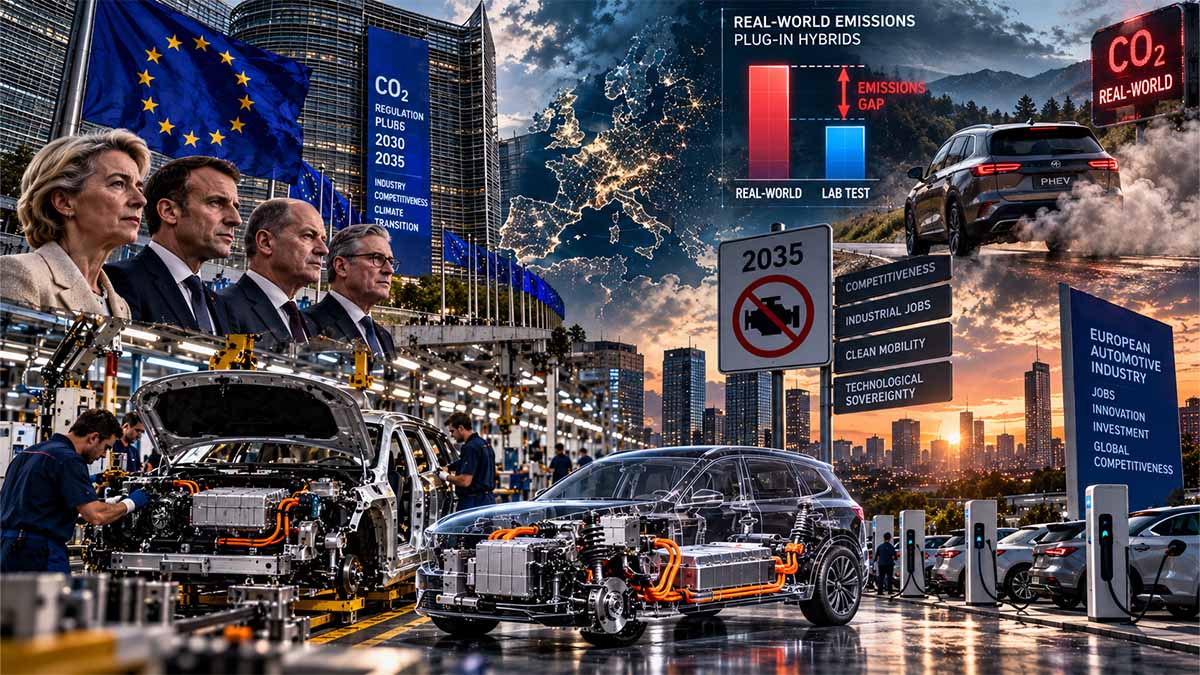
As of: 26 October 2026 | European Union and United Kingdom | Strategic horizon: 2026–2035, with post-2035 implications
An institutional assessment of the widening discrepancy between certified and real-world vehicle emissions, the regulatory mechanisms sustaining it, and the strategic consequences for European manufacturing, energy security and decarbonisation.
Executive assessment
The European automotive transition is encountering a regulatory contradiction with consequences extending well beyond the environmental performance of individual vehicles. Plug-in hybrid electric vehicles have been incorporated into European industrial and climate policy on the assumption that their combination of electric propulsion and combustion-engine flexibility delivers substantial reductions in fuel consumption and carbon dioxide emissions. Yet the empirical evidence increasingly demonstrates that the emissions recognised by vehicle certification do not adequately represent those generated during ordinary use.
The significance of the findings released by Transport & Environment (T&E) on 15 October 2026 is therefore institutional as much as technological. The problem is not that plug-in hybrids are incapable of reducing emissions. It is that the regulatory system has credited the technology with environmental advantages that actual charging behaviour, vehicle design and driving conditions have frequently failed to deliver.
The PHEV Regulatory Asymmetry: Empirical Realities vs. Type-Approval Methodology
The European automotive transition is encountering a regulatory contradiction with consequences extending well beyond the environmental performance of individual vehicles. Plug-in hybrid electric vehicles (PHEVs) have been incorporated into European industrial and climate policy on the assumption that their combination of electric propulsion and combustion-engine flexibility delivers substantial reductions in fuel consumption and carbon dioxide emissions. Yet empirical evidence increasingly demonstrates that the emissions recognised by vehicle certification do not adequately represent those generated during ordinary use.
The most consequential finding is not simply that conventional fuel continues to be consumed. It is that the gap has survived successive technological improvements and has widened as the market has shifted toward larger, more powerful, and longer-range plug-in hybrid vehicles. This creates a direct link between the methodology used to calculate certified emissions and the industrial decisions manufacturers make regarding vehicle architecture, product positioning, and long-term capital allocation.
Regulatory Calibration Failure
The emissions discrepancy constitutes a material weakness in regulatory calibration, not proof of systematic manufacturer fraud. The utility factor used in European type-approval procedures has historically attributed more electric driving to plug-in hybrids than observed use supports. Vehicles can therefore comply with an existing legal methodology while producing substantially higher emissions on the road.
Industrial Incentive Distortion
Preserving the utility factor in an excessively optimistic form would protect the compliance value of existing hybrid portfolios while weakening incentives to develop vehicles with genuinely lower real-world emissions. Correcting it would expose manufacturers to adaptation costs, but it would also reward improvements in battery capacity, electric propulsion capability, efficiency, and charging performance.
The 2035 Horizon Dilemma
The debate has acquired immediate strategic significance because the European Union is reconsidering the automotive framework for 2035. The European Commission’s December 2025 legislative proposal would replace the currently enacted 100% reduction target with a 90% tailpipe reduction requirement, subject to defined compensating credits, thereby opening a possible continuing role for combustion and hybrid technologies. That remains a proposed legislative change, not the law currently in force.
The decisive policy question is consequently whether post-2035 technological flexibility will be accompanied by sufficiently robust emissions accounting to prevent regulatory compliance from becoming detached from actual decarbonisation.
The available evidence supports neither an unconditional exclusion of plug-in hybrids nor their unconditional preservation. It supports a differentiated assessment in which the environmental and strategic value of each configuration depends on measured emissions, propulsion architecture, charging behaviour, and the credibility of the regulatory assumptions applied to it.
These figures expose the central asymmetry. Under official testing, plug-in hybrids appear to offer an approximately 83% emissions advantage over conventional combustion and non-plug-in hybrid vehicles. In real-world driving, the advantage is approximately 14%. The average discrepancy between actual and declared PHEV emissions is approximately sixfold, while T&E estimates additional fuel expenditure of €680 annually for an average driver of a vehicle sold in 2024.
The most consequential finding is not simply that conventional fuel continues to be consumed. It is that the gap has survived successive technological improvements and has widened as the market has shifted toward larger, more powerful and longer-range plug-in hybrid vehicles. This creates a direct link between the methodology used to calculate certified emissions and the industrial decisions manufacturers make about vehicle architecture, product positioning and capital investment.
Three judgments follow.
First, the emissions discrepancy constitutes a material weakness in regulatory calibration, not proof of systematic manufacturer fraud. The utility factor used in European type-approval procedures has historically attributed more electric driving to plug-in hybrids than observed use supports. Vehicles can therefore comply with an existing legal methodology while producing substantially higher emissions on the road.
Second, preserving the utility factor in an excessively optimistic form would protect the compliance value of existing hybrid portfolios while weakening incentives to develop vehicles with genuinely lower real-world emissions. Correcting it would expose manufacturers to adaptation costs, but it would also reward improvements in battery capacity, electric propulsion capability, efficiency and charging performance.
Third, the debate has acquired immediate strategic significance because the European Union is reconsidering the automotive framework for 2035. The European Commission’s December 2025 legislative proposal would replace the currently enacted 100% reduction target with a 90% tailpipe reduction requirement, subject to defined compensating credits, thereby opening a possible continuing role for combustion and hybrid technologies. That remains a proposed legislative change, not the law currently in force.
The decisive policy question is consequently whether post-2035 technological flexibility will be accompanied by sufficiently robust emissions accounting to prevent regulatory compliance from becoming detached from actual decarbonisation.
The available evidence supports neither an unconditional exclusion of plug-in hybrids nor their unconditional preservation. It supports a differentiated assessment in which the environmental and strategic value of each configuration depends on measured emissions, propulsion architecture, charging behaviour and the credibility of the regulatory assumptions applied to it.
Europe’s Plug-in Hybrid Illusion: The €680 Cost of a Regulatory Failure and the Industrial Battle Beyond 2035
Europe’s automotive industry faces a contradiction that threatens the credibility of its climate legislation and the allocation of billions in manufacturing investment. Plug-in hybrids registered in 2024 emit approximately 145 grams of CO₂ per kilometre in real-world driving, against just 24 grams under official certification. Yet Brussels is negotiating a post-2035 framework that could preserve combustion-related technologies while manufacturers decide how much capital to commit to batteries, electric platforms and conventional powertrains. The dispute is not evidence of systematic fraud. It is more consequential: European regulation has attributed environmental advantages to vehicles that ordinary driving conditions frequently fail to deliver. If the European Union preserves technological flexibility without correcting the emissions accounting supporting it, it risks protecting existing industrial investments at the expense of future competitiveness, petroleum security and the credibility of its decarbonisation commitments.
The figures expose a regulatory advantage that disappears on the road
The findings published by Transport & Environment on 15 October 2026, using European Environment Agency monitoring data, expose the distance between the environmental performance Europe certifies and the performance motorists actually obtain. Plug-in hybrids registered in 2024 emitted approximately 145 grams of CO₂ per kilometre, compared with 169 grams for conventional vehicles. Their observed emissions advantage was therefore approximately 14%, against the 83% implied by official testing. Only 27% of kilometres were completed with the combustion engine switched off, while approximately 40% were accumulated in charge-depleting operation, during which the engine could still intervene. Even in that operating mode, real-world emissions reached 63 grams per kilometre against approximately 6 grams in laboratory testing. For the average driver, Transport & Environment estimated an additional €680 in annual fuel expenditure relative to expectations based on original certified consumption.
The problem has persisted despite successive improvements in vehicle specifications. Between the 2021 and 2024 registration cohorts, average certified PHEV emissions fell from 38.1 to approximately 24 grams per kilometre, while observed emissions increased from 133.7 to approximately 145 grams. The discrepancy consequently widened from around 3.5 to six times the certified value, although differences between cohorts and averaging methods require care. Over the same period, average certified electric range increased from 58 to 75 kilometres, and the proportion of new PHEVs offering more than 70 kilometres rose from 13% to 49%. European consumers were purchasing vehicles with greater nominal electric capability, but the market was not producing proportionate reductions in actual carbon emissions.
The significance extends beyond the accuracy of consumer information. Under Regulation (EU) 2019/631, certified emissions contribute to the calculation of manufacturers’ fleet-average performance. A vehicle whose official emissions are disproportionately low can improve a manufacturer’s regulatory position without delivering an equivalent environmental benefit after registration. The result is a structural distortion: engineering expenditure that improves certification may be rewarded more reliably than improvements that reduce fuel consumption under ordinary conditions.
The utility factor rewards an assumption rather than an outcome
The mechanism lies in the utility factor embedded in the Worldwide Harmonised Light Vehicles Test Procedure. It determines the weight assigned to battery-supported operation when calculating a plug-in hybrid’s certified emissions. The earlier methodology could attribute approximately 90% electric utilisation to a vehicle offering 100 kilometres of certified electric range. The calculation did not guarantee that the eventual owner would charge sufficiently often, drive under conditions permitting continuous electric propulsion or avoid combustion-engine intervention. It converted a technical capability into an assumption about future behaviour.
Commission Regulation (EU) 2023/443 introduced successive corrections intended to align certification more closely with real-world monitoring. Manufacturers responded by improving vehicle specifications. Among the upgraded models examined by Transport & Environment, average battery capacity rose from approximately 14 to 24 kilowatt-hours and certified electric range from 63 to 117 kilometres. Those improvements offset approximately three-quarters of the increase in official emissions that would otherwise have followed from the regulatory correction. This demonstrated that stricter measurement could redirect investment toward more capable electric systems. It did not establish that larger batteries would automatically translate into equivalent reductions in actual fuel consumption.
The distinction between defective regulation and illegal manipulation is fundamental. A manufacturer applying the legally prescribed utility factor is not thereby using an unlawful defeat device. The emissions gap does not establish falsified certification or systematic fraud. It demonstrates that a lawful methodology can generate misleading aggregate outcomes when its underlying assumptions no longer represent actual use. The European Commission recognised the problem in its March 2024 assessment of real-world monitoring data. The institutional failure would be to retain unrealistic assumptions after the evidence supporting their correction has become available.
Europe’s manufacturers are being asked to finance two technological futures
The economic consequences emerge within the manufacturers’ investment decisions. Plug-in hybrids preserve combustion engines, transmissions, fuel systems and associated supplier relationships while adding batteries, electric motors, power electronics and charging components. This architecture can sustain existing production capabilities during the transition, but it also requires investment in two propulsion systems whose combined cost must be justified commercially. A stricter utility factor changes the calculation: additional battery capacity and stronger electric propulsion may be needed simply to preserve the regulatory advantage previously obtained through certification.
For Germany’s automotive manufacturers, the problem concerns the future economic value of sophisticated combustion and hybrid platforms alongside expanding battery-electric production. In France, it concerns the balance between industrial competitiveness, electric-vehicle demand and fiscal differentiation. In Italy, it extends to component suppliers whose production capabilities depend on conventional mechanical systems as well as electrification. Across all three countries, preserving existing factories and maintaining future competitiveness are not synonymous objectives. A temporary market for effective hybrids can support industrial adjustment; a permanent regulatory preference for weak-performing configurations risks directing new capital toward assets whose value depends increasingly on political exemptions.
The industrial comparison cannot be reduced to a claim that battery-electric vehicles are always cheaper or that PHEVs are necessarily obsolete. Battery-electric vehicles avoid direct combustion emissions but require competitive battery production and charging infrastructure. PHEVs can offer operational flexibility with different battery requirements, but retain the engineering complexity of combustion propulsion. Their relative competitiveness depends on actual use, production costs, vehicle specifications and regulatory treatment. The central question is whether capital is being allocated according to sustainable market demand and genuine efficiency, or according to compliance advantages that more representative emissions accounting would diminish.
The European Commission’s December 2025 Automotive Package illustrates the tension. Alongside greater proposed flexibility for combustion-related technologies, Brussels announced a €1.8 billion Battery Booster initiative, including €1.5 billion intended to support European battery-cell producers through interest-free loans. Europe is simultaneously seeking to preserve established manufacturing investments and strengthen the supply chain that will determine its position in electrification. Those objectives can coexist, but only if transitional flexibility does not become a reason to delay investment in commercially competitive electric technologies.
Brussels is negotiating the future while national tax systems protect the past
The legislative position on 26 October 2026 is more unsettled than the political language surrounding 2035 suggests. Regulation (EU) 2019/631 still establishes a 100% reduction in average tailpipe emissions for new passenger cars and vans from 2035. The Commission’s December 2025 proposal would replace that requirement with a 90% reduction, subject to compensating mechanisms involving qualifying materials or fuels. The parliamentary compromise supported by the Transport and Industry Committees on 22 October envisaged further flexibility, including an effective passenger-car reduction requirement of 87.5% under the proposed low-carbon steel credit arrangements. These are competing legislative positions, not enacted changes to the existing target.
The distinction matters because a residual allowance for combustion-related emissions is only as credible as the accounting used to determine those emissions. Credits linked to lower-carbon steel or alternative fuels operate through different physical mechanisms from reductions in vehicle fuel consumption. Combining them requires transparent boundaries and verification. If the tailpipe emissions entering the calculation are themselves materially understated, the resulting compliance mechanism may recognise a larger environmental benefit than the vehicles actually deliver.
National fiscal policy adds another complication. Transport & Environment found that 24 of the EU’s 27 Member States provide some form of preferential tax treatment to PHEVs. Corporate buyers accounted for 71% of new EU PHEV registrations in the first half of 2026, compared with 58% of the overall new-car market. The concentration matters because employers and drivers do not always face the same costs or incentives. A vehicle can qualify for favourable company-car taxation even where charging arrangements fail to deliver the electric-driving share assumed in its official emissions figure.
Germany’s rules illustrate the problem: qualifying company-car hybrids acquired during the relevant 2025–2030 period can receive preferential valuation through emissions of no more than 50 grams per kilometre or certified electric range of at least 80 kilometres. France instead combines electric-only acquisition support with vehicle-mass taxation, including a 2026 threshold of 1,500 kilograms and a conditional mass reduction for qualifying PHEVs. Italy’s revised company-car taxation applies valuation percentages of 20% for PHEVs and 10% for battery-electric vehicles, compared with 50% for ordinary cars, subject to statutory conditions. The result is not one European fiscal market but several national systems rewarding different characteristics of the same technology.
The United Kingdom provides an especially revealing counterpoint. Its Zero Emission Vehicle mandate establishes a sales-based framework distinct from the EU’s fleet-average approach. Yet HM Revenue & Customs introduced a temporary benefit-in-kind easement to protect certain PHEV company-car users from tax increases caused by revised emissions certification. The measure applies from 1 January 2025 to 5 April 2028, with transitional provisions potentially extending to April 2031, and is expected to affect approximately 150,000 employees. London has therefore acknowledged the fiscal consequences of more realistic emissions measurement while choosing to moderate their immediate impact. It is an explicit example of how governments can accept a technical correction yet preserve financial advantages based on earlier expectations.
China’s advantage is manufacturing scale, not a prohibition on hybrids
The international competitive pressure makes Europe’s regulatory choices more consequential. According to the International Energy Agency’s Global EV Outlook 2026, worldwide electric-car sales exceeded 20 million in 2025, representing approximately one-quarter of new-car sales. China accounted for almost 55% of its domestic new-car market through battery-electric and plug-in hybrid vehicles, compared with approximately 28% in Europe and less than 10% in the United States. China’s position cannot be described as exclusively battery-electric: plug-in hybrids and extended-range vehicles form part of its industrial and commercial strategy.
The decisive asymmetry is manufacturing concentration. China accounted for nearly 75% of global electric-car production and more than 80% of battery-cell manufacturing in 2025. Its electric-car exports exceeded 2.5 million vehicles, while almost 60% of the European Union’s electric-car imports originated in China. Nearly 70% of battery-electric vehicles sold in China were priced below the average conventional vehicle in that market. These figures do not establish that Chinese manufacturers possess an advantage in every vehicle segment, but they demonstrate the industrial scale and pricing pressure confronting European competitors.
Europe’s vulnerability is therefore not simply that it might retain combustion-related technologies beyond 2035. China already demonstrates that electrification and hybridisation can coexist. The problem is whether European regulation preserves hybrid production while competitors develop stronger positions in battery manufacturing, cost reduction and increasingly affordable electric vehicles. Protecting the certified compliance value of existing European platforms cannot substitute for industrial capabilities that remain competitive once regulatory preferences are withdrawn.
The energy-security dimension reinforces that conclusion. The IEA estimates that the global electric-vehicle fleet displaced approximately 1.7 million barrels of petroleum consumption per day in 2025, including around 1 million barrels in China. A regularly charged PHEV contributes to that displacement; one operated mainly through combustion provides a smaller benefit than optimistic certification suggests. Europe may reduce dependence on imported petroleum through electrification, but it must simultaneously address concentration in battery production and the infrastructure required to supply electricity. Replacing one vulnerability with another is not industrial autonomy.
The next two years will expose who is financing the discrepancy
Europe’s charging network demonstrates why the question cannot be resolved through vehicle certification alone. Public charging points increased by approximately 20% across Europe in 2025, with around 210,000 in the Netherlands, 196,000 in Germany, 185,000 in France and 116,000 in the United Kingdom. Under the IEA’s Current Policies Scenario, Europe’s public network could exceed 4.3 million charging points by 2035, approaching 200 gigawatts of installed capacity. These projections are conditional, but they show that infrastructure investment is advancing on a scale that requires realistic expectations about future electricity demand and vehicle use.
An optimistic utility factor can distort those expectations in both directions: it implies less petroleum consumption and more electric driving than may occur. Yet public charging capacity alone does not guarantee frequent PHEV charging, particularly where motorists have access to reimbursed fuel or lack convenient home and workplace facilities. Infrastructure operators need reliable demand forecasts; governments need defensible emissions outcomes; manufacturers need predictable rules for allocating capital. The costs of mismatched assumptions fall across all three.
During the next 12–24 months, the most consequential decisions will concern the implementation of the next utility-factor correction, the final shape of the 2035 legislative settlement and the alignment of corporate-fleet taxation with actual vehicle performance. If the correction is diluted while combustion-related flexibility expands, manufacturers could retain compliance advantages that overstate environmental progress. If the methodology is tightened without predictable implementation, existing vehicle programmes and suppliers may incur avoidable adjustment costs. The viable settlement must distinguish industrial transition support from the measurement of emissions: the former is a legitimate political choice, while the latter must remain anchored in evidence.
The cost of inaction will not be confined to the European Commission or the manufacturers negotiating the rules. Motorists will continue paying for fuel consumption that exceeds their certified expectations; taxpayers may finance incentives with a smaller environmental return than intended; suppliers may commit capital to technologies whose regulatory value is unstable; and electricity-network planners may invest against inaccurate assumptions about vehicle demand. Over the same period, international competitors will continue competing on price, manufacturing scale and technological capability.
Europe can preserve a transitional role for plug-in hybrids after 2035. What it cannot credibly preserve is the assumption that certified reductions are equivalent to emissions actually avoided. The financial and industrial burden of maintaining that distinction will be distributed through consumer expenditure, public budgets, manufacturing investment and energy imports. The legislative choice now being prepared in Brussels will determine whether those costs are made visible in the regulation or transferred to the economy after compliance has already been declared.
Strategic architecture
The assessment is organised around three interconnected institutional questions.
Pillar I — The regulatory and empirical foundations of the discrepancy
- Chapter 1 examines the EEA monitoring evidence, the evolution of official and real-world emissions, and the limits of comparability between vehicle cohorts.
- Chapter 2 examines the Worldwide Harmonised Light Vehicles Test Procedure (WLTP), utility-factor methodology, the distinction between lawful type approval and illegal emissions manipulation, and the consequences for manufacturer compliance and consumer information.
Pillar II — Industrial economics and the post-2035 settlement
- Chapter 3 examines the interaction between utility-factor corrections, dual-powertrain investment, battery-electric competitiveness and manufacturers’ capacity to adapt.
- Chapter 4 assesses the European legislative negotiation, fiscal incentives and corporate-fleet taxation, with differentiated implications for Germany, France, Italy and the United Kingdom.
Pillar III — Strategic autonomy, energy systems and long-term regulatory credibility
- Chapter 5 evaluates international competition, energy-security implications, charging infrastructure, electricity-demand patterns and emissions-accounting credibility.
- Chapter 6 examines the alternative post-2035 pathways, the conditions necessary for a defensible transitional PHEV role and the institutional decisions required to reconcile industrial competitiveness with measurable climate outcomes.
Master abstract: From measurement error to industrial-policy risk
The central weakness in Europe’s plug-in hybrid regulatory framework lies in the conversion of laboratory-measured technical capability into an assumption about actual consumer behaviour. The utility factor, which determines the relative weight assigned to electricity-powered and combustion-powered operation in the calculation of official emissions, has operated as more than a measurement convention. It has influenced the compliance value of individual vehicles, manufacturers’ portfolio decisions, the fiscal treatment of low-emission cars and the perceived economic attractiveness of hybrid ownership. When the assumed electric-driving share exceeds observed use, the resulting certified emissions figure can systematically understate the fuel-related emissions generated by the vehicle fleet.
The persistence of this divergence is particularly consequential because real-world evidence has become progressively stronger. The European Commission’s first monitoring report, published in March 2024 using information from vehicles registered in 2021, found that plug-in hybrid emissions averaged approximately 3.5 times their certified values. The newer 2024 registration cohort examined by T&E exhibits an approximately sixfold difference on its principal unweighted measure. These are different registration cohorts and monitoring observations, but together they establish that the discrepancy is persistent and cannot reasonably be dismissed as a temporary laboratory-testing anomaly.
The detailed 2026 evidence also complicates the argument that increasing electric range automatically solves the problem. Average certified PHEV electric range rose from 58 kilometres in 2021 to 75 kilometres in 2024, while the proportion of new PHEVs offering more than 70 kilometres of range increased from 13% to 49%. Yet longer-range vehicles were frequently associated with greater mass and combustion-engine power. Their apparent regulatory advantage could therefore expand even where improvements in real-world emissions were inadequate. This is a design incentive problem: increasing the characteristic rewarded by a certification formula is not necessarily equivalent to reducing the environmental outcome the formula is intended to measure.
The European Union has already recognised that the formula requires correction. Revised utility factors began applying in 2025 for newly approved models and in 2026 for existing type approvals. A second correction is scheduled for 29 November 2026 for new type approvals and 29 November 2027 for all newly registered vehicles covered by the requirement. In its June 2026 progress report, the Council explicitly recorded disagreement among national delegations over whether that correction should be frozen, demonstrating that the technical calibration of certified emissions has become part of the wider political negotiation over Europe’s automotive future.
The challenge for European policymakers is thus to preserve a credible relationship between what the law measures, what manufacturers are rewarded for producing and what vehicles actually emit. Industrial flexibility without credible measurement could perpetuate the discrepancy; stricter measurement without appropriate industrial adjustment could intensify investment uncertainty. A coherent settlement would require the Union to treat real-world performance as an essential constraint on compliance flexibility, while allowing manufacturers to compete through genuine improvements in vehicle efficiency rather than through favourable accounting assumptions alone.
Key evidence and regulatory baseline
The most useful interpretation of the evidence requires keeping observed outcomes, officially certified results, prospective regulatory calculations and independently modelled scenarios separate.
| Indicator | Verified value or status | Reference period and definition | Evidentiary basis |
|---|---|---|---|
| PHEV real-world tailpipe CO₂ | Approx. 145 g/km | Vehicles registered in 2024 | EEA monitoring data analysed by T&E |
| Original certified emissions | 24 g/km | 2024 registration cohort, contemporary WLTP values | T&E analysis |
| Conventional comparison | 169 g/km | Real-world combustion and conventional hybrid comparison | T&E analysis |
| Real-world emissions advantage | 14% | PHEVs versus conventional vehicles | T&E analysis |
| Official emissions advantage | 83% | Certified comparison against conventional vehicles | T&E analysis |
| Pure-electric driving | 27% | Share of actual kilometres with combustion engine off | T&E analysis |
| Charge-depleting operation | 40% | Distance in battery-depleting mode, including hybrid operation | T&E analysis |
| Electricity-derived operational energy | 30% | Energy-based utility-factor estimate | T&E analysis |
| Engine operation in charge-depleting mode | 32% | Share of charge-depleting kilometres with combustion contribution | T&E analysis |
| Charge-depleting emissions | 63 g/km real-world versus 6 g/km WLTP | Petrol-related emissions during charge-depleting operation | T&E analysis |
| Additional annual fuel expenditure | €680 | Modelled difference from the original certified-consumption expectation | T&E estimate using stated fuel-price and mileage assumptions |
| Prospective corrected utility factor | 29 November 2026 / 2027 | New type approvals / all new vehicles respectively | Existing implementing framework and Council record |
| Post-2035 baseline in enacted law | 100% reduction | New-car and van EU fleet targets | Regulation (EU) 2019/631 as amended |
| Commission’s proposed post-2035 target | 90% reduction with compensating mechanisms | Legislative proposal, not enacted law | European Commission, December 2025 |
Sources: Still Smoking — T&E, October 2026; Real-World CO₂ Monitoring — European Commission, March 2024; Council Progress Report — June 2026; Cars and Vans CO₂ Standards — European Commission.
Two qualifications are fundamental. The approximately sixfold difference describes the relationship between observed real-world emissions and the official values associated with the 2024 cohort; it is not a claim that every PHEV produces six times its declared emissions. T&E also reports that registration-weighting reduces the 2024 ratio to approximately 5.3, while its unweighted calculation produces approximately 6.1. Those measurements should not be substituted for one another without identifying the averaging methodology.
Likewise, the €680 figure is a modelled annual expenditure difference, not an independently observed bill for every driver. Its magnitude depends on assumed mileage, fuel prices and the comparison against original certified consumption. T&E uses an annual distance of 12,730 kilometres and specific energy-price assumptions in its calculation. The estimate therefore demonstrates material consumer exposure, but should not be applied indiscriminately to individual motorists or national markets.
The transmission mechanism: How a technical assumption becomes an industrial incentive
The utility factor connects a vehicle’s laboratory-measured electric range to an assumed distribution between battery-supported and combustion-powered operation. Its influence extends through a sequence of institutional and commercial decisions. A favourable utility factor lowers the official CO₂ value assigned to a PHEV. That value contributes to the manufacturer’s certified fleet-average emissions, can affect national registration or ownership taxation, and helps position the vehicle against competing technologies. Manufacturers are consequently encouraged to optimise vehicle specifications not only for actual operational performance but also for the regulatory value generated by those specifications.
The formula does not itself instruct consumers how frequently to charge, whether electric propulsion is sufficient under load or how journeys are distributed. Consequently, the official figure can remain low even where the vehicle’s combustion engine operates more frequently than anticipated.
T&E provides a revealing example of the assumptions involved. Under the earlier methodology, a PHEV with a certified electric range of 100 kilometres could be treated as covering approximately 90% of its distance electrically. The first correction reduced that illustrative assumption to roughly two-thirds, while the forthcoming correction would bring it to approximately 44%. These changes materially alter the amount of combustion-related CO₂ recognised in certification without requiring the vehicle itself to change.
That distinction is essential to the assessment of regulatory integrity. An unlawful defeat device involves prohibited manipulation of emissions-control or testing conditions under the applicable legal framework. A vehicle certified according to an authorised utility-factor formula presents a different problem: the legal method may itself contain unrealistic assumptions. The available monitoring evidence supports scrutiny of the methodology and its commercial effects. It does not, without separate model-specific evidence, establish intentional deception or illegal emissions manipulation by manufacturers.
The industrial importance of this mechanism is illustrated by the response to the first utility-factor correction. T&E’s examination of upgraded vehicles found that some manufacturers increased certified electric range from 63 to 117 kilometres, while average battery capacity in the upgraded models rose from 14 to 24 kWh. The additional electric capability compensated for approximately three-quarters of the increase in official emissions otherwise generated by the correction. That finding indicates that tighter accounting can produce a technological response rather than merely increasing compliance costs. It does not, by itself, establish that every upgraded model achieves a proportionate reduction under real-world driving conditions.
This creates a consequential policy distinction. Preserving an optimistic utility factor protects the regulatory value of some existing designs, whereas correcting it can strengthen incentives to improve the underlying technology. Whether that adjustment benefits European manufacturers depends on their engineering capabilities, investment timing, product mix and capacity to commercialise more efficient vehicles competitively.
The tension will intensify if hybrid technologies retain a role beyond 2035. A residual allowance for vehicles emitting combustion-related CO₂ can be reconciled with climate policy only if those emissions are measured credibly and any compensating mechanisms are independently justified. If the underlying tailpipe component is materially understated, the compensation framework risks operating on a distorted base.
Competing industrial and regulatory pathways
The evidence supports three plausible, partly overlapping pathways rather than a single inevitable outcome.
The first is regulatory continuity through a freeze or dilution of the planned utility-factor correction. This would limit the immediate compliance pressure on manufacturers with substantial existing PHEV portfolios and preserve commercial flexibility for dual-powertrain platforms. The principal risk is that regulatory protection would be granted to the certified environmental performance of vehicles rather than their observed environmental performance. In T&E’s assessment, freezing the existing methodology would leave emissions underestimated by 56%. Its modelling further indicates that, under the particular European Parliament proposal it evaluated, such a freeze could lower the battery-electric market share required for regulatory compliance by 13 percentage points in 2030 and 18 percentage points in 2035. Those figures are conditional model results, not established market forecasts.
The second pathway is progressive regulatory correction accompanied by continued investment in improved plug-in hybrid vehicles. This would retain technological choice while progressively withdrawing the compliance advantages of designs that fail to achieve substantial electric operation. The approach has a plausible engineering foundation: sufficiently capable electric motors, appropriate battery capacity, effective charging arrangements and efficient combustion operation can improve real-world results. It also carries an industrial cost. Manufacturers would have to reassess established powertrain investments, component sourcing, vehicle architecture and product pricing as the regulatory value of conventional hybrid designs diminishes.
The third pathway is accelerated concentration of new investment in battery-electric architectures. Under this approach, improved emissions accounting would reduce the apparent regulatory advantage of PHEVs and strengthen the relative attractiveness of vehicles whose operational propulsion does not involve direct combustion emissions. This would improve the consistency of tailpipe accounting, although it would not eliminate the need to evaluate electricity-generation emissions, battery manufacturing, resource exposure and the wider lifecycle consequences of electrification.
A defensible European strategy need not make these pathways mutually exclusive. The relevant distinction is between transitional flexibility based on measurable performance and regulatory flexibility that preserves favourable certification results despite contradictory empirical evidence.
Germany’s exposure is particularly important because of the weight of its vehicle manufacturers and engineering suppliers in dual-powertrain technology. France faces a related but different challenge involving automotive investment, fiscal differentiation and the relationship between domestic electrification objectives and wider European industrial competitiveness. Italy’s position is shaped by the interests of vehicle manufacturers, component suppliers and an industrial base that must adapt across both combustion and electric value chains. The United Kingdom, outside the EU regulatory framework, introduces a separate dimension: divergent certification, sales and emissions policies can affect product allocation, compliance planning and the investment case for manufacturers operating across both markets.
These national considerations are not interchangeable. They require examination of the applicable regulatory instruments, manufacturer exposure and observed market conditions before drawing country-specific conclusions about employment, investment or fiscal outcomes.
Principal gaps and strategic watch indicators
The most consequential uncertainty is whether the correction scheduled for 29 November 2026 will remain intact through the wider legislative negotiations. The Council’s June 2026 progress report confirms that some delegations sought a freeze while others opposed it. This makes the forthcoming treatment of the utility factor a practical indicator of whether European climate and industrial policy will continue to anchor compliance calculations in progressively improved real-world evidence.
A second uncertainty concerns the representativeness of real-world monitoring. The European Commission’s earlier reporting identified limitations in data coverage, while T&E’s latest analysis distinguishes unweighted observations from results weighted by vehicle registrations. Future conclusions should therefore be tested against improved coverage, comparable registration cohorts and observable changes in actual charging behaviour, rather than inferred from certification trends alone.
A third uncertainty is the capacity of manufacturers to convert larger batteries and extended nominal range into sustained reductions in real-world emissions. The decisive observations will be changes in electric-only mileage, engine intervention during charge-depleting operation, performance when the battery is depleted and emissions across comparable vehicle classes.
A fourth concerns national taxation. T&E reports that 24 of the EU’s 27 Member States provide some form of preferential fiscal treatment for PHEVs, while 71% of new EU PHEV registrations in the first half of 2026 were associated with corporate buyers. The importance of company-car markets makes fiscal treatment a significant determinant of vehicle demand and subsequent fleet emissions.
The fifth uncertainty concerns the eventual legal relationship between the proposed post-2035 tailpipe target, the treatment of PHEVs and other combustion technologies, and any recognised compensating mechanisms. Each involves a distinct accounting question. A credible framework cannot assume that improvements in one category automatically neutralise underperformance in another.
Preliminary net assessment
The 2026 plug-in hybrid evidence exposes a structural problem in the governance of Europe’s automotive transition: certified emissions, investment incentives and actual environmental performance have not remained sufficiently aligned. The resulting discrepancy affects consumer expenditure, manufacturer compliance, national fiscal policy and the credibility of the Union’s industrial strategy.
The strongest available judgment is that real-world verification must become an enforceable constraint on technological flexibility, rather than a secondary source of information used after compliance advantages have already been granted. A PHEV architecture capable of delivering consistently low emissions under observable use can retain a defensible transitional role. A vehicle whose environmental advantage exists principally in a favourable utility-factor calculation cannot provide an equivalent foundation for long-term industrial or climate policy.
Europe’s post-2035 automotive settlement will therefore be judged not simply by which technologies it permits, but by whether it establishes a credible and durable relationship between regulatory recognition, industrial investment and emissions actually avoided.
Europe’s Plug-in Hybrid Emissions Gap
Regulatory credibility, real-world carbon performance and the industrial consequences of Europe’s post-2035 automotive transition.
Evidence cut-off: 26 October 2026. Primary analytical reference: Transport & Environment, 15 October 2026, using European Environment Agency monitoring data.
The Sixfold Emissions Discrepancy
Unit: g CO₂/km. Linear scale: 0–180. Vehicle-category values are taken from the T&E comparison. Bar depth is decorative; only height represents value.
Actual versus declared PHEV emissions
The original laboratory-based certification substantially understates observed tailpipe carbon emissions.
The Collapse of the Certified Advantage
Each horizontal bar is scaled from 0% to 100%. The official and real-world comparisons refer to distinct measurement conditions. The 69-percentage-point difference is the difference between the reported reduction percentages, not an additional measured emissions quantity.
Electric Capability Is Not Electric Utilisation
Actual driving distance
Charge-depleting operation includes kilometres in which the combustion engine contributes. These percentages overlap and must not be added together.
Combustion During Battery Depletion
A vehicle operating in battery-depleting mode is not necessarily operating without combustion-related emissions.
How Certification Shapes Industrial Decisions
Analytical causal sequence. The diagram describes the incentive mechanism, not an allegation of illegal defeat devices or manufacturer fraud.
Verified Emissions and Policy Indicators
| Indicator | Value | Meaning | Evidence period |
|---|---|---|---|
| Real-world PHEV CO₂ | 145 g/km | Observed tailpipe emissions | 2024 vehicle cohort |
| Original certified PHEV CO₂ | 24 g/km | WLTP type-approval values | 2024 vehicle cohort |
| Conventional vehicle CO₂ | 169 g/km | Real-world comparison | T&E analysis, 2026 |
| Fully electric distance | 27% | Engine-off kilometres | 2024 vehicle cohort |
| Charge-depleting distance | 40% | Distance in battery-depleting mode | 2024 vehicle cohort |
| Charge-depleting CO₂ | 63 vs 6 g/km | Real-world versus certified | T&E analysis, 2026 |
| Estimated additional fuel cost | €680/year | Modelled difference against certified-consumption expectations | T&E analysis, 2026 |
| New type-approval correction | 29 Nov 2026 | Next utility-factor adjustment | EU implementation schedule |
| All-new-vehicle correction | 29 Nov 2027 | Broader application of the adjustment | EU implementation schedule |
| 2035 current legislative baseline | 100% reduction | EU new-car and van CO₂ targets | Law in force at cut-off |
| Commission 2035 proposal | 90% reduction | Proposed target with compensating mechanisms | December 2025 proposal |
Three Possible Regulatory and Industrial Outcomes
Regulatory Continuity
Freeze or dilution of utility-factor corrections preserves the certified compliance value of existing PHEV designs.
Industrial effect: reduced near-term adjustment pressure on dual-powertrain investment.
Principal risk: persistent separation between official emissions and environmental outcomes.
Verified Hybrid Transition
Utility-factor corrections proceed while PHEVs remain commercially viable through demonstrably improved electric performance.
Industrial effect: investment in more effective electric propulsion, charging and efficiency.
Principal risk: added engineering costs and uncertainty during regulatory adjustment.
Battery-Electric Reallocation
Stricter real-world accounting reduces the relative compliance attractiveness of hybrid architectures.
Industrial effect: stronger incentives to concentrate future investment in full electrification.
Principal risk: transition pressure on existing powertrain assets and related supply chains.
Qualitative pathways, not probability-weighted forecasts. Elements may coexist under the final post-2035 policy settlement.
The Strategic Test for Europe
PILLAR I — THE REGULATORY AND EMPIRICAL FOUNDATIONS OF THE PLUG-IN HYBRID EMISSIONS DISCREPANCY
European Union | Evidence and regulatory cut-off: 26 October 2026
Chapter 1 — The European Emissions Evidence: From Laboratory Certification to the Structural Underperformance of Plug-in Hybrid Vehicles
The emergence of a structural divergence in European vehicle-emissions monitoring
The most important development in European plug-in hybrid emissions monitoring is not the discovery that laboratory certification differs from actual road performance. That phenomenon has long been recognised in European vehicle regulation, and a certain discrepancy is inherent in any standardised testing procedure that attempts to represent highly variable driving conditions. The more consequential development is the accumulation of official evidence demonstrating that the discrepancy affecting plug-in hybrid electric vehicles is materially greater than the corresponding difference observed in conventional combustion-powered cars, has persisted across successive registration cohorts and has coincided with changes in vehicle design that were expected to improve environmental performance. The resulting evidence challenges a fundamental premise of European transport regulation: that vehicles benefiting from particularly favourable certified carbon dioxide values generate correspondingly substantial emissions reductions during ordinary ownership and use.
This distinction has become institutionally unavoidable because the European Commission and the European Environment Agency have established a monitoring system specifically designed to test the representativeness of official vehicle-emissions figures. Article 12 of Regulation (EU) 2019/631 requires the Commission to monitor the difference between certified emissions and real-world fuel and energy consumption. The resulting evidence is collected through on-board fuel consumption monitoring equipment, with reporting obligations specified in Commission Implementing Regulation (EU) 2021/392. This creates an important legal and methodological separation between the original laboratory assessment, which determines the certified characteristics of a vehicle, and the subsequent monitoring record, which evaluates the degree to which those characteristics represent actual operation. The two systems are related, but they do not perform identical regulatory functions. The laboratory procedure provides standardised comparability and contributes directly to manufacturer compliance calculations; the monitoring mechanism supplies empirical evidence against which the adequacy of that procedure can be evaluated. Regulation (EU) 2019/631 — European Parliament and Council — April 2019; Commission Implementing Regulation (EU) 2021/392 — European Commission — March 2021.
The institutional importance of this arrangement was confirmed on 18 March 2024, when the Commission published its first formal assessment of the real-world emissions gap. Based on data collected during 2021, the report identified a relatively moderate difference for conventional petrol and diesel cars but a much larger discrepancy for externally rechargeable hybrids. Petrol and diesel vehicles recorded real-world emissions approximately 20% above their certified values, a difference the Commission considered compatible with expectations about the limitations of standardised testing. Plug-in hybrids, by contrast, recorded real-world emissions approximately 3.5 times the certified level. Their average real-world carbon dioxide emissions reached 139.5 grams per kilometre, compared with approximately 39.5 grams in official certification and 180.3 grams for the corresponding conventional-vehicle comparison. The Commission explicitly connected this result to charging frequency, electric-driving behaviour and the assumptions underlying the utility factor. The discrepancy was therefore identified by the competent European institution as a problem involving both consumer use and the representativeness of the regulatory calculation, rather than merely as an exceptional technical defect affecting individual vehicles. Commission Report COM(2024) 122 final — European Commission — March 2024.
The importance of that initial finding became clearer as monitoring coverage expanded. The EEA’s reporting-year 2024 dataset, covering vehicles registered between 2021 and 2024, contains 9,923,272 vehicles after data cleaning and the exclusion of outliers, comprising 9,033,892 passenger cars and 889,380 light commercial vehicles. The records were collected during 2024 by 58 manufacturers and 22 Member States and reported in 2025. These figures are significant because they establish the scale of the monitoring infrastructure now available to European institutions, but they must be interpreted correctly: the nearly ten million vehicles represent the cleaned overall monitoring dataset across multiple propulsion technologies and registration years, not a sample consisting exclusively of plug-in hybrids registered in 2024. Confusing the aggregate monitoring population with the PHEV-specific analytical cohort would exaggerate the statistical basis of individual conclusions. Real-World Emissions Monitoring: Introduction — European Environment Agency — 2026.
The evidence published on 15 October 2026 by Transport & Environment must be understood against this progression. Its analysis of the 2024 registration cohort reports that PHEVs produced approximately 145 grams of carbon dioxide per kilometre during actual use, against approximately 24 grams under the original official test methodology. The corresponding emissions advantage over conventional vehicles was approximately 14%, despite official certification implying an advantage of approximately 83%. The importance of these figures lies in the direction of the underlying series. Certified emissions fell as the regulatory advantages associated with electric range increased, while observed emissions did not exhibit a corresponding improvement. Consequently, the disparity was not being progressively eliminated through the ordinary technological development of the market. On the principal unweighted measure, it had widened. Still Smoking: The PHEV Emissions Scandal Continues — Transport & Environment — October 2026.
The evolution of the monitoring record from 2021 to 2024
A longitudinal examination reveals how the discrepancy developed. Transport & Environment’s September 2025 analysis of the 2021–2023 monitoring record presented arithmetic, unweighted averages showing that real-world emissions rose from 133.7 grams per kilometre for vehicles registered in 2021 to 137.3 grams in 2022 and 138.6 grams in 2023. Over the same registration cohorts, original certified values declined from 38.1 to 33.4 and then 28.3 grams per kilometre. The resulting ratios increased from approximately 3.5 to 4.1 and 4.9. The subsequent October 2026 analysis placed the 2024 cohort at approximately 145 grams in real-world use against 24 grams in certification. Taken together, the results suggest that the growing discrepancy reflects two simultaneous developments: improvements in reported regulatory performance and an absence of equivalent improvement in observed fuel-related emissions. The 2021–2023 values originate from T&E’s analysis of the official monitoring datasets, rather than constituting a single homogeneous time series published by the Commission using the same aggregation convention throughout. The PHEV Emissions Gap Is Growing — Transport & Environment — September 2025; Plug-in Hybrids Emit Six Times More CO₂ Than Officially Stated — Transport & Environment — October 2026.
| Registration cohort | Real-world PHEV CO₂, g/km | Original WLTP CO₂, g/km | Real-world/WLTP ratio | Absolute difference, g/km |
|---|---|---|---|---|
| 2021 | 133.7 | 38.1 | 3.51× | 95.6 |
| 2022 | 137.3 | 33.4 | 4.11× | 103.9 |
| 2023 | 138.6 | 28.3 | 4.90× | 110.3 |
| 2024 | ≈145 | ≈24 | ≈6.04× | ≈121 |
Source: T&E analyses of EEA on-board monitoring data. Ratios and absolute differences are calculated from the displayed figures. Values are rounded at their published precision. The table concerns registration cohorts, not four consecutive years of operation of an unchanged vehicle sample.
The pattern is particularly important because the numerator and denominator do not carry the same economic meaning. Real-world emissions estimate fuel-related carbon dioxide produced during use; certified emissions constitute a regulatory representation obtained through standardised procedures. Falling certified values can result from genuine improvements in energy efficiency, greater battery capacity, changes to the assumed electric-driving proportion or combinations of these factors. An increasing ratio therefore does not automatically prove that a particular manufacturer or model has become less efficient. It does demonstrate, however, that the regulatory metric and the observed outcome are diverging. For policymakers responsible for fleet targets, this is a measurement problem with potential behavioural consequences: the more heavily manufacturers are rewarded for lowering the denominator without correspondingly reducing the numerator, the weaker the relationship between regulatory compliance and realised environmental improvement.
The distinction becomes still more consequential when the absolute emissions difference is examined rather than only the multiplicative ratio. The displayed 2021 cohort recorded an approximate discrepancy of 95.6 grams per kilometre, rising to roughly 121 grams in the 2024 cohort. The absolute discrepancy therefore increased alongside the relative discrepancy. This matters because a ratio can rise dramatically when certified values become very small, even if actual emissions remain unchanged. Here, the evidence contains both a declining certified figure and a comparatively high, slightly rising real-world figure. The trend cannot be explained exclusively by a mathematical denominator effect. It indicates that the average PHEV configuration entering the observed cohorts had not translated improvements in certified environmental performance into equivalent reductions in road-use emissions.
There are nonetheless important restrictions on interpreting this evidence as a strictly controlled longitudinal experiment. The 2021 and 2024 registration cohorts are not composed of the same vehicles, manufacturers, model configurations or users. Their average mass, rated electric range, powertrain characteristics, country distribution and exposure to company-car markets can differ. Furthermore, an on-board monitoring record obtained in a particular reporting year measures accumulated vehicle operation up to the observation point, not necessarily a uniform annual driving period for every vehicle. Differences in mileage, vehicle age at data extraction and the mechanisms through which records become available may affect the representativeness of individual cohorts. The observed trend is therefore strong evidence of a market-level divergence, but it should not be presented as proof that an unchanged vehicle model necessarily deteriorates by the same amount as the aggregate series.
The official European evidence establishes a broader emissions-accounting problem
The comparison between plug-in hybrids and conventional vehicles is especially revealing when the same monitoring exercise is used to assess both categories. In the Commission’s first report, conventional petrol and diesel vehicles showed real-world emissions approximately one fifth above their standardised laboratory values. The Commission regarded this magnitude as consistent with the expected differences between laboratory cycles and actual operation, where temperature, road gradient, traffic, driving style, auxiliary power demand and vehicle loading cannot all be reproduced through one standardised procedure. The PHEV result was fundamentally different. It was not simply a conventional laboratory-to-road deviation amplified by a small amount; it was the consequence of a certification methodology that relied heavily on an assumed distribution of driving between electric and combustion-powered operation. Commission Report COM(2024) 122 final — European Commission — March 2024.
A conventional combustion vehicle consumes liquid fuel whenever its engine supplies propulsion, with efficiency varying according to operating conditions. A plug-in hybrid introduces a separate behavioural variable: the proportion of journeys made with sufficient externally supplied electrical energy to reduce or avoid engine operation. Two identical plug-in hybrids can therefore achieve very different fuel consumption and tailpipe-emissions outcomes if one is charged frequently and operates predominantly on electricity while the other is used as a conventional hybrid without regular external charging. Unlike an ordinary laboratory adjustment for traffic or temperature, the utility-factor assumption incorporates an expectation concerning future consumer behaviour. This converts a standardised technical certification into a prediction about how the technology will be used after sale.
The legal and practical implications of that distinction are substantial. If a standardised laboratory test understates the fuel consumption of a conventional combustion vehicle by a moderate percentage, the resulting problem may primarily concern test-cycle representativeness and consumer information. If a plug-in hybrid receives a low certified value because the methodology assumes a high electric-driving share that is not achieved, the discrepancy can influence technology classification, manufacturer compliance and fiscal treatment to a considerably greater extent. A vehicle with a low certificate value may receive preferential treatment despite producing actual emissions that are much closer to a conventional vehicle than its certification suggests. The problem is therefore not only the accuracy of a measurement but the decision-making framework constructed around that measurement.
The Commission’s July 2024 update strengthened this interpretation. It reported that the PHEV sample registered in 2022 contained approximately 117,000 vehicles and that its relative emissions gap had increased compared with the earlier cohort. Larger batteries and longer certified electric ranges were associated with lower official emissions, but the monitored vehicles had not demonstrated the corresponding increase in electric driving that the regulatory formula assumed. The Commission explicitly concluded that further adjustments to the utility factor might be required as additional real-world evidence became available. This was a material institutional recognition that improved declared technical capability had not automatically produced the expected change in driving behaviour. Publication of Real-World CO₂ Emissions and Fuel Consumption of Cars and Vans Collected in 2022 — European Commission — July 2024.
The changing PHEV architecture: Larger batteries, greater range and the powertrain-performance problem
The 2026 findings introduce an additional dimension that cannot be reduced to insufficient charging. The technological evolution of plug-in hybrids has altered the relationship between battery capacity, electric range, vehicle mass and the relative capabilities of the electric and combustion propulsion systems. T&E reports that average certified electric range rose from 58 kilometres in 2021 to 75 kilometres in 2024, while the proportion of new PHEVs offering more than 70 kilometres of certified range increased from 13% to 49%. Taken alone, these figures might suggest that the market was moving toward vehicles capable of fulfilling a larger proportion of journeys without combustion. Yet the report identifies heavier vehicles, greater combustion-engine power and insufficient electric motor power as important contributors to persistent real-world underperformance. Still Smoking: The PHEV Emissions Scandal Continues — Transport & Environment — October 2026.
This is a crucial engineering distinction. Battery capacity determines how much electrical energy can be stored; certified electric range describes the distance achievable under specified test conditions; electric motor power influences the operating conditions under which the vehicle can deliver the requested performance without combustion assistance. A PHEV may possess sufficient stored electrical energy for a substantial journey yet still activate its combustion engine when acceleration, speed, gradients or other operating demands exceed the effective capability of the electric propulsion system. Increasing battery capacity without corresponding attention to propulsion adequacy can therefore improve the certified electric-range indicator while delivering less improvement in actual combustion avoidance than anticipated.
The October 2026 analysis provides evidence that motor sizing is a material determinant of this outcome. T&E reports that PHEVs whose electric motor power exceeds combustion-engine power by 25% achieve real-world emissions around 95 grams per kilometre, with charge-depleting emissions around 20 grams per kilometre. These values describe a particular observed technical category, not a guaranteed outcome for any vehicle satisfying a nominal motor-power ratio. They nonetheless demonstrate that architectural configuration matters independently of certified range. A vehicle designed to sustain a greater share of normal driving on its electric powertrain can achieve a different operating outcome from one in which the electric system functions primarily as an auxiliary component of a combustion-oriented architecture. Still Smoking: The PHEV Emissions Scandal Continues — Transport & Environment — October 2026.
The finding challenges a simplified interpretation of hybrid technological progress. It is insufficient to assess a vehicle’s environmental capability from certified range alone, just as it is insufficient to infer actual operational emissions from battery size. A more complete evaluation requires the interaction between energy storage, propulsion capability, power management and actual charging. The distribution of power between the electric motor and combustion engine becomes an indicator of the operating envelope within which the vehicle can remain electric. The efficiency of the vehicle when the battery is depleted remains equally important, particularly for drivers undertaking long journeys or charging infrequently.
This distinction also explains why the market’s progression toward longer-range PHEVs has not eliminated the empirical gap. Vehicle manufacturers can produce larger batteries and increase certified range while simultaneously supplying heavier, more powerful vehicles that continue to require substantial engine intervention. The engineering development is real, but the regulatory significance depends on whether it reduces fuel consumption under actual use. The available monitoring evidence supports the conclusion that technical characteristics should be evaluated jointly rather than allowing a single favourable specification to dominate the certification outcome.
The distinction between charge-depleting operation and genuinely electric kilometres
The interpretation of PHEV operating modes is a second source of potential analytical error. Charge-depleting operation describes a period in which the battery’s stored electrical energy is progressively consumed. It does not necessarily mean that the combustion engine remains switched off throughout that period. Depending on powertrain design and operating conditions, the engine may intervene while the battery continues to provide part of the vehicle’s propulsion energy. Consequently, the share of kilometres accumulated in charge-depleting mode and the share driven without combustion are related but different quantities.
This distinction is visible in the monitoring record. T&E reports that approximately 40% of distance in the 2024 PHEV cohort was accumulated in charge-depleting operation, while the share driven in fully electric operation was approximately 27%. Its analysis also identifies combustion-engine intervention during approximately 32% of charge-depleting kilometres. These measurements cannot simply be added or treated as independently exclusive categories. One describes a battery operating condition, another identifies engine-off propulsion, and the third concerns engine use within a specified operating condition. Their relationship is essential to interpreting the environmental value of a PHEV because the mere selection of an electric or battery-depleting driving mode does not establish the absence of combustion-related emissions. Still Smoking: The PHEV Emissions Scandal Continues — Transport & Environment — October 2026.
| Operational measure | Reported finding | What the measure establishes | What it does not establish |
|---|---|---|---|
| Fully electric distance | 27% | Share of kilometres driven without combustion-engine operation | Total proportion of propulsion energy supplied by electricity |
| Charge-depleting distance | Approximately 40% | Distance accumulated while battery charge is being depleted | Distance necessarily driven with the combustion engine off |
| Engine operation during charge depletion | Approximately 32% | Combustion intervention within charge-depleting driving | The entire fleet’s engine-running distance |
| Electricity-derived operational energy share | Approximately 30% | Energy-based representation of electrical contribution | A direct substitute for the share of engine-off kilometres |
| Real-world charge-depleting emissions | Approximately 63 g CO₂/km | Fuel-related emissions during battery-depleting operation | Whole-vehicle lifetime emissions |
| WLTP charge-depleting emissions | Approximately 6 g CO₂/km | Laboratory emissions for the corresponding test condition | An independently observed road-use result |
The operating categories have different denominators and definitions. The table must not be interpreted as a partition of driving distance into additive percentages.
The significance of the charge-depleting result is that emissions remain material even where the vehicle is operating in the mode intended to exploit its electric capability. The reported 63 grams per kilometre under actual charge-depleting use, compared with approximately 6 grams during the corresponding laboratory procedure, points to a problem more complex than motorists neglecting to connect vehicles to charging infrastructure. Insufficient charging can cause PHEVs to spend more time operating with depleted batteries, but substantial emissions within charge-depleting operation also direct attention toward electric propulsion capability, energy-management decisions and differences between laboratory operating conditions and everyday driving.
This does not demonstrate that every combustion-engine intervention is unnecessary, improper or technologically avoidable. Vehicle engineering involves trade-offs between power demand, emissions, efficiency, cost, battery protection and operating conditions. The relevant regulatory question is whether the certification procedure recognises those trade-offs in a way that realistically represents their aggregate effect. A system that attributes a disproportionately high electric-driving share to vehicles whose engines intervene frequently will understate the emissions associated with those operating conditions, even when the vehicles function exactly as designed.
The limits of cross-cohort comparability and the interpretation of the sixfold figure
The reliability of the institutional assessment depends on preserving the distinction between the existence of the discrepancy and the precise numerical representation selected to describe it. Transport & Environment’s October 2026 report presents a ratio of approximately 6.1 when using its arithmetic, unweighted methodology for the 2024 cohort, while registration-weighting produces an estimate closer to 5.3. This difference does not undermine the central finding, but it demonstrates why analytical precision matters. An unweighted average assigns the same influence to each observation within the defined sample, whereas a registration-weighted calculation attempts to represent the market according to the prevalence of vehicle models. Both approaches can answer legitimate questions, but they do not describe identical populations.
Differences between data reporting and vehicle registration years also require caution. The EEA’s reporting-year 2024 data include observations from vehicles first registered in multiple years. A conclusion about vehicles registered in 2024 therefore requires cohort-specific selection rather than treating the entire reporting-year database as a single new-vehicle sample. Equally, data obtained from a vehicle during a particular reporting year may reflect cumulative fuel consumption since registration. This is analytically useful because it provides information accumulated during actual ownership, but it also means that observed driving distance, vehicle age and data availability differ between vehicles. The source documentation should therefore remain attached to any numerical claim that depends on an averaging or cohort-selection method. Real-World Emissions Monitoring: Introduction — European Environment Agency — 2026; Real-World Emissions Monitoring: Additional Information — European Environment Agency — 2026.
The comparison with conventional vehicles introduces another methodological consideration. The reported 145 and 169 grams per kilometre imply a PHEV advantage of approximately 14%, but the two categories do not necessarily have identical distributions of vehicle size, weight, price, performance or use. The fleet-wide comparison establishes how the observed categories perform on average; it does not constitute a perfectly matched experiment isolating the effect of the powertrain while holding every other variable constant. A rigorous industrial-policy analysis therefore requires both the fleet-average comparison and model-level examination within comparable vehicle segments. The former establishes the environmental performance of the actual market; the latter is necessary to identify how much of the difference arises from propulsion technology rather than product composition.
A further distinction concerns tailpipe emissions and lifecycle emissions. The reported real-world PHEV values reflect fuel-related carbon dioxide associated with vehicle operation. They do not constitute a comprehensive assessment of battery production, fuel extraction and refining, electricity generation, vehicle manufacturing or end-of-life treatment. Accordingly, the comparison between a PHEV and a battery-electric vehicle cannot be completed simply by substituting a zero tailpipe value for the latter and treating that as a complete lifecycle comparison. The evidence establishes a serious discrepancy in the regulatory representation of PHEV tailpipe performance. It does not, by itself, provide a comprehensive comparative lifecycle inventory across all propulsion technologies.
The monitoring infrastructure as a European strategic asset
The development of on-board fuel consumption monitoring represents a significant institutional change because it gives regulators the capacity to test regulatory assumptions against a large and expanding body of operational evidence. Before this monitoring system matured, public policy depended more heavily on laboratory certification, isolated testing programmes and assumptions concerning driving behaviour. The EEA database provides a more systematic basis for identifying discrepancies between official and actual vehicle performance, although it remains dependent on data-collection procedures, reporting completeness and analytical selection rules.
Commission Implementing Regulation (EU) 2021/392 defines detailed reporting arrangements for manufacturers and Member States. The reporting framework includes lifetime fuel consumption and distance travelled, as well as PHEV-specific parameters distinguishing charge-depleting and charge-increasing operation, engine-off and engine-running distance during charge depletion, and grid energy supplied to the battery. These variables matter because they permit a more sophisticated interpretation than a simple comparison between one laboratory fuel-consumption figure and one observed value. They create the possibility of identifying whether underperformance is associated principally with limited charging, excessive engine intervention, particular vehicle configurations or differences in driving patterns. Commission Implementing Regulation (EU) 2021/392, Articles 9–11 and Annex — European Commission — March 2021.
The regulatory framework also reflects the practical and legal limitations of large-scale vehicle-data collection. Vehicle identification numbers are treated as personal data, collection is subject to defined safeguards, and owners may refuse to make monitoring data available for the specified reporting purposes. The Regulation establishes procedures for data collection through manufacturers, authorised dealers and repairers, as well as roadworthiness-testing institutions. It also establishes retention limits, including a 20-year retention period for relevant records held by the EEA. These provisions are important not because they resolve the emissions problem, but because they define the quality, continuity and legitimacy of the evidence available to regulators. A monitoring system can support credible policy only if its data collection remains lawful, sufficiently representative and transparent about its limitations.
The strategic opportunity is to convert this monitoring infrastructure into a stronger feedback mechanism between observed performance and future type-approval rules. Such a mechanism would not require policymakers to abandon standardised laboratory testing. It would require the laboratory procedure to remain responsive to patterns revealed by the monitored vehicle fleet, especially when those patterns demonstrate a persistent and material deviation from the assumptions used to award compliance advantages. The existence of extensive operational evidence does not automatically change certified values or create retrospective liability; those consequences depend on the relevant legislation and implementing measures. It does, however, reduce the justification for retaining known unrealistic assumptions indefinitely.
Chapter 1 — Net assessment
The European evidence establishes that the PHEV emissions discrepancy is persistent, material and partly structural. The strongest finding is not the precise ratio selected to describe the 2024 cohort, but the combination of declining certified emissions, comparatively high actual emissions, limited fully electric driving and identifiable technological characteristics that help explain the divergence. The evidence demonstrates why electric range alone is an inadequate indicator of environmental performance and why future regulation must distinguish battery capability, engine-off operation and total fuel-related emissions.
It also establishes the limits of what can presently be concluded. The monitoring record supports a critical assessment of the representativeness of type-approval values, but it does not establish manufacturer-specific fraud, uniform behaviour among consumers or an identical environmental outcome for every PHEV architecture. The essential unresolved question is how European law should convert this empirical knowledge into certification, compliance and consumer-information rules without confusing a problem of regulatory assumptions with evidence of unlawful manipulation. That question is the subject of Chapter 2.
Chapter 2 — The Architecture of European Type Approval: Utility Factors, Legal Compliance and the Institutional Consequences of Misaligned Emissions Accounting
Why the European certification system has become part of the emissions problem
The central regulatory weakness revealed by the European monitoring record is the dependence of plug-in hybrid certification on an assumed pattern of energy use that the certification authority cannot guarantee will occur after the vehicle enters service. The Worldwide Harmonised Light Vehicles Test Procedure provides a standardised framework for measuring vehicle fuel consumption, energy consumption and carbon dioxide emissions under controlled operating conditions. Its value lies in establishing a common basis on which technically different vehicles can be compared and assessed against regulatory requirements. For externally rechargeable hybrid vehicles, however, the calculation must reconcile two operating states with fundamentally different tailpipe-emissions characteristics: operation that draws down externally supplied electricity and operation in which the combustion engine supplies a substantial part of the propulsion energy. The regulatory solution is to combine measurements from relevant operating modes according to a prescribed utility factor. The effectiveness of that solution depends directly on whether the assigned weighting resembles the distribution of operating conditions encountered during actual vehicle use.
The critical issue is that the utility factor is not an independent measurement of the kilometres a particular customer will drive electrically. It is a regulatory estimate intended to represent expected electric utilisation across a broader population of vehicles and drivers. The same certified vehicle can be driven by a commuter with regular home charging, a company-car user whose fuel is reimbursed but whose electricity costs are not, or a long-distance driver with limited practical access to external charging. Each ownership pattern produces a different relationship between the vehicle’s theoretical electric capability and the quantity of liquid fuel actually consumed. A certification procedure cannot eliminate this behavioural variation. It can, however, either represent the aggregate distribution realistically or embed assumptions that systematically favour one propulsion architecture.
Commission Regulation (EU) 2023/443 modified the Euro 6 implementing framework and established revised utility-factor parameters intended to bring PHEV certification closer to monitored operating conditions. Its regulatory provisions introduced successive stages of adjustment associated with Euro 6e-bis and Euro 6e-bis-FCM. The distinction is important because the original utility-factor methodology and its subsequent revisions are not informal recommendations or discretionary calculations independently chosen by individual manufacturers. They form part of a legally specified technical framework. A manufacturer that applies the authorised formula to a vehicle correctly can obtain a compliant certification even where subsequent real-world monitoring shows that the underlying assumptions were too favourable. The relevant regulatory defect, in such circumstances, lies in the representativeness of the mandated method rather than necessarily in unlawful conduct by the manufacturer. Commission Regulation (EU) 2023/443 — European Commission — February 2023.
This distinction is indispensable for governmental analysis because it determines both the appropriate enforcement response and the distribution of responsibility. Where a manufacturer falsifies test results, manipulates emissions-control equipment or otherwise breaches binding certification requirements, the question concerns unlawful conduct and the competence of market-surveillance and enforcement authorities. Where certified emissions are calculated correctly under an authorised procedure that subsequently proves unrepresentative of actual use, the immediate question concerns the adequacy of the legal methodology and the obligation of the institutions responsible for maintaining it. Individual manufacturers may still have responsibilities concerning accurate information, lawful marketing and specific vehicle characteristics, but the observed aggregate emissions gap cannot be converted into a finding of fraud without additional evidence.
The utility factor as a mathematical and economic instrument
The utility factor is intended to represent the expected contribution of charge-depleting operation to total driving. In simplified terms, certification combines the emissions measured under charge-depleting conditions with those measured under charge-sustaining conditions, applying the relevant prescribed weights. The final value is therefore sensitive not only to the efficiency of the combustion engine and the amount of liquid fuel consumed under test conditions, but also to the share assigned to battery-supported operation. When that share is set too high, the resulting weighted figure can substantially understate the combustion-related emissions that will arise under typical actual use.
This mechanism makes the utility factor a particularly consequential regulatory parameter. In a conventional vehicle, improving certified emissions generally requires changes affecting combustion efficiency, vehicle energy demand or other factors measured within the applicable test procedure. In a PHEV, increasing certified electric range can also increase the weight assigned to battery-supported operation. That change can lower the final certified figure even before it is established that ordinary drivers will charge sufficiently frequently or that the vehicle can maintain engine-off propulsion under the conditions they encounter. The certification framework thus rewards a combination of engineering characteristics and assumed user behaviour, rather than exclusively rewarding an emissions reduction directly demonstrated in normal service.
The regulatory parameters specified in Commission Regulation (EU) 2023/443 show how substantial these methodological changes can be. The framework provides for successive normalised-distance parameters associated with the utility-factor curves. Those values were increased from 800 kilometres under the earlier specification to 2,200 kilometres for the first correction and 4,260 kilometres for the subsequent correction, with the relevant stages specified in the implementing instrument. These parameters are not estimates of the distance an individual PHEV travels electrically on a single charge. They are technical inputs into the mathematical function used to calculate the utility factor. Their significance lies in changing the assumed weighting of charge-depleting operation for a given certified electric range. Treating them as ordinary vehicle-range figures would materially misrepresent the legislation. Commission Regulation (EU) 2023/443, Annex and Utility-Factor Parameters — European Commission — February 2023.
| Regulatory element | Earlier specification | First correction | Subsequent correction |
|---|---|---|---|
| Technical framework | Earlier Euro 6 utility-factor calculation | Euro 6e-bis | Euro 6e-bis-FCM |
| Normalised-distance parameter | 800 km | 2,200 km | 4,260 km |
| Associated regulatory implementation | Pre-2025 framework | 2025 new type approvals; 2026 general application | 2027 new type approvals; 2028 general application under the original regulatory schedule |
| Intended technical effect | Higher assumed electric utilisation | Reduced weight on assumed electric utilisation | Further alignment with real-world evidence |
| Principal policy concern | Systematic underrepresentation of combustion use | Remaining discrepancy after partial correction | Maintaining implementation and evaluating residual discrepancy |
Source: Commission Regulation (EU) 2023/443 — European Commission — February 2023. The regulation gives the original stage dates as 1 January 2025/2026 and 1 January 2027/2028. The latter stage is also described in the October 2026 policy debate by reference to the forthcoming November 2026/2027 approval transition. These legal and administrative descriptions should not be conflated without checking the applicable vehicle category and implementing instrument.
The significance of the correction can also be illustrated by the relationship between vehicle range and regulatory weighting. In T&E’s account of the successive methodologies, a PHEV with 100 kilometres of certified electric range could receive a utility factor corresponding to approximately 90% assumed electric operation under the earlier framework. The first correction substantially reduced the assumed contribution, while the next stage is designed to narrow it further. The physical vehicle need not change for the official value to change: recalculating the relative weight assigned to the same underlying charge-depleting and charge-sustaining measurements changes the final certified emissions figure. This characteristic makes the utility factor a direct transmission mechanism between evidence-based regulatory adjustment and the market value of existing powertrain designs. Still Smoking: The PHEV Emissions Scandal Continues — Transport & Environment — October 2026.
This is also why the utility factor cannot be dismissed as a narrow technical parameter with limited industrial relevance. A manufacturer’s certified fleet-average carbon dioxide performance depends on the certified values assigned to the vehicles it registers. If a PHEV receives a lower value because the approved formula assumes more battery-supported driving, that lower value enters the manufacturer’s regulatory position regardless of whether the individual vehicle subsequently accumulates a comparable electric-driving share. The discrepancy is not corrected automatically in fleet-compliance calculations by substituting actual emissions observed later through on-board monitoring. Monitoring can prompt changes to the methodology, but the existence of monitored higher emissions does not itself retrospectively rewrite every certificate of conformity or every manufacturer’s historical compliance calculation.
The distinction between utility-factor calibration and illegal defeat devices
The legal distinction between an unrealistic utility factor and an unlawful defeat device is not semantic. It concerns different regulated conduct, different evidence requirements and different institutional remedies. Article 3 of Regulation (EC) No 715/2007 defined a defeat device by reference to a design element that detects specified vehicle or operating parameters and alters the effectiveness of an emissions-control system under conditions reasonably expected during normal operation. Article 5(2) prohibited the use of such devices, subject to narrowly defined exceptions. The European Commission’s technical guidance on vehicle type approval identifies this prohibition as an explicit requirement of the EU emissions-control framework and describes the responsibility of national authorities for enforcement. Type Approval of Vehicles: Frequently Asked Questions — European Commission.
A utility factor is fundamentally different. It is a regulatory weighting formula used to derive certified emissions from prescribed measurements. It does not, merely by existing, constitute a vehicle component that senses laboratory conditions or disables an emissions-control function. Nor does the existence of an optimistic utility factor prove that a manufacturer’s vehicle has been programmed to recognise an approval test and behave differently for the purpose of concealing emissions. The relevant comparison concerns the assumptions embedded in the testing methodology and the behaviour of vehicles after sale. A systematic gap between certified and observed emissions may justify investigation, especially if particular models display unusual test-dependent behaviour, but the gap alone is insufficient to establish an infringement involving defeat devices.
This distinction should remain central to public administration and legislative debate. Conflating the two problems would create a misleading enforcement narrative and risk directing regulatory resources away from the most clearly established weakness. Where evidence identifies an impermissible device or false declaration, existing legal mechanisms concerning vehicle approval, market surveillance and enforcement become relevant. Where the evidence demonstrates that lawful certification systematically understates typical emissions, the principal corrective instrument is revision of the approval methodology, supplemented where necessary by improved monitoring, vehicle information and fiscal rules. Both problems can coexist in principle, but neither should be inferred automatically from the other.
There is also a deeper governance implication. A lawful methodology can generate undesirable consequences without requiring intentional wrongdoing by regulated companies. Manufacturers rationally design and price products within the incentives established by legislation. If regulation attributes particularly favourable compliance value to increased certified electric range, investment decisions may respond to that feature even when additional improvements would be needed to deliver equivalent real-world emissions reductions. The legal system must therefore distinguish between firms exploiting unlawful loopholes and firms responding to incentives deliberately created by the regulatory framework. The policy response in the latter case should concentrate on improving the incentives and the outcome metrics, rather than substituting moral condemnation for technical revision.
The conversion of certified emissions into fleet-compliance value
The transmission from utility-factor methodology to manufacturer economics occurs through Regulation (EU) 2019/631, which establishes carbon dioxide performance requirements for new passenger cars and light commercial vehicles. The regulation defines fleet targets, manufacturer-specific obligations, monitoring arrangements, pooling provisions and financial consequences for excess emissions. The certified emissions assigned to registered vehicles contribute to the manufacturer’s average specific emissions, which are assessed against the applicable target. Because PHEVs can have substantially lower certified values than comparable combustion vehicles, their registration can affect a manufacturer’s compliance position even when their eventual real-world emissions advantage proves much smaller than indicated by the certificates.
The regulatory consequences are financially significant because Article 8 establishes an excess-emissions premium calculated at €95 for each gram of carbon dioxide per kilometre by which the manufacturer’s average exceeds the relevant target, multiplied by the number of newly registered vehicles included in the assessment. This figure is a statutory compliance parameter, not a direct price assigned to the emissions of one individual PHEV. A particular vehicle’s contribution to compliance depends on the manufacturer’s total registrations, portfolio composition, target calculation and any applicable pooling or other regulatory provisions. Nevertheless, the existence of a material financial consequence for exceeding fleet limits establishes why manufacturers have strong incentives to optimise certified emissions rather than treating those values as merely informational. Regulation (EU) 2019/631, Articles 4, 6 and 8 — European Parliament and Council, consolidated version.
The 2025 amendment introducing compliance averaging over the three calendar years from 2025 to 2027 adds another consideration. Instead of assessing those years solely through independent annual outcomes, the amended framework allows compliance to be determined across the specified three-year period using registrations-weighted calculations. This provides manufacturers with additional timing flexibility and potentially reduces the immediate financial consequences of a difficult individual year. It does not, however, remove the significance of the emissions value assigned to each vehicle. Lower certified values continue to influence the manufacturer’s calculated fleet performance and therefore the strategic value of individual product categories. The interaction between multi-year averaging and utility-factor corrections becomes relevant to production scheduling, product launches and the timing of investment in upgraded PHEV architectures. Regulation (EU) 2019/631, consolidated Article 4 — European Parliament and Council — July 2025.
A second historical distinction concerns the treatment of vehicles certified below 50 grams of carbon dioxide per kilometre. The regulation previously provided super-credit multipliers for qualifying vehicles, with the multiplier declining from two vehicles in 2020 to 1.67 in 2021 and 1.33 in 2022. From 2023, the relevant multiplier was one. This is important because it prevents the historical super-credit provisions from being incorrectly represented as an unchanged incentive operating throughout 2026. The current regulatory value of a low-certified-emissions PHEV arises through the relevant fleet-average and compliance provisions, rather than from assuming that the earlier super-credit multipliers remain in force. The threshold of 50 grams nevertheless retains considerable significance in vehicle classification, national tax structures and manufacturer product strategies. Regulation (EU) 2019/631, Article 5 — European Parliament and Council, consolidated version.
| Regulatory mechanism | Legal or technical basis | Economic transmission | Evidentiary limitation |
|---|---|---|---|
| Certified WLTP emissions | EU vehicle type-approval framework | Determines an official emissions value used in regulatory calculations | Does not establish actual emissions for every user |
| Utility-factor weighting | Commission Regulation (EU) 2023/443 and relevant WLTP rules | Changes the certified contribution of a PHEV to manufacturer fleet averages | Depends on assumed charging and driving distributions |
| Manufacturer-specific fleet target | Regulation (EU) 2019/631, Article 4 and Annex I | Establishes the benchmark against which manufacturer emissions are assessed | Does not directly measure in-use emissions from every vehicle |
| Manufacturer pooling | Regulation (EU) 2019/631, Article 6 | Permits eligible manufacturers to comply jointly | Pool performance must not be equated with individual-model performance |
| 2025–2027 multi-year averaging | Amended Article 4 | Creates compliance flexibility across three years | Does not change actual emissions produced by vehicles |
| Excess-emissions premium | Regulation (EU) 2019/631, Article 8 | €95 per g/km of fleet-target exceedance, multiplied by qualifying registrations | Not a direct charge per gram emitted by an individual driver |
| Real-world OBFCM monitoring | Article 12 and Regulation (EU) 2021/392 | Generates evidence for regulatory representativeness and future correction | Does not itself automatically revise historical certificates |
| Historical super-credits | Regulation (EU) 2019/631, Article 5 | Previously increased the weight of qualifying vehicles in compliance calculations | The multipliers ended after the specified historical period |
The combined effect of these mechanisms is to make certified carbon dioxide values economically consequential throughout the manufacturer’s planning process. An optimistic utility factor influences more than the presentation of vehicle specifications: it can affect the compliance value of production volumes, the relative attractiveness of product variants and the time horizon over which investments in combustion and electric technology remain commercially useful. This is the principal reason the empirical emissions gap has become an industrial-policy question rather than remaining confined to environmental testing laboratories.
Consumer information, fiscal privileges and the economic consequences of inaccurate certification
The consequences of an optimistic utility factor extend beyond manufacturers because European consumers, corporate fleet managers and national tax authorities frequently rely on certified emissions values when making financial decisions. The official carbon dioxide figure can influence expectations about fuel consumption, ownership costs, fiscal liabilities and the practical advantages of a particular propulsion technology. In markets where taxes and incentives are linked directly to certified emissions, the same methodology that determines an environmental classification can also influence the vehicle’s economic attractiveness. The relationship between regulation and market behaviour therefore runs in both directions: the certification method affects the financial incentives facing buyers, while buyers’ charging and driving behaviour determines whether the environmental performance assumed in certification is realised.
This interaction is especially relevant to corporate fleets. Transport & Environment reports that companies accounted for 71% of new PHEV registrations in the European Union during the first half of 2026, compared with a 58% corporate share of new-car registrations overall. The difference indicates that PHEV demand is more concentrated in the corporate sector than new-car demand generally. That concentration matters because the person selecting the vehicle, the organisation paying for fuel and electricity, and the individual operating the vehicle may be different economic actors. The practical availability of charging and the allocation of energy costs can therefore affect actual emissions independently of a manufacturer’s technical specifications. The evidence does not establish that every corporate PHEV is charged infrequently. It does, however, identify corporate-fleet policy as a potentially important mechanism through which the regulatory system influences realised emissions. Still Smoking: The PHEV Emissions Scandal Continues — Transport & Environment — October 2026.
The diversity of national fiscal systems amplifies this effect. T&E’s October 2026 examination reports that 24 of the EU’s 27 Member States offer preferential treatment for PHEVs through at least one tax instrument, while only 12 apply a carbon dioxide threshold of 50 grams per kilometre or stricter in the relevant arrangements examined. The report also identifies 21 Member States using certified carbon dioxide emissions directly in at least one of the five tax categories assessed. These findings are important because they illustrate the dependence of fiscal differentiation on the quality of emissions certification. A threshold designed to identify low-emission vehicles cannot distinguish accurately between stronger and weaker environmental performers if the underlying measurement assigns similarly favourable values to vehicles with materially different real-world characteristics.
There is consequently a distinction between the legality of a national tax concession and its environmental effectiveness. A Member State may lawfully provide preferential treatment to a vehicle that satisfies the applicable certified-emissions threshold. The difficulty arises where the threshold relies on a value that does not reliably represent actual fuel consumption. The fiscal benefit can remain legally correct while the intended environmental justification is weakened. The resulting problem concerns the alignment between tax design, certification methodology and observed behaviour, not necessarily the legality of individual tax claims.
| EU fiscal and market indicator | October 2026 evidence | Regulatory significance |
|---|---|---|
| Corporate share of new PHEV registrations | 71% in H1 2026 | Corporate policies and charging arrangements have particular relevance to PHEV performance |
| Corporate share of the overall new-car market | 58% in H1 2026 | Establishes the greater corporate concentration of PHEV demand |
| Member States with at least one PHEV tax preference | 24 of 27 | Preferential fiscal treatment remains widespread |
| Member States using CO₂ in at least one examined tax instrument | 21 of 27 | Certified emissions affect national fiscal differentiation |
| Member States applying a threshold of 50 g/km or stricter | 12 | Threshold design varies materially across jurisdictions |
| Member States combining a CO₂ criterion with minimum electric range | Portugal and Spain | Dual technical conditions are comparatively uncommon |
| Spanish electric-range requirement identified by T&E | 15 km | Illustrates the potential weakness of a minimum-range condition |
| Member States with an annual corporate PHEV–BEV tax difference around or below €1,000 | 19 of 27 | Indicates limited fiscal separation between the technologies in those jurisdictions |
| Share of EU corporate PHEV registrations in those 19 states | Almost 90% | Concentrates the importance of those fiscal arrangements in major PHEV markets |
Source: Still Smoking: The PHEV Emissions Scandal Continues — Transport & Environment — October 2026. These are T&E’s comparative classifications of national tax arrangements, not estimates of the aggregate fiscal expenditure or revenue loss associated with PHEVs.
The figures also expose an important weakness in regulatory coordination. European institutions establish common vehicle-emissions methodologies, while Member States retain substantial discretion over taxation and fiscal support for vehicle ownership. Consequently, a technical assumption incorporated into EU certification can influence a range of national decisions that were not necessarily designed around the same behavioural evidence. A correction to the utility factor may improve the accuracy of official emissions values, but it does not automatically produce an equivalent correction in fiscal incentives. Tax thresholds, exemptions and benefit calculations may remain structured in ways that do not adequately distinguish between vehicles with different real-world performance.
The estimated additional fuel expenditure of €680 annually for the average PHEV driver in the 2024 cohort provides a further indication of the consumer relevance of the issue. This is a modelled comparison against consumption expectations derived from certified values, not an observed surcharge incurred identically by every owner. The magnitude depends on assumptions about annual mileage and fuel prices. Nevertheless, the existence of a substantial modelled discrepancy demonstrates why certification accuracy is commercially important. A consumer purchasing a vehicle partly because of its declared fuel efficiency may receive an economically different product experience if the driving and charging conditions assumed in certification are not achieved. Misleading Plug-in Hybrid Emissions Figures Risk Cheating Consumers, T&E Warns — Transport & Environment — October 2026.
This does not mean that official WLTP figures should be presented as promises of individual fuel expenditure. Standardised tests are designed to provide comparable results under specified conditions, whereas actual costs depend on individual use. The distinction must remain visible in consumer information. A more effective disclosure framework would explain that PHEV consumption is conditional on charging behaviour and operating conditions, rather than presenting the weighted certification result as a universally representative expectation. For vehicles whose combustion-related emissions vary substantially according to battery availability, identifying charge-depleting and charge-sustaining consumption separately could provide consumers with a more decision-useful understanding than reliance on the combined weighted figure alone.
Regulatory correction and the evidence of manufacturer adaptation
The response of manufacturers to the first utility-factor correction provides empirical evidence about how regulation can influence engineering investment. T&E reports that manufacturers upgrading selected PHEV models increased certified electric range from approximately 63 to 117 kilometres, while average battery capacity in the examined upgraded 2026 models increased from around 14 to 24 kilowatt-hours. The report estimates that larger batteries and associated technical improvements compensated for approximately three-quarters of the increase in official emissions that would otherwise have resulted from the revised utility factor. It also reports an approximately 2% increase in vehicle price associated with the larger-battery upgrades in the models examined. These figures concern a particular set of observed or assessed model upgrades and must not be generalised into a universal estimate of manufacturer costs. Still Smoking: The PHEV Emissions Scandal Continues — Transport & Environment — October 2026.
The mechanism is nevertheless important. A stricter utility factor changes the relative compliance value of existing vehicle specifications. Manufacturers seeking to preserve favourable certified emissions must then improve characteristics capable of producing lower measured emissions under the revised calculation. This can encourage larger batteries, greater electric range, improved powertrain efficiency and more capable electric propulsion. The observed adaptations indicate that regulatory correction need not automatically render PHEV investment obsolete. It can redirect engineering priorities within the technology, although the commercial outcome depends on battery costs, vehicle weight, pricing, product positioning and consumer demand.
The distinction between a technological response and an environmental result remains essential. A manufacturer can respond to stricter regulations by increasing electric range, but the resulting vehicle will achieve lower real-world emissions only to the extent that its electric capability is used and that its combustion engine operates less frequently or more efficiently. A larger battery does not guarantee increased charging frequency. Nor does it guarantee sufficient electric motor power to avoid engine intervention under normal operating demands. Regulatory corrections are therefore more credible when they alter incentives in a direction consistent with real-world improvements and when subsequent monitoring verifies that those improvements occur.
T&E’s projection that future PHEVs may require certified electric ranges of approximately 140–220 kilometres to remain at or below 50 grams of carbon dioxide per kilometre under stricter methodology is relevant in this context. The range is a scenario derived from technical and regulatory assumptions, not a requirement imposed uniformly by current EU law or an established specification for all future PHEVs. It illustrates the increasing technical burden associated with preserving low certified emissions under a more representative utility factor. It also raises a broader industrial question: how far should manufacturers continue expanding the battery capacity of dual-powertrain vehicles before the additional engineering complexity and capital requirements alter the economic case for that architecture?
That question cannot be resolved from range alone. A large-battery PHEV may retain practical value where charging opportunities and journey requirements justify its configuration. Equally, an increasingly elaborate hybrid architecture may lose some of its competitive justification where the buyer can meet the same mobility requirements with a battery-electric vehicle. The relevant comparison involves the actual performance and cost of competing technologies, not the presumption that either architecture must always be superior.
The institutional consequences of freezing the next correction
The political dispute surrounding the next utility-factor adjustment exposes a tension between regulatory stability and evidentiary responsiveness. Manufacturers planning products across several model years require sufficient certainty concerning future compliance rules. Sudden changes can affect engineering expenditure, homologation work, product launches and investment recovery. At the same time, maintaining a known unrepresentative calculation creates a different form of uncertainty: the legal system continues to award compliance value according to assumptions that its own monitoring infrastructure has shown to be materially inaccurate.
T&E argues that freezing the utility factor at the first corrected stage would leave real-world PHEV emissions underestimated by approximately 56%. Its modelling further suggests that a freeze, evaluated in combination with the European Parliament proposal examined in the report, could reduce the battery-electric sales share required for regulatory compliance by 13 percentage points in 2030 and 18 percentage points in 2035. These are conditional analytical results, not forecasts that such market outcomes will necessarily materialise. Their relevance is that they identify the potential magnitude of the interaction between a technical certification parameter and manufacturers’ strategic incentives to supply different propulsion technologies. Still Smoking: The PHEV Emissions Scandal Continues — Transport & Environment — October 2026.
The consequences of maintaining or revising the utility factor should therefore be assessed against two different objectives. The first is predictability: manufacturers should be able to understand the certification requirements applicable to products under development. The second is representativeness: regulatory values should remain reasonably connected to the emissions outcomes they are intended to describe. These objectives are not inherently incompatible. A correction announced with sufficient lead time, supported by monitored data and implemented consistently across comparable vehicle categories can improve the credibility of the framework while providing a basis for industrial planning. Conversely, repeated political intervention in the technical formula may create uncertainty concerning whether future compliance requirements will be determined by measured performance or by negotiations about the commercial value of existing technologies.
The European Commission’s December 2025 Automotive Package intensifies the importance of this distinction. The Commission proposed modifying the post-2035 framework so that manufacturers would be subject to a 90% tailpipe-emissions reduction target, with the remaining portion addressed through specified compensating mechanisms involving qualifying materials or fuels. As of the assessment cut-off, that proposal is distinct from the enacted legal framework. Its ultimate design and adoption remain matters for the European legislative process. The relevant issue for PHEVs is not simply whether hybrid powertrains will retain a permissible role after 2035, but whether their certified emissions will be sufficiently representative to support any continuing compliance value assigned to them. Automotive Package — European Commission — December 2025; Proposal COM(2025) 995 final — European Commission — December 2025.
The legal distinction is central. A proposed 90% target should not be presented as though it had already displaced the enacted 2035 requirements. Nor should possible compensating mechanisms be described as automatically neutralising emissions that have been understated through an unrealistic certification formula. The credibility of any compensating arrangement depends on the integrity of the emissions quantity to which it is applied and on the legal definition of the compensating contribution. If the vehicle’s certified tailpipe emissions are materially below its actual fuel-related emissions, the policy risks combining two independent layers of accounting uncertainty: the measurement of the emissions to be compensated and the recognition of the measures intended to compensate them.
The institutional division of responsibilities
The regulatory problem involves several institutions with distinct responsibilities. The European Commission develops legislative proposals, maintains relevant implementing rules within its legal competence and monitors the representativeness of official emissions data. The European Parliament and Council determine the legislative framework through the applicable procedures. National type-approval and market-surveillance authorities perform their respective approval and enforcement functions. The European Environment Agency provides an essential data-management and analytical infrastructure, while Member States determine substantial elements of vehicle taxation and fiscal treatment. Manufacturers remain responsible for compliance with applicable approval requirements and for the accuracy of information they are legally required to provide.
The central governance challenge is not an absence of institutional competence but the coordination of these functions. A discrepancy identified through EU monitoring can affect a certification methodology adopted at European level, a manufacturer portfolio assessed through EU fleet standards and a tax incentive designed by a national government. Each stage is governed by a different decision-making process. Correcting one element does not automatically correct the others. The institutional response must therefore distinguish what can be addressed through technical implementing measures, what requires legislative amendment and what depends on national fiscal policy.
The available framework already provides a basis for improvements. Article 12 of Regulation (EU) 2019/631 expressly recognises the importance of monitoring the representativeness of certified emissions. Implementing Regulation (EU) 2021/392 provides detailed operational data reporting. Regulation (EU) 2023/443 establishes successive revisions to the utility-factor calculation. These instruments demonstrate that European institutions have not treated the laboratory-to-road discrepancy as irrelevant. The remaining question is whether evidence-based corrections will be maintained and whether their implications will be reflected coherently in fleet compliance, vehicle information and taxation.
A proportionate regulatory response would preserve standardised certification while ensuring that the assumptions used to derive certified PHEV emissions are periodically reassessed against sufficiently representative real-world observations. It would distinguish model-level compliance from market-wide statistical findings, avoiding retrospective accusations unsupported by evidence. It would also recognise that the same certified value can have different consequences in different regulatory settings: a figure useful for standardised comparison may be inadequate as a stand-alone predictor of individual fuel consumption, and a threshold suitable for one fiscal instrument may be too permissive for another.
Regulatory credibility and the conditions for a defensible PHEV role
The continued regulatory recognition of plug-in hybrids can be justified only through a distinction between technological capability and realised environmental performance. PHEVs are capable of operating with reduced reliance on liquid fuel, but the degree to which they do so is conditional on vehicle architecture, charging opportunities and driver behaviour. A certification framework that recognises this conditionality can support differentiated regulation. One that assumes a favourable operating pattern irrespective of observed evidence risks creating artificial equivalence between vehicles whose actual emissions differ substantially.
The monitoring record suggests that a robust assessment should examine at least three distinct dimensions, though they need not become three separate regulatory tests in every case. The first is the vehicle’s demonstrated ability to operate electrically under conditions representative of ordinary demand. The second is the efficiency of combustion-powered operation when external charging is unavailable or the battery is depleted. The third is the observed frequency with which users actually exploit the electric capability. The first two concern characteristics primarily controlled by the manufacturer; the third concerns a combination of user behaviour, charging access and the economic incentives surrounding vehicle ownership.
The value of this distinction is that it prevents the regulatory framework from attributing all responsibility to one actor. Manufacturers can improve electric motors, batteries and energy-management systems, but cannot guarantee that every driver will recharge regularly. Governments can improve charging availability and fiscal design, but cannot transform an underpowered electric propulsion architecture into an efficient one through incentives alone. Consumers can charge more frequently, but cannot alter the technical conditions under which a vehicle’s combustion engine intervenes. Effective regulation must therefore recognise these separate mechanisms rather than treating the existence of a charging socket as conclusive evidence of low-emission operation.
In that respect, the regulatory objective should not be to establish a categorical presumption in favour of or against plug-in hybrid technology. The more defensible approach is to reduce the distance between claimed and demonstrated performance. PHEVs with genuinely capable electric propulsion, efficient combustion operation and usage conditions conducive to frequent charging can deliver meaningful reductions relative to conventional vehicles. Designs that obtain favourable certification mainly through an assumed electric-driving share unsupported by ordinary use offer a weaker environmental return and a less credible basis for compliance privileges.
Chapter 2 — Net assessment
The European utility-factor framework illustrates how a technically lawful certification methodology can generate systematic economic and environmental distortions when its assumptions cease to represent the conditions under which vehicles are actually operated. The evidence does not justify treating the PHEV emissions discrepancy as proof of illegal defeat devices or coordinated manufacturer deception. It does justify a demanding assessment of the regulatory formula, because that formula influences the certified values used for fleet compliance, contributes to the economic attractiveness of different vehicle architectures and can affect consumer expectations and national fiscal decisions.
The legal instruments necessary to address the problem are not conceptually absent. European law already provides a monitoring obligation, operational data-collection mechanisms and a process for correcting the utility factor. The strategic issue is whether those mechanisms will continue to operate according to measured evidence when technical corrections acquire politically significant implications for manufacturer investments and the post-2035 automotive framework.
The principal judgment of Pillar I is consequently that the credibility of Europe’s automotive emissions framework depends on preserving a functional relationship between standardised certification, actual vehicle performance and the economic privileges associated with low certified emissions. Regulatory flexibility can be compatible with a differentiated technological transition, but only where the environmental performance attributed to each technology remains sufficiently representative of what it delivers in practice. The industrial consequences of applying that principle, including the allocation of capital between upgraded plug-in hybrid architectures and battery-electric platforms, form the analytical foundation of Pillar II.
PILLAR II — INDUSTRIAL ECONOMICS AND THE POST-2035 EUROPEAN AUTOMOTIVE SETTLEMENT
OPEN-SOURCE ANALYTICAL ASSESSMENT — ACADEMIC GOVERNANCE EDITION V10-1
European Union, Germany, France, Italy and United Kingdom | Evidence cut-off: 26 October 2026 | Strategic horizon: 2026–2035 and subsequent industrial implications
Chapter 3 — The Industrial Economics of Plug-in Hybrid Regulation: Capital Allocation, Dual-Powertrain Exposure and Europe’s Competitive Position
The industrial consequence of correcting emissions accounting
The central industrial consequence of Europe’s plug-in hybrid emissions discrepancy is that a change in regulatory measurement can alter the economic attractiveness of an established powertrain architecture without requiring an equivalent change in the physical characteristics of vehicles already developed. European manufacturers have made investment decisions around a framework in which plug-in hybrids could combine relatively low certified carbon dioxide emissions with combustion-engine capability, allowing companies to continue exploiting manufacturing expertise in conventional powertrains while progressively increasing their investment in electrification. As the utility-factor methodology becomes more closely aligned with observed emissions, the certified advantage of some of these vehicles diminishes. The immediate effect concerns compliance calculations, but the more important consequence concerns capital allocation: a manufacturer must reassess whether the next increment of investment should improve an existing hybrid configuration, finance a more capable electric powertrain within that configuration, or support a vehicle architecture that eliminates combustion propulsion altogether.
This transition creates an industrial problem that cannot be resolved by identifying a single theoretically superior technology. Vehicle production depends on long-lived manufacturing assets, specialised supplier relationships, engineering capabilities, tooling, software platforms and production facilities that cannot necessarily be transferred between propulsion architectures without substantial adaptation. A plug-in hybrid may preserve demand for conventional engines, transmissions, exhaust-treatment equipment, fuel systems and established mechanical components, while also generating demand for batteries, electric motors, power electronics and charging equipment. A battery-electric vehicle changes this composition by concentrating propulsion around electricity storage and electrically driven components. The difference concerns not merely the number of components but the distribution of industrial value, technological know-how and future purchasing commitments. Consequently, a correction to emissions accounting can influence suppliers several stages removed from the manufacturer whose vehicles are directly subject to certification.
The relevant European policy challenge is that preserving existing investments and protecting future competitiveness are not identical objectives. Regulatory flexibility can sustain the commercial value of established combustion-related assets and avoid unnecessarily abrupt disruptions to supplier networks. However, if that flexibility depends upon an emissions calculation that systematically overstates environmental performance, the same measure may encourage further investment in architectures whose eventual compliance position is uncertain. The resulting danger is not necessarily an immediate collapse in manufacturing activity. It is a prolonged allocation of engineering resources and productive capital to technologies whose economic viability depends increasingly on maintaining favourable accounting provisions rather than improving their operating performance.
This distinction should guide the interpretation of the European Commission’s Automotive Package presented on 16 December 2025. The Commission’s proposed revision of passenger-car and van emissions standards would retain a substantial decarbonisation requirement while permitting a residual role for combustion-related technologies after 2035, subject to compensating mechanisms. At the same time, the Commission introduced a Battery Booster initiative involving €1.8 billion, including €1.5 billion intended to support European battery-cell manufacturers through interest-free loans. The two measures reveal the Commission’s attempt to reconcile continued technological flexibility with the development of a competitive European electric-vehicle supply chain. They should not be interpreted as proving that the investments are economically equivalent or that public financing will automatically compensate manufacturers for the costs of maintaining multiple propulsion architectures. Automotive Package — European Commission — December 2025.
The industrial question is whether the proposed flexibility provides an efficient bridge toward lower-emission vehicle production or preserves a parallel investment structure beyond the point at which its benefits justify its costs. That calculation depends on manufacturer-specific financial and engineering evidence, including platform utilisation, the ability to share components across models, the remaining economic life of existing assets and the cost of upgrading powertrains to satisfy progressively stricter certification. These variables cannot be inferred reliably from the European emissions averages alone. The observed regulatory discrepancy nevertheless changes the analytical starting point: future PHEV investments should be assessed according to their ability to deliver commercially competitive and verifiable performance under corrected emissions assumptions, not simply according to their attractiveness under an earlier certification formula.
The economics of dual-powertrain platforms and the distribution of investment risk
A manufacturer producing both battery-electric and plug-in hybrid vehicles can benefit from retaining technological and commercial flexibility. Different customers face different charging conditions, journey requirements, purchasing budgets and preferences. Maintaining hybrid products may allow manufacturers to serve buyers who are not prepared to adopt a fully battery-electric vehicle, while continuing to develop electric propulsion systems and their associated supply chains. This flexibility has option value: it allows the producer to respond to uncertain demand and infrastructure development without relying entirely on one technological configuration.
That option value, however, carries costs. A PHEV requires the engineering integration of both electric propulsion and an internal-combustion powertrain. The manufacturer must manage the interaction between the battery, charging system, electric motor, power electronics, fuel supply, combustion engine, thermal management and vehicle-control software. These systems may share components with other vehicles, but they introduce design and validation requirements that are different from those of a battery-electric architecture. They also create additional choices about vehicle packaging, power distribution and the division of performance between the two propulsion sources. As long as certified emissions remain favourable, those costs may be justified by the ability to meet consumer requirements and regulatory targets simultaneously. A more demanding utility factor changes the balance by requiring stronger electric capability to preserve the same compliance benefit.
The economic risk is therefore concentrated in the marginal investment decision. Past expenditure on existing factories and engineering programmes is not automatically recoverable and should not, by itself, determine future investment. What matters is the expected return on additional capital. A manufacturer with an existing competitive PHEV platform may rationally finance upgrades if the incremental cost is lower than the cost of replacing the product and the revised vehicle remains attractive to customers. A manufacturer considering a completely new platform faces a different calculation because it must compare the prospective value of a dual-powertrain architecture against the alternatives before committing substantial new resources. In both cases, the correct analysis separates the protection of existing industrial capacity from the justification for new investment.
The first wave of utility-factor corrections provides a concrete illustration of the adjustment mechanism. Transport & Environment’s October 2026 analysis reports that some manufacturers responded by upgrading batteries and extending certified electric range, thereby absorbing much of the resulting increase in official emissions. In its examined models, the additional electric capability offset approximately three-quarters of the regulatory increase that would otherwise have occurred. This indicates that a stricter methodology can stimulate engineering adaptation rather than simply removing the technology from the market. But the same finding reveals why the next stage of regulation matters: if manufacturers can preserve favourable certification by increasing electric range, policymakers must determine whether the resulting vehicles also achieve the intended improvement in actual emissions. Still Smoking: The PHEV Emissions Scandal Continues — Transport & Environment — October 2026.
The distinction between technical adaptation and investment efficiency becomes more important as the electric portion of a PHEV approaches the capabilities traditionally associated with a fully electric vehicle. Additional battery capacity can improve electric-only mobility, but it also changes cost, mass, packaging requirements and the allocation of space within the vehicle. The presence of a combustion engine may continue to provide useful range flexibility, yet its economic value depends on how frequently that flexibility is required and the cost of retaining it. A manufacturer must therefore assess whether additional battery capacity strengthens the hybrid’s commercial proposition or gradually erodes the advantages that originally justified its dual-powertrain design.
The answer varies between vehicle segments and operating patterns. A vehicle frequently used for short journeys, charged regularly and occasionally required for longer travel may exploit both propulsion systems effectively. A vehicle whose user seldom charges may impose the costs and engineering complexity of electrification without obtaining much of the intended fuel-saving benefit. At the opposite extreme, a vehicle that operates almost exclusively electrically may derive relatively little routine value from the combustion powertrain, although that powertrain may remain valuable to a particular buyer as backup capability. The economic efficiency of a PHEV therefore depends on the distribution of actual use, not simply the presence of both technologies.
European manufacturers face a portfolio-allocation problem rather than a uniform technological choice
The implications for European producers differ according to their product portfolios, market positions and existing manufacturing capabilities. The European automotive industry is not a single industrial entity capable of reallocating investment through one coordinated decision. It comprises manufacturers with different exposure to premium vehicles, high-volume passenger cars, commercial vehicles and supplier networks, operating across several jurisdictions. Some companies have established electric-only platforms alongside combustion-derived architectures; others rely on flexible production systems and shared vehicle technologies. A uniform regulatory correction can therefore generate unequal commercial effects even when its environmental rationale applies across the market.
The strategic importance of this diversity becomes clearer when the regulatory timetable is considered alongside product-development cycles. The current EU framework contains fleet-wide targets of 93.6 grams of carbon dioxide per kilometre for new passenger cars during 2025–2029 and 49.5 grams during 2030–2034. These are EU fleet-wide reference targets, not identical binding limits for every manufacturer or individual vehicle. Manufacturer-specific targets are calculated according to the relevant provisions, including fleet characteristics. The enacted framework currently provides for a zero-gram fleet-wide target from 2035, whereas the December 2025 Commission proposal would revise that settlement. The closer the market approaches the 2030 period, the more consequential it becomes for manufacturers to know which technologies will retain compliance value and under what calculation rules. CO₂ Emission Performance Standards for Cars and Vans — European Commission.
A PHEV product programme must consequently be evaluated against several moving requirements. The manufacturer must consider the vehicle’s expected certified emissions under the applicable utility factor, the compliance contribution it makes within the company’s overall fleet, the anticipated demand for the product, and the amount of additional engineering needed to maintain its attractiveness. It must also evaluate whether the same investment resources could yield a stronger commercial position through a battery-electric product or through shared components with a broader electrified portfolio. These considerations are interdependent because the regulatory value of a vehicle affects the sales mix a manufacturer may choose to pursue, while the sales mix influences the profitability and utilisation of different production systems.
The presence of favourable PHEV certification can make the retention of dual-powertrain investment appear less expensive than it would under more representative accounting. Conversely, a rapid correction can lower the expected compliance value of investments made under earlier rules. The policy challenge is to avoid turning either effect into a permanent distortion. An abrupt, unpredictable change may impose unnecessary adjustment costs, while an indefinite preservation of outdated assumptions can perpetuate investments with declining environmental and commercial justification. The strongest institutional response would combine an evidence-based methodology with a sufficiently clear implementation timetable, thereby allowing investment decisions to respond to genuine expected performance rather than speculation about future political intervention.
Comparing battery-electric and plug-in hybrid competitiveness under stricter real-world verification
The competitive relationship between battery-electric and plug-in hybrid vehicles changes according to the metric used. Under tailpipe emissions accounting, a battery-electric vehicle produces no combustion-related carbon dioxide during operation. A PHEV can approach that outcome over journeys completed entirely on electricity, but its observed average emissions depend on the share of driving during which combustion contributes. When the official methodology overestimates that electric contribution, the PHEV’s certified environmental position appears stronger than its observed performance justifies. Correcting the methodology therefore reduces an accounting advantage without necessarily altering the vehicle’s underlying attractiveness in other respects.
The commercial comparison is more complicated. Battery-electric vehicles eliminate the combustion powertrain but require sufficient battery capacity and charging access to serve the customer’s mobility needs. PHEVs can reduce the amount of battery storage required for a given overall mobility range by retaining liquid-fuel propulsion, but they also maintain the engineering requirements of both systems. The relative cost of these architectures depends on battery prices, platform design, production scale, powertrain integration, energy expenditure, maintenance requirements and regulatory treatment. Without comparable manufacturer-level cost records, it would be inappropriate to claim that a particular architecture has a universal financial advantage across European segments.
Regulation nevertheless changes the comparative incentive structure. Under the enacted EU standards, battery-electric vehicles have an inherently advantageous position in direct tailpipe accounting because they do not receive a positive combustion-related emissions value. PHEVs depend on their weighted certified result, which is sensitive to utility-factor assumptions. When those assumptions are corrected, some hybrids lose compliance value relative to battery-electric alternatives. This can influence a manufacturer’s preferred registration mix even if consumer preferences have not changed. The effect may be particularly strong where the manufacturer is close to its compliance threshold, but the magnitude cannot be quantified without company-specific sales and target data.
The EU zero- and low-emission vehicle incentive mechanism adds a further dimension. For 2025–2029, the regulation provides a benchmark of 25% for passenger cars and 17% for vans in the relevant zero- and low-emission vehicle mechanism. Where a manufacturer’s qualifying share exceeds the applicable benchmark, its emissions target may be relaxed within the specified limits, with the target adjustment capped at 5%. The regulatory classification therefore creates additional interactions between vehicle emissions, portfolio composition and compliance value. A PHEV’s treatment within the mechanism depends on its certified emissions and the relevant weighting rules, which reinforces the significance of accurate certification. CO₂ Emission Performance Standards for Cars and Vans — European Commission.
| Competitive dimension | Plug-in hybrid architecture | Battery-electric architecture | Industrial-policy implication |
|---|---|---|---|
| Direct tailpipe emissions | Dependent on engine operation and usage | Zero during vehicle operation | Distinct compliance exposure under tailpipe regulation |
| Powertrain systems | Combustion and electric propulsion | Electric propulsion | Different supplier and engineering requirements |
| Battery investment | Determined by hybrid design and electric capability | Determined by electric-only operating requirements | Different exposure to battery capacity and integration costs |
| Electric charging | Important to achieving promised environmental performance | Required for propulsion energy | Charging access affects both, but with different operational consequences |
| Liquid-fuel dependence | Retained | Eliminated during vehicle operation | Different exposure to petroleum demand |
| Regulatory sensitivity | Strong sensitivity to utility-factor methodology | Not dependent on PHEV utility factor | Corrected accounting reduces certain hybrid compliance advantages |
| Technical complexity | Integration of two propulsion systems | Electric system and associated vehicle controls | Different validation, production and maintenance demands |
| Product flexibility | Electric driving with combustion backup | Fully electric driving | Commercial value depends on use and charging conditions |
| Lifecycle emissions | Require assessment of fuel, electricity, batteries and manufacturing | Require assessment of electricity, batteries and manufacturing | Tailpipe data alone cannot determine full lifecycle superiority |
| Exposure after 2035 | Dependent on final legislative framework and residual-emissions treatment | Consistent with the zero-tailpipe architecture | Legislative uncertainty has unequal effects on investment planning |
The comparison also affects Europe’s ability to develop economies of scale in its electric-vehicle supply chain. Investment in battery-electric production can support demand for batteries, power electronics and associated manufacturing capabilities, while hybrid investment can sustain both electric and conventional components. The two pathways are not necessarily substitutes in every factory, but capital and engineering resources remain finite. If regulatory accounting gives a PHEV an environmental credit materially above its actual contribution, it can alter the relative return expected from investing in electric-only production. The resulting risk is not that hybrid technology necessarily prevents battery investment. It is that distorted compliance incentives may change the timing and scale of investment in ways that differ from those justified by environmental performance and long-term competitiveness.
The Commission’s Battery Booster initiative should be interpreted within this broader allocation problem. Its announced €1.8 billion envelope is an industrial-policy intervention intended to strengthen Europe’s battery value chain. It is not evidence that the Union has solved the economic and technological challenges associated with domestic battery manufacturing, nor does the announcement establish completed investments or industrial capacity. Its importance lies in the strategic recognition that European automotive competitiveness increasingly depends on more than final vehicle assembly. Access to battery technology, manufacturing capability and a viable supplier ecosystem has become central to industrial autonomy. This policy direction may coexist with transitional PHEV production, but indefinite regulatory support for weak-performing hybrids would make the relationship between those two objectives more difficult to justify. Automotive Package — European Commission — December 2025.
The importance of genuine market demand and the risk of regulatory shelter
A technology can remain commercially viable because customers value its characteristics, because regulation favours its certified performance, or through a combination of the two. Distinguishing those sources of demand is essential when evaluating the durability of an industrial strategy. If motorists purchase PHEVs because they require the operating flexibility of a combustion backup while making substantial use of electric propulsion, the technology may possess a durable market position even under stricter emissions verification. If substantial demand instead depends on favourable fiscal treatment and manufacturer pricing supported by compliance advantages, a regulatory correction can expose previously concealed weaknesses in the commercial proposition.
That distinction is especially important for corporate fleets, where purchase decisions can be influenced by employer taxation, leasing structures, reimbursement arrangements and fleet-emissions objectives. The environmental performance of a vehicle used within such a system depends on practical charging arrangements as well as its certified specifications. A manufacturer may be able to sell a substantial volume of PHEVs because the category meets corporate procurement rules, even though the end users’ charging practices do not achieve the assumed emissions reductions. Conversely, corporate fleets can potentially offer more systematic charging arrangements than fragmented individual users, particularly where vehicle allocation and charging access are managed together. The industrial outcome therefore depends partly on institutional behaviour outside the manufacturer.
Regulatory shelter becomes problematic when preferential treatment weakens the incentive to distinguish between high-performing and weak-performing products. If tax rules or fleet classifications recognise a PHEV primarily by propulsion category or certified emissions threshold, they may provide similar advantages to vehicles with different operational outcomes. Manufacturers then face weaker incentives to develop attributes that improve real-world emissions but are not adequately rewarded by the regulatory structure. The result may be a market in which engineering performance, fiscal classification and environmental outcomes are insufficiently aligned.
The solution is not necessarily to eliminate every form of hybrid incentive. It is to require incentives to recognise the characteristics most closely connected to the outcome sought. A fiscal regime intended to encourage reduced petroleum consumption should differentiate between a PHEV capable of frequent engine-off operation and one that rarely achieves it. A manufacturer compliance regime intended to reduce fleet emissions should rely on calculations whose assumed usage patterns are supported by monitored evidence. A public industrial-support programme intended to strengthen European competitiveness should evaluate whether the technology contributes to capabilities likely to remain commercially relevant when regulatory assumptions become more demanding.
The 2030–2035 investment horizon and Europe’s competitive position
The period between 2030 and 2035 will be particularly important because it brings together more stringent fleet standards, the potential restructuring of the post-2035 framework and the cumulative effects of investment decisions made during the current decade. Under the existing regulation, the EU passenger-car fleet-wide target falls from 93.6 grams per kilometre in the 2025–2029 period to 49.5 grams in 2030–2034. The Commission’s December 2025 proposal would provide additional mechanisms for banking and borrowing compliance around 2030–2032, alongside other changes intended to give manufacturers flexibility. These measures should be evaluated separately from the utility-factor issue: banking and borrowing change the timing of compliance, whereas a utility-factor revision changes the certified emissions attributed to a technology. Combining both kinds of flexibility can be commercially valuable, but it can also make compliance outcomes more dependent on regulatory design. CO₂ Emission Performance Standards for Cars and Vans — European Commission.
The strategic challenge for manufacturers is to establish investment plans that remain viable under more than one plausible legislative outcome. A company whose product programme depends on indefinite preservation of a favourable utility-factor calculation faces a concentrated regulatory risk. A company able to improve the verified performance of its hybrid products, while developing competitive battery-electric alternatives, has more options if the regulatory environment changes. However, maintaining parallel programmes also imposes costs, and diversification cannot be assumed to be financially optimal in every segment. Investment efficiency depends on the extent to which technologies share components, platforms, production equipment and engineering knowledge.
The wider European competitive position is affected by this allocation process. International competition in the automotive sector increasingly involves battery manufacturing, software integration, energy efficiency, supply-chain resilience and the ability to bring competitively priced vehicles to market. A regulatory system that rewards genuine emissions reductions can support innovation in these areas by encouraging manufacturers to improve the characteristics that consumers and regulators ultimately need. A system that disproportionately rewards favourable certification outcomes can direct part of the investment effort toward optimising regulatory treatment. The industrial concern is therefore not technological pluralism itself, but the possibility that the regulatory framework rewards the wrong margin of innovation.
European policymakers must also recognise that protecting an existing manufacturing base does not necessarily preserve its future competitiveness. Supplier employment, production facilities and engineering capabilities may require support during technological transition, but such support is more durable when directed toward capabilities with plausible long-term demand. A temporary role for upgraded PHEVs may facilitate adaptation by sustaining industrial activity while firms develop new products and manufacturing processes. A permanent reliance on weakly performing hybrid architectures would offer a less credible basis for industrial renewal because its commercial viability could become increasingly sensitive to political choices about emissions accounting.
Chapter 3 — Strategic judgment
The correction of PHEV emissions accounting is not merely an environmental regulatory adjustment. It changes the expected economic return on competing automotive technologies, influences the compliance value of manufacturer portfolios and alters the investment calculus facing suppliers that depend on conventional, hybrid and electric propulsion systems. The European industrial interest is not served by either indiscriminate protection of existing dual-powertrain investments or a presumption that all hybrid products lack transitional value. It is served by a framework in which manufacturers can recover value from competitive existing assets while new investment increasingly follows technologies capable of demonstrating durable market demand and credible emissions performance.
The principal conclusion is that regulatory predictability should protect the process of industrial adjustment, not permanently preserve the environmental valuation of technologies whose certified performance is contradicted by measured use. The post-2035 settlement must therefore be assessed not only according to the technologies it permits, but also according to whether the associated compliance and fiscal incentives direct investment toward genuine improvements in European productive capability.
Chapter 4 — Europe’s Post-2035 Legislative Settlement: Corporate-Fleet Taxation, National Industrial Divergence and the Political Economy of Automotive Decarbonisation
The European legislative negotiation has become a contest over the meaning of technological neutrality
The European debate surrounding the future of combustion and hybrid vehicles has moved beyond the question of whether a particular powertrain should remain legally available after 2035. The deeper institutional issue concerns the conditions under which different technologies may contribute to a common decarbonisation objective, how their contributions will be measured and whether the resulting framework provides sufficient certainty for manufacturers to invest without insulating established technologies from increasingly reliable evidence about their actual performance. The European Commission’s Automotive Package, presented on 16 December 2025, sought to reconcile these competing pressures by proposing additional flexibility within vehicle carbon dioxide standards while maintaining a substantial commitment to electrification and European industrial competitiveness. The proposal must be examined as part of an ongoing legislative process rather than described as though it had already replaced the framework currently in force. Automotive Package — European Commission — December 2025.
Under the enacted regulation, the Union has a 100% reduction target for the average tailpipe emissions of new passenger cars and vans from 2035, corresponding to a fleet-wide target of zero grams per kilometre. The Commission’s December 2025 proposal would instead require a 90% tailpipe-emissions reduction, with the residual portion addressed through specified compensating mechanisms involving qualifying low-carbon steel produced in the Union or recognised alternative fuels. The Commission expressly identifies plug-in hybrids, range extenders, mild hybrids and combustion-engine vehicles among the technologies that could continue to play a role under the proposed settlement. This distinction is legally decisive. The proposal concerns a fleet-regulatory framework and its compensating mechanisms; it does not establish that every new PHEV would be individually entitled to emit any specified amount, nor does it mean that the remaining 10% is an unrestricted exemption available to every manufacturer or vehicle. The conditions governing credits, eligibility, verification and compliance will determine the practical scale of the residual combustion market if the proposal is adopted. CO₂ Emission Performance Standards for Cars and Vans — European Commission.
The Commission also proposed further flexibility around the 2030–2032 compliance period through banking and borrowing mechanisms, additional incentives for small affordable electric cars produced in the European Union, and a reduction in the proposed 2030 emissions-reduction requirement for vans from 50% to 40%. These provisions demonstrate that the Commission’s proposal is not a single adjustment to the 2035 deadline. It is a broader attempt to influence the pace, composition and economics of the transition. The provisions also carry different consequences. Banking and borrowing alter the timing of compliance, incentives for smaller electric vehicles affect the attractiveness of particular products, while changes to the 2035 tailpipe target alter the future scope for combustion-related emissions. Treating them as interchangeable concessions would obscure their separate effects on investment and emissions.
The utility-factor dispute intersects with this negotiation because the environmental and commercial consequences of allowing PHEVs depend on the certified emissions values attributed to them. A relatively permissive residual-combustion framework combined with rigorous real-world calibration could still place substantial pressure on manufacturers to improve the efficiency and electric capabilities of their vehicles. The same framework combined with an optimistic utility factor could produce a different outcome by permitting more combustion-powered driving than the certified calculations imply. Technological neutrality, in this context, should not mean that competing technologies receive equivalent regulatory treatment regardless of measured emissions. It should mean that technologies are permitted to compete on the basis of a common and sufficiently reliable environmental standard.
The European political challenge is therefore to distinguish legitimate industrial flexibility from the preservation of a compliance advantage unsupported by monitored performance. Member States have different automotive structures, fiscal resources, exposure to conventional powertrains and rates of electric-vehicle adoption. Those differences generate incentives to support different forms of flexibility. Yet an internal market dependent on harmonised vehicle approvals cannot sustain indefinitely divergent national interpretations of what constitutes environmentally credible performance. A coherent European settlement must establish common measurement principles while recognising that national industrial adjustment will proceed at different speeds.
The corporate-fleet proposal creates a second regulatory channel beyond manufacturer fleet standards
One of the most consequential elements of the December 2025 Automotive Package is the separate proposal concerning corporate vehicles. The Commission identified business fleets as an important means of accelerating the adoption of cleaner vehicles and proposed mandatory Member State targets for the share of qualifying zero- and low-emission vehicles in new registrations by large undertakings, beginning in 2030. The proposed framework also includes a distinct zero-emission subtarget, recognising that vehicles classified as low-emission are not equivalent to those with no tailpipe carbon dioxide emissions. This distinction is particularly important given the evidence concerning PHEV utilisation. A vehicle may meet a certified low-emission classification while generating substantially greater emissions during ordinary corporate use. Accelerating the Transition to Zero-Emission Corporate Vehicles — European Commission — December 2025.
Corporate vehicles are a strategically important part of the European car market because companies determine a substantial share of new-vehicle demand and frequently control vehicle procurement, financing, replacement cycles and access to charging at workplaces. The Commission’s corporate-fleet initiative builds on this concentration of purchasing power. Its rationale extends beyond the immediate emissions performance of company vehicles: vehicles initially acquired by businesses eventually enter the wider second-hand market, influencing the availability and affordability of alternative powertrain technologies for households. A regulatory intervention in corporate procurement can therefore affect the future composition of the private vehicle fleet. However, the environmental benefit depends on which technologies the scheme encourages and on the quality of the emissions criteria used to classify them.
The proposed zero-emission subtarget is significant because it prevents all compliance from being achieved through vehicles that continue to rely on combustion. The distinction between the wider zero- and low-emission target and the narrower zero-emission requirement should remain clear in legislative debate. A scheme that permits qualifying PHEVs to contribute to one target while requiring a separate minimum contribution from zero-emission vehicles may provide transitional flexibility without allowing hybrid registration to substitute entirely for full electrification. The outcome, however, depends on the final numerical requirements, scope of covered companies, enforcement arrangements and treatment of vehicle categories. Those details must be assessed from the adopted legal text rather than projected from the Commission’s initial proposal.
The relevance of corporate fleets is also behavioural. An employer can influence how a vehicle is used through access to workplace charging, allocation policies, reimbursement of fuel and electricity, and internal fleet-management standards. A PHEV with substantial electric capability may achieve better environmental outcomes where the employer ensures that charging is practical and financially attractive. Conversely, an employer that selects PHEVs principally because of fiscal advantages, without establishing conditions for regular charging, may obtain a compliant procurement classification without achieving the expected operational benefits. This creates a direct interaction between EU vehicle policy, national employment taxation and private corporate governance.
A central lesson for the proposed framework is that vehicle procurement targets should be designed with an understanding of the difference between acquiring a technology and obtaining the performance associated with its intended use. Procurement targets can change the composition of new registrations. They cannot, without supplementary measures, guarantee charging frequency, electric-only driving or the avoidance of combustion-engine intervention. The regulatory framework therefore needs to recognise the distinction between the technical eligibility of a vehicle at registration and its subsequent operational environmental performance.
Germany: The interaction between industrial continuity, tax preferences and electric-vehicle investment
Germany occupies a particularly consequential position in the European negotiation because its automotive industry combines substantial manufacturing capability in conventional powertrains with established investment in electrification. The policy question is therefore not simply whether German manufacturers benefit from permitting PHEVs beyond 2035. It is whether continued regulatory recognition of the technology supports an economically efficient transition of German industrial capacity or delays investment in capabilities required for long-term competitiveness. The answer cannot be generalised across German manufacturers, whose product portfolios, production systems and markets differ, but the national fiscal framework provides a concrete example of how the economic attractiveness of PHEVs can be preserved independently of observed charging behaviour.
Under Germany’s 2026 income-tax framework, preferential treatment for the private use of qualifying externally rechargeable hybrid company vehicles is linked to certified emissions or electric range. For vehicles acquired after 31 December 2024 and before 1 January 2031, the relevant preferential valuation applies where the vehicle has certified emissions of no more than 50 grams of carbon dioxide per kilometre or an electric-only range of at least 80 kilometres, subject to the statutory conditions. The provision permits the qualifying vehicle’s relevant valuation basis to be reduced by half for the applicable benefit calculation. The alternative nature of the eligibility conditions is important: a vehicle can potentially qualify through the electric-range criterion even where its certified emissions exceed the 50-gram threshold. German Income Tax Act, Section 6, 2026 Version — Federal Ministry of Finance.
This arrangement creates a specific interaction with utility-factor corrections. Where emissions certification becomes more demanding, a PHEV that previously qualified under a carbon dioxide threshold may remain eligible for preferential treatment through its electric range, provided it satisfies the statutory conditions. The fiscal incentive therefore does not necessarily change in direct proportion to a correction in the certified emissions value. From an industrial perspective, this provides some continuity for manufacturers and corporate customers, but it also creates a potential gap between tax eligibility and real-world performance. A vehicle with substantial nominal electric range may qualify for preferential treatment even where actual charging practices or combustion-engine intervention prevent it from achieving correspondingly low emissions.
Germany’s electric-vehicle transition also has an important infrastructure dimension. The European Commission’s 2026 country assessment reports that 19.1% of new passenger-car registrations in Germany during 2025 were battery-electric, compared with 13.5% in 2024. It also records approximately 200,830 publicly accessible charging points with aggregate power of around 8 gigawatts by April 2026. The Commission notes that utilisation rates were relatively low, suggesting that the quantity of charging infrastructure was not the sole constraint on further adoption. It also identifies high purchase costs and continuing transport-sector decarbonisation challenges. These findings matter because they indicate that the industrial transition cannot be explained exclusively through inadequate charging infrastructure. Vehicle affordability, consumer demand, industrial pricing and the structure of fiscal incentives also influence market development. 2026 Country Report: Germany — European Commission — June 2026.
A policy that preserves favourable PHEV taxation while public infrastructure continues to expand may support consumers who are not yet willing to adopt fully electric vehicles. Yet the same arrangement could weaken the economic differentiation between increasingly capable battery-electric products and hybrids that continue to rely heavily on fuel. The relative significance depends on the actual purchase and ownership costs faced by corporate customers, which vary across models and employment arrangements. The existence of charging capacity also does not establish that every company-car user has convenient access to it. Geographic distribution, charging speed, home parking and workplace arrangements remain relevant even where national aggregate infrastructure appears sufficient.
Germany’s industrial interest should therefore be framed around the conditions under which transitional PHEV demand supports investment in more competitive electrified systems. Manufacturers can use hybrid platforms to develop and commercialise electric propulsion, battery integration and control technologies, but the strength of that argument depends on whether the investments create capabilities that remain relevant across future vehicle architectures. Investment directed toward efficient electric components may possess transferable value; investment concentrated in preserving combustion-related compliance advantages may have a narrower long-term application.
The country’s policy exposure can be summarised through four connected variables: the treatment of certified emissions under EU law, the German company-car valuation rules, the observed expansion of battery-electric adoption and the industrial need to manage existing automotive assets. None of these alone determines the optimal outcome. Their interaction suggests that Germany’s strongest position would be a predictable transition that protects competitive engineering capacity while preserving pressure for demonstrable reductions in vehicle fuel consumption.
France: Fiscal differentiation, vehicle mass and the industrial strategy for electrification
France presents a different configuration of policy instruments. Its approach combines incentives for eligible battery-electric vehicles with taxation linked to vehicle emissions and mass, producing a more explicit distinction between different aspects of environmental performance. This is especially relevant to PHEVs because the technology can combine low certified emissions with comparatively high vehicle mass. A fiscal system that considers both carbon dioxide and vehicle mass can capture characteristics that a single weighted emissions figure does not fully represent, although the environmental effectiveness of each instrument depends on its thresholds and exemptions.
The French government states that its vehicle-acquisition support programme for eligible new electric passenger cars does not extend to combustion, conventional hybrid or plug-in hybrid vehicles. The replacement of the earlier ecological bonus with the relevant Coup de pouce arrangements for electric vehicles reflects a policy distinction between vehicles with electric-only propulsion and those retaining a combustion engine. The support framework also uses conditions concerning vehicle eligibility, price and environmental characteristics, linking the demand incentive to more than the simple availability of an electric charging connection. Prime à la Conversion, Bonus Écologique et Aides aux Véhicules Propres — French Ministry for Ecological Transition.
France’s vehicle-mass taxation adds a second dimension. In 2026, the relevant mass-tax threshold is 1,500 kilograms, with progressive rates applying above the threshold. For qualifying externally rechargeable hybrids, the French administrative guidance provides a reduction of 200 kilograms, limited to 15% of vehicle mass, subject to the applicable definition and conditions. The reduction recognises characteristics of the hybrid architecture while avoiding an unrestricted exclusion from the mass-based tax system. This is analytically significant because the addition of battery capacity can increase vehicle mass even where certified electric range improves. A fiscal system that accounts for mass may therefore alter the economics of progressively larger PHEV batteries, although the exact liability depends on the vehicle’s specifications and the applicable calculation. Taxe sur la Masse en Ordre de Marche des Véhicules de Tourisme — Service Public, France — 2026.
The French approach illustrates both the advantages and complexities of multidimensional vehicle taxation. An emissions-based instrument seeks to influence fuel-related carbon dioxide performance; a mass-based instrument can address a different physical characteristic of the vehicle. When combined, the two instruments may prevent the certification of low emissions from becoming the sole determinant of fiscal treatment. However, if the emissions component remains sensitive to an overly optimistic utility factor, the resulting framework can still reward apparent environmental performance that does not materialise during use. Likewise, a mass-based measure does not by itself establish actual emissions, since two vehicles of similar mass can have materially different propulsion efficiency and usage patterns.
France also has a significant industrial interest in the development of battery-electric production and associated manufacturing capacity. Public support for eligible electric vehicles can help create domestic market demand, while industrial competitiveness depends on production costs, technology, supplier capacity and the ability of manufacturers to commercialise vehicles at prices attractive to consumers. The choice between PHEV flexibility and stronger electric-only incentives consequently involves both environmental and industrial considerations. A policy that directs demand toward battery-electric vehicles may support the scale of electric supply chains, but it must also address affordability and manufacturing competitiveness if it is to deliver durable benefits rather than merely changing the composition of imports.
The Commission’s 2026 economic assessment of France identifies a difficult macroeconomic environment, with real GDP growth of 0.8% in 2025, compared with 1.2% in 2024, alongside pressures associated with fiscal consolidation. This context matters because vehicle taxation and purchase incentives operate within wider public-finance constraints. The environmental rationale for preferential treatment therefore needs to be sufficiently robust to justify its fiscal consequences. A subsidy or tax advantage awarded to a vehicle with limited verified emissions benefits may represent a less effective use of public resources than an instrument more closely linked to demonstrated outcomes. 2026 Country Report: France — European Commission — June 2026.
The strategic French question is therefore not whether hybrid technology should be prohibited as a matter of industrial principle. It is whether the fiscal treatment of different technologies sufficiently reflects their operating performance, vehicle characteristics and contribution to a competitive domestic industrial transition. France’s combination of electric-vehicle purchase support and mass-related taxation provides a more differentiated policy structure than a simple low-certified-emissions exemption, but its effectiveness still depends on the integrity of the emissions figures incorporated into the remaining regulatory calculations.
Italy: Corporate-car taxation and the strategic position of the automotive supply chain
Italy’s position is particularly sensitive to the relationship between vehicle taxation, industrial transformation and the survival of productive capabilities distributed across its automotive supplier base. The Italian automotive economy includes final-vehicle manufacturing and a broad network of component producers whose exposure to electrification varies substantially according to the products they manufacture. Suppliers specialising in parts common to several propulsion technologies face a different adjustment challenge from businesses whose production depends heavily on combustion engines, fuel systems or conventional transmission components. A regulatory framework that maintains a transitional role for PHEVs can preserve demand for some established industrial capabilities, but the duration and economic value of that demand will depend on manufacturers’ product strategies and the credibility of future emissions standards.
Italy’s corporate-car tax framework provides a clear example of the role of categorical incentives. The 2025 Budget Law revised the taxable value of company cars made available for mixed professional and private use, moving from the earlier differentiated system based on carbon dioxide emissions toward rates linked to propulsion type. Under the revised arrangement, the relevant taxable valuation generally uses 50% of the conventional annual mileage-based cost for ordinary vehicles, reduced to 20% for plug-in hybrids and 10% for battery-electric vehicles, subject to the applicable legal and transitional conditions. The calculation uses the conventional distance of 15,000 kilometres annually and vehicle-cost tables prepared by the Automobile Club d’Italia. Parliamentary documentation confirms the change and its relationship to the previous emissions-based framework. Italian Budget Law 2025 and Company-Car Taxation — Senate of the Republic; Fringe Benefit and Vehicle Cost Tables — Automobile Club d’Italia.
The distinction between a categorical tax incentive and an emissions-based threshold is important. Where preferential valuation is granted primarily because a vehicle belongs to the PHEV category, a subsequent increase in its certified carbon dioxide value does not necessarily eliminate the fiscal advantage. This can provide stability for employers and employees, but it also reduces the capacity of the tax regime to distinguish between better-performing and weaker-performing hybrids. A vehicle with relatively capable electric propulsion may receive the same percentage treatment as another PHEV whose combustion engine operates much more frequently in ordinary use. If the fiscal objective is to reduce actual fuel consumption, propulsion category alone provides an incomplete basis for differentiation.
Italy’s fiscal structure may therefore create an incentive for businesses to select PHEVs even when the expected charging conditions would not support substantial reductions in emissions. That outcome is conditional rather than inevitable. Employers able to provide regular workplace charging and appropriate reimbursement arrangements may support effective electric utilisation, while employees with reliable home charging can obtain considerable practical value from the architecture. The issue is that the tax system does not automatically distinguish these operating circumstances. The environmental return depends on a combination of vehicle specification and behaviour that the categorical incentive does not directly measure.
The industrial consequences are equally nuanced. Continued demand for PHEVs may preserve production volumes for suppliers of combustion and hybrid components, potentially supporting employment and investment during a period of technological change. At the same time, Italy faces the need to strengthen its position in electric propulsion, power electronics, battery integration, thermal management and other components with relevance to a wider range of future vehicle architectures. The durability of the supply chain depends on whether firms can use transitional production to finance adaptation, acquire new capabilities and maintain competitiveness as manufacturers revise their sourcing requirements.
The European Commission’s 2026 country reporting provides the wider macroeconomic and structural context for Italy’s industrial transition. The relevance of that record lies in the country’s investment constraints, productivity performance and capacity to modernise manufacturing, rather than in assuming that national economic indicators determine the optimum automotive powertrain. An industrial policy directed at automotive suppliers needs to consider financing conditions, technical workforce requirements, research collaboration and the ability of smaller firms to meet the qualification and production standards demanded by vehicle manufacturers. These challenges exist independently of the exact 2035 emissions target, although legislative uncertainty can complicate decisions about when to invest and which capabilities to prioritise. 2026 Country Report: Italy — European Commission — June 2026.
For Italy, the strongest industrial argument for retaining some PHEV flexibility is that it can support a managed transition of productive capabilities rather than requiring an abrupt technological discontinuity. That argument becomes weaker if the resulting flexibility is used to postpone investment in competitive electric components or to sustain products whose environmental performance depends mainly on favourable certification. A credible policy would therefore connect transitional support to industrial upgrading rather than treating the preservation of combustion-related demand as a permanent strategic objective.
Italy’s distinctive exposure also requires attention to the difference between final-vehicle demand and supplier competitiveness. A manufacturer can alter the geographical location of production or sourcing even where PHEV registrations remain commercially significant. Consequently, the continued legal availability of hybrid cars in Europe does not automatically guarantee production volumes for Italian component manufacturers. What matters is whether those manufacturers can offer technically competitive products, obtain orders within changing supply chains and participate in platforms that remain commercially viable under progressively stricter environmental accounting.
United Kingdom: Regulatory separation from the EU and the exceptional treatment of PHEV company cars
The United Kingdom presents the clearest institutional contrast because it operates outside the EU’s current passenger-car emissions framework and has established its own Zero Emission Vehicle mandate. The UK regime requires manufacturers to increase the proportion of zero-emission vehicles within their new-car and van sales, subject to the relevant compliance and trading arrangements. The policy architecture therefore differs from a framework concerned principally with the manufacturer’s certified fleet-average carbon dioxide emissions. This difference matters for PHEVs because a vehicle retaining a combustion engine does not become a zero-emission vehicle merely by achieving a low certified emissions value. The distinction limits the ability of favourable PHEV certification to substitute directly for sales of fully zero-emission vehicles under the mandate, although the wider regulatory framework also contains rules affecting the treatment of non-zero-emission vehicles. Zero Emission Vehicle Mandate — UK Vehicle Certification Agency.
The UK government confirmed on 14 August 2026 that it had launched a review of the mandate, inviting evidence concerning the pathway toward ending sales of new conventional petrol and diesel cars by 2030 and achieving fully zero-emission new-car and van sales by 2035. The consultation closed on 23 October 2026, only three days before this assessment’s cut-off. The existence of the review is established; its eventual conclusions and any resulting policy changes should not be anticipated as completed decisions. The review indicates that the United Kingdom, like the European Union, is confronting the interaction between industrial competitiveness, consumer demand and the pace of automotive electrification. But it is doing so through a distinct legal framework that places considerable emphasis on the share of new vehicles qualifying as zero emission. Zero Emission Vehicle Mandate Review — UK Department for Transport — August 2026; Review Launched to Shape Pathway to Reach Zero-Emission Driving by 2035 — UK Government — August 2026.
The UK provides an especially revealing example of the conflict between more realistic emissions certification and the preservation of fiscal expectations. In November 2025, HM Revenue & Customs published a policy concerning a temporary company-car benefit-in-kind tax easement for certain plug-in hybrid vehicles affected by newer emissions standards. The government acknowledged that updated certification procedures could increase the emissions values attributed to PHEVs, thereby raising the tax liabilities of employees who receive them as company cars. It consequently introduced a measure intended to mitigate those increases, effective retrospectively from 1 January 2025 to 5 April 2028, with transitional arrangements potentially continuing until 5 April 2031 for qualifying existing arrangements. Plug-in Hybrid Electric Vehicles: Benefits in Kind Easement — HM Revenue & Customs — November 2025.
The measure is particularly significant because it separates the emissions value recognised for a specific tax calculation from the emissions value recorded under the updated vehicle certification standard. The government provides for a nominal emissions value to be used for qualifying vehicles when calculating the relevant benefit-in-kind charge. This is not an allegation that the UK vehicle certification system is unlawful or technically invalid. It is an explicit fiscal policy choice intended to reduce the consequences of a certification correction for a defined group of taxpayers. Its institutional significance lies in showing that a government may recognise the need for more realistic emissions measurement while simultaneously choosing to moderate the immediate financial effects on consumers and employers.
The HMRC policy assessment identifies approximately 150,000 employees expected to be affected by the measure. That figure is an estimate of its coverage, not a count of vehicles found to exceed a particular emissions threshold or a measure of environmental underperformance. It nevertheless demonstrates the scale of the fiscal constituency affected by changes to PHEV certification. The government also recognises behavioural effects, including the possibility that some users may select PHEVs instead of conventional petrol or diesel vehicles during the relief period. Those effects need to be evaluated against actual charging and driving behaviour to determine the resulting environmental contribution.
The UK tax framework also provides detailed differentiation according to certified emissions and electric range. For the 2026–2027 tax year, the HMRC company-car benefit table assigns a 4% appropriate percentage to zero-emission cars and, subject to the specified classification, PHEVs with certified emissions between 1 and 50 grams per kilometre and an electric range of at least 130 miles. The percentage rises to 7% for qualifying cars in the same emissions range with 70–129 miles of electric range, 10% for 40–69 miles, 14% for 30–39 miles and 16% for ranges below 30 miles. These percentages are used to calculate the taxable benefit from the relevant vehicle value; they are not direct tax rates on the entire price of the vehicle and do not necessarily represent the final income-tax liability of the employee. Company Car Benefit Appropriate Percentages, Tax Year 2026–2027 — HM Revenue & Customs.
| UK fiscal parameter | Verified position | Institutional consequence |
|---|---|---|
| ZEV mandate | Increasing zero-emission sales requirements | PHEVs do not qualify as fully zero-emission vehicles merely through low WLTP emissions |
| August 2026 review | Consultation closed 23 October 2026 | Future mandate settings remained subject to review at the cut-off |
| Temporary PHEV tax easement | 1 January 2025–5 April 2028 | Moderates the tax impact of updated emissions certification |
| Transitional relief | Potentially until 5 April 2031 | Protects certain existing company-car arrangements |
| Estimated affected employees | Approximately 150,000 | Identifies substantial company-car tax exposure |
| Zero-emission company car, 2026–2027 | 4% benefit percentage | Establishes the relevant tax-treatment benchmark |
| PHEV, 1–50 g/km and 70–129 miles electric range | 7% benefit percentage | Differentiates qualifying PHEVs according to electric capability |
| PHEV, 1–50 g/km and 40–69 miles electric range | 10% benefit percentage | Provides a higher taxable-benefit valuation |
| PHEV, 1–50 g/km and under 30 miles electric range | 16% benefit percentage | Recognises a weaker certified electric-range characteristic |
The British experience is significant for European policymakers because it demonstrates the practical consequences of changing an emissions standard in a fiscal system built around that standard. More representative certification can lead to higher recorded carbon dioxide values and therefore affect taxes without any physical modification of the vehicle. Governments then face a choice between allowing the revised measurement to flow automatically into fiscal liability and introducing transitional protection for taxpayers who made decisions under the previous regime. This is a legitimate public-policy choice, but its environmental consequences should remain transparent. A tax easement may reduce disruption without making the underlying vehicle more efficient.
The broader UK experience also illustrates why cross-border regulatory divergence matters for manufacturers. Vehicles sold in both the EU and UK markets may confront different rules governing the compliance value of hybrid registrations, the tax consequences of certified emissions and the future availability of combustion-related products. Divergence can increase planning complexity and encourage market-specific product allocation. Conversely, predictable national rules may help manufacturers structure investment and distribution decisions. The competitive consequences depend on the exact legal requirements and the degree of overlap between products sold in the two markets.
Comparative assessment: Four different national incentive structures
The differences between Germany, France, Italy and the United Kingdom are sufficiently substantial that they cannot be reduced to a simple ranking of national support for plug-in hybrids. Germany’s company-car framework recognises certified electric range or emissions as alternative eligibility conditions. France combines electric-only acquisition support with fiscal instruments addressing emissions and mass. Italy offers categorical company-car valuation advantages based on propulsion type. The United Kingdom maintains a zero-emission sales mandate while providing a temporary fiscal easement intended to mitigate the effects of updated PHEV certification.
These arrangements have different transmission mechanisms. A German manufacturer may benefit from continued corporate demand for PHEVs satisfying the electric-range condition, even where utility-factor corrections raise certified carbon dioxide values. In France, a heavier hybrid may encounter fiscal consequences through mass taxation even if it retains favourable emissions certification. In Italy, a PHEV may retain the designated company-car benefit valuation because the tax framework recognises its propulsion category rather than continuously recalculating its benefit according to the corrected WLTP value. In the United Kingdom, a manufacturer must distinguish between a vehicle’s company-car fiscal treatment and its status under the zero-emission sales mandate.
| Jurisdiction | Principal policy instrument examined | Relevant numerical condition | Relationship to corrected PHEV emissions | Industrial consequence |
|---|---|---|---|---|
| Germany | Preferential company-car valuation | ≤50 g CO₂/km or ≥80 km electric range for relevant vehicles acquired in 2025–2030 | Electric-range eligibility can remain relevant despite a higher certified emissions value | Supports continued market for qualifying hybrid configurations |
| France | Electric-vehicle acquisition support | PHEVs excluded from the electric-only purchase support described | Support is differentiated primarily by propulsion eligibility | Stronger direct demand incentive for eligible electric-only cars |
| France | Vehicle-mass taxation | 1,500 kg threshold in 2026; qualifying PHEV reduction of 200 kg, capped at 15% of mass | Adds a vehicle-characteristic measure separate from certified CO₂ | Changes the economics of heavier vehicle configurations |
| Italy | Company-car fringe-benefit valuation | 50% conventional; 20% PHEV; 10% BEV, subject to legal conditions | Categorical treatment does not automatically track utility-factor revisions | Preserves a fiscal distinction between hybrid and electric categories |
| United Kingdom | Zero Emission Vehicle mandate | Increasing sales requirements toward 2035 | Low PHEV certified emissions do not make the vehicle fully zero emission | Supports a distinct electric-sales compliance pathway |
| United Kingdom | Temporary PHEV benefit-in-kind easement | Relief through 5 April 2028; possible transition to 2031 | Explicitly mitigates tax consequences of revised certification | Protects some existing corporate PHEV arrangements |
These comparisons identify the institutional channels through which emissions-accounting corrections may influence national markets. They do not establish that any one national tax system is necessarily superior in environmental or economic terms. Such a conclusion would require comparable evidence about vehicle use, fiscal expenditure, charging access, consumer response, industrial investment and observed emissions across the countries concerned.
What can be established is that national fiscal frameworks are capable of either reinforcing or weakening the incentives generated by common European certification. When tax benefits are awarded predominantly through broad technological categories, their environmental precision is limited by the diversity of performance within those categories. When benefits depend on certified emissions, their effectiveness depends on the representativeness of the certification methodology. When incentives include additional characteristics such as electric range or mass, they may capture dimensions that emissions values alone do not describe, but these characteristics also remain imperfect substitutes for actual operational performance.
Fiscal effectiveness, industrial competitiveness and the risk of fragmented implementation
The interaction between EU regulation and national taxation creates a coordination problem for the internal market. The European Union can revise the utility factor, but Member States remain responsible for substantial elements of vehicle purchase taxation, annual ownership taxation and company-car treatment. A common technical correction may therefore generate different commercial consequences across countries. Manufacturers operating throughout Europe must account for these differences when pricing vehicles, selecting configurations and planning production. Consumers may face different incentives to purchase the same vehicle depending on where it is registered and the tax arrangements applicable to its ownership.
The immediate policy issue is not necessarily to harmonise every national vehicle tax. Member States have different fiscal systems and political priorities, and vehicle taxation serves purposes beyond carbon dioxide reduction. The more defensible objective is to ensure that fiscal provisions claiming an environmental justification use sufficiently credible environmental criteria. A tax system may legitimately pursue industrial adjustment or consumer affordability, but those purposes should remain distinct from claims that a vehicle produces a particular quantity of emissions reductions. Separating these rationales would make national policy more transparent and allow the environmental effectiveness of each instrument to be assessed independently.
This distinction matters for industrial-support measures. A government may wish to sustain domestic automotive employment or provide transitional relief for companies adapting production processes. Such interventions can be justified through employment, investment or industrial-resilience objectives, but their merits should be evaluated using appropriate industrial evidence. Presenting them exclusively as climate measures can obscure trade-offs where the supported vehicles do not deliver the expected emissions reductions. Conversely, measures intended principally to accelerate decarbonisation should not be evaluated solely by their short-term contribution to production volumes or employment.
The Commission’s corporate-fleet initiative potentially provides an additional route for improving consistency across Member States, but its effectiveness will depend on the final adopted obligations and how they interact with national taxation. If corporate procurement requirements reward zero-emission vehicles while national fiscal systems continue to provide substantial benefits to weak-performing PHEVs, companies may receive conflicting signals. This could weaken the coherence of the combined framework without making any individual tax provision unlawful. The policy challenge is to align incentives sufficiently that employers, drivers and manufacturers are rewarded for outcomes consistent with the stated environmental objectives.
The political sustainability of PHEVs after 2035 depends on measurable performance
The post-2035 debate cannot be resolved solely through the principle of technological neutrality. That principle becomes meaningful only when technologies are assessed against comparable and credible requirements. A PHEV that performs well under realistic driving and charging conditions may provide substantial environmental value to particular users, especially where full electrification remains commercially or operationally difficult. A PHEV whose certified value depends on unrealistic assumptions may contribute relatively little to reducing actual fuel consumption despite enjoying favourable regulatory or fiscal treatment.
This distinction becomes more significant if the European Union adopts a post-2035 framework allowing residual combustion-related emissions. The relevant question would then be whether those emissions are calculated realistically and whether any compensating mechanisms possess sufficient integrity to support the overall climate objective. A residual-emissions allowance is not inherently inconsistent with environmental ambition, but it requires clarity concerning the emissions quantity being recognised, the scope of the obligation and the evidentiary basis for any credited compensation.
The industrial argument for retaining PHEVs is strongest where the technology supports customers whose requirements are not yet efficiently met by available battery-electric alternatives and where the vehicles achieve verifiable reductions in fuel consumption. It is weakest where continued demand depends mainly on tax classifications or certified emissions values that are not representative of use. The same principle applies to manufacturer strategy. Continued hybrid investment can be economically rational where it provides a competitive product and enables industrial adaptation. It becomes more vulnerable where profitability depends heavily on maintaining favourable regulatory assumptions.
The European institutions should therefore distinguish three decisions that are frequently combined in political debate: whether a technology remains legally permissible, whether its certified emissions contribute to manufacturer compliance, and whether it qualifies for public fiscal support. These decisions need not have identical answers. A vehicle may remain available for sale without receiving preferential tax treatment. A manufacturer may be permitted to produce a technology while being required to account fully for its combustion-related emissions. A government may provide transitional industrial assistance without claiming that the supported technology achieves emissions reductions that monitoring does not establish.
This separation would make the post-2035 settlement more robust. It would preserve flexibility where justified by industrial and consumer requirements, while limiting the ability of favourable certification to substitute for actual environmental progress.
Chapter 4 — Strategic judgment
The European post-2035 negotiation is a test of whether the Union can accommodate differentiated national industrial interests while maintaining a consistent relationship between regulated emissions and actual environmental outcomes. Germany, France, Italy and the United Kingdom demonstrate how certification rules interact with national fiscal systems in materially different ways. Germany retains significant preferential treatment for qualifying company-car hybrids; France differentiates electric-vehicle acquisition support and applies mass-related taxation; Italy provides categorical company-car benefits for plug-in hybrid and battery-electric vehicles; and the United Kingdom combines a zero-emission sales mandate with temporary fiscal protection against the consequences of revised PHEV emissions certification.
These differences reveal that the consequences of utility-factor corrections cannot be understood solely through manufacturer compliance calculations. They extend into corporate purchasing, household taxation, vehicle pricing and the distribution of demand across competing technologies. The European Commission’s proposed corporate-fleet regulation introduces another mechanism capable of influencing that distribution, although its eventual impact depends on the adopted obligations and national implementation.
The principal institutional conclusion is that Europe should not attempt to resolve the industrial-policy conflict by treating legislative flexibility, certified emissions and fiscal privileges as interchangeable instruments. Each serves a different purpose and requires separate evidence. Technological flexibility can preserve commercially useful options; realistic emissions accounting establishes environmental credibility; industrial-support measures can facilitate productive adaptation; and fiscal incentives can influence purchasing and operational behaviour. A durable policy framework requires these instruments to reinforce one another rather than allowing weaknesses in one to be concealed by advantages in another.
The decisive European choice is consequently not between an unconditional prohibition of hybrids and the preservation of all existing hybrid advantages. It is between a transition governed by increasingly representative measurements and one in which the economic value of particular technologies remains substantially dependent on favourable regulatory assumptions. The former offers a more defensible foundation for investment, fiscal policy and international climate credibility. The latter risks turning a legitimate objective of industrial adjustment into a prolonged separation between certified progress and emissions actually avoided.
Pillar II net assessment: The economic consequences of the PHEV emissions discrepancy arise through the interaction of investment decisions, compliance calculations, national tax structures and corporate purchasing behaviour. The evidence supports a policy settlement that provides predictable adjustment conditions while progressively tying commercial and fiscal advantages to demonstrable environmental performance. Europe’s ability to maintain both automotive competitiveness and regulatory credibility after 2035 will depend on whether that distinction survives the legislative negotiation.
PILLAR III — STRATEGIC AUTONOMY, ENERGY SYSTEMS AND LONG-TERM REGULATORY CREDIBILITY
European Union and international automotive markets | Evidence cut-off: 26 October 2026 | Strategic horizon: 2030–2035 and the subsequent transition
Chapter 5 — The Geopolitics of European Automotive Electrification: International Competition, Energy Security, Charging Infrastructure and the Credibility of Climate Accounting
Europe’s automotive transition is becoming a contest over industrial systems rather than individual propulsion technologies
The strategic consequences of Europe’s plug-in hybrid emissions discrepancy become considerably more significant when the issue is examined against the transformation of the international automotive industry. European manufacturers are no longer competing exclusively through engine efficiency, mechanical engineering, vehicle quality or brand position. Competition increasingly depends on battery-cell production, electric propulsion, manufacturing scale, software integration, control over critical supply chains, access to affordable energy and the ability to commercialise new vehicles without relying indefinitely on public incentives or favourable regulatory classifications. The question of whether plug-in hybrids remain part of the European transition after 2035 is consequently inseparable from a more fundamental question: whether the Union’s regulatory framework is encouraging the industrial capabilities that will determine competitiveness in an increasingly electrified international market.
The global market evidence demonstrates that this transition is already well advanced, although it remains uneven across jurisdictions. The International Energy Agency’s Global EV Outlook 2026, published on 20 May 2026, records that worldwide electric-car sales exceeded 20 million vehicles in 2025, representing approximately one-quarter of new-car sales. The IEA’s definition of electric cars includes both battery-electric vehicles and plug-in hybrids, including relevant extended-range configurations. It must therefore not be confused with a battery-electric-only market measure. China accounted for almost 55% of its domestic new-car market through these categories, compared with approximately 28% across Europe and slightly below 10% in the United States. The scale of these differences indicates that the international transition is not converging uniformly around one propulsion architecture, one regulatory instrument or one industrial timetable. Global EV Outlook 2026, Executive Summary — International Energy Agency — May 2026.
The figures are strategically important because market scale influences investment, supplier development and manufacturing learning. A manufacturer operating in a market where electrified vehicles account for a majority of new sales faces a different commercial environment from one where demand remains concentrated in conventional vehicles. High sales volumes can support the development of specialised suppliers and encourage repeated product improvements, while intense competition can accelerate price reductions and increase pressure on less efficient producers. However, a large domestic market does not automatically guarantee profitability or technological superiority. China’s manufacturers, for example, operate in an environment of severe price competition, and the IEA identifies pressure on margins as one reason companies are increasing their efforts to export vehicles. The significance of market concentration therefore lies in the interaction between scale, investment and competitive pressure, not in treating market share alone as proof of industrial success.
The European position contains both strengths and vulnerabilities. Electric-car sales across Europe rose by more than 30% in 2025, reaching approximately 4.2 million vehicles. Within the European Union, sales approached 3 million, and the electric-car share reached just under 27%. The share increased in 24 of the 27 EU Member States, compared with 13 countries in the preceding year. These developments indicate that European demand responded to the more demanding vehicle-emissions requirements introduced in 2025, supported by manufacturer pricing strategies and a growing selection of electric models. Yet the same evidence shows that the European market remains considerably less electrified than China’s, while differing income levels, national charging conditions and fiscal arrangements complicate the creation of a uniform European transition. Global EV Outlook 2026, Trends in Electric Cars — International Energy Agency — May 2026.
The international comparison requires particular care because China’s electrified-vehicle expansion includes both battery-electric and plug-in hybrid products. It would be inaccurate to portray Chinese industrial strategy as an exclusive commitment to battery-electric propulsion. Chinese manufacturers have used plug-in hybrids and extended-range configurations alongside fully electric vehicles, serving customers with different operating requirements and contributing to the country’s high aggregate electric-car sales share. The decisive difference is not therefore a categorical rejection of hybridisation. It is the extent to which Chinese producers have combined expanding electrified production, increasingly competitive prices, battery supply-chain integration and access to a large domestic market.
This distinction has direct implications for the European regulatory debate. China’s experience does not establish that hybrid technologies must disappear immediately for an automotive industry to remain competitive. It does indicate that retaining hybrids should be evaluated within a broader industrial strategy capable of achieving scale, cost competitiveness and increasingly effective electrification. Europe’s risk is not simply that it may continue producing PHEVs while competitors produce battery-electric vehicles. Its risk is that regulatory advantages may preserve demand for products whose technological and economic development does not keep pace with competing architectures, while European manufacturers remain exposed to external suppliers in the most rapidly developing parts of the value chain.
The international distribution of automotive manufacturing reveals a new source of European dependence
The IEA estimates that China accounted for nearly 75% of global electric-car production in 2025 and more than 80% of battery-cell manufacturing. Chinese vehicle exports doubled to exceed 2.5 million electric cars in that year, while more than 35% of all Chinese passenger-car exports consisted of electric vehicles, compared with approximately 20% in 2024. The European Union’s electric-car exports increased by 25%, but its imports rose by approximately 35% to more than 900,000 vehicles, with China accounting for almost 60% of those imports. These figures show that European electrification is occurring within an international manufacturing system characterised by significant geographical concentration. Global EV Outlook 2026, Executive Summary — International Energy Agency — May 2026.
The distinction between vehicle manufacturing and battery manufacturing is essential. A European manufacturer may retain control over brand development, vehicle engineering, assembly, product distribution and customer relationships while depending on external suppliers for battery cells, active materials or specialised components. Conversely, a battery supply chain can be geographically concentrated even where final-vehicle production is dispersed among several countries. Strategic autonomy therefore cannot be assessed merely from the location where a completed vehicle leaves the factory. It requires examination of the production stages that determine cost, supply continuity, technological capability and the ability to scale manufacturing.
This is where the PHEV debate acquires a second-order geopolitical dimension. Maintaining hybrid production can preserve some European capabilities associated with combustion engines, transmission systems and established vehicle engineering. It may also reduce the battery capacity required in individual vehicles compared with larger battery-electric configurations. But it does not eliminate dependence on battery cells, power electronics or internationally traded materials. A PHEV incorporates an electric powertrain and therefore continues to participate in many of the supply chains central to electrification. The relevant economic comparison is not between a PHEV that requires no battery supply chain and a battery-electric vehicle that does. It is between different quantities, technological specifications and production requirements within overlapping industrial systems.
The reverse risk must also be recognised. Accelerating battery-electric production without developing competitive European manufacturing capabilities could increase the Union’s dependence on imported cells, materials or completed vehicles. Reducing direct petroleum consumption would improve one dimension of energy security while leaving other industrial vulnerabilities unresolved. This does not negate the strategic benefit of electrification; it establishes that energy security and industrial autonomy are related but different policy objectives. The first concerns exposure to fuel consumption and energy prices. The second concerns production capabilities, supplier concentration and the ability to maintain manufacturing activity under adverse commercial or geopolitical conditions.
China’s position in the global electric-vehicle market illustrates the scale of this industrial challenge. In 2025, almost 70% of battery-electric vehicles sold in China were priced below the average conventional vehicle, according to the IEA’s market comparison. In the Chinese SUV segment, battery-electric vehicles achieved average purchase-price parity with combustion-engine equivalents, while plug-in hybrid SUVs remained cheaper than comparable conventional models. The figures are market-specific and cannot be transferred directly to European retail prices because taxation, vehicle segments, manufacturing structures and competition differ. Their importance is that the Chinese market increasingly demonstrates competition based on price and product availability rather than reliance exclusively on purchase incentives. Global EV Outlook 2026, Trends in Electric Cars — International Energy Agency — May 2026.
Europe therefore faces a strategic choice about the use of its industrial-policy resources. Supporting competitive battery production, electric propulsion, software and manufacturing efficiency can help address long-term technological dependence. Preserving a transitional market for effective PHEVs may allow manufacturers and suppliers to adapt at a commercially manageable pace. The danger arises when transitional flexibility becomes a substitute for developing the capabilities required to compete with increasingly affordable imported vehicles. In that case, the short-term preservation of regulatory compliance value could weaken the long-term economic rationale for European manufacturing investment.
International industrial indicators relevant to Europe’s strategic position
| Indicator | Verified 2025 position | Geography and scope | Strategic implication |
|---|---|---|---|
| Global electric-car sales | More than 20 million | Worldwide, BEV and PHEV | Electrification has reached substantial commercial scale |
| Electric share of new-car sales | Approximately 25% | Worldwide | EV markets are no longer confined to early adopters |
| Electric share of new-car sales | Almost 55% | China | Large domestic market for electrified technologies |
| Electric share of new-car sales | Approximately 28% | Europe | Significant growth, but below China’s share |
| Electric share of new-car sales | Slightly below 10% | United States | Distinct regulatory and market trajectory |
| Electric-car sales | Approximately 4.2 million | Europe | Expanding regional demand |
| Electric-car sales | Almost 3 million | European Union | EU market remains central to European manufacturing |
| Global electric-car production | Nearly 75% | China | High geographical concentration of manufacturing |
| Global battery-cell production | More than 80% | China | Concentration of a strategic industrial input |
| Chinese electric-car exports | More than 2.5 million | China to foreign markets | Expanding international competitive pressure |
| EU electric-car imports | More than 900,000 | European Union | Significant dependence on external vehicle production |
| Chinese share of EU electric-car imports | Almost 60% | European Union | Concentration of the import supply base |
| Chinese BEVs below average conventional-car price | Almost 70% | China | Evidence of improving relative affordability |
Source: Global EV Outlook 2026 — International Energy Agency — May 2026. Market shares and production shares have different denominators. The table should not be used to infer market concentration within a country from the geographical location of production.
The data reveal an important asymmetry. Europe retains substantial automotive engineering and manufacturing capabilities, but the expansion of electric mobility increases the economic importance of supply chains in which European firms do not necessarily occupy the strongest global position. Maintaining a coherent industrial strategy therefore requires a distinction between preserving vehicle-production volumes and controlling the technologies that determine the future competitiveness of those volumes.
The PHEV emissions controversy belongs within that framework because certification determines part of the commercial incentive for producing different architectures. A regulatory methodology that recognises real-world environmental performance can support investment decisions reflecting genuine efficiency improvements. One that overstates the contribution of a technology may encourage capital to remain in product configurations that are commercially protected by regulatory accounting rather than internationally competitive on their own merits.
Energy security: The relationship between PHEV performance, petroleum imports and electricity demand
The geopolitical importance of vehicle electrification extends beyond automotive manufacturing because road transport remains a major source of petroleum demand. The IEA’s 2026 assessment identifies road transport as accounting for close to half of global oil demand. It estimates that the global electric-vehicle fleet displaced approximately 1.7 million barrels of oil per day in 2025. China’s electric-vehicle fleet alone displaced around 1 million barrels per day, with the IEA projecting approximately 2.7 million barrels per day by 2030 under its stated assumptions. These quantities describe estimated petroleum consumption avoided through electric-vehicle deployment. They should not be confused with measured reductions in global crude-oil production or treated as proof that every displaced barrel would otherwise have been imported by a particular country. Global EV Outlook 2026, Executive Summary — International Energy Agency — May 2026.
The connection to PHEV performance is direct. The energy-security contribution of a plug-in hybrid depends principally on how much fuel it avoids consuming relative to a credible alternative vehicle. A vehicle that operates electrically for most routine journeys may reduce the owner’s exposure to petroleum prices while retaining liquid-fuel capability for occasional travel. A PHEV whose combustion engine supplies much of its propulsion provides a smaller petroleum-displacement benefit than its official emissions classification might imply. The same vehicle can consequently have different strategic energy implications according to its charging and driving patterns.
The importance of this distinction increases during periods of energy-market disruption. A vehicle fleet that consumes less petroleum can reduce the sensitivity of transport expenditure to changes in oil prices and supply conditions. However, the economic benefit depends on the price relationship between electricity and liquid fuels, as well as on vehicle efficiency and charging arrangements. Electrification does not eliminate exposure to energy prices; it changes the energy carrier used for propulsion and the infrastructure required to supply it. Electricity prices remain influenced by generation costs, market arrangements, network tariffs and the wider energy system. The appropriate comparison therefore requires actual fuel and electricity consumption rather than the assumption that an electric kilometre is always cheaper under every tariff or national market condition.
For European policy, the relevant distinction is between a reduction in certified fuel consumption and a reduction in actual fuel demand. Only the latter directly lowers petroleum use. If a large number of PHEVs are credited with substantially lower emissions than their observed consumption supports, models using certified emissions to estimate future fuel demand may overstate the reduction in petroleum dependence. This does not mean that every European energy-demand projection is necessarily distorted: sophisticated models may use actual mileage, propulsion shares and consumption data rather than relying solely on WLTP results. It means that projections dependent on optimistic certification values require scrutiny.
The effect becomes particularly important when the PHEV share of future vehicle registrations is uncertain. Under a policy pathway favouring battery-electric vehicles, the operational energy system must supply more electricity and less liquid fuel. Under a pathway retaining significant hybrid sales, both energy infrastructures remain relevant, but their actual utilisation depends on charging behaviour. Poorly utilised PHEVs may preserve substantial petroleum demand while also requiring investment in charging equipment. Properly utilised PHEVs can shift a meaningful portion of transport energy demand toward electricity without eliminating the combustion-engine option. These outcomes have different consequences for import exposure, household expenditure and infrastructure planning.
Charging infrastructure: Europe is expanding its network, but aggregate capacity is an incomplete measure of effectiveness
Europe’s charging-infrastructure development provides an increasingly substantial physical foundation for electrification. According to the IEA, the number of publicly accessible charging points across Europe increased by approximately 20% in 2025. The Netherlands had around 210,000 public charging points at the end of that year, Germany approximately 196,000 and France around 185,000. The United Kingdom recorded an increase exceeding 30%, reaching approximately 116,000. At EU level, the ratio stood at roughly 11 electric light-duty vehicles per public charging point, while the estimated publicly available charging capacity was around 3 kilowatts per electric light-duty vehicle. The last two indicators are regional aggregates, not measures of the charging capacity actually available to every individual driver. Global EV Outlook 2026, Electric Vehicle Charging — International Energy Agency — May 2026.
These figures show why charging infrastructure cannot be assessed exclusively through the total number of installations. Public chargers differ in their electrical power, availability, location, pricing and utilisation. A low-power charger accessible overnight may be appropriate for a PHEV regularly parked near a residence or workplace, whereas high-power corridor infrastructure serves a different need. A charging station’s nominal power also does not establish the energy actually delivered, since utilisation depends on vehicle demand, the time spent connected, charging characteristics and local operating conditions.
This distinction matters particularly for PHEVs. The technology’s environmental performance depends heavily on frequent access to electricity, but its owners may face weaker practical pressure to use public chargers because combustion propulsion remains available. The existence of a public charging network therefore does not guarantee that PHEVs will use it. Conversely, a PHEV owner with reliable home or workplace charging may have little need for public charging infrastructure during ordinary journeys. Aggregate public-charger density can thus be a poor predictor of actual PHEV electric-driving share.
The IEA estimates that more than 43 million private light-duty vehicle charging points were installed worldwide by the end of 2025, serving an electric light-duty vehicle stock of approximately 76 million. About one-third of these private charging points were in Europe. The IEA identifies home charging as the preferred option for many owners because of its convenience and relative affordability, while also emphasising that access depends strongly on housing and parking conditions. Residents of buildings without dedicated parking do not necessarily enjoy the same charging opportunities as households with private garages or driveways. This introduces a distributional dimension into the PHEV debate: the same technical vehicle may provide very different environmental and economic outcomes across residential and employment conditions. Global EV Outlook 2026, Electric Vehicle Charging — International Energy Agency — May 2026.
The European regulatory framework attempts to address part of this infrastructure challenge through Regulation (EU) 2023/1804 on the deployment of alternative fuels infrastructure. The regulation establishes mandatory national deployment requirements and minimum standards for publicly accessible charging infrastructure, including requirements for the trans-European transport network, payment arrangements and information accessibility. It also links deployment to the stock of registered electric vehicles through fleet-based infrastructure targets. Those requirements are significant because they convert infrastructure development from a collection of voluntary national programmes into a system with binding EU obligations. Regulation (EU) 2023/1804, consolidated version — European Parliament and Council — January 2026.
The distinction between infrastructure sufficiency and utilisation remains central. A network can satisfy an aggregate capacity target while leaving individual users facing inconvenient access, high prices or unreliable availability. Conversely, public chargers with low current utilisation may still provide necessary coverage and support future vehicle adoption. Infrastructure policy must therefore consider both access and expected demand rather than assuming that maximum utilisation of every charger is inherently desirable. The strategic objective is to provide sufficient, reliable and economically efficient charging opportunities to support the vehicle fleet’s expected electricity demand.
The charging-infrastructure investment horizon to 2035
The forward-looking infrastructure figures demonstrate that the scale of Europe’s electricity-network challenge is substantial but should not be confused with an impossibility of electrification. Under the IEA’s Current Policies Scenario, the number of public charging points across Europe is projected to exceed 4.3 million by 2035, with almost half a million ultra-fast charging points and public charging capacity approaching 200 gigawatts. These are conditional projections, not installed infrastructure or binding national commitments. They assume that the policy and investment conditions incorporated into the scenario continue to shape vehicle adoption and charging development. The IEA estimates that reaching the projected European network requires an average of approximately 300,000 additional public charging points annually through 2035, exceeding the roughly 260,000 installed in 2025. Global EV Outlook 2026, Electric Vehicle Charging — International Energy Agency — May 2026.
For the European Union specifically, the IEA projects approximately 2 million public charging points in 2030 and 3.5 million by 2035 under its Current Policies Scenario. The distinction between Europe and the EU must be maintained because the larger regional total includes countries outside the Union. The IEA also distinguishes its Current Policies Scenario from its Stated Policies Scenario, which incorporates announced policy changes and consequently estimates a different infrastructure requirement. Under the latter pathway, the EU’s projected public charging stock in 2035 is approximately 3.1 million, reflecting the smaller electric-vehicle fleet associated with the policy assumptions used in that scenario.
| Charging indicator | Observed baseline or projected value | Geography | Measurement status |
|---|---|---|---|
| Public charging-network growth | Approximately 20% | Europe, 2025 | Observed |
| Public charging points | 210,000 | Netherlands, end-2025 | Observed |
| Public charging points | 196,000 | Germany, end-2025 | Observed |
| Public charging points | 185,000 | France, end-2025 | Observed |
| Public charging points | 116,000 | United Kingdom, end-2025 | Observed |
| Public charging points | Approximately 2 million | EU, 2030 | IEA Current Policies Scenario |
| Public charging points | Approximately 3.5 million | EU, 2035 | IEA Current Policies Scenario |
| Public charging points | Approximately 3.1 million | EU, 2035 | IEA Stated Policies Scenario |
| Public charging points | More than 4.3 million | Wider Europe, 2035 | IEA Current Policies Scenario |
| Public charging capacity | Nearly 200 GW | Wider Europe, 2035 | IEA Current Policies Scenario |
| Public ultra-fast charging points | Nearly 500,000 | Wider Europe, 2035 | IEA Current Policies Scenario |
| Average annual public charger additions required | Approximately 300,000 | Wider Europe, to 2035 | Scenario-derived requirement |
| Public-network time-based utilisation | 10% in 2025; 15% in 2035 | Europe | Observed baseline and scenario projection |
Source: Global EV Outlook 2026, Electric Vehicle Charging — International Energy Agency — May 2026. Charging-point counts, installed power and utilisation measure different characteristics. Scenario values are not government commitments or realised outcomes.
The differences between scenarios have direct industrial implications. A higher battery-electric fleet share requires greater provision of charging opportunities and places more transport demand on electricity networks, but it also reduces liquid-fuel dependence more substantially. A pathway with greater PHEV penetration could require less aggregate charging infrastructure if owners continue to rely on combustion propulsion. That would not necessarily represent an efficiency gain, because the smaller electricity requirement could reflect lower emissions reductions. Alternatively, a fleet of well-utilised PHEVs might require relatively modest individual charging capacities while shifting a significant share of journeys to electricity. The correct infrastructure comparison therefore requires a consistent relationship between vehicles, actual energy demand and the services provided by charging stations.
This is especially important when assessing public investment. Charging infrastructure has both a commercial dimension and a public-access function. A station serving a strategically important transport corridor may be necessary even where short-term utilisation is relatively low. A densely populated urban area may instead face high demand but limited space for installation. Public support should therefore be based on access requirements, anticipated utilisation, grid constraints and wider transport objectives, rather than treating the number of chargers installed as a sufficient measure of success.
Electricity-system implications: Energy volume, peak demand and network utilisation
Electrifying road transport changes both the total electricity consumed and the timing and location of demand. These are separate challenges. Annual energy consumption determines the additional electrical energy that must be produced and delivered over time. Peak demand determines how much generating, transmission and distribution capacity must be available during periods of simultaneous consumption. Two vehicle fleets can consume similar quantities of electricity annually but impose different infrastructure requirements if their charging patterns differ.
The IEA projects that global electricity consumption associated with electric vehicles could exceed 1,500 terawatt-hours by 2035 under its Current Policies Scenario, approximately six times the 2025 level. This would represent an increase of roughly 4% in global electricity demand relative to the relevant scenario baseline. The IEA’s regional projections indicate that transport electrification contributes more than a 10% increase in European electricity demand by 2035, compared with an increase below 6% in China. These are modelled results that depend on the scenario’s assumptions about vehicle adoption, travel, energy efficiency and the wider electricity system. They should not be interpreted as an independently measured future shortage of generating capacity. Global EV Outlook 2026, Executive Summary — International Energy Agency — May 2026.
The relevance to PHEVs is not simply that hybrid vehicles use less electricity than battery-electric vehicles under every operating pattern. Their electricity consumption depends on how frequently they are charged, how much energy they draw from the grid and how much propulsion is supplied by combustion. A PHEV that is rarely charged places relatively little demand on the electricity system but also yields limited fuel displacement. A regularly charged PHEV transfers more energy demand toward electricity and may deliver greater reductions in liquid-fuel consumption. The increase in electricity demand can therefore be evidence of an improvement in the vehicle’s environmental function, provided the additional charging actually replaces combustion-powered kilometres.
The relationship also affects infrastructure utilisation. PHEVs may be suited to predictable, lower-power charging over extended parking periods where their battery capacity and charging equipment support this pattern. Battery-electric vehicles may require larger energy transfers, although their charging characteristics vary widely according to battery capacity, vehicle efficiency and user behaviour. Neither category has a unique charging profile. What matters for infrastructure planning is the number of vehicles connected at a given time, the power they draw, their duration of connection and the operational flexibility available to shift consumption.
This introduces the importance of managed charging. Vehicles with predictable parking periods can defer some charging to times when network capacity or electricity supply is more favourable. Such flexibility can reduce pressure on local networks and improve the use of generating capacity. Vehicle-to-grid systems may provide additional flexibility by allowing suitable vehicles to return energy to the electricity system, although the IEA notes that commercial deployment remains limited, technical standards are still developing and the regulatory environment is fragmented. It would therefore be premature to assume that bidirectional charging will automatically eliminate network constraints or become available across the entire vehicle fleet. Global EV Outlook 2026, Executive Summary — International Energy Agency — May 2026.
The economic assessment must also distinguish installed charging capacity from the electricity actually delivered. A high-power charger adds to the nominal infrastructure stock, but its impact on the grid depends on use. A private low-power charger may deliver substantial annual energy through long, regular charging sessions even though its instantaneous power is modest. A high-power public charger may provide valuable mobility services while operating at relatively low average utilisation. The appropriate infrastructure indicator depends on the policy question: access, delivered energy, average utilisation, peak capacity, geographic coverage or commercial return.
The strategic relevance of this distinction is that inaccurate assumptions about PHEV electric utilisation can distort both fuel-demand and electricity-demand projections. Overestimating the proportion of electrically driven kilometres can produce an expectation of lower petroleum consumption than actually occurs. It may also imply more electricity consumption than is ultimately observed. However, the precise magnitude of any forecasting error depends on the inputs used in the energy model. It would be incorrect to assume that all European grid-development plans or energy forecasts rely directly on the WLTP utility factor. The defensible conclusion is narrower: models that use certified PHEV electric-driving assumptions without reconciling them with observed charging and fuel consumption are exposed to systematic forecasting error.
The carbon intensity of electricity and the conditions for genuine emissions reductions
A vehicle’s operational energy transition does not automatically establish its complete environmental advantage. Battery-electric vehicles have no direct tailpipe carbon dioxide emissions, while PHEVs have fuel-related emissions whenever their combustion engine operates. The production of electricity, however, can generate upstream emissions depending on the energy sources and technologies used. Vehicle manufacturing, battery production, extraction and processing of materials, and fuel production add further lifecycle contributions. This creates a distinction between tailpipe accounting, which is central to the EU’s current vehicle-emissions framework, and lifecycle accounting, which provides a broader assessment of environmental effects.
The distinction is especially relevant to the credibility of Europe’s contribution to international climate objectives. If a regulatory system recognises large tailpipe reductions that do not occur in practice, actual emissions from fuel combustion will be greater than the certified values suggest. But the scale of the discrepancy in the Union’s overall greenhouse-gas inventory depends on the methods used to account for fuel consumption and emissions. Official national greenhouse-gas inventories do not simply add the WLTP values of new vehicles and report the resulting total. They draw on fuel and activity data, sectoral accounting methods and other relevant observations. A PHEV certification discrepancy can therefore weaken vehicle-regulatory accounting without necessarily producing an identical numerical understatement in the national greenhouse-gas inventory.
This distinction is fundamental to an accurate governance assessment. The problem should not be described as though every gram missing from a vehicle’s type-approval calculation is automatically missing from Europe’s official territorial emissions inventory. Rather, it affects the relationship between the policy instrument intended to reduce transport emissions and the actual reductions delivered by the regulated vehicle fleet. A manufacturer may meet a certified fleet target while the vehicles it sells subsequently emit more carbon dioxide than the type-approval values imply. The EU’s national emissions inventory can still record the aggregate fuel-related emissions through separate accounting systems. The credibility problem lies in the effectiveness and transparency of the policy mechanism, not necessarily in the completeness of every emissions inventory.
The European Environment Agency’s assessment of transport emissions demonstrates why this distinction matters. In 2023, transport accounted for approximately 31% of EU-27 greenhouse-gas emissions when international bunkers are included. Road transport accounted for approximately 72.9% of transport emissions, corresponding to 22.6% of total EU-27 greenhouse-gas emissions under the stated accounting boundaries. Transport emissions were approximately 25.3% higher in 2023 than in 1990, despite progress in vehicle efficiency and the adoption of alternative energy technologies. These figures establish the continuing strategic importance of transport decarbonisation, while also illustrating that emissions outcomes depend on aggregate mobility demand, vehicle use, energy consumption and fleet composition rather than solely on the efficiency certification of newly registered vehicles. Sustainability of Europe’s Mobility Systems 2025: Climate — European Environment Agency.
The EEA projects, on the basis of current and planned policy measures incorporated in its assessment, that transport emissions could be approximately 20% below their 2023 level in 2030 and around 68.7% below that level in 2050. These projections should be interpreted according to their methodological boundaries and policy assumptions. They are not guarantees that the projected reductions will occur, nor should the PHEV certification discrepancy be mechanically translated into an identical revision of the forecasts. Their significance is that Europe’s transport transition remains central to its overall decarbonisation pathway, making the credibility of individual policy instruments consequential even where the aggregate inventory is compiled independently.
The geopolitical implications of competing energy dependencies
European transport electrification changes the structure of external dependence rather than eliminating it. A vehicle fleet relying more heavily on electricity can reduce direct demand for petroleum fuels, while increasing dependence on electricity-system investment, grid infrastructure, battery technologies and materials used in electrical equipment. Some of these requirements can be met through domestic production and European infrastructure. Others remain exposed to internationally concentrated supply chains. The strategic objective is therefore not to replace every imported barrel of oil with an imported battery component without regard to the new dependency structure. It is to reduce exposure to critical vulnerabilities while developing sufficient domestic capabilities and diversified supply relationships.
This has implications for the relative strategic merits of PHEVs and battery-electric vehicles. A well-utilised PHEV can displace a meaningful proportion of petroleum consumption while requiring a different battery configuration from a fully electric vehicle. It may therefore provide a transitional energy-security benefit where full electrification is constrained by charging conditions or cost. A poorly utilised PHEV retains substantial petroleum dependence while participating in the electric-vehicle component supply chain, potentially reducing the benefit of maintaining both propulsion systems. A battery-electric vehicle eliminates liquid-fuel consumption during operation, but its overall contribution to resilience depends on electricity availability and the supply chain supporting its production and maintenance.
Neither technology should be assigned an unconditional strategic advantage without specifying the relevant dimension of security. For petroleum-import exposure, actual avoided fuel consumption is the decisive indicator. For industrial autonomy, the location and diversity of manufacturing capabilities matter. For electricity-system resilience, charging demand, network capacity and operational flexibility are central. For climate performance, actual operational and lifecycle emissions must be distinguished. These dimensions interact, but they cannot be reduced to a single certification figure.
The international competitive consequence is that regions developing both affordable electric vehicles and strong battery supply chains may gain advantages extending beyond their domestic transport sectors. Battery manufacturing can support related industrial applications, while electric powertrain expertise can contribute to technological capabilities used across multiple categories of transport and equipment. The extent of these benefits depends on the actual transferability of technology, production capabilities and markets. It should not be presumed that every investment in battery capacity creates equal strategic value, or that every investment in hybrid propulsion delays industrial adaptation. The relevant issue is whether the investment strengthens capabilities that remain useful under plausible future demand and regulatory conditions.
Chapter 5 — Strategic judgment
The international evidence shows that Europe’s PHEV emissions discrepancy is connected to a wider competition over manufacturing scale, energy security, technological capabilities and the credibility of environmental policy. China combines a very large electrified-vehicle market with dominant positions in electric-vehicle and battery-cell production, while Europe remains a major automotive market whose industrial transformation is constrained by fragmented national conditions and external supply-chain exposure. Electric mobility also has material energy-security implications: the IEA’s estimate of 1.7 million barrels of petroleum consumption displaced daily by the global electric-vehicle fleet in 2025 demonstrates that vehicle technology is already affecting the energy system, even though the consequences differ substantially by region.
Europe’s charging infrastructure is expanding, and its future electricity demand is projected to increase significantly as vehicle electrification advances. Yet the environmental effectiveness of PHEVs depends on whether electricity is actually used to replace combustion, not merely whether charging infrastructure exists or the vehicle possesses a large battery. This creates a planning problem that links vehicle certification, infrastructure utilisation, fuel demand and electricity-system investment.
The principal conclusion is that European strategic autonomy depends on aligning industrial capabilities with measurable changes in energy consumption and environmental performance. Regulatory accounting that overstates the electrical contribution of PHEVs can weaken that alignment by creating an inaccurate representation of petroleum displacement and the commercial value of competing vehicle architectures. Accurate real-world verification cannot resolve every industrial or energy-security vulnerability, but it is necessary to prevent the regulatory framework from rewarding progress that has not occurred in actual operation.
Chapter 6 — Europe’s Post-2035 Strategic Choices: Regulatory Scenarios, Industrial Adjustment and the Institutional Conditions for Credible Technological Flexibility
The October 2026 legislative developments have changed the immediate negotiating environment
The European automotive transition has reached a point at which technical emissions methodology, industrial adjustment and legislative authority are converging. The decision facing European institutions is no longer confined to the interpretation of a distant 2035 objective. It concerns the future architecture of vehicle regulation, the conditions under which residual combustion-related technologies can be recognised, and the degree to which policymakers are prepared to preserve continuity for established industrial investments while maintaining a credible pathway toward lower actual emissions. The distinction between legislative ambition and legally operative requirements is particularly important because the political negotiation has continued to develop during October 2026.
The enacted Regulation (EU) 2019/631 remains the controlling framework at the assessment cut-off, including the existing 2035 objective for new passenger cars and vans. The European Commission’s proposal of 16 December 2025 would substitute a 90% tailpipe-emissions reduction requirement for the existing 100% fleet-wide reduction target, with the remaining emissions addressed through specified compensating arrangements. However, the parliamentary negotiating position has developed beyond the Commission’s original proposal. On 20 October 2026, representatives of the European People’s Party, Socialists and Democrats, and Renew Europe reached a compromise concerning the automotive package. On 22 October, the European Parliament’s Transport and Industry Committees supported compromise amendments envisaging a further adjustment to the proposed passenger-car target.
The compromise would permit the 2035 passenger-car emissions reduction requirement to fall to 87.5% relative to the 2021 baseline, subject to the conditions associated with recognised low-carbon steel credits. The proposal contains a 95% emissions-reduction reference with the possibility of using qualifying steel-related credits for a further 7.5 percentage points of flexibility. For vans, the compromise envisages a reduction of the 2030 target to 35% and a 2035 target of 80%, in contrast with the Commission proposal’s 40% and 90% respectively. These figures describe the emerging parliamentary compromise, not an enacted revision of EU law. The Parliament’s responsible Environment Committee, parliamentary plenary and Council remain relevant to the procedure, and the text ultimately adopted may differ materially from the compromise supported by the two committees. The official legislative file remains CO₂ Emission Performance Standards for New Light-Duty Vehicles and Vehicle Labelling — European Parliament, Legislative Train, 2026, while the earlier Council examination is documented in Council Progress Report ST 10065/1/26 REV 1 — Council of the European Union — June 2026. The 22 October committee compromise has also been documented in Automotive Package: Committee Compromise on CO₂ Emission Standards — Agence Europe — October 2026.
These developments materially affect the industrial analysis because the negotiating range is becoming more explicit. The legal baseline continues to require the strongest tailpipe reduction, the Commission proposal introduces residual emissions subject to compensating measures, and the parliamentary compromise offers additional flexibility conditional on a different treatment of qualifying materials. Each framework would influence manufacturers’ permitted portfolio composition and the expected value of combustion-related technologies. Yet the relationship between the percentage target and actual PHEV sales cannot be determined from the headline reduction figure alone. It depends on the detailed compliance calculation, manufacturer-specific fleet values, eligibility for credits and the emissions assigned to individual vehicles.
This is precisely where the utility-factor issue becomes strategically decisive. A residual-combustion allowance calculated from representative certified emissions constrains manufacturers according to a reasonably credible estimate of vehicle performance. An equivalent allowance calculated from values materially below actual operational emissions offers greater effective flexibility than the headline target suggests. The same nominal target can therefore deliver different environmental results depending on the methodology used to calculate its compliance inputs. It follows that negotiations over the 2035 percentage target and negotiations over the future utility factor should be considered jointly, while preserving their distinct legal functions.
The political significance of the parliamentary compromise is not simply that another percentage has entered the debate. It demonstrates that the structure of the future automotive framework remains contested, including the relative importance assigned to tailpipe reductions, industrial materials, alternative fuels and support for European manufacturing. The institutional task is to ensure that these different objectives do not become interchangeable accounting quantities without transparent definitions and evidence. Avoiding direct combustion emissions, reducing the carbon intensity of industrial materials and substituting renewable fuels can each contribute to decarbonisation, but they operate through different physical mechanisms. Their combined recognition requires an accounting framework that preserves those differences.
The post-2035 regulatory pathways must be assessed through their consequences, not their political labels
The evidence available in October 2026 supports several plausible regulatory outcomes. Assigning numerical probabilities to them would require a defensible forecasting model or documented base rates that are not established by the current evidence. A qualitative assessment can nevertheless distinguish the institutional characteristics of the alternatives, the conditions under which they might operate and the consequences for European industry.
The first pathway is the preservation of the currently enacted zero-tailpipe fleet target from 2035. This would maintain the strongest formal regulatory signal favouring vehicles without combustion-related tailpipe emissions in the new-vehicle fleet. It would provide a relatively clear long-term compliance destination for battery-electric and other qualifying zero-emission technologies. However, it would also require continued industrial adjustment among manufacturers and suppliers whose productive assets depend on combustion propulsion. The feasibility of the pathway would be influenced by vehicle affordability, charging development, battery supply chains, manufacturing competitiveness and national implementation policies. Preserving the existing legal target would not, by itself, guarantee that every necessary industrial and infrastructure investment would occur.
The second pathway follows the European Commission’s December 2025 proposal, allowing residual tailpipe emissions subject to specified compensating mechanisms. This would create a continuing potential role for PHEVs, range extenders and other combustion-related technologies, while retaining a strong fleet-wide reduction requirement. Its principal advantage would be technological flexibility for manufacturers and customers during the transition. Its principal challenge would be ensuring that the credited compensation is sufficiently robust and that certified tailpipe emissions represent actual use. The framework could support competitive, high-performing PHEVs if its technical requirements are demanding. Alternatively, it could prolong the commercial life of comparatively inefficient architectures if residual-emissions accounting and compensation are too permissive.
The third pathway reflects the more flexible parliamentary compromise emerging in October 2026. It would create additional room for combustion-related technologies within a revised fleet framework, while connecting part of the compliance architecture to low-carbon steel produced in Europe. This establishes a potentially important relationship between automotive emissions regulation and the decarbonisation of industrial materials. The strategic rationale is that European climate and industrial policy should recognise reductions across interconnected manufacturing systems rather than treating tailpipe emissions as the only relevant environmental variable. The central risk is that reductions occurring in the production of materials may be used to compensate for vehicle emissions in a way that weakens the transparency of each contribution. A credible arrangement must establish clear additionality, eligibility, verification and accounting boundaries to prevent the same environmental benefit from being credited more than once.
The fourth possible development concerns continued political intervention in the utility-factor correction independently of the final 2035 target. A freeze or dilution of the correction could preserve more favourable certified emissions for some existing PHEVs even if the headline fleet targets remain demanding. Such a decision would alter the effectiveness of the targets through the measurement process rather than by changing their numerical value. It is therefore possible for a formally ambitious framework to produce weaker incentives for actual emissions reductions if the inputs used in compliance remain insufficiently representative.
These pathways can overlap. A revised 2035 target may coexist with either a corrected or a weakened utility factor. Industrial support for battery production may coexist with a residual market for PHEVs. National corporate-fleet incentives may reinforce or partially offset the effects of EU regulation. The final outcome will therefore be determined by the interaction of several legal and economic mechanisms rather than by one headline decision.
The strategic differences between the regulatory pathways
| Regulatory pathway | Legal or political position at 26 October 2026 | Industrial consequence | Environmental-accounting requirement | Principal risk |
|---|---|---|---|---|
| Existing 2035 framework | Law currently in force | Strong long-term signal for zero-tailpipe vehicles | Accurate certification and compliance under existing rules | Difficult industrial adjustment if affordability and production constraints persist |
| Commission proposal | Legislative proposal of December 2025 | Allows residual role for combustion-related technologies | Credible measurement and compensation of remaining emissions | Overstating effective reductions through combined credits |
| Parliamentary committee compromise | Amendments supported in October 2026; not enacted | Potentially greater flexibility and link to low-carbon European materials | Verification of steel credits and residual tailpipe emissions | Weakening the transparency of actual vehicle emissions |
| Utility-factor correction maintained | Existing scheduled technical correction | Rewards improved PHEV engineering and reduces some certification advantages | Real-world evidence used to recalibrate assumptions | Adaptation costs and pressure on existing product portfolios |
| Utility-factor correction weakened or frozen | Political option under debate | Protects certified compliance value of some existing PHEVs | Greater discrepancy may remain between certified and actual performance | Long-term regulatory credibility and investment distortion |
The table demonstrates why a reliable policy assessment cannot classify the alternatives simply as more or less favourable to the automotive industry. A more flexible target can reduce near-term compliance pressure but may also weaken the economic case for particular investments in electrification. A stricter target can strengthen demand for zero-emission technologies but impose greater adjustment pressure on existing manufacturing assets. An industrial-material credit can encourage lower-emission steel production while complicating the interpretation of vehicle-specific emissions performance. The economic and environmental results depend on implementation.
The conditions under which plug-in hybrids retain a defensible transitional role
The empirical record does not support treating PHEVs as a homogeneous technology. The vehicles differ in battery capacity, electric propulsion capability, charging characteristics, combustion-engine efficiency and the frequency with which their electric potential is used. The regulatory system should therefore distinguish between PHEVs that provide substantial real-world reductions in petroleum consumption and those that derive most of their apparent environmental advantage from the certification methodology.
A defensible transitional role begins with the operating capability of the vehicle. The electric powertrain must be sufficiently capable of performing a substantial proportion of ordinary driving without routine combustion-engine intervention. This requires more than a favourable certified electric range. Motor power, energy management, vehicle mass and operating conditions influence whether battery-supported driving actually displaces fuel consumption. A vehicle whose combustion engine routinely intervenes during normal acceleration or other frequently encountered demands may provide less environmental benefit than its nominal electric capability suggests. The design must therefore be assessed according to the operating conditions under which combustion remains unnecessary, not solely the maximum distance achievable during a laboratory electric-range test.
The second requirement is realistic charging behaviour. A PHEV’s environmental performance depends on regular replenishment of its battery from an external electricity supply. This is partly a matter of infrastructure, but it is also influenced by housing conditions, workplace arrangements, reimbursement policies and individual driving patterns. A driver with access to affordable home charging may be able to complete most routine journeys electrically. An employee whose organisation pays for liquid fuel but provides no convenient charging arrangement may have weaker economic incentives to use the electric system. A vehicle certification framework cannot control every such circumstance, but a credible utility factor can reflect observed population-level behaviour rather than assuming that all owners make intensive use of the charging function.
The third requirement concerns operation when external charging is unavailable. Even a regularly charged PHEV will sometimes operate with reduced battery energy or undertake journeys exceeding its practical electric capability. Its combustion-engine efficiency therefore remains relevant to total emissions. A vehicle that combines good electric capability with inefficient charge-sustaining operation may achieve a satisfactory outcome for some drivers but perform poorly for others. The appropriate technical assessment must consider both operating states and the distribution of use between them.
The fourth requirement is economic competitiveness. A transitional PHEV must offer sufficient value to consumers and manufacturers to justify maintaining two propulsion systems. The benefit may consist of mobility flexibility, lower fuel consumption for particular users or compatibility with established manufacturing capabilities. But the argument becomes weaker where increasing the battery’s capacity and electrical propulsion capability produces a vehicle whose costs and complexity approach those of a battery-electric alternative without achieving comparable environmental performance. The boundary cannot be defined through a universal battery-size threshold because product segments, costs and operating requirements vary.
The fifth requirement is that the regulatory framework does not rely on unrealistically favourable user behaviour. A PHEV should not qualify for environmental advantages merely because it is technically capable of operating electrically under conditions rarely achieved by its owners. The utility factor should represent realistic electric utilisation at the relevant level of aggregation, while consumer information should make clear the importance of charging and the performance that can be expected under different conditions.
The sixth requirement concerns the duration of the transitional role. A technology can provide useful support during an industrial transition without necessarily remaining the preferred architecture indefinitely. Its strategic value depends on how long the underlying commercial and infrastructure constraints persist and whether continued investment produces capabilities relevant to future demand. A temporary role for competitive PHEVs may support supply-chain adjustment. A permanent regulatory preference for weak-performing designs could discourage the investment necessary for European manufacturers to remain competitive as international market conditions evolve.
Together, these conditions suggest that PHEV eligibility should be based on a combination of verified technical performance and representative real-world evidence. They do not imply that regulators should monitor every individual’s driving behaviour to establish compliance or taxation. Such an approach would raise legal, privacy and administrative questions. Population-level monitoring, model-specific evidence and transparent certification rules can provide a more proportionate means of improving accuracy while preserving the standardisation necessary for vehicle approval.
The conditions under which the technology becomes primarily a compliance instrument
The environmental credibility of PHEVs weakens when their commercial and regulatory value becomes disconnected from actual use. This can occur where a vehicle receives an unusually low certified carbon dioxide value because the utility factor assumes a high electric-driving share, while the average owner uses the combustion engine frequently. The effect is amplified if the same low certified figure generates manufacturer compliance advantages, preferential company-car taxation and favourable consumer expectations. Under these conditions, the vehicle’s regulatory classification may become commercially more significant than the environmental outcome it achieves.
The distinction is not that manufacturers necessarily intend to sell environmentally ineffective vehicles. It is that the incentives created by the framework may reward characteristics that produce favourable certification more reliably than they reward characteristics that deliver lower real-world emissions. Increasing certified electric range may reduce the official figure even where electric motor capability or charging behaviour limits the practical benefit. A manufacturer responding to this incentive can act lawfully and rationally while contributing to an aggregate outcome that diverges from the policy objective.
The risk of compliance-oriented demand is particularly significant in company-car markets. Where employers select vehicles according to tax rates, fleet-emissions classifications or leasing conditions, the vehicles’ certified characteristics may have immediate economic consequences. The environmental result materialises only later, through the way employees use the vehicles. If charging is inconvenient or financially unattractive, the intended fuel savings may not occur. The corporate buyer can therefore obtain an advantage linked to a low-emission classification while the actual driver produces emissions closer to those of a conventional vehicle.
This mechanism creates a case for differentiated policy rather than an unconditional prohibition. A company operating PHEVs with reliable charging and demonstrably high electric utilisation may achieve meaningful fuel savings. A company purchasing the same category of vehicles primarily to obtain a favourable tax classification, without enabling regular charging, may achieve much less. The policy framework should be designed to strengthen the first outcome and reduce the incentives supporting the second, while respecting the legal limitations of collecting and using individual operational data.
The same distinction applies after 2035. A residual role for PHEVs could be consistent with a strong decarbonisation framework if vehicles are assessed using representative emissions values and their use remains commercially justified. It would be less credible if the regulatory system continued to attribute large reductions based on assumptions repeatedly contradicted by monitoring. The political sustainability of the technology therefore depends on preserving an observable relationship between its recognised advantages and the reductions it actually delivers.
The institutional architecture required to reconcile industrial competitiveness and measurable environmental performance
A durable settlement requires the European institutions to distinguish the technical measurement of emissions from the political decision about how much residual combustion-related activity should be permitted. The former should be grounded in scientific and operational evidence; the latter involves legitimate choices about industrial adjustment, consumer affordability, infrastructure development and the allocation of economic costs. Combining these two functions in a manner that allows political compromises to determine the apparent emissions performance of vehicles risks weakening the credibility of both.
The European Commission has a central role because it can coordinate the collection and interpretation of real-world monitoring evidence and, within the relevant legal powers, propose or adopt changes to the technical framework. The European Environment Agency provides the data infrastructure through which actual consumption can be observed and analysed. Type-approval authorities and the competent technical services are responsible for the application of vehicle-certification requirements. The Parliament and Council determine the legislative framework governing fleet targets and the distribution of compliance obligations. National governments retain important responsibilities concerning vehicle taxation, charging infrastructure and industrial adjustment. A coherent response must coordinate these functions without treating them as interchangeable.
For the utility factor, the most defensible course is to preserve a transparent process through which monitored evidence informs the calculation applied to new vehicles. The relevant implementation burden would involve maintaining representative datasets, evaluating the suitability of the weighting methodology and providing manufacturers with a sufficiently clear timetable for technical adjustment. The expected effect would be to reduce the gap between certified and actual emissions and strengthen incentives for real improvements in powertrain design. The principal risk is that changes introduced without adequate notice could disrupt existing product programmes, particularly where compliance requirements are already embedded in manufacturing and supply commitments. Predictable implementation and transparent technical justification can limit that risk without preserving unrealistic assumptions indefinitely.
For manufacturer compliance, the strategic priority is to maintain clarity concerning the relationship between certified emissions, fleet targets and compensating mechanisms. The existing system provides standardised values through vehicle certification and uses those values in the calculation of regulatory obligations. Future reforms permitting residual tailpipe emissions or recognising industrial-material credits should specify how each component is measured, what environmental effect is being claimed and whether the credit is additional to reductions already recognised elsewhere. The implementation burden involves legislative design, verification and compliance administration. The principal risk is that the system becomes too complex for its environmental outcome to be understood or independently assessed.
For national fiscal policy, the objective is to reduce the gap between the environmental rationale for preferential treatment and the performance of the vehicles receiving it. Member States can review whether propulsion-category exemptions or low certified-emissions thresholds adequately distinguish among PHEVs with different operating characteristics. They may also consider the conditions under which corporate charging arrangements influence the environmental return from tax concessions. Fiscal reform, however, should distinguish long-term incentive design from the treatment of existing arrangements. Governments may reasonably provide transition periods where firms and households made commitments under previous rules, but transitional protection should not automatically become a permanent exemption from more representative environmental standards.
For infrastructure, the appropriate priority is to improve access, reliability and economic utilisation rather than treating every additional charging point as an identical contribution to decarbonisation. Public investment should recognise that home, workplace, destination and corridor charging provide different services. Where PHEVs remain important within corporate fleets, the availability of convenient charging during predictable parking periods can influence actual emissions. For battery-electric vehicles, public charging accessibility and network reliability are important to broader market adoption. The implementation burden involves coordination among infrastructure operators, local authorities, electricity-network companies and vehicle users. The principal risk is that investments are made according to assumptions about vehicle demand and charging behaviour that do not materialise.
For industrial policy, support should focus on economically viable productive capabilities rather than assuming that the preservation of a particular powertrain category guarantees European competitiveness. Research, manufacturing investment and supplier adaptation can strengthen capabilities relevant to multiple future vehicle architectures. However, public intervention should be assessed against demonstrable production and technological objectives, with a clear distinction between authorised support, completed investment and productive output. The European objective should be to maintain the capacity to design, manufacture and improve internationally competitive vehicles, not merely to retain legal permission to sell technologies that may be losing their commercial advantage.
Institutional decision matrix for the post-2035 settlement
| Policy decision | Responsible authority | Intended effect | Implementation burden | Principal risk | Evidence needed to judge success |
|---|---|---|---|---|---|
| Maintain scheduled utility-factor corrections | European Commission within applicable technical framework | Improve representativeness of PHEV certification | Technical recalibration, manufacturer adaptation and monitoring | Compliance disruption if implementation is unpredictable | Cohort-comparable certified and real-world emissions |
| Preserve reliable OBFCM monitoring | Commission, EEA, Member States and manufacturers under applicable duties | Provide operational evidence for future regulation | Data quality, reporting coverage, privacy and statistical analysis | Nonrepresentative samples or incorrect interpretation | Coverage, vehicle-age distributions, actual fuel use and electricity consumption |
| Define the post-2035 tailpipe target | European Parliament and Council | Establish the future fleet-compliance framework | Legislative negotiation and industry adaptation | Instability or ambiguous compliance obligations | Adopted legal provisions and subsequent compliance outcomes |
| Verify compensating credits | Competent EU institutions under the final framework | Recognise qualifying reductions outside direct tailpipe measurement | Certification, auditability and accounting boundaries | Double counting or attribution of insufficiently demonstrated reductions | Verified credit issuance, eligibility and cancellation |
| Review corporate PHEV fiscal preferences | National governments | Align fiscal incentives with intended environmental outcomes | Legislative change and management of existing arrangements | Market disruption or persistence of ineffective exemptions | Tax eligibility, actual charging and vehicle-use evidence |
| Improve charging access and utilisation | Member States, network operators and charging providers | Support electric driving and reduce barriers to adoption | Infrastructure investment and coordination | Poor location, low reliability or inefficient capacity allocation | Delivered energy, accessibility, utilisation and network performance |
| Support industrial adaptation | EU and national authorities within their competences | Strengthen competitive manufacturing and supply chains | Investment, training, research and procurement | Preserving uncompetitive capacity without effective upgrading | Production, investment, supplier contracts and demonstrated capabilities |
| Improve consumer disclosures | EU and competent national authorities | Communicate usage-dependent PHEV performance more accurately | Labelling, data presentation and enforcement | Overly complex or misleading information | Consumer comprehension and alignment with observed costs |
The matrix demonstrates why the policy response must be distributed across institutions while remaining coherent in purpose. No single measure can guarantee both industrial competitiveness and lower emissions. A corrected utility factor can improve certification, but it cannot ensure frequent charging. Charging infrastructure can make electric operation possible, but it cannot guarantee that users will exploit it. Fiscal incentives can influence purchasing and operating decisions, but their effectiveness depends on design and behaviour. Industrial support can facilitate investment, but its economic value depends on the quality and competitiveness of the resulting capabilities.
Decision thresholds and monitoring indicators to 2030 and 2035
A credible regulatory settlement must also establish how its effectiveness will be evaluated after implementation. The first relevant indicator is the direction of the discrepancy between certified and real-world PHEV emissions for comparable registration cohorts. A declining discrepancy would support the conclusion that the certification method and vehicle technology are becoming better aligned. However, the indicator should be evaluated alongside actual emissions, because a smaller ratio could arise from higher certified values without any reduction in road-use emissions. The more consequential outcome is whether actual fuel-related emissions decline under comparable operating conditions.
The second indicator is the change in real-world electric utilisation. Improvements in certified electric range are relevant, but the decisive evidence concerns whether vehicles spend more distance operating without the combustion engine and whether engine intervention becomes less frequent during charge-depleting operation. This would help distinguish genuine technological improvement from adaptation that primarily preserves favourable certification. Comparison should take account of vehicle segments, motor power, battery capacity, vehicle mass, mileage and the circumstances under which monitoring data are collected.
The third indicator is the commercial response of manufacturers to corrected emissions accounting. A reduction in PHEV registrations could reflect a loss of regulatory advantage, changes in tax treatment, battery-electric competition or a deterioration in consumer demand. It would not, without additional evidence, establish which cause was decisive. Equally, continued PHEV sales growth would not prove that the technology had achieved better environmental performance. The relevant evidence includes the characteristics of vehicles sold, their actual consumption and the investment choices manufacturers make in response to future rules.
The fourth indicator concerns the divergence between national fiscal classification and measured environmental outcomes. A country may continue providing preferential treatment to PHEVs for reasons of industrial stability or consumer affordability. The analytical question is whether that treatment is explicitly justified on those grounds or presented as delivering emissions reductions unsupported by monitoring. Comparing tax eligibility with observed technical performance can identify where environmental policy and fiscal policy are insufficiently aligned.
The fifth indicator concerns the energy system. Annual petroleum consumption, electricity delivered to vehicles, public and private charging utilisation, network availability and changes in vehicle fleet composition provide complementary evidence about the actual energy transition. These indicators should not be collapsed into a single measure of charging-point deployment or certified emissions. They describe different parts of the physical system through which transport decarbonisation occurs.
The sixth indicator concerns industrial competitiveness. The proportion of electric vehicles manufactured in Europe, the development of European battery and component production, the commercial position of manufacturers and the adaptation of supplier networks are relevant to the Union’s strategic position. Import exposure must be interpreted carefully because increased imports may reflect consumer demand, competitive pricing or temporary production constraints rather than a single structural weakness. Likewise, the existence of domestic production capacity does not establish that it is economically competitive or technologically advanced.
The seventh indicator concerns legal credibility. The adoption of a post-2035 target is only the beginning of the assessment. The effectiveness of the settlement will depend on the implementing rules, how compliance is verified and whether subsequent monitoring shows that the vehicle fleet performs consistently with the environmental objectives attributed to it.
Observable signposts for a credible transition
| Observation | Supports a more credible transition if | Weakens confidence if |
|---|---|---|
| Real-world PHEV CO₂ | Declines for comparable vehicles and operating conditions | Remains high while certified figures continue falling |
| Certification gap | Narrows alongside real emissions reductions | Narrows only because reported values increase |
| Electric-only operation | Increases under observed ordinary driving | Certified range improves without corresponding engine-off use |
| Powertrain engineering | Better electric capability reduces engine intervention | Larger batteries primarily improve test performance |
| Corporate-fleet behaviour | Charging access and use support actual electricity-driven mobility | Fiscal classification dominates purchasing without practical charging |
| Public infrastructure | Access, reliability and delivered energy improve | Installed charger counts increase without adequate availability or useful deployment |
| Oil displacement | Supported by observed energy consumption | Estimated solely from optimistic type-approval assumptions |
| European industrial investment | Strengthens competitive manufacturing capabilities | Primarily protects the compliance value of existing architectures |
| Compensating mechanisms | Reductions are defined, additional, traceable and auditable | Unclear accounting boundaries permit repeated recognition of the same benefit |
| Legislative stability | Final rules provide predictable and evidence-based requirements | Repeated intervention undermines confidence in technical measurements |
These indicators are deliberately qualitative. The available record does not justify inventing universal numerical thresholds for acceptable PHEV emissions or prescribing an identical minimum electric-driving share for every vehicle category and use case. Such thresholds would require a defined policy objective, representative operating data, an assessment of feasible engineering performance and a legal decision about acceptable compliance conditions. The absence of a defensible universal numerical threshold is not a reason to avoid regulation. It is a reason to establish thresholds through the competent technical and legislative processes rather than presenting arbitrary values as scientifically determined requirements.
The five-year industrial outlook and the limits of prediction
The period from October 2026 to the beginning of the next decade will determine much of the credibility of Europe’s revised automotive trajectory. Several developments are already established: the market for electric vehicles has expanded substantially, China has achieved a dominant position in battery-cell production and electric-vehicle manufacturing, Europe has strengthened its charging infrastructure, and regulators have accumulated extensive evidence showing that the original PHEV utility-factor assumptions were insufficiently representative. The October 2026 parliamentary negotiations demonstrate that the future emissions framework remains politically unsettled. These developments provide the factual basis for evaluating likely pressures, but they do not justify an exact forecast of the PHEV share of European sales or a numerical probability for individual legislative outcomes.
One plausible development is that the corrected utility-factor methodology encourages manufacturers to offer fewer but more technically capable PHEV configurations. As the regulatory advantage of nominal electric range diminishes, manufacturers may concentrate on vehicles whose electric powertrains are sufficiently effective to deliver competitive certified and real-world results. The technology could then occupy a more differentiated position, serving users for whom the combination of regular electric driving and occasional combustion propulsion provides genuine value. This would reduce the discrepancy between the category’s environmental reputation and the performance of the models remaining commercially viable.
An alternative development is that political decisions weaken the relationship between certified emissions and observed use, preserving a larger PHEV market than would emerge under more demanding accounting. This could support near-term production and reduce pressure on established manufacturing assets, but it would also increase the importance of verifying whether the resulting fleet achieves the environmental reductions assumed in the regulatory framework. The potential economic benefit of slower industrial adjustment would need to be weighed against the possibility of delayed battery-electric investment and continued petroleum demand.
A third development is that battery-electric competitiveness improves sufficiently to reduce demand for PHEVs independently of regulation. Falling vehicle prices, greater product availability, improved charging conditions and stronger consumer confidence could reduce the perceived need for combustion backup. The IEA’s 2026 analysis points to improving electric-vehicle affordability in several markets and continuing technological development. But the rate of convergence varies by region and segment, and the available evidence does not establish when battery-electric vehicles will meet every customer’s requirements at equivalent cost. The appropriate conclusion is that commercial competition may become increasingly important relative to regulatory protection, not that hybrid demand will necessarily disappear according to a fixed timetable.
A fourth development is prolonged technological coexistence, with battery-electric vehicles gaining share while improved PHEVs remain significant in selected segments. This is compatible with an industrial transition in which manufacturers continue to deploy multiple architectures, provided their investment and compliance decisions reflect realistic emissions expectations. Its effectiveness depends on whether the residual hybrid market is supported by genuine consumer value and actual fuel savings, rather than by exemptions disconnected from environmental outcomes.
The strategic danger across these alternatives is not uncertainty itself. Major industrial transformations necessarily involve uncertain technological development, market demand and infrastructure investment. The danger is regulatory uncertainty that makes the economic value of investment depend excessively on political revisions to emissions accounting. A credible legal framework can accommodate multiple technologies while making clear that their environmental claims must withstand progressively more reliable measurement.
Final net assessment — Regulatory measurement has become a test of European industrial credibility
The European plug-in hybrid emissions discrepancy reveals a broader vulnerability in the relationship between regulation and industrial development. Vehicle certification is intended to establish comparable and reliable environmental characteristics. Manufacturer compliance systems translate those characteristics into legally consequential obligations. National fiscal arrangements use them to differentiate among vehicles. Industrial investment responds to the resulting economic incentives. If the underlying calculation materially overstates environmental performance, the effects can spread through the entire system even where individual actors comply with the applicable legal rules.
The empirical evidence examined throughout the assessment establishes that the discrepancy is substantial and persistent. It also identifies mechanisms capable of explaining the divergence without relying on an allegation of widespread fraud. Electric-driving assumptions, charging behaviour, powertrain configuration and the relationship between battery capacity and motor capability all influence actual performance. More recent monitoring improves the capacity of European institutions to distinguish these factors, while successive utility-factor corrections provide an existing regulatory mechanism for reducing the gap.
The industrial consequences are not uniform. Some manufacturers and suppliers may benefit from the preservation of transitional PHEV demand, while others may gain from a faster reallocation of investment toward battery-electric vehicles and their supporting technologies. Germany, France and Italy face different combinations of production exposure, tax incentives and industrial capabilities, while the United Kingdom operates under a separate zero-emission sales mandate and has introduced temporary fiscal protection against the effects of revised hybrid certification. These differences complicate policy coordination, but they do not eliminate the need for credible measurement across the European automotive market.
International competition adds urgency. China’s substantial share of electric-vehicle and battery-cell production, the expanding affordability of electric cars in its domestic market and the growing international trade in electrified vehicles demonstrate that automotive competitiveness increasingly depends on technological and manufacturing capabilities extending beyond conventional vehicle assembly. Europe’s industrial strategy cannot be assessed solely according to its success in preserving the commercial life of existing powertrains. It must also be assessed according to the technologies, supply chains and productive assets that European manufacturers are developing for future markets.
The energy implications reinforce this conclusion. Electrification can reduce petroleum dependence, but the magnitude of that reduction depends on actual vehicle use. Charging infrastructure can support electric driving, but installations alone do not guarantee utilisation. Battery manufacturing can strengthen industrial competitiveness, but concentration of production and materials supply can create external vulnerabilities. These relationships require distinct measurements and policy instruments rather than one undifferentiated claim of environmental or technological progress.
The emerging post-2035 legislative settlement is therefore a test of institutional discipline. The European Union may decide to preserve a residual role for PHEVs and other combustion-related technologies. It may recognise qualifying industrial-material credits or alternative fuels. It may provide transitional flexibility to manufacturers and fiscal protection to particular categories of consumers. These are political and economic choices within the institutions’ respective powers. What should not be negotiable as an empirical proposition is whether certified emissions adequately represent actual vehicle performance. The technical framework must remain responsive to the evidence generated by the Union’s own monitoring system.
The decisive strategic judgment is that technological neutrality requires methodological integrity. A policy that permits competing propulsion architectures can remain credible if each technology’s environmental contribution is assessed according to transparent and representative evidence. A policy that preserves favourable classifications despite persistent contradictory evidence risks weakening emissions reductions, distorting capital allocation and undermining confidence in European regulation.
The appropriate long-term objective is not the defence or condemnation of plug-in hybrids as a category. It is the creation of an automotive framework in which environmental advantages are earned through demonstrated performance, industrial support strengthens competitive capabilities, and regulatory flexibility does not become a substitute for actual decarbonisation. Europe can preserve technological choice without preserving unrealistic emissions assumptions. Whether it does so will influence not only the post-2035 vehicle market, but also the credibility of its industrial strategy, the effectiveness of its energy transition and its position in the international competition over the future of automotive manufacturing.
Final assessment as of 26 October 2026: The governing EU 2035 target remains legally in force, while the Commission proposal and October parliamentary compromise represent distinct, unfinished stages of legislative revision. The available evidence supports maintaining rigorous real-world emissions verification irrespective of the final political choice concerning residual combustion technologies. A transitional PHEV role is defensible where genuine electric utilisation, appropriate powertrain engineering and credible emissions accounting converge. It is substantially less defensible where regulatory and fiscal advantages continue to depend on assumptions that actual vehicle use consistently fails to support.


