












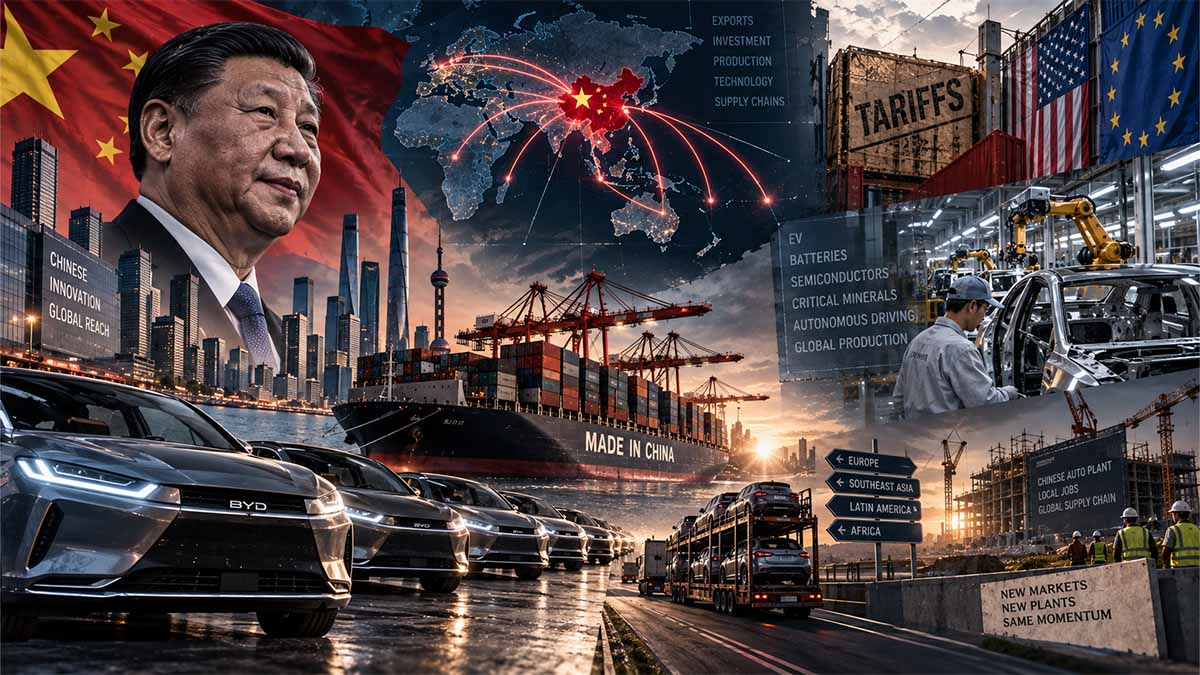
Scope: This assessment examines China’s automobile export and overseas-manufacturing expansion from 2024 through 13 September 2026, with particular attention to EV/NEV trade, tariff-jumping foreign direct investment, CKD/SKD assembly, plant localisation, battery and software value capture, and the industrial-policy implications for the European Union and other major host economies over a five-year horizon.
Executive Summary / BLUF
- The central thesis is substantially supported, but the strongest defensible formulation is narrower than “tariffs caused the overseas plant wave”: tariffs, local-content rules and import restrictions are accelerating an overseas-production strategy that was already commercially attractive because Chinese manufacturers face intense domestic competition, excess productive capability and much higher prospective margins abroad. The International Energy Agency reports that China produced approximately 16 million electric cars in 2025, around 20% more than domestic demand, while exports exceeded 2.5 million, twice their 2024 level; electric models represented more than 35% of all Chinese car exports, and the ten largest Chinese OEMs subsequently announced combined 2026 overseas-sales objectives exceeding 7 million vehicles. [Global EV Outlook 2026: Manufacturing and trade — International Energy Agency — May 2026]
- The EU tariff intervention altered the economics and legal geography of market entry rather than eliminating Chinese competitive penetration. Commission Implementing Regulation (EU) 2024/2754 imposed definitive countervailing duties on China-origin BEVs of 17.0% for BYD, 18.8% for Geely and 35.3% for SAIC, in addition to the pre-existing 10% EU passenger-car customs duty where applicable, while cooperating non-sampled producers and other producers are subject to the corresponding rates established in the regulation; critically, the measure is defined by the origin and product category of the imported vehicle, rather than by the nationality of the capital controlling an EU assembly plant. [Commission Implementing Regulation (EU) 2024/2754 — European Commission — Oct 2024]
- What the tariff regime changed is therefore principally the relative price of a China-built CBU versus a vehicle assembled inside or through another qualifying production jurisdiction; what it did not change is Chinese ownership of vehicle platforms, intellectual property, software architecture, batteries, procurement systems or residual corporate profit when those assets remain controlled by the Chinese OEM. This distinction between geographic origin and nationality of industrial control is the principal measurement issue identified in the research mandate and should govern the subsequent plant and value-added chapters.
- The overseas manufacturing transition is already measurable but remains small relative to China’s domestic industrial base and should not be overstated by aggregating announced nameplate capacity. The IEA estimates Chinese-owned overseas dual ICE/EV manufacturing capacity at approximately 1.7 million vehicles per year in 2025, against approximately 29 million inside China, while Southeast Asia represented more than half of that overseas footprint; utilisation remained only around 20% for Chinese BEV capacity in Thailand and below 15% in Indonesia, which demonstrates why announced capacity, installed capacity, trial output and commercially utilised production must remain separate variables throughout the dossier. [Global EV Outlook 2026: Manufacturing and trade — International Energy Agency — May 2026]
- Southeast Asia provides some of the clearest evidence that protection can change the mode of entry from imported finished vehicles toward locally assembled output. The IEA records that local production’s share increased materially in Thailand and Brazil during 2025, while Thailand’s investment regime had already supported BYD’s Rayong facility with planned annual capacity of approximately 150,000 vehicles; the IEA further expects utilisation to increase as regional policy shifts favour local assembly and as CKD/SKD exports expand. [Thailand Board of Investment — BYD investment information] [Global EV Outlook 2026: Manufacturing and trade — International Energy Agency — May 2026]
- CKD and SKD activity is analytically central because customs localisation can occur well before deep industrial localisation. The IEA estimates that around half of Great Wall Motor and SAIC vehicle exports in 2025 consisted of knockdown kits intended for final assembly abroad and explicitly identifies this route as a means of reducing the tariff burden otherwise borne by CBUs; a vehicle can therefore acquire local assembly status while batteries, electronic systems, tooling, engineering content and high-value components remain substantially imported. [Global EV Outlook 2026: Manufacturing and trade — International Energy Agency — May 2026]
- Europe is already demonstrating the difference between product origin and corporate origin. According to the IEA, the EU imported more than 900,000 electric cars in 2025, approximately 35% more than in 2024, with China accounting for almost 60% of those imports; simultaneously, the Chinese-brand share of China-origin electric-car imports rose from approximately 50% in 2023 to more than 70% in 2025, while Tesla’s share of China-origin EV imports fell from roughly 30% to 10%, meaning that declining China-origin production by Western OEMs can mechanically improve an “origin” statistic without implying a corresponding reduction in Chinese-brand penetration. [Global EV Outlook 2026: Manufacturing and trade — International Energy Agency — May 2026]
- European demand is simultaneously expanding, which prevents tariff effectiveness from being inferred from import volumes alone. ACEA reports that battery-electric vehicles reached 20.7% of EU new-car registrations during the first half of 2026, compared with 15.6% one year earlier, while full-year 2025 BEV registrations reached 1,880,370 vehicles and 17.4% of the market; the relevant policy test is consequently not whether China-origin imports fall in isolation, but whether European-owned production, European value-added and non-Chinese battery content gain share inside a rapidly changing powertrain market. [New car registrations: +5.7% in H1 2026 — ACEA — Jul 2026] [New car registrations: +1.8% in 2025 — ACEA — Jan 2026]
- The June–September 2026 project revisions materially strengthen the case for maintaining a live plant ledger rather than reproducing announced maps. BYD Executive Vice-President Stella Li stated in June that Szeged would begin assembly in the fourth quarter of 2026, approximately one year later than the earlier timetable, while BYD had paused the US$1 billion Manisa, Türkiye project without a restart date; in September, BYD Malaysia’s managing director confirmed that the proposed company-owned Tanjong Malim facility would not proceed, although BYD intended to continue Malaysian local assembly through an established CKD partner. The original Turkish investment agreement had envisaged a 150,000-vehicle annual plant, illustrating the difference between signed investment commitments and realised production.
- The United States represents a much more restrictive version of the same industrial-policy problem because USTR raised the additional Section 301 tariff on specified Chinese electric vehicles to 100% from September 2024, alongside a 25% additional rate for lithium-ion EV batteries; these measures substantially restrict direct China-origin vehicle entry but do not by themselves solve dependence on Chinese-controlled upstream technology deployed through third-country or locally incorporated production structures. [USTR Finalizes Action on China Tariffs Following Statutory Four-Year Review — Office of the United States Trade Representative — Sep 2024]
- The policy measurement error is therefore consequential rather than semantic: customs statistics principally identify where a vehicle was manufactured, whereas industrial-sovereignty analysis must separately identify who owns the OEM, battery producer, software stack, platform architecture and strategically important upstream inputs. A dashboard reporting only “Made in China” vehicle registrations can show apparent de-risking at the same time that Chinese-owned vehicle production, cell supply or platform control is increasing inside the protected customs territory.
- The principal policy implication is not that Chinese investment should be equated with industrial loss, because genuine local assembly can create employment, revive brownfield assets, expand supplier demand and transfer process capability; the relevant distinction is between localisation that deepens domestic value-added and localisation that mainly changes customs origin. Host governments therefore require plant-level evidence on utilisation, component sourcing, battery-cell origin, R&D location, tooling, software/data control and supplier localisation before counting a foreign assembly announcement as strategic industrial capacity.
Risk screen
| Exposure | Current assessment | Decision-relevant basis |
|---|---|---|
| EU industrial base | 🟠 Elevated | Chinese competitive access is increasingly capable of shifting from imported CBUs toward production inside or adjacent to the European customs perimeter, while the EU simultaneously faces potential manufacturing overcapacity and a rapidly expanding BEV market; the principal risk is therefore displacement of European-controlled value-added rather than the simple disappearance of European assembly. |
| Host-country employment | 🟢/🟠 Positive but conditional | Greenfield and brownfield investment can create direct employment and supplier demand, but low initial utilisation, CKD-heavy production and project delays mean announced nameplate capacity cannot be translated mechanically into durable employment. |
| Battery and critical-mineral lock-in | 🔴 High structural exposure | China retains dominant manufacturing positions across several battery-material and cell segments, while relocating final vehicle assembly does not automatically relocate cathode, anode, cell, software or platform control; the IEA’s longer-run supply-chain outlook continues to show strong Chinese concentration. |
| Technology transfer | 🟠 Uncertain and policy-dependent | Final assembly transfers manufacturing employment and operational knowledge but does not by itself establish local ownership of cell chemistry, power electronics, software, ADAS intellectual property, tooling or vehicle architecture, so technology transfer must be measured rather than inferred from plant location. |
| Political risk to European/Turkish plants | 🟠 Material and heterogeneous | Szeged’s timetable has moved into Q4 2026, while Manisa has been paused despite the original investment agreement, demonstrating that incentives, politics, market conditions and group-level capital allocation remain capable of changing supposedly committed projects. |
China’s Auto Export Machine Is Becoming an Overseas Industrial System
China’s automotive challenge to Europe is no longer adequately measured at the customs border, because the 2024–2026 tariff response is beginning to move Chinese production inside the markets that were supposed to be protected from it. Commission Implementing Regulation (EU) 2024/2754, in force since 30 October 2024, raised the effective tariff burden on China-built battery-electric vehicles to roughly 27% for BYD, 28.8% for Geely and 45.3% for SAIC when the 10% MFN duty is included; yet Chinese-brand penetration continued to rise even as the share of Made-in-China BEVs in European BEV sales fell from roughly 22% at its 2024 peak to about 17% in the first quarter of 2026. The contradiction is the policy story: Europe is becoming more successful at taxing Chinese origin just as Chinese manufacturers become more sophisticated at relocating capital, assembly and technology behind the tariff wall.
The tariff worked on the shipment, not necessarily on the manufacturer
The anti-subsidy regime changed the relative economics of a China-built CBU, but it did not prevent a Chinese group from supplying the same protected market through CKD or SKD kits, locally assembled vehicles, PHEVs falling outside the BEV-specific treatment, or production inside the European customs perimeter. The dossier records the distinction explicitly: the EU duties hit China-origin CBU BEVs, whereas EU-assembled units, many PHEVs, kits and batteries do not face the same treatment, which means the manufacturer’s optimisation problem changed from “how much can be exported?” to “which combination of tariff, logistics, political risk and local fixed cost minimises the delivered cost inside the protected market?”. The resulting industrial rule is straightforward: localisation becomes rational when the tariff-inclusive CIF cost and logistics burden exceed the annualised cost of the plant after wages, energy and rules-of-origin benefits are taken into account.
This is why the distinction between Chinese-brand and China-origin vehicles is becoming more important than the headline import number. The dossier records that Western brands including Tesla, BMW and Volvo moved production out of China, mechanically reducing the Made-in-China share of European BEV registrations, while Chinese-brand sales continued to rise and BYD volumes more than doubled even as SAIC came under greater pressure from the higher duty rate. A customs statistic can therefore show declining exposure to Chinese production at the same moment that European consumers, dealers and factories are becoming more exposed to Chinese-controlled automotive capital.
The factory map now matters more than the export map
The scale remains modest relative to China’s domestic production system, but it is no longer marginal: the International Energy Agency’s Global EV Outlook 2026 places Chinese overseas dual ICE-EV capacity at approximately 1.7 million vehicles in 2025, compared with roughly 29 million inside China. The more revealing numbers are utilisation rates, because Chinese BEV plants in Thailand operated at roughly 20% utilisation in 2025 and those in Indonesia below 15%, showing that installed capacity and effective industrial power remain very different quantities. A government that simply sums announced plant capacity will overstate immediate displacement; a government that ignores those plants until they are fully utilised will miss the formation of the next production system.
The corporate ledger shows why status matters. BYD’s Rayong operation in Thailand is already an export hub; Camaçari in Brazil is operating from the former Ford site with an initial 150,000-unit scale and a longer-term 600,000-unit target; Subang in Indonesia was inaugurated on 3 September 2026 with 150,000 units of planned capacity; Szeged in Hungary moved into trial production in January 2026 but series production slipped toward November–December; Manisa in Türkiye is on hold with no ground broken; and the proposed BYD plant at Tanjong Malim in Malaysia was cancelled in favour of a CKD-partner strategy. These are not six equivalent “Chinese factories”: they are six different stages of capital commitment, industrial depth and execution risk.
Europe is moving through the same transition using its own stranded automotive assets. Chery is ramping production with Ebro in Barcelona at the former Nissan complex; Geely is associated with future production using Ford Valencia capacity from around 2028; Leapmotor and Stellantis have used Tychy and are shifting localisation toward Zaragoza; Dongfeng and Stellantis have discussed Rennes; and SAIC has a Galicia project indicated for around 2028. The industrial significance lies precisely in the brownfield structure: Chinese technology and capital can enter Europe without reproducing from scratch the land, utilities, workforce and supplier network that made the legacy plant expensive to build in the first place.
CKD turns a trade barrier into an accounting problem
The intermediate stage is CKD and SKD assembly, because kits allow manufacturers to alter customs treatment before they have transferred the high-value parts of the industrial system. The dossier notes that roughly half of some firms’ exports, particularly GWM and SAIC, have historically been kits rather than completed vehicles, meaning that the apparent transition from “imported” to “local” cars can occur after relatively light assembly while battery packs, electronic systems, tooling and core engineering remain external. That is not necessarily fraudulent or economically trivial—local assembly creates employment and production experience—but it is not equivalent to technology transfer.
This distinction is particularly relevant in Brazil, Thailand and Malaysia, where localisation policies are already forcing Chinese manufacturers to decide how much of the supply chain to reproduce locally rather than merely where to tighten the final bolts. The dossier identifies visible supplier development around Thailand’s Rayong cluster, Brazilian localisation targets and the Proton–Geely relationship in Malaysia, but it also records the opposite case: kit assembly with imported packs. The policy question is therefore not whether a vehicle carries a domestic VIN; it is whether the host economy has acquired cell production, tooling, engineering and supplier capability that survives if the foreign manufacturer later changes model allocation.
The battery is where “Made in Europe” can still mean strategic dependence
Final assembly captures labour, paint, bodywork and some supplier spending, but the dossier identifies the battery cell and cathode, e-drive, software and ADAS as separate value layers that must be followed after the vehicle itself has changed nationality. CATL, Envision and BYD battery investments in Europe therefore matter as much as vehicle plants, because a Hungarian or Spanish VIN does not show who controls the battery chemistry, cathode and anode inputs, software architecture or residual intellectual-property rent. Without enforceable origin rules on cells and software, a host country can record rising domestic automotive output while remaining dependent on a Chinese-controlled technology stack.
The employment gains remain real, but they should not be mistaken for complete value capture. The dossier contrasts an early Szeged headcount of around 1,000 with promises in the 5,000-class, while the Subang project is associated with employment claims rising from 5,000 to 20,000; it also identifies the reactivation of former Nissan, Ford and Mercedes sites in Barcelona, Camaçari and Iracemápolis. Yet the same record identifies what can remain abroad after those jobs arrive: residual profit, intellectual property, battery chemistry, vehicle data and the ability to set industrial standards. The result is not zero-sum, but neither is every factory inauguration evidence of industrial upgrading.
Europe risks protecting geography while surrendering the higher-value layers
The policy debate is beginning to recognise that tension. The dossier records an emerging EU discussion around an Industrial Accelerator, stronger FDI screening and possible requirements involving 30% local-component content and 49% ownership tests for major projects, while battery imports into the EU are estimated by Transport & Environment to have increased roughly sevenfold since 2020. The direction of travel is important: once tariffs induce Chinese manufacturers to assemble within Europe, the policy problem shifts from subsidised imports to the conditions attached to inward investment. A duty designed around the finished vehicle cannot by itself determine who owns the battery, platform or source code inside the “European” car.
Italy, France, Germany and the United Kingdom therefore face different versions of the same industrial choice. Italy’s immediate interest is to prevent future inward investment from stopping at assembly and to link incentives to batteries, tooling and R&D; France has the additional option of absorbing Chinese technology through existing manufacturing capacity, illustrated by the Rennes discussion; Germany’s exposure derives from the interaction between its large incumbent automotive system and Chinese battery and vehicle capital; and the United Kingdom, outside the EU tariff perimeter, must decide how far any follow-on trade regime should distinguish China-origin imports from Chinese-controlled local production. The dossier provides no quantified country-by-country fiscal exposure for these four economies, so any more precise allocation would be [NOT IN DOSSIER].
The next 24 months will decide whether Europe receives factories or capabilities
Between September 2026 and roughly September 2028, the decisive indicators will not be another sequence of plant announcements but the conversion of Szeged from trial to sustained production, the fate of the paused Manisa project, the ramp at Barcelona, the movement of Geely–Ford Valencia toward its planned 2028 horizon, the depth of Leapmotor–Stellantis localisation in Spain, and whether EU rules begin counting batteries, cathodes, anodes, R&D and software rather than final assembly alone. The dossier’s proposed measurement reform is therefore more consequential than another tariff increase: governments should report registrations by brand nationality, registrations by plant country, battery GWh by cell-maker nationality, and utilisation of Chinese-owned plants inside the customs territory.
The cost of inaction will not be paid first through the disappearance of European car factories, because Chinese capital is already demonstrating that it can keep some of those factories operating. It will be paid through a less visible reallocation of industrial rent: European labour and infrastructure can remain employed while batteries, platforms, software, intellectual property and residual profits are increasingly controlled elsewhere, turning tariff protection into protection of geographic production rather than technological sovereignty. The dossier’s own displacement scenario is severe—Transport & Environment estimates that Chinese-brand BEV growth could leave capacity equivalent to roughly 10 legacy European plants idle over the next decade if onshoring stops at final assembly—and the 12–24 month policy test is therefore whether Europe uses localisation to force deeper capability transfer or merely changes the address printed on the vehicle.
Navigational Index
— Trade barriers are changing the geography of production
The first pillar will establish whether EU, US and emerging-market tariff and local-content regimes are reducing Chinese competitive penetration or primarily changing the route through which Chinese manufacturers enter protected markets, with particular separation between CBU exports, PHEVs, CKD/SKD structures, locally assembled vehicles and genuinely localised industrial ecosystems.
— Plant ownership is replacing customs origin as the critical variable
The second pillar will construct the plant-level map required by the mandate, distinguishing announced, financed, under-construction, trial-production, operational, delayed, suspended and cancelled projects, while separating capacity from utilisation and identifying greenfield factories, brownfield acquisitions, contract assembly and kit operations.
— Value-added capture determines whether localisation becomes sovereignty
The third pillar will trace batteries, cathodes and anodes, electric drives, software, ADAS, tooling, final assembly, dealer margin, R&D and residual profit in order to determine whether host economies are acquiring strategic industrial capabilities or merely becoming final-assembly locations inside a Chinese-controlled technological and capital architecture.
— Appendix — Chinese Automotive Manufacturing, Battery and Component Footprint Outside China
Cut-off date: 13 September 2026
This appendix consolidates the plant-level, company-level, battery, component and localisation evidence available for the Chinese automotive manufacturing footprint outside China. Capacity figures are nameplate or announced capacity unless explicitly identified as realised production; an announced second or third phase is never added to current installed capacity, and MOUs, delayed projects, CKD/SKD operations, trial production and operating factories remain separate categories.
📦 The Acronyms Defined
- CBU (Completely Built Up): Fully assembled vehicles. Made abroad. Ready to drive. Requires zero local assembly.
- SKD (Semi-Knocked Down): Partially assembled vehicles. Imported as major sections (e.g., body, engine, chassis). Joined together locally.
- CKD (Completely Knocked Down): Vehicles imported as a kit of individual parts. Hundreds of components. Welded, painted, and assembled entirely in the destination country.
- Integrated Manufacturing: Full-scale local production. Sourcing raw materials. Stamping body panels. Casting engines locally.
Master Abstract
The evidence supports localisation, but not de-Sinicisation
The available record supports a structural interpretation in which China’s automobile industry is internationalising production while remaining anchored to an overwhelmingly larger domestic manufacturing and supply-chain base, rather than simply substituting foreign factories for Chinese factories. China manufactured approximately 16 million electric cars during 2025, representing close to three quarters of global electric-car production, and exported more than 2.5 million, while Chinese producers’ overseas dual ICE/EV capacity was only about 1.7 million vehicles annually, equivalent to roughly 6% of their estimated 29 million domestic capacity. The disparity matters because the current overseas network is strategically significant without yet being quantitatively comparable with China’s domestic system; the more defensible judgment is therefore that overseas plants constitute a rapidly growing perimeter around a China-centred industrial core, rather than evidence that Chinese automotive manufacturing itself is relocating abroad. [Global EV Outlook 2026: Manufacturing and trade — International Energy Agency — May 2026]
The mechanism proposed in the research mandate is nevertheless observable: once tariffs, import quotas, localisation conditions or political risk raise the effective cost of exporting a complete vehicle, OEMs have an incentive to replace CBU imports with combinations of CKD/SKD assembly, contract manufacturing, brownfield conversion or greenfield investment, provided that scale and expected market access justify the fixed cost. The EU’s countervailing duties create exactly such a wedge for China-origin BEVs, while Thailand, Indonesia, Brazil and other emerging markets have progressively linked market access or fiscal advantages to domestic manufacturing. The IEA explicitly associates changing trade and industrial policies with the increased attractiveness of overseas production and expects regional policy changes to raise currently low utilisation rates. [Commission Implementing Regulation (EU) 2024/2754 — European Commission — Oct 2024] [Global EV Outlook 2026: Manufacturing and trade — International Energy Agency — May 2026]
Protection works differently at the border and inside the factory
The policy tension arises because customs law and industrial sovereignty measure different objects. The EU countervailing measure applies to new BEVs originating in the People’s Republic of China, and therefore an EU-produced BYD is analytically distinct from a BYD imported from China for customs purposes even though both remain products of a Chinese-controlled OEM; conversely, a Tesla built in Shanghai is China-origin for trade statistics despite being produced by a US-headquartered manufacturer. [Commission Implementing Regulation (EU) 2024/2754 — European Commission — Oct 2024]
The importance of this distinction is already visible in European trade composition because the IEA reports that Chinese brands accounted for more than 70% of China-origin EV imports in 2025, compared with 50% in 2023, while Tesla’s share fell from 30% to 10%; a fall in Western-brand China-origin imports can therefore improve the headline measure of Chinese import dependence without reducing the market power of Chinese firms, and the opposite effect can occur when Chinese OEMs start manufacturing within Europe. [Global EV Outlook 2026: Manufacturing and trade — International Energy Agency — May 2026]
The most important uncertainty is depth of localisation
The decisive policy issue for 2026–2031 is consequently not whether Chinese OEMs will manufacture more vehicles abroad, because the evidence already indicates that they will, but how far localisation extends upstream from final assembly. CKD and SKD can convert imported component systems into locally assembled vehicles without reproducing a complete domestic automotive ecosystem, while even full body, paint and final assembly does not establish local control over battery chemistry, power electronics, vehicle operating systems, ADAS, data architecture or platform intellectual property. The distinction is particularly important because the IEA projects continued Chinese dominance in multiple battery-supply-chain stages well into the next decade, despite expanding production elsewhere.
This creates a policy outcome that is neither equivalent to unrestricted imports nor automatically equivalent to strategic industrial upgrading: local production can provide real employment, tax revenue, supplier demand and brownfield revival, while simultaneously preserving foreign ownership of the highest-value technological layers and residual profit. The later chapters will therefore measure localisation in layers rather than treating a national VIN, factory inauguration or investment announcement as sufficient evidence of industrial sovereignty.
Key Evidence Table
| Indicator | Value/status | Reference date | Definition/scope | Issuer | Exact source |
|---|---|---|---|---|---|
| Chinese electric-car production | 16m | 2025 | Electric cars produced in China | IEA | [Global EV Outlook 2026: Manufacturing and trade — IEA — May 2026] |
| Chinese electric-car exports | >2.5m | 2025 | Electric-car exports from China | IEA, drawing on industry/customs data | [Global EV Outlook 2026: Manufacturing and trade — IEA — May 2026] |
| Electric share of Chinese car exports | >35% | 2025 | Electric models as share of all Chinese car exports | IEA | [Global EV Outlook 2026: Manufacturing and trade — IEA — May 2026] |
| Top-ten Chinese OEM overseas targets | >7m | 2026 announced targets | Aggregate announced overseas sales goals | IEA compilation | [Global EV Outlook 2026: Manufacturing and trade — IEA — May 2026] |
| Chinese-owned overseas production capacity | ≈1.7m/year | 2025 | Dual ICE/EV capacity outside China | IEA | [Global EV Outlook 2026: Manufacturing and trade — IEA — May 2026] |
| Corresponding Chinese domestic capacity | ≈29m/year | 2025 | Dual ICE/EV capacity in China | IEA | [Global EV Outlook 2026: Manufacturing and trade — IEA — May 2026] |
| Chinese BEV capacity utilisation, Thailand | ≈20% | 2025 | Average utilisation of Chinese BEV capacity | IEA | [Global EV Outlook 2026: Manufacturing and trade — IEA — May 2026] |
| Chinese BEV capacity utilisation, Indonesia | <15% | 2025 | Average utilisation of Chinese BEV capacity | IEA | [Global EV Outlook 2026: Manufacturing and trade — IEA — May 2026] |
| EU BEV market share | 20.7% | H1 2026 | BEVs as share of EU new-car registrations | ACEA | [New car registrations: +5.7% in H1 2026 — ACEA — Jul 2026] |
| EU definitive CVD, BYD | 17.0% | From Oct 2024 | China-origin BEVs; countervailing duty | European Commission | [Commission Implementing Regulation (EU) 2024/2754 — Oct 2024] |
| EU definitive CVD, Geely | 18.8% | From Oct 2024 | Same scope | European Commission | [Commission Implementing Regulation (EU) 2024/2754 — Oct 2024] |
| EU definitive CVD, SAIC | 35.3% | From Oct 2024 | Same scope | European Commission | [Commission Implementing Regulation (EU) 2024/2754 — Oct 2024] |
| US additional Section 301 EV tariff | 100% | From Sep 2024 | Specified PRC electric vehicles | USTR | [USTR Finalizes Action on China Tariffs Following Statutory Four-Year Review — Sep 2024] |
| BYD Szeged series-production timetable | Q4 2026 | Jun 2026 statement | Company executive guidance | BYD executive statement reported by Reuters | |
| BYD Manisa project | Paused; no restart timetable publicly stated | Jun 2026 | Originally announced US$1bn / 150k-unit investment | BYD executive statement; Türkiye investment authority for original commitment | |
| BYD Tanjong Malim own plant | Will not proceed; CKD partner strategy retained | 11 Sep 2026 | Malaysia manufacturing strategy | BYD Malaysia management statement |
Competing Explanations or Pathways
The ACH gate is met because the evidence permits three materially different and falsifiable interpretations of the observed transition, although the available record presently supports a combination dominated by the second and third explanations rather than a single exclusive cause.
| Hypothesis | Diagnostic support | Disconfirming evidence | Indicators | Current standing |
|---|---|---|---|---|
| Trade barriers successfully reduce Chinese industrial penetration | China-origin BEVs face substantial EU CVDs and a 100% additional US Section 301 rate; localisation can reduce direct CBU imports from China. | Chinese-brand overseas sales continue expanding, investment shifts toward protected markets, and nationality of plant ownership is not captured by customs-origin statistics. | Sustained decline in Chinese-brand registrations, Chinese-controlled EU capacity and Chinese battery share would strengthen this hypothesis. | Partially supported for direct imports, weak as a complete industrial explanation. |
| Tariffs primarily induce tariff-jumping localisation | IEA explicitly links overseas manufacturing attractiveness to industrial/trade policy; CKD/SKD activity reduces tariff exposure; BYD identifies European production as strategically important; overseas capacity is expanding. | Overseas capacity remains small versus China, utilisation is low in several new hubs and projects can be delayed or cancelled. | Rising local output alongside falling CBU imports but stable/rising Chinese-brand market share would strongly confirm it. | Best-supported explanation for the change in mode of market entry. |
| Globalisation would have occurred even without tariffs because domestic competition and overseas margins are the dominant driver | China produced substantially more EVs than domestic demand in 2025, exports doubled, domestic price competition compressed margins and OEM overseas targets exceed seven million vehicles for 2026. | Location choices repeatedly coincide with tariff barriers, local-content rules, customs-union access and incentive structures, making a tariff-independent explanation incomplete. | Plants concentrated in markets without meaningful trade barriers would strengthen this case; clustering behind tariff walls weakens it. | Strong complementary explanation, but insufficient alone to explain plant geography. |
Principal Gaps and Watch Indicators
The most important unresolved record concerns the true September 2026 plant ledger, because announcements are being superseded by later changes in construction status, ownership model and commissioning dates; Szeged, Manisa and Tanjong Malim already demonstrate that an announced investment map can become obsolete within months, and the complete company-by-company reconciliation required by the mandate must therefore be built from the latest corporate, national investment-authority and plant-level records rather than from the original Economist graphic.
A second material gap concerns the depth of local content, particularly battery cells, cathode/anode materials, electronic control units, e-drive components, tooling, source code, ADAS and R&D, because most publicly announced plant capacities do not provide an auditable bill-of-materials allocation from which host-country versus Chinese value-added can yet be calculated.
A third gap concerns the claimed European Commission Foreign Subsidies Regulation action concerning Szeged, which has not been treated here as established because the official Commission record located during this first-pass verification did not yet provide sufficiently specific support for the formulation contained in the research mandate; this proposition should remain open until the precise Commission instrument, case identifier or formal information-request record is retrieved.
The principal watch indicators are therefore the start and monthly output of Szeged; any formal resumption, renegotiation or termination of Manisa; the identity and localisation terms of BYD’s Malaysian CKD partner; utilisation at Indonesian and Thai Chinese-owned factories; European Chinese-brand registrations separated from China-origin registrations; cell-supplier nationality for European-built Chinese-brand vehicles; and the extent to which forthcoming EU local-content, foreign-subsidy or investment-screening measures are defined around ownership and strategic inputs rather than final assembly alone.
Chinese automotive capacity: industrial core versus overseas perimeter
Installed or estimated manufacturing capacity is not equivalent to utilised production; the utilisation figures below therefore show why the overseas footprint should be analysed plant by plant rather than through announced capacity alone.
| Metric | 2025 value | Interpretation |
|---|---|---|
| Domestic Chinese capacity | ≈29m vehicles/year | Remains the dominant manufacturing core. |
| Overseas Chinese-owned capacity | ≈1.7m vehicles/year | Strategically important but still a small fraction of domestic capacity. |
| Thailand BEV utilisation | ≈20% | Installed capacity materially exceeds realised output. |
| Indonesia BEV utilisation | <15% | Plant announcements should not be equated with market displacement. |
Source: International Energy Agency, Global EV Outlook 2026, “Manufacturing and trade”. Unit: vehicles per year for capacity; percentage of installed BEV capacity for utilisation. Reference year: 2025. The figures concern Chinese-owned dual ICE/EV manufacturing capacity and estimated Chinese BEV utilisation and should not be interpreted as realised annual output.
Chinese Auto Globalisation: Tariffs Are Moving Production, Not Removing Chinese Industrial Power
The Domestic Supply Wedge & Global Target Surge
China manufactured ~16 million electric vehicles in 2025, outstripping domestic consumer absorption by ~20%. Overcapacity and vicious domestic price wars compel OEMs to capture high-margin overseas sales pools.
Electric car exports exceeded 2.5 million units in 2025, doubling 2024 levels. Electric vehicles now represent over 35% of all Chinese automobile exports, triggering retaliatory tariff architectures in the West.
The top ten Chinese OEMs declared cumulative overseas sales goals surpassing 7 million units for 2026. This target cannot physically be met through pure CBU trade alone under rising Western tariff barriers.
Primary Audited Evidence Matrix • Trade, Duties & Plant Ledger
Comprehensive empirical synthesis of verifiable indicators (IEA, European Commission, ACEA, USTR, Corporate Disclosures)Deep Structural Breakdown: Strategic Vectors & Chokepoints
Deconstruction of the decoupling illusion, value-added retention, and tariff elasticityCustoms regimes evaluate where the vehicle undergoes substantial transformation, not corporate equity ownership. When BYD assembles in Szeged or SAIC produces via CKD kits, trade data categorizes units as European or ASEAN origin. The OEM, platform IP, software code base, and retained capital margin remain 100% Chinese.
In 2025, ~50% of GWM and SAIC vehicle exports were shipped as CKD/SKD kits. This mechanism evades high finished-vehicle (CBU) tariffs while requiring minimal host tooling. Sub-assemblies, stamped body panels, power electronics, and battery packs arrive pre-integrated from Chinese industrial clusters.
Final assembly represents only 15–20% of EV bill-of-materials value. Battery cells, cathode/anode active materials, and refining constitute 35–45%. The IEA projects persistent Chinese dominance in mineral refining and cell production through 2031, guaranteeing upstream margin extraction irrespective of plant location.
Between 2023 and 2025, Tesla’s share of China-origin EU EV imports collapsed from 30% to 10%, while Chinese-owned brands surged from 50% to over 70%. Statistics showing declining total imports from China often mask the rapid displacement of Western multinational re-exports by native Chinese brands.
Forensic Strategic Key Judgments
Definitive analytic judgments derived from multi-source empirical reconciliationCountervailing duties (Regulation 2024/2754) accelerated an expansion strategy already mandated by domestic margin compression. With China’s domestic dual capacity at ~29M against 16M EV output, overseas markets offer essential operating profit spreads that dwarf border taxes.
Aggregating overseas capacity announcements creates severe analytical distortions. IEA data shows Chinese BEV utilisation in Thailand is ~20% and in Indonesia <15%. Commercial output must be tracked separately from ceremonial ground-breakings.
The 2026 revisions demonstrate high project mortality: BYD delayed Szeged to Q4 2026, paused the $1B Manisa plant without a restart date, and cancelled its proprietary factory in Malaysia in favor of asset-light CKD assembly. Capital deployment remains volatile.
A metric measuring only “China-origin” imports misdiagnoses risk. A Hungarian-assembled BYD generates Hungarian employment and European trade credit, but software stacks, ADAS algorithms, hardware architecture, and strategic profits remain tethered to Shenzhen.
EU BEV registrations reached 20.7% in H1 2026 (ACEA). With total EU BEV volume growing rapidly, Chinese brands can increase their absolute market presence even while definitive countervailing duties compress percentage margins on CBU shipments.
The 100% Section 301 EV tariff and 25% battery duty hermetically seal the US from direct vehicle imports, but force Chinese capital into upstream licensing, third-country supply chains (Mexico, ASEAN), and joint ventures that subvert the intended technological decoupling.
Open Official Record Gaps
- Foreign Subsidies Regulation (FSR) Action: Specific case identifiers, formal Commission instruments, or formal Article 10 information-requests targeting BYD Szeged state aids remain unconfirmed in public official gazettes.
- Audited Bill-of-Materials (BOM) Allocations: Lack of granular host-country vs. PRC component value data for European and ASEAN assembly plants to verify true local-content ratios.
- Manisa Plant Legal Status: Undisclosed contractual cancellation penalties or renegotiation parameters between BYD and the Turkish Ministry of Industry.
- Upstream Battery Cell Suppliers: Ambiguity regarding whether initial Szeged-built passenger units will integrate European-manufactured cells or imported FinDreams battery packs.
Observable Watch Indicators (2026–2031)
Trade barriers are changing the geography of production more than the nationality of industrial control
Principal judgment
The evidence available through 13 September 2026 supports a more precise conclusion than the proposition that tariffs are simply reducing Chinese automotive penetration: the European Union, United States and a growing group of emerging economies have made the direct export of China-built finished vehicles materially more expensive, but the resulting adjustment is occurring through several different channels—continued CBU exports where margins absorb the tariff, substitution toward powertrains outside the targeted measure, CKD/SKD shipment and assembly, local contract manufacturing, brownfield conversion and ultimately Chinese-owned production inside the protected market itself. The process is therefore reducing the usefulness of customs origin as a stand-alone measure of industrial exposure, because the policy variable being taxed is often the place where the completed vehicle originates, whereas the economically strategic variables—corporate ownership, vehicle platform, battery cells and materials, software, intellectual property, procurement architecture and residual profit—can remain Chinese after final assembly has moved abroad. This is precisely the distinction established in the research mandate between product origin and nationality of capital, and it requires every subsequent plant and market-share calculation to keep CBU, CKD/SKD and genuinely localised production analytically separate.
The underlying commercial pressure is substantial enough that trade policy cannot be analysed in isolation from China’s domestic industrial conditions, because the International Energy Agency estimates that China produced approximately 16 million electric cars in 2025, close to three quarters of global output, while domestic demand was approximately 20% below production and electric-car exports consequently doubled to more than 2.5 million units; the IEA further reports that the ten largest Chinese automakers entered 2026 with combined overseas-sales objectives exceeding 7 million vehicles, almost twice their collectively announced 2025 targets, meaning that foreign markets are no longer marginal outlets but an increasingly important mechanism for absorbing Chinese production and protecting manufacturer revenues during a severe domestic price war. Global EV Outlook 2026 — Manufacturing and trade — International Energy Agency
The European tariff wall is technologically narrow but economically powerful
The European Union’s central intervention remains Commission Implementing Regulation (EU) 2024/2754, which imposed definitive countervailing duties from 30 October 2024 on new battery-electric passenger vehicles originating in the People’s Republic of China after the Commission concluded that the Chinese BEV value chain benefited from countervailable subsidies that threatened material injury to EU producers; following subsequent amendments, the applicable definitive rates remain 17.0% for BYD Group, 18.8% for Geely Group, 35.3% for SAIC Group, 7.8% for Tesla Shanghai, 20.7% for other cooperating companies and 35.3% for other companies, and these countervailing rates are levied in addition to the normal customs treatment applicable to imported passenger vehicles rather than replacing it. Commission Implementing Regulation (EU) 2024/2754 — EUR-Lex
For a producer such as BYD, the commercial effect is therefore not adequately represented by saying that “the tariff is 17%”, because a China-origin vehicle already enters the European customs regime under the ordinary passenger-car tariff structure before the countervailing measure is added; the EU Access2Markets tariff database continues to show a 10% erga omnes third-country duty for relevant passenger-car categories, which means that the anti-subsidy intervention produces an approximate tariff stack of 27% for BYD, 28.8% for Geely and 45.3% for SAIC before VAT and other market-specific costs, although the exact customs calculation must always follow the applicable CN classification, customs value and producer-specific TARIC code rather than a simplified headline percentage.
This differential is large enough to alter the comparative economics between exporting a completed vehicle from China and manufacturing the same vehicle inside the EU, because an EU-built vehicle is no longer a China-origin CBU subject to the China-specific BEV countervailing measure, even when the manufacturer, platform, battery technology and corporate profit remain controlled by the same Chinese group. The consequence is that the duty can protect European geography without necessarily producing European ownership, which is why a policy assessment that records a Hungarian-built BYD or Spanish-built Chery simply as “European production” captures customs origin correctly but answers the industrial-sovereignty question incompletely.
The powertrain boundary creates a genuine route-of-entry asymmetry
The exact legal scope of the EU measure is especially important because the regulation does not impose a general additional duty on every electrified passenger vehicle produced in China; it covers vehicles propelled solely by one or more electric motors, including vehicles that use an internal-combustion engine only as an auxiliary range extender, whereas EU customs nomenclature classifies plug-in hybrid vehicles in which the combustion engine and electric motor are both propulsion motors under separate headings, notably CN 8703 60 and 8703 70. Consequently, the common shorthand that the measure covers “BEVs but not PHEVs” is directionally correct but insufficiently precise, because an EREV whose combustion unit does not mechanically propel the vehicle can remain inside the investigated BEV product definition even though it contains an internal-combustion engine. EU Commission imposes countervailing duties on imports of BEVs from China — European Commission Access2Markets
That legal boundary generates an economically meaningful incentive because a manufacturer with a flexible product portfolio can alter its European sales mix without immediately relocating production, provided that consumer demand, fleet-emission regulation and the economics of the alternative drivetrain remain favourable; this does not establish that every increase in Chinese PHEV sales constitutes deliberate tariff circumvention, which would require evidence of intent and the applicable trade-defence legal test, but it does establish that different Chinese powertrain architectures currently face materially different trade-policy treatment. The correct analytical measure is therefore not only the number of Chinese-brand vehicles registered in Europe, but their decomposition by BEV, EREV and PHEV, production country and manufacturer ownership, because a decline in China-origin BEVs can coexist with increasing Chinese-brand penetration through non-covered drivetrains or EU-based assembly.
Brussels has already moved from a pure tariff instrument toward conditional market access
The European regime is also evolving beyond a simple duty wall, because in January 2026 the Commission published formal guidance allowing Chinese BEV exporters to submit price undertakings containing minimum import prices and potentially commitments concerning sales channels, cross-compensation and future EU investment; the significance of this mechanism became concrete on 10 February 2026 when the Commission accepted an undertaking from Volkswagen (Anhui) Automotive Company Ltd. and SEAT, allowing the China-built CUPRA Tavascan to enter at or above an agreed minimum import price without paying the otherwise applicable countervailing duty, provided that the undertaking’s volume limits and investment milestones are respected. Commission issues Guidance Document on price undertakings for BEVs from China — European Commission — 12 January 2026 Commission accepts price undertaking from Chinese electric car producer — European Commission — 10 February 2026
The precedent matters beyond Volkswagen Anhui because it converts market access into a negotiable package containing price discipline, quantity discipline and investment commitments, thereby creating a second path around the tariff that does not require immediate full localisation but can make future EU investment part of the remedy itself. The Commission explicitly states that failure to comply with the undertaking, including its investment milestones, can result in withdrawal of the exemption and retroactive reimposition of duties, so the instrument should not be treated as a voluntary industrial-policy promise detached from trade enforcement; analytically, it demonstrates that the EU is beginning to connect border treatment with production commitments, although it still does not by itself determine the nationality of batteries, software, intellectual property or upstream components incorporated into the resulting European production.
The immediate European result is composition change, not Chinese withdrawal
The best available official multilateral evidence does not show China disappearing from the European market after the duties, because the IEA estimates that EU electric-car imports increased by approximately 35% in 2025 to more than 900,000 vehicles, with China supplying almost 60% of those imports, equivalent to somewhat less than 20% of EU electric-car demand; more importantly, Chinese manufacturers increasingly displaced Western manufacturers within the remaining China-origin flow, because the share of Chinese brands in electric cars imported from China increased from roughly 50% in 2023 to more than 70% in 2025, while Tesla’s share of China-origin electric-car imports fell from around 30% to 10%. Global EV Outlook 2026 — International Energy Agency
This compositional movement is essential for policy interpretation because two statistically opposite processes can occur simultaneously: Western manufacturers can remove China from their European supply chains by relocating production, thereby reducing “Made in China” registrations, while Chinese manufacturers can expand their European commercial presence either by retaining sufficiently profitable imports or progressively moving production into the Union. A metric based solely on production origin can therefore indicate successful de-risking even while the share of vehicles sold by Chinese-controlled manufacturers continues to increase, whereas a brand-nationality metric alone can overstate dependence if the vehicle contains substantial European components, R&D and battery value; the correct measurement architecture must preserve both dimensions rather than selecting the one that produces the politically preferred conclusion.
The United States has chosen market exclusion rather than European-style managed penetration
The United States has adopted a materially harder border treatment because the Office of the United States Trade Representative finalised the increase in the additional Section 301 tariff on Chinese electric vehicles to 100%, while raising the additional tariff on lithium-ion EV batteries and specified battery parts to 25%, with USTR explicitly presenting the changes as part of a strategy to address Chinese technology-transfer, intellectual-property and industrial-policy practices. USTR Finalizes Action on China Tariffs Following Statutory Four-Year Review — 13 September 2024
The US measure therefore raises the price of direct China-to-US BEV entry to a degree that makes ordinary CBU competition commercially prohibitive for most mass-market vehicles, but its industrial significance is broader because the battery tariff addresses one upstream layer that the EU vehicle-focused CVD does not automatically relocate. Even this more restrictive system does not eliminate the underlying distinction between customs origin and corporate control, however, because Chinese groups can still seek third-country manufacturing positions, licensing structures, component relationships or other commercial arrangements subject to US origin rules, investment screening and sector-specific restrictions; the crucial difference is that Washington has erected substantially higher barriers to both the completed China-origin vehicle and selected battery content, whereas the European system leaves considerably more room for managed penetration and localisation.
Emerging markets are moving through the same sequence later, but often more explicitly
The strongest evidence that the phenomenon is not exclusively European comes from emerging manufacturing economies that initially used low tariffs or investment-linked import privileges to accelerate EV adoption and attract foreign manufacturers, but are now tightening the border once sufficient local investment has been committed. The IEA reports that Thailand, Indonesia, India, Malaysia, Brazil, Mexico and Türkiye have all developed policy frameworks encouraging domestic EV manufacturing, while locally produced EVs began gaining measurable share during 2025, including an increase of almost 15 percentage points in Thailand and approximately 5 percentage points in Brazil; at the same time, the expiry of several Southeast Asian import-duty waivers at the end of 2025 and new tariff measures in Latin America shifted the economic advantage from importing complete Chinese vehicles toward manufacturing or assembling them locally.
The result is particularly important because Chinese-owned overseas dual ICE/EV manufacturing capacity reached approximately 1.7 million vehicles per year in 2025, compared with roughly 29 million inside China, and more than half of this overseas footprint was already located in Southeast Asia; Thailand accounted for more than 30% and Indonesia for more than 20% of the overseas capacity, even though average Chinese BEV capacity utilisation remained around 20% in Thailand and below 15% in Indonesia. Those figures establish both sides of the argument: the physical localisation strategy is already large enough to be industrially significant, but nameplate capacity still substantially exaggerates realised production, which means tariff-jumping FDI must be measured through utilisation and output rather than factory announcements alone.
CKD and SKD are the critical intermediate technology between trade and manufacturing
The most important transitional mechanism is not immediately a fully integrated foreign factory but the shipment of a vehicle in disassembled or partially disassembled form, because CKD and SKD structures allow the manufacturer to preserve a large proportion of the original supply chain while shifting enough production activity to the destination market to benefit from different tariff or industrial-policy treatment. The IEA estimates that during 2025 around half of Great Wall Motor and SAIC vehicle exports consisted of knockdown kits intended for final assembly in importing markets, and explicitly states that such exports enable Chinese EV manufacturers to mitigate tariffs otherwise paid in full on completely built-up vehicles while ramping up foreign output where the local component ecosystem is not yet sufficiently developed for deeper manufacturing.
This distinction is decisive because the sequence from CBU to SKD to CKD to integrated manufacturing is not simply a progression in the quantity of local work but a progression in industrial depth. Under a CBU model, essentially the completed vehicle value chain remains in the exporting country; under SKD, major vehicle modules can arrive substantially complete and host-country activity can be concentrated in relatively light assembly; under CKD, additional assembly, welding or component integration can move locally depending on the configuration; only when body stamping, paint, e-drive production, battery cells, electronics, tooling, engineering, software integration, supplier development and R&D progressively enter the host country does localisation begin to resemble a durable domestic industrial ecosystem rather than tariff engineering.
The Brazilian case demonstrates how policymakers themselves are recognising this distinction, because Brazil’s Executive Management Committee decided in 2026 to maintain the accelerated tariff schedule under which SKD electrified vehicles became subject to a 35% import duty from July 2026 and CKD vehicles reach 35% from 1 January 2027, thereby reducing the tariff advantage of kit-based production relative to deeper localisation. Deliberações da 238ª Reunião Ordinária do Gecex — Brazilian Ministry of Development, Industry, Trade and Services
The policy shift is especially revealing when compared with BYD’s Camaçari development, because the Government of Bahia stated that the first production stage relied on SKD assembly using components imported from China, while subsequent localisation was intended to raise the Brazilian component share; by March 2026 the Bahia government was publicly describing planned annual production of up to 300,000 vehicles, potentially expandable to 600,000, and expected a new phase from August in which more than 30% of components would be produced in Brazil. These are official host-government statements and therefore evidence of the announced localisation programme rather than independent verification that each local-content target has already been achieved, but they illustrate exactly why Camaçari cannot be classified simply as either a “Chinese import” or a fully Brazilian industrial product without specifying the stage of production. BYD Camaçari production and localisation — Government of Bahia
Türkiye shows why tariff-jumping FDI remains contingent rather than automatic
Türkiye provides another clear example of the commercial logic, but equally of its fragility, because the official 2024 investment agreement with BYD provided for a US$1 billion manufacturing and R&D investment with annual capacity of 150,000 electric and plug-in hybrid vehicles, up to 5,000 direct jobs, and an intended production start by the end of 2026; the Turkish Investment Office explicitly cited Türkiye’s supplier base, workforce and geographic position as strategic attributes of the project, while the inclusion of both BEVs and PHEVs under the planned production mix illustrates the manufacturer’s ability to serve multiple regulatory and consumer segments from the same protected manufacturing location. BYD Announces Landmark USD 1 Billion EV Plant Investment in Türkiye — Investment Office of the Presidency of Türkiye
The analytical lesson is not that every tariff barrier mechanically produces a factory, because the later pause in BYD’s Manisa project demonstrates that the investment equation remains conditional on market access, incentives, production economics and political expectations; rather, the important point is that once the direct CBU route becomes expensive, local production becomes one of several substitutes whose viability depends on whether the protected market is large enough to amortise the fixed cost of entry. This is the industrial mechanism behind tariff-jumping FDI, and it explains why different markets produce different solutions: full greenfield plants where demand and policy certainty justify scale, brownfield conversion where existing industrial assets reduce fixed cost, contract manufacturing where speed matters, and CKD/SKD operations where market size or supplier depth does not yet justify complete localisation.
The policy ladder must distinguish five different forms of Chinese market penetration
| Route of entry | Customs character | Host-country industrial content | Chinese value potentially retained | Policy interpretation |
|---|---|---|---|---|
| China-built CBU | Completed vehicle imported from China | Minimal manufacturing content in host market | OEM profit, platform, battery, software, manufacturing value and much of supplier margin | Direct merchandise-trade penetration and principal target of current EU CVDs |
| China-built PHEV outside BEV CVD scope | Completed vehicle remains China-origin but falls under a different powertrain classification | Minimal manufacturing content in host market | Similar corporate and technological control to CBU BEV | Product-mix substitution can preserve market access without localisation |
| SKD assembly | Major modules imported for relatively light local assembly | Assembly jobs and limited supplier content | Most high-value components, engineering and IP can remain imported/Chinese | Customs localisation can materially exceed industrial localisation |
| CKD / deeper assembly | Vehicle imported in more disassembled form and assembled locally | Greater labour, body and supplier potential depending on configuration | Battery, electronics, tooling, software and platform control can remain Chinese | Intermediate stage whose value depends on enforceable localisation requirements |
| Integrated local manufacturing | Vehicle obtains host-country origin under applicable rules | Body, paint, assembly and potentially local components, cells, engineering and R&D | Corporate ownership, platform IP, software and residual profit can still remain Chinese | Genuine host-country production, but not necessarily host-country strategic control |
The central policy error arises when the last three categories are aggregated as “local production” without recording what has actually moved, because a plant assembling imported packs, drive units and electronic modules is economically different from a facility supported by local cell production, local cathode and anode sourcing, tooling, software engineering and domestic supplier development even when both vehicles carry the same country-of-production label. The mandate is therefore correct to treat CKD/SKD as the intermediate technology of the transplant wave rather than automatically classifying it as technology transfer.
Trade policy is already changing flows, but not in a uniform direction
The IEA’s 2026 assessment provides the clearest macro-level evidence of the transition because China’s electric-car exports doubled in 2025 and exports in the first quarter of 2026 more than doubled again year on year, even as domestic NEV sales declined almost 25% over the same comparison period; simultaneously, the agency expects the expiry of Southeast Asian import concessions, Brazil’s renewed tariffs, Mexico’s increased tariffs and other localisation policies to place growing pressure on the CBU route. The result is not a contradiction but a transitional phase in which China is simultaneously exporting more vehicles, exporting more kits and constructing more foreign capacity, because individual companies and jurisdictions are moving through the localisation process at different speeds.
This explains why aggregate export statistics cannot yet prove or disprove tariff-jumping FDI: rapidly growing Chinese overseas demand can keep CBU shipments rising in absolute terms even while the marginal vehicle in a specific protected market shifts toward local assembly, while inventory accumulation further distorts the relationship between customs exports and actual registrations. The IEA estimates that China’s reported electric-car exports in 2025 exceeded overseas sales by more than 25%, indicating substantial inventory accumulation outside China, so export data should not be treated as equivalent to final-market penetration without matching them to registrations, inventories and locally manufactured volumes.
The real policy test is whether the tariff changes the ownership of value-added
The evidence therefore supports a hierarchy of policy outcomes rather than a binary judgment about whether protection “worked”. A tariff has succeeded at the narrowest level if it reduces the targeted China-origin CBU flow; it has achieved a stronger industrial objective if displaced imports are replaced by vehicles whose manufacturing value migrates into the host economy; it has produced deeper strategic localisation only when important upstream activities such as battery cells, materials, power electronics, tooling, engineering and software also become locally anchored; and it has altered industrial control only when host-country or allied firms acquire meaningful ownership, technological capability or durable control over those layers rather than merely supplying labour and land to a foreign-controlled platform.
That distinction becomes especially consequential in batteries, because the IEA estimates that China accounted in 2025 for more than 80% of global battery-cell production, around 85% of cathode-active-material production and more than 90% of anode-active-material production, while its stated-policies outlook still leaves China producing roughly two-thirds of global batteries, about three-quarters of cathode active material and close to 90% of anode active material in 2035. A European, Brazilian or Southeast Asian vehicle factory can therefore reduce dependence on imported Chinese completed cars while remaining substantially dependent on a Chinese-controlled battery and materials ecosystem, which is why vehicle-localisation statistics alone are incapable of measuring strategic automotive sovereignty.
What the tariff regime has changed—and what it has not
The tariff regime has changed the economically preferred route by which Chinese automobile manufacturers enter protected markets, increasing the relative attractiveness of PHEV portfolio substitution, CKD/SKD assembly, contract production, brownfield conversion and local greenfield investment whenever the avoided import burden exceeds the additional fixed and operating cost of localisation; it has not eliminated Chinese competitive capability, Chinese ownership of the manufacturers concerned, or Chinese dominance across several of the battery and technology layers that determine where the highest strategic value is captured.
The resulting policy measurement problem is therefore fundamental: customs authorities accurately record where the finished good originates, but an industrial-security dashboard must additionally record manufacturer nationality, assembly location, battery-cell manufacturer nationality, battery-material provenance, local-content share, plant utilisation and ownership of software/platform intellectual property, because otherwise a fall in China-origin vehicle imports can be reported as industrial de-risking while Chinese-controlled productive capacity inside the customs territory is simultaneously increasing. This is the measurement reform required by the mandate and it should become the common dataset for the plant ledger, value-added chapter and final policy options.
Key judgments
The balance of verified evidence supports the judgment that European and emerging-market trade barriers are changing the mode of Chinese automotive penetration more reliably than they are reducing the underlying competitive penetration itself, while the United States has adopted a more exclusionary model by applying substantially higher vehicle tariffs and directly targeting Chinese EV battery imports.
The EU regime creates particularly strong incentives for localisation because a China-origin BEV can face a producer-specific countervailing duty of up to 35.3% on top of ordinary customs treatment, whereas the same Chinese-controlled group can potentially supply the European market from an EU factory without the China-origin BEV CVD applying to the locally produced vehicle; this creates a clear economic distinction between protection against Chinese-produced goods and protection against Chinese-controlled production.
CKD/SKD must remain a separate analytical category because the IEA evidence that roughly half of Great Wall Motor and SAIC exports were knockdown kits in 2025 demonstrates that overseas “production” can initially consist of imported Chinese vehicle systems undergoing final assembly rather than the replication of a complete local supply chain.
The most important industrial-policy threshold is therefore not the opening of a factory but the transition from assembly localisation to value-chain localisation, particularly cells, cathodes and anodes, power electronics, tooling, software, engineering and supplier capability.
What would change the assessment
The assessment that tariffs are primarily altering mode of entry would weaken materially if Chinese-brand market shares declined persistently across protected markets even after local factories reached commercial production, if announced overseas capacity were cancelled faster than new projects entered production, or if local manufacturing proved structurally unable to approach competitive utilisation despite tariff protection.
Conversely, the assessment would strengthen substantially if China-origin CBU shares continued declining while Chinese-brand registrations remained stable or increased, Chinese-owned capacity inside protected markets rose, CKD/SKD flows expanded ahead of fully localised production, and a growing proportion of Chinese-branded vehicles acquired European, Southeast Asian or Latin American origin without a corresponding transfer of battery, software and platform ownership.
Open official record
The next evidentiary task is to reconcile the trade mechanism established here with the September 2026 plant ledger, because only site-level verification can determine which manufacturers have actually crossed from export strategy into physical localisation and which projects remain announcements, delayed investments, contract-assembly arrangements or cancelled proposals; particular attention must therefore be given to Szeged, Manisa, Barcelona, Camaçari, Rayong, Indonesian production, Malaysia, Pakistan and the various European brownfield proposals identified in the mandate.
A second open record concerns the exact local-content composition of these plants, because official investment announcements frequently disclose headline capacity and employment while omitting auditable data on cell sourcing, imported kits, power electronics, supplier nationality, software ownership and actual utilisation, and those missing variables determine whether the investment constitutes genuine technology and value-added transfer or primarily a change in customs origin.
Trade Barriers Are Changing the Geography of Production More Than the Nationality of Industrial Control
The Cumulative European Duty Stack
Definitive countervailing duties are levied on top of the pre-existing 10% third-country passenger car tariff. BYD faces an effective ad-valorem barrier of ~27.0%, Geely ~28.8%, and SAIC ~45.3% at EU customs borders before VAT.
Countervailing measures apply strictly to goods originating in the PRC. A BYD vehicle manufactured inside Hungary or a Chery produced in Barcelona completely bypasses the 17–35% CVD stack, even though equity and IP remain 100% Chinese.
Reg. 2024/2754 covers pure electric motors (including auxiliary range extenders - EREVs). Parallel plug-in hybrids (CN 8703 60 / 70) with dual combustion mechanical propulsion escape the CVD, creating an immediate powertrain substitution route.
Primary Audited Evidence Matrix • Trade Defence, Powertrain Scope & Market Penetration
Empirical legal benchmarks, multilateral supply chain projections (IEA, EUR-Lex, USTR, MDIC Brazil)Deep Structural Breakdown: Vectors of Technological Entrenchment
Deconstruction of the decoupling illusion, value-added retention, and tariff elasticityCustoms law measures the territorial point of substantial transformation; industrial sovereignty measures who controls the platform architecture, patents, source code, battery refining, and residual profit. When BYD builds in Hungary or Chery in Barcelona, customs reports European de-risking while corporate dependency on Shenzhen intensifies.
The Commission's February 2026 acceptance of Volkswagen Anhui's price undertaking (CUPRA Tavascan) formalises managed market penetration. Instead of blocking trade, the EU exchanges tariff relief for minimum pricing floors and mandatory investment milestones, effectively turning trade defence into an instrument of forced host capital allocation.
IEA 2026 data shows China commands >80% of global battery cells, ~85% of cathodes, and >90% of anodes. Even by 2035, under stated policies, China will control ~67% of cells and ~90% of anodes. Displacing vehicle assembly into Europe or Mercosur leaves the core upstream battery value chain entirely beholden to Chinese supply nodes.
In 2023, Tesla accounted for ~30% of China-to-EU EV exports; by 2025 it plunged to ~10%. Concurrently, Chinese domestic brands rose from 50% to >70% of China-origin shipments. As Western OEMs re-shore China production to evade duties, native Chinese OEMs directly absorb their vacated import shares, neutralizing trade barrier intent.
Forensic Strategic Key Judgments
Definitive analytic assessments derived from verified multi-source operational dataTrade barriers primarily alter the transactional form of market entry rather than competitive penetration. Confronting 17–35% CVDs, Chinese OEMs redeploy via CKD kit exports (50% of GWM/SAIC volume), hybrid powertrain pivoting, price undertakings, and direct European factory assembly.
China produced ~16M electric cars in 2025—20% above domestic demand—forcing exports to exceed 2.5M. With top-10 Chinese OEMs targeting >7M overseas sales in 2026, foreign market expansion is an existential revenue requirement to survive domestic price wars, not an elective choice.
Definitive countervailing duties under Reg. 2024/2754 stack directly on top of the pre-existing 10% passenger car tariff, producing total border duties of 27.0% for BYD, 28.8% for Geely, and 45.3% for SAIC. This tax differential creates overwhelming economic pressure to assemble inside the EU customs wall.
The EU CVD scope covers pure electric vehicles and auxiliary EREVs, but excludes parallel mechanical combustion hybrids (CN 8703 60/70). Chinese OEMs exploit this legal gap by accelerating dual-motor PHEV exports to Europe, capturing market share without paying countervailing duties.
Emerging markets are following the EU by closing kit loopholes: Brazil is raising SKD/CKD tariffs to 35% by Jan 2027 to force real local sourcing. Concurrently, factory pauses (BYD Manisa $1B plant frozen) show that tariff-jumping FDI remains highly conditional on host incentives and market size.
While the US uses 100% Section 301 EV tariffs and 25% battery duties to enforce total exclusion, the EU operates a managed penetration regime via price undertakings and local assembly incentives. However, both regimes remain structurally dependent on Chinese upstream battery supply chains.
Open Official Record Gaps
- Audited Local Bill-of-Materials: Absence of auditable host-country vs PRC component accounting for BYD Camaçari and Thai facilities to verify if announced local content targets (>30%) are realized.
- Price Undertaking Conditions: Specific volume quotas, pricing floors, and mandatory investment milestones accepted under the VW Anhui (CUPRA Tavascan) undertaking remain redacted under commercial secrecy.
- Manisa Contractual Status: Lack of official disclosure from the Turkish Ministry of Industry regarding whether BYD's $1B plant pause entails contractual default penalties or renegotiated subsidy terms.
- Overseas Inventory Buildup: Discrepancy between the IEA's noted 25% export excess over overseas sales and physical holding-port inventories across European and ASEAN hubs.
Observable Watch Indicators (2026–2031)
Plant ownership is replacing customs origin as the critical variable
Principal judgment
The overseas manufacturing map of Chinese automobile groups has become too complex for customs origin to remain the principal measure of industrial exposure, because the same Chinese-controlled technology stack can now reach a foreign market through a China-built CBU, an SKD or CKD operation, a locally incorporated joint venture, a brownfield European factory, a contract-manufacturing arrangement, or a fully owned greenfield plant whose finished vehicle acquires local origin while core platform, battery, software and corporate control remain elsewhere. The most defensible September 2026 reading is therefore that Chinese automotive internationalisation has entered a second phase in which ownership and control of productive assets increasingly matter more than the country stamped on the finished vehicle, although the transition remains highly uneven because some plants are producing at scale, others are operating below capacity, several European projects will not begin before 2027–2028, and a number of announced investments have slipped, changed industrial form or remain insufficiently documented to be treated as committed capacity.
The distinction is particularly important because Chinese-owned manufacturing capacity outside China is still much smaller than the domestic industrial base: the International Energy Agency estimates approximately 1.7 million vehicles of Chinese-owned overseas ICE/EV capacity in 2025 compared with roughly 29 million inside China, while utilisation of Chinese BEV capacity was only around 20% in Thailand and below 15% in Indonesia. Those figures mean that foreign factory announcements cannot yet be translated mechanically into displaced European, Japanese or Korean production, but they simultaneously show that the overseas system has become large enough to constitute a genuine industrial network rather than an assortment of isolated assembly ventures.
The plant-level evidence also confirms the central hypothesis established in the mandate: the relevant analytical progression is no longer simply China → export market, but increasingly China → components, technology and capital → host-country manufacturing asset → local-origin vehicle, with the economic significance of each investment determined by ownership, production depth, utilisation, local procurement and control of the high-value technological layers rather than by final-assembly geography alone.
The plant map must be read as a status ledger rather than as a collection of announcements
A rigorous plant map requires at least seven separate status categories because an announced investment does not constitute industrial capacity, construction does not constitute production, trial output does not constitute commercially utilised capacity, and local assembly does not necessarily constitute a full manufacturing process. For this assessment, operational means verified series production or assembly is occurring; trial/commissioning means vehicles or production processes are being validated before sustained commercial output; under construction means physical works are verified but production has not begun; committed/JV formed means binding corporate structures or investments exist but production remains prospective; MOU/intention means the project remains subject to definitive agreements, approvals or industrial decisions; delayed/suspended means the latest record shows implementation materially behind the original schedule or paused; and cancelled/superseded is used only where a competent first-party record establishes that the original plant plan is no longer proceeding.
This classification materially changes the apparent scale of Chinese overseas industrialisation because projects routinely cited together are not equivalent: BYD Rayong, Chery–Ebro Barcelona, GWM Iracemápolis, BYD Jizzakh and Changan Rayong already represent operating production assets; BYD Szeged represents a major factory still undergoing implementation and regulatory scrutiny; Geely–Ford Valencia represents a formally announced future joint venture with production scheduled from 2028; Stellantis–Dongfeng Rennes remains an intended localisation project under a non-binding cooperation structure; and other sites remain assembly projects whose industrial depth must be assessed through welding, paint, stamping, battery, powertrain and local-component evidence rather than through the use of the word “factory”.
Master plant ledger — verified status as of September 2026
| Company / industrial structure | Country / site | Asset form | Latest verified status | Verified / announced capacity | Vehicle / process | Intended market | Industrial assessment |
|---|---|---|---|---|---|---|---|
| BYD | Rayong, Thailand | Greenfield | Operational since July 2024 | 150,000/yr | Stamping, welding, painting, assembly and components; NEVs | Thailand + ASEAN/export | One of the clearest examples of genuine production localisation rather than light assembly |
| BYD–UzAuto JV | Jizzakh, Uzbekistan | JV / existing industrial ecosystem | Operational, mass production from June 2024 | 50,000/yr first phase; later stages envisaged up to 200k/500k | Initially Song Plus DM-i and Chazor PHEVs; progressive localisation | Uzbekistan + Central Asia | Operational production, but future capacity figures remain expansion plans rather than installed capacity |
| BYD | Camaçari, Bahia, Brazil | Brownfield industrial redevelopment of former Ford complex | Operational/ramping; initial phase began with SKD content | 150,000 initial, government later cites 300,000, with 600,000 as possible future expansion | BEV/PHEV/flex models; local-content transition underway | Brazil + South America/export | High strategic importance, but localisation is phased; first production should not be confused with complete Brazilian manufacture |
| BYD | Subang, West Java, Indonesia | Greenfield | Inaugurated/entering production by September 2026 according to Indonesian official record | 150,000/yr initial plan | EV production; battery/PHEV expansion discussed | Indonesia + export | Important ASEAN/nickel-linked base; utilisation must be observed before capacity is treated as realised output |
| BYD | Szeged, Hungary | Greenfield | Under construction / delayed relative to original timetable | Hungarian official sources have cited up to 300,000/yr potential | BEV manufacturing | EU Single Market | Strategically decisive European localisation project, but not yet equivalent to operating capacity |
| BYD | Manisa, Türkiye | Greenfield + R&D | Original investment formally agreed; latest implementation status requires caution | 150,000/yr announced | BEV + PHEV | Türkiye + regional/customs-union access | Do not count as operational capacity; original US$1bn agreement remains the verified official baseline |
| BYD | Sihanoukville SEZ, Cambodia | Greenfield assembly | Construction officially launched Apr 2025; planned production from late 2025 | Official ground-breaking confirmed; capacity requires separate first-order verification | EV assembly | Cambodia + ASEAN | Evidence supports physical localisation; industrial depth should be classified separately from vehicle assembly |
| BYD–Mega Motor | Pakistan | JV / local manufacturing | Under construction as of June 2026 | Capacity not stated in latest federal record used here | NEV manufacturing with phased localisation | Pakistan + prospective exports | Not yet operational; government and BYD described construction as proceeding on schedule |
| Chery–Ebro / EV Motors | Barcelona Zona Franca, Spain | Brownfield / JV; former Nissan site | Operational since Nov 2024 | Capacity is being ramped; headline future figures should not be treated as current output | Ebro S700/S800; Chery-linked models; ICE/PHEV/NEV pathway | Spain + EU | Strong example of Chinese technology entering Europe through resurrection of an idle legacy European asset |
| Chery / Omoda & Jaecoo–Geleximco | Vietnam, originally Thai Binh project | JV greenfield | Project formally agreed; construction/localisation programme | US$800m-class multi-stage programme referenced in official Vietnamese record | EV + ICE/NEV assembly | Vietnam + FTA-linked export | Strategic because Vietnamese authorities explicitly link localisation to preferential-origin opportunities |
| Chery / GWM / Changan via Astana Motors | Almaty, Kazakhstan | Multi-brand full-cycle plant | Operational by 2026 | Government sources initially cited 90,000/yr; later official material cites 120,000/yr at two shifts | CKD with welding and paint | Kazakhstan + regional export | One of the strongest Central Asian localisation nodes; revised capacity must be treated as different vintages, not averaged |
| Chery / Omoda & Jaecoo | Rayong, Thailand | Local production facility | Operational, inaugurated Apr 2026 | ≥80,000/yr target | NEV production | Thailand + exports | Further evidence that Thailand is becoming a multi-OEM Chinese production cluster rather than a single-company outpost |
| Geely–Ford JV | Valencia, Spain | Brownfield capacity-sharing JV inside Ford plant | JV announced July 2026; production prospective | Ford plant has c. 500,000/yr potential overall, not a Geely-specific allocation | Two Geely NEV models + three Ford multi-energy vehicles | EU | Crucial ownership case: proposed JV is 34% Geely / 66% Ford, demonstrating that “Chinese production” and “Chinese ownership” are themselves no longer binary variables |
| Geely–Proton | Tanjong Malim, Malaysia | JV-linked national OEM ecosystem | Operational; EV and powertrain production expanding | Dedicated EV plant initially 20,000, scalable to 45,000, later expansion toward 42,000 operational plan | CKD e.MAS EVs, Geely-derived technologies, powertrain manufacturing | Malaysia + regional exports | Deepest example of technology integration because Malaysian engineering and supplier capabilities coexist with Geely platforms and capital participation |
| Geely–Tasco | Vietnam | JV / new assembly plant | Announced/committed | 75,000/yr | Geely-family vehicle assembly | Vietnam + possible export | Illustrates partnership-led rather than wholly owned localisation |
| GWM | Iracemápolis, São Paulo, Brazil | Brownfield; former Mercedes-Benz plant | Operational from Aug 2025 | 50,000/yr | Welding, painting, final assembly | Brazil + Latin America | Genuine brownfield industrial conversion with meaningful process depth |
| GWM | Rayong, Thailand | Existing acquired/local production asset | Operational | 80,000/yr cited by Thai BOI | Multi-powertrain production | Thailand + ASEAN | Established localisation precedes much of the newer tariff-driven wave and provides a mature comparator |
| Changan | Rayong, Thailand | Greenfield | Operational from May 2025 | 100,000/yr first phase, expandable to 200,000 | BEV, PHEV, REEV; RHD export base | Thailand, ASEAN, Australia, New Zealand, UK, South Africa | High-quality localisation case because procurement and R&D commitments extend beyond simple assembly |
| Leapmotor International / Stellantis | Tychy, Poland | Assembly in existing Stellantis plant | T03 assembly established from 2024; industrial strategy subsequently shifted toward wider Spanish localisation | No standalone plant capacity | BEV assembly | EU | Early tariff-response model based on using existing European capacity rather than building a Chinese-owned greenfield site |
| Leapmotor International / Stellantis | Zaragoza, Spain | Brownfield capacity-sharing | Local production programme confirmed; B10 production planned from 2026 | No separate capacity published | B10 and prospective B05; battery workshop nearby | EU | More advanced localisation architecture because vehicle production is being linked with battery-module activity and joint purchasing |
| Leapmotor International / Stellantis | Madrid Villaverde, Spain | Existing Stellantis plant / proposed asset transfer to JV subsidiary | Intent/structural reorganisation announced May 2026 | Not separately published | Future Leapmotor products | Europe/global | Particularly important ownership case because Stellantis intends to transfer plant ownership to the Spanish LPMI subsidiary, subject to execution |
| Dongfeng–Stellantis | Rennes, France | Capacity sharing / proposed JV localisation | Non-binding intention announced May 2026 | Not published | Dongfeng NEVs / Voyah-related European strategy | EU | Must remain classified as prospective; no operating Dongfeng line should yet be inferred |
| SAIC / MG | Chonburi, Thailand | Greenfield/local manufacturing | Operational | 100,000/yr originally specified by SAIC | MG vehicles | Thailand + region | Long-standing example showing that Chinese overseas production predates the EU 2024 tariff shock |
| BYD-owned Tanjong Malim project | Malaysia | Proposed standalone BYD facility | Not included as verified operational or committed capacity in this official-record ledger | — | — | Malaysia | Secondary reporting indicates the standalone plan was abandoned in favour of local CKD partnership, but a sufficiently specific first-party cancellation instrument was not located in the verified official record used here |
Source trail for the master ledger
BYD’s Rayong plant was formally inaugurated on 4 July 2024 after sixteen months of construction, with BYD stating annual capacity of 150,000 vehicles and production processes covering stamping, welding, painting, final assembly and components; the Thailand Board of Investment independently described the plant as serving both Thailand and export markets.
BYD Thailand Factory Inauguration and Roll-off of Its 8 Millionth New Energy Vehicle — BYD
The Jizzakh factory is unusually well documented through both BYD and the Uzbek presidency: the latter recorded the June 2024 start of production at a US$160 million first-stage facility with 50,000-unit annual capacity, while BYD described the first series-production models as the Song Plus DM-i Champion and Chazor Champion and confirmed exports to other Central Asian markets; subsequent Uzbek official statements discuss expansion toward 200,000 and ultimately 500,000 units, but these are future phases rather than present installed capacity.
First Electric Cars Produced at BYD Factory in Jizzakh — President of Uzbekistan
BYD hosts Presidential Visit at BYD Uzbekistan Factory — BYD
Camaçari illustrates why plant status and production depth must be kept separate, because the Bahia government records an initial 150,000-unit phase and explicitly states that the first year used SKD assembly with parts imported from China, while later official state statements raise the production objective to 300,000 units and describe 600,000 units as a possible expansion level; those official aspirations are important, but they should not be rewritten as current realised capacity or current local content.
Implantação da BYD torna a Bahia protagonista na produção nacional — Governo da Bahia
BYD vai gerar cerca de 10 mil empregos e produzir 300 mil veículos por ano — Governo da Bahia
For Indonesia, official investment records originally described BYD’s Subang investment as a 150,000-unit-per-year project with commercial production scheduled for early 2026 and possible subsequent battery and PHEV expansion; by September 2026 the Indonesian economic ministry was referring to the inauguration of the BYD EV assembly plant in Subang Smartpolitan, which supports reclassification from construction toward operating/inaugurated status, although the utilisation rate remains a separate and still more decision-relevant variable.
Minister Rosan Accelerates Electric Vehicle Ecosystem Investment — BKPM Indonesia
Hungary demonstrates why nameplate capacity and operational capacity must never be conflated
Szeged is potentially the most strategically important Chinese passenger-car manufacturing investment inside the EU because it places BYD production directly within the Single Market, but it is precisely the type of project for which announced capacity can create a misleading impression of present industrial power. Hungarian government material has cited the factory as capable of producing as many as 300,000 vehicles annually, and Hungary’s investment promotion agency describes construction on the 300-hectare site and an extensive effort to integrate local suppliers, training institutions and the University of Szeged; however, the latest official Hungarian record also documents regulatory scrutiny during the construction phase, including environmental enforcement and a government investigation initiated in May 2026.
The correct September 2026 classification is consequently under construction / delayed implementation, not “300,000 vehicles of operational EU capacity”, because a theoretical annual maximum says nothing about line commissioning, shift patterns, supplier readiness, regulatory compliance, labour recruitment or actual utilisation. This distinction is essential for European industrial-policy modelling: counting Szeged at full nameplate output before stable series production begins would exaggerate current Chinese-controlled European capacity, whereas excluding the plant entirely would underestimate the scale of capital already committed to relocating Chinese manufacturing inside the EU.
The regulatory episode is also analytically important because it demonstrates that host-country policy does not end once an investment has been secured: the Hungarian government stated in June 2026 that authorities had identified serious irregularities during earlier construction phases and had imposed sanctions over environmental infringements, which means permitting, environmental enforcement and post-investment regulation can materially influence the timing and economics of tariff-jumping FDI even after the manufacturer has selected the site.
A BYD-től nemcsak ígéreteket, hanem jogkövető működést várunk — Government of Hungary
Spain has become Europe’s principal laboratory for Chinese capital inside legacy automotive assets
Barcelona provides the clearest current European example because Chery and EV Motors reactivated the former Nissan Zona Franca plant through the Ebro structure, and the Catalan government recorded the start of Ebro S700 production in November 2024 after three years without vehicle production at the site; subsequent Catalan documentation describes the Chery–Ebro cooperation as a strategic reindustrialisation project and confirms that Ebro S700 and S800 production was already underway.
Acte amb motiu de l’inici de la producció del primer vehicle d’EV Motors – Ebro — Generalitat de Catalunya
This is economically different from a greenfield Chinese factory because an idle European asset, skilled labour force, supplier network and existing industrial infrastructure are being reactivated through Chinese technology and partnership capital rather than replaced by an entirely new factory. Chery itself presented the arrangement in April 2026 as a “deep localisation” model and stated that the revived Barcelona operation had created more than 1,000 local jobs, although this remains a company assertion and should therefore be treated as first-party reporting rather than an independently audited employment count.
Chery Group European Operations Center and Spain localisation update — Chery International
Valencia represents an even more sophisticated model because Geely and Ford announced in July 2026 a joint venture under which Geely would own 34% and Ford 66%, with three Ford multi-energy models and two Geely new-energy models intended for production from 2028 at Ford’s Valencia complex; Ford’s plant has potential annual capacity of approximately 500,000 vehicles, but that figure is the capacity of the shared industrial asset and must not be misreported as dedicated Geely capacity.
Geely Auto and Ford Establish Joint Venture in Spain for Localized Production in Ford’s Valencia Plant — Geely Auto — 23 July 2026
Valencia therefore demonstrates why even the phrase “Chinese-owned plant” can become analytically inadequate: the vehicles will be produced inside an existing Ford European facility, under a majority-Ford joint venture, with Chinese and US-controlled brands sharing capacity, technology and procurement. In this case the appropriate variables are not merely country of production and OEM nationality, but equity ownership, brand ownership, platform provenance, supplier architecture and control of the specific programme.
Leapmotor and Stellantis show a third model: localisation without Chinese ownership of the manufacturing network
The Leapmotor case is especially important because Stellantis acquired approximately 21% of Leapmotor while Leapmotor International was created as a 51% Stellantis / 49% Leapmotor joint venture with exclusive rights to distribute and manufacture Leapmotor products outside Greater China, which means European localisation occurs through a manufacturing and commercial structure controlled by Stellantis rather than through acquisition of a European plant by the Chinese OEM itself.
Stellantis and Leapmotor Announce Their Intention to Take Their Strategic Partnership to the Next Level — Stellantis — 8 May 2026
The first European industrial step was assembly of the T03 at Stellantis’s Tychy plant in Poland, formally confirmed by Stellantis in June 2024, but the strategy has subsequently broadened toward Spain: Stellantis and Leapmotor announced plans to bring B10 production to Zaragoza potentially from 2026, allocate further products to Zaragoza and Madrid, and potentially transfer ownership of the Villaverde plant to Leapmotor International’s Spanish subsidiary, while a dedicated battery-module workshop opened at Mallén near Zaragoza in June 2026.
Stellantis confirms first Leapmotor T03 models assembled in Europe — Stellantis
Leapmotor International Announces Opening of a Battery Workshop in Mallén, Spain — Stellantis
The industrial-policy lesson is consequential because the same Leapmotor vehicle can be simultaneously associated with Chinese brand and technology origin, Stellantis-controlled overseas manufacturing rights, European physical production and a mixed procurement architecture, which defeats any attempt to describe the resulting vehicle adequately through a single national label.
France is moving toward the same architecture, but Rennes must still be classified as prospective
Stellantis and Dongfeng announced in May 2026 their intention to create a Stellantis-led European joint venture covering sales, distribution, manufacturing, purchasing and engineering, with localisation of Dongfeng NEVs at Stellantis’s Rennes facility explicitly contemplated in accordance with “Made in Europe” requirements; however, the companies described the underlying memorandum as non-binding, and the public record used here does not establish operating Dongfeng production in Rennes.
Stellantis and Dongfeng Announce their Intention to Form a European Joint Venture — Stellantis — 20 May 2026
Rennes should consequently be coded MOU / intended localisation, not “French production of Dongfeng vehicles”, until a definitive manufacturing agreement, model allocation, investment programme and start-of-production record are available. This distinction is not editorial caution for its own sake: capacity maps that count a memorandum alongside an operating factory artificially accelerate the apparent transfer of Chinese production into Europe and destroy the ability to measure implementation risk.
Southeast Asia is where Chinese overseas manufacturing has advanced furthest from assembly strategy toward regional production systems
Thailand now contains several independently verified Chinese manufacturing nodes, which makes it the most mature test of whether overseas localisation can become a durable industrial ecosystem rather than a tariff-routing mechanism. BYD’s Rayong plant produces through stamping, welding, painting and assembly with 150,000-unit annual capacity; GWM’s Thai operation has been described by the Board of Investment as an 80,000-unit facility with more than 3,000 workers and a plan to raise locally sourced components substantially; Changan officially opened its first overseas right-hand-drive production base in May 2025 with 100,000-unit first-phase capacity, expandable toward 200,000, and the company has pursued local component procurement and a Thai technology and engineering centre; while Chery/Omoda & Jaecoo formally inaugurated an additional Rayong NEV factory in April 2026 targeting at least 80,000 units annually.
These investments represent a materially deeper industrial base than a simple cluster of import-distribution subsidiaries because multiple Chinese groups are drawing on the same Thai supplier, logistics and engineering ecosystem, and Changan’s official sourcing programme alone involved hundreds of domestic component suppliers and procurement categories ranging from high-voltage harnesses and e-drives to die-cast structural components and thermal systems.
Nevertheless, installed capacity remains far above realised utilisation in parts of the Thai and Indonesian Chinese-owned network, so the region simultaneously demonstrates the success and the limits of localisation policy. Low utilisation can persist if domestic EV demand slows, export destinations impose their own barriers, local-content requirements increase costs or several Chinese OEMs build parallel capacity faster than ASEAN demand can absorb it; therefore, the strategic risk to incumbent producers should be measured through utilisation-adjusted output rather than through simple addition of announced nameplate capacity.
Brazil shows the fastest transition from imported kits toward deeper localisation
Brazil presents a particularly useful comparison because two Chinese OEM strategies coexist inside repurposed legacy European and US industrial assets. BYD’s Camaçari operation occupies the former Ford industrial complex and began with an explicitly acknowledged SKD stage using imported Chinese parts before moving toward higher domestic content, while GWM’s Iracemápolis facility occupies the former Mercedes-Benz plant and became operational in August 2025 with 50,000-vehicle annual capacity, including welding, paint and final assembly.
GWM Global — Brazil Iracemápolis Plant
This distinction matters because both projects can be described colloquially as “Chinese cars made in Brazil”, while their initial local value-added structures differ materially; BYD’s official host-government record documents a phased transition from SKD toward greater component localisation, whereas GWM describes an operating facility containing core manufacturing workshops from the outset. The correct industrial-security metric must therefore ask which processes and components are local, not merely whether final assembly occurs within Brazilian territory.
The Brazilian strategy also illustrates how brownfield availability lowers the fixed cost of tariff-jumping localisation, because a former Ford or Mercedes manufacturing site brings industrial land, utilities, logistics connections, workforce pools and supplier proximity that reduce the capital required to cross from imported vehicles into domestic production. The geographical map therefore follows not only tariffs and market access but also the location of underutilised legacy automotive assets.
Central Asia demonstrates how assembly can become a regional industrial platform
Uzbekistan and Kazakhstan show two different models of Chinese localisation beyond the largest consumer markets. Jizzakh is a bilateral BYD–UzAuto joint venture whose first-stage 50,000-unit capacity is already producing PHEVs and whose host government has explicitly linked subsequent expansion to localisation of bumpers, glass, plastic components and other parts, while Kazakhstan’s Astana Motors Manufacturing Kazakhstan plant has moved toward CKD production with welding and painting for Chery, GWM and Changan within a single multi-brand complex.
The Kazakh capacity figures themselves illustrate why source vintages must remain visible: initial government project documents cited 90,000 vehicles annually, whereas later official industrial material cites 120,000 vehicles per year at two-shift operation. These values should not be averaged or casually substituted for one another; the first describes the original project specification, while the later figure represents a revised operational configuration.
Pakistan and Cambodia remain earlier-stage localisation cases
Pakistan’s federal government stated in June 2026 that BYD and Mega Motor Company’s local manufacturing facility was under construction and progressing according to schedule, with the partners presenting a phased localisation roadmap and an ambition to use Pakistan as a future regional manufacturing and export base; because the latest federal source does not provide an independently verified production start or current annual output, the plant must remain classified as under construction rather than operational.
Finance Minister Meets BYD Leadership, Reaffirms Government Support for Electric Vehicle Manufacturing and Localization in Pakistan — Government of Pakistan — 18 June 2026
Cambodia’s Council for the Development of Cambodia officially recorded the ground-breaking of BYD Cambodia’s assembly plant in the Sihanoukville Special Economic Zone on 28 April 2025, with construction then expected to finish in October and production to begin in November 2025; the existence of the project is therefore established through a first-order government record, but a September 2026 audit should not automatically carry forward the original timetable as proof of realised series production unless a later commissioning record confirms that milestone.
BYD Cambodia factory groundbreaking — Council for the Development of Cambodia
Malaysia demonstrates why ownership, technology and national branding can diverge sharply
Malaysia is analytically more complex than a straightforward Chinese factory location because the principal industrial relationship runs through Proton and Geely, with Proton remaining a Malaysian national manufacturer while Geely supplies capital, platforms, engineering collaboration and technology. Proton’s dedicated Tanjong Malim EV plant began full-scale assembly with the e.MAS 7 as a CKD model, with initial capacity of approximately 20,000 units and design scalability toward 45,000, while a 2026 expansion programme moved annual capacity toward approximately 42,000 units; Proton’s powertrain facility also manufactures engines, transmissions and electric drive units for local products and selected Geely programmes.
New Proton EV Plant Launched by Prime Minister — Proton
Proton Leads Malaysia's Automotive Transformation with Advanced Powertrain Hub — Proton
The case is strategically significant because Malaysia is acquiring genuine engineering and manufacturing capability rather than merely hosting final assembly; Proton states that the latest Saga was fully designed, engineered and validated by Malaysian personnel and that Proton holds the relevant intellectual-property rights, despite technical collaboration with Geely. This is precisely the type of evidence required to distinguish technology transfer and capability accumulation from tariff engineering, and it shows why Chinese participation does not automatically imply that residual technological value remains entirely Chinese.
Ownership is becoming a spectrum rather than a nationality label
The verified plant network reveals at least five materially different ownership structures that should be reported separately because they generate different distributions of profit, control and industrial capability.
| Ownership architecture | Representative case | Who controls the physical asset | Who controls the brand/platform relationship | Industrial-sovereignty implication |
|---|---|---|---|---|
| Chinese wholly/primarily controlled greenfield | BYD Rayong; BYD Szeged | Chinese OEM | Chinese OEM | Local employment and suppliers can grow while strategic control remains concentrated with the Chinese group |
| Chinese investment in host JV | BYD–UzAuto Jizzakh | Joint venture | BYD technology + host partner | Host state gains greater participation but platform/IP control must be examined separately |
| Chinese technology inside revived brownfield host asset | Chery–Ebro Barcelona | JV / European industrial asset | Mixed | Strong reindustrialisation value, but technology and residual ownership are shared asymmetrically |
| Chinese minority ownership inside Western-controlled manufacturing JV | Geely–Ford Valencia | 66% Ford / 34% Geely proposed JV | Split by programme | Country and capital nationality are no longer binary; programme-level analysis becomes necessary |
| Western-controlled overseas commercial/manufacturing JV with Chinese OEM | Stellantis–Leapmotor | 51% Stellantis / 49% Leapmotor | Leapmotor retains brand/IP while LPMI controls overseas manufacturing/distribution rights | Strong evidence that Chinese technology can penetrate EU production without Chinese majority ownership of the manufacturing entity |
| National OEM with Chinese shareholder/technology partner | Proton–Geely Malaysia | Malaysian national industrial base | Mixed and increasingly localised | Potentially the strongest pathway to genuine host-country capability accumulation if engineering and IP progressively localise |
The policy implication is substantial because “Chinese-owned capacity” should itself be decomposed into equity control, programme control, brand ownership and intellectual-property control, particularly as Western OEMs increasingly seek Chinese partners for low-cost EV architectures while retaining ownership of European plants. A vehicle assembled by a Stellantis-controlled joint venture using Leapmotor technology, a Geely model built in a Ford-majority Spanish JV and a BYD built in a wholly controlled Hungarian plant all contribute differently to European employment, supplier revenue, strategic autonomy and profit repatriation even though each represents some form of Chinese automotive penetration.
Capacity without utilisation is not industrial power
The largest recurring analytical error in the emerging plant map is the addition of all announced capacity as if it represented current production, because annual nameplate capacity describes the maximum output of an industrial configuration under assumed shift patterns and operating conditions rather than its actual throughput. The IEA’s estimated 20% utilisation for Chinese BEV capacity in Thailand and below 15% in Indonesia during 2025 demonstrates how large the gap can be between physical investment and realised industrial output; a 150,000-unit plant operating at 20% utilisation contributes only about 30,000 vehicles annually before considering model mix, downtime and production ramp, whereas a smaller legacy European facility operating near full utilisation can exert a larger near-term market effect.
Three separate measures should therefore accompany every major plant in subsequent policy dashboards: installed/nameplate capacity, actual annual or monthly production, and utilisation rate, with a fourth field recording the share of output exported outside the host country. Without these distinctions, the overseas plant map exaggerates current Chinese production power during the ramp-up phase and later risks understating it once utilisation accelerates.
Brownfield plants are becoming a strategic transmission mechanism
One of the most important findings of the ledger is that Chinese automotive internationalisation is not relying exclusively on new greenfield megafactories, because idle or underutilised legacy plants increasingly provide a lower-cost route into protected markets. Barcelona reuses Nissan infrastructure, Camaçari follows Ford, Iracemápolis follows Mercedes-Benz, Valencia uses Ford capacity, Zaragoza and Madrid use Stellantis facilities, and Rennes is being considered through Stellantis rather than a new Dongfeng factory.
The economic mechanism is straightforward: a brownfield asset reduces site-development time, permitting burden, infrastructure cost, labour recruitment risk and supplier-search costs, which lowers the fixed-cost side of the localisation decision. This makes tariff-jumping investment viable at lower expected sales volumes than an entirely new greenfield factory would require, and it gives incumbent Western manufacturers an incentive to monetise excess capacity by sharing it with Chinese partners rather than closing plants outright.
The policy consequences are ambiguous rather than uniformly negative because brownfield reactivation can preserve employment and supplier ecosystems that would otherwise disappear, but it can also convert legacy European industrial capacity into a production channel for platforms and technology controlled elsewhere. The appropriate question for government is consequently not whether a Chinese partner “saved” or “captured” a plant, but which party controls product allocation, supplier qualification, software, platform engineering, tooling and future model investment.
The European map is moving from imports toward embedded Chinese technology
The strongest strategic change visible in the September 2026 ledger is therefore not simply the number of Chinese-owned factories inside Europe but the multiplication of industrial structures through which Chinese technology is becoming embedded in European manufacturing: BYD is building its own greenfield plant in Hungary; Chery works through Ebro in Barcelona; Geely is entering Ford’s Valencia production system; Leapmotor technology is moving through Stellantis facilities in Spain and previously Poland; and Dongfeng and Stellantis are contemplating Made-in-Europe production in Rennes.
This architecture is much harder to regulate through a border tariff because the customs origin of the finished vehicle progressively changes from China to Europe while corporate and technological dependencies remain distributed across multiple jurisdictions. A tariff that successfully reduces China-origin CBU imports can therefore coexist with a larger Chinese role in European platforms, components and vehicle programmes, which means industrial de-risking can no longer be inferred from customs de-risking.
What the map establishes about tariff-jumping FDI
The plant ledger supports the tariff-jumping thesis, but it also shows that tariffs are only one variable in a broader localisation function because Chinese OEMs have placed factories in Thailand, Brazil, Uzbekistan and other markets before or independently of the EU’s 2024 anti-subsidy measure. Market size, local-content incentives, brownfield availability, trade agreements, supplier depth, mineral access, labour costs, logistics and political risk all affect site selection, while tariffs alter the relative economics between imported and locally produced vehicles.
The decisive evidence for tariff-jumping behaviour is therefore not that a Chinese company has opened a foreign factory, but that production shifts toward a jurisdiction whose locally originating vehicle obtains materially better market access than the equivalent China-origin CBU, particularly when that production follows the introduction of trade barriers or “Made in Europe” requirements. Zaragoza, Valencia, Szeged and prospective Rennes localisation fit this mechanism more directly than earlier Southeast Asian investments driven primarily by local-market growth, ASEAN strategy and national investment incentives.
The measurement framework must change
A government dashboard assessing Chinese automotive penetration should no longer publish one headline indicator such as the share of registrations “made in China”, because that variable will progressively fall in relevance as localisation advances. At minimum, each market should report simultaneously:
Brand and ultimate-parent nationality, identifying which corporate group controls the manufacturer rather than relying on the commercial badge alone.
Country of final production, preserving the customs-origin dimension that remains relevant for tariffs, trade balances and rules of origin.
Equity ownership of the plant or manufacturing entity, distinguishing wholly owned Chinese factories from minority JVs, Western-controlled production arrangements and host-national manufacturers using Chinese technology.
Platform and core-technology origin, because the strategic value embedded in architecture, battery management, power electronics, software and ADAS can remain external even where the body is stamped locally.
Battery-cell manufacturer nationality and production location, which should be separated from final vehicle origin because battery value can represent a major part of the EV industrial stack.
Local-content share by value rather than component count, because a high number of locally sourced low-value components can coexist with imported high-value batteries, semiconductors and electronic systems.
Actual output and utilisation, preventing announced capacity from being presented as realised industrial displacement.
R&D, tooling and engineering location, which provides a much stronger indication of capability transfer than assembly employment alone.
This framework directly implements the mandate’s requirement that registrations by brand nationality, production country, battery-cell nationality and utilisation of Chinese-controlled plants be reported separately rather than collapsed into one politically convenient number.
Key judgments
The verified September 2026 plant record supports the judgment that ownership and control of production assets are becoming more informative than customs origin for assessing the strategic consequences of Chinese automotive expansion, because Chinese technology is increasingly entering foreign markets through locally originating vehicles whose manufacturing structures range from wholly Chinese greenfields to Western-majority joint ventures.
Southeast Asia remains the most mature Chinese overseas manufacturing cluster, with BYD, GWM, Changan and Chery all operating production assets in Thailand, but low utilisation means installed capacity still materially exceeds effective output and should not be treated as immediate market displacement.
Europe is entering a different phase in which brownfield and partnership-led localisation is at least as important as wholly Chinese greenfield investment, because Barcelona, Valencia, Zaragoza, Madrid and prospective Rennes arrangements allow Chinese brands or technologies to use existing European industrial capacity while preserving varying degrees of Western ownership and control.
Brazil demonstrates that brownfield revival and gradual localisation can create substantial host-country industrial activity while still beginning with imported kits, making it necessary to distinguish assembly localisation from supply-chain localisation.
Central Asia shows that Chinese automotive production can evolve into regional manufacturing hubs through JVs and multi-brand CKD operations, while Malaysia demonstrates that technology partnership can, under certain conditions, produce genuine host-country engineering and intellectual-property capability rather than permanent dependence.
What would change the assessment
The conclusion that plant ownership is overtaking customs origin as the critical variable would weaken if Chinese overseas capacity remained structurally underutilised, major European localisation projects were cancelled, and Chinese firms returned primarily to direct exports rather than local production; conversely, it would strengthen materially if Szeged enters sustained series production, Zaragoza and Valencia reach their announced localisation milestones, Rennes progresses from MOU to binding manufacturing allocation, and Chinese-brand European registrations continue rising while the proportion of China-origin completed vehicles declines.
The assessment of genuine host-country upgrading would strengthen where official records demonstrate rising local battery-cell production, local engineering authority, tooling, software development and domestic high-value supplier content; it would weaken where localisation remains predominantly imported kits, imported battery packs and assembly labour despite increasingly local VINs.
Open official record
The public official record still does not establish with sufficient precision several claims contained in earlier commercial plant maps, including the complete September 2026 status and capacity of every Chinese-brand assembly operation in Africa, Russia and smaller Asian markets, the exact commercial utilisation of many newly commissioned plants, and the final status of certain projects whose cancellation or suspension has been reported in secondary media without a corresponding first-party instrument. These projects should therefore remain outside certified capacity totals until a company filing, national investment record, manufacturing licence or equivalent first-order source establishes their current status.
The next analytical step should move from where the cars are assembled to who captures the economic value inside each locally produced vehicle, because the plant ledger establishes geography and ownership structure but does not yet determine how much of the battery, cathode, anode, e-drive, semiconductor, software, engineering, dealer margin and residual profit remains Chinese after the VIN has become Thai, Brazilian, Hungarian, Spanish, French, Kazakh or Malaysian.
Plant Ownership Is Replacing Customs Origin as the Critical Variable
The Nameplate Fallacy & Southeast Asian Utilisation Slump
China's overseas dual capacity (~1.7M) represents barely 6% of its ~29M domestic base. Overseas factories function as a tariff-hedging perimeter rather than an exodus of China's core manufacturing ecosystem.
IEA data confirms Chinese BEV factories operate at only ~20% utilisation in Thailand and below 15% in Indonesia. Physical plant presence does not immediately translate into displaced incumbent automotive production.
To avoid analytical distortions, analysts must partition plants across seven strict operational stages: Operational, Trial/Commissioning, Under Construction, Committed/JV Formed, MOU/Intention, Delayed/Suspended, and Cancelled.
Primary Audited Evidence Matrix • Verified Master Plant Ledger & Ownership Structures
Comprehensive empirical synthesis of operational factory records through 13 September 2026Deep Structural Breakdown: Strategic Vectors of Industrial Displacement
Evaluating capital reallocation, brownfield transmission, and technology lock-inBrownfield conversions (Barcelona/Nissan, Camaçari/Ford, Iracemápolis/Mercedes, Valencia/Ford) compress time-to-market and slash fixed capital expenditures. By monetizing underutilised legacy Western assets, Chinese OEMs bypass protective tariff walls at lower volume breakeven points.
Thailand has evolved from an export recipient into a multi-OEM manufacturing ecosystem. BYD, GWM, Changan, and Chery draw upon common Thai Tier-1 suppliers, die-casting capacity, and harness infrastructure, creating an integrated RHD export fortress for APAC and the UK.
Host industrial policy does not terminate upon MoU execution. The May 2026 Hungarian environmental investigation and sanctions into BYD Szeged illustrate that labor regulations, environmental compliance, and zoning oversight can push project timelines back by over a year.
Customs dashboards tracking only "Made in China" VINs fail completely. A sovereign audit must independently track: brand parent nationality, country of assembly, plant equity ownership, platform IP origin, cell chemistry origin, BOM value-added share, actual utilisation, and R&D/tooling location.
Forensic Strategic Key Judgments
Definitive analytic judgments derived from verified plant ledgers through 13 September 2026Border origin statistics no longer accurately reflect industrial exposure. Chinese platforms now enter markets through Hungarian greenfields, Spanish brownfields, and Polish contract assembly, neutralizing CBU tariffs while preserving centralized Chinese IP, battery, and dividend control.
The IEA's audit shows Chinese overseas capacity (~1.7M) is only ~6% of domestic scale (~29M), with operating rates languishing at ~20% in Thailand and <15% in Indonesia. Analysts must measure realised factory throughput rather than aggregating ceremonial nameplate announcements.
Except for BYD Szeged, Chinese industrial entry into Europe relies on existing Western plants: Chery in Barcelona (Nissan), Geely in Valencia (Ford), and Leapmotor in Zaragoza/Tychy (Stellantis). This allows Western OEMs to monetize idle lines while giving Chinese tech immediate European origin.
Verified 2026 revisions confirm extreme execution volatility: Szeged delayed by 12 months to Q4 2026, Manisa's US$1B facility paused indefinitely, and Tanjong Malim proprietary build scrapped for asset-light CKD partnering. Unaudited MoUs must not be treated as committed capacity.
Brazil (Camaçari) and Spain (Barcelona) demonstrate that initial production frequently operates via SKD kit assembly. True industrial depth emerges only when cell manufacturing, power electronics, and stamping localize; otherwise, plants remain vulnerable assembly enclaves.
The Geely–Proton partnership at Tanjong Malim proves that Chinese technological integration can coexist with host-country IP retention and local powertrain manufacturing. This establishes a clear benchmark separating real capability accumulation from mere tariff circumvention.
Open Official Record Gaps
- Dongfeng Rennes Binding Status: Stellantis-Dongfeng May 2026 announcement remains an intended non-binding cooperation; lack of auditable industrial contracts or vehicle allocations.
- Cambodia & Pakistan Output Audits: Absence of certified serial production throughput data for BYD Sihanoukville SEZ and Karachi (Mega Motor) facilities.
- African & Russian Assembly Census: Incomplete first-party corporate disclosure regarding active knockdown assembly lines across North Africa and post-sanctions Russian assembly plants.
- Camaçari Local Value-Added Accounting: Independent audit of actual Brazilian Tier-1 component procurement value vs. imported Shenzhen CKD sub-assemblies.
Observable Watch Indicators (2026–2031)
Value-added capture determines whether localisation becomes sovereignty
Principal judgment
The decisive question is no longer whether Chinese automotive groups are moving factories abroad, because the plant ledger establishes that they are doing so through greenfield investments, brownfield conversions, joint ventures, CKD/SKD structures and Western-controlled manufacturing partnerships; the decisive question is which parts of the economic and technological stack move with final assembly, which capabilities become reproducible inside the host economy, and which layers remain controlled by the original Chinese industrial system, because a locally stamped body and locally issued VIN can coexist with foreign control over the battery cell, cathode and anode chemistry, e-drive architecture, semiconductor content, ADAS sensors, software, over-the-air update infrastructure, tooling specifications, platform intellectual property and residual corporate profit.
The verified evidence supports a differentiated rather than binary conclusion: localisation can produce genuine employment, manufacturing competence, supplier revenue, tax receipts and eventually engineering capability, but it becomes industrial sovereignty only when the host economy acquires durable capability in high-value components, product engineering, production technology, intellectual property and decision-making rather than merely replacing imported finished vehicles with locally assembled vehicles whose critical technology remains externally controlled. This distinction directly tests the mandate’s central proposition that host countries gain jobs and potentially meaningful spillovers while not automatically capturing the residual value-added associated with capital ownership, batteries, platforms and software.
The battery evidence makes the problem particularly clear because, according to the International Energy Agency, Global EV Outlook 2026 — Electric vehicle batteries, China accounted in 2025 for more than 80% of global lithium-ion battery-cell production, approximately 85% of cathode-active-material production and more than 90% of anode-active-material production, while battery producers headquartered in China supplied almost 75% of global electric-car battery deployment and more than half of the EU market, nearly doubling their European market share compared with 2023.
These figures establish the fundamental sovereignty problem: moving vehicle assembly from China to Hungary, Spain, France, Thailand or Brazil does not necessarily move the battery-industrial core, and even moving battery-cell manufacturing into Europe does not automatically move ownership of cell chemistry, production process know-how or upstream cathode and anode capability; the relevant unit of analysis must therefore shift from the factory gate toward the complete value chain.
The automotive value chain must be separated into layers rather than treated as one product
For industrial-policy purposes, an electric vehicle should not be treated as a single manufactured object because the economic value embedded in the final vehicle is generated across several technologically and financially distinct layers whose geographic location and ownership can diverge considerably; a useful sovereignty assessment must therefore track at least battery materials, battery cells and modules, electric drive systems, power electronics, semiconductors and sensors, vehicle software and ADAS, platform and systems engineering, tooling and production engineering, body and paint operations, final assembly, distribution and after-sales activity, R&D and intellectual property, and residual corporate profit.
| Value-chain layer | What localisation actually means | What can remain externally controlled despite local assembly | Sovereignty significance |
|---|---|---|---|
| Cathode and anode materials | Chemical processing of CAM, precursors, graphite/anode materials inside host economy | Chemistry, precursor supply, refining technology, licensing and upstream sourcing | Very high, because material processing determines cost, chemistry and supply resilience |
| Battery cells | Local electrode coating, cell formation, assembly and testing | Cell IP, process recipes, machinery, materials and corporate ownership | Very high |
| Battery modules / packs | Local integration of imported cells into modules and packs | Cell production and chemistry can remain imported | Medium, materially deeper than vehicle assembly but not equivalent to cell sovereignty |
| E-drive and power electronics | Local motor, inverter, gearbox or EDU manufacturing | Control software, permanent magnets, semiconductors and designs may remain imported | High |
| ADAS sensors and compute | Local or regional sourcing of lidar, cameras, radars and compute hardware | Algorithms, chip architecture and training stack may remain abroad | High |
| Vehicle software / OTA architecture | Local software development, validation, cybersecurity and update authority | Source code, cloud infrastructure, data processing and software roadmap can remain controlled by parent company | Very high |
| Tooling / process engineering | Host-country dies, stamping tools, robotics integration and production engineering | Tool design, process specifications and critical machinery may remain foreign-supplied | High |
| Body, paint and final assembly | Welding, painting, assembly and quality operations | Most upstream high-value components and IP can remain foreign | Medium |
| Dealer and after-sales activity | Local sales, servicing, logistics and financing | Corporate margin, software services and financing profit can remain with manufacturer or captive subsidiary | Low-to-medium, but economically relevant |
| R&D / product engineering | Product design, homologation, software and platform development in host state | Strategic architecture and final product authority may remain at headquarters | Very high |
| Residual corporate profit and IP rent | Captured locally only where ownership, licensing and tax structure permit | Can remain with the foreign parent even after extensive physical localisation | Very high |
The analytical consequence is that two vehicles carrying the same “Made in Europe” origin can have radically different sovereignty profiles: one can contain European cells, locally developed software, locally engineered power electronics and host-owned intellectual property, whereas another can consist principally of imported Chinese cells, e-drive systems and electronic architecture installed into a body welded and painted in Europe under a Chinese-owned platform licence; customs treatment may classify both as locally manufactured, but their contribution to domestic technological autonomy is not comparable.
The battery remains the largest structural obstacle to converting vehicle localisation into sovereignty
The battery system is the most important component to isolate because it combines a large share of vehicle cost, significant proprietary manufacturing know-how, strategically concentrated raw-material processing and strong economies of scale, which means that final vehicle localisation without battery localisation leaves a substantial proportion of industrial value and supply-chain leverage untouched.
The IEA Global EV Outlook 2026 battery assessment records that Chinese producers supplied nearly three quarters of global electric-car battery deployment during 2025 and more than half of the EU market, while China itself produced more than 80% of the world’s battery cells; even more consequentially, Chinese production remained approximately 85% of global cathode-active material and above 90% of anode-active material, demonstrating that the upstream materials structure is even more concentrated than cell assembly itself.
The IEA additionally reports that nearly all LFP batteries used in the EU in 2025 were linked to China, either through direct battery imports or through batteries embedded in imported vehicles, while China still holds most of the production capability and technical expertise for LFP cathode materials and precursors; this matters because LFP has moved from a primarily Chinese chemistry toward a global mass-market architecture and represented more than half of global EV battery deployment by chemistry during 2025. International Energy Agency — Electric vehicle batteries, Global EV Outlook 2026
The sovereignty implication is therefore more demanding than simply attracting gigafactories, because a European cell plant using Chinese-owned process technology, imported Chinese cathode material, Chinese anode material and foreign-controlled intellectual property moves manufacturing employment and some production knowledge into Europe without necessarily transferring control of the technological bottlenecks that determine chemistry, cost and supply security.
Europe is beginning to manufacture more batteries locally, but ownership and upstream dependence remain distinct questions
CATL provides the clearest demonstration of the distinction between geographic localisation and ownership localisation because the company’s German and Hungarian operations move cell production physically into Europe while retaining ownership and technological control within a Chinese battery group.
At Erfurt, CATL’s first factory outside China received approval for an initial 8 GWh annual cell-production capacity, establishing actual battery-cell manufacturing rather than merely module assembly inside Germany; the company’s own announcement described the Thüringen facility as its first overseas cell plant, which means Germany captures skilled employment, manufacturing capability and part of the battery value chain even though the underlying technology and residual corporate profit remain under CATL ownership. CATL’s German plant receives approval for battery cell production — CATL
The scale becomes substantially larger at Debrecen, where CATL committed to a €7.34 billion investment and 100 GWh ultimate annual capacity, while its 2025 corporate documentation specifies that the first two phases are designed for 34 GWh and 38 GWh respectively, totalling 72 GWh, and that approximately €0.7 billion had been invested by the end of 2024; CATL explicitly states that the Hungarian factory is intended to improve localised supply to European automotive manufacturers including Mercedes-Benz, BMW, Stellantis and Volkswagen. CATL announces its second European battery plant in Hungary — CATL CATL Hungary project — Future Plans and Use of Proceeds
This investment constitutes genuine localisation because cells and modules will be manufactured inside the EU rather than imported as completed packs, but it does not convert CATL’s proprietary chemistry, process expertise and corporate returns into Hungarian or European-owned assets; Europe therefore gains production capability and supply-chain resilience against shipping disruption while remaining dependent on a Chinese-controlled technology provider and, unless upstream material sourcing also diversifies, on concentrated cathode and anode supply.
Hungary is attempting to move beyond assembly by adding R&D, which materially changes the value-capture profile
BYD’s Hungarian strategy is particularly important because it is not limited to the forthcoming Szeged vehicle plant: in May 2025 the company announced that its European headquarters and a new R&D centre would be located in Budapest, with the first two research programmes focused on intelligent mobility and advanced electrification technologies and with an explicit commitment to generate patents from work performed at the Hungarian centre while cooperating with Hungarian universities, start-ups and suppliers. BYD commits to new HQ and R&D base in Hungary — BYD
This changes the analytical classification because a country that hosts only body, paint and final assembly primarily captures wages, industrial-services demand and some supplier activity, whereas a country that also hosts patent-producing engineering, product adaptation and intelligent-vehicle research begins to accumulate capabilities that can survive beyond the specific assembly programme; if BYD’s Budapest centre develops substantive product authority rather than merely adaptation and homologation functions, Hungary would be capturing a materially higher share of the innovation layer.
The critical uncertainty is therefore not the existence of the R&D centre, which is documented, but what proportion of engineering decisions, software development, battery research, testing and intellectual-property ownership will actually be performed locally, because corporate announcements of R&D investment do not by themselves establish technological independence; the relevant future indicators are patent ownership, number and seniority of engineering personnel, local university research contracts, software-development responsibility and whether Hungary gains authority over products sold beyond its domestic market.
Spain illustrates the intermediate state between assembly localisation and technological localisation
The emerging Stellantis–Leapmotor architecture in Spain demonstrates how localisation can deepen incrementally without immediately transferring the complete battery or platform stack, because Leapmotor International opened a dedicated battery facility at Mallén near Zaragoza in June 2026 for battery-module assembly and associated EV-production processes, while Stellantis and Leapmotor simultaneously prepared local production of the Leapmotor B10 and proposed broader use of Spanish production capacity. Leapmotor International Announces Opening of a Battery Workshop in Mallén, Spain — Stellantis
The distinction between module assembly and cell production is essential because the Mallén operation adds industrial value and technical employment beyond vehicle final assembly, but the public record cited does not establish that Spain manufactures the underlying cells or cathode and anode materials used in those modules; consequently, the project should be classified as deeper localisation than CKD vehicle assembly but not as complete battery localisation.
The May 2026 Stellantis–Leapmotor framework adds another layer because the companies are considering B10 production at Zaragoza, additional European products and shared purchasing through the Leapmotor International ecosystem, while a future Opel C-SUV could also use competitively sourced LPMI components; the arrangement therefore creates the possibility that Chinese-origin technological and component advantages propagate into a Western-controlled manufacturing system rather than remaining confined to Chinese-branded vehicles. Stellantis and Leapmotor Announce Their Intention to Take Their Strategic Partnership to the Next Level — Stellantis
From a sovereignty perspective, this is neither simple dependence nor simple technology transfer because Stellantis gains access to lower-cost architectures and components while Leapmotor gains European manufacturing, distribution and market access, and the final distribution of value depends on which party controls the platform, software, procurement specification and future engineering roadmap.
ADAS and software create a second layer of dependence that vehicle-origin statistics cannot observe
The increasing value of software-defined vehicle functions means that local body production cannot be treated as equivalent to local control over the vehicle’s technological architecture, because ADAS functionality increasingly depends on proprietary sensors, chips, perception software, map or navigation systems, central computing architecture and post-sale over-the-air updates.
BYD’s partnership with Chinese lidar manufacturer Hesai illustrates the point because Hesai announced that more than ten BYD models would use its lidar systems in mass production from 2025, supporting variants of BYD’s “God’s Eye” driver-assistance architecture; even where the resulting vehicle is assembled outside China, the associated sensor technology and intelligent-driving ecosystem can therefore remain tied to Chinese-developed hardware and software supply relationships. Hesai and BYD Supercharge Partnership — Hesai Technology
The same caveat applies in reverse because Chinese OEMs also use non-Chinese technology: Geely has deployed Mobileye systems in parts of its intelligent-driving portfolio, with Mobileye supplying advanced vision, processing and OTA-capable driver-assistance architectures, demonstrating that the nationality of the vehicle manufacturer does not perfectly predict the nationality of the software stack or ADAS value chain. Mobileye, Geely to Offer Most Robust Driver-Assistance Features — Mobileye
For government analysis, software and ADAS ownership must therefore be recorded separately from OEM ownership, particularly where regulatory concerns include cybersecurity, remote update authority, vehicle-generated data, mapping information or dependence on a foreign digital ecosystem; final assembly can be localised while these functions remain almost completely external to the host-country production site.
Electric-drive localisation provides a stronger signal of industrial upgrading than final assembly
The electric drive unit sits between the battery and the wheels and combines motors, inverters, gearing, power electronics and sophisticated control software, making its localisation substantially more important than conventional trim or final assembly because it requires precision manufacturing, specialised electronics and systems-integration competence.
Malaysia provides one of the strongest available examples of genuine capability deepening through the Proton–Geely relationship because Proton’s Tanjong Malim powertrain facility has evolved from engine assembly into a plant capable of producing engines, transmissions, hybrid powertrains and electric drive units, while supplying both Proton programmes and selected Geely programmes intended for international markets; Proton states that the facility currently has design capacity of up to 240,000 engines annually and is increasingly supporting local suppliers and high-value technical employment. PROTON Leads Malaysia’s Automotive Transformation with Advanced Powertrain Hub — Proton
This is materially different from a plant importing complete e-axles and battery packs for final vehicle assembly because Malaysia is acquiring manufacturing experience in multiple propulsion architectures and can potentially diffuse those capabilities into domestic suppliers, maintenance engineering and future product programmes; when the same industrial base begins exporting components into the foreign partner’s network, the relationship is no longer adequately described as one-way technology dependence.
The Proton–Geely case establishes the strongest available test of whether foreign localisation can create host-country intellectual property
Proton provides the clearest evidence that a host economy can progress from foreign technology absorption toward independent engineering capability because the company states that the new Proton Saga was fully designed, engineered and validated by Malaysian personnel, using a locally developed Advanced Modular Architecture while retaining technical collaboration with Geely; Proton further states explicitly that it holds the associated intellectual-property rights. PROTON Previews All-New Saga to Media Ahead of Launch — Proton PROTON Begins Accepting Bookings for All-New Saga — Proton
This example is analytically important because it establishes a higher threshold for the concept of technology transfer: the relevant test is not whether foreign engineers train local workers or whether local suppliers deliver more components, but whether the host-country organisation becomes capable of designing, validating and owning increasingly complex products independently.
Malaysia therefore demonstrates that foreign participation need not permanently lock the host country into an assembly-province role, although this outcome depends on governance, ownership structure, accumulated engineering capability and deliberate product-development responsibility rather than occurring automatically as a consequence of investment.
Tooling and manufacturing engineering determine whether the supplier ecosystem becomes durable
Tooling is frequently omitted from localisation debates even though the ability to design and manufacture dies, stamping tools, fixtures, production equipment and process-control systems strongly influences whether a host country can reproduce automotive manufacturing without continuous external support; a factory can employ thousands of assembly workers while relying on imported production machinery, imported tooling, imported control software and foreign process engineering, leaving the local ecosystem vulnerable whenever the parent company reallocates production.
The public record for many Chinese overseas plants provides considerable information on installed workshops but much less information on the origin and ownership of the tooling that operates inside them, which means that this layer cannot currently be assigned a defensible local-value percentage across the entire plant map. This absence should not be filled through assumption, because knowing that a vehicle undergoes stamping, welding and paint locally does not establish where the presses, dies, welding cells, production software or process-engineering expertise were developed.
The correct sovereignty indicator should therefore distinguish process location from production-technology ownership, recording whether host-country toolmakers and automation suppliers design and maintain production systems rather than simply whether those systems are physically located in the host plant.
Dealer margin creates local economic activity but contributes relatively little to strategic autonomy
The commercial layer is nevertheless important because distribution, financing, servicing, parts logistics and repair create local employment and can embed the manufacturer deeply inside the host economy even where production remains foreign-controlled; Leapmotor’s Spanish expansion provides a measurable example, with Stellantis reporting that the brand intended to expand its Spanish dealer network from 65 outlets to 80 during 2026, leveraging Stellantis’s existing distribution infrastructure. Leapmotor ampliará su presencia en España con 15 aperturas y 4 novedades — Stellantis
Dealer margins, servicing revenue and financing income can therefore remain partly in the host economy even where the vehicle platform is foreign, but these activities do not substitute for production or technological autonomy because distribution networks are comparatively mobile and reproduce neither battery chemistry nor engineering competence; they should be counted as economic localisation but assigned significantly less strategic weight than R&D, cell manufacturing or platform ownership.
Residual profit is the layer most resistant to geographic localisation
Physical manufacturing can move across borders without transferring corporate ownership, which means that the residual return after suppliers, labour, logistics, dealers, taxes, depreciation and financing are paid can still accrue to the foreign parent or joint-venture structure; the precise amount cannot be reconstructed defensibly for a representative Chinese EV sold in Europe because public filings do not disclose the model-specific transfer pricing, battery contracts, software licensing charges and internal component margins necessary to perform an auditable allocation.
This limitation is important because a false numerical estimate—such as claiming that a fixed percentage of a Hungarian-built or Spanish-built Chinese EV “remains Chinese”—would violate the evidentiary standard of this dossier; the public record supports a directional ownership assessment, but it does not presently support a certified percentage allocation of residual value-added across nationalities for an individual model.
The correct solution is therefore to identify which layers remain controlled by the foreign group and to calculate monetary shares only when audited BOM, transfer-price or supply-contract evidence becomes available; the absence of such information is itself an important governance gap because governments can subsidise local production without knowing how much of the resulting value ultimately remains within the national economy.
A representative European vehicle changes substantially between the 2026 import model and the emerging 2028 localisation model
A defensible comparison can nevertheless be made without inventing percentages by tracing which layers are capable of moving between the two production structures.
| Value layer | Representative China-built Chinese-brand EV sold in EU, 2026 | Representative increasingly EU-built Chinese-brand EV, 2028 localisation pathway | Sovereignty effect |
|---|---|---|---|
| Cathode/anode materials | Predominantly Chinese or Chinese-linked supply likely for many LFP architectures | Can remain predominantly Chinese unless dedicated EU midstream investment occurs | Little automatic change |
| Battery cells | Frequently produced in China and imported in vehicle/pack | Increasing possibility of CATL or other foreign-owned European cell production | Geography localises faster than ownership |
| Battery modules/packs | Usually integrated before export or within foreign-controlled supply chain | Increasing European assembly, as shown by Mallén | Moderate host capture |
| Electric drive | Often Chinese-manufactured system | Can progressively localise through host powertrain capability | High potential if manufacturing and control engineering move |
| ADAS sensors/compute | Chinese or global supplier system integrated in China | Hardware may still be imported even where final vehicle is European-built | Limited change unless regional supply emerges |
| Vehicle software / OTA | Parent-company controlled | Likely to remain parent-controlled unless European software development obtains real authority | Strategically persistent dependence |
| Body / paint / final assembly | China | Europe | Clear employment and manufacturing gain |
| Tooling/process engineering | Predominantly tied to home manufacturing ecosystem | Can move partially with plant localisation | Depends on local supplier participation |
| Dealer / service margin | Already partly European | Remains European and can expand | Limited sovereignty effect |
| R&D / homologation | Primarily China with EU adaptation functions | Can increase materially, as BYD Budapest demonstrates | Potentially high |
| Corporate/IP residual | Predominantly foreign-parent controlled | Remains foreign-parent or JV controlled unless ownership/IP arrangements change | Little automatic change |
The key result is that the largest immediate shift generated by vehicle localisation occurs in assembly employment, industrial utilisation, logistics and certain supplier categories, whereas battery materials, platform IP, software and corporate profit can remain far more persistent, which is why local-content rules limited to final assembly or component counts risk overstating strategic upgrading.
The EU Battery Regulation increases traceability but does not by itself localise ownership
The European Union has created a materially stronger information architecture through Regulation (EU) 2023/1542 concerning batteries and waste batteries, which requires progressive disclosure on carbon footprint, manufacturing plant location, material composition, responsible sourcing and recycled content and introduces the battery-passport framework for relevant categories.
This framework is strategically valuable because it increases the ability of European authorities and customers to identify where batteries are produced and what materials they contain, but it should not be confused with an ownership regime because the regulation does not itself require that the cell manufacturer, technology or intellectual property be European; it therefore improves visibility and sustainability governance without automatically changing the nationality of capital or the industrial-control structure.
A genuinely sovereignty-oriented industrial policy would need to combine this transparency with incentives or conditions addressing domestic cell production, midstream materials, R&D and engineering capability rather than treating environmental compliance alone as equivalent to industrial autonomy.
France currently captures substantially more battery value than a final-assembly-only strategy
France provides one of the clearest European examples of deeper battery localisation because Envision AESC’s Douai facility is not a pack-assembly operation: project documentation describes electrode, cell and module manufacturing, while the first phase has approximately 9 GWh annual capacity, and by February 2026 the French presidency stated publicly that AESC batteries were already being produced at Douai for Renault’s locally produced electric vehicles. Douai EV Battery Gigafactory — InvestEU Envision AESC Douai industrial project — French environmental documentation Élysée — Dunkirk industrial policy speech, February 2026
The European Commission separately authorised €48 million in French state aid for the first 9 GWh phase and estimated approximately 1,000 direct jobs, confirming that France is deliberately subsidising battery-cell manufacturing rather than limiting policy support to vehicle assembly. European Commission authorises €48 million French aid for Envision AESC Douai — European Commission
France therefore captures a deeper industrial layer than an assembly-only model, but the sovereignty assessment remains mixed because Envision AESC is foreign-controlled and upstream material dependence remains materially exposed to Asian supply; France has successfully localised electrode, cell and module manufacturing, yet localisation of capital ownership and upstream chemistry remains a separate question.
Germany captures cell manufacturing capability, but a significant part is controlled by Asian producers
Germany likewise demonstrates that industrial capability and corporate sovereignty are different variables, because CATL’s Thüringen operation gives Germany actual battery-cell manufacturing competence and associated supplier activity while the controlling company remains Chinese; Germany therefore reduces the vulnerability associated with importing completed cells from Asia while not eliminating dependence on foreign-owned battery technology. CATL’s German plant receives approval for battery cell production — CATL
This is not an insignificant gain because cell production requires complex process control, dry-room operations, formation and quality systems that cannot be replicated instantly, meaning that workers, suppliers and regulators accumulate real industrial knowledge when production is local; nevertheless, the host state remains exposed if strategic product allocation, technology licensing or future investment is controlled by a foreign parent.
Germany’s policy challenge is consequently not simply to increase GWh located inside Germany, but to increase the proportion of engineering, materials, production equipment and intellectual property that can be sourced or controlled domestically or through diversified allied suppliers.
The United Kingdom has achieved deeper localisation than vehicle assembly, but still relies substantially on foreign-owned battery capital
The United Kingdom has an established battery-production cluster around Sunderland, where AESC has supplied batteries for Nissan vehicles for more than a decade and is expanding through a second facility; current UK government documentation describes AESC Plant 2 as a battery manufacturing facility with 15.8 GWh annual capacity in the supported financing case, while broader government industrial material describes the project as capable of supplying approximately 100,000 EV batteries annually and creating more than 1,000 jobs. UK Export Finance — AESC UK Plant 2 project UK battery sector investment overview
The Sunderland project includes manufacturing, storage, production and R&D areas, which gives the United Kingdom a materially stronger capability position than a system based solely on imported battery packs, but the battery manufacturer remains foreign-owned; UK policy therefore combines inward foreign direct investment with domestic capability-building rather than equating the two.
The planned Agratas facility in Somerset adds a different ownership configuration because Agratas belongs to Tata Group and is intended to support Jaguar Land Rover and wider UK demand, which creates greater supplier diversification even though it is again foreign capital; from a sovereignty perspective, diversification of ownership and local R&D are both important because dependence on a single foreign battery ecosystem creates greater strategic vulnerability than dependence spread across several independent suppliers.
Italy provides the clearest European warning that vehicle capability without battery-cell investment can leave a structural gap
Italy’s position deteriorated materially in early 2026 because Stellantis publicly confirmed that Automotive Cells Company had begun consultations to block the planned gigafactory projects in Germany and Italy, effectively removing the previously envisaged Termoli battery-cell project from the credible near-term Italian industrial baseline. Stellantis conferma gli impegni per Termoli — Stellantis, 7 February 2026
This represents a substantial change from the original industrial plan under which Termoli was intended to become ACC’s third European battery-cell manufacturing site, alongside France and Germany, with ACC targeting at least 120 GWh of aggregate European capacity; the earlier plan therefore cannot continue to be reported as current Italian battery capacity after the February 2026 corporate statement. Stellantis Affirms Commitment to Italy with ACC Planned Battery Plant Investment — Stellantis
Italy retains important powertrain capability because Stellantis intends to produce electrified eDCT transmissions at Termoli with a target of 300,000 units annually, while Mirafiori and other Italian facilities retain broader electrification and engineering activities; however, eDCT capability does not substitute for a domestic EV cell-manufacturing base, and the cancellation or indefinite suspension of the ACC project consequently widens Italy’s strategic exposure to imported or foreign-produced batteries. Stellantis invests in electrified eDCT transmissions in France and Italy — Stellantis
For Italy, the relevant policy question is therefore whether future Chinese or other foreign automotive investment merely increases local vehicle assembly or is conditioned on cells, modules, e-drive systems, engineering and supplier localisation, because accepting final assembly without upstream capability would improve production statistics while leaving the country structurally dependent on external battery ecosystems.
The four major European country lenses now diverge materially
| Country | Vehicle / assembly capability | Battery-cell capability | Technology / R&D position | Principal sovereignty gap |
|---|---|---|---|---|
| Italy | Strong legacy OEM and powertrain base; eDCT expansion | Planned Termoli ACC gigafactory no longer part of credible current baseline | Significant vehicle engineering, limited new domestic cell capability | Cell manufacturing and battery upstream exposure |
| France | Strong Renault/Stellantis vehicle production | AESC Douai already producing electrodes, cells and modules; Verkor adds further diversification | Strong domestic engineering ecosystem | Foreign ownership/upstream materials remain significant |
| Germany | Europe’s largest automotive industrial base | CATL Thüringen local cell production plus broader battery investments | Very strong engineering and automation base | Part of incremental battery capacity remains Asian-controlled |
| United Kingdom | Sunderland/Nissan and other EV production capability | Long-standing AESC cells plus expanding Sunderland and Agratas capacity | Meaningful R&D and manufacturing competence | Foreign ownership and upstream materials remain material dependencies |
The comparison demonstrates why Europe cannot be treated as one homogeneous industrial unit, because France and the United Kingdom have already localised cell production to a deeper degree than Italy, Germany combines enormous engineering capability with substantial foreign battery ownership, and Italy currently risks remaining comparatively stronger in conventional and hybrid mechanical systems than in the core BEV battery stack.
Local employment is real value capture, but employment alone does not establish industrial sovereignty
Foreign plants can create economically meaningful local benefits even when strategic ownership remains external because assembly operations pay wages, purchase utilities and logistics, contract local services and increasingly generate supplier demand; however, employment metrics frequently used in investment announcements combine construction jobs, direct employees, supplier employment and aspirational future headcount, making them unsuitable as substitutes for value-added measurement.
The more relevant employment distinction is between production labour and knowledge-intensive capability, because a thousand assembly jobs and a thousand engineers generate different long-term strategic effects even when total headcount is identical; production labour sustains regional employment and industrial activity, whereas product engineering, software, cell chemistry and tooling capability create knowledge that can be redeployed across future programmes.
BYD’s Budapest R&D commitment is therefore strategically more significant per employee than an equivalent increase in final-assembly headcount if the engineers genuinely produce patents and technology locally, while Proton’s Malaysian experience demonstrates that long-term engineering responsibility can eventually produce host-owned platforms and intellectual property.
Local-content percentages can mislead unless value rather than component count is measured
A vehicle can contain a high number of locally sourced parts while retaining most strategic technology abroad because inexpensive seats, trim, glass, tyres, wiring, plastic mouldings and stamped components can produce a large component count without matching the economic or technological value of a battery pack, power electronics, central compute system or proprietary software stack.
Industrial policy should therefore measure local content by economic value and strategic layer, rather than reporting only the percentage of components sourced domestically, and should separately disclose the battery, electronics and software content of the vehicle.
This is particularly important for Chinese localisation in Brazil and Southeast Asia, where official local-content commitments can represent genuine industrial progress but cannot establish how much residual value has moved without disclosure of the underlying bill of materials and supplier ownership.
Sovereignty should be measured as capability persistence, not simply geographic production
The strongest test of genuine industrial upgrading is whether the host economy could retain and reproduce the capability if the foreign parent altered its strategy, because a factory dependent on imported tooling, proprietary source code, battery cells and foreign engineering teams can lose much of its productive value if the parent reallocates the vehicle programme.
A more rigorous sovereignty test therefore asks whether the host country possesses local engineering personnel, supplier qualification capability, tooling competence, cell manufacturing, component alternatives, access to source code and software validation, ownership or licensing rights sufficient for continued production, and independent markets for the resulting products.
Under this standard, Proton’s growing Malaysian engineering independence represents a substantially deeper sovereignty outcome than CKD assembly, while CATL cell manufacturing in Germany and Hungary constitutes genuine productive localisation but not complete technological independence, and vehicle assembly with imported cells represents a still shallower stage.
A sovereignty ladder provides a more useful classification than “local” versus “imported”
| Sovereignty level | Industrial configuration | Host-country gain | Remaining vulnerability |
|---|---|---|---|
| Import dependence | CBU imported from China | Distribution and servicing | Entire industrial stack external |
| Assembly localisation | SKD/CKD or local final assembly | Labour, logistics, limited suppliers | Core components, tooling and IP external |
| Manufacturing localisation | Stamping, welding, paint, e-drive/module activity | Stronger supplier and production capability | Cells, software and strategic engineering may remain external |
| Technology localisation | Cells, power electronics, R&D, tooling, software development | Knowledge accumulation and higher-value employment | Foreign parent may still own strategic IP |
| Capability sovereignty | Host-controlled engineering, diversified upstream supply, significant local IP and reproducible production capability | Durable industrial autonomy | Exposure becomes manageable rather than structural |
The mandate’s warning that host economies risk becoming “assembly provinces” is therefore valid only where localisation stops in the first two or three stages; Malaysia’s Proton case demonstrates that deeper upgrading is possible, while CATL’s European cell investments demonstrate that the transition can move well beyond vehicle assembly without yet crossing into domestic ownership of the relevant technology.
Policy instruments must act on strategic content rather than only final origin
Rules of origin that grant favourable treatment primarily on the basis of final vehicle transformation can encourage geographic localisation without necessarily relocating strategic content, whereas rules incorporating battery-cell origin, cathode and anode processing, e-drive systems and high-value electronics would more directly reward the transfer of the industrial layers that determine long-term competitiveness.
Investment incentives should consequently be linked not merely to factory expenditure or employment promises but to measurable milestones including cell and module production, domestic procurement by value, engineering employment, local R&D expenditure, patent generation, supplier-development programmes, tooling capability and plant utilisation, with clawback provisions where promised industrial depth is not achieved.
Foreign Subsidies Regulation scrutiny and investment screening provide additional tools where subsidised foreign capital acquires strategic brownfield assets, but these mechanisms should distinguish beneficial reindustrialisation from structures that create permanent technological dependence rather than assuming that foreign ownership is inherently adverse.
Data and OTA governance should be separated from ordinary industrial localisation because a locally manufactured vehicle whose operating system, telemetry, cybersecurity and update authority are controlled externally creates a different strategic exposure from a conventional imported mechanical component.
Battery policy requires the deepest intervention because the IEA demonstrates that European cell plants continue to rely extensively on imported components, particularly Chinese materials, meaning that gigafactory subsidies without parallel investment in CAM, precursors, anode materials and recycling can simply relocate one stage of a foreign-controlled supply chain.
The policy dashboard must measure nationality of technology as well as nationality of capital
The revised measurement architecture should therefore contain at least eight simultaneous indicators for every major vehicle programme:
Assembly country, because customs origin and employment still matter.
Ultimate OEM ownership, because profit and strategic decisions follow corporate control.
Plant-equity ownership, because a Ford–Geely JV, Stellantis–Leapmotor venture and wholly owned BYD plant create different governance structures.
Battery-cell manufacturer and manufacturing country, because a locally produced vehicle can still contain imported or foreign-controlled cells.
Cathode/anode production country and supplier ownership, because cell localisation without materials localisation leaves upstream dependence.
E-drive and high-voltage electronics origin, because these systems contain major technical and value-added content.
Platform, software and ADAS ownership, because digital control increasingly determines functionality, data access and post-sale revenue.
R&D and IP location, because genuine technological sovereignty requires that engineering knowledge and legally enforceable intellectual property progressively accumulate inside the host economy.
This approach operationalises the mandate’s central measurement reform: registration by badge or production country alone is insufficient, and a credible sovereignty dashboard must identify who controls the battery, software, platform and productive asset, rather than merely where final assembly occurred.
Key judgments
The strongest verified evidence indicates that vehicle localisation is progressing faster than value-chain sovereignty, because assembly plants can be relocated within two or three investment cycles while battery-material production, software capability, engineering talent and intellectual-property ownership require substantially longer periods of capital accumulation and learning.
Battery dependence remains the largest structural constraint because China continues to dominate global cell production and holds even greater shares of cathode- and anode-material production, while Chinese battery companies are simultaneously moving cell manufacturing into Europe; this produces genuine European employment and manufacturing resilience but can convert an import dependency into a foreign-ownership dependency rather than eliminating external control altogether.
France, Germany and the United Kingdom have already captured meaningful cell-production capability, whereas Italy’s February 2026 loss of the planned Termoli ACC gigafactory leaves a comparatively larger gap in its BEV value chain despite substantial automotive engineering and powertrain competence.
Hungary could become a materially deeper localisation case if BYD’s Budapest R&D centre and patent-generation commitments become operational at scale alongside Szeged and CATL Debrecen, because the combination of vehicle assembly, cells and R&D would capture more of the value chain than final assembly alone, although ownership would remain heavily foreign.
Malaysia provides the strongest evidence that foreign partnership can eventually generate genuine host-country capability because Proton now reports Malaysian-designed and Malaysian-owned intellectual property alongside locally manufactured powertrain and electric-drive systems, demonstrating that technological upgrading is possible where localisation progresses from production into engineering authority.
The public record does not support a credible numerical statement that a specific fixed percentage of a Hungarian-, Spanish- or Brazilian-built Chinese vehicle “remains Chinese” in 2026 or 2028, because auditable vehicle-level BOM values, transfer pricing and software/IP charges are not disclosed; any precise percentage would therefore manufacture certainty rather than measure it.
What would change the assessment
The assessment that localisation remains substantially dependent on Chinese-controlled strategic layers would weaken if European and other host economies begin producing battery cells from diversified non-Chinese cathode and anode supply, build competitive domestic e-drive and power-electronics industries, obtain significant responsibility for vehicle software and ADAS development, and generate locally owned patents and platforms that can be deployed independently of the original Chinese parent.
The assessment would strengthen if locally built Chinese-brand vehicles increasingly use Chinese-controlled cells, materials, sensors and software while European localisation remains concentrated in body, paint and final assembly, because the geographic relocation of the factory would then change customs origin without materially altering the technological centre of gravity.
The most important observable indicators are therefore the supplier lists of Szeged, Zaragoza and Barcelona; the cell source of European-built Chinese-brand models; CATL Debrecen’s actual production and local materials sourcing; patent output and engineering headcount at BYD Budapest; the degree of software-development authority transferred to European subsidiaries; and whether future EU incentive schemes measure strategic content by value rather than counting final assembly as sufficient localisation.
Open official record
The largest unresolved evidentiary gap is the absence of audited vehicle-level value-added maps identifying the monetary share of batteries, software, electronics, tooling, local labour, dealer margin and residual profit for Chinese-brand vehicles assembled outside China, because manufacturers disclose production locations and headline supplier relationships far more frequently than internal transfer prices or model-level bills of materials.
A second gap concerns the exact origin of tooling, automation equipment and production-control software installed inside new overseas Chinese plants, because local stamping and welding operations do not establish that the underlying industrial technology was developed locally.
A third gap concerns software and data control, particularly where European-built vehicles continue to depend on parent-company cloud services, source code and OTA infrastructure, because public homologation and investment records provide much less visibility into digital control than they provide into physical manufacturing.
A fourth gap concerns the future ownership structure of battery-material production in Europe, because increasing European cell capacity will not eliminate strategic dependence if cathode precursors, anode materials and LFP chemistry remain heavily concentrated in Chinese-controlled production; this variable will determine whether the current localisation wave produces a diversified European battery ecosystem or principally relocates the final stages of an Asian-controlled value chain.
Net assessment: localisation becomes sovereignty only when the host economy progresses from assembling the vehicle to reproducing the capability that makes the vehicle technologically and economically competitive, which requires control or resilient access not merely to the factory building and workforce but to cells, materials, propulsion systems, software, tooling, engineering knowledge and intellectual property; on the verified September 2026 record, most Chinese overseas automotive investment has crossed the threshold from trade into industrial localisation, but only a smaller subset of host economies has begun crossing from industrial localisation into genuine strategic capability.
Value-Added Capture Determines Whether Localisation Becomes Sovereignty
The Upstream Battery Chokepoint: Chemistry, Anodes & LFP Dominance
China manufactures >80% of global battery cells, ~85% of cathode active materials (CAM), and >90% of anode materials. Displacing vehicle body welding into Europe leaves the underlying chemical supply chain entirely externalized.
IEA reports that nearly all lithium iron phosphate (LFP) batteries used in the EU in 2025 were linked to China. As LFP exceeds 50% of global EV battery deployment, European mass-market electrification remains structurally anchored to Chinese cell IP.
Chinese-headquartered battery makers captured >50% of the EU market in 2025, nearly doubling their 2023 share. CATL and Envision AESC are transplanting production inside Europe, expanding manufacturing presence while maintaining corporate control in China.
Primary Audited Evidence Matrix • Value-Chain Decomposition & Country Sovereignty
Comprehensive empirical breakdown of automotive technological layers, battery gigafactories, and sovereignty balancesDeep Structural Breakdown: Strategic Vectors of Industrial Sovereignty
Evaluating technological reproducibility, digital chokepoints, and national capability retentionA factory limited to sheet-metal stamping, paint, and final trim captures barely 15–20% of an EV's value. If battery cells, power electronics, and software remain imported from China, the host economy gains low-margin production employment while remaining exposed to foreign technological and platform dependency.
Modern vehicles are defined by their operating systems, sensor fusion (Hesai lidar / Mobileye compute), and over-the-air (OTA) updates. A car stamped in Europe whose underlying source code, telemetry servers, and ADAS algorithms reside in Shenzhen leaves host regulators vulnerable to digital chokepoints.
True sovereignty is defined by capability persistence: could the host nation reproduce vehicle manufacturing if the foreign parent abruptly terminated operations? Without sovereign toolmaking, domestic cell formation, and software compilation, physical plants can become stranded assets.
Proton’s partnership with Geely in Tanjung Malim illustrates how host economies can move beyond assembly. By designing the new Saga on a locally owned modular architecture and operating an advanced 240,000/yr powertrain hub, Malaysia captures independent intellectual property.
Forensic Strategic Key Judgments
Definitive analytical assessments derived from multi-source value-chain reconciliationVehicle assembly can be physically established within 16–24 months (Rayong, Camaçari), but value-chain sovereignty requires decades of capital accumulation. Moving final assembly alters border customs origin without relocating underlying platform ownership, cell chemistry, or high-value components.
With China commanding >80% of cells, ~85% of cathodes, and >90% of anodes, building a gigafactory in Europe (CATL Erfurt, Debrecen) often relocates factory jobs rather than upstream autonomy. Without diversified cathode/anode supplies, European battery plants remain dependent on Chinese supply lines.
While France (AESC Douai 9 GWh) and Germany (CATL Erfurt 8 GWh) have established operating cell production, Stellantis’s February 2026 confirmation of the ACC Termoli freeze leaves Italy without a domestic gigafactory baseline, exposing its automotive sector to external battery imports.
BYD’s May 2025 commitment to establish its European HQ and an R&D centre in Budapest (targeting local patent generation) represents a deeper form of capability transfer than pure factory floor assembly. A host country capturing local engineering gains far more leverage than one hosting only assembly lines.
Sourcing 60% of vehicle parts by component count (seats, glass, tires, plastic trim) can represent under 25% of economic value if the battery, e-axle, and ADAS compute stack are imported. Industrial policy must enforce local-content thresholds measured by audited economic value rather than part counts.
Regulation (EU) 2023/1542 introduces rigorous carbon footprint tracking, supply chain due diligence, and digital battery passports. However, tracking the provenance of foreign-controlled cells creates supply-chain transparency without altering the nationality of technology ownership.
Open Official Record Gaps
- Audited Bill-of-Materials (BOM) Values: Absence of mandatory public filings disclosing precise monetary transfer pricing between Chinese parent entities and European assembly plants (Szeged, Barcelona).
- Tooling & Machinery Provenance: Unverified supplier records regarding the domestic vs imported origin of automated stamping presses, robotic welding cells, and factory automation software.
- Digital Governance & Cloud Telemetry: Undisclosed legal agreements regarding whether connected vehicle user telemetry, camera feeds, and ADAS training data are processed on European or Chinese servers.
- Midstream European Anode Capacity: Lack of committed, commercial-scale domestic European synthetic graphite and silicon-carbon anode refining facilities operational before 2028.
Observable Watch Indicators (2026–2031)
Appendix — Chinese Automotive Manufacturing, Battery and Component Footprint Outside China
Cut-off date: 13 September 2026
This appendix consolidates the plant-level, company-level, battery, component and localisation evidence available for the Chinese automotive manufacturing footprint outside China. Capacity figures are nameplate or announced capacity unless explicitly identified as realised production; an announced second or third phase is never added to current installed capacity, and MOUs, delayed projects, CKD/SKD operations, trial production and operating factories remain separate categories.
Global industrial baseline
| Indicator | Latest value available | Period | Analytical significance | Source |
|---|---|---|---|---|
| Electric cars produced globally | ~22 million | 2025 | Global EV manufacturing base | International Energy Agency |
| Electric cars produced in China | ~16 million | 2025 | Nearly three quarters of global production | International Energy Agency |
| Chinese EV exports | >2.5 million | 2025 | Doubled year-on-year | International Energy Agency |
| EV share of all Chinese car exports | >35% | 2025 | Up from ~20% in 2024 | International Energy Agency |
| Combined announced 2026 overseas-sales targets of ten largest Chinese OEMs | >7 million | 2026 target | Almost double their collective 2025 announced targets | International Energy Agency |
| Chinese-owned overseas dual ICE-EV manufacturing capacity | ~1.7 million vehicles/year | 2025 | Physical overseas manufacturing base | International Energy Agency |
| Corresponding Chinese domestic capacity | ~29 million vehicles/year | 2025 | Shows overseas system remains small relative to Chinese core | International Energy Agency |
| Southeast Asian share of Chinese overseas capacity | >50% | 2025 | Largest concentration outside China | International Energy Agency |
| Thailand share of Chinese overseas capacity | >30% | 2025 | Largest single overseas concentration cited by IEA | International Energy Agency |
| Indonesia share | >20% | 2025 | Second major Southeast Asian hub | International Energy Agency |
| Chinese BEV capacity utilisation — Thailand | ~20% | 2025 | Installed capacity substantially exceeds output | International Energy Agency |
| Chinese BEV capacity utilisation — Indonesia | <15% | 2025 | Same warning against counting nameplate capacity as production | International Energy Agency |
| Share of GWM and SAIC exports shipped as CKD/SKD kits | ~50% each | 2025 | Shows importance of intermediate localisation | International Energy Agency |
| China share of global battery-cell production | >80% | 2025 | Core EV industrial concentration | International Energy Agency |
| China share of cathode-active-material production | ~85% | 2025 | Upstream battery dependence | International Energy Agency |
| China share of anode-active-material production | >90% | 2025 | Even greater upstream concentration | International Energy Agency |
| Chinese battery producers’ share of global EV battery deployment | ~75% | 2025 | Company nationality remains concentrated even where factories move | International Energy Agency |
| Chinese battery producers’ share of EU battery market | >50% | 2025 | Almost twice their 2023 share | International Energy Agency |
Vehicle Manufacturing
Master vehicle-plant ledger
| Chinese group / structure | Country | Site | Plant type | Previous industrial owner / structure | Powertrain / product | Capacity | Status at cut-off | Industrial depth / remarks |
|---|---|---|---|---|---|---|---|---|
| BYD | Thailand | Rayong | Greenfield full-process | — | NEV; BEV and other electrified models | 150,000/yr | Operational since Jul 2024 | Stamping, welding, painting, final assembly and component production; designed for Thai and export markets. |
| GWM | Thailand | Rayong | Brownfield acquired and converted | Former GM plant | HEV, PHEV, BEV | 80,000/yr | Operational | Full-process overseas plant; 60% domestic / 40% export plan originally stated; ORA 03 mass-produced locally from Jan 2024. |
| Changan | Thailand | Rayong | Greenfield | — | BEV, REEV, PHEV | 100,000/yr first phase; 200,000 future | Operational from May 2025 | First Changan production base outside China; right-hand-drive export hub; Thai Technology and Engineering Center also approved. |
| Chery / Omoda & Jaecoo | Thailand | Rayong | Greenfield NEV | — | BEV, HEV/PHEV | ≥80,000/yr target | Operational; inaugurated 20 Apr 2026 | Produces for Thailand and export markets; original first-phase plan was ~50,000 before expansion. |
| SAIC/MG | Thailand | Chonburi | Local vehicle manufacturing | — | MG ICE/NEV portfolio | [capacity not independently reverified in current source set] | Operational | Dossier identifies Chonburi as an established SAIC/MG manufacturing location. |
| BYD–UzAuto | Uzbekistan | Jizzakh | Joint venture | Uzbek automotive industrial base | Chazor, Song Plus Champion; electrified vehicles | 50,000/yr phase 1; 200,000 phase 2 planned; 500,000 phase 3 planned | Operational | US$160m first stage; future US$300m and US$500m phases; future localisation plan includes batteries, motors, aluminium parts, tyres and seats; 1,200 workers at first-stage record. |
| Astana Motors / Chinese brands | Kazakhstan | Almaty | Multi-brand CKD/full-cycle complex | New multi-brand project | Chery, Changan, GWM/Haval programmes | >90,000/yr original project capacity | Operating / ramping according to dossier; original state project verified | Separate welding and assembly shops planned for the three brands; >100bn tenge investment and 2,200 jobs in original project. |
| BYD | Brazil | Camaçari, Bahia | Brownfield redevelopment | Former Ford industrial complex | BEV/PHEV/flex portfolio | 150,000 initial; 300,000 later target; 600,000 possible expansion | Operational / ramping | Initial production included SKD imported parts; localisation scheduled to deepen over time. Dossier records 150k→600k trajectory. |
| GWM | Brazil | Iracemápolis, São Paulo | Brownfield | Former Mercedes-Benz / Daimler plant | Haval H6, H9, Poer P30; HEV, PHEV, diesel | 50,000/yr | Operational since Aug 2025 | Full manufacturing processes include welding, robotic paint and final assembly; >1,000 direct jobs targeted. |
| Chery–Ebro / EV Motors | Spain | Barcelona Zona Franca | Brownfield / industrial JV | Former Nissan plant | Ebro S700/S800, ICE and PHEV; Chery-linked production | [current plant capacity not established in verified source used here] | Operational since Nov 2024 | Production restarted after three-year gap; Catalan government identifies Chery alliance as reindustrialisation vehicle. |
| Geely–Ford | Spain | Valencia | Brownfield / new JV within Ford site | Ford Valencia | 2 Geely NEVs + 3 Ford multi-energy vehicles | Plant potential ~500,000/yr overall; not Geely-dedicated | JV agreed; operations expected H1 2027; production from 2028 | Ownership proposed at 34% Geely / 66% Ford; key example of shared industrial control rather than simple Chinese-owned plant. |
| Leapmotor International / Stellantis | Spain | Zaragoza | Existing Stellantis plant | Stellantis / Opel historic site | Leapmotor B10; future Made-in-Europe products | [no dedicated capacity disclosed] | Localisation programme underway for 2026 | LPMI is Stellantis-led; B10 local production and shared component ecosystem planned. |
| Leapmotor International / Stellantis | Spain | Madrid Villaverde | Proposed manufacturing restructuring | Stellantis | Future Leapmotor nameplates | [not disclosed] | Intent / prospective transfer | Stellantis stated intention to allocate future Leapmotor products and transfer plant ownership to LPMI Spanish subsidiary. |
| Dongfeng–Stellantis | France | Rennes | Existing Western plant / prospective JV localisation | Stellantis | Dongfeng NEVs / Voyah-related programme | [not disclosed] | Non-binding MOU / prospective | Planned Stellantis-led 51:49 JV; production localisation remains an intention, not operating capacity. |
| Leapmotor–Stellantis | Poland | Tychy | Existing Stellantis assembly | Stellantis | Leapmotor T03 BEV | [not disclosed] | Assembly established from 2024; later strategy shifted toward Spain | Important early use of incumbent European manufacturing capacity rather than Chinese greenfield. Dossier identifies Tychy/Zaragoza brownfield route. |
| BYD | Hungary | Szeged | Greenfield | — | BEV | 150,000 initial / up to 300,000 future in dossier | Trial / delayed; series production pushed to late 2026 | Critical EU Single Market project; dossier records trial production Jan 2026 and Nov–Dec 2026 series-production timing. |
| BYD | Türkiye | Manisa | Greenfield + R&D | — | BEV + PHEV | 150,000/yr announced | On hold in dossier; original investment agreement verified | Original agreement: approximately US$1bn, 150k annual capacity and 5,000 direct jobs; do not count as installed production. |
| BYD | Indonesia | Subang, West Java | Greenfield | — | BEV / prospective wider NEV ecosystem | 150,000/yr | Inaugurated 3 Sep 2026 in dossier | Strategic Indonesian localisation; utilisation remains more important than nameplate capacity during ramp. |
| SGMW / Wuling | Indonesia | Cikarang, West Java | Local integrated automotive plant | — | Air ev, BinguoEV, Cloud EV, Aira ev and other EVs | [plant-wide capacity not established in current verified source] | Operational | Air ev produced locally since 2022; BinguoEV and other models subsequently localised; current Wuling EV portfolio exceeds 40% TKDN according to company. |
| Proton–Geely | Malaysia | Tanjong Malim | Dedicated NEV plant / Malaysian-Chinese industrial partnership | Proton AHTV | e.MAS 7, e.MAS 5, Zeekr-linked future models | 20,000/yr current; expansion to 42,000; original scalable design 45,000 | Operational since Sep 2025 | First dedicated Malaysian EV assembly plant; CKD structure; 391 employees reported before 2026 expansion. |
| Standalone BYD project | Malaysia | Tanjong Malim | Proposed greenfield | — | EV | — | Cancelled / superseded by CKD-partner approach according to dossier | Must not be conflated with Proton–Geely plant. |
| BYD | Cambodia | Sihanoukville SEZ | Greenfield assembly | — | EV/NEV assembly | [capacity not verified in current source set] | Construction launched; later operational status requires exact update | Dossier identifies Sihanoukville as part of BYD overseas manufacturing network. |
| BYD–Mega Motor | Pakistan | Gharo | JV/local manufacturing | — | NEVs | [not established in current verified source set] | Commissioning / under construction in dossier | Dossier records Gharo project in commissioning stage. |
| Chery | Vietnam | Thai Binh | Planned/local JV manufacturing | — | NEV/vehicle production | [not established in verified data set] | Project identified in dossier | Requires separate current national-project verification before inclusion in installed-capacity total. |
| Geely / local partner | Vietnam | — | JV assembly | — | Geely-family products | [not established] | Identified in dossier | Country-level localisation project; current exact plant data not in verified source set. |
| GWM | Russia | Tula | Full-process vehicle plant | — | GWM/Haval multi-powertrain | 150,000/yr planned according to GWM Eurasia description | Operational industrial footprint | GWM describes its Eurasia project as full-process stamping, welding, painting and final assembly with 65% localisation target. |
| Chery | Russia | Kaluga | Brownfield | Former Volkswagen facility | [mix not established in verified source used here] | [not established] | Dossier identifies ex-VW Kaluga production | Included as dossier-supported plant; requires current official/corporate production audit. |
| Geely / BelGee | Belarus | Borisov-region industrial structure | JV/local manufacturing | Belarusian JV | Geely-derived vehicles | [not established in current source set] | Operational industrial relationship in dossier | Requires current capacity and electrified-model verification. |
| GWM | South Africa | — | Local/assembly footprint cited in dossier | — | Vehicles / potential NEV localisation | [NOT IN VERIFIED DATA SET] | Dossier identifies South Africa presence | Do not assign capacity without first-order source. |
| Chinese OEMs | Egypt | — | Assembly/local manufacturing footprint cited in dossier | — | Vehicle assembly | [NOT IN VERIFIED DATA SET] | Dossier identifies Egypt | Exact company/site/capacity require primary-source audit. |
| Chinese OEMs | Kenya | — | Assembly footprint cited in dossier | — | Vehicle/kit assembly | [NOT IN VERIFIED DATA SET] | Dossier identifies Kenya | Exact company/site/capacity require primary-source audit. |
| SAIC / MG | Spain | Galicia | Proposed manufacturing | — | MG / electrified vehicles | [not established] | Announced around 2028 in dossier | Prospective; not current capacity. |
| Chery / Nissan relationship | United Kingdom | Sunderland | Proposed use of Nissan production line | Nissan-owned | Chery-linked vehicle production | [not established] | MOU / prospective in dossier | Plant remains Nissan-owned; should not be counted as Chinese-owned UK capacity. |
Battery Cells, Modules and Packs
Chinese or Chinese-controlled battery manufacturing outside China
| Company / structure | Country | Site | Product | Capacity | Status | Ownership / industrial significance | Source |
|---|---|---|---|---|---|---|---|
| CATL | Germany | Arnstadt/Erfurt, Thuringia | Lithium-ion cells + modules | 8 GWh initial permitted cell capacity; 14 GWh planned full capacity | Operational cell production since Dec 2022 | CATL’s first plant outside China; module production started earlier; up to €1.8bn investment and 2,000-job plan | |
| CATL | Hungary | Debrecen | EV/ESS cells + modules | 100 GWh ultimate plan; phases I+II designed at 34 + 38 = 72 GWh | Under construction; module assembly began May 2026 | €7.34bn announced total investment; major European customer base including Mercedes-Benz, BMW, Stellantis and Volkswagen | |
| CATL–Stellantis / Contemporary Star Energy | Spain | Zaragoza | LFP battery cells | Up to 50 GWh | Under construction; production targeted end-2026 | 50:50 JV; investment up to €4.1bn; >4,000 direct jobs announced; Cell-to-Body technology referenced | |
| Leapmotor International / Stellantis | Spain | Mallén, Zaragoza region | Battery module assembly and EV-production support processes | [capacity not disclosed] | Operational from Jun 2026 | Important distinction: module assembly, not evidence of local cell production | |
| AESC / Envision-linked | United Kingdom | Sunderland Plant 1 | EV battery cells | ~1.8 GWh historical capacity | Operational | Legacy Sunderland battery base; company remains active as AESC UK Plant 1 | |
| AESC / Envision-linked | United Kingdom | Sunderland Plant 2 / IAMP | EV battery manufacturing + R&D | 15.8 GWh/yr | Opened / operating by late 2025–26 UK government record | Capable of supplying batteries for up to ~100,000 EVs annually; manufacturing, storage, R&D and offices | |
| SGMW/Wuling | Indonesia | Cikarang | EV battery-pack production / assembly (“MAGIC Battery”) | [GWh not disclosed] | Operational since Dec 2024 | RMB40m / ~IDR87bn investment; batteries destined for locally produced Cloud EV and BinguoEV; five-station production process | |
| SVOLT / GWM ecosystem | Thailand | Rayong supply chain | EV batteries supplying locally built ORA 03 | [capacity not disclosed] | Supply relationship operational | GWM identifies SVOLT as battery supplier for Thai-built ORA 03 from 2024 | |
| BYD Uzbekistan future localisation | Uzbekistan | Jizzakh | Battery production planned in later localisation stages | [no current capacity] | Future plan, not current plant | Uzbek presidency explicitly lists batteries and electric motors among future localisation categories |
Battery concentration benchmark
| Battery layer | China share, 2025 | Meaning for foreign vehicle factories |
|---|---|---|
| Cell production | >80% | Local vehicle assembly can remain dependent on China-origin cells |
| Cathode active material | ~85% | Cell plants abroad may still depend on Chinese midstream materials |
| Anode active material | >90% | Upstream localisation is considerably shallower than vehicle localisation |
| Chinese producers’ global EV battery deployment | ~75% | Manufacturer nationality remains highly concentrated |
| Chinese producers’ EU battery market share | >50% | Chinese control rises even where production is physically located in Europe |
Source: International Energy Agency.
Electric Drives, Powertrains and High-Value Components
| Company / structure | Country | Site | Component type | Capacity / output information | Status | Strategic relevance |
|---|---|---|---|---|---|---|
| Proton–Geely ecosystem | Malaysia | Tanjong Malim | Engines, transmissions, HEV/PHEV systems, electric drive units | Engine/powertrain facility design capacity up to 240,000 engines/yr; EV line 20k expanding to 42k | Operational | Supplies Proton programmes and selected Geely programmes; shows localisation beyond final vehicle assembly. |
| SGMW/Wuling | Indonesia | Cikarang | Battery packs + locally assembled EV systems | GWh [not disclosed] | Operational | Local battery production complements local Air ev, BinguoEV, Cloud EV and newer EV assembly. |
| BYD Thailand | Thailand | Rayong | Vehicle components alongside full vehicle processes | 150,000 vehicle plant | Operational | BYD explicitly states component production inside the Rayong industrial complex. |
| Changan Thailand | Thailand | Rayong | Vehicle production + planned engineering and R&D | 100,000 initial / 200,000 expansion | Operational plus engineering build-out | Thai BOI reports Technology and Engineering Center for RHD vehicle technology and >600 potential/local suppliers engaged. |
| BYD Uzbekistan | Uzbekistan | Jizzakh | Future electric motors, aluminium parts, batteries, tyres, seats | No current component capacity stated | Planned localisation | Host government explicitly defines later-stage industrial localisation beyond assembly. |
| Leapmotor International | Spain | Mallén | Battery modules | Capacity [not disclosed] | Operational | Deepens localisation from vehicle assembly toward battery-system integration but remains below cell-production level. |
CKD / SKD and Local-Assembly Structures
| Company / country | Configuration | Verified / stated evidence | Industrial interpretation |
|---|---|---|---|
| GWM — global exports | CKD/SKD | Around half of 2025 exports were knockdown kits | Material share of overseas penetration can appear “local” after final assembly while upstream content remains Chinese. |
| SAIC — global exports | CKD/SKD | Around half of 2025 exports were knockdown kits | Same analytical warning as GWM. |
| BYD — Brazil | Initial SKD stage | Dossier and IEA identify Brazil as case of knockdown-kit localisation preceding deeper manufacturing | Must not equate first assembly phase with full Brazilian value chain. |
| SGMW/Wuling — Indonesia | Local vehicle production with rising local content | Air ev, BinguoEV and other EVs produced in Cikarang; >40% TKDN reported across current Wuling EV range | More advanced than simple imported-CBU model; local battery-pack line adds further depth. |
| Proton–Geely — Malaysia | CKD | e.MAS 7 entered domestic production as a CKD model | Local production is embedded in a broader Malaysian engineering/powertrain ecosystem, making it deeper than light assembly alone. |
| Astana Motors / Chinese brands — Kazakhstan | CKD / full-cycle progression | Dedicated welding and assembly shops in original state project | Industrial depth greater than pure SKD when welding/paint are local. |
Brownfield Reindustrialisation
| Country | Chinese group | Site | Previous owner / legacy asset | Current use / plan | Why it matters |
|---|---|---|---|---|---|
| Spain | Chery / Ebro | Barcelona Zona Franca | Nissan | Ebro S700/S800 production; Chery-linked reindustrialisation | Converts stranded European automotive infrastructure into Chinese-linked production. |
| Brazil | BYD | Camaçari | Ford | BYD vehicle production and localisation ramp | Reduces capital and infrastructure cost of entry. |
| Brazil | GWM | Iracemápolis | Mercedes-Benz / Daimler | Full-process GWM production | Acquired plant now contains welding, paint and assembly. |
| Thailand | GWM | Rayong | General Motors | 80,000-unit full-process hub | One of the earliest examples of Chinese acquisition of an incumbent Asian automotive asset. |
| Spain | Geely–Ford | Valencia | Ford operating plant | Shared JV production from 2028 | Not takeover; shared brownfield capacity and 34:66 ownership. |
| Spain | Leapmotor–Stellantis | Zaragoza / Madrid | Stellantis | Chinese technology/models using Western production system | Demonstrates localisation without Chinese ownership of the whole industrial asset. |
| France | Dongfeng–Stellantis | Rennes | Stellantis | Prospective Made-in-Europe Dongfeng NEV production | Still non-binding; not operating capacity. |
| Russia | Chery | Kaluga | Volkswagen | Dossier identifies Chery-linked use | Requires current first-party capacity confirmation. |
Country-by-Country Industrial Map
Thailand
| Company | Asset | Type | Capacity | Status | Battery / parts / R&D linkage |
|---|---|---|---|---|---|
| BYD | Rayong | Full-process NEV plant | 150,000 vehicles/yr | Operational | Components produced locally; stamping, welding, paint, assembly. |
| GWM | Rayong | Full-process brownfield | 80,000/yr | Operational | SVOLT battery supply for Thai-built ORA 03; 40% localisation rate stated by GWM. |
| Changan | Rayong | Greenfield NEV plant | 100,000 first phase; 200,000 future | Operational | Technology & Engineering Center approved; >600 Thai suppliers engaged. |
| Chery / Omoda & Jaecoo | Rayong | NEV factory | ≥80,000/yr target | Operational Apr 2026 | Intended domestic and export hub. |
| SAIC / MG | Chonburi | Vehicle manufacturing | [not reverified] | Operational | Established Chinese manufacturing base identified in dossier. |
Country-level utilisation warning: average utilisation of Chinese BEV capacity in Thailand was only about 20% in 2025, meaning factory nameplate capacity should not be interpreted as actual annual production.
Indonesia
| Company | Asset | Type | Capacity | Status | Components / battery |
|---|---|---|---|---|---|
| BYD | Subang, West Java | Greenfield EV plant | 150,000/yr | Inaugurated Sep 2026 in dossier | Broader EV ecosystem expected; utilisation not yet established. |
| SGMW/Wuling | Cikarang | Integrated vehicle plant | [not disclosed in sourced record] | Operational | Air ev, BinguoEV, Cloud EV, Aira ev and other models locally produced. |
| SGMW/Wuling | Cikarang supplier park | Battery-pack line | [GWh not disclosed] | Operational Dec 2024 | RMB40m investment; local MAGIC Battery line. |
Country-level utilisation warning: average Chinese BEV manufacturing utilisation remained below 15% in 2025.
Malaysia
| Company / partnership | Asset | Type | Capacity | Status | Industrial depth |
|---|---|---|---|---|---|
| Proton–Geely | Tanjong Malim AHTV | Dedicated NEV plant | 20,000 current → 42,000 expansion; original max design 45,000 | Operational | CKD EVs, automated plant and integration with Geely platforms. |
| Proton–Geely ecosystem | Tanjong Malim | Advanced powertrain hub | up to 240,000 engines/yr design capacity | Operational | Engines, transmissions, hybrid systems and electric drive units; supplies Proton and selected Geely programmes. |
| BYD standalone proposal | Tanjong Malim | Proposed greenfield | — | Cancelled / superseded in dossier | Replaced by partner-based CKD strategy; should not be added to capacity totals. |
Spain
| Chinese participant | Site | Industrial structure | Capacity | Status | Technology / battery link |
|---|---|---|---|---|---|
| Chery / Ebro | Barcelona | Former Nissan brownfield | [not verified] | Operational | Ebro S700/S800; ICE and PHEV production. |
| Geely–Ford | Valencia | 34:66 Geely/Ford JV | Ford plant potential ~500,000/yr, not Geely-specific | JV agreed; production 2028 | Two Geely NEVs + three Ford multi-energy models. |
| Leapmotor–Stellantis | Zaragoza | Stellantis-led manufacturing | [not disclosed] | 2026 localisation programme | B10 and LPMI-linked component sourcing. |
| Leapmotor International | Mallén | Battery-module workshop | [not disclosed] | Operational Jun 2026 | Module assembly, not cell production. |
| CATL–Stellantis | Zaragoza | 50:50 LFP cell gigafactory | up to 50 GWh | Under construction; production targeted end-2026 | Investment up to €4.1bn; >4,000 jobs. |
| Leapmotor–Stellantis | Madrid | Future LPMI production / proposed asset transfer | — | Prospective | Several Made-in-Europe nameplates contemplated. |
| SAIC/MG | Galicia | Prospective plant | [not established] | Announced for ~2028 in dossier | Not operating capacity. |
Hungary
| Company | Site | Asset | Capacity | Status | Strategic role |
|---|---|---|---|---|---|
| BYD | Szeged | Vehicle plant | 150,000 initial; up to 300,000 future in dossier | Trial/delayed; series production expected late 2026 | First major BYD passenger-car production base inside EU Single Market. |
| CATL | Debrecen | Cell/module gigafactory | 100 GWh ultimate; 72 GWh phases I+II | Under construction; module assembly started May 2026 | €7.34bn announced project; major European OEM supply hub. |
Germany
| Company | Site | Asset | Capacity | Status | Strategic role |
|---|---|---|---|---|---|
| CATL | Arnstadt/Erfurt, Thuringia | Battery cells and modules | 8 GWh initial authorised; 14 GWh planned | Operational | CATL’s first overseas cell plant; up to €1.8bn investment. |
The German case is therefore principally a battery-manufacturing localisation case, not a Chinese-brand passenger-vehicle assembly case in the verified record used for this appendix.
France
| Company / structure | Site | Asset | Capacity | Status | Strategic role |
|---|---|---|---|---|---|
| Dongfeng–Stellantis | Rennes | Proposed NEV localisation | [not disclosed] | Non-binding MOU | Proposed Stellantis-led 51:49 European JV including manufacturing, purchasing and engineering. |
The Rennes project should remain outside current manufacturing capacity until definitive model allocation and series-production decisions exist.
United Kingdom
| Chinese-linked company / project | Site | Type | Capacity | Status | Notes |
|---|---|---|---|---|---|
| AESC / Envision-linked | Sunderland Plant 1 | Battery manufacturing | ~1.8 GWh historical | Operational | Long-standing Nissan battery supply base. |
| AESC / Envision-linked | Sunderland Plant 2 | Battery gigafactory + R&D | 15.8 GWh | Operational/opened | Up to ~100,000 EV batteries annually. |
| Chery / Nissan discussions | Sunderland | Potential vehicle manufacturing on Nissan line | — | MOU/prospective in dossier | Nissan plant remains Nissan-owned; should not be described as Chinese-owned factory. |
Brazil
| Company | Site | Asset | Capacity | Status | Localisation |
|---|---|---|---|---|---|
| BYD | Camaçari, Bahia | Former Ford complex | 150,000 initial → 300,000 target → possible 600,000 | Operational/ramping | Initial SKD phase with deeper localisation intended. |
| GWM | Iracemápolis | Former Daimler/Mercedes plant | 50,000/yr | Operational Aug 2025 | Welding, robotic paint, assembly; HEV/PHEV/diesel flexible production. |
Brazil is one of the clearest cases where trade protection and available legacy factories combine to induce localisation rather than direct CBU dependence.
Uzbekistan
| Company | Site | Asset | Capacity | Status | Component localisation plan |
|---|---|---|---|---|---|
| BYD–UzAuto | Jizzakh | Vehicle JV | 50,000 current phase; 200,000 and 500,000 planned later stages | Operational | Future plans include bumpers, glass, painted/plastic parts, then batteries, electric motors, aluminium parts, tyres and seats; future R&D centre also proposed. |
Kazakhstan
| Company / brands | Site | Asset | Capacity | Status | Industrial depth |
|---|---|---|---|---|---|
| Astana Motors Manufacturing Kazakhstan | Almaty | Multi-brand Chinese vehicle plant | >90,000/yr original project capacity | Operating/ramping according to dossier | Separate welding/assembly operations planned for Chery, Changan and GWM/Haval; 2,200 jobs planned. |
Later capacity vintages should be reported separately if supported by an updated official record rather than averaged with the original >90,000 figure.
Türkiye
| Company | Site | Asset | Capacity | Status | Data |
|---|---|---|---|---|---|
| BYD | Manisa | Vehicle + R&D greenfield | 150,000 vehicles/yr | Original project formally agreed; on hold according to September 2026 dossier | ~US$1bn investment; 5,000 direct jobs originally planned. |
The original investment commitment must therefore be distinguished from realised production, which was not established at the cut-off date.
Poland
| Company / partnership | Site | Type | Capacity | Status | Significance |
|---|---|---|---|---|---|
| Leapmotor International / Stellantis | Tychy | Assembly within Stellantis plant | [not disclosed] | T03 assembly established from 2024; strategy subsequently moved toward Spain | Early European tariff-response model using existing Western plant rather than Chinese greenfield. |
Cambodia
| Company | Site | Type | Capacity | Status | Evidence position |
|---|---|---|---|---|---|
| BYD | Sihanoukville SEZ | EV/NEV assembly facility | [not verified] | Project confirmed in dossier; later commercial-output status requires current first-party confirmation | Count as project, not certified installed output until commissioning record is retrieved. |
Pakistan
| Company | Site | Type | Capacity | Status | Evidence position |
|---|---|---|---|---|---|
| BYD–Mega Motor | Gharo | Local NEV manufacturing JV | [not verified] | Commissioning / construction in dossier | Do not record as operational annual capacity until commissioning/production source is available. |
Vietnam
| Chinese group | Project | Type | Capacity | Status | Evidence position |
|---|---|---|---|---|---|
| Chery | Thai Binh | Vehicle localisation | [not established] | Project in dossier | Exact current timetable and production data require updated national/company record. |
| Geely | Vietnam partnership | Vehicle assembly/JV | [not established] | Project in dossier | Exact plant and capacity require updated verification. |
Russia
| Company | Site | Type | Capacity | Status | Notes |
|---|---|---|---|---|---|
| GWM | Tula / Eurasia project | Full-process manufacturing | 150,000/yr planned | Operational footprint | Stamping, welding, painting and final assembly; stated localisation target 65%. |
| Chery | Kaluga | Brownfield, former VW | [not established] | Dossier-identified production presence | Requires current corporate/state verification for model mix and capacity. |
Belarus
| Chinese group | Structure | Type | Capacity | Status | Evidence position |
|---|---|---|---|---|---|
| Geely / BelGee | Belarus | JV vehicle manufacturing | [not established in current verified source set] | Operational relationship identified in dossier | Current EV/NEV production and capacity need dedicated first-party update. |
South Africa
| Chinese group | Asset | Capacity | Status | Evidence position |
|---|---|---|---|---|
| GWM / other Chinese OEM activity | Manufacturing/assembly presence identified in dossier | [NOT IN VERIFIED DATA SET] | Country included in overseas Chinese industrial map | Exact plant, electrified output and current capacity should remain unquantified pending primary-source verification. |
Egypt
| Chinese group | Asset | Capacity | Status | Evidence position |
|---|---|---|---|---|
| Chinese automotive assemblers, including Chery-related activity in dossier | Local assembly | [NOT IN VERIFIED DATA SET] | Country identified in dossier | Exact company-by-company EV/NEV data require national/company verification. |
Kenya
| Chinese group | Asset | Capacity | Status | Evidence position |
|---|---|---|---|---|
| Chinese vehicle-assembly activity identified in dossier | Assembly / emerging-market localisation | [NOT IN VERIFIED DATA SET] | Country identified in dossier | No certified capacity should be assigned from the currently verified record. |
Industrial-Depth Classification
| Level | Definition | Representative cases |
|---|---|---|
| CBU import | Complete vehicle built in China and imported | Traditional pre-localisation model |
| SKD | Large preassembled modules shipped from China, light host assembly | Early BYD Brazil phase |
| CKD | More extensive disassembly and local assembly, potentially including welding/paint | Proton–Geely Malaysia; Kazakhstan multi-brand structures |
| Full-process vehicle manufacturing | Stamping/welding/paint/final assembly located abroad | BYD Thailand; GWM Thailand; GWM Brazil |
| Battery-module localisation | Imported cells integrated locally into modules/packs | Leapmotor Mallén; Wuling Cikarang battery line |
| Battery-cell localisation | Electrode/cell manufacture abroad | CATL Germany; CATL Hungary project; CATL–Stellantis Spain |
| Powertrain localisation | Motors, EDU, transmissions, hybrid systems locally made | Proton–Geely Malaysia |
| Engineering/R&D localisation | Local design, testing, technology and product-engineering functions | Changan Thailand Technology & Engineering Center; future BYD/other R&D programmes |
| Deep ecosystem localisation | Vehicle + cells + powertrain + high-value suppliers + engineering | No single overseas Chinese-linked location in this appendix yet demonstrates complete sovereignty across all layers |
Capacity Versus Utilisation
| Jurisdiction / asset | Nameplate capacity | Utilisation / output evidence | Interpretation |
|---|---|---|---|
| Chinese-owned overseas vehicle capacity, total | ~1.7m vehicles/yr | Not equal to output | Overseas manufacturing remains small relative to 29m Chinese domestic capacity. |
| Thailand Chinese BEV plants | Large multi-OEM capacity | ~20% average utilisation in 2025 | Announced plant capacity materially overstates current output. |
| Indonesia Chinese BEV plants | Rapid capacity build-out | <15% average utilisation in 2025 | Same issue; likely to rise as import waivers end and local production is favoured. |
| BYD Thailand | 150,000/yr | Plant operational, exact current utilisation not published in source used | Capacity should remain separate from actual production. |
| GWM Brazil | 50,000/yr | Production started Aug 2025 | Ramp phase; annual capacity is not 2025 output. |
| Proton–Geely Malaysia EV plant | 20,000/yr, expanding to 42,000 | e.MAS models operating in 2026 | Capacity increase is documented; utilisation remains separate. |
Project Status Change Log
| Project | Earlier expectation | September 2026 position | Required treatment |
|---|---|---|---|
| BYD Szeged | Earlier start-of-production expectations | Trial/start-up occurred but series production pushed toward Nov–Dec 2026 in dossier | Delayed / trial, not fully operational nameplate capacity |
| BYD Manisa | US$1bn, 150k/yr, end-2026 production plan | On hold in dossier | Suspended, capacity excluded from current output |
| BYD Tanjong Malim standalone plant | Proposed Malaysian owned facility | Cancelled/superseded by partner CKD route in dossier | Cancelled / superseded |
| BYD Subang | Planned 150k Indonesian plant | Inaugurated 3 Sep 2026 in dossier | Inaugurated/ramping, utilisation not yet established |
| Geely–Ford Valencia | Exploratory localisation | Formal JV announced Jul 2026; operations H1 2027, production 2028 | Committed future capacity, not operating |
| Dongfeng–Stellantis Rennes | Reports/discussions | Non-binding 51:49 JV MOU May 2026 | MOU / prospective |
| Leapmotor Europe | Tychy early assembly | Expansion centred on Zaragoza/Madrid and Spanish component ecosystem | Industrial strategy shifting from Polish assembly to broader Spanish localisation |
Dossier status evidence: . Geely/Ford and Dongfeng/Stellantis updated corporate evidence: .
Country Exposure Matrix
| Country | Chinese-linked vehicle production | Chinese-linked battery cells | Battery modules / packs | Powertrain / components | R&D / engineering | Current industrial depth |
|---|---|---|---|---|---|---|
| Thailand | High | Limited verified cell capacity in this dataset | Battery supply/local integration | Significant vehicle components | Changan engineering centre | Deep vehicle-manufacturing hub |
| Indonesia | High / expanding | No large Chinese cell plant quantified here | Wuling battery line operational | Growing local-content ecosystem | Limited verified R&D data | Vehicle + pack localisation |
| Malaysia | Moderate | No large cell gigafactory established here in verified dataset | EV assembly | EDU, engines, transmissions, hybrid powertrains | Proton/Geely engineering ecosystem | High component and engineering depth |
| Spain | Rapidly rising | CATL–Stellantis 50 GWh under construction | Leapmotor module workshop | Growing LPMI component sourcing | JV engineering structures | Potential major EU Chinese-linked hub |
| Hungary | BYD plant starting | CATL 100 GWh project | CATL module assembly operational | Supplier localisation under development | R&D ambitions | Vehicle + cell hub emerging |
| Germany | No major Chinese-brand assembly verified here | CATL 8 GWh initial / 14 GWh planned | Yes | Supplier ecosystem | CATL local development functions | Battery localisation |
| France | Dongfeng prospective only | Chinese-linked AESC presence not treated as Chinese-parent plant here without ownership caveat | — | — | JV engineering contemplated | Prospective vehicle localisation |
| United Kingdom | Chery/Nissan prospective | AESC 15.8 GWh Plant 2 + legacy Plant 1 | Integrated battery production | — | Plant 2 includes R&D areas | Deep battery localisation |
| Brazil | BYD + GWM operational | No verified large cell plant in dataset | Vehicle-pack localisation evolving | Local parts ramp | R&D commitments from OEMs | Strong vehicle localisation, battery gap |
| Uzbekistan | BYD operational | Future battery production planned | Future | Motors/components planned | R&D centre planned | Assembly moving toward deeper localisation |
| Kazakhstan | Multi-brand Chinese production | No verified cell plant | — | Welding/assembly | — | Regional vehicle hub |
| Türkiye | BYD project on hold | No verified Chinese cell plant in dataset | — | — | BYD R&D originally planned | Prospective, currently stalled |
| Poland | Leapmotor assembly precedent | — | — | — | — | Light / incumbent-plant localisation |
| Cambodia | BYD project | — | — | — | — | Early-stage assembly |
| Pakistan | BYD–Mega Motor project | — | — | — | — | Commissioning / emerging |
| Vietnam | Chery/Geely projects | — | — | — | — | Emerging vehicle localisation |
| Russia | GWM full-process + Chery-linked production | [not established] | — | High GWM localisation target | — | Established vehicle manufacturing |
| Belarus | Geely/BelGee | — | — | — | — | JV vehicle manufacturing |
| South Africa | Chinese presence in dossier | [not established] | — | — | — | Insufficient verified detail |
| Egypt | Chinese assembly presence in dossier | [not established] | — | — | — | Insufficient verified detail |
| Kenya | Chinese assembly presence in dossier | [not established] | — | — | — | Insufficient verified detail |
European Country Comparison
| Variable | Italy | France | Germany | United Kingdom |
|---|---|---|---|---|
| Chinese-brand vehicle production currently verified | None established in current dataset | Dongfeng–Stellantis Rennes prospective | None established in current dataset | Chery/Nissan Sunderland prospective |
| Chinese / Chinese-linked cell production | None established | Chinese-linked battery capital exists in wider ecosystem, but not quantified here as Chinese-controlled plant without ownership qualification | CATL operational | AESC operational and expanding |
| Key capacity figure | — | Rennes vehicle capacity [not disclosed] | CATL 8 GWh initial / 14 GWh planned | AESC Plant 2 15.8 GWh |
| Main strategic exposure | Risk of importing battery/technology while retaining assembly | Managing vehicle localisation and battery ownership simultaneously | Chinese ownership inside a strong domestic industrial ecosystem | Foreign battery ownership despite meaningful domestic production |
| Policy priority implied by data | Tie inward auto investment to cells, components, engineering and R&D | Deepen upstream content and preserve French engineering authority | Diversify materials and retain domestic battery/automation competence | Preserve cell manufacturing and broaden upstream/local engineering |
Value-Capture Matrix
| Layer | Can move with a foreign assembly plant? | Evidence of Chinese localisation abroad | Sovereignty implication |
|---|---|---|---|
| Final assembly | Yes, rapidly | Widespread | Lowest barrier to localisation |
| Stamping / welding / paint | Yes | BYD Thailand; GWM Thailand/Brazil | Genuine manufacturing capability, but not full technology control |
| Battery modules/packs | Yes | Wuling Indonesia; Leapmotor Spain | Intermediate depth |
| Battery cells | Requires much larger capital and know-how | CATL Germany; CATL Hungary; CATL–Stellantis Spain | Major value-added capture, but corporate ownership may remain Chinese |
| Cathode active material | Harder to localise | China retains ~85% global production | Major structural dependency |
| Anode active material | Harder still | China retains >90% | Highest upstream concentration |
| Electric drive units | Localisable | Proton–Geely Malaysia | Strong indicator of industrial upgrading |
| Tooling/process engineering | Possible but rarely disclosed | Data incomplete | Critical hidden variable |
| Software / OTA | Physically independent of assembly site | Usually controlled at OEM/platform level | Customs origin provides almost no information |
| ADAS / vehicle intelligence | Supply-chain and software controlled | Data highly company/model-specific | Requires separate nationality mapping |
| R&D / patents | Can localise slowly | Changan Thailand; Proton/Geely ecosystem; announced European centres | Strongest sign that assembly becomes capability |
| Residual corporate profit | Follows capital and contractual structure | Foreign-owned/JV structures dominate | Local production does not automatically mean local rent capture |
Minimum Government Reporting Standard
Any government or institutional dashboard assessing Chinese automotive localisation should report at least the following variables separately:
| Required indicator | Why it is necessary |
|---|---|
| Brand nationality | Measures commercial penetration |
| Ultimate parent nationality | Measures corporate control |
| Country of final assembly | Measures customs and geographic production origin |
| Plant equity ownership | Separates wholly Chinese plants from JVs and Western-controlled manufacturing |
| Vehicle nameplate capacity | Measures theoretical industrial scale |
| Actual production | Measures realised output |
| Capacity utilisation | Prevents inflated interpretation of announcements |
| CBU / CKD / SKD / full-process classification | Measures industrial depth |
| Battery-cell producer nationality | Captures one of the largest value layers |
| Battery-cell production country | Separates geographic localisation from capital ownership |
| Cathode and anode origin | Measures upstream strategic dependence |
| Battery module / pack assembly location | Identifies intermediate localisation |
| E-drive / inverter / power-electronics origin | Measures high-value propulsion technology |
| Software and OTA control | Measures digital sovereignty |
| ADAS hardware/software suppliers | Measures technology dependence beyond the badge |
| Tooling origin | Shows whether production technology itself localised |
| Local procurement by value | More meaningful than component count |
| R&D expenditure and engineering headcount | Measures durable knowledge transfer |
| Patent ownership | Distinguishes local research from foreign-owned innovation |
| Export share of local plant output | Identifies whether site is domestic assembly or regional export hub |
| State aid / incentives | Allows calculation of public cost per job and per unit of local value-added |
Consolidated Assessment
The evidence available through September 2026 supports five conclusions that should govern interpretation of every table in this appendix.
First, the foreign manufacturing footprint of Chinese automotive groups is already industrially significant but remains far smaller than the Chinese domestic system, with approximately 1.7 million vehicles of overseas dual ICE-EV capacity against roughly 29 million inside China in 2025.
Second, Southeast Asia remains the deepest vehicle-manufacturing concentration, particularly Thailand, where BYD, GWM, Changan, Chery and SAIC/MG have created a multi-OEM ecosystem, although approximately 20% average Chinese BEV utilisation in 2025 shows that installed capacity materially exceeds realised output.
Third, Europe is becoming more important not principally through wholly Chinese greenfield plants but through a mixed architecture of greenfield investment, batteries, brownfield reindustrialisation and Western-Chinese joint ventures, exemplified by BYD Szeged, CATL Debrecen, CATL Germany, CATL–Stellantis Zaragoza, Chery–Ebro Barcelona, Geely–Ford Valencia, Leapmotor–Stellantis Spain and the prospective Dongfeng–Stellantis Rennes structure.
Fourth, battery localisation is deeper than simple vehicle assembly but does not automatically eliminate Chinese technological or capital control, because China still accounts for more than 80% of global cells, around 85% of cathode active material and over 90% of anode active material, while Chinese battery manufacturers already supplied more than half of the EU battery market in 2025.
Fifth, the most important statistical distinction is therefore no longer simply China-made versus locally made; it is the simultaneous measurement of where the vehicle is assembled, who owns the plant, who owns the OEM, who makes the cells, where the cathode and anode originate, who controls the e-drive and software, how much of the capacity is actually used, and where the residual industrial profit and intellectual property remain. The dossier’s central proposition—that customs origin measures the geography of the final product while failing to measure the nationality of the capital and technology producing it—is fully consistent with the plant and battery data assembled here.
Chinese Automotive Manufacturing, Battery and Component Footprint Outside China
The Domestic Gravity Center & Overseas Perimeter
China manufactured ~16 million electric cars in 2025 out of a global total of ~22 million. Domestic demand fell ~20% below output, driving EV exports past 2.5 million units (over 35% of all automotive exports).
Total Chinese-controlled overseas dual ICE/EV capacity is ~1.7M vehicles/year compared to ~29M domestically. The overseas footprint represents a rapidly expanding tariff-jumping perimeter, not an exodus of mainland industrial capability.
The top ten Chinese OEMs entered 2026 with combined overseas sales targets exceeding 7 million vehicles, almost double their 2025 goals. This commercial pressure forces OEMs to leapfrog border tariffs via accelerated FDI.
Primary Audited Evidence Matrix • Comprehensive Asset Census
Complete verified registry across vehicles, battery gigafactories, high-value components, and regional footprintsDeep Structural Breakdown: Core Appendix Findings & Reconciliations
Key empirical judgments, brownfield mechanics, and country-level exposure spreadsSoutheast Asia hosts >50% of all Chinese overseas dual capacity (Thailand >30%, Indonesia >20%). However, 2025 operating rates (~20% in Thailand, <15% in Indonesia) demonstrate a massive capacity overhang. Nameplate additions will remain balance-sheet burdens until regional consumer adoption catches up.
Chinese groups are aggressively colonizing stranded Western industrial real estate: Chery reuses Nissan in Barcelona, BYD retools Ford in Camaçari, GWM converts Daimler in Iracemápolis, and Geely shares Ford in Valencia. Brownfields lower fixed capital requirements and accelerate tariff evasion.
European capacity is fragmenting: France (AESC Douai 9 GWh), Germany (CATL Erfurt 8 GWh), and the UK (AESC Sunderland 15.8 GWh) command operational cell lines. In stark contrast, Italy’s February 2026 Termoli ACC gigafactory freeze leaves it completely devoid of a domestic battery-cell baseline.
Knockdown kits represented ~50% of GWM and SAIC exports in 2025. CKD/SKD assembly functions as an intermediate technological buffer, allowing Chinese OEMs to jump finished-vehicle CBU duties while retaining 75–90% of overall vehicle value and supply chain activity inside China.
Forensic Strategic Key Judgments
Consolidated conclusions governing the interpretation of the global industrial appendixThe foreign manufacturing network of Chinese automotive groups (~1.7M capacity) represents barely 5.8% of China's ~29M domestic industrial core. It functions as an agile tariff-jumping perimeter rather than an exodus of mainland automotive production.
Thailand has emerged as the most mature overseas multi-OEM cluster (BYD, GWM, Changan, Chery). However, with 2025 Thai BEV utilisation at ~20% and Indonesian utilisation below 15%, analysts must never equate nameplate capacity with displaced vehicle production.
European penetration is advancing through a mixed architecture rather than greenfield transplants alone: BYD greenfield (Szeged), battery gigafactories (CATL Debrecen/Erfurt), brownfield revivals (Barcelona), and shared Western capacity (Valencia, Zaragoza).
Localising cell production does not eliminate Chinese industrial control. China retains >80% of global cells, ~85% of cathodes, and >90% of anodes, while Chinese battery firms captured >50% of the EU market in 2025. Host gigafactories remain upstream-dependent on Chinese chemical supply.
The September 2026 ledger confirms significant project mortality: BYD Szeged series production slipped to late 2026, the US$1B Manisa facility in Türkiye remains frozen, and the Malaysian standalone factory was cancelled in favor of an asset-light CKD partner.
Single-variable metrics tracking only "Made in China" registrations are obsolete. Credible industrial analysis must track simultaneously: assembly country, plant equity ownership, OEM parent nationality, cell producer nationality, cathode/anode origin, e-drive origin, utilisation, and R&D/IP control.
Open Official Record Gaps
- Africa & Middle East Census: Lack of certified plant-by-plant capacity data for Chinese knockdown assembly lines in Egypt, Kenya, and South Africa; flagged as [NOT IN VERIFIED DATA SET].
- Russian Brownfield Operations: Absence of auditable corporate filings detailing current monthly throughput and powertrain mix at the ex-VW Kaluga facility.
- Tooling & Machinery Provenance: Unverified first-order records on the domestic vs imported origin of heavy stamping dies, presses, and robotic cells installed across new overseas plants.
- Manisa Legal Contract Terms: Undisclosed contractual terms between the Turkish government and BYD regarding penalty clauses or renegotiated investment schedules.


