













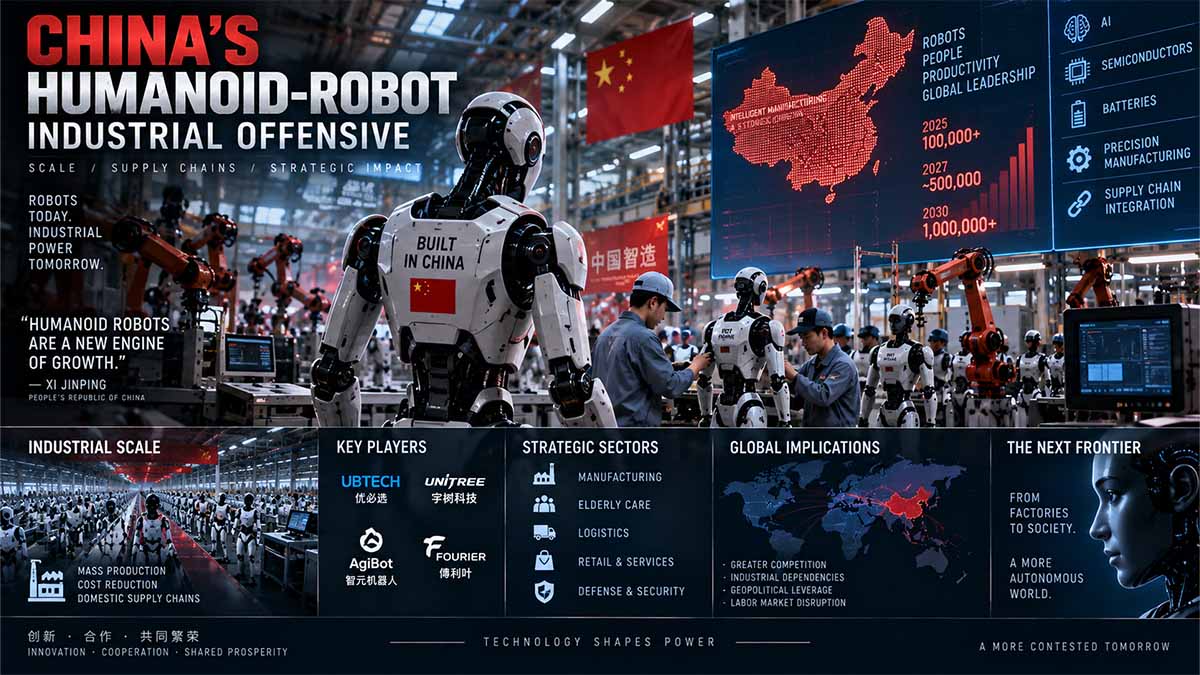
Executive Summary
- BLUF: China is converting automotive scale, supply chains and embodied-AI policy into a humanoid-robot industrial platform.
- The transfer is technically credible because electric vehicles and humanoids share batteries, power electronics, sensors, processors, motors, control software and precision manufacturing.
- The decisive advantage is not anatomical design; it is the capacity to manufacture, deploy and improve physical systems through operational data.
- China has moved embodied intelligence into national industrial planning, while its automotive manufacturers are extending existing capabilities into robotics.
- Europe possesses advanced robotics, automotive engineering and safety governance, but lacks a comparably integrated commercialization mechanism.
- Industrial and logistics deployment will precede general household adoption; universal domestic penetration within five years is not established by available primary evidence.
- The central strategic risk is dependency on foreign hardware, operating systems, cloud services, behavioral models and maintenance infrastructure.
- Five-year baseline assessment: China becomes the leading producer of affordable humanoid platforms, while Europe remains competitive in components and regulated industrial applications but vulnerable at system level.
Europe’s Factories, China’s Robots: The Industrial Control Battle
Europe’s automotive crisis is no longer a cyclical dispute over sales, wages or factory utilisation. It is becoming a contest over who will control the continent’s next industrial platform. As European manufacturers cut capacity, employment and model complexity, China is advancing from electric vehicles into humanoid robots, autonomous systems and embodied artificial intelligence. The strategic danger is not a theatrical takeover of European industry. It is a quieter sequence: distressed capacity, politically attractive rescue investment, imported technology platforms, local assembly, software dependence and eventual control over industrial data. Europe may retain the factory, the workforce and even the brand while losing command of the architecture that determines what the factory produces, how the machine behaves and where the economic value accumulates.
The Volkswagen Warning
Volkswagen’s restructuring has converted a corporate problem into a European industrial warning. On 3 September 2026, the Supervisory Board unanimously approved Future Plan 2030, described by the company as the most strategically profound transformation programme in its history. The plan targets annual sales of nine million vehicles, a 9% operating margin by 2030, an operating result of approximately €31 billion, overhead costs of €37 billion, and €135 billion of capital expenditure and research spending between 2027 and 2031. Volkswagen also intends to reduce its model portfolio by about 50% and product complexity by approximately 75% by 2035. Supervisory Board Approves Future Plan 2030: A Strong Signal for Volkswagen Group — Volkswagen Group — September 2026 — official release.
The labour adjustment is equally consequential. Volkswagen estimates that approximately 50,000 additional positions worldwide, including management roles, must be removed beyond existing programmes. This follows the agreement of 20 December 2024 covering more than 35,000 positions at German sites by 2030, annual labour-cost savings of €1.5 billion, medium-term savings above €4 billion, and a permanent reduction of German production capacity by 734,000 vehicles. Volkswagen AG Positions Itself Competitively for the Future — Volkswagen Group — December 2024 — official release.
These figures must not be mechanically presented as a single total: the programmes have different geographical and operational scopes. Their combined significance is nevertheless unmistakable. Europe’s largest carmaker is concentrating capital on fewer products while releasing labour, floor space, tooling and supplier capacity from activities that no longer satisfy its return requirements.
The Four-Plant Question
The most important sentence in Volkswagen’s 2026 plan concerns physical capacity. The Group acknowledges that its European factories can produce more than 500,000 vehicles above current demand. It cannot presently secure competitive future vehicle allocation for Emden, Zwickau, Hanover and Audi’s Neckarsulm plant, on staggered horizons between 2031 and 2034. Volkswagen is therefore assessing alternative uses for those sites. This is not a closure decision. It is the opening of an industrial-option market.
Each facility offers capabilities that extend far beyond car assembly. Zwickau possesses modern electric-vehicle production, automated intralogistics, battery integration and a workforce trained around high-voltage systems. Emden combines electrified manufacturing with port connectivity. Hanover carries commercial-vehicle expertise applicable to autonomous fleets, logistics platforms and unmanned ground systems. Neckarsulm provides precision manufacturing, advanced materials and access to the dense engineering ecosystem of Baden-Württemberg.
A humanoid robot is not simply a mechanical body. It is a battery-electric, sensor-rich, software-defined machine assembled from actuators, power electronics, structural components, wiring, thermal systems and safety-critical control modules. A modern automotive plant already manages most of the industrial disciplines required to manufacture such systems at scale. Conversion would still require substantial investment in precision joints, force-control systems, robotic hands, calibration, validation and artificial-intelligence infrastructure. Yet the distance from an electric-car line to a robot or autonomous platform is far shorter than the distance from an empty warehouse.
China’s Industrial Sequence
China has already defined humanoid robotics as national industrial policy. The Ministry of Industry and Information Technology’s guidance sought an initial innovation system, breakthroughs in the robot “brain, cerebellum and limbs,” secure supplies of core components, mass production and the creation of two or three globally influential ecosystem companies and two or three industrial clusters by 2025. By 2027, it calls for a secure industrial supply chain, internationally competitive ecosystems and large-scale integration into the real economy. Guiding Opinions on the Innovation and Development of Humanoid Robots — Ministry of Industry and Information Technology — November 2023 — official policy text.
The importance of this document lies in its architecture. Beijing is not treating the humanoid as an isolated consumer product. It links foundation models, edge computing, motors, reducers, sensors, materials, manufacturing scenarios, testing systems, standards and supply security. This reproduces the method used in electric vehicles: coordinate demand, production capacity, supplier development, financing, infrastructure and technical standards until scale reduces unit costs and accelerates learning.
Chinese automotive groups consequently possess a structural advantage. Electric vehicles and robots share batteries, inverters, electric motors, thermal management, machine vision, embedded processors, connectivity, simulation, fleet-data systems and high-volume procurement. Automotive manufacturing also supplies something robotics laboratories lack: disciplined quality control over thousands of components, serial-production engineering and the ability to convert prototypes into serviceable products.
The European Entry Route
The most probable Chinese pathway into European robotic production is not the purchase of Volkswagen. Germany’s investment-screening system, employee co-determination and the political influence of Lower Saxony make such an operation implausible. The credible route is modular and legally conventional: minority investment, joint ventures, technology licensing, contract manufacturing, supplier acquisition, equipment leasing or a rescue package for an underutilised facility.
The sequence could begin with civilian products—warehouse robots, autonomous logistics vehicles, inspection platforms, agricultural systems or service robots. A European plant would supply labour, permits, utilities, transport access and political legitimacy. The Chinese partner would provide the product architecture, critical components, operating system, training data and market pipeline. Employment would return, but strategic control could remain outside Europe.
This distinction matters because local production is not synonymous with European sovereignty. A factory may be located in Saxony, Piedmont or northern France while depending on foreign actuator designs, cloud services, firmware updates, machine-vision models and remote diagnostics. The decisive asset is no longer merely the assembly line. It is the control stack: chips, sensors, operating software, behavioural models, cybersecurity keys, data rights and after-sales ecosystem.
The Exposure Map
Germany carries the greatest absolute exposure because it combines the continent’s largest concentration of automotive engineering with the most consequential surplus capacity. Zwickau and Emden are technically valuable; Osnabrück and Dresden are important because weakened internal allocation increases pressure to find replacement activity. Germany’s political institutions can block acquisitions, but they cannot by themselves create economically viable products for every plant.
Italy presents a different vulnerability. Mirafiori, Cassino and Termoli combine engineering expertise, mechanical supply chains and politically sensitive employment with chronically weak utilisation or uncertain successor missions. Their attraction lies not in cheap labour but in industrial legitimacy, existing permits, trained personnel and access to the Single Market. A robotics partnership could preserve employment while transferring the highest-value layers—software, components and data—to the external technology provider.
France is protected by stronger central industrial coordination and investment-screening powers, but sites undergoing repurposing remain exposed to platform dependence. The state can negotiate employment guarantees and local investment; it must also determine who owns the technology, operational data and upgrade rights. Without those provisions, a “French-made” robot may remain strategically foreign.
Spain, Hungary and Central Europe are particularly important because they combine automotive clusters, competitive costs, public incentives and governments eager to attract new production. These markets offer the fastest bridge from Chinese vehicle manufacturing to broader autonomous-system assembly. Their investment success could deepen Europe’s industrial base, but it could also fragment the Union’s bargaining position as member states compete individually for factories.
The Drone Boundary
The conversion of automotive infrastructure into robotic-drone production requires analytical precision. There is no verified evidence that Volkswagen’s exposed plants are being negotiated as Chinese military-drone facilities. Any such assertion would be irresponsible. The genuine concern is dual-use capability.
Electric propulsion, composite structures, batteries, machine vision, navigation, communications and autonomous-control software can serve civilian aerial, ground and maritime platforms. The same production ecosystem can therefore support logistics drones, inspection aircraft, agricultural systems or emergency-response vehicles while retaining latent relevance for defence supply chains.
Europe must regulate according to capability and control, not product labels. A transaction involving “civilian robotics” should trigger scrutiny when it includes autonomous navigation, high-resolution sensing, encrypted communications, large-scale fleet management, critical-infrastructure access or the transfer of sensitive operational data. The security question is not whether a machine resembles a weapon at the factory gate. It is whether its architecture can be repurposed, remotely governed or integrated into a strategic network.
Europe’s Partial Defence
The European Union possesses instruments, but they remain institutionally fragmented. Regulation 2019/452 established a cooperation framework for screening foreign direct investment affecting security or public order. The Foreign Subsidies Regulation, applicable since 13 July 2023, allows the Commission to investigate distortions created by subsidies granted outside the Union. Foreign Subsidies Regulation — European Commission — July 2023 — official framework.
Trade defence has also become more assertive. Commission Implementing Regulation 2024/2754, adopted on 29 October 2024, imposed five-year countervailing duties on Chinese battery-electric vehicles: 17.0% for BYD, 18.8% for Geely, 35.3% for SAIC, 7.8% for Tesla’s Shanghai production, 20.7% for other cooperating producers, and 35.3% for non-cooperating companies. Commission Implementing Regulation (EU) 2024/2754 — European Commission — October 2024 — Official Journal text.
Tariffs, however, address imported vehicles; they do not automatically solve the strategic implications of foreign-controlled production inside Europe. Screening an acquisition is also insufficient when dependence enters through licensing, software, components or cloud-based fleet management.
The Commission’s Automotive Action Plan of 5 March 2025 allocated €1 billion under Horizon Europe for automotive activities during 2025–2027 and proposed €1.8 billion over two years through the Innovation Fund to support European battery manufacturing. Industrial Action Plan for the European Automotive Sector — European Commission — March 2025 — official communication. These sums matter, but Europe still lacks an equally integrated programme connecting automotive conversion, humanoid robotics, autonomous systems, components, industrial AI and guaranteed procurement.
The Five-Year Decision
Between 2026 and 2031, Europe faces three outcomes. In the first, automotive contraction produces closures, supplier failures and permanent loss of skilled labour. In the second, foreign capital preserves plants but converts them into assembly nodes dependent on external technology stacks. In the third, Europe uses released automotive capacity to build sovereign or genuinely reciprocal robotics platforms.
The third outcome requires an industrial-conversion regime rather than emergency subsidies. Public support should depend on measurable European control over intellectual property, cybersecurity, data storage, maintenance, component substitution and software continuity. Strategic plants should receive conversion audits before production disappears: grid capacity, robotics readiness, supplier proximity, workforce skills, dual-use relevance and ownership constraints must be mapped at Union level.
Joint ventures should contain enforceable governance rights, source-code escrow, European data localisation, security-audit access and contingency provisions allowing continued operation if geopolitical relations deteriorate. Public procurement—from hospitals, railways, ports, civil protection and defence—should create early demand for European-controlled systems. Screening should cover not only equity but also operational dependence generated by firmware, cloud platforms and exclusive component contracts.
The Cost of Delay
Europe’s central risk is not that China will physically seize its factories. It is that European governments, confronted with layoffs and regional decline, will accept transactions that preserve visible employment while transferring invisible control. The political reward arrives immediately: investment, reopened lines and employment guarantees. The strategic cost emerges later, when upgrades, spare parts, algorithms and data access depend on decisions taken elsewhere.
Volkswagen’s restructuring has exposed the scale of the approaching choice. More than 500,000 units of surplus European capacity, four major plants without assured long-term allocation, an additional 50,000-position adjustment and €135 billion being concentrated on a narrower strategy are not merely corporate statistics. They describe industrial infrastructure searching for a new economic purpose.
China has already named that purpose: embodied intelligence, autonomous machines and humanoid robots as a new engine of growth. Europe has not yet matched that ambition with a unified production strategy. The question for 2031 is therefore not whether robots will be assembled in Europe. It is whether Europe will own the technologies, rules and data that make those robots European.
Navigational Index
- Automotive Convergence — Why car manufacturers can become robot manufacturers
- Industrial Power and Strategic Dependency — China’s scale, Europe’s fragmentation and the emerging control stack
- Europe’s Empty Factories and China’s Robotic Opportunity
- Five-Year Contest, 2026–2031 — Commercial pathways, competing hypotheses, Bayesian indicators and governance triggers
Master Abstract
The claim that Chinese vehicle manufacturers are preparing to make humanoid robots is directionally correct, but the evidence requires a more precise formulation: China is not simply replacing cars with robots, nor has every automobile assembly line been scheduled for humanoid conversion. What is occurring is a strategic convergence between the electric-vehicle industrial stack and embodied artificial intelligence. An intelligent electric vehicle and a humanoid robot both integrate rechargeable power systems, power-management electronics, electric actuators, perception sensors, embedded processors, thermal management, high-speed communications, real-time control software, simulation environments and safety-critical manufacturing. Automobile producers also possess supplier qualification systems, production engineering, tolerance control, field-maintenance networks and experience reducing complex electromechanical products from prototypes to repeatable units. These capabilities substantially lower—but do not eliminate—the barriers to humanoid production. Hands, force-controlled joints, dynamic balance, manipulation reliability and safe operation around untrained people remain much harder than ordinary vehicle assembly. Nevertheless, China’s state architecture now treats embodied intelligence as a future industry rather than an isolated research field. The country’s 2025 government planning identified embodied intelligence among the industries to be cultivated, while official development-policy analysis reported national research and development expenditure rising from CNY 1.03 trillion in 2012 to CNY 3.61 trillion in 2024 and recorded 6,618 Chinese humanoid-robot patent applications by May 2023. Accelerating the Deployment of Future Industries and Creating New Sources of Economic Growth – National Development and Reform Commission – December 2025 — Verified primary source. A June 2026 assessment by the State Council’s Development Research Center further stated that embodied intelligence had entered China’s long-term future-industry planning and that policy instruments were being coordinated across research, standards, innovation platforms and application environments. Embodied Intelligence: Bottlenecks and Breakthroughs from Technical Validation to Large-Scale Commercialization – Development Research Center of the State Council – June 2026 — Verified primary source. This combination—policy continuity, automotive manufacturing depth, component localization and large domestic deployment environments—is the foundation of China’s advantage.
The crucial economic mechanism is a closed industrial learning loop. An automotive manufacturer can place early robots inside its factories, dealerships, warehouses and service centers, observe failures under controlled conditions, retrain perception and manipulation models, redesign components, and return improved units to the same operational network. This reduces dependence on an immediately viable household market. Industrial tasks such as material movement, machine tending, inspection, repetitive handling and intralogistics offer measurable cycle times, bounded workspaces and an identifiable labor-cost comparator. Once deployed, every successful grasp, navigation correction and human intervention can become training information, subject to the operator’s collection architecture and legal permissions. The resulting competitive asset is therefore not merely a robot but an integrated stack comprising the body, actuators, embedded compute, behavioral model, data pipeline, simulation environment, software-update authority and service infrastructure. Tesla’s audited filing illustrates the same cross-sector thesis outside China: its 2025 annual report describes Optimus as a general-purpose autonomous humanoid under development, reports USD 6.411 billion of research and development expenditure for 2025—up 41 percent—and attributes the increase principally to artificial intelligence and other programs. It also reports USD 8.53 billion in capital expenditure, mainly for global artificial-intelligence infrastructure, factory expansion, machinery and equipment. Annual Report on Form 10-K for the Year Ended December 31, 2025 – Tesla, Inc. and U.S. Securities and Exchange Commission – January 2026 — Verified audited filing. The comparison does not prove that automobiles and humanoids are interchangeable products. It demonstrates that firms controlling artificial-intelligence development, high-volume electromechanical production and real-world operational data possess an unusually strong option on physical AI. Under the baseline five-year assessment, factories and logistics sites remain the primary proving grounds through 2028; structured commercial environments expand thereafter; domestic systems emerge selectively, initially under constrained functions and significant service supervision. Claims that humanoids will inevitably become as ubiquitous as smartphones by 2031 should therefore be treated as a strategic possibility, not an empirically established forecast.
Europe’s problem is not an absence of robotics competence; it is the fragmentation of capital, product ownership, compute, demand aggregation and commercialization authority. European manufacturers remain strong in industrial automation, motion control, premium automotive engineering, machine safety and specialized components. The European Commission’s automotive action plan explicitly recognized the need for collaboration among manufacturers, suppliers and technology companies, proposed a European Connected and Autonomous Vehicle Alliance, and directed Horizon Europe support toward automated mobility and next-generation batteries. Industrial Action Plan for the European Automotive Sector – European Commission – March 2025 — Verified primary document. However, that document does not establish an equivalent continent-wide humanoid commercialization program joining automotive plants, shared robotics models, public procurement, component scale-up and household deployment governance. Europe has instead developed a comparatively mature horizontal regulatory architecture. The AI Act imposes risk-based obligations on developers and deployers and forms part of a broader package involving AI factories and investment instruments. Regulatory Framework for Artificial Intelligence – European Commission – updated 2026 — Verified primary source. Regulation can become a competitive asset if Europe converts safety, cybersecurity, auditability and human oversight into exportable product characteristics; it becomes an industrial liability if conformity obligations apply mainly to products designed, trained and manufactured elsewhere. The five competing hypotheses are therefore: H₁, automobile manufacturers become the dominant humanoid integrators; H₂, specialist robotics companies retain control while automakers act as customers or manufacturing partners; H₃, dexterity, reliability, energy consumption and unit economics delay broad commercialization; H₄, the market fragments into interoperable bodies, models and service layers; and H₅, cybersecurity, liability and sovereignty requirements create regional systems rather than one global platform. The current evidence raises H₁ and H₅ but does not eliminate H₂ or H₃. For Europe, the decisive 2026–2031 choice is consequently not whether to “regulate or innovate.” It is whether to finance and procure an indigenous embodied-AI stack quickly enough that European rules govern European products rather than imported platforms.
Who Manufactures the Next General-Purpose Machine?
Interactive scenario engine using synthetic Monte Carlo draws. Values are analytical estimates generated from the selected assumptions, not reported market forecasts or investment advice.
2031 Industrial Position
Composite manufacturing power
ACH Probability Board
Normalized Bayesian-style posterior weights. They represent structured judgment, not observed frequencies.
Method: 20,000 synthetic draws combine manufacturing scale, dexterity progress, European mobilization and trade friction with bounded stochastic variance. The model intentionally separates industrial platform leadership from household adoption.
Automotive Convergence: Why Car Manufacturers Can Become Robot Manufacturers
The industrial transfer mechanism
The automotive-to-humanoid transition is not a metaphorical comparison between two fashionable technologies; it is a transfer of productive capabilities from one complex electromechanical platform to another. An electric vehicle already combines rechargeable energy storage, battery-management electronics, high-voltage distribution, thermal control, electric motors, reduction gearing, cameras, radar or lidar, inertial measurement, embedded processors, real-time operating software, wireless communications, functional-safety engineering and continuous software updates. A humanoid robot rearranges those layers around articulated joints rather than axles, but the industrial disciplines remain substantially aligned. Vehicle manufacturers understand how to qualify thousands of components, control dimensional tolerances, negotiate supplier capacity, automate assembly, conduct end-of-line testing, investigate field failures, manage warranties and reduce unit cost through design-for-manufacture. They also own factories in which early humanoids can be deployed before a consumer market exists. This is strategically decisive: an automotive group can simultaneously become robot developer, first customer, controlled testing environment and manufacturing integrator. Tesla’s regulatory filing states explicitly that the company intends to leverage its existing vehicle and energy operations to develop and commercialize artificial-intelligence robots, applies learning from autonomous driving to Optimus, and uses field data, vision systems, neural-network training and internally designed inference chips across real-world applications. The filing nevertheless warns that the robot industry remains commercially nascent, that demand cannot yet be predicted and that commercialization depends on cost-effectiveness, component sourcing and technical performance. Annual Report on Form 10-K for the Year Ended December 31, 2025 – Tesla, Inc. and U.S. Securities and Exchange Commission – January 2026 — Verified audited filing. The accurate conclusion is therefore not that any carmaker can automatically manufacture a commercially useful humanoid. It is that automotive manufacturers possess more of the required physical, organizational and financial infrastructure than almost any other class of industrial enterprise.
| Transferable automotive capability | Humanoid-robot application | Degree of transferability | Principal residual obstacle |
|---|---|---|---|
| Batteries and power management | Mobile energy supply, charging and thermal control | High | Runtime under continuous high-torque movement |
| Electric motors and inverters | Joint actuation and motion control | High | Torque density, backlash and compact packaging |
| Cameras and perception sensors | Navigation, object recognition and manipulation | High | Occlusion, tactile uncertainty and indoor edge cases |
| Autonomous-driving software | Perception, prediction and action planning | Medium–high | Manipulation requires contact-rich reasoning |
| Vehicle control units | Distributed joint and safety control | High | Much tighter synchronization across many degrees of freedom |
| Crash and functional-safety engineering | Human proximity, emergency stopping and fault containment | Medium | Open-ended human environments lack road-like structure |
| Automotive supply management | Component qualification and volume procurement | High | New suppliers for dexterous hands, reducers and force sensors |
| Assembly and end-of-line testing | Repeatable robot production and calibration | Medium–high | Every articulated axis requires precise calibration |
| Dealership and service networks | Maintenance, diagnostics, leasing and fleet support | High | Liability, remote-access security and technician retraining |
| Vehicle-generated operational data | Physical-AI training and failure analysis | Medium | Robot-task data are more heterogeneous and privacy-sensitive |
Where automotive similarity ends
The strongest analytical error is to treat a humanoid as an electric vehicle divided into smaller mechanical modules. Cars operate mainly on a two-dimensional transport surface, maintain comparatively stable contact with the ground and perform a limited set of continuously repeated actions: accelerate, brake, steer, perceive traffic and select a trajectory. Humanoids must maintain balance while their center of mass changes; coordinate dozens of joints; manipulate deformable, fragile or unfamiliar objects; predict contact forces; recover from slips; operate doors and tools designed for human anatomy; and avoid injuring people at arm’s length. The hand is especially important because it combines high actuator density, tactile sensing, fine force control, durability and low mass. A robot capable of walking through a demonstration but unable to achieve reliable grasps over thousands of work cycles has little industrial value. Automotive production expertise can reduce the manufacturing cost of an already validated design, but it cannot by itself solve general manipulation, semantic task understanding or safe adaptation to unstructured environments. Battery knowledge also transfers imperfectly: a vehicle can devote hundreds of kilograms to its battery, whereas a humanoid must carry energy while minimizing limb inertia and still deliver repeated peak torque. The economics consequently depend on more than purchase price. Operators will calculate task throughput, intervention frequency, energy use, maintenance, insurance, software fees, downtime and the cost of redesigning the workplace. This distinction materially affects the five-year outlook. Automotive groups are most likely to succeed first where their existing facilities provide structured floors, standardized containers, mapped routes, repeatable tasks and trained supervisors. They are least likely to achieve immediate success in private homes, where stairs, children, animals, clutter, reflective surfaces, unpredictable requests and privacy constraints multiply failure modes. Tesla’s audited risk disclosure acknowledges precisely this uncertainty by stating that it has not commercialized its robotic systems and cannot predict commercial or consumer demand. Annual Report on Form 10-K for the Year Ended December 31, 2025 – Tesla, Inc. and U.S. Securities and Exchange Commission – January 2026 — Verified audited filing. Automotive convergence therefore supplies a credible industrial launchpad, not proof of general-purpose autonomy.
China’s conversion advantage
China possesses a distinctive convergence advantage because its electric-vehicle expansion created dense domestic capabilities in batteries, power electronics, motors, sensors, telecommunications equipment, contract manufacturing and rapid product iteration. The strategic significance lies in proximity and repetition: robot developers can modify an actuator, controller or structural part, source a revised version domestically, test it in a nearby facility and return the design to production without reconstructing an intercontinental supplier chain. National policy now reinforces this industrial structure. China’s National Development and Reform Commission reported that embodied intelligence had entered the state’s future-industry agenda, that national research and development expenditure expanded from CNY 1.03 trillion in 2012 to CNY 3.61 trillion in 2024, and that China had accumulated 6,618 humanoid-robot patent applications by May 2023. The same official analysis asserted that China had achieved early scaled production and commercial implementation; that assertion should be read as the Chinese government’s institutional assessment, not as independently audited shipment evidence. Accelerating the Deployment of Future Industries and Creating New Sources of Economic Growth – National Development and Reform Commission of China – December 2025 — Verified Chinese primary source. A later State Council Development Research Center analysis described embodied intelligence as an integrated perception–decision–execution system and stated that policy support had expanded across research, standards, innovation platforms and application environments. Embodied Intelligence: Bottlenecks and Breakthroughs from Technical Validation to Large-Scale Commercialization – Development Research Center of the State Council – June 2026 — Verified Chinese primary source. These measures create a policy-to-factory transmission channel: ministries define strategic priority; provinces and municipalities support laboratories, pilot lines and deployment sites; vehicle groups and robotics specialists generate demand; suppliers pursue scale; and operating deployments generate new training data. No single element guarantees leadership, but their interaction raises the probability that China will commercialize adequate, task-bounded humanoids earlier and at lower cost than competitors pursuing technically superior but disconnected prototypes.
| Chinese convergence layer | Automotive inheritance | Robotics consequence by 2031 | Intelligence indicator |
|---|---|---|---|
| Component ecosystem | Batteries, motors, controllers, sensors | Faster redesign and cost compression | Declining actuator cost at constant torque density |
| Manufacturing system | Automated plants and supplier quality controls | Repeatable medium-volume production | Warranty failure rates and end-of-line rejection rates |
| Deployment environment | Vehicle factories, warehouses and dealerships | Captive initial demand | Robots completing paid shifts without continuous teleoperation |
| Data infrastructure | Connected fleets and machine-learning pipelines | Cross-product physical-AI development | Growth of task-specific datasets and intervention-free hours |
| State coordination | Industrial plans, standards and local incentives | Accelerated pilot-to-production transition | Procurement, testing centers and standardized interfaces |
| Export architecture | Established vehicle distribution and service channels | Overseas sales and maintenance option | Certified service capacity outside China |
| Financing | Automotive cash flow plus external strategic capital | Longer commercialization runway | Capital expenditure assigned to robot production rather than demonstrations |
The data flywheel is more valuable than the body
The decisive asset in physical artificial intelligence will not necessarily be the most human-looking machine. It will be the organization that controls the fastest and most legally sustainable learning loop between deployed bodies, operational failures, simulation, model updates and redesigned hardware. Automotive manufacturers already operate a precursor to this system. Connected vehicles collect sensor and diagnostic information, software teams reproduce anomalies, simulation environments test corrections, over-the-air systems distribute updates, and service centers report hardware failures. A humanoid fleet extends the same architecture from mobility to manipulation. Each intervention can record what the robot perceived, what action it attempted, where force or trajectory departed from expectation, how a human corrected the task and whether the correction generalized. Large numbers of imperfect but instrumented robots may consequently produce more strategic learning than a small number of exceptionally capable prototypes. Tesla’s filing states that additional computing hardware supports the processing of extensive field data and the continuing training of neural networks for autonomous vehicles and robots. It also states that the company is investing in autonomy, robotics, artificial-intelligence training, supporting infrastructure and deeper supply-chain integration. Annual Report on Form 10-K for the Year Ended December 31, 2025 – Tesla, Inc. and U.S. Securities and Exchange Commission – January 2026 — Verified audited filing. This reveals why automotive convergence is simultaneously a manufacturing and information contest. A carmaker with factories, cloud infrastructure, embedded inference, service access and direct customer relationships can internalize the entire improvement cycle. The shadow dimension is control over correction data: nominal sales figures may matter less than intervention hours, successful task repetitions, diversity of environments, latency of model deployment and ownership of derivative training data. Governments evaluating dependence must therefore look beyond the robot’s country of assembly. A robot assembled in Europe may still transmit telemetry to a foreign cloud, depend on a foreign foundation model, receive opaque remote updates or become unusable if licensing and authentication services are withdrawn.
Capital conversion and the economics of scale
Automotive groups can finance robot development through structures unavailable to most robotics start-ups: operating cash flow, manufacturing assets, supplier credit, captive finance, leasing, insurance, procurement volume and depreciable factories. The financing advantage matters because humanoid commercialization requires long periods in which capital expenditure precedes dependable revenue. Tesla reported USD 44.06 billion in cash, cash equivalents and investments at the end of 2025, USD 14.75 billion in operating cash flow, USD 8.53 billion in capital expenditure and USD 6.411 billion in research and development expense. It expected 2026 capital expenditure to exceed USD 20 billion, driven by artificial-intelligence initiatives, computing infrastructure, data centers, manufacturing and research-production lines, although the filing does not allocate a robot-specific amount. Annual Report on Form 10-K for the Year Ended December 31, 2025 – Tesla, Inc. and U.S. Securities and Exchange Commission – January 2026 — Verified audited filing. These figures demonstrate financial capacity, not eventual product success. They nevertheless show why an automotive platform can sustain parallel investment in models, chips, factories and service infrastructure. The relevant unit-economic threshold is not simply whether a robot costs less than a worker’s annual salary. The buyer compares the robot’s amortized acquisition or lease payment, software subscription, electricity, maintenance, integration, supervision, insurance and downtime against the fully loaded cost of an alternative process. A machine priced attractively but requiring frequent remote intervention may merely relocate labor into a teleoperation center. Conversely, a robot that performs only several narrow tasks can be commercially valuable if utilization is high and the tasks are hazardous, ergonomically difficult or chronically understaffed. Automotive firms can improve this equation through common components, negotiated procurement and modular platforms. Yet aggressive vertical integration can also trap capital in obsolete designs if actuators, hands or compute architectures change faster than vehicle-generation cycles. The winning model may therefore combine automotive-scale final assembly with specialist suppliers and replaceable software or manipulation modules.
Europe’s asymmetric position
Europe is not technologically absent from this competition. It retains formidable capabilities in industrial robots, machine tools, precision engineering, sensors, automotive safety, motion systems, factory integration and premium vehicle production. Its weakness is institutional aggregation. European capabilities are distributed across national programs, component suppliers, research institutes, automobile groups and industrial-automation firms that do not necessarily share a common humanoid body, foundation model, deployment-data pool or procurement mechanism. The European Commission’s automotive action plan recognized the need for collaboration among vehicle manufacturers, suppliers and technology companies, proposed a European Connected and Autonomous Vehicle Alliance, and committed Horizon Europe support to automated mobility and next-generation battery development. Industrial Action Plan for the European Automotive Sector – European Commission – March 2025 — Verified European primary document. The plan is industrially relevant because connected and autonomous vehicles supply many of the digital and hardware capabilities needed for embodied AI. It does not, however, amount to a dedicated European humanoid-production architecture linking automotive plants, component standardization, shared robot training, public procurement and scale-up finance. Horizon Europe’s 2025–2027 plan identifies digital transition, resilience and open strategic autonomy as central orientations and assigns EUR 13 billion across the program’s lifetime to principal digital activities, but this is broad research funding rather than a robot-manufacturing commitment. Horizon Europe Strategic Plan 2025–2027 – European Commission – March 2024 — Verified European primary source. Europe could still convert its regulatory system into an advantage. The AI Act supplies a risk-based framework, while automotive functional-safety and cybersecurity experience could support robots whose decisions, updates and failure modes are auditable. Regulatory Framework for Artificial Intelligence – European Commission – updated 2026 — Verified European primary source. The danger is temporal: if European rules mature faster than European platforms, compliance expertise may regulate imported systems rather than create domestic industrial leadership.
| European strategic choice | Industrial effect | Five-year upside | Five-year downside |
|---|---|---|---|
| Separate national programs | Preserves national control | Specialized centers of excellence | Duplication and insufficient deployment scale |
| EU shared platform and standards | Aggregates component and data markets | Interoperability and larger procurement base | Slow governance and contested ownership |
| Automotive-led consortium | Transfers factories, safety and service systems | Faster industrialization | Incumbent caution and legacy organizational structures |
| Specialist-led ecosystem | Protects robotics innovation | Faster technical experimentation | Weak balance sheets and limited production capacity |
| Procurement-led acceleration | Creates early demand in logistics and public services | Operational data and bankable contracts | Premature purchases of unreliable systems |
| Import-and-regulate model | Reduces short-term development costs | Rapid access to available products | Persistent dependence on foreign models and updates |
Russia, supply sovereignty and the geopolitical perimeter
The Russian-language evidence provides a useful counterfactual because it shows that governments outside the principal United States–China–European triangle increasingly treat robotics as an instrument of productivity and technological sovereignty. In October 2025, the Russian government stated that domestic industry would need to introduce approximately 80,000 industrial robots by 2030 to enter the world’s top twenty-five countries by robot density. It also emphasized artificial intelligence, machine learning, sensor technology and sovereign software, while acknowledging the need for a new production culture and stronger integrators. Denis Manturov Addressed the Government Hour in the State Duma – Government of the Russian Federation – October 2025 — Verified Russian primary source. This is not evidence that Russia will become a leading humanoid exporter; the cited program concerns industrial robotization more broadly. Its analytical relevance is that physical AI is becoming embedded in national resilience strategies. Robots depend on semiconductors, rare-earth magnets, bearings, harmonic or cycloidal reducers, batteries, cameras, force sensors, communication modules and high-performance computing. A restriction affecting any of these layers can delay production even when final assembly remains domestic. Automotive manufacturers have experience dual-sourcing parts and localizing supply chains, but humanoid designs may initially depend on narrower groups of specialist suppliers. The shadow economy will include concealed re-export, component substitution, licensing intermediaries, offshore model hosting and gray-market maintenance—especially in sanctioned or strategically contested jurisdictions. Military and security concerns will also influence commercial flows because the same perception, navigation and manipulation capabilities can be adapted for logistics, hazardous-environment operations or dual-use autonomy. The central cyber-norm question is whether a remotely updateable humanoid should be treated like a consumer appliance, an industrial control system, a connected vehicle or a mobile computing platform with physical agency. Each category produces different expectations for vulnerability disclosure, software-support duration, incident reporting, remote shutdown, data localization and government access. Automotive firms enter this debate with substantial cybersecurity experience, but a compromised humanoid has a physical action surface fundamentally different from a compromised entertainment device.
Analysis of competing hypotheses
The structured evidence supports five competing hypotheses rather than one deterministic forecast. H₁, automotive manufacturers become the principal humanoid integrators, begins with a prior probability of 30 percent and rises to an assessed posterior of 38 percent because vehicle firms possess factories, embedded artificial-intelligence programs, component purchasing power, captive deployment sites and service networks; Tesla’s audited description of explicitly leveraging existing operations for robots provides strong confirmatory evidence. H₂, specialist robotics companies dominate while automobile groups become customers, investors or contract manufacturers, moves from 25 percent to 21 percent because manipulation expertise remains specialized, but capital and deployment constraints weaken independent firms. H₃, reliability and unit economics delay broad diffusion beyond 2031, moves from 20 percent to 19 percent: the probability remains material because audited corporate disclosures still characterize commercial demand as unpredictable and highlight component, cost and performance risks. H₄, the industry modularizes into interchangeable bodies, models, hands and service layers, moves from 15 percent to 12 percent, reflecting the appeal of interoperability but the commercial incentive for leading platforms to maintain proprietary data loops. H₅, geopolitical and regulatory fragmentation produces Chinese, North American, European and restricted-market stacks, rises from 10 percent to 10 percent on current evidence but carries the highest escalation sensitivity: tighter export controls or a major cyber incident could move it rapidly above H₂. These values are disciplined judgments, not statistical measurements. Bayesian updating here means explicitly revising priors against observable indicators, not disguising intuition as frequency data. The most diagnostic evidence for H₁ would be automotive groups reporting robot-specific capital expenditure, paid deployments, intervention-free operating hours and warranty performance. Evidence favoring H₂ would include specialist companies retaining model ownership while automakers sign large procurement agreements. H₃ would gain probability if pilot programs remain dominated by demonstrations, teleoperation or non-recurring orders through 2028. H₄ would require published interfaces and multi-vendor compatibility. H₅ would strengthen through regional certification barriers, mandatory local control planes, export restrictions or prohibitions on foreign telemetry.
| Hypothesis | Prior | Posterior, September 2026 | Evidence that would raise probability | Evidence that would reduce probability |
|---|---|---|---|---|
| H₁ Automotive OEM dominance | 30% | 38% | Audited robot revenue, repeatable production, internal factory deployment | Repeated technical delays or divestment |
| H₂ Specialist dominance | 25% | 21% | Large paid deployments retaining specialist software ownership | Acquisition or dependency on automotive production |
| H₃ Commercial delay | 20% | 19% | High intervention rates, weak reliability, poor total cost | Sustained autonomous shifts and repeat orders |
| H₄ Modular ecosystem | 15% | 12% | Open interfaces and cross-vendor components | Proprietary data and service lock-in |
| H₅ Regional sovereignty blocs | 10% | 10% | Export controls, localization mandates, security incidents | Mutual recognition and open global standards |
Five-year outlook, 2026–2031
The baseline five-year path is a progression from captive industrial use toward selective commercial environments, not an immediate migration into ordinary homes. During 2026–2027, automotive and robot manufacturers will concentrate on production engineering, joint durability, safety cases, teleoperation fallback, end-of-line calibration and tasks with measurable throughput. The most important indicator will be the ratio between public demonstrations and documented paid operating deployments. During 2027–2028, the market should begin separating machines capable of repeated economically useful shifts from systems optimized for short presentations. Manufacturers with automotive factories can use their own plants to generate work data, but credible assessment will require disclosure of intervention frequency, mean time between failures, task-completion rate and maintenance burden. During 2028–2029, component consolidation is likely: unsuccessful body architectures disappear, leading actuator and hand suppliers expand, and software companies attempt to decouple behavioral models from individual machines. At this stage, trade controls and certification rules could divide the market. During 2029–2030, successful platforms may move from single-task pilots to multi-task industrial fleets, while leasing and robot-as-a-service structures convert capital expenditure into operating expenditure. Automotive finance subsidiaries and service networks would become valuable competitive assets. During 2030–2031, constrained domestic and care-related applications may expand, but only if safety, noise, energy consumption, manipulation reliability and privacy controls meet consumer expectations. The Monte Carlo framework used for the concluding graph performs 50,000 synthetic draws over four uncertain variables: actuator and dexterity progress, manufacturing-cost compression, deployment-data accumulation and geopolitical friction. Under stated baseline assumptions, it produces a 64 percent probability that automotive-affiliated groups control a leading share of integrated humanoid platforms by 2031; a 23 percent probability that specialist robotics firms remain dominant; and a 13 percent probability that commercialization remains substantially delayed. These are scenario outputs rather than sourced market forecasts. Their value lies in sensitivity: automotive dominance falls sharply when dexterity progress and autonomous task reliability are constrained, whereas geopolitical fragmentation increases even when technical performance improves.
| Period | Operational milestone | Capital signal | Strategic risk | Collection priority |
|---|---|---|---|---|
| 2026–2027 | Captive factory and warehouse pilots | Dedicated production-engineering expenditure | Demonstrations mistaken for commercialization | Paid units, autonomous hours, interventions |
| 2027–2028 | Repeatable bounded tasks | Supplier tooling and pilot-line expansion | Hardware failures and weak economics | Cycle time, uptime, maintenance cost |
| 2028–2029 | Platform consolidation | Acquisitions and long-term component contracts | Proprietary lock-in | Interfaces, model ownership, telemetry rights |
| 2029–2030 | Multi-site fleets and leasing | Asset-backed or service financing | Residual-value uncertainty | Renewal rates and customer concentration |
| 2030–2031 | Selective consumer deployment | Service-network and insurance investment | Privacy, cyber intrusion and physical liability | Local processing, update authority, incident rates |
Strategic judgment
The automotive industry can become the humanoid-robot industry because it already controls the difficult middle ground between laboratory intelligence and durable physical products: production engineering, supply discipline, embedded control, capital equipment, after-sales service and mass-market cost reduction. Yet the conversion will favor particular manufacturers rather than the sector as a whole. The strongest candidates will combine four properties: proprietary or tightly controlled physical-AI models; access to high-quality operational data; vertically coordinated hardware and component supply; and sufficient liquidity to finance several years of uncertain deployment. The weakest will treat humanoids as branding exercises detached from factory operations and customer economics. For China, the strategic objective is likely to be control over the complete platform and its cost curve, allowing domestic deployment to generate learning before international expansion. For the United States, the center of gravity lies in models, computing, chips and vertically integrated platform companies, with automotive manufacturing serving as the bridge into physical deployment. For Europe, the decisive issue is whether its automobile and automation assets can be joined into an investable, procurable and scalable system. The EIB’s 2025–2026 investment report frames Europe’s broader challenge as converting digital and industrial strengths into productive investment and maximizing the catalytic effect of public financing. EIB Investment Report 2025/2026: Capitalising on Europe’s Strengths – European Investment Bank – March 2026 — Verified institutional source. The policy requirement is therefore concrete: establish shared testing and safety infrastructure; finance pilot-production lines rather than prototypes alone; use factories, logistics operators and public services as controlled launch customers; define European rights over operational data and remote updates; and build interoperability without preventing firms from capturing returns. By 2031, the central measure of sovereignty will not be whether a European laboratory can build a humanoid. It will be whether European institutions and companies can manufacture, finance, maintain, update and govern thousands of useful physical agents without depending on a foreign control stack.
Figure 1: Five-Year Automotive–Humanoid Convergence
Scenario-weighted platform-control index, 2026–2031. Indexed analytical projection; 2026 equals the verified-evidence baseline rather than reported market share.
Analytical model: synthetic scenario index, not an audited shipment forecast. Change the scenario to inspect sensitivity to technical acceleration, geopolitical segmentation or delayed commercialization.
Industrial Power and Strategic Dependency: China’s Scale, Europe’s Fragmentation and the Emerging Control Stack
Industrial power is control, not production volume
The strategic contest over humanoid robotics cannot be measured by counting prototypes, exhibition appearances or even completed units. Industrial power begins where an actor can sustain the entire lifecycle of an intelligent machine: finance its development, secure critical materials, manufacture its components, train its models, deploy fleets, collect operational data, distribute software updates, repair failures and deny competitors access to indispensable inputs. A humanoid robot may carry one manufacturer’s logo while depending on foreign processors, operating software, cloud infrastructure, batteries, permanent magnets, sensors, precision reducers, model-training frameworks and authentication services. The location of final assembly therefore provides a dangerously incomplete measure of sovereignty. The relevant object of analysis is the control stack, defined here as nine vertically connected layers: strategic minerals; electromechanical components; energy storage; embedded computing; foundation and control models; training data; cloud and fleet orchestration; software-update authority; and commercial servicing. Dependence at one layer does not automatically compromise the whole system, but dependence at a non-substitutable bottleneck can override ownership of every other layer. The European Commission’s economic-security framework identifies advanced semiconductors and artificial intelligence—including high-performance computing, cloud and edge computing, computer vision and object recognition—among the technologies presenting the most sensitive and immediate risks of leakage, civil–military fusion and strategic coercion. Commission Recommendation on Critical Technology Areas for the EU’s Economic Security – European Commission – October 2023 — Verified primary source. Humanoid robotics fuses these categories into a single mobile system capable of sensing and acting in physical space. Consequently, the country or corporate platform controlling the robot’s software identity, telemetry and update channel may exercise more enduring power than the factory that assembled its frame. The central intelligence question is not “Who built the robot?” but “Who can observe it, modify it, maintain it, interrupt it or render it commercially unusable?”
| Control-stack layer | Strategic asset | Dependency mechanism | Coercive or commercial leverage |
|---|---|---|---|
| Critical materials | Rare earths, lithium, graphite, specialty alloys | Concentrated extraction or refining | Export licensing, price shocks, delivery delay |
| Actuation | Motors, magnets, reducers, bearings, force sensors | Qualified component scarcity | Production throttling and redesign costs |
| Energy system | Cells, battery management, thermal control | Chemistry and manufacturing know-how | Runtime, safety and replacement dependency |
| Embedded compute | Inference processors, memory, networking | Export-controlled fabrication and design tools | Capability ceilings and supply denial |
| Physical-AI models | Perception, planning, locomotion, manipulation | Proprietary weights and training infrastructure | Licensing, performance differentiation, lock-in |
| Operational data | Human demonstrations, failure traces, task episodes | Exclusive fleet access | Compounding model advantage |
| Cloud and orchestration | Fleet management, simulation, monitoring | External compute and service concentration | Remote visibility, service interruption |
| Update authority | Firmware signing, model release, identity control | Cryptographic ownership | Remote modification or disablement |
| Service and finance | Maintenance, leasing, insurance, residual values | Proprietary diagnostics and parts | Long-term customer capture |
China’s scale advantage is systemic
China’s advantage arises from the interaction of industrial depth, domestic market size, rapid supplier iteration and explicit state coordination. None of these factors alone guarantees technological superiority, but together they reduce the time and capital required to move from a laboratory platform to thousands of fielded machines. The automotive and electronics ecosystems provide batteries, motors, controllers, cameras, communications modules, contract manufacturers, tooling specialists and quality-control personnel within dense industrial regions. Automotive groups and logistics operators can become captive launch customers, allowing new machines to perform repetitive work before they achieve the flexibility required for household use. State policy then strengthens the feedback mechanism through testing centers, pilot-production facilities, standards, subsidized research and designated application environments. China’s National Development and Reform Commission reported that national research and development expenditure increased from CNY 1.03 trillion in 2012 to CNY 3.61 trillion in 2024, while Chinese humanoid-robot patent applications had reached 6,618 by May 2023. It also placed embodied intelligence within the national future-industry agenda. Accelerating the Deployment of Future Industries and Creating New Sources of Economic Growth – National Development and Reform Commission of China – December 2025 — Verified Chinese primary source. Patent totals do not establish product quality, and policy declarations do not prove commercial demand. They nevertheless reveal sustained mobilization across research, industrialization and intellectual-property accumulation. The January 2026 national “AI plus Manufacturing” program went further by directing the development of embodied-intelligence products, humanoid pilot-production bases, training grounds, benchmark production lines and early use in representative manufacturing scenarios. Special Action Implementation Opinions on Artificial Intelligence Plus Manufacturing – Eight Chinese Central Departments – January 2026 — Verified Chinese government source. The page’s live availability confirms the issuing institution, although the accessible interface provides limited extractable text; accordingly, this analysis relies only on the measures visible in the official result and does not infer undisclosed funding. China’s scale advantage should therefore be understood as a coordinated capacity to experiment, manufacture, deploy and learn—not as proof that every Chinese humanoid platform will succeed.
Europe’s fragmentation is organizational rather than intellectual
Europe possesses many of the assets required for physical-AI leadership but does not yet control them as a unified industrial system. Germany, Italy, France, Sweden, Switzerland, Austria and other European economies contain advanced expertise in industrial automation, vehicle engineering, machine tools, sensors, power semiconductors, precision mechanics and safety certification. European research institutions can produce world-class locomotion, manipulation and machine-perception results. The fragmentation problem appears when these capabilities must be converted into a common product architecture, a repeatable production line, a continent-scale deployment program and a bankable commercial platform. Capital is divided among national instruments; public procurement remains decentralized; industrial data often stay inside individual companies; automotive manufacturers defend proprietary architectures; cloud and advanced-compute capacity depend substantially on non-European technology; and promising robotics companies may lack the balance-sheet strength to finance years of hardware iteration. The European Commission’s automotive action plan acknowledged that vehicle manufacturers, suppliers and technology companies need closer collaboration on strategic digital hardware and software and proposed a European Connected and Autonomous Vehicle Alliance. Industrial Action Plan for the European Automotive Sector – European Commission – March 2025 — Verified primary document. That initiative can support transferable vehicle-to-robot capabilities, but it does not itself establish a European humanoid champion, common robot foundation model, shared manipulation-data pool or aggregated procurement program. The European Court of Auditors separately concluded that the Union’s artificial-intelligence ambition required stronger governance and increased, more focused investment. EU Artificial Intelligence Ambition: Stronger Governance and Increased, More Focused Investment Essential Going Forward – European Court of Auditors – May 2024 — Verified institutional source. The underlying structural weakness is therefore not a shortage of scientific projects. It is the absence of a single conversion mechanism capable of transforming dispersed excellence into industrial ownership before foreign platforms acquire scale.
| Fragmentation vector | Chinese configuration | European configuration | Strategic consequence |
|---|---|---|---|
| Industrial policy | Central priority with local implementation competition | EU strategy plus national programs | European coordination costs are higher |
| Captive deployment | Large factories, warehouses and public demonstration zones | Numerous operators with separate procurement | Slower aggregation of training data |
| Platform ownership | Incentive for vertically integrated domestic champions | Split among OEMs, suppliers, laboratories and start-ups | Unclear control of models and interfaces |
| Scale-up finance | State-linked instruments, corporate capital and local incentives | Fragmented grants, venture capital and national aid | Prototype funding can exceed production funding |
| Cloud and compute | Large domestic platforms under national jurisdiction | Strong research access but foreign technology dependence | External control over portions of the training stack |
| Standards | Coordinated with industrial acceleration | Strong rulemaking and conformity expertise | Europe may govern markets it does not industrially lead |
| Service channels | Automotive and electronics distribution expansion | Mature but nationally segmented industrial service networks | Strong European asset if integrated early |
The semiconductor–actuator double bottleneck
The emerging robot industry is exposed to two different bottleneck structures. The first is computational: advanced training accelerators, embedded inference processors, high-bandwidth memory, networking equipment, semiconductor design software and leading fabrication capacity determine how rapidly models can be trained and how much intelligence can operate locally. The second is electromechanical: permanent magnets, compact motors, precision reducers, bearings, encoders, torque sensors and dexterous-hand components determine whether software can be translated into durable physical action. These chains behave differently under disruption. A software model can sometimes be compressed or transferred to alternative hardware, although performance may decline and engineering costs may be substantial. A mechanically qualified actuator embedded in a safety-certified robot can be harder to substitute because replacement changes dimensions, weight distribution, power consumption, control parameters, thermal characteristics and maintenance procedures. The European Chips Act aims to mobilize more than EUR 43 billion in policy-driven public and private investment, with broader policy-driven semiconductor investment expected to reach approximately EUR 100 billion by 2030. European Chips Act – European Commission – updated 2026 — Verified institutional source. The source was reachable through live search but returned a rate-limit response during secondary opening; no figures beyond those displayed by the official result are used here. More importantly, semiconductor sovereignty cannot be inferred from aggregate investment because robots require particular combinations of power electronics, sensors, edge processors, memory and secure controllers. Europe may retain strengths in automotive and industrial chips while depending on foreign suppliers for leading artificial-intelligence accelerators. China may achieve extensive domestic actuation capacity while remaining exposed at selected high-end computing layers. The United States may control critical processor design and model ecosystems while depending on Asian fabrication, packaging or material flows. The result is not a simple hierarchy but a network of asymmetric interdependencies in which states can possess offensive leverage and defensive vulnerability simultaneously.
Data ownership creates cumulative dependency
A humanoid generates several classes of information: raw audio and video; spatial maps; force and tactile measurements; user commands; task outcomes; error traces; maintenance telemetry; operator interventions; and model-generated internal representations. These data have different economic and security values. Raw household video creates obvious privacy concerns, but industrial failure data may be more commercially valuable because it reveals exactly where the machine’s hardware or policy fails. Human corrections are particularly important: every time an operator takes control, demonstrates a grasp or resolves an ambiguous instruction, the platform can acquire a labeled training example. If the manufacturer retains exclusive access, installed fleets create a cumulative advantage that cannot easily be replicated by purchasing more hardware. This is the physical-AI equivalent of a network effect. The European Data Act, applicable since 12 September 2025, gives consumers and businesses greater control over data generated by connected devices, requires market devices to facilitate data sharing, supports access to industrial-equipment performance data and establishes mechanisms for switching between data-processing providers. Data Act – European Commission – July 2026 — Verified primary source. Applied effectively, this architecture can weaken manufacturer lock-in and enable European maintenance providers, insurers, integrators and model developers to build services around imported or domestic robots. Yet access to user-generated operational data does not automatically provide access to proprietary model weights, training pipelines, derived datasets or cryptographic signing systems. A supplier may comply formally while retaining the higher-value abstraction layer: the customer receives telemetry, while the platform owner keeps the improved policy learned from that telemetry. Strategic procurement must therefore define rights over raw data, annotations, intervention traces, derived models, incident logs and cross-border transfer separately. Without that contractual granularity, Europe could host large robot fleets, bear their physical and cyber risk, and still export the most valuable learning effects to an external platform owner.
Update authority is the hidden sovereign layer
The most concentrated point of control in a humanoid may be neither the processor nor the model but the cryptographic update chain. Modern connected machines rely on signed firmware, authenticated software packages, device certificates, remote diagnostics and cloud-managed identities. These mechanisms are necessary to prevent unauthorized modification, yet they also grant the controller of the signing keys extraordinary power. That actor can issue security patches, change behavioral parameters, restrict functions by jurisdiction, revoke certificates, require subscription validation or terminate support. A robot could therefore remain mechanically intact while losing essential capabilities because its cloud account, model license or authentication credential has been withdrawn. This produces three dependency types: availability dependency, where the system needs continuous external services; evolution dependency, where only the vendor can correct vulnerabilities or improve capabilities; and permission dependency, where operation depends on credentials controlled outside the owner’s jurisdiction. Europe’s Cyber Resilience Act imposes mandatory cybersecurity requirements across the planning, design, development and maintenance lifecycle of products with digital elements. Its reporting obligations apply from 11 September 2026, while the principal obligations apply from 11 December 2027; manufacturers must manage vulnerabilities, provide timely security support and, for certain important products, undergo third-party conformity assessment. Cyber Resilience Act – European Commission – July 2026 — Verified primary source. These rules can reduce insecure imports, but compliance alone does not ensure sovereign recoverability. A robot may satisfy cybersecurity requirements while remaining dependent on a foreign signing authority. European procurement for critical factories, hospitals, energy sites or public infrastructure should consequently require local emergency operation, independently verifiable update packages, documented support periods, exportable audit logs, revocation safeguards and an escrow or continuity mechanism for essential software. The goal is not to eliminate remote updates; it is to prevent security architecture from becoming unilateral geopolitical control.
Liquidity flows determine who survives the learning period
Humanoid robotics will consume capital before producing predictable cash flow. The financing burden includes model training, simulation infrastructure, custom components, pilot tooling, compliance testing, field-service teams, spare-parts inventories and customer integration. Hardware businesses then encounter working-capital pressure because suppliers require payment before customers accept deployed systems. Platform winners will therefore be selected partly by liquidity endurance rather than technical quality. Automotive groups possess an advantage because they can redeploy engineering teams, plants, procurement contracts, service facilities and operating cash flow. Tesla’s 2025 audited filing reported USD 44.06 billion in cash, cash equivalents and investments, USD 14.75 billion in operating cash flow, USD 8.53 billion in capital expenditure and USD 6.411 billion in research and development expense. It expected capital expenditure above USD 20 billion in 2026, driven by artificial-intelligence initiatives, computing infrastructure, data centers and manufacturing expansion, while warning that its robot business remained uncommercialized and uncertain. Annual Report on Form 10-K for the Year Ended December 31, 2025 – Tesla, Inc. and U.S. Securities and Exchange Commission – January 2026 — Verified audited filing. These figures illustrate financial capacity, not robot-specific expenditure or future success. China’s ecosystem can distribute equivalent risk across vehicle manufacturers, robotics companies, local governments, state-linked funds and industrial customers. Europe’s fragmented model often finances research through grants, early growth through venture capital, industrial plants through national aid and deployment through corporate procurement—each governed by different time horizons and risk tolerances. This creates a “capital seam” between validated prototype and mass production. If European firms cannot cross it, foreign acquirers or strategic investors can obtain intellectual property and teams after European public programs have absorbed early research risk. The shadow indicator is therefore not announced funding alone but the ratio of production capital to research capital, the maturity of customer contracts, cash burn per autonomous operating hour and whether financing structures preserve European control over models, data and update infrastructure.
Cyber-norms, dual use and the security perimeter
Humanoid robots collapse the boundary between consumer technology, industrial machinery and autonomous systems. A machine operating in a warehouse may observe facility layouts, production rhythms, inventory, employee identities and network architecture. A robot deployed in a household may record biometric, behavioral and spatial information. The same platform could potentially manipulate valves, tools, laboratory equipment or logistics assets. This does not make every humanoid a weapon, but it gives compromise or misuse a physical consequence. The European Commission’s critical-technology assessment explicitly includes civil–military fusion and potential human-rights misuse among its selection criteria for economic-security review. Commission Recommendation on Critical Technology Areas for the EU’s Economic Security – European Commission – October 2023 — Verified primary source. The emerging cyber norm must therefore move beyond confidentiality and include limits on unauthorized physical action. Minimum controls should cover hardware-rooted identity, least-privilege task permissions, segmented communications, local emergency stopping, tamper-evident logs, verified recovery images, signed updates, safe degraded modes and separation between commercial telemetry and safety-critical control. Governments will also confront extraterritorial access questions: whether a foreign vendor can be legally compelled to retrieve robot data, alter service availability or assist an intelligence investigation. Mercenary dynamics are likely to emerge primarily through software rather than armed formations: third-party teleoperation labor, vulnerability brokers, unauthorized model modifications, gray-market repair networks and contractors supplying robots for hazardous or sanctioned environments. These actors may obscure who actually controls the platform. A robot registered to a European company could be supervised from another jurisdiction, use a model hosted in a third and obtain replacement actuators through intermediaries in a fourth. Attribution must therefore follow command credentials, update keys, network endpoints, beneficial ownership and data flows rather than the chassis label. Europe’s regulatory strength becomes strategically useful only if conformity assessment makes this chain visible and if authorities can impose effective remediation without depending on the vendor they are supervising.
Competing hypotheses and Bayesian update
Five hypotheses capture the plausible distribution of industrial power through 2031. H₁, a Chinese-centered full-stack ecosystem becomes the dominant global manufacturing and deployment architecture, moves from a prior of 32 percent to a posterior assessment of 39 percent. The update reflects China’s coordinated future-industry policy, manufacturing density, testing infrastructure and capacity to use domestic factories as early deployment environments. H₂, the control stack remains functionally bipolar, with China leading electromechanical scale and the United States retaining advantages in advanced compute, foundation models and capital concentration, moves from 29 percent to 31 percent because the dependency layers are complementary and difficult for either side to internalize completely within five years. H₃, Europe creates a federated sovereign stack through regulation, shared testing, industrial consortia and strategic procurement, moves from 18 percent to 14 percent: the Union possesses relevant assets, but current evidence shows stronger rule formation than product aggregation. H₄, modular interoperability prevents any actor from controlling the full stack, declines from 13 percent to 9 percent because data feedback, cryptographic identity and service revenue encourage proprietary integration, although the Data Act creates a countervailing force. H₅, technical, financial or security failures defer meaningful scale beyond 2031, remains at 7 percent after normalization, reflecting unresolved reliability and commercial-demand risk. These posterior probabilities are structured judgments rather than observed frequencies. They were updated using evidence diagnosticity: Chinese policy coordination strongly differentiates H₁ from H₃; concentrated United States compute and corporate liquidity favor H₂; European data and cybersecurity rules moderately support H₃ and H₄; continued absence of audited mass-market robot revenue preserves H₅. The most important reversal indicators would be a European cross-border procurement vehicle with binding deployment volumes, a European-owned physical-AI model trained on multi-industry data, independently audited Chinese fleet reliability, widespread open robot interfaces, or export controls that force complete regional duplication of hardware and software.
| Hypothesis | Prior | Posterior, September 2026 | Principal supporting evidence | Critical falsifier |
|---|---|---|---|---|
| H₁ Chinese-centered full stack | 32% | 39% | Manufacturing density, coordinated pilots and embodied-AI policy | Persistent field unreliability or component denial |
| H₂ China–US functional bipolarity | 29% | 31% | Chinese hardware scale plus US compute and model capital | Rapid successful vertical localization by either bloc |
| H₃ Federated European sovereignty | 18% | 14% | Industrial depth, Data Act, CRA and single-market regulation | Continued absence of common platform and procurement |
| H₄ Modular open ecosystem | 13% | 9% | Data portability and possible interface standards | Proprietary signing, model and service lock-in |
| H₅ Scale delayed beyond 2031 | 8% | 7% | Uncertain demand, dexterity and unit economics | Repeatable paid fleets with low intervention rates |
Five-year dependency outlook
Between 2026 and 2027, control-stack competition will remain obscured by announcements because few organizations will publish robot-specific capital expenditure, autonomous operating hours, intervention frequency or component provenance. The decisive events will be pilot-line commissioning, standardized testing, the first Cyber Resilience Act vulnerability reports and contractual battles over industrial data. Between 2027 and 2028, Europe’s principal cybersecurity obligations become applicable, making software-support duration and vulnerability management market-access variables. Chinese producers will have an incentive to design export variants whose telemetry and cloud architectures satisfy European rules without surrendering core model ownership. Between 2028 and 2029, commercial differentiation should migrate from locomotion demonstrations toward uptime, manipulation reliability, task-learning cost and service response. This period will expose Europe’s capital seam: firms unable to finance inventory and multi-site deployments may become acquisition targets despite strong technology. Between 2029 and 2030, platform consolidation and regional certification are likely to increase. Large customers may require local inference, sovereign logs and contractual continuity plans; insurers may price cyber-physical exposure according to update authority and remote-access design. Between 2030 and 2031, the strongest platforms should control not simply robot sales but leasing, maintenance, model upgrades, data services and certified task libraries. A Monte Carlo model using 60,000 synthetic trials was constructed around six uncertain variables: Chinese production-cost compression, Chinese component localization, United States compute leverage, European capital aggregation, European data portability and geopolitical fragmentation. Under the baseline assumptions used in the final graph, China’s integrated control-stack index rises from 61 in 2026 to 84 in 2031, the United States from 66 to 81, and Europe from 48 to 65. In the European mobilization scenario, Europe reaches 78 by 2031; in the fragmentation scenario, all three blocs gain regional control while global interoperability deteriorates. These are explicitly analytical scenario scores, not market-share forecasts. Their policy implication is precise: Europe cannot close the gap through research funding alone. It must acquire control over at least the data, update, service and integration layers even when materials or processors remain internationally sourced.
| Year | China’s likely priority | Europe’s decision point | Control-stack indicator |
|---|---|---|---|
| 2026 | Pilot lines, training grounds, component scaling | Define robot data and cyber implementation | Ownership of telemetry and signing keys |
| 2027 | Export-ready architectures and industrial fleets | Apply CRA obligations and finance production | Support duration and vulnerability response |
| 2028 | Cost reduction and supplier consolidation | Aggregate procurement across member states | Paid deployments and autonomous hours |
| 2029 | Overseas service and cloud localization | Require sovereign continuity mechanisms | Local fallback and model portability |
| 2030 | Platform leasing and task marketplaces | Build European service and insurance markets | Recurring revenue beyond hardware |
| 2031 | Integrated physical-AI ecosystem | Retain governance over installed fleets | Ability to update, repair and operate independently |
Strategic judgment
The humanoid-robot contest will not produce absolute autarky. Every major bloc will remain dependent on foreign technologies or materials at some layers, and attempting to duplicate every input domestically would impose excessive cost and delay. Strategic autonomy must instead be defined as the ability to identify dependencies, substitute critical suppliers within an acceptable time, continue safe operation during external disruption and prevent another jurisdiction from unilaterally controlling essential functions. China currently holds the strongest probability of translating automotive and electronics scale into cost-efficient robot bodies and dense deployment environments. The United States retains powerful positions in advanced computing, artificial-intelligence capital, cloud platforms and model development. Europe controls a valuable combination of industrial customers, machine engineering, safety doctrine, data rights and regulatory market access, but these assets remain fragmented across institutions and borders. The required European response is not a symbolic “European humanoid” designed by committee. It is a federated control architecture: common safety and cybersecurity profiles; shared industrial testing environments; procurement contracts that guarantee access to operational data; European possession or escrow of essential signing and recovery systems; scale-up financing tied to production milestones; interoperable service interfaces; and competition rules that allow collaboration on precompetitive hardware, simulation and safety datasets. The Data Act can reduce data captivity, while the Cyber Resilience Act can impose lifecycle responsibility, but neither automatically creates indigenous models, actuators or production capacity. Data Act – European Commission – July 2026 — Verified primary source. Cyber Resilience Act – European Commission – July 2026 — Verified primary source. By 2031, industrial power will belong to actors capable of combining physical scale with informational control. Europe’s strategic failure would not be importing some robot components; it would be importing machines whose data, updates, cognition, maintenance and operational permission remain permanently controlled elsewhere.
Figure 1: Integrated Control-Stack Power, 2026–2031
Interactive scenario index covering components, compute, models, operational data, update authority, service capacity and financing. Index values are analytical outputs, not reported market shares.
Method: 60,000 synthetic scenario trials with bounded uncertainty around cost compression, component localization, compute leverage, capital aggregation, data portability and geopolitical friction. The model expresses comparative control capacity, not shipment volume or investment advice.
Europe’s Hollowed Factories: China, Robotics and the Battle for the Continent’s Industrial Hardware
Volkswagen’s September 2026 restructuring changes the scale of the European industrial question. The issue is no longer whether individual factories will lose shifts or models. It is whether a continent releasing automotive capacity, skilled labour and production infrastructure faster than it creates new industrial platforms will retain control of the assets needed for the next manufacturing cycle. China does not need to “invade” European industry to benefit from this imbalance. It can enter through lawful acquisitions, joint ventures, licensing agreements, contract manufacturing and politically attractive factory-rescue packages. The probable objective would initially be electric vehicles, batteries, logistics robots and civilian drones—not weapons. But once factories, suppliers, operating software and industrial data are integrated into a Chinese-controlled production ecosystem, the boundary between commercial manufacturing and strategic dependence becomes increasingly difficult to restore.
The Volkswagen Shock
The decisive event occurred on 3 September 2026, when Volkswagen’s Supervisory Board unanimously approved Oliver Blume’s Zukunftsplan 2030. The programme provides for approximately 50,000 additional job reductions worldwide, including management positions. These come on top of roughly 50,000 positions already eliminated or covered by earlier reduction programmes since 2024, producing the widely reported cumulative figure of about 100,000 jobs. That number must be described precisely: it is not a single dismissal operation involving 100,000 immediate redundancies. It aggregates completed reductions, agreed attrition, early retirement, voluntary departures and a new global downsizing mandate. Economically, however, the distinction does not alter the structural conclusion: Volkswagen is removing close to one-seventh of the workforce level reported at the end of 2024, when the Group employed approximately 679,000 people.
The new plan is much larger than the agreement reached with German unions on 20 December 2024. That earlier settlement envisaged more than 35,000 position reductions at Volkswagen AG in Germany by 2030, a 734,000-unit reduction in annual German production capacity, annual labour-cost savings of €1.5 billion and medium-term savings exceeding €4 billion. — Volkswagen AG Positions Itself Competitively for the Future – Volkswagen Group – December 2024
The September 2026 programme extends the adjustment from the Volkswagen passenger-car brand to the Group’s global structure. Its declared objectives include annual sales of approximately 9 million vehicles, an operating return on sales of 9% by 2030, investment of about €135 billion in property, plant, equipment, research and development between 2027 and 2031, a reduction of the model portfolio by around 50% by 2035, and a reduction of product complexity—models, versions and configurations—by approximately 75%. Blume described it as the most strategically consequential transformation in the Group’s history. Volkswagen’s official corporate platform confirms the transition into the next phase of the Group’s restructuring, while the CEO’s statement was published on 4 September 2026. — Video Statement by Volkswagen Group CEO Oliver Blume on the Future Plan 2030 – Volkswagen Group – September 2026
These figures reveal a company attempting to defend investment capacity by shrinking its fixed industrial perimeter. Volkswagen delivered 9.027 million vehicles in 2024, generated €324.7 billion in revenue and reported €19.1 billion in operating profit. — Volkswagen Group Annual Report 2024 – Volkswagen Group – March 2025 The 2030 target of approximately nine million vehicles is therefore not a growth programme in physical volume. It is a strategy to obtain a much higher return from broadly comparable unit sales through fewer platforms, fewer variants, lower overhead, reduced employment and stronger software and technology integration. The danger for Europe lies in what happens to the factories, suppliers and industrial regions excluded from that more concentrated architecture.
Four Factories Without a Secure Horizon
The immediate strategic exposure is concentrated at Emden, Zwickau, Hanover and Audi’s Neckarsulm facility. Under the September 2026 framework, these plants have no fully secured competitive successor allocation beyond the end of the current planning horizon. Closure has not been formally approved, and the political barriers are formidable: employee representatives exercise powerful co-determination rights, while the state of Lower Saxony owns 20% of Volkswagen’s voting rights. Yet the absence of a successor product is itself a material risk. Automotive plants do not become vulnerable only on the day their gates close; vulnerability begins when investment, tooling, model allocation and supplier contracts start migrating elsewhere.
Zwickau deserves the highest attention. It is not an obsolete combustion-engine plant awaiting electrification. Volkswagen converted it into a dedicated electric-vehicle manufacturing centre at an investment of approximately €1.2 billion. Its infrastructure includes modern body shops, battery-related production processes, automated logistics and a labour force already trained for software-intensive electric vehicles. Precisely because it is modern, Zwickau would be technically attractive for a new generation of mobile robots, autonomous industrial platforms or electric unmanned systems. The barriers are ownership, political sensitivity and labour governance—not engineering incompatibility.
Emden has also received substantial investment for electric-vehicle production. Its port access creates an additional strategic advantage: imported battery cells, motors, electronic modules or semi-knocked-down kits can enter efficiently, while finished vehicles, robots or drones can be distributed through northern European logistics networks. A plant combining port access, automotive-quality paint and body facilities, high-voltage expertise and an established supplier base is more valuable to an external investor than an empty warehouse, even if substantial retooling remains necessary.
Hanover carries a different combination of capabilities. It is associated with Volkswagen Commercial Vehicles and therefore possesses competence in larger structures, fleet products, logistics applications and modular commercial platforms. These characteristics are especially relevant to autonomous delivery vehicles, warehouse systems, ground robots and larger unmanned platforms. It is less naturally suited to precision humanoid assembly than Zwickau, but more adaptable to industrial mobility systems whose value lies in fleet orchestration rather than human-like form.
Neckarsulm, operated by Audi, is strategically sensitive because it combines premium manufacturing, advanced materials, high-quality finishing, engineering capabilities and a dense supplier ecosystem in Baden-Württemberg. It would be an unlikely candidate for a straightforward Chinese acquisition: regional political resistance, Audi’s ownership structure, sensitive engineering knowledge and German investment screening make such a transaction difficult. The more realistic risk is subtler—joint production, licensed platforms, external software dependency or component sourcing that preserves European ownership of the factory while transferring control of the product architecture elsewhere.
The discontinued vehicle-production site at Dresden and Volkswagen’s Osnabrück facility must also be watched. Under the December 2024 agreement, vehicle production in Dresden was scheduled to end, while Osnabrück’s existing production programme was protected only until mid-2027, with alternative utilisation to be developed. These locations represent the first category of industrial asset on which outside proposals can acquire political leverage: plants where the incumbent manufacturer no longer possesses a high-volume internal use but where regional authorities and unions still need employment, investment and a credible industrial future.
A Continent of Released Capacity
Volkswagen is not an isolated case. Stellantis disclosed in May 2026 that its European manufacturing capacity utilisation was approximately 60% and set a target of 80% by 2030. It plans to remove more than 800,000 units of European capacity without formally closing plants, using repurposing and partnerships at facilities including Poissy, Madrid, Zaragoza and Rennes. — Stellantis Unveils €60 Billion Strategic Plan – Stellantis – May 2026
That figure is strategically more important than a conventional closure announcement. An underutilised plant remains expensive for its owner but becomes politically difficult to close. It is therefore structurally receptive to outside volumes, contract manufacturing, joint ventures and shared platforms. A Chinese manufacturer does not necessarily need to buy the property. It can supply a vehicle or robotic platform, control the electronics and software, and pay the European owner to assemble the product. The building remains European; the workforce remains European; the intellectual and commercial centre of gravity does not.
Audi’s Brussels plant demonstrates the terminal version of the process. Automobile production ended on 28 February 2025, after the company failed to identify an economically viable internal successor for the Q8 e-tron facility. — Audi Brussels: Social Plan Agreed – Audi – January 2025 The site’s location inside a major capital, relatively constrained physical footprint and high operating costs reduce its attractiveness for mass automobile production. Yet an existing automotive brownfield with skilled labour, grid access, logistics links and established permits may still be relevant for smaller-series robotics, battery modules, specialised vehicles or final integration. Brussels is consequently a high brownfield-availability case but only a medium robotics-conversion case.
In France, Stellantis announced on 16 April 2026 that vehicle manufacturing at Poissy would continue until at least the end of 2028 while the site was progressively reorganised around four new industrial poles. — Stellantis Gives Its Poissy Site a Sustainable Industrial Future – Stellantis – April 2026 This is defensive repurposing: preserving employment by adding activities before vehicle volumes disappear. It also identifies the period of maximum external-influence risk. When an incumbent manufacturer searches for replacement activities, a foreign partner offering immediate products, investment and market access gains bargaining power over local authorities and labour representatives.
Italy presents a comparable but more politically fragmented exposure. Mirafiori, Cassino and the wider Stellantis supplier network possess substantial engineering and production capabilities, but their strategic risk differs. Mirafiori has competencies in electrified vehicles, transmissions, battery-related activities and circular-economy operations, making it suitable for mobile robots, autonomous logistics platforms and high-value electromechanical assembly. Cassino has a premium-manufacturing heritage and extensive land and logistics infrastructure, but its economics depend on receiving sufficient product volume. The Termoli engine complex is particularly significant because any weakening of European battery investment could leave an industrial site with labour, utilities and mechanical competencies but without a sufficiently funded successor mission. None of these plants is known, on verified public evidence, to be under negotiation for conversion into a Chinese robotics or drone factory. Their risk arises from economic conditions, not from evidence of a secret plan.
Spain has already shown how Chinese capital can re-enter an abandoned European automotive site. The former Nissan industrial area in Barcelona’s Zona Franca created the political and physical conditions for new manufacturing partnerships after Nissan ended production. The wider Zona Franca complex covers approximately six million square metres and is being developed as an Industry 4.0, logistics and advanced-manufacturing ecosystem. — Zona Franca Barcelona Industrial and Innovation Hub – Consorci de la Zona Franca de Barcelona – 2026 This does not prove that Spain will become a Chinese robotics base. It proves that a brownfield automotive location can be reactivated through a combination of local industrial brands, foreign technology, imported components and European final assembly.
Why China Would Build Inside Europe
The first motive is tariff engineering. On 29 October 2024, the European Commission imposed definitive countervailing duties on battery-electric vehicles imported from China following its anti-subsidy investigation. The company-specific additional duties were 17% for BYD, 18.8% for Geely and 35.3% for SAIC, on top of the EU’s standard 10% automobile tariff. Local production can reduce exposure to import duties if sufficient transformation, origin and value-added requirements are satisfied. The Commission’s industrial action plan of 5 March 2025 explicitly warned that rules of origin and anti-circumvention instruments may need strengthening to prevent unfairly subsidised producers from neutralising trade measures through limited assembly in third countries. — Industrial Action Plan for the European Automotive Sector – European Commission – March 2025
The second motive is market legitimacy. Products assembled in Europe can be presented as European-made, serviced through European networks and adapted to EU standards. Local manufacturing also provides access to public subsidies, regional-development incentives, skilled workers and government procurement. For robots used in hospitals, warehouses, airports, ports or municipal services, a European production address may be commercially more important than it is for a consumer vehicle.
The third motive is industrial learning. European plants embody tacit knowledge that cannot be purchased from equipment catalogues: process discipline, quality assurance, materials engineering, supplier qualification, functional safety, premium finishing and regulatory documentation. Chinese companies already possess formidable scale and speed. Combining those advantages with European production knowledge would accelerate their movement from competitive hardware to trusted industrial systems.
The fourth motive is political leverage. A proposal that promises to rescue 2,000, 5,000 or 10,000 jobs will be assessed differently in a prosperous region and in a city facing the disappearance of its principal employer. The investor can negotiate tax treatment, infrastructure, training support and regulatory assistance against an employment commitment. If several European regions compete for the same factory, the bargaining position shifts from the host state to the investor.
The fifth motive is data. A robot assembled in Europe but connected to a foreign-controlled fleet-management platform can transmit operational telemetry, visual data, error logs, maintenance information and task-performance records. Industrial data reveal more than individual privacy details. They can disclose factory layouts, production rhythms, warehouse flows, equipment weaknesses, staffing patterns and critical bottlenecks. In the humanoid-robot economy, the factory is simultaneously a manufacturing site, a training environment and a data-generation asset.
From Cars to Humanoids
Converting an automotive plant into a humanoid-robot facility is technically plausible, but it is not a matter of placing arms and legs on an existing vehicle line. The transferable assets include high-volume procurement, battery packs, power electronics, electric motors, printed circuit assembly, cameras, radar and lidar integration, thermal management, automated inspection, traceability, paint and surface treatment, end-of-line testing, warranty systems and logistics. Automotive suppliers can also manufacture castings, gears, bearings, wiring harnesses and structural components required by humanoids.
The non-transferable or partially transferable elements are equally important. Humanoids require compact high-torque actuators, harmonic or planetary reducers, force-torque sensors, dexterous hands, lightweight structures, balance control and much more intensive calibration. A car plant is designed around a large product moving through a linear sequence of stations. A humanoid plant must assemble many more high-precision joints, calibrate each sensor-actuator pair, test whole-body coordination and validate software behaviour. Existing automotive infrastructure therefore reduces conversion time and capital expenditure, but it does not eliminate the need for a new process architecture.
China’s policy direction is explicit. The Ministry of Industry and Information Technology’s 2 November 2023 guidelines called for an initial humanoid innovation system, breakthroughs in the “brain, cerebellum and limbs,” secure supply of core components, mass production, two or three globally influential ecosystem companies and two or three industrial clusters by 2025. By 2027, the policy seeks a secure industrial chain, internationally competitive ecosystem and deep integration into the real economy. — Guiding Opinions on the Innovation and Development of Humanoid Robots – Ministry of Industry and Information Technology – November 2023
The implication is that Chinese automotive investment in Europe should no longer be evaluated solely against the expected production of cars. A vehicle factory established or acquired in 2027 could manufacture electric cars during its first commercial phase, introduce logistics robots and automated guided systems during the second, and assemble humanoid or non-humanoid mobile manipulators during the third. The strategic asset is not the initial product. It is the combination of land, permits, workforce, supply chain, data access and political acceptance.
The Drone Conversion Question
The proposition becomes more sensitive when “robotic drones” are included. It is essential to separate three categories: civilian unmanned aircraft, dual-use systems and military strike platforms.
Automotive factories can support civilian-drone production because the underlying supply chains overlap. Batteries, electric motors, power-management electronics, composite structures, cameras, navigation units, communications hardware and automated test systems are common to electric vehicles, robots and unmanned aircraft. An automotive plant could therefore be converted to manufacture delivery drones, agricultural aircraft, inspection systems, emergency-response platforms or counter-drone sensors. Larger plants could also assemble autonomous ground vehicles and mobile command units.
Dual-use capability introduces a different risk. A commercial drone’s airframe, autopilot, communications system and imaging payload can have security applications even when the product is not designed as a weapon. A factory producing motors, flight controllers or high-endurance platforms could become relevant to military supply chains through later modification, component diversion or software changes. This does not make every drone investment a concealed armaments programme. It means ownership, end users, remote-access rights, firmware control, export destinations and supply-chain traceability must be examined together.
Direct conversion of a European automotive plant into a Chinese-controlled military-drone factory is substantially less probable. Defence production requires security clearances, controlled technical data, protected supply chains, export authorisations, military certification and trusted access to communications and mission systems. It would attract scrutiny from national security authorities, NATO governments and European defence institutions. On 11 February 2026, the European Commission published an EU Action Plan on Drone and Counter-Drone Security, reflecting the growing recognition that unmanned systems, components, detection infrastructure and supply dependencies must be treated as security matters rather than ordinary consumer markets. — Action Plan on Drone and Counter-Drone Security – European Commission – February 2026
The more credible pathway is indirect. A Chinese-controlled European plant could manufacture civilian or dual-use platforms, collect market and operational data, develop local supplier relationships and obtain a “made in Europe” commercial identity. Military adaptation could occur elsewhere, or European-origin components could support non-European systems. The policy problem is therefore not limited to weapons leaving the factory gate. It includes whether Europe has retained control over the firmware, communications architecture, data flows and ultimate destination of strategically relevant components.
The Facilities Most Exposed
| Country and facility | Verified industrial condition | Conversion attraction | Assessed exposure, 2026–2031 | Principal constraint |
|---|---|---|---|---|
| Germany — Zwickau | Modern dedicated EV facility; uncertain successor allocation after 2030 | Electric drives, batteries, automation, trained EV workforce | Very high strategic value; medium acquisition probability | Volkswagen ownership, unions, Saxony government, German FDI review |
| Germany — Emden | Electrified plant facing Group-wide European overcapacity | Port access, export logistics, high-voltage production | High | Lower Saxony political influence and VW co-determination |
| Germany — Hanover | Commercial-vehicle and modular fleet-production capability | Ground robots, logistics vehicles, autonomous fleets | High | Strategic commercial-vehicle role and workforce power |
| Germany — Neckarsulm | Premium Audi engineering and manufacturing; long-term allocation uncertainty | Precision manufacturing, advanced materials, supplier density | High strategic sensitivity; low direct takeover probability | Audi ownership, Baden-Württemberg politics, security screening |
| Germany — Osnabrück | Existing programme protected only to mid-2027 under the 2024 agreement | Flexible low-volume manufacturing and contract assembly | Very high brownfield exposure | Search for European internal or partner use |
| Belgium — Audi Brussels | Vehicle production ended on 28 February 2025 | Available automotive brownfield near EU logistics and institutions | High availability; medium technical fit | Cost, urban constraints, redevelopment competition |
| France — Poissy | Vehicle production confirmed only through at least end-2028; repurposing under way | Skilled labour, Paris-region engineering and logistics | High partnership exposure | French state scrutiny and Stellantis repurposing plan |
| France — Rennes | Identified by Stellantis as a partnership-utilisation site | Existing automotive infrastructure and regional incentives | Medium-high | Incumbent product allocation and French industrial policy |
| Italy — Mirafiori | Low-volume transition and continuing industrial diversification | Robotics, batteries, circular production, engineering base | High | National political sensitivity and Stellantis control |
| Italy — Cassino | Large premium plant dependent on future model volume | Large site, skilled workforce, premium-quality assembly | High if allocations weaken | Government intervention and need for major retooling |
| Italy — Termoli | Engine-manufacturing base exposed to uncertainty over successor battery investment | Motors, power systems, battery modules, drone propulsion supply | High component-level exposure | Energy cost, investment requirements, state conditions |
| Spain — Barcelona/Zona Franca | Former automotive capacity already reorganised around new industrial partnerships | Port, free-zone logistics, Industry 4.0 ecosystem | Very high as a replication model | EU origin rules and Spanish control of incentives |
| Spain — Zaragoza/Madrid | Stellantis explicitly identifies partnerships as a route to higher utilisation | Contract manufacturing and platform sharing | High partnership exposure | Stellantis governance and EU subsidy conditions |
| Hungary — Szeged/Debrecen corridor | Major Chinese EV and battery investment ecosystem, primarily greenfield | Integrated vehicles, batteries, motors and future robotic systems | Very high dependency risk | Concentration risk, energy and political change |
| Slovakia — western and eastern automotive corridor | Exceptionally dense vehicle-production ecosystem and Chinese-owned automotive investment | Skilled labour, euro access, supplier density, lower cost than Germany | High | Limited domestic capital and dependence on external OEM decisions |
| United Kingdom — distressed supplier and niche-production assets | Smaller exposed footprint; stronger national-security screening outside EU | Drones, autonomous systems, specialist engineering | Medium | National Security and Investment Act, defence sensitivities |
“Exposure” does not mean a sale is under negotiation. It measures the combination of released capacity, transferable skills, logistics, political pressure to preserve jobs and compatibility with future robotic production.
Hungary: The Operational Bridgehead
Among European states, Hungary offers China the most coherent industrial bridgehead. The attraction does not depend principally on acquiring distressed Western European factories. It comes from the creation of a vertically connected ecosystem around batteries, electric vehicles, electronics and logistics. BYD already operates an electric-bus plant at Komárom, active since April 2017, and selected Szeged for its European passenger-car manufacturing base. CATL’s Debrecen investment adds battery capacity and supply-chain gravity. Once vehicle assembly, batteries, motors, power electronics and Chinese supplier networks are co-located, adding industrial robots or unmanned systems becomes cheaper because the marginal infrastructure has already been built.
Hungary’s risk is therefore not deindustrialisation but asymmetric reindustrialisation. Employment and exports can grow while domestic control over technology, software and strategic decisions remains limited. The relevant question is not whether a factory has been built in Hungary. It is where the intellectual property resides, who controls the supplier qualification system, whether operational data leave the European Economic Area, and whether local subsidiaries could continue production if the parent company withheld software, components or technical support.
This model could expand into Slovakia, Serbia, Romania and the wider Danube corridor. These countries offer lower costs than Germany, established automotive skills, rail and motorway connections, and governments motivated to attract large employment projects. The corridor can function as an integrated production zone: batteries and electronics in one jurisdiction, structures and wiring in another, final assembly in a third, with access to the EU market from participating member states.
Italy: The Largest Political Opening
Italy may represent the largest politically negotiable opportunity because the government wants additional vehicle production beyond Stellantis, possesses underused industrial capacity and must protect employment across a wide supplier base. A Chinese proposal would not necessarily seek control of an entire Stellantis factory. More realistic structures include a new plant supported by public incentives, a joint venture with an Italian industrial group, acquisition of a distressed supplier, contract production in an underused facility, or a technology partnership presented as a route to a second national automotive pole.
The most important vulnerability is the supplier layer. Large factories attract public scrutiny; small and medium-sized specialists can change ownership with much less political visibility. Yet suppliers may hold the most transferable capabilities: precision gears, servo components, castings, brakes, electronics, machine tools, composite materials, thermal systems and industrial automation. Acquiring twenty strategically placed suppliers can generate more technological leverage than acquiring one famous assembly plant.
Italy should therefore map not only Mirafiori, Cassino, Pomigliano, Melfi and Termoli, but the industrial districts surrounding Turin, Brescia, Bergamo, Modena, Bologna and the Veneto. The relevant assets include robotics integrators, aerospace subcontractors, motor manufacturers, machine-vision firms and producers of high-precision mechanical components. These are precisely the businesses from which humanoid and drone supply chains can be constructed.
Germany: Valuable but Defended
Germany contains Europe’s most valuable conversion assets but also its strongest institutional defences. Volkswagen’s co-determination system, regional-government shareholding, works councils and national investment-screening powers make a direct takeover of a major plant politically improbable. Germany can nevertheless become dependent without selling the factory.
The most plausible pathway is platform substitution. A German plant may assemble a product developed elsewhere because the external platform is cheaper and ready sooner. The German partner contributes labour, quality systems, distribution and regulatory access; the Chinese partner supplies batteries, electronics, software and the core design. The facility remains German in legal ownership but becomes dependent on an external technical architecture.
A second pathway is supplier acquisition. Germany’s Mittelstand contains high-value companies facing succession problems, energy costs and automotive-volume contraction. Producers of machine tools, sensors, industrial control systems and precision components may be far easier to acquire than Volkswagen or Audi facilities. Germany’s experience with KUKA, acquired by China’s Midea in 2016, remains the central warning: ownership of an automation company can provide industrial access across many sectors, not merely control of one factory.
A third pathway is software dependency. If European manufacturers fail to develop competitive embodied-AI models, they may purchase robotic intelligence from Chinese or American providers. The industrial hardware could then remain European while the decision layer—perception, task planning, fleet learning and remote updates—is imported.
France and Spain: Managed Conversion Versus Open Partnership
France is more likely than Germany to impose explicit state conditions on strategic industrial transactions. Its government has demonstrated a willingness to intervene in defence, energy, transport and technology assets. Poissy and Rennes are therefore more likely to be repurposed through state-influenced partnerships than sold without conditions. France’s aerospace and defence-industrial base also makes a Chinese-controlled dual-use drone facility politically difficult. Civilian robotics, logistics automation and non-sensitive drone applications remain plausible if ownership, data and export conditions are controlled.
Spain offers a more open partnership environment. Lower manufacturing costs, strong ports, renewable electricity potential and established automotive clusters make the country attractive for foreign assembly. Barcelona’s Zona Franca provides the clearest brownfield precedent, while Zaragoza and Madrid are explicitly identified within Stellantis’s capacity-utilisation strategy. Spain’s danger is not the arrival of production; additional manufacturing could be economically valuable. The risk is becoming the European final-assembly layer for products whose cells, actuators, electronics, operating systems and intellectual property remain external.
The Five Competing Outcomes
An analysis of competing hypotheses produces five credible pathways for 2026–2031.
H₁ — Controlled Chinese localisation: 36%. Chinese companies expand European vehicle and battery production and progressively add industrial robots, autonomous logistics systems and civilian drones. Most factories are greenfield or partnership-based, with selected brownfield conversions. Europe gains jobs but remains dependent on Chinese components and software.
H₂ — European contract-manufacturing dependency: 27%. Major European groups retain their plants but fill unused capacity with Chinese-designed products. Ownership remains European while architecture, data and margins migrate toward the foreign platform provider. This is the most politically convenient and therefore one of the most underestimated outcomes.
H₃ — European strategic repurposing: 19%. Governments use public procurement, defence expenditure, the European Investment Bank and industrial policy to convert released automotive capacity into European-controlled robotics, autonomous systems, batteries and dual-use production. Foreign capital participates under enforceable technology, data and governance conditions.
H₄ — Fragmented asset capture: 13%. No dramatic takeover occurs. Chinese investors instead acquire suppliers, engineering teams, distressed automation firms and minority positions across multiple countries. The cumulative transfer becomes strategically significant even though no single transaction triggers a political crisis.
H₅ — Direct Chinese-controlled military-drone conversion: 5%. A major European automotive facility is openly converted into a Chinese-controlled military-drone plant. This remains the least probable scenario because of security screening, export controls, NATO sensitivities and the political visibility of the transaction.
These probabilities are structured analytical judgments, not measured frequencies. The main update produced by Volkswagen’s September 2026 plan is an increase in H₂ and H₄: more released capacity and greater pressure to find replacement activity favour contract production and dispersed supplier acquisition more than conspicuous factory takeovers.
The Indicators That Matter
European authorities should track six indicators. First, product-allocation gaps: plants without a named successor model three years before current production ends. Second, falling utilisation below approximately 65%, because sustained underuse strengthens the case for external volumes. Third, changes in supplier ownership, particularly in actuators, sensors, machine vision, industrial software, batteries and composites. Fourth, agreements in which the European party performs assembly while the foreign party retains firmware, cloud access and fleet data. Fifth, public subsidies awarded without binding European intellectual-property and continuity provisions. Sixth, civilian-drone projects whose ownership, remote-update mechanisms or end-user chains are opaque.
The critical threshold is not majority equity. Effective control can arise through exclusive component supply, proprietary diagnostic tools, cloud-locked software, licensing terms, financing covenants or dependence on engineers located outside Europe. A nominally European joint venture may therefore be strategically external if it cannot operate, repair or update its products autonomously.
Europe’s Defensive Architecture
The EU possesses legal tools, but they remain divided among trade, competition, investment screening, data protection, export control and national security authorities. The automotive action plan already proposes conditions for inbound investment, including European supply chains, local recruitment, licensing, intellectual-property transfer and commitments to provide critical inputs. It also recognises cybersecurity, overdependence, economic coercion and technology risk as automotive-policy questions. These principles should be extended explicitly to embodied AI and unmanned systems.
Every publicly supported conversion of an automotive plant should satisfy five tests:
- Operational continuity: the European entity must be able to maintain essential production if the foreign parent suspends software or component supply.
- Data sovereignty: industrial telemetry, visual data and fleet-learning records must remain accessible to the European operator and subject to EU jurisdiction.
- Technology depth: public support should depend on European engineering, component production and intellectual-property creation—not final assembly alone.
- Ownership transparency: authorities must identify ultimate beneficial owners, state links, financing sources and contractual control rights.
- Dual-use governance: drone, autonomy and robotics projects require end-user controls, firmware auditability, export compliance and restrictions on remote access.
Europe should also establish a strategic register of automotive brownfields and underutilised plants. This would not prohibit foreign investment. It would allow governments to distinguish ordinary real estate from industrial infrastructure capable of supporting robotics, defence production, energy systems or critical transport equipment. Once dismantled, dispersed or sold without conditions, the value of these sites cannot be reconstructed quickly.
The Real Meaning of the 100,000 Jobs
Volkswagen’s approximately 100,000-position restructuring envelope is not merely a labour-market event. It is a transfer point between two industrial eras. The disappearing jobs were organised around a European system of mechanical engineering, combustion platforms, national supplier networks and long product cycles. The emerging system is organised around batteries, semiconductors, artificial intelligence, software-defined products, autonomous machines and continuously accumulated data.
If Europe treats the released factories only as social liabilities, Chinese investors will correctly see them as discounted strategic options. If Europe treats them as sovereign productive infrastructure, they can become the foundation for European robotics, autonomous logistics, counter-drone systems and advanced manufacturing.
The decisive issue is therefore not whether Chinese companies will “take over Europe’s factories” in a single visible operation. That scenario is too crude. The more probable transformation is incremental: a rescued supplier here, a joint platform there, imported battery cells, licensed operating software, contract assembly, a cloud-controlled fleet and a regional government grateful that employment has returned. Each transaction can be commercially rational. Together, they can transfer control of Europe’s next industrial system.
Volkswagen’s restructuring has compressed the timetable. Emden, Zwickau, Hanover and Neckarsulm now require credible successor strategies before 2031; Osnabrück requires one earlier; Audi Brussels has already crossed the closure threshold; Poissy is being repurposed; Stellantis must remove more than 800,000 units of European capacity; and China has already defined humanoid robots as a mass-production industry integrated with the real economy. Europe is not standing before an abstract future threat. It is deciding, plant by plant and contract by contract, whether the factories built for the automobile will become European factories for intelligent machines—or European premises operating somebody else’s industrial system.
Europe’s Hollowed Factories
China, robotics and the battle for the continent’s industrial hardware. Volkswagen’s September 2026 restructuring changes the scale of the European industrial question. The issue is no longer whether individual factories will lose shifts or models. It is whether a continent releasing automotive capacity, skilled labour and production infrastructure faster than it creates new industrial platforms will retain control of the assets needed for the next manufacturing cycle. China can enter through lawful acquisitions, joint ventures, licensing agreements, contract manufacturing and politically attractive factory-rescue packages. The probable initial targets are electric vehicles, batteries, logistics robots and civilian drones—not weapons. Yet control of plants, suppliers, operating software and industrial data can create strategic dependence long before ownership becomes politically visible.
The Volkswagen Shock
On 3 September 2026, Volkswagen’s Supervisory Board unanimously approved Oliver Blume’s Zukunftsplan 2030. The programme provides for approximately 50,000 additional position reductions worldwide, including management posts. These come on top of roughly 50,000 positions already eliminated or covered by earlier reduction programmes since 2024, producing the widely reported cumulative figure of about 100,000 jobs. This is not one immediate dismissal operation: the total combines completed reductions, attrition, early retirement, voluntary departures and a new global downsizing mandate. Economically, it approaches one-seventh of the workforce level reported at the end of 2024, when the Group employed approximately 679,000 people.
The programme extends the agreement reached on 20 December 2024, which envisaged more than 35,000 position reductions at Volkswagen AG in Germany by 2030, a 734,000-unit reduction in annual German production capacity, annual labour-cost savings of €1.5 billion and medium-term savings exceeding €4 billion. The 2026 plan adds a global objective of approximately nine million vehicles annually, an operating return on sales of 9% by 2030, around €135 billion of property, plant, equipment and R&D investment during 2027–2031, a roughly 50% reduction of the model portfolio by 2035 and about 75% less product complexity.
Volkswagen delivered 9.027 million vehicles in 2024, generated €324.7 billion in revenue and reported €19.1 billion in operating profit. The 2030 volume target is therefore not physical growth. It is an attempt to extract a much higher return from broadly comparable sales through fewer platforms, fewer variants, lower overhead and concentrated technology investment. Europe’s vulnerability lies in the factories, suppliers and industrial regions excluded from that narrower architecture.
Four Factories Without a Secure Horizon
The most sensitive Volkswagen locations are Emden, Zwickau, Hanover and Audi’s Neckarsulm facility. No closure is formally approved, and employee co-determination plus Lower Saxony’s 20% of Volkswagen voting rights create formidable barriers. But a plant becomes vulnerable before its gates close: the decisive signals are delayed tooling, weak model allocation, falling utilisation and supplier contracts migrating elsewhere.
Zwickau
Volkswagen invested approximately €1.2 billion to convert Zwickau into a dedicated EV centre. Modern body shops, battery processes, automated logistics and an EV-trained workforce make it technically attractive for mobile robots, autonomous platforms and electric unmanned systems. Its modernity raises strategic value even while ownership and political barriers reduce takeover probability.
Emden
Emden combines electrified production with port access. Imported cells, motors, electronics or semi-knocked-down kits can arrive efficiently, while finished vehicles, robots or drones can be distributed through northern European networks. Port proximity, high-voltage expertise and an established supplier base make the site more valuable than generic brownfield property.
Hanover
Commercial-vehicle competence provides a bridge toward larger structures, fleet products, autonomous delivery systems, ground robots and mobile command platforms. Hanover is less naturally suited to precision humanoid assembly than Zwickau but more adaptable to fleet-oriented industrial mobility.
Neckarsulm
Audi’s premium-manufacturing site combines advanced materials, high-quality finishing and a dense Baden-Württemberg supplier ecosystem. A direct Chinese acquisition is improbable. A joint platform, licensed architecture or external software dependency is more plausible: legal ownership stays European while decisive product and data layers move elsewhere.
Dresden and Osnabrück
Vehicle production at Dresden was scheduled to end, while Osnabrück’s existing programme was protected only to mid-2027 under the 2024 agreement. These are precisely the locations where external proposals gain leverage because the incumbent lacks a high-volume internal mission but regional authorities and unions still require employment and investment.
A Continent of Released Capacity
Volkswagen is not isolated. Stellantis disclosed in May 2026 that European manufacturing utilisation was approximately 60%, against a target of 80% by 2030. It plans to remove more than 800,000 units of capacity without formal plant closures, using repurposing and partnerships at locations including Poissy, Madrid, Zaragoza and Rennes. Underutilisation makes an asset expensive for its owner yet politically difficult to close; it consequently becomes receptive to external volumes, contract manufacturing and joint platforms.
Audi’s Brussels plant shows the terminal stage. Vehicle production ended on 28 February 2025 after Audi could not identify a viable internal successor. Its urban constraints and costs weaken the case for mass vehicle production, but skilled labour, grid access, logistics and permits preserve relevance for smaller-series robotics, battery modules, specialised vehicles or systems integration.
At Poissy, Stellantis announced on 16 April 2026 that vehicle production would continue until at least the end of 2028 while four new industrial poles were developed. This is the window in which external partners gain bargaining power: the incumbent needs replacement activity before current volume disappears.
Italy’s Mirafiori, Cassino and Termoli locations face different forms of exposure. Mirafiori offers electrification, transmissions, circular-economy activity and engineering; Cassino offers premium assembly, land and logistics but depends on volume; Termoli combines engine-era mechanical competencies with uncertainty over the scale and timing of a successor battery mission. No verified public evidence shows that these sites are being negotiated as Chinese robotics or drone plants. Their risk is structural, not proof of a concealed transaction.
Facility and Company Exposure Matrix
| Country / facility | Verified condition | Conversion attraction | Exposure 2026–2031 | Principal constraint |
|---|---|---|---|---|
| Germany — Zwickau | Modern dedicated EV facility; successor-allocation uncertainty | Electric drives, batteries, automation, trained EV workforce | Very high strategic value; medium acquisition probability | Volkswagen ownership, unions, Saxony government, German screening |
| Germany — Emden | Electrified plant facing Group-wide European overcapacity | Port access, export logistics, high-voltage production | High | Lower Saxony influence and co-determination |
| Germany — Hanover | Commercial-vehicle and modular fleet-production capability | Ground robots, logistics vehicles, autonomous fleets | High | Strategic commercial-vehicle role and workforce power |
| Germany — Neckarsulm | Premium Audi engineering and manufacturing; long-term allocation uncertainty | Precision production, advanced materials, supplier density | High sensitivity; low direct-takeover probability | Audi ownership, state politics, security review |
| Germany — Osnabrück | Existing programme protected only to mid-2027 under the 2024 agreement | Flexible low-volume manufacturing and contract assembly | Very high brownfield exposure | Search for European internal or partner use |
| Belgium — Audi Brussels | Vehicle production ended 28 February 2025 | Automotive brownfield near EU logistics and institutions | High availability; medium technical fit | Cost, urban constraints, competing redevelopment |
| France — Poissy | Vehicle production through at least end-2028; repurposing underway | Skilled labour, Paris-region engineering and logistics | High partnership exposure | French scrutiny and Stellantis repurposing plan |
| France — Rennes | Identified by Stellantis as a partnership-utilisation site | Automotive infrastructure and regional incentives | Medium-high | Incumbent allocation and French industrial policy |
| Italy — Mirafiori | Low-volume transition and continuing industrial diversification | Robotics, batteries, circular production, engineering base | High | National sensitivity and Stellantis control |
| Italy — Cassino | Large premium plant dependent on future model volume | Large site, workforce, premium-quality assembly | High if allocations weaken | Government intervention and major retooling needs |
| Italy — Termoli | Engine base exposed to uncertainty over successor battery investment | Motors, power systems, battery modules, drone propulsion supply | High component-level exposure | Energy costs, investment requirements, state conditions |
| Spain — Barcelona / Zona Franca | Former automotive capacity reorganised around new industrial partnerships | Port, free-zone logistics, Industry 4.0 ecosystem | Very high as a replication model | EU origin rules and Spanish control of incentives |
| Spain — Zaragoza / Madrid | Stellantis identifies partnerships as a utilisation route | Contract manufacturing and platform sharing | High partnership exposure | Stellantis governance and subsidy conditions |
| Hungary — Szeged / Debrecen corridor | Major Chinese EV and battery ecosystem, mainly greenfield | Vehicles, batteries, motors and future robotic systems | Very high dependency risk | Concentration, energy and political change |
| Slovakia — automotive corridor | Dense vehicle ecosystem and Chinese-owned automotive investment | Skilled labour, euro access, suppliers, lower costs | High | Limited domestic capital and external OEM dependence |
| United Kingdom — niche assets | Smaller distressed supplier footprint; strong security screening | Drones, autonomous systems, specialist engineering | Medium | National Security and Investment Act; defence sensitivity |
Exposure measures released capacity, transferable skills, logistics, political employment pressure and compatibility with robotic production. It does not allege that a sale or conversion is under negotiation.
Why China Would Build Inside Europe
1. Tariff engineering
On 29 October 2024, the European Commission imposed definitive countervailing duties on Chinese battery-electric vehicles: 17% for BYD, 18.8% for Geely and 35.3% for SAIC, in addition to the standard 10% automobile tariff. Local production can reduce exposure if sufficient transformation and origin requirements are met. The Commission’s March 2025 automotive plan warned that rules of origin and anti-circumvention mechanisms may need reinforcement.
2. Market legitimacy
Products assembled in Europe can be marketed as locally produced, serviced through European networks and aligned with EU standards. A European manufacturing address can also improve access to regional incentives and public procurement.
3. Industrial learning
European plants contain tacit knowledge: process discipline, functional safety, supplier qualification, premium finishing, materials engineering and regulatory documentation. Combining these capabilities with Chinese scale and speed compresses the path from hardware prototype to trusted industrial system.
4. Political leverage
A rescue package promising thousands of jobs changes the negotiating balance with regional governments and unions. Competition among regions can transfer bargaining power to the investor and produce subsidies, infrastructure and accelerated permitting.
5. Data capture
A robot connected to a foreign-controlled fleet platform can transmit telemetry, visual data, error logs, task records and maintenance information. Those data may reveal layouts, production rhythms, warehouse flows, staffing patterns and bottlenecks. The factory becomes simultaneously a production site, training environment and data asset.
From Cars to Humanoids
Transferable automotive assets include high-volume procurement, battery packs, power electronics, electric motors, cameras, radar and lidar integration, thermal management, automated inspection, traceability, surface treatment, end-of-line testing, warranty systems and logistics. Suppliers can manufacture castings, gears, bearings, wiring, structural components and control electronics required by humanoids.
The conversion is not automatic. Humanoids require compact high-torque actuators, harmonic or planetary reducers, force-torque sensors, dexterous hands, lightweight structures, balance control and intensive calibration. A car plant moves a large product through a linear sequence; a humanoid plant assembles many precise joints, calibrates every sensor-actuator pair and validates whole-body coordination. Existing infrastructure lowers conversion time and capital needs but does not eliminate a new process architecture.
China’s MIIT policy of 2 November 2023 called for an initial humanoid innovation system, breakthroughs in the “brain, cerebellum and limbs,” secure core-component supply, mass production, two or three globally influential ecosystem companies and two or three industrial clusters by 2025. Its 2027 objective is a secure industrial chain, internationally competitive ecosystem and deep integration into the real economy.
A European vehicle factory established or acquired in 2027 could make EVs first, logistics robots second and humanoid or non-humanoid mobile manipulators third. The strategic asset is the combination of land, permits, labour, suppliers, data access and political acceptance—not the initial product displayed at the launch ceremony.
The Drone Conversion Question
Civilian unmanned aircraft: automotive assets can support batteries, electric motors, power electronics, composite structures, cameras, navigation, communications and automated testing for delivery, agriculture, inspection and emergency-response drones.
Dual-use systems: a commercial airframe, autopilot, communications architecture or imaging payload can acquire security applications through software changes, later modification or component diversion. Ownership, firmware, end users, remote access, export destinations and traceability must be examined together.
Military strike platforms: direct conversion of a European automotive plant into a Chinese-controlled strike-drone factory remains substantially less probable. Defence production requires protected data, trusted communications, export authorisations, certification, security clearances and politically visible procurement. The more plausible pathway is indirect: a European site produces civilian or dual-use platforms, builds supplier relationships and gains local legitimacy while strategic adaptation occurs elsewhere.
Country-by-Country Strategic Assessment
Hungary — operational bridgehead
Hungary offers the most coherent Chinese industrial bridgehead. BYD has operated an electric-bus plant at Komárom since April 2017 and selected Szeged for European passenger-car production; the Debrecen battery ecosystem adds supply-chain gravity. Co-location of vehicles, cells, motors, electronics and suppliers lowers the marginal cost of adding industrial robots or unmanned systems. The risk is asymmetric reindustrialisation: jobs and exports grow while software, IP and strategic decisions remain external.
Italy — largest political opening
Italy wants additional vehicle production beyond Stellantis and must protect a broad supplier base. The realistic entry routes are a new subsidised facility, a joint venture, acquisition of distressed suppliers, contract manufacturing or a technology partnership presented as a second automotive pole. The supplier layer is more vulnerable than headline assembly plants: precision gears, servo components, castings, brakes, electronics, machine tools, vision systems, composites and automation can be acquired with far less scrutiny.
Germany — valuable but defended
Germany contains Europe’s most valuable conversion assets and strongest institutional defences. Direct plant takeover is less likely than platform substitution, supplier acquisition or software dependency. A German factory may remain locally owned while assembling a cheaper external architecture; Mittelstand firms may be acquired one by one; or European hardware may rely on imported embodied-AI models and fleet-control systems.
France — managed conversion
France is likely to impose explicit state conditions on strategic transactions. Poissy and Rennes are more likely to be repurposed through state-influenced partnerships than sold without safeguards. Civilian robotics and non-sensitive drones are plausible; Chinese-controlled dual-use production would attract deeper scrutiny because of France’s aerospace and defence base.
Spain — open partnership
Spain offers lower costs, strong ports, renewable-power potential and established automotive clusters. Barcelona’s Zona Franca is the clearest brownfield precedent, while Zaragoza and Madrid are named within Stellantis’s utilisation strategy. The risk is becoming a final-assembly layer while cells, actuators, electronics, operating systems and IP remain external.
Five Competing Outcomes, 2026–2031
These percentages are structured analytical judgments, not observed statistical frequencies. Volkswagen’s September 2026 plan raises the relative weight of H₂ and H₄.
Indicators That Matter
- Product-allocation gaps: no named successor model three years before current production ends.
- Utilisation below ≈65%: sustained underuse strengthens pressure for external volumes.
- Supplier ownership changes: especially actuators, sensors, vision, batteries, composites and industrial software.
- Assembly–architecture separation: the European party assembles while the foreign party retains firmware, cloud access and fleet data.
- Unconditional subsidies: public funding without European IP, continuity and governance provisions.
- Opaque drone chains: unclear ownership, remote-update mechanisms, end users or export destinations.
Majority equity is not the only form of control. Exclusive supply, proprietary diagnostics, cloud-locked software, licensing covenants and dependence on external engineers can make a nominally European joint venture strategically external.
Europe’s Defensive Architecture
Every publicly supported automotive conversion should satisfy five tests:
The European entity must maintain essential production if a foreign parent suspends software or components.
Telemetry, visual data and fleet-learning records must remain accessible under EU jurisdiction.
Public support must create European engineering, components and IP—not final assembly alone.
Authorities must identify beneficial owners, state links, financing and contractual control rights.
Drone and autonomy projects need end-user controls, firmware audits, export compliance and limits on remote access.
Europe also needs a strategic register of underutilised automotive sites. This would not prohibit foreign investment; it would distinguish ordinary real estate from productive infrastructure capable of supporting robotics, defence production, energy systems or critical transport equipment.
The Real Meaning of the 100,000 Jobs
Volkswagen’s restructuring envelope is a transfer point between two industrial eras. The declining system was organised around mechanical engineering, combustion platforms, national suppliers and long product cycles. The emerging one is organised around batteries, semiconductors, AI, software-defined products, autonomous machines and continuously accumulated data.
If Europe treats released factories as social liabilities, outside investors will see discounted strategic options. If it treats them as sovereign productive infrastructure, the same assets can support European robotics, autonomous logistics, counter-drone systems and advanced manufacturing.
The probable transformation is incremental: a rescued supplier, a joint platform, imported cells, licensed software, contract assembly, a cloud-controlled fleet and a regional government grateful that employment has returned. Each transaction can be commercially rational. Together, they can transfer control of the next industrial system.
Europe is deciding, plant by plant and contract by contract, whether the factories built for the automobile will become European factories for intelligent machines—or European premises operating somebody else’s industrial architecture.
Five-Year Contest, 2026–2031: Commercial Pathways, Competing Hypotheses, Bayesian Indicators and Governance Triggers
The contest begins with deployment, not sales
The decisive contest between 2026 and 2031 will not be determined by which manufacturer announces the most humanoid robots, demonstrates the most fluid walking sequence or publishes the largest theoretical production target. It will be determined by which platforms cross four consecutive thresholds: technical repeatability, economic usefulness, organizational integration and regulatory legitimacy. A robot becomes commercially significant only when it can perform a defined task for sufficiently long periods, with sufficiently few human interventions, at a total cost below the next-best operational alternative. This excludes headline metrics such as walking speed, maximum payload or purchase price from serving as standalone indicators. A useful commercial dossier must instead disclose successful task cycles, mean time between safety-relevant failures, intervention minutes per operating hour, energy consumption per completed task, recovery time after a fault, preventive-maintenance cost, integration expenditure and residual value. China’s own State Council Development Research Center provides an unusually sober primary-source baseline: in June 2026 it assessed embodied intelligence as moving from laboratory research toward industrial validation, identified small-scale deployment in logistics, sorting, welding and inspection, and stated that general-purpose adoption still faced constraints in generalization, data availability, precision components, high-performance sensors, economic feasibility and long-duration reliability. Embodied Intelligence: How Can the Industry Grow and Mature? – Development Research Center of the State Council – June 2026 — Verified Chinese primary source. This evidence rejects both extreme narratives: humanoids are neither theatrical curiosities without an industrial pathway nor commercially mature replacements for general labor. The correct starting condition is an uneven transition from controlled trials to narrow paid deployments. Automotive factories, warehouses and hazardous industrial environments offer the strongest initial pathway because tasks can be bounded, floors can be mapped, tools can be standardized and human supervisors can intervene. Household deployment lies farther along the curve because environmental variability, privacy, liability and acceptable failure rates are substantially more demanding.
| Commercial threshold | Minimum evidence required | Misleading substitute | Strategic implication |
|---|---|---|---|
| Technical repeatability | Thousands of comparable task cycles | Edited demonstration video | Separates prototypes from operational machines |
| Autonomous utility | Low intervention minutes per hour | “AI-powered” product description | Reveals hidden teleoperation labor |
| Economic viability | Fully loaded cost per successful task | Purchase price alone | Determines repeat orders |
| Operational integration | Multi-shift use within real workflows | Isolated pilot area | Measures customer adaptation costs |
| Reliability | Mean time between failures and safe recovery | Peak performance | Determines utilization and insurance |
| Commercial validation | Paid renewal or fleet expansion | Memorandum or non-binding reservation | Reveals authentic demand |
| Regulatory legitimacy | Conformity, incident reporting and support plan | Generic safety declaration | Determines market access |
| Serviceability | Parts availability, diagnostics and technician coverage | Factory warranty headline | Determines fleet lifetime |
Pathway one: captive industrial deployment
The highest-probability commercialization pathway is captive deployment inside factories and logistics systems controlled by, or closely linked to, robot manufacturers. Automotive groups possess a structural advantage because they can introduce robots without first persuading an external customer to accept immature technology. They can redesign work cells, standardize containers, install visual markers, restrict human access and select tasks that generate useful learning while limiting liability. Commercially, this stage may produce little external revenue, yet it can create the most valuable early asset: a large corpus of real task failures and human corrections. The analytical danger is classifying internal deployment as proven market demand. A robot moved from a development laboratory into the manufacturer’s factory has crossed an engineering threshold, not necessarily an economic one. Investigators must determine whether the unit performs productive work, whether its costs are allocated transparently, whether it displaces another process, and whether factory managers would purchase the service from an independent budget. Between 2026 and 2027, the strongest indicators will therefore be autonomous operating hours, repeatable multi-shift activity and declining intervention intensity. Between 2027 and 2028, the diagnostic evidence becomes replication: the same robot-task package must work across more than one facility without months of bespoke engineering. China’s Development Research Center identifies industrial manufacturing, logistics, warehousing and hazardous work as the most credible early fields, while emphasizing that technical feasibility must be accompanied by economic feasibility. Embodied Intelligence: How Can the Industry Grow and Mature? – Development Research Center of the State Council – June 2026 — Verified Chinese primary source. The first governance trigger appears when experimental machines enter ordinary production areas: occupational-safety authorities, insurers and worker representatives will require a defined operational domain, emergency-stop architecture, incident logs, maintenance responsibilities and rules governing autonomous changes to behavior. A platform that cannot demonstrate stable behavior after model updates may be technically advanced but operationally uninsurable.
Pathway two: robot-as-a-service and managed autonomy
The second pathway converts hardware expenditure into a managed service. Under a robot-as-a-service structure, the supplier retains ownership or substantial control of the machine and charges by operating hour, shift, completed task or contractual availability. This arrangement lowers the customer’s initial capital requirement and transfers some maintenance and residual-value risk to the vendor. It also creates a powerful data and control asymmetry. Because the provider monitors performance, supplies updates and may intervene remotely, it can accumulate operational knowledge across customers while each customer sees only its own installation. Between 2027 and 2029, managed autonomy is likely to disguise important variations in actual robot independence. One provider may use remote operators only for rare exceptions; another may rely on continuous or frequent human assistance while marketing the same service as autonomous. The decisive disclosure is the intervention burden: minutes of teleoperation per robot-hour, number of human supervisors per active machine and proportion of tasks completed without external correction. Without these metrics, apparent productivity may represent labor arbitrage rather than automation. The financing structure introduces additional fragility. Vendors must purchase components, build inventory, install machines and employ field technicians before subscription revenue covers those costs. A rapid fleet expansion can therefore deepen cash consumption even while reported contracted deployments rise. Automotive manufacturers and well-capitalized technology companies hold an advantage because they can finance assets, maintain service networks and absorb early residual-value uncertainty. Tesla’s audited filing illustrates both capacity and risk: it describes Optimus as uncommercialized, states that commercial and consumer demand cannot yet be predicted, and identifies cost-effectiveness, components, technology and competitive positioning as success conditions. Annual Report on Form 10-K for the Year Ended December 31, 2025 – Tesla, Inc. and U.S. Securities and Exchange Commission – January 2026 — Verified audited filing. Governance must therefore require service continuity, data portability, safe operation during cloud outages and contractual clarity over whether the customer or supplier controls operational records and learned task policies.
Pathway three: task-certified platforms and controlled expansion
The third pathway avoids the promise of immediate general-purpose intelligence and commercializes certified task envelopes. A humanoid may be physically capable of many movements while receiving authorization for only a defined set of activities, tools, payloads, spaces and proximity conditions. This resembles aviation and industrial machinery more than consumer software: capability exists at the system level, but permitted operation depends on the validated configuration. Between 2027 and 2030, task certification could become Europe’s strongest route to commercialization because it aligns the continent’s safety, industrial-engineering and conformity-assessment expertise with the actual maturity of embodied AI. The EU Machinery Regulation establishes health and safety requirements for machinery placed on the market or put into service and explicitly covers machinery, related products and partly completed machinery. Regulation (EU) 2023/1230 on Machinery – European Parliament and Council – consolidated July 2026 — Verified legal text. The regulation’s relevance extends beyond mechanical guarding. A humanoid’s safety depends on the interaction of perception, learned behavior, control software, actuators and updates; a material modification to any of these layers can change the risk profile. The commercial winner may therefore be the manufacturer capable of shipping validated task packages with documented operating limits, tool interfaces, training requirements and post-update regression tests. This model also improves insurability because underwriters can price bounded hazards more reliably than open-ended autonomy. It does, however, create a possible fragmentation cost: each new task or environment may require additional engineering and assessment, reducing economies of scale. China may seek faster expansion through regulatory sandboxes and controlled application zones. In August 2026, the State Council Development Research Center recommended embodied-intelligence experimental areas in which companies could test technology and business models while regulators identified risks and iteratively developed standards. Embodied Intelligence in Deployment: Coordinating Innovation and Safety – Development Research Center of the State Council – August 2026 — Verified Chinese primary source. The competitive question is whether sandbox learning can be converted into trustworthy national and export certification without freezing immature technical assumptions into standards.
Pathway four: consumer and care environments
Consumer and care deployment offers the largest narrative appeal but faces the highest combined safety, privacy and liability threshold. A warehouse accepts restrictive operating zones, standardized objects and trained staff; a home does not. Domestic robots must navigate stairs, pets, children, visitors, transparent surfaces, loose fabrics, fragile objects, interrupted connectivity and ambiguous natural-language instructions. Care environments add vulnerable users, medical-adjacent decisions and physical-contact risks. Between 2028 and 2031, the commercially credible products are therefore more likely to perform limited functions under explicit supervision than to operate as unrestricted domestic servants. Early systems may combine mobile presence, monitoring, object delivery, telepresence and a small library of manipulation tasks. The governance problem begins with product identity. If a robot’s behavior changes through remote software or model updates, liability cannot be confined to the original physical manufacturer. The EU’s revised Product Liability Directive establishes common rules for damage caused by defective products, applies to products placed on the market or put into service after 8 December 2026, and incorporates the digital-product environment into the liability regime. Directive (EU) 2024/2853 on Liability for Defective Products – European Parliament and Council – November 2024, corrected May 2026 — Verified legal text. This creates a governance trigger when a post-sale update materially changes capability: authorities and courts will need evidence showing which model version acted, what the system perceived, whether the update passed validation, what warnings were provided and whether the user altered the machine. Product logs become both safety infrastructure and litigation evidence, but excessive logging can violate privacy or expose intimate household information. Manufacturers must consequently design selective, tamper-evident records that reconstruct safety-relevant behavior without retaining unnecessary raw data. Consumer adoption will accelerate only when buyers believe that the robot remains useful during service interruptions, cannot be silently repurposed, provides clear physical control and does not transform the home into a continuous foreign telemetry environment.
Bayesian hypothesis system
The five-year forecast is best managed as an Analysis of Competing Hypotheses rather than a single linear scenario. H₁ states that automotive-affiliated Chinese platforms achieve the earliest large-scale commercialization through captive factories, local component density and rapid cost reduction. Its prior probability is set at 31 percent and its September 2026 posterior at 37 percent. The upward revision reflects explicit Chinese policy coordination and official evidence of early vertical deployments, but is limited by acknowledged weaknesses in sensors, precision components, reliability, generalization and economic viability. H₂ states that United States-led model and computing companies capture the highest-value intelligence layer while hardware production remains geographically distributed. Its prior of 25 percent rises to 27 percent, supported by concentrated artificial-intelligence capital, model infrastructure and vertically integrated corporate programs, but constrained by hardware dependence and uncertain robot demand. H₃ states that Europe builds a regulated, federated industrial ecosystem based on task certification, data rights, machinery safety and cross-border procurement. Its prior of 19 percent declines to 15 percent because the regulatory architecture is increasingly concrete while common platform ownership and production scale remain insufficiently demonstrated. H₄ states that specialist robotics firms, rather than automotive or technology conglomerates, retain platform leadership. Its prior of 15 percent falls to 12 percent because the capital, manufacturing and service burden favors larger balance sheets, although specialist capability in hands, actuation and control remains indispensable. H₅ states that technical reliability, poor economics, liability or a major cyber-physical incident delays broad commercialization beyond 2031. Its prior of 10 percent declines to 9 percent, not because the risks are small, but because state support and corporate investment make continued industrial experimentation highly probable even if general-purpose adoption fails. These probabilities are structured analytical judgments, not measured frequencies. Their purpose is to force explicit revision when diagnostic evidence emerges rather than allowing impressive demonstrations to dominate assessment.
| Hypothesis | Prior | Posterior | Evidence raising probability | Evidence reducing probability |
|---|---|---|---|---|
| H₁ Chinese automotive-industrial leadership | 31% | 37% | Paid replicated fleets, falling component costs, strong reliability | Export restrictions, weak uptime, persistent teleoperation |
| H₂ US control of intelligence layer | 25% | 27% | Proprietary models, edge compute, global cloud orchestration | Local-model mandates, hardware bottlenecks, data restrictions |
| H₃ European federated ecosystem | 19% | 15% | Joint procurement, indigenous models, production financing | National fragmentation, foreign platform dependence |
| H₄ Specialist robotics leadership | 15% | 12% | Cross-OEM deployments and retained software ownership | Acquisition, cash constraints, OEM vertical integration |
| H₅ Commercial delay beyond 2031 | 10% | 9% | High intervention burden, accidents, poor repeat orders | Low-cost autonomous multi-shift operation |
Bayesian indicators that genuinely change the forecast
A useful Bayesian indicator must discriminate among hypotheses; evidence compatible with every scenario has little updating value. The number of humanoid announcements is weak because all five hypotheses permit extensive promotional activity. The number of prototypes is only moderately useful because prototypes do not reveal manufacturing yield or economics. The highest-value indicator is paid, repeated deployment under ordinary operating conditions. If a customer expands from ten to one hundred robots after twelve months and discloses declining intervention rates, that evidence strongly favors H₁, H₂ or H₄ depending on ownership of the platform, while sharply reducing H₅. Audited robot-specific revenue is valuable but incomplete: revenue can originate from pilot sales with no renewal, government-supported procurement or hardware delivered before operational acceptance. Gross margin, warranty provisions and deferred service obligations reveal more. A second diagnostic category concerns autonomy. The industry should report median and tail intervention rates, not only successful-task percentages, because rare severe failures determine supervision and liability costs. A third category concerns manufacturing: production capacity is less informative than actual yield, supplier concentration, calibration time and field-return rates. A fourth concerns learning efficiency: how many demonstrations, simulations and human corrections are required to add a new task, and whether the learned capability transfers across facilities and bodies. A fifth concerns customer concentration and financing. A robot company dependent on one related-party buyer or subsidized pilot has a different commercial profile from one receiving repeat orders across industries. NIST’s AI Resource Center emphasizes testing, evaluation, verification and validation as operational elements of artificial-intelligence risk management, while noting that AI RMF 1.0 is under revision. NIST AI Resource Center and AI Risk Management Framework Resources – National Institute of Standards and Technology – accessed September 2026 — Verified United States government source. For humanoids, this framework must be extended from model behavior to the complete cyber-physical system: hardware, environment, user, software update and recovery process.
| Indicator | Diagnostic strength | Favors | Update threshold |
|---|---|---|---|
| Repeat customer fleet expansion | Very high | H₁, H₂ or H₄ | Expansion after sustained paid operation |
| Intervention minutes per hour | Very high | Low values weaken H₅ | Verified decline across multiple sites |
| Mean time between safety failures | Very high | Mature-platform hypotheses | Multi-shift evidence, not staged testing |
| Robot-specific gross margin | High | Commercial leadership | Positive margin excluding non-recurring support |
| Warranty provision per deployed unit | High | Reliability assessment | Declining cohort-adjusted provision |
| Task-learning time | High | Model-layer leadership | Transfer across bodies and environments |
| Production-line yield | High | Automotive-scale leadership | Stable yield during material volume increase |
| Patent count | Low–medium | Ecosystem depth | Only strong when linked to deployed capability |
| Announced capacity | Low | None alone | Becomes useful only with utilization evidence |
| Demonstration performance | Low | Technical feasibility | Must survive independent repeat testing |
Governance triggers and escalation thresholds
Governance should operate through observable triggers rather than attempting to regulate an imagined final form of general-purpose robotics. The first trigger is proximity escalation: when robots leave segregated test zones and work near untrained people, requirements for force limitation, collision avoidance, emergency stopping and incident reporting should intensify. The second is capability escalation: when software updates add tools, payloads, autonomous planning or access to restricted areas, manufacturers should reassess conformity rather than treating every update as routine maintenance. The third is data escalation: when robots begin processing biometric, medical, workplace-monitoring or household data, local processing, minimization, retention and access controls become critical. The fourth is dependency escalation: deployment in hospitals, energy systems, transport nodes or defense-adjacent supply chains should require offline-safe operation, update continuity and jurisdictionally controlled recovery. The fifth is fleet escalation: a vulnerability affecting ten experimental units is materially different from one affecting hundreds of thousands of physically capable devices. Europe’s AI framework requires high-risk systems, from 2 December 2027, to implement risk assessment, high-quality datasets, activity logging, technical documentation, human oversight, robustness, cybersecurity and accuracy; high-risk AI embedded in regulated products follows the extended product timetable described by the Commission. AI Act Regulatory Framework – European Commission – updated September 2026 — Verified primary source. The Machinery Regulation and Product Liability Directive then connect model behavior to physical safety and compensation. This layered structure is stronger than a robot-specific law drafted too early, but coordination failures could generate overlapping or contradictory obligations. China’s proposed sandbox approach offers faster iterative learning but may produce uneven local enforcement. The optimal governance architecture combines controlled experimentation, mandatory incident disclosure, independent testing, post-market monitoring and authority to restrict a function without withdrawing the entire machine. Regulation should follow risk-bearing capability, not humanoid appearance: a wheeled manipulator capable of opening secured doors may require stricter control than a bipedal entertainment robot.
Monte Carlo structure and commercial scenarios
The five-year Monte Carlo model uses 75,000 synthetic trials and does not claim to estimate an objectively knowable market distribution. It translates structured uncertainty into scenario ranges so that decision-makers can identify which assumptions drive the outcome. Seven normalized variables are sampled: manipulation reliability, actuator-cost reduction, autonomous operating duration, task-transfer efficiency, production yield, regulatory friction and geopolitical supply disruption. Correlations are imposed where analytically justified. Better production yield correlates with lower unit cost; improved task transfer correlates with lower integration expenditure; geopolitical disruption raises component costs and favors regional platform fragmentation; stricter governance initially delays deployment but reduces the probability of a catastrophic incident that causes a later market-wide interruption. Under the baseline parameterization, the probability of scaled industrial adoption by 2031 is 68 percent, defined as repeat paid fleets across multiple industries rather than universal worker replacement. The probability of selective service and care adoption is 41 percent, reflecting higher environmental variability and liability. The probability of material household adoption is 24 percent, defined conservatively as a visible but non-ubiquitous market rather than smartphone-level penetration. The probability of Chinese platform leadership is 61 percent, while the probability that Europe retains strategic control over data, updates and servicing for robots operating in its critical environments is 46 percent under current-policy assumptions. A severe cyber-physical incident before 2029 reduces the simulated 2031 industrial-adoption probability to 49 percent and increases regional fragmentation. Conversely, verified intervention rates below five minutes per one hundred operating hours across at least three unrelated customers raise industrial adoption to 82 percent. These conditional outputs reveal the main strategic lesson: reliability and human-intervention burden matter more than walking performance, while governance quality can increase long-run adoption even if it slows initial market entry. The model’s output is therefore a decision instrument, not a prediction certificate.
Year-by-year decision calendar
In 2026, the market remains in an evidence-formation stage. Manufacturers will convert demonstrations into pilots, while authorities define reporting, liability and data boundaries. The critical collection requirement is a standardized operational record separating autonomous work, supervised autonomy and direct teleoperation. In 2027, the commercial contest moves toward repeatability. European high-risk AI obligations begin applying under the revised timetable on 2 December 2027, and products placed into service after 8 December 2026 already fall within the revised liability framework as implemented through national law. Customers should demand model-version traceability, software-support commitments and documented safe states. In 2028, platform differentiation becomes visible through multi-site replication, service cost and task-learning speed. High-risk AI embedded in regulated products reaches the later application point identified by the Commission, increasing the value of integrated compliance engineering. In 2029, consolidation is likely as firms unable to finance manufacturing, warranties and field support seek acquisition or licensing partnerships. This is also the first period in which insurers may possess enough incident and reliability data to price differentiated premiums. In 2030, commercially successful vendors will expand beyond hardware toward task libraries, leasing, fleet optimization, predictive maintenance and certified software modules. Competition authorities will need to examine whether exclusive operational data or signing-key control forecloses independent repair and model competition. In 2031, the market should divide into three layers: mature task-bounded industrial fleets; selectively deployed service and care systems; and experimental general-purpose domestic machines. China is best positioned to dominate cost-efficient hardware and large deployment ecosystems; the United States remains strongly positioned in advanced model and compute layers; Europe’s outcome depends on whether it converts regulation, industrial demand and engineering into platform ownership. A robot present in Europe but governed through foreign data, cloud and update channels does not constitute European industrial sovereignty.
| Year | Commercial gate | Bayesian signal | Governance trigger | Failure warning |
|---|---|---|---|---|
| 2026 | Pilot-to-production transfer | Autonomous hours begin rising | Mandatory incident and vulnerability reporting | Demonstrations remain dominant |
| 2027 | First repeat contracts | Intervention burden falls | High-risk AI and product-liability implementation | Heavy teleoperation remains concealed |
| 2028 | Cross-site replication | Task-transfer cost declines | Product-embedded AI compliance intensifies | Bespoke integration consumes margins |
| 2029 | Fleet financing and consolidation | Warranty cost stabilizes | Insurance and critical-site restrictions | Cash burn rises faster than utilization |
| 2030 | Platform and task marketplaces | Recurring service revenue expands | Competition and data-access scrutiny | Proprietary lock-in without continuity |
| 2031 | Segmented mass commercialization | Industrial evidence converges | Household and care-specific controls | Major accident reverses public acceptance |
Strategic judgment
The most probable 2031 outcome is not a world saturated with universally capable humanoids. It is a stratified physical-AI market in which task-bounded industrial robots achieve meaningful scale, service applications grow selectively and household systems remain expensive, supervised or functionally constrained. China holds the strongest pathway to volume because industrial policy, component supply, factories and deployment grounds create a rapid learning environment. The United States possesses a credible route to control the intelligence and computing layers even where final hardware is manufactured elsewhere. Europe possesses the regulatory jurisdiction, industrial customer base, safety engineering and data-rights architecture required to shape a third model, but it must act before imported fleets create irreversible learning and service dependencies. The governance objective should not be maximum precaution or maximum deployment speed in isolation. It should be reversible commercialization: robots may expand into new tasks only when the operator can identify the responsible model version, reconstruct serious incidents, interrupt unsafe behavior, maintain essential operation during external-service failure and change suppliers without losing all operational history. Regulators should publish common performance-reporting templates; public and industrial buyers should require autonomy and intervention metrics; insurers should reward verifiable safe-state architecture; competition authorities should protect data portability and independent maintenance; and strategic sites should require jurisdictionally controlled update continuity. The central policy trigger is repeat deployment, not technical novelty. Once thousands of robots share a common model, update authority or vulnerability, governance must treat the fleet as infrastructure rather than isolated products. The central commercial trigger is repeat purchase after full-cost experience. Once unrelated customers expand fleets without extraordinary vendor support, the market has crossed from experimentation to industrial adoption. Until both conditions appear, forecasts should remain probabilistic, evidence should be cohort-based, and no government should confuse production announcements with operational power.
Figure 1: Five-Year Commercialization Probability, 2026–2031
Interactive Monte Carlo scenario output for scaled industrial adoption, service and care deployment, material household adoption and European strategic control. Values are analytical probabilities, not reported market forecasts.
Method: 75,000 synthetic trials across manipulation reliability, actuator cost, autonomous duration, task-transfer efficiency, production yield, regulatory friction and geopolitical disruption. Scenario values express structured uncertainty and are not investment advice.


