













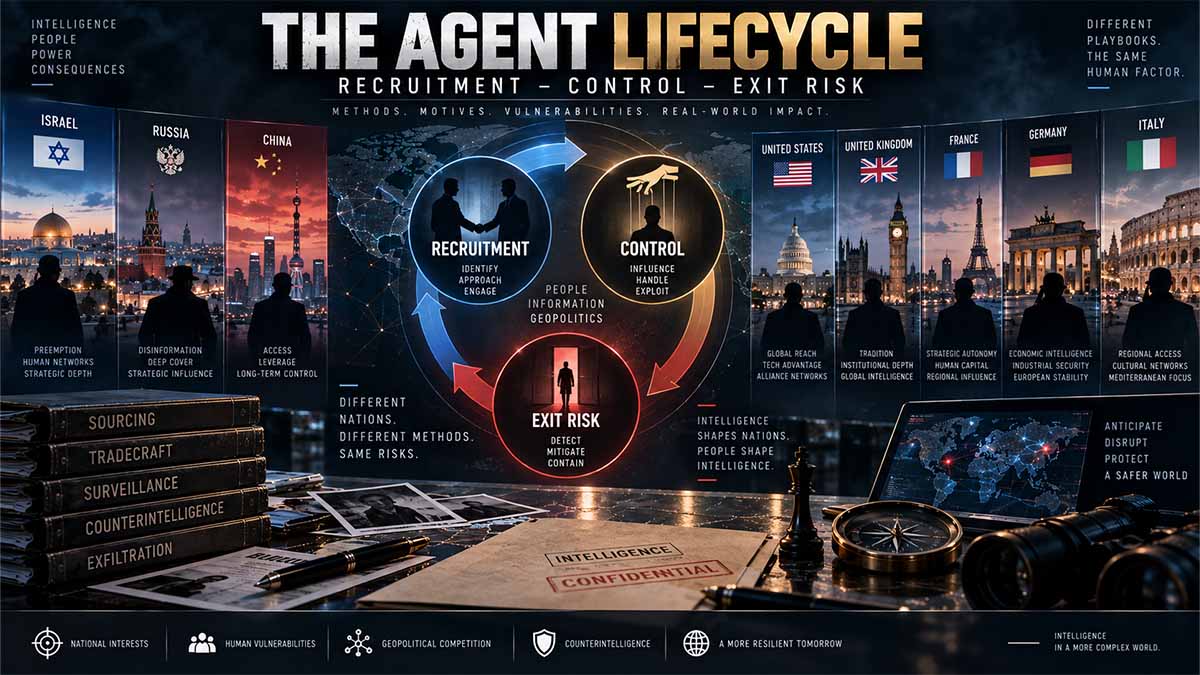
Executive Summary
Human intelligence remains indispensable because technology can reveal activity but cannot reliably determine intention, loyalty or concealed decision-making.
Across Israel, Russia, China, the United States, United Kingdom, France, Germany and Italy, recruitment follows a common architecture: identify access, assess motivation and vulnerability, test compliance, establish control, validate reporting and manage termination.
Israel does not possess a uniquely manipulative recruitment doctrine; its distinguishing characteristics are operational concentration, regional urgency, denied access and rapid integration of human, cyber and military intelligence.
Money, ideology, recognition, grievance, intimacy, fear and coercion are not isolated recruitment methods. Services combine them progressively to convert access into repeated cooperation and cooperation into dependency.
Commercial relationships, academic exchanges, professional platforms, supply chains and digital identities increasingly provide the initial infrastructure for clandestine targeting.
Strategic agents, informants, facilitators, disposable proxies and state-backed armed groups are fundamentally different categories and cannot be assigned a single protection or abandonment pattern.
Protection is not a binary act. It includes survival, extraction, legal status, family security, financial continuity, identity protection and long-term reintegration.
Between 2026 and 2031, artificial intelligence will expand target discovery and source validation, while remotely recruited proxies will make low-level espionage, reconnaissance and sabotage cheaper and more deniable.
The decisive intelligence advantage will belong not to the service identifying the most vulnerable candidates, but to the system that best verifies access, detects deception, protects viable sources and honours the commitments on which future recruitment depends.
The Disposable Asset: How HUMINT Power Is Being Rewritten
Intelligence services do not recruit loyalty; they purchase access under conditions of secrecy, asymmetrical knowledge and revocable protection. Israel’s security environment has made human intelligence unusually operational: sources may identify targets, penetrate armed networks, expose supply chains or provide access that immediately shapes military action. Yet the decisive question is no longer how an agent is recruited. It is who controls the dependency, who assumes the extraction cost and what remains of the relationship after access disappears. From 2026 to 2031, artificial intelligence, commercial data and cyber operations will accelerate target discovery while making betrayal easier to detect. The resulting contest will reward services capable not merely of recruiting sources, but of validating, protecting and terminating them without destroying the credibility on which future recruitment depends.
The Architecture of Dependency
The official description of Mossad is concise: it collects intelligence for Israeli decision-makers and conducts strategic operations intended to protect national security. Mossad: Official Mission – State of Israel – verified September 2026. It does not publish recruitment procedures, payment scales, extraction statistics or post-operation protection policies. Assertions that Israeli intelligence invariably recruits through money, ideology, coercion or sexual compromise—and then systematically abandons its agents—therefore cannot be presented as quantified fact. The underlying mechanisms, however, are neither speculative nor uniquely Israeli.
On 14 June 2023, France’s domestic security service, the DGSI, published the clearest official European anatomy of human-source recruitment. It described a service examining the target’s habits, family, relationships, motivations and weaknesses; preparing an apparently natural approach; testing reliability and access; developing psychological influence; and eventually converting an ambiguous relationship into conscious collaboration. Once recruited, the source receives clandestine-communication training so that handling can continue over time. Le processus de recrutement d’une source humaine – DGSI – June 2023.
This sequence explains the economics of grooming. A service does not need to begin with blackmail. It can offer professional recognition, commercial introductions, travel, consultancy income or assistance to relatives. Each benefit increases switching costs. Each undisclosed meeting creates exposure. Each successful assignment permits more consequential tasking. Dependency forms when the source’s income, identity, security and future become inseparable from the clandestine relationship.
Commercial cover is especially effective because it supplies four assets simultaneously: legitimate mobility, explainable cash flow, access to professional networks and a reason to ask sensitive questions. Import-export businesses, consultancies, logistics companies, research partnerships and dual-use technology ventures can all create authentic commercial activity while supporting intelligence access. A cover company need not be fictitious to serve an intelligence purpose. Its credibility may depend precisely on conducting real business.
Israel’s Compressed Model
Israel differs from larger Western powers less in recruitment psychology than in operational compression. Mossad handles foreign intelligence and strategic operations; Shin Bet addresses internal security and counterintelligence; Aman supplies military intelligence. Their missions intersect within a state facing short warning times, contested borders, persistent missile threats and hostile regional networks. Under such conditions, human reporting can move rapidly from collection to targeting or disruption.
That speed is a strategic advantage. An embedded source can explain intent that satellite imagery cannot reveal, identify which communications device belongs to which commander, distinguish a decoy facility from an operational one or provide the timing required for interdiction. Cyber penetration can expose a network; a human source can explain its hierarchy. Signals intelligence can identify contact patterns; HUMINT can interpret trust, fear and factional rivalry.
Compression also creates risk. When intelligence, targeting and military action are closely coupled, operational urgency may reduce the time available to test deception, examine source motives or design a sustainable exit. A source may become indispensable during preparation but replaceable after execution. Protection then competes with secrecy, diplomatic exposure, family relocation, counterintelligence screening and the danger that the extracted individual knows too much.
The relevant metric is therefore not payment alone but lifecycle liability: recruitment expense, continuing compensation, communications security, family obligations, extraction probability, resettlement cost and the political damage of exposure. A service may rationally spend heavily on acquisition while resisting open-ended responsibility after access has been exhausted. That logic is not evidence of automatic abandonment; it identifies the structural incentive that makes abandonment credible.
The American Scale Advantage
The United States operates through an Intelligence Community of 18 organizations, including the CIA, FBI, DIA, NSA, NGA, NRO, military intelligence services and specialized offices within State, Treasury, Energy and Homeland Security. About ODNI – Office of the Director of National Intelligence – verified September 2026. The CIA officially confirms that it collects foreign intelligence, produces analysis and conducts covert action when directed by the president. About CIA – Central Intelligence Agency – verified September 2026.
This scale allows human reporting to be tested against signals, imagery, financial intelligence, cyber telemetry and diplomatic collection. It also fragments responsibility. The organization recruiting a source may not control immigration, relocation, criminal exposure or long-term protection. Israel can sometimes compress these decisions through a shorter security chain; Washington possesses greater resources but more institutional gates.
The case of Alexander Yuk Ching Ma illustrates both recruitment persistence and counterintelligence depth. According to the US Department of Justice, Chinese intelligence contacted the former CIA officer in March 2001, more than a decade after his departure. Ma arranged a three-day Hong Kong meeting during which a relative—also a former CIA officer—provided classified information for $50,000. The relationship continued through later identification tasking. The FBI subsequently employed Ma as a contract linguist as part of an investigative ruse. On 11 September 2024, he received 10 years in prison, followed by five years of supervised release and a lifetime obligation to cooperate with US debriefings. Former CIA Officer Sentenced for Conspiracy to Commit Espionage – US Department of Justice – September 2024.
The case establishes that access can survive employment, family connections can become operational bridges, cash can initiate dependency and follow-on tasking can extend it. It does not prove that the CIA uses identical methods abroad. It demonstrates a universal intelligence principle: recruitment targets usable access, not job titles.
Europe’s Defensive Laboratory
European services increasingly describe recruitment as a continuum connecting espionage, cyber intrusion, technology transfer, sabotage and disposable proxies. On 16 October 2025, MI5 Director General Sir Ken McCallum reported a 35% annual increase in individuals investigated for state-threat activity. He said Russian services were recruiting proxies through social platforms, issuing instructions through encrypted applications and offering cryptocurrency payments. Six Bulgarian nationals convicted in May received a combined 50 years’ imprisonment; five additional men were convicted in July over an arson attack on a London warehouse containing supplies for Ukraine. McCallum’s warning was explicit: the proxy may be abandoned, unpaid and excluded from any prisoner exchange. Director General’s Threat Update – MI5 – October 2025.
The British data reveal a major change in recruitment economics. A hostile service no longer needs to cultivate every asset for years. It can combine a small number of protected officers with a wider market of remotely recruited intermediaries. The officer’s diplomatic and political exposure falls; the proxy absorbs the criminal risk. Cryptocurrency, encrypted messaging and online reconnaissance reduce transaction costs, while ideological ambiguity allows handlers to recruit for money, excitement, resentment or status without establishing deep loyalty.
Britain also demonstrates what a regulated source-management system is intended to contain. Its 2022 Covert Human Intelligence Sources Code requires authorization records, risk assessments, documentation of tasking, evaluation of source value and reasons for renewal or cancellation. Records must generally be retained for at least five years, with confidentiality protected and relevant errors reported to the Investigatory Powers Commissioner. Covert Human Intelligence Sources Revised Code of Practice – UK Home Office – December 2022. These provisions concern authorized British sources, not foreign agents overseas. Their strategic significance lies in converting handler discretion into auditable institutional responsibility.
Protection Has a Price
Extraction is not the moral epilogue to an operation; it is a constrained allocation decision. The service must assess whether the source remains valuable, whether compromise is confirmed, whether relatives must also move, whether relocation will expose the operation and whether the destination state can legally absorb the individual. An agent with unique continuing knowledge may justify extraordinary measures. A low-level intermediary recruited through a digital platform may be treated as operationally replaceable.
The United States illustrates the narrowness of even a powerful extraction mechanism. 50 U.S.C. §3508 permits exceptional admission of certain foreign nationals and immediate family members when their entry serves national security or is essential to an intelligence mission. The statutory ceiling is 100 persons in a fiscal year, and the mechanism requires senior governmental determinations. Admission of Essential Aliens; Limitation on Number – United States Code – current text verified September 2026. America therefore possesses substantial extraction capacity, but public law itself shows that protection is selective rather than automatic.
Israel faces a more compressed version of the same equation. Its territory is smaller, regional exposure can be immediate and relocating a source into Israel may not eliminate identification, linguistic isolation or threats to relatives left behind. Conversely, the state’s concentrated command structure may permit rapid exceptional action where the source’s contribution is considered strategically decisive. Public evidence provides no denominator: neither the proportion extracted nor the proportion abandoned is known. Any categorical judgment would substitute narrative for measurement.
The Credibility Balance Sheet
Abandonment carries costs beyond the individual case. Intelligence services recruit partly through reputation. If potential sources believe that cooperation ends in exposure, statelessness or economic ruin, the service must compensate with more money, stronger ideology, greater coercion or more elaborate promises. Every visible failure raises the price of the next recruitment.
Protection, however, also creates moral hazard. A guaranteed escape route may weaken discipline or attract fabricators seeking money and relocation. Successful source management therefore requires conditional commitments that are credible enough to sustain cooperation but controlled enough to prevent exploitation. The tension cannot be eliminated. It can only be governed.
Five competing explanations should frame claims of abandonment. The service may have broken a promise; the source may have misunderstood a conditional assurance; extraction may have become physically impossible; counterintelligence doubts may have changed the assessment; or political leadership may have judged the diplomatic cost unacceptable. A sixth possibility is deliberate disinformation by the adversary, which benefits from portraying collaboration as both shameful and futile. Without operational records, confidence should remain case-specific.
The AI Recruitment Market
Between 2026 and 2031, artificial intelligence will industrialize the preparatory stages of HUMINT. Models can correlate professional biographies, corporate ownership, research publications, travel patterns, breached credentials, geolocation histories and social relationships. The result will not be an autonomous recruiting machine. It will be a system capable of ranking thousands of potential targets by access, vulnerability and approachability.
The same technology will strengthen counterintelligence. Governments and companies will correlate anomalous downloads, foreign contacts, unexplained travel, financial changes and unusual authentication behavior. The traditional separation between cyber intrusion and human recruitment will erode: a person may be recruited not to steal documents, but to provide credentials, map internal systems, identify technical custodians or validate data already acquired remotely.
This produces a dangerous asymmetry. AI can reduce the cost of finding a vulnerable individual, but extraction and protection remain expensive physical commitments. Services will therefore be tempted to expand low-cost recruitment while reserving durable protection for a narrower tier of high-value sources. The number of disposable proxies may rise faster than the number of professionally handled agents.
The Strategic Verdict
Israel’s comparative advantage is not a mysterious national aptitude for recruitment. It is the concentration of regional knowledge, technical intelligence and operational authority inside a security system built around short decision cycles. America offers greater global reach and validation capacity; Britain provides unusually explicit source-governance rules; France publicly dissects psychological capture; Germany emphasizes institutional counterintelligence and the protection of industrial knowledge. Russia’s online proxies and China’s documented cultivation of former officials demonstrate alternative models combining distance, money, family leverage and persistent tasking.
The transformation underway is clear. HUMINT is becoming a platform economy: digital discovery, commercial cover, encrypted control, cyber-enabled access and unevenly distributed risk. The handler can operate farther from the crime; the recruit becomes easier to identify, direct and replace.
For Israel—and every intelligence power—the decisive asset between now and 2031 will not be the agent who can be bought. It will be institutional credibility: the ability to prove, in a market governed by secrecy, that cooperation carries a future as well as a price.
Navigational Index
- Recruitment Architecture — Motivation, vulnerability, access, grooming, commercial cover and dependency formation.
- Control, Termination and Protection — Handler leverage, extraction economics, abandonment claims and competing hypotheses.
- 2026–2031 Transformation — AI-enabled targeting, cyber-HUMINT convergence, counterintelligence adaptation and geopolitical consequences.
- Comparative Intelligence Recruitment Systems, 2026–2031 –
- Part I — Analytical Framework, Israel, United States, United Kingdom and France
- Part II — Russia, China, Germany and Italy
- Part III — Integrated Net Assessment: Recruitment Systems, Source Control, Protection Liability and the 2031 Intelligence Contest
Master Abstract
Human intelligence has not been displaced by satellites, bulk interception, cyber penetration or artificial intelligence; those capabilities have instead increased the strategic value of people who can explain intention, internal disagreement, informal authority, concealed planning and the meaning of technically acquired information. This study reconstructs the human-source lifecycle across Israel, the United States, United Kingdom, France, Germany, Russia, China and Italy, testing the proposition that Israeli intelligence recruits through money, ideology, coercion and prolonged grooming before abandoning agents whose utility has expired. The evidence supports the existence of these mechanisms but not their exclusive attribution to Israel or their universal application by Mossad. France’s DGSI officially describes a foreign-service recruitment process beginning with comprehensive research into a target’s habits, family, relationships, access, motivations and weaknesses, followed by an apparently natural approach, progressive psychological influence, conscious recruitment, handler-directed tasking and clandestine-security instruction. Le processus de recrutement d’une source humaine – Direction générale de la sécurité intérieure – June 2023 — Official DGSI recruitment-cycle analysis. Its more detailed scenario shows how professional records, examination results, social networks, dating profiles, personal isolation, frustrated advancement, ego reinforcement and escalating cash payments can transform harmless cooperation into a compromising intelligence relationship. The target is first tested with apparently innocuous work; repeated compliance normalises disclosure; remuneration creates documentary and psychological liability; and conscious recruitment occurs only after the individual already feels unable to withdraw. Piégé par un service étranger: jamais trop tard pour obtenir de l’aide – Direction générale de la sécurité intérieure – September 2023 — Official DGSI counterintelligence scenario. Britain’s MI5 independently distinguishes intelligence officers from recruited agents, confirms the use of official and non-official cover—including diplomatic, commercial, academic and journalistic identities—and states that the human relationship remains central despite technological change. How Spies Operate – MI5 Security Service – accessed September 2026 — Official MI5 account. The convergent evidence establishes that access mapping, inducement, staged commitment and dependency are structural features of espionage rather than an exclusively Israeli “agent factory.”
The current operating data show that this architecture is expanding beyond classical face-to-face recruitment. In October 2025, MI5 reported a 35% annual increase in the number of individuals investigated for involvement in state-threat activity, encompassing espionage against Parliament, universities and critical infrastructure. The same official assessment stated that Russian services were recruiting proxies through social-media platforms, transmitting instructions through encrypted applications and offering cryptocurrency payments; it also reported that MI5 had tracked more than twenty potentially lethal Iran-backed plots during the preceding year. Director General Sir Ken McCallum Gives Threat Update – MI5 Security Service – October 2025 — Official MI5 threat assessment. Britain had already identified more than 10,000 disguised approaches by foreign intelligence actors on professional-networking platforms, aimed at people working across government, high-technology businesses and academia. New App to Counter Malicious Approaches Online – Cabinet Office and Centre for the Protection of National Infrastructure – May 2022 — Official UK Government disclosure. Germany’s BfV similarly reports that the contraction of Russia’s diplomatic infrastructure did not suppress intelligence activity but shifted it toward social networks, travelling personnel, cyber operations and alternative intermediaries. Spionage, Cyberangriffe und sonstige sicherheitsgefährdende oder geheimdienstliche Aktivitäten für eine fremde Macht – Bundesamt für Verfassungsschutz – June 2026 — Official German counterintelligence assessment. German criminal law now punishes both the performance of intelligence activity for a foreign power and the act of declaring willingness to undertake it, with a principal statutory range extending from six months to ten years’ imprisonment. Strafgesetzbuch §99: Geheimdienstliche Agententätigkeit – Federal Ministry of Justice – April 2026 — Official statutory text. These developments identify a decisive change in recruitment economics: professional intelligence officers are increasingly supplemented by inexpensive, remotely managed and deniable facilitators who may conduct reconnaissance, obtain routine documents, place equipment, enable cyber access or prepare sabotage without ever entering a traditional handler–agent relationship.
The national comparison reveals common mechanics but sharply different operating systems. Israel concentrates external HUMINT in Mossad while combining it with Shin Bet counterintelligence, Aman military intelligence, cyber capabilities and an unusually compressed national-security decision cycle. Its principal advantage is the rapid conversion of scarce human access into operational intelligence against proximate, high-consequence targets, including Iran-linked networks, weapons programmes, armed organisations and hostage-related requirements. Its structural risk is that mission urgency can create protection commitments faster than civilian institutions can absorb them after extraction or political change. The United States possesses the greatest global collection, technical-validation, transport and resettlement capacity, but responsibility can fragment among the CIA, Defence Department, State Department, immigration authorities and political leadership. The United Kingdom operates through a three-agency system—SIS, MI5 and GCHQ—rather than a simplistic domestic-versus-foreign binary. In 2024–25, these agencies recorded £4.438 billion in operating expenditure, including £1.703 billion in staff costs, and £5.214 billion in total departmental spending when capital expenditure was included. The 2025 Spending Review added £600 million to the Single Intelligence Account by 2028–29, supporting infrastructure, digital transformation and research. Security and Intelligence Agencies Financial Statement 2024–25 – Cabinet Office – November 2025 — Official audited consolidated statement. France distributes foreign collection, domestic counterintelligence, military intelligence, defence security, customs intelligence and financial analysis across DGSE, DGSI, DRM, DRSD, DNRED and Tracfin. Tracfin received 215,410 information items in 2024, including 211,165 suspicious-transaction reports, and transmitted 3,998 intelligence notes to judicial, intelligence and administrative partners; these figures demonstrate the scale of the financial environment capable of exposing unexplained payments, shell arrangements and commercial dependency. Tracfin, le Service de renseignement financier de Bercy – Ministry of Economy and Finance – updated July 2026 — Official Tracfin operational data. France’s intelligence techniques are subject to ex-ante and ex-post review by the independent CNCTR, although this oversight does not disclose classified source payments or extraction decisions. National Oversight Commission for Intelligence-Gathering Techniques – CNCTR – accessed September 2026 — Official oversight mandate.
The study’s central finding is that control, reliability and protection must be analysed separately. Money, secrecy, travel support, professional opportunity, emotional attachment, prior disclosures and fear of exposure can deepen handler control, but control does not increase intelligence reliability indefinitely. A dependent source may fabricate access, suppress adverse information, exaggerate threats or provide whatever confirms the handler’s expectations. The decisive capability is therefore independent validation through communications intelligence, financial records, imagery, cyber evidence, observable events and separate human reporting. Protection is equally multidimensional. It comprises at least seven stages: P₁ immediate survival, P₂ physical extraction, P₃ legal status, P₄ family protection, P₅ financial continuity, P₆ identity and security management, and P₇ social and professional reintegration. A service can complete P₁ and P₂ while failing at P₅ or P₇, producing an operation officially recorded as a successful rescue but experienced by the source as abandonment. Britain’s domestic CHIS code requires pre-deployment risk assessment, assigns handlers responsibility for monitoring security and welfare, and directs authorities—where necessary and practicable—to continue considering welfare after authorisation has ended. Covert Human Intelligence Sources Revised Code of Practice – Home Office – December 2022 — Official CHIS governance framework. This is not an SIS overseas-source manual and does not guarantee extraction; it nevertheless proves that termination and post-termination risk can be formally separated. No equivalent public dataset permits calculation of national abandonment rates for Mossad, CIA, SIS, DGSE, BND, Russian, Chinese or Italian services. Claims assigning country-level percentages would therefore constitute false precision. The defensible conclusion is conditional: extraction and durable protection become more likely when the source retains rare strategic value, possesses sensitive knowledge of service methods, has received an explicit senior commitment and creates substantial reputational exposure; protection becomes less likely when the individual is a low-value facilitator, disposable online proxy, criminal intermediary or member of a large politically inconvenient partner force.
Between 2026 and 2031, the dominant transformation will be cyber–HUMINT convergence, not the replacement of human intelligence by machines. The UK NCSC assesses that artificial intelligence will primarily strengthen existing capabilities in reconnaissance, social engineering, vulnerability research and the exploitation of stolen data. The Near-Term Impact of AI on the Cyber Threat – National Cyber Security Centre – January 2024 — Official NCSC assessment. AI will allow services to correlate employment histories, publications, procurement records, travel, corporate affiliations, leaked credentials and social relationships; identify people with indirect but strategically valuable access; generate multilingual approaches; and monitor changes in a source’s position or behaviour. Cyber intrusions will expose potential recruits and organisational vulnerabilities, while human sources will provide passwords, physical entry, undocumented processes, private intentions and contextual interpretation unavailable from stolen files alone. At the lower end of the spectrum, synthetic identities, encrypted communications and digital payments will industrialise disposable human tasking. At the strategic level, experienced officers will remain essential because no verified public evidence demonstrates autonomous systems capable of sustaining high-risk clandestine relationships, detecting sophisticated double agents or making accountable extraction decisions. The most probable 2031 order will therefore divide human assets into two increasingly unequal classes: rare, expensive and carefully validated strategic sources whose protection may be operationally indispensable, and abundant, remotely recruited facilitators whose deniability depends precisely on their expendability. The intelligence service with the greatest advantage will not be the one generating the largest database of vulnerable individuals. It will be the one that most effectively verifies genuine access, rejects false candidates, detects deception, prevents automation bias, preserves institutional responsibility and honours the protection commitments on which future recruitment credibility depends.
Agent Lifecycle & Counterintelligence Risk, 2026–2031
Assumption controls
Analysis of competing hypotheses
Recruitment Architecture: From Access to Dependency, 2026–2031
The architecture of recruitment
Recruitment architecture is best understood as a controlled conversion process rather than a single transaction. A foreign intelligence service does not merely search for individuals willing to sell secrets; it evaluates whether a person possesses present or prospective access, whether that access answers an intelligence requirement, whether the individual can be influenced without producing unacceptable exposure, and whether the resulting relationship can be sustained. The official French account provides the clearest publicly available description: the prospective source’s environment, habits, relationships, family, motivations and weaknesses are examined; reliability and potential access are assessed; an apparently natural approach is prepared; and only after sufficient influence has developed is the intelligence purpose clarified. Le processus de recrutement d’une source humaine – Direction générale de la sécurité intérieure – June 2023 — official source. This description establishes a sequence but should not be misread as a universal operational manual. Different services, legal systems, theatres and target classes produce different pathways, including willing volunteers, ideological contacts, coerced sources and relationships in which the individual initially believes that information is being supplied to a company, researcher or intermediary. MI5 likewise distinguishes intelligence officers from agents, notes that officers can operate under diplomatic, trade, business, student or journalistic cover, and states that services seek source networks capable of delivering a sustained information flow. How Spies Operate – Security Service, MI5 – accessed September 2026 — official source. The analytical unit is consequently not the moment of recruitment but the entire source lifecycle: intelligence requirement, target discovery, suitability assessment, relationship development, informed or partially informed cooperation, continuing validation, dependency management, compromise, extraction, suspension or termination. Public evidence supports that architecture across intelligence systems; it does not establish identical conduct by every service or validate every allegation made about a named service.
| Lifecycle layer | Principal analytical question | Defensive observable | Primary uncertainty |
|---|---|---|---|
| Requirement | What information, influence or access is sought? | Repeated interest in a sensitive function or network | Whether interest is commercial, academic or state-directed |
| Discovery | Why was this individual noticed? | Professional visibility, travel, publications, procurement role | Automated discovery versus human referral |
| Suitability | Can access and reliability be converted into value? | Questions exceeding a declared business purpose | Genuine due diligence versus covert assessment |
| Development | Is trust, reciprocity or dependency increasing? | Escalating contact, exclusivity, disproportionate benefits | Normal relationship formation versus grooming |
| Recruitment | Does the person understand the foreign-state relationship? | Requests inconsistent with lawful professional activity | Conscious agent, unwitting source or exploited contact |
| Handling | Can the relationship remain productive and controlled? | Task escalation, concealed sponsorship, anomalous compensation | Source reliability and handler attribution |
| Termination | What happens after access, trust or security deteriorates? | Sudden withdrawal of support or attempted extraction | Deliberate abandonment versus lost capability |
Motivation is dynamic, not a four-letter formula
The familiar MICE taxonomy—money, ideology, compromise or coercion, and ego—remains useful only if treated as a descriptive filing system rather than a predictive model. People rarely cooperate for one stable reason. Financial pressure can initiate contact, perceived recognition can sustain it, ideological rationalisation can reduce guilt, and fear of exposure can later prevent withdrawal. Conversely, a person who appears financially vulnerable may reject every approach, while a prosperous person may cooperate because of grievance, excitement, loyalty, resentment or perceived historical purpose. The central variable is therefore motivational interaction over time. A defensible model separates initiating motivation M₀, sustaining motivation Mₛ, inhibiting constraint Cᵢ and exit pressure Eₓ. No single factor is sufficient: access without motivation produces an unavailable target; motivation without access produces limited intelligence value; both without reliability create deception risk; and all three without controllability create operational volatility. The French official description expressly connects motivation and vulnerability to the development of psychological influence, while the British description emphasises personal and ideological variability rather than a deterministic profile. These sources support a dynamic formulation in which recruitment probability depends on opportunity, access, relationship credibility, perceived benefit, moral inhibition and perceived detection risk. They do not support assigning a universal percentage to any motivation. In defensive analysis, the important signal is not poverty, political dissatisfaction or ambition in isolation—treating such characteristics as indicators would be analytically weak and ethically dangerous—but a change in behaviour coupled with an unexplained external relationship and an information demand inconsistent with its declared purpose. This distinction prevents counterintelligence from degenerating into profiling. It also explains why source cultivation may last years: the sought access can mature through promotion, business expansion, marriage, migration, research collaboration or entry into a strategic supply chain, while the motivational balance changes as the relationship accumulates benefits, secrets and obligations.
| Motivation vector | Possible initiating condition | Possible sustaining mechanism | Destabilising condition |
|---|---|---|---|
| Money | Debt, ambition, business need or lifestyle aspiration | Recurring compensation or capital dependence | Payment interruption, audit exposure or unmet promises |
| Ideology | Political, religious, national or moral identification | Reinforcement through mission significance | Policy contradiction or disillusionment |
| Compromise/coercion | Fear of exposure, legal risk or personal vulnerability | Escalating perceived cost of refusal | Defection, disclosure or protective intervention |
| Ego/status | Recognition deficit, grievance or desire for importance | Privileged attention and perceived insider status | Humiliation, neglect or loss of exclusivity |
| Relationship | Affection, loyalty, mentorship or reciprocity | Personal attachment to an intermediary | Betrayal, reassignment or identity discovery |
Access and vulnerability as separate dimensions
Access should be measured independently from rank. A junior technician, scheduler, interpreter, family member, logistics contractor or supplier can possess greater operational relevance than a senior official who is heavily monitored and compartmented. Access includes possession of protected information, proximity to decision-makers, visibility into organisational routines, ability to introduce other people, participation in procurement and capacity to influence what others believe. Prospective access is equally important: recruitment can precede promotion, security clearance, market entry or political advancement. This creates an option-value logic. A service may tolerate low immediate yield when the expected future value of access, discounted for detection and unreliability, remains positive. A simplified defensive representation is Vₜ = Aₜ × Rₜ × Pₜ − Dₜ − Hₜ, where Aₜ denotes access value, Rₜ reliability, Pₜ persistence, Dₜ detection exposure and Hₜ handling burden. This is not an operational formula and should not be interpreted as one; it is a conceptual method for explaining why apparently unimportant relationships can receive prolonged attention. Vulnerability is also broader than a compromising secret. It includes financial fragility, institutional grievance, social isolation, professional dependency, legal uncertainty, family exposure, reputational sensitivity and an unmet need for validation. The defensible counterintelligence task is to observe relationship-linked changes rather than infer disloyalty from personal circumstances. The European Commission defines foreign interference in research and innovation as conduct undertaken by or for a foreign state that is coercive, covert, deceptive or corrupting and contrary to European sovereignty, values and interests. Tackling R&I Foreign Interference – European Commission – January 2022 — official source. This definition is important because it distinguishes legitimate international cooperation from state-directed exploitation without criminalising foreign contact itself. Between 2026 and 2031, access mapping will increasingly extend beyond classified institutions into semiconductor design, artificial intelligence, biotechnology, satellite services, energy systems, universities, logistics and dual-use manufacturing, where sensitive knowledge is dispersed among public agencies, contractors, start-ups and multinational research teams.
Grooming, reciprocity and dependency formation
“Grooming” is analytically useful only when defined as cumulative relationship engineering that changes the target’s perceived incentives, obligations or ability to disengage. It should not become a rhetorical label attached retrospectively to every long professional association. The progression normally alleged in public counterintelligence warnings begins with a credible context, continues through benign interaction and small exchanges, and becomes concerning when requests grow more sensitive while sponsorship, identity or ultimate purpose remains concealed. The United Kingdom reported that hostile actors had made more than 10,000 disguised approaches through professional-networking platforms, including approaches to government, high-technology and academic personnel, and warned that lucrative consultancy offers could target current or former civil servants. New App to Counter Malicious Approaches Online – Cabinet Office and Centre for the Protection of National Infrastructure – May 2022 — official source. The updated British campaign specifically addresses fake profiles used by foreign spies and other malicious actors on social and professional networks. Think Before You Link – National Protective Security Authority – April 2026 — official source. These sources demonstrate scale and modality but do not reveal conversion rates: ten thousand approaches are not ten thousand recruited agents. Grooming reduces psychological friction by normalising contact and creating a history that can later be interpreted as trust, reciprocity or complicity. Dependency forms when benefits cannot be separated from the relationship: income depends on a sponsor, market access depends on an intermediary, professional standing depends on introductions, or concealment of previous conduct depends on continued cooperation. The relationship then becomes self-reinforcing. Yet dependency remains unstable. Excessive pressure can reduce reliability, encourage double dealing or provoke disclosure. Consequently, the strongest services should not be assumed to maximise coercion; they may prefer perceived voluntariness because it lowers monitoring cost and produces more durable cooperation. Defensive governance should therefore concentrate on disclosure channels, conflict-of-interest controls, financial transparency and safe reporting mechanisms that reduce the personal cost of seeking help before dependency becomes irreversible.
Commercial cover and the legitimacy problem
Commercial cover is powerful because legitimate economic activity naturally produces travel, meetings, payments, confidential discussions, market research and access to technical specialists. A consultancy can request analysis; an investor can ask about management, technology and suppliers; a recruiter can request a résumé, references and career intentions; a trading relationship can explain repeated cross-border contact. None of these activities is inherently suspicious. The analytical problem is functional mismatch: the information requested, compensation offered or secrecy demanded gradually exceeds the relationship’s stated commercial purpose. MI5 explicitly notes that intelligence officers may pose as businesspeople and that trade positions can provide official cover, while the British “Think Before You Link” programme shows how professional platforms can support disguised approaches. The UK’s Foreign Influence Registration Scheme, which entered into force on 1 July 2025, adds a transparency mechanism for specified activities conducted at the direction of foreign powers but does not convert all foreign-funded activity into espionage. Foreign Influence Registration Scheme – UK Home Office – July 2026 update — official source. The European Union has pursued a parallel but distinct economic-transparency logic through rules addressing distortive foreign subsidies in acquisitions and public procurement. Foreign Subsidies Regulation – European Commission – July 2023 — official source. These instruments matter to recruitment architecture because commercial opacity can create both access and leverage, while beneficial-ownership disclosure, procurement scrutiny and foreign-direction registration raise the cost of maintaining that opacity. They are not substitutes for criminal evidence. A firm receiving foreign investment is not thereby an intelligence front; a consultant meeting diplomats is not thereby a source. The appropriate defensive model combines transaction proportionality, beneficial ownership, declared purpose, information sensitivity, contact evolution and concealment behaviour. It avoids nationality-based suspicion and tests whether observable conduct is better explained by lawful commerce, undeclared influence, technology acquisition, fraud or intelligence collection.
Analysis of competing hypotheses
The competing-hypotheses analysis must explain the same observable pattern—prolonged contact, commercial benefit, expanding access and increasing secrecy—without prematurely selecting an espionage interpretation. H₁, the deliberate intelligence recruitment hypothesis, predicts concealed state direction, systematic interest in access, progressive sensitivity and a relationship structured around collection or influence. H₂, legitimate commercial development, predicts requests proportionate to business objectives, verifiable principals, conventional contractual safeguards and no persistent pressure for unrelated protected information. H₃, private industrial espionage, predicts commercial rather than governmental beneficiaries, concentration on intellectual property or competitive positioning and payment flows connected to corporate gain. H₄, criminal exploitation, predicts fraud, extortion, sanctions evasion, corruption or money laundering as the dominant objective, with intelligence-like methods serving private enrichment. H₅, counterintelligence narrative inflation, predicts that an arresting or exposing state publicly compresses ambiguous relationships into a coherent hostile network before judicial testing. H₆, mixed or delegated activity, predicts overlap among state interests, private intermediaries, contractors, criminal facilitators and ideologically motivated participants. H₆ deserves special weight during 2026–2031 because deniable ecosystems can combine capabilities without every participant understanding the ultimate sponsor. The matrix below uses evidence discriminators rather than confirmation counts: one item highly inconsistent with a hypothesis can matter more than several weakly compatible observations. Under an illustrative Bayesian update, not a measured statistical finding, equal priors of roughly 16.7% are assigned to the six hypotheses. Verified concealed foreign-state tasking would sharply increase H₁ or H₆; ordinary contracts and proportionate information requests would increase H₂; direct corporate-beneficiary evidence would increase H₃; extortion or personal enrichment would increase H₄; and repeated official claims unsupported by judicial records would increase H₅. Probabilities must remain revisable because public counterintelligence cases systematically contain missing evidence, strategic disclosure and selection bias.
| Discriminator | H₁ State recruitment | H₂ Lawful commerce | H₃ Industrial espionage | H₄ Criminal exploitation | H₅ Narrative inflation | H₆ Mixed ecosystem |
|---|---|---|---|---|---|---|
| Verified foreign-state direction | Strongly consistent | Strongly inconsistent | Inconsistent | Inconsistent | Inconsistent if independently proven | Strongly consistent |
| Requests unrelated to declared business | Strongly consistent | Strongly inconsistent | Moderately consistent | Moderately consistent | Neutral | Strongly consistent |
| Conventional contracts and proportionate fees | Weakly inconsistent | Strongly consistent | Neutral | Inconsistent | Neutral | Neutral |
| Concealed beneficial ownership | Consistent | Inconsistent | Consistent | Consistent | Neutral | Strongly consistent |
| Judicially tested handler communications | Strongly consistent | Strongly inconsistent | Depends on beneficiary | Depends on content | Strongly inconsistent | Strongly consistent |
| Public accusation without case documentation | Neutral | Neutral | Neutral | Neutral | Strongly consistent | Neutral |
Bayesian update and confidence discipline
A Bayesian framework can prevent both credulity and reflexive dismissal, but only if its numbers are labelled as structured judgments rather than empirical frequencies. Consider the proposition P that a suspicious professional relationship forms part of foreign intelligence recruitment. Begin with a low base-rate prior because the overwhelming majority of international commercial and academic relationships are lawful. Evidence E₁—an unusually generous but otherwise documented consultancy—should produce only a modest upward update because legitimate firms sometimes pay premiums for scarce expertise. Evidence E₂—requests for non-public information unrelated to the contract—should create a larger update. Evidence E₃—concealed sponsorship traceable to a foreign state—should materially increase the posterior. Evidence E₄—pressure to hide the relationship from employers or authorities—should increase it further, although secrecy can also occur in fraud or industrial espionage. Evidence E₅—authenticated communications establishing state tasking—would dominate the assessment. The correct structure is posterior odds = prior odds × LR₁ × LR₂ × LR₃, but numerical likelihood ratios should not be invented where validated datasets do not exist. Analysts can instead use ordered categories: strongly diagnostic, moderately diagnostic, weakly diagnostic, neutral or contradictory. This protects the assessment from false precision. Cross-language verification adds another safeguard. French material offers the most explicit official lifecycle description; British material documents professional-platform targeting and commercial disguise; EU material supplies governance definitions for covert, coercive, deceptive or corrupting interference. Chinese official and state-linked public materials were reviewed for counterespionage framing, while Russian-language official material was checked for recruitment and espionage cases. Neither public corpus yielded, during this session, a sufficiently detailed, independently testable protocol comparable to the French description; therefore no Russian or Chinese claim has been inserted merely to satisfy geographical symmetry. That omission is an evidence-integrity result, not a research failure. State publications are themselves strategic communications, so multilingual agreement raises confidence in general mechanisms but never independently proves a contested individual case.
Monte Carlo scenarios and the five-year outlook
The five-year model should estimate system exposure rather than “recruitment success,” because no representative dataset records approaches, conversions, source duration, reliability and termination outcomes across intelligence services. The accompanying Monte Carlo graph therefore performs 10,000 assumption-driven trials across four variables: digital discoverability, commercial-cover permeability, economic vulnerability and counterintelligence adaptation. Each variable ranges from 0 to 100 and represents an analyst-selected condition, not a directly measured national score. Random variation supplies uncertainty around three structural pathways. The baseline pathway assumes professional visibility, fragmented supply chains and cross-border contracting continue to expand faster than institutional defences. The defensive-adaptation pathway assumes platform verification, financial scrutiny, personnel-security reporting and foreign-influence transparency improve materially. The resilient-governance pathway assumes those measures are combined with trusted reporting, employee support, conflict-of-interest controls and international counterintelligence cooperation. Its lower exposure does not imply elimination of espionage; it indicates reduced opportunity for ambiguous professional relationships to mature unnoticed. By 2031, artificial intelligence will probably compress discovery and assessment more than it transforms human persuasion. Automated systems can rank publicly visible expertise, detect career transitions and connect individuals to strategic programmes, but they cannot reliably determine loyalty, truthfulness or behaviour under pressure. Synthetic identities will increase the volume and linguistic quality of initial approaches, while stronger identity verification and behavioural analytics will increase adversary costs. Commercial cover will move toward smaller, modular structures—consultancies, investment vehicles, research partnerships and recruitment intermediaries—because they offer plausible explanations for access without requiring permanent official presence. At the same time, tighter beneficial-ownership, sanctions, procurement and foreign-direction regimes will make durable financial dependency harder to conceal. The outcome will be an arms race between scalable discovery and scalable verification, with human judgment remaining decisive on both sides.
Shadow dimensions: liquidity, proxies and cyber norms
Three shadow dimensions will determine whether recruitment architectures become more durable or more brittle. First, liquidity flows convert influence into dependence. The relevant question is not simply whether money changed hands but whether compensation is proportional, attributable, contractually coherent and independently survivable. Capital injections, debt relief, business introductions, paid travel and future employment can create economic dependence without resembling a direct intelligence payment. Defensive financial analysis should therefore examine concentration risk, unexplained related-party relationships and sponsorship opacity, while preserving legitimate privacy and avoiding guilt by association. Second, proxy dynamics blur organisational boundaries. A private investigator, recruiter, lobbyist, research institute, criminal broker or commercial adviser may facilitate access without possessing full knowledge of the ultimate beneficiary. This produces compartmented attribution and complicates legal proof: the observable intermediary may be culpable, unwitting or partially informed. Third, cyber norms remain incomplete where online collection intersects with human recruitment. MI5 states that cyber espionage offers cost, scale and deniability advantages but also stresses that the human officer–agent relationship remains central. The likely evolution is therefore not replacement of HUMINT by cyber collection, but convergence: stolen or commercially acquired data improves targeting; professional platforms provide contact surfaces; remote work expands access beyond secure premises; and human sources interpret context that bulk data cannot reliably explain. Between 2026 and 2031, effective defence will require integrated personnel, cyber, financial and research-security functions rather than isolated compliance teams. The strategic risk is not only stolen information. Recruitment can enable influence over procurement, distorted technical assessment, access to trusted networks, introduction of additional targets and manipulation of decision timing. These second-order effects justify a lifecycle model. Detection at the initial-contact stage prevents dependency; detection after sustained handling may require damage assessment, network reconstruction, legal intervention and protection of the affected person. The architecture’s centre of gravity is therefore the relationship between access and dependency, not any single payment, ideology or clandestine technique.
Figure 1: Recruitment-Architecture Exposure, 2026–2031
Illustrative Monte Carlo sensitivity model • 10,000 trials • index 0–100 • analyst-controlled assumptions, not observed probabilities
Model assumptions
The model compares scenario sensitivity. It does not measure any named intelligence service, identify targets, or estimate real recruitment success rates.
Control, Termination and Protection: The Economics of Agent Survival
Control as a changing portfolio of leverage
Control within a human-intelligence relationship is not a single mechanism and cannot be reduced to payment, blackmail or personal loyalty. It is better represented as a changing portfolio of leverage whose components gain or lose effectiveness over the source lifecycle. The handler seeks continued access, reliable reporting, compliance with tasking and protection of the wider network; the source seeks some combination of money, safety, status, ideological effect, personal recognition, immigration security or protection for relatives. This creates a bilateral but highly asymmetric exchange. The service normally possesses superior information, institutional endurance and control over promised benefits, while the source carries the immediate personal consequences of exposure. Nevertheless, the service is not omnipotent: excessive pressure can degrade reporting, provoke fabrication, encourage double dealing or push the source toward counterintelligence authorities. The official British regulatory model—while governing lawful domestic use of Covert Human Intelligence Sources, not foreign espionage—shows why professional source management separates day-to-day handling, operational control and authorisation. The code requires risk assessment, supervision, recordkeeping and attention to safety and welfare, thereby demonstrating that source productivity and source protection are institutionally connected rather than independent considerations. Covert Human Intelligence Sources Revised Code of Practice – UK Home Office – December 2022 — official source. This framework cannot be projected automatically onto Mossad or any other foreign service; it supplies an official reference architecture against which observable conduct can be assessed. Analytically, handler leverage should therefore be divided into positive inducement, relational commitment, structural dependency, informational asymmetry and coercive exposure. The critical variable is not the existence of leverage but its substitutability: a source dependent on one sponsor, one legal status, one commercial channel or one promise of extraction possesses fewer credible exit options than a source whose livelihood and protection remain independently sustainable.
| Leverage domain | Source-side dependency | Service-side benefit | Principal failure mode |
|---|---|---|---|
| Financial | Income, capital, debt relief or family support | Continued access and compliance | Audit exposure, payment disruption, escalating demands |
| Relational | Loyalty, affection, recognition or mentorship | Trust and reduced monitoring cost | Resentment, reassignment, perceived betrayal |
| Ideological | Belief that cooperation serves a cause | Higher persistence and self-motivation | Policy reversal or moral disillusionment |
| Legal/status | Residence, documentation or protection | Strong retention leverage | Judicial scrutiny, political controversy |
| Reputational | Fear that prior conduct will become public | Deterrence against unilateral exit | Defection, pre-emptive disclosure or counterintelligence contact |
| Security | Dependence on warning, extraction or relocation | Network protection and controlled termination | Failed rescue, exposure of relatives or loss of territorial access |
Leverage, coercion and the reliability paradox
The strongest apparent leverage can produce the weakest intelligence. Coercion may compel activity while simultaneously increasing incentives to deceive, minimise, fabricate, warn the target or seek protection from another state. A service that possesses compromising information can threaten disclosure, but each use of that threat reminds the source that the relationship is adversarial and that cooperation may never end voluntarily. Conversely, money may appear less coercive but become structurally controlling when the source’s business, family expenditure or social position grows dependent on recurring support. Relational leverage can be even more durable because it allows the source to interpret compliance as loyalty rather than submission. These mechanisms frequently overlap, and their weights change after compromise. Before exposure, a source may comply because benefits exceed moral and security costs. After exposure, the same source may comply principally because the handler controls escape resources, documentation, money or evidence of earlier activity. The British code’s requirement that handlers escalate concerns affecting a source’s personal circumstances, conduct, safety or welfare illustrates the formal recognition that personal instability affects both human risk and intelligence validity. Covert Human Intelligence Sources: Use and Conduct Authorisation Process – UK Home Office – January 2021 — official source. Foreign services operating outside such transparent oversight may employ different standards, but the underlying reliability paradox remains. A useful defensive indicator is therefore not “how much control does the handler possess?” but “what form of control is now sustaining cooperation, and how does that form affect truthfulness?” A source sustained by perceived shared purpose may overstate information that confirms the service’s expectations. A financially dependent source may manufacture access to preserve income. A coerced source may provide technically accurate but strategically incomplete reporting. A frightened source awaiting extraction may distort threat information to accelerate rescue. Source evaluation must consequently distinguish compliance from reliability, productivity from authenticity and continued contact from continued allegiance.
Termination is a phase, not an event
Termination should be analysed as a managed transition beginning before the last task and extending beyond the final authorised contact. Four conditions can initiate it: the intelligence requirement expires; the source loses access; security is compromised; or the relationship becomes unreliable, unlawful, disproportionate or too costly. The available options include continued protection with reduced tasking, dormancy, managed disengagement, relocation, transfer to another institutional mechanism, unilateral loss of support or—where law and policy permit—formal resettlement. The vocabulary matters because “abandonment” describes the source’s experienced outcome but does not by itself establish institutional intent. A service may deliberately cut ties to protect the wider network; lose communications during a state collapse; judge extraction infeasible; face host-country refusal; or preserve only the highest-value members of a larger auxiliary structure. These pathways can all leave individuals exposed, yet they imply different causal mechanisms and different future recruitment effects. The British code requires that, where necessary and practicable, safety and welfare continue to be considered after authorisation ends. It also requires consideration of foreseeable consequences and cancellation when necessity, proportionality or management arrangements no longer exist. Covert Human Intelligence Sources Revised Code of Practice – UK Home Office – December 2022 — official source. The phrases “necessary and practicable” are analytically important: they recognise residual responsibility without creating unlimited capacity. In foreign intelligence, the gap between obligation and capability can become extreme. Extraction may require cross-border access, a receiving jurisdiction, durable documentation, family relocation, housing, income support and protection from retaliation. A narrow operational promise can therefore become a multi-decade governmental liability. Rational services should incorporate those contingent liabilities at recruitment, but secrecy prevents outsiders from knowing whether they did so. Termination analysis must therefore reconstruct promises, capabilities, subsequent conduct and foreseeable risks rather than infer doctrine solely from the eventual hardship of exposed collaborators.
| Termination condition | Likely institutional response | Protection burden | Evidentiary requirement before calling it “abandonment” |
|---|---|---|---|
| Mission completed, source secure | Managed disengagement or dormancy | Low–moderate | Evidence that promised residual support was withheld |
| Access lost, identity uncompromised | Reduced tasking or suspension | Moderate | Proof that the service still controlled necessary protection |
| Partial compromise | Security review, warning or relocation | Moderate–high | Timeline showing feasible intervention was knowingly refused |
| Full hostile exposure | Extraction, concealment or severance | High–extreme | Evidence of responsibility, capability and deliberate non-action |
| Territorial collapse | Emergency triage and selective evacuation | Extreme | Distinguish operational incapacity from preference |
| Reliability collapse | Controlled termination and damage assessment | Variable | Separate source-protection duties from network-protection decisions |
Extraction economics and contingent liability
Extraction is not simply transportation from one territory to another. It is a conversion of operational risk into fiscal, diplomatic, legal and counterintelligence liability. A credible extraction may encompass the source, spouse, children, parents or others whose detention could reveal the relationship or create coercive leverage. Immediate costs include secure movement, temporary accommodation, documentation and medical or security screening. Long-term costs include residence status, protection, language integration, employment, psychological care, identity management and the continuing possibility that the extracted individual exposes operations, becomes politically visible or requires renewed protection. These costs rise non-linearly with family size, public notoriety, hostile-service interest and the absence of a cooperative receiving state. The service must compare extraction cost Cₑ with a broader preservation value Vₚ consisting of residual intelligence, debriefing value, network-protection value, institutional credibility and future recruitment reputation. It must also consider exposure cost Cₓ if the source is captured and questioned. The conceptual decision balance is therefore not “useful versus useless” but Vₚ + Cₓ avoided + Rᵣ preserved against Cₑ + diplomatic cost + long-term security burden. No public dataset supplies validated coefficients for this calculation, and assigning real monetary values would create false precision. Nevertheless, the structure explains why apparently low-value sources may still be protected: extraction can prevent disclosure of more valuable networks and demonstrate that commitments are credible. It also explains why groups of auxiliaries create a radically different problem from individual agents. A service might extract one source covertly; it cannot absorb thousands of fighters and relatives without visible state policy, budgetary decisions and domestic political consequences. The economics of protection therefore operate at three scales—individual source, clandestine network and proxy population—and conclusions cannot move freely between them. Evidence that a state failed to protect a collapsing proxy force does not prove identical practice toward a high-value individual source, while one spectacular rescue does not establish universal protection.
Lebanon and the danger of category collapse
The South Lebanon Army case is important precisely because it is frequently used beyond what the official evidence can sustain. Following the Israeli withdrawal from southern Lebanon in May 2000, United Nations reporting recorded the collapse of the de facto force and stated that many of its personnel and family members went to Israel while others surrendered or were transferred to Lebanese authorities. Report of the Secretary-General on the United Nations Interim Force in Lebanon, S/2000/718 – United Nations Security Council – July 2000 — official document. This establishes a collective movement during an abrupt territorial transition. It does not provide a complete register of promises, individual functions, later legal outcomes or the decision calculus governing each person. An armed auxiliary, local administrator, intelligence source and family member occupy distinct operational and legal categories even when public commentary calls all of them “collaborators.” Category collapse creates two symmetrical errors. The first uses post-withdrawal hardship to infer a universal doctrine that Israel always abandons assets. The second points to the admission of personnel and relatives into Israel and declares that no abandonment occurred. Neither conclusion follows. The appropriate assessment asks how many people crossed, under what status, what support was promised, what support was delivered, how treatment changed over time and whether individuals faced foreseeable risks that the sponsoring state could reasonably have mitigated. It also separates emergency extraction from durable integration. Crossing a border can remove an immediate physical threat while producing long-term displacement, unemployment, legal uncertainty and social isolation. Conversely, imperfect integration does not necessarily demonstrate premeditated disposal. The Lebanon case therefore has high value as evidence of scale, compressed decision time and proxy-collapse risk, but limited value for estimating the treatment of individual clandestine agents. It should inform the extraction-economics model by showing how rapidly contingent liabilities can crystallise, not serve as a rhetorical substitute for missing case-level evidence.
Analysis of competing hypotheses
The abandonment proposition requires at least five competing explanations because the same observable outcome—an exposed person without adequate continuing protection—can arise through different causal pathways. H₁, utility-maximising abandonment, holds that the service knowingly withdraws support when expected future intelligence value falls below extraction and protection costs. H₂, selective protection, holds that the service protects sources whose residual value, knowledge, symbolic importance or recruitment-signalling value remains high while allowing lower-priority cases to receive limited assistance. H₃, capability failure, holds that the service intended to protect the source but lost access, time, communications, political authority or a viable destination. H₄, bureaucratic fragmentation, holds that recruitment, operational handling, immigration, finance and long-term welfare belong to different organisations, producing gaps without a single deliberate abandonment decision. H₅, source–service expectation divergence, holds that the source understood informal reassurance as a broad protection guarantee while the service understood its commitment narrowly. H₆, counterintelligence or propaganda framing, holds that an adversary publicises apparent abandonment to deter future recruitment and delegitimise the sponsoring service. H₇, proxy-category substitution, holds that evidence involving militias or political auxiliaries is improperly generalised to clandestine sources. Current admissible evidence gives the greatest baseline weight to a mixture of H₂, H₃ and H₄ rather than any universal form of H₁. That is not an exonerating conclusion; selective protection can still be ethically harsh and strategically short-sighted. It is an evidentiary conclusion: secret services do not publish comprehensive source-disposition records, public cases are heavily selected, and adversarial narratives emphasise either heroic rescue or betrayal. A robust ACH assessment therefore prioritises diagnostic evidence—authenticated promises, documented extraction capacity, internal authorisations, contemporaneous warnings and post-compromise support—over case counts assembled from journalism or memoirs.
| Diagnostic evidence | H₁ Utility abandonment | H₂ Selective protection | H₃ Capability failure | H₄ Fragmentation | H₅ Expectation gap | H₆ Narrative framing | H₇ Category error |
|---|---|---|---|---|---|---|---|
| Explicit protection promise followed by feasible refusal | Strong | Moderate | Weak | Moderate | Weak | Weak | Neutral |
| Emergency collapse removes physical access | Weak | Moderate | Strong | Moderate | Neutral | Moderate | Moderate |
| High-value sources protected, low-value sources not | Strong | Strong | Weak | Moderate | Neutral | Weak | Neutral |
| Conflicting decisions across agencies | Weak | Moderate | Moderate | Strong | Moderate | Weak | Neutral |
| No documented promise but broad source expectation | Weak | Weak | Weak | Moderate | Strong | Moderate | Neutral |
| Claims appear only in adversarial public messaging | Neutral | Neutral | Neutral | Neutral | Neutral | Strong | Moderate |
| Evidence concerns a militia rather than an individual source | Neutral | Neutral | Neutral | Neutral | Neutral | Moderate | Strong |
Bayesian assessment and evidentiary thresholds
A Bayesian assessment should begin by disaggregating the proposition. P₁ is the probability that intelligence services condition protection partly on continuing utility; P₂ is the probability that Israel has sometimes failed to provide adequate long-term protection to people who assisted it; P₃ is the probability that Mossad follows a general policy of discarding agents after use. Official source-management logic makes P₁ high because necessity, proportionality, risk and continuing value necessarily influence resource allocation. United Nations documentation of the South Lebanon transition makes P₂ plausible at the broad population level but cannot determine individual promises or adequacy. The public official record reviewed here leaves P₃ low-confidence because no comprehensive directive, dataset or representative series establishes universality. For an illustrative update, one might assign P₁ an analytical prior of 65%, P₂ 40% and P₃ 20%, with the explicit warning that these are disciplined judgment anchors, not measured frequencies. Evidence that a service extracted an exceptional source should lower neither P₂ nor P₃ much because selective rescue is compatible with all three propositions. Evidence of one exposed source receiving no support should raise P₂ modestly but barely change P₃ unless capability and prior promises are established. A recurring pattern across authenticated case files, combined with evidence that extraction was feasible and deliberately rejected after value declined, would materially increase P₃. This structure prevents anecdotal asymmetry: spectacular rescues and tragic abandonment stories are both more likely to become public than routine managed terminations. Multilingual review reinforces that caution. English and French official materials provide formal source-lifecycle or welfare concepts; UN reporting supplies contemporaneous evidence on Lebanon; public Russian and Chinese official materials reviewed during this research predominantly present counterespionage accusations or legal framing rather than auditable source-termination protocols. They therefore cannot legitimately be used to manufacture cross-national percentages. Absence of public evidence is not evidence of humane treatment, but neither is it proof of systematic disposal.
Protection as operational capital
Source protection functions as operational capital because present treatment affects future recruitment markets. Prospective sources cannot inspect classified welfare records, but they observe public defections, abandoned partners, court cases, resettlement disputes and the testimony of former collaborators. A service believed to honour commitments can obtain cooperation at lower financial and coercive cost; a service believed to discard sources must offer more immediate compensation, exert greater pressure or accept lower-quality recruits. Protection therefore creates a reputational asset Rᵣ whose value is distributed across future operations rather than confined to the current case. The effect is strongest within tightly connected diasporas, professional sectors, opposition movements and border communities where information about past treatment circulates rapidly. Yet overprotection can also create costs. Automatic extraction may invite opportunistic recruitment, increase administrative exposure or allow unreliable sources to exaggerate danger. Indefinite support can produce dependency without successful integration. Public recognition can threaten other networks. Consequently, rational policy requires pre-authorised tiers of protection linked to foreseeable risk rather than ad hoc promises made by handlers under operational pressure. The British model is instructive at the governance level because it institutionalises risk assessment, handler escalation and authorising-officer responsibility instead of leaving welfare solely within the personal relationship. That structure matters even where the legal framework differs: the same officer who needs continued cooperation may underestimate risk, overpromise assistance or defer termination. Independent review reduces that conflict. From 2026 to 2031, democratic oversight systems are likely to place greater emphasis on documented source welfare, post-cancellation risk and vulnerable-source safeguards, while authoritarian or highly secret systems will remain difficult to measure. Public accountability will paradoxically make regulated services appear more problematic because their failures generate records, whereas opaque services reveal less. Comparative analysis must therefore adjust for transparency bias rather than treating the number of disclosed controversies as a direct measure of misconduct.
Five-year outlook: extraction becomes harder to improvise
Between 2026 and 2031, source protection will become simultaneously more necessary and more difficult. Persistent biometric identity, automated border screening, ubiquitous cameras, financial traceability, device forensics and retrospective data correlation will reduce the feasibility of improvised relocation after compromise. A person can change documents more easily than historical digital associations, face templates, family links and financial histories. This shifts value from emergency extraction toward pre-compromise contingency planning, although public analysis should remain at the governance level and avoid operational prescriptions. The extraction burden will also expand because hostile actors can threaten relatives who remain behind, exploit online exposure and pursue relocated sources through legal, financial or information operations. Managed disengagement will therefore become more attractive where the source remains undiscovered: reducing contact, removing dependency and preserving ordinary life can be safer than dramatic relocation. At the same time, remote relationships may allow services to recruit more peripheral contributors whose expectations of protection are unclear and whose institutional status is weak. That creates a larger tail of low-value, high-liability relationships. The model’s baseline scenario anticipates growth in managed disengagement as services formalise risk triage. A crisis scenario—war, regime collapse or mass exposure—produces selective evacuation and visible residual populations, recreating the political dynamics seen after withdrawals from allied territories. A governance-improvement scenario embeds welfare obligations, written risk ownership and interagency funding before operational use. A deterioration scenario relies increasingly on contractors and proxies, separating recruitment from long-term responsibility and increasing abandonment risk. The decisive indicators will be changes in source-protection codes, resettlement legislation, audit findings, court decisions, emergency evacuation mechanisms, beneficial-ownership enforcement and official recognition of post-termination welfare. The most important forecast is institutional: services that cannot integrate operational planning with immigration, finance and long-term protection will face increasing gaps between what handlers imply and what states can deliver.
Monte Carlo scenario model
The accompanying 10,000-trial Monte Carlo sensitivity model does not estimate how Mossad or any named service actually behaves. No admissible dataset supports such a calculation. Instead, it allows five analyst-controlled assumptions to alter the relative weights of three post-compromise outcomes from 2026 to 2031: protect or extract, managed disengagement, and abrupt loss of support. Residual intelligence value increases the relative case for continued protection because debriefing, network knowledge and future utility remain significant. Compromise severity increases urgency but can also make extraction more expensive or politically visible. Extraction and resettlement cost pushes the model away from protection when other values remain constant. Reputational recruitment cost works in the opposite direction because visible abandonment can damage future source acquisition. Legal and welfare obligations increase protection or managed exit while reducing abrupt severance. Random shocks generate uncertainty bands, but the equations are transparent assumptions rather than empirically fitted parameters. The model is best used comparatively: moving one variable shows the direction and approximate sensitivity implied by the chosen structure. Its outputs should never be quoted as real-world probabilities. The baseline inputs deliberately produce no categorical conclusion because authentic disposition decisions are path-dependent and case-specific. The appropriate analytical interpretation is that abandonment becomes more likely when extraction costs and compromise severity rise while residual value, enforceable welfare obligations and reputational consequences fall. Protection becomes more likely when network-preservation value, institutional obligation and future recruitment credibility outweigh immediate cost. Managed disengagement dominates when exposure remains containable and the service can reduce dependency without relocation. This three-way structure is more realistic than a binary rescue-versus-betrayal narrative and better aligned with the limited official evidence.
Figure 1: Post-Compromise Disposition, 2026–2031
Decision pressures
2026–2031 Transformation: AI-Enabled Targeting, Cyber–HUMINT Convergence, Counterintelligence Adaptation and Geopolitical Consequences
Evidentiary boundary and central assessment
The transformation most strongly supported by primary evidence is not the replacement of human agents by autonomous artificial intelligence, but the compression of the intelligence cycle surrounding them. Between 2026 and 2031, capable services will increasingly use machine assistance to identify potentially valuable people, correlate fragmented indicators, prioritize investigations, translate and summarize acquired material, detect operational anomalies, and support handler decisions. Those functions can reduce the time and labor required to move from an undifferentiated population to a manageable target set, yet they do not eliminate the central uncertainties of HUMINT: motivation can be misread, access can be exaggerated, loyalty can change, fabricated reporting can contaminate collection, and human relationships do not behave like stable technical systems. The United Kingdom’s NCSC assesses that AI already increases the effectiveness of reconnaissance, social engineering and exfiltrated-data analysis, while sophisticated applications remain dependent on high-quality data, expertise and resources. The assessment also warns that AI lowers barriers for less-capable actors and will become increasingly commoditized. The Near-Term Impact of AI on the Cyber Threat – UK National Cyber Security Centre – January 2024 — Official assessment. The later NCSC review reports that state-linked actors associated with China, Russia, Iran and the DPRK use large language models for reconnaissance, detection evasion, social engineering, vulnerability research and processing stolen information, while emphasizing that AI has mostly enhanced existing techniques rather than created wholly novel attack classes. NCSC Annual Review 2025, Chapter 01: Countering the Cyber Threat – UK National Cyber Security Centre – October 2025 — Official review. Applying those findings to Israeli intelligence is an explicitly marked inference: Israel possesses a mature cyber ecosystem and longstanding human-intelligence requirements, but no verified public primary source reveals a complete Mossad or Shin Bet AI-enabled recruitment architecture. Assertions about particular internal tools, algorithms, operational databases or automated targeting practices therefore cannot be treated as established fact.
From target discovery to machine-assisted selection
AI-enabled targeting will change the scale and sequencing of preliminary assessment more than the underlying logic of recruitment. Classical source recruitment begins with a requirement, proceeds through target identification and assessment, and only later advances toward development, testing and recruitment. The French DGSI publicly describes hostile recruitment as a process in which an intelligence officer studies a person’s environment, habits, relationships, family circumstances, motivations and vulnerabilities before arranging an apparently natural encounter and progressively establishing psychological control. Le processus de recrutement d’une source humaine – Direction générale de la sécurité intérieure – June 2023 — Official French counterintelligence account. MI5 similarly explains that intelligence officers operating under official or non-official cover cultivate agents who possess access unavailable to the officers themselves, with non-official cover potentially involving business, academic, journalistic or other professional identities. How Spies Operate – Security Service MI5 – current official guidance verified September 2026 — Official MI5 account. By 2031, machine assistance will likely sit above this process as a prioritization layer: multilingual entity resolution can associate names written in different scripts; graph analytics can expose connections among employers, research programs, travel patterns and procurement networks; anomaly detection can flag sudden changes in access or influence; and language models can organize large quantities of legally or clandestinely acquired material for human review. The analytically important distinction is between identifying a correlation and establishing recruitment suitability. A person’s financial stress, professional frustration or ideological expression may increase the relevance of further assessment, but none establishes willingness to cooperate. False positives will be structurally concentrated among diasporas, internationally mobile researchers, journalists, aid workers and commercial intermediaries because legitimate cross-border activity produces the same network density that automated systems may interpret as intelligence relevance. The principal operational advantage is therefore improved search efficiency; the principal strategic liability is discriminatory over-selection disguised as mathematical objectivity.
| Transformation layer | Likely AI contribution by 2031 | Persistent human requirement | Principal counterintelligence weakness |
|---|---|---|---|
| Population discovery | High | Define lawful and relevant collection boundaries | Mass false positives and privacy intrusion |
| Identity resolution | High | Adjudicate ambiguous identities and aliases | Cross-script collisions and poisoned records |
| Access estimation | Medium–high | Validate real authority, proximity and reliability | Status signals mistaken for actual access |
| Motivation assessment | Medium | Interpret contradiction, fear and changing intent | Behavioral proxies treated as psychological fact |
| Approach design | Medium | Exercise judgment, proportionality and control | Synthetic personas and scalable deception |
| Reporting validation | Medium–high | Source evaluation and independent corroboration | Machine reinforcement of fabricated reporting |
| Termination decisions | Low–medium | Apply legal, ethical and welfare obligations | Optimization logic undervaluing human consequences |
Cyber–HUMINT convergence and the hybrid access chain
The most consequential development will be the erosion of the boundary between a “cyber intrusion” and a “human source operation.” A cyber operation can reveal which individual has access, which relationship appears strained, which contractor has privileged credentials, or which business process contains exploitable trust; a human intermediary can then validate context, facilitate physical access, defeat procedural controls or supply information that is never stored on a reachable network. Conversely, a relationship initiated through a professional platform can become a route to credential theft, malicious file delivery or access brokerage without ever developing into classical agent handling. This hybridization creates a chain in which digital reconnaissance, human engagement, technical collection and influence reinforce one another, yet attribution becomes harder because each stage can be performed by a different state unit, contractor, criminal supplier or unwitting intermediary. The NCSC’s 2025 assessment identifies automated spear-phishing, post-compromise automation, faster exfiltration and AI-assisted vulnerability research as developing capabilities; it separately judges that the commercial cyber-intrusion sector will almost certainly expand over five years, with smaller vulnerability researchers and exploit developers collaborating through formal and informal markets. NCSC Annual Review 2025, Chapter 01: Countering the Cyber Threat – UK National Cyber Security Centre – October 2025 — Official review. For HUMINT analysis, that market structure matters because governments need not vertically own every technical capability supporting an operation. Access can be purchased, laundered through intermediaries or derived from compromised commercial platforms; the human handler may receive an enriched target package without knowing every upstream collection mechanism. Counterintelligence must therefore stop treating cybersecurity alerts, insider-risk indicators, foreign-contact reporting, procurement anomalies and unexplained relationship changes as separate administrative categories. The appropriate defensive unit is the hybrid access chain: who generated the initial targeting signal, what data established the person’s apparent value, how contact migrated across platforms, whether digital compromise preceded or followed interpersonal engagement, and which commercial entities supplied enabling infrastructure. This remains defensive analysis and deliberately excludes instructions for executing such operations.
Synthetic identity, personalization and the trust crisis
Generative systems will make initial contact cheaper, more linguistically convincing and more persistent, but the decisive transformation is likely to be industrialized personalization rather than perfect deepfake impersonation. A system able to summarize a target’s public writing, professional vocabulary, institutional disputes and known interests can help produce messages that resemble legitimate peer communication. Voice cloning and synthetic video can add apparent identity continuity, while translation systems reduce linguistic indicators traditionally used to recognize foreign approaches. Nevertheless, durable grooming still requires consistency across time, channels and real-world events; high-value targets can test claims against institutional directories, mutual contacts, financial records and in-person behavior. Consequently, AI will expand the top of the targeting funnel faster than it improves the success rate of mature recruitment. The Israeli Privacy Protection Authority has publicly identified deepfake technology as presenting privacy and data-protection concerns, demonstrating that synthetic identity is recognized by an Israeli government regulator as a governance issue, although the available public material does not establish intelligence-service adoption or doctrine. The Privacy Protection Authority Publishes a First-of-Its-Kind Document on Privacy and Data Protection in the Use of Deepfake Technologies – Israel Privacy Protection Authority – January 2023 — Official notice. At the broader governance level, the NIST AI Risk Management Framework organizes AI control around trustworthy design, development, deployment and evaluation, while its generative-AI profile addresses risks distinctive to generative systems. AI Risk Management Framework – US National Institute of Standards and Technology – January 2023, updated April 2026 — Official framework. For counterintelligence organizations, the implication is that identity assurance can no longer rest on realism alone. High-definition video, correct language and contextual familiarity are not independent proofs when one model can generate all three. Verification must instead rely on provenance, authorized channels, cryptographic authentication where appropriate, separation of duties and confirmation through independently controlled relationships.
Analysis of competing hypotheses
Five competing hypotheses explain how AI–cyber–HUMINT convergence could evolve. H₁, augmentation dominance, holds that AI will principally accelerate existing workflows while humans retain control of recruitment, validation and termination. H₂, scalable synthetic cultivation, predicts that services will maintain large populations of AI-mediated relationships and escalate only the most promising contacts to human handlers. H₃, cyber substitution, argues that technical penetration will displace a meaningful share of agent recruitment because data can be obtained more cheaply without sustaining vulnerable human networks. H₄, defensive parity, expects counterintelligence, identity assurance and behavioral analytics to neutralize most offensive gains, producing higher operational tempo but little net improvement in successful penetration. H₅, fragmented proliferation, predicts that commercial intrusion vendors, data brokers, private investigators, criminal access suppliers and proxy organizations will diffuse capabilities beyond major services, multiplying unattributable hybrid operations. H₆, governance bifurcation, anticipates that democratic regulatory systems and centralized security states will adopt structurally different data-access and oversight models, fragmenting international norms. Current evidence most strongly supports H₁ and H₅. NCSC reporting states that actors use AI to improve existing tactics and that commercial intrusion capability will proliferate; it does not establish autonomous end-to-end HUMINT handling. Evidence for H₂ is plausible but indirect because automated multilingual engagement is technically available, whereas reliable long-term psychological assessment remains unproven. H₃ is unlikely to dominate because cyber collection cannot fully replace tacit knowledge, intentions, offline decisions or access requiring physical presence. H₄ is possible after 2029 if defenders integrate data across organizational silos, but bureaucratic fragmentation gives offensive experimentation an initial advantage. H₆ is already visible in governance language: the European Union emphasizes risk tiers, safety and fundamental rights, while China’s official initiative emphasizes sovereignty, state control, traceability, security and opposition to AI-enabled interference. Global AI Governance Initiative – Ministry of Foreign Affairs of the People’s Republic of China – October 2023 — Official Chinese text.
| Hypothesis | Prior probability | Evidence update | 2031 posterior | Principal disconfirmation indicator |
|---|---|---|---|---|
| H₁ Augmentation dominance | 38% | Strongly supported by official cyber assessments | 42% | Verified autonomous handling with low failure rates |
| H₂ Scalable synthetic cultivation | 17% | Technically plausible; sparse operational proof | 18% | Persistent inability to sustain credible relationships |
| H₃ Cyber substitution | 14% | Contradicted by continued need for human context | 9% | Sharp decline in state HUMINT investment |
| H₄ Defensive parity | 13% | Governance and detection capacity expanding unevenly | 12% | Continued widening of detection and response times |
| H₅ Fragmented proliferation | 12% | Supported by commercial-intrusion market growth | 15% | Effective international supplier controls |
| H₆ Governance bifurcation | 6% | Supported by divergent official frameworks | 4% as dominant explanation | Convergence on interoperable global assurance rules |
Bayesian update and forecast calibration
The probability estimates should be read as structured judgments, not measured frequencies. The prior distribution begins with the historically conservative proposition that intelligence services adopt technologies incrementally when source security, political exposure and reporting reliability are at stake. Evidence item E₁ is the NCSC judgment that AI principally enhances established cyber techniques; this raises H₁ because it demonstrates augmentation under real operational conditions. E₂ is the NCSC judgment that commercial cyber-intrusion capability will expand and fragment; it raises H₅ and, secondarily, H₂, because scalable engagement tools can be combined with purchased technical access. E₃ is the continuing official description by DGSI and MI5 of recruitment as a relational process involving detailed personal assessment and agent access; this lowers H₃ and constrains stronger forms of H₂. E₄ consists of expanding regulatory systems for AI risk, data protection and synthetic-content transparency; it modestly raises H₄, although regulation does not automatically produce operational detection. E₅ is the absence of verified primary evidence demonstrating reliable autonomous source recruitment or handling by a state intelligence service. Absence of public evidence is weak evidence because successful clandestine methods remain secret, but it still prevents a high-confidence judgment that full autonomy is imminent. The resulting forecast assigns an estimated 80% probability that high-capability services will operationalize AI-supported target prioritization at substantial scale by 2031; 70% that cyber-derived indicators and human-source files will be analyzed within increasingly unified environments; 60% that synthetic personas will be used for preliminary screening or low-trust engagement; 35% that AI systems will recommend escalation, suspension or termination decisions under formal human supervision; and only 15% that a service will entrust strategically sensitive source handling to an autonomous system without meaningful human control. These estimates should be updated if primary evidence reveals operational deployments, major deception failures, new legal constraints or reliable identity-provenance infrastructure.
Counterintelligence adaptation: identity, behavior and provenance
Counterintelligence adaptation will increasingly depend on detecting process anomalies instead of trying to recognize a single suspicious message. AI-generated approaches can vary language, timing and persona, making static awareness indicators decay rapidly. Defensive systems must therefore correlate changes across identity, access, finance, travel, communications and administrative behavior while maintaining lawful thresholds and protections against discriminatory profiling. The first defensive layer is identity provenance: organizations should authenticate sensitive approaches through independently managed channels and treat voice, video and contextual familiarity as supporting evidence rather than decisive proof. The second is access governance: least privilege, time-bounded authorization and reliable logs reduce the value of successfully targeting one person. The third is behavioral context: an unexplained download may matter only when combined with unusual external contact, role changes or attempts to bypass review. The fourth is analytical red-teaming: models used to prioritize insider risk should be tested for demographic bias, adversarial manipulation, data poisoning and circular confirmation. The fifth is human adjudication with recorded reasons, because opaque risk scores can convert weak correlations into damaging personnel decisions. The EU’s regulatory approach defines four AI risk levels and links deployment to safety and fundamental-rights protections; enforcement by the AI Office and national authorities began in August 2026. European Approach to Artificial Intelligence – European Commission – July 2026 — Official policy page. The legally authoritative instrument is Regulation (EU) 2024/1689, whose current version remained in force after July 2026 amendments. Regulation (EU) 2024/1689 Laying Down Harmonised Rules on Artificial Intelligence – European Parliament and Council – June 2024, current consolidated status July 2026 — Official EUR-Lex text. Intelligence and national-security exemptions limit direct legal comparability, but the regulation will still shape vendors, employment systems, biometric tools, synthetic-content controls and the broader technical environment in which counterintelligence operates.
Five-year evolution and strategic warning indicators
The most realistic sequence begins in 2026–2027 with accelerated adoption of AI copilots for translation, document triage, entity resolution, cyber-threat correlation and synthetic-media detection. These applications are comparatively mature and preserve human decision authority. During 2027–2028, services and defensive agencies will move toward multimodal relationship graphs combining textual, visual, technical and transactional indicators; the primary contest will concern data quality and interagency interoperability rather than model size alone. In 2028–2029, AI-mediated contact management may become more persistent, permitting many low-intensity interactions to be maintained until access or vulnerability changes. Defensive organizations will respond with verified professional identities, stronger authentication of external relationships and continuous reassessment of privileged access. During 2029–2030, commercial cyber suppliers, specialist data providers and automated investigative platforms will become more important in the intelligence supply chain, complicating state attribution and legal responsibility. By 2030–2031, the decisive capability may be closed-loop orchestration: a system detects a change in a person’s role, reprioritizes the target, recommends collection or protective action, and measures the result. Human authorization will probably remain mandatory for sensitive action, but automation bias may make nominal supervision weaker than it appears. Warning indicators that would justify increasing the forecast include government procurement for persistent multimodal identity systems, verified operational use of autonomous communication agents, integration of insider-risk and foreign-contact databases, expansion of commercial intrusion marketplaces, and formal doctrine assigning AI a role in source evaluation. Indicators supporting a lower forecast include major misidentification scandals, courts restricting cross-domain data fusion, repeated adversarial poisoning of intelligence models, effective provenance standards, or documented cases in which synthetic intermediaries compromise rather than protect operations. The forecast therefore concerns institutional adoption, not technological inevitability.
| Period | Most likely transformation | Estimated likelihood | Counterintelligence priority |
|---|---|---|---|
| 2026–2027 | AI-assisted triage, translation and cyber reconnaissance | 85% | Model logging, secure deployment and human review |
| 2027–2028 | Multimodal target and relationship graphs | 75% | Data provenance, false-positive testing and access segmentation |
| 2028–2029 | Persistent synthetic engagement at the screening stage | 60% | Independent identity verification and contact reporting |
| 2029–2030 | Greater dependence on commercial cyber and data suppliers | 70% | Vendor intelligence, supply-chain controls and attribution fusion |
| 2030–2031 | Closed-loop recommendations across cyber and HUMINT workflows | 55% | Decision audits, adversarial testing and mandatory human accountability |
| By 2031 | Fully autonomous strategic source handling | 15% | Prevent unreviewed coercive or irreversible decisions |
Geopolitical consequences and multilingual source comparison
The geopolitical effect will be a widening separation between states able to combine compute, high-quality data, intelligence authorities, cyber expertise and global commercial access, and states possessing only commodity models. Major services will gain less from generic language generation than from proprietary training data, secure deployment, regional-language coverage and the institutional ability to connect technical signals with human reporting. Smaller states and armed non-state actors will nevertheless acquire meaningful capabilities through commercial tools, stolen datasets and criminal suppliers, raising the volume of surveillance, impersonation and access attempts. The resulting environment will increase diplomatic friction because a relationship may be cultivated by a contractor, enabled through a foreign platform, technically exploited from another jurisdiction and consumed by a state agency that maintains plausible distance from the initial act. Normative fragmentation will intensify. The European Union emphasizes categorized risk, transparency, institutional oversight and fundamental rights. The official Chinese position calls for risk-based testing, traceability, human control, privacy, data security, respect for sovereignty and opposition to using AI for disinformation or interference, while also resisting technological monopolies and unilateral restrictions. Global AI Governance Initiative – Ministry of Foreign Affairs of the People’s Republic of China – October 2023 — Official Chinese text. Russian-language official searching identified broad state programs linking artificial intelligence, digital development and information security, but did not produce a sufficiently specific, inspectable public protocol on AI-enabled HUMINT to support operational claims; evidentiary symmetry would therefore be artificial. For Israel, the same discipline applies: its acknowledged national cyber capacity makes participation in the general transformation highly plausible, but attribution of particular recruitment algorithms, target-scoring models or autonomous handling systems requires primary evidence that is not publicly available. The most defensible conclusion is comparative and conditional: Israel and other technically advanced states are structurally positioned to benefit, yet the magnitude, doctrine and safeguards of their classified adoption remain uncertain.
Monte Carlo scenario model and analytic conclusion
The accompanying Monte Carlo component models the interaction among AI adoption speed, cross-domain data access, counterintelligence investment and governance friction across 2026–2031. It performs 10,000 synthetic trials and plots median paths with 10th–90th percentile bands for offensive targeting capability and defensive adaptation; a third line represents the resulting detection gap. The model is deliberately transparent and must not be mistaken for classified measurements, historical data or validated service-performance statistics. Its purpose is sensitivity analysis: higher adoption and data access increase targeting capacity, stronger counterintelligence investment improves defensive adaptation, and governance friction slows offensive integration while contributing modestly to assurance. Under the default assumptions, both sides improve, but offensive targeting initially retains an advantage because reconnaissance and communication generation scale faster than institutions can redesign vetting, identity assurance, procurement, personnel protection and cross-agency information sharing. The most important model result is not the precise terminal index but the conditional relationship: if defensive investment rises alongside deployment, the gap remains manageable; if organizations purchase AI functionality without improving data provenance, human adjudication and access controls, the detection deficit widens. The strategic conclusion is therefore neither technological determinism nor reassurance. AI will almost certainly increase the speed, reach and personalization of the digital environment surrounding HUMINT, but the durable value of an agent will still depend on genuine access, judgment, reliability and the ability to operate under pressure. Counterintelligence advantage will belong to institutions that integrate cyber and human indicators without collapsing suspicion into automated guilt. The standalone, WordPress-ready graph is available as transformation-2026-2031-risk-graph.html.
Figure 1: AI–Cyber–HUMINT Transformation, 2026–2031
Transparent analytical scenario model · index 0–100 · synthetic assumptions, not observed intelligence-service statistics
Projected capability and counterintelligence response
Targeting uplift
—
CI adaptation
—
Detection gap
—
Comparative Intelligence Recruitment Systems, 2026–2031
Part I — Analytical Framework, Israel, United States, United Kingdom and France
Comparative scope and evidentiary limits
A defensible comparison of intelligence recruitment methods cannot assume that seven secret services publish equivalent information or that publicly visible cases represent their complete operational portfolios. France and the United Kingdom provide unusually explicit counterintelligence descriptions of how hostile services identify, assess, cultivate and recruit human sources. The United States supplies a much larger body of judicial records, indictments, declassified studies and corporate-security warnings, but comparatively little current doctrine describing how the CIA itself recruits foreign agents. Germany publishes systematic threat assessments through the federal and state constitutional-protection authorities. Italy provides strong statutory and parliamentary oversight documentation but discloses little operational tradecraft. China and Russia publish legislation, national-security narratives and selected counterespionage cases, while withholding most procedural detail concerning their own foreign intelligence operations. Israel publicly identifies the functions, personnel profiles and technological orientation of the Mossad and Shin Bet, but releases almost no authoritative contemporary account of foreign-agent recruitment, handling, extraction or termination. Consequently, this chapter compares observable institutional architectures and recurrent mechanisms—not unverifiable national stereotypes. It also distinguishes three analytically separate populations: intelligence officers formally employed by a service; consciously recruited agents who secretly provide access or information; and facilitators, proxies, commercial intermediaries or unwitting contacts whose conduct may benefit an intelligence operation without constituting formal recruitment. The comparison is defensive and strategic. It evaluates selection logic, relationship structure, institutional constraints, commercial cover, cyber integration, protection economics and counterintelligence exposure without providing a procedural manual for cultivating or coercing real targets. Where official evidence demonstrates a method used against a country, it establishes the existence of that method but does not automatically prove that the defending country uses an identical method abroad.
| State | Principal external or security actors | Dominant publicly observable recruitment logic | Characteristic enabling environment | Relative public transparency |
|---|---|---|---|---|
| Israel | Mossad, Shin Bet, Military Intelligence | Mission-specific access, linguistic and cultural penetration, technological–human fusion | Regional security pressure, diaspora connections, commercial and technological mobility | Low on agent handling; moderate on institutional roles |
| United States | CIA, FBI, DIA and departmental intelligence elements | Intelligence-requirement driven, legally compartmented, globally resourced | Diplomatic presence, alliances, corporations, academia, military networks | High judicial transparency; low operational transparency |
| United Kingdom | SIS, MI5, GCHQ, Defence Intelligence | Integrated human, technical and partnership collection | Global diplomatic and financial networks, Commonwealth links | Moderate; unusually clear counterintelligence guidance |
| France | DGSE, DGSI, DRM | Structured target study, progressive cultivation, explicit psychological assessment | Francophone networks, diplomatic reach, defence and commercial presence | High for defensive recruitment-cycle explanation |
| Germany | BND, BfV, MAD and state authorities | Access-oriented foreign intelligence with strong legal compartmentation | Industrial research, federal institutions and European networks | High threat reporting; low offensive-method disclosure |
| Italy | AISE, AISI, DIS | Relationship-intensive collection within statutory coordination | Mediterranean access, diplomatic networks, trade and cultural proximity | High legal oversight; very low operational disclosure |
| Russia | SVR, FSB, GRU | State-centric, long-horizon cultivation, diaspora and influence-network exploitation | Security-state institutions, diplomatic cover, commercial and proxy networks | Selective and politically instrumental |
| China | MSS, PLA intelligence, public-security and party-state organs | Broad access acquisition across government, technology, academia and diaspora networks | State–commercial integration, research links and large-scale data access | Extensive legal messaging; minimal operational transparency |
Israel: mission compression and heterogeneous access networks
The Israeli model is best understood as a security system shaped by constrained strategic depth, persistent regional conflict, linguistic fragmentation and a requirement to obtain decision-level warning from environments where formal diplomatic access may be weak or absent. The Mossad officially defines itself as Israel’s national intelligence agency responsible for collecting intelligence for national-security decision-making and conducting strategic operations. Mossad Home Page – Institute for Intelligence and Special Operations – verified September 2026 — Official institutional description. Its public employment material displays intelligence, overseas, operational, technological, security and research roles, while its frequently asked questions emphasize language ability, civilian experience, discretion and the possibility that the organization may retain candidates for future requirements. Mossad Frequently Asked Questions – Institute for Intelligence and Special Operations – verified September 2026 — Official recruitment information. These pages describe recruitment of employees, not recruitment of foreign agents, but they reveal an institution that values linguistic reach, civilian competence, technological specialization and operational adaptability. The Shin Bet states that its technological divisions develop information systems and sophisticated capabilities supporting intelligence collection and operational units. Cyber and Technology – Israel Security Agency – verified September 2026 — Official Hebrew-language institutional page. Taken together, these official disclosures support a model in which human access and technology are organizationally complementary. They do not substantiate claims that Israeli services possess a unique psychological formula, routinely abandon every source, or use particular unacknowledged algorithms. The defensible comparative judgment is narrower: Israel is structurally incentivized to recruit for precise access against urgent security requirements, to integrate human reporting with technical collection quickly, and to tolerate substantial investment in rare sources whose language, location, family position, professional mobility or proximity to hostile organizations cannot be replicated technologically.
Israel’s likely comparative advantage lies not in a distinctive list of motivations—money, ideology, ego, grievance, fear, belonging and perceived protection appear across intelligence systems—but in aligning heterogeneous forms of access with tightly prioritized national-security problems. A commercial intermediary may be valuable because business travel crosses political boundaries; a community contact may provide social context; an official may supply intentions; a technical specialist may expose procurement dependencies; and a member of an armed organization may provide time-sensitive warning. These categories should not be collapsed into a single stereotype of the “collaborator.” Their bargaining power, protection requirements, reliability and exit risks differ radically. Israel’s public security environment also facilitates rapid cyber–human convergence: technical collection can identify relationships or access patterns, while human reporting can interpret material that automated systems cannot contextualize. Yet the same compression generates vulnerabilities. Urgency can favor short-term reporting over long-term source welfare; distributed military, domestic-security and foreign-intelligence requirements can create coordination risks; and heavy reliance on technical enrichment can produce false confidence in incomplete behavioral profiles. The Israeli government’s privacy regulator has separately recognized the risks of synthetic media and personal-data misuse associated with deepfakes, although this does not establish intelligence-service deployment. Privacy and Data Protection in the Use of Deepfake Technologies – Israel Privacy Protection Authority – January 2023 — Official government notice. Over 2026–2031, Israel is highly likely to expand machine-assisted target discovery, multilingual processing and relationship analysis. It is substantially less certain that AI will replace experienced handlers, because access verification, deception detection and termination decisions remain dependent on contextual human judgment.
Israel’s distinctive constraint: protection economics under permanent exposure
The most controversial proposition in the original thesis—that Israeli services cultivate agents and then discard them—cannot be established as a universal institutional policy from available official evidence. Individual abandonment allegations, failed evacuations, collapsed proxy structures and dissatisfied former collaborators may be historically important, but they do not by themselves determine the treatment of clandestine agents across different agencies, eras and mission types. A more rigorous model treats protection as a constrained allocation problem. Let V₁ represent an agent’s residual intelligence value, R₂ the danger of hostile exploitation after compromise, C₃ the financial and diplomatic cost of extraction, L₄ the legal or moral obligation accepted by the sponsoring organization, and P₅ the reputational cost of apparent abandonment. Protection becomes more likely as V₁, R₂, L₄ and P₅ rise relative to C₃; abrupt disengagement becomes more likely when access collapses, extraction would expose networks, the source’s status is disputed, or the sponsoring institution can deny an acknowledged obligation. This logic is not uniquely Israeli. Every intelligence service faces it, but Israel’s small territory, politicized regional environment and visible history of cooperation with local auxiliaries can make the consequences especially concentrated. It is also essential to distinguish extraction from durable protection. Crossing a border, receiving temporary accommodation, obtaining residency, securing employment, protecting relatives and constructing a sustainable post-operation identity are separate commitments with different costs. A service may successfully remove a source from immediate danger while failing to provide long-term social integration. Conversely, refusal to extract may reflect operational impossibility rather than a prior intention to abandon. The comparative test must therefore ask what commitment was made, by whom, under what authority, whether the person was a formally handled source or a member of a proxy force, and whether later outcomes arose from policy, capacity failure, political change or disputed eligibility.
United States: Distributed Global Reach, Source Validation and Protection Liability
The United States cannot be analyzed as a larger version of Israel, because the American HUMINT system is neither institutionally unified nor operationally reducible to the CIA. It is an intelligence federation comprising 18 organizations, coordinated by the Office of the Director of National Intelligence, with collection, analysis, counterintelligence, military support, economic security, technical surveillance and law-enforcement authorities distributed across separate departments. The publicly acknowledged architecture includes the CIA and ODNI as independent elements; the Defense Intelligence Agency, National Security Agency, National Geospatial-Intelligence Agency, National Reconnaissance Office and the intelligence components of the Army, Navy, Marine Corps, Air Force and Space Force; and intelligence offices within the Departments of State, Treasury, Energy, Homeland Security and Justice, together with the Coast Guard and the Drug Enforcement Administration. The National Counterintelligence and Security Center integrates counterintelligence and security activities across this federation but does not erase agency ownership of operations or statutory boundaries. About ODNI – Office of the Director of National Intelligence – verified September 2026 — Official Intelligence Community architecture. This division matters because an American human source may be identified through military reporting, commercially derived information, diplomatic contact, liaison intelligence, financial analysis or technical collection before responsibility for assessment, recruitment, validation and protection is assigned to a specific organization. CIA publicly confirms that it collects foreign intelligence, produces analysis and conducts covert action when directed by the president; it also describes mission centers that integrate operational, analytical, support, technical and digital capabilities. About CIA – Central Intelligence Agency – verified September 2026 — Official CIA mission and organizational account. Public evidence does not reveal the CIA’s current recruitment doctrine, agent-payment schedules, clandestine communications protocols or termination criteria. Consequently, claims that the United States routinely recruits through any single sequence of money, ideology, compromise and coercion would exceed the available evidence. What can be established is a system designed to connect human access to a much wider collection architecture than HUMINT alone. Compared with Israel, the American advantage is global logistical depth and functional specialization; the disadvantage is dispersed ownership. Israel’s Mossad–Shin Bet–Aman configuration can compress operational decisions around a geographically concentrated security problem, whereas the American system may distribute identification, handling, technical verification, counterintelligence investigation and protection decisions among organizations operating under different authorities and chains of command.
CIA collection is not synonymous with covert action
A rigorous analysis must separate three activities that popular descriptions frequently collapse: clandestine intelligence collection, counterintelligence and covert action. A recruited source who secretly provides political or military information belongs analytically to clandestine collection; an operation intended to influence conditions abroad while concealing the American governmental role belongs to covert action; an FBI investigation designed to detect a foreign service’s penetration of the United States belongs to counterintelligence and potentially criminal enforcement. The CIA publicly states that it collects foreign intelligence and conducts covert action as directed by the president, but that institutional statement does not establish that every foreign operation combines the two functions or that every source participates in influence, sabotage, paramilitary activity or political action. About CIA – Central Intelligence Agency – verified September 2026 — Official CIA mission statement. The distinction is central to comparison with Israel, where public discourse regularly uses “Mossad operation” as an undifferentiated label for recruitment, technical penetration, liaison activity, covert influence, extraction and direct action. In the American system, the legal predicate, authorization chain, congressional-reporting obligation and institutional risk attached to an intelligence source can differ sharply from those associated with a presidentially authorized covert action. This produces a more formal separation between the informational value of an agent and the political effects of an operation, although the boundary may become operationally blurred when a source also facilitates access, influence or disruption. The CIA’s mission-center structure indicates an institutional attempt to combine regional expertise, operational capabilities, analysis and technology, but it does not disclose how authority is divided in individual cases. The sound comparative conclusion is therefore not that the American system is necessarily more restrained or more protective than Israel’s. It is that the American system creates more organizational and legal gates between recruitment, tasking, exploitation and politically consequential action. Those gates can improve source validation, preserve records and force senior authorization; they can also delay decisions, generate bureaucratic conflict and leave a vulnerable source caught between the organization that recruited the individual, the organization exploiting the reporting and the authority responsible for relocation or immigration relief.
What American prosecutions reveal about recruitment and dependency
The most probative public evidence about contemporary recruitment mechanics comes not from official descriptions of successful American operations but from prosecutions exposing how foreign services recruited Americans. These cases cannot be treated as a direct documentary record of CIA tradecraft; they nevertheless reveal recurring vulnerabilities inside the same diplomatic, military and intelligence environments in which the United States operates abroad. The case of former CIA officer Alexander Yuk Ching Ma demonstrates the persistence of access value long after government employment ends. According to the Department of Justice, officers of China’s Shanghai State Security Bureau contacted Ma in 2001, more than a decade after he had left the CIA, and asked him to arrange contact with another former CIA officer. During three days of meetings in a Hong Kong hotel, the relative transferred a large volume of classified national-defence information in exchange for $50,000 in cash. The relationship did not terminate with the initial transaction: Ma and his relative agreed to continue assisting the Chinese service, and Ma later received additional tasking to identify individuals in photographs. The FBI subsequently hired Ma as a contract linguist as part of a controlled investigative ruse, monitored his contacts and ultimately secured his conviction; in September 2024 he received 10 years’ imprisonment, five years of supervised release and a lifetime obligation under his plea agreement to cooperate in government debriefings. Former CIA Officer Sentenced to 10 Years in Prison for Conspiracy to Commit Espionage – United States Department of Justice – September 2024 — Official prosecution record. This case documents several mechanisms directly relevant to the Israel comparison: cultivation of former personnel whose historical knowledge retained operational value; family-mediated access; cash payment; repeated tasking; exploitation of travel and diaspora connections; and a counterintelligence operation in which the target’s apparent employment access was deliberately controlled. It also demonstrates why “recruitment” should not be defined as a single moment. The useful unit of analysis is the lifecycle: target recognition, approach, access activation, first compensated transfer, follow-on tasking, security management, detection, controlled exploitation and legal termination.
The cases of Jerry Chun Shing Lee, Ron Rockwell Hansen and Candace Marie Claiborne further show that financial motivation normally operates through a broader dependency structure rather than a simple exchange of money for secrets. The Justice Department reported that two Chinese intelligence officers approached former CIA case officer Jerry Lee in 2010, offered him $100,000 in cash, promised to support him “for life” and sent repeated requests for information about CIA capabilities and personnel. Hundreds of thousands of dollars in cash-equivalent deposits subsequently entered an account associated with Lee; he received a 19-year federal sentence in 2019. Former CIA Officer Sentenced for Conspiracy to Commit Espionage – United States Department of Justice – November 2019 — Official Jerry Chun Shing Lee case. Former DIA officer Ron Rockwell Hansen received hundreds of thousands of dollars originating in China, attempted to transmit national-defence information and was arrested while preparing to travel with material marked SECRET; he was sentenced to 10 years’ imprisonment. Former Intelligence Officer Convicted of Attempted Espionage Sentenced to 10 Years in Federal Prison – United States Department of Justice – September 2019 — Official Ron Rockwell Hansen case. State Department employee Candace Claiborne concealed extensive contacts with Chinese intelligence officers and accepted cash and benefits directed not only to herself but also to a family member, including housing, tuition, travel and other support, in exchange for internal State Department material; she received a 40-month sentence, supervised release and a fine. Former State Department Employee Sentenced for Conspiring with Chinese Agents – United States Department of Justice – July 2019 — Official Candace Claiborne case. Taken together, these cases show how a foreign service can convert a recruit’s private needs into durable leverage: money resolves an immediate problem, benefits to relatives broaden the recipient network, recurring payments normalize the relationship, tasking progressively increases culpability, and concealment creates fear of professional or criminal exposure. That mechanism closely resembles allegations associated with Israeli recruitment, but the comparison supports a general theory of HUMINT control rather than an Israeli exceptionalism thesis.
Access ecology: government insiders, contractors, laboratories and industry
The American target environment is exceptionally broad because national-security access is distributed beyond career intelligence officers. Security-clearance holders, military personnel, contractors, translators, diplomatic employees, laboratory researchers, engineers, software developers, export-control specialists, defence suppliers and employees of critical-infrastructure companies can possess information whose operational value is not apparent from their rank. The FBI identifies itself as the lead agency for exposing, preventing and investigating foreign-intelligence activity inside the United States and defines the protected space as extending across defence, intelligence, economic, financial, public-health, scientific and technological sectors. It also states that espionage is becoming increasingly cyber-enabled because much contemporary theft occurs through computer networks. Counterintelligence and Espionage – Federal Bureau of Investigation – verified September 2026 — Official FBI counterintelligence mission. This means the American recruitment problem is no longer adequately represented by the classical image of a foreign case officer cultivating a senior government official. A person with moderate institutional status may possess privileged cloud credentials, supply-chain data, source code, vulnerability reports, procurement specifications or access to a narrow technical repository. Cyber access can also alter the recruitment equation: the source may be used to supply credentials, defeat multifactor authentication, approve a malicious device, identify network architecture or explain the organizational context of data acquired remotely. In that model, HUMINT does not compete with SIGINT or cyber operations; the person becomes the enabling layer that makes technical collection precise.
This access ecology also explains the importance of commercial and professional cover. American diplomatic posts, multinational corporations, defence-contracting ecosystems, international financial institutions, technology firms, universities and research partnerships create legitimate environments for meetings, conferences, consulting engagements and investment discussions. None of those environments proves intelligence activity, and treating ordinary foreign contact as presumptively clandestine would generate both analytical error and civil-liberties harm. Their intelligence relevance lies in plausible access: a relationship can begin as recruitment, procurement, venture investment, scientific collaboration or professional networking and acquire clandestine significance only after the potential source’s access and willingness have been tested. Compared with Israel, the United States enjoys a larger global network of legitimate institutional contact and a deeper ability to combine diplomatic, military, scientific and commercial presence. Israel, however, may possess denser linguistic, familial, commercial and security networks in selected Middle Eastern environments and may move more rapidly where a target’s operational access is perishable. The American system therefore dominates in breadth but not automatically in intimacy, speed or contextual penetration. Its enormous contractor and technology ecosystem also creates a defensive burden that Israel does not face at the same scale: a service must distinguish genuine recruitment indicators from millions of lawful cross-border relationships while protecting constitutional rights and avoiding nationality-based suspicion.
Validation: the principal American comparative advantage
The strongest American advantage over Israel is not necessarily superior agent recruitment; it is the capacity to evaluate human reporting against multiple independent collection systems. The Intelligence Community includes dedicated organizations for signals intelligence, geospatial intelligence, overhead reconnaissance, military intelligence, diplomatic analysis, energy and nuclear intelligence, financial intelligence and domestic counterintelligence. ODNI states that its central mission is intelligence integration and that its structures are intended to synchronize collection, analysis and counterintelligence. About ODNI – Office of the Director of National Intelligence – verified September 2026 — Official integration mandate. In analytical terms, an agent’s reporting can potentially be compared with intercepted communications, imagery, travel records, financial patterns, military-order-of-battle information, diplomatic reporting, cyber telemetry and other sources. This does not mean that such validation occurs perfectly or in every operation. Classification barriers, agency competition, source-protection restrictions and incompatible information systems may prevent complete fusion. Nor does technical corroboration eliminate deception: a controlled source can provide accurate information to establish credibility while withholding or distorting material on the adversary’s central intent. The comparative advantage is therefore probabilistic rather than absolute. The United States possesses more independent channels through which the reliability of a source can be tested, but it also confronts a greater volume of reporting and more complex coordination requirements.
Israel’s smaller security system may allow faster operational fusion among Mossad, Shin Bet, Aman, military units and political decision-makers, especially during a regional crisis. That compression can shorten the interval between recruitment, reporting and action. It can also create correlation risk when multiple assessments depend on the same underlying source network or when operational urgency discourages dissent. The American system is more likely to generate institutional disagreement because collection, analysis, counterintelligence and policy support are distributed among different organizations. Such disagreement can expose deception and reduce dependence on a single source; it can equally produce delay or permit decision-makers to select the assessment that supports an existing policy. The correct comparison is therefore not “American accuracy versus Israeli agility.” It is a trade-off between distributed validation and compressed operational integration. Both systems can fail: the United States through fragmentation, overcollection and diluted ownership; Israel through speed, source concentration and the possibility that an urgent operational requirement overwhelms longer-term validation.
Protection, extraction and the limits of institutional obligation
The claim that the United States necessarily provides more reliable protection than Israel requires qualification. American scale provides aircraft, overseas facilities, diplomatic reach, secure communications, immigration lawyers, relocation capacity and a large domestic territory in which a source could theoretically be resettled. Yet capacity is not entitlement. Public law provides the CIA with a narrow, exceptional mechanism for bringing certain foreign persons and their immediate families into the United States when their admission serves national-security interests or is essential to an intelligence mission. 50 U.S.C. §3508 authorizes admission outside ordinary immigration requirements following determinations by the CIA Director, the Attorney General and the Director of National Intelligence, but limits admissions under this provision to 100 persons in any fiscal year. Admission of Essential Aliens; Limitation on Number – United States Code, House of Representatives – current through September 2026 — Official statutory text. The importance of this provision is not that every extracted source receives permanent entry; the statute demonstrates the opposite. Protection depends upon a formal determination of exceptional intelligence or national-security value, interagency concurrence and a numerically restricted authority. The publicly available record does not disclose how often the authority is used, how beneficiaries are selected, what long-term support they receive, or how many requests fail.
This creates an extraction economy in which operational value, compromise risk, family size, security concerns, immigration admissibility, diplomatic consequences and institutional sponsorship can all influence the outcome. A source who retains unique access during a crisis may command extraordinary protection; a compromised intermediary with replaceable access may receive less. A source whose relocation could expose a politically sensitive operation may present both greater danger and greater institutional liability. Bureaucratic modularity becomes especially consequential here: the case officer may regard extraction as operationally necessary, while counterintelligence personnel identify deception risks, immigration authorities detect admissibility problems, lawyers question statutory authority and policymakers judge the diplomatic cost excessive. Compared with Israel, the United States possesses greater material extraction capacity but a more fragmented approval environment. Israel may be able to make exceptional decisions through a shorter political-operational chain, especially where the source is connected to an immediate existential or military requirement; it also has less geographic depth and may find permanent concealment more difficult. Neither system offers a publicly verifiable universal promise of lifelong protection. Assertions that one state always rescues its agents while the other systematically abandons them cannot be sustained without access to classified case records and denominator data.
Direct comparison: United States and Israel
| Analytical dimension | United States | Israel | Evidentiary judgment |
|---|---|---|---|
| Institutional structure | 18-element Intelligence Community with legally differentiated civilian, military, technical, diplomatic, financial and law-enforcement components | More concentrated division among Mossad, Shin Bet, Aman and specialized military or police structures | US dispersion is officially documented; operational Israeli coordination remains less publicly transparent |
| Foreign HUMINT center | CIA, with DIA and military elements covering defence requirements | Mossad for foreign intelligence; Aman for military intelligence | Broad functional equivalence does not imply identical methods |
| Domestic counterintelligence | FBI, supported by NCSC integration and departmental security organizations | Primarily Shin Bet, with police and military-security support | The FBI adds prosecutorial and federal investigative power absent from a simple service-to-service comparison |
| Recruitment environment | Global diplomatic, military, commercial, academic, technological and financial reach | Dense regional, linguistic, diaspora, border, security and commercial networks | US breadth exceeds Israeli scale; Israeli contextual density may be greater in selected theatres |
| Source validation | Potential fusion of HUMINT, SIGINT, GEOINT, imagery, financial, diplomatic, military and cyber intelligence | Rapid fusion across a smaller national-security ecosystem | US has greater collection depth; Israel may have shorter operational decision cycles |
| Commercial cover | Extensive legitimate global corporate and professional environment | Particularly useful in regional trade, technology, security, logistics and cross-border networks | Public evidence does not establish comparative frequency |
| Financial leverage | Documented in US prosecutions of foreign recruitment through cash, gifts, tuition, housing and family benefits | Frequently alleged in public accounts of Israeli recruitment, but systematic official data are unavailable | Mechanism is general to HUMINT; national prevalence cannot be quantified |
| Coercive leverage | Legally and politically sensitive; current CIA doctrine is not public | Coercive recruitment is alleged particularly in conflict and occupation environments | Direct prevalence comparison is impossible from permitted public sources |
| Extraction capacity | Extensive logistics plus exceptional statutory admission authority, but multiple approval gates | Potentially faster political-operational authorization but smaller relocation environment | Capacity does not establish a guaranteed duty of protection |
| Accountability | Executive authorization, inspectors general, congressional oversight, courts and criminal prosecution, with major classified exceptions | Executive, parliamentary and judicial mechanisms operate, but operational transparency is limited | Formal oversight does not prove consistent implementation |
| Principal systemic weakness | Fragmentation, jurisdictional delay, excessive data volume and diffusion of responsibility | Operational compression, urgency, source-network concentration and political centralization | These are structural risk assessments, not measurements of classified performance |
2026–2031: AI-enabled targeting and cyber-HUMINT convergence
Between 2026 and 2031, the most consequential American transformation will be the industrialization of target discovery rather than the disappearance of human recruitment. Artificial intelligence can correlate travel, professional histories, research publications, corporate registrations, procurement roles, social connections, financial anomalies and cyber identities to identify individuals whose access would previously have required months of manual mapping. Language models can accelerate document triage, translation, entity resolution and comparison of source reporting against large classified repositories. Graph analytics can expose hidden relationships among people, front companies, devices and financial accounts. These capabilities could allow American services to recognize valuable access earlier and validate reporting faster than smaller competitors. They also create severe risks: erroneous identity resolution, model-generated associations, embedded cultural bias, adversarially manipulated data, fabricated digital biographies and circular corroboration in which several databases repeat the same contaminated source. The NIST AI Risk Management Framework identifies validity, reliability, security, resilience, accountability, transparency and bias management as central governance problems, but it is a general federal framework rather than evidence of any particular intelligence-service deployment. Artificial Intelligence Risk Management Framework – National Institute of Standards and Technology – January 2023, current official page verified September 2026 — Official NIST framework.
The practical result will be cyber-HUMINT convergence. A future source may provide fewer paper documents and more authentication tokens, device access, internal search terms, network maps, software dependencies or explanations that allow technical collectors to distinguish significant data from noise. Conversely, cyber collection may produce the personal and professional map used to identify, assess and approach a human target. Commercial data will intensify this process because advertising identifiers, location histories, breached credentials, corporate records and professional-network information can expose routines and relationships without traditional physical surveillance. The American advantage will derive from computational scale, cloud infrastructure, technical agencies and global data access. Israel’s comparative advantage may remain rapid integration between technical units, military requirements and operational teams, particularly in compressed regional theatres. By 2031, the most effective system will not be the service possessing the largest quantity of data but the one best able to preserve evidentiary provenance, distinguish genuine corroboration from duplicated information, protect source identities across interoperable systems and prevent algorithmic targeting from becoming an unquestioned substitute for human judgment.
The final comparative assessment is therefore sharper than the earlier claim that the United States merely has greater scale and more legality. The American model is a distributed intelligence-production system whose principal strengths are global access, technical specialization, multi-source validation, financial and logistical depth, and the ability to convert counterintelligence discoveries into judicially documented cases. Its principal weaknesses are fragmented authority, institutional latency, enormous attack surfaces, reliance on contractors and digital infrastructure, and the absence of any publicly demonstrable guarantee that a human source will retain protection after operational value declines. Israel operates through a smaller, more geographically concentrated and potentially faster architecture, with unusually intense regional security requirements and closer proximity between intelligence collection and military action. Those characteristics may strengthen operational responsiveness while increasing the danger that urgency, political direction or narrow source networks distort long-term source management. The evidence supports neither romanticization of American institutional safeguards nor an unqualified portrayal of Israel as uniquely exploitative. It supports a more defensible conclusion: both states calculate the value of human sources against operational necessity, compromise risk, political cost and available protection mechanisms, but they perform that calculation through substantially different institutional architectures. The United States externalizes more of the decision across agencies, laws and oversight bodies; Israel can concentrate it more rapidly within a compact security establishment. In both systems, the source’s greatest vulnerability begins when personal dependence outlasts institutional need.
United Kingdom — MI5, SIS and the Integrated HUMINT System
The institutional architecture: three agencies, not two
The proposition that MI5 and MI6 are the United Kingdom’s “two main civilian intelligence agencies” is incomplete. The British Single Intelligence Account finances three statutory intelligence agencies: the Security Service, commonly called MI5; the Secret Intelligence Service, legally designated SIS and publicly called MI6; and the Government Communications Headquarters, or GCHQ. The Prime Minister holds overall responsibility for intelligence and security matters affecting the agencies collectively. Day-to-day ministerial responsibility is divided between the Home Secretary, responsible for MI5, and the Foreign Secretary, responsible for SIS and GCHQ. The three-agency structure matters because British intelligence is not divided simply between a domestic MI5 and a foreign MI6. It operates as an interconnected system in which MI5 supplies security-intelligence and counterintelligence expertise, SIS acquires secret intelligence principally through overseas human networks, and GCHQ produces foreign-focused signals and cyber intelligence. Defence Intelligence, located within the Ministry of Defence, adds military, geospatial, scientific and technical assessment but is not funded through the Single Intelligence Account. The Joint Terrorism Analysis Centre is institutionally housed inside MI5 but produces terrorism assessments independently, while the Joint State Threats Assessment Team performs an analogous all-source assessment function for state threats. The National Cyber Security Centre, part of GCHQ, converts intelligence about cyber capabilities and campaigns into defensive guidance, whereas the National Protective Security Authority, part of MI5, performs a comparable protective-security function for personnel, facilities, research, technology and critical infrastructure. This architecture makes the United Kingdom less a two-service binary than a federated intelligence system joined by ministerial direction, shared technical infrastructure, interagency assessment and an increasingly unified response to terrorism, espionage, sabotage, cyber operations and transnational coercion. Security and Intelligence Agencies Financial Statement 2024–25 – Cabinet Office – November 2025 — Official financial statement.
| Institution | Principal public function | Responsible minister | Operational distinction |
|---|---|---|---|
| MI5 / Security Service | Protection of national security, counterterrorism and countering state threats | Home Secretary | Security-intelligence investigations and disruption; no general police function |
| SIS / MI6 | Secret foreign-intelligence collection supporting national security, economic well-being and prevention of serious crime | Foreign Secretary | Foreign intelligence, especially clandestine human-source collection |
| GCHQ | Foreign-focused signals intelligence, cyber intelligence and information assurance | Foreign Secretary | Technical collection, cryptanalysis, cyber operations and intelligence support |
| Defence Intelligence | Military intelligence and strategic defence assessment | Defence Secretary | Defence, military, geospatial, scientific and technical intelligence |
| JTAC | Independent all-source terrorism assessment | Located within MI5 | Sets the national terrorism threat level independently of ministers |
| JSTAT | Independent all-source assessment of state threats | Located within MI5 | Integrates intelligence on espionage, interference and state-linked coercion |
| NPSA | Protective-security advice | Part of MI5 | Protects organisations, research, personnel and infrastructure |
| NCSC | National cyber defence and resilience | Part of GCHQ | Converts classified and technical insight into defensive action |
MI5: a security-intelligence service, not a British FBI
MI5 is the informal historical name of the Security Service; it is not a police force, does not constitute a British version of the FBI, and should not be described as an organisation that merely “stays inside the United Kingdom.” Its statutory centre of gravity is the protection of national security, particularly against espionage, terrorism, sabotage, actions intended to overthrow or undermine parliamentary democracy, and threats associated with foreign states. Its remit also includes safeguarding the United Kingdom’s economic well-being against threats arising from the actions or intentions of persons outside the British Islands and supporting law-enforcement bodies in the prevention and detection of serious crime. Geographical shorthand therefore creates two errors. First, MI5 can investigate threats directed against British interests overseas, as its own counterterrorism description explicitly acknowledges. Second, a foreign intelligence operation occurring inside Britain does not become solely an MI5 matter: SIS, GCHQ, police counterterrorism commands, the National Crime Agency, Border Force, the Foreign Office and allied services may all contribute intelligence or operational support. MI5’s distinguishing feature is not that every officer remains physically within Britain, but that the Service’s statutory purpose is protective security and security intelligence rather than foreign-policy collection. It identifies and investigates threats, assesses collected intelligence and works with partners possessing executive powers to disrupt them. This distinction is essential because MI5 officers do not possess an FBI-style general power to arrest suspects, conduct ordinary criminal policing or independently prosecute cases. Arrest, evidential investigation and prosecution involve the police, the Crown Prosecution Service and other competent authorities. Thames House in Westminster is MI5’s headquarters, but a headquarters address says little about its operational reach: contemporary investigations follow communications, financial relationships, travel patterns, cyber infrastructure and hostile-state proxies across jurisdictions. What We Do – MI5 Security Service – accessed September 2026 — Official MI5 mandate. Counter-Terrorism – MI5 Security Service – accessed September 2026 — Official explanation of MI5’s counterterrorism role.
MI5’s public operational model combines CHIS, surveillance, communications intelligence, equipment interference, bulk-data analysis, financial and travel information, liaison reporting and structured assessment. A Covert Human Intelligence Source is not an MI5 employee masquerading as a civilian; it is a person who covertly establishes or maintains a relationship to obtain or disclose information. This is the correct British distinction between an intelligence officer and an agent. An intelligence officer is an employee of a state service; an agent or CHIS is a recruited or authorised human source who secretly supplies access, information or influence. MI5’s own public explanation states that intelligence officers may operate under declared official status, diplomatic or trade cover, non-official commercial or professional identities, and, in some hostile services, deep-cover identities. It also recognises that agents can be motivated by personal circumstances or ideology and that the human relationship between officer and source remains central despite technological change. These statements describe general espionage mechanics and hostile-service behaviour; they are not a public manual disclosing classified British recruitment doctrine. Nevertheless, the official British CHIS framework establishes a visible governance architecture: a handler carries day-to-day responsibility for dealing with and directing the source, recording supplied intelligence, and monitoring security and welfare; a controller supervises source management; and an authorising officer determines whether deployment remains necessary and proportionate. This formal separation reduces the risk that operational enthusiasm, handler attachment or source pressure becomes the sole basis for continued tasking. It also demonstrates why “recruitment” should not be analysed as one successful conversation. In the British framework it is a managed lifecycle involving suitability assessment, legal authorisation, validation, tasking, reporting, review, risk management, renewal, cancellation and potentially post-termination protection. How Spies Operate – MI5 Security Service – accessed September 2026 — Official MI5 terminology and espionage model. Covert Human Intelligence Sources – MI5 Security Service – accessed September 2026 — Official MI5 CHIS description.
SIS or MI6: foreign intelligence, not a cinematic CIA analogue
The Secret Intelligence Service is the agency’s statutory name; MI6 is the widely recognised public designation. Its core function is obtaining and providing information concerning the actions or intentions of persons outside the British Islands, while performing other tasks connected with those actions or intentions. Those functions may be exercised only in the interests of national security, with particular reference to defence and foreign policy; in the interests of the United Kingdom’s economic well-being; or in support of the prevention or detection of serious crime. Calling SIS “the British CIA” may offer a superficial orientation to an American reader, but it conceals major differences in legal structure, institutional history, scale, ministerial control and distribution of technical and covert capabilities. The United States combines several foreign-intelligence and covert-action responsibilities within the CIA while maintaining a much larger and more fragmented intelligence community. Britain distributes foreign HUMINT, signals intelligence, defence intelligence, diplomatic reporting and domestic security responsibilities among SIS, GCHQ, Defence Intelligence, the Foreign Office and MI5. SIS is accountable to the government through the Foreign Secretary, and its Chief can report to both the Foreign Secretary and the Prime Minister. Its present Chief, Blaise Metreweli, became the eighteenth Chief in June 2025 after joining the Service in 1999 and most recently serving as Director General Technology and Innovation, known internally and publicly as “Q.” That appointment itself signals the strategic convergence of human operations, digital systems and technical innovation. SIS publicly states that its teams work with British departments and international partners to deliver intelligence to Whitehall; it does not publish operational details about source payments, commercial covers, extraction packages or termination settlements. Any confident claim that SIS invariably recruits through a particular combination of money, ideology, coercion or compromise would therefore exceed the available official evidence. The supportable conclusion is narrower: SIS is Britain’s principal clandestine foreign-HUMINT organisation, operating within statutory purposes, ministerial accountability and a broader interagency collection system. About Us – Secret Intelligence Service – accessed September 2026 — Official SIS institutional profile.
The domestic-versus-foreign distinction is consequently functional rather than absolute. SIS targets foreign intelligence requirements, but the intelligence cycle may intersect with Britain through diplomatic missions, companies, universities, diasporas, transport networks, financial institutions, communications providers and persons travelling between the United Kingdom and foreign jurisdictions. MI5 targets threats to British national security, but those threats may be planned, financed or controlled abroad. A Russian officer based outside Britain can recruit a proxy located inside the country; a British researcher can be approached while travelling overseas; a cyber operator abroad can combine stolen data with a human approach conducted through a professional platform; and an SIS-acquired foreign source can provide warning relevant to an MI5 investigation. Institutional responsibility is resolved through statutory purpose, authorization, operational lead and interagency coordination—not through a rigid line drawn at the coastline. This distinction also explains why the simple statement “MI5 works at home and MI6 works overseas” is pedagogically convenient but analytically inadequate. A more accurate formulation is that MI5 leads security intelligence concerning threats to UK national security, while SIS leads the secret acquisition of foreign intelligence principally through overseas operations and human sources. GCHQ supplies technical visibility across both problem sets, while police and prosecutors convert intelligence into criminal-justice outcomes when admissible evidence and applicable offences permit. There may be operational handovers, joint investigations and parallel collection, especially where foreign-state activity crosses from overseas direction into domestic preparation or coercion. The British model therefore prioritises interoperability without formally erasing organisational mandates. This offers redundancy and specialised expertise, but it also creates coordination costs, disclosure complications and the possibility that information dispersed among agencies will not be fused quickly enough.
Recruitment architecture: access before ideology
British official material supports a layered model of source recruitment but does not support a universal formula. Potential sources become relevant because they possess, or may plausibly acquire, access to a target, organisation, location, communications channel, decision process or specialist community. Motivation is important only after access, reliability and controllability are assessed. Financial need, ideological sympathy, resentment, fear, status-seeking, personal loyalty, excitement, professional ambition and desire for protection may all contribute, but open sources cannot establish their relative frequency within SIS or MI5 operations. The correct analytical unit is therefore not a crude MICE checklist—money, ideology, coercion and ego—but the interaction Access × Motivation × Reliability × Security × Sustainability. A candidate with exceptional access but unstable behaviour may generate more counterintelligence exposure than intelligence value; a highly motivated source without meaningful access may consume handling resources while producing little unique reporting; and an apparently reliable source may be a hostile-service dangle. British practice, insofar as the public framework allows it to be reconstructed, emphasises continuing validation rather than assuming that recruitment resolves uncertainty. Reporting must be compared with independent sources, assessed for placement and access, tested for consistency, and examined for deliberate fabrication, exaggeration or circular reporting. The source’s relationship with the handler also becomes an intelligence variable: dependency may improve continuity but can distort reporting, encourage risk-taking or create pressure for indefinite financial and protective support. Commercial environments are especially significant because consultancy, trade, finance, technology partnerships, academic collaboration and supply-chain relationships generate legitimate reasons for contact, travel and information exchange. Yet no verified public British source establishes that SIS routinely constructs long-term businesses for agents in the manner alleged in some accounts of Israeli activity. Such a claim must remain unproven unless supported by an official disclosure, judicial record or authoritative parliamentary investigation.
The changing threat environment adds a second recruitment layer: remotely acquired proxies who may never meet a state officer. In October 2025, MI5 reported a 35% annual increase in the number of individuals under investigation for involvement in state-threat activity. Director General Ken McCallum described Russian services recruiting proxies online, issuing instructions through encrypted applications and offering cryptocurrency payments. He explicitly characterised these proxies as disposable, liable to be abandoned when detected and unlikely to benefit from state protection or prisoner exchanges. The same threat update stated that MI5 had tracked more than twenty potentially lethal Iran-backed plots during the preceding year and identified Chinese-linked risks encompassing cyberespionage, clandestine technology transfer, covert interference and intimidation. These figures do not measure British recruitment performance; they quantify the pressure placed on Britain’s counterintelligence system and reveal an evolution from classical officer-agent relationships toward digitally mediated, compartmented and deniable tasking. The recruitment threshold falls when a service can identify candidates through social media, transfer small cryptocurrency payments, deliver instructions remotely and abandon failed proxies without exposing a career officer. Conversely, the reliability of such recruits is usually lower than that of carefully cultivated sources: they may be criminals, ideologues, opportunists or unstable individuals whose poor discipline increases the probability of detection. Britain’s response must therefore cover two opposite operational extremes simultaneously—long-duration, professionally handled penetration operations and high-volume, low-cost proxy recruitment. Director General Sir Ken McCallum Gives Threat Update – MI5 Security Service – October 2025 — Official MI5 threat assessment.
Control, welfare and termination
The strongest publicly verifiable distinction between Britain and the Israeli abandonment thesis is not evidence that British services never abandon sources; no responsible intelligence service publishes a complete record of compromised agents, failed extractions or disputed promises. The distinction is that the British domestic CHIS framework explicitly requires documented responsibility for security and welfare throughout authorization and, where necessary and practicable, after cancellation. Before deployment, the authorising officer should ensure that a risk assessment considers the danger created by the tasking and the consequences if the source’s role becomes known. That assessment should be updated as circumstances change. The handler must monitor the source’s security and welfare and raise changes in personal circumstances that could affect safety, conduct or the validity of the risk assessment. The authorising officer must then decide whether activity should continue. Crucially, post-cancellation security and welfare are supposed to be considered from the outset and reviewed throughout deployment; cancellation does not automatically extinguish foreseeable risk. Records of authorization, renewal and cancellation must remain centrally retrievable and available to the Investigatory Powers Commissioner. These requirements do not amount to an unconditional promise of extraction, asylum, permanent financial support or relocation. “Where necessary and practicable” preserves operational and governmental discretion, and the published code does not specify a universal benefit schedule. Nevertheless, it creates a testable administrative standard: risk must be anticipated, responsibility assigned, decisions recorded and continuing exposure considered. Covert Human Intelligence Sources Revised Code of Practice – Home Office – December 2022 — Official CHIS code.
Termination in the British model must be understood as a portfolio of possible transitions rather than a single moment when payments stop. A source may lose access, become unreliable, face compromise, complete the relevant task, refuse further cooperation, create unacceptable legal risk or become vulnerable to hostile control. The service must then choose among continued handling, reduced tasking, temporary suspension, formal cancellation, disengagement, protective monitoring, relocation support or—where exceptionally justified and legally possible—extraction. Each option carries direct financial costs and secondary liabilities. Continuing a compromised source may expose officers and other networks; abrupt disengagement may leave a person vulnerable and damage confidence among existing or prospective sources; extraction may protect life but destroy access, expose diplomatic relationships and create indefinite resettlement costs. The rational decision is therefore not “protect every source” or “discard every exhausted asset,” but minimise total expected harm across the source, the operation, other personnel, bilateral relations and future recruitment credibility. Public evidence cannot establish how SIS balances these variables in individual foreign operations. The domestic CHIS code can demonstrate governance principles, but it must not be misrepresented as an SIS overseas-source handbook. A rigorous comparison with Israel must preserve that evidentiary boundary. Documented allegations concerning Israeli collaborators or proxy forces cannot automatically be treated as evidence of British conduct, just as Britain’s published safeguards cannot prove flawless implementation in every secret case. The correct competing hypotheses are: Britain provides protection proportionate to risk and prior commitments; protection is constrained by feasibility and political cost; institutional procedures reduce but do not eliminate abandonment; and secrecy prevents outsiders from reliably distinguishing unavoidable failure from deliberate repudiation.
Oversight: authorization is distributed, not internal only
British intelligence oversight operates through several partially overlapping mechanisms. Ministers authorize or remain accountable for designated activities; the Investigatory Powers Commissioner and Judicial Commissioners review the use of investigatory powers; the Intelligence and Security Committee of Parliament examines policy, administration, expenditure and aspects of operations; the Investigatory Powers Tribunal hears complaints concerning unlawful use of covert powers; and the Comptroller and Auditor General audits classified agency accounts under protected arrangements. Under the investigatory-powers framework, relevant interception warrants require authorization by a Secretary of State and approval by a Judicial Commissioner, while necessity and proportionality remain central legal tests. This “double-lock” mechanism is not proof that errors or overreach cannot occur, but it distinguishes the British system from a model in which the operational service alone determines legality. IPCO reports annually to the Prime Minister, with the report laid before Parliament, and its published annual-report series provides an official record of inspections, authorizations, errors and institutional compliance at the level compatible with national security. The financial system is similarly more transparent in aggregate than at agency level: individual MI5, SIS and GCHQ accounts remain classified, but consolidated expenditure is published and audited. In 2024–25, the three agencies reported £4.438 billion in operating expenditure, including £1.703 billion in staff costs and £2.735 billion in other costs; net operating expenditure was £4.346 billion, while total departmental spending reached £5.214 billion when capital expenditure was included. These are consolidated figures and cannot be used to infer a specific SIS HUMINT budget, source-payment pool or extraction reserve. Annual Report 2024 – Investigatory Powers Commissioner’s Office – December 2025 — Official IPCO annual-reports register. Legal Framework – GCHQ – accessed September 2026 — Official explanation of the statutory and warrant framework.
Intelligence investment and the 2026–2031 trajectory
The resource trajectory confirms that Britain expects the intelligence problem to intensify. The 2025 Spending Review provided for a £600 million increase in the Single Intelligence Account by 2028–29, bringing planned total departmental expenditure-limit funding to £5.4 billion in that year and supporting core infrastructure, digital transformation, research and development, the NCSC and NPSA. This does not mean that HUMINT will be replaced by automated collection. The more credible projection is a reallocation of human effort: artificial intelligence will automate data triage, multilingual transcription, identity resolution, anomaly detection, travel-pattern analysis and cross-domain correlation, while officers concentrate on validation, judgment, deception detection, relationship management and legally sensitive decision-making. Commercial and academic environments will become more contested because AI can identify technically valuable individuals from publications, patents, employment records, conference attendance, procurement networks and professional profiles. Synthetic identities, generated correspondence and AI-assisted social engineering will lower the cost of initial contact, while deepfakes and manipulated records will complicate source validation. At the same time, ubiquitous devices, biometric border systems, commercial imagery, payment records and data-broker holdings will make traditional cover harder to sustain. British advantage will depend less on the volume of collected data than on secure fusion among MI5, SIS, GCHQ, Defence Intelligence, police, NPSA, NCSC and allied services. Spending Review 2025 – HM Treasury – June 2025 — Official intelligence-investment settlement.
| 2026–2031 driver | Effect on source recruitment | Effect on counterintelligence | Principal British institutional response |
|---|---|---|---|
| Generative AI | Scaled targeting and personalised approaches | Synthetic identities and fabricated access claims | MI5–GCHQ identity and behavioural validation |
| Cryptocurrency and digital payments | Rapid cross-border compensation | Traceable ledgers but difficult attribution | Financial-intelligence and blockchain analysis |
| Commercial data brokerage | Precise mapping of vulnerabilities and relationships | Exposure of officers, sources and families | Data minimisation, cover protection and NPSA guidance |
| Cyber–HUMINT convergence | Stolen data identifies recruitable insiders | Human sources enable cyber access and persistence | Joint technical–human operational planning |
| Remote proxy recruitment | Lower cost and greater deniability | Larger number of poorly trained actors | MI5 and police disruption before task execution |
| Biometric travel systems | Restricts false identities and repeated clandestine travel | Improves cross-border detection | Stronger liaison and identity deconfliction |
| Strategic-technology competition | Greater focus on researchers and supply chains | More approaches to academia and industry | NPSA protective-security intervention |
| Transnational repression | Recruitment of criminal or ideological proxies | Threats to dissidents on British territory | MI5, police, FCDO and allied coordination |
Corrected comparison with Israel
The defensible comparison is not that Britain protects agents while Israel discards them, because the public evidence cannot sustain such an absolute judgment. The meaningful distinction lies in strategic environment, institutional structure and observable governance. Israel operates under persistent regional conflict, short warning times, contested borders and recurring requirements for access inside hostile or non-recognising jurisdictions. These conditions can raise the value of linguistic, familial, commercial and community penetration while increasing the probability that sources become exposed during war, territorial withdrawal or political realignment. Britain possesses greater geographical depth, an extensive diplomatic network, Five Eyes integration and a distributed system in which SIS, MI5 and GCHQ provide complementary HUMINT, security-intelligence and technical capabilities. British source operations are therefore embedded in a wider collection and oversight structure, although that structure cannot eliminate coercion, compromise, operational failure or conflicting obligations. Britain’s published domestic CHIS rules provide explicit requirements for handlers, controllers, authorising officers, risk assessments, record retention and post-cancellation welfare consideration. No equally detailed public source allows an exact comparison with the classified overseas practices of SIS or Israeli services. The correct assessment is consequently probabilistic: Britain’s documented governance mechanisms likely reduce arbitrary source management and make some failures internally reviewable, but they do not guarantee extraction or lifelong protection; Israel’s exceptionally demanding operational environment may generate stronger incentives for aggressive recruitment and rapid abandonment, but individual claims require case-specific corroboration. Anything more categorical would substitute ideology for evidence.
The United Kingdom should therefore be characterised as a legally differentiated, technologically integrated intelligence system—not as two agencies separated by the English coastline. MI5 is a national-security intelligence service whose investigations can extend beyond purely domestic geography and whose disruption model depends heavily on police, prosecutors and government partners. SIS/MI6 is the foreign-intelligence service, principally associated with clandestine overseas HUMINT, operating under Foreign Secretary accountability rather than functioning as an exact British copy of the CIA. GCHQ is the indispensable third statutory agency, providing signals and cyber capabilities that increasingly shape source discovery, validation, communications and counterintelligence. The operational future lies in the convergence of these functions: human access identifies intentions that technical collection cannot reliably infer; cyber and data systems reveal networks that human officers could not map at scale; and independent assessment determines whether reporting represents truth, error, manipulation or deliberate deception. By 2031, the strongest British capability will not be recruitment alone but the ability to connect recruitment, technical corroboration, legal authorization, welfare management, disruption and strategic assessment within a single governed intelligence cycle. The principal vulnerability will be the same integration operating in reverse: hostile states using stolen data, AI-generated personas, commercial platforms, organised crime and deniable proxies to recruit inside British political, industrial, scientific and diaspora networks faster than traditional counterintelligence processes can identify them.
France: Recruitment, Penetration and State-Controlled HUMINT
A six-service system, not a single psychological model
France cannot be reduced to a DGSI infographic describing how a foreign officer psychologically manipulates an employee. Its intelligence architecture contains six “first-circle” services with distinct operational jurisdictions: the Direction générale de la sécurité extérieure (DGSE) conducts foreign intelligence and clandestine activity abroad; the Direction générale de la sécurité intérieure (DGSI) performs domestic counterintelligence, counterterrorism and security investigations; the Direction du renseignement militaire (DRM) collects and assesses military intelligence; the Direction du renseignement et de la sécurité de la défense (DRSD) protects the armed forces and defence-industrial ecosystem against espionage, sabotage and subversion; the Direction nationale du renseignement et des enquêtes douanières (DNRED) develops customs intelligence; and Tracfin follows clandestine financial flows, terrorist financing, money laundering and complex economic networks. This division immediately distinguishes France from Israel. Israel concentrates foreign HUMINT, covert action and politically sensitive external operations in the Mossad, internal security and counterespionage in Shin Bet, and military collection and analysis in Aman. France instead distributes the identification, recruitment, technical corroboration, financial tracing, military validation and defensive protection of human sources across a larger administrative system. The comparison is therefore not “DGSE versus Mossad” alone. It is a comparison between an Israeli system designed around extreme regional proximity, short warning times and recurring clandestine access requirements, and a French system combining global diplomatic reach, overseas territories, military deployments, Francophone networks, European legal obligations, defence-industrial protection and central presidential direction. France’s model is less operationally transparent than the public DGSI material suggests: its genuinely sensitive recruitment activities remain classified, while the most detailed official descriptions concern how hostile services recruit targets inside France. National Oversight Commission for Intelligence-Gathering Techniques – CNCTR – accessed September 2026 — Official French intelligence-oversight framework.
| French component | Actual intelligence function | Relevance to HUMINT recruitment and control | Closest Israeli functional counterpart |
|---|---|---|---|
| DGSE | Foreign intelligence, counterintelligence abroad and clandestine operations | Recruitment and handling of foreign sources; liaison; clandestine access; operational support | Mossad |
| DGSI | Domestic security, counterespionage, counterterrorism and cyber defence | Detection of hostile recruiters; defensive source cultivation; security and judicial investigations | Shin Bet |
| DRM | Military intelligence supporting operations and strategic warning | Battlefield HUMINT, military-source validation and multi-source fusion | Aman |
| DRSD | Defence counterintelligence | Protection of military personnel, contractors, laboratories and defence technology | Malamab and military counterintelligence functions |
| Tracfin | Financial intelligence | Detection of payments, shell entities, cryptocurrencies and unexplained enrichment | Israeli financial-intelligence functions |
| DNRED | Customs intelligence and investigations | Trade routes, dual-use goods, sanctions evasion and commercial-cover exposure | Customs and economic-security counterparts |
| CNCTR | Independent control of intelligence-gathering techniques | Ex-ante and ex-post legality review of authorised surveillance | No exact institutional equivalent identifiable from public evidence |
DGSE: France’s actual foreign-HUMINT instrument
The French agency relevant to comparison with Mossad is principally the DGSE, not the DGSI. Subordinated to the Ministry of the Armed Forces, DGSE is responsible for obtaining intelligence outside French territory, protecting French interests against foreign threats and supporting state action where overt diplomacy, conventional military power or ordinary law enforcement cannot deliver the required access. Its foreign stations, liaison relationships, technical directorates, analysts, clandestine officers and operational components form a system in which HUMINT is only one collection discipline. Human reporting can be tested against intercepted communications, imagery, military intelligence, financial data, diplomatic reporting and partner-service intelligence. Recruitment therefore begins with a national intelligence requirement—not with a psychological technique. The service must first define the information gap, identify the institution or network possessing the information, map individuals with direct or indirect access, distinguish genuine access from self-promotion, evaluate whether the target is recruitable and calculate whether the intelligence value justifies the diplomatic, legal and counterintelligence exposure. Money, ideology, ego, resentment, protection, adventure or coercive leverage may influence a source, but none of those motivations compensates for inadequate access or unreliable reporting. The French model should consequently be represented as requirement → access mapping → suitability assessment → approach → testing → conscious recruitment → tasking → validation → termination or protection. France’s larger diplomatic footprint and long-standing presence in Africa, the Middle East, Europe and the Indo-Pacific can provide legitimate environments for contact, but also produces identifiable institutional patterns that hostile counterintelligence services can monitor. Israel has fewer diplomatic options in several priority theatres and therefore faces stronger incentives to use commercial intermediaries, third-country meetings, diasporic connections, non-official cover and compartmented access networks. France can more often combine clandestine collection with embassies, defence missions, development structures and military partnerships; Israel may possess greater operational freedom where its government accepts higher diplomatic risk.
DGSE’s public workforce composition also contradicts the cinematic image of a service consisting almost entirely of case officers and covert-action personnel. Its official recruitment data classify personnel as approximately 39% civil servants, 29% contract personnel and 32% military personnel. This mixed structure reflects the actual requirements of a modern intelligence service: linguists, engineers, cyber specialists, data scientists, imagery analysts, telecommunications experts, administrators, security personnel, military officers and clandestine operators must work within the same production system. Nos modes de recrutement – Direction générale de la sécurité extérieure – accessed September 2026 — Official DGSE workforce composition. The relevant comparison with Israel is therefore organisational rather than theatrical. Both countries integrate human access with technical collection and operational capabilities, but their institutional cultures arise from different strategic geometries. France is a nuclear-armed permanent member of the UN Security Council with global territories, an extensive embassy network, expeditionary forces and major aerospace, nuclear, telecommunications and defence industries. Its HUMINT requirements include strategic warning, terrorism, proliferation, military intentions, hostage threats, sanctions evasion, economic security and influence operations. Israel’s external collection requirements are more heavily concentrated on immediate military threats, Iran, armed non-state organisations, weapons programmes, hostage recovery, hostile networks and political developments that can alter its short-warning security environment. France can tolerate longer collection cycles for some strategic targets; Israel may place a higher premium on rapidly actionable intelligence. Yet neither service publishes reliable totals for recruited sources, payments, failed recruitments, extractions or post-operation support. Any numerical comparison in those categories would be invented.
DGSI: recruitment as a counterintelligence target and a domestic capability
DGSI is not merely a French equivalent of MI5. It is a directorate within the Ministry of the Interior, descended from the Direction de la surveillance du territoire and the domestic-intelligence structures reorganised through the DCRI before DGSI’s creation on 30 April 2014. It exercises a broad intelligence mandate against terrorism, foreign interference, espionage, cyber threats, proliferation and attacks on France’s scientific and economic assets. Unlike Britain’s MI5, DGSI emerged from a police institutional tradition and combines intelligence work with investigative capabilities that can connect clandestine detection to searches, arrests, questioning and judicial referral under the appropriate legal authority. On its tenth anniversary, DGSI stated that it recruits several hundred intelligence officers and investigators every year, including police personnel. That recruitment rate is not a count of human sources; it measures organisational expansion and the workforce required to manage increasingly simultaneous terrorist, cyber, state-threat and economic-security investigations. 10 ans de la DGSI – Direction générale de la sécurité intérieure – April 2024 — Official DGSI institutional history and recruitment information.
DGSI’s real activity relevant to this chapter is threefold. First, it identifies intelligence officers, undeclared intermediaries and recruited sources operating on French territory. Second, it conducts defensive engagement with companies, laboratories, universities, ministries and strategic personnel exposed to foreign targeting. Third, it can cultivate human sources within threatening environments to obtain intelligence, corroborate technical collection and support disruption. Its public counterespionage material concentrates on the first two functions because operational details of the third would reveal French capabilities and source relationships. This asymmetry was omitted from the earlier version: a government warning about foreign recruitment is evidence that France recognises and counters a method, not proof that DGSE duplicates every described technique in every foreign operation. Nevertheless, the published sequence is operationally meaningful because it identifies specific indicators observed by French counterintelligence: unusual professional interest, repeated apparently accidental encounters, requests initially framed as harmless assistance, progressive disclosure, cash payments, changes in lifestyle, efforts to move the target outside normal duties, and attempts to normalise the delivery of written information. The model is not merely “psychological capture.” It is a controlled conversion of access into repeated performance, followed by the conversion of repeated performance into compromise and dependency.
The documented recruitment sequence: data, testing, money and entrapment
DGSI’s June 2023 description supplies a more precise cycle than the earlier text acknowledged. A foreign service first conducts a comprehensive study of the target’s environment, including habits, relationships, family, motivations and weaknesses. It assesses both the target’s reliability and the relevance of the information the target could obtain. The initial approach is prepared to appear natural and legitimate. The officer then confirms vulnerabilities and motivations, attempts to shift the target into conscious and voluntary cooperation, and, once sufficient psychological influence exists, clarifies the intelligence nature of the relationship. After recruitment, the handler delivers requirements originating from the service, collects the source’s reporting and provides clandestine-security instruction intended to preserve the relationship over time. Le processus de recrutement d’une source humaine – Direction générale de la sécurité intérieure – June 2023 — Official DGSI recruitment-cycle analysis. This description establishes five analytically separate gates that were previously collapsed: access, reliability, approach feasibility, behavioural compliance and conscious recruitment. A service can terminate the operation at any gate. A target may possess access but be impossible to approach safely; may accept social contact but refuse requests; may provide harmless material while fabricating sensitive reporting; or may be a controlled counterintelligence dangle. Successful grooming is therefore not equivalent to a reliable clandestine source.
The September 2023 DGSI scenario adds concrete detail. Its fictionalised target, Lucas, is assessed through professional-network information, university history, published examination results, dating profiles, contact details and discreet surveillance. His perceived lack of advancement, professional frustration, loneliness and desire for recognition provide possible motivational leverage. The approach is engineered to appear accidental; repeated contact produces familiarity; validation of his competence strengthens ego attachment; and requests begin with assistance that appears inconsequential. The content of the first note matters less than the target’s willingness to comply. Repetition then makes information transfer feel routine. Money enters after behavioural normalisation, with significant cash remuneration presented as administratively ordinary. When the relationship is finally declared, the target recognises that his previous work and payments have already created compromising evidence. The service does not need to threaten him explicitly: sunk costs, shame, fear of prosecution and the written or financial record supply coercive leverage. Piégé par un service étranger: jamais trop tard pour obtenir de l’aide – Direction générale de la sécurité intérieure – September 2023 — Official DGSI counterintelligence scenario.
This sequence resembles recruitment allegations associated with Israeli intelligence more closely than the earlier version explained. The shared mechanism is not nationality-specific psychology but graduated commitment. A commercially useful introduction, personal relationship, consulting assignment or request for an unclassified assessment creates a legitimate first step. Successive steps increase sensitivity while allowing the target to rationalise each individual act. Payment transforms an informal relationship into a documented exchange; secrecy requirements detach the recruit from ordinary professional controls; and the fear that earlier disclosures will be revealed raises the cost of withdrawal. Where Israeli operations are alleged to employ commercial cover, cross-border business, family assistance or long grooming periods, the structural objective is the same: generate credible access while reducing the apparent discontinuity between lawful activity and espionage. The difference is evidentiary. France officially publishes this model as a counterintelligence warning. Israel does not publish a comparable Mossad source-recruitment doctrine. It is legitimate to identify structural similarity between documented French warnings and independently established Israeli cases; it is not legitimate to claim, without primary evidence, that Mossad follows one mandatory sequence or that French services never use comparable methods abroad.
Commercial cover and economic intelligence: France’s larger exposed surface
France’s recruitment environment is heavily shaped by economic and technological sovereignty. Nuclear energy, aerospace, missiles, satellites, semiconductors, quantum research, artificial intelligence, telecommunications, pharmaceuticals and dual-use manufacturing produce large networks of individuals who may hold indirect rather than formal access. A secretary controlling calendars, an engineer participating in a joint venture, a subcontractor servicing equipment, a researcher attending an international conference or a finance officer reviewing procurement can be more recruitable than a senior official surrounded by security controls. DGSI explicitly stresses that intelligence value can derive from access to people, buildings, computer systems, archives and professional networks—not merely possession of classified documents. Commercial cover is effective because it supplies explanations for repeated contact, travel, remuneration and technical questioning. It is also vulnerable because contracts, corporate registries, customs records, banking transactions, expense claims and digital communications create persistent evidence. France’s counterintelligence system therefore links human behaviour to financial, customs and cyber indicators rather than treating HUMINT in isolation.
The scale of the financial environment is visible in Tracfin’s public data. In 2024, Tracfin received 215,410 items of information, including 211,165 suspicious-transaction reports, an increase of 13% over 2023, and 1,687 reports from foreign financial-intelligence units. It disseminated 3,998 intelligence notes to judicial authorities, intelligence services and government bodies, issued 288 opposition orders capable of helping secure criminal assets, and employed 230 personnel at the end of 2024. Approximately 230,000 professionals across fifty regulated professions were subject to French anti-money-laundering and counter-terrorist-financing obligations, while the financial sector generated about 93% of reporting flows. Tracfin, le Service de renseignement financier de Bercy – Ministry of Economy and Finance – updated July 2026 — Official Tracfin operational data. These figures do not isolate intelligence-service payments, but they establish the surveillance density surrounding financial dependency and commercial cover. Cash, intermediaries, consulting invoices, shell companies, digital assets and trade payments can all reduce immediate visibility while creating other anomalies. Compared with Israel, France benefits from the European financial-regulatory environment and a large mandatory-reporting system; Israel may gain operational agility from shorter command chains and stronger integration around immediate national-security targets. France possesses greater administrative depth for tracing money but also a far larger commercial surface to defend.
Control, authorization and the problem of source protection
French intelligence activity is governed by the Internal Security Code and the intelligence legislation adopted in 2015 and subsequently amended. The CNCTR, created by the Law of 24 July 2015, is an independent administrative authority responsible for reviewing the legality of intelligence-gathering techniques. It performs both ex-ante review—examining proposed use of a technique—and ex-post review of the conditions under which authorised collection was implemented. National Oversight Commission for Intelligence-Gathering Techniques – CNCTR – accessed September 2026 — Official CNCTR mandate. This oversight concerns surveillance techniques; it does not publish source identities, individual recruitment authorizations, compensation schedules or extraction decisions. France therefore provides greater public visibility into the legality of technical collection than into the ethics and economics of foreign-agent handling.
No verified French government source supports the claim that DGSE guarantees permanent extraction, resettlement or income to every human source. Nor does an official source demonstrate that France systematically abandons sources once their immediate access disappears. Protection decisions are likely to depend on the danger of compromise, promises made, intelligence still held by the source, counterintelligence exposure, family risk, diplomatic feasibility and the cost of relocation. The correct comparison with Israel is consequently one of extraction economics, not moral stereotypes. Israel may have stronger incentives to extract a source whose continued cooperation delivers an aircraft, weapons system, hostage location or strategic penetration; it may have weaker incentives to assume indefinite responsibility for large proxy networks after territorial withdrawal. France faces the same underlying calculation but within different geographical and administrative conditions. It can use diplomatic presence, military facilities, allied liaison and European legal mechanisms, yet relocation into France may create asylum, identity, security and long-term welfare obligations. Both systems must balance immediate source safety against protecting officers, methods and remaining networks. The key difference visible in public evidence is not that one state is loyal and the other disloyal. It is that France places intelligence techniques within an articulated administrative-control system, while Israeli external-source governance remains much less publicly documented.
France versus Israel: the actual comparison
| Dimension | France | Israel | Analytic consequence |
|---|---|---|---|
| Strategic geography | Global power with European, African, Middle Eastern and Indo-Pacific reach | Compact state facing proximate military and non-state threats | Israel generally operates under shorter warning times |
| Principal foreign-HUMINT service | DGSE | Mossad | Correct comparison is DGSE–Mossad, not DGSI–Mossad |
| Domestic counterintelligence | DGSI | Shin Bet | Both detect hostile recruitment and cultivate domestic sources |
| Military intelligence | DRM | Aman | Israel’s battlefield-intelligence cycle is more continuously operational |
| Recruitment emphasis visible publicly | Access, vulnerabilities, staged approach, testing, payment, conscious conversion | No official public doctrine sufficiently detailed for equivalent coding | French documentation is defensive evidence, not proof of superior conduct |
| Commercial environment | Diplomatic, corporate, academic, defence-export and Francophone networks | Regional commerce, technology, diaspora and third-country networks | Both can exploit legitimate contact; Israel may rely more heavily on deniable access in hostile jurisdictions |
| Financial detection | Tracfin, customs intelligence and EU-regulated financial institutions | Israeli financial and security bodies | France has a broader publicly measurable reporting architecture |
| Oversight visibility | CNCTR ex-ante and ex-post review of intelligence techniques | More limited public detail concerning Mossad source governance | Transparency differs; operational effectiveness cannot be inferred directly |
| Extraction logic | Case-dependent; no universal public guarantee | Case-dependent; exceptional extractions documented, abandonment allegations require individual proof | Neither system supports categorical conclusions |
| 2026–2031 pressure | Russian, Chinese, Iranian, jihadist, cyber and industrial-espionage threats | Iran, armed regional organisations, hostages, proliferation and military warning | France prioritises broad systemic defence; Israel prioritises high-immediacy penetration |
The central conclusion is not that France possesses the “clearest model of psychological capture.” France possesses the clearest official European counterintelligence explanation of one hostile recruitment pathway, while its own foreign-HUMINT system remains deliberately opaque. Its operational architecture is broader than psychological manipulation: DGSE identifies foreign access and handles external sources; DGSI detects recruitment and conducts security investigations; DRM and DRSD connect HUMINT to military requirements and defence protection; DNRED follows trade and dual-use channels; Tracfin exposes financial dependencies; and CNCTR reviews the legality of intelligence techniques. Compared with Israel, France operates through a larger bureaucratic and legal lattice, possesses more diplomatic cover and financial-monitoring depth, and faces fewer permanently hostile neighbouring environments. Israel operates under greater immediacy, accepts concentrated operational risk and places unusually high value on sources capable of resolving urgent military, hostage, proliferation or leadership-intention requirements. The common mechanism is incremental commitment. The major difference is the environment in which that mechanism is applied and the state’s tolerance for diplomatic, legal and human loss. Any stronger assertion—French benevolence, Israeli systematic abandonment, universal use of sexual compromise, guaranteed extraction, fixed payment scales or standard recruitment timelines—would exceed the verified public record.
Part I synthesis: four systems, one recurrent structure
The first four systems exhibit different institutional scales but share a recurrent architecture: identify intelligence requirements; locate people with relevant access; evaluate motivation and vulnerability; establish contact under a legitimate explanation; test reliability; formalize or deepen cooperation; manage reporting and security; and eventually protect, transfer, suspend or terminate the relationship. What varies is not the existence of these functions but their weighting. Israel appears structurally optimized for rapid fusion of rare human access with technical collection and urgent national-security requirements. The United States provides unparalleled scale, specialization and logistical reach but faces bureaucratic diffusion and political discontinuity. The United Kingdom emphasizes integrated agencies, liaison networks and formal risk management. France publicly articulates the psychological progression from assessment to influence and conscious recruitment more clearly than the others. None of the four can be reduced to a single motivation such as money or ideology, and none can guarantee protection independent of mission value, legal authority, political cost and operational feasibility. The most important comparative finding is therefore that “method” operates on three levels. At the tactical level, services exploit access, motivation and opportunity. At the organizational level, they distribute handling, analysis, technical support and authorization differently. At the strategic level, national geography, alliance systems, law, political culture and logistical depth determine what kinds of sources are worth cultivating and what promises can credibly be sustained. The forthcoming comparison of Russia, China, Germany and Italy must apply the same evidentiary discipline: official counterintelligence allegations will be treated as evidence of reported conduct, judicial findings will be distinguished from charges, and the absence of published doctrine will not be filled with cinematic assumptions. The final integrative part will compare control intensity, commercial cover, cyber convergence, extraction capacity, abandonment risk and the 2026–2031 balance between offensive recruitment and defensive adaptation.
Part II — Russia, China, Germany and Italy
Russia: state-centric intelligence and strategic continuity
The contemporary Russian intelligence architecture combines the foreign-intelligence responsibilities of the SVR, the domestic security and counterintelligence powers of the FSB, and the military-operational capabilities conventionally associated with the GRU, formally the Main Directorate of the General Staff. Public evidence does not justify treating these institutions as interchangeable: they possess different mandates, bureaucratic cultures, target priorities and relationships with political authority. Nevertheless, foreign counterintelligence services consistently describe a Russian system that uses diplomatic officers, travelling intelligence personnel, commercial intermediaries, undeclared operatives and locally recruited proxies. Germany’s Federal Office for the Protection of the Constitution, reporting on espionage activity during 2025, stated that after Germany closed four Russian consulates, social networks and travelling agents became more important for initiating contacts. Spionage, Cyberangriffe und sonstige sicherheitsgefährdende oder geheimdienstliche Aktivitäten für eine fremde Macht – Bundesamt für Verfassungsschutz – June 2026 — Official German assessment. This evidence supports a model of tactical adaptation: when declared-state infrastructure contracts, recruitment does not necessarily cease but migrates toward less institutionalized channels. Russian practice should therefore be understood as a portfolio rather than a single method. A career intelligence officer may manage a carefully cultivated source; an intermediary may establish deniable contact; a commercial or cultural organization may provide a legitimate meeting environment; a cyber actor may obtain preliminary access; and a locally recruited person may perform a narrow assignment without entering a durable agent relationship. Compared with Israel, the Russian system benefits from greater territorial, diplomatic and bureaucratic depth but faces broader global requirements and more severe scrutiny across European jurisdictions. Israel may concentrate resources on a smaller number of regionally decisive access problems, whereas Russia must distribute collection across military, political, technological, economic, diaspora and influence objectives spanning multiple continents.
Russian recruitment is frequently described through the language of long-term cultivation, ideology, financial dependence, status recognition and coercive leverage. Those mechanisms are plausible and recur in judicial and counterintelligence records, but they must be disaggregated. Ideological alignment can create durable cooperation but may produce self-directed agents who interpret assignments according to their political commitments. Financial recruitment is measurable and controllable but encourages exaggeration and continued demands for payment. Professional recognition can attract officials, researchers or intermediaries who feel ignored by their institutions, yet their loyalty may remain conditional on personal advancement. Compromise and coercion can force initial compliance but create a highly unstable source whose reporting, security and willingness to seek help deteriorate over time. The Russian model’s distinctive characteristic is therefore not the invention of these motivations but the capacity to combine them with state institutions, patronage networks and narratives of historical or civilizational affiliation. A US federal prosecution alleging unregistered activity on behalf of Russian officials described the use of a cultural and political organization, contact with senior Russian authorities and outreach directed toward Russian-speaking and younger audiences. Dual US/Russian National Charged with Acting Illegally as a Russian Agent in the United States – US Department of Justice – March 2022 — Official charging document. Because this source is an indictment, its allegations are not equivalent to a final judicial finding. Its analytical relevance lies in demonstrating how government relationships, community activity, political messaging and legal-registration avoidance may overlap. Compared with Israel’s access-focused regional model, Russian activity more often appears to integrate intelligence collection, political influence and strategic narrative formation within the same broader ecosystem, even when different actors perform the constituent functions.
Russian control, proxies and the economics of deniability
Control in the Russian architecture varies with the status of the recruited actor. A formally handled source with continuing access may receive structured tasking, financial support and security guidance; an ideological proxy may act with considerable initiative; a commercial facilitator may understand only part of the sponsor’s purpose; and a disposable operative recruited for sabotage, observation or logistics may have little bargaining power or expectation of durable protection. This variation is central to comparisons of abandonment. The risk of being “discarded” is generally higher where the relationship is deniable, the assignment is narrow, the intermediary structure separates the recruit from the sponsoring service, and the individual possesses neither strategic information nor political value after exposure. Russia’s growing use of non-traditional channels—as reported by European security authorities—can lower state attribution and diplomatic costs, but it also weakens quality control. A proxy may misunderstand instructions, attract police attention, fabricate results or expose upstream contacts. Commercially available cyber access and messaging platforms further reduce the cost of locating potential participants, allowing services or service-linked actors to screen larger populations. By 2031, this can produce a two-tier system: carefully managed strategic agents at the top and a wider layer of transactionally recruited facilitators below. The upper tier will remain expensive, relationship-intensive and difficult to replace; the lower tier will be scalable but unreliable. Compared with Israel, Russia can use greater geographical distance and organizational layering to preserve deniability, while Israel’s smaller strategic environment may create closer integration among intelligence collection, security operations and immediate policy objectives. Conversely, Israel’s reliance on access within hostile or politically sensitive environments can make extraction more urgent and visible. Russia can sometimes leave a peripheral proxy outside its territory without sacrificing a core capability, although doing so may damage future recruitment by demonstrating that sponsorship offers no durable protection. The tension between short-term deniability and long-term reputation is therefore universal, not exclusively Israeli.
China: whole-of-state access acquisition and legal mobilization
China’s intelligence architecture is centered on the Ministry of State Security, military intelligence structures within the People’s Liberation Army, public-security bodies and a wider party-state system capable of mobilizing administrative, commercial, academic and social resources. It would be analytically incorrect to label every Chinese company, researcher, student or diaspora organization an intelligence instrument. Such categorical treatment would create enormous false-positive rates and reproduce precisely the profiling errors that competent counterintelligence must avoid. The relevant structural distinction is that Chinese legislation establishes unusually broad state expectations concerning national-security cooperation and counterespionage. The revised Counter-Espionage Law, adopted in April 2023 and effective from July 2023, defines espionage-related conduct broadly, combines specialized state work with public participation, and expands preventive, investigative and enforcement mechanisms. Counter-Espionage Law of the People’s Republic of China – National People’s Congress, reproduced by the Ministry of National Defense – April 2023 — Official Chinese legal text. The national-security reporting platform also lists the Counter-Espionage Law, National Intelligence Law, State Secrets Law and implementing regulations as components of the applicable legal system. Laws and Regulations – National Security Reporting Platform of the People’s Republic of China – verified September 2026 — Official legal index. These sources demonstrate the formal breadth of China’s security architecture; they do not reveal the classified procedures used to recruit foreign agents. The appropriate comparative conclusion is that China possesses greater potential than liberal democracies to connect intelligence requirements with regulatory authority, state-owned institutions, security education and large domestic datasets. Compared with Israel, this produces a scale advantage in population-level discovery and technological or commercial collection. Israel’s relative advantage lies in operational concentration, regional expertise and the ability to prioritize smaller sets of exceptionally valuable targets.
Chinese official security communications describe foreign recruitment as beginning through employment, part-time research, academic cooperation, online friendship, romantic attention or apparently legitimate business activity before progressing toward sensitive requests, payment, dependency or coercion. Because these publications describe alleged foreign operations against Chinese citizens, they cannot automatically be treated as confessions of China’s own methods. They are nevertheless valuable for identifying the recruitment model Chinese counterintelligence expects to encounter. An official Ministry of State Security-derived account concerning young students described alleged recruitment through internships and part-time work, followed by progressive tasking and inducement. The account emphasized that legitimate-seeming employment can provide the transition from open information gathering to requests involving sensitive material. Young Students Targeted by Overseas Intelligence Services: Typical Cases Analyzed by the Ministry of State Security – Ministry of State Security communication reproduced by Study Xi platform – November 2025 — Official state platform. Other government security messaging warns that new public employees may be approached through social applications and subjected to sustained emotional cultivation. Newly Appointed Public Employees Must Guard Against Overseas Espionage – Ministry of State Security communication reproduced by China Central Television – January 2026 — Official state-media record. These narratives correspond closely to the French DGSI model of target identification, apparently natural contact, incremental assistance, psychological dependence and eventual compromise. The similarity undermines claims that patient grooming is uniquely Israeli. What differentiates China is the potential operating scale: enormous educational, technological, commercial and digital ecosystems generate many possible access points. This scale favors standardized screening and machine-assisted prioritization, but it also magnifies data-quality problems and encourages institutions to treat ordinary foreign engagement as suspicious.
China’s distributed collection problem
The most important analytical debate concerns whether Chinese intelligence collection is centrally directed or distributed across overlapping state, military, corporate, academic and opportunistic actors. A maximalist hypothesis portrays nearly all overseas engagement as coordinated by the party-state; this is implausibly broad and produces little discriminating value. A minimalist hypothesis treats espionage as the exclusive work of professional MSS or military officers; this ignores official legal expectations, technology-transfer incentives and the possibility that non-professional actors can be tasked for limited purposes. The stronger hypothesis is a layered system. At its center are professional services managing sensitive sources and operations. Around them sit organizations capable of facilitating introductions, research access, commercial relationships, talent identification or data acquisition. Beyond that lies a much larger population of legitimate international activity that may never receive intelligence direction. Counterintelligence must distinguish these layers using evidence of tasking, concealment, state direction, privileged access and intentional transfer—not nationality or institutional association alone. Compared with Israel, China can exploit scale and patience across economic and scientific networks, while Israel’s smaller system likely emphasizes specific mission relevance and regional access. China also possesses a stronger capacity to impose domestic consequences on citizens and family members, which can theoretically influence cooperation and control; however, publicly establishing coercive use in a particular recruitment case requires case-specific evidence. Protection economics also differ. China may be able to reintegrate a cooperating citizen or ideological supporter within a vast domestic system, but protecting a foreign source after exposure can generate diplomatic and counterintelligence costs similar to those faced by other services. By 2031, China is highly likely to use AI for multilingual target discovery, scientific-network analysis, identification of technology dependencies and the processing of acquired data. Yet large-scale automated targeting will increase false matches, alert fatigue and defensive backlash, particularly in universities and multinational companies where legitimate cooperation is indispensable.
Germany: Distributed Counterintelligence, Russian Proxy Recruitment and Industrial Penetration
A federal intelligence system under operational pressure
Germany’s intelligence architecture cannot be adequately described as “defensive legalism.” It is a distributed system built around three federal services, sixteen state-level constitutional-protection authorities, federal and state police bodies, customs investigators, prosecutors, cybersecurity agencies and specialised economic-security structures. The Bundesnachrichtendienst (BND) collects and analyses foreign intelligence for the Federal Government; the Bundesamt für Verfassungsschutz (BfV) identifies threats to the constitutional order and conducts federal counterintelligence inside Germany; and the Bundesamt für den Militärischen Abschirmdienst (BAMAD, commonly called MAD) protects the Bundeswehr and its personnel against espionage, extremism, sabotage and hostile intelligence penetration. The sixteen Landesämter für Verfassungsschutz provide regional collection and counterintelligence coverage, while the Bundeskriminalamt (BKA), Federal Police, Customs Criminal Police Office, Federal Prosecutor General and state prosecutors convert intelligence leads into evidential investigations, arrests and prosecutions. The Bundesamt für Sicherheit in der Informationstechnik (BSI) supplies the federal cyber-defence layer, while the Federal Office for Economic Affairs and Export Control addresses sensitive exports and proliferation controls. Germany is therefore not an intelligence system paralysed by legal rules. It is a system in which authority, data and operational responsibility are intentionally separated—a safeguard against political abuse that simultaneously creates seams exploitable by foreign services.
The correct Israeli comparison must be institutional. The BND is Germany’s foreign-intelligence service and therefore the closest formal counterpart to the Mossad, but the equivalence ends there. The BND is structured primarily around strategic foreign-intelligence collection and assessment for the Federal Government; Mossad combines foreign HUMINT with a more publicly acknowledged association with covert action, counterproliferation and high-risk operations. The BfV corresponds functionally, though not institutionally, to parts of Shin Bet’s counterespionage mission, while MAD protects the military sphere that Israel distributes among Aman, military-security structures and the Directorate of Security of the Defense Establishment, commonly known as Malmab. Germany’s federal structure has no direct Israeli equivalent: a suspicious approach involving a Bavarian technology company, a Brandenburg military installation, a Berlin ministry and a European institution may generate information held by different authorities. Israel’s smaller territory, compulsory-security environment and more centralised national-security culture can shorten the distance between collection and operational response. Germany gains legal pluralism, regional coverage and institutional checks but pays for them with coordination costs.
| German component | Verified public function | Relevance to recruitment and penetration | Israeli functional comparison |
|---|---|---|---|
| BND | Foreign intelligence collection and assessment | Foreign-source recruitment, liaison, strategic warning and technical corroboration | Mossad, with important differences in covert-action profile |
| BfV | Domestic constitutional protection and counterintelligence | Detecting hostile officers, recruited insiders, proxies, influence networks and cyber-HUMINT activity | Counterespionage functions of Shin Bet |
| MAD/BAMAD | Military counterintelligence | Bundeswehr personnel, bases, procurement, deployments and defence contractors | Military counterintelligence and Malamab functions |
| Sixteen LfV authorities | State-level constitutional protection | Regional detection involving companies, universities, diasporas and local institutions | No exact Israeli equivalent |
| BKA and prosecutors | Criminal investigation and prosecution | Converts intelligence into admissible evidence and arrests | Israeli police and prosecutorial functions |
| BSI | Federal information-security authority | Detects cyber intrusion supporting recruitment, theft and sabotage | Israel National Cyber Directorate |
| Customs and export-control bodies | Trade, sanctions and proliferation enforcement | Dual-use procurement, front companies and covert logistics | Israeli customs and defence-export security functions |
BND: Germany’s foreign-HUMINT service, not a passive analytical bureau
The BND is the German institution that must be compared with Mossad when analysing foreign human-source recruitment. Its purpose is to collect and assess information of foreign and security-policy significance for the Federal Republic. Human sources are one part of a wider collection architecture incorporating signals intelligence, cyber capabilities, imagery, open sources, liaison reporting and specialised technical collection. Public German documents do not disclose the BND’s source-recruitment doctrine, payment scales, commercial-cover mechanisms, agent-validation procedures, extraction criteria or post-termination protection arrangements. Consequently, assertions that German handlers are inherently more cautious, more ethical or less coercive than Israeli handlers would be speculation. German legality regulates institutions; it does not abolish clandestinity, manipulation, deception or calculated risk from foreign-intelligence work.
A realistic reconstruction begins with the intelligence requirement. The Federal Government identifies a strategic information deficit concerning a foreign government, military, weapons programme, extremist network, sanctions-evasion channel, energy dependency or destabilisation campaign. The BND maps where the missing information exists, identifies persons with direct or enabling access, evaluates whether technical collection can answer the requirement, and determines whether human penetration is necessary. Recruitment value depends on more than rank. A ministerial adviser may know policy deliberations; a systems administrator can expose communications architecture; a procurement employee can reveal suppliers and delivery schedules; an engineer may understand a subsystem absent from official documents; a logistics intermediary may expose sanctions evasion; and a personal assistant may control calendars, travel and documentary access. The operational sequence is therefore requirement → access mapping → suitability assessment → approach → testing → recruitment → tasking → validation → continuing security review → termination or protection. This resembles the general mechanics attributed to Mossad because both services must transform human access into reliable reporting. The principal difference is strategic tempo. Germany often seeks long-horizon political, military and economic warning for a continental power embedded in NATO and the European Union. Israel frequently requires intelligence capable of supporting immediate disruption, counterproliferation, hostage operations or military targeting. Mossad may therefore accept greater operational and diplomatic risk for time-sensitive access, whereas the BND’s political system normally subjects comparable risk to a more extended authorisation and oversight chain.
BfV counterintelligence: Russia, China and Iran use different recruitment economies
The BfV defines foreign intelligence activity broadly: hostile services seek political, military, economic, scientific and technological information and may also conduct influence, intimidation, proliferation support, cyber operations and preparations for sabotage. Counterintelligence consequently extends beyond catching professional officers exchanging classified documents. It must identify diplomatic personnel, undeclared intelligence officers, business intermediaries, visiting researchers, online recruiters, criminal proxies, ideological supporters, insiders and persons willing to perform apparently minor tasks. Counter-Intelligence – Bundesamt für Verfassungsschutz – accessed September 2026 — Official BfV counterintelligence mandate.
The 2025 BfV assessment describes a threat environment in which Russia, China, Iran and other states combine human recruitment, cyberattack, social-network targeting and travelling intelligence personnel. Germany’s reduction of Russia’s diplomatic presence constrained traditional diplomatic-cover operations but did not eliminate Russian collection. It altered the recruitment economy. Moscow gained stronger incentives to use undeclared travellers, business contacts, criminal intermediaries, ideological sympathisers, European residents and inexpensive proxies recruited remotely. Such recruits may be asked to photograph installations, monitor transport routes, place tracking devices, identify Ukrainian or military-linked targets, conduct arson or test physical security. These are not necessarily trained agents. They are expendable service providers whose compartmented tasking protects the commissioning service. Spionage, Cyberangriffe und sonstige sicherheitsgefährdende oder geheimdienstliche Aktivitäten für eine fremde Macht – Bundesamt für Verfassungsschutz – June 2026 — Official BfV 2025 counterintelligence assessment.
China presents a different model. Chinese intelligence requirements in Germany extend across federal and European politics, military technology, semiconductor capabilities, artificial intelligence, quantum research, aerospace, advanced manufacturing, dissident communities and policy positions toward Beijing. Recruitment can exploit professional platforms, academic exchanges, business delegations, research partnerships, consultancies and Chinese community organisations. The target may not initially be asked for classified information. A foreign service can begin with conference summaries, political biographies, organisational charts or assessments of decision-makers, then progressively request internal documents, access credentials or information concerning dissidents. This method is particularly effective in Germany because much strategically important knowledge resides outside government classification systems. Industrial engineers, university researchers, parliamentary assistants, suppliers and medium-sized Mittelstand companies may possess narrow but decisive knowledge while not perceiving themselves as intelligence targets.
Iranian services have historically prioritised regime opponents, Israeli and Jewish institutions, proliferation requirements and political intelligence. Their human networks may combine embassy-linked personnel, commercial intermediaries, community access and individuals tasked with reconnaissance. In the Israeli system, Iran constitutes an immediate external-security and counterproliferation priority addressed across Mossad, Shin Bet, Aman and cyber organisations. In Germany, Iranian activity can cross BfV counterintelligence, police protection, criminal prosecution, financial monitoring and diplomatic policy. That institutional spread provides multiple intervention options, but it also creates more handoff points at which threat information must be reconciled.
Real cases: insiders, parliamentary access and low-cost Russian proxies
Germany’s recent espionage cases reveal at least three distinct recruitment architectures. The first is the strategically placed insider. The prosecution of a former BND employee and an alleged intermediary accused of transmitting highly classified information to a Russian service illustrates the maximum-damage scenario: a source located within the intelligence apparatus can disclose not only substantive reporting but collection priorities, technical capabilities, partner information and operational vulnerabilities. An insider of this type is fundamentally different from a remotely recruited saboteur. The source already possesses authorised access; recruitment must convert institutional trust into clandestine loyalty. Money may be important, but the handler also needs secure communications, material-transfer procedures and continuing validation that the insider has not been detected or doubled by German counterintelligence.
The second architecture exploits political access. In April 2025, the Federal Prosecutor General announced charges alleging intelligence activity involving a former employee in the European parliamentary environment. Public prosecutorial material described the suspected acquisition of information and documents for a foreign intelligence service. The strategic importance of such a source is not confined to classified material. Parliamentary offices contain schedules, internal negotiations, political assessments, personal information, informal conversations and access to networks spanning national and European institutions. Anklage wegen mutmaßlicher geheimdienstlicher Agententätigkeit erhoben – Generalbundesanwalt – April 2025 — Official federal prosecution notice. This model is highly relevant to Israel because Israeli intelligence likewise values political access, but its highest-priority European requirements may concern Iran, hostile networks, weapons proliferation, Palestinian organisations, diplomatic positioning or threats against Israeli and Jewish targets. German counterintelligence must assess Israeli collection as it would any foreign-service activity while recognising that Germany and Israel also maintain extensive legitimate governmental and security cooperation. Partnership does not erase competing intelligence interests.
The third architecture is Russia’s post-2022 proxy model: low-cost recruits tasked through digital communications and paid for limited acts of reconnaissance, disruption or sabotage. These individuals may lack ideological commitment and receive only enough information to perform a single task. From Moscow’s perspective, low reliability is tolerable when the recruit is cheap, replaceable and separated from professional officers. From Germany’s perspective, the danger lies in volume. A legally segmented security system designed to investigate professional espionage may face dozens of ambiguous incidents initially appearing to be vandalism, arson, drone activity, criminal reconnaissance or online extremism. Only after correlation do they reveal a foreign tasking pattern. This is closer to the Israeli experience with dispersed proxy networks than the original German section recognised. Israel has long integrated fragmentary HUMINT, communications intelligence, border data and military reporting against decentralised hostile networks. Germany is now being forced to develop a comparable fusion capacity, but within federal law and without adopting Israel’s security-state structure.
Industrial and scientific penetration: Germany’s largest structural vulnerability
Germany’s most consequential counterintelligence exposure may not lie in federal ministries but in its industrial ecosystem. The country contains advanced capabilities in machine tools, industrial automation, chemicals, automotive systems, optics, aerospace, submarine technology, missile components, semiconductors, quantum research, artificial intelligence, energy infrastructure and dual-use manufacturing. Knowledge is distributed across prime contractors, universities, research institutes, suppliers and specialised medium-sized firms. A hostile service does not need to penetrate a defence ministry if it can recruit a subcontractor who understands component tolerances, a software engineer with remote maintenance access, a researcher working on sensor technology or a logistics employee who can reveal destination, volume and delivery schedules.
This environment changes source selection. The ideal recruit may be a mid-level employee whose access attracts little internal scrutiny. Professional dissatisfaction, financial pressure, denied promotion, ideological affinity, romantic manipulation, business dependency, fear of exposure or promises of market access can create leverage. Commercial engagement supplies natural cover: joint ventures, investment proposals, technical conferences, recruitment offers and consulting contracts justify contact and payment. Cyber collection supports the human phase by mapping the target’s career, associates, travel, publications and vulnerabilities. HUMINT then supplies what cyber theft may not reveal—context, passwords, undocumented processes, future decisions and the identity of other insiders. The recruited source can also facilitate cyber access by opening a document, connecting a device, sharing credentials or identifying poorly monitored systems. This cyber-HUMINT convergence is central to Germany’s exposure because its manufacturing advantage often depends on tacit knowledge that cannot be obtained from a single stolen file.
Israel presents the inverse combination of strengths and vulnerabilities. Security-sensitive Israeli industries generally operate within a highly securitised national environment, and defence personnel may more readily recognise foreign-interest indicators. Yet Israel’s concentrated technology sector, reservist networks and global commercial integration create dense overlaps among military experience, start-ups, cyber companies, academia and foreign investment. Germany’s economic scale produces a much larger target surface; Israel’s concentration can make individual penetrations disproportionately valuable. German protection emphasises corporate awareness, formal clearances, export controls and collaboration among BfV, MAD, BSI and industry. Israeli protection is more closely integrated with national-security institutions and compulsory-service networks. Germany’s problem is breadth; Israel’s is concentration.
German criminal law is part of counterintelligence strategy
Germany’s counterintelligence system does not end when the BfV identifies a suspected source. Intelligence must be converted into evidence capable of supporting arrest, indictment and trial without unnecessarily exposing classified capabilities. Section 99 of the German Criminal Code criminalises performing intelligence activity for the service of a foreign power against Germany or declaring oneself willing to perform such activity. Following the 2026 amendment, the principal statutory range extends from six months to ten years’ imprisonment, subject to the relationship with other state-security offences and provisions for less serious cases. Strafgesetzbuch, §99 Geheimdienstliche Agententätigkeit – Federal Ministry of Justice – April 2026 — Official statutory text.
This provision is operationally significant because it reaches beyond completed delivery of classified documents. A person who establishes a covert intelligence relationship or offers services to a foreign intelligence organisation can trigger criminal liability before catastrophic damage occurs. Germany can therefore use arrests and prosecutions not only to punish but to disrupt recruitment pipelines, expose foreign methods, deter potential collaborators and force hostile services to rebuild networks. Israel possesses broader emergency, security and operational authorities shaped by permanent conflict and may intervene at an earlier stage through administrative, intelligence or military measures. Germany relies more heavily on judicially sustainable attribution. That can slow action, but it produces public convictions capable of establishing facts beyond intelligence assessment. The cost is disclosure risk: prosecutors must provide enough evidence to prove the offence while protecting sources, liaison reporting and collection techniques.
BND source control and protection: what is known and what is not
No official German source publicly explains how the BND calculates payments to agents, establishes commercial cover, resolves family relocation, terminates relationships or decides whether to extract a compromised source. The earlier claim that German handling is “likely constrained” by formal processes was too vague to be analytically useful. The defensible statement is more exact: the BND operates under statutory authority, executive control, parliamentary scrutiny and judicially shaped constitutional limits, but source-management decisions remain classified. Legal structure makes documentation and institutional authorisation probable; it does not reveal the substance of any particular promise made to a source.
The economics of protection remain comparable to Israel’s at the decision level. If a source is compromised, the service must weigh at least six costs: danger to the source and family; loss of access; exposure of the handler and communications system; compromise of other agents; diplomatic consequences; and long-term relocation or financial obligations. Extraction is rational when the expected human and operational loss from leaving the source exceeds the cost and risk of removal. Continued handling may be rational when compromise remains uncertain and the intelligence stream is uniquely valuable. Termination may be necessary where the source fabricates reporting, becomes uncontrollable or threatens other operations. None of these choices is morally neutral, but none can be inferred from general German legal culture.
Compared with Israel, Germany possesses substantial advantages for durable resettlement: a large territory, established administrative institutions, European mobility and developed welfare and identity systems. Yet those same systems generate records, jurisdictional requirements and bureaucratic exposure. Israel’s smaller, more centralised security apparatus may authorise urgent protection faster, but relocation inside a compact and socially networked country can make long-term concealment harder. Israel has publicly documented exceptional operations in which protection or family extraction formed part of a high-value recruitment bargain; allegations of abandonment concern other categories of collaborators and proxies whose political status differed from that of a strategic Mossad source. Germany’s public record does not permit a reliable abandonment rate. A serious comparison must distinguish strategic agents, temporary informants, operational facilitators, criminal proxies, defectors and partner militias rather than treating all as equivalent “assets.”
Germany versus Israel: the real comparison
| Dimension | Germany | Israel | Operational meaning |
|---|---|---|---|
| Foreign HUMINT | BND within a strategic foreign-intelligence mandate | Mossad with strong HUMINT, counterproliferation and covert-operational orientation | Israel generally links intelligence more directly to urgent action |
| Domestic counterintelligence | BfV, sixteen LfV bodies, police and prosecutors | Shin Bet within a more centralised security system | Germany gains federal coverage but carries coordination friction |
| Military protection | MAD/BAMAD, DRM-equivalent functions distributed through the Bundeswehr | Aman, military security and Malamab | Israel’s military-intelligence cycle is more continuously operational |
| Primary exposed environment | Industry, EU institutions, research, defence expansion and infrastructure | Defence, technology, regional networks, borders and national mobilisation | Germany has greater breadth; Israel has greater concentration |
| Russian threat | Diplomatic-cover reduction followed by proxy recruitment, cyber activity and sabotage preparation | Russian intelligence is relevant but not the central immediate threat | Germany must adapt quickly to disposable-agent models |
| Iranian threat | Dissidents, Jewish and Israeli targets, proliferation and political intelligence | Central national-security and military priority | Israel devotes much greater operational intensity |
| Chinese threat | Technology, politics, research, diaspora monitoring and European institutions | Technology, strategic relations and influence risks | Germany’s industrial scale creates greater collection opportunity |
| Legal disruption | Intelligence-to-evidence model under §99 StGB and related offences | Wider security authorities and shorter operational chains | German action may be slower but more publicly adjudicable |
| Source protection | Classified, case-dependent; no verified universal extraction guarantee | Classified, case-dependent; exceptional protection and abandonment allegations coexist | No defensible numerical loyalty ranking exists |
| Operational tempo | Strategic warning and systemic protection | Short-warning national security and actionable penetration | Different risk tolerance, not evidence of greater competence |
2026–2031: from constitutional protection to national resilience
Between 2026 and 2031, Germany’s intelligence transformation will be driven by the need to correlate indicators currently divided among government, Länder, companies, universities, military authorities and cyber-defence bodies. Russia’s reduced diplomatic platform will not end Russian operations; it will encourage remote recruitment, disposable proxies, criminal subcontracting, cryptocurrency payment and deniable sabotage. China will continue to exploit the boundary between legitimate research cooperation and strategic technology acquisition. Iran will maintain requirements involving opponents, Jewish and Israeli targets, regional policy and procurement. Artificial intelligence will allow hostile services to identify potential recruits from professional histories, publications, procurement data, leaked credentials and social media at a scale traditional counterintelligence cannot match manually.
Germany will respond with stronger defence-industry counterintelligence, automated anomaly detection, improved federal–state information exchange, expanded security screening and closer integration of cyber, financial and human reporting. The decisive challenge will be constitutional design: Germany must improve correlation without creating unrestricted population-level suspicion scoring. Its comparative advantage over Israel will remain industrial depth, European data and alliance integration; Israel’s advantage will remain speed, operational concentration and experience converting intelligence into immediate disruption. Germany should not imitate Israel’s security model wholesale. It must instead eliminate the seams that allow a hostile approach to remain a human-resources issue, a cyber anomaly to remain an IT problem, unexplained income to remain an accounting irregularity and suspicious photography to remain a minor police incident. By 2031, German counterintelligence effectiveness will be measured not by the quantity of collected data but by how rapidly these fragments are fused into a legally actionable assessment.
The corrected conclusion is therefore sharper than “Germany accepts procedural friction.” Germany is already a primary European battlefield for human, cyber, industrial and proxy intelligence operations. Its adversaries recruit across parliamentary offices, intelligence institutions, military structures, laboratories, logistics networks and private companies. Its legal architecture provides disruption tools and democratic safeguards, but its federal dispersion creates exploitable delay. Israel operates a smaller, faster and more centralised system shaped by immediate existential threats; Germany operates a larger, economically exposed and legally distributed system whose most valuable secrets often sit outside formally classified environments. Both rely on access, motivation, testing, payment, compartmentation and technical corroboration. Their difference lies not in whether they manipulate sources, but in what intelligence they require, how quickly they must act, how much institutional risk they accept and how effectively they protect or terminate the human relationships on which clandestine collection ultimately depends
Italy: relationship intelligence within a coordinated legal system
Italy’s post-2007 intelligence architecture separates external and internal responsibilities between AISE and AISI, coordinated by the DIS under the authority of the President of the Council of Ministers and subject to parliamentary oversight through COPASIR. Law No. 124 of 3 August 2007 established the Security Intelligence System of the Republic, defined agency competences and reorganized coordination, authorization and accountability. Legge 3 agosto 2007, n. 124 – Sistema di informazione per la sicurezza della Repubblica – August 2007 — Official Italian legal text and institutional explanation. AISE is responsible for researching and processing information useful to protecting the Republic from threats originating abroad, while AISI performs the corresponding internal-security function. AISE – Sistema di informazione per la sicurezza della Repubblica – verified September 2026 — Official agency description. AISI – Sistema di informazione per la sicurezza della Repubblica – verified September 2026 — Official agency description. Italy discloses virtually nothing authoritative about current foreign-agent recruitment methods. Any claim that Italian services systematically rely on a particular psychological technique would therefore be speculative. Structural inference is more reliable: Italy’s geography, commercial networks, migration routes, diplomatic position, membership in NATO and the EU, and proximity to North Africa, the Balkans and the Middle East favor relationship-intensive intelligence. Linguistic and cultural competence, business communities, maritime connections, energy companies and institutional partnerships can provide access environments that technology alone cannot reproduce.
Compared with Israel, Italy operates under less immediate existential pressure and within a more elaborate European legal framework, encouraging slower authorization and stronger coordination with diplomatic, police and judicial institutions. Israel’s model is likely to prioritize time-sensitive access to hostile organizations and regional decision-makers; Italy’s external intelligence requirements span political stability, terrorism, energy security, migration, organized crime, critical infrastructure, industrial security and Mediterranean influence. These objectives can create different source profiles: a local political interlocutor, port or logistics contact, energy-sector professional, community intermediary or organized-crime source may be more valuable than an official possessing classical state secrets. Italy’s relational advantages can also become vulnerabilities. Informal trust networks facilitate access but complicate documentation; commercial and political intermediaries may possess overlapping loyalties; and information originating from personal relationships may be difficult to separate from advocacy or private interests. Italian law provides “functional guarantees” for authorized conduct under defined conditions, illustrating an attempt to reconcile operational necessity with legal responsibility. Garanzie funzionali, strumento indispensabile per l’Intelligence – Sistema di informazione per la sicurezza della Repubblica – July 2016 — Official institutional explanation. This framework differs fundamentally from uncontrolled license: it embeds exceptional conduct inside authorization and oversight mechanisms. Over 2026–2031, Italy’s principal challenge will be connecting human reporting with cyber, financial, maritime and geospatial intelligence without allowing fragmented databases or interagency boundaries to conceal hybrid penetration.
Italian recruitment, protection and strategic scale
Italy’s smaller global apparatus relative to the United States, China or Russia makes source selection and liaison particularly important. Where independent national coverage would be prohibitively expensive, intelligence partnerships can extend reach; however, liaison dependence creates questions concerning source sensitivity, caveats, ownership and downstream use. A source recruited for an Italian Mediterranean requirement may generate information relevant to European or Atlantic partners, yet indiscriminate dissemination could endanger the source or weaken Italy’s independent leverage. Protection economics consequently depend not only on the individual’s residual value but on which institution accepted responsibility, whether partners were involved, and whether relocation can occur through lawful immigration or witness-protection mechanisms. Italy’s annual intelligence reporting emphasizes protection of political, military, economic and industrial interests and the expanding intersection of cyber threats, foreign interference, terrorism and emerging technology. Relazione annuale sulla politica dell’informazione per la sicurezza – Presidenza del Consiglio dei Ministri – March 2026 — Official government presentation. The report does not disclose agent-handling doctrine, but it confirms that Italian intelligence operates against a diversified threat environment in which human and technical collection cannot remain separate. Compared with Israel, Italy probably possesses fewer mechanisms for rapid unilateral extraction from contested environments but greater access to European legal, diplomatic and social-protection structures. Those structures may provide durable outcomes when activated successfully, although they can be slower than an emergency intelligence response. The Italian model’s future strength will depend on whether institutional coordination becomes operational fusion rather than administrative reporting. If DIS, AISE, AISI, cyber authorities, financial investigators and sectoral security bodies share validated indicators under clear legal controls, Italy can compensate for smaller scale. If information remains compartmented by organizational habit, adversaries will exploit the gaps.
Cross-system comparison with Israel
The comparison demonstrates that Israel is neither uniquely dependent on psychological grooming nor uniquely confronted by the temptation to abandon sources after their usefulness declines. Russia, China, Germany and Italy all face the same fundamental equation—access, motivation, control, validation, security and termination—but solve it through different institutional structures. Russia combines professional intelligence with flexible intermediaries and deniable proxies, increasing reach while producing uneven control and high abandonment exposure among peripheral actors. China operates within a broad party-state security architecture capable of mobilizing regulatory, institutional and technological resources at enormous scale; its challenge is distinguishing high-value signals from the noise generated by mass data and extensive legitimate international interaction. Germany emphasizes legal compartmentation, federal responsibility and evidence-based counterintelligence, which improves legitimacy but may slow integration. Italy depends heavily on human relationships, Mediterranean access, coordination and liaison, offering contextual depth but exposing the system to fragmentation and intermediary risk. Israel occupies a different strategic position: smaller, more operationally concentrated and subjected to persistent high-intensity regional requirements. It is therefore likely to integrate human access with technical collection more rapidly and to devote exceptional resources to rare sources tied to immediate security outcomes. Yet its protection capacity is not unlimited, and the political visibility of failed extraction or post-operation neglect may be higher. None of these conclusions establishes a moral ranking. Institutional transparency varies too greatly, and public cases disproportionately reveal failure, exposure and prosecution. The correct analytical comparison concerns structural incentives: Russia maximizes deniability, China maximizes scale, Germany maximizes legal control, Italy maximizes relational and liaison leverage, and Israel maximizes mission-focused integration.
| Dimension | Israel | Russia | China | Germany | Italy |
|---|---|---|---|---|---|
| Strategic recruitment emphasis | Rare, mission-critical regional access | Political, military and deniable operational reach | Governmental, technological and scientific access at scale | Foreign-threat detection and protected industrial access | Mediterranean, political, security and economic relationships |
| Institutional style | Compressed and operationally integrated | State-centric and multi-channel | Party-state and population-scale | Federal, legalistic and compartmented | Coordinated, relational and liaison-intensive |
| Commercial-cover utility | High where regional mobility is limited | High for deniability and sanctions-era access | High in technology and research ecosystems | Primarily treated as a counterintelligence exposure | High in energy, logistics and Mediterranean networks |
| Cyber–HUMINT convergence | Very high and mission-focused | High, including proxy and commercial layers | Very high and data-intensive | Increasing but legally constrained | Increasing, with coordination challenges |
| Coercive leverage potential | Case-dependent; insufficient public doctrine | Elevated among vulnerable or peripheral proxies | Potentially elevated where domestic or family jurisdiction exists | Legally constrained | Legally constrained |
| Extraction capacity | Rapid in priority cases but geographically constrained | Selective and politically calculated | Strong domestically; variable abroad | Procedurally durable but potentially slow | Liaison-dependent and administratively complex |
| Abandonment exposure | High when commitments exceed durable integration | Highest among deniable low-tier proxies | Unclear; dependent on citizenship and political value | Lower after formal protection status | Moderate where responsibility is divided |
| Primary 2031 advantage | Fast fusion of technical and human access | Adaptive deniable networks | Scale, data and institutional mobilization | Trusted governance and industrial CI | Contextual Mediterranean access |
| Primary 2031 vulnerability | Overcompression and source-welfare trade-offs | Proxy unreliability and reputational decay | False positives and international resistance | Slow cross-domain integration | Fragmentation and limited resources |
Part II conclusion
The second group sharpens the central finding of the entire comparison: national intelligence “methods” are not fixed cultural personalities but institutional responses to geography, law, scale, threat perception and available infrastructure. The apparent aggressiveness of a service may reflect its target environment; the apparent patience of another may reflect access to long-term diplomatic or commercial platforms; and the apparent generosity or abandonment of sources may reflect the category of relationship being examined. Strategic agents, criminal facilitators, proxy combatants, ideological supporters and unwitting contacts cannot be placed on the same continuum without distorting protection obligations. By 2031, all five systems considered here—including Israel as the reference case—will encounter a larger digitally discoverable target population, cheaper multilingual contact, more convincing synthetic identity, expanding commercial cyber markets and stronger counterintelligence analytics. The resulting contest will not simply reward the service with the best AI model. It will reward the institution able to validate data, preserve operational security, recognize deception, maintain human judgment and make credible commitments to sources whose cooperation requires extraordinary risk. Russia’s reliance on flexible networks may scale faster but degrade reliability. China’s data advantage may accelerate discovery but intensify international defensive reactions. Germany’s legal safeguards may preserve legitimacy while imposing latency. Italy’s relationship-based access may remain valuable but require stronger technical integration. Israel’s compressed system may remain highly effective for priority missions yet face recurring tension between immediate utility and long-term responsibility. Part III will integrate all eight systems into a single comparative architecture, conduct the competing-hypotheses and Bayesian assessment, model protection and abandonment risk, and provide the final 2026–2031 interactive HTML scenario graph.
Part III — Integrated Net Assessment: Recruitment Systems, Source Control, Protection Liability and the 2031 Intelligence Contest
The wrong unit of comparison
The central weakness in a country-by-country comparison of human-intelligence recruitment is the assumption that “an agent” constitutes a uniform category. It does not. A cabinet-level official recruited for sustained strategic reporting, a military officer supplying operational plans, an intelligence-service insider, a laboratory researcher, a criminal intermediary, a remotely tasked saboteur, a counterterrorism informant and a militia receiving state sponsorship occupy radically different positions. They possess different access, bargaining power, legal exposure, security requirements and expectations of protection. Their relationship with the sponsoring service can range from ideological commitment to paid transactional cooperation, coercive dependency or a temporary alignment of interests. Any proposition that a state “protects” or “abandons its agents” becomes analytically meaningless unless it first distinguishes these categories. The relevant comparison is therefore not whether Israel, Russia, China, the United States, United Kingdom, France, Germany or Italy uses money, ideology, ego, fear, intimacy or career opportunity. Official French, British, German and Chinese material confirms that these are recurring elements of foreign-service targeting. The important questions are which category of person is recruited, what access the source possesses, how the relationship is authorised, how independently the reporting is validated, what promises are documented, which institution inherits responsibility after compromise, and whether the source remains valuable enough to justify extraction or long-term support.
A second error is comparing one agency from each country as though it represented the entire intelligence system. Mossad should principally be compared with CIA Directorate of Operations, SIS/MI6, DGSE, BND, SVR, the foreign-intelligence components of China’s Ministry of State Security, and Italy’s AISE. Domestic counterintelligence belongs to a different comparison: Shin Bet, MI5, DGSI, BfV, FBI, Russia’s FSB, China’s domestic state-security apparatus and Italy’s AISI. Military intelligence constitutes a third system involving Aman, the DIA and service intelligence organisations, British Defence Intelligence, France’s DRM, Germany’s military-intelligence and counterintelligence structures, Russia’s GU/GRU, China’s Joint Staff Department intelligence elements and Italian defence intelligence. Financial intelligence, cyber defence, customs enforcement, border security and police powers then determine whether the human relationship can be detected, corroborated, disrupted or protected. The comparison must therefore evaluate national intelligence ecosystems, not intelligence-service brand names.
The common recruitment architecture—and where it actually diverges
Across all eight systems, recruitment begins with an intelligence requirement and proceeds toward a person capable of satisfying it. The functional sequence is broadly stable: define the intelligence gap; identify the organisation, network or process containing the desired knowledge; map individuals possessing direct or enabling access; assess reliability, motivation and vulnerability; construct or exploit an approach opportunity; test willingness through limited requests; clarify or conceal the relationship according to operational design; assign increasingly specific tasks; validate reporting against independent collection; manage communication and security; and eventually renew, suspend, terminate, protect or extract the source. France’s DGSI describes this progression explicitly from target research through an apparently natural encounter, psychological influence, conscious recruitment and sustained handling. Le processus de recrutement d’une source humaine – Direction générale de la sécurité intérieure – June 2023 — Official DGSI recruitment-cycle account. Britain’s MI5 distinguishes professional intelligence officers from recruited agents or covert human-intelligence sources and confirms the continuing centrality of the officer-source relationship despite technical change. How Spies Operate – MI5 Security Service – accessed September 2026 — Official MI5 account. Germany’s counterintelligence reporting identifies the combined use of human sources, cyberattacks, social networks, travelling officers and alternative contact channels after the contraction of Russia’s diplomatic platform. Spionage, Cyberangriffe und sonstige sicherheitsgefährdende oder geheimdienstliche Aktivitäten für eine fremde Macht – Bundesamt für Verfassungsschutz – June 2026 — Official BfV assessment.
The systems diverge at six points. First, strategic urgency affects tolerance for operational risk: Israel’s proximity to Iran-aligned organisations, hostile military capabilities and recurrent hostage or counterproliferation requirements creates a stronger premium on immediately actionable access than normally applies to German industrial counterintelligence. Second, institutional scale affects specialisation: the United States can distribute source recruitment, military support, technical validation and protection among a much larger intelligence and diplomatic apparatus, but this creates ownership disputes and bureaucratic discontinuity. Third, centralisation affects speed: Israeli, Russian and Chinese structures can concentrate authority more rapidly than Germany’s federal system, although concentration can weaken external challenge and amplify operational error. Fourth, legal environment affects the use and oversight of collection techniques: the United Kingdom’s Investigatory Powers Commissioner, France’s CNCTR, Germany’s constitutional jurisprudence and Italy’s parliamentary and executive controls provide identifiable review mechanisms, but none publishes the complete rules governing foreign-agent payments or extraction. Fifth, diplomatic geography affects cover: Britain, France, the United States and Italy can use extensive legitimate overseas networks, while Israel may need greater reliance on third-country meetings or non-official access in hostile jurisdictions. Sixth, source-protection capacity depends not only on money but on transport, documentation, immigration status, family relocation, housing, identity security, employment and the political willingness to retain responsibility after operational value declines.
Corrected national capability matrix
| System | Principal foreign-HUMINT structure | Counterintelligence structure | Demonstrated 2025–2026 pressure | Structural advantage | Principal vulnerability |
|---|---|---|---|---|---|
| Israel | Mossad, supported by military and technical intelligence | Shin Bet, Aman and security bodies | Iran, armed regional organisations, proliferation, hostages and hostile networks | Short decision chains and rapid fusion of HUMINT with operational intelligence | Mission urgency can compress validation and generate large post-operation protection liabilities |
| United States | CIA, DIA and military-service HUMINT elements | FBI, NCSC and departmental counterintelligence | China, Russia, Iran, cyber-enabled recruitment, insider threats and technology acquisition | Global reach, logistics, technical scale and alliance architecture | Fragmented ownership across intelligence, defence, diplomatic and immigration systems |
| United Kingdom | SIS/MI6 | MI5, supported by police, NPSA and GCHQ/NCSC | 35% annual increase in individuals investigated for state-threat involvement; more than twenty potentially lethal Iran-backed plots tracked in the preceding year | Compact three-agency system and Five Eyes integration | Dependence on interagency and partner dissemination; intelligence-to-evidence complications |
| France | DGSE | DGSI, with DRM, DRSD, DNRED and Tracfin support | Espionage, economic interference, cyber threats, proliferation and foreign targeting of strategic sectors | Global diplomatic and military presence combined with centralised strategic direction | Classified source governance prevents external measurement of handling and protection outcomes |
| Germany | BND | BfV, sixteen LfV bodies, MAD, BKA and prosecutors | Russian proxy recruitment and sabotage preparation; Chinese political and technology espionage; Iranian reconnaissance | Industrial knowledge, alliance access and judicially sustainable disruption | Federal and institutional fragmentation across corporate, cyber, police and intelligence domains |
| Russia | SVR and GU/GRU | FSB and associated state-security bodies | Reduced European diplomatic platforms, war-related collection requirements and sanctions evasion | Deniability, coercive reach and ability to use criminal or disposable proxies | Weak proxy discipline, defections, compromised communications and low-quality reporting |
| China | Ministry of State Security and military-intelligence structures | MSS and party-state security system | Technology acquisition, political intelligence, diaspora monitoring and strategic research access | Scale, administrative reach and long-term mapping of professional networks | False positives, international resistance and difficulty validating very large candidate pools |
| Italy | AISE | AISI, coordinated by DIS | Mediterranean instability, energy security, organised crime, migration, cyber threats and foreign interference | Cultural and geographical access across Europe, North Africa, the Balkans and Middle East | Smaller independent scale and dependence on interagency and allied capabilities |
The United Kingdom, France and Germany require particular correction because their earlier descriptions were too schematic. The British system is not simply MI5 at home and MI6 abroad. The Single Intelligence Account covers MI5, SIS and GCHQ; the Prime Minister has collective responsibility, the Home Secretary is responsible for MI5, and the Foreign Secretary for SIS and GCHQ. Consolidated agency accounts for 2024–25 reported £4.438 billion in operating expenditure, £1.703 billion in staff costs, £4.346 billion in net operating expenditure and £5.214 billion in total departmental spending including capital. Security and Intelligence Agencies Financial Statement 2024–25 – Cabinet Office – November 2025 — Official audited consolidated statement. France is not represented by DGSI alone: DGSE handles foreign collection, while DGSI, DRM, DRSD, Tracfin and customs intelligence supply counterintelligence, military, financial and industrial-security layers. Tracfin received 215,410 information items in 2024, including 211,165 suspicious-transaction reports, and disseminated 3,998 intelligence notes. Tracfin, le Service de renseignement financier de Bercy – Ministry of Economy and Finance – updated July 2026 — Official Tracfin data. Germany is not simply cautious BND legalism: recent official assessments and prosecutions show active contestation involving intelligence insiders, parliamentary access, technological penetration and remotely recruited Russian proxies.
Five competing explanations
The revised Analysis of Competing Hypotheses rejects the earlier use of unsupported precise posterior percentages. Public reporting does not provide a representative sample of successful recruitments, failed approaches, source payments or protection outcomes. Any numerical posterior claiming that one national doctrine has an exact probability of eight or twenty-nine per cent would create mathematical decoration rather than inference. Bayesian discipline can nevertheless be preserved by stating priors, specifying how each evidence class changes them, and presenting bounded judgments rather than fictitious precision.
H₁ — Israeli exceptionalism: Israeli intelligence uses a substantially more patient, coercive and disposable source model than comparable services. This hypothesis is plausible where Israel faces denied environments, urgent military requirements and politically vulnerable collaborator populations. It is weakened by official French, British, German and Chinese material showing that vulnerability mapping, inducement, progressive commitment, commercial access and coercive leverage are not uniquely Israeli. Its strongest surviving form is contextual rather than doctrinal: Israel may apply common recruitment mechanisms with greater operational intensity in particular theatres.
H₂ — Functional convergence: capable services converge on an access–motivation–validation–control cycle because they confront the same human problem. Evidence strongly supports this hypothesis. Every service must distinguish real access from exaggeration, test a source, secure communications and assess deception. The limitation is that common functions do not imply identical legality, risk tolerance or source welfare.
H₃ — Institutional divergence: law, organisational structure, strategic geography and political authority determine how the common cycle is implemented. Evidence strongly supports this hypothesis. Germany’s federal counterintelligence system, France’s six-service first-circle architecture, Britain’s three-agency Single Intelligence Account and Israel’s concentrated security system produce different response speeds and accountability chains.
H₄ — Technological substitution: AI and cyber access substantially replace human sources. Available evidence weighs against this outcome through 2031. Technology can steal documents or map networks but cannot reliably disclose private intention, informal authority, internal disagreement or whether manipulated information reflects deception.
H₅ — Cyber-HUMINT expansion: AI, cyber intrusion and commercial data enlarge the recruitment pipeline while human officers remain responsible for high-value decisions. Evidence strongly supports this hypothesis. Cyber collection reveals candidates and vulnerabilities; human sources supply context, credentials, future plans and physical access; technical collection then validates or contradicts their reporting.
H₆ — Fragmented proxy dominance: criminal contractors, commercial intrusion vendors, data brokers and disposable recruits displace conventional agent networks. Evidence supports rapid growth but not dominance across all intelligence requirements. Russia’s online proxy recruitment demonstrates the model’s usefulness for reconnaissance and sabotage; it remains poorly suited to sustained strategic penetration requiring trust, judgment and long-term access.
| Hypothesis | Initial plausibility | Effect of updated evidence | Revised 2031 judgment |
|---|---|---|---|
| H₁ Israeli exceptionalism | Moderate | Reduced by cross-national evidence of equivalent mechanisms | Low–moderate, surviving mainly for operational intensity and specific source categories |
| H₂ Functional convergence | Moderate–high | Increased by DGSI, MI5 and BfV descriptions | High |
| H₃ Institutional divergence | High | Increased by corrected UK, French and German architectures | Very high |
| H₄ Technological substitution | Moderate | Reduced by limits of cyber collection and AI validation | Low |
| H₅ Cyber-HUMINT expansion | High | Increased by current cyber, proxy and targeting evidence | Very high |
| H₆ Proxy dominance | Low–moderate | Increased for sabotage and low-complexity tasks, not strategic penetration | Moderate as a supporting model; low as the universal model |
Bayesian update without false precision
A defensible Bayesian update can be expressed through odds rather than invented national scores: posterior odds = prior odds × likelihood contribution of the evidence. Evidence E₁, the DGSI’s detailed description of target mapping, staged requests, remuneration and progressive entrapment, is substantially more likely if functional convergence is true than if Israeli recruitment psychology is unique; it therefore raises H₂ and lowers the maximal form of H₁. Piégé par un service étranger: jamais trop tard pour obtenir de l’aide – Direction générale de la sécurité intérieure – September 2023 — Official DGSI case scenario. Evidence E₂, MI5’s differentiation between professional officers, official and non-official cover, and recruited agents, raises both H₂ and H₃: the human requirement converges while institutional terminology and legal handling diverge. Evidence E₃, Germany’s shift toward travelling officers, social platforms and alternative access following reductions in Russian diplomatic infrastructure, strongly raises H₆ as a secondary trend and demonstrates adversarial adaptation to defensive pressure.
Evidence E₄ is the British operational data reported in October 2025: MI5 recorded a 35% increase in individuals investigated for state-threat involvement and described Russian services recruiting proxies through social media, sending instructions through encrypted applications and offering cryptocurrency payments. The same speech reported more than twenty potentially lethal Iran-backed plots tracked during the previous year. Director General Sir Ken McCallum Gives Threat Update – MI5 Security Service – October 2025 — Official MI5 threat update. This evidence raises H₅ and H₆, but it also differentiates disposable proxies from strategic agents. Evidence E₅, the UK NCSC’s judgment that AI primarily enhances existing reconnaissance, social engineering, vulnerability research and data exploitation, raises H₅ and lowers H₄. The Near-Term Impact of AI on the Cyber Threat – National Cyber Security Centre – January 2024 — Official NCSC assessment.
The posterior ordering, expressed without pseudo-statistical accuracy, is therefore H₃ ≈ H₅ > H₂ > H₆ > H₁ > H₄. Institutional divergence and cyber-HUMINT expansion offer the greatest explanatory power. Functional convergence remains strong but cannot explain differences in protection, legal authority or operational tempo alone. Proxy fragmentation will grow significantly, particularly for reconnaissance, sabotage, intimidation and influence support. Israeli exceptionalism survives only as a conditional proposition tied to strategic urgency, denied geography and particular classes of collaborators. Technological substitution remains the weakest hypothesis because more data increases the requirement for human validation rather than eliminating it.
Control is not the same as reliability
Source control develops through accumulated dependencies: money, communication channels, secrecy, travel, documentation, professional opportunity, family security, legal exposure and the risk that previous cooperation will be revealed. The most effective control frequently emerges without an explicit threat. A service can begin with a socially or professionally acceptable request, reward compliance, normalise repeated assistance and only later clarify that the relationship is clandestine. At that point, previous documents, payments, travel and deception increase the psychological and legal cost of withdrawal. France’s DGSI describes this mechanism directly: the fictionalised source accepts initially limited requests, receives substantial cash remuneration and later feels trapped because he has already supplied material and accepted payment. That is a documented defensive model of progressive entrapment, not proof of DGSE’s complete foreign doctrine. It nevertheless identifies a mechanism relevant to every service, including Mossad.
Control has a nonlinear relationship with intelligence quality. Insufficient control increases disappearance, exposure and unauthorised activity. Excessive control can produce compliance without truth. A frightened source may fabricate access, tell the handler what the handler wants to hear, conceal loss of position, exaggerate threats or seek simultaneous relationships with competing services. Ideological commitment can improve persistence but also bias reporting. Financial motivation can be predictable but may encourage volume over quality. Coercion can produce immediate results while generating powerful incentives for deception. The critical capability is therefore not recruitment alone but independent validation: comparing reporting with signals intelligence, imagery, financial records, other sources, observable events and changes in the source’s actual access.
National systems manage this problem differently. The United States possesses the greatest technical and analytical depth but can fragment validation across agencies. Britain benefits from close SIS–MI5–GCHQ integration but must control dissemination through alliance networks. France can combine DGSE collection with DGSI, DRM, DRSD and Tracfin reporting. Germany has deep industrial and regional visibility but must fuse information distributed among BND, BfV, LfV, MAD, BKA, companies and prosecutors. Russia can use coercive and criminal networks but accepts higher peripheral-source unreliability. China can map exceptionally large professional ecosystems but faces a correspondingly severe false-positive and validation problem. Italy relies on geographic access, liaison and contextual expertise but has fewer resources for global independent corroboration. Israel’s principal advantage is rapid fusion around concentrated targets; its corresponding risk is circular confirmation when operational urgency compresses challenge.
Protection is a seven-stage obligation
Protection must be disaggregated into seven separate outcomes. P₁ is immediate survival during compromise. P₂ is physical removal from the hostile environment. P₃ is lawful admission, residence or citizenship status. P₄ is protection or extraction of relatives. P₅ is sustained financial support. P₆ is identity, medical and physical-security management. P₇ is social and professional reintegration. A service can succeed at P₁ and P₂ yet fail at P₅ or P₇. The source is then technically rescued but experiences long-term abandonment. Conversely, a person who receives financial assistance without secure status or family protection remains operationally exposed. The seven-stage model explains why competing accounts of the same case can both contain truth: the service may document a successful extraction, while the source later reports unemployment, isolation and broken commitments.
| Protection stage | Core requirement | Typical failure mode | Institution that may inherit responsibility |
|---|---|---|---|
| P₁ Immediate survival | Warning, concealment or emergency movement | Detection occurs before intervention | Operational service and local partner |
| P₂ Extraction | Transport, route security and border access | Diplomatic denial or compromised route | Intelligence, military or diplomatic authority |
| P₃ Legal status | Visa, asylum, residence or citizenship mechanism | Source remains in administrative uncertainty | Interior, immigration and justice authorities |
| P₄ Family protection | Identification and movement of dependants | Family size or dispersed location makes extraction infeasible | Multiple ministries and partner states |
| P₅ Financial continuity | Housing, subsistence and controlled payments | Support ends when the operational budget closes | Service, resettlement authority or welfare system |
| P₆ Identity and security | Documentation, threat monitoring and confidentiality | Data leakage or recognisable public identity | Security service and police |
| P₇ Reintegration | Language, employment, health and social support | Isolation, dependency and loss of status | Civil administration and long-term support programmes |
Britain provides the clearest public domestic governance rule among the examined Western systems. Its revised CHIS code requires risk assessment before authorisation, assigns day-to-day security and welfare monitoring to the handler and states that, where necessary and practicable, welfare and risk should continue to be considered after authorisation is cancelled. Covert Human Intelligence Sources Revised Code of Practice – Home Office – December 2022 — Official CHIS code. This cannot be presented as a public SIS foreign-source manual, nor does it guarantee extraction. It proves only that Britain has formalised domestic responsibility beyond the moment of termination. France, Germany, the United States, Italy and Israel do not publish sufficiently comparable foreign-source lifecycle data to calculate abandonment rates. The absence of disclosure is expected under secrecy and cannot be treated as proof of misconduct or adequate protection.
Israel: strategic extraction and the collaborator problem
The claim that Israel invariably recruits, exploits and discards agents combines categories that must remain separate. A high-level strategic source who controls rare military or political access has bargaining power that a temporary facilitator, criminal proxy or member of a partner militia does not possess. The historical extraction of Munir Redfa and members of his family during the MiG-21 operation illustrates protection embedded in the recruitment bargain for a uniquely valuable source and objective. It does not establish a universal Mossad policy. Conversely, the collapse of the South Lebanon Army in 2000 and the long-term difficulties attributed to some Palestinian collaborators concern much larger political and social populations whose status cannot be reduced to individual clandestine-agent handling. Israel may have promised, implied or provided different levels of support across these categories. A militia member, local informant and penetrated foreign official are not interchangeable.
Israel’s strategic environment nevertheless creates a measurable structural pressure toward unequal protection. Urgent access can justify exceptionally expensive extraction while the source remains decisive. Once the mission ends, responsibility migrates from the operational unit to immigration, defence, welfare, police or political institutions. If that transfer is informal, the source’s protection can deteriorate even though the original service fulfilled the immediate extraction. Israel’s limited geographical depth and dense social environment complicate concealment, while language, identity, family separation and community hostility complicate reintegration. The correct hypothesis is therefore conditional: Israel is likely to provide extraordinary protection where source value, explicit promises, operational-security knowledge and reputational consequences remain high; the probability of incomplete long-term support rises for large, politically inconvenient or weakly institutionalised collaborator populations. That conclusion is more defensible than either absolute loyalty or systematic abandonment.
The protection calculus across eight systems
A decision to extract can be modelled as an expected-loss comparison rather than an ethical label. Let Lₗ represent the expected loss from leaving the source in place: death or detention, disclosure under interrogation, compromise of officers, identification of other sources, lost intelligence and reputational harm. Let Cₑ represent the expected cost of extraction: transport, diplomatic escalation, operational exposure, legal admission, family movement, lifelong support and the possibility that the source is deceptive. Extraction becomes strategically rational when expected Lₗ materially exceeds Cₑ, subject to political authorisation and feasibility. This relationship cannot yield a real numerical result without classified inputs, but it identifies the variables that services must evaluate.
The United States possesses the deepest aggregate transport, diplomatic, identity-management and resettlement capacity, yet responsibility may fracture among the CIA, Departments of State and Defense, immigration authorities and Congress. Britain and France possess global diplomatic access and mature administrative systems but must move a source from secret operational ownership into visible legal status. Germany can provide durable lawful residence and social support once authorised but may encounter slower federal procedures and evidential thresholds. Italy can exploit European mechanisms and Mediterranean access but has smaller independent extraction infrastructure. Russia and China can offer strong domestic protection to politically valuable returnees but may deny peripheral agents whose acknowledgement creates excessive diplomatic cost. Israel can act rapidly in high-priority cases but faces exceptional concentration of political and security consequences. None of these capacity judgments proves how a particular source was treated.
| Variable | Effect on immediate extraction | Effect on durable protection |
|---|---|---|
| Continuing strategic access | Strongly positive | Positive while access or debriefing value persists |
| Source knowledge of officers and methods | Positive | Produces simultaneous protection and containment incentives |
| Explicit senior-level commitment | Strongly positive | Reduces later institutional denial |
| Independent corroboration of the source | Positive | Supports continued investment |
| Large or dispersed family | Negative through complexity | Strongly increases long-term cost |
| Public visibility | Makes covert movement harder | Increases reputational pressure to support |
| Criminal or proxy status | Usually negative | Complicates legal admission and legitimacy |
| Allied burden-sharing agreement | Positive | Positive only if ownership is formally assigned |
| Sudden withdrawal or government change | Strongly negative | Can nullify informal promises |
| Source fabrication or double-agent concern | Strongly negative | May shift protection toward surveillance or prosecution |
AI changes discovery faster than trust
From 2026 through 2031, artificial intelligence will transform target discovery, translation, document exploitation and compromise detection more rapidly than it transforms the central human relationship. Models can correlate employment histories, research publications, procurement records, travel, corporate affiliations, leaked credentials and social-media behaviour. They can identify people positioned near strategically valuable information even when those people lack formal rank. Generative systems can produce multilingual professional approaches, maintain plausible low-level correspondence and support synthetic identities. Voice and image generation will make remote engagement more convincing, while data-broker holdings will reveal family, financial and behavioural vulnerabilities. This increases the number of candidates that services can screen and the number of hostile approaches that counterintelligence must evaluate.
AI cannot reliably determine loyalty, future access or truthfulness. Training data may contain deliberate deception, stale information, identity collisions and adversarial poisoning. A model may interpret professional frustration as recruitability, ordinary travel as clandestine contact or a synthetic online persona as a real person. It may also amplify institutional bias: once a candidate receives a high vulnerability score, analysts may reinterpret ambiguous evidence as confirmation. Strategic HUMINT will therefore remain officer-led. The human handler evaluates hesitation, contradiction, social context, changing motivation and the meaning of silence—signals that cannot be reduced safely to automated ranking.
National advantages will differ. The United States and China possess the greatest data and computing scale. Britain benefits from GCHQ integration and Five Eyes holdings. Israel combines advanced cyber capabilities with compressed operational requirements. France possesses centralised professional services and extensive diplomatic reach. Germany holds exceptionally valuable industrial and scientific data but faces strict proportionality and federal-integration constraints. Russia will use commercial tools and deniable intermediaries to compensate for reduced official platforms. Italy’s advantage lies less in data volume than in linguistic, cultural, maritime and regional context. By 2031, performance will depend on the ratio between candidates generated and false candidates rejected—not on raw targeting volume.
The 2026–2031 transformation sequence
| Period | Most likely development | HUMINT consequence | Counterintelligence requirement |
|---|---|---|---|
| 2026–2027 | AI-assisted translation, document triage and network mapping become routine | More candidate sources and faster exploitation of reporting | Identity resolution, provenance controls and adversarial-data testing |
| 2027–2028 | Cyber-derived access maps merge with professional and travel data | Recruitment shifts toward mid-level enabling personnel | Integration of corporate, cyber, financial and personnel indicators |
| 2028–2029 | Synthetic personas support remote screening and low-level tasking | More relationships begin without physical meetings | Detection of fabricated identities and machine-managed communications |
| 2029–2030 | Commercial intrusion providers and data intermediaries expand | States can outsource early stages of target development | Attribution across criminal, corporate and state actors |
| 2030–2031 | Closed-loop decision support continuously reassesses access and compromise | Human officers supervise larger portfolios of potential sources | Prevent automation bias and preserve accountable human authorisation |
The most probable 2031 system is not autonomous agent recruitment. It is a tiered architecture. High-volume models will identify possible targets and weak signals. Automated systems will handle translation, cross-referencing and anomaly detection. Human teams will investigate the small fraction possessing valuable access. Experienced officers will control approaches to strategic sources. Legal and executive authorities will remain responsible for sensitive techniques, coercive risk and extraction. Low-complexity proxy tasks may be substantially automated, but strategic penetration will remain dependent on human judgment. The greatest expansion will occur below the classical agent threshold: individuals paid to photograph sites, obtain routine documents, test access, place equipment, amplify narratives or facilitate cyber intrusion. These actors will be cheaper and more disposable than long-term sources, producing a large grey zone between espionage, crime and political activism.
Geopolitical consequences
The first geopolitical consequence will be weaker attribution. A target may be discovered through breached commercial data, contacted by a synthetic recruiter, assessed by a private intermediary, paid in digital assets and tasked through encrypted communications without meeting a state officer. Diplomatic expulsions will remain useful against intelligence officers under official cover but will no longer dismantle the full network. Germany’s experience after reducing Russia’s diplomatic intelligence platform demonstrates the adaptation problem: pressure on one channel shifts activity toward travellers, social platforms and proxies. Britain’s warning that Russian proxies may be recruited online, paid in cryptocurrency and abandoned after arrest shows the human consequence of this model.
The second consequence will be the securitisation of universities and industry. China’s scale, Russia’s sanctions requirements, Iran’s proliferation networks and Western demand for advanced technology will make research partnerships, recruitment firms, venture finance, professional platforms and supply chains increasingly contested. Germany’s advanced manufacturing, France’s nuclear and aerospace sectors, Britain’s universities, Italy’s maritime and energy networks, Israel’s cyber ecosystem and America’s semiconductor and defence industries will all require stronger personnel-security systems. Excessive controls, however, can damage scientific openness and international investment. The policy challenge will be protecting access rather than treating nationality as evidence of risk.
The third consequence will be a protection-liability crisis. Remote recruitment makes it easy for states to create obligations toward people whom professional services never meet and may not formally recognise. When proxies are arrested or exposed, the sponsoring state can deny ownership. Strategic services will reserve extraction capacity for high-value sources, while low-level facilitators bear most of the human cost. This will widen the gap between elite clandestine assets and disposable digital recruits. Russia already exhibits the strongest public indicators of this two-tier structure, but the economic incentive applies to every state capable of remote tasking.
Scenario assessment
A Monte Carlo model cannot responsibly estimate secret-service performance when the underlying recruitment totals, compromise rates, extraction decisions and source-protection costs are unknown. The previous model therefore overstated what synthetic trials could prove. Ten thousand repetitions of subjective inputs do not create evidence. The revised model should be interpreted only as a sensitivity engine: it tests how conclusions change when assumptions about operational pressure, validation capability, institutional continuity, exposure and extraction capacity are varied. It must not rank countries using invented precision.
Three scenarios provide a more defensible five-year forecast. In the Governed Integration scenario, intelligence services improve AI-assisted correlation while maintaining human authorisation, independent validation and clear post-operation ownership. This scenario is most attainable for the United States, United Kingdom, France and Germany but depends on successful interagency reform. In the Fragmented Proxy Expansion scenario, Russia and other actors increasingly outsource reconnaissance, sabotage and cyber facilitation, forcing European services to process large volumes of low-quality but potentially dangerous indicators. In the Automated Misclassification scenario, services rely excessively on vulnerability scores and synthetic identity assessment, generating false recruitment opportunities, missed double agents and unjustified counterintelligence suspicion.
| Scenario | 2031 probability band | Principal drivers | Early-warning indicators |
|---|---|---|---|
| Governed Integration | 45–60% | Secure AI, shared standards, human authorisation and interagency fusion | Common data platforms, audited models, formal source-ownership rules |
| Fragmented Proxy Expansion | 60–75% as a parallel trend | Cheap digital tasking, cryptocurrency, criminal intermediaries and diplomatic denial | More low-skill reconnaissance, arson, drone and logistics cases |
| Automated Misclassification | 25–40% | Poor data provenance, pressure for scale and automation bias | Rising false positives, identity collisions and unexplained analytic reversals |
| Strategic HUMINT Displacement by AI | Below 15% | Breakthrough autonomous reasoning and trusted synthetic interaction | Independent evidence that machines can sustain validated high-risk relationships |
| Major Protection-Liability Crisis | 35–50% | Sudden withdrawal, regime change, exposed proxy network or mass evacuation | Unassigned resettlement responsibility and conflicting government promises |
These ranges are structured analytic judgments, not observed frequencies. Their purpose is to preserve uncertainty and expose which assumptions drive the forecast. The highest-confidence conclusion is that proxy expansion and governed AI integration will occur simultaneously. The lowest-confidence proposition is that AI will replace strategic handlers.
Strategic net assessment
The updated evidence does not validate the categorical proposition that Israeli intelligence uniquely recruits through money, ideology, coercion and calculated grooming before discarding every source whose usefulness expires. It validates a narrower and more important judgment. Access, vulnerability, staged commitment, payment, secrecy and dependency are common intelligence mechanisms. Protection is conditional everywhere. Israel’s distinguishing characteristics are concentration, urgency, denied geography and rapid operational fusion—not exclusive ownership of manipulation.
The United States offers the greatest aggregate scale and extraction infrastructure but remains exposed to bureaucratic discontinuity. Britain possesses a compact MI5–SIS–GCHQ system, documented domestic source-welfare rules and substantial resources, yet foreign-source outcomes remain classified. France combines DGSE foreign access with DGSI counterintelligence, military services and a measurable financial-intelligence layer; its detailed public recruitment model describes hostile methods, not a complete confession of French practice. Germany faces one of the world’s largest industrial and scientific target surfaces and is adapting from traditional diplomatic espionage to insider, cyber and disposable-proxy threats. Russia demonstrates the strongest movement toward a two-tier structure separating valuable strategic sources from expendable facilitators. China possesses unmatched network-mapping scale but faces severe validation and international-resistance costs. Italy retains high-value Mediterranean, energy, maritime and cultural access but depends heavily on coordination and partnerships.
The decisive intelligence advantage through 2031 will not belong to the service that identifies the greatest number of vulnerable people. It will belong to the system that most accurately answers five questions: Does the candidate possess real access? Is the reporting independently true? Has the adversary constructed a dangle? Can the relationship survive technical and biometric exposure? Will the state honour the protection obligations it creates? Failure on the first three questions corrupts intelligence. Failure on the fourth destroys operations. Failure on the fifth destroys future recruitment credibility.
The ultimate strategic risk is not agent abandonment alone. It is the industrialisation of disposable human tasking: states using AI, stolen data, commercial intermediaries and encrypted payment to create thousands of shallow relationships while reserving genuine protection for a very small strategic elite. That development will make espionage more scalable, attribution more difficult and the human cost easier for sponsoring governments to deny. Strategic HUMINT will remain rare, expensive and intensely protected; peripheral human access will become abundant, cheap and expendable. That is the most consequential transformation of the agent lifecycle between 2026 and 2031.
HUMINT Systems, Protection Liability & 2031 Outlook
Eight-system comparative dashboard separating verified public facts from structured analytical judgments. Model scores are scenario inputs—not observed service performance or classified data.
Selected system
2031 leading hypothesis
Cyber–HUMINT integration expands recruitment capacity; it does not replace strategic human handling.
Evidence discipline
Verified fact · bounded inference · scenario assumption. No invented agent totals or abandonment percentages.
Comparative analytical profile
Verified operating context
Core assessment
Eight-system institutional comparison
| System | Foreign HUMINT | Counterintelligence | 2025–2026 pressure | Advantage | Primary exposure |
|---|
Selected capability trajectory
Analysis of Competing Hypotheses
Select each evidence–hypothesis cell to cycle: supports, contradicts, neutral. Lower contradiction weight indicates a better fit; this is a structured consistency test, not a statistical posterior.
Protection obligation simulator
Activate fulfilled stages to distinguish immediate rescue from durable protection.
Case variables
Output measures scenario pressure, not the probability that a real service will extract a real person.
Protection responsibility map
| Stage | Requirement | Failure mode | Likely institutional owner |
|---|
Transformation sequence
2031 scenario bands
Ranges are structured analytic judgments, not observed frequencies.


