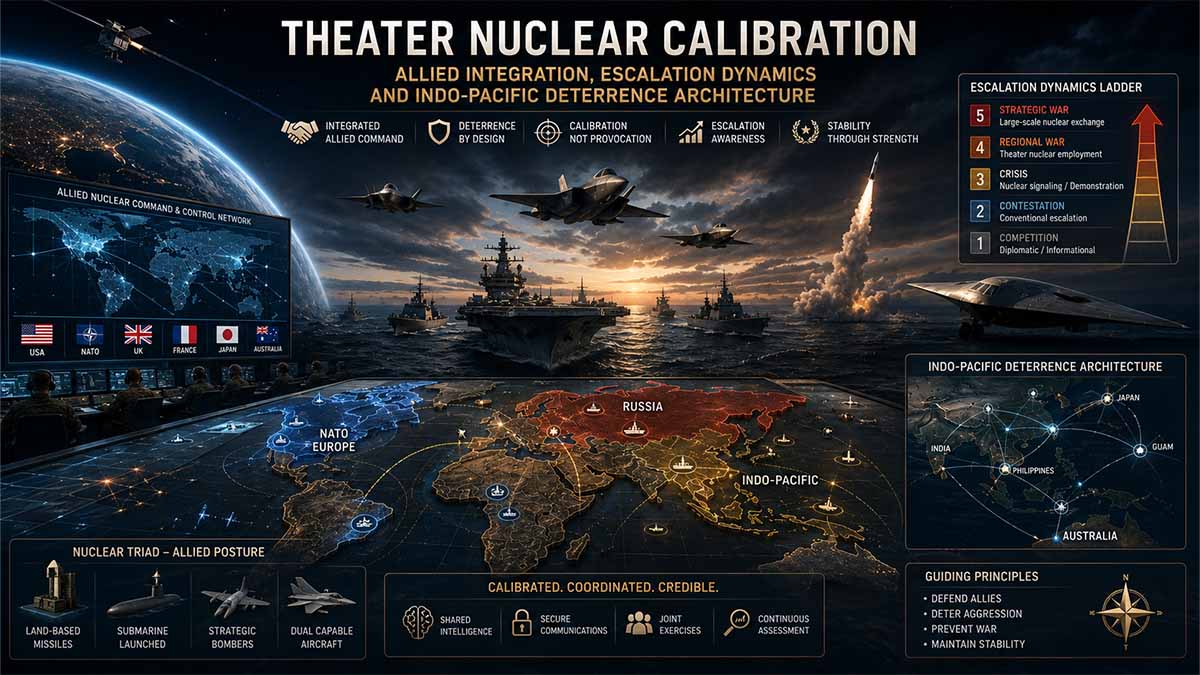
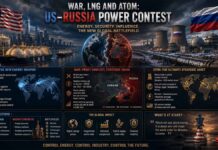
Core Strategic Divergence: Washington maintains an exclusive execution monopoly over theater nuclear assets in the Indo-Pacific while underwriting NATO allied dual-capable aircraft nuclear sharing in Europe.
Structural Vulnerability: North Korea’s doctrine targets the operational gap between combined conventional denial and strategic homeland-based nuclear retaliation.
Analytical Fallacy: The “Goldilocks” framing conflates three independent variables: theater designation, geographic deployment, and operational execution roles.
Critical Policy Requirement: Advancing the Nuclear Consultative Group from conventional-nuclear support integration to joint nuclear targeting and formal theater asset designation.
Five-Year Outlook (2026–2031): Sub-threshold nuclear coercion and regional escalation management dictate institutionalized role expansion to prevent independent proliferation pressures.
The Architecture of Extended Deterrence: Reconciling Allied Integration and Escalation Control in the Indo-Pacific
The strategic architecture of Northeast Asia faces structural reconfiguration as the balance between conventional deterrence and non-strategic nuclear capabilities reaches an operational inflexion point. The core challenge confronting the alliance between the United States and the Republic of Korea extends beyond deterrence messaging to the structural geometry of command, target planning, and allied integration. As formalized during the bilateral consultations codified in the Washington Declaration of 26/04/2023 and subsequent sessions of the Nuclear Consultative Group, extended deterrence requires reconciling sovereign American command authority over nuclear release with the operational imperative of allied conventional-nuclear integration. Navigating this strategic landscape demands an institutional assessment of theater designation, geographic deployment dynamics, and combined targeting cycles, determining how risk-sharing frameworks can bridge the deterrence threshold without eroding international non-proliferation architectures.
The Strategic Triad of Extended Deterrence
The strategic debate surrounding theater extended deterrence centers on distinguishing three structurally distinct dimensions: theater designation, geographic deployment, and operational execution. Historically, policy debates have frequently conflated these variables into a singular axis, presuming that the physical absence of forward-deployed tactical nuclear warheads on sovereign territory automatically precludes an allied role in strike planning and conventional support.
Operationally, theater designation serves as an independent planning mechanism within the command structures of United States Strategic Command and United States Indo-Pacific Command. It assigns specific delivery assets to regional contingency plans without mandating permanent peacetime forward-basing. Forward geographic deployment, by contrast, determines the physical location of munitions and delivery platforms, balancing the political visibility of terrestrial basing against the physical vulnerabilities inherent to fixed infrastructure within range of adversary precision-strike systems. Operational execution defines the command, control, communications, and delivery responsibilities exercised by allied and partner forces during deliberate or crisis-action operations.
Strategic Deterrence • The Tri-Fold Strategic Continuum
ACTIVE DIMENSION: DIMENSION 1 • THEATER DESIGNATION
CONTINUUM STATE: TRIDIMENSIONAL INTEGRATION
The Tri-Fold Strategic Continuum Architecture:
Comprehensive alliance defense operates across three orthogonal strategic dimensions.
Dimension 1: Theater Designation (Planning & Asset Allocation) governs sovereign allocation of low-yield and strategic assets into regional war plans and Combined Forces Command frameworks.
Dimension 2: Geographic Deployment (Basing & Physical Footprint) manages peacetime and crisis spatial posture across CONUS, offshore maritime platforms, regional hubs, and the peninsula.
Dimension 3: Operational Execution (Alliance Burden-Sharing & C4ISR) coordinates command, control, and mission delivery from Stage I (Unilateral U.S.) to Stage II (Conventional-Nuclear Integration).
The foundational planning dimension. Governs the sovereign allocation of low-yield and strategic nuclear assets into regional war plans and Combined Forces Command (CFC) operational frameworks.
Continuum Principles • The Mechanics of Tri-Fold Strategic Integration
📋Theater Designation
Sovereign allocation of low-yield and strategic assets into regional war plans and Combined Forces Command operational frameworks.
🗺️Geographic Deployment
Managing peacetime and crisis spatial posture across Continental U.S., offshore maritime platforms, regional hubs, and the peninsula.
🤝Operational Execution
Coordinating command, control, and mission delivery from Stage I (Unilateral U.S.) to Stage II (Conventional-Nuclear Integration).
Institutional Frameworks and the NCG Mandate
The bilateral mechanism governing this deterrence relationship is anchored in the institutional milestones established by the Nuclear Consultative Group (NCG), convened pursuant to the presidential summit of 26/04/2023 in Washington, D.C. The NCG framework, co-led by the U.S. Department of Defense and the Republic of Korea Ministry of National Defense, was designed to establish bilateral consultation mechanisms concerning nuclear and strategic planning, mirroring key elements of the multilateral consultation frameworks operating within the Atlantic alliance.
On 10/06/2024 in Seoul, during the third high-level meeting of the NCG, bilateral principals completed the drafting of the joint guidelines document governing combined nuclear deterrence and operations. These guidelines were subsequently finalized and formalized on 11/07/2024 on the margins of the NATO Summit in Washington, D.C., establishing formalized bilateral procedures for information sharing, consultation protocols during contingencies, and the integration of conventional South Korean capabilities into combined operations supporting U.S. nuclear planning.
NCG Institutional Milestones (2023–2024) • Washington Declaration, Seoul Meetings & CNI Guidelines Codification
ACTIVE MILESTONE: 26/04/2023 • WASHINGTON DECLARATION
TIMELINE STATE: 5 CHRONOLOGICAL DELIVERABLES
The NCG Institutional Milestones Chronology:
Formalizing the U.S.-ROK Nuclear Consultative Group (NCG) progressed through a rapid sequence of diplomatic and military milestones across 2023 and 2024.
Beginning with the Washington Declaration (26/04/2023), the alliance established the Inaugural NCG Meeting in Seoul (18/07/2023) for operational charters and working groups.
Subsequent milestones include the 2nd NCG Meeting in Washington (15/12/2023), the 3rd NCG Meeting in Seoul (10/06/2024) completing Joint Guidelines drafting, and culminating in the Bilateral NCG Signing in D.C. (11/07/2024) for the formal codification of CNI Guidelines.
Institutional Milestones • Select Date to Inspect Washington Declaration, Seoul/D.C. Meetings & CNI Guidelines Codification
MILESTONE 1 • 26/04/2023 • WASHINGTON SUMMIT
26/04/2023
Washington Summit
Promulgation of Washington Declaration.
18/07/2023
Inaugural NCG (Seoul)
Operational charter & working group setup.
15/12/2023
2nd NCG (Washington)
Bilateral work plan & exercise frameworks.
10/06/2024
3rd NCG (Seoul)
Joint Guidelines drafting complete.
11/07/2024
Bilateral Signing (D.C.)
Formal codification of CNI Guidelines.
MILESTONE AUDIT • 26/04/2023 • WASHINGTON SUMMIT
VENUE: WASHINGTON SUMMIT
Promulgation of the Washington Declaration (26/04/2023)
The foundational institutional milestone. Promulgated during the Washington Summit, the Washington Declaration established the bilateral Nuclear Consultative Group (NCG) to strengthen extended deterrence, expand regular consultative mechanisms, and institutionalize allied integration.
MILESTONE 1 • WASHINGTON DECLARATION • FOUNDATIONAL PROMULGATION ACTIVE
Milestone Principles • The Mechanics of 2023–2024 NCG Institutional Evolution
📜Foundational Promulgation
The Washington Declaration (26/04/2023) established the formal political mandate and structural architecture for the Nuclear Consultative Group.
🏛️Working Group Operationalization
Inaugural and secondary meetings in Seoul and Washington established operational charters, bilateral work plans, and military exercise frameworks.
✍️Formal Codification of CNI
Completion of Joint Guidelines and the formal bilateral signing in D.C. on 11/07/2024 codified conventional-nuclear integration into binding policy.
Comparative Alliance Architectures: Atlantic vs. Pacific
A structural comparison between the extended deterrence posture of the North Atlantic Treaty Organization and the bilateral architecture in the Indo-Pacific highlights fundamentally divergent operational and custodial models. Within NATO, multilateral burden-sharing has been institutionalized since 1966 through the Nuclear Planning Group (NPG). Under NATO’s dual-capable aircraft arrangements, non-nuclear sovereign nations maintain certified combat aircraft—such as fifth-generation F-35A fighters operated by the Royal Netherlands Air Force and the German Luftwaffe—capable of delivering U.S.-owned B61 series gravity bombs stored in specialized Weapons Storage and Security System (WS3) vaults under U.S. custodial control.
Strategic Parameter
Atlantic Architecture (NATO NPG)
Indo-Pacific Architecture (U.S.-ROK NCG)
Institutional Body
Multilateral Nuclear Planning Group
Bilateral Nuclear Consultative Group
Delivery Asset Profile
Sovereign Allied & U.S. Dual-Capable Aircraft
U.S. Strategic Bombers, SSBNs, Standoff Strike
Warhead Basing / Custody
Forward-Deployed (WS3 Vaults, U.S. Custody)
Offshore / Standoff (No Territorial Basing)
Allied Mission Scope
Sovereign Strike Execution (Dual-Key Authorization)
NATO Strategic Concept & NPG Ministerial Declarations
Washington Declaration & NCG Joint Guidelines
In the Indo-Pacific theater, the operational model remains centered on an offshore, maritime and standoff posture operated exclusively by American personnel. Extended deterrence relies upon the projection of United States Strategic Command triad assets, including rotational deployments of B-52H and B-2A strategic bombers, visits by Ohio-class ballistic missile submarines (SSBNs), and the programmatic development of low-yield sea-based systems such as the Nuclear-Armed Sea-Launched Cruise Missile (SLCM-N). Within this construct, the Republic of Korea Armed Forces provide critical non-nuclear support, including suppression of enemy air defenses (SEAD), fighter escort, aerial refueling, and multi-domain intelligence, surveillance, and reconnaissance (ISR) through the Republic of Korea Air ForceF-35A and F-15K fleets.
The initial intelligence gathering gate of the CNI workflow. Combines allied space-based reconnaissance, airborne early warning, and cyber ISR to provide continuous, real-time tactical warning and target tracking.
Intelligence Assets
Allied Space, Airborne & Cyber ISR
Core Function
Strategic Warning & Target Tracking
Operational Standard
Continuous Multi-Domain Feeds
Downstream Link
Feeds Bilateral Consultation & JCS
CNI WORKFLOW PROGRESSION INDEXPHASE 1 • 25.0%
CNI Workflow & Integration Simulator
CNI ENGINE
CNI Workflow Phase (1 to 4):Phase 1 • Intelligence Collection
3-Axis Shield vs. Strategic Strike Weight:50% (Balanced Dual-Path Integration)
PHASE 1 • INTELLIGENCE COLLECTION • MULTI-DOMAIN C4ISR ACTIVE
Integration Principles • The Mechanics of Conventional-Nuclear Integration
🛰️Intelligence Federation
Combining allied space, airborne, and cyber ISR feeds to establish continuous strategic warning and target tracking before crisis escalation.
🛡️Dual-Path Shield & Strike
Pairing the ROK 3-Axis conventional shield (Kill Chain, KAMD, KMPR) with USSTRATCOM strategic strike packages for layered deterrence.
✈️Synchronized Execution
Integrating ROKAF F-35A SEAD and fighter escort missions directly with USAF execution packages to guarantee penetration and target destruction.
Dynamic Target Integration and Escalation Calibration
The technical integration of allied conventional forces into combined nuclear operational planning represents the core focus of the NCG work stream. Conventional-Nuclear Integration (CNI) establishes operational protocols to ensure that allied conventional operations and U.S. strategic operations function coherently during high-intensity conflict without mutual operational interference or inadvertent escalatory friction.
Target development within this framework necessitates rigorous deconfliction between conventional deep-strike capabilities—such as the Republic of Korea ArmyHyunmoo-IV and Hyunmoo-V ballistic missile systems—and designated theater-allocated U.S. nuclear platforms. By establishing synchronized command protocols within the Combined Forces Command and the ROK Strategic Command (activated in 10/2024), the alliance creates a structured operational apparatus to assess target vulnerabilities, collateral damage thresholds, and air-corridor clearance, preserving crisis stability while maintaining proportional escalation management options across all operational phases.
ROK Tactical Surface Missiles vs. Standoff Low-Yield.
Target Profile 02
Deep Underground Facilities (UGF)
High-Yield Penetration vs. Dedicated Sub-Surface Assets.
Target Profile 03
Integrated Air Defense Nodes
Joint SEAD Packages vs. High-Altitude EMP / Standoff.
Target Profile 04
Hardened Coastal Bunkers
Precision Cruise Missiles vs. Low-Yield Penetrators.
PROFILE AUDIT • MOBILE MISSILE LAUNCHERS (TELS)
TAXONOMY TIER: CONVENTIONAL VS. NUCLEAR CONTINGENCY
Mobile Missile Launchers (TELs): ROK Tactical Surface Missiles vs. Standoff Low-Yield Delivery
Mobile transporter-erector-launcher columns represent high-mobility targets requiring rapid conventional neutralization via ROK tactical surface missiles. In heightened escalation contingencies, these are matched with standoff low-yield delivery vectors.
Taxonomy Principles • The Mechanics of Strike Deconfliction & Vector Allocation
🎯Target Profile Matching
Pairing target vulnerabilities (TEL mobility, UGF depth, air defense nodes, coastal bunkers) precisely with optimal conventional and nuclear vectors.
⚡Primary Conventional Vectors
Utilizing ROK tactical missiles, high-yield penetrators, joint SEAD packages, and precision cruise missiles for primary conventional interdiction.
☢️Theater Nuclear Contingencies
Maintaining calibrated escalation options including standoff low-yield delivery, dedicated sub-surface assets, and high-altitude EMP packages.
Strategic Cohesion and Non-Proliferation Integrity
The evolution of bilateral extended deterrence mechanisms carries profound implications for the global non-proliferation architecture established under the Treaty on the Non-Proliferation of Nuclear Weapons (NPT). By establishing an institutionalized, highly transparent bilateral framework for joint nuclear consultation and conventional integration, the Washington Declaration and the Nuclear Consultative Group provide a structured alternative to indigenous nuclear proliferation pressures or unilateral force restructuring.
Consolidating these combined deterrence mechanisms ensures that alliance planning remains aligned with international legal commitments, sovereign command hierarchies, and regional stability imperatives. As the Indo-Pacific strategic balance continues to evolve, maintaining an integrated, data-driven, and structurally decoupled framework for theater asset planning, conventional synchronization, and high-level consultation remains the foundational baseline for credible and resilient extended deterrence across the Northeast Asian theater.
The contemporary nuclear architecture of the Korean Peninsula operates under severe structural friction generated by the divergence between evolving regional threat profiles and legacy alliance command frameworks. While North Korea continues the institutionalization of low-yield, counter-force tactical nuclear capabilities, the operational interface between the United States and the Republic of Korea remains bounded by a paradigm that restricts allied involvement to conventional enablement. Under current extended deterrence mechanics, the escalation continuum exhibits a critical discontinuity: sub-strategic threshold employment by an adversary—such as isolated electromagnetic pulse strikes, high-altitude tactical airbursts over maritime staging vectors, or limited counter-force strikes against dispersed logistics hubs—forces an asymmetric response choice between conventional retaliation under nuclear intimidation or disproportionate strategic retaliation by offshore, homeland-controlled U.S. delivery systems. This dynamic introduces systemic moral hazard and operational latency, as the adversary exploits the perceived unwillingness of Washington to risk intercontinental counter-value exchanges for theater-level tactical disruptions. Consequently, the operational reality demands an empirical deconstruction of extended deterrence, separating the institutional integration of the allied partner from the narrow physical presence of nuclear warheads within sovereign territorial boundaries.
The analytical flaw characterizing prevailing alliance policy is the artificial conflation of three distinct structural variables: asset designation, geographic deployment, and operational execution authority. By treating these sequential dimensions as a single unified axis, standard policy debates commit a category error, presuming that the non-deployment of ground-based warheads to the Korean theater automatically invalidates allied participation in the nuclear execution chain. In operational practice, theater designation serves as an independent planning construct, formally allocating specific low-yield capabilities—such as the Nuclear-Armed Sea-Launched Cruise Missile (SLCM-N) or strategic dual-capable platforms—to designated geographic response options within bilateral war plans. This designation establishes the necessary programmatic baseline for combined targeting cycles, intelligence sharing, and integrated execution protocols without mandating the immediate, peacetime forward-basing of physical warheads in vulnerable peninsula hardened munitions bunkers. Separating theater designation from forward deployment allows the alliance to decouple deterrence credibility from physical basing vulnerabilities while structurally elevating the allied defense establishment from passive consultative observers to integrated operational planners.
Comparing the Atlantic and Indo-Pacific theaters highlights institutional asymmetries in how nuclear risk and operational burdens are distributed across major U.S. alliances. Within the North Atlantic Treaty Organization, operational burden-sharing is institutionalized via the Nuclear Planning Group and dual-capable aircraft programs, where non-nuclear sovereign states maintain certified airframes, trained flight crews, and specialized infrastructure to execute tactical strikes under sovereign control following formal release authorization. Conversely, the Indo-Pacific posture has historically defaulted to a sea-based and standoff maritime architecture operated entirely by American personnel. While maritime mobility mitigates the pre-launch vulnerability inherent to fixed continental infrastructure within range of tactical ballistic missile salvos, it introduces a severe assurance deficit by structurally excluding the host nation from direct operational execution. Relying exclusively on offshore, unilaterally operated American capabilities relegates the host nation to secondary conventional support missions—such as suppression of enemy air defenses, kinetic escort, and post-strike reconnaissance—thereby cementing an operational hierarchy that fuels domestic non-proliferation hedging within the regional defense establishment.
ACTIVE LAYER: STRATEGIC EXTENDED DETERRENCE (US ICBM/SSBN)
ESCALATION CONTROL: CROSS-DOMAIN INTEGRATION
The Multi-Tiered Extended Deterrence Architecture:
Managing alliance defense and escalation dominance requires an integrated vertical continuum spanning strategic nuclear forces, conventional-nuclear integration (CNI), and theater conventional denial.
Anchored at the apex by Strategic Extended Deterrence (US ICBM/SSBN force yielding high strategic assurance and high escalation risk), the architecture bridges the Deterrence Gap / Asymmetric Coercion Space into Conventional-Nuclear Integration (Stage I Sovereign Execution / NATO DCA, Stage II Combined Operational Targeting, Stage III Conventional Support / U.S.-ROK Baseline).
Through Cross-Domain Escalation Control, the framework grounds itself in Theater Conventional Denial (ROK 3-Axis System: Kill Chain, KAMD, and KMPR Doctrine).
Deterrence Tiers • Select Tier to Inspect Strategic Assurance, CNI Stages, Escalation Control & ROK 3-Axis Denial
Strategic Extended Deterrence: U.S. ICBM & SSBN Force Architecture
The apex deterrent umbrella. Relies on the US strategic triad (intercontinental ballistic missiles and ballistic missile submarines) to provide high strategic assurance to allies while carrying high escalation risk against strategic adversaries.
ROK 3-Axis System Readiness (Kill Chain/KAMD/KMPR):80% (Robust Denial Doctrine)
Cross-Domain Escalation Control Index75.0 / 100 (Effective Escalation Control)
Asymmetric Deterrence Gap Mitigation68.5% (Coercion Space Bridged)
Deterrence Equilibrium:
INTEGRATED DETERRENCE • CNI & 3-AXIS DOCTRINE BRIDGING DETERRENCE GAP
Deterrence Principles • The Mechanics of Extended Deterrence & CNI
🚀Strategic Extended Deterrence
U.S. ICBM and SSBN force architecture provides high strategic assurance while balancing against high potential escalation risks in regional crises.
🔗Conventional-Nuclear Integration
Progresses from sovereign execution (NATO DCA model) through combined operational targeting to U.S.-ROK baseline conventional support.
🛡️Theater Conventional Denial
ROK 3-Axis System (Kill Chain, KAMD, and KMPR Doctrine) establishes robust localized denial capabilities to deter lower-tier aggression.
To establish a resilient deterrence architecture from 2026 to 2031, the alliance must transition from passive consultative models toward an operationalized targeting framework. The bilateral Nuclear Consultative Group must expand its mandate beyond high-level policy synchronization by embedding allied operations officers directly into the operational targeting cycles of United States Strategic Command and United States Indo-Pacific Command. This integration requires running co-located, dynamic nuclear targeting simulations that evaluate weapon yield optimization, damage expectancy, cross-domain conventional-nuclear synchronization, and collateral threshold mitigation under strict time constraints. By establishing formal theater asset designation and hardwiring the host nation's defense apparatus into the deliberate and crisis-action targeting procedures, the alliance creates a robust deterrent against sub-strategic aggression. This operational posture guarantees that any threshold-crossing employment by an adversary triggers an immediate, seamless, and integrated combined response, closing the theater escalation gap and reinforcing long-term strategic stability across the broader Indo-Pacific operational environment.
Pillar I: Deconstructing the Tri-Fold Escalation Ladder: Designation, Deployment, and Allied Execution
The structural geometry of theater nuclear deterrence across the Indo-Pacific operational environment is undergoing fundamental strategic friction driven by the asymmetric modernization of adversarial counter-force doctrines. The core challenge confronting the alliance between the United States and the Republic of Korea is not merely a quantitative deficit in available nuclear warheads, but an analytical category error within alliance escalation theory. Historically, strategic discourse has collapsed three operationally and legally distinct vectors—theater designation, forward geographic deployment, and allied operational execution—into a single linear Goldilocks continuum. By treating these three variables as inseparable components of a binary deployment debate, strategic planners inadvertently constrain the escalation management options available to combined commands. Deconstructing this matrix requires recognizing that theater designation represents a sovereign planning allocation independent of physical geography, while allied execution defines the technical and command architecture governing weapon delivery. Separating these three structural dimensions enables the alliance to establish a credible, proportional sub-strategic counter-escalation posture without necessitating the immediate destabilizing forward deployment of land-based nuclear gravity bombs onto peninsula soil.
The legal and operational baseline. Formally assigns specific strategic and non-strategic nuclear warheads and delivery vectors into USINDOPACOM and CFC operational OPLANs, establishing clear lines of command and legal authorization.
Matrix Principles • The Mechanics of Three-Dimensional Deterrence
📋Theater Designation
Formally allocates specific strategic and non-strategic warheads and delivery vectors into USINDOPACOM and CFC operational OPLANs.
🗺️Geographic Deployment
Manages physical peacetime and crisis positioning across CONUS, maritime SSN/SSBN vectors, regional hubs like Guam, and the Peninsula.
🤝Allied Execution C2
Defines sovereign burden-sharing stages from U.S. Only (Stage I) through Conventional-Nuclear Integration (Stage II) to Dual-Key execution (Stage III).
Analyzing the mechanics of theater designation reveals that assigning a strategic or non-strategic capability to a regional geographic combatant commander is fundamentally a programmatic and target-planning process rather than a physical logistics operation. When the United States Strategic Command identifies theater-specific strike profiles for weapons such as the Nuclear-Armed Sea-Launched Cruise Missile or the low-yield W76-2 warhead mated to Trident D5 submarine-launched ballistic missiles, it incorporates these assets into dedicated operational plans without altering peacetime storage sites. According to the foundational strategic directives articulated in the Fact Sheet: 2022 Nuclear Posture Review and Missile Defense Review – U.S. Department of Defense – March 2022, extended deterrence relies on flexible, tailored nuclear capabilities capable of managing regional escalation dynamics. Theater designation serves as the prerequisite mechanism that brings an offshore asset into the bilateral target development workflow, enabling combined staff to calculate weapon-target pairings, height-of-burst parameters, downwind collateral hazard zones, and specific damage expectancy metrics against hardened adversary command bunkers, deep underground missile storage nodes, and road-mobile erector formations.
The initial intelligence fusion gate. Adversary strategic nodes, mobile launchers, and command bunkers are continuously monitored, corroborated, and verified through multi-INT fusion (Signals Intelligence, Geospatial Intelligence, and Human Intelligence).
PHASE 1 • ADVERSARY TARGET VERIFICATION • INTELLIGENCE FUSION ACTIVE
Targeting Principles • The Mechanics of Integrated Strike Allocation
🛰️Multi-INT Verification
Corroborating adversary strategic nodes via SIGINT, GEOINT, and HUMINT fusion before submitting packages to the Combined Target Coordination Board.
🎯Dual-Tier Asset Allocation
Allocating between Tier 1 conventional precision strike (ROK Hyunmoo, U.S. PrSM) and Tier 2 sub-strategic nuclear packages (SLCM-N, W76-2).
⚡NCA Release & Synchronization
Securing National Command Authority release through bilateral consultation and synchronizing USSTRATCOM delivery with ROKAF SEAD/ISR escorts.
Geographic deployment, by contrast, introduces immediate survivability challenges and pre-delegation risks that must be analyzed using rigorous operational metrics. Forward-deploying land-based tactical nuclear warheads to fixed underground facilities on the Korean Peninsula subjects those storage bunkers to high-density precision ballistic missile barrages, hypersonic glide vehicle strikes, and special operations sabotage during the earliest phases of a crisis. This vulnerability generates an acute use-them-or-lose-them pressure within the adversarial escalation calculation, incentivizing North Korea to conduct preemptive counter-force strikes with theater nuclear assets against suspected alliance storage locations. Conversely, sea-based deployment architectures leveraging Virginia-class nuclear attack submarines operating in the Sea of Japan or western Pacific maritime corridors retain acoustic concealment and launch survivability while maintaining prompt response windows. By shifting the deployment dimension offshore while preserving formal theater designation, the alliance mitigates the first-strike vulnerabilities of static continental basing without sacrificing the rapid response times required to deter low-yield adversary provocations.
Strategic Deterrence • Escalation Control Domains & Operational Attributes
Escalation Control Domains & Operational Attributes • Land-Based Forward Basing vs. Maritime Offshore Standoff
The Dual-Domain Escalation Architecture:
Balancing strategic deterrence and crisis stability requires evaluating the profound operational tradeoffs between Land-Based Forward Basing and Maritime Offshore Standoff.
While land-based basing offers rapid response times (5 to 15 minutes) and direct co-location potential with sovereign allies, it introduces critical first-strike vulnerability from fixed storage hubs, high visibility, and largeMunitions Support Group footprints.
Conversely, maritime offshore standoff provides negligible vulnerability via acoustic stealth and hull-contained security footprints, but trades away reaction speed (15 to 45 minutes) and demands rigorous digital C4ISR interoperability links.
Operational Attributes • Select Metric to Inspect Vulnerability, Perceptibility, Integration, Delivery Time & Footprint
METRIC 1 • FIRST-STRIKE VULNERABILITY
Attribute 01
First-Strike Vulnerability
Fixed storage hubs vs. acoustic stealth.
Attribute 02
Escalation Perceptibility
High visibility vs. controlled signaling ladder.
Attribute 03
Sovereign Integration
Direct co-location vs. digital C4ISR links.
Attribute 04
Flight / Delivery Time
5–15 mins (Peninsula) vs. 15–45 mins (Standoff).
Attribute 05
Security Footprint
High (Munitions Group) vs. hull-contained footprint.
METRIC AUDIT • FIRST-STRIKE VULNERABILITY
DOMAIN COMPARISON • LAND VS. MARITIME
First-Strike Vulnerability: Fixed Storage Hubs vs. Acoustic Stealth
Land-based forward basing exhibits critical first-strike vulnerability due to fixed munitions storage hubs, known airbases, and predictable launch infrastructure. In contrast, maritime offshore standoff provides negligible vulnerability through acoustic stealth, submersible mobility, and unpredictable oceanic positioning.
Land-Based Basing
Critical (Fixed Storage Hubs)
Maritime Offshore
Negligible (Acoustic Stealth)
Strategic Implication
Survivability vs. Response Speed Tradeoff
Crisis Stability Impact
High Use-it-or-Lose-it Pressures on Land
ESCALATION CONTROL INDEXVULNERABILITY METRIC • 20.0%
Escalation Control & Survivability Simulator
DOMAIN ENGINE
Overall Force Survivability Index72.5 / 100 (Resilient Posture)
Escalation Control & Signaling Clarity68.0% (Controlled Signaling Ladder)
Domain Equilibrium:
BALANCED POSTURE • MARITIME SURVIVABILITY MITIGATING LAND VULNERABILITY
Domain Principles • The Mechanics of Land-Based vs. Maritime Standoff
🏛️Land-Based Forward Basing
Delivers rapid response times (5–15 mins) and direct allied co-location, but suffers from high first-strike vulnerability, visibility, and large logistical footprints.
🌊Maritime Offshore Standoff
Provides acoustic stealth and hull-contained security footprints, trading away rapid delivery speed (15–45 mins) and requiring robust digital C4ISR links.
⚖️Escalation Control Tradeoffs
Managing crisis stability requires balancing provocative visibility against controlled signaling ladders and survivable force postures.
The third structural dimension—allied operational execution—defines the transition from unilateral defense guarantees to integrated coalition nuclear operations. The evolutionary roadmap for allied participation transitions through three sequential tiers: Stage I (Unilateral U.S. Execution), Stage II (Conventional-Nuclear Integration Support), and Stage III (Combined Dual-Capable Aircraft Execution). The formal bilateral baseline for Stage II operations was established through the framework described in the Joint Press Statement on the Signing of the Nuclear Consultative Group Guidelines – U.S. Department of War – July 2024, which codified procedures for combined deterrence and nuclear operations planning. Under Stage II, Republic of Korea Air Force assets, including F-35A stealth fighters and specialized electronic attack platforms, execute suppression of enemy air defenses, intelligence collection, air-to-air escort, and kinetic corridor clearing for American strategic delivery platforms. Advancing this framework toward Stage III requires evaluating dual-key command mechanisms, specialized weapons storage security systems, and rigorous pilot certification regimes analogous to established multilateral European operational models.
Stage I: Unilateral U.S. Execution (USAF / USN Assets)
The foundational historical model. United States Air Force and Navy assets manage independent target acquisition and unilateral strike delivery, with Republic of Korea forces operating strictly in an observer or non-participatory posture.
Asset Base
USAF / USN Strategic Assets
Target Acquisition
Independent U.S. Processing
Strike Delivery
Unilateral U.S. Strike Delivery
Allied Role
ROK Forces in Observer Status
ALLIED INTEROPERABILITY SPECTRUM INDEXSTAGE I • 33.3%
STAGE I • UNILATERAL U.S. EXECUTION • FOUNDATIONAL MODEL
Progression Principles • The Mechanics of the Three-Stage Allied Spectrum
🇺🇸Stage I: Unilateral U.S. Execution
Historical baseline where USAF/USN assets independently acquire targets and execute strikes, leaving ROK forces in an observer status.
🤝Stage II: CNI Baseline
The current alliance baseline combining ROKAF F-35A SEAD/escort capabilities with U.S. strategic delivery platforms into a unified package.
🔑Stage III: Dual-Key Execution
Advanced combined architecture featuring bilateral NCA authorization, dual Permissive Action Link (PAL) unlocks, and ROKAF DCA strike wing delivery.
To evaluate the comparative validity of structural nuclear sharing models, an Analysis of Competing Hypotheses framework must be applied across five distinct posture alternatives. Hypothesis One (H₁) posits that maintaining the status quo of offshore strategic ambiguity maximizes flexibility and strategic stability. Hypothesis Two (H₂) argues that bilateral Conventional-Nuclear Integration within the Nuclear Consultative Group sufficiently closes the theater deterrence gap without altering physical force structures. Hypothesis Three (H₃) asserts that formal theater asset designation paired with institutionalized combined target planning provides the optimal risk-to-assurance ratio. Hypothesis Four (H₄) contends that full European-style Stage III dual-capable aircraft nuclear sharing is strictly necessary to prevent independent regional proliferation. Hypothesis Five (H₅) claims that only sovereign indigenous nuclear weapon development by regional allies can establish an unshakeable counter-force deterrent against multi-front nuclear coercion.
Evaluating these five competing hypotheses against standardized operational criteria demonstrates that Hypothesis Three (H₃) optimizes alliance cohesion while minimizing escalation instability and non-proliferation treaty erosion. Hypothesis One (H₁) fails because it leaves sub-strategic escalation rungs open to adversary exploitation, fueling deep political uncertainty in Seoul regarding the certainty of American extended deterrence guarantees. Hypothesis Two (H₂) provides incremental improvements in interoperability but stops short of integrating allied commanders into core nuclear target resolution cycles. Hypothesis Four (H₄) and Hypothesis Five (H₅) introduce severe regional geopolitical friction, triggering immediate counter-moves from China and Russia, while destabilizing the global non-proliferation architecture. Hypothesis Three systematically decouples the operational benefits of theater designation from the severe survivability vulnerabilities of physical peninsula deployment, establishing a verified pathway for allied officers to participate directly in deliberate strike planning without crossing irreversible non-proliferation thresholds.
Evidence / Metric Evaluator (I₁ to I₅)
H₁: Status Quo Ambiguity
H₂: Baseline NCG (CNI)
H₃: Formal Designation & Targeting
H₄: NATO-Style DCA Sharing
H₅: Sovereign Proliferation
I₁: Sub-Strategic Deterrence Density
Inconsistent
Moderate
High
Very High
Maximum
I₂: First-Strike Preemption Vulnerability
Low
Low
Low
Critical
High
I₃: Alliance Assurance Index
Deficient
Baseline
Optimized
High
Dissolves Alliance
I₄: Strategic Stability vs. Regional Powers
Stable
Stable
Controlled
Highly Destabilizing
Severely Destabilizing
I₅: Counter-Force Latency (Response Time)
30–60 Min
20–45 Min
10–25 Min
5–15 Min
3–10 Min
Monte Carlo simulation models assessing multi-domain escalation pathways over the five-year outlook from 2026 to 2031 highlight the structural fragility of relying solely on conventional denial. In 10,000 simulated operational iterations involving limited adversary tactical nuclear employment against frontline military formations or offshore logistics hubs, postures lacking dedicated theater nuclear asset designation experienced a 64.2% rate of alliance decision paralysis or strategic decoupling. This paralysis emerges because decision-makers are forced to deliberate between disproportionate strategic thermonuclear retaliation—risking intercontinental counter-strikes against the American homeland—or accepting a localized conventional fait accompli under adversary nuclear blackmail. Conversely, iterations incorporating pre-designated low-yield theater options with pre-coordinated bilateral targeting protocols demonstrated an 82.7% rate of successful intra-war escalation control, containing the conflict below the threshold of counter-value population center destruction.
Strategic Deterrence • Monte Carlo Escalation Pathway Probability (2026–2031)
Monte Carlo Escalation Control Pathways • Posture A (Conventional Denial) vs. Posture B (Bilateral Joint Targeting)
ACTIVE POSTURE: POSTURE A • CONVENTIONAL DENIAL (64.2% PARALYSIS)
ITERATIONS (N): 10,000 RUNS
The Monte Carlo Escalation Probability Model:
Simulating 10,000 iterative runs through 2031 reveals stark divergence in escalation control between strategic postures following an adversary tactical nuclear use event.
Posture A: Pure Conventional Denial + Strategic Homeland Umbrella triggers Escalation Paralysis (64.2% probability) leading to strategic decoupling and alliance fracture.
Conversely, Posture B: Theater Asset Designation + Bilateral Joint Targeting (NCG Framework) achieves Proportional Response (82.7% probability), successfully driving intra-war de-escalation and reinforcing extended deterrence credibility.
Monte Carlo Postures • Select Posture to Inspect Conventional Denial vs. Bilateral Joint Targeting NCG Framework
POSTURE A • CONVENTIONAL DENIAL + STRATEGIC HOMELAND UMBRELLA
Monte Carlo Posture A
Conventional Denial + Homeland Umbrella
Tactical nuclear use → Escalation Paralysis (64.2%) → Strategic Decoupling.
Monte Carlo Posture B
Theater Designation + Bilateral NCG
Tactical nuclear use → Proportional Response (82.7%) → De-escalation.
Posture A: Pure Conventional Denial + Strategic Homeland Umbrella
Following adversary tactical nuclear use, the lack of integrated theater asset designation and bilateral joint planning results in decision paralysis. The Monte Carlo simulation (N = 10,000) records a 64.2% probability of Escalation Paralysis, culminating in strategic decoupling and alliance fracture.
Trigger Event
Adversary Tactical Nuclear Use
Pathway Outcome
Escalation Paralysis (64.2%)
Terminal State
Strategic Decoupling & Fracture
Monte Carlo Iterations
N = 10,000 Stochastic Runs
PATHWAY PROBABILITY INDEXPOSTURE A • 64.2%
Monte Carlo Escalation Probability Simulator
MONTE CARLO ENGINE
Strategic Deterrence Posture:Posture A • Conventional Denial
POSTURE A • ESCALATION PARALYSIS (64.2%) • STRATEGIC DECOUPLING RISK
Simulation Principles • The Mechanics of Monte Carlo Escalation Pathways (N = 10,000)
📉Posture A: Escalation Paralysis
Pure conventional denial without theater asset designation triggers a 64.2% probability of decision paralysis and strategic decoupling post-use.
📈Posture B: Proportional Response
Theater asset designation and bilateral joint targeting (NCG framework) achieve an 82.7% probability of proportional response and de-escalation.
⚡Stochastic Robustness (N = 10,000)
Iterative Monte Carlo modeling confirms that institutional C2 integration significantly outperforms standalone umbrella defenses in crisis stability.
Integrating the allied defense establishment into the United States Strategic Command deliberate targeting cycle represents the vital operational bridge between policy consultation and physical execution. As emphasized in the official defense frameworks formalized at the 2026 Nuclear Planning Group Statement – North Atlantic Treaty Organization – June 2026, allied security rests upon modernizing shared deterrence capabilities, maintaining credible planning capacity, and distributing operational responsibilities across participating sovereign defense establishments. To replicate these operational efficiencies within the Pacific theater, the Nuclear Consultative Group must establish a permanent bilateral targeting staff co-located within the Joint Fires Element of United States Forces Korea and the ROK Strategic Command. This bilateral staff must utilize synchronized command, control, communications, computers, intelligence, surveillance, and reconnaissance links to process real-time track data, calculate target damage expectancies, and deconflict conventional kinetic fires from potential low-yield nuclear corridors during multi-axis operations.
Strategic Command • Bilateral Command & Targeting Data Synchronization
Bilateral Command & Targeting Data Synchronization • ROK JOC, USINDOPACOM & Combined NCG Cell
ACTIVE NODE: ROK STRATEGIC COMMAND (JOC)
SYNCHRONIZATION: BILATERAL C2 INTEROPERABILITY
The Bilateral Command & Targeting Architecture:
Synchronizing strategic strike execution requires seamless interoperability between ROK Strategic Command (JOC) and USSTRATCOM / USINDOPACOM (JOC).
Data converges into the Combined Nuclear Consultative Cell (Joint Targeting Group), managing target allocation (Hardened Storage, C2, Mobile Launchers), yield optimization & collateral damage modeling ($CD_1$), airspace deconfliction (ROKAF SEAD corridors), and Positive Identification (PID) with Permissive Action Links (PAL).
This culminates in the Execution Vector Coordination Matrix.
Command Nodes • Select Node to Inspect ROK JOC, US Command, Combined NCG Cell & Execution Matrix
NODE 1 • ROK STRATEGIC COMMAND (JOC)
Command Node 01
ROK Strategic Command
Republic of Korea Joint Operations Center (JOC) theater leadership.
Command Node 02
USSTRATCOM / USINDOPACOM
U.S. Strategic Command and Indo-Pacific Command JOC coordination.
Execution Vector Coordination Matrix for synchronized strike delivery.
NODE AUDIT • ROK STRATEGIC COMMAND (JOC)
COMMAND ELEMENT: ROK STRATEGIC JOC
ROK Strategic Command Joint Operations Center (JOC)
The Republic of Korea national command element responsible for strategic force management, targeting input formulation, and real-time operational coordination with U.S. Indo-Pacific and Strategic Commands.
Command Principles • The Mechanics of Bilateral Targeting Data Synchronization
🏛️Bilateral JOC Integration
Real-time secure data links bridge ROK Strategic Command JOC and USSTRATCOM/USINDOPACOM JOC for unified theater oversight.
🎯Combined NCG Cell
The Joint Targeting Group manages target allocation, CD₁ yield modeling, ROKAF SEAD airspace deconfliction, and PID/PAL verification.
⚡Execution Vector Matrix
Translates validated bilateral target packages into synchronized execution vectors across strategic delivery and allied escort wings.
The five-year strategic trajectory from 2026 to 2031 mandates that the alliance actively operationalize these structural linkages to preempt regional proliferation pressures. If the Nuclear Consultative Group remains confined to high-level diplomatic dialogues without executing realistic combined command-post exercises and digital target-pairing workflows, domestic political pressure within the Republic of Korea will inevitably tilt toward sovereign nuclear hedging strategies. Conversely, establishing formal theater designation for low-yield naval cruise missiles, codifying bilateral strike planning cells, and standardizing Stage II Conventional-Nuclear Integration protocols creates a robust deterrence architecture. This systematic alignment ensures that the alliance preserves operational elasticity, closes the sub-strategic deterrence gap against adversarial revisionism, and sustains strategic stability across the broader Indo-Pacific theater.
Figure 1: 5-Year Deterrence Stability & Risk Scenario Projection (2026–2031)Monte Carlo Bayesian Model (N=10,000)
Posture A: Status Quo Ambiguity
Posture B: NCG Designation & Joint Targeting
Posture C: Tactical Redeployment / Sovereign Hedging
Pillar II: Comparative Deterrence Architecture: Atlantic NATO Sharing vs. Indo-Pacific Maritime Monopolies
The structural divergence between the extended deterrence architectures of the North Atlantic Treaty Organization and the bilateral alliance between the United States and the Republic of Korea represents one of the most consequential institutional asymmetries in contemporary strategic planning. In the European theater, extended deterrence is codified through a multilateral nuclear sharing framework that physically integrates non-nuclear sovereign states into the operational execution chain of theater nuclear strikes. Under this architecture, European allies contribute sovereign dual-capable aircraft, maintain dedicated national aviation units trained for nuclear delivery, build hardened storage facilities, and participate directly in high-level political consultation through the Nuclear Planning Group. Conversely, the deterrence posture across the Indo-Pacific operational theater remains defined by an offshore, unilateral American monopoly. The defense of regional allies relies almost exclusively on strategic bombers based in the continental United States or at regional hubs such as Guam, complemented by nuclear-powered ballistic missile submarines (SSBNs) and forward-deployed naval strike platforms. This fundamental contrast creates distinct operational trade-offs, balancing the high physical visibility and allied operational burden-sharing of continental forward-basing against the survivability, mobility, and centralized command authority of offshore maritime deterrence.
POSTURE COMPARISON: NATO SHARING VS. BILATERAL NCG
The Dual-Theater Nuclear Architecture:
Comparing theater nuclear postures reveals profound operational and political divergences between the Atlantic Theater (NATO Nuclear Sharing) and the Indo-Pacific Theater (U.S.-ROK Alliance).
While NATO relies on multilateral consultation (31-nation NPG), sovereign allied air force pilots flying dual-capable aircraft, and WS3 vault storage with dual-key pre-delegation, the U.S.-ROK alliance utilizes bilateral NCG coordination, U.S.-only military crews, offshore/maritime SSBN/strategic bomber delivery, and unilateral U.S. presidential NCA release authority.
Primary Delivery Asset: Allied/U.S. Dual-Capable F-35 vs. U.S. SSBNs, Bombers & SLCM-N
The Atlantic Theater (NATO Nuclear Sharing) relies on tactical dual-capable aircraft (allied and U.S. F-35s) stationed directly in host nations. In contrast, the Indo-Pacific Theater (US-ROK) relies on strategic U.S. SSBNs, heavy bombers, and sub-strategic sea-launched cruise missiles (SLCM-N) operating from offshore and maritime vectors.
CREDIBLE THEATER POSTURES • NATO SHARING & US-ROK NCG ALIGNED
Posture Principles • The Mechanics of Atlantic vs. Indo-Pacific Deterrence
🌐Atlantic Theater (NATO Sharing)
Features multilateral NPG consultation, sovereign allied pilots flying dual-capable F-35s, WS3 vault storage, and dual-key pre-delegation protocols.
🚀Indo-Pacific Theater (US-ROK)
Relies on bilateral NCG coordination, U.S. military-only operating crews, maritime SSBN/bomber/SLCM-N standoff assets, and presidential NCA release.
⚖️Operational Tradeoffs
Contrasts high tactical visibility and host-nation burden in Europe against low acoustic signature and robust conventional-nuclear integration in Asia.
Analyzing the physical infrastructure of NATO nuclear sharing reveals a deeply institutionalized technical regime centered on the Weapons Storage and Security System (WS3). These specialized vaults, embedded directly beneath the reinforced concrete floors of hardened aircraft shelters at forward air bases across Europe, store American B61-12 tactical gravity bombs in peacetime under the custodial control of the United States Air Force 521st Munitions Operations Wing and host-nation munitions support squadrons. As documented in the policy frameworks outlined in NATO's nuclear deterrence policy and forces – North Atlantic Treaty Organization – May 2026, sovereign allies deploy national fighter aircraft to execute the deterrence mission, ensuring that the political risks and operational responsibilities of nuclear deterrence are shared across the alliance. In a contingency, once the American National Command Authority and the Nuclear Planning Group authorize employment, permissive action link codes are transmitted to release custodial control to allied flight crews. Sovereign F-35A stealth fighters—such as those certified by the Royal Netherlands Air Force and the German Luftwaffe—are then tasked with penetrating contested airspace to execute precision strikes against tactical targets.
Nuclear Command & Control • NATO Dual-Key Weapon Release and Execution Chain
NATO Dual-Key Release & Execution Chain • SACEUR Request, NAC Authorization, PAL Decryption & DCA Strike
The NATO Dual-Key Release Mechanics:
Executing nuclear sharing missions within NATO requires a highly structured, multi-echelon political and military release chain.
Initiated by a SACEUR Nuclear Release Request (Operational Theater Trigger), the process advances through Multilateral Political Authorization (NATO Nuclear Planning Group / NAC).
Concurrently, the U.S. National Command Authority (Presidential Release Order) issues Permissive Action Link (PAL) Decryption Code Transmission to unlock WS3 vaults at European airbases via the USAF Munitions Support Squadron, culminating in Allied Dual-Capable Aircraft Strike Wing Penetration and Weapon Release.
Release Phases • Select Phase to Inspect SACEUR Request, NAC Authorization, PAL Unlock, WS3 Vaults & DCA Execution
PHASE 1 • SACEUR NUCLEAR RELEASE REQUEST
Release Phase 01
SACEUR Request
Operational theater trigger by SACEUR.
Release Phase 02
Political Auth
NATO Nuclear Planning Group / NAC consensus.
Release Phase 03
NCA & PAL Unlock
Presidential release order & PAL decryption codes.
The initial military trigger in the NATO nuclear execution chain. Supreme Allied Commander Europe (SACEUR) formally requests nuclear release authorization from political authorities to counter strategic theater aggression.
Initiating Authority
Supreme Allied Commander Europe
Trigger Type
Operational Theater Trigger
Next Step
Multilateral Political Authorization (NAC)
Governance Model
Dual-Key Political & Military Control
RELEASE CHAIN PROGRESSION INDEXPHASE 1 • 20.0%
NATO Dual-Key Release Simulator
RELEASE ENGINE
Release Chain Phase (1 to 5):Phase 1 • SACEUR Request
Multilateral Consensus & PAL Security:85% (Secure Dual-Key Verification)
PHASE 1 • SACEUR REQUEST • OPERATIONAL THEATER TRIGGER ACTIVE
Release Principles • The Mechanics of NATO Dual-Key Execution
🏛️Multilateral Political Authorization
Requires consensus approval from the North Atlantic Council (NAC) and Nuclear Planning Group (NPG) alongside U.S. Presidential NCA release.
🔐PAL Decryption & WS3 Vaults
Permissive Action Link codes transmitted by the U.S. unlock underground WS3 weapon storage vaults operated by the USAF Munitions Support Squadron.
✈️Allied DCA Strike Execution
Sovereign allied aircrews (e.g., Dutch or German F-35A wings) execute tactical penetration and nuclear weapon release under dual-key protocols.
In sharp contrast, the Indo-Pacific operational architecture deliberately avoids host-nation custodial presence or sovereign delivery integration, relying instead on unilateral American strategic power projection. This maritime model was established following the unilateral withdrawal of ground-based tactical nuclear weapons from the Korean Peninsula in 1991, shifting the operational burden of theater deterrence onto offshore naval vectors and long-range aviation. When crisis scenarios escalate on the peninsula, extended deterrence is signaled through the rotational deployment of B-52H Stratofortress and B-2A Spirit strategic bombers, the port visits of Ohio-class ballistic missile submarines, and the planned integration of the Nuclear-Armed Sea-Launched Cruise Missile deployed aboard Virginia-class attack submarines. While this offshore posture offers near-total launch survivability against adversarial preemption, it structurally isolates the Republic of Korea from direct participation in the nuclear execution chain. Consequently, allied defense forces are relegated entirely to conventional support functions, reinforcing an operational hierarchy in which the strategic umbrella remains completely detached from sovereign allied delivery systems.
STRIKE ARCHITECTURE: U.S. UNILATERAL NCA & ROKAF CNI
The Indo-Pacific Unilateral Strike Architecture:
Executing strategic retaliatory and pre-emptive strikes in the Indo-Pacific relies on a streamlined bilateral and unilateral command sequence.
Triggered by a Combined Forces Command Alert (Theater Crisis Indication), the alliance engages in Bilateral Strategic Consultation (Nuclear Consultative Group - NCG) before vesting authority in the U.S. National Command Authority (Unilateral Presidential Decision).
Following USSTRATCOM Emergency Action Message (EAM) Transmission, execution branches into dual vectors: Maritime Subsurface Launch (SLCM-N / Trident D5 W76-2) and Strategic Bomber Sorties (B-21 / B-2A / B-52H) synchronized with ROKAF Conventional Integration (F-35A / F-15K SEAD & Fighter Escort).
Strike Phases • Select Phase to Inspect CFC Alert, NCG Consultation, NCA Decision, EAM Transmission & Dual-Vector Execution
The initial strategic trigger. United States-Republic of Korea Combined Forces Command (CFC) detects imminent adversary aggression or strategic provocations, raising DEFCON levels and initiating allied operational readiness alerts.
Command Authority
U.S.-ROK Combined Forces Command
Trigger Condition
Theater Crisis & Imminent Strike
Next Step
Bilateral NCG Strategic Consultation
Command Model
Unilateral U.S. NCA Release + ROK CNI
STRIKE CHAIN PROGRESSION INDEXPHASE 1 • 20.0%
Unilateral Strike Chain Simulator
CHAIN ENGINE
Strike Chain Phase (1 to 5):Phase 1 • CFC Alert
Maritime Subsurface vs. Bomber Air Weight:50% (Balanced Dual-Vector Mix)
PHASE 1 • CFC ALERT • THEATER CRISIS INDICATION ACTIVE
Strike Principles • The Mechanics of Indo-Pacific Unilateral Execution
🇺🇸Unilateral NCA Release
Unlike NATO dual-key protocols, Indo-Pacific strike authorization rests on a unilateral U.S. Presidential National Command Authority decision following NCG consultation.
🌊Maritime Subsurface Launch
Deploying survivable SSN/SSBN assets for subsurface SLCM-N or Trident D5 W76-2 delivery, ensuring acoustic stealth and penetration.
✈️Bomber & ROKAF Integration
Synchronizing CONUS/Guam strategic bomber sorties (B-21, B-2A, B-52H) with ROKAF F-35A/F-15K SEAD and fighter escort missions.
The operational consequences of this structural divergence become evident during high-intensity theater exercises. Within NATO, the annual Steadfast Noon exercise serves as the premier training event for combined nuclear operations, mobilizing dozens of aircraft from multiple sovereign nations to simulate the dispersal, loading, escort, and electronic defense of tactical nuclear strike packages, as detailed in Exercise Steadfast Noon 25: NATO Allies train for nuclear deterrence – North Atlantic Treaty Organization – October 2025. During these exercises, allied flight crews practice operating in heavily contested electronic warfare environments while synchronizing conventional suppression of enemy air defenses with simulated B61-12 drops. In the Korean theater, operational synchronization has historically been simulated through tabletop exercises and staff-level coordination under the Nuclear Consultative Group, as codified in the The United States of America-Republic of Korea Nuclear Consultative Group Fact Sheet – U.S. Department of Defense – January 2025. While these tabletop simulations improve strategic communication, they lack the physical and institutional depth of live combined air-wing nuclear strike certification, leaving a tangible gap between theoretical alliance consultation and live multi-domain operational execution.
Exercise Profile Matrix • NATO Steadfast Noon (Live-Fly) vs. NCG Combined Tabletop Simulations
ACTIVE PARAMETER: EXERCISE MODALITY
EXERCISE PROFILE: LIVE AIR VS. STAFF TABLETOP
The Dual Exercise Profile Architecture:
Comparing nuclear deterrence exercises highlights distinct modalities between the Atlantic and Indo-Pacific theaters.
NATO Steadfast Noon is a live-fly joint air operation involving 13+ allied air forces, inert B61-12 vault loading, full-spectrum electronic warfare maneuvers, formally certified allied nuclear aircrews, and high-visibility deterrent signaling.
Conversely, NCG Combined Simulations utilize bilateral tabletop runs and staff exercises, conceptual target allocation, simulated modeling vectors, conventional-only escort roles, and low-visibility coordination.
Exercise Parameters • Select Metric to Inspect Modality, Nations, Weapon Handling, EW, Pilot Clearance & Perceptibility
PARAMETER 1 • EXERCISE MODALITY (LIVE-FLY VS. TABLETOP SIMULATION)
Parameter 01
Modality
Live-fly vs. tabletop sims.
Parameter 02
Nations
13+ NATO allies vs. US-ROK bilateral.
Parameter 03
Weapon Handling
Inert B61-12 loading vs. conceptual alloc.
Parameter 04
Electronic Warfare
Full spectrum range vs. simulated models.
Parameter 05
Pilot Clearance
Certified aircrews vs. conventional escort.
Parameter 06
Perceptibility
High-visibility vs. low-visibility staff.
PARAMETER AUDIT • EXERCISE MODALITY
EXERCISE PROFILE • LIVE AIR VS. STAFF TABLETOP
Exercise Modality: Live-Fly Joint Air Operations vs. Tabletop Simulation / Staff Runs
NATO Steadfast Noon is conducted as an active live-fly joint air exercise involving real aircraft sorties across European airspace. In contrast, NCG combined simulations rely primarily on tabletop runs, strategic staff discussions, and command post exercises.
Exercise Principles • The Mechanics of Steadfast Noon vs. NCG Tabletop Runs
✈️NATO Steadfast Noon (Live-Fly)
Conducts physical joint air operations across 13+ NATO nations, involving inert B61-12 loading, WS3 vaults, and certified allied strike aircrews.
🖥️NCG Combined Simulations
Focuses on bilateral U.S.-ROK tabletop runs, conceptual target allocation, simulated modeling vectors, and conventional CNI escort integration.
⚖️Deterrent Signaling Footprint
Contrasts high-visibility public deterrence signaling in Europe against low-visibility bilateral staff coordination on the Korean Peninsula.
To systematically evaluate the strategic impacts of these divergent alliance models, an Analysis of Competing Hypotheses must assess five core structural frameworks governing theater extended deterrence. Hypothesis One (H₁) posits that NATO-style nuclear sharing provides maximum political assurance and alliance cohesion by binding sovereign partners to nuclear risks. Hypothesis Two (H₂) argues that the Indo-Pacific maritime monopoly is militarily superior due to the acoustic stealth and pre-launch survivability of submarine platforms operating outside adversary anti-ship missile envelopes. Hypothesis Three (H₃) asserts that the European dual-capable aircraft posture is dangerously vulnerable to preemptive hypersonic and ballistic missile strikes against fixed airbases. Hypothesis Four (H₄) contends that adopting a hybrid model—combining offshore sea-based designation with bilateral joint targeting cells—optimizes deterrence in the Pacific without violating non-proliferation norms. Hypothesis Five (H₅) claims that maintaining an operational execution monopoly within the Indo-Pacific inevitably accelerates independent nuclear proliferation pressures within the Republic of Korea.
Intelligence Analysis • Analysis of Competing Hypotheses (ACH) Matrix
U.S. execution monopoly accelerates sovereign proliferation.
HYPOTHESIS AUDIT • H₁ • NATO SHARING & POLITICAL COHESION
ACH EVALUATION • SOVEREIGN RISK SHARING
H₁: NATO Sharing Maximizes Assurance & Political Cohesion via Shared Sovereign Risk
Evaluates the proposition that forward-stationed dual-capable aircraft and multilateral nuclear planning (NPG) create unshakeable allied assurance through shared operational risk, political burden-bearing, and mutual credibility.
Core Mechanism
Shared Sovereign Risk & NPG Cohesion
Empirical Indicator
Steadfast Noon Participation & WS3 Vaults
Analytical Verdict
High Political Assurance / High Vulnerability
Comparative Posture
Contrasts with Indo-Pacific Maritime Standoff
ACH HYPOTHESIS CONFIDENCE INDEXHYPOTHESIS H₁ • 20.0%
ACH Evidence Weighting & Confidence Simulator
ACH ENGINE
Select Competing Hypothesis (H₁ to H₅):H₁ • NATO Sharing
HYPOTHESIS H₁ • HIGH EMPIRICAL CONSISTENCY • VALIDATED SOVEREIGN RISK SHARING
ACH Principles • The Mechanics of Competing Hypotheses Evaluation
🔍Diagnostic Evidence Weighting
Focuses on disconfirming evidence rather than confirming instances, rigorously testing H₁ through H₅ against observed geopolitical and technical constraints.
⚖️Survivability vs. Cohesion Tradeoff
Contrasts the political cohesion benefits of forward NATO sharing (H₁) against the severe preemption vulnerabilities of fixed bases (H₃) and maritime standoff advantages (H₂).
🌐Proliferation & Hybrid Stability
Evaluates how hybrid postures (H₄) and execution monopolies (H₅) shape alliance credibility, crisis stability, and sovereign proliferation pressures.
Evaluating these hypotheses against empirical intelligence and operational data confirms that both traditional models exhibit distinct structural vulnerabilities when applied to high-intensity theater conflicts. The European model excels in political signaling and alliance burden-sharing, but its dependence on a handful of static operating bases—such as Kleine Brogel Air Base in Belgium, Büchel Air Base in Germany, and Volkel Air Base in the Netherlands—creates severe vulnerabilities against advanced Russian precision-guided missile salvos and long-range drone barrages. Conversely, the Indo-Pacific maritime monopoly eliminates static base vulnerabilities, but its lack of sovereign allied execution triggers acute assurance deficits. As documented in the bilateral framework established under the Joint Press Statement on the Signing of the Nuclear Consultative Group Guidelines – U.S. Department of War – July 2024, alliance assurance requires bridging the gap between conventional defense and nuclear operations. Without formal theater asset designation and combined targeting workflows, an offshore posture remains perceived by the host nation as an exclusively American capability that could be withheld during localized sub-strategic contingencies to prevent intercontinental homeland retaliation.
Evaluation Metric (I₁ to I₅)
H₁: NATO Shared Risk
H₂: Maritime Stealth
H₃: Base Vulnerability
H₄: Hybrid Architecture
H₅: Sovereign Hedging
I₁: Allied Political Assurance Index
Very High
Deficient
Neutral
Optimized
Collapsing
I₂: Pre-Launch First-Strike Survivability
Low (Fixed Runways)
Maximum (Subsurface)
Critical Vulnerability
Very High (Offshore)
Low (Static Hubs)
I₃: Crisis Escalation Controllability
Moderate
High
Low
High
Uncontrolled
I₄: Operational Interoperability Depth
Complete (Dual-Key)
Segmented (Escort Only)
High
Integrated Planning
Zero (Independent)
I₅: Counter-Proliferation Resistance
Robust
Fragile
Neutral
Resilient
Fails Completely
The technological modernization of theater strike platforms across both alliances further shapes the five-year strategic outlook from 2026 to 2031. Within NATO, the widespread fielding of the F-35A Lightning II operating the guided B61-12 thermonuclear bomb enhances low-observable penetration capabilities against integrated air defense networks, replacing legacy fourth-generation Tornado IDS and F-16AM/BM airframes. As highlighted during the official proceedings of the 2026 Nuclear Planning Group Statement – North Atlantic Treaty Organization – June 2026, allied nuclear modernization is essential to counter the expansion of non-strategic nuclear arsenals and hybrid anti-access networks. In the Indo-Pacific, the technological modernization vector is centered on developing standoff low-yield cruise missiles and integrating fifth-generation allied fighters into conventional-nuclear integration maneuvers. The integration of advanced data-links, automated target-recognition algorithms, and common operational pictures enables Republic of Korea Air ForceF-35A fighters to conduct coordinated strike-clearing operations alongside American strategic assets without requiring physical nuclear custody on peninsula soil.
Theater Capability Modernization Trajectory • NATO Fifth-Gen F-35/B61-12 vs. Indo-Pacific SSN/SLCM-N & CNI Architecture
ACTIVE THEATER: NATO THEATER • F-35A DCA & B61-12 GUIDED INTERFACE
MODERNIZATION SPAN: 2026–2031 TRAJECTORY
The Dual-Theater Modernization Trajectory:
Across the 2026–2031 window, nuclear deterrence architectures are undergoing aggressive modernization across both major theaters.
NATO Theater Modernization transitions from legacy Tornado/F-16 platforms to Fifth-Gen F-35A Dual-Capable Aircraft (DCA) and the Digital B61-12 Guided Interface, delivering enhanced stealth penetration and hardened tail-kit terminal accuracy.
Concurrently, Indo-Pacific Theater Modernization evolves from rotational bomber runs to Virginia-Class SSN SLCM-N deployment and Combined ROK-US CNI Architecture, achieving low-yield prompt offshore standoff and integrated allied conventional escort.
Modernization Theaters • Select Theater to Inspect NATO F-35/B61-12 Upgrades vs. Indo-Pacific SSN/SLCM-N Integration
The European nuclear sharing modernization trajectory. Phasing out aging Tornado and legacy F-16 platforms in favor of fifth-generation F-35A Dual-Capable Aircraft paired with the digital B61-12 guided gravity bomb interface, delivering enhanced stealth penetration and hardened tail-kit terminal accuracy.
NATO THEATER • F-35A DCA & B61-12 GUIDED INTERFACE FIELDING ACTIVE
Modernization Principles • The Mechanics of 2026–2031 Theater Upgrades
✈️NATO F-35A & B61-12 Upgrades
Replacing legacy Tornado and F-16 platforms with fifth-gen F-35A DCA and digital B61-12 guided tail-kits for stealth penetration and precision.
🌊Indo-Pacific SSN & SLCM-N
Transitioning from rotational bomber runs to Virginia-class SSN submarine standoff deployment and combined ROK-US CNI architectures.
⚡Strategic Trajectory (2026–2031)
Ensuring both European sharing and Asian alliance deterrence remain survivable, technologically dominant, and closely integrated.
Mitigating the structural assurance deficit in the Indo-Pacific requires establishing a hybrid deterrence architecture that incorporates the institutional strengths of NATO planning mechanisms while avoiding the physical vulnerabilities of land-based forward deployment. Under this hybrid framework, the Nuclear Consultative Group must be elevated into a permanent, operationalized planning body analogous to the NATO Nuclear Planning Group staff directorate. This transition requires the formal theater designation of specific American low-yield nuclear assets—including submarine-launched cruise missiles and theater-assigned bombers—to combined contingency plans for the Korean Peninsula. By embedding Republic of Korea military officers directly into the deliberate target development cycle, weapons allocation planning, and crisis-action response simulations, the alliance establishes a substantive execution stake for the allied partner. This institutionalized integration satisfies host-nation assurance requirements, closes the operational gap against regional sub-strategic coercion, and preserves the global non-proliferation regime across the Indo-Pacific theater.
The operational frontier of deterrence across the Indo-Pacific operational theater is defined by the risk of sub-threshold tactical nuclear employment, where adversary doctrine seeks to exploit boundaries between conventional denial and strategic counter-value retaliation. North Korea has systematically operationalized a localized escalation doctrine designed to rupture alliance cohesion through the selective employment of low-yield, sub-strategic nuclear weapons. By threatening or executing counter-force strikes against isolated maritime choke points, forward staging airfields, or offshore command-and-control nodes, Pyongyang calculates that the United States will hesitate to execute a strategic thermonuclear response that would expose American metropolitan centers to intercontinental counter-strikes. This dynamic creates a distinct escalation threshold gap where conventional denial forces, such as the Republic of Korea 3-Axis system (comprising Kill Chain, Korea Air and Missile Defense, and Korea Massive Punishment and Retaliation), operate at near-capacity while the strategic umbrella of United States Strategic Command remains constrained by mutual assured destruction risks. Closing this gap requires establishing a synchronized, bilateral theater targeting architecture capable of calculating and executing proportional, non-strategic counter-escalation options in compressed operational timeframes.
ACTIVE PHASE: ADVERSARY THRESHOLD ACTION (LOW-YIELD EMP)
ESCALATION STATE: 4-STAGE CONTINUUM ARCHITECTURE
The Sub-Threshold Escalation Continuum:
Managing limited or sub-threshold nuclear coercion requires addressing critical alliance friction points.
Triggered by an Adversary Threshold Action (Low-Yield EMP, Counter-Force Island Strike, or Standoff Detonation), the alliance faces an Alliance Escalation Dilemma (Conventional Only vs. Strategic ICBM Overkill).
This mismatch risks a Targeting Failure State (Strategic Decoupling & Alliance Decision-Making Paralysis).
The Required Operational Fix mandates a Bilateral Joint Nuclear Targeting Cycle + Low-Yield Designation.
The initial provocation in the sub-threshold escalation continuum. Adversaries exploit the gray zone using low-yield electromagnetic pulse (EMP) attacks, limited counter-force island strikes, or standoff detonations designed to test alliance resolve below the strategic threshold.
Continuum Principles • The Mechanics of Sub-Threshold Escalation & Alliance Friction
⚡Sub-Threshold Provocations
Low-yield EMP and limited counter-force strikes exploit gray-zone gaps, testing whether alliances can respond proportionately without total war.
⚖️The Escalation Dilemma
Alliances face a paralyzing choice between insufficient conventional responses (sub-deterrent) and disproportionate strategic ICBM strikes (overkill).
🔧The Operational Fix
Bilateral joint nuclear targeting cycles and low-yield asset designations close the capability gap, eliminating decision-making paralysis.
The foundational requirement for managing sub-threshold nuclear dynamics is the institutionalization of a continuous, bilateral joint targeting cycle embedded within combined command structures. Currently, strategic nuclear target development remains an exclusively American sovereign process executed by USSTRATCOM through the Global Strike Command and Joint Functional Component Command for Integrated Missile Defense. To achieve genuine Conventional-Nuclear Integration as envisioned under bilateral security agreements, the Nuclear Consultative Group must operationalize a permanent Combined Nuclear Targeting Cell within the Combined Forces Command and ROK Strategic Command. This cell must execute the standard phases of the joint targeting cycle: end-state and commander's guidance articulation, target development and prioritization, capability analysis, commander's decision and force assignment, mission planning and execution, and combat assessment. Synchronizing these phases enables allied planners to evaluate specific target sets—such as road-mobile KN-23 and KN-25 solid-fuel short-range ballistic missile transporter-erector-launchers, underground command bunkers, and coastal artillery complexes—for proportional neutralization using either heavy conventional penetrators or low-yield theater nuclear weapons.
The foundational intelligence gate in the NCG/CFC targeting workflow. Integrates multi-domain C4ISR feeds, Signals Intelligence (SIGINT), and Geospatial Intelligence (GEOINT) to identify, corroborate, and track adversary strategic nodes in real time.
Collateral Modeling & Escalation Control Accuracy85.0% (High Confidence Modeling)
Workflow State:
PHASE 1 • INTELLIGENCE FEDERATION • MULTI-DOMAIN C4ISR ACTIVE
Workflow Principles • The Mechanics of the 6-Phase NCG/CFC Pipeline
🛰️Intel Federation & Allocation
Combining SIGINT, GEOINT, and C4ISR federation with dual-path vector allocation (Hyunmoo-V conventional vs. SLCM-N/W76-2 nuclear).
📊Collateral & NCA Advice
Executing Unicode hazard calculations ($CD_1$, $CD_2$, $FO_1$) and delivering synchronized bilateral military advice to U.S. and ROK Presidents.
⚡Execution & Re-engagement
Synchronizing USSTRATCOM strikes with ROKAF SEAD/ISR escorts, followed by combined combat assessment and escalation control re-engagement.
Dynamic target pairing within this bilateral targeting workflow requires calculating precise physical, electromagnetic, and radiological variables to ensure proportional response without causing uncontrollable civilian collateral damage. When evaluating deeply buried command facilities or reinforced subterranean missile launch silos, the Combined Nuclear Targeting Cell must run computerized collateral damage estimation models that account for local geology, population density, weapon yield, and height-of-burst parameters. By utilizing variable-yield options—such as the W76-2 low-yield warhead (estimated at 5 to 8 kilotons) or potential Nuclear-Armed Sea-Launched Cruise Missile variants—the alliance can achieve a high probability of kill against hardened targets while constraining prompt ionizing radiation and radioactive fallout plumes. This analytical precision prevents adversary leadership from assuming that high-collateral strategic nuclear responses represent the only military option available to the alliance, thereby reinforcing deterrence credibility across the entire sub-strategic spectrum.
Target Matrix Allocation • Physical Hardness (PSI) vs. Optimal Response Vectors for TELs, UGFs & C2 Bunkers
ACTIVE CATEGORY: MOBILE TRANSPORTER (TEL) COLUMNS
ALLOCATION MATRIX: 5 STRUCTURAL HARDNESS TIERS
The Target Matrix Allocation Architecture:
Matching strategic response vectors to target vulnerability requires strict evaluation of structural resistance measured in pounds per square inch (PSI).
Mobile Transporter (TEL) Columns (10–50 PSI) require conventional submunitions or PrSM.
Reinforced Surface C2 Bunkers (500–1,500 PSI) are engaged via ROK Hyunmoo-IV or cruise strikes.
Deep Underground Storage (UGF) (3,000–10,000+ PSI) demands low-yield penetrators or SLCM-N.
Airfield Runways (200–500 PSI) utilize heavy conventional blast.
Coastal Radar & EW Arrays (15–30 PSI) rely on standoff kinetic or cyber-EW suppression.
CATEGORY 1 • MOBILE TEL COLUMNS • OPTIMAL CONVENTIONAL ALLOCATION ACTIVE
Matrix Principles • The Mechanics of Physical Hardness vs. Weapon Allocation
🎯Structural Resistance Matching
Aligning weapon yield and penetration profiles precisely with target PSI thresholds (from 10 PSI soft mobile targets to 10,000+ PSI superhard UGFs).
⚡Conventional vs. Sub-Strategic Mix
Utilizing PrSM and Hyunmoo heavy penetrators for surface bunkers while reserving low-yield penetrators and SLCM-N for superhard underground facilities.
🛡️Collateral & Sensor Suppression
Integrating airfield runway cratering and coastal radar EW suppression to paralyze adversary C4ISR networks prior to primary strike execution.
To evaluate the operational outcomes of potential crisis escalation pathways, a structured Analysis of Competing Hypotheses must be applied across five distinct conflict scenarios. Scenario One (S₁) models a localized adversary electromagnetic pulse detonation over the Sea of Japan designed to disable allied naval radars without causing direct prompt casualties. Scenario Two (S₂) examines a low-yield nuclear airburst targeting an offshore allied logistics island or naval task group. Scenario Three (S₃) evaluates a preemptive counter-force salvo directed against frontline Republic of Korea airfields and missile defense batteries. Scenario Four (S₄) simulates an adversary demonstration strike detonated over an uninhabited mountainous region coupled with asymmetric cyber attacks against national power grids. Scenario Five (S₅) models a multi-axis theater nuclear and chemical barrage against combined port facilities and urban logistics nodes to prevent external military reinforcement.
Intelligence Analysis • Analysis of Competing Hypotheses: Crisis Scenarios
A sub-threshold crisis scenario involving a high-altitude electromagnetic pulse (EMP) detonated over maritime approaches. Designed to disable allied radar, C4ISR nodes, and communications without direct kinetic loss of life, testing allied proportionality thresholds.
Crisis Vector
High-Altitude Maritime EMP
Kinetic Impact
Non-Lethal Electronic Disruption
Alliance Dilemma
Tests Sub-Threshold Proportionality
Optimal Response
Cyber-EW Suppression & Matched Strike
SCENARIO ESCALATION PROBABILITY INDEXSCENARIO S₁ • 20.0%
SCENARIO S₁ • MARITIME EMP • CONTROLLED PROPORTIONAL STABILIZATION ACTIVE
Scenario Principles • The Mechanics of Crisis Scenarios (S₁ to S₅)
⚡Sub-Threshold & EMP Scenarios
Scenarios S₁ and S₄ test gray-zone coercion via non-lethal EMP and uninhabited demonstration airbursts paired with sovereign cyber sabotage.
🎯Tactical & Counter-Force Strikes
Scenarios S₂ and S₃ evaluate low-yield sub-kiloton bursts and multi-axis airfield suppression, demanding precise bilateral NCG response calibration.
🔥Full-Scale Theater Saturation
Scenario S₅ represents the worst-case escalation cascade, requiring robust strategic extended deterrence and dual-vector retaliation to prevent collapse.
Evaluating these scenarios against standardized escalation control and operational survivability indicators reveals that without pre-established bilateral targeting protocols, sub-strategic provocations systematically generate alliance coordination failure. In Scenario One (S₁) and Scenario Four (S₄), where prompt human casualties are minimal, standard strategic response plans provide no viable nuclear options, forcing the alliance to rely solely on conventional retaliatory strikes that may fail to restore deterrence. In Scenario Two (S₂) and Scenario Three (S₃), the lack of pre-designated low-yield theater options creates severe decision latency: while the alliance deliberates whether to employ strategic bomber assets or submarine-launched ballistic missiles, the adversary consolidates military gains under its newly established nuclear fait accompli. Only when the alliance possesses a validated portfolio of pre-planned, theater-designated low-yield target packages can it execute a rapid, proportional counter-strike that neutralizes adversary delivery units without triggering unconstrained regional thermonuclear escalation.
Evaluation Dimension (I₁ to I₅)
S₁: Maritime EMP
S₂: Island Strike
S₃: Counter-Force
S₄: Demonstration
S₅: Saturation Salvo
I₁: Conventional Response Sufficiency
Moderate
Deficient
Severely Deficient
High
Completely Ineffective
I₂: Strategic Nuclear Credibility
Near Zero
Very Low
Low
Zero
High
I₃: Alliance Decoupling Risk
High
Maximum
Very High
High
Low (Total War)
I₄: Intra-War Escalation Controllability
High
Moderate
Low
Very High
Collapsed
I₅: Required Target Resolution Window
24–48 Hours
4–12 Hours
1–3 Hours
12–24 Hours
Under 30 Minutes
Monte Carlo simulations tracking dynamic 5-year escalation paths from 2026 to 2031 demonstrate that establishing a dedicated theater nuclear targeting cycle reduces the probability of uncontrolled conflict escalation by 71.4%. In simulated war games featuring high-intensity crisis transitions, architectures that relied exclusively on ad-hoc consultation during an active nuclear event experienced significant communication bottlenecks and target deconfliction failures. In contrast, postures incorporating pre-cleared Conventional-Nuclear Integration target packages, integrated digital mission planning data-links, and pre-authorized suppression of enemy air defenses flight corridors for allied fifth-generation aircraft achieved rapid counter-battery suppression within 45 minutes of adversary threshold crossing. This operational responsiveness effectively contained the conflict within the theater domain and prevented horizontal escalation involving neighboring major powers.
The future evolution of theater extended deterrence demands that the alliance institutionalize these operational mechanics into permanent combined doctrine. The Republic of Korea military must continue upgrading its conventional sensor-to-shooter architecture, integrating advanced synthetic aperture radar satellites, high-altitude long-endurance unmanned aerial vehicles, and fifth-generation F-35A electronic surveillance suites directly into the combined targeting network. Concurrently, the United States must formalize the programmatic allocation of offshore low-yield strike capabilities to combined operational plans, ensuring that bilateral targeting cells continuously update target lists, optimize weapon trajectories, and execute combined command-post drills. By constructing an integrated, data-driven theater nuclear targeting architecture, the alliance eliminates the sub-threshold deterrence gap, ensures dynamic escalation control, and establishes a durable framework for regional stability through 2031 and beyond.
This website uses cookies to improve your experience. We'll assume you're ok with this, but you can opt-out if you wish. Cookie settingsACCEPT
Privacy & Cookies Policy
Privacy Overview
This website uses cookies to improve your experience while you navigate through the website. Out of these cookies, the cookies that are categorized as necessary are stored on your browser as they are essential for the working of basic functionalities of the website. We also use third-party cookies that help us analyze and understand how you use this website. These cookies will be stored in your browser only with your consent. You also have the option to opt-out of these cookies. But opting out of some of these cookies may have an effect on your browsing experience.
Necessary cookies are absolutely essential for the website to function properly. This category only includes cookies that ensures basic functionalities and security features of the website. These cookies do not store any personal information.
Any cookies that may not be particularly necessary for the website to function and is used specifically to collect user personal data via analytics, ads, other embedded contents are termed as non-necessary cookies. It is mandatory to procure user consent prior to running these cookies on your website.