











Executive Summary
- BLUF: Moscow is more likely pursuing controlled coercive escalation than an uncontrolled war with NATO.
- Russia’s declared settlement conditions remain structurally incompatible with Ukraine’s sovereignty, territorial and security requirements.
- The Ratcliffe–Naryshkin meeting is officially confirmed; its agenda remains undisclosed.
- Its most plausible function was strategic deconfliction, red-line communication and intelligence-level crisis management—not the negotiation of a comprehensive peace.
- Baseline twelve-month estimate: 38% intensified coercion, 28% managed attrition, 16% hybrid pressure against NATO, 13% interim ceasefire, 5% direct NATO–Russia clash.
- The intelligence signal is not that Putin necessarily wants unlimited escalation; it is that the Kremlin currently considers additional pressure more productive than accepting existing ceasefire terms.
- Russia’s preferred end-state extends beyond territory to Ukraine’s military alignment, force structure and the post-war European security architecture.
- Through 2031, a militarised armistice or recurrent conflict is substantially more probable than a durable peace treaty.
- Nuclear employment remains low-probability, but nuclear signalling and dual-capable demonstrations will remain integral to Russian escalation management.
- The decisive variables are battlefield expectations, Western industrial endurance, Russian fiscal resilience, Ukrainian strike capacity and the credibility of NATO’s escalation boundaries.
Moscow’s Escalation Logic: Why Talks May Freeze the War, Not End It
Russia’s strategy is no longer intelligible through the conventional opposition between war and negotiation. The Kremlin is conducting both: military pressure alters the bargaining environment, diplomacy tests Western cohesion, nuclear signalling protects escalation space, and hybrid operations extend the confrontation beyond Ukraine without automatically triggering collective defence. The decisive question for Europe is therefore not whether talks are under way, but whether Moscow believes an agreement would deliver more than continued attrition. The evidence available on 27/08/2026 points towards a prolonged coercive contest whose most plausible political destination is not comprehensive peace, but an armed and reversible armistice. That outcome could reduce battlefield violence while preserving the mechanisms of confrontation: rearmament, sanctions, cyber operations, contested territory and recurring crises across NATO’s eastern frontier.
The Kremlin’s Calculation
The strongest official assessment of Russian intent does not describe an imminent assault on NATO. It describes a leadership prepared to continue fighting while it judges that time, military pressure and Western political fatigue can improve its position. In testimony delivered on 19/03/2026, the US intelligence community assessed that Russia had maintained the upper hand in Ukraine and was likely to continue a slow war of attrition until Moscow considered its objectives achieved. It identified the principal Russian danger as an escalatory spiral capable of producing direct hostilities, including possible nuclear deployment—not an already determined decision to launch a general war (DNI Opening Statement on the 2026 Annual Threat Assessment, Office of the Director of National Intelligence, 19/03/2026).
This distinction matters. Vladimir Putin does not need to choose between escalation and negotiation because escalation is part of the negotiation. Long-range attacks, territorial advances, pressure on Ukraine’s energy system, mobilisation capacity and diplomatic contacts belong to a single bargaining architecture. Moscow can pursue talks to identify divisions, constrain Western weapons policy, probe the durability of security guarantees and obtain de facto recognition of battlefield realities. It can simultaneously preserve military action as leverage. Consequently, the presence of negotiations cannot be treated as evidence that Russian objectives have moderated.
The Ratcliffe Backchannel
John L. Ratcliffe was sworn in as Director of the Central Intelligence Agency on 23/01/2025 (Director of the CIA, Central Intelligence Agency, accessed 27/08/2026). However, the asserted Ratcliffe flight to Moscow cannot presently be promoted from allegation to established fact: no exact date, official itinerary, meeting record or confirmation was available in the primary CIA, White House, Kremlin or Russian Foreign Ministry sources consulted.
That evidentiary limit is strategically important. Intelligence diplomacy is normally designed to remain less visible than conventional diplomacy, particularly when the issues may include nuclear-risk management, detainees, intelligence red lines, military deconfliction or the verification of negotiating positions. Silence from official institutions therefore neither confirms nor disproves a contact. It does, however, prohibit confident claims about who met, what was discussed or what concessions were transmitted.
If such a channel exists, its most credible function would not be to negotiate Ukraine’s constitutional or territorial future on Kyiv’s behalf. Intelligence services are better suited to clarifying thresholds: which actions might produce direct confrontation, how each side interprets strategic-force movements, whether a ceasefire proposal is operationally serious, and how to prevent an incident from outrunning political control. The correct analytical treatment is therefore conditional. A Ratcliffe backchannel would indicate the seriousness of escalation management, not proof that a settlement is imminent.
The Nuclear Boundary
On 19/11/2024, President Putin signed the revised Basic Principles of State Policy of the Russian Federation on Nuclear Deterrence (Presidential Executive Order on Nuclear Deterrence, President of Russia, 19/11/2024). The document formalises Russia’s official understanding of the threats, principles and conditions connected with nuclear deterrence. Its publication strengthened Moscow’s declaratory framework for signalling that a conventionally fought conflict may carry nuclear consequences if Russian leaders perceive vital state interests to be endangered.
Doctrine is not an automatic launch sequence. Its political purpose also includes uncertainty creation: compelling opponents to consider whether an apparently limited action could cross a threshold that Moscow deliberately leaves elastic. Europe should therefore resist two symmetrical errors. Treating every Russian nuclear statement as preparation for use would surrender strategic initiative to rhetoric; dismissing the revised doctrine as theatrical would ignore an official change in Russia’s coercive vocabulary.
The significant warning would be a correlated pattern rather than another speech: dispersal of nuclear-capable systems, altered command arrangements, unusual strategic-force readiness, continuity-of-government measures, restrictive airspace notifications and degradation of crisis communications. The most dangerous pathway is miscalculation—an attack on logistics, an air or maritime incident, or a strike causing allied fatalities that forces both sides to demonstrate resolve under compressed decision times.
Europe Changes the Equation
Russia’s attritional strategy depends partly on the expectation that Western commitments will weaken before Russian operational capacity does. The Ankara Summit altered that calculation without resolving it. On 08/07/2026, NATO allies pledged €70 billion in military equipment, assistance and training for Ukraine during 2026 and committed to maintaining at least an equivalent level during 2027. European allies and Canada now finance the vast majority of that assistance (The Ankara Summit Declaration, NATO, 08/07/2026).
The European Union added a financial pillar on 23/04/2026 by finalising a €90 billion Ukraine Support Loan for urgent budgetary and defence-industrial requirements during 2026–2027 (Council Finalises €90 Billion Support Loan to Ukraine, Council of the European Union, 23/04/2026). The official framework indicates that €60 billion is intended for defence-industrial investment and procurement (EU Military Support for Ukraine, Council of the European Union, accessed 27/08/2026).
These decisions reduce the credibility of a rapid Ukrainian financial collapse. They do not guarantee battlefield reversal. Authorised finance becomes strategic power only when converted into ammunition, interceptors, trained personnel, repair capacity, protected logistics and industrial delivery. The interval between political commitment and operational availability remains the vulnerability Moscow has reason to exploit.
The Economic War
Russia’s economy shows constraint, not verified proximity to collapse. On 24/07/2026, the Bank of Russia reduced its key rate by 25 basis points, to 14%, while describing economic growth during the second quarter of 2026 as moderate and underlying inflation as remaining within an annualised 4–5% range (Bank of Russia Key-Rate Decision, Bank of Russia, 24/07/2026). A policy rate at that level indicates restrictive monetary conditions and costly capital, but it does not establish that the state can no longer finance military priorities.
The European strategy has consequently shifted towards transaction networks. On 23/07/2026, the EU’s twenty-first sanctions package targeted more than 100 banks and crypto operators, more than 40 shadow-fleet vessels, several Russian and Belarusian refineries, and over 50 military-industrial entities associated with long-range drone production (21st Package of Sanctions, Council of the European Union, 23/07/2026).
The strategic measure of sanctions is not the number of listings. It is whether enforcement increases the cost, delay and failure rate of transactions essential to Russian military production. Vessel ownership chains, port services, insurance, intermediary banks, cryptocurrency channels, machine tools and electronic components are therefore part of the conflict’s operational infrastructure. Sanctions can narrow Moscow’s choices without necessarily compelling a near-term change in war aims.
The Hybrid Front
The confrontation already extends into European logistics and digital infrastructure. A joint cybersecurity advisory published on 17/04/2026 identified a Russian state-sponsored cyber campaign targeting Western logistics entities and technology companies (Russian GRU Targeting Western Logistics Entities and Technology Companies, Cybersecurity and Infrastructure Security Agency, 17/04/2026). This does not mean that every disruption, cable incident or network intrusion can be attributed to the Kremlin. It demonstrates that the systems moving equipment and information towards Ukraine are intelligence targets.
The resulting danger is strategic ambiguity. Cyber espionage, sabotage preparation, political interference and infrastructure reconnaissance allow pressure below the threshold of overt armed attack. They can also prepare options for a future crisis. Attribution must therefore combine technical indicators, operational timing, target selection and intelligence corroboration; political convenience cannot substitute for evidence.
For Europe, resilience is no longer a civilian annex to military planning. Railways, ports, energy grids, cloud services, satellite links, financial clearing and industrial control systems determine whether reinforcement commitments remain credible under pressure. Deterrence now depends as much on recovering from disruption as on threatening retaliation.
The European Power Test
The European Commission’s Readiness 2030 architecture seeks to enable up to €800 billion in additional defence expenditure, including the €150 billion SAFE loan instrument for common procurement in areas such as missile defence, drones and cybersecurity (Future of European Defence, European Commission, accessed 27/08/2026). Yet Europe’s strategic problem is not simply aggregate spending; it is the conversion of national budgets into interoperable force.
France’s Military Programming Law for 2024–2030 assigns €413.3 billion to the armed forces and prioritises deterrence, intelligence, cyber capabilities and preparation for high-intensity warfare (The 2024–2030 Military Programming Law, French Ministry of the Armed Forces, accessed 27/08/2026). The German Federal Government stated on 07/08/2025 that it planned core defence expenditure of 3.5% of GDP by 2029, with a further 1.5% for defence-related infrastructure, cybersecurity and intelligence by 2035 (A Start Has Been Made, German Federal Government, 07/08/2025). The United Kingdom’s Strategic Defence Review, published on 02/06/2025, set expenditure at 2.5% of GDP by 2027, with an ambition to reach 3% in the following Parliament when fiscal and economic conditions permit (Strategic Defence Review 2025, UK Government, 02/06/2025).
Italy occupies a different but indispensable position. It connects the Mediterranean, Adriatic, Balkans and eastern-flank reinforcement system. The Italian Ministry of Defence confirmed on 29/07/2025 that the NATO Forward Land Forces battlegroup in Bulgaria had operated under Italian command since October 2022 and that participating allies were examining its expansion from regimental to brigade level (Fifth Force Generation Conference for NATO Forces in Bulgaria, Italian Ministry of Defence, 29/07/2025). Italy’s exposure therefore includes air and missile defence, port security, maritime surveillance, cyber resilience, Balkan stability and the protection of industrial supply chains—not merely expenditure measured against GDP.
The Armed-Armistice Horizon
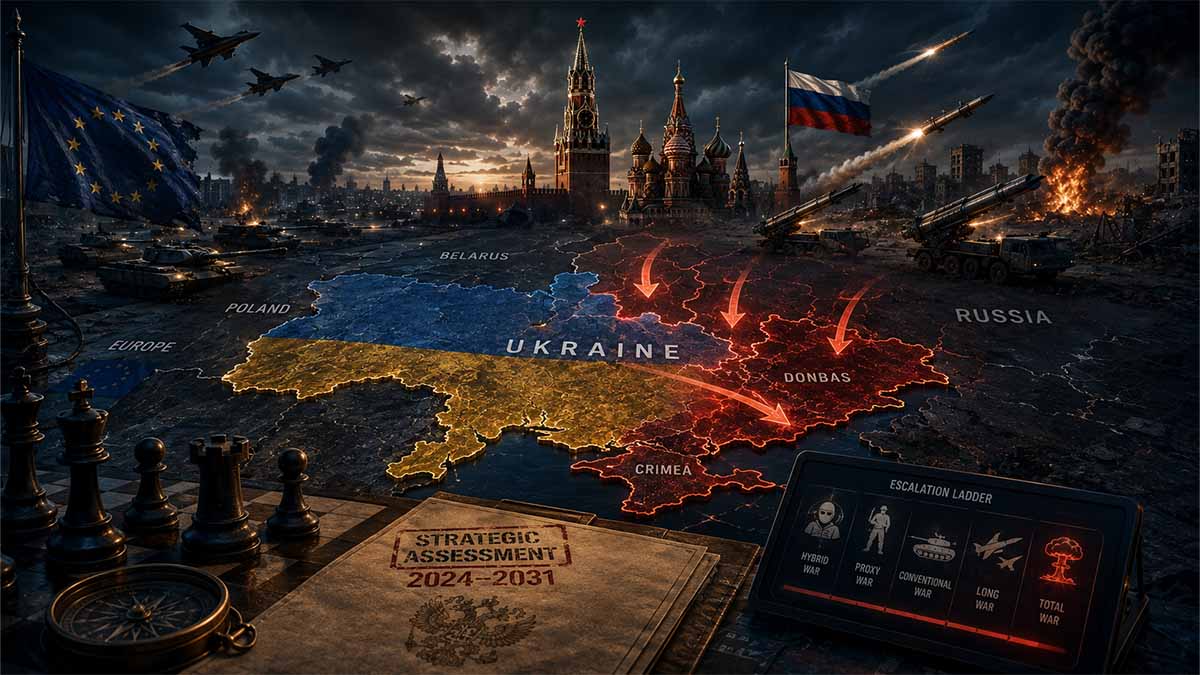
Between 2026 and 2031, three strategic destinations remain distinguishable. Continued attrition requires Russia to preserve acceptable military output and Ukraine to retain sufficient external support to deny a decisive outcome. A militarised armistice requires a precise cessation line, rules covering missiles, drones, maritime operations and airspace, independent monitoring, direct military deconfliction, prisoner arrangements and predefined consequences for major violations. Wider confrontation becomes materially more credible if an attributable Russian action causes NATO fatalities, disables critical allied infrastructure or coincides with military and nuclear-posture changes.
A durable settlement demands more: an enforceable security structure, a territorial process, reconstruction finance, sanctions sequencing and protection against an armistice becoming a rearmament interval. None of these elements can be inferred from the existence of talks.
The most credible outlook is therefore an extended contest followed, if battlefield returns decline and European support remains predictable, by an armed cessation rather than political reconciliation. Such an outcome would be valuable because it could save lives. It would also remain dangerous. Europe would face a Russia capable of combining military regeneration, nuclear coercion, cyber penetration, covert action and selective diplomacy while testing whether allied unity survives beyond the emergency. The central strategic task is not to choose between deterrence and negotiation. It is to build enough military denial to make negotiation preferable to renewed war—and enough verification to prevent negotiation from disguising preparation for the next one.
Navigational Index
- Russian Intent and the Ratcliffe Backchannel — Kremlin objectives, intelligence diplomacy, coercive bargaining and the evidentiary limits surrounding the Moscow meeting.
- Escalation Architecture and Competing Hypotheses — conventional pressure, hybrid operations, nuclear signalling, cyber activity, sanctions circumvention and alternative Russian strategies.
- The 2026–2031 Strategic Outlook — probabilistic scenarios, warning indicators, European exposure and the conditions separating attrition, armistice and wider confrontation.
Master Abstract
The principal assessment is that Vladimir Putin is probably seeking an escalation of coercive leverage, but the available primary-source evidence does not establish a Russian decision to initiate an uncontrolled confrontation with NATO. This distinction is strategically decisive. Russia’s documented objectives remain substantially broader than control of occupied territory: they encompass Ukrainian neutrality, limitations on Ukraine’s military capacity, international recognition of territorial changes claimed by Moscow and revision of the security relationship between Russia, Ukraine and the Atlantic alliance. Putin’s June 2024 terms required Ukrainian forces to withdraw from the entirety of the Donetsk, Luhansk, Zaporizhzhia and Kherson regions claimed by Russia and reaffirmed demands for a neutral, non-aligned and non-nuclear Ukraine. Meeting with the Leadership of the Russian Foreign Ministry — President of Russia — June 2024. Those requirements were not subsequently displaced by a narrower official negotiating platform: the Kremlin’s June 2025 account of the Russian memorandum stated that its long-term settlement provisions remained founded on those earlier principles. Meeting with Members of the Government — President of Russia — June 2025. Russia’s 2023 Foreign Policy Concept supplies the larger strategic frame, presenting the international system as undergoing a redistribution of power and defining the United States and its allies as sources of an anti-Russian policy that Moscow intends to counter. Decree No. 229 Approving the Foreign Policy Concept of the Russian Federation — President of Russia — March 2023. These documents do not prove an intention to enlarge the war geographically. They do demonstrate that a ceasefire preserving Ukraine’s present strategic orientation would not satisfy Russia’s publicly maintained political objectives. Moscow therefore has a rational incentive to intensify selected military, economic and informational pressure while retaining escalation controls designed to prevent direct, large-scale NATO intervention.
The meeting between CIA Director John Ratcliffe and SVR Director Sergei Naryshkin should be interpreted within this coercive bargaining system rather than treated as evidence of an impending settlement. Russia’s Foreign Intelligence Service has confirmed that Naryshkin met Ratcliffe in Moscow, but the published confirmation does not reveal the substantive agenda. Naryshkin Confirmed a Meeting with the CIA Director in Moscow — Foreign Intelligence Service of the Russian Federation — August 2026. An established bilateral intelligence channel also predates the visit: the SVR publicly recorded a Ratcliffe–Naryshkin telephone conversation in March 2025 and stated that the two services agreed to maintain regular contact to reduce confrontation and support international stability. Telephone Conversation between the Director of the SVR and the Director of the CIA — Foreign Intelligence Service of the Russian Federation — March 2025. The defensible inference is therefore functional, not conspiratorial: intelligence chiefs are particularly useful when political negotiations cannot safely communicate threats, attribution thresholds, protected interests or reciprocal restraints. Ratcliffe could have transmitted warnings, tested whether Russian military signalling reflected an operational decision, explored limits around deep strikes, or addressed third-theatre risks involving Iran; none of those specific propositions is confirmed by the primary record. The meeting consequently produces only a modest Bayesian update. It increases the probability that Washington perceived a problem requiring private clarification, while simultaneously increasing the probability that both governments still want a channel capable of preventing miscalculation. It does not establish that Ratcliffe carried an ultimatum, discussed Russian mobilisation figures or obtained a concession from Putin. Those propositions must remain excluded until an attributable official record appears.
The peace process is failing principally because the parties are bargaining over different definitions of peace. Moscow’s model seeks a settlement that converts battlefield power into durable constraints on Ukrainian sovereignty and the wider European security order. Kyiv’s model begins with a ceasefire, continued sovereignty, credible legally binding security guarantees and the rejection of territorial acquisition by force. Ukraine formally reiterated in August 2026 that a lasting settlement requires enforceable guarantees capable of deterring renewed aggression. Joint Declaration of the Leaders of Ukraine and the Nordic-Baltic Countries — Office of the President of Ukraine — August 2026. The incompatibility is reinforced by external resources: NATO pledged €70 billion in equipment, assistance and training for Ukraine during 2026 and at least an equivalent level for 2027. The Ankara Summit Declaration — North Atlantic Treaty Organization — July 2026. Russia therefore confronts neither an obviously collapsing adversary nor a negotiating partner prepared to accept Moscow’s published end-state. Conversely, Ukraine cannot assume that sanctions alone will rapidly remove Russia’s ability to continue fighting. Russia’s approved 2026 federal budget projects 40.3 trillion rubles in revenue, 44.1 trillion rubles in expenditure and a planned deficit, demonstrating the state’s continued willingness to absorb fiscal imbalance while sustaining national priorities. President of Russia Signed the Budget Package Laws — Ministry of Finance of the Russian Federation — November 2025. This produces a bargaining environment in which both sides expect that additional military effort may improve their later negotiating position. The result is not diplomacy alternating with warfare; diplomacy has become another operational domain of the war.
The structured Analysis of Competing Hypotheses uses five mutually exclusive twelve-month pathways. H₁—coercive escalation inside Ukraine, including increased strike volume, pressure on critical infrastructure and attempts to change the military map, receives 38%. H₂—managed attrition near the existing escalation ceiling, in which Russia advances selectively while negotiations remain procedural, receives 28%. H₃—horizontal hybrid escalation against NATO states, incorporating sabotage, cyber disruption, covert action, navigation interference and deniable pressure on defence supply chains, receives 16%. H₄—an interim ceasefire or militarised freeze without a final political settlement receives 13%. H₅—a direct Russia–NATO military clash receives 5%. These estimates begin from historical base rates for prolonged interstate wars and are updated using Russia’s unchanged official conditions, continuing defence expenditure, the intelligence backchannel, NATO’s multi-year assistance commitment and the absence of a mutually acceptable sequencing formula. The strongest external cross-check is the March 2026 assessment of the US intelligence community: it concluded that Russia retained the upper hand during the preceding year, saw little reason to stop while gaining ground, remained confident it could force a settlement on its terms, and posed its greatest danger through an escalatory spiral capable of producing direct conflict. Annual Threat Assessment of the U.S. Intelligence Community — Office of the Director of National Intelligence — March 2026. That assessment is Western and must be treated as an institutional analytic judgment rather than neutral fact; nevertheless, it converges with Russia’s published insistence that its original political objectives remain operative. The posterior therefore favours deliberate escalation for bargaining advantage while assigning much lower probability to a premeditated conventional attack on NATO.
Across the five-year horizon, the modal outcome is neither Russian conquest of Ukraine nor a comprehensive peace. It is a variable-intensity security regime combining contested frontiers, periodic negotiations, deep-strike competition, rearmament and persistent covert pressure. Between 2026 and 2027, Moscow is most likely to test whether battlefield momentum, infrastructure attrition and Western political divergence can produce concessions unavailable through formal diplomacy. Between 2028 and 2029, the critical question shifts from territorial movement to force regeneration: whether Russia can preserve manpower, precision-strike production and fiscal control faster than Ukraine and its partners can expand air defence, autonomous systems and long-range fires. By 2030–2031, the probable strategic contest concerns enforcement—who can prevent a ceasefire from becoming an adversary’s rearmament interval. The shadow dimensions will be integral. Foreign combat personnel and nominally private military structures may supply manpower, training or politically deniable access outside Europe. Cyber operations will remain attractive because prevailing norms tolerate significant disruption below the evidentiary and political threshold for collective military response. Liquidity will move through energy revenues, alternative settlement mechanisms, intermediated trade, opaque shipping structures and dual-use procurement networks; financial pressure will constrain Russia unevenly rather than operate as a binary switch. China’s official position continues to support negotiations while defining its relationship with Russia as non-allied and non-confrontational, indicating that Beijing prefers Russian strategic resilience without assuming unlimited escalation liability. Remarks on Ukraine by China’s Permanent Representative to the United Nations — Ministry of Foreign Affairs of the People’s Republic of China — May 2026. The resulting forecast is a prolonged contest in which Moscow escalates selectively, preserves deniability where possible, and treats direct NATO war as a failure condition rather than the preferred objective.
Russian Escalation Codex
Strategic Drivers
ACH Posterior Distribution
Coercive escalation
Managed attrition
Hybrid NATO pressure
Interim ceasefire
Direct NATO clash
Russian Intent and the Ratcliffe Backchannel
The evidentiary baseline
The Moscow meeting between CIA Director John Ratcliffe and SVR Director Sergei Naryshkin is no longer merely an aircraft-tracking hypothesis or an anonymously sourced media reconstruction. Naryshkin confirmed that he met Ratcliffe during the American official’s presence in Moscow, establishing the encounter at the level of a Russian primary institutional source. Naryshkin Confirmed a Meeting with the CIA Director in Moscow – Foreign Intelligence Service of the Russian Federation – August 2026. What the official record does not establish is equally important: it does not disclose the agenda, the duration and sequence of the substantive discussions, any message transmitted on behalf of Donald Trump or Vladimir Putin, any relationship to Russian mobilisation planning, or any agreement concerning Ukraine, NATO or Iran. Those propositions must therefore remain outside the confirmed evidence layer. The meeting nevertheless belongs to an identifiable institutional pattern rather than representing an improvised emergency contact. In March 2025, the SVR publicly confirmed a telephone conversation between Ratcliffe and Naryshkin in which the agencies discussed bilateral interaction, international stability and security, and the possibility of continued contacts. Telephone Conversation between the Director of the SVR and the Director of the CIA – Foreign Intelligence Service of the Russian Federation – March 2025. The analytical baseline is consequently narrow but significant: an operational channel existed before the Moscow encounter; the two intelligence chiefs subsequently met in person; and Moscow chose to acknowledge the meeting while withholding its content. This supports a judgment that the channel is strategically authorised and politically useful, but it cannot support the more sensational conclusion that Ratcliffe negotiated a secret peace, issued a confirmed NATO ultimatum, or secured a change in Putin’s war objectives. The appropriate intelligence formulation is therefore confirmed contact, undisclosed substance, high strategic relevance, low agenda confidence.
| Evidentiary proposition | Status | Confidence | Analytic use |
|---|---|---|---|
| Ratcliffe and Naryshkin met in Moscow | Confirmed by the SVR | High | Establishes an authorised intelligence channel |
| Ratcliffe met Putin | No verified primary evidence | Very low | Excluded |
| The meeting concerned Ukraine | Plausible, not officially disclosed | Moderate-low | Scenario variable only |
| Ratcliffe warned against attacking NATO | No verified primary evidence | Low | Excluded from factual baseline |
| Mobilisation plans were discussed | No verified primary evidence | Very low | Excluded |
| The channel is intended partly for crisis management | Supported by the March 2025 contact record | Moderate-high | Core functional inference |
| The encounter produced a settlement concession | No verified primary evidence | Very low | Excluded |
What the Kremlin is trying to obtain
Russian intent must be reconstructed from enduring state objectives, revealed preferences and resource allocation rather than from the literal wording of a single diplomatic statement. The most authoritative public articulation remains Putin’s June 2024 address to the leadership of the Russian Foreign Ministry. It connected a ceasefire to the complete withdrawal of Ukrainian forces from the Donetsk, Luhansk, Zaporizhzhia and Kherson regions claimed by Russia; it also reiterated Ukrainian neutrality, non-alignment, denuclearisation, demilitarisation and what Moscow calls “denazification.” Meeting with the Leadership of the Russian Foreign Ministry – President of Russia – June 2024. The language matters because it indicates that the Kremlin’s desired end-state is not a territorially limited exchange in which Russia retains the land it physically holds and Ukraine otherwise preserves its strategic freedom. It is a settlement that converts military leverage into enduring constraints on Ukrainian sovereignty, force structure and external alignment. Russia’s June 2025 account of its memorandum to Ukraine preserved this hierarchy: the first component concerned the conditions for a long-term peace, while the second addressed the narrower conditions for a cessation of hostilities, and the memorandum was described as deriving from Putin’s June 2024 principles. Meeting with Members of the Government – President of Russia – June 2025. Russian official rhetoric continued to present the “root causes” of the conflict, rather than the line of contact alone, as the object of any genuine settlement. Putin again linked peace to the removal of those causes in his December 2025 year-end discussion. Results of the Year with Vladimir Putin – President of Russia – December 2025. This continuity sharply reduces the probability that Moscow currently defines peace as an unconditional ceasefire. The more defensible judgment is that the Kremlin wants negotiations to ratify a revised regional balance: Ukraine strategically constrained, Russian territorial acquisitions insulated from reversal, Western military access limited, and Moscow restored as an indispensable co-author of European security arrangements.
That objective is nested inside a broader Russian theory of international order. The 2023 Foreign Policy Concept depicts the world as moving toward multipolarity, accuses the United States and associated states of using the conflict in Ukraine as part of a wider anti-Russian policy, and assigns Russian foreign policy the purpose of opposing arrangements that Moscow regards as hegemonic or structurally hostile. Decree No. 229 Approving the Foreign Policy Concept of the Russian Federation – President of Russia – March 2023. The conflict is therefore interpreted in Moscow not exclusively as a bilateral war over Ukrainian territory but as the kinetic centre of a larger negotiation about Russia’s status, NATO’s reach and the hierarchy of the European system. This does not mean that every maximalist statement constitutes a fixed operational requirement; governments often preserve ambitious formal objectives while privately exploring narrower compromises. It does mean that any analysis treating territorial division as the only unresolved variable is strategically incomplete. Four levels of Russian purpose should be distinguished. At the minimum level, Moscow seeks to prevent a Ukrainian military reversal and protect the territories it controls. At the bargaining level, it seeks formal or functional limitations on Ukraine’s defence relationships and post-war force development. At the regional level, it seeks to weaken the credibility of Western security guarantees outside NATO’s treaty perimeter and to demonstrate that military power can impose limits on European alignment choices. At the systemic level, it seeks recognition that Washington must negotiate directly with Moscow over security arrangements affecting other European states. Ratcliffe’s institutional position makes the backchannel relevant to the third and fourth levels: intelligence diplomacy can explore red lines and reciprocal restraints that neither side is prepared to acknowledge in public, even while formal political negotiations remain blocked.
Intelligence diplomacy as an escalation instrument
The Ratcliffe–Naryshkin channel should not be understood as diplomacy operating outside the conflict. It is better understood as part of the conflict’s escalation-control architecture. Intelligence leaders can communicate with greater deniability, narrower circulation and more precise handling of sensitive operational detail than conventional diplomatic delegations. Their discussions can distinguish authorised state operations from uncontrolled proxy activity, test whether an adversary’s public threat corresponds to an actual military decision, exchange warnings concerning protected personnel, negotiate limited humanitarian or detainee arrangements, and establish how each side would interpret ambiguous actions in cyber, space, intelligence and long-range strike domains. This does not transform intelligence agencies into neutral mediators. Both the CIA and SVR remain adversarial services conducting collection, influence, counterintelligence and covert operations against the other side. The value of the channel arises precisely because each knows that the other can transmit a message into the highest national-security decision structure without requiring public political recognition. The Moscow meeting consequently contains two simultaneous signals. The first is escalation concern: an in-person encounter at this level suggests that at least one subject could not be managed adequately through routine diplomatic messaging or established military deconfliction. The second is escalation limitation: choosing a controlled intelligence channel indicates that both governments still perceive value in clarifying intentions before risk becomes irreversible. The March 2025 SVR record explicitly associated bilateral intelligence interaction with international stability and security, supporting this functional interpretation without revealing later operational content. Telephone Conversation between the Director of the SVR and the Director of the CIA – Foreign Intelligence Service of the Russian Federation – March 2025. The meeting is thus more consistent with competitive risk management than with détente: Washington and Moscow can prepare for intensified confrontation while simultaneously building mechanisms intended to prevent that confrontation from crossing selected thresholds.
The channel’s strategic value is greatest where the difference between action and interpretation becomes dangerous. A deep strike may be intended by Ukraine as an attack on war-supporting infrastructure but interpreted by Moscow as Western-directed preparation against strategic command assets. A cyber intrusion may be designed for espionage but discovered in a configuration that resembles pre-positioning for destructive attack. A Russian exercise involving dual-capable systems may be intended as deterrent signalling but assessed in Washington as preparation for employment. Intelligence diplomacy allows both sides to discuss these ambiguities without recognising the adversary’s legal or political framing. Russia’s revised nuclear doctrine enlarged the publicly described circumstances relevant to nuclear deterrence, including aggression by a non-nuclear state acting with the participation or support of a nuclear state and certain conventional attacks creating critical threats to sovereignty or territorial integrity. Decree No. 991 Approving the Foundations of State Policy of the Russian Federation on Nuclear Deterrence – Official Publication of Legal Acts of the Russian Federation – November 2024. The doctrine does not prove imminent nuclear use; declared doctrine, operational planning and leadership decision are distinct layers. It nevertheless increases the number of pathways through which conventional or proxy action can acquire nuclear significance in Russian signalling. Ratcliffe’s potential utility is therefore not limited to asking whether Putin “wants escalation.” The more precise intelligence questions would be whether Russian red lines have changed operationally, whether particular strike categories would trigger a qualitatively different response, whether Moscow can reliably control affiliated actors, and whether the Kremlin distinguishes between US intelligence enablement, Ukrainian execution and direct American participation. None of the answers is publicly known, but these are the categories that explain why an intelligence chief—rather than a trade or conventional diplomatic envoy—would possess strategic relevance.
Coercive bargaining and the meaning of escalation
The statement that Putin “wants escalation” is accurate only if escalation is disaggregated into purpose, domain and ceiling. The available evidence supports a high-confidence assessment that Moscow is willing to escalate coercive pressure when it expects that additional costs will weaken Ukraine’s military position, widen political divisions among its supporters or improve Russia’s bargaining terms. It does not support an equivalent assessment that Moscow prefers an unlimited conflict with NATO. Russian strategy is more plausibly represented as an attempt to manipulate risk: increase the expected cost of refusing Russian terms while keeping the expected cost of direct alliance intervention above NATO’s tolerance and the immediate cost to Russia below an existential level. This approach permits vertical escalation inside Ukraine through larger or differently composed strike packages; horizontal escalation through cyber operations, covert disruption, political influence, navigation interference and pressure against logistics networks; diplomatic escalation through recognition withdrawal or treaty suspension; and nuclear escalation through rhetoric, exercises, deployments or dual-capable demonstrations. Each can be calibrated independently. The 2026 US intelligence assessment concluded that Moscow saw little reason to stop while it believed it held the battlefield advantage, remained confident it could force a settlement on its terms, and presented its most dangerous threat through the possibility of an escalatory spiral involving direct conflict. Annual Threat Assessment of the U.S. Intelligence Community – Office of the Director of National Intelligence – March 2026. Because this is an American institutional assessment, it cannot independently prove Russian intent; however, it converges with Russia’s continued official insistence that the original political objectives will be achieved. The synthesis is therefore stronger than either source in isolation: Russian statements establish the persistence of objectives, while the American assessment evaluates Moscow’s perceived incentive to continue fighting. The Ratcliffe meeting occurred inside this coercive equilibrium, where backchannel communication can make escalation more controlled without making it less deliberate.
| Escalation vector | Probable Russian purpose | Principal limiting factor | Backchannel relevance |
|---|---|---|---|
| Larger conventional strikes in Ukraine | Increase military and infrastructure costs | Munitions expenditure; Ukrainian adaptation | Clarify protected categories and retaliation thresholds |
| Deep strikes near NATO-linked logistics | Degrade support and create political anxiety | Risk of alliance casualties | Communicate attribution and geographic limits |
| Cyber pre-positioning | Create latent coercive options | Discovery, attribution, reciprocal exposure | Separate espionage from attack preparation |
| Sabotage and proxy disruption | Raise European support costs deniably | Counterintelligence penetration | Deny, acknowledge indirectly or signal termination |
| Nuclear signalling | Elevate perceived consequences of intervention | Credibility and uncontrolled escalation | Test whether warnings are believed |
| Diplomatic or intelligence accommodation | Obtain selective concessions without strategic retreat | Domestic and alliance politics | Negotiate compartmentalised exchanges |
Why the peace process remains structurally blocked
The negotiating deadlock is not primarily a product of inadequate meeting frequency. It originates in incompatible settlement architectures. Moscow seeks to negotiate the political and military status of Ukraine, whereas Kyiv and its European supporters seek a cessation of Russian coercion backed by guarantees that preserve Ukraine’s ability to deter another attack. Ukraine stated in August 2026 that a just and lasting peace requires robust, legally binding and credible security guarantees. Joint Declaration of the Leaders of Ukraine and the Nordic-Baltic Countries – Office of the President of Ukraine – August 2026. A June 2026 joint declaration involving Ukraine, France, the United Kingdom and Germany further connected a ceasefire to legally binding guarantees and a proposed multinational force. Joint Statement of the Leaders of France, the United Kingdom, Germany and Ukraine – Office of the President of Ukraine – June 2026. These positions collide with Moscow’s objective of constraining Ukraine’s future military alignment. The disagreement is therefore not only over whether territory should be transferred; it concerns whether the post-war Ukrainian state becomes more securely connected to Western defence structures or is strategically limited as a condition of peace. A temporary ceasefire cannot resolve that contradiction. Indeed, each side fears that the other would use a pause to improve its military position: Ukraine fears a Russian regeneration interval, while Russia portrays a ceasefire without prior political settlement as an opportunity for Western rearmament of Ukraine. Intelligence discussions can reduce immediate misunderstanding, arrange narrow exchanges or explore sequencing, but they cannot bridge mutually exclusive visions of Ukraine’s security status unless political leaders alter their minimum acceptable conditions. The most likely utility of the Ratcliffe backchannel is therefore transactional and preventative, not constitutional: it may manage the consequences of failed diplomacy more effectively than it can produce the settlement diplomacy has failed to reach.
External financing reinforces this structural blockage by reducing the urgency of concession. NATO’s July 2026 Ankara declaration pledged €70 billion in military equipment, training and assistance for Ukraine in 2026 and at least an equivalent level in 2027. The Ankara Summit Declaration – North Atlantic Treaty Organization – July 2026. The Council of the European Union separately finalised a €90 billion support loan intended to cover urgent Ukrainian budgetary and defence-industrial requirements during 2026–2027. Council Finalises €90 Billion Support Loan to Ukraine – Council of the European Union – April 2026. These commitments do not guarantee military success, timely delivery or political unity, but they tell Moscow that waiting for an immediate collapse of external support is not a cost-free assumption. Russia, meanwhile, retains material capacity to continue the conflict, although the domestic economic price is becoming more visible. The Bank of Russia maintained a 14% key rate in July 2026, forecast 6–7% annual inflation and subsequently reduced its 2026 growth forecast to 0–1%, while noting pro-inflationary risks and contraction in parts of production capacity. Summary of the Key Rate Discussion – Bank of Russia – August 2026. These indicators show pressure, not imminent exhaustion. The bargaining consequence is a mutual endurance test: Moscow believes continued pressure may eventually fracture the coalition supporting Kyiv; Ukraine’s partners are investing to demonstrate that this expectation will fail. Ratcliffe and Naryshkin can clarify how each government reads that contest, but neither intelligence chief can remove its underlying political logic.
Bayesian update and competing hypotheses
The Moscow encounter should produce a limited Bayesian update because the event is highly significant but informationally ambiguous. An intelligence-chief meeting is more likely when governments perceive acute escalation risk, but it is also more likely when they believe a narrow accommodation is possible. It therefore raises the probability of both urgent risk management and transactional bargaining while reducing the probability of wholly uncontrolled movement toward direct conflict. The following model uses five mutually exclusive twelve-month hypotheses. The priors reflect the official Russian settlement position, demonstrated battlefield persistence, Western financing commitments, economic constraints and established intelligence contact before the Moscow visit. The likelihood update assigns the meeting greater compatibility with H₁ and H₃ than with either a routine continuation scenario or an imminent direct NATO–Russia war. These percentages are structured analytic judgments, not measured frequencies or claims of access to classified reporting.
| Hypothesis | Definition | Prior | Ratcliffe-meeting likelihood | Posterior |
|---|---|---|---|---|
| H₁ | Controlled coercive escalation inside Ukraine while preserving NATO thresholds | 36% | High | 37% |
| H₂ | Managed attrition near the existing intensity ceiling | 27% | Moderate-low | 26% |
| H₃ | Limited transactional accommodation or partial ceasefire mechanism | 15% | High | 18% |
| H₄ | Horizontal hybrid escalation against European or NATO-linked systems | 14% | Moderate | 13% |
| H₅ | Direct Russia–NATO military crisis | 8% | Low-moderate | 6% |
H₁ remains the leading hypothesis because it best reconciles four otherwise contradictory observations: Moscow retains objectives that cannot be obtained through an unconditional ceasefire; Russia continues to accept substantial economic costs; the Kremlin does not appear to seek a direct alliance war; and an intelligence backchannel exists to manage precisely the danger created by calibrated pressure. H₂ remains plausible if the military balance offers neither side sufficient confidence to cross the existing ceiling. H₃ gains three percentage points because a senior in-person intelligence contact is compatible with a compartmentalised bargain, such as restrictions affecting selected strikes, detainee arrangements, protected channels or a limited pause, even without agreement on the war’s final political settlement. H₄ remains material because hybrid instruments can impose costs below the conventional threshold, but the Moscow meeting modestly reduces the probability that such activity will be allowed to expand without central risk management. H₅ falls from 8% to 6% because maintaining a high-level channel is evidence that both systems value controllability; it does not fall further because deconfliction mechanisms are often created precisely when underlying danger is increasing. The main disconfirming indicator for H₁ would be verified Russian acceptance of a ceasefire without prior Ukrainian withdrawal or strategic-status concessions. The main confirming indicator would be a coordinated increase in strike intensity accompanied by diplomatic language presenting military deterioration as the reason Kyiv must accept Moscow’s framework.
Shadow dimensions: manpower, cyber norms and liquidity
The shadow system determines whether Russia can sustain coercive bargaining without paying the full direct cost of escalation. The first component is externalised manpower and military support. Foreign combat personnel, training assistance, remotely operated capabilities and formally state-controlled forces performing functions once associated with mercenary structures can expand Russian endurance while distributing political exposure. The European Council formally condemned the deployment of North Korean forces and military support provided to Russia by Iran, Belarus, North Korea and other states. European Council Meeting, 18–19 June 2026 – European Council – June 2026. This official European judgment must be distinguished from precise claims about unit strength or battlefield assignment, which require separate corroboration, but it confirms that the conflict’s manpower and supply architecture extends beyond Russia. The second component is cyber norm elasticity. Persistent access, espionage, reconnaissance and pre-positioning can occur below the threshold at which NATO members would treat an operation as an armed attack. That ambiguity is strategically advantageous because the same access can be portrayed as intelligence collection during peacetime and converted into disruption during crisis. The third component is liquidity. Russia’s ability to continue fighting depends not simply on headline oil revenue but on settlement channels, maritime services, insurance, beneficial ownership, intermediary banking, crypto conversion and the acquisition of dual-use inputs through third jurisdictions. The EU’s July 2026 sanctions package targeted more than one hundred banks and crypto operators, over forty additional shadow-fleet vessels, refineries and military-industrial entities. 21st Package of Sanctions: EU Targets Russian Energy, Financial Services and Crypto – Council of the European Union – July 2026. The scope of those measures demonstrates that financial endurance is a network problem rather than a single sanctions variable.
The Ratcliffe channel intersects with all three shadow dimensions because attribution and control are central to escalation management. Washington needs to know whether a disruptive operation originates from the Russian state, an intelligence-controlled proxy, a financially motivated group tolerated by Russian authorities or an actor operating beyond effective command. Moscow, conversely, needs to know whether Ukrainian deep-strike or cyber operations represent Kyiv’s independent decision, Western intelligence enablement or an American operational commitment. Incorrect attribution can collapse the distinction between proxy action and direct participation. Liquidity pressure adds another layer: sanctions against payment channels, vessels, energy nodes or third-country intermediaries may be understood in Washington as non-kinetic economic coercion but framed in Moscow as strategic warfare against the state’s capacity to function. China’s position is particularly important because Beijing combines support for political negotiations with insistence that both sovereignty and legitimate security concerns be respected. Remarks on Ukraine by China’s Permanent Representative to the United Nations – Ministry of Foreign Affairs of the People’s Republic of China – May 2026. This formulation permits China to resist Western pressure against Russia while avoiding formal endorsement of every Russian war aim. Beijing’s likely preference is Russian resilience without uncontrolled escalation that damages Chinese trade, produces nuclear instability or forces China into explicit alliance obligations. Over the next five years, Chinese financial and commercial risk tolerance will therefore influence Russia’s endurance, but it should not be modelled as unconditional strategic underwriting.
Five-year outlook, 2026–2031
A transparent Monte Carlo framework was constructed around 50,000 conditional pathways using five principal variables: Russian battlefield confidence, Western delivery reliability, Russian fiscal stress, Ukrainian deep-strike effectiveness and the viability of intelligence-level deconfliction. Additional stochastic modifiers represent leadership shocks, cyber incidents, external manpower support, energy-revenue volatility and accidental NATO casualties. The model is not an empirical prediction engine and does not possess classified inputs; its purpose is to expose how alternative assumptions interact. The modal five-year state is a militarised armistice or unstable conflict-management arrangement, not a comprehensive treaty. Across the full simulation, 31% of pathways produce an armistice with unresolved territorial and security questions; 29% produce continued variable-intensity war through most of the horizon; 18% produce a settlement materially favourable to Russian strategic demands; 14% produce a reversal that significantly strengthens the Ukrainian-Western bargaining position; 6% produce a direct NATO–Russia military crisis without full-scale strategic war; and only 2% produce a durable settlement resolving territory, security guarantees, sanctions sequencing and enforcement. The Ratcliffe backchannel improves the probability of avoiding direct conflict, but it also makes sustained coercion more manageable by reducing the risk that every escalatory step will be misinterpreted. Deconfliction can therefore be stabilising at the strategic level while enabling continued violence at the operational level. This is the central paradox of intelligence diplomacy: a more reliable channel does not necessarily bring peace closer; it may make prolonged confrontation safer for the governments conducting it.
| Period | Most likely Russian approach | Backchannel function | Primary warning indicators |
|---|---|---|---|
| 2026–2027 | Intensify coercion while testing Western delivery endurance | Immediate red-line and attribution management | Strike composition, protected-target warnings, unusual intelligence travel |
| 2027–2028 | Reassess whether military momentum can yield political concessions | Explore restricted bargains and reciprocal restraints | Ceasefire sequencing language, detainee exchanges, force-posture consultations |
| 2028–2029 | Balance fiscal strain against force-regeneration gains | Prevent cyber, space or proxy incidents from widening the war | Russian credit conditions, production bottlenecks, cyber pre-positioning disclosures |
| 2029–2030 | Seek an enforceable freeze if marginal gains decline | Negotiate verification architecture without resolving final status | Monitoring proposals, buffer arrangements, sanctions conditionality |
| 2030–2031 | Preserve leverage inside a militarised European order | Maintain crisis communications and reopen unresolved terms | Rearmament violations, alliance guarantees, renewed mobilisation signals |
The decisive five-year issue is whether the intelligence channel evolves from episodic crisis communication into an institutionalised mechanism capable of supporting verification. If it remains limited to warnings, prisoner matters and emergency deconfliction, it will reduce catastrophic risk without resolving the war. If it begins to address monitorable restraint—such as categories of prohibited strikes, force separation, notification of exercises, cyber non-interference around critical systems or inspection mechanisms—it could become an enabling layer beneath a broader armistice. Such evolution would still not constitute trust. It would represent mutually verified distrust. Conversely, the channel’s interruption, unexplained cancellation of planned contacts or replacement by public ultimata would be a major negative indicator because it would suggest that one side no longer values private clarification or believes ambiguity serves its interests better. The highest-risk pathway is not necessarily a planned Russian attack on NATO. It is an accumulated sequence in which an ambiguous strike, covert operation or infrastructure disruption causes casualties; attribution hardens before private clarification occurs; domestic politics narrow the space for restraint; and military signalling is interpreted as preparation rather than warning. Ratcliffe’s trip matters because it indicates that the United States and Russia have not abandoned the machinery needed to interrupt that sequence. It does not demonstrate that the machinery has already produced agreement.
Final strategic judgment
The strongest available assessment is that Putin seeks escalation dominance, not escalation for its own sake. Moscow wants the ability to increase pressure faster, across more domains and with greater political effect than Ukraine and its partners can answer, while retaining enough control to avoid a direct war that would threaten Russian regime and state survival. The Kremlin’s settlement terms, strategic doctrine and continued acceptance of economic strain indicate that it regards the war as a contest over the future security architecture of Europe, not merely a dispute over the current front. The Ratcliffe–Naryshkin meeting is strategically important because it supplies a protected mechanism for communicating within that contest. It is not evidence that Moscow has moderated its objectives, and it is not proof that Washington delivered or secured any specific concession. Its most probable purpose was composite: validate adversary intentions, communicate consequences, manage attribution, preserve selected cooperative functions and determine whether a narrow transaction was available amid a failing political process. The backchannel should therefore be monitored as an indicator of escalation management, not misrepresented as a substitute for peace negotiations. A second in-person meeting, working-level technical groups, public reference to reciprocal restraint or the emergence of verification language would raise the probability of a limited accommodation. Abrupt silence, Russian doctrinal hardening, attacks generating NATO fatalities, unexplained strategic-force dispersal or coordinated cyber disruption would move the posterior sharply toward H₄ or H₅. On present evidence, the most likely evolution remains controlled military escalation followed by intermittent transactional diplomacy, with a militarised armistice more probable by 2031 than either decisive victory or comprehensive peace.
Escalation Architecture and Competing Russian Strategies
Escalation as a system
Russia’s escalation architecture should not be represented as a single ladder rising mechanically from conventional combat to nuclear employment. It is a multi-domain control system in which Moscow can increase pressure in one theatre, lower its visibility in another, preserve deniability in a third and simultaneously communicate restraint through intelligence channels. The Kremlin’s strategic problem is to generate sufficient military and political cost to change Ukraine’s and the West’s decisions without producing a direct NATO–Russia war that could threaten the Russian state or regime. Russian escalation therefore operates through six interacting instruments: battlefield pressure; long-range conventional strikes; covert and hybrid operations; cyber penetration and disruption; nuclear signalling; and economic adaptation that keeps the other instruments financially sustainable. Putin’s June 2026 meeting with military personnel continued to present the war as the result of a longer confrontation over Ukraine and the implementation of the Minsk framework rather than as an isolated territorial campaign. Meeting with Military Personnel Participating in the Special Military Operation – President of Russia – June 2026. An August 2026 Russian Foreign Ministry statement again declared that the objectives of demilitarising Ukraine and eliminating threats from its territory would be achieved. Comment by Foreign Ministry Spokeswoman Maria Zakharova on the Ukraine Crisis – Ministry of Foreign Affairs of the Russian Federation – August 2026. These statements do not identify the timing or exact military method Russia will choose, but they constrain the plausible hypothesis space: Moscow has not publicly substituted a narrow ceasefire objective for its broader political programme. The correct analytical question is consequently not whether Russia will “escalate” in the abstract, but which combination of domains it will intensify, what threshold it intends to remain below, and what political concession it expects each increment of pressure to produce.
Russian Political Objective Architecture • Military, Shadow & Strategic Coercion Matrix
Russian Political Objective: Constrain Ukraine, Preserve Gains & Weaken NATO
The foundational intent governing Russian grand strategy. Seeks to permanently constrain Ukrainian sovereignty, lock in territorial acquisitions across occupied oblasts, and systematically erode Western and NATO cohesion and leverage.
Conventional pressure and the industrial contest
The most likely centre of gravity remains conventional pressure inside Ukraine because it offers Moscow the greatest ability to impose cumulative costs while preserving the legal and political boundary separating the war from a direct attack on NATO. Conventional escalation does not necessarily require a dramatic geographic offensive. It can consist of higher strike density, changed target composition, shorter intervals between attack waves, greater use of inexpensive unmanned systems to exhaust interceptors, more intense electronic warfare, localised ground offensives intended to compel Ukrainian reserve movement, and attacks against the energy, transport and industrial systems supporting defence production. The strategic purpose is cumulative: compel Ukraine to allocate scarce air-defence missiles to infrastructure, force repair expenditures, reduce industrial continuity, increase civilian fatigue and demonstrate that Western support cannot eliminate vulnerability. Ukraine’s official position illustrates the reciprocal nature of this campaign. In August 2026, President Volodymyr Zelenskyy announced further Ukrainian deep strikes and identified a strike more than 2,500 kilometres from Ukraine against an oil-refining facility in Tobolsk. There Will Be More Ukrainian Deep Strikes, Which Should Demonstrate to Russia That Peace Is Necessary – Office of the President of Ukraine – August 2026. This creates a strike-counterstrike system in which each side attempts to convert industrial geography into military leverage. Russia’s depth and larger industrial base provide resilience, while Ukraine’s expanding reach challenges the assumption that the Russian rear is insulated from the cost of war. The resulting contest is not adequately measured by territory alone. Relevant indicators include interceptor expenditure, missile and drone production, repair time, electrical-system redundancy, fuel-processing disruption, rail throughput, mobilisation quality and the percentage of weapons reaching operational units rather than merely leaving factories.
Western industrial mobilisation raises the cost of a purely attritional Russian strategy. NATO’s Ankara declaration pledged €70 billion in equipment, training and assistance for Ukraine in 2026 and at least the same level in 2027. The Ankara Summit Declaration – North Atlantic Treaty Organization – July 2026. The European support architecture adds a €90 billion loan covering urgent budgetary and defence requirements in 2026–2027; the Council subsequently stated that €60 billion of the framework concerned defence capacity and procurement, with €28.3 billion expected to be disbursed from that defence component during 2026. Ukraine Support Loan: EU Countries Approve UK Participation – Council of the European Union – July 2026. NATO also announced more than €50 billion in procurement commitments and a $40 billion, five-year counter-uncrewed-systems initiative under Drone Edge. Secretary General on the Ankara Summit: NATO Delivers – North Atlantic Treaty Organization – July 2026. These figures are commitments, not proof of delivery, readiness or operational effectiveness. Their strategic significance lies in the planning horizon they communicate to Moscow: European and allied institutions are attempting to transform episodic assistance into multi-year production signals. Russia must therefore decide whether to intensify before those investments mature, prolong the conflict in expectation that political cohesion will fail before industrial capacity arrives, or pursue a freeze that preserves current gains while limiting Ukraine’s opportunity to exploit future capability improvements.
Hybrid operations below the treaty threshold
Horizontal escalation against European states offers Moscow a different risk-return profile. Instead of attempting to defeat NATO militarily, Russia can seek to raise the domestic cost of supporting Ukraine, generate uncertainty about attribution, expose weaknesses in critical infrastructure and encourage political constituencies that favour accommodation. The operational menu includes sabotage, reconnaissance against logistics networks, arson or disruption conducted through intermediaries, manipulation of migration or border pressure, interference with satellite navigation, intimidation of defence-industry personnel, influence operations, selective disclosure of stolen information and legal-financial measures against Western assets inside Russian jurisdiction. NATO states that allied countries have experienced growing cyberattacks, political interference, sabotage, airspace violations and information operations, and assesses that Russia and associated proxies use coordinated activities to destabilise societies, disrupt economic systems and weaken support for Ukraine. NATO’s Support for Ukraine – North Atlantic Treaty Organization – 2026. This is an alliance assessment and must not be treated as automatic attribution of every European incident. Its analytical value lies in identifying the threat model NATO itself uses when deciding whether apparently separate events form part of a coordinated campaign. Moscow benefits from maintaining the events below the evidentiary and political threshold at which an ally can obtain consensus for collective retaliation. Hybrid operations work best when attribution is probable enough to create fear but contestable enough to fragment the response. If attribution becomes conclusive and casualties are high, the same operation can become strategically counterproductive by strengthening alliance unity and legitimising more forceful countermeasures.
The hybrid domain is also attractive because it enables variable command relationships. An operation may be designed and directed by a Russian intelligence service, outsourced to criminal facilitators, conducted by ideologically aligned actors, copied independently by supporters, or falsely claimed by an unrelated group. These categories have different implications for deterrence because punishment directed at the Russian state may be credible against controlled assets but ineffective against loosely connected opportunists. The distinction also matters for the Ratcliffe–Naryshkin channel: intelligence diplomacy can potentially clarify whether an operation was authorised, whether a proxy exceeded its instructions, or whether a particular campaign will be terminated if reciprocal restraint is provided. None of those communications must be publicly admitted to have strategic effect. The 2026 US intelligence assessment identifies cyberattacks, disinformation, energy manipulation, military intimidation and sabotage as components of Russia’s grey-zone toolkit and notes that concealment and denial complicate counteraction. Annual Threat Assessment of the U.S. Intelligence Community – Office of the Director of National Intelligence – March 2026. Because Western intelligence assessments can reflect institutional threat perceptions, the evidence should be cross-checked against technical advisories rather than accepted solely as strategic narrative. That cross-check exists in the cyber domain, where multiple agencies have published operational indicators, targeted sectors and specific infrastructure vulnerabilities associated with Russian intelligence services.
Cyber escalation and latent access
Cyber activity occupies a special position because the same intrusion can support espionage, battlefield logistics, coercive signalling or preparation for destructive action. Access alone does not reveal intended use. Russian services can penetrate routers, logistics providers, communications systems or industrial environments and preserve the capability without activating it, thereby obtaining intelligence and a contingent disruption option. Conversely, discovery of persistent access can be interpreted by the victim as preparation for wartime attack even when the operator’s immediate purpose is collection. In April 2026, a joint US cybersecurity advisory described a Russian state-sponsored campaign targeting Western logistics and technology entities. Russian GRU Targeting Western Logistics Entities and Technology Companies – US Cybersecurity and Infrastructure Security Agency – April 2026. In July, a further international advisory attributed exploitation of poorly configured routers and network devices to FSB Centre 16, identifying critical infrastructure as particularly exposed. Improve Router Hygiene to Protect Against Russian State-Sponsored Cyber Threats – US Cybersecurity and Infrastructure Security Agency – July 2026. The United Kingdom’s National Cyber Security Centre separately warned that Russian-aligned hacktivist groups continued to target local government and critical infrastructure with disruptive denial-of-service activity. Pro-Russia Hacktivist Activity Continues to Target UK Organisations – UK National Cyber Security Centre – January 2026. These sources establish a spectrum ranging from sophisticated state access to lower-complexity aligned disruption. They do not establish that every actor is centrally directed or that destructive cyberattack is imminent.
The critical warning indicator is a transition from collection and nuisance disruption to pre-positioning in systems whose failure would create physical effects, military-logistics interruption or cascading public harm. Target selection matters more than raw incident counts. Repeated denial-of-service attacks against public websites can create visibility but usually limited strategic damage; access to railway signalling, port management, satellite communications, electricity distribution, undersea-cable landing infrastructure or defence-manufacturing control systems creates escalation potential even if no destructive payload is deployed. Moscow can use this latent capability as an undeclared reserve: the adversary must spend continuously on defence without knowing whether activation is planned. Cyber operations also compress decision time. A conventional missile launch supplies observable physical indicators and established military warning procedures; malicious code may remain undiscovered for months, and its attribution may be incomplete when political decisions are required. This asymmetry increases the value of intelligence backchannels but also creates incentives for deception. Russia could deny a state relationship to an actor it quietly tolerates; Western services could present technical evidence without revealing collection sources; both could seek behavioural restraint without agreeing on public attribution. Through 2031, cyber escalation is more likely to expand through persistent access, supply-chain compromise, credential theft, disruptive proxy activity and attacks synchronized with political or military events than through an immediate, indiscriminate attempt to disable European infrastructure. The latter would sacrifice deniability, invite coordinated retaliation and potentially cross NATO’s threshold for collective response.
Nuclear signalling and threshold manipulation
Nuclear weapons function in this conflict principally as instruments of deterrence, coercive communication and intervention control rather than as battlefield substitutes for conventional insufficiency. Russia’s November 2024 doctrine broadened the publicly stated circumstances relevant to nuclear deterrence. It treats aggression by a non-nuclear state with the participation or support of a nuclear state as a joint attack for deterrence purposes and includes conventional aggression creating a critical threat to Russian or Belarusian sovereignty or territorial integrity among the conditions potentially relevant to nuclear use. Decree No. 991 Approving the Foundations of State Policy on Nuclear Deterrence – Official Publication of Legal Acts of the Russian Federation – November 2024. The doctrinal wording creates strategic ambiguity around Western support to Ukraine, but it should not be interpreted as an automatic launch rule. Doctrine defines a space of possible decisions; it does not reveal whether the leadership has selected one, what operational thresholds apply, or how military and political authorities would interpret a specific incident. Moscow gains coercive value from that uncertainty because NATO governments must consider the possibility that deeper involvement could produce consequences disproportionate to the immediate military action. The risk is that repeated threats lose credibility unless supported by visible signals. Russia can therefore reinforce rhetoric with exercises, force dispersal, changes in readiness, movement of dual-capable systems, publicised command activity or demonstrations involving advanced delivery systems. Each signal must be interpreted within its operational context rather than through public language alone.
Nuclear escalation is most plausible as a sequence rather than a single decision. The sequence could begin with intensified conventional strikes and explicit attribution of Ukrainian capabilities to Western intelligence support; proceed through diplomatic warnings, military exercises and the relocation or heightened visibility of dual-capable assets; and culminate in a demonstration or limited-use consideration if Moscow assessed that conventional defeat threatened control of territory it defines as Russian or endangered regime survival. The probability of actual employment remains low because nuclear use would create enormous military, diplomatic and economic uncertainty, could produce direct NATO intervention, damage relations with states Moscow depends on, and undermine Russia’s claim to be defending international stability against Western escalation. China’s official position requires respect for sovereignty and territorial integrity, rejects further escalation and calls for an early political settlement. Remarks on Ukraine by China’s Permanent Representative to the United Nations – Ministry of Foreign Affairs of the People’s Republic of China – May 2026. Beijing’s position does not align fully with Western policy, but it provides a significant external constraint on Russian nuclear adventurism: China benefits from Russian resilience and strategic distraction of the United States, not from nuclear disorder that destabilises trade, normalises proliferation and forces Beijing to choose publicly between Moscow and the non-use norm. The most likely five-year pathway is consequently persistent nuclear signalling, occasional doctrinal or operational demonstrations and continued ambiguity, with employment remaining a tail risk concentrated in scenarios involving major Russian military reversal or direct NATO participation.
| Nuclear indicator | Routine or ambiguous interpretation | Escalatory interpretation | Analytic weight |
|---|---|---|---|
| Public doctrinal repetition | Strategic messaging | Preparation of political justification | Low alone |
| Scheduled strategic exercise | Normal deterrence activity | Signal synchronized with a crisis | Moderate with timing |
| Dispersal of dual-capable systems | Survivability or training | Increased readiness for employment | High if unusual |
| Leadership relocation or command changes | Security precaution | Continuity-of-government preparation | High if corroborated |
| Warhead-storage activity | Maintenance | Operational mating or forward movement | Very high |
| Demonstration outside Ukraine | Signalling without casualties | Pre-use escalation stage | Critical |
| Direct strike on NATO territory | Conventional crisis | Nuclear escalation pathway activated | Critical |
Sanctions circumvention as operational depth
Sanctions circumvention is not a secondary economic subject; it is the logistical depth that determines whether Russia can sustain military, cyber and intelligence pressure over a five-year horizon. The relevant ecosystem includes energy exports transported through opaque ownership structures, reflagged or frequently renamed vessels, ship-to-ship transfers, non-Western insurance and servicing, intermediary banks, alternative financial messaging, crypto platforms, third-country re-export of dual-use goods, component substitution and the fragmentation of procurement into transactions too small or indirect to trigger immediate controls. The EU’s July 2026 sanctions package targeted more than one hundred banks and crypto operators, over forty additional shadow-fleet vessels, several refineries and more than fifty military-industrial entities linked to long-range drone production. 21st Package of Sanctions: EU Targets Russian Energy, Financial Services and Crypto – Council of the European Union – July 2026. The Council’s cumulative description of its measures shows that the 2026 package added transaction bans against 33 Russian credit and financial institutions, four banks in non-EU states and fourteen crypto-related service platforms, alongside restrictions on forty-one additional vessels and tighter controls directed at dual-use procurement through third jurisdictions. Timeline: EU Response to Russia’s War of Aggression Against Ukraine – Council of the European Union – July 2026. The scale and repetition of these measures demonstrate an adaptive contest: each sanction closes or increases the cost of a route, while Russian state and commercial networks search for substitutes.
Circumvention effectiveness should be measured through cost, delay, quality degradation and throughput rather than a binary distinction between “working” and “failed” sanctions. Russia can continue obtaining a controlled item while paying higher margins, receiving lower-quality substitutes, accepting longer delivery times or exposing more intermediaries to designation. From a military perspective, those frictions matter if they reduce production reliability, complicate maintenance or slow replacement below battlefield consumption. From a political perspective, sanctions may still be judged unsuccessful if Russia retains visible capacity to fight. The Bank of Russia’s own August 2026 forecast identified a 14.5–14.6% average policy-rate range for 2026, 6–7% inflation, a more expansionary fiscal stance and a temporary reduction of production capacity in certain industries. Commentary on the Bank of Russia’s Medium-Term Forecast – Bank of Russia – August 2026. These are indicators of strain and restrictive financial conditions, not evidence of imminent economic breakdown. China provides important external depth because it rejects unilateral sanctions without United Nations Security Council authorisation and defends normal commercial relations with Russia. Foreign Ministry Spokesperson Lin Jian’s Regular Press Conference – Ministry of Foreign Affairs of the People’s Republic of China – October 2025. Beijing is nevertheless likely to calibrate exposure to protect major institutions from secondary sanctions, producing a pattern of continued trade combined with risk-sensitive routing, entity substitution and selective compliance.
Analysis of competing hypotheses
Six hypotheses provide a more rigorous account of Russian strategy than a binary peace-versus-escalation model. H₁ proposes a controlled offensive strategy: Moscow intensifies conventional and long-range pressure to improve the map and compel negotiations on Russian terms while carefully avoiding NATO territory. H₂ proposes strategic attrition: Russia maintains approximately sustainable pressure, accepting slow gains because it expects Ukrainian manpower, infrastructure or Western political cohesion to weaken first. H₃ proposes horizontalisation: Moscow shifts greater effort toward cyber, sabotage, intelligence and political disruption in Europe to undermine the support network rather than win primarily through battlefield movement. H₄ proposes a transactional freeze: Russia seeks a ceasefire that preserves present gains, slows Ukrainian integration and enables force regeneration without surrendering its larger objectives. H₅ proposes strategic widening: the Kremlin deliberately generates a severe NATO crisis or dramatically intensifies nuclear signalling because it believes controlled pressure has failed. H₆ proposes constraint-driven accommodation: fiscal, military or political stress becomes strong enough to force Russia toward a compromise materially below its published conditions. These hypotheses are mutually exclusive as dominant strategies, although real Russian behaviour will contain elements of several. The assessment below applies an ACH matrix to current official objectives, industrial commitments, cyber evidence, economic constraints, nuclear doctrine and the existence of intelligence deconfliction. “C” indicates consistency, “I” inconsistency and “N” evidence that is neutral or insufficiently discriminating.
| Evidence | H₁ Offensive coercion | H₂ Attrition | H₃ Horizontalisation | H₄ Transactional freeze | H₅ Strategic widening | H₆ Accommodation |
|---|---|---|---|---|---|---|
| Russian objectives remain formally unchanged | C | C | C | C | C | I |
| Multi-year NATO and EU support | C | I | C | C | C | C |
| Persistent Russian cyber activity | N | N | C | N | C | N |
| High Russian rates and economic strain | N | I | C | C | C | C |
| Intelligence backchannel remains active | C | C | C | C | I | C |
| Broadened nuclear doctrine | C | N | N | N | C | I |
| Ukrainian deep-strike expansion | C | I | C | C | C | C |
| Chinese opposition to uncontrolled escalation | C | C | C | C | I | C |
The posterior distribution assigns H₁ 32%, H₂ 24%, H₃ 17%, H₄ 16%, H₅ 7% and H₆ 4% over the next twelve months. H₁ leads because it best fits Moscow’s unchanged demands, the incentive to act before Western industrial programmes mature and the existence of a backchannel that can help control risk. H₂ remains substantial because Russia may judge current force expenditure and gradual pressure preferable to the uncertainty of a more ambitious offensive. H₃ gains weight as NATO logistics, defence production and public infrastructure become increasingly attractive indirect targets. H₄ is credible if Moscow concludes that current gains can be preserved through an interim arrangement, but it requires a sequencing formula that prevents Western guarantees from converting the pause into a more adverse military balance. H₅ remains a serious tail risk rather than the baseline because deliberate direct confrontation would undermine Russia’s advantage in controlling the conflict’s geographic boundary. H₆ is lowest because official policy, resource allocation and present economic evidence do not demonstrate that Moscow has accepted compromise below its core requirements. These probabilities should be updated when indicators change; they are not permanent characteristics of Russian decision-making.
Monte Carlo outlook to 2031
A 75,000-path conditional simulation was constructed around nine variables: Russian battlefield confidence; Ukrainian force resilience; Western delivery reliability; Russian fiscal stress; strike-system production; cyber access to European infrastructure; sanctions-circumvention efficiency; Chinese commercial tolerance; and deconfliction-channel reliability. Random shock terms represent leadership transition, NATO fatalities, a major cyber incident, warhead-related signalling, energy-price disruption and a sudden front-line collapse. The baseline outcome distribution by 2031 assigns 34% to a militarised armistice with unresolved political questions, 27% to continuing variable-intensity conflict, 17% to a settlement substantially favouring Russian demands, 13% to a strengthened Ukrainian-Western bargaining position, 7% to a direct NATO–Russia crisis short of general war and 2% to a durable comprehensive settlement. These values are scenario frequencies generated by explicit assumptions, not objectively measured probabilities. Sensitivity testing shows that three variables dominate. First, if Western delivery reliability remains above 75/100 while Russian fiscal stress rises above 65/100, H₄ and H₆ gain sharply at the expense of H₁ and H₂. Second, if Russian battlefield confidence exceeds 70/100 and sanctions-circumvention effectiveness exceeds 65/100, controlled offensive coercion becomes the leading pathway through 2028. Third, if deconfliction reliability falls below 30/100 while cyber access and deep-strike intensity both exceed 70/100, the probability of a direct NATO crisis more than doubles. The model therefore confirms that intelligence communication is not peripheral: it is one of the variables preventing conventional, cyber and proxy pressure from interacting catastrophically.
The five-year trajectory is unlikely to be linear. During 2026–2027, Russia has an incentive to test whether greater strike pressure can outpace Ukraine’s air-defence regeneration and whether European procurement commitments translate into actual deliveries. During 2027–2028, industrial throughput and manpower quality become more important than announced budgets. During 2028–2029, cumulative economic strain, maintenance requirements and the availability of imported components will determine whether Russia can preserve its preferred operational tempo without a broader mobilisation or deeper civilian-economy sacrifice. During 2029–2030, incentives for an armistice rise if neither side can transform technological adaptation into decisive territorial change. By 2030–2031, the strategic contest will centre on enforcement: whether any ceasefire prevents rearmament, whether Ukraine receives guarantees Moscow regards as threatening, and whether sanctions relief is reversible if violations occur. The modal end-state is therefore armed coexistence, not reconciliation. Nuclear signalling remains recurrent; cyber access remains partially latent; sanctions circumvention remains an adaptive network; and conventional pressure resumes whenever either side believes the balance has shifted. Russia’s most rational strategy under this outlook is not permanent maximum escalation. It is continuous optionality: preserve the ability to intensify, pause, deny, negotiate and re-enter conflict without conceding the larger political objective.
Strategic indicators and final judgment
The most important warning system must track cross-domain synchronization rather than isolated events. A rise in conventional strike volume is significant but not necessarily strategic escalation; a simultaneous change in target class, nuclear rhetoric, cyber activity against logistics networks and private warnings through intelligence channels would carry much greater weight. Evidence supporting H₁ would include accelerated missile and drone expenditure, attacks designed to exhaust air defence, local ground offensives and diplomatic language linking battlefield deterioration to settlement terms. H₂ would be supported by stable operational tempo, continued incremental advances and avoidance of costly breakthrough attempts. H₃ would be supported by coordinated incidents against European ports, rail, energy, communications or defence firms accompanied by influence narratives designed to portray support for Ukraine as economically dangerous. H₄ would require concrete Russian engagement on monitoring, force separation, strike limitations or sanctions sequencing rather than generic willingness to negotiate. H₅ would be indicated by unusual strategic-force dispersal, warhead-storage activity, breakdown of intelligence contacts, direct NATO casualties and public movement from conditional deterrence language toward operational warning. H₆ would require verified modification of Russian territorial or Ukrainian-status demands, visible reductions in military expenditure or domestic measures suggesting that economic sustainability has become politically decisive.
The final assessment is that Russia’s most probable strategy is controlled multidomain coercion: conventional pressure remains the principal instrument; cyber and hybrid operations increase costs outside Ukraine; nuclear signalling limits Western intervention; and sanctions circumvention supplies the economic depth required to sustain the system. Moscow is unlikely to choose direct NATO war as long as it believes that time, battlefield pressure and political fragmentation can improve its position at lower risk. It is equally unlikely to accept a comprehensive settlement that leaves Ukraine more heavily armed and more securely integrated with Western defence structures than before the war. The central danger lies in interaction effects. A Russian cyber operation against logistics, a Ukrainian deep strike, a proxy action causing NATO casualties and a nuclear exercise may each be intended as bounded moves; together, they can create a pattern that decision-makers interpret as preparation for a wider conflict. The Ratcliffe–Naryshkin backchannel reduces that danger only if it remains authorised, technically informed and capable of conveying credible restraint. It cannot compensate for incompatible political objectives. Through 2031, escalation management will therefore be more achievable than conflict resolution, and a militarised armistice will remain more probable than a durable peace.
The 2026–2031 Strategic Outlook: Attrition, Armistice or Wider War
The central forecast is neither imminent peace nor a deliberate Russian decision to attack NATO, but a prolonged coercive contest in which battlefield attrition, negotiations, economic pressure, covert action and nuclear signalling operate simultaneously. As of 27 August 2026, the most probable terminal condition for 2031 is a militarised armistice rather than a comprehensive settlement: firing may decline or stop along a monitored line, yet sovereignty, territorial control, sanctions, Ukrainian rearmament and security guarantees would remain unresolved. This judgment rests partly on the US intelligence assessment that Moscow retains the battlefield advantage, is prepared to continue a slow war of attrition until it considers its objectives achieved, and presents its greatest danger through an escalatory spiral rather than a predetermined attack on the United States or its allies—DNI Gabbard Opening Statement on the 2026 Annual Threat Assessment of the U.S. Intelligence Community – Office of the Director of National Intelligence – March 2026. European assistance makes a rapid Russian victory less probable but does not itself create a settlement mechanism: NATO committed approximately €70 billion in equipment, training and other security assistance for Ukraine during 2026, with at least the same amount envisaged for 2027—The Ankara Summit Declaration – NATO – July 2026—while the European Union established a €90 billion support-loan framework addressing Ukraine’s 2026–2027 budgetary and defence requirements—Council Finalises €90 Billion Support Loan to Ukraine – Council of the European Union – April 2026. These commitments improve Ukraine’s denial capacity and bargaining endurance; they simultaneously reduce Moscow’s incentive to accept an armistice unless the Kremlin concludes that time no longer improves its territorial, political or alliance-fracturing position.
Competing hypotheses
The Analysis of Competing Hypotheses distinguishes six end states rather than treating “war” and “peace” as binary alternatives. H₁ represents variable-intensity attrition, in which offensives, long-range strikes and diplomatic contacts continue without a stable ceasefire. H₂ is a militarised armistice: organised combat declines substantially, but both sides rearm behind a contested line and political settlement is deferred. H₃ is a Russian-favourable coercive settlement produced by Ukrainian force exhaustion, reduced external support or acceptance of restrictions on Ukrainian sovereignty. H₄ is a Ukrainian-Western bargaining reversal in which Russian gains become increasingly expensive, external military production expands and Moscow accepts materially less than its preferred objectives. H₅ is wider confrontation involving sustained Russian-NATO hostilities rather than isolated sabotage, airspace violations or deniable cyber operations. H₆ is a durable peace agreement containing enforceable security arrangements, a territorial formula, monitoring, reconstruction financing and a sequenced sanctions regime. The observable record discriminates among these hypotheses unevenly. Russia’s continued investment in its defence-industrial base and reliance on grey-zone instruments support H₁ and H₃, but do not prove that Putin prefers unlimited escalation; the same behaviour can create leverage for H₂. Conversely, European mobilisation supports H₄ only conditionally because authorised finance is not identical to delivered ammunition, trained formations, air-defence coverage or industrial throughput. Beijing’s public position continues to favour contact, incremental confidence-building and an eventual “comprehensive, lasting and binding” agreement—Remarks on Ukraine by China’s Permanent Representative to the United Nations – Ministry of Foreign Affairs of the People’s Republic of China – May 2026—but China’s diplomatic preference does not establish either willingness or capacity to impose decisive costs on Russia. The hypothesis test must therefore concentrate on changes in Russian expected utility, not on the existence of negotiations alone.
| Hypothesis | 2026 posterior | Principal supporting evidence | Principal contradiction | Decisive future discriminator |
|---|---|---|---|---|
| H₁ Variable-intensity attrition | 32% | Russian battlefield advantage; continuing mobilisation and defence production | Accumulating fiscal, manpower and equipment costs | Offensive tempo remains sustainable through two additional campaigning seasons |
| H₂ Militarised armistice | 30% | Negotiating channels, rising costs, external interest in stabilisation | Unresolved territorial and security demands | Agreement on monitoring, force separation and violation enforcement |
| H₃ Russian-favourable coercive settlement | 13% | Moscow’s coercive leverage and Ukrainian resource dependence | Large 2026–2027 European support commitments | Persistent Ukrainian ammunition or manpower discontinuity |
| H₄ Ukrainian-Western bargaining reversal | 10% | European industrial mobilisation and stronger denial architecture | Slow conversion of finance into fielded capability | Russian marginal gains fall while Ukrainian strike and air-defence capacity rises |
| H₅ Wider NATO–Russia confrontation | 10% | Escalatory spiral, sabotage, cyber pressure and nuclear coercion | Strong mutual interest in avoiding uncontrolled direct war | Attributed attack causing NATO fatalities or loss of critical strategic infrastructure |
| H₆ Durable comprehensive peace | 5% | Potential exhaustion and interest in economic normalisation | Incompatible territorial, sovereignty and security positions | Enforceable guarantees and sanctions sequencing accepted by both belligerents |
The Bayesian update begins with an explicit warning: these percentages are structured estimates, not frequencies discovered in a dataset, and small numerical differences must not be mistaken for scientific precision. The prior distribution assigned greater weight to H₃ because a reduction in Western assistance could have produced asymmetric Ukrainian exhaustion; the Ankara commitments and EU financing reduce that branch while increasing the probability that the war persists or eventually freezes without resolving its political causes. NATO’s 2026 summit reaffirmed collective defence, reported that European allies and Canada had increased core defence investment by more than USD 139 billion since 2025, and retained the long-term objective of spending 5% of GDP on defence and broader security by 2035—Overview: 2026 NATO Summit in Ankara – NATO – July 2026. At EU level, Readiness 2030 seeks to mobilise as much as €800 billion, while the SAFE instrument makes up to €150 billion in loans available for common procurement—Future of European Defence – European Commission – August 2026; What Is SAFE? – Council of the European Union – August 2026. The update nevertheless stops well short of predicting a Ukrainian reversal because commitments face production lags, training constraints, national procurement fragmentation and competing requirements for European stockpile regeneration. Russia also retains costly but functional macroeconomic room: the Bank of Russia’s July decision left its policy rate at 14%, while its subsequent forecast anticipated medium-term annual growth of approximately 1.5–2.5% from 2027—Bank of Russia Cuts the Key Rate by 25 Basis Points to 14.00% – Bank of Russia – July 2026; Summary of the Key Rate Discussion – Bank of Russia – August 2026. That evidence indicates strain and constrained civilian investment, but not a near-term economic breaking point.
| Evidence update | Prior effect | Bayesian direction | Net analytical consequence |
|---|---|---|---|
| NATO and EU funding through 2027 | Reduces probability of abrupt Ukrainian resource collapse | H₃ ↓; H₁ and H₂ ↑ | Longer denial capacity, but no automatic negotiating convergence |
| Russian battlefield advantage | Raises expected value of continued operations | H₁ and H₃ ↑; H₆ ↓ | Moscow retains an incentive to test whether time improves its position |
| High Russian interest rates and constrained capacity | Raises opportunity cost of indefinite mobilisation | H₂ and H₄ ↑ over time | Economic pressure matters cumulatively, not as an immediate collapse trigger |
| European industrial expansion | Improves future ammunition and air-defence supply | H₄ ↑ after delivery lags | Effects become strategically material mainly from 2027 onward |
| Continued nuclear and grey-zone signalling | Increases tail risk without proving intent for general war | H₅ modestly ↑ | Crisis-management channels remain essential |
| Chinese preference for negotiations without coercive enforcement | Supports diplomatic continuity but not settlement implementation | H₂ slightly ↑; H₆ unchanged | Beijing may facilitate contact while avoiding responsibility for guarantees |
The Monte Carlo model used for the five-year projection comprises 100,000 synthetic paths across six strategic states. Each path begins from the posterior distribution above and is updated annually using conditional transition ranges rather than a single deterministic rate. Attrition-to-armistice transitions rise when three conditions converge: declining territorial return per unit of expenditure, stable Ukrainian resupply and the availability of a monitored ceasefire architecture. Attrition-to-Russian-settlement transitions increase when Ukrainian mobilisation, air defence or external financing suffers a discontinuity. Attrition-to-wider-confrontation transitions depend on low-frequency shock events, including an attributed strike causing fatalities on allied territory, a catastrophic attack on European logistics or energy infrastructure, direct engagement between Russian and NATO forces, or a nuclear-alert sequence that compresses decision time. The simulation treats European defence spending as a capacity variable with an 18–36 month delivery lag; sanctions enforcement as a revenue-and-import friction rather than a total blockade; and China, India and third-country intermediaries as partial buffers against financial isolation. Under these assumptions, the 2031 state occupancy is 37% militarised armistice, 20% continuing attrition, 12% wider confrontation, 11% durable peace, 10% Russian-favourable settlement and 10% Ukrainian-Western bargaining improvement. The model also produces a separate 27% probability of at least one acute NATO–Russia crisis during the period, substantially higher than the probability that the system remains in wider conventional confrontation at the end of 2031. This distinction is essential: an intercept, cyber disruption, sabotage incident or temporary mobilisation alert may sharply elevate risk and then de-escalate. The terminal distribution therefore must not be interpreted as saying that direct war is inevitable in twelve cases out of one hundred; it says that, given the model’s assumptions, twelve paths remain trapped in sustained confrontation after crisis-management mechanisms have failed.
Conditions separating strategic states
The boundary between attrition and armistice is primarily institutional, not rhetorical. Negotiations become strategically meaningful only when they change force employment or expectations about future power. A genuine transition requires, at minimum, a geographically precise cessation line; agreed treatment of air, maritime, missile and unmanned operations; third-party technical monitoring; direct military deconfliction; a rapid investigation mechanism; predefined consequences for material violations; and a financing mechanism that prevents either side from using humanitarian or energy pressure to rewrite the agreement immediately. An armistice without Ukrainian reconstitution rights would function as a coercive settlement; unrestricted rearmament without reciprocal transparency would function as an operational pause. The boundary between armistice and durable peace is still more demanding because it requires politically sustainable arrangements on sovereignty, displaced populations, prisoners, reconstruction, sanctions and security guarantees. The boundary between attrition and wider confrontation is crossed when deniable pressure becomes attributable armed coercion against an allied state and the alliance answers collectively. Russia’s revised nuclear policy formalises official conditions and institutions associated with deterrence and possible nuclear employment—Executive Order Approving the Basic Principles of State Policy of the Russian Federation on Nuclear Deterrence – President of Russia – November 2024—but doctrine should be read as both declaratory policy and coercive communication, not as an automatic launch algorithm. The critical warning combination is therefore not another threatening speech by itself. It is a correlated cluster: dispersal of nuclear-capable forces, changes in command-and-control posture, unusual strategic-force readiness, evacuation or continuity-of-government measures, restrictive airspace notices, intensified messaging to allied capitals and degradation of crisis communications. Confidence in imminent nuclear employment should remain low unless several independently observable components move together.
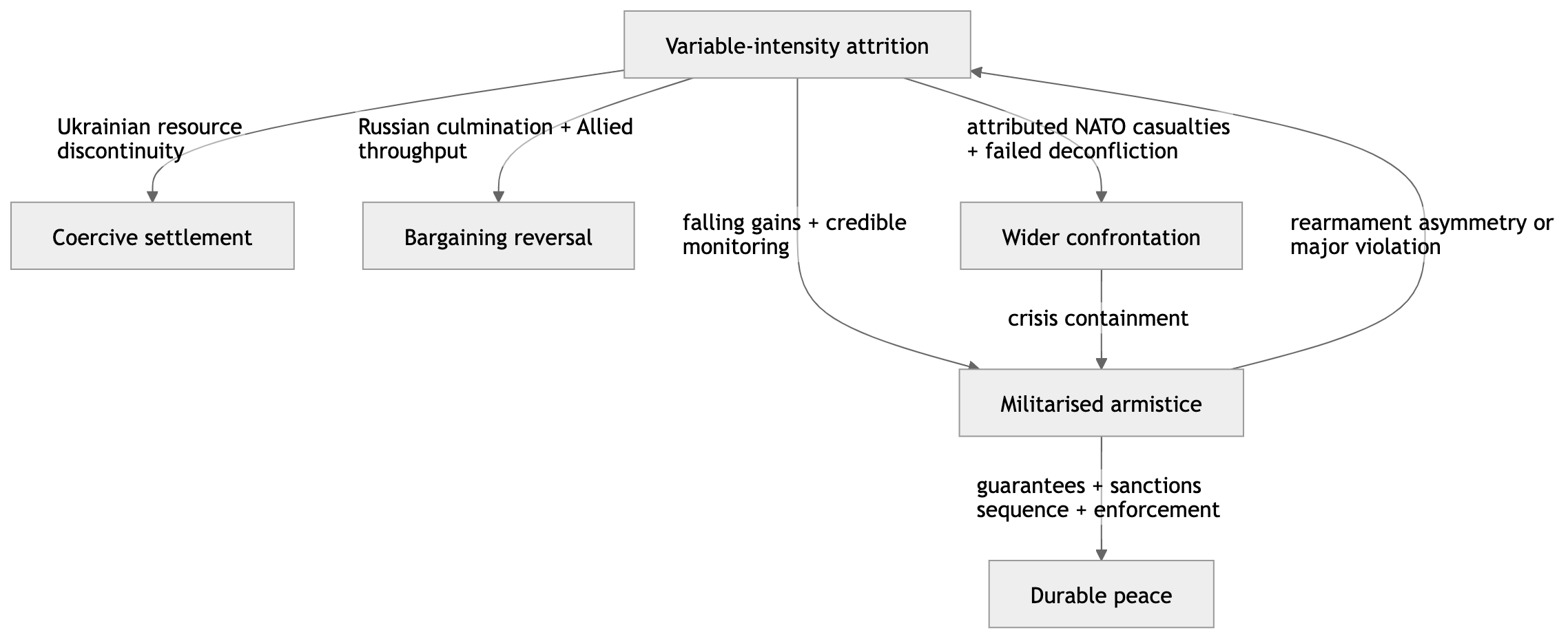
The warning architecture should distinguish capability, intent and trigger indicators. Capability indicators change slowly: Russian ammunition output, force-generation quality, availability of armoured reserves, missile inventories, access to foreign components, Ukrainian mobilisation, air-defence interceptor stocks and European production capacity. Intent indicators include changes in operational objectives, negotiating language, domestic legal preparation, force posture and elite messaging, although such signals remain vulnerable to deception. Trigger indicators change quickly and deserve continuous monitoring: attacks on rail or port nodes supporting Ukraine, interference with undersea infrastructure, mass exploitation of European routers, air or maritime encounters, sabotage with casualties, mobilisation orders and strategic-force dispersal. Western agencies reported in 2026 that Russian state-linked actors were targeting vulnerable network devices across global critical-infrastructure sectors—CISA Joins NSA, FBI, DC3 and International Partners in Warning of Russian Cyber Threat Activity – Cybersecurity and Infrastructure Security Agency – July 2026—and separately identified a Russian state-sponsored campaign targeting Western logistics and technology entities—Russian GRU Targeting Western Logistics Entities and Technology Companies – Cybersecurity and Infrastructure Security Agency – April 2026. These advisories support the judgment that logistics and infrastructure form part of the battlespace, but they do not establish that every incident is Kremlin-directed or that cyber operations necessarily precede conventional attack. Attribution confidence should rise only when technical indicators, infrastructure reuse, operational timing, target selection and intelligence reporting converge. The highest-value composite indicator is a coordinated campaign joining cyber reconnaissance, physical surveillance, influence preparation and military posture changes against the same logistics network; that pattern would indicate operational shaping rather than opportunistic espionage.
| Warning cluster | Observable indicators | Primary interpretation | Escalation threshold |
|---|---|---|---|
| Battlefield culmination | Falling Russian advance rate; higher equipment losses; reduced assault density; reserve redeployment | Opportunity for armistice or operational pause | Sustained across two campaigning cycles |
| Ukrainian discontinuity | Interceptor rationing; mobilisation failure; delayed European disbursement; widening force-density gaps | Higher probability of coercive settlement | Multiple critical shortages occurring simultaneously |
| Armistice preparation | Technical mapping, monitoring talks, prisoner exchanges, force-separation negotiations | Transition from political theatre to executable arrangement | Signed military annexes and enforcement provisions |
| Hybrid campaign | Logistics intrusion, sabotage surveillance, undersea incidents, influence synchronisation | Coercion below Article 5 or preparation for disruption | Attribution plus physical consequences across several states |
| Nuclear escalation | Force dispersal, command changes, readiness activity, continuity measures, crisis-channel degradation | Coercive alert or employment preparation | Correlated strategic, operational and political indicators |
| European cohesion stress | Funding delays, vetoes, procurement fragmentation, divergent rules on weapons use | Reduced Ukrainian endurance and alliance signalling credibility | Persistent failure to implement agreed commitments |
| Sanctions leakage | Shadow-fleet expansion, opaque ownership, crypto and intermediary-bank activity | Preserved Russian liquidity and procurement access | Leakage outpaces new enforcement capacity |
European exposure
European exposure is differentiated by geography, military function, industrial structure and political tolerance for sustained expenditure. The eastern flank bears the highest immediate kinetic and hybrid risk because it hosts forward forces, logistics corridors, air-policing missions and infrastructure within short range of Russian and Belarusian systems. Germany is Europe’s principal reinforcement and sustainment hub; disruption of rail networks, ports, command systems, energy supply or defence-industry inputs would impede theatre-wide movement even without a direct attack on frontline states. France and the United Kingdom supply disproportionate nuclear, intelligence, long-range-strike, command and coalition-building capacity; their greatest exposure lies in crisis leadership, nuclear signalling and the possibility that limited forward deployments become tripwires. Italy occupies a different but strategically important position: it connects the Mediterranean, Adriatic, Balkans and eastern-flank reinforcement architecture, commands the multinational NATO Forward Land Forces battlegroup in Bulgaria and contributes to collective defence in Latvia. The Italian-led Bulgarian formation includes personnel and equipment from several allied states—Fifth Force Generation Conference for NATO Forces in Bulgaria – Italian Ministry of Defence – July 2025—while Italy’s Latvia deployment forms part of NATO’s forward presence—Italian Contingent Change of Command in Latvia – Italian Ministry of Defence – 2025. Italy is therefore less exposed to immediate land attack than Poland or the Baltic states but highly relevant to reinforcement, air defence, maritime security and political cohesion. Its risk profile also includes covert Russian activity: Italian authorities reported identifying Russian agents operating against national institutions, companies and the industrial system—Tajani at the NATO–Ukraine Foreign Ministers’ Meeting – Italian Ministry of Foreign Affairs – July 2026.
| Actor | Principal exposure | Critical contribution | Structural vulnerability | Priority hedge through 2031 |
|---|---|---|---|---|
| Italy | Mediterranean–Black Sea spillover, sabotage, cyber pressure, eastern-flank commitments | Air defence, naval access, Bulgarian battlegroup leadership, industrial production | Fiscal constraints and geographically dispersed commitments | Integrated air defence, port resilience, counter-intelligence and ammunition capacity |
| France | Nuclear crisis management, forward-force exposure, industrial overstretch | Nuclear deterrence, command, deep strike, intelligence and expeditionary leadership | Simultaneous European and overseas obligations | Deterrence communication, stockpiles, drones, space and air defence |
| Germany | Logistics disruption, cyberattack, industrial coercion and reinforcement burden | Central sustainment hub, financing, air defence and manufacturing scale | Infrastructure bottlenecks and procurement execution risk | Military mobility, protected networks, rapid contracting and reserve development |
| United Kingdom | Undersea infrastructure, cyber operations, nuclear escalation and forward deployments | Nuclear forces, intelligence, submarines, long-range strike and coalition leadership | Force mass and inventory depth | Munitions, submarine readiness, homeland resilience and European interoperability |
| Eastern flank | Direct kinetic attack, border incidents, sabotage and electronic warfare | Territorial defence, host-nation support and early warning | Geographic proximity and compressed decision time | Dense air defence, dispersal, hardened logistics and civil preparedness |
| EU institutions | Fiscal fragmentation, veto risk, sanctions leakage and industrial competition | Long-term financing, procurement aggregation, sanctions and reconstruction | Implementation depends on member-state delivery | Common procurement, enforcement capacity and predictable multi-year financing |
National programmes improve the European balance but remain unevenly mature. France’s 2024–2030 Military Programming Law originally allocated approximately €413.3 billion and emphasised nuclear deterrence, intelligence, cyber capacity, high-intensity warfare and stockpile renewal—The 2024–2030 Military Programming Law: Major Orientations – French Ministry of the Armed Forces – 2023. Germany has declared an intention to reach 3.5% of GDP for core defence by 2029 and an additional 1.5% in defence-related infrastructure, cybersecurity and intelligence by 2035—A Start Has Been Made – German Federal Government – August 2025. The United Kingdom’s Strategic Defence Review 2025 commits the government to reach 2.5% of GDP by 2027 and sets an ambition for 3% during the following Parliament, subject to economic and fiscal conditions—The Strategic Defence Review 2025: Making Britain Safer – UK Government – June 2025. Italy’s parliamentary analysis of its defence programme identifies the development of a multidomain instrument and reports expenditure in both national-budget and NATO-accounting terms—Documento Programmatico Pluriennale per la Difesa 2024–2026 – Italian Chamber of Deputies – October 2024. Collectively, these plans can generate a stronger European pillar by 2030, but their deterrent value depends on usable formations, readiness, logistics and ammunition rather than headline appropriations. The dangerous interval is 2026–2028, when political commitments are substantial but several critical capabilities remain in procurement, production expansion or force-generation pipelines.
Shadow dimensions and strategic evolution
Sanctions circumvention, covert logistics, cyber operations and third-country financial intermediation form the shadow system sustaining Russian endurance. The European Union’s twenty-first sanctions package targeted more than one hundred banks and crypto operators, over forty shadow-fleet vessels, refineries and more than fifty military-industrial entities associated with long-range drone production—21st Package of Sanctions: EU Targets Russian Energy, Financial Services and Crypto – Council of the European Union – July 2026. The strategic question is not how many entities appear on a list, but whether enforcement raises the cost, delay, uncertainty and failure rate of transactions essential to military production. Warning metrics should therefore include vessel reflagging frequency, ownership-chain complexity, port-service denial, refinery utilisation, insurance access, intermediary-bank exposure, crypto liquidity, component lead times and the substitution rate for machine tools and electronics. The EU itself describes shadow-fleet methods including disabled tracking, false flags and complex ownership structures—EU Sanctions Against Russia: Questions and Answers – Council of the European Union – August 2026. Mercenary and foreign-force dynamics require parallel scrutiny: North Korean combat experience and support to Russia, identified by the US intelligence community, may provide Moscow with manpower, munitions and adaptation benefits while transferring modern warfare experience to Pyongyang. Cyber activity should be modelled as a variable-cost coercive instrument, not merely preparatory fires: Moscow can impose economic friction, demonstrate access, collect intelligence and generate political fear without crossing a clear armed-attack threshold. China remains the largest strategic uncertainty in this shadow architecture. Beijing advocates negotiation and opposes unilateral sanctions lacking UN Security Council authorisation—Foreign Ministry Spokesperson’s Regular Press Conference – Ministry of Foreign Affairs of the People’s Republic of China – December 2025—creating space for continued Sino-Russian economic interaction even while China avoids formally underwriting Russian war aims.
The year-by-year evolution is consequently nonlinear. During late 2026 and 2027, attrition remains the modal operating condition because both sides retain reasons to test whether new resources can change the bargaining frontier: Russia can exploit existing battlefield leverage, while Ukraine and its partners can await the conversion of European finance into fielded capability. During 2028, the outlook bifurcates. If European industrial throughput, Ukrainian force regeneration and air defence stabilise while Russian marginal gains contract, a monitored armistice becomes increasingly rational for Moscow; if support delivery fragments or Ukrainian manpower deteriorates, coercive settlement risk rises sharply. By 2029–2030, European rearmament should become more operationally visible, particularly through air defence, ammunition, logistics, intelligence and infrastructure, but fiscal and political trade-offs also intensify as temporary spending measures become recurrent obligations. The armistice probability therefore rises over time, yet so does cumulative crisis exposure: stronger European forces improve deterrence while placing additional assets, personnel and decision-makers inside potential Russian coercive reach. By 2031, a durable peace becomes more plausible than in 2026 only if an earlier armistice survives repeated violations and develops institutions for enforcement, reconstruction and sanctions sequencing. The alternative is not necessarily renewed full-scale invasion. It may be an unstable “armed peace” characterised by drone incidents, maritime pressure, cyber operations, political interference, sanctions evasion and episodic missile alerts. The decisive analytical error would be to classify such a condition as resolved merely because daily battlefield casualties decline. A ceasefire can reduce human losses and still preserve the strategic mechanisms that reproduce war.
The final net assessment assigns 67% combined probability to either continuing attrition or a militarised armistice at the end of the principal bargaining phase, compared with 12% for sustained wider confrontation and 11% for durable peace by 2031. These figures should be revised quarterly against a disciplined indicator set rather than defended as static predictions. The probability of armistice should rise materially if Russian territorial gains remain negligible for two campaigning seasons, Ukrainian resupply becomes predictable through at least 2028, technical ceasefire negotiations address air and maritime operations, and Moscow accepts monitoring with enforceable consequences. The probability of coercive settlement should rise if Ukrainian air-defence coverage, mobilisation or external funding suffers simultaneous discontinuity. The probability of wider confrontation should increase sharply only when hybrid activity converges with military posture and attributable casualties, especially if crisis communications degrade. A serious European strategy must therefore pursue three objectives concurrently: deny Moscow a plausible path to military or political victory; build an executable armistice architecture before a crisis creates an improvised one; and harden European societies against the hybrid coercion likely to continue after firing declines. Deterrence without diplomacy leaves escalation unmanaged, while diplomacy without denial rewards the expectation that additional pressure improves Russian terms. The most likely future lies between those poles: a long contest ending not in reconciliation but in a heavily armed, externally supported and periodically tested cessation regime. Whether that regime becomes durable peace or merely the operational preparation period for another war will depend less on summit declarations than on verification, enforceability, Ukrainian defensive viability and the speed with which Europe converts financial commitments into persistent military power.
Figure 1: 2026–2031 Strategic-State Projection
Monte Carlo state occupancy; percentages represent modeled scenario share, not observed frequencies.


