













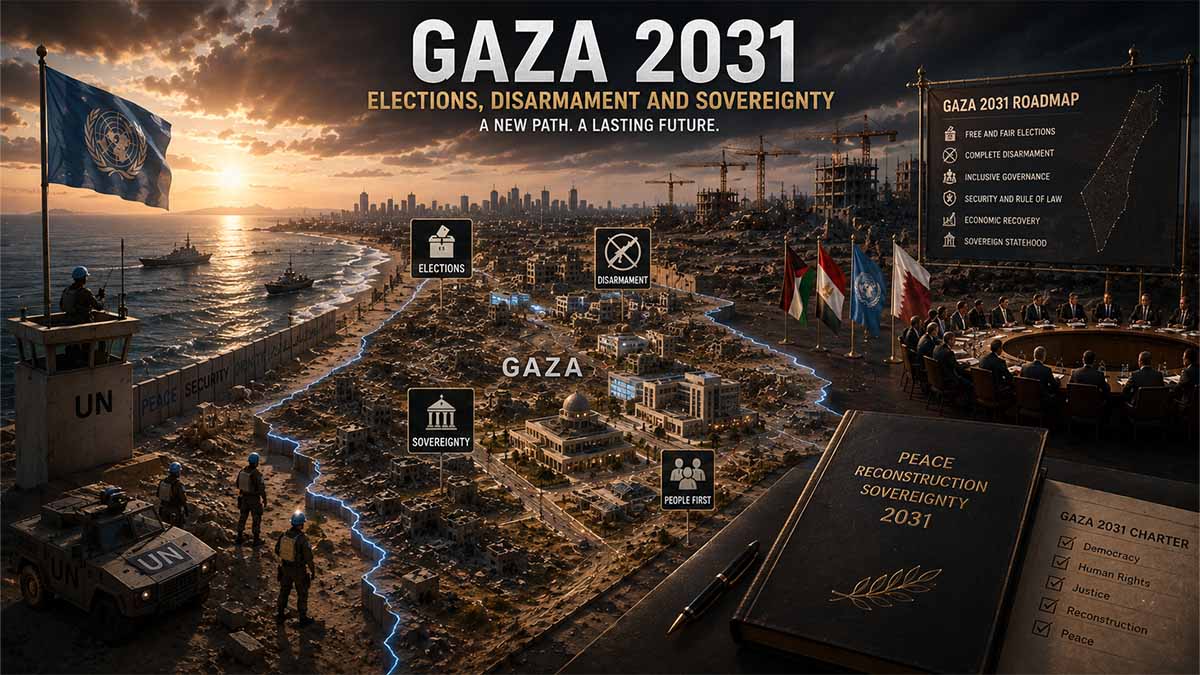
Executive Summary
- BLUF: the 28 November vote can renew Palestinian representation, but it cannot by itself determine who exercises coercive, fiscal and administrative power in Gaza.
- The election decree covers Jerusalem, the West Bank and Gaza; Gaza’s voting mechanism, however, has not yet been published.
- The amended law requires every list and candidate to recognize the PLO, its political programme and relevant international resolutions—an eligibility test capable of excluding Hamas and other resistance factions.
- Gaza’s immediate post-war authority is presently structured around the NCAG, the Board of Peace, Palestinian police and a projected International Stabilization Force, not the incoming Legislative Council.
- The decisive contest is therefore between electoral legitimacy, externally supervised transition, Israeli security control and the residual coercive power of Hamas.
- A 200,000-draw Monte Carlo stress test assigns the highest baseline likelihood to a technocratic bridge toward the PA, but places combined fragmentation and renewed-conflict outcomes close behind.
- Five-year judgment: without an inclusive vote, verified reciprocal security steps, Israeli withdrawal and restored PA liquidity, Gaza risks acquiring an elected Palestinian legislature alongside a separate, externally conditioned governing architecture.
Gaza 2031: The Battle for Electoral Sovereignty
Gaza’s post-war order will be determined by who controls the ballot, budget, police and transfer of emergency authority into accountable Palestinian institutions. A legislative election is scheduled for 28 November 2026, while a technocratic administration, stabilisation force and financing system are being assembled around a territory where sovereignty remains contested. The question is larger than whether Palestinians vote: can an elected legislature exercise authority in Gaza, can disarmament be matched by withdrawal, and will reconstruction unify Palestinian government or entrench external supervision? Between now and 2031, those choices will define Gaza’s connection to the West Bank and any credible two-State horizon.
The Ballot and the State
On 12 August 2026, the Palestinian Central Elections Commission confirmed that the amended framework restored the Legislative Council to 132 seats, required women to hold at least 33 per cent of places on candidate lists, set a 1 per cent threshold and lowered the candidacy age to 23. It also retained a politically decisive condition: lists must recognise the Palestine Liberation Organization as the Palestinian people’s sole legitimate representative and commit to its political and national platforms and relevant international resolutions. “Special procedures” were consolidated for Gaza, comparable to those used for Jerusalem, while preparations continued for the vote scheduled on 28 November 2026. Central Elections Commission, 12 August 2026.
The provisions expose a constitutional dilemma. The PLO condition protects the recognised Palestinian framework but can exclude organisations rejecting its commitments. Gaza’s participation is more consequential: candidates must campaign, voters must reach polling arrangements, observers must operate and remedies must be enforceable. Symbolic participation could produce a formally valid result without authority over Gaza. Electoral sovereignty exists only when the result commands institutions and territory.
The Transitional Machine
The alternative source of authority is already taking shape. On 16 January 2026, the White House named Ali Sha’ath to lead the National Committee for the Administration of Gaza, or NCAG, responsible for restoring services and rebuilding civil institutions. Nickolay Mladenov was designated High Representative for Gaza, linking the committee to the Board of Peace, while Major General Jasper Jeffers was appointed commander of the International Stabilization Force. White House, 16 January 2026. The Board of Peace’s report to the Security Council, document S/2026/418 of 15 May 2026, states that the NCAG held its inaugural meeting in Cairo on 15 January 2026 and was conceived as a Palestinian technocratic body responsible for Gaza’s civil administration until the Palestinian Authority completes its reform programme. As of 15 May 2026, it had not entered areas remaining under Hamas’s armed control. Report S/2026/418, 15 May 2026.
The architecture addresses an administrative vacuum but creates a political problem. Technocratic legitimacy derives from performance, donor confidence and international recognition; legislative legitimacy derives from representation. Without a defined relationship, Gaza could acquire two chains of authority—one controlling political mandates, another controlling contracts, payrolls and reconstruction capital. The safeguard is a published transfer mechanism covering personnel, assets, registries, policing and budgets.
The Security Bargain
Security sequencing is the hinge between administration and sovereignty. S/2026/418 describes a 15-point roadmap making the NCAG the sole transitional authority, ending Hamas’s military, policing and administrative role and excluding armed factions from government. Weapons and military infrastructure would be decommissioned under international verification; the stabilisation force would support custody and humanitarian operations; Israeli forces would withdraw in phases as verification advanced; reconstruction would begin in certified areas. As of 15 May 2026, the roadmap was not finalised.
The mechanism is reciprocal on paper but vulnerable to asymmetric execution. Disarmament without a verified withdrawal schedule would remove Palestinian armed leverage before territorial control changes; withdrawal without enforceable decommissioning would leave Israel arguing that the threat survives. The European Council therefore placed three requirements in one package on 19 June 2026: permanent disarmament of Hamas and other non-State armed groups, full Israeli withdrawal and deployment of a temporary International Stabilisation Force. It also rejected Israel’s announced intention to control 70 per cent of Gaza. European Council conclusions, EUCO 8/26, 19 June 2026. Israel’s stated endpoint is narrower. On 29 September 2025, Prime Minister Benjamin Netanyahu said Israel would retain security responsibility and a perimeter “for the foreseeable future” and that Gaza should be administered by neither Hamas nor the Palestinian Authority. Ministry of Foreign Affairs of Israel, 29 September 2025. The disagreement concerns whether security guarantees enable Palestinian sovereignty or indefinitely qualify it.
Reconstruction as Constitution
Governance will be negotiated through finance as much as diplomacy. On 25 November 2025, the World Bank stated that recovery and reconstruction requirements exceeded USD 67 billion. Its Gaza Reconstruction and Development Fund is designed as a Financial Intermediary Fund capitalised by donors, but the Bank’s role is limited to managing inflows and outflows on instructions from an internationally recognised legal entity. That entity—not the World Bank—governs resources after transfer. World Bank, 25 November 2025. S/2026/418 later reported a ten-year requirement of USD 71.4 billion and USD 17 billion in pledges during its reporting period, while emphasising the gap between pledges and disbursement.
Whoever approves projects, registers beneficiaries, awards contracts, controls land records and pays civil servants will shape Gaza’s political economy. International supervision can protect funds; detached from a unified Palestinian budget, it can also institutionalise separation. The European Council linked reconstruction to PA reform, eventual PA control, clearance revenues and correspondent banking. On 20 November 2025, Palestinian Prime Minister Mohammad Mustafa likewise called for reconstruction within one governance framework joining Gaza, the West Bank and East Jerusalem. Palestinian Prime Minister’s Office, 20 November 2025. Finance will function as a constitutional instrument.
The International Divide
External actors reject a return to the pre-war order but differ over the final authority. Washington places the Board of Peace, NCAG and stabilisation force at the centre of transition. Israel conditions withdrawal on demilitarisation and rejects an unreformed PA. The European Union accepts the transitional framework while specifying full withdrawal and a reformed PA’s return. China remains anchored in “Palestinians governing Palestine”: on 23 July 2024, Foreign Minister Wang Yi witnessed the Beijing Declaration signed by 14 Palestinian factions, affirming the PLO as sole legitimate representative and supporting an interim national reconciliation government for reconstruction. Ministry of Foreign Affairs of the People’s Republic of China, 23 July 2024.
These differences will shape recognition, funding and diplomatic protection. Efficiency without Palestinian consent risks making provisional government operationally permanent; domestic legitimacy without security and fiduciary credibility may not obtain the access or capital needed to govern. The viable intersection is narrow: electoral authorisation, lawful force, reciprocal withdrawal, audited finance and a time-bound constitutional transition.
Five Years of Decision
Five pathways lead toward 2031: sovereign integration through elections, NCAG-to-PA transfer, fiscal unity, verified disarmament and withdrawal; a technocratic order in which international supervision outlives its mandate; fragmentation among reconstruction zones, Israeli security areas, factional enclaves and West Bank institutions; coercive breakdown through ceasefire failure and electoral postponement; or a Palestinian compact revising representation and security arrangements before reunification.
No defensible primary-source model assigns reliable probabilities to these outcomes. The decisive indicators are observable: whether Gaza participates fully on 28 November 2026; whether results are accepted and enforceable; whether NCAG personnel operate throughout the Strip; whether weapons enter verified custody matched to a dated withdrawal sequence; whether pledges become audited disbursements; and whether Gaza’s payroll, procurement and revenues enter one Palestinian fiscal architecture. Convergence would make the transition a route to sovereignty. Continued separation would make “temporary administration” the language through which division is normalised.
The Cost of Ambiguity
The central danger is not simply that one faction wins or loses. It is that elections, security and reconstruction proceed on separate tracks, each claiming legitimacy but none producing a state. A ballot without Gaza would deepen the representation crisis. Disarmament without reciprocal withdrawal would undermine verification. Reconstruction without fiscal reunification would build infrastructure while hardening political separation. International supervision without a binding transfer date would convert emergency government into an enduring constitutional fact.
The test is measurable. Palestinian leaders must reconcile competition with one legal order. Hamas must decide whether participation can replace autonomous force. Israel must decide whether security arrangements culminate in withdrawal or permanent control. Donors must ensure accountability prepares Palestinian ownership rather than bypassing it. The NCAG must prove that the capacity it builds can be transferred. By 2031, Gaza will be judged by whether authority, territory, finance and consent have been brought under one accountable political system.
Navigational Index
- Electoral sovereignty — eligibility rules, Gaza participation, legitimacy and institutional integrity.
- Post-war command architecture — NCAG, PA, Hamas, Israel, international supervision and reconstruction finance.
- Five-year outlook — five competing hypotheses, Bayesian updates, Monte Carlo distribution and early-warning indicators.
Master Abstract
Pillar I — An election whose electorate and permissible politics remain unsettled
The starting point is legally unambiguous but operationally incomplete. On 9 July 2026, President Mahmoud Abbas called Palestinians in Jerusalem, the West Bank and Gaza to elect a 132-member Palestinian Legislative Council on 28 November 2026. Decree-Law Concerning the Call for Conducting Legislative Elections – Central Elections Commission–Palestine – July 2026 — official decree. The more consequential intervention came on 6 August, when a further decree cancelled Decree-Law No. 10, thereby reversing the temporary expansion of the Council to 200 seats, reduced the electoral threshold to 1%, strengthened the minimum placement of women on electoral lists and required nomination files to contain declarations recognizing the PLO as the sole legitimate representative of the Palestinian people, its national and political platforms, and relevant international resolutions. The same recognition requirement was inserted into individual candidate eligibility. Decree-Law concerning the amendment of Decree-Law No. 1 of 2007 concerning General Elections and its amendments – Central Elections Commission–Palestine – August 2026 — official amended law. This is not a generic constitutional oath: it creates a substantive political-compatibility test whose enforcement by the CEC and Election Cases Court could determine whether Hamas-linked candidates, Palestinian Islamic Jihad or lists refusing the PLO’s diplomatic programme can appear on the ballot. The asymmetry is compounded territorially. The CEC recorded 1,588,294 West Bank voters as of 24 January, while declaring that Gazans and Jerusalem-ID holders require no new registration and that their candidacy and polling rights are preserved; nevertheless, their participation procedures will be announced only later. Registration Stage: 2026 Legislative Elections – Central Elections Commission–Palestine – August 2026 — official registration rules. A forensic warning is necessary: the CEC’s public dashboard simultaneously displays a nomination window beginning on 26 September and already-populated fields for nominated lists, candidates, polling and observation. Those future-state entries cannot be treated as verified current results. Facts & Figures: 2026 Legislative Elections – Central Elections Commission–Palestine – August 2026 — official electoral dashboard. The vote therefore begins with a three-part legitimacy problem: uncertainty over who may compete, uncertainty over how Gaza will vote, and uncertainty over whether an institution elected under occupation can convert ballots into enforceable authority.
Pillar II — Gaza is already governed by a transitional chain outside the ballot box
The central analytical error would be to equate victory in the Legislative Council with control over Gaza. The emerging post-war order separates representative legitimacy from the command of borders, police, weapons, reconstruction finance and territorial access. At the Security Council on 21 May 2026, UN Deputy Special Coordinator Ramiz Alakbarov described an interconnected sequence involving the disarmament of Hamas and other armed groups, Israeli withdrawal, deployment of an International Stabilization Force and assumption of transitional responsibilities by the National Committee for the Administration of Gaza, coordinated with the PA. High Representative Nickolay Mladenov described the Board of Peace as the supervisory authority for governance and reconstruction until a reformed PA can resume responsibility; the NCAG would administer civilian functions, Palestinian police would police Gaza, and the stabilization force would buffer, protect humanitarian operations and support verified decommissioning. The Situation in the Middle East, including the Palestinian Question, S/PV.10155 – United Nations Security Council – May 2026 — official verbatim record. Washington separately identified Dr Ali Sha’ath as NCAG leader, Mladenov as the connection between the Board and the committee, and Major General Jasper Jeffers as commander of the projected stabilization force. Statement on President Trump’s Comprehensive Plan to End the Gaza Conflict – White House – January 2026 — official statement. These arrangements create a potential constitutional collision: an elected PLC could claim a national mandate while Gaza’s actual administrative, security and investment decisions remain subject to a transitional chain not elected by Palestinians. International positions do not resolve that collision. The European Council supports permanent Hamas disarmament, Israeli withdrawal, the stabilization force and a reformed PA’s return to effective control. EU Position on the Situation in the Middle East – Council of the European Union – June 2026 — official policy record. China and Jordan insist that any arrangement preserve “Palestinians governing Palestine,” West Bank–Gaza unity and conditions for the PA’s return. Joint Statement on Deepening the China–Jordan Strategic Partnership – Government of the People’s Republic of China – August 2026 — official Chinese text. Within the same UN record, France rejected a future Hamas governing role but opposed conditioning civilian recovery on completed disarmament, while Russia characterized the transition plan as largely unimplemented and insufficiently anchored to Palestinian statehood. The election is consequently not merely a contest between Fatah and Hamas. It is a referendum conducted inside an unresolved struggle over whether sovereignty will descend from Palestinian representation or be released incrementally through an externally verified security architecture.
Pillar III — Five competing hypotheses and the 2026–2031 decision corridor
The five-year estimate uses Analysis of Competing Hypotheses, Bayesian updating and a 200,000-draw Monte Carlo model rather than a single deterministic forecast. Six uncertain drivers were represented through bounded beta distributions: electoral inclusion, verified factional disarmament, Israeli withdrawal, PA fiscal-administrative capacity, external coordination and occupation-related obstruction. Scenario selection incorporated additional uncertainty so that small changes in assumptions did not generate artificial certainty. The baseline distribution as of 27 August 2026 is: H₁—elected PA reintegration, 22%; H₂—technocratic bridge followed by PA absorption, 29%; H₃—durable institutional bifurcation, 17%; H₄—formal civilian administration with Hamas retaining shadow coercive power, 14%; and H₅—renewed war or prolonged direct Israeli security control, 18%. These are structured judgments, not official statistics. During late 2026, the most discriminating evidence will be the acceptance or rejection of candidate lists, publication of a credible Gaza voting mechanism, Israeli treatment of candidates and campaigning, and whether factions accept the result before knowing it. Between 2027 and 2028, the pivotal variables shift from ballots to command: entry of the NCAG, formation and vetting of Palestinian police, verified weapons decommissioning, Israeli territorial withdrawal, access to crossings and the legal relationship between the PLC, PA government and transitional authorities. From 2029 to 2031, the decisive test becomes institutional absorption: whether Gaza’s budget, civil service, judiciary, policing and reconstruction procurement are integrated into one Palestinian system or crystallize into a donor-funded enclave. Liquidity is a strategic variable, not an economic footnote. The European Commission records chronic PA fiscal stress, wage arrears, 78% Gaza unemployment in 2025, severe territorial fragmentation and an EU objective of reintegrating the Gaza and West Bank administrations. Annex I to the Commission Implementing Decision on Financing Support for Palestine – European Commission – May 2026 — official programme document. Shadow indicators must therefore track armed payrolls, informal taxation, reconstruction-contract patronage, private-security recruitment, diversion networks, correspondent-banking continuity, spoofed electoral communications and cyber interference with voter or beneficiary registries. H₂ rises if the NCAG enters Gaza, police deploy, withdrawal proceeds and the committee accepts a time-limited transfer clause. H₁ overtakes it only if elections are inclusive and their outcome binds the executive transition. H₄ rises if Hamas relinquishes visible ministries but preserves weapons, intelligence and revenue networks. H₃ rises if elections occur without Gaza-wide administrative integration. H₅ becomes dominant if ceasefire violations, territorial control and failed decommissioning reinforce one another. The strategic conclusion is surgical: the ballot can confer legitimacy, but only a negotiated merger of electoral authority, coercive control and reconstruction finance can produce a government.
Bayesian stress test · horizon 2026–2031
Who governs Gaza after the war?
Adjust the six observable drivers. Scenario shares re-normalize dynamically; they are structured estimates, not official forecasts.
Observable drivers
Competing hypotheses
Model architecture: six bounded drivers, five competing-hypothesis scores, softmax normalization. The baseline reflects evidence available on 27 August 2026; moving a slider is a sensitivity test, not a prediction.
Electoral Sovereignty: Gaza, Eligibility and Legitimacy
Electoral sovereignty in the Palestinian context cannot be reduced to the mechanical act of counting ballots because the authority calling the election does not exercise uncontested territorial control, the eligibility framework embeds political-recognition conditions, and Gaza’s post-war administrative chain may remain institutionally separate from the elected legislature. The foundational instrument nevertheless defines an encompassing electorate: the presidential decree invites Palestinians in Jerusalem, the West Bank, and the Gaza Strip to elect a 132-seat Palestinian Legislative Council on 28 November 2026, while assigning preparation, supervision, and oversight to the Central Elections Commission. Decree-Law Concerning the Call for Conducting Legislative Elections – President of the State of Palestine and Central Elections Commission – July 2026 — verified official decree. This establishes formal territorial unity but does not establish operational equality among the three constituencies: registration has occurred principally through West Bank institutions, Jerusalem participation remains dependent on an undeclared mechanism and external access, and Gaza participation depends on security, civil-registry reconstruction, communications, observation, and physical custody arrangements that the CEC has not yet published. Electoral sovereignty should therefore be decomposed into four necessary and jointly insufficient layers: juridical sovereignty, meaning the authority to define the electorate and qualifications; operational sovereignty, meaning the ability to administer equal voting conditions; decisional sovereignty, meaning the freedom of electors to choose among materially different programmes; and consequential sovereignty, meaning the capacity of the elected institution to translate its mandate into appointments, budgets, legislation, and territorial administration. The November process may satisfy the first layer while failing the other three. Its decisive test will not be whether ballot papers exist, but whether Gazans can vote under substantively equivalent conditions, whether excluded political currents can obtain timely and effective review, and whether the resulting legislature possesses authority over the institutions that actually govern Gaza.
| Sovereignty layer | Verified legal or administrative position | Principal integrity deficit | Decisive evidence required |
|---|---|---|---|
| Juridical | Jerusalem, West Bank and Gaza are formally included | Eligibility requires political declarations beyond ordinary administrative qualifications | Published, reasoned CEC and judicial decisions applying the declaration requirement consistently |
| Operational | CEC may employ measures it considers appropriate in Jerusalem and Gaza | Gaza and Jerusalem procedures remain unpublished | Polling map, registry protocol, observation plan, custody chain and contingency rules |
| Decisional | Nationwide proportional competition with a 1% threshold | Political-recognition condition can narrow the permissible policy spectrum | Admission of lists representing materially divergent programmes |
| Consequential | Election produces a Palestinian Legislative Council | Post-war Gaza bodies may answer to external or transitional authorities | Binding transfer timetable covering personnel, revenue, policing, reconstruction and audit authority |
| Temporal | Election date and compressed appeal periods are fixed | Late rules or access failures may leave no meaningful remedy | Publication of rules before candidacy and adjudication before campaigning begins |
The eligibility architecture constitutes the most consequential internal constraint. The August amendment sets the list threshold at 1%, lowers the candidate age to 23, requires one woman among the first three names and one among every subsequent three, provides limited cure periods for defective applications, and deems a nomination accepted when the CEC fails to decide within the statutory interval. These provisions lower entry barriers in some dimensions and strengthen gender representation, but Articles 39, 45, and 50 simultaneously require nomination documents or candidates to recognize the PLO as the sole legitimate representative of the Palestinian people, its national and political platforms, and relevant international resolutions. Decree-Law Amending the General Elections Law – President of the State of Palestine and Central Elections Commission – August 2026 — verified official amendment. Recognition of a constitutional order is not inherently incompatible with democratic candidacy; many systems require fidelity to constitutional rules. The risk arises from the breadth and indeterminacy of “national and political platforms” and “relevant international resolutions,” whose boundaries, authoritative versions, temporal scope, and enforcement standards are not specified in the amendment. A narrowly construed declaration could mean acceptance of the PLO’s representational status while preserving the right to contest its strategy. A maximalist construction could operate as an ideological licensing rule that excludes lists rejecting existing diplomatic commitments, security coordination, recognition formulas, or the PLO’s current institutional distribution of power. The distinction is analytically decisive: a constitutional loyalty requirement regulates conduct within the electoral order, while a programme-conformity test predetermines which political alternatives electors may choose. Because the same executive authority presiding over the PLO promulgated the condition, opponents can plausibly characterize it as incumbent-controlled boundary setting even if the CEC applies it professionally. Institutional integrity consequently requires published interpretive criteria, identical evidentiary standards, reasoned rejection decisions, disclosure of all cure notices, and review by an election court capable of granting effective relief before the campaign becomes irreversible.
Gaza participation is the operational fulcrum because the CEC has formally preserved the candidacy and voting rights of Gaza residents while exempting them from the August registration exercise, stating that it will announce their participation mechanisms later. Registration Stage for the 2026 Legislative Elections – Central Elections Commission Palestine – August 2026 — verified official registration record. This exemption avoids disfranchising people unable to access ordinary registration centres, but it also transfers an unusually large amount of substantive law into future administrative discretion. Article 115 authorizes the CEC to prepare records for Jerusalem and Gaza and to use any measures or means it considers appropriate; the same provision declares that election law should apply there as in other Palestinian districts. Decree-Law Amending the General Elections Law – President of the State of Palestine and Central Elections Commission – August 2026 — verified territorial-participation provision. Equality cannot be inferred from that declaration. A defensible Gaza operation needs a reconstructable voter-register baseline, a transparent method for resolving deaths, displacement, duplicate identities, destroyed records, inaccessible addresses, and voters residing outside their original locality; it also requires list-agent access, domestic and international observation, ballot secrecy, accessible voting, auditable transmission, and a custody chain insulated from every armed or transitional authority. Remote, mobile, early, or consolidated-centre voting can expand access but changes the attack surface: remote systems create authentication and coercion risks, mobile teams complicate custody, consolidated centres impose travel burdens, and early voting extends the period during which materials require protection. No mechanism is intrinsically legitimate without public threat modeling and equivalent safeguards. The minimum credible publication package should include the eligible-population denominator, centre-level capacity, displacement rules, rejected-record counts, incident logs, reconciliation formulas, cryptographic hashes for published result files, and an explicit threshold determining when localized failure requires reruns rather than extrapolation or exclusion.
| Gaza integrity domain | Failure mode | Observable warning indicator | Minimum mitigation |
|---|---|---|---|
| Registry | Deceased, duplicated, displaced or inaccessible voters remain unresolved | Large unexplained gap between eligible population and issued credentials | Audited derivation rules, objections process and versioned registry |
| Access | Nominal inclusion but insufficient safe polling capacity | Centre allocation materially below expected turnout demand | Capacity model, transport plan, mobile contingencies and extended voting |
| Secrecy | Family, factional, security or aid-linked coercion | Abnormally concentrated assisted voting or synchronized results | Private marking, assistance logs and randomized observation |
| Custody | Ballots or result protocols pass through partisan control | Missing seals, unmatched forms or transmission gaps | Dual-control custody, serialized seals and public reconciliation |
| Observation | Security rules exclude independent scrutiny | Observer deployment materially below territorial coverage | Accreditation guarantees, remote evidence channels and incident publication |
| Remedy | Complaints cannot be investigated before certification | Appeals dismissed because evidence arrived after compressed deadlines | Emergency preservation orders and centre-level evidentiary access |
| Consequence | Elected members cannot exercise Gaza authority | Transitional administrators remain outside legislative budget and audit control | Public transfer compact with deadlines and enforceable reporting |
Institutional integrity must also be judged through the quality of the CEC’s own information environment. The official facts page reports 1,588,294 registered West Bank voters, 132 council seats, the November polling date, registration on 15–19 August, objections on 7–9 September, candidacy on 26 September–7 October, campaigning on 6–26 November, and preliminary results on 29 November. Facts and Figures: 2026 Legislative Elections – Central Elections Commission Palestine – August 2026 — verified official electoral dashboard. Yet the same page, marked as updated on 19 August and identifying candidacy as a future stage, displays 15 nominated lists, 735 candidates, candidate demographics, and completed accreditation figures. Those fields cannot be treated as evidence of actual 2026 nominations because the official timeline states that nominations will not begin until late September. They appear to be template, prospective, test, inherited, or prematurely populated data; the precise cause is unverified. This is not a cosmetic defect. Election dashboards function as authoritative public ledgers, and unexplained future-stage values can contaminate media reporting, confuse stakeholders about application status, and create later disputes over whether statistics were altered. The registration page separately states 8:00–14:00 working hours in its summary and 9:00–14:00 in its detailed regulations, demonstrating a smaller but similar problem of internal inconsistency. Institutional repair requires timestamped dataset versions, stage-dependent suppression of unvalidated fields, provenance labels, correction logs, machine-readable exports, and signed publication records. These controls would not establish political neutrality, but they would allow parties and observers to distinguish official decisions from web-template content. Until corrected, the dashboard supports confidence in the broad calendar and West Bank registry totals while reducing confidence in stage-specific transparency; none of its candidate or accreditation figures should enter a serious intelligence baseline.
Historical evidence indicates that technical competence can coexist with constrained sovereignty. The European Union Election Observation Mission assessed the 2006 legislative contest as open, fairly contested, and efficiently administered by a professional and independent CEC; it reported turnout above 78%, broad acceptance of the results, and a voter register generally regarded as accurate and inclusive. It simultaneously found that occupation restricted movement, assembly, campaigning, and the development of democratic institutions; approximately 130,000 eligible East Jerusalem Palestinians could not undergo ordinary registration, the eventual voting arrangements there were late and unequal, and campaign restrictions included arrests and excessive fines. West Bank and Gaza Strip Palestinian Legislative Council Elections: Final Report – European Union Election Observation Mission – February 2006 — verified official EU report. This record supplies two base-rate corrections. First, logistical adversity does not prove that credible administration is impossible: a capable CEC, competitive candidate field, agents, observers, transparent counting, and acceptance by losing parties can preserve substantial procedural legitimacy. Second, procedural quality does not erase structural coercion: an election can be competently run yet remain territorially unequal and externally dependent. The 2026 problem is more severe because Gaza’s participation mechanism is not merely restricted; it remains unspecified, while its post-war governing apparatus may operate through a separate transitional hierarchy. East Jerusalem is therefore an early-warning jurisdiction. If campaigning, candidacy, observation, and voting there are again treated as late diplomatic concessions rather than enforceable rights, that pattern will signal that territorial inclusiveness is subordinate to external veto. A cancellation justified by Jerusalem could repeat the logic of 2021; proceeding without meaningful Jerusalem or Gaza participation could instead produce a formally national but substantively West Bank-centred legislature. The appropriate integrity test is not perfection under occupation but whether each unavoidable deviation is necessary, proportionate, published, contestable, and prevented from systematically benefiting one political bloc.
External recognition creates a second electorate composed not of citizens but of governments, donors, security sponsors, and reconstruction authorities. The European Council supports a reformed Palestinian Authority taking effective control of Gaza, permanent disarmament of Hamas and other non-state armed groups, Israeli withdrawal, and deployment of a temporary international stabilization force; it also identifies release of withheld clearance revenues and continued correspondent banking as necessary to the PA’s functioning. European Council Conclusions, 18–19 June 2026 – European Council – June 2026 — verified official conclusions. The United States has separately presented the National Committee for the Administration of Gaza, led by Ali Sha’ath, as responsible for restoring services and civil institutions under a Board of Peace, a High Representative, and an International Stabilization Force. Statement on President Trump’s Comprehensive Plan to End the Gaza Conflict – The White House – January 2026 — verified official statement. China’s official position emphasizes “Palestinians governing Palestine,” preservation of West Bank–Gaza unity, and preparation for the PA to resume its functions. Joint Statement on Deepening the China–Jordan Strategic Partnership – Ministry of Foreign Affairs of the People’s Republic of China – August 2026 — verified official Chinese text. Its earlier Beijing framework supported an interim national-consensus government formed by Palestinian factions to exercise effective control over both territories. Palestinian Factions Sign the Beijing Declaration on Ending Division and Strengthening Palestinian National Unity – Ministry of Foreign Affairs of the People’s Republic of China – July 2024 — verified official Chinese text. These are competing recognition technologies: the Western model privileges reform, disarmament, technocracy, and externally supervised stabilization; the Chinese model privileges factional inclusion, territorial unity, and negotiated Palestinian consensus. Russian-language official sources on .ru domains were checked, but the relevant Russian Foreign Ministry endpoints returned server errors during live verification; their links and associated claims are therefore deliberately omitted.
| Recognition regime | Preferred locus of authority | Electoral implication | Five-year legitimacy risk |
|---|---|---|---|
| PA–PLO legal order | Elected PLC within PLO-recognition boundaries | Formal continuity but constrained ideological entry | Elections renew institutions without fully opening political competition |
| US transitional order | NCAG, Board of Peace, High Representative and stabilization force | Ballot may not control Gaza’s immediate executive chain | Representation and governing power diverge |
| EU reform-security order | Reformed PA return after disarmament and stabilization | Recognition may depend on security and reform conditions beyond vote totals | External conditionality overrides or delays electoral consequences |
| Chinese consensus order | Palestinian factional accommodation and unified interim government | Favors inclusion and territorial integration before or alongside elections | Consensus bargaining may postpone competitive accountability |
| Israeli access and security power | Control over movement, crossings, Jerusalem access and territorial security | Can shape who campaigns, votes, observes and takes office | External veto becomes embedded in electoral administration |
| Donor-liquidity network | Clearance revenues, correspondent banking and reconstruction finance | Determines whether elected institutions can pay staff and implement budgets | Fiscal recognition becomes a substitute for constitutional authority |
The structured analytic assessment uses five competing hypotheses rather than a binary held-or-cancelled forecast. H₁ is an inclusive, territorially credible election followed by progressive integration of Gaza into elected institutions. H₂ is a technically orderly but politically filtered election whose PLO-recognition condition limits competition while external actors recognize the result. H₃ is postponement or renewed electoral suspension following access, security, or political breakdown. H₄ is a West Bank-dominant ballot with symbolic, remote, delayed, or materially incomplete Gaza and Jerusalem participation. H₅ is a contested result producing dual legitimacy, institutional rupture, or coercive suppression. Priors of 25%, 25%, 18%, 17%, and 15% were updated using seven evidence clusters: the formal election call; the ideological declaration requirement; unpublished Gaza and Jerusalem procedures; the historical record of CEC competence; official-dashboard anomalies; occupation-related access constraints; and divergent external recognition models. Composite Bayesian evidence ratios were applied conservatively because these clusters are correlated rather than statistically independent. A 250,000-trial Monte Carlo then sampled eight latent dimensions from beta distributions: eligibility openness E, Gaza operability G, Jerusalem access J, CEC capability C, loser acceptance A, security continuity S, external obstruction O, and recognition fragmentation X. Mean inputs were E 0.381, G 00.299, J 0.314, C 0.715, A 0.429, S 0.400, O 0.698, and X 0.457 on a zero-to-one scale. These are model judgments, not observed frequencies. The simulation gives H₂ the highest 2026 weight at 35.0%, followed by H₄ at 22.6%, H₁ at 17.5%, H₅ at 12.6%, and H₃ at 12.3%. The relatively low H₃ posterior reflects the concrete decree and active calendar; it should rise sharply if territorial procedures remain unpublished when candidacy begins.
| Hypothesis | Prior | Composite evidence ratio | 2026 posterior | Most diagnostic confirming indicator | Principal falsifier |
|---|---|---|---|---|---|
| H₁ Inclusive territorial integration | 25% | 0.70 | 17.5% | Auditable Gaza/Jerusalem voting plus binding transfer of Gaza institutions | Material territorial exclusion or transitional veto over elected authority |
| H₂ Politically filtered election | 25% | 1.40 | 35.0% | Broad administration but exclusion of lists under the recognition declaration | Narrow judicial interpretation admitting divergent programmes |
| H₃ Postponement or renewed suspension | 18% | 0.68 | 12.3% | Calendar slippage, access denial, or emergency decree | Timely candidacy, territorial polling plan and secured observation |
| H₄ West Bank-dominant partial ballot | 17% | 1.33 | 22.6% | Gaza/Jerusalem rights preserved nominally but participation remains incomplete | Equivalent centre capacity, registry audit and custody safeguards |
| H₅ Dual-legitimacy rupture | 15% | 0.84 | 12.6% | Rejected factions contest the result while transitional bodies retain Gaza | Loser acceptance and legislatively supervised institutional transfer |
The five-year outlook is path-dependent rather than linear. Between August and November 2026, the dominant indicators are publication of Gaza and Jerusalem procedures, application of the declaration requirement, candidate detention or movement restrictions, observer access, and whether official information systems correct their premature data. During 2027, the test shifts from electoral process to authority conversion: seating the PLC, restoring legislative oversight, passing budgets, reviewing emergency decrees, and determining whether Gaza’s civil administration, police, border operations, payroll, and reconstruction contracts answer to the elected order. By 2028, fiscal sovereignty becomes decisive. The European Council’s linkage of PA functionality to clearance revenues and correspondent banking demonstrates that an elected legislature without predictable liquidity cannot sustain salaries, procurement, welfare, or institutional integration. Cyber integrity also moves from election-day defence to persistent state capacity: adversaries can target registries, identity credentials, result repositories, payroll systems, procurement records, and public trust through destructive intrusion, selective leaks, forged documents, or denial of service. By 2029–2030, reconstruction concessions and land, utility, telecommunications, logistics, and security contracts may create constituencies whose power exceeds parliamentary supervision. The “mercenary” dimension should be tracked analytically as a spectrum encompassing international-force contractors, private site security, logistics guards, unexploded-ordnance specialists, intelligence vendors, and armed local auxiliaries; no unverified deployment is presumed. The integrity question is whether force providers have disclosed mandates, chains of command, legal status, complaint mechanisms, financial beneficiaries, and termination dates. By 2031, repeated elections, constitutional integration, and public audit could raise H₁ toward 31%; conversely, prolonged separation between representation and coercive or fiscal control raises H₅ toward 28%. H₂ declines but remains significant because externally recognized electoral formalism can persist even when sovereignty remains incomplete.
| Period | Critical milestone | High-confidence indicator of improvement | Escalation indicator | Shadow dimension requiring collection |
|---|---|---|---|---|
| Aug–Oct 2026 | Candidacy and territorial rules | Public interpretations, reasoned decisions and complete participation procedures | Selective rejection, unexplained data or late territorial rules | Digital registry provenance and politically connected legal intermediaries |
| Nov–Dec 2026 | Polling, tabulation and certification | Centre-level reconciliation, observation and loser acceptance | Missing Gaza protocols, coercion patterns or opaque reruns | Communications outages, custody contractors and coordinated influence activity |
| 2027 | Legislative activation | Regular sessions, budget authority and oversight of Gaza transition | NCAG or security structures remain outside legislative review | Payroll control, appointments, donor conditions and security-vendor mandates |
| 2028 | Fiscal and administrative integration | Unified audited budget, procurement disclosure and correspondent banking continuity | Parallel payrolls, selective transfers or reconstruction patronage | Clearance revenues, bank de-risking, beneficial ownership and aid conditionality |
| 2029 | Security normalization | Civilian oversight, complaint mechanisms and time-bounded external mandates | Entrenched armed auxiliaries or unaccountable private force | Contractor chains, intelligence access, weapons custody and immunity provisions |
| 2030–2031 | Constitutional consolidation | Predictable electoral cycle and territorial institutional unity | Renewed decree rule, dual administrations or indefinite external tutelage | Cyber-state capacity, concession capture and transnational liquidity networks |
The central judgment is that the most probable near-term outcome is not outright electoral failure but constrained electoralization: a process sufficiently organized to generate a legislature and sufficiently bounded to leave unresolved who may compete, who can participate territorially, and whether the winners can govern Gaza. This judgment carries medium confidence because the election call, legal amendments, registration activity, and CEC timetable are directly observable, while the most outcome-determinative variables—Gaza polling architecture, Jerusalem access, list-admission practice, loser acceptance, and the transition from externally sponsored administration to elected authority—remain unknown. Institutional integrity therefore requires five non-substitutable guarantees. First, candidacy criteria must be interpreted as commitment to lawful political process rather than compulsory endorsement of a fixed programme. Second, Gaza and Jerusalem procedures must be published early enough to permit scrutiny, simulation, objection, and correction. Third, every material dataset must carry provenance, validation status, timestamps, and correction history. Fourth, remedies must be practically capable of restoring participation before exclusion changes the contest, not merely capable of declaring a violation afterward. Fifth, international recognition and reconstruction finance must attach to a publicly defined transfer of authority rather than to indefinite technocratic substitution. If any one guarantee fails, the election may still produce legally certified results, but certification alone will not resolve the sovereignty deficit. The five-year contest will consequently concern whether electoral authorization absorbs transitional governance, fiscal control, and security power, or whether elections become a legitimating layer placed above institutions whose decisive commands originate elsewhere. The first trajectory rebuilds a unified Palestinian political arena; the second formalizes fragmented authority while preserving the appearance of democratic renewal.
Post-War Gaza Command Architecture: Power, Security and Finance
The command problem
Gaza’s post-war order is not a conventional transitional government but a layered command architecture in which administrative authority, coercive capacity, border control, international recognition, and reconstruction finance are distributed among different institutions. At its apex, the Board of Peace exercises transitional oversight; the Office of the High Representative connects that board to the National Committee for the Administration of Gaza, the International Stabilization Force, the Palestinian Authority, Israel, and the four ceasefire guarantors—Egypt, Qatar, Türkiye, and the United States. The NCAG, led by Ali Sha’ath, is intended to administer civilian government and eventually security through vetted Palestinian police; the ISF is designed to separate NCAG-administered areas from Israeli forces, protect humanitarian operations, and support weapons decommissioning; Israel retains decisive influence through its military presence, perimeter, crossings, security approvals, and withdrawal sequencing; Hamas retains coercive relevance wherever it preserves armed personnel, underground infrastructure, administrative networks, taxation capacity, or the ability to obstruct contractors and transitional officials. The result is an architecture in which no participant presently possesses all four attributes of sovereignty: recognized legal authority, territorial access, monopoly of force, and autonomous revenue. The Board of Peace’s first implementation report confirms that the NCAG had not entered areas under Hamas armed control by 14 May 2026, that the proposed security roadmap had not been finalized, and that phased Israeli withdrawal, international-force deployment, decommissioning, and reconstruction remained mutually conditional. Implementation of United Nations Security Council Resolution 2803: Report of the Board of Peace through the Office of the High Representative for Gaza – United Nations Security Council – May 2026 — verified official report. Command therefore exists less as a settled hierarchy than as a sequence of contingent permissions: the actor that verifies security milestones can determine withdrawal; the actor controlling access can determine where the NCAG operates; and the institution controlling finance can determine which governing structure acquires durable administrative capacity.
| Command layer | Designated actor | Formal function | Present constraint | Effective veto |
|---|---|---|---|---|
| Strategic oversight | Board of Peace | Direct transitional governance, reconstruction and redevelopment | Depends on voluntary state support, implementation agreements and local access | Member states, donors and parties controlling territorial implementation |
| Civil-security integration | High Representative for Gaza | Connect civilian, security, Israeli, Palestinian and guarantor tracks | Coordination authority does not itself create territorial command | Israel, Hamas, guarantors and Board of Peace decisions |
| Civil administration | NCAG | Services, civil service, reconstruction and vetted police | Limited entry into Hamas-controlled areas and no demonstrated territory-wide monopoly | Armed control, Israeli access decisions and financing |
| Palestinian succession | Palestinian Authority | Eventual resumption of unified Palestinian governmental responsibility | Transfer depends on undefined completion of reforms | Board of Peace, donors, Israel and reform certification |
| Local coercive power | Hamas and other armed factions | No authorized role under the roadmap | Retain disruptive capacity where armed networks survive | Decommissioning refusal or partial compliance |
| External security | Israel and proposed ISF | Israeli withdrawal, perimeter security, buffering and verification support | Withdrawal and deployment remain conditional and incomplete | Israeli security assessment and force-contributor decisions |
| Financial command | GRAD donors, Board of Peace and parallel funds | Capital mobilization and project allocation | Pledges, disbursement and spending authority are institutionally separated | Donor conditions and Board of Peace allocation decisions |
NCAG: authority without territorial monopoly
The NCAG has been constructed as a Palestinian technocratic and nominally apolitical committee rather than an elected cabinet or conventional provisional government. According to the Board of Peace report, its commissioners are Gazan technocrats approved by consensus among Palestinian factions, with portfolios spanning essential governmental functions and institutional designs intended to satisfy donor fiduciary standards. Its inaugural meeting occurred in Cairo on 15 January 2026, after which it began preparing civil-service standards, personnel procedures, financial architecture, reconstruction partnerships, and a civilian-police recruitment process. The committee’s formal mandate is extensive: it is expected to conduct Gaza’s daily administration, restore electricity, water, health and education, support stabilization and reconstruction, control authorized police weapons, and assume responsibility for security violations in decommissioned areas. Yet the same official report identifies three prerequisites that have not been secured: freedom from parallel authorities, adequate and predictable finance, and the ability to operate throughout Gaza. Implementation of United Nations Security Council Resolution 2803: Report of the Board of Peace through the Office of the High Representative for Gaza – United Nations Security Council – May 2026 — verified official report. This produces the central contradiction of the transition: the NCAG is described as the sole legitimate transitional authority before it has acquired the personnel, coercive monopoly, fiscal independence, or territorial presence normally associated with such status. Its legitimacy is primarily delegated downward from the Board of Peace and horizontally from international and factional consent, rather than upward from a popular vote. That may be sufficient for emergency administration, but it becomes progressively less defensible if the transitional period lengthens. The committee can evolve into a bridge to Palestinian self-government only if its authority is transferred into a constitutional chain accountable to Palestinian institutions; without that transfer, technical competence may consolidate an externally supervised protectorate whose administrative performance substitutes for democratic authorization.
Formal Command & Implementation Dependencies • Board of Peace, OHR, NCAG, ISF & Asymmetric Rejection
Board of Peace & Office of the High Representative (OHR)
The apex governing architecture. The Board of Peace provides strategic oversight, political guarantees, and fund allocation. Below it, the Office of the High Representative coordinates civil and security tracks across operational entities.
The PA succession dilemma
The Palestinian Authority occupies the position of designated successor without possessing an automatic succession mechanism. The Board of Peace framework states that international transitional oversight should continue until a “reformed” PA can resume responsibility in Gaza, while the NCAG report records the establishment of a formal liaison channel with the PA and meetings with Prime Minister Mohammad Mustafa in April and May 2026. The unresolved issue is who determines when reform is complete, which indicators are binding, and whether transfer can occur if Israel objects. The PA’s own doctrine is materially different from an open-ended international transition. Mohammad Mustafa has argued that international mechanisms must remain linked to the State of Palestine, that Gaza’s security arrangements must be Palestinian, and that external support must complement rather than replace Palestinian governmental responsibility. Prime Minister Holds Coordination Meeting with Representatives of Several Countries and International Organizations on Gaza Relief and Recovery – Palestinian Prime Minister’s Office – November 2025 — verified official Palestinian record. The PA also reports that its ministries continue providing education, health, civil-registry and social-protection functions in Gaza through a unified legal framework and payroll, and that its recovery programme contains 56 programmes with an estimated five-year cost of USD 67 billion. PM Mustafa Calls for Pressure on Israel to Release Withheld Clearance Revenues – Palestinian Prime Minister’s Office – November 2025 — verified official Palestinian record. The risk is an indefinite “reform escrow” in which the PA remains the promised endpoint while substantive command stays with transitional bodies. A credible succession compact therefore requires published reform benchmarks, an independent certification procedure, fixed review dates, a dispute mechanism, and an institutional transfer matrix covering ministries, police, registries, payrolls, archives, procurement, public assets, debt, international agreements, and legislative oversight. Without these provisions, succession remains political discretion rather than an enforceable transition.
| Transfer domain | NCAG transitional role | PA succession requirement | Integrity safeguard |
|---|---|---|---|
| Civil service | Vet, appoint and organize Gazan personnel | Absorb personnel under unified service law and payroll | Published staffing criteria, appeal rights and no collective dismissal |
| Police | Recruit and command vetted civilian officers | Integrate police under Palestinian civilian oversight | Unified doctrine, weapons registry and independent complaints authority |
| Budget | Administer externally funded services and projects | Consolidate Gaza expenditure into the Palestinian public budget | Legislative appropriation, supreme audit and public project registers |
| Civil registry | Reconstruct beneficiary, identity and service records | Merge records into national systems | Version control, privacy protection and independent reconciliation |
| Infrastructure | Prioritize reconstruction in certified areas | Assume ownership, operation and maintenance | Asset-transfer schedules and prohibition of opaque concessions |
| External agreements | Implement Board of Peace and donor arrangements | Review or assume legally continuing obligations | Publication, termination clauses and parliamentary ratification |
| Reconstruction contracts | Select operators under transitional procedures | Integrate procurement into Palestinian law | Beneficial-ownership disclosure and conflict-of-interest controls |
Hamas and residual coercive power
Hamas is excluded from every formal command position contemplated by the fifteen-point roadmap, but exclusion from formal authority does not eliminate coercive capacity. The Board of Peace states that Hamas and other factions must cease military, policing and administrative activities, surrender weapons to the NCAG rather than to Israel, dismantle military infrastructure, and accept the principle of one authority, one law and one weapon. Decommissioning is intended to proceed gradually through monitored stages, accompanied by conditional amnesty, weapons buy-backs, reintegration, social support and protection against reprisals. The ISF would support custody and verification, while Palestinian police would perform ordinary law enforcement. The Situation in the Middle East, Including the Palestinian Question: 10155th Meeting – United Nations Security Council – May 2026 — verified official verbatim record. This design recognizes that coercive transitions cannot be reduced to collecting rifles. Hamas’s leverage potentially includes armed units, tunnel access, intelligence networks, social-service relationships, local taxation, patronage, family and clan ties, contractor intimidation, and the capacity to impose costs on Palestinian officials viewed as collaborators. The Board of Peace report attributes the principal implementation blockage to Hamas’s refusal to accept verified decommissioning and relinquish coercive control; this is the report’s institutional assessment, not an independently adjudicated finding. The analytical question is whether Hamas can be removed from administration without creating a security vacuum or underground veto. A purely exclusionary approach may preserve disciplined clandestine networks while depriving political constituencies of a lawful channel; unconditional inclusion may allow an armed organization to dominate nominally civilian institutions. The viable middle architecture is behavioural and sequenced: political participation separated from armed command, individual reintegration separated from organizational impunity, local civil servants distinguished from factional security personnel, and reciprocal Israeli withdrawal linked to verified decommissioning. Failure to maintain these distinctions increases the probability that reconstruction becomes geographically segmented between certified zones and contested zones, institutionalizing rather than resolving territorial fragmentation.
Israel’s security veto
Israel remains the actor most capable of converting policy preference into immediate territorial effect. The official Israeli position articulated by Prime Minister Benjamin Netanyahu calls for Hamas’s disarmament, Gaza’s demilitarization, continuing Israeli security responsibility and a security perimeter for the foreseeable future, while opposing administration by either Hamas or the PA until the latter undergoes what Israel considers fundamental transformation. PM Netanyahu’s Statement with President Donald Trump at the White House – Ministry of Foreign Affairs of Israel – September 2025 — verified official Israeli statement. That position diverges from the EU and Palestinian conception of the NCAG as a temporary bridge to PA control: Israel’s formulation permits a longer period in which civilian administration is outsourced while strategic security authority remains Israeli. The reciprocal roadmap attempts to constrain this asymmetry by linking Israeli withdrawal sector by sector to certified decommissioning and deployment of the ISF. However, if Israeli authorities retain decisive influence over the definition of satisfactory decommissioning, the designation of dual-use materials, crossing operations, the movement of officials, and the security perimeter, withdrawal remains contingent on standards partly controlled by the withdrawing party. At the May Security Council meeting, the UN Deputy Special Coordinator reported that the Israeli Government said it controlled 60% of Gaza, while Israel’s representative argued that Hamas’s continuing weapons and coercive networks prevented the transition. The Situation in the Middle East, Including the Palestinian Question: 10155th Meeting – United Nations Security Council – May 2026 — verified official verbatim record. Effective verification must therefore be independent, symmetrical, and technically specified. It must assess both Palestinian decommissioning and Israeli withdrawal obligations, publish sector maps and compliance decisions, distinguish verified fact from party allegation, and prevent either side from redefining completed stages retrospectively. Otherwise, the architecture risks becoming a system in which Gaza’s reconstruction is conditional on demilitarization while Israeli disengagement remains indefinitely revisable.
International supervision and the verification state
The international layer consists of the Board of Peace, its High Representative, the four guarantors, the proposed ISF, the Civil-Military Coordination Centre, the United Nations system, the European Union’s border and police missions, donor governments, and international financial institutions. This is not a single supervisory hierarchy. The High Representative coordinates between the Board, NCAG, ISF, PA, Israel and guarantors; the CMCC, involving approximately 50 partner nations and organizations, has served as an operational platform for aid, ceasefire implementation and coordination; the ISF is intended to operate as a buffer, protect humanitarian activity and support decommissioning but not police Gaza; Palestinian police are supposed to perform internal law enforcement. Implementation of United Nations Security Council Resolution 2803: Report of the Board of Peace through the Office of the High Representative for Gaza – United Nations Security Council – May 2026 — verified official report. The EU additionally supports EUBAM Rafah, EUPOL COPPS, Israeli withdrawal, Hamas’s permanent disarmament and the PA’s eventual return. European Council Conclusions, 18–19 June 2026 – European Council – June 2026 — verified official conclusions. The architecture therefore contains at least four overlapping chains: political authorization, military coordination, Palestinian policing and financial oversight. Its principal risk is accountability diffusion. When a decision fails, every institution can claim that another controlled the relevant mandate, territory, funding or security approval. The proposed Implementation Verification Committee could reduce that ambiguity if it has published membership, technical standards, evidence-preservation rules, voting procedures, minority opinions and appeal mechanisms. Without these, “verification” becomes an executive technology through which security judgements determine territorial access, reconstruction finance and political succession without judicial or democratic review. International supervision is defensible only as time-limited scaffolding; once it acquires permanent authority to decide which Palestinian institutions may govern, where they may govern and which projects they may finance, it ceases to be supervision and becomes the governing constitution.
Reconstruction finance as command power
Reconstruction finance constitutes a parallel sovereign system because the institution selecting projects, recipients and safeguards can shape Gaza’s geography, economy, employment structure and political dependencies more durably than a temporary security deployment. The World Bank-supported Gaza Reconstruction and Development Fund, structured as a Financial Intermediary Fund, is designed to receive donor contributions and transfer resources to the Board of Peace. The World Bank’s role is explicitly limited: it manages contributions, investments, accounting, cash transfers and reporting, but exercises no authority over the Board of Peace’s downstream allocation decisions and bears no fiduciary responsibility for funds after transfer. The Board may transfer money to implementing agencies, sub-grantees and contractors under its own governance and safeguard procedures, subject to fiduciary and financial-crime standards acceptable to the Bank. Financial Intermediary Fund for Gaza Reconstruction and Development – World Bank Group – November 2025 — verified official fund description. This distinction is critical: a World Bank-administered account does not mean that the Bank approves projects, supervises contractors or can recover misused downstream resources. The Bank’s own establishment paper rates stakeholder risk High, while characterizing overall risk as Moderate and financial risk to the Bank as Low—an assessment substantially explained by the narrowness of its responsibilities rather than by low political risk in Gaza. Proposal to Establish a Financial Intermediary Fund for Gaza Reconstruction and Development – World Bank Group – November 2025 — verified official institutional paper. Parallel to GRAD, the PA-associated Palestinian Fund for Reconstruction and Development provides another donor platform, but its official overview states that no Gaza transfers or operations were then envisaged without conditions and prior board endorsement. Palestinian Fund for Reconstruction and Development: Overview – World Bank Group – August 2026 — verified official programme record. The competition is therefore not merely over capital; it is over which institutional chain converts capital into authority.
| Financial channel | Strategic principal | Trustee or administrator | Allocation authority | Command implication |
|---|---|---|---|---|
| GRAD | Board of Peace and contributors | World Bank as limited trustee | Board of Peace after transfer | International transitional authority controls project prioritization |
| PFRD | PA, World Bank and development partners | World Bank platform | Programme governance and board-endorsed operations | Preserves a PA-centred reconstruction pathway |
| UN Horizon Fund | UN and PA | UN-associated mechanism | Joint recovery framework | Connects humanitarian recovery to Palestinian institutional reunification |
| PA public budget | Palestinian Government | Ministry of Finance and audited mechanisms | Palestinian governmental institutions | Converts reconstruction into unified fiscal sovereignty |
| Bilateral donor projects | Individual states | Donor agencies or contractors | Donor-specific agreements | Risks fragmented standards, tied procurement and political conditionality |
| Private investment | Investors, guarantors and concession authorities | Banks, funds and project vehicles | Contractual and regulatory bodies | Can create long-lived control over land, utilities, logistics and data |
The scale magnifies the governance risk. The Board of Peace’s May report cited total recovery and reconstruction requirements of USD 71.4 billion over ten years, approximately 70 million tonnes of rubble, around 350 kilometres of tunnels requiring neutralization, and at least one million people needing permanent shelter; it separately projected reconstruction investment exceeding USD 30 billion, approximately 250,000 jobs within five years, and USD 17 billion in pledges that had not yet been fully disbursed. Implementation of United Nations Security Council Resolution 2803: Report of the Board of Peace through the Office of the High Representative for Gaza – United Nations Security Council – May 2026 — verified official report. The World Bank’s public GRAD brief cites needs exceeding USD 67 billion, while the PA’s plan uses the same broad magnitude over a five-year programme. These figures should not be treated as directly interchangeable because their dates, sectors, price assumptions, implementation horizons and definitions differ. Rapid Damage and Needs Assessment, Gaza Strip – World Bank, United Nations and European Union – April 2026 — verified official assessment record. Before large disbursements, an integrated financial constitution is required: common project identifiers; public beneficial ownership; geolocated contracts; procurement disclosure; milestone verification; environmental and social safeguards; independent engineering audits; conflict-of-interest declarations; sanctions and financial-crime screening; and a traceable transfer path from donor contribution to final beneficiary. Reconstruction otherwise becomes a mechanism for purchasing political compliance, allocating territory, creating contractor monopolies and determining which administration can provide employment.
Competing international doctrines
The architecture is supported internationally, but not under a unified doctrine. The United States presents the Board of Peace, High Representative, NCAG, Gaza Executive Board and ISF as an integrated operating model for stabilization, investment mobilization, demilitarization and service restoration. Statement on President Trump’s Comprehensive Plan to End the Gaza Conflict – The White House – January 2026 — verified official statement. The EU accepts the Resolution 2803 framework but emphasizes Israeli withdrawal, a temporary international force, PA reform and eventual PA control. China insists that every post-war mechanism preserve West Bank–Gaza unity, prepare for the PA’s return and comply with the principle of Palestinians governing Palestine. Joint Statement on Deepening the China–Jordan Strategic Partnership – Ministry of Foreign Affairs of the People’s Republic of China – August 2026 — verified official Chinese-language record. Russia’s representative at the May Security Council meeting argued that Resolution 2803 omitted Israel’s obligations, the role of UNRWA, the West Bank, East Jerusalem and an explicit two-state framework, and warned that conditioning investment and development assistance on political demands could distort implementation. China similarly stated that new mechanisms must respect Palestinian will and must not undermine territorial unity or the two-state solution. The Situation in the Middle East, Including the Palestinian Question: 10155th Meeting – United Nations Security Council – May 2026 — verified multilingual official verbatim record. These differences shape donor behaviour. Western contributors may privilege verifiable demilitarization, technocratic governance and PA reforms; China and Russia are more likely to emphasize Palestinian ownership, sovereign equality and resistance to indefinite external administration; Arab donors must balance reconstruction urgency, Palestinian legitimacy, domestic opinion and relations with Washington. The most durable structure would convert these competing doctrines into mutual constraints: Western fiduciary and security verification, Chinese insistence on sovereignty, Arab political ownership, EU institutional integration and Palestinian democratic accountability.
ACH and Monte Carlo assessment
The Analysis of Competing Hypotheses distinguishes five command outcomes. H₁ is a phased NCAG-to-PA bridge in which decommissioning, ISF deployment and Israeli withdrawal enable progressive Palestinian institutional integration. H₂ is a prolonged international technocratic protectorate in which NCAG administers services but the Board of Peace, donors and external security actors retain decisive authority. H₃ is fragmented territorial command consisting of Israeli-controlled sectors, Hamas-influenced areas, NCAG-administered enclaves and heterogeneous reconstruction zones. H₄ is Israeli security primacy combined with restricted Palestinian civilian subcontracting. H₅ is an inclusive Palestinian compact in which the PA, NCAG personnel and formerly excluded constituencies enter a revised constitutional and security settlement. A 300,000-trial Monte Carlo sampled nine uncertain variables on a zero-to-one scale: verified decommissioning D at 0.250, Israeli withdrawal W at 0.301, NCAG territorial access N at 0.275, PA absorption capacity P at 0.527, donor disbursement F at 0.348, ISF deployment I at 0.377, residual Hamas coercion H at 0.650, domestic legitimacy L at 0.320, and reciprocal verification R at 0.417. These inputs are structured judgements rather than measured frequencies. The posterior assigns H₂ 30.1%, H₃ 22.9%, H₁ 18.0%, H₅ 16.3%, and H₄ 12.7%. H₂ leads because the international institutions exist and possess recognition but transfer conditions remain undefined; H₃ remains elevated because territorial, coercive and financial authorities are divided; H₁ is constrained by low initial estimates for decommissioning, withdrawal and NCAG access. The principal Bayesian update trigger is not a diplomatic announcement but simultaneous verified movement across all three command tracks: NCAG territorial entry, measurable transfer of weapons and policing, and corresponding Israeli withdrawal. Progress on only one track should not be interpreted as systemic transition.
| Hypothesis | 2026 posterior | Confirming indicators | Disconfirming indicators |
|---|---|---|---|
| H₁ Phased NCAG-to-PA transfer | 18.0% | Published reform benchmarks, NCAG entry, ISF deployment, verified withdrawal and asset transfer | Indefinite reform conditions or parallel financial chains |
| H₂ International technocratic protectorate | 30.1% | NCAG service delivery expands while strategic and fiscal authority remains external | Binding, time-limited succession compact with PA and legislative oversight |
| H₃ Fragmented territorial command | 22.9% | Certified enclaves, divergent police structures, restricted corridors and uneven reconstruction | Territory-wide unified police, registry, budget and chain of command |
| H₄ Israeli security primacy | 12.7% | Permanent perimeter, unilateral security certification and restricted PA role | Independent verification and completed phased withdrawal |
| H₅ Inclusive Palestinian compact | 16.3% | Political-security agreement, individual reintegration and unified Palestinian institutions | Collective exclusion, renewed armed confrontation or institutional purges |
Five-year trajectory
Between late 2026 and 2027, the decisive contest will concern physical entry and reciprocal implementation: whether NCAG personnel and vetted police can operate inside Gaza; whether the ISF deploys with clear rules of engagement; whether an Implementation Verification Committee certifies both Palestinian decommissioning and Israeli withdrawal; and whether donor pledges convert into auditable disbursements. During 2027–2028, command will migrate from security sequencing to institutional absorption. Civil-service files, payrolls, identity records, police rosters, property registries, municipal accounts, school and hospital systems, procurement contracts and reconstruction assets will either be incorporated into unified Palestinian institutions or become the administrative foundation of a separate Gaza regime. From 2028 onward, the principal shadow dimensions will be concession ownership, contractor security, communications control, geospatial data, digital identity, port and crossing logistics, utility management, and the beneficial ownership of redevelopment vehicles. Private security companies, international-force contractors, local guards, demining specialists, intelligence vendors and armed auxiliaries should be monitored as distinct categories; their existence or role must not be inferred without evidence, but their mandates, subcontractors, immunity, weapons, data access and termination dates constitute critical collection requirements. By 2029–2031, electoral and fiscal accountability become decisive. If the NCAG is absorbed into elected Palestinian institutions, H₁ rises toward 32% by 2031; if an inclusive Palestinian political compact reconciles lawful political participation with a unified security monopoly, H₅ reaches 25%. The protectorate scenario declines but remains at 20%, reflecting the institutional tendency of transitional bodies and donor mechanisms to persist. Fragmentation falls only if territory-wide policing, free movement, fiscal integration and reconstruction equality become observable. The model therefore does not forecast automatic sovereign consolidation: it shows a widening opportunity for consolidation if transitional authority is deliberately terminated and transferred.
| Period | Command milestone | Positive indicator | Escalation indicator |
|---|---|---|---|
| Late 2026 | Roadmap and territorial entry | Agreed verification standards and NCAG access | Continued armed vetoes or unilateral territorial certification |
| 2027 | Police and withdrawal sequencing | Vetted Palestinian police deploy as Israeli forces withdraw | Parallel police, permanent buffers or selective enforcement |
| 2027–2028 | Reconstruction mobilization | Pledges become audited, geographically balanced projects | Funds remain undisbursed or concentrate in politically selected zones |
| 2028 | PA succession | Published reform certification and ministry-level transfer | Reform threshold repeatedly redefined |
| 2029 | Fiscal integration | Unified budget, payroll, procurement and audit | GRAD, PA and bilateral systems operate as rival treasuries |
| 2030–2031 | Constitutional normalization | Elections, legislative oversight and termination of external executive power | NCAG or Board of Peace becomes an indefinite governing substitute |
The final judgement is that Gaza’s post-war system presently distributes authority in a manner optimized for reciprocal veto rather than unified command. The NCAG possesses international recognition but incomplete territorial access; the PA possesses a claim to national continuity but no automatic succession right; Hamas is formally excluded yet retains potential coercive obstruction; Israel possesses unmatched territorial and security leverage; the ISF remains a proposed bridge whose effectiveness depends on contributors, mandate and deployment; and reconstruction funds can create an external fiscal constitution independent of Palestinian electoral institutions. The architecture can still produce a viable transition, but only if every temporary power contains its own termination mechanism. The Board of Peace needs a fixed succession procedure; the High Representative needs transparent and reviewable authority; the ISF needs defined territorial, temporal and operational limits; the NCAG needs Palestinian legal accountability; Israel’s withdrawal obligations must be verified as rigorously as Palestinian decommissioning; and reconstruction financing must move toward a unified, audited Palestinian budget rather than permanent extra-budgetary rule. The strategic danger is not simply that one actor captures Gaza. It is that multiple actors each capture one indispensable sovereign function—security, finance, borders, administration or recognition—making reunification impossible without unanimous external consent. Under that outcome, Gaza would be governed by interlocking dependencies rather than by a government. The five-year measure of success must therefore be institutional convergence: one legitimate civil administration, one accountable police structure, one transparent public budget, one territorial legal order and one political process capable of replacing leaders without violence.
Gaza 2026–2031: Five-Hypothesis Strategic Outlook
Forecast frame and strategic baseline
The five-year outlook begins from an institutional contradiction rather than a stable post-war settlement. As of 27 August 2026, the formal architecture contains an election calendar, a Palestinian electoral authority, the National Committee for the Administration of Gaza, the Board of Peace, an International Stabilization Force, Palestinian Authority ministries, Israeli security controls, and several reconstruction-finance channels; nevertheless, no actor possesses simultaneously accepted legal authority, territorial access, coercive capacity, fiscal solvency, and popular legitimacy. The Palestinian election remains formally scheduled for 28 November 2026, with 132 legislative seats, a 1 percent electoral threshold, at least 33 percent representation for women on lists, special Gaza procedures, and a requirement that participating lists accept the PLO as the Palestinian people’s sole legitimate representative and commit to its political platforms and relevant international resolutions. CEC: We Received a Decree-Law Amending the General Elections Law—Continuing Implementation According to the Timeline – Central Elections Commission Palestine – August 2026 — official CEC notice. The same official archive records the 2021 postponement, making calendar publication alone weak evidence that voting, counting, adjudication, and assumption of office will occur. Presidential Decrees and Cabinet Decisions – Central Elections Commission Palestine – August 2026 — official decree archive. The United States describes the NCAG, chaired by Ali Sha’ath, as the technocratic body responsible for restoring services and civil institutions under Board of Peace oversight, with Nickolay Mladenov coordinating the civilian and security pillars and Major General Jasper Jeffers commanding the ISF. Statement on President Trump’s Comprehensive Plan to End the Gaza Conflict – White House – January 2026 — official statement. Israel’s declared endpoint remains different: Hamas disarmed, Gaza demilitarized, Israel retaining security responsibility and a perimeter for the foreseeable future, and civilian administration exercised by neither Hamas nor the unreformed PA. PM Netanyahu’s Statement with President Donald Trump in the White House – Ministry of Foreign Affairs of Israel – September 2025 — official statement. This incompatibility is the forecast’s central structural driver.
Five competing hypotheses
| Hypothesis | Governing configuration by 2031 | Necessary causal chain | Principal discriminator |
|---|---|---|---|
| H₁ Sovereign integration | An elected Palestinian legislature supplies democratic authorization; NCAG functions transfer into a reformed PA; Gaza and the West Bank share one budget, civil service, judiciary and security hierarchy; Hamas relinquishes independent coercive control; Israel substantially withdraws under verified guarantees. | Credible election → reciprocal decommissioning and withdrawal → NCAG territorial access → unified Palestinian treasury → internationally supported PA absorption. | Authority, revenue, public payroll and lawful coercion converge under one Palestinian constitutional structure. |
| H₂ Managed technocratic transition | NCAG and international supervisors remain the effective administrators; the PA receives consultative or sectoral functions but not sovereign command; Israel retains external and perimeter security leverage; elections occur partially or produce little control over Gaza. | Ceasefire survives → donors prioritize deliverability → reconstruction proceeds in controlled zones → political transfer is repeatedly deferred. | Technocratic performance improves without an enforceable date for transfer to an elected Palestinian government. |
| H₃ Fragmented dual order | Gaza divides among NCAG-administered reconstruction zones, Israeli-controlled security areas, Hamas or factional enclaves, municipal networks and humanitarian jurisdictions; the West Bank remains under a financially weakened PA. | Incomplete decommissioning + incomplete withdrawal + selective reconstruction + divided finance → territorial and institutional partition. | Separate payrolls, permits, police chains, aid registries and capital budgets become durable rather than transitional. |
| H₄ Coercive breakdown | The ceasefire or electoral process collapses; renewed large-scale hostilities, emergency rule, mass displacement, political repression or indefinite election postponement displace institutional transition. | Verification failure → retaliatory escalation → reconstruction suspension → election cancellation or non-recognition → coercive consolidation. | Battle tempo and emergency decrees replace negotiated benchmarks as the principal mechanism allocating authority. |
| H₅ Negotiated Palestinian compact | Fatah, Hamas and other factions reach a revised national compact; armed formations enter a phased security-sector process; eligibility rules are renegotiated; elections renew the PLC and possibly PLO institutions before or alongside PA–NCAG integration. | Inclusive dialogue → agreed transitional law → reciprocal security guarantees → competitive election → nationally accepted transfer arrangements. | Palestinian agreement precedes and constrains the international administrative framework rather than merely ratifying it. |
These hypotheses are mutually exclusive at the level of the dominant 2031 command architecture, although individual mechanisms can coexist during transition. H₁ differs from H₅ because integration under H₁ can emerge through the existing PA–NCAG–international roadmap without a comprehensive factional compact, while H₅ requires an antecedent renegotiation of Palestinian representation, security incorporation and electoral eligibility. H₂ is not simply a temporary stage on the way to H₁; it becomes an independent outcome when international supervision acquires bureaucratic permanence, reconstruction contracts create constituencies for administrative continuity, and political transfer remains contingent on standards whose certifying authority lies outside Palestinian institutions. H₃ is likewise more than disorder: it represents a stable fragmented equilibrium in which different actors specialize—Israel in access and security vetoes, NCAG in internationally financed services, Hamas or successor networks in localized coercion and social organization, municipalities in routine administration, and the PA in diplomatic representation—without any actor being able to absorb the others. The European Council simultaneously calls for permanent Hamas disarmament, full Israeli withdrawal, temporary ISF deployment, PA reform and eventual PA control of Gaza, while rejecting an Israeli intention to control 70 percent of the territory; this bundle supports H₁ as the stated European destination but supports H₂ or H₃ when sequencing fails. EU Position on the Situation in the Middle East – European Council – June 2026 — official policy record. China instead emphasizes that Gaza and the West Bank are integral parts of Palestine and that reconstruction must follow “Palestinians governing Palestine,” increasing diplomatic support for H₁ or H₅ while raising the external-legitimacy cost of an indefinitely internationalized H₂ settlement. Remarks by China’s Permanent Representative to the UN at the Security Council Emergency Briefing on the Palestine-Israel Issue – Ministry of Foreign Affairs of the People’s Republic of China – August 2026 — official statement. The divergence among American, Israeli, European, Chinese, Russian and Palestinian conceptions therefore affects not only diplomacy but recognition, donor routing, veto behavior and the legal durability of any resulting command system.
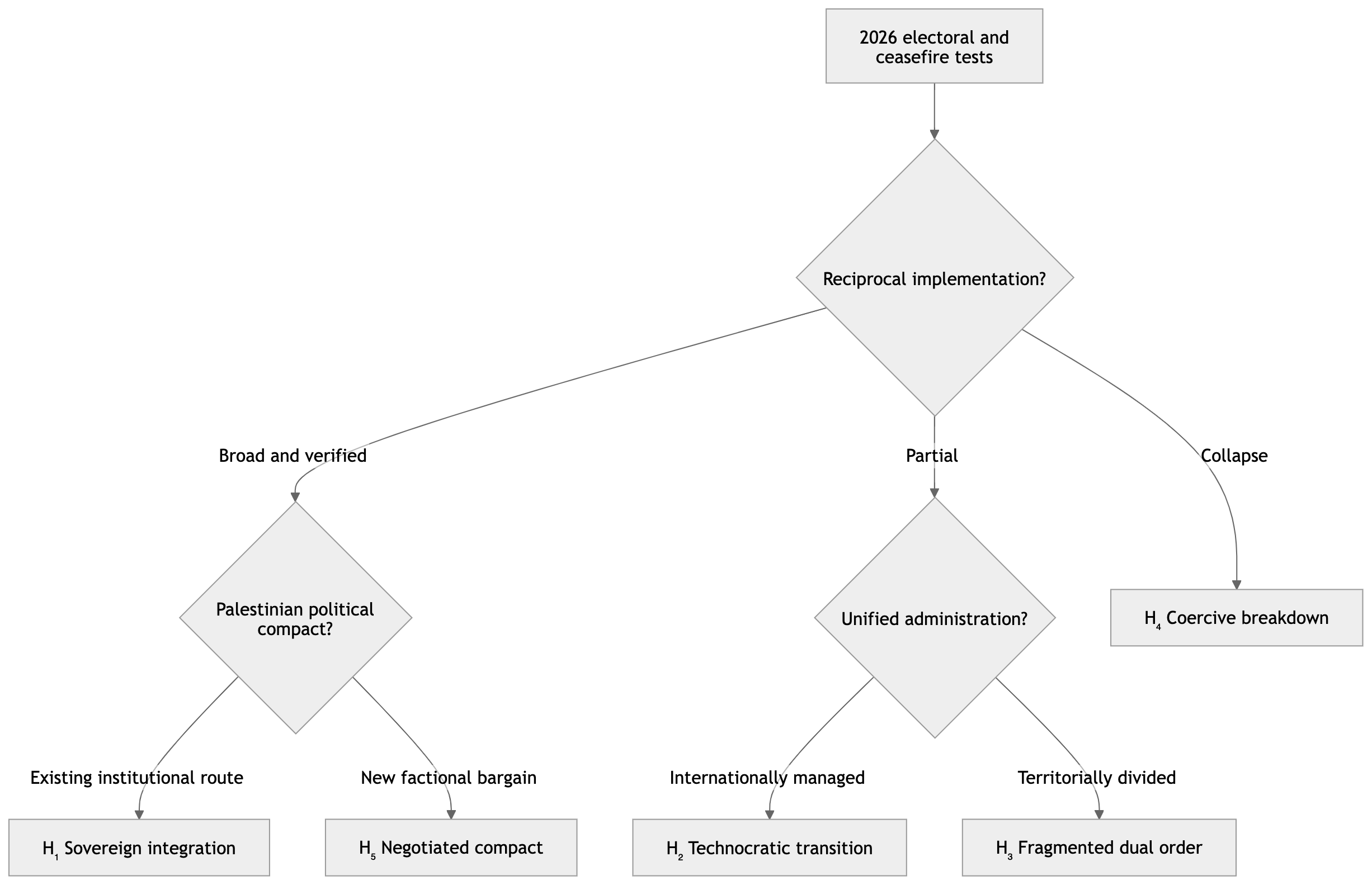
Analysis of competing hypotheses
The Analysis of Competing Hypotheses assigns evidence according to diagnostic value rather than volume. Evidence receives a positive mark when it is more expected under a hypothesis than under its competitors, a negative mark when it creates a serious contradiction, and a neutral mark when almost every hypothesis could produce it. The election decree is therefore only moderately supportive of H₁ and H₅: it demonstrates formal intent and administrative movement, but the CEC’s own institutional record shows that an election can be called and subsequently postponed. The PLO-recognition condition and undefined special Gaza procedures are more compatible with H₂ or H₃ because they permit an internationally recognized electoral exercise while preserving exclusion disputes and operational asymmetry. Establishment of the NCAG, Board of Peace, ISF command and reconstruction-finance mechanisms strongly supports H₂ in the short term because these bodies exist before an elected Palestinian transfer authority has obtained operational control. Conversely, European support for eventual PA control, China’s sovereignty-centered position and the Palestinian government’s insistence on one government, legal system and governance framework prevent H₂ from being treated as an uncontested terminal arrangement. The Palestinian prime minister has explicitly tied reconstruction to clearance-revenue release, correspondent banking, PA-led recovery and reunification of Gaza, the West Bank and East Jerusalem under one legitimate government. PM Mustafa Calls for Pressure on Israel to Release Withheld Clearance Revenues – Palestinian Prime Minister’s Office – November 2025 — official statement. The official UN record further confirms that the Security Council considered the Board of Peace implementation report alongside statements from the Russian Federation, China, Palestine, Israel and Council members, establishing that the framework remains politically contested rather than merely technical. The Situation in the Middle East, Including the Palestinian Question—Security Council 10155th Meeting – United Nations Security Council – May 2026 — official meeting record. The most diagnostic unresolved evidence is consequently not institutional announcement but observable transfer: entry, payroll control, policing authority, weapons custody, border administration, revenue consolidation and judicial enforceability.
| Evidence cluster | H₁ | H₂ | H₃ | H₄ | H₅ | Diagnostic interpretation |
|---|---|---|---|---|---|---|
| E₁ Election decree, calendar and CEC implementation | + | + | 0 | − | + | Supports electoral movement but is weakened by the 2021 postponement base rate. |
| E₂ PLO-recognition eligibility rule and special Gaza procedures | − | + | + | 0 | − | Increases exclusion and contestation risk while preserving a formally managed vote. |
| E₃ NCAG, Board of Peace, ISF and external oversight established | + | ++ | + | − | Strongest near-term evidence for an internationally managed transition. | |
| E₄ Decommissioning, withdrawal and territorial-access deadlock | − | 0 | ++ | ++ | Favors fragmentation or breakdown unless a reciprocal verification mechanism becomes operational. | |
| E₅ EU, Chinese, Russian and Palestinian sovereignty reservations | + | 0 | + | 0 | ++ | Raises the political cost of indefinite foreign administration and can catalyse a Palestinian compact. |
| E₆ Multiple treasuries, withheld revenues and conditional donor flows | − | + | ++ | + | Creates incentives for parallel governance and selective reconstruction. | |
| E₇ Israeli rejection of both Hamas and an unreformed PA | − | + | + | + | Constrains direct PA succession and strengthens a prolonged intermediate authority. | |
| E₈ Reconstruction needs greatly exceed immediately deployable funding | 0 | + | + | + | Makes territorial sequencing, donor conditionality and implementation capacity decisive. |
Bayesian update
The Bayesian layer begins with strategic priors rather than historical frequencies alone because no close post-2006 Palestinian analogue combines mass destruction, an internationally sponsored technocratic committee, possible ISF deployment, a called legislative election and rival Palestinian coercive structures. Initial priors were 22.0 percent for H₁, 25.0 percent for H₂, 24.0 percent for H₃, 18.0 percent for H₄, and 11.0 percent for H₅. Each evidence cluster receives deliberately conservative likelihood ratios between 0.90 and 1.09, preventing official announcements from creating artificial certainty. The updating rule is Posterior(Hᵢ) ∝ Prior(Hᵢ) × ∏ LR(Eⱼ | Hᵢ), followed by normalization across the five hypotheses. This produces an evidence-conditioned posterior of 18.7 percent H₁, 30.2 percent H₂, 26.1 percent H₃, 14.7 percent H₄, and 10.4 percent H₅ before interaction effects. H₂ rises because existing institutions and donor mechanisms are better explained by a managed transition than by immediate sovereign integration; H₃ rises because the combination of incomplete territorial transfer, separate fiscal channels and conditional reconstruction is more diagnostic than any individual fragmentation indicator; H₄ declines because a functioning ceasefire architecture, election administration and external financing vehicle are inconsistent with complete collapse, although the remaining 14.7 percent is still strategically material; and H₅ remains low because diplomatic endorsement of Palestinian unity does not yet demonstrate a binding factional bargain. The likelihood ratios are analytic judgments, not empirical measurements, and should be updated whenever verified operational data arrive. The World Bank’s description of the Gaza Reconstruction and Development Fund is particularly important for calibration: the Bank acts only as a limited trustee managing inflows and outflows, while an independent legal entity exercises decision authority after transfer. Financial Intermediary Fund for Gaza Reconstruction and Development – World Bank Group – November 2025 — official fund description. This governance separation increases H₂ and H₃ relative to H₁ whenever reconstruction funds bypass a unified Palestinian budget, even if the financial mechanism remains transparent and internationally audited.
| Update stage | H₁ | H₂ | H₃ | H₄ | H₅ |
|---|---|---|---|---|---|
| Strategic prior | 22.0% | 25.0% | 24.0% | 18.0% | 11.0% |
| After E₁ electoral activation | 23.5% | 26.5% | 22.8% | 16.0% | 11.1% |
| After E₂ eligibility and Gaza constraints | 21.6% | 28.0% | 23.7% | 16.0% | 10.6% |
| After E₃ international architecture | 21.6% | 29.9% | 23.6% | 14.7% | 10.2% |
| After E₄ security and access deadlock | 19.8% | 29.5% | 25.0% | 15.4% | 10.2% |
| After E₅ geopolitical divergence | 19.3% | 29.4% | 25.4% | 15.2% | 10.7% |
| After E₆ fiscal fragmentation | 18.7% | 30.2% | 26.1% | 14.7% | 10.4% |
Monte Carlo design and assumptions
The Monte Carlo layer propagates uncertainty that the sequential Bayesian table cannot represent, especially covariance among election credibility, territorial access, decommissioning, withdrawal, finance and legitimacy. The simulation executed 600,000 hierarchical trials with deterministic seed 260827. Eleven latent variables were drawn from beta distributions bounded between zero and one: electoral inclusiveness V, Gaza ballot operability G, weapons decommissioning D, Israeli withdrawal implementation W, NCAG territorial access A, PA institutional absorption capacity P, reconstruction disbursement F, domestic legitimacy L, reciprocal verification R, ceasefire durability S, and external-power alignment X. Concentration parameters between 9 and 12 preserve substantial tail uncertainty. For each trial, hypothesis scores were calculated as Scoreᵢ = aᵢ + Σ βᵢⱼxⱼ; probabilities were then obtained through normalized exponential transformation, Pr(Hᵢ) = exp(Scoreᵢ) ÷ Σ exp(Scoreₖ). H₁ receives the strongest positive coefficients from ballot operability, decommissioning, withdrawal, PA absorption and legitimacy; H₂ responds most strongly to NCAG access, externally routed finance and ceasefire continuity; H₃ rises when most integrative variables remain low; H₄ is especially sensitive to ceasefire failure and failed Gaza electoral access; and H₅ responds disproportionately to legitimacy, reciprocal verification, electoral inclusion and external alignment. The 2031 means are not assumptions that integration will succeed; they are gradual capability trends conditional on sustained international engagement, while beta-distribution tails preserve reversal paths. Model outputs therefore represent structural scenario probabilities rather than predictions of named officeholders, vote shares or military events. A central limitation is endogeneity: reconstruction disbursement can improve legitimacy and NCAG access, but donors may also release funds because those conditions have already improved. The model partially captures this through correlated directional coefficients, yet it does not claim causal identification. Its value lies in exposing which assumptions produce the forecast and how quickly verified evidence should change it.
| Variable | Meaning | 2026 mean | 2031 trend mean | Concentration |
|---|---|---|---|---|
| V | Electoral inclusiveness and meaningful factional competition | 0.38 | 0.48 | 12 |
| G | Physical, legal and technical Gaza ballot operability | 0.30 | 0.46 | 10 |
| D | Verified decommissioning of factional weapons | 0.25 | 0.38 | 9 |
| W | Verified Israeli withdrawal implementation | 0.30 | 0.40 | 9 |
| A | NCAG access to population centres and institutions | 0.28 | 0.50 | 10 |
| P | PA capacity to absorb staff, systems and responsibilities | 0.53 | 0.62 | 12 |
| F | Conversion of reconstruction commitments into disbursements | 0.35 | 0.50 | 9 |
| L | Public acceptance of the governing arrangement | 0.32 | 0.42 | 10 |
| R | Reciprocal verification linking weapons, withdrawal and access | 0.42 | 0.53 | 10 |
| S | Ceasefire durability and restraint against escalation | 0.55 | 0.62 | 11 |
| X | Alignment among major external sponsors and veto actors | 0.42 | 0.50 | 12 |
| Hypothesis coefficient | Intercept | V | G | D | W | A | P | F | L | R | S | X |
|---|---|---|---|---|---|---|---|---|---|---|---|---|
| H₁ | −2.110 | 1.15 | 1.15 | 1.05 | 1.05 | 0.85 | 1.05 | 0.90 | 1.00 | 0.85 | 0.90 | 0.60 |
| H₂ | 0.292 | 0.15 | 0.10 | 0.20 | 0.15 | 1.10 | 0.55 | 1.00 | 0.25 | 0.55 | 0.75 | 0.55 |
| H₃ | 3.170 | −0.25 | −0.35 | −0.35 | −0.45 | −0.25 | −0.15 | −0.25 | −0.30 | −0.35 | −0.15 | −0.10 |
| H₄ | 3.770 | −0.65 | −0.80 | −0.55 | −0.45 | −0.55 | −0.35 | −0.45 | −0.55 | −0.55 | −0.95 | −0.30 |
| H₅ | −1.836 | 0.85 | 0.70 | 0.55 | 0.60 | 0.35 | 0.65 | 0.45 | 1.25 | 1.15 | 0.70 | 0.90 |
Distribution and five-year trajectory
The simulation shifts the 2026 point estimates modestly from the qualitative posterior because it accounts for nonlinear interactions: H₂ reaches 31.8 percent, H₃ 25.7 percent, H₁ 18.3 percent, H₄ 13.5 percent, and H₅ 10.6 percent. More important than the means are the uncertainty intervals. H₂’s 2026 P₁₀–P₉₀ interval of 25.6–38.3 percent establishes it as the modal near-term outcome without making it dominant in a probabilistic sense; the combined probability of all other outcomes remains more than two thirds. H₃’s 17.5–33.8 percent interval overlaps H₂ substantially, indicating that small changes in territorial access, fiscal routing or reciprocal security implementation can convert a managed transition into durable fragmentation without an overt collapse. H₄ retains a fat upper tail of 20.4 percent, meaning that apparent administrative progress cannot be interpreted as eliminating renewed coercive breakdown. Under gradual improvements in ballot access, NCAG entry, reciprocal verification, donor execution and PA absorption, H₁ rises to 35.2 percent by 2031, nearly equal to H₂ at 35.8 percent. This is not a prediction that sovereign integration will be completed; it means that integration becomes increasingly plausible if the intermediate institutions generate transferable capability rather than entrenching their own authority. H₃ falls to 10.6 percent and H₄ to 3.9 percent under that progression, while H₅ rises only to 14.5 percent because a Palestinian compact requires discrete political decisions that administrative capacity alone cannot generate. The terminal H₁ and H₂ probabilities are therefore best read as a contest between transfer and perpetuation: the same NCAG, finance and security mechanisms can either become scaffolding for unified Palestinian government or a durable substitute for it.
| Year | H₁ mean [P₁₀–P₉₀] | H₂ mean [P₁₀–P₉₀] | H₃ mean [P₁₀–P₉₀] | H₄ mean [P₁₀–P₉₀] | H₅ mean [P₁₀–P₉₀] |
|---|---|---|---|---|---|
| 2026 | 18.3 [11.1–26.4] | 31.8 [25.6–38.3] | 25.7 [17.5–33.8] | 13.5 [7.3–20.4] | 10.6 [7.3–14.3] |
| 2027 | 21.6 [13.6–30.3] | 33.6 [27.7–39.8] | 22.2 [14.2–30.4] | 10.9 [5.5–17.1] | 11.7 [8.3–15.3] |
| 2028 | 24.9 [16.4–34.1] | 34.9 [29.1–41.0] | 18.9 [11.5–26.8] | 8.7 [4.1–14.1] | 12.6 [9.2–16.1] |
| 2029 | 28.4 [19.4–37.8] | 35.7 [29.9–41.7] | 15.8 [9.1–23.2] | 6.8 [3.0–11.3] | 13.4 [10.1–16.8] |
| 2030 | 31.8 [22.6–41.4] | 36.0 [30.0–42.1] | 13.0 [7.2–19.7] | 5.2 [2.2–8.9] | 14.0 [10.9–17.3] |
| 2031 | 35.2 [25.8–44.8] | 35.8 [29.5–42.2] | 10.6 [5.6–16.4] | 3.9 [1.6–6.9] | 14.5 [11.5–17.7] |
Five-year phase logic
The first forecast phase, extending through the scheduled 2026 vote and its immediate aftermath, is a test of physical and legal executability rather than merely voter preference. The critical questions are whether Gaza receives published polling procedures, whether candidates can organize and communicate, whether observers and CEC personnel obtain access, whether ballots have an auditable chain of custody, whether judicial remedies operate before certification, and whether winners can exercise legislative authority across both territories. Failure on these dimensions would not automatically produce H₄; a West Bank-centered or internationally managed election could instead consolidate H₂ by supplying a limited legitimacy layer to an architecture whose operational centre remains the NCAG and Board of Peace. During 2027–2028, command and finance become more diagnostic than voting. H₁ requires NCAG departments to map their staff, procurement systems, registries, contracts and assets into PA institutions under an announced transfer timetable. H₂ requires only effective service delivery and donor satisfaction, making it organizationally easier to sustain. H₃ emerges if reconstruction districts receive different security clearances, payment systems or implementing agencies and those distinctions harden into territorial jurisdictions. During 2029–2031, institutional path dependence becomes decisive: employees defend established payrolls, contractors defend procurement pipelines, security forces resist changes in command, donors prefer channels with proven fiduciary performance, and political actors seek vetoes over integration. Because the World Bank states that recovery needs exceed USD 67 billion and that the GRAD vehicle transfers resources to a separately governed legal entity, control of prioritization, beneficiary registries, procurement and audit remediation will be a constitutional question disguised as project administration. Financial Intermediary Fund for Gaza Reconstruction and Development – World Bank Group – November 2025 — official fund description. By 2031, an arrangement still described as “temporary” but lacking a legally enforceable transfer date should be classified as H₂, not as an incomplete H₁.
Shadow dimensions: contracted force, cyber-control and liquidity
Three shadow dimensions could change governance without appearing in formal constitutional documents. First, contracted security dynamics require monitoring across perimeter protection, convoy escort, infrastructure security, explosive-hazard clearance, biometric enrollment and facility guarding. The indicator is not simply whether private firms are present, but whether personnel exercise detention, search, intelligence collection or use-of-force functions outside a publicly disclosed chain of command. A proliferation of subcontractors with separate incident-reporting systems would favor H₂ or H₃; a unified licensing regime, transparent rules of engagement, common complaints mechanism and transfer of functions to accountable Palestinian civilian police would favor H₁. Second, cyber-governance may become the hidden constitution of post-war Gaza. Whoever controls identity resolution, beneficiary databases, telecommunications access, border permissions, geospatial reconstruction records, contractor vetting, sanctions screening and payment credentials can allocate rights even without nominal sovereignty. Cyber indicators must therefore distinguish service-security measures from political exclusion: database interoperability, audit logs, data localization, appeal rights, breach notification, independent oversight and limits on intelligence reuse are central. Repeated network disruption during campaigning, unexplained candidate-account suspensions, altered voter records or opaque algorithmic denial of aid should trigger an integrity review and raise H₃ or H₄. Third, liquidity flows determine whether Palestinian institutional unification is financially possible. The EU explicitly links PA functionality to release of withheld clearance revenues and continuation of correspondent banking, while the Palestinian government links those same channels to service continuity and Gaza reconstruction. EU Position on the Situation in the Middle East – European Council – June 2026 — official policy record. PM Mustafa Calls for Pressure on Israel to Release Withheld Clearance Revenues – Palestinian Prime Minister’s Office – November 2025 — official statement. The decisive metric is therefore not pledged reconstruction capital but monthly cash conversion: funds legally committed, transferred to the trustee, released to implementing entities, contracted, invoiced, paid and independently reconciled. Persistent separation between Gaza reconstruction finance and the Palestinian public-finance system increases the probability that administrative partition becomes self-reinforcing.
Early-warning and falsification matrix
The early-warning system should operate as a monthly indicator ledger with explicit thresholds and directional Bayesian updates. No single indicator should decide the forecast unless it directly falsifies a necessary condition, such as cancellation of the election, resumption of sustained large-scale war, verified transfer of weapons to one lawful command, or formal merger of NCAG and PA budgets. Ordinary indicators should be grouped into electoral, territorial-security, administrative, financial, legitimacy and external-alignment families; correlated observations must not be counted repeatedly. For example, opening several polling centres, issuing CEC statements and registering observers may all result from the same political authorization and should constitute one evidence cluster. A material H₁ update requires simultaneous movement across at least three independent domains: electoral integrity, reciprocal security implementation, and fiscal-administrative integration. H₂ strengthens when service delivery and funding improve while transfer milestones remain undefined. H₃ strengthens when different territories or populations acquire durable, non-interoperable systems. H₄ strengthens when violence, emergency decrees and access restrictions rise together. H₅ strengthens only when factional dialogue produces signed, implemented changes in electoral eligibility, security-sector incorporation or PLO representation. Threshold crossings should be converted into likelihood ratios, applied to the latest posterior and normalized; recommended ordinary updates are 1.10–1.35, while rare, independently verified decisive events may justify 1.50–2.50. Analysts should publish both the triggering observation and its source, record contrary evidence, and identify in advance what would reverse the update. This prevents warning indicators from becoming one-directional confirmation devices and makes the five-year forecast falsifiable.
| Domain | Indicator and threshold | H₁ | H₂ | H₃ | H₄ | H₅ | Collection priority |
|---|---|---|---|---|---|---|---|
| Election | Gaza polling map, staffing rules and chain-of-custody procedures published at least 45 days before voting | ↑↑ | ↑ | ↓ | ↓ | ↑ | CEC regulations, polling-site lists, observer access |
| Election | Major faction or coalition excluded after final judicial review | ↓↓ | ↑ | ↑↑ | ↑ | ↓↓ | Candidate rulings, appeal decisions, list withdrawals |
| Election | Election postponed without a new binding date | ↓↓ | 0 | ↑ | ↑↑ | ↓ | Presidential decree and CEC operational orders |
| Legitimacy | Credible Gaza participation and result acceptance across major competing lists | ↑↑ | ↓ | ↓↓ | ↓↓ | ↑↑ | Results, observer findings, factional acceptance |
| Territorial control | NCAG operates continuously in all major population centres for 90 days | ↑ | ↑↑ | ↓ | ↓ | 0 | Office locations, service records, payroll execution |
| Transfer | Published NCAG-to-PA asset, staff and function transfer schedule with quarterly milestones | ↑↑ | ↓ | ↓ | 0 | ↑ | Cabinet instruments, audited implementation reports |
| Weapons | Serialised inventory placed under verified custody with reciprocal withdrawal milestones | ↑↑ | ↑ | ↓↓ | ↓↓ | ↑ | Custody records, verification reports, mapped zones |
| Israeli posture | Security-controlled territory contracts for two consecutive quarters | ↑↑ | ↑ | ↓ | ↓ | ↑ | Official maps, crossing rules, deployment records |
| Security | ISF rules of engagement, complaints jurisdiction and incident reporting become public | ↑ | ↑↑ | ↓ | ↓ | 0 | Mandate documents, disciplinary and casualty reports |
| Finance | At least 50 percent of annual committed reconstruction funding is disbursed and reconciled | ↑ | ↑↑ | ↓ | ↓ | 0 | Trustee reports, implementing-entity audits |
| Fiscal unity | Gaza payroll, procurement and revenue enter a unified Palestinian treasury account | ↑↑ | ↓ | ↓↓ | 0 | ↑ | Budget law, banking records, audited accounts |
| Liquidity | Clearance revenues and correspondent banking remain uninterrupted for six months | ↑↑ | ↑ | ↓ | ↓ | ↑ | PA finance data, EU and banking notices |
| Cyber integrity | Voter, aid and identity systems have interoperable audit logs and independent appeals | ↑↑ | ↑ | ↓↓ | ↓ | ↑ | Technical audits, breach notices, adjudication data |
| Contracted force | Armed contractors exercise detention or intelligence functions outside public oversight | ↓ | ↑ | ↑↑ | ↑ | 0 | Contracts, licensing, incident and use-of-force records |
| Public legitimacy | Repeated representative surveys show majority acceptance across Gaza and West Bank | ↑↑ | ↑ | ↓↓ | ↓↓ | ↑↑ | Transparent sampling, question wording, trend series |
| External alignment | US, EU, Arab sponsors, China and Russia converge on a dated transfer framework | ↑↑ | ↓ | ↓ | ↓ | ↑ | Joint official instruments rather than communiqués |
| Fragmentation | Separate permits, payrolls or justice systems persist for four quarters | ↓↓ | ↑ | ↑↑ | ↑ | ↓ | Administrative records and territorial service maps |
| Escalation | Sustained high-intensity hostilities or prolonged closure of principal crossings | ↓↓ | ↓ | ↑ | ↑↑ | ↓↓ | Official incident data, crossing status, aid throughput |
Net assessment
The five-year forecast does not support a binary choice between immediate PA restoration and continued Hamas government. The modal 2026 outcome is H₂, managed technocratic transition, because the NCAG, Board of Peace, ISF leadership and externally governed finance architecture possess greater formal momentum than either sovereign Palestinian integration or a negotiated factional compact. The principal challenger is H₃, fragmented dual order, not H₁, because incomplete implementation can produce a durable equilibrium without any actor deliberately choosing partition. H₁ becomes competitive only over time and only if four reciprocal conversions occur: electoral authorization becomes exercisable authority; NCAG capacity becomes transferable Palestinian capacity; decommissioning is matched by withdrawal and civilian protection rather than demanded as a unilateral antecedent; and reconstruction finance becomes interoperable with a unified Palestinian treasury while preserving fiduciary safeguards. H₅ remains a lower-probability but strategically consequential pathway because a credible Palestinian compact could resolve legitimacy problems that technocratic delivery cannot, yet it would also require concessions on eligibility, representation and security incorporation that the current architecture does not supply automatically. H₄ is not the modal outcome, but its 2026 upper uncertainty tail remains sufficiently large that ceasefire monitoring, crossing access and retaliatory escalation must be treated as forecast-dominating variables. The most important analytic warning is institutional substitution: every temporary mechanism that delivers services, security or capital can either prepare sovereign transfer or acquire interests in its own continuation. The forecast should therefore be judged not by the number of committees formed, funds announced or election dates published, but by whether authority, accountability, territory, finance and public consent converge. If those five dimensions remain divided by the end of 2028, the posterior should shift decisively from transitional H₂ toward entrenched H₂ or fragmented H₃; if they move together under reciprocal verification, H₁ can become the leading 2031 outcome.
Figure 1: Five-Year Scenario Probability Distribution
Monte Carlo mean and 10th–90th percentile interval; 600,000 hierarchical trials.


