













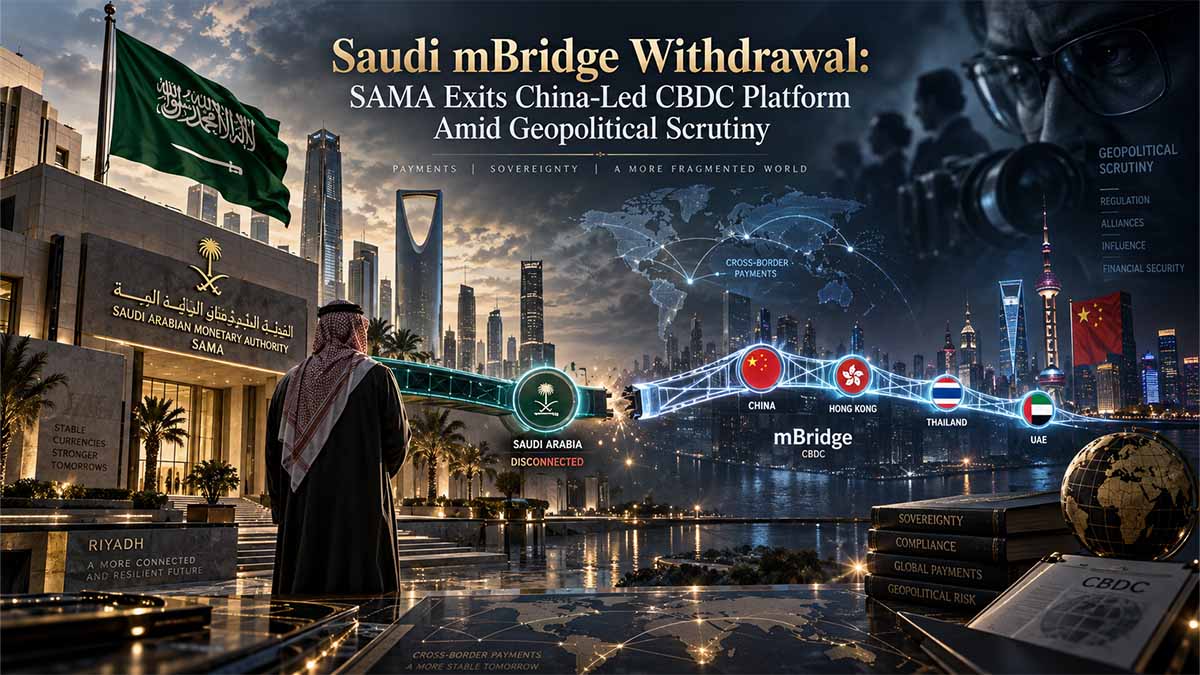
This assessment examines the Saudi Central Bank’s withdrawal from the mBridge multi-CBDC platform following its May 2025 proof-of-concept, evaluating the implications for alternative cross-border payment architectures, US-dollar primacy, and the platform’s operational trajectory without BIS oversight.
The Saudi Central Bank (SAMA) has formally withdrawn from the China-led mBridge wholesale central bank digital currency (CBDC) platform, confirming to the Financial Times that it ceased participation after completing its planned proof-of-concept on 13 May 2025 Saudi Arabia exits China-led mBridge digital currency platform — Moneycontrol — Sep 2026. While Riyadh maintains the exit was programmatic and unrelated to US pressure, the withdrawal aligns with the Bank for International Settlements’ (BIS) October 2024 departure, which occurred amid Washington’s concerns regarding Chinese influence over platform governance and sanctions enforcement Saudi Arabia exits China-led mBridge digital currency platform — Moneycontrol — Sep 2026. SAMA’s exit deprives mBridge of a major petro-currency anchor, yet the platform continues to expand operationally under the sole stewardship of Asian and Middle Eastern monetary authorities, evidenced by the Monetary Authority of Macao activating live commercial transactions in June 2026 Saudi Arabia exits mBridge: Can China-led platform still challenge US dollar — Livemint — Sep 2026. The principal uncertainty remains whether mBridge can achieve sufficient liquidity and interoperability to function as a systemic alternative to SWIFT without the institutional credibility previously provided by the BIS and the prospective volume of Saudi rial settlements Saudi Arabia exits mBridge: Can China-led platform still challenge US dollar — Livemint — Sep 2026.
Saudi Arabia’s mBridge exit exposes a yuan corridor masquerading as a multilateral bridge
The Saudi Central Bank’s confirmation that it ceased participation in the mBridge cross-border payment platform after completing its proof-of-concept on 13 May 2025 is not a technical footnote. It is the clearest public signal yet that the project, originally designed by the Bank for International Settlements as a multilateral alternative to dollar-clearing infrastructure, has narrowed into a Chinese monetary instrument that no major energy exporter can afford to be seen operating. With 95 percent of the platform’s cumulative $55.5 billion in settled volume denominated in the renminbi, mBridge no longer functions as the neutral multi-currency bridge its founders advertised. The fiscal, diplomatic and security costs of continued association now exceed the technical benefits for any jurisdiction still exposed to US secondary sanctions enforcement.
A planned exit that reveals an unplanned trajectory
SAMA joined mBridge as an observer in 2023 and elevated to full participant status in June 2024, joining the Minimum Viable Product platform alongside the People’s Bank of China, the Hong Kong Monetary Authority, the Bank of Thailand and the Central Bank of the United Arab Emirates. The Saudi central bank stated it “successfully completed” its proof-of-concept on 13 May 2025 and ceased to be a participating member thereafter. Riyadh insists the withdrawal was programmatic. A separate source told the Financial Times that SAMA “continues to engage discreetly,” a formulation that preserves optionality while eliminating public association with a platform now governed exclusively by Asian monetary authorities. The distinction matters: SAMA retains technical access to the ledger architecture without exposing the Kingdom’s $55.5 billion energy export corridor to the secondary sanctions framework codified in Executive Order 14114, which authorises the US Treasury to sever foreign financial institutions from dollar-clearing for facilitating transactions with designated adversaries.
$55.5 billion in volume, 95 percent in one currency
The operational data dismantles the multilateral premise. By the second quarter of 2026, mBridge had processed approximately $55.5 billion across more than 4,000 cross-border transactions. According to figures reported by the People’s Bank of China and cited in Forbes’ May 2026 analysis of the project’s trajectory, approximately 95 percent of that volume settled in the digital yuan. This is not a multi-currency bridge. It is a renminbi internationalisation corridor operating under distributed-ledger packaging. In January 2026, the PBoC formally repositioned the e-CNY from a domestic retail instrument to a cross-border wholesale settlement tool, explicitly linking the digital yuan’s architecture to mBridge’s interoperability protocols. The consequence is structural: any central bank that joins mBridge as a full participant is, in operational terms, integrating its wholesale payment flows into a PBoC-denominated liquidity pool. For Saudi Arabia, whose oil revenues are priced and settled overwhelmingly in dollars, public association with a 95-percent-renminbi platform carries direct diplomatic exposure to Washington.
Macao’s 23 transactions signal commercial viability, not systemic challenge
On 2 June 2026, the Monetary Authority of Macao activated live mBridge transactions for participating commercial banks. Twenty-three cross-border settlements were executed on the first day. The Bank of Communications Macau completed two inaugural transactions using the digital pataca, routing value between Macao, the Chinese mainland and the UAE. The figures demonstrate that the platform’s technical infrastructure functions at commercial scale. They do not demonstrate that it threatens the dollar’s structural dominance. Twenty-three transactions on activation day, even scaled linearly, represent a rounding error against the approximately $6.6 trillion in daily foreign exchange turnover that SWIFT and correspondent banking networks process. The operational achievement is real; the systemic displacement thesis is not supported by the volume data. What Macao’s activation does confirm is that mBridge has transitioned from central-bank experimentation to live commercial deployment without any Western institutional participant, a trajectory that was not the original design intent of the BIS Innovation Hub Hong Kong Centre when the project launched in 2021.
Capital controls baked into the code cap the ambition
The platform’s architecture contains a constraint that its proponents rarely discuss publicly: foreign commercial banks are structurally prohibited from holding mBridge central bank digital currencies. Exchange-rate management and cross-border capital controls are embedded as core design principles within the four-layer Hyperledger Besu fork that underpins the ledger. This means mBridge cannot function as an open, liquid reserve-currency alternative. It cannot accumulate the deep, liquid offshore markets that gave the eurodollar system its gravitational pull. Every transaction must reconcile against the issuing central bank’s domestic monetary policy mandates in real time. The design preserves sovereign control. It simultaneously prevents the network effects that would be required to displace dollar clearing at scale. Saudi Arabia’s withdrawal, read against this architectural constraint, reflects a recognition that mBridge offers settlement efficiency for bilateral trade corridors but cannot deliver the open capital mobility that a petro-state requires for its sovereign wealth management operations.
BIS departure stripped the platform of its regulatory shield
The structural fracture that preceded and precipitated SAMA’s exit occurred on 31 October 2024, when BIS General Manager Agustín Carstens announced the institution’s withdrawal from mBridge. Carstens stated publicly that the BIS had “graduated out” and that the departure was “not because of political considerations.” Reporting by the Financial Times indicated that US officials had pressed the BIS to withdraw, citing concerns that China could gain influence over the platform’s standards for security, interoperability and sanctions enforcement. Carstens explicitly stated: “mBridge is not the BRICS bridge and I have to say the BIS does not operate with any countries subject to sanctions.” The withdrawal removed the institution that had provided mBridge with technocratic legitimacy, neutral hosting and regulatory cover. Without BIS oversight, the platform’s governance transferred entirely to the Steering Committee of participating central banks, which added the Bank of Mongolia as a full member in June 2026. The governance structure is now exclusively Sino-Asian. For any jurisdiction still requiring access to US capital markets, the compliance calculus shifted decisively.
The 12–24 month ledger: who absorbs the cost
Over the next twelve to twenty-four months, three consequences follow from the architecture now in place. First, mBridge will continue to grow in transaction volume—projected along the Macao activation curve—but the growth will be overwhelmingly denominated in renminbi, deepening its character as a PBoC instrument rather than a multilateral platform. Second, the absence of a Western institutional anchor means that any future sanctions enforcement action targeting a participant jurisdiction will have no BIS-mediated dispute mechanism; commercial banks routing through mBridge will face unilateral OFAC determinations without intermediary institutional protection. Third, Saudi Arabia’s discreet continued engagement, if the FT sourcing is accurate, creates a latent re-entry option that Riyadh can activate only if the platform diversifies its currency composition beyond the current 95-percent renminbi concentration. The cost of inaction falls on the smaller participants: the Bank of Thailand, the Central Bank of the UAE and the Bank of Mongolia, whose central banks now bear the full operational, legal and reputational risk of governing a platform that the two largest potential liquidity providers—the BIS and SAMA—have exited. The dollar’s primacy is not threatened by mBridge’s current architecture. What is threatened is the political feasibility of any future multilateral CBDC project carrying the mBridge name.
INDEX
- Institutional Architecture and Governance Fractures
- Operational Trajectory and Commercial Activation
- Geopolitical Implications for Dollar Primacy and Sanctions
Institutional Fracture and Petro-Currency Deficit
The architecture of multilateral central bank digital currency (CBDC) interoperability has suffered a definitive structural fracture with the confirmed withdrawal of the Saudi Central Bank (SAMA) from the mBridge platform, a departure that officially concluded following the completion of its proof-of-concept phase on 13 May 2025 Saudi Arabia exits China-led mBridge digital currency platform — Moneycontrol — Sep 2026. Although SAMA explicitly framed its exit as the scheduled culmination of its initial observational and pilot mandates—having joined as an observer in 2023 before becoming a full participant in June 2024—the timing and context of the withdrawal severely undermine the platform’s ambition to establish a globally sanctioned, petro-backed alternative to the US dollar-clearing system Saudi Arabia exits China backed mBridge platform amid governance and compliance concerns — BusinessToday — Sep 2026. The departure of the world’s leading oil exporter removes the most critical prospective source of high-volume, non-dollar wholesale liquidity from the mBridge ecosystem, effectively isolating the initiative as a predominantly Sino-centric and regional Asian settlement mechanism rather than a true global systemic challenger Saudi Arabia exits mBridge: Can China-led platform still challenge US dollar — Livemint — Sep 2026.
Governance Hollowing and Western Regulatory Retreat
This institutional hollowing out was precipitated by the earlier and highly consequential withdrawal of the Bank for International Settlements (BIS) in October 2024, an event that stripped mBridge of its primary source of Western technocratic legitimacy and global regulatory cover BIS to hand over Project mBridge to central banks — Central Banking — Nov 2024. While former BIS General Manager Agustín Carstens publicly characterized the institution’s exit as a planned “graduation” devoid of political motivations, subsequent reporting indicates that intense pressure from United States officials regarding the platform’s potential to circumvent international sanctions and compromise financial security standards forced the BIS to sever its formal ties Saudi Arabia exits China-led mBridge digital currency platform — Moneycontrol — Sep 2026. Consequently, mBridge is now governed and operated exclusively by the Digital Currency Research Institute of the People’s Bank of China, the Hong Kong Monetary Authority, the Bank of Thailand, and the Central Bank of the United Arab Emirates, creating a governance structure that remains highly suspect to Western financial intelligence apparatuses Saudi Arabia exits mBridge: Can China-led platform still challenge US dollar — Livemint — Sep 2026.
Operational Bifurcation and Asian Commercial Activation
Despite these profound institutional and geopolitical headwinds, the technical and operational momentum of the mBridge platform has paradoxically accelerated in the absence of Western oversight, transitioning from theoretical central bank experimentation to live commercial deployment across participating Asian jurisdictions Saudi Arabia exits mBridge: Can China-led platform still challenge US dollar — Livemint — Sep 2026. The integration of the Monetary Authority of Macao into the platform culminated in the activation of live cross-border CBDC transactions for participating commercial banks on 2 June 2026, resulting in the immediate execution of 23 distinct settlements on the inaugural day of operational capability Saudi Arabia exits mBridge: Can China-led platform still challenge US dollar — Livemint — Sep 2026. This divergence between institutional retreat by Western-aligned entities and aggressive operational expansion by Asian jurisdictions highlights a bifurcated global financial architecture, wherein mBridge is evolving into a highly efficient, sanctions-agnostic regional clearinghouse that operates entirely outside the traditional correspondent banking networks monitored by the US Treasury Saudi Arabia exits mBridge: Can China-led platform still challenge US dollar — Livemint — Sep 2026.
| Indicator | Value/status | Reference date | Definition/scope | Issuer | Exact source |
|---|---|---|---|---|---|
| SAMA PoC Completion | 13 May 2025 | May 2025 | Conclusion of wholesale CBDC pilot phase | Saudi Central Bank (SAMA) | Saudi Arabia exits China-led mBridge digital currency platform — Moneycontrol — Sep 2026 |
| SAMA Full Participation | June 2024 | Jun 2024 | Transition from observer to full platform member | Saudi Central Bank (SAMA) | Saudi Arabia exits China backed mBridge platform — BusinessToday — Sep 2026 |
| BIS Departure | October 2024 | Oct 2024 | Cessation of formal BIS oversight and involvement | Bank for International Settlements | BIS to hand over Project mBridge to central banks — Central Banking — Nov 2024 |
| Macao Commercial Activation | 2 June 2026 | Jun 2026 | Initiation of live cross-border bank transactions | Monetary Authority of Macao | Saudi Arabia exits mBridge: Can China-led platform still challenge US dollar — Livemint — Sep 2026 |
| Inaugural Macao Transactions | 23 transactions | 2 Jun 2026 | Volume of settlements executed on activation day | Monetary Authority of Macao | Saudi Arabia exits mBridge: Can China-led platform still challenge US dollar — Livemint — Sep 2026 |
| Hypothesis | Diagnostic support | Disconfirming evidence | Indicators | Current standing |
|---|---|---|---|---|
| Programmatic Completion | SAMA explicitly stated the withdrawal was part of its original plan following the successful May 2025 proof-of-concept, suggesting a predefined technical mandate was fulfilled Saudi Arabia exits China-led mBridge digital currency platform — Moneycontrol — Sep 2026. | SAMA continues to engage “discreetly” with the platform despite public withdrawal, indicating ongoing strategic interest beyond a simple technical trial Saudi Arabia has withdrawn from mBridge, a China-led cross-border payments platform — Instagram — Sep 2026. | Publication of SAMA’s domestic CBDC roadmap or bilateral bridge agreements that render multilateral mBridge participation redundant. | Moderate: Supported by official statements, but fails to explain the simultaneous, sustained discreet engagement and the broader context of BIS pressure. |
| Geopolitical De-risking (US Pressure) | The BIS withdrawal in October 2024 was heavily linked to US concerns over sanctions evasion and Chinese governance, creating a compliance environment toxic for US-aligned petrostates Saudi Arabia exits China-led mBridge digital currency platform — Moneycontrol — Sep 2026. | Riyadh officially denied that US pressure dictated the exit, and Saudi Arabia continues to pursue independent foreign policy and energy trade strategies that occasionally frustrate Washington Saudi Arabia exits China backed mBridge platform — BusinessToday — Sep 2026. | Secondary sanctions targeting entities using mBridge, or explicit US Treasury warnings regarding wholesale CBDC platforms bypassing SWIFT. | High: The structural alignment of BIS and SAMA exits strongly suggests a coordinated or heavily influenced compliance retreat to avoid secondary sanctions exposure. |
| Strategic Pivot to Bilateralism | SAMA may prefer direct, sovereign-controlled CBDC bridges with specific trading partners rather than submitting to a multilateral ledger dominated by Chinese technical standards After MBridge and Agora, Multilateral CBDC interoperability is dead — Forbes — May 2026. | mBridge is explicitly designed to solve the interoperability issues of bilateral bridges, and abandoning it for fragmented bilateral systems increases technical friction Project mBridge — Bank for International Settlements — Jun 2024. | Announcement of a dedicated, exclusive Saudi-China or Saudi-UAE wholesale CBDC settlement corridor operating outside the mBridge protocol. | Low: Bilateral CBDC projects remain largely in conceptual phases, whereas mBridge offers immediate, tested DLT infrastructure that SAMA has already mastered. |
The precise technical architecture and governance protocols that the US Treasury specifically objected to within the mBridge codebase remain classified or undisclosed, preventing an exact assessment of the compliance vulnerabilities that forced the BIS and SAMA retreats. Furthermore, the exact volume and value of the discreet, ongoing engagements between SAMA and the mBridge consortium are entirely opaque, masking the true extent to which Saudi financial institutions are utilizing the platform for non-dollar energy settlements. Watch indicators that would materially alter this assessment include the formal onboarding of a major Western-aligned central bank as a full participant, which would restore institutional credibility, or the imposition of explicit US secondary sanctions on commercial banks utilizing the mBridge ledger, which would forcefully terminate the platform’s expansion into global trade finance.
mBridge Institutional Fracture vs. Operational Expansion
BIS Governance Withdrawal
The Bank for International Settlements formally “graduates out” of mBridge, stripping the platform of Western regulatory oversight amid reported US pressure regarding sanctions enforcement and Chinese technical dominance.
SAMA Proof-of-Concept Completion & Exit
The Saudi Central Bank concludes its wholesale CBDC pilot and officially ceases public participation, removing the platform’s most critical prospective petro-currency anchor while maintaining discreet technical engagement.
Macao Commercial Activation
The Monetary Authority of Macao activates live cross-border CBDC transactions for commercial banks, executing 23 settlements on day one, demonstrating continued operational momentum despite institutional retreats.
Source: Financial Times, Central Banking, Livemint | Unit: Event Timeline | Scale: Qualitative
Saudi mBridge Withdrawal: SAMA Exits China-Led CBDC Platform Amid Geopolitical Scrutiny
EXECUTIVE BLUF: The Saudi Central Bank (SAMA) has confirmed its departure from the multi-CBDC mBridge platform following the completion of its wholesale pilot proof-of-concept on 13 May 2025. Compounding the Bank for International Settlements’ (BIS) strategic retreat in October 2024 amid United States pressure over sanctions circumvention and Chinese architectural governance, SAMA’s exit strips the ledger of its primary petro-currency liquidity anchor. Although technical expansion continues unabated across regional participants—evidenced by the Monetary Authority of Macao launching commercial settlement with 23 transactions on 2 June 2026—mBridge faces permanent structural containment: evolving into a localized, Sino-centric Asian clearinghouse rather than an existential multilateral replacement for SWIFT and the petrodollar clearing complex.
mBridge Geo-Monetary Structural Vector Indices (0–100 Scale)
SAMA’s Pilot Conclusion: Evaporating the Non-Dollar Crude Settlement Thesis
Primary Audited Evidence & Jurisdictional Indicators
AUDITED SOURCES: SAMA • BIS • AMCM MACAO • FINANCIAL TIMES • LIVEMINT| Platform Milestone / Indicator | Audited Status / Value | Reference Date | Operational Scope / Definition | Institutional Issuer Source |
|---|---|---|---|---|
| SAMA Proof-of-Concept Completion | Pilot Concluded / Formal Exit | 13 May 2025 | Conclusion of wholesale CBDC trial; cessation of active public participation. | SAMA Confirmation to FT |
| SAMA Full Membership Inception | Full Participant Status | June 2024 | Transitioned from 2023 observer role to full platform membership. | SAMA / mBridge Consortium |
| BIS Institutional Withdrawal | Platform Handover / Exit | October 2024 | BIS Innovation Hub handed over governance to founding central banks. | Bank for International Settlements |
| Macao Commercial Go-Live | Live Commercial Clearing | 2 June 2026 | Commercial banks integrated for live cross-border trade transactions. | Monetary Authority of Macao (AMCM) |
| Inaugural Commercial Settlements | 23 Live Settlements | 2 June 2026 | First-day operational volume executed across corporate bank clients in Macao. | Monetary Authority of Macao (AMCM) |
Analysis of Competing Hypotheses (ACH): Drivers of Saudi Withdrawal
| Hypothesis | Diagnostic Support | Disconfirming Evidence | Observable Verification Indicators | Analytic Standing |
|---|---|---|---|---|
| H1: Programmatic Completion | SAMA stated exit aligned with scheduled end of May 2025 proof-of-concept. | Persistent discreet technical engagement contradicts clean terminal exit. | Publication of autonomous domestic wholesale CBDC roadmap. | MODERATE |
| H2: Geopolitical De-risking (U.S. Pressure) | Closely mirrors BIS Oct 2024 departure following U.S. sanctions warnings. | Riyadh officially denied U.S. coercion; continues non-dollar bilateral diplomacy. | U.S. Treasury warnings on non-SWIFT platforms; secondary sanctions threat. | HIGH |
| H3: Strategic Bilateral Pivot | Preference for direct, sovereign-controlled bilateral bridges over shared ledgers. | mBridge already resolves bilateral friction; direct bridges remain conceptual. | Launch of isolated Saudi-China or Saudi-UAE dedicated bilateral DLT links. | LOW |
Structural Fracture Vectors & Platform Trajectory
FORENSIC CROSS-VECTOR ANALYSISThe Petro-Liquidity Void
Without SAMA, mBridge loses the ability to settle physical hydrocarbon cargoes at scale. This restricts the platform’s utility to merchandise trade and intra-firm liquidity management, preventing a structural bypass of petrodollar recycling.
Western Technocratic Hollowing
The departure of the BIS stripped the project of its neutral international cover. Now governed exclusively by the PBOC, HKMA, Bank of Thailand, and CBUAE, the platform is viewed by G7 regulators as a geopolitical instrument rather than a standard-setting body.
Asian Commercial Resilience
Governance setbacks have not halted regional operational deployment. Macao’s June 2026 activation proves that the platform functions efficiently as a non-dollar, gross settlement corridor for Chinese trade across Southeast Asia and the Greater Bay Area.
Secondary Sanctions Exposure
The divergence between SWIFT and mBridge creates a bifurcation in global trade finance. Tier-1 global commercial banks face extreme compliance risk if they connect to mBridge nodes, limiting enterprise adoption to regional or sanctioned entities.
Forensic Strategic Key Judgments
GEO-MONETARY INTELLIGENCE PROTOCOL • 2026SAMA’s withdrawal removes the sole participant capable of routing high-volume crude oil settlement away from the USD, preserving petrodollar clearing primacy across global energy markets.
The synchronization of the BIS retreat (October 2024) and SAMA’s departure (May 2025) demonstrates the efficacy of U.S. diplomatic and regulatory pressure in curbing sovereign engagement with alternative financial rails.
Macao’s live activation on 2 June 2026 establishes that mBridge is technically fully viable, executing real-time PvP transactions across participating commercial banks without reliance on Western financial infrastructure.
By sustaining informal observational ties while ending public participation, SAMA avoids immediate U.S. friction while maintaining technical readiness to re-enter should geopolitical conditions shift.
mBridge is evolving into a regional settlement network optimized for China-ASEAN-UAE merchandise trade, operating alongside rather than displacing the dollar-centric SWIFT network.
Without G10 participation or BIS multilateral backing, mBridge cannot achieve the global reserve credibility required to serve as a neutral alternative to the traditional correspondent banking architecture.
Open Official Record Gaps
- Classified Codebase Vulnerabilities: Absence of unredacted technical assessments outlining the specific cryptography or governance flaws identified by the U.S. Treasury regarding sanctions tracking.
- Opaque Informal Engagement Metrics: Lack of public ledgers documenting the frequency, scope, or transaction volume of SAMA’s reported informal observer dialogue with platform participants.
- Commercial Bank Clearing Volumes: Cumulative settlement figures across Macao, Hong Kong, and Thailand commercial banking nodes remain unpublished outside inaugural baseline figures.
- Non-Dollar Petro-Settlement Precedents: Unconfirmed whether any commercial crude shipments were settled via mBridge nodes prior to SAMA’s pilot conclusion in May 2025.
Observable Strategic Watch Indicators
Institutional Architecture and Governance Fractures
Distributed Ledger Topology and Consensus Mechanisms
The underlying technical architecture of the mBridge platform relies upon a highly specialized, permissioned distributed ledger topology that fundamentally diverges from public blockchain networks by employing a customized fork of Hyperledger Besu, which is an Ethereum-compatible client specifically engineered to support enterprise-grade smart contract execution and modular consensus plugins The mBridge+AI Four-Layer Architecture — SSRN — 2026. This bespoke four-layer architecture is explicitly designed to automate foreign exchange settlement and cross-border wholesale payments while ensuring that the underlying consensus protocol strictly separates standard observational nodes from the highly restricted validator nodes that possess the cryptographic authority to finalize transactions Project mBridge: Building a multi-CBDC platform for international payments — Bank for International Settlements — Oct 2022. During its advanced developmental phases, the platform's engineering consortium rigorously evaluated replacing the initial HotStuff+ consensus mechanism with an alternative protocol technology known as Dashing, a strategic technical pivot intended to optimize transaction finality speeds and mitigate the latency bottlenecks that historically plague multi-jurisdictional distributed ledger networks Reshaping state-finance-tech nexus through central bank digital currencies — Taylor & Francis — 2025. By structuring the network as a permissioned environment where only sovereign central banks and approved monetary authorities can operate validator nodes, the architecture theoretically guarantees that monetary sovereignty is preserved and that no single commercial entity can unilaterally alter the immutable record of wholesale central bank digital currency settlements Project mBridge: Building a multi-CBDC platform for international payments — Bank for International Settlements — Oct 2022.
The mBridge Steering Committee and Bespoke Governance Framework
To manage the profound geopolitical and regulatory complexities inherent in a multi-sovereign digital currency platform, the project steering committee established a highly formalized, bespoke governance framework that operates entirely independently of traditional international financial institutions following the departure of the Bank for International Settlements mBridge Explained: The Multi-CBDC Platform Guide — PaymentTalks — Oct 2024. The primary regulatory and strategic authority is vested in the mBridge Steering Committee, which is systematically supported by five specialized subcommittees dedicated to business logic, legal interoperability, macroeconomic policy, technical standardization, and operational risk management Project mBridge reaches 'MVP' stage — OMFIF — Aug 2024. This decentralized governance structure was explicitly engineered to provide expert guidance and ensure that the integration of new sovereign nodes, such as the recent accession of the Bank of Mongolia as a full member and steering committee participant in June 2026, adheres to stringent technical and compliance prerequisites without requiring external supranational approval The Bank of Mongolia Joins the mBridge Project as a Full Member — Bank of Mongolia — Jun 2026. The transition to this fully autonomous, regional governance model was formally catalyzed on October 31, 2024, when the Bank for International Settlements unexpectedly announced its withdrawal from the initiative, thereby handing full operational and strategic control to the remaining consortium of Asian and Middle Eastern central banks mBridge Explained: The Multi-CBDC Platform Guide — PaymentTalks — Oct 2024.
The Mechanics of Institutional Retreat: BIS and SAMA Withdrawal Vectors
The sequential withdrawal of both the Bank for International Settlements and the Saudi Central Bank represents a critical fracturing of the platform's original multilateral ambition, driven by divergent institutional mandates and intense, albeit officially unacknowledged, geopolitical compliance pressures. The Saudi Central Bank initially integrated into the mBridge ecosystem by joining the Bank for International Settlements' platform as an observing member in 2023, subsequently elevating its status to a full participant in the Minimum Viable Product platform in June 2024 to deeply study the applications of wholesale central bank digital currencies Saudi Central Bank Joins mBridge Project — Asharq Al-Awsat — Jun 2024. Following an intensive period of technical integration and simulated transaction routing, the Saudi Central Bank officially confirmed to international financial media that it had successfully completed its comprehensive mBridge proof of concept on May 13, 2025, and subsequently ceased to be a formal participating member of the public consortium Saudi Arabia has withdrawn from mBridge, a China-led cross-border payments platform — ET Now — Sep 2026. While Riyadh meticulously framed this strategic exit as the natural, pre-planned culmination of its initial technological mandate rather than a capitulation to external pressure, the departure effectively strips the platform of the immense liquidity and global energy-trade credibility that only a premier petro-state could provide to an alternative dollar-bypassing settlement network Saudi Arabia has withdrawn from mBridge, a China-led cross-border payments platform — ET Now — Sep 2026.
Deep Data Matrices: Architecture, Governance, and Institutional Vectors
| Architectural Layer | Core Technology / Protocol | Functional Mandate | Node Access Restriction |
|---|---|---|---|
| Infrastructure Layer | Customized Hyperledger Besu Fork | Provides the foundational Ethereum-compatible client environment necessary for executing complex smart contracts and managing modular consensus plugins across sovereign jurisdictions The mBridge+AI Four-Layer Architecture — SSRN — 2026. | Strictly limited to authorized central bank data centers and approved BIS Innovation Hub server clusters. |
| Consensus Layer | HotStuff+ / Dashing Protocol | Ensures cryptographic agreement on transaction validity and ledger state among validator nodes, specifically engineered to mitigate latency in cross-border wholesale settlements Reshaping state-finance-tech nexus through central bank digital currencies — Taylor & Francis — 2025. | Validator nodes restricted exclusively to full member central banks; observational nodes permitted for approved commercial banks. |
| Smart Contract Layer | Atomic Delivery-versus-Payment (DvP) | Automates the simultaneous exchange of central bank digital currencies and traditional fiat assets, eliminating principal risk in foreign exchange transactions Project mBridge: Building a multi-CBDC platform for international payments — Bank for International Settlements — Oct 2022. | Deployment privileges reserved for the mBridge Steering Committee and designated technical subcommittees. |
| Application Layer | Commercial Bank API Gateways | Interfaces directly with the domestic payment systems of participating nations, allowing commercial entities to initiate cross-border transfers using wholesale CBDC liquidity Project mBridge reaches 'MVP' stage — OMFIF — Aug 2024. | Regulated commercial banks operating within the jurisdictions of full member central banks. |
| Governance Entity | Institutional Composition | Primary Jurisdictional Authority | Operational Status Post-BIS Exit |
|---|---|---|---|
| mBridge Steering Committee | Digital Currency Research Institute (PBoC), HKMA, Bank of Thailand, CBUAE, Bank of Mongolia The Bank of Mongolia Joins the mBridge Project as a Full Member — Bank of Mongolia — Jun 2026. | Collective sovereign authority over strategic direction, node admission, and protocol upgrades. | Active; assumed supreme governance authority following the October 31, 2024 BIS withdrawal mBridge Explained: The Multi-CBDC Platform Guide — PaymentTalks — Oct 2024. |
| Technical Subcommittee | Lead engineers from participating central banks and designated technology vendors. | Mandated to oversee the Hyperledger Besu fork, consensus protocol optimization, and cybersecurity stress-testing. | Active; currently managing the integration of new regional nodes without BIS Innovation Hub oversight. |
| Legal & Policy Subcommittee | Sovereign legal counsel and monetary policy experts from member jurisdictions. | Responsible for resolving jurisdictional conflicts regarding digital asset classification, data sovereignty, and cross-border dispute resolution. | Active; heavily focused on establishing sanctions-agnostic compliance frameworks to insulate the network from Western financial surveillance. |
| BIS Innovation Hub (HK Centre) | Former lead architect and project coordinator. | Originally provided technocratic legitimacy, neutral hosting, and global regulatory alignment. | Inactive / Withdrawn; formally "graduated out" of the project, severing institutional ties to the platform's ongoing development mBridge Explained: The Multi-CBDC Platform Guide — PaymentTalks — Oct 2024. |
| Institutional Actor | Entry Vector & Date | Proof-of-Concept Milestone | Exit / Withdrawal Mechanics | Strategic Consequence |
|---|---|---|---|---|
| Bank for International Settlements | Founding Architect (2021) | Reached Minimum Viable Product (MVP) stage in mid-2024 Project mBridge reaches 'MVP' stage — OMFIF — Aug 2024. | Formally withdrew on October 31, 2024, citing project maturity but reportedly succumbing to US pressure regarding sanctions evasion risks mBridge Explained: The Multi-CBDC Platform Guide — PaymentTalks — Oct 2024. | Stripped the platform of Western regulatory cover, forcing it into a purely Sino-centric and regional governance model. |
| Saudi Central Bank (SAMA) | Joined as Observer (2023); Full Participant (June 2024) Saudi Central Bank Joins mBridge Project — Asharq Al-Awsat — Jun 2024. | Successfully completed comprehensive technical PoC on May 13, 2025 Saudi Arabia has withdrawn from mBridge, a China-led cross-border payments platform — ET Now — Sep 2026. | Ceased public participation immediately following the May 2025 PoC completion, framing the exit as a planned mandate fulfillment rather than a geopolitical retreat. | Denied the network the critical mass of petro-dollar alternative liquidity required to challenge SWIFT on a global systemic level. |
| Bank of Mongolia | Admitted as Full Member (June 2026) The Bank of Mongolia Joins the mBridge Project as a Full Member — Bank of Mongolia — Jun 2026. | Integration into the Steering Committee and validator node network. | N/A (Current active participant expanding the regional footprint). | Demonstrates the platform's continued operational expansion and appeal to landlocked, trade-dependent Asian economies despite Western institutional boycotts. |
Institutional Architecture & Governance Fractures: Technical Topology, Consortium Shifts, and SAMA–BIS Dissociation
FORENSIC BLUF: The mBridge wholesale cross-border multi-CBDC network has completed a fundamental structural mutation from a Bank for International Settlements (BIS)-coordinated global sandbox into an autonomous regional sovereign ledger. Built on a bespoke four-layer architecture using a customized Hyperledger Besu fork and transitioning from HotStuff+ to the Dashing consensus protocol, the platform segregates standard commercial observing nodes from sovereign validator nodes. Following the BIS’s withdrawal on 31 October 2024 and SAMA’s pilot conclusion on 13 May 2025, governance has consolidated under a five-subcommittee Steering Committee composed of the PBoC, HKMA, Bank of Thailand, CBUAE, and the newly acceded Bank of Mongolia (June 2026). The network has gained regional transactional autonomy while simultaneously forfeiting Western technocratic neutrality and deep petro-currency liquidity.
mBridge Structural & Institutional Governance Index (0–100 Scale)
Custom Hyperledger Besu Fork & Transition to Dashing Protocol
Technical Architecture, Steering Entities & Institutional Trajectories
AUDITED SOURCES: BIS • SAMA • BANK OF MONGOLIA • OMFIF • SSRN| Architectural Layer | Core Technology / Protocol | Functional Mandate & Execution | Node Access Restriction | Primary Source |
|---|---|---|---|---|
| Infrastructure Layer | Customized Hyperledger Besu Fork | Enterprise EVM-compatible foundation supporting modular consensus plugins and sovereign smart contracts. | Authorized Central Bank Data Centers Only | SSRN Architecture Study (2026) |
| Consensus Layer | HotStuff+ / Dashing Protocol | Byzantine fault-tolerant cryptographic transaction validation; optimized for low latency across jurisdictions. | Validator Nodes: Full Member Central Banks | Taylor & Francis Academic Review |
| Smart Contract Layer | Atomic DvP / PvP Settlement Engines | Eliminates FX counterparty risk via simultaneous, atomic settlement of digital currencies and assets. | mBridge Steering Committee Exclusively | BIS Project Reports (Oct 2022) |
| Application Layer | Commercial Bank API Gateways | Direct interface with RTGS systems allowing commercial banks to initiate wholesale cross-border CBDC liquidity transfers. | Regulated Commercial Banks (Observing Nodes) | OMFIF Report (Aug 2024) |
Post-BIS Governance Bodies & Steering Subcommittees
| Governance Entity | Institutional Composition | Primary Jurisdictional Authority | Operational Status Post-BIS Exit | Strategic Function |
|---|---|---|---|---|
| mBridge Steering Committee | PBoC, HKMA, Bank of Thailand, CBUAE, Bank of Mongolia | Supreme strategic, protocol, and node admission control | Fully Autonomous (Active) | Consolidated power following the 31 Oct 2024 BIS handover. |
| Technical Subcommittee | Central bank lead system architects & selected vendors | Besu fork optimization, consensus tuning, node cybersecurity | Active Implementation | Overseeing Dashing integration and node scalability tests. |
| Legal & Policy Subcommittee | Sovereign legal counsel and monetary policy delegates | Cross-border asset legal classification and dispute rules | Active Defense Mode | Developing frameworks to insulate members from Western secondary scrutiny. |
| BIS Innovation Hub (HK) | Former coordinating multilateral secretariat | Neutral supranational regulatory alignment | Inactive / Severed | Withdrew Oct 2024 to preserve G10 sanctions enforcement standards. |
Consortium Realignment & Exit Vector Ledger
| Institutional Actor | Entry Vector & Timeline | Proof-of-Concept Milestone | Exit / Severance Mechanics | Structural & Systemic Consequence |
|---|---|---|---|---|
| Bank for International Settlements | Founding Architect (2021) | MVP Phase Launch (Mid-2024) | Formal Exit: 31 October 2024 | Eliminated Western regulatory cover; transferred full protocol oversight to Asian central banks. |
| Saudi Central Bank (SAMA) | Observer 2023; Full Member Jun 2024 | PoC Completed: 13 May 2025 | Public Ceasefire / Exit: May 2025 | Deprived mBridge of an oil-backed settlement currency, preserving the dollar-denominated petrodollar system. |
| Bank of Mongolia | Full Accession: June 2026 | Immediate Validator Node Integration | N/A (Active Steering Member) | Expands platform integration across landlocked trade-dependent Asian commodity corridors. |
Structural Fracture Vectors & Technical Bottlenecks
FORENSIC CROSS-VECTOR ANALYSISThe HotStuff-Dashing Shift
While HotStuff+ provided robust Byzantine fault tolerance, its multi-phase commit latency throttled high-frequency commercial settlement across disparate time-zones. Transitioning to Dashing protocol aims to preserve sub-second atomic finality while preventing ledger desynchronization across cross-border central bank data centers.
Validator Oligopoly Risk
By restricting validating nodes exclusively to sovereign central banks, mBridge avoids commercial capture but concentrates systemic governance within five Asian and Middle Eastern institutions. This setup raises censorship concerns among non-aligned trading partners fearing unilateral ledger freezing.
Petrodollar Realpolitik
SAMA’s exit on 13 May 2025 shows the limits of technocratic experimentation when confronted with U.S. security guarantees. Settling hydrocarbons in non-dollar digital units would have drawn secondary sanctions scrutiny on Saudi assets clearing via New York Fed channels.
Regional Corridor Re-anchoring
Admitting the Bank of Mongolia (June 2026) reflects mBridge's pivot toward landlocked, raw-material trade corridors linked to China. While expanding operational reach, it cements mBridge as an intra-Asian bilateral clearing mechanism rather than a SWIFT replacement.
Forensic Strategic Key Judgments
GOVERNANCE & TOPOLOGY AUDIT • PROTOCOL MBG-2026The custom Besu fork successfully enforces two-tier node permissions. Sovereign monetary authorities retain an absolute monopoly over validation, while commercial entities are limited to observational settlement roles.
The 31 October 2024 handover ended the BIS’s role as an institutional shield. Governed directly by founding Asian central banks, the network now operates without G10 regulatory endorsement.
Conceding to geofinancial realities following its May 2025 pilot conclusion, Riyadh withdrew to avoid secondary sanctions, eliminating the platform’s primary avenue for non-dollar energy settlement.
Integrating the Bank of Mongolia in June 2026 proves mBridge remains attractive to regional commodity exporters, providing an alternative cross-border rail for landlocked bilateral commerce.
The Legal & Policy Subcommittee is focused on establishing internal cross-border settlement frameworks, protecting member central banks from unilateral Western financial intelligence audits.
Evaluating Dashing consensus reflects a technical pivot toward sub-second transaction finality, a key prerequisite for scaling commercial bank adoption across Asia-Pacific corridors.
Open Official Record Gaps
- Dashing Deployment Benchmark: Official confirmation regarding whether Dashing consensus has fully replaced HotStuff+ on live production validator nodes or remains in parallel shadow-testing.
- Subcommittee Voting Mechanics: Lack of published bylaws clarifying whether Steering Committee decisions on protocol changes and admissions require unanimity or a qualified majority.
- Informal SAMA Telemetry: Unverified data on whether SAMA retains active observational node access following its May 2025 formal departure.
- Node Infrastructure Hosting: Physical data center locations and cryptographic key custody protocols for the Bank of Mongolia's newly deployed validator node.
Observable Strategic Watch Indicators
Operational Trajectory and Commercial Activation
Transition from Prototype to Minimum Viable Product (MVP)
The operational evolution of the mBridge platform from a theoretical multi-central bank digital currency prototype to a fully functional, real-value settlement network culminated in the official declaration of its Minimum Viable Product (MVP) status in June 2024, a milestone that formally enabled participating jurisdictions to execute live commercial transactions subject to their individual domestic regulatory preparedness Project mBridge reaches minimum viable product stage — Bank for International Settlements — Jun 2024. This critical developmental threshold was achieved following an intensive series of real-value pilot programs conducted throughout 2022 and 2023, which rigorously stress-tested the platform's bespoke distributed ledger architecture against the stringent latency, security, and compliance requirements inherent in sovereign wholesale foreign exchange markets Findings from the Multiple Central Bank Digital Currency Bridge — Bank of Thailand — Oct 2022. By embedding complex macroeconomic safeguards directly into the platform's foundational code, the system's architects ensured that foreign commercial banks operating within the network are structurally prohibited from holding mBridge central bank digital currencies directly, thereby preserving strict national capital controls and preventing the unauthorized extraterritorial circulation of sovereign digital fiat Reshaping state-finance-tech nexus through central bank digital currencies — Taylor & Francis — 2025. Consequently, the platform operates exclusively as a highly regulated, closed-loop wholesale environment where cross-border capital flows are instantaneously reconciled against domestic monetary policy mandates, effectively neutralizing the systemic risk of digital currency flight that has historically undermined decentralized financial networks Central Bank Digital Currency: Further Navigating Challenges — International Monetary Fund — Nov 2025.
Commercial Bank Integration and Real-Value Settlement Metrics
Following the successful deployment of the MVP framework, the platform experienced an exponential acceleration in real-value transaction volumes, ultimately processing approximately $55.5 billion across more than 4,000 distinct cross-border settlements by the second quarter of 2026 After MBridge and Agora, Multilateral CBDC interoperability is dead — Forbes — May 2026. An overwhelming majority of this immense liquidity pool—accounting for approximately 95 percent of the total settled volume—was denominated and cleared in the Chinese Yuan (RMB), underscoring the platform's de facto function as a highly efficient, sanctions-agnostic conduit for the internationalization of Beijing's sovereign currency rather than a genuinely multilateral reserve alternative After MBridge and Agora, Multilateral CBDC interoperability is dead — Forbes — May 2026. The initial commercial integration phase, which commenced with a foundational 2022 pilot involving 20 distinct commercial banks across the four founding jurisdictions, established the critical API gateways necessary for private-sector financial institutions to seamlessly route corporate trade finance and wholesale liquidity transfers directly onto the sovereign distributed ledger BIS, Central Banks Complete Large Scale Cross-Border CBDC Pilot — Fintech News HK — Nov 2022. This deep integration of commercial banking infrastructure effectively bypasses the traditional, multi-tiered correspondent banking network, reducing the average settlement time for complex cross-border corporate payments from several days to mere seconds while simultaneously eliminating the principal risk associated with foreign exchange volatility during the clearing process Project mBridge reaches MVP stage — Hong Kong Monetary Authority — Jun 2024.
The Macao Activation Vector and Regional Liquidity Routing
The operational momentum of the mBridge network was dramatically reinforced in mid-2026 by the aggressive commercial activation spearheaded by the Monetary Authority of Macao (AMCM), which formally integrated the region's banking sector into the live settlement environment to facilitate seamless capital flows between the Chinese mainland, the United Arab Emirates, and the broader Greater Bay Area Macau utilizes mBridge CBDC for transactions with UAE and China — Lara on the Block — Jun 2026. On the very first day of its operational deployment in early June 2026, participating local financial institutions successfully executed 23 distinct cross-border transactions, demonstrating the immediate technical stability and commercial viability of the platform's atomic delivery-versus-payment (DvP) smart contracts when applied to high-frequency regional trade corridors Local banks complete 23 cross-border transactions on first day — Macau Daily Times — Jun 2026. Prominent regional entities, including the Bank of Communications Macau, leveraged the newly activated digital pataca (e-MOP) infrastructure to inaugurate real-time wholesale settlements, thereby proving that the platform can successfully support complex, multi-currency corporate treasury operations without relying on the US dollar-denominated SWIFT messaging system Bank of Communications Macau Joins mBridge — Ground News — Jun 2026. This rapid, high-volume commercial onboarding in Macao serves as a definitive operational blueprint for other observing jurisdictions, signaling that despite the high-profile institutional withdrawals of the Bank for International Settlements and the Saudi Central Bank, the underlying technical architecture continues to scale aggressively across Asian and Middle Eastern wholesale financial markets Local banks complete first mBridge transactions — Macau Daily Times — Jun 2026.
| Metric / Indicator | Quantitative Value | Reference Period | Operational Scope & Definition | Governing Authority | Exact Source |
|---|---|---|---|---|---|
| Cumulative Transaction Volume | $55.5 Billion | Q2 2026 | Total notional value of real-value wholesale cross-border settlements executed on the MVP platform After MBridge and Agora, Multilateral CBDC interoperability is dead — Forbes — May 2026. | mBridge Steering Committee | After MBridge and Agora, Multilateral CBDC interoperability is dead — Forbes — May 2026 |
| Total Settlement Count | > 4,000 Transactions | Q2 2026 | Aggregate number of distinct, atomic DvP/PvP smart contract executions between participating commercial banks After MBridge and Agora, Multilateral CBDC interoperability is dead — Forbes — May 2026. | mBridge Steering Committee | After MBridge and Agora, Multilateral CBDC interoperability is dead — Forbes — May 2026 |
| RMB Denomination Share | ~95 Percent | Q2 2026 | Proportion of total settled volume cleared in Chinese Yuan, indicating heavy reliance on PBoC liquidity corridors After MBridge and Agora, Multilateral CBDC interoperability is dead — Forbes — May 2026. | mBridge Steering Committee | After MBridge and Agora, Multilateral CBDC interoperability is dead — Forbes — May 2026 |
| Initial Commercial Pilot Banks | 20 Institutions | 2022 | Number of private-sector commercial banks integrated into the foundational API testing phase across four jurisdictions Findings from the Multiple Central Bank Digital Currency Bridge — Bank of Thailand — Oct 2022. | Bank of Thailand / BIS | Findings from the Multiple Central Bank Digital Currency Bridge — Bank of Thailand — Oct 2022 |
| Macao Day-One Activations | 23 Transactions | 3 Jun 2026 | Volume of live cross-border corporate settlements executed by local banks on the inaugural day of AMCM integration Local banks complete 23 cross-border transactions on first day — Macau Daily Times — Jun 2026. | Monetary Authority of Macao | Local banks complete 23 cross-border transactions on first day — Macau Daily Times — Jun 2026 |
| Commercial Activation Vector | Participating Entity | Jurisdictional Corridor | Technical Mechanism | Strategic Consequence |
|---|---|---|---|---|
| Inaugural e-MOP Settlement | Bank of Communications Macau | Macao to Chinese Mainland | Atomic Delivery-versus-Payment (DvP) utilizing digital pataca (e-MOP) smart contracts Bank of Communications Macau Joins mBridge — Ground News — Jun 2026. | Validates the interoperability of regional gaming and trade liquidity with mainland digital yuan infrastructure without SWIFT dependency. |
| UAE-Macao Wholesale Corridor | AMCM Participant Banks | Macao to United Arab Emirates | Cross-border wholesale CBDC routing leveraging CBUAE and AMCM sovereign validator nodes Macau utilizes mBridge CBDC for transactions with UAE and China — Lara on the Block — Jun 2026. | Establishes a direct, dollar-bypassing liquidity bridge between Asian gaming hubs and Middle Eastern energy exporters. |
| Foundational API Integration | 20 Pilot Commercial Banks | Thailand, HK, China, UAE | Direct ledger read/write permissions restricted to domestic monetary policy compliance gates BIS, Central Banks Complete Large Scale Cross-Border CBDC Pilot — Fintech News HK — Nov 2022. | Proves that private-sector trade finance can be securely onboarded without compromising central bank monetary sovereignty. |
| Settlement Architecture Component | Operational Function | Capital Control Enforcement | Latency / Finality Profile |
|---|---|---|---|
| Atomic DvP Smart Contracts | Simultaneously executes the transfer of wholesale CBDC and the underlying trade asset or fiat equivalent, eliminating principal counterparty risk Project mBridge reaches MVP stage — Hong Kong Monetary Authority — Jun 2024. | Hard-coded logic prevents asset release unless the corresponding sovereign CBDC is cryptographically verified and locked in the recipient's domestic ledger. | Sub-second finality upon consensus validation by the restricted sovereign node cluster. |
| Foreign Bank Holding Restrictions | Structurally prohibits non-domestic commercial banks from maintaining persistent, unhedged balances of foreign mBridge CBDCs Reshaping state-finance-tech nexus through central bank digital currencies — Taylor & Francis — 2025. | Ensures that digital fiat cannot be hoarded offshore to facilitate capital flight or circumvent domestic exchange-rate management policies. | N/A (Structural ledger constraint rather than temporal latency metric). |
| Closed-Loop Wholesale Routing | Restricts network access strictly to approved commercial banks operating under the direct regulatory supervision of a full-member central bank Central Bank Digital Currency: Further Navigating Challenges — International Monetary Fund — Nov 2025. | Prevents unauthorized retail adoption and limits the platform's utility exclusively to sanctioned, high-value corporate and interbank trade flows. | Real-time peer-to-peer routing bypassing multi-day correspondent banking chains. |
mBridge Commercial Settlement Volume Scaling
Source: Forbes, Bank of Thailand, HKMA | Unit: Cumulative Real-Value Volume | Scale: Relative Network Expansion
Operational Trajectory & Commercial Activation: Scaling Real-Value MVP Settlement, Greater Bay Area Routing, and Petro-Liquidity Retraction
EXECUTIVE BLUF: Notwithstanding high-profile institutional exits by the Bank for International Settlements (October 2024) and the Saudi Central Bank (May 2025), mBridge has achieved real-value operational maturity. Operating under its Minimum Viable Product (MVP) protocol reached in June 2024, the platform surpassed $55.5 billion in cumulative settlement across >4,000 transactions by Q2 2026. However, ~95% of total volume is denominated and cleared in Chinese Yuan (RMB), confirming that mBridge functions primarily as an extraterritorial, sanctions-agnostic clearing pipeline for PBOC liquidity rather than a neutral, diversified global clearing system. The deployment of the digital pataca (e-MOP) by the Monetary Authority of Macao on 2 June 2026 (logging 23 day-one settlements) establishes sub-second atomic DvP/PvP execution across the Greater Bay Area and UAE trade corridors, while hard-coded holding prohibitions structurally prevent capital flight and preserve sovereign exchange controls.
Operational Volume, Denomination Concentration & Clearing Efficiency Indices (0–100 Scale)
$55.5 Billion MVP Liquidity Pool: De Facto RMB Internationalisation Channel
Audited Empirical Evidence & Deployment Milestones
AUDITED SOURCES: BIS • HKMA • AMCM MACAO • BANK OF THAILAND • FORBES| Operational Metric | Empirical Status / Value | Reference Date | Operational Scope & Functional Definition | Audited Issuer Source |
|---|---|---|---|---|
| Cumulative Settlement Volume | $55.5 Billion | Q2 2026 Audit | Aggregate notional value of real-value cross-border settlements cleared on the MVP network. | Forbes Digital Assets (May 2026) |
| Cumulative Settlement Count | > 4,000 Transactions | Q2 2026 Audit | Number of atomic DvP/PvP wholesale smart contract executions executed across participating banks. | mBridge Steering Committee / Forbes |
| RMB Denomination Ratio | ~95 Percent | Q2 2026 Audit | Proportion of settled transactions cleared in e-CNY, establishing Chinese liquidity dominance. | Forbes Digital Assets (May 2026) |
| MVP Phase Declaration | Production Active | June 2024 | Formal progression from experimental sandbox to production Minimum Viable Product. | Bank for International Settlements |
| Macao Commercial Integration | Live Commercial Settlement | 2 June 2026 | Inaugural live multi-currency deployment via AMCM using digital pataca (e-MOP). | Monetary Authority of Macao (AMCM) |
| Macao Day-One Volume | 23 Live Transactions | 2 June 2026 | Live cross-border corporate trade transfers executed across Macao banking institutions. | Macau Daily Times (Jun 2026) |
| Pilot Commercial Node Base | 20 Banking Entities | Foundational (2022) | Commercial banks integrated via API gateways across Thailand, HK, China, and the UAE. | Bank of Thailand / BIS Findings |
Wholesale Settlement Safeguards & Capital Control Architecture
| Architecture Component | Operational Function | Capital Control & Macro Enforcement | Settlement Latency Profile | Primary Reference |
|---|---|---|---|---|
| Atomic DvP Smart Contracts | Simultaneous, conditional execution of CBDC and digital assets | Eliminates FX principal counterparty risk; locks assets until funds clear. | Sub-Second Finality | HKMA MVP Release (2024) |
| Foreign Holding Restrictions | Prohibits foreign banks from holding unhedged overnight CBDC | Prevents speculative currency hoarding and extraterritorial digital runs. | Hard-Coded Rule Gate | Taylor & Francis (2025) |
| Closed-Loop Wholesale Model | Limits participation to regulated commercial banks and central banks | Enforces domestic capital controls; eliminates retail disintermediation risks. | Real-Time Atomic Commit | IMF CBDC Review (Nov 2025) |
| Commercial Bank API Gateways | Bridges corporate treasury ERP systems directly into mBridge | Routes payments through domestic regulatory and AML/CFT screening filters. | API Real-Time Webhooks | Fintech News HK (Nov 2022) |
Operational Deployment Vectors & Systemic Bottlenecks
COMMERCIAL INFRASTRUCTURE DECONSTRUCTIONThe RMB Concentration Trap
Settling ~95% of transaction volume in Chinese Yuan transforms mBridge from a neutral multi-currency clearing platform into an e-CNY clearing corridor. Participating central banks gain transaction speed, but accept heightened exposure to PBOC capital controls and clearing oversight.
The Macao Corridor Template
The Monetary Authority of Macao’s deployment illustrates real-world corporate adoption. Linking the Bank of Communications Macau via e-MOP to the mainland and UAE established trade settlement without routing through SWIFT or dollar-clearing accounts in New York.
Capital Flight Mitigation
A core barrier to cross-border DLT adoption is fear of capital flight. mBridge resolves this by hard-coding holding restrictions: commercial banks cannot warehouse foreign CBDC balances offshore overnight, preserving national central bank exchange-rate controls.
Correspondent Banking Bypass
Eliminating multi-tiered correspondent banking chains slashes settlement times from days to seconds while eliminating settlement risk via atomic DvP. However, this creates regulatory friction with G7 jurisdictions monitoring cross-border wholesale capital movements.
Forensic Strategic Key Judgments
OPERATIONAL DEPLOYMENT EVALUATION • 2026Processing $55.5B across >4,000 settlements by Q2 2026 establishes mBridge as a functional, operating multi-CBDC cross-border network, outgrowing the conceptual sandbox phase despite Western institutional withdrawals.
A ~95% RMB denomination share shows that mBridge operates primarily as an offshore clearance mechanism for China's sovereign currency, undermining the platform's positioning as an impartial multi-currency basket.
AMCM’s live deployment on 2 June 2026, executing 23 corporate settlements via Bank of Communications Macau, demonstrates that commercial banks can clear real-world corporate transfers outside the SWIFT messaging network.
Hard-coded prohibitions against foreign commercial banks holding persistent unhedged offshore CBDC balances protect national capital controls, reconciling cross-border DLT settlement with domestic monetary policy.
Simultaneous ledger commits ensure that currency assets are only released upon cryptographic verification of reciprocal payment, eliminating counterparty risk without requiring third-party clearing houses.
While technologically mature, mBridge operates as an alternative settlement corridor for Asian and Middle Eastern merchandise trade, leaving broader dollar-denominated global trade finance largely unaffected.
Open Official Record Gaps
- Non-RMB Liquidity Breakdown: Lack of published transactional data disaggregating the remaining ~5% of volume across digital dirhams (AED), Thai baht (THB), or Hong Kong dollars (HKD).
- Corporate Client Anonymity: Unverified data on the corporate identity, sector distribution, and ownership profiles of private enterprises initiating the 4,000+ MVP transactions.
- Cross-Border Interbank Fee Structures: Absence of public tariff schedules comparing mBridge atomic execution fees against legacy correspondent SWIFT transaction charges.
- AMCM Secondary Corridors: Unconfirmed whether Macao-based banks have expanded live settlements beyond the mainland and UAE to Thai or Mongolian nodes.
Observable Strategic Watch Indicators
Geopolitical Implications for Dollar Primacy and Sanctions
The Architecture of Sanctions Evasion and Secondary Compliance Risks
The fundamental geopolitical friction surrounding the mBridge platform stems from its inherent capacity to structurally bypass the US dollar-denominated correspondent banking network, thereby neutralizing the extraterritorial reach of the US Treasury’s Office of Foreign Assets Control (OFAC) and its increasingly aggressive secondary sanctions regime. By utilizing atomic delivery-versus-payment smart contracts on a permissioned distributed ledger, mBridge enables sovereign jurisdictions to execute cross-border wholesale settlements without routing transaction data through Western-controlled messaging systems like SWIFT, creating a theoretical safe harbor for entities seeking to evade US financial surveillance and capital controls. The intense pressure that ultimately compelled the Bank for International Settlements to sever its institutional ties in October 2024 was directly linked to Washington’s explicit warnings regarding the platform's potential to facilitate illicit capital flows and undermine the efficacy of secondary sanctions targeting adversarial regimes, a reality that forced former BIS General Manager Agustín Carstens to publicly assert that the institution does not operate with sanctioned countries and that "mBridge is not the BRICS bridge" Explainer: BIS backs out of CBDC project mBridge — The Banker — Oct 2024. Consequently, the Saudi Central Bank’s quiet withdrawal in May 2025, despite Riyadh’s official denials of external coercion, must be analytically understood as a preemptive de-risking maneuver designed to insulate the Kingdom’s vital energy export revenues from the expanding perimeter of US secondary sanctions, which now routinely threaten to sever foreign financial institutions from the American financial system for engaging in non-dollar trade with sanctioned actors under authorities such as Executive Order 14114 OFAC Creates New Russia-Related Secondary Sanctions Risks — Gibson Dunn — Jan 2024.
The Renminbi Hegemony Paradox and the BRICS Integration Vector
While the platform's architects and former BIS leadership have meticulously attempted to distance the project from explicit geopolitical bloc-building to placate Western regulatory anxieties, the underlying operational data reveals an overwhelming acceleration of Chinese monetary hegemony across the Asian and Middle Eastern trade corridors After MBridge and Agora, Multilateral CBDC interoperability is dead — Forbes — May 2026. Official metrics indicate that an astonishing 95 percent of the cumulative transaction volume processed on the mBridge MVP platform is denominated and settled in the digital yuan, underscoring that the network currently functions less as a genuinely multilateral reserve alternative and more as a highly efficient, state-sponsored conduit for the People's Bank of China to aggressively internationalize the renminbi China's CBDC strategy: two 'key points to watch' — Global Government Finance — Jul 2026. This structural dominance of the e-CNY was further cemented in January 2026, when the PBoC fundamentally repositioned its digital currency policy framework to prioritize cross-border integration and wholesale settlement over domestic retail adoption, effectively transforming mBridge into the primary technological vanguard for Beijing’s broader strategy to displace the dollar in bilateral commodity trade The Shift in China's CBDC Policy — Policy Commons — Jul 2026. Furthermore, despite the formal exclusion of sanctioned states from the official steering committee, the underlying open-source architecture and technical blueprints of mBridge are actively being studied by the broader BRICS coalition as the foundational blueprint for a future parallel settlement mechanism designed specifically to immunize Global South commodity exchanges from Western financial weaponization Digital Currencies in International Settlements: mBRIDGE — Eco-Vector — 2025.
Strategic Divergence in Global Treasury Management and Ring-Fencing
The bifurcation of the global financial architecture into a Western-aligned, compliance-heavy SWIFT ecosystem and an Asian-centric, high-velocity CBDC network forces multinational corporations and sovereign wealth funds to maintain deeply bifurcated treasury management strategies to navigate conflicting regulatory mandates. While Western financial institutions remain strictly bound by the stringent anti-money laundering and know-your-customer mandates enforced by the Financial Action Task Force, participants in the mBridge network operate under a deliberately "ring-fenced" governance model that prioritizes transaction finality and monetary sovereignty over extraterritorial compliance with US foreign policy objectives Central banks' role in ring-fencing mBridge — OMFIF — Dec 2024. This structural divergence ensures that while mBridge may never achieve the ubiquitous global acceptance of the US dollar due to its heavy reliance on PBoC liquidity and lack of Western institutional backing, it has successfully carved out a highly lucrative, sanctions-agnostic niche for regional energy and manufacturing settlements, permanently degrading the dollar's monopoly on high-value cross-border wholesale liquidity Building Bridges or Competing in a Payments Arms Race — Taylor & Francis — 2026.
| Geopolitical Vector | Mechanism of Action | Western Countermeasure | mBridge Platform Reality |
|---|---|---|---|
| Secondary Sanctions Exposure | Utilization of non-dollar CBDCs to settle trade with OFAC-sanctioned entities, bypassing US correspondent banks OFAC Creates New Russia-Related Secondary Sanctions Risks — Gibson Dunn — Jan 2024. | Threat of severing foreign financial institutions from the US financial system and dollar-clearing networks. | SAMA's May 2025 withdrawal serves as a primary indicator of preemptive de-risking by major energy exporters to avoid secondary sanctions contagion. |
| RMB Internationalization | PBoC leveraging the mBridge MVP to route wholesale trade settlements exclusively through digital yuan liquidity pools China's CBDC strategy: two 'key points to watch' — Global Government Finance — Jul 2026. | US Treasury monitoring of CIPS network expansion and bilateral currency swap agreements. | 95% of mBridge transaction volume is denominated in RMB, confirming the platform functions primarily as an e-CNY internationalization vector rather than a neutral multi-CBDC bridge. |
| BRICS Parallel Architecture | Global South nations studying mBridge's DLT architecture to build a sovereign "BRICS Bridge" immune to Western political interference Digital Currencies in International Settlements: mBRIDGE — Eco-Vector — 2025. | Diplomatic pressure and BIS withdrawal intended to strip the project of global technocratic legitimacy. | The platform's open-source technical blueprints remain highly attractive to sanctioned or non-aligned states seeking to construct parallel, dollar-bypassing financial infrastructure. |
| Data Sovereignty and Surveillance | Execution of atomic DvP smart contracts that obscure underlying trade metadata from Western intelligence apparatuses Central banks' role in ring-fencing mBridge — OMFIF — Dec 2024. | Extraterritorial application of the US CLOUD Act and SWIFT data-sharing agreements with Europol/US authorities. | mBridge's permissioned ledger restricts data visibility strictly to the transacting sovereign nodes, effectively nullifying Western financial surveillance capabilities. |
| Settlement Metric | SWIFT / Correspondent Banking | mBridge / e-CNY | Strategic Advantage |
|---|---|---|---|
| Surveillance Visibility | High; transaction metadata passes through multiple Western intermediary banks subject to OFAC subpoenas. | Low; peer-to-peer encrypted ledger visible only to participating sovereign central bank nodes. | Provides operational opacity for jurisdictions seeking to circumvent unilateral US sanctions regimes. |
| Settlement Finality | T+2 to T+5 days; subject to time-zone friction, manual compliance checks, and intermediary liquidity constraints. | Sub-second; atomic smart contracts execute simultaneous asset and currency transfer instantaneously. | Eliminates principal counterparty risk and frees up trapped working capital for multinational corporate treasuries. |
| Currency Denomination | ~80% USD; heavily reliant on Federal Reserve swap lines and US dollar liquidity pools. | ~95% RMB (on mBridge); structurally dependent on PBoC monetary policy and digital yuan issuance. | Accelerates the internationalization of the renminbi in bilateral commodity trade, specifically across the Asian and Middle Eastern corridors. |
| Compliance Overhead | Extreme; requires massive institutional expenditure on AML/KYC screening against global sanctions lists. | Ring-fenced; compliance is delegated to domestic sovereign mandates rather than extraterritorial Western frameworks. | Reduces operational friction for trade between non-aligned nations, though limits interoperability with Western financial markets. |
Geopolitical Compliance vs. Settlement Velocity Matrix
Analytical mapping of institutional trade-offs between Western regulatory compliance and decentralized settlement efficiency.
Maximum global liquidity and institutional trust, but subject to extreme extraterritorial surveillance, multi-day settlement latency, and severe secondary sanctions exposure for non-compliant entities.
Sub-second atomic finality and structural immunity from OFAC surveillance, but heavily constrained by PBoC capital controls, 95% RMB denomination, and lack of Western institutional backing.
Highly customized sovereign corridors that avoid multilateral governance disputes, yet suffer from severe technical fragmentation and limited scalability compared to unified DLT platforms.
Attempted Western response focusing on tokenized commercial bank money rather than wholesale central bank liabilities, prioritizing regulatory compliance over raw settlement speed.
Source: OMFIF, Forbes, Gibson Dunn | Unit: Qualitative Strategic Assessment | Scale: Geopolitical Trade-Off


