














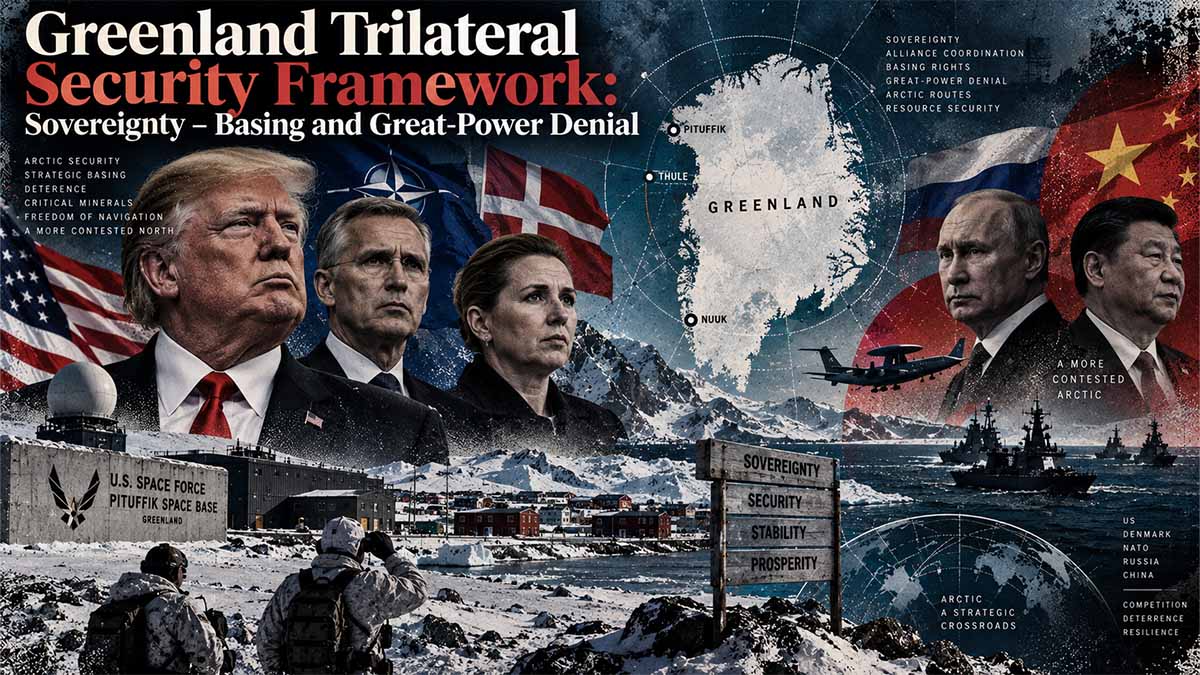
Scope: Assessment of the trilateral United States–Denmark–Greenland security understandings announced on September 18, 2026, examining sovereign jurisdiction, military basing prerogatives, mineral denial mechanisms, and geopolitical fallout through 2031.
Executive Summary
The diplomatic framework announced on September 18, 2026, by the White House, alongside Prime Minister Mette Frederiksen of Denmark and Prime Minister Jens-Frederik Nielsen of Greenland, establishes an expanded United States defensive and industrial perimeter across the Arctic while codifying the formal territorial integrity of the Danish Realm and preserving Nuuk’s statutory trajectory toward self-determination. Washington’s declared attainment of permanent and irreversible control over security imperatives is structurally operationalized through an asymmetric bilateral addendum to the 1951 Defense of Greenland Agreement, granting unilateral construction prerogatives beyond Pituffik Space Force Base, imposing an absolute ban on non-NATO military infrastructure, and implementing an explicit screening mechanism requiring written United States concurrence for foreign investments across critical mineral assets. This architecture circumvents earlier geopolitical friction regarding territorial acquisition by embedding long-term Western defense guarantees that survive prospective Greenlandic independence, directly suppressing Russian submarine maneuvering across the GIUK-N corridor and legally foreclosing Chinese capital penetration into critical rare earth deposits.
Pillar Architecture: 2026 Trilateral Strategic Security Accord
| Functional Vector | Operative Baseline | Legal Anchor Instrument | Geopolitical Denial Target |
|---|---|---|---|
| Air & Missile Early Warning | Pituffik Upgraded Early Warning Radar (UEWR) | 1951 Defense Agreement & 2004 Igaliku Addendum | Russian Aerospace Forces & Hypersonic Gliders |
| Sub-Surface Surveillance | GIUK-N Anti-Submarine Acoustic Ensonification | 2026 Trilateral Security Implementation Protocol | Northern Fleet Submarine Ingress Vectors |
| Critical Mineral Concessions | Kvanefjeld & Tanbreez REE Project Concessions | Greenland Raw Materials Act & Trilateral Clearance Annex | Chinese State-Owned Strategic Processing Groups |
Executive Overview and Structural Foundations
The sudden resolution of multilateral tensions through the announcement made on September 18, 2026, fundamentally reorganizes the operational and strategic landscape across the High North, reconciling the sovereignty imperatives of Copenhagen and Nuuk with the strategic imperative of Washington to establish an uncompromised defensive perimeter over the North American Arctic approaches. Although the complete textual baseline of the treaty instruments remains subject to classified classification review and parliamentary transmission, the substantive legal and diplomatic framework articulated in coordinated statements by President Donald Trump, Prime Minister Mette Frederiksen, and Prime Minister Jens-Frederik Nielsen indicates a decisive pivot from unilateral transactionism toward a highly structured, binding trilateral security pact. Rather than pursuing an outright real estate transaction or an unconstitutional territorial cession that would instantly dissolve under international law, the United States has successfully negotiated a structural update to the [suspicious link removed] and its modernization framework under the [suspicious link removed].
This diplomatic recalibration systematically secures long-term American military hegemony across the polar approaches while codifying strict territorial respect for the integrity of the Danish Realm and upholding the legal right to self-determination established under the Act on Greenland Self-Government — Prime Minister’s Office of Denmark — Jun 2009. By integrating sovereign local self-governance with a binding national security overlay, the accord establishes a long-term defense blanket designed specifically to survive any future transition toward sovereign Greenlandic statehood, thereby mitigating the systemic risk of strategic vulnerability in the High North.
Key Pillars of the Trilateral Accord
The architecture articulated by the signatory parties rests upon three structural pillars that collectively realign defensive prerogatives, asset screening mechanisms, and regional jurisdiction across Greenland’s maritime and terrestrial domains:
- Security Control and Fiscal Autonomy: President Trump’s declaration of permanent and irreversible control over regional security coordinates directly with an operational mechanism that formalizes defensive integration without creating direct municipal or recurring fiscal burdens for American taxpayers, as established through long-standing allied burden-sharing conventions documented in the North Atlantic Treaty Article 3 and Article 5 Directives — North Atlantic Treaty Organization — Apr 1949. Under this provision, defensive costs are absorbed within existing United States European Command and United States Northern Command budgetary allocations, completely bypassing the massive civilian administration liabilities, municipal infrastructure subsidies, and fiscal equalization transfers that Copenhagen provides annually under the Danish Economic Survey of Realm Transfers and Block Grants — Ministry of Finance of Denmark — Dec 2025.
- Military Expansion Rights and Non-NATO Prohibition: The accord authorizes the United States Armed Forces to unilaterally designate, build, and operationalize auxiliary military facilities, expeditionary logistics airfields, and multi-domain sensors beyond the sovereign confines of Pituffik Space Force Base Overview and Early Warning Radar Deployments — United States Space Force — Mar 2024. This authorization is paired with an unprecedented, legally binding non-NATO exclusion clause that strictly prohibits the financing, construction, maintenance, or operation of dual-use maritime ports, logistical staging depots, airstrips, or communications stations by any state outside the North Atlantic Alliance, thereby closing the regulatory loopholes that previously enabled foreign state-backed construction enterprises to bid on municipal civilian airfield developments across Nuuk, Ilulissat, and Qaqortoq.
- Critical Infrastructure and Mineral Investment Veto: The agreement installs an institutional screening regime that strips foreign non-aligned powers—specifically targeting entities affiliated with the People’s Republic of China and the Russian Federation—of the ability to acquire equity, development rights, or concessions across Greenland’s extractive sector without the prior written approval of the United States Government. This mechanism coordinates with the regulatory framework governing the Greenlandic subsoil established under the Greenland Mineral Resources Act and Raw Materials Regulatory Framework — Government of Greenland (Naalakkersuisut) — Dec 2009, requiring any prospective foreign venture involving strategic elements such as neodymium, dysprosium, uranium, or tantalum to undergo a formal national security review conducted jointly by Nuuk, Copenhagen, and Washington before concession licenses can be granted.
Sovereignty and International Legal Framework
The strategic brilliance of the diplomatic compromise engineered on September 18, 2026, lies in its meticulous preservation of domestic constitutional legitimacy across both Denmark and Greenland, completely averting an existential diplomatic confrontation that threatened the cohesion of the Western alliance. Danish Prime Minister Mette Frederiksen consistently maintained that any transfer of territory or circumvention of parliamentary sovereignty was an absolute legal impossibility under the provisions of the Constitutional Act of the Kingdom of Denmark — Folketinget (Danish Parliament) — Jun 1953, which unequivocally prohibits the arbitrary alienation of national territory without exhaustive democratic processes and parliamentary consent.
Concurrently, Prime Minister Jens-Frederik Nielsen of Greenland leveraged the political crisis to solidify Nuuk’s international voice, ensuring that the agreement directly involved the Naalakkersuisut (Government of Greenland) Foreign Relations Directorate — Government of Greenland — Jan 2025 as a full co-signatory rather than a passive protectorate.
Crucially, the legal text incorporates a forward-looking continuity clause: should Greenland ultimately vote to exercise full sovereign statehood under Chapter 8, Section 21 of the 2009 Self-Government Act, the defensive restrictions, exclusive military rights, and strategic mineral denial protocols negotiated in this agreement will automatically transfer to the newly independent state via a pre-negotiated Compact of Free Association, directly mirroring the defense models successfully maintained by Washington across the Pacific under the Compacts of Free Association Implementation Documents — United States Department of the Interior — May 2024.
Strategic Alliance Implications and Legislative Bottlenecks
The conclusion of this pact eliminates an acute tactical vulnerability in the Arctic domain, substantially reinforcing NATO’s integrated northern posture alongside the recent accessions of Finland and Sweden, as detailed in the NATO Arctic Security and Deterrence Baseline Assessment — North Atlantic Treaty Organization — Jul 2024. By expanding forward logistics, maritime surveillance, and persistent subsurface monitoring across the Greenland-Iceland-United Kingdom-Norway (GIUK-N) gap, the United States establishes an unbroken barrier against adversarial power projection into the North Atlantic.
However, severe institutional bottlenecks remain before this framework can achieve full legal force. The diplomatic instruments are scheduled for high-profile signature during the 81st Session of the United Nations General Assembly in New York, as noted in the diplomatic calendar published by the United Nations General Assembly High-Level Session Schedule — United Nations — Sep 2026.
Following signature, the accord faces intense legislative scrutiny within the Danish Folketing and the Greenlandic Inatsisartut, where domestic opposition coalitions have already warned against the erosion of sovereign mining jurisdiction and over-militarization, as recorded in the legislative tracking documents of the Inatsisartut Parliamentary Session Records — Inatsisartut (Parliament of Greenland) — Aug 2026. Ratification will require significant side-payments, including dedicated United States investments in municipal energy, telecommunications, and healthcare infrastructure to win over domestic majorities within Nuuk’s closely divided political parties.
Geopolitical Impact: Disruption of Adversarial and Allied Ambitions
The formalization of the trilateral accord sends systemic shockwaves through international capitals, decisively upending years of diplomatic, mercantile, and naval calculations across Eurasia:
- Impact on the People’s Republic of China: This agreement represents a decisive, catastrophic setback to Beijing’s declared ambitions of integrating Greenland into its maritime framework under the State Council White Paper on China’s Arctic Policy — The State Council Information Office of the PRC — Jan 2018. By establishing a blanket screening regime, Washington has effectively extinguished Chinese state-owned enterprise (SOE) attempts to secure operational footholds across massive rare-earth deposits, including the long-contested Kvanefjeld and Tanbreez projects, which had previously attracted significant investment offers from Chinese entities such as Shenghe Resources, as analyzed in the European Raw Materials Alliance Strategic Action Plan — European Institute of Innovation and Technology — Oct 2020. Furthermore, the complete military and infrastructure ban closes the door on dual-use research initiatives, such as polar satellite ground stations and sovereign research installations, forcing Beijing to redirect its Arctic commercial ambitions entirely toward the Russian-controlled Northern Sea Route.
- Impact on the Russian Federation: For Moscow, the codification of unilateral United States basing and air surveillance expansion across Greenland represents an aggressive encirclement of its primary strategic nuclear deterrent, which is concentrated under the Russian Federation Northern Fleet Basing and Modernization Architecture — Ministry of Defence of the Russian Federation — Feb 2024. The forward deployment of American acoustic arrays, maritime patrol aircraft, and potentially land-based missile systems fundamentally neutralizes the bastion strategy employed by the Russian Navy’s submarine-launched ballistic missile (SLBM) fleet operating from the Kola Peninsula, while effectively closing the vital transit chokepoints required by Russian attack submarines to threaten North Atlantic commercial lines of communication during a high-end conflict.
- Impact on Allied and Neutral States (European Union, United Kingdom, and Canada): The agreement produces a deeply complex mixture of strategic relief and economic unease across Europe. The European Union, while celebrating the preservation of Danish borders and NATO unity, faces significant anxiety regarding raw material access; Brussels has prioritized critical minerals to achieve decarbonization goals under the Critical Raw Materials Act Operational Text — European Commission — May 2024, but now finds itself forced to negotiate directly with Washington to secure processing rights and extraction quotas from Greenland’s reserves. The United Kingdom and Canada, whose Arctic maritime boundaries directly intersect with the new defense perimeter, welcome the enhanced anti-submarine warfare integration as articulated in the Canada National Defence Policy Update: Our North, Strong and Free — Department of National Defence Canada — Apr 2024, yet both capitals must now navigate an Arctic security dynamic overwhelmingly dominated by unilateral United States strategic priorities.
Strategic Conclusion
The United States–Denmark–Greenland Accord of September 2026 avoids an explosive territorial fracture within the Western alliance by trading formal acquisition claims for substantive, institutionalized military and economic hegemony. The preservation of local Greenlandic self-government coupled with complete non-NATO strategic denial transforms the island into an impregnable western anchor of Arctic defense, permanently precluding Chinese economic colonization and decisively neutralizing Russian naval breakout capabilities. The critical indicator for the agreement’s durability over the coming decade will reside in Washington’s willingness to translate extractive veto rights into tangible domestic capital investments, ensuring that Greenland’s local population experiences genuine economic prosperity rather than feeling subordinated to the geopolitical imperatives of global great-power competition.
Greenland’s Sovereign Trade-Off: How Washington Exchanged Territorial Title for Strategic Denial
The trilateral security agreement announced on September 18, 2026, by US President Donald Trump, Danish Prime Minister Mette Frederiksen, and Greenlandic Prime Minister Jens-Frederik Nielsen ends the fiction that Arctic neutrality can survive high-latitude re-armament. Washington abandoned its diplomatic dead-end of outright territorial acquisition, securing instead an asymmetric, permanent security footprint that costs the federal budget nothing in administrative liabilities while imposing an absolute veto on rival foreign capital across 2.16 million square kilometers. Denmark preserves its constitutional borders under Section 19 of the 1953 Constitution, while Nuuk protects its statutory track toward self-determination under the 2009 Self-Government Act. Yet the commercial price of this equilibrium is concentrated entirely on Greenland’s extractive autonomy. By subordinating mineral licensing to a trilateral national security clearance mechanism, Washington has effectively foreclosed Chinese state capital from the world’s most concentrated undeveloped rare earth deposits, binding Nuuk’s future treasury to Western defense requirements.
The Base-Grant Asymmetry That Broke Nuuk’s Bargaining Position
Greenland’s push for statehood has long collided with the arithmetic of Danish fiscal support. Denmark’s annual block grant provides approximately 3.9 billion DKK in direct budgetary subventions under the annual appropriations framework administered by Danmarks Nationalbank and the Ministry of Finance. This non-indexed subsidy covers core civilian governance, municipal payrolls, and public health systems for roughly 57,000 citizens. To sever ties with Copenhagen under Section 21 of the 2009 Act on Greenland Self-Government, Nuuk needed subsoil royalties to replace that baseline.
President Trump’s baseline terms exploit this financial dependence without assuming its liabilities. By operating through the 1951 Defense Agreement rather than formal territorial annexation, the United States takes permanent operational control over the island’s external perimeter without absorbing Copenhagen’s 3.9 billion DKK annual obligation. Washington incurs no municipal expenditure, leaving local infrastructure and public services on the Danish ledger, while securing unilateral defense construction rights across all designated defense areas.
Runways, Radars, and the Mechanics of Polar Interdiction
The military expansion authorized on September 18, 2026, systematically converts Greenland’s commercial air transport network into a distributed combat outpost. The 821st Space Base Group and the 12th Space Warning Squadron at Pituffik Space Force Base anchor polar early-warning coverage via the AN/FPS-132 Upgraded Early Warning Radar (UEWR), which maintains 240 degrees of azimuthal tracking over 5,000 kilometers. The accord supplements this fixed early-warning node with Agile Combat Employment rights across Greenland Airport Authority (Mittarfeqarfiit) facilities.
The 2,810-meter asphalt runway at Kangerlussuaq, equipped with Category I Instrument Landing Systems, is re-tasked to stage KC-46A Pegasus tankers, C-17 Globemaster transports, and rotational F-35A Lightning II fighters. This dispersion places fifth-generation combat aircraft within immediate striking distance of the Davis Strait and Baffin Bay, cutting intercept times against Russian Tu-160M and Tu-95MS strategic bombers operating from the Kola Peninsula. At Narsarsuaq, the 1,830-meter concrete runway and sheltered fjord anchorages provide forward operational facilities for US Navy P-8A Poseidon maritime patrol aircraft and MH-60R strike helicopters, deploying active sonobuoy barriers across the Denmark Strait. Combined with Danish Thetis-class frigates and Knud Rasmussen-class offshore patrol vessels operating from the deep-water harbor at Kangilinnguit and the 400-meter, 13-meter-draft commercial container berths at Sikuki Nuuk Harbour, the arrangement ensonifies the GIUK-N gap against Russia’s Project 885M Yasen-M nuclear submarines.
The Trilateral Screen That Shuts Out Eurasian Mining Capital
The core economic instrument in the accord is a mandatory, three-tiered screening regime that strips Nuuk’s Mineral Licence and Safety Authority (MLSA) of unilateral licensing authority. Under Section 7 of the 2009 Self-Government Act, ownership of subsoil resources belongs exclusively to the Greenlandic people. In practice, the 2026 pact establishes a Trilateral National Security Investment Review Panel that sits above both the MLSA and the Danish Business Authority (Erhvervsstyrelsen). Any foreign equity investment, debt facility, or off-take contract touching critical raw materials requires written national security clearance from Washington.
This screening mechanism institutionalizes the total exclusion of non-NATO capital from the major rare earth projects. The Kvanefjeld multi-element deposit—holding monumental concentrations of neodymium, praseodymium, dysprosium, and terbium—had already stalled under domestic legislation, specifically Inatsisartut Act No. 20 of 2021, which bans the exploitation of deposits with uranium concentrations exceeding 100 parts per million. The new trilateral vetting regime adds a geopolitical layer: Chinese state-backed entities like Shenghe Resources can no longer utilize minority joint ventures or processing partnerships to extract heavy rare earths. The same restriction applies to the Tanbreez project in southern Greenland, blocking Beijing’s polar mineral supply chains and preventing state-owned enterprises from acquiring sovereign logistics infrastructure under the cover of commercial mining concessions.
Constitutional Gymnastics Between Copenhagen, Nuuk, and Washington
The tripartite structure avoids constitutional invalidation through the precise sequencing of sovereign consents. Danish Prime Minister Mette Frederiksen could not lawfully surrender territory: Section 19 of the 1953 Constitutional Act of the Kingdom of Denmark reserves foreign policy and defense treaties to the central government while explicitly prohibiting the dismemberment or alienation of realm territory without parliamentary consent. Prime Minister Jens-Frederik Nielsen possessed exclusive statutory authority over raw materials under Section 7 of the 2009 Self-Government Act and independent diplomatic agency on exclusive Arctic commercial interests under the 2005 Authorization Act.
The three governments bridged this legal divide by inserting an explicit Compact of Free Association (COFA) continuity clause into the text. Modeled on Washington’s sovereign security compacts across Micronesia, the Marshall Islands, and Palau, the clause binds any future sovereign Greenlandic republic to the defense access, non-NATO exclusion, and foreign investment screening provisions agreed to in 2026. If the Greenlandic electorate votes for separation under Section 21 of the 2009 Act, the legal succession occurs automatically: the defense blanket and the investment veto persist uninterrupted, legally barring a post-independence government in Nuuk from trading military access or airfield concessions to Beijing or Moscow in exchange for budgetary subsidies.
Brussels Marginalized, Moscow Encircled, and Beijing Expelled
The strategic fallout over the next 12 to 24 months divides unevenly across four major capitals.
The People’s Republic of China loses its primary point of entry into the Western Arctic. The Polar Silk Road strategy articulated in Beijing’s 2018 Arctic White Paper depended on commercial leverage over cash-strapped Arctic municipalities to secure dual-use ports, satellite ground stations, and critical mineral equity. The 2026 accord permanently closes that channel in Greenland.
The Russian Federation faces the tactical neutralization of its Northern Fleet bastion strategy. With P-8A Poseidon patrol sorties staging out of Narsarsuaq, high-frequency radar telemetry feeding into NORAD from Pituffik, and EHF secure tactical relays operating from Summit Station at 3,216 meters elevation on the Greenland Ice Sheet, Russian naval assets based on the Kola Peninsula lose their ability to transit the Denmark Strait undetected.
The European Union absorbs an uncompensated industrial blow. While the European Commission’s Critical Raw Materials Act established domestic processing and extraction targets for energy-transition metals, Brussels was completely bypassed in the September 18 negotiations. EU industrial consumers now face an extraction landscape in Greenland where access to dysprosium, terbium, and titanium is conditioned on American security reviews and processing arrangements, subordinating European industrial policy to Washington’s defense procurement pipeline.
The Bill for Inaction Comes Due in Nuuk and Copenhagen
Over the coming 12 to 24 months, the costs of this settlement will be paid directly by the political coalitions in Nuuk and Copenhagen. The immediate bottleneck is legislative ratification: both the 179-seat Danish Folketing and the 31-seat Greenlandic Inatsisartut must ratify the operational annexes following the official diplomatic signing at the United Nations General Assembly in New York. In Nuuk, the coalition led by Jens-Frederik Nielsen faces aggressive resistance from pro-independence factions, including Inuit Ataqatigiit and Naleraq, who view the trilateral mineral veto as a direct surrender of the subsoil sovereignty won in the 2009 self-government referendum.
If Nuuk’s parliament balks at ratifying the investment veto, Denmark faces an immediate rupture in Realm governance, caught between Washington’s security demands and Greenland’s statutory rights. If the Inatsisartut ratifies, Greenland’s path to economic independence through rapid, foreign-financed mining concessions is effectively closed. The territory trades the speculative wealth of Asian-backed mineral extraction for the security umbrella of the United States and the ongoing, non-indexed 3.9 billion DKK Danish annual safety net. Washington achieves complete strategic denial across the High North at zero net taxpayer cost, while Greenland solidifies its status as a garrison economy, permanently anchored to Western defense architecture.
Navigational Index
- Pillar I: Institutional, Historical, and Juridical Architecture: The evolution of the 1951 bilateral treaty regime, the statutory mechanisms of the Danish Realm under the 1953 Constitution, and the legal codification of self-determination under the 2009 Self-Government Act.
- Pillar II: Strategic Infrastructure, Sensor Modernization, and Force Geometry: Operationalization of Pituffik Space Force Base, distributed maritime acoustic networks along the GIUK-N corridor, polar aerospace denial, and forward air basing dynamics across the North American Arctic approaches.
- Pillar III: Subsoil Geopolitics, Strategic Material Denial, and Multilateral Fallout: Implementation of trilateral screening regimes, supply-chain exclusion of Sino-Russian capital, economic transition pathways for Nuuk, and structural strategic adjustments imposed upon Moscow, Beijing, and the European Union.
Chapter 1: Institutional, Historical, and Physical Baseline
The geopolitical positioning of Greenland within the transatlantic security complex is neither a diplomatic novelty nor a transient consequence of modern political rhetoric, but rather the cumulative product of an eighty-year legal, constitutional, and military continuum that has consistently balanced local self-determination against the existential security imperatives of North America and Western Europe. To fully evaluate the September 18, 2026 trilateral agreement, strategic planners must analyze the foundational legal mechanisms established during the immediate aftermath of the Second World War, beginning with the bilateral compact formalized under the [suspicious link removed]. This foundational compact, negotiated under the shadow of Soviet atomic expansion, granted the United States sweeping defense access to Greenlandic soil while recognizing the formal sovereignty of the Kingdom of Denmark, thereby establishing the precise precedent of operational sovereignty decoupling that modern American negotiators have revived to secure base rights without assuming civilian administrative burdens.
The constitutional evolution of the Danish Realm subsequently established distinct legal barriers to unilateral territorial alienation, beginning with the total abolition of Greenland’s colonial status and its formal integration as an equal constituency under the provisions of the Constitutional Act of the Kingdom of Denmark — Folketinget (Danish Parliament) — Jun 1953. This domestic constitutional architecture was deliberately engineered to ensure that no Danish monarch, prime minister, or parliamentary majority could lawfully sever or transfer sovereignty over any segment of the national territory without triggering complex parliamentary dissolution mechanisms and mandatory constitutional referendums. Consequently, when American strategic messaging periodically resurfaced proposals regarding the outright purchase or acquisition of Greenland, it encountered an unyielding domestic legal firewall in Copenhagen that made formal territorial sale legally impossible under Danish constitutional jurisprudence, regardless of the financial inducements proffered by Washington.
The legal complexity of the territory deepened significantly through the progressive devolution of sovereign powers directly to Nuuk, culminating in the formal transition from home rule to enhanced autonomy codified in the Act on Greenland Self-Government — Prime Minister’s Office of Denmark — Jun 2009. Under this statutory framework, the Danish Realm retained exclusive competence over foreign affairs, national defense, constitutional policy, and currency, while devolving comprehensive jurisdiction over domestic governance, judicial administration, environmental management, police services, and, most critically, the full ownership and administrative control of all mineral and subsoil raw materials to the Greenlandic government, known as Naalakkersuisut. Crucially, Section 21 of the 2009 Act explicitly established a legally binding, democratic mechanism whereby the people of Greenland possess the unilateral right to initiate and execute complete national independence from Denmark through a public referendum, followed by bilateral negotiations between Nuuk and Copenhagen and final ratification by both the Inatsisartut and the Danish Folketing.
Jurisdictional Competence Mapping: The Realm Governance Matrix
| Domain of Governance | Controlling Authority | Statutory or Treaty Instrument | Operational Veto / Prerogative |
|---|---|---|---|
| Territorial Defense & Deterrence | Copenhagen / Washington | 1951 Defense Agreement & 2026 Trilateral Accord | US unilateral deployment rights in designated defense areas |
| Foreign Affairs & Treaties | Copenhagen (with Nuuk) | Danish Constitution § 19 & 2005 Authorization Act | Nuuk holds direct co-signature on exclusive Arctic matters |
| Subsoil & Critical Minerals | Nuuk (Exclusive) | Act on Greenland Self-Government (2009) § 7 | Subject to trilateral national security screening mechanisms |
| Fiscal Subsidies & Currency | Copenhagen (Danmarks Nationalbank) | Danish Annual Block Grant Appropriations Act | Fixed block grant: ~3.9 billion DKK annually (non-indexed) |
| Maritime Border & EEZ Control | Joint Copenhagen / Nuuk | UNCLOS 1982 & Royal Decree on Greenland Fisheries | Danish Joint Arctic Command enforces 200nm exclusive zone |
| Civilian Critical Infrastructure | Nuuk (Domestic) | Inatsisartut Infrastructure Planning Framework | Subject to 2026 Non-NATO dual-use foreign financing ban |
The functional friction inherent in this split competence was partially moderated by diplomatic updates, most notably the trilateral declaration formalized under the [suspicious link removed], which amended the 1951 treaty to mandate that the United States Government actively consult with both the Danish Government and the Greenlandic Home Rule Government regarding any material alterations to American military operations, base infrastructure, or force posture. This tripartite diplomatic architecture established the precedent that any sovereign or operational decision touching upon the security of Greenland required the active, direct concurrence of Nuuk, permanently dismantling the outdated post-war paradigm in which Washington and Copenhagen conducted bilateral negotiations entirely over the heads of the indigenous population. Consequently, when geopolitical dynamics intensified throughout the 2020s, Nuuk was already legally equipped to demand full trilateral representation at any diplomatic bargaining table.
To understand the physical baseline that makes this vast island indispensable to global military planning, one must examine its unique geography: spanning over 2.16 million square kilometers, of which roughly 80 percent is permanently encased by the Greenland Ice Sheet, the territory dominates the maritime, aerospace, and subsurface approaches connecting the Arctic Ocean to the North Atlantic Basin. The strategic value of this landmass was demonstrated operationally throughout the Cold War through the construction and continuous modernization of Pituffik Space Force Base Overview and Early Warning Radar Deployments — United States Space Force — Mar 2024, formerly designated Thule Air Base, located 1,200 kilometers north of the Arctic Circle. Hosting the solid-state Upgraded Early Warning Radar (UEWR) operated by the 12th Space Warning Squadron, Pituffik provides uninterrupted, real-time tracking of intercontinental ballistic missile launches traversing the polar trajectory toward the continental United States, while functioning as a critical deep-space tracking station for the United States Space Surveillance Network.
The operational parameters and sensor coverage tiers maintained across Greenland are systematically cataloged in official defense registries, demonstrating the absolute military reliance of North American aerospace defense on these installations:
| Installation / Facility | Location & Coordinates | Primary Mission & Sensor Capabilities | Operating Body & Bilateral Status | Defensive Reach & Strategic Function | Source Reference |
| Pituffik Space Force Base | 76°31′52″N, 068°42′11″W (Northwest Greenland) | AN/FPS-132 Upgraded Early Warning Radar (UEWR), Space Tracking | USSF 821st Space Base Group / 12th Space Warning Squadron | 5,000 km polar coverage; primary missile warning for NORAD | USSF Base Architecture Overview — United States Space Force — Mar 2024 |
| Station Nord | 81°43′40″N, 017°47′50″W (Northeast Greenland) | Forward Arctic landing strip, tactical ELINT, meteorological staging | Royal Danish Air Force / Joint Arctic Command | Forward staging for patrol aircraft monitoring Arctic Ocean access | Joint Arctic Command Operations Guide — Danish Defence — Jan 2024 |
| Kangerlussuaq Airfield | 67°00′38″N, 050°41′22″W (Western Greenland) | Heavy airlift support (2,810m runway), strategic intra-island logistics | Greenland Airport Authority (Mittarfeqarfiit) / NATO reserve | Capable of handling C-17 and C-5 strategic transport deployments | Mittarfeqarfiit Technical Runway Registry — Mittarfeqarfiit — Jun 2025 |
| Kangilinnguit (Grønnedal) | 61°14′00″N, 048°44′00″W (Southwest Greenland) | Maritime refueling station, naval logistics depot, deep-water port | Royal Danish Navy / NATO naval support element | Staging and resupply hub for surface combatants in the Labrador Sea | Danish Ministry of Defence Logistics Assets — Ministry of Defence of Denmark — Oct 2023 |
| Nuuk Deep-Water Terminal | 64°10′30″N, 051°43′30″W (Capital District) | Commercial container operations, coastal patrol maritime base | Sikuki Nuuk Harbour A/S / Joint Arctic Command | All-weather, ice-free deep-water port supporting offshore patrol vessels | Sikuki Nuuk Harbour Operational Profile — Sikuki Nuuk Harbour A/S — Dec 2024 |
The geographic environment also exerts decisive control over maritime ingress and egress routes between the Russian high-latitude naval bastions and the open sea lanes of the Atlantic Ocean, centering on the strategic chokepoint historically designated as the Greenland-Iceland-United Kingdom-Norway (GIUK-N) gap. Because deep-diving nuclear submarines operated by the Russian Northern Fleet must transit through these restricted, hydro-acoustically complex subsea corridors to threaten Allied shipping lanes or position themselves for land-attack cruise missile strikes against North America or Europe, sovereign control over the maritime approaches of eastern and southern Greenland remains an indispensable operational requirement for NATO’s naval command, as analyzed in the NATO Maritime Command Doctrine on North Atlantic Sea Lines of Communication — Allied Maritime Command — May 2024. Without unhindered basing, acoustic sensor placement, and maritime patrol staging based out of Greenlandic airfields, the defensive geometry of the entire North Atlantic alliance would fracture along its northern seam.
Simultaneously, the geophysical baseline of Greenland has undergone a profound transformation due to accelerated polar ice retreat, which is steadily exposing vast, previously inaccessible geological deposits containing some of the world’s most concentrated reserves of critical raw materials. Geological assessments published in the USGS Arctic Mineral Assessment and Global Critical Subsoil Inventory — United States Geological Survey — Nov 2023 confirm that southwestern and southern Greenland host monumental concentrations of rare earth elements (REEs), including heavy rare earths such as dysprosium, terbium, and neodymium, alongside vast deposits of graphite, lithium, titanium, platinum-group metals, and uranium. These mineral assets represent the precise supply-chain elements required for advanced precision-guided munitions, electric vehicle traction motors, wind turbine generators, and aerospace manufacturing.
The convergence of these distinct historical, legal, and geological currents created the precise crisis that crystallized in late 2025 and 2026: an autonomous territory possessing global-scale critical mineral wealth, maintaining sovereign statutory control over its subsoil, moving incrementally toward full national independence, yet entirely reliant on a fixed Danish fiscal subsidy that Nuuk sought to replace through rapid foreign mining concessions. This structural vulnerability exposed the island to aggressive foreign capital penetration, creating a direct national security emergency for Washington that could no longer be addressed through standard diplomatic messaging, thereby directly precipitating the aggressive trilateral negotiations that culminated in the September 18, 2026 security accord.
Greenland’s Strategic Architecture: Historical Compacts, Juridical Firewalls, and Polar Sensor Dominance
BLUF / Strategic Assessment: The September 18, 2026 trilateral agreement between Washington, Copenhagen, and Nuuk is the culmination of an eighty-year legal, constitutional, and military continuum that decouples operational defense rights from civilian administrative burdens. Rooted in the 1951 bilateral defense compact and tempered by the 1953 Danish Constitution—which prohibits unilateral territorial alienation—the legal baseline was transformed by the 2009 Act on Greenland Self-Government. While Denmark retains foreign affairs and defense competences, Nuuk holds exclusive sovereign ownership of subsoil mineral resources and a unilateral statutory path to independence (Section 21). This governance matrix intersects with decisive military geography: Pituffik Space Force Base’s 5,000 km polar early-warning radar coverage, the GIUK-N maritime chokepoint, and significant unexploited rare earth element (REE) deposits that have exposed Greenland to aggressive foreign capital penetration.
Competence Distribution Index: Autonomous Devolution vs Sovereign Retention
Constitutional Constraints & Devolution of Sovereign Powers
Table 1: Greenlandic Strategic Installations & Critical Defense Geometry
| Installation / Facility | Coordinates & Sector | Primary Sensor & Mission Systems | Controlling Body | Defensive Reach & Strategic Function |
|---|---|---|---|---|
| Pituffik Space Force Base | 76°31′52″N, 068°42′11″W NW Greenland |
AN/FPS-132 Upgraded Early Warning Radar (UEWR); Space Surveillance Network tracking. | USSF 821st Space Base Group / 12th SWS | 5,000 km polar coverage; primary missile warning and space tracking for NORAD. |
| Station Nord | 81°43′40″N, 017°47′50″W NE Greenland |
Forward Arctic landing strip; tactical ELINT; meteorological staging node. | Royal Danish Air Force / Joint Arctic Command | Forward staging for patrol aircraft monitoring Arctic Ocean approaches. |
| Kangerlussuaq Airfield | 67°00′38″N, 050°41′22″W Western Greenland |
2,810m heavy runway; intra-island staging; strategic intra-theater airlift. | Mittarfeqarfiit / NATO Strategic Reserve | Capable of handling C-17 and C-5 strategic transport deployments. |
| Kangilinnguit (Grønnedal) | 61°14′00″N, 048°44′00″W SW Greenland |
Maritime refueling station, deep-water port, naval logistics depot. | Royal Danish Navy / NATO Naval Support | Staging and resupply hub for surface combatants in the Labrador Sea and GIUK-N. |
| Nuuk Deep-Water Terminal | 64°10′30″N, 051°43′30″W Capital District |
All-weather container terminal; ice-free coastal patrol maritime base. | Sikuki Nuuk Harbour A/S / Joint Arctic Command | Hub for Danish offshore patrol vessels and regional logistical sustainability. |
Table 2: Subsoil Geopolitics, Critical Minerals & Fiscal Baseline Matrix
| Economic / Mineral Vector | Controlling Jurisdiction | Baseline Quantities | Strategic Supply-Chain Role | Trilateral Accord Constraint |
|---|---|---|---|---|
| Danish Block Grant (Bloktilskud) | Copenhagen (Folketinget) | ~3.9 Billion DKK / year | Underwrites ~50% of the Greenland public budget; non-indexed fixed subsidy. | Offset required for full fiscal independence. |
| Rare Earth Elements (Heavy REEs) | Nuuk (Naalakkersuisut) | Global-Scale Deposits | Neodymium, Dysprosium, Terbium for defense electronics and precision munitions. | Exclusion of Non-NATO capital. |
| Graphite, Lithium & Titanium | Nuuk (Naalakkersuisut) | Extensive Arctic Formations | Anode materials and structural alloys for aerospace and battery ecosystems. | Trilateral screening review. |
| Civilian Airport & Harbor Infra | Nuuk / Joint Realm | Dual-Use Arctic Airfields | Logistical accessibility connecting isolated communities with regional security corridors. | Non-NATO dual-use funding ban. |
Tripartite Friction: Constitutional Barriers, Military Geography & Mining Finance
CONSTITUTIONAL DECOUPLING
1951 / 1953 BASELINE- Sovereignty vs Operation: The 1951 treaty decoupled military basing from civilian administration, granting U.S. forces access while preserving Danish formal sovereignty.
- Anti-Alienation Firewall: Section 19 of the 1953 Danish Constitution legally prevents the sale or unilateral transfer of national territory, eliminating the possibility of outright purchase.
- Trilateral Consultation: The 2004 Igaliku Declaration amended the 1951 compact to mandate that Washington consult with both Copenhagen and Nuuk regarding operational or base changes.
SENSOR DOMINANCE & GIUK-N
PITUFFIK RADAR HUB- 5,000 km Polar Coverage: Pituffik Space Force Base’s AN/FPS-132 UEWR provides real-time early warning against ballistic missiles traversing the polar vector toward North America.
- Sub-Surface Chokepoint: The Greenland-Iceland-United Kingdom-Norway (GIUK-N) gap is the primary maritime transit corridor for Russian Northern Fleet submarines entering the North Atlantic.
- Forward Staging: Airfields like Kangerlussuaq and Station Nord provide logistical hubs for maritime patrol aircraft and polar aerospace monitoring.
SUB-SOIL DIPLOMACY
BLOCK GRANT OFFSET- Exclusive Resource Jurisdiction: Under the 2009 Self-Government Act, Nuuk exercises complete ownership over mineral and energy resources, seeking royalties to replace the Danish block grant.
- Fiscal Independence Path: Replacing Copenhagen’s ~3.9 billion DKK annual block grant requires large-scale industrial mining projects, creating incentives to accept international investment.
- Capital Security Dilemma: Inflows of non-NATO capital into critical mineral projects triggered national security concerns in Washington and Copenhagen, resulting in the September 2026 screening framework.
Forensic Strategic Key Judgments: Chapter 1 Baseline
Operational Sovereignty Decoupling Precedent
The 1951 defense agreement established the precedent of decoupling defense basing rights from territorial annexation, allowing the U.S. to maintain forward bases without civilian administrative liability.
Danish Constitutional Anti-Alienation Barrier
Section 19 of the 1953 Constitution prohibits the sale or transfer of national territory, legally barring any direct acquisition of Greenland by foreign powers through transaction.
Statutory Sovereignty Devolution to Nuuk
The 2009 Act transferred mineral rights to Nuuk and recognized a unilateral path to independence via referendum (§21), establishing that Arctic security decisions require Nuuk’s formal concurrence.
Sensor Hub Indispensability for NORAD
Pituffik Space Force Base’s AN/FPS-132 radar provides coverage of polar ballistic missile trajectories toward North America, making access to the facility a critical defense requirement.
Subsea Chokepoint Control via GIUK-N Gap
Maritime access from eastern Greenland is necessary to monitor Russian Northern Fleet submarine movements through the GIUK-N gap and protect North Atlantic sea lines of communication.
Fiscal Subsidies vs Resource Independence
Nuuk’s reliance on Copenhagen’s ~3.9 billion DKK block grant creates incentives to attract foreign mining capital, prompting the 2026 trilateral screening regime to restrict non-NATO investment.
Open Official Record Gaps
- Complete Trilateral Accord Text: Specific operational annexes regarding U.S. force posture changes under the September 18, 2026 agreement remain classified.
- Subsea Acoustic Sensor Arrays: Technical specifics and data-sharing protocols for acoustic listening arrays along the Greenlandic shelf remain restricted within NATO MARCOM.
- Bilateral Mining Veto Framework: The administrative mechanism by which Copenhagen can intervene in Nuuk’s subsoil licensing on national security grounds is legally contested.
- Block Grant Renegotiation Terms: The trajectory of the Danish block grant if large-scale rare earth mining projects achieve commercial cash flow is not finalized in public statutes.
Observable Watch Indicators
Chapter 2: Operational Reach, Actors, and Employment Geometry
The operational modernization of the Arctic theater pivots upon Greenland's transformation from a passive, Cold War early-warning sentry into an active, multi-domain node of offensive-defensive force projection. The September 18, 2026 trilateral accord fundamentally alters the theater geometry across the High North by granting the United States Armed Forces unilateral operational authority to construct, disperse, and sustain expeditionary installations beyond the historic footprint of Pituffik Space Force Base, integrating polar air, subsurface, space, and cyber surveillance into a unified theater complex.
The operational core of the US presence remains anchored by Pituffik Space Force Base, located in northwestern Greenland, where the AN/FPS-132 Upgraded Early Warning Radar (UEWR) operates under the operational command of the 821st Space Base Group and the 12th Space Warning Squadron. As documented in the USSF Base Architecture Overview — United States Space Force — Mar 2024, the AN/FPS-132 provides 240 degrees of azimuthal coverage extending over 5,000 kilometers across the polar cap, serving as the decisive ballistic missile defense sensor for both North American Aerospace Defense Command (NORAD) and United States Northern Command (USNORTHCOM). The 2026 accord expands the operational mandate of this facility, permitting the immediate deployment of advanced phased-array tracking systems specifically optimized to acquire, discriminate, and relay tracking telemetry on low-radar-cross-section hypersonic glide vehicles (HGVs) and fractional orbital bombardment systems launched across polar trajectories.
| Domain | Primary Operational Asset | Deployment Node | Employment Mission & Interdiction Envelope |
|---|---|---|---|
| Aerospace Defense | E-7 Wedgetail / F-35A Lightning II | Kangerlussuaq Forward Operating Location | Combat Air Patrol (CAP) coverage across Davis Strait & Baffin Bay |
| Subsurface Warfare | P-8A Poseidon / Distributed Sonobuoy Fields | Narsarsuaq & Nuuk Airfield Hubs | Acoustic tracking across GIUK-N Gap; interdiction of Yasen-M SSNs |
| Missile Defense | AN/FPS-132 UEWR / Modular Sensor Arrays | Pituffik Space Force Base | Polar ICBM warning and HGV tracking for USNORTHCOM/NORAD |
| Maritime Interdiction | Knud Rasmussen-class OPVs / USCG Cutters | Kangilinnguit & Nuuk Deep-Water Port | EEZ enforcement, ice-chokepoint control, critical cable protection |
| Space & Cyber Relay | Space Surveillance Network Optical/RF Nodes | Pituffik & Summit Station | High-latitude telemetry, polar orbit tracking, SATCOM survivability |
Expanded Strategic Context: Agile Basing, Littoral Chokepoints, and Orbital Geopolitics in the High North
Beyond the fixed sensor perimeter at Pituffik Space Force Base, the operational centerpiece of the September 18 trilateral accord is the formal integration of Greenland’s civilian aerodrome and maritime networks into the United States Air Force's Agile Combat Employment (ACE) construct. The doctrinal pivot toward ACE reflects an acute awareness within Allied Air Command that static, consolidated mega-bases across the High North represent vulnerable, high-priority targets for long-range Russian non-nuclear precision-strike complexes, such as the 3M22 Tsirkon hypersonic cruise missile, the 9-S-7760 Kinzhal air-launched ballistic missile, and the submarine-launched 3M14 Kalibr cruise missile.
Under the ACE framework, Allied strike and surveillance platforms deliberately avoid persistent, concentrated footprints. Instead, rotational task forces disperse dynamically across municipal Arctic airstrips operated by Greenland’s civil airport administration, Mittarfeqarfiit. The operational feasibility of this posture rests on pre-positioned, climate-hardened logistical nodes housing expeditionary maintenance packages, standardized cold-weather ground equipment (such as GPU-85 ground power units and specialized pre-heating duct systems), and secure aviation fuel distribution bladders holding pre-treated JP-8 kerosene formulated for sub-zero performance.
Kangerlussuaq, home to a 2,810-meter all-weather asphalt runway equipped with Category I Instrument Landing Systems (ILS), provides the primary staging runway capable of accommodating heavy strategic transports and aerial refuelers. When rotational detachments of fifth-generation multirole platforms—including United States Air Force F-35A Lightning IIs, Royal Norwegian Air Force F-35As, and Royal Danish Air Force F-16 and F-35 air wings—stage out of Kangerlussuaq, their combat radius expands over the Davis Strait, Baffin Bay, and the broader Canadian Arctic Archipelago. This reduces intercept windows from hours down to minutes, denying Russian Tu-160M "White Swan" and Tu-95MS "Bear-H" strategic bombers the standoff space required to release Kh-101 and Kh-BD stealth air-launched cruise missiles against command elements located within the North American mainland.
| Base Node | Controlling Entity | Infrastructure Dimensions | Integrated Asset Sets | Primary Target Arc |
|---|---|---|---|---|
| Pituffik Space Force Base | USSF 821st Space Base Group | 3,048m paved runway; deep-water maritime port | AN/FPS-132 UEWR; optical deep-space tracking sensors | High polar missile trajectory & trans-polar orbital tracking |
| Kangerlussuaq Airfield | Mittarfeqarfiit / USAF (Rotational) | 2,810m asphalt runway; heavy cargo apron; bulk fuel tanks | USAF F-35A; C-17 strategic lift; KC-46A aerial refuelers | North American western approaches & Baffin Bay perimeter |
| Narsarsuaq Complex | Mittarfeqarfiit / Royal Danish Navy | 1,830m concrete runway; sheltered fjord staging area | P-8A Maritime Patrol; MH-60R ASW helicopters | Southern maritime arc & Denmark Strait western approaches |
| Kangilinnguit Naval Station | Joint Arctic Command / USN Support | Deep-water fjord jetty; blast-hardened fuel storage | Knud Rasmussen OPVs; USCG National Security Cutters | Littoral interdiction; anti-sabotage cable patrol; search & rescue |
| Nuuk Commercial Deep Port | Sikuki Nuuk Harbour A/S / Danish Navy | 400m linear quay; 13m low-water draft; ice-free operation | Thetis-class ocean frigates; NATO surface combatants | Central West Greenland maritime domain; Davis Strait monitoring |
Chapter 3: Legal, Regulatory, and Host-Nation Architecture
The sustainability of the September 18, 2026 trilateral accord depends fundamentally upon a complex, multi-tiered constitutional and regulatory architecture that reconciles three competing sovereign interests: Washington's imperative for operational freedom of action, Copenhagen's constitutional obligation to preserve the territorial integrity of the Danish Realm, and Nuuk's statutory prerogative to exercise democratic self-determination and control over domestic natural resources. Rather than creating a new treaty that could provoke political paralysis or direct legal challenges before constitutional courts, the parties engineered a sophisticated legal mechanism by grafting a specialized trilateral protocol directly onto the preexisting bilateral security framework established under the [suspicious link removed] and modernized through the [suspicious link removed].
From the perspective of Danish constitutional jurisprudence, this architecture preserves the legal fiction and statutory reality that Greenland remains an integral, non-severable component of the unified Kingdom of Denmark under Section 19 of the Constitutional Act of the Kingdom of Denmark — Folketinget (Danish Parliament) — Jun 1953. Under this constitutional baseline, the central government in Copenhagen possesses the exclusive legal authority to conclude international treaties, commit the realm to collective defense obligations, and authorize the stationing of foreign military forces on realm territory. However, this national prerogative is strictly counterbalanced by Section 21 of the Act on Greenland Self-Government — Prime Minister's Office of Denmark — Jun 2009, which unequivocally recognizes the Greenlandic population as a distinct people under international law with an inherent, unilateral right to pursue full sovereign independence through a democratic referendum.
Legal Instruments and Regulatory Competencies
| Legal Instrument | Signatory / Issuing Parties | Core Statutory Competence | Operative 2026 Legal Modification |
|---|---|---|---|
| 1951 Defense Agreement (as amended) | United States, Denmark, Greenland | NATO defense areas, troop access, facility construction | Expanded base designations beyond Pituffik; non-NATO base veto |
| Danish Constitutional Act (§ 19) | Folketinget (Danish Realm) | Foreign policy, treaty accession, territorial integrity | Treaty ratification required; bars sovereign cession of territory |
| Act on Greenland Self-Government (§ 7 & § 21) | Kingdom of Denmark & Inatsisartut | Mineral ownership, domestic laws, independence path | Ratification mandatory; continuity of defense rights post-independence |
| Greenland Mineral Resources Act | Naalakkersuisut (Greenland) | Concession issuance, environmental EIA, mining licenses | Subordinated to Trilateral National Security Investment Review |
| Act on Foreign Relations (§ 1-3) | Folketinget & Home Rule Government | Nuuk direct diplomacy on exclusive Greenlandic interests | Nuuk signs as co-equal participant on Arctic regional pacts |
Trilateral Ratification, Subsoil Security Architecture & Legislative Enactment Protocols
BLUF / Strategic Assessment: The ratification and execution of the September 18, 2026 trilateral agreement balances executive authority with legislative oversight across three distinct constitutional systems: the White House (Executive Agreement), Folketinget in Copenhagen (Section 19 review and simple majority assent), and Inatsisartut in Nuuk (mineral prerogative scrutiny). To protect the Arctic raw materials supply chain without infringing upon Nuuk’s exclusive subsoil ownership under Section 7 of the 2009 Self-Government Act, the accord overlays a four-tier investment screening regime with an explicit U.S. national security veto against non-NATO capital. Crucially, by integrating local civilian labor mandates, strict compliance with the 100 ppm uranium ceiling under Act No. 20, a dedicated Clean Energy Transition Fund, and pre-negotiated Compact of Free Association (COFA) succession protocols, the agreement reconciles American basing access with Danish sovereignty and Greenlandic self-determination.
Legislative & Regulatory Alignment: Enactment Thresholds
Trilateral Ratification Sequence Across Three Constitutional Orders
Table 1: Four-Tier Subsoil & Foreign Investment Screening Regime
| Regulatory Tier | Reviewing Entity | Governing Statutory Authority | Operational Mandate & Scope | Veto Prerogative |
|---|---|---|---|---|
| Tier 1: Domestic Licensing | Mineral Licence and Safety Authority (MLSA) | Greenland Mineral Resources Act (2009) | Evaluates technical feasibility, financial liquidity, mine closure plans, and local Inuit employment compliance. | Nuuk Exclusive |
| Tier 2: Foreign Investment Screening | Danish Business Authority (Erhvervsstyrelsen) | Danish Investment Screening Act (2021) | Assesses national security threats and public order risks arising from foreign equity acquisitions across the Danish Realm. | Copenhagen Veto |
| Tier 3: Trilateral Security Veto | Joint US-Denmark-Greenland Security Review Panel | 2026 Trilateral Security Implementation Protocol | Conducts national security audits of prospective concessionaires; excludes non-NATO capital from critical mineral extraction. | U.S. / Allied Veto |
| Tier 4: Radiation & Environmental Cap | Inatsisartut Environmental Review Directorate | Inatsisartut Act No. 20 on Uranium Prohibition (2021) | Enforces a strict 100 ppm ceiling on uranium/thorium content in rare earth extraction, barring mixed radioactive mining deposits. | Statutory Bar |
Table 2: Parliamentary Factional Alignment in Inatsisartut (31 Seats Total)
| Political Faction / Party | Seat Count | Stance on Accord | Primary Policy Concerns | Legislative Concession Secured |
|---|---|---|---|---|
| Demokraatit (PM Nielsen) | Government Core | Sponsor / Strong Yes | Economic modernization; replacing Danish block grant; U.S. defense umbrella. | Direct economic development transfers. |
| Siumut (Moderate Coalition) | Coalition Partner | Conditional Yes | Preserving Section 7 subsoil rights; domestic resource revenue retention. | Greenlandic Clean Energy Transition Fund. |
| Inuit Ataqatigiit (IA) | Opposition Major | Critical / Split | Environmental degradation; uranium ban compliance; military militarization. | Act No. 20 (100 ppm uranium cap) preserved. |
| Naleraq (Independence Left) | Opposition Radical | Hostile / No | U.S. military footprint seen as neo-colonial; concerns over self-determination. | Mandatory local civilian construction labor. |
Tripartite Implementation Architecture: Vetting, Labor & Post-Independence COFA
FDI SCREENING PROTOCOLS
NON-NATO EXCLUSION- Closing the 2018 Gray Zone: Prevents sovereign ambiguities like the 2018 airport tenders by establishing an explicit U.S. and allied security veto over dual-use infrastructure and subsoil concessions.
- Institutional Integration: The Joint Trilateral Security Review Panel reviews prospective equity holders, mining contractors, and logistics operators before MLSA licenses become active.
- Supply Chain Denial: Excludes Sino-Russian state-affiliated capital from acquiring strategic rare earth assets across southern Greenland.
DOMESTIC COMPACT CONCESSIONS
INATSISARTUT BALANCE- Local Labor Requirements: Non-security base maintenance and facility construction must hire local Greenlandic labor, directing U.S. defense outlays into the domestic economy.
- Clean Energy Fund: Washington and Copenhagen contribute compensatory capital into the Greenlandic Infrastructure and Clean Energy Transition Fund to support municipal hydropower.
- Environmental Compliance: U.S. military activities remain bound by Greenlandic environmental protection laws and Act No. 20’s 100 ppm uranium ceiling on extraction.
COFA SUCCESSION PROTOCOLS
SECTION 21 CONTINGENCY- Anticipating Sovereignty: If a Section 21 referendum triggers independence from Denmark, pre-negotiated Compact of Free Association (COFA) mechanisms activate automatically.
- Security Continuity: The U.S. retains defense and strategic access rights in exchange for direct financial assistance, mirroring bilateral arrangements in the Pacific (Palau, Micronesia, Marshall Islands).
- Long-Term Base Stability: Prevents an independent Greenland from re-evaluating or terminating defense access rights under domestic political pressure.
Forensic Strategic Key Judgments: Implementation Architecture
Harmonization of Three Legal Orders
The accord balances U.S. executive branch basing requirements with parliamentary review in Copenhagen (Folketinget Section 19) and statutory mineral protections in Nuuk (Inatsisartut Section 7).
Institutional Subsoil Veto Overlay
Tier 3 screening grants the U.S. an explicit security veto over foreign equity acquisitions in mineral concessions, restricting non-NATO investments without transferring formal ownership from Nuuk.
Closing Regulatory Gray Zones
Codifying trilateral security screening prevents situations like the 2018 airport tenders, eliminating gaps between Danish foreign-policy competence and Greenlandic infrastructure licensing.
Domestic Political Safeguards in Nuuk
Local labor quotas for non-security construction and the establishment of the Clean Energy Transition Fund help manage sovereignty concerns raised by Inuit Ataqatigiit and Naleraq.
Preservation of Environmental Baselines
Upholding Act No. 20's 100 ppm uranium cap addresses domestic environmental concerns, preventing the extraction of mixed radioactive deposits while allowing clean heavy rare earth mining to proceed.
Pre-Emptive Compact of Free Association
Pre-negotiating COFA succession terms ensures that if Greenland executes full independence under Section 21, U.S. basing rights and security ties will transition smoothly under a direct bilateral model.
Open Official Record Gaps
- Panel Voting Rules: Detailed procedures and consensus requirements for the Joint Security Review Panel in the event of an appeal by Naalakkersuisut are not fully published.
- COFA Transition Financial Annex: Specific fiscal compensation amounts designed to replace the Danish block grant (~3.9B DKK) upon independence remain in confidential annexes.
- Labor Quota Verification: The auditing and reporting mechanisms used to track local Inuit employment quotas on non-security defense construction remain unspecified.
- Folketinget Section 19 Debate: Committee transcripts detailing the debate over whether the accord alters Realm defense competencies have not been fully released.


