














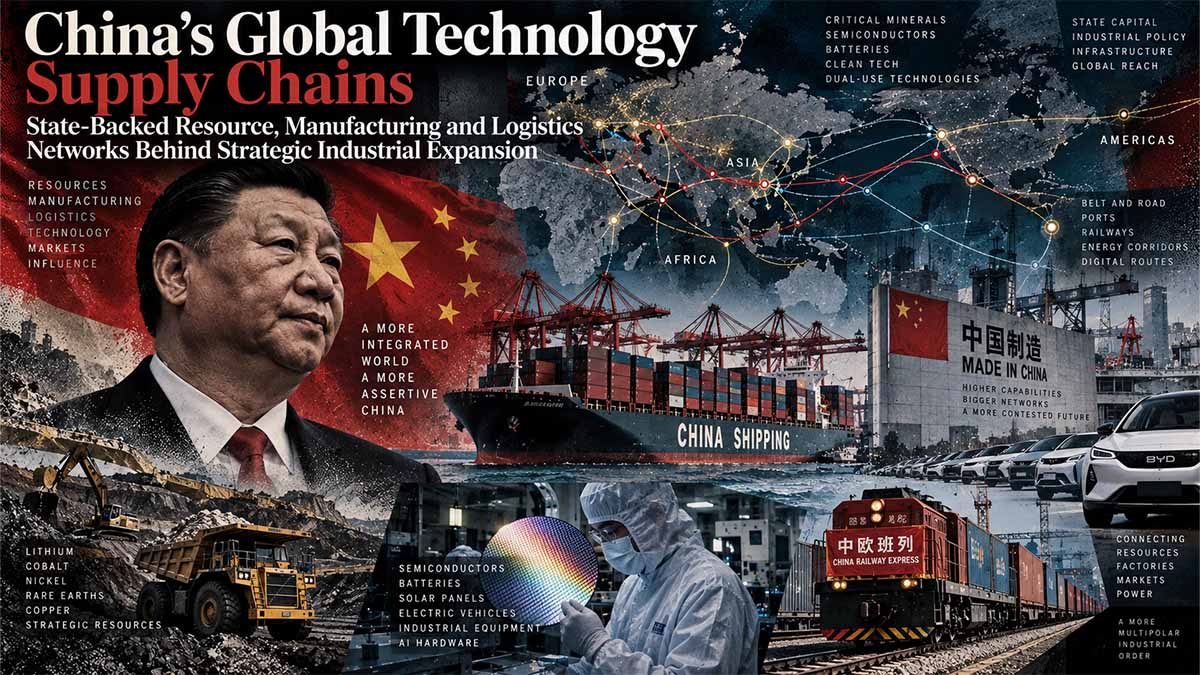
Scope: This first-delivery assessment examines the worldwide architecture through which Chinese state-owned, state-backed and formally state-linked entities secure strategic resources, overseas industrial capacity, logistics infrastructure and technology positions relevant to critical and emerging technologies, using the verified public record available through 19 September 2026 and adopting a five-year analytical horizon where forward implications are necessary.
Executive Summary / BLUF
The most defensible judgment is that China is constructing an increasingly integrated external industrial system in which overseas resource acquisition, processing capacity, manufacturing localisation, ports, shipping, engineering services, financing and technology deployment reinforce one another, while Chinese government policy explicitly directs enterprises to improve the international configuration of industrial and supply chains and to integrate outbound investment with trade and overseas production rather than treating foreign investment as a collection of isolated transactions. China’s 2025 Government Work Report called for optimisation of the international layout of industrial and supply-chain cooperation, while the Ministry of Commerce subsequently instructed authorities to guide the “reasonable and orderly cross-border layout” of industrial and supply chains, providing unusually explicit documentary evidence that supply-chain geography is a policy objective rather than merely an aggregate consequence of private corporate decisions.
The scale of the underlying capital movement is substantial, because China’s Ministry of Commerce and State Administration of Foreign Exchange recorded US$174.38 billion of total outward direct investment in 2025, including US$145.66 billion of non-financial ODI involving Chinese investors in 11,048 overseas enterprises across 153 countries and territories; MOFCOM separately reported that non-financial investment in Belt and Road partner countries reached US$39.67 billion, while new overseas contracting agreements reached US$289.22 billion, creating a parallel channel through which Chinese construction, transport, energy, equipment and logistics companies can establish long-duration positions abroad without necessarily acquiring the host asset outright.
The highest strategic significance lies not in any single acquisition but in the combination of upstream resources, industrial transformation and physical distribution, illustrated by China Minmetals’ multinational mining system, China Baowu and Chinalco’s participation in Guinea’s Simandou iron-ore complex, COSCO SHIPPING’s port-and-shipping infrastructure including Chancay in Peru, Sinochem Holdings’ control of a globally distributed agricultural-technology platform through Syngenta Group, and CRRC’s international deployment of rail and advanced-equipment capabilities; these examples span resource extraction, engineering, manufacturing, standards, logistics and technologically intensive downstream businesses rather than remaining confined to commodity ownership.
For U.S. economic-security purposes, however, state ownership, military linkage, government subsidy and commercial alignment must not be treated as interchangeable categories, because some companies are central SOEs directly supervised by SASAC, some are listed subsidiaries of state-controlled groups, some have been designated by the U.S. Department of Defense as Chinese military companies under Section 1260H, and other globally important Chinese technology companies remain formally private or mixed-ownership enterprises whose relationship with the state must be established transaction by transaction rather than inferred from nationality. The Department of Defense’s January 2025 Section 1260H update describes that statutory list as part of the U.S. effort to identify Military-Civil Fusion contributors, while OFAC’s NS-CMIC regime and Commerce Department entity-based export restrictions constitute separate legal mechanisms with different criteria and consequences.
The principal collection requirement is therefore not merely a list of Chinese companies but a continuously updated ownership-and-control graph linking ultimate state ownership, listed subsidiaries, joint ventures, financing institutions, overseas mines, processing plants, contract awards, industrial parks, port concessions, shipping services, technology licences, research collaborations, acquisitions and changes in beneficial ownership, because strategic influence is increasingly exercised through layered corporate structures and contractual relationships that cannot be reconstructed reliably from company names alone.
China’s Supply-Chain Power Is Moving From Ownership to Integration
China’s competitive advantage in critical and emerging technologies is no longer captured by bilateral trade balances or by counting overseas acquisitions, because the more consequential shift is the construction of an external industrial system in which resource ownership, processing, engineering, ports, rail, logistics software and foreign technology platforms increasingly reinforce one another. In 2025, Chinese outward direct investment reached US$174.38 billion, including US$145.66 billion of non-financial investment distributed through 11,048 overseas enterprises in 153 countries and territories, while newly signed overseas contracting agreements reached US$289.22 billion. China Ministry of Commerce — 2025 Outward Investment Statistics The immediate U.S. problem is therefore structural: alternative suppliers will not deliver genuine resilience if the mines, processing plants, transport corridors, industrial equipment and operating systems surrounding them remain embedded in Chinese state-linked networks.
Beijing is buying options across the industrial chain, not simply commodities
China Minmetals illustrates the difference between possessing foreign reserves and possessing an industrial system, because the central state-owned group reports 41 mines, including 15 overseas, while integrating exploration, mine development, smelting, metallurgical engineering, advanced materials, trade and logistics inside the same corporate organisation. China Minmetals — Company Profile Its MMG subsidiary produced 410,834 tonnes of copper in concentrate at Las Bambas in Peru in 2025, alongside 52,791 tonnes of copper cathode at Kinsevere in the Democratic Republic of the Congo and 42,120 tonnes of copper in concentrate at Khoemacau in Botswana. MMG — 2025 Annual Report Khoemacau matters because MMG is not merely operating the asset acquired in 2024: the expansion programme targets approximately 130,000 tonnes of annual copper production capacity by 2028, turning acquisition into a platform for future supply rather than a static financial holding. China Minmetals — Khoemacau Expansion Project
China Nonferrous Metal Mining Group pushes the model further toward vertical integration, because it reports approximately 11.29 million tonnes of copper, 470,000 tonnes of cobalt and 340,000 tonnes of nickel resources across its portfolio, while 1,176 of roughly 1,198 square kilometres of disclosed mining-right area lie abroad. CNMC — Business Scope At Deziwa in the Democratic Republic of the Congo, the group combines more than 2.5 million tonnes of copper-and-cobalt resources with a 4.5-million-tonne annual ore-processing capacity, approximately 80,000 tonnes of copper cathode and 8,000 tonnes of cobalt metal per year. CNMC — Deziwa Mining Project The structural advantage is not the mine alone but the ability to move from ore to refined material within the same state-controlled industrial family.
The decisive technology link appears after the mine gate
The industrial consequence becomes clearer downstream, because CNMC also reports 300,000 tonnes of annual copper-rod capacity, 40,000 tonnes of copper-wire capacity, 60,000 tonnes of copper-strip capacity and 5,000 tonnes of rolled copper foil, while identifying integrated-circuit target backplates and battery-tab materials among its advanced products and naming Huawei and CATL among customers. CNMC — Advanced Copper Materials The dossier does not establish that copper from one African mine physically enters a specific Huawei device or CATL battery, but it establishes something more important for industrial policy: the same central SOE controls foreign resource positions, processing capacity and technologically specialised materials serving advanced manufacturing.
The distinction matters because supply-chain dependence cannot be measured by gross tonnage alone; a government may replace one copper supplier and still remain exposed if refining, precision foil, specialised alloys or qualified intermediate materials remain concentrated elsewhere in the same corporate ecosystem. Simandou in Guinea demonstrates the scale of this industrial coordination from another direction, because the project combines Chinalco, Rio Tinto and the Guinean government with Chinese state-owned engineering, railway, equipment and construction companies around a system designed ultimately for approximately 120 million tonnes of annual iron-ore capacity. Chinalco — Simandou Production Launch By December 2025, the first shipment of approximately 200,000 tonnes had left Morebaya port for China, marking the transition from infrastructure construction to an operating mine-rail-port-shipping chain. Chinalco — First Simandou Ore Shipment
Ports convert industrial ownership into operational reach
The logistics layer is where dispersed foreign assets become a network, and by 31 December 2025 COSCO SHIPPING Ports reported 387 berths at 40 ports worldwide, including 238 container berths and approximately 133 million TEU of annual handling capacity. COSCO SHIPPING Ports — Corporate Profile During the first half of 2025, its overseas terminals handled 17.91 million TEU, approximately 24.1% of total terminal throughput, while the network included Piraeus, Zeebrugge, Abu Dhabi, Singapore, Rotterdam, Antwerp, Vado and Chancay. COSCO SHIPPING Ports — 2025 Interim Report The significance is not that COSCO unilaterally controls every port in which it invests, because holdings range from minority stakes to operating positions, but that the group combines shipping services and terminal access across several maritime regions through one state-owned corporate system.
Chancay in Peru is the clearest example of integration, because China COSCO SHIPPING invested in the port while China Communications Construction Company and other Chinese central SOEs participated in its construction, creating an initial platform designed for approximately 1 million TEU, 6 million tonnes of bulk cargo and 160,000 vehicles annually. SASAC — CCCC-Built Chancay Port Chinese official reporting states that direct China-Peru shipping through Chancay can reduce transit to roughly 23 days and lower logistics costs by more than 20%, figures that remain project estimates rather than universal savings but nonetheless show how infrastructure is being designed around corridor economics. SASAC — Peru’s Chancay Port Opens When investment, construction, port operation and maritime connectivity sit inside overlapping state-owned networks, alternative supply chains must replicate the corridor rather than merely identify another producer.
Logistics ownership is widening into warehouses, rail and data
China Merchants Group demonstrates why port analysis alone is already insufficient, because China Merchants Port reported 151.29 million TEU of container throughput in 2025, of which 38.94 million TEU were handled outside mainland China, Hong Kong and Taiwan, while the group’s logistics arm Sinotrans operates across sea freight, rail, warehousing, customs, distribution and supply-chain management. China Merchants Port — 2025 Annual Results In the first half of 2025, Sinotrans handled 7.912 million TEU of sea-freight forwarding, 214,000 TEU of railway forwarding, 12.787 million tonnes through warehouse and terminal-yard services, and 1.898 million TEU through its logistics e-commerce platform. Sinotrans — 2025 Operating Data
Rail adds a second redundancy layer, because by the end of October 2025 the China-Europe Railway Express had completed approximately 118,600 cumulative train movements, transported 11.7 million TEU and reached 232 cities in 26 European countries, while fixed-timetable services were already carrying automotive components, LED monitors, photovoltaic panels, solar modules and marine diesel-engine components. National Development and Reform Commission — China-Europe Railway Express State Council — Full-Timetable China-Europe Freight Trains The consequence is an industrial logistics system with more than one mode of access to Eurasian markets, while Sinotrans’ use of artificial intelligence, blockchain, cloud computing, big data and IoT adds an information layer to the physical one. Sinotrans — Logistics Information System
Foreign technology enters through corporate control as well as trade
The ownership network extends beyond minerals and infrastructure into foreign technology companies, where the strategic value lies in laboratories, certification, engineering knowledge and market access rather than physical resources. ChemChina’s 2016 agreement to acquire Syngenta valued the Swiss group’s outstanding equity at approximately US$43 billion, after which the asset was incorporated into a wider state-controlled agricultural platform that today operates in more than 90 countries with more than 50,000 employees. ChemChina and Syngenta — Acquisition Agreement Syngenta Group — H1 2026 Results The acquisition therefore delivered not merely revenue but a global agricultural-science system spanning crop protection, seeds, biologicals, manufacturing, regulatory registrations and R&D.
Aviation Industry Corporation of China shows the dual-use dimension more sharply, because the Department of Defense’s January 2025 Section 1260H list identifies AVIC and numerous subsidiaries, while AVIC-linked entities simultaneously hold foreign civil-aerospace assets and industrial relationships. Department of Defense — Section 1260H Chinese Military Companies, January 2025 Austria’s FACC reported that 55.5% of its voting rights were held through AVIC Cabin Systems, while Airbus has documented joint-venture and engineering relationships with AVIC in China, including research involving aeronautical nanocomposites. FACC — 2025 Annual Report Airbus — Technology Research with Chinese Partners None of those facts proves diversion of civil technology into a military programme, but together they explain why ownership, research access and dual-use relevance must be monitored separately rather than collapsed into one political label.
Washington’s legal architecture is fragmented because the risk itself is fragmented
The United States already treats these exposures through different authorities, which confirms that there is no single legal category equivalent to “Chinese strategic entity.” The Department of Defense’s Section 1260H process identifies Chinese military companies; Treasury’s NS-CMIC regime restricts specified securities transactions; Commerce’s Entity List and related export controls regulate transfers of sensitive technology; the FCC Covered List applies to designated telecommunications and surveillance equipment and services; and Treasury’s Outbound Investment Security Program, effective 2 January 2025, addresses specified U.S. investments involving semiconductors, quantum information technologies and artificial intelligence. Department of Defense — Section 1260H Treasury — Outbound Investment Security Program
Commerce’s December 2024 semiconductor package added 140 entities and modified another 14, while extending controls across semiconductor-manufacturing equipment, software and high-bandwidth memory, showing that Washington is increasingly targeting the enabling ecosystem around advanced technology rather than only final producers. Bureau of Industry and Security — December 2024 Semiconductor Controls The weakness is analytical rather than legal: if ownership databases, port maps, investment screening, export controls and supplier-dependency assessments remain separated, government will see individual transactions while missing the industrial network connecting them.
The next 24 months will test whether diversification means substitution or only rerouting
Between 2026 and 2028, the critical test will be whether U.S. and allied policy can create alternative chains across several stages simultaneously, because Khoemacau is targeting approximately 130,000 tonnes of annual copper capacity by 2028, Simandou is moving from construction into export operations, Chancay is establishing Pacific South American traffic, and Chinese state-owned logistics groups already possess port, rail, warehouse and digital-management capability at global scale. MMG — 2025 Annual Report Chinalco — Simandou Production Launch
The cost of inaction will fall first on manufacturers and governments that discover too late that replacing a Chinese component does not replace the Chinese-controlled processing, qualified intermediate material, freight route, terminal, warehouse or operating software around it. It will then move to U.S. taxpayers if public capital has to recreate infrastructure under emergency conditions, and to allies if Washington asks them to reduce Chinese dependency while offering neither equivalent financing nor equivalent logistics. The relevant measure of success over the next 12–24 months is therefore not the number of Chinese investments blocked or the fall in bilateral imports, but whether critical industries acquire alternative resource-to-processing-to-transport-to-manufacturing chains whose substitution time is short enough to survive disruption.
China’s Supply-Chain Power Is Moving From Ownership to Integration: The Structural Architecture of Industrial Optionality
China’s systemic advantage in critical and emerging technologies is no longer measured by bilateral trade balances or individual overseas asset acquisitions, but by the construction of a self-reinforcing external industrial apparatus. In 2025 alone, Chinese outward direct investment reached US$174.38 billion across 11,048 foreign enterprises, while newly signed international engineering contracts reached US$289.22 billion. Upstream mining ownership (Minmetals, CNMC), metallurgical hydrometallurgy and pyrometallurgy, precision component manufacturing (IC backplates, battery foils for CATL and Huawei), intermodal transport hubs (Chancay, 387 COSCO berths, 151.29M TEU at CMPort), Eurasian rail networks (120,000 trips), and foreign technology platforms (Syngenta, FACC) operate as a synchronized continuum. Western supply-chain resilience initiatives face structural failure if they focus on substituting individual component suppliers while leaving the underlying extraction, refining, transport, and software layers embedded in Chinese state-backed infrastructure.
Upstream Optionality: Multi-Stage Extraction Platforms & External Resource Reserves
Primary Audited Evidence Matrix: Integrated Supply-Chain Operations
Comprehensive empirical filings, technical capacities, operational throughputs, and certified corporate disclosures.
| Indicator / Strategic Asset | Verified Metric / Capacity | Date | Industrial Scope & Functional Link | Operating Entity / Parent | Official Public Source |
|---|---|---|---|---|---|
| China Outward Direct Investment | US$174.38bn (US$145.66bn non-fin) | 2025 | Capital distributed across 11,048 foreign enterprises in 153 jurisdictions | MOFCOM / SAFE | Official 2025 Outward Investment Statistics |
| Overseas Contracting Agreements | US$289.22bn (newly signed) | 2025 | Engineering, procurement, and construction infrastructure footprint | MOFCOM | 2025 Overseas Cooperation Results |
| Las Bambas Copper Mine | 410,834 tonnes (copper concentrate) | 2025 | Second-highest production; primary feed for domestic smelting assets | MMG / China Minmetals | MMG 2025 Annual Report |
| Khoemacau Copper-Silver Platform | 42,120t (target: 130k t/y by 2028) | 2025–28 | Acquired 2024; 6.4Mt resource base scaled into Africa’s 2nd largest copper hub | MMG / Minmetals | Minmetals / MMG Expansion Project |
| CNMC External Concessions Area | 1,176 km² abroad (out of 1,198 km²) | Current | 98% of mining concession area externalized across DRC, Zambia, Myanmar | CNMC (Central SOE) | CNMC Business Scope Filing |
| Deziwa Hydrometallurgical Complex | 80k t/y Cu cathode; 8k t/y Co metal | Current | BOT/EPC model converting run-of-mine ore into refined metals in DRC | CNMC / Somidez | CNMC Deziwa Mining Project |
| CNMC Advanced Materials Capacity | 300k t rod; 5k t foil; IC backplates | Current | Direct advanced feedstock supplier to telecom and battery champions (Huawei, CATL) | CNMC Downstream Materials | CNMC Advanced Copper Materials |
| Simandou Iron Ore Complex | 120 Mt/y planned capacity | Dec 2025 | First 200,000t shipment exported; integrates mine, 72km rail, and Morebaya port | Chinalco / Baowu Consortium | Chinalco Official Production Filings |
| COSCO Global Ports Footprint | 387 berths / ~133m TEU capacity | YE 2025 | 40 global ports; 17.91m TEU handled by overseas terminals in H1 2025 | COSCO SHIPPING Ports | CSP 2025 Interim & Corporate Reports |
| Chancay Multipurpose Mega-Port | 1m TEU, 6Mt bulk, 160k vehicles | Op. Year 1 | Reduces China–Peru maritime transit to ~23 days; >20% cost compression | COSCO / CCCC / CREC | SASAC Official Port Opening Records |
| China Merchants Port Volume | 151.29m TEU total container throughput | FY2025 | 38.94m TEU handled outside mainland China/HK/Taiwan; 530Mt bulk throughput | China Merchants Port | CMPort 2025 Annual Results |
| China-Europe Railway Express | 118,600 cumulative trips / 11.7m TEU | Oct 2025 | Connects 232 cities across 26 European nations; fixed-schedule tech freight | China State Railway Group | NDRC / State Council Official Statistics |
Deep Structural Breakdown: Integration Mechanics vs. Simple Ownership
Detailed structural analysis of the failure modes inherent in conventional Western supplier de-risking models.
Commodity diversification strategies focus almost exclusively on mine ownership while ignoring subsequent processing stages. By controlling domestic rod (300kt), precision rolled foil (5kt), and specialized semiconductor target backplates, central SOEs retain metallurgical chokepoints even when Western buyers purchase ore from alternative mines.
Through Chancay, Piraeus, and the 120,000-trip Eurasian rail express, Chinese state groups merge terminal concessions with shipping fleets and freight software (Sinotrans ABCDT). Chinese engineering (CCCC) locks port specifications, while COSCO routes guarantee lower transit times (23 days trans-Pacific), disincentivizing alternative routes.
Washington’s oversight is fragmented across disparate legal regimes: DoD Section 1260H (military classification), Treasury NS-CMIC (securities bans), BIS Entity List (export controls), and Treasury Outbound Investment rules. Each agency tracks individual legal entities, while the Chinese system operates as an integrated corporate ecosystem.
Forensic Strategic Key Judgments
Definitive analytical assessments derived from audited data, operating disclosures, and cross-border commercial dynamics.
Measuring China’s supply-chain footprint by counting acquired mines or bilateral trade balances is obsolete. Leverage is exercised through functional integration: linking mineral rights, hydrometallurgical refining, specialized intermediate fabrication, and maritime logistics within synchronized corporate families.
Assets are systematically expanded post-acquisition. MMG’s Khoemacau operation is not a static 42k t/y holding, but an active scaling platform targeting 130k t/y by 2028. State-backed groups deploy massive capital programmes to convert mid-tier deposits into regional supply hubs.
Raw copper ore is a commercial commodity; rolled foil (5,000 t/y) and IC target backplates are strategic technology bottlenecks. CNMC demonstrates how extraction feeds high-purity conductor fabrication for Huawei and CATL, capturing the value-added nodes essential for electronics and electric vehicles.
Chancay and Piraeus are not isolated quays; they are multimodal hubs integrating shipping lines, terminal operating systems, bonded industrial parks, and customs clearance. Diversifying component sourcing without developing alternative logistics corridors leaves allied supply chains vulnerable.
U.S. economic-security policy suffers from statutory fragmentation. Separating DoD 1260H lists from OFAC sanctions and BIS export controls allows Chinese state conglomerates to leverage unlisted subsidiaries, European SPVs, and joint research ventures to maintain Western market access.
The upcoming 24 months represent a critical inflection point. As Khoemacau scales toward 130k t/y and Simandou approaches full 120 Mt/y export operations, allied de-risking must be evaluated by substitution time across the full chain, rather than cosmetic changes in direct bilateral trade.
Open Official Record Gaps
- Offtake Destination Covenants: Non-public commercial contracts governing whether output from Simandou, Khoemacau, or Las Bambas can be diverted away from Chinese domestic smelters during supply crunches.
- Intermediate SPV Beneficial Transparency: Undisclosed shareholder pacts and debt covenants within Hong Kong, Cayman, and European holding vehicles obscuring effective state voting control.
- Digital Telemetry & Manifest Data Flows: Operational records verifying whether freight telemetry, cargo manifests, and inventory tracking handled by CMCore, CM ePort, and Sinotrans ABCDT systems are centralized in China.
- Secondary Technology Migration: Unaudited patent assignments and process-know-how migrations from acquired European platforms (FACC, Syngenta) into domestic central SOE engineering laboratories.
Observable Watch Indicators
Navigational Index
Resource access, industrial capacity and technology assets
This pillar will map how central SOEs and state-linked corporate groups obtain copper, nickel, cobalt, iron ore and other industrial inputs; acquire or build overseas production capacity; incorporate foreign technology, intellectual property and specialised industrial capabilities; and convert upstream resource positions into more resilient technology-manufacturing systems.
Ports, logistics, contracting and supply-chain integration
This pillar will examine the connective infrastructure linking resource and production assets to Chinese and third-country markets, including ports, shipping companies, rail systems, engineering contractors, industrial parks, warehouses, freight routes and digitalised logistics platforms, with particular attention to cases in which the same broader state-owned ecosystem participates in financing, construction, operation and transport.
Entity networks, foreign partnerships and economic-security exposure
This pillar will identify central SOEs, controlled subsidiaries, joint ventures, strategic minority holdings, acquisition vehicles, foreign partners and contract relationships that create technology-transfer, dependency, market-access or dual-use exposure, while separating verified ownership and control from U.S. government designations, subsidy allegations and analytical assessments of strategic consequence.
Master Abstract
The external supply chain is becoming an industrial system rather than an investment portfolio
The Chinese government’s own policy language provides the strongest starting point for understanding the architecture, because the 2025 Government Work Report explicitly coupled higher-quality Belt and Road construction with the requirement to guide outward investment and “optimise the international cooperation layout of industrial and supply chains,” while MOFCOM’s January 2026 national conference on overseas investment called for industrial and supply chains to be arranged across borders in a “reasonable and orderly” manner and for trade and investment to become more integrated. The Fifteenth Five-Year Plan subsequently continued this logic by calling for effective outward-investment management, stronger overseas support systems, greater integration between trade and investment, and orderly cross-border industrial- and supply-chain deployment. These documents do not establish that every Chinese overseas transaction is centrally directed, but they establish that cross-border supply-chain configuration is an explicit national policy objective and therefore provide a stronger evidentiary foundation than attempting to infer strategy retrospectively from individual corporate deals.
The financial scale supporting that policy is already global, because MOFCOM and SAFE reported RMB1.24558 trillion, equivalent to US$174.38 billion, of Chinese outward direct investment during 2025, while Chinese domestic investors conducted non-financial direct investment through 11,048 foreign enterprises in 153 jurisdictions, amounting to RMB1.04042 trillion or US$145.66 billion. MOFCOM further reported that non-financial investment into Belt and Road partner countries increased 17.6% to US$39.67 billion, while overseas contracting generated US$178.82 billion of completed turnover and US$289.22 billion in newly signed contracts, with Belt and Road partner countries accounting for 89.2% of new overseas contracting value and 85.4% of completed turnover. The analytical significance is that equity ownership represents only one layer of Chinese external industrial presence, because engineering contracts, long-term concessions, equipment supply, operational services and integrated logistics can create durable supply-chain positions without appearing as conventional FDI acquisitions.
Strategic resource acquisition increasingly connects mines to broader industrial platforms
China Minmetals provides one of the clearest first-party examples of the resource layer, because the central SOE describes itself as operating a full industrial chain incorporating exploration, mine development, smelting and processing, technology research, trade, logistics, finance and asset management, while reporting 41 mines in China and abroad, including 15 overseas operations, among them Las Bambas copper in Peru, Dugald River zinc in Australia, Ramu nickel-cobalt in Papua New Guinea and Khoemacau copper-silver in Botswana. The company explicitly states that it seeks to improve its ability to acquire and integrate global resources, which makes the organisational model strategically more relevant than a simple mine-count comparison because upstream ownership is embedded within trading, processing, logistics, engineering and financial capabilities.
Las Bambas illustrates how acquisition can create durable foreign production rather than merely reserve ownership, because Minmetals records the project as what was then China’s largest overseas metals-and-mining acquisition, while its MMG subsidiary’s 2025 results show Las Bambas producing 410,834 tonnes of copper in concentrate during 2025, its second-highest annual output, with record ore extraction, milling and recovery performance. MMG’s original acquisition documentation records an ownership consortium led by MMG with 62.5%, joined by GXIIC with 22.5% and CITIC with 15%, while financing was to combine equity with long-term debt arranged through a Chinese banking syndicate, demonstrating how mining ownership, state-linked equity and financial support can be layered within the same foreign asset.
The same pattern is expanding into additional metals, because MMG disclosed in 2025 that it had entered into an agreement to acquire Anglo American’s Brazilian nickel business, whose two operating assets were described as producing approximately 40,000 tonnes of ferronickel per year, thereby adding an operating primary nickel position in Brazil to a portfolio already spanning copper, zinc and other minerals across multiple continents. This transaction is analytically important because nickel has direct relevance to advanced alloys and battery supply chains, but the correct evidentiary formulation remains that the acquisition expands a China Minmetals-controlled company’s resource portfolio rather than proving that the acquired output will necessarily be directed to China or reserved for Chinese manufacturers.
The Simandou project in Guinea demonstrates a different model based on coordinated participation by multiple central SOEs, because SASAC records the 120-million-tonne planned annual-capacity iron-ore development as jointly invested by China Baowu Steel Group and Aluminum Corporation of China and constructed through participation by Baowu, Chinalco, China State Shipbuilding Corporation, China Minmetals, CRRC, China Railway Signal & Communication, China Railway Group, China Railway Construction Corporation, China Communications Construction Company and PowerChina. Although iron ore is not itself an “emerging technology,” this concentration of mining, steel, shipbuilding, railway, signalling, construction and power enterprises around a single resource-and-logistics system is directly relevant to economic-security analysis because it illustrates how Chinese central SOEs can combine sector-specific competencies around large overseas industrial corridors.
Logistics infrastructure transforms isolated foreign assets into connected networks
COSCO SHIPPING’s Chancay port in Peru provides a particularly clear example of the logistics layer because SASAC identifies Chancay as an investment by China COSCO SHIPPING, constructed with participation by central SOEs including China Communications Construction Company and China Railway Engineering, and describes the project as a Belt and Road undertaking designed to reduce one-way maritime transit between China and Peru to approximately 23 days while lowering logistics costs by more than 20%. After its first operational year, SASAC reported that Peru customs data showed US$603 million of exports and US$984 million of imports through Chancay during the first nine months of the reporting year, while 62% of Peru’s agricultural exports to China travelled through the COSCO-operated port during that period.
The strategic mechanism is therefore larger than terminal ownership, because COSCO’s shipping operations, port assets, specialised vessels, digital logistics systems and route design can connect Chinese industrial exporters with foreign production centres and resource suppliers; for example, SASAC reported in 2025 that COSCO SHIPPING Specialized Carriers launched an eastern South America weekly service covering major Chinese ports and Brazilian ports while offering integrated packaging, handling, transportation, storage, route planning and real-time tracking. Such platforms can generate commercial efficiencies available to many customers, but they also increase the value of analysing Chinese overseas ports together with shipping services, rail links, inland logistics and associated industrial investments rather than treating each infrastructure asset independently.
Technology control can also arise through acquisition of foreign innovation platforms
Sinochem Holdings demonstrates the technology-asset pathway because SASAC identifies the company as a major central state-owned enterprise formed through the restructuring of Sinochem Group and ChemChina and describes its activities as encompassing life sciences, materials science, chemicals, environmental science, machinery and industrial finance, with leading positions in agrochemicals and several advanced-material segments. Its Syngenta platform is headquartered operationally in Switzerland while registered in Shanghai and operates across more than 90 countries with more than 50,000 employees, creating a geographically distributed agricultural-technology system encompassing crop protection, seeds, biologicals and associated R&D rather than a China-confined business.
Syngenta reported US$28.4 billion of sales and US$4.4 billion of EBITDA in 2025, while explicitly identifying artificial intelligence as an operational priority and noting that its global biologicals manufacturing network includes facilities in the United States, Brazil, Italy, India and Norway. By the first half of 2026 the group continued to introduce proprietary crop-protection technologies across multiple markets and reported operational links spanning Europe, North America, Latin America and Asia. For an economic-security agency, the relevance is not that agricultural technology is inherently military, but that foreign acquisition can give a Chinese central-SOE-controlled group durable access to international R&D, intellectual property, regulatory registrations, manufacturing infrastructure, scientific personnel and worldwide distribution channels, which is the same structural pattern that should be monitored in other advanced-technology sectors.
Advanced manufacturing and transport show how standards and market access can become strategic assets
CRRC’s international activity demonstrates another mechanism, because SASAC describes the state-owned group as the world’s largest rail-transit equipment supplier as of 2023, participating in the development or revision of nearly 100 international standards while extending activity beyond rail into wind equipment, new-energy buses, new materials and specialised technologies. Chinese official records also describe earlier overseas rail projects as exporting Chinese equipment, materials, technical specifications and supporting components alongside completed infrastructure, illustrating how foreign contracting can distribute standards and supplier ecosystems in addition to finished equipment.
European regulatory action demonstrates that host governments increasingly view the financing architecture surrounding such bids as potentially consequential, although allegations must remain distinct from findings, because the European Commission opened its first in-depth Foreign Subsidies Regulation procurement investigation in February 2024 concerning a Bulgarian train tender submitted by CRRC Qingdao Sifang, which the Commission explicitly described as a subsidiary of the Chinese state-owned manufacturer CRRC; the investigation concerned whether foreign subsidies might have provided a distortive procurement advantage, and therefore the opening of the investigation did not itself establish infringement. The Commission opened another in-depth FSR investigation in November 2025 involving CRRC’s Portuguese subsidiary and a Lisbon light-rail procurement procedure, again stating that its preliminary assessment found sufficient indications to investigate possible subsidy-related distortion without prejudging the final result.
The dual-use problem requires entity-level rather than nationality-level classification
The United States already maintains several partially overlapping legal and regulatory mechanisms that illustrate why network mapping must distinguish corporate ownership from military or export-control status, because the Department of Defense’s Section 1260H process identifies companies it determines to be Chinese military companies operating directly or indirectly in the United States, and its January 2025 update explicitly linked that process to China’s Military-Civil Fusion strategy. Earlier DoD documentation has included entities such as Huawei, Hikvision, CNOOC and multiple SMIC entities, but inclusion on a Section 1260H list is a statutory U.S. government determination under that provision and must not be rewritten analytically as proof that every commercial transaction undertaken by such an entity is military-directed.
Commerce Department controls provide another evidentiary stream, because BIS stated in December 2024 that its semiconductor-control package added 140 entities and modified another 14 while controlling 24 categories of semiconductor-manufacturing equipment, three categories of semiconductor-production software and high-bandwidth memory, explicitly linking the measures to advanced-node semiconductor, AI, advanced-computing and military-modernisation concerns. BIS subsequently tightened foundry due-diligence and diversion controls in January 2025, while the current Export Administration Regulations retain dedicated controls covering supercomputers, advanced-node integrated circuits and semiconductor-manufacturing equipment. The policy environment changed again in January 2026 when Commerce moved to case-by-case licensing for specified advanced processors such as Nvidia H200 and AMD MI325X devices under defined security conditions, demonstrating that the U.S. control architecture itself is dynamic and therefore must be versioned by date in any operational monitoring system.
Key Evidence Table
| Indicator | Value/status | Reference date | Definition/scope | Issuer | Exact source |
|---|---|---|---|---|---|
| Chinese outward direct investment | US$174.38bn | 2025 | All-industry ODI | MOFCOM / SAFE | Official 2025 outward-investment statistics. |
| Chinese non-financial ODI | US$145.66bn | 2025 | Investment by domestic Chinese investors in non-financial overseas enterprises | MOFCOM / SAFE | Official 2025 outward-investment statistics. |
| Overseas enterprise footprint | 11,048 enterprises in 153 countries/territories | 2025 | Enterprises receiving non-financial ODI | MOFCOM / SAFE | Official 2025 outward-investment statistics. |
| Belt and Road non-financial ODI | US$39.67bn; +17.6% year on year | 2025 | Partner countries participating in Belt and Road cooperation | MOFCOM | 2025 overseas investment and cooperation results. |
| Chinese overseas contracting | US$289.22bn newly signed contracts | 2025 | Overseas contracted projects | MOFCOM | 2025 overseas investment and cooperation results. |
| China Minmetals mining footprint | 41 mines, including 15 overseas | Current corporate profile | China and overseas resource portfolio | China Minmetals | Company profile. |
| Las Bambas copper production | 410,834 tonnes copper in concentrate | 2025 | Annual mine production | MMG | MMG 2025 Annual Report overview. |
| Brazilian nickel assets targeted by MMG | ≈40,000 tonnes/year ferronickel production | Transaction announced 2025 | Barro Alto and Codemin operations acquired from Anglo American | MMG | Las Bambas Sustainability Report disclosure of Nickel Brazil transaction. |
| Simandou planned production | 120 million tonnes/year | Project commissioned 2025; SASAC report Jan 2026 | Guinea iron-ore project involving multiple Chinese central SOEs | SASAC | Operation Begins at Guinea’s Simandou Iron Ore Project. |
| Chancay maritime connection | ≈23 days China–Peru; >20% stated logistics-cost reduction | Port opening | Port and shipping corridor | SASAC / COSCO ecosystem | Peru’s Chancay Port Opens. |
| Syngenta Group sales | US$28.4bn | FY2025 | Consolidated Syngenta Group sales | Syngenta Group | 2025 Full Year Results. |
| Central-SOE technology investment | More than RMB5tn cumulative R&D during 2021–25 | 14th Five-Year Plan period | Centrally administered SOEs collectively | SASAC | Central SOEs Advance China’s High-Quality Development. |
Alternatives and Indicators Assessment
The evidence does not satisfy the protocol’s ACH gate because the principal explanations are not mutually exclusive: commercially rational internationalisation, government-directed industrial policy, host-country infrastructure demand and corporate resource diversification can operate simultaneously within the same transaction, and therefore forcing them into a winner-takes-all hypothesis structure would overstate what the open record can establish.
The strongest supported interpretation is consequently a hybrid state-commercial model in which Chinese enterprises retain company-level commercial incentives while operating within a policy environment that explicitly encourages global resource allocation, cross-border supply-chain positioning, international production networks and strategic-emerging-industry expansion. This interpretation would strengthen if future corporate disclosures show recurrent participation by the same policy banks, state investment funds, SOEs and technology suppliers across nominally separate foreign projects, particularly where ownership, financing, EPC construction, logistics and long-term offtake converge within one industrial corridor; it would weaken if transaction-level evidence instead shows predominantly host-country financing, independent commercial governance, diversified non-Chinese offtake and no durable link between Chinese state capital and operational control.
A narrower interpretation—that the observed pattern is principally the aggregate outcome of Chinese companies pursuing ordinary commercial globalisation—remains plausible for many individual transactions, particularly where private companies invest to overcome tariffs, serve foreign customers locally or obtain commodities available only abroad; however, that interpretation is insufficient to explain the Chinese government’s explicit policy direction concerning overseas industrial-chain configuration or the coordinated participation of multiple central SOEs in projects such as Simandou.
Principal Gaps and Watch Indicators
The largest unresolved evidentiary gap concerns ultimate beneficial ownership and effective control below the first visible corporate layer, particularly where an overseas asset is held through Hong Kong companies, offshore investment vehicles, minority joint ventures or locally incorporated subsidiaries; the decisive records are shareholder registers, financing agreements, board appointment rights, shareholder agreements, pledged-equity arrangements, convertible instruments and government-backed credit documentation rather than press releases announcing the transaction.
A second collection priority is the financing chain, because public evidence frequently identifies project ownership without disclosing whether the decisive risk capital, acquisition debt, export-credit insurance, policy-bank lending, guarantees or refinancing originated with Chinese state institutions; monitoring should therefore link each foreign acquisition, greenfield factory and infrastructure project to lenders, insurers, guarantors, project-finance vehicles and refinancing events whenever official filings make those relationships available.
A third priority is technology-transfer directionality, because the presence of a Chinese owner or partner does not itself prove transfer of intellectual property into China; decisive indicators include patent assignments, technology-licensing agreements, relocation or duplication of R&D functions, joint laboratories, changes in engineering personnel, manufacturing-process transfers, export-controlled equipment movements and corporate disclosures showing integration of acquired foreign technology into Chinese product platforms.
A fourth priority is vertical convergence, particularly transactions in which a resource owner becomes connected to Chinese refining or processing capacity, a Chinese manufacturer, a Chinese-operated logistics route and a long-term customer or offtake arrangement, because that structure creates materially greater strategic dependency than ownership of an isolated mine, factory or terminal.
A fifth priority concerns host-country regulatory response, because the European Commission’s FSR investigations involving CRRC show that subsidy-supported participation in foreign procurement is becoming a specific enforcement issue, while U.S. Section 1260H, OFAC and BIS mechanisms demonstrate that military linkage, securities restrictions and technology-export controls operate under different legal standards and therefore require separate tagging rather than a single undifferentiated “restricted Chinese entity” category.
Decision-Relevant Monitoring Architecture
For the requesting U.S. government agency, the evidence supports monitoring five linked objects rather than companies alone: entity identity and ownership; foreign asset or contract; technology or strategic resource; financing and state support; and logistics/offtake connection, with every record versioned by transaction date because ownership, sanctions status, export-control treatment and project structure can change materially after the original investment.
The most valuable warning indicators would include a central SOE or state-controlled subsidiary taking a new strategic minority position with disproportionate governance rights; Chinese financing accompanying acquisition of a foreign critical-mineral, advanced-manufacturing, biotechnology, semiconductor, AI, robotics or power-electronics asset; repeated participation by the same Chinese engineering and logistics companies around a resource project; Chinese companies converting equipment-export relationships into local manufacturing or maintenance monopolies; port or rail concessions becoming integrated with Chinese industrial parks or mining corridors; and acquisition structures in which the public operating company obscures a materially different ultimate ownership or financing chain.
The corresponding U.S. policy implication is not that every Chinese overseas investment should be treated as hostile, but that alternative supply-chain policy should be based on dependency topology, identifying where China-linked entities possess combinations of resource concentration, processing capability, technological know-how, manufacturing scale, shipping access, standards influence and financing that would be difficult for U.S. or allied producers to replace within an operationally relevant period; such a model would support allied co-development, diversified offtake, strategic investment, targeted financing and supply-chain substitution far more precisely than nationality-based screening alone.
Open Official Record
Material gaps capable of changing this assessment include non-public shareholder agreements governing overseas Chinese joint ventures; complete policy-bank and state-insurance exposure to individual foreign investments; beneficial-ownership records for intermediate holding companies; technology-licensing and IP-transfer agreements; long-term mineral and component offtake contracts; host-government concession agreements containing non-public operating or exclusivity provisions; and current internal arrangements connecting nominally commercial subsidiaries to Chinese state industrial-policy objectives, where those arrangements are not disclosed through accessible regulatory or corporate filings.
No decision-useful visualisation is supportable from the verified record at this stage, because the available official evidence combines ODI flows, project capacities, mine output, port activity, corporate revenues and regulatory designations that use incompatible units and scopes, and transforming them into a common score, heat map or comparative chart would introduce arbitrary weighting rather than improve evidentiary clarity.
China’s Global Technology Supply Chains: State-Backed Resource, Manufacturing & Logistics Networks Behind Strategic Expansion
China is constructing an integrated external industrial system where overseas extraction, mineral conversion, localized manufacturing, deep-water ports, maritime shipping, and technological platforms mutually reinforce one another. Governed by official directives (State Council 2025 Government Work Report, MOFCOM orders, and the 15th Five-Year Plan), cross-border supply chain layout is an explicit national policy mandate supported by US$174.38bn in outward direct investment and US$289.22bn in new engineering contracts, deployed across a hybrid state-commercial operational matrix.
Resource Layer: Upstream Control & Mineral Transformation Platforms
Primary Audited Evidence Matrix
Empirical filings, financial scale metrics, operational capacities and regulatory citations (Open Record verified through September 2026).
| Indicator / Asset | Reported Metric / Value | Date | Definition & Strategic Scope | Entity / Issuer | Exact Public Record Source |
|---|---|---|---|---|---|
| Total Outward Direct Investment (ODI) | US$174.38 bn (RMB 1.245tn) | 2025 | All-industry outward capital deployment from Chinese entities | MOFCOM / SAFE | Official 2025 outward-investment statistics |
| Non-Financial Overseas ODI | US$145.66 bn (RMB 1.040tn) | 2025 | Direct equity investments into non-financial foreign operating entities | MOFCOM / SAFE | Official 2025 outward-investment statistics |
| Overseas Enterprise Footprint | 11,048 entities / 153 jurisdictions | 2025 | Enterprises receiving non-financial direct outward investments | MOFCOM / SAFE | Official 2025 outward-investment statistics |
| Belt and Road Non-Financial ODI | US$39.67 bn (+17.6% YoY) | 2025 | Direct industrial and asset commitments across B&R partner countries | MOFCOM | 2025 Overseas Investment & Coop Results |
| Overseas Contracting (Turnover / New) | US$178.82 bn / US$289.22 bn | 2025 | Completed revenue & newly signed EPC agreements (B&R = 89.2% of new) | MOFCOM | 2025 Overseas Investment & Coop Results |
| China Minmetals Global Resource Base | 41 mines (15 overseas assets) | 2025–26 | Multinational extraction base (Las Bambas, Dugald River, Ramu, Khoemacau) | China Minmetals | China Minmetals Corporate Profile |
| Las Bambas Copper Production | 410,834 tonnes (concentrate) | 2025 | Second-highest historical production; record ore extraction and recovery | MMG / Minmetals | MMG 2025 Annual Report Overview |
| MMG Brazilian Nickel Acquisition | ≈40,000 tonnes/year (ferronickel) | 2025 | Barro Alto and Codemin operating assets acquired from Anglo American | MMG Limited | MMG Sustainability Report / Disclosure |
| Simandou Mega-Iron Project | 120 million tonnes/year capacity | 2025–26 | Guinea iron-ore extraction, heavy rail, signalling, port and power complex | SASAC Consortium | SASAC Official Release (Jan 2026) |
| Chancay Multipurpose Mega-Port | ≈23 days China-Peru; >20% cost cut | Op. Year 1 | Direct trans-Pacific corridor handling 62% of Peru ag-exports to China | COSCO / CCCC | SASAC / Peru Customs Clearance Data |
| Syngenta Group Agricultural Tech | US$28.4 bn Sales / US$4.4 bn EBITDA | FY2025 | Sinochem-owned Swiss agri-tech conglomerate; 50k staff in 90+ nations | Syngenta / Sinochem | Syngenta Group 2025 Full-Year Results |
| Central-SOE Cumulative R&D | >RMB 5.0 trillion cumulative R&D | 2021–25 | Collective R&D capital deployed across SASAC-supervised central SOEs | SASAC | 14th Five-Year Plan SASAC Performance Review |
Deep Structural Breakdown: Convergence Architecture
Mechanisms through which state direction, equity consortiums, and physical channels surpass simple mercantile trade.
With US$289.22bn in new overseas contracts signed in 2025 (89.2% concentrated in Belt and Road partners), Chinese state engineering groups establish critical infrastructure positions without requiring outright asset ownership.
The COSCO-led Chancay corridor slashes trans-Pacific transit times to 23 days and cuts costs by over 20%, simultaneously paired with COSCO Specialized Carriers’ dedicated weekly loops connecting South America with primary mainland ports.
Sinochem’s governance over Syngenta (US$28.4bn sales) delivers operational and proprietary R&D nodes in the U.S., Brazil, Italy, India, and Norway, institutionalizing artificial intelligence within crop science and advanced biological manufacturing.
Forensic Strategic Key Judgments
Definitive analytical assessments derived from public records, financial disclosures, and verified trade mechanisms.
A winner-takes-all ACH model fails because commercial rationalization and state-directed industrial policy operate synchronously within the same deals. Chinese multi-enterprise consortiums systematically reconcile corporate profit incentives with SASAC national material security mandates.
Tracking non-financial FDI alone distorts strategic exposure. With US$178.82bn in executed contracting turnover, Chinese firms capture infrastructural, engineering, and digital supervisory privileges over global critical corridors without undergoing traditional foreign investment screening.
Simandou exemplifies the ultimate SASAC doctrine: rather than unilateral bidding, mining (Baowu/Chinalco/Minmetals), transport (CRRC), communications (CRSC), and heavy civil EPC (CCCC/CRCC) deploy as an indivisible cluster, creating systemic single-origin architectural lock-in.
Equipment suppliers such as CRRC (involved in nearly 100 international technical standardizations) leverage overseas rolling-stock and grid contracts to export domestic technical specifications, progressively neutralizing Western vendor interoperability across target regions.
Conflating central SOEs, publicly traded corporate arms, Section 1260H designations, and private entities introduces catastrophic policy blind spots. Regulatory control regimes (DoD 1260H, OFAC NS-CMIC, BIS Entity List) require granular transaction-level verification rather than blanket national attribution.
The central risk for allied security is not asset presence, but dependency topology. Where Chinese state nodes control resource extraction, chemical refinement, bulk specialized transit, and port offtake concurrently, replacing single links within short horizons is operationally unachievable.
Open Official Record Gaps
- Beneficial Control Layer: Non-public shareholder pacts, offshore SPVs (Hong Kong/Cayman), and debt pledge instruments obscuring equity below top operating subsidiaries.
- State Bank Risk Absorbers: Undisclosed sovereign credit backing, concessional policy lines (Exim Bank/CDB), and state underwriting arrangements behind nominal commercial debt.
- Reverse Tech Transference: Unreported internal IP assignments, shared cross-border research laboratories, and relocation of acquired patent execution into domestic Chinese entities.
- Restricted Bilateral Covenants: Unreleased host-government agreements providing sovereign priority offtake, emergency naval logistics privileges, or terminal exclusivity rights.
Observable Watch Indicators
Resource access, industrial capacity and technology assets
Principal judgment
China’s external technology-supply architecture is increasingly characterised by the deliberate coupling of upstream resource ownership with refining, specialised materials, engineering capability, industrial equipment and downstream manufacturing, rather than by a simple strategy of purchasing foreign mines and shipping unprocessed commodities home, and this distinction is fundamental for U.S. economic-security analysis because ownership of a mineral deposit becomes strategically more consequential when the same state-controlled group can influence extraction technology, processing capacity, intermediate materials, project finance, engineering standards and downstream customer relationships.
The strongest documentary evidence appears within the operating structures of China Minmetals Corporation, China Nonferrous Metal Mining Group (CNMC), Aluminum Corporation of China (Chinalco) and their subsidiaries, because these central state-owned groups do not describe themselves simply as mining companies but as integrated industrial organisations encompassing exploration, construction, beneficiation, smelting, materials engineering, trade, logistics and technology development. China Minmetals’ current corporate profile, for example, explicitly defines its model as a full industrial chain stretching from resource exploration and mine operation through metallurgical engineering, smelting and processing to technology R&D, trade, logistics, finance and asset management, while CNMC reports a complete exploration-mining-beneficiation-smelting chain alongside advanced copper materials used in semiconductor and battery applications. China Minmetals — Company Profile CNMC — Business Scope
For intelligence purposes, this creates a substantially different exposure from ordinary commodity dependence, because a vertically organised Chinese state-owned group can potentially gain leverage at several successive stages of the same industrial chain: control or influence over ore production; preferential access to concentrates; ownership of smelting and refining capacity; proprietary metallurgical expertise; production of specialised copper, cobalt, nickel or aluminium materials; engineering capabilities capable of reproducing capacity abroad; and commercial relationships with advanced-technology manufacturers. The evidence does not establish that every overseas tonne is contractually reserved for China or that every investment is directed from Beijing, and such claims would exceed the public record, but it does establish an increasingly dense institutional architecture capable of converting foreign resource positions into industrial capability.
From mineral ownership to vertically integrated industrial capacity
China Minmetals provides one of the clearest examples of the progression from foreign-resource acquisition toward an integrated multinational metals platform, because its current portfolio includes major operating assets in Peru, Australia, Botswana and Papua New Guinea while the group itself integrates mining with metallurgical construction, advanced materials, trading, logistics and technology development. The corporation currently reports 41 mines worldwide, including 15 outside China, among them Las Bambas in Peru, Dugald River in Australia, Ramu in Papua New Guinea and Khoemacau in Botswana, while explicitly describing its strategic objective as improving the ability to acquire and integrate global resources. China Minmetals — Metals and Minerals
The significance of this organisational model is particularly visible in copper, because China Minmetals’ overseas asset base now spans several major copper jurisdictions and multiple production stages, while subsidiary MMG has progressively expanded from the original Las Bambas acquisition into Kinsevere in the Democratic Republic of the Congo and Khoemacau in Botswana. MMG’s 2025 annual reporting records 410,834 tonnes of copper in concentrate at Las Bambas, 52,791 tonnes of copper cathode at Kinsevere and 42,120 tonnes of copper in concentrate at Khoemacau, meaning that these three assets alone produced more than half a million tonnes of contained or refined copper during the reporting year, although those categories cannot be combined as a single homogeneous production metric because cathode and concentrate represent different points in the processing chain. MMG — 2025 Annual Report and Operating Results
China Minmetals/MMG overseas strategic-resource platform
| Asset | Jurisdiction | Commodity | Acquisition / control mechanism | Current or stated production position | Strategic industrial significance | Official source |
|---|---|---|---|---|---|---|
| Las Bambas | Peru | Copper | Acquired in 2014 by consortium led by MMG, with Guoxin International and CITIC Metal | 410,834 t copper in concentrate in 2025 | Large-scale copper feedstock controlled through a state-owned Chinese corporate consortium | MMG 2025 Annual Report |
| Kinsevere | DRC | Copper | MMG operating asset | 52,791 t copper cathode in 2025 | Refined copper production rather than exclusively mined concentrate, strengthening vertical integration | MMG 2025 Annual Report |
| Khoemacau | Botswana | Copper-silver | Acquired by MMG/Minmetals in 2024 | 42,120 t copper in concentrate in 2025; expansion target 130,000 t/y by 2028 | Creates a second major African copper position and substantially expands prospective output | MMG 2025 Annual Report |
| Dugald River | Australia | Zinc | MMG operating asset | 183,463 t zinc in concentrate in 2025 | Diversifies state-controlled resource exposure beyond copper into zinc | MMG 2025 Annual Report |
| Ramu | Papua New Guinea | Nickel-cobalt | Minmetals-linked overseas mining asset | Current group portfolio asset | Exposure to two materials directly relevant to batteries, superalloys and electrification | China Minmetals Company Profile |
| Khoemacau expansion | Botswana | Copper | Expansion launched February 2026 | Long-term objective includes significantly higher production capacity | Converts an acquisition into a larger production platform rather than a static financial holding | China Minmetals — Khoemacau Expansion Project |
The Las Bambas acquisition remains particularly instructive because the original US$5.85 billion equity purchase involved MMG, Guoxin International Investment Corporation and CITIC Metal, meaning that the foreign asset entered Chinese ownership through a consortium combining an operating mining company with other state-linked investment and metals entities rather than through MMG alone; Minmetals subsequently reported that acquisition plus construction expenditure exceeded US$10 billion, demonstrating the scale of capital required to convert the acquired project into productive capacity. China Minmetals — Las Bambas Acquisition Agreement China Minmetals — Las Bambas Put into Operation
More important analytically than the headline purchase price is Minmetals’ own explanation of why such acquisitions matter, because the corporation stated in 2017 that China’s demand for metal resources was fundamental and long term and that the group intended to build a large, long-life and low-cost portfolio through exploration and mergers and acquisitions, with particular emphasis on increasing overseas allocation capabilities in copper, iron, nickel, lead and zinc. That first-party statement is not evidence that subsequent individual transactions were centrally mandated, but it is unusually direct evidence that overseas M&A was understood within the corporation as a mechanism for strengthening resource-security capabilities. China Minmetals — Overseas Resource Allocation and M&A Strategy
Khoemacau marks the transition from acquisition to African copper-platform construction
The acquisition of Khoemacau in Botswana is especially significant because it illustrates a second-stage pattern in which a foreign mining asset is purchased and subsequently expanded into a materially larger production base, rather than simply operated at inherited capacity. China Minmetals reported in March 2026 that the acquisition had been completed in 2024 and that the mining area contained approximately 6.4 million tonnes of copper resources across roughly 4,000 square kilometres, while describing the strategic objective as constructing Africa’s second-largest copper production base. China Minmetals — Reform and Khoemacau Acquisition
MMG’s own operating disclosure provides a more measurable basis for assessing the trajectory, because Khoemacau produced 42,120 tonnes of copper in concentrate during 2025, while the company’s expansion programme targets approximately 130,000 tonnes of annual copper production capacity by 2028, with longer-term potential cited by MMG at approximately 200,000 tonnes annually if additional expansion conditions are satisfied. MMG — 2025 Annual Report
The distinction between current production, committed expansion and longer-term potential must remain explicit, because only the first figure represents realised output, the second represents a defined development objective and the third represents a potential future configuration rather than currently available production. For strategic-monitoring purposes, however, the sequence is important: acquisition in 2024, incorporation into the Minmetals international portfolio, increased 2025 production contribution and formal launch of a major expansion in February 2026 together demonstrate how state-controlled Chinese capital can convert an acquired foreign mine into a larger long-duration production platform. China Minmetals — Khoemacau Expansion Groundbreaking
CNMC demonstrates an even tighter mine-smelter-materials architecture
China Nonferrous Metal Mining Group represents an especially important case for dual-use supply-chain monitoring because its foreign mining activity is directly connected to domestic advanced-material production, rather than existing as a separate commodity business. CNMC currently reports control over 28 mining-related projects, approximately 18.34 million tonnes of major non-ferrous metal reserves, including 11.29 million tonnes of copper, 5.96 million tonnes of lead and zinc, 470,000 tonnes of cobalt and 340,000 tonnes of nickel, while its mining-right portfolio covers approximately 1,198 square kilometres, of which 1,176 square kilometres are abroad, including holdings in the DRC, Zambia, Mongolia, Kyrgyzstan, Tajikistan, Myanmar and Indonesia. CNMC — Resource Development Portfolio
The geographic ratio is analytically significant because approximately 98% of the area associated with CNMC’s disclosed mining rights lies outside China, calculated from the company’s published 1,176-square-kilometre overseas area divided by its 1,198-square-kilometre total, although mining-right area must not be confused with mineral reserves or production because concession size does not measure ore quality, economic recoverability or annual output. The figure nevertheless demonstrates the degree to which a central SOE’s resource footprint has become geographically externalised while its processing, engineering and specialised-material capabilities remain integrated within the corporate group. CNMC — Business Scope and Mining Rights
CNMC foreign-resource and processing network
| Project | Country | Resource / function | Resource base or capacity | Ownership / project structure | Strategic relevance | Official source |
|---|---|---|---|---|---|---|
| Chambishi Copper Mine | Zambia | Copper mining | >3.9 Mt contained metal resources; 4.5 Mt/y ore capacity | CNMC-controlled operation | Large resource base linked to a broader Zambian mining-smelting complex | CNMC — Chambishi Copper Mine |
| Luanshya Copper Mines | Zambia | Mining, beneficiation, smelting | ≈2.58 Mt combined resource reserve | CNMC acquired 80% stake in 2009 | Acquisition converted into integrated mining and processing platform | CNMC — Luanshya Copper Mines |
| Deziwa | DRC | Copper-cobalt mine and hydrometallurgy | >2.5 Mt Cu+Co resources; 4.5 Mt/y ore; 80,000 t/y cathode copper; 8,000 t/y cobalt metal | CNMC’s largest disclosed standalone overseas copper-cobalt investment | Combines mining with refined copper and cobalt output | CNMC — Deziwa Mining Project |
| Kambove | DRC | Copper-cobalt mining and hydrometallurgy | >610,000 t Cu+Co resources; 1 Mt/y ore processing | CNMC operating project | Additional copper-cobalt conversion capacity in DRC | CNMC — Kambove Copper-Cobalt Mine |
| Lualaba Copper Smelter | DRC | Pyrometallurgical processing | ≈120,000 t/y blister copper Phase I capacity | CNMC-linked smelting operation | Moves processing deeper into host-country value chain | CNMC — Lualaba Copper Smelter |
| Tagaung Taung | Myanmar | Nickel | 340,000 t nickel resources; 22,000 t/y designed nickel-metal capacity; >US$1bn investment | China-Myanmar government-linked project described by CNMC | Direct state-SOE exposure to nickel supply | CNMC — Tagaung Taung Nickel Mine |
| Dairi | Indonesia | Lead-zinc | 1 Mt/y ore design; 105,000 t/y lead concentrate; 225,000 t/y zinc concentrate | Controlled CNMC subsidiary development | Resource acquisition coupled to equipment and engineering export | China Nonferrous Metal Industry’s Foreign Engineering and Construction — Dairi Project |
The Deziwa project deserves particular attention because its architecture moves well beyond extraction, with CNMC disclosing more than 2.5 million tonnes of copper and cobalt resources, a 4.5-million-tonne annual ore-processing capacity, approximately 80,000 tonnes of annual cathode-copper production and 8,000 tonnes of cobalt metal, meaning that the foreign asset directly produces refined or near-refined strategic metals rather than merely exporting run-of-mine ore. CNMC — Deziwa Mining Project
CNMC’s official record also identifies Deziwa as its largest standalone overseas copper-cobalt investment and documents its use of BOT and EPC structures, which is strategically relevant because these contractual mechanisms combine capital investment, engineering design, construction, commissioning and operational control within one project architecture. CNMC’s own retrospective described these structures as replicable innovations in its overseas-resource strategy, providing direct evidence that foreign-project delivery models themselves are being institutionalised within the group. CNMC — Deziwa and Lualaba Project Development Record
Zambia and the DRC form a cross-border copper-processing cluster rather than isolated mines
The most important feature of CNMC’s Central and Southern African position is not the number of individual assets but the regional integration between Zambia and the Democratic Republic of the Congo, because CNMC explicitly states that it has constructed a value chain encompassing geological exploration, mining, smelting, design, construction, equipment, supervision, trade and logistics across the region. CNMC — Sustainability Report and Africa Value Chain
This regional configuration includes Chambishi and Luanshya mining operations in Zambia, copper-smelting capacity, economic-zone infrastructure, Deziwa and Kambove copper-cobalt assets in the DRC and the Lualaba smelting platform, creating a network in which raw material, processing capability, engineering services and commercial infrastructure can operate across national borders. CNMC’s official account of the Lualaba smelter specifically described it as supporting capacity coordination between Zambia and the DRC and strengthening upstream-downstream linkage, which is unusually direct documentary evidence of deliberate regional industrial integration. CNMC — Lualaba Smelter Commissioning
That pattern matters for U.S. supply-chain analysis because a mine-by-mine inventory will understate the strategic effect when several facilities jointly constitute a functional industrial basin, while a network model can capture where ore, concentrates, intermediates, processing plants, engineering contractors, transport infrastructure and commercial entities create a cluster whose replacement would require recreating several linked capabilities rather than substituting one supplier.
Upstream copper exposure connects directly to semiconductor and battery materials
CNMC also provides one of the strongest public-record examples of why strategic-resource analysis should not terminate at the mine gate, because the group reports domestic production capabilities in high-performance copper rods, wires, strips and foils, including 300,000 tonnes of annual copper-rod capacity, 40,000 tonnes of copper-wire capacity, 60,000 tonnes of copper-strip capacity and 5,000 tonnes of rolled copper foil, while identifying itself as China’s largest producer of beryllium-copper alloys and rolled-copper-foil base materials. CNMC — Copper and Copper-Alloy Materials Business
More consequentially for critical technologies, CNMC states that its products include integrated-circuit target backplates, oxygen-rich copper-foil base materials and tab materials for new-energy batteries, while naming Huawei and CATL among downstream supply-chain customers. CNMC — Advanced Copper Materials and Customers
This does not establish a physically traceable chain proving that copper extracted from one particular African mine becomes a particular Huawei component or CATL battery material, because such a conclusion would require transactional and batch-level evidence that the public record does not provide; what the evidence establishes is that the same central state-owned corporate group possesses foreign copper and cobalt resources, international smelting capacity and domestic advanced-copper-material capabilities serving technology manufacturers, which represents a substantially more consequential industrial configuration than resource ownership considered alone.
Resource-to-technology capability chain visible inside CNMC
| Industrial layer | CNMC capability documented in official record | Technology relevance |
|---|---|---|
| Geological access | Mining rights across Africa, Asia and other foreign jurisdictions | Long-duration access to strategic feedstocks |
| Copper extraction | Chambishi, Luanshya, Deziwa, Kambove | Conductive metal essential to electrification and electronics |
| Cobalt extraction | DRC copper-cobalt projects | Battery cathodes, superalloys and other high-performance uses |
| Nickel extraction | Tagaung Taung | Batteries, stainless steel and high-performance alloys |
| Smelting/refining | Lualaba, Deziwa and broader group smelting capability | Conversion from mineral concentrate toward usable industrial metal |
| Copper rod/wire | 300,000 t/y rod; 40,000 t/y wire | Power, motors, grid, transport and electronics |
| Copper strip | 60,000 t/y | Electrical and precision components |
| Rolled copper foil | 5,000 t/y | Electronic and battery-related applications |
| IC target backplates | Identified by CNMC as advanced-material product | Semiconductor manufacturing |
| Battery tab materials | Identified by CNMC | Battery-cell electrical interconnection |
| Downstream customer integration | Huawei and CATL named by CNMC | Connection to telecom and battery manufacturing ecosystems |
Source for the downstream-material chain: CNMC — Materials Business
Chinalco and Simandou demonstrate multinational partnership combined with Chinese industrial clustering
The Simandou iron-ore project in Guinea is structurally different from Minmetals’ predominantly acquisition-led expansion and CNMC’s African copper-smelting ecosystem because the project combines a joint venture with Rio Tinto and the Guinean state with extensive participation by Chinese state-owned mining, construction, railway, equipment and logistics companies. Chinalco’s November 2025 operational announcement records that SimFer, the company responsible for Blocks 3 and 4, is a joint venture involving Chinalco, Rio Tinto and the Guinean government, with planned production capacity of approximately 60 million tonnes per year from the southern blocks once fully developed. Chinalco — Simandou Official Production Launch
The resource itself exceeds 4 billion tonnes, according to Chinalco, with average total iron grade above 65%, giving Simandou particular importance as a potential source of high-grade ore; the wider northern and southern project configuration is designed eventually to reach approximately 120 million tonnes of annual capacity, although that figure represents the planned combined system rather than current realised output. Chinalco — Simandou Production Launch
The decisive industrial-security feature is the infrastructure integration, because Chinalco records that the project includes the mine, dedicated railway and port system, while its September 2025 port disclosure specifies a SimFer terminal with three 43,000-tonne ore-barge loading berths and approximately 60 million tonnes per year of designed throughput. Chinalco — SimFer Port Project
The branch railway connecting Blocks 3 and 4 to the main line extends approximately 72 kilometres, including 133 culverts, five bridges, a 926-metre tunnel and approximately 18.5 million cubic metres of earthworks, meaning that Simandou constitutes a resource-corridor system rather than a stand-alone mine. Chinalco — Simandou Branch Railway Completion
Simandou industrial architecture
| Element | Verified configuration | Chinese state-linked participation | Strategic implication |
|---|---|---|---|
| Southern mine blocks | Blocks 3 and 4, approximately 60 Mt/y planned capacity | Chinalco/Rio Tinto/Guinea JV through SimFer | Long-duration high-grade iron-ore access |
| Combined Simandou system | Approximately 120 Mt/y planned across northern and southern blocks | Multiple Chinese and foreign participants | Potentially material diversification of seaborne iron supply |
| SimFer port | Three ore-barge berths; 60 Mt/y designed throughput | Chinalco-linked JV infrastructure | Controls physical export pathway from mine |
| Branch railway | 72 km | Chinalco project structure plus Chinese engineering participation | Integrates mine into trans-Guinean logistics chain |
| Mining operations contract | Contract value capped at US$280 million | Chinalco International | Chinese state-linked engineering company embedded in mine operations |
| Equipment and contracting network | Chinese rail, port, construction and equipment firms | Multiple central SOEs | Extends Chinese participation beyond equity ownership |
Sources: Chinalco — Simandou Production Launch Chinalco International — Simandou Mining Operations Contract
Chinalco International’s role illustrates how the corporate network extends from ownership into operational service provision, because the company disclosed that it obtained the SimFer mining-operations contract at a value not exceeding approximately US$280 million, while its subsequent operating announcement specified responsibility for stripping, mining services, transport roads and associated infrastructure. Chinalco International — Simandou Contract Award Chinalco International — Simandou Mining Operations Commencement
By December 2025, Chinalco reported that the first shipment carried approximately 200,000 tonnes of high-grade iron ore from Morebaya port toward China, while describing the milestone as completion of the “mine-railway-port-shipping” chain, which is analytically important because it confirms that the physical corridor had progressed from planned infrastructure to actual export operations. Chinalco — First Simandou Ore Shipment
Simandou also reveals the importance of supplier-network capture
The Simandou project illustrates why monitoring should extend below project shareholders to contractors and equipment suppliers, because Chinalco reports participation by Chinalco International, China Railway Construction, China Harbour Engineering, China State Construction-related entities, China State Shipbuilding-linked companies, CRRC and Chinese equipment manufacturers, meaning that the project exports not only capital but also Chinese engineering services, vehicles, rail technology, construction equipment and operational expertise. Chinalco — First Simandou Shipment and Chinese Contractor Participation
Procurement records make this network visible at a finer level, because a Chinalco procurement notice for Simandou vehicles records an award to Xuzhou Construction Machinery Group’s export company, providing a transaction-level example of a Chinese overseas resource project becoming a market for additional Chinese industrial equipment suppliers. Chinalco Procurement Platform — Simandou Vehicle Contract
This pattern does not establish exclusivity or prove that Chinese equipment displaced a specific Western supplier, but it demonstrates a mechanism through which state-backed overseas projects can create secondary demand for Chinese industrial ecosystems, allowing resource investment to support outward expansion by engineering companies, machinery manufacturers, rail suppliers and maintenance-service providers.
Foreign industrial capacity is also being built through EPC and technology export without equity ownership
A major weakness in conventional FDI-based monitoring is that it can miss strategic industrial penetration achieved through engineering, procurement and construction contracts, because a Chinese entity can transfer plant design, process technology, equipment and operational expertise without acquiring the foreign project.
CNMC’s July 2025 disclosure concerning the Amman copper smelter in Indonesia provides a particularly useful example, because China Nonferrous Metal Industry’s Foreign Engineering and Construction unit served as EPC contractor and reported commissioning of the precious-metals line, including production of the plant’s first one-kilogram standard gold bar at 99.995% purity. The design specification cited by the contractor envisaged annual production of approximately 17.8 tonnes of gold, 54.8 tonnes of silver and 77 tonnes of selenium, together with platinum, palladium and other by-products. CNMC/NFC — Indonesia Amman Copper Smelter EPC Project
The strategic significance lies less in the precious-metal quantities than in the transfer of sophisticated metallurgical plant capability, because EPC participation places a Chinese state-owned engineering company inside project design, equipment integration, commissioning and process stabilisation even where the underlying mine or smelter remains owned by a non-Chinese customer.
The Dairi lead-zinc project demonstrates an even stronger combination of investment and industrial export, because CNMC’s subsidiary describes the Indonesian project as an integrated investment-construction-operation undertaking, while explicitly stating that the project would both alleviate Chinese lead and zinc demand pressure and promote exports of complete Chinese non-ferrous industrial equipment into Indonesia. NFC/CNMC — Dairi Integrated Investment-Construction-Operation Project
This wording is particularly relevant for intelligence analysis because it reveals a direct corporate conception of overseas resource development as a mechanism simultaneously supporting resource security and industrial-equipment internationalisation, rather than treating those objectives as unrelated activities.
Nickel and cobalt require separate treatment because their industrial roles differ
Nickel and cobalt should not be aggregated into a generic “battery minerals” category, because each material supports multiple industrial chains and because changes in battery chemistry can alter demand exposure without eliminating broader strategic relevance. CNMC’s Tagaung Taung operation in Myanmar contains approximately 340,000 tonnes of nickel resources, with more than US$1 billion of stated investment and a designed annual capacity of 22,000 tonnes of nickel metal, while CNMC describes the project as the first large-scale mining development jointly advanced by the Chinese and Myanmar governments. CNMC — Tagaung Taung Nickel Mine
Deziwa’s approximately 8,000 tonnes of annual cobalt-metal production capacity, meanwhile, must be analysed separately from copper because cobalt remains relevant to selected battery chemistries, aerospace superalloys and high-temperature applications, while future demand is sensitive to chemistry substitution, recycling and technological change. CNMC — Deziwa Copper-Cobalt Project
The more durable economic-security conclusion is therefore not that every tonne of nickel or cobalt automatically represents equivalent strategic leverage, but that Chinese state-owned industrial groups control foreign extraction and conversion assets whose outputs can feed multiple critical industries, making ownership, refining location, offtake and customer allocation more important indicators than geological reserve totals alone.
Foreign acquisition can capture technology platforms rather than minerals
The acquisition of Syngenta demonstrates a structurally different form of strategic-asset acquisition because the target’s principal value was not a mineral deposit or infrastructure concession but an established global agricultural-science and intellectual-property platform. ChemChina’s 2016 agreement valued Syngenta’s outstanding share capital at approximately US$43 billion, with the target characterised by the acquiring company as a global leader in agrochemicals and major seeds participant. ChemChina/Sinochem — Syngenta Acquisition Agreement
The subsequent corporate restructuring is important because Syngenta was not left as an isolated Swiss acquisition; in 2020, ChemChina announced that 100% of Syngenta AG and 74.02% of ADAMA would be injected into Syngenta Group while major agricultural assets from Sinochem Group would also be integrated, explicitly describing the restructuring as a means of optimising state-owned resource allocation. Sinochem — Syngenta Group Asset Integration
This transaction illustrates a critical monitoring category for U.S. economic-security agencies: foreign technology acquisition followed by domestic state-sector consolidation, because the strategic effect of a transaction can change materially after closing if the acquired foreign platform is subsequently combined with additional Chinese businesses, R&D capabilities, manufacturing assets or distribution networks.
Principal mechanisms through which overseas assets become strategic industrial capability
| Mechanism | Observable transaction pattern | What should be monitored | Why conventional FDI data are insufficient |
|---|---|---|---|
| Direct resource acquisition | Purchase of mine or controlling equity interest | Ownership, reserves, production, offtake, expansion capital | FDI records show capital but not material flows |
| Minority strategic participation | Consortium or JV investment | Voting rights, board seats, vetoes, shareholder agreements | Equity percentage can understate control rights |
| State-to-state project structure | Government-supported mining development | Concession terms, sovereign guarantees, operating rights | Commercial databases may omit political undertakings |
| BOT / concession model | Chinese group builds and operates before transfer | Operating period, throughput control, tariff structure | No permanent ownership may appear |
| EPC construction | Chinese SOE designs and builds foreign plant | Process technology, equipment suppliers, commissioning role | Zero equity ownership may still create technology dependence |
| Integrated investment-construction-operation | Chinese entity invests, builds and operates | Full lifecycle control, supplier ecosystem, local partner | Appears fragmented across multiple contract databases |
| Acquisition plus expansion | Existing foreign asset purchased and enlarged | Capital programme, equipment origin, capacity growth | Initial acquisition value understates eventual footprint |
| Technology-platform acquisition | Purchase of R&D-intensive foreign corporation | Patents, research centres, licensing, personnel, governance | Resource datasets do not capture IP |
| State-sector consolidation after acquisition | Foreign target integrated with other Chinese assets | Subsequent restructurings and transfers | Original transaction no longer describes control structure |
| Overseas industrial-zone development | Mines, processing and suppliers colocated | Tenant mix, power, logistics, tax incentives, ownership | Individual company records conceal cluster-level dependency |
Strategic resources should be mapped by functional dependency rather than gross tonnage
A U.S. monitoring system designed around total tonnes controlled by Chinese companies would produce a distorted picture because strategic importance depends on substitutability, processing concentration, quality specifications, qualification requirements and time-to-replacement, rather than physical volume alone. A relatively small quantity of highly specialised copper foil, semiconductor backplate material or cobalt product can matter more to a particular technology chain than millions of tonnes of bulk ore, while a large mine without compatible refining capacity may provide less immediate leverage than a smaller vertically integrated asset.
The required unit of analysis should therefore be the resource-to-capability pathway, linking geological asset, mining right, operating company, ultimate owner, processing plant, intermediate material, transportation route, offtake arrangement, downstream manufacturer and final technology application wherever the official record allows those connections to be established.
Priority resource-to-capability pathways for monitoring
| Resource / material | Upstream Chinese state-linked exposure documented here | Intermediate processing capability | Technology chains requiring monitoring |
|---|---|---|---|
| Copper | Peru, Botswana, Zambia, DRC | Concentration, cathode, blister copper, rod, wire, strip, foil | Power electronics, grid, EVs, motors, telecom equipment, semiconductors |
| Cobalt | DRC | Hydrometallurgy / cobalt-metal production | Selected battery chemistries, superalloys |
| Nickel | Myanmar, PNG and other Minmetals-linked portfolio exposure | Nickel-metal and alloy pathways | Batteries, high-performance alloys, stainless steel |
| Zinc | Australia, Zambia, Indonesia | Concentrate and downstream metallurgical capacity | Galvanising, infrastructure, specialised alloys |
| Lead | Indonesia and other CNMC portfolio assets | Concentrate production | Industrial batteries, specialised shielding and alloys |
| Iron ore | Guinea Simandou | Mine-to-port integrated logistics | Steel, machinery, shipbuilding, defence-industrial manufacturing |
| Copper foil / specialist copper materials | CNMC domestic advanced-material system | Precision rolling and materials engineering | Batteries, electronics, semiconductor tooling |
| Agricultural technology IP | Syngenta platform | R&D, seeds, crop protection, biological products | Biotechnology, food security, agricultural data and production technology |
The technology uses identified above represent broad industrial applications rather than evidence that specific foreign-origin feedstock enters a particular military or civilian programme; supply-chain attribution at that level would require shipment, customer, customs or contractual data unavailable from the cited corporate disclosures.
Ownership percentage is an inadequate measure of control
One of the most important implications for intelligence collection is that nominal equity ownership cannot be used as the sole proxy for strategic influence, because joint ventures can distribute control through board appointments, reserved matters, financing agreements, technical-service contracts, exclusive offtake, operating agreements and infrastructure rights.
Simandou demonstrates this clearly because the resource asset, infrastructure ownership, mine operations and construction network are divided among several corporations and public authorities, while Las Bambas was acquired by a consortium rather than a single buyer and Deziwa uses contractual operating structures that differ from conventional wholly owned foreign subsidiaries.
Accordingly, each strategic foreign asset should be represented through at least the following control variables:
| Control variable | Intelligence question |
|---|---|
| Ultimate beneficial ownership | Which entity ultimately controls the shareholder? |
| Voting rights | Does voting power differ from economic ownership? |
| Board representation | Who appoints directors and senior management? |
| Reserved matters | Which decisions require Chinese shareholder consent? |
| Financing dependence | Can a lender exercise covenant or security rights? |
| Offtake | Is production contractually directed toward a Chinese buyer? |
| Technical operator | Who controls process design and production systems? |
| EPC contractor | Who supplied the industrial architecture and equipment? |
| Logistics dependency | Which operator controls rail, port or shipping access? |
| Expansion funding | Which party determines future capacity growth? |
| IP ownership | Who owns technology created or transferred by the venture? |
| Data access | Which party controls operating, geological and industrial data? |
Without these fields, a dataset can correctly identify shareholders while incorrectly assessing effective industrial control.
The Chinese model increasingly exports complete industrial capability
The strongest cumulative finding from the Minmetals, CNMC and Chinalco cases is that China’s state-owned overseas-resource strategy increasingly operates through packages of capabilities rather than isolated capital deployment, because the relevant groups possess internal or affiliated capacity in geological exploration, mine development, metallurgy, engineering, project construction, advanced materials, finance, procurement and logistics.
CNMC’s own African sustainability reporting states explicitly that the group has created a complete value chain across Central and Southern Africa spanning geological exploration, mining, smelting, design, construction, equipment, supervision, trade and logistics, which is close to a documentary description of the network architecture that an economic-security monitoring system needs to reconstruct. CNMC — Africa Industrial Value Chain
China Minmetals describes an analogous architecture at corporate level, integrating resources, mine operations, smelting, metallurgical construction, technology R&D, trade and logistics, while Chinalco’s Simandou structure demonstrates how a resource investment can mobilise additional Chinese companies in engineering, rail, port construction, equipment and operational services. China Minmetals — Full Industry Chain Model Chinalco — Simandou Integrated Development
This architecture creates three effects that should be treated separately: resource-security effects, because Chinese groups gain ownership or durable access to strategic feedstocks; industrial-export effects, because foreign projects become markets for Chinese engineering, equipment and standards; and technology-integration effects, because upstream resource companies can connect into domestic advanced-material and manufacturing ecosystems.
Foreign partnerships are strategic because they provide assets China cannot generate domestically
The evidence also shows that Chinese expansion is not simply replacing foreign partners, because several of the most consequential projects rely upon partnerships with technologically capable or resource-rich non-Chinese entities. Simandou depends upon long-term collaboration with Rio Tinto and the Guinean government, while the original Las Bambas transaction transferred an asset from Glencore, and ChemChina’s acquisition of Syngenta absorbed an existing Swiss-based technology platform rather than reproducing its intellectual property organically.
These arrangements should therefore be examined according to what the Chinese participant obtains beyond ownership: mine-development expertise; operational knowledge; proprietary process technology; global customer relationships; patents; germplasm; scientific personnel; host-state concessions; environmental approvals; logistics corridors; internationally qualified production systems; and access to third-country markets.
The most sensitive transactions are those in which foreign partnership simultaneously produces technology learning and asset control, because the eventual strategic value can exceed the original acquisition price even when the transaction remains commercially profitable for all parties.
Investment screening should therefore distinguish five forms of strategic acquisition
For operational monitoring, Chinese foreign acquisitions and partnerships should be assigned to five categories rather than placed in one generic FDI bucket.
Resource-control transactions acquire ownership or contractual access to geological resources, as represented by Las Bambas, Khoemacau and CNMC’s African copper-cobalt holdings.
Conversion-capacity transactions acquire or construct smelting, refining and intermediate-material capacity, as represented by Deziwa and Lualaba.
Technology-platform transactions acquire patents, R&D personnel, laboratories, product registrations and specialised industrial knowledge, with Syngenta providing a clear precedent.
Infrastructure-control transactions establish rail, port, industrial-zone or utility capacity without which resources cannot reach markets, with Simandou providing an integrated example that will be examined further under the logistics pillar.
Supplier-ecosystem transactions and contracts create durable demand for Chinese equipment, engineering, maintenance and standards even when Chinese entities do not control the underlying host-country asset, as shown by the Amman smelter EPC project and Chinese procurement participation around Simandou.
Treating these categories separately allows policymakers to distinguish transactions that mainly increase Chinese commodity supply from those that strengthen technological autonomy, industrial replication capacity or control over bottleneck infrastructure.
Key judgments
The verified record supports the judgment that Chinese central SOEs are building vertically connected overseas industrial positions, because resource ownership is increasingly accompanied by processing, engineering, operational and specialised-material capabilities rather than remaining limited to raw-material extraction.
China Minmetals has evolved from individual overseas mining acquisitions into a multi-country copper and base-metals portfolio whose assets are being expanded after acquisition, while MMG’s current portfolio now gives the group significant operating exposure across Peru, Botswana, the DRC and Australia. MMG — Current Operations and 2025 Annual Report
CNMC presents an even clearer mine-to-technology architecture, because its foreign copper, cobalt and nickel holdings coexist within the same central SOE as smelting capacity, metallurgical engineering and specialised copper materials serving semiconductor and battery supply chains. CNMC — Business Scope CNMC — Advanced Materials Business
Chinalco’s Simandou participation demonstrates a third model in which Chinese state ownership is embedded inside an international joint venture while additional Chinese SOEs capture engineering, operational, equipment and infrastructure roles, creating a network whose significance cannot be measured solely by Chinalco’s equity interest. Chinalco — Simandou Production Launch
The public record does not justify describing all these assets as centrally commanded strategic stockpiles or asserting that their output is automatically reserved for Chinese domestic industry, because commercial contracts, host-country law, minority partners, market sales and corporate governance constrain that interpretation; the stronger and more defensible conclusion is that Chinese state-owned groups possess an expanding set of foreign assets and capabilities that increases China’s optionality over resource access, industrial processing and technological scaling.
What would change the assessment
The assessment would strengthen materially if shareholder agreements, loan covenants or offtake contracts demonstrated preferential Chinese access to production during shortages; if additional central SOEs acquired processing assets adjacent to existing Chinese mines; if foreign projects increasingly required Chinese machinery, digital systems or technical standards as part of financing packages; if acquired foreign R&D assets transferred patents or production processes into China; or if repeated ownership and financing patterns demonstrated systematic coordination among central SOEs, policy banks and state investment vehicles.
It would weaken if major overseas mines increasingly sold production through diversified, transparent and long-term market arrangements independent of Chinese shareholders; if host governments acquired stronger operational and infrastructure control; if new processing capacity diversified toward non-Chinese owners; if Chinese parent companies disposed of strategic foreign resource positions without replacing them; or if corporate filings demonstrated that foreign operations were becoming less integrated with Chinese processing, engineering and downstream manufacturing networks.
Open official record
The principal unresolved records are the shareholder agreements governing major Chinese overseas mining joint ventures; long-term copper, cobalt, nickel and iron-ore offtake contracts; financing agreements specifying security interests and state guarantees; complete beneficial-ownership chains for intermediate holding companies; technology-licensing arrangements between acquired foreign companies and Chinese affiliates; internal transfer pricing and concentrate-sales agreements; operating-data access rights; and patent or know-how transfers arising after foreign acquisitions.
These records matter because the distinction between economic ownership and strategic control cannot be resolved from shareholder percentages alone, while the most consequential economic-security question is not simply whether a Chinese entity owns a foreign asset but whether that position grants preferential access to material, technology, industrial data, production capacity or infrastructure during a period of geopolitical or commercial disruption.
Resource Access, Industrial Capacity & Technology Assets: Vertical Coupling of Central SOE Extractive Platforms
China’s external technology-supply architecture has fundamentally transitioned from raw commodity acquisition to the deliberate coupling of upstream mineral ownership with domestic and overseas refining, hydrometallurgical processing, specialised materials engineering, EPC plant construction, and downstream high-tech manufacturing. As verified in first-party operating structures across China Minmetals, CNMC, and Chinalco, central SOEs leverage foreign deposits—spanning over half a million tonnes of annual copper output across Latin America and Africa, 98% externalised mining concessions, and integrated transport-corridor consortia like Guinea’s 120 Mt/y Simandou—to secure functional dependency across semiconductor leadframes, battery foil, and defence-industrial production ecosystems.
China Minmetals: Conversion of Foreign Assets into Scaled Production Hubs
Primary Audited Evidence Matrix: Extractive & Industrial Assets
Comprehensive extraction volumes, technical capacities, project structures, and official first-party disclosures.
| Asset / Project | Jurisdiction | Commodity / Focus | Structure / Control | Stated Capacity / 2025 Metric | Strategic Industrial Significance | Exact Public Record Source |
|---|---|---|---|---|---|---|
| Las Bambas | Peru | Copper Concentrate | MMG (62.5%), Guoxin (22.5%), CITIC (15%) | 410,834 t (2025 output) | Large-scale concentrate feedstock controlled via sovereign corporate consortium | MMG 2025 Annual Report |
| Kinsevere | DRC | Refined Copper | MMG operating subsidiary | 52,791 t copper cathode | In-country hydrometallurgical refining bypassing intermediate concentrate sales | MMG 2025 Annual Report |
| Khoemacau | Botswana | Copper-Silver | Acquired 2024; MMG/Minmetals | 42,120 t Cu (130k t/y 2028 obj.) | 6.4 Mt Cu deposit transformed into Africa’s 2nd largest copper base | Minmetals / MMG Reports (2025–26) |
| Dugald River | Australia | Zinc Concentrate | MMG operating subsidiary | 183,463 t zinc in concentrate | Major foreign base-metal reserve securing structural zinc supply | MMG 2025 Annual Report |
| Ramu Nickel-Cobalt | Papua New Guinea | Nickel-Cobalt | Minmetals-linked operating JV | Active group production asset | Long-term feedstock for battery precursor synthesis and superalloys | China Minmetals Profile |
| Deziwa Mine & Plant | DRC | Copper-Cobalt Cathode | CNMC BOT/EPC project structure | 80k t/y Cu; 8k t/y Co metal | Largest CNMC standalone asset; >2.5 Mt Cu+Co resources with hydrometallurgy | CNMC Deziwa Record |
| Lualaba Smelter | DRC | Blister Copper | CNMC pyrometallurgical asset | ≈120,000 t/y blister copper | Coordinates cross-border smelter throughput between DRC and Zambia | CNMC Lualaba Disclosure |
| Chambishi Copper | Zambia | Copper Extraction/Smelt | CNMC operating core | >3.9 Mt metal; 4.5 Mt/y ore | Anchors Chinese special economic zone and regional smelting corridor | CNMC Chambishi Profile |
| Luanshya Mines | Zambia | Mining & Smelting | 80% stake acquired 2009 | ≈2.58 Mt combined reserve | Integrated mining-beneficiation-smelting basin in Southern Africa | CNMC Luanshya Record |
| Tagaung Taung | Myanmar | Nickel Metal | State-linked JV (>US$1bn) | 340k t res; 22,000 t/y metal | Direct cross-border pipeline of pure nickel for military/battery applications | CNMC Tagaung Record |
| CNMC Advanced Materials | China (Domestic) | Foil, Strip, IC Backplates | Downstream SOE manufacturing | 300k t rod; 5k t foil; tabs | Direct supplier of specialized foil/IC plates to Huawei and CATL | CNMC Materials Business |
| Simandou Blocks 3 & 4 | Guinea | High-Grade Iron Ore | SimFer JV (Chinalco/Rio Tinto/Guinea) | 60 Mt/y (120 Mt/y total project) | Over 4 billion tonnes at >65% Fe; integrated with trans-Guinean rail | Chinalco 2025 Release |
| SimFer Port & Spur Rail | Guinea | Port Terminal & 72km Rail | Chinalco International EPC | 3 berths (43k t barges); 60 Mt/y | US$280m mining operations contract; Dec 2025 first 200,000t export shipment | Chinalco International Filings |
| Amman Copper Smelter | Indonesia | Precious Metals Line | CNMC / NFC Turnkey EPC | 17.8t Au, 54.8t Ag, 77t Se /yr | Zero-equity technology transfer; exported proprietary smelting architecture | CNMC / NFC July 2025 Record |
| Syngenta Group Platform | Global (HQ Swiss/PRC) | Agri-Biotech & Seeds IP | 100% Sinochem / ChemChina | US$43bn target; US$28.4bn rev | Consolidation of ADAMA & Sinochem assets capturing international bio-IP | Sinochem / Syngenta Filings |
Deep Structural Breakdown: Core Vectors of Extractive Leverage
Detailed mechanisms proving why equity percentages fail to capture functional supply-chain control.
CNMC’s operational architecture couples the Zambian Copperbelt (Chambishi, Luanshya) directly with the DRC’s Katanga basin (Deziwa, Kambove, Lualaba). Rather than isolated mines, CNMC synchronizes raw ore extraction, hydrometallurgical leaching, pyrometallurgical smelting (blister copper), and logistics platforms across borders.
Extracted foreign copper and cobalt flow into CNMC’s domestic advanced-materials complex: 300,000 t/y copper rod, 5,000 t/y precision foil, IC target backplates, and battery tab interconnects. By explicitly supplying national champions Huawei and CATL, upstream extraction converts into critical electronic hardware.
Simandou Southern Blocks 3 & 4 (Chinalco/Rio Tinto JV) prove how mining projects create secondary industrial monopolies. Chinalco International captured the capped US$280m mining operations contract, while CRRC, CRCC, CHEC, and XCMG secured vehicle, rolling stock, signaling, and port berth packages.
Forensic Strategic Key Judgments: Extractive Topology
Analytical syntheses on state-directed integration, control divergence, and supply-chain vulnerabilities.
China’s strategy rejects passive commodity purchases. By structuring groups like Minmetals and CNMC as integrated chains—spanning exploration, smelting, and advanced materials—state entities exert multi-stage leverage over pricing, metallurgical know-how, and intermediate product distribution.
CNMC holds 98% of its active mining concession area outside mainland borders (1,176 km² out of 1,198 km²). This deliberate geographic off-shoring secures primary reserves while retaining high-value smelting, advanced alloy design, and patent generation inside the mainland regulatory core.
Assets are never static holdings. Minmetals’ purchase of Khoemacau (Botswana) was leveraged within 24 months into a massive expansion (groundbroken Feb 2026), moving from 42,120t to a planned 130,000t/y by 2028, systematically converting mid-tier mines into continental supply bastions.
Screening foreign investment via shareholder equity creates dangerous blind spots. Chinalco’s minority position in SimFer is augmented by Chinalco International’s US$280m mining operations contract, Chinese EPC rail/port buildouts, and exclusive state-carrier offtake corridors.
Projects like Indonesia’s Amman Copper Smelter prove that zero equity investment can still establish structural dominance. By executing EPC plant design, smelting furnaces, and commissioning the precious-metals circuit, state firms lock host nations into Chinese metallurgical systems.
Gross ore tonnage is an analytical distraction. High-purity rolled foil (5,000 t/y), IC target backplates, and cobalt cathode (8,000 t/y at Deziwa) dictate downstream viability for Western electronics and aerospace. Security assessments must map resource-to-capability pipelines.
Open Official Record Gaps
- Offtake Priority Covenants: Non-public clauses in joint-venture charters governing whether concentrate from Las Bambas or Simandou must prioritize Chinese smelters during strategic supply constraints.
- Downstream Feedstock Tracing: Batch-level customs and procurement data verifying the precise volume of African-extracted copper cathode directly converted into Huawei semiconductor leadframes.
- Concessional State Guarantees: Undisclosed CDB and Exim Bank debt covenants embedded within MMG’s US$10bn Las Bambas deployment or CNMC’s BOT financing structures at Deziwa.
- Post-Acquisition IP Migration: Unregistered transfers of agronomic patents, biological libraries, or metallurgical engineering methods from Syngenta or acquired assets into PRC research institutes.
Observable Watch Indicators
Ports, logistics, contracting and supply-chain integration
Principal judgment
China’s external supply-chain architecture becomes strategically more consequential when overseas production and resource assets are connected to Chinese-controlled or Chinese-invested ports, shipping services, rail corridors, inland terminals, warehouses, industrial parks, engineering contractors and digital logistics systems, because those connective assets determine whether a mine, factory or technology investment can be converted into reliable physical throughput across multiple jurisdictions and under disrupted market conditions.
The strongest public evidence supports a model in which Chinese state-owned groups increasingly participate at several successive layers of the same logistics chain, although the exact degree of control varies materially between projects: COSCO SHIPPING can combine shipping services with terminal ownership or minority port stakes; China Merchants Group combines port investment through China Merchants Port with freight forwarding and integrated logistics through Sinotrans; China Communications Construction Company and other central SOEs build port and transport infrastructure; China State Railway and associated logistics platforms provide continental rail capacity; and affiliated companies increasingly add warehousing, customs, data management and end-to-end multimodal services around these physical assets.
This does not establish the existence of a single centrally commanded overseas logistics network in which every cargo movement is directed by Beijing, because the assets sit under different corporations, jurisdictions, concessions, joint ventures and commercial contracts. It does establish, however, that China possesses an increasingly dense state-owned logistics ecosystem whose components can connect maritime, rail, road, port, warehousing and industrial-zone functions across multiple continents, creating an infrastructure layer that can support ordinary international commerce while simultaneously increasing Chinese industrial optionality.
The distinction matters for U.S. economic-security analysis because a country can diversify ownership of mines or manufacturing plants and nevertheless retain substantial exposure if the alternative suppliers still depend upon a concentrated set of Chinese-linked ports, rail services, freight forwarders, equipment providers or digital logistics systems. Effective supply-chain resilience therefore has to be measured from origin to destination rather than at the point of production alone.
COSCO SHIPPING has moved from maritime carriage toward an integrated port-and-shipping network
COSCO SHIPPING Ports represents one of the clearest measurable components of this external architecture because, as of 31 December 2025, the company reported operations or management involving 387 berths at 40 ports worldwide, including 238 container berths, with approximately 133 million TEU of annual handling capacity across China, Europe, the Mediterranean, the Middle East, Southeast Asia, South America and Africa. COSCO SHIPPING Ports — Corporate Profile
The significance of those figures is not that COSCO controls 40 sovereign ports, because ownership ranges from controlling subsidiaries to minority investments and joint ventures; rather, the network gives a shipping group belonging to a Chinese central SOE commercial positions across many of the same maritime regions through which Chinese manufactured goods, components and strategic materials move.
During the first half of 2025, COSCO SHIPPING Ports recorded 74.30 million TEU of total terminal throughput, of which 17.91 million TEU, or approximately 24.1%, passed through overseas terminals, while overseas equity throughput reached 6.74 million TEU and represented 29.5% of total equity throughput. The distinction between gross and equity throughput is important because gross throughput records cargo handled by terminals in which the company participates, whereas equity throughput adjusts the amount according to COSCO SHIPPING Ports’ economic interest and therefore provides a more conservative measure of its proportional exposure. COSCO SHIPPING Ports — Financial Reports, 2025 Interim Report
COSCO SHIPPING Ports overseas operating footprint, first half of 2025
| Terminal or portfolio | Jurisdiction | 1H2025 throughput | Year-on-year change | Position in network | Official source |
|---|---|---|---|---|---|
| Piraeus Container Terminal | Greece | 2.055m TEU | +4.9% | Eastern Mediterranean / European gateway | COSCO SHIPPING Ports — 2025 Interim Report |
| CSP Spain-related terminals | Spain | 1.850m TEU | +5.9% | Western Mediterranean logistics position | COSCO SHIPPING Ports — 2025 Interim Report |
| CSP Zeebrugge Terminal | Belgium | 437,258 TEU | +45.2% | North European gateway | COSCO SHIPPING Ports — 2025 Interim Report |
| CSP Abu Dhabi Terminal | UAE | 795,758 TEU | −7.5% | Gulf / Middle East node | COSCO SHIPPING Ports — 2025 Interim Report |
| COSCO-PSA Terminal | Singapore | 2.582m TEU | +1.1% | Southeast Asian transshipment hub | COSCO SHIPPING Ports — 2025 Interim Report |
| Euromax Rotterdam Terminal | Netherlands | 1.172m TEU | −3.5% | Northern European hinterland access | COSCO SHIPPING Ports — 2025 Interim Report |
| Kumport | Türkiye | 725,187 TEU | +17.6% | Eastern Mediterranean / Black Sea-facing network | COSCO SHIPPING Ports — 2025 Interim Report |
| Suez Canal Container Terminal | Egypt | 2.473m TEU | +25.0% | Suez maritime chokepoint | COSCO SHIPPING Ports — 2025 Interim Report |
| Red Sea Gateway Terminal | Saudi Arabia | 1.417m TEU | +4.1% | Red Sea / Saudi logistics position | COSCO SHIPPING Ports — 2025 Interim Report |
| Antwerp Terminal | Belgium | 1.284m TEU | +19.7% | North European industrial hinterland | COSCO SHIPPING Ports — 2025 Interim Report |
| Busan Terminal | South Korea | 2.112m TEU | −1.6% | Northeast Asian hub | COSCO SHIPPING Ports — 2025 Interim Report |
| Vado Container Terminal | Italy | 260,497 TEU | +117.6% | North Italian / Mediterranean gateway | COSCO SHIPPING Ports — 2025 Interim Report |
| CSP Chancay Terminal | Peru | 119,945 TEU | New operation | Pacific South America–Asia corridor | COSCO SHIPPING Ports — 2025 Interim Report |
The geographic distribution matters because these terminals do not sit on one linear trade route; they occupy European, Mediterranean, Red Sea, Gulf, Asian and Pacific South American gateways, allowing COSCO SHIPPING to participate commercially in cargo movements across several alternative maritime corridors.
The strategic value therefore lies in network density and optionality, not simply in absolute ownership percentage at any single port.
Chancay demonstrates the complete port-construction-shipping integration model
The Port of Chancay in Peru provides the strongest recent example of how different Chinese central SOEs can participate in successive layers of an overseas logistics project, because the port was invested in by China COSCO SHIPPING Corporation, while construction involved central SOEs including China Communications Construction Company and China Railway Engineering. State-owned Assets Supervision and Administration Commission — Peru’s Chancay Port Opens
The initial configuration constructed by CCCC included four berths, breakwaters, roads, yards and related operational infrastructure, with stated initial capacity of approximately 1 million TEU annually, 6 million tonnes of bulk cargo and 160,000 vehicles, making Chancay a multipurpose logistics platform capable of handling containerised manufactured goods, bulk materials and automobile flows rather than a specialised single-commodity terminal. SASAC — CCCC-Built Peruvian Port Connects Latin America With Asia
Chinese official reporting states that direct maritime services associated with Chancay can reduce one-way shipping time between China and Peru to approximately 23 days and lower logistics costs by more than 20%, although these figures should be treated as project-specific estimates published by the Chinese state-owner rather than universal savings applicable to every origin, destination or cargo type. SASAC — Peru’s Chancay Port Opens
The project is strategically more important than a conventional foreign terminal because the same Chinese state-owned ecosystem encompasses equity investment, engineering, port construction and maritime shipping capability, thereby reducing the need to rely upon unrelated counterparties at each stage.
Chancay integration architecture
| Layer | Chinese participant | Function | Verified status |
|---|---|---|---|
| Port investment | COSCO SHIPPING | Investment and terminal position | Operational |
| Port operation | COSCO SHIPPING Ports / CSP Chancay | Terminal operations | Commercial operations underway |
| Engineering and construction | CCCC | Design and construction of terminal infrastructure | Completed initial phase |
| Supporting construction | China Railway Engineering-related participation | Infrastructure construction | Identified by SASAC |
| Maritime connection | COSCO SHIPPING ecosystem | China–Peru shipping connectivity | Operational |
| Cargo types | Port platform | Containers, bulk cargo and vehicles | Initial design accommodates all three |
| Digital terminal layer | COSCO SHIPPING Ports | Smart-port and automated handling systems | Operational deployment reported |
Sources: SASAC — Chancay Port Opening, SASAC — CCCC Construction of Chancay, COSCO SHIPPING Ports — 2025 Interim Results Presentation
The digital component reinforces this integration because COSCO SHIPPING Ports reported commercial deployment of driverless trucks at terminals including Chancay, Abu Dhabi, Xiamen, Wuhan and Quanzhou, with the combined driverless-truck handling volume reaching approximately 530,000 TEU in the first half of 2025, while the company was simultaneously deploying enterprise asset management, management-information systems, warehouse-management systems and terminal-operating systems across its network. COSCO SHIPPING Ports — 2025 Interim Results Corporate Presentation
This does not mean that port automation creates automatic state access to commercial cargo data, because the public record does not establish the data-governance arrangements at each foreign terminal; it does mean that infrastructure-security assessments must examine software architecture and data flows alongside physical ownership, because increasingly automated terminals rely upon terminal operating systems, equipment-control systems, asset-management platforms, gate systems and logistics databases.
Chancay creates a Pacific-facing corridor whose significance extends beyond Peru
The operational significance of Chancay should therefore be measured in terms of regional concentration and rerouting capability, because the port provides an additional Pacific-facing connection between Asia and western South America and can potentially serve cargo originating outside Peru through regional feeder, road and inland logistics systems.
The key intelligence question is consequently not simply how many containers Chancay handles but whether exporters in Brazil, Bolivia, Chile, Ecuador or other South American markets increasingly route cargo through it when Asian destinations are involved, because that would convert the project from a predominantly Peruvian gateway into a wider regional logistics node.
The public official record reviewed here does not yet provide sufficient harmonised country-by-country cargo-origin data to quantify that transformation without resorting to lower-tier commercial sources; the appropriate indicators are therefore transshipment share, non-Peruvian cargo origin, inland corridor investment, feeder-service frequency, rail or highway integration, vehicle-export flows and commodity-specific throughput, rather than speculative regional-market-share estimates.
China Merchants Port represents a second global state-owned port network with a different corporate architecture
China Merchants Port creates a parallel logistics architecture under China Merchants Group, one of China’s central SOEs, and its 2025 operating figures show that this network is independently large enough to matter for global supply-chain analysis.
The company reported 151.29 million TEU of container throughput during 2025, up 3.8% year on year from 145.75 million TEU, of which 38.94 million TEU were handled outside mainland China, Hong Kong and Taiwan; it also reported 530 million tonnes of bulk cargo throughput during the year. China Merchants Port — 2025 Annual Results
The overseas footprint includes positions in Sri Lanka, Djibouti, Türkiye, Brazil, Togo, Nigeria, Indonesia and numerous additional ports reached indirectly through Terminal Link, meaning that China Merchants does not depend on a single ownership model but combines direct assets, joint ventures and portfolio investments.
Selected China Merchants Port overseas nodes
| Asset / platform | Jurisdiction | Function | 2025 operating evidence | Network significance |
|---|---|---|---|---|
| Colombo International Container Terminal | Sri Lanka | Container terminal | Included in CMPort overseas portfolio | Indian Ocean / South Asian transshipment |
| Hambantota International Port Group | Sri Lanka | Multipurpose port / vehicle / bulk / container | 2025 gross operating data reported by CMPort | Port plus adjacent industrial-development model |
| Port de Djibouti / Djibouti platform | Djibouti | Port and regional logistics | CMPort operating data continue to report PDSA | Red Sea–Horn of Africa gateway |
| Kumport | Türkiye | Container terminal | CMPort portfolio and COSCO-linked interests | Eastern Mediterranean / Black Sea access |
| TCP Paranaguá | Brazil | Container terminal | Included in CMPort 2025 overseas network | Brazilian Atlantic export/import gateway |
| Lomé Container Terminal | Togo | Container terminal | Included in overseas throughput reporting | West African transshipment |
| TICT Lagos | Nigeria | Container terminal | Included in CMPort operating data | Nigerian and West African market |
| Terminal Link | Multi-jurisdiction | Global terminal joint venture | 49% CMPort / 51% CMA CGM | Indirect port exposure across several continents |
Sources: China Merchants Port — 2025 Annual Results, China Merchants Port — Operating Data, China Merchants Port — Terminal Link Business
The Terminal Link structure is particularly significant because China Merchants Port owns 49%, while France’s CMA CGM retains 51%, creating an institutional partnership between a Chinese central-SOE port company and one of Europe’s largest commercial shipping groups. China Merchants disclosed in 2019 that Terminal Link held interests in terminals in France, Morocco, Malta, the United States, Côte d’Ivoire, Belgium, Greece and South Korea, while subsequent transactions expanded the portfolio with assets including Kingston in Jamaica, Rotterdam World Gateway in the Netherlands, CMA CGM-PSA Lion Terminal in Singapore, Laem Chabang in Thailand and Umm Qasr in Iraq. China Merchants Port — Strategic Partnership with CMA CGM China Merchants Port — Initial Closing of Eight Terminal Acquisitions
This structure illustrates why foreign-partnership mapping is indispensable, because Chinese state-linked logistics exposure can be created through a minority interest in a multinational operator whose individual terminal holdings span jurisdictions far beyond the Chinese shareholder’s directly controlled assets.
The Port-Park-City model deliberately extends logistics infrastructure into industrial geography
China Merchants’ model differs from pure terminal investing because the group has explicitly promoted what it calls the “Port-Park-City” model, under which the port becomes the anchor for adjacent logistics, industrial and commercial development rather than remaining a standalone cargo-handling facility.
Djibouti provides the clearest documented example, because SASAC described the Djibouti International Free Trade Zone as an overseas replication of the China Merchants model, developed alongside port assets and intended to provide a platform for exports of products, industries and services and to support enterprises operating abroad. SASAC — Chinese Central SOEs’ Achievements in Industrial Parks
The original investment agreement for the free-trade zone gave the project vehicle rights relating to land use, development, planning, zoning, operation, management and promotion of the zone, demonstrating that the relevant economic position extended materially beyond cargo handling at a quay. China Merchants Port — Djibouti International Free Trade Zone Investment Agreement
China Merchants subsequently disclosed approximately 40,000 square metres of wholly owned warehousing and approximately 36,000 square metres of partially invested warehousing in the Djibouti free-trade-zone platform as of the end of 2021, with utilisation reported at 100% at that date; although these figures are not current enough to represent 2026 capacity, they establish the physical integration of port infrastructure with warehousing and bonded logistics. China Merchants Port — Bonded Port Zone and Djibouti Logistics-Park Disclosure
By the end of 2022, China Merchants reported 287 contracted enterprises in the Djibouti International Free Trade Zone and another 40 enterprises in Hambantota’s industrial zone, illustrating how logistics assets were being paired with tenant industrial ecosystems rather than operated solely as transshipment facilities. China Merchants Port — Overseas Logistics Park Development
Port-Park-City architecture
| Layer | Port-only model | Port-Park-City model | Strategic consequence |
|---|---|---|---|
| Maritime access | Berths and terminal | Berths and terminal | Cargo gateway |
| Warehousing | Limited terminal storage | Dedicated bonded / logistics warehouses | Inventory can be positioned close to port |
| Customs | Port clearance | Bonded-zone integration | Supports re-export and regional distribution |
| Industrial activity | External to port | Adjacent manufacturing / assembly | Production can colocate with logistics |
| Commercial services | Shipping-related | Trade, finance, distribution and supplier services | Creates business ecosystem around infrastructure |
| Land control | Terminal concession | Wider industrial-development rights | Expands influence beyond waterfront |
| Digital systems | Terminal operation | Port plus logistics / park management | Wider supply-chain visibility |
| Network effect | Cargo handling | Cargo + industry + distribution | Higher switching costs for tenants |
The intelligence significance lies in ecosystem lock-in, because a manufacturer located inside an industrial park adjacent to a Chinese-invested terminal may depend simultaneously upon the same ecosystem for land, customs facilitation, warehouse space, maritime connections and logistics services, increasing the cost and time required to change suppliers or routes.
Hambantota demonstrates why debt narratives are less useful than present operating control
Hambantota in Sri Lanka should therefore be analysed through present-day operating structures rather than through simplified narratives about how the original project was financed, because economic-security relevance arises from current concession rights, terminal activity, adjacent industrial development and integration with wider China Merchants logistics capability.
The port has evolved toward a multipurpose model incorporating vehicle transshipment, bulk activity, containers and industrial-zone development, while China Merchants continues to include the asset within its global operating statistics. For the first eleven months of 2025, the company reported approximately 2.485 million tonnes of gross throughput at Hambantota, compared with 2.212 million tonnes during the corresponding 2024 period, an increase of approximately 12.3%. China Merchants Port — Gross Throughput Volume, YTD November 2025
The precise nature of individual cargo streams matters more than gross tonnage, however, because vehicle transshipment, bulk materials, energy products and containers generate different dependencies and have different strategic uses; an effective monitoring system should therefore preserve cargo categories rather than collapse all throughput into a common metric.
Sinotrans provides the inland and end-to-end logistics layer missing from port-only analysis
The broader significance of China Merchants Group becomes clearer when its port activity is examined alongside Sinotrans, which describes itself as integrating sea freight, air freight, road and rail transportation, shipping agency, warehouses, distribution and terminal services into end-to-end logistics solutions. Sinotrans — Products and Solutions
In the first half of 2025, Sinotrans reported:
| Activity | 1H2025 volume | 1H2024 comparator | Change |
|---|---|---|---|
| Contract logistics, including cold chain | 24.218m tonnes | 24.926m tonnes | −2.8% approx. |
| Project logistics | 3.414m tonnes | 3.302m tonnes | +3.4% approx. |
| Chemical logistics | 2.033m tonnes | 1.859m tonnes | +9.4% approx. |
| Sea-freight forwarding | 7.912m TEU | 7.449m TEU | +6.2% approx. |
| Air-freight channel volume | 458,000 tonnes | 533,000 tonnes | −14.1% approx. |
| Railway forwarding | 214,000 TEU | 284,000 TEU | −24.6% approx. |
| Vessel-agency calls | 36,327 | 31,647 | +14.8% approx. |
| Warehouse / terminal-yard services | 12.787m tonnes | 11.496m tonnes | +11.2% approx. |
| Logistics e-commerce platform | 1.898m TEU | 1.270m TEU | +49.4% approx. |
Source data: Sinotrans — 2025 Operating Data. Percentage changes above are calculated from the company’s published volumes and are included only to facilitate comparison.
These numbers demonstrate that the same central-SOE group that owns or participates in foreign port infrastructure through China Merchants Port also contains a logistics company capable of operating at million-TEU forwarding scale, providing the inland and intermediary services necessary to turn maritime nodes into complete supply-chain corridors.
Sinotrans additionally reports more than 2 million square metres of container-yard and freight-station space in China’s coastal and inland regions, where it integrates container handling, storage, consolidation, distribution and dispatch functions with barge services, freight forwarding, shipping agency, warehousing and trucking. Sinotrans — Terminals and Container Yards
Its international supply-chain operation explicitly includes offshore logistics centres, buyer consolidation, multi-country consolidation, warehousing, customs services, supplier management, supply-chain finance and “control tower” management, with operations spanning Europe, Oceania, South America, North America, Asia and Africa and industry coverage including automotive, industrial manufacturing, healthcare, technology and electronics. Sinotrans Logistics — International Supply Chain
This is strategically significant because the organisation does not merely move containers between ports; it can participate in procurement flows, warehouse positioning, supplier management and distribution planning, which are precisely the activities through which an industrial network becomes operationally integrated.
Multimodal corridors reduce dependence on any single maritime route
The China-Europe Railway Express adds an independent land-transport layer whose strategic value lies partly in its ability to complement maritime networks.
By the end of October 2025, the service had completed approximately 118,600 cumulative train movements, transported 11.7 million TEU, reached 232 cities in 26 European countries and more than 100 cities in 11 Asian countries, while transported goods had expanded to 53 categories and more than 50,000 individual product types. National Development and Reform Commission — China-Europe Railway Express Development
The service reached 120,000 cumulative train movements by 28 November 2025, with cargo value exceeding US$490 billion, according to China State Railway Group data published by the Chinese government. State Council of the People’s Republic of China — China-Europe Freight Train Trips Hit 120,000
The value of the network cannot be inferred solely from train counts, because individual trains carry different goods and capacity utilisation varies, but its cargo structure is directly relevant to technology supply chains: Chinese official reporting identifies automobiles, automotive components, machinery, electrical products and electronics among the major high-value exports transported by the system. National Development and Reform Commission — 110,000 Trips and the Future of the China-Europe Railway Express
In 2024 alone, the network operated approximately 19,000 trains and moved more than 2 million TEU, establishing that rail is no longer an experimental Belt and Road demonstration channel but a substantial commercial logistics system. State Council — China-Europe Freight Trains Complete 19,000 Trips in 2024
Fixed-timetable rail services matter disproportionately for technology cargo
The strategic value of continental rail becomes greater when reliability improves sufficiently for high-value manufacturing flows, because a route that operates unpredictably is less useful for advanced industrial supply chains regardless of nominal capacity.
By June 2025, China State Railway reported that fixed-timetable China-Europe services had exceeded 1,000 cumulative trips, with 11 routes and 17 regularly scheduled weekly trains, while the average value per container on these fixed-timetable services was approximately 41% higher than on other services. State Council — Full-Timetable China-Europe Freight Trains Surpass 1,000 Trips
Cargo specifically cited by the railway operator included automotive components, LED monitors, photovoltaic panels, solar modules and marine diesel-engine components, demonstrating that the service is moving technologically and industrially significant manufactured products rather than functioning predominantly as a low-value bulk corridor. State Council — Full-Timetable China-Europe Freight Trains Surpass 1,000 Trips
For U.S. supply-chain analysis, this changes the relevant question from whether China possesses an alternative to ocean freight to whether particular technology-sensitive goods can be shifted between sea and rail rapidly enough to preserve production continuity during disruption, because resilience comes from modal substitution rather than from any single corridor operating in isolation.
The Trans-Caspian route is becoming a deliberate redundancy mechanism
The expansion of routes across the Caspian Sea shows that the rail architecture is also being developed around geographic redundancy.
In June 2025, Beijing launched its first China-Europe service through the Trans-Caspian corridor, using a rail-sea-rail route from China through Kazakhstan, across the Caspian Sea, onward to Azerbaijan and potentially onward toward Georgia, Türkiye, Serbia and other markets; the first train carried 104 TEU and more than 2,300 tonnes of automotive components, machinery and other goods, with the published transit time reduced from approximately 50 days to about 15 days compared with the cited alternative route. State Council — Beijing Launches First China-Europe Freight Train to Cross Caspian Sea
The importance of the corridor is therefore not solely that it shortens a particular journey, but that it adds a route that avoids dependence upon the northern Eurasian rail corridor through Russia, creating a form of geopolitical and operational diversification.
The NDRC subsequently stated that Chinese transport authorities were actively advancing cooperation on the Trans-Caspian International Transport Route, confirming that this was not merely an isolated pilot movement but part of a wider diversification policy. National Development and Reform Commission — Belt and Road Connectivity Progress
Sinotrans is already combining Northeast Asian maritime flows with Central Asian land routes
An especially important example of supply-chain integration occurred in May 2025, when Sinotrans and China State Railway created a multimodal service moving Korean commercial vehicles and automotive components from Incheon by sea to Yantai, then by rail through China to Kashgar and finally by road into Kyrgyzstan.
Sinotrans reported that the new sea-rail-road configuration reduced total transit time from approximately 25 days to about 14 days, while integrating international shipping, Chinese rail and final-road delivery into a single coordinated service. Sinotrans — Cross-Border Sea-Rail Intermodal Service
This example is strategically significant because the cargo originates in South Korea rather than China, demonstrating that Chinese logistics infrastructure can serve as a transit platform for third-country trade and therefore compete for supply-chain orchestration beyond Chinese exports alone.
Multimodal corridor logic
| Origin | Maritime leg | Chinese logistics node | Continental leg | Final market | Verified transit effect |
|---|---|---|---|---|---|
| South Korea | Incheon → Yantai | Yantai / Chinese rail network | Yantai → Kashgar | Kyrgyzstan via road | ~25 days reduced to ~14 days |
| China | Various inland rail hubs | China-Europe Railway Express | Eurasian rail | 26 European countries | 232 European cities reached by Oct. 2025 |
| Beijing | Inland rail departure | Horgos | Kazakhstan–Caspian–Azerbaijan | Caucasus / Türkiye / Serbia | cited ~50 days reduced to ~15 days |
| China / Peru | Pacific maritime route | Chancay | Maritime / inland distribution | South America | cited China–Peru direct voyage ~23 days |
Sources: Sinotrans — Northeast Asia–Central Asia Multimodal Service, NDRC — China-Europe Railway Express Development, State Council — Trans-Caspian Service, SASAC — Chancay Port
Warehousing is the hidden infrastructure between port access and industrial control
Ports and rail corridors alone do not create a functioning supply chain because manufacturers require buffer stocks, bonded storage, consolidation, customs services and regional distribution, which makes warehousing one of the most under-observed components of Chinese external logistics expansion.
Sinotrans Logistics reports 4.4 million square metres of operated warehousing in China, approximately 330 operating sites covering 108 cities, a road-transport network reaching more than 300 cities, a diversified transportation pool of approximately 250,000 vehicles, and approximately 760,000 square metres associated with global operating locations across 44 countries and territories. Sinotrans Logistics — Corporate Operating Footprint
The same company provides end-to-end services for automotive and new-energy companies, including inbound logistics, factory logistics, after-sales logistics, import-export operations, overseas logistics, IT-system construction and automation upgrades, while its technology-electronics business supports sectors including 5G communications, new displays, intelligent devices, household appliances and electronic components. Sinotrans Logistics — Industry Solutions
The economic-security implication is that Chinese logistics companies increasingly possess not just transport assets but inventory-positioning capability, which can materially affect resilience because firms able to pre-position strategic components close to manufacturing sites can sustain production longer during maritime or customs disruption.
Digital logistics platforms convert physical infrastructure into information infrastructure
The same integration increasingly exists in the digital layer.
Sinotrans states that its intelligent logistics strategy is built around what it calls ABCDT: artificial intelligence, blockchain, cloud computing, big data and Internet of Things, and that these technologies support logistics-platform development, data and algorithm capability and proprietary intellectual property. Sinotrans — Logistics Information System
Its first-half 2025 operating statistics recorded approximately 1.898 million TEU handled through its logistics e-commerce platform, up from 1.270 million TEU in the comparable prior period, while its logistics-equipment-sharing platform was operating at approximately 85,000 TEU per day. Sinotrans — 2025 Operating Data
The strategic issue is not merely automation efficiency but visibility, because an integrated logistics platform can potentially contain commercially valuable information concerning suppliers, inventory locations, shipment frequency, port selection, customs status, transport bottlenecks and demand patterns.
The reviewed official record does not establish whether Chinese government agencies can access such data from overseas customers or whether specific foreign datasets are stored in China, and no such conclusion should be inferred from state ownership alone; nevertheless, cybersecurity and data-governance assessment should become mandatory wherever Chinese state-owned logistics firms provide supply-chain-control-tower, warehouse-management, terminal-operating or customs-integration services to strategically important industries.
Smart ports create a second form of dependence through operating technology
COSCO SHIPPING Ports’ digitisation strategy produces a similar issue because the group reports deployment of terminal operating systems, warehouse-management systems, management-information systems and enterprise-asset-management systems, while autonomous trucking is already in commercial use at several terminals. COSCO SHIPPING Ports — 2025 Interim Corporate Presentation
China Merchants Port has pursued its own digital operating architecture through CMCore and CM ePort, which it developed around the automated Mawan terminal and has sought to deploy in other domestic and overseas terminals. The company reported that the Mawan smart-port transformation reduced workforce requirements, improved operating efficiency and customs-clearance performance and served as a model for international terminal digitalisation. China Merchants Port — Mawan Smart Port and CMCore
For strategic screening, these systems should be separated into at least four categories:
| Digital layer | Function | Economic-security relevance |
|---|---|---|
| Terminal Operating System | Vessel, berth, yard and container management | Reveals terminal utilisation and cargo flows |
| Warehouse Management System | Inventory and fulfilment | Provides visibility into stock levels and movement |
| Supply-chain control tower | Multi-leg transport orchestration | Maps suppliers, routes and bottlenecks |
| Equipment / asset platform | Crane, truck and terminal-equipment control | Operational continuity and cyber-physical exposure |
| Customs / trade interface | Documentation and clearance | Access to shipment and counterpart data |
| Logistics e-commerce platform | Booking and capacity matching | Commercial demand and routing information |
The primary policy issue is therefore no longer simply whether a Chinese SOE owns a port but whether a strategically important foreign terminal can continue functioning if Chinese-supplied digital systems, maintenance services, software updates or operating personnel are unavailable.
Engineering contractors extend Chinese influence even where ownership is absent
A second major blind spot arises when analysis concentrates exclusively on Chinese equity holdings, because central SOEs such as CCCC can gain substantial commercial and technical positions through engineering, procurement and construction contracts without owning the resulting facility.
Chancay illustrates this clearly because CCCC designed and built significant elements of a port invested in by another Chinese state-owned group, while engineering packages incorporated civil works, yards, roads and operational infrastructure. SASAC — CCCC-Built Peruvian Port
The economic-security relevance of EPC contractors arises from several channels simultaneously: the contractor can influence technical specifications, equipment selection, subcontractor networks, maintenance arrangements, digital architecture and construction standards, thereby potentially creating long-term commercial relationships after the original construction contract has concluded.
Consequently, a foreign port that is formally owned by a host government or third-country investor should not automatically be classified as independent from Chinese industrial influence if Chinese SOEs designed, financed, constructed, equipped or continue maintaining critical components.
The strategic unit is the corridor, not the individual terminal
The evidence therefore supports treating each logistics asset as part of a corridor graph consisting of origin, aggregation point, port, shipping route, destination terminal, inland transport, warehouse and industrial customer rather than as an isolated infrastructure asset.
A strategically relevant Chinese-linked corridor can be represented as:
resource or factory → Chinese-linked freight forwarder → inland terminal → Chinese-invested port → Chinese carrier or contracted maritime service → foreign port → bonded warehouse or industrial zone → road/rail distribution → downstream factory
The more of these functions fall within a mutually connected Chinese state-owned ecosystem, the greater the potential for operational coordination and the harder it becomes to measure exposure through conventional FDI statistics.
Supply-chain integration intensity framework
| Integration level | Configuration | Dependency implication |
|---|---|---|
| Low | Chinese carrier calls at unrelated foreign port | Easily substitutable if alternative carriers exist |
| Moderate | Chinese company holds minority terminal interest | Commercial influence but limited unilateral control |
| Elevated | Chinese SOE operates terminal and carrier serves port | Shipping and terminal layers overlap |
| High | Port + shipping + inland rail / warehouse | Multiple logistics stages integrated |
| Very high | Port + park + warehouse + transport + digital platform | Customer may depend on entire logistics ecosystem |
| Systemic | Resource / factory + Chinese logistics corridor + Chinese processing / downstream destination | Vertical and horizontal dependency converge |
These categories are analytical descriptions rather than numerical risk scores and should not be interpreted as automatic findings of vulnerability; the relevant evidence remains the actual ability to substitute infrastructure, operators, software and routes within the time horizon required by the affected industry.
Europe contains several distinct forms of Chinese logistics participation rather than one uniform exposure
European exposure should not be described as a homogeneous Chinese port presence because ownership structures vary substantially between jurisdictions.
Italy
COSCO SHIPPING Ports entered Italy through Vado Ligure, acquiring 40% of APM Terminals Vado Holding, whose assets included the reefer terminal and the subsequently developed Vado container terminal, with COSCO stating that the investment was intended to strengthen its global terminal network and overseas shipping hubs. COSCO SHIPPING Ports — Vado Acquisition Disclosure
The terminal’s operational relevance increased sharply in 2025, when COSCO reported 260,497 TEU during the first half, an increase of 117.6% from the comparable 2024 period, while cumulative data through September showed APM Terminals Vado throughput of approximately 441,700 TEU, up 93.9% year on year. COSCO SHIPPING Ports — 2025 Interim Report COSCO SHIPPING Ports — September 2025 Throughput
For Italian economic-security analysis, Vado should therefore be assessed not as evidence of Chinese control over the Italian port system but as a strategic minority position in a North Italian gateway connected to Mediterranean shipping and the industrial hinterland of northern Italy and continental Europe.
France
France presents a structurally different case because the principal China Merchants exposure identified in the reviewed official record operates through Terminal Link, whose parent structure is 51% CMA CGM and 49% China Merchants Port. China Merchants Port — Terminal Link
This matters because the Chinese state-owned investor gains exposure to a global terminal portfolio through partnership with a major French commercial carrier rather than through outright Chinese operating control, demonstrating that industrial partnership with European firms can extend Chinese state-linked logistics interests while preserving European majority ownership.
Germany
Germany’s most visible Chinese state-owned port investment is COSCO SHIPPING Ports’ 24.99% interest in Container Terminal Tollerort in Hamburg, after the German government approved the reduced minority investment in 2023. COSCO SHIPPING Ports — German Government Approval of 24.99% Tollerort Investment
The current shareholding is explicitly reflected in COSCO’s 2025 operating disclosures, which identify the company as holding 24.99% of CTT, and therefore the asset should be treated as a minority position rather than Chinese operational control of the Port of Hamburg. COSCO SHIPPING Ports — September 2025 Throughput Disclosure
Germany nevertheless has additional exposure through the China-Europe rail network because Duisburg and other German nodes are major destinations for scheduled freight services, making Germany important simultaneously as a port-investment jurisdiction and as an inland Eurasian distribution market. By June 2025, scheduled China-Europe trains were operating regular services to Duisburg as part of the fixed-timetable network. State Council — Full-Timetable China-Europe Freight Trains
United Kingdom
The reviewed Tier A and Tier B record does not establish a Chinese central-SOE port position in the United Kingdom directly comparable in scale or structure to COSCO’s Piraeus, Vado or Hamburg interests, and this absence should not be converted into a conclusion that the United Kingdom has no Chinese logistics exposure.
The relevant British exposure instead requires separate investigation of shipping calls, freight forwarding, warehousing, third-country terminal partnerships, rail connectivity into continental Europe and Chinese logistics providers operating without direct port equity, because supply-chain dependence can exist without Chinese ownership of a UK terminal.
For this reason, the UK should be coded as an open-record collection requirement rather than assigned a speculative port-control status.
Port networks and rail networks provide different forms of redundancy
The maritime and continental systems should not be treated as substitutes in a simple one-for-one sense because rail capacity is far smaller than global container-shipping capacity and different goods have different economics, but the presence of both modes creates a form of routing redundancy for high-value or time-sensitive cargo.
Maritime infrastructure provides the lowest-cost solution for very large cargo volumes and bulk commodities, while rail offers shorter transit times for selected Eurasian manufactured goods; air provides greater speed at substantially higher cost; and road links complete the final distribution leg.
The strategic advantage therefore lies in the ability of logistics integrators such as Sinotrans to move customers between modes while managing documentation, customs and warehousing through a single commercial interface.
Critical chokepoints should be assessed by substitution time, not ownership alone
A port with a Chinese minority shareholder is not automatically a strategic chokepoint, while a port with no Chinese investment can nevertheless become a dependency if it is the only economically viable outlet for a critical mine.
Each logistics node should therefore be tested against five variables:
| Variable | Intelligence question |
|---|---|
| Capacity concentration | What share of the relevant cargo flow depends on this node? |
| Route substitutability | Which other port, railway or warehouse can handle the cargo? |
| Switching time | How long would redirection actually require? |
| Technical compatibility | Can alternate infrastructure handle vessel size, dangerous goods, bulk systems or specialised cargo? |
| Contractual constraints | Are customers tied by concession, terminal, carrier or offtake agreements? |
| Digital dependency | Does rerouting require Chinese-controlled software or data platforms? |
| Inland connectivity | Can alternative nodes reach the same mines, factories or consumers economically? |
| Ownership / governance | Which party can influence investment, access or operational policy? |
This framework produces a more defensible vulnerability assessment than simply counting Chinese-owned terminals.
Contract awards should be incorporated into the same ownership graph
The evidence further indicates that contractual relationships can create supply-chain influence without equity, making procurement awards as important as acquisitions for an economic-security monitoring system.
Every major foreign infrastructure record should therefore include:
| Field | Required collection |
|---|---|
| Project owner | Ultimate public or private owner |
| Concessionaire | Entity holding operating rights |
| Equity shareholders | Percentage and voting rights |
| Financier | Lender, policy bank, bond issuer or guarantor |
| EPC contractor | Prime engineering / construction company |
| Major subcontractors | Rail, power, digital, civil and equipment suppliers |
| Terminal operator | Company responsible for daily operation |
| Shipping customers | Principal carriers using facility |
| Rail operator | Inland freight provider |
| Warehouse operator | Inventory and distribution provider |
| Digital provider | TOS, WMS, customs and control systems |
| Maintenance provider | Long-term technical dependence |
| Industrial-zone operator | Adjacent manufacturing ecosystem |
| Contract duration | Duration and renewal rights |
| Termination rights | Ability of host state to replace operator |
| Cargo composition | Resources, autos, electronics, machinery, bulk goods |
| Strategic customers | Critical-industry users where publicly documented |
A conventional FDI database capturing only shareholder nationality would miss most of these dependencies.
The digital dimension creates an intelligence requirement beyond physical infrastructure
As port, warehouse and rail networks become increasingly automated, the most consequential information may no longer be simply who owns the cranes and warehouses but who can observe and optimise supply-chain activity through software.
A logistics-control platform potentially sees cargo origin, destination, weight, classification, customer, shipping schedule, inventory position, container status, customs milestones and route disruption, creating an economically valuable dataset from which manufacturing patterns and industrial dependencies can potentially be inferred.
The public record reviewed for this report does not establish state access to such datasets and therefore does not support allegations of systematic intelligence exploitation, but it does support requiring explicit data-governance fields in any government supply-chain monitoring platform:
data owner; data processor; storage jurisdiction; cloud provider; system administrator; remote-access rights; software-maintenance provider; API integrations; cybersecurity certification; government-access obligations; retention period; and contingency arrangements if the provider becomes unavailable.
Without those variables, a government can map physical infrastructure while missing an equally important layer of dependence.
Ports become strategically more significant when industrial production relocates around them
A further development requiring close monitoring is the relationship between Chinese-operated or invested terminals and new overseas Chinese manufacturing clusters, because the strategic effect increases when factories, suppliers and logistics facilities locate around the same gateway.
This dynamic is particularly relevant to electric vehicles, batteries, solar equipment, electronics, steel, chemicals and machinery, where Chinese companies increasingly build foreign production capacity to serve host and third-country markets.
The decisive indicator is not the nationality of the port operator alone but whether:
Chinese factory investment → adjacent Chinese-linked logistics provider → Chinese-invested port → Chinese maritime service → Chinese-owned or Chinese-supplied intermediate processing
begins to form a closed or semi-closed commercial corridor.
Such a configuration would increase economies of scale for participating firms, reduce logistics costs and potentially increase switching costs for foreign suppliers seeking access to the same markets.
Network centrality should replace simple asset counts
From an intelligence perspective, the most consequential logistics assets will not necessarily be the largest ports but those connecting several otherwise separate Chinese industrial networks.
A port should therefore receive higher analytical priority when it simultaneously links:
critical-resource production; Chinese manufacturing; Chinese shipping services; regional rail or road corridors; industrial parks; bonded warehousing; digital operating systems; and third-country distribution.
Under this approach, Chancay deserves close attention because it combines port investment, Chinese EPC construction, shipping connectivity and prospective South American regional distribution, while Djibouti and Hambantota matter because China Merchants has explicitly sought to combine port infrastructure with adjacent industrial and logistics development.
Piraeus, Hamburg, Vado and the Terminal Link network require a different type of assessment because the principal issue is how minority or majority terminal participation intersects with European shipping, rail and industrial hinterlands, rather than the construction of new Chinese-led industrial cities.
Alternative supply chains require alternative logistics infrastructure, not merely alternative suppliers
The central U.S. economic-security implication is that diversifying away from Chinese manufactured inputs without diversifying the infrastructure moving those inputs produces only partial resilience.
An allied supply-chain programme for critical technologies therefore requires parallel evaluation of:
source diversification; refining capacity; export port; maritime carrier; destination terminal; rail connection; warehouse capacity; customs systems; logistics software; and emergency rerouting options.
For example, developing a non-Chinese critical-mineral mine in Latin America would not fully diversify supply if its economically dominant export route ultimately depends upon a Chinese-controlled terminal, Chinese EPC-maintained equipment and Chinese shipping schedules and if no equivalent alternative port can absorb output quickly.
Conversely, Chinese investment in a port does not automatically create strategic dependency where multiple competitive terminals, carriers and inland routes exist.
The correct metric is therefore replaceability under stress, not nationality.
Key evidence matrix
| Network component | Principal Chinese state-linked entity | Verified scale / example | Strategic function | Most important monitoring variable |
|---|---|---|---|---|
| Global terminal network | COSCO SHIPPING Ports | 387 berths at 40 ports; ~133m TEU annual capacity at end-2025 | Maritime node access | Ownership and operating rights |
| Overseas COSCO throughput | COSCO SHIPPING Ports | 17.91m TEU in 1H2025 | International cargo handling | Cargo composition and route dependence |
| Latin America Pacific gateway | COSCO / CCCC | Chancay: 1m TEU initial design capacity | Asia–South America link | Regional transshipment share |
| Global port portfolio | China Merchants Port | 151.29m TEU total 2025; 38.94m overseas | Global port investment | Direct versus indirect interests |
| Global terminal partnership | CMPort / CMA CGM | Terminal Link 49% / 51% | Portfolio access across jurisdictions | Governance rights and asset list |
| Port-industrial-zone system | China Merchants Group | Djibouti / Hambantota | Port + warehousing + industrial development | Tenant and supplier network |
| End-to-end logistics | Sinotrans | 7.912m TEU sea forwarding in 1H2025 | Freight integration | Critical-industry customers |
| Warehousing / yards | Sinotrans | >2m m² domestic container yards; wider warehouse network | Inventory positioning | Strategic stock and substitution |
| Rail logistics | China-Europe Railway Express | 118,600 cumulative trains and 11.7m TEU by Oct. 2025 | Eurasian land corridor | Cargo mix and route redundancy |
| Scheduled rail | China Railway | 11 routes / 17 weekly scheduled services by Jun. 2025 | Higher-reliability industrial transport | High-value technology cargo share |
| Logistics software | Sinotrans / COSCO / CMPort | TOS, WMS, MIS, control systems | Operational optimisation | Data sovereignty / cyber dependency |
| Engineering | CCCC and other central SOEs | Chancay and other international infrastructure | Port construction and standards | Equipment and maintenance dependency |
Sources: COSCO SHIPPING Ports — Corporate Profile, COSCO SHIPPING Ports — 2025 Interim Report, China Merchants Port — 2025 Annual Results, Sinotrans — 2025 Operating Data, NDRC — China-Europe Railway Express Development
Key judgments
China’s overseas logistics architecture is no longer adequately represented by a map of Chinese-owned ports, because the most important development is the increasing combination of terminal interests, shipping, rail, warehousing, engineering, industrial parks and digital logistics services within overlapping state-owned corporate ecosystems.
COSCO SHIPPING provides the clearest maritime example, because the same corporate system contains ocean transportation and a terminal portfolio spanning approximately 40 ports and 133 million TEU of annual capacity, while newer projects such as Chancay demonstrate direct integration between Chinese investment, Chinese construction and China-oriented shipping routes. COSCO SHIPPING Ports — Corporate Profile
China Merchants Group represents a broader logistics-industrial architecture because China Merchants Port operates global port interests while Sinotrans supplies freight forwarding, warehousing, rail, customs and supply-chain-management services, and the group’s Port-Park-City strategy demonstrates an explicit effort to connect waterfront infrastructure with industrial development and logistics zones. SASAC — Djibouti Port-Park-City Model Sinotrans — International Supply Chain
The China-Europe Railway Express adds a geographically distinct resilience layer, and by October 2025 its 118,600 cumulative trains, 11.7 million TEU and reach into 232 European cities established it as a material Eurasian logistics network rather than a symbolic transport initiative. National Development and Reform Commission — China-Europe Railway Express
The evidence nevertheless does not support describing this system as a centrally controlled Chinese global logistics monopoly, because many assets remain minority investments, host-country concessions or joint ventures, and major routes depend upon non-Chinese railways, carriers, authorities and commercial partners.
The more defensible judgment is that the architecture increases Chinese logistical optionality, because state-owned enterprises possess multiple ways to connect overseas resources and manufacturing with international markets while also providing third-country customers with transport, warehousing and infrastructure services.
For U.S. economic-security purposes, the critical vulnerability is therefore not simply Chinese ownership but the emergence of corridors in which several indispensable logistics functions become difficult to replace simultaneously.
What would change the assessment
The assessment would strengthen materially if additional evidence showed Chinese port investors systematically linking foreign terminal concessions to Chinese-exclusive shipping arrangements, Chinese industrial parks, long-term strategic-resource offtake and Chinese digital-operating platforms; if Chancay developed substantial non-Peruvian regional transshipment and inland industrial-corridor functions; if Chinese logistics companies expanded warehouse and control-tower operations around critical-technology manufacturing clusters; or if Terminal Link and other joint ventures gave Chinese state investors governance rights materially disproportionate to their nominal minority holdings.
The assessment would also strengthen if foreign terminals increasingly depended on Chinese suppliers for autonomous handling equipment, port-control software, remote maintenance or cybersecurity-critical systems whose replacement would require extended shutdowns.
Conversely, it would weaken if host countries demonstrated effective operational substitutability, if Chinese minority investors possessed no material governance or information rights, if cargo remained diversified among competing carriers and ports, if digital platforms were locally controlled with technically independent fallback systems, or if alternative infrastructure could absorb disrupted flows within commercially tolerable timeframes.
Open official record
The principal unresolved records capable of changing this assessment include port concession agreements, shareholder agreements, terminal-service contracts, long-term shipping commitments, infrastructure-financing agreements, EPC subcontractor schedules, software and maintenance contracts, beneficial-ownership records, industrial-zone tenant registers, warehouse customer concentration data, strategic-resource cargo manifests, foreign terminal operating-system architecture and cross-border data-hosting arrangements.
Particular priority should be assigned to determining the exact governance and information rights attached to Chinese minority port investments, because a 24.99%, 40% or 49% shareholding cannot by itself establish either operational control or strategic irrelevance.
A second collection priority is the relationship between Chinese industrial investments and nearby Chinese-linked logistics nodes, because the emergence of repeated factory-port-carrier-warehouse combinations would provide stronger evidence of integrated overseas industrial corridors than either FDI or port ownership viewed independently.
A third requirement is precise cargo-origin and destination data for Chancay, Hambantota, Djibouti, Piraeus, Vado, Hamburg and other strategic terminals, because total throughput reveals scale but not whether the network carries semiconductors, battery materials, automobiles, machine tools, critical minerals or ordinary consumer goods.
A fourth requirement concerns digital logistics architecture, particularly the location of operational data, remote administrative access, cybersecurity dependency and the contractual rights of Chinese state-owned providers supplying terminal, warehouse and supply-chain-management software.
The decisive analytical threshold is therefore observable functional integration: when Chinese-linked capital, engineering, transport, warehousing, digital systems and industrial customers repeatedly converge around the same corridor, the infrastructure should be analysed as an integrated supply-chain network rather than as a collection of unrelated commercial investments.
Ports, Logistics, Contracting & Supply-Chain Integration: Connective Infrastructure Behind Strategic Industrial Expansion
China’s external supply-chain architecture secures maximum operational optionality by systematically coupling overseas production assets with Chinese-controlled terminal concessions (COSCO’s 133m TEU capacity and China Merchants’ 151.29m TEU throughput), maritime shipping fleets, Eurasian rail trunk lines (120,000 cumulative China-Europe freight trips), bonded industrial parks (Djibouti Port-Park-City), and proprietary digital logistics software (TOS/WMS/ABCDT platforms). Commercial diversification away from Chinese mineral or manufacturing sites fails if host-nation exports remain routed through Chinese-built EPC terminals, carrier loops, and automated control-tower systems where switching costs under crisis conditions remain prohibitive.
COSCO SHIPPING Ports: Global Berths & the Chancay Multipurpose Gateway
Primary Audited Evidence Matrix: Ports, Logistics & Transport Corridors
Empirical container throughputs, rail traffic statistics, logistics forwarding metrics, and certified corporate filings.
| Network Component / Hub | Jurisdiction / Node | Lead Chinese SOE / Entity | Verified Operating Metric / Scale | Reference Date | Operational / Strategic Function | Official Public Record |
|---|---|---|---|---|---|---|
| COSCO Global Ports System | Global (40 Ports) | COSCO SHIPPING Ports | 387 berths / ~133m TEU cap. | YE 2025 | 74.30m TEU H1 2025 (17.91m TEU overseas, 24.1% of gross) | CSP Corporate Profile / H1 2025 |
| Chancay Multipurpose Port | Peru | COSCO / CCCC / CREC | 1m TEU, 6Mt bulk, 160k autos | Op. Year 1 | Direct Asia–Pacific route; 119,945 TEU in H1 2025 ramp-up | SASAC / CSP Interim 2025 |
| Piraeus Container Terminal | Greece | COSCO SHIPPING Ports | 2.055m TEU (+4.9% YoY) | H1 2025 | Core Southern European & Eastern Mediterranean maritime gateway | CSP 2025 Interim Report |
| Suez Canal Terminal (SCCT) | Egypt | COSCO-linked stake | 2.473m TEU (+25.0% YoY) | H1 2025 | Transshipment hub monitoring and servicing critical Suez maritime chokepoint | CSP 2025 Interim Report |
| APM Terminals Vado | Italy | COSCO (40% stake) | 441,700 TEU YTD Sep (+93.9%) | Sep 2025 | 260,497 TEU in H1 (+117.6%); North Italian manufacturing access | CSP Monthly Disclosures |
| Terminal Tollerort (Hamburg) | Germany | COSCO (24.99% minority) | Minority equity throughput | 2025–26 | Berth rights connected to Duisburg rail hubs & German chemical hinterland | CSP Operating Disclosures |
| China Merchants Global Ports | Global | China Merchants Port | 151.29m TEU / 530Mt bulk | FY2025 | Total handled; 38.94m TEU handled outside mainland China/HK/Taiwan | CMPort 2025 Annual Results |
| Terminal Link JV | Global (France HQ) | CMPort (49%) / CMA CGM (51%) | Global joint port portfolio | 2025–26 | Indirect terminal holdings in US, France, Netherlands, Greece, Iraq, Jamaica | CMPort / CMA CGM Filings |
| Djibouti Free Trade Zone (DIFTZ) | Djibouti | China Merchants Group | 76k m² warehouses; 287 tenants | YE 2022–25 | Flagship Port-Park-City model: integrated quay, bonded storage & light assembly | SASAC / CMPort Disclosures |
| Hambantota International Port | Sri Lanka | China Merchants Group | 2.485Mt gross (+12.3% YoY) | YTD Nov 2025 | Multipurpose node (Ro-Ro auto transshipment, bunkering, 40 park tenants) | CMPort Operating Data |
| Sinotrans Ocean Freight Forwarding | Global | Sinotrans (CMG sub) | 7.912m TEU (+6.2% YoY) | H1 2025 | Full multimodal freight forwarding; 36,327 vessel agency calls (+14.8%) | Sinotrans 2025 Operating Report |
| Sinotrans Warehousing & Yards | China & 44 Countries | Sinotrans Logistics | 4.4m m² dom. / 760k m² intl. | 2025 | Strategic buffer inventory management for autos, semiconductors, and 5G tech | Sinotrans Industry Solutions |
| China-Europe Railway Express | Eurasian Landbridge | China State Railway Group | 120,000 trips / >US$490bn | 28 Nov 2025 | Reached 232 cities in 26 EU nations; 11.7m cumulative TEU by Oct 2025 | NDRC / State Council Filings |
| Fixed-Timetable High-Value Rail | China–Duisburg/Europe | China State Railway | >1,000 trips (+41% value/TEU) | Jun 2025 | 11 routes, 17 weekly trains; carries auto components, displays, PV panels | State Council Official Release |
| Trans-Caspian Sea-Rail Route | Kazakhstan/Caspian/Caucasus | NDRC / Railway Entities | ~15 days (down from ~50) | Launched Jun 2025 | Trans-Caspian International Route bypassing Russia; 104 TEU maiden train | State Council / NDRC Releases |
Deep Structural Breakdown: Connective Logistics Vectors
Mechanisms converting maritime quays, rail lines, and digital systems into multi-layered strategic conduits.
Pioneered by China Merchants Group in Shekou and deployed internationally in Djibouti (DIFTZ) and Sri Lanka (Hambantota), this doctrine anchors industrial manufacturing inside adjacent bonded free zones. With 287 tenant enterprises in Djibouti and 40 in Hambantota, industrial clients rely simultaneously on the same Chinese entity for land concessions, bonded warehousing, and crane handling.
The China-Europe Railway Express (120,000 trips, US$490bn cargo) does not compete with ocean freight on bulk tonnage, but serves as a high-velocity redundancy mechanism. Fixed-schedule trains carrying automotive components, LED monitors, and photovoltaic modules yield 41% higher value-per-container than standard freight, running direct to hubs like Duisburg.
Terminal Operating Systems (CMCore, CM ePort), warehouse platforms (ABCDT framework), and supply-chain control towers process millions of TEUs of operational cargo data. Autonomous electric trucks deployed across Chancay, Abu Dhabi, and domestic hubs integrate physical movement directly with software.
Forensic Strategic Key Judgments: Logistics Architecture
Definitive conclusions regarding supply-chain choke points, modal substitution, and non-equity control.
Evaluating critical-mineral diversification at the mine site is an analytical error. An allied mine in Latin America remains compromised if its concentrate is transported via Chinese-built haul roads to Chancay, cleared through Chinese TOS software, and shipped via COSCO vessel loops.
Central SOEs like CCCC and CREC gain structural leverage prior to, or entirely without, terminal equity. Engineering specifications, crane procurement, automation protocols, and long-term maintenance contracts bind foreign port authorities to Chinese industrial suppliers.
China Merchants Port’s 49% stake in Terminal Link (partnered with France’s CMA CGM) circumvents direct foreign investment screening, securing indirect equity and commercial access across terminals in the United States, France, the Netherlands, Greece, and South Korea.
Chinese logistics platforms are not limited to Chinese exports. Sinotrans and China State Railway’s Incheon-to-Kyrgyzstan multimodal service (cutting transit to 14 days) captures South Korean commercial flows, establishing Chinese rail and road corridors as essential Eurasian transit systems.
Ports alone do not constitute supply chains. Sinotrans’ 4.4m m² of domestic warehousing and 760,000 m² across 44 countries provide the capability to pre-position strategic components and automotive inventories, buffering Chinese factories against sanctions or maritime disruption.
Counting terminals with Chinese equity produces false alarms; the decisive variable is replacement time under stress. Where alternative berths, carriers, and digital systems exist, exposure is minimal; where an asset controls the sole deep-water or rail gateway, dependency is absolute.
Open Official Record Gaps
- Cross-Border Cloud & TOS Hosting: Lack of verified public audits detailing whether telemetry and cargo manifests processed through CMCore, CM ePort, and CSP terminal software are mirrored to servers in mainland China.
- Minority Governance Veto Rights: Unreleased shareholder pacts for Hamburg (Tollerort 24.99%), Vado Ligure (40%), and Terminal Link (49%) regarding emergency berth allocation or operational suspensions.
- Chancay Regional Feeders: Granular customs breakdowns verifying what proportion of cargo moving through Chancay originates from Brazilian, Bolivian, or Chilean mineral and agricultural exporters versus Peru.
- Emergency Naval Berthing Clauses: Host-government concession agreements for commercial hubs like Hambantota and Djibouti containing unpublicized state access or sovereign priority covenants.
Observable Watch Indicators
Entity networks, foreign partnerships and economic-security exposure
Principal judgment
The most consequential feature of China’s overseas technology footprint is not the number of Chinese companies operating abroad but the layered corporate architecture through which state ownership, listed subsidiaries, acquisition vehicles, joint ventures, minority interests, contractual partnerships and research relationships can connect foreign technology assets to Chinese industrial groups without every transaction appearing under the name of the ultimate Chinese state-owned parent.
For economic-security purposes, three distinctions are essential. A Chinese company can be a central state-owned enterprise directly supervised by SASAC without being subject to a U.S. restriction; it can be a subsidiary or affiliate of such an enterprise without being independently identified under a particular U.S. legal regime; and it can separately be designated by the Department of Defense, Treasury, Commerce or FCC under authorities that apply different legal tests and different consequences. Treating those categories as interchangeable would produce both false positives and false negatives.
The June 2026 Department of Defense Section 1260H publication illustrates the problem particularly clearly because it identifies China COSCO SHIPPING Corporation Limited and several related entities, including China Ocean Shipping Company, COSCO SHIPPING North America, COSCO SHIPPING Logistics Supply Chain and Shanghai Ship and Shipping Research, while explaining the Department’s statutory basis for identifying the parent as a Chinese military company; this is a DoD determination under Section 1260H, not an OFAC blocking designation and not a finding that every commercial cargo, terminal investment or subsidiary transaction is military-directed.
The appropriate unit of analysis is therefore an entity relationship, not a corporate name: ultimate owner → intermediate holding company → operating subsidiary → foreign acquisition vehicle → joint venture → foreign partner → technology or asset → financing relationship → contractual rights → regulatory status.
State ownership is the first layer, but not the final control test
China’s central SOE structure provides the highest-confidence starting point because the State-owned Assets Supervision and Administration Commission of the State Council publicly identifies the central enterprises under its supervision, including major aviation, shipbuilding, electronics, telecom, energy, transport, engineering and industrial groups. The current SASAC record includes, among others, Aviation Industry Corporation of China, China State Shipbuilding Corporation, China Electronics Technology Group Corporation, China Electronics Corporation, China Mobile, China Telecom and China Unicom, demonstrating that some of the most technologically consequential Chinese corporate groups sit directly within the central-state ownership system.
This classification nevertheless tells policymakers only who ultimately owns or supervises the parent company; it does not reveal how a foreign asset is held, because overseas positions are frequently structured through listed subsidiaries, Hong Kong vehicles, Luxembourg or other European special-purpose companies, operating subsidiaries or consortium structures.
A government database should therefore never stop at the SASAC-parent level.
Minimum ownership chain required for entity monitoring
| Layer | Required field | Why it matters |
|---|---|---|
| Ultimate owner | SASAC, ministry, provincial SASAC, private or mixed ownership | Establishes highest-level control |
| Parent industrial group | Central SOE or corporate holding company | Identifies strategic industrial family |
| Intermediate holding company | Hong Kong, Luxembourg, Singapore or domestic vehicle | Reveals transaction structure |
| Listed subsidiary | Public company with minority investors | Separates group control from listed-company governance |
| Acquisition vehicle | SPV created for transaction | Identifies financing and ownership pathway |
| Foreign operating company | Actual employer / asset owner | Establishes jurisdiction and operational control |
| Joint venture | Percentage holdings and governance rights | Equity percentage alone may not determine control |
| Board rights | Appointment, veto and reserved matters | Measures effective governance |
| Financing rights | Security, covenants, conversion or guarantees | May create influence separate from equity |
| IP rights | Patent, licence, technology-access provisions | Determines technology-transfer exposure |
| Regulatory status | 1260H, OFAC, BIS, FCC or other | Must be coded separately |
The same corporate family can contain very different legal entities
MMG illustrates why a listed foreign-facing subsidiary should not be analytically detached from its parent group merely because it has its own stock-market listing and minority investors.
MMG is listed in Hong Kong and operates major mining assets across Peru, the Democratic Republic of the Congo, Botswana and Australia, while its corporate reporting presents those operations as part of a multinational mining company rather than as administrative extensions of the Chinese government. MMG 2025 Annual Report
For monitoring purposes, however, its relationship with China Minmetals remains essential because decisions about acquisitions, financing, strategic expansion or group-level industrial coordination cannot be assessed correctly if the listed subsidiary and its state-controlled corporate parent are represented as unrelated actors.
The same principle applies throughout the Chinese state sector: analysts should maintain separate records for parent and subsidiary rather than collapsing them into one entity, because sanctions or export-control treatment may attach to one but not the other, while governance, contracts and financing may flow across the group.
Foreign acquisitions can create technology access without eliminating the foreign corporate identity
The most important technology-transfer exposure often appears when an acquired foreign company continues to operate under its existing brand, management, research base and legal jurisdiction after acquisition.
Syngenta provides one of the clearest examples because ChemChina agreed in 2016 to acquire the Swiss agrochemical and seeds company in a transaction valuing its outstanding share capital at approximately US$43 billion, while the target remained a globally recognised agricultural-science platform rather than being dismantled into a Chinese domestic operating unit. ChemChina and Syngenta Reach Acquisition Agreement
Following the subsequent restructuring of ChemChina and Sinochem, Syngenta Group today operates across more than 90 countries with more than 50,000 employees, while being registered in Shanghai and maintaining major business headquarters and research structures outside China; as of the first half of 2026 the group continued to operate separate global crop-protection, seed, ADAMA and China businesses and to expand AI-enabled agronomy and product-development programmes. Syngenta Group H1 2026 Results
The economic-security issue is therefore not whether Syngenta ceased to be Swiss in every operational sense, because it did not; the relevant issue is that a Chinese state-owned corporate group acquired a globally distributed R&D, intellectual-property, regulatory-registration, manufacturing and commercial platform whose organisational value extends far beyond the equity acquired at closing.
Technology-platform acquisition model
| Stage | Syngenta example | Intelligence significance |
|---|---|---|
| Foreign target | Swiss agrochemical and seeds company | Existing R&D and IP platform |
| Acquirer | ChemChina | Chinese state-owned corporate buyer |
| Transaction value | ~US$43bn equity value | Scale sufficient to alter sector ownership |
| Post-acquisition restructuring | Integrated into Syngenta Group | Asset becomes part of larger Chinese corporate platform |
| Global footprint | >90 countries | Provides third-country access |
| Technology base | Crop protection, seeds, biologicals, AI agronomy | Technology exposure broader than physical assets |
| Continuing foreign operations | Switzerland, U.S., Israel and others | Foreign capabilities remain internationally distributed |
| Key monitoring requirement | Patents, licensing, R&D allocation, personnel and data flows | Ownership does not itself prove technology transfer |
AVIC presents one of the clearest dual-use corporate-network cases
Aviation Industry Corporation of China (AVIC) provides a particularly important case because it combines direct Chinese state ownership, defence-industrial activity, civil-aerospace manufacturing and extensive relationships with foreign aerospace companies.
The Department of Defense has repeatedly included AVIC and numerous subsidiaries in its Section 1260H publications, including entities involved in aircraft manufacturing, avionics, aerospace materials and components. The January 2025 list included AVIC itself together with AVIC Aerospace Systems, AVIC Airborne Systems, AVIC Asset Management, AVIC Aviation High-Technology, AVIC Heavy Machinery, AVIC Jonhon, AVIC Shenyang Aircraft, AVIC Xi’an Aircraft Industry, Changhe Aircraft Industries, Hongdu Aviation, Shenyang Aircraft Design Institute, Xi’an Aircraft Industry Group and ZEMIC, among others.
That U.S. designation should be interpreted precisely: it is a Department of Defense determination under the statutory Section 1260H criteria and is evidence of the U.S. government’s legal assessment of the named entity; it is not sufficient by itself to establish that every foreign civil-aerospace subsidiary, contract or research partnership involving AVIC is military-controlled or that foreign technology has been transferred to a military programme.
The correct analytic method is to examine the actual relationship.
FACC demonstrates controlled foreign manufacturing through an Austrian listed company
Austria-based FACC AG, a manufacturer of lightweight aerospace structures and cabin components, is an especially clear example of foreign industrial capacity controlled through a corporate subsidiary rather than directly through the AVIC name.
FACC’s 2025 annual reporting states that AVIC holds 55.5% of the voting rights through AVIC Cabin Systems Co. Limited, while the remaining 44.5% is held in free float by Austrian and international investors, establishing majority control while preserving a European listed-company structure and external minority ownership. FACC Financial Reports
FACC reported €984.4 million in revenue in 2025, up from €884.5 million in 2024, while remaining an established supplier to the international civil-aerospace industry. FACC Financial Reports 2025
The strategic relevance is not that FACC’s civil-aircraft production should automatically be reclassified as military production, but that a central Chinese aerospace group identified by DoD under Section 1260H controls a European aerospace-materials and manufacturing company integrated into global aircraft supply chains.
This creates three distinct monitoring questions: whether proprietary production processes move between FACC and other AVIC companies; whether engineering personnel or intellectual property are shared across group entities; and whether the ownership relationship creates supply-chain dependency for Western aerospace customers.
The public record reviewed here does not by itself establish affirmative answers to those questions, which is precisely why ownership and technology-transfer evidence must remain separate fields.
Cirrus Aircraft demonstrates acquisition of a complete foreign aircraft platform
The AVIC network also extends through China Aviation Industry General Aircraft (CAIGA) into Cirrus Aircraft, which gives the corporate group a structurally different foreign capability from FACC.
Cirrus’ listing prospectus identifies AVIC as the founding shareholder of CAIGA and records CAIGA as AVIC’s dedicated general-aviation subsidiary, while Cirrus describes AVIC and associated CAIGA entities as part of its controlling-shareholder structure. Cirrus Aircraft Prospectus
Cirrus’ later annual-report disclosures also identify AVIC General Huanan Aircraft Industry, AVIC General Service and the Zhejiang general-aviation research institute as wholly owned CAIGA subsidiaries and related parties to Cirrus’ controlling shareholder.
This structure is analytically important because Cirrus is not merely an equity position in a component supplier; it constitutes a complete aircraft-development, manufacturing, certification, customer-support and service ecosystem, including the SR-series piston aircraft and Vision Jet platform.
Again, ownership does not demonstrate military technology transfer, but it establishes a corporate channel through which general-aviation engineering, manufacturing, certification experience, customer-support systems and foreign-market knowledge reside inside a broader AVIC-controlled corporate family.
Foreign joint ventures create technology exposure without acquisition
Acquisition is only one mechanism through which foreign technology and Chinese state-owned industry interact.
The long-standing Airbus-AVIC relationship demonstrates a different model built around joint ventures, supplier integration, engineering collaboration and research.
Airbus identifies its Tianjin A320-family final assembly operation as a joint venture between Airbus and a Chinese consortium that included AVIC, with Airbus holding 51% and the Chinese consortium 49% in the final assembly line. Airbus in China Airbus 400th A320 Tianjin Delivery
Airbus also established the Airbus Beijing Engineering Centre as a joint venture with AVIC, performing aircraft engineering work and participating in research on airframes, materials and related technologies. Airbus in China
In 2018, Airbus disclosed that this joint venture opened a laboratory with China’s National Center for Nanoscience and Technology to conduct research into electrically conductive, self-healing and toughening nanocomposite materials for aeronautical applications, with research involving Chinese universities including Tsinghua University, Sun Yat-sen University, Hong Kong University of Science and Technology and Hong Kong Polytechnic University. Airbus Extends Technology Research with Chinese Partners
Earlier Airbus documentation further records Chinese participation in production of composite and metallic parts, A350-related engineering work and expansion of China-based engineering capability, demonstrating that the partnership reached beyond simple aircraft assembly. Airbus Widens Industrial Partnerships in Asia-Pacific
These facts establish documented research and industrial collaboration; they do not establish improper transfer, diversion or military end-use.
AVIC foreign relationship graph
| Chinese entity | Foreign entity | Country | Relationship | Capability involved | Verified control status |
|---|---|---|---|---|---|
| AVIC / AVIC Cabin Systems | FACC AG | Austria | Majority ownership | Aerospace composites, structures, cabin systems | 55.5% voting control |
| AVIC / CAIGA | Cirrus Aircraft | United States / global | Controlling shareholder chain | General aviation, aircraft engineering, manufacturing | AVIC-linked controlling shareholder |
| AVIC consortium | Airbus Tianjin FAL | China / EU | JV | A320-family final assembly | Chinese consortium 49%; Airbus 51% |
| AVIC | Airbus Beijing Engineering Centre | China / EU | JV | Aircraft engineering, materials R&D | Joint venture |
| AVIC / Airbus JV | Chinese universities and NCNST | China | Research collaboration | Aeronautical nanocomposites | Collaborative R&D |
| AVIC suppliers | Airbus programmes | China / EU | Manufacturing contracts | Composite and metallic aerostructures | Contractual supplier relationship |
Sources: FACC Financial Reports, Cirrus Aircraft Investor Documentation, Airbus in China, Airbus Nanocomposites Cooperation
Technology transfer must be demonstrated, not assumed from joint research
The AVIC-Airbus case illustrates one of the central evidentiary problems in economic-security analysis.
A joint research programme clearly establishes technical interaction, while manufacturing cooperation establishes production integration, but neither automatically establishes transfer of protected know-how into military programmes.
The correct monitoring variables are therefore specific and documentable:
| Variable | Evidence required |
|---|---|
| Patent ownership | Patent registry and assignment |
| Background IP | Contract identifies technology contributed by each partner |
| Foreground IP | Ownership of technology developed jointly |
| Personnel mobility | Employment records or corporate disclosures |
| Source-code access | Contractual or technical documentation |
| Manufacturing know-how | Process licence, engineering package or training agreement |
| Design authority | Which party can modify certified design |
| Export-controlled data | Licensing and export-control record |
| Laboratory access | Research-agreement terms |
| Military application | Specific end-user or programme evidence |
Without these records, the appropriate wording is technology exposure or collaborative access, not proven military technology transfer.
Pirelli demonstrates the importance of intermediate acquisition vehicles
The Chinese investment in Pirelli provides a useful non-defence example of why ownership networks can be difficult to read from the operating-company name.
Pirelli’s 2025 reporting identifies Sinochem Holdings as a Chinese state-owned enterprise controlled by SASAC and describes the ownership chain through vehicles including CNRC International Limited in Hong Kong and Fourteen Sundew S.à r.l. in Luxembourg, both indirectly controlled through the ChemChina structure.
This is precisely the type of structure that a government entity-monitoring platform must preserve, because searching only for “Sinochem” in national corporate registries would fail to capture foreign assets legally held through intermediate entities whose names do not identify the Chinese ultimate parent.
The Pirelli case is also valuable because governance has evolved over time and has been contested within the company itself, with Pirelli’s April 2026 board disclosure recording disagreement among directors regarding the company’s statement concerning the cessation of Sinochem’s control. Pirelli 2025 Results
That development demonstrates why control cannot be treated as a permanent attribute inherited from the acquisition date; it must be re-evaluated when shareholder agreements expire, board arrangements change, regulatory decisions intervene or voting rights are restructured.
Acquisition vehicles should be tracked as first-class entities
The Pirelli structure demonstrates a broader problem that applies throughout cross-border M&A.
A typical state-linked acquisition chain can appear as:
SASAC → central SOE → sector subsidiary → Hong Kong holding company → Luxembourg SPV → foreign listed company
or:
SASAC → central SOE → listed Hong Kong subsidiary → acquisition consortium → local project company → foreign asset
These intermediate entities are not administrative noise; they determine jurisdiction, financing, disclosure requirements, tax treatment, shareholder rights and the enforceability of regulatory measures.
Required SPV fields
| Field | Intelligence function |
|---|---|
| Legal name | Exact entity resolution |
| Registration jurisdiction | Determines governing corporate law |
| Registration number | Prevents name ambiguity |
| Parent entity | Establishes ownership chain |
| Percentage ownership | Identifies economic interest |
| Voting rights | Measures control |
| Board rights | Identifies governance influence |
| Financing source | Reveals state-linked capital |
| Security interest | Determines lender leverage |
| Transaction purpose | Distinguishes holding company from operating company |
| Associated asset | Links vehicle to technology or infrastructure |
| Dissolution / merger date | Prevents stale ownership mapping |
Strategic minority stakes require governance analysis rather than arbitrary thresholds
Minority interests create one of the largest sources of analytical error because a 49%, 40%, 25% or even smaller equity position can produce materially different influence depending upon the shareholder agreement.
A minority shareholder can possess board seats, information rights, pre-emption rights, consent requirements, vetoes over capital expenditure, technology-sharing provisions or preferential access to output.
Conversely, a 40% shareholder can possess little practical operating influence if another shareholder holds majority voting control and reserved matters are tightly constrained.
For this reason, a monitoring system should never label an entity “Chinese controlled” solely because a Chinese company possesses a large minority interest.
Minority-interest control test
| Indicator | Low influence | Material influence | Potential control relevance |
|---|---|---|---|
| Equity | Passive holding | Significant minority | Near-blocking position |
| Board seats | None | One or more | Ability to shape board majority |
| Reserved matters | None | Consent on selected matters | Broad veto rights |
| Information rights | Public information only | Internal financial access | Operational / technical access |
| Management appointments | None | Selected executives | CEO / CTO / operator appointment |
| IP rights | None | Joint-development access | Exclusive or transferable rights |
| Offtake | Market based | Preferential allocation | Majority or exclusive purchase |
| Financing | Independent | Shareholder loans | Secured dependence |
| Operating role | None | Technical services | Sole operator |
| Data rights | None | Reporting access | Direct system access |
Foreign partnerships can produce market access even where technology transfer is limited
Foreign partnerships are strategically relevant not only because they may expose technology but because they can provide certification, distribution networks, local political acceptance, trained personnel and customer relationships that would otherwise take years to build.
The Airbus-AVIC relationship provides access to internationally certified commercial-aircraft manufacturing practices and supplier relationships; FACC provides AVIC with a controlling position in an Austrian supplier integrated into international aerospace programmes; Cirrus provides a recognised aircraft brand, certification base and global customer network; while Syngenta provides regulatory approvals, intellectual property and agricultural distribution relationships across dozens of jurisdictions.
These assets generate value even where no protected technical information crosses borders, because commercial capability itself is an intangible strategic asset.
A complete economic-security assessment must therefore track at least four types of foreign-partnership gain:
technology access; manufacturing competence; regulatory/market access; and organisational knowledge.
U.S. government lists must remain analytically separate
The U.S. government does not maintain one universal category of “restricted Chinese company”; instead, several legal regimes address different risks and produce different consequences.
Major U.S. entity and technology-security regimes
| Regime | Administering body | Core function | Typical consequence | Analytical caution |
|---|---|---|---|---|
| Section 1260H Chinese Military Companies | Department of Defense | Identifies entities meeting statutory Chinese-military-company criteria | Identification can affect later procurement/investment treatment under applicable statutes | Not equivalent to OFAC blocking |
| NS-CMIC List | Treasury / OFAC | Securities-investment restrictions relating to designated Chinese military-industrial complex companies | Restrictions on specified securities transactions | Not an export-control list |
| Entity List | Commerce / BIS | Export-control restrictions based on national-security or foreign-policy concerns | Licence requirements for covered exports/reexports/transfers | Listing does not itself establish ownership |
| Military End User controls | Commerce / BIS | Restricts specified items for military end users/end uses | Export licensing restrictions | Scope differs from Entity List |
| FCC Covered List | FCC | Identifies communications equipment/services posing unacceptable national-security risk under statutory criteria | Restricts specified equipment/service authorisation or support | Telecom-specific regime |
| Outbound Investment Security Program | Treasury | Prohibits or requires notification of specified U.S. investments involving sensitive technologies in China/HK/Macau | Transaction prohibition or notification | Technology/activity based, not simply nationality based |
Sources: DoD Section 1260H Release, OFAC Chinese Military Companies Sanctions, BIS Semiconductor Controls, FCC Covered List, Treasury Outbound Investment Security Program
This separation is indispensable because policy consequences differ dramatically.
A company on the Section 1260H list is not automatically sanctioned by OFAC; an OFAC NS-CMIC designation does not necessarily create BIS Entity List licensing requirements; an FCC Covered List entry applies to specified communications-equipment and service risks rather than all transactions with the company.
Any intelligence platform that collapses these into a single “sanctioned” Boolean field will be legally unreliable.
The Section 1260H network is increasingly subsidiary-specific
The evolution of the DoD list demonstrates why subsidiary resolution matters.
The 2025 Section 1260H publication lists AVIC together with numerous named subsidiaries, rather than relying solely on identification of the parent company, while BGI Group is shown with BGI Genomics, Forensic Genomics International and MGI Tech; this demonstrates that DoD increasingly records corporate families at more granular levels when it determines that statutory criteria are satisfied.
The June 2026 documentation goes further in selected cases by providing explanatory statutory reasoning, including for COSCO SHIPPING, whose entry references direct SASAC ownership and other grounds cited by DoD under Section 1260H.
This should not be interpreted as a general rule that every subsidiary of a listed parent automatically has the same status; the correct operational procedure is to match the exact legal entity name appearing in the controlling government instrument.
OFAC’s NS-CMIC regime illustrates a different form of entity classification
The Treasury Department’s NS-CMIC programme identifies entities subject to securities-investment restrictions under the applicable executive-order framework, and its published list includes companies such as AVIC, CNOOC, Huawei, Hikvision and numerous technology entities, depending upon the relevant designation record. OFAC Chinese Military Companies Sanctions
OFAC records are particularly useful for ownership mapping because entries sometimes explicitly identify relationships between listed subsidiaries and parent groups; for example, Treasury’s record for CNOOC Limited identifies it as linked to China National Offshore Oil Corporation, while also identifying the legal entity, ticker, company number and other identifiers needed for entity resolution.
This kind of identifier-rich government record is more useful operationally than name-only watchlists because Chinese subsidiaries frequently have similar English translations and may change corporate names after restructuring.
Commerce controls expose a different network: technology-enabling entities
BIS actions demonstrate another important type of network analysis because Commerce frequently targets semiconductor fabs, equipment manufacturers, research organisations and investment companies, not merely state-owned conglomerates.
In December 2024 BIS added 140 entities and modified 14 additional entries as part of a semiconductor-control package covering 24 categories of semiconductor-manufacturing equipment, three software categories and high-bandwidth memory, explaining that the action addressed entities involved in advancing China’s semiconductor capabilities relevant to military modernisation. BIS Semiconductor Export Controls — December 2024
In January 2025 BIS added another 11 PRC entities, ten in connection with advanced-AI research and one related to advanced lithography development. BIS Entity List Revisions — January 2025
For network monitoring, these actions reveal that the relevant technology ecosystem includes not just manufacturers but also capital providers, research institutes, equipment companies and fabrication facilities, requiring relationship mapping beyond conventional supply-chain vendor lists.
FCC controls show why sector-specific legal tagging is necessary
The FCC’s May 2026 Covered List includes specified telecommunications or video-surveillance equipment and services from Huawei and ZTE, together with defined equipment from Hytera, Hikvision and Dahua used for public-safety, government-facility, critical-infrastructure or national-security purposes. FCC Covered List — May 2026
The important point is that this is an equipment-and-services regime tied to communications-security authorities, meaning that an entity’s FCC status should be recorded separately from whether it appears on BIS, OFAC or DoD lists.
A serious intelligence platform should preserve both:
entity status and product/service status.
Otherwise, it becomes impossible to distinguish a restricted product line from a company-wide restriction.
Treasury’s outbound-investment regime makes activity more important than identity
The U.S. Outbound Investment Security Program, effective from 2 January 2025, introduces another analytical dimension because coverage depends substantially on the technology activity undertaken by the foreign person, rather than membership on a single static blacklist.
The programme addresses specified activities involving semiconductors and microelectronics, quantum information technologies and artificial intelligence, with certain covered transactions prohibited and others requiring notification. Treasury Outbound Investment Security Program
Treasury’s final regulations explicitly recognise that outbound investment can convey benefits beyond capital, including managerial assistance, investment networks, market access and talent, which closely parallels the analytical problem examined in this chapter: corporate partnerships can transmit capability through organisational relationships even when no physical technology asset is purchased. Treasury Final Outbound Investment Rule Treasury Additional Information on the Final Rule
Economic-security exposure therefore has several independent dimensions
A foreign relationship should not be classified simply as “high risk” because it involves a Chinese state-owned entity; exposure should instead be decomposed into observable mechanisms.
Exposure taxonomy
| Exposure type | Mechanism | Example evidence |
|---|---|---|
| Ownership exposure | Chinese entity owns voting interest | FACC / AVIC |
| Control exposure | Chinese shareholder appoints management or controls reserved matters | Shareholder agreements |
| Technology exposure | Shared R&D, licensing or engineering | Airbus-AVIC engineering collaboration |
| Manufacturing exposure | Foreign production integrated into Chinese group | FACC / Cirrus |
| Market-access exposure | Partnership provides certification or distribution | Syngenta, Cirrus |
| IP exposure | Acquired patents, germplasm, designs or process knowledge | Technology-platform acquisitions |
| Data exposure | Partner accesses industrial, logistics or customer data | Requires contractual evidence |
| Financing exposure | State-linked lender or shareholder funds project | Loan and guarantee agreements |
| Supply exposure | Foreign customer becomes dependent on Chinese-controlled supplier | Requires customer concentration data |
| Governance exposure | Board or veto rights permit influence | Corporate filings |
| Dual-use exposure | Civil capability has plausible military application | Must be tied to technology characteristics |
| Regulatory exposure | Entity appears under U.S./allied restriction | Exact legal instrument required |
These dimensions should never be converted into an arbitrary composite score unless weighting methodology and decision purpose are defined.
Dual-use exposure is strongest where civil and defence industrial capabilities share technical foundations
The aviation sector demonstrates the core dual-use problem because advanced composites, avionics, propulsion materials, flight-control systems, manufacturing tolerances, aerodynamic engineering and certification practices can have both civil and defence applications, while the existence of dual-use potential does not establish diversion.
Accordingly, the relevant analytic question is not whether an aerospace technology is theoretically useful to military aviation but whether:
the foreign technology is accessible to the Chinese parent; the parent or affiliate operates relevant defence programmes; the legal and technical barriers to transfer are understood; and evidence exists of actual transfer, common engineering teams, shared facilities or cross-programme application.
DoD’s inclusion of AVIC under Section 1260H establishes the U.S. government’s statutory determination regarding the corporate group, while Airbus’ documented engineering and research relationships establish technical collaboration; neither source alone establishes that Airbus technology migrated to a specific military programme.
The distinction must remain explicit.
Foreign research partnerships should be mapped at laboratory and project level
University and laboratory relationships create a further layer of entity-network complexity because technology may be generated through research consortia rather than corporate acquisitions.
The Airbus-AVIC nanocomposites programme involved not only the corporate joint venture but the National Centre for Nanoscience and Technology, Tsinghua University, Sun Yat-sen University, Hong Kong University of Science and Technology and Hong Kong Polytechnic University, creating a multi-institution technical network around aeronautical materials.
A government monitoring system should therefore treat research projects as relationship objects with:
project title; scientific field; corporate participants; academic participants; funding source; laboratory location; IP allocation; publication rights; export-control treatment; patent output; and follow-on commercialisation.
Without this level of granularity, important capability-building relationships remain invisible because neither party has acquired the other.
Contract relationships can create influence without ownership
The same principle applies to contracts.
A Chinese central SOE may have zero equity in a foreign company while becoming indispensable because it supplies equipment, software, maintenance, certification services, engineering or financing.
For economic-security monitoring, a long-term maintenance agreement for a critical machine tool can therefore be more consequential than a passive 10% equity investment.
The relationship graph should distinguish:
| Relationship | Ownership required? | Potential strategic significance |
|---|---|---|
| Acquisition | Yes | High control potential |
| Joint venture | Shared | Governance and technology access |
| Minority stake | Partial | Depends on rights |
| Research agreement | No | Technology exposure |
| Licence | No | IP access |
| EPC contract | No | Process and equipment integration |
| Maintenance contract | No | Long-term technical dependency |
| Distribution agreement | No | Market access |
| Offtake contract | No | Resource access |
| Supplier qualification | No | Embedded manufacturing dependency |
| Financing agreement | No | Financial leverage |
| Cloud/data service | No | Information-system dependency |
Beneficial ownership remains the principal “hidden network” problem
The term hidden network should be used narrowly.
A network is not hidden merely because analysts have not mapped it; it becomes genuinely opaque when ownership or control is obscured by holding companies, trusts, nominee shareholders, layered jurisdictions, undisclosed shareholder agreements or financing instruments that do not appear in ordinary corporate profiles.
The highest-priority collection cases are therefore those where:
a Hong Kong or offshore SPV acquires the asset; the immediate shareholder is known but the ultimate owner is not disclosed; minority investors have unexplained governance rights; acquisition debt originates from an affiliated institution; voting rights differ from economic ownership; or key contracts are held by related entities not listed in public corporate diagrams.
Corporate registries, exchange filings and regulator submissions should be used to resolve these structures before inference is attempted.
Entity identifiers are as important as entity names
Chinese corporate mapping is particularly vulnerable to false matches because the same organisation can appear under:
Chinese characters; formal English translation; historic English name; listed-company name; short commercial brand; acquisition SPV; subsidiary name; and former restructuring name.
Each entity should therefore contain:
| Identifier | Purpose |
|---|---|
| Chinese legal name | Primary domestic identity |
| English legal name | Cross-border matching |
| Former names | Historical transaction linkage |
| USCC | Chinese company resolution |
| LEI | International financial matching |
| HK company number | Hong Kong vehicle resolution |
| Exchange ticker | Public-company linkage |
| ISIN | Securities identification |
| Country company number | Foreign subsidiary resolution |
| Parent ID | Ownership graph |
| U.S. government aliases | Compliance screening |
| Exact designation name | Prevents overbroad sanctions matching |
OFAC’s detailed CNOOC record demonstrates why these identifiers matter, because it includes company-number, ticker, ISIN and parent-link information rather than relying on a generic company name.
State ownership, designation and strategic consequence must remain three separate analytical statements
For every entity in the final monitoring system, the report should answer three questions independently.
Ownership statement: Who legally owns and controls the entity?
Regulatory statement: Which government or regulator has formally designated, listed or restricted it, under what authority and on what date?
Strategic assessment: What capability, dependency or technology exposure does the relationship create?
This separation prevents formulations such as:
“Company X is a military company because it is state-owned.”
or:
“Company Y is sanctioned because DoD placed it on the 1260H list.”
Both formulations can be legally inaccurate.
The correct wording is instead:
Company X is controlled by a Chinese central SOE; separately, DoD identified Company X under Section 1260H on a specified date; the strategic relevance arises from the company’s documented capability in a specified technology or infrastructure field.
Priority entity families for persistent monitoring
The verified record supports prioritising several corporate families because they combine overseas assets, technologically relevant businesses and complex subsidiary structures.
| Parent / ecosystem | Core exposure | Foreign-network mechanism | Monitoring priority |
|---|---|---|---|
| AVIC | Aerospace, materials, avionics | Acquisition, JV, R&D, suppliers | Technology transfer and dual-use |
| China Minmetals / MMG | Copper, zinc, nickel, cobalt | Listed subsidiary, acquisition, JV | Resource-to-material integration |
| Sinochem Holdings | Agriculture, chemicals, advanced materials | Foreign acquisition, SPVs, restructuring | IP and technology-platform integration |
| Syngenta Group | Seeds, crop protection, biologicals, AI agriculture | Globally distributed operating subsidiaries | R&D, data, IP and market access |
| COSCO SHIPPING | Maritime transport, ports, logistics | Subsidiaries, terminals, logistics platforms | Supply-chain and data dependency |
| China Merchants Group | Ports, freight forwarding, industrial zones | JV, minority holdings, operating subsidiaries | Corridor integration |
| CCCC | Transport infrastructure and EPC | Contracts, subsidiaries, project companies | Infrastructure and standards |
| CETC | Electronics, sensors, surveillance | Subsidiaries and technology entities | Dual-use electronics |
| China Electronics Corporation | Electronics, computing, cybersecurity | Research institutes and subsidiaries | Digital infrastructure |
| CRRC | Rail, power electronics, transport equipment | Procurement, foreign subsidiaries and JV | Industrial standards and transport dependency |
The table identifies priority for collection, not a legal or threat ranking.
Foreign partners must also be analysed, because network capability is co-produced
An entity graph focused only on Chinese companies would miss half of the strategic picture.
Foreign partners can contribute:
technology; certification; market access; intellectual property; production capacity; capital; political legitimacy; distribution; engineering; research expertise; or host-country concessions.
The Airbus relationship with AVIC demonstrates technology and industrial integration; CMA CGM’s Terminal Link partnership with China Merchants creates access to a wider international terminal network; Rio Tinto’s participation with Chinalco in Simandou contributes mining expertise and project capability; while foreign shareholders and host governments can simultaneously limit Chinese control by retaining governance rights.
The partner must therefore be mapped as an active node, not merely as the recipient of Chinese investment.
Foreign-partner analysis should answer six questions
| Question | Decision relevance |
|---|---|
| What capability does the foreign partner contribute? | Identifies strategic value of relationship |
| What does the Chinese entity contribute? | Capital, market, infrastructure or technology |
| Who controls governance? | Determines effective influence |
| Who owns resulting IP? | Determines technology-transfer pathway |
| Can the relationship be terminated? | Measures reversibility |
| What substitute partner exists? | Measures dependency |
This approach prevents overstatement because many international joint ventures remain balanced commercial partnerships rather than instruments of unilateral Chinese control.
Dependency exposure is different from technology-transfer exposure
A foreign government can face high economic-security exposure even where no technology transfer occurs.
For example:
a Chinese-owned aerospace supplier can create supply dependency without transferring Western IP; a Chinese logistics company can create transport dependency without acquiring technology; a Chinese state-owned mining company can create material dependency without acquiring foreign know-how; and a foreign-Chinese research venture can create technology exposure without creating supply dependency.
These risk mechanisms should therefore remain separate in the database.
Four-axis exposure model
| Axis | Core question |
|---|---|
| Technology | Can know-how or IP move through the relationship? |
| Supply | Would disruption materially affect production? |
| Market | Does the relationship control access to customers or certification? |
| Control | Can the Chinese entity materially influence governance or operations? |
A fifth field should record dual-use relevance, but only after the underlying technology has been identified.
The most strategically significant relationships are multi-layered
The strongest warning indicator is not any single ownership or contract relationship but the convergence of several layers around the same entity.
A relationship deserves enhanced collection priority where the same Chinese corporate group has:
equity ownership + board access + technology collaboration + financing + long-term supply agreement + data access + downstream Chinese customers.
Such a configuration creates substantially more capability than any element considered separately because each layer reinforces the others.
Conversely, a passive minority financial investment without governance, technology, supply or data rights may have limited economic-security significance even when the investor is state-owned.
Acquisition chronology must be maintained because strategic meaning changes after restructuring
Corporate networks evolve after the acquisition date.
The relevant timeline should therefore include:
announcement → signing → regulatory approval → closing → board restructuring → refinancing → subsidiary transfer → merger → IP reallocation → divestment → change in shareholder agreement.
Syngenta’s movement from ChemChina acquisition to a broader Syngenta Group structure and Sinochem Holdings environment illustrates this dynamic, while Pirelli’s subsequent governance developments show that control can later change or become contested. Syngenta Group H1 2026 Results Pirelli Corporate Governance 2025
A static acquisition database will therefore become inaccurate even when every original transaction record was correct.
Recommended entity graph for operational monitoring
The most defensible architecture for the U.S. agency is a graph in which each relationship is independently evidenced and date-stamped:
STATE OWNER
↓
CENTRAL SOE / STATE-LINKED PARENT
↓
LISTED OR UNLISTED SUBSIDIARY
↓
HOLDING COMPANY / SPV
↓
FOREIGN COMPANY / JV / PROJECT
↓
TECHNOLOGY — ASSET — DATA — RESOURCE — INFRASTRUCTURE
↓
FOREIGN PARTNERS / SUPPLIERS / CUSTOMERS
↓
CONTRACTS — FINANCING — LICENCES — IP RIGHTS
↓
REGULATORY DESIGNATIONS AND LEGAL STATUS
Every edge should record:
relationship type, ownership percentage, voting percentage, effective date, source, governing jurisdiction, board rights, confidence and termination date.
Key entity evidence table
| Entity relationship | Verified relationship | Foreign capability acquired or accessed | Economic-security exposure | Regulatory overlay |
|---|---|---|---|---|
| AVIC → FACC | AVIC controls 55.5% voting rights through AVIC Cabin Systems | Aerospace composites and structures | Manufacturing and engineering integration | AVIC appears on DoD 1260H list |
| AVIC → CAIGA → Cirrus | AVIC-linked controlling shareholder chain | Complete general-aviation platform | Engineering, manufacturing, certification and market access | AVIC 1260H status applies to named AVIC entity, not automatically every Cirrus transaction |
| AVIC ↔ Airbus | Multiple JVs and industrial relationships | Assembly, engineering, composites, aeronautical research | Technology exposure and industrial learning | Requires transaction-specific export-control analysis |
| ChemChina/Sinochem → Syngenta | State-owned acquisition followed by restructuring | Seeds, crop protection, biologicals, global R&D | IP, science and distribution-platform exposure | Not equivalent to military designation |
| Sinochem-related vehicles → Pirelli | Layered Hong Kong/Luxembourg ownership chain documented in company filings | Advanced tyre manufacturing and global industrial network | Governance and manufacturing exposure | Control requires current governance assessment |
| China Minmetals → MMG | State-linked parent / listed mining platform | Foreign copper, zinc and other mining capacity | Strategic-resource dependency | Entity-level regulatory status must be checked separately |
| COSCO SHIPPING → overseas subsidiaries | Central-SOE parent plus foreign operating subsidiaries | Shipping, ports and logistics | Supply-chain dependency and potential data exposure | DoD 1260H identification now includes parent and selected related entities |
| China Merchants → Terminal Link partnership | Minority JV partnership with CMA CGM | Multi-jurisdiction terminal access | Market and infrastructure exposure | Not equivalent to sanctions status |
Sources include FACC Investor Reports, Cirrus Investor Relations, Airbus in China, Syngenta Group, Pirelli Corporate Governance, MMG Annual Reports, and DoD Section 1260H.
Decision thresholds for enhanced scrutiny
The evidence supports enhanced collection where at least one of the following factual conditions is present, rather than using nationality alone as a screening trigger:
a Chinese state-owned parent acquires controlling voting rights in a foreign critical-technology company; a foreign company enters joint R&D with a Chinese entity that also participates in defence-industrial programmes; acquisition agreements include technology licensing or patent-transfer clauses; a state-linked investor receives board or veto rights disproportionate to its economic share; Chinese financing is secured against strategic assets or IP; a foreign critical supplier becomes dependent on a Chinese parent for capital or market access; a Chinese group simultaneously becomes investor, customer and technology partner; or a transaction uses several intermediate vehicles that obscure the ultimate controlling party.
These are collection thresholds, not findings that the underlying transaction is improper.
Key judgments
China’s global technology expansion is best understood as a network of corporate control and partnership mechanisms rather than a collection of stand-alone outbound investments, because central SOEs increasingly operate through listed subsidiaries, foreign companies, SPVs, joint ventures and long-term technical relationships whose names do not necessarily identify the ultimate Chinese parent.
AVIC provides the clearest dual-use example in the verified record because it is simultaneously a SASAC-controlled aerospace group, a DoD-identified Section 1260H entity and the ultimate corporate family behind foreign assets and partnerships including FACC, Cirrus and multiple Airbus industrial and research relationships.
The Syngenta transaction demonstrates a different strategic mechanism in which a Chinese state-owned group obtained a major foreign science and intellectual-property platform while preserving globally distributed research, manufacturing and commercial operations rather than repatriating the entire asset into China.
The Pirelli case demonstrates that intermediate investment vehicles and changing shareholder arrangements can materially alter the interpretation of control, making continuous ownership monitoring necessary rather than treating the original acquisition structure as permanent.
U.S. government designation systems should remain independent analytical layers because DoD Section 1260H, OFAC NS-CMIC, BIS Entity List controls, FCC Covered List restrictions and Treasury outbound-investment rules address different statutory problems and produce different legal consequences.
The principal economic-security risk does not arise merely from Chinese ownership; it rises most sharply where ownership, governance rights, technical collaboration, financing, supply dependency and data access converge around the same relationship.
What would change the assessment
The assessment would strengthen materially if official corporate filings or contractual disclosures showed repeated transfer of acquired foreign intellectual property into Chinese parent-company defence or strategic-industrial programmes; if Chinese state-linked minority investors were found systematically to hold governance rights disproportionate to their equity interests; if policy-bank financing agreements tied technology transfer or Chinese procurement to foreign acquisitions; or if multiple ostensibly independent foreign companies were shown to be controlled through common undisclosed state-linked vehicles.
It would also strengthen if patent records demonstrated a sustained post-acquisition migration of foreign-origin inventions into Chinese parent-company portfolios, if executive mobility showed systematic transfer of specialised engineering teams into related Chinese programmes, or if foreign joint ventures repeatedly created technology that was subsequently commercialised exclusively by the Chinese partner.
The assessment would weaken if governance documents demonstrated that foreign acquired companies retained strong independent boards, protected IP boundaries and autonomous R&D systems; if Chinese parent companies possessed little operational access to strategically sensitive technology; if minority investments lacked veto, technical and information rights; or if foreign customers could readily replace Chinese-controlled suppliers without material cost or delay.
Open official record
The most consequential unresolved records remain shareholder agreements, board-right agreements, IP licences, patent-transfer instruments, JV research contracts, internal technology-service agreements, shareholder loans, acquisition-financing documents, security interests, related-party transactions, export licences, controlled-technology authorisations and beneficial-ownership filings for intermediary investment vehicles.
Priority should also be assigned to post-acquisition patent-assignment records and R&D-location changes for FACC, Cirrus, Syngenta and other foreign technology companies under Chinese state-linked ownership, because acquisition alone establishes access potential but not actual technology transfer.
A further collection requirement is the precise legal status of subsidiaries within the growing Section 1260H universe, particularly after the June 2026 update, because parent-company identification cannot automatically be propagated to every corporate affiliate without checking the exact entity names and statutory instrument.
The final requirement is an entity-resolution system capable of connecting ownership, government designation and technology activity without conflating them, because a reliable economic-security assessment must be able to state simultaneously that an entity is state-owned, that another authority has designated it under a specific statute, and that the public record either does or does not establish actual transfer of a strategically sensitive capability.
Entity Networks, Foreign Partnerships & Economic-Security Exposure: Forensic Architecture of Layered Corporate Influence
The primary operational risk within China’s external technology footprint is not gross overseas entity volume, but the layered corporate architecture that decouples visible foreign subsidiaries from ultimate state-owned parents. Through listed entities (MMG), European holding companies (Fourteen Sundew S.à r.l. / CNRC in Pirelli), offshore special-purpose vehicles, research partnerships (Airbus–AVIC nanocomposites), and controlling minority positions, Chinese central SOEs secure intellectual property, certification frameworks, and manufacturing access without dismantling foreign brand identities. For economic-security analysis, SASAC ultimate ownership, U.S. statutory designations (DoD Section 1260H, OFAC NS-CMIC, BIS Entity List, FCC Covered List), and empirical technology-transfer proof must be evaluated as distinct analytical variables rather than collapsed into an undifferentiated risk score.
AVIC Aerospace Network: Controlled Foreign Tier-1s & Industrial Collaborations
Primary Audited Evidence Matrix: Corporate Graph & Statutory Designations
Parent groups, intermediate SPVs, foreign assets, capability access, and multi-agency regulatory status (Audited through September 2026).
| Ultimate Parent / Ecosystem | Intermediate Vehicle / Chain | Foreign Operating Target | Jurisdiction / Entity Form | Verified Equity / Control Position | Strategic Capability / Exposure | Specific U.S. Regulatory Status |
|---|---|---|---|---|---|---|
| AVIC (Central SOE) | AVIC Cabin Systems Co. Ltd. | FACC AG | Austria / Public Listed | 55.5% voting control | Aerospace composite aerostructures & cabins (€984.4M rev 2025) | AVIC on DoD 1260H & NS-CMIC |
| AVIC (Central SOE) | CAIGA (Gen. Aviation sub) | Cirrus Aircraft | United States / Public Listed | Controlling Shareholder | FAA certification, Vision Jet architecture, global dealer network | Parent on 1260H; not direct entity listing |
| AVIC (Central SOE) | Chinese Industrial Consortium | Airbus Tianjin FAL / ABEC | Sino-European Joint Ventures | 49% Chinese consortium / 51% Airbus | A320 final assembly line, aeronautical nanocomposites lab with NCNST | Transaction-specific EAR export compliance |
| Sinochem Holdings (SASAC) | ChemChina Injection / Syngenta Group | Syngenta AG / ADAMA | Switzerland (Ops) / Shanghai (Reg) | 100% Syngenta AG; 74.02% ADAMA | US$43B buyout; global seeds, crop protection, AI agronomy across 90+ nations | No direct DoD 1260H / NS-CMIC listing |
| Sinochem Holdings (SASAC) | CNRC Int. (HK) & Fourteen Sundew (Lux) | Pirelli & C. S.p.A. | Italy / Public Listed | Contested majority / 37% equity | Specialty polymer tyre manufacturing; Golden Power Italian governance dispute | Subject to host Golden Power restrictions |
| China Minmetals (Central SOE) | Hong Kong Listed Subsidiary | MMG Limited | Hong Kong / Multinational Mining | Controlling parent stake | Operates Las Bambas (Peru), Khoemacau (Botswana), Kinsevere (DRC), Dugald | Entity-level review; parent unlisted on 1260H |
| COSCO SHIPPING (SASAC) | COSCO SHIPPING Ports & Logistics | Global Terminal Holdings | Global Operating Subsidiaries | Controlling & JV positions | 387 berths globally; Chancay mega-port, Piraeus, Vado, Hamburg Tollerort | DoD 1260H Listed (Updated June 2026) |
| China Merchants Group (SASAC) | China Merchants Port (CMPort) | Terminal Link SAS | France / Joint Venture | 49% CMPort / 51% CMA CGM | Indirect port terminals across US, France, Netherlands, Greece, Singapore | Not designated on DoD / OFAC lists |
| BGI Group (Commercial/Mixed) | BGI Genomics / MGI Tech | Forensic Genomics Intl. | China & International Units | Subsidiary Network | Genomic sequencing architectures, biomedical datasets, global clinical ties | DoD 1260H Listed; BIS Entity additions |
| CNOOC Group (SASAC) | CNOOC Limited (Listed arm) | Overseas E&P Concessions | Hong Kong / Multinational | Controlling SOE equity | Deepwater offshore drilling technology, maritime hydrocarbon extraction | DoD 1260H & OFAC NS-CMIC Designated |
| Semiconductor Ecosystem | Direct Tooling & AI Fabs | SME / Advanced Node Fabs | PRC Advanced Hardware Nodes | State fund backed (Big Fund) | 140 entities added Dec 2024 (24 SME tool classes, 3 EDA types, HBM memory) | BIS Entity List & Outbound Investment Rules |
| Huawei / ZTE Telecom | Direct & Operating Units | Global Communications Gear | Commercial Vendors | Proprietary Architecture | 5G infrastructure, core switching, public-safety video surveillance platforms | FCC Covered List (May 2026), BIS, NS-CMIC |
Deep Structural Breakdown: Layered Network Mechanics
Forensic breakdown of how state ownership, legal separation, and foreign partnerships co-produce industrial leverage.
State-linked acquisition chains systematically insert offshore holding companies between SASAC parents and operating assets: SASAC → Sinochem → CNRC International (HK) → Fourteen Sundew S.à r.l. (Luxembourg) → Pirelli. National company registries searching exclusively for Chinese parent titles miss these multi-layered equity paths.
Foreign partnerships generate capabilities far beyond direct technology theft. Airbus–AVIC JVs and FACC manufacturing provide Chinese aerospace teams with international airworthiness certifications, precision aerospace tolerances, composite curing procedures, and global prime-contractor relationships.
U.S. control systems operate under segregated statutory mandates. DoD Section 1260H identifies Military-Civil Fusion contributors; OFAC NS-CMIC bans securities trading; BIS Entity List restricts physical/software export licensing; FCC Covered List bars telecom authorisations.
Forensic Strategic Key Judgments: Entity Topology
Analytical syntheses on corporate control, statutory separation, and multi-layered technology capture.
Effective screening must track the complete relationship vector: ultimate state owner → intermediate holding entity → operating subsidiary → acquisition SPV → joint venture → technology asset. Name-matching alone misses the vast majority of state-linked transactions.
State-backed acquirers deliberately preserve Western corporate identities. Syngenta remains operational in Switzerland, FACC trades in Vienna, and Cirrus manufactures in Minnesota, shielding acquired entities from political friction while routing dividends and IP rights into the state core.
Minority holdings (24.99%, 40%, 49%) cannot be dismissed as passive investments. Board vetoes, reserved capital-spending approvals, technology-licensing clauses, and offtake covenants grant Chinese state entities operational control far in excess of nominal equity percentages.
The strategic footprint of a cross-border deal evolves over time. ChemChina’s purchase of Syngenta was restructured years later into Sinochem Holdings, consolidating domestic pesticide and seed assets into a unified central-SOE agricultural monopoly.
Collapsing DoD Section 1260H, OFAC NS-CMIC, BIS Entity List, and FCC Covered List into a single “blacklist” is legally flawed. An entity listed under 1260H can legally transact commercial freight unless independently designated by OFAC or Commerce.
Economic-security exposure peaks when ownership, board vetoes, state bank financing, long-term offtake, and digital platforms converge on a single node. Screening must target topological convergence rather than isolated foreign acquisitions.
Open Official Record Gaps
- Intermediate SPV Beneficial Registers: Non-public shareholder pacts and nominee agreements in Luxembourg, Cayman, and Hong Kong entities shielding ultimate state control.
- Technology Licensing & IP Assignments: Proprietary patent assignments and unannounced cross-licensing pacts between foreign subsidiaries (FACC, Cirrus, Syngenta) and PRC defense-industrial parents.
- Executive Personnel & Engineering Mobility: Trackable personnel records detailing the rotation of European and U.S. subsidiary aerospace engineers into domestic military programmes (e.g., AVIC fighter development).
- Undisclosed Policy-Bank Debt Covenants: Security covenants held by CDB or Exim Bank providing sovereign conversion or asset-seizure rights in foreign manufacturing assets.


