












Scope: Italy, with comparative EU, French, German and United Kingdom lenses, covering the present gas-price shock and the policy horizon to 2031, with specific focus on glass, aluminium and other metals, chemicals, paper, ceramics, cement, steel, fertilizers, strategic downstream supply chains and recycling infrastructure.
Executive Summary / BLUF
Italy is confronting a competitiveness and industrial-continuity emergency rather than an immediate physical gas-supply emergency, because the latest verified official Italian wholesale data show that the average Day-Ahead Gas Market price reached €81.49/MWh during 7–13 September 2026, while the intraday market averaged €82.04/MWh and traded gas in storage averaged €83.18/MWh; by contrast, the European Commission stated on 3 September that it saw no immediate EU security-of-supply risk, despite exceptional global market conditions, lower storage levels and continuing geopolitical instability. GME — Gas Markets Results, Week No. 37/2026
The policy problem is therefore not principally whether molecules remain physically available, but whether internationally exposed Italian plants can continue operating economically long enough to preserve furnaces, skilled labour, supplier networks, capital investment and domestic production capacity until structurally cheaper energy becomes available.
A credible intervention should be built around three mutually reinforcing pillars: an emergency industrial-continuity shield lasting six months; a permanent industrial-energy architecture based on long-duration electricity and gas contracts, PPAs, renewable generation, electrification and targeted decarbonisation; and a strategic-supply-chain regime protecting downstream manufacturing and the circular-economy feedstock on which Italy increasingly depends.
Temporary support should not attempt to suppress the national wholesale gas price for all consumers, because that would be fiscally expensive, poorly targeted and liable to weaken scarcity signals; instead, the state should compensate a defined share of abnormal energy-cost exposure for eligible energy-intensive production where continued operation protects industrial capability, employment or critical supply chains, while attaching conditions on production continuity, employment, efficiency investment and avoidance of extraordinary distributions.
EU law now provides materially more room for such intervention than under the post-crisis framework alone, because the Clean Industrial Deal State Aid Framework, applicable until 31 December 2030, permits targeted temporary electricity-price relief for energy-intensive industries exposed to carbon leakage, industrial decarbonisation aid, grants, tax advantages, loans, guarantees and risk-sharing arrangements, subject to necessity, proportionality and decarbonisation conditions. Clean Industrial Deal State aid framework — EUR-Lex
The central structural weakness is that Italy still exposes a significant part of its industrial cost base to short-term gas and electricity volatility, while major competitors are progressively institutionalising long-term industrial-energy mechanisms: Germany has introduced an Industriestrompreis for 2026–2028 with relief linked to wholesale electricity prices and a 5 euro-cent/kWh price floor; France is developing state-backed renewable electricity products with 8–10 year durations from 2027; and the United Kingdom has increased electricity-network-charge compensation for qualifying energy-intensive users to 90% from April 2026. Schlaglichter der Wirtschaftspolitik — Industriestrompreis — German Federal Ministry for Economic Affairs Présentation du plan d’électrification des usages — Gouvernement français Proposed uplift to the Network Charging Compensation Scheme — GOV.UK
Aluminium must be treated as a core element of the Italian response rather than as an ancillary metals issue, because the Commission reports that EU primary aluminium production represents only 3.8% of global output, that European production covers only about 46% of EU aluminium demand when primary and recycled domestic production are combined, and that more than half of EU primary production capacity had been idled since 2021; moreover, recycling aluminium can reduce energy requirements by up to 95% relative to primary production, making domestic scrap retention and secondary-metal capacity simultaneously energy, industrial and strategic-autonomy policies. A European Steel and Metals Action Plan — European Commission
The recommended architecture is therefore not another temporary subsidy cycle, but an Italian Industrial Energy Security Compact combining immediate cost relief with contractualised long-term energy access, accelerated renewable and grid capacity, sector-specific electrification and low-carbon gas pathways, strategic recycling safeguards and a permanent industrial-energy early-warning system operated jointly by MIMIT, MASE, ARERA, GSE, GME, Terna and the competent economic-security bodies.
Italy’s Energy Shock Is Becoming an Industrial-Policy Test, Not a Gas-Market Episode
Italy’s energy-intensive manufacturing crisis is no longer best understood as a temporary spike in gas prices, but as a test of whether the state can prevent short-term energy volatility from destroying industrial assets whose reconstruction would take years. In the week of 7–13 September 2026, Italy’s Day-Ahead Gas Market averaged €81.49/MWh, while intraday gas averaged €82.04/MWh and stored gas €83.18/MWh; only one month earlier, ARERA’s August benchmark stood at €64.15/MWh. The European Commission nevertheless stated on 3 September 2026 that there was no immediate EU gas-supply emergency. That contradiction defines the policy problem: molecules remain available, but glass, aluminium, chemicals, paper, ceramics, cement, steel and fertilizer producers can still become economically unviable long before physical supply fails.
The €80 gas threshold turns ordinary cost inflation into capital destruction
The distinction matters because continuous-cycle industry does not react to energy prices like an office building or a retail network. In glass, ceramics, chemicals, paper, cement and parts of metallurgy, production systems operate around furnaces, kilns, reactors and thermal processes whose shutdown can trigger refractory damage, lengthy recommissioning, lost customer qualification and months of unavailable capacity. Italy’s PNIEC 2024 identified approximately 67.5 MtCO₂ across four major hard-to-abate industrial groupings: 21.6 MtCO₂ from cement and non-metallic minerals, 19.9 MtCO₂ from refining and petrochemicals, 15.5 MtCO₂ from steel and other metals and 10.6 MtCO₂ from chemicals and fertilizers.
The fiscal question is therefore not whether Rome should compensate every industrial consumer for every expensive megawatt-hour, but whether temporary support costs less than the destruction of viable productive capital. The answer will vary by plant. A furnace that can be idled for a week is not equivalent to a unit whose cold shutdown requires major rebuilding; a diversified chemical group is not equivalent to a single regional plant on which several downstream producers depend. A credible industrial policy must therefore shift from company-wide energy intensity to plant-level continuity risk, measuring minimum technical load, restart time, downstream substitutability and capital at risk.
Aluminium shows why energy security and material security have merged
Aluminium sharpens the argument because it sits simultaneously inside the energy debate, the circular economy and the EU’s strategic-material framework. Under Regulation (EU) 2024/1252, bauxite, alumina and aluminium are classified as strategic raw materials, while the EU has set 2030 benchmarks of at least 40% domestic processing, 25% recycling capacity and no more than 65% dependence on a single third country at a relevant processing stage.
The European Commission’s Steel and Metals Action Plan records that European primary aluminium output represents only about 3.8% of global production, while primary and recycled domestic production together cover approximately 46% of EU aluminium demand. The same Commission analysis states that recycling aluminium can require up to 95% less energy than primary production, while more than half of European primary capacity had been idled since 2021. For Italy, this changes the strategic value of remelting, alloying, rolling, extrusion and scrap sorting: secondary aluminium is not simply an environmental activity but one of the few routes through which lower energy consumption, lower import dependence and higher industrial autonomy reinforce one another.
That logic also explains why scrap exports can no longer be treated as a neutral trade flow. On 23 July 2025, the European Commission introduced customs surveillance for imports and exports of ferrous, aluminium and copper scrap, explicitly responding to concerns over “scrap leakage”. If Italian collection remains strong but domestic remelting contracts because electricity and thermal costs are uncompetitive, the country can export low-cost secondary feedstock and re-import higher-value metal products, preserving the waste statistic while losing the manufacturing margin.
Italy already has the policy machinery; fragmentation is the weakness
The immediate state response does not require invention from zero. Italy already operates energivore and gasivore registers through the existing ARERA–CSEA architecture, while MIMIT has reserved 50% of the resources in the current Industrial Transition Support Fund window for energy-intensive companies. At EU level, the Clean Industrial Deal State Aid Framework, applicable until 31 December 2030, permits temporary electricity-price relief for qualifying energy-intensive industries as well as grants, tax advantages, loans, guarantees and decarbonisation support.
The weakness is institutional fragmentation. The same industrial plant can interact separately with MIMIT for investment, MASE for energy policy, ARERA and CSEA for regulatory concessions, GSE for renewable mechanisms, SACE and CDP for financing, Terna for grid access and the tax administration for fiscal relief. During a fast-moving energy shock, that architecture can become slower than the financial deterioration it is designed to address.
A more effective model would combine those instruments inside a single Industrial Energy Continuity Cell, with MIMIT and MASE identifying critical production units while MEF, SACE, CDP, CSEA and GSE execute fiscal, guarantee and settlement measures. Support would then be based on verified net exposure after hedging, fixed-price contracts, self-generation and overlapping public aid, rather than on gross energy consumption. The principle is simple: the state should protect industrial capability, not reward companies for remaining unhedged.
Long-term contracts matter more than another cycle of emergency subsidies
The deeper weakness lies in the mismatch between industrial investment horizons and energy contracting. Furnaces, rolling mills, remelting plants, electric boilers and chemical assets can operate for 10–20 years, yet a large part of their energy cost remains exposed to much shorter pricing cycles. The revised EU electricity-market design under Regulation (EU) 2024/1747 addresses exactly this problem by strengthening long-term PPAs, allowing public guarantee mechanisms where private guarantees are insufficient and explicitly permitting aggregation of smaller buyers.
Italy already possesses an institutional starting point through Energy Release 2.0, which links energy supplied to energivorous companies with obligations to develop new renewable capacity and return energy under GSE-supervised arrangements. The next step is to convert this from a programme into an industrial contracting infrastructure, with repeated allocation windows, demand aggregation for industrial districts and partial counterparty guarantees through SACE rather than state guarantees of the future power price itself.
The competitive comparison is already moving against countries that remain exposed. Germany’s 2026–2028 industrial electricity mechanism allows support of up to 50% of the reference price with a €0.05/kWh floor and potentially covers around 9,500 companies. France announced new state-supported renewable electricity products lasting 8–10 years from 2027, alongside support for industrial heat pumps and electric boilers. The United Kingdom increased eligible network-charge compensation to 90% from 1 April 2026. These are different instruments, but they share one consequence: European manufacturers are no longer competing only on wholesale market prices, but on the effective industrial energy price after national policy.
Electrification will fail if grid capacity becomes the next bottleneck
Replacing gas exposure with electricity exposure will not solve the problem if generation, grids and industrial demand expand on different timetables. Terna’s 2025 Development Plan foresees more than €23 billion of network investment during 2025–2034, more than 65 GW of additional renewable capacity by 2030 relative to 2023, approximately 71.5 GWh of new storage requirements by 2030 excluding existing pumped hydro, and a longer-term increase in cross-zone transport capacity from roughly 16 GW to around 39 GW.
Those figures are large, but so is competing demand. By December 2024, Terna had received approximately 30 GW of connection requests from data centres. Industrial electrification will therefore compete for grid capacity with new digital loads, renewable projects, storage and other forms of electrification. A subsidy for an electric furnace that cannot secure timely connection capacity is not an industrial policy; it is stranded public expenditure.
The appropriate sequencing is sector-specific. Industrial heat pumps and electric boilers should dominate where temperature requirements permit; biomethane should be concentrated on processes that cannot electrify efficiently; renewable hydrogen should be reserved primarily for chemical feedstock, refining and steel-reduction uses where electricity cannot perform the same function directly; carbon capture should be directed toward residual process emissions, particularly in cement and selected chemical activities. Italy’s own National Hydrogen Strategy refers to approximately 330 ktoe of renewable hydrogen consumption by 2030, while the EU’s industrial carbon-management framework establishes a 50 Mt/year CO₂ injection-capacity target by 2030.
The circular economy can fail even while recycling rates improve
Italy’s strength in circularity creates a paradox. ISTAT reports a 21.6% circular material use rate in 2024, while ISPRA records almost 12.1 million tonnes of packaging waste recovered in the same year. Recycling from public collection exceeded 5.6 million tonnes, while industrial and commercial streams contributed almost 5.1 million tonnes. Glass recycling increased by approximately 2.8%, plastics by 5%, aluminium by 5.2%, while paper declined by around 1.1%.
Those numbers describe collection and recovery performance, but they do not guarantee that industrial value remains in Italy. If paper mills close, recovered fibre can be exported while finished board is imported; if glass furnaces contract, cullet can travel farther while domestic food and pharmaceutical producers become more dependent on imported containers; if aluminium remelters lose competitiveness, scrap can leave while semi-finished metal returns at higher value.
This is why the new EU Waste Shipment Regulation matters beyond environmental compliance. Major provisions became operational on 21 May 2026, intra-EU procedures are being digitalised, and stricter rules for exports to non-OECD countries apply from 21 May 2027. Eurostat reported that the EU imported 49.7 million tonnes of recyclable raw materials from non-EU countries in 2025 and exported 36.2 million tonnes, of which 18.9 million tonnes, or 52.1%, were metal recyclable materials. Italy now has a regulatory window in which material flows can be monitored almost as an industrial-security dataset.
The cost over the next 12–24 months will fall on downstream industry if Rome treats this as a temporary price spike
The next 12–24 months will determine whether the present shock is absorbed as a cyclical energy event or translated into a permanent loss of industrial depth. If gas prices normalise quickly, the immediate fiscal pressure will recede, but the structural exposure will remain unless a larger share of industrial electricity moves into long-duration contracts, grid access improves and recycling capacity remains economically viable. If high energy prices persist, the first costs will be borne by shareholders and plant balance sheets, but the second-round costs will move rapidly to workers, industrial districts, suppliers and downstream users.
Food and beverage producers will pay through packaging scarcity and higher container costs; pharmaceutical manufacturers through slower substitution of qualified glass, aluminium and chemical inputs; automotive producers through alloy, casting and specialty-material bottlenecks; construction through higher costs for cement, steel, aluminium profiles, glass and chemicals; public finances through emergency support, unemployment expenditure and weaker tax receipts. The state ultimately pays twice when viable industrial capacity is allowed to disappear: first through the social and fiscal cost of closure, then through the higher strategic cost of rebuilding supply chains through imports.
The policy choice in 2026 is therefore narrower than political language suggests. Italy can use temporary support to preserve viable assets while converting the energy system around them, or it can use temporary support without changing the structure that produced the vulnerability. Only the first course changes the industrial equation.
Navigational Index
Industrial Continuity and Emergency Protection
The immediate problem is to prevent an external energy-price shock from destroying economically viable plants, damaging continuous-cycle equipment, accelerating layoffs or forcing permanent relocation of production that would be significantly more expensive to rebuild than to preserve temporarily.
Competitive Energy Architecture and Hard-to-Abate Transition
The structural problem is to move industrial consumers away from repeated exposure to short-term marginal-energy pricing through long-term contracts, PPAs, renewable generation, network reform, flexibility, electrification, biomethane, hydrogen where technically justified and carbon capture where direct substitution is structurally constrained.
Strategic Supply Chains, Aluminium and Circular-Economy Security
The systemic problem is to prevent upstream industrial contraction from propagating into food packaging, pharmaceuticals, automotive, construction, defence-relevant metals, paper, chemicals and recycling markets, while ensuring that Italian secondary-material streams remain economically available to domestic processing industries.
Master Abstract
The crisis is one of price transmission, not currently one of physical scarcity
The first analytical distinction is essential for policy design, because Italy is presently confronting a severe wholesale-price event without evidence, in the verified official record, of an imminent interruption to aggregate European gas supply. During 7–13 September 2026, the Gestore dei Mercati Energetici recorded an average price of €81.49/MWh on the Day-Ahead Gas Market, with a weekly minimum of €74.60/MWh and maximum of €88.00/MWh, while the intraday market averaged €82.04/MWh and reached €88.70/MWh; the market for stored gas produced a weighted weekly price of €83.18/MWh. Gas Markets Results, Week No. 37/2026 — Gestore dei Mercati Energetici
These values represent a material escalation from the August monthly Italian wholesale benchmark used by ARERA for vulnerable customers, when the regulator calculated the commodity component at €64.15/MWh, confirming that the present shock developed rapidly rather than representing a stable long-term equilibrium. Gas: ARERA comunica il valore della materia prima del Servizio di tutela della vulnerabilità per agosto 2026 — ARERA
The European Commission nevertheless concluded on 3 September 2026 that there was no immediate EU gas-supply-security risk, citing greater diversification, expanded LNG-import capacity and reduced demand relative to the 2021–2022 crisis, while simultaneously noting that geopolitical instability, the shutdown of Qatari LNG production and weather-driven power-sector demand were sustaining exceptional volatility. Gas Coordination Group: No immediate security of supply risk — European Commission
The implication for MIMIT and MASE is that the emergency instrument should not be designed as a rationing regime or universal consumer-price cap, but as an industrial-continuity intervention addressing the transmission of extreme wholesale prices into specific production processes whose shutdown carries nonlinear economic costs.
Industrial shutdown can destroy more value than temporary support preserves
Energy-intensive manufacturing is different from ordinary commercial demand because production cannot always be interrupted in proportion to prices without damaging the underlying productive asset; glass furnaces, ceramics kilns, integrated metallurgical installations, chemical reactors, pulp and paper systems, cement kilns and certain aluminium and non-ferrous-metal operations have restart constraints, refractory degradation, heat-balance requirements and maintenance cycles that make abrupt shutdown economically different from simply reducing office or retail consumption.
This distinction should become a formal criterion of emergency eligibility, because the economic loss associated with a shutdown can include not only missed production but also furnace rebuilding, recommissioning, customer requalification, workforce dispersal, lost export contracts and the relocation of downstream customers toward foreign suppliers.
Italy’s own PNIEC 2024 identifies the magnitude of the industrial decarbonisation challenge by estimating 2022 emissions of approximately 21.6 MtCO₂ from cement and non-metallic minerals, 19.9 MtCO₂ from refining and petrochemicals, 15.5 MtCO₂ from steel and other metals, and 10.6 MtCO₂ from chemicals and fertilizers, for a combined 67.5 MtCO₂ across the reported hard-to-abate categories; the document explicitly recognises that electrification, efficiency, hydrogen, biomethane and carbon capture have different technical applicability across sectors rather than constituting interchangeable solutions. Piano Nazionale Integrato per l’Energia e il Clima — MASE, June 2024
This heterogeneity means that Italy cannot rely on a single energy-transition instrument: electricity-intensive secondary aluminium, electrochemical processes and certain thermal applications require competitive electricity; glass, ceramics and parts of chemicals require high-temperature heat solutions and transition fuels; fertilizers require feedstock as well as energy; cement contains process emissions that electrification alone does not remove; and portions of steel require technology-specific treatment depending on production route.
Aluminium changes the strategic interpretation of the crisis
Aluminium deserves separate treatment because it combines extraordinary sensitivity to electricity prices, strategic demand growth, high import exposure and unusually large energy savings from recycling. The European Commission’s Steel and Metals Action Plan states that energy costs accounted for approximately 40% of aluminium production costs even before the recent energy crisis, with exceptionally higher shares during the 2022 shock, while it also records that more than half of European primary aluminium capacity had been curtailed since 2021. A European Steel and Metals Action Plan — European Commission, March 2025
The same Commission document reports that EU production covers approximately 46% of domestic aluminium demand, combining about 7% primary European production with 39% recycling, which means that the secondary-aluminium and scrap-recovery system is not simply an environmental service but part of European strategic material security. A European Steel and Metals Action Plan — European Commission
The Commission further calculates that recycling aluminium can require up to 95% less energy than primary production, while warning that European aluminium scrap exports were expected to exceed 1.3 million tonnes in 2024, illustrating the danger that Europe can simultaneously subsidise decarbonisation while exporting one of its most valuable low-energy industrial feedstocks. A European Steel and Metals Action Plan — European Commission
For Italy, this produces an important policy conclusion: protection of secondary aluminium, scrap collection, sorting and remelting capacity should be incorporated directly into industrial energy policy, because losing domestic recycling capacity would simultaneously increase energy requirements, import dependence and exposure to internationally priced primary aluminium.
Key Evidence Table
| Indicator | Value / status | Reference date | Definition / scope | Issuer | Exact source |
|---|---|---|---|---|---|
| Italian Day-Ahead gas average | €81.49/MWh | 7–13 Sep 2026 | MGP-GAS continuous trading | GME | Gas Markets Results, Week No. 37/2026 |
| Italian Day-Ahead gas maximum | €88.00/MWh | 7–13 Sep 2026 | MGP-GAS continuous trading | GME | Gas Markets Results, Week No. 37/2026 |
| Italian intraday gas average | €82.04/MWh | 7–13 Sep 2026 | MI-GAS continuous trading | GME | Gas Markets Results, Week No. 37/2026 |
| Stored-gas market price | €83.18/MWh | Week 37/2026 | Weighted storage-market price | GME | Gas Markets Results, Week No. 37/2026 |
| August Italian wholesale benchmark | €64.15/MWh | Aug 2026 | PSV day-ahead monthly average used for vulnerable-customer commodity component | ARERA | ARERA gas commodity value, August 2026 |
| Immediate EU physical gas shortage | Not identified | 3 Sep 2026 | Commission/Gas Coordination Group assessment | European Commission | Gas Coordination Group: No immediate security of supply risk |
| EU primary aluminium share of global production | 3.8% | Commission baseline 2025 | Primary aluminium | European Commission | European Steel and Metals Action Plan |
| EU aluminium demand covered domestically | 46% | 2023 evidence cited by Commission | 7% primary + 39% recycled | European Commission | European Steel and Metals Action Plan |
| Energy saving from aluminium recycling | Up to 95% | Commission assessment | Secondary versus primary production | European Commission | European Steel and Metals Action Plan |
| German industrial electricity relief | Up to 50% of reference price, €0.05/kWh floor | 2026–2028 | Eligible energy-intensive industry | German Federal Ministry for Economic Affairs | Industriestrompreis — BMWE |
| French long-term industrial electricity products | 8–10 years | From 2027 | State-supported renewable-generation volumes | French Government | Plan d’électrification des usages |
| UK network-charge compensation | 90% | From 1 Apr 2026 | Qualifying EIIs | UK Government | Network Charging Compensation Scheme uplift |
The Three-Pillar Government Action Plan
Industrial Continuity Shield — Immediate Emergency Interventions, 0–6 Months
The emergency objective should be to prevent economically reversible energy distress from producing irreversible industrial destruction, which requires targeting the intervention at industrial capability rather than subsidising every unit of national gas consumption.
Introduce a temporary Energy-Intensive Industry Continuity Credit
MIMIT and MEF should establish, subject to applicable EU State-aid clearance, a temporary tax credit or direct compensation mechanism calculated on incremental eligible energy expenditure above a predefined reference price or historical benchmark, with differentiated treatment for electricity- and gas-intensive processes and with monthly rather than annual settlement so that liquidity arrives before financial stress becomes a shutdown decision.
Eligibility should require a combination of verified energy intensity, international trade exposure or carbon-leakage risk, strategic supply-chain relevance and demonstrated technological difficulty in reducing consumption during the emergency period.
The legal architecture should make full use of the flexibility now available under the Clean Industrial Deal State Aid Framework, which expressly permits targeted temporary electricity-price relief for energy-intensive users exposed to carbon leakage and also allows grants, tax advantages, loans and guarantees where the compatibility criteria are met. Clean Industrial Deal State aid framework — EUR-Lex
Because CISAF relief is more directly developed for electricity than for blanket fossil-gas price compensation, any Italian gas-specific mechanism would require a more careful legal design and notification route rather than automatic transplantation of the electricity provisions; that distinction should be resolved through a dedicated MIMIT–MASE–MEF–Commission State-aid task force before enactment.
Create an Industrial Continuity Liquidity Facility
Cassa Depositi e Prestiti, SACE and participating banks should be authorised to provide revolving liquidity, working-capital guarantees and short-duration bridge finance to qualifying energy-intensive plants whose operating cash requirements have risen because of energy prices rather than because of structural insolvency.
The facility should explicitly distinguish liquidity stress from solvency failure, because subsidised financing for structurally unviable producers would preserve inefficient capacity without solving the underlying competitiveness problem, whereas liquidity support to otherwise viable exporters can prevent a temporary commodity shock from destroying productive capital.
Guarantees should therefore require evidence of positive medium-term operating viability under normalised energy assumptions, compliance with tax and employment obligations, and an industrial plan showing how short-term state support will be replaced by PPAs, self-generation, efficiency, electrification or other structural measures.
Protect continuous-cycle plants through a Critical Process Continuity Register
MIMIT should establish within weeks a plant-level register of industrial facilities for which abrupt shutdown creates physical damage, exceptional restart cost, multi-month recommissioning requirements or strategic downstream disruption, with initial coverage of glass, ceramics, cement, paper, chemicals, fertilizers and relevant metallurgical installations.
The purpose would not be to give every listed company an unconditional entitlement to state aid, but to give government an audited basis for deciding where temporary intervention prevents a substantially larger economic loss.
Plants should be classified by restart time, minimum technical load, employment, local labour-market concentration, downstream customer dependence and ability to substitute fuel or electricity.
Suspend avoidable non-energy public-cost burdens rather than subsidising the entire commodity
Where legally possible, Italy should temporarily reduce or defer energy-related administrative charges, guarantee costs and qualifying fiscal components for eligible industry, because competitor governments are already using this channel to narrow industrial electricity-price differentials.
The United Kingdom’s British Industry Supercharger provides full exemptions from several electricity-policy costs and now offers up to 90% compensation of network charges for qualifying energy-intensive industry, illustrating the extent to which competing jurisdictions are separating industrial power costs from general consumer structures. British Industrial Competitiveness Scheme: guidance for applicants — GOV.UK
Condition emergency support on industrial continuity rather than passive subsidy capture
Emergency relief should carry enforceable conditions covering maintenance of essential productive capacity, restrictions on extraordinary dividends or share distributions while emergency support is being received, preservation of agreed employment thresholds where economically feasible, disclosure of hedging positions to prevent compensation of already-covered exposure, and presentation of an energy-risk-reduction plan.
This converts emergency aid from an open-ended transfer into a contract between the state and strategic industrial capacity.
Competitive Industrial Energy Architecture — Medium-to-Long Term
The central structural objective should be that by the end of the present five-year horizon, materially more Italian industrial electricity and a growing proportion of decarbonised thermal energy are purchased under long-duration arrangements rather than exposed directly to spot-market volatility.
Convert Energy Release into a permanent industrial-energy instrument
The European Commission itself cites the Italian Energy Release mechanism as an example of providing industry with relatively stable electricity prices in exchange for renewable build-out, which gives Italy an existing policy foundation on which to construct a broader industrial-energy architecture rather than designing a new system from zero. Affordable energy — European Commission
The instrument should evolve toward multi-year allocation windows with transparent volume commitments, bankability for industrial off-takers and renewable developers, explicit rules for demand aggregation by industrial consortia, and priority access for transition projects that demonstrate durable reductions in exposure to imported fossil fuels.
Establish a national PPA guarantee platform
A major obstacle to industrial PPAs is frequently not willingness to contract but credit quality, tenor mismatch and the difficulty of reconciling generator financing horizons with industrial balance sheets.
Italy should therefore establish a PPA Guarantee Platform, potentially involving SACE and GSE, that provides partial counterparty-risk guarantees rather than guaranteeing the energy price itself.
Such a mechanism would reduce financing costs and allow medium-sized industrial consumers to aggregate demand, while retaining private-market price discovery.
The Commission’s Steel and Metals Action Plan explicitly promotes wider use of Power Purchase Agreements as a mechanism for reducing electricity-price volatility in energy-intensive sectors. A European Steel and Metals Action Plan — European Commission
Create Italian Industrial Power Contracts with 10–15 year tenors
France offers a particularly relevant comparator because its 2026 electrification strategy provides for new industrial electricity products with 8–10 year maturities, supported by volumes from renewable installations receiving public support, with initial commercialisation envisaged from 2027. Consultation publique sur la vente de nouveaux produits d’approvisionnement en électricité de long-terme — Gouvernement français
Italy should develop a comparable but potentially longer-duration framework, because industrial investments in furnaces, electrolysers, aluminium-remelting capacity, electric boilers and process electrification often require energy-price visibility extending materially beyond normal commercial power-contract durations.
Develop a gas-transition contract rather than permanent cheap-gas entitlement
For sectors unable to electrify rapidly, a dedicated industrial gas mechanism should operate as a transition bridge, not as a permanent subsidised fossil-fuel allocation.
Government should examine mechanisms that aggregate long-term supply, biomethane and diversified LNG exposure while allowing industrial users to exchange a degree of price certainty for minimum-take obligations and progressive decarbonisation commitments.
Any administered gas-release mechanism should incorporate a sunset trajectory so that industries with economically viable electrification or fuel-substitution options are not incentivised to remain gas-dependent.
Separate transition pathways by industrial process
The PNIEC already establishes that the relevant decarbonisation technologies differ substantially by sector, identifying combinations of electrification, energy efficiency, hydrogen, biomethane and CCUS rather than a single substitute technology. Piano Nazionale Integrato per l’Energia e il Clima — MASE
Italy should therefore publish sectoral contracts for transition covering at minimum glass and ceramics, chemicals and fertilizers, cement, steel and ferrous metallurgy, aluminium and non-ferrous metals, and paper, with each contract specifying energy baselines, technically available substitutes, infrastructure needs, investment windows and expected reduction in exposure to volatile imported fuels.
Treat grid capacity as industrial infrastructure
Electrification without transmission and distribution access would merely replace fuel scarcity with network scarcity.
Terna, distribution-system operators, MASE and MIMIT should therefore develop an Industrial Grid Priority Map identifying clusters where large new loads will emerge from electric furnaces, industrial heat pumps, boilers, hydrogen production and secondary-metal processing.
Fast-track grid access for credible industrial decarbonisation projects is consistent with the direction of the European Steel and Metals Action Plan, which explicitly highlights faster grid access for energy-intensive industry. Commission’s Action Plan to secure a competitive and decarbonised steel and metals industry in Europe — European Commission
Strategic Supply Chain and Circular-Economy Safeguards
The third pillar should recognise that an upstream plant closure can become a national supply-chain event even where the affected company itself is not formally designated critical infrastructure.
Establish a National Industrial Dependency Observatory
MIMIT should create a permanent data system mapping major Italian production nodes against downstream sectors including food and beverage packaging, pharmaceuticals, cosmetics, construction, automotive, mechanical engineering, defence-related manufacturing and recycling.
The analytical unit should be the physical dependency rather than the corporate group, allowing government to identify where a single furnace, chemical precursor, paper grade, glass type, steel grade or aluminium alloy has few domestic substitutes.
For each strategic material, the system should monitor domestic production, import concentration, stock coverage, lead times, customer substitutability and restart duration.
Introduce a 30–60–90 day industrial stress-warning protocol
Companies receiving emergency energy support should provide confidential monthly indicators covering capacity utilisation, temporary shutdowns, planned maintenance brought forward because of energy prices, order cancellations, unpaid energy liabilities and relocation decisions.
Where indicators breach predefined thresholds, MIMIT should convene a sector-specific continuity cell including MASE, MEF, labour authorities and the relevant supply-chain ministries.
Protect recycling feedstock as strategic industrial material
The Commission’s metals strategy provides unusually strong evidence for treating scrap as a security asset because aluminium recycling can save up to 95% of primary energy requirements, while EU aluminium-scrap exports were expected to exceed 1.3 million tonnes in 2024. A European Steel and Metals Action Plan — European Commission
Italy should therefore classify high-quality aluminium, steel, copper and selected industrial scrap streams as strategically monitored secondary raw materials and evaluate instruments promoting domestic sorting, upgrading and remelting without contravening EU internal-market and waste-shipment rules.
Support for recycling should be designed around processing capacity and quality improvement, not simply waste collection, because high-value circularity requires material to be transformed into specifications suitable for automotive, packaging, construction and other demanding applications.
Avoid the paradox of losing recycling because energy becomes too expensive
A circular economy becomes strategically fragile when collection remains domestic but remelting, cullet processing, paper recycling or secondary-material upgrading migrates abroad because electricity and thermal energy costs are lower elsewhere.
Energy policy should therefore include recycling and secondary-material processors within relevant industrial-relief and long-term-contract frameworks whenever their processes satisfy transparent energy-intensity and strategic-dependency criteria.
Comparative Policy Lens
Italy
Italy has a significant advantage because the policy building blocks already exist — energivore regimes, Energy Release, GSE capabilities, an established gas and electricity market infrastructure and a PNIEC that explicitly identifies sector-specific hard-to-abate pathways — but the weakness is fragmentation, because emergency relief, grid planning, renewable contracting, industrial decarbonisation and supply-chain resilience are still managed through partially separate policy channels.
The priority should therefore be institutional integration rather than another isolated subsidy.
Germany
Germany has moved toward explicit industrial electricity-price compensation for the period 2026–2028, with the Federal Ministry describing the mechanism as support for potentially around 9,500 companies, linking compensation to the one-year electricity future and allowing support of up to 50% of the reference price, subject to a 5 cent/kWh floor. Industriestrompreis entlastet die Industrie — German Federal Ministry for Economic Affairs
For Italy, the competitive implication is not that the German model should be copied mechanically, but that Italian producers increasingly compete against firms whose governments are explicitly moderating energy-price exposure.
France
France is combining industrial electrification subsidies with long-duration electricity contracting, including a government plan to make state-supported renewable generation available to businesses through products lasting 8–10 years from 2027, while additional programmes support industrial heat pumps, electric boilers and major decarbonisation projects. Présentation du plan d’électrification des usages — Ministère de l’Économie
The French model therefore demonstrates the strategic advantage of linking industrial price visibility directly to electrification investment rather than treating affordability and decarbonisation as separate policy domains.
United Kingdom
The United Kingdom has pursued a different route through explicit relief from electricity-policy and network costs, with eligible energy-intensive companies receiving full exemptions from several policy charges and up to 90% compensation for network charges; official guidance estimates total electricity-bill support under the British Industry Supercharger at approximately £65–£87/MWh for eligible firms. British Industrial Competitiveness Scheme: guidance for applicants — GOV.UK
This comparator is important because it shows that industrial competitiveness is increasingly shaped not only by wholesale generation costs but by policy choices over which system costs are borne by internationally exposed production.
European Union
The European policy environment has shifted materially toward industrial competitiveness, with the Clean Industrial Deal, Affordable Energy Action Plan, Steel and Metals Action Plan and CISAF all recognising that energy-intensive industry faces a structural cost disadvantage and that decarbonisation policy must be compatible with retention of industrial capacity. Affordable energy — European Commission Clean Industrial Deal State aid framework — EUR-Lex
Italy’s policy room is therefore larger than it was during the first phase of the energy crisis, provided that measures are targeted, temporary where required, compatible with State-aid rules and linked credibly to decarbonisation and industrial resilience.
Principal Gaps and Watch Indicators
The assessment would materially worsen if verified GME gas prices remained above approximately the current €80/MWh zone for several consecutive weeks, if the winter forward curve rose materially beyond current levels, if storage withdrawals accelerated beyond seasonal norms, or if LNG-supply disruption broadened beyond the conditions already identified by the Commission; conversely, a sustained return of Italian wholesale gas toward the materially lower August level would reduce the need for broad emergency compensation while leaving the structural competitiveness problem unresolved. Gas Markets Results, Week No. 37/2026 — GME
The most important industrial indicators are announcements of temporary or permanent furnace shutdowns, reduced aluminium-remelting throughput, interruption of glass or ceramics lines, fertilizer curtailments, declining capacity utilisation in steel and paper, deferred decarbonisation investment, rapid inventory liquidation and increased imports replacing domestic output.
The principal official-record gap at this stage is a current, plant-level Italian dataset connecting energy consumption, minimum technical load, restart cost, employment, export exposure and downstream dependency across the affected sectors; without such a dataset, precise company-level prioritisation cannot yet be certified from the public record and should not be inferred.
Decision Thresholds
If wholesale gas remains around or above current levels for four consecutive weeks, the continuity-credit mechanism should move from legislative preparation to activation for verified eligible plants.
If a qualifying continuous-cycle facility declares that an economically driven shutdown is imminent within 30 days, the case should automatically enter accelerated continuity review.
If a shutdown would remove a material share of domestic supply of a strategic industrial input and available imports require materially longer lead times, government should trigger supply-chain contingency measures rather than treating the event solely as company restructuring.
If an industrial recipient can demonstrate that a long-term PPA, electrification project or renewable self-generation investment would permanently reduce its exposure to volatile gas, emergency support should be convertible in part into investment support rather than simply expire.
Competing Pathways
The verified evidence does not justify a formal Analysis of Competing Hypotheses because the central policy problem does not depend on three mutually exclusive explanations of observed behaviour; the appropriate framework is instead a comparison of policy pathways.
| Policy pathway | Expected effect | Principal advantage | Principal downside |
|---|---|---|---|
| Broad gas-price cap | Immediate reduction in energy cost | Fast and visible | High fiscal cost, weak targeting, suppresses price signal |
| Targeted continuity compensation | Protects exposed strategic plants | Lower fiscal leakage and stronger conditionality | Requires rapid plant-level verification |
| Tax/network-cost relief | Reduces non-commodity burden | Administratively comparatively simple | Cannot offset an extreme commodity shock alone |
| Long-term industrial PPAs | Reduces volatility structurally | Investment-compatible and market-based | Requires credit support and sufficient generation |
| State-backed industrial energy contracts | Provides predictable long-term cost | Strong investment signal | Creates contingent public exposure |
| Electrification/decarbonisation investment | Permanently reduces fossil exposure | Structural competitiveness improvement | Requires capital, grids and implementation time |
| Recycling and secondary-material support | Reduces energy use and import dependence | Strong industrial and circular-economy benefit | Requires feedstock retention and competitive electricity |
Principal Policy Judgment
The evidence supports treating the current event as an industrial resilience emergency with a structural energy-policy cause rather than as an isolated commodity-price episode.
The required intervention should therefore be deliberately asymmetrical: temporary public risk absorption during the shock, permanent private and quasi-market contracting for long-term energy, and targeted public investment only where it removes a verified infrastructure or technology constraint.
A six-month continuity shield without structural reform would postpone the problem, while structural reform without immediate liquidity and price protection risks arriving after productive capacity has already been lost.
The recommended policy package is therefore an Italian Industrial Energy Security Compact comprising a temporary energy-continuity credit, guaranteed emergency liquidity, a register of technically non-interruptible facilities, permanent PPA and Energy Release architecture, long-term industrial electricity contracts, sector-specific transition agreements, accelerated grid access and a national supply-chain and recycling observatory.
No decision-useful visualisation is supportable from the verified record at this stage that would add analytical value beyond the exact market and policy comparison tables above without introducing incompatible national definitions or an artificial composite score.
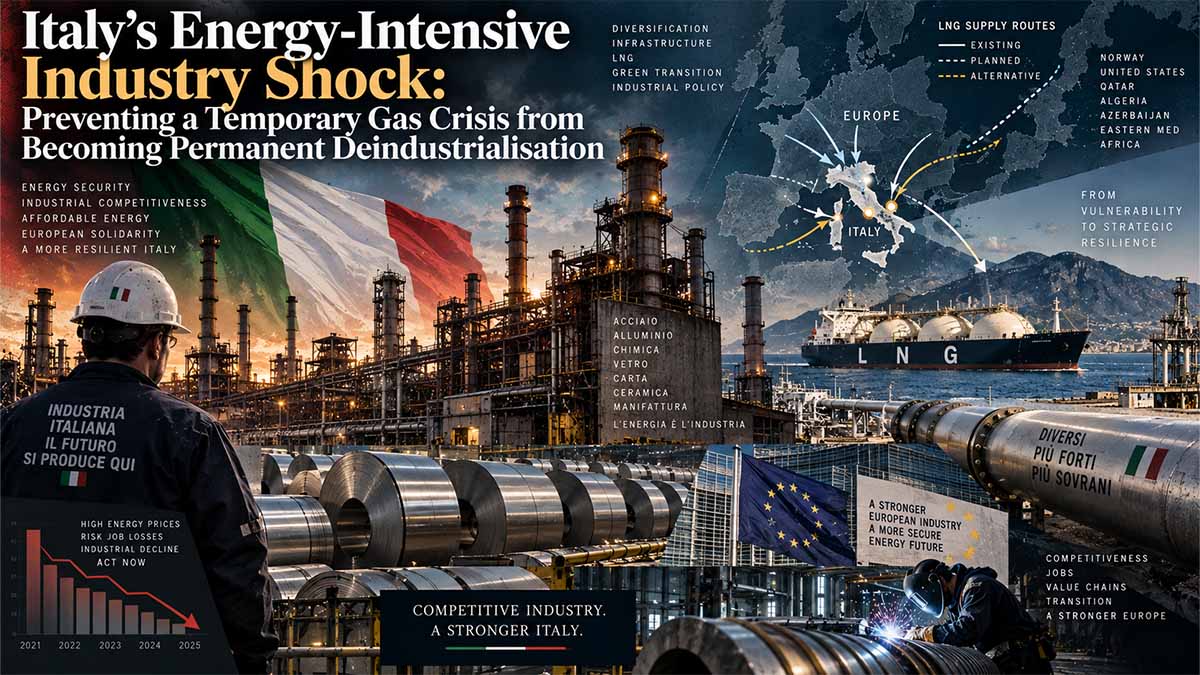
Italy’s Energy-Intensive Industry Shock: Preventing a Temporary Gas Crisis from Becoming Permanent Deindustrialisation
EXECUTIVE BLUF: Italy is confronting a severe competitiveness and industrial-continuity emergency driven by acute wholesale price transmission rather than physical molecular gas scarcity (GME Day-Ahead averaged €81.49/MWh in Week 37/2026, while stored gas cleared at €83.18/MWh). With the European Commission confirming no immediate aggregate supply disruption, abrupt plant shutdowns threaten irreversible refractory destruction, capital loss, and workforce dispersal across continuous-cycle metallurgy, ceramics, glass, paper, and chemicals. The required response is an asymmetrical Italian Industrial Energy Security Compact linking immediate targeted continuity shields with multi-year contract institutionalisation.
Empirical Stress Vector Analysis • Parametric Intensity Indices (0–100 Scale)
Preserving Productive Capital from Arbitrary Shutdowns (0–6 Months)
Audited Empirical Market Evidence & Jurisdictional Baselines
VERIFIED DATASET • ARERA / GME / EU / BMWE| Indicator / Stress Parameter | Empirical Value / Status | Reference Window | Scope / Metric Definition | Audited Issuer Source |
|---|---|---|---|---|
| Italian Day-Ahead Gas Average | €81.49 / MWh | 7–13 Sep 2026 | MGP-GAS continuous wholesale trading | GME Gas Results, W37/2026 |
| Italian Day-Ahead Gas Peak | €88.00 / MWh | 7–13 Sep 2026 | Maximum single-session clearance price | GME Gas Results, W37/2026 |
| Italian Intraday Gas Average | €82.04 / MWh | 7–13 Sep 2026 | MI-GAS continuous trading (high: €88.70) | GME Gas Results, W37/2026 |
| Traded Stored-Gas Market Price | €83.18 / MWh | Week 37 / 2026 | Weighted storage-transfer transaction price | GME Storage Desk Data |
| ARERA Wholesale Commodity Baseline | €64.15 / MWh | August 2026 | PSV monthly average (pre-escalation benchmark) | ARERA Vulnerability Notice |
| EU Physical Supply Continuity Risk | No Immediate Risk | 3 Sep 2026 | Gas Coordination Group aggregate appraisal | European Commission GCG |
| EU Primary Aluminium Global Share | 3.8% of Global | Commission Baseline | Severe structural curtailment (>50% idled since 2021) | European Metals Action Plan |
| Energy Saving via Aluminium Recycling | Up to 95% Reduction | Technical Standard | Secondary remelting vs primary electrolysis | European Metals Action Plan |
Cross-Border Sovereign Industrial Shield Architectures
| Jurisdiction | Primary Intervention Mechanism | Duration / Tenor | Pricing Formula / Subsidy Quantum | Strategic Policy Intent |
|---|---|---|---|---|
| Germany | Industriestrompreis (Relief Scheme) | 2026–2028 | Up to 50% ref price; €0.05/kWh floor | Protect ~9,500 enterprises against forward price volatility |
| France | State-backed Renewable Contracts | 8–10 years (from 2027) | Long-term cost-reflective power tranches | Electrification of industrial usages & long-term visibility |
| United Kingdom | British Industry Supercharger | From 1 Apr 2026 | 90% network compensation (£65-87/MWh) | System cost shedding for energy-intensive manufacturing |
| European Union | Clean Industrial Deal Framework (CISAF) | To 31 Dec 2030 | Targeted relief, guarantees, risk-sharing | Harmonised State-aid clearance for carbon leakage defense |
Structural Transmission Vectors & Systemic Paradoxes
DECONSTRUCTION ANALYSISThe Physical Asset Trap
Continuous manufacturing cannot modulate linearly with spot prices. Cooling a float-glass furnace or ceramic tunnel kiln below critical heat causes structural collapse, necessitating multi-million euro rebuilds and 6–12 month commissioning freezes.
Circular Scrap Hemorrhage
While recycling aluminium achieves up to 95% energy savings, high local energy prices force domestic recyclers to curtail. Concurrently, EU aluminium scrap exports exceed 1.3M tonnes, driving strategic domestic feedstock to foreign processors.
Tenor & Credit Mismatch
Industrial PPA adoption is bottlenecked not by renewable availability, but by industrial balance sheets inability to underwrite 10–15 year unrated counterparty liability, requiring SACE/GSE public risk-absorption facilities.
Heterogeneous Abatement
Italy’s PNIEC 2024 maps 67.5 MtCO₂ across hard-to-abate sectors. Cement contains un-electrifiable process emissions; glass/ceramics demand high-temperature gas/hydrogen; fertilizers need feedstock. A uniform policy instrument fails.
Forensic Strategic Key Judgments
ANALYTIC CONSENSUS • PROTOCOL IIESC-2026Wholesale Day-Ahead (€81.49) and Intraday (€82.04) gas spikes destroy industrial margins despite certified adequate European physical LNG import volumes and storage reserves.
Premature industrial furnace decommissioning incurs capital, supply chain dislocation, and worker retraining expenses orders of magnitude larger than a targeted 6-month tax shield.
With EU primary smelters covering only 7% of demand and 95% energy savings unlocked by recycling, maintaining secondary scrap processing is vital to national industrial autonomy.
Blanket consumer gas caps cause unsustainable fiscal bleeding and blunt conservation signals. Aid must strictly target certified electro- and gas-intensive continuous producers.
To mirror German Industriestrompreis and French 8–10 year renewable supply contracts, Italy must institutionalise GSE Energy Release allocations into multi-year firm structures.
Industrial electrification without preferential Terna grid interconnects will trade fuel risk for grid curtailment risk. A National Industrial Grid Priority Map is urgently mandated.
Open Official Record Gaps
- Plant-Level Restart Cost Dataset: Absence of a consolidated public registry cross-referencing minimum thermal load, cold restart costs, and exact refractory tolerances across Italian glass and ceramic sites.
- Corporate Hedging Coverage Ratios: Undisclosed volumes of medium-term forward contract coverage across mid-tier industrial consortia, preventing exact calibration of unhedged spot gas exposure.
- Secondary Scrap Tracing: Incomplete customs auditing on intra-EU vs extra-EU secondary alloy shipments, obscuring precise destinations of exported high-grade scrap streams.
- Downstream Cross-Default Linkages: Exact propagation latency between upstream precursor curtailment (e.g. basic chemicals, CO₂ capture in fertilizers) and food packaging bottlenecks.
Observable Watch Indicators
Industrial Continuity and Emergency Protection
Principal judgment
The immediate policy objective should not be defined as generic compensation for expensive energy, because such a formulation would disperse fiscal resources across firms with fundamentally different resilience profiles, but as the preservation of productive assets whose temporary economic distress can become irreversible industrial loss before energy markets normalise; accordingly, the emergency architecture should distinguish plants that can reduce output, plants that can suspend production and restart relatively quickly, plants that must maintain a technical minimum load, and plants whose shutdown can damage furnaces, refractory linings, process equipment, material flows, customer qualification or downstream supply chains, with public intervention becoming progressively stronger as the physical and strategic irreversibility of closure increases.
This distinction is particularly important because Italy already possesses an administrative infrastructure for identifying electricity-intensive and gas-intensive enterprises through CSEA, ARERA and the relevant ministerial regimes, while the current crisis requires an additional layer that the existing energy-intensity classifications do not fully provide: plant-level industrial criticality. ARERA's framework for 2026 continues to distinguish enterprises with high natural-gas consumption and explicitly links gas-intensive concessions to energy-efficiency obligations, while CSEA maintains the relevant registers; MIMIT has meanwhile reserved 50% of the resources of the current Industrial Transition Support Fund window for energy-intensive enterprises, demonstrating that an administratively recognised population already exists from which an emergency mechanism can be constructed rather than requiring an entirely new beneficiary universe. ARERA — Determination DSME 5/2025 on gas-intensive companies for 2026 MIMIT — Fondo per il sostegno alla transizione industriale
The emergency policy should consequently be organised around a National Industrial Continuity Mechanism, administered jointly by MIMIT and MASE with MEF participation and operational interfaces with CSEA, GSE, ARERA, SACE, CDP and Invitalia, under which firms would not receive assistance merely because they consume large amounts of energy, but because verified energy-price exposure threatens an economically viable production asset whose closure would generate disproportionate employment, technological, regional, supply-chain or restart losses.
From “energy-intensive company” to “critical industrial production unit”
The central administrative innovation should be the creation of a Critical Industrial Production Unit Register, because company-level classification is insufficient when a diversified industrial group can own several installations with radically different technologies, energy requirements and shutdown consequences; eligibility should therefore be assessed at the level of the individual production unit, furnace, kiln, continuous line, chemical train, metallurgical installation or integrated manufacturing site for which assistance is requested.
The register should complement, rather than replace, the existing energivore and gasivore systems, because ARERA's 2026 gas-intensive framework already provides a legally structured basis for identifying enterprises with qualifying consumption and establishes that the concession system is linked to measures promoting efficient energy use, while Italy's electricity-intensive regime is governed separately through the post-2023 reform and implementing measures.
Proposed emergency classification of industrial plants
| Continuity class | Physical operating condition | Typical policy treatment | Evidence required | Emergency priority |
|---|---|---|---|---|
| Class A — technically interruptible | Production can stop without major equipment damage and restart rapidly | Liquidity support, accelerated tax offsets, demand-response remuneration | Energy invoices, production data, cash-flow evidence | Standard |
| Class B — restart-sensitive | Shutdown entails significant restart expense, process requalification or extended downtime | Partial energy-cost relief plus liquidity guarantee | Restart plan, engineering certification, customer qualification effects | Elevated |
| Class C — minimum-load continuous process | Plant cannot economically or technically fall below a defined load without material equipment/process risk | Continuity compensation covering verified minimum technical consumption | Certified minimum-load curve, energy metering, engineering evidence | High |
| Class D — strategic continuous-cycle asset | Shutdown threatens irreversible equipment damage, long recommissioning, critical supply-chain interruption or regional employment shock | Priority compensation, SACE/CDP liquidity, accelerated administrative intervention | Independent technical report, supply-chain mapping, workforce exposure | Very high |
| Class E — nationally critical dependency | Loss of facility would create severe domestic or EU dependence for a difficult-to-substitute material or process | Case-specific continuity agreement with government | Import substitutability, inventories, lead times, downstream dependency | Exceptional |
This proposed classification would solve an important weakness in a conventional tax-credit model, because two firms purchasing the same quantity of gas can face radically different economic consequences from curtailment, while an administratively simple percentage subsidy would treat them identically.
The industrial sectors do not face the same emergency
The sectors cited by MIMIT itself in its February 2026 dialogue on energy-intensive industries include chemicals, mechanical engineering, glass, paper, steel, ceramics, cement, manufacturing, metallurgy and rubber-plastics, confirming that the emergency population is broader than a single material industry. MIMIT — Industrie energivore: Urso alla UE, “servono riforme radicali, subito”
The design of emergency protection should nevertheless differentiate them according to energy vector, process continuity, international trade exposure, downstream criticality and restart characteristics, because a gas-fired container-glass furnace, an electric aluminium remelting installation, a paper mill, a ceramic kiln, an ammonia-based fertilizer operation and an electric-arc steel plant cannot be protected effectively through the same instrument.
Emergency exposure matrix by sector
| Sector | Principal emergency exposure | Shutdown characteristic | Principal downstream exposure | Most appropriate 0–6 month intervention |
|---|---|---|---|---|
| Glass | High-temperature thermal energy, predominantly gas in many installations | Furnace cooling can generate refractory and structural consequences; campaigns are long | Food and beverage packaging, pharmaceuticals, cosmetics, construction, automotive glazing | Minimum-load gas compensation, liquidity, strategic-furnace register |
| Ceramics | Kiln firing and drying, substantial thermal load | Production can be interrupted more readily than some glass processes, but kilns, schedules and product quality impose constraints | Construction, sanitary ware, tiles, export manufacturing | Energy-cost support linked to production continuity and efficiency |
| Paper and pulp | Electricity, steam and process heat | Integrated mills have significant continuous-process characteristics | Food packaging, pharmaceuticals, logistics, consumer goods, publishing | CHP/steam continuity support, electricity relief, working-capital facility |
| Chemicals | Gas as fuel and feedstock plus electricity and steam | Highly heterogeneous; several continuous processes have complex restart requirements | Automotive, pharma, agriculture, construction, electronics, consumer goods | Plant-specific rather than sector-wide support |
| Fertilizers | Natural gas can be both energy source and chemical feedstock | Economics can deteriorate rapidly when gas rises because the molecule is embedded in production economics | Agriculture and food security | Feedstock-cost monitoring, strategic stock and temporary operating support |
| Cement | High-temperature kilns plus process emissions | Kiln operation is capital intensive; substitution options differ from those of other sectors | Construction and infrastructure | Thermal-energy support combined with alternative-fuel acceleration |
| Steel | Electricity, natural gas, coal depending on production route | EAF and integrated routes have substantially different exposure | Automotive, machinery, construction, defence supply chains | Route-specific electricity/gas intervention |
| Aluminium | Electricity-intensive primary production; electricity and gas also relevant to remelting/casting | Exposure depends strongly on process; melting and holding operations have continuity requirements | Automotive, packaging, construction, machinery, electrical equipment | Electricity relief, secondary-metal continuity, scrap-retention monitoring |
| Other non-ferrous metals | Electricity plus thermal processing | Smelting, refining and casting can be highly energy sensitive | Electronics, automotive, machinery, defence | Strategic-metal classification and energy compensation |
| Rubber and plastics | Electricity and process heat plus chemical feedstocks | Generally more interruptible than glass or chemicals, but customer qualification can be significant | Automotive, pharma, food packaging, machinery | Liquidity and electricity-cost instruments rather than automatic critical status |
The classification should therefore prevent a politically tempting but economically inefficient outcome in which identical support percentages are allocated simply according to sector membership, because the relevant emergency variable is the marginal probability of irreversible industrial loss created by the energy shock, not the political visibility of the sector.
The current price shock rapidly transmits into working capital
A major vulnerability is often overlooked when energy support is designed solely through annual tax returns: a plant does not fail when its annual profit-and-loss account is finally calculated, but when the liquidity required to purchase energy, raw materials, ETS allowances, transport and inventories becomes unavailable during production.
ARERA's 2026 framework demonstrates the importance of distinguishing the wholesale commodity price from the total industrial gas-cost structure, since its reference-price methodology for gas-intensive undertakings incorporates the wholesale component together with transmission and, where applicable, distribution, measurement, taxation and general system charges, while excluding the concession itself; for the 2026 concession calculation ARERA fixed the 2024 reference at €0.4780 per standard cubic metre for final users connected to transmission networks and €0.5500/Sm³ for users connected to distribution networks.
Those regulatory values should not be confused with the present wholesale market price, because they serve a different statutory calculation, but their structure illustrates why emergency policy must examine the all-in cash energy bill actually borne by each plant, rather than assuming that a headline gas quotation translates one-for-one into company expenditure.
Cash-flow transmission that government should monitor
| Transmission channel | Immediate company effect | Why conventional annual aid arrives too late | Proposed emergency response |
|---|---|---|---|
| Higher spot gas purchases | Larger weekly/monthly collateral and supplier payments | Fiscal credit realised after the liquidity event | Monthly provisional compensation |
| Electricity repricing | Higher baseload operating expenditure | Annual tax treatment does not finance current invoices | CSEA/GSE monthly settlement |
| Supplier collateral calls | Cash trapped as guarantees | Not captured by energy-unit subsidy | SACE working-capital guarantee |
| Larger VAT cash requirement | Temporary financing burden on gross invoice | Recovery timing can generate working-capital pressure | Accelerated VAT offset/refund procedures where legally available |
| ETS-related cash needs | Additional capital tied to compliance instruments | Separate from commodity-support schemes | Do not subsidise ETS itself; recognise total liquidity stress in credit assessment |
| Raw-material inflation | Energy shock propagates through suppliers | Energy compensation alone underestimates liquidity need | CDP/SACE revolving facility |
| Reduced customer orders | Lower cash receipts while fixed thermal load remains | Support based only on consumption can overcompensate falling output | Aid linked to minimum technical load and verified output |
| Hedging collateral | Margin requirements can rise even when long-term hedge protects final price | Nominal market exposure can exaggerate genuine economic exposure | Mandatory hedge disclosure and net-exposure calculation |
Emergency compensation should be calculated on net exposure, not gross energy consumption
The most defensible mechanism would calculate support against verified incremental net energy cost, thereby subtracting the economic benefit of hedges, fixed-price contracts, internal generation and previously received public compensation before the state determines the eligible cost base.
A plant purchasing 1 TWh of electricity entirely at spot prices has fundamentally different exposure from a plant consuming the same amount while 80% hedged under a fixed-price PPA, and failure to recognise that difference would reward prudent hedging and unhedged exposure identically while creating strong incentives for companies to socialise losses after retaining gains during periods of favourable prices.
The proposed administrative formula should therefore operate conceptually as follows:
Eligible extraordinary energy cost = eligible metered consumption × eligible price differential − realised hedging protection − overlapping public energy compensation − contractual pass-through recoveries
The actual reference price, aid intensity and ceiling should be set only after legal and fiscal modelling, rather than being invented in advance, because the Commission's current State-aid architecture places substantive limits on the volume, price and transformation conditions applicable to electricity relief.
CISAF gives Italy a usable electricity-relief architecture, but it is not an unlimited subsidy mandate
The Clean Industrial Deal State Aid Framework provides a practical route for temporary electricity-price relief to energy-intensive users, and Commission approvals during 2026 demonstrate that this is no longer theoretical: the Commission approved national schemes for Bulgaria, Germany and Slovenia in April 2026 and subsequently a €300 million Irish scheme in July 2026, establishing a growing body of implementation precedent that Italy can study when designing an accelerated notification. European Commission — approval of Bulgarian, German and Slovenian electricity-relief schemes European Commission — approval of Ireland's €300 million scheme
The Commission's own 2025 CISAF analytical document explains that temporary electricity-price relief is specifically intended to prevent further loss of electro-intensive activity in Europe while requiring beneficiaries to undertake decarbonisation investments, which means that an Italian emergency mechanism should be designed from the outset as a bridge between immediate continuity and permanent transformation rather than as a stand-alone operating subsidy.
Germany's notified and approved scheme provides a particularly useful legal template because the Commission decision concerns temporary electricity relief under Section 4.5 CISAF, thereby demonstrating that a large Member State can operationalise the framework at industrial scale.
CISAF-compatible design lessons for Italy
| Design question | Recommended Italian treatment | Policy rationale |
|---|---|---|
| Who qualifies? | Restrict electricity relief to eligible electro-intensive sectors under the applicable EU framework | Preserves legal compatibility and targeting |
| What consumption is supported? | Use eligible metered consumption rather than company-wide estimates | Prevents artificial consumption inflation |
| How are hedges treated? | Deduct contractual protection from net eligible exposure | Avoids double compensation |
| What price benchmark is used? | Use an auditable reference linked to the relevant Italian bidding-zone/market architecture | Makes calculation reproducible |
| What does the beneficiary owe in return? | Mandatory transformation investment and energy-risk-reduction plan | Aligns emergency aid with CISAF logic |
| How is double funding prevented? | Central register covering CISAF, CSEA, GSE, tax credits and other support | Essential for State-aid compliance |
| How long should emergency support operate? | Six-month domestic window within the EU legal framework, extendable only after reassessment | Prevents structural subsidy dependency |
| How should aid be paid? | Provisional monthly advances followed by annual reconciliation | Solves liquidity problem without sacrificing auditability |
Natural gas requires a separate instrument
The most important legal and economic distinction in the emergency package is that electricity relief under CISAF cannot simply be copied and relabelled as a gas-price subsidy, because the current EU framework was deliberately designed to support the transition toward lower-cost clean electricity while preserving incentives for decarbonisation, whereas unrestricted fossil-gas compensation would raise materially different State-aid, climate-policy and incentive issues.
Italy nevertheless already operates a distinct gas-intensive relief architecture: ARERA's implementing framework records that the mechanism established under Ministerial Decree 541/2021 reduces specified general gas-system charges for qualifying high-consumption firms and conditions access on energy-efficiency measures, while the regulatory rules were subsequently updated for implementation and controls.
The immediate policy therefore should consist of three separate layers rather than one gas subsidy: enhancement or accelerated settlement of existing legally available gasivore relief, a government-guaranteed liquidity instrument that finances extraordinary gas expenditure without changing the gas price itself, and a narrowly notified continuity mechanism for plants where maintaining certified technical minimum load is necessary to prevent disproportionate physical or strategic damage.
Proposed gas emergency architecture
| Instrument | Beneficiary | Mechanism | Fiscal risk | Distortion risk | Recommended duration |
|---|---|---|---|---|---|
| Accelerated existing gasivore relief | Existing qualifying gas-intensive enterprises | Faster recognition/settlement of already established concessions | Low–moderate | Low | Emergency period |
| Extraordinary liquidity guarantee | Viable gas-intensive firms facing cash compression | SACE guarantee on incremental working capital | Contingent rather than immediate expenditure | Moderate | 6–12 months maturity |
| Minimum technical-load compensation | Certified continuous-cycle installations | Support only for energy required to keep plant technically viable | Moderate | Lower if tightly certified | Maximum six-month emergency window |
| Supplier payment guarantee | Firms facing collateral/payment pressure | State-backed guarantee to approved energy suppliers | Contingent | Moderate | Short-term |
| Strategic plant continuity contract | Exceptionally critical facility | Bilateral, notified arrangement tied to production/employment and transition obligations | Potentially high | High unless exceptional | Case-specific |
| Universal industrial gas price cap | All industrial users | Government absorbs difference above ceiling | Very high | Very high | Not recommended |
A two-gate eligibility test would prevent indiscriminate subsidy
Eligibility should require that a company pass both an economic exposure gate and an industrial criticality gate, because high energy consumption alone does not establish that public money prevents permanent industrial loss.
Economic exposure gate
The applicant should demonstrate, with auditor-certified documentation, that the current energy shock has produced a material deterioration in production economics relative to a defined reference period, after accounting for hedging, PPAs, self-generation, energy pass-through clauses and other public support; the assessment should use actual metered consumption and realised contract prices rather than forecast consumption whenever available, while provisional payments should subsequently be reconciled against verified annual accounts.
Industrial criticality gate
At least one additional criterion should be met, with stronger aid requiring stronger evidence: a technically certified continuous-process constraint; a restart period exceeding a defined threshold; material irreversible equipment damage from shutdown; substantial employment concentration in a local labour market; lack of readily available domestic or EU substitutes; downstream dependence in food, pharmaceutical, automotive, construction or other strategic chains; substantial waste-recycling or secondary-material function; or documented loss of strategically relevant industrial capability.
Proposed scoring architecture for administrative triage
This table is a policy design proposal rather than a claimed existing government scoring system, and numerical weights should be legally validated before adoption.
| Criterion | Evidence | Proposed administrative function |
|---|---|---|
| Energy-cost shock | Metered invoices and contracts | Establish economic exposure |
| Minimum technical load | Engineer-certified operating envelope | Identify unavoidable energy consumption |
| Restart time | Technical restart/recommissioning schedule | Measure irreversibility |
| Capital-at-risk | Replacement/refractory/recommissioning estimate | Quantify avoidable asset destruction |
| Employment | Payroll and site employment data | Identify labour-market exposure |
| Regional concentration | Share of local industrial employment | Identify territorial systemic risk |
| Import substitutability | Customs/market data and customer evidence | Measure strategic dependency |
| Downstream criticality | Customer-sector mapping | Detect propagation risk |
| Recycling role | Tonnes of secondary material processed | Capture circular-economy importance |
| Decarbonisation readiness | Approved investment project | Prioritise support that leads to structural adjustment |
The scoring system should be used only for administrative triage and should never substitute for the statutory State-aid eligibility conditions applicable to the instrument itself.
The minimum technical load should become the central engineering variable
For continuous-cycle sectors, the government should require each site to declare and independently certify a Minimum Technical Continuity Load, defined as the lowest sustained operating level compatible with protection of furnaces, kilns, reactors, refractory systems, process fluids, product integrity, environmental compliance and safe restart.
This would allow emergency aid to distinguish between energy consumed to protect industrial capital and energy consumed to maximise normal commercial output, which is essential for fiscal proportionality: a plant that normally consumes 100 units of gas but requires only 35 units to keep a furnace technically viable during a demand collapse should not automatically receive emergency continuity compensation on all 100 units.
Plant-level technical file required within the first 30 days
| Required item | Verification source | Government use |
|---|---|---|
| Normal annual energy consumption | Metering / supplier invoices | Establish baseline |
| Energy vector split | Electricity, gas, steam, other fuels | Select applicable aid instrument |
| Minimum technical consumption | Independent engineer | Define protected quantity |
| Minimum safe operating period | Plant engineering documentation | Determine duration |
| Cold shutdown consequence | OEM / engineering assessment | Establish physical irreversibility |
| Restart duration | Plant engineering and maintenance plan | Determine continuity priority |
| Restart capital cost | Audited estimate | Compare aid with avoided destruction |
| Workforce exposure | Payroll and site data | Employment safeguard |
| Critical customers | Customer-category documentation | Supply-chain assessment |
| Inventory coverage | Audited stock data | Estimate disruption timing |
| Hedging coverage | Contracts and treasury documentation | Determine net energy exposure |
| Existing public aid | State-aid register / company declaration | Prevent double support |
| Transformation project | Board-approved investment plan | Link emergency relief to exit strategy |
The financial facility must arrive before the furnace shutdown decision
Even where the economic case for supporting production is strong, a mechanism that reimburses firms twelve months later would not solve the immediate problem, and therefore the emergency system should operate through monthly advances with quarterly verification and final annual reconciliation.
The state should separate grants from guarantees: grants should address extraordinary costs that public policy has deliberately decided to share, while guarantees should address temporary working-capital stress where the underlying company remains financially viable.
Proposed liquidity architecture
| Window | Provider | Instrument | Target problem | State exposure |
|---|---|---|---|---|
| Industrial Energy Working Capital | SACE + commercial banks | 70–90% guarantee subject to legal design | Energy invoice and collateral shock | Contingent |
| Strategic Furnace Continuity | CDP/SACE | Revolving facility | Minimum-load financing | Contingent + funding cost |
| Energy Supplier Guarantee | SACE | Payment guarantee | Supplier demands for collateral | Contingent |
| Accelerated Public Receivable | MEF / tax administration | Faster offset of approved credits | Timing mismatch | Cash-flow rather than net fiscal cost where credit already due |
| Transformation Bridge | CDP/Invitalia | Bridge to approved efficiency/electrification investment | Prevent emergency liquidity from delaying capex | Contingent/direct |
| Regional Employment Continuity | Existing labour instruments | Temporary labour-cost support where output is curtailed | Avoid permanent layoffs during temporary curtailment | Direct |
The facility should exclude companies already structurally insolvent before the price shock unless a separately approved restructuring plan exists, because an emergency-energy instrument should not become an unexamined corporate-rescue programme.
Existing transition money should not be consumed by emergency operating losses
MIMIT's current Industrial Transition Support Fund illustrates both the available policy infrastructure and the danger of mixing fundamentally different objectives, because the scheme reserves 50% of resources for energy-intensive enterprises, while eligible projects focus on greater energy efficiency and more efficient resource use, including reuse, recycling and recovery of raw materials.
Those funds should therefore remain primarily capital-transformation instruments, while a separate emergency facility protects operating continuity; diverting investment budgets toward energy invoices would preserve production today by weakening the investments necessary to reduce energy exposure tomorrow.
The appropriate interaction should instead allow a company receiving emergency continuity support to obtain accelerated access to transformation instruments where it can demonstrate that a defined investment will permanently reduce future exposure.
Employment protection should focus on industrial capability, not only headcount
The labour-market risk is not exhausted by the number of people directly employed at a facility, because process industries accumulate site-specific skills in furnace operation, refractory maintenance, process chemistry, metallurgy, quality assurance, industrial safety and customer certification that can disappear rapidly if a plant closes and specialised workers disperse.
Emergency assistance should consequently require a workforce continuity agreement proportionate to the aid received, covering preservation of core technical teams, restrictions on energy-price-related permanent dismissals while continuity support is active, use of temporary working-time instruments where output must be reduced, maintenance of apprenticeship and essential competence programmes, and notification before relocation of supported production outside Italy or the EU.
The obligation should not amount to an unconditional employment freeze, because that could prevent legitimate restructuring unrelated to energy prices, but the state should not finance a plant's energy cost while simultaneously underwriting a decision to transfer the supported capacity abroad.
Aluminium requires a dedicated emergency sub-window
Aluminium should receive a specific operational track because the sector combines electricity-price sensitivity, thermal processing, strategically important downstream applications and the exceptionally high energy value of recycling, while the emergency architecture should distinguish primary aluminium, remelting, foundry operations, rolling/extrusion and secondary aluminium rather than treat the metal as a homogeneous activity.
For Italy in particular, the most immediate policy relevance lies heavily in downstream transformation and secondary-material systems, where maintaining scrap collection, sorting, remelting, alloy preparation and semi-fabrication prevents an energy-price shock from simultaneously destroying industrial processing capacity and converting valuable domestic secondary raw material into an export flow.
Aluminium emergency protection framework
| Aluminium activity | Main exposure | Shutdown risk | Strategic concern | Immediate instrument |
|---|---|---|---|---|
| Primary smelting | Extremely electricity intensive | Curtailment/restart can be complex and economics highly power-sensitive | Import dependence | Case-specific strategic assessment |
| Secondary remelting | Electricity/gas depending on installation | Loss of remelting economics can redirect scrap abroad | Circular economy and material autonomy | Electricity/gas relief + scrap monitoring |
| Foundries | Electricity and thermal energy | Customer qualification and tooling relationships | Automotive and engineering | Liquidity + electricity relief |
| Rolling | Electricity and heat treatment | Customer specifications and export competitiveness | Packaging, transport, construction | Working-capital support |
| Extrusion | Electricity and heat | Moderate restart risk, high competitive exposure | Construction, automotive, industrial components | Targeted electricity relief |
| Scrap sorting/pre-treatment | Electricity and logistics | More interruptible, but essential to domestic recycling flow | Feedstock availability | Operating-cost/working-capital support if qualifying |
The policy objective should be to prevent a situation in which domestic recyclability remains high in theory while domestic recycling capacity becomes economically uncompetitive in practice, because material circularity exists only when collection, sorting, remelting and subsequent transformation remain economically connected.
Paper, glass and packaging require supply-chain continuity treatment
Food, beverage, pharmaceutical and cosmetic supply chains are unusually sensitive to packaging disruptions because substitution is constrained by product-contact standards, manufacturing specifications, bottle or container design, sterile production requirements, customer approvals and line compatibility, meaning that the closure of an upstream glass, paper or specialised packaging facility cannot always be replaced immediately through imports even where a nominal foreign supplier exists.
For emergency purposes, MIMIT should therefore require critical packaging producers to provide an anonymised downstream dependency map identifying the share of output destined for food, pharmaceuticals, cosmetics and other strategic applications, while the government should simultaneously identify the import lead time for major substitute categories.
The objective is not to protect every packaging producer from commercial competition, but to identify single points of industrial failure before energy prices convert them into a supply-chain emergency.
Chemicals and fertilizers require feedstock-adjusted assessment
For chemicals, the distinction between gas as fuel and gas as feedstock is crucial, because a conventional energy-efficiency metric can misrepresent processes in which hydrocarbons are chemically embedded in production rather than simply combusted.
Emergency applications should therefore split gas consumption into process fuel, steam generation, cogeneration, feedstock and other uses, allowing government to determine what portion of expenditure represents an energy-price shock, what portion reflects raw-material economics and which decarbonisation technologies are technically relevant.
The same logic is particularly important in fertilizer production, where a high gas price can impair competitiveness through both energy and feedstock channels, thereby increasing the risk that reduced domestic production is replaced by imports whose final price, origin and carbon characteristics are outside Italian control.
Industrial prices are already propagating beyond the energy bill
The crisis should also be monitored through producer prices rather than energy quotations alone, because ISTAT reported that in June 2026, among manufacturing activities on the domestic market, producer prices increased year-on-year by 42.2% for coke and refined petroleum products, 8.0% for chemicals and 6.6% for metallurgy and fabricated metal products excluding machinery, while external-market producer prices for chemicals and metals also rose appreciably. ISTAT — Producer prices of industry and construction, June 2026
Those increases cannot be attributed exclusively to natural gas, because industrial producer prices incorporate multiple input, commodity, exchange-rate and market effects, but they provide an observable indication that cost pressure is propagating into sectors central to the emergency assessment and should therefore be incorporated into the monitoring dashboard rather than relying exclusively on GME or PSV prices.
At the same time, ISTAT's latest trade release for July 2026 recorded year-on-year export growth of 13.8% for basic metals and fabricated metal products excluding machinery, demonstrating that the metals sector continues to contribute materially to Italy's external industrial performance and that preserving competitive production should not be confused with rescuing an economically irrelevant activity. ISTAT — Foreign trade and import prices, July 2026
Electricity demand shows that industrial recovery can increase exposure during the price shock
Terna reported total Italian electricity demand of 311.3 TWh in 2025, with industrial electricity consumption increasing by 2.6%, which matters for the emergency framework because a recovery in industrial utilisation raises the volume exposed to high electricity prices and can therefore worsen absolute energy expenditure even where unit prices remain unchanged. Terna — Italian electricity demand in 2025
The correct objective is consequently not to suppress industrial demand to reduce national energy consumption, because that could mechanically improve aggregate energy statistics while destroying value added, exports and industrial capability, but to protect economically productive consumption while accelerating the replacement of volatile marginal-energy exposure with structurally competitive supply.
Governance should operate as a permanent emergency cell from day one
A six-month industrial emergency cannot be managed effectively through sequential ministerial consultations, because energy prices, corporate liquidity and shutdown decisions move faster than normal legislative and administrative cycles; a permanent Industrial Energy Continuity Cell should therefore operate under joint MIMIT–MASE leadership with a weekly operating cycle and direct data interfaces with ARERA, CSEA, GSE, GME, Terna, Snam, SACE, CDP, Invitalia, MEF and labour authorities.
MIMIT's February 2026 engagement with associations representing chemicals, mechanics, glass, paper, steel, ceramics, cement, manufacturing, metallurgy and rubber-plastics demonstrates that an institutional dialogue already exists, but the emergency system should move from consultative representation to a quantitative plant-level operating picture.
Proposed institutional allocation
| Institution | Emergency function |
|---|---|
| MIMIT | Industrial criticality, plant register, downstream dependency, policy coordination |
| MASE | Energy policy, decarbonisation conditions, gas/electricity framework |
| MEF | Fiscal envelope, guarantees, tax treatment and budget control |
| ARERA | Regulatory data, tariff architecture, gasivore/energivore implementation interfaces |
| CSEA | Beneficiary registers, settlement support, cross-checking of concessions |
| GSE | Energy and renewable-support interface, future transformation conditionality |
| GME | Wholesale market-price data and benchmark verification |
| Terna | Electricity-system conditions, demand data and industrial load implications |
| Snam | Gas-system operational information and infrastructure constraints |
| SACE | Emergency guarantees and supplier-payment protection |
| CDP | Strategic liquidity and industrial investment bridge |
| Invitalia | Investment-programme interface |
| INPS / Labour authorities | Employment and temporary working-time instruments |
| ISTAT | Industrial production, producer-price, trade and structural indicators |
The emergency dashboard should trigger policy automatically
The government should avoid waiting for plant closures to become public events before intervening, and should instead establish quantitative triggers under which specific administrative procedures begin automatically.
Proposed warning architecture
| Indicator | Green | Amber | Red | Government response |
|---|---|---|---|---|
| Wholesale energy-price stress | Within normalised range | Sustained exceptional pricing | Prolonged extreme pricing | Activate progressively stronger support window |
| Plant EBITDA under normalised energy accounting | Positive | Near break-even | Negative because of verified energy shock | Accelerated viability review |
| Liquidity runway | >90 days | 30–90 days | <30 days | SACE/CDP emergency assessment |
| Minimum-load threat | None | Curtailment under evaluation | Minimum technical load no longer financeable | Continuity compensation assessment |
| Restart duration | <1 week | 1–8 weeks | >8 weeks / major recommissioning | Priority increases |
| Downstream inventory coverage | >90 days | 30–90 days | <30 days | Supply-chain contingency |
| Employment concentration | Dispersed | Material local exposure | Dominant local industrial employer | Labour/territorial intervention |
| Import substitution | Multiple EU sources | Concentrated | No rapid substitute | Strategic status review |
The exact numerical thresholds should be adopted by ministerial decree after testing against actual plant data, because using invented national thresholds without empirical validation would create false precision; the principle, however, should be embedded immediately so that emergency policy becomes rule-based rather than dependent on late political escalation.
Anti-abuse safeguards are indispensable
A programme potentially involving large industrial energy bills must incorporate anti-abuse controls from inception, because the fiscal and political legitimacy of emergency support would be weakened rapidly if firms could receive compensation for costs already hedged, reduce domestic production while exporting support indirectly to foreign group plants, or distribute extraordinary capital to shareholders during the aid period.
Mandatory safeguards
| Risk | Required safeguard |
|---|---|
| Double compensation | Central cross-check against all energy aid and tax-credit databases |
| Hedged cost compensated as spot exposure | Mandatory hedge disclosure and realised-price calculation |
| Artificial consumption increase | Baseline adjusted for production and technical minimum-load requirements |
| Support transferred within group | Plant-level accounting and related-party disclosure |
| Aid finances dividends | Temporary restriction on extraordinary distributions for major beneficiaries |
| Supported production relocated | Clawback for specified relocation within a defined period, subject to EU law |
| Employment reduced immediately after aid | Employment covenant proportionate to support |
| Inefficient energy consumption preserved indefinitely | Six-month emergency sunset plus mandatory transition plan |
| Insolvent company rescued indirectly | Pre-shock viability test |
| Strategic status exaggerated | Independent engineering and supply-chain verification |
The emergency package should be front-loaded but fiscally capped
The state should announce the maximum fiscal envelope at programme launch, because an uncapped commitment indexed directly to volatile gas prices could create substantial open-ended public exposure; however, the programme should also contain an automatic parliamentary or ministerial review mechanism allowing the envelope to be reconsidered if wholesale prices, geopolitical supply conditions or the number of critical facilities deteriorate materially.
Within the cap, priority should follow the hierarchy avoid irreversible asset destruction; preserve critical supply chains; maintain strategic recycling and metals capability; prevent regional employment shocks; support viable exporters; then address broader margin compression, rather than distributing support proportionally across all energy consumers.
Ninety-day implementation programme
| Timing | Required action | Lead authority | Deliverable |
|---|---|---|---|
| Days 0–10 | Establish Industrial Energy Continuity Cell | MIMIT / MASE | Operating decree and data-sharing mandate |
| Days 0–15 | Open pre-notification dialogue with European Commission on proposed electricity and exceptional continuity measures | MIMIT / MEF | State-aid legal pathway |
| Days 0–20 | Extract existing CSEA energivore/gasivore beneficiary universe | CSEA / ARERA | Verified eligible-company starting population |
| Days 10–30 | Require plant-level continuity declarations | MIMIT | Critical Industrial Production Unit Register |
| Days 10–30 | Launch SACE emergency working-capital guarantee window | MEF / SACE | First guarantees available |
| Days 20–40 | Certify Minimum Technical Continuity Loads for priority plants | MIMIT / accredited engineers | Plant engineering files |
| Days 20–45 | Map critical downstream dependencies | MIMIT | Food/pharma/automotive/construction risk map |
| Days 30–45 | Approve provisional monthly compensation methodology | MIMIT / MEF / MASE | Calculation regulation |
| Days 30–60 | First provisional payments | CSEA/GSE or designated administrator | Liquidity reaches firms |
| Days 45–60 | Launch aluminium and secondary-raw-material sub-window | MIMIT / MASE | Recycling and metal continuity mechanism |
| Days 60–90 | Audit first beneficiary cohort | CSEA / competent audit bodies | Anti-overcompensation reconciliation |
| Day 90 | Publish aggregate, non-commercially-sensitive evaluation | Government | Fiscal cost, plants protected, employment and production indicators |
Six-month decision architecture
The emergency mechanism should include a predefined exit logic because the objective is not to establish permanent operating subsidies: where energy prices normalise and plants remain viable, exceptional compensation should end; where the plant remains viable but structurally exposed, support should migrate toward PPAs, electrification, efficiency or other transition investment; where a strategically important plant remains uncompetitive even under normalised European energy conditions, government should initiate an industrial restructuring assessment rather than repeatedly relabelling structural weakness as emergency exposure; and where closure would create a national strategic dependency that cannot reasonably be mitigated through markets, the issue should move from generic energy support into an explicit strategic-capacity policy decision.
Exit matrix
| Condition after six months | Policy response |
|---|---|
| Energy price normalised, plant viable | End emergency operating support |
| Price remains high but EU-wide | Reassess under EU-coordinated State-aid framework |
| Plant viable after long-term energy contract | Replace subsidy with PPA/contractual architecture |
| Plant requires capex to become competitive | Move to transition-investment instruments |
| Plant structurally uncompetitive independent of energy shock | Restructuring assessment, not indefinite subsidy |
| Plant strategically indispensable but market economics remain inadequate | Explicit strategic-capacity decision with transparent fiscal cost |
| Company breached continuity conditions | Suspension and clawback |
| Aid generated overcompensation | Reconciliation and recovery |
Key judgments
The central emergency requirement is therefore not a new universal energy bonus but an industrial triage system capable of identifying where temporary public intervention prevents permanent economic destruction, because energy intensity, shutdown irreversibility and strategic relevance are distinct variables and should be treated separately.
Italy already possesses much of the administrative foundation required for rapid deployment through the existing energivore and gasivore registers, ARERA/CSEA procedures, MIMIT transition instruments and public financial institutions, while the principal missing element is the integration of these instruments around verified plant-level continuity risk.
Electricity and natural gas should not be treated through identical legal mechanisms: CISAF provides a clearer contemporary route for temporary electricity-price relief, while gas support should rely more heavily on existing gasivore arrangements, liquidity guarantees and narrowly defined minimum-load continuity measures whose State-aid compatibility is established before activation.
The most important engineering concept is the Minimum Technical Continuity Load, because it allows government to protect furnaces, kilns, reactors and continuous installations without subsidising all production indiscriminately, thereby improving both fiscal proportionality and legal defensibility.
The most important financial concept is net exposure, because support calculated from headline spot prices without adjusting for hedges, PPAs, internal generation and overlapping public support would systematically overstate the economic shock faced by some beneficiaries.
The aluminium response should explicitly protect secondary-metal processing and recycling capacity, because a loss of domestic remelting capacity would transform an energy-price crisis into a longer-term raw-material and strategic-autonomy problem.
The emergency intervention should begin delivering liquidity within 30–60 days, because a technically elegant support mechanism that pays after shutdown decisions have already been taken would fail its principal industrial purpose.
What would change the assessment
The case for broad emergency activation would weaken materially if wholesale gas and electricity prices returned rapidly and durably toward levels compatible with normal European industrial operation before significant plant-level liquidity stress emerged, whereas the case would strengthen substantially if verified companies began moving continuous-cycle installations toward technical minimum load, if SACE or banking data showed a sharp deterioration in energy-related working-capital availability, if supplier collateral requirements increased materially, or if multiple sites announced closures whose restart periods extend beyond the anticipated market shock.
The assessment would also change if Commission guidance materially altered the conditions for CISAF electricity relief or if an Italian notification established additional legally available gas-support mechanisms, because the feasible division between grants, tariff concessions, guarantees and transition obligations would then need to be recalibrated against the operative EU State-aid decision rather than inferred from other Member States' precedents.
Open official record
A fully quantified national fiscal envelope cannot yet be produced responsibly from the public evidence reviewed here because the decisive inputs — plant-level eligible consumption, realised rather than quoted energy prices, hedge coverage, minimum technical loads, restart costs and the number of facilities meeting the proposed criticality criteria — are not available in a single current official dataset; these variables should therefore be collected during the first 30 days of the emergency programme rather than replaced by assumed national averages.
A second material gap concerns current plant-level employment and downstream dependency for glass, aluminium, chemicals, paper, ceramics, cement, steel and fertilizers, because sector-wide employment statistics are insufficient to determine whether closure of a particular installation constitutes a national supply risk or primarily a company-specific economic event.
A third gap concerns the exact fiscal interaction among any new emergency compensation, existing CSEA concessions, tax treatment, SACE guarantees and EU-approved State aid, which should be resolved through a common beneficiary ledger before payments begin so that cumulative assistance remains auditable and legally compliant.
Industrial Continuity & Emergency Protection: Operationalizing the Critical Production Unit Register
PRINCIPAL FORENSIC BLUF: Emergency state intervention must reject broad, indiscriminate energy-cost subsidisation in favour of an engineering-based asset protection doctrine. Italy possesses the statutory base via CSEA/ARERA gasivore registers (Resolution DSME 5/2025; reference rates of €0.4780/Sm³ transport and €0.5500/Sm³ distribution) and the MIMIT Transition Fund (50% electro-intensive carveout), but lacks plant-level triage. Support must transition from gross company metrics to net metered exposure adjusted for hedges, prioritizing the Minimum Technical Continuity Load to avert permanent refractory cracking, capital destruction, and circular scrap hemorrhages before corporate liquidity exhausts within 30–60 days.
Emergency Triage & Risk Concentration Matrix (0–100 Scale)
Classifying Operating Assets by Irreversibility & Equipment Damage
Statutory Evidence Base, Sectoral Vulnerability & Regulatory Parameters
AUDITED SOURCES: ARERA DSME 5/2025 • MIMIT • ISTAT 2026 • TERNA| Continuity Class / Sector | Operating Envelope & Shutdown Risk | Downstream Exposure & Vulnerability | 0–6 Month Targeted Intervention | Priority Tier |
|---|---|---|---|---|
| Class E / Basic Chemistry & Fert. | Hydrocarbons embedded as chemical feedstock; prolonged cooling destroys reactor catalyst beds. | Agricultural food chains, pharmaceutical reagents, industrial adBlue, water treatment. | Bilateral Strategic Plant Continuity Agreements; feedstock cost-gap mitigation. | EXCEPTIONAL |
| Class D / Container & Float Glass | Continuous thermal cycle; refractory lining crack/freezes under unscheduled cold shutdown (>€10M rebuild). | Parenteral pharmaceuticals, sterile food/beverage bottling, automotive safety glazing. | Certified Minimum Technical Gas Compensation, monthly liquidity bridge via CDP/SACE. | VERY HIGH |
| Class D / Secondary Aluminium | Remelting/holding bath solidification; scrap redirecting abroad if spread collapses (95% energy penalty). | Automotive structural castings, food packaging foils, mechanical engineering. | CISAF electro-intensive relief, scrap export surveillance, domestic remelting credit. | VERY HIGH |
| Class C / Ceramic Tiles & Kilns | Tunnel kiln heat-curve collapse; high thermal load with rigid firing/drying curves. | Construction, civil sanitary installations, major industrial export districts. | Gas-intensity tariff rebates (ARERA DSME 5/2025), working capital revolving facility. | HIGH |
| Class B / Paper & Integrated Pulp | Continuous drying rolls and CHP disruption; restart requires extensive steam balancing. | Corrugated boxes, food cartonboard, aseptic packaging, pharmaceutical leaflets. | CHP efficiency gas relief, SACE working-capital guarantee, VAT acceleration. | ELEVATED |
| Class A / Plastics & Batch Metal | Discrete, electrically driven batch cycles; restart manageable without structural refractory loss. | General commercial packaging, consumer goods, non-critical components. | Liquidity support, demand-response participation, standard tax-offset facilities. | STANDARD |
Empirical Shock Transmitters & Regulatory Parameters (2025–2026 Record)
| Parameter / Legal Baseline | Official Metric / Value | Statutory / Economic Scope | Operational Implication for Emergency Architecture |
|---|---|---|---|
| ARERA Gasivore Transport Reference | €0.4780 / Sm³ | Delibera DSME 5/2025 (2026 concession baseline) | Defines statutory transport tariff exclusion benchmark for high-volume transmission consumers. |
| ARERA Gasivore Distribution Reference | €0.5500 / Sm³ | Delibera DSME 5/2025 (Distribution network users) | Establishes exact reference point for calculating net bill relief for regional network-connected plants. |
| Refined Petroleum PPI (YoY) | +42.2% | ISTAT Manufacturing Domestic PPI (June 2026) | Confirms intense upstream price pressure propagating through heavy industrial inputs. |
| Chemicals Domestic PPI (YoY) | +8.0% | ISTAT Manufacturing Domestic PPI (June 2026) | Reflects inability to absorb feedstock cost increases without threatening export contract viability. |
| Metallurgy & Fabricated Metals PPI | +6.6% | ISTAT Manufacturing Domestic PPI (June 2026) | Early-warning marker of downstream inflation into automotive, capital machinery, and infrastructure. |
| Metals External Export Growth (YoY) | +13.8% | ISTAT Foreign Trade & Import Prices (July 2026) | Proves Italian metallurgy remains highly competitive globally; aid preserves viable wealth generation. |
| Italian Power Demand / Industrial Share | 311.3 TWh (+2.6% Ind.) | Terna Full-Year 2025 System Audits | Rising industrial run-rates increase volume exposed to marginal power prices; demand must not be crushed. |
Structural Triage Vectors & Emergency Architecture
OPERATIONAL ENGINEERING SPECIFICATIONThe Net-Exposure Formula
Gross volume subsidisation is fiscally lethal. The NICM equation enforces: Eligible Cost = (Metered Load × Price Delta) − Hedges − Prior Aid − Pass-Throughs. Prudent hedgers are protected from margin calls; unhedged speculation is not socially bailed out.
Working Capital Compression
Plants do not go bankrupt on annual tax calculations; they collapse when weekly bank collaterals, supplier prepayments, and VAT gross invoices drain liquidity. SACE 70–90% guarantees and monthly provisional settlement solve the cash bottleneck.
Legal Bifurcation: CISAF vs Gas
Electricity relief possesses clear State-aid clearance under CISAF Sec 4.5 (mirroring Germany, Bulgaria, Ireland approvals). Gas relief cannot be mechanically transplanted; it requires narrow Article 107(3)(c) notification based on technical minimum load preservation.
Asset Lock & Exit Discipline
Emergency aid is front-loaded but carries an uncompromising 6-month sunset. Recipient firms are legally bound: zero extraordinary dividends, workforce technical core retention, clawbacks on production offshoring, and mandatory transition to PPAs/efficiency.
Forensic Strategic Key Judgments
NATIONAL EMERGENCY CONTINUITY DOCTRINEBroad national wholesale gas caps dilute public capital and blunt price signals. Aid must discriminate between interruptible processes and continuous thermal assets facing physical destruction.
Building new beneficiary frameworks wastes precious weeks. Italy must repurpose Delibera DSME 5/2025 gasivore registries and MIMIT transition mechanisms to fast-track qualifying units.
State-supported gas volumes must be restricted to certified engineering minimum thresholds required to avoid furnace thermal collapse, separating asset preservation from subsidised commercial output.
Tax relief delivered at annual tax returns is useless to plants experiencing liquidity exhaustion. SACE bridge facilities and provisional monthly cash compensations are operational imperatives.
Allowing secondary remelting to idle directly exports domestic low-energy scrap abroad. Preserving recycling processors retains an irreplaceable 95% energy-saving structural dividend.
Diverting MIMIT Transition Fund capital to settle operating energy bills solves immediate pain by sacrificing permanent decarbonisation and long-term competitiveness.
Open Official Record Gaps (Mandatory 30-Day Audit)
- Plant-Level Net Exposure Ledger: Absence of a centralized data clearinghouse mapping realised contractual prices against treasury derivative hedges for mid-tier manufacturing consortia.
- Refractory Damage Benchmarks: Certified technical tolerance baselines determining cold-restart costs and thermal shock boundaries across Italian container glass and ceramics.
- Downstream Disruption Propagation: Quantified operational lead-times for substituting domestic parenteral pharmaceutical packaging and specialized food cans with imported volumes.
- Fiscal Cumulative State-Aid Cross-Check: Consolidated interface uniting CSEA concessions, regional aid, GSE rebates, and SACE guarantee caps to prevent overcompensation clawbacks.
Observable Watch Indicators & Decision Triggers
Competitive Energy Architecture and Hard-to-Abate Transition
Principal judgment
Italy’s structural industrial-energy problem is not simply that electricity and natural gas are expensive in exceptional market conditions, but that a material share of the industrial system remains exposed to short-duration price formation mechanisms for energy inputs that finance assets, furnaces and production lines whose economic lives extend for decades; as long as this mismatch remains unresolved, every geopolitical gas shock, LNG disruption, transmission constraint or period of low renewable output can be transmitted directly into industrial investment decisions, while competing jurisdictions increasingly use long-term electricity contracts, network-cost relief, public guarantees and industrial decarbonisation instruments to reduce that volatility.
The correct objective is therefore not to replace market pricing with a permanent administered industrial tariff, because such an approach would create large fiscal liabilities, weaken investment signals and risk incompatibility with the EU internal market, but to build a layered industrial-energy architecture in which progressively larger shares of industrial demand are covered by long-duration market contracts, renewable PPAs, self-generation, public-risk guarantees, flexible load, storage and technology-specific transition contracts, while natural gas is progressively concentrated on uses for which immediate electrification is technically or economically unrealistic.
European legislation already points in this direction. Regulation (EU) 2024/1747 on electricity-market design expressly identifies long-term contracts and PPAs as instruments that protect consumers against price volatility, requires Member States to address barriers to PPAs and permits public guarantee mechanisms where private guarantees are inaccessible or insufficient; the Regulation also explicitly allows demand aggregation for customers that individually lack sufficient scale or credit quality. Regulation (EU) 2024/1747 — EUR-Lex
The strategic question for Italy is therefore no longer whether such an architecture should exist, but how quickly it can be scaled from selected energivore schemes into a national industrial contracting system capable of supporting electricity-intensive aluminium and metals, electrified heat, hydrogen production, industrial heat pumps, electric boilers, chemical processes and progressively larger segments of glass, ceramics, paper, cement and steel without simply shifting volatility from gas markets into electricity markets.
The present electricity market exposes industrial balance sheets to a time-horizon mismatch
Wholesale electricity remains fundamentally cleared through short-term markets even though the assets consuming that electricity can require payback periods of ten, fifteen or twenty years; European electricity-market reform does not abolish the day-ahead market, which remains essential for efficient dispatch, but explicitly strengthens long-term hedging, bilateral contracts and market instruments intended to protect both producers and consumers from volatility. The consolidated Electricity Regulation accordingly requires market rules to permit transparent long-term hedging products and over-the-counter long-term electricity supply contracts so that market participants can protect themselves against volatility while retaining short-term price signals for system operation. Regulation (EU) 2019/943, consolidated version — EUR-Lex
The industrial-policy implication is that Italy should stop treating PPAs as a niche procurement tool used predominantly by large corporations with sophisticated treasury functions and instead make long-term energy contracting part of industrial infrastructure policy, because a company cannot rationally invest hundreds of millions of euros in electrified furnaces, secondary aluminium capacity or electric steam production if the input-energy price remains substantially unhedged throughout the life of the asset.
Structural mismatch between industrial assets and energy contracting
| Industrial decision | Typical economic characteristic | Energy-price requirement | Current structural weakness | Required policy response |
|---|---|---|---|---|
| New industrial furnace | Long-lived capital asset | Multi-year predictable energy cost | Spot and short-term exposure | Long-term indexed contract |
| Aluminium remelting/casting expansion | Highly electricity-sensitive economics | Stable baseload price | Merchant-price volatility | PPA + guarantee + flexibility contract |
| Industrial heat pump | High upfront capex, lower fuel use | Predictable electricity/gas spread | Electricity can remain significantly more expensive than gas | Network/tax reform + long-term power contract |
| Electric boiler | Low-to-medium capex, potentially high electricity demand | Competitive off-peak/baseload electricity | Wholesale volatility can erase fuel-switch economics | Flexible tariff + PPA |
| Electrolyser | Capital-intensive, load-factor sensitive | Low-cost renewable electricity over long tenor | Electricity cost dominates hydrogen economics | Dedicated renewable contract |
| CCS installation | Large capital and operating requirements | Predictable power/steam plus CO₂ transport/storage cost | CO₂ infrastructure incomplete | Carbon contract/infrastructure tariff |
| Biomethane conversion | Feedstock and upgrading economics | Long-term offtake certainty | Fragmented demand | Aggregated industrial contracting |
| On-site renewable generation | Capital investment with long life | Stable self-consumption profile | Permitting/grid constraints | Fast-track connection and self-consumption rules |
Italy should build a three-layer industrial electricity market rather than a single subsidised tariff
A sustainable architecture should divide industrial electricity procurement into three conceptually different layers, because baseload consumption, flexible consumption and residual short-term balancing have different economic values and should not be priced through the same instrument.
The first layer should cover structural baseload demand through ten-to-fifteen-year PPAs, Energy Release contracts, self-generation and other long-duration arrangements; the second should cover flexible industrial consumption through time-varying tariffs, demand response, storage and interruptibility mechanisms; the third should leave residual deviations exposed to wholesale markets, thereby preserving market discipline while preventing the entire industrial load from being repriced continuously through the most volatile segment of the market.
Proposed industrial electricity portfolio
| Demand layer | Approximate economic role | Preferred contract | Risk retained by industry | Public role |
|---|---|---|---|---|
| Structural baseload | Continuous production requirement | 10–15 year physical or financial PPA | Volume mismatch, counterparty performance | Guarantee platform |
| Energy Release volume | Transitional stable-price block | GSE-linked contractual mechanism | Delivery and return obligations | Public contract administration |
| Self-generation | Site-level predictable demand | Owned/on-site generation | Capex and operational risk | Permitting/grid facilitation |
| Flexible load | Electrified heat, storage, electrolysers, some processes | Dynamic/time-of-use contract | Dispatch flexibility | Market and network design |
| Strategic interruptibility | Loads able to reduce consumption for system value | Capacity/availability contract | Production rescheduling | System-service payment |
| Residual balancing | Forecast error and short-term needs | Day-ahead/intraday market | Market volatility | None beyond market regulation |
This structure would not eliminate price risk, nor should it, but it would move the highest-value and least-flexible industrial consumption away from repeated direct exposure to short-term marginal prices while allowing flexible loads to react to system conditions.
Energy Release 2.0 provides a foundation, but it should evolve from a programme into infrastructure
Italy already possesses one of the most relevant institutional mechanisms in Europe through Energy Release 2.0, under which energy-intensive consumers or aggregators obtain electricity in advance and assume obligations connected to the construction of new renewable capacity and subsequent energy restitution; current GSE rules permit final energivorous customers, aggregators, delegated third parties and renewable producers to participate in the competitive procedure, thereby creating an institutional bridge between industrial demand and new renewable generation. GSE — Energy Release 2.0 participation rules
The mechanism is economically significant because the GSE framework links the anticipated industrial-energy volume to new renewable generation capacity, while the current rules establish that the capacity committed to Energy Release must generate energy equal to twice the quantity advanced and that only the portion necessary for actual restitution is tied to the corresponding contract-for-difference mechanism. GSE — Energy Release 2.0 capacity and CfD rules
The strategic opportunity is to transform this architecture into an enduring industrial-energy platform rather than treating it as a finite programme.
Proposed evolution of Energy Release
| Current feature | Structural limitation | Proposed evolution |
|---|---|---|
| Energy advanced to energivores | Primarily programme-based architecture | Recurring multi-year allocation windows |
| Renewable capacity obligation | Valuable but administratively complex | Standardised industrial renewable contracts |
| Aggregator participation | Existing but underused potential | Dedicated SME and district aggregation |
| Public counterparty role | GSE already central | Expand standardisation and settlement services |
| CfD-linked repayment | Effective risk-sharing logic | Integrate with wider industrial PPA ecosystem |
| Guarantee requirements | Can constrain smaller companies | SACE-backed guarantee pool |
| Non-cumulability rules | Prevent double public support but complicate project stacking | Standardised project-finance guidance |
| Plant-by-plant contracting | Limited portfolio optimisation | Sector and industrial-cluster aggregation |
The GSE has also clarified that the Energy Release obligation may be transferred, in whole or in part, to a delegated third party, including obligations relating to renewable-capacity construction, energy restitution and differential settlement, which provides a legal and operational basis for specialised industrial-energy aggregators rather than requiring each manufacturer to become effectively a renewable developer. GSE — Energy Release 2.0 contract addendum
A national PPA guarantee platform should solve the credit problem, not guarantee the electricity price
One of the most consequential provisions in the revised EU electricity-market design is the explicit recognition that long-term PPAs remain inaccessible to many buyers because lenders and generators are exposed to the risk that industrial customers may default during contracts lasting ten years or more; Regulation 2024/1747 therefore permits Member States to make guarantee instruments available where market guarantees are insufficient and specifically recognises demand aggregation as a mechanism for smaller buyers. Regulation (EU) 2024/1747 — EUR-Lex
Italy should therefore establish an Industrial PPA Guarantee Facility operated through SACE or a dedicated vehicle, with GSE performing technical standardisation and verification where appropriate, but the state should guarantee counterparty credit risk rather than the future wholesale electricity price.
This distinction is essential: guaranteeing the price would convert market risk into public debt-like exposure, whereas guaranteeing a portion of the purchaser's contractual obligations can reduce the financing premium demanded by renewable developers while leaving the electricity price determined through competitive contracting.
Proposed PPA guarantee structure
| Parameter | Proposed design |
|---|---|
| Eligible buyer | Energy-intensive company, industrial consortium or qualified aggregator |
| Eligible generator | New renewable generation meeting defined additionality rules |
| Contract tenor | Target 10–15 years |
| Minimum hedge volume | Determined by buyer and project economics rather than government quota |
| State guarantee | Partial counterparty-default protection |
| Price guarantee | None |
| Generator revenue risk | Retained except for contractual buyer default |
| Buyer volume risk | Retained by buyer or aggregator |
| Overproduction/underconsumption | Managed through aggregation or market settlement |
| Exit | Transfer, novation or replacement counterparty subject to rules |
| Public pricing | Risk-based guarantee fee |
| State-aid treatment | Designed consistently with EU rules |
| Conditionality | No guarantee for firms in financial difficulty absent approved restructuring |
The guarantee should be priced according to credit risk and should decline as the PPA matures or the buyer's credit position improves, because a permanently underpriced guarantee would itself become an industrial subsidy rather than a market-enabling instrument.
Industrial demand aggregation is critical for Italy’s medium-sized manufacturing structure
The long-term electricity-contract market is structurally biased toward very large companies because developers prefer buyers capable of signing hundreds of megawatts of capacity over many years, whereas much of Italian manufacturing operates through medium-sized enterprises, industrial districts and specialised suppliers that individually lack the consumption scale or credit rating required for project-finance-grade contracts.
Demand aggregation therefore deserves to be treated as a core policy instrument rather than a peripheral commercial service.
Regulation 2024/1747 explicitly allows Member States to facilitate aggregation of PPA demand among customers that individually face entry barriers, which provides a clear legal basis for an Italian model built around industrial consortia, district aggregators and sectoral pools. Regulation (EU) 2024/1747 — EUR-Lex
Potential aggregation architecture
| Industrial cluster | Principal long-term energy requirement | Contracting model |
|---|---|---|
| Ceramic districts | Electricity + high-temperature heat transition | Consortium PPA + biomethane portfolio |
| Paper clusters | Electricity + steam | PPA + CHP transition |
| Aluminium and non-ferrous metals | High-load-factor electricity | Baseload renewable portfolio + storage |
| Glass | Electricity + thermal energy | PPA + gas/biomethane transition contract |
| Chemical clusters | Electricity, steam, hydrogen/feedstocks | Integrated energy consortium |
| Cement | Electricity + alternative fuels + CCS | PPA + CO₂ infrastructure contract |
| Steel EAF | Large electricity demand | Long-duration PPA + flexibility services |
| Food and packaging | Medium electricity demand | Aggregated PPA |
Industrial consortia could also reduce profile risk by pooling facilities with different hourly consumption patterns, making their aggregate load more compatible with renewable generation portfolios than any individual plant's demand.
Contract design should match technology rather than impose one standard PPA
A single fixed-price solar PPA is insufficient for many industrial users because electricity demand frequently continues overnight, while renewable generation is variable and sector-specific load profiles differ substantially.
Italy should therefore develop standardised contractual families rather than a single model.
Proposed contractual families
| Contract family | Suitable user | Price structure | Main benefit | Principal limitation |
|---|---|---|---|---|
| Fixed-price physical PPA | Predictable large loads | Fixed €/MWh | Budget certainty | Shape/basis risk |
| Indexed PPA | Firms able to retain some market exposure | Market index ± fixed component | Lower risk premium | Less certainty |
| Pay-as-produced PPA | Flexible users | Renewable output profile | Simple generator economics | Consumer bears mismatch |
| Baseload synthetic PPA | Continuous industry | Financial hedge against market price | Price stability | Settlement complexity |
| Multi-technology PPA | 24/7 industrial load | Solar + wind + storage portfolio | Better load matching | Higher contracting complexity |
| Aggregated district PPA | Medium manufacturers | Pooled volume | Access for smaller firms | Governance risk |
| PPA + storage contract | Aluminium, steel, data-intensive manufacturing | Energy + flexibility | Reduced shape risk | Added storage cost |
| Hybrid gas/electric transition contract | Glass, ceramics, chemicals | Progressive fuel-switch structure | Enables staged electrification | More complex regulatory treatment |
Italy must solve network availability at the same time as generation
A national industrial electrification strategy will fail if new renewable generation is built but industrial consumers cannot obtain grid capacity in the locations where electrified furnaces, boilers, electrolysers and industrial heat pumps are installed.
Terna's 2025 Development Plan provides the scale of the system transformation already underway: it foresees more than €23 billion of network investment during 2025–2034, at least 65 GW of additional renewable capacity by 2030 relative to 2023, approximately 71.5 GWh of new storage requirement by 2030 excluding existing pumped hydro, and an increase in cross-zone transport capability from roughly 16 GW to approximately 39 GW over the longer planning horizon. Terna — Piano di Sviluppo 2025
Terna also reports approximately 30 GW of connection requests from data centres by December 2024, demonstrating that future industrial electrification will compete for grid capacity not only with renewable generation but with a rapidly expanding category of large new loads. Terna — Piano di Sviluppo 2025
The policy consequence is significant: industrial electrification cannot be planned as a collection of isolated factory investments because network capacity increasingly becomes an industrial-location constraint.
An Industrial Grid Priority Map should precede major decarbonisation subsidies
Before government subsidises large electric furnaces or industrial heat electrification, it should verify that adequate transmission and distribution capacity exists or will be delivered within the investment timetable.
The digital platform TE.R.R.A. already gives MASE, ARERA, regions and other competent authorities access to data on renewable-generation, storage and consumption connection requests, thereby creating an existing institutional foundation for a national industrial-grid planning layer. Terna — Programmazione territoriale efficiente
Proposed industrial grid-planning fields
| Variable | Why it matters |
|---|---|
| Current plant electricity demand | Defines baseline |
| Electrified-load increment | Quantifies transition requirement |
| Requested connection capacity | Shows project pipeline |
| Available substation capacity | Identifies bottleneck |
| Transmission reinforcement date | Determines investability |
| Distribution reinforcement date | Determines medium-voltage feasibility |
| Renewable generation nearby | Potential PPA/self-consumption resource |
| Storage availability | Reduces peak/grid requirement |
| Hydrogen-electrolyser load | Competes with or complements industrial demand |
| Data-centre load | Competing large-load requirement |
| Cross-zone congestion | Influences zonal electricity cost |
| Curtailment risk | Affects renewable contract economics |
Industrial-grid priority should not mean giving manufacturing unlimited preferential access irrespective of economics, but government should identify cases where a publicly supported decarbonisation investment would otherwise be stranded by a foreseeable grid delay.
Storage is not merely a power-system asset; it is an industrial competitiveness asset
Terna's assessment that approximately 71.5 GWh of new storage capacity will be required by 2030, excluding existing pumped hydro, reflects the system-level challenge created by a much larger share of variable renewable generation. Terna — Grid Development Plan
For industry, storage has three distinct functions: it can shift electricity purchases away from the most expensive hours, reduce the mismatch between a renewable PPA and industrial load, and allow certain electrified processes to participate in system services without materially disrupting production.
Industrial role of storage
| Storage function | Industrial value | System value |
|---|---|---|
| Peak shaving | Reduces peak power costs | Reduces congestion |
| PPA firming | Improves renewable-load matching | Integrates variable renewables |
| Demand response | Generates service revenues | Balances system |
| Backup during short interruptions | Protects sensitive processes | Improves resilience |
| Electrolyser optimisation | Shifts hydrogen production | Absorbs renewable surplus |
| Electric heat buffering | Separates electricity purchase from thermal use | Increases demand flexibility |
For high-temperature sectors, thermal storage can in some cases provide a particularly valuable alternative to electrochemical batteries because heat can be produced during lower-cost electricity periods and released later, although the engineering suitability differs materially by process and should therefore be assessed plant by plant rather than assumed generically.
Electrification should follow a technology hierarchy rather than a political quota
The structural transition of hard-to-abate sectors should be based on direct electrification first where technically and economically feasible, because converting renewable electricity into hydrogen and subsequently using that hydrogen as process heat generally introduces conversion losses and higher infrastructure requirements compared with direct use of electricity; however, direct electrification is not technically interchangeable across all industrial processes.
The European Commission's Affordable Energy Action Plan states that electricity remains approximately three times more expensive than gas in many European countries and identifies this price relationship as a barrier to electrification, making relative taxation, network charges and long-term electricity pricing as important as equipment subsidies. European Commission — Affordable Energy Action Plan
France's 2026 electrification strategy demonstrates how an industrial policy can combine technology grants with energy contracting: the government announced strengthened support for industrial heat pumps from May 2026, electric boilers from July 2026 and mechanical vapour recompression from October 2026, while also establishing long-duration electricity products. French Government — Plan d’électrification des usages
Italy should adopt an equivalent technology sequence, but tailored to its industrial base.
Technology hierarchy for industrial heat
| Temperature/process requirement | Preferred pathway where feasible | Secondary pathway | Residual pathway |
|---|---|---|---|
| Low-temperature heat | Industrial heat pump | Electric boiler | Biomethane |
| Medium-temperature steam | Heat pump / electric boiler / mechanical vapour recompression | Biomethane | Hydrogen where justified |
| High-temperature direct heat | Electric furnace/resistance/induction where technically suitable | Biomethane | Hydrogen |
| Extremely high-temperature specialty process | Electrification where proven | Hydrogen/biomethane | Transitional natural gas |
| Process carbon intrinsic to chemistry | Electrification cannot eliminate process emissions | CCS/CCU | Process redesign |
| Reducing agent/feedstock | Direct electrification often insufficient | Renewable/low-carbon hydrogen | Other low-carbon feedstocks |
This hierarchy is analytical rather than regulatory: individual processes should be evaluated according to temperature, chemistry, load profile, product quality, technology readiness and infrastructure availability.
Industrial heat pumps deserve substantially greater attention
Industrial heat pumps are particularly important because they can supply substantially more useful heat than the electrical energy they consume when the required temperature lift is technically suitable, allowing electrification to reduce total final-energy demand rather than merely replacing one unit of gas with one unit of electricity.
Policy should distinguish heat-pump opportunities in paper, food, chemicals, drying, low-temperature process heat and waste-heat recovery from sectors requiring direct high-temperature combustion, because indiscriminate electrification targets can obscure the large efficiency gains available in low- and medium-temperature applications.
A national programme should therefore create a verified database of industrial waste-heat streams, process-temperature levels and heat-pump opportunities within major industrial clusters, allowing public grants to be concentrated where they reduce both gas use and electricity-system burden.
Biomethane should become an industrial transition fuel, not only a transport or injection commodity
Italy possesses a potentially valuable domestic biomethane platform because the PNRR programme established a target of at least 2.3 billion cubic metres of production from new and converted plants by 30 June 2026, following an intermediate target of 0.6 billion cubic metres. MASE — DM Biometano implementation rules
The strategic value for industry is increasingly explicit in Italian law: Decree-Law No. 21 of 20 February 2026 introduced provisions permitting incentivised biomethane to be supplied through purchase agreements to final customers in hard-to-decarbonise uses, within a limit corresponding to 35% of those customers' consumption, while assigning the GSE a role in promoting voluntary aggregation of biomethane demand and supply. MASE — Decree-Law 20 February 2026, No. 21
This change is strategically important because it can convert biomethane from an abstract renewable-gas target into a contractual industrial decarbonisation product.
Proposed industrial biomethane architecture
| Element | Proposed design |
|---|---|
| Demand aggregation | GSE-supported industrial pools |
| Contract duration | Multi-year rather than spot |
| Priority use | Hard-to-electrify high-temperature or feedstock-adjacent processes |
| Certification | Full traceability and sustainability criteria |
| Grid delivery | Virtual/physical delivery according to applicable rules |
| Price formation | Competitive tender or bilateral indexed contracts |
| Public support | Existing incentive framework, avoiding double funding |
| Allocation principle | Prioritise processes without lower-cost direct electrification |
| Exit logic | Declining reliance where electrification becomes feasible |
Biomethane should not be spread thinly across every industrial gas user, because supply is limited relative to national fossil-gas demand; its industrial value is highest where the alternative is continued unabated natural gas rather than where an electric solution is already competitive.
Hydrogen must be targeted to applications where electricity cannot perform the same function efficiently
Italy's National Hydrogen Strategy refers to the PNIEC estimate of approximately 330 ktoe of renewable hydrogen consumption by 2030, including the contribution needed to meet the renewable-hydrogen share required for industrial hydrogen consumption, while the strategy also discusses possible use in currently gas-consuming industrial sectors. MASE — Strategia Nazionale Idrogeno
Hydrogen should therefore be protected from an inefficient policy outcome in which scarce renewable hydrogen is burned for low-temperature heat while industries requiring hydrogen chemically or as a reducing agent remain dependent on fossil alternatives.
Priority order for industrial hydrogen
| Priority | Application | Policy rationale |
|---|---|---|
| Very high | Existing hydrogen feedstock replacement in refining/chemicals | Direct substitution of fossil hydrogen |
| Very high | Steel reduction where hydrogen-based route is technically adopted | Function difficult to replicate with direct electricity |
| High | High-temperature processes where direct electrification is unsuitable | Hard-to-abate use |
| Medium | Flexible industrial energy storage | System-specific value |
| Low | Low-temperature heat | Direct electrification normally preferable |
| Low | General boiler fuel | High conversion cost relative to electricity/heat pumps |
The state should consequently evaluate hydrogen projects on abatement value per unit of renewable electricity consumed, not simply on tonnes of hydrogen produced, because large hydrogen output can be economically and energetically inefficient if used in applications better served by direct electricity.
Hydrogen production should be synchronised with renewable and grid expansion
Hydrogen cannot be treated independently of electricity-system planning because electrolysis creates substantial new electricity demand, and Terna's 2025 planning documents explicitly identify hydrogen production and storage as a future source of network demand and flexibility whose location will affect transmission planning. Terna — Piano di Sviluppo 2025, network planning
Industrial hydrogen hubs should therefore be preferentially located where renewable output, grid capacity, industrial demand and storage or transport infrastructure overlap, rather than being selected primarily through geographically dispersed subsidy allocation.
CCS should be reserved for residual emissions that cannot be removed economically through fuel substitution
Carbon capture and storage is strategically relevant because some industrial emissions originate directly from the production process rather than from fuel combustion, particularly in cement and certain chemical processes, meaning that renewable electricity alone cannot eliminate them.
The European Commission's Industrial Carbon Management framework identifies CCS, CCU and carbon removals as distinct pathways and notes that the Net-Zero Industry Act establishes a legally binding EU target of 50 million tonnes per year of CO₂ injection capacity by 2030. European Commission — Industrial Carbon Management
Italy has now begun building the associated regulatory architecture: Decree-Law No. 21/2026 requires ARERA to define preliminary principles and criteria for access to CO₂ transport networks and storage sites, as well as rules for accounting for captured and transferred CO₂, pending a comprehensive legislative framework. MASE — Decree-Law 20 February 2026, No. 21
This is important because the economic viability of CCS depends not only on capture equipment but also on regulated access to transport and storage infrastructure.
CCS cost chain that policy must regulate separately
| Cost component | Principal risk | Appropriate policy intervention |
|---|---|---|
| Capture plant | High capex and energy penalty | Investment support / carbon contract |
| Compression | Electricity demand | Long-term electricity supply |
| Transport | Network utilisation and stranded-asset risk | Regulated/shared infrastructure |
| Storage | Long-term liability and injection price | Transparent access tariff |
| Monitoring | Long-duration compliance | Standardised regulation |
| ETS interaction | Carbon-price uncertainty | Predictable accounting framework |
| Cross-border transport | Regulatory coordination | EU/Italian agreements |
A CCS subsidy that covers capture equipment while leaving transport and storage prices uncertain would not make an industrial investment bankable; Italy therefore requires chain-wide contractual certainty.
Sector-specific transition pathways are necessary because “hard to abate” is not one technology category
The term “hard-to-abate” is often used as if it described one homogeneous industrial problem, whereas the relevant constraints differ fundamentally by sector: cement faces process emissions, steel depends on production route, aluminium is dominated by electricity intensity, chemicals combine energy and feedstock requirements, glass and ceramics require sustained high-temperature heat, paper requires steam and electricity, while fertilizers are closely linked to hydrogen and gas feedstock economics.
Structural pathway by sector
| Sector | Dominant structural challenge | Primary transition pathway | Secondary pathway | Role of CCS |
|---|---|---|---|---|
| Glass | High-temperature melting | Electrification/hybrid furnaces where technically viable | Biomethane/hydrogen | Limited/selective |
| Ceramics | Firing and drying | Electrification + efficiency | Biomethane/hydrogen | Limited |
| Paper | Steam and electricity | Heat pumps, electrification, CHP transition | Biomethane | Low |
| Chemicals | Diverse heat and feedstock demand | Electrification + renewable hydrogen | Biomethane | Potentially important |
| Fertilizers | Hydrogen/feedstock | Renewable/low-carbon hydrogen | Biomethane for selected energy uses | Potentially relevant |
| Cement | Kiln heat + process CO₂ | Alternative fuels/electrification where feasible | Biomethane/hydrogen | High for process emissions |
| EAF steel | Electricity | Competitive renewable electricity | Storage/flexibility | Limited |
| DRI steel | Reductant + electricity | Hydrogen/electricity | Transitional natural gas | Potentially transitional |
| Aluminium secondary | Electricity/thermal heat | Renewable electricity + electrified melting | Biomethane | Low |
| Other non-ferrous | Electricity/heat | Electrification | Renewable gases | Process-specific |
Aluminium requires a power-system strategy more than a gas strategy
The European Commission's Steel and Metals Action Plan identifies electricity prices as a central threat to European metals competitiveness and explicitly promotes PPAs, faster grid access and affordable clean energy for metals industries. European Commission — European Steel and Metals Action Plan
For Italy's aluminium value chain, structural policy should therefore concentrate on four factors: long-duration electricity procurement, grid capacity, recycling/remelting competitiveness and availability of secondary raw material.
Aluminium-specific long-term architecture
| Issue | Structural response |
|---|---|
| High electricity exposure | 10–15 year PPA/industrial energy contract |
| Load continuity | Firming through wind/solar/storage portfolio |
| Remelting heat | Progressive electrification where technically suitable |
| Scrap availability | Domestic secondary-material strategy |
| Grid connection | Priority planning for major remelters/rolling mills |
| Investment certainty | PPA guarantee + transition capex support |
| Flexibility | Participation in demand response where production permits |
| Carbon footprint | Certified renewable electricity improves downstream competitiveness |
Because recycled aluminium can require dramatically less energy than primary aluminium production, supporting secondary production provides a rare policy alignment in which competitiveness, resource security and decarbonisation reinforce one another rather than requiring a trade-off.
Electricity taxation and network charges must not undermine electrification
One of the largest structural distortions in European decarbonisation is that electricity can bear taxes, levies and network charges that make it substantially more expensive than fossil gas even where direct electrification would reduce energy use and emissions.
The Commission's Affordable Energy Action Plan explicitly identifies the problem, and on 17 July 2026 the Commission presented a proposal intended to future-proof electricity bills that includes measures on network charges for selected consumer groups and taxation affecting energy-intensive industry. European Commission — Actions supporting affordable energy
Italy should therefore conduct a full industrial electricity tax-and-network incidence review, not with the objective of transferring every cost away from industry, but to determine whether the tariff architecture economically penalises investments that policy simultaneously subsidises.
Required tariff test
For every major industrial electrification project, government should calculate:
Total cost of useful heat from electricity = electricity commodity + network charges + taxes + flexibility cost + conversion loss − recovered waste heat − system-service revenue
and compare it with:
Total cost of useful heat from gas = gas commodity + transport + taxes + ETS cost + boiler/furnace efficiency + future carbon exposure
Only this full-system comparison reveals whether public policy is unintentionally making fossil heat cheaper through tariff design.
Germany demonstrates the competitive significance of explicit industrial electricity relief
Germany's 2026 industrial-electricity-price regime is designed as a compensation mechanism for the period 2026–2028, potentially covering approximately 9,500 companies, with support linked to the one-year wholesale electricity future, a maximum relief of 50% of the reference price and a 5 euro-cent/kWh floor. German Federal Ministry for Economic Affairs — Industriestrompreis
The relevant lesson for Italy is not that the German mechanism should be replicated indefinitely, because the relief is temporary, but that investment decisions in energy-intensive sectors increasingly reflect the effective industrial electricity price after national policy interventions rather than the wholesale price alone.
France demonstrates the importance of combining long contracts with electrification
France announced in 2026 that state-supported renewable output would be used to create new electricity products with contractual horizons of eight to ten years, beginning from 2027, with a stated objective of approximately 1 GW over the following years, while simultaneously increasing support for industrial heat pumps, electric boilers and major decarbonisation projects. French Government — Plan d’électrification des usages
The structural insight is significant: investment subsidies and long-term electricity supply must be designed together, because subsidising an electric boiler without providing confidence about the electricity cost can leave the company technically decarbonised but economically uncompetitive.
The United Kingdom demonstrates the importance of non-commodity electricity costs
The United Kingdom's industrial support architecture reduces electricity-policy and network costs rather than attempting to control the wholesale price directly; official government analysis states that existing measures reduce eligible companies' electricity costs by approximately £24–£31/MWh, while increasing network-charge compensation from 60% to 90% is expected to reduce prices by another £7–£10/MWh and produce an assessed industrial electricity price of approximately £86/MWh for eligible users under the cited comparison. UK Government — Steel Strategy
Italy should therefore benchmark all-in industrial electricity prices rather than commodity prices alone when comparing competitiveness, because network charges, fiscal components and policy-cost exemptions can create significant effective price differences between jurisdictions even where wholesale markets are increasingly interconnected.
Comparative architecture for Italy, France, Germany and the United Kingdom
| Policy dimension | Italy | France | Germany | United Kingdom |
|---|---|---|---|---|
| Long-term industrial renewable contracting | Energy Release 2.0, PPA market | New 8–10 year state-supported renewable products | PPAs plus industrial-price intervention | Bilateral market contracts |
| Explicit temporary industrial power relief | CISAF-compatible scope available | Multiple industry programmes | 2026–2028 industrial electricity price mechanism | British Industry Supercharger |
| Network-cost relief | Existing energivore architecture, scope for reform | National tariff framework | Multiple relief mechanisms | 90% eligible network-charge compensation |
| Industrial electrification aid | Existing Italian transition programmes | Strong explicit 2026 heat-pump/e-boiler programme | Federal industrial decarbonisation programmes | Sector programmes |
| Biomethane industrial contracting | 2026 legal expansion with GSE aggregation | More limited relative role | Biomethane/renewable gas programmes | More limited industrial role |
| Hydrogen strategy | National Hydrogen Strategy | Large hydrogen programme | Large national hydrogen framework | Hydrogen production allocation mechanisms |
| CCS framework | Regulatory architecture developing | Active national projects | Developing infrastructure | Advanced industrial-cluster model |
| Grid development | >€23bn Terna 2025–34 plan | RTE programmes | Major expansion need | National grid reform |
The comparison suggests that Italy's principal weakness is not absence of policy instruments but fragmentation among them, while its potential advantage lies in combining Energy Release, strong renewable expansion, biomethane supply, industrial districts, gas infrastructure and a developing CCUS framework into one integrated industrial-energy strategy.
CISAF should finance transition risk rather than permanently socialise electricity costs
The Clean Industrial Deal State Aid Framework, in force from 25 June 2025 until 31 December 2030, explicitly allows Member States to support clean-energy deployment, industrial decarbonisation and electricity costs for energy-intensive users. European Commission — CISAF
Italy should use this window strategically, because the framework's expiration provides a natural investment horizon within which temporary electricity relief can be tied to long-duration structural change.
A company receiving price relief should therefore be required to move an increasing proportion of its electricity consumption toward a lower-volatility architecture through PPAs, self-generation, flexibility, efficiency or qualifying renewable supply over the support period.
Proposed declining-support architecture
| Year | Public support role | Industrial obligation |
|---|---|---|
| 2026 | Shock absorption and contracting preparation | Energy audit and procurement strategy |
| 2027 | Partial price support + PPA guarantee | Contract minimum share of long-term electricity |
| 2028 | Lower operating support + capex focus | Commission electrification/efficiency projects |
| 2029 | Predominantly structural support | Larger contracted renewable share |
| 2030 | CISAF exit preparation | Market-based long-term portfolio operational |
| Post-2030 | No routine emergency price support | Commercial risk management |
The precise percentages should be determined through sector modelling and EU legal constraints, but the trajectory should be explicit from the beginning so that firms cannot rationally assume that exceptional price compensation will become permanent.
Energy Release and other incentives require careful stacking rules
Current GSE guidance establishes that renewable capacity covered by the Energy Release 2.0 contract-for-difference cannot generally receive overlapping public support for the same capacity, although separately measured portions of an installation may access other schemes where the relevant rules permit; GSE has specifically clarified restrictions involving Transizione 5.0, agrivoltaic incentives and CACER support. GSE — Energy Release 2.0 and other incentives GSE — Energy Release 2.0 and Transizione 5.0
This creates a practical need for a government industrial decarbonisation financing map showing which combinations are permitted, which require separate metering and which constitute prohibited double funding, because otherwise firms can lose months designing projects that later prove incompatible with State-aid or incentive rules.
The transition should be organised through Industrial Energy Contracts for Difference
Where a technology remains more expensive than the incumbent fossil process despite lower long-term carbon emissions, one possible structural instrument is a carbon or industrial transition contract for difference, under which support is linked to the verified cost gap between the low-carbon process and a defined conventional benchmark rather than simply reimbursing capital expenditure upfront.
Such contracts are particularly relevant where operating costs dominate project economics, including renewable hydrogen, some electrified high-temperature processes and CCS.
Appropriate use of transition CfDs
| Technology | Why capex subsidy alone may be insufficient | Potential CfD reference |
|---|---|---|
| Renewable hydrogen | Electricity cost dominates OPEX | Fossil hydrogen + ETS benchmark |
| CCS cement | Capture and storage create continuous operating cost | ETS carbon price / avoided emissions |
| Electrified high-temperature heat | Electricity/gas price spread remains uncertain | Fossil heat benchmark |
| Low-carbon steel | Input and energy cost premium | Conventional steel reference |
| Low-carbon chemicals | Feedstock premium | Conventional product benchmark |
The instrument should not guarantee profitability irrespective of market conditions; it should share a defined transition premium transparently and decline when carbon prices or market premiums make the low-carbon technology competitive without support.
Industrial flexibility should become a revenue stream
Industrial decarbonisation is often discussed exclusively as higher electricity demand, but certain new electric loads can also become valuable system resources.
Electrolysers, electric boilers, thermal storage, some furnaces, pumping systems, refrigeration and industrial batteries can shift consumption across hours if process constraints are respected, thereby providing demand response and helping absorb variable renewable output.
Italy should therefore design the electrification of new industrial loads from inception around dual-use economics: production plus grid service.
Flexibility revenue stack
| Flexible asset | Potential service |
|---|---|
| Electrolyser | Load shifting, balancing |
| Electric boiler | Off-peak consumption |
| Heat pump + thermal store | Demand shifting |
| Industrial battery | Frequency/balancing/peak shaving |
| Refrigeration | Thermal-load shifting |
| Pumping/compressed air | Load scheduling |
| Aluminium/metal process where technically possible | Controlled demand response |
| CHP transition system | Dispatch flexibility |
No industrial process should be presumed flexible merely because it uses electricity, and engineering constraints must dominate any market-design assumption; however, where flexibility exists, industrial users should be paid for it rather than treated only as passive consumers.
A five-year infrastructure sequence is required
The transition should be staged because attempting to electrify every industrial process simultaneously would collide with grid, permitting, equipment and capital constraints.
Proposed 2026–2031 sequence
| Period | Structural priority |
|---|---|
| 2026 | Establish PPA guarantee platform; consolidate Energy Release; map industrial grid constraints; launch biomethane aggregation |
| 2027 | Scale district PPAs; accelerate industrial heat pumps and electric boilers; finalise CO₂ transport/storage access framework |
| 2028 | Commission major grid reinforcements supporting industrial clusters; expand thermal/electric storage; scale industrial hydrogen in priority uses |
| 2029 | Increase electrified high-temperature pilots; deploy industrial CO₂ hubs; reduce reliance on transitional gas support |
| 2030 | Align CISAF exit with mature long-term energy contracts; reach materially higher renewable-contracted industrial share |
| 2031 | Operate largely market-based industrial-energy portfolio with state support concentrated on genuinely hard-to-abate residual technologies |
Recommended national contracting architecture
The long-term objective should be a National Industrial Energy Contracting Platform through which large companies, industrial districts and smaller energivorous firms can access standardised products rather than each building bespoke legal, credit and balancing structures.
Product catalogue
| Product | Tenor | Target user | Public involvement |
|---|---|---|---|
| Industrial renewable PPA | 10–15 years | Large energy-intensive firms | Guarantee only |
| Aggregated SME PPA | 8–15 years | Industrial districts | Aggregation + partial guarantee |
| Energy Release contract | Programme-specific | Energivores | GSE administration |
| Biomethane industrial contract | 5–10 years | High-temperature hard-to-abate uses | Aggregation/certification |
| Hydrogen offtake agreement | 10+ years | Chemicals, refining, steel | Investment/offtake de-risking |
| CO₂ transport/storage agreement | 10–20 years | Cement, chemicals | Regulated infrastructure |
| Flexibility contract | 1–5 years | Controllable industrial loads | Market/system operator |
| Industrial storage contract | 5–15 years | Large electrified sites | Market-based, potentially guaranteed |
Key quantitative baselines for the structural strategy
| Indicator | Verified value / status | Policy significance | Official source |
|---|---|---|---|
| Terna network investment 2025–2034 | >€23 billion | Physical enabling infrastructure | Terna 2025 Development Plan |
| Additional renewable capacity to 2030 vs 2023 | >65 GW | Supply for electrification and PPAs | Terna |
| Storage requirement by 2030 excluding existing pumping | 71.5 GWh | Renewable integration and industrial flexibility | Terna |
| Cross-zone transport increase to 2030 | ~7 GW | Reduced congestion | Terna |
| Long-term French industrial contracts | 8–10 years | Comparator for Italian contract design | French Government |
| French long-term renewable product objective | 1 GW | Public-supported forward contracting model | French Government |
| German industrial electricity mechanism | 2026–2028; ≤50% reference price; 5 ct/kWh floor | Competitiveness comparator | BMWE |
| UK network-charge compensation | 90% | Shows significance of non-commodity costs | GOV.UK |
| Italian PNRR biomethane target | 2.3 bcm by 30 Jun 2026 | Domestic renewable-gas potential | MASE |
| Industrial biomethane direct-use ceiling under 2026 provision | 35% of relevant customer consumption | Creates contracting route for hard-to-abate users | MASE |
| Renewable hydrogen PNIEC reference | ~330 ktoe by 2030 | Scale of hydrogen transition | MASE National Hydrogen Strategy |
| EU CO₂ injection-capacity target | 50 Mt/year by 2030 | CCS infrastructure benchmark | European Commission |
| CISAF validity | to 31 Dec 2030 | Time window for structural State aid | European Commission |
Policy decisions requiring immediate structural preparation
The first decision is to establish a national PPA guarantee and aggregation platform because EU law already permits it, the financial barrier is well identified and renewable capacity is expanding fast enough for long-term contracting to become a material source of industrial energy.
The second is to convert Energy Release from an isolated intervention into the central public interface between energy-intensive industry and new renewable capacity, while preserving competitive contracting and preventing overlapping subsidies.
The third is to classify electrification projects according to grid readiness, because subsidising projects before connection capacity exists would generate stranded industrial investment.
The fourth is to make industrial biomethane contracting operational at scale under the 2026 legal provisions, concentrating scarce renewable gas on uses that cannot be electrified efficiently.
The fifth is to allocate renewable hydrogen primarily to feedstock and reduction processes rather than low-temperature combustion, thereby preserving an expensive energy carrier for applications where it has the highest strategic value.
The sixth is to complete a regulated CO₂ transport and storage framework rapidly enough that cement, chemicals and other residual-emission industries can evaluate CCS against a predictable infrastructure tariff rather than an undefined future cost.
The seventh is to redesign industrial network charges, taxation and flexibility remuneration so that government does not subsidise electrification investments while simultaneously making the electricity consumed by those investments structurally more expensive than fossil alternatives.
What would change the assessment
The structural assessment would improve materially if Italy achieved a rapid increase in the proportion of industrial electricity contracted through ten-year-or-longer arrangements, if grid-connection times for major electrification projects fell materially, if biomethane aggregation created credible multi-year industrial contracts, if renewable-hydrogen projects achieved commercially sustainable prices for genuinely hard-to-electrify applications, and if ARERA's emerging CO₂ transport and storage framework provided bankable access terms.
It would deteriorate if renewable deployment accelerated while transmission and storage infrastructure failed to keep pace, because growing installed capacity would not automatically translate into reliable industrial electricity; it would also deteriorate if temporary electricity-price compensation persisted without forcing firms toward long-term contracting, because public support would then reduce the immediate symptom without reducing the underlying volatility exposure.
A further negative indicator would be a widening gap between electricity and gas prices after taxes and network charges, because such a gap would make direct electrification economically unattractive precisely when industrial policy increasingly depends upon it.
Open official record
The largest remaining analytical gap is the absence of a single current official dataset showing, for each major Italian industrial sector, the proportion of electricity consumption already covered by PPAs, fixed-price contracts, Energy Release, self-generation and spot exposure; without that portfolio information, national vulnerability to electricity-price volatility cannot yet be quantified precisely.
A second gap concerns grid-ready industrial electrification demand, because Terna documents aggregate connection pressure and system requirements, but a consolidated official dataset linking specific industrial decarbonisation projects to required megawatts, connection dates, substations and reinforcement costs is not publicly available at sufficient granularity for national prioritisation.
A third gap concerns the realised 2026 production trajectory of biomethane against the PNRR target of 2.3 billion cubic metres, which is crucial for determining how much renewable gas can realistically be allocated to hard-to-abate industry without creating a paper allocation unsupported by physical output.
A fourth concerns the delivered cost of renewable and low-carbon hydrogen to major Italian industrial clusters, because the national 2030 consumption objective provides a strategic direction but does not by itself establish which applications are commercially competitive at present.
A fifth concerns the future regulated tariff structure for CO₂ transport and storage, which remains under development and will determine whether CCS is financially investable for cement and other process-emission sectors rather than merely technically available.
Key judgments
Italy does not require a single permanent subsidised industrial electricity price; it requires a portfolio architecture capable of matching long-lived industrial assets with long-lived energy contracts while leaving short-term markets to perform their system-balancing function.
Energy Release 2.0 should become a permanent institutional platform connecting industrial demand to additional renewable generation, but it should operate alongside rather than replace bilateral PPAs, self-generation, flexibility markets and storage.
The most valuable public intervention in PPAs is credit de-risking rather than price fixing, because a partial state guarantee can unlock long-duration private contracts without transferring wholesale market risk permanently to taxpayers.
Grid capacity must be treated as an industrial-policy variable, because Terna's planned renewable and electrification expansion means that electricity availability at the correct location increasingly matters as much as national generation capacity.
Direct electrification should dominate wherever technically feasible, while biomethane, hydrogen and CCS should be allocated progressively to the narrower set of applications where electricity cannot perform the same industrial function at comparable technical and economic efficiency.
Aluminium and other electricity-intensive metals require particularly strong long-term electricity contracting because their competitiveness depends heavily on the power-price structure, whereas cement requires greater emphasis on CO₂ transport and storage, chemicals require a mixed electricity–hydrogen–feedstock approach, and glass and ceramics require hybrid thermal-transition pathways.
The decisive five-year policy objective should therefore be measurable not simply as lower industrial energy prices, but as a substantial reduction in the share of strategically important industrial demand directly exposed to short-term fossil-linked electricity and gas volatility by 2030–2031.
Competitive Energy Architecture & Hard-to-Abate Transition: Resolving the Industrial Tenor Mismatch
BLUF / STRATEGIC MANDATE: Italy’s industrial fragility is rooted in an institutional tenor mismatch: financing multi-decade capital assets (furnaces, kilns, remelters, chemical trains) on short-term spot and day-ahead marginal energy pricing. Replacing volatile spot exposure with an administered national tariff is fiscally unviable and EU-incompatible. Under Regulation (EU) 2024/1747 and the Clean Industrial Deal State Aid Framework (valid to 31 December 2030), Italy must erect a permanent, layered contracting architecture. This requires evolving GSE Energy Release 2.0 into perpetual infrastructure, deploying a SACE-backed PPA counterparty guarantee platform, matching electrification directly to Terna’s >€23bn grid capacity expansion, aggregating district demand, and targeting scarce biomethane (DL 21/2026) and renewable hydrogen exclusively to non-electrifiable chemical, metallurgical, and cement process baselines.
Structural Parameter & Infrastructure Capacity Indices (2026–2031 Trajectory)
Tri-Partite Electricity Market Architecture & Counterparty De-risking
Primary Audited Evidence & Systemic Baselines
VERIFIED DATA: TERNA 2025 • DL 21/2026 • EU 2024/1747 • BMWE • GOV.UK| Infrastructure / Policy Parameter | Verified Metric / Baseline | Statutory / Operational Scope | Strategic Industrial Relevance | Official Source |
|---|---|---|---|---|
| Terna Transmission Capex (2025–34) | > €23.0 Billion | National Transmission Network Reinforcement | Physical prerequisite for high-voltage industrial electrification connections. | Terna Piano di Sviluppo 2025 |
| Renewable Capacity Addition to 2030 | > 65.0 GW Increment | Cumulative vs 2023 baseline | Ensures merchant green power volume required to underpin 10–15 year industrial PPAs. | Terna Piano di Sviluppo 2025 |
| System Storage Requirement to 2030 | 71.5 GWh Requirement | Excludes existing pumped hydro storage | Crucial for PPA firming, thermal load buffering, and continuous industrial night baseloads. | Terna Piano di Sviluppo 2025 |
| Competing Data Centre Load Requests | ~30.0 GW Grid Requests | Connection queue as of Dec 2024 | Massive rival baseload competing directly with electrified manufacturing for node capacity. | Terna Piano di Sviluppo 2025 |
| Italian PNRR Biomethane Target | ≥ 2.3 bcm / year | New & converted plants by 30 Jun 2026 | Domestic renewable gas reserve dedicated strictly to non-electrifiable thermal processes. | MASE DM Biometano / PNRR |
| Biomethane Direct Industrial Cap | 35% of Consumption | Hard-to-decarbonise final users | Statutory off-take ceiling establishing long-term bilateral contracting via GSE pooling. | Decreto-Legge 21/2026, Art. 20 |
| National Hydrogen 2030 Target | ~330 ktoe / year | PNIEC renewable H₂ consumption benchmark | Must be rationed strictly for chemical feedstocks and direct iron ore reduction (DRI). | MASE Strategia Nazionale Idrogeno |
| EU Carbon Injection Storage Target | 50 MtCO₂ / year | Net-Zero Industry Act 2030 Mandate | Backbone requirement for cement process emissions via emerging ARERA CO₂ network rules. | European Commission NZIA |
| Clean Industrial Deal Framework | To 31 Dec 2030 | CISAF State Aid Sunset Horizon | Defines the definitive 5-year bridge to deploy PPAs before operating relief terminates. | European Commission CISAF |
Sovereign Competitor Structural Architecture Comparison
| Jurisdiction | Long-Duration Contracting Model | Power Relief / Fiscal Mechanism | Electrification & Tariff Relief | Strategic Abatement Vectors |
|---|---|---|---|---|
| Italy (Target) | Energy Release 2.0 + SACE PPA Platform (10–15 yr) | Provisional net-bill continuity tax shield under CISAF | Terna Grid Priority Map + DL 21/2026 tariff review | Biomethane (35% cap), PNIEC H₂, ARERA CO₂ rules |
| Germany | Bilateral corporate PPAs + state CfD hedging | Industriestrompreis: ≤50% ref price, 5 ct/kWh floor | Federal industrial decarbonisation funding (CCfDs) | Hydrogen core network, import terminal infrastructure |
| France | State renewable volumes, 8–10 yr tranches (from 2027) | Post-ARENH long-term cost-reflective allocations | Mandated support: e-boilers, heat pumps, MVR | Nuclear baseload firming, regional CCUS clusters |
| United Kingdom | Bilateral private merchant contracts | British Industry Supercharger (£65–87/MWh relief) | 90% network compensation + policy levy exemption | Industrial CCUS track clusters, hydrogen allocation |
Technological & Regulatory Deconstruction Matrix
CROSS-VECTOR CHOKEPOINTSThermal Hierarchy Inversion
Direct electrification delivers COP > 3.0 via industrial heat pumps and mechanical vapour recompression (MVR). Burning renewable hydrogen for low-temperature heat introduces devastating conversion penalties. Hydrogen must be ring-fenced for chemical feedstocks and metallurgical reduction.
Grid Capacity Stranding
Subsidising electric arc furnaces or 50 MW industrial boilers without prior substation reservation creates stranded assets. With ~30 GW of rival data-centre queue requests, manufacturing electrification must be legally integrated into Terna's TE.R.R.A. spatial platform.
The Spark-Spread Tariff Distortion
European power remains ~3x more expensive than gas. Loading network system charges and policy levies onto industrial electricity while fossil gas avoids full societal cost penalises fuel-switching. DL 21/2026 must benchmark delivered useful heat rather than commodity rates.
Industrial Carbon Chain Bankability
Cement and lime contain unavoidable chemical process emissions ($CaCO_3 \to CaO + CO_2$) that power cannot eliminate. A capture capex subsidy is unbankable without ARERA-regulated, open-access transport pipeline tariffs and guaranteed geological storage access.
Forensic Strategic Key Judgments
SOVEREIGN ARCHITECTURAL CONSENSUS • PROTOCOL CA-2026Exposure of multi-decade assets to Day-Ahead spot clears is the primary cause of industrial hysteresis. Reg. 2024/1747 requires establishing market-wide long-term power contracting as permanent state infrastructure.
State intervention via SACE must insure private counterparty performance, not underwrite power prices. This unlocks commercial bankability while leaving competitive market price formation intact.
GSE’s framework (2x renewable capacity restitution rule) must shift from an episodic relief scheme into a continuous industrial platform, standardising aggregator delegation for mid-tier manufacturing consortia.
Direct electric heating outclasses hydrogen thermodynamics across low- and medium-temperature envelopes (≤200°C). Public transition capital must prioritise industrial heat pumps and e-boilers over fuel combustion.
With 2.3 bcm PNRR biomethane capped at 35% for hard-to-decarbonise users (DL 21/2026) and 330 ktoe of PNIEC H₂, scarce green molecules must be legally ring-fenced for chemicals, fertilizers, and specialty ceramics.
CISAF State-aid relief expires on 31 December 2030. Operating price compensation must decline annually, conditioned on beneficiaries contracting ≥70% of baseload via PPAs or self-generation by 2029.
Open Official Record Gaps
- Sectoral PPA Penetration Ledger: Absence of a consolidated GSE/ARERA registry quantifying current percentages of unhedged spot exposure versus fixed PPA contracts across Italian manufacturing clusters.
- Granular Grid-Ready Industrial Project Pipeline: Lack of unified spatial mapping cross-referencing Terna/DSO primary substations with pending industrial heat pump, boiler, and electric arc furnace loads.
- Realised 2026 Biomethane Yields: Lack of certified data on actual grid-injected biomethane volumes from new PNRR facilities relative to the 2.3 bcm statutory ceiling.
- Finalised ARERA CO₂ Tariff Schedule: Missing regulated tariff baselines for pipeline transmission and permanent geological storage injection under the DL 21/2026 framework.
Observable Strategic Watch Indicators
Strategic Supply Chains, Aluminium and Circular-Economy Security
Principal judgment
Italy’s third line of defence must operate beyond the individual factory and beyond the energy market itself, because the strategically important consequence of prolonged contraction in glass, aluminium, steel, chemicals, paper, ceramics and other energy-intensive industries is the possibility that production losses propagate through interconnected downstream chains whose own operations remain economically healthy but become constrained by shortages, longer lead times, customer requalification requirements, dependence on imported intermediate goods or loss of domestic recycling outlets.
The resulting risk is therefore systemic industrial propagation rather than simply sectoral profitability. A glass furnace can become relevant to pharmaceutical or food packaging; an aluminium remelter can affect automotive castings, rolled packaging stock, building products and electrical applications; a chemicals installation can disrupt inputs used across pharmaceuticals, plastics, coatings, agriculture and advanced manufacturing; a paper mill can affect food packaging and logistics; steel and non-ferrous metals connect construction, automotive, machinery, energy infrastructure and defence-industrial supply chains. An upstream facility can consequently be economically small relative to total Italian manufacturing while remaining difficult to replace for a particular specification, grade, alloy, geometry, certification or customer.
This problem is becoming more strategically important because European legislation is simultaneously increasing the economic value of secondary raw materials. Bauxite/alumina/aluminium is explicitly classified as a strategic raw material under Regulation (EU) 2024/1252, alongside copper, magnesium, silicon metal, titanium and other materials essential to the green, digital, defence and aerospace transitions. The Critical Raw Materials Act establishes 2030 EU benchmarks under which domestic processing capacity should cover at least 40% of annual EU consumption of strategic raw materials, EU recycling capacity should cover at least 25%, and no single third country should provide more than 65% of annual EU consumption of an individual strategic raw material at a relevant processing stage. Regulation (EU) 2024/1252 — EUR-Lex Critical Raw Materials Act — European Commission
Italy should consequently treat recycling capacity, secondary aluminium, scrap sorting, remelting, glass cullet, recovered paper and high-quality industrial secondary-material streams as productive infrastructure with strategic-autonomy value, rather than merely as the downstream destination of environmental policy.
Strategic vulnerability begins with concentration, substitutability and time
An industrial input becomes strategically sensitive not simply because it is expensive or imported, but when several vulnerabilities coincide: domestic production is concentrated in a limited number of plants; imported substitutes have long delivery times; customers require qualification before changing supplier; stocks cover only a short period; foreign production is concentrated geographically; transport itself is exposed to disruption; and the affected material feeds several strategically important downstream sectors.
The government therefore requires a broader definition of supply-chain criticality than one based on turnover, employment or energy consumption alone.
Proposed strategic dependency test
| Variable | Low systemic risk | Intermediate systemic risk | High systemic risk | Decision relevance |
|---|---|---|---|---|
| Domestic supplier concentration | Numerous substitutable plants | Limited supplier base | One/few qualified domestic producers | Measures domestic chokepoint |
| EU substitutability | Multiple equivalent EU suppliers | Concentrated capacity | Little immediately available EU capacity | Measures European fallback |
| Non-EU dependence | Diversified origins | Significant concentration | Dominant third-country dependence | Measures geopolitical exposure |
| Customer requalification | Days | Weeks | Months or regulatory validation required | Measures practical substitutability |
| Inventory cover | >90 days | 30–90 days | <30 days | Measures time before propagation |
| Transport dependence | Multiple routes | Limited alternatives | Single corridor/mode/high freight sensitivity | Measures logistics exposure |
| Technical specification | Commodity | Specialist grade | Proprietary/regulated/high-performance grade | Measures replacement complexity |
| Recycling dependency | Low | Relevant | Essential domestic secondary feedstock | Measures circular-economy consequence |
| Downstream breadth | One sector | Several sectors | Food/pharma/auto/defence/infrastructure simultaneously | Measures propagation potential |
| Restart time of upstream plant | Days | Weeks | Months or major recommissioning | Measures persistence of disruption |
The resulting supply-chain assessment should be conducted at material-grade and plant-output level, because the statement that Italy can import “aluminium”, “glass” or “steel” is analytically insufficient where the relevant industrial customer actually requires a particular pharmaceutical vial specification, food-contact sheet, automotive alloy, surface-treated steel, specialty chemical or certified paper grade.
Italy’s circular-material position is an industrial asset that can be lost
Italy enters this crisis with a comparatively strong circular-material position. ISTAT reports that the country's circular material use rate reached 21.6% in 2024, placing Italy among the strongest-performing EU Member States, while domestic material consumption remained comparatively low relative to both GDP and population. Rapporto SDGs 2026 — ISTAT
This figure matters strategically because it means that a significant share of Italian economic activity is already connected to recovered materials that re-enter production; the resilience of this system therefore depends not only on collection rates but on the continued presence of economically viable sorting, preparation, recycling, remelting, pulping and secondary-material manufacturing capacity.
A country can achieve high collection performance while nevertheless becoming strategically weaker if secondary material leaves the domestic production system because Italian processors cannot compete for feedstock or cannot operate economically.
Italian circular-economy baseline
| Indicator | Latest verified value | Reference period | Strategic interpretation | Official source |
|---|---|---|---|---|
| Circular material use rate | 21.6% | 2024 | High degree of material recirculation relative to EU peers | ISTAT, SDGs Report 2026 |
| Change in municipal separate collection | +1.0 percentage point | 2024 vs 2023 | Larger recyclable-material stream entering sorting systems | ISTAT |
| Change in municipal recycling rate | +1.5 percentage points | 2024 vs 2023 | Continued improvement in recovery performance | ISTAT |
| Total packaging waste recovered | Almost 12.1 Mt | 2024 | Large industrial-scale materials system | ISPRA, Urban Waste Report 2025 |
| Change in total packaging recovery | +2.1%; +243 kt | 2024 vs 2023 | Material volumes continue expanding | ISPRA |
| Packaging recycling increase | +2.1%; approximately +221 kt | 2024 vs 2023 | More secondary feedstock potentially available | ISPRA |
| Packaging recycling from public collection | >5.6 Mt | 2024 | Municipal systems supply more than half of recycled packaging tonnage | ISPRA |
| Packaging recycling from industrial/commercial flows | Almost 5.1 Mt | 2024 | Industrial waste streams are almost equally important | ISPRA |
The public and private flows reported by ISPRA imply, when combined, approximately 10.7 million tonnes of packaging waste recycled in 2024, calculated from the reported volumes of more than 5.6 Mt from public collection and almost 5.1 Mt from industrial and commercial sources; this calculated quantity illustrates why a disruption in domestic processing capacity should be treated as an industrial-infrastructure issue rather than exclusively as a municipal waste-management problem. Rapporto Rifiuti Urbani 2025 — ISPRA
Packaging is a strategic industrial chain because the material cannot be separated from the product it protects
Packaging links energy-intensive industries to sectors whose economic value substantially exceeds the value of the container itself. Glass, aluminium, steel, paper, plastics and composite materials are inputs into food preservation, beverages, pharmaceutical integrity, cosmetics, medical logistics and industrial distribution; shortages therefore propagate by preventing downstream producers from putting finished products onto the market even when the product itself remains available.
EU regulation is simultaneously increasing the importance of stable access to recyclable packaging material. Under the new Packaging and Packaging Waste Regulation, all packaging placed on the EU market must be recyclable by 2030, while recycled-content requirements rise over time for specified plastic packaging categories and additional rules affect substances in food-contact packaging. Packaging and Packaging Waste Regulation — European Commission
The policy implication is that packaging security and circular-material security are converging: downstream food or pharmaceutical producers increasingly require not only packaging availability but packaging compatible with new EU circularity requirements.
Propagation pathways from upstream packaging materials
| Upstream material | Critical downstream sectors | Typical propagation mechanism | Substitution constraint |
|---|---|---|---|
| Container glass | Food, beverages, pharmaceuticals, cosmetics | Bottle/vial/jar shortage stops filling lines | Geometry, colour, pharmaceutical quality, sterilisation and line compatibility |
| Flat/specialty glass | Construction, automotive | Delay in façades, glazing and vehicles | Safety, optical and certification standards |
| Aluminium sheet/foil | Food, beverages, pharma, batteries, industrial packaging | Shortage of foil, cans, closures or specialised sheet | Alloy, gauge, surface treatment |
| Steel packaging | Food, industrial products | Can/tinplate availability | Coating and food-contact requirements |
| Paper/cardboard | Food, pharma, logistics, consumer products | Carton/case shortage disrupts packaging and shipping | Grade, barrier layer, printing specifications |
| Plastics | Food, pharma, cosmetics, automotive | Packaging/component shortage | Polymer grade, regulatory approval |
| Specialty chemicals | Coatings, adhesives, inks, plastics | Packaging-production slowdown | Formula qualification and regulatory compatibility |
Pharmaceutical supply chains require stricter substitution analysis
Pharmaceutical production deserves differentiated treatment because packaging and chemical inputs are frequently subject to validation, quality-control and regulatory requirements that make substitution slower than in ordinary commodity manufacturing.
Italy's pharmaceutical manufacturing base remained one of the strongest parts of domestic industrial performance in 2025: ISTAT reported that production of basic pharmaceutical products and pharmaceutical preparations increased by 23.8% year-on-year in December 2025, while chemicals declined by 3.6% in the same comparison. The figures should not be interpreted as annual sector totals, but they illustrate the scale of divergence that can exist between a growing high-value downstream industry and weaker upstream chemical activity. Industrial Production, December 2025 — ISTAT
The industrial-security question should consequently be whether growth in pharmaceutical output increasingly depends on imported chemical intermediates, specialised glass, aluminium closures, polymer components or packaging materials whose domestic manufacturing base is deteriorating.
Pharmaceutical dependency register
For medicines and medical products, MIMIT should work with the Ministry of Health and AIFA to identify at least the following industrial dependencies:
| Dependency | Required monitoring |
|---|---|
| Pharmaceutical glass | Domestic/equivalent EU capacity, vial and ampoule grades, lead times |
| Aluminium closures/foil | Alloy, coating, pharmaceutical qualification |
| Specialty paper/cartons | Product-specific grade and traceability |
| Chemical intermediates | Import concentration and alternative qualified sources |
| Solvents/reagents | Strategic inventories and EU supply |
| Polymers | Pharmaceutical-grade availability |
| Sterile packaging | Qualified production locations |
| Refrigerated packaging | Dependency on specialist materials and logistics |
| Printing/labels | Regulatory traceability requirements |
The relevant emergency threshold should therefore be days of qualified supply, not simply tonnes of national inventory.
Food security and industrial packaging security should be monitored together
Food availability depends not only on agricultural production but on the ability to process, preserve, package and distribute that production; an interruption in container glass, cans, cartons, films, closures or food-grade chemicals can consequently produce shortages or production curtailments without any shortage of agricultural raw material.
The government should therefore maintain an industrial-food packaging map linking the principal domestic packaging streams to high-volume and strategically sensitive categories including preserved vegetables, tomato products, olive oil, beverages, dairy products, infant foods and other shelf-stable goods.
This becomes especially important when upstream plants operate continuously and cannot respond elastically to sudden increases in demand, because a loss of capacity can persist long after the immediate energy shock has ended.
Food-packaging resilience indicators
| Indicator | Why it matters |
|---|---|
| Domestic output by packaging format | Identifies dependence on Italian capacity |
| Import share | Measures external exposure |
| Supplier concentration | Identifies chokepoints |
| Average customer stock | Determines propagation speed |
| Seasonal demand peak | Agriculture creates non-uniform requirements |
| Empty-packaging storage capacity | Limits buffer creation |
| Cross-border freight capacity | Determines import fallback |
| Food-contact qualification | Limits substitution |
| Recycled-content availability | Increasingly relevant under EU regulation |
| Restart time of upstream facility | Determines duration of shortage |
Aluminium must be treated as a strategic-material system rather than a single industrial sector
The inclusion of bauxite/alumina/aluminium in the EU list of strategic raw materials changes the policy status of aluminium because the metal is formally recognised as relevant to strategic technologies and to green, digital, defence and aerospace applications. Regulation (EU) 2024/1252 — EUR-Lex
The strategic value chain includes several stages that should be monitored separately:
bauxite → alumina → primary aluminium → alloying → rolling/extrusion/casting → components → post-consumer and industrial scrap → sorting → remelting → secondary aluminium → new products.
A country can therefore reduce its vulnerability even without domestic bauxite mining if it possesses strong remelting, recycling, alloying and semi-fabrication capacity, whereas losing those downstream stages can increase import dependence even where scrap remains domestically available.
Aluminium strategic-chain assessment
| Stage | Italy/EU strategic issue | Main vulnerability | Policy relevance |
|---|---|---|---|
| Bauxite | External resource dependence | Mining concentration/import exposure | Diversification |
| Alumina | Energy-intensive processing | Refining concentration | EU processing resilience |
| Primary aluminium | Very electricity intensive | High energy cost, European capacity pressure | Strategic capacity |
| Alloying | Specification-intensive | Metallurgical know-how | Automotive/aerospace relevance |
| Rolling | Capital-intensive | High-quality sheet availability | Packaging/transport |
| Extrusion | Industrial-component supply | Construction/automotive demand | Domestic downstream resilience |
| Foundry | Customer-specific components | Qualification and tooling | Automotive/machinery |
| Scrap sorting | Determines recovered material quality | Export leakage/contamination | Circular feedstock security |
| Remelting | Converts scrap into strategic feedstock | Energy economics | Central Italian opportunity |
| Secondary aluminium | Very low energy relative to primary | Scrap availability and quality | Strategic autonomy |
Secondary aluminium provides unusually strong alignment between climate and security objectives
The Commission's Steel and Metals Action Plan identifies circularity as a central competitiveness instrument for European metals and specifically notes pressure on scrap availability; in response, the Commission activated a customs-surveillance system covering imports and exports of ferrous scrap, aluminium scrap and copper scrap on 23 July 2025. The Commission explicitly connected the surveillance mechanism with concern over “scrap leakage” to third countries. Commission introduces surveillance of imports and exports of metal scrap — European Commission
Italy should therefore avoid treating scrap exports as a neutral waste-management statistic; where high-quality aluminium scrap is exported while domestic remelting capacity contracts, the country can lose both the embedded economic value of collected material and one of the most energy-efficient routes to aluminium supply.
Why secondary aluminium is strategically different
| Characteristic | Primary aluminium | Secondary aluminium | Strategic consequence |
|---|---|---|---|
| Raw-material dependency | Bauxite/alumina | Recovered scrap | Secondary route reduces geological import dependence |
| Energy requirement | Very high | Substantially lower | Recycling improves energy security |
| Feedstock source | International mining/refining chain | Domestic/EU industrial and post-consumer streams | Greater potential for domestic control |
| Supply-chain length | Long | Potentially regional | Lower logistics exposure |
| Carbon profile | Strongly power-dependent | Generally much lower | Supports downstream decarbonisation |
| Circularity | Virgin production | Recirculates existing stock | Preserves embedded material |
| Main vulnerability | Electricity + alumina/imports | Scrap leakage + sorting/remelting economics | Different policy toolkit required |
The EU is simultaneously importing and exporting very large recyclable-material volumes
Eurostat reported that the European Union imported 49.7 million tonnes of recyclable raw materials from non-EU countries in 2025 while exporting 36.2 million tonnes, producing net imports of 13.5 million tonnes; metal recyclable raw materials alone represented 18.9 million tonnes, or 52.1%, of total EU recyclable-material exports. Net imports of recyclable raw materials up by 7.8% — Eurostat, 21 May 2026
These aggregate flows combine different materials and qualities and therefore cannot establish an aluminium-specific shortage, but they show the scale of the European secondary-material market and the magnitude of material that crosses the EU external border.
EU recyclable-material trade
| Indicator | 2024 | 2025 | Interpretation |
|---|---|---|---|
| Exports to non-EU countries | 35.7 Mt | 36.2 Mt | Large continuing outbound secondary-material flow |
| Imports from non-EU countries | 46.7 Mt | 49.7 Mt | EU also depends heavily on imported recyclable material |
| Net imports | 11.0 Mt calculated | 13.5 Mt | EU remained net importer |
| Metal share of total recyclable exports | Not stated in cited 2024 summary | 18.9 Mt; 52.1% | Metals dominate outbound recyclable streams |
The 2024 net-import figure of approximately 11.0 Mt is calculated from the official Eurostat values of 46.7 Mt imported and 35.7 Mt exported. Exports in recyclable raw materials decreased in 2024 — Eurostat Net imports of recyclable raw materials up by 7.8% — Eurostat
The correct Italian objective should not be autarky, because cross-border secondary-material trade permits materials to reach the most efficient processing facilities and the EU itself remains a net importer; instead, policy should prevent structurally valuable Italian feedstocks from leaving solely because domestic processing capacity has been weakened by an avoidable energy-cost disadvantage.
Scrap security requires quality mapping, not simply tonnage controls
A tonne of mixed low-grade aluminium scrap does not have the same strategic value as a tonne of clean wrought-alloy industrial scrap, automotive casting scrap or segregated can stock, because alloy composition, contamination and traceability determine what products can be manufactured from recovered metal.
Italy therefore requires a secondary-material information system capable of distinguishing at least:
| Scrap class | Strategic relevance | Principal risk |
|---|---|---|
| New industrial aluminium scrap | High quality and traceable | Export before domestic remelting |
| End-of-life vehicle aluminium | Growing potential source | Mixed alloys and sorting limitations |
| Beverage-can scrap | Highly recyclable closed-loop material | Export leakage |
| Building aluminium | Large long-life stock | Collection timing and contamination |
| Mixed post-consumer aluminium | Lower immediate value | Sorting technology |
| Copper scrap | Very high value, strategic electrification input | Strong global demand |
| Ferrous scrap | Essential for EAF steel | Competition from foreign mills |
| Stainless/high-alloy scrap | Contains nickel/chromium strategic value | Loss of alloying elements |
Government monitoring should therefore track tonnes, composition, destination and domestic reprocessing capacity, rather than interpreting all metal scrap as a homogeneous statistical category.
Italy's packaging system already demonstrates the scale of individual material streams
ISPRA's 2024 data show that packaging recovery is distributed across large material-specific chains, with paper representing 40.6% of total recovered packaging waste, wood 19.8%, plastics 18% and glass 17.4%; recovery increased across all major fractions except paper, while aluminium recovery rose by approximately 5%, plastics by 2.9%, glass by 2.8% and steel by approximately 1%. Rapporto Rifiuti Urbani 2025 — ISPRA
For actual recycling rather than total recovery, ISPRA reports increases of approximately 5.2% for aluminium, 5% for plastics, 2.8% for glass and 1% for steel in 2024, whereas paper recycling declined by approximately 1.1%, equivalent to around 50,000 tonnes; these figures are important because they show that Italy is handling industrially meaningful secondary-material flows whose value depends on continued downstream processing capacity. Rapporto Rifiuti Urbani 2025, synthesis — ISPRA
2024 Italian packaging-recycling direction
| Material | 2024 change in recycled quantity vs 2023 | Approximate absolute change reported by ISPRA | Strategic implication |
|---|---|---|---|
| Aluminium | +5.2% | +3 kt | Growing secondary-metal feedstock |
| Plastics | +5.0% | +56 kt | Increasing recovered polymer stream |
| Glass | +2.8% | +57 kt | Larger cullet availability |
| Steel | +1.0% | ~+4 kt | Growing ferrous circular feedstock |
| Paper | −1.1% | −50 kt | Requires monitoring rather than assumption of continuous growth |
| Wood | +6.9% | +150 kt | Strong increase in recovered wood stream |
Source: ISPRA — Rapporto Rifiuti Urbani 2025, synthesis.
Glass cullet should be treated as industrial feedstock security
Glass illustrates why waste and industrial policy cannot remain institutionally separate. Recovered glass that meets furnace specifications is not simply avoided landfill; it is a secondary raw material that replaces virgin mineral inputs and can reduce the energy requirement of glassmaking.
If domestic furnace capacity contracts sharply, collection systems may still perform well but increasingly face longer transport distances, higher processing costs or dependence on foreign furnaces, while downstream packaging producers can simultaneously become more dependent on imported finished glass.
Government should therefore monitor the relationship between:
glass placed on the market → collection → colour sorting and treatment → cullet quality → domestic furnace demand → finished-container output → downstream food/pharma demand.
The critical metric should be the percentage of collected material that can be economically reprocessed within the Italian or proximate EU industrial system, not collection volume alone.
Paper security has both material and energy dimensions
Paper and cardboard constitute the largest recovered packaging fraction in Italy by tonnage share, representing 40.6% of recovered packaging in 2024, which means that disruption to domestic paper mills would have circular-economy consequences considerably larger than those implied by mill employment alone. ISPRA — Rapporto Rifiuti Urbani 2025
If energy-intensive paper production contracts, recovered paper can shift toward exports while domestic packaging manufacturers increasingly import paper and board, creating the economically perverse outcome in which Italy exports collected secondary fibre and imports higher-value finished material.
Circularity failure mechanism
| Stage | Healthy circular system | Deindustrialising circular system |
|---|---|---|
| Collection | Recovered fibre collected | Same |
| Sorting | Material prepared domestically | Same |
| Recycling | Domestic mill consumes feedstock | Domestic mill reduces output |
| Trade | Limited balancing imports/exports | Recovered fibre increasingly exported |
| Manufacturing | Board/paper produced domestically | Finished material increasingly imported |
| Downstream | Packaging supplied from domestic chain | Greater foreign dependence |
| Economic value | Collection + processing + manufacturing retained | Collection retained, processing value lost |
This distinction should become central to Italian circular-economy policy because collection success does not guarantee manufacturing circularity.
Construction exposes the metals, cement, glass and ceramics nexus
ISTAT reports that Italian construction production increased by 4.8% on a calendar-adjusted annual basis during 2025, with December 2025 output up 5.4% year-on-year after calendar adjustment. Production in construction, December 2025 — ISTAT
A growing construction sector increases demand for cement, flat glass, aluminium profiles, steel, cables, insulation materials, ceramics and chemicals, which means that contraction in domestic upstream production can be transmitted through delays and higher material costs into infrastructure, housing, commercial building and public works.
Construction-material dependency map
| Material | Construction use | Potential systemic consequence of shortage |
|---|---|---|
| Cement | Concrete | Infrastructure delay and imported clinker/cement exposure |
| Steel | Reinforcement, structures | Project cost and schedule impact |
| Aluminium | Windows, façades, roofing, systems | Building-envelope delays |
| Flat glass | Windows/façades | Construction completion delays |
| Ceramics | Tiles and sanitary ware | Less systemic nationally but major regional/export effect |
| Copper | Wiring and electrification | Electrical-installation constraint |
| Chemicals | Coatings, adhesives, insulation, admixtures | Broad cross-material impact |
| Paper/cardboard | Logistics and material packaging | Distribution friction |
The infrastructure implications are particularly important because the state can simultaneously be financing construction through public investment while energy conditions undermine the domestic suppliers required to execute that construction.
Automotive vulnerability is grade-specific, not metal-specific
Automotive manufacturing consumes aluminium castings, sheet, extrusion products, high-strength steels, glass, specialty chemicals, polymers, copper and electronic materials, but supplier substitution is frequently constrained by component qualification, tooling and safety certification.
An automotive manufacturer therefore cannot necessarily substitute imported generic aluminium for a domestic qualified casting supplier within days even if the global aluminium market remains liquid.
The government should monitor strategic inputs through supplier qualification trees, identifying first-tier suppliers and, where material, the upstream smelter, foundry, chemical or specialist-material producer upon which those suppliers depend.
Proposed automotive industrial-material watchlist
| Input | Typical automotive dependency | Key risk variable |
|---|---|---|
| Aluminium castings | Engine/drivetrain, chassis, structural parts | Foundry qualification and alloy |
| Aluminium sheet | Body and battery applications | Automotive-quality sheet capacity |
| Extrusions | Structures and thermal management | Alloy/profile specifications |
| High-strength steel | Body structures | Grade-specific mill capacity |
| Copper | Wiring, motors, power electronics | Supply concentration and scrap competition |
| Glass | Windscreens/windows | Safety qualification |
| Chemicals | Coatings, adhesives, resins | Specialist formulation dependence |
| Plastics | Interior, under-hood, electrical | Polymer/additive availability |
| Battery materials | EV powertrain | External concentration |
Defence-industrial exposure requires a controlled mapping layer
The Critical Raw Materials Act specifically identifies strategic importance through relevance to defence and aerospace as well as green and digital technologies, which means that aluminium, copper, magnesium, titanium and other listed materials are not merely civilian commodities in EU policy. Regulation (EU) 2024/1252 — EUR-Lex
Italy should therefore maintain a restricted government-level map of industrial-material dependencies affecting defence programmes without necessarily making commercially or security-sensitive supplier relationships public.
The relevant question is not whether defence manufacturers themselves are energy-intensive, but whether their second- and third-tier suppliers depend on vulnerable foundries, extruders, heat-treatment plants, chemicals facilities, specialist steel producers or recyclers.
Defence-relevant material security categories
| Material/process | Strategic rationale |
|---|---|
| Aluminium alloys | Aerospace and lightweight structures |
| Titanium | Aerospace and high-performance applications |
| Special steels | Vehicles, naval, weapons systems and mechanical applications |
| Copper | Electrical systems and electronics |
| Magnesium | Lightweight specialist applications |
| Silicon metal | Electronics and alloys |
| Specialty chemicals | Propulsion, coatings, composites, electronics |
| Heat treatment | Mechanical-performance qualification |
| Casting/forging | Critical near-net-shape components |
| High-spec recycling | Preserves alloying elements and strategic metals |
The Critical Raw Materials Act gives Italy a quantitative policy framework
The EU's 2030 benchmarks provide a useful high-level discipline: 10% extraction, 40% processing, 25% recycling capacity and no more than 65% dependence on a single third country for any strategic raw material at a relevant processing stage. Critical Raw Materials Act — European Commission
For Italy, the most relevant contribution will often not be mining but processing and recycling, because domestic industrial capability in metallurgy, machinery, sorting, remelting and manufacturing allows the country to contribute disproportionately to those parts of the European value chain even where geological resources are limited.
Italy's strategic role under the CRMA logic
| CRMA objective | Potential Italian contribution |
|---|---|
| 10% EU extraction | Selective contribution where geology permits; not central for aluminium |
| 40% EU processing | Metallurgy, refining, alloying, semi-fabrication and downstream manufacturing |
| 25% EU recycling | Strong Italian opportunity through high collection and industrial recycling |
| ≤65% single-country dependence | Supplier diversification and domestic/EU processing |
| Resource efficiency | Italian circular-material performance provides strong starting point |
| Strategic projects | Metals, recycling and processing investments should be evaluated for EU strategic status |
Waste shipment reform creates both an opportunity and an obligation
The EU Waste Shipment Regulation entered into force on 20 May 2024, while major operational provisions took effect from 21 May 2026 and stricter rules for exports to non-OECD countries will apply from 21 May 2027; the regulation introduces digitalised intra-EU procedures, tighter environmental conditions for extra-EU exports and mechanisms intended to facilitate legitimate recycling within the Union. Waste shipments — European Commission
The Commission states that EU waste exports to non-EU countries had increased by 72% since 2004 and reached approximately 35 million tonnes per year in 2023, with 49% going to non-OECD countries, providing the policy rationale for stronger export controls and environmental verification. New Regulation on waste shipments enters into force — European Commission
For Italy, the strategically significant feature is not simply the tightening of export rules but the fact that intra-EU waste-shipment procedures have become fully digital from May 2026, making it technically easier to build near-real-time government visibility over where secondary-material streams move. Waste shipments — European Commission Commission adopts key legal act to digitalise EU waste shipments — European Commission
Italy should establish a Strategic Secondary Materials Observatory
The government should integrate customs data, MASE/ISPRA waste data, DIWASS shipment information, CONAI/consortium data and industrial production information into a Strategic Secondary Materials Observatory capable of detecting unusual material outflows before domestic processors experience shortages.
Required dashboard
| Metric | Frequency | Trigger condition |
|---|---|---|
| Aluminium scrap exports | Monthly | Material acceleration relative to historical range |
| Ferrous scrap exports | Monthly | Domestic EAF demand at risk |
| Copper scrap exports | Monthly | Electrification demand increasing while domestic recovery declines |
| Glass cullet availability | Monthly/quarterly | Furnace demand exceeds qualified domestic supply |
| Recovered paper exports | Monthly | Domestic mill contraction coincides with higher export flow |
| Secondary polymer exports | Monthly | Domestic recycling capacity underutilised |
| Domestic recycling plant utilisation | Monthly | Persistent decline below economically viable levels |
| Scrap price spread Italy vs export market | Weekly/monthly | Export pull threatens domestic availability |
| Import dependence of semi-finished materials | Monthly | Replacement of domestic processing by imports |
| Average inventory cover | Monthly | <30/60 day threshold |
| Processing capacity closure | Immediate notification | Permanent capacity loss |
Export restriction should remain an exceptional instrument
Strategic-material security does not automatically justify banning exports. Blanket restrictions can reduce the value received by collectors, weaken recycling incentives, conflict with EU internal-market and international obligations and preserve inefficient processors.
The preferred hierarchy should instead be:
better domestic processing economics → quality-based recycling investment → traceability → long-term domestic offtake contracts → EU-level trade monitoring → narrowly targeted safeguards only where legally justified and systemic risk is demonstrated.
The Commission's decision to introduce customs surveillance for steel, aluminium and copper scrap in 2025 reflects precisely this evidence-first approach: monitoring precedes any more intrusive intervention. Commission introduces surveillance of imports and exports of metal scrap — European Commission
Domestic offtake contracts can retain material without coercive export controls
Italy should promote voluntary long-term contracts between recyclers and domestic manufacturers under which industrial buyers commit to purchasing defined grades of secondary aluminium, recovered paper, cullet or other secondary materials at formula-linked prices.
Such contracts can improve investment certainty for sorting and recycling plants while ensuring that manufacturers have predictable feedstock.
Secondary-material contracting models
| Model | Function | Principal advantage |
|---|---|---|
| Fixed-volume offtake | Buyer commits to annual tonnage | Supply security |
| Price-indexed offtake | Price linked to transparent commodity benchmark | Reduces bilateral pricing disputes |
| Floor-and-cap contract | Limits extreme price movement | Protects both recycler and processor |
| Quality-premium contract | Higher price for cleaner/sorted material | Incentivises advanced sorting |
| Closed-loop contract | Manufacturer recovers its own product material | Traceability and lower contamination |
| Multi-buyer consortium | Several users share secondary stream | Supports medium-sized manufacturers |
| Strategic inventory contract | Portion held as buffer | Emergency resilience |
Product design increasingly determines strategic raw-material availability
Circularity cannot be secured exclusively at the recycling stage, because the future supply of secondary materials is determined years earlier by how products are designed, assembled, labelled and joined.
Italy should therefore connect eco-design and industrial policy by favouring:
design for disassembly, alloy identification, mono-material packaging where technically possible, digital product information, reduced contamination and closed-loop industrial recycling.
- For aluminium, this matters because indiscriminate mixing of alloys can downgrade material quality and force higher additions of primary metal during remelting, while better alloy separation preserves metallurgical value.
- For glass, colour separation influences cullet usability.
- For paper, coatings, laminates and contamination influence recycling yield.
- For polymers, resin identification and additive composition affect the achievable secondary-product quality.
Strategic recycling reserves should concern material, not piles of untreated waste
Traditional strategic stockpiles work well for some commodities but poorly for bulky low-value waste streams, where storage itself can be economically inefficient.
For secondary materials, the better resilience mechanism is a combination of:
operational inventories of processed feedstock, minimum domestic processing capability, diversified suppliers, pre-agreed emergency offtake contracts and rapid shipment visibility.
Appropriate buffer mechanism by material
| Material | Preferred strategic buffer |
|---|---|
| High-grade aluminium scrap | Processed/baled segregated feedstock + contracts |
| Secondary aluminium ingot | Limited commercial inventory |
| Copper | Refined metal + high-grade scrap |
| Steel scrap | Flow security more important than large strategic stockpile |
| Glass cullet | Regional processed inventory near furnaces |
| Recovered paper | Short-duration regional stock because of volume/storage |
| Chemicals | Product-specific physical inventory |
| Pharmaceutical inputs | Safety stock based on regulatory lead time |
Regional concentration must be monitored because industrial closure has territorial multiplier effects
Supply-chain vulnerability is also geographic. Industrial clusters create efficiency because specialised suppliers, recyclers, logistics firms, maintenance contractors, laboratories and skilled labour locate around anchor producers, but the same clustering means that closure of a large plant can weaken an entire regional ecosystem.
The government should therefore map the principal Italian industrial clusters not only by employment but by material circulation.
Cluster analysis should record
| Cluster variable | Strategic purpose |
|---|---|
| Anchor energy-intensive plants | Identify primary nodes |
| First-tier suppliers | Measure immediate industrial dependency |
| Recyclers | Measure local circularity |
| Logistics nodes | Determine material-routing flexibility |
| Grid/gas infrastructure | Assess energy constraint |
| Ports/intermodal terminals | Assess import fallback |
| Labour specialisation | Measure skill-loss risk |
| Universities/technical institutes | Assess regeneration capacity |
| Downstream customers | Measure propagation |
| Alternative EU suppliers | Define fallback options |
A cluster in which raw materials, scrap, processing and downstream manufacturing circulate locally should receive a higher strategic-preservation value than a disconnected plant performing a readily substitutable commodity operation.
Supply-chain propagation should be modelled through tiers, not simply sectors
The government should maintain a structured propagation map:
- Tier 0 — strategic raw materials and energy
- Tier 1 — basic materials: aluminium, steel, glass, paper, chemicals, cement, polymers.
- Tier 2 — intermediate products: castings, foil, sheet, containers, specialty paper, coatings, compounds, profiles.
- Tier 3 — components and packaging: automotive parts, medicine packaging, food containers, construction systems.
- Tier 4 — final strategic sectors: food, pharmaceuticals, automotive, infrastructure, defence, energy equipment.
The value of this architecture is that disruption can be followed forward from a plant to final users and backward from a strategic final product to the industrial nodes on which it depends.
Example propagation chain
| Stage | Aluminium example | Glass example | Chemical example |
|---|---|---|---|
| Raw/secondary material | Alumina/scrap | Sand/soda/cullet | Feedstock |
| Basic processing | Smelting/remelting | Furnace melting | Chemical production |
| Intermediate | Sheet/extrusion/casting | Container/flat glass | Resin/coating/intermediate |
| Component | Can/closure/auto part | Bottle/vial/window | Packaging coating/auto component |
| Final sector | Food/auto/construction/defence | Pharma/food/auto/construction | Pharma/auto/agriculture/construction |
| Failure effect | Import dependence and qualification delay | Packaging shortage | Multiple cross-sector shortages |
A National Strategic Supply Chain Observatory should integrate existing data rather than create another isolated database
The institutional problem is not necessarily absence of data; Italy already possesses large quantities of customs, production, waste, environmental, energy and company information, but these datasets are managed for different statutory purposes and do not automatically generate a supply-chain warning.
The proposed observatory should connect MIMIT, MASE, ISTAT, ISPRA, Customs and Monopolies Agency, ARERA/CSEA data where relevant, sector regulators and selected confidential company reporting.
Core architecture
| Data source | Information | Strategic use |
|---|---|---|
| ISTAT | Industrial production, trade, prices | Detect sector contraction |
| Customs Agency | Commodity imports/exports | Detect dependency shifts |
| ISPRA | Waste/recycling flows | Secondary-material availability |
| EU DIWASS | Cross-border waste shipments | Track secondary feedstock |
| European customs surveillance | Metal scrap | Detect leakage |
| MIMIT | Industrial plant and investment data | Capacity monitoring |
| MASE | Waste/raw-material policy | Regulatory response |
| Sector consortia | Detailed material flows | Fill granularity gaps |
| Companies | Inventories and qualified suppliers | Operational resilience |
| Ports/logistics operators | Congestion/route availability | Transport contingency |
Warning indicators should distinguish a price event from physical supply-chain deterioration
A high commodity price alone should not trigger strategic intervention, whereas simultaneous capacity loss, falling inventory and increasing import concentration should.
Proposed strategic warning levels
| Indicator | Watch | Alert | Critical |
|---|---|---|---|
| Domestic output | −5% persistent | −10% | >−20% or plant closure |
| Capacity utilisation | Declining | Persistent low utilisation | Permanent shutdown announced |
| Import share | Rising | Rapid increase | Domestic production largely displaced |
| Single-country import dependence | >40% | >55% | Approaching/exceeding EU 65% strategic benchmark where applicable |
| Inventory coverage | <90 days | <60 days | <30 days |
| Lead time | +25% | +50% | >2× normal |
| Scrap exports | Above historical range | Strong acceleration | Domestic processor shortage |
| Recycling utilisation | <80% | <70% | Closure risk |
| Customer requalification | >30 days | >60 days | >90 days |
| Number of qualified suppliers | 3 | 2 | 1 |
| Downstream sectors affected | 1 | 2–3 | Several strategic sectors |
These thresholds are proposed administrative signposts rather than existing official thresholds and should be validated against sector-specific data before adoption.
Supply-chain security requires strategic inventories only where inventories actually solve the problem
Stockpiling should be selective because many industrial inputs are bulky, perishable, custom-made or economically inefficient to store.
Stockpile suitability
| Material/input | Strategic stockpile suitability | Preferred alternative |
|---|---|---|
| Aluminium ingot | High | Commercial + strategic reserve |
| Copper cathode | High | Reserve + diversified contracts |
| Specialty chemicals | Medium/high depending on stability | Safety stock |
| Pharmaceutical intermediates | Product-specific | Regulated minimum stock where justified |
| Glass containers | Low/medium because bulky | Capacity reservation |
| Paper/cardboard | Low because bulky | Supplier diversification |
| Cement | Low | Regional production resilience |
| Steel coils | Medium | Commercial buffer |
| Scrap metal | Medium for high-grade material | Flow contracts |
| Recovered paper | Low | Domestic mill capacity |
| Glass cullet | Regional only | Local circular processing |
The key distinction is between inventory security and capacity security. For bulky process industries, preserving productive capacity is frequently more efficient than maintaining enormous physical inventories.
Strategic capacity reservation should be considered for selected materials
Government and critical private buyers could use capacity-reservation contracts for highly specialised materials where maintaining unused production capability is cheaper than rebuilding it after closure.
Possible applications include:
- speciality pharmaceutical glass;
- qualified defence alloys;
- specific high-performance metal grades;
- strategic chemicals with very limited EU production;
- critical packaging formats.
The state or consortium would not necessarily purchase output continuously but would remunerate a defined readiness obligation, analogous conceptually to capacity arrangements in other infrastructure sectors.
Such instruments should remain exceptional because they can preserve uneconomic production if poorly designed, and should therefore require evidence that imports cannot provide equivalent resilience at lower cost.
Import diversification should be evaluated by effective concentration, not by number of countries on paper
Three foreign suppliers do not constitute genuine diversification if all rely on the same upstream refinery, shipping route or third-country feedstock.
The dependency analysis should therefore distinguish:
country of final export; country of processing; country of primary raw material; corporate ownership; logistics corridor; and common energy or infrastructure dependency.
For aluminium, apparent diversification in semi-finished imports can conceal common dependence on a limited set of alumina or primary-metal sources.
For pharmaceuticals, intermediate production may be geographically concentrated even where final suppliers are incorporated in multiple countries.
For chemicals, apparently different suppliers may use the same upstream feedstock.
European coordination is necessary because purely national material autonomy is neither realistic nor efficient
The objective should not be to replicate every industrial capability within Italy, because the EU single market allows strategically valuable specialisation and can provide greater resilience than national autarky if dependencies are distributed intelligently.
Italy should classify industrial inputs into four categories.
Strategic sourcing hierarchy
| Category | Sourcing objective |
|---|---|
| Nationally indispensable | Maintain domestic minimum capability |
| EU-strategic | Italian or diversified EU capacity sufficient |
| Diversified global | Multiple reliable external sources acceptable |
| Commodity | Market sourcing normally sufficient |
This framework would prevent strategic-autonomy policy from becoming indiscriminate protectionism while allowing genuine chokepoints to receive differentiated treatment.
France, Germany and the United Kingdom face the same structural problem through different industrial systems
France, Germany, Italy and the United Kingdom all face exposure to energy-intensive materials, but the propagation mechanisms differ because their downstream industrial structures are not identical.
Comparative strategic-material lens
| Dimension | Italy | Germany | France | United Kingdom |
|---|---|---|---|---|
| Aluminium strategic relevance | Packaging, automotive, construction, machinery, recycling | Automotive, machinery, packaging | Aerospace, automotive, packaging | Aerospace, automotive, defence |
| Steel downstream exposure | Machinery, construction, automotive | Very high automotive/machinery exposure | Automotive, construction, defence | Defence, construction, automotive |
| Glass | Packaging, pharma, food, construction | Automotive, construction, packaging | Food/beverage, luxury, pharma, construction | Food, pharma, construction |
| Chemicals | Broad manufacturing input | Very large integrated chemical base | Large chemical/pharma base | Pharma and specialty chemicals |
| Paper | Packaging/logistics | Packaging/manufacturing | Packaging/consumer markets | Packaging |
| Strategic recycling value | Very high given Italian circular-material performance | High | High | High |
| Principal structural risk | Loss of upstream capacity within specialised SME networks | Large-scale industrial contraction | Strategic autonomy around energy/materials | Reduced domestic heavy-industry depth |
The policy implication is that Italian cooperation with European partners should focus on complementarity of capability, with transparent information on where Europe has multiple qualified producers and where a single-country or single-plant vulnerability exists.
A European strategic-material early-warning mechanism should be used actively rather than passively
The Critical Raw Materials Act creates a stronger EU framework for monitoring strategic raw-material supply chains, while European customs surveillance now provides additional information on metal scrap.
Italy should use these frameworks to establish predefined escalation channels with the Commission and other Member States when national data indicate:
- a rapid increase in strategic scrap exports;
- closure of one of very few European processing facilities;
- sharp concentration of imports;
- major logistics disruption;
- critical downstream inventory depletion.
- National strategic monitoring should therefore feed European action before disruption becomes continental.
Circularity policy should measure retained industrial value
Traditional circular-economy indicators emphasise collection, recycling percentage and waste diversion, which remain necessary, but industrial strategy requires a second set of indicators showing where the material and associated economic value go after collection.
Proposed industrial circularity indicators
| Indicator | Conventional indicator? | Strategic value |
|---|---|---|
| Collection rate | Yes | Material captured |
| Recycling rate | Yes | Material processed |
| Domestic recycling share | Often less visible | Measures national processing capacity |
| EU recycling share | Less visible | Measures European resilience |
| Export share | Trade indicator | Detects leakage |
| Secondary-content in domestic manufacturing | Emerging | Measures actual circular integration |
| Value added retained after recycling | Rare | Measures economic benefit |
| Alloy/grade preservation | Rare | Measures quality circularity |
| Energy saved through secondary production | Sometimes | Connects circularity to energy security |
| Import displacement | Rare | Measures strategic autonomy |
| Domestic recycling capacity utilisation | Rare | Early warning for plant viability |
Italy should aim to move from a tonnage-based circular economy toward a value-preserving circular economy.
Closed-loop recycling should receive priority where material quality is strategic
Closed-loop systems maintain recovered material in applications of similar technical value instead of degrading it into lower-grade uses.
Examples include:
- aluminium cans returned to sheet suitable for new cans;
- automotive aluminium segregated by alloy family and returned to automotive production;
- glass containers converted into new container glass;
- high-quality recovered paper returned to suitable packaging grades.
Downcycling may still be environmentally useful, but from a strategic-material perspective it represents partial loss of the material's embedded technical value.
Digital product and material traceability should support strategic-material accounting
As EU digital product-policy frameworks expand, Italy should use traceability systems to improve knowledge of:
- material composition;
- origin;
- recycled content;
- alloy or polymer family;
- repairability;
- end-of-life route;
- secondary-material destination.
For aluminium and other metals this can substantially improve sorting economics and reduce contamination, increasing the proportion of recovered material that can return to high-specification manufacturing.
Public procurement can create domestic demand for high-quality secondary materials without mandating nationality
Public procurement should not impose unlawful domestic-origin requirements, but environmental and circular criteria can create reliable demand for products incorporating certified secondary materials.
Potential sectors include:
- public construction;
- rail and transport infrastructure;
- public vehicle fleets;
- packaging contracts;
- urban equipment;
- energy infrastructure.
Criteria should focus on recycled content, traceability, lifecycle performance and conformity with EU law rather than producer nationality.
A National Strategic Materials Council should integrate industrial and environmental governance
The governance challenge is institutional because MIMIT focuses principally on industrial capability while MASE and ISPRA oversee environmental and waste frameworks, Customs monitors trade, and downstream ministries manage food, health, infrastructure and defence concerns.
A permanent National Strategic Materials Council should therefore include:
- MIMIT;
- MASE;
- MEF;
- Ministry of Health where pharmaceutical supplies are concerned;
- Ministry of Agriculture where food packaging is relevant;
- Ministry of Infrastructure for construction and transport materials;
- Ministry of Defence for restricted strategic dependencies;
- Customs Agency;
- ISPRA;
- ISTAT;
- relevant technical agencies.
- Its purpose should be operational prioritisation, not creation of another consultation forum.
Proposed strategic materials command dashboard
| Domain | Indicator | Frequency | Lead source |
|---|---|---|---|
| Aluminium | Domestic secondary output | Monthly | MIMIT/ISTAT |
| Aluminium | Scrap exports/imports | Monthly | Customs |
| Steel | Scrap availability and EAF demand | Monthly | Customs/industry |
| Glass | Cullet collection and furnace demand | Quarterly/monthly | ISPRA/industry |
| Paper | Recovered paper and mill utilisation | Monthly | ISPRA/industry |
| Chemicals | Key precursor import concentration | Monthly | Customs |
| Pharma | Critical packaging/input coverage | Monthly | AIFA/MIMIT |
| Food | Packaging inventory | Monthly | MIMIT/agriculture |
| Automotive | Qualified supplier concentration | Quarterly | MIMIT |
| Construction | Material lead times | Monthly | MIMIT/infrastructure |
| Recycling | Plant utilisation | Monthly | MASE/ISPRA |
| Logistics | Port/route interruption | Real time | Transport authorities |
A three-stage policy response should govern supply-chain shocks
Monitoring stage
The government monitors production, trade, inventories, shipments and plant utilisation without intervening in commercial allocation.
Stabilisation stage
When material shortages become credible, government facilitates supplier coordination, releases relevant strategic inventories where they exist, accelerates intra-EU shipments, supports qualification of alternative suppliers and uses financial instruments to preserve viable domestic processing capacity.
Strategic allocation stage
Only where shortages threaten essential public functions should government consider stronger prioritisation mechanisms, and any such action should operate under explicit legal authority, transparent criteria and limited duration.
This hierarchy is necessary because premature allocation controls can produce hoarding and market distortion, while late intervention can leave essential sectors without substitutes.
Quantitative strategic baseline
| Indicator | Latest verified figure | Strategic relevance | Source |
|---|---|---|---|
| Italian circular material use | 21.6% | Strong domestic circular-economy base | ISTAT 2026 SDGs |
| Italian packaging recovered | Almost 12.1 Mt | Size of material-recovery system | ISPRA 2025 |
| Packaging recovered, annual change | +2.1%; +243 kt | Continued growth | ISPRA |
| Aluminium packaging recycling change | +5.2%; +3 kt | Growing aluminium secondary stream | ISPRA |
| Glass packaging recycling change | +2.8%; ~+57 kt | Growing furnace feedstock | ISPRA |
| Plastic packaging recycling change | +5%; +56 kt | Growing polymer secondary stream | ISPRA |
| Paper packaging recycling change | −1.1%; −50 kt | Warning against assuming linear improvement | ISPRA |
| EU recyclable-material imports | 49.7 Mt | Large external secondary-material dependence | Eurostat, 2025 data |
| EU recyclable-material exports | 36.2 Mt | Large outward flow | Eurostat |
| EU metal recyclable-material exports | 18.9 Mt; 52.1% of exports | Metals dominate secondary-material exports | Eurostat |
| CRMA EU processing benchmark | ≥40% by 2030 | Strategic processing target | European Commission |
| CRMA EU recycling benchmark | ≥25% by 2030 | Strategic circularity target | European Commission |
| CRMA single-country dependency benchmark | ≤65% | Diversification threshold | Regulation (EU) 2024/1252 |
| EU waste exported outside EU | ~35 Mt in 2023 | Scale of external waste/material flows | European Commission |
| Increase in EU waste exports since 2004 | 72% | Long-term structural change | European Commission |
| Share of EU external waste exports going to non-OECD states | 49% in 2023 | Regulatory/environmental exposure | European Commission |
Recommended Italian Strategic Supply Chain and Circular-Economy Security Package
The proposed package should contain ten mutually reinforcing measures rather than one generic “strategic autonomy” programme.
| Measure | Instrument | Primary objective | Time horizon |
|---|---|---|---|
| Strategic Industrial Dependency Register | Mandatory confidential mapping | Identify chokepoints | Immediate |
| Strategic Secondary Materials Observatory | Integrated trade/recycling dashboard | Detect material leakage | Immediate |
| Aluminium Security Sub-Plan | Scrap, remelting, semi-fabrication monitoring | Protect strategic metal capability | Immediate–2030 |
| Pharmaceutical Packaging Watch | Health-industry supply map | Prevent qualified-material shortages | Immediate |
| Food Packaging Continuity Framework | Material inventory and supplier mapping | Protect food-processing continuity | Immediate |
| Circular Manufacturing Indicator | Domestic processing/value-retention metric | Measure real circularity | 2027 onward |
| Closed-loop Recycling Programme | Industrial consortia/investment support | Preserve material quality | 2027–2030 |
| Domestic/EU Offtake Contracts | Commercial contracting support | Retain strategic secondary feedstock | 2026 onward |
| Capacity Reservation Instrument | Select specialist producers only | Preserve rare capability | Case-specific |
| EU Strategic Materials Coordination Cell | CRMA/customs/waste-shipment interface | Escalate cross-border risks | Permanent |
The aluminium security sub-plan should be especially detailed
Given its CRMA status and its centrality to transport, packaging, construction, electrification, aerospace and defence, aluminium deserves a permanent national material-security dashboard.
Aluminium dashboard
| Indicator | Required measurement |
|---|---|
| Primary aluminium imports | Tonnes, origin, concentration |
| Secondary aluminium production | Tonnes/month |
| Aluminium scrap generated | Tonnes by category |
| Aluminium scrap exported | Tonnes and destination |
| Aluminium scrap imported | Tonnes and origin |
| Remelting capacity | Installed and utilised |
| Rolling capacity | Installed and utilised |
| Extrusion capacity | Installed and utilised |
| Foundry output | Sector/customer mix |
| Alloy-specific bottlenecks | Qualified suppliers |
| Automotive aluminium demand | Tonnes/major category |
| Packaging aluminium demand | Tonnes |
| Construction aluminium demand | Tonnes |
| Energy cost of secondary processors | €/MWh and share of cost |
| Plant closures/curtailments | Capacity affected |
| Import lead time | Days |
| Domestic scrap price vs export parity | €/t |
| Recycled-content penetration | By product category |
A deterioration across scrap exports, processor utilisation and imported semi-finished aluminium simultaneously should be treated as a strategic warning because it would indicate that Italy is exporting recoverable material while replacing domestic industrial transformation with imported higher-value goods.
The government should distinguish “scrap leakage” from efficient intra-EU circular trade
Not every export of Italian scrap represents strategic loss. Material can legitimately move to a more efficient facility in another EU country and return in a higher-value form, and the Waste Shipment Regulation explicitly aims to facilitate recycling inside the EU. Waste shipments — European Commission
A material flow should therefore be classified as problematic leakage only when at least one of the following is observed:
domestic qualified processing capacity exists but is underutilised because of a structural cost disadvantage;
domestic or EU processors report scarcity of the same grade;
the scrap is exported outside the EU while equivalent primary or semi-finished material is increasingly imported;
strategically valuable alloy content is lost through low-quality processing abroad;
the export contributes to a documented strategic dependency.
This definition prevents circular-economy security from becoming an argument for indiscriminate trade restriction.
Italy should use the 2026–2027 Waste Shipment Regulation transition strategically
The EU's new digital waste-shipment regime creates an unusually important data window. Since intra-EU procedures are now digital and stricter extra-EU rules begin applying from May 2027, Italy has an opportunity during 2026–2027 to establish a baseline of secondary-material movements before the new regime fully alters trade patterns. Waste shipments — European Commission
Government should therefore produce by mid-2027 a National Strategic Secondary Materials Flow Account covering aluminium, steel, copper, glass, paper, selected polymers and critical electronic waste.
Five-year implementation sequence
| Period | Priority action | Strategic result |
|---|---|---|
| 2026 | Establish dependency register, aluminium dashboard and material-flow observatory | Visibility |
| 2027 | Integrate DIWASS data, implement stricter extra-EU shipment monitoring, launch domestic offtake programme | Feedstock security |
| 2028 | Expand advanced sorting, alloy separation, closed-loop systems and high-quality recycling | Greater secondary-material value |
| 2029 | Link public procurement and strategic industries to certified secondary content | Stable domestic demand |
| 2030 | Align Italian processing/recycling contribution with CRMA EU benchmarks | European strategic autonomy |
| 2031 | Evaluate whether domestic value retention, not merely collection, has increased | Structural resilience |
Decision thresholds
The government should trigger enhanced monitoring when a strategic material records a sustained increase in exports while domestic processors report reduced utilisation.
An industrial-security review should begin when domestic production of a difficult-to-substitute material falls by more than a predetermined sector-specific threshold and downstream inventories are simultaneously below sixty days.
A critical-supply review should become automatic where only one qualified Italian producer remains and EU replacement requires lengthy customer or regulatory qualification.
For aluminium, a strategic review should be triggered if rising scrap exports coincide with falling domestic remelting utilisation and increasing imports of secondary ingot or semi-finished aluminium.
For pharmaceutical packaging, a critical review should begin whenever qualified inventory coverage falls below the requalification lead time required to switch supplier.
For food packaging, intervention should begin before seasonal agricultural processing peaks if packaging inventories and expected domestic production are insufficient to cover contracted output.
For critical raw materials, diversification policy should intensify as dependence on a single third country approaches the 65% CRMA benchmark, rather than waiting until the threshold has already been exceeded. Regulation (EU) 2024/1252 — EUR-Lex
Key judgments
Italy's recycling system should be considered part of the national productive base, because the country cannot claim strategic circularity merely by collecting material if the energy-intensive industrial capacity required to transform that material disappears.
Aluminium is particularly important because European legislation now formally treats bauxite, alumina and aluminium as a strategic raw-material chain, while secondary aluminium offers Italy a route to retain industrial value with lower dependence on primary imported material.
The principal circular-economy risk is therefore not failure to collect waste but failure to retain economically viable domestic and European processing capacity after collection.
Packaging materials require strategic treatment because their value to food and pharmaceuticals is determined by the production that they enable rather than by the market value of glass, aluminium or paper alone.
Secondary-material flows should be monitored by grade and destination because aggregate tonnage conceals large differences in strategic value.
The EU Waste Shipment Regulation and the digitalisation of intra-European movements create the institutional opportunity to develop near-real-time visibility over strategic material flows, while the Commission's customs surveillance of steel, aluminium and copper scrap provides a complementary external-trade layer. European Commission — Waste shipments European Commission — metal scrap surveillance
The long-term success metric should therefore be broader than recycling percentage: Italy should measure how much secondary material is collected, how much retains high technical quality, how much is processed domestically or within resilient EU supply chains, how much domestic manufacturing it supports, and how much primary or semi-finished import dependence it replaces.
What would change the assessment
The assessment would improve materially if Italian secondary-aluminium output, domestic scrap utilisation and high-quality closed-loop recycling increased simultaneously while dependence on imported semi-finished products declined, because that combination would indicate genuine strengthening of industrial circularity rather than merely stronger waste collection.
It would also improve if the new EU waste-shipment digital infrastructure provided government with sufficiently granular data to detect material-flow distortions rapidly and if the Critical Raw Materials Act generated additional EU recycling and processing projects in aluminium, copper and other strategic metals.
The assessment would worsen if domestic recycling rates continued improving while Italian recycling plants, remelters, paper mills or glass furnaces closed, because the country would then exhibit improving environmental collection indicators alongside deteriorating industrial circularity.
A particularly adverse sign would be simultaneous growth in exports of high-quality scrap, reduced domestic processing capacity and rising imports of semi-finished or finished products derived from the same material, because that would constitute direct evidence of value-chain hollowing.
Open official record
The principal unresolved gap is the absence of a single current official Italian dataset connecting scrap generation, detailed material grade, domestic reprocessing capacity, export destination, downstream industrial consumption and energy intensity, which prevents a fully quantified assessment of how much Italian secondary material is already lost from domestic value chains.
A second important gap concerns plant-level aluminium capacity by production stage — primary, secondary, rolling, extrusion, foundry and specialised alloying — because trade and production statistics do not by themselves identify which individual qualifications or alloy families constitute genuine strategic chokepoints.
A third gap concerns downstream inventories in food, pharmaceuticals and automotive manufacturing, since public industrial statistics generally report production and trade rather than confidential days-of-cover for critical packaging and material inputs.
A fourth gap concerns the precise distribution of recyclable-material exports between intra-EU and extra-EU destinations by strategically relevant grade, because aggregate Eurostat recyclable-material statistics demonstrate large cross-border flows but do not establish which flows represent efficient European recycling and which constitute strategically adverse leakage.
A fifth gap concerns the proportion of Italian collected aluminium, glass, paper and other packaging materials ultimately reprocessed inside Italy rather than elsewhere, because ISPRA correctly notes that reported recycling quantities for several packaging fractions can include material recycled abroad; this distinction should become an explicit industrial-security indicator alongside the conventional recycling rate. Rapporto Rifiuti Urbani 2025 — ISPRA
Strategic Supply Chains, Aluminium & Circular-Economy Security: Preventing Value-Chain Hollowing
BLUF / STRATEGIC MANDATE: Contraction in energy-intensive upstream plants poses a systemic industrial propagation risk across downstream food packaging, pharmaceuticals, automotive, construction, and defence. While Italy commands an EU-leading 21.6% circular material use rate (ISTAT 2026 SDGs) and recovered 12.1 Mt of packaging waste (ISPRA 2025), municipal collection success does not guarantee manufacturing circularity. Under Regulation (EU) 2024/1252 (CRMA), aluminium is a strategic raw material requiring ≥40% EU processing and ≥25% recycling. Allowing high domestic energy costs to shutter secondary remelters converts vital scrap into outward leakage (over 1.3 Mt EU aluminium scrap exported, part of 18.9 Mt total metal scrap exports in 2025), replacing domestic processing with high-carbon foreign imports. Policy must institutionalise secondary material flow accounts, grade-specific scrap surveillance, and strategic domestic offtake contracts.
Circular Autonomy & Critical Downstream Exposure Indices (0–100 Scale)
Aluminium Strategic-Material System: Linking Scrap Retention to CRMA Compliance
Primary Audited Material Flows & Circular Baselines
AUDITED SOURCES: ISTAT 2026 • ISPRA 2025 • EUROSTAT • REG (EU) 2024/1252| Material / Indicator Stream | Empirical Volume / Rate | Annual Trajectory | Strategic Industrial Role | Audited Issuer Source |
|---|---|---|---|---|
| Italian Circular Material Use Rate | 21.6% | 2024 (Latest Verified) | Top-tier EU performance; high vulnerability if domestic processing capacity fails. | ISTAT SDGs Report 2026 |
| Total Packaging Waste Recovered | Almost 12.1 Mt | +2.1% (+243 kt YoY) | Industrial-scale material baseline feeding domestic manufacturing lines. | ISPRA Urban Waste 2025 |
| Total Packaging Waste Recycled | ~10.7 Mt Calculated | +2.1% (+221 kt YoY) | Combined public (>5.6 Mt) and industrial/commercial (~5.1 Mt) recycling flows. | ISPRA Urban Waste 2025 |
| Aluminium Packaging Recycling | +5.2% Volume | +3 kt Net Gain | Crucial secondary feedstock preserving embedded energy and reducing bauxite exposure. | ISPRA Synthesis 2025 |
| Glass Packaging Recycling | +2.8% Volume | +57 kt Cullet | Direct furnace fuel substitute; every tonne of cullet reduces furnace heat loads. | ISPRA Synthesis 2025 |
| Plastics Packaging Recycling | +5.0% Volume | +56 kt Polymers | Polymer recovery mitigating hydrocarbon feedstock exposure under new PPWR rules. | ISPRA Synthesis 2025 |
| Paper Packaging Recycling | −1.1% Contraction | −50 kt Deficit | Warning signal against linear growth assumptions; represents 40.6% of packaging waste. | ISPRA Synthesis 2025 |
| Pharmaceutical vs Chemical Trend | +23.8% vs −3.6% | Dec 2025 YoY Output | High-value downstream divergence reliant on deteriorating domestic intermediate chemical supply. | ISTAT Ind. Production 2025 |
EU Recyclable Material Balances & Trade Control Architecture
| Trade Parameter / Directive | Official Metric / Baseline | Time Horizon / Status | Strategic Policy Implication | Source Agency |
|---|---|---|---|---|
| EU Recyclable Material Net Imports | 13.5 Mt Net Import | 2025 (+7.8% YoY) | Imports: 49.7 Mt; Exports: 36.2 Mt. EU remains structurally dependent on secondary inflows. | Eurostat (May 2026) |
| Outbound Metal Recyclable Exports | 18.9 Mt (52.1% of Exp.) | 2025 Audit | Metals dominate outward flows, draining high-value low-energy feedstocks to non-EU mills. | Eurostat (May 2026) |
| Commission Scrap Customs Surveillance | Steel, Al & Cu Tracking | Active since 23 Jul 2025 | Near-real-time surveillance monitoring scrap leakage across external EU borders. | European Commission |
| EU Waste Shipment Digitalisation | DIWASS Mandatory Digital | In force 21 May 2026 | Fully digital tracking of intra-EU waste flows; non-OECD restrictions take effect 21 May 2027. | Waste Shipment Reg (EU) |
Supply-Chain Inter-Tier Propagation Architecture
STRUCTURAL CHOKEPOINT MAPPINGDownstream Line Freeze
Packaging value is negligible relative to the protected payload, but an upstream vial or can shortage halts downstream operations. Pharmaceutical filling lines and seasonal food packaging halt completely if sterile glass vials or food-contact tinplate fail to clear validation standards.
The Circular Export Paradox
Achieving high collection rates while domestic remelting capacity contracts produces value-chain hollowing. Italy risks acting as an unremunerated municipal waste collector for foreign mills, exporting clean secondary scrap only to import expensive finished metal alloys.
Requalification Lead-Time Lag
Substituting advanced metallurgy or specialty chemicals is governed by rigid regulatory validation rather than open-market purchase. Requalifying automotive structural aluminium castings or medical-grade polymer seals requires 60–180 days of testing, turning minor delivery gaps into months-long factory closures.
Defence Metallurgy Dependencies
Defence programmes depend directly on Tier-2 and Tier-3 commercial subcontractors. Shuttering specialized heat-treatment shops, titanium casting units, or high-performance steel forges compromises naval, aerospace, and weapons platforms that rely on specialized domestic suppliers.
Forensic Strategic Key Judgments
NATIONAL SUPPLY CHAIN RESILIENCE DIRECTIVEWaste recovery cannot remain isolated under municipal environmental oversight. Remelters, paper pulpers, and cullet treatment plants constitute the frontline processing capacity required to meet the CRMA 2030 circularity target.
With European primary smelting facing structural curtailments, secondary aluminium provides an irreplaceable 95% energy saving. Protecting domestic remelters retains low-energy metal within the national industrial base.
Contraction in modest upstream material nodes (food containers, pharma glass, high-strength steels) forces disproportionate closures across high-value sectors, including ISTAT-recorded pharmaceutical lines (+23.8%) and export-led machinery.
Blanket scrap export bans disrupt collectors and distort markets. The primary mechanism must be formula-priced, long-term domestic offtake agreements backed by quality premiums and closed-loop manufacturing partnerships.
The full digitalisation of intra-EU waste shipments via DIWASS enables real-time auditing of scrap movements, allowing MIMIT and Customs to intercept critical grade leakage ahead of the May 2027 non-OECD restrictions.
Stockpiling low-density, bulky waste streams is economically inefficient. Sovereign security requires remunerating standby operating readiness across specialized glass, alloy, and chemical facilities rather than storing untreated waste.
Open Official Record Gaps
- Domestic Reprocessing Share Ledger: Absence of a granular registry tracking the exact proportion of ISPRA-recorded packaging recycled domestically versus exported for processing abroad.
- Plant-Level Alloy & Processing Granularity: Missing census linking specific aluminium extruders, rolling mills, and foundries to exact aerospace, military, or automotive qualification codes.
- Downstream Pharma/Food Days-of-Cover: Incomplete public visibility over confidential corporate buffer stocks for specialised sterile packaging, glass vials, and food-grade barrier films.
- Intra-EU Scrap Quality Stratification: Incomplete customs data on whether exported metal scrap comprises contaminated low-grade fractions or clean, high-grade wrought alloy streams.


