















Central assessment: SpaceX’s proposed acquisition of Grain Management’s nationwide 800 MHz spectrum portfolio represents a potentially consequential structural change in the American wireless industry. It transforms SpaceX’s mobile strategy from principally satellite-enabled coverage expansion toward a credible, though capital-intensive, pathway to integrated terrestrial and space-based mobile competition.
The strategic significance lies not merely in the acquisition of additional radio frequencies, but in the potential combination of three assets: nationwide low-band terrestrial coverage rights, existing 2 GHz mobile satellite spectrum, and a newly authorized direct-to-device satellite architecture.
The October 8 agreement is confirmed. The approximately $8 billion cash consideration is reported by the Wall Street Journal and corroborated through Reuters reporting, but has not been disclosed by the contracting parties. The transaction remains subject to FCC authorization. Grain Management — October 8, 2026; Reuters — October 8, 2026.
The regulatory decision should therefore distinguish three separate questions: whether transferring the spectrum serves the public interest; whether the proposed architecture can satisfy technical and deployment obligations; and whether national coverage ambitions translate into meaningful, sustainable competition rather than additional concentration in strategically important communications infrastructure.
Key Judgments
- Regulatory outcome: Approval, potentially with enforceable conditions, is a credible pathway given the FCC’s recent spectrum and satellite decisions. It is not assured, and no defensible numerical approval probability can be established from the available record.
- Competition: The transaction increases the credibility of a fourth nationwide mobile network, but it does not establish that such a network can match incumbent capacity, indoor service, reliability, or pricing in the near term.
- Infrastructure: Low-band spectrum reduces certain coverage costs but does not eliminate the need for terrestrial infrastructure, backhaul, core-network integration, capital investment, and commercial distribution.
- Economic significance: Telecom equity markets repriced competitive risk immediately. Those losses measure changing investor expectations, not demonstrated reductions in incumbent earnings or guaranteed future gains for consumers.
- National security: Hybrid satellite-terrestrial networking could improve communications continuity during localized infrastructure failures, while introducing new dependencies in space systems, network control, cybersecurity, and concentration of infrastructure ownership.
- Policy priority: The FCC should evaluate verifiable deployment commitments, interference protection, spectrum utilization, and resilience outcomes rather than relying exclusively on projected innovation or market disruption.
The immediate policy opportunity is to encourage facilities-based competition without prematurely equating satellite authorization, spectrum ownership, and operational network readiness. The longer-term risk is that regulatory expectations advance faster than the engineering, financial, and institutional capabilities needed to deliver them.
The decisive uncertainty is the commercial architecture SpaceX ultimately selects: a capital-intensive independent network, a wholesale or MVNO-dependent arrangement, or an integrated hybrid structure combining its own terrestrial deployments with third-party infrastructure.
SpaceX’s $8 Billion Spectrum Bet: The Battle for America’s Next Wireless Infrastructure
The proposed acquisition of nationwide 800 MHz frequencies could turn Starlink from a satellite connectivity provider into a direct competitor to America’s mobile operators. But the real contest will be decided by infrastructure investment, regulatory obligations and control over the networks on which the US economy increasingly depends.
SpaceX’s October 8, 2026 agreement to acquire Grain Management’s nationwide 800 MHz spectrum portfolio presents American telecommunications policy with a contradiction: the same transaction that could strengthen competition against AT&T, Verizon and T-Mobile may also concentrate another layer of critical national communications infrastructure under a single vertically integrated operator. The reported $8 billion acquisition price buys spectrum rights, not a functioning nationwide cellular network. Converting those rights into commercial capacity will require regulatory approval, terrestrial infrastructure and potentially tens of billions of dollars in additional investment. For Washington, the question extends beyond mobile subscription prices. It concerns the allocation of scarce radio frequencies, the industrial economics of a fourth national network, the resilience of emergency communications and the United States’ ability to establish the technological and regulatory model for integrated satellite-terrestrial connectivity.
The acquisition changes the competitive equation before a single tower is built
The definitive agreement announced on October 8 transfers Grain Management’s nationwide portfolio of up to 14 MHz of paired 800 MHz spectrum to SpaceX, subject to approval by the Federal Communications Commission and customary closing conditions. The licenses cover approximately 100% of the American population, although their exact bandwidth varies geographically. The approximately $8 billion cash consideration reported by the Wall Street Journal has not been officially confirmed by the contracting parties.
The transaction is the culmination of a much faster sequence of spectrum restructuring than the industry normally associates with nationwide network development. On July 1, 2026, the FCC approved an exchange under which Grain would acquire T-Mobile’s 800 MHz holdings while transferring its own 600 MHz licenses to the carrier. Grain completed that acquisition on August 11, with $2.9 billion in cash paid to T-Mobile in addition to the spectrum exchange. Less than two months later, the same portfolio became the basis for SpaceX’s proposed entry into terrestrial mobile infrastructure.
This sequence matters because the economic purpose of the asset has changed. Under T-Mobile, the frequencies formed part of an established operator’s broader spectrum inventory. Under Grain, they became a separately controlled nationwide portfolio subject to deployment commitments. Under SpaceX, they could provide the missing terrestrial coverage component of a communications system whose principal infrastructure has been developed in orbit.
The distinction is material. SpaceX already possessed an expanding satellite communications capability, but access to satellite connectivity does not automatically confer the capacity, indoor reliability or economics required to compete for mainstream mobile subscriptions. Ownership of low-band terrestrial frequencies changes the available options. It does not eliminate the investment required to exercise them.
Eight billion dollars purchases coverage rights, not network capacity
The financial scale becomes clearer when the reported acquisition price is separated from the probable cost of deployment. Approximately $8 billion would secure the proposed spectrum portfolio, while external analyst estimates cited after the announcement placed a substantial independent terrestrial network build-out in a broad $50 billion–$130 billion range. Those estimates are not a SpaceX capital expenditure commitment. They describe possible infrastructure requirements under assumptions that depend on network density, tower access and the extent of wholesale cooperation.
The difference reflects the underlying economics of mobile telecommunications. Frequencies around 800 MHz propagate farther and generally penetrate buildings more effectively than higher-frequency alternatives. Under equivalent free-space conditions, the theoretical propagation advantage over 2 GHz approaches 8 decibels. That characteristic makes low-band spectrum particularly valuable for wide-area service, but its comparatively limited bandwidth restricts the aggregate traffic it can support.
SpaceX’s intended architecture would exploit this division of labor. The 800 MHz portfolio could provide broad terrestrial coverage, existing 2 GHz holdings could complement the system, and the company’s direct-to-device satellite constellation could extend connectivity into areas where conventional infrastructure is absent or uneconomic. On October 6, 2026, the FCC authorized a next-generation SpaceX mobile satellite system involving up to 15,000 satellites. That authorization concerns a proposed system; it does not establish that the full constellation has been deployed or that all contemplated mobile services are operational.
The capital problem therefore remains terrestrial. A national mobile network requires radio equipment, towers or rooftop installations, power supplies, fiber or microwave backhaul, network management, emergency-service integration and commercial distribution. Satellite ownership may reduce the economics of maintaining ground coverage in remote areas, but it does not remove capacity requirements in densely populated markets or the physical limitations of indoor satellite reception.
Three business models remain plausible: an independently constructed terrestrial network; a wholesale or mobile virtual network operator arrangement relying on existing carriers; or a hybrid combining selective owned infrastructure with third-party access. The third structure could limit initial expenditure while preserving a pathway toward greater independence. None has been established as SpaceX’s definitive nationwide operating model.
That uncertainty explains why tower operators could benefit from a transaction that investors initially interpreted as a threat to conventional mobile carriers. An ambitious Starlink Mobile deployment would still require access to physical sites, antennas, transport infrastructure and specialized telecommunications equipment. Satellite integration would change the configuration of the network, not abolish the industrial supply chain beneath it.
Wall Street has repriced a threat that has yet to become operating revenue
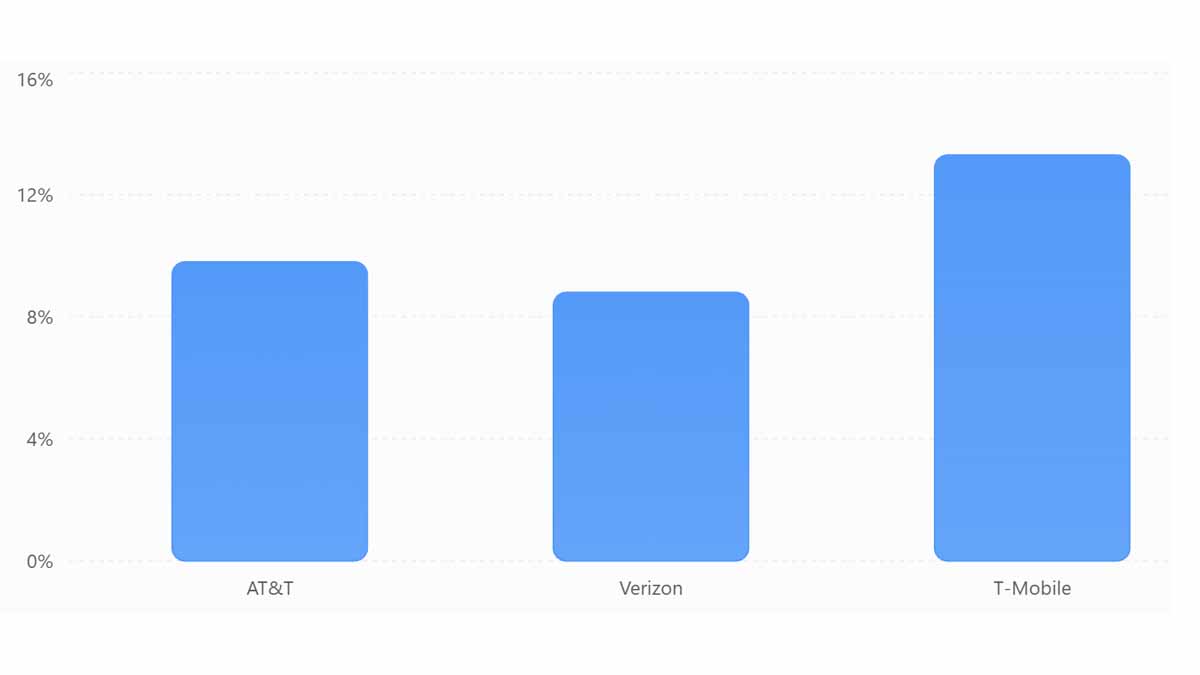
The immediate financial-market reaction was severe. In trading reported on October 9, 2026, T-Mobile shares declined approximately 13.3%, AT&T fell 9.8% and Verizon lost 8.8%. Early accounts cited combined market-capitalization losses of roughly $39 billion; later reporting placed the aggregate erosion around $60 billion–$62 billion. These figures reflect different measurement points and cannot be treated as a single synchronized valuation.
The market was pricing an alteration in future competitive expectations rather than an immediate change in subscriber numbers. A satellite service provided through an incumbent mobile carrier can reinforce that carrier’s product. A Starlink-branded terrestrial and satellite service could instead compete for the same customers, revenues and customer relationships. The October 8 agreement makes the latter outcome more credible, without establishing when or how extensively it will occur.
The differentiation among incumbent operators is important. AT&T and Verizon retain functioning national networks, established enterprise relationships and extensive operational infrastructure. T-Mobile retains substantial low-band spectrum, including its 600 MHz holdings, and existing satellite-related commercial arrangements. All three possess capabilities that spectrum ownership alone cannot reproduce: distribution, customer management, network optimization, equipment certification and service assurance.
Their potential exposure is therefore primarily medium-term. SpaceX could compete initially for rural users, specialized enterprise customers or consumers placing exceptional value on extended geographic coverage. Competing comprehensively for urban subscribers would require substantially greater terrestrial capacity, because low-band spectrum cannot by itself replicate the traffic-handling capability of densely deployed multiband networks.
The opposite equity-market reaction illustrates that distinction. American Tower reportedly gained approximately 9.3% and Crown Castle around 16% during the reported market response. Investors recognized that a new infrastructure competitor could become another major customer for existing tower assets. What threatens incumbent mobile-service economics may simultaneously strengthen the commercial prospects of infrastructure landlords.
For consumers, the eventual outcome depends on competition translating into measurable changes in prices, coverage and reliability. A new operator offering distinctive satellite capabilities at a premium price would affect the market differently from one seeking rapid subscriber acquisition through lower tariffs. The October announcement establishes the possibility of both strategies, not the commercial results of either.
The FCC must distinguish spectrum efficiency from promises of disruption
The proposed acquisition falls under the FCC’s authority to approve covered spectrum assignments under Section 310(d) of the Communications Act. The relevant legal test is whether the transfer serves the public interest, convenience and necessity. A favorable political assessment of additional competition cannot replace that statutory determination.
The July 1, 2026 Grain–T-Mobile approval is central to the review. The Commission imposed accelerated deployment obligations on the transferred spectrum and established a framework encouraging direct-to-device applications. The subsequent sale raises a consequential question: how those obligations will apply when the license holder changes again and the proposed operating architecture becomes substantially more ambitious.
The October 6 authorization for SpaceX’s next-generation satellite system creates a second regulatory boundary. Authorization to operate a satellite system does not automatically authorize every conceivable use of terrestrial 800 MHz frequencies from space. Frequency assignments, interference protections, terrestrial deployment rights and satellite operating conditions remain legally distinct matters.
This is more than procedural detail. The scarcity of low-band spectrum creates a public interest in ensuring that licenses are used productively rather than retained indefinitely as strategic options. Yet conditions requiring an unnecessarily rigid terrestrial architecture could impede precisely the technological integration that makes SpaceX’s proposal relevant.
The Commission must reconcile the two objectives through verifiable requirements. Geographic spectrum holdings, interference studies, construction milestones, actual service availability and compliance with existing conditions provide a stronger basis for decision than projections of future market disruption. FCC Chair Brendan Carr’s favorable public reaction to additional competition and investment does not constitute approval of the transaction.
The regulatory record will also determine whether objections from affected operators produce material delay. Litigation, contested technical evidence or disputes over conditions could extend the interval between contractual agreement and commercial deployment. Spectrum ownership would remain economically incomplete until the rights, operating parameters and necessary infrastructure are brought together.
National security gains depend on whether the two networks can fail independently
SpaceX’s proposed integration has implications beyond consumer telecommunications. A functioning satellite-terrestrial service could improve communications continuity during natural disasters, infrastructure damage and localized terrestrial outages. Utilities, transportation operators, emergency-management authorities and public-safety agencies could benefit from an additional connectivity path, particularly outside established network coverage.
The same architecture also introduces dependencies that require scrutiny. Satellites must interact with ground gateways, network control systems, terrestrial interconnection facilities and customer devices. A failure affecting shared software, network management, cybersecurity systems or ground infrastructure could compromise multiple parts of an ostensibly redundant service.
This creates a policy distinction between additional coverage and independently recoverable infrastructure. A hybrid network may remain operational when a local cellular tower fails, but that does not demonstrate resilience against a failure of central network functions. Nor does ordinary mobile connectivity establish the emergency-call routing, location performance, priority arrangements or dispatch interoperability demanded by public-safety operations.
The FCC, NTIA and relevant federal security authorities consequently have different but complementary interests. The FCC must determine whether the spectrum transfer and associated operations meet applicable regulatory requirements. NTIA’s responsibilities include federal spectrum coordination and executive-branch telecommunications policy. Homeland-security and infrastructure authorities have a separate interest in whether the resulting system improves continuity of essential services or introduces new concentrations of operational risk.
The industrial dimension is equally important. Integrating a large satellite constellation with terrestrial radio networks could reinforce American capabilities in space manufacturing, network software, telecommunications equipment and advanced connectivity services. But vertically concentrating spectrum, spacecraft, network control and retail relationships can also increase dependence on a single provider. The national-security value of integration must therefore be assessed against the resilience of the complete system, rather than the nationality or technological ambition of its owner.
Europe confronts the same technological question under different regulatory constraints
The SpaceX acquisition also matters outside the United States because the underlying technological problem is international: how to combine non-terrestrial networks with licensed terrestrial mobile systems without undermining existing spectrum rights, national security obligations and competition.
European implementation cannot simply reproduce the American transaction. The European Union coordinates relevant aspects of spectrum policy, while national authorities retain substantial responsibilities for licensing and communications security. Italy, France and Germany must operate within this combined European and national framework. The United Kingdom, outside the EU system, relies on its own regulatory architecture under Ofcom.
For these jurisdictions, the central industrial choice concerns the relationship between satellite operators and existing mobile carriers. Partnership-based arrangements preserve substantial control for terrestrial network owners; independent spectrum ownership allows a satellite operator to pursue a more vertically integrated model, but introduces the corresponding capital and regulatory obligations.
The American outcome will therefore provide evidence for European regulators without determining their decisions. An economically sustainable SpaceX hybrid system would strengthen the case for satellite-terrestrial integration as an industrial model. Persistent dependence on incumbent wholesale networks, high terrestrial construction costs or unresolved technical constraints would demonstrate the continuing limits of satellite-led competition.
The international stakes also include technical standards, equipment procurement and infrastructure control. A successful deployment could give American operators and suppliers greater influence over the commercial architecture of integrated communications. That influence, however, depends on demonstrated service performance and workable regulatory arrangements, not on the October 8 acquisition agreement alone.
The next 24 months will reveal who bears the cost of the decision
Between October 2026 and October 2028, the immediate consequences will be determined less by satellite counts than by regulatory filings, infrastructure contracts, device interoperability tests and the commercial agreements SpaceX concludes with terrestrial network operators. A limited or wholesale-supported service could emerge before an extensive independent network. A nationwide facilities-based competitor with performance comparable to the three incumbents would require a substantially longer investment cycle.
The economic burden will differ according to the route selected. If SpaceX builds aggressively, the company and its financing partners assume large capital commitments while tower owners, equipment suppliers and infrastructure contractors gain potential new business. If it relies substantially on wholesale agreements, existing operators retain some influence over the economics and performance of the entrant. If regulatory approval is delayed, investment decisions and possible consumer benefits are deferred while incumbent network structures remain largely intact.
The FCC’s existing 2029 and 2034 deployment milestones associated with the Grain spectrum approval make these decisions measurable beyond the initial two-year period. By October 2028, policymakers should at least be able to assess whether SpaceX has secured the necessary authorizations, begun credible terrestrial deployment, established operational integration and committed capital consistent with its commercial ambitions.
The cost of inaction would not fall on a single institution. Consumers in underserved areas would continue facing existing coverage limitations; incumbent carriers would retain more time to adapt without direct new facilities-based competition; infrastructure suppliers could lose prospective investment; and federal authorities would remain dependent on established communications arrangements whose resilience has to be evaluated against increasingly diverse operational threats.
Conversely, regulatory approval without meaningful deployment would transfer control over scarce national spectrum without delivering the promised competitive or infrastructure benefits. In that case, the public would bear the opportunity cost of unused or inadequately utilized frequencies, while the investor would retain valuable long-term strategic rights.
The October 8 agreement has established the financial and regulatory framework for a potential fourth national mobile competitor. It has not established that competitor’s operating capabilities. Over the next 12–24 months, the decisive measure will be whether the reported $8 billion spectrum acquisition is followed by actual terrestrial investment, enforceable service commitments and functioning satellite-mobile integration. The difference will determine whether SpaceX has changed the economics of American telecommunications or merely the valuation of the companies already operating it.
Analytical Roadmap
Pillar I — Transaction, Technology and Infrastructure
- Transaction structure, spectrum characteristics and technical architecture.
- Deployment feasibility, capital requirements and operating models.
Pillar II — Competition, Regulation and Economic Security
- Competitive implications and financial-market response.
- FCC review, spectrum policy and national economic interests.
Pillar III — National Security and Strategic Decisions
- Critical infrastructure, resilience and international implications.
- Policy recommendations, scenarios and decision indicators.
- Annex: Priority questions for interagency tasking.
SpaceX × Grain Management
Nationwide 800 MHz spectrum acquisition: wireless competition, infrastructure investment, FCC review and U.S. resilience. An analytical scheme distinguishing confirmed assets from reported valuations and conditional scenarios.
AGREEMENT SIGNED · FCC CONSENT PENDINGPaired 800 MHz spectrum
License population coverage
Press-reported cash consideration
Three complementary connectivity layers
The value of the acquisition lies in system integration—not low-band licensing alone. Each layer solves a different constraint, and each requires separate regulatory and engineering validation.
National carrier sell-off
Approximate reported October 9 percentage share-price declines. Bar lengths display magnitude; not an estimate of realized operating losses.
Scale: 0–13.3%; sourced from contemporaneous reporting. Separate early aggregate market-cap loss estimate: ≈$39B; later press estimates: ≈$60–62B. Different observation points—not directly interchangeable.
Tower-sector reaction
Reported positive moves consistent with expectations of incremental terrestrial site demand. These are market interpretations, not confirmed leases.
Operating-model decision table
| Pathway | SpaceX ownership | Speed to market | Strategic trade-off |
|---|---|---|---|
| Independent terrestrial carrier | Extensive owned RAN, leased sites, core control | Longer | High control, substantial capex, difficult capacity scaling |
| MVNO / wholesale-supported | Limited terrestrial RAN; incumbent-hosted capacity | Potentially faster | Lower initial capex but wholesale dependence |
| Selective hybrid network | Targeted owned RAN + wholesale + satellite | Phased | Balances autonomy and financial exposure |
Illustrative industry architectures; none is established as the final SpaceX deployment plan.
Potential deployment pathways, 2026–2031
Definitive agreement announced; transfer still requires FCC review.
Possible limited/wholesale-supported commercial integration if approvals and contracts align.
Possible selective terrestrial deployment subject to radio sites, funding and integration.
More extensive independent build-out would demand large, sustained capital and operational execution.
Conditional policy-analysis horizons, not published company delivery commitments.
Regulatory and national-security decision matrix
| Authority / constituency | Principal question | Observable proof | Risk to manage |
|---|---|---|---|
| FCC | Does the assignment serve the public interest? | Exact licenses, obligations, interference analyses and use milestones | Spectrum warehousing or harmful interference |
| NTIA / federal users | Are federal spectrum operations protected? | Interagency coordination findings | Operational conflict or unintended constraints |
| DHS/CISA / public safety | Does hybrid service improve continuity? | Failover, emergency routing and common-mode failure tests | Centralized dependencies and cyber compromise |
| Competition oversight | Is independent competitive capacity emerging? | Owned sites, quality tests, subscriber metrics, actual retail pricing | Marketing claims ahead of usable service |
| Congress / Administration | Are coverage and security gains measurable? | Verified geographic outcomes and audited milestone reporting | Premature subsidies or unnecessary mandates |
Three immediate policy priorities
Validate the rights
Verify license geography, encumbrances, transfer conditions and frequency-specific authorization for terrestrial versus satellite use.
Measure deployment
Require evidence of real coverage, device interoperability, capacity, and service continuity rather than satellite counts alone.
Protect resilience
Test emergency interoperability, interference protection, cybersecurity and correlated failures across terrestrial and orbital systems.
Pillar I — Transaction, Technology and Infrastructure
1. Transaction Structure and Technical Architecture
1.1 Transaction history and legal position
The proposed acquisition is the latest stage in a spectrum restructuring that originated in T-Mobile’s integration of Sprint’s wireless assets.
On July 1, 2026, the FCC’s Wireless Telecommunications Bureau approved an exchange under which Grain would receive T-Mobile’s 800 MHz spectrum portfolio, while T-Mobile would obtain Grain’s 600 MHz licenses. Grain completed the acquisition on August 11. The exchange included $2.9 billion in cash paid to T-Mobile, in addition to Grain’s 600 MHz licenses. This historical consideration must not be confused with the approximately $8 billion reportedly associated with SpaceX’s subsequent purchase.
The July authorization, DA 26-653 in WT Docket 25-178, was not unconditional. The Commission imposed accelerated deployment obligations and established a framework encouraging direct-to-device applications. Grain’s October 8 announcement expressly references those conditions.
Sources: Grain Management — August 11, 2026; Grain Management — October 8, 2026; FCC Order DA 26-653 — July 1, 2026, order identification and summary.
| Transaction parameter | Documented position | Analytical significance |
|---|---|---|
| Buyer | SpaceX | Entry into independent low-band terrestrial spectrum ownership |
| Seller | Grain Management | Divestiture of recently acquired wireless licenses |
| Transaction date | October 8, 2026 | Definitive agreement, not completed assignment |
| Spectrum | Up to 14 MHz of paired 800 MHz spectrum | Coverage-oriented asset, not a large capacity portfolio |
| Geographic scope | Approximately nationwide population coverage | License footprint does not establish operating coverage |
| Reported consideration | Approximately $8 billion cash | Secondary reporting; contractual price undisclosed |
| Prior transaction | T-Mobile–Grain exchange, completed August 11, 2026 | Existing FCC conditions are relevant |
| Regulatory requirement | FCC consent | Closing and future operations require distinct compliance determinations |
An important analytical qualification concerns spectrum quantity. The portfolio does not necessarily provide a uniform 14 MHz in every geographic market. Reporting on the earlier assignment identifies local holdings varying from approximately 4.85 MHz to 14 MHz. The actual county-level holdings, encumbrances, and channel availability therefore matter more to a deployment model than the nationwide headline figure.
1.2 Propagation advantages and limitations
The 800 MHz band is strategically valuable because radio propagation at relatively low frequencies supports broad geographic coverage and comparatively strong penetration through walls, vegetation, and other obstacles.
Relative to 2 GHz, the theoretical free-space path-loss advantage at equal distance and under equivalent antenna conditions is approximately:
\[ 20\log_{10}(2000/800)\approx7.96\ \mathrm{dB} \]
This approximately 8 dB relationship is a useful propagation comparison, not a measured prediction of Starlink Mobile’s performance. Actual indoor reception depends on building materials, transmission power, antenna gain, receiver sensitivity, interference, deployment geometry, and regulatory emission limits.
Low-band spectrum also provides less aggregate throughput than an extensively deployed mid-band network with substantially more bandwidth. Its advantage is cost-effective geographic reach, particularly where cell-site density is constrained.
This distinction has immediate competitive consequences. SpaceX could use 800 MHz as the principal wide-area terrestrial coverage layer while assigning greater capacity demands to 2 GHz or other available resources. That is a technically coherent division of functions, although its performance must be tested under commercial operating conditions.
1.3 Comparative spectrum position
| Operator or asset | Relevant bands | Principal role | Material limitation |
|---|---|---|---|
| SpaceX–Grain proposed portfolio | 800 MHz; up to 14 MHz paired | Wide-area terrestrial coverage and improved indoor reception | Market-specific bandwidth; acquisition pending |
| SpaceX existing mobile spectrum | Approximately 2 GHz | Mobile satellite capacity and complementary network layer | Availability depends on authorization, devices, and deployed systems |
| AT&T | 600, 700 and 850 MHz, plus other holdings | Established nationwide low-band coverage | Exact holdings vary by market |
| Verizon | 700 and 850 MHz, plus other holdings | Established terrestrial coverage layer | Complementary mid-band capacity remains essential |
| T-Mobile | 600 and 700 MHz, plus other holdings | Nationwide coverage integrated with existing 5G infrastructure | Geographic variation in licensed spectrum depth |
Source: Reuters, low-band spectrum explainer — October 9, 2026. This is a comparison of relevant frequency layers, not an exhaustive inventory of nationwide or local licensed MHz. It is insufficient for calculating regulatory spectrum concentration or total network capacity.
1.4 Satellite authorization is not terrestrial deployment
The FCC’s October 6, 2026 decision, identified as DA 26-1078 in SB Docket 25-340, authorized SpaceX’s proposed next-generation non-geostationary mobile satellite system involving up to 15,000 satellites.
It is important not to conflate this authorization with the separate January 2026 approval involving a 15,000-satellite total for the broader Gen2 Starlink system. The two decisions concern different applications and regulatory scopes.
Neither the number of authorized satellites nor their projected aggregate capacity demonstrates that all satellites are deployed, commercially operational, or capable of delivering uniform ground-level performance.
The orbital architecture addresses an important problem: connectivity outside terrestrial coverage areas. The terrestrial architecture addresses another: reliable service where line-of-sight satellite reception is limited or where many users simultaneously demand capacity.
There is a further regulatory distinction. Rights to use spectrum for terrestrial transmissions do not automatically establish authority for every proposed satellite use of the same frequencies. SpaceX must demonstrate that its eventual assignments and operating arrangements comply with the relevant satellite, terrestrial, and interference-protection rules.
Sources: FCC, October 6 authorization record, DA 26-1078; Reuters — October 8, 2026.
1.5 Device compatibility
Most contemporary smartphones have radio hardware supporting frequencies in or near the relevant 800 MHz ecosystem. Reuters reported that most existing handsets support the band, reducing a potentially serious barrier to adoption.
However, frequency compatibility alone is not sufficient to guarantee service.
Commercial operation also requires the appropriate standardized band configuration, network authentication, firmware configuration, roaming policies, carrier provisioning, and compliance with technical specifications. Satellite service introduces additional requirements involving radio-link budgets, Doppler compensation, timing, and network integration.
Consequently, no new proprietary satellite handset may be necessary for many customers, but universal compatibility with all existing handsets should not be assumed.
2. Deployment Feasibility and Capital Requirements
2.1 The central capital constraint
SpaceX’s most consequential unresolved decision is how much terrestrial infrastructure it intends to own.
A conventional nationwide cellular network requires extensive radio-site deployment, spectrum-specific equipment, fiber or microwave backhaul, network management systems, operational support platforms, interconnection facilities, emergency-service integration, cybersecurity capabilities, and customer-support infrastructure.
Satellite ownership does not eliminate these requirements.
It may reduce the need to construct towers in some sparsely populated areas, while leaving substantial investment requirements in cities and inside buildings.
According to October 9 financial-market reporting, one set of analyst estimates placed a substantial independent terrestrial build-out in a broad $50 billion–$130 billion range, potentially involving access to up to 120,000 tower locations. These are external forward estimates, not a disclosed SpaceX capital budget or an engineering-validated network plan. Their applicability depends heavily on coverage objectives, site sharing, and the services SpaceX elects to provide.
Source: MarketWatch — October 9, 2026.
A nationwide spectrum footprint cannot independently resolve these engineering costs.
2.2 Three commercially plausible architectures
Independent facilities-based network. SpaceX would install and operate an extensive terrestrial radio-access network, potentially using leased towers and rooftops. This creates maximum control over network evolution, service quality, and customer economics, but requires significant investment before achieving nationwide capacity parity.
Wholesale or MVNO-supported entry. SpaceX could purchase terrestrial capacity from existing operators and combine that service with its own satellite coverage. This offers a faster route to retail commercialization while creating wholesale dependence, potentially reducing operating margins and strategic independence.
Hybrid ownership and wholesale structure. SpaceX could build terrestrial infrastructure selectively where it has strong customer demand or favorable economics, while using wholesale access elsewhere and satellite coverage where terrestrial deployment is uneconomic.
The third architecture is a plausible middle course, not a confirmed company decision.
2.3 Deployment timeline scenarios
The following are conditional planning scenarios constructed for policy analysis, not company schedules.
| Scenario | Indicative horizon | Necessary developments | Principal constraints |
|---|---|---|---|
| Initial commercial integration | 2027–2028 | FCC consent, device support, wholesale or limited terrestrial integration | Regulatory completion and operational interoperability |
| Selective facilities-based expansion | 2028–2030 | Radio-site agreements, equipment delivery, backhaul, regional launch | Capital, permits, interference and site access |
| Broad independent network | 2029–2031 or later | Large-scale terrestrial construction, sustained funding, reliable commercial operations | Cost, deployment density and execution |
| Regulatory delay | Indeterminate | Resolution of contested conditions or material deficiencies | Litigation, technical disputes, incomplete filings |
The July FCC order reportedly established accelerated terrestrial deployment milestones, including 2029 and 2034 dates. Exact applicability to SpaceX requires examination of the operative authorization and any future transfer order. Commercial milestones and regulatory build-out obligations should not be presumed identical.
The immediate test is therefore not whether Starlink Mobile can advertise nationwide coverage, but whether it can provide independently measured service quality at commercially sustainable costs.
Pillar II — Competition, Regulation and Economic Security
3. Competitive Implications and Financial-Market Response
3.1 Why the transaction disrupted market expectations
The October 8 announcement changed investor assumptions about the structure of future wireless competition.
Previously, satellite direct-to-device connectivity could be interpreted principally as an extension of terrestrial operators’ coverage. Acquiring a nationwide low-band portfolio increases the plausibility that SpaceX intends to compete directly for customers, rather than function exclusively as a wholesale satellite-connectivity provider.
The economic distinction is considerable. A supplemental service can increase the value of existing carrier subscriptions; an independently marketed integrated mobile network could instead compete for those subscriptions.
The market reaction was therefore a repricing of expected future competition, not evidence of immediate customer losses.
3.2 Equity-market impacts
Trading reactions differed according to measurement time. Initial reports of approximately $39 billion in combined market-capitalization losses referred to early trading estimates, whereas subsequent full-session reporting indicated materially greater aggregate declines.
| Indicator | Reported market reaction | Measurement qualification |
|---|---|---|
| AT&T | Approximately −9.8% | October 9 session, Reuters-distributed reporting |
| Verizon | Approximately −8.8% | October 9 session, Reuters-distributed reporting |
| T-Mobile | Approximately −13.3% | October 9 session, Reuters-distributed reporting |
| Combined early market-cap loss | Approximately $39 billion | Initial reported estimate; not independently reconciled |
| Combined later market-cap loss | Approximately $60–62 billion | Financial Times reporting following broader sell-off |
| American Tower | Approximately +9.3% | Reported tower-sector reaction |
| Crown Castle | Approximately +16% | Reported tower-sector reaction |
Sources: Reuters-distributed market report — October 9, 2026; Financial Times — October 9, 2026; Barron’s — October 10, 2026. Figures represent different reporting cuts and should not be combined into a single synchronized valuation calculation.
The positive reaction in tower equities is particularly informative. It suggests investors recognize that an ambitious hybrid network could generate substantial demand for traditional terrestrial infrastructure.
This interpretation directly challenges the proposition that expanded satellite service necessarily makes cellular towers commercially obsolete.
Reported October 9 carrier share-price declines
Approximate percentage moves; same-day reported figures, not a causal decomposition.
3.3 Carrier-specific exposure
AT&T. The principal exposure is a potential long-term erosion of wireless customer economics if SpaceX combines competitive mobile pricing with extensive satellite coverage. AT&T nevertheless benefits from an established terrestrial access network, enterprise relationships, backhaul infrastructure, and operational experience. The existence of a new spectrum owner does not immediately replicate those capabilities.
Verizon. Verizon faces potential pressure on premium network differentiation, especially if ubiquitous coverage becomes a mainstream consumer expectation. Yet spectrum acquisition alone does not establish comparable capacity, latency, indoor reliability, or enterprise service guarantees. Its immediate operational exposure appears substantially smaller than the equity repricing might suggest.
T-Mobile. T-Mobile faces a more complex competitive relationship because it transferred the 800 MHz portfolio to Grain while retaining substantial low-band holdings and existing satellite-related commercial arrangements. SpaceX’s growing ability to control its own mobile-service architecture could ultimately change the value of incumbent satellite partnerships. However, such an outcome remains contingent on deployment and contracting decisions.
All three carriers possess significant advantages in retail distribution, established customer bases, functioning networks, device certification, and nationwide operations. They also retain the ability to respond through pricing, bundling, additional satellite partnerships, and infrastructure investment.
3.4 Economic exposure and consumer welfare
The potential economic gains to consumers arise through several channels: additional choice, price competition, improved coverage in underserved regions, and bundled connectivity services.
But those gains are not automatic.
A fourth operator with limited capacity may concentrate initially on premium connectivity bundles, rural customers, specific enterprise applications, or areas where existing operators provide unsatisfactory service. Competitive effects would then vary considerably by market segment.
A useful illustrative sensitivity test demonstrates the scale involved. If a new entrant eventually captured three million mobile subscriptions with an average monthly service revenue of $40, annualized service revenue would equal approximately $1.44 billion. At ten million subscriptions under the same assumption, annualized revenue would reach $4.8 billion.
These are arithmetic scenarios, not forecasts of subscriber acquisition or SpaceX pricing. They exclude hardware, wholesale payments, customer-acquisition costs, network operating expenses, and the extent to which customers substitute for existing subscriptions.
The policy consequence is that regulators should measure actual prices, switching activity, delivered service quality, and geographic coverage rather than infer consumer benefits from a transaction announcement.
3.5 Tower operators, suppliers and rural markets
American Tower, Crown Castle, SBA Communications, and other site owners could benefit if SpaceX becomes a major tenant. Radio-equipment suppliers, antenna manufacturers, network-software companies, fiber providers, and integration contractors could also encounter additional demand.
However, procurement volumes depend on architecture. A wholesale-led network would create different infrastructure demand from an independent rollout.
Rural areas could experience the earliest meaningful consumer benefits because satellite connectivity may reduce dependence on costly terrestrial expansion. The greatest uncertainty concerns heavily populated environments where high traffic density requires substantial terrestrial capacity.
Spectrum coverage reaching nearly the entire population is therefore not equivalent to commercial service offering comparable quality across almost the entire country.
4. FCC Review, Spectrum Policy and Economic Security
4.1 The FCC’s governing responsibility
Under Section 310(d) of the Communications Act, FCC consent is required for covered assignments or transfers of radio licenses. The Commission must determine whether the proposed transfer serves the public interest, convenience, and necessity.
The assessment extends beyond the parties’ contractual preferences. Relevant considerations include the applicant’s qualifications, compliance with applicable spectrum rules, competitive consequences, efficient utilization, harmful interference, and the credibility of transaction-specific benefits.
The FCC may approve a transaction, attach legally supportable conditions, or require additional proceedings where material factual issues prevent the required finding.
Source: FCC Memorandum Opinion and Order DA 26-470 — May 2026, public-interest review framework.
The Grain–SpaceX transaction is not equivalent to a merger between two established nationwide terrestrial carriers. SpaceX’s proposed entry could strengthen competition. Equally, its broader spectrum holdings and integration of several communications functions require examination of aggregation and cross-market effects.
4.2 Regulatory precedents and existing obligations
Three developments require consideration together.
First, the July 2026 Grain–T-Mobile decision approved reassignment of an underutilized low-band portfolio while imposing specific deployment obligations.
Second, the October 6 SpaceX authorization expanded the company’s regulatory pathway for direct-to-device satellite operations.
Third, the October 8 transaction proposes transferring the 800 MHz assets to an entity already developing a substantial satellite-network infrastructure.
These actions are complementary but legally distinct. The first does not automatically authorize every use proposed in the second, and neither removes the need for reviewing the third.
The July order deserves particular attention because it reportedly incorporated both terrestrial build-out requirements and a competitive process for potential D2D deployment. The Commission should determine whether the proposed transaction preserves, fulfills, or requires modification of those obligations.
4.3 Spectrum scarcity and competitive efficiency
Low-band frequencies are unusually important for nationwide mobile economics because they reduce the number of radio locations needed to provide baseline coverage across large areas.
Their scarcity also makes inefficient retention costly to the broader market.
A transfer can improve spectrum productivity where it places licenses with a party possessing the incentives and resources to deploy them. But policymakers must distinguish acquiring licenses to support a credible network from acquiring them primarily to reserve future strategic options.
A decision-useful regulatory assessment should therefore establish actual spectrum use, enforceable milestones, technical coordination arrangements, and the consequences of missing deployment commitments.
4.4 Conditions, delay and litigation risks
Possible areas of scrutiny include the continuity of Grain’s existing commitments, spectrum concentration in particular license areas, coexistence with neighboring services, public-safety protection, and the applicant’s proposed operating rights.
Affected operators could seek reconsideration, judicial review, or procedural relief, depending on the eventual decision and applicable standing requirements. Such litigation could affect deployment even after initial consent.
The Commission should not treat favorable public statements by policymakers as a substitute for a completed administrative record. FCC Chair Brendan Carr publicly welcomed the prospect of additional investment and competition following the announcement, but that statement is not itself a transfer authorization.
Source: Reuters — October 8, 2026.
4.5 Government coordination
The FCC remains the primary licensing authority for the transaction. NTIA’s principal relevance lies in federal spectrum coordination, executive-branch telecommunications policy, and the management of interfaces involving federal spectrum users.
National security consultation may be appropriate where the proposed system intersects with federal communications, critical services, cybersecurity, or applicable foreign-ownership review mechanisms.
The objective should be technically defensible coordination, not unnecessary duplication of regulatory proceedings.
Pillar III — National Security and Strategic Decisions
5. Critical Infrastructure, Resilience and International Implications
5.1 Hybrid connectivity as a resilience capability
Integrated satellite-terrestrial communications could become an important component of national infrastructure resilience.
Traditional wireless networks depend on radio sites, local power systems, transport connections, switching infrastructure, and interconnected operational platforms. Natural disasters, cyber incidents, physical sabotage, and prolonged power failures can disrupt these components simultaneously.
An appropriately engineered satellite layer may preserve some communications capability when terrestrial access networks become unavailable.
The potential benefit is particularly relevant to emergency management, disaster logistics, remote utilities, transportation corridors, energy infrastructure, and rural public-safety operations.
Yet satellite connectivity is not inherently independent of terrestrial infrastructure. Earth stations, network gateways, routing systems, terrestrial interconnection, ground-control facilities, and power supplies remain necessary. Common operational dependencies can therefore create correlated failure risks.
A credible resilience assessment must evaluate the complete network, not simply the survivability of satellites in orbit.
5.2 Public safety and emergency communications
Public-safety use requires stricter performance guarantees than ordinary consumer messaging or basic connectivity.
Federal, state, and local agencies need dependable emergency-call routing, location information, priority and preemption mechanisms where applicable, system availability, dispatch integration, and interoperability with established communications systems.
The mere ability to establish a satellite connection does not demonstrate compliance with these requirements.
SpaceX’s architecture could ultimately provide useful backup connectivity for first responders, but the regulatory record must establish which capabilities are operational, technically demonstrated, and contractually supported.
The FCC should also evaluate coexistence with existing 800 MHz users, particularly where public-safety and specialized mobile-radio systems operate in adjacent frequency arrangements.
5.3 Cybersecurity and strategic concentration
A hybrid network introduces a complex security architecture connecting space assets, terrestrial radio systems, network cores, cloud infrastructure, customer devices, and third-party interconnection points.
Relevant threats include unauthorized access to network-management systems, compromise of software updates, interference and jamming, supply-chain intrusion, and disruption of command-and-control links.
There are also governance considerations.
Where a single provider controls the satellite constellation, terrestrial spectrum, service platform, and major customer relationships, vertical integration can improve technical coordination but increase the consequences of centralized operational failure.
This is not evidence of an existing SpaceX security deficiency. It is a structural risk associated with concentration of critical network functions.
An appropriate federal assessment should identify the boundaries of independently recoverable services, the role of third-party suppliers, and the system’s dependence on domestic or foreign-origin equipment and software.
No verified public evidence examined for this assessment establishes a specific material foreign-supply-chain vulnerability arising directly from the Grain transaction. Such claims require procurement records and technical supplier disclosures.
5.4 International comparison
The emergence of satellite-to-device mobile services is not confined to the United States. Other jurisdictions are evaluating how to incorporate non-terrestrial networks into existing spectrum frameworks, national coverage strategies, and mobile-industry structures.
The United States is pursuing several interconnected regulatory approaches: conventional spectrum assignments, satellite authorizations, supplemental coverage arrangements, and possible reforms allowing additional forms of D2D communication.
The European approach requires consideration of both EU-level radio-spectrum coordination and national licensing authority.
Italy, France, and Germany operate within the broader European regulatory framework but retain important national responsibilities for spectrum authorizations, public-safety communications, and security assessments. The United Kingdom has a separate national regulatory structure administered by Ofcom.
For these jurisdictions, the central questions are whether satellite providers should rely on mobile-network partnerships, acquire or lease spectrum directly, or operate under specially designed satellite-terrestrial licensing frameworks.
International comparison must remain qualified: the U.S. transaction is a specific commercial acquisition under American law, not an immediately transferable model for European spectrum management.
5.5 Implications for American technological leadership
Successful satellite-terrestrial integration could strengthen U.S. leadership in several related industries: launch services, advanced satellite manufacturing, network software, radio equipment, mobile communications, and resilient infrastructure services.
The economic opportunity extends beyond retail subscriptions. It includes intellectual property, supply-chain investment, network exports, international standards participation, and advanced communications services for government and enterprise customers.
However, the United States also has an interest in preserving an open and competitive infrastructure ecosystem. A technologically successful American provider does not automatically produce an optimally competitive domestic market.
National industrial policy and competition policy should therefore be complementary rather than interchangeable.
The relevant public-interest question is whether the transaction produces measurable improvements in deployment, service availability, technological capability, and market contestability while protecting critical communications functions.
6. Strategic Options and Policy Recommendations
6.1 FCC: Evidence-based transfer review
The FCC should assess the proposed transfer through an administratively defensible record focused on measurable public-interest outcomes.
The principal priorities are to determine whether existing Grain deployment conditions remain enforceable, establish the permissible satellite and terrestrial uses of the acquired licenses, evaluate harmful-interference protection, and require sufficiently precise evidence supporting material claims of competitive benefit.
Conditional approval may be appropriate where transaction-specific risks can be addressed proportionately. Conditions should be directly connected to identified harms or claimed benefits, technically feasible, and enforceable without prescribing an unnecessarily restrictive commercial architecture.
6.2 FCC and NTIA: Spectrum coordination
The agencies should coordinate where proposed operations could affect federal users, technical standards, or broader national spectrum-planning objectives.
A useful policy signal would distinguish three forms of progress: acquisition of spectrum rights, operational deployment of radio infrastructure, and delivery of independently verified service performance.
That separation would discourage premature claims of nationwide availability and improve the transparency of future spectrum transactions.
6.3 Executive Branch and Congress: Monitoring architecture
Federal oversight should evaluate the transaction through competition, infrastructure, and security indicators rather than through the short-term equity-market reaction.
Congressional committees with telecommunications, commerce, homeland security, or relevant national security jurisdiction could request periodic reporting from the responsible agencies within their respective statutory mandates.
Priority subjects include rural coverage expansion, emergency communications continuity, deployment compliance, concentration of infrastructure dependencies, and measurable consumer outcomes.
Federal budget responses should remain contingent on demonstrated public benefits and identified gaps in existing programs. The transaction announcement alone does not establish a need for new subsidy appropriations.
6.4 Policy option matrix
| Policy option | Authority and burden | Expected effect | Principal risk |
|---|---|---|---|
| Approve under existing legal requirements | FCC; ordinary transfer-review process | Enables transaction and preserves commercial flexibility | Insufficiently specified future public benefits |
| Approve with targeted conditions | FCC; monitoring and compliance administration | Links identifiable benefits and risks to enforceable obligations | Excessive or poorly designed conditions could delay deployment |
| Extend review for material evidence | FCC; supplemental filings and technical examination | Resolves consequential uncertainties before decision | Delays investment and commercial planning |
| Coordinate federal resilience evaluation | FCC, NTIA and competent security agencies | Identifies emergency-service and critical-infrastructure dependencies | Duplicative review or unclear institutional responsibility |
| Establish continuing market monitoring | FCC and congressional oversight | Tracks competition and deployment outcomes | Reporting costs without meaningful policy follow-through |
The options are not entirely mutually exclusive. A transfer approval, for example, can coexist with appropriately limited federal resilience analysis and subsequent market monitoring.
6.5 Contingent scenarios, 2026–2031
| Scenario | Trigger | Competitive outcome | Federal policy consequence |
|---|---|---|---|
| Conditional approval and hybrid deployment | FCC consent; compliance with conditions; viable commercial arrangements | Gradual entry with selective network ownership | Monitor performance, interoperability and fulfillment of commitments |
| Approval and extensive independent build-out | Strong capital commitment and rapid infrastructure contracting | Potentially stronger facilities-based competition | Monitor local spectrum aggregation and infrastructure resilience |
| Delayed transfer | Regulatory disputes, incomplete submissions, litigation | Incumbent market structure largely preserved initially | Clarify unresolved legal and technical requirements |
| Denial | Public-interest deficiencies that cannot adequately be resolved | SpaceX pursues alternative spectrum or partnerships | Reassess whether existing frameworks permit viable competing architectures |
| Alternative wholesale-led strategy | Capital constraints or favorable partner economics | Faster market entry with reduced network independence | Examine wholesale access and competitive dependencies |
Assessment of timing: An initial commercial offering during 2027–2028 is technically conceivable under a limited or wholesale-supported model. A network capable of competing comprehensively with existing national carriers on coverage, capacity, indoor reliability, and service quality would demand a substantially longer development period.
These are conditional scenarios, not numerical forecasts.
6.6 Decision indicators
The most consequential developments to monitor over the next 24 months are the transfer application and associated FCC filings; the eventual treatment of Grain’s deployment obligations; announced terrestrial infrastructure contracts; equipment procurement and integration testing; wholesale or roaming agreements; and the number of commercially active customers using independently verified services.
Regulators should give particular weight to evidence of successful handoffs between terrestrial and satellite access, delivered indoor performance, emergency-service integration, and sustained financial investment.
A material upward revision of the competitive assessment would require credible evidence of scalable radio-access deployment, functioning device compatibility, and a business model capable of supporting large numbers of subscribers without disproportionately relying on incumbent wholesale networks.
Conversely, repeated deployment delays, unresolved interference disputes, inadequate capital commitments, or limited commercial performance would weaken the assessment that SpaceX can emerge as a full nationwide facilities-based competitor within the present planning horizon.
7. Annex — Priority Questions for Interagency Tasking
OPEN RECORD AND COLLECTION PRIORITIES | OCTOBER 2026
| Responsible authority | Priority question | Required evidence |
|---|---|---|
| FCC Wireless Telecommunications Bureau | What precisely is being transferred? | License schedules, geographic holdings, associated encumbrances |
| FCC | How do existing Grain obligations apply following transfer? | July order conditions, transfer application, proposed compliance commitments |
| FCC Space Bureau | Which satellite operations involving 800 MHz are legally authorized? | Relevant grants, technical applications, frequency-specific conditions |
| FCC technical offices | What interference risks exist for adjacent or incumbent systems? | Engineering studies, coordination records, technical objections |
| NTIA | Are federal spectrum users or communications systems materially affected? | Federal coordination analysis |
| FCC competition specialists | Does the transfer materially increase concentration in any relevant spectrum or services market? | Market-by-market holdings and competitive assessment |
| DHS/CISA and sector partners | Can the proposed architecture withstand shared terrestrial and satellite failures? | Resilience testing and dependency analysis |
| Public-safety authorities | Can the system support emergency communications at the required performance level? | Emergency-service testing, interoperability and location capabilities |
| Relevant national security agencies | Are there material foreign-dependency or supplier-security concerns? | Supplier disclosures and appropriate security assessments |
| Congressional oversight committees | Are projected consumer benefits being realized? | Coverage, prices, subscriber outcomes, investment and service-quality data |
Outstanding financial questions
The most important transaction-level information gap is the absence of an officially disclosed consideration figure. The approximately $8 billion estimate should continue to be identified as financial reporting rather than contractual fact until disclosed by the parties or established in a competent filing.
Other consequential gaps include the acquisition’s financing structure; SpaceX’s incremental terrestrial investment budget; the eventual allocation between owned infrastructure and wholesale capacity; projected deployment expenditure; and the expected economics of integrated satellite-mobile subscriptions.
Without those inputs, a reliable transaction-specific valuation or forecast of incumbent revenue displacement cannot be produced.
Outstanding technical questions
The exact 800 MHz spectrum distribution across geographic markets must be reconciled with the company’s proposed service architecture. Regulators also need to establish whether SpaceX intends to deploy terrestrial services before, alongside, or after expanded satellite coverage.
Crucially, the architecture must be examined as an operational system. Theoretical propagation advantages and aggregate orbital capacity cannot substitute for commercial field data.
Outstanding regulatory questions
The July 2026 FCC approval deserves examination at the level of its operative conditions, including whether the competitive selection mechanism and associated D2D deployment pathway remain applicable following acquisition.
The October 6 satellite authorization also requires clear separation from the transfer review, particularly where frequencies, operating rights, or service configurations differ.
Outstanding strategic questions
For the Executive Branch, the most consequential unresolved issue is whether an integrated network would constitute a genuinely independent additional communications capability, or whether its economic and operational structure would remain materially dependent on incumbent terrestrial carriers and shared network infrastructure.
That distinction determines much of the prospective benefit for competition, resilience, and national technological autonomy.
Final Net Assessment
SpaceX’s October 8, 2026 agreement is strategically important because it links scarce nationwide low-band spectrum with an advanced satellite communications program and a declared intention to compete in the U.S. mobile market.
The transaction meaningfully strengthens the credibility of that ambition. It does not prove its commercial realization.
For American consumers, the potential benefits include additional mobile-service choice, stronger coverage competition, and better connectivity in underserved regions. For traditional operators, the primary threat is a potential long-term change in industry economics rather than an immediate loss of network competitiveness. For federal policymakers, the opportunity lies in facilitating technically credible innovation while enforcing efficient spectrum use, competition safeguards, and critical-infrastructure resilience.
The controlling distinction for decision-makers is between control of strategic spectrum assets and the demonstrated ability to turn those assets into operational infrastructure.
The first has advanced substantially. The second remains the decisive test for SpaceX, federal regulators, and the American wireless industry through 2031.
Evidence note: This assessment uses company announcements, identified FCC actions, and contemporaneous reporting available through October 11, 2026. Certain FCC PDF records were identifiable but not fully retrievable for paragraph-by-paragraph examination; detailed conditions and milestones therefore require confirmation against the operative orders before being used for binding regulatory determinations. Forward-looking financial and deployment figures remain explicitly conditional.


