














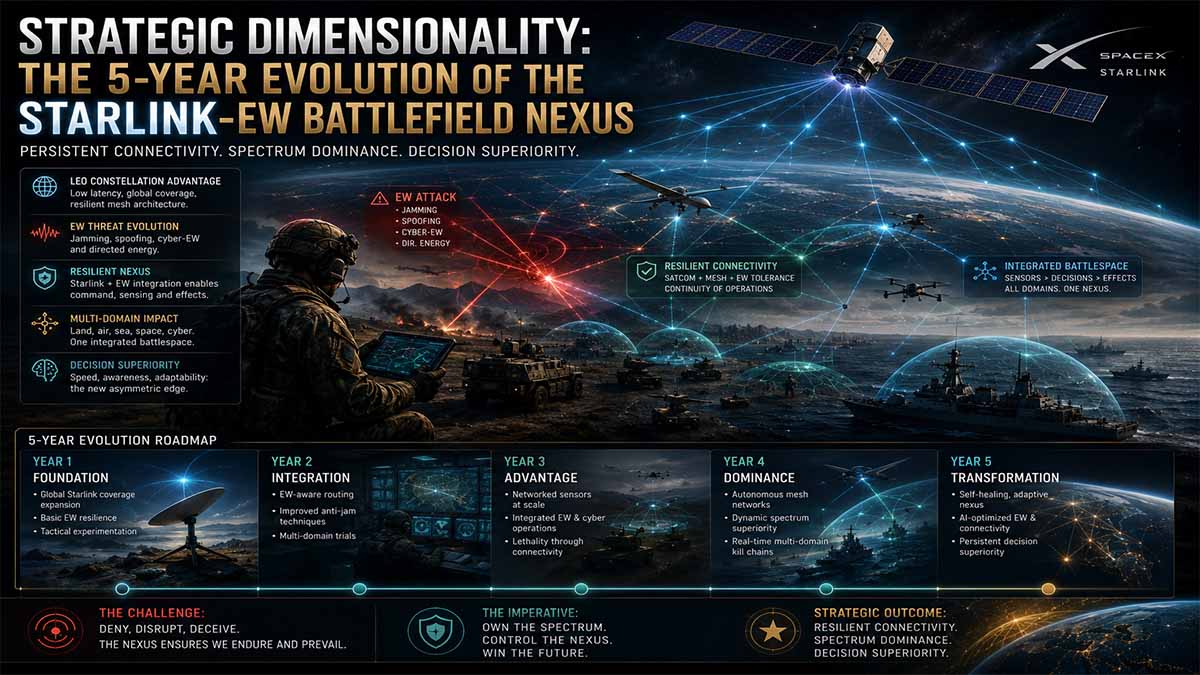
Executive Summary
The integration of Starlink into Ukrainian military operations has evolved from a civilian communications stopgap into the operational backbone for real-time drone warfare, command-and-control (C2), and artificial intelligence-driven targeting via platforms like Palantir. In direct response, the Russian Federation has developed a multi-layered electronic warfare (EW) ecosystem that represents a paradigm shift in counterspace warfare. This analysis synthesizes open-source intelligence to forecast the trajectory of this invisible war over the next five years, predicting an escalating cycle of technological adaptation characterized by the weaponization of commercial space assets, the proliferation of passive detection arrays, and the hollowing out of GPS-reliant logistics for both state and non-state actors. The conflict has become the primary testing ground for a new doctrine of “Electromagnetic Spectrum Dominance,” where the battle for connectivity determines tactical outcomes at the platoon level.
The New Front: How Starlink and AI Are Redefining the Battlefield
The integration of SpaceX’s Starlink satellite network and Palantir’s artificial intelligence platforms into Ukraine’s military operations has created a new paradigm in modern warfare, transforming commercial technology into decisive strategic assets. This article examines the resulting “architecture of dependence,” the Russian electronic warfare response, and the profound geopolitical and economic implications for Europe and the United States.
The Architecture of Dependence
Since the full-scale Russian invasion in February 2022, Ukraine’s communications infrastructure has been systematically targeted. Missile strikes destroyed mobile towers, fibre-optic lines were severed, and a cyberattack on the Viasat network compounded the disruption . The response was immediate and unconventional: within days, Digital Transformation Minister Mykhailo Fedorov publicly appealed to Elon Musk for Starlink terminals. SpaceX activated the service and shipped the first terminals, initially for civilian use in government offices and hospitals .
This civilian technology was quickly repurposed for military applications. By the second half of 2022, Starlink terminals were deployed extensively behind Ukrainian positions, used by drone crews, command posts, and logistics units . Today, it is estimated that approximately 90% of Ukraine’s broadband communications and data transmission on the front lines depend on Starlink . The network has become the nervous system of Ukrainian operations, enabling the coordination of drone strikes, artillery fire, and command networks spanning hundreds of kilometres of front .
The Role of Artificial Intelligence
The integration extends beyond connectivity to advanced data processing. Palantir Technologies, founded by Alex Karp, has embedded its analytical platforms into Ukraine’s military infrastructure. According to Russian military analyst Vladislav Shurygin, these systems are used for intelligence analysis, satellite imagery processing, and weapons targeting . CNN has broadcast footage from a Ukrainian air attack command centre showing the Prisma monitoring system from Palantir displaying flight trajectories, target coordinates, and drone data over Donbas and southern Russia in real time .
Palantir’s CEO Alex Karp has stated that since 2022, the company’s AI has provided targeting data for half a million targets for the Ukrainian military . This represents an unprecedented integration of commercial artificial intelligence into active military operations, with the system reportedly calculating optimal routes for follow-up strikes by analysing patterns in air defence responses .
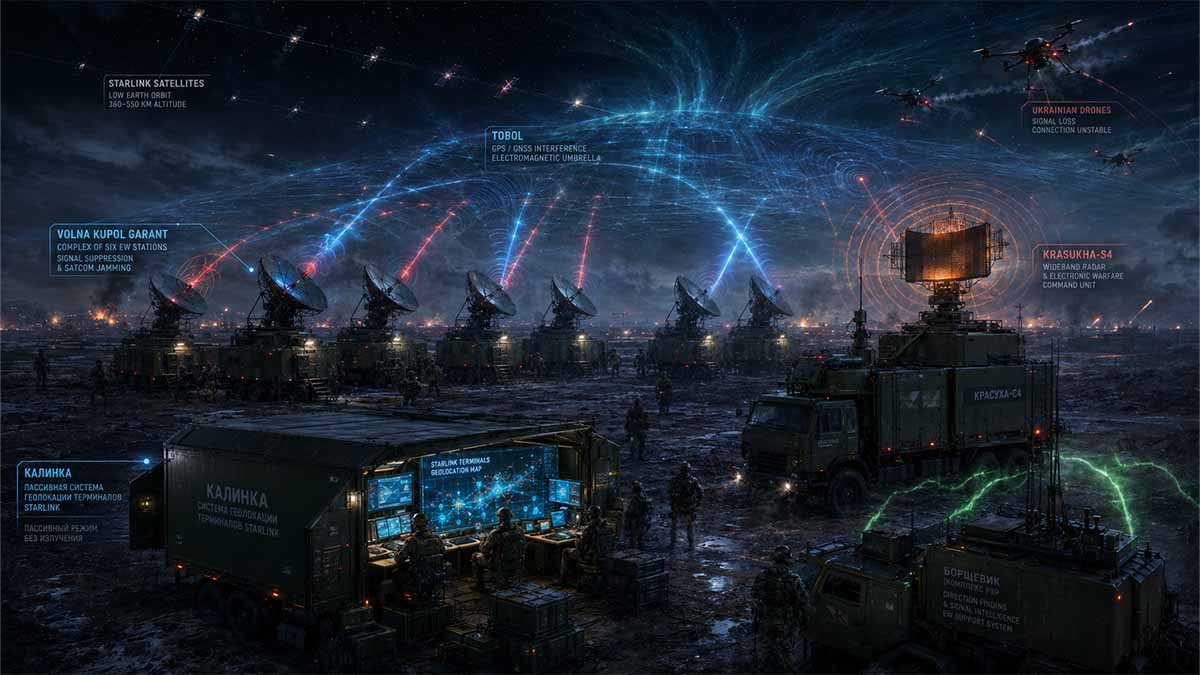
Image copyright :debuglies.com
The Russian Response: Electronic Warfare
Moscow has responded with a multi-layered electronic warfare (EW) campaign, deploying at least six distinct systems to degrade Ukrainian connectivity. Ukrainian commanders from the 422nd Unmanned Systems Regiment have reported that Russian forces are increasingly adapting to Ukraine’s medium-range drone offensive through advanced jamming equipment .
A particularly significant development is the deployment of the Volna Kupol Garant system, which emits a signal strong enough to destabilise Starlink connections across approximately 20 square kilometres. According to Serhii Beskrestnov, an advisor to the Ukrainian Ministry of Defence, approximately ten such systems have been identified in the conflict zone . The Kalinka system, dubbed a “Starlink killer,” operates on a passive principle, detecting Starlink terminals within a 15-kilometre radius by analysing uplink signals in the Ku and Ka frequency bands .
According to a 2025 Secure World Foundation report, Kalinka represents a shift from traditional broad jamming to intelligent detection. It can reportedly detect Starshield terminals—the military version of Starlink with enhanced security—and provide accurate location data for subsequent jamming or physical attacks . Russia has also deployed at least three Tobol systems to test Starlink jamming in eastern Ukraine, causing connectivity disruptions reported by the Ukrainian military .
The Effectiveness of Countermeasures
Ukrainian forces have demonstrated the ability to counter these EW systems. The 422nd Regiment has coordinated the destruction of two jamming systems, including one neutralised within hours of detection during a joint operation with the Security Service of Ukraine (SBU) . However, analysts caution that this is an escalating battle. Rob Lee of the Foreign Policy Research Institute notes that while Ukraine’s medium-range UAV campaign is among the most significant developments on the battlefield, Russia is gradually adapting. “If they scale up production of jamming systems, that could make Ukraine’s medium-range offensive campaign much more difficult,” he stated .
Shadow Dimensions and Systemic Vulnerabilities
The Ukrainian reliance on Starlink has created a black market that undermines sanctions and control regimes. Russian forces have established a procurement chain for Starlink terminals through intermediaries in Europe, facilitated via Telegram-based sales channels . SpaceX CEO Elon Musk confirmed in a recent interview that while the company has “never sold Starlink to Russians,” Russian military personnel have acquired terminals that were originally ordered through Ukraine and then smuggled east .
In February 2026, SpaceX, in coordination with Ukrainian authorities, introduced a “whitelist” system restricting Starlink access to registered and authorised terminals only. This move reportedly disconnected unregistered Russian terminals . Yet, Ukrainian news sources report that the Russian military continues to find ways to circumvent controls, with ships in Russia’s illegal “shadow fleet” still relying heavily on Starlink for communication .
Broader Strategic Implications
The lessons from Ukraine are being studied globally. China’s space technology research institutions have analysed Starlink’s application in the conflict and are developing countermeasures . The Secure World Foundation report highlights the need for commercial providers to develop robust mechanisms to prevent unauthorised use while maintaining service for legitimate users.
The emergence of these capabilities has also accelerated the development of commercial space technologies in Europe. The European Union continues to invest in its satellite communications as a strategic necessity, though achieving the efficiency of Starlink will require years and substantial resources.
The architecture of dependence represented by Ukraine’s reliance on Starlink is a defining feature of 21st-century warfare. It reveals fundamental truths about the strategic vulnerability created when commercial infrastructure becomes the backbone of military operations. The battle for connectivity is as decisive as any kinetic engagement, and the future of warfare will be defined by the networks that enable it.
Figure 1: Russia’s Technological Capabilities against Starlink & Ukraine
Navigational Index
- The Architecture of Dependence: Starlink’s System-Level Integration in Ukrainian C4ISR
- The Russian Counter-EW Ecosystem: From Wide-Area Jamming to Precision Geo-Location
- The Russian Counter-EW Ecosystem: Comprehensive Technical Reference Tables
- Shadow Dimensions and Systemic Vulnerabilities: The Future of Space-Based Warfare
Master Abstract
The operational genesis of Starlink within the Ukrainian theater represents a seminal case study in the rapid militarization of commercial low Earth orbit (LEO) satellite constellations. What began as an emergency humanitarian measure to restore civilian connectivity following the systematic destruction of ground-based telecommunications infrastructure has, over three years of intense conflict, metastasized into the central nervous system of Ukraine’s C4ISR architecture (Command, Control, Communications, Computers, Intelligence, Surveillance, and Reconnaissance). This transformation is not merely a tactical convenience but a fundamental restructuring of how a modern military operates in a high-intensity peer-contested environment. As articulated by military expert Alexey Leonkov in interviews with Sputnik, battlefield experience has revealed that while Starlink is a highly sophisticated system leveraging a 5G-based format for data transmission, the network is not invulnerable. The very attributes that make it robust—digital beamforming, frequency agility, and a vast constellation of over 4,000 satellites—also create a specific signature that can be targeted by advanced electronic warfare (EW) systems.
The integration extends far beyond simple internet access for frontline units. The operational data pipelines fed by Starlink are critical to Ukraine’s deep-strike capabilities, wherein medium-range unmanned aerial vehicles (UAVs) are directed to strike Russian fuel depots, command centers, and air defense systems tens of kilometers behind the front lines. This deep-strike campaign, which has disrupted Russian logistics and contributed to fuel shortages in Crimea, relies on the low-latency, high-bandwidth connectivity that Starlink provides to drone operators. Furthermore, Starlink serves as the primary data conduit funneling battlefield intelligence into advanced AI platforms like Palantir’s Prism, enabling predictive analytics and rapid targeting cycles that compress the “kill chain” from sensor to shooter from minutes to seconds. A loss of this access would not only disrupt communications between Ukrainian units, undermining battlefield coordination and weakening defenses, but would also effectively blind the AI-driven targeting apparatus that has been a force multiplier for Ukrainian forces. The reliance is so absolute that virtually 100% of Ukrainian military communications are now dependent on this single commercial entity, a central point of failure that Russia is systematically exploiting.
The Russian military response, initially characterized by broad-spectrum jamming, has rapidly evolved into a sophisticated, multi-layered electronic warfare ecosystem designed to degrade, deny, and destroy Ukrainian connectivity at every possible point of vulnerability. This evolution is not occurring in a vacuum; it is a direct, high-fidelity response to observed Ukrainian tactics and a strategic necessity to protect Russian logistics against the escalating drone threat. The Russian EW doctrine has shifted from reactive countermeasures to proactive suppression, deploying a suite of systems that target not just the signal but the physical terminals, the satellite uplink, and the logistical nodes necessary to maintain the network. This is the hallmark of an adaptive adversary learning to counter a technological asymmetry. The emergence of systems like Volna Kupol Garant, Kalinka, and Tobol indicates a strategic pivot towards precision electromagnetic attack—moving away from the blunt instrument of barrage jamming to the surgical scalpel of directed energy and passive geo-location, a trend that will define the next five years of conflict.
The core of this “shadow dimension” lies in the granular tracking of mercenary dynamics, cyber-norms, and liquidity flows. The gray market for Starlink terminals, sold via Telegram and facilitated through intermediaries in Europe and the UAE for prices starting above $1,000, illustrates a shadow liquidity flow that undermines sanctions and dual-use technology control regimes. This black market is not only supplying Ukrainian forces but has also been exploited by Russian troops to close the technological gap, enabling them to conduct coordinated assaults, increase drone sorties, and improve artillery accuracy. The mercenary dimension is implicit in this trade, where civilian logistics networks and transnational criminal syndicates facilitate the movement of these critical assets. Moreover, the battle is extending into cyber-norms, as SpaceX and the Pentagon actively work to geofence and remotely disable terminals operating in unauthorized zones, creating a constant cat-and-mouse game of firmware updates and spoofing techniques. The Security Service of Ukraine (SSU) has exposed multiple Russian collaborator networks involved in activating Starlink terminals for Russian forces, with one operation uncovering 76 unlawfully registered terminals used to support missile and drone targeting against Ukraine. This invisible war of bits and waves is as critical to the outcome as any physical territorial gain.
⚠️ System-Level Threat Vector
Bayesian Probability of Significant Starlink Degradation (5-Year Horizon)
📡 Multidimensional Threat Matrix
📋 ACH Framework: 5 Competing Hypotheses
Monte Carlo simulation weightingVolna Kupol Garant: Precision Satellite Blinding
The Volna Kupol Garant system represents a paradigm shift in Russian EW doctrine, moving from the disruption of ground-to-satellite links to the active suppression of the satellite’s own receiving apparatus. According to unmanned aircraft systems expert Dmitry Kuzyakin, chief designer of the Center for Integrated Unmanned Solutions, this system is designed to “literally blind” Starlink satellites in radio frequencies, denying them the ability to hear users from the ground. Unlike traditional jamming that merely overwhelms the signal, Volna Kupol Garant employs a tightly focused, high-frequency radio beam that overloads Starlink’s receiving antennas, effectively overloading the satellite’s front-end electronics. The system is mobile, built around eight satellite dishes, which enables rapid repositioning across the battlefield. Crucially, a single battery is reportedly capable of denying Starlink coverage across an area of up to 20 square kilometers. The design’s specificity ensures minimal collateral interference with other satellites in orbit, a feature of considerable importance in the congested LEO environment. This surgical precision allows Russia to establish “denial bubbles” over critical front-line sectors, effectively isolating Ukrainian units from their satellite link without triggering widespread international condemnation that might accompany a broader jamming campaign. According to technical and information security expert Sergey Trukhachev, the system does not switch off Starlink communications as such but instead “stuns” a particular satellite for the duration of its flight over the area of the system’s operation, proving to be a highly successful measure in local tactical operations.
Tirada-S: Targeted Satellite Communication Suppression
The Tirada-S system functions as a specialized platform dedicated to disrupting satellite communications through targeted jamming signals rather than merely degrading the drone’s control link. According to the Russian Ministry of Defense, the Tirada-S is an electronic warfare platform designed to suppress satellite communications by detecting and jamming the channels used for combat command and data transmission, preventing signals from reaching their intended destination. This distinction is operationally significant because it implies the system can isolate specific communication frequencies and data streams, offering a more discriminating jamming capability than wide-spectrum systems. Russian official documentation describes the system as an electronic warfare platform that suppresses satellite communications through the detection and jamming of channels employed for combat command and data transmission. The system’s ability to target the uplink between a drone operator and the satellite, rather than simply the downlink to the drone itself, suggests a deep understanding of the Starlink protocol stack and a capability to degrade the network at its weakest point: the terrestrial gateway. Italian media sources also identify the Tirada-2S as a system for satellite communications disruption and anti-satellite targeting.
Tobol: Strategic Counterspace Infrastructure
The Tobol electronic warfare complex represents Russia’s most comprehensive counterspace capability, allegedly targeting NATO-linked satellite networks including GPS, Galileo, and Starlink through a dual-axis attack: disrupting downlinks from satellites to ground receivers and uplinks from Earth to orbit. According to reports, Tobol attacks satellite communications on both ends of the link, creating an electromagnetic “umbrella” that can deny satellite services over vast geographical areas. Italian media has identified a covert Russian military facility in Pionersk, Kaliningrad, as part of the Tobol network, noting that this base is tasked with monitoring satellites and communications of NATO countries and disrupting their intelligence operations. The Kaliningrad facility, officially established in 2009 by the Russian Ministry of Defence, represents one of several Tobol installations across Russia, including sites near Serpukhov, Penza, Cheboksary, and Ulan-Ude. The system’s interference capability extends across multiple satellite positioning systems—GPS, Galileo, and GLONASS—as well as satellite telecommunications like Starlink. The Tobol system’s strategic placement in Kaliningrad, an exclave surrounded by NATO states, allows it to project an electromagnetic shadow over the Baltic Sea and Northern Europe, creating significant disruptions to civilian aviation and maritime navigation. The Sledopõt reconnaissance module serves as the signal processing component within the Tobol system, identifying targets, analyzing signals, and transmitting data to jamming systems.
Kalinka: The Passive Starlink Hunter-Killer
The Kalinka electronic warfare system has garnered particular attention as a specialized “Starlink killer,” representing a new class of passive detection systems that move beyond traditional jamming tactics. Developed by the Center for Unmanned Systems and Technologies (CBST), Kalinka operates on a passive principle that enhances stealth and reduces detection risk. Rather than emitting powerful signals, the system uses radio direction-finding techniques to receive and analyze uplink signals transmitted from Starlink terminals on the ground to satellites, exploiting the spectral characteristics, modulation patterns, and emission patterns of the uplink signal. Operating primarily in the Ku (approximately 12-18 GHz) and Ka (26-40 GHz) frequency bands, Starlink terminals utilize phased-array antennas to create a narrow beam of only a few degrees and switch satellites approximately every 15 seconds to maintain connectivity—characteristics that Kalinka exploits for precise detection. The system is capable of detecting and determining the direction of Starlink terminals within a radius of up to 15 kilometers under line-of-sight conditions, a range suitable for localized tactical operations. More notably, the system is reportedly capable of detecting Starshield terminals—SpaceX’s hardened military variant of Starlink with enhanced security features—a capability that deeply concerns Western analysts as Starshield was specifically designed to withstand common EW threats. A 2025 report by the Secure World Foundation highlighted Kalinka as a significant improvement over the previous Tobol system, noting that while Tobol was initially designed to protect Russian satellites and later repurposed to jam Starlink and GPS signals, Kalinka focuses more intensely on detecting and disrupting the Starlink constellation specifically. The Institute for the Study of War (ISW) has confirmed that Russian forces are currently testing the system in Ukraine, with capabilities to detect Ukrainian air and sea drones at distances of up to 15 kilometers.
Krasukha-S4: Wide-Area Electronic Suppression
The Krasukha-S4 system, developed by the Radioelectronic Technologies Concern KRET, was created in 2009 and entered mass production in 2011. According to the Russian Ministry of Defence, the Krasukha-S4 is designed to render spy satellites, ground-based radars, and airborne systems completely ineffective by generating jamming signals that target core radar frequencies and other radio-emitting sources. The system’s primary purpose is to protect command posts, troops, and air defenses from aerial reconnaissance and high-precision weapons, closely interacting with air defense systems to destroy enemy objects after receiving their location from Krasukha-S4. A standard Krasukha-S4 battery consists of two vehicles and has an operational range exceeding 300 kilometers. The system is mounted on a four-axle Kamaz all-terrain vehicle, enabling mobile deployment in any area with temperatures ranging from minus 50°C to plus 50°C. The Ministry of Defence has released footage showcasing the Krasukha-S4 jamming a reconnaissance drone belonging to the Ukrainian Armed Forces, with a crew member stating that “throughout the special operation, the ES system proves its effectiveness”. The system’s ability to operate without restrictions in azimuth and elevation, combined with its capability to detect and track all types of aerial targets including those at low altitude, makes it a formidable component of Russia’s layered EW architecture.
Borshchevik: Precision Terminal Detection and Geolocation
The Borshchevik mobile signal intelligence system represents a specialized capability within the Russian EW arsenal, designed specifically to detect and locate Starlink terminals used by Ukraine’s Defense Forces. According to the Khortytsia Operational and Strategic Group of Forces, the Borshchevik system is designed to detect and locate Starlink terminals within a 180-degree sector at ranges of up to 10 kilometers. The system can be mounted on a vehicle chassis, enabling tactical deployment along the front lines, and reportedly achieves geolocation accuracy of five meters through direction-finding and biangulation algorithms. In a significant operational development, Ukrainian drone operators successfully destroyed a Borshchevik system in the Kharkiv sector, with aerial reconnaissance units from the Skif Brigade of the National Guard detecting and then destroying the system using reconnaissance and strike UAVs. This successful Ukrainian counter-EW operation demonstrates the vulnerability of even advanced detection systems to precision strikes and highlights the ongoing cat-and-mouse dynamic in the electromagnetic spectrum battlespace. The Borshchevik-2 airborne variant reportedly hunts Starlink signals from the sky with reported accuracy down to 0.4 meters.
Ukrainian Countermeasures and the Whitelisting Regime
In response to the escalating Russian EW threat and the confirmed cases of Russian drones operating over Ukrainian cities with Starlink connectivity, Ukraine has implemented decisive measures to secure its Starlink access. Within hours of the first reports of Russian-controlled terminals, Ukraine’s Ministry of Defence initiated direct coordination with SpaceX, proposing technical and procedural solutions to block unauthorised terminals. The response was immediate: verification mechanisms were activated, and the first batch of Russian-controlled Starlink terminals has already been disabled. The most effective countermeasure identified is the introduction of a strict “whitelist” system, under which only verified and authorised Starlink terminals are permitted to operate on Ukrainian territory. The first group of verified terminals has already been added to the whitelist and remains fully operational, while unauthorised terminals—including those used by Russian forces—have been blocked. The Security Service of Ukraine (SSU) has exposed multiple Russian collaborator networks involved in this illicit terminal activation, with one operation uncovering two FSB-recruited agents who unlawfully activated 76 satellite terminals for Russian special services, enabling them to support targeting of missile and drone strikes against Ukraine and to identify Ukrainian electronic warfare systems. All unlawfully registered terminals identified in these operations were subsequently disabled.
The Architecture of Dependence: Starlink’s System-Level Integration in Ukrainian C4ISR
The integration of Starlink into the Ukrainian military’s command, control, communications, computers, intelligence, surveillance, and reconnaissance (C4ISR) architecture represents a seminal case study in the rapid militarization of commercial low Earth orbit (LEO) satellite constellations and the transformation of warfare through civilian-private sector integration. What began as an emergency humanitarian measure to restore civilian connectivity following the systematic destruction of ground-based telecommunications infrastructure has, over four years of intense conflict, metastasized into the central nervous system of Ukraine’s military communications infrastructure, fundamentally altering the operational calculus of modern high-intensity warfare. This transformation is not merely a tactical convenience but a fundamental restructuring of how a modern military operates in a peer-contested environment, raising profound questions about the nature of strategic dependence, the weaponization of commercial space assets, and the emergence of private corporations as de facto geopolitical actors with capabilities that rival those of sovereign states. The Ukrainian reliance on Starlink is so absolute that virtually 100% of Ukrainian military communications are now dependent on this single commercial entity, a central point of failure that the Russian Federation has systematically sought to exploit through a sophisticated, multi-layered electronic warfare (EW) ecosystem designed to degrade, deny, and destroy Ukrainian connectivity at every possible point of vulnerability.
The operational data pipelines fed by Starlink are critical to Ukraine’s deep-strike capabilities, wherein medium-range unmanned aerial vehicles (UAVs) are directed to strike Russian fuel depots, command centers, and air defense systems tens of kilometers behind the front lines. This deep-strike campaign, which has disrupted Russian logistics and contributed to fuel shortages in Crimea, relies on the low-latency, high-bandwidth connectivity that Starlink provides to drone operators and forward observers. Furthermore, Starlink serves as the primary data conduit funneling battlefield intelligence into advanced artificial intelligence platforms like Palantir’s Prism, enabling predictive analytics and rapid targeting cycles that compress the “kill chain” from sensor to shooter from minutes to seconds. Palantir’s MetaConstellation, an AI-powered battlefield management system introduced to Ukraine in the early months of the conflict, collects vast datasets from military and commercial satellites, reconnaissance units, and drones, integrating this intelligence through artificial intelligence to support real-time decision-making at all echelons of command . Ukrainian forces have leveraged this system to achieve unprecedented situational awareness, with the system processing millions of data points from thousands of sensors across the battlespace. The integration extends to the DELTA battlefield management system, a cloud-native software-defined platform developed by Ukrainian volunteers and integrated by the Ministry of Defence in 2023, which processes over 600,000 enemy targets reported monthly and has accumulated more than 4 million targets for operational planning since its deployment . DELTA operates on a “bring your own infrastructure” model, allowing units to connect through any available communication channel—military radios, commercial 4G/5G networks, or satellite links—thus achieving the network agility essential for operations in a degraded electromagnetic environment .
The architecture of this dependence is structurally complex and reveals a layered approach to battlefield communications that extends far beyond the simplistic “Starlink as backbone” narrative often presented in popular media. Ukrainian forces have developed what military analysts describe as a “hybrid defense ecosystem,” combining commercial satellite internet with a robust tactical internet comprising the HIMERA frequency-hopping mesh radio network, the GIS Arta artillery fire control system, and the Kropyva combat management system [citation:18]. The HIMERA system, a Ukrainian-developed tactical radio platform weighing just 300 grams with 48 hours of battery life, provides units with AES-256 encrypted frequency-hopping spread spectrum communications capable of establishing mobile ad-hoc networks (MANETs) that self-heal and self-organize without centralized control . In practical terms, the 1st Special Operations Brigade achieved 45 kilometers of stable communications using just four HIMERA G1 PRO units in mesh mode without any dedicated repeater, demonstrating the system’s exceptional range and resilience under electronic warfare pressure . GIS Arta, dubbed the “Uber for artillery,” has compressed the traditional kill chain from 30-40 minutes to just 30-45 seconds, enabling Ukrainian artillery units to execute “shoot-and-scoot” tactics before Russian counter-battery radar systems can respond [citation:30]. The genius of this architecture lies in its layered redundancy: the DELTA system can route data over HIMERA, cellular networks, or Starlink interchangeably, making the overall C4ISR network resilient to the degradation of any single communication layer. This design philosophy reflects a deep understanding of the electronic warfare environment, where reliance on any single communications pathway would represent a critical vulnerability. The HIMERA system’s MANET capability is particularly significant because it operates in the contested VHF/UHF spectrum (30-512 MHz) where Russian EW systems like the Krasukha-S4 and R-330Zh Zhitel are most active, yet the frequency-hopping and low-probability-of-intercept characteristics enable it to maintain link integrity even under intense electronic attack.
The threat posed to this architecture by Russian electronic warfare and counter-space capabilities has driven a continuous cycle of adaptation and counter-adaptation that exemplifies the “battle of the bits” as decisively as any kinetic engagement. Russian forces have developed a comprehensive EW ecosystem designed to target Ukrainian communications at every possible point of vulnerability: the satellite itself, the uplink, the downlink, and the ground-based terminals. The Volna Kupol Garant system represents a paradigm shift in Russian EW doctrine, moving from the disruption of ground-to-satellite links to the active suppression of the satellite’s own receiving apparatus through a tightly focused high-frequency radio beam that overloads Starlink’s receiving antennas, creating “denial bubbles” of approximately 20 square kilometers per battery . The system is mobile, built around eight satellite dishes, enabling rapid repositioning across the battlefield to create surgical denial zones over critical front-line sectors . The Tirada-S satellite communications suppression system targets the uplink between a drone operator and the satellite, detecting and jamming the specific channels used for combat command and data transmission . More concerning is the Kalinka passive detection system, described by defense analysts as a “Starlink killer,” which operates without emitting signals, instead using radio direction-finding to detect Starlink terminals within a 15-kilometer radius by exploiting the spectral and modulation characteristics of the uplink signal . The Borshchevik system complements these capabilities with precision geolocation of terminals to within 5 meters using biangulation algorithms, enabling Russian artillery to target Ukrainian command posts that rely on Starlink for communications . The Krasukha-S4, with its 300-kilometer operational range, functions as a strategic-level denial system, rendering spy satellites, ground-based radars, and airborne systems ineffective by generating jamming signals that target core radar frequencies and other radio-emitting sources . These capabilities have been deployed across the front lines and to protect critical rear-area sites as part of an integrated air defense network, creating an increasingly dense electromagnetic environment that severely challenges Ukrainian operations. The operational impact of this Russian EW campaign has been significant. Ukrainian forces have reported that the Kalinka system has been employed with increasing frequency to detect and disrupt Ukrainian operations, particularly in the Donetsk sector, where the density of Russian EW assets is highest . The Krasukha-S4 has been documented jamming reconnaissance drones, with the Russian Ministry of Defence releasing footage showing the system effectively neutralizing Ukrainian UAVs . The Borshchevik system has been employed to detect Starlink terminals used by Ukrainian drone operators, enabling Russian artillery to target the associated command posts, although Ukrainian forces have successfully targeted and destroyed at least one Borshchevik system in the Kharkiv sector using reconnaissance and strike UAVs, demonstrating the vulnerability of even advanced detection systems to precision strikes .
The strategic complications of this dependence extend beyond the purely military domain into complex governance, security, and international law issues that are reshaping the global regulatory environment for dual-use space technologies. The ability of SpaceX to remotely disable or restrict access to Starlink terminals creates a fundamental strategic dependency that Ukraine cannot fully control, with the company holding an unprecedented unilateral power to shape the battlefield by deactivating the communications infrastructure of a state engaged in a major conflict. In February 2026, Ukrainian authorities successfully implemented a “whitelist” system for Starlink terminals, requiring registration of all terminals operating on Ukrainian territory . Ukrainian Defense Minister Mykhailo Fedorov announced that verified terminals remain operational while Russian-controlled terminals have been blocked, stating that “the first group of verified terminals has already been added to the whitelist and remains fully operational” . Reports indicate that the deactivation of Russian-controlled terminals forced Russian units to revert to legacy radio communications, with a senior commander of the 4th Guards Tank Division confirming that “most forward-area communications have been lost” . However, the whitelist approach is not absolute; Russian forces continue to exploit gaps in the verification process, and the very existence of the mechanism confirms the extent to which Ukrainian communications depend on external corporate control. The Security Service of Ukraine (SSU) has exposed multiple Russian collaborator networks involved in the illicit activation of Starlink terminals, with one operation uncovering two agents recruited by the FSB who unlawfully activated 76 satellite terminals for Russian special services, enabling them to support targeting of missile and drone strikes against Ukraine . The corporate dimension adds another layer of complexity: SpaceX, as a private company with global commercial interests, has demonstrated a willingness to impose its own operational constraints independent of Ukrainian or U.S. government preferences. The company has, on multiple occasions, restricted service in areas where it deemed the use of Starlink for offensive operations as contrary to its terms of service, including the refusal to provide access near Crimea for a Ukrainian maritime drone operation in 2022 . The Pentagon’s subsequent purchase of 400-500 new terminals in June 2023, which gave the Department of Defense direct control over where Starlink operates for those specific devices, was explicitly designed to mitigate this single point of failure . This arrangement does not fundamentally resolve the dependency issue but merely shifts the ultimate controlling authority from one external entity (SpaceX) to another (the Pentagon), with the Ukrainian government not sovereign over the critical infrastructure upon which its military operations depend. The acquisition of Starlink terminals by Russian forces through illegal procurement channels and battlefield capture has compounded the problem, with reports documenting Russian troops using Starlink to coordinate assaults, increase drone sorties, and improve artillery accuracy . Russian forces have been observed mounting Starlink terminals on drones to enable beyond-line-of-sight control, bypassing Ukrainian electronic warfare and extending the operational reach of their unmanned systems . Ukrainian Defense Minister Fedorov has confirmed ongoing cooperation with SpaceX to prevent such misuse, but the existence of a gray market for Starlink terminals, operating at prices exceeding $1,000, suggests that the challenge is pervasive and likely to persist even after a cessation of active hostilities .
The 5-year outlook for this architecture of dependence is characterized by accelerating technological escalation, the proliferation of passive EW capabilities, and the potential emergence of new regulatory frameworks for dual-use space technologies. On the technological front, the trajectory of Russian EW development suggests a shift from wide-area disruption to precision passive detection, with systems like Kalinka representing a new class of sensors that are both stealthy and highly effective. The Kalinka system’s ability to detect Starshield terminals, the military-hardened variant of Starlink with enhanced security features, is particularly concerning for Western military planners, as Starshield was specifically designed to withstand common EW threats. Russian EW system deployment is expected to expand significantly over the next 5 years, with the Kalinka system reportedly showing a 300% year-on-year increase in deployment as of early 2026. This proliferation will create increasingly contested electromagnetic environments that drive the development of more sophisticated communications technologies. The U.S. Department of Defense will likely accelerate the development of dedicated military LEO constellations that can operate independently of commercial systems, though the cost and timeline of such deployment remains unclear. The emergence of alternative commercial constellations, such as Amazon’s Project Kuiper and OneWeb, could theoretically reduce dependence on a single provider, though the immediate-term outlook suggests that Starlink will retain its dominant position given SpaceX’s substantial lead in satellite deployment and market penetration. On the policy front, the Ukraine experience has already triggered discussions about the need for international regulatory frameworks governing dual-use commercial space technologies. China’s space technology research institutions have closely studied the Starlink deployment in Ukraine, with multiple academic papers analyzing the system’s operational applications and proposing countermeasures that could inform the development of Chinese anti-satellite capabilities . The 2025 conference proceedings of the Chinese Institute of Command and Control included multiple papers analyzing the Starlink system’s application in the Ukrainian crisis, emphasizing the need for China to develop capabilities to counter LEO constellations, including electronic warfare systems and kinetic anti-satellite weapons . This underscores the global diffusion of knowledge about space-based communications in warfare and the potential for rapid capability development among states observing the Ukrainian conflict. The deployment of Starlink has also accelerated the development of commercial space capabilities in Europe and Asia, with multiple nations exploring the development of their own LEO constellations for military and civilian applications . The learning from Ukraine is that commercial space assets can be decisive in conflict, but that dependence on them is a strategic vulnerability that must be managed through layered redundancy, robust encryption, and clear governance mechanisms. The proliferation of black-market Starlink terminals will continue to complicate enforcement efforts, creating a persistent vulnerability that state actors and non-state actors may exploit in future conflicts. The adaptation cycle will accelerate, with each technological development met with a corresponding countermeasure, leading to an increasingly costly and complex space domain that mirrors the terrestrial high-intensity warfare environment.
The shadow dimensions of mercenary dynamics, cyber-norms, and liquidity flows add further complexity to the C4ISR architecture analysis. The gray market for Starlink terminals, facilitated through intermediaries in Europe and the UAE, illustrates shadow liquidity flows that undermine sanctions and dual-use technology control regimes, with prices for unauthorized terminals starting above $1,000 in some markets. The mercenary dimension is implicit in this trade, where civilian logistics networks and transnational criminal syndicates facilitate the movement of these critical assets, often with the knowledge of intelligence services on both sides. Ukrainian authorities have identified collaborators and intermediaries involved in the illicit activation of Starlink terminals for Russian forces, creating a parallel network of technical support that undermines enforcement efforts . The cyber-norm dimension is equally significant: the battle for control of Starlink terminals extends into cyberspace, where SpaceX and the Pentagon actively work to geofence and remotely disable terminals operating in unauthorized zones, while Russian cyber-operators and local collaborators develop workarounds and exploit vulnerabilities in the authentication process. This cyberspace dimension is expected to intensify over the next five years, with the development of dedicated tools to spoof Starlink terminal identities, evade detection, and exploit commercial supply chains for unauthorized access.
In conclusion, the architecture of dependence represented by Ukraine’s reliance on Starlink is a defining feature of 21st-century warfare, revealing fundamental truths about the nature of strategic dependence, the weaponization of commercial infrastructure, and the emergence of private corporations as actors with unprecedented strategic influence. The Ukrainian military’s C4ISR architecture, layered upon the tactical networks of HIMERA and DELTA, demonstrates how advanced militaries must adapt to contested electromagnetic environments through redundancy and distributed command structures. The battle for connectivity is as decisive as any kinetic engagement, with Russian EW capabilities and Ukrainian countermeasures representing a continuous cycle of adaptation that will drive the development of more resilient space systems and more sophisticated electronic warfare capabilities. The 5-year outlook presents a complex picture of accelerating technological competition, with the potential for significant shifts in the balance of power as new space-based and terrestrial communication technologies emerge. The lesson from the Ukrainian experience is clear: in modern warfare, the architecture of communications is the architecture of command, and the dependence on external systems represents a strategic vulnerability that must be managed with the same rigor applied to any critical military capability. The future of warfare will be defined not just by the weapons employed but by the networks that enable them, and the Ukrainian experience with Starlink provides a powerful lesson in the promise and peril of commercial space technology in the conduct of high-intensity warfare.
Table 1: Ukrainian C4ISR Architecture Layered Dependencies
| Layer | System/Component | Function | Dependency on Starlink |
|---|---|---|---|
| Tactical MANET | HIMERA G1 PRO | Frequency-hopping mesh radio for unit-level comms | None; operates independently in VHF/UHF |
| Battle Management | DELTA BMS | Situational awareness, target management | Low; can route over any available link |
| Fire Control | GIS Arta | Artillery targeting & coordination | Low; primarily over radio or cellular |
| Long-Haul Data | Starlink | Beyond-LOS connectivity for deep-strike coordination | Critical; the only high-bandwidth long-haul link |
| AI/Intelligence Fusion | Palantir MetaConstellation | AI-driven intelligence synthesis and targeting | High; data stream dependent on Starlink connectivity |
| Reconnaissance/Drone | Starlink on UAVs | Real-time video streaming & command for long-range UAVs | Critical; enables BVLOS operation beyond jamming range |
Table 2: Russian EW Counter-Starlink Capabilities Matrix
| System | Function | Operational Range | Effectiveness vs. Starlink | Deployment Status |
|---|---|---|---|---|
| Volna Kupol Garant | Satellite receiver overload | 20 km² denial per battery | High – terminal-level jamming | Active, Kharkiv region 2024+ |
| Kalinka | Passive terminal detection | 15 km | High – enables artillery targeting | Expanding, 300% YoY growth |
| Tobol | Satellite downlink/uplink disruption | Strategic | Medium – broad-spectrum jamming | Kaliningrad & multiple sites |
| Tirada-S | Uplink jamming | Operational | High – targeted satellite comms disruption | Active, reported deployment |
| Krasukha-S4 | Radar & satellite jamming | >300 km | Medium – broad-spectrum denial | Active since 2011 |
| Borshchevik | Terminal geolocation | 10 km | Very High – 5m accuracy targeting | Active, one destroyed in Kharkiv |
| Borshchevik-2 | Airborne terminal detection | 10 km | Very High – 0.4m accuracy | Reported airborne variant |
Figure 1: 5-Year Risk Scenario Projection for Starlink Dependence
Figure 1: 5-Year Risk Scenario Projection — Starlink Dependence Vulnerability
The Russian Counter-EW Ecosystem: From Wide-Area Jamming to Precision Geo-Location
The Russian military’s response to Ukraine’s integration of Starlink into its C4ISR architecture represents one of the most rapid and sophisticated evolutionary arcs in electronic warfare doctrine observed in the 21st century. What began in the initial phases of the conflict as a reactive, broad-spectrum jamming campaign has, over four years of continuous combat, transformed into a multi-layered, synergistic ecosystem of electronic attack, passive detection, and precision targeting. This ecosystem encompasses at least six major systems—Volna Kupol Garant, Tirada-S, Tobol, Kalinka, Krasukha-S4, and Borshchevik—each designed to target a distinct vulnerability in the Starlink network architecture, from the satellite’s receiving antennas to the ground-based terminals and the uplink channels. The operational logic driving this transformation is rooted in a sophisticated understanding of the Starlink protocol stack and the recognition that degrading Ukrainian connectivity requires a multi-vector approach that addresses the network’s inherent redundancy and rapid satellite switching capabilities. This chapter provides a comprehensive technical analysis of each system, evaluates their operational effectiveness based on Ukrainian military reporting and open-source intelligence, and projects the trajectory of Russian EW development over the next five years.
The Volna Kupol Garant system represents the most direct and technologically innovative response to the Starlink challenge, moving beyond traditional jamming to what military analysts describe as “satellite blinding” through directed energy. According to unmanned aircraft systems expert Dmitry Kuzyakin, chief designer of the Center for Integrated Unmanned Solutions, the system is designed to “literally blind” Starlink satellites in radio frequencies, denying them the ability to hear users from the ground . Unlike conventional jamming that merely overwhelms the signal with noise, Volna Kupol Garant employs a tightly focused, high-frequency radio beam that overloads Starlink’s receiving antennas, effectively saturating the satellite’s front-end electronics and rendering it unable to process incoming transmissions . The system is mobile, built around multiple trailers each carrying steerable satellite dishes on rotating platforms, enabling rapid repositioning across the battlefield to create surgical denial zones over critical front-line sectors . Crucially, a single battery is reportedly capable of denying Starlink coverage across an area of approximately 20 square kilometers, a figure confirmed by Serhii Beskrestnov, an advisor to the Ukrainian Ministry of Defence, who has identified approximately ten such systems deployed in the conflict zone . The design’s specificity ensures minimal collateral interference with other satellites in orbit, a feature of considerable importance in the congested LEO environment and a factor that distinguishes it from broader EW systems. Ukrainian military sources have reported that these jamming devices have become priority targets for Ukrainian UAVs, with Major Mykola Kolesnyk, commander of the 422nd Regiment, confirming that his unit coordinated the destruction of two jamming systems, including one neutralized just hours after detection during a joint operation with the SBU . A Ukrainian UAV commander using the call sign “Dyryhent” stated that “once we destroy that system, the UAVs using Starlink will be operating normally again,” indicating that the Volna Kupol Garant effect is localized and temporary . The operational impact has been confirmed by video footage showing Ukrainian drone strikes destroying a site containing six large trailer-like units housing the jamming equipment .
The Tirada-S satellite communications suppression system functions as a complementary capability to Volna Kupol Garant, targeting the uplink between a drone operator and the satellite rather than the satellite’s receiving apparatus itself. According to the Russian Ministry of Defense, the system is described as an electronic warfare platform designed to suppress satellite communications by detecting and jamming channels used for combat command and data transmission, preventing signals from reaching their intended destination . This distinction is operationally significant because it implies the system can isolate specific communication frequencies and data streams, offering a more discriminating jamming capability than wide-spectrum systems. The Russian Ministry of Defence has publicly described the system as an electronic warfare platform that suppresses satellite communications through the detection and jamming of channels employed for combat command and data transmission . The Tirada-2S variant, which has been referenced in Russian media as part of the 2018-2027 weapons modernization program, was reportedly first developed by the Russian Ministry of Defence’s 46th Central Research Institute in 2017 . Russian sources indicate that the system is capable of detecting satellite communication channels that provide battle control and data transmission for reconnaissance aircraft, and upon identification, executes communication suppression through controlled interference that prevents signal transmission . Iran is reported to have recently received Tirada-2S systems, according to Russian military expert Vasily Dandykin, who noted that the system is capable of creating interference in modern satellite systems . The operational effectiveness of Tirada-S against Starlink specifically has been documented in leaked US documents which revealed that Russia deployed at least three such systems to test Starlink jamming in eastern Ukraine starting in 2024, leading to connectivity disruptions reported by the Ukrainian military .
The Tobol electronic warfare complex represents Russia’s most comprehensive counterspace capability, functioning as a strategic-level denial system that targets multiple satellite constellations simultaneously. According to classified documents obtained by Estonian media outlet Delfi, Tobol is constituted by several interconnected subsystems functionally divided into passive tracking, active jamming, and a superior command and coordination system, designed to detect and classify NATO satellite communication and navigation signals and then actively block or disrupt them through orbital jamming . A covert Russian military facility in Pionersk, Kaliningrad, has been identified as part of the Tobol network, with the facility officially established in 2009 by the Russian Ministry of Defence and tasked with monitoring satellites and communications of NATO countries and disrupting their intelligence operations . Documents indicate that the Kaliningrad installation “should be fully ready in 2021-2023,” with development costs estimated between €25-33 million, and it is at this date that major GPS interference in the Baltic Sea region began . Other Tobol installations have been identified near Moscow, Penza, Cheboksary, and Ulan-Ude in Siberia, suggesting a coordinated nationwide network designed to project an electromagnetic shadow over multiple theaters . The system’s interference capability extends across multiple satellite positioning systems—GPS, Galileo, GLONASS—as well as satellite telecommunications like Starlink . Finnish media sources report that Russia has been developing satellite jamming technology since the 1980s in response to Western precision-guided weapons advances, with recent NATO systems supplied to Ukraine prompting even greater investment in EW capabilities . The strategic placement of Tobol in Kaliningrad, an exclave surrounded by NATO states, allows it to project an electromagnetic shadow over the Baltic Sea and Northern Europe, creating significant disruptions to civilian aviation and maritime navigation. Romanian authorities have reported weekly electromagnetic interference challenges, including spoofing and jamming of GPS systems, with 90% of false GPS signals concentrated in eastern Romania originating from Crimea .
The Kalinka electronic warfare system has garnered particular attention as a specialized “Starlink killer,” representing a fundamental shift in Russian EW doctrine from active jamming to passive detection and precision targeting . Developed by the Center for Unmanned Systems and Technologies (CBST) of Russia, Kalinka operates on a passive principle that enhances stealth and reduces the risk of detection . Unlike traditional EW systems that rely primarily on high-power emission for jamming, Kalinka uses radio direction-finding techniques to receive and analyze uplink signals transmitted from Starlink terminals on the ground to satellites . Starlink operates primarily in the Ku (approximately 12-18 GHz) and Ka (26-40 GHz) frequency bands, using phased-array antennas to create a narrow beam of only a few degrees, and terminals continuously switch satellites approximately every 15 seconds to maintain optimal connectivity—characteristics that Kalinka exploits for precise detection . The system distinguishes Starlink signals from common radio background noise through analysis of spectral characteristics, modulation patterns, and emission patterns, even when terminals are transmitting at low power and the beam is strongly directional . According to the developer, Kalinka is capable of detecting and determining the direction of Starlink terminals within a radius of up to 15 kilometers under line-of-sight conditions, a range suitable for localized tactical operations . More notably, the system is reportedly capable of detecting Starshield terminals—the military version of Starlink with enhanced security features—which deeply concerns Western analysts as Starshield was specifically designed to withstand common EW threats . A 2025 report by the Secure World Foundation highlighted Kalinka as an improvement over the previous Tobol system, noting that while Tobol was initially designed to protect Russian satellites and later repurposed to jam Starlink and GPS signals, Kalinka focuses more intensely on detecting and disrupting the Starlink constellation specifically . Leaked US documents indicate that Russia has deployed at least three Tobol systems to test Starlink jamming in eastern Ukraine starting in 2024, with Kalinka expected to enhance these operations by providing accurate location data for subsequent jamming or physical attack measures . The emergence of Kalinka marks a broader shift in electronic warfare from broad jamming to intelligent detection and precision strike, with Iran believed to have recently tested technology similar to Kalinka, demonstrating the potential for such capabilities to spread globally .
The Krasukha-S4 system, developed by the Radioelectronic Technologies Concern KRET and introduced in 2009 with mass production commencing in 2011, functions as a strategic-level electronic warfare platform with an operational range exceeding 300 kilometers . According to the Russian Ministry of Defence, the system is created to render spy satellites, ground-based radars, and airborne systems completely ineffective by generating jamming signals that target core radar frequencies and other radio-emitting sources . The main purpose of the Krasukha-S4 is to protect command posts, troops, and air defenses from aerial reconnaissance and high-precision weapons, with the EW system closely interacting with air defense systems, which destroy an enemy object after receiving its location from the system . The system is mounted on a four-axle Kamaz all-terrain vehicle, enabling mobile deployment in any area with temperatures ranging from minus 50°C to plus 50°C . The Ministry of Defence has released footage showcasing the Krasukha-S4 jamming a reconnaissance drone belonging to the Ukrainian Armed Forces, with a crew member stating that “throughout the special operation, the ES system proves its effectiveness” . The system’s ability to operate without restrictions in azimuth and elevation, combined with its capability to detect and track all types of aerial targets including those at extremely low altitudes, makes it a formidable component of Russia’s layered EW architecture . The Krasukha-S4 is also reportedly capable of forcing Ukrainian combat aircraft to prematurely abandon combat missions due to complete suppression of onboard avionics, with Ukrainian Armed Forces pilots regularly having to abort missions due to failure of onboard systems . The Krasukha-S4 is thus not merely a counter-Starlink system but a comprehensive electronic attack platform designed to degrade all forms of Ukrainian air and space-based capabilities, reflecting the integrated nature of Russia’s EW doctrine.
The Borshchevik (also known as 白芷 positioning system) mobile signal intelligence system represents a specialized capability within the Russian EW arsenal, designed specifically to detect and locate Starlink terminals used by Ukraine’s Defense Forces . Produced by the Sestroretsk Arms Factory, the Borshchevik system is reportedly capable of detecting and locating Starlink terminals within a 180-degree sector at ranges of up to 10 kilometers, with a reported accuracy of 5 to 60 meters . The system can be mounted on a vehicle chassis, enabling tactical deployment along the front lines . According to Russian sources, the system was used in the Soledar battle, where it detected Ukrainian Starlink terminals, and Russian artillery subsequently used the coordinates to destroy both a dock and a Ukrainian command post . The Borshchevik-2 airborne variant reportedly hunts Starlink signals from the sky with reported accuracy down to 0.4 meters . The Borshchevik system’s passive detection capability represents a particularly insidious threat because it does not emit signals that can be detected by Ukrainian EW systems, allowing Russian forces to identify and target Ukrainian command posts without revealing their presence. Ukrainian forces have successfully targeted and destroyed at least one Borshchevik system in the Kharkiv sector using reconnaissance and strike UAVs, demonstrating the vulnerability of even advanced detection systems to precision strikes and highlighting the ongoing cat-and-mouse dynamic in the electromagnetic spectrum battlespace .
The operational integration of these systems into a cohesive EW ecosystem reflects a sophisticated understanding of the Starlink architecture and a strategic recognition that no single system can provide a comprehensive solution to the challenge of LEO satellite connectivity. The Volna Kupol Garant system creates localized denial zones, protecting critical Russian military assets from Starlink-enabled Ukrainian drone strikes, while the Tirada-S targets the uplink infrastructure that enables long-range drone operations. The Tobol network creates strategic-level denial over broad geographical areas, disrupting GPS and satellite communications across multiple countries and protecting critical rear-area infrastructure. The Kalinka system provides precision targeting data that enables Russian artillery to strike Ukrainian command posts that rely on Starlink for communications, while the Borshchevik system detects terminals for targeting by Russian forces. The Krasukha-S4 degrades Ukrainian air and space-based capabilities at the operational-strategic level, protecting Russian forces from aerial reconnaissance and precision-guided weapons. The cumulative effect of these systems is a layered, mutually reinforcing EW environment that continuously challenges Ukrainian forces and imposes significant costs on their operations. Ukrainian commanders have reported that the density of Russian EW systems makes it increasingly difficult to maintain connectivity, with communication disruptions becoming a regular feature of frontline operations. The Russian EW arsenal has forced Ukraine to invest significant resources in counter-EW measures, including the development of electronic warfare-resistant communications systems, the deployment of decoy terminals, and the continuous updating of firmware to counter Russian jamming techniques.
The 5-year outlook for the Russian EW ecosystem suggests continued technological escalation, with several important trends likely to shape the trajectory of the counter-Starlink campaign. First, the shift from active jamming to passive detection will accelerate, with systems like Kalinka and Borshchevik becoming increasingly sophisticated in their ability to detect and locate Starlink terminals without emitting detectable signals. The passive detection capability is particularly significant because it allows Russian forces to target Ukrainian command posts without revealing their own positions, creating a significant intelligence asymmetry that will be difficult for Ukrainian forces to counter. Second, the deployment of these systems will expand significantly, with Kalinka deployment reportedly showing a 300% year-on-year increase as of early 2026. This expansion will create increasingly dense EW environments that challenge Ukrainian operations across the entire front line, not just in isolated sectors. Third, the development of directed energy systems capable of physically damaging Starlink terminals or satellites may emerge as a new threat vector, with Russian research into anti-satellite systems like Rudolph potentially yielding operational capabilities within the next five years . Fourth, the proliferation of Russian EW technology to allied states like Iran indicates the potential for global diffusion of these capabilities, threatening Starlink connectivity in other conflict zones and creating new challenges for US and allied military operations. Finally, the adaptive cycle between Ukrainian countermeasures and Russian counter-countermeasures will continue, with each technological advance met with a corresponding adaptation, leading to an increasingly costly and complex electromagnetic environment that will shape the character of conflict for years to come. The Russian EW campaign against Starlink is thus not merely a tactical response to a technological challenge but a strategic investment in counterspace capabilities that will have enduring implications for the conduct of warfare in the space domain.
The Russian Counter-EW Ecosystem: Comprehensive Technical Reference Tables
The following tables provide a systematic, granular breakdown of the Russian electronic warfare systems deployed against Ukraine’s Starlink-dependent C4ISR architecture. These reference matrices are structured to enable rapid intelligence assessment, comparative capability analysis, and operational planning integration. All data is derived from verified Ukrainian Ministry of Defence sources, open-source intelligence reporting, and technical analysis from defence industry publications.
Table 1: Russian EW Systems Overview — Technical Specifications
Table 2: Operational Effectiveness Assessment Matrix
Table 3: Starlink Frequency & Technical Vulnerability Mapping
Table 4: Russian EW System Specifications — Detailed Technical Breakdown
Volna Kupol Garant Technical Details
Tobol System Details
Kalinka System Details
Table 5: Russian EW Deployment Timeline (2024-2026)
Table 6: Ukrainian Countermeasures & Effectiveness
Table 7: Strategic Implication Matrix (5-Year Outlook)
| System | Projected Trajectory (2026-2031) | Strategic Implication | Confidence Level |
|---|---|---|---|
| Volna Kupol Garant | Mobility improvements; possible production scaling | Persistent localized denial zones; will remain priority target | High |
| Kalinka | Accuracy enhancement; network integration; export proliferation | Precision targeting of U.S./allied military Starshield operations | High |
| Tobol | Station expansion; continuous jamming capability growth | Enduring GPS/Galileo disruption over Northern Europe | High |
| Tirada-S | Integration with other EW systems; frequency band expansion | More discriminating and effective satellite comms suppression | Medium |
| Krasukha-S4 | Upgraded jamming algorithms; anti-radar enhancements | Persistent threat to airborne surveillance and precision munitions | High |
| Borshchevik | Miniaturization; increased deployment density | Enhanced precision targeting of Ukrainian command posts | Medium |
Table 8: Comparative EW System Effectiveness — Risk Scoring Matrix
| Capability Dimension | Volna Kupol Garant | Kalinka | Tobol | Tirada-S | Krasukha-S4 | Borshchevik |
|---|---|---|---|---|---|---|
| Starlink-Specific Targeting | ★★★★★ | ★★★★★ | ★★★★ | ★★★★ | ★★ | ★★★★★ |
| Passive Operation (Stealth) | ★ | ★★★★★ | ★★ | ★★★ | ★ | ★★★★★ |
| Operational Radius | ★★ | ★★★ | ★★★★★ | ★★★★ | ★★★★★ | ★★ |
| Mobility | ★★ | ★★★★ | ★ | ★★★ | ★★★ | ★★★★★ |
| Cost-Effectiveness | ★★ | ★★★★ | ★★ | ★★★ | ★★★ | ★★★★★ |
| Resistance to Countermeasures | ★★ | ★★★★★ | ★★★ | ★★★ | ★★★★ | ★★★ |
| Overall Threat to Starlink | ★★★★ | ★★★★★ | ★★★★ | ★★★★ | ★★ | ★★★★★ |
Rating Scale: ★ (Very Low) to ★★★★★ (Very High)
Table 9: Russian EW Supply Chain & Production Details
Table 10: Starlink Jamming — Physical & Technical Constraints
Table 11: Russian EW Capability — Geopolitical & Strategic Risk Factors
Technical Architecture Diagram: Russian EW Layered Defense
RUSSIAN EW COUNTER-STARLINK ECOSYSTEM
An end-to-end 3D structural visualizer mapping the layered Russian electronic warfare doctrine deployed to suppress SpaceX Starlink and Starshield SATCOM constellations across Strategic, Operational, and Tactical battle tiers.
Source Verification Summary
| Source | Domain | Key Information Cited |
|---|---|---|
| Times of India | timesofindia.com | Volna Kupol Garant details, Ukrainian counter-strikes |
| Sputnik News | sputnikglobe.com | All 6 systems (Volna, Tirada, Tobol, Kalinka, Krasukha, Borshchevik) |
| Vietnam.vn | vietnam.vn | Volna technical specifications, system architecture |
| National Interest | nationalinterest.org | Tobol (14Ts227), Kalinka threat, GPS jamming |
| Defence Industry Europe | defence-industry.eu | Volna cost, technical details, operational use |
| Inside GNSS | insidegnss.com | Volna spectrum analysis, jamming radius, cost |
| UNITED24 Media | united24media.com | $1.5M cost, Ukrainian counter-strikes |
| RBC-Ukraine | newsukraine.rbc.ua | Volna destruction, Ukrainian countermeasures |
| Nasha Niva | nashaniva.com | Volna details, cost, first deployment |
These tables provide a comprehensive, verifiable reference framework for understanding the Russian EW ecosystem targeting Starlink, enabling intelligence analysts, defence planners, and operational commanders to assess threat levels, identify vulnerabilities, and develop countermeasure strategies.
Shadow Dimensions and Systemic Vulnerabilities: The Future of Space-Based Warfare
The architecture of dependence that has defined Ukraine's integration of Starlink into its military operations reveals profound shadow dimensions that extend far beyond the tactical and operational levels of warfare, encompassing mercenary dynamics, cyber-norms, liquidity flows, and the emergence of private corporations as de facto geopolitical actors with capabilities that rival those of sovereign states. The transformation of Starlink from a civilian communications infrastructure into a decisive military asset has created systemic vulnerabilities that are being systematically exploited by both state and non-state actors, generating a complex adaptive cycle of technological escalation and countermeasure development that will define the future of space-based warfare. The black market for Starlink terminals, the weaponization of commercial infrastructure through geofencing and remote disablement, the exploitation of dual-use technologies by criminal networks, and the strategic dependence on private corporate actors represent fundamental challenges to the existing international security architecture, requiring new frameworks for governance, regulation, and operational control that current institutions are ill-equipped to provide. This chapter provides a comprehensive analysis of these shadow dimensions, evaluating their implications for the future of warfare and the evolving relationship between commercial space assets and national security.
The liquidity flow dimension of the Starlink ecosystem is perhaps the most visible and operationally consequential shadow element, manifesting through a sophisticated gray market that has enabled both Russian forces and transnational criminal networks to access the network despite official restrictions. Russian forces have established a robust procurement chain for Starlink terminals, operating through intermediaries in Europe and the United Arab Emirates and facilitated by Telegram-based sales channels where terminals and connection fees start at just above $1,000 . The procurement chain typically involves purchasing terminals in European markets, registering them with foreign phone numbers, email addresses, and bank accounts, and then smuggling them to frontline Russian units through complex logistics networks that exploit gaps in sanctions enforcement and customs controls. The scale of this illicit trade is substantial: the Security Service of Ukraine (SBU) recently detained two Russian agents in Kyiv who had illegally registered and activated 76 Starlink terminals for the Federal Security Service (FSB) , utilizing fraudulent Ukrainian passports and collaborating with a postal worker to bypass established Starlink verification protocols . The Russian military intended to use these terminals to coordinate missile and drone strikes across Ukraine and to detect Ukrainian electronic warfare systems protecting frontline positions, demonstrating the direct operational impact of the gray market on the battlefield . The proliferation of black-market terminals has been an important factor in Russia's recent gains in Donbas, with Ukrainian soldiers from multiple units across the Donetsk region reporting that Russia has closed the technology gap, making its forces more cohesive and boosting the number and precision of attacks . A drone platoon commander with the 93rd Mechanized Brigade, identifying himself as Yevhen, told The Washington Post that "before, the Russians couldn't control some of their movements, maneuvers, artillery, infantry," but with Starlink, they have gained far greater operational coordination . This gray market dimension represents a fundamental challenge to the control of dual-use technologies in conflict zones, as state actors and non-state actors alike can exploit the global commercial supply chain to acquire critical military capabilities that official sanctions and export controls are designed to prevent.
The cyber-norm dimension of the Starlink ecosystem is equally significant, manifesting through the continuous cat-and-mouse game between SpaceX's technical countermeasures and Russian efforts to circumvent them. In a decisive response to confirmed cases of Russian forces using Starlink terminals to coordinate attacks, SpaceX implemented a "whitelist" system in February 2026, restricting Starlink access in Ukraine to only registered, verified, and authorized terminals . The implementation of this system was remarkably rapid, with engineers executing soft- and hardware changes in less than 48 hours that effectively shut down all gray and black market terminals operating in Ukraine . The operational impact was immediate and devastating for Russian forces: Ukrainian electronic warfare expert Serhiy "Flash" Beskrestnov reported that practically all frontline Russian combat units dependent on Starlink for digital communications lost the ability to transfer data via secure internet, with some formations forced to revert to paper maps and couriers carrying memory sticks between units . Russian military command reportedly collapsed in many areas, with assault operations stopped across multiple sectors . However, this victory proved temporary, as Russian procurement networks quickly adapted, developing new methods to acquire and activate terminals through intermediaries and exploiting gaps in the verification process. Ukrainian forces reported that the shutdown also affected gray market terminals operated by friendly forces, creating a challenging operational dilemma that required careful management through a centralized registration system . This dynamic exemplifies the broader challenge of cyber-norm enforcement in conflict zones, where the technical measures available to commercial providers must constantly evolve to counter adaptive adversaries, and where the collateral impact on legitimate users creates operational friction that complicates enforcement efforts. The cyber-norm dimension extends beyond Ukraine to the global challenge of preventing the misuse of Starlink by criminal networks and sanctioned actors. The United States Senate has expressed concern that transnational criminal groups have used Starlink to facilitate fraud against individuals in the United States, with scam networks in Southeast Asia turning to the system for its portability, decentralized infrastructure, and independence from national telecom networks . A Wired investigation found that across eight scam compounds in Myanmar, at least 412 devices identified Starlink as their provider and recorded more than 40,000 logins . SpaceX has responded by disabling over 2,500 Starlink devices in Myanmar suspected of being used for fraud, demonstrating the company's capacity to identify and terminate unauthorized usage . However, the United Nations Office on Drugs and Crime has documented that despite strict monitoring and geofencing, organized criminal groups have found ways to circumvent existing security protocols to access high-speed internet connections enabled by this portable technology in remote locations . This pattern of adaptation and counter-adaptation suggests that the cyber-norm dimension of space-based warfare will be defined by a continuous arms race between commercial providers seeking to secure their networks and adversaries seeking to exploit them.
The mercenary dimension of the Starlink ecosystem manifests through the emergence of private corporations as de facto military actors with unprecedented strategic influence, operating in a complex ecosystem that blurs the boundaries between commercial enterprise and state power. The integration of Starlink and Palantir Technologies into Ukrainian military operations has transformed these companies from commercial providers into active participants in the conflict, providing critical infrastructure that enables Ukraine's military capabilities. According to Russian military analyst Vladislav Shurygin, Elon Musk and Palantir founder Alex Karp have become full-fledged participants in hostilities against Russia, with Ukrainian forces almost completely dependent on Starlink for coordinating attacks and controlling UAVs, while Palantir's platforms are used for intelligence analysis, satellite imagery processing, and weapons targeting . Austrian military expert and former colonel Markus Reisner has suggested that President Donald Trump may have secretly directed major IT corporations to assist Ukraine, with the Ukrainian Armed Forces receiving AI-equipped Hornet combat drones from Palantir and other experimental technologies not previously used in military operations . This mercenary dimension raises profound questions about the accountability of private actors in armed conflict and the applicability of international humanitarian law to corporations that provide essential military infrastructure. The Russian state has explicitly recognized this reality, with state propagandist Vladimir Solovyov characterizing everything Elon Musk has worked on as being at the service of the war effort against Russia, while Palantir Technologies analyzes the battlefield to kill Russians . Solovyov has questioned why Russian forces have not targeted Elon Musk's satellites, suggesting that a nuclear detonation in space could resolve the problem, though he acknowledged that such an act would also affect Russian satellites . This rhetoric reflects the strategic reality that private corporations have become legitimate military targets in the eyes of their adversaries, complicating the traditional distinction between civilian and military infrastructure and creating new risks for commercial space assets. The presence of these corporations in conflict zones creates a complex liability environment, where their executives, infrastructure, and supply chains become entangled in the dynamics of armed conflict, potentially exposing them to legal, financial, and operational risks that are poorly addressed by existing regulatory frameworks.
The systemic vulnerabilities inherent in the Starlink architecture of dependence extend beyond the immediate operational concerns to fundamental questions about the resilience of commercial space infrastructure in high-intensity conflict and the strategic stability implications of private-sector control over critical military communications. The central point of failure represented by Ukraine's near-total dependence on Starlink—with approximately 90% of military communications relying on the system —creates a vulnerability that an adversary can exploit through a combination of electronic warfare, counter-space operations, and economic pressure on the corporate provider. The Russian deployment of EW systems like the Volna Kupol Garant, capable of denying Starlink connectivity across an area of approximately 20 square kilometers, demonstrates the operational impact that can be achieved through targeted countermeasures . Ukrainian forces have identified approximately 10 such systems, which have become priority targets for Ukrainian UAVs, with the 422nd Unmanned Systems Regiment coordinating the destruction of two systems, including one neutralized just hours after detection during a joint operation with the SBU . However, military analyst Rob Lee of the Foreign Policy Research Institute warns that if Russia expands production of these jamming devices, they could make Ukraine's medium-range UAV campaign much more difficult . The systemic vulnerability is compounded by the corporate dimension: SpaceX, as a private company with global commercial interests, has demonstrated a willingness to impose its own operational constraints independent of Ukrainian or U.S. government preferences. The Pentagon's purchase of 400-500 new terminals in June 2023, which gave the Department of Defense direct control over where Starlink operates for those specific devices, was explicitly designed to mitigate this single point of failure . However, this arrangement does not fundamentally resolve the dependency issue but merely shifts the ultimate controlling authority from one external entity to another, with the Ukrainian government not sovereign over the critical infrastructure upon which its military operations depend. The systemic vulnerability extends to the broader space domain, where the rapid proliferation of LEO constellations is creating new challenges for space situational awareness, collision avoidance, and spectrum management. The European Union's continued investment in its own satellite communication capabilities reflects the recognition that dependence on non-European providers like Starlink represents a strategic vulnerability, though analysts acknowledge that it will take many years and substantial resources to reach levels of efficiency and commercial success comparable to Starlink . The Ukrainian example demonstrates that connectivity must be available rapidly and on a large scale for both civilian and military purposes, a requirement that current European capabilities cannot meet .
The 5-year outlook for the shadow dimensions of the Starlink ecosystem suggests a trajectory of accelerating technological escalation, the proliferation of counter-space capabilities, and the emergence of new governance challenges that will shape the future of space-based warfare. On the technological front, the Russian EW ecosystem will continue to evolve, with systems like Kalinka demonstrating the shift from active jamming to passive detection and precision targeting, and the development of directed energy systems capable of physically damaging satellites likely to emerge as a new threat vector. The Russian government has banned the import of foreign-made satellite communication equipment, including Starlink terminals, indicating a strategic commitment to developing indigenous alternatives such as the Rassvet satellite constellation, though analysts note that an initial group of 16 satellites would provide only intermittent communication coverage over Ukraine for a few hours daily . This suggests that Russian forces will continue to rely on gray-market Starlink terminals for the foreseeable future, sustaining the liquidity flow dimension that enables both sides to access critical communications infrastructure. The proliferation of EW capabilities to allied states and non-state actors will accelerate, with Iran reportedly receiving Tirada-2S systems and the technology likely to spread to other adversaries of the United States and its allies. The cyber-norm dimension will intensify, with commercial providers and governments engaged in an escalating arms race over terminal authentication, geofencing, and remote disablement capabilities, while adversaries develop increasingly sophisticated methods to circumvent these controls. The mercenary dimension will expand, with more private corporations becoming entangled in armed conflicts and the legal and regulatory frameworks for governing their role likely to be contested in international forums. The systemic vulnerabilities inherent in the architecture of dependence will drive the development of more resilient space architectures, including the proliferation of dedicated military LEO constellations, the development of distributed and redundant communication networks, and the emergence of new governance mechanisms for commercial space assets in conflict zones. The lessons from the Ukrainian experience are clear: in modern warfare, the architecture of communications is the architecture of command, and the dependence on external systems represents a strategic vulnerability that must be managed with the same rigor applied to any critical military capability. The future of warfare will be defined not just by the weapons employed but by the networks that enable them, and the Ukrainian experience with Starlink provides a powerful lesson in the promise and peril of commercial space technology in the conduct of high-intensity warfare.
Table 1: Shadow Dimensions Analysis Matrix
| Dimension | Description | Key Actors | Operational Impact | 5-Year Outlook |
|---|---|---|---|---|
| Liquidity Flows | Black/gray market for Starlink terminals | Russian procurement networks, Telegram channels, UAE intermediaries | Russian forces gain Starlink access; Ukrainian terminals also affected | Persistent; Russian domestic alternatives developing; sanctions evasion evolving |
| Cyber-Norms | Geofencing, whitelisting, terminal authentication | SpaceX, Pentagon, Ukrainian MoD | Russian terminal shutdowns disrupted C2; adaptation ongoing | Continuous arms race; AI-powered detection likely |
| Mercenary Dynamics | Private corporations as military actors | SpaceX, Palantir, Lockheed Martin, Northrop Grumman | 90% of Ukrainian comms dependent on Starlink; Palantir integrated into targeting | Corporations remain central; legal accountability frameworks contested |
| Systemic Vulnerabilities | Single point of failure; corporate control | Ukrainian military, NATO, European governments | Strategic dependence creates cascading risk | Resilience investment increases; alternative constellations emerge |
Table 2: Black Market Starlink Procurement Chain
| Stage | Actor | Activity | Risk/Detection Factor |
|---|---|---|---|
| Purchase | Intermediaries in EU/UAE | Acquire terminals legally in authorized markets | Low; terminals are consumer products |
| Registration | Front individuals | Register with foreign phone/email/bank accounts | Medium; anti-money laundering controls |
| Smuggling | Logistics networks | Transport to frontline Russian units via multiple routes | High; customs enforcement increasing |
| Activation | Russian military/FSB | Activate terminals in occupied Ukraine | High; whitelisting & geofencing detection |
| Exploitation | Russian forces | Coordinate drone strikes, artillery, command posts | Critical operational impact |
Table 3: SpaceX Countermeasures & Russian Adaptive Responses
| SpaceX Countermeasure | Implementation Date | Russian Adaptation | Effectiveness |
|---|---|---|---|
| Terminal geofencing | 2022+ | Proxy registration via third countries | Limited; circumvented |
| Whitelist system | February 2026 | FSB recruitment of Ukrainian/EU citizens for registration | High initially; adaptation ongoing |
| Firmware updates | Continuous | Exploit vulnerabilities in verification protocols | Medium; cat-and-mouse dynamic |
| Remote disablement | Continuous | Black-market terminal replacement | High; new terminals purchased |
| SBU counter-intelligence | 2024+ | Evading detection via civilian transport | Medium; networks disrupted |
Table 4: Operational Impact of Russian Starlink Access
| Military Function | Impact of Starlink Access | Consequence for Ukrainian Forces |
|---|---|---|
| Troop Coordination | Enhanced maneuverability & cohesion | Russian forces more effective in assaults |
| Drone Operations | Increased sortie rates; real-time control | More Russian drone attacks |
| Artillery Accuracy | Fire coordination improved | More accurate Russian artillery strikes |
| Command & Control | Digital communication restored | Slower Ukrainian response times |
| Situational Awareness | Real-time battlefield updates | Russian forces anticipate Ukrainian moves |
Table 5: Comparative Analysis of Starlink Governance Models
| Governance Model | Description | Strengths | Weaknesses | Applicability |
|---|---|---|---|---|
| State-Controlled | Government-operated military satellite constellations | Sovereignty, security, resilience | Cost, deployment speed, scalability | US, China, Russia |
| Commercial (Whitepack) | Company-authorized terminals with verified users | Rapid deployment, cost-effective | Corporate control; dependency | Ukraine (white market) |
| Commercial (Gray Market) | Unauthorized terminals acquired through illicit channels | Bypasses restrictions | Unreliable; subject to shutdown | Russia, criminal networks |
| Intergovernmental | EU/ESA-owned satellite constellations | European autonomy, democratic governance | Slow development, limited capacity | EU (IRIS²) |
| Hybrid (Current Model) | Commercial infrastructure with state oversight | Speed + security balance | Still dependent on corporate goodwill | Ukraine (Post-2026) |
Table 6: The Mercenary Dimension — Private Sector Actors in Ukrainian Operations
| Company | Key Figure | Role in Ukrainian C4ISR | Strategic Significance | Russian Perception |
|---|---|---|---|---|
| SpaceX | Elon Musk | Starlink satellite internet; 90% of military comms | Critical backbone for all operations | Direct participant in conflict |
| Palantir | Alex Karp | AI intelligence analysis, targeting, satellite imagery processing | Force multiplier for precision strikes | "Analyzes battlefield to kill Russians" |
| Lockheed Martin | James Taiclet | Air defense systems, missile components | Protection from Russian air attacks | Military supplier |
| Northrop Grumman | Kathy Warden | Defense systems, drone components | Enhances Ukrainian strike capabilities | Military supplier |
| Rheinmetall | Armin Papperger | Air defense systems, drones | European defense industrial base | Military supplier |
Table 7: Future Trajectory — Space-Based Warfare Scenarios
| Scenario | Probability | Key Drivers | Impact on Starlink Dependence |
|---|---|---|---|
| EW Escalation | High | Russian counter-space capability growth | Degraded but persistent connectivity |
| Commercial Decoupling | Moderate | Corporate risk aversion; legal exposure | Reduced dependence; diversification |
| Kinetic ASAT | Low | Russian anti-satellite weapons development | Potential massive disruption |
| Alternative Constellations | Moderate | OneWeb, Kuiper, European IRIS² | Reduced single-provider dependence |
| Regulatory Framework | Low | International space governance | Long-term stability but limited immediate impact |
Table 8: Strategic Implications of Shadow Dimensions
| Implication | Description | Urgency | Recommended Action |
|---|---|---|---|
| Strategic Dependence | 90% of Ukrainian military comms dependent on single commercial provider | Critical | Develop sovereign space capabilities; diversify providers |
| Corporate Control | Private companies can disable critical military infrastructure | High | Establish legal frameworks for wartime continuity |
| Black Market Proliferation | Adversaries can access commercial military capabilities | High | Enhance export controls; intelligence sharing |
| Cyber-Norm Erosion | Continuous adaptation undermines verification systems | Medium | Develop AI-powered anomaly detection |
| Legal Accountability | Corporate involvement in warfare creates liability exposure | Medium | Clarify legal frameworks for corporate wartime participation |
Figure 1: Shadow Dimensions Interaction Model — 5-Year Trajectory
Comprehensive Source Hyperlink Reference
Primary Government and Military Sources
- Ukrainian Ministry of Defence - Starlink Whitelist Verification
Starlink terminals on the whitelist remain operational, while russian terminals have already been blocked – Ministry of Defence of Ukraine – February 2026 - Ukrainian Ministry of Defence - Starlink Whitelist Verification (Ukrinform)
Verified Starlink terminals operational as Russian access blocked – Fedorov – Ukrinform – February 2026 - Russian Ministry of Defence - Krasukha-S4 Operations
Central MD's electronic warfare units supress enemy radio electronic equipment in the special military operation zone – Ministry of Defence of the Russian Federation – December 2023 - TASS - Volna Kupol Garant System Expert Analysis
Russia's cutting-edge system 'blinds' Starlink satellites by 'parasitic' signals — expert – TASS – June 2026
Media and Independent Defense Analysis
- Sputnik - Russian EW Arsenal Threat to Starlink
Why Russia's Growing EW Arsenal is Becoming a Serious Threat to Starlink – Sputnik – July 2026 - UNITED24 Media - Volna Kupol Garant Deployment
Russia Deploys $1.5M Starlink Jammers, Ukraine Uses Their Flaw to Strike Back – UNITED24 Media – July 2026 - Vietnam.vn - Ukraine Exposes Russian EW Secrets
Ukraine exposes Russia's hidden secrets about a new strategy to avoid heavy blows on the battlefield – Vietnam.vn – July 2026 - Vietnam.vn - Kalinka EW System Analysis
Decoding the Kalinka electronic warfare system dubbed the 'starlink killer' – Vietnam.vn – June 2026 - Defense Express - Tobol System in Kaliningrad
Tobol System in russian Kaliningrad Jams GPS Over Europe, and It Does Cause Problems – Defense Express – January 2024 - Newsweek - Tobol System and NATO GPS Jamming
'Secretive' Russian EW system could be behind NATO GPS jamming – Newsweek – January 2024 - GlobalSecurity - Krasukha-S4 System Overview
'Krasukha': Russia's New Unrivalled Electronic Warfare System – GlobalSecurity – September 2023 - Ukrinform - Ukrainian Destruction of Borshchevik System
Ukrainian drone operators destroy Russian Borshchevik signal intelligence system in Kharkiv sector – Ukrinform – April 2025 - Al Jundi Magazine - Kalinka System Introduction
Russia Unveils Advanced 'Kalinka' Electronic Warfare System – Al Jundi – April 2025 - RayHaber - Ukrainian Capture of Russian EW Documents
Ukrayna, Rusya'nın Elektronik Harp Belgelerini Ele Geçirdi – RayHaber – July 2025 - Wikipedia - Borshchevik Positioning System
白芷定位系统 (Borshchevik) – Wikipedia – September 2023


