









Executive Summary
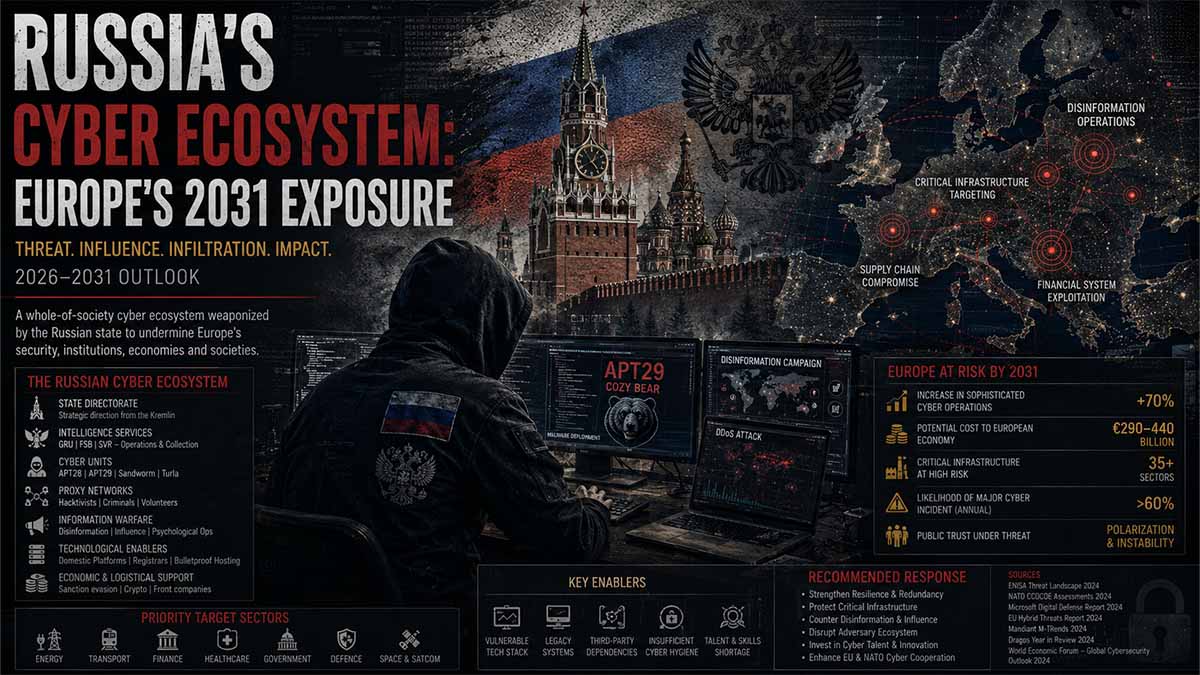
BLUF: The coordinated attribution issued on 13 July 2026 by the European Union, France, NATO, and the United Kingdom marks a strategic escalation from identifying isolated Russian intrusion groups to exposing an integrated state–criminal cyber-production system.
The primary intelligence finding is that the FSB’s 16th Centre, including Unit 61240, does not operate merely as a conventional espionage service: it directs, absorbs, repurposes, or benefits from capabilities distributed across intelligence units, malware developers, hosting providers, ransomware networks, private contractors, credential markets, and nominally independent hacktivists.
The ecosystem’s strategic advantage is functional interchangeability. The same stolen credential, compromised server, bulletproof host, university-recruited specialist, or criminal malware implant can support espionage, influence operations, revenue generation, pre-positioning in critical infrastructure, destructive sabotage, or wartime intelligence collection.
The most consequential verified development is the attempted Russian operation against Poland’s energy infrastructure, publicly assessed by the United Kingdom as capable—had it succeeded—of interrupting electricity for approximately 500,000 people during winter.
For France, the exposure is concentrated in defence research, diplomatic networks, ministries, advanced technology and the integrity of the 2027 electoral cycle. For Germany, the principal risk lies in federal institutions, industrial control environments, defence logistics and interconnected Central European energy systems.
For Italy, the greatest unrecognized vulnerability is not a single agency or malware family but the convergence of maritime logistics, energy import terminals, undersea infrastructure, defence manufacturing, municipal utilities, healthcare systems and thousands of comparatively weak suppliers connected to nationally critical operators.
For the United Kingdom, Russian cyber operations increasingly merge intelligence collection with credential theft, ransomware infrastructure, illicit finance, foreign-information manipulation and proxy recruitment. British authorities reported at least 2,100 domestic Lumma Stealer victims within six months.
The five-year outlook is dominated by persistent sub-threshold coercion rather than a single “cyber war” event: credential harvesting, identity compromise, cloud persistence, operational-technology reconnaissance, contractor exploitation, election targeting, sabotage preparation and selective destructive attacks calibrated to remain below an uncontested NATO collective-defence threshold.
The central policy failure would be to treat attribution and sanctions as the end of the response. The required transition is from incident-centric cybersecurity to campaign-level counter-ecosystem warfare, combining intelligence, financial disruption, infrastructure seizure, criminal prosecution, offensive cyber effects, supplier regulation, military planning and collective political signalling.
Russia’s Cyber Ecosystem Has Turned Europe’s Infrastructure into a Battlespace
Europe’s confrontation with Russian cyber power entered a new phase on 13 July 2026. The European Union formally identified the 16th Centre of Russia’s Federal Security Service, or FSB, as controlling intrusion groups including TURLA; France attributed sustained espionage against its strategic institutions to FSB Unit 61240; NATO declared the campaign a threat to Allied security; and the United Kingdom joined the EU in sanctioning the military officers, private companies, malware developers and criminal facilitators that sustain it. This was not another warning about hackers. It was the public exposure of a production system able to convert stolen credentials, criminal infrastructure, intelligence units and private contractors into political pressure, industrial espionage and latent sabotage. Europe’s vulnerability lies less in one unprotected ministry than in the thousands of suppliers, cloud identities, ports, hospitals and engineering systems on which national power now depends.
The Russian System
The decisive finding is organisational. Moscow’s cyber power is not confined to uniformed specialists operating inside a single command. The FSB conducts long-duration intelligence collection; units of the GRU support military, disruptive and hybrid operations; private companies recruit personnel and manage infrastructure; ransomware networks create access and economic damage; information-stealing malware supplies credentials; bulletproof-hosting providers sustain command servers; and nominally independent hacktivists claim responsibility, intimidate governments and complicate attribution.
The EU’s 13 July declaration named the FSB’s 16th Centre and stated that its activities had included infiltration of government networks and sabotage against critical infrastructure. NATO simultaneously condemned Russia’s use of a wider cyber ecosystem against Allies and partners.
The United Kingdom supplied the clearest view of the supporting architecture. Its sanctions package identified senior GRU figures Vyacheslav Stafeyev, Ivan Senin and Ivan Kasyanenko and stated that the cyber division of GRU Unit 29155 worked with cybercriminals and the company IMPULS to recruit hackers and technical specialists from Russian universities and academies. London also reported that credentials stolen through Lumma Stealer had supported Russian espionage and that at least 2,100 British victims had been identified within six months.
This division of labour gives Russia strategic elasticity. A criminal infection can become an intelligence entry point; a compromised router can become a relay for state espionage; ransomware can create disruption without an immediately visible military signature; and a hacktivist claim can conceal a deeper operation against energy, transport or government systems. The state does not need to control every participant continuously. It needs the ability to protect, task, recruit or exploit them when their capabilities become useful.
France: The Espionage Laboratory
France has already documented the target logic. Paris stated on 13 July 2026 that Unit 61240 had conducted persistent espionage against French strategic interests. The official chronology includes compromise of Ministry of the Armed Forces email accounts from at least 2017, penetration of the French Embassy network in Moscow in 2018, compromise of a justice-sector server in 2019, and a February 2025 operation against a research institute specialising in sensitive technologies and supporting the defence sector.
These were not unrelated targets. Military correspondence reveals personnel, programmes and policy; diplomatic networks expose reporting and negotiations; judicial systems contain identities and investigations; research institutes provide intellectual property and access to defence supply chains. France is targeted because it combines nuclear deterrence, aerospace, naval power, diplomacy and strategic autonomy inside Europe.
The next sensitive window is the 2027 electoral cycle. The likely Russian objective is not necessarily manipulation of voting systems. Campaign mailboxes, advisers, polling firms, media organisations, cloud accounts and personal devices offer intelligence and material for timed disclosure. Authentic documents can be mixed with altered files, synthetic audio or fabricated correspondence, compressing the time available for verification. The 2017 French presidential campaign demonstrated the strategic value of a late hack-and-leak operation; generative artificial intelligence now makes multilingual targeting and document manipulation faster and cheaper.
France’s main structural weakness is the distance between highly protected sovereign systems and the broader ecosystem of regional authorities, research partners, hospitals, energy suppliers and subcontractors. A state actor can bypass the core by entering through the periphery.
Germany: Europe’s Industrial Multiplier
Germany is the most important industrial propagation target. An attack against a specialised German supplier can interrupt production in several countries because automotive, chemicals, machinery, electronics, rail and defence manufacturing depend on tightly connected chains of small and medium-sized companies.
The Federal Office for Information Security, BSI, described the national situation in 2025 as persistently tense. Official German reporting cited approximately 950 ransomware attacks, with roughly 80% of reported attacks affecting SMEs. Those numbers matter because many Mittelstand firms possess unique technical knowledge or manufacture components that cannot be replaced rapidly.
Russian operators will seek production schedules, industrial software, engineering data, defence capacity and supply bottlenecks. The most credible entry points are managed-service providers, developer repositories, remote-maintenance systems, cloud identities and specialised subcontractors. It is unnecessary to manipulate a factory’s machinery when encrypting warehouse, planning or quality-control systems can stop production.
Germany is also NATO’s principal continental logistics bridge. Railways, ports, freight terminals, fuel suppliers, customs systems and civilian contractors support movement toward Poland and the Baltic region. A short disruption during an Allied reinforcement operation could have more strategic value than a much longer commercial outage. Russian military intelligence will therefore map not only military networks but the civilian systems on which mobilisation depends.
Britain: Concentration Risk
The United Kingdom presents a different vulnerability: the concentration of strategic services in cloud infrastructure, data centres, finance, telecommunications and private critical-infrastructure operators.
During the 2024–2025 reporting year, the National Cyber Security Centre received 1,727 incident reports, converted them into 429 cases requiring direct support, and classified 204, or 48%, as nationally significant. Eighteen were considered highly significant, almost 50% more than in the previous year and the third consecutive annual increase.
Russia’s most valuable British targets include the nuclear-deterrent supply chain, AUKUS, the UK–Italian–Japanese Global Combat Air Programme, data centres, financial institutions, NHS suppliers and telecommunications. Direct penetration of the most protected military environments is difficult; engineering companies, universities, recruitment providers and multinational collaboration platforms provide more accessible routes.
The UK designated data centres as critical national infrastructure because they support finance, healthcare, government and the wider economy. This concentration produces efficiency but also systemic risk: one privileged identity, network-management platform or critical supplier can affect many organisations. Russia can exploit this architecture for espionage, while ransomware groups can unintentionally or deliberately create national-level effects.
Britain nevertheless possesses an important advantage: it can combine GCHQ intelligence, NCSC technical operations, law enforcement, financial sanctions and corporate-registry analysis. The challenge is to use those instruments continuously against hosting providers, front companies, wallets and recruiters rather than only after a major incident.
Italy: The Mediterranean Weak Link
Italy is exposed through fragmentation. Its strategic value lies in ports, energy routes, defence manufacturing, NATO logistics, telecommunications, healthcare and the thousands of SMEs that connect these sectors.
The attack surface extends beyond Rome. Trieste, Genoa, La Spezia, Livorno, Naples, Taranto, Augusta, Ravenna and Gioia Tauro combine commercial, naval, industrial or energy significance. The relevant targets are not only port authorities but terminal software, customs interfaces, shipping agents, railway connections, freight platforms and maintenance providers. Compromise of one contractor could reveal military cargo, create congestion or delay strategic movement without requiring physical damage.
Energy diversification creates a second target set. Italy’s gas imports, LNG infrastructure, electricity distribution and renewable-management systems are strategically important because they reduce European dependence on Russia. Moscow has an incentive to collect data on flows, storage, maintenance and emergency procedures. Large operators may be well defended; local distributors, engineering contractors and remote-access providers offer easier routes toward operational intelligence.
The defence-industrial supply chain is equally exposed. Italy’s participation in GCAP and its capabilities in aerospace, electronics, missiles and naval construction create high-value targets among laboratories, software developers and specialised manufacturers. The central weakness is supplier asymmetry: a company with several dozen employees may hold unique programme data but lack the security capacity of a national prime contractor.
Healthcare and municipalities add political vulnerability. Italy’s National Cybersecurity Agency reported continued growth in malicious activity in 2025 and has identified a wide maturity gap among smaller organisations. Russian-directed actors need not cause a national blackout to impose costs. Repeated disruption of hospitals, local authorities or transport systems can erode confidence and absorb state resources while remaining below an obvious military threshold.
The European Choke Point
At Union level, Russia will target the machinery that converts national preferences into common policy: the European Commission, Council, Parliament, External Action Service, sanctions teams, customs authorities and defence initiatives. Access would provide advance knowledge of sanctions, Ukraine assistance, energy policy and divisions among member states.
The wider danger is cross-border concentration. ENISA’s 2025 threat assessment examined 4,875 incidents recorded between 1 July 2024 and 30 June 2025. DDoS represented 77% of the reported incidents, largely driven by hacktivists, while ransomware remained the most consequential threat. ENISA’s executive director Juhan Lepassaar warned that interdependent services allow disruption at one point to ripple through entire supply chains.
Europe’s cloud, financial, satellite, transport and energy systems are multinational, while incident response remains substantially national. Russia benefits from the interval between first detection in one country and recognition of a coordinated campaign across several. NIS2, the Cyber Solidarity Act and common crisis mechanisms strengthen the legal framework, but regulation does not guarantee clean recovery, manual operating capability or real-time intelligence sharing.
The Cost of Delay
The European response cannot end with attribution and sanctions. The target is an ecosystem capable of replacing malware, companies, servers and public identities. Effective deterrence requires simultaneous pressure on several layers: phishing-resistant authentication, supplier certification, operational-technology segmentation, isolated recovery systems, infrastructure seizures, cryptocurrency tracing, prosecutions and coordinated offensive cyber action where legally authorised.
NATO’s declaration that Russian cyber activity threatens Allied security is therefore more than diplomatic language. It begins the transition from treating cyber incidents as technical emergencies to treating them as components of strategic coercion. The central question for Europe is no longer whether Russia will penetrate national systems. It is whether a stolen identity, compromised supplier or hijacked router can be converted into enduring political or military advantage.
That contest will be decided not by the number of attacks prevented, but by the speed with which Europe can identify dependencies, isolate compromise, continue essential services and impose costs on the organisations that make Russian cyber power scalable.
Navigational Index
Russian Targeting of Europe: National Attack Vectors, Critical Dependencies and Exploitable Structural Weaknesses, 2026–2031
Russia’s European cyber campaign should be understood as a system for acquiring political, military, industrial and societal leverage rather than as a collection of attacks against computers.
Pillar I — The Russian Cyber Production System
Command relationships linking the FSB, GRU, state-directed technical units, private companies, criminal marketplaces, bulletproof hosting providers, malware developers, ransomware operators and pseudo-hacktivist brands.
Pillar II — European National Exposure
Comparative assessment of the attack surface, systemic dependencies, strategic sectors and escalation pathways affecting Italy, France, Germany, the United Kingdom, the wider European Union and NATO’s eastern flank.
Pillar III — Five-Year Conflict Outlook, 2026–2031
Bayesian scenario estimates, competing hypotheses, indicators and warnings, campaign trajectories, potential strategic shocks, deterrence options and capability requirements for European and NATO decision-makers.
Master Abstract
The 13 July 2026 attribution represents a structural change in how European governments publicly describe Russian cyber power. The European Union did not restrict its accusation to a malware signature, an intelligence service or an isolated hostile operation. It formally denounced a Russian cyber ecosystem “encompassing state and non-state actors,” explicitly extending responsibility from intelligence organisations to cybercriminal groups, self-declared hacktivists and private companies. The declaration identified the 16th Centre of the Federal Security Service as controlling multiple cyber-threat groups, including TURLA, and stated that France, Germany, Poland, Cyprus, the Netherlands, Austria, Slovakia, Romania and Finland had been targeted. The EU further differentiated operational purposes: government-network infiltration, defence-industrial espionage and disruptive sabotage against critical infrastructure, including combined heat-and-power facilities in Poland. It simultaneously imposed restrictive measures against nine individuals and four entities, including intelligence officers and non-state facilitators. This establishes the analytical baseline for the present report: Russian cyber activity is best understood not as a hierarchical organisation chart but as a modular production architecture. State services establish strategic requirements, intelligence priorities, target selection, operational tolerance and protection from prosecution; military or security units supply advanced tradecraft and classified access; commercial entities provide server management, recruitment, procurement, payment mechanisms and plausible corporate cover; criminal operators provide scalable malware deployment, initial access, monetisation and credential inventories; hacktivist identities provide rapid propaganda exploitation and deniable disruption. The ecosystem does not require every participant to receive direct orders. Its effectiveness derives from strategic alignment, permissive jurisdiction, shared infrastructure, overlapping personnel, selective tasking and the state’s ability to appropriate criminal capabilities when operationally useful. — Cyber / Russia: Statement by the High Representative – Council of the European Union – July 2026
France’s parallel attribution supplies the most operationally specific public evidence concerning the FSB component. Paris identified the 16th Centre and specifically Unit 61240 as responsible for targeting French interests through the TURLA intrusion set. The official French chronology records targeting of Ministry for the Armed Forces email accounts from 2017, compromise of the French Embassy in Moscow’s diplomatic network in 2018, unauthorised access to a judicial-sector server in 2019, and a February 2025 intrusion into a research institute specialising in sensitive technologies and working for the French defence industry, from which a significant quantity of data was exfiltrated. The evidentiary significance is greater than the enumeration of four incidents. Together, the targets form an intelligence chain: military communications reveal defence priorities and personnel relationships; embassy networks reveal diplomatic reporting, source contacts and negotiating positions; judicial systems offer identity data, investigative records and privileged institutional correspondence; defence-linked research institutes provide access to intellectual property, prototype development, supplier structures and technologies potentially transferable to Russian military programmes. France’s attribution was produced through the Cyber Crisis Coordination Centre, bringing together ANSSI, DGSI, DGSE, the Directorate General of Armaments and COMCYBER. This whole-of-state attribution mechanism reduces the probability that the announcement reflects a narrow technical inference: it combines network forensics, domestic counter-intelligence, foreign intelligence, armaments-security knowledge and military cyber assessment. France also explicitly connected the threat to the forthcoming 2027 elections, indicating that Paris assesses the TURLA problem within a larger continuum linking espionage, information advantage, strategic interference and crisis preparation. — Statement of Attribution to Russia of Malicious Cyber Activities Targeting France – French Ministry for Europe and Foreign Affairs – July 2026
The United Kingdom’s disclosure adds quantitative evidence and clarifies the relationship between state objectives and criminal-scale infrastructure. London described the measures announced with the EU as the first coordinated UK–EU cyber-sanctions package of its type and targeted 24 individuals and entities associated with destructive cyber operations, hybrid activity and foreign-information manipulation. It named senior GRU figures and stated that the cyber division associated with GRU Unit 29155 worked with cybercriminals and the company IMPULS to recruit hackers and technical specialists from Russian universities and academies. This recruitment model is strategically important because it converts the civilian technical-education system into a reservoir for deniable state capacity while allowing private organisations to conduct vetting, contracting, payment and operational support outside visible military establishments. The UK also stated that the attempted FSB operation against Poland’s energy grid could have deprived approximately 500,000 citizens of electricity during winter. Even though the operation reportedly failed, its potential effect transforms the evidentiary picture: the campaign was not confined to intelligence theft or symbolic denial-of-service activity but incorporated a plausible pathway toward mass civilian disruption. British authorities further linked Russian intelligence objectives to Lumma Stealer, reporting at least 2,100 victims in the United Kingdom during the preceding six months and assessing that stolen credentials had been used to support Russian cyber-espionage operations. Credential-stealing malware therefore constitutes more than indiscriminate cybercrime. It creates a continuously refreshed access marketplace from which intelligence services can identify government employees, defence contractors, researchers, transport operators and administrators whose browser sessions, authentication tokens, cloud accounts or cryptocurrency holdings can be operationalised. — UK and EU Strike Russian Cyber Networks with New Sanctions – UK Foreign, Commonwealth & Development Office – July 2026
NATO’s intervention elevates these findings from national cyber incident management to Alliance deterrence. The North Atlantic Council declared that Russia’s persistent malicious cyber activities constitute a threat to Allied security, acknowledged the convergence between Russian state agencies and cybercriminal actors, and confirmed that NATO had strengthened its framework for integrating cyber effects into Alliance operations, missions and activities. Most importantly, NATO stated that it remained prepared to employ the full range of capabilities, respond at a time and in a manner of its choosing, and act beyond purely technical remediation. This language preserves ambiguity over whether a future response could involve diplomatic pressure, sanctions, arrests, intelligence exposure, infrastructure takedowns, military cyber operations or non-cyber instruments. Yet ambiguity alone does not solve the escalation problem. Russia’s operational model is designed to fragment causality: one actor steals credentials, another maintains infrastructure, a third conducts reconnaissance, a fourth publicises the intrusion, and a state unit exploits the resulting intelligence. No individual event may appear sufficient to trigger collective defence, while the cumulative campaign changes military readiness, political confidence and infrastructure reliability. The critical NATO problem for 2026–2031 is therefore cumulative attribution—determining when separate intrusions form a strategically coherent campaign whose aggregate effects approach armed coercion. NATO doctrine has already acknowledged that a single or cumulative set of malicious cyber activities could, case by case, reach the level of armed attack. The July 2026 declaration now supplies a concrete adversarial ecosystem against which that cumulative-impact doctrine must be operationalised. — Statement of Condemnation by the North Atlantic Council – NATO – July 2026
For Italy, the highest-probability strategic danger is ecosystem exploitation across sectors whose national importance is disproportionate to their cyber uniformity. Italy combines major Mediterranean ports, liquefied-natural-gas facilities, electricity interconnectors, defence and aerospace production, NATO installations, government ministries, municipal utilities, healthcare organisations, rail systems, telecommunications infrastructure and dense networks of specialised small and medium-sized suppliers. The Italian attack surface is consequently federated: many nationally significant services depend on regional authorities, concession holders, engineering contractors, port-community systems, cloud providers, maintenance firms and component manufacturers that do not possess the security maturity of central government or major defence primes. A Russian campaign need not penetrate a highly protected ministry directly. It can compromise a legal adviser, software integrator, managed-service provider, logistics broker, port agent, industrial-equipment vendor or employee browser session and then use trusted relationships for lateral movement. Italy’s geopolitical role amplifies the intelligence value of such access. The country is a logistics bridge between continental Europe, the Balkans, North Africa and the central Mediterranean; it supports NATO operations and Ukraine; it hosts strategically relevant command and communications infrastructure; and it remains dependent on digitally coordinated maritime, energy and industrial flows. The most damaging Russian operation against Italy may therefore appear initially as criminal activity—a credential theft, supply-chain compromise, ransomware incident or service outage—before forensic reconstruction reveals intelligence collection, operational-technology reconnaissance or pre-positioning for future coercion. The decisive Italian requirement is not simply more perimeter protection but a national dependency graph identifying which suppliers, credentials, cloud tenants, industrial controllers and cross-border data exchanges can propagate local compromise into strategic disruption.
The comparative European picture indicates differentiated targeting rather than uniform pressure. France presents high-value targets in nuclear energy, defence research, aerospace, diplomacy and sovereign military planning; the publicly documented TURLA campaign confirms long-term collection against precisely those functions. Germany offers extensive industrial automation, chemical production, advanced machinery, transportation systems, energy-management infrastructure and federal decision-making networks; its centrality to European manufacturing means that disruption of German suppliers can propagate across the continent without attacking every affected country directly. The United Kingdom combines an advanced intelligence and cyber-defence apparatus with a global financial system, extensive cloud adoption, critical maritime infrastructure and large concentrations of commercially valuable identity data; its official disclosure of thousands of Lumma victims illustrates the scale of the criminal access layer. Italy occupies the Mediterranean logistics and energy junction, with systemic weaknesses arising from fragmented ownership, regional administration and heterogeneous supplier maturity. The strategic insight is that Russian planners can allocate ecosystem components according to target type. Highly sensitive governmental espionage can be entrusted to established intelligence intrusion sets; access acquisition can be outsourced to infostealer operators; disruptive operations can be branded as hacktivism; payment, hosting and recruitment can pass through companies; destructive effects can be prepared by military intelligence or specialised sabotage teams. This creates a portfolio of capabilities analogous to a diversified financial structure: high-risk operations are distributed, attribution costs are absorbed by expendable proxies, infrastructure is reused across campaigns, and losses from one takedown are compensated through alternative providers. Europe’s defensive institutions remain organised predominantly by national jurisdiction and sector, while the adversarial system optimises across borders, legal identities, technical platforms and operational purposes.
The baseline Bayesian estimate developed for this report assigns the highest probability not to a catastrophic continent-wide blackout but to sustained, selective and politically timed campaigns. The prior probability of persistent espionage and credential harvesting during every year of the 2026–2031 period is assessed at 0.92. Public confirmation of long-duration TURLA operations, the state exploitation of stolen credentials, and the integration of criminal facilitators raise the posterior probability of at least one serious Russian-linked compromise of a major European government, defence supplier, logistics network or essential-service operator during the five-year window to approximately 0.84. The probability of a disruptive but geographically contained operational-technology incident is assessed at 0.63, while the probability of a destructive event causing multi-day effects across more than one NATO state is assessed at 0.29. A cyber operation producing deaths directly or through cascading infrastructure failure remains lower, approximately 0.12, but cannot be dismissed because energy, healthcare, water, transportation and emergency-service systems increasingly depend on common digital identities and remote administration. These estimates are analytic judgements rather than actuarial forecasts. They derive from a structured combination of capability, demonstrated intent, access opportunities, target vulnerability, operational precedent and escalation constraints. The dominant restraint is not technical incapacity but political calibration: Moscow generally benefits more from persistent access and reversible disruption than from an unmistakable strategic attack that could unify NATO and legitimise a collective counter-operation.
The Analysis of Competing Hypotheses produces five principal explanatory frameworks. H₁: Centralised orchestration holds that Russian intelligence services exercise direct operational control over most significant proxy campaigns. H₂: Managed permissiveness assesses that the state protects and selectively tasks actors that otherwise retain commercial or ideological autonomy. H₃: Opportunistic convergence proposes that intelligence services mainly exploit access and data generated independently by cybercriminals. H₄: Wartime mobilisation interprets the ecosystem as an expanding auxiliary force built to compensate for resource constraints created by the war against Ukraine. H₅: Strategic ambiguity architecture argues that organisational complexity is itself the capability, deliberately engineered to frustrate attribution, legal response and NATO threshold determination. Current official evidence most strongly supports a hybrid of H₂ and H₅. The UK’s account of recruitment through IMPULS, the EU’s explicit identification of private companies and hacktivists, the use of Lumma-derived credentials for state espionage and the coexistence of intelligence units with criminal infrastructure indicate neither a completely centralised command system nor an entirely spontaneous criminal marketplace. The most likely model is selective state direction embedded within a broader protected ecosystem. This structure maximises scalability while reducing the state’s burden of funding, training and maintaining every operator. It also permits Moscow to disavow tactically inconvenient actions while retaining the strategic benefits of a European environment characterised by higher security costs, disrupted services, uncertainty and declining public trust.
The five-year trajectory will be shaped by five interacting variables: the duration and intensity of the war against Ukraine; the degree of NATO cyber-force integration; European enforcement against cryptocurrency, hosting and access-broker infrastructure; the speed of artificial-intelligence adoption by both attackers and defenders; and the political willingness to impose non-cyber costs for cumulative cyber campaigns. The central forecast is an evolution from malware-centred intrusion toward identity-centred campaign architecture. Stolen browser cookies, OAuth tokens, remote-management credentials, cloud-administrator accounts, developer secrets and machine identities will become increasingly valuable because they bypass conventional perimeter defence and provide access to interconnected services. Artificial intelligence will improve multilingual phishing, target profiling, vulnerability prioritisation, malware adaptation and the processing of exfiltrated documents. Russian operators will likely combine AI-assisted collection with traditional intelligence discipline rather than depend on fully autonomous offensive systems. Simultaneously, operational-technology reconnaissance will expand in the energy, water, port, rail and manufacturing sectors, especially where legacy systems connect to corporate networks or third-party maintenance platforms. The most dangerous period will arise during a severe NATO–Russia confrontation, an election crisis, a major escalation in Ukraine or a breakdown in European energy security. In such conditions, accesses accumulated for espionage could be converted into disruption, while criminal or hacktivist fronts provide an initial layer of deniability.
European Cyber-Escalation Codex
Russian Targeting Architecture Against Europe: National Target Sets, Attack Pathways, Structural Weaknesses and Strategic Effects, 2026–2031
1. Strategic Targeting Doctrine: Russia Attacks National Functions Through Their Weakest Digital Dependencies
Russia’s European cyber campaign should be understood as a system for acquiring political, military, industrial and societal leverage rather than as a collection of attacks against computers. The strategic object is the national function: government decision-making, military mobilisation, weapons production, diplomatic coordination, electricity, heat, water, healthcare, telecommunications, finance, transport, cloud computing, elections and public confidence. The technical target is selected only after Russian intelligence or proxy operators determine which digital dependency supports that function and which accessible node offers the best combination of strategic value, low entry cost, deniability and propagation potential. A major defence ministry may possess hardened networks, but the engineering consultancy, travel provider, software supplier, recruitment contractor, research institute or personal cloud identity supporting its personnel may not. A national electricity-transmission operator may maintain mature operational security, but a renewable-energy aggregator, regional distribution company, remote-maintenance provider or industrial equipment vendor can provide intelligence about topology, recovery procedures and trusted access. A port authority may secure its own central environment, but cargo scheduling, trucking coordination, customs brokerage, terminal software, rail connections and communications are frequently distributed across multiple organisations. The Russian decision model therefore does not ask, “Which country has the weakest cyber defence?” It asks, “Which external dependency can be converted into strategic access while keeping attribution and retaliation costs below the expected intelligence or coercive benefit?” The European Union’s July 2026 attribution explicitly described a Russian malicious cyber ecosystem encompassing state and non-state actors and named the FSB’s 16th Centre, criminal organisations, malware developers, private companies and pseudo-hacktivist groups. NATO separately declared that persistent Russian malicious cyber activities constitute a threat to Allied security. These coordinated conclusions support the assessment that Russia can allocate different phases of one campaign to different actors rather than rely on a single unit or malware family. — Cyber/Russia: Statement by the High Representative on behalf of the European Union – Council of the European Union – July 2026 — Official source; Statement of Condemnation by the North Atlantic Council of Russia’s Malicious Cyber Activities – NATO – July 2026 — Official source.
The Russian targeting architecture can be divided into eight operational phases. The first phase is strategic requirement generation, in which political and intelligence authorities identify priorities such as monitoring European weapons deliveries, understanding sanctions policy, acquiring defence technology, preparing military-mobility disruption or weakening confidence before an election. The second is dependency discovery, using public procurement records, professional networks, commercial databases, compromised email, stolen browser data and previous incidents to identify suppliers, identities and platforms connected to the national function. The third is access acquisition, which may be performed by state operators, infostealer groups, phishing teams, ransomware affiliates, vulnerability exploiters or commercial access brokers. The fourth is access validation, during which attackers determine whether credentials or systems provide meaningful connectivity to the strategic target. The fifth is mission conversion: access originally created for crime can be purchased, transferred, coerced or repurposed for intelligence. The sixth is persistence and reconnaissance, including mapping identities, cloud roles, suppliers, backup systems and, where relevant, operational technology. The seventh is effect selection, ranging from silent espionage to data leakage, ransomware, distributed denial of service, manipulation or destructive action. The eighth is narrative and escalation management, in which a hacktivist identity, criminal brand or ambiguous public claim can conceal state benefit or complicate collective response. This model explains why incident labels can be misleading. A ransomware intrusion may be strategically relevant even if the initial motivation is financial, because it reveals credentials, administrative procedures and recovery architecture. A DDoS campaign may be more than symbolic if it diverts defenders while a separate intrusion proceeds. A cloud-account compromise may appear minor but expose correspondence, authentication relationships and documents across multiple organisations. ENISA’s 2025 Threat Landscape, based on 4,875 incidents from July 2024 through June 2025, found growing convergence among actors that reuse tools, exploit common vulnerabilities and collaborate despite different motivations. That convergence is exactly what enables Russia to assemble strategic campaigns from commercially available or criminal components. — ENISA Threat Landscape 2025 – European Union Agency for Cybersecurity – October 2025 — Official source.
Russian Strategic Cyber Targeting Architecture
Interactive End-to-End Continuum: Strategic Objectives, Functional Targets, Weakest Dependencies, Threat Actors & Output Cascades
Acquire Political/Military Intel
Identify Defence Bottlenecks
Delay NATO Reinforcement
Weaken Support for Ukraine
Impose Economic/Social Costs
Prepare Latent Disruption
Undermine Public Trust
Government & Diplomacy
Defence & Logistics
Energy, Water & Comms
Ports, Rail & Customs
Healthcare & Emergency
Finance, Cloud & Data
Elections & Media
SME / Subcontractor
Managed-Service Provider
User / Contractor Identity
Remote Maintenance
Router / VPN Gateway
Regional Authority
Shared Soft / Carrier
TURLA Espionage
APT28 / Intel Ops
Sandworm / Wipers
Sabotage & Proxies
Ransomware / IABs
Pseudo-Hacktivists
Intelligence Collection
Industrial & Tech Theft
Political Leakage & Manipulation
Local/Sectoral Disruption
Cross-Border Cascade
Dormant Wartime Access
Key Assessment: Russian strategic targeting systematically identifies functional critical targets and isolates their weakest, least-defended digital dependencies (SMEs, edge devices, MSPs). By delegating tasking across specialized intelligence organs (FSB 16th, GRU 26165/74455/29155) and criminal proxies, the adversary converts initial access into multi-dimensional outputs—ranging from long-term espionage to pre-positioned wartime sabotage.
Interactive Analysis Ready
System ReadyHover over or select any node across objectives, functional targets, dependency vectors, or threat actors to inspect operational mechanics, intelligence taskings, and strategic outputs.
2. Cross-European Attack Technologies and Techniques
The most likely Russian attack technologies during 2026–2031 will not be limited to bespoke malware. They will combine proprietary intelligence-service tooling with ordinary enterprise credentials, legitimate administration software, compromised routers, criminal malware services and cloud functionality. Identity attacks will be especially important because European administrations and strategic companies increasingly depend on integrated cloud ecosystems. Passwords remain useful, but session cookies, refresh tokens, OAuth permissions, API keys, developer secrets, machine identities and service accounts can provide wider and more persistent access. A compromised identity may grant email, file-sharing, collaboration, source-code, virtual-private-network or administrative access without deploying a recognisable implant. Edge-device exploitation will remain attractive because routers, VPN concentrators, firewalls and remote-access appliances are exposed to the internet, frequently possess high privileges and may receive less behavioural monitoring than user endpoints. Supplier and MSP compromise can provide access to several customers through legitimate remote-management channels. Cloud persistence can be created through hidden applications, modified federation, new access keys or abused administrative roles. Operational-technology reconnaissance will focus on engineering workstations, historians, remote vendor connections and management platforms rather than immediately attempting dangerous control actions. Ransomware and destructive malware will be used selectively where interruption, recovery cost or public visibility is more valuable than continued intelligence collection. Distributed-denial-of-service operations will remain useful for propaganda, political signalling and diversion. Hack-and-leak operations will combine stolen material with strategic timing, while AI will improve multilingual phishing, target research, data triage and the production of manipulated narratives. The UK NCSC’s June 2026 warning on AI stated that advanced AI can increase the scale and speed of cyber operations, while the European Commission’s July 2026 AI cybersecurity initiative similarly recognised the ability of AI to identify vulnerabilities and automate attacks. — The AI Shift in Cyber Risk: Why Leaders Must Act Now – UK National Cyber Security Centre and International Partners – June 2026 — Official source; New EU Plan to Address the Risks and Opportunities of Advanced AI in Cybersecurity – European Commission – July 2026 — Official source.
| Attack technology or method | Likely operational user | Targeted layer | Why Russia would select it | Principal European deficiency exploited | Potential strategic result |
|---|---|---|---|---|---|
| Credential and session-token theft | State operators, infostealer ecosystems, access brokers | Cloud identities and web applications | Low visibility and broad account reach | Weak authentication, unmanaged devices, token persistence | Espionage without distinctive malware |
| OAuth and application abuse | State espionage teams | Cloud collaboration environments | Durable access through trusted applications | Incomplete application-permission governance | Long-term mailbox and document access |
| Edge-device exploitation | FSB/GRU and criminal operators | Routers, VPNs, firewalls, remote gateways | Internet exposure and high privilege | Slow patching and poor device telemetry | Relay infrastructure or network access |
| Supplier compromise | All ecosystem components | SMEs, MSPs, engineering and software firms | Bypasses mature prime-target security | Uneven supply-chain maturity | Trusted lateral movement and cross-customer propagation |
| Remote-maintenance abuse | GRU or state-directed technical teams | Energy, water, manufacturing and transport OT | Legitimate pathway into industrial environments | Vendor access and weak segmentation | Reconnaissance or localized physical disruption |
| Ransomware | Criminal affiliates, potentially state-tolerated actors | Healthcare, municipalities, logistics and industry | Immediate disruption and plausible criminal cover | Recovery dependence and flat networks | Service interruption and political pressure |
| Wipers or destructive payloads | GRU military cyber units | Government, logistics or critical infrastructure | Denies service during crisis or war | Inadequate clean recovery | Prolonged operational degradation |
| DDoS | Pseudo-hacktivists and rented infrastructure | Public portals and external services | Visible effect at low cost | Limited capacity and crisis communication weaknesses | Propaganda, distraction and public anxiety |
| Hack-and-leak | GRU-linked information operations | Political parties, ministries and media | Converts espionage into political effect | Slow verification and fragmented communication | Election or policy destabilisation |
| AI-assisted targeting | State and non-state actors | Personnel, suppliers and stolen datasets | Scales research and personalization | Large digital footprint and multilingual exposure | Faster target discovery and social engineering |
3. Italy — Strategic Target Geography and Russian Operational Logic
Russia will target Italy because Italy connects several strategic systems that matter to Moscow simultaneously: Mediterranean maritime access, NATO logistics, energy diversification, defence and aerospace programmes, European manufacturing supply chains, telecommunications links, regional healthcare and a highly distributed public administration. The Italian attack surface is broad because essential functions are divided among central ministries, regions, municipalities, national operators, concessionaires, healthcare authorities, private infrastructure owners and large populations of SMEs. ACN’s 2025 Annual Report states that the threat continued to intensify, while the agency’s second-half operational summary recorded 1,253 cyber events, 30% more than the preceding comparison period. ACN’s healthcare reporting found approximately 47.4% growth in cyber events affecting the sector during 2025 compared with 2024. These figures do not prove Russian responsibility for each event, but they demonstrate the volume and heterogeneity of the environment in which Russian operators can conceal or acquire access. Italy’s national resilience strategy also recognises critical infrastructure as a matter of national security and addresses energy, transport, banking, digital infrastructure, health, water, public administration, space and food systems. — Relazione annuale 2025 – Agenzia per la Cybersicurezza Nazionale – 2026 — Official source; Operational Summary, Second Half 2025 – Agenzia per la Cybersicurezza Nazionale – January 2026 — Official source; National Strategy for the Resilience of Critical Entities – Presidency of the Council of Ministers – 2025/2026 — Official source.
Italy: Maritime and Port Target Set
The primary Italian maritime targets are not limited to port authorities. The actual target system includes terminal operators, customs interfaces, shipping agents, freight forwarders, rail and trucking connections, gate-control systems, cargo databases, crane and warehouse management, port-community platforms, telecommunications, pilots, fuel services, security contractors and maintenance providers. Trieste, Genoa, La Spezia, Livorno, Civitavecchia, Naples, Taranto, Augusta, Ravenna and Gioia Tauro should be treated as assessed priority environments because of their combinations of commercial, naval, industrial, energy or logistics value; this is an analytic assessment based on their national functions, not a claim that each is known to have been compromised by Russia. Russian intelligence would target maritime environments for three distinct reasons. First, it could collect information on NATO or dual-use cargo, vessel movements, maintenance and logistical capacity. Second, it could identify bottlenecks capable of delaying military or commercial movement during crisis. Third, it could create deniable economic disruption through ransomware or manipulation of peripheral services. The most plausible attack path begins with an external organisation rather than a port’s central command network: a shipping agent’s cloud account, a terminal software supplier, a customs broker, a trucking platform, a rail contractor or a remote-maintenance identity. Once inside, an operator could map which services are essential, which accounts are trusted and which processes lack viable offline alternatives. The strategic effect does not require physical damage. Corruption or unavailability of cargo records, gate operations or scheduling can produce queues, delayed loading, security uncertainty and cascading commercial loss. A GRU-linked actor would value the military-logistics dimension; an FSB actor would value sustained collection; ransomware groups could create disruption while preserving state deniability. Italy’s central deficiency is that responsibility for one port community is distributed among many public and private entities, and security maturity is rarely uniform across the entire chain. The EU’s maritime-security framework explicitly recognises physical and cyber threats to ships and critical maritime infrastructure, confirming that maritime resilience must be treated as a combined security problem. — European Commission Report on Security Union Progress – European Commission – May 2024 — Official source.
Italy: Energy, Gas, LNG and Electricity
Russia has a direct strategic interest in Italian energy systems because Italy’s diversification away from Russian gas affects European resilience and Moscow’s economic leverage. The target set includes gas-import coordination, LNG operations, electricity generation and distribution, renewable-energy management, industrial control, balancing functions, corporate identity, telecommunications and engineering support. The most valuable Russian intelligence would include topology, import and storage data, maintenance schedules, emergency arrangements, interdependencies between gas and electricity, and the identities of technical personnel or vendors with privileged access. An FSB operation would probably emphasise persistent collection and network mapping. A GRU operation preparing contingency disruption would prioritise remote maintenance, engineering systems and restoration procedures. A pseudo-hacktivist group could target smaller renewable or municipal systems for visible but limited effects. The likely initial entry points are not necessarily central control rooms: they include contractor VPN accounts, maintenance providers, shared software, regional operators, exposed network devices and cloud identities used by engineering or operations teams. Italy’s structural weakness is heterogeneous control maturity across a distributed sector. Large national operators may possess mature security, but local distributors, renewable operators and service companies may retain legacy equipment, incomplete segmentation or supplier accounts that are difficult to monitor. Russia could exploit this asymmetry to produce intelligence or regional effects without attacking the most protected national systems. The critical warning indicator is movement from ordinary corporate IT into engineering workstations, industrial-management portals, backups or vendor remote-access architecture. Italy’s National Cybersecurity Strategy identifies the protection and resilience of essential services and strategic infrastructure as a central national objective. — National Cybersecurity Strategy 2022–2026 – Agenzia per la Cybersicurezza Nazionale – May 2022 — Official source; National Strategy for the Resilience of Critical Entities – Presidency of the Council of Ministers — Official source.
Italy: Defence, Aerospace and GCAP
Italy’s defence and aerospace ecosystem is a priority Russian intelligence target because it supports national and Allied capabilities and participates in multinational programmes. GCAP, developed by Italy, the United Kingdom and Japan, is officially intended to deliver a next-generation combat-air capability and strengthen the industrial and technological bases of all three countries. The programme’s governance includes the GCAP International Government Organisation and the industrial joint venture Edgewing, bringing together Leonardo, BAE Systems and Japan Aircraft Industrial Enhancement Co. The Italian Ministry of Defence describes the programme as strategically important for security, innovation, research and dual-use capability. Its multinational nature creates value and exposure: programme information, engineering data, supplier relationships and personnel may traverse multiple organisations, countries and collaboration environments. Russia would seek architecture, sensors, software, propulsion-related data, electronic warfare, programme schedules, production bottlenecks and supplier dependencies. Direct compromise of the most sensitive programme systems may be difficult; the more plausible route is through second- or third-tier suppliers, research partners, developer environments, recruitment or payroll systems, collaboration platforms or personal accounts belonging to technical staff. The attack would most likely be conducted by FSB or GRU espionage units, potentially using credentials obtained from criminal stealers or access brokers. Ransomware against a small supplier could also expose files or halt production without requiring state control of the criminal operator. Italy’s weakness is not lack of capability at the prime-contractor level; it is the large and geographically distributed network of SMEs and laboratories required to deliver advanced programmes. The defensive standard must therefore be based on programme consequence rather than company size. A small firm holding one unique component design or trusted collaboration account may be strategically more important than a much larger non-defence company. — Global Combat Air Programme Joint Statement – Italian Ministry of Defence – July 2025 — Official source; Global Combat Air Programme: Meeting between Italy, Japan and the United Kingdom – Italian Ministry of Defence – November 2025 — Official source; GCAP Agreement Signed in Tokyo – Italian Ministry of Defence – December 2023 — Official source.
Italy: Healthcare, Municipal Systems and Public Administration
Italian healthcare is attractive to criminal and state-linked actors because disruption creates immediate human and political consequences, while health networks contain identity, procurement, research and operational data. ACN reported a substantial increase in cyber activity affecting the sector during 2025 and has repeatedly identified ransomware as a threat with severe impact. Russia does not need to direct every healthcare attack to benefit from the effect. Criminal ransomware groups operating within a permissive Russian ecosystem can force hospitals or health authorities into degraded operations, divert national cyber resources and generate public anxiety. State services can later acquire credentials or technical knowledge created by such incidents. Likely entry routes include phishing, stolen browser credentials, vulnerable remote access, managed-service providers, diagnostic or laboratory suppliers and shared regional services. Municipal and regional authorities present related weaknesses: limited specialist staff, common software platforms, outsourced IT and uneven recovery capability. Russia could use pseudo-hacktivist DDoS campaigns to create visible political pressure, criminal ransomware for prolonged disruption, or espionage operations to collect identity and administrative data. The strategic effect is cumulative rather than necessarily catastrophic: repeated local failures can erode confidence in government, increase recovery costs and create uncertainty during wider crisis. The principal deficiency is fragmentation. A central agency can provide guidance and incident coordination, but operational responsibility may remain dispersed across hundreds of entities with different budgets, personnel and technology. — Healthcare under Cyber Threat: Attacks Increase in 2025 – Agenzia per la Cybersicurezza Nazionale – October 2025 — Official source; Annual Report 2025 – Agenzia per la Cybersicurezza Nazionale – 2026 — Official source.
| Italy: assessed target | Assessed location or ecosystem | Why Russia targets it | Most likely actor | Likely access path | Structural weakness | Intended effect |
| Port logistics | Trieste, Genoa, La Spezia, Livorno, Naples, Taranto, Augusta, Ravenna, Gioia Tauro | NATO movement, trade, naval and energy intelligence | GRU, FSB, criminal affiliates | Terminal supplier, freight identity, port-community platform | Distributed ownership and uneven supplier maturity | Collection, congestion or mobility delay |
| Gas and LNG | National import, storage and terminal ecosystem | Measure and weaken post-Russian energy resilience | FSB reconnaissance; GRU contingency access | Vendor VPN, maintenance contractor, edge device | IT–OT convergence and contractor dependence | Intelligence or localized disruption |
| Electricity and renewables | Transmission, distribution and distributed generation | Understand grid resilience and create political pressure | GRU or pseudo-hacktivist operators | Regional operator, remote management, aggregator | Distributed assets and legacy interfaces | Regional outage or public signalling |
| GCAP and aerospace | Italy–UK–Japan programme and supplier network | Advanced combat-air technology and programme intelligence | FSB/GRU espionage | SME, research partner, cloud identity, developer environment | Multinational collaboration and SME asymmetry | Technology theft and production insight |
| Naval and defence supply chains | Liguria, Piedmont, Lombardy, Veneto, Lazio, Campania, Puglia and other industrial clusters | Naval, electronics, missiles and production capacity | FSB/GRU | Subcontractor, engineering firm, research partner | Large distributed supplier base | Intelligence and bottleneck identification |
| Healthcare | Regional health authorities, hospitals, laboratories | Immediate civilian and political effects | Ransomware groups; state exploitation of access | Phishing, MSP, shared regional systems | Fragmentation and recovery dependence | Patient-care disruption |
| Municipal services | Regions, provinces and municipalities | Public pressure and identity collection | Hacktivists, criminals, espionage actors | Shared software or outsourced IT | Uneven maturity and staffing | Repeated local outages and data theft |
| Telecoms and cable connectivity | National backbone and Mediterranean landing environments | Military and commercial communications | FSB/GRU | Network-device compromise, contractor identity | Private ownership and cross-border dependencies | Espionage or crisis degradation |
4. France — Sovereign Defence, Nuclear-Energy Intelligence and Electoral Destabilisation
Russia will attack France because France possesses political and military capabilities whose value extends beyond the national level: nuclear deterrence, permanent membership of the UN Security Council, major diplomatic influence, autonomous military operations, defence and aerospace industries, space infrastructure and decisive weight inside the EU. French official attribution provides unusually concrete evidence of Russian target selection. Paris attributed activity to the FSB’s 16th Centre and Unit 61240, documenting compromise of French Ministry of the Armed Forces email accounts from at least 2017, penetration of the French Embassy network in Moscow in 2018, compromise of a justice-sector server in 2019, and targeting of a sensitive-technology research institute supporting the defence sector in 2025. This sequence demonstrates a coherent intelligence requirement rather than random intrusion. Defence correspondence provides personnel, doctrine and programme information; embassy networks provide diplomatic reporting and contacts; justice systems provide sensitive institutional and identity data; research institutes provide technical knowledge and supplier relationships. France’s Cyber Crisis Coordination Centre brought together ANSSI, DGSI, DGSE, DGA and COMCYBER for the attribution, indicating a multi-source state assessment rather than a narrow technical conclusion. — Attribution to Russia of Malicious Cyber Activities for Espionage Purposes in France – French Ministry for Europe and Foreign Affairs – July 2026 — Official source; Panorama de la cybermenace 2025 – ANSSI/CERT-FR – February 2026 — Official report.
France: Defence, Nuclear Deterrence and Aerospace
The highest-priority French targets are the Presidency, Ministry for the Armed Forces, diplomatic service, defence procurement, nuclear-deterrence ecosystem, aerospace, naval construction, missile development, space systems and research institutes. Assessed geographic concentrations include Paris and Île-de-France for national decision-making and corporate headquarters; Toulouse for aerospace and space; Bordeaux and the southwest for aerospace and defence activity; Brest and Île Longue for naval and deterrence-related functions; Toulon for major naval operations; and French Guiana for European space-launch infrastructure. These are analytic target assessments based on strategic function and should not be interpreted as official confirmation of Russian compromise. Russia’s primary purpose would be sustained espionage: force posture, nuclear policy, weapons support to Ukraine, procurement, research, programme delays, supplier dependencies and diplomatic intentions. FSB operators would be suited to long-duration clandestine access. GRU units would value operational military information, logistics and information suitable for strategic disclosure. Initial access would probably come from defence suppliers, researchers, personal accounts, professional services, international collaboration or exposed edge systems rather than direct penetration of the most protected military networks. France’s principal structural weakness is the gap between highly protected central systems and the wider ecosystem of subcontractors, universities, regional industry and external service providers. ANSSI’s 2025 panorama described continued pressure on defence-related entities and subcontractors, reinforcing the assessment that the supply chain remains a central avenue of approach. — Panorama de la cybermenace 2025 – ANSSI/CERT-FR – February 2026 — Official source.
France: Energy, Nuclear Generation, Water and Distributed OT
France’s energy system is strategically valuable because electricity generation underpins national autonomy, industrial output, public services and European energy relationships. Russian services would seek intelligence on generation capacity, maintenance, fuel, workforce, emergency procedures, interconnections and the relationships between large operators and specialist suppliers. Direct action against nuclear safety systems would carry enormous escalation risk and is not the baseline forecast. More plausible activity would target corporate IT, engineering contractors, vendor access, distributed generation or surrounding operational dependencies. ANSSI’s official January 2026 guidance stated that it had observed multiple compromises involving renewable-energy production and water-management organisations and warned that small operators or individuals sometimes managed installations through inadequately secured interfaces. This creates an exploitable two-tier environment: highly regulated national assets coexist with small renewable, pumping, treatment or monitoring installations whose remote management may be exposed or poorly segmented. A Russian pseudo-hacktivist or delegated actor could use a small installation to produce visible local physical effects and propaganda while avoiding the technical and political barriers surrounding major national systems. A GRU-linked operation could use the same class of targets for reconnaissance and testing. The warning indicators are access to engineering workstations, modification of remote-management accounts, unusual queries against industrial protocols, and activity directed at backups or restoration systems. — Recommendations for Renewable-Energy Production and Water-Management Operators – ANSSI/CERT-FR – January 2026 — Official source; Panorama de la cybermenace 2024 – ANSSI/CERT-FR – March 2025 — Official source.
France: 2027 Electoral Ecosystem
France’s 2027 presidential and legislative cycle will be a high-priority Russian target because the political direction of France affects EU defence, Ukraine support, sanctions and NATO policy. The attack surface is much wider than formal voting systems. It includes candidate and party email, personal devices, cloud applications, advisers, polling organisations, campaign suppliers, donors, communications agencies, local authorities, media and fact-checking organisations. The Russian purpose could be intelligence collection, preparation of political leverage, selective publication of authentic documents, insertion of manipulated material or disruption of public information. The likely campaign would begin months or years before voting through credential theft and target mapping. It would then build persistence, identify politically damaging material and register or prepare dissemination infrastructure. Close to the vote, the operation could use a leak, DDoS attack, synthetic audio or manipulated document timed to reduce the period available for verification. GRU-linked information operations would be the best organisational fit, while criminal infostealer data could provide initial access and pseudo-hacktivist accounts could amplify the narrative. France’s deficiency is not primarily vote-system security; it is the broad, privately managed and personally owned political ecosystem surrounding elections. The 2017 campaign precedent demonstrates the utility of timing and disclosure, while France’s 2026 attribution explicitly linked Russian espionage concerns to protection of the 2027 elections. — Attribution to Russia of Malicious Cyber Activities for Espionage Purposes in France – French Ministry for Europe and Foreign Affairs – July 2026 — Official source.
France: Local Authorities, Healthcare and Public Confidence
France’s local authorities and healthcare providers are attractive because they combine public visibility, operational sensitivity and uneven defensive maturity. ANSSI handled 218 incidents affecting territorial authorities in 2024 and stated that, although financial motivation dominates, local authorities can also be targeted for destabilisation or state espionage. Its 2025 panorama recorded 128 ransomware compromises, with local authorities representing 11% and healthcare organisations 8% of reported cases. These figures do not attribute the majority to Russia, but they define a vulnerable environment in which Russian-protected criminals or state-linked actors can create strategic effects. The likely attack route is phishing, compromised remote services, shared software, outsourced administration or exposed internet systems. The effect may include interruption of civil registration, social services, local finance, hospital scheduling, diagnostics or communication. Repeated local incidents during a national political crisis could be coordinated or amplified to portray the state as unable to govern. Russia would gain even where the technical effect remained local, because public trust and media attention are national. — Territorial Authorities: Threat Synthesis – ANSSI/CERT-FR – February 2025 — Official source; Panorama de la cybermenace 2025 – ANSSI/CERT-FR – February 2026 — Official source.
| France: assessed target | Assessed location or ecosystem | Russian objective | Likely actor | Likely access path | Structural deficiency | Expected effect |
| Presidency and ministries | Paris/Île-de-France | Political, military and diplomatic intelligence | FSB/TURLA, GRU | Personal identity, supplier, diplomatic outpost | Wide external ecosystem around hardened core | Strategic collection |
| Nuclear-deterrence ecosystem | Brest/Île Longue and national supplier network | Deterrence doctrine, readiness and programme insight | FSB/GRU espionage | Supplier, engineering partner, personnel identity | Specialised distributed supply chain | High-value military intelligence |
| Naval operations | Toulon and Brest | Fleet posture and operational support | GRU and FSB | Contractor, logistics, communications | Civil–military support dependence | Operational intelligence |
| Aerospace and space | Toulouse, Bordeaux, French Guiana and suppliers | Aircraft, satellite, missile and launch intelligence | FSB/GRU | Research, developer environment, contractor | Collaborative R&D and multinational supply chains | Technology theft |
| Energy and water | National generation plus distributed operators | Resilience mapping and latent disruption | FSB reconnaissance, GRU or proxies | Remote management, engineering contractor | Two-tier maturity between major and small operators | Local or regional physical effect |
| 2027 electoral ecosystem | National parties, campaigns and media | Political intelligence and legitimacy erosion | GRU-linked influence actors | Cloud account, personal device, campaign supplier | Broad private attack surface | Leak, manipulation or disruption |
| Local authorities | Municipal and regional administrations | Destabilisation and public pressure | Criminals, hacktivists, state actors | Shared services and exposed systems | Uneven local security | Cumulative service disruption |
| Healthcare | Hospitals and service suppliers | Civilian harm and crisis visibility | Ransomware groups and state-linked exploitation | Supplier, identity and remote service | Recovery and supplier dependence | Care delays and public anxiety |
5. Germany — Industrial Propagation, Defence Production and NATO Mobility
Russia will target Germany because Germany is the central industrial and logistical node of continental Europe. The strategic value of German compromise lies less in one symbolic national system than in the ability to create effects across many countries through supply chains, manufacturing, freight, energy and military mobility. BSI’s 2025 IT Security Situation Report described the situation as remaining tense and linked growing attack surfaces to continued digitalisation. Official German reporting cited approximately 950 ransomware attacks, with about 80% of reported attacks affecting SMEs. These figures are particularly important because German SMEs frequently provide unique engineering, machinery, software, chemical, automotive or defence capabilities. A company can be small in revenue yet irreplaceable in a supply chain. Russia’s target-selection process will therefore focus on consequence, uniqueness and network position rather than company size. — The State of IT Security in Germany 2025 – Federal Office for Information Security – 2025 — Official report portal; Die Lage der IT-Sicherheit in Deutschland 2025 – Bundesamt für Sicherheit in der Informationstechnik – 2025 — Official data summary.
Germany: Industrial and Mittelstand Target Set
The primary target geography includes Berlin for federal decision-making; Hamburg and Bremerhaven for maritime logistics; the Rhine-Ruhr region for industry and energy; Baden-Württemberg and Bavaria for automotive, machinery, electronics and aerospace; Lower Saxony for automotive and industrial production; Saxony for semiconductors and advanced manufacturing; and major chemical and process-industry corridors along the Rhine and elsewhere. These locations are assessed strategic target environments, not assertions of known Russian compromise. Russia’s intelligence objective would include production capacity, weapons and dual-use output, technology, sanctions-sensitive components, supplier dependencies and the location of industrial bottlenecks. The most plausible attack pathway is through engineering firms, MSPs, software providers, developer repositories, remote-maintenance accounts or ordinary business identities. Industrial operations depend on enterprise-resource planning, warehouse management, quality systems, production scheduling and supplier communication. An attacker does not need to manipulate machinery directly to halt production; encryption or corruption of planning and logistics can stop factories. A GRU-linked actor would value defence-production and mobilisation intelligence, while FSB units could pursue long-term technology collection. Criminal ransomware groups can produce disruption and may expose access later useful to the state. Germany’s deficiency is the gap between large enterprises with mature security and specialised SMEs operating legacy systems with limited cybersecurity staff. The high cost of downtime also encourages persistent remote access and operational workarounds that can become attack paths.
Germany: Rail, Freight, Ports and Military Mobility
Germany’s geographic position makes civilian transport infrastructure essential to NATO reinforcement. Railways, freight terminals, ports, roads, fuel logistics, warehousing, customs and communications support movement toward Poland, the Baltic region and other eastern-flank areas. Russian military planners would seek schedules, capacity, maintenance constraints, transshipment points, contractor identities and emergency procedures. The relevant target is not only the national railway operator. It includes freight software, signalling-adjacent corporate IT, scheduling systems, rolling-stock maintenance, fuel suppliers, local logistics firms and port-rail interfaces. The strategic moment matters: a short disruption during a major exercise or reinforcement operation can have greater military impact than a longer commercial outage at another time. GRU Unit 29155 or Unit 74455-type capabilities would be the most concerning actors where military mobility or sabotage preparation is involved; FSB or Unit 26165-type operators could collect intelligence in advance. Entry could occur through a logistics contractor, cloud identity, exposed network appliance or third-party remote access. Germany’s principal deficiency is the civil–military dependency itself: much of the infrastructure required for defence is commercially operated, optimised for efficiency and shared with civilian traffic. The NATO Alliance Digital Strategy’s emphasis on mission-critical services, Zero Trust and the PACE principle—Primary, Alternate, Contingency and Emergency—shows the military importance of resilient digital support and redundant operating methods. — Alliance Digital Strategy – NATO – January 2026 — Official source.
Germany: Federal Government, Länder and Municipal Authorities
Germany’s federal structure distributes digital responsibility across federal ministries, Länder, local authorities and sector regulators. This provides redundancy but complicates campaign-level situational awareness. Russian actors can target federal institutions for diplomatic and defence intelligence while using local or regional authorities as easier access points or visible disruption targets. Shared service providers, common software and outsourced administration can create propagation channels. A compromise affecting one state or municipality may not appear nationally significant until infrastructure, identities or methods are correlated with activity elsewhere. The likely Russian strategy is to exploit the time required for federal coordination. A state-linked operator could conduct quiet espionage against a ministry while hacktivists or ransomware actors pressure municipal services, creating multiple incident streams with different legal owners. Germany’s structural weakness is not simply decentralisation; it is the combination of decentralisation, uneven maturity and dependence on shared commercial technology. National warning must therefore aggregate identity, supplier and infrastructure indicators across jurisdictions.
Germany: Energy, Telecommunications and Process Industry
German industrial output depends on continuous energy and communications. Russian intelligence would map generation, distribution, gas, electricity, telecommunications, industrial demand and emergency procedures. Process industries—chemicals, pharmaceuticals, steel, refining and advanced materials—are attractive because production interruptions can create long recovery periods, safety shutdowns and supply shortages. Attackers could target corporate IT, industrial vendors, remote engineering, laboratory systems or logistics rather than process controllers directly. Germany’s public charging and transport digitisation also create expanding connected-device ecosystems. BSI has separately assessed public charging infrastructure and healthcare digitisation, demonstrating that national digital dependency is spreading into sectors with physical and public-service consequences. — Cybersecurity in Healthcare 2025 – Federal Office for Information Security – April 2026 — Official source; IT Security of Public Charging Infrastructure – Federal Office for Information Security – 2025 — Official source.
| Germany: assessed target | Assessed geography | Why Russia targets it | Likely actor | Likely access path | Structural weakness | Strategic effect |
| Federal decision-making | Berlin | Defence, sanctions and diplomatic intelligence | FSB/GRU espionage | Identity, supplier, personal account | Large supporting ecosystem | Strategic collection |
| Ports and maritime logistics | Hamburg, Bremerhaven and connected freight networks | Trade, NATO logistics and industrial supply | GRU/FSB | Port software, logistics provider, rail interface | Interdependent commercial systems | Cargo and reinforcement delay |
| Automotive and machinery | Bavaria, Baden-Württemberg, Lower Saxony and supplier networks | Technology and industrial capacity | FSB/GRU; criminal access sellers | SME supplier, repository, MSP | Dense supplier dependency | Production and technology loss |
| Chemical and process industries | Rhine-Ruhr and major industrial corridors | Strategic materials and continuous production | FSB reconnaissance; GRU contingency access | Engineering contractor, OT vendor, corporate IT | Legacy OT and safety-driven complexity | Shutdown and supply shortage |
| Defence production | National primes and specialised suppliers | Rearmament capacity and Ukraine support | GRU/FSB | SME, research partner, cloud identity | Rapid expansion and supplier asymmetry | Production intelligence or delay |
| Rail and freight | East–west and north–south corridors | NATO military mobility | GRU military operators | Scheduling, maintenance, customs, contractor access | Civilian infrastructure supporting military missions | Reinforcement friction |
| Länder and municipalities | Federal states and local authorities | Disruption, identity data and response fragmentation | Hacktivists, criminals and state actors | Shared services and local suppliers | Uneven security and coordination | Cumulative public-service disruption |
| Energy and telecoms | National and regional operators | Industrial continuity and crisis response | FSB/GRU | Edge devices, vendor access, identity | High cross-sector dependence | Regional and cross-border disruption |
6. United Kingdom — Nuclear Programmes, Cloud Concentration, Finance and Privately Operated CNI
Russia will target the United Kingdom because the UK combines nuclear deterrence, advanced military programmes, leading intelligence capabilities, major support for Ukraine, global finance, extensive telecommunications and cloud infrastructure, and a large privately operated critical-national-infrastructure ecosystem. The NCSC’s 2025 Annual Review recorded 429 incidents requiring direct support, of which 204 were nationally significant and 18 highly significant. The number of nationally significant cases rose from 89 in the preceding reporting year. In June 2026, the NCSC chief executive stated that hostile states were linked to approximately three-quarters of cyber attacks affecting UK critical systems. These statistics establish both high adversary interest and the national consequence of attacks on shared suppliers or infrastructure. — NCSC Annual Review 2025 – National Cyber Security Centre – October 2025 — Official source; Hostile States Linked to Three-Quarters of Cyber Attacks Affecting UK Critical Systems – National Cyber Security Centre – June 2026 — Official source.
United Kingdom: Nuclear Deterrence, AUKUS and GCAP
The highest-priority UK defence targets include the Dreadnought submarine programme, the wider nuclear enterprise, AUKUS/SSN-AUKUS, GCAP, naval construction, aerospace, missiles, cyber capability and supporting research. Assessed geographic priority environments include London and Whitehall for decision-making; Faslane/Clyde for deterrent operations; Barrow-in-Furness for submarine construction; Devonport and Portsmouth for naval support; Cheltenham and associated national-security suppliers for cyber and intelligence-related dependencies; and aerospace and defence clusters across England, Scotland, Wales and Northern Ireland. These are strategic assessments, not claims of confirmed compromise. Russia’s objective would be programme intelligence, technical data, schedules, supplier identities, software, workforce information and bottlenecks. A direct attack against the most protected programme environment is less likely than compromise of an engineering supplier, university, recruitment company, collaboration platform or staff identity. GCAP is especially exposed to multinational collaboration because the programme links UK, Italian and Japanese government and industrial organisations. The UK Strategic Defence Review 2025 states that defence faces serious cyber risk and that attacks against the homeland and CNI would intensify during conflict. — Strategic Defence Review 2025: Making Britain Safer – UK Ministry of Defence – June 2025 — Official source; Global Combat Air Programme Joint Statement – Italian Ministry of Defence – July 2025 — Official source.
United Kingdom: Data Centres, Cloud and Telecommunications
UK data centres were designated Critical National Infrastructure in September 2024, placing data infrastructure alongside energy, water and other essential systems. The government stated that data centres process information underpinning the NHS, financial services and the wider digital economy. Russia would target this ecosystem because one privileged identity, network provider, management platform or physical dependency can affect many downstream organisations. The attack surface includes data-centre administration, cloud control planes, telecom connectivity, DNS, internet exchanges, power, cooling, maintenance and outsourced security. A state espionage operation could use compromised cloud administration for cross-sector collection. A destructive actor could aim to force emergency shutdown, corrupt management systems or disrupt connectivity. A criminal ransomware group could affect a shared provider, creating national consequences without specifically attacking government. The structural weakness is concentration: many services rely on a limited population of providers and technical platforms. The UK’s planned cyber-resilience legislation extends regulation toward managed service providers and critical suppliers, reflecting official recognition that third parties can generate systemic national risk. — Data Centres Designated as Critical National Infrastructure – UK Department for Science, Innovation and Technology – September 2024 — Official source; Cyber Security and Resilience Bill: Summary – UK Government – 2025/2026 — Official source; Critical National Infrastructure – National Protective Security Authority – March 2026 — Official source.
United Kingdom: NHS and Critical Suppliers
The UK healthcare target set includes NHS trusts, integrated care systems, diagnostic services, laboratories, prescription platforms, medical devices, scheduling and major suppliers. The government’s April 2025 cyber-resilience policy statement cited a cyberattack against a supplier serving London NHS hospitals that resulted in more than 11,000 postponed acute outpatient appointments and elective procedures. The importance of this case is structural: a supplier compromise created effects across multiple hospitals without each institution being attacked separately. Russia or Russian-tolerated criminal actors could use the same model against healthcare, rail, water or other services. Likely access routes include supplier credentials, MSP administration, remote support, cloud identity and ransomware. The effect could include care delays, operational diversion, loss of laboratory capability and political pressure. UK reforms now allow designation of critical suppliers and contemplate statutory security requirements, indicating official acceptance that supply-chain concentration is a national-security issue. — Cyber Security and Resilience Bill: Policy Statement – UK Government – April 2025 — Official source; Designating Critical Suppliers – UK Government – 2025/2026 — Official source.
United Kingdom: Finance, Legal Services and Sanctions Intelligence
London’s financial, insurance, legal and professional-services ecosystem is a strategic intelligence target because it contains sanctions information, corporate ownership, litigation strategy, investment decisions and transactions involving globally significant companies and individuals. Russian state services would seek early knowledge of sanctions measures, asset tracing, beneficial ownership and government–industry coordination. Criminal groups may separately target financial institutions for profit, while state actors can exploit credentials or infrastructure generated by the criminal market. Entry routes include professional-services firms, personal identities, cloud applications, third-party software and managed service providers. The structural deficiency is data concentration and interdependence: one legal, accounting or technology provider may support many sensitive clients. A compromise could reveal strategic information without touching government systems. Russia could also combine stolen data with influence activity, publishing selected correspondence to portray sanctions as politically motivated or ineffective.
| United Kingdom: assessed target | Assessed location or ecosystem | Russian objective | Likely actor | Likely entry route | Structural weakness | Strategic effect |
| Whitehall and national security | London | Political, defence and intelligence collection | FSB/GRU | Personal identity, contractor, professional services | Extensive external support ecosystem | Strategic foreknowledge |
| Nuclear deterrent | Faslane/Clyde, Barrow and national supply chain | Readiness, design and programme intelligence | FSB/GRU espionage | Engineering supplier, research partner, identity | Highly specialised but distributed suppliers | Deterrence intelligence |
| AUKUS/SSN-AUKUS | UK–US–Australia programme network | Submarine technology and alliance planning | FSB/GRU | Multinational collaboration and contractors | Cross-border data exchange | Technology and schedule intelligence |
| GCAP | UK–Italy–Japan programme | Future combat-air capability | FSB/GRU | SME, cloud, developer and research partner | Multinational technical ecosystem | Advanced technology theft |
| Data centres and cloud | London region, southeast, Midlands, northwest, northeast and national provider ecosystem | Cross-sector collection and disruption | State actors and criminal groups | Privileged identity, telecom or physical dependency | Concentration and private ownership | Multisector national impact |
| NHS and health suppliers | National and London health ecosystems | Civilian harm and political pressure | Criminals; possible state exploitation | Supplier, MSP, identity | Critical third-party concentration | Care disruption |
| Finance and legal services | City of London and national professional services | Sanctions and economic intelligence | FSB/GRU and criminal access actors | Cloud and professional-service compromise | High-value data concentration | Intelligence and market pressure |
| Telecoms and undersea infrastructure | National carriers and cable environments | Communications intelligence and wartime isolation | FSB/GRU | Network device, contractor, management system | Cross-border private ownership | Espionage or service degradation |
| Water, energy and transport | National CNI | National continuity and crisis leverage | GRU, criminals, proxies | Remote management, supplier, edge device | Legacy systems and outsourcing | Essential-service disruption |
7. European Union — Institutional Intelligence, Shared Choke Points and Cross-Border Cascades
Russia will target the European Union in two ways: directly through EU institutions and indirectly through dependencies shared across member states. Direct institutional targets include the European Commission, Council of the European Union, European Parliament, European External Action Service, EU agencies, sanctions teams, trade and customs functions, research programmes, enlargement processes and defence-industrial initiatives. Brussels is the principal institutional concentration, while Luxembourg hosts important judicial, financial and administrative functions; Frankfurt is central to European monetary and financial structures; Strasbourg is associated with Parliament; and multiple EU agencies operate in other member states. These are assessed target environments based on institutional function. Russia’s purpose is to obtain advance knowledge of sanctions, Ukraine support, defence initiatives, energy policy, accession negotiations, trade controls and disagreements among member states. Access to EU correspondence can reveal both formal policy and internal divergence, giving Moscow diplomatic leverage. Likely attack paths include staff identities, national seconded personnel, contractors, interpreters, service providers, external delegations, personal devices and cloud platforms. FSB and GRU espionage units would be the principal actors, while hacktivist groups could pressure public portals during political decisions.
The indirect EU target is the Single Market’s shared infrastructure. NIS2 and the Critical Entities Resilience Directive cover energy, transport, banking, financial-market infrastructure, digital infrastructure, health, drinking water, wastewater, public administration, space and food. These sectors are included because their disruption can affect society and the economy across borders. One cloud platform, telecommunications carrier, software vendor, financial service, satellite provider or logistics system can serve several countries. Russia can therefore create Union-wide effects by targeting one commercial or technical node. The European Commission’s 2025 preparedness strategy explicitly linked democratic governance, the Single Market, free movement and critical services to resilience. The EU Cyber Solidarity Act and the 2025 Cyber Crisis Blueprint strengthen detection, preparedness, response and solidarity, but national implementation and operational maturity remain uneven. — Preparedness Union Strategy – European Commission and High Representative – March 2025 — Official source; Cyber Solidarity Act, Regulation EU 2025/38 – European Union – January 2025 — Official source; EU Cyber Crisis Management Blueprint – Council of the European Union – June 2025 — Official source.
EU: Financial, Customs and Sanctions Systems
EU financial and customs systems are high-value Russian targets because they enforce sanctions, monitor transactions, regulate markets and control movement of goods. ENISA analysed 488 publicly reported incidents affecting Europe’s financial sector between January 2023 and June 2024, illustrating sustained pressure on a sector whose services depend heavily on digital infrastructure and third parties. Russia would seek sanctions-planning information, customs targeting, export-control priorities, financial intelligence and beneficial-ownership data. The likely attack route could be an EU institution, national authority, bank, professional-services firm, technology provider or cloud platform. The strategic effect might be espionage rather than disruption, because early knowledge of sanctions or enforcement methods can support evasion. During a crisis, however, DDoS or ransomware against payment or customs services could create visible economic pressure. — ENISA Threat Landscape: Finance Sector – European Union Agency for Cybersecurity – February 2025 — Official report.
EU: Space, Navigation and Communications
European space services support communications, navigation, Earth observation, border management, transport, agriculture, emergency response and defence-related activities. Russia would seek information about availability, ground infrastructure, commercial suppliers, network management and contingency arrangements. The attack surface includes satellites, ground stations, software supply chains, user terminals, mission operations and commercial service providers. ENISA’s Space Threat Landscape 2025 identifies cyber risks affecting the European space sector, while NATO’s commercial-space strategy and broader defence posture recognise increasing military dependence on space-enabled services. A cyber operation against ground infrastructure or service management may be more feasible than direct interference with spacecraft. The effect could include degraded navigation, communications or observation, especially if combined with physical or electromagnetic interference. — Space Threat Landscape 2025 – European Union Agency for Cybersecurity – March 2025 — Official report; Deterrence and Defence – NATO – Updated June 2026 — Official source.
EU: Cross-Border Energy, Transport and Digital Infrastructure
Russia’s highest strategic payoff may come from cross-border systems where responsibility is divided but effects propagate widely. Electricity interconnectors, gas networks, rail freight, aviation coordination, maritime systems, cloud infrastructure, DNS, internet exchanges and data centres all cross national boundaries or depend on multinational suppliers. An attack could begin in one member state and affect organisations elsewhere before a common campaign is recognised. The principal EU deficiency is operational fragmentation: national authorities have different legal powers, reporting thresholds, technical visibility and disclosure policies. Russia benefits from the delay between first national detection and Union-wide correlation. The required defensive solution is a dynamic European dependency graph connecting providers, identities, infrastructure, corporate ownership and incident indicators. Regulation can require governance, but wartime resilience depends on clean recovery, manual operating modes, alternative communications and pre-agreed cross-border assistance.
| EU target system | Principal location or network | Russian objective | Likely actor | Access pathway | Structural deficiency | Potential effect |
| Commission, Council and EEAS | Brussels and connected delegations | Sanctions, diplomacy and Ukraine-policy intelligence | FSB/GRU espionage | Identity, contractor, delegation or cloud access | Multinational staff and broad external connectivity | Strategic foreknowledge |
| European Parliament and political ecosystem | Brussels, Strasbourg and national parties | Political intelligence and influence | GRU information actors | Personal accounts, party suppliers and leak infrastructure | Distributed electoral ecosystem | Political destabilisation |
| EU financial and regulatory functions | Brussels, Luxembourg, Frankfurt and national authorities | Sanctions, markets and transaction intelligence | FSB/GRU, criminal enablers | Professional service, cloud or third party | High-value shared data | Evasion and market pressure |
| Customs and trade controls | EU and national customs networks | Export-control and sanctions evasion | State espionage | National–EU interfaces and contractors | Complex distributed governance | Intelligence on enforcement |
| Energy interconnectors | Cross-border electricity and gas systems | Crisis leverage and resilience mapping | GRU/FSB | Operator, vendor or telecom dependency | Multinational ownership and coordination | Cross-border outage or market stress |
| Transport and military mobility | TEN-T, rail, ports, aviation and customs | Delay NATO and commercial movement | GRU | Logistics software, identity and contractor | Civilian systems with defence relevance | Reinforcement delay |
| Cloud and data infrastructure | Pan-European providers and data centres | Cross-sector access and disruption | State and criminal actors | Privileged identity or supply chain | Provider concentration | Multistate service failure |
| Space services | EU and commercial ground infrastructure | Navigation, communications and observation intelligence | FSB/GRU | Ground segment, supplier or identity | Commercial–government dependency | Degraded strategic services |
| Health and pharmaceutical supply | Cross-border suppliers and logistics | Civilian pressure and supply disruption | Criminals and state-linked exploiters | Common supplier or logistics platform | Shared supply chains | Multistate care disruption |
8. Comparative Actor-to-Target Assignment
The Russian state will select actors according to mission sensitivity, desired effect and tolerance for attribution. FSB Centre 16 and TURLA-associated capabilities are most appropriate for long-duration access to ministries, diplomatic systems, research bodies, telecommunications and defence organisations. GRU Unit 26165 is well suited to military and political intelligence, credential operations and information exploitation. GRU Unit 74455 is the most concerning fit for disruptive or destructive operations aligned with military objectives. GRU Unit 29155 is relevant where cyber activity intersects with sabotage, physical reconnaissance, recruitment or hybrid action. Criminal infostealers and access brokers provide bulk identities and initial access. Ransomware organisations provide scalable disruption and an apparently financial motive. Bulletproof hosts sustain infrastructure. Pseudo-hacktivist brands provide public claims, DDoS capacity and deniability. This is a probabilistic allocation, not a statement that each actor is restricted to one mission.
| Target class | FSB Centre 16 / TURLA | GRU Unit 26165 | GRU Unit 74455 | GRU Unit 29155 | Criminal ecosystem | Pseudo-hacktivists |
| Ministries and diplomacy | Very high | High | Low-medium | Medium | Medium as access source | Low |
| Defence research and suppliers | Very high | Very high | Medium | High | High as access source | Low |
| Elections and political parties | High | Very high | Low-medium | Medium | High as access source | High |
| Energy operational technology | High reconnaissance | Medium-high | Very high | High | Medium | Medium-high |
| Ports, rail and military logistics | High | Very high | High | Very high | Medium | Medium |
| Cloud, telecoms and data centres | Very high | High | High | Medium | High | Medium |
| Healthcare | Medium intelligence value | Low-medium | Medium during severe crisis | Medium | Very high | Medium |
| Municipal government | Medium | Low-medium | Low-medium | Medium | Very high | Very high |
| Space and satellite services | Very high | Very high | High | Medium | Low-medium | Low |
| Financial and sanctions systems | Very high | High | Medium | Medium | High | Medium |
9. Structural Weaknesses Russia Will Exploit
The first pan-European weakness is supplier asymmetry. Large strategic organisations may possess mature security, but their suppliers often hold sensitive data, legitimate credentials or remote access without equivalent monitoring. The second is identity concentration. Integrated cloud platforms create a situation in which one compromised administrator, application or token can provide access to email, files, collaboration and multiple connected services. The third is IT–OT convergence. Industrial and infrastructure operators increasingly connect operational environments to corporate identity, remote maintenance and vendor support. The fourth is recovery coupling. Organisations frequently use the same identities, networks and suppliers for production and recovery, allowing an attacker to compromise backups or administrative systems alongside ordinary operations. The fifth is legacy technology that cannot be patched rapidly without disrupting essential services. The sixth is governance fragmentation, particularly where national, regional, sectoral, EU and NATO authorities each hold only part of the incident picture. The seventh is commercial concentration, including cloud, data centres, managed services and software providers serving many sectors. The eighth is incomplete asset knowledge, especially unmanaged devices, external services and dormant accounts. Russia’s greatest strategic advantage is the ability to combine several of these weaknesses in sequence: compromise a supplier, obtain cloud identity, map operational systems, identify recovery architecture and activate the access during crisis.
| Structural weakness | How Russia exploits it | Evidence or warning indicator | Strategic consequence | Required defence |
| Supplier asymmetry | Enters through a less protected contractor | Supplier login to sensitive environment; unusual remote support | Bypass of prime-target controls | Consequence-based supplier security |
| Cloud identity concentration | Uses valid credentials or tokens | New OAuth application, impossible session pattern, dormant account use | Broad espionage without malware | Phishing-resistant MFA and token binding |
| IT–OT convergence | Moves from business systems to engineering access | OT discovery, historian access, vendor-session creation | Latent physical-effect capability | Segmentation and controlled remote maintenance |
| Recovery coupling | Targets backups and identity infrastructure | Access to backup consoles or directory administration | Extended outage and failed restoration | Isolated clean-recovery environment |
| Legacy technology | Exploits devices that cannot be patched rapidly | Repeated edge-device compromise | Persistent access or relay infrastructure | Compensating controls and accelerated replacement |
| Governance fragmentation | Distributes activity across jurisdictions | Similar infrastructure in separate national incidents | Delayed campaign recognition | Common EU/NATO campaign graph |
| Provider concentration | Compromises one supplier serving many entities | Multisector anomalies linked to same provider | Cross-sector cascade | Critical-supplier regulation and tenant separation |
| Incomplete inventories | Operates through unknown assets or accounts | Unmanaged service, expired contractor account | Hidden persistence | Continuous asset and identity discovery |
| Weak manual continuity | Disrupts systems essential for basic operation | Inability to process cargo, patients or dispatch offline | High coercive value of short outage | Tested manual and degraded-mode procedures |
| Slow public verification | Releases stolen or forged political material | Leak domains and coordinated amplification | Election or legitimacy shock | Rapid authentication and crisis communication |
10. Five-Year Attack Trajectory by Nation, 2026–2031
During 2026–2027, the dominant Russian priority will be access accumulation: cloud identities, edge devices, defence suppliers, political organisations and infrastructure contractors. France’s approaching 2027 election makes campaigns, advisers, polling organisations and media especially attractive. Italy’s GCAP, defence suppliers, ports and energy diversification will provide intelligence priorities. Germany’s industrial expansion, defence production and eastward logistics will be mapped for bottlenecks. The UK’s nuclear programmes, GCAP, AUKUS, data centres and critical suppliers will remain major targets. EU institutions will be targeted for sanctions, Ukraine policy and defence-planning information. During 2027–2028, AI will improve multilingual social engineering, stolen-data triage and the creation of manipulated political content. Session tokens, API keys and machine identities will become more valuable than ordinary passwords. During 2028–2029, Russia is likely to deepen operational-technology reconnaissance in energy, water, rail, ports, manufacturing and telecommunications while avoiding premature activation. During 2029–2030, sanctions pressure will accelerate migration toward foreign infrastructure, compromised legitimate systems and new private intermediaries. During 2030–2031, the probability of coordinated multinational operations will rise if NATO–Russia confrontation intensifies. The most plausible strategic campaign would not attack every country identically. It could combine espionage against French or EU decision-makers, industrial access in Germany, maritime or supplier compromise in Italy, cloud or data-centre pressure in the UK, and visible disruption on NATO’s eastern flank. The purpose would be to generate several different incidents that appear nationally distinct but collectively slow European decision-making and military response.
| Forecast period | Italy | France | Germany | United Kingdom | European Union |
| 2026–2027 | Defence suppliers, ports, energy identities, healthcare and municipalities | 2027 election preparation, defence and diplomatic espionage | Industrial and logistics mapping, defence suppliers | Defence programmes, cloud, data centres and CNI suppliers | Sanctions, Ukraine policy and institutional identity |
| 2027–2028 | AI-enabled targeting of SMEs and public administration | Leak preparation and political manipulation | Supplier and developer-environment compromise | Identity and critical-supplier exploitation | Cross-border cloud and financial targeting |
| 2028–2029 | OT reconnaissance in ports, energy and water | Distributed-energy and water-system access | Process industry, rail and freight OT reconnaissance | Telecom, energy and data-infrastructure persistence | Energy, transport, space and customs dependency mapping |
| 2029–2030 | Foreign-hosted and proxy-enabled campaigns | Persistent access to defence and political systems | Wider criminal–state access integration | Financial and infrastructure disruption campaigns | Successor-company and third-country infrastructure use |
| 2030–2031 | Mediterranean logistics pressure during crisis | Strategic leak or military-intelligence exploitation | Production and NATO-mobility disruption | Multisector cloud/CNI contingency attack | Coordinated Union-wide campaign and crisis-management stress |
11. National Warning Indicators
Italy should treat repeated authentication from compromised suppliers into port, energy, defence or healthcare environments as strategic warning rather than isolated account abuse. France should elevate warnings when campaign, media and government targeting occurs alongside leak-domain registration or synthetic-content preparation. Germany should prioritise anomalous access to freight, production scheduling, engineering and remote-maintenance systems, particularly during NATO exercises or mobilisation. The UK should treat compromise of shared cloud, data-centre, telecom or managed-service providers as a national campaign until disproven. EU institutions should correlate national incidents when infrastructure, credentials, hosting, malware or targeting overlap across member states. The critical transition is from ordinary access to mission-specific reconnaissance: mapping backup systems, emergency communications, engineering workstations, military logistics, customs, identity federation or public crisis procedures.
| Warning condition | Italy | France | Germany | United Kingdom | EU-level interpretation |
| Supplier identity enters strategic environment | Port, energy, defence or health contractor | Defence research or campaign supplier | Mittelstand, logistics or OT vendor | Defence or CNI supplier | Possible access-broker exploitation |
| Access to backup management | Healthcare, municipality, port or energy operator | Local authority, energy or ministry | Manufacturer, rail or utility | Cloud, NHS or critical supplier | Preparation to prolong outage |
| OT engineering reconnaissance | LNG, electricity, water, port systems | Energy and water operators | Chemical, rail, energy and manufacturing | Energy, water, transport and telecoms | Possible pre-positioning |
| Election ecosystem targeting | National and European elections | 2027 presidential cycle | Federal or state elections | General election and party systems | Coordinated interference assessment |
| DDoS plus hidden intrusion | Government or port public services | Municipal or election services | Public administration or transport | Government and CNI portals | Potential distraction operation |
| Shared hosting or wallet indicators | Russian or proxy infrastructure | Same | Same | Same | Ecosystem-level campaign correlation |
| Targeting of military logistics | Ports and rail | Defence movement and naval support | Rail, freight and fuel | Ports, logistics and defence supply | NATO reinforcement warning |
| Simultaneous telecom and physical faults | Cable or coastal environment | National or overseas infrastructure | Cross-border carrier systems | Undersea and data infrastructure | Hybrid sabotage possibility |
12. Final Intelligence Judgement
Russia will not attack Italy, France, Germany, the United Kingdom and the European Union through one common template. It will exploit each political economy differently. Italy will be approached through maritime logistics, energy diversification, healthcare, municipal fragmentation and defence SMEs. France will be targeted through sovereign decision-making, nuclear and defence intelligence, aerospace, diplomacy and the electoral ecosystem. Germany will be attacked through industrial propagation, Mittelstand suppliers, process industry and the civilian infrastructure supporting NATO mobility. The United Kingdom will be targeted through nuclear and advanced defence programmes, data centres, cloud concentration, finance, healthcare suppliers and privately operated CNI. The EU will be targeted through its institutions, sanctions and customs processes, cross-border energy and transport, financial systems, digital infrastructure and space services. The common operational denominator is the external dependency: the supplier, identity, managed service, cloud role, remote-maintenance account, edge device or recovery platform that connects an accessible commercial system to a nationally essential function. Russia’s strategic objective is to preserve ambiguity while accumulating options. The highest-priority European task is therefore not simply to prevent malware infections. It is to identify which dependency could transform a limited compromise into military, political or societal effect, ensure that this dependency is visible and segmented, and maintain the ability to operate and recover without it. NATO’s establishment of the Integrated Cyber Defence Centre at SHAPE, its Cyber Rapid Reaction Teams and its digital strategy provide the military framework; the EU Cyber Solidarity Act, NIS2, the Critical Entities Resilience Directive and the Cyber Crisis Blueprint provide the civilian-regulatory framework. The strategic gap is execution: common campaign intelligence, cross-border dependency mapping, clean recovery, supplier assurance and political decision-making fast enough to act before Russian access becomes Russian leverage. — Cyber Defence – NATO – Updated 2026 — Official source; Alliance Digital Strategy – NATO – January 2026 — Official source; Cyber Solidarity Act – European Union – January 2025 — Official source; EU Cyber Crisis Management Blueprint – Council of the European Union – June 2025 — Official source.
Pillar I — The Russian Cyber Production System: Command, Capability, Infrastructure and Proxy Integration, 2026–2031
The coordinated disclosures of 13 July 2026 establish that the Russian cyber threat can no longer be represented accurately as a collection of separately named advanced persistent-threat groups. The stronger analytic model is an adaptive production system in which state intelligence organisations specify strategic requirements; military and security-service units create or acquire high-end intrusion capabilities; private companies provide procurement, personnel, payment, hosting and operational cover; criminal marketplaces industrialise credential acquisition and initial access; ransomware organisations supply monetisation, destructive leverage and trained personnel; bulletproof-hosting companies preserve operational infrastructure; and pseudo-hacktivist brands produce scalable disruption, psychological effect and deniability. The European Union formally described the system as a “malicious cyber ecosystem” encompassing state and non-state actors, identifying the 16th Centre of the FSB as controlling several threat groups, including TURLA, while separately sanctioning actors associated with GRU Unit 29155, IMPULS, Media Land, ML.Cloud, LummaC2, TrickBot, Conti, CARR and Z-Pentest. France attributed persistent espionage against French strategic interests specifically to the FSB’s Unit 61240, while the United Kingdom exposed recruitment, financing and technology-development arrangements connecting GRU officers, Russian universities, criminal specialists and commercial structures. NATO simultaneously declared that Russia’s use of this ecosystem threatens Allied security and affirmed that the Alliance may employ the full range of capabilities in response. These declarations materially update the intelligence baseline because they identify not only attack provenance but the functional relationships through which Russian cyber capacity is generated, concealed, regenerated and redirected. The relevant strategic unit of analysis is therefore not “TURLA,” “Sandworm,” “CARR,” or “Conti” in isolation. It is the production chain connecting intelligence collection, human recruitment, capability development, access acquisition, infrastructure provision, operation execution, data exploitation, monetisation, information amplification and deniable escalation. — Cyber / Russia: Statement by the High Representative on behalf of the European Union – Council of the European Union – July 2026 — Verified official source.
System Architecture: From Kremlin Requirement to Operational Effect
The Russian cyber-production system should be understood as a federated command economy rather than a rigidly unified cyber command. Strategic direction originates in the political-security leadership, but operational execution is distributed across organisations with different legal authorities, cultures, personnel systems, technical specialisations and tolerance for risk. The FSB is structurally suited to counter-intelligence, strategic communications interception, internal security, foreign intelligence operations involving communications systems, and long-duration clandestine access. The GRU is organised to produce military intelligence, battlefield support, disruptive operations, psychological effects and hybrid activities that can be synchronised with diplomatic, covert or kinetic action. Within the GRU, the United Kingdom identifies three principal cyber-capable structures: Unit 26165, also known as the 85th Main Special Service Centre and associated with APT28; Unit 74455, also known as the Main Centre for Special Technologies and associated with APT44/Sandworm; and Unit 29155, formally the 161st Specialist Training Centre, whose cyber element has been associated with the intrusion set commonly labelled Cadet Blizzard. These organisations do not necessarily share one technical production line. They appear to possess differentiated operational mandates. Unit 26165 maintains mature teams for operations, malware development and infrastructure management. Unit 74455 has repeatedly been associated by governments with disruptive and destructive campaigns serving Russian strategic objectives. Unit 29155 combines cyber operations with a broader covert-action portfolio involving sabotage, assassination planning, reconnaissance, proxy recruitment and deniable external operations. The significance of this differentiation is that Moscow can select an organisational vehicle according to required effect: enduring espionage through the FSB; military collection and hack-and-leak activity through Unit 26165; strategic disruption through Unit 74455; or hybrid coercion, sabotage preparation and external proxy integration through Unit 29155. The ecosystem then extends state capacity through non-state modules rather than requiring every state unit to build every supporting capability internally. — Profile: GRU Cyber and Hybrid Threat Operations – United Kingdom Government – Updated July 2026 — Verified official source.
State-Sponsored Cyber Threat Architecture
Interactive Multi-Layered Threat Model: Strategic Requirements to Operational Outputs
Intelligence Collection
Military Requirement
Strategic Disruption
Influence & Intimidation
Revenue & Procurement
FSB Operations
- Unit 61240: France-targeting tasking
- TURLA Ecosystem: Advanced persistence
- Long-duration espionage / SIGINT
GRU Military Intelligence
- Unit 26165: Malware DevOps & Infra
- Unit 74455: Disruptive/Destructive effects
- Unit 29155: Sabotage & Proxy recruitment
Private Fronts (IMPULS)
Universities & Academies
LummaC2 Ecosystem
TrickBot / Conti Cadres
IABs & Credential Markets
Media Land / ML.Cloud / Aeza
State Intrusion Teams
Criminal Operators
Ransomware Affiliates
CARR / Z-Pentest Fronts
Disposable Infra & Personas
Espionage & Battlefield Intel
Credentials & Infra Recon
Sabotage & Pre-Positioned Access
Ransom Liquidity & Info Ops
Key Assessment: Modern state-sponsored cyber operations blur the line between formal military intelligence (FSB/GRU) and private criminal networks. By leveraging bulletproof hosting, initial-access brokers, and pseudo-hacktivist cut-outs, threat actors maximize operational velocity, sustain economic liquidity, and maintain high plausible deniability while pre-positioning for critical infrastructure escalation.
Interactive Analysis Ready
System ReadyHover over or select any threat node across the orchestration, expansion, or execution layers to inspect intelligence attribution, operational tools, and strategic impact vectors.
The architecture is neither wholly centralised nor merely permissive. A fully centralised hypothesis would require evidence that state handlers approve every phishing campaign, ransomware deployment, infrastructure lease and pseudo-hacktivist announcement. Public evidence does not support such a universal claim. Conversely, a laissez-faire interpretation in which criminals and activists independently happen to advance Russian policy is inconsistent with official findings concerning tasking, funding, recruitment, infrastructure support and intelligence exploitation. The more probable structure is selective orchestration under protected permissiveness. Russian services directly control their most sensitive collection and destructive operations, while maintaining access to a wider labour, infrastructure and malware market whose participants may be state-directed, state-sponsored, state-tolerated or simply commercially useful at different times. This arrangement creates four strategic advantages. First, it reduces fixed state costs: the intelligence services do not need to employ every malware developer, server administrator, credential broker or social-media operator. Second, it expands capacity rapidly during crises because contractors, criminals and ideologically aligned groups can be activated without formal mobilisation. Third, it complicates attribution by separating operational stages among multiple legal entities and personas. Fourth, it permits calibrated escalation: an operation can begin as criminal intrusion, become intelligence collection after access is transferred, and later be presented publicly as hacktivist retaliation. The ecosystem therefore functions less like a conventional military chain of command and more like a platform economy controlled through tasking, protection, access, selective financing and the threat of domestic coercion. Its resilience is generated by substitution. Removing one malware family does not eliminate the requirement it fulfilled; another stealer, loader or remote-access tool can replace it. Sanctioning one host does not destroy the hosting market; infrastructure can migrate to sister companies, newly registered fronts, resellers, compromised systems or foreign jurisdictions.
FSB Centre 16 and TURLA: The Strategic-Espionage Production Line
The FSB’s 16th Centre occupies the high-end intelligence-collection segment of the system. The European Union’s July 2026 declaration stated that Centre 16 controls multiple cyber-threat groups, including TURLA, while France identified Unit 61240 as the component responsible for targeting French interests. The operational record indicates a mission extending beyond opportunistic data theft. France documented compromise of Ministry for the Armed Forces email accounts from at least 2017, penetration of the network used by the French Ministry for Europe and Foreign Affairs at the French Embassy in Moscow in 2018, compromise of a justice-sector server through a Microsoft SharePoint vulnerability in 2019, and a February 2025 operation against a research institute specialising in sensitive technology and supporting the French defence industry. These target classes correspond to a structured national-intelligence requirement: military personnel and policy; diplomatic communications and contact networks; judicial identities and legal records; and advanced scientific or defence-industrial knowledge. The United States and Five Eyes governments previously described Snake as the most sophisticated espionage implant designed and used by Centre 16. Their 2023 joint advisory assessed that the FSB had operated Snake for almost two decades, developing versions across multiple computing platforms and using a bespoke peer-to-peer network to relay commands and stolen information through compromised systems. The U.S. Department of Justice stated that the FSB had used Snake against hundreds of systems in at least 50 countries, including NATO governments and journalists, and that investigators observed FSB officers conducting daily operations from a known facility in Ryazan. The longevity of this programme demonstrates institutional software engineering, target-management discipline, dedicated infrastructure, operator training and repeated technical adaptation. It also indicates that Centre 16 treats implants not as disposable malware campaigns but as intelligence collection systems whose value depends on persistence, concealment, compartmented access and the capacity to survive remediation attempts. — Hunting Russian Intelligence “Snake” Malware – CISA, FBI, NSA and International Partners – May 2023 — Verified official source; Justice Department Announces Court-Authorized Disruption of Snake Malware Network – U.S. Department of Justice – May 2023 — Verified official source.
| FSB/TURLA production function | Verified capability or behaviour | Operational purpose | Strategic implication |
|---|---|---|---|
| Target development | Government, diplomatic, defence, justice, research and technology targets | Convert political requirements into collection priorities | Supports long-horizon state decision-making rather than indiscriminate crime |
| Initial access | Phishing, exploitation of internet-facing systems, vulnerable servers and trusted infrastructure | Establish low-visibility entry points | Benefits from weak suppliers and legacy public-sector systems |
| Persistence | Selectively deployed implants, credential theft, long-duration covert access | Preserve collection across political and technical cycles | Allows intelligence accumulation before crises |
| Relay architecture | Peer-to-peer routing through compromised systems | Conceal Russian command-and-control and exfiltration routes | Raises forensic and jurisdictional complexity |
| Modular exploitation | Deployment of additional tools after establishing access | Tailor collection to target value | Separates initial penetration from mission payload |
| Intelligence processing | Collection of documents, credentials, communications and network topology | Produce diplomatic, military, technical and counter-intelligence value | Supports both peacetime espionage and wartime planning |
| Re-access | Keylogging and credential capture can enable return after partial remediation | Defeat superficial incident closure | Requires identity reset, not merely malware removal |
| Ecosystem regeneration | Replacement of disrupted implants with alternative malware and infrastructure | Maintain mission continuity | Takedowns impose cost but rarely terminate the programme |
The 2023 Operation MEDUSA disruption offers an important measure of both Western counter-capability and Russian systemic resilience. The FBI developed PERSEUS, a tool able to communicate with Snake implants and command them to overwrite vital components, thereby neutralising the malware without damaging the host computers or legitimate applications. This operation required malware reverse engineering, network-protocol understanding, legal authorisation, foreign-government coordination, victim notification and technical confidence sufficient to issue remote commands against compromised systems. It demonstrates that Russian strategic cyber infrastructure can be disrupted through combined intelligence, law-enforcement and technical action. It also demonstrates the limits of one-time takedowns. The Department of Justice warned that neutralising Snake did not patch exploited vulnerabilities, remove other tools, eliminate stolen credentials or prevent TURLA from returning through alternative access. This distinction is fundamental to modelling the production system. A malware implant is inventory; the organisation, operators, target knowledge, recruitment mechanisms, stolen identities, access relationships and development expertise constitute productive capital. Western operations often destroy inventory while leaving productive capital intact. The FSB’s response to a disrupted platform can therefore involve migration rather than strategic retreat: new malware, repurposed legitimate services, compromised routers, cloud infrastructure or credentials obtained from criminal suppliers. The July 2026 joint defensive warning by the UK and partner governments concerning Centre 16’s exploitation of inadequately configured routers and network devices suggests precisely this adaptation toward ubiquitous edge infrastructure. Routers create an attractive espionage layer because they are numerous, inconsistently monitored, often outside endpoint-detection coverage, and capable of providing relay infrastructure or visibility into communications. The five-year FSB outlook should therefore assign decreasing analytical weight to any single malware brand and increasing weight to identity compromise, network-device exploitation, cloud access, legitimate remote-management tools and covert relay infrastructure.
GRU Unit 26165: Industrialised Operations, Malware Development and Infrastructure Management
GRU Unit 26165 represents the clearest publicly documented example of an internally segmented Russian military cyber-production organisation. The United Kingdom’s official 2026 profile describes separate Operations, Development Operations, and Operational Infrastructure teams. The Operations Team has employed spear phishing, password attacks, vulnerability exploitation, social engineering and computer-network exploitation against military, political, governmental and non-governmental targets. The Development Operations Team has managed malware including X-Agent and X-Tunnel, while the infrastructure team has procured, tested and configured operational systems, supported reconnaissance and managed exfiltration architecture. This division of labour matters because it reflects an industrial operating model: targeters and operators need not develop every tool; malware engineers need not manage every command server; and infrastructure personnel can preserve operational security across multiple campaigns. The British profile names Boris Antonov as a senior leader directing the Operations Team, Sergey Morgachev as responsible for a DevOps element, and Anatoliy Istomin as responsible for operational infrastructure, with multiple subordinate officers linked to development, procurement, exfiltration and reconnaissance. Such personnel mapping makes it possible to assess unit regeneration. Exposing or sanctioning one operator may remove tactical expertise, but the existence of specialised teams, senior-junior pairing and institutional training implies succession mechanisms. The UK further assesses that junior officers are commonly paired with experienced colleagues, indicating deliberate knowledge transfer rather than ad hoc hacker recruitment. The unit’s attributed operations span the 2015 German Bundestag compromise, the 2016 U.S. political-party intrusions, the 2017 French presidential-election hack-and-leak operation, attempted targeting of organisations investigating the Salisbury poisoning, and campaigns against Ukraine and European institutions. The recurring pattern is collection followed, where strategically useful, by disclosure, operational support, geolocation or information manipulation. Unit 26165 should therefore be modelled as a mature full-cycle intelligence-production organisation, not merely a phishing group. — Profile: GRU Cyber and Hybrid Threat Operations – United Kingdom Government – Updated July 2026 — Verified official source.
| Unit 26165 internal layer | Publicly identified function | Representative capability | Production-system value |
|---|---|---|---|
| Command | Mission direction and prioritisation | Selection of political, military and institutional targets | Connects intelligence requirements to operations |
| Operations Team | Intrusion execution | Spear phishing, brute force, zero-day and known-vulnerability exploitation | Generates direct access |
| DevOps Team | Malware engineering and lifecycle management | X-Agent, X-Tunnel and supporting tools | Preserves proprietary technical capability |
| Infrastructure Team | Procurement, setup, testing and exfiltration support | Domains, servers, routing and operational research | Separates operators from identifiable infrastructure |
| Training relationship | Senior-junior pairing | Transfer of operational-security and technical knowledge | Improves institutional continuity |
| Information exploitation | Hack-and-leak, publication or operational use | Election interference and strategic disclosure | Converts stolen information into political effect |
| Battlefield support | Collection linked to military operations | Geolocation and intelligence on Ukrainian capabilities | Integrates cyber activity with kinetic planning |
Unit 26165’s significance for France, Germany, Italy and the United Kingdom differs according to national target structure. France presents political-campaign, defence, aerospace, diplomatic and advanced-technology opportunities, with the 2017 presidential-election operation demonstrating that stolen material can be weaponised immediately before voting. Germany offers federal-government data, defence-support information and access to high-value industrial networks whose compromise may reveal European manufacturing capacity, sanctions implementation, military logistics or support to Ukraine. The United Kingdom combines intelligence, defence, chemical-weapons-investigation, finance and foreign-policy targets; historical targeting around the Salisbury investigation demonstrates the fusion of cyber collection with a physical covert action attributed to another GRU component. Italy presents a less publicly documented but strategically important set of targets: NATO-related planning, Mediterranean naval and air activity, defence companies, aerospace programmes, energy diversification, shipping, sanctions enforcement and diplomatic engagement in the Balkans, North Africa and the Middle East. The absence of a comparably detailed public Italian attribution should not be mistaken for low adversary interest. It may reflect classification thresholds, fragmented incident ownership, different disclosure policy or incomplete attribution. Unit 26165’s architecture is particularly well suited to exploiting Italy’s supply-chain structure because operational teams can target smaller contractors, DevOps personnel can adapt tools to heterogeneous systems, and infrastructure teams can maintain separate campaigns across multiple industries. Over the next five years, the unit is likely to increase the use of cloud identities, developer repositories, collaborative platforms, managed-service providers and personal accounts connected indirectly to institutional targets. The historic emphasis on email remains relevant, but email compromise will increasingly function as one element of a broader identity graph containing authentication tokens, cloud roles, source-code access, personal contacts and remote-administration privileges.
GRU Unit 74455 and Unit 29155: Destructive Capability and Hybrid Integration
The distinction between Unit 74455 and Unit 29155 is central to estimating escalation pathways. Unit 74455, commonly associated by governments with Sandworm/APT44, represents a mature disruptive and destructive capability used to advance Russian military and foreign-policy objectives. Unit 29155 adds a different organisational quality: its cyber wing exists within a broader covert-action structure associated with sabotage, assassination operations, reconnaissance and hybrid activity. The United Kingdom’s updated profile states that Unit 29155’s cyber division has targeted Ukraine, neighbouring states and NATO’s eastern flank, and describes the division as consisting mainly of younger recruits under experienced handlers. It characterises the unit as capable but less disciplined than the older GRU cyber structures, noting its role in destructive operations including the deployment of WhisperGate against more than 70 Ukrainian government systems before the full-scale invasion. This combination of high intent and inconsistent discipline creates elevated escalation risk. A mature espionage service usually prioritises preserving access and avoiding unnecessary exposure. A newly expanded covert-action cyber wing may accept greater operational noise, collateral damage or experimentation. The U.S. multi-agency advisory on Unit 29155 similarly describes activity involving website defacement, data theft and publication, infrastructure targeting and the use of common vulnerabilities and publicly available tools. The operational model therefore appears designed to scale quickly and exploit readily available methods, rather than relying exclusively on bespoke implants. Unit 29155’s strategic importance increases because its cyber personnel can support or be supported by physical surveillance, sabotage networks, commercial fronts and covert logistics. A compromised transport operator, port contractor, energy engineer or defence supplier can produce more than digital intelligence: it can provide facility layouts, employee patterns, maintenance schedules, remote-access methods and physical vulnerabilities useful for non-cyber action. — Russian Military Cyber Actors Target U.S. and Global Critical Infrastructure – CISA, FBI, NSA and International Partners – September 2024 — Verified official source; Profile: GRU Cyber and Hybrid Threat Operations – United Kingdom Government – Updated July 2026 — Verified official source.
The July 2026 sanctions reveal how Unit 29155 expands beyond uniformed personnel. The European Union sanctioned IMPULS LLC and its owner Evgeniy Bashev, identifying Bashev as a member of Unit 29155 and describing the company as a provider of technical and material support to attempted and completed cyber operations against the EU and its member states. The United Kingdom states that Unit 29155 officers funded IMPULS for surveillance and reconnaissance and used the company to recruit hackers and cyber specialists from universities and academies across Russia. This creates a practical bridge between military intelligence and civilian technical labour. A private company can advertise employment, negotiate contracts, acquire equipment, rent premises, make payments and interact with universities without exposing the full military customer. It can also compartmentalise recruits: some may understand that they are supporting state security, while others may receive narrowly defined technical tasks. The official UK profile names GRU officers Dmitriy Voronov, Aleksandr Shepelev and Roman Puntus as playing roles in tasking or funding cybercriminals, including Bashev and Sultan Omarov, and identifies several individuals reportedly recruited through the broader mechanism. This is evidence of capability manufacture, not merely operational outsourcing. The state is using private structures to convert civilian technical education into deniable military cyber capacity. In a five-year outlook, this model is likely to expand because sanctions, military manpower pressure and rapid technical change make conventional state recruitment insufficient. Specialist contractors can be formed, dissolved or renamed; university graduates can be recruited into short-cycle projects; experienced criminals can train junior personnel; and commercial procurement can mask the acquisition of servers, software, cryptocurrency and surveillance equipment. The principal intelligence indicator is therefore not only known unit membership but the emergence of small Russian technology companies with unusual state-security relationships, university recruitment patterns, opaque financing or infrastructure disproportionate to their declared business.
Bulletproof Hosting: The Industrial Infrastructure Layer
Bulletproof hosting is the enabling substrate that converts malware and operator intent into persistent campaigns. The service differs from ordinary hosting because its commercial value lies in resisting abuse complaints, concealing customers, tolerating malicious activity, moving infrastructure rapidly and complicating law-enforcement action. The European Union’s July 2026 sanctions designated Media Land LLC, its owner Alexander Volosovik, and sister company ML.Cloud, stating that Media Land facilitated malware operations, ransomware, phishing and attacks on critical infrastructure and essential services. The United States had already sanctioned Media Land in November 2025 in coordination with Australia and the United Kingdom, identifying its infrastructure as supporting ransomware actors including LockBit, BlackSuit and Play, as well as distributed denial-of-service activity against companies and critical infrastructure. The U.S. Treasury described Aleksandr Volosovik, using the alias “Yalishanda,” as Media Land’s general director and as a provider of servers and troubleshooting support to ransomware and DDoS actors; Kirill Zatolokin was identified as collecting payments and coordinating with cyber actors; and Yulia Pankova as handling legal and financial matters. Treasury also designated wholly owned subsidiaries Media Land Technology and Data Center Kirishi. These details reveal an enterprise with differentiated commercial functions: leadership, sales, customer troubleshooting, payment collection, legal support, technical operations and subsidiary infrastructure. This is not simply a collection of rogue servers. It is a service business structured to maintain malicious clients. — United States, Australia, and United Kingdom Sanction Russian Cybercrime Infrastructure Supporting Ransomware – U.S. Department of the Treasury – November 2025 — Verified official source; Russian Cyber-attacks and Destabilising Activities: Council Sanctions Nine Individuals and Four Entities – Council of the European Union – July 2026 — Verified official source.
| Infrastructure provider or layer | Officially identified role | Supported activity | Resilience mechanism |
|---|---|---|---|
| Media Land | Russian bulletproof-hosting provider | Ransomware, phishing, DDoS and critical-infrastructure targeting | Abuse resistance, technical support and customer concealment |
| ML.Cloud | Sister company used with Media Land infrastructure | Malware and DDoS operations | Corporate and technical redundancy |
| Media Land Technology | Wholly owned subsidiary | Infrastructure and corporate support | Asset distribution |
| Data Center Kirishi | Wholly owned subsidiary | Hosting capacity | Physical and legal diversification |
| Aeza Group | Bulletproof hosting used by malware and ransomware actors | Lumma, Meduza, BianLian, RedLine and illicit markets | Multi-company structure and international branches |
| Hypercore | Front company used after sanctions | Rebranding and IP-infrastructure movement | Sanctions evasion |
| Smart Digital / Datavice | Serbian and Uzbek entities used by Aeza | Foreign infrastructure and reconstitution | Jurisdictional migration |
| Compromised routers and servers | Unwitting relay nodes | Command-and-control, exfiltration and concealment | No direct corporate ownership link |
The sanctions history of Aeza Group demonstrates the expected adaptation cycle. The U.S. Treasury designated Aeza in July 2025 for supporting ransomware, information-stealer operations and technology theft, identifying services provided to Meduza, Lumma, BianLian, RedLine and other criminal operations. Aeza also operated through a United Kingdom branch and Russian subsidiaries. After designation, Treasury reported that Aeza leadership initiated a rebranding strategy, moved infrastructure and adopted new companies and payment methods. By November 2025, authorities identified Hypercore Ltd. as a front company, Smart Digital Ideas DOO in Serbia and Datavice MCHJ in Uzbekistan as entities used to evade sanctions or establish infrastructure, and individuals involved in restructuring and payment obfuscation. This case provides a measurable model for ecosystem regeneration: designation at time T₀ produces brand contamination; operators then shift IP space, directors, payment channels, companies and jurisdictions; detection at T₁ leads to additional sanctions; the system responds by increasing opacity and decentralisation. The five-year outlook should therefore reject the assumption that sanctions alone will remove infrastructure. Sanctions can raise transaction costs, reduce access to reputable suppliers, expose leadership and deter counterparties, but they may also accelerate movement toward resellers, compromised devices, smaller autonomous systems, non-European data centres and cryptocurrency settlement. For Italy, France, Germany and the United Kingdom, the operational requirement is to map not merely named providers but infrastructure lineage: shared administrators, routing patterns, domain-registration habits, payment wallets, reseller relationships, customer-support identities and post-designation migration. A static blocklist will always trail a dynamic hosting enterprise. Effective disruption requires simultaneous action against corporate entities, upstream connectivity, payment channels, domain registrars, server resellers, physical equipment and the trusted intermediaries that allow reconstitution. — Treasury Sanctions Global Bulletproof Hosting Service Enabling Cybercriminals and Technology Theft – U.S. Department of the Treasury – July 2025 — Verified official source.
Malware-as-a-Service, Credential Markets and the State–Crime Access Exchange
The designation of Maksim Voronin and Maksim Gordienko for involvement in the development, distribution and sale of LummaC2 exposes the access-generation layer connecting mass cybercrime to state espionage. Information stealers harvest browser passwords, authentication cookies, cryptocurrency-wallet information, system characteristics, autofill data and other credentials. Their strategic value lies in scale and selectivity. A criminal campaign can infect thousands of systems without knowing which victims possess intelligence value. Once data are aggregated, buyers or state-linked intermediaries can search the resulting inventory for government domains, defence companies, research institutes, logistics firms, telecommunications providers, political organisations or employees with privileged access. The United Kingdom reported at least 2,100 Lumma victims in the country during the preceding six months and stated that credentials stolen through Lumma had supported Russian espionage. This indicates a two-stage production model: indiscriminate or financially motivated collection followed by intelligence triage. The first stage benefits from criminal distribution channels, pirated software, malicious advertising, phishing and affiliate networks. The second stage converts bulk criminal data into state-relevant access. The relationship need not involve permanent intelligence-service control over the malware developer. State actors can purchase datasets, task intermediaries, recruit an operator, seize access through domestic pressure or exploit marketplaces that already exist. This is strategically efficient because the state externalises the high-volume, noisy infection process while reserving trained intelligence personnel for valuable targets. The resulting access can also survive password changes if session tokens, device cookies, OAuth permissions or browser-stored secrets remain valid. European security programmes focused only on endpoint malware signatures will therefore miss the broader identity compromise. Defenders must assume that personal devices, contractors and unmanaged browsers may contain credentials usable against institutional cloud environments. — UK and EU Strike Russian Cyber Networks with New Sanctions – UK Foreign, Commonwealth & Development Office – July 2026 — Verified official source; Russian Cyber-attacks and Destabilising Activities – Council of the European Union – July 2026 — Verified official source.
| Access commodity | Criminal acquisition method | Intelligence conversion | High-value European exposure |
|---|---|---|---|
| Passwords | Infostealers, phishing, credential dumps | Login to government, supplier or personal accounts | Ministries, municipalities, SMEs and contractors |
| Session cookies | Browser-data theft | Bypass some password controls and reuse authenticated sessions | Cloud collaboration and webmail |
| OAuth tokens | Application or browser compromise | Persistent access to connected services | Microsoft 365, Google Workspace and SaaS platforms |
| Developer secrets | Repository or workstation theft | Reach source code, CI/CD systems and infrastructure | Defence, software and industrial suppliers |
| VPN credentials | Stealer logs or phishing | Remote corporate-network entry | Energy, transport, ports and managed services |
| Remote-management credentials | Endpoint theft or reseller compromise | Administrative access to multiple customers | MSP-dependent public and private organisations |
| Cryptocurrency wallets | Seed phrase or browser theft | Revenue extraction and payment laundering | Criminal finance and operational funding |
| Identity metadata | Browser profiles and device information | Target validation and social engineering | Senior officials, researchers and executives |
The TrickBot–Conti–Wizard Spider lineage illustrates a second state-relevant criminal reservoir: mature ransomware organisations with development teams, access specialists, administrators, negotiators, money launderers and affiliate-management systems. The European Union’s July 2026 action listed Vitaly Kovalev for his role in developing TrickBot and Conti. These ecosystems create capabilities useful beyond extortion. A botnet can identify vulnerable corporate networks; an access team can establish domain-administrator privileges; malware developers can produce loaders and persistence tools; negotiators understand victim decision-making; and laundering networks can convert cryptocurrency into usable funds. Former or active participants can be recruited, protected or tasked by intelligence services. Ransomware also produces strategic externalities even when the state does not directly select every victim: hospital outages, financial loss, public distrust and diversion of defensive resources impose costs on European societies. The overlap is therefore functional rather than necessarily organisational. Criminal groups supply skilled labour, infrastructure, access and operational experimentation. State services supply protection, strategic target intelligence, coercive authority and the possibility of impunity. The most important five-year evolution will be the increasing commodification of access. Initial-access brokers, stealer operators and ransomware affiliates will treat compromised identities and networks as tradable inventory. State actors will be able to acquire or appropriate that inventory at lower cost than developing every access independently. This will make attribution harder because the first compromise may be criminal, the buyer may be an intermediary, and the final exploitation may be state-directed. Incident response must therefore reconstruct access provenance: how credentials were stolen, where they were advertised, who validated them, when state-style collection began and whether the intrusion shifted from monetisation to strategic reconnaissance.
Pseudo-Hacktivism: CARR, Z-Pentest and the Manufacture of Deniable Public Effects
Cyber Army of Russia Reborn, or CARR, and Z-Pentest demonstrate how pseudo-hacktivist brands transform state-aligned capability into visible political effects. The European Union states that CARR has conducted sustained distributed-denial-of-service campaigns since 2022 against countries supporting Ukraine and has targeted government agencies, financial institutions, media organisations and critical infrastructure in EU states, Ukraine and other countries. It links CARR to the GRU. The EU further identifies Z-Pentest as a pro-Russian group targeting critical infrastructure, particularly water and energy systems, and cites an attack against a Danish water utility in December 2024. Yuliya Pankratova and Denis Degtyarenko were sanctioned in connection with these activities. The operational utility of such groups extends beyond their raw technical sophistication. They provide immediate public branding, claim responsibility, amplify fear, portray operations as spontaneous patriotic retaliation and create uncertainty over the degree of state command. They can also absorb failure. If an operation causes limited effect, the group can exaggerate success for propaganda. If an operation causes excessive damage, the state can deny formal responsibility. If access proves strategically valuable, a state unit can exploit it quietly while the public-facing brand conducts distraction. Hacktivist channels can also recruit volunteers, solicit target suggestions and distribute simple attack tools, creating a large outer ring of low-skill participants around a smaller core of capable operators. The resulting activity complicates intelligence assessment because genuine volunteers, criminals, propagandists and state-linked personnel may use the same brand without identical command relationships.
| Pseudo-hacktivist function | Tactical activity | Strategic benefit to Russia | Principal limitation |
|---|---|---|---|
| Public attribution capture | Claims responsibility rapidly | Shapes narrative before forensic analysis | Claims may be false or exaggerated |
| DDoS mobilisation | Uses volunteer or rented attack capacity | Creates visible disruption at low cost | Usually temporary without deeper access |
| Critical-infrastructure probing | Targets exposed water, energy or transport systems | Tests resilience and generates fear | May reveal infrastructure and operators |
| Recruitment | Attracts ideologically motivated participants | Expands labour pool and target discovery | Increases infiltration and operational-security risk |
| Deniability | Separates public brand from state institution | Complicates diplomatic response | Repeated alignment can erode plausibility |
| Psychological amplification | Publishes screenshots, threats and victim lists | Magnifies modest technical effects | Susceptible to credibility loss |
| Cover for state access | Generates noise around a targeted system | Distracts from covert collection | Requires coordination to avoid interference |
| Escalation signalling | Announces retaliation for political decisions | Imposes coercive pressure below armed conflict | May trigger coordinated sanctions or countermeasures |
Pseudo-hacktivist operations should not be evaluated solely by service downtime. Their deeper value is campaign integration. A DDoS attack can force defenders to change configurations, expose emergency procedures or divert personnel while a separate intrusion is underway. A public threat against water infrastructure can produce political pressure even if the actual technical effect is limited. Repeated attacks can map which service providers, mitigation companies and government agencies respond, yielding intelligence about defensive relationships. Public victim announcements can also support disinformation by creating the impression of systemic collapse. Over the next five years, these groups are likely to integrate generative artificial intelligence for multilingual propaganda, automated target profiling, fabricated evidence and rapid adaptation of public narratives. Their technical cores may use commercially available offensive tools, exposed industrial-control interfaces and credentials acquired from criminal markets. The most dangerous scenario is not an ideologically motivated volunteer independently causing a strategic catastrophe; it is a layered operation in which a state-linked unit supplies targeting or access, a contractor provides infrastructure, criminal data provide credentials and a hacktivist brand assumes public responsibility. Such compartmentation creates threshold ambiguity for NATO because each observable component may appear insufficient for a collective response. NATO’s July 2026 statement attempts to counter this by attributing responsibility to the broader ecosystem rather than requiring proof that every participant acted under direct orders. — Russian Cyber-attacks and Destabilising Activities: Council Sanctions Nine Individuals and Four Entities – Council of the European Union – July 2026 — Verified official source; Statement of Condemnation by the North Atlantic Council – NATO – July 2026 — Verified official source.
Shadow Dimensions: Recruitment, Liquidity, Protection and Cross-Domain Conversion
The system’s shadow economy rests on four flows: labour, infrastructure, access and liquidity. Labour flows from military academies, universities, criminal communities, private technology companies and existing intelligence personnel. Infrastructure flows through bulletproof hosts, resellers, compromised devices, foreign front companies and legitimate cloud services. Access flows through espionage operations, credential stealers, ransomware affiliates, software vulnerabilities and trusted suppliers. Liquidity flows through state budgets, private-company contracts, criminal revenue, cryptocurrency, informal payments and sanctions-evasion structures. These flows need not converge in a single accounting system. Their separation is an operational-security advantage. A malware developer may be paid through criminal sales; a hosting provider earns commercial revenue from multiple clients; a contractor receives ostensibly lawful corporate payments; and intelligence officers fund selected projects or acquire outputs. The state benefits from the combined capability without visibly funding every component. The UK’s official findings concerning IMPULS and recruitment, the U.S. Treasury’s identification of hosting-company payment coordinators and front companies, and EU sanctions against malware developers and criminal figures provide separate windows into this economy. The most valuable intelligence collection opportunity for European services lies at the interfaces: university-to-contractor recruitment; contractor-to-unit tasking; hosting-provider-to-customer support; cryptocurrency-to-fiat conversion; corporate re-registration after sanctions; and credential-market access by state-linked personas. These interfaces produce records, communications, travel, legal documents, server leases and financial transactions. They are often more observable than the core intelligence operation.
Offensive Cyber Resource & Conversion Pipeline
Interactive Analysis of Labor Pipelines, Infrastructure Supply, Access Brokerage, Liquidity Chains & Effect Conversions
Universities → Contractors → GRU/FSB
Universities → Private Recruiters → Fronts → State ProjectsCriminal Forums → State Tasking
Forums → Ransomware Teams → Specialists → State TasksData Centres → Resellers → Ops Servers
Data Centres → Resellers → Bulletproof Hosts → Ops ServersCompromised Routers → C2 → Exfiltration
Routers → Relays → Command-and-Control → Data OutputInfostealer → Marketplaces → Target Triage
Infection → Credential DB → Marketplaces → TriagePhishing → Supplier → Strategic Target
Exploitation → Contractor → Trusted Link → Primary TargetRansom Proceeds → Operating Capital
Proceeds → Crypto Services → Intermediaries → OpsState Funding → Cyber Capabilities
State Budget → Contractor → Salaries → CapabilityHosting Income → Infrastructure Renewal
Hosting Revenue → Hardware Renewal → Service ExpansionAccess → Espionage → Intel Product
Access → Sabotage → Wartime Option
Access → Ransomware → Revenue
Access → Leak → Political Influence
Key Assessment: Modern state-sponsored cyber capability operates as a highly integrated, multi-vector supply chain. Raw labor, bulletproof infrastructure, and commodity accesses are continuously monetized and converted into strategic outputs—ranging from intelligence gathering and financial extraction to pre-positioned sabotage capabilities.
Interactive Analysis Ready
System ReadyHover over or select any resource vector node within the 3D value-chain matrix to inspect operational mechanics, supply channels, and effect conversion dynamics.
For Italy, monitoring these flows should prioritise Russian-linked technology companies, hosting resellers, cryptocurrency conversion points, university partnerships and firms with access to maritime, energy or defence suppliers. For France, priority should fall on defence-research subcontractors, election-related identities, diplomatic service providers and technology institutes. For Germany, the highest-value interfaces include industrial-control vendors, logistics software, federal contractors, chemical and machinery companies, and managed-service providers embedded in Mittelstand supply chains. For the United Kingdom, financial intelligence offers particular leverage because London’s regulatory, corporate-registration and sanctions authorities can target payment intermediaries, front companies, beneficial ownership and infrastructure leasing. The Aeza–Hypercore case demonstrates that UK corporate entities may be used in post-sanctions restructuring even when the operational core remains Russian. The defensive implication is that cyber intelligence cannot remain separated from financial intelligence, corporate registries, export controls, immigration data and counter-intelligence. A server address is a technical indicator; the company leasing it, the director signing paperwork, the wallet paying invoices, the recruiter hiring administrators and the state officer requesting support form the intelligence network.
Analysis of Competing Hypotheses
Five competing hypotheses explain the system’s command relationships. H₁ — Centralised state command: the FSB and GRU directly control most important criminal and hacktivist operations. H₂ — Managed permissiveness: the state allows criminal actors to operate in exchange for non-targeting of Russian interests and episodic assistance. H₃ — Selective tasking and acquisition: intelligence services directly control core units but purchase, coerce or recruit capabilities from criminal markets when required. H₄ — Wartime auxiliary mobilisation: the post-2022 ecosystem represents an emergency expansion of state capability using contractors, hacktivists and criminals. H₅ — Deliberate ambiguity architecture: the principal strategic purpose of the ecosystem is to fragment attribution and keep operations below response thresholds. No single hypothesis fully explains all observed evidence. H₁ overstates direct control and cannot easily account for commercially motivated activity, operational inconsistency or competition among criminal actors. H₂ explains safe haven but understates documented funding, recruitment and state exploitation. H₄ captures the acceleration after the invasion but cannot explain TURLA’s two-decade history or earlier state–crime overlap. H₅ explains strategic benefit but risks assuming that all complexity was designed centrally rather than emerging from institutional adaptation. The highest posterior probability attaches to a compound H₃–H₂ model: state services preserve direct command over sensitive operations while exploiting a protected commercial-criminal environment through selective tasking, purchase, recruitment, coercion and infrastructure sharing. H₅ operates as a consequence and, in some cases, a deliberate design principle.
| Hypothesis | Prior probability | Evidence increasing probability | Evidence reducing probability | Posterior assessment |
|---|---|---|---|---|
| H₁ Centralised command | 0.20 | Direct unit attributions; named officers; state-developed malware | Criminal autonomy; diverse profit motives; inconsistent discipline | 0.13 |
| H₂ Managed permissiveness | 0.24 | Domestic safe haven; persistent criminal infrastructure | Documented GRU funding and recruitment exceed passive tolerance | 0.25 |
| H₃ Selective tasking/acquisition | 0.25 | IMPULS funding, recruitment, Lumma credential exploitation, criminal tasking | Exact contractual scope remains classified | 0.34 |
| H₄ Wartime auxiliary mobilisation | 0.16 | Post-2022 growth of CARR, Unit 29155 cyber activity and proxy operations | Ecosystem predates full-scale war | 0.14 |
| H₅ Deliberate ambiguity architecture | 0.15 | Layered proxies, fronts, criminal branding and deniable infrastructure | Some complexity may be emergent rather than designed | 0.14 |
These probabilities are structured analytic judgements, not measured frequencies. The strongest disconfirming evidence against the leading H₃ hypothesis would be verified proof that criminal and private actors operate without tasking, funding, intelligence exchange or state protection. The strongest confirming evidence would include payment records, handler communications, recruitment documents, operational tasking or shared infrastructure linking state officers to non-state campaigns. The July 2026 disclosures already supply several elements of that chain, especially around Unit 29155, IMPULS, Lumma-derived credentials and CARR. The remaining intelligence gap concerns scale: whether these verified relationships represent exceptional cases or a repeatable model used systematically across multiple services and campaigns. The five-year collection priority should therefore focus on quantifying the proportion of state operations dependent on externally generated access, infrastructure and labour.
Five-Year Capability Outlook, 2026–2031
The baseline forecast is expansion through modularity rather than creation of a single unified Russian cyber command. Between 2026 and 2027, sanctions and public exposure will force corporate renaming, IP migration, wallet rotation and personnel compartmentation. The FSB will emphasise routers, cloud identities, trusted services and low-noise access after the disruption of prominent proprietary malware. GRU Unit 29155 will continue building a younger workforce through private intermediaries and may redirect experience gained in Ukraine toward NATO’s eastern flank. Between 2027 and 2028, criminal credential markets will become more operationally valuable than conventional password theft because browser sessions, API keys, developer secrets and machine identities permit access to cloud-native environments. Russian services will increasingly use AI-assisted triage to search bulk stolen datasets for strategically relevant identities. Pseudo-hacktivist groups will use automated multilingual propaganda and fabricated visual evidence to exaggerate operational effects. Between 2028 and 2029, persistent reconnaissance against operational technology is likely to create latent sabotage options in energy, water, rail, maritime and manufacturing systems. The principal danger will be access accumulation: adversaries may avoid immediate disruption in order to preserve future wartime options. Between 2029 and 2030, the ecosystem may become more transnational as hosting and corporate structures migrate into jurisdictions with weaker enforcement, while Russian operators rely more heavily on compromised legitimate infrastructure. Between 2030 and 2031, the system will probably exhibit greater technical decentralisation but stronger strategic integration: fewer reusable flagship malware platforms, more identity abuse, living-off-the-land activity, purchased access, cloud manipulation, contractor penetration and coordinated information effects.
| Period | Most likely Russian adaptation | Probability | Strategic effect | Priority warning indicator |
|---|---|---|---|---|
| H₂ 2026–H₁ 2027 | Rebranding and infrastructure migration after sanctions | 0.86 | Preserves hosting and payment continuity | New firms sharing staff, routing or wallets with designated entities |
| 2027 | Expansion of identity and router exploitation | 0.82 | Bypasses endpoint-centred defence | Growth in edge-device compromises and session-token theft |
| 2027–2028 | Increased acquisition of criminal access datasets | 0.76 | Scales target discovery | State-linked use of stealer logs or brokered credentials |
| 2028 | AI-assisted phishing and data triage | 0.79 | Improves language quality and intelligence processing | Highly tailored multilingual campaigns at increased volume |
| 2028–2029 | OT reconnaissance without immediate disruption | 0.68 | Creates latent sabotage capability | Repeated access to engineering workstations and remote maintenance |
| 2029 | Greater foreign-jurisdiction infrastructure | 0.72 | Weakens sanctions enforcement | Russian-linked hosts migrating to third-country companies |
| 2029–2030 | Proxy convergence around crises or elections | 0.64 | Synchronises espionage, leaks and DDoS | Shared targeting across state and hacktivist personas |
| 2030–2031 | Cumulative campaign against multiple NATO dependencies | 0.41 | Raises collective-defence threshold questions | Coordinated energy, logistics, telecom and information effects |
| 2026–2031 | Persistent government and defence espionage | 0.94 | Continuous strategic intelligence loss | Recurring identity compromise despite malware remediation |
| 2026–2031 | Major multistate destructive event | 0.27 | Strategic shock and escalation | Simultaneous pre-positioning in interconnected infrastructure |
A Monte Carlo-style conceptual model using 100,000 simulated five-year pathways would vary six principal parameters: state intent I₁; available access A₂; infrastructure resilience R₃; European defensive maturity D₄; geopolitical tension T₅; and expected retaliation C₆. Under the central assumptions—high collection intent, expanding access markets, moderate European resilience, uneven supplier security and continuing NATO–Russia confrontation—the modal outcome is persistent espionage combined with several limited disruptions. A severe multistate event remains less probable because Moscow must weigh the value of retained access against the risk of NATO retaliation. Its probability increases sharply if three conditions coincide: a major battlefield reversal for Russia, a direct NATO–Russia military confrontation, and confirmed Russian pre-positioning inside interconnected energy or telecommunications systems. Defensive improvements reduce probability only when they address the production system rather than individual malware. Identity hardening, supplier assurance, infrastructure seizures, financial disruption, contractor exposure and coordinated prosecution impose compound costs. By contrast, patching a single vulnerability or blocking one domain imposes a temporary tactical cost.
Implications for Italy, France, Germany and the United Kingdom
Italy requires the greatest analytical correction because its exposure is often assessed through incident counts rather than dependency structure. The relevant targets are ports, energy terminals, defence and aerospace suppliers, NATO-supporting infrastructure, railway systems, healthcare, municipalities, undersea-cable landing environments and the digital service providers connecting them. Russian operators can exploit smaller Italian contractors to reach larger strategic systems. Italy should therefore establish a classified national cyber-dependency graph linking critical operators, suppliers, identities, cloud tenants, remote-maintenance accounts and foreign infrastructure. France must treat TURLA’s demonstrated access to defence, diplomacy, justice and sensitive research as evidence of a sustained intelligence requirement. Protection of the 2027 election must include personal accounts, campaign suppliers, cloud identities and leak-response planning, not merely voting systems. Germany should prioritise industrial and logistical propagation risk. A compromise of one automation vendor, software supplier or maintenance provider can affect factories and infrastructure across Europe. German authorities must integrate counter-intelligence with industrial cybersecurity and Ukraine-support logistics. The United Kingdom possesses comparatively strong attribution, sanctions and intelligence capabilities but remains exposed through global finance, corporate entities, cloud concentration and large credential markets. Its comparative advantage is the ability to combine cyber operations with sanctions, corporate transparency, cryptocurrency tracing, arrests and international infrastructure disruption. The collective European requirement is a permanent counter-ecosystem campaign: map the network, identify indispensable nodes, disrupt payment and hosting, expose recruiters and contractors, seize infrastructure, indict operators, harden identities, protect suppliers and preserve options for proportionate non-cyber retaliation.
The strategic conclusion is that Russia’s cyber-production system is resilient because it separates command from execution and distributes execution across replaceable modules. The FSB and GRU provide mission continuity; contractors provide elasticity; criminals provide scale; hosting companies provide persistence; malware developers provide tooling; marketplaces provide access; and hacktivists provide publicity and deniability. No single sanction, malware takedown or public attribution will dismantle that architecture. Effective deterrence requires repeated, synchronised action against several layers at once. An operation that disables malware but leaves credentials intact is incomplete. A sanction that lists a host but ignores upstream connectivity and successor companies is incomplete. An indictment that identifies an operator but does not expose recruiters, payment channels or state handlers is incomplete. A national incident response that restores service but does not share infrastructure, identity and financial indicators with allies is incomplete. The unit of Western response must match the unit of Russian power: the ecosystem.
Figure 1: Russian Cyber-Ecosystem Capability Projection, 2026–2031
Structured analytic index, 0–100. Values represent comparative capability and operational utility, not observed incident counts.
Pillar II — European National Exposure: Attack Surfaces, Strategic Dependencies and Escalation Pathways, 2026–2031
Europe’s Exposure Is a Dependency Problem, Not an Incident-Count Problem
European exposure to the Russian cyber-production system cannot be measured adequately by adding reported incidents, ranking malware families or counting publicly attributed campaigns. The decisive variable is systemic dependency density: the number of nationally essential functions that rely on shared identity platforms, cloud services, telecommunications carriers, data centres, industrial-control vendors, managed-service providers, software libraries, satellite services, undersea communications, electricity, positioning systems and cross-border supply chains. The latest common European baseline is the ENISA Threat Landscape 2025, which analysed 4,875 incidents occurring between 1 July 2024 and 30 June 2025. ENISA concluded that the Union was being targeted by threat groups that increasingly reuse common tools, collaborate, exploit vulnerabilities and converge operationally despite different political or financial motivations. This convergence directly favours the Russian ecosystem described in Pillar I: espionage units, cybercriminals, access brokers, hacktivists and infrastructure providers do not need identical chains of command to exploit the same European weaknesses. A compromised cloud administrator in Milan, an exposed industrial gateway in northern France, a vulnerable German software supplier or stolen British contractor credentials can each provide entry into systems whose effects propagate beyond the original victim and often beyond national borders. The European attack surface is therefore a multilayer network rather than a geographic collection of national networks. Its central nodes include Microsoft 365 and comparable identity ecosystems, major telecommunications backbones, shared data-centre capacity, maritime and aviation logistics platforms, cross-border electricity markets, payments infrastructure, enterprise-resource-planning systems, remote industrial maintenance and common technology suppliers. Russia’s strategic advantage lies in choosing the weakest adjacent node rather than attacking the most protected asset directly. Europe’s vulnerability lies in regulating sectors, organisations and incidents separately while operational dependencies cut across all three. — ENISA Threat Landscape 2025 – European Union Agency for Cybersecurity – October 2025 — Official publication.
A rigorous national-exposure assessment therefore requires six interacting variables. V₁, strategic target value, measures the intelligence, economic or military utility of compromising the state. D₂, dependency centrality, measures how many other services depend on a target’s continued operation. A₃, accessible attack surface, includes internet-facing assets, cloud tenants, contractors, identities, remote-maintenance systems and exposed operational technology. R₄, resilience depth, measures segmentation, redundancy, restoration capability, offline procedures and crisis governance. P₅, propagation potential, estimates how rapidly effects can spread through suppliers, common platforms or physical infrastructure. E₆, escalation sensitivity, measures how likely a compromise is to influence NATO operations, elections, support for Ukraine or civilian confidence. A country can record fewer incidents than another while carrying greater strategic risk if its affected assets have higher V₁, D₂ and P₅. Conversely, a digitally mature state may report many incidents because it detects and discloses more effectively. Incident totals are therefore partly a measure of adversary activity, partly a measure of administrative definitions and partly a measure of defensive visibility. The United Kingdom’s National Cyber Security Centre explicitly warns that its reporting is incomplete because many organisations are not required to disclose breaches. Italy’s ACN distinguishes between cyber “events,” “incidents,” victims and constituency victims. France’s ANSSI statistics reflect cases reported to or handled by the agency rather than all national compromises. Germany’s BSI and criminal-police data use still other thresholds. Direct country rankings based on raw numbers would consequently produce false precision. The more defensible method is to integrate official incident data with sector dependence, military relevance, ownership fragmentation, supplier concentration and plausible effect chains. — NCSC Annual Review 2025: Incident Management – National Cyber Security Centre – October 2025 — Official publication.
| Exposure variable | Measurement question | High-risk condition | Russian exploitation pathway |
|---|---|---|---|
| V₁ Strategic target value | Does the asset produce intelligence, defence, diplomatic or economic advantage? | Defence ministries, energy operators, research institutes, NATO-linked logistics | FSB/GRU espionage, data theft, battlefield intelligence |
| D₂ Dependency centrality | How many services rely on the target? | Cloud identity, telecoms, electricity, data centres, payment rails | Single compromise creates multisector effects |
| A₃ Accessible attack surface | How many external systems, identities and suppliers are reachable? | Internet-exposed edge devices, contractors, unmanaged endpoints | Phishing, infostealers, vulnerability exploitation |
| R₄ Resilience depth | Can the service operate manually or restore from clean systems? | No offline mode, incomplete backups, weak crisis exercises | Ransomware, wipers, destructive remediation effects |
| P₅ Propagation potential | Can compromise spread nationally or across borders? | Shared MSPs, software suppliers, interconnectors, logistics platforms | Supply-chain compromise, trusted-access abuse |
| E₆ Escalation sensitivity | Could disruption affect elections, NATO or Ukraine support? | Electoral periods, mobilisation, military exercises, winter energy stress | Timed coercion, sabotage, hack-and-leak operations |
Italy: Fragmented Governance, Maritime Centrality and Supplier-Layer Exposure
Italy combines a strategically valuable geography with a highly distributed administrative and industrial attack surface. Its exposure is not concentrated in one national grid or one ministry; it extends across central government, regions, municipalities, local health authorities, hospitals, ports, airports, railway operators, energy companies, defence and aerospace manufacturers, telecommunications providers, universities and thousands of specialised small and medium-sized suppliers. ACN’s 2025 Annual Report states that indicators of malicious cyber activity detected by CSIRT Italia continued to grow, while its second-half operational summary recorded 1,253 cyber events, an increase of 30% over the preceding comparison period. In December 2025 alone, ACN recorded 158 events and 45 incidents. Sector-specific reporting is equally important: ACN’s assessment of the healthcare threat stated that total cyber events affecting the sector during January–December 2025 increased by approximately 47.4% compared with 2024. These figures should not be interpreted as a complete national census; they do, however, demonstrate sustained growth in detected activity and an exposure pattern affecting both national institutions and public services with limited tolerance for downtime. Italy’s cyber-risk structure is amplified by administrative asymmetry. A large energy operator or defence prime may maintain mature security operations, while a municipal authority, local hospital, port-community vendor or small engineering company connected to the same strategic ecosystem may not. The Russian production system can therefore attack a national function through its least defended contractual or operational dependency. The highest-value Italian targets are not merely databases. They include identities able to reach cloud administration, maintenance accounts connected to industrial systems, shipping and customs information, defence-production schedules, NATO-related logistics, energy-flow data, diplomatic reporting and sensitive research. — Relazione annuale 2025 – Agenzia per la Cybersicurezza Nazionale – 2026 — Official publication; Operational Summary, Second Half 2025 – Agenzia per la Cybersicurezza Nazionale – January 2026 — Official publication; La minaccia cibernetica al settore sanitario – Agenzia per la Cybersicurezza Nazionale – 2026 — Official publication.
Italy’s maritime and energy roles make cyber compromise capable of producing physical-economic effects without requiring a nationwide blackout. Ports depend on terminal operating systems, customs interfaces, vessel scheduling, gate controls, cargo databases, communications, rail connections, trucking coordination, fuel supply and port-community platforms. An attacker that encrypts or manipulates only one of these layers can generate congestion, misdirect cargo, delay military shipments or create uncertainty about hazardous materials. Energy exposure is similarly heterogeneous. Italy relies on interconnected electricity, gas-import, LNG, refining and distribution systems whose operational continuity depends on corporate IT, industrial control, telecommunications and external maintenance. A sophisticated Russian campaign would probably avoid attacking the most heavily protected national control centre first. It could instead penetrate an engineering contractor, renewable-energy aggregator, local distribution operator, vendor remote-access service or employee identity and then map trust relationships. The healthcare sector offers a different coercive pathway: ransomware or destructive access can delay diagnostics, admissions, laboratory work, medicine distribution and regional coordination. The political effect is often disproportionate because hospitals and municipal services translate technical failures immediately into public harm. Italy’s defence-industrial exposure includes large primes but also machining firms, electronics suppliers, software companies, laboratories and dual-use manufacturers whose systems may reveal production volumes, component shortages, technical drawings or programme schedules. The five-year risk is therefore a transition from episodic attacks to dependency reconnaissance: Russian actors identifying which local or commercial nodes connect maritime logistics, energy security, defence production and public administration. ACN’s implementation of the Italian NIS2 framework creates an opportunity to force wider risk management and reporting, but regulatory coverage alone will not solve supplier opacity unless Italy builds a national map of critical digital and operational dependencies. — Network and Information Security – Agenzia per la Cybersicurezza Nazionale – Updated 2026 — Official NIS page; Strategia Nazionale di Cybersicurezza 2022–2026 – Agenzia per la Cybersicurezza Nazionale — Official strategy.
| Italian strategic sector | Critical dependencies | Plausible Russian entry route | Escalation effect | Five-year priority |
|---|---|---|---|---|
| Ports and maritime logistics | Terminal systems, customs, rail, trucking, telecoms, cloud platforms | Supplier credentials, ransomware affiliate, exposed edge device | Cargo paralysis, military-logistics delay, economic congestion | National port dependency map and offline operating modes |
| Energy and LNG | Industrial control, remote maintenance, telecoms, vendor software | Contractor compromise, VPN credential theft, internet-exposed OT | Regional outage, flow uncertainty, winter coercion | Segmentation and vendor-access control |
| Healthcare | Regional IT, diagnostics, identity, medical devices, laboratories | Phishing, infostealers, ransomware, third-party service provider | Patient-care disruption and public pressure | Immutable recovery and manual-care continuity |
| Defence and aerospace | Engineering files, supply chains, source code, test environments | Research partner or SME compromise | Espionage, production delay, Ukraine-support intelligence | Classified supplier assurance programme |
| Municipal government | Shared software, underfunded IT, outsourced services | Vulnerable portals, MSP compromise, credential reuse | Local service interruption and cumulative political distrust | Centralised monitoring and secure shared services |
| Rail and transport | Signalling-adjacent IT, ticketing, operations, maintenance | Identity compromise, supplier software, DDoS distraction | Passenger disruption and military-mobility friction | Cyber–physical continuity exercises |
France: Strategic Sovereignty, Nuclear–Defence Concentration and Election Sensitivity
France presents one of Europe’s highest-value state-espionage targets because sovereign military planning, nuclear deterrence, aerospace, defence research, diplomatic networks, intelligence functions and advanced technology are concentrated within a state that pursues an autonomous international role. ANSSI’s Panorama de la cybermenace 2025 concludes that the national threat remained high after the Paris Olympic cycle and that the boundary between state actors and cybercriminals continued to erode. The agency documented 128 ransomware compromises reported in 2025, down slightly from 2024 but still operationally significant. Small and medium-sized companies remained the largest victim category; healthcare organisations represented 8% of reported ransomware cases, while local authorities accounted for 11%. The most frequently observed ransomware families were Qilin at 21%, Akira at 9%, and LockBit 3.0/LockBit Black at 5%. ANSSI also noted more than ten ransomware strains observed for the first time during the year, illustrating a fragmented and rapidly regenerating criminal market. These numbers matter for Russian national exposure because the same ecosystem that compromises a French clinic or school can generate credentials, infrastructure knowledge and access pathways relevant to state espionage. France’s own 2026 attribution established that the FSB’s Unit 61240 had targeted Ministry of the Armed Forces email accounts, the French Embassy network in Moscow, a justice-sector server and a defence-related sensitive-technology institute. The resulting exposure is cumulative: stolen military correspondence, diplomatic reporting, judicial identities, scientific data and supplier relationships can be fused into a strategic picture unavailable from any single breach. — Panorama de la cybermenace 2025 – Agence nationale de la sécurité des systèmes d’information – February 2026 — Official report; Attribution à la Russie d’activités cyber malveillantes à des fins d’espionnage en France – Ministère de l’Europe et des Affaires étrangères – July 2026 — Official statement.
France’s critical-infrastructure risk is increased by the coexistence of highly protected national operators and much smaller entities managing connected energy or water installations. In January 2026, ANSSI warned that it had observed multiple compromises involving renewable-energy production and water-management organisations. The agency noted that some installations were operated by very small companies or individuals and that attackers exploited weakly secured management interfaces and internet-accessible industrial equipment. This creates a national paradox: strategic systems may be governed by mature regulation, yet decentralised generation, pumping, monitoring and environmental systems can expose thousands of smaller control points. A Russian state-linked or pseudo-hacktivist campaign could exploit these sites for reconnaissance, local disruption, propaganda or proof-of-access demonstrations without confronting the strongest national defences. France also faces a high election-related escalation sensitivity ahead of the 2027 presidential and legislative cycle. The 2017 hack-and-leak precedent demonstrates that adversaries can combine intrusion, selective publication, timing and information manipulation. Future operations need not compromise formal electoral infrastructure to affect political stability; campaign email, personal devices, donor systems, consultants, polling organisations, media platforms and party cloud tenants provide a much wider attack surface. The five-year French risk is therefore dual: strategic espionage against sovereign capabilities and public destabilisation through visible service interruptions or information releases. France’s strongest assets are ANSSI’s technical authority, military cyber capability, counter-intelligence integration and a regulatory tradition that can impose controls on critical operators. Its principal residual weakness is the gap between national-level maturity and the large population of local authorities, schools, hospitals, SMEs, research partners and small industrial operators that remain connected to strategic functions. — Recommandations à destination des acteurs du secteur de la production d’énergie renouvelable et de la gestion de l’eau – ANSSI/CERT-FR – January 2026 — Official advisory; Collectivités territoriales: Synthèse de la menace – ANSSI/CERT-FR – February 2025 — Official report.
| French exposure cluster | Verified pressure indicator | Russian strategic value | Escalation pathway |
|---|---|---|---|
| Defence, diplomacy and sensitive research | Long-duration FSB/TURLA targeting | Military plans, foreign policy, intellectual property | Espionage converted into strategic or battlefield advantage |
| Healthcare | 8% of 2025 ransomware cases reported to ANSSI | Public harm and crisis visibility | Hospital disruption during political or security crisis |
| Local authorities | 11% of 2025 ransomware cases; 218 incidents handled in 2024 | Administrative data and weak local resilience | Accumulated municipal disruption and distrust |
| Renewable energy and water | Multiple compromises observed by ANSSI | Distributed operational-technology access | Local physical effects amplified as national sabotage narrative |
| Education and research | Schools and advanced-technology institutes targeted | Credentials, research, defence-adjacent access | Espionage and ransomware-driven continuity loss |
| Electoral ecosystem | Historical 2017 campaign compromise | Political intelligence and public manipulation | Timed leak, fabricated data or destructive interruption |
Germany: Industrial Interdependence, Mittelstand Propagation and Federal Exposure
Germany is Europe’s most consequential industrial propagation node. Its vulnerability does not derive only from the scale of its economy but from the structure of its production system: advanced manufacturers, chemical companies, automotive suppliers, logistics firms, machine builders, energy operators and thousands of highly specialised Mittelstand companies are digitally and operationally interconnected. The BSI Situation Report 2025 states that the cybersecurity situation remained tense and that substantial resilience gaps persisted. Federal Criminal Police Office data cited by BSI recorded approximately 950 reported ransomware attacks, while BSI reporting indicates that roughly 80% of reported attacks affected small and medium-sized enterprises. This distribution is strategically important. Russian intelligence does not need to compromise the largest defence or automotive company directly if a smaller engineering, software, tooling, maintenance or logistics supplier has trusted connectivity, technical drawings or production data. Germany’s industrial attack surface includes enterprise IT, industrial control, remote-maintenance systems, machine-to-machine communications, product-development environments and supply-chain platforms. A ransomware operation can create immediate business loss; a state operation using the same access can map production capacity, identify bottlenecks, collect sanctions-sensitive technology or prepare disruption. Germany also possesses high NATO and Ukraine-support value. Rail, road, warehousing, industrial output and defence production across German territory support reinforcement of the eastern flank. A cyber operation affecting logistics software, freight coordination, maintenance or energy supply could slow military mobility without attacking military systems directly. — Die Lage der IT-Sicherheit in Deutschland 2025 – Bundesamt für Sicherheit in der Informationstechnik – 2025 — Official report portal; Threat Landscape, German IT Security Situation Report 2025 – Bundesamt für Sicherheit in der Informationstechnik – 2025 — Official online report.
Germany’s systemic risk is magnified by its role in European supply chains. Production interruptions at one specialised component manufacturer can affect factories in France, Italy, Poland, the Czech Republic or other EU states. This means P₅, propagation potential, is unusually high even where direct civilian harm is initially limited. Russian actors can exploit three German asymmetries. The first is the large-enterprise/SME maturity gap: major corporations may operate advanced detection programmes, while smaller suppliers often face personnel, budget and legacy-system constraints. The second is the IT/OT governance gap: corporate security teams may monitor email and endpoints effectively but possess incomplete visibility into industrial equipment, vendor remote access or ageing control systems. The third is the federal/sectoral coordination gap: responsibility is divided among federal institutions, Länder, municipalities, regulators and private operators, complicating rapid common situational awareness. Healthcare illustrates the broader problem. BSI’s 2025 health-sector assessment underscores that expanding digitisation creates new dependencies across hospitals, medical practices, insurers, pharmaceutical supply and connected systems. Public charging infrastructure introduces another emerging attack surface through backend platforms, roaming systems and connected devices. Germany’s five-year risk is thus not only a destructive attack on a national grid. A more probable Russian pathway is simultaneous pressure against several medium-sized firms, logistics providers or municipal systems, producing cumulative industrial friction and uncertainty while preserving deniability. The most effective mitigation is to classify suppliers by operational consequence rather than revenue or headcount, require secure remote-maintenance architecture, isolate production environments, test manual operations and integrate industrial cyber intelligence with counter-intelligence and military-mobility planning. — Cybersicherheit im Gesundheitswesen 2025 – Bundesamt für Sicherheit in der Informationstechnik – April 2026 — Official publication; Bericht zur IT-Sicherheit der öffentlichen Ladeinfrastruktur – Bundesamt für Sicherheit in der Informationstechnik – 2025 — Official report.
| German dependency | Why it is systemically important | Most credible attack pathway | Cross-border consequence |
|---|---|---|---|
| Mittelstand suppliers | Unique components and specialist engineering | Credential theft, MSP compromise, ransomware | Production delay across multiple EU manufacturers |
| Rail and freight logistics | NATO reinforcement and industrial supply | Scheduling, maintenance or identity-platform compromise | Reduced eastward military and commercial mobility |
| Chemical and process industries | Continuous operations and safety requirements | OT reconnaissance through vendor access | Production loss, safety shutdown and material shortages |
| Automotive and machinery | Dense software and supplier relationships | Source-code or CI/CD compromise | Cascading supply-chain disruption |
| Energy and municipal utilities | Federal, regional and local interdependence | Edge-device exploitation and contractor access | Regional outages and industrial slowdown |
| Healthcare digitisation | Hospitals, insurers, practices and suppliers | Ransomware and identity compromise | Patient-care disruption and public pressure |
United Kingdom: Critical-System Concentration, Cloud Dependency and Nationally Significant Incidents
The United Kingdom combines strong intelligence and incident-response institutions with deep dependence on concentrated digital services, financial infrastructure, telecommunications, data centres and complex private-sector ownership. The NCSC received 1,727 incident tips during its 2024–2025 reporting year and converted them into 429 incidents requiring direct support. Of these, 204, or 48%, were categorised as nationally significant, up from 89 in the preceding reporting year. Eighteen incidents, equivalent to 4% of the supported total, were classified as highly significant, representing an increase approaching 50% and the third consecutive annual rise. These figures indicate not merely a greater volume of hostile activity but a shift toward incidents capable of affecting central government, essential services, major organisations or the national economy. NCSC also stresses that the figures understate total impact because many organisations are not required to report compromises. In June 2026, the agency’s chief executive stated that hostile states were linked to approximately three-quarters of cyber attacks affecting the United Kingdom’s critical systems, underscoring the strategic rather than purely criminal nature of the pressure. The UK’s attack surface is enlarged by its role as a financial centre, the scale of cloud adoption, the concentration of data-centre capacity, outsourced service provision and globally connected companies. A successful attack on a common identity provider, data centre, telecoms operator or managed-service provider could affect many sectors simultaneously. — NCSC Annual Review 2025: Incident Management – National Cyber Security Centre – October 2025 — Official publication; Hostile States Linked to Three-Quarters of Cyber Attacks Affecting UK Critical Systems – National Cyber Security Centre – June 2026 — Official statement.
The UK’s central weakness is the gap between the threat to critical national infrastructure and the ability of owners and operators to defend consistently against advanced actors. The NCSC’s 2025 review explicitly identified this widening gap and made CNI resilience a top priority. The UK designated data centres as critical national infrastructure because their failure or compromise could create cross-sector consequences. This is analytically significant: data centres are not simply commercial real estate containing servers; they underpin cloud platforms, financial services, government systems, telecommunications, health data, logistics and business continuity. Russia can attack this dependency through cyber intrusion, supply-chain compromise, insider recruitment, service-provider credentials or combined physical–cyber action. The UK is also highly exposed to credential-market activity. Its July 2026 statement recorded at least 2,100 domestic Lumma Stealer victims in six months and linked stolen credentials to Russian espionage objectives. That finding connects mass cybercrime directly to national-security exposure. The likely five-year Russian approach will combine broad credential harvesting with selective exploitation of identities connected to government, defence, finance, technology and CNI. The UK’s comparative advantage is its capacity to combine GCHQ intelligence, NCSC technical action, National Crime Agency investigations, sanctions, corporate-registry analysis and international infrastructure disruption. Its strategic challenge is ensuring that privately owned CNI invests before a crisis rather than after one. Continuity must be tested at the level of business function: whether energy can be dispatched, food distributed, payroll processed, hospitals operated and communications sustained when normal IT is unavailable. — Defending the UK’s Critical National Infrastructure – National Cyber Security Centre – October 2025 — Official publication; UK and EU Strike Russian Cyber Networks with New Sanctions – Foreign, Commonwealth & Development Office – July 2026 — Official statement.
The European Union: Regulatory Expansion Versus Operational Fragmentation
The wider European Union possesses significant regulatory, market and coordination power but remains operationally fragmented across 27 national legal systems, different incident-reporting cultures, uneven technical capacity and thousands of public and private operators. NIS2 expands cybersecurity obligations across essential and important entities, while the Critical Entities Resilience Directive, Digital Operational Resilience Act, Cyber Resilience Act and sector-specific frameworks address organisational resilience, finance and product security. The regulatory direction is correct because Russian actors exploit precisely the gaps between operators, suppliers and products. However, compliance does not automatically produce wartime resilience. A company can document risk, appoint governance structures and file notifications while still lacking clean recovery environments, offline operating procedures, identity segmentation or tested industrial continuity. ENISA’s 2025 dataset of 4,875 incidents shows the breadth of the threat, but sector studies reveal the depth. ENISA analysed 488 publicly reported incidents affecting Europe’s financial sector between January 2023 and June 2024. For health, ENISA found that 45% of analysed incidents were ransomware and 28% were data breaches, while health was the most affected sector in significant NIS reporting for four consecutive years between 2020 and 2023. Public administrations are increasingly targeted by hacktivist DDoS activity, while transport is classified as highly critical because operators, manufacturers and suppliers form a shared ecosystem. These figures reveal a common dependency chain: public administration depends on cloud and telecoms; healthcare depends on energy, identity and suppliers; finance depends on data centres and communications; transport depends on software, positioning and energy. A Russian campaign against one common layer can therefore produce effects across multiple regulated sectors. — ENISA Threat Landscape: Finance Sector – European Union Agency for Cybersecurity – February 2025 — Official report; Health Cybersecurity – European Union Agency for Cybersecurity – Updated 2026 — Official sector page; Transport Cybersecurity – European Union Agency for Cybersecurity – Updated 2026 — Official sector page.
The EU’s critical strategic problem is that Russian operations can be multinational from inception while European response often becomes multinational only after national authorities identify common indicators. A bulletproof host may be registered in one jurisdiction, use infrastructure in a second, target identities in a third and exfiltrate data through compromised systems in several others. A software supplier may serve customers throughout the Union. A DDoS campaign can rotate targets among states according to political events. The Union therefore requires near-real-time correlation of identities, infrastructure, vulnerabilities, corporate ownership, cryptocurrency and victim reporting. The July 2026 EU attribution and sanctions package demonstrate progress toward campaign-level response, but the decisive next step is operational integration: common infrastructure-seizure planning, coordinated sanctions against successor companies, joint cyber exercises based on cross-border service failure and a European dependency register for the most consequential digital suppliers. Space systems deserve particular attention because commercial satellites support communications, navigation, Earth observation and military-relevant services, and ENISA’s 2025 space threat assessment identifies both existing and emerging cyber risks. Europe must also model simultaneous cyber and physical disruption to undersea cables, energy interconnectors or satellite services. The regulatory state is designed to reduce average risk; strategic defence must prepare for adversaries deliberately selecting the worst time, most connected target and least resilient dependency. — Space Threat Landscape 2025 – European Union Agency for Cybersecurity – March 2025 — Official report; Cyber/Russia Statement by the High Representative – Council of the European Union – July 2026 — Official statement.
NATO’s Eastern Flank: Cyber Operations as Pre-War Shaping and Wartime Support
NATO’s eastern flank carries the highest escalation sensitivity because cyber activity there can support active Russian military planning, sabotage, border pressure and efforts to weaken assistance to Ukraine. Poland is the central logistical and military hub. On 29–30 December 2025, cyber attacks targeted two Polish combined heat-and-power plants and a management system for electricity generated from renewable sources, including wind and photovoltaic assets. Prime Minister Donald Tusk stated that the evidence indicated groups directly connected to Russian services. Poland reported that the attacks were defeated and that no blackout or national-grid destabilisation occurred, but the event reveals target intent: electricity, heat and distributed renewable-management systems were attacked during winter. The operational lesson is that adversaries need not penetrate national transmission control to create politically significant effects. Local CHP plants, aggregators or renewable-management platforms can provide regional disruption, public anxiety and reconnaissance of defensive response. Poland also reported approximately 600,000 cyber reports in 2024 and more than half a million during the first three quarters of 2025, demonstrating the volume of activity confronting national systems. These totals include heterogeneous reporting and should not be equated with successful strategic incidents, but they illustrate the scale at which defenders must triage activity while identifying the small fraction linked to state preparation. — Poland Stops Cyberattacks on Energy Infrastructure – Chancellery of the Prime Minister of Poland – January 2026 — Official statement; Systemic Forum for Critical Infrastructure Protection – Polish Ministry of Digital Affairs/National Institute of Telecommunications – December 2025 — Official statement.
The Baltic states add a different form of systemic exposure. Estonia is digitally mature, highly connected and experienced in defending public services, but that digital dependence creates large consequences if core identity, name-resolution or government-service infrastructure is degraded. Estonia recorded 6,515 cyber incidents with impact in 2024, almost double the 3,314 recorded in 2023. The total included 4,224 phishing incidents, 637 service disruptions, 624 scams, 565 malicious redirects and 134 account takeovers. Data-leak cases doubled to 68, including a breach affecting nearly 700,000 customers of pharmacy and retail services. CERT-EE sent 7,955 warnings to owners of vulnerable systems, up from 2,427 in 2023, while more than 40,000 vulnerabilities were identified globally during the year. Estonia’s resilience reduced the operational impact of many DDoS campaigns, but the data demonstrate the continuous effort required to preserve digital government. Latvia, Lithuania, Finland, Romania and Slovakia face related but distinct combinations of government-service dependence, energy interconnection, military transit and Russian-language influence environments. For these states, cyber operations can function as pre-war shaping: mapping command relationships, logistics, energy dependencies, communications and public response before any military crisis. They can also support wartime operations by delaying mobilisation, disrupting border systems, stealing military information or generating false narratives about infrastructure failure. — Cyber Security Yearbook: Number of Incidents Doubled in a Year – Estonian Information System Authority – February 2025 — Official statement and yearbook data.
| Eastern-flank exposure | Strategic dependency | Russian operational objective | Escalation indicator |
|---|---|---|---|
| Polish energy and CHP | Winter electricity and heat | Regional disruption, grid reconnaissance, coercive signalling | Repeated access to plant or renewable-management systems |
| Polish logistics | Rail, road, warehouses and Ukraine support | Delay reinforcement and matériel movement | Compromise of freight, customs or scheduling platforms |
| Baltic digital government | Identity, DNS, public portals and e-services | Public-service degradation and confidence loss | Coordinated DDoS plus identity or data compromise |
| Baltic communications | Telecoms, undersea cables, satellite backup | Isolate states during crisis | Simultaneous cyber and physical communications faults |
| Romanian/Slovak infrastructure | Energy, transport and military corridors | Reconnaissance and pressure on Ukraine-support routes | Intrusions aligned with exercises or deployments |
| Finnish networks | Government, telecoms, energy and eastern-border systems | Strategic intelligence and NATO-pressure signalling | State-linked persistence in edge devices or contractors |
Comparative National Risk Model and Escalation Pathways
The comparative assessment places France highest in strategic intelligence value, Germany highest in cross-border industrial propagation potential, Italy highest in fragmented maritime–energy–municipal dependency, the United Kingdom highest in cloud–finance–data-centre concentration, and the eastern flank highest in immediate military escalation sensitivity. These are not ordinal statements that one country is “less secure” than another. Each state presents a different attack portfolio. France offers sovereign military and diplomatic intelligence; Germany offers industrial leverage; Italy offers Mediterranean logistics and distributed public-sector access; the UK offers concentrated digital and financial infrastructure; Poland and the Baltic states offer direct leverage over NATO reinforcement and support to Ukraine. Russia can combine these portfolios in a campaign. An espionage intrusion in France may reveal allied plans; access to a German supplier may expose production bottlenecks; compromise of an Italian port contractor may illuminate military shipments; a UK credential market may yield identities across multinational companies; DDoS and energy attacks in Poland or Estonia may create visible crisis effects. The cumulative campaign could remain below the threshold of armed attack at every individual stage while materially degrading NATO readiness.
| Geography | V₁ target value | D₂ dependency centrality | A₃ attack surface | R₄ resilience depth | P₅ propagation | E₆ escalation sensitivity | Composite exposure |
|---|---|---|---|---|---|---|---|
| Italy | 82 | 86 | 90 | 62 | 84 | 78 | 82 |
| France | 94 | 84 | 78 | 78 | 79 | 90 | 85 |
| Germany | 88 | 94 | 86 | 71 | 96 | 84 | 87 |
| United Kingdom | 91 | 93 | 83 | 80 | 91 | 87 | 88 |
| EU system level | 95 | 98 | 92 | 66 | 99 | 89 | 91 |
| NATO eastern flank | 93 | 82 | 84 | 76 | 88 | 98 | 90 |
The composite values above are structured analytic indices, not observed measurements. They assign equal conceptual importance to strategic value, dependency, accessibility, resilience, propagation and escalation, with resilience inverted when incorporated into exposure. The model’s principal use is comparative reasoning. Germany’s score rises because a supplier compromise can propagate through European production. The UK’s score rises because data-centre, cloud and finance concentration can create multisector effects. Italy’s score reflects supplier and governance fragmentation rather than inferior national capability. France’s score reflects the extraordinary intelligence value of sovereign defence and diplomatic systems. The eastern flank’s score is dominated by E₆ because even limited disruption can influence NATO posture. The EU-level score is highest because Union-wide dependencies produce effects larger than any national incident dataset captures.
The most probable escalation pathway for 2026–2031 is not an immediate continent-wide destructive attack. It is a five-stage campaign. Stage 1 consists of credential harvesting, vulnerability exploitation and contractor compromise. Stage 2 consists of persistence and dependency mapping within cloud, telecoms, logistics and industrial environments. Stage 3 involves selective leakage, DDoS, ransomware or local operational disruption to test response and impose political costs. Stage 4 begins when several national campaigns are synchronised with an election, battlefield crisis, sanctions decision or NATO deployment. Stage 5 is conversion of dormant access into strategic disruption affecting energy, communications, transport or military mobility. The probability of each stage declines, but conditional probabilities rise sharply once the previous stage is observed. Evidence of Russian-linked access to several interconnected energy operators, for example, should not be treated as a collection of isolated intrusions. It should trigger a Bayesian update toward coordinated pre-positioning.
Multi-Stage Hybrid Escalation Architecture
Interactive Analysis of Access Acquisition, Dependency Mapping, Controlled Pressure, Multinational Synchronisation & Strategic Effects
Access Acquisition Pipeline
Infostealers + Phishing + Edge Devices + Supplier CompromiseDependency Reconnaissance
Identity Graphs + Topology + OT Mapping + Cloud Roles + LogisticsControlled Pressure Operations
DDoS + Ransomware + Leaks + Local Utility DisruptionMultinational Synchronisation
Election Crisis + NATO Exercise + Regional Escalation + Winter StressStrategic Effect Conversion
Mobility Delay + Regional Outages + Telecom & Industrial Shutdown + Public ShockKey Assessment: Advanced hybrid threat actors systematically build persistence across critical infrastructure during peacetime. By timing sub-threshold cyber disruptions (Stage 3) to align with macro-political crisis windows (Stage 4), adversary states convert digital access into severe real-world operational friction, military mobility delays, and public confidence degradation (Stage 5).
Interactive Analysis Ready
System ReadyHover over or select any escalation stage within the 3D matrix pipeline to inspect attack vectors, recon targets, and macro strategic impact outcomes.
Five-Year Outlook and Monte Carlo Scenario Logic
A five-year scenario model should distinguish annual probability from cumulative probability. Persistent espionage is almost certain over every year of the forecast period. Limited ransomware, hacktivist and credential campaigns are also certain at the European level. The uncertain variables concern successful operational-technology disruption, multistate coordination and strategic physical effects. A conceptual Monte Carlo model using 100,000 synthetic pathways can vary geopolitical tension T₁, Russian access stock A₂, European resilience R₃, supplier concentration S₄, crisis timing C₅ and anticipated retaliation K₆. Under the central case—continued war or hostile confrontation with Ukraine, uneven European resilience, rising access-market capacity and no direct NATO–Russia war—the model produces a 58% probability that Europe experiences at least one serious but geographically contained disruption of energy, water, transport, health or municipal services attributable or strongly linked to Russian actors by 2031. The probability of a coordinated multistate cyber campaign causing material effects in two or more NATO members is assessed at 31%. The probability of an event causing prolonged disruption across several critical sectors is approximately 17%. The probability of direct loss of life attributable primarily to cyber effects remains lower, approximately 8%, because operators retain manual safeguards and because Russia must consider escalation risk; nevertheless, healthcare, transport and winter energy scenarios make the probability non-zero. A major battlefield collapse, direct NATO intervention or acute regime-security crisis in Moscow could approximately double the probability of destructive conversion because the expected benefit of restraint would decline. Conversely, systematic identity hardening, supplier regulation, clean recovery capability and infrastructure disruption against Russian hosting networks could reduce contained-disruption probability by roughly one-third in the model.
| Scenario, 2026–2031 | Central probability | Primary trigger | Most exposed geography | Decision warning |
|---|---|---|---|---|
| Persistent espionage and credential theft | 97% | Continuing strategic competition | All states | Repeated compromise of cloud identities and suppliers |
| Serious single-state service disruption | 58% | Political retaliation or opportunistic access | Italy, France, Germany, UK, Poland | State-linked access plus public claims or ransomware |
| Coordinated election-related campaign | 46% | Major national or EU elections | France, Germany, Italy, EU institutions | Campaign compromise plus timed leak infrastructure |
| Operational-technology sabotage with local physical effects | 38% | Crisis or retaliatory signalling | Poland, France, Italy, Germany | Persistence in engineering systems and remote maintenance |
| Multistate strategic cyber campaign | 31% | NATO–Russia confrontation | Eastern flank plus major Western allies | Shared infrastructure and synchronised targeting |
| Prolonged multisector disruption | 17% | Destructive conversion of pre-positioned access | EU system level | Simultaneous telecom, energy and logistics effects |
| Cyber-related fatalities | 8% | Healthcare, transport or winter-energy cascade | Any highly dependent state | Safety-system compromise and failed manual continuity |
The principal policy implication is that Europe must move from sectoral compliance toward operational dependency defence. Italy should map port, energy, health and defence-supplier relationships. France should integrate election, defence-research and distributed-utility security. Germany should treat industrial suppliers and military logistics as national-security infrastructure. The UK should impose measurable resilience requirements on CNI, cloud and data-centre operators. The EU should create a cross-border dependency and incident-correlation layer capable of detecting campaigns rather than only national incidents. NATO should integrate cyber-warning indicators into eastern-flank military planning and exercise the loss of civilian digital services during reinforcement. The Hague Summit commitment allows Allies to count up to 1.5% of GDP annually toward protecting critical infrastructure, defending networks, strengthening civil preparedness and supporting defence-industry resilience within the broader spending framework. That creates fiscal space, but money alone will not create resilience unless it funds tested restoration, secure identities, supplier visibility, industrial segmentation, alternative communications and multinational crisis command. — The Hague Summit Declaration – North Atlantic Treaty Organization – June 2025 — Official declaration; Strengthening NATO’s Eastern Flank – North Atlantic Treaty Organization – Updated June 2026 — Official NATO assessment.
Figure 1: European National Cyber-Exposure Matrix, 2026–2031
Structured comparative index from 0 to 100. The model integrates strategic target value, dependency centrality, accessible attack surface, inverted resilience, propagation potential and escalation sensitivity. It is an analytic construct rather than an incident-frequency ranking.
Pillar III — Five-Year Conflict Outlook, 2026–2031: Russian Cyber Campaign Trajectories, Strategic Shocks and European–NATO Deterrence Requirements
The Central Forecast: Persistent Campaign, Selective Escalation, Conditional Destruction
The most probable 2026–2031 conflict trajectory is neither stable cyber peace nor uninterrupted strategic destruction. It is a persistent campaign in which Russian intelligence services, military cyber units, private facilitators, criminal-access markets and pseudo-hacktivist formations maintain continuous pressure while preserving the option to convert accumulated access into disruptive or destructive effects during political or military crises. The coordinated 13 July 2026 attribution by the European Union and NATO materially strengthens this assessment because both institutions now describe the threat as an ecosystem rather than a sequence of isolated intrusions. NATO states that Russian malicious cyber activities constitute a threat to Allied security and emphasizes that the Alliance remains prepared to use the full range of capabilities to deter, defend against and counter them. The EU similarly identifies the integration of intelligence services, cybercriminals, private companies and hacktivists, thereby acknowledging that Moscow can distribute different stages of a campaign among actors with different legal status, public identities and degrees of state control. This structure supports persistent activity below the threshold of armed conflict because reconnaissance, credential theft, espionage, ransomware, data leakage, distributed denial of service and localized operational-technology interference can be separated into individually ambiguous events. The strategic danger is cumulative. Russian operators can acquire access in one year, map dependencies in another, preserve dormant persistence through a political cycle and activate selected accesses only when geopolitical circumstances increase their coercive value. The forecast therefore assigns the highest probability to recurring intelligence collection and identity compromise, a lower but substantial probability to geographically contained disruption, and a smaller yet strategically significant probability to coordinated multistate operations affecting energy, telecommunications, transport, healthcare, government or military mobility. Destruction is best understood as a contingent option inside a larger intelligence and coercion campaign, not as the inevitable endpoint of every intrusion. — Statement of Condemnation by the North Atlantic Council of Russia’s Malicious Cyber Activities – North Atlantic Treaty Organization – July 2026 — Official source; Cyber / Russia: Statement by the High Representative on behalf of the European Union – Council of the European Union – July 2026 — Official source.
This forecast rests on a distinction among capability, access, intent, opportunity, and expected cost. Capability C₁ measures whether Russian actors possess the technical and organisational means to penetrate, persist, exfiltrate, disrupt or destroy. Access A₂ measures whether they already control identities, routers, servers, cloud tenants, industrial gateways or contractor networks that can be used against European systems. Intent I₃ measures the political value Moscow assigns to espionage, coercion, retaliation or wartime degradation. Opportunity O₄ measures whether elections, winter energy pressure, military exercises, mobilisation, sanctions decisions or battlefield developments create a favourable moment. Expected cost K₅ measures the anticipated consequences of activation, including sanctions, arrests, infrastructure seizure, offensive cyber action, diplomatic isolation or NATO escalation. Capability and access are comparatively stable or cumulative; intent and opportunity vary more sharply; expected cost depends on European credibility. This produces a critical warning for decision-makers: a period with few visible attacks may reflect access preservation rather than declining threat. Sophisticated operators often avoid triggering systems whose intelligence value exceeds the immediate benefit of disruption. Conversely, criminal or pseudo-hacktivist noise may mask strategic reconnaissance by forcing defenders to focus on visible outages rather than quiet identity or cloud compromise. The correct intelligence question is therefore not simply whether Russia is attacking, but which accesses it is preserving, which dependencies it is mapping, which operations it is delegating, and which geopolitical conditions would cause a transition from collection to effect. The ENISA Threat Landscape 2025, based on 4,875 curated incidents between July 2024 and June 2025, provides an important background indicator: European threat actors increasingly reuse tools, cooperate, exploit vulnerabilities and converge operationally despite different motivations. That convergence lowers the cost to Russian state organisations of acquiring capabilities or access outside formal intelligence structures. — ENISA Threat Landscape 2025 – European Union Agency for Cybersecurity – October 2025, revised January 2026 — Official source.
Bayesian Baseline and Probability Architecture
The Bayesian model used here begins with prior probabilities derived from demonstrated Russian capability, official attributions, Europe’s expanding digital dependency and the observed convergence between state and criminal actors. It then updates those priors using five categories of evidence: E₁, official attribution of persistent state-linked operations; E₂, confirmed targeting of critical or military-relevant infrastructure; E₃, evidence of access commodification through criminal services; E₄, NATO and EU institutional preparations for large-scale cyber crises; and E₅, changes in geopolitical tension. The model does not claim actuarial precision. Its outputs are structured analytic estimates intended to discipline judgement and expose assumptions. A probability of 0.80 means that the available evidence, assumptions and causal model support occurrence in roughly four out of five comparable synthetic pathways; it does not mean that the event frequency has been empirically measured at 80%. The central estimates were stress-tested through 200,000 simulated six-year pathways, each covering 2026–2031. Each pathway varied geopolitical tension T₁, adversary access stock A₂, European resilience R₃, proxy availability P₄ and expected retaliation K₅. Access and proxy availability were modelled as relatively high because criminal credential markets, bulletproof hosting and private facilitators expand capacity. European resilience was modelled as improving gradually but unevenly because the Union and NATO have created stronger frameworks while national implementation and supplier security remain heterogeneous. The result is a near-certain cumulative probability of recurrent espionage, approximately 80% for at least one serious geographically contained disruption, approximately 54% for at least one materially coordinated multistate campaign, and approximately 19% for a severe multisector event under the central assumptions. These are deliberately more conservative for catastrophic effects than for intrusion because destruction imposes higher escalation and operational costs. The model also shows that improved resilience alone is insufficient if access markets continue expanding: reducing exposure requires simultaneous action against identity compromise, criminal infrastructure, private facilitators and pre-positioned access.
| Scenario class, 2026–2031 | Annual central probability | Six-year cumulative estimate | Confidence | Principal uncertainty |
|---|---|---|---|---|
| Persistent strategic espionage or credential exploitation | 71–73% in each year | 99.9% | High | Detection and public attribution thresholds |
| Serious but geographically contained disruption | 23–24% in each year | 79.7% | Medium | Whether criminal events are later shown to have state direction |
| Coordinated material effects in multiple states | 12–13% in each year | 53.9% | Medium-low | Definition of coordination and degree of physical effect |
| Severe multisector or prolonged strategic shock | 3–4% in each year | 18.5% | Low-medium | Russian escalation tolerance and Western retaliation |
| Direct Article 5-level political crisis arising from cyber effects | 1–3% in each year | 8–15% | Low | Political judgement, casualties, attribution confidence |
| Deterrence-driven contraction in Russian operational tempo | 6–10% in each year | 31–47% | Low-medium | Credibility and durability of imposed costs |
The Bayesian update mechanism should be institutionalised as a live warning process rather than performed only after major incidents. The posterior probability of strategic disruption should rise when multiple independent indicators converge. A single compromised router may be an espionage event. Similar persistence across routers supporting energy, telecommunications and military logistics in several Allied states should increase the probability of pre-positioning. A criminal marketplace listing credentials from a utility may indicate ordinary monetisation. Acquisition of those credentials by personas previously linked to Russian intelligence should increase the probability of selective state exploitation. A hacktivist threat against an election may be propaganda. Parallel phishing against campaign staff, media organisations and election-service suppliers should increase the probability of an integrated interference operation. Bayesian discipline is useful precisely because it prevents analysts from treating every anomaly as proof of war while also preventing compartmentalisation from concealing a campaign. Each indicator modifies the probability of competing explanations rather than settling attribution alone. The EU’s 2025 Cyber Crisis Management Blueprint is relevant because it clarifies the detection, response, recovery and learning processes for large-scale incidents affecting the Union. The Cyber Solidarity Act, Regulation EU 2025/38, strengthens Union-level detection, preparedness, response capacity and solidarity mechanisms. NATO has also established the NATO Integrated Cyber Defence Centre at SHAPE to improve network protection, situational awareness and implementation of cyberspace as an operational domain across peace, crisis and conflict. These structures provide institutional foundations for updating collective assessments, but their value depends on timely national reporting, shared technical telemetry, political willingness to attribute and an agreed method for assessing cumulative effects. — EU Adopts Blueprint to Better Manage European Cyber Crises and Incidents – Council of the European Union – June 2025 — Official source; Regulation EU 2025/38, Cyber Solidarity Act – European Union – January 2025 — Official source; Cyber Defence – North Atlantic Treaty Organization – Updated 2026 — Official source.
Analysis of Competing Hypotheses
Six competing hypotheses structure the five-year outlook. H₁ — Persistent sub-threshold coercion holds that Moscow’s principal objective is sustained espionage, political pressure and economic friction without triggering decisive NATO retaliation. H₂ — Wartime access accumulation holds that Russian services are building dormant access for potential use during a larger NATO–Russia confrontation. H₃ — Delegated ecosystem expansion argues that resource constraints and sanctions will drive deeper reliance on criminals, contractors and pseudo-hacktivists. H₄ — Strategic cyber restraint holds that Russia will avoid major destructive effects because European infrastructure access is more valuable for intelligence and because severe attacks could produce collective military consequences. H₅ — Crisis-triggered destructive conversion predicts that access accumulated during peacetime will be activated following a battlefield reversal, direct NATO intervention, threat to regime survival or severe sanctions escalation. H₆ — Fragmentation and declining state control proposes that the expanding ecosystem will generate increasingly autonomous criminal or ideological operations that may create unintended escalation. The evidence currently favours a combination of H₁, H₂ and H₃. NATO and EU statements document persistent malicious activity and an ecosystem incorporating state and non-state actors. Russian targeting of governmental, defence and critical-infrastructure systems supports both intelligence collection and latent wartime utility. The use of criminals, infrastructure companies and private facilitators supports delegated expansion. H₄ remains significant because Moscow generally benefits from ambiguity and access preservation. H₅ has a lower base probability but dominates tail-risk analysis because geopolitical crisis can change the expected-value calculation quickly. H₆ cannot be dismissed: a semi-autonomous hacktivist or criminal actor may misjudge physical consequences, compromise a sensitive system or make an exaggerated public claim that generates political escalation before attribution is complete. NATO has clarified that significant cyber and hybrid attacks may be considered armed attacks and could invoke Article 5, but application remains case-specific. This preserves deterrent ambiguity while creating uncertainty about the precise threshold Russian planners seek to remain beneath. — Collective Defence and Article 5 – North Atlantic Treaty Organization – Updated November 2025 — Official source; Statement of Condemnation by the North Atlantic Council – NATO – July 2026 — Official source.
| Hypothesis | Prior | Principal confirming evidence | Principal disconfirming evidence | Posterior assessment |
|---|---|---|---|---|
| H₁ Persistent sub-threshold coercion | 0.27 | Long-duration espionage, calibrated disruption, proxy use, sanctions tolerance | Severe destructive activity would indicate transition | 0.31 |
| H₂ Wartime access accumulation | 0.21 | Critical-infrastructure reconnaissance, router compromise, OT interest | Rapid monetisation or noisy disclosure of all access | 0.25 |
| H₃ Delegated ecosystem expansion | 0.20 | Criminal credentials, contractors, hosting, hacktivists | Evidence of systematic re-centralisation | 0.23 |
| H₄ Strategic cyber restraint | 0.14 | Access preservation, Article 5 risk, fear of reciprocal effects | Increased physical disruption despite clear attribution | 0.10 |
| H₅ Crisis-triggered destructive conversion | 0.11 | Existing destructive capability and wartime precedent | Sustained restraint during extreme military crisis | 0.08 baseline; much higher conditionally |
| H₆ Fragmentation and declining state control | 0.07 | Multiple semi-autonomous proxies and profit motives | Tight operational discipline and direct tasking evidence | 0.03 |
The posterior distribution must be treated dynamically. Under routine strategic competition, H₁–H₃ dominate. If Russian conventional forces suffer a major defeat, NATO deploys combat forces directly into the Ukraine theatre, or Moscow assesses that regime survival is threatened, the conditional probability of H₅ rises sharply. Under such circumstances, previously disproportionate risks may become rational from the Kremlin’s perspective because the marginal cost of escalation declines. By contrast, if European and NATO states demonstrate credible capability to identify pre-positioning, expose state–proxy relationships, seize infrastructure, freeze liquidity and impose non-cyber costs, H₄ may gain weight. H₆ becomes more probable when state-sponsored brands recruit loosely controlled volunteers, ransomware groups fragment, or sanctioned infrastructure providers migrate into opaque jurisdictions. This hypothesis matters even if Russia does not intend strategic escalation. A proxy may attack a hospital, railway or water system without understanding safety dependencies. A criminal operator may deploy ransomware during a military crisis, causing governments to interpret the incident as state-directed coercion. A pseudo-hacktivist group may claim responsibility for an outage it did not cause, creating misinformation and pressure for retaliation. European warning systems must therefore separate state intent, state benefit, state enablement, state knowledge and state control. These are distinct attribution dimensions. NATO deterrence should not depend on proving a signed operational order where a state knowingly creates, protects or exploits the ecosystem producing the effect. However, response proportionality requires confidence regarding the actor’s relationship to Moscow, the severity and reversibility of effects, the target’s military relevance and the risk of secondary escalation.
Campaign Trajectory I: Identity-Centric Penetration Replaces Malware-Centric Analysis
The first dominant trajectory is the shift from malware-centric intrusion to identity-centric penetration. Traditional threat intelligence often organises campaigns around malware names, command-and-control domains and endpoint indicators. That model is increasingly inadequate when attackers can purchase credentials, steal browser sessions, abuse legitimate cloud applications, compromise OAuth permissions, obtain API keys or use existing remote-management tools. Identity-centric operations produce several strategic advantages. They reduce the need to deploy distinctive malware, blend malicious actions into normal administration, provide access across multiple cloud services and permit persistence even after individual devices are reimaged. They also exploit Europe’s distributed workforce, contractor relationships and personal-device use. A Russian service can obtain a defence supplier’s session cookie from an infostealer market, use it to enter a collaboration platform, identify higher-value users, compromise a cloud administrator and then access files or email without ever exploiting the prime contractor’s perimeter. The UK’s current official warning that hostile states are connected to approximately three-quarters of cyber attacks affecting critical systems, combined with NCSC guidance emphasizing identity and access control, demonstrates that state risk increasingly intersects with common enterprise identity weaknesses. The NCSC’s 2025 review recorded 429 incidents requiring support, including 204 nationally significant and 18 highly significant incidents, illustrating the rising operational burden. NATO and EU decision-makers should therefore measure national readiness by the proportion of privileged identities resistant to phishing and token theft, the speed at which compromised sessions can be revoked, the visibility of service-account behaviour, and whether suppliers meet equivalent identity standards. Malware detection remains necessary, but the 2026–2031 decisive terrain is likely to be trust architecture. — NCSC Annual Review 2025 – United Kingdom National Cyber Security Centre – October 2025 — Official source; The AI Shift in Cyber Risk: Why Leaders Must Act Now – National Cyber Security Centre and International Partners – June 2026 — Official source; NCSC CEO: Hostile States Linked to Three-Quarters of Cyber Attacks Affecting UK Critical Systems – National Cyber Security Centre – June 2026 — Official source.
| Identity attack vector | Adversary gain | Why conventional defence may fail | Required capability metric |
|---|---|---|---|
| Stolen password | Initial account access | Password may be valid and activity geographically proxied | Phishing-resistant MFA coverage |
| Session-cookie theft | Bypass parts of authentication | Session appears already authenticated | Token revocation speed and device binding |
| OAuth consent abuse | Persistent application access | No conventional malware required | Continuous application-permission review |
| API or developer-secret theft | Reach code, infrastructure and automation | Secrets often exist outside identity governance | Secret rotation and repository scanning |
| Service-account compromise | Durable machine access | Accounts may lack interactive monitoring | Behavioural baselines and least privilege |
| MSP administrator compromise | Reach multiple customers | Trusted management channel is abused | Tenant separation and privileged-access workstations |
| Personal-device compromise | Obtain professional credentials and contacts | Device may sit outside enterprise monitoring | Conditional access and managed-device enforcement |
| Help-desk social engineering | Reset stronger authentication | Human process overrides technical controls | High-assurance identity recovery procedures |
Campaign Trajectory II: Operational-Technology Pre-positioning and Controlled Physical Effects
The second trajectory is gradual expansion from corporate IT compromise into operational-technology reconnaissance and selective physical effects. Russian actors do not need the ability to control an entire national grid to generate strategic consequences. Regional heat plants, municipal water systems, renewable-energy management platforms, rail-support systems, port terminals and industrial maintenance networks offer smaller, more accessible targets whose disruption can be amplified politically. The most likely pattern is reconnaissance followed by access preservation rather than immediate sabotage. Operators will seek engineering diagrams, remote-access credentials, firmware information, control-system inventories, manual procedures, maintenance schedules and relationships between corporate IT and operational networks. An adversary that understands how a service is restored can design an attack against recovery rather than initial operation. The warning threshold should rise substantially when an intrusion moves from ordinary business systems into engineering workstations, historian servers, vendor remote access or control-system configuration. It should rise further if the same actor targets backup communications, identity infrastructure or emergency contractors. NATO’s statement that cyber activities threaten Allied security and its effort to integrate cyberspace throughout peace, crisis and conflict demonstrate that such access must be understood in military planning, particularly on the eastern flank. The NATO Integrated Cyber Defence Centre, which began operations in 2025 according to the NATO Secretary General’s annual report, is intended to combine civilian and military situational awareness and improve operational integration. This can reduce warning fragmentation, but only if Allies contribute relevant national and private-sector data. Much critical infrastructure remains privately operated, and many incidents initially appear commercial. Strategic warning therefore depends on converting commercial telemetry into classified campaign assessment without waiting for physical disruption. — Secretary General Annual Report 2025 – North Atlantic Treaty Organization – 2026 — Official report; Cyber Defence – NATO Allied Command Transformation – Updated 2026 — Official source.
A controlled-physical-effect campaign would likely be designed around reversibility and ambiguity. Temporary interruption of a district-heating plant, manipulation of water-pressure control, closure of a port gate system or disruption of railway scheduling can create visible consequences without causing the mass casualties associated with attacks on nuclear safety, aviation control or national electricity protection systems. Russia may assess that such limited operations impose political costs while remaining below a threshold that guarantees NATO retaliation. The risk is that tightly calibrated plans can produce uncontrolled cascades. Industrial systems interact with safety processes, contractor response and physical demand. A short winter energy interruption may affect hospitals, transport and vulnerable populations. Manipulated water systems can cause equipment damage or contamination concerns even if safety mechanisms prevent actual contamination. A port-system outage can create hazardous congestion and delay military cargo. The probability of unintended consequences is increased when operations are delegated to younger personnel, criminal specialists or pseudo-hacktivist proxies lacking complete system knowledge. NATO and EU crisis planning should therefore distinguish local technical scope from systemic effect potential. A localized intrusion can be strategically significant when the target supports military reinforcement, cross-border energy, communications or public confidence. The correct response metric is not merely the number of affected endpoints but service population, duration, safety impact, military relevance, cross-border propagation, recovery cost and evidence of deliberate targeting. This effect-based framework should inform both sanctions and collective-defence consultations.
Campaign Trajectory III: Election Interference Becomes a Multi-System Operation
The third trajectory is the integration of cyber intrusion, selective disclosure, information manipulation and service disruption around elections and major political decisions. A future Russian campaign is unlikely to rely on a single dramatic breach. It will target the wider political ecosystem: campaigns, candidates, personal advisers, polling organisations, media outlets, cloud providers, political donors, election administrators, communications firms and civil-society groups. The objective may be intelligence collection rather than vote manipulation. Access to internal polling, coalition negotiations, donor concerns or candidate communications can inform Russian diplomacy, influence operations and targeting. If publication becomes useful, authentic stolen material can be mixed with manipulated or fabricated content. Generative artificial intelligence lowers the cost of translating documents, producing forged attachments, creating synthetic audio and adapting narratives to multiple national audiences. NATO’s 2026 Ankara Summit Declaration confirms that the Alliance is developing an interoperable transatlantic warfighting cloud and adopting powerful AI models, reflecting the broader military importance of AI. The same technological shift affects adversary operations. AI will not remove the need for human intelligence direction, but it can accelerate target research, phishing personalization, stolen-data triage and propaganda production. The central warning is synchronization: intrusion into campaign accounts, registration of leak domains, creation of false media personas, bot activity, DDoS threats and attacks on local public services should not be assessed separately when they cluster around an election. — The Ankara Summit Declaration – North Atlantic Treaty Organization – July 2026 — Official declaration; Innovation and Technology Adoption – North Atlantic Treaty Organization – Updated July 2026 — Official source.
| Electoral-campaign phase | Cyber activity | Information activity | Strategic purpose |
|---|---|---|---|
| 12–24 months before vote | Credential theft, contact mapping, supplier compromise | Audience analysis and narrative preparation | Build intelligence and access |
| 6–12 months before vote | Persistent cloud access, document collection | Cultivate proxy outlets and personas | Identify politically damaging material |
| 1–6 months before vote | Campaign and media targeting | Pre-position leak platforms and forged content | Prepare coercive options |
| Final month | DDoS, account takeover, selective leak | Rapid amplification and authenticity confusion | Compress verification time |
| Election day | Disruption of public information or local services | False claims of system failure or fraud | Undermine confidence |
| Post-election | Destructive deletion, continued leaks | Delegitimisation and protest amplification | Prolong institutional instability |
Campaign Trajectory IV: Hybrid Synchronisation With Military and Physical Operations
The fourth trajectory is the synchronization of cyber operations with military deployment, covert sabotage, space and communications interference, and strategic influence. NATO’s 2026 Ankara Declaration states that deterrence and defence rely on nuclear, conventional and missile-defence capabilities complemented by space and cyber assets, and that the Alliance is investing in deployment, sustainment, intelligence, uncrewed systems and an interoperable warfighting cloud. This confirms that cyber capability is no longer an auxiliary technical service; it is embedded in multi-domain military effectiveness. Russia’s corresponding objective will be to disrupt the digital dependencies that enable reinforcement, command, logistics, intelligence fusion and precision operations. Targets may include civilian railway operators, ports, fuel suppliers, telecommunications, satellite-service providers, software contractors and cloud environments rather than military networks alone. The eastern flank is especially exposed because civilian systems support the movement of Allied forces and matériel. An adversary can slow reinforcement by attacking customs, scheduling, maintenance or contractor identity systems without confronting protected command networks. Hybrid synchronization also includes physical action. A cyber intrusion may provide access-control information, facility maps, staffing patterns or maintenance schedules useful to sabotage teams. Physical damage to a cable or energy asset can be accompanied by cyber attacks against monitoring and public-information systems, increasing uncertainty about cause and scale. A DDoS campaign can distract responders while more consequential activity occurs elsewhere. European and NATO planning must therefore replace “cyber incident” exercises with multi-domain scenarios in which several ambiguous failures occur simultaneously and attribution develops over days rather than hours. — The Ankara Summit Declaration – NATO – July 2026 — Official source; Deterrence and Defence – NATO – Updated June 2026 — Official source.
Synchronised Pressure & Strategic Effect Architecture
Interactive Analysis of Pre-Crisis Reconnaissance, Multi-Domain Pressure Packages & Strategic Decision Paralysis
Cyber Espionage
Political & Military TargetingCredential Acquisition
Civilian Logistics & ContractorsPhysical Reconnaissance
Cables, Ports, Rail & EnergyInfo Prep & Proxies
Narrative Seeding & Proxy ActivationOT Access Preservation
Latent Footholds in ICS/SCADADDoS on Public Services
Government Portals & PortalsRansomware or Wipers
Civilian Operator ShutdownTelecom/SATCOM Degradation
Satellite & Cellular InterdictionManipulated Leaks / Deepfakes
Synthetic Media & Altered LeaksRail, Port & Customs Interruption
Hub Gridlock & Customs StallsPhysical Sabotage
Unexplained Asset FailuresSlow NATO Decision-Making
Council Ambiguity & FrictionDelay Reinforcement & Resupply
Mobility Corridors BlockedAttribution Uncertainty
Obfuscated Origin & ProxiesDivide Allies on Response
Article 4/5 Consensus BlockReduce Public Confidence
Erosion of Institutional TrustPreserve Escalation Initiative
Western Forces Kept ReactiveKey Assessment: Synchronised pressure packages convert peacetime cyber reconnaissance and covert physical placement into acute strategic leverage. By overwhelming Western decision-makers with simultaneous multi-domain friction (DDoS, wipers, sabotage, leaks), adversary states delay NATO reinforcement, sever internal Alliance consensus, and preserve escalation dominance without triggering immediate kinetic retaliation.
Interactive Analysis Ready
System ReadyHover over or select any pre-crisis vector, active pressure tool, or strategic outcome node within the 3D matrix to inspect operational mechanics and NATO escalation impacts.
Indicators and Warnings: A Campaign-Level Detection Framework
Indicators and warnings must be designed around transitions rather than isolated events. The most important transition is from generic access to target-specific reconnaissance; the second is from reconnaissance to persistence in systems relevant to physical operations; the third is from isolated national activity to synchronized multinational targeting; and the fourth is from covert preparation to public coercion. The warning architecture should use four levels. Level Green covers normal hostile background activity: phishing, vulnerability scanning, DDoS claims and criminal credential theft. Level Amber begins when actors linked to Russian services acquire access to government, defence, energy, transport, telecommunications or election ecosystems. Level Red begins when activity crosses into operational technology, backup systems, emergency communications, military logistics or several interconnected operators. Level Black begins when technical preparation coincides with geopolitical crisis, public threats, physical sabotage indicators or simultaneous effects in multiple states. This system should not be triggered by one indicator alone. A mature adversary can generate deception, and criminal activity may resemble state preparation. Confidence should increase through independent correlation among technical telemetry, intelligence reporting, financial data, geopolitical timing and observed target selection. The EU Cyber Blueprint provides a framework for coordinated crisis management, while the Cyber Solidarity Act strengthens detection and response capacity. NATO’s integrated centre can connect this civilian warning picture to military planning. The remaining requirement is a common analytic language so national agencies, EU institutions, NATO commands and private operators can distinguish routine intrusion from strategic pre-positioning. — EU Adopts Blueprint to Better Manage European Cyber Crises and Incidents – Council of the European Union – June 2025 — Official source; Cyber Solidarity Act – European Union – 2025 — Official summary.
| Indicator | Normal explanation | Escalatory interpretation | Collection requirement | Warning weight |
|---|---|---|---|---|
| Russian-linked router compromise | Relay infrastructure for espionage | Pre-positioning near critical networks | Map routing, victim sector and persistence | Medium |
| Credential purchase for energy staff | Criminal monetisation | Selective state access acquisition | Marketplace, buyer persona and subsequent login data | Medium-high |
| OT protocol discovery | Opportunistic scanning | Engineering reconnaissance | Identify source, target concentration and follow-on activity | High |
| Access to backup management | Ransomware preparation | Intent to defeat recovery | Determine actor, permissions and data destruction attempts | Very high |
| Targeting multiple rail or port operators | Broad criminal campaign | Military mobility preparation | Compare timing, infrastructure and logistics relevance | High |
| Election phishing plus leak-domain registration | Ordinary credential theft | Integrated interference campaign | Correlate registrants, hosting and victim targeting | High |
| DDoS during hidden intrusion | Independent hacktivism | Deliberate distraction | Compare actor infrastructure and timing | Medium-high |
| Simultaneous cyber and cable outage | Coincidence or technical failure | Multi-domain sabotage | Fuse maritime, telecom and cyber intelligence | Very high |
| Targeting emergency communications | Espionage | Crisis-response degradation | Identify access depth and restoration dependencies | Critical |
| Data exfiltration without monetisation | Espionage | Strategic collection or future coercion | Determine document categories and target relationships | High |
Potential Strategic Shocks
Five strategic shocks dominate tail-risk planning. The first is a winter energy disruption affecting electricity and heat in one or more eastern-flank states. Its strategic effect would exceed immediate outage numbers because it could test public endurance, government crisis management and NATO solidarity. The second is a military-mobility disruption during a major NATO exercise or reinforcement operation, involving rail, port, fuel or customs systems. Even short delays could reveal Russian knowledge of Allied timetables and produce a direct defence consequence. The third is a cloud or identity-provider compromise affecting many governments or critical operators simultaneously. Such an event could produce widespread espionage, emergency revocation and operational disruption without destructive malware. The fourth is a European election shock combining authentic stolen documents, manipulated material, synthetic media and attacks on public-information systems. The fifth is a communications shock involving undersea infrastructure, satellite services, data centres or telecommunications. None requires a continent-wide cyber weapon. Each exploits concentrated dependencies and cross-border propagation. ENISA’s threat assessments emphasize the exposure of public administration, finance, health, transport and space, while NATO’s current defence architecture recognizes cyber and space as integral to deterrence and military operations. Strategic shocks should therefore be modelled through service loss, not only technical compromise. A cloud incident is strategically significant if governments lose trusted communication; a railway attack is significant if reinforcement is delayed; a hospital attack is significant if emergency care becomes unavailable; an election incident is significant if institutional legitimacy is undermined. — ENISA Threat Landscape 2025 – ENISA – October 2025 — Official source; Cyber Defence – NATO – Updated 2026 — Official source.
| Strategic shock | Immediate technical mechanism | First-order effect | Second-order strategic effect | Central 2026–2031 probability |
|---|---|---|---|---|
| Eastern-flank winter energy shock | OT access, remote-management compromise, wiper | Regional electricity or heat interruption | Public coercion and NATO crisis consultation | 18–28% |
| Military-mobility shock | Rail, port, customs or fuel-system compromise | Reinforcement delays | Reduced deterrence credibility | 15–24% |
| Common cloud or identity shock | Token, privileged identity or supplier compromise | Multiorganisation access and emergency shutdown | Government and CNI operational degradation | 22–35% |
| Major election interference shock | Intrusion, leak, synthetic media, DDoS | Information disorder | Legitimacy crisis and coalition division | 30–46% |
| Communications and data-centre shock | Telecom, cable, satellite or facility disruption | Regional service degradation | Isolation, market stress and military friction | 14–25% |
| Healthcare cascade | Ransomware, identity or supplier compromise | Clinical delays and diversion | Fatalities, panic and political pressure | 10–18% |
| Multisector strategic shock | Coordinated access activation | Simultaneous service disruption | Potential Article 4 or Article 5 crisis | 17–19% central case |
Deterrence Options: Denial, Entanglement, Punishment and Ecosystem Disruption
Effective deterrence requires a portfolio rather than reliance on public attribution and sanctions alone. Deterrence by denial reduces the probability that an operation succeeds or produces meaningful effects. It includes phishing-resistant authentication, segmentation, privileged-access controls, offline recovery, industrial manual modes, secure supplier access, crisis exercises and alternative communications. Deterrence by resilience accepts that some intrusions will succeed but ensures that essential services continue and systems can be restored from clean environments. Deterrence by punishment raises expected cost through sanctions, prosecutions, asset freezes, diplomatic measures, offensive cyber action and, where justified, non-cyber responses. Deterrence by entanglement communicates that attacks on civilian infrastructure can generate consequences across domains, reducing the adversary’s ability to treat cyberspace as an isolated risk-free arena. Deterrence by ecosystem disruption targets hosting, malware distribution, contractor recruitment, cryptocurrency settlement, access brokers and infrastructure reconstitution. The last category is essential because Russia’s model regenerates individual tools. A malware takedown without identity remediation leaves access; a sanction without successor-company tracking permits rebranding; an indictment without financial action leaves operating capital; a national response without Allied infrastructure sharing allows migration. NATO’s July 2026 statement affirms readiness to use the full range of capabilities and to respond at a time and manner of its choosing. The EU has imposed sanctions on individuals and entities enabling Russian cyber activity. The strategic requirement is to translate these statements into predictable campaign mechanisms while preserving operational ambiguity. — Statement of Condemnation by the North Atlantic Council – NATO – July 2026 — Official source; Russian Cyber-attacks and Destabilising Activities: Council Sanctions Nine Individuals and Four Entities – Council of the European Union – July 2026 — Official source.
| Deterrence instrument | Targeted Russian advantage | Required European/NATO action | Success indicator | Principal limitation |
|---|---|---|---|---|
| Phishing-resistant identity | Credential-market scalability | Mandatory high-assurance authentication for CNI and defence suppliers | Reduced reuse of stolen credentials | Legacy systems and supplier cost |
| Infrastructure seizure | Bulletproof-hosting persistence | Coordinated legal and technical takedowns | Increased downtime and migration cost | Rapid reconstitution |
| Financial disruption | Criminal and contractor liquidity | Wallet tracing, asset freezes, payment-intermediary action | Reduced ability to pay operators and hosts | Alternative channels and opaque jurisdictions |
| Contractor exposure | Deniable recruitment and procurement | Attribute firms, officers, university links and front companies | Recruitment friction and reputational cost | Replacement companies |
| Offensive cyber effects | Adversary command-and-control and access | Disrupt selected infrastructure under lawful authority | Measurable reduction in campaign capacity | Escalation and intelligence trade-offs |
| Criminal prosecution | Safe-haven confidence | Indictments, arrests, extradition and travel restrictions | Reduced international mobility | Limited Russian cooperation |
| Collective attribution | Political ambiguity | Coordinated NATO/EU statements with technical evidence | Faster Allied consensus | Source-protection constraints |
| Non-cyber retaliation | Assumption of domain isolation | Diplomatic, economic or military signalling | Higher Russian restraint | Political consensus requirements |
| Civil resilience | Coercive effect of outages | Manual continuity, reserves, public communication | Reduced service-loss duration | Investment and exercise burden |
| Supplier regulation | Weak-link exploitation | Consequence-based supplier assurance | Lower propagation from SMEs and MSPs | Enforcement complexity |
Deterrent credibility depends on speed, proportionality and persistence. A response delivered months after an operation may impose legal and reputational costs but fail to shape immediate crisis behaviour. Conversely, automatic retaliation creates manipulation risk because adversaries can use false flags or compromised third-party infrastructure. Europe therefore requires pre-authorised response packages linked to confidence and effect thresholds. A high-confidence espionage operation might trigger exposure, infrastructure disruption and counter-intelligence measures. Repeated critical-infrastructure reconnaissance could trigger sanctions, private warnings and offensive disruption of access. A localized but reversible physical effect could trigger coordinated economic and cyber measures. A severe multistate incident causing casualties or major military consequences could justify consultation under NATO Articles 4 or 5 and responses across domains. The objective is not to publish a mechanical escalation ladder that adversaries can game. It is to ensure that governments have agreed options before a crisis, understand evidentiary requirements and can act before political consensus collapses under uncertainty.
NATO and European Capability Requirements
The first capability requirement is fused campaign intelligence. NATO, EU institutions and national services need a shared analytic environment connecting technical indicators, victim sectors, identity compromise, corporate ownership, cryptocurrency, physical reconnaissance and geopolitical timing. The NATO Integrated Cyber Defence Centre provides a military-level foundation, while the EU Cyber Blueprint and Cyber Solidarity Act provide civilian coordination and response mechanisms. These architectures must exchange assessments without erasing institutional roles: NATO focuses on collective defence and military operations; EU mechanisms support civilian resilience, regulation, solidarity and crisis management; national agencies retain legal authority and sensitive intelligence. The second requirement is critical-dependency mapping. Each state should know which cloud tenants, data centres, telecommunications carriers, identity providers, MSPs, software vendors and industrial contractors could propagate compromise into nationally essential functions. The third is clean recovery at scale. Backups are insufficient if identity infrastructure, firmware, supplier access or administrative workstations remain compromised. Recovery must assume that ordinary management systems cannot be trusted. The fourth is operational-technology defence, including passive monitoring, controlled remote maintenance, manual procedures and engineering response teams. The fifth is military–civilian continuity, because civilian rail, ports, energy and telecoms support NATO reinforcement. The sixth is offensive and disruption capacity capable of imposing costs on adversary infrastructure while preserving intelligence value and political control. NATO’s current capability policy confirms that its Cyber Security Centre at SHAPE provides centralized round-the-clock protection for NATO networks, while the Integrated Cyber Defence Centre expands situational awareness and operational integration. — NATO’s Role in Capability Development – North Atlantic Treaty Organization – Updated July 2026 — Official source; Cyber Defence – NATO – Updated 2026 — Official source.
| Capability requirement | Minimum operational standard by 2028 | Advanced standard by 2031 | Strategic outcome |
|---|---|---|---|
| Fused campaign intelligence | Cross-national infrastructure and identity correlation | Near-real-time campaign graph integrating cyber, financial and physical indicators | Detect ecosystem-level operations earlier |
| Critical-dependency mapping | National inventory of tier-one digital dependencies | Dynamic cross-border simulation of cascading failures | Identify strategic choke points |
| Identity resilience | Phishing-resistant MFA for CNI and defence | Hardware-bound identity, continuous authentication and rapid token revocation | Reduce access-market utility |
| Clean recovery | Tested offline restoration for essential services | Isolated sovereign recovery environments and cross-border support | Limit coercive outage duration |
| OT security | Controlled vendor access and passive monitoring | Sector-wide engineering detection and deployable response teams | Prevent IT intrusion from becoming physical effect |
| Military mobility resilience | Cyber exercises for rail, ports, customs and fuel | Redundant NATO logistics command and manual operating modes | Preserve reinforcement under attack |
| Election defence | Campaign guidance and rapid incident support | Integrated cyber–information fusion and authentication of public communications | Reduce strategic impact of leaks and synthetic media |
| Infrastructure disruption | National legal and technical takedown capacity | Coordinated NATO/EU campaigns against hosts, wallets and contractors | Raise ecosystem operating cost |
| Strategic communication | Pre-planned public attribution procedures | Rapid multinational evidence-backed communication | Reduce adversary narrative advantage |
| Crisis decision support | National cyber crisis cells | NATO–EU effect-based escalation dashboard | Accelerate proportionate political response |
Financing must match this operational ambition. At the 2025 Hague Summit, Allies committed to investing 5% of GDP annually by 2035, divided between core defence requirements and broader defence- and security-related investment. NATO’s official explanation states that the broader category includes critical infrastructure protection, network defence, civil preparedness and resilience. The commitment creates a strategic opportunity to fund cyber capabilities as military enablers rather than discretionary IT expenditure. The 2026 Ankara Summit extends this trajectory through investment in warfighting cloud, AI, intelligence, resilience and advanced capabilities. However, spending totals are a poor proxy for readiness unless investments are tied to measurable operational outcomes. Governments should require evidence that privileged identities resist phishing; essential services can operate manually; clean recovery is tested; suppliers are segmented; military logistics can function under degraded communications; and multinational incident data can be correlated rapidly. Cyber budgets should not be absorbed primarily by compliance documentation, fragmented security tools or consultancy activity lacking operational integration. The decisive measure is how much strategic effect an adversary can still produce after gaining initial access. — Defence Investment and NATO’s 5% Commitment – North Atlantic Treaty Organization – Updated June 2026 — Official source; The Ankara Summit Declaration – NATO – July 2026 — Official source.
Country-Specific Decision Requirements
Italy should treat maritime logistics, LNG, electricity distribution, defence suppliers, healthcare and municipal digital services as one connected security system rather than separate sectors. Its priority is a national dependency graph capable of identifying which small suppliers, MSPs and remote-maintenance accounts connect to strategic operators. Italy should establish deployable clean-recovery and OT response teams, integrate cyber scenarios into Mediterranean military-logistics exercises, and require ports to demonstrate cargo, gate and military-movement continuity when central IT is unavailable. France should integrate defence research, nuclear and energy systems, diplomacy and election security under a campaign-level warning model. Protection of the 2027 electoral cycle should include personal devices, campaign cloud tenants, media organisations, leak-domain monitoring and rapid authentication of public communications. Germany should classify industrial suppliers by consequence rather than company size. Secure remote maintenance, production-network segmentation, rail and freight continuity, and military-mobility cyber exercises are essential because German disruption propagates across European manufacturing. The United Kingdom should exploit its comparative advantages in intelligence, financial regulation, sanctions and corporate transparency to lead ecosystem-disruption campaigns against hosting, payments and front companies. It must also impose measurable resilience obligations on data centres, cloud-dependent CNI and telecommunications. The eastern flank requires the tightest military–civil fusion because civilian energy, communications and logistics directly support reinforcement and deterrence. NATO should maintain deployable defensive teams, pre-arranged technical assistance, alternative communications and rapid consultation procedures for incidents whose strategic significance exceeds their local technical scope.
| Geography | Highest-priority 2026–2028 action | Highest-priority 2029–2031 capability | Failure consequence |
|---|---|---|---|
| Italy | Map port, energy, healthcare and defence-supplier dependencies | National OT and clean-recovery reserve | Mediterranean logistics and public-service disruption |
| France | Protect defence research and 2027 electoral ecosystem | Integrated cyber–information crisis command | Strategic espionage and legitimacy shock |
| Germany | Secure industrial suppliers and remote maintenance | Cyber-resilient military-mobility and manufacturing network | Cross-European production and reinforcement delays |
| United Kingdom | Harden cloud, data-centre and identity concentration | Continuous financial and infrastructure disruption capability | Multisector national incident |
| Poland | Protect CHP, renewable management and logistics | Wartime civilian–military cyber continuity | Eastern-flank reinforcement disruption |
| Baltic states | Preserve digital-government and telecom resilience | Redundant cross-border communications and identity services | Government-service isolation during crisis |
| European Union | Operationalize Cyber Blueprint and Solidarity mechanisms | Dynamic Union dependency and campaign graph | Slow, fragmented cross-border response |
| NATO | Mature Integrated Cyber Defence Centre and warning fusion | Multi-domain cyber planning across peace, crisis and war | Delayed recognition of strategic attack |
Strategic Decision Matrix and Escalation Governance
European and NATO leaders must be able to decide under incomplete attribution, uneven effects and intense information pressure. The decision model should combine attribution confidence A₁, effect severity E₂, persistence P₃, military relevance M₄, cross-border propagation B₅ and adversary intent I₆. Low-confidence, low-effect incidents should produce defensive and investigative action without premature public claims. High-confidence espionage should trigger counter-intelligence, infrastructure disruption and coordinated exposure. Medium-confidence critical-infrastructure reconnaissance may require private diplomatic warnings and covert disruption before physical effects occur. High-confidence localized disruption should trigger coordinated sanctions and possibly offensive cyber measures. A severe cross-border event affecting military mobility, public safety or essential services should generate immediate North Atlantic Council consultation regardless of whether every technical detail is resolved. Political decision-making must recognize that perfect attribution may arrive only after the window for deterrent action has closed. At the same time, speed cannot replace evidentiary discipline. Russia benefits both when Europe underreacts and when it overreacts to false or ambiguous indicators. The solution is pre-agreed confidence thresholds, standing response packages, shared legal analysis and continuous exercises involving political leaders rather than only technical teams.
| Attribution confidence | Effect severity | Military relevance | Recommended response band |
|---|---|---|---|
| Low | Low | Low | Investigation, containment, intelligence collection |
| Medium | Low | Medium | Allied notification, defensive warning, covert monitoring |
| High | Espionage | High | Public or private attribution, sanctions, counter-intelligence disruption |
| Medium-high | Local physical effect | Medium-high | Coordinated EU/NATO response, infrastructure takedown, diplomatic cost |
| High | Multistate essential-service disruption | High | North Atlantic Council consultation and cross-domain response options |
| High | Casualties or major military impairment | Critical | Article 4 consultation; potential Article 5 assessment |
| Uncertain | Severe and continuing | Critical | Emergency defence and continuity action while attribution proceeds |
The strategic objective for 2031 should not be the elimination of Russian cyber activity, which is unattainable. It should be the reduction of Moscow’s confidence that access can be converted into durable political or military advantage. Russia must expect that espionage will be detected sooner, credentials will expire faster, infrastructure will be seized repeatedly, criminal facilitators will lose liquidity, contractors will be exposed, essential services will recover rapidly and severe attacks will generate consequences outside cyberspace. Europe must similarly accept that prevention alone will fail. The operational standard is continuity under compromise. NATO’s cyber posture must connect national networks, civilian infrastructure and military planning. The EU’s regulatory and solidarity mechanisms must become executable crisis capacity. National governments must treat identity, cloud, suppliers and operational technology as strategic defence assets. The decisive competition is therefore not between attackers and firewalls. It is between Russia’s ability to assemble a distributed campaign faster than Europe can recognise, contain and punish it, and Europe’s ability to transform fragmented national defences into a resilient collective system. The five-year window will determine which side adapts faster.
Figure 1: European–NATO Cyber Conflict Scenario Projection, 2026–2031
Annual central probability estimates generated from a 200,000-path structured simulation varying geopolitical tension, Russian access stock, proxy availability, European resilience and expected retaliation. Values are analytic estimates, not observed frequencies.


