









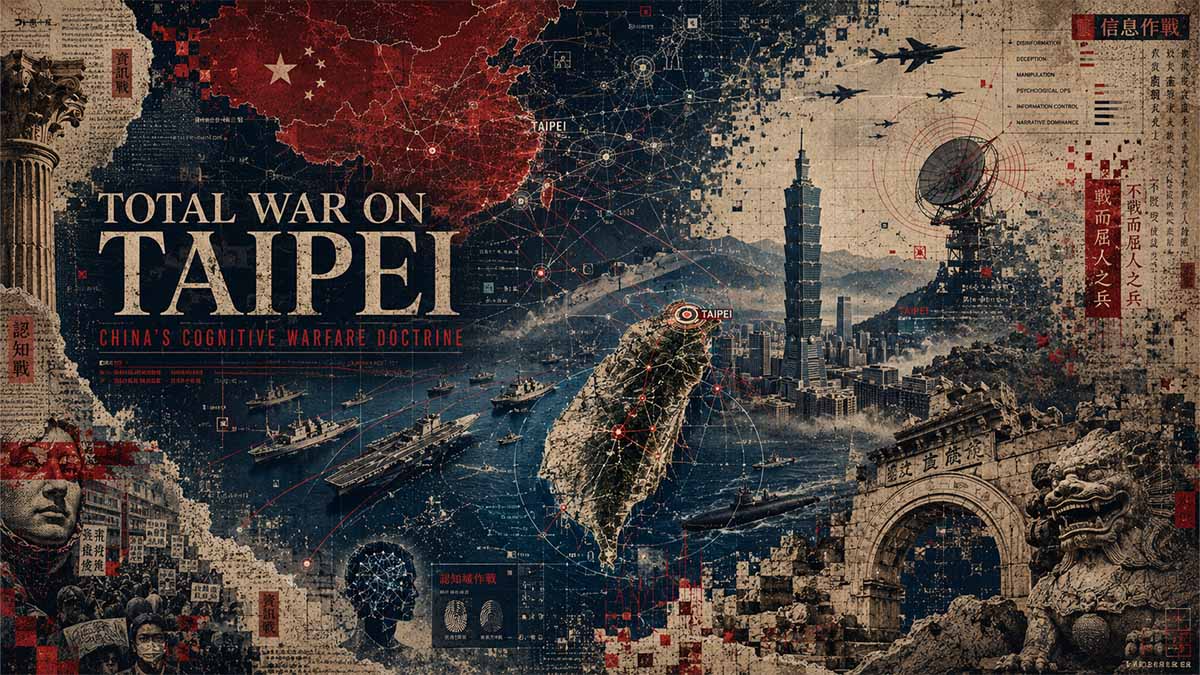
Executive Summary
- In March 2025, China’s Central Military Commission-overseen journal Military Art published a concept — “all-domain megacity incapacitation warfare” — describing how to rapidly capture and subdue Taipei.
- The concept integrates blockade, precision strike, and cognitive attack, with the explicit goal of breaking the will to fight rather than achieving total destruction or occupation.
- It operationalizes China’s broader “national total war” strategy — whole-of-nation mobilization of civilian and military tools — alongside “cognitive domain operations.”
- Its authors are credentialed Academy of Military Science and People’s Armed Police Command College researchers, and it was published in a restricted-circulation journal overseen by the Central Military Commission, lending it real institutional weight.
- The framework inverts a core principle of traditional “systems confrontation” doctrine: instead of minimizing civilian targeting, it makes the civilian population — and their cognitive state — the primary target.
- Current U.S. and Taiwanese analysis is not built to capture this. Public wargames on blockade and invasion model kinetic exchanges; studies of Taiwan’s will to fight rely on static survey data rather than modeling wartime cognitive attack directly.
- The same logic appears in Chinese military writing about a potential war with the United States — this is not a Taiwan-only concept.
The Silent Front: How Beijing Is Rewriting the Rules of War Over Taipei
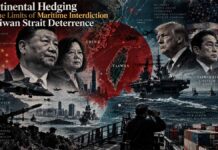
In March 2025, Military Art — the internal theoretical journal of China’s Central Military Commission — carried a proposal from three credentialed officers that deserves more attention in Washington and Rome than it has received. Titled “all-domain megacity incapacitation warfare,” it does not describe how to conquer Taipei. It describes how to make Taipei surrender without conquering it. That distinction is the story.
The Authors and Their Standing
The proposal is not fringe commentary. Its authors are Lt. Col. Li Hengrui and Senior Col. Cheng Jinming of the Academy of Military Science — China’s apex military research body — and Lt. Col. Wang Haiyuan of the People’s Armed Police Command College. Cheng heads a research institute within the Academy and authored a 2013 textbook on combined offensive operations. The inclusion of a People’s Armed Police instructor is itself a signal: the PAP’s core mission inside China is population control, and its co-authorship implies planning that extends past the campaign into post-conflict administration of the city. Published in a Central Military Commission-overseen journal with restricted internal circulation, the piece carries institutional weight well beyond an academic exercise.
Three Lines of Effort, One Objective
The concept structures a campaign around blockade, precision strike, and cognitive attack — but subordinates all three to a single goal: collapsing Taipei’s will to resist rather than destroying the city. Blockade would sever supply and information flows through siege tactics paired with jamming, distributed denial-of-service attacks, and AI-generated deepfakes against command and civilian networks alike. Precision strikes, executed by unmanned platforms and special operations units, would target commanders and critical facilities — while explicitly sparing assets difficult to rebuild, such as power plants and reservoirs, a detail that betrays an assumption of eventual Chinese administration rather than a punitive strike-and-withdraw. Cognitive attack is the genuinely novel third leg: coordinated propaganda, algorithmically delivered through “information munitions” the authors say are embedded in platforms including Meta and TikTok, engineered to fracture cohesion between Taipei’s military and civilian populations and produce what the authors call the “optimal means” of rapid capitulation.
The Doctrinal Architecture Behind It
This is not an isolated idea. It operationalizes a broader concept the PLA calls “cognitive domain operations” (认知域作战), first systematically documented by Jamestown Foundation analyst Nathan Beauchamp-Mustafaga in a September 2019 study. Jamestown’s subsequent research traced this doctrine to a concrete operational history, not merely theory: PLA researchers at Base 311 — the Strategic Support Force unit responsible for influence operations against Taiwan — published a 2018 article naming social media as the primary channel for cognitive attack against the island, coinciding with documented interference in Taiwan’s 2018 elections. A 2024 Jamestown study extended the pattern to Vietnam, indicating the PLA is actively exporting and testing the same toolkit against a second target, not confining it to a single hypothetical. The doctrine’s institutional anchoring runs to the top: Academy of Military Science officials describe national mobilization for “future great power wars” as embedded directly in Xi Jinping’s Strong Military Thought — the PLA’s highest political-military guidance.
The Gap in Western Planning
Western wargaming, by contrast, remains overwhelmingly kinetic. CSIS’s January 2023 study, The First Battle of the Next War, authored by Mark F. Cancian, Matthew Cancian, and Eric Heginbotham, ran 24 iterations of a Chinese amphibious invasion and found Taiwan’s air force losing the majority of its 534 combat aircraft, its navy losing 38 major vessels, and roughly 3,500 army casualties in base scenarios — rigorous, granular modeling of steel and firepower. The same team’s July 2025 follow-up, Lights Out? Wargaming a Chinese Blockade of Taiwan, ran 26 additional wargames and concluded a blockade would inflict serious economic damage, particularly to Taiwan’s energy sector, without being low-cost for Beijing. Both reports are exceptional on the physical dimension of conflict. Neither treats “will to fight” as a variable an adversary might actively engineer in real time — it is modeled, if at all, as a static input, typically drawn from pre-war survey data on Taiwanese sentiment. That is precisely the assumption China’s own doctrine is built to exploit.
Why This Matters Beyond Taipei
The authors of the incapacitation concept state explicitly that no operational idea of this kind is single-use. Chinese writing in the journal China Military Science separately describes an “integrated national strategic system” designed to help China “fracture the hegemonic system” in a prospective conflict with the United States — language suggesting cognitive operations against American domestic audiences are conceived as a tool for constraining U.S. willingness to intervene in a Taiwan contingency, not as a standalone campaign. For European and Italian institutional readers, the relevance is structural rather than incidental: any interruption to Taiwan’s semiconductor output — the island produces the overwhelming majority of the world’s most advanced logic chips — would strike European industrial and automotive supply chains within weeks, and a conflict engineered to end through cognitive collapse rather than protracted destruction would compress the timeline for that shock dramatically compared to the attritional scenarios Western wargames currently model.
The Cost of Not Adapting
The evidentiary status of this concept should be stated precisely, because precision is what separates analysis from alarmism. It is not confirmed PLA doctrine; it is a credible, institutionally-anchored proposal in a restricted-circulation, Central Military Commission-overseen publication, authored by researchers with genuine standing inside China’s top military research establishment. Two concrete indicators would confirm its maturation into program: incorporation into future Taiwan-focused PLA exercises, and sustained investment in the specific cognitive-warfare capabilities its authors describe. Until those benchmarks are observed, the appropriate institutional response is not panic but correction — building cognitive-effects adjudication into Western wargames as an active mechanic rather than a fixed assumption, and extending Taiwan’s and its partners’ defense planning to communications and media infrastructure with the same seriousness currently reserved for ports, airbases, and missile batteries. The war Beijing may be designing is not the one Washington and Brussels are currently rehearsing.
Navigational Index
- Foundations: From “People’s War” to National Total War
- The Incapacitation Concept: Blockade, Precision Strike, Cognitive Attack
- Strategic Implications for Taiwan and the United States
Master Abstract
Foundations: From “People’s War” to National Total War
China’s concept of “national total war” is not a sudden doctrinal announcement but the product of three decades of intellectual development inside the People’s Liberation Army. It began in the 1990s with a “comprehensive national power” framework, in which China’s leadership sought a systems-engineering approach to national strength. Observation of U.S. information-enabled operations in the 1991 Gulf War and the 1999 Kosovo War pushed Chinese military theorists to reframe modern conflict as a contest between adversary operational systems, not opposing forces in isolation — a concept they term “systems confrontation,” which they came to regard as the basic operational mode of joint campaigns in the information age. This idea expanded dramatically following China’s domestic response to COVID-19, when Xi Jinping’s invocation of “people’s war” against the pandemic became a template for whole-of-society mobilization, with state media explicitly drawing the analogy to World War II-style total war in which all citizens become instruments of a national war system. The fusion of “people’s war” mobilization with “systems confrontation” targeting produced the current formal strategy: national total war requires not just military modernization, but active coordination from civilian institutions — media, finance, cyber infrastructure — to deliver wartime effects. Chinese military researchers treat the Russo-Ukrainian War as their primary case study, arguing that the United States enhanced Ukrainian lethality less through weapons transfers than through non-military tools: sanctions, Starlink connectivity for command and control, and tightly coordinated strategic messaging. They characterize early U.S. public assessments that the war would end quickly as a deliberate “cognitive smoke bomb” designed to induce Russian overconfidence and operational failure — a reading that reveals as much about Chinese strategic assumptions as it does about the war itself. Beijing is candid that it cannot simply replicate this playbook: it lacks a comparable alliance network for sanctions enforcement, does not control a financial chokepoint equivalent to the petrodollar, and has no megaconstellation comparable to Starlink. This gap is precisely why military-civil fusion remains an active priority, formalized in 2025 guidance directing Communist Party members to “fight well the national total war,” and reflected in Minister of State Security Chen Yixin’s repeated calls for party members to convert systemic advantages into combat effectiveness.
The Incapacitation Concept: Blockade, Precision Strike, Cognitive Attack
The Taipei incapacitation concept, authored by Lt. Col. Li Hengrui, Senior Col. Cheng Jinming (Academy of Military Science), and Lt. Col. Wang Haiyuan (People’s Armed Police Command College), is the clearest known translation of national total war strategy into an operational plan for a specific city. It structures the campaign around three integrated lines of effort. Blockade aims to sever Taipei’s external supply and information lifelines — intercepting aid en route, striking command centers and communication hubs, and pairing kinetic action with “soft” disruption: jamming, cyberattacks, distributed denial-of-service campaigns, and AI-generated deepfakes targeting military and civilian information networks alike. Precision strike relies on unmanned platforms and special operations forces to conduct decapitation strikes against commanders and critical infrastructure operators, while special forces attempt to seize power grids and maintenance depots by force or bribery for use after landing; notably, the authors caution against striking hard-to-rebuild assets — air traffic control, power plants, reservoirs — to preserve them for eventual occupation, revealing an assumption that the campaign ends in Chinese control of the city rather than its destruction. Cognitive attack is the concept’s most distinctive contribution, deploying “cognitive domain operations” — algorithmically delivered propaganda, deepfakes, and what the authors call “information munitions” embedded within platforms including Meta and TikTok — to construct information bubbles that separately target Taipei’s military and civilian populations. The stated aim is not battlefield deception in the traditional sense but the erosion of collective will, explicitly framed by the authors as the “optimal means” of securing rapid surrender. This inverts a longstanding principle of Chinese systems-confrontation doctrine, which historically minimized civilian targeting in favor of striking military and dual-use information nodes; here, the entire city and its population become the target system, on the logic that complete information control is a precondition for the cognitive effects the concept depends on.
Strategic Implications for Taiwan and the United States
The concept assigns civilian actors a coordinating role equal in importance to military firepower, tasking an “integrated national strategic system” with disseminating narrative content across “diverse, accessible, and engaging media formats” to secure psychological submission. This capability remains aspirational — China has not yet demonstrated the whole-of-nation coordination the concept requires — but it is not distant either: China’s 15th Five-Year Plan, issued in early 2026, prioritizes building exactly this kind of integrated strategic capacity, and two concrete benchmarks will indicate progress — incorporation into future Taiwan-focused military exercises, and continued investment in the cognitive warfare capabilities the concept’s authors describe. The implications extend well past Taiwan. Chinese military journals, including China Military Science, discuss applying the same cognitive-effects logic in a prospective war against the United States, describing how an integrated national system could “fracture the hegemonic system” to relieve pressure on China’s primary theater of operations. Current U.S. and Taiwanese wargaming is not structured to capture this. Public analyses of a Chinese blockade or invasion focus overwhelmingly on kinetic exchange, while assessments of Taiwan’s will to fight treat it as a relatively static input measured through survey instruments rather than a dynamic variable subject to wartime manipulation. Closing this gap requires treating cognitive effects as an active, adjudicated variable throughout wargames rather than a fixed baseline; incorporating institutions such as Taiwan’s All-Out Defense Mobilization Agency and societal-resilience indicators produced at National Taiwan University as standard inputs rather than specialized add-ons; and extending planning for the physical defense of media and communications infrastructure alongside conventional military and government sites. Taiwan is the concept’s stated target, but the authors are explicit that no concept of this kind is single-use — the same architecture of integrated kinetic-cognitive effects is already shaping how Beijing thinks about a war with Washington.
All-Domain Megacity Incapacitation: Three Lines of Effort
Blockade
Severs external supply and information flows. Kinetic strikes on command and communication hubs; jamming, cyberattacks, DDoS, and deepfakes degrade civilian and military networks.
Precision Strike
Decapitation strikes on commanders and key facilities via unmanned platforms and special operations forces. Rebuildable assets (power, water, air traffic control) are spared for post-conflict use.
Cognitive Attack
Algorithmic propaganda, echo chambers, and “information munitions” on platforms like Meta and TikTok aim to erode will to resist and accelerate cessation of hostilities.
Source synthesis: Military Art (March 2025), Academy of Military Science / People’s Armed Police Command College authors
Foundations: From “People’s War” to National Total War
The Conceptual Lineage
China’s doctrine of national total war is not a single policy announcement but the endpoint of roughly three decades of layered strategic thinking inside the People’s Liberation Army (PLA). Untangling it means tracing four overlapping intellectual moves: the 1990s turn toward comprehensive national power, the operational reframing known as systems confrontation, the 2020 rhetorical shift triggered by China’s COVID-19 response, and the 2025 formalization into explicit policy language. Each stage didn’t replace the last — it absorbed it, so the current doctrine carries all four layers at once.
Stage one: comprehensive national power (1990s). Following the collapse of the Soviet Union and China’s own assessment of its relative weakness after the Gulf War, Chinese strategists — working through what they called a “systems engineering” approach — began treating national strength as an integrated stack: economic capacity, technological base, diplomatic reach, and military power, deliberately fused rather than developed in separate lanes. This wasn’t yet a war-fighting concept. It was closer to grand-strategic accounting: a way of measuring and building the aggregate capacity a state could eventually convert into hard power.
Stage two: systems confrontation (late 1990s–2000s). Watching U.S. operations in the 1991 Gulf War and the 1999 Kosovo War, PLA analysts concluded that American dominance came less from superior firepower than from superior information integration — sensors, command networks, and precision strike tied together as a single operational system. China’s response was to reconceive warfare itself: not force-on-force, but system-on-system. An adversary’s military could be defeated by degrading or paralyzing its informational nervous system rather than destroying its units piecemeal. This became, in PLA writing, the “basic operational mode” of joint campaigns in the information age — a doctrinal claim, not just an observation.
Stage three: the pandemic pivot (2020). COVID-19 supplied Xi Jinping and Chinese state media with a live rehearsal of whole-of-society mobilization. Xi’s declaration of a “people’s war” against the virus was explicitly framed with a World War II analogy — “all citizens are soldiers, the military is the center of a national war system, and other national tools revolve around the military.” That framing did two things simultaneously: it activated a historical vocabulary (people’s war goes back to Maoist mobilization doctrine) and it explicitly instructed PLA servicemembers to study the pandemic response as a military lesson in coordinating civilian systems at national scale.
Stage four: formal synthesis (2025). The fusion of “people’s war” mobilization logic with “systems confrontation” targeting logic produced what is now called national total war — a doctrine requiring non-military institutions (media, finance, cyber infrastructure) to coordinate directly with the military and deliver wartime effects, not merely support production. This is qualitatively different from military-civil fusion, which is about industrial and technological integration (shipyards, semiconductor supply chains, dual-use R&D). National total war assumes that fusion as a baseline and adds an operational command layer on top of it — civilian systems don’t just build the military’s capacity, they are expected to act during a conflict.
Comparative Table: The Four Layers
| Layer | Period | Core Logic | Primary Actors | What It Adds |
|---|---|---|---|---|
| Comprehensive national power | 1990s | Aggregate national strength across sectors | State planners, economic strategists | Baseline capacity-building |
| Systems confrontation | Late 1990s–2000s | Defeat the adversary’s operational system, not just its forces | PLA operational theorists | Reframes what “winning” a battle means |
| People’s war (pandemic pivot) | 2020 | Whole-of-society mobilization under military-centric coordination | Xi Jinping, state media, PLA | Reactivates mass-mobilization vocabulary at national scale |
| National total war | 2025 (formalized) | Non-military institutions coordinate operationally with the military in wartime | CCP members broadly, Ministry of State Security, PLA | Converts civilian systems into wartime actors, not just industrial support |
Institutional Anchoring
This isn’t a theory floating at the think-tank level. According to officials at the Academy of Military Science — China’s top military research institution — national total war is already embedded in Xi Jinping’s Strong Military Thought, the PLA’s highest-level political guidance, and it sits inside China’s military strategic guideline itself. The stated purpose is preparing for “future great power wars” in which “confrontation unfolds across all domains and dimensions through national total war.” That is a claim about doctrine, not aspiration — the Academy’s own framing treats this as operative guidance, not a discussion paper.
On the civilian side, Minister of State Security Chen Yixin has repeatedly called on Communist Party members to convert “systemic advantages into combat effectiveness,” which is the civilian-facing mirror of the same idea: ordinary party members in finance, media, and administration are being told their function is convertible into wartime effect. In 2025, this was elevated from rhetoric into published national security policy directing party members to “fight well the national total war” — the clearest available evidence that the concept has moved from PLA theorizing into party-wide instruction.
Why Ukraine Became the Reference Case
Chinese military analysts treat the Russo-Ukrainian War as the empirical proof-of-concept for national total war, but their reading is idiosyncratic and worth taking seriously on its own terms rather than assuming it mirrors Western assessments. Their argument: Ukrainian battlefield lethality was less a function of weapons transfers than of the United States applying non-military tools in a coordinated way — economic sanctions against Russia, provision of Starlink connectivity for military command and control, and tightly synchronized strategic messaging, intelligence declassification, and cyber activity. The case Chinese analysts return to most is the early public assessment — widely voiced by U.S. officials — that Russia would win quickly. Chinese military writing now retroactively frames this as a deliberate deception operation, a “cognitive smoke bomb,” designed to induce Russian overconfidence and consequent operational failure.
Whether or not that reading is historically accurate is almost beside the point strategically — what matters is that Beijing is building doctrine around this interpretation, and doctrine built on a possibly-mistaken premise is still doctrine that shapes real force posture. It’s worth flagging that alternative, non-Chinese explanations for the war’s trajectory (Russian logistical failures, Ukrainian resolve, terrain and force-ratio realities) are not part of the PLA’s stated analytic frame — their model privileges American cognitive engineering as the causal variable.
Beijing is explicit that it can’t replicate the American playbook wholesale. It lacks a comparable alliance network to enforce sanctions, doesn’t control a financial chokepoint equivalent to the petrodollar, and has no resilient satellite megaconstellation like Starlink. Chinese assessments also concede — notably in public-facing statements — that China lags the U.S. in strategic messaging and disinformation capability. This gap is precisely the stated rationale for continued investment in military-civil fusion: national total war is the strategic ambition, but the tools to execute it are still being built.
Simplified Doctrinal Timeline
▼
▼
▼
▼
What’s Still Unresolved
The strategic-level guidance is clear; the operational detail is not. This is precisely the gap the “all-domain megacity incapacitation warfare” concept (covered in the earlier sections of this report) attempts to fill — it’s one proposal, from credentialed Academy of Military Science and People’s Armed Police researchers, for how to actually execute national total war logic against a specific target (Taipei). The existence of high-level doctrine plus a small number of serious operational proposals is a different evidentiary situation than a fully mature, tested doctrine — worth keeping distinct when assessing how far along this capability actually is.
The Incapacitation Concept: Blockade, Precision Strike, Cognitive Attack
Origins and Institutional Weight
The “all-domain megacity incapacitation warfare” (大型城市全域失能战) concept surfaced in the March 2025 edition of Military Art, the PLA’s leading internal journal on military theory, overseen and approved by the Central Military Commission. Its restricted circulation matters analytically: because the journal isn’t public-facing, its authors have room to write with unusual specificity — this isn’t sanitized messaging aimed at foreign audiences, it’s an internal doctrinal argument aimed at other PLA planners. That changes how much weight the document deserves relative to, say, a white paper or state media commentary.
The authors carry real institutional standing rather than being fringe voices. Lt. Col. Li Hengrui and Senior Col. Cheng Jinming are researchers at the Academy of Military Science — China’s top military research institution — and Cheng specifically leads a research institute within it, having published a textbook on combined offensive operations back in 2013. Lt. Col. Wang Haiyuan is an instructor at the People’s Armed Police Command College. The People’s Armed Police co-authorship is a detail worth sitting with: the PAP’s core function inside China is population management and internal security, so its inclusion signals the authors are thinking about post-seizure population control in Taiwan, not just the military campaign to get there.
The authors never name Taipei explicitly, but the framing leaves little ambiguity — references to operating “while simultaneously guarding against intervention by the strong enemy” (widely understood PLA shorthand for the United States) and to China’s “facts, legal legitimacy, and emotional resonance” for seizing control of an unnamed city point squarely at Taiwan’s capital.
The Core Logic: Submission, Not Destruction
The word choice matters. By framing the concept around “incapacitation” rather than conquest or annihilation, the authors are signaling a specific theory of victory. China’s military has historically used “incapacitation warfare” to describe non-kinetic, body-targeting tools — sonic and laser weapons meant to subdue troops without killing them. This concept extends that logic from individual soldiers to an entire city and its civilian population, substituting cognitive attack for physical incapacitants. The authors are explicit that the goal is not “total occupation… or mass annihilation,” but degrading the city’s “enabling functions” and striking key operational nodes. That’s a lower-cost theory of victory for Beijing — but it is considerably less concerned with collateral damage to Taiwan’s civilians than traditional systems-confrontation doctrine has been.
Line of Effort One: Blockade
The blockade component targets Taipei’s connection to the outside world across two channels simultaneously — physical supply and information flow.
| Target | Method | Effect |
|---|---|---|
| External supply | Siege tactics; interdiction of aid en route | Starves the city of material support |
| Command/communication infrastructure | Precision kinetic strikes | Destroys hard information nodes |
| Military information systems | Jamming, cyberattacks, DDoS | Degrades command and control |
| Civilian news/social media | AI deepfakes, soft disruption | Corrupts the information environment ahead of cognitive attack |
The blockade isn’t purely a siege in the traditional sense — it’s explicitly paired with “soft” disruption tools (jamming, distributed denial-of-service attacks, AI-generated deepfakes) aimed at civilian news networks and social platforms as much as military command systems. That pairing is the tell that blockade here is being used to set conditions for the cognitive attack phase, not just to isolate the city militarily.
Line of Effort Two: Precision Strike
Precision strike is the most conventional-sounding line of effort, but its target selection logic is unusual. Unmanned platforms and special operations forces are tasked with decapitation strikes against commanders, key facilities, and equipment operators — fairly standard. Special forces are also tasked with seizing, “by force or bribery,” facilities that would support Chinese operations after landing — power grids, maintenance depots. Long-range artillery and special operations forces strike civilian infrastructure with military relevance: airport runways, electrical substations, sewage treatment, backup systems.
The notable constraint: the authors explicitly instruct planners to avoid striking targets that are difficult to rebuild — air traffic control towers, power plants, reservoirs. This is a tell about the campaign’s assumed endstate. Planners preserving infrastructure for future use only makes sense if the operational assumption is eventual Chinese administration of Taiwan, not a punitive destroy-and-withdraw campaign. It’s a small detail, but it’s one of the more concrete signals in the document about what “victory” is actually assumed to look like afterward.
Line of Effort Three: Cognitive Attack
This is the concept’s genuinely novel contribution, and the one U.S. and Taiwanese analysis is least equipped to model. The stated aim is to amplify propaganda that convinces Taiwan’s population that Beijing’s cause is legitimate, while simultaneously accusing Taiwan’s leadership of malfeasance — a two-track narrative attack rather than a single message. The method is to construct “information bubbles and echo chambers” that separately target Taipei’s military and civilian populations, using algorithmic content delivery, deepfakes, and what the authors term “information munitions” — explicitly stated to be “hidden within videos and images on platforms such as Meta and TikTok.”
The authors’ own claimed payoff is direct: these cognitive attacks, combined with what they describe as existing embedded presence in social media used in Taiwan and the U.S., will erode Taipei’s will to resist and “facilitate a rapid cessation of hostilities” — described as the “optimal means” of seizing the city. That’s a strong claim for the authors to make in an internal, restricted-circulation journal, which is part of why analysts shouldn’t dismiss it as aspirational filler.
It’s also not a new idea inside PLA thinking, even if this application is new. China’s “Three Warfares” framework developed online public-opinion-warfare concepts in the early 2000s, and PLA researchers at Base 311 — China’s primary influence operations unit — published practical how-to guides for blending into Facebook groups as far back as 2018. There’s also an operational track record, not just theory: social media manipulation against Taiwan’s 2018 election, and more recently against Vietnam, indicates these are ideas China has already tried to turn into working capability, not purely hypothetical constructs.
Structural Summary
Why This Reframes “Systems Confrontation”
Traditional systems confrontation targeted an adversary’s information nodes on the theory that a military loses when it can’t get the information it needs to fight. This concept keeps that architecture but relocates the actual target from information flow to cognitive state — the logic being that if total annihilation isn’t the objective, the real object is engineering the adversary’s acceptance of defeat. Traditional military operations (blockade, precision strike) become supporting acts for that cognitive objective rather than ends in themselves. That’s a meaningful doctrinal shift, and it’s also why the authors treat the entire city — not narrowly defined military and dual-use targets — as the legitimate target set. Complete information control becomes a precondition for the psychological effect they’re after, which is a substantially more expansive (and civilian-costly) targeting logic than classical systems confrontation allowed.
Strategic Implications for Taiwan and the United States
Why This Concept Deserves Serious Attention
Before drawing out implications, it’s worth being precise about the concept’s evidentiary status, because that status is what determines how much weight the implications below should carry. This is not official PLA doctrine — it’s a published proposal by credentialed researchers in a restricted-circulation, Central Military Commission-overseen journal. That’s a meaningful middle ground: it’s not one analyst’s speculative essay, but it’s also not a confirmed operational plan. The authors’ institutional standing (Academy of Military Science, People’s Armed Police Command College) and the journal’s tight alignment with China’s stated military strategy give it more weight than a typical think-tank hypothesis, but treating it as settled doctrine would overstate what’s actually known. The honest framing is: this is a rare, credible window into how some PLA strategists are thinking about translating national total war into an actual campaign — not proof that this is the plan.
Three Conceptual Shifts Worth Tracking
The concept makes three moves that matter beyond its specific application to Taipei.
First, it relocates the target of systems confrontation from information flow to cognitive effect. Classical systems confrontation aimed to paralyze an adversary military by cutting it off from the information it needs to operate. This concept’s logic is different: if the objective is defeat short of total annihilation, the real target becomes the adversary’s willingness to keep fighting — engineered directly, in the minds of decision-makers and the population. Kinetic operations become instrumental to that cognitive objective rather than ends in themselves. This is a genuine reordering of means and ends, not a rebranding.
Second, it expands the legitimate target set to an entire city and its civilian population. Traditional systems confrontation tried to minimize civilian targeting, narrowing itself to military and dual-use information nodes to limit escalation and collateral damage. This concept explicitly targets civilian communication channels from the outset, on the argument that total information control is a precondition for the cognitive effects the plan depends on. That’s an old idea (total information control) given new operational teeth by being placed on equal footing with kinetic effects rather than as a supporting function.
Third, it assigns civilian actors an operational, not merely supportive, role. The concept explicitly calls for a national-level policy coordination system — an “integrated national strategic system and capabilities” — to lead the cognitive dimension of the fight, disseminating narrative content through “diverse, accessible, and engaging media formats.” This is the clearest concrete illustration available of what national total war is supposed to look like in practice: civilians aren’t producing equipment for the military, they’re expected to deliver wartime effects directly, in coordination with military timelines.
Maturity Assessment: Aspiration vs. Capability
| Dimension | Current Status | Evidence |
|---|---|---|
| Doctrinal backing | Strong | Embedded in Xi Jinping’s Strong Military Thought and PLA strategic guideline per Academy of Military Science officials |
| Institutional coordination | Immature | Authors themselves note this remains “a work in progress” |
| Policy signal | Strengthening | China’s 15th Five-Year Plan (early 2026) prioritizes building integrated strategic capability |
| Operational track record | Partial, real | 2018 Taiwan election interference; more recent Vietnam-directed operations |
| Benchmark 1 | To be observed | Incorporation into future Taiwan-focused military exercises |
| Benchmark 2 | To be observed | Continued investment in the specific cognitive warfare capabilities the authors describe |
The honest read: the doctrinal ambition is mature and well-anchored; the whole-of-nation coordination needed to actually execute it is not yet demonstrated. That gap is exactly why the two benchmarks in the table matter as forward-looking indicators rather than the report’s authors’ own claims about current capability.
Implications for Taiwan
If cognitive attack is being planned as a coordinated, national-level line of effort rather than an ad hoc information operation, Taiwan’s defense planning has a gap worth naming directly: physical defense planning has historically centered on military and government sites, not the media and communications infrastructure this concept treats as primary targets from the outset of conflict. Extending hardening and continuity planning to broadcast infrastructure, social media moderation capacity, and communications backbones is a distinct requirement from conventional force protection — and one that doesn’t map onto existing procurement or basing logic.
There’s also a measurement problem. Studies of Taiwan’s “will to fight” have generally relied on survey instruments capturing sentiment at a point in time, treating it as a relatively fixed input. If this concept’s authors are right that will to fight is precisely the variable an adversary intends to manipulate during a conflict, then static pre-war survey data will systematically understate how much that variable can move under coordinated cognitive attack. Institutions already tracking societal resilience — such as Taiwan’s All-Out Defense Mobilization Agency and indicator work produced at National Taiwan University — are a natural fit for closing this gap, but the concept implies they need to be modeling dynamic wartime degradation, not just baseline resilience.
Implications for the United States
The concept’s authors are explicit that no operational concept like this is single-use — the same logic of integrating kinetic and cognitive effects through a national-level coordinating system appears independently in Chinese military writing about a prospective war with the United States. Researchers writing in China Military Science describe victory over the U.S. in terms of “accumulating the advantages of total war,” with the same integrated system leveraged to “fracture the hegemonic system” and relieve pressure on China’s primary theater of operations. That phrasing — relieving pressure on the “primary theater” — suggests planners see cognitive operations against the American public and political system as a way to constrain U.S. willingness or capacity to intervene in a Taiwan contingency, not as a separate, freestanding war plan against the U.S.
For U.S. wargaming and analysis, the practical gap is structural: most public wargames on a Chinese blockade or invasion of Taiwan model kinetic exchange in detail but treat “will to fight” — on both the Taiwanese and, implicitly, the American side — as a fixed assumption rather than a variable subject to adversary action during the game itself. If this concept reflects real PLA planning direction, that’s a modeling blind spot, not just an analytical preference. Correcting it means building cognitive-effects adjudication into wargames as an active mechanic, incorporating societal-resilience institutions as standard participants rather than specialized guest inputs, and extending threat modeling for U.S. aid delivery to account for cognitive operations aimed at eroding domestic political support for that aid — not just kinetic interdiction of the aid itself.
Bottom Line
This concept is best read as evidence of direction, not proof of capability. It tells you where a credible slice of PLA strategic thinking is heading — toward treating cognitive effects as co-equal with kinetic firepower, and toward operationalizing whole-of-society mobilization into cognitive terms — well before you’d expect to see it confirmed in doctrine or observed in an actual campaign. The appropriate response isn’t alarm calibrated to an assumption that this is settled Chinese plan, but sustained attention to the two concrete benchmarks (Taiwan-focused exercise incorporation, continued capability investment) that would indicate this thinking is graduating from proposal to program.


