











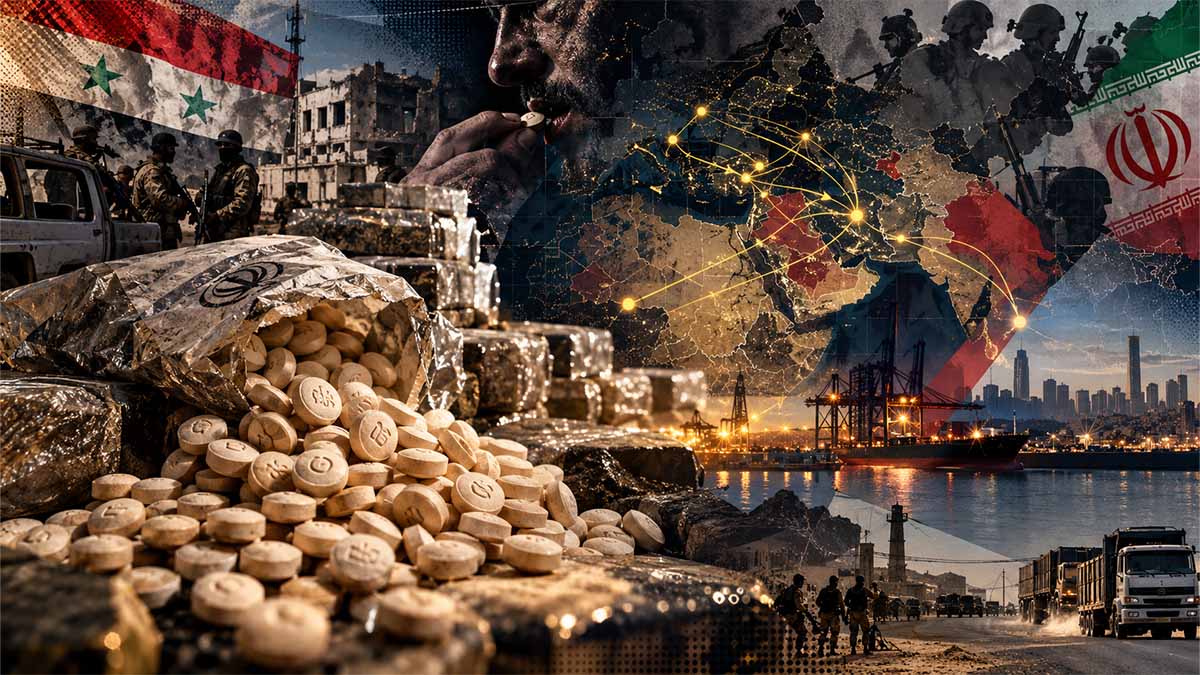
Global assessment of psychoactive substances in warfare, terrorism, recreational consumption, illicit industrial production, international trafficking, the UAE and Gulf security, Russia and Ukraine, Israel and Gaza, and the consequences for Europe and international governance. Historical evidence is assessed through 23 October 2026, with a strategic outlook to 2031.
Executive Summary — Bottom Line Up Front
Captagon and other amphetamine-type stimulants have a documented history of use in armed-conflict environments, including reports concerning Islamic State fighters and other participants in Syria’s civil war. Their association with warfare is not merely a journalistic invention, although the prevalence, organisation and effects of consumption differ between cases.
The decisive geopolitical development was the transformation of Captagon into an industrial criminal economy associated with the former Syrian regime, military-linked structures and transnational trafficking organisations. US Treasury sanctions in 2023 and 2024 explicitly connected production and trafficking to Maher al-Assad’s Fourth Division and networks linked to Hezbollah.
Following the collapse of Bashar al-Assad’s government in December 2024, the international security problem shifted from identifying a dominant political-production structure to tracing surviving inventories, relocating manufacturing capabilities and increasingly dispersed trafficking networks.
The 2026 European Union-supported assessment identifies Iraq and Türkiye as jurisdictions reporting medium-scale domestic Captagon production, alongside indications of manufacturing in several additional countries. This makes Iraq more than a transit concern and gives the UAE an increasingly important role in detecting cross-border commercial and criminal connections.
On 23 October 2026, Iraqi–Emirati cooperation resulted in the seizure of 200,000 Captagon tablets. The Iraqi account further described more than a year of monitoring a network previously associated with movements of narcotic tablets from Dubai into Iraq.
The international market is now exposed to a possible convergence between Captagon, methamphetamine, organised criminal finance and conflict economies. Governments must assess drug consumption by fighters, criminal revenues benefiting armed organisations and the deliberate institutional distribution of stimulants as related but distinct intelligence questions.
The strategic conclusion is that psychoactive drugs are simultaneously a commodity, a possible instrument of operational endurance, a source of criminal finance and a means through which armed and politically connected networks can accumulate economic influence.
Captagon, War and the Economics of Criminal Power: The Global Drug Trade Is Becoming a Test of State Sovereignty
The seizure of 200,000 Captagon tablets in a joint Iraqi–Emirati operation on 23 October 2026 exposes a problem considerably larger than the shipment intercepted: governments are confronting narcotics networks whose industrial capabilities, financial relationships and connections to armed power can survive the collapse of the political systems that once protected them. Syria’s former Captagon economy demonstrated how illicit manufacturing could become a source of revenue for military-linked structures. Its disruption has not eliminated regional demand or the organisations serving it. From the Gulf to Europe’s ports, the decisive vulnerability is the growing separation between the territory where drugs are manufactured, the jurisdictions through which they move and the financial centres where criminal profits can be concealed. The security question is no longer how many tablets a government can confiscate, but whether it can dismantle the economic organisation responsible for producing the next shipment.
The fall of Assad disrupted production, not the economics of trafficking
The collapse of Bashar al-Assad’s government in December 2024 dismantled the political environment in which Syria had become the principal manufacturing centre for illicit Captagon. The extent of that dependence was extraordinary: in March 2023, the British government estimated that Syria accounted for approximately 80% of global Captagon production. The figure described the historical market, not the situation after Assad’s removal, but it exposed the degree to which industrial-scale criminal activity had become concentrated within a state devastated by civil war.
The relationship was political as well as commercial. On 28 March 2023, the US Department of the Treasury identified networks connected to Maher al-Assad, commander of Syria’s Fourth Division, and Khalid Qaddour, a businessman associated with the management of the division’s illicit revenues. Treasury connected the military formation to Captagon production and trafficking, demonstrating how coercive state institutions and privately organised criminal finance could reinforce one another. In October 2024, further American designations targeted trafficking and commercial networks associated with the Syrian regime and Hezbollah. These findings established specific financial and organisational connections, rather than merely suggesting that narcotics happened to circulate through wartime Syria.
The distinction matters after December 2024. Removing the political protection surrounding an illicit industry does not automatically destroy its inventories, technical expertise, customers or financial intermediaries. The 2026 EU-supported assessment of Captagon and methamphetamine trafficking identified medium-scale Captagon production reported in Iraq and Türkiye, alongside indications of manufacturing elsewhere. Production may therefore become less geographically concentrated even as the former Syrian system loses its institutional foundation.
That possibility changes the economics of interdiction. A criminal organisation operating through smaller production networks in several jurisdictions may possess less industrial capacity than the former Syrian system while becoming more difficult to disrupt through pressure on any single government. The decisive indicator is not the number of tablets seized after Assad’s fall, but the proportion demonstrably manufactured after December 2024 and the identity of those financing replacement production.
The numbers expose a market that enforcement cannot measure through seizures alone
The United Nations Office on Drugs and Crime’s World Drug Report 2026 estimated that 331 million people used illicit drugs in 2024, equivalent to approximately 6.2% of the global population aged 15–64. The number of users had increased by 34% since 2014. Cannabis accounted for an estimated 256 million users, while 63 million reported non-medical opioid use and approximately 25 million used cocaine. These markets cannot be treated as interchangeable, but their combined scale explains why disrupting individual suppliers rarely extinguishes the economic incentives supporting international distribution.
Europe provides an unusually revealing example. EU Member States seized 330 tonnes of cocaine in 2024, compared with 419 tonnes in 2023, while the number of reported seizures increased from approximately 95,000 to 97,000. The apparent contradiction is significant: fewer tonnes intercepted do not necessarily indicate reduced availability when trafficking organisations are fragmenting consignments and diversifying distribution. During 2024, six Member States also reported dismantling at least 42 cocaine production or processing sites, compared with 34 in 2023. Europe is therefore exposed not simply to imported finished drugs but increasingly to industrial activities undertaken within its own market.
The geographical distribution of interceptions illustrates the difficulty of assigning national responsibility from enforcement figures. Spain reported 124 tonnes of cocaine seized in 2024, France 53.5 tonnes, Belgium 44.6 tonnes, the Netherlands 37.6 tonnes, Germany 23.8 tonnes and Italy 11 tonnes. These quantities reflect differing exposure to international commerce and enforcement operations; they do not establish corresponding shares of European consumption or criminal profit.
The financial distinction is equally important for Captagon. Multiplying seized tablets by an assumed retail price may generate an impressive headline value, but it does not establish the income received by manufacturers, financiers or armed organisations. A shipment’s retail value, wholesale transaction price and net criminal profit are different economic measures. Without verified ownership and transaction records, attributing the entire estimated market value to a government, militia or terrorist organisation creates the appearance of financial precision where none exists.
Dubai and Baghdad reveal the limits of territorial policing
The 23 October 2026 operation between Iraq and the United Arab Emirates illustrates how international trafficking exposes the limits of nationally organised law enforcement. According to the Iraqi Ministry of Interior, Iraqi counter-narcotics authorities supplied intelligence that enabled Emirati agencies to seize 200,000 Captagon tablets and arrest suspects inside the UAE. The investigation reportedly involved more than one year of monitoring, while the suspected organisation had previously moved thousands of narcotic tablets from Dubai into Iraq.
The direction of those alleged earlier movements is consequential. Dubai was not presented exclusively as a destination for an incoming shipment: the reported investigation also concerned drugs moving out of the Emirates toward Iraq. That does not establish Emirati manufacture or institutional complicity. It does demonstrate why a commercial hub must be examined as a possible point of distribution, financial intermediation or onward movement, rather than classified automatically as either a source or consumer market.
Iraq’s exposure is also changing. The 2026 EU-supported assessment identified the country as both an origin and transit jurisdiction and recorded its report of medium-scale domestic Captagon production. Iraqi authorities consequently face responsibilities that extend from border interdiction to manufacturing investigations, domestic consumption and financial tracing. The October operation demonstrated an ability to convert intelligence collected in one jurisdiction into enforcement action in another. Its longer-term significance will depend on whether the investigation establishes manufacturing provenance, criminal ownership and the ultimate beneficiaries of the trade.
The UAE’s position creates a different institutional tension. Its international logistics, re-export activities and financial services depend on commercial openness, while counter-narcotics enforcement requires identifying criminal transactions within extensive legitimate flows. Indiscriminate restrictions would impose costs on lawful business without necessarily reaching network organisers. Weak supervision, however, would leave criminal intermediaries able to exploit the very infrastructure that supports the Emirates’ commercial influence.
Drugs have entered warfare as both substances and sources of revenue
Captagon’s association with armed conflict is supported by documented reporting, not merely by its reputation. UNODC discussed consumption among Islamic State fighters and other participants in Syria’s civil war, while the April 2026 EU-supported assessment identified perceived battlefield performance, productivity, hunger suppression and coping with trauma among reported reasons for use. These findings place stimulant consumption within genuine operational environments where fatigue, fear and endurance influence individual behaviour.
The historical precedent extends beyond irregular forces. German military use of methamphetamine under the Pervitin name and British and American use of amphetamines during the Second World War established that conventional armed forces also sought pharmacological means of sustaining personnel. The military calculation, however, contains an internal contradiction: increased wakefulness does not necessarily produce improved judgement, target discrimination or command discipline. The US Government Accountability Office reported in March 2024 that Department of Defense surveys had repeatedly found a majority of American service members sleeping six hours or less per night, illustrating why fatigue remains a readiness problem even in technologically advanced forces.
The relationship between drugs and violence nevertheless requires precision. Allegations concerning stimulant consumption in the Russia–Ukraine war cannot establish an organised military distribution programme without authenticated procurement, command or toxicological evidence. Similarly, allegations that perpetrators of the Hamas-led attacks against Israel on 7 October 2023 consumed Captagon do not, in themselves, establish systematic administration by Hamas. United Nations investigations documented serious violations committed during the attacks, including killings and hostage-taking; those findings do not depend on a pharmacological explanation.
The more demonstrable geopolitical danger often concerns financing rather than consumption. The US Treasury’s March 2023 and October 2024 sanctions actions linked Captagon trafficking to networks associated with Syria’s former Fourth Division and Hezbollah. Such financial relationships can support organisations exercising armed or political power regardless of whether their personnel consume the substances being sold. Confusing the drug’s possible effects on a combatant with its function as a revenue-generating commodity obscures both military responsibility and criminal ownership.
Europe’s industrial strengths also create criminal-financial exposure
The European Union’s response must account for the fact that its lawful industrial infrastructure and its exposure to illicit markets are connected. Germany’s chemical-manufacturing capacity, Belgium’s and the Netherlands’ international ports, Italy’s Mediterranean commercial connections and France’s extensive distribution economy all create different investigative requirements. Criminal diversion of chemical inputs is not evidence against legitimate manufacturers; illicit use of a port does not establish complicity by its operator. But each case requires institutions capable of identifying criminal relationships within lawful commercial systems.
Italy’s comparative institutional challenge concerns criminal ownership and the reinvestment of illicit proceeds. Its specialised anti-narcotics and anti-mafia investigative structures offer mechanisms for connecting shipments to wider organisations, but the effectiveness of those instruments depends on prosecutions and financial outcomes. France confronts a different balance between international cocaine supply, violent domestic distribution and the burden on health services. Germany must protect chemical commerce while investigating diversion and synthetic-drug manufacturing. The United Kingdom, outside the EU’s institutional framework but closely connected to European markets, faces rising cocaine exposure and the medical consequences of highly potent synthetic opioids.
British data demonstrate why public health cannot be separated from the security calculation. The National Crime Agency reported cocaine seizures rising from 3.4 tonnes in 2015 to 18.5 tonnes in 2025. The Office for National Statistics recorded 5,565 drug-poisoning deaths in England and Wales during 2024 registrations, including 1,279 deaths involving cocaine and 195 involving nitazenes. The figures measure different aspects of the market, but together they reveal a system in which increased interdiction does not automatically translate into reduced mortality.
The Council of the European Union’s decision of 4 June 2026 to advance implementation of its drugs strategy and action plan against trafficking recognises this institutional problem. The challenge is converting coordination among police, customs, financial supervisors, prosecutors and health authorities into demonstrable reductions in criminal capacity. Europol, Eurojust and the European Union Drugs Agency contribute different capabilities, but none can substitute for national investigations and judicial decisions within its respective legal mandate.
International law can reach the money, but only if governments establish ownership
The 1988 United Nations Convention against Illicit Traffic in Narcotic Drugs and Psychotropic Substances provides the legal foundation for cooperation against trafficking, including confiscation, extradition, mutual legal assistance and precursor controls. Its Article 2 preserves national sovereignty, while Article 5 establishes measures concerning criminal proceeds and property. The combination exposes the central jurisdictional difficulty: an investigation may begin in Iraq, lead to arrests in the UAE and require financial evidence from additional countries before the actual organisers can be prosecuted.
The Financial Action Task Force Recommendations, amended through June 2026, provide standards concerning money laundering, beneficial ownership, suspicious transactions and international cooperation. These instruments matter because sophisticated drug networks can separate physical custody from financial control. The individual arrested while transporting a consignment may be economically replaceable; the financier controlling repeated shipments may be considerably more difficult to identify.
Financial sanctions add another instrument but do not resolve the evidentiary problem. The US Treasury’s October 2024 designations targeted named individuals and commercial networks associated with Captagon trafficking and Hezbollah-related finance. Such measures can restrict access to regulated financial systems, but they are not equivalent to criminal convictions and do not automatically confiscate all proceeds or eliminate replacement intermediaries.
The implication is that a government claiming success through seizure quantities must also demonstrate whether it has identified beneficial ownership, secured admissible evidence, recovered criminal assets and prevented a network from restoring operations. Without those outcomes, enforcement may interrupt transactions while leaving the underlying enterprise financially intact.
The next 24 months will determine whether disruption becomes displacement
Between October 2026 and October 2028, the most consequential test will concern the future organisation of Captagon manufacturing after Syria’s political transition. If forensic evidence increasingly identifies recently manufactured tablets originating outside the former Syrian production system, governments will face a geographically dispersed industrial problem rather than a declining historical stockpile. Iraq and the UAE will require deeper intelligence and judicial cooperation; Gulf consumer markets will remain exposed to replacement suppliers; and authorities will need to distinguish Captagon trafficking from the parallel expansion of methamphetamine and other stimulants.
For the European Union, the 4 June 2026 policy framework creates an implementation test over the same period. A reduction in intercepted tonnage will not establish progress unless accompanied by stronger evidence of disrupted manufacturing, criminal-financial confiscation and declining harm. Italy will bear the institutional costs of investigating transnational ownership; France will continue confronting the security consequences of cocaine distribution; Germany will face the burden of supervising industrial chemical flows; and the United Kingdom will confront the medical and enforcement costs associated with changing synthetic-drug markets.
The financial cost of inaction will fall on legitimate businesses exposed to criminal infiltration, public institutions required to investigate increasingly dispersed networks, and health systems treating the consequences of dangerous and adulterated substances. The security cost will fall on states unable to prevent illicit revenues from strengthening criminal or armed organisations. The political cost will fall on governments whose enforcement statistics improve while the organisations supplying their markets remain solvent.
The decisive measure of policy over the next 12–24 months will therefore not be the value assigned to confiscated drugs, but whether governments can establish who controls production, who owns the proceeds and whether the organisations connecting those functions have lost the capacity to operate.
Navigational Index
Pillar I — The Global Industrial and Geopolitical Economy of Drugs
- Chapter 1. The Global Narcotics System: Demand, Production, Industrial Capacity and International Markets
- Chapter 2. Captagon: Chemical Identity, Consumption, Military Use and the Evolution of a Strategic Commodity
- Chapter 3. Syria’s Narcotics Economy: The Assad State, Military Structures, Hezbollah-Linked Networks and Post-2024 Reorganisation
- Chapter 4. Iraq, the United Arab Emirates and the Gulf: Trafficking, Domestic Markets, Intelligence Cooperation and Regional Security
Pillar II — Psychoactive Substances in Warfare, Terrorism and Armed Organisations
- Chapter 5. The Military History of Stimulants: State Armies, Combat Endurance and Institutional Drug Programmes
- Chapter 6. Syria, Iraq, Islamic State and Other Armed Groups: Drug Consumption, Operational Claims and Criminal Financing
- Chapter 7. Russia and Ukraine: Military Substance Use, Battlefield Allegations, Combat Trauma and Criminal Markets
- Chapter 8. Israel, Gaza and 7 October 2023: Drug-Use Allegations, Forensic Evidence, Terrorist Violence and Command Responsibility
- Chapter 9. Global Conflict Economies: Myanmar, Afghanistan, Latin America, the Sahel and Other Armed Environments
Pillar III — International Security, Financial Exposure and Strategic Responses
- Chapter 10. Global Producers, Exporters, Distribution Markets and Illicit Financial Networks
- Chapter 11. Europe: Italy, France, Germany, the United Kingdom and EU Security Institutions
- Chapter 12. International Law, Counter-Narcotics Intelligence, Financial Sanctions and Cross-Border Enforcement
- Chapter 13. Strategic Outlook 2026–2031: Production Displacement, Synthetic-Drug Substitution, Military Risks and Policy Decisions
Master Abstract
The geopolitical significance of Captagon cannot be understood through the conventional distinction between recreational narcotics and military substances. The same illicit stimulant commodity may be purchased by civilians for stimulation, consumed by individuals seeking to sustain work or combat activity, distributed through criminal networks associated with armed groups, and manufactured by organisations protected by political or military power. These relationships were especially visible in Syria, where years of civil war facilitated the growth of an illicit industrial economy that the US and UK governments connected directly to the former Assad regime. In March 2023, the US Treasury identified Maher al-Assad’s Fourth Division as involved in revenue-generating schemes including Captagon production and trafficking. In October 2024, the Treasury extended sanctions against additional trafficking networks associated with the Syrian regime and Hezbollah. The resulting security problem was not restricted to the criminal sale of amphetamines: it involved the capacity of illicit commercial activity to sustain politically protected organisations and provide revenue outside accountable fiscal institutions.
Drug use within armed conflict is equally consequential, but it requires a different evidentiary framework. Captagon consumption has been reported among Islamic State fighters and other combatants in Syria, while the international military history of amphetamines demonstrates that attempts to chemically extend alertness and reduce fatigue have appeared in conventional military organisations as well as irregular formations. The European Union-supported April 2026 assessment explicitly identifies battlefield performance among the motivations reported for Captagon consumption. Yet evidence of use by some combatants is not automatically proof that an armed organisation operates a centralised distribution programme, or that drugs caused particular acts of terrorism or mass violence. Establishing these further propositions requires toxicological, logistical, operational and command evidence. The distinction is indispensable for examining allegations arising from the Russia–Ukraine war and the Hamas-led attacks against Israel on 7 October 2023.
The global market has also entered a period of substantial structural change. According to UNODC’s World Drug Report 2026, an estimated 331 million people used illicit drugs in 2024, an increase of 34% compared with 2014. Meanwhile, political change in Syria, disruption of Afghan opium production and expanding methamphetamine supply in parts of Asia have altered the geography of criminal production. For Gulf governments, especially the UAE, the security challenge is magnified by the intersection of consumer markets, international logistics and transnational financial relationships. For Europe, the consequences involve criminal-market adaptation, precursor diversion, customs vulnerabilities, money laundering and possible links between trafficking and armed organisations. Effective policy must therefore address not only interception but also ownership, production capacity, chemical provenance, financing, consumer demand and the ability of criminal networks to survive the loss of political protection.
Key Evidence Table — Verified Strategic Baseline
| Indicator | Value/status | Reference date | Definition/scope | Issuer | Exact source |
|---|---|---|---|---|---|
| Global illicit drug use | 331 million people | 2024 | Estimated past-year use | UNODC | World Drug Report 2026, Global Extent of Drug Use |
| Growth in estimated global users | 34% | 2014–2024 | Change in total people using drugs | UNODC | World Drug Report 2026 |
| Captagon production under the former Syrian system | Approximately 80% of global supply, according to the UK government | March 2023 assessment | Historic estimate; not a current post-Assad share | UK FCDO | Tackling the Illicit Drug Trade Fuelling Assad’s War Machine |
| Military-linked Captagon trafficking | Fourth Division and named associates identified in sanctions | March 2023 | Official US designation and stated findings | US Treasury | Treasury Sanctions Syrian Regime and Lebanese Actors |
| Hezbollah-linked trafficking and finance | Additional individuals and companies designated | October 2024 | Official sanctions findings | US Treasury | Treasury Targets Hizballah Finance Network and Syrian Captagon Trafficking |
| Captagon production reported in participating countries | Iraq and Türkiye reported medium-scale domestic production | EU-supported assessment, April 2026 | Two of 11 respondent countries | EU-ACT / EUDA-supported research | Production and Trafficking of Captagon and Methamphetamine, executive summary, pp. 6–7 |
| Countries and territories identified in Captagon-related seizures | 24 | 2020–2024 | Open-source seizure geography, not production-country ranking | EU-ACT / EUDA-supported research | Same assessment, pp. 6–7 |
| Captagon seizures in joint Iraqi–Emirati operation | 200,000 tablets | 23 October 2026 | Seizure and arrests reported by Iraqi Interior Ministry | Iraqi Interior Ministry | Official statement carried by Iraqi News Agency |
| Previous movements from Dubai to Iraq | Thousands of narcotic tablets reportedly moved by the investigated group | Investigation described October 2026 | Attributed account of the same network | Iraqi Interior Ministry | Official statement carried by Iraqi News Agency |
The historical production estimate and seizure statistics describe different periods and measurement systems. They cannot be combined to calculate a reliable current global Captagon market share.
Global Drug Economy & Interdiction Network System
Systemic intelligence dashboard analyzing the intersection of illicit supply chains, chemical precursors, financial arbitrage, and intelligence-led network interdiction across Middle Eastern and Indo-Pacific corridors.
Operational evidence invalidates the assumption that psychoactive substances merely generate erratic violence. Systemic degradation operates across distinct vectors:
- Institutional Erosion: Captive capital inflows penetrate customs, judicial organs, and border enforcement infrastructure.
- Conflict Financing: Revenues directly finance non-state armed groups, proxy militias, and sanctions-evasion supply networks.
- Trade Hub Exploitation: Advanced multimodal trade hubs (e.g., UAE logistics gateways) are targeted as synthetic redistribution centers.
- Psychopharmacology: Altered risk perception, sleep deprivation, and acute dependency among combatants and domestic consumers.
| Substance Class | Primary Production Core | Quantitative Indicator | Strategic Vulnerability / Risk Vector |
|---|---|---|---|
| Captagon (Fenethylline mix) | Syria / Lebanese borderlands | 200,000 tablets (Joint Interdiction, Oct 2026) | State-backed rentier economies; exploitation of GCC trade channels and commercial maritime freight. |
| Methamphetamine (Crystalline/Tablets) | Shan State, Myanmar (Golden Triangle) | 236 tonnes seized (2024, +24% YoY) | Armed militia financing, precursor diversion (India/China), market expansion into East Asia/Australasia. |
| Illicit Opium / Heroin | Afghanistan (former core), Myanmar | 2,100 tonnes produced (2025, >70% decline vs 2022) | Supply contraction provoking market shifts toward synthetic opioids (fentanyls, nitazenes) and stockpile liquidation. |
| Cocaine Hydrochloride | Colombia, Peru, Bolivia | Record global cultivation & output trends | Diversification of maritime container routes via Atlantic/West Africa toward European and Middle Eastern terminals. |
Non-Aggregation Advisory: UNODC figures (World Drug Report 2026; Regional Synthetic-Drugs Assessment 2025) span distinct operational parameters, tracking mechanisms, target demographics, and reporting years. They must not be aggregated into unified volumetric sums.
• User Cohorts: Baseline 331 million represents annual prevalence across surveyed populations aged 15–64 (excluding alcohol and nicotine).
• Production Metrics: Opium figures denote agricultural conversion estimates post-eradication/ban enforcement.
• Seizure Metrics: Seizures reflect enforcement interdiction pressure rather than raw aggregate market availability.
The Transshipment Hub Dilemma: Interceptions within Emirati territory (such as the 200,000 tablets intercepted on 23 October 2026) highlight the dual-use reality of hyper-efficient logistics infrastructure. High container turnover, free-trade zone arbitrage, and extensive sea-air intermodal connectivity make global commercial hubs prime targets for criminal logistics syndicates seeking camouflage within legitimate supply chains.
Two figures that redefine the Captagon security problem
Former Syrian production concentration
80%
UK government's historical global-supply estimate, March 2023
Confirmed trafficking geography
24
Countries and territories identified in seizure analysis, 2020–2024
These two measures illustrate the difference between industrial concentration and commercial reach. A commodity may depend heavily on one manufacturing region while passing through many jurisdictions before reaching consumers. The political collapse of a major manufacturing centre can therefore transform, rather than terminate, the surrounding criminal economy.
Captagon and Armed Conflict: What the Institutional Record Establishes
A central issue is the relationship between stimulant consumption, military endurance and violence.
The record establishes more than the existence of a recreational market. UNODC's 2017 analysis of the relationship between drugs, organised crime, corruption and terrorism reported Captagon consumption by Islamic State fighters and by members of other groups participating in Syria's civil war. That constitutes an important documented institutional acknowledgement of reported combatant use, although it was not a measurement of how many fighters consumed the substance or evidence of a universal distribution policy.
The EU-supported April 2026 strategic assessment provides further evidence that Captagon consumption cannot be reduced to recreational demand. It identifies perceived battlefield performance, productivity, employment security, hunger suppression and coping with trauma among reported motivations for use. Its forensic and public-health discussion also describes variability in tablet composition and serious consequences from prolonged consumption, including cardiovascular and psychiatric complications.
These findings support a direct conclusion: Captagon has been associated with real armed-conflict environments and with efforts by some users to sustain demanding physical or operational activity. A credible global report must examine that relationship explicitly.
The stronger allegation—that a particular state, army, militia or terrorist organisation systematically administered Captagon to produce indiscriminate violence—requires evidence specific to the organisation and event. Drug detection, reported consumption, medical effects and criminal responsibility are separate propositions. A serious intelligence assessment must test each one rather than dismiss the entire subject or accept an unsupported causal explanation.
The UAE–Iraq Operation: A More Consequential Finding Than the Seizure Alone
The October 2026 case deserves closer attention because the fuller reported Iraqi Interior Ministry statement contains a detail of considerable importance: the investigated group had reportedly moved thousands of narcotic tablets from Dubai into Iraq and had been monitored for more than one year.
This changes the interpretation of the operation. It was not presented simply as the discovery of an unidentified shipment at a border crossing. It was the culmination of an investigation concerning an alleged established cross-border trafficking activity.
The distinction matters for understanding the UAE's role. The Emirates may appear within a trafficking investigation as a consumer destination, logistical origin of onward consignments, transit jurisdiction or location of criminal associates. The reported previous movement from Dubai to Iraq establishes an alleged outbound connection in this particular case; it does not establish that the seized tablets were manufactured in the UAE.
It also raises concrete investigative questions about the source of the tablets, the commercial arrangements supporting their movement, the financial beneficiaries and the relationship between the intercepted consignment and previous shipments.
The operation demonstrates the potential of intelligence cooperation between two countries occupying different positions within a criminal network. Its enduring significance, however, depends on whether the arrests and resulting investigations identify production relationships, network leadership and criminal capital.
Competing Strategic Pathways Following the Collapse of Syria's Former Captagon Production System
The available evidence supports three explanations for the persistence of regional Captagon trafficking after December 2024. They are not mutually exclusive.
| Hypothesis | Diagnostic support | Evidence that would weaken it | Indicators | Current assessment |
|---|---|---|---|---|
| Historic Syrian inventories sustain regional supply | Large seizures after the collapse of the former regime; UNODC reports surviving stockpiles | Laboratory evidence of predominately recent manufacture | Batch profiling, production dates, links to former facilities | Substantial supporting evidence |
| Manufacturing is dispersing into additional countries | Iraq and Türkiye reported domestic production; other locations identified in the EU-supported assessment | Consignments consistently traced to historic Syrian production | Verified laboratories, chemical signatures, industrial equipment seizures | Credible emerging development |
| Methamphetamine and other stimulants increasingly substitute for Captagon | UNODC reports rising methamphetamine seizures in the broader Middle Eastern region | Stable Captagon availability without increased substitution or diversification | Substance-specific seizures, treatment admissions, forensic results | Plausible and geographically variable |
The most significant strategic consequence is the possibility that all three developments occur simultaneously: old Syrian inventories continue to circulate, manufacturing spreads across smaller locations, and certain markets shift toward different synthetic stimulants.
This would complicate conventional enforcement because the former relationship between a dominant source country and principal destination markets would become less reliable.
Principal Intelligence Gaps and Watch Indicators
The principal unresolved question concerns the relationship between drug markets and military violence. Reliable evidence of individual Captagon use among combatants exists, but the record is substantially less complete concerning systematic distribution by named organisations, prevalence across military units, quantities supplied and the demonstrable relationship between drug exposure and particular attacks.
For Russia and Ukraine, this requires authenticated military medical findings, investigative records and evidence distinguishing authorised clinical use from illicit consumption. For the Hamas-led attacks of 7 October 2023, it requires case-specific forensic findings and evidence establishing whether any substances were supplied organisationally or obtained individually. Assertions about the conduct of the attacks must not depend on an assumed pharmacological mechanism.
For the UAE and Iraq, the decisive records concern the origin of the 200,000 tablets, the identities and roles of the suspects, the alleged previous Dubai-to-Iraq movements, the financial organisation of the network and subsequent judicial outcomes.
For the wider Middle East, the most important indicator is whether newly documented manufacturing and the growing availability of methamphetamine alter the composition of regional stimulant markets. For Europe, the relevant intelligence questions concern precursor diversion, domestic synthetic production, financial intermediaries and transnational connections between criminal and armed organisations.
Decision-useful visualisation
No decision-useful quantitative visualisation is supportable from the verified record without combining incompatible seizure periods, production estimates and incomplete country reporting. The evidence instead supports the qualitative strategic pathways and investigative distinctions set out above.
The resulting intelligence priority is clear: governments require better evidence not only about where narcotics are seized, but about who manufactures them, who finances them, whether armed organisations control or benefit from their distribution, and under what circumstances they are actually consumed by combatants.
The conjunction of former Syrian state-linked production, documented reports of combatant use, internationally distributed trafficking networks and the continuing adaptation of synthetic-drug markets makes this a matter of military security and geopolitics, not simply conventional narcotics enforcement.
CAPTAGON, WAR &
THE GLOBAL DRUG ECONOMY
A geopolitical intelligence dashboard examining illicit industrial production, military stimulant use, armed-conflict economies, criminal finance and the emerging security architecture of the Middle East.
Four Dimensions of the International Drug System
The Syrian Production System Before December 2024
3D Production-Concentration Chart
Historical estimate of Syria's proportion of global illicit Captagon supply, as stated by the United Kingdom government in March 2023.
Industrial and Political Interpretation
The concentration of illicit production within Syria developed alongside armed conflict, weakened governance and networks associated with the former Assad government.
Source: UK FCDO — Tackling the illicit drug trade fuelling Assad's war machine, 28 March 2023
How an Illicit Drug Economy Becomes a Geopolitical Problem
The model below represents functional dependencies found in transnational illicit production and trafficking. It is an analytical structure, not a verified route for any particular shipment.
Iraq–UAE: The 200,000-Tablet Operation
Captagon Tablets Intercepted
The Iraqi Ministry of Interior reported that intelligence gathered by Iraqi counter-narcotics authorities was shared with Emirati counterparts and supported an operation that seized tablets and led to arrests inside the United Arab Emirates.
An Iraqi News Agency account described more than one year of surveillance and alleged previous movements of narcotic tablets from Dubai into Iraq.
Institutional Cooperation Chain
Identification and monitoring of the suspected network.
Information transferred to UAE counter-narcotics authorities.
Interception of the consignment and arrests.
Manufacturing origin, financial beneficiaries, related consignments and subsequent judicial outcomes.
Source: Iraqi News Agency — Security operation coordinated with the UAE, 23 October 2026 . The public statement does not establish that the tablets were manufactured in the UAE.
Captagon's Political and Security Timeline
Separating Documented Use, Allegations and Causation
The presence of stimulants in armed conflicts must be distinguished from proof of centrally directed drug distribution or a demonstrated causal explanation for particular acts of violence.
UNODC discussed reported consumption among Islamic State fighters and other conflict participants.
The 2026 EU-supported assessment also identifies perceived battlefield performance among reported reasons for Captagon consumption.
Boundary: The sources do not establish uniform use by every formation or a universal pharmacological explanation for atrocities.
Military substance-use allegations must be distinguished from authorised medication, unauthorised consumption, dependency associated with combat trauma, and organised stimulant distribution.
Key evidence: authenticated toxicology, medical records, procurement documents and military orders.
Captagon-use allegations arose following the Hamas-led attacks against Israel.
Public allegations concerning particular perpetrators do not by themselves establish a centrally organised drug-administration programme.
Key distinction: responsibility for attacks and atrocities must be determined from evidence of conduct, intent and command arrangements.
Comparative Matrix of Armed-Conflict Drug Economies
| Geography | Principal Substance | Relevant Mechanism | Evidence Boundary | Security Consequence |
|---|---|---|---|---|
| Syria | Captagon-type amphetamine tablets | Illicit industrial production and regime-linked trafficking | US/UK sanctions and institutional research | Criminal revenue, regional trafficking and post-2024 market reorganisation |
| Iraq / UAE | Captagon | Cross-border distribution and intelligence-led interdiction | 200,000-tablet operation, October 2026 | Pressure on criminal networks and need for financial investigation |
| Russia / Ukraine | Multiple psychoactive and medicinal substances | Military-health exposure, individual consumption and allegations | No generalised organised drug programme established here | Personnel health, readiness, trauma treatment and investigative requirements |
| Israel / Gaza | Captagon allegations and other possible substances | Alleged consumption linked to armed-conflict events | Case-specific toxicological and command evidence required | Forensic integrity, criminal accountability and intelligence accuracy |
| Myanmar | Methamphetamine | Industrial illicit production amid armed conflict and weak governance | UNODC regional production and seizure assessments | Cross-border trafficking and criminal-market resilience |
| Afghanistan | Opium, heroin and emerging synthetic-drug concerns | Production suppression, disrupted livelihoods and market adaptation | UNODC cultivation and production surveys | Supply displacement, livelihoods and opioid-market adjustment |
| Latin America | Cocaine | Illicit cultivation, processing, trafficking and organised violence | UNODC and national law-enforcement records | Criminal finance, corruption and international trafficking |
| Sahel | Multiple trafficked substances | Transit economies and possible financial benefits for armed actors | Relationships vary by country and organisation | Institutional vulnerability and criminal facilitation |
Three Possible Captagon Market Transformations, 2026–2031
The three pathways are not mutually exclusive and are not numerical forecasts. The 3D blocks below are conceptual symbols, not quantitative volumes.
Legacy Inventories
Previously manufactured Syrian tablets continue circulating through existing criminal networks.
Indicator: Forensic links between recent seizures and historic Syrian batches.
Production Dispersal
Manufacturing capacity emerges or expands in jurisdictions outside the former Syrian production core.
Indicator: Newly confirmed laboratories, chemical signatures and production facilities.
Stimulant Substitution
Some markets increasingly supply methamphetamine or alternative stimulants alongside or instead of traditional Captagon tablets.
Indicator: Sustained changes in substance-specific seizures and forensic analysis.
Six Dimensions Governments Must Monitor
01 — Production
Manufacturing facilities, chemical inputs, laboratory findings and surviving inventories.
02 — Logistics
Cross-border consignments, commercial intermediaries and criminal distribution networks.
03 — Finance
Beneficial ownership, illicit revenue, asset recovery and potential armed-group beneficiaries.
04 — Military Exposure
Documented stimulant consumption, medical effects, procurement and command evidence.
05 — Public Health
Drug-use disorders, treatment access, acute toxicity and new substance detection.
06 — International Law
Judicial cooperation, evidence standards, sanctions, human rights and accountability.
What Can Be Established — And What Requires Further Evidence
| Strategic Proposition | Current Evidentiary Position | Decisive Additional Evidence |
|---|---|---|
| Former Assad-linked networks participated in Captagon trafficking. | Established US/UK sanctions findings | Case-level financial and judicial records for additional network attribution |
| Captagon was consumed by some conflict participants. | Documented institutional reporting | Representative toxicology and reliable prevalence measurements |
| All fighters in a named organisation received Captagon. | Not established as a general proposition | Authenticated supply records, distribution orders and unit-level findings |
| Stimulants caused a particular atrocity. | Requires case-specific causal evidence | Toxicology, timing, witness evidence and operational records |
| Captagon manufacturing is geographically dispersing. | Evidence of production outside Syria | Newly verified laboratories and comparative forensic data |
| Joint Iraqi–Emirati intelligence enabled a major interception. | Officially reported operation | Final judicial findings, provenance and asset-tracing results |
Official Sources and Evidence Definitions
How to interpret the evidence classifications
"Documented" identifies information present in a specified institutional record. "Official assertion" identifies a claim made by a public authority and does not independently validate every underlying allegation. "Analytical pathway" identifies a possible future development whose occurrence has not been established. "Unresolved" means the available material does not sufficiently determine the proposition.
How to interpret the visualisations
The historical 80% / 20% comparison is the only proportional 3D chart in this dashboard. The other extruded objects are conceptual and encode no quantity, probability or risk score. The four headline indicators use distinct reference periods and should not be combined mathematically.
PILLAR I — THE GLOBAL INDUSTRIAL AND GEOPOLITICAL ECONOMY OF DRUGS
Chapter 1 — The Global Narcotics System: Demand, Production, Industrial Capacity and International Markets
The transformation of illicit drugs into a strategic industrial and financial economy
The global narcotics economy has entered a period in which the distinction between criminal commerce and international security is becoming increasingly difficult to sustain. What was historically approached principally as a problem of prohibited consumption, organised smuggling and public-health damage now encompasses industrial manufacturing, internationally distributed chemical procurement, illicit financial intermediation, the exploitation of commercial infrastructure and the involvement of actors exercising political or military power. This evolution does not mean that every drug market constitutes a direct national-security threat, nor that all criminal organisations maintain relationships with armed groups. It means that particular narcotics economies have developed sufficient organisational complexity, financial importance and institutional reach to influence security conditions beyond their immediate consumer markets.
The most consequential change concerns the industrial characteristics of synthetic-drug production. Traditional narcotics markets have often depended on geographically identifiable agricultural systems: coca cultivation in the Andean region, opium poppy production in Afghanistan and Myanmar, and cannabis cultivation across numerous climatic zones. These agricultural economies remain indispensable to understanding illicit global supply. However, synthetic stimulants, opioids and new psychoactive substances create a different configuration of risk because manufacturing does not necessarily depend on a fixed cultivation territory. Production depends instead on access to chemical inputs, technical knowledge, processing equipment, logistical facilities and organisations capable of moving products into established distribution markets. Consequently, the closure of a production facility or the disruption of a political authority can reduce immediate supply without necessarily eliminating the capital, commercial relationships and expertise required to resume production elsewhere.
This distinction is central to understanding the international consequences of the Syrian Captagon economy. It is equally relevant to methamphetamine production in Southeast Asia, synthetic-drug manufacturing in Europe, the development of alternative opioids and the international sourcing of chemical inputs for illicit laboratories. The resulting criminal infrastructure cannot be adequately described by identifying a producer country and a consumer country. Between production and consumption may stand separate networks responsible for procurement, financing, packaging, transport, wholesale distribution, money laundering and protection from enforcement. Different organisations can participate in individual stages without controlling the entire system.
The United Nations Office on Drugs and Crime, World Drug Report 2026 provides a quantitative indication of the scale of these interconnected markets. UNODC estimated that 331 million people used an internationally controlled or otherwise illicit drug during 2024, equivalent to approximately 6.2% of the global population aged 15–64. The estimated number of users had increased by 34% compared with 2014, while the prevalence rate rose from 5.2% to 6.2%. These figures distinguish an increase in the total number of consumers from an increase in the proportion of the population consuming drugs. Both developments matter: population growth enlarges the absolute potential market, while increasing prevalence suggests a change in consumption that cannot be explained by demographic expansion alone.
The UNODC assessment also identifies considerable variation between substances. Cannabis remains the dominant drug by number of users, but the numerical predominance of cannabis does not make it the dominant source of every category of criminal harm. Cocaine creates substantial vulnerabilities through transnational distribution, organised crime and violent competition for markets. Opioids have particularly serious consequences for poisoning, dependency and mortality. Amphetamine-type stimulants create a different spectrum of public-health and security concerns involving prolonged wakefulness, cardiovascular toxicity, psychiatric complications and the possibility of consumption in occupational or armed-conflict environments. These differences prevent a credible government assessment from treating the global drug economy as a homogeneous industry.
Global demand: the quantitative structure of consumption
| Substance category | Estimated worldwide users | Reference year | Principal market significance |
|---|---|---|---|
| Cannabis | 256 million | 2024 | Largest consumer population; widespread domestic and regional production |
| Opioids, non-medical use | 63 million | 2024 | Dependency, overdose mortality, pharmaceutical diversion and illicit supply |
| Amphetamines | 32 million | 2024 | Synthetic stimulant markets, including different regional product forms |
| Cocaine | 25 million | 2024 | International trafficking, organised criminal competition and expanding destination markets |
| Ecstasy-type substances | 21 million | 2024 | Recreational synthetic-drug markets and chemical-manufacturing networks |
| All illicit drugs | 331 million | 2024 | Estimated people using at least one drug during the preceding year |
Source: UNODC — World Drug Report 2026, Global Extent of Drug Use. Categories overlap because some individuals consume more than one substance; the figures cannot be added to calculate a total number of unique consumers.
The most strategically important implication of these data is the relationship between demand and criminal adaptability. An illicit industry serving hundreds of millions of consumers does not disappear simply because a state increases seizures or interrupts a single production system. Enforcement can impose substantial operational costs, disrupt networks, deprive criminal organisations of revenue and prevent individual consignments from reaching consumers. Nevertheless, persistent demand creates economic incentives for replacement suppliers, alternative products and the reorganisation of distribution. The size of that incentive differs according to product availability, consumer preferences, substitution possibilities, enforcement exposure and the organisation of each regional market.
This relationship helps explain why the drug economy can expand during periods of political instability while also operating successfully within stable, prosperous societies. Conflict may provide opportunities for production by weakening territorial control and enforcement. Advanced commercial economies, meanwhile, may provide high-value consumer markets, extensive transport networks and financial instruments that criminals attempt to misuse. Neither poverty nor institutional weakness is therefore a sufficient explanation for the international narcotics trade. The market depends on the interaction between profitable demand, supply capabilities and the opportunities available to criminal intermediaries.
Industrial production: the expansion of cocaine and the emergence of new synthetic substances
The scale of contemporary cocaine manufacturing demonstrates that agricultural narcotics remain capable of substantial industrial expansion. According to the 2026 UNODC assessment, the area under coca cultivation reached approximately 385,100 hectares in 2024, while potential global cocaine manufacture reached an estimated 4,100 tonnes of pure cocaine, within a reported range of 3,800–4,700 tonnes. The estimate reflects potential manufacture rather than a direct measurement of the quantity sold to final consumers. It should not be compared directly with seizures of products having different purity levels.
The longer-term trajectory is nevertheless clear: the cocaine market has experienced considerable expansion in both productive capacity and geographic reach. The established destination markets of North America, Western and Central Europe and Oceania remain important, while trafficking organisations have sought additional opportunities in Africa and Asia. That diversification produces new security responsibilities for states which may previously have experienced relatively limited exposure to cocaine trafficking. UNODC — World Drug Report 2026, Trends in Coca Cultivation and Cocaine Manufacture.
The synthetic-drug economy presents another form of expansion. UNODC reported 755 new psychoactive substances circulating in drug markets during 2024, approximately 30% more than in 2023, with 118 substances reported for the first time. The significance is not that all these substances are widely consumed or equally dangerous. Rather, the diversity of compounds increases the demands placed on forensic laboratories, early-warning systems, toxicological surveillance and legal scheduling mechanisms. Authorities may need to identify products for which conventional screening tests are incomplete, clinical experience is limited or national regulations differ.
This is particularly important in countries whose enforcement systems were designed around familiar substances and relatively stable trafficking patterns. A laboratory may be equipped to identify heroin, cocaine and conventional amphetamine while lacking the instrumentation or reference materials necessary to characterise a newer compound. Consequently, changes in the market can initially appear as changes in poisoning presentations, unexplained clinical cases or chemically unusual seizures rather than as a clearly identified new trafficking category.
The 2026 World Drug Report also identified an important structural development concerning methamphetamine: during the preceding decade, reported global methamphetamine seizures increased approximately threefold, while intercepted quantities of certain methamphetamine precursors declined sharply. These divergent trends illustrate a problem for regulators. Measures that disrupt one set of inputs or production arrangements do not necessarily produce a proportional contraction in finished-product supply, because criminal organisations may change procurement practices, concealment methods or chemical sourcing. The observed relationship does not independently establish the extent of illicit manufacture, but it demonstrates why precursor seizures alone cannot serve as a comprehensive measure of enforcement success.
The international geography of illicit production
The contemporary distribution of narcotics manufacturing can be understood through several distinct industrial systems rather than through one undifferentiated ranking of producing countries.
| Industrial system | Principal geographic association | Product type | Industrial characteristics | Main international exposure |
|---|---|---|---|---|
| Andean cocaine production | Colombia, Peru, Bolivia | Cocaine | Agricultural cultivation linked to chemical processing | Americas, Europe and expanding international markets |
| Southeast Asian methamphetamine | Myanmar and regional networks | Methamphetamine tablets and crystalline products | Synthetic production in areas with variable territorial control | East and Southeast Asia and other destination markets |
| Historic Levantine Captagon | Syria and connected regional networks | Amphetamine-dominant illicit tablets | Industrial tablet manufacture with politically protected criminal activity documented under the former Syrian system | Arabian Peninsula and wider Middle East |
| Afghan opiate economy | Afghanistan | Opium and heroin | Agricultural production, processing and trafficking | Asian, Middle Eastern and European markets |
| European synthetic-drug manufacturing | Netherlands, Belgium and other European locations | MDMA, amphetamine and other synthetic substances | Technical production, chemical procurement and international distribution | European and external markets |
| North American synthetic-drug markets | Mexico-associated illicit production and cross-border networks | Methamphetamine and synthetic opioids | Industrial illicit manufacture and cross-border criminal distribution | Primarily North America |
| New psychoactive substances | Multiple manufacturing and distribution jurisdictions | Synthetic cathinones, opioids and other compounds | Rapidly changing chemical identities and regulatory classifications | Variable, often transnational markets |
These associations do not constitute a ranking of total production or an attribution of responsibility to the governments of the countries concerned. They describe differing market structures using evidence from UNODC's World Drug Report 2026 and the European Union Drugs Agency's 2026 assessment of Captagon and methamphetamine trafficking.
The economic relevance of this geographical diversity becomes particularly apparent when comparing agricultural and synthetic commodities. Agricultural production can be disrupted through land-use restrictions, crop disease, changing prices, enforcement operations or political prohibitions. Synthetic production presents different vulnerabilities, including chemical procurement, technical personnel and laboratory infrastructure. In neither case is the relationship between production and consumption immediate. Inventories, intermediate markets and the capacity to substitute products can delay or redistribute the effects of a disruption.
The contrast between Afghanistan and the broader synthetic-drug industry is instructive. Afghan opium production contracted sharply following the Taliban's prohibition on cultivation, according to UNODC's subsequent surveys. Yet a decline in agricultural production does not automatically establish an equivalent decline in the availability of illicit opioids at the consumer level. Existing inventories, alternative sources and the potential emergence of synthetic substitutes all influence the market response. The same analytical principle applies to Captagon following the collapse of Syria's former political-industrial system: the loss of a dominant producer does not prove the disappearance of its products, consumers or commercial intermediaries.
The financial architecture: distinguishing criminal turnover from strategic revenue
One of the most persistent analytical weaknesses in reporting on international narcotics concerns the treatment of market value. Authorities and media organisations frequently calculate the supposed value of confiscated shipments by multiplying the number of tablets or the weight of a seized substance by an estimated retail price. Such calculations may communicate the possible scale of a consignment at final sale, but they do not measure the financial benefit obtained by its manufacturer, the capital invested by its distributor or the income of an armed organisation allegedly associated with the product.
For a strategically meaningful economic assessment, at least five categories must be distinguished: the cost of producing the substance, its value at the initial wholesale transaction, its value at an international transfer point, its value in the final destination market and the amount of criminal profit ultimately available to particular beneficiaries. Those figures may differ substantially, even before accounting for transport losses, seizures, intermediaries, corruption payments and the costs of maintaining criminal operations.
This distinction is especially consequential where drugs are associated with political authorities or armed organisations. Demonstrating that a country contains a billion-dollar illicit drug market does not establish that its government receives a billion dollars. Similarly, proving that a militia protects a trafficking corridor does not establish ownership of every shipment crossing the territory. Some organisations may participate through direct production, others through taxation, protection payments, coercive extraction or financial intermediation.
The US Treasury's sanctions action of 28 March 2023 described the Captagon economy linked to the former Syrian regime as a billion-dollar illicit enterprise, while identifying particular individuals and relationships associated with its operation. That is an important official finding concerning the scale and political characteristics of the market. It is not, however, a comprehensive audited financial statement identifying the precise annual proceeds retained by every participant.
For governments considering financial sanctions, criminal prosecution or asset confiscation, the operational objective must consequently extend beyond the estimated commercial value of drugs. The more consequential questions concern beneficial ownership, the transfer of proceeds, control over productive assets, the use of legitimate companies and the capacity of networks to preserve capital when physical shipments are intercepted.
Key judgments — Chapter 1
The international drug system is characterised by expanding demand, technologically adaptable production and geographically dispersed commercial networks. The growth of synthetic substances has increased the ability of criminal suppliers to reorganise production when individual facilities or political protection structures are disrupted. Cocaine remains a major example of industrial expansion within an agricultural drug economy, while amphetamine-type stimulants and new psychoactive substances demonstrate the increasing importance of chemical manufacturing and technical adaptation. The value of the resulting criminal economies cannot be established accurately from seizure quantities or estimated retail prices alone.
For national-security analysis, the decisive issue is the point at which illicit production and trafficking become sources of political influence, institutional corruption, armed-group financing or sustained criminal control over territory. That question cannot be answered from global consumption statistics. It requires specific investigation of the organisations connecting production, distribution and financial beneficiaries.
What would change the assessment
A material change would arise from reliable evidence that sustained production disruptions are reducing availability, criminal profit and consumption across multiple destination markets, rather than merely displacing manufacturing and distribution. Conversely, further diversification of manufacturing geography, increasing prevalence of new synthetic substances and demonstrated financial integration between trafficking organisations and armed actors would strengthen the assessment that illicit drugs are becoming more consequential for international security.
Open official record
The most important outstanding requirements are comparable global production estimates for synthetic substances, harmonised consumer-prevalence surveillance, reliable precursor-diversion data and financial investigations identifying the actual beneficiaries of transnational trafficking. The absence of consistent records in these areas limits the ability to compare illicit industrial output, criminal profitability and national-security exposure across countries.
Chapter 2 — Captagon: Chemical Identity, Consumption, Military Use and the Evolution of a Strategic Commodity
From pharmaceutical compound to a transnational stimulant commodity
Captagon occupies a distinctive position within international narcotics markets because its contemporary significance is inseparable from the difference between its historical pharmaceutical identity and the illicit tablets currently sold under the same name. The original Captagon was a commercial pharmaceutical preparation containing fenethylline, a synthetic stimulant developed during the twentieth century. Fenethylline is chemically distinct from amphetamine, although its metabolism produces amphetamine and theophylline. The original pharmaceutical identity therefore cannot be transferred uncritically to the composition of modern illicit products.
The contemporary Captagon market is built around tablets sold under a recognisable commercial identity, often bearing a characteristic double-crescent-style marking, but forensic investigations have repeatedly shown that the tablets do not necessarily contain fenethylline. Amphetamine is commonly the principal psychoactive component, while caffeine and other ingredients may also be present. Composition, concentration and purity can vary between batches and manufacturing networks.
This distinction is more than a technical pharmaceutical detail. It determines how public-health authorities assess toxicity, how forensic laboratories compare different seizures and how investigators attempt to identify common manufacturing origins. Two shipments marketed as Captagon may contain different chemical mixtures. Conversely, products with different branding may originate from related manufacturing systems. The label on a tablet is therefore not a reliable basis for conclusions about its exact pharmacological effects or its source.
The April 2026 assessment prepared by Caroline Rose under the EU Action Against Organised Crime and Terrorism project, with European Union Drugs Agency support, identifies amphetamine as the principal active substance in contemporary Captagon tablets and emphasises the variability of chemical composition. It also identifies inadequate routine forensic testing as a significant limitation on the capacity to compare national findings and detect changes in product chemistry. Production and Trafficking of Captagon and Methamphetamine Along the Southern Route and in the North Africa Region — EU-ACT/EUDA-supported assessment, April 2026, pp. 6–7.
Chemical identity and evidentiary implications
| Category | Historical pharmaceutical Captagon | Contemporary illicit Captagon-type tablets |
|---|---|---|
| Principal identity | Fenethylline-containing pharmaceutical product | Illicitly manufactured tablets sold under the Captagon name |
| Chemical composition | Defined medicinal compound | Commonly amphetamine with variable additional ingredients |
| Production framework | Historical regulated pharmaceutical manufacturing | Clandestine production and unauthorised distribution |
| Quality control | Pharmaceutical specifications applicable to the original product | Unreliable or absent quality assurance |
| Pharmacological interpretation | Based on the known medicinal compound and its metabolism | Requires testing of actual tablet composition |
| Source attribution | Pharmaceutical manufacturer and product records | Forensic profiling, packaging evidence and criminal investigation |
| Military or criminal relevance | Historical drug identity does not establish combat use | Reported consumption in conflict environments and association with illicit production networks |
The difference between a defined pharmaceutical compound and an illicit product category has major implications for intelligence reporting. An allegation that a fighter consumed Captagon should not automatically be interpreted as proof of exposure to fenethylline. Where no laboratory analysis exists, the more defensible description is the reported consumption of tablets marketed as Captagon or believed to contain amphetamine.
This qualification does not negate the presence of the drug in conflict environments. It establishes the chemical precision required to assess exposure, impairment and possible relationships between seized materials.
Why Captagon developed demand beyond conventional recreation
The demand profile of Captagon differs from a model in which narcotics are consumed exclusively for pleasure or social recreation. The 2026 EU-supported assessment identifies several reported motivations: increased productivity, perceived battlefield performance, the maintenance of employment, temporary suppression of hunger and attempts to cope with psychological distress or trauma. These motivations reflect the social and operational environments in which stimulant consumption can arise, although they do not imply that the perceived benefits are medically sustainable or uniformly achieved.
The connection between stimulant consumption and demanding occupational activity is particularly relevant. Individuals engaged in prolonged work, irregular employment, transport or other activities requiring sustained wakefulness may perceive stimulants as a means of extending functional endurance. In conflict environments, similar incentives can arise from prolonged operations, disrupted sleep, physical exhaustion and the desire to remain alert under danger. These incentives help explain reported use without establishing that consumers actually perform better across all tasks.
The pharmacological effects of amphetamine-type stimulants must be examined in relation to the specific functions being performed. Increased wakefulness and reduced subjective fatigue do not automatically improve judgement, accuracy, communication or risk assessment. An individual may remain awake longer while becoming less capable of making complex decisions, particularly when stimulation is accompanied by sleep deprivation, high exposure or repeated consumption.
In military operations, this distinction is fundamental. The apparent ability to maintain physical activity may be accompanied by deteriorating discrimination, impaired threat assessment, cardiovascular stress or psychiatric symptoms. The consequences depend on the individual, the substance, the quantity consumed and surrounding conditions. Consequently, claims that Captagon creates fearless, mechanically obedient or indiscriminately violent combatants exceed what can be established from the drug's general pharmacology.
The appropriate conclusion is more precise and more consequential: Captagon has been used or reportedly used in environments where endurance, fear, exhaustion and operational demands are important, and these conditions make stimulant consumption a legitimate subject of military and intelligence investigation. The presence of a substance does not independently establish that it caused a particular violent act.
Historical military use and the contemporary Captagon question
Military organisations have used or experimented with psychoactive substances for considerably longer than the contemporary Captagon market has existed. Amphetamine and methamphetamine were used by several armed forces during the Second World War, including documented German military distribution of methamphetamine under the Pervitin name. Subsequent military experience, including the use of stimulants for managing fatigue in certain aviation contexts, demonstrates a continuing institutional interest in alertness and operational endurance.
However, that historical record must be differentiated from the illicit supply of amphetamine tablets to irregular forces. Military medical use under defined authority, clandestine distribution by commanders, individual unauthorised consumption and trafficking-related possession involve different legal, medical and operational questions. They should not be described as a single phenomenon merely because the substances may belong to the same broad pharmacological family.
For Captagon specifically, the record is stronger concerning its presence in Middle Eastern conflict environments than concerning the precise scale of organised military distribution. UNODC's 2017 reporting on drugs, organised crime and terrorism discussed Captagon consumption among Islamic State fighters and other parties involved in the Syrian war. The more recent EU-supported regional assessment likewise identifies perceived battlefield performance as one reported motivation for use. These findings establish a serious basis for investigating Captagon as a conflict-associated stimulant; they do not demonstrate that every combatant consumed it or that all instances of armed violence were pharmacologically driven.
A complete assessment of combat-related drug use should distinguish several operational propositions.
| Investigative proposition | Evidence needed | What the finding would establish | What it would not establish alone |
|---|---|---|---|
| Tablets were present in a combat environment | Authenticated seizure, chain of custody, chemical analysis | Presence of a particular substance or product | Actual consumption by a specific fighter |
| A combatant consumed a stimulant | Reliable toxicology and appropriate sampling | Evidence of exposure | Degree of impairment or motivation for violence |
| Several members of a formation consumed the substance | Multiple linked findings and credible medical or investigative records | A pattern of consumption in the sampled personnel | Organisation-wide prevalence |
| Commanders authorised distribution | Authenticated orders, procurement and distribution records | Organised institutional involvement | That the substance caused every subsequent act |
| A specific attack was committed under intoxication | Event-specific medical, forensic and operational evidence | Potential relevance of intoxication to the event | Automatic explanation or legal excuse for the attack |
| Drug revenue supported an armed organisation | Financial records, judicial findings or attributable transactions | Economic benefit from a criminal market | That its members consumed the drugs themselves |
This framework is important because international security reporting has sometimes conflated evidence of trafficking, evidence of consumption and allegations of intentionally induced violence. The criminal economy that manufactures Captagon can be connected to military organisations through financial or protection arrangements even when no evidence establishes that those organisations distributed the tablets to their own fighters. Conversely, consumption by individual fighters does not prove that their commanders controlled production or distribution.
Captagon's social markets: evidence from regional consumption
The 2026 EU-supported assessment contains more detailed evidence of the demand problem than is commonly reflected in public discussion. Its research covered eleven participating countries: Algeria, Egypt, Iraq, Jordan, Lebanon, Libya, Morocco, Pakistan, Palestine, Tunisia and Türkiye. The assessment describes substantial weaknesses in national consumption surveillance, making it difficult to construct a harmonised regional prevalence estimate.
Jordan offers one of the more informative national series reproduced in the assessment. Questionnaire information based on reported police records identified increasing numbers of Captagon consumers over 2020–2024.
| Year | Reported Captagon consumers in Jordan | Year-on-year change |
|---|---|---|
| 2020 | 5,272 | — |
| 2021 | 5,805 | +10.1% |
| 2022 | 6,372 | +9.8% |
| 2023 | 7,690 | +20.7% |
| 2024 | 9,768 | +27.0% |
Source: EU-ACT/EUDA-supported strategic assessment, April 2026, consumption discussion, printed pp. 40–41. Percentage changes are calculated from the reported figures and rounded to one decimal place. These are administrative figures reproduced in the research, not a population-representative prevalence survey.
The series indicates an increase of approximately 85.3% between the first and last reported observations. That is a substantial movement in the recorded population, but its interpretation must take account of the manner in which individuals were identified. Changes in policing, reporting coverage and detection can influence an administrative series. It would therefore be incorrect to convert the figures directly into a national prevalence rate or assume that the recorded increase represents the exact growth of total underlying consumption.
The wider regional findings are more fragmented. Jordan and Lebanon reported rising consumption over the assessment period, while Iraq reported an unquantified decline in Captagon consumption in the relevant questionnaire discussion. At the same time, reporting concerning methamphetamine identified growing consumption pressure in several participating countries. These differences suggest that national markets may experience different trajectories even when they share exposure to regional trafficking networks.
They also demonstrate why Captagon cannot be evaluated solely through seizure totals. A country may intercept increasing quantities while experiencing stable consumer demand, or report falling Captagon consumption while confronting rising availability of another stimulant. Without comparable health surveillance, chemical testing and market data, a shift from Captagon to methamphetamine could be misinterpreted as an overall reduction in stimulant demand.
Prices, margins and the limits of global valuation
The international commercial characteristics of Captagon are often described through estimates of retail prices and the presumed total value of seizures. The 2026 EU-supported assessment reports that open-source material identified retail tablet prices ranging from very low amounts to as much as approximately €21 in some consumer markets. It also refers to wholesale price observations expressed in euro amounts, while acknowledging that these data are fragmented and lack consistent definitions.
More than half of the participating-country responses lacked wholesale or retail pricing information. This is a critical weakness for economic modelling. A retail tablet price from one jurisdiction cannot safely be applied to the number of tablets seized in another jurisdiction to calculate an internationally comparable value, because location, product composition, transaction scale and reporting period may differ substantially.
The consequences extend to the attribution of revenue to political organisations. A large physical market can generate substantial gross transaction value without any single beneficiary receiving the entire amount. A network controlling manufacturing may capture a different portion of the value chain from an organisation receiving protection payments or a distributor operating in a consumer market.
For government economic-intelligence purposes, price observations should therefore be examined alongside the commercial position of the relevant actor: producer, wholesaler, intermediary, transporter, retailer or financial beneficiary. The absence of reliable comparative pricing limits the calculation of profitability, but it does not prevent the identification of criminal relationships through financial and judicial evidence.
Public-health consequences and military sustainability
Amphetamine exposure may produce increased alertness, stimulation and reduced perception of fatigue. Repeated or problematic use can also produce serious health consequences. The April 2026 regional assessment identifies tachycardia, hypertension, seizures, vasoconstriction, psychosis and withdrawal-related symptoms among potential complications of longer-term Captagon use. The risks are influenced by the quantity and frequency of exposure, individual health and variability in illicit tablet composition.
These consequences are directly relevant to military institutions. A force that becomes dependent on unauthorised stimulants to sustain operational tempo can create risks for medical readiness, decision-making and personnel welfare. The same individual may experience temporary wakefulness alongside accumulating sleep debt, which cannot be eliminated through stimulant consumption. Such effects should be analysed through medical and operational evidence rather than assumptions about universal behaviour.
The distinction between individual misuse and institutional distribution also has implications for responsibility. A military medical authority prescribing a controlled medicine within an authorised clinical framework is not equivalent to a commander coercively administering illicit stimulants. The latter proposition, if supported by evidence, would raise different questions concerning personnel safety, discipline and command decisions.
Key judgments — Chapter 2
Contemporary Captagon is primarily an illicit amphetamine-type tablet market rather than the continuation of a uniform pharmaceutical product. Its association with conflict is supported by documented reporting concerning consumption in Middle Eastern war environments and by research identifying perceived battlefield performance among motivations for use. The market nevertheless serves broader civilian, recreational and occupational demand, and its composition varies sufficiently to require chemical analysis before precise pharmacological or forensic claims can be made.
The central security concern is not that Captagon creates an automatic and predictable form of violent behaviour. It is that the substance can be consumed in operational environments, manufactured through clandestine industrial networks, distributed across national boundaries and monetised by organisations with criminal, political or military connections.
What would change the assessment
Reliable comparative toxicology and military medical records could establish the prevalence and circumstances of consumption within particular combat organisations. Authenticated evidence of institutional procurement or distribution could strengthen claims concerning centrally directed use. Large-scale comparative forensic studies could also identify changes in composition, manufacturing practices and associated health risks.
Open official record
The principal missing material consists of standardised Captagon toxicology, comparable national consumption surveys, verified military-distribution evidence and consistent pricing datasets distinguishing wholesale and retail transactions. Without these records, claims about organisation-wide use, precise market profitability or drug-induced violence must remain limited to what specific investigations can establish.
Chapter 3 — Syria's Narcotics Economy: The Assad State, Military Structures, Hezbollah-Linked Networks and Post-2024 Reorganisation
The political economy of illicit manufacturing under the former Syrian state
Syria's transformation into a major Captagon production centre was among the most consequential criminal-economic developments associated with the country's prolonged civil war. The significance lay not only in the volume of tablets reportedly manufactured but in the relationship between illicit production, armed power, politically connected intermediaries and the erosion of distinctions between state-controlled infrastructure and criminal enterprise. The former Syrian system cannot accurately be understood as the work of isolated smugglers operating entirely outside the political economy of the regime. Sanctions issued by the United States and the United Kingdom identified named actors and networks associated with the former government, military structures and cross-border facilitators. These findings materially distinguish the Syrian case from conventional narcotics trafficking in which criminal organisations operate principally against the state.
The emergence of this economy reflected a combination of structural conditions. Years of warfare damaged Syria's productive economy, disrupted legitimate trade and weakened ordinary institutions of commercial regulation. International sanctions restricted portions of the country's economic engagement, while political and military actors maintained control over important territorial, commercial and coercive resources. Within such an environment, illicit manufacturing could offer access to revenue outside transparent public finance and create economic relationships involving personnel able to provide protection, facilitate movement or interfere with enforcement.
The US Department of the Treasury's action of 28 March 2023, coordinated with British sanctions, is a central institutional record. Treasury described the illicit Captagon trade as a major revenue-generating enterprise connected to Bashar al-Assad's regime and identified associates of Maher al-Assad, the former president's brother and commander of the Syrian Arab Army's Fourth Division. In particular, Treasury connected Khalid Qaddour, a businessman close to Maher al-Assad, to revenue-management activities associated with the Fourth Division. The authority stated that the division and Maher al-Assad were known for multiple illicit revenue-generating schemes, including activities facilitating Captagon production and trafficking.
The importance of that finding lies in the combination of organisational roles. A military formation controls personnel, coercive capacity and potentially access to protected installations or transport corridors. A politically connected businessman may manage transactions, commercial relationships and financial movements. A separate trafficking organisation may handle manufacturing or international distribution. The combination creates a structure in which criminal production can benefit from forms of institutional access unavailable to ordinary illicit producers.
It would nevertheless be analytically incorrect to conclude from these findings that every member of the Syrian army participated in the drug economy or that all Captagon production was directly administered through a single military command. The sanctions identify particular actors, relationships and activities. Their strategic significance derives from the documented connections, not from an unsupported assumption of complete institutional uniformity.
The Fourth Division, politically connected intermediaries and the financing of state-linked power
The Syrian Fourth Division occupies an important position in the documented relationship between military structures and Captagon trafficking. Under Maher al-Assad, the division became associated with the former regime's coercive apparatus and with networks generating illicit revenue. The US Treasury's 2023 statement connected its activities to multiple forms of smuggling and to the facilitation of Captagon production and distribution.
The economic implications are considerable. When actors connected to military power participate in illicit commerce, they may obtain advantages that ordinary criminal networks cannot easily replicate. These can include protection from interference, privileged access to commercial infrastructure and influence over the security environment in which transactions occur. The precise combination must be established in each case, but the general mechanism explains why politically protected criminal markets can become more resistant to conventional law-enforcement action.
Such protection creates a political economy in which illicit business is not necessarily external to the exercise of power. Revenue can support individual enrichment, sustain patronage relationships or finance activities that are difficult to reconcile with transparent public budgets. This does not establish the destination of every dollar earned from Captagon, but it explains why international sanctions treated the Syrian trade as a matter of political finance and national security rather than solely narcotics enforcement.
The distinction between criminal turnover and regime revenue remains essential. Estimates describing the Captagon economy as worth billions of dollars do not independently establish how much money was received by the former state, the Fourth Division, private intermediaries or connected armed organisations. To answer that question conclusively would require financial records, transaction data, asset inventories and judicially established relationships that are not comprehensively available in the public record.
Hezbollah-linked networks and the Syrian–Lebanese dimension
The Syrian Captagon economy also created concerns involving cross-border relationships between Syrian producers, Lebanese facilitators and actors linked to Hezbollah. The relevant evidence does not justify treating every Lebanese commercial actor or every trafficking organisation in Lebanon as part of Hezbollah. It does, however, establish that US authorities identified specific individuals and financial relationships connecting Captagon trafficking with networks associated with the organisation.
In the March 2023 sanctions action, Treasury identified Hassan Muhammad Daqqou, a Lebanese-Syrian dual national, in connection with drug-trafficking operations linked to the Fourth Division and reported protection associated with Hezbollah. This illustrates a form of transnational network in which manufacturing, commercial facilitation and political protection can be distributed across different actors and jurisdictions. US Treasury — Treasury Sanctions Syrian Regime and Lebanese Actors Involved in Illicit Drug Production and Trafficking, 28 March 2023.
The relationship was addressed again in October 2024, when the United States announced further designations concerning Hezbollah financial networks and illicit Captagon production and trafficking linked to the Syrian regime. The US Treasury's 16 October 2024 announcement stated that the trade had benefited the former Assad government and allies, including Hezbollah, and identified additional individuals involved in illegal production and trafficking. The same action addressed commercial and financial networks used to generate or conceal revenue.
These findings are strategically important because they connect two functions that must remain analytically distinct: the generation of revenue through criminal trade and the potential financial support of an armed or politically influential organisation. A connection to trafficking does not establish that an organisation's fighters consume the drugs, just as evidence of consumption does not establish ownership of manufacturing infrastructure. In the Syrian–Lebanese context, the most consequential official findings concerned economic participation, facilitation and financial benefit.
The involvement of named facilitators also demonstrates why the disruption of a territorial production system may not eliminate the wider criminal network. A financier, commercial intermediary or distributor can retain business relationships even when a manufacturing facility closes. Such relationships may provide the foundation for alternative suppliers or for the movement of remaining inventories through different jurisdictions.
Documented network relationships and their strategic significance
| Actor or network | Role identified in official records | Institutional basis | Strategic implication |
|---|---|---|---|
| Maher al-Assad | Former commander of the Syrian Fourth Division; associated by US authorities with illicit revenue generation | US Treasury, March 2023 | Connection between military authority and criminal economic activity |
| Syrian Fourth Division | Facilitation of Captagon production and trafficking identified by US authorities | US Treasury, March 2023 | Exposure of military-linked structures to sanctions and criminal-finance investigations |
| Khalid Qaddour | Close associate of Maher al-Assad, reportedly responsible for managing revenues from illicit activities | US Treasury, March 2023 | Importance of financially connected intermediaries |
| Hassan Muhammad Daqqou | Trafficking relationships connected to the Fourth Division and reported Hezbollah protection | US Treasury, March 2023 | Cross-border organisation and facilitation |
| Additional Syrian Captagon traffickers | Named individuals designated for involvement in illegal production and trafficking | US Treasury, October 2024 | Continued targeting of network participants |
| Hezbollah-linked commercial networks | Sanctions-evasion and revenue-generating arrangements identified by US authorities | US Treasury, October 2024 | Intersection of commercial concealment, financial activity and armed-group financing |
Sources: US Treasury — March 2023 sanctions and US Treasury — October 2024 designations. These are attributed US government sanctions findings. They do not constitute a complete map of all individuals, companies or transactions in the former Syrian Captagon economy.
December 2024: political collapse and the disruption of industrial protection
The fall of Bashar al-Assad's government in December 2024 fundamentally changed the political environment surrounding Syrian Captagon manufacturing. The removal of the former regime disrupted the institutional relationships that had facilitated or protected parts of the trade. It also created opportunities for the discovery of manufacturing installations, inventories and evidence previously difficult to access.
This development changed the central intelligence question. Before the regime's collapse, international investigations concentrated heavily on identifying politically connected production, distribution and financial networks. Afterwards, the priority expanded to determining what portion of that infrastructure had been dismantled, what inventories remained and whether technical expertise or capital was moving into replacement production systems.
The distinction between a production facility and the productive capability of a criminal network is critical. A facility contains equipment and materials that can be seized or destroyed. A criminal organisation may retain technical personnel, financial resources, commercial intermediaries and knowledge of destination markets. Removing one physical asset may therefore reduce immediate manufacturing without eliminating the organisational capability to restart operations elsewhere.
The EU-supported April 2026 assessment notes that the discovery of large Captagon manufacturing facilities after the removal of the Assad regime improved understanding of chemical inputs and industrial practices. Those discoveries supplied forensic information that had previously been difficult to obtain. At the same time, the assessment identified evidence and indications of production activity beyond Syria, suggesting that the historical concentration of manufacturing could become less representative of subsequent conditions. EU-ACT/EUDA-supported assessment, April 2026, pp. 6–7.
Remaining inventories, replacement production and the danger of false conclusions
A substantial trafficking operation after December 2024 cannot, by itself, establish that production continued at its former scale. The tablets may have originated from stockpiles manufactured before the political transition, from surviving clandestine facilities or from newly established production outside the historic Syrian system. These explanations are not mutually exclusive, and each carries different implications for enforcement and regional security.
Historic inventories represent a finite stock, although their size and rate of depletion may be difficult to establish. Newly manufactured tablets, by contrast, demonstrate the continued availability of productive capability. Production in another country would additionally indicate geographic displacement, creating new investigative requirements involving local manufacturers, financial intermediaries and chemical supply.
The International Narcotics Control Board's Annual Report for 2025 records that the disruption of manufacture in Syria had not eliminated the flow of counterfeit Captagon-type tablets. The Board described the possibility that substantial inventories had entered trafficking markets or that manufacture had continued in areas outside full state control. This is an important institutional assessment because it rejects the assumption that political transition and effective market suppression occur simultaneously.
The immediate implications differ depending on which supply mechanism dominates.
| Post-2024 supply mechanism | What would establish it | Consequences for enforcement | Implications for regional governments |
|---|---|---|---|
| Release of historic inventories | Forensic links to previously identified Syrian batches and storage sites | Identification of stockholders, distributors and inventory ownership | Continuing seizures despite reduced current manufacturing |
| Residual Syrian manufacture | Verified recent production, laboratories and dated manufacturing evidence | Continued territorial enforcement and forensic investigation | Need to distinguish residual facilities from historic inventories |
| Production relocation | Newly identified facilities and linked criminal-financial networks outside Syria | Wider international investigations and precursor controls | New production jurisdictions become strategically relevant |
| Product substitution | Sustained growth of other stimulants alongside changing Captagon availability | More extensive toxicological surveillance | Consumer markets and health risks may change without equivalent decline in overall stimulant demand |
| Reorganisation of historic criminal networks | Financial, communications and judicial evidence linking surviving intermediaries to new supply | Investigation of organisers and capital rather than individual consignments | Cross-border cooperation becomes increasingly consequential |
The regional data indicate that enforcement authorities have already encountered a more complicated geographical environment. The 2026 EU-supported assessment reported medium-scale domestic Captagon production in Iraq and Türkiye among the participating countries. It also noted open-source indications of production in Lebanon, Egypt, Kuwait, Sudan and Syria, while emphasising important limitations in national reporting and verification. These findings do not establish equivalent manufacturing capacity in each location. They do establish that analysis based exclusively on Syria as the production centre is no longer sufficient.
Syria's criminal-industrial legacy and the broader consequences for reconstruction
The Captagon economy also raises an important question concerning the reconstruction of Syrian institutions. The elimination of politically protected illicit manufacturing requires more than the physical seizure of tablets. It involves the re-establishment of accountable customs systems, lawful industrial regulation, independent investigations, financial supervision and sufficient economic opportunities to reduce incentives for participation in criminal production.
Where a major illicit industry has operated for years, criminal capital and commercial relationships may become embedded in local economies. Individuals who participated in transport, storage, packaging or other supporting activities may possess skills and relationships that remain useful to successor networks. Without legitimate alternatives and sustained institutional supervision, suppression of one organisation may permit another to occupy the same commercial space.
This creates a difficult balance for authorities. Industrial reconstruction requires access to legitimate chemicals, equipment, credit and cross-border trade. Counter-narcotics policy requires monitoring of precisely those commercial systems for signs of diversion. Excessively restrictive controls could obstruct lawful economic recovery, while weak controls could allow illicit manufacturing to reappear under new ownership.
The consequences extend to environmental and public-health governance. Clandestine chemical production can generate waste and expose workers or surrounding communities to dangerous materials. The EU-supported assessment specifically identifies insufficient information about waste disposal from Captagon manufacturing facilities. Its concern is analytically significant because clandestine production can leave environmental consequences even after laboratories cease operating.
For Syria's regional neighbours, these issues mean that reconstruction, border security and the suppression of criminal production cannot be considered independently. A durable reduction in Captagon trafficking will depend partly on the emergence of Syrian institutions capable of regulating legitimate manufacturing and investigating organised crime without reproducing the former system of political protection.
Key judgments — Chapter 3
The Captagon economy associated with the former Assad regime was a politically connected industrial-criminal system, not merely an accumulation of isolated smuggling operations. US and UK sanctions established official findings concerning named individuals, the Fourth Division and networks linked to Hezbollah. The collapse of the Assad government disrupted the former political environment supporting parts of this economy, but it did not automatically eliminate inventories, criminal capital, technical expertise or regional distribution relationships.
The principal strategic issue is now the transition from a historically concentrated, politically protected manufacturing structure toward an uncertain combination of residual inventories, remaining production and possible geographic displacement. The continued circulation of Captagon does not necessarily prove continued Syrian production, just as the discovery of facilities outside Syria does not establish that they have replaced the former Syrian system at equivalent scale.
What would change the assessment
The most consequential new evidence would consist of reliable forensic profiling demonstrating the relative importance of pre-December 2024 inventories and newly manufactured tablets, together with judicial or financial records establishing whether former regime-connected intermediaries continue to organise regional production and distribution. Evidence of sustained industrial manufacturing in additional jurisdictions would strengthen the assessment of production displacement.
Open official record
The principal outstanding records concern the inventory of production facilities uncovered after December 2024, the chemical and manufacturing dates of seized tablets, beneficial ownership of former Syrian facilities, financial transactions involving designated networks and the measurable industrial capacity of newly discovered production sites. These records are essential to distinguishing the destruction of an old political-criminal structure from the actual contraction of the regional Captagon economy.
Chapter 4 — Iraq, the United Arab Emirates and the Gulf: Trafficking, Domestic Markets, Intelligence Cooperation and Regional Security
The emergence of a more complex Gulf narcotics-security environment
The Captagon problem confronting Iraq, the United Arab Emirates and the wider Gulf cannot be understood solely as an extension of the former Syrian manufacturing economy. The region now faces a more complicated combination of historic inventories, domestic consumption, cross-border distribution, emerging production outside traditional centres and the increasing significance of methamphetamine. The strategic question is no longer restricted to how narcotics enter the Arabian Peninsula. It also concerns whether particular states are becoming locations of manufacturing, redistribution, financial organisation or sustained domestic demand, and whether their enforcement institutions can identify the relationships connecting these functions.
The Gulf's vulnerability is partly a consequence of its position within international commerce. Its economies are connected through maritime transport, aviation, commercial re-exports, financial services and the movement of workers and goods. These activities constitute legitimate and economically important forms of international integration. However, the scale and complexity of lawful trade can also provide opportunities for criminal intermediaries attempting to conceal prohibited products or financial transactions. This vulnerability is not peculiar to the Gulf: it reflects a problem common to major commercial centres, including those in Europe and Asia.
The region's drug markets also differ substantially. Saudi Arabia has been an important destination for intercepted Captagon consignments, Iraq occupies a position linking several regional trafficking environments and has reported domestic production, Jordan faces sustained challenges relating to cross-border trafficking and consumption, and the UAE combines domestic law enforcement with the regulatory responsibilities associated with its international commercial infrastructure. These differences make a uniform regional policy inadequate.
The EU-ACT/EUDA-supported assessment published in April 2026 provides an important indication of this complexity. Of the eleven responding countries, seven reported Captagon seizures during the relevant five-year period, six identified themselves as transit countries, and Iraq alone described itself as both an origin and transit country. Iraq and Türkiye reported medium-scale domestic production. The report also identified seizures across 24 countries and territories between 2020 and 2024, demonstrating that the commodity's trafficking geography extends considerably beyond its historic Syrian manufacturing base.
These findings establish a more complicated regional picture than a simple Syria-to-Gulf supply chain. The Gulf and surrounding states occupy different positions in overlapping markets, and those positions may change as illicit production and distribution reorganise.
Iraq: from vulnerable transit territory to an increasingly important production and investigative jurisdiction
Iraq's position in the Captagon economy reflects the interaction of geography, institutional conditions and evolving domestic drug markets. Its proximity to Syria, Iran, Türkiye and the Arabian Peninsula places it within a region containing several distinct illicit-drug systems. Overland commerce, internal distribution networks and cross-border movement create opportunities for traffickers, while the fragmentation and reconstruction of institutions following decades of conflict have imposed substantial demands on law enforcement.
Historically, Iraq has often been described as a transit country for drugs moving between production areas and consumer markets. This remains relevant, but the 2026 EU-supported assessment requires a broader interpretation. Iraq reported medium-scale domestic Captagon production and identified itself as a dual origin and transit jurisdiction. These findings do not establish that Iraq has replaced Syria as the dominant producer or that manufacturing is spread uniformly across the country. They do establish that an analytical framework treating Iraq exclusively as a corridor is no longer sufficient.
A country acting simultaneously as an origin, transit and consumer market confronts a more demanding enforcement problem than a country exposed only to incoming shipments. Domestic manufacturing requires investigative capacity concerning illegal facilities and criminal financing. Transit exposure requires coordination with neighbouring jurisdictions and international transport authorities. Domestic consumption requires medical surveillance, treatment and prevention. The three functions can overlap but should not be measured through the same indicators.
The international consequences are important. If manufacturing capacity expands within a transit jurisdiction, organised networks may reduce their reliance on long-distance movement of finished tablets while preserving established downstream distribution relationships. That could change the pattern of seizures and complicate the interpretation of production decline in Syria. Such adaptation is a plausible strategic mechanism, not proof that a particular Iraqi facility is supplying a specific Gulf market.
The International Narcotics Control Board's Annual Report for 2025 documents several major Iraqi interceptions following the Syrian political transition. Its account includes the reported seizure of approximately 1.1 tonnes of Captagon-type tablets in February 2025, 400,000 tablets near the Euphrates in April, 150,000 tablets in Nineveh during April and a further 600,000 tablets at the Kuwait border in May. The report also records that the Nineveh interception involved approximately 2 kilograms of methamphetamine alongside the Captagon tablets.
These incidents are significant not simply because of their quantities but because they illustrate different geographical and criminal contexts. Large consignments intercepted inside Iraq and near its borders demonstrate the importance of the country to regional drug movements. The discovery of methamphetamine alongside Captagon in one reported case also underlines the need for authorities to investigate overlapping stimulant markets rather than assuming that a shipment necessarily belongs to a single-substance trafficking economy.
The incidents cannot be aggregated into a national market-size estimate. They may reflect different networks, reporting periods and investigative priorities, and interception figures do not establish how many shipments escaped detection. Their value for strategic analysis lies in documenting the types of commodities, the breadth of enforcement exposure and the need for more complete information concerning origin, destination and financial ownership.
Iraq's enforcement challenge: operational success versus enduring market disruption
The Iraqi authorities have increasingly emphasised international intelligence cooperation as an instrument of counter-narcotics policy. This approach reflects a practical limitation of territorially bounded enforcement: a country may generate intelligence about an organisation whose goods, personnel or assets are located abroad. In such cases, intelligence can lead to effective disruption only when it is shared with authorities possessing the relevant territorial jurisdiction.
The operational problem also extends beyond immediate interception. Arresting transporters can prevent a consignment from reaching consumers, but it does not necessarily eliminate a network's organisers, financiers or productive assets. If replacement transporters can be recruited and new consignments financed, the criminal enterprise may retain substantial capacity despite repeated seizures.
This distinction should shape the evaluation of Iraqi counter-narcotics performance. Important indicators include the number of investigations resulting in prosecutions of organisers, the seizure or confiscation of criminal proceeds, the discovery of manufacturing facilities, the identification of connected international networks and the extent to which specific distribution structures cease operating after enforcement action.
The relationship between punishment and deterrence also requires careful evaluation. Iraq maintains severe penalties for serious drug offences, but punishment severity alone is not a reliable measure of market suppression. Effective deterrence depends on the perceived likelihood of detection, the quality of investigations, the consistency of judicial outcomes and the ability of institutions to resist corruption. Harsh penalties may coexist with substantial trafficking where criminal profitability remains high and institutional vulnerabilities persist.
The United Arab Emirates: a commercial hub confronting cross-border criminal exposure
The UAE's strategic position differs from Iraq's. The Emirates possesses highly developed transport, commercial and financial infrastructure and has invested extensively in its role as an international centre for trade, aviation and investment. These characteristics create strong incentives to maintain reliable border administration, financial integrity and cooperation with foreign law-enforcement authorities.
The very qualities that support international commerce, however, also make the misuse of logistical and financial systems a significant regulatory concern. High-volume commercial operations require authorities to distinguish lawful transactions from attempts at criminal concealment without imposing unnecessary disruption on legitimate business. International investigations may involve companies, shipments, financial intermediaries and suspects located in several jurisdictions, making cooperation with foreign agencies essential.
The October 2026 Iraqi–Emirati operation provides a concrete example of this institutional challenge. It also reveals why the distinction between the location of a seizure and the economic role of a jurisdiction is critical. A consignment intercepted within UAE territory may have originated elsewhere, may have been intended for local consumption or may have formed part of a wider distribution operation. Determining its actual commercial function requires evidence concerning previous movements, counterparties, destinations and financial transactions.
The operation's reported history provides an important additional dimension: Iraqi authorities described previous movements of narcotic tablets from Dubai into Iraq. This places an alleged outbound movement within the investigative account, rather than simply portraying the UAE as the destination of an incoming shipment.
That fact deserves close attention, but it does not establish that the products were manufactured in Dubai or that legitimate Emirati commercial institutions knowingly participated. The relevant investigative question is whether the alleged previous movements were organised by the same criminal network, how they were financed and what role the UAE-based individuals or entities played.
The 23 October 2026 operation: intelligence sequence and operational findings
On 23 October 2026, Iraq's Ministry of Interior announced that its General Directorate for Narcotics and Psychotropic Substances had coordinated with the competent UAE anti-narcotics authorities to seize 200,000 Captagon tablets and arrest suspects within the Emirates. According to the ministry, the operation resulted from Iraqi intelligence collection, analysis and information exchange, followed by the preparation and implementation of a joint security plan.
The Iraqi News Agency's English-language account, published on 23 October 2026, adds that the investigated group had reportedly introduced thousands of narcotic tablets into Iraq from Dubai and had been monitored for more than one year. The ministry's account therefore describes an investigation involving a history of alleged cross-border activity, rather than the discovery of a consignment without prior investigative context.
The case is significant because it demonstrates how domestic intelligence concerning past trafficking may support enforcement in another jurisdiction. It also illustrates the limits of what can be concluded from an official announcement. The public account did not provide a comprehensive record of the manufacturing origin of the seized tablets, the financial beneficiaries, the complete organisation of the network or the final judicial disposition of the suspects.
Operational evidence table — Iraqi–Emirati interception
| Investigative dimension | Publicly reported finding | Strategic significance | Remaining evidentiary requirement |
|---|---|---|---|
| Announcement date | 23 October 2026 | Establishes the reported timing | Subsequent prosecutorial and judicial chronology |
| Intercepted substance | 200,000 Captagon tablets | Major physical interdiction | Chemical composition and manufacturing provenance |
| Intelligence origin | Iraqi counter-narcotics authorities | Demonstrates Iraqi investigative participation | Full investigative evidence and legal transmission process |
| Enforcement jurisdiction | United Arab Emirates | Demonstrates execution within Emirati territory | Precise operational and judicial jurisdiction |
| Operational cooperation | Iraqi–Emirati information exchange and joint planning | Cross-border intelligence translated into enforcement | Subsequent joint investigations |
| Previous alleged activity | Thousands of narcotic tablets reportedly moved from Dubai into Iraq | Indicates a suspected established outbound distribution relationship | Dates, quantities and associated individuals or companies |
| Investigation duration | More than one year of monitoring, according to Iraqi reporting | Suggests network-focused investigation | Scope and continuity of surveillance |
| Arrests | Suspects reportedly detained | Potential basis for prosecution and network disruption | Identities, charges, convictions or other outcomes |
| Production origin | Not established in the public account | Prevents attribution of manufacturing responsibility | Forensic and shipment-origin evidence |
| Financial beneficiaries | Not identified in the public account | Limits conclusions about criminal ownership | Financial records and beneficial-ownership findings |
Source: Iraqi News Agency — Security Operation Coordinated with the UAE, 23 October 2026. The account conveys statements attributed to the Iraqi Ministry of Interior.
The strategic significance of this operation lies in the relationship between investigative duration, international information exchange and the physical interception of a major consignment. If the same investigation subsequently identifies organisers, financing and links to other shipments, its effects may extend beyond the immediate tablets seized. If it produces only the confiscation of one consignment and arrests of lower-level intermediaries, the long-term impact on the network may be more limited.
For this reason, the number of tablets confiscated should not be treated as the sole measure of operational success. The more important questions are whether the criminal enterprise has lost the ability to organise replacement transactions and whether the authorities can convert intelligence into evidence supporting sustainable judicial outcomes.
Regional Captagon exposure: different states, different security functions
The Gulf and adjacent states should be assessed through their particular roles rather than as one uniform destination market.
| Jurisdiction | Documented or reported exposure | Principal policy problem | Strategic significance |
|---|---|---|---|
| Iraq | Transit, reported medium-scale domestic production, seizures and consumption | Combined production enforcement, border security and public health | Affects both upstream and downstream elements of regional trade |
| United Arab Emirates | Seizures, international enforcement cooperation and investigated cross-border movements | Commercial-system integrity and criminal-network disruption | International connectivity creates investigative responsibilities |
| Saudi Arabia | Major Captagon destination-market exposure and large interceptions | Consumer-market protection and organised trafficking | Important determinant of regional enforcement pressure |
| Jordan | Border-related trafficking and increasing recorded Captagon consumption | Border security, investigation and treatment | Exposure to both movement of goods and domestic harm |
| Kuwait | Reported trafficking exposure and seizures | Interdiction and investigation of international networks | Gulf destination and distribution exposure |
| Lebanon | Production indications, trafficking networks and consumption concerns | Criminal finance, institutional capacity and border control | Historic links between Syrian and Lebanese networks |
| Türkiye | Reported medium-scale domestic production and substantial seizures | Manufacturing investigations and international trafficking enforcement | Position within European and Middle Eastern trafficking geography |
| Bahrain, Oman and Qatar | Identified in regional seizure reporting | Market detection, forensic capability and cross-border cooperation | Relevant to regional monitoring, though comparable prevalence data are limited |
Sources: EU-ACT/EUDA-supported assessment, April 2026 and International Narcotics Control Board, Annual Report for 2025. The table identifies different forms of exposure and does not imply equivalent quantities of trafficking or consumption.
The differences between these jurisdictions have operational consequences. States experiencing major consumption pressure require treatment infrastructure and consumer-market surveillance. States reporting domestic manufacturing require investigations of illicit industrial activity and chemical diversion. Commercial hubs require effective controls concerning suspicious shipments and financial relationships. Transit jurisdictions require sustained bilateral and regional intelligence cooperation.
Policies designed exclusively for one of these functions are unlikely to address the entire market. A country may reduce the number of consignments entering through one route while consumers obtain drugs from an alternative source. Similarly, successful investigations of distribution networks do not necessarily eliminate manufacturing capacity located elsewhere.
Saudi Arabia and the persistence of the Arabian Peninsula market
Saudi Arabia remains especially relevant because of the scale of Captagon consignments reported in official international assessments. The International Narcotics Control Board's 2025 report identifies multiple significant Saudi interceptions during the first half of that year, including approximately 1.95 million tablets in January, a further 1.52 million tablets during operations in February and May, and 194,000 tablets in Jeddah during June.
These reported quantities demonstrate continuing trafficking pressure after the December 2024 Syrian political transition. They do not prove that domestic demand increased during the same period or that the intercepted tablets were all newly manufactured. The distinction matters because remaining inventories and production displacement could sustain supply even if historical Syrian manufacturing contracted.
The existence of a substantial destination market also affects the economics of enforcement elsewhere. Organisations participating in wholesale distribution respond to the commercial value of reaching consumers, and that incentive can persist despite heightened border controls. Consequently, regional policy must combine investigations of international networks with efforts to understand and reduce domestic demand.
Methamphetamine as an increasingly important parallel threat
The Gulf's security problem cannot be confined to Captagon. The 2026 EU-supported assessment identifies expanding methamphetamine trafficking and growing concerns about production and consumption along the Southern route and across North Africa.
The report records significant gaps in the ability of states to identify the origin and transit history of intercepted methamphetamine. Its review found that only about 10% of publicly reported seizures contained information about a confirmed or suspected transit route, while fewer than 1% identified a confirmed or suspected country of origin. These observations illustrate the difficulty of constructing reliable international supply-chain assessments from public seizure announcements.
The implications are significant. A rise in methamphetamine interceptions may reflect increased supply, improved detection or both. It may also indicate a change in the substances distributed by networks previously associated primarily with Captagon. Without forensic and financial evidence connecting specific organisations to both markets, however, a broader regional trend cannot be converted into proof that the same criminal networks control all stimulant trafficking.
The EU-ACT/EUDA-supported assessment, April 2026, pp. 8–9 notes that methamphetamine trafficking has developed connections extending beyond its principal regional markets. Its analysis identifies shipments associated with international movements involving countries in Europe, Asia, Africa and North America. This demonstrates that the regional stimulant economy cannot be understood as a closed Middle Eastern system.
For the UAE and other Gulf commercial hubs, this reinforces the importance of distinguishing a shipment's geographical route from its manufacturing origin. Products can pass through several jurisdictions before arriving at their final destination, and each transfer may involve separate criminal facilitators.
Intelligence cooperation and the limits of national jurisdiction
The Iraqi–Emirati operation illustrates a broader institutional challenge: criminal networks can operate across national borders while police powers and criminal procedure remain subject to domestic law.
A national authority may lawfully collect information relevant to an investigation but lack the ability to conduct enforcement on another state's territory. Effective cooperation therefore requires arrangements allowing intelligence to be communicated, assessed and acted upon by the competent jurisdiction.
The operational value of such cooperation depends on information quality, reliability, timeliness and the legal arrangements governing its use. Intelligence may identify a suspect, consignment or commercial relationship, but prosecution requires admissible evidence obtained in accordance with applicable law.
For the Gulf states, cooperation is particularly important because trafficking networks may organise production, financing, transport and distribution in different jurisdictions. A shipment intercepted in one country may provide evidence concerning manufacturing or financial activity in another. Financial investigations may require records from additional states, while the effective prosecution of organisers may depend on the legal status of evidence collected abroad.
This international dimension creates both opportunities and risks. Shared intelligence can substantially improve the identification of transnational criminal organisations. At the same time, differences between legal systems, criminal penalties, evidentiary standards and data-protection requirements must be managed to preserve judicial effectiveness and international confidence.
The UAE's financial and commercial-security exposure
The Emirates' position as an international commercial and financial centre makes the integrity of legitimate business systems a central component of counter-narcotics policy. Trafficking organisations may attempt to use lawful enterprises, transport arrangements or financial intermediaries to conceal prohibited transactions or criminal proceeds.
The appropriate policy objective is not to treat international commerce itself as suspicious, but to identify criminal conduct through reliable evidence and risk-based supervision. This distinction matters because broad restrictions on legitimate business can impose costs without necessarily identifying the organisations responsible for trafficking.
For financial investigators, the highest-value questions concern the actual ownership of transactions, the relationship between commercial activity and suspected criminal proceeds, and the movement of assets through multiple jurisdictions. A trafficking network may rely on intermediaries who are not physically involved in transporting drugs. Identifying these relationships can be more consequential than focusing exclusively on the persons found in possession of a consignment.
The October 2026 operation therefore provides an opportunity for further financial investigation, but the publicly available account does not establish the existence or identity of any particular money-laundering structure connected to the seized tablets. Naming specific businesses, banks or individuals without evidence would be unjustified.
Regional governance: interdiction, forensic capacity and treatment
A recurring weakness in the regional evidence is the limited availability of standardised drug-use data. The 2026 EU-supported assessment found that several participating countries lacked sufficiently detailed information about Captagon consumption, while methamphetamine surveillance and treatment information were also incomplete.
This affects both policy development and the interpretation of enforcement outcomes. When a government reports an increase in seizures, it is difficult to determine whether supply expanded, detection improved or trafficking routes shifted. When a country reports changing consumption, the absence of representative data can obscure whether the trend reflects the wider population or changes in the group being monitored.
A credible regional strategy therefore requires improvements in forensic testing, harmonised reporting and accessible treatment services alongside interdiction. Chemical analysis can distinguish Captagon-type amphetamine tablets from other stimulants and support comparisons between consignments. Epidemiological surveillance can identify changing patterns of use and associated harm. Financial investigations can establish the economic relationships between criminal networks. Judicial cooperation can convert information into enforceable outcomes.
The effects are complementary. Stronger chemical intelligence without effective criminal investigation may identify patterns without dismantling networks. More arrests without treatment and prevention may leave consumer demand largely unchanged. Financial sanctions without sufficient evidence of ownership may fail to reach the actual beneficiaries.
Gulf security outlook, 2026–2031
The principal uncertainty for the next five years concerns whether the former Syrian Captagon market will contract as existing inventories diminish or adapt through new manufacturing and distribution structures. The evidence available in 2026 does not support a reliable numerical probability for either outcome. It does, however, identify important developments that governments should monitor.
Continued discovery of newly manufactured tablets outside Syria would indicate geographic adaptation. A sustained rise in methamphetamine distribution alongside declining Captagon availability could indicate product substitution in particular markets. Repeated international investigations linking financiers, producers and distributors across several countries would provide stronger evidence concerning the organisation of transnational networks than seizure totals alone.
The UAE's commercial infrastructure and international relationships give it a significant role in such investigations, while Iraq's reported production, transit exposure and intelligence capabilities make it an important regional counterpart. Saudi Arabia's destination-market exposure, Jordan's border and consumption challenges, and the roles of Türkiye and Lebanon mean that effective enforcement cannot be organised around only one bilateral relationship.
The result is an increasingly complex Gulf security environment in which the interruption of the old Syrian production structure may coexist with emerging production elsewhere, continuing demand and diversification of the substances being trafficked.
Key judgments — Chapter 4
The regional Captagon economy has evolved beyond a simple relationship between Syrian manufacturing and Gulf consumption. Iraq now requires assessment as a reported production, transit and consumer jurisdiction. The UAE is an important commercial and law-enforcement jurisdiction whose international connectivity creates legitimate economic opportunities alongside regulatory and investigative responsibilities. Saudi Arabia remains a significant destination-market concern, while neighbouring countries confront distinct combinations of trafficking, production and consumption.
The Iraqi–Emirati operation of 23 October 2026 demonstrates the practical importance of international intelligence exchange and provides an unusually relevant case because the Iraqi account describes more than a year of monitoring and previous alleged movements of narcotic tablets from Dubai into Iraq. Its long-term strategic value will depend on the identification of the criminal network's organisers, manufacturing relationships and financial beneficiaries.
The parallel expansion of methamphetamine trafficking means that the region's security problem should be understood increasingly as a wider illicit-stimulant challenge rather than exclusively as a Captagon problem.
What would change the assessment
The most consequential new evidence would establish whether the October 2026 criminal network was associated with manufacturing inside or outside the UAE, whether its alleged previous Dubai-to-Iraq movements were connected to the intercepted shipment, and whether subsequent prosecutions identified high-level organisers or financial beneficiaries.
At the regional level, sustained forensic evidence of replacement Captagon production, reliable consumption surveys and documented substitution toward methamphetamine would materially change assessments of market evolution and the effectiveness of enforcement.
Open official record
The outstanding investigative requirements include chemical profiling of major Captagon consignments, manufacturing-origin evidence, comparable regional consumption statistics, national production-site records, verified financial links between criminal organisations and the judicial outcomes of international counter-narcotics operations.
The Gulf's strategic challenge is not simply to intercept the next shipment. It is to determine whether international cooperation can dismantle the productive, commercial and financial relationships that make repeated shipments possible. The distinction will determine whether the disruption of the former Syrian Captagon system becomes a durable reduction in criminal capability or the beginning of a more geographically dispersed synthetic-drug economy.
PILLAR II — PSYCHOACTIVE SUBSTANCES IN WARFARE, TERRORISM AND ARMED ORGANISATIONS
Chapter 5 — The Military History of Stimulants: State Armies, Combat Endurance and Institutional Drug Programmes
The militarisation of pharmacology: from maintaining operational endurance to influencing combat behaviour
The relationship between psychoactive substances and warfare is neither an exceptional development associated exclusively with contemporary terrorist organisations nor a phenomenon confined to illicit battlefield consumption. During the twentieth century, major conventional armies incorporated stimulants into military practice, sometimes through organised distribution under medical or command authority. The historical record is important because it establishes that the potential military utility of amphetamine-type substances was recognised, investigated and acted upon by established state institutions long before Captagon became associated with the wars in Syria and Iraq. The central military objective was to influence the relationship between fatigue, wakefulness, physical endurance, confidence and the ability of personnel to continue operating under conditions that would otherwise require rest. These motivations must nevertheless be distinguished from the separate and considerably more difficult proposition that psychoactive substances can reliably transform combatants into individuals willing to commit indiscriminate violence.
The modern military problem begins with the physiological limits of the human operator. Aircrews, naval personnel, long-range patrols, reconnaissance formations and soldiers engaged in extended operations may experience sustained sleep deprivation, circadian disruption and cumulative fatigue. These conditions affect attention, reaction time, working memory, judgement and coordination. In combat, their consequences can extend beyond the individual: a fatigued operator may misinterpret information, fail to identify a threat, make an erroneous targeting decision or compromise the performance of an entire unit. Military organisations have therefore attempted to manage fatigue through operational scheduling, rest, medical intervention and, historically, the use of stimulants.
The decisive distinction is between suppressing the subjective sensation of fatigue and restoring the physiological and cognitive functions impaired by insufficient sleep. Amphetamine-type stimulants can increase wakefulness and temporarily support certain forms of attention. They do not eliminate the underlying biological requirement for recovery, and the effects on complex decision-making are not equivalent to those on simple alertness tasks. This distinction explains why the military history of stimulants contains both examples of institutional adoption and serious concerns about operational safety, dependence and behavioural consequences.
A major historical study, Nicolas Rasmussen's Medical Science and the Military: The Allies' Use of Amphetamine during World War II, published in the Journal of Interdisciplinary History in 2011, examined the scientific and institutional conditions behind British and American adoption of amphetamines. Rasmussen found that wartime scientific testing did not provide sufficiently strong evidence to justify all the performance claims attached to the drugs. He also demonstrated that military enthusiasm was influenced by perceived psychological effects, particularly increased confidence, aggression and morale, rather than solely by objectively established improvements in endurance. This finding is especially relevant to contemporary claims about Captagon: military organisations may seek particular behavioural effects even when the actual relationship between drug exposure and operational outcomes is more complicated than commanders or users believe. Medical Science and the Military: The Allies' Use of Amphetamine during World War II — National Library of Medicine, 2011.
Germany and the Second World War: methamphetamine as an instrument of military endurance
German military use of methamphetamine during the Second World War provides one of the clearest historical examples of the institutional incorporation of psychoactive stimulants into conventional warfare. Methamphetamine, marketed under the pharmaceutical name Pervitin, was used among German military personnel in connection with the demands of sustained operations. Its historical significance lies in the use of a pharmacological intervention to extend wakefulness and maintain activity in circumstances of severe physical and psychological pressure.
The operational appeal was evident. Mechanised warfare and rapidly moving military formations could require personnel to continue operating over extended periods, while commanders sought to preserve momentum despite the accumulating effects of exhaustion. A substance capable of reducing the immediate perception of fatigue therefore appeared to offer advantages in maintaining activity. Yet the military usefulness of such stimulation could not be separated from the risks produced by excessive reliance on a drug rather than adequate recovery.
Methamphetamine's effects on central nervous system activity can generate increased alertness, confidence and energy, while also producing agitation, cardiovascular stress, disturbed sleep and potentially severe psychiatric symptoms. The possibility of increased aggressive behaviour must be considered in this context, but its existence does not establish that drug administration caused particular atrocities. Nazi Germany's military campaigns and mass crimes were organised through political ideology, state institutions, command structures and deliberate policies. Pharmacological exposure may have influenced the behaviour of particular individuals, but it cannot substitute for those established explanations of organised violence.
The historical distinction is essential because contemporary discussion sometimes transforms the German experience into a simplified narrative in which methamphetamine alone explains operational aggressiveness or the conduct of Nazi forces. Such a conclusion would exceed the evidence. The documented institutional use of the drug is significant in its own right: it establishes that a modern army was prepared to incorporate psychoactive stimulation into wartime practice while accepting or failing adequately to control associated medical risks.
The broader medical history of these substances is described in Brief History of the Medical and Non-medical Use of Amphetamine-like Psychostimulants — National Library of Medicine, 2021, which identifies the importance of Benzedrine and Pervitin during the Second World War and traces the subsequent recognition of their risks of misuse and dependence.
Britain and the United States: stimulants, morale and the demands of industrial warfare
British and American military use of amphetamine during the Second World War followed a different institutional trajectory but reflected related operational concerns. The availability of Benzedrine and the scientific interest in fatigue created conditions in which military authorities considered psychoactive stimulation as a means of sustaining personnel under demanding operational conditions. The historical evidence shows that its adoption cannot be explained simply as the result of a demonstrated ability to improve every aspect of performance. Perceived confidence, willingness to continue operating and changes in mood were among the factors shaping military acceptance.
This distinction matters because military performance is multidimensional. A stimulant may improve wakefulness while failing to improve—or potentially impairing—other capacities required for complex military activity. An aircrew member who remains alert but becomes overconfident or less capable of appreciating uncertainty may not be safer or more effective. Likewise, a soldier experiencing reduced fatigue may be more willing to continue operating while carrying an increasing physiological burden.
The subsequent evolution of military pharmacology reflected attempts to manage these competing effects. During later conflicts and in particular military aviation contexts, alertness-promoting substances remained a subject of medical research and operational policy. The existence of regulated military use, however, should not be interpreted as evidence that all modern forces distribute stimulants routinely or that such substances are medically appropriate for every mission.
The 2003 medical discussion Use of Amphetamines in the Military Environment, authored by Eric A. Bower and James R. Phelan and published in The Lancet, reflects the continuing professional importance of these questions. The publication places amphetamine use within the context of military endurance, attention and performance, rather than treating stimulants as an exclusively criminal or terrorist phenomenon. Use of Amphetamines in the Military Environment — National Library of Medicine, December 2003.
Historical comparison of military pharmacological practices
| Military context | Substance or category | Institutional or historical relationship | Intended or perceived function | Principal analytical limitation |
|---|---|---|---|---|
| German armed forces, Second World War | Methamphetamine, including Pervitin | Documented military use | Wakefulness, sustained activity and perceived endurance | Drug use cannot explain organised state violence by itself |
| British forces, Second World War | Amphetamine, including Benzedrine | Documented military adoption | Alertness, confidence and morale | Perceived benefits exceeded what some scientific testing established |
| United States forces, Second World War | Amphetamine | Documented military use | Fatigue management and psychological stimulation | Not evidence of uniform distribution or improved performance in every task |
| Later military aviation environments | Regulated alertness-promoting substances | Documented medical and operational interest | Management of fatigue during demanding missions | Authorisation and suitability depend on specific service and medical rules |
| Modern conventional armed forces | Controlled analgesics, sedatives and other medical substances | Legitimate military medicine | Treatment of injuries, pain and clinical conditions | Therapeutic use must not be confused with illicit stimulation |
| Irregular armed formations | Illicit stimulants, including reported Captagon consumption | Case-dependent evidence of use | Perceived endurance, wakefulness or individual stimulation | Consumption does not itself prove centralised organisational distribution |
| Contemporary conflict environments | Mixed licit and illicit psychoactive substances | Medical, recreational and unauthorised use may coexist | Distinct clinical and non-medical purposes | Requires substance-specific and organisation-specific investigation |
The historical cases are supported by the 2011 Rasmussen study, the 2021 medical history of psychostimulants and the 2003 military-medicine article. The table distinguishes historically documented practices from analytical categories relevant to contemporary conflict.
Fatigue as a contemporary military-readiness problem
The importance of military fatigue is not confined to historical campaigns. In March 2024, the United States Government Accountability Office published an assessment of the Department of Defense's management of fatigue and its consequences for operational readiness. The GAO reported that, for more than a decade, Department of Defense surveys had found that a majority of service members slept six hours or less per night, despite departmental guidance recommending at least seven hours for optimal performance and readiness. The report also associated fatigue with fatal accidents and substantial damage to military ships, vehicles and aircraft.
This finding has major implications for military pharmacology. It demonstrates that fatigue remains a systemic operational problem even within a technologically advanced and institutionally sophisticated armed force. Where insufficient sleep becomes widespread, the military incentive to seek compensating measures can increase. However, the GAO's findings do not demonstrate that widespread sleep deprivation should be addressed through stimulant distribution. The agency instead emphasised the need for a comprehensive organisational approach to fatigue management, including clearer leadership and accountability. Military Readiness: Comprehensive Approach Needed to Address Service Member Fatigue and Manage Related Efforts — US Government Accountability Office, 26 March 2024.
The distinction between organisational fatigue management and pharmacological intervention is particularly important in modern military systems involving precision weapons, autonomous technologies, intelligence processing and complex rules of engagement. An operator's ability to remain awake is only one component of mission effectiveness. Accurate threat classification, communication, judgement under uncertainty and the ability to suspend an action when circumstances change may be equally or more important.
The relationship between stimulant exposure, aggression and unlawful violence
The influence of psychoactive stimulants on aggressive behaviour is scientifically plausible under certain conditions but cannot be treated as uniform or deterministic. High exposure, sleep deprivation, individual vulnerability and concurrent substance use may increase the risk of agitation, impulsivity, paranoia or impaired judgement. The presence of these effects can become operationally consequential in environments where individuals have access to weapons and face intense stress.
Nevertheless, a drug's capacity to alter behaviour is not equivalent to proof that it caused a specific killing, attack or atrocity. Establishing such a relationship requires evidence of exposure at the relevant time, a plausible relationship between the substance and observed behaviour, and an assessment of alternative causes. Organised massacres, attacks on civilians and systematic abuses may involve prior planning, ideological motivation, institutional coercion and command decisions that exist independently of intoxication.
The appropriate military-intelligence approach is therefore to investigate pharmacological exposure without using it as a substitute for evidence concerning operational organisation or individual criminal responsibility.
Key judgments — Chapter 5
The use of stimulants in warfare is historically established within conventional state militaries, including major forces during the Second World War. Their adoption was influenced by the desire to maintain wakefulness, morale and operational endurance, although historical research demonstrates important gaps between perceived benefits and scientifically established performance improvements. Contemporary military fatigue remains a substantial institutional problem, but the appropriate response requires comprehensive management rather than an assumption that stimulants can replace sleep.
The military significance of Captagon should be evaluated within this wider historical context. Reported consumption in conflict environments is neither unprecedented nor inherently implausible. What must be established separately is the extent of use, whether it was individually initiated or institutionally directed, and whether it affected a particular operation.
What would change the assessment
Authenticated records establishing systematic distribution practices within specific modern armed forces, together with sufficiently representative medical and operational data, could clarify whether stimulants are being used as an organised means of sustaining combat activity. Comparable research linking exposure to measured operational outcomes would also improve assessment of military effectiveness and associated risk.
Open official record
Important gaps concern the contemporary policies of individual armed forces, the frequency of authorised and unauthorised stimulant consumption, military toxicology data and the effects of prolonged stimulant use on complex decision-making under operational conditions.
Chapter 6 — Syria, Iraq, Islamic State and Other Armed Groups: Drug Consumption, Operational Claims and Criminal Financing
Three different relationships between psychoactive substances and armed organisations
The relationship between armed organisations and illicit narcotics is frequently misunderstood because three fundamentally different forms of involvement are presented as if they were interchangeable. The first concerns the consumption of psychoactive substances by individual fighters, whether recreationally, to remain awake, to reduce the perceived burden of exhaustion or to cope with psychological distress. The second involves organised acquisition or distribution, in which a command structure or associated support organisation supplies substances to personnel. The third is economic: an armed group may benefit from the manufacture, taxation, protection, transport or financing of narcotics without requiring its members to consume them. These relationships can coexist, but evidence establishing one does not automatically establish the others.
In Syria and Iraq, this distinction is particularly important because the wars involving Islamic State, Syrian government forces, opposition formations and other armed organisations developed alongside large illicit markets and the collapse or fragmentation of institutional authority. Combatant consumption was reported in the region, while the former Syrian Captagon economy became connected to state-linked military and commercial actors. Yet the existence of these parallel phenomena does not justify attributing all production, trafficking or stimulant use to the same organisation.
Islamic State, commonly identified by the acronyms ISIL or ISIS, provides a significant case because its territorial expansion created an organisation exercising coercive authority, extracting revenue and administering economic activity across parts of Syria and Iraq. Its financial system included documented exploitation of oil, taxation, extortion, confiscation and other forms of coercive extraction. Any claim that Captagon constituted a major source of Islamic State revenue must be evaluated against these established economic mechanisms rather than inferred from reports of drug consumption by fighters.
The US Treasury's official investigations of the former Syrian Captagon economy, particularly its March 2023 sanctions action and October 2024 designations, identified regime-associated and Hezbollah-linked actors. Those documents are important precisely because they establish specific relationships rather than treating every organisation operating in the same war as part of one integrated criminal economy.
Islamic State and Captagon: battlefield reporting versus documented organisational policy
Reports concerning Captagon consumption by Islamic State fighters became prominent during the Syrian conflict. UNODC's analysis of drugs and terrorism discussed Captagon use among members of Islamic State and other conflict participants, indicating that the association between the substance and the battlefield was not merely an invention of subsequent media narratives.
The evidentiary question is how far that finding can be extended. A report that individual Islamic State fighters used Captagon establishes a possible pattern of consumption. It does not demonstrate that every fighter was supplied with the substance, that centrally administered doses were part of the organisation's operational doctrine or that particular acts of violence were caused by stimulant intoxication. Claims of institutional policy require procurement records, orders, supply documentation or reliably corroborated testimony concerning organised distribution.
The difference is especially important when considering the operational behaviour of Islamic State. The organisation carried out attacks and atrocities involving planned violence, ideological mobilisation, territorial objectives and command arrangements. Those dimensions of its conduct are independently relevant. A pharmacological explanation cannot replace them.
It is nevertheless reasonable to investigate whether stimulants were consumed by particular assault personnel and whether such consumption influenced fatigue tolerance, agitation or individual risk-taking. These are legitimate medical and military questions, especially when reliable toxicology or recovered materials are available. They become problematic only when an allegation of drug exposure is converted into a comprehensive explanation for deliberate organisational violence.
The economics of armed-group participation in narcotics markets
An armed organisation does not need to own laboratories or transport drugs directly to profit from a trafficking economy. Groups exercising territorial control may extract revenue through compulsory payments, control of commercial access, protection arrangements or coercion directed at producers and distributors. Other organisations may participate directly through manufacture or wholesale supply. The distinction determines how criminal proceeds enter an armed group's finances and how vulnerable that revenue stream may be to enforcement.
For investigators, direct manufacture presents one class of evidence: facilities, inventories, personnel, business relationships and financial transactions associated with production. Taxation or protection arrangements present another: recurring transfers, agreements, testimony concerning payments and evidence that an armed actor exercises effective coercive authority over the relevant economic activity. A group acting primarily as a financial facilitator may leave different records, including ownership interests, transactions and connections to commercial entities.
These differences also determine how a network responds to military pressure. Territorial loss can deprive an organisation of revenue based on control of a particular production district or transport corridor. It may have less immediate effect on intermediaries who retain money, contacts or distribution relationships outside the lost territory. Conversely, an organisation that loses access to established commercial partners may find its ability to monetise territorial control reduced.
Comparative evidence requirements for armed-group involvement
| Form of involvement | Principal economic or operational function | Evidence required | Implication for counterterrorism |
|---|---|---|---|
| Individual fighter consumption | Personal stimulation, recreation or coping | Toxicology, reliable testimony and medical findings | Military health and case-specific investigation |
| Command-directed distribution | Institutional supply of substances to personnel | Orders, procurement, logistics and linked witnesses | Command investigation and personnel protection |
| Direct production | Manufacture of illicit drugs | Production facilities, ownership and financial evidence | Disruption of productive assets and criminal organisers |
| Taxation of trafficking | Revenue from movements through controlled territory | Payment records, territorial control and corroborated testimony | Identification of revenue mechanisms |
| Protection of traffickers | Financial benefit in return for protection from interference | Communications, financial records and investigative findings | Targeting protection networks and corruption |
| Commercial investment | Ownership or financial participation in trafficking activity | Beneficial ownership and transaction records | Financial sanctions, confiscation and prosecution |
| Exploitation of drug users | Coercion, recruitment pressure or other abuse involving dependency | Victim testimony and organisation-specific evidence | Protection and accountability measures |
These categories should not be collapsed into a single claim that an armed organisation is financed by drugs. The financial significance of each mechanism depends on actual income, the cost of operations, the ability to retain proceeds and the existence of alternative revenue streams.
Hezbollah and the distinction between armed financing and individual combatant consumption
The official US sanctions record provides concrete evidence of relationships between Captagon trafficking and networks connected to Hezbollah. In October 2024, the Treasury designated three individuals involved in illicit Captagon production and trafficking benefiting the former Assad regime and its allies, including Hezbollah. In the same action, Treasury designated three individuals and four companies involved in a Lebanon-based sanctions-evasion arrangement which the department said generated millions of dollars for Hezbollah.
The importance of the announcement lies in the relationship between illicit production, financial intermediaries and an armed political organisation. It illustrates how trafficking can become a component of a wider sanctions and security problem. The Treasury's 16 October 2024 designation also demonstrates why the precise identity of companies, facilitators and financial beneficiaries matters more than the generic description of an armed group as involved in narcotics.
These findings do not establish that Hezbollah combatants systematically consume Captagon during military operations. They concern commercial and financial relationships. Confusing these questions would obscure rather than strengthen the assessment of the organisation's narcotics-related activities.
Iraq and Syria: the institutional consequences of overlapping wars and criminal markets
The territorial fragmentation created by the Syrian and Iraqi conflicts provided opportunities for multiple illicit activities, but it also produced a difficult environment for investigators. Armed actors controlled different territories at different times, while the political, military and commercial relationships surrounding a shipment could change as fronts shifted.
A Captagon consignment recovered in an area previously controlled by an armed group may have originated before that group's occupation, moved through the area without its direct participation or formed part of a commercial relationship with actors controlling the territory. Location is relevant evidence, but it is not sufficient to establish organisational ownership.
This limitation is particularly important for reconstructing wartime events retrospectively. Criminal markets may persist after the armed formations associated with a particular territory have been defeated. Former fighters, transporters, commercial intermediaries and financiers may continue to participate in economic activity under new political conditions. A network can therefore survive even when the organisation that once protected it no longer exercises territorial authority.
The security implication is that military success against an armed group and economic disruption of its associated criminal networks are different outcomes. The destruction of an armed formation can reduce coercive control without automatically eliminating independent financiers or distributors.
What Captagon can and cannot explain about terrorist violence
Captagon consumption may be relevant to individual alertness, risk perception and impairment. It cannot by itself explain the selection of civilian targets, the preparation of explosives, the acquisition of weapons, the organisation of hostage-taking or a sustained campaign of ideologically motivated violence. These activities require examination of command decisions, planning, communications, material support and the broader objectives of the organisation involved.
Forensic evidence can establish exposure to a substance under appropriate conditions, while operational records may establish whether a group distributed it intentionally. Establishing that intoxication materially influenced a particular violent act would require still more evidence connecting timing, individual behaviour and the pharmacological circumstances of that event.
The principal intelligence risk lies in the substitution of a familiar explanation—fighters were drugged—for a more demanding investigation of organisational behaviour. Such simplification can misidentify the mechanism of violence and distract from the networks responsible for planning and financing it.
Key judgments — Chapter 6
Captagon consumption has been reported in Syrian armed-conflict environments, including among Islamic State fighters and members of other formations. The former Syrian Captagon economy also generated documented official findings concerning regime-linked and Hezbollah-associated criminal finance. These are distinct and important forms of involvement.
The most defensible analytical conclusion is that drug consumption, institutional distribution and criminal financing must be investigated separately. The presence of narcotics among fighters is not sufficient to establish an organisation-wide policy, while economic involvement in trafficking does not establish battlefield consumption.
What would change the assessment
Authenticated organisational records documenting Captagon procurement or distribution by particular armed groups would materially strengthen conclusions concerning systematic combat use. Financial evidence connecting named armed organisations to manufacturing, taxation or trafficking proceeds would clarify the relative importance of the criminal market to their overall revenue.
Open official record
The principal missing evidence concerns representative toxicology among combatants, authenticated military supply records, verified criminal-financial transactions and judicial findings linking specific organisations to particular trafficking activities.
Chapter 7 — Russia and Ukraine: Military Substance Use, Battlefield Allegations, Combat Trauma and Criminal Markets
The relationship between prolonged industrial warfare and psychoactive-substance exposure
The Russia–Ukraine war presents a fundamentally different drug-security environment from the former Syrian Captagon economy. Its principal analytical significance lies in the scale and duration of conventional military operations, the physical and psychological demands placed on personnel, the disruption of civilian health systems and the opportunities that wartime instability can create for illicit markets. Reports of stimulant consumption or intoxication among individual fighters warrant investigation, but they should not obscure the wider and more firmly established relationship between prolonged warfare, fatigue, injury, dependence on medical treatment and the vulnerability of civilian populations.
Since Russia's full-scale invasion began on 24 February 2022, combat operations have exposed large numbers of military personnel to prolonged danger, disrupted sleep, severe physical injury, psychological stress and repeated periods of mobilisation or deployment. These conditions create several distinct reasons why psychoactive substances may become relevant. Controlled medicines are indispensable for treating casualties and managing pain. Individuals suffering trauma or dependency may require continuing treatment. Unauthorised consumption may arise among personnel or civilians. Criminal networks may attempt to exploit disrupted enforcement and medical supply chains. Finally, allegations may circulate that particular military formations deliberately provide stimulants to improve battlefield endurance.
Only the last proposition would establish an institutional combat-stimulant programme, and it requires evidence quite different from that needed to demonstrate the other effects of war.
The World Health Organization's 2025 operational assessment, published in August 2026, documents the continuing effects of attacks on healthcare, repeated displacement, damaged infrastructure and the resulting pressure on Ukraine's medical system. WHO reported that its activities during 2025 reached approximately 1.9 million people, including support for emergency services, trauma care, primary healthcare, surveillance and access to essential medicines. The Health Cluster coordinated by WHO supported the delivery of essential services to approximately 2.3 million people. These figures concern humanitarian and medical response; they are not estimates of substance-use prevalence. They nevertheless establish the scale of the institutional conditions within which pain management, mental-health treatment and continuity of medication have become major concerns. WHO's Response to Health Emergencies in Ukraine: Annual Report 2025 — World Health Organization, 11 August 2026.
Russian military formations: distinguishing reports of intoxication from organised administration
Allegations concerning drug use by Russian military personnel have appeared in discussions of frontline operations, individual behaviour and the condition of soldiers participating in attacks. These claims must be approached through an evidentiary framework capable of distinguishing direct observation from assumptions about behaviour. A soldier who appears disoriented, unusually aggressive, exhausted or indifferent to danger may be intoxicated, but those outward characteristics can also arise from injury, psychological distress, severe fatigue or the immediate circumstances of combat.
Such observations cannot establish chemical exposure without appropriate evidence. Nor can the discovery of drugs among captured or deceased personnel prove that a particular unit operated under a command-directed stimulant policy.
To establish an organised programme, investigators would need evidence such as authenticated orders, procurement documents, military medical records, credible testimony concerning distribution and independently verified toxicological results from a sufficiently defined population. Such evidence would also need to identify the substance involved, because the pharmacological implications of amphetamine, methamphetamine, opioids, sedatives and other psychoactive drugs differ substantially.
The publicly available official records examined for this assessment do not establish a comprehensive Russian state programme involving systematic Captagon distribution to frontline forces. This limitation does not prove that no Russian personnel have consumed illicit stimulants or that no isolated distribution occurred. It means that organisation-wide claims cannot be presented as documentary fact without additional evidence.
Ukrainian forces: medical necessity, unauthorised consumption and veteran rehabilitation
For Ukraine, the most consequential substance-related issues include the medical management of combat injuries, the continuity of treatment for pre-existing conditions and the long-term rehabilitation of personnel exposed to sustained warfare. Severe wounds may require controlled analgesics and complex medical treatment. Repeated trauma can be associated with mental-health conditions, while physical injury may produce chronic pain requiring prolonged clinical management.
The distinction between medically authorised opioid use and illicit consumption is essential. Opioid analgesics have legitimate therapeutic applications, particularly in trauma medicine. Their medical necessity should not be confused with heroin trafficking or non-medical opioid dependence. At the same time, extended exposure to certain medicines may require careful supervision because dependence, adverse effects and diversion can occur.
For veterans, effective rehabilitation often requires the integration of pain medicine, mental-health services, physical therapy and support for reintegration into civilian life. A fragmented system in which these services operate independently may fail to recognise interactions between chronic pain, psychological distress and problematic substance use.
The World Health Organization's October 2025 guidance concerning opioid agonist maintenance treatment is directly relevant. WHO identifies the continuity of such treatment as an essential health service, including during emergencies and periods of displacement. Interruptions can expose patients to withdrawal, relapse, overdose and other harms. Opioid Agonist Maintenance Treatment as an Essential Health Service — World Health Organization, 13 October 2025.
For Ukraine, the operational implication extends beyond the civilian health system. Military mobilisation, displacement and the destruction of infrastructure may interrupt treatment for people who were already receiving care. Their medical needs remain important regardless of whether they are active-duty personnel, veterans or civilians.
The destruction of medical infrastructure as a drug-related security problem
Damage to healthcare infrastructure can affect the management of controlled substances even when drug trafficking is not involved. Hospitals require reliable access to analgesics, sedatives, anaesthetics and medicines used in addiction treatment. Interruptions in electricity, transport or pharmaceutical distribution can make it difficult to maintain these services. Improvised substitutions or discontinuity of care may expose patients to additional risk.
In February 2026, WHO reported that attacks on Ukraine's healthcare increased by nearly 20% in 2025 compared with the previous year. Since February 2022, the organisation had documented at least 2,881 attacks on healthcare, affecting medical workers, facilities, ambulances and warehouses. WHO also reported that 59% of people in frontline areas described their health as poor or very poor in a December 2025 assessment, compared with 47% in non-frontline areas. Attacks on Ukraine's Health Care Increased by 20% in 2025 — World Health Organization, 23 February 2026.
These figures cannot be converted into estimates of drug dependence. Their relevance is institutional: they document deterioration in the circumstances under which essential medical treatment and pharmaceutical supervision must continue.
Conflict-related substance risks: different populations and different responses
| Population or institutional group | Principal substance-related exposure | Evidence required for measurement | Relevant policy response |
|---|---|---|---|
| Active-duty combat personnel | Fatigue, authorised medication and possible unauthorised consumption | Military medical surveillance and reliable case investigations | Fatigue management, confidential treatment and clinical supervision |
| Severely wounded personnel | Analgesics, anaesthesia and rehabilitation medicines | Medical records and prescribing data | Controlled access to essential treatment |
| Veterans | Chronic pain, psychological distress and possible substance-use disorders | Clinical follow-up and representative veteran-health data | Integrated rehabilitation and mental-health services |
| Civilians with established opioid dependence | Interruption of maintenance treatment | Treatment registries and continuity-of-care records | Protected access to evidence-based therapy |
| Displaced populations | Loss of treatment access and heightened social vulnerability | Population-based health surveillance | Accessible care across locations and jurisdictions |
| Medical institutions | Pharmaceutical supply disruption and diversion risk | Procurement, stock-management and audit records | Supply-chain resilience and accountability |
| Criminal organisations | Possible exploitation of disrupted markets and enforcement | Financial investigations, seizures and prosecution records | Intelligence-led criminal enforcement |
The table identifies potential mechanisms and appropriate evidence, not measured prevalence among the listed populations.
Wartime criminal-market adaptation and European exposure
Russia and Ukraine are geographically connected to wider European and Eurasian drug markets. Prolonged war can change border management, transport flows, the availability of lawful commercial infrastructure and the priorities of enforcement institutions. Criminal organisations may attempt to exploit such changes. However, the existence of conflict does not independently establish that a particular trafficking route has expanded or that an individual criminal organisation is supplying combatants.
One of the principal difficulties in assessing this environment is the lack of comparable public data. Law-enforcement statistics collected under wartime conditions may reflect changing priorities, reduced access to territory or disrupted administrative systems. Seizure trends can be affected by these factors even when underlying criminal supply remains unchanged.
The European security implications are therefore broader than the possibility of drugs crossing a particular border. They include the continuation of treatment for displaced populations, the movement of regulated medicines, the risk of pharmaceutical diversion and the importance of information exchange among countries hosting refugees and veterans.
Operational readiness and the limits of chemical compensation
A significant lesson from the Ukraine war is the importance of sustained military capacity under conditions of prolonged attrition. Conventional forces rely on personnel capable of operating sophisticated systems, interpreting complex information and making decisions under intense pressure. A pharmacological measure that temporarily increases wakefulness cannot compensate for deficiencies in training, command effectiveness, rest, medical support or personnel rotation.
This is especially important where military decision-making involves civilian protection and compliance with the law of armed conflict. Sleep deprivation and intoxication may impair an operator's performance, but unlawful attacks cannot be explained solely through those factors when operational planning and command decisions are involved.
A scientifically responsible analysis should therefore investigate drug exposure where evidence exists while maintaining the distinction between medical effects and responsibility for military conduct.
Key judgments — Chapter 7
The strongest documented substance-related consequences of the Russia–Ukraine war concern military fatigue, medical treatment, trauma, displacement and disruption of healthcare. Allegations of stimulant consumption by individual combatants remain relevant but cannot establish centrally directed programmes without authenticated organisation-specific evidence.
Ukraine's rehabilitation and treatment requirements constitute a long-term security and public-health challenge, while the broader war creates possible opportunities for criminal-market adaptation that must be measured rather than assumed.
What would change the assessment
Reliable toxicological findings linked to identified formations, authenticated procurement records or command instructions could establish more specific conclusions about organised stimulant distribution. Representative veteran-health studies and improved surveillance of displaced populations would clarify the scale of substance-use disorders and the treatment needs generated or intensified by the war.
Open official record
The principal gaps concern military substance-use surveillance, case-specific forensic investigation, the continuity of opioid treatment and comparable data on wartime criminal trafficking.
Chapter 8 — Israel, Gaza and 7 October 2023: Drug-Use Allegations, Forensic Evidence, Terrorist Violence and Command Responsibility
The attacks of 7 October and the question of psychoactive substances
The Hamas-led attacks against southern Israel on 7 October 2023 require examination through two separate evidentiary questions. The first concerns the documented conduct of the attackers: killings, hostage-taking, attacks on civilian communities and military positions, and sexual violence. The second concerns allegations that some perpetrators consumed Captagon or other psychoactive substances before or during the attacks. The two questions are related only insofar as reliable evidence may connect particular individuals, substances and events. Establishing that crimes occurred does not require proof of drug consumption; conversely, identifying a substance associated with a perpetrator does not independently explain the organisation, intent or execution of the attack.
The attacks involved coordinated penetrations of Israeli territory by Hamas and other Palestinian armed groups, followed by killings, abductions and violence against civilians and members of the Israeli security forces. The United Nations Independent International Commission of Inquiry investigated incidents involving civilian communities, military facilities and rocket attacks. Its June 2024 report found that Hamas and other Palestinian armed groups committed war crimes, including deliberate attacks against civilians and hostage-taking. These findings place the attacks within a documented framework of organised armed violence rather than an unexplained episode of individual intoxication. Report of the Independent International Commission of Inquiry on the Occupied Palestinian Territory, Including East Jerusalem, and Israel — United Nations Human Rights Council, June 2024.
The allegations concerning Captagon arose in the aftermath of the attacks and became part of a wider discussion about the use of stimulant drugs by terrorist organisations. Their prominence reflected Captagon's established association with the Syrian conflict and public narratives describing it as a substance capable of suppressing fear or increasing aggression. The investigative problem is that a plausible pharmacological mechanism and a historical association with combatant consumption do not constitute direct forensic proof in a separate attack involving different individuals and organisations.
A reliable assessment must therefore distinguish claims about tablets allegedly recovered near attackers, toxicological evidence of actual consumption and documentary evidence of organised distribution. These are not equivalent findings.
What official investigations established about the conduct of the attacks
The United Nations inquiry provides a substantial evidentiary framework for examining the attack itself. Its investigation addressed several civilian locations and military targets and concluded that serious violations of international humanitarian law occurred. The inquiry considered killings, hostage-taking, attacks on civilians and other conduct attributed to Hamas and participating armed groups.
The report also addressed the difficulty of reconstructing events during a large and rapidly developing attack. Different locations involved different groups of perpetrators, forms of violence and responses by Israeli security forces. A comprehensive reconstruction therefore requires incident-specific investigation rather than assuming that the entire attack can be explained by one operational mechanism.
This is especially important for allegations of chemical stimulation. Even if drug exposure were established in some perpetrators, the finding would not determine whether the same exposure occurred among all participants. Nor would it automatically reveal whether the substances were obtained individually, supplied by an informal network or distributed through an organised command system.
The distinction becomes more consequential when examining the planning and execution of hostage-taking, attacks on civilian communities and coordinated military activity. These actions involve organisation, movement, communications and operational decisions that cannot be inferred from pharmacology.
Sexual violence, forensic evidence and the obligations of accurate attribution
The United Nations Special Representative of the Secretary-General on Sexual Violence in Conflict conducted a mission to Israel between 29 January and 14 February 2024. The team examined allegations of sexual violence committed during the 7 October attacks and against hostages subsequently held in Gaza. Its work included meetings with Israeli institutions, visits to relevant locations, examination of photographic and video material, and interviews with survivors, witnesses, released hostages and other individuals.
The mission reported that it had reviewed more than 5,000 photographic images and approximately 50 hours of footage. It conducted confidential interviews with 34 individuals and visited four attack locations, together with medical and forensic facilities.
The resulting report found reasonable grounds to believe that conflict-related sexual violence, including rape and gang rape, occurred in at least three locations: the Nova music festival site and its surroundings, Road 232 and Kibbutz Re'im. It also found clear and convincing information that sexual violence, including rape, sexualised torture and other cruel treatment, had been committed against some hostages. At the same time, the mission stressed that the precise scale of sexual violence had not been established and that some widely circulated allegations concerning particular incidents could not be verified. Following Visit to Israel and the Occupied West Bank, UN Special Representative Pramila Patten Reports Findings on Conflict-Related Sexual Violence — United Nations, 4 March 2024.
These findings are directly relevant to assessing Captagon allegations because they demonstrate the importance of evidence-specific conclusions. The mission distinguished between established findings, reasonable grounds for believing that particular violations occurred and allegations that could not be confirmed. The same discipline is necessary when investigating alleged drug exposure.
The commission's findings concerning serious crimes do not establish pharmacological intoxication among perpetrators. Any such conclusion would require separate medical or toxicological evidence.
Captagon allegations: the difference between a recovered tablet and systemic administration
The presence of a tablet near a deceased or captured attacker, if established through reliable evidence, would be a relevant forensic observation. It would not prove that the person consumed the substance, that the product contained the chemical suggested by its appearance, or that it was administered by an organisation. A tablet may be possessed without being consumed, and illicit products sold as Captagon can vary in composition.
A toxicological result would provide stronger evidence of exposure, subject to the timing of sampling, the analytical method and the circumstances of the individual's death or detention. Yet even a reliable positive finding would not independently establish the degree of impairment during the attack or determine the individual's motivation.
Evidence of organised distribution would require a different category of material: authenticated procurement, communications, command instructions or consistent corroborated testimony from individuals with direct knowledge of the supply arrangements.
This framework does not dismiss the possibility that some perpetrators consumed Captagon. It establishes what would be necessary to determine whether consumption occurred and whether it had a wider organisational significance.
The public United Nations investigations examined for this chapter established substantial findings concerning the attacks and associated violations, but they did not establish a systematic Hamas Captagon-administration programme on 7 October 2023. That limitation should not be converted into a categorical assertion that no perpetrator consumed the substance. The two propositions require different evidence.
Forensic and operational evidence matrix — 7 October 2023
| Proposition | Relevant evidence category | What can be concluded | Principal limitation |
|---|---|---|---|
| Hamas-led armed groups carried out coordinated attacks in Israel | UN inquiry, incident investigation and operational records | Organised armed attacks occurred | Does not itself establish drug exposure |
| Civilians were deliberately attacked and hostages taken | UN inquiry findings | Violations of international humanitarian law | Does not explain every perpetrator's medical condition |
| Sexual violence occurred during the attacks | UN Special Representative's findings | Reasonable grounds to believe violence occurred in multiple locations | Precise prevalence and individual attribution require further investigation |
| Some attackers possessed Captagon | Authenticated recovery records and chemical testing | Possession of identified material, if verified | Possession is not consumption |
| Particular attackers consumed Captagon | Reliable toxicology | Individual exposure, if verified | Exposure is not proof of impairment or causation |
| Hamas centrally distributed Captagon | Orders, procurement, communications and corroborated testimony | Organised distribution, if established | Not demonstrated merely by recovered tablets |
| Drug exposure caused specific atrocities | Event-specific forensic and behavioural evidence | Possible contribution in a particular case | Does not displace intent, planning or command responsibility |
The distinction between these propositions matters because public narratives about chemically induced violence can obscure the underlying evidence of coordinated attacks. The purpose of investigating drug use is to improve factual understanding, not to replace established operational evidence with a simpler explanation.
Gaza: wartime drug exposure, medical treatment and the humanitarian environment
The war in Gaza following 7 October 2023 created a separate set of problems involving medical access, population displacement, physical injury, destruction of healthcare infrastructure and psychological trauma. These conditions can affect both legitimate medicine use and vulnerability to illicit substances. Yet the existence of severe humanitarian distress should not be treated as evidence that a particular drug is widely consumed within the population.
For wounded civilians, access to analgesia, anaesthesia and other controlled medicines is an essential clinical requirement. Disruptions in medical supply can create serious harm, particularly where surgery, emergency care or prolonged treatment is necessary. These medical needs are distinct from allegations concerning stimulant consumption by combatants.
The United Nations Commission of Inquiry examined Israeli military operations in Gaza alongside the attacks of 7 October, including the siege, displacement and attacks affecting civilians. Its 2024 report concluded that Israeli authorities were responsible for violations of international humanitarian and human-rights law and for certain war crimes and crimes against humanity, findings which Israel disputed. These legal and factual disputes must be assessed through their own evidence; they do not establish or depend upon claims concerning psychoactive substances. Commission of Inquiry Reports on Violations in Israel and Gaza — United Nations Human Rights Council, 19 June 2024.
The drug-related consequences of Gaza's humanitarian environment concern continuity of medical treatment, the possibility of pharmaceutical diversion, the vulnerability of traumatised populations and the need for reliable health surveillance. Where evidence of trafficking or illicit stimulant use emerges, it should be assessed through appropriately documented investigations.
Terrorist intent, pharmacological impairment and command responsibility
The possibility that an attacker consumed a stimulant raises a question about medical condition, not an automatic defence to criminal conduct or an alternative explanation for organisational responsibility.
Criminal responsibility for attacks against civilians involves proof of relevant conduct, intent and other legal elements. Organised responsibility may depend on evidence of planning, orders, knowledge and the authority exercised by individuals within an armed organisation. These questions cannot be resolved through general descriptions of how amphetamines affect the nervous system.
An individual may commit a deliberate act while intoxicated, and an organisation may plan and direct unlawful operations regardless of whether some participants consumed psychoactive substances. Similarly, a substance may contribute to agitation or impaired judgement without explaining the selection of a target or the organisation of an attack.
This is why establishing the precise role of Captagon, if any, requires a specific investigation rather than an assumption derived from the drug's reputation in previous conflicts.
Key judgments — Chapter 8
The Hamas-led attacks of 7 October 2023 involved documented organised violence, killings, hostage-taking and serious violations of international humanitarian law. UN investigations established important findings concerning attacks against civilians and sexual violence. These findings stand independently of allegations concerning Captagon consumption.
Reports alleging drug use by perpetrators are legitimate subjects for forensic investigation, but the public official record considered here does not establish a systematic Hamas Captagon-distribution programme. Evidence of individual consumption, if established, would not automatically explain the crimes or alter the necessity of investigating their planning, intent and command structure.
What would change the assessment
Authenticated toxicological findings involving identified perpetrators, together with reliable evidence concerning procurement or distribution, would enable a more specific assessment of drug use. Command records or corroborated operational testimony could establish whether any such use was institutionally organised.
Open official record
The most consequential missing material concerns chain-of-custody documentation for substances allegedly recovered after the attacks, laboratory confirmation of chemical composition, reliable toxicology, the timing of any exposure and authenticated records concerning alleged distribution to participants.
Chapter 9 — Global Conflict Economies: Myanmar, Afghanistan, Latin America, the Sahel and Other Armed Environments
The economic relationship between armed conflict, territorial authority and illicit narcotics
The relationship between drug trafficking and armed conflict differs considerably across regions. In some environments, illicit production is concentrated in territory affected by active warfare, where insecurity limits lawful economic activity and complicates state supervision. Elsewhere, trafficking organisations exploit existing commercial routes and pay armed groups for protection, access or freedom from interference. In a third category, criminal organisations themselves possess sufficient weapons, personnel and territorial influence to challenge public authority, thereby becoming major sources of organised violence without necessarily pursuing a conventional ideological or separatist programme. The distinction matters because the financial mechanism sustaining each arrangement determines the effectiveness of military intervention, law-enforcement operations, sanctions and economic-development policy.
The most important global comparison is between three broad forms of conflict-related drug economy. Myanmar combines substantial illicit cultivation and synthetic-drug production with prolonged civil conflict and fragmented territorial control. Afghanistan illustrates how political authority can suppress one form of cultivation while leaving wider illicit-market pressures and rural economic vulnerabilities unresolved. Latin America demonstrates how highly profitable international drug markets can contribute to armed criminal power even where production and distribution operate across established state institutions and sophisticated commercial systems. The Sahel presents a different problem, involving trafficking through insecure territories where armed actors, criminal intermediaries and local authorities may maintain changing relationships.
These cases demonstrate that the association between narcotics and warfare is not confined to drugs consumed by combatants. The more consequential long-term relationship frequently concerns the accumulation of criminal capital, the financing of armed organisations, the corruption of public institutions and the struggle for control over commercially valuable territory. Such arrangements can outlast individual military campaigns because the demand for illicit drugs and the economic incentives surrounding their movement continue after particular armed formations lose territory.
The UNODC educational and legal framework on terrorism and drug trafficking identifies multiple forms of interaction between terrorist organisations, paramilitary structures and narcotics markets. It also cautions, through its discussion of different regional cases, against assuming that every terrorist organisation directly manufactures or distributes drugs. The economic relationship may involve taxation, facilitation or other forms of indirect participation. This distinction is particularly important when comparing ideological insurgencies with commercially oriented criminal organisations.
Myanmar: the coexistence of expanding illicit cultivation and sustained civil conflict
Myanmar has become a central case in the international relationship between armed conflict and illicit-drug production because its narcotics economy combines opium cultivation, heroin processing and substantial methamphetamine manufacturing within a political environment characterised by fragmented control and prolonged violence. The country illustrates how different illicit commodities can respond differently to the same conflict. Agricultural production depends on access to land, labour, seasonal conditions and rural livelihoods. Synthetic-drug manufacturing depends on other productive inputs and organisational arrangements. A change in territorial control can therefore produce different effects on cultivation and industrial manufacturing.
Following Myanmar's military takeover in February 2021, the country's security environment deteriorated substantially. Conflict affected rural communities, internal displacement increased and lawful economic opportunities became more difficult to sustain in numerous areas. These conditions are relevant to the decision to cultivate opium because households may confront limited access to credit, markets and alternative sources of income. However, the presence of illicit crops in conflict-affected territory does not automatically establish that the farmers belong to armed organisations or that a particular military formation owns the resulting product.
The United Nations Office on Drugs and Crime's Myanmar Opium Survey 2025 provides particularly important evidence. The survey estimated that opium poppy cultivation reached 53,100 hectares in 2025, an increase of 17% from 45,200 hectares in 2024. Estimated production amounted to approximately 1,010 metric tonnes, compared with about 995 tonnes in 2024. The difference between the growth of cultivated area and the much smaller increase in total output is analytically significant: average yields declined as insecurity, labour shortages and difficulties obtaining agricultural inputs affected production conditions. Myanmar Opium Survey 2025 — UNODC, 2025.
The survey identifies Shan State as the dominant cultivation area, accounting for approximately 46,700 hectares, or 88% of the national total in 2025. Within Shan, the southern, eastern and northern subregions accounted for different shares of cultivated land, demonstrating that production is geographically concentrated even within the principal growing state. The continued predominance of Shan is relevant because its border geography, armed conflict and long-established illicit economies create a complex environment in which agricultural production and trafficking relationships can persist across changes in political control.
The economic burden of the conflict is apparent in the changing relationship between cultivation, productivity and income. A household may cultivate a greater area without producing a proportionally greater harvest. Where prices remain high, revenue may nevertheless be sufficient to sustain production despite worsening security. For policymakers, this creates a difficult problem: enforcement against cultivation may reduce supply in the short term while worsening rural vulnerability if no viable economic alternatives exist.
Myanmar opium cultivation and production: verified comparative indicators
| Indicator | 2024 | 2025 | Change or interpretation |
|---|---|---|---|
| Estimated cultivated area | 45,200 ha | 53,100 ha | +17% |
| Potential opium production | Approximately 995 t | Approximately 1,010 t | Approximately +1% |
| Average estimated yield | Approximately 22 kg/ha | Approximately 19 kg/ha | Approximately −13% |
| Shan State cultivation | — | 46,700 ha | Approximately 88% of national cultivation in 2025 |
| Average dry opium farm-gate price | Approximately US$330/kg | Just over US$365/kg | Approximately 11% higher |
| Estimated farmers' gross opium income | US$230–518 million | US$300–487 million | Overlapping ranges; no robust directional conclusion |
Source: Myanmar Opium Survey 2025 — United Nations Office on Drugs and Crime, introduction and principal findings. Monetary figures refer to estimated farm-gate income, not wholesale trafficking proceeds, heroin-market revenues or the financial income of armed organisations.
The figures show why production volume alone cannot provide a complete measure of the narcotics economy's relationship to conflict. Cultivation expanded substantially, but reduced yields limited the increase in aggregate output. At the same time, prices and estimated farm-gate income reflected market conditions affected by supply changes elsewhere, particularly Afghanistan. Myanmar's farmers therefore operate within a wider international economy even where their immediate production decisions are shaped by local security and livelihood conditions.
The distribution of economic benefits remains important. Farmers receive only part of the value eventually generated through processing, distribution and international retail sale. Armed organisations or criminal intermediaries may obtain income through mechanisms operating farther along the commercial chain. The amount they receive cannot be calculated reliably from farm-gate production value without evidence of ownership, taxation or financial arrangements.
Myanmar's synthetic-drug economy and the strategic role of territorial fragmentation
The methamphetamine economy adds a second industrial dimension to Myanmar's drug-conflict relationship. Unlike opium cultivation, clandestine stimulant manufacturing does not require extensive agricultural land. It can operate through concentrated production facilities connected to chemical supply and distribution networks. In an unstable political environment, such activity may benefit from limited investigative access, corruption or arrangements involving organisations exercising territorial influence.
The wider regional importance of methamphetamine is demonstrated by UNODC's findings that East and Southeast Asia accounted for approximately 48% of worldwide methamphetamine seizures in 2024. UNODC's 2026 assessment identifies the region as one of the principal centres of methamphetamine trafficking and notes that seizure quantities remained particularly substantial despite differences between national markets. World Drug Report 2026 — UNODC, Methamphetamine Supply and Global Seizures.
This finding should not be interpreted as proof that Myanmar produces exactly 48% of the world's methamphetamine. The statistic concerns regional seizures, not manufacturing output attributable to one country. Its strategic significance lies in demonstrating the concentration of enforcement exposure and the scale of the broader Asian stimulant market.
The coexistence of agricultural opium production and synthetic methamphetamine manufacturing creates an unusually complex conflict economy. The two commodities require different productive systems and may involve different organisations, but both can be affected by weak regulation, contested territorial control and criminal financing. An armed actor might derive revenue from one market without controlling the other. Similarly, the expansion of opium cultivation does not necessarily imply a proportional expansion of methamphetamine production.
For regional governments, the priority is therefore to establish separate intelligence pictures of agricultural cultivation, clandestine industrial manufacture, international trafficking and the actors receiving economic benefits. A single figure describing the value of Myanmar's drug economy would conceal important differences between these functions.
Afghanistan: production prohibition, rural income and the persistence of international drug demand
Afghanistan provides a contrasting example of how an authority exercising territorial control can impose a substantial reduction in illicit agricultural production. Following the Taliban's prohibition on opium poppy cultivation, UNODC documented a dramatic decline from the levels observed in 2022. The reduction fundamentally altered Afghanistan's position within the international opiate economy and contributed to wider changes in production geography.
The UNODC World Drug Report 2026 identifies Myanmar as the world's largest current illicit opium producer, followed by Afghanistan, Mexico and the Lao People's Democratic Republic. This represents a significant change from the period in which Afghanistan overwhelmingly dominated global illicit opium supply.
However, the reduction of cultivation in Afghanistan has not eliminated the international demand for opioids. Nor does it establish that the economic and social consequences of the prohibition have been uniformly beneficial. Rural households previously dependent on poppy cultivation may face substantial income losses, while domestic and international trafficking networks may seek remaining inventories, alternative sources or other illicit products.
The economic consequences require careful distinction between state policy, rural livelihood effects and criminal-market adaptation. A prohibition may reduce visible cultivation while leaving demand intact. Prices can respond to scarcity, inventories may circulate for some time and trafficking organisations may alter their commercial activity. These effects may occur at different speeds and in different countries.
The experience also demonstrates that the same political authority may be capable of sharply reducing one drug crop without fully suppressing other illicit substance markets. UNODC's 2025 assessment of Afghanistan's opium and methamphetamine markets observed that regional methamphetamine seizures remained substantial despite the prohibition and enforcement actions affecting narcotic production. This divergence indicates that agricultural suppression and synthetic-drug enforcement are distinct challenges. Afghanistan Opium Survey 2025 — UNODC, Developments in the Opiate and Methamphetamine Markets.
Afghanistan and Myanmar: contrasting effects of conflict and political authority
| Strategic variable | Afghanistan | Myanmar |
|---|---|---|
| Political setting | Taliban de facto authorities enforcing restrictions on cultivation | Prolonged internal conflict and fragmented territorial control |
| Recent opium trajectory | Sharp reduction following prohibition | Expansion of cultivation after 2021 |
| Principal economic vulnerability | Loss of income from restricted cultivation and limited lawful alternatives | Conflict-related disruption of livelihoods and agricultural productivity |
| Relationship to synthetic drugs | Methamphetamine-market concerns persist despite opium restrictions | Major regional methamphetamine-production and trafficking concerns |
| International market consequence | Reorganisation of opiate supply and pressure on alternative producers | Increased significance in global opium supply |
| Principal governance challenge | Sustaining agricultural suppression without deepening economic vulnerability | Reducing illicit production amid conflict and limited institutional access |
The comparison shows that stronger territorial enforcement can produce a substantial reduction in visible agricultural cultivation, while severe political fragmentation can coincide with expansion. It does not imply that either outcome is explained by governance alone. Consumer demand, prices, production alternatives, geography and criminal relationships also influence the market.
For international security policy, the important lesson concerns the limitations of production-focused success indicators. A fall in cultivation can be substantial and measurable without resolving dependence, illicit finance, rural poverty or international demand. Conversely, rising cultivation in a conflict zone does not establish that all participants are directly financing military operations.
Latin America: cocaine, organised armed power and the political economy of territorial control
Latin America's relationship between drugs and armed conflict differs from the Asian opiate economies because cocaine production and international distribution have generated highly profitable criminal markets with significant connections to armed organisations, political corruption and violent competition for territory. Colombia provides a particularly important historical example through the relationship between coca-producing regions, insurgent organisations, paramilitary structures and organised trafficking networks.
The drug economy's effect on violence is not limited to the financing of armed groups. Criminal organisations may use coercion to control cultivation areas, regulate local commerce, intimidate communities, influence public officials or compete for access to export markets. Where such organisations become major employers or sources of income in vulnerable areas, their economic role can complicate attempts to restore lawful authority.
The distinction between insurgent participation and commercially oriented organised crime is essential. An insurgent group may finance political and military operations through taxation or involvement in drug markets. A criminal organisation may instead use armed force primarily to protect commercial profits. Both can challenge state authority, but their objectives, structures and responses to government intervention may differ.
The Colombian experience shows why financial relationships must be reconstructed at the level of specific organisations and periods. The role of the Revolutionary Armed Forces of Colombia–People's Army, FARC-EP, in cocaine-related economies changed over time and cannot be represented as a fixed arrangement applicable to all factions or successor networks. Similarly, the existence of coca cultivation in an area where an armed group operates does not establish that every farmer or commercial participant belongs to that organisation.
UNODC's Colombia Coca Cultivation Survey 2023 reported that the country's estimated coca cultivation area increased from approximately 230,000 hectares in 2022 to 253,000 hectares in 2023, a rise of about 10%. The survey also identified substantial regional concentration, including the Pacific region and Catatumbo. These geographical concentrations matter because production can become intertwined with local security, land use, transport and political authority.
The international consequences extend far beyond Colombia. Cocaine produced in the Andean region enters distribution systems involving other countries in the Americas, Europe and elsewhere. Organisations controlling particular parts of the chain may obtain revenue without exercising authority over production zones. Conversely, groups operating in producing regions may receive only a portion of the profits ultimately generated in destination markets.
This division of economic roles complicates international counter-narcotics policy. Suppressing cultivation may reduce local output but leave international distributors capable of seeking alternative producers. Investigations of export organisations may disrupt trafficking without eliminating the economic incentives faced by farmers. Financial sanctions may target prominent criminal figures while lower-level markets continue to operate.
Cocaine, organised violence and the distinction between insurgency and criminal enterprise
The relationship between drug profits and armed power can be understood through the economic functions performed by violence. Criminal organisations may employ armed personnel to prevent rival access to distribution markets, enforce illicit agreements or intimidate witnesses. In some settings, violence may also influence local political competition, property rights and access to public institutions.
Unlike conventional warfare, however, these activities do not necessarily involve an effort to overthrow the national government or pursue a defined political ideology. Violence may serve commercial objectives even when its effects resemble those of territorial insurgency.
This distinction matters for the selection of policy instruments. Military intervention may temporarily disrupt a heavily armed organisation, but durable reduction of illicit power also depends on judicial effectiveness, witness protection, financial investigations and the availability of lawful economic opportunities. Where criminal revenues remain substantial and local institutions are weak, replacement organisations may emerge after the removal of an existing group.
The UNODC's framework on the relationship between organised crime and terrorism recognises that different organisations combine governance, criminal enterprise and violence in different proportions. The classification of a group as insurgent, paramilitary or criminal should therefore follow evidence of its actual objectives and conduct rather than the mere presence of narcotics in its territory. UNODC SHERLOC — Terrorism and Drug Trafficking.
The Sahel: cocaine trafficking, armed intermediaries and the militarisation of criminal commerce
The Sahel presents a distinct security environment because international drug trafficking intersects with weak state presence in certain territories, armed insurgencies, local conflict and the movement of goods across extensive borders. The region is particularly important as a trafficking and redistribution environment rather than as the principal global centre of cocaine manufacture.
UNODC's 2024 report Drug Trafficking in the Sahel identified a substantial increase in reported cocaine interceptions. The publication recorded an average of approximately 13 kilograms of cocaine seized annually between 2015 and 2020 in the Sahel countries covered by its analysis. The corresponding figure increased to 41 kilograms in 2021 and 1,466 kilograms in 2022. The report also described a major seizure of approximately 2.3 tonnes of cocaine in Mauritania in June 2023.
These figures demonstrate a substantial change in reported seizures but should not be interpreted as a direct measure of total cocaine moving through the region. Interceptions depend on enforcement activity, intelligence quality and individual operational circumstances. The contrast between years nevertheless provides strong evidence that major cocaine consignments have increasingly appeared within the regional enforcement environment. Drug Trafficking in the Sahel — United Nations Office on Drugs and Crime, 2024.
Cocaine seizures in the Sahel: documented quantities
| Period or event | Reported cocaine quantity | Geographic scope | Interpretation |
|---|---|---|---|
| Annual average, 2015–2020 | 13 kg | Sahel countries in UNODC assessment | Baseline of reported interceptions |
| 2021 | 41 kg | Same regional reporting scope | Higher recorded quantity |
| 2022 | 1,466 kg | Same regional reporting scope | Substantial expansion of recorded seizures |
| June 2023 | Approximately 2,300 kg | Mauritanian maritime interception | Major individual consignment, not full annual regional total |
Source: UNODC — Drug Trafficking in the Sahel, 2024. The Mauritanian seizure is an individual incident and must not be represented as directly equivalent to a full-year regional series.
The strategic significance of the Sahel extends beyond the physical movement of cocaine. Organised trafficking through insecure territory may require relationships with individuals or groups capable of providing transport, protection, commercial access or freedom from interference. In such circumstances, criminal revenue can support coercive actors without those actors necessarily owning the drugs.
The resulting financial arrangements can also influence local political economies. Individuals controlling access to commercially important areas may accumulate wealth, attract armed personnel and develop relationships with local authorities or communities. Competition for these advantages can contribute to violence between criminal or armed groups.
UNODC's 2024 assessment of transnational organised crime in the Sahel identifies the Tibesti region of northern Chad as an example of a territory where multiple illicit economies intersect amid high insecurity and limited law-enforcement access. The report links trafficking activity to the lack of alternative livelihoods and the availability of criminal capital. This is a significant structural finding because it demonstrates how illicit markets can provide economic opportunities in territories where legitimate economic development is severely constrained. Impact of Transnational Organised Crime on Stability and Development in the Sahel — UNODC, 2024.
Armed groups and the economics of Sahel trafficking
The relationship between armed organisations and drug trafficking in the Sahel should not be reduced to the proposition that every jihadist group controls a cocaine route. The actual relationships vary by territory, organisation and period. Some groups may participate through direct involvement, others through taxation or protection, and still others may benefit indirectly from relationships with criminal intermediaries.
The distinction is especially important when considering organisations affiliated with Al-Qaeda or Islamic State. Their involvement in particular criminal activities requires evidence specific to the group and transaction. The presence of a trafficking corridor within territory affected by jihadist activity is not sufficient to establish that the local armed organisation owns the consignment or receives all its proceeds.
UNODC's institutional analysis of terrorism and drug trafficking identifies historical concerns about Al-Qaeda in the Islamic Maghreb and the taxation of criminal activities in the Sahel. It also recognises broader evidence of relationships between armed organisations and illicit commerce. UNODC SHERLOC — Terrorism and Drug Trafficking.
A related consideration is the interaction between narcotics and weapons. An armed group deriving income from drug trafficking may use the proceeds to support personnel, procure equipment or sustain other activities. Separately, criminal organisations may acquire weapons to protect shipments and intimidate rivals. These relationships can reinforce one another, but a shared geographical environment does not prove common ownership of both trafficking systems.
For regional governments, the principal security objective should be to establish the financial and operational relationships between identified criminal organisations and armed actors, rather than treating trafficking volume as a direct measure of terrorist revenue.
Comparative global assessment: five conflict-drug economic systems
| Region | Principal drug economy | Relationship to armed conflict | Primary revenue mechanism requiring investigation | Main strategic vulnerability |
|---|---|---|---|---|
| Myanmar | Opium, heroin and methamphetamine | Production within fragmented territorial and political conditions | Manufacturing, taxation, protection and criminal commerce | Weak governance, displacement and illicit industrial resilience |
| Afghanistan | Opium, heroin and methamphetamine-market exposure | Production shaped by de facto authority and restrictions | Agricultural production, remaining inventories and trafficking | Rural economic vulnerability and market substitution |
| Colombia and the Andean region | Cocaine | Interaction between illicit production, armed organisations and criminal territorial control | Production-related income, taxation, distribution and financial networks | Criminal violence, corruption and contested territorial authority |
| Sahel | Primarily trafficking and redistribution of cocaine and other substances | Movement through areas affected by insurgency and limited state access | Protection, facilitation, taxation and criminal intermediation | Armed influence, corruption and competition over trade |
| Syria and adjacent Middle East | Captagon-type stimulants and other illicit drugs | Historical regime-linked production and conflict-associated networks | Industrial manufacturing, protection and criminal finance | Surviving inventories, production relocation and institutional penetration |
The comparative structure is supported by UNODC's World Drug Report 2026, Myanmar Opium Survey 2025, Colombia Coca Cultivation Survey 2023 and UNODC's 2024 Sahel trafficking assessment.
The comparison illustrates why governments require different interventions in different environments. Agricultural production associated with vulnerable rural livelihoods cannot be addressed through the same mechanisms as industrial stimulant manufacturing. Criminal finance involving armed organisations requires different evidence from that needed to establish individual consumption by combatants. Interdiction in a transit country may disrupt movement while leaving production and destination demand untouched.
The strategic consequences for international stability
The most serious long-term consequence of the drug-conflict relationship is the possibility that illicit markets sustain organisations capable of exercising coercive authority outside accountable public institutions. Such organisations may use criminal profits to recruit personnel, influence local commercial activity, corrupt officials or contest control over territory. The connection between revenue and armed capability can generate self-reinforcing incentives: insecurity creates opportunities for criminal economic activity, while criminal proceeds may sustain actors benefiting from continued insecurity.
This relationship is not inevitable. Some conflict-affected areas may experience reduced drug production because fighting disrupts labour, infrastructure or transport. Others may experience increased cultivation because lawful alternatives disappear. Still others may see industrial manufacturing expand because criminal organisations obtain protected operating environments. The empirical direction must be established separately in each case.
The Myanmar data provide an example of these competing effects. Cultivation increased in 2025, but productivity declined under conflict-related pressures. Afghanistan demonstrates that concentrated political authority can sharply reduce agricultural production while leaving wider market and livelihood questions unresolved. The Sahel illustrates how international shipments can move through territories where armed actors and criminal intermediaries exercise influence without those territories necessarily being principal production centres.
These differences are important for the design of international sanctions and security assistance. Targeting financial beneficiaries may be more consequential in one environment, while improving lawful rural incomes may be essential in another. In a third, strengthening customs, judicial investigations and international cooperation may provide the most direct response.
Key judgments — Chapter 9
The global relationship between drugs and armed conflict is economically and institutionally diverse. Myanmar demonstrates the coexistence of major illicit agricultural and synthetic production with civil conflict. Afghanistan demonstrates the substantial effects of cultivation prohibition and the limitations of measuring success solely through crop suppression. Latin America illustrates the ability of cocaine markets to finance armed criminal power and influence territorial control. The Sahel shows how trafficking through insecure territories can create financial opportunities for armed actors and criminal intermediaries.
These cases confirm that the geopolitical importance of narcotics often lies less in whether combatants consume drugs than in whether illicit production and trafficking support organisations exercising coercive, financial or political power.
What would change the assessment
The most important developments would include sustained changes in Myanmar's illicit production accompanied by improved rural economic conditions, reliable evidence of substitution or market contraction following Afghanistan's opium prohibition, and stronger judicial findings tracing criminal profits to particular armed organisations in Latin America and the Sahel.
Improved financial evidence could also establish whether criminal-market participation constitutes a principal revenue source for specific armed actors or merely a supplementary activity. Such findings would materially improve the selection of sanctions, law-enforcement and economic-development measures.
Open official record
The principal outstanding requirements are comparable data on criminal revenues reaching armed organisations, documented financial relationships between traffickers and territorial authorities, representative information concerning drug use among combatants, and updated country-specific assessments distinguishing production from transit activity.
The wider strategic significance of these gaps is considerable. A global narcotics economy cannot be understood adequately through the value of seized shipments, the presence of drugs on battlefields or the political identity of groups operating within production territories. The decisive question is how criminal supply systems interact with coercive power, financial networks and institutions—and whether international interventions reduce those relationships or merely displace them.
Pillar II establishes a distinction that is essential for the subsequent examination of international security and strategic responses: psychoactive substances may influence the physical and psychological condition of individual fighters, but the ability of narcotics markets to sustain armed organisations and weaken institutional authority derives principally from their economic and organisational structures. Both dimensions require investigation, and neither can substitute for evidence concerning the other.
PILLAR III — INTERNATIONAL SECURITY, FINANCIAL EXPOSURE AND STRATEGIC RESPONSES
Chapter 10 — Global Producers, Exporters, Distribution Markets and Illicit Financial Networks
The transformation of narcotics trafficking into a transnational system of industrial production, commercial penetration and financial accumulation
The defining economic characteristic of contemporary narcotics trafficking is no longer simply the capacity to transport prohibited commodities from producing territories to consumer markets. It is the ability of criminal organisations to organise different phases of production, distribution and financial accumulation across jurisdictions that possess radically different legal systems, commercial structures and enforcement capabilities. The separation of these functions gives sophisticated trafficking enterprises a degree of organisational resilience that traditional assessments based on cultivation areas, laboratory seizures or intercepted consignments frequently underestimate. A network may lose access to a particular production facility while retaining its commercial intermediaries, foreign wholesale customers, financial assets and technical expertise. Another organisation may acquire control over a distribution market without participating directly in agricultural cultivation or chemical manufacturing. The resulting global structure increasingly resembles a fragmented international industrial economy whose participants cooperate, compete and replace one another according to changing commercial and enforcement conditions.
This transformation has significant implications for the relationship between illicit drugs and geopolitical power. Large narcotics markets generate economic opportunities that can be exploited by criminal enterprises, politically connected individuals, corrupt officials and, in particular circumstances, armed organisations. Yet their financial importance cannot be established through seizure quantities alone. The commercial value of a shipment changes as it moves between producers, international wholesalers and final consumers, while the proportion ultimately retained by each participant depends on ownership, transaction costs, enforcement losses and market conditions. A government seeking to understand whether drug trafficking is financing an armed group must therefore identify actual financial beneficiaries rather than simply calculate the theoretical retail value of intercepted narcotics.
The United Nations Office on Drugs and Crime's World Drug Report 2026 provides the global demand and supply context, while Europol's June 2026 assessment of Europe's most threatening criminal networks identifies the growing use of legitimate business structures, encrypted communications, digital platforms, financial-system vulnerabilities and criminal innovation. Together, these records demonstrate why international narcotics enforcement must increasingly investigate the organisation of criminal enterprises and not merely the movement of their products.
The underlying commercial system contains several distinct markets. Cocaine remains substantially connected to Andean agricultural production and international distribution. Heroin depends on opium cultivation and subsequent processing, although the reduction of Afghan cultivation has altered the geography of supply. Methamphetamine and other synthetic stimulants rely on industrial chemical manufacture, allowing production to emerge in different jurisdictions. Captagon-type tablets represent a regionally concentrated stimulant market whose historic Syrian production structure has been disrupted. Synthetic opioids and new psychoactive substances create further problems because changing chemical composition, high potency and product adulteration complicate both criminal investigations and public-health responses.
These systems cannot be aggregated into one meaningful global production ranking. Coca cultivation is measured through hectares and estimated potential cocaine manufacture, opium production through agricultural surveys and potential output, and synthetic manufacturing through laboratory discoveries, chemical seizures, forensic intelligence and intercepted products. The absence of harmonised measurement means that a country associated with large quantities of seized synthetic substances cannot automatically be ranked against a country producing a measured agricultural crop.
Production, export exposure and international distribution: separating source countries from commercial intermediaries
The terminology of international trade creates a particular difficulty when applied to illicit narcotics. A legitimate exporter is generally identifiable through customs declarations, commercial transactions and national trade statistics. An illicit drug shipment is normally concealed, misdeclared or deliberately excluded from lawful reporting. Consequently, descriptions of countries as the world's largest drug exporters often combine indirect production estimates, intelligence assessments and interception data. Such statements may be useful when sufficiently qualified, but they should not be treated as equivalent to official merchandise-trade rankings.
The distinction becomes even more important where chemical inputs used in illicit manufacturing are sourced from major legitimate industrial economies. China and India possess substantial pharmaceutical and chemical industries supplying lawful international markets. The European Union Drugs Agency's 2026 supply assessment identifies India as an important reported source of certain substances, including synthetic cathinones and ketamine, and notes that chemicals associated with illicit drug production are frequently sourced from China. These findings concern particular supply relationships and the diversion or illicit movement of products; they do not establish that the governments or lawful industries of those countries are collectively engaged in drug trafficking.
A similar distinction applies to international transport centres. Rotterdam, Antwerp, major Spanish ports, Gulf logistics facilities and other commercial hubs may appear in narcotics investigations because trafficking networks exploit their integration into world trade. Their involvement in a seizure is not proof that port operators, customs agencies or legitimate commercial enterprises are knowingly responsible. The evidentiary question concerns the specific organisations, employees, shipments and transactions involved.
| International market system | Principal production association | Primary commercial characteristic | Strategic vulnerability | Evidence required for reliable attribution |
|---|---|---|---|---|
| Cocaine | Colombia, Peru and Bolivia | Agricultural cultivation followed by chemical processing and international wholesale distribution | Criminal control of supply chains, corruption and violent market competition | Cultivation surveys, processing evidence, judicial and financial investigations |
| Heroin and opium | Myanmar, Afghanistan and other cultivation areas | Agricultural production, processing and movement across multiple markets | Rural economic dependency, organised trafficking and supply substitution | Crop monitoring, laboratory evidence and provenance analysis |
| Methamphetamine | Important production systems in East and Southeast Asia, North America and Europe | Industrial synthetic manufacturing | Adaptable chemical procurement and geographically mobile production | Verified laboratories, chemical profiles and financial networks |
| Captagon-type tablets | Historically Syria; additional manufacturing reported in other jurisdictions | Amphetamine-type tablet manufacture and regional wholesale distribution | Surviving inventories, replacement production and armed-network financing | Chemical signatures, dated manufacturing evidence and ownership records |
| MDMA and amphetamine | Important European production centres | Synthetic manufacturing and international distribution | Chemical diversion and criminal use of lawful industrial infrastructure | Laboratory findings, precursor investigations and cross-border prosecutions |
| Synthetic cathinones and other new substances | Multiple manufacturing and supply jurisdictions | Rapid product turnover and changing chemical identities | Delayed detection, forensic uncertainty and regulatory adaptation | Verified substance identification and supply-chain investigation |
| Illicit synthetic opioids | Multiple manufacturing and distribution arrangements | Highly potent compounds distributed through changing criminal markets | Poisoning mortality, adulteration and concealment in small consignments | Toxicology, forensic intelligence and criminal-financial evidence |
Source framework: UNODC — World Drug Report 2026 and EUDA — Drug Supply, Production and Precursors, European Drug Report 2026.
The strategic consequence of this fragmentation is that control over one stage of the market does not necessarily establish control over the others. A criminal organisation financing a shipment may not own the manufacturing facility. A group exercising control over territory may receive revenue from trafficking without participating in international distribution. A distributor established in a consumer market may obtain products from several competing suppliers. Such arrangements complicate criminal attribution but also create investigative opportunities: distinct commercial functions generate different categories of evidence that can be examined through coordinated financial and judicial investigations.
The European cocaine market as a measurable example of criminal adaptation
The European cocaine market provides a particularly useful empirical demonstration of the difference between interdiction statistics and underlying market conditions. According to the European Drug Report 2026, published by EUDA on 9 June 2026, EU Member States reported approximately 97,000 cocaine seizures totalling 330 tonnes during 2024. In 2023, they had reported approximately 95,000 seizures totalling 419 tonnes. The number of recorded seizures therefore increased while the aggregate quantity intercepted declined.
The contrasting movements are analytically important. If the number of seizures rises while total confiscated weight falls, enforcement may be detecting a larger number of smaller consignments, but the figures alone do not establish that explanation. Changing investigative practices, geographic patterns, operational priorities and the behaviour of trafficking organisations may all contribute. EUDA interprets the available evidence as consistent with increasingly fragmented shipments and diversified trafficking arrangements, while warning against treating lower seized quantities as proof of falling market availability.
The agency's findings are reinforced by evidence that cocaine processing increasingly occurs inside Europe. In 2024, six EU Member States reported dismantling at least 42 sites related to cocaine production or processing, compared with 34 in 2023. The facilities included installations used for extracting cocaine that had been concealed in other materials. The result is an important transformation of the European market: the continent should no longer be understood exclusively as a destination for finished cocaine imported from overseas. Certain production and processing functions have become established within European territory.
This does not mean Europe has become a major centre of coca cultivation. It means that aspects of the industrial value chain can be transferred closer to destination markets while agricultural production remains concentrated elsewhere. For customs and police authorities, the change creates additional investigative requirements concerning chemical inputs, facilities, technicians and commercial transactions.
European cocaine seizures, 2024: a country-level comparison
| Jurisdiction | Cocaine quantity seized, 2024 | Share of EU total* | Strategic interpretation |
|---|---|---|---|
| Spain | 124.0 tonnes | 37.6% | Major international interception and distribution exposure |
| France | 53.5 tonnes | 16.2% | Substantial destination and trafficking-market pressure |
| Belgium | 44.6 tonnes | 13.5% | Exposure associated with major international commercial infrastructure |
| Netherlands | 37.6 tonnes | 11.4% | International distribution and European processing activity |
| Germany | 23.8 tonnes | 7.2% | Large consumer economy and central European logistics exposure |
| Portugal | 23.0 tonnes | 7.0% | Atlantic trafficking and international interdiction |
| Italy | 11.0 tonnes | 3.3% | Mediterranean and transnational criminal-market exposure |
| Ireland | 3.3 tonnes | 1.0% | National market and international trafficking connections |
| European Union total | 330.0 tonnes | 100% | EU Member States only |
Percentages calculated against the EUDA total of 330 tonnes, rounded to one decimal place. They do not represent country shares of cocaine consumed or total quantities trafficked. Selected countries are shown; the full EU total includes other Member States.
Source: EUDA — Cocaine: The Current Situation in Europe, European Drug Report 2026, Cocaine Market Data.
This table demonstrates a central limitation of conventional national comparisons. Spain's large interception volume does not establish that Spanish residents consume more cocaine than consumers in other European countries. Likewise, a lower national seizure quantity does not indicate proportionately lower criminal-market activity. Countries have different port infrastructures, geographical positions, enforcement practices and levels of exposure to international consignments. Quantities also depend on the success of individual investigations, particularly when major shipments are intercepted.
For government analysis, the most meaningful comparison therefore combines seizures with other indicators: market availability, retail purity, treatment demand, mortality, dismantled processing facilities, organised-crime investigations and evidence of criminal infiltration into lawful commercial systems.
The economics of cocaine processing within Europe
European cocaine processing creates a more complex financial relationship between source countries and destination markets. Where finished cocaine is imported, a substantial part of the manufacturing process occurs before the product reaches Europe. Where cocaine base, paste or chemically concealed material is transported for further processing, additional industrial activity occurs within European territory.
This alters the organisation of criminal enterprises because processing requires facilities, technical personnel and supporting commercial relationships. It may also distribute criminal revenue differently between international suppliers and European organisations. Yet the existence of a processing site does not reveal the entire ownership structure of the trade. The operators may act as subcontractors, commercial partners or members of a larger network.
The available evidence does not support assigning a universal profit margin to these arrangements. Prices vary by quality, transaction size, location and market conditions. Moreover, criminal organisations may incur substantial costs related to transport, concealment, corruption, lost shipments and financial intermediation. Estimates based simply on the final street price risk confusing gross market turnover with actual profit.
The important strategic implication is that the European financial and industrial component of the cocaine economy may be growing even where the agricultural production system remains geographically distant.
Criminal finance: from illicit revenue to apparently legitimate assets
The movement of money through the narcotics economy is not necessarily identical to the movement of drugs. Financial beneficiaries may be located far from manufacturing or consumer markets, and ownership relationships may be obscured through intermediaries, legal entities and transactions whose immediate commercial purpose appears lawful.
The Financial Action Task Force's June 2026 Recommendations establish the international framework for combating money laundering and terrorist financing. Their importance for narcotics investigations lies in the obligations and standards surrounding customer due diligence, beneficial ownership, suspicious-transaction reporting, investigation and asset recovery. These mechanisms enable competent authorities to move beyond the seizure of criminal products toward the identification of proceeds and the individuals who exercise effective ownership or control.
FATF's Guidance on Beneficial Ownership of Legal Persons, updated in March 2023, addresses the problem of criminals and sanctions evaders concealing their interests behind companies and other legal structures. The guidance emphasises access to adequate, accurate and up-to-date ownership information. This is especially consequential where trafficking investigations involve businesses registered in different jurisdictions or where commercial transactions conceal the identity of the actual financial beneficiary.
The criminal use of legitimate commercial infrastructure must be distinguished from the lawful function of the infrastructure itself. A business may be knowingly involved in criminal activity, unknowingly exploited by a trafficking network or merely associated with a transaction later found to involve illicit conduct. Each proposition requires different evidence. This distinction is essential for protecting legitimate commerce while ensuring that criminal organisations cannot exploit corporate opacity.
Financial mechanisms and investigative priorities
| Financial exposure | Criminal objective | Principal evidence | Competent investigative response | Main analytical risk |
|---|---|---|---|---|
| Concealed beneficial ownership | Obscure the person controlling criminal proceeds | Ownership records, transactions and control relationships | Company-register analysis and financial investigation | Mistaking nominal ownership for effective control |
| Misuse of legitimate commercial entities | Give illicit transactions an apparently lawful commercial context | Commercial records, counterparties and suspicious financial activity | Coordinated financial and criminal investigation | Treating ordinary commercial anomalies as proof of crime |
| International money transfers | Move proceeds or finance operations across jurisdictions | Transaction records and lawful intelligence exchange | Financial-intelligence cooperation and mutual legal assistance | Incomplete visibility across jurisdictions |
| Cash-intensive criminal distribution | Receive and redistribute illicit proceeds | Cash records, seizures and corroborating investigation | Criminal-financial tracing and prosecution | Confusing possession of cash with evidence of trafficking |
| Digital-asset misuse | Transfer or conceal value through digital systems | Blockchain records where applicable, ownership and exchange information | Specialised financial investigation | Assuming all transfers are inherently anonymous or criminal |
| Property and commercial investment | Preserve or reinvest illicit profits | Acquisition records and source-of-funds evidence | Asset tracing, confiscation and judicial proceedings | Attribution without proven connection to predicate offences |
| Financing of armed organisations | Transfer criminal proceeds to designated or other armed actors | Verified transactions, sanctions evidence and organisational records | Counterterrorist-financing investigation and lawful sanctions | Confusing contact with demonstrable financial benefit |
These mechanisms describe financial-investigation categories rather than proven activity by every narcotics network. Their evidentiary relevance is supported by FATF's Recommendations and Europol's June 2026 criminal-network assessment.
The significance of Europol's 2026 findings is that organised criminal networks increasingly exploit several systems simultaneously. The agency identifies the use of digital communication, cryptocurrencies, legal businesses and financial vulnerabilities among the characteristics of sophisticated transnational organisations. This does not establish that every group has adopted all these mechanisms, but it demonstrates why investigations confined to physical shipments can miss important organisational functions.
Drug proceeds, political power and armed organisations
The point at which trafficking revenue becomes a strategic security issue is not determined solely by the amount of money generated. It depends on the recipient and the uses to which criminal proceeds are directed. Profits retained by a commercial trafficking organisation can finance additional criminal activity, corruption or violence. Revenue obtained by politically protected actors may sustain patronage relationships or economic structures outside normal accountability. Funds transferred to armed organisations can potentially support personnel, logistics or other operational requirements.
These relationships must be established through evidence of actual transactions or economic control. The US Treasury's October 2024 action against Hezbollah-linked financial arrangements and Syrian Captagon trafficking illustrates the distinction between designated individuals, commercial companies and networks connected to specific organisations. It also demonstrates the ability of sanctions authorities to target financial facilitators who may not personally manufacture or transport narcotics.
The policy consequence is that the most consequential criminal actor in a narcotics enterprise is not necessarily the person possessing the largest shipment. An individual directing finance, controlling ownership or facilitating international transactions may be strategically more important than a transporter whose role can be replaced. This is why financial intelligence, beneficial-ownership transparency and judicial cooperation are essential complements to interdiction.
Key judgments — Chapter 10
The global narcotics economy has developed organisational characteristics that require governments to distinguish manufacturing, transport, wholesale distribution, retail consumption and financial ownership. European cocaine data demonstrate that major interception activity can coexist with changes in trafficking methods and the expansion of domestic processing. Synthetic-drug production further complicates enforcement because illicit manufacturing depends on adaptable industrial systems rather than exclusively on agricultural geography.
The financial threat lies in the ability of criminal networks to preserve ownership, transfer capital and reinvest proceeds when individual shipments or facilities are lost. Where politically connected actors or armed organisations benefit from the trade, criminal finance becomes an issue of institutional security and strategic influence. Effective counter-narcotics policy must therefore measure disruption of the organisations and financial relationships supporting illicit markets, rather than relying solely on quantities seized.
What would change the assessment
The most consequential evidence would include judicially established financial networks connecting producers, international wholesalers and beneficial owners; evidence that major confiscations have reduced the long-term capacity of identified organisations; and comparable data concerning the growth or contraction of illicit processing in destination markets.
Open official record
The principal missing evidence concerns reliable internationally comparable wholesale revenue, actual criminal profit, beneficial ownership across jurisdictions, the share of proceeds retained by specific organisations and the measurable effect of asset recovery on replacement trafficking activity.
Chapter 11 — Europe: Italy, France, Germany, the United Kingdom and EU Security Institutions
Europe's emerging narcotics-security problem: an industrial and institutional challenge beyond conventional organised crime
Europe's exposure to the international narcotics economy has evolved from a predominantly law-enforcement problem associated with imports and domestic distribution into a broader challenge involving industrial production, commercial infrastructure, financial integrity, public health and the resilience of democratic institutions. The European Union's internal market allows lawful goods, capital and services to circulate across extensive commercial networks, while its ports, manufacturing centres and transport infrastructure connect it to the wider global economy. Criminal organisations seek to exploit precisely these legitimate advantages. The security problem is therefore not that European commercial integration inherently produces criminality, but that sophisticated trafficking enterprises can use its scale and complexity to disperse their activities across multiple jurisdictions.
The European Drug Report 2026 identifies persistently high availability across the principal illicit-drug categories, significant changes in the organisation of trafficking and growing concern about the diversity of synthetic products reaching consumers. In 2024, EU Member States reported approximately one million drug seizures and 1.6 million drug-law offences. Cannabis accounted for approximately 68% of recorded seizures, while 76% of drug-law offences concerned personal use or possession. These figures show that the administrative burden of drug enforcement is not confined to high-level organised crime. A substantial proportion of police and judicial activity concerns individual possession, while sophisticated supply networks require complex international investigations.
The distinction has important resource implications. A national government may devote considerable enforcement capacity to visible retail markets while criminal financiers, international distributors and manufacturing networks operate across several jurisdictions. Conversely, an exclusive concentration on international trafficking may leave domestic dependency, poisoning and vulnerable communities insufficiently addressed. Effective European policy requires the separation of these functions without allowing them to become institutionally disconnected.
Over the decade from 2014 to 2024, the quantities of methamphetamine seized in the EU increased by 1,019%, cocaine by 471%, MDMA by 386% and amphetamine by 150%. These percentages measure the change in seized quantities, not the growth of actual consumption or production. Their significance lies in the exceptional pressure placed on enforcement systems, particularly where increases in seizures coincide with more complex manufacturing and distribution patterns. During the same decade, recorded drug-law offences increased by 38%, demonstrating the wider administrative expansion of the drug-control problem. EUDA — Drug Supply, Production and Precursors, European Drug Report 2026.
European enforcement indicators: 2014–2024
| Indicator | Measured change or value | Statistical meaning | Principal implication |
|---|---|---|---|
| Methamphetamine quantity seized | +1,019% | Indexed change, 2014–2024 | Strong increase in recorded stimulant interdiction |
| Cocaine quantity seized | +471% | Indexed change, 2014–2024 | Expansion of the scale of intercepted cocaine |
| MDMA quantity seized | +386% | Indexed change, 2014–2024 | Increased synthetic-drug enforcement exposure |
| Amphetamine quantity seized | +150% | Indexed change, 2014–2024 | Continued importance of European stimulant markets |
| Herbal cannabis quantity seized | +79% | Indexed change, 2014–2024 | Substantial but comparatively smaller increase |
| Total drug seizures | Approximately 1 million | Number of reported cases, 2024 | Extensive operational burden |
| Drug-law offences | Approximately 1.6 million | Reported offences, 2024 | Police, prosecutorial and judicial workload |
| Personal use or possession | Approximately 76% | Share of reported offences, 2024 | Distinction between consumer enforcement and supply investigations |
| Cocaine seizures | 330 tonnes | Quantity reported in 2024 | High international trafficking exposure |
| Cocaine-related production or processing sites | At least 42 | Sites dismantled in six EU Member States, 2024 | Domestic industrial activity beyond finished-product imports |
Source: EUDA — Drug Supply, Production and Precursors, European Drug Report 2026, 9 June 2026.
These indicators are not sufficient to construct a unified risk ranking of European countries. A country recording more seizures may be more exposed to international transport or may possess more effective investigative capabilities. A state with a smaller volume of interceptions may nevertheless face substantial domestic consumption or drug-related mortality. For this reason, Italy, France, Germany and the United Kingdom require separate assessments based on their industrial geography, enforcement institutions, criminal markets and strategic responsibilities.
Italy: organised-crime finance, Mediterranean commerce and the capacity to attack criminal ownership
Italy's position within the European narcotics economy is shaped by the interaction between international maritime commerce, a substantial domestic consumer market and criminal organisations with established transnational relationships. Its Mediterranean location connects commercial activity involving continental Europe, North Africa, the eastern Mediterranean and wider international shipping systems. These connections are legitimate components of the Italian economy, but they create responsibilities for customs, financial investigators and the judiciary where criminal organisations attempt to exploit commercial movement.
The Italian challenge cannot be understood solely through the volume of narcotics intercepted at national ports. Italy possesses a distinctive institutional history of investigating organised crime through specialised law-enforcement coordination, prosecutorial structures and asset measures. This is particularly relevant because international narcotics trafficking generates criminal revenues that may be reinvested in lawful economic sectors or moved through networks involving multiple countries. Identifying these arrangements requires the capacity to investigate organisations over time rather than concentrating exclusively on individual shipments.
The EUDA recorded approximately 11 tonnes of cocaine seized in Italy during 2024, compared with 23.8 tonnes in Germany, 53.5 tonnes in France and 124 tonnes in Spain. The Italian figure cannot be interpreted as a direct measurement of the country's relative consumption or the financial size of its narcotics economy. It reflects intercepted quantities within one reporting period and may be affected by the location of major investigations. EUDA — Cocaine Market Data, European Drug Report 2026.
Italy's policy advantage lies in the potential integration of criminal investigation, financial tracing and international judicial cooperation. The Direzione Centrale per i Servizi Antidroga provides a specialised national framework for counter-narcotics coordination, while the broader anti-mafia enforcement system is relevant to organised criminal ownership and the identification of proceeds. For the Italian government, the strategic objective should be to ensure that operational information concerning shipments is systematically connected to investigations of financiers, commercial intermediaries and the economic activities of criminal organisations.
A further Italian concern is the possibility of market diversification involving synthetic stimulants and novel opioids. Such developments require strong forensic and clinical surveillance because a country may face changes in product composition or consumer harm before the significance becomes apparent through conventional criminal statistics. Italy's experience in organised-crime investigation is therefore complementary to, rather than a substitute for, toxicological and public-health capacity.
The connection to developments in Syria, Iraq and the Gulf is not that all Middle Eastern Captagon networks necessarily operate through Italy. It is that Mediterranean commercial and criminal relationships create a legitimate basis for monitoring whether changes in regional production and distribution produce new European connections. Claims concerning specific routes or organisations should depend on demonstrated evidence rather than geographic proximity.
France: expanding cocaine availability, violent retail markets and the cost of criminal distribution
France's narcotics-security environment has been transformed by the growth and diversification of its cocaine market. The country reported 53.5 tonnes of cocaine seized in 2024, the largest annual quantity it had reported up to that point. This followed a broader European expansion in cocaine supply and increasing concern about the spread of use across different social and geographical populations.
The French problem is not simply the arrival of prohibited commodities through international commerce. Distribution generates additional pressures within urban communities, including criminal competition, intimidation and violence associated with retail markets. These effects can persist even when authorities successfully intercept substantial volumes of imported cocaine, because domestic demand and established distribution organisations create incentives for replacement supply.
EUDA's assessment of the European cocaine market identifies widespread availability, increasing purity over the longer term and significant public-health consequences. Cocaine was the most frequently reported substance in acute drug-toxicity presentations recorded by Euro-DEN Plus sentinel hospitals during 2024, accounting for 26% of such presentations. The significance of this finding for France is not that the hospital percentage describes French patients specifically; it is that the expansion of cocaine distribution creates medical as well as criminal-security consequences across European destination markets. EUDA — Cocaine: The Current Situation in Europe, June 2026.
For France, the policy challenge is to connect national police and customs investigations with action against criminal finances while sustaining treatment, prevention and local protection against violence. Enforcement aimed exclusively at street-level distribution may disrupt individual retail networks without identifying the international organisations responsible for wholesale supply. Conversely, major international seizures may have limited effects on neighbourhood violence where local distribution remains profitable and substitute suppliers are available.
The strategic concern also extends to the diversification of trafficking methods. EUDA reports that European criminal networks have increasingly used smaller ports, alternative maritime arrangements and sophisticated concealment. These developments impose additional demands on French customs and maritime security, particularly where criminal activity moves beyond the most heavily monitored infrastructure.
France's national response must therefore combine international interdiction with local criminal intelligence, judicial investigations and public-health surveillance. The effectiveness of policy should be measured through the disruption of identified criminal organisations, the reduction of violence and the availability of treatment—not through seized quantities alone.
Germany: industrial chemical exposure, continental distribution and the protection of legitimate commerce
Germany's position within European narcotics markets is shaped by its industrial capacity, central geographical location and extensive connections to continental supply chains. Its chemical and pharmaceutical industries are important components of lawful European manufacturing, while its transport infrastructure supports large volumes of international and intra-European commerce. These characteristics create a distinctive regulatory challenge because criminal organisations may seek to exploit industrial materials, commercial transactions or transport relationships while the overwhelming majority of economic activity remains legitimate.
The EUDA recorded 23.8 tonnes of cocaine seized in Germany during 2024, placing it among the Member States reporting substantial quantities. Germany also faces domestic markets for cannabis, cocaine, amphetamine and other substances, while the wider European increase in synthetic-drug manufacturing creates demands for chemical regulation and forensic detection. EUDA — Cocaine Market Data, 2026.
The country's industrial exposure should not be interpreted as evidence that legitimate manufacturers are knowingly involved in illicit production. The relevant risk concerns diversion, false commercial representation, criminal procurement and the use of intermediaries to obtain materials for illegal purposes. Effective prevention requires regulatory intelligence that can distinguish suspicious transactions from normal industrial demand.
Germany's geographical position also makes cooperation with neighbouring states essential. Illicit products entering the European market through external borders may be distributed through internal transport systems after arrival. A national investigation confined to the final destination can therefore miss important information concerning the original importer, intermediary or financier.
For the German government, the strategic priority is the integration of customs intelligence, criminal investigation, chemical regulation and financial supervision. Stronger measures against diversion must be proportionate and technically informed, because controls that disrupt legitimate industrial activity without identifying criminal procurement can generate economic costs while encouraging further adaptation by illicit producers.
Germany's role in European chemical governance is particularly relevant to the long-term evolution of synthetic stimulants. The emergence of alternative precursor substances places pressure on regulatory systems that must balance lawful industrial use with the prevention of diversion. This challenge will remain important even if the geography of specific drug markets changes.
The United Kingdom: cocaine, synthetic opioids and the strategic consequences of a changing domestic market
The United Kingdom faces a narcotics-security environment characterised by substantial cocaine consumption, organised crime, persistent opioid-related harms and the increasing significance of highly potent synthetic substances. Its position outside the European Union creates a different institutional framework for international cooperation, but its proximity to European markets and its extensive commercial relationships mean that British criminal investigations remain closely connected to developments on the continent.
The National Crime Agency's National Strategic Assessment 2026 concluded that the overall threat from illicit drugs probably increased during 2025. The agency identified a broader range of substances, declining wholesale prices for certain products, changes in consumption and rising drug-related harm. It also reported that UK cocaine seizures increased from 3.4 tonnes in 2015 to 18.5 tonnes in 2025, an increase of approximately 444% calculated from the published quantities.
The interpretation requires care. Higher seizures over a decade indicate a substantially greater quantity intercepted, but do not independently establish the exact growth of all cocaine entering the country. The NCA also reported that wholesale cocaine prices were lower in 2025 than in 2024 while purity remained broadly consistent, findings it associated with resilient and adaptable supply arrangements.
The United Kingdom's public-health statistics provide an additional perspective. The Office for National Statistics' 17 October 2025 bulletin covering 2024 registrations recorded 5,565 drug-poisoning deaths in England and Wales, of which 3,736 were classified as deaths related to drug misuse. Cocaine was involved in 1,279 registered deaths, compared with 1,118 in 2023, while nitazenes were mentioned in 195 deaths, up from 52 in the previous year.
These figures describe deaths registered during the specified period, not necessarily deaths occurring during that year. They also involve overlapping substance categories, because more than one drug may be mentioned in a single death. The ONS notes that incomplete recording of specific substances limits interpretation. The distinction between registration year, occurrence year and substance involvement is essential for comparisons.
The scale of the issue is reinforced by the ONS Crime Survey for England and Wales, year ending March 2025, which estimated that approximately 2.9 million people aged 16–59, or 8.7% of that population, had used a drug during the preceding year. Approximately 1.1 million were estimated to have used a Class A drug. These prevalence estimates measure self-reported consumption within the survey population and cannot be compared directly with seizure quantities or mortality totals.
United Kingdom: principal quantitative indicators
| Indicator | Value | Reference period | Interpretation |
|---|---|---|---|
| Cocaine seized | 3.4 tonnes | 2015 | Historical NCA comparison |
| Cocaine seized | 18.5 tonnes | 2025 | Approximately 444% above 2015 |
| People aged 16–59 reporting past-year drug use | 2.9 million | Year ending March 2025 | Survey-based prevalence estimate |
| Past-year drug-use prevalence, ages 16–59 | 8.7% | Year ending March 2025 | Not a dependence estimate |
| Drug-poisoning deaths | 5,565 | 2024 registrations | England and Wales |
| Drug-misuse deaths | 3,736 | 2024 registrations | Subset of registered drug-poisoning deaths |
| Deaths involving cocaine | 1,279 | 2024 registrations | Drug involvement, not necessarily sole cause |
| Deaths involving nitazenes | 195 | 2024 registrations | England and Wales; 52 in 2023 |
Sources: National Crime Agency — National Strategic Assessment 2026, ONS — Drug Misuse in England and Wales, Year Ending March 2025, and ONS — Drug-Poisoning Deaths, 2024 Registrations.
The UK's synthetic-opioid situation deserves particularly close attention because highly potent compounds can enter existing illicit markets through adulteration or substitution. The NCA's 2026 assessment reported 359 recorded UK nitazene-related deaths in 2025, compared with 435 in 2024, while warning that the later figure could rise as forensic testing was completed. These NCA figures cover a different reporting system and geographical scope from the ONS England-and-Wales registration statistics, and therefore should not be combined into a single time series.
For British policymakers, the key security issue is the interaction between criminal supply adaptation and rapid changes in toxicity. A market may remain relatively stable in the quantity of product sold while the danger to consumers rises substantially because of changes in chemical composition. This means that customs enforcement, forensic surveillance, emergency treatment and intelligence on emerging substances must operate together.
Italy, France, Germany and the United Kingdom: comparative strategic priorities
| Dimension | Italy | France | Germany | United Kingdom |
|---|---|---|---|---|
| Main market-security concern | Organised-crime ownership and transnational finance | Cocaine distribution, violence and expanding availability | Industrial diversion, continental logistics and synthetic markets | Cocaine supply, synthetic opioids and severe drug-related harm |
| Cocaine seizures, 2024 | 11.0 t | 53.5 t | 23.8 t | Separate UK series; 18.5 t reported for 2025 |
| Principal investigative emphasis | Financial tracing and organised-crime structures | International supply and violent distribution networks | Chemical procurement and cross-border commercial activity | Criminal supply adaptation and forensic detection |
| Industrial exposure | Ports, logistics and commercial investment | Maritime commerce and drug-market distribution | Chemical manufacturing and European transport | International commerce and synthetic-drug distribution |
| Public-health concern | Diversifying substance use and dependence | Cocaine-related harms and vulnerable consumers | Synthetic stimulants and changing substance profiles | Cocaine mortality and highly potent synthetic opioids |
| International cooperation | EU and bilateral judicial mechanisms | EU and international law-enforcement cooperation | EU, customs and precursor-control cooperation | Bilateral, multilateral and international policing arrangements |
| Strategic implementation challenge | Connecting seizures to beneficial ownership | Reducing local violence alongside international supply | Protecting lawful industry while detecting diversion | Responding rapidly to chemically changing illicit markets |
The table compares institutional priorities and dated measures, not national performance or relative public-health risk. Sources: EUDA European Drug Report 2026 and UK National Crime Agency, National Strategic Assessment 2026.
European Union institutions: the transition from fragmented monitoring to integrated strategic governance
The European Union's response reflects a recognition that narcotics markets increasingly affect several areas of policy simultaneously. Law-enforcement cooperation addresses criminal organisations and trafficking. Financial supervision addresses the movement of illicit proceeds. Chemical regulation seeks to prevent diversion while preserving lawful industry. Public-health authorities monitor consumption and associated harm. Judicial institutions support cross-border investigation and prosecution.
The establishment of the European Union Drugs Agency under Regulation (EU) 2023/1322 was a significant institutional development. The regulation replaced the earlier monitoring-centre framework with an agency possessing an expanded mandate concerning drug monitoring, emerging threats, scientific assessment and support for European responses. The change reflects the growing importance of analytical capacity in an environment where the substances, manufacturing methods and commercial arrangements involved in illicit markets are becoming more complex.
Europol contributes a different capability through criminal intelligence and operational cooperation. Its June 2026 assessment of the EU's most threatening criminal networks identifies the capacity of sophisticated organisations to exploit digital communications, business structures and financial systems while operating across borders. This complements scientific monitoring by identifying the organisations and commercial relationships supporting criminal supply.
Eurojust provides a further element by supporting judicial cooperation, including coordination among prosecutors and competent national authorities. Its role becomes particularly important where criminal evidence, suspects and assets are located in several Member States or third countries. An operational investigation that identifies international activity may require coordinated judicial decisions to produce admissible evidence and enforceable outcomes.
The European Public Prosecutor's Office occupies a more specific jurisdiction concerning offences affecting the EU's financial interests. It should not be represented as a general narcotics prosecutor. This distinction illustrates why institutional competence matters: different European bodies possess different legal mandates, and a comprehensive response requires cooperation without confusing those responsibilities.
The 2026 European drugs framework: security and health as connected policy obligations
On 4 June 2026, the Council of the European Union approved a framework for implementing the EU Drugs Strategy and endorsed a new action plan against drug trafficking. The Council's announcement, updated on 11 June, identified the need to coordinate political, operational and policy authorities across health, justice, education and law enforcement.
The Council's official announcement of 4 June 2026 is important because it recognises the international drug problem as a challenge affecting public health, societal resilience, organised crime and democratic institutions. The framework also seeks to translate strategic priorities into operational cooperation rather than leaving them at the level of general policy statements.
Its effectiveness will depend on implementation by Member States, which retain substantial responsibility for criminal law, policing, healthcare and administrative control. European-level coordination cannot by itself guarantee comparable national capability or produce uniform results in countries with different drug markets and institutional arrangements.
The strategic problem is therefore one of differentiated integration. The Union needs common mechanisms for intelligence, forensic warning and international cooperation while allowing national authorities to respond to the particular criminal and medical problems they confront.
Key judgments — Chapter 11
Europe's narcotics challenge has become a combined industrial, financial, institutional and public-health problem. Italy's most consequential comparative capability concerns complex organised-crime and financial investigations. France confronts substantial cocaine availability and the effects of criminal competition in distribution markets. Germany faces particular responsibilities arising from industrial chemical supply and central European logistics. The United Kingdom confronts cocaine-market adaptation and significant harms associated with opioids and other substances.
The EU's 2026 policy framework provides an institutional basis for connecting these distinct problems, but its value depends on operational execution, comparable evidence and effective cooperation between national authorities.
What would change the assessment
Evidence of sustained reductions in criminal-network capability, lower drug-related harm and improved identification of financial beneficiaries would demonstrate that international enforcement is producing effects beyond individual seizures. Conversely, further geographic diversification of trafficking, rising availability of high-potency substances and continuing infiltration of commercial systems would increase pressure on European institutions.
Open official record
Important gaps include comparable national estimates of criminal drug revenues, harmonised forensic reporting, consistent measurement of the effects of organised-crime investigations, and more complete evaluation of how customs, financial supervision and treatment policies interact across the European market.
Chapter 12 — International Law, Counter-Narcotics Intelligence, Financial Sanctions and Cross-Border Enforcement
The international legal architecture: why drug trafficking is a problem of sovereignty as well as criminal law
The international legal system governing illicit narcotics is built around a fundamental institutional tension: trafficking organisations operate across borders, while the coercive powers of investigation, arrest, prosecution and confiscation remain principally vested in sovereign states. This distinction determines what governments can lawfully do when a shipment, suspect, production facility or criminal asset is located outside their own territory. Effective cooperation requires mechanisms capable of connecting national jurisdictions without allowing intelligence exchange or law-enforcement coordination to become an unlawful exercise of authority within another state.
The principal international framework comprises the 1961 Single Convention on Narcotic Drugs, as amended by the 1972 Protocol, the 1971 Convention on Psychotropic Substances, and the 1988 United Nations Convention against Illicit Traffic in Narcotic Drugs and Psychotropic Substances. These instruments establish interconnected regimes governing controlled substances, legitimate medical and scientific use, criminal offences and international cooperation. The 1988 Convention is especially important for the geopolitical and financial dimensions of trafficking because it addresses offences, confiscation, extradition, mutual legal assistance and chemical-precursor control.
The United Nations Treaty Collection's record for the 1988 Convention identifies its adoption on 20 December 1988, entry into force on 11 November 1990 and 192 parties in the status record updated in September 2026. This extensive participation provides a common legal foundation, but it does not eliminate differences in national criminal procedure, standards of proof, penalties or practical enforcement capacity.
The central provision concerning sovereignty is Article 2. It establishes that the Convention's purpose is to promote cooperation against internationally significant illicit trafficking while requiring parties to respect sovereign equality, territorial integrity and non-intervention. Article 2(3) specifically prohibits a state from exercising, within another party's territory, jurisdiction or functions reserved under that state's domestic law to its own authorities. United Nations Convention against Illicit Traffic in Narcotic Drugs and Psychotropic Substances, 1988 — UNODC, Article 2.
This rule provides the legal context for operations such as the Iraqi–Emirati interception examined earlier. Iraqi authorities may identify a network and supply relevant intelligence, but enforcement inside the UAE depends on the legal authority of the competent Emirati institutions and the applicable arrangements for cooperation. The sharing of information and the exercise of territorial police powers are related but legally distinct actions.
The 1988 Convention: operative provisions and investigative significance
| Convention provision | Subject | Legal and operational significance | Principal limitation |
|---|---|---|---|
| Article 2 | Scope and sovereignty | Establishes cooperation and preserves territorial jurisdiction | Does not authorise unilateral foreign policing |
| Article 3 | Offences and sanctions | Requires criminalisation of specified intentional trafficking conduct and associated offences, subject to the Convention's terms | National implementation and legal elements remain important |
| Article 4 | Jurisdiction | Addresses establishment of jurisdiction over relevant offences | Does not eliminate conflicts of jurisdiction |
| Article 5 | Confiscation | Requires measures concerning proceeds, property and instrumentalities | Subject to domestic procedures and protection of relevant rights |
| Article 6 | Extradition | Provides a framework for international surrender of suspects | Domestic law, treaty conditions and applicable safeguards remain relevant |
| Article 7 | Mutual legal assistance | Supports cross-border evidence gathering and investigation | Requests must comply with applicable requirements |
| Article 9 | Other forms of cooperation and training | Encourages operational and institutional cooperation | Effectiveness depends on actual national capacity |
| Article 11 | Controlled delivery | Establishes a framework for appropriately authorised investigative cooperation | Requires lawful agreement and supervision |
| Article 12 | Substances frequently used in illicit manufacture | Supports international precursor-control measures | Must distinguish diversion risks from legitimate industrial use |
The practical significance of these provisions emerges when international investigations move from intelligence collection to judicial proceedings. A country may obtain information identifying a suspect, but a prosecution may require records or testimony located abroad. A financial investigation may identify proceeds held in another jurisdiction, but confiscation may depend on foreign judicial assistance. An operation may involve several countries with legitimate interests in prosecution, requiring coordination concerning where proceedings should occur.
These requirements make legal cooperation a substantive component of counter-narcotics capability rather than a procedural afterthought. A successful interdiction can be undermined if evidence is inadmissible, ownership cannot be established or assets remain outside the effective reach of the competent court.
Article 5: confiscation and the economic foundations of organised trafficking
Article 5 of the 1988 Convention is especially consequential because it addresses the proceeds and instrumentalities of illicit drug offences. It calls upon parties to adopt measures enabling confiscation of proceeds derived from relevant offences, property corresponding to their value, and drugs, materials or equipment associated with criminal activity.
The provision also addresses measures allowing competent authorities to identify, trace, freeze or seize property for eventual confiscation. Its framework recognises that criminal proceeds can be more important to the continuation of trafficking than an individual shipment.
A seizure prevents a consignment from reaching its intended destination. Confiscation of criminal profits, productive assets and relevant property can potentially impose a more enduring economic cost. Yet the effectiveness of asset recovery depends on establishing the connection between the property and the relevant offences, satisfying domestic legal requirements and obtaining assistance where assets are located abroad.
The Convention also recognises the rights of bona fide third parties. This is not incidental. Criminal organisations may misuse legitimate commerce, but enforcement must distinguish criminally controlled property from assets belonging to uninvolved persons. A system that cannot make this distinction risks imposing significant costs on lawful businesses while weakening the credibility of criminal investigations.
For governments, successful asset recovery therefore requires financial intelligence, reliable ownership information, appropriate judicial powers and international assistance. It cannot be measured solely through the monetary value of assets frozen before final legal disposition.
Financial sanctions: targeted restrictions rather than substitutes for criminal prosecution
Financial sanctions have become an important instrument for governments addressing narcotics-related organisations connected to political power, armed groups or international criminal enterprises. Sanctions can restrict access to financial systems and property within the relevant jurisdiction and impose compliance obligations on persons subject to the issuing authority's rules.
However, sanctions and criminal convictions serve different legal functions. A designation is an administrative or executive measure under the applicable sanctions framework. A criminal conviction requires proof of the relevant offence under the competent court's rules. It would be incorrect to treat every sanctions designation as a judicial finding of guilt.
This distinction is especially important in the former Syrian Captagon economy, where official US measures identified individuals and companies allegedly connected to trafficking and financial support for the Assad regime or Hezbollah. The US Treasury's 26 March 2024 designation targeted eleven individuals and entities associated with financial transfers, illicit drug trafficking and the extraction or export of Syrian commodities. Treasury's public account described the use of commercial entities and currency-exchange relationships in support of the former regime.
The strategic importance of these designations lies in the targeting of financial and commercial relationships rather than the exclusive seizure of drugs. Their effect depends on implementation, financial-system exposure and whether designated actors can transfer assets or activity to other persons or structures.
Sanctions may disrupt transactions involving regulated institutions, but they do not automatically eliminate criminal demand, manufacturing capacity or cash-based commerce. Their consequences must therefore be evaluated alongside law-enforcement and judicial outcomes.
FATF standards: beneficial ownership, financial intelligence and the recovery of criminal proceeds
The Financial Action Task Force provides an international framework for identifying and addressing money laundering and terrorist financing. Its Recommendations, amended through June 2026, cover risk assessment, preventive controls, beneficial ownership, reporting, investigation, international cooperation and the recovery of illicit assets.
Several Recommendations are particularly relevant to transnational narcotics investigations.
Recommendation 3 concerns money-laundering offences, while Recommendation 4 addresses confiscation and provisional measures. Recommendation 10 establishes customer-due-diligence expectations. Recommendation 20 concerns suspicious-transaction reporting. Recommendations 24 and 25 address transparency and beneficial ownership of legal persons and legal arrangements. Recommendations 36–40 concern implementation of international instruments and forms of international cooperation. FATF — The FATF Recommendations, as amended June 2026.
The relationship between beneficial ownership and counter-narcotics investigation is especially important. A company appearing in commercial records may not reveal the individual who ultimately controls its decisions or receives economic benefit. Criminal investigators may therefore need to examine ownership chains, management authority and financial relationships across multiple jurisdictions.
The FATF Guidance on Beneficial Ownership of Legal Persons, March 2023 explains the importance of adequate, accurate and up-to-date information concerning actual ownership. The guidance is particularly relevant to criminal organisations that attempt to obscure their interests through corporate structures or intermediaries.
The distinction between suspicious activity and proven criminal conduct remains essential. Financial intelligence can justify investigative attention, but a suspicious transaction report does not establish that a crime occurred. The purpose of financial-intelligence cooperation is to identify relationships requiring further investigation and, where warranted, provide evidence supporting lawful enforcement.
Operational separation between intelligence, evidence and adjudication
The effectiveness of international counter-narcotics cooperation depends on recognising three different stages of legal and operational activity.
Intelligence may identify a suspected network, movement of goods or financial relationship. Investigators then seek evidence establishing whether criminal offences occurred and who was responsible. Courts or other competent authorities subsequently determine the legal consequences under the relevant procedures.
Each stage has different thresholds and purposes. Intelligence may be incomplete, probabilistic or based on sources whose identities cannot be disclosed. Criminal evidence must satisfy applicable rules concerning acquisition, authenticity and admissibility. Judicial findings depend on the legal standards governing the case.
The distinction is particularly consequential when investigations involve military or political actors. A government may possess intelligence suggesting that a criminal organisation is associated with an armed group, but such an assessment does not automatically establish that a particular individual knowingly financed terrorism. The required evidence depends on the offence, the defendant's conduct and the applicable law.
Evidence chain and competent authority
| Investigative stage | Primary objective | Institutional function | Evidence or record required | Principal failure risk |
|---|---|---|---|---|
| Initial intelligence | Identify suspected activity | Intelligence and law-enforcement authorities | Reports, leads and corroborating information | False attribution or incomplete information |
| Criminal investigation | Establish relevant conduct and participants | Police, customs and authorised investigators | Lawfully acquired documents, witness evidence and forensic findings | Weak chain of custody or insufficient corroboration |
| Financial tracing | Identify proceeds and beneficial ownership | Financial-intelligence units and investigators | Transaction, ownership and asset records | Inability to establish actual control |
| International cooperation | Obtain evidence or assistance abroad | Competent national and judicial authorities | Formal requests and applicable cooperation instruments | Delays, legal incompatibilities or jurisdictional disputes |
| Prosecution | Present admissible evidence of offences | Prosecutors and competent courts | Case file satisfying national procedural requirements | Insufficient proof |
| Confiscation and asset recovery | Deprive criminal actors of relevant assets | Courts and enforcement authorities | Proven legal basis and identifiable property | Inaccessible assets or competing ownership claims |
| Post-operation evaluation | Establish whether network capability declined | Relevant national and international institutions | Organisational, financial and subsequent trafficking indicators | Confusing immediate seizure success with durable disruption |
Cross-border enforcement involving military organisations or conflict zones
Counter-narcotics investigations become more complex where production or trafficking is connected to armed conflict. Territorial access may be limited, judicial institutions may be weakened and relevant records may be controlled by parties to a conflict. Witnesses may face intimidation, while medical or forensic evidence can be difficult to preserve.
These conditions increase the importance of independent documentation and careful attribution. The discovery of narcotics within an armed group's territory is relevant evidence but does not, without more, establish who manufactured them, who owned them or which individuals received the proceeds. Similarly, an allegation that combatants consumed stimulants does not establish command-directed distribution unless the necessary organisational evidence exists.
International humanitarian law and criminal drug-control law also address different questions. Drug trafficking may constitute an offence under domestic criminal law and applicable international conventions. The conduct of hostilities is governed by international humanitarian law. A combatant's intoxication does not eliminate obligations concerning the protection of civilians or automatically determine responsibility for unlawful attacks.
The interaction between the two legal fields becomes relevant where investigators seek to establish whether commanders knowingly distributed substances to personnel or whether criminal revenues supported armed organisations. Such findings require the combination of financial, forensic and operational evidence, while the legal consequences depend on the specific applicable instruments.
Key judgments — Chapter 12
The international legal framework provides substantial authority for criminalisation, confiscation and cooperation, but it does not create a single transnational police jurisdiction. Sovereignty, domestic criminal procedure and judicial safeguards remain central to enforcement.
Financial sanctions and FATF standards extend the capacity of governments to investigate and restrict criminal finance, but sanctions designations, intelligence assessments and criminal convictions must remain legally distinct. The effectiveness of international action depends on moving from intelligence to admissible evidence and from seizure to demonstrable disruption of criminal organisations and their assets.
What would change the assessment
The strongest evidence of improved international governance would be an increase in successfully coordinated investigations producing final judicial outcomes, confiscation of demonstrably criminal proceeds and durable disruption of identified networks. Stronger access to verified beneficial-ownership information and more effective cross-border evidence exchange would materially improve enforcement capability.
Open official record
Important gaps include comparable statistics on international asset recovery, the duration and outcomes of cross-border narcotics cases, the effectiveness of sanctions against replacement networks and the extent to which international legal assistance produces prosecutable evidence.
Chapter 13 — Strategic Outlook 2026–2031: Production Displacement, Synthetic-Drug Substitution, Military Risks and Policy Decisions
The next phase of the international narcotics economy: adaptation under pressure
The international narcotics economy is entering a period in which changes in political authority, industrial production, consumer demand and enforcement capability could alter the geographical organisation of several major drug markets. The central strategic question for 2026–2031 is not whether individual governments can seize large quantities of prohibited substances. Such operations are already occurring across multiple regions. It is whether governments can impose sustained costs on the financial and organisational structures that allow criminal suppliers to replace interrupted production, reorganise distribution and preserve access to consumers.
This distinction has become particularly important following the collapse of the former Syrian Captagon production system, the substantial contraction of Afghan opium cultivation, continuing instability in Myanmar and the expansion of cocaine and synthetic-drug markets. These developments do not represent one coordinated global criminal strategy. They are different regional processes that may nonetheless produce comparable forms of adaptation. Where a major source is disrupted, criminal organisations may draw upon inventories, seek alternative suppliers, change distribution methods or promote substitute substances. Where demand expands, existing organisations may invest in greater production or distribution capacity. Where enforcement strengthens at a particular border or commercial facility, trafficking may become more fragmented or shift toward different transport arrangements.
The available evidence does not support a precise numerical forecast of the global narcotics economy to 2031. The necessary variables are not sufficiently observable or comparable: manufacturing output is incomplete for many synthetic substances, criminal profitability is poorly measured, and the relationship between seizures and actual supply varies substantially. It would therefore be misleading to assign numerical probabilities to specific future production locations or to calculate a projected worldwide Captagon market value from the available record.
A defensible strategic outlook instead identifies developments supported by current evidence, mechanisms through which they could influence markets, observable indicators that would confirm or weaken the assessment, and policy choices available to competent authorities.
The UNODC World Drug Report 2026 establishes the continuing expansion and diversification of worldwide illicit drug use, while the European Drug Report 2026 documents changes in synthetic manufacturing, international trafficking and the composition of European markets. The National Crime Agency's 2026 strategic assessment further demonstrates that criminal adaptation can coexist with growing supply, lower wholesale prices and significant public-health consequences.
Strategic pathway one: geographically dispersed Captagon manufacturing
The collapse of the former Syrian production structure created an important change in the regional Captagon economy. Historically concentrated manufacturing benefited from politically connected networks and forms of protection associated with the former Assad government. The disruption of those relationships changed the operating environment for producers and distributors, but it did not automatically eliminate technical expertise, inventories, financial capital or demand.
The most important prospective risk is the emergence of a more geographically dispersed production system. Smaller manufacturing operations in several jurisdictions could reduce dependence on a single politically protected centre while increasing the complexity of international investigations. Such an outcome would not necessarily restore former Syrian production volumes. It could nevertheless sustain continuing market availability and make manufacturing networks more difficult to identify as a unified structure.
The available evidence provides a basis for monitoring this development. The April 2026 EU-supported strategic assessment identified production beyond Syria, including reported medium-scale activity in Iraq and Türkiye. The broader regional findings also indicated that methamphetamine and other synthetic stimulants were becoming increasingly important in some markets. Production and Trafficking of Captagon and Methamphetamine Along the Southern Route and in the North Africa Region — EU-ACT/EUDA-supported assessment, April 2026.
The critical intelligence requirement is to distinguish newly manufactured tablets from pre-existing inventories. Large seizures alone cannot establish the relationship between those sources. Reliable forensic profiling, production-site evidence and financial investigations would provide a stronger basis for determining whether the market is undergoing genuine industrial relocation.
If replacement manufacturing becomes more dispersed, governments will face a different investigative environment from that associated with a dominant Syrian production system. International cooperation would need to identify multiple production locations, compare chemical evidence and trace the ownership of separate but potentially connected criminal enterprises.
Strategic pathway two: substitution between Captagon, methamphetamine and other stimulants
The relationship between Captagon and methamphetamine creates another important uncertainty. Both belong to the wider market for illicit stimulants, but they are not chemically identical products and their consumption patterns, medical risks and geographical distribution can differ.
Where availability of a familiar product declines, some consumers or distributors may turn to alternatives. The extent of substitution depends on consumer preferences, prices, product accessibility and the ability of criminal organisations to supply alternative substances. It cannot be assumed that all Captagon consumers will move to methamphetamine or that every methamphetamine shipment represents the adaptation of a former Captagon network.
Nevertheless, the international growth and geographic diversity of methamphetamine trafficking provide a relevant background. UNODC's 2026 findings identify substantial regional concentration in East and Southeast Asia, while EUDA reports extensive synthetic-drug manufacturing and changing chemical supply within Europe. These developments indicate that synthetic-stimulant markets have the capacity to evolve independently of any one national production system. UNODC — World Drug Report 2026, Methamphetamine Supply and EUDA — Drug Supply, Production and Precursors, 2026.
The principal indicator of substitution would not be an isolated increase in methamphetamine seizures. It would be a sustained combination of changing substance availability, forensic identification, consumer-market surveillance and demonstrable relationships between distribution networks. Such evidence could establish whether markets are replacing particular products or simply expanding the overall range of stimulants available.
Strategic pathway three: trafficking fragmentation and increased commercial-system exposure
The European cocaine market provides evidence that criminal distribution can become more fragmented under changing enforcement conditions. In 2024, the number of recorded cocaine seizures increased while total confiscated weight declined. EUDA identified indications of smaller consignments, more varied trafficking methods and the exploitation of alternative commercial infrastructure.
For the period to 2031, a similar general mechanism could affect other illicit markets: organisations may seek to reduce dependence on particular routes, commercial intermediaries or transport arrangements when enforcement increases their operational exposure. This is a plausible mechanism, not a forecast that a specific trafficking route will necessarily expand.
The important consequence for governments is the possibility that interdiction becomes more resource-intensive even when individual criminal operations involve smaller quantities. Investigators may need to connect multiple consignments, jurisdictions and financial transactions to demonstrate that they form part of the same enterprise.
The technological dimension is also relevant. Europol's June 2026 assessment identifies the increasing use of digital platforms, encrypted communications and other technological capabilities by serious criminal networks. These technologies may alter how organisations coordinate activities and conceal relationships, while also generating evidence that competent authorities can investigate lawfully. Europol — Decoding the EU's Most Threatening Criminal Networks: The Blueprint of Criminal Opportunism, 26 June 2026.
The strategic objective is therefore not merely to monitor new methods of trafficking, but to strengthen the capacity to identify common ownership and organisational coordination across apparently separate criminal events.
Strategic pathway four: increasing divergence between enforcement success and public-health outcomes
A further risk concerns the possibility that governments report substantial enforcement activity while drug-related morbidity and mortality remain high or increase. This divergence can occur when criminal organisations replace intercepted products, when consumers obtain more dangerous substitutes or when treatment systems fail to respond to changing substance availability.
The United Kingdom provides a particularly relevant example. The NCA's 2026 assessment describes continued cocaine-market pressure and changing synthetic-opioid risks. The Office for National Statistics recorded 5,565 drug-poisoning deaths in England and Wales during 2024 registrations, while identifying substantial involvement of cocaine and nitazenes. These data demonstrate that the scale of health harm cannot be inferred from the quantity of drugs seized. ONS — Drug-Poisoning Deaths, 2024 Registrations.
For governments, the implication is that enforcement outcomes and health outcomes must be evaluated separately and then considered together. The confiscation of a dangerous substance can prevent harm from the intercepted product, but a durable reduction in mortality requires understanding the wider market and ensuring access to effective prevention and treatment.
Strategic pathway five: military and armed-group exposure
The military dimension of drug markets requires a separate outlook because the available evidence does not establish a common future trajectory across armed forces or conflict environments. Captagon use has been reported among some participants in Middle Eastern conflicts, while historical military practice demonstrates that armed forces have used stimulants in efforts to manage fatigue and endurance. At the same time, illicit narcotics can support armed organisations financially even where combatant consumption is not established.
For 2026–2031, the most important risk is the failure to distinguish these two relationships. Governments may devote attention to allegations of drugged combatants while overlooking criminal-financial structures associated with armed organisations. Conversely, authorities may investigate trafficking revenue without examining the medical and operational consequences of unauthorised substance use among personnel.
A credible military response requires substance-specific toxicology, confidential medical surveillance, investigation of unauthorised distribution and appropriate fatigue management. Where a command-directed programme is alleged, the decisive evidence concerns procurement, distribution, instructions and the relevant organisation's actual practice.
The absence of such evidence should prevent broad claims about entire armies or armed groups. It should not prevent investigation where case-specific indicators justify it.
Strategic pathways and confirmation indicators, 2026–2031
| Strategic pathway | Supporting evidence in 2026 | Confirming indicators | Evidence that would weaken the assessment | Principal decision consequence |
|---|---|---|---|---|
| Dispersal of Captagon production | Reported manufacturing beyond historic Syrian centres | Verified new facilities, dated batches and linked financiers | Consistent evidence that seizures derive mainly from historic inventories | Expand international manufacturing investigations |
| Substitution toward other stimulants | Growing methamphetamine-market exposure in several regions | Sustained changes in forensic profiles and consumer availability | Stable product composition and no observable shift in demand | Integrate surveillance across stimulant categories |
| Fragmented trafficking | European evidence of more varied routes and consignments | Repeatedly linked smaller shipments and diversified distribution networks | Concentration of supply within a smaller number of established networks | Strengthen cross-case financial and criminal analysis |
| Increasing financial concealment | Europol findings concerning legal businesses and digital systems | Judicial findings involving beneficial ownership and concealed proceeds | Reliable evidence of declining criminal financial capacity | Improve ownership transparency and asset recovery |
| Worsening toxicity despite enforcement | European and UK evidence of severe drug-related harm | Increasing poisoning, adulteration or treatment demand | Sustained reductions across multiple health indicators | Connect enforcement with early warning and treatment |
| Organised military stimulant distribution | Historical precedents and modern conflict-related allegations | Authenticated orders, procurement and toxicological evidence | Investigations demonstrating exclusively individual or unrelated use | Strengthen military medical and command oversight |
| Armed-group financing through narcotics | Documented sanctions findings in specific historical cases | Proven transactions and criminal-network relationships | Evidence that identified actors no longer receive relevant proceeds | Target specific financial beneficiaries |
The pathways overlap and should not be treated as mutually exclusive scenarios or assigned numerical probabilities without appropriate data.
Strategic policy choices: comparing effectiveness, feasibility and unintended consequences
A government seeking to reduce the security effects of illicit narcotics must choose between—or combine—interventions operating at different points of the market. Manufacturing investigations address productive capacity. Customs operations address international movement. Financial measures address proceeds and ownership. Judicial cooperation supports prosecution across borders. Public-health interventions address consumption and harm. Military medical oversight addresses personnel exposure and the possible institutional misuse of substances.
The appropriate balance depends on the criminal market and the competent authority. A state facing a major illicit manufacturing facility has an immediate enforcement requirement different from that of a country confronting rising poisoning mortality from adulterated products. An intelligence service investigating possible financing of an armed organisation requires a different evidentiary approach from a health ministry measuring dependence.
These differences should be reflected in a comparative decision framework.
| Policy option | Competent authority | Expected effect | Implementation burden | Time-to-effect | Reversibility and second-order effects | Principal risk |
|---|---|---|---|---|---|---|
| Joint international criminal investigations | Police, customs, prosecutors and authorised partner agencies | Identify and disrupt transnational networks | High coordination and evidentiary burden | Months to years | Operations can be adjusted; may displace activity | Fragmented information and weak prosecution outcomes |
| Financial tracing and asset recovery | Financial-intelligence units, investigators and courts | Target proceeds and organisational capital | High analytical and legal burden | Months to years | Judicial safeguards apply; wrongful attribution can damage lawful commerce | Failure to establish ownership or recover assets |
| Targeted financial sanctions | Competent national or supranational sanctions authorities | Restrict designated persons' access to regulated financial systems | Moderate to high compliance burden | Potentially immediate restrictions; longer-term effects uncertain | Measures may be amended or lifted under applicable law | Evasion, collateral effects and incomplete financial reach |
| Precursor and chemical-supply regulation | Chemical regulators, customs and industry | Reduce diversion opportunities | Ongoing technical and commercial supervision | Months to years | Controls can be revised; excessive burdens may affect lawful industry | Substitution toward uncontrolled inputs |
| Forensic early-warning systems | Health authorities, laboratories and drug agencies | Detect dangerous substances and changing product composition | Equipment, training and continuous reporting | Weeks to months after effective deployment | Highly adaptable; requires sustained capacity | Delayed detection or incomplete reporting |
| Military medical surveillance | Defence ministries and military health services | Identify misuse and protect personnel readiness | Clinical, privacy and organisational requirements | Months for implementation; longer for outcomes | Programmes can be adjusted; confidentiality affects trust | Underreporting and punitive misuse of medical information |
| Treatment and prevention | Health authorities and service providers | Reduce dependence, poisoning and other harms | Sustained funding and service capacity | Months to years | Generally adaptable; service interruption can cause harm | Insufficient access or mismatch with emerging substances |
| Regional intelligence agreements | Authorised national agencies and international mechanisms | Improve investigation of cross-border enterprises | Legal, institutional and technical coordination | Months to establish; continuous thereafter | Agreements may be revised; data safeguards required | Unlawful information use or ineffective follow-through |
The options have different implementation burdens and cannot be ranked universally without defining the market, legal jurisdiction and desired outcome. Their usefulness depends on whether they address the relevant mechanism and produce measurable effects without disproportionate unintended consequences.
Priorities for the United Arab Emirates and the wider Gulf
For the Gulf, the most important strategic priority is to establish a coherent understanding of how manufacturing, international distribution, domestic demand and financial organisation are evolving after the disruption of Syria's former Captagon economy.
The UAE's international commercial infrastructure gives it a particular role in examining transnational transactions and cooperating with external intelligence providers. The October 2026 Iraqi–Emirati operation demonstrates the value of this cooperation but leaves important questions concerning manufacturing origin and financial beneficiaries. Those questions are more consequential for long-term disruption than the nominal retail value of the confiscated tablets.
Iraq's reported domestic production and transit exposure require a combined approach addressing illicit manufacturing, border investigations, criminal finance and public health. Saudi Arabia and other Gulf consumer markets have distinct responsibilities concerning domestic demand, trafficking prevention and the detection of changing stimulant products.
The principal institutional objective should be the creation of reliable relationships between forensic findings, criminal investigations, financial records and judicial outcomes. Where information remains confined to individual national agencies, international trafficking networks may preserve connections that are difficult for any single government to reconstruct.
Priorities for the European Union and its principal Member States
For Europe, the policy challenge is to reduce the ability of criminal organisations to exploit international commercial infrastructure while protecting lawful trade and addressing serious health harms.
Italy's comparative strength in organised-crime and financial investigations makes the integration of asset tracing and international criminal cases particularly important. France requires continued attention to cocaine supply and violence connected to distribution markets. Germany has substantial responsibilities involving chemical regulation and continental commerce. The United Kingdom faces a particularly demanding combination of cocaine-market pressure and synthetic-opioid harm.
The European Union's June 2026 implementation framework provides a basis for coordinating these national responsibilities through shared strategy and operational cooperation. Its effectiveness should be assessed through changes in network disruption, asset recovery, forensic detection and health outcomes rather than through the number of meetings or statements issued. Council of the European Union — Implementation of the EU Drugs Strategy and Action Plan against Drug Trafficking, 4 June 2026.
Strategic monitoring framework: indicators that should inform government decisions
A decision-grade assessment requires an intelligence-monitoring system capable of distinguishing changes in criminal supply from changes in enforcement. It should also connect financial outcomes to public-health and military-security consequences.
| Strategic domain | Primary indicator | Interpretation requirement | Decision relevance |
|---|---|---|---|
| Manufacturing capacity | Verified production facilities and linked output evidence | Distinguish capacity, actual production and historic inventories | Direct investigations toward active producers |
| Trafficking geography | Repeated source-linked interceptions | Account for changing enforcement activity | Identify displacement and international connections |
| Product composition | Forensic identification and toxicological profiles | Preserve comparability across laboratories | Detect substitution and emerging harms |
| Consumer markets | Representative prevalence and treatment data | Distinguish population surveys from police records | Allocate prevention and treatment resources |
| Criminal finance | Confirmed beneficial ownership and recoverable proceeds | Separate suspected assets from final confiscation | Target organisers and economic beneficiaries |
| Armed-group connections | Proven financial transfers or organisational control | Distinguish taxation, manufacture and facilitation | Support lawful counterterrorist-financing action |
| Military substance exposure | Reliable medical and toxicological findings | Distinguish prescribed treatment from illicit consumption | Protect operational readiness and accountability |
| Enforcement effectiveness | Network disruption and final judicial outcomes | Distinguish arrests from convictions and durable effects | Evaluate international cooperation |
| Public-health outcomes | Poisoning, mortality and treatment accessibility | Preserve differences in definitions and reporting periods | Assess whether total social harm is declining |
The decisive feature of this framework is that no single indicator provides a complete account of the market. Greater seizures may result from more effective enforcement, increased supply or both. Falling cultivation may coexist with stable inventories or substitute substances. Successful asset freezes may not lead to confiscation. Reductions in one category of drug use may be accompanied by growth in another.
Governments require an integrated assessment precisely because these indicators can move in different directions.
The relationship between future armed conflict and illicit drug markets
The evolution of warfare between 2026 and 2031 creates an additional set of uncertainties. Prolonged conflict may sustain demand for medical treatment, expose military personnel to fatigue and trauma, weaken civilian healthcare and create opportunities for criminal finance. Yet the effects will differ between countries according to institutional capacity, territorial control and the nature of the war.
Historical military use of stimulants demonstrates that the relationship between psychoactive substances and operational endurance is not new. Contemporary allegations concerning Captagon and other substances require the same forensic discipline as any other military-intelligence claim. The relevant questions are whether particular substances were consumed, whether distribution was institutionally organised and whether exposure materially affected operational conduct.
A more serious long-term risk may arise where criminal drug revenues support organisations exercising coercive power. Such relationships can sustain armed activity even without widespread drug consumption among fighters. For this reason, military and financial intelligence should be complementary rather than competing investigative priorities.
The central policy requirement is to avoid substituting assumptions about drug-induced behaviour for evidence of organisation, financing, command and intent. At the same time, governments should not dismiss documented combatant drug use merely because it cannot explain every aspect of warfare. The appropriate approach is to investigate each relevant mechanism at the evidentiary level it requires.
Final net assessment — The international drug economy as a test of state resilience
The global narcotics system has developed into an important test of the capacity of modern states to regulate commerce, protect populations, preserve financial integrity and respond to criminal organisations operating across jurisdictional boundaries. Its strategic significance derives not from the existence of illegal drug consumption alone but from the ability of criminal enterprises to organise industrial production, international distribution and financial ownership in ways that exploit gaps between national institutions.
The former Syrian Captagon economy demonstrated how illicit manufacturing could become associated with politically and militarily connected actors. Its disruption following the collapse of the Assad government changed the regional production environment without automatically eliminating accumulated inventories, commercial relationships or criminal capital. The subsequent emergence of production evidence beyond Syria makes the future structure of the market an important intelligence question for Iraq, the UAE, the wider Gulf and international partners.
The European cocaine market demonstrates another form of adaptation. Increasingly diversified trafficking methods, domestic processing and the use of commercial infrastructure create operational pressures that cannot be addressed through border interdiction alone. At the same time, the UK's synthetic-opioid experience illustrates how changes in product composition can increase harm even where conventional measures of drug-market activity provide an incomplete picture.
The military dimension adds further complexity. Psychoactive stimulants have a documented history of use in conventional armed forces, while Captagon consumption has been reported in modern Middle Eastern conflict environments. Such evidence justifies serious examination of military drug use, fatigue, medical consequences and possible organisational distribution. It does not justify treating intoxication as a universal explanation for terrorist attacks, war crimes or indiscriminate violence. Responsibility for such conduct must be established through evidence of the acts, intent and command relationships involved.
International law supplies substantial instruments for criminalisation, cooperation and the recovery of illicit proceeds. FATF standards provide mechanisms for investigating financial opacity, while national and supranational enforcement bodies can coordinate complex investigations. The effectiveness of these systems, however, depends on implementation, reliable evidence and the ability to convert intelligence into judicial outcomes.
The central strategic judgement for 2026–2031 is that the principal security risk lies in the resilience of criminal organisations whose productive and financial capabilities can survive the disruption of individual shipments, facilities or political protection arrangements. Governments able to identify ownership, criminal capital and organisational relationships will be better positioned to reduce that resilience than governments relying exclusively on physical seizures.
The ultimate measure of success should therefore be a demonstrable reduction in criminal capability and public harm: fewer functioning production networks, less recoverable criminal capital, stronger institutional integrity, lower drug-related mortality, improved treatment access and more reliable evidence concerning the role of psychoactive substances in armed conflict.
International counter-narcotics policy will be consequential to geopolitical stability to the extent that it achieves these outcomes without weakening lawful commerce, essential medical access, judicial safeguards or cooperation between states.
The international drug economy is not a single adversary and cannot be defeated through one enforcement instrument. It is a collection of markets and organisations whose influence depends on specific economic relationships. The strategic responsibility of governments is to understand those relationships with sufficient precision to act against criminal power while protecting the lawful institutions and populations on which national security ultimately depends.