














How financial constraints, technological concentration, energy insecurity and geopolitical competition are redefining economic sovereignty and the international balance of power.
Executive Summary — Bottom Line Up Front
The international economy is entering a period in which its capacity to absorb shocks is becoming as strategically important as its ability to generate growth. The principal danger is not an inevitable global recession or the imminent collapse of international capitalism. It is the progressive accumulation of financial, technological, industrial and geopolitical vulnerabilities within an economic system that continues to expand but distributes its resilience unevenly.
The International Monetary Fund projects global economic growth of 3.1% in 2026 and 3.4% in 2027, while forecasting global inflation of 4.7% and 4.1%, respectively. These figures indicate continued expansion, but they conceal considerable differences between countries integrated into advanced technology supply chains and economies confronting higher energy costs, restricted financing and limited fiscal capacity.
International commerce illustrates this contradiction. The World Trade Organization expects merchandise trade volumes to grow by 3.9% in 2026, despite major disruptions to energy markets and transport. Yet artificial-intelligence-enabling products generated 47% of the increase in world merchandise trade value during the first half of the year. An extraordinary concentration of growth in one technological investment cycle creates a new source of systemic exposure.
Public finances are simultaneously becoming less flexible. The IMF estimates that global public debt, already approaching 94% of world GDP in 2025, could reach 100% by 2029. Governments must finance defence, energy security, infrastructure, technological modernisation and social commitments while absorbing higher debt-servicing pressures.
The central assessment is that economic sovereignty during 2027–2031 will increasingly depend on the interaction between productive capacity, affordable energy, technological access, fiscal credibility and geopolitical security. Countries possessing only one or two of these advantages may become more vulnerable even as global output continues to increase.
The Price of Economic Power: Why Growth Is No Longer Enough to Secure the Global Order
The global economy is still expanding, but the governments responsible for sustaining it are losing control over the conditions that make growth politically and financially viable. The International Monetary Fund forecasts 3.1% world growth in 2026 and 3.4% in 2027, yet sovereign borrowing pressures, energy disruption and concentrated artificial-intelligence investment are narrowing the choices available to industrial economies. The contradiction is increasingly visible in Europe, where governments must finance technological modernisation, energy security and defence while protecting public finances already exposed to rising costs. The problem is not an imminent collapse of international capitalism. It is the emergence of a system in which production can increase while economic sovereignty diminishes. Over the next two years, the decisive contest will concern which governments can convert limited financial resources into productive capacity, rather than merely preserve the appearance of economic expansion.
The world economy is growing, but its foundations are becoming more expensive
The October 2026 International Monetary Fund World Economic Outlook projects global inflation of 4.7% for 2026 and 4.1% for 2027, alongside continued economic expansion. The World Trade Organization’s October Global Trade Outlook and Statistics anticipates merchandise trade growth of 3.9% in 2026 and 4.1% in 2027. These projections suggest that international commerce retains considerable adaptive capacity, but the composition of growth reveals an increasingly unequal distribution of economic advantage.
During the first half of 2026, products associated with artificial intelligence accounted for 47% of the increase in global merchandise trade value, while trade in these products expanded by 67% year on year. The expansion has favoured countries manufacturing semiconductors, computing infrastructure and specialised electronic components. Commercial services have followed a less favourable trajectory: the WTO reduced its 2026 services trade growth forecast from 4.8% to 3.3%, reflecting the effects of conflict, transport disruption and higher operating costs.
The distinction matters because investment concentrated in a relatively narrow technological supply chain cannot compensate every economy for declining purchasing power or industrial competitiveness. Strong demand for advanced processors benefits the countries and companies capable of producing them; more expensive electricity, fertilisers and transport impose costs across a far larger productive system. The result is a world economy in which positive trade figures increasingly conceal divergent national experiences.
The September 2026 World Bank commodity data illustrate the pressure. Its energy-price index rose 25.7% during the month, while the food-price index increased 3.8%. The Food and Agriculture Organization reported its international food-price index at 136.0 points in September, 5.8% above the corresponding month of 2025. These movements do not translate mechanically into national consumer inflation, but they raise production and import costs precisely when governments have limited capacity to finance additional protection.
Maritime geography has become an industrial cost imposed on distant economies
The conflict affecting West Asia has demonstrated that control over energy infrastructure can influence the economic performance of countries thousands of kilometres from the fighting. The International Energy Agency’s February 2026 assessment estimated that approximately 20 million barrels of oil and petroleum products passed through the Strait of Hormuz daily during 2025, representing roughly one-quarter of global seaborne oil trade. Around 80% of these shipments were destined for Asian markets, with China and India accounting for 44% of crude oil exports through the passage.
The immediate commercial exposure is concentrated in Asia, but the consequences extend through international commodity prices, refining costs and transport. The IEA’s October 2026 Oil Market Report forecasts a contraction of 5.8 million barrels per day in global oil supply during 2026, while demand is expected to decline by 2.6 million barrels per day. North Sea Dated crude averaged $116.89 per barrel in September, and observed inventories had fallen by approximately 509 million barrels since the end of February.
This is not an ordinary episode of expensive energy generated by rapid economic expansion. Consumption is weakening because supply has become constrained and the cost of maintaining economic activity has increased. Higher prices cannot guarantee greater revenue for Gulf producers when infrastructure disruption prevents them from exporting sufficient volumes.
The International Energy Agency estimates that alternative pipelines can bypass approximately 3.5–5.5 million barrels per day of potential Hormuz-related crude movements. That capacity is commercially valuable, but insufficient to replace normal traffic through the passage. Nor is the construction of alternative infrastructure equivalent to guaranteed security: pipelines, pumping facilities and export terminals introduce additional physical dependencies requiring protection and maintenance.
The consequences reach European manufacturers through electricity, chemicals, metals and logistics. A producer can possess competitive machinery, skilled labour and established export customers yet lose commercial ground because energy and transportation become more expensive than those available to competitors. The strategic vulnerability is therefore not confined to fuel imports; it extends to the capacity to preserve industrial production under external disruption.
Washington and Beijing are redistributing trade without dismantling dependence
The United States–China relationship demonstrates how geopolitical competition can alter commercial geography without eliminating the underlying industrial connections. The Office of the United States Trade Representative records bilateral trade in goods and services of approximately $494.6 billion in 2025, a decline of 25.1% from 2024. American merchandise imports from China fell by approximately 29.9%, while exports to China declined by approximately 26%.
The reduction has coincided with a redistribution of American merchandise trade towards other manufacturing economies. According to the US Bureau of Economic Analysis and Census Bureau, the 2025 merchandise deficit reached $202.1 billion with China, $196.9 billion with Mexico, $178.2 billion with Vietnam and $146.8 billion with Taiwan. These balances do not establish where the most valuable components or technologies originated. They demonstrate a changing pattern of direct commercial relationships whose deeper industrial consequences depend on the location of design, fabrication and intermediate production.
The distinction is crucial for economic security. Moving final assembly away from China can reduce direct exposure to tariffs or particular trade restrictions, but it does not necessarily replace Chinese industrial materials, machinery or components. Diversification becomes strategically meaningful only when alternative producers acquire the technical capabilities and operational capacity required to substitute critical inputs.
American semiconductor policy illustrates the same contradiction. On 13 January 2026, the US Department of Commerce’s Bureau of Industry and Security revised its licensing approach for selected advanced processors, including NVIDIA H200 and AMD MI325X products destined for China, subject to security and compliance requirements. Technology restrictions remain instruments of strategic competition, but selective licensing recognises the commercial costs of excluding American suppliers from substantial international markets.
Washington seeks to preserve technological advantages while protecting the revenues and investment capacity of its domestic industry. Beijing seeks greater technological autonomy while retaining access to foreign demand, energy and specialised industrial capabilities. Neither objective eliminates the incentives for selective commercial cooperation.
For Europe, this creates a more demanding problem than choosing a preferred trading partner. Its industries depend on technologies, inputs and markets distributed across competing jurisdictions. An economically credible European response requires alternative capabilities and contractual flexibility, not merely political declarations concerning autonomy.
Europe cannot finance industrial sovereignty at the same price in every capital
Europe’s strategic debate is constrained by an arithmetic that distinguishes political ambition from implementation capacity. Eurostat’s second notification of government accounts, published on 21 October 2026, records 2025 public debt of 136.7% of GDP in Italy, 115.7% in France and 62.8% in Germany. Their annual deficits amounted to 3.1%, 5.1% and 2.9% of GDP respectively. The countries share an integrated market, but their ability to finance national industrial intervention differs substantially.
Germany accounts for approximately 26% of the European Union’s value of sold industrial production, compared with around 14% for Italy and 12% for France, according to Eurostat’s 2025 industrial statistics. The distribution matters because stronger financing capacity can support infrastructure and manufacturing investment where extensive productive ecosystems already exist. Without effective European coordination, the interaction between industrial scale and national fiscal resources may reinforce rather than reduce differences among member states.
Italy’s predicament is particularly revealing. Its diversified manufacturing system provides important capabilities in machinery, industrial components and specialised production, but public indebtedness leaves limited tolerance for programmes delivering uncertain economic returns. With government debt of approximately €3.097 trillion at the end of 2025, Italy cannot afford to confuse expenditure announcements with productivity improvements. More reliable industrial electricity, efficient logistics and the integration of advanced technologies into existing manufacturers offer a clearer economic mechanism than indiscriminate subsidies.
France faces a different constraint. Its public debt reached approximately €3.460 trillion in 2025, while government expenditure represented 57.3% of GDP. Advanced aerospace, nuclear-related and other strategic industries provide substantial capabilities, but their modernisation competes with the requirements of fiscal consolidation and extensive public commitments. The question is not whether French industrial ambitions possess strategic value; it is whether their implementation produces sufficient economic return to sustain the financial commitments involved.
Germany has greater relative fiscal flexibility, but financing capacity cannot overcome infrastructure delays, expensive energy or inadequate industrial adaptation by itself. The country’s manufacturing position offers considerable potential for technological modernisation, while its extensive European supply relationships mean that investment decisions transmit economic effects across national borders.
The United Kingdom faces another configuration. The Office for National Statistics reported public sector net debt of approximately £3.005 trillion at the end of September 2026, equivalent to 94.0% of GDP, with borrowing of £24.5 billion during that month. Its financial, scientific and technological capabilities remain substantial, but public borrowing pressures restrict the assumption that infrastructure and productivity weaknesses can be corrected simply through additional state expenditure.
The European Commission’s Competitiveness Compass and Clean Industrial Deal recognise the connections among industrial competitiveness, energy costs, investment and technological development. Their effectiveness will ultimately be determined by whether national governments and European institutions translate regulatory frameworks and financing commitments into productive infrastructure. Europe possesses industrial resources; it does not possess unlimited time or identical fiscal capacity across its principal economies.
Artificial intelligence may increase productivity while destabilising the capital financing it
The financial scale of artificial-intelligence investment introduces a contradiction into the global growth model. The International Energy Agency’s 2026 Key Questions on Energy and AI reports that capital expenditure by major technology companies exceeded $400 billion in 2025 and was expected to increase by approximately 75% in 2026. Global data-centre electricity consumption is projected to rise from approximately 485 terawatt-hours in 2025 to 950 terawatt-hours by 2030.
The immediate beneficiaries include semiconductor manufacturers, infrastructure suppliers, construction companies and electricity-system operators. The eventual distribution of productivity gains remains less certain. Computing capacity generates economic value when enterprises deploy it profitably, improve production processes or develop services for which customers are willing to pay. Capital expenditure is not itself proof that the expected earnings will materialise.
The International Monetary Fund’s October 2026 Global Financial Stability Report identifies disappointing AI-related returns as a potential catalyst for market repricing. The consequences could extend beyond technology shares because the investment cycle interacts with leveraged portfolios, credit markets and sovereign financing conditions.
The same IMF assessment reports that hedge funds’ gross assets reached approximately $13 trillion in early 2026, while gross notional exposure exceeded $40 trillion, including derivatives. Their estimated share of US Treasury holdings rose from approximately 4% in 2022 to 9% in 2025. These figures do not establish an imminent financial crisis, but they identify channels through which changing prices, collateral requirements and financing conditions could amplify a disturbance.
The danger is not that artificial intelligence will necessarily fail to transform productive activity. It is that financial valuations may anticipate returns more rapidly than businesses can deliver them. A technology can be economically useful while individual investments prove unprofitable, and those losses become systemically consequential when concentrated positions and leverage force investors to adjust simultaneously.
The next two years will expose the cost of postponing productive decisions
Between October 2026 and October 2028, governments will confront choices whose financial and industrial consequences are already identifiable. The IMF’s April 2026 Fiscal Monitor projects global public debt reaching 100% of GDP by 2029, while the October World Economic Outlook anticipates continued growth exposed to fiscal pressures, geopolitical escalation and changing expectations surrounding technology investment. The available forecasts offer no basis for predicting inevitable collapse, but they establish a diminishing margin for ineffective intervention.
The distribution of costs will depend on decisions made before the next disturbance. Italian manufacturers will pay through reduced competitiveness if energy infrastructure and productive investment remain inadequate. French taxpayers and public services will bear the consequences of industrial commitments that fail to deliver measurable value while fiscal adjustment remains necessary. German suppliers and their European customers will face the effects of delayed industrial modernisation. British borrowers and enterprises will remain exposed to financing constraints if productive investment does not improve the economy’s capacity to generate income.
Outside Europe, energy-importing economies will continue to absorb international supply disturbances through commodity prices and external balances. The World Bank’s October 2026 assessment projects a 2.1% contraction across its Middle East, North Africa, Afghanistan and Pakistan grouping, while UNCTAD’s World Investment Report 2026 records that more than 80% of global foreign direct investment in 2025 was concentrated among the twenty largest recipient economies. Financial and industrial adaptation will therefore not advance uniformly.
The strategic choice is already defined by these constraints. Governments can allocate scarce capital towards infrastructure, technological capabilities and productive systems capable of generating durable economic returns, or continue financing temporary protection without reducing the vulnerabilities that make such protection necessary.
The costs of the second course will not initially appear as a single global crisis. They will accumulate through higher operating expenses, postponed investment, weaker public services, reduced industrial margins and growing differences in national economic capacity. By October 2028, the critical measure of economic policy will be how much essential productive capability has actually been secured for the money committed, and which governments have left households and industry paying for the difference.
Navigational Index
PILLAR I — THE TRANSFORMATION OF THE GLOBAL ECONOMIC SYSTEM
- Chapter 1 — Growth Without Security: The Structural Contradictions of the 2026 Economy
- Chapter 2 — Global Trade Reorganisation: Strategic Interdependence and Industrial Concentration
- Chapter 3 — Artificial Intelligence and the Redistribution of Economic Productivity
- Chapter 4 — Sovereign Debt, Capital Markets and the Limits of Fiscal Intervention
PILLAR II — ECONOMIC POWER, REGIONAL EXPOSURE AND GEOPOLITICAL COMPETITION
- Chapter 5 — Energy Security and Maritime Geography: The New Economics of Supply Disruption
- Chapter 6 — The United States and China: Technological Rivalry Within Economic Interdependence
- Chapter 7 — Europe’s Strategic Economic Position: Italy, France, Germany and the United Kingdom
- Chapter 8 — The Gulf, West Asia and Emerging Economies: Investment, Security and Regional Realignment
PILLAR III — SYSTEMIC RISK, GOVERNANCE AND THE 2031 HORIZON
- Chapter 9 — Inflation, Climate Exposure and the Political Economy of Scarcity
- Chapter 10 — Financial Contagion: Sovereign Bonds, Technology Valuations and Liquidity Risk
- Chapter 11 — Strategic Scenarios for 2027–2031: Managed Adaptation, Divergence and Systemic Disruption
- Chapter 12 — Economic Statecraft and Institutional Resilience: Policy Choices for Advanced Economies
Master Abstract
A world economy becoming more resilient and more unequal
The defining characteristic of the international economy in October 2026 is the widening separation between aggregate performance and underlying security. Global production and international commerce have continued to expand despite conflict, transport disruption and political fragmentation. This demonstrates substantial adaptive capacity among producers, logistics operators, trading companies and financial institutions. It does not, however, establish that the economic system has become structurally safer.
The WTO’s October assessment presents an especially important distinction. During the first half of 2026, world merchandise trade expanded by 3.5% in volume terms but by 15% in current US-dollar value. Higher prices for energy and electronic components contributed to this divergence. Consequently, a substantial increase in the monetary value of trade cannot be interpreted automatically as an equivalent expansion in physical production, purchasing power or economic welfare.
A World Economy Becoming More Resilient and More Unequal
The widening separation between aggregate macroeconomic resilience and underlying structural security across international trade, technology supply chains, and sovereign productivity.
IMF forecast, 2026. Resilient global production despite persistent friction.
WTO forecast, 2026. Demonstrating substantial adaptive logistics capacity.
Share of total goods-trade value growth in H1 2026 driven by compute hardware.
Share of AI-enabling goods controlled by only 10 countries in 2025.
The WTO highlights a critical divergence between headline figures and real throughput:
Industrial geography of the tech expansion is highly concentrated among key suppliers.
Hold near-monopolistic positioning over AI computing infrastructure and chips.
Remain dependent consumers vulnerable to disruptions and price changes.
Importing economies face heightened exposure to politically sensitive supply corridors.
Resilience Without Structural Safety: The defining characteristic of the international economy in October 2026 is the widening separation between aggregate performance and underlying security. Global production and international commerce have continued to expand despite conflict, transport disruption, and political fragmentation.
This demonstrates substantial adaptive capacity among producers, logistics operators, trading companies, and financial institutions. It does not, however, establish that the economic system has become structurally safer.
A Counterweight to Geopolitical Disruption: The expansion of artificial intelligence has become a major counterweight to geopolitical headwinds. Investment in semiconductors, computing infrastructure, data centres, and associated equipment is supporting international demand.
This dynamic heavily favors economies occupying critical positions in high-value technological supply chains. However, with 10 leading exporters accounting for 85% of AI goods exports, it sharply amplifies questions around strategic dependency.
Capex vs. Realized Economic Productivity: The distinction between technological investment and realised economic productivity is essential. Capital expenditure represents an immediate contribution to demand.
Improvements in efficiency, wages, competitiveness, and public revenue may take considerably longer to materialise. If expected productivity gains are delayed, the financial commitments supporting this investment cycle could become increasingly difficult to justify.
The expansion of artificial intelligence has become a major counterweight to geopolitical disruption. Investment in semiconductors, computing infrastructure, data centres and associated equipment is supporting international demand, particularly in economies occupying critical positions in high-value technological supply chains.
Nevertheless, the industrial geography of this expansion is highly concentrated. According to the WTO, the ten leading exporters of AI-enabling goods accounted for approximately 85% of global exports in this category in 2025. This concentration raises important questions about the distribution of productivity gains, control over strategic technologies and the exposure of importing economies to politically sensitive supply chains.
The distinction between technological investment and realised economic productivity is essential. Capital expenditure represents an immediate contribution to demand, whereas improvements in efficiency, wages, competitiveness and public revenue may take considerably longer to materialise. If the expected productivity improvements are delayed, the financial commitments supporting the investment cycle could become increasingly difficult to justify.
Sovereign finance as a strategic constraint
The accumulation of sovereign obligations changes the relationship between government authority and economic capability. A state may possess considerable regulatory, diplomatic and military power while lacking sufficient fiscal flexibility to respond effectively to simultaneous emergencies.
The problem extends beyond the absolute volume of outstanding debt. Its strategic significance depends on the relationship between economic growth, interest rates, refinancing requirements, maturity structures and the credibility of future fiscal policy.
When nominal borrowing costs remain above nominal economic growth for a sustained period, governments with large debt stocks generally require stronger primary fiscal balances to prevent debt ratios from increasing, other factors being equal. Conversely, stronger growth can improve debt dynamics without equivalent spending reductions. This distinction makes productivity performance central to fiscal sustainability.
For European governments, these pressures are becoming increasingly consequential. Eurostat’s second notification, published on 21 October 2026, records general government debt of 136.7% of GDP in Italy, 115.7% in France and 62.8% in Germany at the end of 2025. The differences are substantial, but none of these figures alone determines the sustainability of national public finances. Debt maturity, financing costs, growth capacity and institutional credibility remain decisive.
The United Kingdom presents a different institutional and monetary framework, but not immunity from fiscal pressures. The Office for National Statistics reported that public sector debt had provisionally exceeded £3 trillion by September 2026, while borrowing for that month reached £24.5 billion. These developments illustrate the extent to which public financing constraints can persist even outside the euro area’s fiscal architecture.
Geopolitical competition within a deeply connected economy
The international system cannot adequately be described as moving towards complete economic separation between rival blocs. Trade restrictions, technology controls and security competition increasingly coexist with commercial relationships that remain difficult and expensive to dismantle.
The WTO reports that US–China commercial decoupling has accelerated since 2025. Yet its wider trade analysis also indicates that the broader divergence between geopolitical blocs has not continued to intensify uniformly.
This supports an interpretation of selective fragmentation rather than comprehensive deglobalisation.
Governments may seek to protect strategically sensitive capabilities without abandoning the benefits of international trade. Companies may diversify suppliers while continuing to rely on production networks distributed across politically competing jurisdictions. Energy exporters can maintain commercial relationships with several strategic partners, even where those partners have incompatible security interests.
The resulting system is neither a return to unrestricted globalisation nor the reconstruction of two economically isolated blocs. It is a more complex arrangement in which security restrictions and economic interdependence develop simultaneously.
This creates particular difficulties for middle powers, export-oriented manufacturing economies and countries without domestic control over critical technological infrastructure. Their economic security increasingly depends on managing relationships with competing centres of industrial and financial power.
The strategic geography of energy and conflict
Energy security has re-emerged as a central determinant of international economic stability.
The physical disruption of oil, natural gas and fertiliser supply chains during 2026 has demonstrated both the adaptability of global markets and the costs of maintaining that adaptability.
The WTO records declines of approximately 24% in Middle Eastern crude oil exports and 47% in LNG exports during the first half of 2026. Increased supplies from other producing regions substantially moderated the global effects, limiting aggregate export contractions to approximately 6% for crude oil and 1% for LNG.
The strategic implication is that alternative supplies can reduce physical shortages without necessarily restoring earlier price levels, transport costs or commercial certainty.
For energy-importing countries, higher prices operate simultaneously through household expenditure, industrial production costs, inflation expectations, public finances and external balances. They can also complicate monetary policy by increasing inflation at the same time as economic activity weakens.
West Asia therefore represents more than a regional security concern. Instability affecting the Gulf, the Strait of Hormuz, the Red Sea and their connected maritime infrastructure has the capacity to transmit economic pressure across Europe, Asia and energy-dependent emerging economies.
The five-year outlook must consequently account for conflict duration, effective maritime access, alternative export capacity, infrastructure investment and the financing conditions necessary to expand energy supply.
Europe’s increasingly difficult industrial and fiscal choices
Europe faces a particular combination of structural vulnerabilities: high energy exposure in important industrial sectors, uneven productivity performance, significant sovereign financing needs and rising demands for defence and technological investment.
The European Union possesses a large integrated market, substantial industrial capabilities and regulatory institutions capable of coordinating collective responses. Nevertheless, its member states begin from materially different fiscal and productive positions.
Germany retains considerable industrial and financial capacity but confronts the challenge of transforming its production model while supporting new infrastructure and security expenditure. France combines advanced industrial and technological assets with a high public deficit and elevated debt. Italy possesses a diversified manufacturing and export base but faces constrained fiscal flexibility and persistent productivity challenges. The United Kingdom retains major financial, scientific and technological capabilities while confronting its own pressures on public borrowing and infrastructure investment.
These differences mean that a common European strategy cannot be evaluated solely by announced spending commitments. Its effectiveness will depend on whether financing mechanisms, industrial production, energy access and national implementation capacities can operate together.
The EU’s strategic challenge is therefore not simply to spend more. It is to convert financial resources into measurable improvements in productivity, supply security, technological capability and economic resilience.
Key Evidence Table
| Indicator | Value/status | Reference period | Definition and scope | Institution |
|---|---|---|---|---|
| World GDP growth | 3.1% | 2026 forecast | Real economic growth | IMF |
| World GDP growth | 3.4% | 2027 forecast | Real economic growth | IMF |
| Global inflation | 4.7% | 2026 forecast | Headline inflation | IMF |
| Merchandise trade growth | 3.9% | 2026 forecast | World goods trade, volume | WTO |
| Merchandise trade growth | 4.1% | 2027 forecast | World goods trade, volume | WTO |
| Commercial services trade growth | 3.3% | 2026 forecast | Services trade, volume | WTO |
| AI-enabling goods trade | +67% | H1 2026 | Year-on-year value growth | WTO |
| AI goods contribution | 47% | H1 2026 | Share of world merchandise trade value growth | WTO |
| Global public debt | Nearly 94% of GDP | 2025 estimate | General government debt aggregate | IMF |
| Global public debt | 100% of GDP | 2029 projection | General government debt aggregate | IMF |
| EU public debt | 81.5% of GDP | End-2025 | General government gross debt | Eurostat |
| Euro-area public debt | 87.7% of GDP | End-2025 | EA20 general government gross debt | Eurostat |
Sources: IMF World Economic Outlook — October 2026; WTO Global Trade Outlook and Statistics — October 2026; IMF Fiscal Monitor — April 2026; Eurostat Government Deficit and Debt — 21 October 2026. Forecasts are not realised outcomes.
Competing Economic Pathways: 2027–2031
Three overlapping pathways frame the strategic outlook. They are not mutually exclusive predictions: different countries and sectors may experience different outcomes simultaneously.
| Pathway | Supporting conditions | Principal vulnerability | Indicators |
|---|---|---|---|
| Managed technological transformation | Sustained AI investment, productivity diffusion, stabilising energy markets | Productivity gains arrive more slowly than capital costs | Measured productivity, data-centre utilisation, investment returns |
| Unequal strategic regionalisation | Selective trade restrictions, industrial subsidies, supply-chain diversification | Higher production costs and slower technology diffusion | Trade diversion, concentration of inputs, investment relocation |
| Compound financial and supply shock | Prolonged energy disruption alongside fiscal or technology-market repricing | Simultaneous weakening of demand, credit and government policy capacity | Sovereign yields, credit spreads, refinancing stress, oil and LNG availability |
The available evidence favours a baseline of continued but uneven economic expansion, rather than a near-term collapse. This judgment is consistent with the IMF’s positive growth projections and the WTO’s upward revision to merchandise trade growth. It is nevertheless contingent on the absence of substantially more severe energy disruption, financial instability or a major reversal of technology investment.
Principal Intelligence Gaps and Watch Indicators
Four areas will be particularly important in determining whether the global economy moves towards greater stability or a more disorderly adjustment during 2027–2031.
First, the conversion of AI investment into measurable productivity. The decisive question is whether rising capital expenditure produces broad improvements in real output per worker, rather than concentrating financial gains among a limited number of technology suppliers and infrastructure owners.
Second, sovereign refinancing resilience. Debt ratios alone are insufficient. The maturity composition of public debt, the scale of annual refinancing, real borrowing costs and the responsiveness of domestic and international investors will determine how much fiscal flexibility governments retain.
Third, the durability of energy-market substitution. Alternative producers have mitigated the immediate effects of supply disruption, but sustained resilience depends on available production capacity, transport infrastructure, insurance conditions and geopolitical security.
Fourth, the coherence of European industrial coordination. The gap between announced programmes and operational productive capacity will be a critical measure of whether the EU can strengthen its strategic autonomy without producing unsustainable fiscal burdens or inefficient duplication.
The most consequential unresolved issue is the interaction among these risks. A technology investment slowdown, higher energy costs and rising sovereign yields would be materially more damaging if they occurred together than if each developed independently.
Principal Strategic Assessment
The defining economic competition of the next five years will not be reducible to the contest between the United States and China, the level of public debt or the speed of technological innovation considered separately. It will concern the ability of governments and productive systems to sustain economic performance under increasingly demanding financial and geopolitical conditions.
The distinction between countries that possess industrial capabilities and those capable of financing, powering, modernising and protecting those capabilities will become more important. So will the distinction between states that attract technological investment and those that translate it into broad-based productivity.
For Europe, and particularly for Italy, France, Germany and the United Kingdom, this transformation requires a reconsideration of the relationship between fiscal sustainability and strategic investment. Fiscal restraint that weakens productive capacity may aggravate long-term economic vulnerabilities; expenditure that generates insufficient productivity can produce the same result through higher debt and financing costs.
The central policy problem is therefore one of allocation, sequencing and institutional execution.
By 2031, the relative strength of major economies may depend less on how much capital they can mobilise than on how effectively they convert capital into secure energy, advanced production, technological competence and sustainable public revenue.
THE NEW GLOBAL ECONOMIC RISK ARCHITECTURE
Sovereign debt, AI investment, international trade and energy insecurity: the interdependent forces reshaping global economic resilience and strategic power.
01 / Global Economic Baseline
IMF and WTO forecasts show continued economic expansion alongside increasing structural and financial exposure.
02 / European Sovereign Debt Exposure
General government gross debt as a percentage of GDP, end-2025. Identical units and reference periods enable direct comparison of debt stocks, not an automatic ranking of default risk.
03 / European Public Finance: Comparative Table
Official debt ratios combined with a qualitative assessment of the principal industrial and fiscal policy challenge.
| Economy | Debt / GDP | Reference | Strategic Economic Challenge |
|---|---|---|---|
| Italy | 136.7% | End-2025 | Productivity, growth and debt-servicing resilience |
| France | 115.7% | End-2025 | Fiscal consolidation and strategic investment |
| Germany | 62.8% | End-2025 | Industrial restructuring and infrastructure modernisation |
| European Union | 81.5% | End-2025 | Coordination across different national fiscal positions |
| Euro area | 87.7% | End-2025 | Monetary integration and differentiated sovereign exposure |
04 / The Strategic Dependency System
The principal channels linking fiscal resources, technological investment, energy systems and international trade.
05 / Three Economic Pathways, 2027–2031
Conditional pathways derived from the macroeconomic and geopolitical assessment. These are not probability estimates or mutually exclusive outcomes.
Managed Technological Transformation
Sustained infrastructure investment is gradually converted into productivity gains, while energy markets and financing conditions become more predictable.
Watch: Productivity and investment returnsUnequal Strategic Regionalisation
Trade diversification and industrial policy reinforce geographically concentrated economic blocs, with uneven access to technology and capital.
Watch: Supply concentration and trade diversionCompound Financial and Supply Shock
Higher energy costs, sovereign refinancing pressure and weaker technology valuations interact, reducing economic and policy flexibility.
Watch: Bond yields, energy supply and credit spreads06 / Early-Warning Intelligence Matrix
Observable indicators for monitoring the global transition. Colours identify analytical domains, not measured risk probabilities.
| Risk Channel | Observable Indicator | Strategic Significance | Primary Institution |
|---|---|---|---|
| Sovereign Finance | Government yields, debt servicing, refinancing needs | Constrains fiscal policy and strategic investment | IMF / National Treasuries |
| AI Investment | Capital expenditure, productivity, infrastructure utilisation | Tests whether technology investment produces economic returns | IMF / National Statistics / Corporate Filings |
| Energy Security | Oil and LNG flows, prices, import substitution | Transmits geopolitical disruption to inflation and industry | IEA / Energy Regulators |
| International Trade | Merchandise volumes, transport costs, supplier concentration | Measures supply-chain adaptation and fragmentation | WTO / National Customs |
| European Industry | Manufacturing productivity, electricity costs, fixed investment | Determines long-term competitiveness and fiscal capacity | Eurostat / National Statistics |
The durability of major economies will increasingly depend on their ability to combine fiscal credibility, secure energy, technological capability and industrial productivity. Positive aggregate growth does not guarantee national resilience: the distribution of economic capabilities and the interaction among systemic vulnerabilities are becoming decisive.
PILLAR I — THE TRANSFORMATION OF THE GLOBAL ECONOMIC SYSTEM
An institutional assessment of the structural forces reshaping global growth, international commerce, technological productivity, sovereign finance and the distribution of economic power through 2031.
Chapter 1 — Growth Without Security: The Structural Contradictions of the 2026 Economy
The paradox of expansion in an increasingly vulnerable international system
The most consequential development in the global economy during 2026 is not the deterioration of its headline growth figures, but the growing distance between economic expansion and the conditions required to sustain it. International production, investment and trade have continued to demonstrate considerable resilience in the face of military confrontation, disruptions to energy supplies, political uncertainty and tightening financial constraints. Yet the persistence of growth has concealed changes in the distribution of economic benefits, the composition of investment and the financial capacity of governments to withstand additional shocks. What is emerging is an international system in which aggregate economic performance can remain positive even as the security of households, industrial enterprises and sovereign institutions deteriorates.
The October 2026 World Economic Outlook — International Monetary Fund projects global real GDP growth of 3.1% for 2026, followed by 3.4% in 2027. These figures do not suggest an imminent worldwide economic contraction. They instead describe an economy maintaining momentum despite unusually demanding conditions. The same assessment projects global headline inflation of 4.7% in 2026 and 4.1% in 2027, demonstrating that the process of restoring price stability remains incomplete. The IMF identifies renewed geopolitical escalation, fiscal vulnerabilities, commercial tensions and the possibility of a reassessment of artificial-intelligence investment expectations among the principal downside risks. Importantly, the institution also recognises the possibility of stronger productivity growth if technological investment translates into broader improvements in economic efficiency.
This combination of positive growth and elevated vulnerability requires a more sophisticated interpretation than the conventional distinction between expansion and recession. Economic growth measures changes in output; it does not independently establish whether households can maintain purchasing power, businesses can obtain reliable inputs, public authorities retain fiscal flexibility or critical infrastructure can operate under geopolitical stress. A national economy can record increasing output while its industrial structure becomes more dependent on foreign technology, its government devotes a greater share of revenue to debt service and its population experiences a deterioration in the affordability of essential goods. Conversely, an economy undergoing temporarily weak growth may be undertaking investments that eventually improve its productive capacity and resilience. The evaluation of economic security must therefore extend beyond GDP to the structure, financing and durability of growth.
The contrast is particularly visible between economies integrated into the advanced technology investment cycle and those dependent on imported energy, intermediate goods and external financing. Countries supplying semiconductors, sophisticated manufacturing equipment, computing infrastructure and digital services can benefit from rising technology expenditure even when other sectors are exposed to higher costs. Countries outside these networks may experience the same global technological expansion primarily through more expensive equipment, intensified competition for electricity and capital, or declining competitiveness in activities that cannot rapidly adopt new technologies. The IMF’s October assessment explicitly identifies energy-importing economies outside the technological value chain as confronting an especially difficult outlook. This is not merely a temporary divergence in growth rates; it suggests a possible redistribution of economic advantage based on access to strategic productive capabilities.
The distinction matters because the world economy does not transmit positive and negative shocks symmetrically. An increase in global demand for computing equipment can benefit a relatively concentrated network of suppliers, while a major increase in energy prices affects consumers and producers across almost every sector. A decline in government borrowing costs can improve public finances over time, whereas a sudden increase in refinancing yields may have immediate consequences for fiscal planning and market confidence. Similarly, an improvement in aggregate merchandise trade can coexist with deteriorating conditions in tourism, transport-intensive services and countries exposed to regional conflict. The coexistence of these developments makes the interpretation of international economic statistics increasingly dependent on sectoral, geographic and financial disaggregation.
The resulting challenge for policymakers is that growth can no longer be regarded as a sufficient measure of systemic stability. Governments must determine not only whether their economies are expanding, but whether that expansion is sufficiently productive, diversified and financially sustainable to survive the next disruption. For central banks, the problem involves distinguishing inflation caused by temporary supply restrictions from inflation sustained by domestic demand and expectations. For finance ministries, it requires determining whether public investment can raise future productive capacity sufficiently to justify its financing costs. For industrial policymakers, the central question is whether national production systems can retain access to critical technologies, affordable electricity, transport infrastructure and external markets under increasingly restrictive geopolitical conditions.
From cyclical shocks to a persistent loss of economic flexibility
The traditional architecture of macroeconomic stabilisation assumes that governments and monetary authorities possess instruments capable of moderating fluctuations in demand, employment and inflation. Fiscal policy can support activity during recessions, while monetary policy can influence borrowing costs and financial conditions. Automatic stabilisers, including taxation and unemployment-related expenditure, can cushion changes in household income without requiring continuous legislative intervention. These mechanisms remain important, but their effectiveness depends on initial financial conditions and on the nature of the disturbance confronting the economy.
A disruption affecting the physical supply of energy differs fundamentally from a conventional collapse in private consumption. Lower interest rates cannot immediately replace missing fuel shipments, construct electricity infrastructure or restore an inaccessible maritime transport corridor. Fiscal subsidies may protect households and businesses from rising prices, but they do not eliminate the underlying shortage. Where governments compensate consumers broadly without addressing supply constraints, the resulting expenditure can increase borrowing requirements while weakening incentives to conserve scarce resources. Monetary tightening may contain secondary inflationary pressures but can simultaneously increase financing costs for the businesses required to invest in additional capacity. The policy problem is consequently one of constrained choices rather than a simple shortage of economic stimulus.
This difficulty becomes more severe when several disturbances occur together. A government confronted by higher imported energy prices may face slower domestic growth, reduced consumption-tax revenue, increased demands for household assistance and higher inflation-linked expenditure. If financial markets simultaneously demand greater compensation for holding sovereign debt, the cost of supporting the economy may increase precisely when that support becomes most necessary. A technology-led expansion in another part of the global economy may provide little immediate relief if the country lacks the infrastructure, skills or industrial capabilities required to participate in it. These mechanisms explain why positive international growth figures cannot automatically be translated into improvements in national economic security.
The IMF World Economic Outlook, October 2026 approaches these pressures as part of an economy operating under repeated shocks rather than returning to a stable pre-crisis baseline. Its analysis of cost-of-living disturbances draws attention to the distributional consequences of increases in essential prices and to the importance of targeted, temporary support for vulnerable households. This distinction has major practical implications. An indiscriminate reduction in taxation on energy consumption may be politically immediate, but its fiscal cost can be substantial and its benefits distributed to households that do not require assistance. More targeted transfers can preserve essential purchasing power while reducing the total budgetary commitment, although their effectiveness depends on administrative capacity, accurate identification of beneficiaries and timely delivery.
The underlying transformation is therefore institutional as well as economic. Governments are being required to manage disturbances that cannot be resolved independently by central banks, fiscal authorities or industrial ministries. Energy security affects inflation; inflation affects monetary policy; monetary conditions influence investment; investment determines future production capacity; and production capacity shapes the tax revenues available to finance the state. Each decision alters the constraints confronting other institutions. Fragmented policy responses may consequently produce outcomes that are individually defensible but collectively inefficient.
The changing composition of international demand
The resilience of global trade during 2026 provides an especially instructive example of the importance of economic composition. According to the WTO Global Trade Outlook and Statistics, October 2026, merchandise trade volume is expected to increase by 3.9% in 2026, compared with the 1.9% forecast published in March. Such a substantial upward revision would ordinarily be interpreted as evidence of stronger global demand. However, the composition of the revision reveals a more complicated development: investment associated with artificial intelligence has disproportionately supported demand for sophisticated electronic equipment, while disruptions to energy, fertiliser and transport markets have continued to impose costs on other economic activities.
This distinction between the expansion of trade and the sources of that expansion is economically significant. A technology investment cycle driven by the construction of data centres, purchases of advanced processors and associated networking equipment has a different distributional structure from an expansion of manufacturing and consumer demand across a wide range of sectors. Its immediate benefits tend to accrue to countries and enterprises supplying capital equipment, advanced components and specialised services. Its wider economic effects depend on whether the resulting infrastructure reduces production costs and creates additional commercially valuable activities elsewhere.
The October WTO assessment reports that artificial-intelligence-enabling products accounted for 47% of the increase in the value of global merchandise trade during the first half of 2026. The figure does not mean that these products constitute 47% of world merchandise trade; rather, it measures their contribution to the increase in trade value over the comparison period. The distinction is critical. A relatively specialised group of products can exert exceptional influence over aggregate trade growth when demand expands rapidly, even though the broader trading system remains exposed to weakness in other categories. WTO Executive Summary — Global Trade Outlook and Statistics, October 2026.
The separation between merchandise trade and commercial services provides further evidence of uneven expansion. The WTO revised its forecast for commercial services trade volume growth in 2026 down from 4.8% to 3.3%, reflecting the adverse effects of regional conflict on travel and tourism as well as the consequences of higher fuel costs. By contrast, its forecast for services trade growth in 2027 rises to 6.4%, although that projection is conditional on an easing of the conflict affecting the Middle East. These developments make clear that the global economy cannot be understood through merchandise trade alone. An economy heavily dependent on tourism, international passenger transport or other geographically exposed services may suffer even while global demand for sophisticated manufactured equipment remains exceptionally strong.
The resulting asymmetry has consequences for employment, external balances and fiscal revenue. Highly capital-intensive technology sectors may generate substantial investment and export receipts without employing labour in the same proportions as traditional manufacturing or labour-intensive services. At the same time, a decline in tourism revenues can have substantial employment effects in countries where hospitality and related activities support large numbers of small enterprises. Consequently, an expansion in aggregate international commerce may conceal deteriorating labour-market conditions in particular regions. This is one reason why the distribution of economic growth has become an increasingly important component of political stability.
Quantitative assessment: growth, inflation and trade
The following comparison uses separate official forecasting systems. The IMF provides the global macroeconomic projections, while the WTO provides the international trade forecasts. The figures should be compared as indicators of the economic environment, not treated as components of a single mathematical model.
| Economic indicator | 2026 forecast | 2027 forecast | Measurement | Principal analytical relevance |
|---|---|---|---|---|
| Global real GDP growth | 3.1% | 3.4% | Annual real output growth | Aggregate economic expansion |
| Global headline inflation | 4.7% | 4.1% | Annual inflation | Persistence of price pressures |
| World merchandise trade | 3.9% | 4.1% | Trade volume growth | Physical movement of goods |
| Commercial services trade | 3.3% | 6.4% | Trade volume growth | Recovery of internationally traded services |
| World goods and services trade | Approximately 3.7% | Approximately 4.7% | Combined trade volume growth | Wider international commercial activity |
Sources: IMF — World Economic Outlook, October 2026 and WTO — Global Trade Outlook and Statistics, October 2026.
The figures illustrate an economy in which projected international trade growth exceeds the IMF’s projected global GDP growth, while inflation remains material. They should not, however, be used to infer an exact change in the ratio of trade to GDP without reconciling the different statistical methodologies and price-volume definitions. What they establish is that global commercial activity remains capable of expanding despite sustained geopolitical disruption, and that the expansion is not accompanied by an equally decisive restoration of macroeconomic stability.
For governments, the policy significance lies in the interaction between growth quality and economic security. A recovery driven by diversified productivity improvements is generally more resilient than one dependent on a narrow investment cycle. A trade expansion sustained by secure logistics and predictable prices has different implications from one requiring costly rerouting and substitution. Similarly, a decline in headline inflation is more durable when underlying supply conditions improve than when it results solely from suppressed domestic demand.
The political economy of living standards and institutional legitimacy
The social consequences of the current economic configuration cannot be assessed exclusively through measures of aggregate inflation. A decline in the annual inflation rate does not mean that the price level has returned to its earlier position. Households may continue to face substantially higher costs for housing, electricity, food and transport even when new price increases become less rapid. Where wage growth and productivity improvements fail to compensate for accumulated price changes, purchasing power remains under pressure. This creates a gap between improving macroeconomic indicators and the economic conditions experienced by the population.
That gap is politically consequential because it affects confidence in the capacity of public institutions to deliver economic security. Governments may point to positive GDP growth, employment resilience or improving financial-market conditions while households observe persistent affordability problems. The resulting tension can complicate fiscal consolidation, reduce support for structural reform and encourage policies designed to deliver immediate relief rather than durable improvements in productive capacity. These are not inevitable political outcomes, but they represent mechanisms through which economic pressures can influence governance.
The distributional consequences also vary substantially across income groups. Lower-income households generally devote larger proportions of their budgets to essential consumption and possess fewer financial buffers. Energy and food price shocks can therefore impose disproportionate welfare costs even where the absolute increase in expenditure is greater among higher-income consumers. Businesses face analogous differences: large enterprises may possess the financing capacity to hedge energy exposure, diversify suppliers or negotiate long-term contracts, whereas smaller firms often confront greater liquidity constraints. Policies designed around aggregate economic averages risk overlooking precisely those households and enterprises most exposed to disruption.
The appropriate institutional response requires a distinction between income protection and price suppression. Targeted assistance can preserve basic living standards without necessarily eliminating market signals that encourage adaptation. Public investment in energy efficiency, transport infrastructure, housing supply and workforce capabilities may address structural cost pressures, although these interventions demand financing and frequently involve long implementation periods. The central problem is to preserve social stability while avoiding measures that produce permanent fiscal obligations without increasing the economy’s capacity to generate future income.
Chapter 1 — Net assessment
The principal contradiction of the 2026 global economy is that its adaptive capacity has preserved aggregate expansion without eliminating the structural sources of vulnerability. The international system has demonstrated an ability to redirect trade, mobilise investment and absorb disturbances, but the costs and benefits of that adaptation are distributed unevenly. Technology-intensive production networks have benefited from a strong investment cycle, while energy importers, geographically exposed services and fiscally constrained governments face more difficult conditions. Positive growth therefore remains an important economic achievement, but it is not sufficient evidence of durable security.
The decisive question for the remainder of the decade is whether the current expansion generates improvements in productive capacity broad enough to strengthen household income, industrial competitiveness and government finances. If technological expenditure produces substantial efficiency gains, energy markets stabilise and international supply chains continue to adapt, the present period may ultimately be recognised as a difficult but productive phase of structural transformation. If investment remains concentrated, fiscal constraints intensify and repeated supply shocks prevent a sustained recovery in real purchasing power, the international economy may continue expanding while becoming progressively less capable of managing its own vulnerabilities.
The next analytical question is consequently not whether international trade will survive geopolitical competition. The evidence indicates that it already has. The more important issue is how the organisation of trade is changing, which countries are becoming indispensable to strategic production, and whether diversification is reducing systemic dependency or simply relocating it.
Chapter 2 — Global Trade Reorganisation: Strategic Interdependence and Industrial Concentration
The reorganisation of globalisation is changing the geography of economic dependence
International commerce is undergoing a structural reorganisation that cannot be adequately described either as the collapse of globalisation or as its uninterrupted continuation. The more accurate interpretation is that the institutions, enterprises and governments participating in global trade are reassessing the relationship between efficiency, political security and the geographic concentration of production. For several decades, international manufacturing networks were frequently organised around the advantages of specialisation, economies of scale, comparatively low production costs and the reduction of barriers to cross-border transactions. These considerations remain commercially important. What has changed is that political authorities increasingly regard some dependencies, particularly those affecting advanced technology, critical infrastructure, energy and strategically significant materials, as potential national security liabilities.
The resulting transformation is not producing a uniformly regionalised world economy. Different industries are reorganising according to different technical, financial and political constraints. Consumer products can often be manufactured in several countries using widely available equipment and transferable production processes. Advanced semiconductors, sophisticated industrial machinery and certain specialised materials require complex industrial ecosystems that cannot be replicated simply by reallocating investment. Energy networks depend on physical production capacity, transport infrastructure and geography. Digital services and intellectual property introduce another form of interdependence, in which the location of computing infrastructure, legal jurisdiction, financial ownership and control over software may be more important than the movement of physical goods.
This unevenness explains why governments can simultaneously pursue strategic independence and deepen selected forms of international cooperation. A country seeking to reduce reliance on a geopolitical competitor may diversify final assembly to another jurisdiction while continuing to import critical components from the original supplier. A semiconductor manufacturer may establish a new facility outside its historic production base but remain dependent on specialised machinery, chemicals, engineering services and upstream intellectual property originating in several other economies. A national industrial programme may therefore reduce one visible concentration of supply without eliminating the underlying network of dependencies. In some circumstances, apparent diversification can introduce additional intermediate transactions and make the supply chain more difficult to monitor.
The fundamental distinction is between commercial diversification and strategic substitutability. Commercial diversification increases the number of potential suppliers or production locations. Strategic substitutability requires that alternative suppliers possess sufficient capacity, technical competence, quality assurance, infrastructure and financial resilience to replace a disrupted source under operational conditions. The existence of two suppliers does not guarantee resilience if both depend on the same upstream processing facility, industrial equipment manufacturer, shipping corridor or electricity network. Consequently, the number of countries appearing in customs statistics can provide an incomplete picture of the concentration of strategic production.
The October 2026 WTO Global Trade Outlook and Statistics provides a useful basis for understanding the current adjustment. Its analysis identifies continued expansion in merchandise trade despite disruptions to commodity supplies and international transport. This demonstrates that international networks have retained a considerable ability to substitute suppliers and redirect shipments. However, the same capacity to adapt can obscure the economic costs of adjustment. A product delivered through a longer route, purchased at a higher price or supplied under more expensive financing and insurance arrangements contributes to continuing trade activity, even though the efficiency of the transaction may have deteriorated.
The strategic significance of globalisation is therefore changing. Instead of evaluating international integration exclusively through the volume of commerce, governments and enterprises increasingly need to assess its operational reliability, concentration risks and capacity to function during political confrontation. The objective is not necessarily to maximise domestic production. In many industries, complete national self-sufficiency would require prohibitive investment and would sacrifice substantial benefits from specialisation. The more defensible objective is to identify which dependencies can be accepted, which require diversification and which demand guaranteed access under adverse circumstances.
The commercial significance of maritime adaptation
The response of global transport networks to the disruptions of 2026 reveals how resilience operates in practice. According to the WTO’s 8 October 2026 trade assessment, global container throughput increased by 3.9% year-to-date through July, despite the rerouting of shipments through alternative ports and corridors. This indicator is significant because container transportation connects manufacturing, retail distribution and a large proportion of international intermediate-goods trade. Sustained throughput suggests that carriers, port operators and logistics companies retained considerable operational flexibility. It does not demonstrate that transportation costs, transit times or service reliability remained unchanged.
A transport network can maintain shipment volumes by using additional vessels, extending voyages, changing transshipment locations or increasing inventories at destination markets. Each response has different financial consequences. Longer voyages can increase fuel expenditure, vessel utilisation and working-capital requirements. Additional transshipment can create risks of delay or damage. Greater inventory holdings can improve immediate production continuity but immobilise financial resources that would otherwise be available for investment. Shipping companies may be able to pass some additional costs to customers, whereas manufacturers operating under fixed-price contracts may initially absorb them through reduced margins.
These mechanisms are especially important for manufacturing sectors organised around predictable component deliveries. Modern production systems frequently depend on the coordinated arrival of inputs originating from several countries. A delay affecting a relatively inexpensive but indispensable component can interrupt production of a much more valuable finished product. The economic consequence of disruption is therefore not proportional to the customs value of the delayed item. In extreme circumstances, the absence of one critical input can reduce the effective utilisation of an entire factory.
The resilience of maritime trade must consequently be evaluated through indicators that extend beyond shipping volume. Transit-time variability, container availability, port congestion, insurance premiums, freight rates, effective inventory cover and the reliability of scheduled services can reveal vulnerabilities that aggregate throughput data do not capture. For public authorities, customs information and port statistics should be integrated with industrial data to determine whether logistical adaptation is maintaining domestic output or merely delaying the transmission of shortages.
The issue becomes strategically more important when several trade corridors experience simultaneous disruption. Diversion from one route increases demand for alternative infrastructure, potentially creating congestion or raising costs elsewhere. Capacity that appears sufficient under normal operating conditions may become constrained when multiple transport networks are required to absorb exceptional flows. The value of alternative corridors therefore depends not only on their physical existence but also on their available throughput, institutional arrangements and ability to operate during regional emergencies.
Energy commodities demonstrate both substitution capacity and its limits
The international energy market offers one of the clearest illustrations of the difference between trade continuity and economic security. The WTO reports that Middle Eastern crude oil exports declined by approximately 24% during the first half of 2026, while regional liquefied natural gas exports fell by approximately 47%. Nevertheless, increased shipments from other suppliers moderated the corresponding decline in global exports to roughly 6% for crude oil and 1% for LNG. These figures show that alternative production and commercial rerouting substantially reduced the global physical consequences of a severe regional disturbance. They do not establish that the resulting supply replacement occurred without significant differences in price, delivery conditions or geographic availability. WTO — Trade Resilience and the Middle East Crisis, 8 October 2026.
Crude oil and LNG present different substitution problems. Crude oil is traded through an extensive international market, but different grades possess different physical and chemical characteristics, and refinery configurations can limit the ease with which one source replaces another. LNG introduces additional constraints because effective substitution depends on liquefaction capacity, specialised shipping, destination terminal access, storage and downstream gas infrastructure. Even when aggregate global LNG supply contracts only modestly, particular importing countries may face severe localised shortages if they lack sufficient terminal capacity or access to alternative deliveries.
Fertiliser markets provide an additional transmission channel linking geopolitical disturbance to agricultural production and food security. The WTO’s October assessment reports that global imports of nitrogenous fertilisers were approximately 2.8% below recent averages, while phosphatic fertiliser imports were 2.2% higher, reflecting substitution by alternative suppliers. The adjustment demonstrates commercial flexibility but does not remove the potential effects of higher prices on farmers, particularly where fertiliser purchases must be financed before agricultural revenues are received. In lower-income economies, restricted credit and foreign-exchange availability can magnify the impact of price increases even when global physical supplies remain sufficient.
| Supply-chain indicator | Reported change | Reference period | Interpretation |
|---|---|---|---|
| Middle Eastern crude oil exports | Approximately −24% | H1 2026, year-on-year | Major regional supply disruption |
| Global crude oil exports | Approximately −6% | H1 2026, year-on-year | Partial compensation by alternative suppliers |
| Middle Eastern LNG exports | Approximately −47% | H1 2026, year-on-year | Severe regional gas-export disruption |
| Global LNG exports | Approximately −1% | H1 2026, year-on-year | Substantial aggregate supplier substitution |
| Global nitrogenous fertiliser imports | Approximately −2.8% | Comparison with recent averages | Decline moderated by alternative sourcing |
| Global phosphatic fertiliser imports | Approximately +2.2% | Comparison with recent averages | Continued availability through supplier adjustment |
| Global container throughput | +3.9% | Year-to-date through July 2026 | Transport activity maintained despite rerouting |
The comparison illustrates why international supply security cannot be measured through one aggregate indicator. Regional exports, global exports, fertiliser import quantities and container movements refer to different markets and statistical definitions. They should not be combined into an overall resilience index. Their collective significance lies instead in the mechanisms they reveal: supplier substitution, geographic redirection and the ability of international trading systems to continue operating despite substantial disturbances.
Strategic industrial concentration and the problem of hidden dependencies
The most difficult supply chains to diversify are those in which technological complexity and accumulated industrial expertise create high barriers to entry. Semiconductor production is a prominent example because advanced manufacturing requires a coordinated system of design capabilities, specialised equipment, materials, manufacturing processes, highly trained personnel and quality-control infrastructure. Construction expenditure alone does not guarantee competitive production. New facilities must reach reliable yields, obtain qualified inputs, recruit experienced engineers and integrate with customers whose products require demanding performance and reliability standards.
This creates several distinct forms of dependency. Design dependence arises when critical intellectual property or software tools remain controlled outside the importing economy. Equipment dependence appears where advanced manufacturing requires machinery available from a limited number of suppliers. Fabrication dependence concerns the geographic location of actual production. Materials dependence encompasses specialised chemicals, substrates and other industrial inputs. Commercial dependence arises when the financial viability of new production facilities depends on a concentrated group of customers. A country may address one of these vulnerabilities while remaining exposed to the others.
The October WTO report’s examination of AI-enabling goods demonstrates that international technological commerce is becoming more important, but it does not imply that technological capabilities are being distributed equally. Strong demand can reinforce established production centres because they already possess the expertise, infrastructure and supplier networks necessary to expand output. This can create a cumulative advantage: successful producers attract additional investment, investment strengthens local industrial ecosystems, and the resulting ecosystem becomes more difficult for competitors to reproduce.
The policy response therefore requires greater precision than a general commitment to reshoring. A government considering domestic semiconductor production must determine which segment of the value chain offers a defensible commercial position, what level of capacity is strategically required and whether domestic demand or international customers can support the investment. A programme focused on leading-edge production may require significantly different resources from one supporting mature-node industrial chips, specialised sensors, power electronics or advanced packaging. The strategic value of each activity depends on the country’s existing industrial structure and the requirements of its principal customers.
For Europe, this distinction is particularly important. The continent possesses advanced machinery, automotive manufacturing, aerospace, industrial electronics and scientific capabilities, but these assets do not automatically provide full autonomy across the semiconductor value chain. A sustainable industrial strategy must distinguish between technologies where Europe already occupies indispensable positions, technologies where investment could establish commercially credible alternatives and technologies where long-term dependence on international partners may remain unavoidable. The allocation of public resources should reflect these differences rather than treat all forms of domestic semiconductor capacity as equivalent.
Trade policy, economic security and the costs of fragmentation
The increasing use of industrial subsidies, export restrictions and investment controls reflects the intersection of economic and security policy. Governments can employ these instruments to protect critical capabilities, prevent the transfer of sensitive technologies or accelerate investment in domestic production. Their effectiveness, however, depends on implementation details and on the behaviour of commercial partners. A subsidy may attract an investment that would otherwise occur abroad, but it may also finance capacity that is economically inefficient or dependent on continuing public support. An export restriction may slow the technological development of a competitor while reducing revenue available to the restricting country’s own producers.
Trade restrictions also produce indirect effects through third countries. An enterprise unable to purchase equipment from one jurisdiction may seek alternatives through another market, modify its product design or invest in substitute technologies. A manufacturer affected by tariffs may relocate final assembly while continuing to source components from the original production centre. These adjustments can change bilateral trade statistics without producing an equivalent decline in the underlying technological or material dependence.
The commercial consequences become particularly complex when restrictions affect intermediate goods. Tariffs on finished consumer products primarily influence retail prices, substitution and market share. Restrictions on capital equipment or critical components can influence future productive capacity, technological diffusion and investment location. Their consequences may therefore extend beyond immediate trade balances.
A useful distinction is between restrictions designed to address a specific security vulnerability and those intended primarily to alter the distribution of commercial advantage. The former may be justified by identifiable operational dependencies even when they impose an economic cost. The latter require careful assessment of productivity, consumer welfare, international retaliation and fiscal expense. Combining the two objectives without clear criteria can make it difficult to evaluate whether a programme has achieved its intended purpose.
| Strategic dependency | Principal mechanism | Why simple diversification may fail | Relevant policy instrument |
|---|---|---|---|
| Advanced semiconductor fabrication | Concentrated specialist capacity and process expertise | Alternative plants may lack equivalent manufacturing capability | Targeted investment and production partnerships |
| Semiconductor equipment | Specialised machinery and intellectual property | Multiple chipmakers may depend on the same equipment suppliers | Technology cooperation and equipment access agreements |
| Critical industrial materials | Processing capability and qualification requirements | Mining diversification does not automatically diversify refining | Processing investment, recycling and strategic inventories |
| LNG supply | Liquefaction, shipping and terminal constraints | Alternative gas reserves may lack export infrastructure | Long-term supply arrangements and infrastructure |
| Maritime logistics | Route and port concentration | Alternative corridors may become congested simultaneously | Port redundancy and transport continuity planning |
| Digital infrastructure | Computing access, software and jurisdiction | Domestic data centres may remain dependent on foreign hardware or software | Interoperability, procurement policy and infrastructure security |
Analytical dependency table: mechanisms and possible instruments, not a quantitative ranking. Source framework: WTO Global Trade Outlook and Statistics, October 2026.
The emerging logic of selective interdependence
The most plausible medium-term reorganisation of international trade is a system of selective interdependence in which countries preserve commercially valuable relationships while restricting particular transactions considered strategically sensitive. This arrangement differs from unrestricted globalisation because political authorities play a more active role in shaping investment and technology flows. It also differs from complete economic separation because highly specialised production networks continue to require international cooperation.
Such a system can remain economically productive, but it demands stronger institutions for resolving commercial disputes, protecting contracts and managing geopolitical risk. International trade rules become particularly important when governments pursue industrial strategies that affect partners and competitors differently. The credibility of commercial arrangements can also influence investment decisions: enterprises undertaking capital-intensive projects require reasonable expectations concerning market access, export permissions and the enforceability of commercial commitments.
For smaller and middle-sized economies, the challenge is especially demanding. They may be unable to finance comprehensive domestic supply chains and may also lack the diplomatic influence to guarantee unrestricted access to competing technological systems. Their most viable strategy may involve industrial specialisation, diversification of critical suppliers and participation in several compatible commercial networks. Yet this approach requires an understanding of where vulnerabilities actually originate. Increasing the number of trading partners provides limited protection if essential production continues to depend on the same narrow set of technologies, infrastructure assets or financing channels.
The long-term strategic outcome will therefore be determined less by the geographic distance separating trading partners than by the substitutability and governance of their economic relationships. A cross-border dependency supported by several reliable suppliers, diversified transport and predictable contracts may be less dangerous than a domestic industry dependent on one fragile energy network or one irreplaceable imported component.
Chapter 2 — Net assessment
International trade is being reorganised around the coexistence of commercial efficiency and security-driven intervention. The ability of global networks to absorb disturbances in 2026 demonstrates that international integration retains substantial economic value. It also reveals that resilience frequently depends on additional expenditure, access to alternative capacity and the willingness of firms to reorganise established commercial relationships. The capacity to preserve trade volumes should therefore not be confused with the capacity to preserve earlier costs or commercial reliability.
The central policy distinction is between reducing visible bilateral dependence and reducing the probability that a disruption will interrupt essential economic activity. The former can be achieved through changes in sourcing or customs geography; the latter requires a detailed understanding of industrial processes, supplier concentration, financial conditions and infrastructure reliability.
The next stage of global economic competition will be shaped by the countries and enterprises capable of occupying indispensable positions within these networks. That competition is increasingly technological, but its consequences extend far beyond the digital sector. Artificial intelligence has become both a source of international demand and a prospective determinant of industrial productivity. Its eventual economic significance will depend not simply on the number of processors manufactured or data centres constructed, but on the extent to which investment is transformed into commercially sustainable improvements in production.
Chapter 3 — Artificial Intelligence and the Redistribution of Economic Productivity
The investment cycle is expanding faster than its economic consequences can be measured
Artificial intelligence is becoming a central component of industrial investment and international economic competition, but the financial expansion surrounding the technology should not be confused with the completion of a productivity revolution. The distinction between building technological capacity and realising economic benefits is fundamental. Semiconductors, data centres, communication networks and electrical infrastructure represent tangible capital formation. Their construction generates immediate demand for equipment, engineering, materials and services. Productivity improvements, however, depend on the effective integration of computing capabilities into business processes, public administration, scientific research and industrial production. These benefits require complementary organisational change and may emerge over a considerably longer period.
The contemporary AI investment cycle is exceptional not only because of the sophistication of the technology, but because of the scale and speed with which physical infrastructure is being deployed. The International Energy Agency’s 2026 report, Key Questions on Energy and AI, records that capital expenditure by the largest technology companies exceeded $400 billion in 2025 and was expected to increase by approximately 75% in 2026. The IEA further observes that investment by just five major technology companies had become larger than global investment in oil and natural gas production. These comparisons illustrate a substantial reallocation of corporate investment towards computing infrastructure, although the figures should not be interpreted as proof that the associated projects will generate commensurate financial returns.
The concentration of capital expenditure has several consequences for the international economy. In the near term, it creates substantial demand for semiconductor manufacturing, servers, networking equipment, electrical systems, construction and specialised technical services. It can also influence the allocation of global capital by drawing financing, engineering expertise and energy infrastructure towards a relatively narrow set of industries and geographic locations. The resulting investment may support aggregate growth while increasing competition for resources that are also required for manufacturing, electrification and public infrastructure.
The economic question is therefore not whether AI investment contributes to activity. Its immediate contribution to capital formation and international trade is already evident. The unresolved issue is whether the resulting stock of technological infrastructure will produce sufficiently broad and sustained increases in value added to justify its capital and operating costs. This requires evidence of adoption, utilisation, revenue generation, labour productivity and measurable improvements in economic processes, rather than reliance on announced investment programmes or technological performance benchmarks alone.
A further distinction is necessary between improvements in the technical efficiency of AI systems and improvements in the productivity of the enterprises using them. Lower computing costs per operation may allow more applications to become commercially viable. Nevertheless, a business does not automatically become more productive merely because it can perform a particular computational task more cheaply. The benefit depends on whether the task contributes to economically valuable output, whether complementary processes are modified and whether implementation costs remain proportionate.
Electricity is becoming a critical variable in technological competitiveness
The expansion of computing infrastructure introduces a direct connection between digital industrial policy and energy-system planning. Large data centres require reliable electricity, cooling infrastructure, grid connections and a range of supporting services. Their economic viability is consequently influenced by local electricity prices, the timing of network connections, power quality, planning procedures and the availability of equipment required to expand generation and transmission capacity.
The IEA’s updated 2026 analysis estimates that worldwide data-centre electricity consumption could rise from approximately 485 terawatt-hours in 2025 to 950 terawatt-hours in 2030, accounting for around 3% of global electricity demand by the end of the period. The agency expects electricity consumption associated with AI-focused data centres to increase more rapidly than overall data-centre consumption. It also identifies bottlenecks in energy equipment and semiconductor manufacturing that could constrain the execution of more ambitious investment scenarios. IEA — Key Questions on Energy and AI, 2026.
These projections are economically significant because the electricity requirement of a proposed computing facility is not merely an operating expense. It is a potential determinant of location, construction timing, financing and long-term profitability. An enterprise may possess sufficient capital to acquire computing hardware but remain unable to operate it at the intended scale if grid connections, generating capacity or cooling systems are delayed. At the same time, accelerated data-centre development can create competition for electricity and infrastructure investment in regions already confronting industrial electrification and ageing networks.
The relationship is not necessarily one of direct competition between AI and traditional industry. Computing applications may ultimately improve energy forecasting, industrial efficiency and system operation. Nevertheless, these benefits depend on successful deployment and should not be presumed to offset the infrastructure requirements created by rising computing demand. The sequencing of investment becomes crucial: an expansion in computing capacity without sufficient electricity infrastructure can create bottlenecks that undermine the profitability of both the technology project and neighbouring economic activities.
AI infrastructure: quantitative operating environment
| Indicator | Official estimate or projection | Reference period | Economic significance |
|---|---|---|---|
| Data-centre electricity consumption | Approximately 485 TWh | 2025 | Updated estimated starting point |
| Data-centre electricity consumption | Approximately 950 TWh | 2030 | IEA projected global demand |
| Implied increase | Approximately 465 TWh | 2025–2030 | Additional projected annual electricity use |
| Implied proportional increase | Approximately 96% | 2025–2030 | Calculated from the rounded IEA values |
| Data centres’ global electricity share | Approximately 3% | 2030 | Projected share of worldwide consumption |
| Major technology-company capital expenditure | More than $400 billion | 2025 | IEA-reported investment scale |
| Expected increase in that expenditure | Approximately 75% | 2026 | IEA-reported investment expectation |
Source: International Energy Agency — Key Questions on Energy and AI, 2026.
The implied changes in electricity demand are calculations from the rounded IEA estimates and do not represent independently issued IEA statistics. Capital expenditure figures relate to a specified group of major technology companies and should not be treated as total worldwide AI investment. The distinction matters because company-level expenditure can include several types of infrastructure and technology investment, whereas electricity consumption measures a physical operating requirement.
The data demonstrate that digital expansion is becoming an increasingly physical industrial phenomenon. Its economic consequences extend into electricity generation, transmission equipment, construction materials, skilled labour, land use and infrastructure financing. Countries seeking to become centres of computing activity must therefore coordinate technology policy with energy and industrial planning. An abundance of financial investment cannot fully compensate for delayed infrastructure, and cheap electricity alone cannot create an advanced technological ecosystem without the necessary computing equipment, software, technical skills and commercial demand.
From technological capability to economic productivity
The productivity effects of AI will depend on the activities in which it is deployed. There is a significant difference between automating a routine administrative process, supporting a highly specialised professional decision and transforming the underlying organisation of a production system. The first may generate relatively immediate time savings. The second requires validation, accountability and integration into existing professional standards. The third may require substantial investment in complementary software, data management, workforce training and redesigned operating processes.
This creates a time lag between technology acquisition and economic return. Enterprises may incur expenditure on licences, infrastructure, data preparation, consulting, cybersecurity and employee training before obtaining measurable improvements in output. Some projects will fail to meet their original commercial objectives. Others may generate savings that are difficult to identify in conventional productivity statistics because they improve quality, reliability or customer service rather than directly increasing measured output.
The distribution of benefits will also depend on organisational capabilities. Large enterprises may possess the technical resources, extensive datasets and financial capacity required to integrate AI across multiple business functions. Smaller companies may benefit from commercially available applications that reduce implementation costs, but they may also become dependent on external providers for essential software, processing capacity and data services. The diffusion of technology therefore does not necessarily imply an equal distribution of bargaining power.
The question of market concentration becomes particularly important where a limited number of suppliers control critical technological infrastructure. Access to computing capacity, sophisticated AI models and specialised hardware can affect the ability of smaller enterprises to compete. Where prices, contractual conditions or technical standards are determined by a concentrated group of providers, a portion of the economic benefits generated by technological adoption may accrue to infrastructure owners rather than the enterprises undertaking the productive activity.
This does not establish that concentration inevitably prevents innovation. Large-scale investment can be necessary where infrastructure involves substantial fixed costs, technological uncertainty and economies of scale. The policy issue is whether market structures permit competition and diffusion while preserving incentives to finance expensive innovation. Interoperability, access to computing services, transparent procurement, competition enforcement and workforce development may consequently become as important to national productivity as direct subsidies for data-centre construction.
The industrial implications for Italy, France, Germany and the United Kingdom
Italy’s potential contribution to the AI economy is closely connected to the structure of its manufacturing base. The relevant opportunity is not limited to attracting major data centres or establishing domestic developers of general-purpose AI models. Italian industrial enterprises can benefit from applications in machinery design, automated inspection, production scheduling, predictive maintenance, quality assurance and specialised engineering. These activities are commercially important because productivity improvements can be distributed through existing industrial supply chains, including small and medium-sized manufacturers.
The principal implementation challenge is the diffusion of technology beyond the largest enterprises. Many specialised manufacturers operate with limited internal software-development capacity and must evaluate investment against demanding commercial and financing constraints. Public policy can therefore have greater economic value when it supports the integration of technology into productive processes, workforce capabilities and interoperable industrial systems than when it focuses exclusively on the acquisition of advanced hardware. For Italy, the relationship between AI adoption and manufacturing productivity is particularly important because improved industrial efficiency can support export competitiveness and, over time, the growth of the domestic tax base.
France approaches the technological transition from a different industrial and institutional position. Its scientific capabilities, large enterprises, research institutions and energy infrastructure provide opportunities for the development of computing and AI applications. The strategic problem is to translate these assets into a commercially viable ecosystem capable of sustaining investment, attracting specialised personnel and generating domestic value added. State-supported initiatives may accelerate infrastructure development, but their effectiveness must ultimately be judged by realised productive use, commercial demand and the quality of supporting industrial activities.
France also faces an important fiscal dimension. Technology investment must compete with other public expenditure priorities, requiring careful differentiation between projects capable of attracting substantial private financing and activities for which public support addresses a clear market failure. Investment in technical education, grid capacity, research infrastructure and the deployment of AI in public services may provide benefits extending across several sectors. However, public authorities must avoid assuming that every technologically ambitious project will generate returns sufficient to justify permanent fiscal support.
Germany’s opportunity lies in the combination of advanced industrial engineering, automation capabilities and a substantial manufacturing system. The integration of AI into industrial machinery, automotive production, chemicals and complex manufacturing processes could support improvements in efficiency and product quality. Yet the effectiveness of this transformation depends on modernisation of digital infrastructure, access to appropriately skilled workers and the availability of competitive electricity.
For German industry, the relationship between AI and industrial electrification is especially consequential. Investments in more sophisticated production systems may increase dependence on reliable digital and electrical infrastructure even where they reduce the energy consumed per unit of output. Industrial policy must therefore address computing, electricity, technical training and productive capital investment as connected requirements rather than separate sectors competing for attention.
The United Kingdom possesses important advantages in research, financial services, software development and knowledge-intensive business activities. Its potential productivity gains may arise disproportionately from applications in professional services, finance, research, administration and advanced scientific activity. The ability to translate these capabilities into widely distributed national productivity, however, depends on investment, commercial adoption, workforce development and the capacity of smaller enterprises to use new technologies.
The United Kingdom also faces the challenge of ensuring that technological leadership in research and software is reflected in domestic productive capacity rather than only in intellectual-property development or financial-market valuations. Computing infrastructure, reliable energy supply, technical skills and access to growth capital remain important elements of that equation. The broader economic objective should be to increase measurable value added across the economy rather than to treat the presence of high-profile technological enterprises as sufficient evidence of national productivity improvement.
| Country | Principal potential AI advantage | Main implementation constraint | Economically relevant outcome |
|---|---|---|---|
| Italy | Specialised manufacturing and industrial machinery | Technology diffusion across smaller industrial firms | Higher manufacturing value added per worker |
| France | Scientific research, large enterprises and energy infrastructure | Commercialisation, fiscal prioritisation and ecosystem development | Greater domestic value creation from computing investment |
| Germany | Industrial engineering and production automation | Electricity costs, infrastructure and industrial restructuring | Improved industrial efficiency and capital productivity |
| United Kingdom | Software, research and knowledge-intensive services | Commercial diffusion, infrastructure and scaling of productive applications | Higher productivity in services and advanced industries |
| European Union | Integrated market and complementary national capabilities | Fragmented implementation and uneven investment capacity | Cross-border diffusion and reduced strategic dependency |
Country-specific strategic assessment; qualitative industrial characteristics are not a statistical ranking. Analytical context: IMF World Economic Outlook, October 2026 and IEA Key Questions on Energy and AI, 2026.
The financial risk of expectations advancing faster than returns
The extraordinary scale of investment in AI infrastructure creates a second major economic question: the relationship between future income expectations and present capital commitments. Investors and corporate executives finance new capacity on the assumption that future demand will justify construction and operating expenditure. These expectations may be rational where demand is strong and technological capabilities are improving. They nevertheless introduce exposure when substantial spending precedes evidence of commercially sustainable returns.
The structure of the risk differs across enterprises. Companies with substantial existing cash flows may finance capital expenditure internally and retain flexibility to adjust investment. Enterprises reliant on external borrowing or repeated equity financing can be more sensitive to changes in investor confidence. Infrastructure projects involving long-term contracts may offer greater revenue visibility, but their financial resilience depends on the creditworthiness of customers, contractual commitments and the ability of equipment to remain competitive throughout its useful economic life.
Technology obsolescence is particularly significant. A data centre represents long-lived physical infrastructure, while computing hardware and software capabilities can evolve much more quickly. If improvements in processing efficiency, model architecture or specialised equipment change the economic requirements of AI applications, some existing assets may become less competitive before the end of their originally expected operating lives. Conversely, rapid efficiency improvements can expand the number of commercially viable applications and support additional demand. The direction of the effect cannot be determined from technology progress alone.
The resulting uncertainty has implications for capital markets, corporate investment planning and public policy. Governments offering subsidies or infrastructure guarantees must evaluate whether projects remain economically useful under changes in technology and demand. Financial supervisors need to understand the exposure of lenders and investors to concentrated technological investment. Corporate decision-makers must distinguish between capacity purchased for internal productive use and infrastructure developed primarily on expectations of future third-party demand.
Chapter 3 — Net assessment
The strategic significance of artificial intelligence lies in its potential to change the productivity and competitive position of entire economic systems. The substantial capital expenditure already observed confirms that AI is an important driver of investment and industrial demand. It does not yet demonstrate that the full economic benefits anticipated by investors will materialise at the same speed or on the same scale.
The relationship between technological infrastructure and electricity is becoming a particularly important determinant of competitiveness. Countries capable of combining reliable power, technical expertise, investment finance and effective commercial adoption may capture substantial economic value. Others may experience rising demand for imported technology and infrastructure without achieving comparable productivity gains.
For Italy, France, Germany and the United Kingdom, the principal economic objective should be to convert technological adoption into durable improvements in productive performance. Each country possesses different starting advantages, and their strategies should reflect those differences. The central measure of success will not be the volume of announced AI investment, but its contribution to real value added, employment quality, industrial competitiveness and future fiscal capacity.
The financial implications of this technological transition introduce a further constraint. Large-scale capital formation requires financing, while governments are simultaneously confronting significant public borrowing obligations. The interaction between technology investment, sovereign finance and capital-market expectations consequently represents one of the most important areas of systemic risk through 2031.
Chapter 4 — Sovereign Debt, Capital Markets and the Limits of Fiscal Intervention
The growing financial cost of government authority
The transformation of the global economy is imposing an increasingly demanding financial test on sovereign governments. Public authorities are expected to protect households from external shocks, support industrial competitiveness, finance technological modernisation, strengthen military capabilities and invest in infrastructure necessary for long-term economic growth. Yet the resources required to perform these functions are becoming more difficult to mobilise without affecting borrowing costs, fiscal credibility or the distribution of expenditure across competing priorities. The central problem is not simply that public debt has increased. It is that governments are attempting to expand their strategic responsibilities in an environment where the financial instruments available to support those responsibilities are becoming more constrained.
The International Monetary Fund’s Fiscal Monitor — Fiscal Policy under Pressure: High Debt, Rising Risks, April 2026, estimates that global gross public debt rose to just under 94% of world GDP in 2025 and projects that it will reach 100% by 2029. This trajectory is particularly important because the deterioration is not confined to a narrow group of economically distressed countries. Major advanced and emerging economies account for a substantial part of the projected accumulation, while governments across income groups confront increasing demands for defence, social expenditure and strategic economic investment.
The fiscal challenge must be understood as a structural issue rather than an exclusively cyclical consequence of temporary economic weakness. Ageing populations can increase expenditure on pensions, healthcare and long-term care. Climate adaptation and infrastructure modernisation require capital commitments extending across several budget cycles. National security obligations create demands for military procurement, technological development and industrial readiness. At the same time, governments attempting to accelerate investment in artificial intelligence, semiconductors, electricity networks and domestic production capacity may face pressure to provide grants, tax incentives, public guarantees or direct financing.
Each commitment can be economically or strategically defensible when assessed independently. Their combined financial implications are more difficult. Public budgets must absorb the interaction between recurring obligations, capital expenditure and the interest costs associated with previously accumulated debt. This creates a tension between immediate fiscal consolidation and investment intended to improve future productive capacity. Reducing expenditure indiscriminately can weaken the economic foundations required to sustain public finances, while financing projects without adequate economic returns can increase debt without improving the state’s capacity to service it.
The decisive economic variable is therefore not public expenditure in isolation, but the relationship between expenditure, productivity, future revenue and financing costs. A government that borrows to finance infrastructure producing durable improvements in economic output may strengthen its long-term fiscal position, depending on the cost of financing and the realised economic benefits. The same borrowing used to sustain inefficient expenditure can have the opposite effect. Distinguishing between these outcomes requires credible project evaluation, disciplined procurement, transparent accounting and an understanding of the risks associated with implementation.
Sovereign borrowing and the changing structure of financial vulnerability
Sovereign debt sustainability is frequently discussed through the ratio of outstanding debt to annual GDP. This remains an indispensable indicator, but its interpretation requires an understanding of the relationship between the government’s borrowing costs, the economy’s nominal growth rate and the primary fiscal balance. A country with substantial outstanding debt can maintain a stable debt ratio if economic growth, fiscal balances and financing conditions remain compatible. Conversely, a country beginning with a comparatively moderate debt ratio can experience rapid deterioration if borrowing costs rise sharply, growth weakens or financial markets lose confidence in its capacity to manage future obligations.
The maturity structure of government liabilities introduces an additional distinction. An increase in market interest rates does not necessarily affect the entire debt stock immediately. Governments issuing fixed-rate securities with long maturities generally experience changes in interest expenditure progressively as existing securities mature and new borrowing is undertaken. Countries with substantial short-term financing requirements, variable-rate liabilities or inflation-indexed instruments can encounter faster changes in expenditure. The same market shock can therefore have materially different fiscal consequences depending on the structure of outstanding obligations.
This is one reason why the volume of annual gross financing requirements may be more immediately relevant to financial vulnerability than the debt ratio alone. Gross financing requirements include borrowing required to fund current deficits and refinance maturing obligations. A government with a substantial stock of debt but a relatively long maturity profile may face less immediate refinancing pressure than one with a smaller debt stock concentrated in short maturities. Investor composition, currency denomination and the depth of domestic capital markets further influence the ability to absorb changing financing conditions.
The IMF’s April 2026 fiscal assessment identifies structural changes in sovereign bond markets as an additional source of vulnerability. In particular, it draws attention to the growing importance of leveraged non-bank financial intermediaries and to the potential erosion of the traditional safety premium associated with US Treasury securities. The implications extend beyond the United States. Government bonds provide collateral, reference yields and liquid assets used throughout the international financial system. Disturbances in these markets can influence the cost of corporate borrowing, bank funding, mortgage finance and the valuation of other assets. IMF Fiscal Monitor, April 2026.
The increasing role of non-bank financial institutions changes the way financial stress may be transmitted. Investment funds, hedge funds, pension vehicles and other intermediaries participate in sovereign debt markets under different regulatory, liquidity and leverage arrangements. Some investors hold government securities as long-term assets, while others use them within leveraged trading strategies or collateral arrangements. Under adverse market conditions, margin requirements, funding pressures or investor withdrawals can force asset sales that amplify movements in prices and yields.
This does not mean that non-bank participation is inherently destabilising. Diverse investors can improve market liquidity and support the financing of public obligations. The risk arises where leverage, maturity transformation or concentrated trading strategies generate behaviour that becomes strongly correlated during periods of market stress. A government debt market may appear liquid during normal conditions but experience disorderly price movements when many investors seek to reduce exposures simultaneously.
Government bonds as the transmission mechanism between fiscal policy and the wider economy
The sovereign bond market occupies a distinctive position because it links the government’s fiscal decisions with the financing conditions faced by households and enterprises. Government securities frequently serve as reference instruments for pricing other forms of borrowing. Their yields influence the discount rates used to value future income, while their availability and liquidity affect collateral arrangements and financial intermediation. A sustained increase in sovereign yields can therefore transmit pressure across an economy even when the government itself retains access to financing.
Higher yields can affect corporate investment through several mechanisms. Companies issuing long-term debt may face greater interest expenditure. Enterprises dependent on bank financing may experience higher lending rates as banks adjust their funding costs and credit conditions. Infrastructure projects with substantial upfront expenditure and long periods before revenues materialise become more sensitive to changes in financing assumptions. Asset valuations may decline when higher discount rates reduce the present value of expected future income.
These effects become especially important when economies are attempting to finance capital-intensive technological transformation. The construction of semiconductor facilities, data centres, electricity networks and strategic industrial infrastructure requires substantial investment before productive capacity becomes operational. Financing costs can determine whether a project achieves an acceptable return. A rise in borrowing costs may therefore reduce investment even when the underlying demand for the intended output remains strong.
The interaction between sovereign yields and private investment can create a difficult economic feedback mechanism. Higher public borrowing requirements may contribute to increased financing pressure under certain market conditions. Higher financing costs can weaken private investment. Lower investment may reduce future productive capacity and tax revenue. Weaker fiscal expectations can then reinforce investor concerns about public finances. The existence and strength of this feedback depend on monetary conditions, investor demand, financial-market depth and the credibility of fiscal policy; it is not an automatic consequence of every increase in government debt.
A complementary mechanism operates through banking systems. Banks frequently hold government securities for liquidity management, investment and regulatory purposes. Changes in the market value of these holdings can affect capital, liquidity or funding conditions depending on accounting treatment and balance-sheet structure. Sovereign credit concerns may also influence the value of collateral and the perceived strength of domestic financial institutions. The resulting relationship between public finances and banking-sector stability can become more significant in countries where financial institutions hold substantial quantities of domestic government securities.
For financial supervisors, the relevant question is not simply whether sovereign debt remains serviceable under a baseline forecast. It is whether financial institutions and market infrastructure can withstand plausible changes in yields, liquidity and collateral requirements without generating destabilising feedback effects.
Europe’s fiscal divergence: the significance of the latest official accounts
The European Union provides an especially revealing case study because its member states operate within an integrated market but possess markedly different fiscal positions, industrial structures and political constraints. The euro area combines a common monetary policy with nationally determined fiscal systems, subject to European rules and coordination mechanisms. This arrangement creates important benefits, including monetary integration and extensive financial-market interconnection, but it does not eliminate differences in national borrowing requirements or investor perceptions.
Eurostat’s second notification of government deficit and debt data for 2025, published on 21 October 2026, records a general government deficit of 3.0% of GDP for the euro area and 3.1% for the European Union. The corresponding public debt ratios were 87.7% and 81.5%. These aggregate figures conceal substantially different national fiscal conditions. France reported a deficit equivalent to 5.1% of GDP, Germany 2.9% and Italy 3.1%. Their debt ratios also differed considerably: 115.7% for France, 62.8% for Germany and 136.7% for Italy. Eurostat — Government Deficit and Debt, Second Notification, 21 October 2026.
The comparison is more informative when debt stocks, annual deficits and public expenditure are considered together. Italy possesses a much larger debt ratio than Germany but recorded an annual deficit much closer to the German level than to the French level. France combines a high debt stock with a particularly substantial deficit and elevated government expenditure relative to GDP. Germany’s lower debt ratio provides a different starting position for financing strategic investment, although its reported deficit and public expenditure demonstrate that it also faces meaningful fiscal commitments.
| Jurisdiction | Gross public debt, 2025 | Fiscal balance, 2025 | Public expenditure / GDP | Public revenue / GDP |
|---|---|---|---|---|
| Italy | 136.7% | −3.1% | 51.1% | 48.0% |
| France | 115.7% | −5.1% | 57.3% | 52.2% |
| Germany | 62.8% | −2.9% | 50.1% | 47.2% |
| European Union | 81.5% | −3.1% | 49.4% | 46.3% |
| Euro area | 87.7% | −3.0% | 49.8% | 46.8% |
All figures are percentages of GDP. Fiscal balances use positive values for surpluses and negative values for deficits. The source is Eurostat’s October 2026 second notification for the 2025 reference year. The EU and euro-area aggregates are not directly equivalent to individual national budgets. Source: Eurostat — Government Deficit and Debt, 21 October 2026.
These data highlight the importance of distinguishing debt stocks from fiscal flows. The annual deficit measures the difference between government revenue and expenditure over a period, while debt represents accumulated obligations at a point in time, subject to the applicable accounting definitions. Debt can increase despite a falling deficit because governments continue to borrow, and because stock-flow adjustments may affect the outstanding amount. Conversely, the debt-to-GDP ratio can decline even when nominal debt increases if the nominal economy grows sufficiently rapidly.
The implications for fiscal policy differ by country. A government with a high debt ratio but improving annual fiscal balances may be attempting to stabilise its debt trajectory. A country with a comparatively lower debt ratio but rapidly expanding deficits may be creating future financing pressures. Evaluation requires attention to the direction of the primary balance, nominal growth, interest costs and contingent liabilities rather than reliance on a single headline figure.
Italy: fiscal credibility and the economic value of industrial investment
Italy’s public finances present a demanding combination of elevated indebtedness and the need to strengthen productive capacity. According to Eurostat, Italian general government debt reached approximately €3.097 trillion at the end of 2025, equivalent to 136.7% of GDP. Its reported deficit was approximately €69.7 billion, or 3.1% of GDP, compared with 3.4% in 2024. These figures demonstrate an improvement in the annual fiscal balance alongside an increase in the debt ratio from 134.3% to 136.7%. Eurostat — Government Deficit and Debt, 21 October 2026.
This distinction is critical for understanding Italy’s economic choices. Fiscal consolidation can improve investor confidence and limit the accumulation of additional liabilities, but its long-term effectiveness depends on the performance of the economy generating the revenue required to service the debt. Weak productivity, modest real growth and high financing costs can make debt stabilisation difficult even when governments pursue expenditure restraint. Conversely, improvements in productivity and nominal economic output can make existing debt more manageable without requiring an equivalent contraction in public services or investment.
Italy’s manufacturing system is therefore not merely an export asset; it is also relevant to sovereign fiscal resilience. Industrial productivity influences wages, profits, employment, external demand and tax revenue. Investment in machinery, digitalisation, energy efficiency and advanced production can strengthen these mechanisms if projects produce commercially measurable benefits. The challenge is that the same fiscal constraints making productivity growth necessary can limit the government’s capacity to support it.
The appropriate policy distinction is between expenditure creating recurring obligations without improving productive performance and investment capable of increasing future economic capacity. This distinction cannot be resolved by labelling expenditure as strategic. Public investment requires an assessment of implementation costs, procurement risks, delivery schedules, private-sector participation and expected benefits. A large infrastructure programme that encounters persistent delays can generate financial commitments without timely economic returns. A smaller programme addressing a critical transport or energy bottleneck may produce disproportionate gains by improving the efficiency of existing production.
Italy’s fiscal position also reinforces the importance of access to stable long-term financing. The composition of its debt, the schedule of refinancing and the credibility of medium-term fiscal commitments influence its capacity to absorb adverse market conditions. For national economic strategy, maintaining market confidence and strengthening productivity are complementary rather than mutually exclusive objectives. A credible fiscal framework can protect financing conditions, while productive investment can improve the growth outlook on which fiscal sustainability ultimately depends.
France: expenditure commitments and the difficulty of restoring fiscal margins
France confronts a distinct but equally consequential fiscal problem. Eurostat reports a 2025 general government deficit of approximately €151.6 billion, equivalent to 5.1% of GDP, while the gross public debt stock reached approximately €3.460 trillion, or 115.7% of GDP. Government expenditure represented 57.3% of GDP and government revenue 52.2%. The deficit narrowed from 5.8% of GDP in 2024, but the debt ratio increased from 112.6% to 115.7%. Eurostat — Government Deficit and Debt, 21 October 2026.
The French fiscal challenge involves reconciling extensive public commitments with the financial requirements of strategic modernisation. Defence, infrastructure, research, industrial policy and the maintenance of public services compete for resources within a budgetary system already recording a substantial annual deficit. A programme of expenditure reduction may improve fiscal projections, but the economic and political consequences depend on which activities are affected. Reductions in poorly targeted expenditure can strengthen public finances with limited long-term economic cost. Reductions in productive investment or essential public capabilities can undermine the same growth and institutional capacity necessary for durable consolidation.
France’s considerable industrial and scientific resources create opportunities for investment capable of strengthening competitiveness, but they do not eliminate the need for financial discipline. Public support for technological development should be evaluated according to whether it addresses financing gaps, infrastructure constraints or strategic dependencies that private markets are unable to resolve efficiently. Programmes providing subsidies without clear performance conditions may transfer risk to taxpayers without guaranteeing corresponding increases in domestic production or fiscal revenue.
The credibility of fiscal adjustment also depends on its political durability. Financial-market participants assess not only published targets but the likelihood that governments will implement and maintain the measures supporting those targets. An ambitious consolidation plan that cannot command sufficient institutional support may provide less certainty than a more gradual programme with credible implementation and a clear relationship to economic growth.
For France, the medium-term objective is consequently not simply to reduce a headline deficit. It is to establish a fiscal trajectory capable of preserving financing credibility while supporting investments essential to the country’s productive and strategic position.
Germany: fiscal capacity as an instrument of industrial transformation
Germany enters the current period from a different financial position. Eurostat records general government debt of approximately €2.846 trillion at the end of 2025, equivalent to 62.8% of GDP, with an annual fiscal deficit of 2.9% of GDP. Government expenditure represented 50.1% of GDP. These figures place Germany in a comparatively stronger position in terms of the outstanding debt ratio than Italy or France, although they do not imply that its public resources are unlimited. Eurostat — Government Deficit and Debt, 21 October 2026.
Germany’s strategic challenge involves using its relative fiscal capacity to support the adaptation of an advanced industrial economy confronting technological change, infrastructure requirements and altered conditions in international energy markets. Investment in electricity systems, transport, digital infrastructure, manufacturing modernisation and defence-related industrial capabilities can generate economic benefits when implementation is efficient and projects address identifiable constraints.
The existence of fiscal capacity is not, however, equivalent to the capacity to execute investment rapidly. Public procurement procedures, planning requirements, specialised labour availability and industrial supply constraints can limit the speed at which authorised expenditure becomes operational infrastructure. The relationship between fiscal commitments and realised productive capacity therefore deserves particular attention.
Germany’s economic position also has wider European consequences. Its industrial enterprises are deeply connected to suppliers and customers across the Union. An improvement in German manufacturing investment can stimulate demand for machinery, components and specialised services produced elsewhere in Europe. Conversely, weakness in German industrial activity can affect production networks in neighbouring economies. The German fiscal position therefore has an importance extending beyond national budgetary considerations.
For the European Union, the central question is whether differences in national financial capacity will reinforce divergences in industrial competitiveness. Countries with greater fiscal flexibility may be better positioned to subsidise investment or accelerate infrastructure development. Without effective coordination, this could intensify disparities within the internal market. At the same time, restricting investment in financially stronger member states merely to maintain uniform expenditure conditions would sacrifice potential economic benefits. European policy must balance competition, fiscal responsibility and the integration of industrial capabilities across national borders.
The United Kingdom: nominal debt accumulation and the cost of refinancing
The United Kingdom illustrates the importance of examining financial aggregates with different definitions. The Office for National Statistics’ Public Sector Finances: September 2026, published on 21 October 2026, reports that public sector net debt reached a provisional £3.005 trillion at the end of September, equivalent to 94.0% of GDP. The absolute debt stock exceeded £3 trillion for the first time, while the debt ratio was 0.7 percentage points lower than a year earlier. The simultaneous increase in nominal debt and reduction in the debt ratio demonstrates why the two indicators must be interpreted separately.
The ONS reported borrowing of £24.5 billion in September 2026, £1.8 billion more than in the same month of 2025. Central government debt interest payable reached £10.9 billion during the month, an increase of £1.6 billion from a year earlier. For the financial year to September, public sector borrowing totalled £97.8 billion, which was £4.4 billion lower than during the corresponding period of the previous year but £6.0 billion above the Office for Budget Responsibility’s forecast. These differences show that fiscal performance can improve relative to the preceding year while remaining weaker than expected in the official budgetary baseline.
The distinction between nominal debt and debt relative to GDP is economically important because the United Kingdom’s financing capacity depends on the performance of the economy as well as the absolute amount outstanding. However, the reduction in the debt ratio does not eliminate exposure to changes in interest rates, inflation or refinancing conditions. Interest expenditure can increase even when the debt ratio improves, particularly where borrowing costs or inflation-related adjustments affect government liabilities.
The ONS also reported public sector net financial liabilities of approximately £2.643 trillion, equivalent to 82.7% of GDP, at the end of September. This measure differs from public sector net debt because it includes a wider set of financial assets and liabilities. It should not be substituted for net debt without explaining the accounting differences. Similarly, the UK’s public sector net debt measure is not directly equivalent to the Maastricht-style general government gross debt ratios reported by Eurostat for EU member states.
For the United Kingdom, fiscal strategy is closely connected to the financing of infrastructure, public services, defence and technological investment. Its ability to issue debt in its own currency provides important monetary and institutional characteristics, but it does not eliminate inflation risk or the economic consequences of higher yields. The credibility of fiscal plans remains relevant to investor expectations and the financing conditions faced by the wider economy.
Comparative assessment of national financing conditions
| Indicator | Italy | France | Germany | United Kingdom |
|---|---|---|---|---|
| Principal official debt measure | General government gross debt | General government gross debt | General government gross debt | Public sector net debt |
| Reported debt ratio | 136.7% | 115.7% | 62.8% | 94.0% |
| Reference date | End-2025 | End-2025 | End-2025 | September 2026 |
| Outstanding amount | €3.097 trillion | €3.460 trillion | €2.846 trillion | £3.005 trillion |
| Relevant fiscal-flow observation | 2025 deficit: 3.1% of GDP | 2025 deficit: 5.1% of GDP | 2025 deficit: 2.9% of GDP | September 2026 borrowing: £24.5 billion |
| Main strategic financing challenge | Debt stabilisation alongside productivity investment | Consolidation alongside extensive expenditure commitments | Efficient deployment of fiscal capacity | Managing borrowing and debt interest while supporting investment |
Sources: Eurostat — Government Deficit and Debt, 21 October 2026; Office for National Statistics — Public Sector Finances, September 2026.
The British and continental European debt figures use different definitions and reference dates and must not be treated as a statistically harmonised ranking of sovereign indebtedness. The table instead identifies the principal official measures relevant to each jurisdiction and the distinct policy questions arising from them.
The limits of monetary support and the importance of financial credibility
The ability of central banks to respond to financial disturbances remains essential to economic stability, but monetary intervention cannot remove the underlying economic cost of every shock. Central banks can influence short-term interest rates, provide liquidity under appropriate conditions and act to preserve the transmission of monetary policy. Their actions can reduce the risk that temporary financial stress develops into a disorderly contraction of credit. Nevertheless, persistent inflation, structural supply shortages and fiscal imbalances create constraints on the scope and duration of monetary accommodation.
Where a government faces increasing refinancing costs, lower policy interest rates may provide relief under appropriate macroeconomic conditions. However, monetary easing that is inconsistent with price stability can weaken inflation expectations and ultimately increase the compensation investors demand for holding longer-term nominal securities. The relationship between central bank decisions and sovereign borrowing costs is therefore not mechanically determined by the policy rate. Expectations concerning inflation, future fiscal policy, risk premiums and international financial conditions also affect bond yields.
The distinction becomes especially important where market participants begin to question the consistency of fiscal and monetary institutions. Credible fiscal policy can reduce the probability that central banks face pressure to accommodate unsustainable borrowing. Credible monetary policy can anchor inflation expectations and contribute to more stable long-term financing conditions. The two functions remain institutionally distinct, but their effectiveness is mutually reinforcing.
For euro-area governments, the monetary architecture introduces additional considerations because member states issue debt within a common currency system. National fiscal decisions coexist with a single monetary authority, while differences in perceived sovereign risk can influence borrowing spreads. The European institutional framework is designed to support coordination and financial stability, but it does not eliminate the need for sustainable national fiscal trajectories.
For countries outside the euro area, monetary sovereignty provides different policy instruments but also creates different potential vulnerabilities, including exchange-rate effects and the possibility that fiscal or monetary uncertainty changes inflation expectations. No monetary arrangement eliminates the real resource constraints associated with energy shortages, technological dependence or inadequate productive investment.
Contingent liabilities and the fiscal consequences of strategic industrial policy
A growing proportion of strategic economic intervention may occur through instruments that are not immediately reflected in conventional expenditure totals. Public guarantees, subsidised lending, contingent commitments and public-private investment arrangements can support industrial projects without requiring governments to finance their entire cost at inception. These instruments can mobilise private capital and distribute risks between public authorities and commercial investors. They can also create future fiscal exposure that becomes apparent only when projects fail to perform or guarantees are called.
The use of contingent instruments requires careful consideration because their apparent affordability can differ from their economic cost. A government guarantee may entail little immediate cash expenditure, but its expected fiscal cost depends on the probability of default, the scale of the guaranteed obligation and the recoverable value of the underlying project. Similarly, a public investment vehicle may attract private financing while retaining exposure to losses that ultimately affect the public balance sheet.
Strategic industrial policy presents particular challenges because its objectives are not always purely commercial. Governments may support domestic production of critical equipment even where imported alternatives are cheaper under normal market conditions. The justification may rest on supply security, military requirements or the economic cost of potential disruption. Such objectives can be legitimate, but the decision still requires an explicit evaluation of cost, capability and alternative forms of risk reduction.
In some cases, maintaining strategic inventories or negotiating diversified supply arrangements may provide resilience at a lower fiscal cost than constructing domestic production capacity. In others, the inability to guarantee access to a critical technology may justify investment despite comparatively weak commercial returns. The appropriate choice depends on the severity of the dependency, the probability and consequences of disruption, the feasibility of alternatives and the capacity of public institutions to implement the programme.
This is especially important for governments operating under tight fiscal constraints. A strategic investment that is poorly targeted can reduce the resources available for more consequential vulnerabilities. The economic value of public intervention must therefore be assessed against the full range of available policy instruments rather than against an abstract preference for domestic production.
Public debt and the strategic competition for investment resources
The expansion of government borrowing interacts with private capital allocation through financial markets and the real economy. Sovereign securities compete with other assets for investor funds, although the relationship is influenced by central bank policy, financial regulation, international capital flows and the savings available within the economy. Large public borrowing requirements may influence financing conditions, particularly when investor demand becomes more price-sensitive or when financial markets experience heightened volatility.
At the same time, governments can increase private investment by providing infrastructure, research capabilities and institutional conditions that improve expected returns. Public expenditure is therefore not invariably in competition with private capital formation. Its effects depend on the nature of the investment and the economic circumstances in which it occurs.
The distinction is particularly consequential for defence and strategic industrial programmes. Government procurement can stimulate production, research and investment when industries possess available capacity or when long-term demand commitments justify expansion. However, where skilled labour, specialised materials or manufacturing equipment are already constrained, additional public demand may raise prices without generating an equivalent increase in output. The result can be higher fiscal expenditure with limited improvement in actual capability.
This reinforces the importance of evaluating programmes through operational outputs rather than authorised financial commitments. The announcement of a multibillion-euro investment package does not establish that infrastructure has been completed, productive capacity has expanded or strategic vulnerabilities have been reduced. Budget appropriations, contractual commitments, actual disbursements and delivered industrial capability represent different stages of implementation and must be distinguished.
For advanced economies, the financial challenge through 2031 is consequently inseparable from institutional execution. The capacity to finance investment matters, but so does the ability to select projects, coordinate infrastructure, manage procurement and obtain measurable economic benefits. Governments that improve implementation efficiency may strengthen strategic capacity without proportionately increasing fiscal exposure.
Systemic financial risk and the interaction of sovereign and technological cycles
One of the more consequential risks facing the international economy is the possibility that changes in technology-market expectations coincide with pressure in sovereign debt markets. This would create a disturbance affecting both the valuation of private assets and the financing conditions of governments. The mechanism is important because the technology investment cycle and sovereign financing are often analysed separately, despite their shared dependence on expectations concerning growth, interest rates and the availability of capital.
A reassessment of the expected profitability of AI infrastructure could reduce equity valuations, weaken investment demand and increase financing pressure on exposed enterprises. A simultaneous rise in sovereign yields could increase the discount rate applied to future earnings and make the financing of capital-intensive projects more expensive. If these developments occur together, their combined consequences may extend into corporate investment, bank lending and government revenue.
A market correction would not necessarily produce a systemic financial crisis. Its effects would depend on leverage, the distribution of losses, bank exposures, market liquidity and the ability of investors to absorb declines in asset prices. A correction concentrated among equity holders with limited leverage may be painful without seriously impairing credit provision. A correction affecting highly leveraged intermediaries or institutions dependent on short-term funding could produce more extensive consequences.
The IMF’s identification of fiscal vulnerability and potential AI-related financial repricing as separate downside risks makes their possible interaction a legitimate subject of strategic assessment. However, the available evidence does not support assigning a precise probability to a compound crisis without a calibrated model and data concerning exposures and dependencies. The correct analytical approach is to identify observable transmission mechanisms and monitor conditions that would increase their significance. IMF — World Economic Outlook, October 2026; IMF — Fiscal Monitor, April 2026.
The strategic significance of fiscal space through 2031
Fiscal space should be understood as a government’s capacity to undertake additional expenditure or reduce taxation without undermining debt sustainability, macroeconomic stability or confidence in its financing arrangements. It cannot be measured solely by the current public debt ratio. A government’s revenue capacity, debt maturity, institutional credibility, growth prospects and exposure to contingent liabilities all influence its ability to respond to emergencies.
This matters because future disturbances may require simultaneous interventions across several sectors. A major energy disruption could increase demands for household assistance and industrial support. A security crisis could require accelerated procurement and infrastructure expenditure. A financial-market disturbance could create pressure for liquidity support or measures designed to preserve financial stability. A natural disaster could impose reconstruction costs while reducing economic activity in affected regions.
The possibility of overlapping shocks changes the prudent assessment of fiscal capacity. Governments should not evaluate every new programme solely against the assumption that the economy will follow its central growth forecast. They must also consider whether sufficient flexibility would remain under less favourable circumstances. This requires budgetary stress testing, transparent disclosure of contingent liabilities and an understanding of how market financing might respond to deteriorating macroeconomic conditions.
The allocation of fiscal resources becomes an exercise in strategic prioritisation. Investments capable of reducing several vulnerabilities simultaneously may offer particularly important benefits. Electricity-grid modernisation, for example, can support industrial competitiveness, energy-system resilience and the expansion of digital infrastructure. Improved transport systems may increase commercial productivity while providing alternative logistical capacity during emergencies. Workforce development can support technological adoption and strengthen long-term tax revenues.
The existence of these possible complementarities does not remove the need for rigorous evaluation. Economic returns must be assessed over realistic time horizons, and governments should distinguish projects with direct, measurable benefits from programmes whose strategic value depends on less certain assumptions. Maintaining flexibility can itself be economically valuable when future shocks are difficult to predict.
Chapter 4 — Net assessment
The sovereign debt challenge confronting the international economy is not a mechanical consequence of any particular debt-to-GDP threshold. It arises from the interaction between accumulated obligations, financing costs, economic growth, public expenditure commitments and the ability of institutions to maintain confidence under adverse conditions. The IMF’s projection that global public debt will reach 100% of GDP by 2029 illustrates the extent to which the financial position of governments has become a central feature of the international economic outlook.
European fiscal conditions demonstrate that countries face this challenge from different starting positions. Italy must reconcile elevated indebtedness with the need to strengthen productivity. France confronts substantial fiscal adjustment requirements alongside extensive public commitments. Germany possesses greater relative flexibility but must convert that advantage into efficient industrial and infrastructure modernisation. The United Kingdom faces its own financing pressures, with recent official data illustrating the sensitivity of borrowing outcomes and debt interest expenditure to changing economic conditions.
The central strategic conclusion is that fiscal credibility and productive investment must be treated as complementary requirements. Governments cannot indefinitely substitute borrowing for improvements in economic performance, but they also risk weakening future fiscal sustainability if consolidation suppresses the investment necessary to expand productive capacity. The most important distinction is between expenditure that consumes limited financial flexibility and investment that strengthens the economic foundations supporting that flexibility.
Through 2031, the capacity of advanced economies to respond to geopolitical, technological and financial disturbances will depend increasingly on the quality of their public financial management. States capable of maintaining credible borrowing arrangements, evaluating strategic investment rigorously and preserving sufficient resources for unforeseen shocks will enjoy advantages that cannot be measured through aggregate GDP alone.
Pillar I — Integrated Strategic Assessment
The first four chapters establish a transformation in the relationship between economic growth and state power. International production continues to expand, but its underlying structure is changing. Global trade is becoming more selective and strategically managed. The AI investment cycle is generating substantial capital formation while leaving important questions about productivity, distribution and financial returns unresolved. Public debt is constraining the ability of governments to respond to these developments through unrestricted fiscal intervention.
The resulting economic system is neither uniformly declining nor uniformly strengthening. It is redistributing advantages towards countries and enterprises capable of combining technological capability, reliable infrastructure, productive investment and credible financing. The same process can generate substantial growth in particular industries while increasing vulnerabilities elsewhere. National economic performance will consequently depend not only on participation in expanding markets, but on the capacity to retain commercially valuable positions within increasingly complex international networks.
For Italy, France, Germany and the United Kingdom, the principal challenge is to translate existing industrial, financial and scientific capabilities into sustainable economic performance under more demanding conditions. Their starting positions differ substantially, and policies appropriate to one national economy cannot automatically be transferred to another. Italy’s industrial specialisation and high debt burden require a different balance of priorities from Germany’s relative fiscal capacity and industrial restructuring needs. France must reconcile fiscal consolidation with its extensive industrial and public commitments, while the United Kingdom must strengthen the transmission of scientific and financial capabilities into broad-based productivity.
At the European level, these differences make coordination simultaneously more necessary and more difficult. Collective economic security depends on the performance of interconnected national industries, but the capacity to finance strategic investment remains uneven. European institutions therefore face the challenge of encouraging investment and technological diffusion without encouraging inefficient subsidy competition or undermining the fiscal credibility of participating governments.
The most significant structural risk is that the economic benefits of technological transformation remain concentrated while the financial and social costs of adjustment are distributed more widely. If that outcome persists, continued international growth may coexist with weaker political support for openness, greater pressure for protectionist intervention and increasing disagreement over the allocation of public resources.
The alternative is a more productive form of economic adaptation in which technological investment generates measurable improvements across manufacturing and services, supply-chain diversification reduces critical vulnerabilities and fiscal policy supports investment without compromising long-term financial stability. Achieving this outcome requires effective implementation rather than reliance on announced programmes or optimistic forecasts.
The principal judgment of Pillar I is that the balance of international economic power through 2031 will increasingly be determined by the capacity to transform financial resources into productive, technologically capable and operationally resilient economic systems. Growth will remain necessary, but its strategic value will depend on the infrastructure supporting it, the distribution of its benefits and the credibility of the institutions responsible for sustaining it.
The analysis must now move from the internal mechanics of economic transformation to the international distribution of its consequences. Energy corridors, maritime security, technological rivalry, regional alliances and the exposure of individual European economies will determine how these structural pressures translate into geopolitical influence and national strategic choices.
PILLAR II — ECONOMIC POWER, REGIONAL EXPOSURE AND GEOPOLITICAL COMPETITION
The changing distribution of international economic power through energy security, maritime infrastructure, technological competition, European industrial exposure and the strategic reorganisation of West Asia.
Chapter 5 — Energy Security and Maritime Geography: The New Economics of Supply Disruption
The return of physical geography as a determinant of international economic power
The defining transformation of international energy security in 2026 is the re-emergence of physical geography as a constraint on economic power that neither sophisticated financial markets nor technological advancement can readily eliminate. For much of the preceding period, the international energy system was assessed principally through production capacity, commodity prices, investment requirements and the longer-term transition between fossil fuels and low-carbon technologies. Maritime access, pipeline geography and the military security of export infrastructure remained important, but their economic consequences were frequently treated as exceptional disturbances within an otherwise functioning international market. The confrontation affecting the Persian Gulf has demonstrated the limitations of that assumption. Energy reserves possess commercial value only when production can be maintained, exported and delivered to consumers under conditions that permit their use. A substantial volume of technically available production can become economically inaccessible when transport corridors, loading terminals or associated infrastructure are disrupted.
The October 2026 Oil Market Report — International Energy Agency describes an international petroleum market confronting an exceptional contraction in supply alongside weakening consumption. The agency forecasts that global oil demand will decline by an average of approximately 2.6 million barrels per day during 2026, reflecting the effects of elevated prices, restricted product availability and deteriorating economic conditions. At the same time, global oil supply is projected to average approximately 100.7 million barrels per day, representing an annual decline of 5.8 million barrels per day. These developments distinguish the current disturbance from a conventional period of rising commodity prices caused by unexpectedly strong economic expansion. The market is experiencing a contraction in available supply sufficiently severe to contribute to a reduction in consumption and economic activity.
The distinction is critical for economic policy. When prices increase because global demand is expanding rapidly, the associated rise in energy expenditure may be partly offset by stronger industrial production, employment and corporate income. When prices rise because physical supplies are disrupted, the increase in energy costs acts as a transfer of purchasing power away from consumers and energy-intensive activities, without a corresponding improvement in domestic productive capacity. The result can be simultaneous pressure on inflation, real income, industrial margins and government budgets. Energy-importing economies face a deterioration in their external purchasing power, while exporters unable to deliver their production may suffer economic losses despite higher international benchmark prices.
The scale of the shock becomes apparent in the IEA’s observation that North Sea Dated crude oil increased by $26.17 per barrel during September 2026, reaching an average of $116.89. At the time of publication of the October report, the benchmark was trading around $134 per barrel. These values are not equivalent to the annual average cost of oil imported by individual countries, which depends on contracts, crude grades, delivery conditions and purchase timing. They nevertheless illustrate the magnitude of the price disturbance confronting international refining, transport and industrial activity. The IEA also reported that global observed oil inventories had fallen by approximately 509 million barrels since the end of February, indicating that available stocks were absorbing a substantial part of the market imbalance. IEA — Oil Market Report, 14 October 2026.
The strategic consequence is that governments must distinguish between access to geological resources and access to commercially deliverable energy. Reserves, production capacity, export facilities, maritime insurance, vessel availability and the security of transport corridors form an integrated system. A disruption affecting one component can reduce the economic value of all the others. The importance of geography therefore extends beyond control of territory to the reliability of the infrastructure connecting production and consumption.
The Strait of Hormuz and the limits of alternative export infrastructure
The Strait of Hormuz occupies an exceptional position because it connects a concentrated group of major petroleum and natural gas producers with international maritime markets. Its commercial significance cannot be understood solely by measuring the width of the passage or the total volume of oil normally transported through it. The strait links the export infrastructure of countries possessing major production capacity, substantial reserves and an important share of the international market for liquefied natural gas. Disruption consequently affects not only current deliveries but also the availability of spare production capacity and the willingness of buyers to rely on supplies originating within the Gulf.
The International Energy Agency’s Strait of Hormuz Factsheet, February 2026, records that approximately 20 million barrels per day of crude oil and petroleum products passed through the waterway during 2025, representing around one-quarter of internationally traded seaborne oil. Approximately 80% of these shipments were destined for Asian markets. China and India together received 44% of crude oil exports moving through the strait, while Japan and South Korea also depended heavily on Gulf supplies. This distribution demonstrates that the immediate physical exposure to disruption is concentrated in Asia, although international commodity pricing transmits the economic consequences much more broadly.
The same IEA assessment estimates that approximately 19% of global LNG trade depends on exports from Qatar and the United Arab Emirates passing through Hormuz. Qatar’s dependence is particularly significant because the agency estimates that approximately 93% of its LNG exports transit the strait, compared with approximately 96% for the UAE. The importance of these figures extends beyond the direct buyers of Gulf gas. LNG markets connect regional demand through flexible cargo allocation, contractual commitments and competition for available shipments. When substantial export capacity becomes unavailable, buyers elsewhere may face higher prices even if they do not normally import from the disrupted producing country.
Alternative infrastructure reduces but does not eliminate this exposure. The IEA identifies approximately 3.5–5.5 million barrels per day of pipeline capacity capable of redirecting crude exports away from the strait, principally through Saudi Arabian infrastructure leading towards the Red Sea and the UAE pipeline system serving Fujairah. This estimate concerns potential bypass capacity, not an assurance that the entire volume can be deployed continuously under all operating conditions. Pipeline availability depends on upstream connections, loading facilities, domestic requirements and the security of the alternative route. It would therefore be incorrect to equate nominal bypass capacity with a guaranteed replacement for all oil normally passing through Hormuz.
The strategic importance of the Saudi East–West pipeline was reinforced by the attacks affecting the infrastructure during September 2026. The IEA analysis Oil Markets Strain to Plug the Gap Left by Middle East Supply Shortfall, 18 September 2026, identified renewed hostilities, disruption to export routes and the progressive depletion of commercial inventories as factors capable of sustaining upward pressure on prices. The vulnerability of bypass infrastructure demonstrates that the construction of an alternative route does not necessarily remove geopolitical risk; it can redistribute the points at which disruption becomes possible.
This distinction has important implications for the development of new pipelines and ports. Infrastructure intended to bypass a chokepoint must be assessed not only for its capacity and construction cost but also for its exposure to attacks, its dependence on specific pumping facilities and its ability to integrate with existing production and distribution networks. A pipeline terminating at a vulnerable export terminal may replace one maritime constraint with another infrastructure dependency. Similarly, expanded port capacity may provide limited resilience if loading operations remain dependent on a single electricity supply or restricted access corridor.
Maritime and petroleum indicators: the magnitude of geographic concentration
| Maritime or market indicator | Official value | Reference period | Economic significance |
|---|---|---|---|
| Oil and petroleum products normally transiting Hormuz | Approximately 20 million barrels/day | 2025 | Concentrated international oil supply route |
| Share of global seaborne oil trade through Hormuz | Approximately 25% | 2025 | Exposure of international petroleum commerce |
| Share of Hormuz oil shipments destined for Asia | Approximately 80% | 2025 | Geographic concentration of physical demand |
| China and India share of Hormuz crude exports | Approximately 44% | 2025 | Dependence of major Asian industrial economies |
| Potential alternative crude pipeline capacity | 3.5–5.5 million barrels/day | February 2026 assessment | Partial bypass capability |
| Qatar and UAE LNG transiting Hormuz | Approximately 19% of global LNG trade | 2025 | Concentration of internationally traded natural gas |
| Global oil supply | 100.7 million barrels/day | 2026 forecast | Supply contraction during regional disruption |
| Annual change in global oil supply | −5.8 million barrels/day | 2026 forecast | Magnitude of supply disturbance |
| Annual change in global oil demand | −2.6 million barrels/day | 2026 forecast | Demand destruction and weaker economic conditions |
| Global observed oil inventory reduction | Approximately 509 million barrels | End-February to end-September 2026 | Consumption of market buffers |
| North Sea Dated crude benchmark | $116.89/barrel | September 2026 monthly average | International crude-price pressure |
Sources: IEA — Strait of Hormuz Factsheet, February 2026; IEA — Oil Market Report, October 2026.
The table combines historical flows, prospective capacity and market forecasts, which must not be interpreted as observations from the same period. In particular, the 2025 Hormuz figures establish the pre-disruption importance of the waterway; they do not describe actual traffic during the conflict. The pipeline estimate represents potential alternative capacity rather than verified realised shipments.
The difference between commodity availability and refining capacity
The energy-security consequences of the Gulf conflict extend beyond crude oil extraction because the international petroleum system depends on refining facilities that transform crude into products required by transport, agriculture, industry and essential services. A global market may contain sufficient crude oil in aggregate while experiencing shortages of particular refined products because refinery configurations, transport routes or operational conditions prevent the appropriate fuel from reaching consumers.
Diesel provides an important example. It is indispensable to heavy transport, commercial logistics, agriculture and numerous industrial operations, making shortages economically consequential even where gasoline or other products remain comparatively available. The IEA’s October assessment reports that worldwide diesel exports in September were approximately 700,000 barrels per day below the corresponding period in 2025. A reduction of approximately 1.3 million barrels per day from Russia and the Middle East was only partly compensated by supplies from elsewhere. The agency also identifies unusually strong pressure on diesel inventories and refinery margins in Europe and Asia. IEA — Oil Market Report, October 2026.
The implication is that the security of crude oil supplies and the security of refined-product supplies require distinct assessments. Strategic crude reserves may provide substantial emergency protection but cannot independently resolve shortages caused by inadequate refinery capability or disruption to product distribution. Governments considering energy-security measures must consequently examine the configuration of their domestic refineries, access to product imports, storage capacity and the ability to redirect distribution during emergencies.
The consequences are especially important where industry and logistics rely on specialised fuels. A disruption affecting diesel availability can increase the cost of transporting goods and operating machinery, thereby transmitting energy pressure into food prices, construction costs and manufacturing. Aviation fuel shortages can have disproportionate consequences for passenger transport and tourism-dependent economies. Liquefied petroleum gas and other petroleum products introduce additional dependencies affecting households and industrial processes.
This product-level perspective complicates the conventional distinction between energy exporters and importers. A country exporting crude oil may still depend on imported refined products because its domestic processing capacity is insufficient or configured for different output requirements. Conversely, a major refining centre may benefit commercially from processing imported crude while remaining exposed to feedstock interruptions. Energy security must therefore be assessed across the entire value chain rather than through national production balances alone.
Maritime chokepoints as an international system of connected vulnerabilities
Hormuz is not an isolated geographic risk. The economic consequences of instability in the Gulf interact with conditions in the Red Sea, Suez Canal, Bab el-Mandeb, the Strait of Malacca and alternative routes around southern Africa. These passages serve different shipping markets, but their operation influences vessel availability, freight rates, transit times and the capacity of the broader maritime system to absorb disruptions.
The United States Energy Information Administration’s World Oil Transit Chokepoints, updated 3 March 2026, provides a useful pre-conflict comparison of petroleum flows across major routes. In the first half of 2025, the Strait of Malacca carried approximately 23.2 million barrels per day of crude oil and petroleum liquids, compared with 20.9 million through Hormuz. Combined flows through the Suez Canal and SUMED pipeline amounted to approximately 4.9 million barrels per day, while Bab el-Mandeb handled approximately 4.2 million. The Cape of Good Hope route carried approximately 9.1 million barrels per day.
These figures reveal how different chokepoints perform distinct functions within international energy commerce. Hormuz connects Gulf production to the open ocean. Malacca is central to the movement of energy towards East Asia. Suez and Bab el-Mandeb form part of the shorter maritime connection between the Indian Ocean, Mediterranean and European markets. The Cape of Good Hope provides an important alternative when Red Sea access becomes restricted, but its use generally entails longer routes for relevant voyages and additional demands on shipping capacity.
The importance of alternative routing became apparent during the earlier disruptions affecting the Red Sea. UN Trade and Development’s Review of Maritime Transport 2025 reported that tonnage passing through the Suez Canal in May 2025 remained approximately 70% below the 2023 average. This was not evidence of an equivalent reduction in total world maritime trade. It reflected the extensive redirection of shipping around southern Africa, with consequences for voyage distances, vessel utilisation, operating costs and emissions.
The security of international maritime commerce therefore depends on the existence of alternatives and on the capacity to use them without producing excessive economic costs. An alternative corridor can maintain physical trade while reducing economic efficiency. Longer voyages absorb vessel capacity and may require additional inventories. Higher insurance or freight costs can alter the profitability of trade, particularly for goods with low value relative to their weight. Countries situated far from principal consumer markets or dependent on imported essential commodities can experience disproportionate consequences.
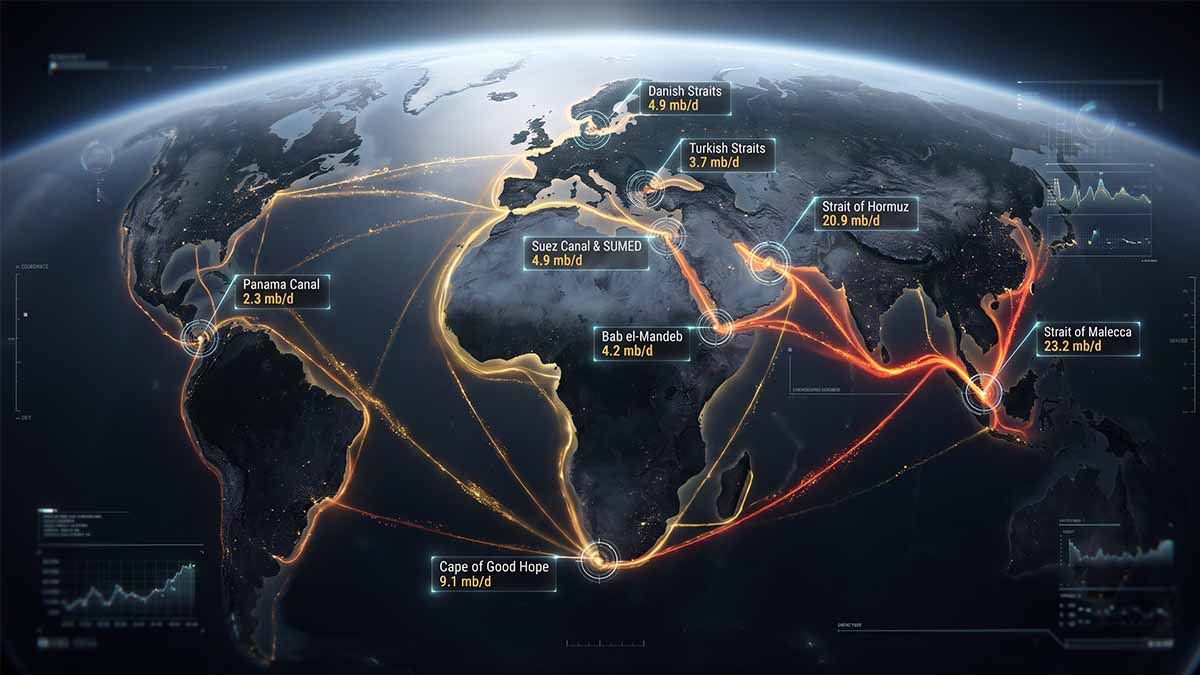
Geographic comparison of international petroleum transit routes
| Route | Petroleum liquids flow, first half of 2025 | Principal geographic function | Main operational vulnerability |
|---|---|---|---|
| Strait of Malacca | 23.2 million barrels/day | Indian Ocean–East Asia connection | Regional congestion and maritime-security exposure |
| Strait of Hormuz | 20.9 million barrels/day | Persian Gulf export access | Conflict affecting Gulf maritime passage |
| Suez Canal and SUMED pipeline | 4.9 million barrels/day | Mediterranean–Red Sea connection | Route availability and regional instability |
| Bab el-Mandeb | 4.2 million barrels/day | Red Sea–Indian Ocean passage | Maritime attacks and restricted navigation |
| Danish Straits | 4.9 million barrels/day | Baltic–North Sea connection | Regional access and infrastructure dependence |
| Turkish Straits | 3.7 million barrels/day | Black Sea–Mediterranean connection | Navigational constraints and regional security |
| Panama Canal | 2.3 million barrels/day | Atlantic–Pacific transit | Capacity and operating restrictions |
| Cape of Good Hope | 9.1 million barrels/day | Alternative southern African route | Longer voyage distance and additional operating costs |
Source: US Energy Information Administration — World Oil Transit Chokepoints, 3 March 2026.
The values represent route-specific movements of petroleum liquids and should not be added together because individual cargoes may transit multiple chokepoints. They describe the first half of 2025 and serve as a geographic baseline for assessing subsequent disruption.
Energy security is becoming a question of industrial survival
The economic impact of supply disruption extends well beyond immediate fuel expenditure. Energy is a fundamental input into chemicals, fertilisers, metals, glass, ceramics, transport, food processing and numerous other industrial activities. Where energy represents a substantial proportion of production costs, sustained price increases can reduce competitiveness even if factories retain access to physical supplies. Producers may attempt to pass higher costs to customers, reduce margins, decrease output or relocate future investment. The eventual result depends on competition, contract structures, energy efficiency and the availability of substitutes.
This creates an important distinction between short-term energy relief and long-term industrial competitiveness. Emergency subsidies can prevent immediate production closures, but they may be financially unsustainable if elevated energy costs persist. Investment in more efficient equipment or alternative energy systems may reduce future exposure, but it requires capital and time. Countries already confronting weak industrial profitability can face particular difficulties because companies may lack the resources to undertake the necessary transformation.
Energy costs also influence the geography of new investment. Capital-intensive projects requiring reliable electricity or process heat are sensitive to expected energy prices over many years. Businesses may favour locations offering long-term supply certainty even where construction or labour costs are higher. This can produce changes in international industrial competitiveness that persist after the original energy disturbance has ended.
For governments, energy security must therefore be integrated into industrial strategy. The relevant questions concern not only how much energy can be imported, but at what cost, through which infrastructure, under what contractual arrangements and with what protection against interruptions. The existence of domestic renewable generation, nuclear capacity, storage, transmission infrastructure and diversified fuel imports can influence these risks in different ways. Their combined contribution depends on the structure of national electricity and industrial systems.
Chapter 5 — Strategic judgment and decision implications
The disruptions of 2026 demonstrate that energy security is fundamentally an operational relationship between resources, infrastructure and geopolitical access. International production capacity can lose economic effectiveness when transport routes are unavailable, while alternative suppliers and emergency stocks can moderate shortages without restoring earlier prices or commercial certainty. Maritime geography has consequently become a central component of economic statecraft.
The most important policy implication is that diversification must be evaluated according to real deliverability rather than nominal capacity. Alternative pipelines, ports, LNG terminals, shipping arrangements and strategic inventories require assessment under plausible disruption conditions. Governments should distinguish between replacing lost supply, reducing demand and protecting essential economic activities, because each objective requires different instruments and produces different financial consequences.
The evidence also establishes that the consequences of the Gulf conflict are not confined to energy markets. Higher freight costs, shortages of refined products, reduced industrial margins and changing investment conditions transmit the effects of regional instability into the broader international economy. The same geographic system that connects Gulf exporters with Asian manufacturing centres also influences European energy prices and the financial conditions under which industrial enterprises operate.
The strategic relevance of maritime energy security will therefore persist even if regional hostilities diminish. The structure of international supply remains geographically concentrated, and alternative infrastructure will require substantial investment before it can significantly reduce existing dependencies. These conditions provide the background against which competition between the United States and China must be understood: the two powers are contesting technological and industrial leadership within an economic system whose essential physical networks remain interconnected and exposed to geopolitical disruption.
Chapter 6 — The United States and China: Technological Rivalry Within Economic Interdependence
The transition from tariff competition to the control of industrial capabilities
The economic relationship between the United States and China has entered a phase in which bilateral trade balances no longer provide an adequate measure of the strategic contest between them. Tariffs, export restrictions, investment controls, industrial subsidies and technology standards are increasingly being used to influence the productive capabilities available to each country. The central issue is no longer exclusively the location of imports and exports, but the distribution of technologies, manufacturing expertise, infrastructure and capital that determine future industrial competitiveness. This creates a relationship in which the two economies can become more politically adversarial while remaining commercially interconnected through direct transactions, third-country production networks and internationally integrated financial markets.
The scale of the adjustment is visible in the official United States trade accounts. According to the Office of the United States Trade Representative’s China Trade Summary, bilateral trade in goods and services totalled approximately $494.6 billion in 2025, a decline of 25.1% from 2024. Merchandise trade represented approximately $414.6 billion, while services trade accounted for an additional $80 billion. American merchandise imports from China declined by approximately 29.9%, and merchandise exports to China fell by approximately 26%. The bilateral merchandise deficit consequently narrowed substantially, although the value of remaining transactions demonstrates that the commercial relationship continues to be economically significant.
A reduction in bilateral commerce, however, does not establish an equivalent reduction in the underlying interdependence of the two productive systems. Companies can alter their sourcing arrangements, move final assembly or diversify procurement while retaining reliance on Chinese intermediate goods, machinery or industrial materials. Similarly, products manufactured in China may reach American consumers through commercial arrangements involving third countries. The statistical origin of an imported finished product does not necessarily reveal where its most important components were produced or where the technological capabilities required for its manufacture are located.
This distinction is particularly relevant in Southeast Asia. A manufacturing enterprise establishing production in Vietnam, Malaysia or another regional economy may genuinely diversify its operating footprint while continuing to import sophisticated components from China or other established suppliers. Such relocation can create economic benefits for the receiving country and reduce direct exposure to a particular bilateral trade restriction. Yet the strategic effect depends on how much productive capability has actually moved. Final assembly, materials processing, component fabrication and engineering development do not possess equivalent economic or technological significance.
The changing relationship must therefore be examined through the concept of industrial depth. Countries possessing extensive manufacturing ecosystems benefit from networks of suppliers, specialised services, skilled labour, infrastructure and technical expertise developed over long periods. These capabilities cannot necessarily be recreated by increasing tariffs or offering short-term subsidies. Industrial relocation becomes strategically consequential when it creates durable production capacity supported by a sufficiently complete supply chain, rather than simply altering the country in which final assembly takes place.
What the official trade figures reveal about the redistribution of American imports
The United States’ 2025 international trade accounts provide evidence of a broader geographic redistribution of merchandise sourcing. The Bureau of Economic Analysis and US Census Bureau’s US International Trade in Goods and Services: December and Annual 2025, published 19 February 2026, recorded a merchandise trade deficit with China of approximately $202.1 billion on a Census basis, compared with approximately $295.5 billion in 2024. The same statistical release recorded merchandise deficits of approximately $196.9 billion with Mexico, $178.2 billion with Vietnam and $146.8 billion with Taiwan.
These values must be interpreted carefully. A bilateral deficit is an accounting measure of trade flows, not an independent measure of economic exploitation, technological dependence or national security vulnerability. Nor does an increase in the deficit with a particular country demonstrate that production previously located elsewhere has necessarily been transferred there. Differences in consumer demand, investment, exchange rates, product composition and supply-chain organisation can all influence the result.
Nevertheless, the simultaneous reduction in the China deficit and expansion of deficits with several alternative manufacturing economies is consistent with a reorganisation of American sourcing patterns. Taiwan’s deficit with the United States increased substantially as American imports of technology-related products grew, while Vietnam’s rising merchandise surplus reflected its expanding role within international manufacturing networks. These developments illustrate how restrictions and industrial investment can redistribute the recorded geography of commerce without necessarily eliminating the international dependencies underlying production.
| US merchandise trade partner | US deficit, 2025 | Principal analytical interpretation |
|---|---|---|
| China | $202.1 billion | Large but declining direct bilateral merchandise imbalance |
| Mexico | $196.9 billion | Importance of North American production integration |
| Vietnam | $178.2 billion | Expanding role in Asian manufacturing supply chains |
| Taiwan | $146.8 billion | Rising importance of advanced technology-related imports |
| European Union | $218.8 billion | Continued transatlantic industrial and commercial interdependence |
| Germany | $73.0 billion | Significant bilateral trade in manufactured goods |
| Japan | $63.9 billion | Industrial, automotive and technology-related commercial integration |
| South Korea | $56.4 billion | Advanced manufacturing and technology supply relationships |
| India | $58.2 billion | Growing importance of diversified Asian commercial relationships |
All values are US merchandise trade deficits for calendar year 2025, expressed in current US dollars on the Census basis used in the source. Individual European national balances are included within the EU aggregate and must not be added to it when constructing a regional total. The figures identify bilateral accounting relationships and do not measure domestic value added or ultimate technological origin.
The scale of American imports from Taiwan and other Asian manufacturing economies has a particularly important implication. A strategy aimed at reducing dependence on China may increase reliance on production concentrated elsewhere in East Asia, including jurisdictions exposed to their own geopolitical risks. This does not necessarily represent a policy failure, because economic and security relationships with different partners vary considerably. It does demonstrate that diversification involves choices among different risks rather than the elimination of dependence altogether.
Semiconductor controls demonstrate the selective character of economic confrontation
Semiconductors have become a central instrument of American economic statecraft because they connect technological capability with industrial production, advanced computing and military-relevant applications. Restrictions on sophisticated processors and manufacturing equipment can influence the technological development of foreign enterprises while protecting capabilities considered strategically sensitive. Yet these controls also affect the revenue, investment incentives and international commercial relationships of American technology companies.
The evolution of American policy during 2026 illustrates the absence of a simple division between unrestricted trade and comprehensive prohibition. On 13 January 2026, the US Department of Commerce’s Bureau of Industry and Security announced a revised licensing policy for exports of certain advanced computing semiconductors to China. Applications involving NVIDIA H200, AMD MI325X and comparable processors would be considered individually, subject to specified security and compliance conditions. The stated requirements included safeguards concerning production capacity available to American customers, export compliance procedures and independent testing in the United States. Bureau of Industry and Security — Department of Commerce Revises License Review Policy for Semiconductors Exported to China, 13 January 2026.
The change is analytically significant because it confirms that American technology controls can be adjusted according to assessments of security, industrial competitiveness and commercial interest. Restrictions are not necessarily permanent or uniform across every semiconductor category. Licensing decisions can distinguish among products, customers, performance characteristics and end uses. The resulting regulatory environment may remain restrictive while allowing selected commercial transactions.
This approach reflects a structural tension in technology policy. Limiting access to advanced hardware may constrain a competitor’s immediate capabilities. However, excessive restrictions can also reduce export revenue for domestic manufacturers, encourage the development of substitute technologies and create incentives for foreign customers to diversify away from American suppliers. The magnitude of these effects depends on the availability of alternatives, the pace of technological innovation and the commercial importance of the affected market.
American industrial policy must therefore consider both the value of technological exclusion and the benefits of continued participation in international technology markets. A company deriving substantial revenues from foreign customers may reinvest those resources in research, manufacturing expansion and technological development. Restricting that revenue can affect its commercial position, although security considerations may justify the cost. The appropriate balance cannot be determined solely by the immediate value of exports.
The policy challenge becomes more complex when tariffs are applied to technologically sensitive imports. US Customs and Border Protection issued implementation guidance in January 2026 concerning additional duties of 25% on specified semiconductor products meeting defined technical criteria under Section 232 arrangements. The measures incorporated product-specific classifications and conditions rather than applying uniformly to every semiconductor imported into the United States. US Customs and Border Protection — Guidance on Section 232 Import Duties on Semiconductors and Derivative Products, 14 January 2026.
The coexistence of export licensing and import duties reveals how trade and technology policy are being combined. One instrument governs access by foreign customers to selected American technological capabilities; another influences the cost and conditions under which specific semiconductor products enter the American market. Their interaction can influence investment location, commercial negotiations and the configuration of international production networks.
China’s industrial position cannot be reduced to export dependence
China’s economic leverage derives not only from the scale of its exports but also from the depth of its manufacturing ecosystem and its position in numerous intermediate production networks. The capacity to produce components, machinery, industrial materials and finished goods at scale creates commercial relationships that are difficult to replace rapidly. This position is particularly important for manufacturing activities requiring extensive supplier coordination, infrastructure and technical labour.
A strategy based on moving final assembly outside China does not necessarily remove the economic importance of Chinese suppliers. Firms relocating to neighbouring economies may continue to purchase components, materials and equipment from established Chinese producers. The receiving country gains economic activity and employment, but the underlying production network remains connected to China. Over time, local supplier ecosystems may deepen and reduce those dependencies, although the process can require sustained investment and technical development.
China’s industrial advantage also creates constraints on its own economic choices. Major manufacturing industries depend on access to international customers, imported technologies, capital equipment and commodity supplies. Restrictions affecting overseas markets can reduce export opportunities, while energy disruptions can raise production costs. The importance of the Strait of Hormuz to Asian importers demonstrates that extensive domestic manufacturing capability does not eliminate external resource dependence.
China’s position is therefore characterised by the coexistence of substantial industrial strength and important international vulnerabilities. Access to energy, advanced components, global financial markets and foreign demand remains relevant to its economic performance. The precise significance of each exposure differs by sector, making broad claims of either complete technological independence or unavoidable economic dependence analytically inadequate.
Technology standards and the future of economic influence
The strategic competition between Washington and Beijing extends beyond control of particular products. Technical standards, software ecosystems, intellectual property, data governance and the compatibility of digital infrastructure increasingly influence the economic choices available to governments and enterprises. Countries adopting a particular technological architecture can become dependent on associated equipment, certification procedures, maintenance services and software updates. These dependencies can persist after the original procurement decision and may influence future investment.
Standards become economically important when they affect interoperability, market access and the cost of switching suppliers. A production system developed around specialised equipment or proprietary software may require substantial additional investment to adopt an alternative. The resulting switching costs can strengthen the commercial position of technology providers, even where competing products are technically available.
The international diffusion of technological systems also depends on financing and political relationships. Infrastructure suppliers capable of offering integrated equipment, training and long-term support may possess advantages over competitors providing technically comparable products without equivalent implementation capacity. Governments assessing technological dependence must consequently examine the full operating lifecycle rather than the immediate purchase price.
The regulatory environment introduces another dimension. Rules governing cybersecurity, export compliance, data access and technology transfers can affect whether particular systems remain usable across jurisdictions. Enterprises operating internationally may face incompatible requirements that increase compliance expenditure or require the duplication of infrastructure.
This creates an additional strategic consideration for Europe and other major importing markets. Technological autonomy cannot be measured solely by the nationality of suppliers. It also depends on the ability to modify, maintain, secure and replace essential technological systems. Procurement arrangements that preserve access to technical documentation, interoperability and alternative providers may reduce exposure even where the initial equipment is imported.
China, the United States and the geopolitical position of third countries
The competitive relationship between the two major powers creates opportunities and constraints for countries outside their immediate strategic confrontation. Economies capable of attracting relocated production may benefit from additional employment, infrastructure investment and export revenue. However, the distribution of benefits depends on the depth of domestic industrial participation and the financial arrangements associated with new projects.
Mexico occupies a distinctive position because of its geographic proximity to the United States and participation in North American production networks. Its commercial relationship with American industry creates opportunities for manufacturing integration, but also exposes investors to changes in trade policy, border procedures and rules of origin. A project intended to serve the American market must account for the conditions governing access to that market throughout the investment period.
Southeast Asian economies occupy a different position. Their geographic proximity to established East Asian supply chains can support manufacturing expansion and supplier integration. At the same time, extensive commercial relationships with China coexist with security, financial and technological ties involving the United States and other partners. Governments may seek to preserve this flexibility by avoiding exclusive dependence on either major power.
India presents another strategic configuration. Its domestic market, manufacturing ambitions and international partnerships create opportunities to attract investment, but industrial expansion requires infrastructure, skills, reliable energy and supply-chain development. Its exposure to imported petroleum and other essential inputs also connects industrial growth to conditions in the Gulf. The country’s long-term economic position will therefore depend on whether expanding investment produces productive capabilities that are competitive independently of temporary geopolitical incentives.
The strategic position of third countries is best understood through the concept of selective alignment. A government may cooperate with the United States in security and advanced technology while maintaining substantial commercial relations with China. It may simultaneously seek investment from Gulf sovereign institutions or industrial partnerships with European firms. Such arrangements are not necessarily contradictory. They can reflect attempts to diversify economic opportunities and reduce dependence on any single international partner.
Nevertheless, selective alignment becomes more difficult when major powers extend restrictions to third-country transactions or require compliance with competing technology regimes. Governments and enterprises may then confront choices that were previously avoidable. The cost of maintaining economic flexibility will depend on the scope of restrictions, the ability to negotiate exceptions and the availability of commercially viable alternatives.
The strategic consequences for the international financial system
The United States–China relationship also affects global finance through investment flows, currency arrangements, corporate valuations and expectations concerning international trade. The United States possesses a major role in global financial markets, while China occupies an exceptional position in manufacturing and international commerce. Changes in their bilateral relationship can therefore influence asset prices and investment decisions far beyond the sectors directly affected by tariffs or export controls.
Financial exposure can develop through several channels. Restrictions on technology sales may alter expected corporate earnings. Changes in tariff policy can affect inflation expectations and business margins. Investment screening can redirect capital towards different countries or industries. Expectations of geopolitical escalation can influence demand for liquid assets, commodity prices and exchange rates.
These transmission mechanisms do not imply that every deterioration in bilateral political relations produces financial instability. Markets frequently adapt to restrictions that are clearly defined and anticipated. Greater risk arises when policy changes are difficult to predict, implementation is uncertain or restrictions affect activities for which commercially viable alternatives are limited.
The distinction between strategic economic pressure and uncontrolled financial disruption is therefore important for both countries. Policies designed to reduce a competitor’s technological capability may impose costs on domestic investors and commercial partners. A confrontation affecting energy supplies or international transport may harm both economies through higher production costs and weaker demand.
The resulting interdependence creates incentives for selective accommodation even when underlying strategic competition remains intense. Temporary agreements, licensing arrangements or tariff adjustments can reduce immediate economic pressure without resolving disagreements concerning technology, security or international influence.
Chapter 6 — Strategic judgment and decision implications
The United States and China are not moving towards complete economic separation. They are attempting to alter the distribution of strategic dependencies within an international system that remains commercially interconnected. The reduction in direct bilateral merchandise trade demonstrates a substantial change in economic relations, but the development of production networks involving Taiwan, Mexico, Vietnam and other economies reveals that industrial competition is increasingly mediated through third countries.
The decisive question is whether the reorganisation of trade creates genuinely independent productive capabilities or merely changes the geographic location of transactions. The distinction matters because technological equipment, intermediate goods, intellectual property and industrial expertise frequently remain concentrated even when final assembly becomes more geographically dispersed.
American semiconductor policy illustrates the selective character of the confrontation: export restrictions and tariffs coexist with licensing mechanisms and continuing commercial transactions. China’s extensive manufacturing capabilities provide substantial economic leverage but do not eliminate exposure to imported energy, foreign markets and specialised technologies.
The strategic outlook through 2031 is therefore likely to be characterised by continuing competition over critical technologies, industrial investment and supply-chain control, punctuated by selective commercial agreements intended to limit immediate economic damage. For Europe and emerging economies, the central challenge will be to preserve access to both major economic systems while developing sufficient domestic capabilities to prevent the loss of strategic flexibility.
Chapter 7 — Europe’s Strategic Economic Position: Italy, France, Germany and the United Kingdom
Europe’s economic vulnerability originates in the interaction between industrial structure and strategic geography
Europe’s strategic economic position cannot be understood by examining its aggregate market size or industrial output independently of the external conditions on which that output depends. The continent possesses substantial manufacturing capabilities, advanced scientific institutions, extensive transport and electricity networks, and a large internal market supported by sophisticated legal and financial institutions. Yet its economic security is influenced by factors over which European governments exercise only partial control: international energy prices, access to strategic raw materials, technological decisions taken in the United States and East Asia, maritime security in distant regions and the availability of international capital under changing financial conditions.
The most important challenge is that these dependencies do not affect European economies equally. Differences in industrial composition, electricity generation, imported fuel requirements, public infrastructure and geographic orientation produce markedly different exposures. Energy-intensive chemical and metals production responds differently to an increase in gas prices than pharmaceutical manufacturing, aerospace production or knowledge-intensive services. An electricity system relying heavily on domestic nuclear generation has a different exposure profile from one using substantial quantities of imported natural gas. An economy dependent on automotive exports to international markets encounters different commercial risks from one specialising in financial services and software.
The consequence is that a common European economic strategy cannot rely on the assumption that all member states face identical industrial problems. Measures designed to protect one sector may provide limited benefits to another. Investment in electricity transmission may improve industrial competitiveness where power infrastructure is constrained, while investment in specialised workforce capabilities may be more consequential in economies possessing sophisticated manufacturing facilities but insufficient technical personnel. The allocation of resources must reflect identifiable structural bottlenecks rather than a uniform definition of European vulnerability.
The industrial scale of the European Union remains considerable. According to Eurostat’s EU Industrial Production Rebounds in 2025, published 24 August 2026, the value of sold industrial production increased from approximately €5.869 trillion in 2024 to €6.090 trillion in 2025. This is a measure of the value of manufactured products sold, not industrial gross value added or an inflation-adjusted indicator of economic growth. Nevertheless, it demonstrates the magnitude of the European industrial system and the economic consequences associated with its competitiveness.
The distribution of that production is especially important. Eurostat’s country-level industrial statistics identify Germany as accounting for approximately 26% of the Union’s total value of sold production in 2025, followed by Italy with approximately 14% and France with approximately 12%. These figures establish the continuing importance of the three countries as manufacturing centres, although they do not measure industrial profitability, productivity or technological sophistication. The data also demonstrate why changes in German, Italian or French industrial conditions can produce wider European consequences through intermediate-goods trade and investment relationships.
The European industrial economy is therefore neither a uniform system nor a collection of independent national industries. It is an interconnected production network in which differences in energy costs, financing conditions and technological capacity can influence the competitiveness of multiple countries simultaneously. A supplier located in Italy may depend on German manufacturing demand. A French industrial company may require equipment or components produced elsewhere within the Union. Changes in the availability of American or Asian technologies can affect production throughout these networks. European economic sovereignty must consequently be examined through the relationships connecting industries rather than exclusively through national production totals.
Energy dependence creates unequal starting positions
One of the clearest structural differences between European economies concerns their dependence on imported energy. Eurostat reports that the European Union’s energy import dependency rate was approximately 57% in 2024, meaning that net energy imports accounted for nearly three-fifths of gross available energy. Oil and petroleum products represented approximately 67% of energy imports, natural gas 24%, solid fossil fuels 4%, electricity 3% and renewable energy 2%. Norway supplied the largest share of imported natural gas at approximately 30%, while the United States was the leading source of imported oil and petroleum products at approximately 16%. Eurostat — Energy in Europe: Imports Dependency, 18 March 2026.
These figures reveal two important characteristics of European energy security. First, the Union remains materially exposed to international fossil-fuel markets despite continued investment in domestic generation and the energy transition. Second, the geographic diversification of imports has not eliminated dependence on internationally traded commodities. Even where supplies originate from politically reliable partners, European consumers remain exposed to changes in world prices, international shipping conditions and competition for available cargoes.
The economic consequences differ between countries because energy-import dependence is only one component of industrial exposure. Electricity generation technologies, industrial efficiency, domestic resource availability, taxation, network charges and the composition of manufacturing all influence the actual cost borne by enterprises. A country with a lower overall import dependency rate can still face expensive electricity or shortages affecting specific fuels. Conversely, high import dependence does not automatically imply weak energy security when supplies are diversified, infrastructure is reliable and the economy possesses sufficient financial capacity to absorb price changes.
The United Kingdom provides a useful comparison outside the European Union. The Department for Energy Security and Net Zero’s Energy Trends, March 2026 reports that the United Kingdom’s net energy import dependency was approximately 43.5% in 2025, compared with 43.8% in 2024. The UK therefore remained a significant net importer despite domestic energy production and its access to international markets. The figures are not directly equivalent in reference year to the EU’s 2024 aggregate, but they illustrate the need to distinguish the national production balance from the security of individual energy supplies.
The British electricity system also illustrates the importance of interconnected markets. In a parliamentary answer published on 12 June 2026, the government reported that the UK imported approximately 43 terawatt-hours of electricity during 2025, equivalent to around 13% of gross electricity supply, while exporting approximately 12 terawatt-hours. The same statement identified LNG terminals and pipeline connections with Norway, Belgium and the Netherlands as components of the country’s diversified gas supply arrangements. UK Parliament — Energy Import Dependence, Written Answer, 12 June 2026.
Cross-border electricity trade can improve economic efficiency and energy security when neighbouring systems possess complementary generation profiles and sufficient interconnection capacity. It also creates operational dependence on the availability of neighbouring networks, electricity-market conditions and the security of subsea infrastructure. The economic significance of interconnection must therefore be assessed as part of a wider system of generation, storage, demand and transmission rather than treated as either an inherent vulnerability or an automatic guarantee of security.
Italy: the intersection of manufacturing specialisation, electricity costs and Mediterranean security
Italy’s strategic economic position is shaped by the interaction between its diversified manufacturing system, substantial energy-import requirements and geographic proximity to Mediterranean transport and energy infrastructure. Its industrial economy includes extensive networks of specialised machinery producers, metalworking enterprises, electrical equipment manufacturers, automotive suppliers, chemical companies and high-value consumer-goods industries. The importance of these activities derives not only from their direct output but from the technical relationships connecting thousands of specialised suppliers to domestic and international customers.
Eurostat’s identification of Italy as accounting for approximately 14% of the EU’s value of sold industrial production in 2025 confirms the country’s substantial manufacturing scale. It would nevertheless be misleading to interpret this position as evidence that all Italian industrial segments are equally competitive. Some enterprises occupy specialised international niches with sophisticated engineering capabilities, while others remain highly sensitive to energy prices, financing costs and labour productivity. The capacity of the manufacturing system to remain competitive therefore depends on the efficiency of its supplier networks and the availability of infrastructure supporting them.
Italy’s energy position is particularly consequential for sectors using electricity, natural gas and process heat intensively. Metals, chemicals, ceramics, glass and numerous intermediate-goods industries can experience changes in international competitiveness when domestic energy costs diverge persistently from those faced by foreign producers. Such differences affect not only current profitability but also decisions concerning future investment. A manufacturer considering the modernisation of an existing facility may choose to expand elsewhere if expected electricity or gas costs make the investment commercially unattractive.
The Mediterranean introduces a second dimension to Italy’s economic security. The country’s ports, logistics companies, refining facilities and industrial consumers are connected to trade and energy routes extending towards North Africa, the eastern Mediterranean, the Red Sea and international markets beyond Suez. Disruptions affecting these corridors can influence maritime transport costs, delivery schedules and access to imported energy or industrial inputs. Italy’s geographic position may support its role as a commercial and energy connection between Europe and neighbouring regions, but the same geography creates exposure to instability affecting maritime routes and regional infrastructure.
The strategic significance of Italy’s port system depends on more than cargo-handling capacity. Reliable rail connections, efficient customs procedures, industrial logistics, electricity infrastructure and the integration of ports with manufacturing regions determine whether maritime access translates into broader economic benefits. Investment in port facilities without corresponding improvements in inland transport or industrial connectivity may deliver only limited gains in competitiveness.
A further consideration concerns the relationship between domestic manufacturing and imported technology. Italy’s specialised machinery and industrial engineering provide opportunities to integrate advanced sensors, automation and software into production. Yet many applications depend on components, semiconductors and digital infrastructure developed internationally. Industrial modernisation must consequently be supported by secure access to technology and by the technical capabilities required to integrate imported equipment effectively.
The most important strategic objective is not complete self-sufficiency, which would be economically impractical across the full range of technologies used by Italian manufacturers. It is the preservation of production capabilities that remain commercially valuable and can operate reliably under changing external conditions. This requires attention to energy costs, technical skills, industrial financing and the international networks supporting specialised production.
Italy’s government therefore faces a policy challenge extending beyond traditional industrial subsidies. The effectiveness of public intervention depends on whether it addresses specific obstacles preventing enterprises from investing, exporting or improving productivity. Measures improving the reliability of electricity supply or transport infrastructure may support a broad group of manufacturers. Sector-specific programmes may be appropriate where strategic dependencies or unusually high investment barriers justify intervention. The economic return must be judged by realised productive improvements rather than the announcement of expenditure.
France: industrial autonomy, electricity infrastructure and the financial limits of strategic ambition
France occupies a distinctive position because of its combination of advanced industrial enterprises, scientific and engineering capabilities, significant electricity-generation infrastructure and a tradition of active state involvement in strategic sectors. Aerospace, defence, nuclear technology, transport equipment, pharmaceuticals and selected digital industries provide important industrial capabilities. These assets offer opportunities for economic influence that extend beyond the value of ordinary merchandise exports because they involve specialised technology, long-term contracts and complex international production relationships.
France’s nuclear electricity system is particularly relevant to the present energy environment. A substantial domestic nuclear fleet can reduce direct exposure of electricity generation to the price of imported natural gas, although the actual economic benefits depend on reactor availability, maintenance requirements, network conditions and the pricing structure of the electricity market. Nuclear generation also involves long-term capital expenditure, fuel-cycle requirements and complex industrial maintenance capabilities. It is therefore a strategic asset whose value depends on sustained operational performance rather than nominal installed capacity.
France’s industrial position must also be considered in relation to the European market. According to Eurostat, the country represented approximately 12% of the EU’s value of sold industrial production in 2025. Its production system includes capabilities that are difficult to replicate rapidly, particularly in sectors requiring extensive engineering expertise and highly regulated manufacturing processes. Nevertheless, the preservation of these advantages requires investment, technical workforce development and access to international markets.
The French challenge is not simply to expand industrial capacity. It is to determine which strategic activities can generate durable economic value while operating within significant financial constraints. Large industrial programmes frequently require government support through procurement, infrastructure, guarantees or research expenditure. Their economic effects can be substantial when they create commercially viable production, but delays and cost increases may impose long-term fiscal burdens.
In this context, energy infrastructure and industrial policy cannot be assessed independently. Advanced manufacturing and digital infrastructure require reliable electricity, while the modernisation of energy systems requires industrial equipment, specialised labour and substantial capital. The French state must therefore coordinate investment across interconnected sectors while preserving transparency concerning financial commitments and implementation risks.
France’s international industrial relationships also introduce opportunities and vulnerabilities. Aerospace and defence programmes depend on complex supplier networks and long-term partnerships. Nuclear-related industrial activities involve extensive technical, regulatory and financial requirements. Changes in international demand, export permissions or geopolitical relationships can influence project economics. Diversifying markets and maintaining technical competitiveness are therefore necessary complements to preserving domestic capabilities.
The central French policy problem is the conversion of strategic ambition into sustainable industrial performance. Programmes should be evaluated not simply through their technological sophistication or political visibility, but through the extent to which they generate domestic value added, maintain commercially competitive enterprises and reinforce capabilities that remain important under adverse geopolitical conditions.
Germany: the reorganisation of Europe’s largest industrial production centre
Germany remains the most important national manufacturing centre within the European Union in terms of the value of sold industrial production. Eurostat reports a share of approximately 26% in 2025, nearly twice Italy’s corresponding share and more than twice France’s. This scale gives German industrial performance significance well beyond national economic statistics. German enterprises purchase intermediate goods, machinery and specialised services from extensive supplier networks distributed across Europe, and their investment decisions influence production in numerous neighbouring countries.
The German economic model has historically benefited from sophisticated industrial engineering, export-oriented production, extensive supplier relationships and integration into international markets. These advantages remain substantial, but they are increasingly exposed to changes in energy costs, technological competition and the structure of global demand. Automotive production, chemicals, machinery and industrial equipment face different forms of adjustment, but all require sustained investment to preserve competitiveness.
The energy dimension is especially consequential for chemicals and other energy-intensive industries. Higher energy costs can undermine the economics of domestic production even when enterprises retain advanced technical capabilities. Companies may respond through efficiency improvements, changes in production processes, reduced output or investment in alternative locations. The long-term consequence depends on whether domestic infrastructure and energy conditions allow industrial modernisation at commercially competitive costs.
Germany’s automotive industry also faces changes extending beyond the transition between combustion engines and electric powertrains. Vehicle manufacturing increasingly incorporates software, advanced electronics, battery systems and digital services. The location of economic value is consequently shifting within the production process, requiring manufacturers and suppliers to develop additional capabilities. Germany’s industrial position provides resources for adaptation, but established production systems and capital-intensive facilities can make rapid restructuring expensive.
The wider European consequences of German adjustment are considerable. A reduction in automotive or machinery investment can affect suppliers in Italy and other member states. Conversely, investment in new German production capabilities may create demand for European industrial equipment, automation and specialised components. The effectiveness of European industrial policy must therefore consider cross-border supply relationships rather than treating German industrial development as a purely national matter.
Infrastructure investment is another critical factor. Reliable electricity transmission, efficient freight transport, digital connectivity and the availability of technical labour influence the speed at which industrial enterprises can adapt. Financial resources are necessary but insufficient where projects face long approval processes or shortages of specialised implementation capacity. Industrial transformation requires the coordination of public authorities, infrastructure operators, educational institutions and private enterprise.
Germany’s strategic position consequently depends on the ability to convert existing manufacturing scale into a more technologically advanced and operationally resilient production system. Preserving established industrial structures without adaptation may weaken competitiveness, while excessively rapid restructuring can impose substantial employment and investment costs. The policy objective must be to improve the conditions under which enterprises undertake commercially sustainable modernisation.
The United Kingdom: financial, scientific and maritime capabilities within a different institutional framework
The United Kingdom occupies a distinct position because its economic structure places comparatively greater emphasis on services, finance, scientific research and knowledge-intensive activity than on the scale of traditional manufacturing production found in Germany. This does not mean that British manufacturing lacks strategic importance. Aerospace, defence, pharmaceuticals, specialised engineering and selected advanced technologies remain significant sources of productive capability. Nevertheless, the country’s economic exposure differs from that of the major manufacturing centres of the European Union.
The United Kingdom’s financial and professional services sectors create opportunities for international economic influence through investment, insurance, legal services, financial intermediation and commercial expertise. These activities can benefit from international capital flows and technological innovation, but they are also sensitive to changes in global financing conditions, regulatory arrangements and investor confidence.
The country’s maritime position remains significant because international shipping and insurance are essential to commercial activity. British economic interests extend beyond the physical movement of cargo through domestic ports to the broader services supporting international trade. Freight insurance, financing, legal arrangements and specialised maritime services can create exposure to disruptions occurring far beyond British territorial waters.
Energy security introduces another important consideration. The United Kingdom possesses domestic production and diversified import infrastructure, but official data confirm continued dependence on foreign energy. Its extensive electricity interconnections with European neighbours provide commercial flexibility, although their effectiveness depends on the conditions of neighbouring electricity systems and cross-border infrastructure.
The United Kingdom’s relationship with the European Union also influences industrial competitiveness. European markets remain important for British exporters, while regulatory differences and customs procedures can impose costs on enterprises operating across borders. The consequences vary by sector, and the strategic importance of regulatory compatibility is greatest where products require demanding certification, complex supply chains or extensive cross-border services.
For British policymakers, the principal objective is to combine scientific and financial capabilities with productive investment capable of strengthening the wider economy. A strong financial sector can facilitate capital mobilisation, but the availability of finance does not ensure that investment flows into domestic infrastructure or manufacturing. Similarly, excellence in scientific research does not automatically produce large-scale commercial activity without supporting enterprises, technical labour and suitable operating conditions.
The UK’s strategic economic position will therefore depend on the interaction between innovation, investment, energy infrastructure and international market access. Maintaining flexibility in its commercial relationships with Europe, the United States and other partners can provide opportunities, but those opportunities must translate into measurable productive performance.
European industrial scale and energy exposure: comparative evidence
| Indicator | Germany | Italy | France | United Kingdom |
|---|---|---|---|---|
| Share of EU sold industrial production, 2025 | Approximately 26% | Approximately 14% | Approximately 12% | Outside EU reporting universe |
| Industrial comparative strength | Machinery, vehicles, chemicals, engineering | Specialised machinery, metals, industrial components | Aerospace, defence, nuclear-related industry, pharmaceuticals | Aerospace, pharmaceuticals, defence, advanced engineering |
| Principal energy-security issue | Competitive energy supply for large industrial base | Imported fuel costs and industrial electricity prices | Operational and financial performance of electricity infrastructure | Domestic energy decline, imports and interconnector reliability |
| Main external commercial exposure | Export markets and international industrial supply chains | Export manufacturing and Mediterranean logistics | Strategic industrial programmes and international markets | Financial services, technology, European trade and maritime services |
| Priority for economic resilience | Industrial transformation and infrastructure | Energy competitiveness and productivity diffusion | Industrial implementation and long-term financing | Productive investment and reliable infrastructure |
The industrial-production shares are based on Eurostat — Industrial Production by Country, 2025, while the energy analysis draws on Eurostat — Energy Import Dependency, March 2026 and UK Department for Energy Security and Net Zero — Energy Trends. The remaining columns are qualitative assessments of industrial structure and exposure, not official numerical classifications.
European industrial policy: the transition from regulation to implementation
The European Commission’s Competitiveness Compass and Clean Industrial Deal establish an institutional framework for addressing several structural problems affecting European industry. The initiatives identify high energy costs, industrial decarbonisation, technological development and supply-chain dependence as major concerns. The Clean Industrial Deal, launched in February 2025, places particular emphasis on energy-intensive industries, clean technology, circularity and the conditions necessary for investment.
The strategic significance of these initiatives lies in the attempt to integrate objectives previously treated through separate policy frameworks. Industrial competitiveness, emissions reduction, energy affordability and technological security are increasingly understood as connected challenges. Investment in industrial electrification, for example, may reduce exposure to fossil fuels but increases dependence on electricity infrastructure and generation capacity. The development of clean technologies can create new industrial opportunities while introducing additional requirements for critical materials and specialised equipment.
The principal implementation risk concerns the difference between announced policy objectives and realised industrial transformation. European initiatives can establish regulatory conditions, financing mechanisms and common priorities, but production facilities are constructed and operated within national and regional economic systems. Differences in planning procedures, infrastructure capacity, labour availability and financing arrangements can produce uneven results.
A second challenge concerns the relationship between public support and international competition. Subsidies may accelerate investment but can also encourage competition among member states with different fiscal capacities. Without coordination, financially stronger countries may attract a disproportionate share of new facilities, potentially reinforcing existing industrial concentration. Conversely, allocating investment solely to achieve geographic balance can weaken economic efficiency if projects are located where essential capabilities or infrastructure are unavailable.
The policy objective should therefore be to improve the productivity of the European industrial system as a whole while avoiding unnecessary concentration of strategic vulnerabilities. This may involve supporting specialised capabilities in several countries rather than attempting to duplicate complete industrial ecosystems everywhere.
A new European strategic division of industrial responsibilities
Europe’s industrial diversity offers potential advantages if national strengths are connected through reliable infrastructure and coordinated investment. Germany’s manufacturing scale, Italy’s specialised industrial networks, France’s strategic technological capabilities and the United Kingdom’s scientific and financial resources can contribute to complementary forms of economic activity. The degree to which these capabilities reinforce one another depends on commercial arrangements, technical standards and the availability of cross-border infrastructure.
Such complementarity should not be confused with an administratively assigned division of industrial production. National governments retain legitimate economic interests, while enterprises make investment decisions according to commercial conditions. Nevertheless, policymakers can facilitate cooperation by reducing regulatory fragmentation, strengthening infrastructure links and supporting commercially viable joint projects.
The relationship between the EU and the United Kingdom deserves particular attention. Despite their different institutional arrangements, their industries remain connected through trade, investment, research and specialised production. Cooperation in energy systems, science, aerospace and certain defence-related technologies can offer economic benefits where regulatory and political arrangements permit it.
European economic security is also influenced by access to external markets. Maintaining commercial relationships with the United States, China, India and other major economies remains important for export-oriented industries. A strategy seeking autonomy through broad withdrawal from international commerce would risk undermining the market access and specialisation supporting European productive capacity.
The more defensible approach is to strengthen Europe’s negotiating position through competitive industries, reliable infrastructure and alternatives for the most consequential dependencies. Economic sovereignty should therefore be understood as the capacity to make strategic decisions without unacceptable disruption to essential economic activity, rather than as the elimination of all foreign commercial relationships.
Chapter 7 — Strategic judgment and decision implications
Europe remains a major centre of industrial, financial and technological capability, but its vulnerabilities are distributed unevenly across countries and sectors. The scale of German, Italian and French manufacturing gives the Union substantial productive resources, while the UK’s scientific, financial and specialised industrial capabilities remain relevant to the wider European economic environment. These advantages are weakened when energy prices, infrastructure constraints or fragmented policy implementation prevent enterprises from investing competitively.
The immediate strategic priority is to improve the reliability and affordability of the infrastructure supporting production. Over a longer horizon, the decisive issue will be the ability to combine industrial modernisation, technological capability and international market access without generating unsustainable public commitments.
Italy requires particular attention to industrial electricity costs, productivity and the efficiency of Mediterranean logistics. France must combine its strategic industrial assets with commercially and fiscally sustainable implementation. Germany faces the demanding task of transforming an exceptionally large manufacturing system. The United Kingdom must translate financial and scientific resources into broader productive investment while preserving reliable relationships with European and international markets.
The European Union’s central responsibility is to create conditions under which these different national capabilities can reinforce one another. A fragmented response risks increasing industrial disparities and weakening the continent’s collective position in international economic competition.
The wider geopolitical significance is that European industrial competitiveness increasingly depends on developments beyond European borders. Energy-market stability in the Gulf, maritime access through the Red Sea, technological policies in Washington and Beijing, and investment decisions across emerging markets all influence the conditions under which European industries operate. The European economic challenge is therefore inseparable from the transformation of regional power in West Asia and the wider developing world.
Chapter 8 — The Gulf, West Asia and Emerging Economies: Investment, Security and Regional Realignment
The Gulf’s transformation from an energy-exporting centre into a contested economic and infrastructure system
The strategic importance of West Asia in 2026 extends considerably beyond the region’s established position in international petroleum and natural gas markets. Over the preceding decades, the Gulf economies progressively expanded their economic ambitions towards international finance, logistics, aviation, tourism, real estate, telecommunications, advanced technology and industrial diversification. Sovereign investment institutions became important participants in international capital markets, while regional governments attempted to transform hydrocarbon revenues into productive assets capable of supporting economic activity after the eventual decline of dependence on fossil-fuel exports. The resulting strategy was predicated on a combination of financial resources, international connectivity, infrastructure investment and the capacity to offer a comparatively stable operating environment for global enterprises.
The regional confrontation beginning in February 2026 has exposed a fundamental vulnerability within that model. The infrastructure necessary for diversification is economically valuable precisely because it connects the Gulf to international markets, but these connections also create exposure to military escalation, maritime disruption and the deterioration of investor confidence. Airports, commercial ports, energy export terminals, industrial zones, data centres and transport corridors require operational continuity. Their economic performance depends on insurance, access to finance, physical security and the willingness of international customers to maintain commercial relationships during periods of uncertainty.
The conflict has therefore produced a more complicated economic disturbance than a conventional increase in petroleum prices. Historically, higher oil prices could improve the fiscal and external positions of major exporters when production and shipments continued normally. The disruption of export infrastructure creates a different outcome: prices may rise while export volumes decline, preventing producers from fully benefiting from the increased market value of their commodities. Countries possessing significant reserves can experience sharp reductions in output and export revenue if they are unable to transport production to international markets.
The World Bank’s Middle East, North Africa, Afghanistan and Pakistan Economic Update, October 2026, projects that economic output across its MENAAP regional grouping will contract by approximately 2.1% during 2026, following growth of 3.3% in 2025. The institution identifies the conflict and the disruption of the Strait of Hormuz as major causes of the deterioration, with consequences extending into tourism, aviation, logistics, financial markets and business confidence. These figures refer to the World Bank’s specified regional grouping and should not be confused with forecasts using different country coverage.
The IMF’s Middle East and Central Asia Department briefing of 15 October 2026 likewise emphasises the highly uneven impact of the conflict. Countries directly affected by military operations and export disruption face substantially greater pressure than economies benefiting from geographic distance, alternative trade arrangements or stronger domestic demand. This unevenness is a central characteristic of the regional outlook. The consequences cannot be reduced to a single judgment concerning the Gulf or the broader Middle East.
Why higher energy prices no longer guarantee stronger Gulf economic performance
The relationship between international energy prices and the economic position of Gulf producers has been altered by the physical disruption of exports. Hydrocarbon revenue depends on the quantity of production sold, the realised selling price and the costs associated with extraction, transport and marketing. An increase in benchmark prices can improve revenue per barrel, but its benefits may be more than offset by a sufficiently large reduction in exported quantities. Damaged infrastructure, restricted maritime access and additional operating costs can further reduce the economic return.
The consequences extend into public finances. Governments relying substantially on hydrocarbon receipts must finance domestic expenditure, investment programmes and social commitments while managing changes in export income. Sovereign wealth funds and accumulated financial assets can provide important buffers, but their use entails opportunity costs and may affect the timing or scale of international investment. The ability to absorb temporary disturbances therefore depends on fiscal reserves, financial-market access, the duration of disruption and the flexibility of government expenditure.
This creates a distinction between countries possessing strong financial buffers and those whose public finances are more dependent on current hydrocarbon income or whose access to external financing is constrained. The same physical disruption can produce materially different consequences across the region. Economies with extensive foreign assets and diversified revenue sources may preserve essential public expenditure for longer periods, while more vulnerable states may face difficult adjustments involving public investment, imports or social spending.
The impact on private-sector diversification is also significant. Major infrastructure and industrial projects frequently involve partnerships with foreign enterprises, specialised contractors and international lenders. Their continuation depends on the ability to maintain commercial operations and protect personnel, equipment and financial commitments. A rise in geopolitical uncertainty can increase the required return on investment, complicate project finance or delay construction schedules. Even projects that remain strategically attractive may experience slower implementation as enterprises reassess risks.
The regional economic challenge is therefore not limited to restoring export volumes. Governments must also preserve the confidence necessary for long-term investment. The credibility of physical security arrangements, continuity of commercial law, reliable infrastructure and predictable policy implementation will influence the extent to which Gulf diversification programmes can recover after the immediate disturbance.
The strategic differences among Saudi Arabia, the UAE, Qatar and the smaller Gulf economies
Saudi Arabia’s economic position reflects the scale of its energy production, the importance of its domestic market and the breadth of its industrial and infrastructure ambitions. The kingdom possesses substantial financial and physical resources, but its investment programmes also require sustained expenditure and international partnerships. The disruption of regional energy exports increases the importance of alternative transport infrastructure and of the ability to protect essential production and distribution systems.
The Saudi East–West pipeline has become especially important because it provides an alternative connection between eastern oil production areas and the Red Sea. Its strategic value derives from reducing dependence on maritime passage through Hormuz for part of Saudi exports. Nevertheless, attacks affecting the pipeline demonstrate that bypass infrastructure can become a target in its own right. The investment required to protect, repair and potentially expand such systems must be incorporated into the economics of future energy security.
The United Arab Emirates possesses a different economic structure, with substantial activities in trade, aviation, financial services, real estate and international logistics alongside hydrocarbon production. This diversification provides multiple sources of income but also creates exposure to interruptions affecting transport, commercial confidence and international connectivity. A port or aviation centre can lose economic activity through changes in perceived security even without sustaining direct physical damage, because commercial operators may alter routes, insurance arrangements or investment decisions.
The UAE’s oil export infrastructure serving Fujairah provides some capacity to reduce reliance on Hormuz. However, the strategic value of this infrastructure depends on its operational security and the ability to connect production with international shipping. The country’s position as a financial and commercial centre also introduces exposure to changes in capital flows and investment confidence, making the economic consequences of conflict broader than the energy sector alone.
Qatar’s position is particularly distinctive because of its central role in global LNG markets. The concentration of LNG exports passing through Hormuz means that disruption can affect not only current export receipts but also the reliability of long-term supply relationships. LNG projects require substantial capital investment, specialised processing facilities and long-term commercial planning. The ability to deliver contracted volumes is therefore important for maintaining the confidence of customers and financial partners.
The IEA’s estimate that approximately 93% of Qatari LNG exports normally pass through Hormuz illustrates the concentration of this vulnerability. The availability of natural gas reserves does not provide an immediate alternative export route when the infrastructure necessary to liquefy and transport production remains geographically constrained. This makes maritime security an essential component of Qatar’s commercial position. IEA — Strait of Hormuz Factsheet, February 2026.
Kuwait and Bahrain face additional constraints arising from geography and their economic structures. Their dependence on Gulf maritime access creates exposure to regional disruption, while domestic financial conditions and investment capabilities influence their capacity to absorb prolonged shocks. Iraq confronts a particularly demanding position because oil revenues are central to public finances and because the country must manage extensive infrastructure, investment and governance requirements. The interruption of export activity can rapidly affect the resources available for public expenditure and reconstruction.
Oman possesses geographic characteristics that differentiate it from several neighbouring Gulf economies, including maritime access outside the Strait of Hormuz. This can provide opportunities in logistics and transport under circumstances in which other regional routes are constrained. However, geographic advantage does not eliminate exposure to the international consequences of conflict, including changes in trade, investment and regional demand.
Country-specific economic transmission channels in the Gulf
| Economy | Strategic economic asset | Principal conflict transmission mechanism | Consequence for diversification |
|---|---|---|---|
| Saudi Arabia | Large hydrocarbon production, domestic market, major investment programmes | Export-route disruption and pressure on energy infrastructure | Reassessment of project timing, security costs and capital allocation |
| United Arab Emirates | Energy, ports, aviation, logistics, financial and commercial services | Maritime disruption and deterioration in commercial confidence | Higher operating risk for internationally connected activities |
| Qatar | Large-scale LNG export capacity | Dependence on maritime access through Hormuz | Increased importance of delivery reliability and infrastructure security |
| Kuwait | Hydrocarbon revenues and financial assets | Export interruptions and changes in fiscal revenue | Pressure on investment priorities and fiscal management |
| Bahrain | Financial services, industry and regional commercial integration | Regional security exposure and financing conditions | Greater sensitivity to prolonged disruption and investor uncertainty |
| Oman | Maritime position and access outside Hormuz | Changes in regional trade and investment patterns | Potential logistical opportunities alongside wider economic risks |
| Iraq | Petroleum exports and substantial reconstruction needs | Export interruption and pressure on government revenue | Reduced fiscal flexibility and investment capacity |
The table is a qualitative comparison of economic transmission channels rather than a ranking of national security conditions or fiscal strength. The principal geographic and energy relationships are documented in the IEA Strait of Hormuz Factsheet, while the regional economic effects are assessed in the World Bank’s October 2026 MENAAP Economic Update and the IMF regional briefing of 15 October 2026.
Sovereign investment institutions and the international allocation of Gulf capital
The Gulf economies’ international financial role is a central component of their strategic importance. Sovereign investment institutions and state-linked investment vehicles participate in global capital markets, infrastructure, technology and industrial projects. Their investments can provide diversification away from domestic hydrocarbon revenue while establishing international commercial relationships and access to specialised capabilities.
The current conflict introduces competing pressures on these investment strategies. On one hand, a more uncertain international environment can increase the importance of diversified foreign assets, particularly where domestic production or infrastructure is exposed to military disruption. On the other hand, governments facing reduced export income or increased domestic expenditure may need to reconsider the allocation of resources between international investment and domestic economic stabilisation.
The direction of the adjustment will depend on institutional mandates, available liquidity, government financing requirements and the expected returns from alternative investments. It would be incorrect to assume that every Gulf sovereign investor will respond identically. Some institutions may retain long-term allocations because their investment horizon extends beyond temporary conflict. Others may adjust commitments or increase liquidity in response to domestic needs.
The international consequences could nevertheless be significant. Gulf capital participates in sectors requiring substantial long-term financing, including infrastructure, commercial real estate, technology and industrial development. Changes in investment appetite can affect projects and enterprises outside the region, particularly where Gulf institutions represent important financing partners.
The relationship is reciprocal. Foreign investments can provide returns and economic diversification for Gulf countries, while receiving economies benefit from access to capital. Yet the strategic benefits depend on the quality of projects and the governance of investment arrangements. Capital flows into high-value productive infrastructure can generate broader economic benefits than transactions involving existing assets without corresponding increases in productive capacity.
This distinction is particularly important during a period of international technological expansion. Investment in data centres and computing infrastructure can support the development of new commercial activities, but the economic return depends on electricity availability, customer demand and the ability to deploy technology productively. Gulf governments seeking to establish advanced digital industries must therefore coordinate financial investment with domestic infrastructure and workforce development.
Emerging-market investment is recovering without becoming broadly distributed
The concentration of international investment provides a wider context for understanding the Gulf’s changing economic relationships with emerging markets. According to UN Trade and Development’s World Investment Report 2026: International Investment in a Turbulent Era, global foreign direct investment increased by approximately 6% during 2025, reaching $1.6 trillion after two consecutive years of decline. However, the recovery was highly uneven. Investment inflows into developed economies increased by approximately 11%, while inflows into developing economies grew by only 2%, reaching approximately $901 billion.
The geographic concentration of investment is particularly significant. UNCTAD reports that the world’s twenty largest host economies attracted more than 80% of global foreign direct investment. It also identifies a major shift in the sectoral allocation of new projects: strategic sectors accounted for approximately 44% of the announced value of global greenfield investment projects in 2025, compared with 16% in 2020. These figures indicate that international capital is increasingly concentrated in a relatively narrow group of countries and activities.
For emerging economies, the problem is not simply the availability of foreign investment but its developmental impact. A large industrial or digital project can increase the recorded value of investment inflows without necessarily generating extensive domestic employment, technology transfer or local supplier development. Capital-intensive facilities may rely heavily on imported equipment, specialised foreign personnel and external intellectual property. Their contribution to national productive capacity depends on the extent to which domestic enterprises participate in the resulting value chain.
This is especially important for countries seeking to benefit from the reorganisation of international trade. Attracting a manufacturing facility can create employment and export revenue, but the long-term economic value is greater when the investment also supports local suppliers, workforce development and the acquisition of technical capabilities. Otherwise, the receiving economy may remain dependent on imported components and decisions made by foreign investors.
International competition for investment can also create fiscal risks. Governments may offer tax exemptions, infrastructure subsidies or public guarantees to attract projects. Such incentives can be economically justified where investments produce substantial external benefits, but they may weaken public finances if projects deliver limited domestic value or require continuing support.
The appropriate measure of investment success is therefore not the announced monetary value of projects alone. Governments must evaluate realised expenditure, completed productive facilities, employment, skills development, domestic procurement and the durability of export revenues.
Global foreign direct investment: the concentration of capital
| Indicator | Reported value | Reference period | Economic interpretation |
|---|---|---|---|
| Global FDI inflows | $1.6 trillion | 2025 | Worldwide investment flows |
| Annual change in global FDI | +6% | 2025 | Recovery following two years of decline |
| Developing-economy FDI inflows | $901 billion | 2025 | Capital received by developing economies |
| Developing-economy FDI growth | +2% | 2025 | Comparatively weak investment expansion |
| Developed-economy FDI growth | +11% | 2025 | Stronger investment recovery |
| Share received by 20 largest host economies | More than 80% | 2025 | Geographic concentration |
| Strategic-sector share of greenfield project value | 44% | 2025 | Concentration in selected activities |
| Strategic-sector share of greenfield project value | 16% | 2020 | Historical comparison |
Source: UNCTAD — World Investment Report 2026, 7 July 2026.
The table distinguishes realised FDI inflows from announced greenfield project values. These are different statistical measures and should not be aggregated. The figures demonstrate concentration in investment allocation but do not independently establish the productivity or employment effects of individual projects.
The Horn of Africa and the Red Sea: commercial geography and strategic competition
The economic consequences of conflict in West Asia extend into the Horn of Africa because the Red Sea and its surrounding territories form part of a commercial system connecting Asia, the Gulf, the Mediterranean and Europe. Countries bordering or approaching these routes can acquire strategic importance through port infrastructure, transport corridors, logistics services and access to international markets.
Djibouti occupies a particularly important geographic position near the southern entrance to the Red Sea. Its ports and transport connections provide commercial access for regional economies, while its location attracts international security interest. Ethiopia’s economic development is influenced by access to maritime trade, making transport infrastructure and cross-border commercial arrangements important strategic considerations. Somalia, Eritrea and other territories within the wider Horn of Africa possess different political and economic conditions, but their geographic position creates opportunities and vulnerabilities associated with maritime commerce.
The region illustrates how transport geography can influence economic power even where domestic industrial output remains relatively limited. Ports and corridors can generate revenue, attract investment and improve access to international trade. However, the construction of infrastructure does not automatically create a competitive logistics system. Commercial performance depends on customs efficiency, transport connections, security, reliable energy and the volume of trade that can be attracted.
The Red Sea disturbances also demonstrate the limits of geographic opportunity. A port situated near a strategically important route can benefit from commercial demand under stable conditions, but insecurity can discourage investment and force shipping companies to use alternatives. Countries seeking to develop logistics infrastructure must therefore assess political stability, financing conditions and the reliability of regional commercial relationships.
For European governments, the Horn of Africa has economic significance because disruptions affecting regional maritime routes influence access between European markets and the Indian Ocean. Policies concerning maritime security, development finance and commercial infrastructure can consequently serve complementary objectives, although their implementation requires sensitivity to regional sovereignty and political conditions.
The eastern Mediterranean: competing infrastructure ambitions
The eastern Mediterranean represents another region where the economic value of geography is increasingly connected to security and political relationships. Maritime transport, offshore energy resources, electricity connections and the reconstruction of damaged infrastructure create opportunities for regional cooperation. At the same time, unresolved territorial disputes, security tensions and competing national interests can constrain investment.
Projects involving pipelines, electricity interconnectors or transport corridors require agreements extending beyond technical engineering. Financing institutions and commercial investors must evaluate legal jurisdiction, regulatory conditions, long-term demand and the possibility that political disputes will interrupt operations. Infrastructure can therefore become economically unattractive even where its physical construction is technically feasible.
The interaction between Israel, Türkiye, Cyprus, Greece, Egypt and other regional actors introduces several overlapping interests. Energy infrastructure may support domestic consumption, international trade or regional electricity integration, while maritime jurisdiction and security remain politically sensitive. The importance of each project depends on its actual implementation status and commercial viability, not merely on diplomatic declarations.
European interest in the region reflects both geographic proximity and the potential benefits of diversified energy and transport links. Nevertheless, infrastructure development should not be treated as a substitute for political stability. A corridor exposed to sustained conflict may provide limited security benefits regardless of its nominal capacity.
West Asian diversification and the international competition for data infrastructure
The Gulf economies’ technological ambitions introduce a further dimension to international competition. Governments seeking to attract computing infrastructure and advanced digital enterprises can offer financial capital, land, energy resources and large-scale investment programmes. These assets may create competitive advantages, particularly where projects require substantial electricity and construction expenditure.
Yet the development of a sustainable digital economy requires more than physical data-centre capacity. Computing equipment, software, cybersecurity, communications infrastructure and specialised technical personnel must be integrated into commercial activities capable of generating durable revenue. The location of data processing facilities does not necessarily determine who controls the underlying technology or captures its economic value.
Geopolitical conditions can complicate these ambitions. International technology suppliers may be subject to export licensing, security conditions and regulatory restrictions. Investors must assess whether equipment can be acquired, maintained and upgraded throughout its expected operating life. Commercial customers must consider the security of infrastructure and the continuity of digital services.
The Gulf’s financial resources may support the acquisition of advanced computing infrastructure, but the regional conflict demonstrates that physical security can become a limiting factor. Data centres require reliable electricity, cooling and communications networks. Their exposure to disruption must be incorporated into insurance, financing and operational planning.
The strategic objective should consequently be to develop an integrated technological ecosystem rather than to measure success exclusively through announced capital expenditure. Research institutions, technical education, locally developed applications and commercially sustainable enterprises are essential to transforming infrastructure investment into durable economic capabilities.
Emerging economies and the changing terms of strategic alignment
For emerging economies outside the Gulf, the reorganisation of international power creates opportunities to negotiate investment and commercial relationships with several partners. The United States, China, European countries and Gulf investment institutions can offer different combinations of capital, technology, market access and infrastructure development. Governments may seek to use competition among these actors to improve financing terms and diversify economic relationships.
Such opportunities are not distributed equally. Countries possessing large domestic markets, established industrial capabilities or strategically important geographic locations may have greater negotiating leverage. Smaller economies dependent on external financing can face difficulties evaluating complex infrastructure agreements or managing contingent fiscal commitments.
The quality of governance becomes especially important where projects involve substantial public guarantees, long-term concessions or foreign-currency obligations. Financing arrangements that appear attractive during periods of abundant capital can become burdensome when revenues underperform or borrowing conditions change. Transparency concerning contractual obligations and the economic assumptions supporting projects is therefore essential.
The strategic value of partnerships should be assessed through their effect on domestic productive capacity. Agreements that improve transport infrastructure, electricity availability, technical skills or market access can strengthen long-term economic resilience. Arrangements that generate financial liabilities without corresponding productive benefits may increase dependence rather than reduce it.
This distinction is particularly relevant to countries affected by climate vulnerability, food-import requirements or limited fiscal resources. External disturbances can reduce foreign-exchange earnings and increase import costs at the same time. Investment strategies that strengthen domestic agriculture, electricity systems and logistics may consequently provide economic-security benefits extending beyond their direct commercial returns.
Regional realignment through 2031: three plausible directions
The medium-term outlook for West Asia and its connected emerging markets depends on the interaction between military security, export recovery, investment confidence and the financial capacity of governments. The available evidence supports three plausible directions, none of which should be interpreted as a quantified forecast.
The first is a partial restoration of regional commercial activity in which energy exports recover, transport corridors reopen more reliably and governments resume postponed investment programmes. Under this pathway, the Gulf economies retain substantial advantages arising from energy resources and financial assets, but future infrastructure planning incorporates higher security and redundancy costs. The improvement in economic conditions would depend on the durability of regional arrangements and the absence of renewed major disruption.
The second involves prolonged selective instability. Some maritime routes and export facilities return to operation, while others remain subject to recurrent interruptions. Governments and enterprises adapt by maintaining larger inventories, diversifying suppliers and investing in alternative infrastructure. This configuration could sustain international commerce but at higher operating cost. The economic benefits of diversification would be uneven, with more financially resilient countries better positioned to complete infrastructure projects and preserve international investment relationships.
The third involves a more severe compound disturbance in which renewed conflict damages export infrastructure, restricts transport and undermines investor confidence across several regional economies. Such an outcome could increase the financial pressure on energy exporters while transmitting higher commodity prices and transport costs internationally. Countries dependent on imported food, energy or external financing would be particularly exposed. The severity would depend on the duration of disruption, the availability of emergency supplies and the effectiveness of macroeconomic stabilisation policies.
| Strategic pathway | Conditions required | Principal economic consequence | Observable indicators |
|---|---|---|---|
| Partial commercial restoration | More reliable maritime access and export infrastructure | Recovery in output, transport and investment | Export shipments, port activity, project implementation |
| Prolonged selective instability | Intermittent disruption with functioning alternative routes | Higher operating costs and uneven regional adaptation | Insurance conditions, inventory changes, freight costs |
| Compound regional disruption | Renewed attacks affecting several critical systems | Severe pressure on trade, output and government revenue | Infrastructure outages, export interruptions, sovereign financing pressure |
These pathways are analytical alternatives, not probabilities or official forecasts. They are informed by the mechanisms identified in the World Bank’s October 2026 MENAAP Economic Update, the IMF’s October regional briefing and the IEA’s October 2026 Oil Market Report.
Chapter 8 — Strategic judgment and decision implications
The transformation of West Asia is entering a phase in which financial resources, energy production and international infrastructure can no longer be evaluated independently of regional security. The Gulf economies retain substantial economic assets, but the events of 2026 demonstrate that capital-intensive diversification strategies are exposed to disturbances affecting the physical systems on which international commerce depends. Higher petroleum prices cannot guarantee stronger national income when export volumes are disrupted, while sovereign financial assets cannot automatically restore damaged infrastructure or commercial confidence.
The wider emerging-market environment is equally differentiated. International investment has recovered, but its concentration in a limited number of economies and strategic sectors creates uneven opportunities. Countries capable of converting external financing into domestic productive capabilities may strengthen their economic position. Those relying on investment commitments without sufficient infrastructure, technical capacity or fiscal governance may accumulate additional dependencies.
The most consequential regional development through 2031 will therefore be the reorganisation of relationships among energy producers, infrastructure operators, financial institutions and external strategic partners. The United States, China, European economies and other major actors have compelling economic interests in the continuity of trade and investment, even where their political and security objectives diverge.
West Asia will remain an important test of whether economic interdependence can reduce the incentives for confrontation or whether the value of strategic infrastructure will make control over that infrastructure an increasingly contested source of power.
Pillar II — Integrated Strategic Assessment: The Geography of Economic Power Through 2031
The evidence developed across the four chapters establishes that the international distribution of economic power is increasingly determined by the reliability of connections between production, infrastructure, finance and political authority. Countries possessing extensive natural resources or advanced industrial capabilities can experience severe economic pressure when transport routes become unavailable, technological access is restricted or financial conditions undermine investment. Conversely, economies with comparatively limited domestic resources can acquire strategic importance by controlling indispensable logistics facilities, specialised industrial processes or infrastructure supporting international trade.
The Gulf conflict provides the clearest contemporary demonstration of this transformation. The contraction of petroleum production, disruption of maritime access and consumption of commercial inventories have shown that the physical availability of energy can become a binding constraint on international economic activity. Alternative routes and suppliers have moderated the consequences, but the costs of adaptation are substantial and unevenly distributed.
The United States–China relationship demonstrates a different mechanism. Their competition is increasingly focused on the technological and industrial capabilities required to sustain future economic influence. Restrictions on advanced technology, changes in sourcing patterns and the expansion of production in third countries are altering the geography of international commerce. Nevertheless, the complexity of industrial supply chains makes complete separation economically difficult and strategically uncertain.
Europe occupies a consequential position between these transformations. Its manufacturing economy depends on international markets, imported resources and technologies developed through global production networks. Its strategic capabilities are substantial, but the differences among national industrial structures and energy systems make a uniform response inadequate. Italy, France, Germany and the United Kingdom possess complementary strengths but confront distinct implementation challenges.
The Gulf and emerging economies form another component of this changing system. Their capacity to attract capital, develop infrastructure and preserve international relationships will depend increasingly on political stability, project governance and access to essential technologies. The recovery of international investment does not guarantee broad-based development when capital is concentrated in a narrow group of countries and activities.
The principal strategic question is consequently whether governments can improve the reliability of economic relationships without sacrificing the productive advantages of international integration. The answer will not be found in universal self-sufficiency or unrestricted dependence. It will depend on identifying critical vulnerabilities, preserving commercially useful partnerships and investing in the infrastructure and capabilities required to sustain essential economic activity.
For the European Union and the United Kingdom, the most consequential policy implications concern coordinated energy security, resilient maritime access, technological interoperability and the development of commercially sustainable industrial capacity. For the United States and China, the central issue is the management of technological rivalry within an economic system that continues to connect their interests. For West Asia, the decisive problem is restoring the conditions under which energy production, financial resources and infrastructure can support durable economic diversification.
The central judgment of Pillar II is that international economic power through 2031 will depend increasingly on the capacity to guarantee access, continuity and operational security across the networks connecting resources, technology, capital and markets. The possession of economic assets remains essential, but the ability to employ those assets reliably under geopolitical stress is becoming an equally important determinant of national and regional influence.
The unresolved challenge concerns the financial consequences of this transformation. More extensive infrastructure redundancy, technological competition, defence expenditure and strategic investment may improve resilience, but they also require substantial capital. If those financial requirements coincide with renewed inflation, climate-related disruption or instability in sovereign and corporate debt markets, the mechanisms examined in this pillar could become mutually reinforcing sources of systemic pressure. That interaction forms the analytical basis for Pillar III.
PILLAR III — SYSTEMIC RISK, GOVERNANCE AND THE 2031 HORIZON
The transmission of climatic and economic disturbances into international prices, the architecture of financial contagion, the possible trajectories of the global economy and the institutional choices required to preserve productive capacity, financial stability and strategic autonomy.
Chapter 9 — Inflation, Climate Exposure and the Political Economy of Scarcity
The emergence of persistent supply-side instability as a structural economic constraint
The international economic debate increasingly confronts a problem that cannot be resolved through the conventional management of aggregate demand: the multiplication of disturbances affecting the physical availability, production costs and distribution of essential goods. Food, water, electricity, agricultural inputs and transport infrastructure are exposed to different risks, but their economic consequences can interact through commodity prices, industrial production, household consumption and public finances. The importance of this development lies not in the expectation of a permanent worldwide shortage of essential resources, for which the available evidence provides no sufficient basis, but in the growing possibility that regional supply disruptions will occur frequently enough to prevent a sustained restoration of economic predictability.
The distinction between temporary price increases and structural scarcity is fundamental. A commodity can become more expensive without becoming physically scarce in aggregate, particularly when production, financing, transportation or inventories are temporarily constrained. Conversely, an adequate global volume of production does not guarantee accessibility in individual countries where purchasing power, foreign-exchange availability or logistics are inadequate. Economic security depends on the relationship between supply, distribution and the financial capacity to obtain essential goods, rather than exclusively on the quantities produced worldwide.
This distinction is especially important for food. International agricultural markets can record sufficient overall production while individual regions confront severe affordability problems. Farmers may face higher costs for fertiliser, fuel and irrigation, while consumers encounter rising food prices through import expenditure and domestic distribution costs. Where governments attempt to moderate these effects through subsidies or import financing, a disturbance in commodity markets can become a fiscal problem. If household income and public finances are simultaneously weakened, the economic consequences can persist after international prices have begun to stabilise.
The latest available evidence already demonstrates the presence of renewed price pressures. The World Bank’s Commodity Markets data release of 2 October 2026 records an increase of 25.7% in its energy-price index during September, alongside a rise of 3.8% in its food-price index. The corresponding monthly increases for crude oil and natural gas were 21.2% and 15.3%. These figures do not establish equivalent changes in household inflation because commodity prices represent upstream market indicators, whereas consumer price indices reflect a wider basket of expenditure, domestic taxes, transport costs, contractual arrangements and changes in retail margins. They nevertheless identify substantial cost pressures capable of reaching households and businesses through several transmission mechanisms.
The OECD Economic Outlook Interim Report, Weathering Successive Shocks, 23 September 2026 similarly forecasts G20 headline inflation of 4.1% in 2026 and 3.6% in 2027, noting that renewed energy-price disturbances could prolong inflationary pressures and weaken purchasing power. The institution also identifies the possibility that higher long-term sovereign borrowing costs or disappointing returns from artificial-intelligence investment could intensify the economic consequences. The significance of this assessment is the coexistence of multiple channels through which the real cost of essential consumption and the financial cost of investment may remain elevated.
For governments, the resulting policy problem cannot be reduced to choosing between inflation control and economic growth. The appropriate response depends on identifying whether inflation originates principally from domestic demand, imported commodity costs, labour-market developments, distribution constraints or a combination of these factors. Monetary policy can influence aggregate demand and inflation expectations, but it cannot directly increase agricultural yields, repair damaged infrastructure or expand the availability of imported fuel. Fiscal policy can temporarily redistribute the cost of a supply disturbance, but broad and persistent expenditure commitments may weaken the sustainability of public finances. Structural investment can reduce exposure over time, although the benefits frequently appear only after lengthy implementation periods.
Climate variability and long-term warming are increasingly relevant to monetary and fiscal governance
The climatic dimension of economic instability has moved beyond the traditional treatment of extreme weather as an isolated source of agricultural or infrastructure damage. Climate conditions influence labour productivity, electricity demand, transportation networks, water availability, crop yields, insurance requirements and the useful life of physical infrastructure. These consequences can affect economic activity simultaneously or accumulate through successive years of disruption. The macroeconomic significance therefore lies in the interaction between climate hazards and the productive systems exposed to them.
The World Meteorological Organization’s State of the Global Climate 2025, published on 23 March 2026, confirms that 2015–2025 constituted the eleven warmest years in the instrumental record and places the global mean temperature in 2025 at approximately 1.43°C above the 1850–1900 average, with an uncertainty range of ±0.13°C. The same report identifies continuing increases in ocean heat content and the substantial consequences of extreme heat, heavy precipitation and tropical cyclones. These observations establish the long-term climatic background against which individual weather disturbances occur. They do not justify attributing every contemporary drought, flood or commodity-price movement solely to anthropogenic climate change, because the effects of natural variability, exposure, land management and other factors must also be considered.
A particularly consequential development concerns the El Niño conditions emerging during 2026. In its El Niño/La Niña Update published on 3 September 2026, the WMO reported that El Niño had become firmly established and was expected to strengthen, with an exceptionally high likelihood of persisting through the December 2026–February 2027 season. The organisation identified the potential for substantial changes in rainfall and temperature patterns, requiring increased preparedness among national meteorological and hydrological services. This outlook is relevant to agricultural and infrastructure planning, but it should not be transformed into deterministic predictions of crop failure or price increases in particular countries without corresponding regional forecasts and agricultural evidence.
El Niño affects economic activity through a range of location-specific mechanisms. Changes in rainfall can influence crop development, reservoir levels and the availability of hydroelectric generation. Higher temperatures can increase electricity consumption and reduce labour productivity in exposed activities. Excessive rainfall can damage roads, bridges and storage facilities or interrupt transportation of agricultural products. Drought can constrain irrigation and reduce the navigability of inland waterways. The direction of each effect depends on geography, season and the characteristics of the national economy.
The interaction between climatic conditions and agricultural prices is consequently complex. A reduction in output in one producing region may be offset by improved harvests elsewhere. International trade can redistribute supplies, while inventories may absorb temporary deficits. Exchange-rate movements and national trade policies can alter the domestic effects of international price changes. Farmers may also respond by changing planting decisions, irrigation practices or input use. An analytically credible assessment must therefore distinguish physical production losses, changes in international commodity prices and the domestic affordability of food.
The most damaging situations arise where climatic disruption coincides with weak infrastructure, limited financial reserves or existing problems of food access. A country possessing reliable storage, transportation and financing arrangements may import food during a domestic production shortfall. Another country experiencing a comparable agricultural disturbance may be unable to finance sufficient imports or distribute them efficiently. The resulting difference is not solely climatic; it reflects institutional and economic capacity.
Agricultural price transmission: what the September 2026 figures establish
The FAO Food Price Index, released on 2 October 2026, provides a more detailed picture of international agricultural commodity prices. The index averaged 136.0 points in September, an increase of 1.5% from August and 5.8% from September 2025. It nevertheless remained approximately 15.1% below its March 2022 peak. The coexistence of an annual increase and a level below the earlier maximum demonstrates why price developments must be described with attention to both the reference period and the underlying index level.
The composition of the September increase is particularly informative. Cereal prices rose by approximately 5.1% during the month, sugar by 6.1% and vegetable oils by 0.9%, while meat prices declined by 1.1% and dairy prices remained broadly stable. Annual comparisons reveal a different pattern: vegetable oils were approximately 16% more expensive than in September 2025, while dairy and sugar were substantially cheaper. This dispersion shows that food inflation cannot be understood as a uniform movement affecting all agricultural commodities in the same direction.
| FAO commodity group | September 2026 index | Monthly change | Annual change | Economic relevance |
|---|---|---|---|---|
| Aggregate food index | 136.0 | +1.5% | +5.8% | Broad international food-commodity prices |
| Cereals | 122.8 | +5.1% | +4.6% | Staple foods, livestock feed and import expenditure |
| Vegetable oils | 198.6 | +0.9% | +16.0% | Food processing, household consumption and oilseed markets |
| Meat | 127.9 | −1.1% | +4.4% | Livestock supply and animal-protein markets |
| Sugar | 114.0 | +6.1% | −8.5% | Food manufacturing and sugar-producing economies |
| Dairy | 119.1 | −0.1% | −18.8% | International dairy-product markets |
Source: Food and Agriculture Organization — FAO Food Price Index, 2 October 2026. Index values are international commodity-price measures using the FAO’s published methodology; monthly and annual changes refer to different comparison periods and are not domestic retail inflation rates.
The figures reveal a fundamental problem for economic policy: international commodity movements are heterogeneous, while their domestic consequences depend on national consumption patterns. A rise in cereal prices may be especially important in economies where imported grains provide a large proportion of staple calories. Changes in vegetable-oil prices can affect household expenditure and food-processing costs. Sugar-price movements may influence the revenues of producing countries differently from the expenses of importers. Governments must therefore construct exposure assessments from national consumption, production and trade data rather than treating the aggregate food index as a sufficient measure of domestic vulnerability.
The transmission of international prices into retail markets is also affected by the structure of domestic competition and infrastructure. Transport costs can be substantial where agricultural products travel long distances or cross poorly connected regions. Refrigeration and storage requirements influence losses and delivery costs. Exchange-rate depreciation can raise the domestic price of imported commodities even when international prices remain unchanged. Tariffs and taxes may amplify or moderate external movements, depending on their design and whether governments can afford temporary adjustments.
For monetary authorities, the relevant distinction is between the first-round increase in the price of particular commodities and the possibility that higher costs spread into wages, inflation expectations and a broader range of domestic prices. A central bank may tolerate a temporary relative-price change when expectations remain anchored and economic activity is weak. Persistent or repeated disturbances can become more difficult to accommodate, particularly if households and businesses begin to expect continuing inflation. The frequency of shocks consequently matters as much as their individual magnitude.
The economic geography of climate exposure
The consequences of climate variability differ according to the production systems and infrastructure of each region. Mediterranean Europe faces challenges associated with heat, water availability, agricultural production and the reliability of transport infrastructure. Parts of northern and central Europe can experience disruption from heavy precipitation and river-level variability. South and Southeast Asia are exposed to changes in monsoon patterns, tropical storms and heat conditions affecting densely populated and economically important regions. Agricultural producers in Latin America and Africa confront different combinations of drought, rainfall variability, soil conditions and infrastructure limitations.
These exposures cannot be ranked reliably using a single global hazard indicator. A country experiencing comparatively moderate physical hazards may incur substantial financial losses if valuable infrastructure is highly concentrated in exposed areas. Another country may face more severe hazards but lower recorded monetary damage because the value of insured or measured assets is smaller. Economic vulnerability requires consideration of hazard intensity, physical exposure, productive assets, household conditions and the capacity for adaptation.
For manufacturing and logistics, transport infrastructure is a particularly important transmission channel. Low water levels may restrict inland shipping, while flooding can interrupt railways and roads. Reduced transport capacity can increase costs for bulk commodities and industrial materials, sometimes forcing firms to substitute more expensive transportation. These effects can alter production scheduling and inventories even where factories sustain no direct physical damage.
Agriculture introduces additional economic dynamics because output depends on biological processes that cannot be adjusted instantly. A manufacturing enterprise may respond to supply shortages by increasing shifts or purchasing inputs from another supplier, subject to capacity. A lost growing season cannot generally be reproduced within the same calendar period. Farmers may alter production in subsequent seasons, but their ability to do so depends on financing, water availability, land conditions and access to suitable inputs. This creates a temporal dimension to agricultural shocks that can prolong their economic consequences.
Insurance markets provide another channel through which climate exposure can affect economic development. Repeated losses may increase premiums, deductibles or the difficulty of obtaining coverage for particular assets. Higher insurance costs can influence property values and investment decisions. Where private insurance becomes less available, households and governments may bear a larger share of losses directly. The resulting financial exposure can affect public budgets even in the absence of an explicit government guarantee.
Adaptation finance: a widening distinction between recognised risks and funded protection
The most important quantitative indication of the financial challenge comes from the United Nations Environment Programme’s Adaptation Gap Report 2025, published on 29 October 2025. UNEP estimates that developing countries will require approximately $310 billion annually by 2035 under a model-based assessment of adaptation costs. An alternative calculation based on needs reported in national adaptation and climate plans produces a figure of approximately $365 billion annually. International public adaptation finance flows to developing countries amounted to approximately $26 billion in 2023, down from $28 billion in 2022. The comparison suggests needs approximately twelve to fourteen times greater than the observed international public financing flow.
UNEP – UN Environment Programme
These figures demand careful interpretation. The annual requirements are prospective estimates for 2035, while the public finance figure refers to actual flows recorded in 2023. They are therefore not simultaneous observations. Moreover, the estimates of adaptation requirements and the measure of international public finance do not necessarily cover identical financing categories. They nevertheless establish a substantial discrepancy between estimated needs and the measured international public financing currently available through that channel.
The economic importance of this discrepancy lies in the possibility that inadequate adaptation investment increases future losses. Infrastructure designed without accounting for evolving hazards may require more frequent repairs or replacement. Insufficient water management can expose agriculture and urban systems to avoidable disruption. Inadequate early-warning systems may increase the human and economic consequences of extreme events. The benefits of adaptation can be difficult to measure precisely because successful projects often prevent damage that would otherwise have occurred, making counterfactual evaluation essential.
The financing challenge is particularly acute for countries possessing limited fiscal capacity. Public investment in resilient infrastructure competes with expenditure on education, healthcare, transport and other development priorities. External borrowing can help finance projects but may increase debt vulnerabilities, especially where loans are denominated in foreign currencies or expected economic returns are uncertain. Grants, concessional finance and risk-sharing instruments can therefore be important where adaptation produces substantial social benefits but limited directly recoverable commercial revenue.
The distribution of financial responsibility also raises institutional questions. International agreements can establish commitments and reporting arrangements, but effective adaptation depends on project selection, local implementation capacity and the maintenance of infrastructure after construction. Large financial commitments do not guarantee resilience if projects are delayed, poorly targeted or disconnected from local requirements.
| Adaptation-financing measure | Reported figure | Reference period | Interpretation |
|---|---|---|---|
| Model-based developing-country adaptation costs | $310 billion annually | 2035 estimate | Prospective annual cost under modelled assumptions |
| Needs estimated from national plans | $365 billion annually | 2035 estimate | Alternative methodology based on reported requirements |
| International public adaptation finance | $26 billion | 2023 realised flow | Measured international public financing |
| Previous-year public adaptation finance | $28 billion | 2022 realised flow | Historical comparison |
| Estimated needs relative to public flows | 12–14 times | 2035 needs versus 2023 flows | Indicative financing disparity |
| Additional annual financing relative to $26 billion | $284–339 billion | Arithmetic comparison | Difference between estimates and observed public flow |
Source: UNEP — Adaptation Gap Report 2025. The final row is an arithmetic comparison, not a forecast of the exact future public funding shortfall. The two needs estimates differ methodologically and should be treated as alternatives rather than added together.
The politics of scarcity and the challenge of social distribution
Scarcity becomes politically destabilising when the cost of adjustment falls disproportionately on groups with limited capacity to protect their incomes or livelihoods. This mechanism is particularly visible when essential consumption accounts for a high share of household expenditure. A rise in food or electricity prices can require immediate changes in spending patterns among lower-income households, while wealthier households may absorb the increase without substantially reducing other expenditure. Businesses similarly differ in their ability to hedge prices, obtain credit or transfer costs to customers.
Governments consequently face pressure to intervene even where the original shock is external. The political demand for assistance can be legitimate and economically justified, particularly where vulnerable households face threats to basic consumption. However, the design of assistance matters. Universal price subsidies may be administratively simple and politically attractive but can impose large fiscal costs and benefit consumers who do not require support. Targeted transfers can improve distributional efficiency, although they depend on accurate administrative information and effective delivery systems.
Agricultural policy introduces further trade-offs. Export restrictions may appear to protect domestic consumers by retaining supplies within the country, but widespread use of such measures can increase international price volatility and reduce confidence in trading arrangements. Producers may also face weaker incentives if domestic prices are held below commercially sustainable levels. Emergency import financing or temporary assistance can protect consumption, but longer-term resilience depends on agricultural productivity, storage, infrastructure and the ability to finance necessary inputs.
The political economy of scarcity therefore involves a competition among time horizons. Governments must address immediate social hardship while preserving incentives for future production and investment. Measures that suppress prices without improving supply can become financially difficult to sustain. Policies that focus exclusively on long-term infrastructure may fail to protect households confronting immediate deprivation. Effective governance requires the simultaneous management of distribution, production and financing.
Chapter 9 — Net assessment
The principal economic significance of climate exposure and commodity scarcity is their capacity to create persistent disturbances in an international system already operating with limited margins for adjustment. The relevant danger is not a predetermined sequence of worldwide shortages, but the interaction of geographically concentrated production, changing climatic conditions, infrastructure vulnerabilities and uneven purchasing power. A commodity market can remain adequately supplied in aggregate while individual countries confront severe affordability or distribution problems.
The available evidence identifies several consequential developments: the September 2026 increase in international food and energy prices, the persistence of strong El Niño conditions into early 2027, the continued rise in long-term global temperatures and the substantial gap between estimated adaptation needs and international public finance. These factors operate through different mechanisms and should not be combined into a single numerical forecast without additional modelling.
For advanced economies, the strategic implication is that price stability increasingly depends on the resilience of physical infrastructure, agricultural and energy systems, and the credibility of public institutions. Monetary policy remains essential but cannot replace investment in supply security. For developing economies, the challenge is particularly severe where climate exposure coincides with limited fiscal capacity, foreign-exchange constraints and insufficient infrastructure.
The most defensible policy conclusion is that climate adaptation, food-system resilience and essential infrastructure should be treated as components of macroeconomic risk management rather than peripheral environmental or sectoral expenditure. Their financial value derives from the capacity to reduce the frequency and economic consequences of disruptions that would otherwise place additional pressure on households, firms, central banks and sovereign budgets.
Chapter 10 — Financial Contagion: Sovereign Bonds, Technology Valuations and Liquidity Risk
The financial system’s central vulnerability is the interaction between otherwise manageable disturbances
The most consequential financial stability risk in October 2026 is not necessarily the failure of a single institution or the collapse of one asset market. It is the possibility that disturbances originating in different parts of the financial system will reinforce one another through leverage, liquidity requirements, concentrated investment positions and common financing relationships. Sovereign debt markets, technology-related equities, private credit and non-bank financial intermediaries perform different economic functions, but the institutions operating within them frequently depend on overlapping sources of financing and collateral. When market conditions deteriorate, adjustments intended to reduce risk at the level of individual institutions can collectively increase volatility and restrict the availability of credit.
The International Monetary Fund’s Global Financial Stability Report — Resilience, Risk, and Transformation, October 2026, identifies three major potential catalysts for financial stress: a reassessment of AI-related asset valuations, a sharp increase in sovereign bond yields and serious cyber incidents affecting financial services. The report emphasises that financial markets have remained comparatively resilient, supported by economic activity and corporate earnings, but that important vulnerabilities persist within non-bank financial intermediation, private credit and particular banking institutions. The significance of this conclusion lies in the distinction between the current ability of markets to function and their capacity to withstand several shocks occurring together.
A financial market can appear liquid when investors are willing to transact and financing is readily available. Liquidity may nevertheless deteriorate rapidly when market participants encounter margin calls, investor redemptions or internal risk limits requiring reductions in exposure. Securities that are normally easy to sell can become difficult to trade without substantial price concessions when many institutions attempt to liquidate positions simultaneously. Such episodes do not necessarily reflect a collapse in the underlying economic value of every asset being sold. They can result from the need to obtain cash or collateral within a limited period.
The distinction between solvency and liquidity is particularly important. A solvent institution may possess assets whose long-term economic value exceeds its liabilities but still be unable to meet immediate payment obligations without selling assets at distressed prices. Conversely, an institution facing genuine solvency problems cannot be made financially sound merely through temporary liquidity provision. Effective crisis management depends on distinguishing these conditions and selecting instruments appropriate to each.
Financial contagion emerges when the attempts of one institution to manage its obligations affect the balance sheets and financing conditions of others. Forced sales can reduce market prices, generating valuation losses for investors not directly exposed to the original disturbance. Lower collateral values can trigger additional margin requirements. Financial intermediaries may respond by reducing lending or demanding more security. If the process continues, liquidity problems can develop into broader credit restrictions affecting businesses and households.
The policy challenge is to reduce the probability that these feedback mechanisms become self-reinforcing while preserving the market discipline necessary for efficient allocation of capital. Preventing all financial losses would be neither feasible nor desirable; investment necessarily involves risk. The objective is to ensure that losses can be absorbed without impairing the essential functions of payment systems, credit provision and core securities markets.
Hedge funds and the increasing complexity of sovereign debt markets
One of the most significant structural developments concerns the growth of hedge funds as participants in international financial markets. The IMF’s October 2026 assessment of hedge funds reports that their gross assets reached approximately $13 trillion in early 2026, more than three times the level recorded in 2013. Their gross notional exposure, including off-balance-sheet derivatives, increased from approximately $13 trillion in 2013 to more than $40 trillion in early 2026. The difference between gross assets and notional exposure is essential: these measures do not represent identical concepts of investment capital or potential loss, and derivative notional values should not be interpreted as amounts that would necessarily be lost under stress. IMF — Global Financial Stability Report, Chapter 2, Hedge Funds and Financial Stability, October 2026.
The sector’s growing importance reflects its capacity to provide liquidity, undertake arbitrage and transfer risk among market participants. Hedge funds can purchase securities when prices appear temporarily misaligned and finance positions through repurchase agreements, prime brokerage relationships or derivatives. Under normal conditions, these activities can contribute to market efficiency and help absorb changes in supply and demand.
The same arrangements create vulnerabilities where positions are heavily leveraged or dependent on short-term financing. A comparatively small price movement can require additional collateral when an investor controls a large position using borrowed funds. If financing conditions tighten, the investor may be forced to reduce exposure regardless of the long-term attractiveness of the security. When many investors hold similar positions, the resulting sales can become concentrated.
The sovereign bond market is particularly relevant because government securities are widely used as collateral and as the underlying instruments for leveraged relative-value strategies. The IMF reports that hedge funds’ sovereign bond exposures have more than doubled since 2022, with approximately two-thirds of the increase concentrated in US Treasury securities. It estimates that hedge funds increased their share of US Treasury holdings from around 4% in 2022 to approximately 9% in 2025, partly through leveraged arbitrage strategies.
These activities create a paradox. Investors employing leverage can improve liquidity in government securities markets during stable conditions by absorbing supply and exploiting price differences. However, their dependence on financing can make that liquidity less reliable during periods of stress. A disruption in secured borrowing markets or a rise in margin requirements may induce multiple investors to unwind positions simultaneously, increasing volatility in precisely the market normally considered central to financial stability.
The importance of the issue extends beyond the United States. US Treasury securities influence international collateral markets and financing conditions, while large financial institutions operate across multiple jurisdictions. A disorderly repricing in a major sovereign bond market can affect the valuation and liquidity of securities elsewhere, especially when global investors attempt to reduce risk across portfolios.
Quantifying the expansion of leveraged financial intermediation
| Financial indicator | Official assessment | Reference period | Interpretation |
|---|---|---|---|
| Hedge fund gross assets | Approximately $13 trillion | Early 2026 | Scale of the sector’s gross asset holdings |
| Hedge fund gross notional exposure | More than $40 trillion | Early 2026 | Including off-balance-sheet derivatives |
| Gross notional exposure | Approximately $13 trillion | 2013 | Historical comparison |
| Increase in gross-to-net asset gap | Nearly $6 trillion | Since 2013 | Indicator of expanding balance-sheet leverage |
| Increase in repo and prime brokerage financing | More than $5 trillion | Since 2013 | Expansion of secured and intermediary-provided funding |
| Estimated hedge fund share of US Treasury holdings | Approximately 4% | 2022 | Historical estimate |
| Estimated hedge fund share of US Treasury holdings | Approximately 9% | 2025 | Increased participation in the market |
| Increase in sovereign bond exposures | More than doubled | Since 2022 | Expansion of government securities positions |
| Share of increased sovereign exposure concentrated in US Treasuries | Approximately two-thirds | Since 2022 | Geographic and market concentration |
Source: IMF — Global Financial Stability Report, October 2026, Chapter 2: Hedge Funds and Financial Stability. The figures refer to different concepts and measurement periods. Gross assets, net assets, derivative notionals and borrowing are not interchangeable measures of financial loss or systemic capital at risk.
The figures demonstrate the significance of leverage and concentration in the modern financial system. They do not establish that a financial crisis is imminent. The risk arises when the scale of positions, similarities among trading strategies and dependence on a relatively limited group of financing providers increase the potential for coordinated deleveraging.
The IMF identifies important data limitations concerning derivatives exposures, counterparty relationships and cross-border activities. These gaps are consequential because regulators may possess detailed information about individual supervised institutions without a complete picture of correlated exposures across the wider financial system. Improving the availability and comparability of data is therefore a prerequisite for credible system-wide stress assessment.
Prime brokers, collateral and the transmission of losses into banking institutions
Prime brokers provide financing and operational services to hedge funds and other institutional investors. Their relationships can include securities lending, derivatives, custody and financing arrangements. These services are important for market functioning, but they also create potential channels through which financial stress can affect large banks and securities dealers.
The IMF’s October analysis indicates that a limited number of major prime brokers provide a substantial share of hedge fund financing. This concentration can improve operational efficiency and risk monitoring under normal conditions, but it also means that several investors may depend on the same counterparties. A deterioration in collateral values or an increase in borrower risk can lead financing providers to tighten terms across multiple clients.
The resulting transmission can operate in both directions. If leveraged investors experience losses, prime brokers may face increased counterparty exposure. If prime brokers reduce financing or raise collateral requirements, investors may be compelled to sell assets, potentially lowering prices and increasing losses elsewhere. In extreme conditions, the process can reduce market liquidity and encourage broader withdrawal from risk-taking.
This mechanism is not limited to hedge funds. Securities dealers, investment funds and other institutional participants can face similar pressures when financing conditions change. The probability of amplification depends on collateral quality, the size and concentration of exposures, contractual terms and the operational ability of intermediaries to manage sudden changes in market conditions.
Regulators therefore require information concerning the distribution of exposures among institutions rather than merely aggregate leverage statistics. Two financial systems possessing similar total leverage may have very different vulnerabilities if one distributes risk across independent strategies and financing providers while the other concentrates it in a small number of correlated positions.
The policy objective should be to preserve the useful liquidity and risk-sharing functions of market intermediaries while limiting the conditions under which leveraged positions become destabilising. Appropriate tools may include enhanced reporting, stress testing, collateral management standards and supervision of counterparty concentrations.
Artificial-intelligence valuations and the distinction between technological success and financial returns
The second major transmission channel concerns the concentration of financial-market expectations around artificial intelligence. The economic importance of AI investment is not disputed: substantial expenditure has already supported demand for infrastructure and equipment. The financial stability issue is whether asset valuations and financing arrangements adequately reflect uncertainty about the timing, scale and distribution of future earnings.
A technology can be economically transformative while particular investments in it produce disappointing financial returns. This distinction has considerable historical importance in analysing capital-intensive innovation. Infrastructure investment can create valuable assets for the wider economy even when some initial investors experience losses. Conversely, companies can generate strong financial returns through market concentration without producing an equivalent distribution of productivity gains across the economy.
For financial markets, expectations concerning future income influence equity valuations and the willingness of creditors to provide financing. When investors anticipate rapid growth, they may accept high valuations relative to current earnings. A reassessment of expected revenue, operating costs or investment requirements can produce substantial price changes even when the underlying technology continues to develop successfully.
The sensitivity can become greater when investments are financed through leverage or when market indices are heavily influenced by a concentrated group of large companies. A decline in the value of major technology firms can affect passive investment vehicles, institutional portfolios and the wealth of households holding diversified equity funds. The resulting financial effects depend on the structure of investment portfolios and the degree to which price changes influence consumption, financing and corporate investment.
The IMF’s October 2026 Financial Stability Report identifies weaker-than-expected AI profitability as a plausible catalyst for asset-price corrections. It also notes that concentrated exposures and leverage could amplify the consequences. This warning should not be interpreted as a declaration that a technology bubble has already been conclusively established or that a correction is inevitable. The appropriate conclusion is that valuation risk deserves particular attention where asset prices incorporate ambitious expectations about future investment returns. IMF — Global Financial Stability Report, October 2026.
A useful supervisory distinction concerns the holders of the risk. Equity losses absorbed by investors without substantial leverage may have limited consequences for financial stability. Losses concentrated in highly leveraged funds, banks or institutions facing redemption obligations can generate larger disturbances. The same percentage decline in asset prices can therefore have very different systemic effects depending on who owns the assets and how those holdings are financed.
Private credit and the challenge of liquidity outside traditional banking
Private credit has expanded as an alternative source of financing for enterprises that do not rely exclusively on public bond markets or conventional bank lending. Direct lending arrangements can offer borrowers flexible financing structures and provide investors with returns associated with less liquid credit assets. The growth of the sector can diversify financing options and reduce dependence on traditional banking channels.
Nevertheless, private credit introduces vulnerabilities involving borrower leverage, asset valuation and investor liquidity. Loans that are not actively traded may be difficult to value under stress. Funds offering investors opportunities to withdraw capital may face challenges if their underlying assets cannot be sold quickly without substantial discounts. Credit losses can also become correlated when borrowers operate in industries exposed to the same economic disturbance.
The IMF’s October 2026 Global Financial Stability Report identifies growing contingent liquidity risks and borrower leverage within private direct lending funds. It also highlights increased holdings of illiquid assets among some insurers and pension funds. These developments matter because institutions traditionally associated with long-term investment can nonetheless encounter short-term liquidity demands arising from collateral arrangements, derivatives or policyholder and investor behaviour.
The financial stability issue is therefore not confined to the liquidity of individual loans. It concerns the relationship between the liquidity of assets and the obligations of institutions holding them. A fund investing in long-term private loans may be economically sustainable when its investors possess equally long investment horizons. Vulnerability increases if redemption conditions or financing arrangements require the fund to generate cash more rapidly than the underlying assets can be realised.
Valuation practices also affect the transmission of stress. Illiquid assets may be valued using models or periodic assessments rather than continuous market transactions. This can reduce apparent short-term volatility, but it may also delay recognition of changing economic conditions. Under adverse circumstances, financing providers or investors may demand more conservative valuations, producing sudden adjustments.
Regulators must therefore avoid relying exclusively on observed price volatility as a measure of financial resilience. Assets that trade infrequently can appear stable even when their economic value is sensitive to interest rates, borrower performance or changes in market liquidity.
Cyber incidents as a source of financial contagion
The IMF’s inclusion of cyber threats among its principal financial stability concerns is particularly significant because a major cyber incident can disrupt financial activity without first creating losses in conventional investment portfolios. Payment systems, trading infrastructure, clearing arrangements, custody services and financial communications depend increasingly on digital networks and specialised service providers. An interruption affecting a critical component can prevent institutions from fulfilling obligations even when they remain financially solvent.
The consequences depend on the affected system and the duration of disruption. An outage affecting a major payment service can delay transactions and create uncertainty concerning available balances. A disruption to market infrastructure can impede trading or settlement. An incident involving data integrity can undermine confidence in recorded ownership or transaction information. Financial institutions may respond by increasing precautionary liquidity holdings or delaying transactions, potentially transmitting the operational disturbance into funding markets.
The concentration of technological service providers adds another dimension. Several financial institutions may depend on common cloud infrastructure, software vendors or communications networks. A failure affecting one provider can therefore create simultaneous disruptions across institutions that appear financially independent. This is an operational form of concentration risk distinct from the ownership of common financial assets.
Cyber resilience must consequently be treated as a financial stability responsibility involving continuity planning, backup arrangements, incident reporting and testing across institutions. Protective expenditure is necessary but does not eliminate the possibility of failure. The effectiveness of resilience measures depends on whether critical functions can continue or recover under realistic disruption conditions.
International coordination is especially important because financial transactions routinely cross jurisdictional boundaries. A failure in one country’s market infrastructure or major service provider can affect counterparties elsewhere. Supervisory arrangements must therefore consider cross-border dependencies and communication procedures necessary during operational emergencies.
Financial contagion channels: a comparative risk matrix
| Originating disturbance | Immediate market effect | Amplification mechanism | Potential economic consequence | Observable indicator |
|---|---|---|---|---|
| Sharp increase in sovereign yields | Government bond repricing | Leveraged position unwinding and collateral calls | Tighter financing and reduced credit availability | Bond-market depth, financing spreads, repo conditions |
| Disappointing AI investment returns | Decline in technology-related valuations | Crowded positions and leverage | Reduced investment and portfolio losses | Earnings revisions, leverage, funding conditions |
| Private-credit borrower distress | Deteriorating loan values | Illiquid assets and investor liquidity demands | Restricted financing for corporate borrowers | Defaults, fund redemptions, valuation adjustments |
| Hedge fund funding shock | Forced reduction of leveraged positions | Correlated selling and prime broker exposure | Market volatility and liquidity impairment | Margin requirements, exposure concentration |
| Banking counterparty losses | Pressure on bank capital and liquidity | Reduced intermediation and tighter credit standards | Lower investment and weaker activity | Capital ratios, funding spreads, loan conditions |
| Major cyber incident | Payment or settlement disruption | Common service-provider exposure and operational uncertainty | Delayed transactions and loss of market confidence | Service availability, incident duration, recovery capacity |
The matrix identifies mechanisms rather than measured probabilities or a ranking of present risk. Its analytical basis is the IMF Global Financial Stability Report, October 2026.
The international dimension: emerging markets and sudden changes in investor behaviour
Financial contagion can have particularly severe consequences for countries dependent on foreign portfolio investment, imported essential commodities or external debt denominated in foreign currencies. When global investors reduce risk, capital may move towards assets perceived as more liquid or secure. The resulting changes in exchange rates and financing conditions can increase the domestic cost of imports and external debt service.
The magnitude of the effect depends on national financial structures. Countries with credible monetary institutions, substantial foreign-exchange reserves and manageable external financing requirements may absorb capital-flow volatility without major disruption. Others may confront difficult trade-offs between exchange-rate stability, domestic interest rates and the preservation of foreign-exchange liquidity.
The IMF Global Financial Stability Report, April 2026 identifies the vulnerability of commodity-importing emerging markets and the potential for capital outflows and the unwinding of leveraged investment strategies to amplify financial pressure. The institution also stresses the importance of policy buffers, transparent financing arrangements and coherent macroeconomic management.
This problem has implications for the broader international economy. A financial disturbance reducing the ability of emerging economies to import capital goods, energy or intermediate products can affect exporters in advanced economies. A reduction in investment may also delay infrastructure development and weaken future demand. Financial contagion is therefore not simply the international transmission of asset-price volatility; it can alter productive activity and commercial relationships.
The vulnerability of emerging economies also depends on the structure of official and private lending. Financing arrangements with opaque terms, collateral commitments or contingent guarantees can complicate debt restructuring and reduce the ability of authorities to evaluate national obligations. Transparency is consequently not merely an accounting principle but a determinant of financial crisis-management capacity.
From market resilience to systemic resilience
The principal distinction in financial stability policy is between markets that remain operational under ordinary volatility and a system capable of absorbing large correlated disturbances without impairing essential economic functions. The IMF’s October assessment indicates that global banking remains broadly resilient, while acknowledging vulnerabilities among weaker institutions and parts of non-bank finance. This supports neither complacency nor a prediction of unavoidable crisis.
Systemic resilience requires adequate capital and liquidity buffers, robust collateral practices, transparent exposures and effective arrangements for managing market dysfunction. It also requires careful limits on moral hazard. Emergency liquidity facilities designed to restore the operation of critical markets should not be confused with arrangements guaranteeing the profitability or solvency of individual investors.
Supervisory institutions face the additional challenge of adapting to changes in financial structure. Monitoring frameworks developed principally around banks may fail to capture exposures involving hedge funds, private credit, derivatives and technology service providers. Regulatory responsibility is often divided among authorities supervising different institutions, creating the possibility that risks accumulate in relationships crossing institutional boundaries.
The most consequential reform is therefore the development of a system-wide perspective on leverage, liquidity and operational dependence. Regulators must be able to identify not only the risks held within individual institutions but the connections through which disturbances could propagate.
Chapter 10 — Net assessment
The international financial system has demonstrated substantial resilience during 2026, but the underlying architecture of financial intermediation is becoming more complex. The expansion of leveraged hedge fund activity, the growing importance of private credit, concentration in technology-related asset valuations and dependence on common digital infrastructure create channels through which otherwise manageable disturbances could become mutually reinforcing.
The available evidence supports heightened attention to these risks, not a deterministic forecast of financial collapse. The distinction matters because policy should be designed to prevent amplification without unnecessarily restricting useful financial activity. Leverage and liquidity provision contribute to market functioning under appropriate conditions; their dangers arise when financing arrangements, correlated exposures and investor behaviour create the potential for simultaneous adjustment.
The principal strategic conclusion is that financial stability increasingly depends on understanding the relationships among institutions, markets and technological infrastructure rather than monitoring each component independently. Through 2031, the most consequential disturbances may originate outside traditional banking and be transmitted through collateral arrangements, investment funds, digital services or concentrated market positions.
The appropriate institutional response requires comprehensive risk data, effective supervision of leverage and liquidity, operationally credible financial backstops and international coordination. These measures will not eliminate economic losses, but they can reduce the probability that losses impair essential credit, payment and market functions.
Chapter 11 — Strategic Scenarios for 2027–2031: Managed Adaptation, Divergence and Systemic Disruption
The central forecasting problem: economic resilience is not a single measurable outcome
The strategic outlook for 2027–2031 cannot be established credibly by extrapolating the current growth forecast or assuming that the financial and geopolitical conditions observed in October 2026 will remain unchanged. The preceding analysis identifies several distinct processes whose interaction will determine economic performance: the diffusion of productivity-enhancing technologies, the evolution of energy and agricultural supply conditions, the capacity of sovereign institutions to finance investment, the behaviour of international financial intermediaries and the effectiveness of economic-security policies. Each process has its own time horizon and observable indicators. Their combined effects may differ significantly from the consequences suggested by examining them separately.
The appropriate forecasting question is not whether global output will increase in every year through 2031. It is whether the international economic system will acquire sufficient productive and institutional capacity to absorb disturbances without repeatedly transferring their costs into inflation, reduced investment and weakened public finances. This formulation distinguishes economic resilience from simple persistence. A system may survive several shocks through inventory depletion, temporary subsidies, emergency liquidity or postponed investment, yet become more vulnerable to subsequent disturbances because its buffers have been consumed.
The October 2026 IMF World Economic Outlook, Resilience Under Strain, Urgent Choices provides a baseline of continued global expansion, forecasting 3.1% growth in 2026 and 3.4% in 2027. It identifies important downside risks arising from conflict escalation, fiscal vulnerabilities, renewed trade tensions and reassessment of AI-related expectations, alongside the possibility of stronger productivity performance. This assessment provides a starting point but not a five-year prediction of a stable growth trajectory. Outcomes beyond the immediate forecast period depend on investment decisions, policy implementation and geopolitical conditions that remain uncertain.
A defensible scenario framework should therefore specify alternative causal pathways, identify conditions required for each to emerge and establish observations that would strengthen or weaken the corresponding judgment. Numerical probabilities would imply a degree of precision that cannot be justified without a documented forecasting model, relevant historical base rates or a reproducible elicitation process. The three scenarios developed here are consequently qualitative, may overlap across countries and sectors, and should not be interpreted as collectively exhaustive statistical outcomes.
Scenario A — Managed adaptation and the gradual restoration of productive resilience
The managed-adaptation scenario describes an international economy in which governments and enterprises progressively reduce critical vulnerabilities while preserving the economic benefits of international specialisation. Under this pathway, the principal conflicts affecting energy and maritime security do not generate further sustained disruptions of comparable magnitude, while infrastructure investment and supplier diversification improve the reliability of essential production and transport systems. Technology expenditure begins to produce measurable productivity gains across a wider range of industries, and financial markets accommodate continued investment without a disorderly repricing of sovereign debt or major technology-related assets.
The economic mechanism is cumulative. More reliable energy supplies reduce the probability of renewed large commodity-price shocks. Greater predictability allows enterprises to plan capital expenditure and establish longer-term contracts. Investment in technological integration improves efficiency in selected activities, supporting output and potentially strengthening fiscal revenue. More credible public financing arrangements reduce the probability that governments must undertake abrupt expenditure adjustments during periods of weaker growth. Improvements in these areas can reinforce one another, although they do not require the elimination of geopolitical competition.
This scenario is not equivalent to a return to the institutional and commercial conditions prevailing before the major disruptions of the 2020s. Trade restrictions and security-oriented industrial policies would remain significant. Governments would continue to support strategic industries, monitor foreign investment and seek alternatives for sensitive technologies. The difference is that these interventions would become more predictable and narrowly focused, reducing the uncertainty confronting enterprises without necessarily reversing the broader movement towards selective economic fragmentation.
The conditions required are demanding. Infrastructure projects must be completed within commercially useful periods. Corporate investment must generate adequate returns. Public authorities must preserve fiscal credibility while protecting productive expenditure. International energy and food markets must remain sufficiently functional to prevent repeated disturbances from overwhelming the benefits of investment. The scenario would weaken if technological productivity remained concentrated, if major energy disruptions persisted or if sovereign financing conditions deteriorated despite continued economic growth.
For Europe, managed adaptation would favour countries capable of coordinating energy infrastructure, industrial modernisation and investment finance. Germany could benefit from renewed industrial competitiveness, Italy from improved manufacturing productivity and logistics, France from commercially successful strategic industrial programmes, and the United Kingdom from stronger diffusion of technological innovation into productive activity. These outcomes remain conditional rather than predicted.
For emerging economies, the benefits would depend on the capacity to attract investment that generates domestic productive capabilities. Countries with reliable infrastructure and effective institutions could strengthen their positions within international supply chains. Others might continue to face difficulties obtaining financing or translating external investment into productivity gains.
Scenario B — Unequal economic regionalisation and persistent distributional divergence
The second scenario describes an international economy that continues to expand but becomes increasingly divided according to technological access, financing conditions and the capacity of national institutions to support productive investment. International trade remains substantial, and a complete separation of rival economic systems does not occur. Nevertheless, strategic restrictions, industrial subsidies and commercial realignment produce increasingly differentiated conditions for businesses operating across jurisdictions.
The central mechanism is the cumulative advantage of established industrial and technological ecosystems. Economies already possessing advanced manufacturing infrastructure, specialised labour and access to capital can attract additional investment. New investment reinforces their supplier networks and capabilities, making them more attractive relative to countries with weaker infrastructure or greater financing constraints. Governments possessing substantial fiscal resources can support strategic industries, while more constrained economies struggle to finance comparable programmes.
This process can create a divergence between aggregate global expansion and the experience of individual countries. Advanced technology exporters may continue to record strong investment and export performance, while energy-importing or financially vulnerable economies confront weak productivity, higher financing costs and limited access to critical equipment. The global economy can therefore maintain positive growth even as differences in industrial competitiveness and living standards widen.
The investment evidence is consistent with the possibility of such a trajectory, although it does not establish that the outcome is inevitable. UNCTAD’s World Investment Report 2026 identifies substantial geographic and sectoral concentration in international investment. This concentration may reinforce existing productive advantages unless industrial diffusion, infrastructure development and effective national policies broaden the distribution of economic benefits.
The implications for Europe would be complex. Major industrial economies could benefit from selected investments while facing increasing competition from countries with lower energy costs or stronger control over particular technologies. Differences in fiscal capacity could also influence the location of new production within the Union. The risk would be a gradual increase in internal industrial disparities, even if European output remained positive overall.
For the United States and China, this scenario would involve continued technological rivalry and selective commercial cooperation. Both would seek to preserve leadership in strategically important industries, while third countries attempt to maintain access to competing markets and technological systems. Southeast Asia, India, Mexico and selected emerging economies could gain manufacturing activity, but the depth of local value added would vary substantially.
The principal social consequence would be the uneven distribution of productivity and income gains. Where technological investment improves corporate profitability without producing broader improvements in employment and purchasing power, political pressure for intervention could increase. Governments might respond with additional subsidies, tariffs or redistribution measures, creating further differences in national policy.
Scenario C — Compound disruption and a disorderly reduction in economic flexibility
The third scenario describes a less favourable trajectory in which several major disturbances reinforce one another. Renewed geopolitical escalation could produce another significant energy or transport shock. Elevated commodity prices could prolong inflation and complicate monetary policy. Higher sovereign yields could increase financing costs for governments and enterprises. A reassessment of technology-related asset valuations could reduce investment and trigger portfolio adjustments among leveraged intermediaries. The resulting deterioration in financial conditions could constrain the capacity of governments and private enterprises to undertake the investment required to improve resilience.
The distinctive feature of this scenario is not the existence of any single risk, but the interaction among them. Higher energy costs can weaken industrial profitability and household purchasing power. Weaker economic activity can reduce tax revenue and increase pressure for public support. Sovereign financing costs may rise if investors become concerned about inflation or fiscal trajectories. Corporate investment can decline when financing becomes more expensive or expected returns deteriorate. Financial institutions may respond by tightening credit, reinforcing the reduction in economic activity.
A compound disturbance could also emerge through climate-related supply shocks. Agricultural disruption may contribute to food-price inflation while energy costs remain elevated. Governments confronting simultaneous pressure on household income and public finances may struggle to provide adequate assistance. The international consequences could be particularly severe for countries dependent on imported food and energy or external financing.
The IMF Global Financial Stability Report, October 2026 identifies financial transmission mechanisms capable of amplifying such disturbances, including leveraged positions, private-credit vulnerabilities and concentrated exposures to technology-related assets. The OECD Interim Economic Outlook, September 2026 similarly highlights the consequences of renewed commodity shocks, higher sovereign yields and disappointing technology-investment returns. These assessments support the plausibility of a compound scenario but do not establish that it is the most likely outcome.
The geographic consequences would depend on initial financial and productive conditions. Countries with substantial foreign-exchange reserves, credible monetary institutions and diversified production systems may absorb the shock more effectively. Highly indebted economies with limited fiscal flexibility could confront difficult choices between expenditure support, financial credibility and public investment. Emerging economies exposed to capital outflows and imported inflation could experience simultaneous external and domestic pressures.
A particularly consequential risk would arise if emergency responses weakened the foundations of future growth. Governments might postpone infrastructure investment to finance immediate support. Enterprises might delay technological modernisation because of uncertainty or higher financing costs. Households might reduce spending on education, housing or other investments in future welfare. These decisions could prolong economic weakness after the original disturbance had diminished.
Three scenarios for the international economy, 2027–2031
| Analytical dimension | Managed adaptation | Unequal regionalisation | Compound disruption |
|---|---|---|---|
| Global production | Broader productivity improvements support expansion | Growth persists but is concentrated | Repeated disturbances reduce output and investment |
| Energy and essential commodities | Greater stability and supply reliability | Uneven access and persistent cost differences | Severe or repeated supply-price shocks |
| Artificial intelligence | Adoption generates measurable economic returns | Benefits concentrate among established technology centres | Investment and valuation expectations are reassessed |
| Sovereign finance | Credible fiscal management preserves investment capacity | Financing conditions diverge across countries | Higher yields and weaker growth reduce policy flexibility |
| International trade | Selective cooperation and more predictable supply chains | Greater regional concentration and commercial restrictions | Transport and financing disturbances impair commerce |
| European industry | Coordinated modernisation improves competitiveness | National industrial differences widen | Financing and energy pressures impede investment |
| Emerging economies | Productive investment spreads more widely | Capital concentrates in selected economies | External financing and import affordability deteriorate |
| Financial stability | Losses remain absorbable and core markets function | Vulnerabilities accumulate unevenly | Correlated deleveraging and liquidity pressure |
| Principal early signal | Productivity improves beyond technology suppliers | Investment and industrial capability concentrate further | Commodity shocks coincide with financial tightening |
The scenarios are analytical constructions based on the risk mechanisms identified in the IMF World Economic Outlook, October 2026, IMF Global Financial Stability Report, October 2026, OECD Interim Economic Outlook, September 2026 and UNCTAD World Investment Report 2026. They contain no assigned probabilities and should not be interpreted as official institutional forecasts.
The temporal structure of strategic risk
The five-year horizon should not be treated as a homogeneous period. Some developments may become economically consequential within months, while others require several years to influence productive capacity. This distinction is important for public investment, financial supervision and contingency planning.
During the initial period covering late 2026 and 2027, the most immediate uncertainties concern the persistence of commodity-price disturbances, El Niño-related climatic conditions, international financing costs and the commercial performance of large technology investments. These developments can influence inflation, market valuations and short-term economic activity relatively rapidly.
The 2028–2029 period is likely to be more revealing concerning the actual productive returns from investment programmes initiated during the preceding years. Infrastructure capacity commissioned during this period may improve energy security or industrial performance, while projects suffering delays or cost increases may expose weaknesses in implementation. The effects of changing debt-servicing conditions may also become more visible as refinancing and budget adjustments occur.
By 2030–2031, the cumulative effects of infrastructure, technological adoption and institutional decisions should provide a stronger basis for assessing whether the international economy has acquired greater resilience. This does not imply that future outcomes can be predicted precisely from present commitments. It identifies the periods in which different mechanisms are likely to become observable.
| Period | Principal variables to observe | Relevant evidence | Strategic interpretation |
|---|---|---|---|
| Late 2026–2027 | Commodity prices, inflation expectations, energy flows, technology earnings | IMF, FAO, World Bank, national central banks, corporate accounts | Immediate stability and financing conditions |
| 2028–2029 | Productive investment, infrastructure completion, public refinancing requirements | National accounts, audited budgets, infrastructure operator reports | Conversion of capital commitments into capability |
| 2030–2031 | Labour productivity, industrial competitiveness, infrastructure reliability, fiscal sustainability | Statistical agencies, regulators, central banks, audited industry data | Durability of structural adaptation |
This sequencing is an analytical monitoring framework, not a prediction that individual risks will occur only during the specified periods.
Indicators that would alter the strategic judgment
A robust forecasting framework requires observations capable of disproving its assumptions. Evidence of broad productivity acceleration beyond the technology sector would strengthen the managed-adaptation pathway. Continued concentration of capital expenditure and trade advantages within a limited group of economies would strengthen the divergence pathway. A simultaneous deterioration in commodity conditions, financial-market liquidity and corporate investment would strengthen the compound-disruption pathway.
No single indicator should determine the assessment. Rising sovereign yields may reflect stronger expected growth as well as fiscal or inflation concerns. Lower technology valuations may indicate a healthy adjustment from excessive expectations rather than a systemic crisis. Higher food prices may be temporary and geographically limited. The analytical value comes from evaluating several indicators together and determining whether their underlying mechanisms are mutually reinforcing.
A change in the principal judgment should consequently require evidence extending beyond one month of data or one market event. Persistent changes in financing conditions, repeated supply disruption or measurable deterioration in productive investment would carry greater weight than isolated volatility.
Chapter 11 — Strategic judgment and decision implications
The most defensible baseline is continued but uneven economic adaptation, consistent with the international institutions’ positive near-term growth forecasts. However, the available evidence does not justify confidence that the benefits of adjustment will be distributed broadly or that major financial and physical disturbances will remain independent. The possibility of unequal regionalisation is particularly important because it can develop gradually without producing an immediately recognisable global crisis.
The compound-disruption scenario deserves sustained monitoring because several of its potential transmission mechanisms are already identified in official financial and macroeconomic assessments. Nevertheless, the presence of vulnerabilities does not establish that a crisis will occur. Financial institutions, enterprises and governments possess adaptive capabilities that can reduce or interrupt the propagation of disturbances.
The principal forecasting judgment is therefore conditional: the durability of international economic expansion through 2031 will depend on whether investment generates productive capacity more rapidly than geopolitical, climatic and financial disturbances consume the resources available for adjustment.
A credible institutional strategy must remain effective across several plausible scenarios rather than depend on one favourable forecast. This requires policies that preserve flexibility, produce useful economic benefits under different conditions and avoid creating new concentrations of financial or operational risk.
Chapter 12 — Economic Statecraft and Institutional Resilience: Policy Choices for Advanced Economies
Economic statecraft is becoming an exercise in managing strategic dependencies under financial constraints
The transformation of international economic competition requires governments to reconsider the relationship between market efficiency, national security and institutional responsibility. The economic instruments available to advanced states extend far beyond tariffs, subsidies or public investment. Procurement, financial regulation, infrastructure planning, export controls, competition law, taxation, research policy, international agreements and crisis-management arrangements can influence the productive and strategic capabilities available to a country. Their effectiveness, however, depends on coordination and on the ability to evaluate the consequences of intervention across multiple sectors.
The central governance problem is that measures intended to reduce one vulnerability may create another. Domestic production subsidies can reduce dependence on foreign suppliers while increasing public expenditure and exposing taxpayers to commercially unsuccessful projects. Restrictions on technology exports can limit a competitor’s access to strategic capabilities while reducing revenue available to domestic producers. Financial regulation can reduce leverage and market fragility but may also affect liquidity or the availability of investment capital. Energy subsidies can protect households and industrial activity in the short term while encouraging consumption and creating recurring fiscal obligations.
Effective economic statecraft must therefore be based on comparative assessment rather than the assumption that stronger intervention is necessarily superior. The relevant question is whether a specific instrument reduces an identifiable vulnerability at an economically and institutionally acceptable cost. This requires an understanding of the dependency being addressed, the availability of alternatives, the time required for implementation and the possibility that the intervention will create additional risks.
The IMF’s October 2026 Fiscal Monitor briefing emphasises the need for credible, appropriately sequenced fiscal adjustment in the presence of rising debt and expenditure pressures. The October 2026 Global Financial Stability Report calls for strengthened transparency, oversight of leverage and preparedness for financial disturbances. Together, these assessments support a policy approach in which strategic investment and financial resilience must be developed simultaneously rather than treated as competing objectives that can be resolved independently.
For advanced economies, this implies a more disciplined definition of strategic autonomy. Autonomy should not be understood as the domestic production of every commercially significant input. Such a strategy would impose substantial costs and would be impractical for many complex technologies. A more operationally useful definition is the capacity to maintain essential economic and institutional functions under foreseeable external disturbances, including the ability to substitute suppliers, redirect production, obtain emergency financing and preserve access to critical infrastructure.
This definition allows policymakers to distinguish among dependencies requiring domestic capability, those manageable through diversified international partnerships and those for which inventories or contractual arrangements provide sufficient protection. The optimal solution will vary by sector and country. The importance of the approach lies in making explicit the relationship between the economic cost of intervention and the strategic consequence of disruption.
The first policy choice: strategic redundancy or productive efficiency
A central dilemma concerns the extent to which governments should finance additional infrastructure and production capacity that may remain underutilised during normal conditions. Redundant electricity connections, alternative transport routes, reserve inventories and additional production facilities can reduce vulnerability to disruption. However, they require capital and operating expenditure that could otherwise support productive investment or public services.
The economic justification for redundancy depends on the expected consequences of losing the principal facility or supplier. A disruption affecting a non-essential consumer product may be commercially inconvenient but manageable through substitution or delayed purchases. A disruption affecting an indispensable industrial input, national payment infrastructure or essential medical supply can impose much greater costs than the direct value of the affected product.
The appropriate assessment must consider the probability, duration and consequences of interruption, together with the ability of private enterprises or public institutions to respond. Complete duplication may be unnecessary when several alternative suppliers can provide adequate capacity. Conversely, apparently diversified supply arrangements may offer little protection if they share a vulnerable infrastructure dependency.
Public authorities should therefore distinguish between capacity redundancy, supplier diversification and operational substitutability. Each provides a different form of resilience. Capacity redundancy allows operations to continue through an alternative asset. Supplier diversification reduces dependence on an individual producer. Operational substitutability requires that alternative inputs or systems can actually perform the necessary function without excessive delay.
The most defensible policy is to select the least costly combination capable of preserving essential services under a plausible disruption. This requires technical evidence and implementation planning rather than a general preference for reshoring or duplication.
The second policy choice: fiscal consolidation or strategic productive investment
Advanced governments face growing pressure to improve fiscal balances while financing projects considered necessary for competitiveness and security. The economic consequences of adjustment depend on the composition and timing of measures. Reducing inefficient expenditure can improve fiscal sustainability without materially weakening productive capacity. Cutting infrastructure maintenance or economically valuable investment may reduce immediate borrowing but increase future costs and undermine productivity.
This distinction makes public investment appraisal an essential component of national security policy. Projects should be assessed according to their expected economic return, strategic contribution, implementation risk and sensitivity to changing conditions. Where a project cannot be justified on purely commercial grounds, the strategic benefit should be clearly identified and compared with less expensive alternatives.
Financial structure is also important. Direct government expenditure, concessional lending, guarantees and public-private partnerships distribute risks differently. A guarantee may mobilise private investment without immediate expenditure but can create contingent liabilities. A public-private partnership may improve delivery incentives under some conditions while generating long-term contractual commitments. The choice of financing method should reflect the actual distribution of risk and control, not simply the desire to reduce the apparent near-term budgetary cost.
The timing of investment matters because delaying expenditure can sometimes increase the ultimate cost of a project. Infrastructure deterioration may require more expensive reconstruction than preventive maintenance. Delayed expansion of electricity networks can constrain productive investment. However, accelerating projects before technical designs, permits or procurement arrangements are ready can also generate cost overruns and weak execution.
The appropriate fiscal strategy is therefore one of sequencing. Governments should preserve credible medium-term expenditure and financing frameworks while prioritising projects whose implementation capacity and economic benefits are sufficiently established. Strategic investment cannot be separated from the institutions responsible for delivering it.
The third policy choice: domestic technological control or reliable international access
Technological sovereignty is frequently presented as a question of ownership or production location. In practice, reliable access to technology can be secured through several mechanisms, including domestic development, international partnerships, diversified procurement, open standards and contractual guarantees concerning maintenance and interoperability.
The most important decision is which technological capabilities are sufficiently critical to justify direct domestic control. National-security applications and infrastructure requiring continuous operation under adverse conditions may warrant stringent requirements. Other commercial activities may benefit more from access to competitive international suppliers than from expensive attempts to reproduce foreign capabilities domestically.
Policy should distinguish among technology development, manufacture, deployment and operational maintenance. A country may possess advanced scientific knowledge without large-scale production capacity. Another may manufacture sophisticated equipment while relying on foreign intellectual property. A third may be highly capable at integrating imported technology into productive systems. These positions have different strategic implications.
The economic objective should therefore be to strengthen control over the functions most consequential to national resilience. Procurement rules that preserve interoperability, domestic technical expertise and access to maintenance can reduce exposure without requiring complete national ownership of every component.
Competition policy also plays an important role. Excessive supplier concentration can increase switching costs and reduce the bargaining power of customers. However, fragmentation imposed without regard to economies of scale can weaken investment incentives and reduce technical efficiency. Regulators should evaluate market structures according to their actual effects on access, innovation and resilience.
The fourth policy choice: financial-market efficiency or systemic liquidity protection
Financial authorities confront an analogous dilemma in managing non-bank financial intermediaries. Hedge funds, private-credit providers and other investors contribute to capital allocation, market liquidity and financing diversity. Restricting their activities indiscriminately could reduce useful financial services. Nevertheless, leverage, concentrated exposures and liquidity mismatches can amplify disturbances under adverse conditions.
The IMF’s October 2026 financial stability assessment supports improved disclosure, targeted prudential measures and credible mechanisms for addressing severe dysfunction in core markets. The effectiveness of these policies depends on institutional responsibility and the scope of supervisory information. IMF — Global Financial Stability Report, October 2026.
A comprehensive approach should integrate data concerning derivatives, financing arrangements, large positions and relationships between banks and non-bank institutions. Supervisors should be able to assess how several institutions might respond to the same disturbance, rather than rely exclusively on tests evaluating individual firms separately.
Emergency liquidity facilities should be designed to preserve essential market functions while limiting incentives for excessive risk-taking. Their credibility requires operational preparedness, clear legal authority and transparent conditions for use. A facility that cannot be implemented rapidly during a disruption may provide limited protection even when substantial resources have been authorised.
The international dimension is important because financial institutions and counterparties operate across national boundaries. Regulatory differences can create opportunities for activities to move into jurisdictions offering weaker oversight. Cooperation among supervisors can reduce these gaps, although national authorities retain distinct legal responsibilities and financial-system structures.
The fifth policy choice: short-term price relief or durable protection against scarcity
The management of essential commodity shocks requires a division between immediate social protection and longer-term investments in supply reliability. Governments may need to assist households facing severe increases in the cost of food or electricity, particularly where basic living standards are threatened. Yet permanent broad subsidies can weaken public finances and reduce incentives to conserve scarce resources.
Targeted transfers can provide more efficient assistance when administrative systems permit rapid identification of vulnerable households. Temporary tax adjustments may also be appropriate under particular conditions, although their distributional effects and fiscal costs must be evaluated. For businesses, intervention may be justified when a temporary disturbance threatens the loss of productive capabilities that would be difficult or expensive to restore.
Longer-term policy should focus on the mechanisms generating exposure. Investment in energy efficiency, electricity networks, resilient transport and agricultural infrastructure can reduce future vulnerability. Strategic inventories may provide protection against temporary interruptions, but their size and composition should reflect realistic consumption requirements and the expected duration of disruption.
Climate adaptation introduces similar choices. Preventive investment can reduce future losses, but projects compete for limited financial resources. Prioritisation should consider physical exposure, economic consequence, the presence of vulnerable populations and the feasibility of implementation. The benefits of adaptation should be evaluated through avoided damage and continuity of essential services, not solely through immediate financial revenue.
A decision framework for advanced-economy economic security
| Policy instrument | Responsible authority | Expected effect | Implementation horizon | Principal risk | Reversibility |
|---|---|---|---|---|---|
| Strategic supplier diversification | Trade, industry and procurement authorities | Reduce dependence on concentrated suppliers | Medium term | Higher costs or continued hidden upstream dependence | Generally moderate |
| Critical infrastructure redundancy | Infrastructure regulators and operators | Preserve essential service continuity | Medium to long term | Capital costs and inefficient duplication | Low once constructed |
| Targeted household transfers | Finance and social-policy authorities | Protect essential purchasing power | Short term | Administrative errors and recurring fiscal pressure | High if legally time-limited |
| Productive public investment | Finance, industry and infrastructure authorities | Improve capacity and future productivity | Medium to long term | Delays, overruns and weak economic returns | Low after major commitments |
| Enhanced leverage reporting | Financial supervisors | Improve visibility of systemic exposures | Short to medium term | Compliance burden and incomplete cross-border information | Moderate |
| Financial market liquidity backstops | Central banks and competent authorities | Preserve functioning of critical markets | Immediate once operational | Moral hazard and improper support for insolvent firms | High if temporary and conditional |
| Technology interoperability requirements | Standards bodies, regulators and procurement authorities | Reduce switching costs and supplier lock-in | Medium term | Fragmentation or additional implementation cost | Moderate |
| Climate adaptation and resilience investment | Infrastructure, environment and fiscal authorities | Reduce losses from physical hazards | Medium to long term | Misallocation and uncertain avoided-loss estimates | Low after construction |
| International economic coordination | Governments and intergovernmental institutions | Reduce policy conflict and improve cross-border continuity | Variable | Divergent political objectives and weak implementation | Moderate |
The table is a qualitative comparison of policy options, not an estimate of their financial returns or effectiveness. Its institutional basis includes the IMF Fiscal Monitor, October 2026, IMF Global Financial Stability Report, October 2026, OECD Economic Outlook Interim Report, September 2026 and UNEP Adaptation Gap Report 2025.
Italy: productivity-oriented economic security within a constrained fiscal framework
For Italy, the most consequential policy challenge is to strengthen economic resilience without creating expenditure obligations disproportionate to expected productive benefits. Its manufacturing system provides a substantial basis for technological and industrial modernisation, but elevated public debt limits the scope for poorly targeted intervention. Economic-security policy should therefore prioritise measures capable of improving the competitiveness of existing productive activities while reducing exposure to infrastructure and supply-chain disruption.
Electricity costs and reliability constitute important areas for intervention. Investment in network capacity, efficiency and predictable supply arrangements can support multiple manufacturing sectors simultaneously. The economic value of such investment depends on whether it reduces actual operating constraints faced by enterprises, rather than simply expanding nominal infrastructure capacity. Regulatory coordination and implementation speed are particularly important where industrial projects depend on grid connections or other public infrastructure.
A second priority concerns the diffusion of advanced technology through specialised manufacturing networks. Italy’s industrial structure makes the integration of technology into existing production systems potentially more consequential than attempts to recreate entire global technology ecosystems domestically. Support for technical skills, research collaboration and industrial digitalisation can improve productivity where enterprises possess viable commercial markets but face barriers to investment.
A third priority concerns Mediterranean transport and logistics. The efficiency of ports, customs systems, rail connections and industrial distribution networks influences the competitiveness of manufacturers serving international markets. Infrastructure improvements can reduce transport costs and increase the capacity to adapt when specific maritime routes are disrupted.
These objectives should be pursued within a transparent fiscal framework distinguishing capital expenditure, recurring obligations and contingent liabilities. Public support should include measurable performance criteria and mechanisms for terminating programmes that fail to deliver their intended benefits.
France: integrating strategic industries with credible public financial management
France’s economic-security strategy must reconcile its significant industrial capabilities with the requirements of fiscal consolidation and long-term investment. The central policy question is how to preserve strategically important production and research capabilities while ensuring that public intervention generates sustainable economic value.
A priority is the maintenance and modernisation of energy and infrastructure systems supporting industrial activity. France’s technological capabilities in nuclear-related industries and other advanced sectors can provide important advantages, but investment decisions require long-term financing and technically credible implementation schedules. The financial and operational consequences of delays must be incorporated into project evaluation.
Industrial programmes should distinguish between activities possessing clear commercial potential and those justified principally by strategic security requirements. Both may warrant public involvement, but they require different standards of evaluation. Commercially oriented projects should demonstrate credible demand and economic returns, while security-driven programmes should identify the capability preserved and the cost of alternative arrangements.
The coordination of public procurement, industrial research and technological development can help sustain specialised supply chains. However, the effectiveness of public purchasing depends on realistic technical requirements, transparent contracts and the ability of suppliers to expand production. Announced expenditure should not be treated as equivalent to delivered industrial capability.
France’s fiscal position also makes the sequencing of commitments especially important. Programmes must be assessed against the wider expenditure framework and the government’s capacity to maintain financing credibility under less favourable economic conditions.
Germany: using industrial capacity to accelerate structural adaptation
Germany’s strategic opportunity lies in its ability to combine extensive industrial capabilities with investment in the infrastructure and technologies required for future competitiveness. The central challenge is implementation: financial resources must be translated into productive assets without excessive delay or cost.
Energy infrastructure is essential to the transformation of German manufacturing. Industrial electrification, digital production and the development of new technologies require reliable and competitively priced electricity. Investment in transmission, generation, storage and industrial efficiency should therefore be coordinated with the needs of major production centres.
The modernisation of transport infrastructure is similarly important. Germany’s role within European supply chains means that domestic logistical efficiency influences enterprises in neighbouring countries. Improvements in rail, freight and industrial connectivity can strengthen the competitiveness of interconnected European manufacturing networks.
Industrial technological transformation requires attention to workforce capabilities and supplier adaptation. Large enterprises may possess substantial resources for digitalisation and automation, while smaller suppliers face different financial and organisational constraints. Policies supporting technical training, research collaboration and the diffusion of technology can reduce the risk that productivity benefits remain concentrated among the largest companies.
Germany’s relative fiscal position creates opportunities for investment, but institutional execution remains decisive. Public funds committed to infrastructure do not create economic benefits until projects become operational and support productive activity.
United Kingdom: preserving financial resilience while strengthening productive investment
The United Kingdom’s policy challenge involves converting its strengths in finance, research and specialised technological activity into sustained improvements in productivity and infrastructure. Financial-market depth can support investment, but the location and economic effect of capital allocation depend on commercial incentives and institutional conditions.
A major priority concerns the resilience of financial-market infrastructure. The UK’s international financial role makes the integrity of payment systems, market intermediation, cybersecurity and supervisory coordination economically significant beyond domestic borders. Policies addressing leverage and non-bank financial exposures should preserve the useful functions of capital markets while reducing the potential for disruption.
Infrastructure investment is another important requirement. Reliable electricity, digital connectivity and transport systems are necessary for the commercial deployment of advanced technologies. The UK’s capacity to attract research and technological enterprises does not guarantee that resulting productivity gains will diffuse throughout the economy without complementary investment and workforce development.
The relationship with European markets also remains important. Regulatory compatibility and efficient commercial arrangements can reduce costs for enterprises participating in cross-border production and services. Cooperation should be evaluated according to practical economic benefits while recognising the distinct institutional frameworks governing the United Kingdom and the European Union.
Fiscal policy must balance immediate public-service commitments with productive investment and debt sustainability. The effectiveness of that balance depends on credible project appraisal and the capacity to deliver infrastructure and public services efficiently.
The European Union: collective resilience without unnecessary duplication
At the European level, the most consequential institutional task is to reduce strategic vulnerabilities while preserving the advantages of economic integration. Common regulations, standards and investment instruments can facilitate cross-border activity, but they must be coordinated with national implementation capabilities.
The European Union should distinguish between dependencies that can be managed through diversified international partnerships and those requiring domestic or regional operational capacity. Not every important technology needs to be manufactured entirely within Europe. However, essential infrastructure should be designed to avoid unacceptable dependence on suppliers or systems that cannot be substituted during disruption.
Common procurement and industrial partnerships can offer benefits where production involves substantial economies of scale or specialised capabilities. Their effectiveness depends on transparent governance, realistic demand estimates and mechanisms preventing unnecessary duplication. Industrial cooperation should strengthen productive capacity rather than distribute projects according to political considerations disconnected from economic and technical feasibility.
Energy infrastructure represents a particularly important field for coordination because national electricity systems are interconnected and industrial costs can be influenced by cross-border conditions. Investment in transmission, flexibility and resilience can improve the performance of the wider European market, although national generation structures and industrial requirements differ.
Financial governance also requires coordination. The integration of European capital markets can support investment, while fiscal and supervisory institutions must monitor risks arising from sovereign debt, financial intermediaries and common market exposures. The challenge is to improve financing availability without weakening prudential standards or encouraging excessive leverage.
International cooperation as a complement to national economic security
The economic transformations examined throughout this dossier create incentives for cooperation even among countries pursuing competing strategic objectives. Financial stability, maritime safety, food security and climate adaptation contain substantial cross-border dimensions. Uncoordinated national action can produce consequences that reduce the effectiveness of domestic policies.
International economic institutions can provide information, common standards and mechanisms for cooperation. Their ability to prevent crises is limited by the political decisions and implementation capacities of member states, but their statistical and institutional functions remain important.
The IMF contributes surveillance of macroeconomic and financial vulnerabilities and provides instruments for supporting countries confronting external financing difficulties. The World Bank and other development institutions support infrastructure and development financing. The WTO provides a framework for trade rules and information concerning international commerce. The FAO and WMO contribute monitoring systems relevant to agriculture and climatic conditions. The IEA supports energy-market assessment and emergency preparedness among participating countries.
The effectiveness of these institutions depends on the quality of information, the credibility of policy commitments and the willingness of governments to coordinate action. International cooperation should not be treated as a substitute for domestic resilience. Its principal value lies in addressing risks that cannot be managed efficiently by individual countries acting alone.
The economic-security priorities for 2027–2031
A credible institutional programme should differentiate measures capable of producing immediate protection from investments whose benefits require several years. Financial supervisors can improve reporting and stress-testing frameworks within comparatively short periods, subject to legal and operational constraints. Governments can establish clearer criteria for emergency assistance and strengthen the transparency of contingent liabilities. Infrastructure development and workforce transformation require longer implementation horizons.
The sequencing of these interventions matters because financial flexibility is limited. Projects producing broad benefits across several vulnerabilities may deserve priority, provided their feasibility and economic returns can be established. Electricity-network investment, for example, may support industrial productivity, energy resilience and digital infrastructure simultaneously. Improved public procurement can strengthen the effectiveness of defence and industrial expenditure without necessarily requiring proportionate increases in financing.
The evaluation of programmes should include observable outcomes. Infrastructure reliability can be measured through service continuity and operational capacity. Industrial investment can be assessed through realised production, productivity and commercial demand. Financial resilience can be monitored through liquidity, capital and concentration indicators. Social protection can be evaluated through its coverage, timeliness and distributional effectiveness.
Accountability is essential because economic-security programmes frequently operate under conditions of urgency and political pressure. Without clear objectives and measurement, temporary interventions can become permanent expenditure commitments even when their original justification has diminished. Governments should establish review periods and conditions for revising or terminating programmes.
Chapter 12 — Final net assessment
The transformation of the international economy is changing the meaning of economic statecraft. Governments are no longer concerned only with promoting growth, stabilising prices and maintaining external trade relationships. They must also manage the security of infrastructure, the concentration of technology, the resilience of financial intermediaries and the capacity of public institutions to respond to disturbances that cross borders and economic sectors.
The available evidence does not support a conclusion that the existing international economic system is approaching an inevitable collapse. It supports a more consequential judgment: the system is being required to adapt to a configuration of risks for which conventional policy frameworks were not designed to operate independently. Energy disruption can affect inflation and industrial production. Climate hazards can damage infrastructure and agricultural output. Technology investment can support growth while creating concentrated financial exposures. Sovereign borrowing can finance resilience while reducing future fiscal flexibility if expenditure is poorly allocated.
The central institutional requirement is therefore coordination among fiscal, monetary, industrial, infrastructure and security authorities without undermining their distinct responsibilities. Effective economic governance depends on the ability to evaluate cross-sector consequences while preserving transparent legal authority and accountability.
For advanced economies, the most defensible strategy is neither unrestricted state intervention nor reliance on markets to resolve every strategic vulnerability. It is a selective approach in which governments identify critical dependencies, establish clear economic and security objectives, use proportionate instruments and evaluate implementation against measurable results.
Pillar III — Integrated Strategic Assessment and Final Dossier Conclusions
The final pillar establishes that the most consequential threat to international economic stability through 2031 arises from the interaction of disturbances that are individually familiar but increasingly difficult to manage together. Climate hazards, agricultural price volatility, sovereign financing pressure, concentrated technological investment and leveraged financial intermediation operate through different economic channels. Their combined effects can nevertheless reduce the capacity of governments and enterprises to undertake the investments required for long-term resilience.
The evidence concerning climate and food markets demonstrates that physical production and distribution conditions remain fundamental to economic security. International agricultural prices have increased in several important categories during 2026, while the persistence of El Niño and the longer-term warming trend create requirements for careful monitoring and adaptation. The substantial difference between estimated climate-adaptation needs and available international public finance illustrates the financial difficulty of strengthening infrastructure before damage occurs.
Financial-market evidence reveals a different but connected problem. Leveraged financial intermediaries have become more important participants in sovereign bond and equity markets, while technology-related investment expectations influence asset valuations and financing decisions. The financial system remains operational and broadly resilient, but concentrated positions, liquidity mismatches and common technological dependencies create potential channels for amplification when disturbances occur.
The scenarios for 2027–2031 consequently identify three overlapping pathways. Managed adaptation would involve the gradual conversion of investment into productivity and greater operational reliability. Unequal regionalisation would preserve international growth while concentrating economic advantages among countries possessing superior technological, financial and institutional resources. Compound disruption would arise if commodity disturbances, financing pressures and reductions in investment reinforced one another. The evidence does not justify assigning precise probabilities, but it does establish the mechanisms by which each pathway could develop.
The decisive policy requirement is to preserve flexibility across these possibilities. Governments that commit all available resources to one expected economic trajectory may become vulnerable when conditions change. Investments strengthening several dimensions of resilience simultaneously can provide greater strategic value, provided their financial cost and operational feasibility are rigorously evaluated.
For Italy, France, Germany and the United Kingdom, the implications are differentiated but interconnected. Italy must strengthen productivity and infrastructure while preserving fiscal credibility. France must reconcile strategic industrial investment with the sustainability of public commitments. Germany must convert industrial and financial resources into operational modernisation. The United Kingdom must preserve its financial and technological advantages while improving the productive performance of the wider economy. European coordination can reinforce these efforts where national industries depend on shared infrastructure, standards and commercial relationships.
The principal global conclusion is that economic power during the remainder of the decade will be determined not only by the ability to accumulate capital, manufacture technology or control natural resources, but by the capacity to preserve essential economic functions when several forms of disruption occur simultaneously.
This changes the assessment of national strength. Industrial production must be evaluated alongside the security of its inputs. Technological capability must be considered alongside its infrastructure and commercial returns. Financial depth must be assessed alongside leverage, liquidity and operational dependencies. Fiscal capacity must be measured not only through current borrowing conditions but also through the flexibility required to confront future disturbances.
The economic system emerging from this transformation will remain internationally connected, but its relationships may become more conditional, more selective and more dependent on political and institutional credibility. The countries best positioned to navigate this environment will be those capable of distinguishing strategic necessities from commercially attractive but non-essential investments, coordinating public and private resources effectively, and maintaining reliable international partnerships without accepting unmanageable dependencies.
By 2031, the distinction between prosperous and vulnerable economies may increasingly reflect the quality of their infrastructure, institutions and productive investment rather than the scale of their financial commitments alone. The most important economic competition will concern the ability to convert resources into sustainable capability under conditions of uncertainty.
The final judgment of the dossier is that resilience has become a productive economic asset in its own right. Its value lies not in eliminating uncertainty, which no government can achieve, but in preserving the capacity to invest, produce, trade and govern when the assumptions underlying ordinary economic planning no longer hold.