














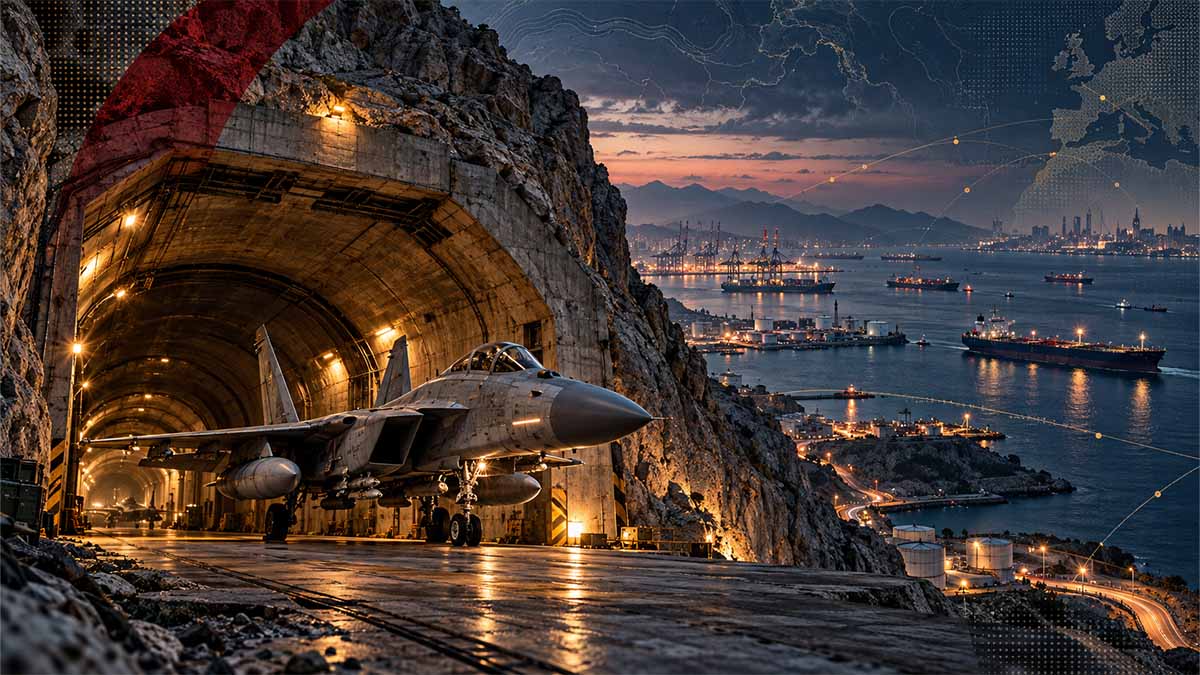
Scope: This assessment examines Iran’s protected military infrastructure and capacity to recover usable combat power, the consequences for the Middle East and Europe, and the strategic outlook through October 2031.
Executive Summary
Iran’s underground infrastructure creates a persistent assessment problem: damage to a military installation does not establish the destruction of the capabilities it was intended to protect.
Eagle 44 illustrates this distinction, but its current aircraft inventory, internal condition and ability to sustain combat operations remain unestablished in the official records reviewed.
The wider regional threat is demonstrably active: the International Maritime Organization recorded 120 confirmed maritime incidents and 24 seafarer fatalities in its Middle East incident register as of 22 October 2026. These figures cover the register’s regional scope and cannot be attributed to Eagle 44. Highlighted (Confirmed) incidents
Europe’s exposure runs through energy prices, shipping availability, industrial costs and competing defence commitments, even where direct dependence on Iranian or Gulf supplies is limited.
The central policy requirement is to distinguish physical damage, temporary operational suppression and durable capability reduction—and to plan for different recovery rates across Iran’s military system.
Iran’s Underground Resilience Is a Test of Europe’s Staying Power
Europe’s exposure to Iran will be determined by how long governments can sustain protection, reliable energy supplies and industrial adjustment while the military balance remains uncertain. As of 22 October 2026, the public record does not establish Eagle 44’s current aircraft inventory or sustained operational output. That uncertainty matters because European commitments must remain credible across several possible outcomes: renewed confrontation, negotiated stabilisation or intermittent disruption. The policy test is whether governments translate their commitments into funded endurance. The European Union’s EUNAVFOR ASPIDES operation, prospective arrangements for Hormuz and national energy measures belong to the same economic calculation, although they answer to different authorities. Their effectiveness depends on maintenance, replacement, contractual access and implementation. Announcing another contribution without securing those conditions creates an obligation whose eventual cost falls on defence budgets, industrial users and consumers.
Protected infrastructure extends the planning horizon
Eagle 44’s declared purpose was to combine protected accommodation with aviation support. Iran’s February 2023 presentation identified maintenance, command and fuel functions alongside manned and unmanned aircraft. The distinction remains decisive: preserving an aircraft, restoring its serviceability and sustaining its employment are separate achievements. Public evidence does not establish their present relationship at this installation. European policy therefore needs to withstand uncertainty about the duration of military effects, rather than rely on a definitive assessment that the available record cannot support.
EUNAVFOR ASPIDES illustrates the resulting planning problem. Its mandate has a defined expiry, while the insecurity it addresses may follow a different timetable. A ship available for an initial deployment creates requirements for a replacement, maintenance after return and replenishment. Temporary suppression of an adversary’s activity can be militarily valuable, but it does not establish when those supporting obligations will end. Governments assessing a maritime contribution need to price the next rotation before treating the first as a durable commitment.
Europe has diversified its suppliers while retaining the price risk
The European Union’s natural-gas import dependency stood at 87.6% in 2025. LNG accounted for 45% of gas imports that year, compared with 20% in 2021. Diversification has widened sourcing options while connecting more of Europe’s supply to a market in which buyers compete across regions. Germany’s regulator recorded 864 TWh of gas consumption in 2025, with industrial customers accounting for 60%. Britain obtained only 1.8% of its total gas imports from Qatar in 2025, yet its LNG imports fell 22% year on year in the second quarter of 2026 as pipeline imports increased. Direct Gulf sourcing is consequently an incomplete measure of exposure.
Italy’s and France’s figures show why resilience must also be assessed by function. Snam reported Italian gas demand of 33.08 billion cubic metres in the first half of 2026 and said physical flows had remained unaffected by the Hormuz disruption during that period. France generated 547.5 TWh of electricity in 2025, with low-carbon sources accounting for 95.2%, according to RTE. These are substantial protections against particular supply problems. They do not establish immunity from the cost of internationally traded fuels, nor do they remove the investment required to change industrial processes.
The International Energy Agency’s September estimates expose the remaining imbalance. Gulf crude exports recovered to 13.9 million barrels a day, exceeding three-quarters of prewar levels. Middle Eastern refined-product shipments reached only 1.9 million barrels a day against a prewar reference of 4.7 million, while LPG shipments stood at 670,000 barrels a day against 1.5 million. Global observed inventories were 509 million barrels below prewar levels at end-September. More crude reaching the market therefore did not establish equivalent recovery in the fuels businesses needed to buy.
Infrastructure converts flexibility into usable supply
Snam’s first-half 2026 presentation makes the industrial transmission mechanism visible. Italian thermoelectric gas demand reached 11.97 billion cubic metres, while industrial demand stood at 6.04 billion. Electricity-system requirements can sustain gas consumption even when direct industrial use is subdued. Additional regasification capacity helps receive supplies; networks and storage help move them through time and geography. The remaining economic question is whether delivered energy permits firms to maintain production while financing changes that reduce recurring exposure.
RTE’s 2025 review demonstrates the value of connections already operating. France’s net electricity export balance reached 26.2 TWh with Italy, 22.6 TWh with Great Britain and 20.1 TWh with Switzerland. Those annual balances are not guarantees of availability during simultaneous stress, but they show infrastructure performing a measurable function. Italy’s support for the proposed India–Middle East–Europe Economic Corridor must face the same implementation test: financing, completed links, workable borders and credible commercial services. A corridor’s political appeal cannot substitute for a functioning delivery chain.
Norway’s production outlook places a further limit on substitution. The Norwegian Offshore Directorate recorded 120 billion standard cubic metres of gas sold in 2025 and expected production to remain around that level over the following three to four years. Reliable supply is valuable, but that outlook does not identify an unlimited replacement reserve. European resilience will depend on dependable existing infrastructure and lower recurring demand as well as additional sourcing agreements.
A mission’s geographic reach does not define its authority
Germany’s government drew an important distinction on 30 September 2026: the wider ASPIDES operating area included Hormuz for situational awareness, while the executive mandate for functions such as protecting ships did not extend to the strait. A reference to geography therefore cannot establish authority for every activity within it. Berlin also set conditions for a German Hormuz contribution, including the end of the war, a legal basis, a Bundestag mandate and a viable political and military concept. These conditions require resolution before political readiness becomes executable policy.
The fiscal boundary is equally precise. The Council extended EUNAVFOR ASPIDES until 28 February 2027 with nearly €15 million for common costs over the preceding year. That figure is not the total cost of participating vessels, personnel and national support. Treating it as such would conceal the resources governments must provide. Britain’s parliamentary Gulf inquiry asks the corresponding operational question: whether maritime, air and enabling capabilities can sustain regional commitments alongside Euro-Atlantic obligations. The answer requires a funded account of endurance.
Guarantees can restore participation while transferring the liability
France’s October Gulf diplomacy brought commercial risk into the security calculation. President Emmanuel Macron described work on a proposed transport-guarantee mechanism and said France had secured the equivalent of 2 TWh of LNG per month during the winter period. These announcements address different problems: supply arrangements concern access to energy; guarantees concern the allocation of risk that can prevent commerce from proceeding. Neither announcement, by itself, establishes completed delivery or an operating public-risk programme.
Gard’s 12 August 2026 circular shows how contractual conditions can change independently of physical access. It announced cancellation and reinstatement of specified war-risk covers with an expanded exclusion for defined waters, while expressly preserving its excess war-risk cover for assureds with mutual P&I cover. Commercial participation therefore depends on the relevant policy and retained exposure, rather than a general declaration that shipping is insured. A public guarantee requires a liability ceiling, defined beneficiaries and an exit condition. Otherwise, increased participation may arrive with an inadequately specified public obligation.
The EU, NATO and national governments also address different parts of the problem. NATO’s record of intercepting Iranian missiles targeting Türkiye in March 2026 establishes a direct defensive requirement for an Ally. ASPIDES addresses maritime protection under its mandate. National guarantees would create financial exposure under separate authority. Coordination must connect these instruments without allowing progress in one to stand as proof that the others are adequately resourced.
The next two years will price the commitments already made
The period approaching ASPIDES’ February 2027 mandate expiry will test whether European governments have secured rotations and support, whether proposed guarantees attract ordinary commercial participation, and whether energy flexibility remains usable under pressure. Italy’s first-half supply performance, France’s electricity exports and Germany’s diversified gas entry routes provide evidence of adaptation. Their durability will depend on operating capacity, contracts and investment. Over the following 12–24 months, governments will need to distinguish temporary assistance from commitments that carry continuing costs.
The cost of inaction will fall unevenly. Germany’s industrial gas users face exposure through production costs; Italian firms through energy and transport; British defence resources through competing commitments; and public finances wherever guarantees or emergency support assume private risk. Eagle 44’s unresolved readiness provides no sound timetable for ending those obligations. Europe should judge its policy by funded endurance, dependable delivery and measurable reductions in recurring vulnerability. Announcements that fail those tests leave governments buying the same protection again, while businesses finance uncertainty through inventories, delayed investment and higher operating costs.
Navigational Index
Pillar I — Protected Infrastructure and the Recovery of Combat Power
Chapter 1 — Eagle 44: Declared Purpose, Verified Baseline and Operational Uncertainty
Chapter 2 — Military Reconstitution: Infrastructure, Equipment, Personnel and Industrial Capacity
Chapter 3 — Assessing Campaign Results: Destruction, Suppression and Recovery
Pillar II — Middle Eastern Security and Maritime Economic Pressure
Chapter 4 — Israel and the Gulf States: Deterrence Under Persistent Uncertainty
Chapter 5 — Hormuz, the Gulf of Oman and the Red Sea: Interacting Security Problems
Chapter 6 — Energy, Shipping, Insurance and the Regional Investment Environment
Chapter 7 — Diplomacy, Sanctions and the Conditions for Durable De-escalation
Pillar III — European Exposure and Strategic Choices
Chapter 8 — Italy: Mediterranean Connectivity, Energy Security and Mission Conditions
Chapter 9 — France: Gulf Partnerships, Maritime Guarantees and Defence Commitments
Chapter 10 — Germany and the United Kingdom: Industrial Exposure and Military Sustainability
Chapter 11 — Wider Europe: Northern, Eastern, Southern and Non-EU Interests
Chapter 12 — Scenarios to 2031, Decision Thresholds and Final Net Assessment
Master Abstract
The decisive variable is the recovery of usable capability
The strategic significance of Iran’s underground military infrastructure lies in the possibility that surviving assets can become operational again after a period of disruption. A protected installation can remain structurally intact while losing its immediate military utility; conversely, visible damage can coexist with the survival of equipment, technical personnel and organisational knowledge. Assessment therefore requires a distinction between the condition of a site and the condition of the force it supports. For governments judging the durability of an air campaign, the relevant question is how long an adversary remains unable to perform particular missions, which functions can be restored, and what resources recovery consumes.
Eagle 44 entered the public record on 7 February 2023, when Iranian state broadcaster Press TV reported its unveiling and described a facility intended for manned aircraft and unmanned systems, with maintenance, command and fuel-support functions. This establishes Iran’s declared concept for the installation; it does not independently validate its wartime performance or present readiness. The current official evidence reviewed does not establish how many serviceable aircraft are inside, whether its internal systems function, or whether it can sustain repeated combat sorties. Those uncertainties preclude both a confident declaration of operational recovery and a confident declaration of permanent neutralisation. Iranian Army unveils underground ‘Eagle 44’ Air Force base — Press TV — February 2023. presstv.ir
This distinction extends beyond one installation. Restoring access to a protected facility is different from replacing destroyed aircraft, replenishing weapons, recovering skilled personnel or rebuilding a production process. Each has a different recovery cycle. A government can retain the capacity to repair infrastructure while facing severe constraints on advanced components or operational training. Accordingly, neither visible construction activity nor the absence of visible flying provides a sufficient national measure of military regeneration. The assessment must follow the complete sequence from surviving resources to supported, repeatable operational output.
The regional threat cannot be measured through the fighter fleet alone
For Israel and the Gulf states, uncertainty about Iranian aviation is only one part of the security equation. Maritime disruption is independently documented. The US Maritime Administration’s advisory 2026-011 warns of continuing Iranian threats and attacks against commercial vessels in the Persian Gulf, Strait of Hormuz and Gulf of Oman. The IMO register also records recent incidents across several locations, demonstrating a geographically distributed maritime problem. Neither record establishes an operational connection with Eagle 44. 2026-011—Persian Gulf, Strait of Hormuz and Gulf of Oman—Iranian Attacks on Commercial Vessels — US Maritime Administration — 2026. MARAD
The analytical implication is that a substantial reduction in conventional air power would not, by itself, establish the end of Iran’s ability to impose regional economic costs. Maritime threats have to be assessed through their own capabilities, command arrangements and observed activity. For Israel, this creates a demanding test of campaign effectiveness: tactical successes must be translated into a durable reduction in specific threats. For Gulf governments, the immediate objective is broader commercial predictability—reliable port access, secure energy exports, insurable voyages and confidence that civilian infrastructure will remain usable.
Economic pressure also operates on different timescales from military suppression. CENTCOM stated on 5 October that it had resumed its blockade of vessels entering or leaving Iranian ports on 14 July and had redirected 130 commercial vessels. These are US operational assertions, rather than an independently audited account of the blockade’s total economic effects. Nevertheless, they establish that US policy continues to rely on sustained maritime enforcement. The resulting analytical question is whether financial restrictions constrain Iran’s military recovery faster than surviving organisations can adapt their priorities and preserve selected capabilities. CENTCOM Maintains Strict Enforcement of U.S. Blockade Against Iran — US Central Command Public Affairs — October 2026. dvidshub.net
Commercial recovery requires more than the movement of ships
The energy consequences cannot be reduced to a binary distinction between an open and a closed strait. Cargoes can move while transport remains expensive, schedules unreliable and access dependent on exceptional security arrangements. The US Energy Information Administration’s October outlook assumes continuing constraints on Middle Eastern oil flows through the fourth quarter of 2026, alongside gradual improvement through convoys and alternative export arrangements. It forecasts an average Brent spot price of US$105 per barrel for that quarter. This is a conditional forecast released on 6 October, based on model inputs finalised on 1 October; it is not a current transaction price or a forecast incorporating every subsequent event. Short-Term Energy Outlook — US Energy Information Administration — October 2026. U.S. Energy Information Administration (EIA)
The distinction between physical availability and affordable delivery is already shaping policy. On 2 October, G7 leaders announced a coordinated release of 100 million barrels over four months, including an early release of diesel, and measures concerning refinery operations. These commitments indicate concern about refined-product availability as well as crude supply; announced releases should not be treated as completed deliveries. For European governments, the practical task is therefore to track stocks, product availability and transport conditions separately. An improvement in crude exports would not automatically resolve pressure on diesel, LNG or freight. G7 Leaders’ Statement on global energy security and market stability — G7, published by the French Presidency — October 2026. elysee.fr
These conditions also affect the wider Middle East. Oman and the United Arab Emirates face the commercial consequences of insecurity around the approaches to the strait; Qatar’s export relationships depend on maritime reliability; Saudi Arabia has an interest in the security of both Gulf and Red Sea infrastructure. Iraq’s commercial access and the connections between Gulf and Mediterranean trade remain relevant to the regional economic outlook. These interests overlap, but they do not produce identical preferences over military action. A government can support stronger protection against attacks while opposing escalation that threatens its infrastructure or prolongs uncertainty.
Italy’s challenge is to connect maritime protection with commercial strategy
Italy’s policy problem combines freedom of navigation, energy procurement and the credibility of proposed commercial corridors. In September, Foreign Minister Antonio Tajani called for strengthening the EU’s Aspides operation and reiterated that an Italian intervention in the Strait of Hormuz depended on the war ending. The distinction matters: political support for maritime security does not establish an unconditional commitment to participate in an ongoing combat campaign. Tajani: “La Ue rafforzi la missione Aspides. Servono nuovi gasdotti” — Italian Ministry of Foreign Affairs and International Cooperation — September 2026. esteri.it
For Rome, this creates a sequencing requirement. Diplomatic arrangements, military protection and commercial commitments need compatible assumptions about security. Investment in an alternative corridor cannot be counted as an immediate substitute for an existing maritime route, while naval availability cannot be inferred from a declaration of political interest. Italy’s September participation in the Europe–Gulf partnership meeting confirms that commercial connectivity remains part of its diplomatic agenda. The decision consequence is to assess proposed infrastructure against realistic completion schedules, financing and the security of each connecting segment. Tajani alla riunione Europa-Paesi del Golfo: corridoio IMEC e accordi di libero scambio rafforzeranno partenariato — Italian Ministry of Foreign Affairs and International Cooperation — September 2026. esteri.it
France is addressing the link between security and insurability
France’s latest official record shows an approach extending beyond naval presence. During his 19–21 October Gulf visit, President Emmanuel Macron discussed energy supply assurances, infrastructure diversification and a proposed guarantee mechanism intended to reduce transport costs associated with limited insurance availability. He also described continuing diplomatic contacts and Qatar’s mediation. These are presidential accounts of initiatives and discussions; they do not establish that a guarantee mechanism is already operational. Déplacement au Proche et Moyen-Orient — French Presidency — October 2026. Élysée
The strategic logic is significant. Military protection can reduce some risks, but shipping participation also depends on whether operators can obtain insurance and price a voyage commercially. Public guarantees could help restore participation where uncertainty exceeds private insurers’ willingness to provide cover. Their principal limitation is that they transfer part of the financial exposure to the guaranteeing institutions without eliminating the physical danger. France’s challenge is consequently to make diplomatic, military and financial measures reinforce one another, while ensuring that temporary support does not become a substitute for a durable security arrangement.
Germany and the United Kingdom face different forms of sustained exposure
Germany’s current official position continues to emphasise diplomacy. A Bundestag notice dated 20 October reports the federal government’s commitment to a diplomatic solution intended to contain Iran’s threat potential. On 13 October, the Chancellery also called for the end of Iranian and Houthi maritime blockades. For Berlin, the analytical concern is the transmission of prolonged insecurity into industrial inputs, transport and policy costs, alongside the need to preserve credible European defence. The relevant fiscal question is the duration and targeting of any response, rather than an unsupported estimate of a single national loss. Bundesregierung setzt im Irankrieg auf diplomatische Lösung — German Bundestag — October 2026. Deutscher Bundestag
The United Kingdom’s exposure includes the sustainability of military commitments. Its May announcement identified a prospective Hormuz contribution involving mine-hunting equipment, counter-drone systems, aircraft and a warship, supported by £115 million in new funding. The announcement explicitly made the mission conditional on circumstances permitting operations. A subsequent parliamentary inquiry asks whether Britain has sufficient capabilities to meet Gulf and Euro-Atlantic requirements simultaneously. Neither announcement nor inquiry establishes a particular current readiness level, but together they identify the central allocation problem: maintaining deployments requires personnel, maintenance, logistics and replacement capacity over time. UK to contribute drones, jets and warship to Multinational Mission to secure the Strait of Hormuz — UK Ministry of Defence — May 2026. GOV.UK
Europe’s eastern and southern security requirements interact
The European implications extend beyond the four largest national lenses. NATO reports that its ballistic missile defence system intercepted Iranian missiles targeting Türkiye in March 2026 and that its commander increased the Alliance-wide defensive posture. This establishes a direct connection between the regional conflict and the defence of an Ally; it does not establish an equivalent Iranian capability against every European country. NATO also describes its broader air and missile defence mission as addressing threats from multiple directions. The analytical consequence is that southern and eastern requirements must be assessed together when governments allocate defensive assets. Ballistic missile defence — NATO — current institutional record. NATO Topic
The following comparisons identify transmission channels and policy priorities, rather than numerical rankings of national vulnerability.
| European grouping | Principal transmission channel | Decision implication |
|---|---|---|
| Greece, Cyprus and the eastern Mediterranean | Proximity to regional instability and maritime connections | Coordinate civilian contingency planning, maritime awareness and infrastructure protection. |
| Poland, the Baltic states and Finland | Competing requirements for European defensive capacity | Test Gulf commitments against the sustainability of eastern-flank defence. |
| Nordic states, the Netherlands and Belgium | International trade, maritime services and interconnected energy markets | Combine commercial resilience measures with selective security contributions. |
| Spain and Portugal | Exposure to internationally priced energy and shipping | Assess delivered costs and supply flexibility rather than geographic distance alone. |
| Central Europe and the Western Balkans | Transmission through fuel, electricity, freight and industrial supply chains | Include smaller and non-EU economies in regional contingency analysis. |
| Ireland, Switzerland and other non-belligerent economies | Commercial, financial and supply-chain exposure | Distinguish military non-participation from economic insulation. |
| Türkiye | Direct regional exposure and NATO defensive requirements | Maintain clear coordination between territorial defence and wider crisis diplomacy. |
Key Evidence Table
| Indicator | Value/status | Reference date | Definition/scope | Issuer | Exact source |
|---|---|---|---|---|---|
| Eagle 44’s declared role | Protected facility for aircraft and unmanned systems | 7 February 2023 | Iranian state presentation; not evidence of current readiness | Press TV | Unveiling record |
| Confirmed maritime incidents | 120 incidents; 24 seafarer fatalities | 22 October 2026 | IMO’s Strait of Hormuz and Middle East register; not attributed collectively to a single actor or installation | IMO | Confirmed incident register |
| US blockade enforcement | 130 commercial vessels redirected, according to CENTCOM | 5 October 2026 | Official US operational account | CENTCOM | Enforcement statement |
| Brent forecast | US$105/barrel average | Fourth quarter 2026 | Conditional forecast; released 6 October, inputs finalised 1 October | EIA | October outlook |
| Coordinated stock release | 100 million barrels over four months | Announced 2 October 2026 | Commitment; not confirmation of completed delivery | G7 | Energy security statement |
| Multinational maritime mission | Operations conditional on a permissive environment | Statement of 12 May 2026 | Defensive mission concept, distinct from other military campaigns | Participating governments | Joint statement |
| EU maritime sanctions framework | Expanded to address threats to navigation | 22 May 2026 | Framework for restrictive measures; not a military mandate | Council of the EU | Council decision announcement |
The mission distinction is consequential. The multinational statement provides for civilian-shipping support and mine clearance under specified conditions; the EU’s expanded sanctions framework provides a separate instrument for targeting responsible individuals and entities. Neither should be conflated with participation in offensive operations against Iranian territory. GOV.UK
Competing Pathways
Three pathways remain relevant through 2031. They can occur sequentially or overlap, so numerical probabilities would imply unsupported precision.
Persistent disruption with selective Iranian recovery is the central planning case. Continued maritime incidents and official warnings establish that regional economic security remains impaired. This pathway does not require the restoration of Iran’s entire conventional force: surviving capabilities, organisational adaptation and intermittent attacks could sustain uncertainty. Its principal countervailing force is the capacity of diplomatic arrangements, defensive operations and commercial adaptation to reduce the effects of disruption.
Renewed major combat would increase pressure on Iranian military infrastructure while exposing the region to additional retaliation and transport interruptions. It should be treated as a contingency, rather than a declared outcome. Evidence that would materially strengthen this assessment includes authoritative decisions ending diplomatic arrangements, confirmed changes in operational posture and an expanded pattern of attacks.
Negotiated stabilisation with continuing military competition would reduce immediate commercial disruption without necessarily resolving the underlying military balance. Its credibility would depend on observed compliance, sustained safe navigation and a return of ordinary commercial participation. A ceasefire announcement alone would be insufficient. The European Council’s October position continues to emphasise maritime security, international law and the cessation of destabilising activity. Consilium
Principal Gaps and Watch Indicators
| Consequential gap | Record or observation required | Effect on the assessment |
|---|---|---|
| Eagle 44’s present operational output | Authenticated, current evidence of repeatable operations and functioning support services | Would distinguish protected infrastructure from usable combat capacity. |
| Survival versus replacement of military equipment | Credible production, procurement and inventory records | Would establish whether recovery draws on surviving stocks or new output. |
| Durability of maritime recovery | Continued IMO incident reporting alongside sustained commercial transits | Would test whether improved flows reflect lasting security. |
| Commercial affordability | Documented insurance availability, freight conditions and delivered energy costs | Would distinguish physical access from economic normalisation. |
| European mission sustainability | National authorisations, deployment records, rotation plans and funding | Would establish whether announced commitments can be maintained. |
| Effectiveness of pressure and diplomacy | Verified implementation records and observable compliance | Would test whether coercion produces durable behavioural change. |
Strategic transmission scheme
How regional insecurity reaches Europe
Qualitative relationships as of 22 October 2026. No numerical risk scale or country ranking is implied.
Uncertain operational capacity complicates threat assessment and the duration of defensive planning.
Confirmed incidents expose crews and vessels to danger and complicate commercial scheduling.
Constrained energy flows and transport uncertainty affect delivered costs, procurement and industrial planning.
Governments must coordinate maritime protection, energy resilience and sustainable territorial defence.
Evidence: IMO incident register; EIA October outlook; NATO integrated air and missile defence. Connections represent analytical mechanisms, not a demonstrated operational link between Eagle 44 and attacks on shipping.
Iran’s Underground Military Resilience
Eagle 44, Gulf security and Europe’s exposure: understanding how uncertain military recovery interacts with maritime disruption, energy costs and European defence commitments.
IMO’s Strait of Hormuz and Middle East register, as at 22 October 2026.
IMO incident registerRegional register total. Not an attribution to Eagle 44 or collectively to a single actor.
IMO scope and recordsFourth-quarter 2026 average forecast. EIA release: 6 October; model inputs: 1 October.
EIA October outlookThe military recovery test
Four distinct conditions separate the survival of an installation from the sustained recovery of combat power. This is an analytical framework, not a confirmed description of Eagle 44’s present status.
Protected resources
Establish which equipment, personnel and support systems remain usable.
Functional infrastructure
Distinguish visible repairs from the recovery of maintenance, communications and logistics.
Mission-ready forces
Verify serviceability, crews, weapons and support rather than relying on nominal inventories.
Repeatable operations
Assess whether operational output can continue over time under logistical and financial constraints.
Oil prices: historical values and conditional forecasts
Annual average Brent spot price, nominal US dollars per barrel. Bar lengths use a common zero-based scale of US$0–120. Historical values and forecasts are distinguished by colour and text.
| Year | US$/barrel | Status |
|---|---|---|
| 2024 | 81 | Historical |
| 2025 | 69 | Historical |
| 2026 | 96 | Forecast |
| 2027 | 84 | Forecast |
Source: Short-Term Energy Outlook — EIA — 6 October 2026. Values rounded to whole dollars as published in the overview. The US$105 fourth-quarter forecast is a different reference period from the US$96 full-year forecast. These forecasts do not isolate Eagle 44’s economic effects.
How regional insecurity reaches Europe
Maritime incidents
Threats to crews, vessels and port approaches complicate commercial navigation.
Delivery uncertainty
Risk assessments, insurance availability and shipping participation shape reliable access.
Delivered costs
Energy and freight conditions affect procurement, industrial planning and household expenditure.
Competing commitments
Governments balance maritime protection, economic support and sustainable territorial defence.
Qualitative transmission mechanisms; no numerical risk ranking. This scheme does not assert an operational link between Eagle 44 and attacks on shipping.
Evidence: US Maritime Administration advisory 2026-011; French Presidency, 21 October 2026; NATO integrated air and missile defence.
European strategic exposure
Italy
Maritime protection, energy procurement and Mediterranean connectivity require compatible security assumptions. In September, Foreign Minister Tajani reiterated that an Italian intervention in Hormuz depended on the war ending.
France
Gulf diplomacy connects maritime security with commercial insurability. President Macron described a proposed guarantee mechanism during his October visit; the announcement does not establish an operational guarantee programme.
Germany
Prolonged insecurity can transmit through industrial inputs and transport costs. Germany’s official position continues to emphasise a diplomatic solution to contain Iran’s threat potential.
United Kingdom
The prospective Hormuz contribution includes mine-hunting and counter-drone capabilities. Parliamentary scrutiny addresses whether Gulf commitments can be sustained alongside Euro-Atlantic requirements.
Evidence and implementation table
| Indicator | Value or position | Reference date | Interpretation limit | Source |
|---|---|---|---|---|
| Eagle 44 readiness |
Unestablished Current inventory and sustainable operational output are not established in the official records reviewed. |
Assessment: 22 October 2026 | The 2023 unveiling establishes declared purpose, not current combat performance. | Press TV, February 2023 |
| Maritime disruption |
Confirmed regional record 120 incidents; 24 seafarer fatalities. |
22 October 2026 | Regional register totals; no collective attribution to Eagle 44 or one actor. | IMO |
| US blockade enforcement |
Official US account 130 commercial vessels redirected. |
5 October 2026 | CENTCOM’s operational statement is not an independent audit of total economic effects. | CENTCOM / DVIDS |
| Energy stock release |
Announced commitment 100 million barrels over four months. |
2 October 2026 | Announced volume must be distinguished from completed deliveries. | G7 statement |
| UK capability funding |
Announced funding £115 million for mine-hunting and counter-drone systems. |
12 May 2026 | Funding and a prospective force package do not establish current deployment or readiness. | UK Ministry of Defence |
| Multinational maritime mission |
Conditional mission concept Defensive shipping support and mine clearance. |
Statement: 12 May 2026 | Operations require a permissive environment; the mission is distinct from other military campaigns. | Joint government statement |
| European sanctions |
Expanded framework Measures addressing threats to freedom of navigation. |
22 May 2026 | A sanctions framework is separate from a military mandate. | Council of the EU |
Pathways through October 2031
Conditional analytical pathways. They may overlap or occur sequentially; no numerical probabilities are assigned.
Persistent disruption
Selective military recovery and intermittent maritime incidents sustain uncertainty without requiring the restoration of Iran’s entire conventional force.
Watch: repeated incidents, continuing commercial restrictions and evidence of recoverable operational capacity.
Renewed major combat
Further operations increase pressure on Iranian capabilities while creating additional risks of retaliation, infrastructure damage and transport interruptions.
Watch: authoritative policy decisions, confirmed posture changes and an expanded attack pattern.
Negotiated stabilisation
Sustained compliance and safer navigation reduce commercial disruption while underlying military competition continues.
Watch: durable safe passage, ordinary insurance availability and sustained commercial participation.
Pillar I — Protected Infrastructure and the Recovery of Combat Power
Chapter 1 — Eagle 44: Declared Purpose, Verified Baseline and Operational Uncertainty
Eagle 44’s strategic value depends on whether protection can be converted into sustained operational availability. An installation can preserve aircraft without enabling their employment, support limited activity without sustaining a campaign, or retain organisational value after suffering substantial physical damage. Establishing which condition applies requires evidence about the functioning of the base as a military system. Its underground character alone cannot answer that question.
A protected aviation system with several distinct functions
Iran’s public presentation of Eagle 44 on 7 February 2023 described more than aircraft accommodation. State broadcaster Press TV identified command facilities, maintenance functions, navigation equipment and fuel storage, and attributed to Army commander Abdolrahim Mousavi the statement that the installation supported both manned and unmanned aircraft. These descriptions establish the intended combination of protection and operational support. They remain Iranian assertions about the facility’s design and purpose, rather than independent measurements of its performance. Iranian Army unveils underground ‘Eagle 44’ Air Force base — Press TV — February 2023. www.presstv.ir
The distinction matters because the military value of protected infrastructure changes with its use. Storage preserves an asset for later employment. Maintenance converts an unserviceable asset into an available one. Command facilities coordinate activity. Operational support permits aircraft to undertake missions and return for further employment. These functions reinforce one another, but their survival cannot be assumed to be uniform.
A base with functioning accommodation and impaired maintenance might preserve aircraft while progressively losing the ability to keep them serviceable. A facility with available aircraft and disrupted command arrangements might retain local flying capacity while contributing less to coordinated operations. Conversely, surviving technical personnel and support equipment could preserve institutional knowledge even during a prolonged interruption in flying. The relevant unit of assessment is therefore the functioning combination of people, equipment and support services.
What the public baseline permits—and what it does not
The current evidence supports a narrower conclusion than either the language of invulnerability or the language of complete elimination. Eagle 44 has an established place in Iran’s declared aviation-protection concept. The official records examined do not provide an authenticated current inventory, a verified internal damage assessment or a sustained record of operational output from the installation.
This limitation has concrete consequences. Aircraft shown during an earlier presentation cannot be counted as the current resident fleet. Equipment observed at one moment cannot establish how long it remained there. A statement about the national air force cannot automatically be allocated to a particular installation. Similarly, an assessment that identifies damage at an airfield must specify whether it concerns infrastructure, equipment or the ability to perform missions.
| Assessment dimension | Established baseline | Additional evidence required | Judgment that remains premature |
|---|---|---|---|
| Institutional association | Publicly presented as an Iranian Army Air Force installation | Current organisational or command documentation | Treating every Iranian underground military site as part of the same service structure |
| Intended aircraft role | Iranian authorities described manned and unmanned aviation functions | Authenticated evidence of current resident aircraft and assigned missions | Assigning a present aircraft inventory from historical publicity |
| Maintenance support | Maintenance facilities formed part of the declared design | Current evidence of functioning equipment, staffing and completed work | Assuming protected accommodation provides complete maintenance capacity |
| Command support | Command facilities were included in the public presentation | Evidence of current connectivity and operational coordination | Equating a surviving command space with effective command performance |
| Aircraft availability | No verified current base-level figure established | Serviceability records or sustained operational observations | Converting nominal aircraft numbers into mission-ready strength |
| Operational endurance | No verified sustained sortie record established | Repeated activity over a meaningful period, with support continuity | Inferring campaign capacity from an isolated movement or flight |
| Wider weapons role | Historical aviation claims do not establish every subsequent use | Specific, current evidence identifying another function | Assigning ballistic-missile, nuclear or other roles from underground construction alone |
The historical baseline in this table derives from the February 2023 Iranian state presentation; the additional requirements are analytical tests, rather than assertions that the relevant evidence exists.
Why visible engineering activity is an incomplete measure
Engineering work can indicate that resources continue to be allocated to an installation. It cannot establish, without additional evidence, whether the objective is immediate operational recovery, completion of earlier construction, preservation of existing infrastructure or preparation for a different future use. Those explanations carry different implications for readiness.
Nor is the disappearance of visible damage equivalent to the restoration of the original operating standard. A repaired surface might support restricted activity while other functions remain impaired. Conversely, a facility can recover a useful minimum operating capability before all damaged infrastructure has been restored. The distinction between minimum functionality and full restoration is observable in documented military engineering practice.
A US Air Forces Central account of a January 2025 exercise described nine real craters on a mock runway. The participating squadron restored a minimum operating strip by the exercise’s twenty-third hour and then spent another four hours converting expedited work into permanent repairs. This was a US exercise under its own conditions; it provides no defensible repair-time estimate for Eagle 44. Its relevance is conceptual: limited operational access and permanent restoration were separate milestones. 379th ECES executes Ninth Air Force’s largest-ever RADR exercise — US Air Forces Central — February 2025. dvidshub.net
| Documented engineering measure | Reported result | Applicable interpretation | Limit on comparison |
|---|---|---|---|
| Exercise craters | 9 | Recovery involved multiple damage locations | Exercise damage is not equivalent to wartime damage |
| Initial complete-repair planning window | 48 hours | A planning objective existed before execution | An objective is not a generally applicable engineering rate |
| Minimum operating strip restored | By hour 23 | A restricted operating function preceded permanent restoration | Does not establish Iranian capability or Eagle 44’s status |
| Additional permanent-repair work | 4 hours | Expedient and permanent repair standards differed | Does not incorporate the full circumstances of a contested installation |
Source: US Air Forces Central exercise account — February 2025.
The same reasoning applies to interrupted activity. A period without observed flights may reflect physical incapacity, restrictions imposed by commanders, aircraft relocation, maintenance requirements or deliberate conservation. These explanations cannot be resolved by counting visible movements alone. Evidence becomes more discriminating when it establishes what missions were possible, under which conditions and for how long.
The strategic importance of preserving options
A protected installation can matter even when it is not generating substantial daily activity. Its value may lie in preserving a reserve, retaining specialist support capacity or preventing an opponent from confidently excluding a future threat. This is an analytical proposition about the role of protected infrastructure, not evidence that Eagle 44 currently performs all those functions.
Preserving an option is nevertheless different from possessing an immediately executable capability. An aircraft that survives but lacks a serviceable engine, qualified crew or required mission equipment represents a different military problem from an aircraft ready for sustained operations. The distinction affects warning, defensive planning and assessments of the durability of campaign results.
For regional governments, the correct response is to assess separately the confidence attached to current inactivity and the confidence attached to future inability. For European governments receiving allied assessments, the corresponding requirement is precision in terminology. “Inactive,” “damaged,” “non-mission-capable” and “destroyed” describe different conditions and should not be used interchangeably.
Key judgments
Eagle 44 should be assessed as an aviation-support system whose individual functions may have different conditions and recovery prospects. Public evidence of a declared role is stronger than public evidence of present operational performance. Neither historical publicity nor engineering activity can establish sustainable combat output.
What would change the assessment
Authenticated evidence of repeated operations, functioning support services and identifiable mission-ready aircraft would strengthen the case for operational availability. Evidence of persistent loss of specialist support, essential equipment or serviceable aircraft would strengthen the case for prolonged impairment.
Open official record
The consequential missing records are a current base-level inventory, an authenticated account of internal functionality and evidence establishing sustained operational activity over time. Their absence limits the conclusion about Eagle 44 specifically; it does not resolve the condition of Iran’s wider military system.
Chapter 2 — Military Reconstitution: Infrastructure, Equipment, Personnel and Industrial Capacity
Iran’s military recovery is best understood as the interaction of several replacement cycles. Civil engineering can restore physical access; maintenance can return surviving equipment to service; manufacturing can replenish selected losses; procurement can introduce components or complete systems; training can rebuild the human capacity to use them. Progress in one cycle does not establish progress in the others.
Recovery has an industrial structure
The industrial evidence indicates that Iranian military production cannot be assessed solely through the condition of domestic buildings. US Treasury records identify procurement relationships involving machine tools, electronics, navigation equipment, aviation services and financial intermediaries. These records are official US designation accounts: they establish the actions taken by the United States and the conduct Treasury attributes to the designated actors. They do not independently quantify Iran’s current production rate or the total effectiveness of sanctions.
On 29 September 2026, Treasury identified procurement supporting Iran Aircraft Manufacturing Industrial Company, known as HESA, and the Shahid Bakeri Industrial Group. Its account described electronics supplied through an Iranian company and associated overseas intermediaries. The significance is the connection between domestic manufacturing organisations and external component acquisition, rather than the assumption that a designation immediately terminates supply. Operation Economic Outcast Takes Down Iranian Military Procurement Networks — US Department of the Treasury — September 2026. U.S. Department of the Treasury
An earlier Treasury action identified procurement of computer numerical control machinery for HESA. Such equipment concerns the ability to manufacture precision components, a different industrial function from acquiring finished weapons or repairing buildings. The analytical implication is that manufacturing resilience must be assessed through the availability and condition of production equipment, tooling, technical staff and inputs—not through floor space alone. Treasury Sanctions Global Network Supporting Iran’s Military UAV Program — US Department of the Treasury — July 2025. U.S. Department of the Treasury
| Reconstitution layer | Principal function | Relevant evidence | Why it differs from the other layers |
|---|---|---|---|
| Civil infrastructure | Restore usable buildings, utilities and access | Completed work and demonstrated functionality | Construction does not replace lost aircraft or weapons |
| Maintenance and overhaul | Recover serviceability of surviving equipment | Accepted repairs, parts consumption and serviceability records | Overhaul draws on an existing asset rather than creating a replacement |
| Component manufacturing | Produce parts and assemblies | Working machinery, qualified processes and accepted output | Installed machinery does not establish production yield |
| Final assembly | Integrate components into a usable system | Completed systems and acceptance records | Assembly depends on the availability of all required inputs |
| External procurement | Obtain components, equipment or complete systems | Verified deliveries and end-user records | A purchase attempt is different from a delivered and integrated item |
| Workforce regeneration | Restore technical and operational competence | Training completion, qualifications and retained experience | Staffing numbers alone do not establish competence |
| Operational integration | Convert available resources into deployable units | Exercises, maintenance continuity and repeated mission performance | Equipment availability does not establish unit effectiveness |
These categories identify different recovery mechanisms. They are not a statement that each is currently functioning at a particular level in Iran.
The procurement record shows breadth, not a production total
A sequence of designation actions provides useful evidence of the range of organisations and activities under scrutiny. It must not be converted into a statistical series of Iranian weapons output. Different actions cover different activities; they may intersect organisationally; and the number of designated actors does not measure the volume of material delivered.
| Action date | Published scope | Activity identified by Treasury | Quantitative interpretation |
|---|---|---|---|
| 31 July 2025 | 5 entities and 1 individual | Technology procurement supporting HESA, including CNC machinery | Designation count; not a count of production lines or aircraft |
| 1 October 2025 | 21 entities and 17 individuals | Networks associated with missile, military-aircraft and other defence procurement | Scope of that action; not a measure of total network size |
| 15 July 2026 | 7 individuals and entities | International procurement activity supporting the IRGC | Combined designation count; no production volume established |
| 8 September 2026 | 36 targets | Aviation-sector support and associated procurement activity | Broader aviation action; not confined to military manufacturing |
| 29 September 2026 | 10 individuals and entities | Procurement supporting MODAFL and subordinate military programmes | Combined designation count; no direct measure of industrial capacity |
Sources: Treasury actions of 31 July 2025, 1 October 2025, 15 July 2026, 8 September 2026 and 29 September 2026. The rows must not be summed as a unique population of procurement actors. U.S. Department of the Treasury
The industrial consequence of interrupted procurement depends on the function of the affected item. A delay involving a replaceable input may raise costs without stopping output. The absence of a specialised component can have a much larger effect if no qualified substitute is available. Conversely, previously accumulated stocks can separate the date of a procurement interruption from the date at which production becomes constrained.
The public record does not support assigning a single national recovery period. It instead supports examining particular product families and industrial processes. A repair programme for existing aircraft, production of unmanned systems and replenishment of missile components have different demands on precision manufacturing, testing, integration and skilled labour. Their recovery rates need not move together.
Navigation systems illustrate the difference between deliveries and weapons
Treasury’s December 2024 designation account provides a concrete example of an upstream input. It stated that Sanat Danesh Rahpuyan Aflak sold more than 1,000 SEPEHR navigation systems to the IRGC Aerospace Force’s relevant organisation during 2022–2023. Treasury described a system incorporating navigation and inertial components. This is an attributed historical procurement figure, rather than a current inventory estimate. Treasury Targets Facilitators for Procuring Sensitive Navigational Systems for Iran — US Department of the Treasury — December 2024. U.S. Department of the Treasury
The figure cannot be translated directly into 1,000 deployed weapons. The record does not establish, through that number alone, how many units were integrated, retained for testing, held as spares, lost or otherwise used. Its analytical importance is that military output depends on measurable intermediate goods. Following such inputs can improve understanding of production capacity, provided the conversion between component deliveries and finished systems is demonstrated rather than assumed.
The human constraint is less visible than construction
Personnel losses and shortages can affect recovery even when equipment survives. Maintenance depends on specialised knowledge, supervisory experience and quality assurance. Operational recovery requires qualified crews, training continuity and the ability to coordinate activity safely. A nominal replacement in a staffing table may therefore have a different effect from the return of an experienced specialist.
No reliable public dataset reviewed establishes Eagle 44’s technical workforce, losses among its personnel or the time required to replace particular qualifications. That prevents a numerical estimate of its human-capital recovery. It does not justify treating the variable as negligible.
A useful external comparison concerns measurement, rather than Iranian readiness. In June 2026, the US Government Accountability Office reported that the F-35 fleet’s mission-capable rate declined from 67% in fiscal year 2021 to 44% in fiscal year 2025, while its full-mission-capable rate declined from 38% to 25%. The programme, industrial system and operating circumstances differ fundamentally from Iran’s. These figures cannot be applied to Iranian aircraft. They demonstrate why possession and mission capability require separate evidence even in a well-documented fleet. F-35 Sustainment: Actions Needed to Ensure Updated Strategy Improves Persistent Readiness Challenges — US GAO — June 2026. U.S. GAO
| Readiness measure | Definition used in the GAO comparison | FY2021 | FY2025 | Relevance to the Iranian assessment |
|---|---|---|---|---|
| Mission capable | Aircraft can perform at least one tasked mission | 67% | 44% | Requires evidence beyond inventory |
| Fully mission capable | Aircraft can perform all tasked missions | 38% | 25% | Mission breadth can differ from basic availability |
| Iranian equivalent | No directly comparable verified series established here | Not available | Not available | US rates must not be used to estimate Iranian readiness |
Source: GAO-26-108113 — June 2026.
The more demanding question is whether an aircraft can perform the mission that matters in the assessment. GAO’s separate 2026 tanker report found that general mission-capable measures could include aircraft unable to perform their primary refuelling function. Its public version withheld specific readiness rates. This reinforces a precise requirement for Iran: claims about aircraft availability should identify the relevant mission, rather than imply that all available aircraft offer the same operational utility. Aerial Refueling Tankers: Air Force Needs More Focused Metrics and a Risk-Based Mitigation Plan to Improve Sustainment — US GAO — June 2026. files.gao.gov
Europe is part of the industrial question
Europe’s connection to Iranian reconstitution extends beyond its military response in the Gulf. Treasury’s October 2025 account identified an alleged procurement network operating across Iran, Germany, Türkiye, Portugal and Uruguay in support of Iranian helicopter activities. Its July 2026 action also described a Milan-based participant in an IRGC procurement effort. These are attributed US administrative findings concerning specified actors; they do not establish state participation by the countries concerned. Treasury Targets Iranian Weapons Procurement Networks Supporting Ballistic Missile and Military Aircraft Programs — US Treasury — October 2025; Treasury Targets Global Network Procuring Weapons for Iranian Regime — US Treasury — July 2026.
The policy implication is that aircraft services, component trading, financing and ownership structures require attention alongside physical shipments. FinCEN’s September 2026 aviation alert describes procurement involving front companies across several regions, including Europe, and warns that individual warning signs are not determinative by themselves. Its findings concern commercial aviation procurement and cannot automatically be extended to a military installation. They nevertheless demonstrate the importance of tracing end users and transaction context when assessing the external support available to an aviation system. FinCEN Alert to Counter Iranian Procurement Efforts for its Commercial Aviation Industry — FinCEN — September 2026, pages 1–3. fincen.gov
For Italy, Germany, France and the United Kingdom, this creates an industrial-policy task distinct from decisions about military deployment. The immediate issue is the quality of information available to competent authorities about transactions, ownership and final use. The wider strategic issue is whether restrictions materially change procurement success, delivery times and usable output. Counting additional designations cannot answer that second question.
Key judgments
Iranian reconstitution should be assessed by industrial function and weapon category. The documented procurement record demonstrates external dependencies and organised acquisition efforts, while leaving current output uncertain. Physical repair, component availability, skilled labour and operational integration are separate constraints.
What would change the assessment
Verified deliveries, accepted production output, evidence of functioning industrial equipment and authenticated serviceability records would improve the estimate of recovery. Demonstrated interruption of indispensable inputs would support a stronger judgment of sustained constraint than designation totals alone.
Open official record
The principal gaps concern current production volumes, the condition of manufacturing equipment, component stocks, repair acceptance rates and specialist workforce availability. Publicly released designation records illuminate relationships; they do not provide a complete industrial balance sheet.
Chapter 3 — Assessing Campaign Results: Destruction, Suppression and Recovery
Campaign effectiveness must be assessed against the military and political condition an operation was intended to produce. Weapons expenditure measures effort. Physical damage measures a direct result. A sustained reduction in an adversary’s ability to perform a mission measures a broader military effect. Changes in behaviour and regional security concern a further level of outcome. These measures are related, but none can substitute automatically for the next.
Physical damage and functional loss answer different questions
The distinction is established in military assessment practice. A US Air Forces Central explanation identifies physical damage, functional damage and target-system assessment as separate components of battle damage assessment. Although published in 2010 in a different operational context, it provides a clear statement of the categories; it is not evidence about the 2026 condition of any Iranian facility. Aircraft ‘CSI’ teams assess damage, aid flight crews — US Air Forces Central — June 2010. afcent.af.mil
Applied to Eagle 44, a physical assessment would concern observable changes to infrastructure or equipment. A functional assessment would ask which activities the installation can still perform. A system-level assessment would examine how its condition affects the wider force, including whether relevant activity has ceased, moved elsewhere or been replaced by another capability.
A physically damaged installation can therefore have a limited effect on the national system if its functions are redundant or transferable. Conversely, apparently limited physical damage can have an important operational effect when a specialised function cannot readily be replaced. Public analysis should not decide between those possibilities without evidence of the function involved.
| Assessment level | Primary question | Suitable evidence | What that evidence cannot establish by itself |
|---|---|---|---|
| Operational effort | What resources were employed? | Sorties, flight hours and weapons expenditure | Unique assets destroyed or lasting military effect |
| Physical result | What was damaged? | Authenticated imagery and inspection records | Complete functional loss |
| Functional effect | What activity became unavailable? | Mission records, serviceability evidence and support continuity | National incapacity if alternatives remain |
| System effect | How did the wider force change? | Activity across related units and facilities | Political compliance or durable de-escalation |
| Recovery trajectory | How did capability change after the initial effect? | Comparable observations over time | Future endurance without evidence of supply and support |
| Strategic outcome | Did the operation achieve its stated objective? | Defined objectives, observed behaviour and sustained conditions | Success based solely on strike volume |
Operational statistics require careful denominators
An October 2026 US Navy account of Carrier Air Wing 9’s deployment reported 14,037 aircraft sorties and 31,460 forward-deployed flight hours over the deployment. It also reported expenditure of 1,499 precision weapons and delivery of more than 1.37 million pounds of ordnance against CENTCOM priority targets. The account describes a 38-day campaign beginning on 28 February and ending before an early-April ceasefire. These are Navy-reported figures, with different scopes inside the same deployment narrative. Carrier Air Wing 9 completes 10-month combat deployment — Carrier Strike Group Three — October 2026. dvidshub.net
| Reported measure | Published quantity | Stated context | Required interpretation |
|---|---|---|---|
| Aircraft sorties | 14,037 | Entire deployment | Not a count of strike sorties against Iran |
| Forward-deployed flight hours | 31,460 | Entire deployment | Includes operational activity beyond weapons delivery |
| Precision weapons expended | 1,499 | Campaign account | Not equivalent to 1,499 unique targets destroyed |
| Ordnance delivered | More than 1.37 million pounds | CENTCOM priority targets | Mass does not measure the strategic value of resulting effects |
| Initial campaign duration described | 38 days | February–early April 2026 | Not the duration of every subsequent regional operation |
Source: Carrier Strike Group Three deployment account — October 2026.
These figures demonstrate substantial activity by one formation. They do not provide a complete coalition campaign total. They also cannot establish Eagle 44’s damage, the number of Iranian aircraft destroyed, or the duration of any interruption in Iranian operations. Calculating “weapons per destroyed target” would be indefensible without compatible target and outcome data.
The distinction is particularly important when a deployment includes strike, defensive, surveillance, support and training activity. A sortie is an aircraft mission, not a standard unit of destructive effect. Aggregating sorties across different roles can describe operational workload while revealing little about the effect on a specific adversary capability.
Suppression has a duration and a purpose
Temporary operational suppression can be militarily significant. It may prevent an adversary from acting during a critical period, reduce pressure on defensive forces or enable other operations. It should not be dismissed because the affected capability later recovers. Equally, temporary inactivity should not be described as permanent elimination when the surviving resources permit regeneration.
The test is whether the achieved effect matched the stated objective and required duration. If the objective was to interrupt operations during a particular campaign phase, subsequent recovery does not automatically invalidate the earlier result. If the objective was to prevent a capability from returning, evidence of recovery is directly relevant to whether that objective was achieved.
This requires a time dimension that is often absent from public claims. An installation’s condition immediately after an attack, several weeks later and after a prolonged pause can differ substantially. An assessment that combines those observations without dates can create a false contradiction or conceal an actual change.
| Operational condition | Meaning | Evidence needed to sustain the judgment |
|---|---|---|
| Temporary suppression | Activity is interrupted for a bounded period | Evidence of the interruption and its duration |
| Persistent impairment | Some functions remain available, but performance is reduced | Repeated evidence of restricted mission breadth, frequency or support |
| Local functional loss | A particular installation cannot perform its relevant role | Current evidence covering the essential functions of that site |
| System-wide capability reduction | The wider force has fewer usable options or lower output | Evidence across the relevant units and alternative facilities |
| Regeneration | Capability increases after an earlier loss | Evidence distinguishing returning survivors, repaired equipment and replacement output |
| Durable denial | The relevant mission remains unavailable over the required horizon | Sustained evidence covering recovery, substitution and support capacity |
This framework does not assign an unsupported category to Eagle 44. It defines what each conclusion would require.
Recovery does not necessarily restore the original force
An adversary can recover in a different form. A force may return to activity with fewer platforms, narrower missions, altered procedures or greater dependence on alternative systems. Measuring recovery only against the original inventory can miss a change in how military pressure is generated.
For Iran, this creates two distinct questions. The first concerns the restoration of conventional aviation. The second concerns whether the wider military system can continue to impose costs despite aviation losses. Evidence answering the second question does not prove that the first capability has recovered.
The reverse is equally important. Continued attacks in another domain do not establish that a campaign had no effect on aircraft, maintenance or air-defence capacity. Different parts of the force can experience different outcomes. A defensible assessment can therefore recognise substantial losses in one category and persistent danger in another without treating the two findings as contradictory.
Economic pressure has to be assessed through effects on recovery
Restrictions on procurement and finance can reinforce the duration of military damage if they prevent replacement, delay maintenance or constrain the restoration of production. Their effectiveness depends on implementation and on the availability of surviving stocks, alternative suppliers and domestic substitutes. The mechanism is credible; its magnitude requires evidence.
The September 2026 Treasury actions explicitly frame military procurement and aviation restrictions as part of an effort to constrain Iran’s recovery. That establishes US policy intent and the measures announced. It does not establish the number of aircraft kept unavailable or the amount of production prevented. Those outcomes require separate measurement. Operation Economic Outcast Takes Down Iranian Military Procurement Networks — US Treasury — September 2026; Treasury Grounds Iranian Airlines with Sweeping Sanctions Action — US Treasury — September 2026.
A useful assessment would consequently follow changes in procurement success, delivery time, accepted production and operational availability. This is more demanding than counting sanctions actions, but it is also more relevant to the question of whether military effects endure.
Implications for Middle Eastern and European decision-makers
For Israel, an assessment centred on mission capability helps distinguish a reduction in immediate attack potential from a reduction in future regeneration. For Gulf governments, it helps separate the condition of Iranian conventional aviation from the wider set of threats affecting their security. Neither requires treating every Iranian capability as intact or every damaged installation as permanently removed from the military balance.
For Europe, the central requirement is comparability in allied reporting. Italy, France, Germany and the United Kingdom need to understand whether a shared assessment describes a particular site, a service, a weapon category or the national military system. They also need to know its reference date and whether the judgment concerns immediate activity or future recovery.
| Decision-maker | Assessment requirement | Consequence of an incorrect judgment |
|---|---|---|
| Israel | Separate immediate operational threat from longer-term regeneration | Premature confidence or an unnecessarily prolonged expectation of danger |
| Gulf governments | Assess aviation losses alongside other independently evidenced threats | Misalignment between protective measures and the remaining threat |
| Italy | Connect allied military assessments to clearly defined national commitments | Commitments based on an unclear picture of duration and mission requirements |
| France | Distinguish military improvement from conditions supporting durable regional arrangements | Overestimating the persistence of security gains |
| Germany | Assess industrial constraints and implementation alongside military claims | Treating announced restrictions as demonstrated reductions in output |
| United Kingdom | Relate campaign effects to the duration of force-protection and support requirements | Underestimating the resources needed to sustain commitments |
| European institutions | Preserve distinctions among sanctions, diplomacy and military outcomes | Using progress in one instrument as proof of success across the entire strategy |
These are analytical decision consequences, not assertions about undisclosed national planning.
Key judgments
The strongest assessment of campaign results is mission-specific, dated and explicit about duration. Operational statistics establish effort; physical evidence establishes damage; functional evidence establishes what an adversary can do; sustained observation establishes whether the effect endures. Strategic success requires a further comparison with the objective the operation was intended to achieve.
What would change the assessment
A verified sequence connecting initial damage to prolonged mission loss would strengthen the case for durable campaign effectiveness. Evidence of restored output, successful substitution or new production would require revising the estimate of persistence, even where the initial damage remained well established.
Open official record
A complete assessment still requires compatible data on pre-campaign capability, losses, surviving serviceable equipment, subsequent production and sustained operational output. Without that sequence, confident national percentages of permanent capability destruction would exceed the public evidence.
Pillar II — Middle Eastern Security and Maritime Economic Pressure
Chapter 4 — Israel and the Gulf States: Deterrence Under Persistent Uncertainty
The principal strategic divide between Israel and the Gulf states concerns the conditions under which military pressure produces acceptable security. Israel must assess whether Iranian capabilities can generate another serious attack. Gulf governments must also consider whether the measures taken against Iran expose their own infrastructure, export routes and commercial relationships to continuing disruption. These objectives overlap, but they do not create an identical tolerance for escalation or an identical definition of success.
A shared threat assessment does not produce a common strategy
The March 2026 GCC–EU ministerial statement connected regional security with missile and drone proliferation, the protection of airspace, maritime navigation and supply-chain stability. It also supported diplomatic efforts addressing Iran’s nuclear programme and destabilising activities. This establishes a broad common agenda; it does not establish agreement on every military means of achieving it. Joint statement by GCC–EU Ministers on developments in the Middle East — Council of the European Union — 5 March 2026. Consilium
The distinction becomes important when military operations and commercial security move in opposite directions. An operation might reduce a particular Iranian capability while generating immediate uncertainty around regional ports, airports or energy infrastructure. A government directly concerned with that capability may judge the trade-off differently from a neighbouring state whose principal exposure is the continuity of international commerce.
Deterrence therefore has several audiences. Measures intended to influence Iranian decision-making also affect Gulf confidence in external protection, commercial operators’ willingness to enter the region and domestic expectations about the duration of emergency conditions. A strategy can appear credible to one audience while leaving another unconvinced.
Israel’s economic recovery remains conditional on the security environment
The Bank of Israel’s October forecast provides an unusually current measure of the relationship between security assumptions and economic expectations. Its baseline assumes that fighting remains at a relatively low intensity while geopolitical tension persists. Under those conditions, the bank expects domestic activity to recover, although output excluding production abroad remains below its prewar trend through the end of 2027.
The distinction between headline GDP and GDP excluding production abroad is material. It prevents a strong contribution from Israeli firms’ overseas production from being mistaken for an equivalent recovery in domestic economic conditions. Research Department Staff Forecast, October 2026 — Bank of Israel — 21 October 2026. הבנק המרכזי של ישראל
| Israeli indicator | 2026 | 2027 | Definition and status |
|---|---|---|---|
| Headline GDP growth | 5.6% | 7.5% | Bank of Israel forecast; includes production abroad |
| GDP growth excluding production abroad | 3.4% | 5.1% | Forecast measure the bank considers more representative of domestic activity |
| Government budget deficit | 4.4% of GDP | 4.6% of GDP | Conditional forecast |
| Debt relative to GDP excluding production abroad | 70.0% | 70.5% | Alternative denominator; not interchangeable with headline debt/GDP |
| Policy interest rate | 3.25% | — | Actual decision on 21 October 2026; no 2027 outcome implied |
Source: Monetary Committee decision and accompanying assessment — Bank of Israel — 21 October 2026. The deficit forecasts assume defence expenditure does not exceed the reserve allocated in the budget. הבנק המרכזי של ישראל
These figures illustrate a strategic constraint rather than an economic argument for a particular military decision. Recovery depends partly on whether labour, investment and fiscal resources can move away from emergency requirements. An extended period of uncertainty can preserve defence burdens even when the intensity of fighting declines.
For Israeli decision-makers, the relevant comparison is consequently between different security trajectories and their duration. A short operation that produces a durable improvement has a different economic effect from repeated operations followed by recurring mobilisation. Equally, restraint that permits a more dangerous threat to develop cannot be evaluated solely through its immediate fiscal savings.
Gulf states combine protection with the preservation of diplomatic channels
Qatar’s official position demonstrates that engagement with Iran and resistance to Iranian attacks can coexist. In its 29 September briefing, the Foreign Ministry condemned attacks on regional infrastructure while describing continued mediation between Washington and Tehran. It presented dialogue as necessary despite Qatar itself having experienced an Iranian attack. Qatar continues mediation efforts between the United States and Iran — Ministry of Foreign Affairs of Qatar — 29 September 2026. mofa.gov.qa
This position reflects a broader strategic problem. Regional governments need protection against coercion while retaining channels through which incidents can be contained. Diplomatic contact does not establish confidence in Iranian intentions. Conversely, investment in defence does not establish a preference for an open-ended campaign.
The following comparison identifies policy problems and transmission mechanisms. It does not rank national vulnerability or imply that the governments concerned have adopted identical policies.
| Actor | Principal security problem | Commercial or economic consequence | Strategic tension |
|---|---|---|---|
| Israel | Preventing serious future attacks and managing multiple security commitments | Mobilisation, fiscal expenditure and uncertainty affecting domestic recovery | Immediate threat reduction versus the duration of repeated confrontation |
| Saudi Arabia | Protecting territory, civilian infrastructure and export continuity | Disruption can affect energy logistics and investment execution | Stronger protection without prolonged regional instability |
| United Arab Emirates | Maintaining secure commercial access and infrastructure reliability | Effects on shipping, services and confidence in regional connectivity | Preserving the advantages of a commercial hub during a security crisis |
| Qatar | Protecting export reliability while sustaining mediation | Maritime insecurity complicates dependable LNG delivery | Defence cooperation alongside continued communication with Iran |
| Kuwait and Bahrain | Maintaining civilian security and reliable regional access | Exposure to disruptions in a geographically concentrated commercial system | Securing reassurance without assuming escalation will remain geographically limited |
| Oman | Supporting safe navigation and preventing further instability around the strait | Commercial confidence depends on dependable passage and regional cooperation | Practical maritime arrangements without accepting coercive restrictions |
Security reassurance must be measured through continuity
The success of regional reassurance should be judged by whether civilian systems remain usable under pressure. Air defence and maritime protection are important, but governments and businesses also require predictable airport operations, functioning ports, dependable communications and credible emergency procedures.
This creates a distinction between intercepting an attack and restoring confidence after it. A successful interception can prevent immediate damage while still prompting operators to reconsider future exposure. Commercial confidence strengthens when protection is repeated, information is reliable and the rules governing activity remain understandable.
For Europe, the implication is that assistance to regional partners should be evaluated through the services it helps preserve. The purpose of defensive cooperation is not exhausted by the number of systems delivered or deployed; it includes the continuity those capabilities can support.
Key judgments
Israel and the Gulf states share important security concerns but face different combinations of military and economic exposure. Gulf engagement with Iran can serve risk reduction without signifying acceptance of coercion. Israeli economic recovery remains conditional on a security environment that permits domestic capacity to recover.
What would change the assessment
Sustained restraint against civilian infrastructure, dependable commercial operations and functioning regional communication channels would support a stronger judgment of stabilisation. Renewed attacks across several countries would increase the importance of collective protection while making commercial recovery more difficult.
Open official record
The consequential gaps concern the practical content of regional security assurances, the sustainability of protective arrangements and the implementation of commitments governing attacks on civilian infrastructure.
Chapter 5 — Hormuz, the Gulf of Oman and the Red Sea: Interacting Security Problems
The regional maritime crisis comprises several connected security problems rather than one interchangeable chokepoint. Hormuz governs access between the Persian Gulf and the Gulf of Oman. The Red Sea and Bab al-Mandab affect a different set of routes and coastal relationships. Measures that improve movement through one area can shift commercial dependence toward another without resolving the security of the complete journey.
Traffic volumes reveal redistribution as well as disruption
The EIA’s October energy-security tables provide comparable quarterly measurements through the second quarter of 2026. They show a sharp contraction at Hormuz alongside different movements elsewhere. These are historical quarterly estimates published in October, not measurements of October traffic. Short-Term Energy Outlook: Energy Security — US Energy Information Administration — 6 October 2026, Tables 4–6. U.S. Energy Information Administration (EIA)
| Flow indicator | Q4 2025 | Q1 2026 | Q2 2026 | Change, Q4 2025 to Q2 2026 |
|---|---|---|---|---|
| Hormuz: total oil | 21.6 million b/d | 14.9 million b/d | 4.9 million b/d | −77.3% |
| Hormuz: LNG | 10.5 Bcf/d | 7.4 Bcf/d | 0.8 Bcf/d | −92.4% |
| Bab al-Mandab: total oil | 5.4 million b/d | 5.6 million b/d | 8.1 million b/d | +50.0% |
| Suez Canal and SUMED: total oil | 5.9 million b/d | 5.7 million b/d | 5.8 million b/d | −1.7% |
Source: EIA Energy Security tables — October 2026. Percentage changes are calculated from the published rounded values. Bcf/d means billion cubic feet per day. Route totals must not be added: the same cargo can cross more than one reporting location, and Suez/SUMED combines canal and pipeline flows.
The contrast rules out a simple interpretation in which every regional route experienced the same contraction. It does not establish that increased traffic through another location was secure, inexpensive or a direct replacement for lost Hormuz flows. Direction, commodity composition and the period measured remain essential.
Bypass arrangements change the geography of dependence
Alternative export arrangements can reduce reliance on a particular passage while concentrating activity elsewhere. The resulting security problem concerns the entire delivery chain: production, inland transport where applicable, loading facilities, maritime movement and unloading.
A pipeline route and a maritime route also provide different kinds of flexibility. A pipeline connects specified points and handles particular products. A ship can serve different destinations but remains dependent on available vessels, acceptable ports and navigable waters. Substitution therefore requires compatibility between the commodity, the infrastructure and the receiving market.
This matters especially when crude oil, refined products and LNG are discussed together. They do not share a common transport system. A route that assists crude exports cannot automatically carry LNG, and additional crude deliveries do not necessarily replace missing finished fuels.
| Maritime area | Distinct security function | Interaction with other routes | Assessment error to avoid |
|---|---|---|---|
| Strait of Hormuz | Access to and from Gulf ports | Determines whether cargoes can reach the Gulf of Oman | Treating a few successful transits as evidence of unrestricted access |
| Gulf of Oman | Connection between Gulf approaches and wider ocean routes | Supports onward movement and some alternative logistics | Assuming departure from the strait ends regional exposure |
| Arabian Sea and Gulf of Aden | Connection between Gulf routes, Asian trade and the Red Sea | Route changes can increase distances and vessel requirements | Treating additional sailing time as commercially costless |
| Bab al-Mandab | Southern access to the Red Sea | Conditions affect the usefulness of routes toward Suez | Assuming improved Hormuz access resolves Red Sea insecurity |
| Red Sea and Suez system | Connection toward Mediterranean markets | Interacts with regional loading points and alternative routes | Conflating canal traffic, pipeline throughput and all regional trade |
This is a functional comparison of the transport system, not a vessel-routing recommendation.
Different threats require different institutional responses
The EU’s maritime arrangements recognise that regional security extends beyond vessel escort. In March 2026, the Council added tasks for ASPIDES concerning suspicious activity around critical submarine infrastructure, training of Djiboutian maritime forces and cooperation with the Yemeni Coast Guard, within the operation’s means and capabilities. It also amended ATALANTA’s responsibilities. These are mandate changes, not evidence that every task has equivalent resources or coverage. Maritime security: Council updates mandates of EU naval operations ASPIDES and ATALANTA — Council of the EU — 30 March 2026. Consilium
The distinction between a mandate and available capacity is consequential. Maritime awareness, incident response, protection, training and infrastructure monitoring all require resources. Extending the list of authorised functions does not establish continuous presence throughout a large operating area.
ASPIDES was extended until 28 February 2027, with a financial reference amount of nearly €15 million for common costs for the period beginning 1 March 2026. That amount must not be presented as the total economic cost of participating warships, personnel and national contributions. Red Sea: Council extends the mandate of Operation ASPIDES — Council of the EU — 23 February 2026. Consilium
Seafarers are a constraint on maritime continuity
The human dimension affects whether a commercially useful shipping system can operate. IMO’s regional information page states that approximately 20,000 seafarers, alongside port workers and offshore crews, are affected. This is a broad estimate of people impacted, not a count of hostages, casualties or persons aboard immobilised vessels. Middle East: Strait of Hormuz — International Maritime Organization — current October 2026 record. imo.org
Crew welfare, relief arrangements, medical support and confidence in emergency assistance belong within the assessment of commercial continuity. A vessel may be physically capable of proceeding while its operation raises unresolved human and contractual issues. Conversely, the restoration of a route requires participation by the organisations and people responsible for operating ships, rather than a declaration of navigability alone.
For European institutions, this broadens the practical meaning of maritime security. It includes reliable information exchange with industry, credible support after incidents and coordination among national authorities, commercial operators and regional partners.
Key judgments
Hormuz and the Red Sea are connected through trade and security requirements but retain distinct operating conditions. Alternative routes redistribute dependence rather than eliminate it. Quarter-by-quarter flow data can establish disruption and adaptation, while leaving the security and affordability of particular movements unresolved.
What would change the assessment
Sustained improvement across the full journey, broader commercial participation and effective incident support would indicate stronger recovery than a rise in one route’s traffic alone. New disruption at alternative export facilities would weaken the resilience gained through bypass arrangements.
Open official record
The principal gaps concern comparable current traffic by commodity and direction, dependable information on commercial participation and the relationship between expanded maritime mandates and assets actually available.
Chapter 6 — Energy, Shipping, Insurance and the Regional Investment Environment
The central economic problem is the difference between recovering export volumes and recovering dependable delivery. Oil can reach the market while transport remains expensive, product shortages persist and commercial risk continues to deter investment. The distribution of costs across producers, refiners, shipping companies, insurers and consumers therefore matters as much as the headline volume.
September’s recovery was uneven across commodities
The IEA’s October report identifies a substantial September recovery in Gulf crude exports while showing much weaker restoration of refined-product and LPG shipments. It also reports a large cumulative reduction in global observed inventories. These indicators explain why improving exports can coexist with continuing market stress. Oil Market Report — International Energy Agency — 14 October 2026. IEA
| Indicator | September 2026 estimate | Relevant comparison |
|---|---|---|
| Gulf producers’ crude exports | 13.9 million b/d | More than 75% of prewar levels |
| Total oil flows through Hormuz | 10.9 million b/d | Increase of 3.7 million b/d from August |
| Bypass oil exports | 5.6 million b/d | Increase of 970,000 b/d from August |
| Middle Eastern refined-product shipments | 1.9 million b/d | Prewar reference: 4.7 million b/d |
| Middle Eastern LPG shipments | 670,000 b/d | Prewar reference: 1.5 million b/d |
| Global observed inventories | 509 million barrels below prewar levels | Position at end-September |
Source: IEA Oil Market Report — October 2026. The indicators have different geographic and commodity coverage and must not be summed.
The disparity has an important industrial consequence. Buyers require particular fuels and feedstocks, rather than an undifferentiated quantity of hydrocarbons. Available crude must still be compatible with refinery requirements, processed into the required products and delivered to consuming markets. Recovery at the beginning of that chain does not establish recovery at its end.
LNG links Gulf disruption to European procurement
The LNG market provides a separate transmission mechanism. EIA reports that global LNG trade reached 56.3 Bcf/d in 2025, with Qatar exporting 10.6 Bcf/d. It also records a 29% increase in European LNG imports during that year. These are historical measures of market scale, rather than evidence of equivalent availability in 2026. Global liquefied natural gas trade volumes reached record high in 2025 — US Energy Information Administration — 2026. U.S. Energy Information Administration (EIA)
The analytical link to Europe does not require every European buyer to hold a Qatari contract. If disrupted buyers seek replacement cargoes from suppliers serving several regions, competition can transmit the shortage through prices and availability. The immediate effect depends on contract flexibility, storage, demand and the timing of replacement needs.
This makes procurement resilience different from import-terminal capacity. A terminal creates an ability to receive cargo; it does not create the cargo itself. Similarly, storage provides a buffer but does not remove the need for subsequent replenishment. Governments assessing security should distinguish infrastructure availability, contracted supply, physical arrivals and the cost of replacement purchases.
Insurance can change participation before physical access changes
Insurance terms can alter commercial behaviour independently of the number of vessels physically able to transit. Gard’s 12 August circular provides a specific example: it announced cancellation and automatic reinstatement of defined war-risk covers with an expanded exclusion concerning specified Indian Ocean, Gulf of Aden and Red Sea waters. It expressly stated that the notice did not affect its excess war-risk cover for assureds with mutual P&I cover. This was a defined contractual change, not the withdrawal of all marine insurance. 08/2026 Notice of cancellation for war risks — Gard — 12 August 2026. Gard
The example illustrates why “insured” and “uninsured” are inadequate market-wide descriptions. Cover depends on the policy, risk, location, conditions and any additional arrangements. A statement that vessels are moving consequently reveals little about whether participation has broadened or whether only operators willing to accept exceptional terms are proceeding.
| Commercial variable | What it measures | Why it matters for recovery |
|---|---|---|
| Insurance availability | Whether relevant risks can be covered | Affects the set of operators able or willing to participate |
| Premium and deductible | Price of cover and retained exposure | Changes the economics of a voyage |
| Exclusions and conditions | Risks or circumstances outside ordinary protection | Can require additional arrangements despite an existing policy |
| Freight | Cost of securing transport | Affects delivered commodity prices |
| Waiting time | Delay before loading, movement or discharge | Consumes vessel availability and working capital |
| Delivery reliability | Confidence in arrival timing and volume | Influences inventory policy and customer commitments |
| Counterparty obligations | Allocation of delay and other costs | Determines where commercial stress accumulates |
These are analytical categories. No uniform regional premium or market-wide coverage condition is inferred.
Commercial disputes can outlast a voyage
The allocation of costs depends on contracts as well as security conditions. Gard’s March discussion of the conflict identifies issues involving war-risk clauses, safety obligations, cargo liabilities and delays, while warning that outcomes depend on the relevant terms and governing law. Its publication is an insurer’s commercial analysis, not a universal statement about every charterparty. The Middle East conflict: Contractual and insurance implications — Gard — 3 March 2026. Gard
The broader economic implication is that the cost of disruption can continue after a cargo arrives. Disputes over delay, additional expenses or performance can affect liquidity and subsequent contracting. Companies may respond by holding larger inventories, diversifying suppliers or accepting longer routes. Each measure can improve resilience while increasing the resources tied up in ordinary trade.
This is also why a fall in benchmark energy prices would not immediately erase the effects of the crisis. Contracts, stocks and operating procedures adjust at different speeds. Some businesses may continue to bear costs negotiated during periods of greater uncertainty.
Investment depends on the credibility of future operating conditions
Regional investment decisions incorporate a longer horizon than spot commodity transactions. A producer, industrial investor or logistics operator must assess whether a project can function through construction, commissioning and repayment. Repeated disruption can affect that judgment even where current export revenues remain substantial.
Higher commodity prices do not guarantee a fiscal or investment windfall for every producer. The relevant relationship includes saleable volumes, realised prices, transport costs, expenditure and the timing of receipts. A state facing reduced exports and additional security costs can experience a different outcome from an exporter whose volumes remain accessible.
| Investment category | Main uncertainty introduced by prolonged disruption | Evidence supporting renewed confidence |
|---|---|---|
| Energy production and processing | Reliability of inputs, exports and operating infrastructure | Sustained operations and dependable market access |
| Ports and logistics | Commercial participation and route stability | Repeated use by a broader range of operators |
| Manufacturing | Availability and cost of energy, feedstocks and transport | Predictable delivered costs and supply performance |
| Tourism and business services | Continuity of civilian access and customer confidence | Stable operations and sustained demand |
| Regional corridors | Reliability of every connecting segment | Implemented infrastructure and functioning cross-border arrangements |
| Public investment | Revenue volatility and competing expenditure | Credible funding and execution over time |
For European companies, opportunities created by reconstruction or diversification must therefore be assessed against implementation conditions. Announced projects, memoranda and financial capacity are different from a completed, commercially functioning investment.
Key judgments
The recovery of crude exports is insufficient to establish normalisation across energy and shipping. LNG and finished fuels have distinct supply constraints. Insurance terms, contracts and delivery reliability affect participation and costs independently of physical access. Investment recovery requires confidence extending beyond the next cargo.
What would change the assessment
A broad recovery across commodities, reduced reliance on exceptional transport arrangements and sustained improvement in insurance availability would support a stronger judgment of normalisation. Continued inventory depletion or recurrent disruption of alternative routes would weaken it.
Open official record
The principal gaps concern comparable delivered-cost data, current insurance conditions by cover type and evidence connecting announced investment to financing, construction and operation.
Chapter 7 — Diplomacy, Sanctions and the Conditions for Durable De-escalation
Durable de-escalation requires arrangements that can survive disagreement and incidents. A political declaration can reduce immediate tension, but lasting stability depends on implementation, communication, verification and a process for addressing alleged breaches. Maritime access, nuclear safeguards and sanctions are connected in negotiations while retaining different authorities and evidentiary requirements.
The diplomatic record contains mechanisms as well as declarations
The Qatar–Pakistan statement following the Lake Lucerne talks on 22 June described a High-Level Committee, technical working groups, a monitoring and dispute-resolution function and a communication line intended to reduce incidents affecting commercial passage. It also announced a roadmap aimed at a final agreement within 60 days. These were reported arrangements and objectives at that date, not evidence that the intended final agreement was subsequently concluded. Joint statement following the Lake Lucerne Summit — Ministries of Foreign Affairs of Qatar and Pakistan, published by Qatar — 22 June 2026. mofa.gov.qa
Subsequent records show continued efforts rather than a completed settlement. Oman’s September account of ministerial consultations emphasised confidence-building and safe navigation. Qatar stated on 6 October that mediation continued. The continuity of diplomatic activity is significant, but its existence does not establish agreement on the issues being mediated. Minister meets Iranian Foreign Minister — Omani Foreign Ministry — 26 September 2026; Mediation efforts between Washington and Tehran continue — Qatari Foreign Ministry — 6 October 2026. fm.gov.om
| Diplomatic record | Date | What the record establishes | What it does not establish |
|---|---|---|---|
| Lake Lucerne statement | 22 June 2026 | Announced negotiating, monitoring and communication mechanisms | Completion of the intended final settlement |
| Omani corridor announcement | 24 June 2026 | Oman described coordination with IMO on a temporary option without transit fees | Unrestricted use or continuing safety in October |
| Oman–Iran consultations | 25 August 2026 | Both sides discussed resumption of safe navigation | Resolution of outstanding disagreements |
| Oman–Iran ministerial meeting | 26 September 2026 | Continued diplomatic engagement on navigation and regional confidence | Implemented compliance arrangements |
| Qatari mediation update | 6 October 2026 | Doha reported that mediation remained active | Convergence on all substantive terms |
Sources: the Lake Lucerne statement, Oman’s corridor announcement, August consultations, September meeting and October mediation update.
Practical navigation arrangements must not obscure the governing dispute
Temporary coordination can improve safety without resolving every legal disagreement. Oman’s June announcement expressly connected its proposed corridor to international law and passage without transit fees. The EU’s October position likewise rejects arrangements that restrict freedom of navigation or alter the governance of the strait. Oman works with IMO to provide a transit corridor — Omani Foreign Ministry — 24 June 2026; EU position on the situation in the Middle East — European Council conclusions reflected as of 16 October 2026. fm.gov.om
The legal positions should nevertheless be stated accurately. Iran’s declaration upon signing UNCLOS argued that certain rights created by the Convention, including transit passage, benefited its parties. That is Iran’s recorded interpretative position, not an authoritative determination resolving the rights of all users or the applicable customary law. United Nations Convention on the Law of the Sea: declarations and statements — UN Treaty Collection. treaties.un.org
For negotiation, the practical implication is to distinguish technical safety measures from political acceptance of restrictions. Information exchange, navigational assistance and incident prevention can be useful. Their implementation should not be assumed to settle disputes about access, discrimination or charges.
Nuclear verification requires its own evidence
A maritime arrangement cannot answer questions about nuclear material. The IAEA Director General’s 14 September statement reported that, apart from an inspection at Bushehr in June, the Agency had conducted no in-field verification in Iran for more than six months. He also described the loss of continuity of knowledge concerning previously declared enriched-uranium inventories affected by the June 2025 attacks. These are findings about verification access and knowledge at that date; they are not a finding that particular material has been diverted. Director General’s statement to the Seventieth IAEA General Conference — IAEA — 14 September 2026. IAEA
The September safeguards report also distinguished planned access from completed verification. It recorded arrangements for proposed Bushehr activities while identifying overdue work elsewhere. A planned inspection must therefore remain a planned inspection unless a later record establishes that it occurred and describes its findings. Implementation of the NPT Safeguards Agreement and relevant provisions of Security Council resolutions in Iran — IAEA, GOV/2026/50 — 1 September 2026, paragraphs 21–23. iaea.org
This separation is essential to any durable agreement. Reduced maritime violence can be a meaningful achievement while nuclear verification remains incomplete. Progress on safeguards can likewise occur without resolving the conditions governing commercial passage.
Sanctions relief and security undertakings have different implementation requirements
Sanctions do not constitute one uniform measure controlled by one authority. A negotiated commitment must identify the restrictions concerned, the authority able to amend them, the conditions attached and the practical consequences for transactions. An announcement of relief is different from a legally effective change, and a legal change is different from renewed participation by banks and businesses.
The same precision applies to security undertakings. A commitment to refrain from attacks requires an agreed scope, communication arrangements and a means of addressing incidents. If commercial operators cannot determine whether a vessel falls within a protected category, the economic benefit of the undertaking may remain limited.
The following sequence is an analytical design for implementation, not a description of an agreement already in force.
| Implementation element | Authority or participants | Expected effect | Burden and time to effect | Reversibility and principal risk |
|---|---|---|---|---|
| Incident communication | Designated governmental and operational representatives | Reduce misidentification and clarify events | Relatively limited setup; requires continuous staffing | Readily suspended; ineffective if messages do not reach relevant decision-makers |
| Defined restraint commitments | Governments and other actors whose conduct is covered | Establish observable limits on attacks | Politically demanding; effect depends on compliance | Reversible; ambiguous scope can generate competing breach claims |
| Technical maritime arrangements | Competent coastal, maritime and international bodies | Support understandable, practical navigation | Requires coordination and publication of reliable information | Amendable; temporary arrangements may become politically contested |
| Safeguards access and reporting | Iran and the IAEA within their respective responsibilities | Restore verification and reduce specific knowledge gaps | Access, records and sustained technical work required | Interrupted access can rapidly weaken confidence |
| Specified sanctions changes | Each competent sanctions authority | Implement agreed economic provisions | Legal and administrative processes differ | Reimposition may be possible; excessive uncertainty can deter legitimate participation |
| Commercial re-entry | Operators, insurers, financiers and customers | Convert political progress into ordinary trade | Usually requires demonstrated reliability over time | Highly reversible after renewed incidents |
| Dispute handling | Agreed political and technical mechanisms | Prevent a disputed event from collapsing the whole arrangement | Requires procedures, evidence standards and political support | Risks paralysis or selective implementation |
Europe’s role is to make commitments specific and implementable
Europe can contribute through diplomatic engagement, maritime operations, sanctions administration and support for competent international verification. These instruments should reinforce one another without being treated as interchangeable.
The October Foreign Affairs Council addressed Gulf and Red Sea insecurity together, supported continued diplomatic engagement and discussed strengthening ASPIDES. It also welcomed opposition to unilateral fees and restrictions on navigation. This establishes an integrated policy agenda, while leaving implementation dependent on national contributions and decisions by the relevant institutions. Foreign Affairs Council — Council of the EU — 12 October 2026. Consilium
For Italy, France, Germany and the United Kingdom, credibility depends on specifying what each commitment can deliver. A naval contribution has an operating duration and support requirement. A guarantee has a financial scope. A sanctions amendment has defined legal effects. Diplomatic sponsorship has value when it helps parties implement arrangements and resolve disputes.
The strategic objective is a regional environment in which governments do not need to threaten commerce to secure attention, commercial access does not depend on exceptional political permission, and disagreements can be addressed without repeatedly returning civilian infrastructure to the centre of confrontation.
Key judgments
The diplomatic record establishes continuing engagement and several announced implementation mechanisms, rather than a completed durable settlement. Maritime arrangements, nuclear safeguards and sanctions require separate verification. Commercial recovery will depend on observed compliance after political commitments are made.
What would change the assessment
Published and implemented commitments, sustained navigation without discriminatory restrictions, restored safeguards activity and functioning dispute procedures would support a stronger assessment of stabilisation. Recurrent incidents combined with unresolved breach claims would indicate that the negotiating architecture remains insufficient.
Open official record
The decisive outstanding records concern the operative terms of current negotiations, implementation of navigation commitments, completed IAEA verification and legally effective changes to specified sanctions.
Pillar III — European Exposure and Strategic Choices
Chapter 8 — Italy: Mediterranean Connectivity, Energy Security and Mission Conditions
Italy’s strategic problem is the interaction between an increasingly flexible gas system, continuing exposure to internationally priced energy and the commercial value of Mediterranean connectivity. Additional terminals and transport capacity improve the ability to receive supplies. They do not determine the price of those supplies, guarantee the availability of replacement cargoes or secure the maritime routes supporting Italian trade. National resilience therefore depends on coordinating energy infrastructure, industrial adjustment and maritime commitments.
Physical supply resilience and economic exposure are different outcomes
Snam’s first-half 2026 presentation provides a useful distinction between the condition of physical flows and developments in the market. The company reported that Italian physical gas flows had remained unaffected by the Hormuz disruption during the period, while identifying price volatility. That observation establishes a specific historical result; it cannot be extended automatically to the winter ahead.
The presentation also shows why the composition of demand matters. Total consumption changed only modestly, but thermoelectric demand increased while other categories moved differently. Electricity-system requirements can therefore sustain gas demand even when direct industrial consumption is flat or declining. First-half 2026 consolidated results — Snam — 28 July 2026, presentation pages 6–8. snam.it
| Italian indicator | Reported value | Reference period | Interpretation |
|---|---|---|---|
| Total gas demand | 33.08 bcm | First half 2026 | Not adjusted for weather |
| Comparable total gas demand | 32.96 bcm | First half 2025 | Prior-period categories reclassified by Snam |
| Thermoelectric gas demand | 11.97 bcm | First half 2026 | Electricity generation remains an important source of demand |
| Industrial gas demand | 6.04 bcm | First half 2026 | Uses Snam’s revised sector classification |
| LNG share of imported gas volumes | 32% | First half 2026 | Import composition, not domestic production |
| LNG tanker arrivals | 110 | First half 2026 presentation | Arrivals do not measure terminal capacity |
| Average TTF price | €42.6/MWh | First half 2026 | Historical benchmark average, not an October quotation |
Source: Snam first-half results presentation — July 2026. Bcm means billion cubic metres. Demand components are not all reproduced in the table.
The strategic implication is that infrastructure diversification protects against particular interruptions more effectively than it protects against a common market-price shock. Italy can receive gas through several arrangements while still facing competition for internationally traded supplies. For industrial policy, this distinction changes the appropriate response. A physical shortfall requires emergency supply management; a sustained cost disadvantage requires measures addressing production efficiency, contracts, technology and the ability to pass costs through to customers.
Storage must be assessed as gas present, accessible capacity and withdrawal capability
Storage reporting can obscure these distinctions if capacity allocation is treated as physical inventory. Snam’s July presentation reported approximately 67% storage filling at end-June and approximately 75% at end-July. It separately referred to auctions associated with achieving the winter filling objective. Those statements concern different stages of preparation and should not be combined into a claim that the system was already physically 90% full.
For government, the relevant assessment has at least three dimensions: how much gas is present, who can access it and how effectively it can be delivered when required. A national percentage cannot, by itself, establish the adequacy of supply under every combination of weather, imports and demand.
The wider European framework also allows flexibility in the timing of storage filling. The Council’s July 2025 adoption statement retained the 90% target while permitting it to be reached between 1 October and 1 December, subject to the framework’s provisions. A comparison with a single calendar date must therefore identify the applicable rules and circumstances. Gas storage: Council greenlights extension of reserves-filling rules — Council of the European Union — 18 July 2025. Consilium
Mediterranean connectivity requires executable links
Italy’s September Europe–Gulf statement connected maritime security with ports, logistics, energy and digital infrastructure, including the proposed India–Middle East–Europe Economic Corridor. The statement establishes a diplomatic and commercial objective; it does not establish that a complete alternative corridor is operational. Tajani at the Europe–Gulf partnership meeting — Italian Ministry of Foreign Affairs and International Cooperation — 24 September 2026. esteri.it
The investment test is consequently more demanding than identifying a favourable geographic position. Ports require dependable inland connections, handling capacity, customs arrangements and commercially credible services. A corridor can reduce dependence on one segment while introducing dependence on another border, terminal or political relationship.
For Italy, the strongest strategy is to improve assets that retain value across several regional outcomes. Port efficiency, rail access, customs coordination, digital interoperability and energy-network flexibility can support existing commerce as well as future corridors. Their value need not depend entirely on one proposed geopolitical configuration.
| Italian policy field | Immediate decision requirement | Medium-term investment test |
|---|---|---|
| Gas infrastructure | Verify available entry capacity and actual deliveries | Determine whether new capacity adds useful flexibility under stressed conditions |
| Storage | Separate physical inventory, allocation and deliverability | Improve coordination between seasonal reserves and network requirements |
| Industrial energy use | Identify exposure by process and contract | Support changes that reduce recurring energy intensity |
| Ports and inland logistics | Maintain continuity and manage delays | Prioritise projects with demonstrated traffic and inland capacity |
| Proposed corridors | Identify missing operational segments | Require financing, counterpart commitments and credible implementation schedules |
| Maritime commitments | Match tasks to available assets and support | Fund rotations, maintenance and replacement requirements |
These are analytical policy priorities, rather than a statement that every measure has been authorised.
Mission conditions should become planning criteria
Italy’s stated condition that a Hormuz intervention follow the end of the war needs an operational interpretation before deployment. An absence of major combat, a negotiated ceasefire and a permissive operating environment are not necessarily the same condition. The relevant national decision must specify the mission, geographic scope, protection arrangements and circumstances requiring reconsideration.
Foreign Minister Antonio Tajani’s September interview reaffirmed the political condition while calling for wider support to ASPIDES. The distinction between an existing European defensive operation and a prospective Hormuz contribution should remain explicit. Tajani: “La Ue rafforzi la missione Aspides. Servono nuovi gasdotti” — Italian Foreign Ministry — 25 September 2026. esteri.it
Key judgments
Italy’s physical gas resilience is stronger than a simple dependence narrative suggests, but internationally transmitted costs remain consequential. Mediterranean connectivity offers value when projects are commercially executable and useful across several scenarios. Mission participation requires defined operating conditions and funded endurance.
What would change the assessment
Evidence of persistent delivery constraints would increase the priority of emergency supply measures. Credible financing and implementation across an entire corridor would strengthen its strategic value. A clear mission mandate supported by available assets would turn political readiness into an executable contribution.
Open official record
The material gaps concern current delivery conditions, the relationship between storage commitments and physical availability, and the final scope, resources and duration of any additional Italian mission.
Chapter 9 — France: Gulf Partnerships, Maritime Guarantees and Defence Commitments
France combines a substantial low-carbon electricity system with direct diplomatic and defence relationships in the Gulf. This gives it instruments for resilience and influence, but does not remove its exposure to oil, transport fuels, gas or regional commercial instability. The central French choice is how to connect its domestic electricity advantage with a sustainable external commitment.
Electricity is a strategic asset with a defined boundary
RTE’s 2025 electricity review records mainland French generation of 547.5 TWh, including 373.0 TWh of nuclear production. Low-carbon generation accounted for 95.2% of the total. These figures concern electricity generation, not the entirety of French energy consumption. Bilan électrique 2025: Principaux résultats — RTE — 2026. Analyses et données
| French electricity indicator | 2025 result | Strategic significance |
|---|---|---|
| Mainland generation | 547.5 TWh | Substantial domestic electricity production |
| Nuclear generation | 373.0 TWh | Important contribution to the available electricity base |
| Low-carbon generation | 521.1 TWh | Includes nuclear and renewable production |
| Low-carbon share | 95.2% | Measures generation composition, not total energy autonomy |
| Net electricity exports | 92.3 TWh | Indicates annual export availability, not guaranteed output in every hour |
Source: RTE 2025 electricity review — 2026.
This position creates an opportunity to reduce exposure through electrification where technically and economically suitable. Its limits are equally important. Electricity does not immediately replace every transport fuel or industrial input. Investment decisions depend on equipment, networks, operating requirements and the cost of changing production processes.
The external-security implication is that domestic resilience can support a more deliberate policy response. It does not make France indifferent to a maritime crisis whose effects reach transport, industrial customers and trading partners.
French electricity exports also support neighbouring systems
RTE reports a 2025 net export balance of 26.2 TWh with Italy, 22.6 TWh with Great Britain, 20.1 TWh with Switzerland and 23.1 TWh with the combined German–Belgian Core borders. These are annual commercial balances; they do not establish identical availability during simultaneous stress. Bilan électrique 2025: Échanges — RTE — 2026. Analyses et données
This gives France a regional role in resilience that extends beyond its military presence. Interconnections permit different systems to share available production. Their contribution depends on network availability and conditions on both sides of the border.
The strategic lesson is that European burden-sharing includes infrastructure and electricity exchange alongside defence contributions. These functions should remain complementary: an exporting electricity system does not replace a maritime security commitment, and a naval deployment does not resolve the industrial consequences of an energy shock.
Commercial guarantees require a public-risk framework
During his October Gulf visit, President Emmanuel Macron described work on a proposed guarantee mechanism intended to ease transport constraints associated with insurance and vessel availability. He also stated that France had secured the equivalent of 2 TWh of LNG per month during the winter period. These are presidential statements about arrangements and initiatives; the public account does not establish completed delivery of every monthly quantity or an already operating guarantee programme. Déplacement au Proche et Moyen-Orient — French Presidency — 21 October 2026. Élysée
A guarantee can address a financing or risk-allocation problem when otherwise viable commerce is deterred by exceptional uncertainty. Its design must identify the beneficiary, covered event, retained private exposure, duration and maximum public liability. Without those parameters, an announced mechanism cannot be evaluated as a fiscal commitment or a solution to commercial participation.
| Guarantee-design question | Why it matters | Principal failure mode |
|---|---|---|
| Which risks are covered? | Defines the problem the mechanism addresses | Cover is too narrow to encourage participation or too broad to control exposure |
| Who retains part of the risk? | Preserves incentives for careful operation | Public backing weakens private risk assessment |
| What is the liability ceiling? | Makes fiscal exposure reviewable | Contingent liabilities remain unclear |
| Which activities qualify? | Directs support toward the intended commercial objective | Benefits concentrate without restoring broader participation |
| When does support expire? | Encourages a return to ordinary commercial arrangements | Emergency support becomes persistent |
| What ends or suspends cover? | Connects the scheme to actual operating conditions | Guarantees remain active after the underlying assumptions fail |
This is a framework for evaluating a proposed instrument, not a description of unpublished French terms.
Defence partnerships require support beyond the initial commitment
The same October presidential account described further defence cooperation with Gulf partners, including air and air-defence matters. Those statements should be treated as announcements of cooperation and negotiations where applicable, rather than as evidence that future equipment has already entered service.
The deeper issue is sustainment. Defence cooperation generates requirements for training, technical support, maintenance and production. Its strategic value depends on whether partner capabilities remain usable and whether French commitments can be maintained alongside other obligations.
For Paris, commercial guarantees, energy arrangements and defence relationships should therefore be assessed together as demands on public capacity. They can reinforce one another, but each has a different budget, authority and implementation horizon.
Key judgments
France’s electricity system provides a significant resilience asset and contributes to neighbouring markets. Its Gulf policy operates through diplomacy, defence cooperation and proposed commercial-risk instruments. The effectiveness of those instruments depends on implementation and sustained support.
What would change the assessment
Published guarantee terms, verified deliveries under new supply arrangements and implemented defence-support commitments would strengthen the assessment of practical French influence. Reduced electricity availability or expanding external obligations without corresponding support would narrow that capacity.
Open official record
The principal gaps concern the legal and financial structure of proposed guarantees, delivery performance under announced energy arrangements and the support requirements attached to new defence commitments.
Chapter 10 — Germany and the United Kingdom: Industrial Exposure and Military Sustainability
Germany and the United Kingdom demonstrate why direct Gulf import shares are an incomplete measure of European exposure. Germany’s vulnerability is strongly connected to industrial gas use and continental market conditions. The United Kingdom combines internationally priced energy with declining domestic gas production and a substantial role in regional security. Their policy constraints differ, even where they share the objective of restoring dependable trade.
Germany’s supply diversification does not eliminate industrial sensitivity
The Bundesnetzagentur reports German gas consumption of 864 TWh in 2025, with industrial customers accounting for 60% and households and commercial customers for 40%. It also records consumption remaining 13.5% below the 2018–2021 average. Lower consumption alone cannot establish whether the adjustment reflects efficiency, changes in output or other factors. Bundesnetzagentur publishes gas supply figures for 2025 — Bundesnetzagentur — 12 January 2026. bundesnetzagentur.de
| German gas indicator | 2025 value | Definition or limitation |
|---|---|---|
| Consumption | 864 TWh | National regulator’s series |
| Industrial share of consumption | 60% | Customer-category measure |
| Imports | 1,031 TWh | Preliminary gross import measure |
| Imports through German LNG terminals | 106 TWh | Physical entry through domestic terminals |
| Domestic-terminal LNG share of imports | 10.3% | Does not capture all LNG entering via neighbouring systems |
| Largest reported supplier shares | Norway 44%; Netherlands 24%; Belgium 21% | Border-supply relationships should not be treated as complete molecular-origin tracing |
Source: Bundesnetzagentur 2025 gas-supply release — January 2026.
The policy distinction is between replacing a vulnerable supplier and reducing dependence on the international gas market. Germany has changed its supply relationships, but industrial users remain exposed to the cost and reliability of the wider system. Gas entering through Belgium or the Netherlands can connect Germany to developments beyond those neighbouring countries.
For industrial policy, temporary assistance should therefore be distinguished from structural adjustment. Liquidity support can help a viable business absorb a short disruption. It cannot indefinitely compensate for a production process that remains uncompetitive under a persistently different energy-price environment.
German authorisation distinguishes awareness from executive protection
Germany’s September government press conference made an unusually precise distinction concerning ASPIDES. The Defence Ministry stated that the wider operating area included Hormuz for situational awareness, while the executive mandate for functions such as protecting ships did not extend to the strait. This demonstrates why geographic references in a mission description cannot automatically establish authority to perform every task there. Government press conference — Federal Government of Germany — 30 September 2026. bundesregierung.de
The government also reiterated conditions for a German contribution to securing Hormuz: the end of the war, a legal basis and Bundestag mandate, and a viable political and military concept. These are stated German conditions; they do not establish that all have been satisfied. Chance auf Frieden im Nahen Osten nutzen — Federal Government of Germany — current October 2026 record. Bundesregierung
Britain’s direct Qatari exposure is smaller than its historical reputation suggests
The UK’s 2026 energy digest reports that Qatar supplied 6.0% of British LNG imports in 2025, equivalent to 1.8% of total gas imports. The United States supplied 76% of LNG imports. Those figures measure direct sourcing in that year; they do not establish insulation from competition in the wider LNG market. Digest of UK Energy Statistics 2026, Chapter 4: Natural Gas — UK Department for Energy Security and Net Zero — 2026. assets.publishing.service.gov.uk
More recent quarterly data show adjustment across supply channels. In the second quarter of 2026, pipeline imports increased while LNG imports declined. Domestic gas production also fell. Energy Trends, September 2026 — Department for Energy Security and Net Zero — 29 September 2026, gas section. assets.publishing.service.gov.uk
| UK gas measure | Reported change or share | Reference period |
|---|---|---|
| Qatar’s share of total gas imports | 1.8% | 2025 |
| US share of LNG imports | 76% | 2025 |
| Domestic gas production | −6.5% year on year | Q2 2026 |
| Pipeline imports | +6.6% year on year | Q2 2026 |
| LNG imports | −22% year on year | Q2 2026 |
| Net gas imports | +15% year on year | Q2 2026 |
Sources: DUKES 2026, Chapter 4 and Energy Trends, September 2026. Annual source shares and quarterly changes answer different questions and must not be combined into a single dependency ratio.
Military sustainability requires an account of the next rotation
Britain’s parliamentary Gulf inquiry explicitly asks whether available maritime, air and enabling capabilities are sufficient to sustain regional commitments alongside Euro-Atlantic obligations. An inquiry is not a finding of inadequacy, but it identifies the appropriate test: the relationship between commitments and repeatable capacity. Inquiry launch: UK Defence in the Gulf — House of Commons Defence Committee — 9 September 2026. UK Parliament
The useful planning horizon extends beyond the first deployment. It includes the unit that replaces it, maintenance after return, personnel recovery and replenishment. A force package can be deployable without being sustainable indefinitely.
The 21 October UK–Oman meeting confirms that diplomatic and defence cooperation remained active immediately before this assessment. It does not establish the location or readiness of a particular British unit. Prime Minister’s meeting with the Sultan of Oman — UK Government — 21 October 2026. GOV.UK
Key judgments
Germany’s industrial structure creates substantial market exposure despite diversified entry routes. Britain’s direct Qatari import share is limited, but domestic production trends and international competition remain relevant. For both countries, mission authority and sustained force availability require separate verification.
What would change the assessment
Persistent industrial adjustment supported by lower energy intensity would improve Germany’s resilience. Stable replacement supply and credible rotation plans would improve Britain’s position. Expanded commitments without available support would weaken the sustainability of either contribution.
Open official record
The consequential gaps concern sector-level German adjustment, current British replacement-supply conditions and the funded personnel, maintenance and replenishment plans supporting future deployments.
Chapter 11 — Wider Europe: Northern, Eastern, Southern and Non-EU Interests
European exposure is distributed through interconnected energy, industrial and security systems. It cannot be represented adequately by distance from Iran or by a single import-dependency ranking. Producers, transit countries, manufacturing centres, islands and smaller economies face different constraints, while developments in one system can affect several others.
Europe has diversified within a continuing import dependence
Eurostat reports an EU natural-gas import-dependency rate of 87.6% in 2025. The European Commission separately records LNG rising from 20% of EU gas imports in 2021 to 45% in 2025. These measures have different denominators: one concerns dependence on net imports, while the other describes the composition of imports. Natural gas supply statistics — Eurostat — 2026; Liquefied natural gas — European Commission — current 2026 record. Eurostat
The analytical consequence is that diversification has changed the geography and flexibility of dependence more than it has removed external dependence. A larger LNG role can widen sourcing options while increasing exposure to competition for cargoes serving several regions.
Northern Europe supplies resilience but cannot provide unlimited replacement
The Norwegian Offshore Directorate reports 120 billion standard cubic metres of gas sold in 2025. Its accompanying outlook expects gas production to remain around that level over the following three to four years, while warning of an eventual decline in overall production toward the end of the decade without further development. This is a production outlook, not evidence of a large immediately available surplus. The Shelf in 2025: Summary — Norwegian Offshore Directorate — 2026. The Norwegian Offshore Directorate
Norway’s contribution therefore depends on dependable production and transport as well as aggregate volumes. For the Nordic region more broadly, electricity resources and interconnections can support resilience, but they do not immediately replace liquid fuels or every industrial use of gas.
The European policy error would be to treat a reliable supplier as an unlimited supplier. Security planning should test how much flexibility remains after existing commitments and operating constraints are considered.
Eastern Europe links energy diversification with infrastructure protection
The Baltic states synchronised their electricity systems with the Continental European Network through Poland on 9 February 2025. The Commission describes this as ending dependence on the Russian- and Belarusian-controlled system. The achievement improves institutional and operational independence while increasing the importance of reliable European connections and domestic balancing resources. Baltic Energy Market Interconnection Plan — European Commission — current record. energy.ec.europa.eu
For Poland, the Baltic states and Finland, Gulf commitments must also be evaluated against the availability of capabilities required nearer home. This is a resource-allocation question, not an argument that southern insecurity is irrelevant. A coherent European approach should prevent one region’s reassurance from depending on an unexamined reduction in another’s protection.
Islands show why low gas use does not mean low energy exposure
Eurostat’s 2026 publication reports 2024 overall energy-import dependency of 98% in Malta and 88% in Cyprus, compared with 57% for the EU. These are whole-energy measures, not Gulf-specific dependencies. Ireland’s national agency reports 78.2% overall energy-import dependency in 2025, with the United Kingdom accounting for 55.5% of its energy imports. Energy in Europe, 2026 edition — Eurostat; Ireland’s Energy Supply and Security of Supply in 2025 — SEAI — July 2026. Eurostat
These cases show different transmission channels. A country can have little direct exposure to a particular Gulf supplier while relying heavily on imported oil products, neighbouring energy systems or internationally priced fuels. Non-participation in military operations does not remove those economic connections.
South-eastern Europe requires attention to implementation
The Energy Community’s June 2026 storage report distinguishes countries with domestic storage from those relying on arrangements abroad. It records progress in Serbia and Ukraine, while identifying implementation gaps elsewhere. In particular, it stated that North Macedonia’s cross-border storage arrangement with Bulgaria was not yet operational in practice. This is a June finding and should not be presented as an independently verified October status. South East and Eastern European gas security improves as storage rules advance — Energy Community Secretariat — 1 June 2026. Energy Community Homepage
The strategic implication is that access to reserves requires more than a formal arrangement. Contracts, transport rights, market rules and practical procedures must permit delivery when several systems are under pressure.
| European grouping | Distinct concern | Priority for collective planning |
|---|---|---|
| Norway and other northern suppliers | Reliability of production and infrastructure | Protect dependable supply without assuming unlimited spare capacity |
| Nordic electricity systems | Interconnection and balancing requirements | Coordinate stress assessments across connected markets |
| Poland, Baltic states and Finland | Infrastructure resilience and competing defence demands | Test southern commitments against eastern requirements |
| Netherlands and Belgium | Role in regional energy entry and distribution | Preserve cross-border functionality and accurate origin reporting |
| Spain and Portugal | Exposure through energy markets and transport | Assess usable cross-border flexibility and delivered costs |
| Greece and Cyprus | Eastern Mediterranean access and regional proximity | Coordinate maritime, civilian and infrastructure planning |
| Malta and Ireland | High overall import dependence | Prioritise supply diversity and continuity arrangements |
| Austria, Czechia, Slovakia and Hungary | Dependence on connected continental networks | Evaluate route availability rather than national stocks alone |
| Western Balkans, Moldova and Ukraine | Uneven infrastructure and implementation capacity | Verify practical access to storage and emergency cooperation |
| Switzerland and other non-EU partners | Participation in interconnected European systems | Include them in relevant operational and market coordination |
The table sets out analytical priorities, not a quantitative ranking of national risk.
Key judgments
European resilience depends on the performance of connected systems. Northern supply, eastern infrastructure, southern maritime access and island import dependence require different responses. Smaller and non-EU economies should be included where their networks and markets interact with those of the Union.
What would change the assessment
Operational cross-border arrangements, completed infrastructure and demonstrably usable emergency cooperation would improve resilience. Simultaneous disruption of several connected systems would expose weaknesses that national aggregate figures can conceal.
Open official record
The principal gaps concern actual access to foreign reserves, cross-border performance under stress and the allocation of responsibilities when several countries require assistance concurrently.
Chapter 12 — Scenarios to 2031, Decision Thresholds and Final Net Assessment
Europe’s strategic objective should be to reduce the consequences of recurrent regional disruption while preserving the ability to respond to serious deterioration. That requires investments and commitments useful across several outcomes. A strategy dependent on either rapid permanent stabilisation or continuous crisis is too narrow for the evidence available.
The five-year outlook concerns adaptation as much as conflict
The period to October 2031 will be shaped by the interaction of security conditions with infrastructure, industrial and procurement decisions made earlier. Some adjustments can occur through contracts and operating procedures. Others require construction, equipment replacement, workforce development or production capacity.
The scenarios below are conditional pathways rather than numerical forecasts. They can overlap or follow one another, so assigning probabilities that sum to 100% would imply a structure the evidence does not support.
| Pathway to 2031 | Defining conditions | European consequence | Most useful preparation |
|---|---|---|---|
| Negotiated stabilisation | Sustained restraint, workable navigation arrangements and implemented verification commitments | Lower disruption, with continuing military competition | Preserve resilience investment while reducing exceptional support carefully |
| Managed insecurity | Intermittent incidents coexist with functioning trade and recurring negotiations | Persistent costs and continuing demand for protective resources | Fund sustainable operations, supply flexibility and targeted adjustment |
| Renewed major confrontation | Wider attacks, serious infrastructure disruption and deteriorating diplomacy | Simultaneous pressure on energy, commerce and defence capacity | Maintain executable contingency plans and clearly assigned responsibilities |
| Uneven regional recovery | Some routes and states stabilise while others remain constrained | Trade and investment shift geographically | Assess corridor and supplier concentration as commercial patterns change |
| Structural reduction in European exposure | Lower fossil-fuel intensity, stronger networks and effective industrial adaptation | Reduced transmission of external shocks | Prioritise investments delivering measurable reductions in recurring vulnerability |
Decision thresholds should identify a change in condition
A useful threshold is connected to a decision and supported by observable evidence. A dramatic headline, a price movement or an isolated incident may justify review without establishing a lasting change.
The proposed rules below are analytical decision criteria. They are not official emergency triggers or claims that the conditions have already occurred.
| Domain | Evidence indicating deterioration | Decision requiring review | Evidence supporting relaxation |
|---|---|---|---|
| Physical energy supply | Confirmed delivery failures with insufficient feasible replacement | Emergency coordination and protection of essential demand | Sustained delivery restoration and accessible replacement supply |
| Industrial viability | Persistent energy-cost pressure affecting otherwise viable production | Targeted assistance and investment in process change | Improved competitiveness without continuing emergency support |
| Maritime participation | Withdrawal of operators or inability to secure relevant cover | Protective resources and any proposed guarantee mechanism | Broader ordinary commercial participation |
| Military sustainability | A commitment lacks a funded rotation, maintenance or replenishment plan | Mission scale, duration and force allocation | Verified support capacity for subsequent rotations |
| Infrastructure security | Repeated disruption affects connected routes or networks | Protection, redundancy and repair arrangements | Demonstrated restoration and reduced recurrence |
| Diplomacy | Agreed mechanisms fail to address recurring alleged breaches | Political conditions and implementation sequencing | Documented compliance and functioning dispute procedures |
| Nuclear verification | Required access and information remain unavailable | Diplomatic assessment and measures within competent authorities | Verified access and resolution of specified knowledge gaps |
| Public guarantees | Exposure expands without a corresponding increase in participation | Coverage, ceilings and continuation | Commercial activity resumes on sustainable private terms |
Priorities should be judged by implementation and reversibility
Europe has instruments with different time horizons. Information exchange and contingency coordination can improve quickly. Industrial conversion, network development and defence production require longer lead times. These differences should determine sequencing.
Measures that reduce ordinary energy intensity or improve reliable connections retain value under both stabilisation and renewed insecurity. Measures tied to an exceptional crisis—such as guarantees or temporary assistance—need explicit review and exit conditions.
| Proposed course | Competent actors | Intended effect | Burden and time to effect | Reversibility and principal downside |
|---|---|---|---|---|
| Joint assessment of energy and network stress | National authorities, system operators and relevant European institutions | Identify constraints affecting more than one country | Moderate coordination burden; useful in the near term | Highly reversible; weak results if national assumptions are inconsistent |
| Fund complete maritime rotations | Participating governments and mission authorities | Convert initial availability into sustainable presence | Significant personnel, maintenance and financial burden | Adjustable, but abrupt reductions can weaken confidence |
| Conditional commercial guarantees | Competent public financial authorities with insurers and operators | Address defined barriers to participation | Requires legal design and fiscal ceilings | Reversible; can transfer excessive risk to the public sector |
| Targeted industrial adjustment | National and European authorities with firms | Reduce recurring exposure while preserving viable activity | Results depend on investment and equipment lead times | Capital commitments are less reversible; risk of supporting uneconomic capacity |
| Cross-border infrastructure improvements | Governments, regulators and infrastructure operators | Increase usable flexibility and redundancy | High implementation burden over several years | Low reversibility after construction; risk of underused assets |
| Verification-linked diplomatic implementation | Relevant governments, EU institutions and competent international bodies | Connect commitments to observable performance | Politically demanding and continuous | Sequencing can be revised; disputes can interrupt progress |
Burden-sharing should follow function rather than a single national ranking
Italy, France, Germany and the United Kingdom possess different combinations of infrastructure, industrial capacity, diplomatic relationships and military resources. A useful division of effort should assign reviewable functions without implying that one contribution excuses all other responsibilities.
Italy can connect Mediterranean logistics, energy flexibility and maritime participation. France can combine electricity-system strength, Gulf partnerships and diplomatic activity. Germany’s industrial scale makes demand adjustment and reliable continental energy relationships particularly consequential. Britain’s regional role places a premium on sustainable maritime and enabling capabilities.
The wider European contribution includes northern production, cross-border networks, commercial services and the resilience of smaller economies. Coordination must also account for the institutional separation between the EU, NATO, national governments and non-EU partners. Political agreement at one level does not establish authority or implementation at every other level.
Final net assessment
Iran’s protected military infrastructure remains relevant because it complicates judgments about the persistence of military effects. The evidence does not justify converting uncertainty about one installation into either a claim of national recovery or a declaration of permanent incapacity. Europe’s policy should remain tied to observable capability, regional conduct and the practical condition of trade.
The European exposure is already broader than direct imports from Iran or the Gulf. National energy structures, connected markets, commercial participation and competing defence requirements determine how pressure is transmitted. The new country evidence shows meaningful resilience alongside continuing vulnerabilities: Italy has demonstrated physical supply flexibility; France provides substantial low-carbon electricity; Germany’s industrial demand remains consequential; and Britain’s energy and military obligations require sustained support.
Through 2031, the most durable European response is to improve the systems it can control: lower recurring energy intensity, stronger usable interconnections, credible reserves, executable maritime commitments and precise implementation of diplomatic arrangements. Success should be measured by the continuity of essential services, the endurance of available forces and the declining ability of regional disruption to impose exceptional economic and political costs.