

















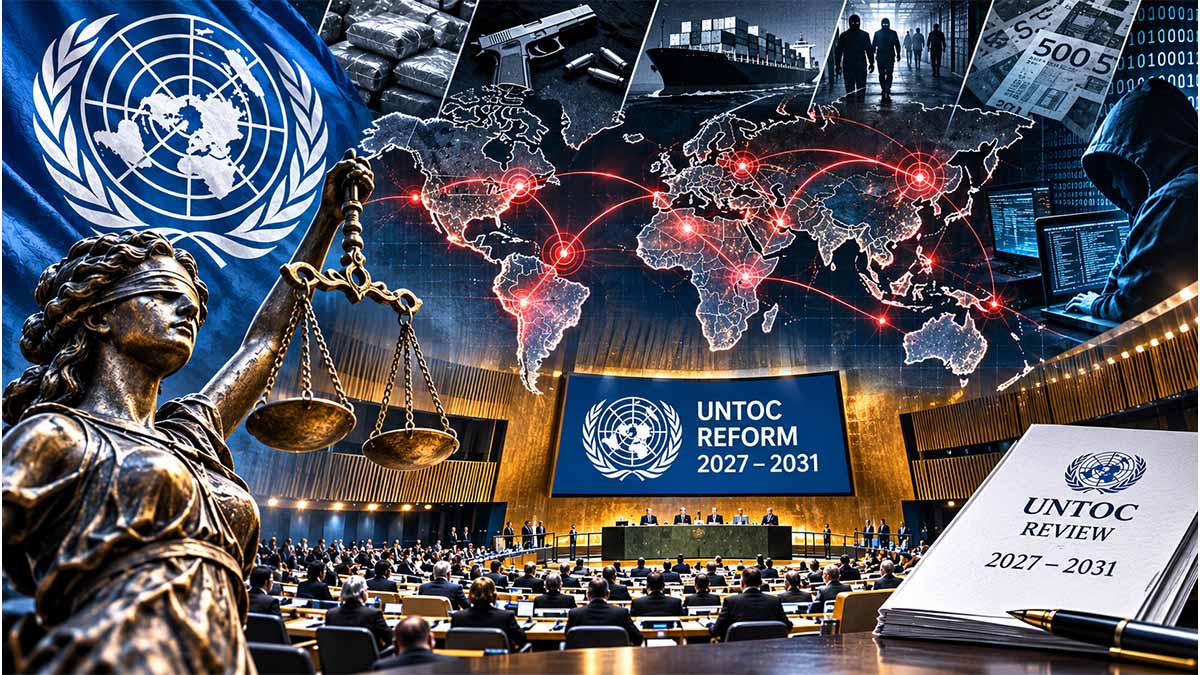
INSTITUTIONAL INTELLIGENCE DOSSIER | INTERNATIONAL LAW • MULTILATERAL GOVERNANCE • TRANSNATIONAL SECURITY • ENVIRONMENTAL CRIME
Scope: Global assessment of the United Nations Convention against Transnational Organized Crime (UNTOC), the institutional and legal consequences of its thirteenth Conference of the Parties (19–23 October 2026), the proposed implementation-review reforms, negotiations on an environmental-crime protocol, and strategic implications for governments and international institutions through 2031.
Executive Summary / BLUF
The October 2026 decisions have created two distinct opportunities to strengthen the international architecture against transnational organized crime, but neither constitutes evidence that its operational effectiveness has already improved.
The central finding is an institutional implementation deficit: the Palermo Convention has 195 parties, yet only 12 country reviews had been completed by COP13. The UN Secretariat reported 123 reviews under way and estimated that completing the existing review cycle could take approximately 76 years at the prevailing pace. treaties.un.org+1
On 23 October 2026, governments approved negotiations on an additional protocol concerning specific environmental crimes by 83 votes in favour, 12 against and 27 abstentions. Separately, a United States-backed resolution to reform the Convention’s implementation-review architecture was adopted without a formal vote, notwithstanding expressed reservations. UN Transcripts+1
The first decision opens a treaty-negotiation process targeting wildlife and timber trafficking, illegal mining and mineral trafficking, and illicit waste trafficking. The second creates an institutional process addressing review performance, working methods, accountability and resource allocation. Neither decision is equivalent to the adoption of a substantive new environmental treaty or the completion of institutional restructuring.
The decisive period is 2027–2028. Reform will depend on whether governments convert procedural decisions into shorter review cycles, stronger evidence, credible external engagement and sustainable financing, while negotiating a new protocol without reproducing the existing system’s implementation weaknesses.
The strategic risk is that the Convention’s substantive obligations will continue to expand faster than the institutional machinery required to assess and enforce them. The most consequential uncertainty is whether states will accept more demanding scrutiny of national implementation rather than limiting reform to meeting schedules and administrative efficiency.
UNTOC’s New Crime Protocol Is Running Ahead of Its Enforcement System
On 23 October 2026, governments made two decisions that expose the central contradiction in global action against organized crime. By 83 votes to 12, with 27 abstentions, the parties to the United Nations Convention against Transnational Organized Crime (UNTOC) authorized negotiations on an environmental-crime protocol. Separately, they adopted a United States-sponsored process to reform the Convention’s implementation-review machinery without a formal vote. Their sequencing is the contradiction. The treaty has 195 parties but produced just 12 finalized country reviews by COP13; its Secretariat warned that the review cycle could require roughly 76 years at the existing pace. Governments may add obligations before showing they can review and enforce existing ones. Investigators, budgets and legitimate traders bear the exposure. UN COP13 proceedings, October 2026.
A 76-year review cycle cannot certify implementation
At COP13, the Secretariat reported 123 reviews under way, 85 completed self-assessment questionnaires, 12 finalized country reviews and another 12 at the final-observations stage. These are overlapping procedural categories, not additive results. The earlier operating data are more revealing: by March 2025, 42 of 51 reviews at the written-feedback stage were delayed; 56 reviews had not begun despite the appointment of all three national focal points. The original 70% completion threshold for advancing thematic phases remained effectively unreachable: the Secretariat reported group completion of only 0–1.6% in March 2025. The system can register activity without producing the findings needed for technical assistance. UN COP13 review proceedings, October 2026; UNODC review performance, April 2025.
The constraint is institutional. Under the mechanism established by COP Resolution 9/1, reviewing states must reach agreement with the state under review on final observations; exchanges are subject to confidentiality provisions. The arrangement protects sovereign participation and permits corrections, but gives delay and disagreement a direct route into the production of findings. A faster questionnaire is useful only if it leads to a substantive, completed review. The Implementation Review and Technical Assistance Working Group will examine reforms twice in 2027; the test is completed findings, not additional meetings. UNODC review-mechanism rules.
The environmental protocol would inherit the same enforcement gap
The new mandate covers trafficking in wild fauna and flora, including timber, illegal mining and illicit mineral and precious-metal trading, and illicit waste trafficking. An ad hoc committee is authorized to hold four sessions of up to ten days and aims, if possible, to submit a draft to COP14 in 2028. That is negotiating authority, not a treaty adopted or in force. A shipment’s status may depend on a forest permit, a mineral concession or the classification of waste in the source, transit and destination states. An internationally agreed offence will have operational value only where it clarifies criminal responsibility and enables cooperation across those different systems. Brazilian Ministry of the Environment, October 2026.
The CITES Convention already regulates trade in protected species; the Basel Convention already controls transboundary movements of specified waste, with electronic-waste amendments effective from 1 January 2025 for parties bound by them. A fourth UNTOC protocol cannot automatically replace those permissions and classifications. Its potential contribution is criminal-law compatibility: making it easier for prosecutors to link unlawful extraction or trafficking to money laundering, corporate responsibility, judicial assistance and confiscation under the Palermo Convention. Treaty duplication would raise compliance costs without necessarily increasing usable evidence. CITES treaty text; Basel e-waste amendments.
The decisive border lies between regulatory evidence and criminal proof
The transmission mechanism runs from a permit to a prosecution, and from a shipment to the proceeds behind it. UNTOC Articles 12–18 and 27 provide channels for confiscation, extradition, mutual legal assistance and police cooperation. They do not turn an environmental regulator’s finding into admissible criminal evidence abroad, or a provisional asset freeze into recovered money. Prosecutors may need foreign customs records, scientific assessments, corporate ownership information and banking documents before a case can establish the underlying offence and trace its proceeds. Every incompatible offence definition or defective assistance request adds procedural friction. UNTOC Convention, Articles 12–18 and 27.
Eurojust handled 68 environmental-crime cases in 2025, a 17% increase over 2024. Italy initiated the most; Germany was most often requested to assist; the United Kingdom was the only third country requested to assist. In England, the Environment Agency inspected 1,803 waste containers and stopped 561 in 2024–2025, while interventions helped prevent 79,713 tonnes of illegal waste exports. Eurojust cases and customs interventions measure different activities: neither is a Europe-wide count of offences or convictions. These figures describe operational workload, not the effectiveness of a future treaty. Eurojust Annual Report 2025; Environment Agency 2024–2025 report.
The funding dispute puts a ceiling on both ambitions
The Secretariat estimated additional requirements of approximately US$1.3 million in 2027 and US$1.1 million in 2028 for environmental-protocol negotiations, excluding separately identified staff-assessment accounting amounts. For reform of the existing review system, it identified US$80,500 in additional 2027 interpretation requirements for ten meetings beyond existing entitlements; wider costs from 2028 still required assessment. The figures cannot be summed into a credible price for reform: one pays for a finite negotiating process, the other describes a narrow conference-service item within recurring institutional work. UN COP13 financial proceedings, October 2026.
Nor is the funding base diversified. The European Union, Italy and Norway were the only voluntary contributors to the review mechanism identified for 2025. The EU argued for predictable support from the UN regular budget; other governments resisted enlarged budget exposure. Iran challenged the budgetary implications of the United States-backed reform resolution before allowing adoption without a vote while dissociating from its content. The United Kingdom’s further £1.5 million contribution to UNODC in 2026 cannot be booked as money specifically for review reform. Neither a diplomatic mandate nor a shift to biennial meetings funds the specialists required to complete reviews. EU review statement, October 2026; UK COP13 statement.
Europe has enacted offences, but not a single enforcement system
Directive (EU) 2024/1203 required transposition by 21 May 2026 for bound Member States. For specified corporate offences, it requires national maximum fines meeting at least 5% of worldwide annual turnover or €40 million, depending on the applicable legislative method; these are ceilings, not automatic penalties. Italy’s Legislative Decree No. 81/2026 entered into force on 2 June 2026; France’s Environmental Code Article L231-3 addresses a domestic offence of ecocide under specified conditions; Germany’s Criminal Code Section 326 governs specified unlawful waste handling. The United Kingdom, outside the EU directive, uses its own regulatory and criminal framework. The systems have different offence elements, liability rules and enforcement responsibilities. A global protocol has to make cross-border cases easier without assuming that domestic laws are identical. EU Directive 2024/1203; Italian implementing decree; German Criminal Code.
The evidence problem also has a constituency beyond governments. At a UNTOC constructive dialogue in June 2025, representatives of 62 NGOs, 16 other stakeholders and 35 states participated, but the formal system still largely separates these discussions from confidential country-review findings. The United States pressed for results-oriented reform; the European Union supported a wider use of reliable external information while maintaining state-led review. That difference matters: adding civil-society seats after deliberations cannot substitute for procedures that let usable evidence influence assessments before they are finalized. UNODC constructive-dialogue summary, June 2025.
In the next 24 months, the cost of delay becomes operational
Between November 2026 and November 2028, governments face two specific tests: a 2027 process intended to recommend revised review arrangements and a possible environmental-protocol draft at COP14 in 2028. The first should be judged by finalized, evidence-based reviews and actionable follow-up, not reorganized meeting schedules. The second should be judged by whether the proposed offences improve cooperation without duplicating CITES, Basel or national laws. Neither the 83-vote negotiating mandate nor the review resolution guarantees those results. UN COP13 proceedings, October 2026.
If governments leave the implementation bottlenecks intact, the bill will not arrive as a single UN budget line. National prosecutors will continue navigating incompatible legal requests; customs and environmental regulators will absorb the cost of reconstructing evidence across borders; legitimate operators will face competition from trade that evades regulatory costs; and affected communities will remain exposed while recoverable criminal proceeds move beyond the jurisdiction where the harm occurred. The Palermo Convention already supplies much of the legal machinery. The next 12–24 months will show whether the decisions taken at COP13 receive the authority, evidence and funding required to operate.
Navigational Index
PILLAR I — THE INSTITUTIONAL AND LEGAL BASELINE
The Palermo Convention and the Structural Limits of Implementation
- Chapter 1. The International Legal Architecture: UNTOC, Its Protocols and the Conference of the Parties
- Chapter 2. The Implementation Review Mechanism: Performance, Institutional Incentives and the Accountability Deficit
- Chapter 3. COP13 and the Reallocation of Authority: Diplomatic Negotiations, Competing State Interests and the 2027 Reform Mandate
PILLAR II — SECURITY, ENVIRONMENTAL CRIME AND IMPLEMENTATION CAPACITY
The Operational, Financial and Jurisdictional Consequences of Reform
- Chapter 4. The Environmental-Crime Protocol: Criminalization, Jurisdiction, Sovereignty and Treaty Compatibility
- Chapter 5. International Judicial Cooperation: Law Enforcement, Intelligence Exchange, Financial Investigations and Asset Recovery
- Chapter 6. The Financial Architecture of UNTOC: Budget Exposure, Secretariat Capacity and Institutional Sustainability
- Chapter 7. Europe and the Wider International System: Italy, France, Germany, the United Kingdom and the European Union
PILLAR III — THE 2027–2031 STRATEGIC OUTLOOK
Reform Pathways, Institutional Risk and Government Decisions
- Chapter 8. Civil Society, Independent Evidence and the Governance of International Review
- Chapter 9. Strategic Scenarios and Institutional Indicators, 2027–2031
- Chapter 10. Government and Multilateral Policy Options: Implementation Priorities and Final Net Assessment
Master Abstract
The legal architecture is extensive; the implementation system remains incomplete
The principal challenge confronting the Palermo Convention is no longer the absence of a broadly accepted international legal framework. Adopted by the United Nations General Assembly on 15 November 2000 and in force since 29 September 2003, UNTOC establishes obligations concerning participation in organized criminal groups, money laundering, corruption, obstruction of justice and international cooperation. Its architecture also encompasses extradition, mutual legal assistance, confiscation, law-enforcement cooperation, witness protection and technical assistance. Article 32 establishes the institutional foundation for the Conference of the Parties, while Article 37 permits the adoption of supplementary protocols. The Convention therefore provides legal mechanisms that extend beyond a declaratory international commitment. United Nations Convention against Transnational Organized Crime — United Nations General Assembly — Nov 2000; United Nations Convention against Transnational Organized Crime, Treaty Status — United Nations Treaty Collection — Nov 2026.
The central institutional weakness lies in the relationship between international obligations and observable domestic implementation. A treaty may achieve near-universal participation without producing comparable national enforcement capacities, consistent criminalization, rapid judicial cooperation or sufficient evidence to evaluate its effectiveness. The figures presented at COP13 expose that distinction. UNODC reported 123 country reviews under way, 85 completed self-assessment questionnaires and 12 finalized country reviews. Another 12 reviews had reached the final observations stage. These figures describe different procedural states and cannot be aggregated as completed reviews. They also demonstrate that the mechanism is active, even though its completion rate remains insufficient relative to its intended international coverage. Conference of the Parties to UNTOC, Thirteenth Session, Meeting 4 — United Nations — Oct 2026.
A particularly important distinction concerns administrative delay versus substantive failure. The small number of completed reviews proves that the mechanism has not yet delivered comprehensive coverage. It does not, by itself, establish that every national implementation measure is ineffective, that existing mutual legal assistance arrangements are unused, or that the Convention has failed to produce operational benefits. Those propositions require separate evidence from national legislation, judicial cooperation records, law-enforcement outcomes and technical assistance assessments. The European Union explicitly identified both implementation delays and the need to preserve the mechanism’s intergovernmental character while improving access to relevant external information. Its position therefore recognizes the value of the existing architecture without treating its current performance as satisfactory. EU Statement on the UNTOC Implementation Review Mechanism — European External Action Service — Oct 2026.
COP13 created two reform processes with different legal consequences
The decisions reached in Vienna between 19 and 23 October 2026 must be understood as separate institutional tracks. The environmental-crime resolution authorizes negotiations intended to develop an additional legal instrument. The implementation resolution, by contrast, concerns the functioning of the existing Convention and its governing bodies. This distinction is fundamental: the first may eventually expand the substantive treaty framework, whereas the second seeks to improve the implementation of obligations already in force. The two processes are strategically connected because an additional protocol would rely on the same international system of national legislation, enforcement cooperation, judicial assistance, institutional reporting and technical support whose effectiveness is now being examined.
The environmental negotiating mandate establishes an ad hoc committee expected to convene four sessions of up to ten days each, with the objective of presenting a draft protocol at COP14 in 2028, if possible. The substantive areas identified include trafficking in wild fauna and flora, including timber and timber products; illegal mining and illicit trafficking in minerals and precious metals; and illicit trafficking in waste. The mandate also contains important limitations relating to the Convention’s scope, national sovereignty over natural resources and the relationship with existing international environmental instruments. The decision establishes negotiating authority, not a finalized catalogue of criminal offences. Brazil Leads International Progress against Environmental Crimes — Ministry of the Environment and Climate Change, Brazil — Oct 2026.
The review-related resolution represents a different form of institutional intervention. Its adoption followed negotiations over the responsibilities of the Conference, subsidiary working groups, the use of professional expertise, the relationship between reporting and practical outcomes, and the financial basis of the mechanism. The resulting agenda includes the reorganization of technical-assistance and implementation-review functions, more concentrated working-group activity, and systematic consideration of the implementation of previous resolutions. However, the scope of future participation by external experts and civil society, the actual financing arrangements, and the practical performance standards remain consequential areas requiring further decisions. The European Union’s statement following adoption confirmed support for the reform while emphasizing that its significance would depend on measurable implementation rather than the passage of another resolution. EU Statement on UNTOC COP13 Resolution on the Effective Implementation of the Convention — European External Action Service — Oct 2026.
Financing is a governance constraint, not simply an administrative problem
The financial evidence establishes that the two initiatives will compete for institutional attention and resources during a period of constrained United Nations financing. During COP13, the Secretariat presented indicative additional resource requirements of approximately US$1.3 million for 2027 and US$1.1 million for 2028 for the environmental-protocol negotiating process, excluding separately identified staff-assessment requirements. For the implementation-reform resolution, the Secretariat identified US$80,500 in additional 2027 interpretation requirements, excluding staff assessment, for ten meetings beyond existing conference entitlements. These are different cost categories associated with different mandates. They should not be interpreted as approved appropriations or as the total economic cost of either initiative. Conference of the Parties to UNTOC, Thirteenth Session, Meeting 10 — United Nations — Oct 2026.
Financial sustainability also depends on political preferences concerning the division between assessed contributions to the United Nations regular budget and voluntary extrabudgetary contributions. The EU reported that only the EU, Italy and Norway had made voluntary financial contributions to the review mechanism in 2025. In July 2026, it identified Italy and the EU as the two contributors recorded for that year at the time of its statement. The same EU intervention reiterated its preference that activities associated with treaty-based obligations receive regular-budget support. Other governments, including Germany, expressed concern about transferring additional burdens to the regular budget. This divergence complicates the search for predictable financing, particularly when procedural reform may require more intensive Secretariat support rather than merely fewer meetings. EU Statement at the Working Group of Government Experts on Technical Assistance — European External Action Service — Jul 2026; EU Statement on the UNTOC Implementation Review Mechanism — European External Action Service — Oct 2026.
The financing problem has a direct operational transmission mechanism. Insufficient Secretariat capacity can delay the processing of questionnaires, translation and analysis, consultations between reviewing states, and the preparation of observations. Those delays, in turn, reduce the availability of timely findings that could guide technical assistance. An increase in the number of meetings or reporting requirements without corresponding resources could therefore worsen the implementation backlog rather than reduce it. Conversely, administrative consolidation could create efficiency gains if savings are demonstrably redirected towards review completion and substantive technical support.
Europe is a significant stakeholder, but national priorities diverge
European involvement is neither institutionally uniform nor limited to diplomatic support. The European Union is simultaneously a party to the Convention, a financial contributor, a participant in the reform negotiations and a jurisdiction developing its own environmental criminal-law framework. Directive (EU) 2024/1203, adopted on 11 April 2024, required Member States bound by it to transpose its provisions by 21 May 2026. The Directive provides an existing European legal reference for criminalization, corporate liability, penalties and enforcement cooperation. Its existence does not establish that all national legal systems had completed transposition or that the rules ultimately negotiated under UNTOC will have identical definitions or jurisdictional reach. Directive (EU) 2024/1203 on the Protection of the Environment through Criminal Law — European Parliament and Council — Apr 2024.
Within Europe, Italy combines participation in a completed implementation review with an identified role in financing the mechanism. France supported the environmental-protocol initiative and participated in the earlier intergovernmental process that prepared the negotiations. Germany, whose country review was completed in October 2026, has firsthand experience of the administrative burden associated with the existing mechanism and has emphasized procedural simplification and a broader donor base. The United Kingdom has prioritized operational cooperation and the financial structures enabling organized crime; its national statement also announced a further £1.5 million contribution to UNODC in 2026, without identifying that amount as funding specifically for the review mechanism. These are materially different forms of engagement and cannot be treated as interchangeable financial commitments. United Kingdom National Statement to UNTOC COP13 — Foreign, Commonwealth & Development Office — Oct 2026; Conference of the Parties to UNTOC, Thirteenth Session, Meeting 4 — United Nations — Oct 2026.
The principal assessment for 2027–2031 is consequently conditional. A substantive improvement would require simultaneous progress in the quality and completion of national reviews, the use of evidence from operational authorities and relevant external stakeholders, the availability of predictable financing, and the compatibility of the environmental protocol with existing criminal and environmental law. The adoption of the October resolutions demonstrates that governments were capable of authorizing institutional change despite differing positions. It does not establish that they have accepted the operational, financial and political obligations necessary to make that change effective.
Key Evidence Table
The following table consolidates the principal legal, institutional, quantitative and financial indicators relevant to the assessment. Proposed expenditure is distinguished from approved financing, and review activity is distinguished from completed outcomes.
| Indicator | Value/status | Reference date | Definition/scope | Issuer | Exact source |
|---|---|---|---|---|---|
| UNTOC participation | 195 parties | 12 Nov 2026 | Parties to the Convention, not to every supplementary protocol | UN Treaty Collection | Treaty Status — UN |
| COP13 session | 19–23 Oct 2026 | Oct 2026 | Thirteenth Conference of the Parties, Vienna | United Nations | COP13 Proceedings, Meeting 4 — UN |
| Country reviews under way | 123 | Oct 2026 | Reviews in progress; excludes treating incomplete processes as finalized | UNODC Secretariat | COP13 Proceedings, Meeting 4 — UN |
| Self-assessment questionnaires completed | 85 | Oct 2026 | Completed questionnaires, not necessarily finalized country reviews | UNODC Secretariat | COP13 Proceedings, Meeting 4 — UN |
| Finalized country reviews | 12 | Oct 2026 | One finalized by COP12, followed by 11 additional finalized reviews | UNODC Secretariat | COP13 Proceedings, Meeting 4 — UN |
| Reviews approaching completion | 12 | Oct 2026 | Additional reviews at the final observations stage | UNODC Secretariat | COP13 Proceedings, Meeting 4 — UN |
| Estimated review-cycle duration | Approximately 76 years | Oct 2026 | Secretariat projection conditional on prevailing pace and capacity, not a fixed deadline | UNODC Secretariat, discussed by states | COP13 Proceedings, Meeting 4 — UN |
| Environmental-protocol vote | 83 for; 12 against; 27 abstentions | 23 Oct 2026 | Decision to establish negotiations, not adoption of a protocol | COP13 | COP13 Proceedings, Meeting 10 — UN |
| Environmental-protocol negotiating schedule | Four sessions, maximum ten days each | Oct 2026 | Authorized negotiating framework; draft targeted for COP14 in 2028, if possible | COP13 | Brazilian Ministry of the Environment — Oct 2026 |
| Implementation-reform decision | Adopted without a formal vote | 23 Oct 2026 | Consensus procedure, with Iran expressing dissociation from the resolution | COP13 | COP13 Proceedings, Meeting 10 — UN |
| Additional interpretation requirements for reform | US$80,500 | 2027 estimate | Additional interpretation services for ten meetings, excluding staff assessment; not an approved appropriation | UNODC Secretariat | COP13 Proceedings, Meeting 10 — UN |
| Environmental negotiating resource requirements | Approximately US$1.3m in 2027; US$1.1m in 2028 | Oct 2026 estimates | Indicative additional resource requirements, excluding separately identified staff-assessment amounts | UNODC Secretariat | COP13 Proceedings, Meeting 10 — UN |
| Voluntary review-mechanism contributors | Three in 2025; two identified by Jul 2026 | 2025–Jul 2026 | EU, Italy and Norway in 2025; EU and Italy identified in July 2026 | European Union | EU Review Statement — Oct 2026; EU Technical Assistance Statement — Jul 2026 |
| EU Environmental Crime Directive | Directive (EU) 2024/1203 | 11 Apr 2024; transposition deadline 21 May 2026 | EU minimum rules for environmental criminal law, subject to Member State obligations and applicable exceptions | European Parliament and Council | Environmental Crime Directive — European Commission |
| UK contribution to UNODC | £1.5 million | Announced Oct 2026 | Further UK contribution to UNODC; not identified as review-mechanism funding | UK FCDO | United Kingdom National Statement — Oct 2026 |
The review figures need careful interpretation. The 123 ongoing reviews and 85 completed questionnaires represent activity within the mechanism, while the 12 finalized reviews represent completed processes. The additional 12 approaching completion remain a separate category. The Secretariat’s 76-year estimate is a conditional assessment of the existing process, not a formal UNTOC implementation timetable.
The financial figures similarly describe different categories of prospective resource requirements. In particular, the environmental negotiating costs and the smaller identified interpretation requirement for the implementation-reform process do not constitute a complete consolidated programme budget.
Competing Explanations and Reform Pathways
Three distinguishable pathways could shape the institutional outcome during 2027–2031. They are not assumed to be mutually exclusive: elements of administrative streamlining could occur alongside incomplete substantive reform, while negotiations on the environmental protocol could progress independently of the review mechanism’s performance.
| Pathway | Diagnostic support | Disconfirming evidence or constraints | Observable indicators | Current standing |
|---|---|---|---|---|
| Substantive institutional recalibration | COP13 authorized a review-reform process; EU proposals include clear procedural timelines, greater Secretariat support and wider use of external evidence | Political control of reviews, confidentiality rules, financial limitations and unresolved participation arrangements | Revised procedures, accessible implementation findings, faster review completion and identified funding | Authorized reform process; operational effectiveness not yet established |
| Predominantly administrative streamlining | Agreement on reducing meeting frequency, concentrating working methods and following up resolutions; pressure to contain expenditure | Reduced meeting costs do not automatically resolve review complexity or Secretariat capacity shortages | Lower administrative burden without a corresponding improvement in substantive outputs | A plausible limited outcome based on measures already endorsed |
| Divergent treaty expansion and implementation performance | Environmental negotiations have a defined mandate and timetable while the existing review mechanism remains incomplete and financially constrained | Governments could link treaty development to measurable implementation improvements and secure dedicated resources | Progress on protocol text combined with persistent review delays and weak technical-assistance feedback | An unresolved strategic risk requiring monitoring across both institutional tracks |
The competing political explanations
The reform process also reveals divergent interpretations of the underlying problem.
The United States placed particular emphasis on results, institutional efficiency and the value obtained from existing resources. Its intervention supporting reform challenged the existing technical-assistance arrangements and the ability of the Convention’s institutions to demonstrate practical outcomes. In the environmental-protocol debate, Washington also raised concerns about expanding institutional mandates when existing implementation mechanisms were underperforming. These positions represent a preference for concentrating resources on demonstrable implementation and controlling the costs of additional structures. COP13 Proceedings, Meeting 10 — United Nations — Oct 2026.
The European Union framed the problem more broadly. It supported efficiency measures but emphasized that predictable resources, implementation support and use of external information remained necessary. Its explicit support for financing treaty-related obligations through the regular UN budget differs from positions prioritizing expenditure restraint or a broader voluntary donor base. EU Statement on the UNTOC Implementation Review Mechanism — European External Action Service — Oct 2026.
The environmental negotiations introduce a further disagreement over legal necessity and institutional competence. Brazil, France and other supporters regard an additional protocol as an instrument for reducing gaps in cross-border criminalization and judicial cooperation. Other states have questioned whether a new instrument is necessary before the limitations of existing agreements have been fully examined. Saudi Arabia expressed concerns about scope, financial implications and proceeding without consensus; Singapore questioned whether the identified legal and operational gaps justified a new protocol; Russia raised definitional concerns and the potential duplication of existing environmental agreements. These are identifiable disagreements over institutional design rather than evidence that the relevant governments reject international cooperation against environmental crime. COP13 Proceedings, Meeting 10 — United Nations — Oct 2026.
The resulting assessment is that the principal disagreement concerns the institutional means of improving effectiveness: whether to expand legal obligations, prioritize implementation of existing obligations, increase Secretariat capacity, or combine these approaches. The public record does not justify assigning exclusive motives to individual states or treating their positions as fixed for the entire negotiating period.
Principal Gaps and Watch Indicators
The following gaps are material because their resolution could change the assessment of the Convention’s reform prospects.
| Critical issue | Current evidentiary limitation | Official record or observation required | Decision significance |
|---|---|---|---|
| Review completion | Completed reviews remain too few to establish representative implementation patterns across all parties | Updated UNODC country-review status reports and finalized observations | Determines whether reforms improve coverage and produce usable findings |
| Procedural reform | The October decision authorizes institutional change, but revised procedures and operational performance remain to be demonstrated | 2027 Implementation Review and Technical Assistance Working Group recommendations and subsequent COP decisions | Distinguishes procedural commitments from implemented reform |
| Financial sustainability | Estimated additional costs do not establish approved or disbursed resources | UN programme budget decisions, UNODC expenditure reports and voluntary contribution records | Determines whether Secretariat functions can be maintained |
| Independent evidence | The extent to which external information will inform substantive findings remains unsettled | Revised review rules, constructive-dialogue arrangements and published country-review materials | Determines the breadth, transparency and evidentiary quality of the mechanism |
| Environmental treaty scope | Criminal conduct, definitions, jurisdictional provisions and compatibility arrangements remain subject to negotiation | Ad hoc committee draft texts, negotiating reports and COP14 submissions | Determines the potential legal effect and domestic implementation burden |
| Enforcement outcomes | Review completion and treaty adherence do not directly measure operational effectiveness | Competent national and UNODC data on mutual legal assistance, prosecutions, confiscation and technical-assistance results | Determines whether legal commitments generate measurable operational improvements |
Institutional decision thresholds
A credible 2027 reform process would need to establish more than procedural compliance. Its outputs should identify a feasible review timetable, clarify how Secretariat support will address the documented backlog, and distinguish the information that may be made public from material subject to legitimate confidentiality constraints. Without those elements, the review mechanism could remain formally active while still failing to produce timely and comparable information.
A meaningful financial threshold would be the identification of resources sufficient to support the authorized 2027 work programme, alongside a transparent distinction between regular-budget appropriations, pledged voluntary funding and funds actually available for expenditure. A recurring shortfall in interpretation, substantive review support or technical-assistance capacity would weaken the proposition that administrative consolidation alone can restore performance.
For the environmental protocol, the decisive observation will be whether the ad hoc committee can produce a legally coherent negotiating text within the authorized timetable. In particular, provisions on criminal offences, legal-person liability, jurisdiction and cooperation must remain compatible with the parent Convention and other applicable international commitments. The existence of a draft by COP14 would establish negotiating progress; it would not, without adoption, ratification and entry into force, establish a new binding global criminal-law regime.
Decision-Relevant Institutional Options
| Course of action | Responsible authority | Expected effect and burden | Time-to-effect and reversibility | Principal risk |
|---|---|---|---|---|
| Establish clearer review milestones and targeted Secretariat assistance | COP and participating states, supported by UNODC | Improves procedural predictability; requires administrative capacity, coordination and funding | Procedural implementation could begin in 2027; arrangements can be revised | Uniform deadlines could disadvantage states with limited capacity |
| Strengthen the use of relevant external evidence | COP, states participating in reviews and UNODC within their mandates | Improves informational coverage; requires rules for verification, confidentiality and participation | Depends on revised procedures; participation rules are amendable | Disputes over reliability, disclosure and state control |
| Develop predictable financing for core treaty-review functions | States Parties, UN budget authorities and contributing partners | Improves continuity of Secretariat support; creates fiscal and governance commitments | Dependent on budget decisions; funding arrangements can be modified | Donor concentration, budgetary disagreement or unfunded mandates |
| Examine compatibility with existing criminal and environmental instruments during protocol negotiations | Ad hoc committee and participating governments | Reduces conflicting definitions and implementation burdens; requires detailed comparative legal work | Negotiating period through the intended 2028 draft milestone | Delays, scope dilution or legal duplication |
The options differ in legal authority, fiscal requirements and potential adverse consequences. No single measure can resolve every identified constraint. In particular, administrative simplification cannot substitute for financial resources where substantive analysis remains necessary, while increased financial support cannot alone resolve disagreement over the level of transparency or national scrutiny.
Analytical Visualisation — Two Reform Tracks, One Implementation Dependency
The following WordPress-ready scheme distinguishes the existing Convention’s institutional reform from the proposed environmental-crime instrument. It shows the different stages of authorization, implementation and treaty development, and the dependency that connects them. Dates after October 2026 represent scheduled or intended processes rather than completed outcomes.
Two Reform Tracks, One Implementation System
COP13 decisions adopted on 23 October 2026. Subsequent stages are planned or conditional. As assessed on 12 November 2026.
TRACK A — IMPLEMENTATION REFORM
COP13 adopted a resolution addressing implementation effectiveness, institutional efficiency, working methods and accountability.
Implementation-review and technical-assistance functions are to be examined, including procedural efficiency and participation arrangements.
Observable improvement requires more completed reviews, timely findings, sustainable resources and practical technical-assistance outcomes.
TRACK B — ENVIRONMENTAL PROTOCOL
83 votes in favour, 12 against and 27 abstentions. An ad hoc committee was authorized to develop a protocol.
Up to ten days per session. Scope includes wildlife and timber trafficking, illegal mining and mineral trafficking, and illicit waste trafficking.
Submission of a draft, if possible. This is not equivalent to adoption, ratification or entry into force.
Opening Net Assessment
The October 2026 Conference established a procedural basis for two changes to the international response to organized crime: negotiations over an environmental-crime protocol and a formal effort to improve the performance of the existing implementation architecture. The first responds to identified gaps in the international treatment of specific environmental crimes. The second addresses weaknesses in the machinery responsible for translating treaty commitments into measurable national implementation.
These initiatives address different institutional problems but share a common dependency. National legislation, investigation and prosecution capacity, judicial cooperation, access to evidence and stable technical assistance will determine whether the Convention and any future protocol produce operational results. The effectiveness of a treaty cannot be measured solely through ratifications, negotiating sessions or resolutions adopted.
The principal strategic conclusion is that UNTOC’s next test is institutional execution rather than diplomatic agreement. The 2027 reform process will demonstrate whether governments are prepared to change the incentives, procedures and resources governing review. The 2028 environmental-protocol milestone will indicate whether states can translate their negotiating mandate into a coherent proposed legal instrument. The longer-term judgment through 2031 will depend on documented changes in implementation coverage, operational cooperation and the quality of information available to governments.
The documentary distinction remains essential: COP13 authorized reform, but the performance consequences have not yet been established. The period ahead must therefore be assessed through completed decisions, funded capacity and verifiable implementation outcomes, rather than inferred institutional progress.
UNTOC | The Institutional Reform Monitor
Interactive analysis of COP13 decisions, implementation performance, environmental-crime negotiations and the 2027–2031 institutional outlook.
Two mandates. One implementation system.
Select a node to examine the legal or operational dependency connecting the two COP13 decisions.
From COP13 authorization to operational results
Select a milestone to distinguish adopted decisions from intended future activity and measurable outcomes.
Evidence and institutional interpretation
| Indicator | Recorded value | Definition and limitation | Official source |
|---|
Select chart indicators to inspect individual records. The table is filtered by analytical view.
PILLAR I — THE INSTITUTIONAL AND LEGAL BASELINE
The Palermo Convention and the Structural Limits of Implementation
Analytical cut-off: 12 November 2026
The institutional problem confronting the United Nations Convention against Transnational Organized Crime is fundamentally a problem of legal implementation, sovereign authority and international accountability. The Convention establishes an extensive framework of criminal-law obligations and international cooperation mechanisms, but its institutional architecture does not guarantee that participating governments will implement those obligations consistently, submit to timely examination or provide the information necessary to evaluate their effectiveness. The October 2026 decisions therefore expose a distinction of substantial importance for international law: the difference between creating legally binding obligations, administering an international treaty and demonstrating that the treaty changes the behaviour of national authorities and transnational criminal networks. This pillar examines that distinction at three levels: the operative provisions and institutional competencies established by the Palermo Convention; the design, incentives and evidence limitations of the Implementation Review Mechanism; and the diplomatic negotiations through which COP13 created the 2027 reform mandate.
Chapter 1. The International Legal Architecture: UNTOC, Its Protocols and the Conference of the Parties
Principal judgment. The Palermo Convention created a legally substantial but institutionally decentralized system in which States Parties retain responsibility for criminal legislation, enforcement, prosecution and judicial cooperation, while the Conference of the Parties possesses collective authority to promote and examine implementation. The resulting arrangement allows considerable national legal diversity within a common treaty framework. Its principal structural limitation is that the Conference can organize review, request information, develop recommendations and adopt procedural decisions without possessing the powers of a supranational criminal court, prosecutor or enforcement authority. Understanding this division of competence is essential to determining which reforms COP13 can achieve through institutional decisions and which require changes in domestic law, governmental cooperation or additional international agreements.
The Palermo settlement: common legal obligations without a supranational criminal jurisdiction
The United Nations General Assembly adopted the Convention through Resolution 55/25 on 15 November 2000. The instrument opened for signature in Palermo in December 2000 and entered into force on 29 September 2003, following the treaty’s ratification requirements. The United Nations Treaty Collection — United Nations Convention against Transnational Organized Crime, updated on 11 November 2026, records 195 parties, including the European Union as a regional economic integration organization. This breadth of participation has significant legal consequences, but it should not be confused with the existence of an international criminal jurisdiction empowered to investigate or prosecute organized-crime offences directly. UNTOC is primarily a framework through which participating jurisdictions harmonize certain elements of criminal law and facilitate cooperation under their respective legal systems. The United Nations General Assembly — Resolution 55/25, United Nations Convention against Transnational Organized Crime, November 2000 establishes that legal structure.
The negotiating architecture reflected a deliberate balance between the need for international criminal cooperation and the preservation of national sovereignty. Article 1 defines the Convention’s objective in terms of more effective cooperation against transnational organized crime, rather than the creation of a supranational police or prosecutorial authority. Article 4 subsequently protects sovereign equality, territorial integrity and non-intervention, expressly excluding any interpretation that would authorize one State Party to perform law-enforcement functions within another state’s territory when those functions are reserved to the latter’s authorities. This provision is not a peripheral diplomatic qualification: it is an operative constraint on the execution of criminal investigations, searches, surveillance, asset seizures and prosecutorial cooperation across borders. The Convention therefore supplies an international legal framework for requesting and providing assistance, but the execution of that assistance continues to depend on competent domestic institutions, applicable legal procedures and jurisdiction-specific safeguards. United Nations Convention against Transnational Organized Crime — Articles 1 and 4 — United Nations General Assembly, November 2000.
The practical consequence is that international legal coverage and operational enforcement remain different variables. A government may be party to the Convention and maintain criminal legislation broadly consistent with its provisions while its central authority for mutual legal assistance lacks adequate personnel, its prosecutors face difficulties obtaining foreign evidence, or its financial investigators lack the capacity to trace assets held through complex international structures. Conversely, effective bilateral cooperation may exist between particular authorities even where the Convention’s formal multilateral review has not been completed. Neither outcome can be inferred from ratification status alone. The legal design requires national implementation, and the treaty’s effectiveness must consequently be assessed across the entire enforcement process: criminalization, investigation, evidence acquisition, prosecution, judicial assistance, confiscation and the disposition of proceeds. This institutional separation is embedded in Articles 5–18, 27 and 34 of the Convention. United Nations Convention against Transnational Organized Crime — United Nations General Assembly, November 2000.
The jurisdictional perimeter: organized criminal groups, serious crime and transnationality
The Convention’s scope depends on definitions that are legally more precise than the general political concept of organized crime. Article 2 defines an organized criminal group through a combination of minimum membership, structural characteristics, duration, coordinated activity and the objective of obtaining financial or other material benefit. The group must consist of at least three persons, but it need not possess a formally established hierarchy, fixed membership or developed internal organization. This flexible definition permits the Convention to address criminal structures that do not resemble traditional hierarchical organizations, while maintaining a threshold distinguishing organized criminal conduct from isolated offending. Article 2 separately defines serious crime by reference to the maximum penalty available under domestic law: imprisonment for at least four years or a more severe penalty. The threshold concerns the legally prescribed maximum, not the actual sentence imposed in a particular case. United Nations Convention against Transnational Organized Crime — Article 2 — United Nations General Assembly, November 2000.
Article 3 provides the Convention’s general scope of application for prevention, investigation and prosecution. It includes the offences established in accordance with Articles 5, 6, 8 and 23, together with serious crime falling within the Convention’s definition, where the relevant conduct is transnational and involves an organized criminal group. Transnationality is not confined to offences physically committed in two or more countries. The definition also encompasses conduct occurring in one state when substantial preparation, planning, direction or control takes place elsewhere; conduct involving a group operating criminally in more than one state; and conduct committed domestically but producing substantial effects abroad. This formulation is important for criminal networks whose operational headquarters, financial infrastructure and material activities occupy different jurisdictions. It prevents the international character of an offence from depending exclusively on the physical crossing of a border by offenders or illicit goods. United Nations Convention against Transnational Organized Crime — Article 3 — United Nations General Assembly, November 2000.
A particularly consequential qualification appears in Article 34(2). Although Article 3 describes the Convention’s general international scope, States Parties must establish the offences specified in Articles 5, 6, 8 and 23 in domestic law independently of transnationality or the involvement of an organized criminal group, subject to the particular requirement concerning organized groups under Article 5. The distinction is essential for accurate legal interpretation. The Convention does not generally require prosecutors to prove an international element merely to prosecute a domestically established money-laundering, corruption or obstruction-of-justice offence under the implementing legislation. An international cooperation request, however, must still satisfy the applicable treaty and domestic-law requirements. Confusing the Convention’s international scope with the constituent elements of national offences can produce errors in criminalization assessments and in determining whether legislation implements the treaty correctly. United Nations Convention against Transnational Organized Crime — Articles 3 and 34 — United Nations General Assembly, November 2000.
This distinction has direct implications for the development of additional protocols. A protocol identifying particular forms of transnational criminal conduct must specify its relationship with the parent Convention and determine which requirements should apply to domestic criminalization and which should govern international cooperation. Inconsistent treatment of these questions could produce uncertainty over the circumstances in which national authorities may rely on treaty-based assistance provisions. Article 37 already supplies the governing legal principle: a supplementary protocol is interpreted together with the Convention, and a state becomes bound by a protocol only through participation in that additional instrument. United Nations Convention against Transnational Organized Crime — Article 37 — United Nations General Assembly, November 2000.
Criminalization, legal-person liability and financial enforcement
The Convention’s substantive framework contains several distinct obligations that operate together but are not legally interchangeable. Article 5 addresses participation in an organized criminal group, accommodating different national approaches to conspiracy and participation. Article 6 concerns laundering the proceeds of crime, including the conversion, concealment and transfer of illicit assets, subject to the qualifications contained in the provision. Article 8 requires the criminalization of specified forms of corruption, while Article 23 addresses obstruction of justice, including interference with testimony and the administration of justice. These provisions seek a minimum level of compatibility between legal systems rather than complete uniformity in criminal codes. That distinction allows States Parties to preserve different approaches to criminal responsibility while maintaining internationally recognizable categories of conduct. United Nations Convention against Transnational Organized Crime — Articles 5, 6, 8 and 23 — United Nations General Assembly, November 2000.
Article 10 extends the framework beyond individual offenders by requiring States Parties, consistently with their domestic legal principles, to establish the liability of legal persons for participation in serious crimes involving organized criminal groups and for the Convention’s specified offences. The provision does not require every jurisdiction to adopt identical forms of corporate criminal liability: responsibility may be criminal, civil or administrative, provided the applicable sanctions satisfy the Convention’s requirements. Article 11 addresses prosecution, adjudication and sanctions, while Articles 12–14 establish the foundations for confiscation, seizure, international cooperation in confiscation and disposal of confiscated assets. The latter provisions have particular relevance where criminal activity generates proceeds in one jurisdiction but those proceeds are transferred, held or invested in another. The legal framework does not establish an automatic worldwide confiscation order; authorities must operate through the procedures and conditions established by the Convention and applicable national law. United Nations Convention against Transnational Organized Crime — Articles 10–14 — United Nations General Assembly, November 2000.
The financial provisions illustrate an important distinction between the existence of an international cooperation entitlement and the institutional ability to exercise it. An investigating authority seeking confiscation abroad may require identification of the beneficial owner of assets, recognition of relevant orders, cooperation between financial intelligence and prosecutorial bodies, and sufficiently rapid judicial action to prevent the movement of funds. Each stage can create an operational delay independent of whether the requesting and requested states have formally ratified UNTOC. Article 13 establishes the treaty framework for international cooperation in confiscation, but the underlying mechanism still depends on the competence and responsiveness of domestic authorities. The resulting legal architecture is therefore capable of supporting complex transnational financial investigations without ensuring that every investigation will proceed effectively. United Nations Convention against Transnational Organized Crime — Articles 12–14 — United Nations General Assembly, November 2000.
International judicial cooperation and the limits of automatic legal assistance
Article 16 establishes a comprehensive framework for extradition, while Article 18 provides for mutual legal assistance in investigations, prosecutions and judicial proceedings. Article 18 is particularly significant because it addresses requests for testimony, evidence, searches, records, financial documentation, identification of criminal proceeds and other forms of assistance relevant to cross-border criminal proceedings. The Convention also envisages central authorities responsible for receiving mutual legal assistance requests and either executing them or transmitting them to competent domestic authorities. These institutions provide a formal channel through which authorities can communicate across distinct legal systems. However, the existence of such a channel does not eliminate differences in evidentiary standards, procedural rules, institutional resources or the conditions under which assistance may lawfully be refused or postponed. United Nations Convention against Transnational Organized Crime — Articles 16 and 18 — United Nations General Assembly, November 2000.
The distinction between extradition and mutual legal assistance also requires careful treatment. Extradition concerns the surrender of a person under applicable legal conditions; mutual legal assistance concerns cooperation in gathering evidence and supporting criminal proceedings. Both may depend on questions of dual criminality, nationality, domestic judicial safeguards and applicable treaty provisions, but they are not identical legal processes. Article 16 recognizes the continuing role of domestic law and relevant extradition arrangements, and includes provisions permitting the Convention to function as an extradition treaty between certain States Parties under the specified conditions. Article 18 similarly contains a detailed framework governing assistance, including rules on central authorities, requests and permissible grounds for refusal. The Convention’s central contribution lies in the availability of a common legal basis, not in the elimination of national procedural discretion. United Nations Convention against Transnational Organized Crime — Articles 16 and 18 — United Nations General Assembly, November 2000.
Article 27 addresses law-enforcement cooperation, including communication channels, exchange of information and cooperation concerning methods used by organized criminal groups. Articles 28 and 29 extend the institutional framework to information collection, analysis, training and technical assistance. Together, these provisions recognize that criminal enforcement requires more than compatible legal definitions. Investigators must understand relevant criminal markets, prosecutors must communicate with foreign authorities, and governments must identify weaknesses in their institutional systems. The practical significance of Articles 28 and 29 is especially important for assessing the review mechanism: information about legislation is only one component of implementation, whereas the Convention itself also contemplates analytical expertise, evaluation, operational cooperation and capacity development. United Nations Convention against Transnational Organized Crime — Articles 27–29 — United Nations General Assembly, November 2000.
The three supplementary protocols: separate obligations within a common institutional framework
The Palermo architecture includes three protocols that address specific criminal markets and forms of transnational conduct. Their legal relationship with the parent Convention is governed by Article 37, which requires participation in UNTOC as a prerequisite for participation in a protocol while making clear that joining the Convention does not automatically bind a government to every supplementary instrument. This distinction is essential when interpreting treaty participation statistics: the 195 parties recorded for UNTOC do not constitute a single universal denominator for obligations under the trafficking, smuggling and firearms protocols.
| Instrument | Principal legal subject | Core provisions | Distinct legal and operational function |
|---|---|---|---|
| Convention against Transnational Organized Crime | Organized criminal groups, specified offences and serious transnational criminal activity | Articles 2–6, 8, 10–18, 23, 27–34 | Establishes the common framework for criminalization, cooperation, confiscation and institutional implementation |
| Protocol to Prevent, Suppress and Punish Trafficking in Persons, Especially Women and Children | Trafficking in persons and protection of affected individuals | Articles 3, 5–9 | Combines criminalization, prevention, victim protection and international cooperation |
| Protocol against the Smuggling of Migrants by Land, Sea and Air | Facilitation of unlawful entry for financial or material benefit | Articles 3, 5–8, 16 | Addresses organized migrant smuggling while preserving distinctions between smuggling, trafficking and the treatment of migrants |
| Protocol against the Illicit Manufacturing of and Trafficking in Firearms, Their Parts and Components and Ammunition | Illicit firearms manufacturing and trafficking | Articles 3, 5, 7–12 | Establishes criminalization and measures concerning marking, record-keeping, tracing and international cooperation |
The Convention and the trafficking and migrant-smuggling protocols were adopted through General Assembly Resolution 55/25 in November 2000. The Firearms Protocol was subsequently adopted through General Assembly Resolution 55/255 on 31 May 2001. The instruments are legally interconnected, but they address different objects of regulation, create distinct obligations for their respective parties and retain separate substantive review requirements. United Nations General Assembly — Resolution 55/25, November 2000; United Nations General Assembly — Resolution 55/255, Protocol against the Illicit Manufacturing of and Trafficking in Firearms, May 2001.
The relationship between the protocols demonstrates why legal expansion cannot be evaluated by counting treaty instruments alone. The trafficking protocol requires attention to exploitation, coercion and victim protection; the smuggling protocol addresses a different form of organized conduct, subject to its own safeguards; and the firearms protocol contains provisions requiring operational systems for identifying, marking and tracing weapons. Implementation therefore generates distinct requirements for police forces, prosecutors, immigration authorities, victim-support services, customs administrations and regulatory bodies. A common review mechanism may examine these instruments through coordinated procedures, but it cannot assume that compliance in one domain establishes compliance in another. This has direct relevance to any future environmental-crime protocol, where criminalization may need to interact with natural-resource licensing, customs controls, environmental authorities and the management of confiscated property.
Article 32 and the institutional competence of the Conference of the Parties
The legal foundation of the Conference of the Parties is Article 32, which establishes the body with the purpose of improving the capacity of States Parties to combat transnational organized crime and promoting and reviewing implementation. Its provisions are broad enough to support an extensive institutional framework, but they do not give the Conference unrestricted authority to modify substantive treaty obligations. Article 32(3) authorizes the Conference to establish mechanisms for technical assistance, exchange information concerning criminal patterns and successful practices, cooperate with international and non-governmental organizations, periodically review treaty implementation and make recommendations. Article 32(4) addresses the acquisition of information needed for those functions, while Article 32(5) requires participating governments to provide information on their programmes, practices, legislation and administrative measures as required by the Conference. These provisions provide a direct legal basis for an implementation-review mechanism, including procedures for obtaining national information and identifying areas requiring technical support. United Nations Convention against Transnational Organized Crime — Article 32 — United Nations General Assembly, November 2000.
The Conference’s authority must nevertheless be distinguished from the functions of its Secretariat and subsidiary bodies. Under Article 33, the United Nations Secretary-General provides the Secretariat services necessary for the Conference’s operation. The Secretariat assists with meetings, coordination and information submitted by States Parties, but it does not possess an independent treaty-based power to compel national governments to provide information beyond the applicable legal framework. Nor can it unilaterally rewrite the procedures established by intergovernmental decisions. The Conference, by contrast, can exercise the functions conferred upon it by Article 32 and adopt decisions concerning its institutional machinery under the applicable rules. This arrangement creates an identifiable distribution of authority between intergovernmental decision-making, administrative execution and sovereign national implementation. United Nations Convention against Transnational Organized Crime — Articles 32–33 — United Nations General Assembly, November 2000.
The institutional distinction becomes especially important when assessing accountability. Article 32 does not establish an independent inspectorate with general investigative authority over participating governments. Instead, it creates an intergovernmental structure for acquiring knowledge, reviewing implementation and making recommendations. This does not make reform legally impossible: the Conference has substantial authority to alter its review arrangements, and the procedures adopted in 2018 expressly preserve its capacity to evaluate and improve the mechanism. It does, however, mean that decisions about the availability of information, the responsibilities of reviewing governments and the treatment of sensitive national findings remain embedded in a system controlled primarily by participating states. The effectiveness of the mechanism therefore depends not only on its legal design but on the willingness and administrative capacity of governments to carry out the procedures they have collectively adopted. United Nations Office on Drugs and Crime — Mechanism for the Review of the Implementation of UNTOC and the Protocols Thereto: Compendium of Basic Documents, 2022.
Institutional authority and the boundaries of decision-making
| Institution or actor | Legal foundation | Principal competence | Institutional limitation | Implication for reform |
|---|---|---|---|---|
| States Parties | Articles 4, 5–34 | Implement criminal legislation, investigate and prosecute offences, provide judicial cooperation and participate in review | National sovereignty, domestic procedures and relevant treaty conditions continue to apply | Practical effectiveness requires national action |
| Conference of the Parties | Article 32 | Promote implementation, establish review arrangements, exchange information and adopt recommendations | Cannot independently exercise national police or prosecutorial powers | Can modify review procedures and institutional working methods within its competence |
| UN Secretary-General and Secretariat | Article 33 | Provide administrative services, facilitate information submissions and support Conference activities | Administrative and financial mandates remain governed by applicable UN rules | Secretariat capacity affects the timeliness and quality of review |
| Subsidiary working groups | Conference decisions under Article 32 | Examine specialized treaty subjects and develop recommendations | Their mandates derive from Conference decisions and agreed procedures | Their organization can be revised without automatically amending treaty obligations |
| National central authorities | Article 18 and domestic implementing law | Receive and transmit mutual legal assistance requests; coordinate execution | Requests remain subject to applicable legal conditions | Operational cooperation requires domestic administrative capacity |
| Reviewing States Parties | Resolution 9/1 and the review procedures | Examine another participating state’s implementation and identify observations | Work within confidentiality, procedural and intergovernmental requirements | Quality depends on expertise, evidence and cooperation among reviewing governments |
| Ad hoc negotiating committees | Specific intergovernmental mandates | Prepare negotiated legal instruments for consideration by participating governments | No independent power to impose a treaty before the applicable adoption and consent procedures | Treaty negotiation is distinct from treaty entry into force |
Legal basis: United Nations Convention against Transnational Organized Crime — Articles 18, 32, 33, 34 and 37 — United Nations General Assembly, November 2000; UNODC — Implementation Review Mechanism: Compendium of Basic Documents, 2022.
The relationship between treaty obligations and national enforcement capacity
The Convention contains an important asymmetry between the formal obligations it creates and the institutional arrangements available for evaluating compliance. Criminalization provisions can be compared with national statutes, implementing regulations and relevant judicial decisions. Some provisions concerning the designation of competent authorities or the existence of legislative powers can likewise be examined through documentary evidence. The actual use of cooperation provisions is more difficult to assess. Establishing whether an extradition mechanism functions effectively requires information about requests, applicable legal conditions, decisions, delays and outcomes. Assessing asset recovery requires distinguishing assets identified, assets provisionally frozen, assets confiscated through final legal procedures and assets ultimately recovered or disposed of. These measures concern different procedural stages and cannot be reduced to a single total. The Convention supplies the legal structure for these activities, but an implementation assessment must collect operational evidence if it is to move beyond examining whether the necessary laws exist. United Nations Convention against Transnational Organized Crime — Articles 12–18 and 27–29 — United Nations General Assembly, November 2000.
This gap is particularly relevant to Article 28, which expressly contemplates the collection, exchange and analysis of information concerning organized crime and invites states to assess the effectiveness of their policies and practical measures. Article 29 connects treaty implementation to training and technical assistance, while Article 30 addresses assistance and cooperation in economic development. Read together with Article 32, these provisions establish a broader institutional purpose than the collection of self-reported descriptions of legislation. They envisage an international system capable of learning from national experience, identifying administrative deficiencies and directing technical support to the areas where it is required. The distinction between legislative conformity and demonstrated effectiveness therefore arises from the Convention’s own structure rather than from an external performance standard imposed upon it. United Nations Convention against Transnational Organized Crime — Articles 28–32 — United Nations General Assembly, November 2000.
The legal foundation consequently permits institutional reform without requiring a complete renegotiation of the Palermo Convention. The Conference can reconsider its review procedures, information-management arrangements, working-group mandates and follow-up mechanisms. However, a decision that changes the organization of international meetings cannot automatically amend national criminal legislation, create new domestic investigative powers or remove the procedural conditions governing judicial cooperation. More ambitious substantive commitments would require the appropriate treaty procedures or domestic legal measures. This is the boundary within which the reform programme must operate.
Chapter 1 — Key judgments
The Palermo Convention combines relatively extensive substantive legal obligations with a decentralized international enforcement architecture. Its effectiveness depends on the cumulative performance of national judicial systems, law-enforcement authorities, financial investigators and the international cooperation mechanisms linking them. The Conference of the Parties possesses a clear legal basis for organizing and improving implementation review, but it is not an independent transnational enforcement authority.
The legal provisions most relevant to reform are Articles 28–33, which address information, technical assistance and the Conference’s institutional responsibilities, together with Article 34 on domestic implementation and Article 37 on supplementary protocols. These provisions support changes in review methodology, institutional coordination and the treatment of implementation evidence, while preserving the separate legal requirements for creating new substantive treaty obligations.
What would change the assessment: Evidence that the Conference’s existing authority is being used to establish more effective review procedures, supported by domestic implementation measures and reliable operational information, would strengthen the judgment that institutional reform can improve treaty effectiveness without amendment of the Convention itself.
Open official record: The most consequential documents are the procedures governing implementation review, the adopted COP13 reform resolution, subsequent decisions of the Conference and competent national records showing how international cooperation obligations are applied in practice.
Chapter 2. The Implementation Review Mechanism: Performance, Institutional Incentives and the Accountability Deficit
Principal judgment. The Implementation Review Mechanism’s weaknesses arise from the interaction of an elaborate state-controlled procedure, insufficient incentives to complete reviews, administrative and language-related costs, and restrictions on access to substantive evidence. The mechanism has generated measurable procedural activity, but the relationship between that activity and completed, decision-useful assessments remains weak. Its design also creates a structural dependence on the consent and cooperation of the very governments being examined. This does not establish deliberate obstruction by any particular state; it demonstrates that the system’s effectiveness is highly sensitive to administrative responsiveness, continuity of national representation, the quality of information supplied and the willingness of governments to agree on potentially critical observations.
The prolonged establishment of the review mechanism
The institutional history of the mechanism is significant because it explains why several present constraints are not accidental implementation problems but characteristics of the negotiated design. The Palermo Convention entered into force in 2003, yet the Conference did not establish the current review mechanism until its ninth session in October 2018. Resolution 9/1 adopted the procedures and rules for the mechanism following an extended intergovernmental process. A two-year preparatory phase followed, and the Conference formally launched the country-review process on 16 October 2020 through Resolution 10/1. The latter decision adopted the self-assessment questionnaires, guidelines for conducting reviews, and standardized formats for observations and their summaries. The review mechanism therefore emerged approximately seventeen years after the Convention entered into force, and its implementation depended on additional agreements concerning procedures, information management and the distribution of responsibilities among states and the Secretariat. United Nations Office on Drugs and Crime — Implementation Review Mechanism: Compendium of Basic Documents, 2022.
The delay reflects the difficulty of establishing an international procedure capable of examining national criminal-justice systems while preserving the institutional principles acceptable to participating governments. The procedures adopted in Resolution 9/1 require the mechanism to be transparent, efficient, impartial, non-intrusive, intergovernmental, non-adversarial and non-punitive. They prohibit the production of rankings and require respect for the sovereignty and equality of States Parties. The same principles provide for the identification of implementation difficulties, exchange of good practices and technical cooperation. These characteristics are not necessarily contradictory in legal terms, but their combination has practical consequences. An arrangement designed to avoid political confrontation may facilitate participation by governments reluctant to accept external scrutiny, while simultaneously limiting its ability to produce public comparative assessments or apply reputational pressure when reviews do not progress. UNODC — Implementation Review Mechanism: Compendium of Basic Documents, Resolution 9/1, Annex, paragraphs 4–7, 2022.
An important legal feature is paragraph 7 of the procedures and rules, which permits the Conference to evaluate the organization, functioning, financing and performance of the review process and to amend the mechanism. The 2018 framework therefore did not make its original design permanently immutable. It anticipated the possibility that operational experience could reveal problems requiring correction. This provision creates a direct institutional route for the 2027 reform process. The central challenge is consequently not the absence of authority to examine the mechanism, but the need to obtain political agreement on how that authority should be exercised and how any revised arrangements will be financed. UNODC — Implementation Review Mechanism: Compendium of Basic Documents, procedures and rules, paragraph 7, 2022.
The architecture of country reviews: four thematic clusters and three starting groups
The mechanism was designed as a staged process rather than a single examination of each state. The procedures provide for one preparatory phase and four subsequent thematic review phases, with the articles of the Convention and the protocols divided into clusters. The original arrangement envisaged two years for each thematic phase and staggered the commencement of country reviews across three groups of participating states. Under paragraph 10, advancement to the next phase for a group is conditional on completion of 70% of the reviews envisaged at the beginning of the preceding phase unless the Conference decides otherwise. This creates a collective dependency: the progress of the review system can be affected by the failure of a sufficient number of countries to complete earlier work, even where other participating governments have fulfilled their obligations. UNODC — Implementation Review Mechanism: Compendium of Basic Documents, paragraphs 9–17 and appendix, 2022.
The thematic arrangement establishes a comprehensive scope for the examination of legislation and institutional measures. It also requires a substantial volume of information because the same State Party may be reviewed under the parent Convention and each supplementary protocol to which it belongs. The original procedural framework provides safeguards intended to reduce duplication, including consideration of information previously supplied under other review systems. Nevertheless, it requires coordination among different competent authorities within each state. A ministry responsible for criminal legislation may possess the relevant statutory information, while prosecutorial services, customs agencies, immigration authorities, financial investigators or specialized regulatory bodies hold the operational material needed for a meaningful assessment. The ability to submit a complete and reliable questionnaire therefore depends on domestic administrative coordination, not merely on the capacity of an individual diplomatic representative. UNODC — Implementation Review Mechanism: Compendium of Basic Documents, paragraphs 19–22 and thematic-cluster appendix, 2022.
| Thematic cluster | UNTOC provisions under review | Principal analytical function | Information needed for a substantive assessment |
|---|---|---|---|
| Criminalization and jurisdiction | Articles 2, 5, 6, 8, 9, 10, 15 and 23, subject to the applicable arrangements concerning the Convention against Corruption | Determine whether domestic legislation establishes the required offences and jurisdictional powers | Statutory provisions, legal definitions, corporate-liability arrangements and relevant judicial interpretation |
| Prevention, technical assistance, protection and other measures | Articles 24, 25, 29, 30 and 31 | Examine prevention, assistance programmes and safeguards for witnesses and victims | Institutional mandates, relevant programmes, administrative measures and documented implementation |
| Law enforcement and judicial system | Articles 7, 11, 19, 20, 22, 26, 27 and 28 | Examine domestic enforcement arrangements, investigative cooperation and information management | Competent authorities, investigative powers, coordination arrangements and relevant operational practices |
| International cooperation, mutual legal assistance and confiscation | Articles 12, 13, 14, 16, 17, 18 and 21 | Determine whether domestic institutions can use the Convention’s cross-border cooperation mechanisms | Extradition and legal-assistance frameworks, confiscation procedures, central-authority arrangements and applicable practices |
The table reproduces the subject allocation established in the official review framework, while the fourth column identifies the corresponding types of evidence needed for a substantive assessment. The review of the Convention’s corruption-related provisions is subject to the qualification recorded in the framework concerning participation in the United Nations Convention against Corruption. UNODC — Implementation Review Mechanism: Compendium of Basic Documents, Appendix, Table 1, 2022.
The peer-review process and its administrative dependencies
Country reviews operate through a structured relationship between the State Party under review, reviewing States Parties and the Secretariat. Participating governments designate national focal points and governmental experts, while reviewing-state assignments are determined through the procedures established by the Conference. Paragraphs 28–30 of the review rules contain provisions governing the selection of reviewing states, including restrictions on mutual reviews, participation in reviews of protocols to which the reviewing state is not party, and the possibility of requesting a new selection. These provisions are intended to preserve procedural fairness and accommodate differences in legal systems and languages. They also make the organization of each review dependent on administrative decisions extending beyond the state being examined. UNODC — Implementation Review Mechanism: Compendium of Basic Documents, paragraphs 17–18 and 28–31, 2022.
The formal procedure contains several sequential stages. The reviewed state prepares a self-assessment questionnaire; reviewing governments examine the information and provide written feedback; the parties exchange clarifications and supplementary material; and the reviewing states, in coordination with the reviewed government and with Secretariat support, prepare a list of observations. The rules establish periods of up to six months for submission of the questionnaire and up to six months for written feedback following receipt of the questionnaire. These stages are not independent administrative operations. Delays in obtaining information, confirming national experts or translating documentation can affect the timing of later stages. The absence of an effective mechanism for resolving prolonged inactivity creates a cumulative risk, particularly where several reviewed and reviewing governments must coordinate their participation. UNODC — Implementation Review Mechanism: Compendium of Basic Documents, paragraphs 31–39, 2022.
The final observations represent the principal formal outcome of a country review. Under paragraph 38, they may identify implementation gaps, challenges, good practices, suggestions and technical-assistance needs. Paragraph 39 requires agreement between reviewing governments and the reviewed state before the observations and their summaries are finalized. This creates a consequential distinction between expert assessment and negotiated review output. The government being reviewed participates in determining the final document, and disagreements may need to be resolved through additional clarification and consultation. The arrangement protects governments from conclusions they consider inaccurate or inadequately substantiated, but it also creates the possibility that completion will be delayed by unresolved disagreements over wording or that observations will be less specific than the underlying evidence might justify. Those are risks arising from the adopted procedure; their occurrence in an individual country review must be established from the relevant record rather than assumed. UNODC — Implementation Review Mechanism: Compendium of Basic Documents, paragraphs 38–41, 2022.
Review performance, 2023–2026: procedural expansion without comparable completion
The available Secretariat records allow a more precise analysis than a comparison between treaty participation and completed reviews alone. In February 2023, the Secretariat reported that 48 of the 189 reviews in the original participating cohort were advancing. The equivalent figure increased to 73 in February 2024 and to 96 in March 2025. At COP13 in October 2026, the Secretariat reported 123 country reviews under way. The figures indicate an increase in procedural engagement, but the underlying reporting dates and classifications must be preserved. In particular, the earlier reports distinguish active from inactive and completed reviews, while the COP13 update identifies reviews under way alongside separately finalized outcomes. These categories support an assessment of improved participation, not a mechanically continuous estimate of completed-review productivity. UNODC — Status of the Functioning of the Implementation Review Mechanism, March 2023; UNODC — Status of the Functioning of the Implementation Review Mechanism, March 2024; UNODC — Status of the Functioning of the Implementation Review Mechanism, April 2025; United Nations — UNTOC COP13 Proceedings, Meeting 4, October 2026.
| Reporting date | Reviews reported as advancing or under way | Other reported procedural evidence | Analytical interpretation |
|---|---|---|---|
| 24 February 2023 | 48 | 25 at questionnaire preparation, 21 at written feedback and 2 at preparation of observations | Early implementation remained concentrated in initial procedural stages |
| 29 February 2024 | 73 | 33 at questionnaire preparation, 36 at written feedback and 4 at preparation of observations | More reviews entered active processing, but very few had reached the final substantive stage |
| 12 March 2025 | 96 active | 91 inactive; 2 completed first-cluster reviews | Substantial inactivity persisted despite increased engagement |
| October 2026, COP13 | 123 under way | 85 completed questionnaires; 12 finalized reviews; a further 12 at final observations stage | Activity had expanded, but completed outputs remained limited |
Official reporting series: UNODC — March 2023; UNODC — March 2024; UNODC — April 2025; United Nations — COP13, October 2026.
The numerical development reveals that expanding the number of active reviews does not automatically produce a corresponding increase in finalized assessments. Between the 2024 and 2025 reference dates, active reviews increased from 73 to 96, a rise of approximately 31.5%, consistent with the Secretariat’s rounded description of 32%. The later COP13 figure of 123 indicates further activity, but it does not establish that the same rate of expansion translated into completed observations. The system therefore requires at least two separate performance measures: an engagement indicator showing whether governments have entered and advanced through the review process, and an output indicator showing whether the procedure has produced finalized findings capable of informing implementation and technical assistance. A third measure is necessary for evaluating substantive effectiveness: whether identified deficiencies subsequently lead to verifiable legal or institutional changes. UNODC — Status of the Functioning of the Implementation Review Mechanism, April 2025, paragraphs 22–24; United Nations — COP13 Proceedings, Meeting 4, October 2026.
National focal points and the administrative cost of interrupted coordination
The March 2025 Secretariat report provides unusually useful evidence about the mechanisms behind delay. It recorded 188 nominated focal points from 176 States Parties and noted that 45 of those 176 states, equivalent to approximately 25.6%, had changed their focal points at least once during the preceding twelve months. The report explained that changes could either delay the process through interruption of continuity or enable progress where a previously nominated official had become unresponsive. It also identified the absence of focal-point nominations by 13 States Parties as an obstacle preventing the commencement of 35 country reviews. These data establish that a material part of the review mechanism’s performance problem is administrative rather than exclusively diplomatic. UNODC — Status of the Functioning of the Implementation Review Mechanism, April 2025, paragraphs 10–18.
The composition of national focal points reinforces this interpretation. In March 2025, the Secretariat reported that approximately 25.7% were affiliated with foreign ministries, 25.1% with justice ministries and 17% with interior ministries. The distribution is institutionally understandable: foreign ministries coordinate treaty relations, justice ministries possess expertise concerning criminal legislation and judicial cooperation, and interior ministries frequently maintain responsibilities relating to policing and security. Nevertheless, these institutional affiliations can create different information requirements. A foreign-ministry focal point may need to obtain evidence from prosecutors and specialized agencies, while a justice-ministry official may require operational statistics from law-enforcement and financial authorities. Where the review requires coordinated submissions under several treaty instruments, the national focal point becomes an administrative interface among institutions rather than the sole holder of relevant evidence. UNODC — Status of the Functioning of the Implementation Review Mechanism, April 2025.
The same report recorded 1,040 nominated governmental experts, including 388 women, representing approximately 37%, as of 12 March 2025. The availability of a substantial expert pool demonstrates that the mechanism is not simply lacking formal national nominations everywhere. The decisive question is whether nominated experts can maintain participation, obtain relevant information, prepare timely written assessments and coordinate with counterparts over the required period. A large number of designated officials does not necessarily translate into continuous review capacity if their participation is constrained by competing domestic responsibilities or if the mechanism lacks support for translation, coordination and substantive analysis. UNODC — Status of the Functioning of the Implementation Review Mechanism, April 2025, paragraph 19.
The bottleneck before substantive examination
The Secretariat identified a particularly consequential problem in reviews that had not yet formally commenced despite the appointment of the relevant focal points. As of 12 March 2025, 56 country reviews in which all three focal points had been nominated remained unstarted because the necessary preliminary consultations had not taken place. Reported difficulties included limited availability, changes in national representation and a lack of responsiveness. This is analytically significant because it demonstrates that the nomination requirement, although necessary, is not sufficient. The mechanism can remain inactive even after its formal personnel arrangements have been established, suggesting that the cost of coordinating three governmental counterparts is itself a substantial implementation constraint. UNODC — Status of the Functioning of the Implementation Review Mechanism, April 2025, paragraph 27.
The procedural system contains no automatic administrative substitution that resolves every instance of prolonged non-responsiveness. Paragraph 18 of the review rules provides for a state’s permanent representative to act as temporary focal point where no formal nomination has been made, but the existence of a designated representative does not guarantee continued substantive participation. A government may possess the formal administrative capacity to acknowledge communications while lacking the personnel or internal coordination needed to complete the review. Any reform concentrating exclusively on earlier appointment of focal points would therefore address one identifiable problem while leaving the subsequent coordination burden unresolved. The more consequential institutional question is how to maintain progress once participants have entered the process and how to prevent individual delays from affecting the completion of the entire thematic phase. UNODC — Implementation Review Mechanism: Compendium of Basic Documents, paragraphs 18 and 31–36, 2022.
The written-feedback stage: where administrative delay becomes an institutional constraint
The 2025 Secretariat assessment identifies the written-feedback stage as one of the clearest measurable bottlenecks in the review process. As of 12 March 2025, 51 country reviews had reached that stage, but 42 of the 51, approximately 82%, were experiencing delays relative to the schedules established during preliminary consultations. More than 60% of the reviews at that stage were taking at least twice the agreed time, with delays exceeding one year. These figures are more diagnostically useful than the total number of completed reviews because they identify a specific procedural point at which the mechanism regularly fails to meet its own operating expectations. They do not merely show that the institution has accumulated a backlog; they demonstrate that a major phase of substantive exchange between governments is systematically taking longer than the participating states originally anticipated. UNODC — Status of the Functioning of the Implementation Review Mechanism, CTOC/COP/RM/I/2025/CRP.1, paragraphs 39–40, April 2025.
The earlier questionnaire stage displays a related but distinguishable pattern. Of the 60 self-assessment questionnaires completed by March 2025, only 24, or 40%, were submitted within the agreed period. Another 17, approximately 28%, arrived within three months after the deadline, while 19, approximately 32%, experienced longer delays. Within that last group, 12 States Parties required more than one year beyond the agreed submission timetable. The distribution indicates that the mechanism faces two separate efficiency problems: obtaining initial national information and subsequently completing the intergovernmental examination of that information. The second problem cannot be resolved solely by improving questionnaire submission rates. Even when a state has assembled and transmitted its own assessment, reviewing governments must still examine the material, obtain any clarifications, formulate comments and agree on the eventual observations. The recorded delay across both stages indicates that the review mechanism operates as a sequence of dependencies rather than as a single reporting obligation. UNODC — Status of the Functioning of the Implementation Review Mechanism, CTOC/COP/RM/I/2025/CRP.1, paragraphs 30–40, April 2025.
The consequences are especially significant because the mechanism’s original structure makes subsequent thematic phases dependent on completion of earlier reviews. The Secretariat noted in March 2025 that progress towards the completion threshold within each of the three participating groups remained between zero and 1.6%, far below the 70% threshold required to begin the subsequent cluster unless the Conference decided otherwise. The threshold was designed to promote an orderly, coordinated review sequence. In conditions of persistent delay, however, it can become a collective constraint that prevents the system from advancing proportionately to the progress achieved by its more responsive participants. Altering that arrangement would require consideration of the trade-off between comparability across participating states and the costs of holding later substantive examination behind unfinished earlier procedures. UNODC — Status of the Functioning of the Implementation Review Mechanism, CTOC/COP/RM/I/2025/CRP.1, paragraph 25, April 2025.
These figures also identify why an apparently straightforward solution, such as increasing the frequency of meetings or imposing shorter administrative deadlines, may have limited effect unless it addresses the circumstances responsible for delay. A reviewing government may need specialist legal assistance to interpret a foreign statute, an implementing state may need coordination among several ministries, and the Secretariat may need sufficient capacity to support documentation and communication in the agreed working languages. In addition, the final observations require agreement among the participating governments. A revised timetable that does not address these dependencies could increase the number of formally overdue reviews without substantially increasing the number of finalized assessments. The more useful performance test is therefore whether reforms shorten the elapsed time at identified bottlenecks while maintaining the legal and evidentiary quality of the resulting observations.
Language, the RevMod platform and the asymmetry of institutional information
The review system’s information infrastructure introduces a further dimension of institutional capacity. The process is supported by RevMod, a secure module within UNODC’s Sharing Electronic Resources and Laws on Crime knowledge-management framework, SHERLOC. The platform facilitates the submission and exchange of information among designated participants, including the reviewed government, reviewing states and authorized Secretariat personnel. Access is governed by the review mechanism’s confidentiality and procedural arrangements. As of March 2025, the Secretariat recorded 16 States Parties that had nominated observers with read-only access to relevant materials concerning their own reviews. The existence of this electronic infrastructure reduces the need for wholly paper-based exchanges, but it does not remove the requirement for the underlying information to be assembled, verified, translated and evaluated by competent authorities. UNODC — Status of the Functioning of the Implementation Review Mechanism, CTOC/COP/RM/I/2025/CRP.1, paragraphs 19–21, April 2025.
Language choice is a particularly consequential variable because the mechanism recognizes the six official United Nations languages while permitting participating states to agree on a more restricted set for a particular review. In the March 2025 reporting period, 60 reviews were being conducted in a single agreed language: 55 in English, two in French, two in Spanish and one in Arabic. In seven other cases, participants had agreed to conduct the review in three languages. These figures indicate that English predominated among single-language reviews, but they do not establish that multilingual arrangements are intrinsically responsible for the overall backlog. The more defensible conclusion is that linguistic coordination can add complexity where the participants require different working languages, particularly if the underlying legal provisions are drafted in languages other than those selected for the review. Such complexity is relevant to the cost of translation and the time needed to formulate accurate legal observations. UNODC — Status of the Functioning of the Implementation Review Mechanism, CTOC/COP/RM/I/2025/CRP.1, paragraphs 26–28, April 2025.
The information architecture creates an additional issue that is not reducible to technical platform performance. Much of the substantive record is produced through government questionnaires, supplementary explanations and exchanges among designated reviewers. Those materials are subject to confidentiality rules and are not automatically available for independent examination. The information supplied may be legally accurate within its stated scope but incomplete as a description of enforcement outcomes. A national government may, for example, identify a statute criminalizing money laundering without supplying a sufficiently detailed picture of the application of that statute to internationally organized networks. A reviewing state may examine the statutory provisions and institutional descriptions available to it without independently obtaining comprehensive evidence concerning prosecutorial outcomes. This is a structural information problem: the breadth of the assessment is determined not only by the legal questions asked, but by the accessibility, completeness and quality of the information on which the reviewers can rely. UNODC — Implementation Review Mechanism: Compendium of Basic Documents, procedures concerning information-gathering, confidentiality and country-review outcomes, 2022.
Negotiated final observations and the accountability deficit
The finalization of country observations constitutes a substantive institutional decision, not merely a clerical step. Under the procedures adopted in 2018, reviewing States Parties prepare observations in close cooperation and coordination with the reviewed state, and the final document requires agreement among the relevant participants. This arrangement can improve the accuracy of findings by ensuring that the government under review can correct errors and explain its applicable legal framework. At the same time, it makes the production of the final assessment contingent on the willingness of the participants to agree on its formulation. The mechanism does not replicate an adversarial judicial procedure in which an independent adjudicator resolves contested factual or legal findings through a binding judgment. Its output is a negotiated institutional record generated within an intergovernmental framework. UNODC — Implementation Review Mechanism: Compendium of Basic Documents, procedures and rules, paragraphs 36–41, 2022.
The resulting accountability deficit has three distinct dimensions. The first is completion accountability: the mechanism has limited means to ensure that every participating government and reviewing counterpart meets the agreed timetable. The second is evidentiary accountability: the final observations may depend heavily on information made available through governmental channels and therefore may not encompass every material institutional weakness. The third is follow-up accountability: identifying a problem does not itself guarantee that an implementing government will introduce the necessary legislation, administrative practice or operational capacity. These distinctions matter because improvements in one dimension may leave the others unresolved. A system could complete more reviews while producing findings that are too general to support practical assistance, or it could generate detailed observations without maintaining a structured process to determine whether the recommendations were subsequently implemented.
Confidentiality compounds the difficulty of independent assessment. The review rules distinguish between information exchanged during the process, final observations and material that participating states may decide to make public. They do not create a general entitlement for civil society, journalists or independent research institutions to inspect every questionnaire or every exchange among governmental reviewers. This restriction may protect sensitive information concerning national criminal-justice institutions, investigations and international cooperation arrangements. Yet it also limits the capacity of outside observers to evaluate whether the published outcomes correspond to the full range of problems discussed during the review. The issue is not that confidentiality is inherently incompatible with credible treaty implementation. It is that an effective mechanism must distinguish information requiring legitimate protection from findings whose disclosure would improve public understanding, accountability and the allocation of technical assistance. UNODC — Implementation Review Mechanism: Compendium of Basic Documents, procedures and rules, paragraphs 37–46, 2022.
Constructive dialogues and the separation between public evidence and formal review
The mechanism’s constructive dialogues provide a recognized channel for communication with relevant stakeholders, including civil-society organizations, but their original design places that communication largely outside the core country-review process. The rules provide for dialogues after the conclusion of working-group sessions and adoption of their reports. Participation is organized through the applicable procedures, while specific country situations are not to be discussed unless the government concerned chooses to raise matters relating to its own review. The dialogues may consider the mechanism’s development, outcomes and general implementation questions, and participants may contribute recommendations or information concerning their activities. They are therefore more substantial than a complete exclusion of civil society, but they are not equivalent to an entitlement to submit country-specific evidence directly into the formal peer-review process before national observations are finalized. UNODC — Implementation Review Mechanism: Compendium of Basic Documents, constructive-dialogue procedures, 2022.
The timing creates an institutional separation between the development of review findings and the consideration of external evidence. Where discussions with non-governmental stakeholders occur only after the relevant working-group deliberations, they cannot routinely inform those deliberations in real time. Moreover, the restriction on discussion of individual countries prevents participants from addressing specific deficiencies that may be central to understanding how a particular government implements the Convention. These provisions reduce the risk that the mechanism becomes a forum for politicized accusations against individual states, but they also constrain its capacity to incorporate evidence from independent researchers, professional associations, affected communities and specialized organizations. The institutional trade-off is therefore not simply one between openness and secrecy; it concerns the level of external scrutiny that participating governments are prepared to accommodate within a formally intergovernmental treaty mechanism.
The distinction between consultation and evidentiary participation is crucial. A dialogue may permit stakeholders to express general concerns about criminal trends, implementation practices or the functioning of the review mechanism without requiring reviewing states to evaluate those concerns as evidence in a country assessment. A more integrated model would allow relevant information to be submitted, screened for reliability, assessed against the treaty’s requirements and incorporated into the analysis where appropriate, while preserving safeguards against unsupported allegations and unauthorized disclosure. Such a change would require procedural design rather than a general declaration of support for civil society. Questions of timing, admissibility, confidentiality, verification, the reviewed state’s right to respond and the authority responsible for determining the relevance of outside material would all need to be addressed.
The relationship between review costs, technical assistance and substantive results
The review mechanism was established under financial arrangements intended to use resources available within the United Nations regular budget and, when necessary, supplementary extrabudgetary contributions. The dependence on finite Secretariat resources becomes important when an international procedure requires continuous coordination across numerous governments, languages and thematic subjects. Even if every state participated promptly, reviewing legislation and institutional arrangements across the Convention and its protocols would still require specialized legal and administrative work. In practice, delay generates additional costs: personnel changes require renewed coordination, unfinished exchanges require follow-up communications, and prolonged reviews may need updated information because legal and administrative arrangements have changed since the original questionnaires were submitted. These mechanisms explain why insufficient resources and slow implementation can reinforce one another. UNODC — Implementation Review Mechanism: Compendium of Basic Documents, funding provisions, 2022.
The Secretariat’s capacity-building work provides evidence that targeted administrative support can affect the mechanism’s functioning, although the scale of the effect on completed reviews remains to be established. In its April 2025 report, UNODC described training activities designed to assist reviewing experts with the preparation of written feedback. It reported that 147 participants from 62 countries attended relevant webinars and that the participating countries were connected to 33 of the 51 reviews then at the written-feedback stage, approximately 64.7% of that group. This demonstrates substantial reach for a relatively concentrated training intervention. It does not establish that training alone resolved the delays affecting those reviews or that the participants subsequently completed their assessments within the planned period. The distinction between participation in capacity-building activity and measured improvement in review completion is essential for evaluating the effectiveness of technical assistance. UNODC — Status of the Functioning of the Implementation Review Mechanism, CTOC/COP/RM/I/2025/CRP.1, April 2025.
The original financial architecture also raises a distributional question. States with extensive legal, diplomatic and technical capacity may be better positioned to support several reviews, prepare complex submissions and absorb the administrative demands imposed on their experts. Countries with fewer specialist officials may struggle to complete the same procedural requirements within comparable periods. A formally identical deadline therefore does not necessarily represent an equivalent implementation burden. The appropriate institutional response cannot be inferred solely from a ranking of countries by speed. It requires an assessment of whether delays result from limited capacity, unnecessary procedural complexity, unresolved disagreements or a lack of political engagement. Those explanations imply different remedies and different institutional costs.
Consolidated diagnosis of the review mechanism’s operational failures
| Procedural stage or institutional feature | Official evidence | Identifiable constraint | Consequence for implementation | Reform question |
|---|---|---|---|---|
| National focal-point nomination | 13 nominations outstanding in March 2025, affecting the commencement of 35 reviews | Necessary national appointments not completed | Reviews cannot move through their initial coordination stages | What administrative follow-up or substitution is permissible? |
| Preliminary consultations | 56 reviews had not commenced despite all three focal points having been nominated | Responsiveness and scheduling failures | Formal readiness does not translate into operational commencement | How can inactive reviews be identified and reactivated? |
| Self-assessment questionnaires | 24 of 60 completed on time; 12 required more than a year beyond the agreed deadline | Domestic information collection and coordination delays | Reviewing states receive substantive information late | What combination of assistance, milestones and simplified requirements is feasible? |
| Written feedback | 42 of 51 reviews at this stage were delayed; more than 60% exceeded one year of delay | Sustained difficulty completing intergovernmental examination | Reviews remain active without advancing towards final observations | Can reviewer support and procedural accountability be strengthened? |
| Thematic advancement | Completion within participating groups remained between 0% and 1.6%, against a 70% progression threshold | Collective dependence on completion of earlier reviews | Subsequent treaty subjects cannot advance as originally envisaged | Should the sequencing threshold or the duration of thematic phases change? |
| Final observations | Completion requires agreement among the participating governments | Potential difficulty resolving substantive differences | Findings may be delayed or narrowed | How can quality assurance and timely agreement be reconciled? |
| External engagement | Constructive dialogues follow working-group sessions and restrict country-specific discussion | External evidence is institutionally separated from formal review | Potentially useful observations may not enter the country-review record | At what stage, and under what safeguards, can outside information be considered? |
| Technical assistance | 147 webinar participants from 62 countries; associated with 33 of 51 written-feedback reviews | Training reaches participants, but downstream results remain uncertain | Capacity-building activity cannot automatically be equated with completed implementation | Which outcome indicators demonstrate that assistance changes review performance? |
Sources for operational figures: UNODC — Status of the Functioning of the Implementation Review Mechanism, CTOC/COP/RM/I/2025/CRP.1, April 2025. Sources for institutional rules: UNODC — Implementation Review Mechanism: Compendium of Basic Documents, 2022.
The table demonstrates that delays arise at several sequential points and cannot reasonably be attributed to one administrative failure. It also exposes an important sequencing problem for reform. Measures directed at the beginning of the process, such as securing focal-point appointments, may increase the number of reviews entering the system without resolving the much larger accumulation of reviews in written feedback. Conversely, simplifying the final observations process could improve output speed without ensuring that the underlying questionnaires contain sufficiently comprehensive information. Effective reform would therefore require an integrated process that addresses the entry, progression and completion of reviews, together with the quality and subsequent use of their findings.
Chapter 2 — Key judgments
The implementation-review mechanism exhibits a demonstrable gap between formal treaty-review architecture and completed institutional output. The 2025 evidence identifies specific weaknesses in preliminary consultations, self-assessment submission, written feedback and collective progression between thematic phases. The October 2026 figures indicate that engagement continued to expand, but they do not show that those weaknesses had been fully resolved.
The mechanism’s design prioritizes intergovernmental control, non-adversarial evaluation and confidentiality. These principles can facilitate participation and protect legitimate national interests, but they also limit the ability to apply external scrutiny or publish independent assessments. The underlying institutional question is how to improve evidence, timeliness and accountability without abandoning the legally established character of the mechanism.
What would change the assessment: A sustained reduction in delays at the written-feedback stage, a materially higher rate of finalized observations, greater consistency between review recommendations and documented technical-assistance outcomes, and procedures permitting relevant external evidence to be considered with appropriate safeguards would indicate substantive rather than merely administrative improvement.
Open official record: The decisive documents are updated Secretariat status reports with comparable stage-level data; revised implementation-review procedures; finalized observations and their summaries; records of technical-assistance activities associated with identified review needs; and COP decisions concerning the financing, timing and organization of the mechanism.
Chapter 3. COP13 and the Reallocation of Authority: Diplomatic Negotiations, Competing State Interests and the 2027 Reform Mandate
Principal judgment. COP13 changed the institutional direction of the Palermo Convention by placing the performance of its governing machinery and the development of an additional criminal-law instrument within two formally authorized processes. The significance of the October 2026 decisions lies not simply in the agreement to conduct additional work, but in the different legal and political methods through which the outcomes were achieved. The environmental-crime negotiating mandate required a recorded vote after proposed amendments failed, whereas the resolution reorganizing the implementation-review architecture was adopted without a vote following a dispute about financial authority and the Conference’s rules of procedure. Together, these decisions reveal a multilateral institution capable of taking consequential decisions despite disagreements over treaty expansion, sovereignty, international scrutiny and resource allocation. They do not establish that those disagreements have been resolved. The essential question for 2027 is whether the Conference can translate the authority it has exercised into procedures that participating governments will implement and finance.
COP13 as an institutional decision point
The thirteenth Conference of the Parties met in Vienna from 19 to 23 October 2026, more than two decades after the Convention entered into force. The session brought together two discussions that had previously developed through distinguishable institutional processes. One concerned the functioning of UNTOC and its implementation-review machinery; the other concerned the possible establishment of an additional protocol addressing specified forms of environmental crime. The first raised questions about the effectiveness of obligations already accepted by participating governments. The second raised questions about the desirability and legal design of further international commitments. Their simultaneous consideration created an unusual opportunity to address treaty development and treaty implementation within the same decision-making period, but also exposed a potential institutional contradiction: States Parties were being asked to authorize the preparation of additional obligations while acknowledging that the existing implementation machinery was not producing completed reviews at the pace originally anticipated. United Nations — Conference of the Parties to UNTOC, Thirteenth Session, Meeting 4, October 2026; European External Action Service — EU Statement on the Effective Implementation of the Palermo Convention, October 2026.
The diplomatic significance of the session is best understood through the distinction between recognition of an institutional problem and agreement on the institutional remedy. The documentary record already demonstrated that review delays were substantial, that some stages of the process were not functioning according to agreed schedules, and that limited funding affected the Secretariat’s ability to support implementation. However, agreement that a mechanism requires improvement does not determine whether governments will accept more intrusive assessment, greater Secretariat discretion, additional resources, revised working-group schedules or wider participation by non-governmental actors. Each option changes a different institutional relationship. Greater Secretariat authority affects the balance between administrative capacity and intergovernmental control; wider access to evidence affects confidentiality and national scrutiny; altered review timetables affect the distribution of administrative obligations among countries with different resources; and changes in financing affect the responsibilities of the United Nations regular budget and voluntary contributors. The resolution adopted at COP13 created a process in which these choices can be reconsidered, rather than settling all of them immediately.
A further distinction concerns the legal status of Conference resolutions. COP13 decisions can alter the organization of subsidiary bodies, establish negotiating mandates and set procedures within the powers conferred by the Convention and the Conference’s rules. They do not, merely through adoption, create the substantive obligations of a new protocol or authorize expenditure that falls within the budgetary competence of other United Nations organs. The resolution establishing environmental negotiations and the implementation-reform resolution must therefore be assessed according to their respective operative effects. The distinction is especially consequential for governments preparing national positions for 2027, since participation in a negotiating process does not necessarily imply acceptance of an eventual treaty, and support for procedural reform does not automatically imply agreement to future budgetary appropriations. United Nations Convention against Transnational Organized Crime — Articles 32, 33 and 37 — United Nations General Assembly, November 2000; United Nations — COP13 Proceedings, Meeting 10, October 2026.
The environmental-crime negotiating mandate: from expert discussion to a formal treaty process
The environmental-crime initiative had already undergone a structured preparatory process before COP13. Resolution 12/4 established an intergovernmental expert-group process, under which relevant governments examined crimes affecting the environment that fall within the scope of UNTOC and related offences. The expert group’s first meeting took place in Vienna from 30 June to 2 July 2025, followed by informal consultations from 28 to 31 October 2025. Revised draft recommendations were prepared for consideration at the expert group’s second meeting, scheduled for 24–26 February 2026. The preparatory material covered both the potential use of the Convention’s existing provisions and the possible creation of an additional protocol. It therefore provides evidence that the negotiating debate was not originally confined to a binary choice between doing nothing and adopting a new treaty. Governments were considering legislative harmonization, dual criminality, financial investigations, legal-person liability, technical assistance, victim protection, environmental remediation and the relationship with existing international instruments. Council of the European Union — Possible Additional Protocol to UNTOC Dedicated to Environmental Crime, Document 5852/26 ADD 1, February 2026.
The preparatory document is particularly informative because it identifies legal problems capable of affecting international criminal cooperation independently of whether a new protocol is eventually adopted. The draft recommendations discuss national differences in definitions of environmental offences, the need for sufficiently serious criminal penalties where the Convention’s cooperation provisions are to apply, and the treatment of environmental crimes as predicate offences for money laundering. They also address the identification, freezing and confiscation of criminal proceeds, the traceability of natural resources and waste, and the protection of affected communities and environmental defenders. These matters reveal the breadth of potential implementation requirements. The difficulty is not restricted to recognizing environmental harm as a legitimate concern of criminal justice; it involves determining which conduct constitutes an internationally relevant criminal offence, what jurisdictional conditions apply, and which authorities possess the legal and technical powers necessary for investigation and judicial cooperation. The December 2025 text was a set of draft recommendations, not an adopted treaty or an agreed final definition of environmental crime. United Nations — Draft Recommendations of the Open-Ended Intergovernmental Expert Group, CTOC/COP/WG.11/2026/3, reproduced by the Council of the European Union, February 2026.
The formal decision at COP13 converted this preparatory discussion into an authorized negotiating process. The Conference established an ad hoc committee charged with developing an additional protocol concerning illicit trafficking in wild fauna and flora, including timber and timber products; illegal mining and illicit trafficking in minerals and precious metals; and illicit trafficking in waste. The mandate provides for four negotiating sessions of no more than ten days each, with the intention of presenting a draft at COP14 in 2028, if possible. It also preserves legally significant limits involving the scope of the parent Convention, national sovereignty over natural resources and the need to avoid duplication with existing international instruments. These qualifications form part of the political and legal framework within which the committee must negotiate. They are not merely statements of general diplomatic preference: the eventual protocol must fit within the international structure from which its negotiating mandate derives. Brazilian Ministry of the Environment and Climate Change — Brazil Leads International Progress against Environmental Crimes, October 2026; European External Action Service — EU Statement on the Environmental-Crime Protocol Negotiating Mandate, October 2026.
The vote was 83 in favour, 12 against and 27 abstentions. The three recorded categories comprise 122 participating delegations, but only the 95 delegations voting in favour or against counted as present and voting for the applicable two-thirds test. The affirmative vote therefore represented approximately 87.4% of those voting for or against, a calculation derived from 83 divided by 95. This figure describes the procedural majority supporting the negotiating mandate; it should not be interpreted as the proportion of all UNTOC parties endorsing the future protocol or as evidence that every supporting government agrees on the eventual legal definitions. Before the final vote, the United States proposed amendments relating to the form of the negotiating mandate, financing and the priority to be given to existing treaty implementation. Those amendments were not adopted. The Conference then approved the underlying proposal through the recorded vote. United Nations — COP13 Proceedings, Meeting 10, 23 October 2026.
The substantive dispute was therefore not whether environmental crimes can be serious or whether international cooperation against them is legitimate. The competing positions concerned the necessity, scope and financial consequences of an additional instrument. Proponents argued that differences between national criminal-law systems can impede investigations and mutual legal assistance and that an additional protocol may help establish compatible obligations. Opponents and more cautious governments questioned whether existing treaty mechanisms, domestic law and specialized environmental agreements could address the same problems without creating further institutional burdens. Both positions raise legally relevant questions. A new protocol could improve cooperation where it resolves gaps in criminalization or procedural compatibility. However, merely adopting a new legal instrument would not ensure that governments possess the national investigative capacity, prosecutors, specialist expertise or resources necessary to use it. The negotiating process must therefore demonstrate the additional operational value of the proposed provisions rather than rely solely on the general desirability of international cooperation.
The United States: implementation effectiveness and resistance to unfunded treaty expansion
The United States pursued a distinctive position across the two major decisions. In the debate over the environmental protocol, its delegation emphasized the existing Convention’s capabilities, the weaknesses of the implementation-review mechanism and the financial implications of establishing a new negotiating process. The United States argued that governments should improve the performance of existing legal instruments before undertaking additional obligations whose practical effect and cost remained uncertain. Its amendments sought to keep alternative measures available, strengthen attention to existing implementation deficiencies and place greater reliance on extrabudgetary financing for the environmental negotiations. These were documented negotiating positions, not proof that the existing Convention already supplies an adequate response to every relevant environmental offence. United Nations — COP13 Proceedings, Meeting 10, United States Intervention, October 2026.
In the implementation debate, Washington adopted an active reform role. The resolution entitled Strengthening Results-Based and Effective Implementation of the United Nations Convention against Transnational Organized Crime while Enhancing the Efficiency of the Conference and Its Subsidiary Bodies was advanced through United States sponsorship and negotiations with other participating governments. Its institutional emphasis was on more focused Conference decisions, stronger follow-up, participation by relevant operational authorities and greater efficiency in the organization of working groups. The United States subsequently described the resolution as an effort to bring police officers, prosecutors, judges and central authorities more directly into the relevant discussions and to concentrate attention on whether Conference decisions generate practical results. This reflects a particular conception of implementation: the treaty system should be evaluated by its contribution to cooperation among authorities responsible for investigating and prosecuting organized crime, rather than primarily by the volume of diplomatic activity it generates. United Nations — COP13 Proceedings, Meeting 10, United States Statement Following Adoption, October 2026.
The two positions are consistent at the level of their stated institutional priorities but have different implications for the future negotiating process. Washington’s support for review reform does not establish agreement with every proposal for increased transparency or enhanced regular-budget financing. Its opposition to launching the environmental-protocol negotiations likewise does not imply that it opposes the use of existing UNTOC mechanisms against crimes affecting the environment. The relevant distinction is between the policy objective of combating organized criminal conduct and the choice of institutional instruments through which that objective should be pursued. This distinction will remain significant if the environmental ad hoc committee develops provisions that the United States considers unnecessary, excessively costly or incompatible with its interpretation of the parent Convention.
Brazil, the European Union and the scope of the new instrument
Brazil’s position emphasized the need to move from discussion of the international legal framework towards preparation of a concrete instrument. In its statement following the environmental resolution’s adoption, Brazil highlighted the contribution of governments confronting illegal exploitation of natural resources and emphasized the importance of maintaining a sufficiently defined mandate to support an effective negotiating process. Brazil also acknowledged the contribution of civil-society organizations and the importance of involving them in the future proceedings under the applicable rules. These statements establish the Brazilian government’s negotiating priorities, but they do not resolve the eventual scope of the offences to be included or establish that the ad hoc committee will reach agreement on every proposed provision. United Nations — COP13 Proceedings, Meeting 10, Statement by Brazil, October 2026; Brazilian Ministry of the Environment and Climate Change — Brazil Leads International Progress against Environmental Crimes, October 2026.
The European Union supported the establishment of the ad hoc committee while advocating a potentially broader substantive approach than the categories expressly identified in the initial mandate. Its official statement referred to wildlife and timber trafficking, illegal mining and trafficking in minerals and precious metals, illicit waste trafficking and other crimes affecting the environment, with reference to General Assembly Resolution 80/227 of 18 December 2025. The EU also emphasized international criminal cooperation, technical assistance, evidence-based policy, protection of affected persons and compatibility with existing multilateral environmental agreements. The significance of this position lies in the difference between the legal authority to begin negotiations and the scope that particular participants wish the eventual protocol to contain. A broad negotiating preference is not itself an agreed offence definition, and the ad hoc committee must operate within the mandate and applicable procedures established by COP13. European External Action Service — EU Statement on the Environmental-Crime Protocol Negotiating Mandate, 23 October 2026.
France’s involvement is relevant both institutionally and substantively. The country participated in the process supporting development of an additional instrument, and the French representative welcomed the decision to open negotiations. In addition, France’s Delphine Hournau-Pouëzat chaired the Committee of the Whole at COP13, where the Conference’s draft resolutions underwent intensive intergovernmental negotiation. The chairing function should be distinguished from the substantive preferences of France as a government: responsibility for managing negotiations involves procedural duties that cannot automatically be treated as evidence of the host government’s substantive position on every disputed provision. Germany’s position combined support for improving the review mechanism with an interest in the environmental-crime discussion, while Italy’s interventions addressed the resource requirements of the Convention and the financial sustainability of implementation. The United Kingdom supported the environmental negotiating mandate while insisting on attention to existing United Nations financial constraints and the avoidance of additional unfunded burdens. These differences indicate that European governments participated in overlapping but not identical institutional roles. European External Action Service — EU Statement on the Effective Implementation of the Palermo Convention, October 2026; United Kingdom Foreign, Commonwealth & Development Office — United Kingdom National Statement to UNTOC COP13, October 2026; United Nations — COP13 Proceedings, Meeting 10, October 2026.
Resolution L.8/Rev.2: changes to the Conference’s working architecture
The reform resolution’s importance rests partly on its decision to reorganize institutional functions rather than confine the response to a request that governments complete their existing reviews more quickly. The resolution provides for a more explicit results-oriented approach to Conference decisions, including encouragement for concise and action-oriented proposals identifying resource implications and technical-assistance needs. It also introduces a recurring agenda item through which the Conference can examine implementation of earlier resolutions and the lessons derived from them. The institutional effect is to create a formal opportunity for governments to evaluate what occurred after a resolution was adopted. The value of that approach will depend on the information supplied and the standards applied; adding an agenda item cannot itself establish that a previously adopted decision produced a concrete result. United Nations — COP13 Proceedings, Meeting 10, October 2026; European External Action Service — EU Statement on UNTOC COP13 Resolution on Effective Implementation, October 2026.
A second change concerns the position of the existing technical-assistance body. The resolution establishes the renamed Implementation Review and Technical Assistance Working Group, bringing the review process more directly within an institutional body concerned with the practical requirements of implementation. The reform process envisages two dedicated meetings during 2027 to examine the mechanism’s procedures and prepare recommendations for consideration at a special session of the Conference before the end of the year. This structure gives the review exercise a defined institutional channel and a near-term decision point. It does not predetermine the recommendations that the working group will adopt, the rules that might subsequently be changed or the funding arrangements that might be approved. The new working-group designation is therefore a change in institutional responsibility, whereas revisions to the review mechanism’s operative procedures remain a separate matter for intergovernmental consideration. United Nations — COP13 Proceedings, Meeting 10, October 2026; European External Action Service — EU Statement on UNTOC COP13 Resolution on Effective Implementation, October 2026.
The resolution also changes the scheduling principles applicable to subsidiary working groups, moving towards biennial meetings instead of annual meetings and providing for related working-group sessions, including those addressing trafficking in persons and smuggling of migrants, to be organized consecutively. The immediate administrative rationale concerns travel, conference services and the concentration of specialist participation. Such arrangements could reduce certain costs for small delegations and enable officials to participate in related discussions during the same visit. However, their effect on institutional performance is conditional. Fewer meetings could improve efficiency if they reduce repetitive administrative activity and permit resources to be redirected to substantive review work. They could also reduce opportunities for regular consideration of implementation problems if the resulting meetings are insufficiently prepared or if important developments occur between sessions. The Russian Federation explicitly questioned the assumption that reducing the number of working-group meetings would necessarily improve effectiveness. United Nations — COP13 Proceedings, Meeting 10, United States and Russian Federation Statements, October 2026.
The adopted framework contains a further issue concerning constructive dialogues. The 2027 review mandate provides an opportunity to reconsider their structure and timing, which are among the provisions determining whether external stakeholders can contribute information before or after intergovernmental deliberations. This should not be confused with an already adopted system permitting civil society to conduct national reviews or to obtain unrestricted access to confidential materials. The existing review procedures continue to define the formal distinction between governmental assessment and subsequent constructive dialogue until amended through the applicable institutional process. Any proposal to change that arrangement would need to address how evidence is received, how governments may respond, what information may be disclosed and how the credibility of third-party submissions will be evaluated. UNODC — Implementation Review Mechanism: Compendium of Basic Documents, constructive-dialogue procedures, 2022; European External Action Service — EU Statement on the Implementation Review Mechanism, October 2026.
The legal significance of the dispute over financial authority
One of the most revealing episodes in the adoption of the implementation-reform resolution concerned the relationship between procedural agreement and budgetary competence. The Iranian delegation argued that the proposed changes would entail financial and reporting implications that had not been fully quantified. It questioned whether the resolution should therefore be treated as a decision on budgetary matters requiring unanimity under Rule 58 of the Conference’s rules of procedure. The Secretariat and the Conference President distinguished between decisions falling within the Conference’s own budgetary competence and substantive decisions that may create implications for future United Nations regular-budget proposals. The President explained that the latter do not automatically become budgetary decisions requiring unanimity merely because implementation may generate expenditure. Appropriations from the United Nations regular budget remain within the competence of the General Assembly. United Nations — COP13 Proceedings, Meeting 10, Statements on Rules of Procedure and Financial Implications, October 2026.
The distinction matters because otherwise almost any substantive institutional decision involving Secretariat work could potentially be treated as a budgetary measure subject to unanimity. New meetings, review procedures, translation requirements and technical-assistance mandates commonly affect expenditure, but the authority to adopt a substantive mandate is not necessarily identical to the authority to appropriate resources for its implementation. The Secretariat’s interpretation preserved the Conference’s capacity to take substantive decisions while leaving future expenditure subject to applicable United Nations budgetary procedures. Iran maintained its concern about the uncertainty surrounding future costs but indicated that it would not prevent adoption. It subsequently dissociated itself from the resolution’s content. The Conference President then established that no objection remained to adoption without a formal vote. These events support a precise characterization: the resolution was adopted without a recorded vote, despite an expressly maintained substantive reservation. It would be inaccurate to infer unanimous political endorsement of every provision merely from the absence of a final vote. United Nations — COP13 Proceedings, Meeting 10, October 2026.
The episode also demonstrates the relationship between procedural legitimacy and the durability of multilateral agreements. Governments may choose not to obstruct adoption while preserving disagreements that become consequential during implementation. A state may accept the creation of a review process but resist proposals for wider information disclosure, compulsory administrative deadlines or future regular-budget expenditure. Conversely, a state may support the principle of efficiency while opposing reductions in the number of technical meetings. Such differences do not invalidate the adopted decision, but they indicate why subsequent negotiations may be more difficult than the initial authorization. The authority to examine a mechanism and the willingness to accept specific changes are separate diplomatic questions.
Financing the two mandates: different costs, different budgetary consequences
The Secretariat’s financial statements at COP13 provide an essential distinction between the two institutional processes. For the environmental-crime negotiating mandate, the Secretariat identified indicative additional resource requirements of approximately US$1.3 million in 2027 and US$1.1 million in 2028. It separately identified staff-assessment amounts of approximately US$200,000 in 2027 and US$184,000 in 2028, to be offset by corresponding income entries under the applicable United Nations accounting arrangements. The figures concern prospective support for the negotiating process and associated conference requirements; they are not a statement that the General Assembly had already appropriated the money, nor do they represent the eventual costs of ratifying or implementing a future environmental protocol. United Nations — COP13 Proceedings, Meeting 10, Secretariat Statement on Financial Implications, October 2026.
The financial implications of the implementation-reform resolution were presented differently. The Secretariat identified US$80,500 in additional 2027 interpretation requirements, excluding staff assessment, associated with ten meetings beyond existing Conference entitlements. It stated that efforts would be made to meet the additional requirements within available resources, including extrabudgetary resources, and that the resolution would have no additional programme-budget implications for 2027 under the assumptions presented. By contrast, changes affecting workload from 2028 onwards required a more comprehensive assessment before the relevant future regular-budget proposals could be considered. The US$80,500 figure is therefore a narrowly defined estimate of additional interpretation requirements, not a comprehensive price for implementing the entire reform programme. United Nations — COP13 Proceedings, Meeting 10, Secretariat Statement on Draft Resolution L.8/Rev.2, October 2026.
| Budgetary item | 2027 | 2028 | Institutional meaning | Principal qualification |
|---|---|---|---|---|
| Environmental-protocol negotiating process | Approximately US$1.3 million | Approximately US$1.1 million | Indicative additional requirements associated with the ad hoc committee and relevant UN services | Subject to subsequent budget consideration; not approved appropriations |
| Environmental negotiating staff assessment | Approximately US$200,000 | Approximately US$184,000 | Separately identified UN accounting amounts | Offset by equivalent income entries; not equivalent to additional net expenditure of the same magnitude |
| Implementation-reform interpretation | US$80,500 | Not yet comprehensively quantified | Additional interpretation for ten meetings in excess of existing entitlements | Excludes staff assessment and other possible effects; Secretariat expected to seek coverage within available resources in 2027 |
| Longer-term reform workload | Not established as a separate complete programme cost | Further assessment required | Potential workload effects from procedural and institutional changes | Financial consequences depend on decisions not yet made and relevant General Assembly budget processes |
Official financial record: United Nations — COP13 Proceedings, Meeting 10, 23 October 2026.
The budgetary distinction has strategic implications. Funding a finite series of environmental negotiations is different from financing a recurring implementation-review system. A negotiating committee has an identified mandate and intended timetable; the review mechanism must maintain administrative, legal and technical capacity over an extended period as country reviews continue, findings are finalized and technical-assistance requirements emerge. A temporary financial contribution may enable a meeting to take place without resolving the underlying problem of sustained Secretariat support. Conversely, the regular-budget allocation of personnel or conference services may improve predictability but requires the applicable institutional decisions and competes with other United Nations obligations. The distribution of costs between assessed contributions and voluntary extrabudgetary funding therefore affects both operational continuity and the degree of dependence on a limited number of contributing governments.
The European Union’s position illustrates this distinction. Its post-adoption statement supported improved efficiency but insisted that the review mechanism required adequate, predictable and sustainable resources. It did not regard administrative streamlining alone as sufficient. The United Kingdom supported the environmental negotiating decision while emphasizing the need to avoid imposing additional unfunded burdens on the regular United Nations budget. These positions are not necessarily mutually exclusive: both recognize the importance of available financial resources, but they place different emphasis on the acceptability of regular-budget exposure and on the relationship between existing mandates and newly authorized activities. European External Action Service — EU Statement on UNTOC COP13 Resolution on Effective Implementation, October 2026; United Nations — COP13 Proceedings, United Kingdom Intervention on Environmental Negotiations, October 2026.
Diplomatic alignments and unresolved institutional preferences
The positions expressed during COP13 are best compared through the institutional interests they represent rather than by treating the Conference as divided into two fixed geopolitical blocs. The environmental resolution attracted substantial support from countries emphasizing the cross-border effects of illegal exploitation of natural resources and the inadequacy of fragmented criminal-law responses. Other governments expressed concern about duplication, national sovereignty, definitions and budgetary consequences. On the implementation-reform resolution, a different configuration emerged: the United States drove the reform initiative, the European Union supported the resulting agreement, Russia emphasized preservation of the review mechanism’s intergovernmental and non-punitive character, and Iran maintained objections concerning financing and procedural authority. The overlapping but distinct positions demonstrate that a government’s stance on treaty expansion cannot automatically be used to predict its stance on review reform. United Nations — COP13 Proceedings, Meeting 10, October 2026; European External Action Service — EU Statements on COP13 Environmental Negotiations and Implementation Reform, October 2026.
| Actor | Documented institutional position | Central legal or operational concern | Consequence for subsequent negotiations |
|---|---|---|---|
| United States | Advanced results-oriented reform; opposed the launch of environmental-protocol negotiations in the form adopted | Performance of existing mechanisms, practical law-enforcement cooperation and resource allocation | May seek strict limits on additional institutional burdens and stronger evidence of practical benefit |
| Brazil | Advanced the environmental negotiating mandate and emphasized participation by relevant stakeholders | Gaps in international responses to organized environmental crime and the need for a practical legal instrument | Likely emphasis on preserving a substantive treaty-negotiating process within the agreed mandate |
| European Union | Supported both decisions and emphasized implementation, technical assistance and sustainable financing | Compatibility of criminal-law obligations, effectiveness of cooperation and adequacy of implementation resources | May pursue broader substantive coverage while supporting reform of review procedures |
| United Kingdom | Supported environmental negotiations while emphasizing financial discipline | Avoidance of unfunded mandates and preservation of operational capacity | Budgetary safeguards may remain central during negotiations |
| Russian Federation | Supported effective review in principle but questioned meeting reductions and emphasized sovereignty and non-punitive procedures | Intergovernmental control and protection against politicized or intrusive review | Potential disagreement over transparency and the authority of external participants |
| Iran | Did not prevent adoption of the implementation-reform resolution but dissociated from its content | Financial consequences, procedural requirements and the distinction between substantive and budgetary decisions | Future financing and procedural decisions may remain contested |
Documentary basis: United Nations — COP13 Proceedings, Meeting 10, October 2026; European External Action Service — EU Statement on the Environmental-Crime Protocol Negotiating Mandate, October 2026; European External Action Service — EU Statement on Effective Implementation, October 2026.
These positions identify the areas in which future negotiations may encounter substantive resistance, but they should not be treated as permanent or comprehensive national policy commitments. Governments can adjust their positions as draft legal provisions, budgetary estimates and procedural safeguards become more precise. For example, a delegation concerned about duplication may accept new provisions if negotiations demonstrate that they address a genuine cooperation gap not adequately covered by existing instruments. Conversely, a delegation that supported the establishment of an ad hoc committee may reject the eventual protocol if the negotiated text creates obligations it considers legally or financially unacceptable. The existence of the October majority therefore establishes authority to negotiate, not certainty concerning the content or adoption of the future instrument.
The 2027 reform mandate: the institutional decisions that remain unresolved
The reform process established by COP13 creates an opportunity to reassess the procedures adopted in 2018 and the guidelines governing country reviews since 2020. Its immediate challenge will be to distinguish provisions that are primarily administrative from those reflecting deliberate compromises about sovereignty, confidentiality and national control. Administrative procedures may be simplified without changing the underlying character of the mechanism. By contrast, proposals to alter access to country-specific information, permit additional external evidence or change the requirement for agreement on final observations would affect more fundamental features of the existing arrangement. Such measures require particularly careful consideration because they determine which participants can influence the evidence used in treaty assessment and how disagreements are resolved.
The reform mandate also requires a more precise definition of institutional effectiveness. A measure reducing the number of meetings is an indicator of administrative consolidation, not necessarily an improvement in implementation. A measure increasing the number of completed questionnaires is an indicator of procedural activity, but not necessarily of substantive review quality. A measure producing more final observations is a stronger indication of completed review work, yet it still does not establish that participating governments have addressed identified legal or operational deficiencies. A useful implementation framework should therefore distinguish between process indicators, review outputs and subsequent implementation outcomes, each supported by a clearly defined official record. This structure follows the different functions assigned to the mechanism under Resolutions 9/1 and 10/1 and addresses the stage-specific deficiencies documented by the Secretariat. UNODC — Implementation Review Mechanism: Compendium of Basic Documents, 2022; UNODC — Status of the Functioning of the Implementation Review Mechanism, April 2025.
A third issue is the relationship between implementation review and technical assistance. The renamed working group may provide a more direct institutional link between the identification of deficiencies and discussions about the support needed to address them. However, that link will only become meaningful if review observations identify actionable problems and if the relevant technical-assistance programmes can respond to those problems within available resources. A country may report a need for legislative drafting support, specialist training or institutional coordination, but the review mechanism itself does not automatically provide the necessary personnel, infrastructure or funding. The proposed organizational change therefore creates a framework for improving the connection between diagnosis and assistance; its substantive benefit will depend on the quality of the information produced and the resources made available for implementation.
| Reform decision area | Position at the November 2026 cut-off | Required 2027 institutional work | Evidence needed to establish effectiveness |
|---|---|---|---|
| Country-review procedures | Original procedures remain the operative baseline pending reform | Examine deadlines, coordination, sequencing and completion requirements | Revised adopted procedures and subsequent stage-specific progress data |
| Implementation-review governance | Working-group reform authorized | Define the practical relationship between review oversight and technical assistance | Adopted mandates, meeting reports and documented follow-up decisions |
| Constructive dialogues | Existing dialogue arrangements remain the baseline | Examine structure, timing and participation safeguards | Adopted procedural amendments and records of how external contributions are considered |
| Conference accountability | Recurring consideration of previous resolutions established | Define how implementation results and lessons will be presented | Official reports distinguishing completed actions from pending commitments |
| Working-group scheduling | Biennial approach and consecutive related meetings adopted | Implement scheduling changes without diminishing substantive capacity | Meeting schedules, participation records, costs and substantive outputs |
| Financial sustainability | Funding needs and longer-term implications remain unresolved | Evaluate available resources and future budget consequences | Approved allocations, voluntary contributions and expenditure records |
| Environmental-crime negotiations | Ad hoc committee authorized | Develop the substantive draft within the agreed mandate | Draft provisions, negotiating reports and any subsequent Conference decision |
Institutional basis: United Nations — COP13 Proceedings, Meeting 10, October 2026; European External Action Service — EU Statement on UNTOC COP13 Resolution on Effective Implementation, October 2026; UNODC — Implementation Review Mechanism: Compendium of Basic Documents, 2022.
The relationship between the 2027 review process and COP14 in 2028
The institutional timetable creates two different decision horizons. The review-reform process is intended to produce recommendations through 2027, with a special Conference session envisaged for consideration of the resulting changes. The environmental negotiations operate under a separate mandate aimed at producing a draft instrument for consideration at COP14, if possible. COP14 is scheduled for 9–13 October 2028 in Vienna. The distinction between these horizons matters because successful review reform could influence how participating governments evaluate their capacity to implement an additional treaty instrument, but neither process is legally required to achieve a particular substantive result merely because the relevant date arrives. United Nations — COP13 Proceedings, Meeting 9, October 2026; Brazilian Ministry of the Environment and Climate Change — Brazil Leads International Progress against Environmental Crimes, October 2026.
The possibility of interaction between the processes creates an important governance question. If the review mechanism is improved before the environmental negotiations conclude, governments may have access to better evidence concerning deficiencies in the existing Convention’s implementation and more practical knowledge of the resources needed for additional obligations. Conversely, if implementation reform remains incomplete, the environmental negotiating committee may need to design its provisions without a fully functioning system for assessing national capacity and monitoring compliance. Neither outcome can be established in advance. The relevant observation will be whether the two institutions exchange reliable findings and whether the eventual environmental-protocol text takes account of the procedural and financial lessons established during review reform.
The same timetable underscores the limits of a results-oriented institutional programme. In 2027, the most meaningful outputs will be formally adopted procedural changes, specific decisions on technical assistance, arrangements for obtaining relevant evidence and records clarifying how the mechanism will be financed. In 2028, a draft environmental protocol would demonstrate progress in treaty negotiation but would not constitute binding law for governments that have not accepted it under the applicable procedures. Subsequent effectiveness would require national implementation and operational cooperation, extending beyond the immediate timetable established at COP13. The distinction between a negotiating milestone and an enforceable legal obligation is therefore indispensable for interpreting institutional progress.
Chapter 3 — Key judgments
COP13 created two legally distinct and politically interconnected reform processes. The environmental decision established a negotiating mandate through a recorded vote. The implementation resolution was adopted without a formal vote following a dispute about the distinction between substantive decisions and budgetary authority. These outcomes demonstrate that the Conference can authorize institutional change through different procedural routes, but they do not establish equivalent political support for every future measure.
The United States placed implementation effectiveness and administrative efficiency at the center of its reform initiative while questioning the need to initiate an additional treaty-negotiating process. Brazil advanced the environmental-protocol mandate, and the European Union supported both processes while emphasizing effective cooperation, adequate resources and the value of an inclusive institutional framework. Russia and Iran raised distinct concerns concerning sovereignty, working methods, financing and procedural authority. The resulting diplomatic positions are compatible with further negotiation, but they also identify issues that could constrain implementation.
The 2027 reform process will be consequential only if it produces changes to the rules and resources governing review rather than a restatement of existing obligations. Its most important unresolved matters concern procedural efficiency, the completeness and accessibility of evidence, the involvement of external expertise, the relationship between reviews and technical assistance, and the financing of recurring institutional functions.
What would change the assessment: Adoption of revised procedures that materially improve the completion and quality of reviews, accompanied by an identifiable financial basis and arrangements for substantive follow-up, would strengthen the assessment that COP13 initiated an operational institutional reform. Conversely, a 2027 process resulting primarily in additional meetings or general recommendations without changes to demonstrable review performance would indicate that the underlying governance constraints remain substantially unresolved.
Open official record: The principal records required are the final adopted text and operative implementation decisions concerning Resolution L.8/Rev.2; official reports and recommendations of the Implementation Review and Technical Assistance Working Group during 2027; any decision of the special Conference session; updated Secretariat figures on review stages and outcomes; the United Nations financial documents governing additional resources; and the documents prepared by the environmental ad hoc committee for COP14.
Pillar I — Integrated Institutional Assessment
The legal and institutional evidence establishes that the Palermo Convention’s central limitation is not the absence of a broadly accepted framework for international criminal cooperation. The Convention contains substantial obligations concerning criminalization, jurisdiction, confiscation, extradition, mutual legal assistance and technical assistance. Its structure nevertheless leaves operational implementation dependent on the actions of national governments and their competent authorities. The Conference of the Parties can promote implementation, organize review and amend its institutional procedures within the applicable legal framework, but it cannot substitute its decisions for domestic legislation, prosecutions or the execution of judicial requests. The original institutional settlement therefore relies on both legal commitments and sustained administrative cooperation.
The evidence from the review mechanism identifies the point at which that arrangement has become insufficient. Country reviews are delayed before commencement, during the preparation of questionnaires, throughout written feedback and at the stage of negotiated final observations. The March 2025 Secretariat record demonstrates that delays were not restricted to a small number of non-participating governments; they affected a substantial proportion of reviews that had already entered the substantive examination process. The original thematic sequencing rules amplified these problems by making collective progression dependent on completion thresholds that remained far from being achieved. Confidentiality and the organization of constructive dialogues added further constraints on the information available for independent assessment. These findings do not establish that the Convention has produced no operational benefits, but they demonstrate that its formal review machinery has not generated sufficiently comprehensive, timely and publicly assessable evidence of implementation.
COP13 responded by authorizing changes to the institutional arrangements and opening a separate negotiating process for selected environmental crimes. The decisions are significant because they create identifiable opportunities for future action, not because they have already corrected the weaknesses documented by the Secretariat. The 2027 process must determine whether governments are prepared to revise procedures in ways that affect national accountability, administrative responsibility and the use of evidence. The environmental negotiations must establish whether a new instrument can add practical legal value while remaining compatible with the parent Convention and other international commitments. Both processes remain dependent on adequate resources and national implementation capacity.
The net institutional assessment is that the Palermo Convention possesses sufficient legal authority to initiate substantial procedural reform, but the effectiveness of that reform will depend on decisions that remain politically contested and operationally incomplete as of 12 November 2026. The principal measure of progress will not be the number of new meetings, declarations or proposed legal instruments. It will be the production of timely, credible and actionable implementation findings, supported by sustainable institutional resources and followed by verifiable national and international cooperation measures.
Primary institutional framework: United Nations Convention against Transnational Organized Crime — United Nations General Assembly, November 2000; UNODC — Implementation Review Mechanism: Compendium of Basic Documents, 2022; UNODC — Status of the Functioning of the Implementation Review Mechanism, April 2025; European External Action Service — EU Statement on COP13 Implementation Reform, October 2026.
PILLAR II — SECURITY, ENVIRONMENTAL CRIME AND IMPLEMENTATION CAPACITY
The Operational, Financial and Jurisdictional Consequences of Reform
Chapter 4. The Environmental-Crime Protocol: Criminalization, Jurisdiction, Sovereignty and Treaty Compatibility
Principal judgment. The additional environmental-crime protocol authorized at COP13 will confront a legal problem more complex than introducing new categories of criminal conduct into an international convention. Its effectiveness will depend on whether participating governments can establish compatible criminal offences across jurisdictions whose environmental licensing systems, rules concerning natural resources, administrative authorizations, corporate-liability regimes and criminal procedures differ substantially. The principal operational opportunity is to connect specialized environmental regulation with the international judicial-cooperation and financial-investigation mechanisms already available under UNTOC. The principal risk is that an additional instrument could reproduce existing obligations without resolving the specific legal differences that obstruct investigations, prosecutions and confiscation. The treaty negotiations must consequently address criminalization, jurisdiction, corporate responsibility, environmental regulation and international cooperation as interconnected legal questions rather than as separate drafting exercises.
Environmental criminality as a jurisdictional and regulatory problem
The proposed instrument addresses criminal activity operating at the intersection of national resource sovereignty and international commercial networks. Wildlife and timber may originate in one jurisdiction, pass through multiple transportation and customs systems, undergo processing elsewhere and reach a final market in which the original legal status of the commodity is difficult to establish. Minerals and precious metals present comparable problems, particularly where the legality of extraction depends on concessions, permits, environmental conditions and the relationship between licensed enterprises and subcontractors. Waste trafficking introduces additional complexity because the legal classification of a material may depend on its composition, intended treatment, commercial use and the regulations applicable in the exporting, transit and importing jurisdictions. These characteristics do not automatically establish the presence of an organized criminal group in every unlawful transaction. They explain why transnational environmental investigations can require evidence from regulatory authorities and commercial records in addition to conventional police and prosecutorial material.
The decision of 23 October 2026 identifies three groups of conduct for the proposed negotiations: illicit trafficking in wild fauna and flora, including timber and timber products; illegal mining and illicit trafficking in minerals and precious metals; and illicit trafficking in waste. This is a defined negotiating mandate rather than a universally applicable definition of environmental crime. The Conference authorized an ad hoc committee to develop an additional protocol within the scope of the Palermo Convention, with the intention of submitting a draft to COP14 in 2028 if possible. The vote of 83 in favour, 12 against and 27 abstentions established the authority to begin negotiations, but it did not settle the elements of the offences, their applicable penalties, the scope of jurisdiction or the precise relationship with national environmental permits. United Nations — Conference of the Parties to UNTOC, Thirteenth Session, Meeting 10, October 2026; Ministry of the Environment and Climate Change of Brazil — Brazil Leads International Progress against Environmental Crimes, October 2026.
The international legal architecture already contains instruments addressing important parts of these activities. Their existence means that the negotiating committee must distinguish environmental regulatory obligations from criminal offences, and the enforcement of specialized trade rules from cooperation against organized criminal conduct. That distinction is essential because a commodity can be traded in violation of an administrative authorization without every applicable legal system categorizing the violation as an offence sufficiently serious to activate the same criminal-cooperation mechanisms. Conversely, conduct may be criminalized under domestic law even where it does not fall within the scope of a particular specialized environmental treaty. The proposed protocol’s additional value will depend on whether it creates greater legal compatibility in cases where existing regulatory and criminal-law instruments interact imperfectly.
CITES and wildlife trafficking: the boundary between regulated trade and organized crime
The Convention on International Trade in Endangered Species of Wild Fauna and Flora, CITES, establishes a specialized international system for controlling trade in listed species. Its legal architecture is organized around the protection status of species, the applicable appendices and requirements for permits or certificates. Article VIII requires parties to adopt appropriate measures to enforce the Convention and prohibit trade in violation of its provisions, including penalizing relevant trade or possession and enabling confiscation or return of illegally traded specimens. The CITES framework therefore already contains enforcement obligations. However, it does not reproduce the entire Palermo Convention system of criminalization of organized criminal groups, money-laundering measures, extradition and mutual legal assistance. The two instruments perform different legal functions and can be complementary when conduct falls within both regimes. CITES Secretariat — Convention on International Trade in Endangered Species of Wild Fauna and Flora, Articles III–VIII.
The practical distinction becomes particularly important where a national investigation concerns falsified permits, the laundering of unlawfully obtained specimens through apparently legitimate commercial channels or the concealment of beneficial ownership behind trading companies. A CITES document may be relevant to establishing whether a shipment was authorized, but it does not necessarily determine whether a foreign prosecution can obtain banking records, corporate information or testimony needed to establish the involvement of an organized criminal group. Those matters engage domestic criminal law and the applicable international-cooperation framework. A future UNTOC protocol could therefore add value by improving the compatibility of criminal offences and strengthening the use of established cooperation mechanisms, provided it does not create conflicting standards for species protection or duplicate the specialized permit system.
CITES also presents a distinct issue concerning seized property. Article VIII and the associated institutional guidance recognize confiscation and the possible return of illegally traded specimens, including procedures concerning live animals. Those obligations cannot be treated as identical to confiscation of criminal proceeds under UNTOC. A seized animal may require immediate veterinary care, specialized facilities and consideration of conservation requirements, whereas confiscated criminal proceeds may be held as financial assets subject to judicial and administrative procedures. The future protocol must preserve this distinction between the disposition of protected specimens, the confiscation of instrumentalities used in offences and the recovery of financial benefits derived from criminal conduct. CITES Secretariat — Disposal of Illegally Traded and Confiscated Specimens.
Illegal mining and mineral trafficking: licensing, ownership and criminal proceeds
Illegal mining presents a different jurisdictional problem because the lawfulness of extraction frequently depends on domestic public-law arrangements governing mineral rights, concessions, environmental authorizations and land use. The proposed protocol cannot create a single international mineral-licensing authority or override the participating states’ permanent sovereignty over their natural resources. Its mandate expressly requires that provisions remain consistent with that principle. The legal question is therefore whether participating governments can agree on criminal conduct that warrants international cooperation while preserving their authority to determine the lawful conditions for exploiting resources located within their territories. The requirement of sovereignty does not preclude criminal cooperation, but it places constraints on any attempt to impose uniform international definitions that disregard national resource law. Ministry of the Environment and Climate Change of Brazil — International Environmental-Crime Negotiating Mandate, October 2026.
The commercial movement of minerals creates additional legal questions. Extraction may occur in one jurisdiction, initial commercial transactions in another, refining in a third and sale through institutions operating in further financial centres. Criminal investigators may need to establish whether the extraction was unlawful under the law of the source state, whether the persons involved knew or were otherwise criminally responsible for the relevant conduct under applicable law, and whether subsequent transactions involved laundering of proceeds or other offences. A standardized international offence could reduce some differences in criminalization, but it would not necessarily resolve evidentiary questions concerning permits, contractual rights, ownership, chain of custody and the attribution of criminal responsibility. This is especially significant where legally extracted materials and unlawfully extracted materials are commingled or processed together. The ability to trace a physical commodity and the ability to prove the criminal origin of financial proceeds are separate investigative tasks.
The proposed instrument will also need to distinguish between the unlawfulness of the underlying extraction and the criminal responsibility of downstream market participants. A business purchasing a mineral through a complex supply chain may be subject to due-diligence, reporting or customs obligations, but criminal responsibility cannot be presumed merely from participation in the transaction. The offences eventually negotiated will need to specify the conduct, applicable mental elements and relationship with domestic law, including any provisions concerning corporate liability. The legal risk is that excessively general definitions could produce inconsistent application, while excessively narrow definitions could leave forms of organized commercial exploitation outside the relevant international-cooperation framework. Those alternatives remain negotiating questions rather than conclusions established by the October mandate.
Illicit waste trafficking and the Basel Convention: regulatory control and criminal cooperation
Waste trafficking presents an unusually developed pre-existing international legal framework. The Basel Convention regulates transboundary movements of hazardous wastes and other wastes and establishes requirements concerning environmentally sound management, competent authorities, notification, consent and the treatment of illegal traffic. Its obligations perform a regulatory function that is distinct from, but potentially complementary to, criminal-law cooperation under UNTOC. In particular, the Basel regime addresses the conditions under which waste may legally cross international borders and the responsibilities arising where movements occur contrary to those conditions. A future environmental-crime protocol should therefore avoid reproducing the Basel notification system as though no international rules already existed. Its potential added value lies in establishing more compatible criminal responses and cooperation mechanisms for conduct that satisfies the agreed criminal-law requirements. Secretariat of the Basel Convention — Basel Convention on the Control of Transboundary Movements of Hazardous Wastes and Their Disposal, Revised Text and Annexes.
The Basel Convention’s recent development demonstrates why the negotiating committee must consider amendments and their effective dates rather than treating environmental treaty obligations as static. Amendments adopted through Decision BC-15/18 broadened controls on electrical and electronic waste, including relevant components and processing residues. The new entries Y49 and A1181, combined with the removal of certain previous Annex IX entries, took effect on 1 January 2025 for parties bound by the amendments. Their purpose is to bring transboundary movements of electrical and electronic waste within the applicable prior informed consent procedures, subject to the precise treaty classifications and national obligations. The legal consequences differ according to the classification of the waste and the parties’ applicable commitments. This is an important example of a specialized regulatory framework already evolving independently of the proposed UNTOC protocol. Basel Convention Secretariat — E-waste Amendments, Decision BC-15/18.
The distinction matters operationally because illegally exported waste may be represented as reusable products, secondary raw materials or material intended for legitimate recovery. Investigators must often determine whether the shipment constitutes waste, whether the applicable notification and consent requirements were satisfied, whether the documents accurately described the contents and whether the actual destination or treatment differs from that declared. These questions may require chemical or technical analysis, records from waste-management facilities, customs documentation, transport data and communication with foreign environmental regulators. If criminal proceeds are then transferred through corporate or financial structures, the investigation may additionally require asset tracing and mutual legal assistance under the relevant criminal-law framework. A future protocol could strengthen the latter dimension without replacing the Basel system’s underlying regulatory determinations.
The Basel Convention also illustrates a potential conflict between legally correct criminal enforcement and the physical management of seized materials. A container containing hazardous waste cannot be treated in the same manner as an ordinary seized commercial shipment. Storage, transport, return, treatment and eventual disposal may all create environmental and financial obligations. The relevant national or international arrangements must determine who bears responsibility for those operations and whether evidence preservation can be reconciled with the need to prevent further harm. Criminal confiscation of a company’s financial proceeds does not automatically establish that the funds are available to finance waste repatriation or remediation, particularly where the applicable legal framework reserves their disposition for another purpose. The proposed protocol should therefore distinguish criminal asset measures from regulatory obligations concerning the physical material.
Comparative legal compatibility: where a fourth protocol could add value
| Legal issue | Existing international instrument | Established function | Potential additional contribution of UNTOC protocol | Unresolved negotiating question |
|---|---|---|---|---|
| Wildlife and listed-species trade | CITES | Species-based trade controls, permits, enforcement and confiscation of specimens | More compatible criminal offences and cooperation against organized commercial networks | How offences interact with CITES permits and species-specific obligations |
| Timber and timber products | CITES where applicable; national forest and trade legislation | Regulation of covered species and lawful harvesting or trade | Cooperation across extraction, trading and financial jurisdictions | How illegal origin and criminal responsibility are established |
| Illegal mining | Domestic resource, licensing and criminal law | Regulation of extraction rights and environmental conditions | Cooperation concerning criminal extraction and illicit mineral trade | How national sovereignty and different licensing systems are respected |
| Illicit waste movements | Basel Convention and applicable national legislation | Notification, consent, shipment controls and treatment of illegal traffic | Criminal cooperation, prosecution and proceeds tracing | How criminal provisions avoid duplication with existing waste-control obligations |
| Money laundering | UNTOC Article 6 and national implementing law | Criminalization and relevant international cooperation | More consistent application to environmental predicate offences | Whether differences in predicate-offence definitions obstruct cross-border investigations |
| Corporate criminal or other liability | UNTOC Article 10 and national legal systems | Liability of legal persons under domestic legal principles | Clarification of liability concerning environmental offences | How criminal, civil and administrative liability models interact |
| Confiscation and asset recovery | UNTOC Articles 12–14 | Identification, freezing, seizure and confiscation under applicable law | Improved ability to target proceeds from specified environmental crimes | Treatment of confiscated assets, affected communities and remediation |
| International judicial cooperation | UNTOC Articles 16–18 and 27 | Extradition, mutual legal assistance and law-enforcement cooperation | Greater compatibility of the offences activating these mechanisms | Dual criminality, jurisdiction and the conditions governing assistance |
Primary instruments: United Nations Convention against Transnational Organized Crime — United Nations General Assembly, November 2000; CITES — Convention Text; Basel Convention — Treaty Text and Annexes.
The EU Environmental Crime Directive as an existing regional legal benchmark
The European Union has already adopted a substantially developed criminal-law framework that will be relevant to the negotiations, although it is neither a draft UNTOC protocol nor a universal model automatically applicable outside the Union. Directive (EU) 2024/1203, adopted on 11 April 2024 and in force from 20 May 2024, replaces the earlier European environmental-crime framework for the Member States bound by it. The Directive establishes minimum rules concerning environmental criminal offences, sanctions, jurisdiction, legal-person liability, specialized enforcement, cooperation, training and statistical reporting. It extends the list of covered categories compared with the earlier 2008 instrument, including additional conduct concerning unlawful ship recycling, water abstraction, certain hazardous substances and products associated with breaches of specified EU environmental legislation. Its substantive scope is broader than the specific categories contained in the COP13 environmental-protocol mandate. European Commission — Environmental Crime Directive, Official Legislative Overview.
The Directive is particularly significant because it distinguishes ordinary offences from particularly serious environmental crimes qualifying for more severe sanctions. Article 3 establishes the offence framework, while Articles 5–7 address penalties and the liability of natural and legal persons. Article 7(3) provides alternative national methods for setting the required maximum levels of fines applicable to legal persons. For specified categories of offences, those maxima must meet at least 5% of the legal person’s worldwide annual turnover or EUR 40 million, depending on the method selected by the Member State; for other specified categories, the corresponding requirements are 3% or EUR 24 million. These are legal requirements concerning the ceilings available under national sanctioning systems, not automatic fines imposed in every prosecution. Their practical application remains subject to national implementing legislation, the relevant offence category and judicial or administrative procedures. Directive (EU) 2024/1203 — Articles 3, 5, 6 and 7 — European Parliament and Council, April 2024.
The European framework also creates a basis for comparing different approaches to environmental crime across national jurisdictions. Article 12 addresses jurisdiction, while Articles 13–17 contain provisions relating to investigative tools, protection and cooperation. The Directive requires relevant Member States to take measures concerning national strategies, training and the collection of statistical information. These provisions recognize that criminal-law harmonization cannot be effective if national authorities lack the ability to investigate and prosecute the conduct concerned. However, the Directive’s legal obligations must not be confused with uniform implementation outcomes. Its transposition deadline was 21 May 2026, and the existence of that deadline does not establish that every Member State had adopted complete implementing measures by the date required. European Commission — Environmental Crime Directive; Directive (EU) 2024/1203 — Articles 12–23 and 28 — European Parliament and Council, April 2024.
The distinction between regional legal obligations and the proposed global instrument has strategic consequences. EU Member States participating in the UNTOC negotiations may already possess legislation reflecting substantial elements of the Directive, while governments outside the Union may regulate the same conduct through very different legal traditions and administrative systems. A global protocol designed exclusively around European offences could therefore encounter difficulties in jurisdictions whose criminal-law systems depend on different definitions of administrative unlawfulness, corporate responsibility or environmental harm. Conversely, an instrument that fails to address important cooperation gaps could produce few additional benefits for jurisdictions already operating under extensive regional obligations. The negotiating committee will need to identify the minimum international requirements capable of supporting cooperation without assuming that all national systems must adopt an identical European regulatory structure.
Chapter 4 — Key judgments
The environmental-crime protocol’s potential legal value lies in connecting specialized environmental obligations with international criminal cooperation, not in replacing CITES, the Basel Convention or national resource law. Each identified sector presents different legal and evidentiary problems, making a single undifferentiated definition of environmental crime an insufficient basis for treaty design.
The European Union’s Environmental Crime Directive provides a detailed regional reference, particularly on corporate liability, sanctions, jurisdiction and implementation capacity. It does not establish a ready-made global consensus on the offences or procedures that should appear in a UNTOC protocol.
What would change the assessment: Publication of negotiating texts specifying offence elements, jurisdictional rules, corporate responsibility and relationships with existing environmental agreements would allow a more precise determination of the protocol’s additional legal value.
Open official record: The decisive materials are the draft provisions submitted to the ad hoc committee, official negotiating reports, any revised mandate-related decisions and comparative national implementation records identifying legal gaps that remain unresolved under existing instruments.
Chapter 5. International Judicial Cooperation: Law Enforcement, Intelligence Exchange, Financial Investigations and Asset Recovery
Principal judgment. The decisive operational constraint in transnational environmental-crime investigations is the separation between the legal systems that regulate the underlying commodity, the authorities possessing evidence of unlawful conduct, and the jurisdictions through which criminal proceeds or physical shipments move. A wildlife, mineral or waste-trafficking investigation may require cooperation among environmental regulators, customs administrations, financial intelligence units, prosecutors, courts and foreign central authorities. These institutions do not necessarily possess equivalent investigative powers, apply the same definitions or operate under identical confidentiality rules. The practical value of the Palermo Convention lies in connecting national criminal proceedings through established channels of mutual legal assistance, extradition, confiscation and law-enforcement cooperation. The proposed environmental protocol can strengthen those channels where its substantive provisions resolve identifiable gaps, but it cannot eliminate the legal and administrative requirements governing the production, transfer and admissibility of evidence.
Cross-border criminal investigations and the separation of investigative authority
The operational architecture of international criminal cooperation must be understood as a sequence of legally distinct functions. Environmental regulators may determine whether a shipment, extraction activity or commercial authorization complies with specialized legislation. Customs agencies may examine import or export declarations, commercial invoices and transportation documentation. Police and specialized criminal investigators may identify suspected offences, examine relationships among participants and seek evidence of criminal organization. Prosecutors determine which conduct can support criminal proceedings under the applicable legal framework, while judges or other competent authorities authorize measures such as searches, seizures or certain forms of international judicial assistance. Financial intelligence units may receive or analyze information concerning suspicious financial activity, subject to the laws governing their responsibilities and the disclosure of intelligence. International coordination requires the relevant authorities to identify which legal basis permits information to be shared and which procedures govern its eventual use in criminal proceedings.
Article 18 of UNTOC provides a detailed foundation for mutual legal assistance, including the collection of evidence, examination of persons, provision of records, execution of searches and identification of criminal proceeds. Article 27 addresses cooperation between law-enforcement authorities, including the exchange of information concerning criminal activity and the methods employed by organized criminal groups. These provisions are complementary but not interchangeable. Operational intelligence received by one authority does not automatically become admissible evidence in another jurisdiction, while a formal mutual legal assistance request may require judicial authorization, specific supporting information and compliance with conditions imposed by the requested state. The Convention supports cooperation but does not remove the domestic legal rules governing the exercise of national investigative powers. United Nations Convention against Transnational Organized Crime — Articles 18 and 27 — United Nations General Assembly, November 2000.
This distinction is particularly important in environmental cases involving technical and scientific evidence. Establishing the unlawful nature of a waste shipment may require evidence concerning chemical composition, applicable waste classifications and whether the material was intended for recovery, disposal or reuse. Wildlife investigations may require species identification and documentation of lawful origin. Illegal-mining cases may depend on concession boundaries, official authorization records and evidence of extraction at a particular location. These are matters in which administrative and scientific findings may be essential to a criminal prosecution. Yet the fact that a regulator has established non-compliance for administrative purposes does not automatically determine the elements of a criminal offence, the state of mind of a defendant or the admissibility of the underlying evidence. Effective international cooperation therefore requires legal mechanisms capable of transferring technically complex information into criminal proceedings without obscuring the distinction between regulatory determination and criminal proof.
Mutual legal assistance: procedural completeness and the risk of unusable information
A legally sufficient mutual legal assistance request should identify the competent requesting authority, the investigation or proceeding concerned, the applicable offences, the evidence sought and the purpose for which assistance is requested, together with the other particulars required by the treaty and the requested jurisdiction. Article 18 contains extensive procedural provisions, including the role of central authorities, the form of requests, grounds for refusal and the conditions under which information may be used. The relevant authority cannot assume that a request formulated solely around a domestic regulatory offence will activate the same international obligations as a request concerning conduct meeting the requirements of a criminal cooperation instrument. This makes the compatibility of offence definitions and applicable jurisdictional rules an operational issue rather than an abstract question of legislative harmonization. United Nations Convention against Transnational Organized Crime — Article 18 — United Nations General Assembly, November 2000.
The UNODC Mutual Legal Assistance Request Writer Tool provides practical evidence of the institutional effort needed to improve the drafting of requests. The tool is intended to assist criminal-justice practitioners, particularly officials of central authorities, in preparing requests and sharing drafts with counterparts for quality control and collaborative preparation. Its existence demonstrates that the completeness and legal clarity of requests are recognized operational concerns. Nevertheless, the availability of an electronic drafting tool does not guarantee that the requesting institution possesses sufficient factual evidence, that the requested government can lawfully provide the information, or that the assistance will be executed within a particular period. The value of standardized documentation depends on its integration into competent national procedures and the ability of participating authorities to respond. UNODC SHERLOC — Mutual Legal Assistance Request Writer Tool.
In environmental-crime investigations, the timing of cooperation may be especially important because physical evidence and financial proceeds behave differently. A shipment can be moved, unloaded, transformed or disposed of before authorities complete the relevant procedures. Environmental samples may require collection, storage and scientific examination under appropriate chain-of-custody conditions. Financial assets may be transferred between accounts or converted into other forms of property. These circumstances create pressure for timely cooperation, but urgency does not suspend the legal safeguards applicable to searches, disclosure of financial information or confiscation. The institutional objective should be to reduce avoidable delays through preparedness, competent contacts and legally complete requests, rather than treating international cooperation as an authority to bypass domestic procedures.
Parallel financial investigations and criminal proceeds
The financial dimension of environmental crime is relevant because the benefits of unlawful activity may arise at several points in the commercial chain. A network may derive proceeds from extraction or harvesting, transportation, fraudulent commercial transactions, processing, sale or the avoidance of lawful disposal costs. These financial benefits do not necessarily appear in the same jurisdiction as the underlying environmental activity. The relevant investigation may therefore require examination of companies, contracts, accounts, invoices, payment flows and ownership arrangements that extend beyond the physical movement of the commodity. UNTOC Article 6 provides the relevant international framework for money-laundering criminalization, while Articles 12–14 address the identification, tracing, seizure, confiscation and international treatment of criminal proceeds and relevant property. United Nations Convention against Transnational Organized Crime — Articles 6 and 12–14 — United Nations General Assembly, November 2000.
A financial investigation must distinguish between the proceeds of an offence, property representing the value of those proceeds, instrumentalities used to commit the offence and legitimately acquired assets. Article 12 addresses several legally significant circumstances, including property into which criminal proceeds have been transformed or converted and proceeds intermingled with legitimate property. It also addresses income or other benefits derived from such property under the conditions established by the Convention. These distinctions become particularly important where criminal proceeds have moved through legitimate commercial structures or where the financial benefits of unlawful extraction or waste disposal are difficult to separate from other business activities. Investigators must establish the relevant legal and factual relationship between the property and the offence; the mere existence of a commercial connection is not sufficient to presume that all related assets are confiscable. United Nations Convention against Transnational Organized Crime — Article 12 — United Nations General Assembly, November 2000.
Article 13 provides the framework for international cooperation in confiscation, allowing requests concerning property located in another State Party under the applicable requirements. Article 14 governs the disposal of confiscated proceeds or property and permits consideration of arrangements relating to the return or sharing of assets under specified conditions. Neither provision establishes an unconditional entitlement for a foreign government to confiscate property directly in another jurisdiction. Requests remain subject to domestic legal powers, applicable safeguards and the procedures governing international assistance. The distinction matters where environmental crime produces both financial proceeds and physical damage requiring remediation. Confiscation of criminal assets may provide a potential financial recovery mechanism, but it does not automatically establish a fund dedicated to environmental restoration. The legal basis for allocating confiscated property to remediation, compensation or other purposes must be determined separately. United Nations Convention against Transnational Organized Crime — Articles 13 and 14 — United Nations General Assembly, November 2000.
The operational significance of jurisdiction and dual criminality
International cooperation can encounter difficulty when the conduct under investigation is criminalized differently in the jurisdictions involved. A particular form of illegal resource extraction may be subject to a substantial prison sentence in the source state but be regulated primarily through administrative penalties elsewhere. A waste shipment may be classified differently under the applicable national legal systems, even where both governments participate in the Basel Convention. A financial transaction may involve assets derived from conduct whose status as a criminal predicate offence is disputed or depends on the laws governing the underlying activity. These differences can affect the legal conditions for extradition, the availability of specific investigative measures and the operation of relevant mutual legal assistance provisions.
The issue is not simply whether two national statutes use the same terminology. Dual criminality questions commonly require examination of the underlying conduct and the applicable legal framework, subject to the relevant instrument and national law. The Convention includes provisions concerning the treatment of such questions, but it does not create an unrestricted right to assistance in every investigation involving commercially or environmentally harmful conduct. A future environmental protocol could reduce uncertainty if it establishes compatible obligations concerning specified offences. Its practical effect would nevertheless depend on the precise drafting of those offences and the conditions under which participating governments may invoke the existing cooperation provisions. An excessively general obligation could leave significant national differences unresolved; an excessively prescriptive obligation could prove difficult for states with distinct regulatory and criminal-law structures to implement.
Eurojust’s 2025 casework: a documented operational baseline
The European experience provides one of the clearest institutional records of the complexity of cross-border environmental investigations. According to Eurojust’s 2025 Annual Report, the agency handled 68 environmental-crime cases during the year and described this as a 17% increase over the previous reporting period. Eurojust identified illegal waste movements, including hazardous waste, as an important component of its environmental casework. The agency also emphasized that these cases frequently require coordination among multiple authorities and the resolution of conflicts of jurisdiction. Italy initiated the largest number of environmental-crime cases handled by Eurojust in 2025, followed by Romania and Slovenia. Germany was the country most frequently requested to assist in those cases, while the United Kingdom was the only third country requested to assist. These observations refer specifically to Eurojust-supported casework; they are not a comprehensive measure of all environmental offences, national investigations or prosecutions across Europe. Eurojust — Annual Report 2025, Environmental Crime.
The wider Eurojust record provides additional context without supplying a direct measure of environmental-crime enforcement. In 2025, the agency reported 13,946 cases across its areas of competence, 656 coordination meetings, 16 coordination centres and support for 412 joint investigation teams. It also facilitated the execution of 457 European Arrest Warrants and the use of 1,751 European Investigation Orders. These figures demonstrate the scale of the European judicial-cooperation machinery available across different crime categories, but they cannot be attributed to environmental investigations alone. They also measure institutional activity, not necessarily final convictions, successful confiscation or the prevention of particular offences. The relevant comparison is therefore between the existence of an extensive cooperation infrastructure and the smaller, specialized subset of environmental cases requiring its support. Eurojust — Consolidated Annual Activity Report 2025, June 2026.
Eurojust’s findings also identify an important limitation in comparing national case volumes. An increased number of cases initiated by one jurisdiction may reflect stronger investigative capacity, greater use of Eurojust or differences in criminal activity and national referral practices. It does not automatically establish a higher underlying incidence of organized environmental crime. Similarly, a country frequently requested to assist may function as a relevant jurisdiction for evidence, assets or defendants without necessarily originating the criminal conduct concerned. The distinctions are essential for assessing Italy, Germany and the United Kingdom in Chapter 7, where the same operational figures must be interpreted in the context of different legal and institutional responsibilities.
Judicial cooperation instruments and their distinct functions
| Instrument or mechanism | Principal function | Competent authority | Information or action concerned | Key legal limitation |
|---|---|---|---|---|
| UNTOC mutual legal assistance, Article 18 | Obtain assistance in criminal investigations and proceedings | National central and judicial authorities | Testimony, documents, financial information, searches and other specified measures | Applicable conditions, domestic law and grounds for refusal |
| UNTOC law-enforcement cooperation, Article 27 | Facilitate cooperation among relevant enforcement bodies | Competent national law-enforcement agencies | Information concerning criminal activities, persons and methods | Domestic legal powers and applicable information-sharing safeguards |
| UNTOC confiscation cooperation, Article 13 | Support measures concerning criminal proceeds and property abroad | National judicial and other competent authorities | Identification, seizure and confiscation under applicable law | Requests do not authorize direct foreign enforcement |
| Eurojust coordination | Support cross-border criminal judicial cooperation | National prosecutors and judicial authorities working through Eurojust | Jurisdictional coordination, meetings, joint investigation teams and judicial instruments | Eurojust supports competent authorities; it does not replace national prosecutions |
| European Investigation Order | Obtain specified investigative measures across participating EU jurisdictions | Issuing and executing judicial authorities | Evidence and investigative measures under the applicable EU framework | Limited to participating jurisdictions and relevant recognition conditions |
| European Arrest Warrant | Facilitate judicial surrender within the relevant EU framework | Issuing and executing judicial authorities | Surrender of persons for prosecution or sentence execution | Applicability, judicial safeguards and statutory refusal or postponement grounds |
| Environmental regulatory cooperation | Establish compliance with specialized environmental rules | Environmental, customs and other designated regulators | Permits, shipment notifications, classifications and technical records | Regulatory findings do not automatically constitute criminal convictions |
| UNODC MLA Request Writer Tool | Assist practitioners in preparing legally structured requests | National criminal-justice practitioners and central authorities | Drafting and quality control of mutual legal assistance requests | Does not itself compel execution or establish admissibility |
Official sources: United Nations Convention against Transnational Organized Crime — Articles 12–18 and 27; Eurojust — Consolidated Annual Activity Report 2025; UNODC SHERLOC — Mutual Legal Assistance Request Writer Tool.
From criminal proceeds to confiscation: why financial recovery is not an automatic enforcement result
The distinction between financial intelligence and legally confiscable property is particularly important in a transnational case. Financial intelligence may identify unusual transactions or possible connections among companies, accounts and individuals, but subsequent criminal proceedings require evidence satisfying the applicable legal standards. A provisional freezing measure may prevent assets from being transferred while an investigation continues, yet it does not establish final confiscation. A confiscation order may be issued but require recognition or enforcement in another jurisdiction. Even when property is ultimately confiscated, the amount available for recovery may differ from the amount originally identified because of competing claims, litigation, valuation changes or other lawful interests. These stages should not be combined into a single financial recovery statistic.
In environmental investigations, additional differences arise between physical goods and monetary proceeds. The seizure of illegally traded wildlife, minerals or waste is not equivalent to the seizure of financial assets. Physical goods may require examination, storage, specialized treatment or return under applicable environmental and customs rules. Financial proceeds may be subject to asset-preservation, ownership, confiscation and disposal procedures. A comprehensive law-enforcement strategy must preserve both evidence streams while distinguishing the legal purposes for which property is held. This separation is relevant to the proposed environmental protocol because provisions concerning confiscation, return of property or environmental restoration must remain compatible with existing international and domestic requirements.
Operational consequences for the proposed environmental protocol
The most useful contribution of an additional protocol would be to improve legal predictability at points where existing differences between national criminal-law systems limit cooperation. The new instrument could establish clearer obligations concerning specified conduct, support treatment of certain environmental offences within the existing UNTOC cooperation framework and encourage more consistent national measures concerning proceeds, corporate responsibility and investigative capacity. Those outcomes are conditional on the eventual text and the domestic measures adopted by participating governments. The protocol cannot be presumed to create a uniform international investigative authority or authorize enforcement operations beyond the jurisdictional limits already established by international law.
For governments, the operational question is whether an international instrument enables investigators and prosecutors to obtain evidence, establish the relevant offence and pursue applicable asset measures more effectively than under existing law. A credible answer would require comparison of the legal requirements before and after adoption, documentation of the relevant national implementation measures and evidence concerning actual cooperation requests and outcomes. Until the protocol has been negotiated, adopted and implemented, its operational advantages remain prospective.
Chapter 5 — Key judgments
The international cooperation mechanisms already contained in UNTOC provide a significant legal foundation for environmental-crime investigations, but their practical use depends on the compatibility of national offences, competent authorities, procedural safeguards and evidence-management systems. Financial investigations may be particularly important where criminal proceeds and physical commodities move through different jurisdictions, although intelligence, provisional freezing, final confiscation and recovered assets must remain separate analytical categories.
The European judicial-cooperation record demonstrates that environmental-crime cases can require extensive coordination and that countries perform different operational roles. Eurojust’s 2025 figures establish documented activity, not a complete international measure of enforcement effectiveness.
What would change the assessment: The adoption of compatible environmental offences, supported by national legislation and documented improvements in cooperation requests, investigative outcomes and confiscation procedures, would demonstrate that a new protocol provides operational value beyond the existing instruments.
Open official record: The consequential evidence consists of national offence definitions, relevant judicial cooperation statistics, competent-authority records, final confiscation and asset-disposal decisions, and eventual provisions of the environmental protocol.
WordPress scheme — Cross-border environmental-crime investigation and asset-recovery architecture
This interactive component isolates the five legally distinct operational stages: environmental-regulatory evidence, national criminal investigation, judicial cooperation, provisional asset measures and final disposal or recovery. It is a procedural relationship scheme, not a claim that every case follows an identical sequence. Its legal basis is established by UNTOC — Articles 12–18 and 27, United Nations General Assembly, November 2000 and the Eurojust — Annual Report 2025, Environmental Crime.
Cross-border Investigation and Asset Recovery
Select a stage to examine the competent authority, evidence and procedural safeguards.
Regulatory evidence
Specialized environmental, customs and licensing records establish the regulatory context. They do not automatically establish the elements of a criminal offence.
Chapter 6. The Financial Architecture of UNTOC: Budget Exposure, Secretariat Capacity and Institutional Sustainability
Principal judgment. The financial problem confronting the Palermo Convention is not adequately described by the amount requested for individual meetings or the number of voluntary contributors supporting its review mechanism. The decisive issue is the relationship between recurring institutional obligations, the administrative resources required to fulfil them, and the budgetary authority through which those resources can legally be approved. COP13 authorized additional environmental-crime negotiations and a process to reform the implementation-review architecture, but the two mandates have different cost structures and time horizons. The environmental negotiations create identifiable prospective conference, documentation, translation, staffing and administrative requirements for 2027–2028. The implementation reforms involve a narrower quantified requirement for additional interpretation in 2027, together with potential longer-term workload changes that the Secretariat had not yet fully costed. Treating these distinct categories as a consolidated programme budget would obscure rather than clarify the financial consequences of the decisions.
The institutional distinction between financial authority and implementation mandates
The Conference of the Parties exercises authority under Article 32 of the Palermo Convention, while the Secretariat performs the functions assigned to it under Article 33. These provisions establish responsibility for the administration and operation of the treaty framework, but they do not give the Conference unrestricted competence to appropriate funds from the United Nations regular budget. The latter remains subject to the applicable United Nations financial and budgetary processes, including decisions of the General Assembly. This distinction was expressly examined during COP13 when delegations debated whether adoption of the implementation-reform resolution should be classified as a budgetary decision requiring unanimity under the Conference’s rules of procedure. The Secretariat and the Conference President distinguished between decisions directly concerning matters within the Conference’s budgetary competence and substantive decisions that may generate future regular-budget requirements. United Nations Convention against Transnational Organized Crime — Articles 32 and 33; United Nations — COP13 Proceedings, Meeting 10, 23 October 2026.
This distinction creates an important limitation on institutional planning. A resolution may authorize the establishment of a working group, require the preparation of reports or establish a negotiating mandate without simultaneously guaranteeing that all necessary resources will become available. In such circumstances, the legal obligation to perform an administrative function may depend on appropriations, existing staff capacity, supplementary resources and the scheduling of other United Nations activities. The result is a potential mismatch between adopted institutional responsibilities and funded operational capability. It would be inaccurate to characterize that mismatch as a financial deficit of a specific amount unless the competent institutions have published the relevant budget requirement and the resources actually available. The October proceedings demonstrate that the longer-term costs of certain reforms remained subject to further assessment, making any comprehensive cost estimate for 2028 and subsequent years premature.
The environmental-protocol mandate: identifiable expenditure requirements for a finite negotiating process
The environmental-crime negotiating resolution establishes a comparatively defined institutional activity: the preparation of a draft additional protocol through an ad hoc committee authorized to meet over four sessions of up to ten days each. The Secretariat’s financial statement identified additional indicative requirements of approximately US$1.3 million for 2027 and US$1.1 million for 2028, associated with the workload expected to arise for the Department for General Assembly and Conference Management, UNODC, the United Nations Office at Vienna and the Department of Safety and Security. The two annual amounts imply approximately US$2.4 million of indicative additional resource requirements across the two years, calculated directly from the Secretariat’s rounded figures. This total is a derived planning amount, not an approved appropriation, expenditure total or forecast of the cost of implementing the eventual protocol. United Nations — COP13 Proceedings, Meeting 10, Secretariat Statement on Financial Implications, October 2026.
The statement separately identified approximately US$200,000 in 2027 and US$184,000 in 2028 under staff assessment, offset by corresponding increases under the applicable income section. The distinction is material because staff-assessment amounts are part of the United Nations accounting framework and should not be added mechanically to the other requirements as if they represented an equivalent increase in net expenditure. The Secretariat did not state that the Conference’s adoption of the resolution constituted final budget approval. Instead, it explained that the additional requirements would be submitted through the established programme-budget process for consideration by the General Assembly. The actual financial position will therefore depend on subsequent budgetary decisions and the resources made available during implementation. United Nations — COP13 Proceedings, Meeting 10, 23 October 2026.
The economic significance of the negotiating process extends beyond the cost of holding formal sessions. Government delegations must prepare national positions, examine draft treaty provisions, consult domestic ministries and assess the compatibility of proposals with existing criminal, environmental and administrative legislation. These costs are borne through national administrative systems and are not necessarily captured in the Secretariat’s estimates. Countries with extensive specialist legal capacity may be able to distribute the workload among multiple institutions, while countries with limited personnel may rely on a smaller group of officials to address several negotiating subjects simultaneously. The resulting differences in participation capacity could influence the development of the treaty text, particularly where complex technical provisions concerning minerals, waste, wildlife and corporate liability require detailed comparative legal work. The available official financial statements do not permit a defensible calculation of the total national expenditure associated with these activities.
The implementation-reform mandate: a narrow immediate estimate and an unquantified longer-term obligation
The Secretariat’s financial statement concerning the implementation-reform resolution identified US$80,500 in additional 2027 interpretation requirements, excluding staff assessment. The amount related to interpretation in the six official United Nations languages for ten meetings beyond the Conference’s existing entitlements. The Secretariat stated that every effort would be made to accommodate the additional requirement within available resources, including extrabudgetary resources, and that the resolution would have no additional programme-budget implications for 2027 under the arrangements described. For 2028 and subsequent years, the Secretariat explained that the workload adjustments resulting from specified operative paragraphs would require a more detailed assessment before potential changes could be reflected in future proposed programme budgets. United Nations — COP13 Proceedings, Meeting 10, Financial Statement on Resolution L.8/Rev.2, October 2026.
The immediate figure is therefore unsuitable as a proxy for the cost of reforming the review mechanism. It does not establish the total expenditure required for legal analysis, information processing, additional coordination, technical assistance or implementation of revised procedures. Nor does the absence of an additional programme-budget implication in 2027 establish that all future institutional changes can be implemented without new resources. The Secretariat’s explicit statement that a comprehensive assessment would be required for later years demonstrates that the longer-term financial consequences were not fully determined at the time of adoption.
The distinction also prevents meaningful comparison between the environmental negotiating budget and the reform interpretation requirement as if they represented competing offers for the same activity. One concerns an estimated multi-year negotiating workload involving several United Nations departments. The other concerns a specific additional conference-service requirement for 2027 within a broader reform programme. A ratio between the two amounts would measure little of analytical value because the categories do not describe comparable units of expenditure. Likewise, combining the figures into a single total could produce a superficially precise number while implying that all relevant future requirements had been quantified.
Financial evidence and accounting classification
| Financial item | Official amount | Reference period | Accounting or operational category | Status at COP13 | Material limitation |
|---|---|---|---|---|---|
| Environmental negotiating workload | Approximately US$1,300,000 | 2027 | Additional indicative resource requirements | To be considered through applicable programme-budget procedures | Not an approved allocation |
| Environmental negotiating workload | Approximately US$1,100,000 | 2028 | Additional indicative resource requirements | To be considered through applicable programme-budget procedures | Subject to future budget decisions |
| Environmental negotiating staff assessment | Approximately US$200,000 | 2027 | Staff assessment with corresponding income offset | Identified separately by the Secretariat | Not equivalent to the same amount of additional net expenditure |
| Environmental negotiating staff assessment | Approximately US$184,000 | 2028 | Staff assessment with corresponding income offset | Identified separately by the Secretariat | Must not be treated as independently funded programme expenditure |
| Implementation-reform interpretation | US$80,500 | 2027 | Interpretation for ten additional meetings, excluding staff assessment | Secretariat expected to seek coverage within available resources | Not the total cost of implementation reform |
| Implementation-reform workload | Not quantified comprehensively | 2028 onward | Potential recurrent administrative and support requirements | Further assessment required | Missing amount must not be interpreted as zero |
| Environmental negotiating requirements, derived total | Approximately US$2,400,000 | 2027–2028 | Sum of two annual indicative additional requirements | Analytical calculation | Not a consolidated approved budget or expenditure statement |
Primary accounting evidence: United Nations — Conference of the Parties to UNTOC, Thirteenth Session, Meeting 10, Secretariat Financial Statements, 23 October 2026.
Voluntary contributions and the financial concentration of the review mechanism
The review mechanism’s dependence on supplementary funding presents a different financial risk from the temporary costs of treaty negotiation. In its statement of 20 October 2026, the European Union reported that extrabudgetary contributions to the review mechanism were declining and that only three contributors — the European Union, Italy and Norway — had made voluntary financial contributions in 2025. The statement called for a broader donor base and reiterated the EU’s position that UNODC activities linked to treaty obligations should receive support through the United Nations regular budget. These observations establish the concentration of the reported contributor base for that year. They do not, without additional contribution and expenditure records, establish the amount of the financing gap, the proportion of review activity funded by each contributor or the extent to which particular reviews were delayed because of unavailable funding. European External Action Service — EU Statement on the UNTOC Implementation Review Mechanism, 20 October 2026.
Donor concentration creates a structural exposure even where individual contributions are substantial. If recurring institutional functions depend on a small number of voluntary contributors, changes in their budget priorities or payment schedules may affect operational continuity. The relevant financial risk is not necessarily an immediate interruption of all activities. It may emerge through delayed recruitment, reduced translation capacity, fewer technical-assistance activities or the postponement of work requiring specialized support. The magnitude of those effects cannot be inferred from the number of donors alone, but the limited contributor base is an observable warning indicator. An additional difficulty is that voluntary contributions may be earmarked for specified activities, restricting their use for other institutional needs even where the overall amount appears sufficient.
A regular-budget financing model would address some of these predictability problems by placing recurring functions within the relevant United Nations appropriations framework. However, it would also require agreement on the proper classification of the expenditure and acceptance of the corresponding budgetary burden. A mixed financing arrangement could separate essential recurring functions from additional voluntary capacity-building activities, but such a model would need to define which functions are core and how supplementary funding may be used. The Conference’s ability to discuss these options does not establish that it can independently appropriate the required regular-budget resources.
The financial consequences of procedural delay
The operational backlog creates costs that are difficult to measure through meeting budgets. Unfinished reviews require sustained communication among focal points, reviewing governments and the Secretariat. Changes in personnel may necessitate renewed coordination, while legal or institutional changes occurring during prolonged reviews can make previously submitted information outdated. Where a review extends across several reporting periods, the same legal questions may need to be revisited, documents updated and communications repeated. These processes consume administrative capacity even where they do not appear as separately identifiable expenses in public budget statements. The relationship between delay and resource demand is therefore potentially self-reinforcing: insufficient support contributes to slow completion, while slow completion extends the period during which support is required.
This mechanism also explains why the cost of a completed review is not simply the total expenditure of the review mechanism divided by the number of reviews finalized during a particular year. Such a calculation would require reliable allocation of personnel costs, translation, training, Secretariat coordination, contributions from national officials and work associated with reviews not yet completed. The publicly available figures do not establish those allocations. Dividing an aggregate administrative budget by a small number of completed reviews would therefore risk overstating the resources consumed by each finalized case, because the same expenditure may have supported a much larger number of reviews at intermediate stages. Conversely, ignoring the accumulated costs of incomplete reviews could understate the resources required to produce a final substantive assessment.
An effective financial monitoring system should consequently distinguish the cost of maintaining the institutional machinery from the cost of completing individual review stages. It should identify recurrent Secretariat functions, variable country-review workload, conference services, technical-assistance activities and any costs specifically associated with proposed reforms. Such classifications would make it possible to assess whether administrative efficiencies are being converted into greater substantive capacity. Without them, a reduction in meetings could be reported as a financial success even if the backlog continued to grow or the quality of country-review findings declined.
The institutional consequences of unfunded mandates
The term unfunded mandate should be used precisely. A mandate is not automatically unfunded merely because the resolution authorizing it does not include a specific appropriation. The relevant question is whether the competent budgetary authorities have made sufficient resources available to implement the authorized functions. Conversely, an instruction to perform additional work within existing resources may be operationally feasible if the institution possesses spare capacity or can reorganize other activities without compromising their mandates. The public record available in November 2026 does not establish a comprehensive balance between all obligations and resources following COP13. It supports the narrower conclusion that some additional requirements were quantified, other longer-term requirements remained subject to assessment, and the sustainability of review-mechanism financing continued to concern participating governments.
The financial architecture must therefore be evaluated through actual resource decisions and expenditure records. For the environmental negotiations, the relevant observations are the appropriation or other financing of the identified 2027 and 2028 workload, the number of sessions held and the services delivered. For review reform, the relevant observations include the financing of additional meetings and the resources available for substantive review support after procedural amendments are adopted. For the existing review mechanism, the relevant evidence includes voluntary contribution records, the regular-budget resources supporting its functions, expenditure by activity and information concerning whether resource constraints affected implementation.
Chapter 6 — Key judgments
COP13’s two principal initiatives have different financial characteristics. The environmental-crime negotiating process carries identifiable indicative requirements of approximately US$2.4 million across 2027–2028, excluding separately identified staff-assessment accounting amounts. The review-reform resolution identifies a narrower US$80,500 additional interpretation requirement for 2027, while longer-term workload implications require further assessment. These figures must not be treated as directly comparable programme budgets or as proof of approved expenditure.
The review mechanism faces an additional sustainability issue arising from the concentration of voluntary contributors. The European Union identified three contributors in 2025 and emphasized the need for predictable resources. That evidence supports concern about financing continuity but does not establish a quantified funding deficit or a causal relationship between particular donations and country-review completion rates.
What would change the assessment: Approved programme-budget documents, confirmed voluntary contributions, actual expenditure data and comparable information about resources used for substantive review work would permit a more precise evaluation of financial adequacy and cost-effectiveness.
Open official record: The decisive documents are the relevant 2027 and 2028 United Nations programme budgets, Secretariat workload assessments, UNODC contribution and expenditure reports, and subsequent Conference decisions concerning the financial organization of implementation review.
Chapter 7. Europe and the Wider International System: Italy, France, Germany, the United Kingdom and the European Union
Principal judgment. Europe’s relevance to the emerging global environmental-crime framework derives from the coexistence of several partially overlapping legal systems rather than from a single European criminal-law model. The European Union has established minimum rules for environmental criminal offences and a common framework for important forms of judicial cooperation among participating Member States. Italy, France and Germany maintain different national criminal-law structures and enforcement arrangements, while the United Kingdom operates outside the EU legislative framework and relies on its own domestic statutes, regulatory authorities and applicable international cooperation instruments. A further legal layer is emerging through the Council of Europe Convention on the Protection of the Environment through Criminal Law, opened for signature in December 2025. These arrangements demonstrate that European governments already possess substantial environmental criminal-law infrastructure. They also expose the difficulty of negotiating a global protocol that adds legal value without duplicating regional obligations or assuming that national enforcement systems possess identical powers and resources.
The European Union: harmonized minimum obligations and the continuing problem of national implementation
The central European legislative instrument is Directive (EU) 2024/1203 on the protection of the environment through criminal law, adopted on 11 April 2024. Its purpose is to improve the definition and enforcement of serious environmental criminal offences across the Member States bound by it. The Directive replaced the earlier framework dating from 2008 and introduced a more comprehensive system concerning criminalization, penalties, legal-person liability, jurisdiction, investigative capacity, training, national strategies and statistical information. Its legal significance lies in establishing minimum requirements while leaving participating Member States responsible for enacting and applying the relevant national rules. A directive is not the equivalent of an EU criminal code directly replacing every domestic offence. Its effects must be understood through the legislative obligations it imposes and the implementing measures adopted by the relevant national authorities. European Commission — Environmental Crime Directive, Legislative Overview; Directive (EU) 2024/1203 — European Parliament and Council, April 2024.
The Directive’s criminal-law approach is more extensive than the environmental offences specifically identified in the COP13 negotiating mandate. It includes provisions addressing pollution, protected species and habitats, unlawful waste movements and other specified conduct connected to EU environmental legislation. The European Commission also identifies new categories concerning unlawful ship recycling, water abstraction, serious breaches involving chemicals and mercury, and conduct connected to the Union’s anti-deforestation framework. The Directive further establishes a category of particularly serious or qualified offences, reflecting circumstances in which the relevant criminal conduct produces especially grave environmental consequences. This structure is relevant to future UNTOC negotiations because the European Union already distinguishes between ordinary environmental offences and more serious conduct warranting stronger penalties. However, the exact relationship between those categories and the possible offences under a global protocol remains subject to negotiation. European Commission — Environmental Crime Directive.
The European Union’s waste-shipment framework creates another important legal layer. Regulation (EU) 2024/1157, adopted on 11 April 2024, establishes updated requirements concerning shipments of waste and includes rules addressing notification, consent, inspections, information exchange and the management of unlawful movements. Its principal application date is 21 May 2026, although the Regulation contains transitional provisions and different application dates for specified measures. The instrument must therefore be read according to the provisions applicable at the relevant date rather than treated as if every transitional arrangement ended simultaneously. Its significance for the proposed UNTOC protocol lies in the existence of a directly applicable regional regulatory system governing important aspects of the same commercial activity. Additional criminal-law provisions must be designed to complement rather than reproduce those regulatory controls. Regulation (EU) 2024/1157 on Shipments of Waste — European Parliament and Council, April 2024; EUR-Lex — Shipments of Waste, Legislative Summary.
The Union’s criminal-law and waste-shipment systems also illustrate the practical limits of harmonization. Regulatory authorities may apply EU waste classifications and shipment requirements, while criminal investigators must establish the relevant national offences and procedural elements. Judicial cooperation can be facilitated through European instruments, including the European Investigation Order and the coordination functions performed by Eurojust, but those mechanisms operate according to their own legal conditions. The existence of common rules does not eliminate differences in national prosecutorial organization, investigative resources or case selection. The Commission’s evaluation of the earlier environmental-crime framework identified low numbers of successfully investigated and sentenced cases, insufficient deterrence, inconsistent cooperation and weak statistical information as factors supporting legislative reform. The new Directive is intended to address those shortcomings, but the adoption of the legal instrument is not itself proof that they have been resolved. European Commission — Environmental Crime Directive, Evaluation and Reform Objectives.
Italy: environmental criminal law, corporate responsibility and the 2026 implementing decree
Italy possesses an established environmental-criminal-law framework predating the 2024 European Directive. Law No. 68 of 22 May 2015 introduced Title VI-bis into the Italian Penal Code, creating important offences concerning environmental pollution, environmental disaster and related conduct. Article 452-bis addresses specified significant and measurable environmental deterioration, while Article 452-quater concerns environmental disaster. The law also includes provisions concerning other environmental offences, remediation and the treatment of confiscated property. Its institutional relevance is that Italy already recognized substantial forms of environmental damage within its general criminal-law system before the more recent EU harmonization process. Italian Republic — Law No. 68 of 22 May 2015, Provisions Concerning Crimes against the Environment.
A major development occurred in 2026. Italy adopted Legislative Decree No. 81 of 21 April 2026, implementing Directive (EU) 2024/1203. The decree was published in the Gazzetta Ufficiale, General Series No. 113, on 18 May 2026 and entered into force on 2 June 2026. Its legislative structure addresses amendments to the Penal Code, provisions concerning specified environmental offences, changes to Legislative Decree No. 231/2001 on the liability of legal entities, statistical information, national coordination and a national strategy against environmental crime. The decree provides direct evidence of a national legislative response to the European Directive. It does not, merely through its entry into force, establish that every substantive obligation has been interpreted consistently by national authorities or that the new provisions have already produced measurable prosecution outcomes. Italian Republic — Legislative Decree No. 81 of 21 April 2026, Gazzetta Ufficiale, 18 May 2026; Italian Republic — Legislative Decree No. 81/2026, Normattiva.
The decree’s integration of environmental offences with the framework governing legal-entity liability is strategically important. Organized environmental crime may involve commercial enterprises, subcontractors, intermediaries and licensed operators whose activities cannot be evaluated exclusively through the criminal responsibility of individual persons. Italy’s legal system employs a specific administrative-liability framework for entities connected to relevant offences under Legislative Decree No. 231/2001. This is not identical in form to a universal system of corporate criminal liability, but it provides a domestic legal mechanism through which entities can face sanctions under the applicable statutory conditions. A global environmental protocol will need to accommodate different national models of legal-person responsibility rather than assume that every participating state uses the same legal terminology or procedural rules. Italian Republic — Law No. 68/2015; Italian Republic — Legislative Decree No. 81/2026.
Italy’s operational position is also distinguishable. Eurojust reported that Italy initiated the largest number of environmental-crime cases handled by the agency in 2025. This identifies Italy as a significant originating jurisdiction within that specific cross-border judicial-cooperation record. It does not establish that Italy has the highest underlying incidence of environmental crime in Europe or that its prosecutors achieve a higher conviction rate than their counterparts elsewhere. The distinction matters because institutional use of Eurojust may reflect the complexity of cases, national cooperation practices and the availability of specialized expertise. The appropriate assessment is that Italy provides an important jurisdictional example of the interaction between extensive domestic environmental criminal law and European cross-border judicial cooperation. Eurojust — Annual Report 2025, Environmental Crime.
A further implementation issue concerns financial capacity. Legislative Decree No. 81/2026 includes a provision requiring the relevant administrations to implement its measures using resources available under existing legislation, without new or increased public expenditure. Such a budget-neutrality clause does not establish that implementation is costless; it defines the legal financing condition under which the relevant national institutions must operate. Its practical significance will depend on whether existing administrative resources prove sufficient for the coordination, training, statistical reporting and enforcement responsibilities assigned under the amended framework. The presence of a detailed national law therefore creates a clear basis for subsequent implementation assessment, but the latter requires expenditure, organizational and operational records extending beyond the statute’s text. Italian Republic — Legislative Decree No. 81/2026, Article 13, Gazzetta Ufficiale, May 2026.
France: environmental damage, criminal thresholds and the national concept of ecocide
France’s legal framework incorporates a distinctive approach to serious environmental harm. Article L231-3 of the Code de l’environnement, introduced through Law No. 2021-1104 of 22 August 2021, establishes a domestic offence described as écocide under specified conditions. The provision distinguishes intentional conduct and, in relevant cases, serious and lasting environmental damage. It provides for imprisonment of up to ten years and a fine of EUR 4.5 million, which may rise to ten times the benefit derived from the offence under the applicable statutory conditions. The provision defines lasting harmful effects through a threshold involving consequences likely to continue for at least seven years. These elements are significant because they reflect a domestic criminal-law framework organized around the severity, duration and intentional character of environmental harm. French Republic — Code de l’environnement, Article L231-3, Légifrance.
The French provision must not be confused with an internationally binding offence of ecocide or with the future environmental-crime protocol’s as-yet-undetermined substantive definitions. It is a national legal provision applicable under French law. The international legal issues are different: a future protocol would have to define the conduct to be criminalized by its parties, establish the relationship with the parent Convention and determine the obligations of cooperating jurisdictions. Some offences under French law may concern serious environmental harm without requiring the precise transnational or organized-group elements relevant to the international treaty framework. Conversely, certain forms of trafficking within the proposed protocol’s mandate may not require proof of environmental damage meeting the duration threshold contained in Article L231-3. This illustrates why adopting the terminology of a particular national offence would not automatically produce a coherent global criminal-law standard.
France’s position also has a diplomatic dimension. The French government supported the development of an additional international instrument concerning environmental crime, while its representatives participated in the management and substantive negotiation of COP13 proceedings. The country’s domestic legislative framework provides experience with the criminalization of serious environmental harm, but it does not resolve every issue raised by wildlife, mineral or waste trafficking. In particular, international cooperation concerning unlawfully extracted materials may depend on evidence of licensing violations and commercial transactions rather than on proof of long-lasting ecological damage. France’s future negotiating contribution will therefore be relevant both to the definition of offences and to the relationship between environmental harm, criminal responsibility and international jurisdiction.
Germany: statutory precision, waste offences and the demands of cross-border cooperation
Germany’s environmental criminal-law system provides a different legislative reference. The German Strafgesetzbuch contains a dedicated section on offences against the environment, including provisions on water, soil and air pollution, the unlawful handling of waste, unauthorized operation of facilities and particularly serious environmental crimes. Section 326 addresses the unlawful handling of specified categories of waste and includes relevant conduct involving collection, transport, treatment, storage, disposal and cross-border movement. Under its basic intentional-offence provisions, the statute provides for imprisonment of up to five years or a fine, subject to the detailed elements and applicable qualifications. Section 330 addresses particularly serious environmental offences and provides for more severe penalties under specified conditions, including conduct causing substantial or prolonged environmental harm and other aggravating circumstances. Federal Republic of Germany — Strafgesetzbuch, Section 326, Unlawful Handling of Waste; Federal Republic of Germany — Strafgesetzbuch, Section 330, Particularly Serious Environmental Offences.
The German framework demonstrates the importance of legal precision in criminalizing environmental activity. Section 326 distinguishes specific characteristics of waste, relevant forms of unlawful handling and circumstances in which harmful environmental effects are excluded because of the limited quantity involved. It also addresses negligent conduct under specified conditions. These distinctions are important for a global protocol because national criminal-law systems may differentiate offences according to the nature of the material, the relevant conduct, the degree of fault and the seriousness of the potential harm. A global treaty requiring compatible criminalization must determine whether those distinctions can be accommodated through minimum obligations or whether they require greater substantive uniformity. The existence of substantial national penalties does not alone resolve the compatibility of the underlying offence definitions.
Germany’s operational relevance is particularly clear in Eurojust’s 2025 casework. The agency identified Germany as the country most frequently requested to assist in the environmental-crime cases it supported. This indicates a significant role as a requested jurisdiction within that specific cooperation framework. It does not establish that Germany originated the largest number of cases or that it was responsible for the criminal conduct investigated. The distinction between an initiating jurisdiction and a requested jurisdiction is central to understanding European judicial cooperation: the legal system in which an investigation begins may differ from the jurisdictions where suspects, evidence, companies or assets are located. Germany’s position therefore illustrates the importance of competent authorities capable of executing foreign requests under the applicable criminal and procedural law. Eurojust — Annual Report 2025, Environmental Crime.
The United Kingdom: operational enforcement outside the EU legislative system
The United Kingdom’s position differs because it is not bound as an EU Member State by Directive (EU) 2024/1203. Its environmental-crime framework rests on domestic legislation and regulatory arrangements, alongside international obligations and cooperation instruments applicable to the United Kingdom. Within England, the Environment Agency publishes detailed guidance concerning regulatory and criminal enforcement responses to waste offences, including offences under the Transfrontier Shipment of Waste Regulations 2007. The applicable enforcement options may include prosecution, formal cautions, financial penalties and other regulatory measures, depending on the relevant offence and legal powers. These measures illustrate the coexistence of administrative and criminal enforcement under domestic law, but the guidance is explicitly applicable to England and should not be presented as a complete description of every environmental regulatory system operating across the United Kingdom. UK Environment Agency — Waste Offences: Enforcement and Response Options, April 2026.
The Environment Agency’s 2024–2025 Chief Regulator’s Report supplies a concrete operational dataset concerning illegal waste exports in England. During that financial year, the Agency inspected 1,803 containers of waste, of which 561 were stopped. It also reported that those interventions, combined with enforcement activity at waste sites, prevented the illegal export of 79,713 tonnes of waste. These measures concern inspections, stopped containers and prevented movements, not criminal convictions or final confiscations. Their legal significance is that they demonstrate the use of a specialized national regulatory enforcement system addressing cross-border material flows. The data should not be interpreted as a national estimate of all waste trafficking or as a measure directly comparable with Eurojust’s environmental-crime case count. UK Environment Agency — Chief Regulator’s Report 2024–2025: Supporting Evidence, November 2025.
The Environment Agency also published a five-year series concerning waste containers inspected and stopped. The figures show substantial variation in both inspection volumes and enforcement interventions. Such variation cannot automatically be attributed to changes in criminal activity, because the number of containers selected for inspection may be affected by enforcement priorities, available resources, intelligence and risk-based selection. A year in which a greater proportion of inspected containers is stopped does not necessarily represent a corresponding increase in the prevalence of illegal waste shipments across the entire trade flow. Without information about the selection criteria and underlying shipment universe, the series should be used to understand documented enforcement activity rather than estimate the overall incidence of crime.
| Financial year | Containers inspected | Containers stopped | Scope and definition |
|---|---|---|---|
| 2020–2021 | 1,719 | 176 | Environment Agency inspections and interventions in England |
| 2021–2022 | 1,390 | 260 | Same reporting category |
| 2022–2023 | 1,556 | 490 | Same reporting category |
| 2023–2024 | 2,772 | 320 | Same reporting category |
| 2024–2025 | 1,803 | 561 | Same reporting category; related interventions helped prevent 79,713 tonnes of illegal waste exports |
Source: UK Environment Agency — Chief Regulator’s Report 2024–2025: Supporting Evidence, November 2025.
The United Kingdom’s international position also includes continued financial and operational engagement with UNODC. In its national statement delivered on 19 October 2026 and published on 21 October, the Foreign, Commonwealth & Development Office announced a further £1.5 million contribution to UNODC in 2026. The statement emphasized cooperation against organized crime, corruption, money laundering and illicit financial flows. The contribution was described as support for UNODC rather than as funding specifically earmarked for the UNTOC Implementation Review Mechanism or the environmental negotiating process. It would therefore be incorrect to include the entire amount as a dedicated contribution to either COP13 initiative. United Kingdom Foreign, Commonwealth & Development Office — United Kingdom National Statement to UNTOC COP13, October 2026.
The Council of Europe: a further legal framework beyond EU membership
European legal developments are not confined to the EU Directive. The Council of Europe Convention on the Protection of the Environment through Criminal Law, CETS No. 228, was opened for signature on 3 December 2025 in Strasbourg. The treaty is open under the conditions established by the Council of Europe system, including participation by eligible non-member states and the European Union. Its existence introduces a further layer of possible criminal-law obligations and cooperation relevant to environmental offences. However, signature, ratification and entry into force are legally distinct stages. The opening of the Convention for signature does not establish that it is already binding on every European jurisdiction or that all participating governments have ratified it. Council of Europe Treaty Office — Convention on the Protection of the Environment through Criminal Law, CETS No. 228.
The Council of Europe framework is particularly relevant to the United Kingdom and other European jurisdictions outside the European Union because it provides a possible treaty route not dependent on EU membership. It is also relevant to the UNTOC negotiations because participating governments must consider the relationship among the proposed global instrument, the 2025 Council of Europe Convention and applicable EU or national legislation. This does not necessarily create a conflict: international instruments can address different aspects of the same criminal activity and may reinforce one another. The issue is whether their definitions, jurisdictional provisions, cooperation mechanisms and implementation requirements remain legally compatible. The more instruments that govern a particular area, the greater the importance of identifying precisely which obligations apply to each jurisdiction and at what date.
Differentiated European positions and implementation exposure
| Jurisdiction | Principal verified legal framework | Documented operational or legislative evidence | Distinctive exposure | Limit of the evidence |
|---|---|---|---|---|
| European Union | Directive (EU) 2024/1203; Regulation (EU) 2024/1157; relevant EU judicial-cooperation instruments | Directive transposition deadline 21 May 2026; waste-shipment Regulation principally applicable from the same date, with transitional provisions | Compatibility of EU minimum criminal-law rules with a global protocol | EU legislation does not establish uniform national enforcement outcomes |
| Italy | Penal Code environmental offences; Law No. 68/2015; Legislative Decree No. 81/2026; entity-liability framework | 2026 implementing decree entered into force on 2 June; Italy initiated the largest number of Eurojust environmental cases in 2025 | Domestic implementation, corporate liability and international prosecution coordination | Eurojust case initiation is not an incidence or conviction measure |
| France | Code de l’environnement, including Article L231-3 | Domestic ecocide provision with specified intentionality, damage and penalty requirements | Compatibility of serious-harm offences with international trafficking definitions | National ecocide is not an internationally agreed offence |
| Germany | Strafgesetzbuch, including Sections 326 and 330 | Specific waste offences; Germany most frequently requested to assist in Eurojust environmental cases during 2025 | International evidence requests, waste classification and procedural cooperation | Requested-country role does not establish where crime originated |
| United Kingdom | Domestic environmental and waste legislation; applicable international cooperation arrangements | England: 1,803 containers inspected and 561 stopped in 2024–2025; further £1.5m contribution to UNODC announced for 2026 | Cooperation with EU and non-EU authorities through applicable legal instruments | England regulatory data are not a UK-wide criminal conviction series |
Primary documentary sources: European Commission — Environmental Crime Directive; Italian Republic — Legislative Decree No. 81/2026; French Republic — Code de l’environnement, Article L231-3; Federal Republic of Germany — Strafgesetzbuch, Section 326; UK Environment Agency — Chief Regulator’s Report 2024–2025; Eurojust — Annual Report 2025, Environmental Crime.
European coordination and the limits of a unitary regional assessment
The evidence demonstrates that Europe cannot be evaluated as a single criminal-law jurisdiction. The EU provides common legislative obligations and judicial-cooperation instruments, but national authorities retain responsibility for criminal proceedings and the domestic legal framework. Italy’s 2026 implementing decree, France’s ecocide provision and Germany’s statutory waste offences reflect different legislative techniques and legal thresholds. The United Kingdom maintains separate domestic enforcement arrangements while remaining relevant to European cross-border cooperation. The Council of Europe introduces a further treaty system whose participants and legal obligations may extend beyond EU membership. These arrangements create opportunities for cooperation but also require careful determination of the applicable law in each case.
The differences are especially relevant to corporate liability, the treatment of environmental harm and the relationship between criminal and administrative enforcement. Italy employs a dedicated liability framework for entities under Legislative Decree No. 231/2001, while France and Germany possess different national legal structures concerning corporations, environmental offences and sanctions. The EU Directive establishes minimum requirements for legal-person liability and relevant penalties, but it does not erase every difference between national systems. A global protocol will need to accommodate such differences within the minimum obligations accepted by its parties. This is legally feasible in principle, as the parent Convention itself recognizes different domestic approaches to legal-person responsibility, but it requires precise treaty drafting and national implementation.
The European experience also provides a warning about the interpretation of legal progress. The adoption of Directive (EU) 2024/1203 and national implementing measures demonstrates the development of criminal-law obligations. Eurojust’s operational statistics demonstrate the use of judicial-cooperation mechanisms in relevant cases. Environment Agency inspection figures demonstrate specialized regulatory enforcement activity in England. These are different types of evidence and should not be combined into a single measure of European environmental-crime performance. A useful assessment must preserve the distinction between legislative conformity, investigative activity, prosecutorial outcomes, asset recovery and the prevention of environmental harm.
WordPress interactive comparison table — European legal and operational exposure
This component compares the five jurisdictions using legally distinct categories rather than arbitrary scores. The table includes language switching, jurisdiction filtering, individual analysis panels and CSV export. It uses a scoped, dark 3D-style interface, while all external source links are preserved as ordinary references. The underlying evidence is provided by Directive (EU) 2024/1203 — EUR-Lex, Italian Legislative Decree No. 81/2026 — Gazzetta Ufficiale, France — Code de l’environnement, Article L231-3, Germany — Strafgesetzbuch, Section 326, UK Environment Agency — Chief Regulator’s Report 2024–2025, and Eurojust — Annual Report 2025.
European Legal and Operational Comparison
Select a jurisdiction to examine its verified institutional position and evidentiary limitations.
| Jurisdiction | Verified law | Relevant evidence | Principal implementation issue |
|---|---|---|---|
| European Union | Directive (EU) 2024/1203 | Transposition deadline 21 May 2026 | National implementation and judicial cooperation |
| Italy | Legislative Decree No. 81/2026 | In force 2 June 2026 | Corporate liability and enforcement resources |
| France | Environmental Code L231-3 | Up to 10 years imprisonment under relevant conditions | Serious-harm offence definitions |
| Germany | Criminal Code Section 326 | Waste handling offences | Cross-border judicial cooperation |
| United Kingdom | Domestic waste enforcement law | England: 1,803 containers inspected, 2024–2025 | Regulatory evidence and international cooperation |
Select a jurisdiction
Country records are not directly comparable measures of environmental-crime incidence.
Verified legal and institutional categories. No invented rankings, probabilities or enforcement scores.
Eurojust — Environmental Crime, Annual Report 2025The European implementation problem: legal convergence without operational equivalence
The comparative record identifies three important sources of divergence that will affect future negotiations and international cooperation. The first concerns the substantive definition of criminal conduct. Italy’s provisions concerning environmental pollution and disaster, France’s domestic ecocide framework, Germany’s offences involving unlawful waste handling and the EU Directive’s expanded environmental-crime categories do not describe identical offences or apply identical legal thresholds. They may overlap in particular cases, but compatibility must be established by examining the relevant statutory elements rather than by assuming that all provisions concerned with environmental harm are interchangeable. The proposed global protocol will consequently need to specify the minimum criminal-law commitments it seeks to create while allowing domestic systems to retain legal distinctions compatible with those commitments.
The second concerns the institutional organization of enforcement. The European legal systems examined combine environmental regulatory authorities, police services, prosecutors, judicial authorities and financial investigators in different arrangements. International cooperation requires identifying which authority can obtain relevant information, which can authorize a particular investigative measure and which possesses legal competence to transmit or execute an international request. The existence of common European legislation does not remove those differences. Eurojust’s casework demonstrates the practical importance of coordination among national judicial authorities, while the United Kingdom’s Environment Agency records illustrate the contribution of specialized regulatory inspection to the detection and prevention of unlawful waste movements. These activities occupy different positions in the enforcement chain and require different performance measures.
The third concerns the financial and administrative capacity to implement new obligations. Legislative reform may require specialized training, information systems, statistical reporting and coordination between national authorities. An international protocol may add requirements concerning evidence exchange, judicial cooperation and technical assistance. The relevant costs will differ across jurisdictions because existing institutions, legislation and operational capacities differ. A government that already possesses the legal powers required under a new instrument may incur a smaller legislative adjustment burden than a government required to create new offences or investigative authorities. However, the existence of legislation does not guarantee that sufficient personnel or funding are available to enforce it. The appropriate comparison therefore concerns incremental obligations and the resources required for their implementation, not merely the number of statutes or treaty instruments in force.
Europe and the global negotiating process
The European Union, Italy, France, Germany and the United Kingdom are relevant to the UNTOC environmental negotiations for different reasons. The EU provides a regional framework of minimum criminal-law obligations and cooperation instruments. Italy combines a newly implemented European legislative framework with documented involvement in complex environmental cases. France contributes experience concerning criminalization based on the severity and duration of environmental harm. Germany illustrates the relationship between detailed statutory offences and the execution of international judicial cooperation. The United Kingdom demonstrates that extensive environmental regulatory enforcement and participation in international criminal cooperation can operate outside the EU legislative system.
These differences should inform the evaluation of the proposed global protocol. A treaty designed to facilitate criminal cooperation among jurisdictions with distinct legal traditions must establish sufficiently clear obligations to reduce important legal gaps, while avoiding requirements that depend unnecessarily on the institutional characteristics of one regional system. At the same time, excessive flexibility could preserve the very differences in offence definitions and procedural powers that prevent effective cooperation. The appropriate legal balance cannot be determined solely by reference to the sophistication of existing European legislation. It requires consideration of the laws and capacities of the broader group of participating governments, including those whose environmental regulatory institutions and criminal-justice systems differ substantially from the European examples.
Chapter 7 — Key judgments
Europe possesses several developed and partially overlapping environmental criminal-law frameworks, but these do not form a single uniform enforcement system. The European Union establishes minimum legislative requirements, while national governments maintain distinct criminal-law structures and operational responsibilities. The Council of Europe Convention opened for signature in December 2025 adds a further potential treaty framework whose obligations must be assessed according to each government’s participation and the instrument’s legal status.
Italy’s Legislative Decree No. 81/2026, France’s Article L231-3, Germany’s environmental criminal-law provisions and the United Kingdom’s specialized waste-enforcement system provide identifiable legal and operational reference points. Their differences demonstrate why a global environmental protocol must distinguish the harmonization of minimum criminal obligations from the organization of domestic enforcement.
What would change the assessment: Verified national implementation records, comparable prosecution and judicial-cooperation data, and the eventual provisions of the environmental protocol would permit a more precise determination of where European legal systems converge and where differences remain consequential for international cooperation.
Open official record: The decisive materials include updated national implementing legislation, European Commission transposition assessments, Eurojust casework reports, national enforcement and prosecution statistics, Council of Europe treaty-status records and the negotiating documents prepared for the UNTOC ad hoc committee.
Pillar II — Integrated Operational and Financial Assessment
The principal finding of this pillar is that the effectiveness of the emerging environmental-crime framework will depend on the compatibility of three institutional systems: the specialized legal instruments governing environmental activities, the criminal-justice mechanisms responsible for investigating and prosecuting offences, and the financial and administrative arrangements supporting international cooperation. Each system operates under different legal responsibilities and produces different forms of evidence. Environmental regulation may determine whether conduct is lawful; criminal law establishes the circumstances in which individuals or legal entities can be prosecuted; international cooperation enables authorities to obtain evidence and pursue appropriate measures across jurisdictions; and institutional financing determines whether the relevant international mechanisms possess sufficient capacity to perform their functions. These relationships explain why a broader treaty mandate cannot independently resolve operational weaknesses.
The environmental negotiating mandate established at COP13 creates an opportunity to improve the relationship among these systems, particularly where differences in national criminalization hinder cross-border cooperation. The existing CITES and Basel Convention frameworks establish important regulatory obligations, while UNTOC already supplies mechanisms concerning mutual legal assistance, confiscation and law-enforcement cooperation. The prospective protocol must demonstrate its additional legal value through provisions capable of strengthening criminal responses without duplicating those existing instruments or overriding national sovereignty over natural resources.
The financial evidence reinforces the importance of implementation capacity. COP13’s environmental negotiating process involves approximately US$2.4 million of indicative additional requirements across 2027–2028, while the review-reform resolution contains a separately identified US$80,500 interpretation requirement for 2027 and potentially broader workload implications for subsequent years. These amounts refer to different activities and cannot be interpreted as a consolidated estimate of the resources required to establish an effective global environmental-crime enforcement system. Actual implementation will also involve national legislative, investigative, judicial and administrative responsibilities whose costs are not established by the Conference’s immediate financial statements.
The European evidence demonstrates the relationship between legal development and operational capacity. Directive (EU) 2024/1203, Italy’s 2026 implementing legislation, France’s environmental criminal-law provisions, Germany’s waste offences and the United Kingdom’s enforcement framework illustrate different approaches to defining and applying environmental criminal law. Eurojust’s recorded casework and the Environment Agency’s inspection figures provide evidence of operational activity, but neither constitutes a comprehensive measure of criminal incidence or enforcement success. They demonstrate the importance of preserving distinctions between regulatory interventions, judicial cooperation, prosecution and final outcomes.
The net assessment is that legal compatibility, judicial cooperation and institutional financing must advance together if the environmental-crime initiative is to produce demonstrable improvements. The relevant tests will concern the quality of the negotiated offence definitions, the ability of national authorities to use international cooperation mechanisms and the availability of sufficient resources to support those functions. A new protocol may improve the international legal framework, but its operational contribution will remain conditional on national implementation, competent institutions and verifiable results.
The principal documentary foundation is provided by the United Nations Convention against Transnational Organized Crime — United Nations General Assembly, November 2000, the European Commission — Environmental Crime Directive, the Basel Convention — Treaty Text and Annexes, the Eurojust — Annual Report 2025, Environmental Crime and the United Nations — COP13 Financial and Institutional Proceedings, October 2026.
PILLAR III — THE 2027–2031 STRATEGIC OUTLOOK
Reform Pathways, Institutional Risk and Government Decisions
Analytical cut-off: 12 November 2026
Chapter 8. Civil Society, Independent Evidence and the Governance of International Review
Principal judgment. The most consequential institutional question for the next phase of the United Nations Convention against Transnational Organized Crime is whether its implementation-review system can acquire a stronger evidentiary foundation without abandoning the intergovernmental and non-punitive characteristics on which participation was negotiated. The strategic problem extends beyond the number of organizations permitted to attend international meetings. It concerns the authority to produce evidence, the conditions under which information enters formal treaty assessments, the ability of governments to contest findings, the protection of confidential and sensitive material, and the institutional responsibility for converting documented deficiencies into national corrective measures. A system that admits additional participants without changing how evidence is evaluated could increase consultation while producing little improvement in review quality. Conversely, a mechanism that establishes credible procedures for examining external information could strengthen the accuracy, practical relevance and legitimacy of implementation assessments while preserving national responsibility for treaty compliance.
The institutional distinction between participation, information and accountability
The Palermo Convention establishes a legal basis for engagement beyond governmental institutions through Article 32(3)(c), which identifies cooperation with relevant international and regional organizations and non-governmental organizations as one of the means through which the Conference of the Parties may promote effective treaty implementation. This provision does not create an unrestricted right for non-governmental entities to participate in every stage of an intergovernmental country review, nor does it transfer the authority to determine national treaty compliance to private organizations. It does, however, make external cooperation part of the Convention’s institutional architecture. Consequently, the question is not whether interaction with civil society is inherently compatible with UNTOC. The legally relevant question is how such interaction should be organized, what information may be considered, which safeguards are required, and how external contributions relate to the responsibilities of reviewing States Parties. United Nations Convention against Transnational Organized Crime — Article 32 — United Nations General Assembly, November 2000.
The existing framework offers evidence that stakeholder engagement is administratively feasible but institutionally limited. In 2024, the Secretariat reported that the first series of constructive dialogues, held in 2022, had attracted 219 non-governmental stakeholders, while the 2023 series involved 328 non-governmental stakeholders representing 299 non-governmental organizations, 15 academic institutions and 14 private-sector entities. The same official report recorded that more than 2,500 non-governmental stakeholders from 121 countries had received training concerning the review mechanism and its opportunities for engagement. These numbers describe participation and capacity-building activities rather than independent review findings or completed national implementation assessments. They establish that a community of potential contributors exists, but not that its information has been systematically integrated into official country reviews. UNODC — Status of the Functioning of the Implementation Review Mechanism, CTOC/COP/WG.6/2024/4, 17 January 2024.
The distinction is reinforced by the official record of the joint constructive dialogue on technical assistance and international cooperation held on 2 June 2025. The chair’s summary recorded representatives of 62 non-governmental organizations, 16 other stakeholders, 35 States Parties and two intergovernmental organizations. Among the additional stakeholders were four representatives from academia and twelve from the private sector. The meeting was conducted after the relevant working-group sessions had concluded, and the written contributions were made available through the dedicated institutional process. These figures provide a concrete measure of engagement across governmental and non-governmental constituencies, but they do not establish that the dialogue’s recommendations were incorporated into specific country observations, that identified legal shortcomings were subsequently corrected, or that the participating organizations constituted a representative sample of affected communities. UNODC — Joint Constructive Dialogue on Technical Assistance and International Cooperation, Summary by the Co-Chairs, June 2025.
This separation between the existence of participation and the effect of participation is central to evaluating potential reform. The number of organizations attending a dialogue measures access to a forum. The number of documented submissions considered by reviewers would measure access to an evidentiary process. The number of externally identified deficiencies accepted into final observations would provide another, more substantive indication of influence. Finally, the number of findings translated into identifiable legal, administrative or operational changes would concern implementation outcomes. These measures are related but not interchangeable. A country-review system could attract extensive participation while remaining unable to determine whether its recommendations changed national practice. The future institutional design should therefore distinguish stakeholder access, evidentiary consideration, analytical conclusions and corrective action as separate components of governance.
The evidence hierarchy: why the reliability of information matters more than its origin
Civil-society organizations, academic institutions, investigative journalists, professional associations, affected communities and private-sector specialists may possess information that is unavailable to national focal points or insufficiently represented in governmental questionnaires. Their potential contribution varies substantially across subject areas. Organizations assisting trafficking victims may identify practical obstacles to obtaining legal protection; researchers examining transnational criminal markets may provide information about criminal structures; professional associations may identify recurring difficulties in judicial cooperation; businesses operating in regulated supply chains may document compliance problems; and communities affected by illegal resource extraction may report environmental and social consequences. These forms of information can be relevant to treaty implementation, but they have different evidentiary characteristics and should not be treated as equally reliable merely because they originate outside government.
A credible review mechanism requires clear distinctions among documentary evidence, quantitative observations, witness testimony, expert interpretation and advocacy positions. Official legislation may establish that an offence exists in national law, but it does not prove that the provision is routinely enforced. Administrative statistics may demonstrate that investigations or prosecutions occurred, but their interpretation depends on how cases are defined and counted. Interviews with affected individuals may reveal institutional failures that are not captured in official reporting, but they require appropriate safeguards concerning consent, confidentiality, representativeness and the risk of retaliation. Investigative findings may identify financial or operational patterns, but the methods used to generate those findings must be sufficiently transparent to permit a reasoned assessment of their reliability. The source’s institutional identity is therefore relevant, but it cannot substitute for an examination of methodology, provenance and corroboration.
This approach is consistent with the European Union’s stated preference for improving the use of external information while preserving the mechanism’s intergovernmental character. In its official statement of 20 October 2026, the EU identified simplified procedures, clearer timelines, stronger Secretariat assistance, improved use of existing information and technology, and greater reliance on relevant external sources as potential areas for reform. Its position was not equivalent to a proposal to transfer treaty-review authority to non-governmental organizations. It concerned the informational and administrative capacity of a state-led mechanism. The distinction is important because a review process can receive evidence from multiple sources without making every contributor a formal decision-maker. European External Action Service — EU Statement on the UNTOC Implementation Review Mechanism, 20 October 2026.
Safeguarding independence without compromising legitimate national confidentiality
The introduction of additional evidence creates legal and operational risks that must be addressed as part of the institutional design rather than after the submission process has begun. Some information may concern ongoing criminal investigations, protected witnesses, confidential intelligence exchanges, commercially sensitive records or individuals whose safety could be endangered through disclosure. A system requiring the unconditional publication of all submitted material would therefore be incompatible with legitimate security, privacy and procedural interests. At the same time, allowing reviewed governments unrestricted discretion to exclude inconvenient information could prevent a meaningful assessment of implementation failures. A viable institutional arrangement must distinguish the right to submit information, the criteria for considering that information and the decision concerning what may ultimately be published.
At minimum, the evidentiary process should distinguish between information that can be published, information that may be reviewed under controlled-access conditions, and information that cannot safely or lawfully be incorporated into the mechanism. This classification is an analytical proposal, not an existing UNTOC procedural rule. The decision to restrict disclosure should be connected to an identifiable legal or protection interest, rather than to the political sensitivity of an adverse finding. Similarly, the reviewed government should be able to respond to factual allegations and identify inaccuracies, while its ability to contest the material should not automatically require the suppression of every disputed observation. Such arrangements would need to be adopted through the appropriate intergovernmental procedures and supported by practical mechanisms for handling submissions, protecting sensitive information and documenting the disposition of contested evidence.
The need for safeguards is especially substantial where the proposed environmental-crime protocol is concerned. Information relating to illegal mining, wildlife trafficking, illicit timber exploitation and waste trafficking may involve government licensing decisions, commercial activities, local communities, regulatory authorities and cross-border supply chains. Different sources may possess complementary but incomplete parts of the relevant record. Customs data can identify declared shipments but may not establish the legality of the original extraction. Administrative authorizations may document a permitted activity without proving that the activity remained within its legal limits. Community testimony may identify environmental damage but may not independently establish the organizational elements or transnational characteristics necessary for a particular criminal-law conclusion. An effective assessment should preserve those distinctions rather than converting every observation of environmental harm into a finding of organized criminal conduct. The environmental negotiating mandate itself remains limited by the parent Convention’s scope and the requirement to respect existing international agreements and sovereign rights. Brazilian Ministry of the Environment and Climate Change — International Negotiations on Crimes Affecting the Environment, October 2026.
Evidence governance: proposed institutional treatment of different information classes
| Evidence category | Potential contribution to implementation review | Principal methodological vulnerability | Required safeguard | Appropriate institutional treatment |
|---|---|---|---|---|
| National legislation and judicial decisions | Establish criminalization, jurisdiction, legal powers and authoritative interpretation | Formal legal conformity may not demonstrate enforcement | Confirm operative version, jurisdiction and legal status | Core documentary evidence for reviewing states |
| Official investigation and prosecution statistics | Identify enforcement activity and procedural outcomes | Inconsistent definitions, selective coverage and incomplete case data | Document reference period, case definitions and reporting coverage | Quantitative evidence with explicit comparability limitations |
| Mutual legal assistance and asset-recovery records | Examine use of international cooperation mechanisms | Confidentiality, procedural differences and incomplete disclosure | Controlled access and standardized reporting categories | Operational evidence, subject to lawful confidentiality |
| Academic and independent research | Identify institutional problems, criminal-market patterns and implementation gaps | Selection bias, incomplete datasets and analytical assumptions | Methodological disclosure and independent corroboration | Supporting evidence subject to reliability assessment |
| Civil-society investigations | Provide information on harms, institutional failures and affected populations | Variable verification standards and possible advocacy interests | Provenance checks, documented methodology and right of response | Admissible supporting information where sufficiently substantiated |
| Community and victim testimony | Reveal experiences that administrative records may omit | Safety risks, trauma, non-representative samples and verification difficulties | Informed consent, protection measures and confidential handling | Contextual or case-specific evidence without automatic generalization |
| Private-sector information | Identify supply-chain, financial and compliance risks | Commercial incentives, incomplete market coverage and confidentiality | Disclosure of relevant interests and documentary verification | Specialized information, not independent proof of treaty non-compliance |
| Publicly available digital and geospatial material | Corroborate location, chronology or observable activity | Misidentification, altered material and uncertainty about legal significance | Authentication, temporal verification and source preservation | Supplementary evidence with clearly defined limits |
The proposed treatment follows the Convention’s general information and implementation functions under Articles 28 and 32, while addressing the procedural limits identified in the existing review framework. United Nations Convention against Transnational Organized Crime — Articles 28 and 32 — United Nations General Assembly, November 2000; UNODC — Participation Guide to the Constructive Dialogues on the UNTOC and Protocols’ Review Process, 2025.
The timing of constructive dialogues and the problem of institutional influence
The timing of stakeholder engagement has a direct effect on whether information can contribute to the substance of international review. Under the procedures associated with Resolution 9/1, constructive dialogues occur after the relevant working-group meetings and adoption of their reports. The official UNODC participation guidance explains that these dialogues are intended to communicate developments in the review process, collect contributions and suggestions, and facilitate cooperation between governments and non-governmental stakeholders. It also confirms the restriction concerning discussion of specific country situations, except where the state under review voluntarily raises matters relating to its own review. These arrangements provide a structured forum for discussion while preserving a separation between external participation and the intergovernmental review process. UNODC — Participation Guide to the Constructive Dialogues on the UNTOC and Protocols’ Review Process, 2025.
The institutional significance of a dialogue held after a working-group session is not limited to reduced opportunities for external participation. It affects the order in which information enters the decision-making process. When substantive recommendations have already been discussed and adopted before relevant stakeholders present their observations, those observations may inform future sessions but cannot routinely influence the deliberations that have just concluded. Moving selected consultations before the working-group meeting could alter this sequence, allowing governments to consider external information during preparation of their own positions. However, an earlier meeting would not itself provide access to confidential country-review documentation or create an obligation to consider every submission. The value of changing the timetable would depend on establishing a procedure through which relevant information reaches participants in time, is evaluated according to defined criteria and receives a documented institutional response.
This creates a distinction between three possible reforms. The least intrusive would improve the existing dialogue arrangements without changing their position in the review process, through better preparation, publication of recommendations and follow-up. A more substantive approach would hold selected consultations before working-group deliberations and provide procedures for transmitting verified information. A third approach would establish a formal channel through which relevant external material could be submitted during country reviews, subject to legal safeguards and the continuing responsibilities of reviewing States Parties. These approaches are not equivalent in their effects on sovereignty, resource demands or evidentiary authority. Their feasibility must be assessed against the institutional mandates and procedural limitations already established by the Convention and its review mechanism.
The political economy of representation: whose evidence reaches Vienna?
The quality of participation is influenced by the resources required to engage with multilateral institutions. Organizations based in countries with established diplomatic networks, international funding, specialized legal expertise and experience dealing with UN procedures may be better positioned to prepare written submissions and attend international meetings. Organizations operating in remote communities or in environments where organized crime exerts substantial influence may possess valuable firsthand knowledge but face greater costs, language constraints or security risks. A procedure that is formally open to all relevant stakeholders can therefore produce a participation pattern that reflects differences in institutional capacity rather than differences in the seriousness of the issues being examined. This is an analytical risk derived from participation requirements; the available official records do not establish a comprehensive global measure of stakeholder representativeness.
The official UNODC participation guidance illustrates the administrative requirements involved. Applicants must submit information about their organizations and proposed participation, and admission is processed according to the applicable procedural arrangements. The guidance also describes preparation activities, expert panels and the criteria used when selecting participants for particular roles, including subject-matter relevance and considerations relating to representation. These mechanisms can improve the organization of dialogue, but they do not guarantee proportional representation across geographic regions, criminal markets or affected communities. The institutional objective should therefore be to improve the diversity and reliability of evidence, rather than using the raw number of registered organizations as a substitute for substantive representativeness. UNODC — Participation Guide to the Constructive Dialogues on the UNTOC and Protocols’ Review Process, 2025.
A future mechanism could assess representation through separately reported information concerning the geographic distribution of participating organizations, their functional expertise, the types of criminal activity addressed and the proportion of submissions originating from directly affected communities. Those indicators would require clear definitions and should not be converted into arbitrary quotas without evidence that the resulting distribution improves information quality. In particular, the geographic location of an organization’s headquarters should not automatically be treated as the location of the communities or criminal markets about which it possesses expertise. Nor should a contribution be considered more reliable merely because it comes from a large or internationally recognized institution. The review process would benefit more from transparent criteria for the relevance, reliability and treatment of evidence than from a superficial expansion in the number of accredited participants.
Institutional options for incorporating independent evidence
The choices available for 2027 can be organized around the degree to which they affect the authority of reviewing governments and the burden placed on the Secretariat.
| Reform model | Authority required | Expected institutional benefit | Implementation burden | Principal downside | Reversibility |
|---|---|---|---|---|---|
| Improved post-session constructive dialogues | Relevant Conference and working-group procedural decisions | Better documentation, participation and follow-up | Relatively limited coordination and reporting requirements | External evidence may remain disconnected from the assessment under discussion | High |
| Pre-session stakeholder consultations | Conference-approved modification of relevant dialogue arrangements | Allows relevant external findings to reach governments before deliberations | Earlier preparation, scheduling and evidence management | Participation may increase without meaningful consideration of submissions | High to moderate |
| Structured external submissions to reviewing states | Formal review-procedure amendment | Broadens the information available for country assessment | Verification, translation, confidentiality and response procedures | Additional administrative delay and disagreement over admissibility | Moderate |
| Confidential independent expert consultation | Agreed procedural arrangements and responsible institutional oversight | Enables specialized legal or operational assessment of particular questions | Expert selection, disclosure of interests and secure information handling | Dependence on external expertise whose quality varies | Moderate |
| Publication of more detailed review findings | Amendment of applicable disclosure procedures and national cooperation | Improves transparency and potential accountability | Redaction, legal review and protection of sensitive information | Disclosure disputes and confidentiality risks | Moderate to low once information is public |
| Independent parallel implementation assessment | No transfer of formal treaty authority; separate analytical mandate and resources | Provides an external evidentiary comparison | Data collection, verification and methodological coordination | May lack official access and may be rejected as politically biased | High as an analytical programme |
The table identifies possible reforms rather than decisions already adopted. The European Union’s October 2026 statement supplies an official basis for examining wider use of external information, while the 2025 UNODC participation framework establishes the existing limits and procedures. European External Action Service — EU Statement on the UNTOC Implementation Review Mechanism, October 2026; UNODC — Participation Guide to the Constructive Dialogues, 2025.
Chapter 8 — Key judgments
The evidence supports a distinction between the existence of stakeholder engagement and its integration into formal treaty assessments. UNODC has established constructive dialogues, training activities and opportunities for submissions, but the original mechanism does not systematically place external participants within the core intergovernmental examination of national implementation. The reform question is therefore whether independently generated information can be considered more effectively while preserving national sovereignty, legitimate confidentiality and the authority of competent reviewing institutions.
The most consequential institutional change would be the adoption of a verifiable evidentiary procedure. Such a procedure would need to specify when information may be submitted, how provenance is assessed, what confidentiality protections apply, how reviewed states respond and how the treatment of material is documented. A reform limited to the timing of dialogues could improve engagement but would not necessarily alter the evidence informing final observations.
What would change the assessment: Adopted rules establishing a defined and protected route for relevant external evidence, accompanied by records showing that such information is considered in substantive review and followed by documented national responses, would demonstrate an improvement beyond consultation alone.
Open official record: The decisive records are the 2027 recommendations on constructive dialogues, any amended procedures governing external submissions and disclosure, subsequent chair summaries, country-review observations and official records identifying whether independently supplied information was incorporated into the evaluation process.
Chapter 9. Strategic Scenarios and Institutional Indicators, 2027–2031
Principal judgment. The strategic outlook for the Palermo Convention is determined by the relationship between three variables: the willingness of participating governments to alter the implementation-review procedures, the availability of institutional resources sufficient to execute those procedures, and the capacity of national authorities to translate identified deficiencies into practical legal and operational changes. These variables can develop independently. Governments may authorize procedural amendments without providing the required funding; the Secretariat may improve administrative efficiency without receiving a broader evidentiary mandate; or the environmental-crime negotiating process may produce a substantive draft while the review mechanism continues to generate comparatively few completed assessments. Consequently, the Convention’s future cannot be evaluated through a single forecast of institutional success or failure. The defensible approach is to identify distinct, observable development pathways and establish which official decisions and measurable outcomes would support or weaken each assessment.
The 2027–2031 horizon: institutional decisions, implementation results and strategic uncertainty
The five-year assessment period contains several different types of milestones. The year 2027 is the immediate decision period for the implementation-review reform process created by COP13. The year 2028 is the intended horizon for consideration of an environmental-crime protocol draft at COP14, if the negotiations progress sufficiently. The year 2030 has institutional relevance because it marks thirty years since the General Assembly adopted the Palermo Convention in November 2000. The European Union has explicitly referred to the forthcoming anniversary as an opportunity to recognize governments that have completed their implementation reviews and thereby encourage other participants to progress. The year 2031 provides an appropriate medium-term analytical endpoint for determining whether changes adopted during 2027–2028 have produced a sustained rather than temporary improvement in implementation. The 2031 date is an analytical horizon, not a deadline established by COP13. European External Action Service — EU Statement on the UNTOC Implementation Review Mechanism, 20 October 2026; European External Action Service — EU Statement on UNTOC COP13 Resolution on Effective Implementation, 23 October 2026.
The available record supports qualitative scenarios but not defensible numerical probabilities for their occurrence. There is no documented base rate demonstrating how frequently comparable United Nations treaty-review reform processes achieve a specified improvement within five years, and the October 2026 resolutions do not provide a quantitative model linking funding, procedural changes and the rate of review completion. Assigning numerical likelihoods to alternative outcomes would therefore create a false impression of precision. The scenarios below are conditional analytical pathways, not mutually exclusive predictions. They identify the institutional mechanisms through which outcomes could emerge, the evidence that would be expected if those mechanisms were operating, and the observations that would weaken the corresponding interpretation.
Pathway A — Substantive institutional recalibration
Under a substantive recalibration pathway, the 2027 reform process would move beyond changes to meeting frequency and internal organization by establishing a more coherent relationship between procedural deadlines, reviewing-state responsibilities, Secretariat support, evidence requirements and technical-assistance follow-up. The central mechanism would be the reduction of avoidable delay at identified points of the review process, combined with a stronger connection between completed observations and national implementation measures. Revised procedures could establish clearer expectations for information submission and written feedback, define how prolonged inactivity is addressed, permit appropriate use of existing official information and provide a more structured means of considering relevant external evidence. These changes would be legally and administratively consequential because they would affect the production of substantive review findings rather than merely the format of intergovernmental deliberations.
Evidence supporting this pathway would require a sequence of distinct observations. First, the 2027 working-group recommendations would need to identify precise procedural changes and the institutional authorities responsible for implementing them. Second, the Conference would need to adopt the relevant changes through the applicable decision-making process. Third, UNODC would need to report measurable improvements in stage-specific performance, including completion times and the number of finalized observations. Finally, subsequent reporting would need to demonstrate how identified gaps are translated into technical assistance or domestic legal and administrative action. An increase in completed reviews alone would be relevant but insufficient to establish the full pathway, since a simplified mechanism could generate more documents while reducing the depth of the examination. The quality and operational usefulness of outcomes would need to improve alongside the quantity produced.
The financial condition is equally important. The European Union’s October 2026 position explicitly connected predictable and sustainable financing with the capacity of the review mechanism to fulfil its mandate. This supports the analytical proposition that institutional reform will require a correspondence between the workload established by revised procedures and the resources made available to execute them. A better-funded Secretariat could provide additional support for document preparation, legal analysis, coordination and the finalization of observations. However, expanded resources would not eliminate national responsibilities or guarantee that governments agree on sensitive findings. The success of this pathway therefore depends on both improved administrative support and continuing political cooperation. European External Action Service — EU Statement on the UNTOC Implementation Review Mechanism, October 2026.
Pathway B — Administrative consolidation without substantive transformation
A second pathway involves implementation of the organizational changes authorized by COP13 while leaving the principal evidentiary and accountability characteristics of the review mechanism substantially unchanged. Working groups could meet less frequently, related discussions could be organized consecutively, Conference resolutions could become more concise and a recurring agenda item could be used to report on earlier decisions. These changes could create efficiencies, reduce some travel and conference-service requirements, and improve the organization of diplomatic work. Their benefits would be real if they released resources for substantive implementation activities. Nevertheless, a more economical conference structure is not equivalent to a more effective country-review mechanism, particularly if questionnaire processing, written feedback and agreement on final observations continue to depend on the same administrative and political constraints.
The observable signature of this pathway would be the completion of scheduled reform meetings and the adoption of procedural recommendations without a corresponding improvement in the rate or quality of country-review outputs. Institutional reports might emphasize the number of consolidated meetings, participants trained, resolutions reviewed or documents circulated, while the backlog remains substantial. Such activity could represent progress against administrative objectives but would provide limited evidence of a change in implementation effectiveness. The pathway would be reinforced if the 2027 reform process concentrated primarily on working-group organization, while proposals concerning confidentiality, external evidence, finalization procedures and sustainable funding remained unresolved.
This possibility is particularly relevant because the October resolutions reflect compromises among governments with different preferences concerning sovereignty, expenditure and institutional oversight. A limited set of reforms may be easier to implement than an extensive redesign of the mechanism. That does not make administrative consolidation irrelevant or necessarily ineffective; it means that its benefits must be assessed according to the functions it actually changes. If meeting efficiencies are accompanied by greater substantive Secretariat support and more completed reviews, the outcome could begin moving towards substantive recalibration. If savings are not connected to an identifiable improvement in review capacity, organizational reform may remain administratively useful but strategically insufficient.
Pathway C — Divergence between treaty expansion and implementation performance
The third pathway concerns a divergence between progress in negotiating the environmental-crime protocol and progress in reforming the implementation system. The ad hoc committee established at COP13 possesses a defined negotiating mandate, with four sessions of up to ten days each and an intended opportunity to submit a draft at COP14 in 2028, if possible. A substantive draft could therefore emerge even if the institutional review reforms remain incomplete. Conversely, progress in the implementation-review mechanism could occur while disagreement over the environmental protocol’s legal scope prevents the negotiating committee from producing an agreed text. The two processes have different procedural requirements, political constituencies and substantive legal questions, making their outcomes related but not mechanically dependent. Brazilian Ministry of the Environment and Climate Change — International Negotiations on Crimes Affecting the Environment, October 2026.
The principal risk associated with divergence is that the Convention’s legal framework could expand without equivalent institutional capacity to assess and support implementation of the resulting obligations. A protocol addressing wildlife trafficking, illegal mining, mineral trafficking and illicit waste trafficking could require additional national legislative adjustments, specialist investigative capabilities, coordination with environmental regulators and cooperation between criminal-justice and administrative authorities. These requirements would arise only to the extent that the final instrument contains relevant obligations and becomes binding for the governments concerned. Nevertheless, the prospect of additional obligations makes the existing review mechanism’s performance relevant to treaty design. If the capacity to examine existing provisions remains limited, governments may lack timely and comprehensive evidence about which implementation practices require improvement before assuming further commitments.
The opposite divergence would also be analytically significant. A functioning review mechanism could help governments identify gaps in the application of existing UNTOC provisions to environmental crimes, potentially reducing some of the need for additional treaty provisions or clarifying precisely which new obligations would provide value. This would not eliminate the separate legal arguments concerning the proposed protocol, but it could improve the evidentiary basis of negotiations. The decisive observation would therefore be whether the environmental committee’s draft texts and accompanying records demonstrate consideration of operational constraints and whether the reform process generates findings relevant to criminal markets addressed by the proposed instrument.
Comparative strategic pathways
| Analytical dimension | Substantive recalibration | Administrative consolidation | Divergent treaty expansion |
|---|---|---|---|
| Central mechanism | Changes to review procedures, evidence treatment, support and follow-up | Changes mainly to institutional organization and working methods | Additional treaty development progresses independently of review capacity |
| Decisive 2027 evidence | Adopted procedural amendments with defined responsibilities and resources | Meetings reorganized and recommendations adopted, but limited change to review operations | Review-reform decisions remain incomplete while protocol negotiations continue |
| Review performance | Improved completion accompanied by substantive findings | Administrative activity improves without sufficient evidence of more useful findings | Review performance may remain constrained |
| Civil-society evidence | Documented procedures for relevant and protected evidentiary contributions | Participation remains mainly consultative | Environmental negotiations may involve stakeholders without equivalent changes to country review |
| Financing | Resources correspond more closely to substantive workload | Financial efficiency emphasizes meeting organization | Funding demands arise across separate institutional tracks |
| Principal legal constraint | Preserving state responsibilities while improving scrutiny | Existing confidentiality and review procedures remain largely intact | Compatibility of new obligations with the parent Convention and national systems |
| Observation weakening the pathway | Adopted procedures fail to improve substantive outputs | Review outcomes improve despite limited procedural changes | Treaty negotiation stalls or review reform substantially advances |
| Medium-term institutional implication | Stronger basis for evaluating treaty implementation | Continued uncertainty concerning effectiveness | Increasing separation between legal commitments and available implementation capacity |
The comparison is based on the existing institutional structure, the October reform decisions and the official European Union position concerning resources and review performance. It does not assign scores, rankings or probabilities to the alternatives. European External Action Service — EU Statement on the UNTOC Implementation Review Mechanism, October 2026; European External Action Service — EU Statement on Effective Implementation, October 2026.
Building a monitoring system that distinguishes institutional activity from meaningful implementation
A credible strategic monitoring system must distinguish information about the review process from information about national compliance and operational cooperation. The available baseline shows why this is necessary. At COP13, the Secretariat reported 123 country reviews under way, 85 completed self-assessment questionnaires, 12 finalized reviews and another 12 reviews at the final-observations stage. These categories represent different points in the mechanism and cannot be aggregated as separate completed outputs. The Secretariat’s estimate that the existing review cycle could take approximately 76 years at the prevailing pace illustrates the scale of the completion problem, but it is not a reliable basis for extrapolating annual outcomes under an institutionally redesigned mechanism. Changes to the rules, resources, sequence of thematic reviews or scope of substantive assessment would alter the assumptions underlying such a projection. United Nations — UNTOC COP13 Proceedings, Meeting 4, October 2026.
A useful monitoring framework should therefore record the number of countries at each procedural stage and the duration for which they remain there, preferably with comparable reporting periods. The distribution of elapsed times would provide more information than a single global average because a small number of extremely delayed reviews could distort an aggregate measure. It would also be useful to distinguish delays attributable to the reviewed government, the reviewing governments, the Secretariat or unresolved substantive disagreement, provided that such classifications can be documented without inventing causes. These measures would help determine whether reform is addressing the specific problems identified in the earlier Secretariat reports rather than generating additional activity at already functioning parts of the mechanism.
The second monitoring dimension should concern the quality of outputs. A completed list of observations may identify legislative gaps, administrative deficiencies, good practices and technical-assistance requirements, but the number of observations should not automatically be treated as a measure of analytical quality. A review identifying a small number of serious implementation problems may be more useful than one listing many minor administrative matters. The appropriate test is whether observations are specific enough to support corrective measures, whether their evidentiary basis is documented and whether they distinguish legal deficiencies from capacity problems and operational failures. A third dimension should then establish whether the responsible national institutions took relevant action, whether the necessary resources were provided and whether the resulting changes improved cooperation or enforcement. Such outcome measures require information extending beyond the review document itself.
Strategic monitoring indicators and decision thresholds
| Indicator | Baseline or current status | Observation required | Positive signal | Negative signal |
|---|---|---|---|---|
| Adoption of revised review procedures | Reform process authorized in October 2026 | Final 2027 decisions and operative amendments | Clear responsibilities, deadlines and workable procedures | General recommendations without operative changes |
| Review throughput | 12 finalized reviews reported at COP13 | Comparable annual finalized-review figures | Sustained increase without loss of substantive quality | Little change despite expanded administrative activity |
| Reviews in progress | 123 reported under way at COP13 | Stage-specific data at consistent reference dates | More reviews progressing to observations | Persistent accumulation in intermediate stages |
| Evidentiary quality | No comprehensive standardized public measure established in the examined record | Review observations and supporting procedural information | Specific findings supported by identifiable evidence | Generic observations with limited implementation relevance |
| External information | Constructive dialogues and voluntary national engagement | Adopted rules and documented treatment of submissions | Relevant information considered under defined safeguards | Participation expands without an evidentiary role |
| Technical-assistance conversion | Needs identified through the mechanism | Official assistance plans, expenditures and reported outcomes | Assistance linked to documented review findings | Findings remain unconnected to funded support |
| Financial sustainability | Continued concern regarding predictable funding | UN programme budgets and voluntary contribution records | Resources demonstrably support the adopted workload | Persistent unfunded requirements or dependence on a narrow donor base |
| Environmental negotiations | Ad hoc committee authorized in October 2026 | Official drafts and negotiating reports | Legally coherent text within the agreed mandate | Unresolved definitions or duplicated obligations |
| National implementation | Differentiated by jurisdiction and treaty obligation | Updated national legislation and relevant operational records | Verifiable legal and administrative changes | Repeated deficiencies without documented follow-up |
These thresholds are qualitative because no validated quantitative success standard has yet been established for the redesigned mechanism. They should be converted into numerical targets only after competent authorities establish consistent definitions, an agreed reporting period and a defensible operational baseline. An arbitrary percentage increase in completed reviews would otherwise risk rewarding rapid document production without demonstrating stronger treaty implementation.
WordPress analytical scheme — Interactive 2027–2031 institutional pathways
This component translates the three analytical pathways into a decision-oriented institutional scheme. It contains no invented probabilities or rankings. The scenario selector changes the relationship between policy decisions, observable implementation evidence and the conditions that would weaken each assessment. It is isolated inside a uniquely identified container; all CSS selectors and JavaScript operations are restricted to that container.
The underlying institutional references are the European External Action Service — UNTOC Implementation Review Statement, October 2026 and the European External Action Service — COP13 Implementation Resolution Statement, October 2026.
Institutional Pathways, 2027–2031
Select a pathway to inspect its decision sequence and evidence requirements.
Chapter 9 — Key judgments
The 2027–2031 period should be monitored through distinct institutional and operational indicators rather than an aggregate judgment of multilateral progress. Substantive reform requires changes in the production and use of implementation evidence; administrative consolidation requires demonstrable efficiency gains; and treaty expansion must be assessed separately from the capacity of governments to execute the obligations eventually agreed. These developments can overlap, and the available record does not support numerical estimates of their likelihood.
The most consequential early observation will be the legal and operational content of the 2027 reform decisions. A revised mechanism with clear responsibilities, evidence requirements, realistic resources and measurable completion outcomes would support a more favourable assessment of future implementation capacity. Conversely, a process that reorganizes meetings without addressing the substantive bottlenecks would preserve the uncertainty identified in the Secretariat’s previous reports.
What would change the assessment: Comparable official data showing shorter review-completion times, improved substantive observations and documented implementation follow-up would justify reassessing the mechanism’s performance. For the environmental negotiations, the decisive evidence will be a legally coherent draft and subsequent decisions demonstrating whether participating governments are prepared to accept and implement its provisions.
Open official record: The required materials include the 2027 working-group recommendations, adopted procedural revisions, subsequent UNODC review-performance reports, official programme-budget documents, country-review findings, national follow-up records and negotiating texts prepared for COP14.
Chapter 10. Government and Multilateral Policy Options: Implementation Priorities and Final Net Assessment
Principal judgment. The institutional measures available to governments following COP13 differ substantially in their legal authority, implementation burden, financial consequences and capacity to improve operational outcomes. A decision to accelerate country reviews, for example, can be pursued through procedural amendments and more concentrated Secretariat support, but it cannot independently guarantee that national authorities will provide accurate information or complete corrective reforms. A decision to widen the evidence available to reviewing governments could improve the reliability of findings, but would require safeguards concerning confidentiality, verification and the right of national authorities to respond. A decision to provide additional financing could improve administrative continuity, but would not resolve disagreement over the substance of findings or the distribution of institutional authority. Government strategy should therefore be organized around the specific constraint each intervention is intended to remove, the authority competent to implement it and the official evidence necessary to determine whether it has produced the expected effect.
Defining the allocation of institutional responsibility
The first decision concerns the allocation of responsibility between the Conference of the Parties, the implementation-review bodies, the UNODC Secretariat and national governments. Each possesses a distinct function, and reform cannot be treated as a single administrative instruction addressed to the United Nations system. The Conference has authority to determine the organization and procedures of its review machinery within the applicable treaty framework. The working groups can examine designated questions and prepare recommendations for intergovernmental consideration. The Secretariat can provide coordination, technical support and information management within its approved mandates and resources. National governments remain responsible for appointing appropriate officials, supplying information, participating in peer reviews, implementing legislation and conducting law-enforcement and judicial-cooperation activities. The effectiveness of the system depends on how these responsibilities interact, not merely on the efficiency of any one institution. The Convention’s Articles 28–33 establish the relevant relationship between information, technical assistance, international cooperation and the Conference’s institutional functions. United Nations Convention against Transnational Organized Crime — Articles 28–33 — United Nations General Assembly, November 2000.
An effective reform strategy must therefore address the risk of transferring responsibilities without transferring the resources or legal authority necessary to exercise them. Expanded Secretariat assistance may be useful where governments lack sufficient capacity to organize legal information or complete written assessments, but the Secretariat cannot exercise the sovereign functions of national prosecutorial or judicial authorities. Similarly, a working group can recommend that implementation findings be followed by technical assistance, but its recommendations cannot by themselves appropriate the funding required or compel national institutions to change their practices. The appropriate institutional design must assign each action to a competent authority and identify the legal or administrative decision required for implementation. This avoids creating mandates that appear ambitious in a Conference resolution but remain ineffective because responsibility is unclear or dependent on resources outside the implementing institution’s control.
Reforming procedural incentives without creating a punitive treaty mechanism
The second decision concerns the incentives affecting governments’ willingness and ability to complete reviews. The original mechanism was designed as a non-punitive, non-adversarial and intergovernmental process. Reform intended to improve timeliness must operate within those principles unless participating governments formally decide to modify the relevant procedural framework. A system based on punitive rankings or automatic sanctions would therefore represent a different institutional arrangement from the one originally adopted and could encounter substantial legal and political resistance. A more feasible set of instruments includes clearer procedural milestones, earlier identification of inactive reviews, systematic reminders, voluntary publication of completed-review milestones and targeted assistance where governments demonstrate capacity constraints. The European Union’s October 2026 statement explicitly raised the possibility of increasing visibility for governments that had completed their reviews, particularly ahead of the Convention’s thirtieth anniversary in 2030. European External Action Service — EU Statement on the UNTOC Implementation Review Mechanism, 20 October 2026.
The institutional effect of such measures would depend on the causes of delay. Public recognition may encourage governments that possess sufficient administrative capacity but have assigned limited political priority to the review. It is less likely to resolve the difficulties of a national focal point who cannot obtain information from multiple domestic ministries or lacks the personnel needed to complete extensive legal questionnaires. Conversely, providing additional Secretariat support may address coordination and drafting constraints but will not necessarily resolve a government’s unwillingness to agree on particular observations. A reform programme should therefore avoid assuming that all delays arise from the same incentives. The most useful distinction is between incomplete appointments, failure to initiate consultations, delayed questionnaire submission, insufficient reviewer capacity and unresolved substantive agreement. Each requires a different administrative or diplomatic response. This differentiation would also help prevent a formally uniform timetable from imposing disproportionate burdens on countries with limited institutional resources.
A related decision concerns the mechanism’s collective progression rules. The original framework makes advancement to later thematic phases dependent on a 70% completion threshold within each participating group unless the Conference determines otherwise. The 2025 Secretariat record showed that completion remained far below that threshold. Governments may therefore need to consider whether maintaining the existing sequence continues to serve its intended purpose of orderly and comparable review or instead contributes to the accumulation of unfinished work. A revised approach could allow more flexible advancement while preserving separate records of the completion status of earlier thematic clusters. Such a change could accelerate examination of additional treaty provisions, but it would also create the risk that limited national and Secretariat capacity becomes divided across multiple incomplete phases. The relevant decision should therefore be based on the relationship between available expertise, review workload and the administrative consequences of parallel examination, rather than on the assumption that advancing to an additional cluster necessarily constitutes progress. UNODC — Status of the Functioning of the Implementation Review Mechanism, April 2025.
Creating a defensible connection between implementation findings and technical assistance
A third decision concerns the treatment of technical-assistance requirements. The mechanism is intended to identify implementation gaps and provide information that can guide capacity-building programmes, but the discovery of a gap does not automatically lead to the allocation of resources or the delivery of appropriate assistance. Governments could improve this relationship by requiring clearer descriptions of the institutional deficiency, the competent national authority, the type of assistance needed and the evidence that would demonstrate completion of the corrective measure. Such an arrangement would not require the Conference to assume authority over domestic legislation or prosecutions. It would instead improve the usefulness of the information generated through an existing treaty-review process.
The distinction between legislative, administrative and operational deficiencies should be central to this approach. A legislative deficiency may require technical assistance with drafting provisions that satisfy the Convention’s requirements. An administrative deficiency may require improved coordination between ministries, central authorities or regulatory agencies. An operational deficiency may concern investigative capability, financial analysis, information exchange or the ability to execute international cooperation requests. Each may require different institutions, resources and evaluation methods. Treating all identified weaknesses as generic training needs could produce substantial activity without addressing the underlying constraint. Equally, treating the adoption of legislation as proof that an operational problem has been resolved would confuse formal legal compliance with the functioning of national criminal-justice institutions.
The renamed Implementation Review and Technical Assistance Working Group creates an institutional opportunity to improve this connection. However, the significance of the change will depend on the adopted procedures governing follow-up and the quality of information available to the working group. A useful official record would distinguish a deficiency identified by reviewers, an assistance request accepted by the relevant government, a programme authorized for delivery, resources actually made available and a subsequently verified corrective measure. These stages must remain separate because a request for assistance does not imply that funding has been secured, while delivery of a training programme does not establish that the relevant legal or operational weakness has been corrected. This approach would allow the Conference to monitor progress without assuming powers that remain reserved to national authorities.
Predictable financing and the problem of donor concentration
The fourth decision concerns the institutional financing model. The review mechanism’s resource problem is not limited to the absolute amount allocated to conference services; it also concerns predictability, donor concentration and the relationship between funded activities and recurring obligations. In its October 2026 statement, the European Union reported that only three contributors had provided voluntary financial support to the mechanism in 2025: the EU, Italy and Norway. It also argued that activities connected to treaty-based obligations should receive support from the United Nations regular budget and that administrative efficiencies should benefit implementation. This position identifies a governance problem because a core treaty-review function may be exposed to interruptions when supplementary financing depends on a small group of contributors. However, the available record does not establish that a particular funding formula has been agreed or that governments have accepted a specific future division between regular-budget and voluntary resources. European External Action Service — EU Statement on the UNTOC Implementation Review Mechanism, 20 October 2026.
The choice between assessed regular-budget support and extrabudgetary contributions involves different institutional trade-offs. Regular-budget financing can provide a more predictable basis for recurring functions, subject to the applicable United Nations budgetary decisions and the broader fiscal constraints affecting the Organization. Voluntary contributions may permit targeted assistance and additional activities, but they can be less predictable and may require the Secretariat to devote administrative effort to fundraising and donor reporting. A mixed arrangement could allocate recurring minimum functions to regular-budget resources while supporting additional capacity-building initiatives through voluntary contributions. Such an arrangement would require agreement concerning its legal and financial basis. It should not be described as an adopted COP13 financing model merely because the resolution authorized further consideration of budgetary questions.
A defensible financial decision should distinguish between commitments, appropriations, expenditure and operational capacity. A government announcing a contribution does not establish that the funds have been received, and an approved budget does not necessarily establish that the institution has recruited the necessary personnel or delivered the intended support. Similarly, a reduction in meeting expenditure should not be counted as additional implementation funding unless the resulting resources are demonstrably available for the relevant activity. This distinction is particularly important where the Secretariat must accommodate both review reform and environmental-protocol negotiations. The two processes have different mandates, cost structures and time horizons, so their financial requirements should be reported separately even when they depend on overlapping United Nations administrative services.
Designing a protocol implementation strategy before final treaty adoption
The fifth decision concerns the relationship between the developing environmental-crime protocol and future national implementation. Governments participating in the ad hoc committee should distinguish the legal work needed to negotiate internationally compatible offences from the domestic resources required to apply those offences effectively. Criminalization provisions may require identification of prohibited conduct, mental elements, applicable exceptions and the relationship between criminal and administrative enforcement. International cooperation provisions may require clarification of jurisdiction, mutual legal assistance, extradition, confiscation and cooperation among specialized authorities. Environmental and natural-resource regulation introduces further complications because the legality of relevant activity may depend on national licensing, permits and administrative decisions. These questions must be addressed within the Convention’s scope and the limitations established by the COP13 mandate. Brazilian Ministry of the Environment and Climate Change — International Negotiations on Crimes Affecting the Environment, October 2026.
An implementation-oriented negotiating strategy would therefore examine the practical consequences of proposed provisions before assuming that international agreement will produce uniform national results. A requirement that participating governments criminalize particular conduct may be relatively straightforward for a jurisdiction whose legislation already contains the relevant offences, but may require substantial institutional adjustment elsewhere. A provision concerning legal-person liability may interact differently with national systems permitting criminal, administrative or civil responsibility. Requirements involving financial investigation or the tracing of natural resources may demand technical capabilities that are unevenly distributed. These distinctions do not establish that the proposed protocol is undesirable. They indicate that its eventual effectiveness will depend on the legal and operational assumptions embedded in the negotiating text.
The relevant government decision is therefore to require that negotiating proposals be assessed for legal compatibility and practical implementability. A useful comparative analysis would identify the obligations already available under UNTOC, any additional obligations proposed through the protocol, the domestic authorities responsible for enforcement and the institutional resources needed to execute those obligations. Such a framework could expose provisions that duplicate existing legal instruments, provisions that fill identifiable cooperation gaps and provisions whose application depends on additional national capabilities. It would also provide a stronger basis for the technical-assistance discussions likely to accompany eventual adoption and ratification.
Government and multilateral decision matrix
| Course of action | Competent authority | Expected institutional effect | Implementation burden | Time-to-effect | Reversibility | Principal downside |
|---|---|---|---|---|---|---|
| Establish revised review milestones and escalation procedures | COP through adopted review procedures; participating governments | Improve predictability and identify stalled reviews | Procedural negotiations, Secretariat monitoring and national coordination | Initial effect possible from 2027 decisions; measurable completion effects require subsequent reporting | Moderate | More deadlines without sufficient capacity may increase formal non-compliance |
| Provide targeted support at identified procedural bottlenecks | UNODC under approved mandates and resources, with participating governments | Reduce delays in questionnaire processing, written feedback and final observations | Specialist personnel, legal analysis, translation and coordination | Potential administrative effects within the following reporting cycle | High to moderate | Resources may be diverted from other technical-assistance functions |
| Establish protected external-evidence procedures | COP and reviewing states under agreed procedural amendments | Improve completeness and reliability of review information | Verification, confidentiality, disclosure and response procedures | Depends on adoption and operational implementation | Moderate | Disputes about evidence reliability and protection of sensitive information |
| Require structured follow-up to review findings | COP, relevant working groups and national authorities | Improve the connection between identified gaps and corrective action | Monitoring, national reporting and assistance coordination | Medium-term; depends on national measures | Moderate | Additional reporting could become burdensome without producing change |
| Broaden the financial donor base | Governments and eligible contributing institutions | Reduce dependence on a limited number of voluntary contributors | Diplomatic engagement, contribution agreements and financial administration | Dependent on contributions becoming available | High | Funding may remain unpredictable |
| Assess a mixed financing model | Competent UN budget authorities and participating governments | Strengthen continuity of recurring review functions | Budget negotiation and allocation of financial responsibilities | Depends on relevant budget cycles | Moderate to low | Increased regular-budget pressure and disagreement over financing |
| Conduct legal compatibility analysis during protocol negotiations | Ad hoc committee and participating governments | Reduce duplication and clarify the additional value of proposed provisions | Comparative criminal-law and environmental-law expertise | During the negotiating period | High before adoption | More complex negotiations and possible delays |
| Establish an implementation evidence framework for future obligations | COP, UNODC and participating governments within their mandates | Improve the capacity to assess legal and operational outcomes | Definitions, reporting systems and data-quality controls | Medium-term, after institutional adoption | Moderate | Excessive data requirements may disadvantage low-capacity jurisdictions |
These options are not equivalent in fiscal exposure or institutional consequences. Some can be pursued through administrative action within existing mandates, while others require formal intergovernmental decisions or subsequent approval by the competent United Nations budget authorities. The legal boundaries follow Articles 28–33 and 37 of the Convention, while the implementation and financing issues are reflected in the October 2026 institutional statements. United Nations Convention against Transnational Organized Crime — United Nations General Assembly, November 2000; European External Action Service — EU Statement on UNTOC COP13 Resolution on Effective Implementation, October 2026.
The distinction between government priorities and institutional feasibility
The decision matrix reveals that the most institutionally ambitious measure is not necessarily the one most capable of producing a near-term result. Rewriting the entire review mechanism may address several structural deficiencies, but would require agreement among governments on sensitive questions of sovereignty, confidentiality, review authority and resource allocation. More targeted interventions may be implemented with fewer institutional changes and could produce useful evidence about which reforms are effective. For example, additional Secretariat support concentrated on reviews delayed at a specific stage could generate information about the effect of specialist assistance on completion times. However, such results would need to be interpreted cautiously: participating states receiving support may differ in readiness, administrative capacity or political commitment from those not receiving it. A comparison of outcomes without accounting for these differences would not establish a reliable causal effect.
A staged strategy would consequently separate immediate administrative actions from reforms requiring broader political agreement. During 2027, governments can examine procedural design, identify bottlenecks and develop proposals for more effective information management and stakeholder engagement. Subsequent decisions can determine whether the necessary legal and institutional changes should be adopted and financed. During 2028, the interaction between those reforms and the environmental-protocol negotiating process will become more visible, particularly if a substantive draft is presented to COP14. From 2029 through 2031, the priority for assessment should shift increasingly towards whether finalized reviews produce actionable findings and whether national authorities demonstrate relevant implementation measures. This sequence is an analytical framework for organizing decisions, not a timetable already imposed by the Conference.
The allocation of responsibility should also be differentiated across national institutions. Diplomatic representatives possess authority to negotiate intergovernmental resolutions but may not control the resources or operational information held by domestic ministries and law-enforcement agencies. Central authorities may manage mutual legal assistance while possessing limited authority over environmental regulation or financial intelligence. Ministries responsible for national budgets must decide whether and how contributions to international mechanisms are financed. The development of an effective national position therefore requires coordination among the departments responsible for foreign affairs, criminal justice, policing, financial regulation and the relevant specialized criminal markets. Without that coordination, governments may agree to international procedures that their own institutions are poorly equipped to implement.
A 2027–2031 implementation sequence based on decision gates
The first decision gate concerns legal authority. Before adopting a proposed procedural change, participating governments should identify the provision or Conference decision authorizing it and determine whether the change affects existing treaty obligations, the review mechanism’s rules or merely administrative working methods. The second concerns evidentiary requirements: the institution should identify the information necessary to establish that the measure addresses a documented problem. The third concerns financing and capacity, including which organization will incur the cost and whether the resources have been approved or remain contingent. The fourth concerns operational follow-up, requiring a distinction between the action completed and the outcome intended. These gates would make the reform process more auditable without requiring invented performance scores or a punitive ranking of governments.
The importance of this approach is that it prevents administrative achievements from being presented as broader evidence of institutional success. A new working-group title establishes an organizational change; it does not establish that country reviews have become more accurate. A completed workshop establishes that capacity-building activity occurred; it does not demonstrate improved investigative performance. A negotiated protocol draft establishes progress in legal negotiations; it does not create binding obligations for states that have not accepted the instrument. A voluntary funding commitment may demonstrate political support; it does not establish the availability of the necessary resources for a particular activity. Institutional reporting should preserve these distinctions if governments are to determine whether the Palermo Convention’s reform process is producing the outcomes intended by its participants.
WordPress interactive table — Institutional decision and accountability matrix
The following component is designed for insertion directly at this point in the report. It converts the policy options into a searchable and filterable institutional decision matrix, identifying responsible authorities, time horizons, implementation evidence and principal risks. The filters represent areas of responsibility, not rankings or recommendations. Every entry remains readable when JavaScript is unavailable, and the component does not alter any WordPress setting or styling outside its own container.
The governing legal and institutional references are the United Nations Convention against Transnational Organized Crime — Articles 28–33, November 2000, the European External Action Service — UNTOC Implementation Review Statement, October 2026 and the European External Action Service — COP13 Effective Implementation Resolution Statement, October 2026.
Institutional Decision Matrix
Legal authority, implementation evidence and principal constraints.
| Decision | Authority | Time horizon | Observable evidence | Principal risk |
|---|---|---|---|---|
| Revised review procedures | Conference of the Parties | 2027 | Formally adopted amendments | Procedures without implementation capacity |
| Targeted Secretariat support | UN institutions | 2027 onward | Faster documented review progression | Insufficient specialist resources |
| External-evidence safeguards | Conference of the Parties | 2027 onward | Adopted admission and protection procedures | Confidentiality and reliability disputes |
| National corrective action | National governments | 2028–2031 | Verified legal and administrative changes | Recommendations without implementation |
| Financial sustainability | Shared responsibilities | 2027–2031 | Approved and available resources | Unfunded recurring mandates |
| Protocol compatibility | Shared responsibilities | 2027–2028 | Negotiating texts and legal analysis | Conflicting or duplicative obligations |
The evidence column identifies what must be observed before a reform may be treated as implemented.
Analytical decision framework; not an official COP priority ranking. No numerical scores or speculative funding values.
EU — Implementation Resolution Statement, October 2026The 2031 assessment: defining what institutional success would mean
By the end of the adopted analytical horizon, a credible assessment of reform should be based on evidence that the Convention’s implementation machinery has become more capable of identifying deficiencies, supporting corrective measures and generating information useful to national authorities. Such an assessment cannot be reduced to the existence of a new protocol or the adoption of revised Conference procedures. Both may be important institutional accomplishments, but their consequences require separate examination. A functioning review mechanism must generate findings within a reasonable period, distinguish legislative compliance from operational effectiveness and provide an evidentiary basis for technical assistance. Participating governments must then demonstrate what they have done in response. These are different stages of institutional performance, and each requires an appropriate official record.
The Convention’s strategic importance also depends on its ability to maintain a credible relationship between the international legal framework and the national authorities responsible for combating organized crime. The relevant operational outcomes include the capacity to cooperate in investigations, exchange information lawfully, obtain judicial assistance, identify and confiscate criminal proceeds and implement the obligations contained in applicable protocols. However, the available institutional review record does not support a comprehensive global calculation of the Convention’s causal effect on these outcomes. Differences among national legal systems, enforcement practices, criminal markets and reporting methods would have to be addressed before such a calculation could be defended. The correct conclusion is therefore not that the Convention has failed to influence operational cooperation, but that the existing review machinery has not yet produced a sufficiently complete and comparable body of evidence to establish the scale and consistency of that influence across its participating jurisdictions.
Final Net Assessment — The Palermo Convention’s institutional test
The October 2026 decisions have created a consequential opportunity to reconsider the operation of the international system established by the Palermo Convention. The review-reform process supplies an institutional route for examining procedural delay, the role of external evidence, the organization of technical assistance and the financial basis of implementation. The environmental-crime negotiating mandate creates a separate opportunity to develop additional criminal-law obligations concerning specified forms of transnational conduct. The two developments are legally distinct, but their strategic consequences are connected by a common requirement: governments must possess the capacity and political commitment to translate international obligations into domestic action and effective international cooperation.
The principal institutional uncertainty concerns whether participating governments will accept changes that affect the practical distribution of information, responsibility and scrutiny. Administrative efficiency may attract broad support because it promises lower costs and more focused deliberations. Reforms concerning the evidentiary basis of national reviews, confidentiality and the ability of external stakeholders to contribute relevant information raise more substantial questions about sovereign control of international assessment. Financing introduces a further constraint because implementation capacity depends on the availability of resources through institutional arrangements whose approval is not controlled exclusively by the Conference of the Parties. These considerations explain why adoption of the COP13 resolution should be treated as the authorization of a reform process rather than as proof that the underlying institutional weaknesses have been corrected.
The final assessment is that UNTOC’s future effectiveness depends less on further expansion of its formal institutional architecture than on whether its existing and prospective obligations can be supported by timely review, credible evidence, practical cooperation and sustainable resources. Additional treaty development may strengthen international criminal law where identifiable legal gaps remain. Procedural reform may improve treaty governance where it removes demonstrated administrative and informational constraints. Neither development, however, can substitute for national implementation or establish operational effectiveness without subsequent evidence.
The decisive standard for 2027–2031 is therefore the correspondence between international decisions and observable institutional results. Governments and the United Nations system will need to demonstrate that revised procedures produce substantive review findings, that those findings identify relevant legal and operational deficiencies, that technical assistance responds to documented needs and that national authorities take verifiable corrective action. Where those conditions are met, the Palermo framework will possess a stronger basis for demonstrating its practical contribution to international criminal cooperation. Where they are not met, the Convention may continue to expand its formal legal reach while uncertainty regarding its implementation persists.
The assessment rests on the United Nations Convention against Transnational Organized Crime — United Nations General Assembly, November 2000, the UNODC Implementation Review Framework — Compendium of Basic Documents, 2022, the UNODC Review Mechanism Performance Report — April 2025, the European External Action Service — UNTOC Implementation Review Statement, October 2026 and the European External Action Service — COP13 Effective Implementation Resolution Statement, October 2026.


