












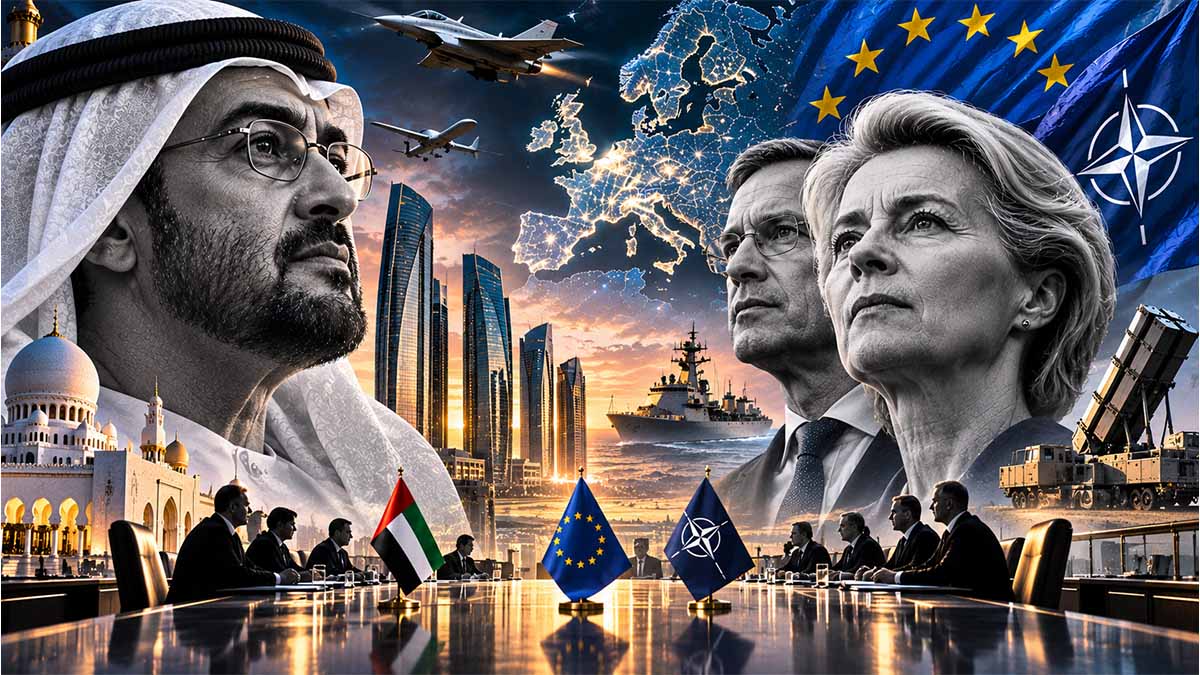
The Russia–Ukraine Settlement, US Strategic Mediation, European Institutional Sovereignty and the Future Continental Security Order
Executive Summary — Bottom Line Up Front
Principal judgment: The Abu Dhabi diplomatic process represents a potentially consequential expansion of the Ukraine peace agenda into the wider question of European security governance. Its importance lies less in the existence of negotiations than in the institutional arrangements that could emerge from them: who determines continental security rules, which guarantees are enforceable, how military forces are positioned, and whether European states retain effective authority over decisions directly affecting their security.
The official record establishes a particularly important development. On 10 November 2026, the European Union, France, Germany, Italy, the United Kingdom, Ukraine, the United States and NATO participated in consultations addressing a durable peace, security guarantees, postwar institutional arrangements and escalation management. These discussions were separate from the trilateral negotiations involving Russia, Ukraine and the United States. The European participants explicitly reaffirmed NATO’s central role in collective defence. Statement on Today’s Meeting in Abu Dhabi — European Council — November 2026.
The central strategic tension is therefore identifiable: continental security can become a subject of negotiation without creating a legitimate mechanism for negotiating away the sovereign rights or institutional competences of states not consenting to the resulting arrangements.
Five findings determine the assessment:
- Diplomatic architecture: Negotiations involving Russia operate alongside a wider European coordination process. Participation in one does not establish participation in the other.
- Security guarantees: The central question is whether commitments to Ukraine will have enforceable military, political and financial provisions rather than remaining declaratory assurances.
- Institutional authority: The European Union and NATO retain separate decision-making structures; neither can automatically be bound by commitments negotiated outside its competent procedures.
- Military implementation: The UK Ministry of Defence reports a 35-country Coalition of the Willing and military commitments from 24 countries to the planned Multinational Force-Ukraine, whose deployment remains conditional.
- Financial exposure: The EU reports a €90 billion Ukraine support loan for 2026–2027, while its wider defence-financing architecture includes the SAFE instrument, allowing up to €150 billion in loans for eligible European defence investment.
The most consequential uncertainty is whether the emerging process will produce an inclusive, legally coherent security settlement or leave negotiations concerning Russia and Ukraine disconnected from the institutions expected to provide deterrence, financing and long-term enforcement.
Abu Dhabi and the Struggle to Redesign European Security: Who Will Pay for Peace, Deterrence and the New Continental Order?
The negotiations in Abu Dhabi have exposed a contradiction at the centre of European security: the United States can mediate a settlement with Russia and Ukraine, but Europe will bear much of the military, industrial and financial responsibility for making it sustainable. The consultations of 10–11 November 2026 have extended the diplomatic question beyond the termination of hostilities to the future distribution of security authority across the continent. Yet NATO’s defence commitments, European Union financing, national deployment powers and Ukraine’s sovereign rights cannot be rearranged through a trilateral agreement alone. With EU defence expenditure projected to reach €454 billion in 2026, a €90 billion Ukrainian support-loan framework and a multinational force under preparation, the immediate issue is no longer diplomatic participation. It is whether the institutions expected to finance and enforce peace will possess the authority to determine its conditions.
The negotiations have separated diplomatic authority from the cost of implementation
The Abu Dhabi process has produced two connected but institutionally distinct diplomatic channels. The trilateral negotiations involve Russia, Ukraine and the United States. The European consultations of 10 November 2026 brought together the European Union, France, Germany, Italy, the United Kingdom, Ukraine, the United States and NATO. Their declared objectives included a durable peace, Ukrainian security guarantees, respect for sovereignty and territorial integrity, and mechanisms to manage escalation. The European participants explicitly reaffirmed NATO’s central role in collective defence. What the consultations did not establish was a completed agreement defining how the participating institutions would share authority, financing and military responsibility.
This distinction determines the credibility of any settlement. Washington can negotiate commitments falling within its own authority, but cannot independently alter NATO obligations or approve European Union financial decisions. Ukraine can consent to arrangements concerning its sovereignty and security, but cannot impose military or budgetary commitments on third states. The European Union can mobilise financial instruments within its competences without automatically acquiring command authority over national armed forces. The more a negotiated agreement depends on actors outside the trilateral format, the greater the risk that political agreement will precede legal and operational feasibility.
The problem was already visible in the diplomatic preparation. On 4 November 2026, the Ukrainian presidency reported a 90-minute discussion between President Volodymyr Zelenskyy and US presidential envoys Steven Witkoff and Jared Kushner concerning the negotiations and Ukrainian air defence. Parallel consultations in Brussels addressed reconstruction, economic recovery and security guarantees, involving European institutions, NATO and international financial representatives. This separation reflects a practical constraint: military disengagement, foreign security guarantees and reconstruction financing require different authorities. Their coordination cannot be assumed simply because the same governments support the general objective of ending the war.
Europe’s defence billions expose the difference between political ambition and military capability
The financial scale of European rearmament is already substantial. According to the European Defence Agency, defence expenditure by the EU’s 27 member states reached €418 billion in 2025, increasing by 20% compared with 2024, with €454 billion projected for 2026. Equipment procurement accounted for €115 billion in 2025, while collaborative procurement represented 24% of equipment expenditure. Defence research and development reached €17 billion, with €20 billion projected for 2026. These numbers demonstrate an acceleration of investment, but also identify a structural problem: substantially higher expenditure does not necessarily produce an equivalent increase in available military capability.
The NATO commitment adopted at the Hague Summit on 25 June 2025 adds a longer fiscal horizon. Allies agreed to invest 5% of annual GDP in defence and defence-related security by 2035, including at least 3.5% for core defence requirements and up to 1.5% for wider resilience and security-related expenditure. A review is scheduled for 2029. The differentiation matters because expenditure on critical infrastructure, cyber resilience and civil preparedness is not interchangeable with expenditure on ammunition, combat systems or operational forces. All may contribute to national security, but their military effects, procurement schedules and implementation requirements differ.
The resulting contradiction is fiscal as well as operational. European governments are increasing resources for deterrence while preparing to finance Ukrainian reconstruction, military regeneration and a possible postwar international security presence. The existence of a ceasefire would not automatically eliminate those requirements. Equipment inventories would still need replenishment, industrial facilities would require investment, and armed forces would retain their NATO obligations. An agreement reducing immediate violence could therefore coexist with sustained or even higher defence expenditure.
The decisive measure is not how much Europe authorises, but how much operational capability its expenditure produces. The European Defence Agency’s first Annual Defence Readiness Report, welcomed on 30 September 2026, assessed spending, military capabilities, industry and partnerships as separate dimensions. Its institutional significance lies precisely in recognising that financial input cannot be treated as verified readiness. A defence budget may finance systems still under construction, equipment awaiting delivery or capabilities constrained by maintenance and personnel shortages. A settlement based on nominal spending commitments rather than available resources would reproduce this ambiguity at the level of continental security.
The multinational guarantee exists in military planning, not yet in deployment
The Multinational Force-Ukraine represents the clearest example of the distance between political commitment and operational execution. Formally established in January 2026 following a British–French–Ukrainian declaration of intent, the MNF-U has a joint UK–French operational headquarters in Paris and military commitments from 24 countries within a 35-country Coalition of the Willing. The UK Ministry of Defence confirmed these arrangements on 3 November 2026, while explicitly distinguishing the force from NATO, a peacekeeping mission and a ceasefire-monitoring organisation.
Its purpose is to help regenerate Ukrainian military capabilities and provide reassurance through planned land, air and maritime activities. Deployment remains conditional upon an invitation from Ukraine, the end of hostilities and the satisfaction of political and military requirements. These conditions are not administrative details: they determine whether participating governments have authorised the use of their forces, whether the planned mission possesses adequate logistical support and whether its mandate corresponds to the security obligations negotiated by political leaders.
The operational preparations are measurable. Exercise KOALICJA 26.2, scheduled in Poland from 9 to 22 November 2026, involves approximately 2,800 personnel from 11 nations, including 300 British personnel, RAF Typhoon aircraft and a Voyager tanker. The exercise is intended to rehearse movement, force protection and sustainment. It demonstrates preparation for multinational operations, but cannot establish the composition or readiness of a future deployed force. Nor does participation in an exercise imply acceptance of every military contingency that could arise following a ceasefire.
A second mechanism remains necessary. The French presidency’s account of the 6 January 2026 Paris meeting described a proposed US-led ceasefire-surveillance structure, Ukrainian military regeneration and a separate multinational reassurance force. These perform different functions. Monitoring establishes information concerning compliance; deterrence seeks to discourage renewed aggression; enforcement requires identifiable authority to respond to violations. Combining them rhetorically under the expression security guarantees conceals differences in legal competence, military risk and operational requirements.
The proposed Ukrainian force structure of 800,000 personnel, identified in the January Paris discussions as a planning basis, reinforces the centrality of Ukraine’s own armed forces. It is not a verified count of currently available, equipped and deployable personnel. The distinction matters because a foreign reassurance presence cannot substitute for sustainable Ukrainian national defence. A credible settlement will depend on the capacity to maintain both, and on defining how responsibility transfers between Ukrainian forces, external guarantors and any authorised monitoring mechanism.
Defence industry and reconstruction compete for capital before peace produces revenue
European financing instruments demonstrate how quickly political commitments can become difficult to compare. The European Union’s €90 billion Ukraine support-loan framework for 2026–2027 includes an indicative €60 billion component for defence-industrial investment and procurement and approximately €30 billion for macroeconomic and budgetary support. Separately, the SAFE instrument provides up to €150 billion in loans for eligible common defence procurement by member states. The €60 billion is already contained within the €90 billion, while SAFE operates through a different financial mechanism. Adding these amounts as though they represented independent expenditure would overstate the resources available.
The Council of the European Union’s published financing account identifies €24.1 billion disbursed under the Ukraine support-loan framework, comprising €16.4 billion for defence procurement, €6.9 billion in macro-financial assistance and €800 million channelled through the Ukraine Facility. Yet disbursement does not automatically mean that the associated military equipment has been delivered or entered operational service. The same distinction applies to SAFE: the inclusion of Ukraine-related projects in 15 of the 19 national SAFE plans submitted in 2025 demonstrates procurement intentions, not completed industrial output.
The industrial transmission mechanism is consequently more demanding than the financing announcements suggest. Public borrowing can support procurement, but production depends on factories, qualified personnel, specialist components, certification, testing and delivery schedules. European governments can commit additional resources faster than manufacturers can necessarily expand output. Collaborative procurement may reduce fragmentation and improve interoperability, but only when participants agree on specifications, industrial responsibilities and production schedules. The 24% collaborative-procurement share recorded for 2025 indicates how much of the equipment market still lies outside such arrangements.
Reconstruction introduces a separate claim on the same economic system. The Fifth Rapid Damage and Needs Assessment, published on 23 February 2026 by Ukraine’s government, the World Bank Group, the European Commission and the United Nations, estimated almost $588 billion in recovery and reconstruction needs over ten years, with more than $195 billion in direct damage through December 2025. Around 14% of Ukrainian housing had been damaged or destroyed, affecting more than three million households. Damaged energy assets had increased by approximately 21% compared with the preceding assessment, while transport-sector needs had increased by approximately 24%.
These figures expose a critical dependency. A factory cannot operate reliably without electricity, transport and communications. A port cannot restore commercial traffic merely because its physical infrastructure has been repaired; maritime security, insurance and navigational access must also be credible. Foreign investment will respond not simply to an announced cessation of hostilities but to the probability that reconstructed assets can continue operating. Security guarantees therefore influence reconstruction costs, while infrastructure resilience directly influences military sustainability. Financing one without adequately protecting the other risks repeated expenditure without durable economic recovery.
France, Germany, Italy and Britain face different costs under the same European commitment
The European diplomatic position conceals substantial differences in national responsibilities. France and the United Kingdom jointly lead the military planning structure of the MNF-U. Germany contributes significant financial and industrial resources, while Italy participates in the European consultations with its own NATO, budgetary and Mediterranean security responsibilities. The European Union coordinates financing and industrial measures but cannot automatically assume command of national forces. These differences make uniform burden-sharing politically attractive but operationally misleading.
Germany’s federal government reports more than €43.3 billion in bilateral civilian assistance and approximately €57.6 billion in military assistance provided or earmarked for future years since the beginning of the full-scale invasion. Its 2026 federal budget identified approximately €11.5 billion for Ukrainian military assistance. The distinction between delivered support, future commitments and annual allocations is essential. Germany’s industrial and fiscal significance does not by itself establish a particular contribution to a multinational force or determine when the military capabilities financed will become operational.
The United Kingdom reports commitments exceeding £35.5 billion as of 6 November 2026, comprising £16.5 billion in military support, up to £12.6 billion in non-military support and a £6.5 billion export-finance cover limit. It also maintains a commitment to provide £3 billion annually in military assistance until 2030–2031, and longer if required. These categories cannot be consolidated into a single measure of expenditure already executed. Britain combines military planning leadership with long-term assistance commitments while operating outside EU institutional decision-making, creating a requirement for coordination between national, NATO and European financing arrangements.
France’s role is structurally different. Its joint leadership of the MNF-U provides an operational coordination mechanism, but the multinational headquarters cannot remove national authorisation requirements from participating governments. The more demanding a future guarantee becomes, the more significant the differences between military command arrangements and the constitutional authority to deploy or use force.
Italy’s exposure lies in the interaction between NATO responsibilities, Mediterranean maritime security, national fiscal constraints and any additional contribution to Ukrainian guarantees. The Abu Dhabi consultations establish Italian participation in the diplomatic process, but do not establish an equivalent Italian command responsibility or a specified force contribution. Assigning one would convert political involvement into an unsupported operational commitment. For Rome, the decisive question is whether participation in a future arrangement can be financed and sustained without weakening responsibilities already accepted elsewhere.
The institutional contradiction is therefore not a lack of declared European unity. It is the absence, in the available negotiating record, of a final allocation of responsibilities matching national resources and approval procedures. Political agreement can be collective; military exposure, fiscal cost and industrial benefit remain differentiated.
Sanctions and sovereignty place legal limits on the negotiated bargain
The proposed European security order cannot be detached from the law governing territorial sovereignty and the authority of international institutions. The United Nations Charter prohibits the threat or use of force against the territorial integrity or political independence of states. UN General Assembly Resolution ES-11/4, adopted on 12 October 2022 by 143 votes in favour, five against and 35 abstentions, rejected the legal validity of Russia’s attempted annexations of four Ukrainian regions. A negotiated military separation line would therefore not automatically constitute an internationally recognised boundary, while temporary arrangements concerning access or administration would not independently determine lawful territorial title.
The distinction matters directly for implementation. A ceasefire may regulate military movements without resolving sovereignty. A security guarantee may establish assistance obligations without creating NATO Article 5 protection. NATO’s membership and collective-defence arrangements remain governed by the North Atlantic Treaty, while EU foreign and security policy decisions require the applicable institutional procedures. Neither the trilateral format nor a parallel European consultation can override those legal requirements merely by reaching political agreement.
Russia’s Foreign Policy Concept of 31 March 2023 identifies multipolarity, strategic balance and indivisible security as major elements of its international position. However, the OSCE’s 2010 Astana Declaration places the concept of indivisible security alongside the sovereign right of participating states to choose or change their security arrangements, including alliance commitments. Reciprocal military transparency and incident-prevention measures may therefore provide negotiating space; unilateral restrictions on another state’s sovereign choices raise a different legal problem. The distinction between legitimate security consultation and the imposition of political subordination will determine whether a new arrangement complements existing European institutions or undermines them.
Sanctions create an additional constraint. On 22 September 2026, the Council of the European Union extended individual restrictive measures concerning threats to Ukraine’s territorial integrity until 22 September 2029, covering more than 3,000 individuals and entities. Separately, the EU adopted its 21st sanctions package on 23 July 2026. A ceasefire would not automatically terminate these instruments. Sanctions modification requires separate legal decisions, meaning that any anticipated economic normalisation cannot be treated as an immediate consequence of a peace announcement. The cost of premature assumptions would fall on financial institutions, businesses, insurers and investors required to operate under rules that remain legally effective.
The next 24 months will determine whether Europe finances an agreement or another period of deterrence
Between November 2026 and November 2028, the critical question will be whether diplomatic commitments acquire the legal, military and financial characteristics necessary for implementation. Four outcomes remain distinguishable: a comprehensive settlement integrated with European institutions; a limited conflict agreement supported by separately authorised guarantees; prolonged negotiations accompanied by continued deterrence; or a signed arrangement that subsequently fails because its obligations cannot be verified or enforced. The available record does not justify assigning numerical probabilities to these pathways. Their comparative standing must be assessed through signed instruments, national authorisations, completed humanitarian measures, monitoring access and observable compliance.
The cost of inaction will not be evenly distributed. Ukraine will continue facing the financial demands of military regeneration and reconstruction, measured against the RDNA5 estimate of almost $588 billion over ten years. European taxpayers will finance defence procurement and resilience commitments whose benefits depend on industrial execution. Defence manufacturers and their suppliers will face demand for additional production capacity, while national governments will remain responsible for the personnel, logistics and maintenance necessary to convert orders into usable capability. Energy operators, transport companies, insurers and investors will bear the commercial consequences of continued infrastructure insecurity and uncertain legal conditions.
France and the United Kingdom will face decisions concerning the implementation of their multinational force responsibilities. Germany will need to translate substantial assistance commitments into delivered capability and sustainable financing. Italy will have to reconcile any additional obligations with its existing alliance responsibilities and national budget choices. European institutions will need to preserve the distinction between common financing and national military authority. NATO’s 2029 review of its defence-investment commitments will approach regardless of whether the Abu Dhabi negotiations produce a settlement.
The decisive European choice is not between diplomacy and rearmament, but between a security agreement supported by enforceable institutions and one that leaves military, industrial and fiscal responsibilities unresolved. Over the next 12–24 months, the measurable outcome will be the extent to which governments approve specific obligations, finance their implementation and establish functioning mechanisms for verification and response. If those decisions remain incomplete, Europe will continue paying for deterrence without obtaining the institutional predictability that a negotiated settlement is intended to provide.
Navigational Index
PILLAR I — DIPLOMATIC POWER AND THE EUROPEAN SECURITY ORDER
- Chapter 1. The Abu Dhabi Diplomatic Framework: Actors, Mandates and Negotiating Authority
- Chapter 2. Russian Strategic Objectives and the Redefinition of Continental Security
- Chapter 3. International Law, Sovereignty and the Limits of Negotiated Security Arrangements
PILLAR II — MILITARY DETERRENCE, INSTITUTIONS AND ECONOMIC SECURITY
- Chapter 4. NATO, European Deterrence and the Postwar Military Balance
- Chapter 5. Ukraine’s Security Guarantees: Force Deployment, Monitoring and Enforcement
- Chapter 6. France, Germany, Italy, the United Kingdom and the European Union: National Responsibilities and Strategic Divergences
- Chapter 7. Defence Industrial Capacity, Fiscal Exposure, Sanctions and Critical Infrastructure
PILLAR III — SETTLEMENT PATHWAYS AND STRATEGIC DECISIONS
- Chapter 8. Territorial Negotiations, Humanitarian Arrangements and Escalation Management
- Chapter 9. Competing Security Architectures and the 2027–2031 Strategic Outlook
- Chapter 10. Governmental Courses of Action, Implementation Priorities and Final Net Assessment
Master Abstract
The negotiations create two interconnected questions of sovereignty
The central strategic issue arising from the Abu Dhabi meetings is whether the termination of the war in Ukraine can become the foundation for a more stable European security order without compromising the sovereignty of Ukraine, the institutional independence of European governments or the existing obligations of NATO members. The answer depends on a fundamental distinction between a peace agreement and a continental security settlement. The former can address cessation of hostilities, withdrawal arrangements, humanitarian obligations and negotiated territorial questions between the relevant parties. The latter necessarily implicates a wider institutional environment: NATO collective defence, European Union responsibilities, the military posture of individual states, arms-control arrangements, crisis-management mechanisms and the rights of countries to make independent security choices.
The 10 November European Council statement establishes that these wider matters are already part of diplomatic consultations. It identifies sovereign decision-making, Ukrainian security guarantees, existing European institutions and escalation management as components of the discussion, while explicitly reaffirming NATO’s centrality. This constitutes documentary evidence of an expanded negotiating agenda, not evidence that any new continental settlement has been agreed. The distinction is essential because the public record does not establish a negotiated treaty, a mutually accepted implementation structure or a final institutional distribution of responsibilities. Statement on Today’s Meeting in Abu Dhabi — European Council — November 2026.
Washington’s mediation and Europe’s institutional position
The United States occupies an important position in the process because it participates in the trilateral negotiations involving Russia and Ukraine while maintaining a separate coordination channel with European governments and NATO. This configuration offers a practical diplomatic advantage: it allows discussions with Moscow to proceed without requiring every European institution to be present at every negotiating stage. Nevertheless, it also creates a substantial governance risk. Political understandings reached through a limited negotiating format may involve implementation responsibilities, military commitments or institutional changes that depend on governments and organisations outside that format.
The European position on this point is explicit. In their statement of 13 July 2026, the co-chairs of the Coalition of the Willing asserted that European security arrangements require European participation, while matters concerning the EU and NATO require the consent of their respective competent members and allies. This distinction makes institutional consent a strategic requirement rather than an incidental diplomatic formality. It also limits the feasibility of any settlement premised on unilateral guarantees, externally imposed security restrictions or unapproved alterations to alliance responsibilities. Statement of the Co-Chairs of the Coalition of the Willing — UK Prime Minister’s Office — July 2026.
The military question is already more advanced than the diplomatic settlement
The development of security-guarantee mechanisms has progressed beyond general political declarations. On 3 November 2026, the UK Ministry of Defence confirmed that the Multinational Force-Ukraine (MNF-U) had been formally established in January 2026, with a UK–French operational headquarters in Paris and military commitments from 24 countries. Its planned activities include regenerating Ukrainian military capabilities, supporting deterrence and providing an air and maritime presence. However, the ministry expressly distinguishes this force from NATO and from a ceasefire-monitoring or peacekeeping mission. Deployment would require an invitation from Ukraine and the satisfaction of political and military conditions following the end of hostilities.
This creates an important distinction between institutional preparation and operational implementation. A headquarters, national commitments and readiness exercises establish a planning framework; they do not demonstrate that troops have deployed or that governments have accepted every contingency associated with a future deployment. A credible postwar settlement would therefore require clarity on command authority, national caveats, rules of engagement, force protection, logistical support and responses to renewed hostilities. Until those provisions are defined, the existence of the MNF-U establishes a potential security mechanism rather than an unconditional guarantee. The Multinational Force-Ukraine — UK Ministry of Defence — November 2026.
Security architecture is also an industrial and financial undertaking
The sustainability of any settlement will depend on defence production, public financing, reconstruction and the resilience of critical infrastructure. The European Union has already linked Ukraine’s security to industrial investment and long-term financial commitments. Its €90 billion support-loan framework for 2026–2027 includes an indicative €60 billion allocation for defence-industrial investment and procurement. Its SAFE mechanism separately makes up to €150 billion in loans available for eligible common defence procurement by member states, with provisions allowing Ukrainian participation. These instruments differ in recipients, legal basis and financial operation, and they cannot be interpreted as interchangeable or automatically additive resources available to a future peace operation. EU Military Support for Ukraine — Council of the European Union — November 2026.
The economic challenge is therefore structural. European governments must preserve the capacity to deter aggression while simultaneously financing reconstruction, critical infrastructure protection and the readiness of their own armed forces. If a settlement decreases immediate military violence but leaves unresolved the financing of deterrence, monitoring and defence-industrial replenishment, the resulting security architecture may remain institutionally elaborate but operationally fragile.
The decisive test is enforceability
A durable security order requires more than diplomatic recognition that the existing system is inadequate. It requires rules capable of constraining state behaviour, procedures for identifying violations, institutions authorised to respond and sufficient political and military capacity to sustain enforcement. The applicable legal foundations remain those of the United Nations Charter, including the prohibition on the threat or use of force against the territorial integrity or political independence of states, together with the principles of sovereign equality and peaceful dispute settlement. The Helsinki Final Act provides a broader European framework of territorial integrity, inviolability of frontiers, sovereign equality and cooperative security. United Nations Charter — United Nations — 1945; Principles and Commitments — OSCE — Undated.
The five-year strategic question is consequently not whether diplomatic actors can formulate a document describing a new European security order. It is whether the participating governments can establish a framework that combines Ukrainian sovereignty, credible deterrence, reciprocal risk-reduction mechanisms and European institutional consent. Without these elements, a negotiated cessation of hostilities may remain vulnerable to renewed coercion, implementation disputes and incompatible interpretations of what peace obliges each party to do.
Key Evidence Table
The following records establish the diplomatic, institutional, operational and financial baseline. Monetary figures represent different instruments and accounting categories and must not be aggregated without reconciliation.
| Indicator | Value / status | Reference date | Definition / scope | Issuer | Exact source |
|---|---|---|---|---|---|
| Abu Dhabi European consultations | Eight named participating parties or institutions | 10 Nov 2026 | EU, France, Germany, Italy, UK, Ukraine, US and NATO | European Council | Official statement |
| Trilateral diplomatic format | Ukraine, US and Russia | 10 Nov 2026 | Negotiations confirmed as having begun | President of Ukraine | Official presidential statement |
| Coalition of the Willing | 35 countries | 3 Nov 2026 | Countries participating in the coalition | UK Ministry of Defence | MNF-U guidance |
| MNF-U military commitments | 24 countries | 3 Nov 2026 | Military commitments; not evidence of deployed forces | UK Ministry of Defence | MNF-U guidance |
| MNF-U headquarters | Paris | 3 Nov 2026 | UK–French operational-level joint headquarters | UK Ministry of Defence | MNF-U guidance |
| EU support loan | €90 billion | 23 Apr 2026 | Loan framework for 2026–2027 | Council of the EU | EU military support |
| Defence-industrial component | Indicative €60 billion | 2026–2027 | Allocation within the €90 billion framework | Council of the EU | EU military support |
| Loan disbursement | €16.4 billion | Latest published page reviewed | Reported disbursement, not total authorisation | Council of the EU | EU military support |
| SAFE instrument | Up to €150 billion | 28 May 2025 onward | Loans for eligible EU common defence procurement | Council of the EU | EU military support |
| EUMAM Ukraine | 100,000 personnel trained | Cumulative since Nov 2022 | Training delivered under EU military assistance mission | Council of the EU | EU military support |
| UK support commitment | Over £35.5 billion | 6 Nov 2026 | Military, non-military and export-finance commitments and limits | UK Government | UK support factsheet |
Competing Strategic Pathways
The available evidence supports three distinct but potentially overlapping pathways. They are analytical alternatives, not established negotiating outcomes. No numerical probability is assigned because the public record does not provide a sufficiently defensible statistical base.
| Strategic pathway | Supporting evidence | Principal obstacle | Observable indicators | Current assessment |
|---|---|---|---|---|
| Inclusive continental settlement | European coordination, US mediation and support for broader multilateral discussions | Agreement on territorial questions, guarantees and institutional consent | Joint negotiating mandate; agreed monitoring and enforcement provisions | Institutionally coherent, but not yet demonstrated |
| Limited Ukraine settlement with parallel European guarantees | Existing trilateral negotiations; UK–French force planning; EU financial instruments | Potential disconnect between ceasefire obligations and external security commitments | Separate signed instruments; MNF-U readiness; financing and deployment authorisations | A plausible implementation route |
| Prolonged negotiations and competitive rearmament | Existing political disagreements and continuing deterrence investments | Absence of mutually accepted settlement terms | Negotiating deadlock; continued reinforcement; no agreed verification mechanism | Material risk requiring continued planning |
Pathway assessment
The first pathway offers the most comprehensive framework but also requires the broadest institutional consensus. It would demand agreement on sovereignty, security guarantees, military restrictions, escalation-management mechanisms and the responsibilities of institutions that cannot be represented solely by national negotiators.
The second pathway is less institutionally demanding at the outset. Russia and Ukraine, with US mediation, could negotiate conflict-related measures while European states develop parallel guarantees through their own competent institutions. Its weakness would be the possible emergence of commitments that are difficult to reconcile in implementation, particularly if the parties disagree over foreign military presence or the conditions governing security assistance.
The third pathway would preserve the need for military deterrence despite ongoing diplomatic engagement. Under this outcome, negotiations might still generate humanitarian measures, technical understandings or temporary de-escalation without resolving the underlying territorial and institutional disputes. It would therefore be incorrect to interpret the existence of a negotiating process as proof that a stable security settlement is approaching.
The decisive distinction between these pathways is not the number of diplomatic meetings but whether political commitments acquire identifiable legal authority, operational responsibilities, financing and verification mechanisms.
Principal Gaps and Watch Indicators
| Unresolved question | Consequential missing record | Indicator to monitor | Decision consequence |
|---|---|---|---|
| What substantive security arrangements are being negotiated? | Authorised negotiating agenda or agreed framework | Publication of joint principles or agreed negotiating terms | Determines scope of European consultation |
| How are territorial matters being addressed? | Mutually accepted text identifying obligations | Agreed territorial provisions, verification or withdrawal arrangements | Determines legal and military implementation requirements |
| Who would guarantee a cessation of hostilities? | Guarantee instrument with identified parties and obligations | Named guarantors, ratification or approval procedures | Establishes the credibility of commitments |
| Would foreign troops deploy in Ukraine? | Deployment authorisations and operational arrangements | Political approval, host-state invitation and force-generation completion | Determines military exposure and command requirements |
| How would violations be identified and managed? | Monitoring mandate and incident-response procedures | Inspection access, agreed reporting procedures and escalation contacts | Determines enforceability and crisis stability |
| Can humanitarian measures be implemented independently? | Agreed exchange schedules and implementation records | Confirmed transfers and verified completion | Tests limited practical cooperation |
| How will implementation be financed? | Multiannual cost estimates, appropriations and disbursement schedules | Approved budgets and executed allocations | Determines fiscal sustainability |
Humanitarian measures as a limited test of cooperation
Humanitarian arrangements deserve separate consideration because they may offer observable progress even when strategic negotiations remain unresolved. The European Council’s October 2026 conclusions expressly identified prisoner exchanges and the return of civilian detainees as elements of a pathway towards peace. European Council Meeting, 15–16 October 2026 — European Council — October 2026.
A humanitarian agreement can therefore serve as a limited test of diplomatic implementation. Its significance would depend on the publication of agreed parameters, the number and status of persons concerned, the completion of transfers and the treatment of unresolved cases.
However, successful humanitarian cooperation would not by itself establish agreement on territorial sovereignty, military guarantees or continental security arrangements. Those issues involve different obligations and different decision-making authorities.
Implications for the European institutional balance
The immediate institutional consequence is that European governments need a common method for distinguishing diplomatic consultation from decision-making authority.
France and the United Kingdom have a defined leadership role in developing multinational security arrangements for Ukraine. Germany and Italy participated in the 10 November consultations and therefore have direct interests in the formation of the wider framework, but the cited joint statement does not establish identical national obligations. The European Union has substantial financial, regulatory and security-assistance responsibilities, while NATO retains its separate collective-defence architecture.
These differences are not procedural technicalities. They determine which institutions can authorise commitments, which budgets may be used, which military forces may be assigned and which governments would bear the consequences of implementation.
The appropriate European response is consequently to preserve the distinction between common political objectives and nationally or institutionally authorised obligations. Otherwise, agreement at diplomatic level could conceal unresolved disputes over funding, operational command and legal responsibility.
The same principle applies to Russia’s role. A continental security system intended to reduce confrontation with Russia must establish mechanisms for addressing legitimate security risks, but no sustainable framework can derive its authority from unilateral claims to determine another state’s sovereignty or international alignment.
Final Assessment of the Opening Record
The Abu Dhabi process establishes a meaningful diplomatic opportunity, but its strategic significance remains conditional. The available official records demonstrate the existence of negotiations, separate European coordination, active work on security guarantees and substantial military and financial preparations. They do not establish a completed settlement, an agreed continental security treaty or a functioning postwar enforcement regime.
For European governments, the primary challenge is to convert diplomatic participation into effective institutional influence without weakening existing defence commitments. For Ukraine, it is to secure guarantees that can be implemented and sustained. For the United States, it is to mediate a settlement compatible with the responsibilities and consent of its European partners. For Russia, any durable arrangement would require reconciliation of its proposed security objectives with binding principles of sovereignty, territorial integrity and peaceful dispute settlement.
The strongest basis for a future settlement is therefore not a comprehensive political declaration alone, but a sequence of verifiable agreements: conflict-related obligations, security guarantees, institutional authorisations, military implementation arrangements and long-term financing.
EUROPEAN SECURITY ARCHITECTURE
Abu Dhabi diplomatic negotiations, continental deterrence, institutional sovereignty and the emerging security framework.
The operational and financial framework
Selected official figures; different categories are not additive.
Financing and military commitments
Institutional commitments, not forecasts or operational readiness scores.
EUR billions. The defence component is included within the Ukraine loan.
The €60bn indicative allocation is part of the €90bn loan. SAFE is a separate loan instrument with different eligibility and beneficiaries. Do not sum these bars.
Countries with military commitments compared with all coalition participants.
This is a share of participating countries, not a measure of troop strength, combat capability or deployment readiness.
Two diplomatic channels, distinct authorities
Select an actor or institution to examine its role.
Sovereign party to the conflict and negotiations. Its consent is fundamental to security guarantees, troop deployment and peace arrangements.
Schematic relationships only. Lines represent relevant diplomatic and institutional connections, not command authority, treaty obligations or confirmed agreement.
Three pathways for the security settlement
Analytical alternatives. No unsupported numerical probabilities.
Mutually accepted institutional mandates, security guarantees, monitoring arrangements and implementing authorities.
European decision-making and responsibilities
Select a jurisdiction for its principal institutional exposure.
Italy
Direct participant in European consultations. Core issues include NATO responsibilities, national defence authorisations, budget exposure and coordination of European security commitments.
Institutional development timeline
EU SAFE defence loan framework adopted.
Multinational Force-Ukraine formally established.
UK Ministry of Defence outlines coalition participation and MNF-U commitments.
European consultations in Abu Dhabi address security guarantees and continental arrangements.
Official figures and implementation status
Source-linked values; no invented readiness or risk indices.
| Indicator | Value | Scope / qualification | Official record |
|---|---|---|---|
| Coalition participants | 35 | Participating countries; not deployed forces | UK MOD |
| MNF-U military commitments | 24 | Committed countries, subject to deployment conditions | UK MOD |
| Ukraine support loan | €90bn | EU loan framework, 2026–2027 | EU Council |
| Indicative defence component | €60bn | Included within the €90bn framework | EU Council |
| SAFE instrument | €150bn | Maximum eligible loan envelope; separate instrument | EU Council |
| EUMAM personnel trained | 100,000 | Cumulative training reported | EU Council |
| UK support commitment | >£35.5bn | Combined commitments and limits; not all expenditure | UK Government |
PILLAR I — DIPLOMATIC POWER AND THE EUROPEAN SECURITY ORDER
Chapter 1. The Abu Dhabi Diplomatic Framework: Actors, Mandates and Negotiating Authority
Principal judgment: the diplomatic process has expanded beyond conflict termination, but negotiating authority remains fragmented
The most consequential development in the Abu Dhabi diplomatic process is the emergence of a distinction between negotiating an end to the Russia–Ukraine war and determining the institutional arrangements that would govern European security after the fighting. These objectives are connected, but they are neither legally identical nor institutionally interchangeable. A negotiated cessation of hostilities could establish obligations concerning military disengagement, humanitarian access, territorial administration and conflict-monitoring procedures. A continental security arrangement would have much broader consequences, potentially affecting military deployments, European collective-defence obligations, the institutional responsibilities of NATO and the European Union, arms-control measures, the status of Ukraine’s future security relationships and the capacity of sovereign states to determine their international alignments independently. The distinction matters because the parties competent to negotiate measures concerning the conduct of hostilities are not necessarily competent to impose obligations upon institutions and governments outside their respective negotiating mandates.
The official European account of the meeting held in Abu Dhabi on 10 November 2026 identifies representatives of the European Union, France, Germany, Italy, the United Kingdom, Ukraine, the United States and NATO as participants in consultations preceding the trilateral discussions involving Russia. The statement describes coordinated efforts to establish the conditions for durable peace, including effective Ukrainian security guarantees, respect for sovereignty and territorial integrity, continued reliance on existing European security institutions and mechanisms for managing escalation. It also explicitly preserves NATO’s central position in Euro-Atlantic collective defence. The European consultations therefore constitute documented engagement with the wider security architecture, rather than simply an informal exchange about the immediate military situation. Nevertheless, the statement does not establish a completed negotiating mandate for a new continental treaty, nor does it identify a mutually agreed institutional framework accepted by Russia. Statement on Today’s Meeting in Abu Dhabi — European Council — November 2026.
The Ukrainian presidency provides independent official confirmation that the negotiating formats were deliberately separated. On 9 November, President Volodymyr Zelenskyy announced that the Ukrainian negotiating team had reached the United Arab Emirates and that the trilateral meeting involving Ukraine, the United States and Russia would begin the following day. He also stated that European partners would participate through separate formats. On 10 November, the Ukrainian presidency confirmed that the trilateral discussions had begun and that a meeting with European representatives had already occurred. This documentary sequence establishes the existence of two connected diplomatic channels, but it does not demonstrate that the two channels possessed the same negotiating authority, discussed identical proposals or reached common conclusions. Our Negotiating Team Is Already in the UAE — President of Ukraine — November 2026; President of Ukraine Held a Phone Call with the President of Finland — President of Ukraine — November 2026.
The resulting diplomatic structure contains a fundamental asymmetry. The United States participates directly in negotiations with Russia and Ukraine and maintains consultations with European governments and NATO. Ukraine also participates in both processes. Russia is part of the trilateral channel but not the separately documented European consultation. European governments participate in the coordination mechanism, yet the public record does not establish their direct participation in the trilateral negotiating session. This configuration makes Washington and Kyiv particularly important channels through which positions developed in one setting may be communicated to participants in the other. It does not, however, establish that either government has unrestricted authority to negotiate legally binding commitments on behalf of the European Union, NATO or individual European states.
The diplomatic preparation reveals a broader agenda than the negotiating format alone
The diplomatic groundwork preceding the Abu Dhabi meetings is essential to understanding the institutional purpose of the consultations. On 4 November 2026, the Ukrainian presidency reported a 90-minute conversation between Zelenskyy and the US presidential envoys Steven Witkoff and Jared Kushner, addressing preparations for the trilateral process and the strengthening of Ukraine’s air defences. The presidential account also referred to a Brussels meeting involving Ukraine, the United States, the European Union, France, the United Kingdom, Germany, NATO, the World Bank and representatives of the international business community. That meeting addressed postwar recovery, while another consultation was scheduled to consider security guarantees. The significance of this sequence lies in the separation of security, economic reconstruction and direct conflict negotiations into related but distinct negotiating functions. Volodymyr Zelenskyy Discussed Preparations for a Trilateral Format in Abu Dhabi — President of Ukraine — November 2026.
On 5 November, the Ukrainian president discussed the forthcoming trilateral format with European Council President António Costa. Their published account connected the diplomatic preparations with Ukraine’s European integration and economic recovery. Zelenskyy argued that questions concerning security guarantees and reconstruction could not be decided without European participation, and the presidential statement recorded Costa’s support for that position. The following day, Zelenskyy discussed the preparations with the leaders of the Nordic-Baltic Eight, identifying European participation and security guarantees as matters requiring coordinated political positions. Together, these records show that European governments were not merely responding to an unexpected diplomatic initiative. They were developing positions in advance on the institutional and security consequences of a potential settlement. Volodymyr Zelenskyy and António Costa Discussed Ukraine’s European Integration Process — President of Ukraine — November 2026; The President Discussed Preparations for a Trilateral Meeting with NB8 Leaders — President of Ukraine — November 2026.
The operational significance of these preparatory meetings is that an eventual peace agreement could create obligations whose implementation depends on actors not directly represented at the principal negotiating table. A ceasefire may require monitoring arrangements administered by a designated international organisation or an agreed multinational mechanism. A security guarantee may require parliamentary approval, force-generation decisions, budget appropriations, military planning and arrangements for responding to violations. Reconstruction commitments could involve the European Union’s financial instruments, national development institutions, international financial organisations and private-sector capital. Each component has its own authority, approval process and legal constraints. Consequently, a negotiating party can express political support for an outcome without automatically possessing the authority to implement every part of that outcome.
Negotiating participation must be distinguished from legal competence
The most important governance question is therefore not simply whether Europe has a seat at the negotiating table. It is whether the institutions and governments expected to implement a settlement have participated sufficiently in its formulation to accept its obligations through their lawful procedures. This distinction separates diplomatic consultation, political endorsement and legally effective authorisation. A government may participate in discussions without receiving a mandate to make binding commitments. A political declaration can express shared intentions without becoming a treaty. An international organisation may endorse negotiating principles while remaining unable to implement specific measures without approval from its competent decision-making bodies.
For NATO, the North Atlantic Treaty establishes a collective-defence framework among its parties, including consultations under Article 4, mutual assistance obligations under Article 5 and accession decisions under Article 10. Article 9 establishes the North Atlantic Council as the body through which the parties consider implementation matters. These provisions cannot be displaced through an agreement negotiated exclusively between Russia, Ukraine and the United States. A participating NATO member may discuss alliance-related security questions, but changing the alliance’s treaty obligations or making decisions within its competence requires the applicable collective and national procedures. The North Atlantic Treaty — NATO — April 1949.
For the European Union, the competence problem is different but equally consequential. Common foreign and security policy decisions generally remain subject to unanimity in the Council, with treaty-defined exceptions. Financial commitments and implementation measures may also require distinct authorisations depending on their legal bases. European participation in diplomatic consultations therefore does not automatically constitute approval of a future funding programme, sanctions modification, security mission or international agreement. The institutional constraints protect the legitimacy of European decisions, but they can also become practical obstacles when negotiators attempt to integrate multiple commitments into a single compressed diplomatic timetable. Unanimity — Council of the European Union — Undated.
The distinction also affects the role of Ukraine. Ukrainian participation is indispensable because arrangements concerning its territory, military forces, sovereignty and political independence cannot lawfully be treated as matters for external disposition by other states. However, Ukraine’s ability to enter into a bilateral or trilateral agreement does not necessarily give it the authority to commit third states to military action or financial obligations. This creates a reciprocal dependence: Ukraine must consent to obligations concerning its own sovereignty, while prospective security guarantors must independently authorise the commitments they undertake.
Institutional negotiating matrix
The following table identifies the relationship between documented participation and the legal or institutional authority required to translate diplomatic proposals into enforceable commitments. The distinction between confirmed roles and possible implementation responsibilities is deliberately preserved.
| Actor or institution | Documented diplomatic position | Relevant authority | Principal implementation constraint | Strategic consequence |
|---|---|---|---|---|
| Ukraine | Participant in trilateral negotiations and European consultations | Sovereign state authority, subject to domestic constitutional requirements | Consent to security, territorial and military arrangements | Essential party to any settlement affecting Ukrainian sovereignty |
| Russia | Participant in trilateral negotiations | Sovereign treaty-making authority, subject to applicable law | Agreement on obligations, monitoring and implementation | Directly relevant to conflict termination and reciprocal security measures |
| United States | Participant in trilateral negotiations and European consultations | US executive and, where applicable, legislative and treaty procedures | Cannot independently bind NATO, EU institutions or European governments | Principal connection between the two diplomatic processes |
| European Union | Participant in European consultations | EU treaties and competent institutional procedures | Allocation of competences, voting requirements and budget authority | Necessary for measures requiring EU decisions or financing |
| NATO | Participant in European consultations | North Atlantic Treaty and allied decision-making | Collective and national approval requirements | Necessary for decisions within alliance competence |
| France | Participant in European consultations | French constitutional and governmental authority | National authorisation of military and financial commitments | Important European defence and diplomatic actor |
| Germany | Participant in European consultations | German constitutional and governmental authority | National approval procedures and budgetary competence | Important for European political coordination and implementation |
| Italy | Participant in European consultations | Italian constitutional and governmental authority | National military, financial and treaty procedures | Relevant to NATO responsibilities and European policy coordination |
| United Kingdom | Participant in European consultations | UK constitutional and governmental authority | National decisions on commitments and implementation | Significant European security actor outside EU institutional decision-making |
| United Arab Emirates | Host location of the negotiating process | Host-state diplomatic and logistical functions | Hosting does not itself establish authority over settlement terms | Provides a venue without automatically becoming a guarantor |
The legal distinctions in this table follow the treaty provisions and institutional records, while the negotiating participation is documented through the European Council and Ukrainian presidential statements. The table does not presume that any listed participant has signed a settlement or accepted an unpublished obligation. Statement on Today’s Meeting in Abu Dhabi — European Council — November 2026; The North Atlantic Treaty — NATO — April 1949; Unanimity — Council of the European Union — Undated.
WordPress scheme — Negotiating authority and settlement implementation
This component maps the institutional sequence from diplomatic agreement to lawful implementation. It is a self-contained analytical scheme rather than a simulation of an existing treaty.
The representation problem is larger than the question of European attendance
European representation introduces a second institutional problem: no single European government automatically represents the complete security interests of the continent. The European Union has its own decision-making procedures and a membership that is not identical to NATO’s. The United Kingdom participates in NATO but is not an EU member. Other European states possess distinct military policies, constitutional arrangements and national security priorities. Moreover, the interests of NATO’s eastern members and other states geographically exposed to Russian military activity cannot simply be assumed to coincide with those of every other participant. A diplomatic format intended to be operationally manageable must therefore distinguish between the limited number of representatives needed to conduct negotiations and the wider group of states whose consent may ultimately be required.
The institutional problem was explicitly recognised by the Ukrainian presidency on 10 November. During remarks published after consultations in Copenhagen, Zelenskyy stated that European countries needed to determine who would represent their interests in future negotiations, acknowledging that participation by every government in the same negotiating session would be impractical. This is an important distinction between political representation and formal delegation of authority: agreement on a smaller diplomatic representation mechanism could improve efficiency, but it would not automatically authorise those representatives to assume commitments on behalf of states that had not granted the necessary mandate. The Leaders of Ukraine and Denmark Met with Students at the University of Copenhagen — President of Ukraine — November 2026.
A viable European arrangement would therefore need an explicit method for collecting positions, defining negotiating parameters, communicating proposed compromises and securing approval when concrete commitments emerge. The benefit would be to reduce discrepancies between negotiating proposals and the political capacity to implement them. The principal risk would be bureaucratic complexity that slows agreement or creates ambiguity over responsibility. The correct balance depends on the subject under negotiation. Technical risk-reduction arrangements may be negotiated through relatively narrow specialist channels, while treaty-level security guarantees, changes in force posture or decisions affecting an institution’s legal responsibilities require much broader authorisation.
Key judgments — Chapter 1
The Abu Dhabi process is institutionally significant because it connects conflict negotiations with discussions concerning the future European security order, while maintaining separate negotiating channels. The United States and Ukraine participate in both, making coordination between the channels essential. European consultations are documented, but the available record does not establish a completed institutional mandate for a continental settlement. The decisive vulnerability is the possibility that political agreements will be formulated before the governments and organisations expected to implement them have secured the necessary legal and operational authority.
What would change the assessment
The publication of a jointly accepted negotiating agenda, a formally designated European representation mechanism, a draft security-guarantee instrument or an agreed procedure for obtaining EU and NATO decisions would materially strengthen the assessment that the diplomatic process is moving beyond political consultation towards an implementable settlement.
Open official record
The consequential missing documents are an agreed trilateral negotiating framework, the formal mandates of the negotiating delegations, any common text governing the relationship between the trilateral and European channels, and any adopted institutional procedure for approving security arrangements affecting EU or NATO competences. Their absence from the accessible record prevents a definitive assessment of the intended legal structure.
Chapter 2. Russian Strategic Objectives and the Redefinition of Continental Security
Principal judgment: Russia’s security concept seeks changes in the distribution of strategic authority, not merely an end to hostilities
The Russian Federation’s approach to European security is best assessed through the objectives formally established in its foreign-policy doctrine, rather than by treating individual diplomatic statements as proof of an agreed negotiating programme. The principal strategic issue is the relationship between Russia’s demand for a European security system reflecting its own interests and the existing institutional principle that European states possess independent authority over their international alignments, territorial sovereignty and defence arrangements. Those positions need not be incompatible across every field of security policy. Reciprocal military transparency, arms-control mechanisms, incident-prevention procedures and limitations on particular classes of military activity can create mutual benefits. However, substantial incompatibility arises when a demand for security is interpreted as authorising one state to restrict another state’s sovereign choices without its freely given consent.
The Russian Federation’s Foreign Policy Concept, approved on 31 March 2023 by Presidential Decree No. 229, provides the documentary foundation for analysing these objectives. Published by Russia’s Permanent Mission to the United Nations, the document describes Russia as an independent centre of global development, endorses a multipolar international system, emphasises sovereign equality and identifies opposition to perceived hegemony as a foreign-policy priority. Its provisions concerning international security advocate reciprocity and the indivisibility of security while expressing an intention to participate in the formation of a revised international security architecture. These statements constitute official Russian doctrine, not independent evidence that the existing international system grants Moscow authority to determine the political or security choices of neighbouring countries. The Concept of the Foreign Policy of the Russian Federation — Permanent Mission of Russia to the United Nations — March 2023.
The conceptual significance of this doctrine is that it places European security within a broader Russian understanding of international order. Rather than treating the conflict in Ukraine as an exclusively territorial dispute, the doctrine connects Russia’s security interests with strategic parity, the distribution of international influence, the conduct of military alliances and the perceived consequences of Western policies. An eventual settlement could therefore be judged differently by the parties even if it reduced military violence. Ukraine might evaluate an agreement according to its territorial provisions, sovereign authority and ability to deter renewed attacks. European governments might emphasise NATO cohesion, military predictability and the preservation of existing institutional commitments. Russia might assess whether the resulting arrangements alter the strategic environment it considers adverse to its interests. These differences create a significant negotiation problem: agreement on the immediate military situation does not necessarily imply agreement on the political and military order that follows.
The principle of indivisible security and its competing interpretations
The concept of indivisible security is central to Russia’s documented foreign-policy position, but it is not exclusively Russian and cannot be interpreted independently of the commitments from which it emerged. The Organization for Security and Co-operation in Europe adopted an understanding of cooperative security linking the security of participating states with sovereign equality, peaceful relations, transparency and the protection of fundamental rights. The Astana Commemorative Declaration of December 2010 reaffirmed that the security of each participating state is connected with the security of others, while also expressly recognising the right of states to choose or change their security arrangements, including alliance commitments, and to adopt neutrality. The declaration further stated that participating states should not enhance their security at the expense of others. These principles were presented together, not as a hierarchy in which the security preferences of a powerful state automatically override the choices of another. Astana Declaration Adopted at OSCE Summit Charts Way Forward — OSCE — December 2010.
This distinction matters because the same diplomatic vocabulary can support substantially different proposed institutional arrangements. Under one interpretation, indivisible security creates an obligation to negotiate risk-reduction measures and consider the effects of military decisions on neighbouring states. Under another, it could be invoked to demand restrictions on alliance membership, military assistance or national defence arrangements. The first interpretation can be developed through transparency, reciprocal commitments, prior notification and mutually accepted restraint. The second becomes legally and politically contentious where it is advanced as a unilateral entitlement to determine another state’s foreign policy. The Astana framework does not eliminate security concerns or prohibit negotiated limitations; it requires the commitments concerning security, sovereignty and independent choice to be read together.
The strongest analytical conclusion is therefore that the dispute concerns the conditions under which security interdependence can legitimately produce obligations. A state may have a legitimate interest in understanding military activities near its borders, obtaining information about exercises or negotiating reciprocal arrangements that reduce the risk of miscalculation. That interest does not, by itself, establish authority to impose territorial or political restrictions on another sovereign state. Likewise, the freedom to choose security arrangements does not eliminate every obligation to respect the security of other states or the applicable rules governing the threat or use of force. A workable settlement must reconcile these principles through consent-based commitments whose substance and enforcement mechanisms are identifiable.
The OSCE’s Helsinki Final Act of 1 August 1975 remains important in this respect. Its ten governing principles include sovereign equality, non-use of force, inviolability of frontiers, territorial integrity, peaceful settlement of disputes, non-intervention, respect for fundamental rights, self-determination, cooperation and good-faith performance of international obligations. The Helsinki framework does not supply a universal technical solution to military confrontation, but it establishes principles against which proposed arrangements can be assessed. Its continuing relevance lies in preventing the interpretation of security cooperation as a legal entitlement to dominate the external policy of another participating state. Principles and Commitments — OSCE — Undated.
Russia’s strategic objectives must be separated into military, political and institutional categories
The Russian doctrinal record supports the conclusion that Moscow’s strategic interests extend across several interconnected domains. A useful analytical distinction is between objectives concerned with military risk, objectives concerned with political influence and objectives concerned with the architecture of international institutions. These categories may interact, but they have different implications for negotiation and verification.
The military category includes questions such as the geographic distribution of military capabilities, the predictability of exercises, information concerning deployments, the risk of unintended confrontation and the ability of states to respond to an emerging crisis. Agreements in this category can often be framed in reciprocal and technically verifiable terms. Notification procedures, observation regimes, communications arrangements and defined restrictions on particular activities can potentially reduce uncertainty without requiring a general redistribution of political sovereignty. They are also relatively capable of being tested against observable behaviour, although successful implementation depends on agreed access, reliable information and continuing compliance.
The political category concerns the degree of influence states exercise over the security orientations of their neighbours. Here the conflict between preferences becomes more difficult to reconcile. Russia may regard certain military partnerships or geopolitical alignments as contrary to its interests, while neighbouring states may regard those same arrangements as essential to their independence or protection. A settlement that attempted to resolve such differences solely by formalising the preferences of the stronger military actor could create incentives for future coercion. Conversely, a settlement that disregarded all reciprocal security concerns might preserve significant incentives for military competition and escalation. The analytical requirement is to distinguish concrete military risks that can be addressed through negotiated restraints from demands that would remove another state’s independent political authority.
The institutional category concerns the relationship between NATO, the European Union, the OSCE, the United Nations and any new agreements or security mechanisms. Russia’s foreign-policy concept endorses a wider redistribution of international influence and opposes arrangements it characterises as hegemonic. In the European setting, this position raises questions about whether Moscow seeks reforms within existing institutions, additional multilateral mechanisms, new bilateral security commitments or changes to the political influence exercised by particular organisations. The published Russian doctrine does not establish that a specific combination of these options has been agreed for the Abu Dhabi negotiations. Nevertheless, the distinction is decisive: reforms that complement existing treaty commitments are institutionally different from proposals that require those commitments to be diluted, overridden or replaced.
Russian security objectives: negotiating domains and feasibility
| Strategic domain | Documented Russian doctrinal orientation | Potential negotiating subject | Test of reciprocity and sovereignty | Principal implementation obstacle |
|---|---|---|---|---|
| International order | Multipolar system and opposition to perceived hegemony | Multilateral security consultation and participation | Equal sovereign participation rather than externally imposed hierarchy | Agreement on representation and institutional authority |
| Security interdependence | Indivisible security and reciprocity | Military transparency, incident prevention and mutual restraints | Comparable obligations and verification for participating states | Defining the activities, geography and parties covered |
| European military environment | Concern with regional security arrangements and strategic conditions | Notifications, exercises, deployments and military contacts | Respect for lawful national defence and consensual arrangements | Access, verification and disputes over compliance |
| Alliance relationships | Wider objective of revising security relationships regarded as adverse to Russian interests | Consultation mechanisms and possible negotiated constraints | Preservation of independent state consent and applicable alliance procedures | Incompatibility with existing treaty obligations |
| Strategic stability | International security, strategic balance and risk reduction | Crisis communication and confidence-building measures | Mutuality, defined obligations and institutional competence | Different strategic priorities and political trust |
| Ukrainian settlement | Security questions inseparable from wider regional relations | Guarantees, disengagement and verification | Ukrainian sovereignty and lawful consent | Territorial disagreement and enforceability |
| International institutions | Greater role for arrangements reflecting Russia’s preferred distribution of international influence | Complementary institutional forums or negotiated instruments | Compatibility with existing legal obligations | Conflicting understandings of institutional authority |
The documentary basis for Russia’s formally expressed objectives is the Foreign Policy Concept of the Russian Federation — Permanent Mission of Russia to the United Nations — March 2023. The table’s proposed negotiating subjects are analytical categories, not verified provisions of an Abu Dhabi draft agreement. Their feasibility depends on the principles set out in the Astana Commemorative Declaration — OSCE — December 2010 and the Helsinki Final Act Principles — OSCE — 1975.
The economic and strategic consequences of institutional redesign
A continental security settlement could affect economic expectations even before it produced measurable changes in defence spending or the military balance. The mechanism would operate through the credibility of future commitments. A settlement perceived as enforceable could reduce uncertainty surrounding critical infrastructure investment, reconstruction projects, transportation corridors and insurance exposure. A settlement perceived as provisional or dependent on the preferences of a small number of external powers could instead preserve incentives for precautionary defence investment, diversification of strategic suppliers and the maintenance of substantial military contingencies. These are conditional economic effects, not quantified forecasts, because no verified settlement text or reliable model of its future implementation currently exists.
For Russia, a negotiated arrangement that lowered the probability of confrontation could theoretically reduce certain security-related costs and improve predictability in relations with European states. The extent of any wider economic benefit would depend on separate decisions concerning sanctions, trade restrictions, access to financial markets, reconstruction claims and compliance with future agreements. None follows automatically from a ceasefire. European sanctions are adopted under specific legal instruments and cannot be assumed to expire upon a diplomatic announcement. In September 2026, the Council of the European Union extended individual restrictive measures concerning threats to Ukraine’s territorial integrity for a further 36 months, until 22 September 2029, covering more than 3,000 individuals and entities at the time of the decision. The measure demonstrates that existing legal restrictions can extend substantially beyond the immediate negotiating period and would require competent decisions to change. Ukraine’s Territorial Integrity: EU Extends Individual Listings for Three Years — Council of the European Union — September 2026.
For European governments, the potential costs of an agreement would depend on the security responsibilities it creates or preserves. A settlement incorporating credible monitoring, arms-control measures and guarantees could require long-term expenditures on intelligence, verification systems, military readiness and institutional administration. These commitments would not necessarily replace existing defence expenditures. Some might be additional because European governments would still need to maintain their obligations towards NATO and their own national security. Conversely, failure to reach an agreement would not prove that every proposed security measure was ineffective; technical cooperation on escalation management could still offer useful reductions in particular risks even in the absence of a comprehensive political settlement.
A defensible economic analysis must therefore separate three effects: the potential reduction of risk following a credible agreement, the continuing cost of implementing its guarantees, and the independent legal and political decisions governing sanctions or economic normalisation. Treating these as one automatic peace dividend would conceal the principal fiscal and institutional uncertainties.
The OSCE offers an existing technical foundation, but not an automatic political solution
The OSCE provides a practical institutional reference for addressing reciprocal military risk. Its Vienna Document 2011 establishes a system of confidence- and security-building measures encompassing exchanges of military information, notifications of specified military activities, observation, inspections, evaluation visits and consultations in situations of heightened tension. The OSCE describes these arrangements as instruments intended to increase transparency and military predictability. Their significance lies in the fact that they provide an established vocabulary of procedures that can be adapted or considered in designing reciprocal risk-reduction commitments. Confidence- and Security-Building Measures — OSCE Conflict Prevention Centre — Undated; Vienna Document 2011 — OSCE Forum for Security Co-operation — December 2011.
The availability of an existing framework does not mean that its provisions are necessarily adequate for the military and political circumstances of 2026. The Vienna Document was developed in a different security environment and contains procedures whose utility depends on participation, compliance and agreed thresholds. It also does not independently resolve questions of territorial sovereignty, the legal status of annexation claims or the provision of enforceable defence guarantees. Any proposed adaptation would require decisions about the geographical area covered, the categories of activity subject to notification, the rights of observers, the protection of sensitive military information and the handling of non-compliance.
The central advantage of using an established mechanism is that negotiators would not need to invent every procedural element from the beginning. Existing inspection concepts, communications practices and confidence-building obligations provide a starting point. The central disadvantage is that inherited mechanisms may be politically contested or technically insufficient. The correct approach would therefore be selective institutional development: preserve procedures with demonstrated relevance, revise elements whose operational assumptions have changed and avoid presenting an existing forum as a substitute for the political agreement necessary to address the underlying conflict.
WordPress analytical table — Russian security objectives and negotiation constraints
This component provides a separate, publication-ready HTML table with a five-language selector, interactive domain filtering and an expandable assessment. Its data are qualitative documentary classifications; it does not assign artificial numerical probabilities or risk scores.
Russian Security Objectives: Negotiation Matrix
Distinguishing official strategic positions from possible diplomatic instruments and legal constraints.
| Domain | Documented orientation | Potential instrument | Principal constraint |
|---|---|---|---|
| Military transparency | Reciprocity and security predictability | Information exchange, notification and inspection | Verification and consent |
| Strategic stability | Indivisible security and strategic balance | Crisis communications and mutual restraint | Defined obligations |
| Regional influence | Multipolar order and opposition to hegemony | Diplomatic consultation | Independent sovereign choice |
| Alliance relationships | Revision of adverse security relationships | Negotiated security dialogue | Existing treaty procedures |
| Institutional design | Updated security architecture | Multilateral mechanisms | Legitimate representation and approval |
Reciprocal military risk-reduction arrangements are more directly verifiable than demands affecting another state’s independent political or alliance choices.
Source framework: Russian Foreign Policy Concept (2023); OSCE Astana Declaration (2010); OSCE Confidence-Building Measures.
Russia’s bargaining position cannot be evaluated without distinguishing objectives from results
Strategic objectives expressed in an official doctrine are relevant evidence of state preferences, but they do not establish the precise terms currently being offered or accepted in negotiations. It would therefore be methodologically unsound to infer that every principle contained in the 2023 Russian Foreign Policy Concept has become a formal condition in the Abu Dhabi process. Equally, it would be mistaken to assume that a Russian commitment to discussing continental security necessarily indicates willingness to accept every principle advanced by European governments or Ukraine. These questions require evidence from authorised negotiating records, joint communiqués or subsequently adopted agreements. Until such records exist, the analysis can identify structural bargaining interests and potential areas of compatibility, but not a definitive set of mutually accepted concessions.
The distinction becomes particularly important in assessing the relation between territorial issues and broader security arrangements. Negotiators may seek to connect territorial provisions, military restrictions, economic measures and security guarantees in a single package. Such linkage can create opportunities for trade-offs, but it can also generate legal and political obstacles where the proposed exchange involves rights or obligations that cannot lawfully be transferred by one negotiating party acting alone. A proposal concerning Ukrainian territory, for example, raises questions different from a reciprocal military-notification measure. A proposal affecting NATO commitments requires different authorisations from a humanitarian arrangement between belligerents. Treating these subjects as interchangeable bargaining assets would obscure differences in legal status and institutional competence.
A more effective analytical framework distinguishes between matters capable of resolution through bilateral or trilateral agreement, matters requiring additional institutional participation and matters constrained by principles that cannot be displaced by coercive territorial claims. This classification does not prescribe the outcome of negotiations. It identifies the conditions under which particular forms of agreement would be legally coherent and practically enforceable.
Key judgments — Chapter 2
Russian strategic doctrine supports an assessment that Moscow’s interest in continental security extends beyond the immediate termination of hostilities and encompasses the future distribution of political influence, military risk and institutional authority in Europe. The principle of indivisible security offers a potential basis for reciprocal confidence-building arrangements, but it cannot be separated from the OSCE commitments concerning sovereign equality and the freedom of states to choose their security relationships. The most technically negotiable subjects are those for which reciprocal obligations and verification mechanisms can be defined without requiring the unilateral removal of another state’s sovereign rights.
What would change the assessment
The principal indicators would be a Russian negotiating proposal that identifies precise reciprocal commitments, acceptance of mutually applicable verification arrangements, official agreement on a framework addressing both Russian security concerns and Ukrainian sovereign rights, or publication of an instrument specifying the relationship between proposed new security mechanisms and existing European institutions. Conversely, demands for restrictions applying exclusively to other states without corresponding Russian obligations would weaken the assessment that an equitable and sustainable framework is emerging.
Open official record
The accessible record does not establish a mutually accepted Russian–Ukrainian–American draft on continental security, a common definition of indivisible security for the current negotiations, or agreed provisions governing alliance relationships, military deployments and verification. Those records would be necessary to distinguish a concrete settlement proposal from broader strategic positioning.
Chapter 3. International Law, Sovereignty and the Limits of Negotiated Security Arrangements
Principal judgment: a new European security settlement must operate within existing international law rather than replace its fundamental protections
Any European security architecture emerging from negotiations over Ukraine must address a fundamental distinction between the political freedom of states to negotiate new arrangements and the legal limits within which those arrangements can operate. International law permits states to conclude treaties, develop reciprocal military restraints, establish inspection regimes, negotiate peaceful solutions to disputes and create additional mechanisms for regional security cooperation. It does not permit the threat or use of force as a lawful means of acquiring territory or extinguishing another state’s political independence. This distinction is particularly consequential because a settlement may require practical arrangements concerning territories presently affected by military occupation while leaving questions of sovereignty and international recognition unresolved. The existence of such practical arrangements would not automatically settle the legal status of the territory concerned.
The Charter of the United Nations establishes the primary legal framework. Article 2(1) recognises the sovereign equality of member states; Article 2(3) requires the peaceful settlement of international disputes; and Article 2(4) prohibits the threat or use of force against the territorial integrity or political independence of a state, or otherwise inconsistently with the purposes of the United Nations. Article 51 recognises the inherent right of individual or collective self-defence in the event of an armed attack, subject to the conditions expressed in the Charter. These provisions remain relevant regardless of whether the parties establish a new European security forum, negotiate a bilateral agreement or develop additional regional arrangements. Charter of the United Nations, Chapter I — United Nations — June 1945; Repertory of Practice of United Nations Organs, Article 2 — United Nations — Undated; North Atlantic Treaty, Article 5 — NATO — April 1949.
The legal consequences of these principles are not limited to the legitimacy of military action. They determine the treatment of territorial claims, the capacity of a state to provide lawful consent to foreign military assistance, the relationship between ceasefire arrangements and sovereignty, and the obligations of third states concerning recognition. A security settlement could contain extensive military and diplomatic provisions yet remain legally unstable if its implementation depended upon an interpretation of territorial status that other states or international institutions were unable to recognise. Conversely, a limited agreement addressing the practical requirements of ending hostilities could remain useful without resolving every underlying legal dispute, provided that its terms were carefully framed and did not purport to legitimise unlawful territorial acquisition.
Territorial sovereignty and the difference between military control and lawful title
The territorial dimension creates one of the most difficult intersections between negotiation and law. Actual control of territory by military forces is a factual condition. Sovereignty is a legal status. The two can diverge, particularly during armed conflict or occupation. An agreement concerning the withdrawal, repositioning or monitoring of military forces may change control on the ground without independently determining the international legal status of the territory. This distinction is essential for assessing the possible contents of a ceasefire, disengagement mechanism or interim territorial arrangement.
The United Nations General Assembly addressed the question of Ukraine’s internationally recognised borders in Resolution ES-11/4, adopted on 12 October 2022. The resolution reaffirmed Ukraine’s sovereignty, independence, unity and territorial integrity, condemned Russia’s attempted annexation of the Donetsk, Kherson, Luhansk and Zaporizhzhia regions, and declared that the measures associated with the purported referendums and annexations did not provide a valid basis under international law for changing the status of those territories. It also called upon states and international organisations not to recognise the attempted changes. The resolution was adopted by 143 votes in favour, five against and 35 abstentions, with ten countries not voting. Its status as a General Assembly resolution must be distinguished from that of a binding Security Council decision, but its text is an authoritative expression of the General Assembly’s position concerning the attempted annexations. Territorial Integrity of Ukraine: Defending the Principles of the Charter of the United Nations, A/RES/ES-11/4 — United Nations General Assembly — October 2022; United Nations Mandate Registry, Resolution ES-11/4 — United Nations — 2022.
The implications for a negotiated settlement are substantial. A ceasefire line is not necessarily an internationally recognised boundary. A demilitarised area does not automatically confer sovereignty upon the party administering it. An interim arrangement for access, public services or humanitarian movement need not constitute recognition of another state’s territorial claims. These distinctions permit negotiators to address immediate military and humanitarian problems without necessarily resolving the final legal status of contested territory. They also create challenges of drafting, because ambiguous language could allow different parties to claim that an operational measure implies a broader political or legal concession.
For European states and international organisations, the issue is particularly sensitive when a prospective agreement requires action that might imply recognition of territorial changes previously rejected under established policy and law. Diplomatic participation in negotiations does not automatically alter recognition policy. Neither does the suspension of active hostilities erase previously adopted legal positions. A credible agreement would need to distinguish expressly between the military disposition of forces, temporary administrative or humanitarian measures and any purported determination of sovereignty.
The right of self-defence and the construction of security guarantees
A central question in the proposed security architecture is the relationship between Ukraine’s own defensive capabilities, assistance from partner states and the possible creation of additional security guarantees. International law recognises that states may exercise individual or collective self-defence under the conditions set out in Article 51 of the UN Charter. The existence of that right does not mean that every prospective partner is automatically obliged to provide military assistance. Such an obligation must arise from a relevant treaty, binding international commitment or another applicable legal basis, and its implementation may also depend on domestic constitutional procedures.
The North Atlantic Treaty demonstrates the importance of precisely identifying the legal nature of a guarantee. Article 5 creates a collective-defence commitment among NATO members following an armed attack covered by the treaty. However, it provides that each party assists through action it considers necessary, potentially including armed force. It is not a universal guarantee automatically extending to countries outside the alliance. Article 10 separately establishes the procedure for inviting additional European states to accede, requiring unanimous agreement among the parties. NATO’s collective-defence obligations and its accession process are therefore distinct from the political or military assurances that a coalition of states might provide to Ukraine outside the treaty. The North Atlantic Treaty, Articles 5 and 10 — NATO — April 1949.
This distinction affects both the legal credibility and the military credibility of a future guarantee. A political commitment to support Ukraine after renewed hostilities could signal deterrent intent but leave open critical questions about the form, timing and conditions of assistance. A more specific agreement could establish the circumstances triggering consultations, the assistance contemplated, the responsibilities of participating states and the procedures for implementation. Even a legally binding obligation would not eliminate the need for operational planning, adequate resources and political capacity to fulfil it.
The principal design challenge is to avoid ambiguity that undermines deterrence while preserving the lawful decision-making authority of the states providing guarantees. Commitments that are too general may create uncertainty about whether a response would occur. Commitments that purport to require responses without the necessary national approval could encounter substantial implementation problems. A security instrument therefore requires consistency between its legal provisions, the military capabilities available to implement it and the political procedures required to authorise action.
Legal classification of proposed settlement measures
| Proposed measure | Principal legal framework | What the measure could establish | What it cannot establish automatically | Required authority or consent |
|---|---|---|---|---|
| Ceasefire | International humanitarian law, applicable agreements and general international law | Suspension or regulation of hostilities | Final territorial sovereignty | Relevant parties to the agreement |
| Military disengagement | Agreed military arrangements and applicable international law | Withdrawal, repositioning or separation of forces | Lawful territorial acquisition | Relevant parties and implementing authorities |
| Territorial administration | International law, including applicable law of occupation | Temporary practical responsibilities | Transfer of sovereign title merely through control | Competent parties, subject to applicable law |
| Security guarantees | UN Charter, treaty law and national procedures | Defined commitments concerning assistance or consultation | Automatic NATO membership or Article 5 protection | States accepting the commitments |
| Foreign military deployment | Applicable international law, host-state consent and national law | Authorised deployment under defined conditions | Authority to violate third-state rights | Host state and deploying states, with any additional required authority |
| NATO institutional change | North Atlantic Treaty | Decisions within alliance competence | Unilateral modification by a non-member | NATO members under applicable treaty procedures |
| EU security commitments | EU treaties and applicable secondary law | EU actions within Union competence | Obligations imposed outside EU decision-making procedures | Competent EU institutions |
| Military transparency regime | Agreed confidence-building instruments | Notifications, information exchange and inspection rights | Resolution of territorial sovereignty disputes | Participating states |
| Sanctions adjustment | Applicable international, EU or national legal instruments | Modification or termination of specified restrictions | Automatic removal of unrelated legal measures | Competent adopting authorities |
| Humanitarian arrangements | International humanitarian law and implementing agreements | Exchanges, releases and humanitarian access | Final political or territorial settlement | Relevant parties and implementing bodies |
The relevant legal foundations are the United Nations Charter — United Nations — 1945, North Atlantic Treaty — NATO — 1949, Helsinki Principles — OSCE — 1975 and Council Unanimity Rules — Council of the European Union — Undated. The classifications describe potential instruments and their legal limits; they do not imply that the measures have already been agreed.
The legal distinction between political commitments and enforceable obligations
One of the recurring weaknesses of international security arrangements is the tendency to describe political assurances, treaty obligations and operational capabilities using the same general vocabulary of guarantees. These categories must remain separate. A political declaration can express a commitment to cooperation, signal intentions and provide a framework for subsequent negotiations. A treaty can create legal obligations between its parties, subject to the conditions governing its validity and entry into force. An operational mechanism provides the resources, procedures and authority needed to implement commitments. A durable security arrangement may require all three, but the presence of one does not establish the existence of the others.
The OSCE framework illustrates the importance of this distinction. The Helsinki Final Act and subsequent OSCE commitments have considerable political significance, but the OSCE’s politically binding commitments are not generally identical in legal character to the obligations arising from the UN Charter or the North Atlantic Treaty. They may nevertheless have substantial operational value by creating standards of conduct, establishing procedures for military transparency and supporting diplomatic consultation. Their effectiveness depends on implementation and the continuing willingness of participating states to comply. The Vienna Document illustrates how politically binding security commitments can contain detailed technical procedures without thereby becoming a substitute for the foundational legal obligations governing sovereignty and the use of force. Principles and Commitments — OSCE — Undated; Confidence- and Security-Building Measures — OSCE Conflict Prevention Centre — Undated.
A new security framework could therefore combine legally binding treaty provisions, politically binding confidence-building commitments and national operational plans. Such a layered structure would not necessarily be defective. Different problems call for different instruments. The central requirement is that the parties distinguish their legal effects and establish procedures for managing potential contradictions. A treaty obligation requiring consultation after a specified incident is not equivalent to an unconditional commitment to intervene militarily. An inspection agreement is not equivalent to an enforcement mandate. A declaration supporting Ukraine’s independence is not equivalent to an operational guarantee capable of preventing renewed attacks. The credibility of the overall framework depends on accurately describing these differences.
WordPress scheme — Legal validity and enforceability of a continental security agreement
The following self-contained component is designed for insertion into a specific section of a WordPress article. It provides an interactive legal-assessment scheme and table, with selection between settlement instruments and translations into English, Italian, Spanish, French and German. It uses no external dependencies and does not modify the surrounding WordPress environment.
Continental Security Agreement — Legal Validity Chain
Select a proposed security measure. The scheme identifies the separate conditions needed for lawful implementation.
A ceasefire can regulate hostilities without determining sovereignty or territorial title.
| Legal test | Assessment |
|---|---|
| Required authority | Relevant negotiating parties |
| Principal limitation | Does not automatically resolve territorial status |
| Implementation record | Agreed text and verification mechanism |
Legal references: UN Charter · North Atlantic Treaty · Helsinki Principles.
The right to choose security arrangements is integral to the European security framework
The debate over European security cannot be reduced to a binary choice between unrestricted alliance enlargement and unrestricted claims of regional security interests. The relevant OSCE instruments contain commitments that must be interpreted together. The Helsinki Final Act recognises sovereign equality, territorial integrity, non-use of force and non-intervention. The Astana Declaration affirms the right of participating states to choose or change security arrangements and also recognises that states should not enhance their security at the expense of others. The combination creates an obligation to approach competing security concerns through lawful negotiation rather than the assertion of unilateral authority over other states. Principles and Commitments — OSCE — Undated; Astana Declaration Adopted at OSCE Summit — OSCE — December 2010.
The practical challenge lies in distinguishing a negotiated security restraint from a coerced limitation on sovereignty. States may voluntarily accept restrictions on military deployments, agree to confidence-building measures or establish conditions for participation in particular arrangements. The legitimacy of those commitments depends on the applicable legal rules, the parties’ competence and valid consent. An agreement that merely describes a restriction as voluntary is not sufficient if its formation or implementation violates rules governing the use of force or other applicable legal obligations. Equally, the existence of genuine security concerns does not supply an independent legal entitlement to impose restrictions on another state.
This distinction should govern the drafting of any future continental security instrument. Commitments concerning military transparency could be expressed as reciprocal obligations applying to defined activities within agreed areas. Agreements concerning incidents at sea or in the air could identify notification channels and escalation-prevention procedures. Arrangements concerning foreign military presence could specify the legal basis, geographical application, participating states and conditions for amendment. By contrast, provisions purporting to determine the permanent political orientation of a non-consenting state would create serious legal and institutional difficulties.
Legal enforceability depends on institutions, not the ambition of political declarations
A security settlement might contain extensive commitments to peaceful cooperation yet remain practically ineffective if it failed to establish procedures for identifying violations, settling disputes and implementing agreed responses. Enforceability requires more than a statement of principles. It requires a defined relationship between obligations and responsible institutions. An inspection regime must identify what can be inspected, by whom, under what conditions and with what access rights. A ceasefire-monitoring arrangement must specify the information required to identify a violation and the procedures for communicating findings. A security guarantee must define the relevant triggering conditions, the form of response contemplated and the authorities responsible for determining whether obligations have arisen.
The difference between monitoring and enforcement is especially important. Monitoring produces information concerning compliance. Enforcement involves measures taken in response to a violation and therefore raises separate questions of authority, proportionality, resources and escalation. An independent observer may be able to document a military incident without possessing authority to compel a party to reverse it. A multinational force may possess the capabilities to undertake a range of military tasks but remain legally restricted by its mandate, national authorisations or rules of engagement. A political guarantee may promise consultation after an incident without automatically requiring the use of force. These distinctions must be specified before a new security architecture can be treated as operationally credible.
The OSCE’s confidence-building framework demonstrates the potential value of procedural detail. The Vienna Document provides for military information exchange, notification of certain activities, observation, inspections and evaluation visits. It also supports consultation during unusual military situations or periods of heightened tension. Such mechanisms can reduce uncertainty and create a documentary basis for assessing compliance. However, their effectiveness depends on continuing participation and cooperation, and they do not independently create an enforcement authority equivalent to a binding collective-defence obligation. Confidence- and Security-Building Measures — OSCE Conflict Prevention Centre — Undated.
An integrated settlement would therefore need to distinguish several institutional functions: the identification of obligations, the collection of compliance information, the assessment of disputed events, the political decision to respond and the practical implementation of that response. Combining these functions within a single organisation might simplify coordination, but it could also create conflicts of interest or exceed the organisation’s existing mandate. Distributing them among multiple institutions could preserve legal competence and independent oversight, but it would increase the importance of information-sharing and timely decision-making. Neither model can be assessed as superior without knowing the actual obligations, participating institutions and operational conditions.
European sovereignty and the boundaries of external negotiation
The institutional position of European states is inseparable from the legal position of Ukraine. An international security arrangement may legitimately address questions extending across national borders, but it cannot automatically bind states that have not accepted its obligations through the applicable legal mechanisms. The European Union and NATO are particularly important because they are organisations constituted through treaties, with competences and procedures determined by those instruments. Their participation in consultations may help ensure that proposed arrangements are compatible with existing obligations, but it does not confer unrestricted negotiating authority upon another participant.
The European Council made this distinction explicit in its June 2026 conclusions on Ukraine and European defence. It reaffirmed Ukraine’s independence, sovereignty and territorial integrity within internationally recognised borders, supported a peace settlement based on the UN Charter and international law, and stated that the European Union would decide matters falling within its competence or affecting its security. The statement also linked an acceptable settlement with credible security guarantees and Ukraine’s capacity to defend itself. These conclusions establish an official European institutional position; they do not independently determine what the parties to the conflict will ultimately agree. European Council Conclusions on Ukraine and European Defence and Security — European Council — June 2026.
For the United States, this creates a significant diplomatic coordination requirement. Washington can negotiate commitments falling within its own authority, but it cannot unilaterally revise the obligations of NATO’s other members or confer responsibilities upon the European Union. A proposal involving NATO deployments, European defence guarantees or changes to EU sanctions would require engagement with the relevant institutional and national authorities. The participation of European representatives before or alongside negotiations is therefore valuable not simply as a matter of diplomatic recognition but as a mechanism for preventing agreements whose implementation would depend on unapproved external obligations.
For Russia, these institutional boundaries impose corresponding limits upon the kinds of concessions that can be secured through a limited negotiating format. A bilateral agreement with the United States might address matters within the competence of both governments. A trilateral settlement involving Ukraine could address obligations accepted by those three states. Neither arrangement would, by itself, create a new legal regime governing every European government or international organisation. The same principle applies in reverse: European governments cannot assume that their own collective political declarations create binding obligations for Russia without Russian agreement or another applicable legal basis.
Institutional consent and legal-operational compatibility
| Decision area | Primary competent authority | Essential legal distinction | Implementation requirement | Consequence of unresolved authority |
|---|---|---|---|---|
| Ukraine’s sovereign commitments | Ukraine, under applicable constitutional and international law | Agreement by external powers does not substitute for Ukrainian consent | Valid national authorisation and agreed provisions | Legal and political instability |
| Russian treaty commitments | Russia, under applicable domestic and international law | Doctrinal positions are not treaty obligations | Authorised agreement and implementation | Absence of enforceable reciprocal commitments |
| US security obligations | Competent US authorities | Executive diplomatic participation does not settle every domestic approval requirement | Applicable national authorisation | Uncertain implementation capacity |
| NATO collective-defence arrangements | NATO members under the North Atlantic Treaty | Third-party agreement cannot amend alliance obligations | Competent alliance and national decisions | Incompatibility with existing treaty commitments |
| EU foreign and security policy | Competent EU institutions and member states | Consultation does not equal adoption of an EU measure | Applicable treaty procedures | No valid EU commitment |
| National troop deployment | Competent national authorities and any necessary host-state consent | Planning and political support differ from deployment authorisation | National decisions, mandate and operational arrangements | Deployment cannot proceed as proposed |
| International monitoring | Participating states and the designated competent organisation | Observation is not the same as coercive enforcement | Mandate, access and reporting procedures | Unreliable compliance verification |
| Sanctions modification | Authority responsible for the relevant sanctions regime | Ceasefire does not automatically terminate restrictions | Amendment, suspension or repeal through applicable procedures | Continuing legal restrictions despite political agreement |
The legal conclusions arise from the UN Charter — United Nations — 1945, North Atlantic Treaty — NATO — 1949, Council Unanimity Rules — Council of the EU — Undated and the European Council’s documented position on its institutional competence. The table is an analytical compatibility matrix, not a record of adopted settlement obligations.
The unresolved relationship between legal settlement and strategic stability
The central policy problem is that legal validity and strategic stability, although closely connected, are not identical. A settlement might be carefully drafted yet fail to reduce the perceived incentives for renewed confrontation. Conversely, an arrangement might reduce immediate military risk while leaving important legal disputes unresolved. An effective European security framework must seek both legal coherence and practical stability, rather than assuming that one necessarily guarantees the other.
The relationship between sovereignty and deterrence is particularly important. Security guarantees can support sovereignty when they reduce the likelihood that military coercion will determine political outcomes. Yet guarantees may themselves become destabilising if their obligations are ambiguous, their implementation capacity is insufficient or their relationship with other military commitments is poorly defined. Reciprocal risk-reduction measures can contribute to stability by improving information and communication, but they may be inadequate where parties disagree fundamentally over the legal status of territory or the legitimacy of military action. These problems demand distinct instruments linked by a coherent political settlement.
A five-year assessment must therefore avoid equating the conclusion of a peace agreement with the completion of a European security architecture. The agreement could constitute the beginning of a longer implementation process involving political authorisations, military adjustments, verification procedures, institutional decisions and legal disputes. The success of that process would depend on the ability of states to sustain compliance under changing strategic conditions. An arrangement whose credibility depends entirely upon the personal positions of current political leaders would be vulnerable to changes in government, military circumstances or perceptions of national interest. A more durable framework would distribute responsibilities through institutions and legally defined procedures capable of surviving those changes.
The relevant measure of success is therefore not the breadth of an eventual diplomatic declaration but the consistency between its legal obligations, institutional authorisations and practical enforcement mechanisms. Without that consistency, the new architecture could reproduce the central weaknesses it was intended to remedy: divergent interpretations of security, uncertainty about commitments and insufficient means of preventing or responding to violations.
Key judgments — Chapter 3
International law permits extensive negotiation over European security but does not authorise the coercive transfer of sovereignty or the imposition of treaty obligations on non-consenting parties. The UN Charter remains the foundational legal framework, while the Helsinki and Astana commitments provide important principles of sovereign equality, cooperation and independent security choice. Any settlement must distinguish territorial control from lawful title, political assurances from binding obligations and military planning from authorised deployment. Existing NATO and EU procedures cannot be displaced merely through negotiations conducted outside their institutional frameworks.
The strongest legal architecture would combine a valid agreement addressing the conflict, separately authorised security commitments, clear institutional responsibilities and practical arrangements for monitoring and responding to violations. The weakest would depend on ambiguous territorial language, assumed guarantees or obligations for which no competent authority had granted approval.
What would change the assessment
The decisive developments would be publication of a negotiated legal instrument identifying the parties and their obligations, evidence that relevant constitutional and institutional procedures had been completed, adoption of a monitoring mandate with agreed access and reporting provisions, and approval of security guarantees whose triggering conditions and implementation mechanisms were specified. Any agreement purporting to bind institutions without their consent, or to alter territorial sovereignty through coercive claims, would generate substantial legal and political objections irrespective of its diplomatic presentation.
Open official record
The central missing records are the operative text of any proposed peace or security agreement, the legal status of the envisaged guarantees, the proposed treatment of territorial questions, the identity and competence of implementing institutions, the procedures for verifying compliance and the national or international authorisations required for implementation. Until these materials are available, the legal feasibility of a comprehensive continental settlement can be assessed only at the level of established rules and conditional institutional requirements.
Pillar I — Integrated Strategic Assessment
The first three chapters establish that the principal obstacle to constructing a durable European security order is not the absence of diplomatic mechanisms. Multiple negotiation and consultation channels already exist, and the international system contains extensive legal principles and technical instruments capable of supporting security cooperation. The more difficult problem is reconciling three different forms of authority: the sovereign authority of states to determine their political and territorial arrangements, the institutional authority of alliances and international organisations to accept commitments within their competences, and the strategic capacity of governments to implement obligations that may be politically desirable but militarily demanding.
The Abu Dhabi process places these questions within the same diplomatic environment without yet resolving their interdependence. Russia’s formally documented security doctrine seeks a revised international order reflecting its understanding of reciprocity, strategic balance and the distribution of influence. Ukraine’s official position emphasises sovereignty, territorial integrity and effective postwar guarantees. European governments and institutions seek a settlement that preserves their legal competences and existing security commitments. The United States operates across the principal negotiating channels, making coordination possible while also creating the risk that political expectations may advance faster than formal institutional authorisation.
Three conditions would materially improve the prospect of a durable settlement. First, the parties would need to identify which matters can be resolved directly between the belligerents and which require participation by additional governments or institutions. Second, they would need to distinguish military risk-reduction measures, which may be susceptible to reciprocal technical agreements, from territorial and political questions that implicate more fundamental legal constraints. Third, the resulting commitments would need to be supported by verifiable implementation procedures and authorities capable of acting within their established mandates.
The governing strategic conclusion is that European security cannot be redesigned solely by negotiating an end to the war in Ukraine, but neither can a durable settlement in Ukraine be developed without addressing its consequences for European security. The two processes must remain legally distinguishable and institutionally coordinated. A settlement that satisfies only one dimension could reduce immediate hostilities while preserving the conditions for renewed confrontation. A settlement that integrates sovereign consent, reciprocal security commitments, institutional competence and enforceable implementation would provide a stronger foundation for long-term stability.
The next analytical function is to examine whether the existing European and NATO military structures, force commitments, command arrangements and deterrence capabilities are sufficient to support the obligations that such a settlement might create.
PILLAR II — MILITARY DETERRENCE, INSTITUTIONS AND ECONOMIC SECURITY
Chapter 4. NATO, European Deterrence and the Postwar Military Balance
Principal judgment: European deterrence is undergoing a structural transformation that cannot be suspended by the conclusion of a Ukrainian ceasefire
The most consequential military question emerging from the European security negotiations is whether a future settlement can create a stable balance of deterrence without obliging European governments to reverse the defence transformation already under way. The answer depends on distinguishing the cessation of active hostilities from the elimination of military risk. A ceasefire could alter the immediate operational environment, reduce certain categories of military activity and enable the introduction of monitoring or confidence-building mechanisms. It would not automatically remove the capabilities, force structures, geographical vulnerabilities or strategic uncertainties that have driven European rearmament. NATO’s transformation is consequently not merely a temporary reaction to battlefield developments in Ukraine. It is increasingly embedded in long-term expenditure commitments, capability planning, national procurement programmes, industrial expansion and collective-defence requirements.
The most significant institutional milestone remains the Hague Summit of 25 June 2025, when NATO allies adopted a commitment to invest 5% of annual GDP in defence and defence-related security by 2035. The commitment distinguishes a minimum of 3.5% for core defence requirements from up to 1.5% for wider defence- and security-related expenditure, including critical infrastructure, network protection, civil preparedness, resilience, innovation and defence-industrial development. Allies also agreed to submit annual plans demonstrating credible progress, with a review scheduled for 2029. This is not an assertion that every ally currently spends 5%, nor does it mean that all expenditure within the broader category generates the same military capabilities. It represents a collective political commitment with differentiated accounting categories and a long implementation horizon. Defence Investment and NATO’s 5% Commitment — NATO — June 2026; Deterrence and Defence — NATO — June 2026.
The significance of the Hague framework extends beyond its headline percentage. NATO’s institutional approach increasingly connects military deterrence with the ability of member states to produce, deploy, sustain and replace the systems required by collective-defence plans. Defence expenditure alone cannot establish whether a military force is prepared to conduct operations, whether adequate stocks of ammunition exist or whether reinforcement routes would function during a crisis. Effective deterrence depends on the relationship between assigned forces, their readiness, logistical sustainability, command arrangements, intelligence support, industrial replacement capacity and the political credibility of collective action. The 5% commitment creates additional fiscal space for addressing these requirements, but the public aggregate spending figures do not establish the resolution of every capability shortfall.
The European Defence Agency’s latest available annual data reveal the scale of the transformation. Defence expenditure by the EU’s 27 member states reached €418 billion in 2025, an increase of 20% compared with 2024, and was projected in the July 2026 publication to reach €454 billion in 2026. The 2025 total represented approximately 2.2% of EU GDP, compared with a projected 2.4% in 2026. Defence-equipment procurement reached €115 billion in 2025, while collaborative procurement accounted for 24% of equipment expenditure. Spending on defence research and development reached €17 billion in 2025 and was projected to increase to €20 billion in 2026. The EDA also reported that 23 EU member states spent at least 2% of GDP on defence in 2025. EU Defence Spending: €418 Billion in 2025, Projected to €454 Billion in 2026 — European Defence Agency — July 2026.
These figures describe a significant acceleration of European military investment, but they must be interpreted with precision. The EDA figures cover the European Union’s 27 member states, whereas NATO’s expenditure framework covers its own membership, including non-EU allies. National accounting definitions and the categories included in European and NATO reporting are not always identical. Consequently, the EDA’s 2.2% aggregate share of EU GDP for 2025 is not interchangeable with NATO’s collective measure for its European allies and Canada. Nor can projected expenditure for 2026 be treated as executed spending. The analytical significance lies in the direction and composition of the investment trend, not in artificially combining figures from different reporting populations.
The European military balance is determined by capability conversion, not expenditure alone
The relationship between European rearmament and the future military balance must be evaluated through the conversion of financial resources into usable capabilities. A government can increase its defence budget without immediately increasing available combat power if the additional expenditure finances equipment still in production, infrastructure under construction, personnel recruitment programmes or replacement of ageing systems. Conversely, certain improvements in readiness, maintenance, logistics and ammunition availability may materially increase operational effectiveness without requiring an equivalent expansion in the nominal number of major weapons platforms. For this reason, financial indicators must be assessed alongside procurement delivery schedules, equipment availability, training, sustainment and force-generation requirements.
The European Council’s conclusions of 18 June 2026 identify the principal capability areas requiring accelerated investment. These include drone and counter-drone systems, early warning, air and missile defence, long-range precision strike capabilities, space assets and services, and the broader defence-industrial base. The Council also emphasised strategic dependencies, military mobility and the protection of European land, air and maritime borders. Its conclusions specifically referred to the incident of 29 May 2026, when a Russian drone carrying explosives crashed into a residential building in Romania, as an illustration of the threat environment on the Union’s eastern flank. The incident underscores the challenge posed by military activity that crosses or threatens borders without necessarily amounting to a large-scale conventional attack. European Council Conclusions on Ukraine and European Defence and Security — European Council — June 2026.
The military implications extend across several operational domains. Integrated air and missile defence requires more than interceptors; it depends on surveillance sensors, data fusion, command-and-control systems, communications resilience, interceptor availability, maintenance and rules governing the engagement of threats. Counter-drone defence similarly requires the integration of detection, identification and engagement methods suitable for different threat classes and operational environments. Ground-force deterrence depends on the availability of formations capable of moving rapidly, maintaining logistical support, integrating fires and protecting command networks. Maritime security requires surveillance, access to relevant sea areas, mine-countermeasure capability and protection of commercial infrastructure. Space and cyber capabilities provide cross-domain support, but their loss or disruption can also produce cascading effects on operations conducted by conventional forces.
These requirements are particularly significant for a future European settlement because the military balance cannot be measured solely by comparing the number of troops or weapons positioned along a potential ceasefire line. Deterrence also depends on the ability of military forces to reinforce vulnerable regions, generate additional capabilities during a prolonged crisis and sustain defence operations after the initial phase of confrontation. A settlement that reduced immediately visible military activity while leaving critical weaknesses in reinforcement, logistical capacity or industrial replenishment could create only a temporary improvement in stability. By contrast, reciprocal transparency combined with credible defensive readiness could reduce incentives for surprise military action without requiring either side to assume that military risk had disappeared.
Verified European defence expenditure and capability indicators
| Indicator | Official value | Reference period | Coverage and definition | Analytical relevance |
|---|---|---|---|---|
| EU defence expenditure | €418 billion | 2025 | Aggregate of 27 EU member states | Establishes actual expenditure scale |
| Annual expenditure growth | 20% | 2025 vs 2024 | EDA-reported increase | Measures acceleration of investment |
| EU defence expenditure | €454 billion | 2026 projection | EDA forecast, not executed expenditure | Indicates expected investment trajectory |
| EU defence expenditure / GDP | 2.2% | 2025 | EU aggregate GDP denominator | Fiscal commitment indicator |
| EU defence expenditure / GDP | 2.4% | 2026 projection | EU aggregate GDP denominator | Forward expenditure indicator |
| Defence equipment procurement | €115 billion | 2025 | EU member-state equipment spending | Relevant to industrial demand |
| Collaborative procurement share | 24% | 2025 | Share of equipment procurement | Indicates degree of joint acquisition |
| Defence research and development | €17 billion | 2025 | EDA-reported R&D expenditure | Technology development capacity |
| Defence research and development | €20 billion | 2026 projection | Expected expenditure | Innovation funding trajectory |
| EU states spending at least 2% of GDP | 23 | 2025 | National expenditure threshold | Distribution of fiscal effort |
| NATO core defence commitment | At least 3.5% of GDP | By 2035 | NATO allies, NATO expenditure definition | Collective-defence resource target |
| NATO wider security-related component | Up to 1.5% of GDP | By 2035 | Eligible resilience and security expenditure | Infrastructure and societal preparedness |
| NATO commitment review | 2029 | Future review | Alliance-wide review of expenditure trajectory | Opportunity to adjust implementation |
The EDA figures come from EU Defence Spending: €418 Billion in 2025, Projected to €454 Billion in 2026 — European Defence Agency — July 2026. NATO commitments and expenditure categories are defined in Defence Investment and NATO’s 5% Commitment — NATO — June 2026. The figures must not be treated as a single homogeneous expenditure series.
Military readiness introduces a second strategic timetable
Europe’s military transformation now operates across at least two different time horizons. The first concerns the period required to respond to immediate threats through operational readiness, training, logistical preparation and accelerated procurement. The second concerns the industrial and institutional development necessary to sustain higher defence capacity over several years. These horizons are connected but cannot be collapsed into a single procurement calendar. A defence ministry may be able to increase the readiness of existing equipment relatively quickly, but establishing new industrial capacity, integrating major weapons systems, expanding ammunition production or developing advanced technologies can require substantially longer periods.
The European Defence Agency’s first Annual Defence Readiness Report, welcomed by defence ministers on 30 September 2026, was designed to evaluate progress across four interrelated areas: defence spending, capabilities, industry and partnerships. This approach is significant because it begins to move European assessment beyond budgetary input indicators and towards the systems necessary to generate military effectiveness. The report also identified continuing capability gaps and the requirement to accelerate industrial investment. Its existence does not make every national readiness deficiency publicly measurable, and the classified character of some capability assessments limits the extent to which public figures can support a precise judgement about the military balance. Ministers Welcome First Annual Defence Readiness Report — European Defence Agency — September 2026.
This limitation has important implications for the Abu Dhabi process. Negotiators considering force limitations, regional security guarantees or mutual confidence-building measures would need to understand the military consequences of those proposals, but public expenditure figures alone would be insufficient to determine their effects. A commitment to withdraw a particular category of force might have different operational significance depending on readiness, reinforcement capacity, supporting infrastructure and other capabilities. Likewise, restrictions on certain types of deployment could affect NATO members differently depending on their geographic position and responsibilities. A credible settlement would therefore require technical military assessment within the competent institutions, not merely agreement on broad political language.
NATO’s deterrence posture and a future postwar settlement
NATO’s deterrence framework is designed to protect the territory and populations of its member states, not to serve automatically as the implementation mechanism for an agreement concerning Ukraine. That distinction does not prevent NATO members from providing assistance to Ukraine individually or through other arrangements, but it means that such support must be distinguished from the alliance’s collective-defence obligations. NATO’s operational planning, force requirements and decisions concerning its own security remain subject to the alliance’s established procedures. A future settlement could coexist with NATO’s enhanced deterrence posture without necessarily altering the treaty obligations of its members.
The central risk arises if parties to a settlement attach different meanings to a reduction of military activity. One side may interpret it as a preliminary confidence-building step, while another may regard it as evidence that wider force limitations or changes in alliance behaviour are required. Without precise definitions, reciprocal commitments and verification arrangements, such differences could undermine stability. Military transparency mechanisms could reduce this risk by establishing agreed procedures for the notification and observation of particular activities. However, transparency measures would need to be compatible with essential defence requirements and must not expose participating states to unacceptable operational vulnerabilities.
The most defensible strategic conclusion is that credible European deterrence and diplomatic risk reduction should be treated as complementary functions. Deterrence seeks to discourage hostile action by maintaining credible defensive capabilities. Risk reduction seeks to limit the circumstances in which uncertainty, misinterpretation or escalation can produce confrontation. Neither eliminates the need for the other. An effective European security architecture after the conflict in Ukraine would need to preserve the military foundations of collective defence while introducing sufficiently precise arrangements to improve predictability and prevent the recurrence of large-scale hostilities.
Key judgments — Chapter 4
NATO’s long-term investment commitments and the European Union’s accelerating defence expenditure indicate a structural transformation of European security policy that is unlikely to be reversed solely by a cessation of hostilities in Ukraine. The key analytical issue is the conversion of expenditure into available capabilities, logistical sustainability and credible collective defence. The 2025–2026 expenditure data demonstrate increased investment, but they do not establish equivalent increases in operational readiness across every capability category.
What would change the assessment
Evidence of sustained reductions in European readiness requirements, formally revised NATO capability targets, verified force limitations accepted by the relevant parties or an operational risk-reduction regime demonstrably reducing military uncertainty would alter the assessment. Conversely, continuing airspace incidents, unaddressed capability gaps or further deterioration of verification arrangements would reinforce the need for sustained defensive investment.
Open official record
The principal gaps concern comparable publicly available figures for mission-capable equipment, classified NATO capability shortfalls, operational stockpiles, reinforcement timelines, national implementation plans for the 2035 expenditure commitments and the detailed military implications of prospective territorial or force-limitation provisions.
Chapter 5. Ukraine’s Security Guarantees: Force Deployment, Monitoring and Enforcement
Principal judgment: the emerging guarantee architecture has an identifiable military structure, but deterrence, ceasefire verification and enforcement remain separate responsibilities
The development of the Multinational Force-Ukraine represents an important transition from diplomatic commitments to organised military preparation. It does not, however, establish that a complete postwar security-guarantee system is operational. The decisive distinction is between an international force designed to assist Ukraine’s long-term military regeneration, an independent mechanism capable of monitoring a cessation of hostilities, and a political or military arrangement governing the response to renewed aggression. These functions require different mandates, personnel, capabilities, information systems and rules for the use of force. Their integration is one of the most demanding practical problems facing governments considering a future settlement.
The published military structure is more developed than general statements about possible peacekeeping forces might suggest. According to the UK Ministry of Defence’s guidance of 3 November 2026, the Coalition of the Willing was established in March 2025 through a British–French initiative and currently comprises 35 nations. Its military component, the Multinational Force-Ukraine (MNF-U), was formally established in January 2026 following a declaration of intent signed by the United Kingdom, France and Ukraine. The force has obtained military commitments from 24 countries and operates through a UK–French joint operational headquarters in Paris, with headquarters rotation to the United Kingdom planned before the end of 2026. The Ministry explicitly states that the MNF-U is not a NATO force, not a peacekeeping force and not a ceasefire-monitoring force. Its deployment remains conditional upon an invitation from the Ukrainian government, the end of hostilities and the satisfaction of necessary political and military conditions. The Multinational Force-Ukraine — UK Ministry of Defence — November 2026.
This distinction is fundamental. The existence of an operational headquarters establishes a capacity to coordinate planning, develop procedures and prepare for multinational activity. It does not prove that the participating countries have authorised all conceivable deployments or that the force has been assigned an agreed enforcement mandate. The commitment of 24 states is significant as evidence of force-generation participation, but the figure does not reveal the number of deployable personnel, the exact national contributions, the duration of commitments or the operational restrictions attached to particular contingents. It would therefore be incorrect to infer an authorised multinational deployment of a specified size from the number of contributing nations alone.
The intended military function is primarily to strengthen the Ukrainian Armed Forces so that Ukraine can maintain a credible national capacity to deter and, if necessary, defend against future attacks. The British guidance also identifies reassurance activities in the air and maritime domains, including coalition air sorties and additional mine-clearance activity in the Black Sea. These activities have implications beyond immediate force protection. The possible restoration of commercial aviation and maritime trade would influence reconstruction, logistics, insurance, investment and the wider Ukrainian economy. Nevertheless, the operational requirements for such activities remain dependent upon the security environment and the terms of any eventual settlement. An announcement that the force is preparing to support such operations cannot be treated as evidence that Ukrainian airspace has been reopened to normal commercial traffic or that the maritime threat has been eliminated.
The January 2026 Paris framework establishes a layered model of security guarantees
The French presidency’s account of the Coalition of the Willing meeting in Paris on 6 January 2026 provides important detail on the architecture envisaged by participating governments. The proposed structure includes a ceasefire-surveillance mechanism under US leadership with contributions from other states; continued reinforcement of the Ukrainian Armed Forces as the principal line of defence; and a multinational reassurance force intended to operate in the land, air and maritime domains after a credible cessation of hostilities. The French account also described an operational coordination cell linking the coalition, the United States and Ukraine, together with planning involving the coalition headquarters in Paris. The French president referred to an envisaged Ukrainian force structure of 800,000 personnel as a planning basis for training and capability development. This figure is a declared planning objective, not a verified current inventory of trained, equipped and operationally available personnel. A Historic Day for Ukraine and Europe: 35 States Gathered in Paris for Peace and Security — Presidency of France — January 2026.
The distinction between a planned national force and a multinational reassurance presence matters for deterrence. Ukraine’s own military institutions would remain responsible for the principal task of national defence, while foreign contributions could support training, logistics, equipment regeneration and selected reassurance functions. This design would reduce the risk that Ukraine’s security became entirely dependent on a relatively small external force. At the same time, it would make the long-term ability to sustain Ukrainian defence capabilities a core component of any credible guarantee. A large nominal force structure would provide little deterrent effect if personnel lacked equipment, training, maintenance support, ammunition or functioning command systems. Similarly, an external multinational presence could strengthen confidence without being capable of replacing the national military capacity required for territorial defence.
A separate ceasefire-surveillance mechanism would need to collect information on compliance with agreed obligations. The French account’s reference to US leadership indicates a political and organisational proposal for that function, but the public record does not establish a complete monitoring mandate accepted by all negotiating parties. Such a mechanism would require agreed definitions of violations, observation rights, reporting procedures and methods for resolving disputed incidents. Its effectiveness would also depend on its capacity to distinguish deliberate hostile action from accidents, technical failures or incidents whose origin remains uncertain. This is especially demanding where drones, electronic interference, long-range strikes and activity across multiple operational domains complicate attribution.
The prospective multinational reassurance force would face a different set of requirements. If its primary mission is to assist Ukraine and provide a visible foreign security presence away from the immediate line of contact, its deployment model could prioritise training infrastructure, logistical facilities, air operations, maritime support and force protection. If participating governments intended it to respond directly to renewed military attacks, a substantially different mandate would be required. Such a role would raise questions concerning command authority, escalation management, rules of engagement, national caveats and the circumstances under which particular contingents could use force. These requirements cannot be inferred from the published declaration of intent alone.
The November 2026 exercise demonstrates preparation without establishing deployment
The distinction between planning and operational employment is illustrated by Exercise KOALICJA 26.2, scheduled in Poland from 9 to 22 November 2026. The British government announced that the exercise would involve approximately 2,800 personnel from 11 nations, including 300 British personnel, RAF Typhoon aircraft and a Voyager tanker. Its stated purpose was to rehearse the movement, protection and sustainment of a future multinational force, including logistical arrangements and air activities relevant to a potential post-conflict mission. At the adopted cut-off date of 11 November, the exercise was within its scheduled period; there is no basis for describing its final outcome or declaring that its objectives have been successfully achieved. UK to Lead Multinational Military Training Exercise to Prepare for Peace in Ukraine — UK Ministry of Defence — November 2026.
The exercise’s strategic significance lies in the functions being tested rather than in the headline personnel count. Multinational deployment depends on interoperable communications, coordinated movements, medical and logistical support, force protection, movement permissions and a clear distribution of operational responsibilities. These requirements are frequently less visible than combat platforms but can determine whether a force can arrive, sustain operations and respond coherently to unexpected events. The participation of aircraft and supporting logistics elements also indicates that the force is preparing for a multidomain operational environment rather than exclusively ground-based training.
Nevertheless, an exercise conducted in Poland is not equivalent to deploying the same force into Ukraine. The operational environment, host-state arrangements, threat exposure and political conditions would be different. Results from the exercise may provide evidence of progress in particular logistical or interoperability functions, but they would not independently establish the readiness of every participating national contingent or confirm the availability of forces for a future mission. The relevant next records would be an official after-action assessment, confirmed force-generation commitments and national authorisations defining which capabilities could actually be deployed.
Security guarantees: functional architecture and implementation requirements
| Security function | Documented status, November 2026 | Responsible actors or proposed framework | Operational requirement | Principal unresolved issue |
|---|---|---|---|---|
| Ukrainian national defence | Existing armed forces; long-term regeneration planned | Ukraine, with partner support | Personnel, equipment, logistics, training and sustainment | Long-term force affordability and readiness |
| MNF-U coordination | Joint UK–French operational headquarters established | UK, France and contributing countries | Multinational planning and interoperability | Final national contributions and operational mandates |
| Multinational force commitments | Commitments from 24 countries | Coalition of the Willing | Force generation and national approval | Exact force composition and deployment authorisations |
| Ceasefire surveillance | Proposed US-led mechanism | US and prospective contributing countries | Verification, reporting and incident investigation | Agreed mandate and consent of parties |
| Land-based reassurance | Planned post-hostilities function | MNF-U contributing states | Force protection, sustainment and host-state arrangements | Deployment locations and rules of engagement |
| Air reassurance | Planned activity | Coalition air contributors | Airspace management, flight safety and military support | Threat conditions and operational access |
| Maritime reassurance | Planned mine-clearance and support activities | Participating maritime forces | Mine-countermeasures and maritime security coordination | Maritime threat and navigation arrangements |
| Crisis response | Political commitments and coordination under development | Ukraine and potential guarantors | Defined triggers and decision procedures | Whether assistance would be automatic, discretionary or conditional |
| Reconstruction-related security | Strategic objective linked to economic recovery | Ukraine and international partners | Infrastructure protection and investment confidence | Funding, insurance and risk allocation |
The operational classifications are based on The Multinational Force-Ukraine — UK Ministry of Defence — November 2026, A Historic Day for Ukraine and Europe — Presidency of France — January 2026 and UK to Lead Multinational Military Training Exercise — UK Ministry of Defence — November 2026. Prospective functions are not presented as deployed or operationally validated capabilities.
A functioning security guarantee requires five separate decisions
The implementation of a credible security guarantee begins with agreement on the security obligations that participating states intend to assume. The parties must establish whether the commitment concerns continued military assistance, consultation following hostile activity, the deployment of personnel, reinforcement of Ukrainian defence capabilities or direct military action under defined circumstances. These obligations cannot be treated as equivalent. A commitment to provide equipment during a future crisis involves different legal and operational requirements from a commitment to operate combat aircraft or deploy ground formations in a contested environment.
The second decision concerns political and legal authorisation. Participating governments must determine which national and international procedures apply, the duration of authorised commitments and the extent to which their military contributions may be subject to national restrictions. A multinational headquarters can coordinate operations only to the extent permitted by the authorities delegated to it. Such limitations are particularly consequential when rapid decisions may be necessary. If a hostile incident requires immediate operational action but participating states retain different approval requirements, the force could face delays or inconsistent responses.
The third decision concerns the identification and assessment of violations. Monitoring must distinguish the collection of information from the determination that a legally or politically relevant violation has occurred. Military incidents may be contested because the parties disagree about location, attribution, intent or the applicable obligations. An effective mechanism would need evidentiary standards, communication procedures and an agreed system for resolving or escalating disputes. It would also require protection against deliberate manipulation of incident reporting, including misleading information or attempts to manufacture uncertainty.
The fourth decision concerns operational capability. A commitment is credible only to the extent that participating states can provide the forces, support systems, equipment and logistical capacity necessary to fulfil it. This requires sustained funding, availability of qualified personnel, maintenance arrangements and industrial replenishment. Military capabilities assigned to a reassurance mission may also be required for national or NATO responsibilities. Governments would therefore need to evaluate potential competing demands and avoid counting the same limited capabilities as fully available for several simultaneous missions.
The fifth decision concerns escalation management. A monitoring mechanism might identify a violation without possessing authority to respond militarily. A multinational force might have a defensive mandate without authority to conduct broader operations. A guarantor might promise assistance without defining the exact form or timing of that assistance. These distinctions create potential uncertainty precisely when political pressure is highest. The strength of a guarantee therefore depends upon clarity regarding the relationship between observed violations, political decisions and authorised operational responses.
WordPress scheme — Security guarantees and operational dependencies
The following component is a specific, self-contained HTML scheme for the security-guarantee section. It provides an interactive dependency matrix, five-language selection and a schematic display of implementation conditions. It contains no external scripts, global CSS or fabricated readiness scores.
Security Guarantee — Implementation Architecture
Select a function to examine its mandate, operational requirements and unresolved implementation conditions.
Ukraine’s Armed Forces remain the principal national defence capability. External support should reinforce their ability to deter and defend.
| Function | Evidence | Critical distinction |
|---|---|---|
| Ukraine’s Armed Forces | Continuing national defence role | Planning strength is not validated readiness |
| MNF-U | 24 contributing countries | Not deployed or authorised unconditionally |
| Surveillance | US-led mechanism proposed | Not identical to MNF-U |
Sources: UK Ministry of Defence, 3 November 2026; French Presidency, 6 January 2026.
Airspace security and Black Sea access are economic as well as military challenges
The planned air and maritime elements of the multinational force deserve particular attention because they connect security guarantees to the recovery of commercial activity. The reopening of Ukrainian airspace to normal civilian traffic would require credible assurance that aircraft could operate safely. This depends on the wider threat environment, aviation risk assessments, air traffic management, civil-military coordination and the ability to manage or mitigate threats capable of reaching commercial flight paths. Military reassurance sorties could contribute to the security environment, but their presence alone would not establish that commercial aviation had become acceptable to operators, regulators or insurers.
Maritime security presents a related but distinct problem. Mines, risks to commercial vessels, attacks on port infrastructure and uncertainty concerning maritime access can affect shipping costs and the reliability of export routes. Mine-clearance operations could reduce particular physical hazards, but reopening trade at scale also requires confidence in the broader security environment, functioning ports, navigational arrangements and commercial insurance. A settlement that restored access to maritime trade without addressing the security of port infrastructure and shipping routes might therefore produce only partial economic recovery.
The French presidency’s August 2026 statement specifically identified attempts to re-establish pressure on Ukrainian maritime access and emphasised the need to maintain Ukraine’s economic resilience. Its discussion of continued preparations for the multinational force connected a credible ceasefire with the longer-term security and prosperity of Ukraine. This institutional linkage is important because it places commercial recovery within the wider framework of deterrence, rather than treating the two as independent policy areas. Declaration of the Co-Chairs of the Coalition of the Willing — Presidency of France — August 2026.
A credible postwar security mechanism should consequently be assessed against the conditions required for civilian economic activity, not merely the number of troops assigned to the mission. Continued closure of airspace, restrictions on maritime traffic or recurrent attacks on energy and transport infrastructure would indicate that a formal cessation of hostilities had not yet produced a sufficiently stable operating environment. Conversely, the progressive restoration of commercial transport under competent regulatory decisions could provide evidence that security arrangements were beginning to generate practical economic benefits.
Key judgments — Chapter 5
The MNF-U constitutes a documented multinational planning and force-generation structure, but it should not be characterised as a deployed peacekeeping mission, a NATO operation or an operationally established ceasefire-monitoring force. The proposed security architecture includes distinct functions for Ukrainian national defence, US-led monitoring and multinational reassurance. The principal unresolved issue is the enforceability of the wider guarantee system, particularly the relationship between incident verification, national decision-making and authorised responses to renewed hostilities.
What would change the assessment
Publication of the ceasefire-monitoring mandate, confirmed national force contributions, approved deployment authorities, agreed rules of engagement and official results from Exercise KOALICJA 26.2 would materially improve the assessment of operational readiness. A comprehensive security instrument specifying what guarantors must do following a verified violation would be particularly significant.
Open official record
The principal missing records include the final multinational force-generation statement, national caveats, planned force composition, geographic deployment arrangements, monitoring obligations, operational response authorities and agreed verification procedures.
Chapter 6. France, Germany, Italy, the United Kingdom and the European Union: National Responsibilities and Strategic Divergences
Principal judgment: European alignment on Ukraine conceals different national capabilities, financial responsibilities and implementation authorities
The European participants in the Abu Dhabi diplomatic process share an interest in a durable settlement, but their capacity to contribute to a postwar security architecture is not uniform. France, Germany, Italy and the United Kingdom have different constitutional arrangements, military capabilities, industrial structures, fiscal constraints and positions within European institutions. The European Union adds another level of responsibility through its financing, regulatory and defence-industrial instruments. These differences are especially important because the political support expressed by governments in joint declarations does not establish that each will assume identical commitments or contribute equivalent military capabilities. A durable settlement would therefore require a differentiated allocation of responsibilities based on lawful authority, available resources and strategic necessity.
The institutional differences begin with the relationship between NATO and the European Union. France, Germany and Italy are members of both organisations, while the United Kingdom is a NATO member outside the EU. NATO collective-defence commitments and EU defence-industrial financing consequently operate through overlapping but non-identical membership structures. The European Union can create common financial instruments and coordinate industrial programmes, but it does not automatically command national armed forces. NATO can coordinate collective defence, yet a multinational arrangement established outside the alliance does not become a NATO operation simply because several allies participate. These boundaries shape the feasible distribution of national responsibilities and the procedures through which a future guarantee could be implemented.
France: operational leadership, strategic autonomy and multinational force generation
France occupies a significant position in the emerging security architecture because of its role in establishing and co-leading the Coalition of the Willing and the Multinational Force-Ukraine. The French presidency’s account of the January 2026 Paris meeting identifies multinational reassurance, continued Ukrainian military regeneration and ceasefire monitoring as distinct components of the proposed security arrangements. The British Ministry of Defence subsequently confirmed the joint UK–French operational headquarters in Paris and the force’s multinational planning structure. These records establish a concrete French role in military coordination beyond participation in diplomatic consultations. A Historic Day for Ukraine and Europe — Presidency of France — January 2026; The Multinational Force-Ukraine — UK Ministry of Defence — November 2026.
France’s comparative institutional advantage lies in its capacity to connect national military planning with wider European security coordination. Its position as a permanent member of the UN Security Council and a NATO ally provides additional diplomatic reach, while its national defence institutions can contribute to planning and force generation under French authority. These characteristics do not establish that France has accepted unlimited operational responsibilities. They indicate the mechanisms through which Paris could contribute to future arrangements, subject to the decisions required for specific deployments and commitments.
A French-led or jointly led operational structure also faces the challenge of integrating countries that retain national command authority over their forces. Multinational coordination cannot eliminate differences in operational rules, political authorisations or the capabilities contributed by participating states. The command structure must therefore distinguish between authority delegated to the multinational headquarters and responsibilities reserved to national governments. In a stable postwar environment, these distinctions may be manageable through advance planning and regular coordination. During a renewed crisis, ambiguity could complicate the speed and coherence of collective action.
France’s broader strategic interest is also connected to the future distribution of European defence responsibilities. A settlement involving substantial US mediation but predominantly European implementation would increase the importance of European military planning capacity. France’s participation in the MNF-U provides one institutional mechanism for addressing this requirement. Nevertheless, it would be insufficient to infer that the arrangement substitutes for NATO’s collective-defence system or creates an independent European defence guarantee covering every conceivable contingency.
Germany: the connection between national financing, industrial capacity and security guarantees
Germany’s strategic role differs from the French and British leadership of the multinational force. Berlin’s contribution is particularly significant through public financing, procurement capacity, industrial resources, support to Ukraine and its responsibilities within NATO and the European Union. The German Federal Government’s official account of assistance to Ukraine, published in 2026, reports more than €43.3 billion in bilateral civilian assistance and approximately €57.6 billion in military assistance provided or earmarked for future years since the beginning of Russia’s full-scale invasion. These figures are not identical accounting categories: one describes civilian assistance already provided, while the other combines military assistance delivered with commitments extending into future periods. They therefore cannot be interpreted simply as expenditure executed on the same basis. German Aid for Ukraine — Federal Government of Germany — 2026.
Germany’s 2026 federal budget provides an additional indicator of its direct contribution to Ukraine’s defence. The German government identified approximately €11.5 billion for military assistance to Ukraine in 2026. This annual allocation is important because it demonstrates the budgetary scale of continuing support independently of a hypothetical postwar security settlement. It does not establish that the entire amount has been disbursed or that it constitutes an additional sum outside all previously reported commitments. Federal Budget 2026: Investment for the Future — Federal Government of Germany — 2026.
The German contribution is especially important for the sustainability of European deterrence because military regeneration depends on the ability to maintain long-term procurement, training and replenishment. Industrial production programmes require predictable demand, contracting capacity, sufficient production inputs and investment in facilities and skilled labour. Germany’s public financial commitments provide a basis for such planning, but actual industrial effects depend on the content of contracts, production lead times and deliveries. An announced appropriation therefore cannot be treated as immediate military capacity.
German participation in the political leadership of the Coalition of the Willing has also become more visible. The French presidency’s statement of 24 August 2026 records a meeting co-chaired by the French president, the British prime minister and German Chancellor Friedrich Merz alongside the Ukrainian president. More recently, the German government’s November 2026 account of discussions between Merz and Zelenskyy identified further coordination of military assistance, post-ceasefire security guarantees and the intention to organise another coalition meeting in Berlin. These developments demonstrate political participation in the guarantee process while leaving the detailed distribution of military responsibilities subject to further decisions. Declaration of the Co-Chairs of the Coalition of the Willing — Presidency of France — August 2026; Press Conference by Chancellor Merz and President Zelenskyy — Federal Government of Germany — November 2026.
Italy: Mediterranean security, alliance obligations and implementation discipline
Italy’s participation in the 10 November European consultations establishes its direct involvement in discussions concerning the future European security order. Its contribution must nevertheless be distinguished from the documented UK–French command structure and Germany’s published financial commitments. The available joint diplomatic record does not establish an equivalent Italian commitment to command the multinational force or deploy a specified contingent. Any assessment attributing such a role to Rome would require a national decision, operational announcement or other competent official record.
Italy’s strategic exposure is distinctive because its defence responsibilities extend across the Euro-Atlantic area and the Mediterranean. This produces potential competition between missions requiring air, naval, logistical and surveillance capabilities. Maritime security, protection of critical infrastructure, reinforcement of NATO responsibilities and potential contributions to Ukrainian reassurance operations may all create demands on finite national resources. Italy’s participation in European decision-making therefore needs to be evaluated through the relationship between any proposed commitment and the country’s existing military responsibilities, procurement plans and budgetary authority.
The Mediterranean dimension is economically consequential. A stable European security order depends not only on the situation along NATO’s eastern flank but also on the resilience of maritime trade, energy supplies, ports, telecommunications and logistics networks. For Italy, these dependencies are particularly relevant because the security of infrastructure and commercial connections affects the functioning of national and European supply chains. A future arrangement involving naval reassurance or Black Sea access might have indirect economic benefits through improved regional connectivity, but those benefits would depend on actual changes in commercial security rather than on the announcement of a military planning framework.
The Italian fiscal question must also be treated carefully. NATO’s 2035 expenditure commitment creates a long-term policy objective, but it does not establish a specific amount of additional Italian expenditure without a compatible national GDP projection, verified budget baseline and definition of eligible spending. The principal issue is therefore the sustainability and composition of Italy’s future defence investment. Allocating additional resources to equipment procurement without corresponding improvements in maintenance, logistics, personnel availability and technological integration would not necessarily generate a proportionate increase in operational effectiveness.
Italy’s most practical strategic approach would be to distinguish commitments within NATO’s collective-defence architecture from any separately authorised contribution to Ukrainian security. This distinction would help prevent duplication of assigned capabilities and clarify the financing of national participation. It would also preserve the difference between support expressed in European political statements and responsibilities accepted through competent Italian institutions.
The European Council’s June 2026 conclusions provide the common institutional context for Italy and other EU members. They call for accelerated defence readiness, increased industrial capacity, reduced strategic dependencies and greater cooperation in priority capability areas, while emphasising the continued importance of NATO. European Council Conclusions on Ukraine and European Defence and Security — European Council — June 2026.
United Kingdom: military coordination, sustained assistance and financial differentiation
The United Kingdom has an especially visible role because its participation is documented through both multinational force planning and substantial financial commitments to Ukraine. The British government’s factsheet, updated on 6 November 2026, reports total commitments exceeding £35.5 billion, comprising £16.5 billion in military support, up to £12.6 billion in non-military support and a £6.5 billion export-finance cover limit. The categories differ in economic meaning: direct military assistance, grants, fiscal guarantees and export-finance capacity are not interchangeable with cash expenditure. The published figures therefore establish the scale of different forms of British exposure, not a single consolidated amount already spent. UK Support to Ukraine: Factsheet — UK Government — November 2026.
The same document confirms the United Kingdom’s commitment to sustain £3 billion annually in military assistance until 2030–2031, and for longer if required. This creates a significant multiannual planning reference. Its importance extends beyond the nominal figure because long-term commitments can help support procurement schedules, training programmes and industrial production planning. Nevertheless, the exact future expenditure and the capabilities generated will depend on subsequent implementation and procurement decisions.
The British government also reports commitments exceeding £600 million for air-defence support, including a £100 million contribution to NATO’s Prioritised Ukraine Requirements List mechanism intended to support deliveries of Patriot missiles and other equipment ahead of winter. This illustrates the practical interaction between national funding and internationally coordinated procurement. It does not establish that every item covered by the announcements has already been delivered or that all funded systems are immediately available for operational use. UK Support to Ukraine: Factsheet — UK Government — November 2026.
Britain’s position outside the European Union introduces an additional institutional dimension. It can participate directly in multinational coalitions, bilateral security arrangements and NATO decisions without being part of the EU’s internal legislative and budgetary decision-making. This can provide flexibility in certain forms of military cooperation, but it also creates the need for separate arrangements when British participation intersects with EU financial instruments. The Council of the European Union approved UK participation in the €90 billion Ukraine support-loan initiative in July 2026, illustrating the importance of specific legal arrangements for cooperation between the EU and a non-member state. EU Military Support for Ukraine — Council of the European Union — 2026.
The European Union: industrial coordination and fiscal instruments rather than centralised military command
The European Union’s role in the emerging security architecture is principally institutional, financial, regulatory and industrial. It can coordinate common procurement, establish funding instruments, support research and development, reduce barriers affecting defence production and assist member states in developing capabilities. These functions are strategically significant because military commitments depend on equipment, infrastructure, financing and industrial sustainability. However, the European Union cannot automatically replace the national governments responsible for authorising troop deployments, nor does it possess an unrestricted mandate to direct NATO’s collective-defence operations.
The EU’s Defence Readiness 2030 framework seeks to accelerate cooperation in capability development, reduce strategic dependencies and improve industrial capacity. The European Council’s June 2026 conclusions identify the need to expand production and innovation, strengthen cross-border access to defence supply chains and make full use of EU instruments including SAFE and the European Defence Industry Programme. They also call for accelerated progress on military mobility and common European defence projects. These measures are relevant because national military budgets generate greater collective value when equipment, standards, logistics and procurement practices permit interoperability and economies of scale. European Council Meeting, 18–19 June 2026 — European Council — June 2026.
The principal weakness of a fragmented European defence market is that national procurement decisions may produce incompatible systems, duplicative industrial investments or insufficient production scale in strategically important categories. Greater coordination could reduce these inefficiencies, but cooperation also introduces difficult questions concerning national industrial interests, intellectual property, technological sovereignty, production allocation and dependence on suppliers outside Europe. The EU’s financing instruments can influence these incentives, but they cannot automatically eliminate them.
Comparative national responsibility matrix
| Strategic dimension | France | Germany | Italy | United Kingdom | European Union |
|---|---|---|---|---|---|
| Abu Dhabi European consultations | Participated | Participated | Participated | Participated | Participated |
| MNF-U operational leadership | Joint leadership with UK | Coalition political involvement | No equivalent command role established in cited record | Joint leadership with France | No command role established |
| NATO membership | Yes | Yes | Yes | Yes | EU itself is not a NATO member |
| EU membership | Yes | Yes | Yes | No | Supranational institutions |
| Primary documented comparative contribution | Multinational military planning | Financial support and political coordination | European consultation and national/alliance responsibilities | Multinational planning and sustained assistance | Financing, procurement and industrial coordination |
| Military deployment authority | National procedures | National procedures | National procedures | National procedures | Depends on applicable EU competence and national decisions |
| Fiscal exposure | National defence and support commitments | €11.5bn planned Ukrainian military aid in 2026 | National budget and NATO investment obligations | Over £35.5bn in different support and cover categories | EU financial instruments and budgetary commitments |
| Main implementation tension | Force leadership versus national authorisations | Industrial capacity versus delivery and expenditure timing | Multiple geographic responsibilities versus finite capabilities | Military commitments versus differing EU institutional status | Common financing versus national capability control |
The matrix combines the official records from the UK Ministry of Defence — November 2026, German Federal Government — 2026, French Presidency — January 2026 and European Council — June 2026. The national figures use different accounting conventions and should not be treated as directly comparable measures of net expenditure.
Strategic divergences are manageable only if contributions are defined by function
A sustainable European guarantee system should not assume that military, industrial and financial contributions must be identical among participating countries. Different national capabilities can produce complementary effects if they are coordinated around defined operational requirements. A government with the ability to provide military command and planning may contribute differently from one providing industrial production, maintenance support or budget financing. Another may prioritise maritime security or protection of critical infrastructure. Functional specialisation can reduce duplication, provided that the resulting arrangement does not create a critical dependency on one state or leave essential responsibilities without an authorised provider.
The principal challenge is the relationship between specialisation and burden-sharing. Countries may support a common political objective while disagreeing over the proportion of financial costs, deployment risks or industrial benefits they should assume. These differences can become especially important if a settlement requires commitments extending across several budget cycles. A multinational operation whose funding is dependent on repeated discretionary decisions could face uncertainty that undermines procurement and readiness planning. Conversely, long-term commitments accepted without adequate parliamentary or fiscal scrutiny could generate domestic opposition and weaken political sustainability.
The European Union’s role is to help manage some of these coordination problems through common financing and industrial instruments, while NATO’s role remains centred on the collective-defence requirements of its members. National governments retain responsibility for ensuring that commitments accepted in one context do not undermine essential obligations in another. The resulting architecture requires deliberate coordination rather than an assumption that all European security institutions possess interchangeable authority.
Key judgments — Chapter 6
France and the United Kingdom possess documented operational leadership roles in the MNF-U, while Germany’s contribution is strongly supported by published financial commitments and participation in coalition coordination. Italy participates in the European diplomatic process but should not be assigned unpublished military obligations. The European Union provides financial and industrial instruments whose strategic importance is substantial even though they do not constitute independent command authority over national armed forces.
What would change the assessment
National publication of agreed force contributions, multiannual financing arrangements, procurement delivery schedules and the operational relationship between NATO responsibilities and MNF-U commitments would permit a more precise assessment. For Italy, an official national contribution plan would be particularly important before assigning a definite role in the postwar force.
Open official record
Material gaps concern comparable executed national assistance data, the final distribution of MNF-U responsibilities, the national authorisations for deployment, the allocation of common industrial contracts and the mechanisms for reconciling commitments to NATO with those undertaken through separate coalitions.
Chapter 7. Defence Industrial Capacity, Fiscal Exposure, Sanctions and Critical Infrastructure
Principal judgment: the sustainability of European security will depend on industrial output, financial execution and infrastructure resilience as much as military commitments
The industrial and economic architecture of European security has become inseparable from its military architecture. A security settlement may reduce the intensity of military confrontation, but it cannot immediately reverse accumulated equipment requirements, eliminate the need for defence-industrial replenishment or restore infrastructure damaged during years of war. Europe must therefore prepare for a period in which military spending, Ukrainian reconstruction, critical infrastructure protection and long-term security guarantees compete for capital, skilled labour, industrial production and political attention. The principal economic challenge is not simply to mobilise additional public expenditure. It is to convert financial authorisations into delivered capabilities and restored infrastructure while preserving fiscal sustainability and avoiding the duplication of commitments across national and European funding instruments.
The scale of European investment is substantial. The European Defence Agency reports that EU defence spending reached €418 billion in 2025 and projects €454 billion in 2026. The wider defence-financing architecture includes the EU’s SAFE instrument, providing up to €150 billion in loans for eligible common defence procurement, and a separate €90 billion Ukraine support-loan framework for 2026–2027. The latter includes an indicative €60 billion component for Ukrainian defence-industrial capacity and procurement and approximately €30 billion for macroeconomic and budgetary support. These categories require strict accounting separation: the €60 billion is already part of the €90 billion, while SAFE is a different instrument, involving eligible borrowing by EU member states. EU Defence Spending: €418 Billion in 2025, Projected to €454 Billion in 2026 — European Defence Agency — July 2026; Council Finalises €90 Billion Support Loan to Ukraine — Council of the European Union — April 2026.
The financial distinction is not merely technical. A member-state loan issued under SAFE may support common procurement but does not constitute a direct grant to Ukraine. An indicative allocation within the €90 billion Ukraine loan does not mean that the full amount has already been spent. National bilateral assistance may include military equipment, loans, guarantees and other commitments that are not comparable to expenditure recorded under a central EU programme. Similarly, industrial investment can increase production capacity without immediately increasing deliveries. An accurate assessment of Europe’s defence-financing position must therefore distinguish financing capacity, legally authorised commitments, contracted obligations, disbursements, delivered equipment and operationally available military capability.
Europe’s defence-industrial bottleneck is the conversion of investment into production
The increased scale of procurement creates opportunities for the European defence-industrial base, but higher spending does not guarantee proportionate increases in output. Production depends on physical facilities, industrial equipment, skilled labour, access to specialist materials, certification and testing processes, intellectual property arrangements, supplier capacity and predictable orders. A manufacturer may receive additional contracts but remain constrained by bottlenecks among component suppliers or by the lead times required to expand production. These constraints can affect ammunition, missile systems, sensors, electronic components, aerospace equipment and other complex defence products differently.
The European Council recognised these challenges in June 2026, calling for faster and more extensive investment in defence-industrial capacity, stronger cross-border supply chains and accelerated development of priority capabilities. It emphasised that increased national spending needed to be accompanied by coordinated investment and production. The resulting policy challenge is to avoid a situation in which European governments compete for the same constrained industrial capacity without generating sufficient new production. European Council Meeting, 18–19 June 2026 — European Council — June 2026.
The 24% collaborative-procurement share reported by the EDA for 2025 is a relevant indicator of the current structure of demand. It suggests that collaborative purchasing represents a substantial but still minority share of overall equipment procurement. However, the measure does not reveal the efficiency of individual programmes, the distribution of industrial work or the extent of common technical standards. Joint procurement may improve economies of scale and interoperability when countries acquire compatible equipment under coordinated requirements. It can also introduce negotiation costs and delivery delays if national participants disagree over specifications, production allocation or contract governance. The effectiveness of collaboration must therefore be judged through delivered capabilities and programme performance, not participation rates alone. EU Defence Spending: €418 Billion in 2025, Projected to €454 Billion in 2026 — European Defence Agency — July 2026.
A future settlement would influence industrial demand but would not eliminate the need for replenishment. Ukraine would require continued military regeneration, while European countries would need to meet their own readiness objectives and replace equipment transferred to Ukraine. The precise composition of demand would depend on military conditions and adopted procurement programmes. Some requirements might shift from urgent deliveries to training, maintenance, infrastructure restoration and longer-term equipment modernisation. Other requirements could remain elevated because governments seek additional reserves or improved readiness against future contingencies.
European financial instruments and their economic consequences
The €90 billion Ukraine support loan, finalised by the Council on 23 April 2026, is financed through EU borrowing backed by the EU budget. Its stated purpose is to support Ukraine’s urgent budgetary and defence needs during 2026–2027. The Council describes the financing as repayable from war reparations due from Russia to Ukraine, while the programme also contains conditions relating to Ukrainian governance and procurement arrangements. This design creates a relationship between immediate financing, the EU’s borrowing capacity and the future treatment of claims against Russia. It does not establish that reparations will necessarily be received in the amount or at the time required, nor does it make future repayment legally or financially risk-free. Council Finalises €90 Billion Support Loan to Ukraine — Council of the European Union — April 2026.
The EU’s published financial-assistance account identifies €24.1 billion disbursed under the Ukraine support loan, consisting of €16.4 billion for defence procurement, €6.9 billion in macro-financial assistance and €800 million channelled through the Ukraine Facility. These values provide an important distinction between the total approved framework and reported disbursement. They also indicate the extent to which defence-related financing and broader budgetary assistance are being implemented through separate channels. However, a disbursement does not necessarily establish that the associated military equipment has been delivered or has entered operational service. EU Financial Assistance to Ukraine — Council of the European Union — 2026.
The €150 billion SAFE instrument addresses a different part of the financial architecture. It provides loans to EU member states for eligible common defence procurement, while permitting Ukrainian participation in procurement and providing eligibility for Ukrainian companies under the instrument’s rules. The Council reports that 15 of the 19 national SAFE plans submitted in 2025 included projects involving Ukraine. This is significant because it demonstrates that Ukraine-related industrial cooperation is being incorporated into European national procurement planning. Nevertheless, inclusion in a plan is not equivalent to a signed procurement contract, a completed delivery or a confirmed transfer of industrial capability. EU Military Support for Ukraine — Council of the European Union — 2026.
Defence and recovery finance: audited distinction between different financial categories
| Instrument or indicator | Amount | Period | Economic classification | Interpretation |
|---|---|---|---|---|
| EU defence expenditure | €418bn | 2025 | Expenditure | Aggregate national defence spending |
| EDA defence expenditure projection | €454bn | 2026 | Forecast expenditure | Not a final spending outcome |
| EU Ukraine support loan | €90bn | 2026–2027 | Loan framework | Total authorised financing envelope |
| Indicative defence component | €60bn | 2026–2027 | Allocation within loan | Included in the €90bn |
| Indicative economic component | €30bn | 2026–2027 | Allocation within loan | Included in the €90bn |
| Ukraine support-loan disbursement | €24.1bn | Published 2026 status | Disbursement | Part of the approved €90bn |
| Defence procurement disbursement | €16.4bn | Published 2026 status | Disbursement component | Included in €24.1bn |
| Macro-financial assistance disbursement | €6.9bn | Published 2026 status | Disbursement component | Included in €24.1bn |
| Ukraine Facility channel | €0.8bn | Published 2026 status | Disbursement component | Included in €24.1bn |
| SAFE | Up to €150bn | Multiannual | Loan capacity | Separate EU instrument |
| RDNA5 reconstruction and recovery needs | Approximately $588bn | Ten-year horizon from end-2025 assessment | Estimated needs | Not an appropriated financing programme |
| RDNA5 direct damage | Over $195bn | Through December 2025 | Estimated damage stock | Different from recovery needs |
These figures are drawn from EU Financial Assistance to Ukraine — Council of the European Union — 2026, EU Military Support for Ukraine — Council of the European Union — 2026, EDA Defence Data — European Defence Agency — July 2026 and Updated Ukraine Recovery and Reconstruction Needs Assessment — World Bank, European Commission, United Nations and Government of Ukraine — February 2026. The table intentionally avoids adding stocks, annual flows, loan ceilings and cumulative needs.
Reconstruction requirements reveal the scale of the economic-security problem
The Fifth Rapid Damage and Needs Assessment (RDNA5), published on 23 February 2026 by the Government of Ukraine, the World Bank Group, the European Commission and the United Nations, provides a substantive benchmark for the physical and economic consequences of the war. The assessment estimated recovery and reconstruction needs at almost $588 billion over the following decade, based on conditions through 31 December 2025. It reported direct damage exceeding $195 billion, with particularly severe effects on housing, transport and energy infrastructure. The estimated reconstruction requirement was nearly three times Ukraine’s nominal GDP for 2025, according to the issuing institutions. Updated Ukraine Recovery and Reconstruction Needs Assessment Released — World Bank, European Commission, United Nations and Government of Ukraine — February 2026.
The assessment also reported an approximately 21% increase in damaged or destroyed energy assets compared with the preceding assessment and an approximately 24% increase in transport-sector needs. As of December 2025, around 14% of Ukrainian housing had been damaged or destroyed, affecting more than three million households. These indicators demonstrate that postwar security cannot be separated from the restoration of energy supplies, transportation networks and civilian living conditions. They do not mean that every requirement identified in the RDNA5 is immediately payable or that all reconstruction expenditure would necessarily occur under a single government programme.
The destruction of energy infrastructure produces several interconnected economic consequences. Damage to power-generation facilities, transmission lines, distribution systems and district heating can reduce industrial output, disrupt public services and increase the cost of economic activity. Electricity supply is necessary for manufacturing, digital communications, water systems, transportation, hospitals and other essential services. Interruption in one infrastructure sector can therefore transmit consequences into several others. In a postwar environment, the restoration of power systems would require not only engineering reconstruction but also physical protection, replacement equipment, financing and reliable logistical access.
Transport infrastructure presents a related challenge. Roads, railways, ports and logistics facilities determine the ability to move construction materials, agricultural products, industrial goods and military supplies. Rebuilding individual assets without restoring the connectivity of the wider network may produce limited economic benefits. A functioning port requires secure access routes, energy supply, communications, handling equipment and commercial confidence. A restored railway connection may have reduced value if adjoining infrastructure remains unusable. Reconstruction priorities must therefore be evaluated through the systems they reconnect, rather than treating every damaged asset as an independent project.
The magnitude of the reconstruction requirement also creates a relationship between security guarantees and private investment. Commercial investors need a credible assessment of physical security, contract enforcement, infrastructure reliability and political risk. A settlement that reduced immediate fighting without establishing a stable operating environment could leave insurance costs and investment uncertainty elevated. Conversely, reliable energy supplies, functioning transport corridors and transparent financing arrangements could improve the conditions for private-sector participation. The relevant mechanism is not an automatic peace dividend but the gradual reduction of identifiable risks affecting investment decisions.
Sanctions are an independent legal and economic component of the security architecture
The future treatment of sanctions against Russia will be one of the most consequential economic questions in any broader security settlement. However, the legal and political mechanisms governing sanctions must be distinguished from the negotiating procedures applicable to a ceasefire or military guarantees. EU restrictive measures are adopted under specific legal authorities and remain subject to the competent EU decision-making procedures. Their modification or termination cannot be inferred merely from the existence of diplomatic negotiations or a political declaration concerning peace.
The Council’s official sanctions chronology records the adoption of a 21st sanctions package on 23 July 2026, including restrictions targeting additional vessels associated with Russia’s shadow fleet and further financial institutions. The EU’s broader sanctions framework addresses individuals, companies, financial transactions, energy-related activities, technology transfers and other economic relationships. The specific legal coverage varies by instrument, and it would be misleading to treat the overall sanctions regime as a single measure capable of being suspended automatically. Russia’s War Against Ukraine: Sanctions and EU Response — Council of the European Union — 2026.
The June 2026 Council measures illustrate the diversity of sanctions objectives. They targeted 34 individuals and 47 entities in a package addressing Russia’s military-industrial complex, energy revenues, the shadow-fleet ecosystem and other activities identified by the Council. Sanctions directed at procurement networks operate through different mechanisms from restrictions aimed at financial institutions or the movement of maritime energy exports. Their economic effects therefore require separate evaluation, including the possibility of circumvention, substitution of suppliers and changes in trade routes. Russia’s War of Aggression Against Ukraine: New EU Sanctions Target Energy Revenues and the Military-Industrial Complex — Council of the European Union — June 2026.
For European governments, sanctions policy also intersects with energy security, industrial supply chains, financial compliance and commercial risk. Restrictive measures can alter trading relationships and reduce the availability of certain supplies, while the need to enforce them creates obligations for financial institutions, shipping operators, customs authorities and other economic actors. A negotiated settlement could eventually create a political basis for reviewing some measures, but any such review would depend on the legal conditions and political decisions applicable to each instrument. The prospect of sanctions adjustment should therefore be analysed as a separate policy process, not presumed to be an automatic benefit of reduced hostilities.
Critical infrastructure has become a central component of European deterrence
The security of civilian infrastructure is no longer a peripheral consequence of military planning. Electricity grids, energy terminals, pipelines, telecommunications networks, subsea cables, rail corridors, ports, satellite services and digital systems support the functioning of national economies and enable military operations. Disruption of these systems can affect mobilisation, logistics, public confidence, industrial output and the ability of governments to sustain prolonged security commitments. The distinction between military and civilian infrastructure is therefore increasingly inadequate for understanding the economic consequences of a major European security crisis.
NATO’s 2025 defence-investment commitment explicitly incorporates critical infrastructure protection, network defence, civil preparedness and resilience within the broader category of eligible security-related expenditure. The European Council’s June 2026 conclusions likewise emphasise stronger protection against hybrid threats, safeguarding critical infrastructure and improving the capacity of European institutions and member states to prevent, deter and respond to hostile activities. These institutional decisions demonstrate that infrastructure resilience is now treated as an essential condition of collective defence rather than a separate civil-administration concern. Deterrence and Defence — NATO — June 2026; European Council Meeting, 18–19 June 2026 — European Council — June 2026.
For Ukraine, the relationship between infrastructure protection and security guarantees is particularly immediate. The effectiveness of postwar military regeneration depends on electricity supplies, transportation, communications, industrial production and functioning public institutions. Restoring damaged energy infrastructure without establishing adequate protection against further disruption could expose reconstruction investment to repeated losses. Similarly, the restoration of maritime trade would require coordination between port authorities, shipping companies, insurers, security providers and competent national institutions. A future guarantee system must therefore address the conditions under which civilian infrastructure can remain functional, rather than treating its repair as a purely economic task detached from security planning.
For the European Union, resilience also has a cross-border dimension. Energy networks, electricity interconnections, transport corridors and telecommunications infrastructure frequently extend across several jurisdictions. A disruption in one country can affect neighbouring states even when no military attack occurs on their territory. This creates a need for cooperation between national operators, regulators, infrastructure owners, emergency services and relevant European authorities. The appropriate division of responsibilities varies by sector and legal framework, but the strategic requirement is consistent: infrastructure protection must be integrated with military mobility, industrial continuity and emergency preparedness.
The financial implications extend beyond public expenditure. Private operators own or manage substantial portions of the infrastructure upon which defence and economic continuity depend. Their investment decisions are influenced by security conditions, regulatory requirements, insurance availability, capital costs and expected commercial returns. Governments can establish resilience requirements and provide targeted support, but the effectiveness of those measures depends on the ability of operators to implement them and on the coordination of public and private responsibilities. A settlement that improved the general political environment without creating credible mechanisms for infrastructure security might therefore fail to generate the investment recovery expected from a durable peace.
WordPress analytical scheme and table — Defence finance, reconstruction and infrastructure dependencies
The following component is designed for insertion immediately after this section. It presents a specific interactive financial and infrastructure dependency scheme, a source-linked evidence table and animated 3D-style expenditure bars. It operates entirely within its own container, without external libraries, global styles or modifications to WordPress settings. Its financial categories remain separate to prevent misleading aggregation.
European Security Economy — Financial Architecture
Official financial indicators and sector dependencies. Select a category to change the three-dimensional comparison.
2025 is reported expenditure. The 2026 and 2029 figures are projections, not executed annual expenditure.
| Indicator / instrument | Amount | Classification | Interpretation |
|---|---|---|---|
| EU defence expenditure 2025 | €418bn | Reported expenditure | EU-27 aggregate |
| EU defence expenditure 2026 | €454bn | Projection | Not executed spending |
| EU defence expenditure 2029 | €547bn | Conditional projection | Current-trend estimate |
Official sources: European Defence Agency, July 2026; Council of the EU, financial assistance; World Bank RDNA5, February 2026.
The fiscal challenge cannot be resolved through accounting expansion alone
Europe’s increasing defence commitments create an important question concerning the relationship between security objectives and public finances. NATO’s 2035 expenditure framework provides a measurable long-term political commitment, while EU instruments seek to mobilise financing and support common procurement. The risk is that financial ambition may be mistaken for operational capacity. A government may classify additional expenditure as defence-related without generating capabilities proportionate to the amount spent. Similarly, borrowing may make resources available for investment without resolving structural weaknesses in procurement, supply chains or industrial productivity.
A sustainable approach therefore requires a distinction between expenditure levels and the effectiveness of expenditure. The first determines the fiscal resources available. The second depends on the extent to which those resources produce equipment, infrastructure, readiness, innovation and industrial capacity relevant to the security objectives being pursued. Procurement cooperation can improve value for money when it reduces fragmentation and supports standardisation, but the benefits must be demonstrated through programme outcomes rather than assumed from the existence of joint financing.
The fiscal question also extends to the future cost of Ukraine’s military regeneration. Continued equipment assistance, training and maintenance may remain necessary after a cessation of hostilities, particularly if the settlement does not resolve the underlying security confrontation. The ability to sustain such support will depend on national budget choices, European financial instruments and the productive capacity of Ukraine’s own defence industry. A settlement that relies on long-term military assistance without a credible financing mechanism would remain vulnerable to political changes and budgetary constraints.
Sanctions, reconstruction and security guarantees create interconnected but distinct policy decisions
The future economic relationship between Europe, Ukraine and Russia will be shaped by several independent processes. Security guarantees will influence perceptions of military risk. Reconstruction programmes will determine the restoration of productive capacity and infrastructure. Sanctions policy will govern specified economic and financial restrictions. Public financing will affect the resources available for defence and rebuilding, while private investment will respond to commercial expectations, insurance conditions and the reliability of infrastructure.
These processes interact, but none can be treated as an automatic consequence of another. A ceasefire could improve conditions for reconstruction while sanctions remained in place. Sanctions could be modified without resolving every security dispute. Defence procurement could continue expanding despite reduced military violence. Reconstruction investment could remain constrained even after formal peace if infrastructure security, legal certainty or financial conditions were insufficient.
For this reason, the economic architecture of a future European settlement should be evaluated through clearly identified obligations, competent implementing institutions and verifiable outcomes. The appropriate indicators include procurement contracts executed, equipment delivered, infrastructure assets restored, financing disbursed, regulatory decisions adopted and measurable improvements in the security of commercial operations. These observations would provide a more reliable assessment than aggregate announcements or broad expectations of economic normalisation.
Key judgments — Chapter 7
European security now depends on the integration of defence financing, industrial production, infrastructure resilience and Ukrainian reconstruction. The EDA’s expenditure figures establish a significant expansion in investment, while the EU’s financial instruments provide mechanisms for procurement and support. However, loan authorisations, disbursements, industrial orders, delivered equipment and operational capabilities remain different categories. The RDNA5 estimate of almost $588 billion in reconstruction needs illustrates the scale of Ukraine’s economic challenge, while EU sanctions and NATO’s broader security expenditure commitments demonstrate that the economic consequences of the conflict extend well beyond Ukraine’s territory.
What would change the assessment
The most important indicators would be sustained improvements in defence-industrial output, greater delivery of contracted capabilities, measurable restoration of Ukrainian energy and transport infrastructure, reduced commercial-security risks, and the adoption of credible long-term financing arrangements. A future sanctions agreement specifying legal conditions for modification or suspension would also materially affect the economic outlook.
Open official record
The principal gaps concern production capacity and delivery schedules for critical military systems, comparable national defence-industrial investment data, the execution of individual procurement programmes, the future financing of Ukrainian defence regeneration, updated reconstruction needs beyond the RDNA5 reference period and the legal conditions governing any prospective changes to sanctions.
Pillar II — Integrated Strategic Assessment
The military and economic foundations of European security have already entered a period of substantial institutional transformation. NATO’s long-term expenditure commitments, the European Union’s expanding defence-financing instruments and the establishment of the Multinational Force-Ukraine demonstrate that governments are preparing for security requirements extending beyond the immediate conduct of the war. These preparations are important, but their meaning must be assessed through the distinction between political commitments and implemented capabilities. The existence of a multinational headquarters is not equivalent to an authorised deployment. A commitment by participating countries does not establish the number of operationally available troops. A loan framework does not mean that financing has been fully disbursed. A defence budget does not establish the immediate delivery of weapons or the readiness of military formations.
The most consequential institutional development is the emergence of a layered security architecture in which Ukrainian national defence, multinational reassurance, ceasefire surveillance, NATO collective defence and European financial support perform separate functions. Such differentiation could provide a practical foundation for a durable settlement if the relationships between the components are clearly defined. It could also create vulnerabilities if political commitments are not supported by the resources, authorisations and procedures required for implementation. The challenge is therefore not to create additional organisations or declarations for their own sake, but to ensure that the existing and emerging mechanisms possess compatible mandates and sufficient operational capacity.
The financial evidence reinforces the importance of implementation. European defence spending has increased substantially, and the European Union has established major financing instruments. Nevertheless, the conversion of expenditure into capability remains dependent upon industrial production, procurement coordination, logistical infrastructure and skilled personnel. The reconstruction of Ukraine introduces another major demand for financing and productive resources, while the security of energy systems, ports, transportation networks and telecommunications directly influences the effectiveness of both civilian recovery and military readiness.
For France and the United Kingdom, the central challenge concerns the sustainability and authorisation of multinational operational leadership. For Germany, it concerns the relationship between major financial commitments, industrial capacity and the timely delivery of capabilities. For Italy, it concerns the allocation of national resources among NATO responsibilities, Mediterranean security requirements and any separately authorised contribution to Ukraine. For the European Union, the challenge is to transform common financial and industrial instruments into greater interoperability and productive capacity without assuming authority over military decisions that remain national or alliance responsibilities.
The central strategic conclusion is that a durable European security settlement requires the alignment of military deterrence, national political authority, industrial capacity and long-term financing. A diplomatic agreement could create the conditions for reducing immediate military confrontation, but it would not by itself resolve the structural requirements of European defence or the economic challenges of Ukrainian reconstruction. The durability of the resulting security order would depend on whether governments can maintain credible capabilities while implementing reciprocal obligations, verifying compliance and restoring the infrastructure necessary for economic stability.
The next stage of the assessment must therefore evaluate the possible settlement pathways, the indicators that could distinguish a durable agreement from a temporary reduction in hostilities, and the governmental decisions required to manage the transition.
PILLAR III — SETTLEMENT PATHWAYS AND STRATEGIC DECISIONS
Chapter 8. Territorial Negotiations, Humanitarian Arrangements and Escalation Management
Principal judgment: the decisive test of the Abu Dhabi process is whether negotiations produce independently verifiable commitments before the parties resolve the full territorial and institutional dispute
The central implementation challenge facing the Abu Dhabi diplomatic process is that the issues under negotiation do not necessarily advance at the same speed or require identical forms of agreement. Territorial arrangements, cessation of hostilities, prisoner exchanges, the return of civilian detainees, protection of essential infrastructure, military risk reduction and postwar security guarantees have different legal foundations, political sensitivities and verification requirements. They may form part of a comprehensive settlement, but their practical implementation need not always depend on the simultaneous resolution of every other issue. This distinction is essential because a negotiating architecture that makes all humanitarian and technical measures conditional upon agreement on territorial sovereignty could prevent limited, verifiable improvements even when the parties retain fundamental disagreements about the eventual political settlement.
The official record establishes that de-escalation and security guarantees were substantive subjects of the preparations for the November negotiations, but it does not establish a completed territorial agreement or a comprehensive implementation instrument. On 9 November 2026, the Ukrainian presidency identified proposed de-escalatory steps as a priority for the delegation travelling to Abu Dhabi and confirmed that the European consultations would occur through formats separate from the trilateral discussions. On 10 November, Ukraine’s president confirmed that trilateral negotiations had begun, while the European Council published a joint statement placing sovereignty, territorial integrity, security guarantees and the management of escalation within the wider diplomatic agenda. These official communications support the conclusion that the diplomatic process addresses both immediate conflict management and longer-term security questions. They do not identify agreed territorial lines, withdrawal schedules, inspection mandates or the conditions governing a final settlement. Our Negotiating Team Is Already in the UAE — President of Ukraine — November 2026; President of Ukraine Held a Phone Call with the President of Finland — President of Ukraine — November 2026; Statement on Today’s Meeting in Abu Dhabi — European Council — November 2026.
The immediate strategic requirement is therefore to distinguish the political content of a possible settlement from the practical obligations required to implement its individual components. A negotiated territorial arrangement could have consequences for military deployments, access to public infrastructure, the legal treatment of occupied territory, civilian movement and the administration of essential services. A ceasefire could require a defined line of separation, geographic coordinates, restrictions on specified military activities and a procedure for reporting violations. Humanitarian measures could require validated lists of prisoners or missing persons, contact arrangements between designated authorities, medical safeguards and independent confirmation of transfers. Each of these subjects requires different evidence and different operational responsibilities. Combining them within one diplomatic package may strengthen political bargaining, but it can also introduce dependencies that make the entire process vulnerable to failure over a single unresolved issue.
Territorial negotiations must distinguish sovereignty, military control and interim administration
The first implementation difficulty concerns the relationship between territorial sovereignty and the practical control of territory during or after hostilities. These are distinct legal and operational categories. Military forces may control an area without acquiring lawful sovereign title to it. An agreed separation line may regulate the deployment of military forces without constituting an internationally recognised border. An arrangement concerning civilian access, transport or temporary administration may address immediate humanitarian requirements without determining the final territorial status of the affected region. The drafting of a settlement must preserve these distinctions if the parties intend to reduce hostilities while leaving certain sovereignty questions unresolved.
The applicable legal baseline remains the prohibition on the threat or use of force against the territorial integrity or political independence of states under Article 2(4) of the United Nations Charter. The United Nations General Assembly’s Resolution ES-11/4 of 12 October 2022 reaffirmed Ukraine’s territorial integrity and rejected the legal validity of the attempted annexations of the Donetsk, Kherson, Luhansk and Zaporizhzhia regions. The legal question is therefore not whether negotiators can devise practical arrangements affecting disputed territory; international practice permits negotiated arrangements to regulate military and humanitarian conditions. It is whether the instrument purports to determine sovereign title or impose political obligations in a manner inconsistent with applicable international law. United Nations Charter, Chapter I — United Nations — 1945; Territorial Integrity of Ukraine: Defending the Principles of the Charter of the United Nations, A/RES/ES-11/4 — United Nations General Assembly — October 2022.
For negotiators, this creates several practical drafting requirements. The agreement would need to specify the geographical application of any ceasefire or disengagement measure, identify the military activities prohibited or restricted within particular areas and establish a method for addressing disputed incidents. If temporary civilian arrangements were included, the parties would need to identify the competent implementing authorities and clarify the relationship between such measures and the underlying legal status of the territory. These requirements are especially important where essential infrastructure crosses a proposed line of separation. Electricity transmission, water supply, rail connections and civilian transport may require technical arrangements that remain workable even when broader political relations are hostile.
A settlement containing a military line without a clear legal distinction between operational separation and sovereign title could create mutually incompatible expectations. One party might regard the line as a temporary measure pending further agreement, while another might seek to treat it as a permanent political boundary. Such ambiguity could provide short-term diplomatic convenience while increasing the risk of subsequent disputes over maps, access, security responsibilities and international recognition. The more consequential the territorial provisions, the greater the need for an agreed document specifying the intended legal effects.
Territorial settlement instruments and their distinct implementation consequences
| Instrument | Principal function | Required official record | Verification requirement | Main legal or political limitation |
|---|---|---|---|---|
| Cessation-of-hostilities agreement | Suspend specified military activity | Signed text identifying parties, timing and covered activities | Incident reporting and agreed compliance procedures | Does not automatically terminate the underlying territorial dispute |
| Military separation arrangement | Define the disposition of specified forces | Agreed geographical description and military provisions | Observations, notifications and investigation of alleged violations | A separation line is not necessarily a sovereign boundary |
| Withdrawal schedule | Establish staged force movements | Agreed milestones, conditions and responsible commands | Confirmation of completion at each stage | Can fail if geography or obligations are disputed |
| Civilian access arrangement | Preserve defined movements and essential services | Competent administrative or humanitarian agreement | Access reporting, service continuity and complaint procedures | Cannot independently determine sovereign title |
| Interim administration arrangement | Allocate temporary administrative functions | Defined legal mandate and participating authorities | Administrative reporting and external oversight where authorised | Must not presume lawful annexation |
| Infrastructure-protection arrangement | Reduce specified threats to essential installations | Agreed facilities, prohibited conduct and contact mechanisms | Technical monitoring and incident investigation | Vulnerable to disagreements over military use and attribution |
| Final territorial settlement | Address legal and political status | Valid agreement under applicable international law | Implementation and recognition requirements | Subject to sovereign consent and applicable legal constraints |
The legal distinctions follow the United Nations Charter — United Nations — 1945 and the United Nations General Assembly Resolution ES-11/4 — October 2022. The instruments listed are analytical possibilities; their appearance in the table does not establish that they form part of an agreed Abu Dhabi negotiating text.
Humanitarian implementation is not merely a diplomatic confidence-building measure
Prisoner exchanges and the treatment of missing persons must be analysed separately from political bargaining because humanitarian law establishes obligations that do not depend upon the successful negotiation of a comprehensive peace settlement. The Third Geneva Convention governs the treatment of prisoners of war in international armed conflicts. Its Article 118 provides for their release and repatriation without delay after the cessation of active hostilities, while other provisions establish obligations concerning registration, treatment, communication and the protection of prisoners. The requirements of the Convention cannot be reduced to a discretionary exchange mechanism in which humanitarian protection exists only when political concessions are offered. Geneva Convention III Relative to the Treatment of Prisoners of War, Article 118 — International Committee of the Red Cross — August 1949; The Geneva Conventions of 12 August 1949 — International Committee of the Red Cross — 1949.
The distinction between prisoner exchanges during active hostilities and repatriation obligations following the cessation of active hostilities is particularly important. During conflict, the parties may negotiate exchanges subject to arrangements addressing the identification of prisoners, transfer locations, medical requirements and practical security conditions. Such exchanges can produce substantial humanitarian benefits, but their existence does not establish that the parties have complied with every legal obligation concerning the treatment of prisoners and other protected persons. Once the legal conditions governing repatriation after the cessation of active hostilities apply, Article 118 introduces a separate obligation whose operation is not equivalent to a voluntary political concession.
The humanitarian issue is considerably broader than prisoners whose identities and locations are already known. Families require information concerning missing persons, including those who have died, been captured or become separated during displacement. The International Committee of the Red Cross activated a dedicated Central Tracing Agency Bureau for the Russia–Ukraine international armed conflict in March 2022 to address these requirements. Its official April 2026 explanatory document reported that, by the end of March 2026, the Bureau and its cooperating teams were seeking to clarify the fate of almost 227,000 persons. The ICRC explicitly cautioned that this did not represent the total number of missing persons because not all cases had been reported. The document also recorded that more than 17,000 families had received information about missing relatives, information had been received from the parties concerning almost 21,200 persons, more than 27,500 personal messages had been delivered directly between prisoners and their families, and over 38,000 letters had been transmitted between the parties through the Bureau. Central Tracing Agency Bureau for the International Armed Conflict Between the Russian Federation and Ukraine: Key Messages — ICRC — April 2026.
These figures are significant because they show the size and institutional complexity of the humanitarian information problem, not because they provide a comprehensive casualty or detention count. The nearly 227,000 persons whose fate the ICRC was seeking to clarify cannot be treated as confirmed prisoners of war, deaths or enforced disappearances. The categories concern persons for whom tracing and clarification work was ongoing. Similarly, the number of family contacts or exchanged communications measures the activity of the tracing system rather than the total number of unique individuals whose cases have been resolved. Combining these indicators into a single humanitarian outcome measure would therefore be analytically misleading.
The existence of the Central Tracing Agency also demonstrates why humanitarian implementation should not depend exclusively on political declarations. Identification, tracing, medical assessment, family notification and verification of transfers are specialised functions requiring confidential information management, humanitarian neutrality and continuing cooperation. Diplomatic agreements can establish arrangements for transfers or access, but they cannot substitute for the technical processes necessary to determine who is involved, whether individuals have been transferred and whether families have received accurate information.
The humanitarian verification deficit
The most important limitation in assessing newly announced humanitarian agreements is the difference between an agreement in principle and a verified completed transfer. An announcement may establish that negotiating delegations have accepted the objective of conducting an exchange. It does not independently establish the number of persons involved, the applicable eligibility criteria, the transfer date, the completion of medical procedures or the resolution of individual cases. A completed exchange should be assessed through competent official implementation records, with attention to the possibility that different institutions may report slightly different figures because they apply different definitions or reference dates.
The ICRC’s Central Tracing Agency framework provides an important example of an institution capable of supporting humanitarian information exchange without becoming a party to the political settlement. Its mandate includes collecting and transmitting information about protected persons and supporting the restoration of family links. However, it would be inaccurate to assume that the ICRC necessarily supervises every exchange or validates every public number associated with a political announcement. Its involvement and the scope of any confirmation must be established through the relevant record. Central Tracing Agency Bureau: Key Messages — ICRC — April 2026.
A credible humanitarian implementation framework would therefore require a disciplined sequence. The relevant parties would first establish the categories of persons covered and identify the competent authorities responsible for compiling and validating individual cases. They would then need arrangements for communicating the information necessary for transfer, including medical and humanitarian considerations. Once transfers occurred, official confirmation could establish which movements had been completed, while tracing institutions could continue work concerning unresolved cases. The process would need safeguards against the publication of sensitive personal information and should not presume that every missing-person inquiry corresponds to someone held in detention.
Humanitarian data and interpretation matrix
| Indicator | Official figure | Reference period | What it measures | What it does not measure |
|---|---|---|---|---|
| Persons whose fate the ICRC was seeking to clarify | Almost 227,000 | End-March 2026 | Tracing and clarification workload | Total missing persons or confirmed detainees |
| Families receiving information about missing relatives | More than 17,000 | Cumulative to March 2026 | Family-information outcomes | All families with missing relatives |
| Persons for whom information was received from parties | Almost 21,200 | Cumulative to March 2026 | Information received, mainly regarding prisoners | All persons detained during the conflict |
| Personal messages delivered directly | More than 27,500 | Cumulative to March 2026 | Family-link communications | Unique prisoners or families |
| Letters transmitted through the Bureau | More than 38,000 | Cumulative to March 2026 | Correspondence transmitted between the parties | Successful prisoner exchanges |
| Contacts initiated by families | Almost 681,000 | Cumulative to March 2026 | Calls, online and in-person contacts | Number of distinct individuals |
| National Red Cross/Red Crescent societies cooperating | 51 | March 2026 | Institutional support network | Number of states participating in negotiations |
| ICRC delegations and Bureau involved | 37 | March 2026 | Organisational tracing network | Operational monitoring missions |
Source: Central Tracing Agency Bureau for the International Armed Conflict Between the Russian Federation and Ukraine: Key Messages — International Committee of the Red Cross — April 2026. All figures are reported according to the ICRC’s definitions and publication reference period.
Escalation management must address attribution, incident severity and the authority to respond
An arrangement intended to prevent renewed conflict would need to address situations in which an incident occurs but the parties disagree about responsibility, intention or significance. A ceasefire violation might involve a clearly documented prohibited military movement, but other incidents could be more difficult to classify because of disputed coordinates, electronic interference, autonomous or remotely operated systems, inaccurate initial reporting or contradictory accounts from participating authorities. The existence of a military incident does not automatically establish that a particular government authorised it, and even a confirmed violation does not necessarily reveal whether it reflects deliberate policy, operational error or an uncontrolled escalation. Consequently, a settlement that relies entirely on immediate political interpretation could become vulnerable to competing claims before the underlying evidence has been examined.
A practical risk-reduction mechanism would require a formal process for reporting incidents, preserving relevant information, conducting technical assessments and communicating findings. Its design should establish which entities may submit reports, what evidence must accompany a claim, how disagreements over geographical location are handled, and when an unresolved incident must be referred to political authorities. The OSCE’s Vienna Document 2011 provides an established model of military transparency and consultation concerning unusual military activities, although it does not constitute an automatic monitoring mandate for a future Ukrainian ceasefire. Vienna Document 2011 on Confidence- and Security-Building Measures — OSCE Forum for Security Co-operation — December 2011.
The relationship between incident investigation and military response is particularly consequential. A mechanism designed to document violations should not automatically be assumed to possess authority to use force, impose sanctions or direct national military formations. Those functions require separate legal and institutional bases. A graduated response architecture could distinguish immediate safety measures, requests for clarification, technical verification, high-level diplomatic consultation and action under separately authorised security commitments. Such a system would seek to prevent an isolated incident from developing into a larger confrontation without making every violation politically inconsequential. Its credibility would depend on the timeliness of investigation, the accuracy of findings and the willingness of the parties to respect the agreed procedures.
The United Nations Charter provides an additional legal foundation through Article 33, which identifies negotiation, enquiry, mediation, conciliation, arbitration, judicial settlement and regional arrangements among peaceful methods of resolving disputes. These mechanisms are not mutually exclusive. Technical investigation may precede mediation, while diplomatic consultation can occur alongside the collection of evidence. The strategic requirement is to define which methods are applicable to different types of dispute and which authorities can activate them. Charter of the United Nations, Article 33 — United Nations Security Council — 1945.
WordPress scheme — Territorial, humanitarian and de-escalation implementation matrix
The following interactive scheme is designed for this section alone. It displays five distinct implementation tracks, their verification requirements and their relationships to wider negotiations. The component uses exclusively scoped CSS and JavaScript, supports English, Italian, Spanish, French and German, and does not modify global WordPress parameters.
Settlement Implementation — Five Distinct Tracks
Explore how different obligations progress from agreement to verified execution. These tracks are analytical possibilities, not an agreed settlement.
Territorial measures require legally precise geographic definitions and an explicit distinction between operational control and sovereign title.
| Assessment field | Requirement |
|---|---|
| Required record | Agreed territorial text and maps |
| Verification test | Confirm control or withdrawal without presuming recognition |
| Principal gap | No published mutually accepted territorial instrument |
Sources: UN Charter · OSCE Vienna Document · ICRC Central Tracing Agency.
Key judgments — Chapter 8
The most important practical distinction is between a comprehensive political settlement and the individual arrangements required to reduce violence, protect civilians and manage future incidents. Territorial provisions require precise drafting because an operational separation line does not automatically determine sovereignty. Prisoner exchanges require validated implementation records and must be distinguished from the wider humanitarian obligations established by international law. The ICRC’s tracing data demonstrate the importance of sustained humanitarian work that can continue independently of the final diplomatic outcome. An effective de-escalation system would require procedures for identifying incidents, distinguishing disputed evidence from established violations and determining which institutions possess authority to respond.
What would change the assessment
A published territorial implementation framework, jointly approved ceasefire-monitoring arrangements, confirmed humanitarian transfers, agreed procedures for military incident investigation or a functioning mechanism protecting critical civilian infrastructure would strengthen the assessment that negotiations are producing operational results. Conversely, repeated incidents without a functioning investigation procedure, contradictory interpretations of geographic provisions or announcements of exchanges without verifiable implementation would indicate continuing weaknesses.
Open official record
The decisive missing records are a mutually accepted territorial or disengagement instrument, an authenticated ceasefire text, a monitoring mandate, agreed humanitarian exchange parameters, confirmed transfer results and procedures governing the investigation and escalation of military incidents.
Chapter 9. Competing Security Architectures and the 2027–2031 Strategic Outlook
Principal judgment: Europe faces a competition between institutional security models rather than a simple choice between peace and continued confrontation
The future European security order will be determined by the institutional relationships that emerge from negotiations, not simply by whether the parties announce a cessation of hostilities. The principal strategic alternatives concern the degree to which a settlement incorporates enforceable Ukrainian security guarantees, reciprocal military risk-reduction measures, European participation in decisions affecting the continent and compatibility with NATO’s existing collective-defence system. These alternatives can produce materially different outcomes even if their initial diplomatic language is similar. A settlement centred on a limited agreement between Russia and Ukraine, supported by American mediation, would differ from a wider arrangement incorporating European institutions and national guarantors. Both would differ from an extended process in which negotiations continue while European defence investment and military preparations remain necessary because no acceptable agreement on the underlying dispute has emerged.
The official European statement of 10 November establishes the direction of one possible institutional approach. It calls for security guarantees respecting sovereignty and independent decision-making, recognises the importance of building on existing European institutions and explicitly reaffirms NATO’s central role in Euro-Atlantic collective defence. It also envisages moving towards broader multilateral discussions involving European partners. This is a documented political objective rather than an agreed settlement model. The statement does not establish Russian acceptance, a complete allocation of institutional responsibilities or the operational details of a future security order. Statement on Today’s Meeting in Abu Dhabi — European Council — November 2026.
The distinction between a conflict settlement and a continental security architecture creates a second uncertainty. A limited agreement could reduce immediate military violence without resolving the political disagreements concerning sovereignty, alliance relationships and future military activity. This would not necessarily render the agreement useless: lower violence, improved humanitarian access and better military communication could constitute meaningful benefits. However, such an outcome would require continuing defensive preparedness because the broader sources of confrontation would remain. Conversely, a more extensive settlement might establish additional commitments and institutions, but these would only contribute to stability if the parties accepted their legal authority and complied with their provisions.
For strategic planning, the appropriate five-year horizon is therefore 2027–2031, with outcomes assessed according to observable implementation rather than predictions about political intentions. The objective is to identify the conditions under which different pathways become more or less plausible and the practical consequences governments should prepare to manage. The available official record does not provide an adequate statistical base for assigning numerical probabilities to these outcomes. Any percentages attached to the pathways would represent subjective precision unsupported by documented base rates or a reproducible forecasting model.
Four dimensions define the future security architecture
The first dimension is political representation. An arrangement negotiated by a limited group of states may be operationally manageable, but it risks implementation difficulties if governments expected to provide guarantees, troops or financing were not involved in defining the relevant commitments. The European Council’s Abu Dhabi statement recognises the need for continued engagement and wider multilateral participation. The question is not whether every European government must attend every meeting, but whether a credible mechanism exists for representing affected institutions and securing their approval before binding obligations arise. A system with well-defined negotiating mandates and subsequent approval procedures could preserve diplomatic efficiency without compromising institutional legitimacy. A system relying on informal assumptions about European consent could generate substantial disputes during implementation.
The second dimension is military reciprocity. An arrangement addressing only the military restrictions imposed on Ukraine or its partners would differ from one establishing mutually applicable transparency measures and obligations. Reciprocal risk-reduction mechanisms can reduce uncertainty if the parties agree on the activities covered, geographical application, methods of verification and consequences of non-compliance. The OSCE’s Vienna Document offers an existing framework for considering such procedures, though it does not resolve the underlying political and territorial issues. Vienna Document 2011 — OSCE Forum for Security Co-operation — December 2011.
The third dimension is enforceability. Security guarantees must specify whether they create duties to consult, provide resources, maintain a military presence or act under defined circumstances. A politically ambitious agreement may remain operationally weak if the parties cannot identify the forces, institutions and authorisations necessary to fulfil its commitments. The distinction between planning and deployment is visible in the Multinational Force-Ukraine. The UK Ministry of Defence confirms an established headquarters, commitments from 24 countries and a force intended to deploy only under specified conditions. These facts support the existence of substantial preparation but do not prove that every deployment and response requirement has been authorised. The Multinational Force-Ukraine — UK Ministry of Defence — November 2026.
The fourth dimension is economic sustainability. A security architecture requiring sustained military readiness, monitoring, Ukrainian military regeneration and infrastructure restoration must have a credible financial basis. The mere availability of loan instruments or defence budgets does not establish long-term financial execution. The relevant indicators are approved multiannual commitments, actual disbursements, procurement deliveries and the continued operation of the institutions responsible for implementation. Economic constraints matter particularly because a settlement may reduce immediate conflict intensity while leaving substantial reconstruction and defence requirements intact.
Pathway A: a comprehensive settlement integrated with existing European institutions
The first pathway would involve a conflict settlement accompanied by a broader security framework in which the relevant European governments and institutions participate through identifiable legal and diplomatic procedures. Ukraine would accept obligations concerning its own security and territorial arrangements through the competent national authorities, while prospective guarantors would authorise their commitments separately. Russia would accept the relevant conflict-related and reciprocal security obligations. NATO and the European Union would remain responsible for decisions within their institutional competence, and additional technical mechanisms could provide transparency, incident investigation and dispute-management functions.
The principal advantage of this pathway is the potential coherence between diplomatic objectives and implementation. Territorial provisions, security guarantees, military planning and economic commitments could be developed through connected instruments without requiring every obligation to exist in a single treaty. This would allow technical arrangements to be adjusted while preserving the legal responsibilities of established institutions. Reciprocal military transparency could contribute to predictability, while Ukrainian security guarantees would address the risk of renewed aggression.
The principal difficulty is the breadth of agreement required. The parties would need to resolve or manage fundamental differences concerning territory, alliance relationships and the distribution of military obligations. European governments would need to accept financing and security responsibilities through their own procedures. The practical structure would also need to prevent disagreements over verification or enforcement from disabling the wider agreement. This pathway is therefore institutionally attractive but politically demanding. Its credibility would increase only when joint texts, mandates and authorisations became available.
Pathway B: a limited cessation of hostilities with separately organised security guarantees
The second pathway would involve a narrower agreement concerning the conduct of hostilities, humanitarian measures and other conflict-related arrangements, while European governments and their partners developed security guarantees through separate instruments. Such an arrangement would preserve the distinction between measures requiring the consent of Russia and Ukraine and commitments that external states could undertake towards Ukraine under their own authority.
This model has a practical advantage because it reduces the number of subjects that must be resolved simultaneously. A cessation of hostilities could establish immediate obligations without requiring an entirely new continental security treaty. European governments could continue developing force arrangements, economic support and industrial cooperation through existing organisations and national procedures. The MNF-U planning structure demonstrates that such parallel preparation is already institutionally possible, although its actual deployment remains conditional. The Multinational Force-Ukraine — UK Ministry of Defence — November 2026.
The weakness is the possibility of incompatibility between the different agreements. A conflict-related instrument might contain provisions affecting military activity, while separate guarantees could envisage activities that one party regards as inconsistent with the settlement. Without a common method for resolving such contradictions, the parties might accept the same initial agreement while interpreting its future security consequences differently. The implementation architecture would therefore need an explicit mechanism for coordinating the instruments, identifying conflicts and determining which obligations apply.
The critical distinction is between the legal independence of parallel commitments and their practical interdependence. Separate instruments can preserve the authority of different states and organisations, but a military incident could activate several processes simultaneously. A ceasefire-monitoring body might report a violation, Ukraine might request assistance from guarantors and NATO members might independently assess implications for their own security. The absence of clear coordination could create delays or contradictory decisions. This pathway would consequently require strong inter-institutional communication even if the agreements remained legally separate.
Pathway C: prolonged negotiations accompanied by continuing deterrence and selective agreements
The third pathway would involve continued diplomatic engagement without a comprehensive settlement capable of resolving the central territorial and security disputes. Negotiations could still produce humanitarian arrangements, technical contacts or partial understandings, while European governments continued investing in military readiness and assistance to Ukraine. This is not equivalent to a total diplomatic failure. Limited agreements may reduce particular risks and improve conditions for affected populations. Nevertheless, the broader confrontation would remain unresolved.
The strategic advantage of this pathway is that governments would not need to accept a comprehensive arrangement whose obligations they consider legally or militarily inadequate. They could continue pursuing partial cooperation while preserving existing defence arrangements. The cost would be prolonged uncertainty and the need for sustained investment in deterrence, infrastructure protection and industrial capacity. Where economic normalisation depends on credible security improvements, the absence of a comprehensive settlement could constrain private investment and reconstruction.
This pathway would also create pressure to maintain diplomatic contact despite fundamental disagreements. Mechanisms for managing incidents, protecting civilians and communicating military concerns could remain useful. The challenge would be to prevent partial agreements from creating an impression of comprehensive stability that the underlying conditions did not support. Governments would need to distinguish progress on discrete technical or humanitarian issues from evidence that the political confrontation had been resolved.
Pathway D: nominal agreement followed by implementation breakdown
A fourth pathway must be considered because the negotiation of a settlement and its successful implementation are separate events. The parties could conclude a political agreement yet subsequently disagree over geographical provisions, monitoring access, force deployment, sanctions, security guarantees or the response to violations. In such circumstances, a formal settlement might exist without producing a stable security order.
This pathway differs from prolonged negotiations because a signed agreement would create expectations and potentially new legal obligations. Its breakdown could generate competing accusations of non-compliance, disputes among guarantors and pressure for immediate responses. If monitoring procedures were inadequate, the parties might disagree about whether particular incidents represented serious violations or operational anomalies. If financial or military commitments had not been properly authorised, implementing institutions could face delays precisely when compliance required rapid action.
The principal risk is that ambiguous drafting may postpone rather than resolve strategic disagreements. Provisions that allow the parties to announce agreement while retaining incompatible interpretations can facilitate short-term diplomatic progress. Their long-term value depends on whether subsequent instruments clarify the obligations before implementation is required. A stable settlement therefore needs not only a mechanism for reaching agreement but also procedures for interpreting, revising and enforcing it.
Comparative assessment of the four pathways
| Strategic dimension | Comprehensive institutional settlement | Limited settlement with parallel guarantees | Prolonged negotiations | Agreement followed by breakdown |
|---|---|---|---|---|
| Conflict-related obligations | Broadly agreed and integrated | Narrower, potentially phased | Partial or unresolved | Signed but contested in implementation |
| European participation | Included through competent procedures | Mainly through parallel guarantees | Continuing consultations | May become disputed after agreement |
| Territorial questions | Addressed within an accepted legal framework | Potentially deferred or managed provisionally | Remain unresolved | Ambiguous or contested implementation |
| Ukrainian security guarantees | Integrated with wider settlement | Separately authorised | Developed without complete settlement | Uncertain effectiveness or interpretation |
| Military verification | Agreed procedures and responsibilities | Limited or issue-specific mechanisms | Incomplete or absent | Contested findings or access |
| Sanctions and economic policy | Subject to separately authorised decisions | May remain largely independent | Existing measures continue unless changed | Elevated legal and commercial uncertainty |
| Implementation burden | Broad and institutionally complex | Divided among several instruments | Continuing deterrence and assistance | Crisis management and dispute resolution |
| Main advantage | Potential long-term coherence | Greater negotiating flexibility | Avoids premature acceptance of inadequate terms | Initial political agreement |
| Principal vulnerability | Difficulty obtaining broad consent | Inconsistency between instruments | Prolonged uncertainty | Failure of verification, authority or compliance |
These are conditional analytical pathways. Their underlying institutional constraints follow the European Council’s Abu Dhabi statement — November 2026, the UN Charter’s peaceful dispute-settlement provisions — United Nations — 1945 and the UK Ministry of Defence’s MNF-U guidance — November 2026. They are not official predictions or adopted negotiating alternatives.
Early-warning indicators must distinguish diplomatic activity from implementation
Diplomatic meetings are necessary for negotiation but weak indicators of implementation unless accompanied by identifiable changes in commitments or behaviour. The frequency of negotiations may increase even when the parties remain far apart on decisive issues. Conversely, technical progress may occur without extensive public announcements. An effective warning framework should therefore prioritise indicators that can be verified through official records or observable actions and whose significance is directly connected to the pathway under assessment.
The first group concerns documentary commitments. Publication of an agreed framework, a signed ceasefire instrument, a defined monitoring mandate or formal security-guarantee obligations would provide stronger evidence of substantive progress than a general declaration of intent. The second group concerns institutional authorisation. Decisions by national governments, NATO or EU institutions to approve specific responsibilities would demonstrate that proposed measures were moving towards implementation. The third group concerns operational preparation, including the completion of relevant exercises, confirmation of force contributions and adoption of deployment procedures. The fourth group concerns observable compliance, such as verified completion of military disengagement or humanitarian transfers. The fifth concerns economic execution, including approved funding, disbursements, infrastructure restoration and security conditions affecting commercial activity.
These indicators must be interpreted together. A national deployment authorisation without an agreed host-state invitation would not establish that deployment could proceed. An agreed monitoring framework without access to the relevant areas might produce little reliable information. A completed prisoner exchange could demonstrate humanitarian cooperation without proving agreement on the territorial settlement. The warning system must therefore avoid converting isolated developments into unsupported conclusions about the entire diplomatic process.
Strategic signposts for 2027–2031
| Indicator | Evidence of progress | Evidence of deterioration | Source required | Principal decision consequence |
|---|---|---|---|---|
| Negotiating text | Jointly accepted provisions | Incompatible official interpretations | Authorised joint agreement | Determines legal feasibility |
| Territorial provisions | Precise geographic and legal definitions | Contradictory maps or recognition claims | Signed instrument and annexes | Determines implementation risks |
| Ceasefire verification | Agreed access, reporting and investigation | Monitoring denied or findings contested | Competent monitoring mandate | Determines confidence in compliance |
| Humanitarian transfers | Official confirmation of completed movements | Repeated announcements without execution | Transfer records and humanitarian reporting | Tests limited cooperation |
| Guarantee authorisation | Competent national and institutional decisions | Unfunded or unauthorised pledges | Government and institutional records | Determines credibility of assistance |
| MNF-U force generation | Confirmed contributions and approved conditions | Persistent unresolved operational limitations | Defence ministry statements | Determines possible deployment readiness |
| EU and NATO coordination | Compatible adopted decisions | Conflicting institutional positions | Council and NATO records | Determines implementation coherence |
| Sanctions adjustment | Formal legal amendments where applicable | Assumptions of automatic relief | EU legal acts and national decisions | Determines commercial and regulatory exposure |
| Infrastructure security | Verified restoration and reduced disruption | Repeated damage or inaccessibility | Competent operators and official assessments | Determines economic recovery prospects |
| Crisis communications | Functioning agreed contact procedures | Unresolved incidents and contradictory claims | Agreed protocols and incident reports | Determines escalation-management capacity |
The five-year outlook requires conditional judgments rather than fabricated probabilities
During 2027, the principal analytical issue would be whether the Abu Dhabi process, or any successor negotiation, produces instruments capable of implementation. The relevant distinction is between a diplomatic framework defining negotiating principles and an agreement containing concrete obligations. A framework may be politically significant without authorising military deployments or establishing a ceasefire-monitoring mechanism. Governments should therefore assess progress through publication of operative documents, completion of the necessary approval processes and confirmation of initial implementation measures.
During 2028–2029, the strategic question would shift towards institutional durability if a settlement had entered into operation. The performance of monitoring arrangements, national guarantee commitments, defence-industrial programmes and infrastructure recovery would become more important than the original diplomatic declarations. Political changes within participating states could affect financial and military commitments, particularly where agreements rely on discretionary annual appropriations. The scheduled NATO review of its 2035 defence-investment commitment in 2029 would provide a separate opportunity to evaluate alliance resource planning, although it would not itself constitute a review of an agreement concerning Ukraine. The EU’s September 2026 decision to extend certain individual restrictive measures through September 2029 likewise illustrates that legal and economic processes may continue across multiple years independently of the progress of negotiations. Ukraine’s Territorial Integrity: EU Extends Individual Listings for Three Years — Council of the European Union — September 2026.
During 2030–2031, the decisive question would be whether the security framework had become sufficiently institutionalised to remain effective when individual governments, defence priorities or economic conditions changed. A functioning arrangement should be capable of managing disputes without requiring the original negotiating leaders to intervene personally in every crisis. Its financing should be supported by established procedures, and the relevant military commitments should be maintained through sustainable force-generation arrangements. If those conditions were absent, the passage of time would not necessarily transform a politically fragile agreement into a durable security order.
Key judgments — Chapter 9
The future European security order may develop through a comprehensive settlement, a narrower agreement supported by parallel guarantees, prolonged negotiations or an agreement that subsequently fails during implementation. These pathways have different institutional, military and economic consequences and cannot be assigned defensible numerical probabilities from the available public record. The most useful leading indicators are mutually accepted texts, competent authorisations, operational verification mechanisms, confirmed humanitarian measures and observable compliance. Continued diplomatic engagement alone is insufficient evidence of a durable settlement.
What would change the assessment
The publication of a comprehensive settlement with compatible European institutional commitments would strengthen the first pathway. A narrow conflict agreement accompanied by separately authorised guarantees would strengthen the second. Continued negotiations without operative instruments would support the third. Evidence of persistent non-compliance or disputes over the interpretation of a signed agreement would support the fourth.
Open official record
The decisive missing information concerns final negotiating provisions, the legal form of guarantees, monitoring and enforcement arrangements, national authorisations, the relationship between proposed agreements and existing institutions, and credible long-term implementation financing.
WordPress interactive scheme — European security pathways and decision indicators
This HTML component provides four selectable strategic pathways, a comparative assessment table and the decisive official records needed to distinguish them. It uses a five-language selector, responsive 3D-style panels and entirely isolated styling and scripting. No scores or probabilities are manufactured.
European Security — Four Strategic Pathways
Select an analytical pathway to examine its defining requirements. No numerical probabilities are assigned.
A comprehensive settlement supported by competent European authorisations, reciprocal obligations and an effective verification system.
| Dimension | Current analytical assessment |
|---|---|
| Critical indicator | Publication of signed instruments and adopted institutional decisions |
| Primary vulnerability | Broad agreement may prove difficult to obtain |
| Decisive record | Joint treaty text and formal authorisations |
Documentary framework: European Council — Abu Dhabi · UK Ministry of Defence — MNF-U.
Key judgments — Chapter 9
The determining difference between the four pathways is the relationship between political agreement and enforceable implementation. A comprehensive settlement offers the broadest institutional coherence but requires extensive consent. A limited settlement with parallel guarantees may be easier to negotiate yet more difficult to coordinate operationally. Prolonged negotiations can support partial humanitarian cooperation without resolving the wider dispute. A nominal agreement followed by implementation breakdown would create particularly demanding crisis-management problems. None should be treated as inevitable, and no numerical probability is justified by the verified record.
What would change the assessment
The adoption of a joint negotiating framework, signed implementation provisions, competent security-guarantee authorisations and verified compliance arrangements would materially alter the comparative standing of the pathways. The absence of such developments would preserve uncertainty regarding whether the negotiations can produce a stable European security order.
Open official record
Consequential gaps include the proposed legal architecture, agreed monitoring mechanisms, the eventual role of European institutions, national guarantee commitments, implementation financing and records of compliance with any initial agreements.
Chapter 10. Governmental Courses of Action, Implementation Priorities and Final Net Assessment
Principal judgment: the priority is to establish an enforceable chain of political, military and financial responsibility before governments make irreversible settlement commitments
The strategic problem facing European and transatlantic governments is no longer confined to the question of whether negotiations with Russia should continue. The immediate requirement is to ensure that any negotiated commitments are legally coherent, operationally feasible and compatible with the institutions expected to implement them. The Abu Dhabi process creates an opportunity to connect conflict resolution with the wider European security order, but it also creates a risk that political progress will be measured by the breadth of diplomatic declarations rather than by the existence of enforceable provisions. A credible governmental response should consequently distinguish the decisions that can be taken independently of a final settlement from those that require agreement among the parties and those that depend upon subsequent approval by national or international institutions.
The European Council’s 10 November statement provides a relevant institutional baseline. It commits the participating European governments and organisations to a process centred on Ukrainian sovereignty, credible security guarantees, existing European security institutions and mechanisms for managing escalation. It also envisages continued coordination with the United States and Ukraine and the possibility of broader multilateral negotiations. This establishes a framework for defining governmental priorities, but it does not provide every authority necessary for implementation. Governments must therefore translate general political objectives into decisions concerning negotiating mandates, military preparations, monitoring systems, financing and responses to violations. Statement on Today’s Meeting in Abu Dhabi — European Council — November 2026.
The principal recommendation is to organise governmental action around five distinct implementation functions: negotiating authority, technical verification, security guarantees, institutional coordination and financial execution. These functions must be connected, but their responsibilities should not be conflated. A diplomatic delegation cannot independently authorise every military operation that a settlement might require. A military headquarters cannot determine whether a territorial arrangement is legally valid. A ceasefire-monitoring mechanism cannot assume unlimited enforcement authority. A financing programme cannot establish operational readiness merely by approving expenditure. Governments should therefore seek a coherent distribution of responsibility in which each function has an identifiable legal basis, implementing institution and decision procedure.
Establish a formal coordination mechanism between the negotiating channels
The first governmental priority should be the establishment of a defined relationship between the trilateral negotiations and the wider European consultation process. The objective would not be to expand every negotiating meeting into an unwieldy diplomatic conference, but to prevent commitments concerning European security from being developed without adequate knowledge of the legal and operational constraints affecting their implementation. The existing Abu Dhabi structure creates an opportunity for such coordination because Ukraine and the United States participate in both channels, while European governments and NATO maintain their own consultation mechanism.
A practical coordination arrangement would distinguish the authority to negotiate from the authority to approve. Representatives could exchange proposed provisions, identify legal conflicts and evaluate military or financial feasibility without presuming that consultation constitutes final consent. Issues affecting EU policy would be referred to the competent EU institutions. Those affecting NATO commitments would require the relevant alliance procedures. National military deployments and budgetary obligations would remain subject to each participating government’s applicable domestic requirements.
The principal benefit would be a reduction in the risk that a settlement contains commitments that participating governments subsequently cannot implement. The implementation burden would involve sustained diplomatic coordination, technical legal review and timely communication among institutions. The principal downside is the potential for additional procedural complexity and disclosure of sensitive negotiating positions. That risk can be managed by clearly defining which information must be shared for compatibility assessment and which matters remain reserved for the negotiating parties.
Separate conflict verification from multinational military reassurance
The second priority concerns the relationship between monitoring and military deterrence. The official UK guidance expressly identifies the MNF-U as a force intended to help regenerate Ukrainian military capacity and provide reassurance, rather than as a ceasefire-monitoring or peacekeeping force. Consequently, governments should avoid assigning it monitoring responsibilities through political expectation alone. If a settlement requires independent or jointly accepted ceasefire verification, the competent parties would need to agree on a separate mandate, its participating institutions and its procedures for collecting and assessing evidence. The Multinational Force-Ukraine — UK Ministry of Defence — November 2026.
This separation would have practical advantages. A monitoring mechanism requires access, reporting procedures, technical expertise and credibility with the relevant parties. Its principal output is an assessment of compliance. A military reassurance force requires logistics, force protection, operational command, readiness and national authorisations. Its purpose is to contribute to the security environment and strengthen Ukraine’s defensive capabilities. Combining the functions without carefully specifying their relationship could compromise the perceived independence of monitoring or create confusion about the military authority of observers.
The separation should not imply institutional isolation. Monitoring findings may be relevant to political consultations and the decisions of security guarantors. The framework should therefore establish procedures for communicating verified incidents without allowing an observing institution to assume powers that have not been granted to it. The relevant response authorities must be identifiable in advance, while the treatment of disputed information should remain consistent with the legal and evidentiary standards agreed by the parties.
Protect humanitarian implementation from unrelated political deadlock
The third priority should be to preserve practical humanitarian arrangements even where territorial and security negotiations remain unresolved. Governments should support procedures through which competent authorities and humanitarian institutions can continue identifying missing persons, facilitating family communication and implementing agreed transfers. Such activity should not be treated as a substitute for a broader settlement, but neither should it be suspended merely because negotiations over territorial or institutional matters have failed to reach agreement.
The humanitarian information system already has an established institutional foundation through the ICRC’s Central Tracing Agency Bureau. Its functions and published figures demonstrate both the scale of demand and the importance of specialised confidential case management. Governments can support the implementation of humanitarian obligations by maintaining reliable communication with competent bodies, protecting personal information and ensuring that official announcements distinguish planned exchanges from completed transfers. Central Tracing Agency Bureau: Key Messages — International Committee of the Red Cross — April 2026.
The expected benefit is immediate and tangible: improved information concerning missing persons, completed humanitarian movements and reduced suffering among affected populations. The implementation burden includes administrative coordination, secure data handling, medical support and logistical arrangements. The principal risk is the politicisation of individual cases or the publication of misleading aggregate figures. A disciplined reporting framework should therefore identify which figures represent confirmed transfers, active tracing inquiries, family contacts or other humanitarian activities.
Make security guarantees financially and operationally auditable
The fourth priority concerns the relationship between military commitments and the resources necessary to fulfil them. A guarantee whose implementation depends upon future discretionary decisions may possess political value, but its credibility is limited unless the relevant governments can identify available capabilities and the procedures governing their use. This does not mean that every operational detail must be publicly disclosed. It means that the competent authorities need a reliable assessment of the resources, legal permissions and logistical arrangements required under the contemplated contingencies.
The preparation of the MNF-U demonstrates the importance of these questions. The force has an established headquarters and commitments from multiple participating countries, while Exercise KOALICJA 26.2 is intended to rehearse movement, protection and sustainment. The official exercise announcement identifies 2,800 personnel from 11 nations, including 300 British personnel, during the scheduled period of 9–22 November 2026. These figures establish the scale of a planned exercise, not the size or composition of an authorised future deployment. UK to Lead Multinational Military Training Exercise to Prepare for Peace in Ukraine — UK Ministry of Defence — November 2026.
An auditable guarantee framework should distinguish announced military contributions from forces actually generated, national approval from operational availability and procurement commitments from equipment delivered. It should also provide for periodic review of sustainment requirements. The purpose is not to publish sensitive operational plans, but to ensure that governments do not make political commitments whose practical costs and constraints remain unexamined.
Preserve independent legal control over sanctions and economic normalisation
The fifth priority should be to maintain a clear distinction between diplomatic settlement measures and the legal acts governing sanctions. A cessation of hostilities could create a basis for reviewing particular restrictive measures, but no general presumption should be made that existing sanctions automatically cease to apply. The EU’s decision of September 2026 extending certain individual sanctions until 22 September 2029 demonstrates that restrictions may possess legal durations extending beyond the immediate negotiating process. Any change would require the competent authority to act under the applicable instrument. Ukraine’s Territorial Integrity: EU Extends Individual Listings for Three Years — Council of the European Union — September 2026.
The economic benefit of preserving this distinction is greater legal predictability. Financial institutions, industrial companies, insurers, transport operators and investors require accurate information about which transactions are permitted. Ambiguous political expectations concerning sanctions relief can create compliance risks and discourage commercial activity even when a general improvement in security conditions is anticipated. Governments should therefore communicate changes through the relevant legal instruments and implementation guidance rather than relying on broad diplomatic statements.
The same discipline should govern reconstruction and defence financing. EU loan frameworks, national aid commitments and private investment instruments have different purposes and financial characteristics. A settlement should not be presented as generating an automatic reconstruction fund or as eliminating the fiscal cost of maintaining deterrence. The appropriate governmental measure is to connect approved financing with identified programmes and publicly accountable execution, while maintaining separate treatment of guarantees, loans, grants and expenditure.
Comparative governmental courses of action
| Course of action | Competent authority | Expected effect | Implementation burden | Time-to-effect | Reversibility | Principal downside |
|---|---|---|---|---|---|---|
| Formal negotiating coordination | Participating governments and institutions within their mandates | Identify incompatibilities before agreement | Diplomatic and legal coordination | Near term once authorised | High for procedure; lower for binding commitments | Complexity and information sensitivity |
| Technical ceasefire-monitoring design | Relevant parties and designated competent bodies | Enable credible compliance assessment | Access, technical personnel, reporting systems | Conditional on agreement | Mandate amendable; consequences of errors less reversible | Disputed evidence and access |
| MNF-U force-generation planning | Participating national governments and command authorities | Improve preparedness for a possible mission | Personnel, logistics, exercises and sustainment | Planning ongoing; deployment conditional | Plans adjustable; deployed commitments harder to reverse | Resource competition and escalation exposure |
| Humanitarian implementation channel | Conflict parties and competent humanitarian bodies | Facilitate transfers and tracing | Case management and secure coordination | Can operate independently of final settlement where agreed | Procedures adjustable; individual consequences often irreversible | Politicisation and data risks |
| Multiannual military support planning | National governments and competent financial institutions | Increase predictability of assistance | Budget, procurement and industrial execution | Medium to long term | Contract-dependent | Fiscal and industrial constraints |
| Sanctions-specific review mechanism | Competent EU and national authorities | Preserve legal clarity during negotiations | Legal review and compliance guidance | Depends on each adopted measure | Subject to relevant legal procedures | Premature or inconsistent economic expectations |
| Infrastructure recovery coordination | Ukrainian authorities and relevant international partners | Improve reliability of essential services | Engineering, finance, protection and operator coordination | Medium to long term | Many capital decisions difficult to reverse | Repeated damage and misallocated investment |
The legal and institutional constraints derive from the United Nations Charter — United Nations — 1945, the European Council’s Abu Dhabi statement — November 2026, the UK Ministry of Defence’s MNF-U guidance — November 2026 and the Council’s sanctions decisions — September 2026. Time-to-effect and reversibility are qualitative implementation assessments, not official forecasts.
Governmental decision thresholds should be based on evidence rather than diplomatic announcements
Governmental decision-making would benefit from a system of thresholds that distinguishes preparatory action from commitments carrying substantial legal or financial consequences. The appropriate thresholds need not be expressed as numerical risk scores. In many areas, the decisive question is binary or documentary: whether a signed instrument exists, whether the competent authority has approved a deployment, whether a monitoring mandate has been accepted or whether financing has been legally authorised. Such thresholds are more defensible than arbitrary composite indices combining unrelated military, diplomatic and financial variables.
The initial threshold for political engagement is the existence of a sufficiently clear negotiating objective and competent representation. Governments can participate in exploratory consultations without committing themselves to a final settlement, but they should establish which representatives possess authority to make proposals and which decisions remain subject to subsequent approval. A second threshold concerns the transition from political support to binding obligations. At that point, legal review and authorisation become essential, particularly where commitments involve military force, treaty obligations, sanctions or long-term expenditure.
A third threshold concerns operational activation. A multinational military force should not be treated as deployable simply because planning has occurred. The relevant conditions must be satisfied, including host-state consent, national approvals, sufficient force generation and the applicable political and military requirements. A fourth threshold concerns the verification of compliance. Before governments adjust security measures on the assumption that a settlement is functioning, the competent institutions should have access to credible evidence that the relevant obligations are being implemented.
A fifth threshold concerns the review of economic restrictions and reconstruction commitments. Governments may prepare financial and regulatory options in advance, but actual changes should occur through the applicable legal processes and be supported by verified conditions. The objective is to avoid policy decisions that depend upon optimistic interpretations of incomplete information.
Decisions that can be taken before a settlement
Several governmental actions can proceed without requiring a final agreement between the parties to the conflict. European governments can improve coordination among diplomatic institutions, assess the compatibility of prospective guarantees with existing treaty obligations, continue planning for national and multinational military responsibilities and strengthen mechanisms for humanitarian information exchange. They can also undertake legal reviews of sanctions and prepare infrastructure recovery programmes whose implementation would depend on improved security conditions.
These measures would not prejudge the territorial outcome of negotiations. Their purpose would be to reduce the period between political agreement and practical implementation while preventing unexamined commitments from arising. For example, legal authorities could identify which categories of guarantee require parliamentary approval, defence ministries could assess the logistical feasibility of alternative force arrangements, and financial institutions could examine the conditions under which existing instruments may support recovery. None of these preparatory activities should be represented as evidence that the settlement itself has been concluded.
The principal limitation is the uncertainty surrounding the final terms. Detailed preparations may need revision if the negotiating outcome differs substantially from initial assumptions. Governments should therefore favour adaptable institutional arrangements and avoid irreversible expenditures based solely on speculative provisions. Preparation is justified when it addresses requirements common to several plausible outcomes; premature commitment is more difficult to defend when it depends on one unverified scenario.
Decisions that require an agreed settlement or additional authorisation
Other measures necessarily depend upon the adoption of specific instruments. Ceasefire verification requires an agreement defining the obligations to be monitored and the authority of the monitoring mechanism. Territorial disengagement requires precise agreed provisions and implementing commands. The deployment of foreign military forces requires the appropriate legal basis, host-state invitation and national decisions. Sanctions modification requires action by the competent authority under the applicable legal instrument. Economic reconstruction projects may be prepared in advance, but their operation can depend upon secure access, functioning infrastructure and acceptable commercial conditions.
The distinction between these categories is particularly important for maintaining confidence in the negotiating process. Governments should not announce implementation of measures whose essential preconditions remain unresolved. Equally, they should avoid presenting preparatory work as diplomatically meaningless simply because the final agreement has not yet been achieved. Effective planning preserves options without confusing political intent with established authority.
WordPress scheme — Governmental decision gates and implementation accountability
This final component provides an interactive decision-gate matrix with five-language selection, 3D-style panels, authority requirements and implementation risks. It is specifically designed for the decision section of a WordPress article, with CSS and JavaScript fully isolated inside a unique container.
European Security — Governmental Decision Gates
Five separate tests distinguish political proposals from legally authorised and operationally executable commitments.
Confirm the delegation’s negotiating authority and identify which commitments require separate approval.
| Decision field | Assessment |
|---|---|
| Competent authority | Participating governments and institutions |
| Required evidence | Mandate and agreed negotiating framework |
| Principal risk | Commitments exceeding authorised competence |
Sources: European Council · UK Ministry of Defence · UN Charter.
The strategic consequence of failure is not limited to the resumption of large-scale hostilities
The consequences of an inadequate settlement would extend beyond the possibility of renewed conventional military operations. An agreement that failed to clarify territorial provisions could generate disputes over access, administration and recognition. An arrangement without credible monitoring could leave governments unable to determine whether commitments were being observed. Security guarantees lacking agreed implementation authorities could create expectations that military organisations or national governments were not authorised to fulfil. Inadequate long-term financing could weaken the sustainment of Ukrainian defensive capabilities and complicate economic recovery. Continued uncertainty over sanctions could generate commercial and regulatory problems even if the immediate security environment improved.
These risks are related but not identical. Governments may be able to address some through technical agreements, better coordination or additional financing without resolving the full political dispute. Other risks, particularly those concerning sovereignty and the legitimate use of military force, require deeper political and legal agreement. The purpose of a comprehensive security architecture should be to establish how these different problems are managed, rather than to assume that a single diplomatic document can eliminate them.
A durable European security order would need to remain credible under conditions of political change. Governments and leaders will change, national budgets will face competing demands and military technologies will continue evolving. An arrangement that relies entirely upon personal assurances could become fragile when those circumstances change. An institutionally grounded settlement would instead establish procedures for consultation, verification, amendment and implementation that do not depend solely upon the continuing preferences of its original negotiators.
The United Nations Charter provides the foundational legal framework for such an approach by requiring the peaceful settlement of disputes and preserving the sovereign equality of states. Existing regional institutions can contribute within their mandates, while states can adopt additional agreements where necessary. The central requirement is consistency between the obligations accepted and the authority required to implement them. Charter of the United Nations, Articles 2 and 33 — United Nations — 1945.
The final decision framework for European governments
The most defensible governmental approach is neither to reject negotiations because a comprehensive settlement remains uncertain nor to assume that every diplomatic advance establishes durable peace. Governments should pursue verifiable agreements while maintaining the legal authority and capabilities necessary to respond if the settlement fails. Such an approach would preserve options across the principal pathways and avoid making European security dependent on one speculative outcome.
For Ukraine, the essential objective is to preserve sovereign decision-making and establish security arrangements that can function under the conditions defined in the eventual agreement. For Russia, the practical requirement is to accept and implement any reciprocal obligations undertaken, including those concerning military behaviour and risk reduction. For the United States, the central challenge is to ensure that mediation and proposed commitments remain compatible with the responsibilities and consent of its partners. For European governments, the challenge is to translate common political positions into nationally and institutionally authorised commitments that can be financed, maintained and implemented. For NATO and the European Union, it is to preserve their respective legal competences while contributing to a coherent security framework.
The legitimacy and effectiveness of this approach depend on treating sovereign equality, territorial integrity and peaceful dispute settlement as legal foundations rather than negotiable rhetorical preferences. Reciprocal security arrangements can be developed within those principles. They cannot legitimately be used to eliminate the rights of states that have not consented to the resulting obligations.
Final net assessment — The future security order will be determined by implementation, not diplomatic ambition
The Abu Dhabi negotiations have elevated the future European security architecture into a central diplomatic question. The significance of this development is substantial because the conflict in Ukraine has consequences for territorial sovereignty, collective defence, military risk management, industrial capacity, public finance, critical infrastructure and the relationship between major powers and European institutions. However, the existence of negotiations addressing these questions does not establish that the participants have agreed upon a new security order. The public record demonstrates diplomatic engagement, official European coordination and preparations for postwar security arrangements; it does not establish an enforceable continental settlement.
The principal strategic risk is that a limited political agreement could be interpreted as resolving problems that remain structurally unresolved. A cessation of hostilities might reduce immediate violence without clarifying territorial status. A security guarantee might express political resolve without creating an operationally credible response mechanism. A multinational headquarters might demonstrate military preparation without possessing authority to deploy. A financial commitment might provide resources without delivering the equipment or infrastructure needed to improve security. These differences are not minor qualifications. They are the conditions under which a settlement either becomes a functioning security system or remains a politically significant but fragile arrangement.
The principal strategic opportunity is the possibility of integrating conflict resolution with a more disciplined approach to European risk reduction. An agreed system of military transparency, incident investigation and reciprocal commitments could reduce uncertainty. Credible guarantees could strengthen Ukraine’s capacity to defend itself and discourage renewed aggression. Institutional coordination could prevent incompatibilities between the responsibilities of national governments, NATO and the European Union. Sustainable financing and industrial cooperation could ensure that agreed commitments remain practical over time. None of these outcomes is guaranteed, but each represents a concrete function that can be evaluated against documentary and operational evidence.
For the period 2027–2031, the central assessment is that European security will remain dependent on credible deterrence even if diplomacy produces a reduction in hostilities. The scale and composition of that deterrence may evolve, and successful risk-reduction agreements could improve stability. However, the conclusion of a settlement would not automatically remove the requirements for military readiness, industrial replenishment, infrastructure resilience and institutional coordination. Governments should therefore avoid treating defence investment and diplomatic engagement as opposing strategies. Under appropriate legal and political conditions, they can be complementary elements of a durable security order.
The ultimate measure of success will be whether the participating states and institutions establish obligations that remain lawful, verifiable and credible when confronted with disputed incidents, changes in government, financial constraints and renewed strategic pressure. A security architecture that functions only while political relations are favourable cannot provide a reliable foundation for long-term peace. A system whose obligations, institutions and enforcement procedures are clearly established offers a stronger prospect of stability, even where broader political differences persist.
The decisive conclusion is that European security cannot be reconstructed through diplomatic agreement alone. It must be supported by sovereign consent, enforceable commitments, competent institutions, sustainable military capabilities and the capacity to manage violations without allowing every crisis to become a renewed confrontation.
Final governmental priorities
| Priority | Required decision | Responsible authority | Observable completion criterion |
|---|---|---|---|
| 1. Negotiating coherence | Establish compatible negotiating and consultation mandates | Participating states and institutions | Documented mandates and agreed coordination procedures |
| 2. Legal validity | Confirm the authority for every binding settlement obligation | Competent national and international authorities | Valid instruments and necessary approvals |
| 3. Military implementation | Define force responsibilities and activation conditions | Participating defence authorities | Authorised force arrangements and operational procedures |
| 4. Ceasefire verification | Establish a competent monitoring framework | Relevant parties and agreed institution | Mandate, access provisions and reporting procedures |
| 5. Humanitarian execution | Implement and verify agreed transfers and tracing procedures | Conflict parties and competent humanitarian bodies | Confirmed transfers and maintained tracing arrangements |
| 6. Fiscal sustainability | Match long-term commitments with authorised financial resources | National budget authorities and relevant EU institutions | Executed allocations and accountable programme reporting |
| 7. Economic and legal clarity | Preserve lawful treatment of sanctions and reconstruction financing | Competent EU and national authorities | Adopted legal decisions and verified financial execution |
| 8. Long-term resilience | Establish periodic institutional reviews and crisis-management procedures | Governments and relevant international organisations | Functioning review, consultation and dispute-resolution mechanisms |
The final decision criteria are grounded in the European Council’s 10 November 2026 Abu Dhabi statement, the UN Charter’s provisions on peaceful settlement and international security, the UK Ministry of Defence’s documented multinational-force arrangements, and the ICRC’s humanitarian tracing framework.


