














Scope: Assessment of the Nigeria–Niger–Algeria Trans-Saharan Gas Pipeline (TSGP), prospective Russian industrial participation, European energy diversification, Algerian foreign-policy positioning and Sahel security, using the public institutional record available through 5 November 2026 and a strategic horizon extending to 2032.
Executive Summary — Bottom Line Up Front
Principal judgment — High confidence: Prospective Russian participation does not, by itself, negate the TSGP’s value as a potential non-Russian gas supply route. The critical distinction is between the nationality of an infrastructure contractor and the legal, physical and commercial control of the gas transported through that infrastructure.
Project status — High confidence: Algeria officially launched construction of its TSGP section at Aoulef on 4 June 2026. The overall corridor is approximately 4,130–4,200 kilometres, with a stated initial transport ambition of approximately 20 billion cubic metres annually, potentially increasing to 30 bcm.
Russian participation — Medium confidence: The October 2026 Moscow discussions established renewed bilateral engagement and reported negotiations concerning Russian industrial involvement. The accessible official diplomatic record does not establish a signed TSGP contract, an identified Russian equity position or awarded operational control.
European timing — High confidence: The European Union’s Russian-gas phase-out is legally scheduled around 2026–2027. TSGP commissioning remains insufficiently substantiated to treat the project as a credible replacement for Russian deliveries within that period.
Commercial leverage — High confidence: Nigeria controls the principal upstream supply decisions, Niger provides indispensable territorial transit, and Algeria controls integration with its national transport and export infrastructure. Russian influence would depend on its eventual contractual rights.
Algerian alignment — Medium confidence: Expanded cooperation with Moscow is consistent with Algeria’s established strategic partnerships. It does not independently establish an exclusive alignment against European energy interests, particularly given Algeria’s continuing dependence on European export markets.
Sahel security — High confidence on the regional threat, low confidence on precise pipeline exposure: Armed violence, institutional instability and changing external security partnerships materially complicate Nigerien construction. The public record does not yet support a verified, kilometre-level assessment of Russian security presence along the final pipeline alignment.
2032 outlook — Medium confidence: The most consequential uncertainty is not Russian participation alone, but whether a financially executable, physically secure and commercially contracted pipeline emerges from the current combination of national construction programmes and tripartite negotiations.
Decision consequence: European governments should distinguish diversification of gas origin from diversification of infrastructure ownership, financing, maintenance and political exposure. Each requires separate safeguards.
Russian Participation in the Trans-Saharan Gas Pipeline: Europe’s Energy Diversification Meets the Reality of Infrastructure Power
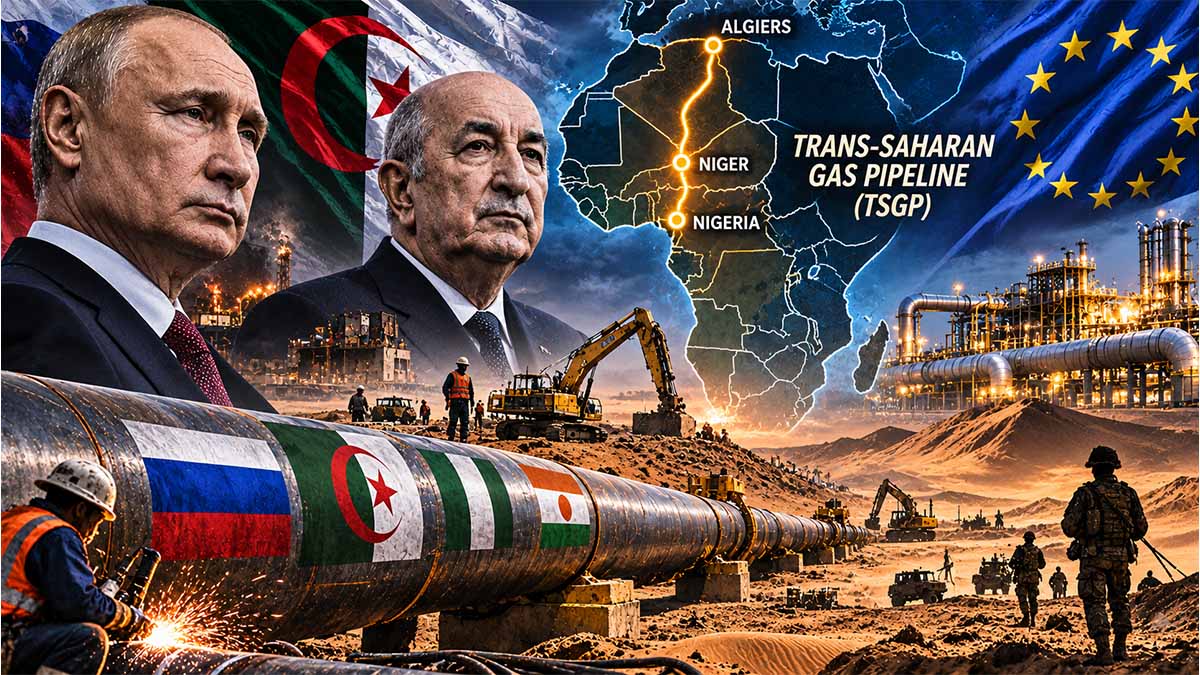
The Trans-Saharan Gas Pipeline was conceived as a means of bringing Nigerian natural gas to European markets through Niger and Algeria. Its emerging Russian dimension now exposes a contradiction in Europe’s energy-security policy: eliminating dependence on Russian gas does not necessarily eliminate dependence on Russian companies involved in producing, financing or maintaining the infrastructure that delivers alternative supplies. On 4 June 2026, Algeria launched construction of its section of the pipeline. On 27 October, Algerian Foreign Minister Ahmed Attaf met Russian Foreign Minister Sergey Lavrov in Moscow, amid reports of negotiations involving Russian industrial participation. Yet no binding Russian TSGP contract or transfer of operational control has been established in the examined institutional record. For European governments, the immediate issue is therefore not the nationality of the steel supplier, but who will finance, operate and ultimately control a proposed 20–30 billion cubic metre annual gas corridor.
A €13 Billion Question: Construction Has Begun, but the Project Is Not Yet Bankable
The Trans-Saharan Gas Pipeline is designed to extend approximately 4,130–4,200 kilometres from Nigeria through Niger into Algeria, using a 48-inch pipeline with initial transport capacity of approximately 20 billion cubic metres annually and potential expansion to 30 bcm. Historical project estimates have placed investment requirements around US$13 billion, but that figure is not a verified final 2026 capital budget. On 3 June 2026, the tripartite steering process approved an updated feasibility study prepared by Penspen. The following day, Algeria formally launched construction at Aoulef, with the planned northern connection extending toward the Hassi R’Mel gas hub. The milestone demonstrated political commitment and the commencement of an identifiable national construction programme. It did not establish that the entire international system had secured financing, construction contracts, dedicated Nigerian gas or European purchase commitments.
The difference is particularly important in Niger. On 17 March 2026, Sonatrach announced a technical mission to Niamey covering route studies, environmental assessments, construction permits and regulatory requirements. Nigerien authorities subsequently identified early 2027 as the intended beginning of construction on a national section exceeding 700 kilometres. These were preparatory and planning milestones, not confirmation of completed construction. The pipeline’s financial viability will depend on the last indispensable segment becoming operational, not on the first section entering development. A completed Algerian connection would generate limited international transportation revenue if Nigerian gas could not cross Niger.
This sequencing explains why the estimated US$13 billion investment requirement cannot be evaluated independently of completion risk. Contractors must procure steel, install compressors and establish metering and control systems before the project can earn recurring transportation revenue. Financing costs may continue accumulating during interruptions. An illustrative US$5 billion financing balance at 8% would generate US$400 million in simple annual financing costs before principal repayment, excluding other charges. That calculation is not a TSGP financing forecast; it demonstrates why delays affecting one national section can alter the economics of investments already undertaken elsewhere.
Europe’s Gas Arithmetic Exposes the Difference Between Capacity and Supply
The European Commission reports that the EU imported approximately 289 bcm of natural gas in 2025, including 36 bcm from Russia, down from 52 bcm in 2024. LNG represented 131 bcm, or approximately 45% of total gas imports, while pipeline imports accounted for roughly 158 bcm. Against that market, the TSGP’s initial 20 bcm annual design capacity would equal approximately 6.9% of the EU’s 2025 gas imports. At 30 bcm, the theoretical equivalent would rise to 10.4%. Compared with Russia’s 36 bcm of deliveries in 2025, those capacities represent approximately 56% and 83%, respectively. The figures establish the project’s potential scale, but not the quantities that European consumers could actually receive.
Pipeline capacity is not synonymous with exportable gas. Nigeria reported 215.19 trillion cubic feet of natural-gas reserves as of 1 January 2026, comprising 100.21 Tcf of associated gas and 114.98 Tcf of non-associated gas. At 20 bcm annually, the TSGP would require average throughput of approximately 54.8 million cubic metres daily, equivalent to 1.93 billion cubic feet per day. Expansion to 30 bcm would raise that requirement to approximately 82.2 million cubic metres daily. Those quantities must be supported by producing fields, processing infrastructure and legally committed deliveries. Nigeria’s domestic electricity requirements, industrial development and existing LNG obligations compete for investment and commercially available gas. Geological reserves alone cannot meet a transportation contract.
European demand introduces a second constraint. Germany consumed approximately 864 TWh of gas in 2025, an increase of 2.2% from 2024 but still 13.5% below its 2018–2021 average. France imported 249 TWh of LNG in 2025, 18% more than in 2024, while its domestic gas consumption declined by 3%. These figures show why European buyers cannot assume that a pipeline entering service in the early 2030s will enjoy the same market conditions that originally justified its planning. A project commissioned late may encounter lower demand in some sectors, strong LNG competition and greater resistance to inflexible long-term purchasing commitments.
The financial consequence is straightforward. A pipeline operating at 50% of its 20 bcm design capacity transports only 10 bcm annually, while much of its fixed capital cost remains unchanged. Even at 90% utilisation, throughput would reach 18 bcm rather than 20 bcm. Any allocation to domestic markets, operating losses or unavailable export capacity could reduce volumes reaching European buyers further. The project’s commercial value must therefore be calculated from contracted deliveries and total transportation costs, not from the capacity printed in its technical specifications.
Moscow Can Earn From Construction Without Owning the Gas
The Russian dimension must be assessed against Algeria’s existing commercial and diplomatic relationships. On 15 June 2023, Algerian President Abdelmadjid Tebboune and Russian President Vladimir Putin signed a Declaration of Deepened Strategic Partnership. The bilateral relationship already included energy cooperation: on 2 February 2022, Sonatrach announced the commerciality of discoveries at El Assel in the Berkine Basin under a partnership comprising 51% Sonatrach ownership and 49% participation by Gazprom EP International. The development programme envisaged 24 new wells and gas-processing infrastructure. That arrangement demonstrates established Russian participation in Algerian hydrocarbons, but it provides no evidence of Russian ownership rights in the TSGP.
Following the 27 October 2026 Moscow discussions, Russian corporate involvement in the pipeline was presented as a prospective industrial development. Pipe manufacturer TMK has been identified as a possible participant, but the available official documentation does not establish an awarded TSGP-specific contract, contract value, financing package or operating concession. This uncertainty is decisive. A manufacturer supplying steel under a finite procurement contract may earn construction revenue without acquiring any entitlement to future gas sales. A lender providing project finance could possess continuing creditor rights. An investor might hold governance rights, while an exclusive compressor or control-system supplier could create long-term technical dependence. These arrangements differ substantially in their ability to affect operations.
The distinction also limits claims of a Russian geopolitical victory. Moscow could strengthen its African commercial presence through equipment exports without determining the destination or price of Nigerian gas. Conversely, a relatively modest contractual position could acquire considerable importance if the project could not maintain critical systems or refinance obligations without the relevant Russian counterparty. The real measure of influence is therefore the enforceable right attached to each investment, not the nationality of a contractor or the diplomatic prominence of the announcement.
Algeria has reasons to consider Russian industry without abandoning European markets. The European Commission reported approximately 35 bcm of Algerian gas exports to the EU in 2025. On 12 February 2026, Algeria and the Commission held their sixth high-level energy dialogue, covering natural gas, infrastructure, emissions reduction and wider energy cooperation. These relationships provide commercial incentives that constrain any move toward exclusive dependence on Moscow. Algeria may increase its negotiating options by engaging Russian suppliers, but a contractual structure that jeopardised European market access would impose costs on an established export business. Political cooperation with Russia and continued economic dependence on European demand are not mutually exclusive.
Niger Is the Transit Chokepoint That No Industrial Contract Can Eliminate
The proposed route gives Niger territorial importance disproportionate to its role as a gas producer. Nigerian supply cannot reach the Algerian system through the planned corridor without crossing Nigerien territory, obtaining construction authorisations and maintaining operational access. This creates legal, fiscal and security dependencies that cannot be removed by selecting a different equipment supplier. Niger may obtain transit revenues and infrastructure benefits, but those benefits remain conditional on physical completion and sustained operation.
The regional institutional environment has become more difficult. On 29 January 2025, Niger, Mali and Burkina Faso formally withdrew from the Economic Community of West African States, consolidating their separate political and security arrangements through the Alliance of Sahel States. Nigeria remained an ECOWAS member. The withdrawal did not make bilateral infrastructure cooperation impossible, but it altered the regional institutional setting in which political disagreements, trade access and administrative coordination must be managed.
Foreign military relationships have also changed. US Africa Command confirmed on 16 September 2024 that American forces had completed their withdrawal from Niger, following departures from Air Base 101 in Niamey and Air Base 201 in Agadez. Russia’s security relationships in the wider Sahel have developed through military assistance and personnel associated with Wagner and subsequent structures. United Nations investigations documented foreign military involvement alongside Malian forces during the March 2022 events in Moura, while later UN communications addressed allegations involving Russian-linked personnel. These records establish a substantive Russian security relationship in parts of the region, but they do not establish that Russian forces control or protect the TSGP route.
The more immediate documented threat is instability itself. UNHCR’s April–June 2026 operational assessment identified intensified armed-group attacks, criminality and intercommunal violence, particularly in Tillabéri, Diffa and northern Tahoua, with incidents also reported in Dosso. The final pipeline alignment has not been established in sufficient public geographical detail to determine its precise overlap with Russian deployments or each affected region. Nevertheless, construction depends on roads, logistics, workers, insurers and uninterrupted access to technical facilities. A pipeline may be delayed without being attacked directly if contractors cannot reach construction sites or maintain essential equipment.
This limits the assumption that Russian military influence would automatically translate into control over future gas supplies. Russia’s relationships with military-led governments could create additional diplomatic access, but access is not equivalent to an enforceable transit right. Nigeria controls production decisions, Niger controls territorial permissions, and Algeria controls the northern system. Moscow would need specific contractual, financial or operational mechanisms to convert regional influence into authority over gas flows. No such comprehensive arrangement is established in the disclosed TSGP record.
Europe’s Import Law Does Not Prohibit Nigerian Gas Because Russian Firms Built the Pipeline
The EU’s regulatory framework establishes a distinction that must remain central to the assessment. Regulation (EU) 2026/261, adopted on 26 January 2026 and effective from 3 February, establishes the phased prohibition of Russian natural-gas imports. Its transitional framework provides for the termination of qualifying existing Russian LNG and pipeline supplies during 2026–2027, with the principal long-term pipeline-contract exemption ending on 30 September 2027, subject to a specified possible extension to 1 November. The regulation concerns gas originating in or exported from Russia, not automatically the nationality of every company manufacturing infrastructure through which other countries’ gas is transported.
Nigerian gas would therefore not become Russian-origin gas solely because a Russian manufacturer supplied steel or engineering equipment. But that conclusion does not remove other legal risks. Russian contractors, banks, shareholders and technical-service providers must be assessed separately under applicable restrictive measures. A compliant gas-origin declaration cannot legalise an otherwise prohibited payment, technology transaction or relationship with a restricted counterparty. Equally, Russian industrial participation does not, by itself, establish that European imports of Nigerian gas are prohibited.
A second regulatory constraint comes from Regulation (EU) 2024/1787 on methane emissions. The European framework introduces progressively applicable monitoring, reporting, verification and methane-intensity obligations, including requirements relevant to contracts operating in the period when the TSGP might enter service. These rules extend the commercial problem beyond commodity origin. A future European buyer must establish not only where the gas was produced but also whether the relevant supply chain can provide the data required under the applicable regulatory framework.
Public financing is constrained as well. The revised Trans-European Networks for Energy framework excludes conventional fossil-natural-gas projects from new Projects of Common Interest and Projects of Mutual Interest status. European interest in additional African gas does not therefore establish eligibility for EU infrastructure grants. This creates a tension between the political appeal of diversification and the legal, financial and environmental conditions governing actual investment.
Europe Does Not Have One Gas Market Interest
Italy’s commercial position differs from those of France, Germany and the United Kingdom. Existing connections through the Trans-Mediterranean system make Italy a plausible receiving market for additional gas entering Algeria’s network. Yet available capacity, transportation rights and the allocation of existing Algerian exports would determine the amount that Italian buyers could obtain. The nominal 20–30 bcm TSGP capacity cannot be treated as an equivalent increase in Italian imports.
France has a different set of options. Its 249 TWh of LNG imports in 2025 represented 56% of national gas imports, while exports reached 109 TWh and domestic consumption approximately 350 TWh. These figures show that France functions as both a major LNG receiving market and an interconnected gas-trading participant. Additional Nigerian gas would need to compete with that existing supply flexibility. Its commercial value could emerge through European redistribution without requiring France to become a direct participant in the trans-Saharan infrastructure.
Germany’s position is shaped by industrial demand and transportation costs. Industrial consumers accounted for approximately 60% of German gas consumption in 2025. Norway supplied 44% of reported German imports, the Netherlands 24% and Belgium 21%, while German LNG terminals handled approximately 106 TWh. Nigerian gas arriving through Algeria would compete against these established routes after accounting for the costs of transporting it through interconnected European networks. Its origin would diversify supply, but its value to German industry would depend on delivered price and contractual reliability.
The United Kingdom operates outside the EU’s gas-import legal regime. Its Department for Energy Security and Net Zero published the National Risk Assessment on Security of Gas Supply on 23 October 2026, identifying domestic production, Norwegian imports, LNG, interconnections and storage as important components of resilience. The UK could benefit indirectly from greater European supply flexibility, but the TSGP would not constitute a direct British pipeline connection. British decisions would remain governed by domestic regulation, sanctions and commercial market conditions.
These differences constrain the possibility of treating the TSGP as a single European geopolitical asset. Italy may value access through existing Mediterranean infrastructure; France may assess its contribution to LNG-market competition; Germany may emphasise industrial delivered costs; and the United Kingdom may experience principally indirect market effects. European institutions can establish common regulatory requirements, but they cannot erase the commercial distinctions among importing markets.
The Next 24 Months Will Determine Whether the Project Becomes Financeable or Remains Political
Between November 2026 and November 2028, the TSGP’s decisive milestones will concern the conversion of announced cooperation into enforceable investment and construction obligations. The early-2027 target for works in Niger will be an initial test. Project-wide financial close, certified physical progress, identified Nigerian gas-supply contracts, operating arrangements and credible European offtake commitments will provide stronger evidence than further ministerial declarations. The absence of those milestones would not prove permanent failure, but it would weaken the commercial basis for assuming operation during 2030–2032.
Three outcomes remain possible. Russian companies could retain a limited industrial role while African sponsors develop a commercially viable corridor. Russian financing and maintenance participation could become substantial without transferring decisive control over gas sales. Alternatively, accumulated construction delays, transit insecurity and contractual dependencies could leave the project underutilised or incomplete. The official record does not support numerical probabilities for these outcomes, nor does it establish a firm timetable for European deliveries.
The financial burden of inaction would not be distributed equally. Nigeria would lose opportunities to monetise additional gas; Niger would forgo prospective transit revenues and associated infrastructure activity; Algeria could face underutilised transport investment; and project sponsors, lenders and contractors would bear costs according to their contractual obligations. European buyers would lose a possible source of diversification, but not an existing supply entitlement, because no firm TSGP deliveries have been established. Russian participants could earn revenue from completed contracts or incur losses on outstanding financing and investment.
The critical decision over the next 12–24 months is consequently contractual rather than rhetorical. The project must establish who finances the infrastructure, who holds its operating rights, who supplies the gas and who is legally entitled to transport and purchase it. Those decisions will determine whether Russian participation remains an industrial transaction or develops into a form of continuing leverage.
Europe’s exposure will be determined by the same documents. If the TSGP reaches financial close without transparent governance, replaceable technical systems and commercially enforceable delivery rights, future buyers may acquire a new gas source accompanied by concentrated infrastructure dependencies. If the project fails to secure financing and reliable transit, the immediate financial losses will fall principally on the participating states and invested companies, while Europe will continue purchasing from alternative suppliers.
The strategic consequence is not predetermined by the October 2026 Moscow discussions. It will emerge from the contracts and construction decisions taken before the end of 2028. Gas origin determines whether the TSGP can diversify European supply; financing, technical dependence and operating rights will determine who benefits from that diversification and who can interrupt it.
Navigational Index
PILLAR I — INFRASTRUCTURE, CONTRACTS AND EUROPEAN ENERGY SECURITY
- Chapter 1. Factual Status of the TSGP and Russian Corporate Participation
- Chapter 2. Project Economics, Transport Capacity and Realistic European Supply Through 2032
- Chapter 3. EU Russian-Gas Phase-Out, Sanctions Exposure and Supply-Origin Verification
PILLAR II — GEOPOLITICAL ALIGNMENT, SAHEL SECURITY AND CONTROL
- Chapter 4. Algeria–Russia Strategic Relations, Energy Diplomacy and Commercial Incentives
- Chapter 5. Niger, Mali and Burkina Faso: Russian Security Presence and TSGP Transit Exposure
- Chapter 6. Control of Gas Production, Transit, Pricing, Infrastructure and European Offtake
PILLAR III — STRATEGIC FUTURES AND GOVERNMENT POLICY
- Chapter 7. Three TSGP Development Scenarios and Their Consequences Through 2032
- Chapter 8. European Country Implications, Policy Instruments, Monitoring Indicators and Final Strategic Assessment
Master Abstract
A new African supply corridor, but not yet a European supply guarantee
The Trans-Saharan Gas Pipeline has acquired renewed geopolitical importance because it combines three distinct objectives: monetising Nigerian gas resources, establishing Niger as an energy-transit state, and strengthening Algeria’s position as a Mediterranean gateway for African hydrocarbons. Its potential contribution to European diversification is commercially significant, but the documentary evidence requires a clear separation between announced transport capacity, infrastructure under construction, prospective upstream supply and volumes contracted for delivery to European buyers.
The Algerian Ministry of Hydrocarbons describes a pipeline of approximately 4,200 kilometres, with a 48-inch diameter, compressor stations, initial capacity of approximately 20 bcm per year and possible expansion toward 30 bcm per year. The ministry also records the 3 June 2026 approval of an updated feasibility study prepared by Penspen. On 4 June, Sonatrach confirmed the official commencement of construction on the Algerian section, running through the Trans-Saharan Road corridor toward the Hassi R’Mel gas hub. These developments constitute identifiable implementation milestones, but they do not establish that the entire multinational system has secured financing, completed permitting or obtained binding European offtake commitments.
Sources: Trans-Saharan Gas Pipeline Project — Algerian Ministry of Hydrocarbons — Aug 2026; TSGP Project: Official Launch of Construction Works — Sonatrach — Jun 2026.
The introduction of Russian industrial participation would add another dimension to this arrangement without automatically changing the origin of the gas. The evidence presently distinguishes three propositions with very different consequences. The first is prospective Russian supply of steel pipe, construction services or engineering equipment. The second is financial participation through loans, guarantees or infrastructure equity. The third is enduring contractual influence over dispatch, maintenance, transport capacity or commercial decisions. Only the latter two, depending on their legal terms and operational design, could create meaningful long-term Russian leverage independent of the governments operating the corridor.
The Moscow negotiations: political significance without demonstrated infrastructure control
The diplomatic record identifies a meeting between Algerian Foreign Minister Ahmed Attaf and Russian Foreign Minister Sergey Lavrov on 27 October 2026, on the margins of the Gas Exporting Countries Forum summit in Moscow. Algeria’s official account confirms discussions on bilateral relations, cooperation and regional affairs. Russian official communications similarly describe discussions on the enhanced strategic partnership and coordination regarding North Africa and the Sahara–Sahel region.
Senior Minister Meets Russian Counterpart in Moscow — Algerian Ministry of Foreign Affairs — Oct 2026; Attaf Meets His Russian Counterpart in Moscow — Algérie Presse Service — Oct 2026. Embassy of Algeria in Abuja+1
The more specific reported statement attributed to Attaf concerns advanced negotiations to associate Russian companies with pipeline-related activity, with an agreement said to be approaching completion. That reported statement is materially important, but the accessible formal readout does not reproduce the detailed contractual language. Consequently, the negotiations cannot presently be classified as a verified executed contract.
The Russian pipe manufacturer TMK has been identified publicly as a potential industrial participant. Its inclusion is analytically plausible given the technical requirements of large-diameter gas transportation, but no verified TSGP-specific award, supply quantity, contract value or ownership arrangement has been established from the inspected first-party documents.
The distinction matters because infrastructure participation can generate political influence without conferring decisive commercial control. Conversely, an otherwise limited industrial contract can become strategically consequential if it includes proprietary monitoring systems, irreplaceable maintenance capabilities, financing conditions or long-term exclusive service obligations.
The European constraint: diversification must precede geopolitical dependence, not reproduce it
The European Commission reports that EU gas imports totalled approximately 289 bcm in 2025, including 36 bcm from Russia. Russian deliveries had fallen from approximately 52 bcm in 2024. LNG accounted for 131 bcm, or 45% of EU gas imports in 2025.
Gas Market Analysis — European Commission, Directorate-General for Energy — 2026. European Commission
These figures establish the scale against which the TSGP must be evaluated. At its stated initial design ambition, 20 bcm would equal approximately 6.9% of the EU’s 2025 total gas imports. At 30 bcm, the corresponding theoretical proportion would be approximately 10.4%. Both figures are capacity comparisons, not forecasts of deliveries to Europe. They assume that all available TSGP capacity could be dedicated to EU markets, without accounting for domestic requirements, transit losses, system availability, alternative destinations or contractual constraints.
The immediate European regulatory context is equally important. Regulation (EU) 2026/261, adopted on 26 January 2026 and effective from 3 February, establishes a staged prohibition on Russian natural-gas imports. The transitional arrangements lead toward the termination of existing eligible Russian LNG and pipeline supplies during 2026–2027, subject to the regulation’s specific exceptions.
The regulation defines the country of production by reference to where gas is extracted, rather than the nationality of the company manufacturing the pipeline that transports it. Nigerian gas therefore does not automatically become Russian gas because a Russian manufacturer supplies the steel infrastructure. However, compliance remains dependent on the transaction, the identity and sanctions status of relevant counterparties, and verifiable origin documentation.
Regulation (EU) 2026/261 — European Parliament and Council — Jan 2026; REPowerEU: Phase-Out of Russian Energy Imports — European Commission — 2026. EUR-Lex+1
The strategic implication is that the TSGP cannot responsibly be incorporated into the EU’s immediate Russian-gas replacement balance without demonstrated completion dates and contracted deliverability. Its potential value lies instead in medium-term supply diversification, subject to technical commissioning, commercial execution and independently enforceable transit arrangements.
Algeria’s strategic autonomy is constrained by the economics of its export relationship
Algeria’s incentives to consider Russian contractors extend beyond an abstract preference for geopolitical alignment. Russian firms may offer industrial capacity, engineering experience or financing arrangements that could support infrastructure implementation. Russian participation may also expand Algeria’s negotiating options when dealing with European suppliers and financial institutions.
These potential advantages coexist with important constraints. Algeria already maintains substantial natural-gas trade with Europe. The European Commission identifies the European Union as Algeria’s principal gas customer and describes the relationship as mutual dependence: Europe requires Algerian supplies, while Algeria requires European demand. EU–Union for the Mediterranean Energy Cooperation — European Commission.
The commercial relationship remains active. On 27 October 2026, Sonatrach reported discussions with the Czech company ČEZ concerning an existing gas sales agreement, initially signed in 2024, under which Algerian gas is delivered through the Italy-connected pipeline system. This is direct evidence that European sales relationships continue alongside Algiers’ diplomatic engagement with Moscow.Sonatrach Chairman and CEO Meets ČEZ Delegation — Sonatrach — Oct 2026. SONATRACH
The principal analytical question is therefore not whether Algeria maintains a relationship with Russia. That is established. It is whether the TSGP creates legally enforceable arrangements that allow Moscow to affect Algerian decisions at the expense of Nigeria’s production autonomy or Europe’s commercial access.
The available evidence does not yet establish such an arrangement. A policy of diversified partnerships remains consistent with the observable commercial structure. Any transition toward dependence would need to be demonstrated by ownership, financing, exclusivity or operating rights.
The Sahel is an operational constraint, not merely a geopolitical battleground
The proposed Nigerien section introduces a distinct category of risk because construction and long-term gas transportation require territorial access, continuous security, regulatory predictability, emergency response and the protection of dispersed infrastructure.
Sonatrach’s 17 March 2026 mission to Niamey addressed route data, regulatory procedures, environmental studies, construction permits and the preparatory requirements of the Nigerien segment. Niger’s petroleum minister subsequently identified early 2027 as the intended start of construction on a section extending more than 700 kilometres. TSGP: Sonatrach Team Visits Niamey — Sonatrach — Mar 2026; Arkab Highlights the Expected Central Role of the Algerian Section — Radio Algérienne — Jun 2026.
Niger’s security environment remains difficult. UNHCR’s operational reporting for April–June 2026 identifies intensifying attacks by non-state armed groups, criminality and intercommunal violence, particularly in Tillabéri, Diffa and northern Tahoua, with additional violence farther south. Quarterly Operational Update, April–June 2026 — UNHCR Niger — Aug 2026.
Russian security relationships with military-led governments in the Sahel create a potential point of intersection between infrastructure and security assistance. However, the public record does not yet establish that Russian military personnel protect the designated TSGP alignment, that Russia has acquired a security mandate over the pipeline, or that Russian military deployments can directly determine future gas throughput.
The operational risk should therefore be defined in terms of observable conditions: security incidents within the surveyed corridor, construction access restrictions, financing conditions, maintenance dependence and the allocation of host-state security responsibilities. The presence of Russian personnel elsewhere in Niger or neighbouring states is not sufficient to establish effective control of the pipeline.
Key Evidence Table
| Indicator | Value/status | Reference date | Definition/scope | Issuer | Exact source |
|---|---|---|---|---|---|
| Pipeline length | Approximately 4,200 km | Aug 2026 | Nigeria–Niger–Algeria corridor; official reporting also uses approximately 4,130 km | Algerian Ministry of Hydrocarbons | Project specifications |
| Diameter | 48 inches | Aug 2026 | Declared trunk pipeline design | Algerian Ministry of Hydrocarbons | Technical description |
| Initial capacity ambition | Approximately 20 bcm/year | Aug 2026 | Design-stage transport capability, not delivered gas | Algerian Ministry of Hydrocarbons | Technical description |
| Expansion ambition | Approximately 30 bcm/year | Aug 2026 | Conditional future capacity | Algerian Ministry of Hydrocarbons | Technical description |
| Updated feasibility study | Approved by tripartite steering committee | 3 Jun 2026 | Penspen study; approval does not prove financial close | Algerian Ministry of Hydrocarbons | Steering committee record |
| Algerian construction | Officially launched | 4 Jun 2026 | Aoulef–Hassi R’Mel corridor | Sonatrach | Construction announcement |
| Nigerien construction | Early 2027 target | Jun 2026 announcement | More than 700 km; planned, not verified as commenced | Nigerien petroleum minister, reported by Algerian public broadcaster | Ministerial statement |
| Russian involvement | Negotiations reported; no verified awarded TSGP contract identified | Oct–Nov 2026 | Corporate participation, ownership and scope unresolved | Algerian and Russian diplomatic record | Official meeting record |
| Final project CAPEX | No current auditable final investment budget established | Nov 2026 | Historical estimates are not equivalent to an approved 2026 project budget | Tripartite project documentation reviewed | Project specifications |
| EU total gas imports | 289 bcm | 2025 | Pipeline gas plus LNG | European Commission | Gas market analysis |
| EU Russian gas imports | 36 bcm | 2025 | Pipeline gas plus LNG | European Commission | Gas market analysis |
| EU phase-out framework | Regulation (EU) 2026/261 | Jan–Feb 2026 | Gradual prohibition with transitional provisions | European Parliament and Council | Regulation |
Evidence hierarchy: official ministries, Sonatrach, EU institutions and intergovernmental records. Project specifications are stated design parameters, not independently validated operational performance.
Competing Explanations and Strategic Pathways
Three explanations are consistent with different portions of the currently available evidence. They are not necessarily mutually exclusive: a limited industrial role could develop into a financing or maintenance relationship, while diplomatic alignment could remain broader than the contractual arrangements themselves.
| Hypothesis | Diagnostic support | Disconfirming evidence or limitations | Indicators | Current standing |
|---|---|---|---|---|
| H1 — Industrial participation without strategic control | Existing tripartite project structure; identifiable need for engineering and pipeline equipment | No award or scope verified; later service obligations could create dependency | Pipe purchase orders, EPC awards, maintenance terms | Plausible; medium confidence |
| H2 — Significant commercial participation with retained African control | Algerian–Russian strategic cooperation; potential commercial incentives for finance and equipment supply | No verified Russian equity, financing package or operating concession | Financial close, shareholder agreements, guarantees, capacity-right allocations | Possible; low-to-medium confidence |
| H3 — Politically conditioned infrastructure dependency | Regional security instability and Russia’s broader Sahel relationships | No verified evidence that Russia controls TSGP transit, dispatch or security; African parties retain sovereign interests | Exclusive operations rights, security-linked clauses, lender step-in rights, repeated politically conditioned interruptions | Consequential contingency, presently unestablished |
These hypotheses must be tested against future procurement and financing documents rather than treated as competing political narratives. The public record presently supports the existence of negotiations more strongly than it supports either commercial control or deliberate infrastructure coercion.
Preliminary Actor-Leverage Assessment
| Actor | Stated interest in TSGP | Material leverage | Residual constraints | Most probable posture, conditional on current evidence |
|---|---|---|---|---|
| Nigeria | Gas monetisation, industrial development, access to international buyers | Upstream production, gas allocation, domestic pipeline connections | Investment needs, competing domestic demand, LNG commitments and supply reliability | Seek export options while retaining upstream discretion |
| Niger | Transit revenue, energy access, infrastructure development | Territory, permits, right of way, local security and transit terms | Armed violence, political stability, finance and construction capability | Seek transit benefits and infrastructure assistance |
| Algeria | Export diversification, hub development, regional integration | Hassi R’Mel integration, national transmission system, export networks | European market dependence, infrastructure capacity, domestic consumption | Preserve multiple international partnerships |
| Russia | Potential industrial contracts and wider strategic cooperation | Possible equipment, capital, technical services and security relationships | Contract access unverified; sanctions, financing and host-state sovereignty | Pursue opportunities where commercially and diplomatically viable |
| European Union | Verifiable non-Russian supply and secure diversification | Import regulation, market demand, financing standards, offtake and certification | No direct ownership of the corridor; completion and transit uncertainty | Require traceability and commercial safeguards |
| Italy | Secure Mediterranean pipeline supply and European redistribution | Algerian import relationships and onward European market access | Algerian supply availability, capacity allocation, demand evolution | Seek bankable volumes and delivery guarantees |
| France | Supply diversity and regional stability | LNG market access, diplomatic and development instruments | Restricted security relationships in parts of the Sahel | Emphasise diversified supply and regional engagement |
| Germany | Gas-source diversification and industrial supply reliability | European purchasing capacity, import terminals, contractual demand | North–south system integration and commercial competitiveness | Evaluate pipeline gas against LNG and existing European supplies |
| United Kingdom | Flexible gas procurement and European market stability | LNG market, trading and financial services | Outside EU customs jurisdiction and no direct TSGP pipeline connection | Assess indirect supply and market effects |
The central distinction is between having a strategic interest and possessing enforceable decision rights. Territorial authority, gas ownership, network operation and purchasing power are separate forms of leverage. Their interaction—not the nationality of any single construction supplier—will ultimately determine control over future deliveries.
Preliminary Volume and Timeline Assessment
The stated design capacities permit an assessment of potential scale, but not a defensible production forecast. A commissioning date, contracted export allocation and utilisation rate are all necessary before annual European deliveries can be estimated reliably.
Declared TSGP capacity compared with the EU’s 2025 gas-import baseline
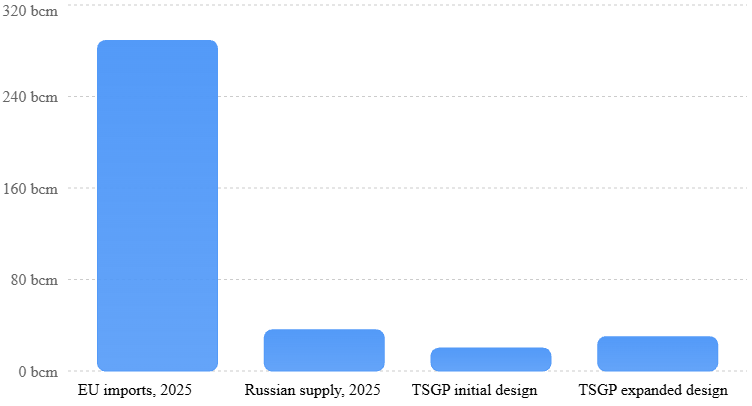
Derived comparison using TSGP design ambitions and European Commission 2025 import volume (289 bcm). Not a delivery forecast.
Calculated capacity equivalents: initial 20 bcm = 6.9% of EU 2025 imports; expanded 30 bcm = 10.4%. These are comparisons against a fixed historical baseline, not projected market shares or contracted quantities. Sources: Algerian Ministry of Hydrocarbons; European Commission gas market analysis.
The financial and construction sequence is more important than the headline capacity. As of the cut-off date, the evidence supports the start of Algerian works and the intention to proceed with Nigerien construction in 2027. It does not establish a publicly auditable financial-close date for the entire system, a complete Nigerien construction contract, a verified Nigerian-to-Algerian commissioning programme or a documented schedule of firm deliveries to EU buyers.
Accordingly, a 2030 full-capacity European delivery assumption would overstate what the present evidence establishes. A more appropriate assessment framework separates four stages: construction completion, initial commissioning, commercial ramp-up and sustained contracted deliveries. Each stage depends on the preceding one, but none is guaranteed by political support alone.
Principal Gaps and Watch Indicators
Russian contract documentation — Critical
Obtain signed procurement awards, technical scopes, payment terms and any equity or maintenance provisions. A binding agreement granting exclusive control of compressor systems or dispatch services would materially change the assessment.
Financing and project governance — Critical
Verify the project company, shareholder rights, financing commitments, guarantees, debt covenants and any lender step-in rights. Political approval alone does not establish financial executability.
Nigerien alignment and security — High priority
Obtain the definitive georeferenced route, environmental permits, construction access plans, security responsibilities and local incident reporting. Regional violence cannot substitute for route-specific exposure analysis.
Nigerian gas commitments — High priority
Establish dedicated production sources, treatment capacity, domestic allocation, competing LNG obligations and firm transport nominations. Geological resources do not equal market-ready export gas.
European offtake and legal compliance — High priority
Verify firm supply agreements, delivery points, country-of-production documentation, sanctioned counterparties and independent operational audit rights.
Strategic Dependency Visualisation
The verified record supports a basic dependency chain: Nigerian supply, Nigerien transit, Algerian system integration and European purchases. Russian involvement remains a possible external input rather than an established control node. This distinction can be represented without attributing unverified ownership or quantitative influence.
TSGP: Documented Control Dependencies
Physical and commercial stages from gas production to European delivery.
Prospective external input: pipe supply, engineering, financing or maintenance. No verified TSGP-specific control rights established as of 5 November 2026.
Structure based on Sonatrach, 4 June 2026, and Algerian Ministry of Hydrocarbons, 3 June 2026. This is a functional relationship scheme, not a surveyed route map or ownership chart.
Preliminary Strategic Assessment
The established record supports a more differentiated interpretation than the proposition that Russian industrial participation necessarily defeats European diversification.
The TSGP would remain a potentially non-Russian source of natural gas so long as its gas is genuinely produced outside Russia and the relevant transactions comply with European law. The project would nevertheless create new exposure if Russian companies acquired enduring financing, technical or operational rights that could materially affect infrastructure availability, transport decisions or financial obligations.
Algeria is positioned to extract commercial and diplomatic value from multiple relationships, but its position cannot be understood independently of European demand. Nigeria’s upstream choices and Niger’s territorial authority remain equally important. No single foreign infrastructure participant can be regarded as exercising decisive control without evidence of legally enforceable or operationally indispensable rights.
The Sahel adds a further constraint that cannot be resolved by identifying a preferred external security partner. The test is whether Niger can deliver a stable construction environment and preserve reliable transit conditions over the operating life of the pipeline.
By 2032, the determining variables will therefore be financial close, completed infrastructure, committed Nigerian gas, Nigerien transit security, Algerian network access, contractual governance and verified European demand. Russian participation may influence several of those variables. Its eventual significance must be measured through observable contractual and operational mechanisms rather than assumed from diplomatic alignment.
Overall confidence: High in the declared technical baseline and EU legal framework; medium in the interpretation of current Algeria–Russia negotiations; low in claims of future Russian control, specific commissioning volumes and corridor-level military influence.
Trans-Saharan Gas Pipeline: strategic dashboard
Nigeria · Niger · Algeria · Europe | Evidence and scenarios through 2032
Assessment: Russian suppliers do not automatically make Nigerian gas Russian-origin gas. Long-term control depends on verified financing, ownership, transport and operating rights. No binding Russian TSGP contract has been established in the reviewed record.
Gas-volume comparison
Annual bcm; 2025 EU import baseline versus proposed TSGP capacity
Capacity bars are not forecasts of gas reaching Europe.
Who controls what?
Documented milestones and unresolved conditions
| Date | Milestone | Evidence status | Strategic significance |
|---|
2032 scenario explorer
Choose a conditional pathway. Scenarios are qualitative, not probability-weighted forecasts.
Actor leverage matrix
| Actor | Material leverage | Principal constraint |
|---|
PILLAR I — INFRASTRUCTURE, CONTRACTS AND EUROPEAN ENERGY SECURITY
Russian Participation in the Trans-Saharan Gas Pipeline: Infrastructure Execution, Commercial Control and the Future of European Supply Diversification
Geographic scope: Nigeria, Niger, Algeria, the European Union and the principal European gas markets.
Assessment period: Historical project development through 5 November 2026, with commercial and strategic implications assessed through 2032.
Central finding: The Trans-Saharan Gas Pipeline has entered a more concrete implementation phase, but the available institutional record does not yet establish an integrated, financed and contractually secured export system. The possible entry of Russian industrial companies introduces risks concerning procurement, finance and long-term technical dependence. It does not automatically alter the Nigerian origin of the gas or transfer control of future deliveries to Moscow. For European governments, the fundamental question is whether the project can progress from a politically supported transnational infrastructure initiative into a commercially bankable supply corridor before its strategic usefulness is diminished by construction delays, changing European demand and increasingly complex regulatory requirements.
Chapter 1 — Factual Status of the TSGP and Russian Corporate Participation
The transition from diplomatic infrastructure project to physical implementation
The Trans-Saharan Gas Pipeline represents one of Africa’s most ambitious proposed transnational gas-transport systems, not merely because of the distance involved but because its construction requires three sovereign states to coordinate upstream resource development, international transit, engineering standards, financing arrangements and eventual access to established export markets. Its central commercial proposition is straightforward: Nigerian natural gas would move northward through Niger into Algeria, where it could enter the Algerian transmission system and potentially reach European consumers through existing export infrastructure. Translating that proposition into an operational system, however, requires far more than the construction of a continuous steel pipeline. It requires production facilities capable of supplying incremental volumes, processing plants that meet transmission specifications, sufficient compression to sustain the required pressure along the route, intergovernmental arrangements defining transit rights, and binding agreements allocating the risks of interruption, cost escalation and non-delivery. The difference between these prerequisites and the relatively simple description of a Nigeria–Europe gas corridor explains why the project has remained under consideration for so long without becoming an established component of Europe’s import system.
The project’s contemporary institutional framework developed from earlier cooperation between the three states. A significant formal milestone occurred in July 2022, when the energy ministers of Algeria, Nigeria and Niger signed a memorandum of understanding concerning the project’s implementation. The initiative subsequently advanced through ministerial consultations, feasibility work and intergovernmental agreements. A further round of commitments in February 2025 reinforced cooperation and prepared the conditions for implementation. These milestones provide evidence of sustained political interest, but their significance must be understood accurately. A memorandum of understanding demonstrates agreement to pursue an objective or establish a framework; it does not necessarily create the fully financed construction obligations associated with an engineering, procurement and construction contract. Similarly, ministerial approval of a feasibility study validates a planning milestone without establishing that an investor has accepted all project risks or that customers have committed to purchasing the volumes required to support debt repayment.
The more consequential change occurred in the first half of 2026. On 17 March 2026, Sonatrach announced that a technical delegation had travelled to Niamey to collect information concerning the Nigerien alignment and examine the country’s legal and regulatory requirements. The delegation’s work included the technical route, pipeline construction rules, environmental-impact studies, danger assessments, building permits and authorisations. Sonatrach expressly described the mission as preparatory to detailed route studies and subsequent construction. This distinction establishes the stage reached by the Nigerien segment in March: engineering and regulatory preparation were under way, but the published statement did not announce that a fully permitted pipeline had entered construction along its entire national route. The announcement also identified the British engineering consultancy Penspen as the company responsible for preliminary feasibility work, illustrating that the project already involves international technical expertise outside the three participating states. TSGP Project: Visit by a Sonatrach Team to Niamey — Sonatrach — March 2026.
On 3 June 2026, the tripartite steering process approved an updated feasibility study. On the following day, Algerian Hydrocarbons Minister Mohamed Arkab, Nigerian Minister of State for Petroleum Resources (Gas) Ekperikpe Ekpo and Nigerien Petroleum Minister Hamadou Tini participated in the formal launch of construction on the Algerian section at Aoulef, in Adrar Province. The presence of ministers from all three participating countries was politically significant because it demonstrated a common public commitment to moving beyond preliminary negotiations. From an infrastructure assessment perspective, the more important element was the definition of the Algerian construction corridor. Sonatrach stated that this section would follow the Trans-Saharan Road corridor from the Algerian–Nigerien border toward the National Gas Dispatching Centre at Hassi R’Mel. The location matters because Hassi R’Mel is a central component of Algeria’s established gas-transport architecture; connection to this system offers the prospect of using existing infrastructure instead of building an entirely new pipeline to the Mediterranean coast. TSGP: Official Launch of Construction Works on the Algerian Section — Sonatrach — June 2026; Trans-Saharan Gas Pipeline Project — Algerian Ministry of Hydrocarbons — August 2026.
The 4 June ceremony therefore establishes the official commencement of an identifiable national construction programme. It does not, by itself, establish the number of kilometres subsequently welded, inspected, buried or pressure-tested; the percentage of construction expenditure disbursed; or the existence of a synchronised completion schedule covering all three countries. A defensible distinction must also be maintained between a construction launch, physical progress and the achievement of mechanical completion. The first is a government or operator milestone. The second requires verified engineering progress measurements. The third requires completion of the relevant facilities and satisfaction of the acceptance procedures specified by the construction contracts. For an international pipeline, mechanical completion would still precede commissioning, commercial acceptance and the sustained movement of contracted gas.
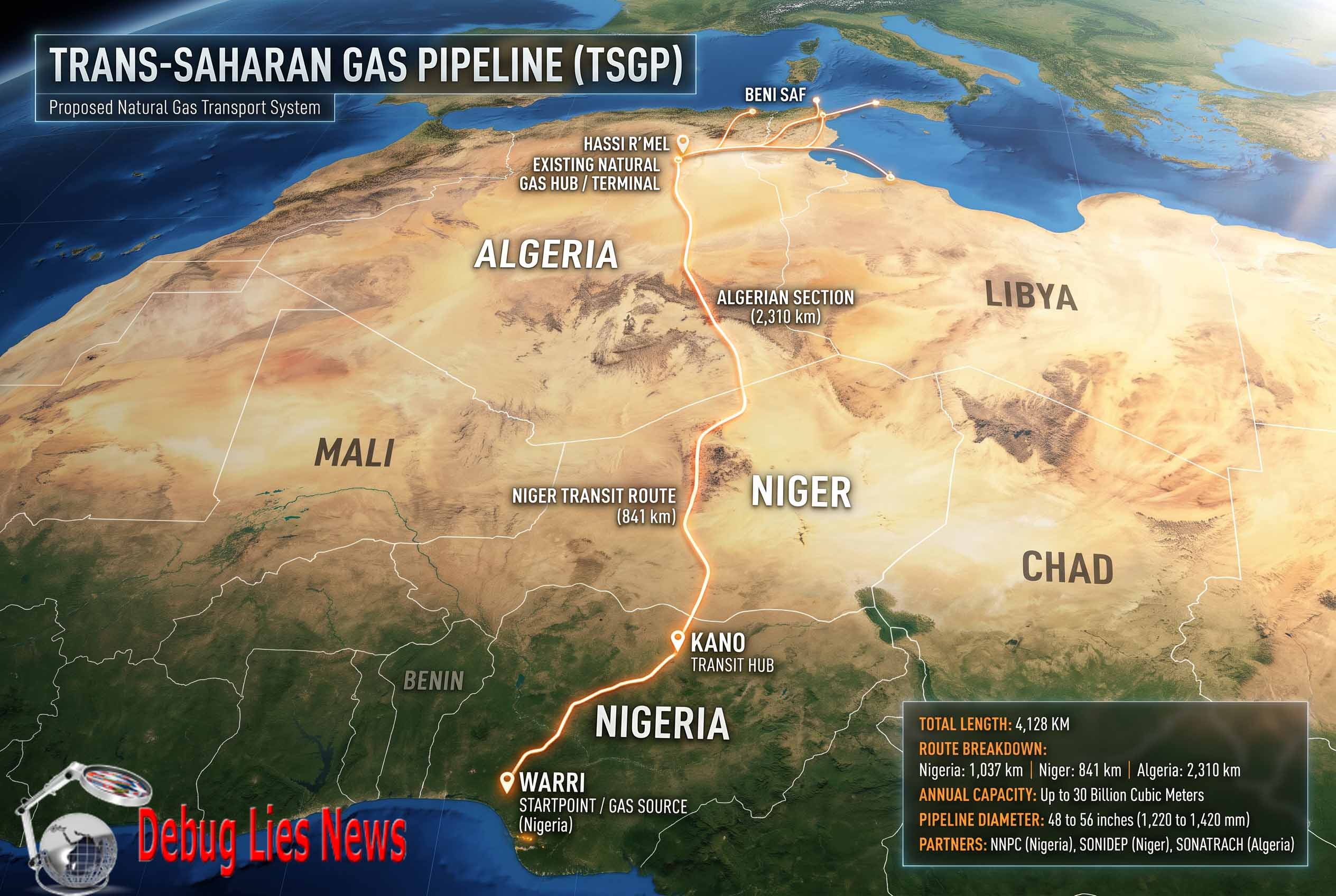
Engineering architecture: route length, pipe dimensions and the limits of declared capacity
The project has been described with a total route length generally between approximately 4,130 and 4,200 kilometres, reflecting the use of rounded planning figures and different route descriptions. Algeria’s published technical information identifies a planned diameter of 48 inches, an initial transport ambition of approximately 20 billion cubic metres annually, and a possible increase to 30 bcm annually. These are design parameters, not independently demonstrated transport results. The distinction is critical because the commercial performance of a high-pressure gas pipeline depends on more than diameter. It also depends on operating pressure, inlet conditions, compressor locations and installed power, gas composition, internal roughness, ambient conditions, maintenance availability, permitted pressure limits and the operational requirements of the receiving network. The 48-inch dimension establishes a broad engineering class but cannot be used independently to validate a throughput forecast. TSGP Technical Description — Algerian Ministry of Hydrocarbons — August 2026.
The physical structure creates several distinct engineering interfaces. The Nigerian component must collect and transport qualifying gas toward the Nigerien border, potentially relying on new connections to Nigeria’s domestic transmission network and on additional upstream processing capacity. The Nigerien component must establish a continuous high-pressure corridor through territory where construction logistics, security and permitting are unusually demanding. The Algerian component must connect the border entry point with the national transmission system and accommodate whatever additional compression, metering and gas-quality controls are required. The subsequent journey to European buyers would use existing Algerian export infrastructure only to the extent that capacity is technically available, contractually accessible and commercially allocated. These interfaces create multiple opportunities for delay even if the principal trunkline is constructed. In particular, the completion of an Algerian section cannot create transportable Nigerian export gas until the other segments and relevant supply facilities are ready.
| Engineering element | Publicly documented status or specification | Operational significance | Outstanding verification requirement |
|---|---|---|---|
| Overall corridor | Approximately 4,130–4,200 km in project descriptions | Requires integrated engineering across three countries | Final georeferenced route and segment-by-segment kilometre register |
| Main pipeline diameter | 48 inches in Algerian project description | Defines nominal pipe size, not independently verified throughput | Final pipe specification, wall thickness, steel grade and design code |
| Initial stated capacity | Approximately 20 bcm/year | Indicative transport ambition | Hydraulic model, compressor schedule and operating-pressure envelope |
| Potential expanded capacity | Up to approximately 30 bcm/year | Requires confirmation of expansion configuration | Additional compression, capital expenditure and capacity booking arrangements |
| Nigerian supply interface | Essential component of the project concept | Determines availability of export-quality gas | Dedicated fields, processing facilities and firm inlet commitments |
| Nigerien transmission section | Detailed route and regulatory preparation documented in March 2026 | Connects upstream gas to Algeria | Permits, environmental approvals, EPC award and verified construction progress |
| Algerian section | Official construction launch on 4 June 2026 | Establishes northern transport connection | Certified physical progress, procurement and commissioning schedule |
| Hassi R’Mel connection | Identified in Sonatrach’s Algerian route announcement | Potential interface with existing Algerian transmission network | Connection specifications, pressure compatibility and available injection capacity |
| Metering and custody transfer | Necessary for commercial operation; detailed allocation not publicly established | Determines quantities delivered and liability for losses | Metering protocol, calibration, gas-quality rules and contractual measurement points |
| Compressor stations | Included in project design requirements | Sustain throughput along the corridor | Number, locations, installed power, fuel consumption and maintenance agreements |
| European delivery routes | Existing Algerian export system provides possible connections | Determines physical access to importing markets | Available capacity, delivery nominations and network-access arrangements |
Source basis: Sonatrach Algerian Construction Announcement — June 2026; Sonatrach Technical Mission to Niger — March 2026; Algerian Ministry of Hydrocarbons Project Description — August 2026. Items identified as necessary but unverified are analytical engineering requirements, not assertions that a particular contract already contains them.
An additional issue concerns the distinction between technical capacity and available export capacity. A pipeline designed to transport 20 bcm in one direction may not actually offer 20 bcm of firm commercial capacity under every operating condition. Compressor maintenance, planned outages, system balancing and transport obligations can reduce available throughput. Moreover, if some gas is consumed in transit for compression or allocated to national markets, the volume received at the Algerian export interface would be lower than the volume originally injected. A rigorous bankability assessment must therefore use separately defined measurements of gross pipeline capacity, annual available transport capacity, gas injected, gas delivered and net gas available for European export. Treating those quantities as interchangeable would systematically overstate the amount of Nigerian gas that European buyers could ultimately obtain.
Russian participation: the distinction between diplomatic negotiations and awarded industrial contracts
The question of Russian participation became especially consequential following the October 2026 diplomatic engagements in Moscow. On 27 October 2026, Algerian Foreign Minister Ahmed Attaf met Russian Foreign Minister Sergey Lavrov during the Gas Exporting Countries Forum summit. Algeria’s official diplomatic communication confirms the meeting, its date and the bilateral setting. It does not reproduce a signed TSGP procurement agreement, define a Russian company’s contractual scope or identify a completed transfer of project ownership. This is an important evidentiary limitation. The existence of a high-level diplomatic meeting is established. The proposition that the meeting resulted in binding Russian industrial control is not. Senior Minister Meets Russian Counterpart in Moscow — Algerian Ministry of Foreign Affairs — October 2026.
Statements attributed publicly to Algerian officials after the Moscow discussions indicate negotiations concerning the possible involvement of Russian companies in the TSGP, with an agreement reportedly approaching conclusion. Their strategic meaning is that Algeria is prepared to consider Russian industrial participation in an infrastructure project involving two additional sovereign partners and potentially serving the European market. Their contractual meaning remains less certain. Without a signed agreement, contracting-party identification, defined work packages and disclosed financial obligations, the public record does not demonstrate whether the contemplated role concerns the supply of steel tubes, engineering support, compressor equipment, finance, construction services or a broader operating arrangement. The difference is fundamental: a pipe manufacturer delivering a finite quantity of compliant steel occupies a very different position from a creditor possessing financial step-in rights or an operator responsible for indispensable compressor and control systems.
Russian pipe manufacturer TMK has been mentioned in connection with possible participation. The company operates in an industrial category relevant to large-diameter pipeline development, making it a plausible prospective supplier rather than an inherently implausible political reference. Nevertheless, technological suitability is not proof of appointment. The available official project material inspected for this assessment does not substantiate a TSGP-specific awarded contract to TMK, a disclosed order quantity, a supply price, an approved project-financing package or exclusive operating rights. Nor does a general statement concerning Russian companies identify which corporate entity would assume contractual responsibility. This distinction should remain explicit in any ministerial assessment because premature identification of a prospective supplier as an established contractor would distort both sanctions screening and geopolitical risk analysis.
| Possible Russian role | What participation would involve | Evidence status at 5 November 2026 | Potential leverage | Implication for European buyers |
|---|---|---|---|---|
| Large-diameter pipe supplier | Sale and delivery of pipe sections | Potential role discussed; no verified TSGP-specific award identified | Primarily supply schedule, specifications and warranty | Limited long-term exposure if procurement is substitutable and fully compliant |
| Engineering subcontractor | Design, stress analysis, welding procedures or installation services | No verified appointment identified | Influence over technical documentation and execution | Requires independent engineering review and documentation access |
| Compressor or turbine supplier | Equipment and related technical services | No verified appointment identified | Maintenance, spare parts, performance guarantees | Greater potential for operational dependence |
| SCADA or control-system supplier | Instrumentation, software and remote monitoring | No verified appointment identified | Cybersecurity, maintenance and system interoperability | Potentially material critical-infrastructure risk |
| EPC contractor | Integrated engineering, procurement and construction | No verified Russian EPC award identified | Construction sequencing, subcontracting and delivery obligations | Exposure to delays, claims and counterparty restrictions |
| Project lender | Debt, credit facilities or export finance | No verified financing agreement identified | Covenants, security packages and payment conditions | Potential refinancing, payment and sanctions risks |
| Equity investor | Shareholding in a project company | No verified Russian equity participation identified | Voting rights, governance and possible reserved decisions | Depends on shareholder agreement and control provisions |
| Pipeline operator | Dispatch, maintenance or operational management | No verified Russian operating concession identified | Direct influence over availability and operations | Substantial exposure if rights are exclusive or difficult to replace |
| Capacity holder or gas marketer | Long-term rights to transport or sell volumes | No verified allocation identified | Commercial access to throughput and customers | Could affect destination and pricing independently of gas origin |
The practical significance of Russian industrial involvement consequently depends on the structure of the eventual agreement. Where a company delivers standardised pipeline material under a fixed-price contract, its influence generally declines after delivery, installation, testing and settlement of contractual liabilities. Where the same company supplies proprietary compressors or control systems and retains exclusive responsibility for software, replacement parts or maintenance, its influence can extend across decades of operation. A lender may acquire additional influence through events of default, financial guarantees, refinancing conditions or pledged assets. An equity investor could acquire governance rights disproportionate to its nominal shareholding if specific decisions require its consent. These distinctions determine whether participation constitutes ordinary commercial engagement, manageable external dependency or a meaningful infrastructure-control exposure.
The missing project-wide contractual architecture
The most consequential unresolved documentary question is how the integrated pipeline will be owned, financed, constructed and operated across national boundaries. The presence of national oil and gas companies in the political process does not establish a particular corporate vehicle. An international gas pipeline may be developed through a single project company, multiple nationally owned segments, a consortium structure or interconnected national transmission projects. Each arrangement creates different risks. A single project company could centralise financing and operating governance but would require complex multinational agreements. Nationally owned segments could preserve sovereign discretion while increasing the need for harmonised technical standards and detailed cross-border transport contracts. A consortium arrangement might distribute investment costs but introduce veto rights, competing corporate objectives and exposure to the legal status of individual shareholders.
For the TSGP, a credible assessment of control must identify the legal owner of each segment, the entity entitled to sell transport capacity, the parties responsible for construction overruns and the institution empowered to settle disputes. A tripartite political agreement cannot substitute for these arrangements. It is particularly important to establish whether a company entering the project as a supplier could subsequently obtain equity, financing or operating rights through contractual amendments. Such a progression is possible in infrastructure projects, but it cannot be assumed in the absence of documentary evidence.
| Contractual instrument | Decision it governs | Why it matters | Verification status |
|---|---|---|---|
| Intergovernmental agreement | Sovereign cooperation and transit principles | Establishes the international framework | Political cooperation established; detailed operative terms require examination |
| Shareholders’ agreement | Ownership, voting and governance | Identifies corporate control | Project-wide final terms not publicly verified |
| EPC contract | Construction scope, price and performance | Allocates completion and technical risks | Comprehensive cross-border award structure not publicly established |
| Financing agreements | Debt, interest, repayment, guarantees and security | Determines investment feasibility and creditor influence | Financial close not verified |
| Gas transportation agreement | Capacity rights, tariffs, nominations and delivery | Determines who can move gas and on what terms | Firm project-wide terms not verified |
| Gas supply agreement | Producer, buyer, volume and price | Converts resources into commercial demand | Dedicated TSGP volumes not publicly established |
| Transit agreement | Territorial passage, fiscal conditions and interruptions | Determines the legal security of cross-border transport | Full implementation terms not verified |
| Operations and maintenance agreement | Maintenance authority and technical responsibilities | Determines continuity of service | Final integrated operating structure not publicly established |
| Gas-balancing and metering protocol | Measurement, quality and allocation of losses | Determines settlement and delivery accountability | Final protocol not publicly established |
| Direct agreements with lenders | Creditor protections and possible step-in rights | May confer influence without ownership | No verified lender package |
| International dispute-resolution provisions | Governing law, jurisdiction and remedies | Affects enforcement of long-term obligations | Project-wide final clauses not publicly established |
The absence of verified final instruments should not be interpreted as proof that none exists. Commercial confidentiality may legitimately restrict disclosure of individual terms. Nevertheless, a project that aims to attract substantial international capital and supply regulated European markets will ultimately need to provide sufficient information to investors, banks, insurers, counterparties and competent authorities. Until that evidence becomes available, the correct assessment is that the TSGP’s project-wide contractual architecture remains insufficiently transparent for definitive conclusions about control.
Chapter 1 — Key judgments
The official construction launch in Algeria represents a genuine implementation milestone, but it does not establish completion of the transnational system. The March 2026 Niamey mission confirms that important technical, environmental and permitting work remained necessary on the Nigerien section. The October Moscow meetings establish bilateral diplomatic engagement and provide context for reported Russian industrial negotiations, but the inspected official record does not substantiate a completed Russian TSGP contract or operational-control arrangement. The decisive next evidence consists of construction certificates, procurement awards, signed financing commitments and legally enforceable governance provisions. Confidence: high on publicly announced project milestones; medium on the prospective commercial significance of Russian negotiations; low on any assertion of already established Russian infrastructure control.
Chapter 2 — Project Economics, Transport Capacity and Realistic European Supply Through 2032
Nigeria’s gas reserves are substantial, but bankable supply requires dedicated production and infrastructure
The economic case for the Trans-Saharan Gas Pipeline begins with the scale of Nigeria’s natural-gas resources, but the distinction between reserves and commercially deliverable supply is particularly important for an infrastructure project of this magnitude. On 1 April 2026, the Nigerian Upstream Petroleum Regulatory Commission published the country’s official petroleum-reserves position as at 1 January 2026. The regulator reported 215.19 trillion cubic feet of total gas reserves, comprising 100.21 Tcf of associated gas and 114.98 Tcf of non-associated gas. These figures represented an increase of 2.21% following updates associated with discoveries and reservoir studies. They establish a significant resource base, but they do not constitute a commitment to supply the TSGP, nor do they establish that the necessary production, gathering and treatment systems already exist. Associated gas is particularly relevant because its commercial availability depends on oil-production operations and investment in capture and processing infrastructure, while non-associated gas developments require their own capital commitments, production facilities and transportation connections. National Annual Petroleum Reserves Position as at 1 January 2026 — Nigerian Upstream Petroleum Regulatory Commission — April 2026.
The scale of Nigeria’s reserves explains why the Trans-Saharan Gas Pipeline remains a technically conceivable project, but the conditions for its commercial execution are much more demanding than reserve availability alone. The regulator’s 215.19 Tcf figure is approximately 6,094 bcm when converted using a conventional approximation of 28.3168 cubic metres per thousand cubic feet. This conversion is a volumetric comparison, not an assessment of commercially recoverable gas at the point of export. The official reserve classification, reservoir pressure, production profiles, field-development costs and infrastructure connections remain decisive. A project could be supported by a considerable national reserve base and still fail to secure an adequate supply contract if producers receive better economic returns from alternative markets, domestic customers benefit from preferential allocation or upstream investments do not reach completion. For lenders, the relevant question is not whether Nigeria possesses enough gas in geological terms, but whether identified producers can deliver specified daily quantities at an agreed entry point throughout the debt-repayment period.
The relationship between reserves and annual transport capacity illustrates the scale of the commercial commitment. A pipeline transporting 20 bcm annually would require average throughput of approximately 54.8 million cubic metres per day, equivalent to roughly 1.93 billion cubic feet per day, assuming continuous operation across 365 days and conventional volumetric conversion. At 30 bcm annually, the equivalent average rises to approximately 82.2 million cubic metres per day, or 2.90 billion cubic feet per day. These are not minor increments that can be assumed to become available automatically through existing Nigerian infrastructure. They imply substantial production, treatment and transmission obligations and sustained commercial coordination. Moreover, average annual flow is not a substitute for the peak-day capacity required in a pipeline transportation contract. The contractual daily delivery quantity, permitted flexibility, maintenance arrangements and availability guarantees would all need to be established independently.
| Nigerian upstream indicator | Official value or calculated equivalent | Commercial interpretation |
|---|---|---|
| Total gas reserves, 1 January 2026 | 215.19 Tcf | National reserve base, not committed TSGP supply |
| Associated-gas reserves | 100.21 Tcf | Commercial development linked partly to oil-production activity |
| Non-associated-gas reserves | 114.98 Tcf | Potential source of dedicated gas developments |
| Year-on-year reported reserve increase | 2.21% | Change in official reserve estimate; not a production increase |
| Approximate total volumetric equivalent | 6,094 bcm | Calculated conversion, not a deliverability estimate |
| Average injection for 20 bcm/year | 54.8 million m³/day | Calculated annualised throughput |
| Average injection for 30 bcm/year | 82.2 million m³/day | Calculated annualised throughput |
| Approximate flow for 20 bcm/year | 1.93 Bcf/day | Calculated average, assuming continuous flow |
| Approximate flow for 30 bcm/year | 2.90 Bcf/day | Calculated average, assuming continuous flow |
Source: NUPRC National Reserves Declaration — April 2026. Conversions use 1 cubic foot = 0.0283168 cubic metres, with figures rounded for analytical presentation. They exclude operational losses, compressor consumption and downtime.
Nigeria also faces a structural allocation problem that cannot be resolved merely by demonstrating that export demand exists. The Nigerian gas sector is expected to serve domestic electricity generation, industrial production, fertiliser and petrochemical development, existing LNG export activity and future international pipeline markets. Each additional export commitment may compete for investment capital, processing capacity or commercially available production. The regulator’s own institutional priorities include domestic gas delivery obligations and the commercialisation of gas that would otherwise remain undeveloped or be flared. These policies matter because an international export project cannot necessarily claim priority over domestic energy security. Where domestic prices are regulated or commercially less attractive than export prices, producers may also face conflicting incentives concerning supply allocation and capital deployment. The correct assessment requires field-level supply schedules and enforceable agreements rather than an assumption that all reserves are economically interchangeable. Upstream Gaze, Volume 11 — Nigerian Upstream Petroleum Regulatory Commission — 2025; NUPRC Gas Commercialisation and Domestic Development Statement — September 2026.
A commercially viable Trans-Saharan Gas Pipeline would therefore require an explicit reconciliation of national production targets, existing LNG commitments, domestic supply obligations, upstream processing investment and dedicated pipeline nominations. The minimum credible documentation would identify producing fields or supply portfolios, annual contract quantities, maximum daily delivery obligations, gas-quality parameters, production-development milestones and remedies for non-delivery. Without this information, the 20–30 bcm design ambition remains a transport objective rather than evidence of a firm Nigerian gas-export surplus.
The economic meaning of a transcontinental pipeline: capital expenditure, financing risk and revenue allocation
The project’s investment requirements cannot be evaluated reliably through a single widely repeated construction-cost estimate. Historic public discussions have placed the TSGP’s estimated investment cost in the broad region of US$13 billion, but this figure should be treated as an inherited planning benchmark rather than an approved, current project-wide capital budget. The inspected official disclosures do not provide a complete reconciled 2026 investment estimate identifying the engineering reference date, currency basis, scope of equipment, contingency, land acquisition, security costs, environmental obligations and financing charges. Inflation in materials and construction services, revised engineering designs, changes in routing and modifications to the compressor configuration could materially alter expenditure relative to earlier estimates. An investment case based on a historic headline figure without these adjustments would be insufficient for lending decisions or for assessing the economic advantage of one contractor over another.
The capital budget must also distinguish the cost of the trunkline from the cost of infrastructure necessary to deliver export-quality gas into it. Upstream field development, gas treatment, domestic feeder pipelines, compressor stations, metering facilities and connections to export infrastructure may be financed separately. This distinction can materially change the apparent economics of the project. If a published project cost excludes upstream development and receiving-network upgrades, the investment required to produce a commercially functioning supply corridor will be higher than the stated trunkline budget. Conversely, if some infrastructure is already being developed for Nigeria’s domestic gas market or Algeria’s national transmission requirements, allocating its entire cost to the TSGP would overstate the incremental expenditure attributable to the international project. A sound financial model must therefore specify which assets are included, which have independent economic uses and which costs would be incurred only if the TSGP proceeds.
The financing problem is further complicated by the allocation of sovereign and commercial risks across the three countries. The Nigerian section is exposed primarily to upstream availability, domestic gas-market development and connection capacity. The Nigerien section is exposed to cross-border transit, territorial security, construction logistics and political continuity. The Algerian section is exposed to national network integration, export-capacity allocation and the economics of delivering additional volumes to Mediterranean markets. Lenders may require different forms of protection for each exposure. A sovereign guarantee could address some payment or political risks but would introduce fiscal obligations. A ship-or-pay transportation agreement could stabilise pipeline revenue but create payment liabilities for shippers even when gas is not transported. A take-or-pay gas supply agreement could protect producers but impose significant obligations on buyers if European demand falls below expectations. Political-risk insurance could mitigate some losses arising from expropriation, political violence or restrictions on currency transfer, but its availability and exclusions would have to be assessed against the actual project contracts.
| Cost or financing component | Main commercial driver | Potential cost escalation | Required evidence for bankability |
|---|---|---|---|
| Steel pipeline | Length, diameter, wall thickness and grade | Steel prices, procurement delays, transportation | Awarded supply contracts and material specifications |
| Welding and installation | Terrain, productivity and available workforce | Remobilisation, weather, access restrictions | EPC schedule and unit-rate breakdown |
| Compressor stations | Hydraulic design and required power | Imported equipment, energy costs, spare parts | Equipment schedule and performance guarantees |
| Gas treatment | Composition and quality of upstream gas | Additional processing requirements | Dedicated supply sources and treatment design |
| Route preparation | Surveys, land access and environmental requirements | Alignment changes and permitting delays | Approved route and environmental documentation |
| Security arrangements | Corridor exposure and construction access | Disruption, additional protection and insurance | Site-specific security and continuity plans |
| Border interconnections | Pressure, measurement and operational compatibility | Design changes and coordination delays | Interface agreements and technical acceptance criteria |
| Financing | Debt amount, tenor, interest and currency | Sovereign risk, sanctions exposure and refinancing | Binding financing commitments and financial model |
| Insurance | Construction, operational and political exposure | Exclusions, premium changes and limited capacity | Insurer terms and independent risk assessment |
| Contingency | Remaining uncertainty in engineering and execution | Inadequate early-stage estimates | Cost estimate classification and quantified contingency |
| Environmental compliance | Emissions, biodiversity and community obligations | Additional monitoring and mitigation | Approved environmental and social plans |
| Long-term maintenance | Compressors, valves, inspection and monitoring | Parts dependency and restricted service provision | Lifecycle operating budget and service agreements |
Financing terms will ultimately determine whether cheaper construction equipment translates into lower delivered gas prices. A Russian supplier could offer a competitive contract price while creating additional costs through restricted financing, delayed delivery, proprietary spare parts or heightened counterparty screening. Alternatively, a technically competitive Russian contract with replaceable components, transparent financing and no prohibited counterparties might produce limited additional risk. The nationality of a supplier is therefore an inadequate proxy for total economic cost. The correct unit of analysis is the lifecycle cost of reliable gas delivered at an agreed market interface, including capital expenditure, finance, operating costs, transportation losses, insurance, compliance and expected interruption costs.
A transparent cost-sensitivity framework without invented investment forecasts
Although a definitive financing model cannot be constructed from the currently disclosed project parameters, the economic sensitivity of a major gas pipeline can be illustrated without misrepresenting hypothetical assumptions as forecasts. Consider a purely analytical case in which a project incurred US$13 billion of investment expenditure and achieved annual throughput of 20 bcm. Dividing the investment amount by one year of transport volume would produce US$0.65 per cubic metre, but this is not a valid pipeline tariff because infrastructure expenditure is recovered over many years and must account for financing, operations, taxes, maintenance and the timing of throughput. A meaningful tariff estimate would require annualising capital costs over the financing life and adding operating expenses before dividing by expected annual transportation volumes. The denominator is itself uncertain because a pipeline operating at 50% utilisation delivers substantially less gas than one operating at 90%.
This sensitivity can be expressed without asserting an actual project cost. Let K denote the capital expenditure to be recovered annually through an appropriate financing or capital-recovery calculation, O the annual operating and maintenance cost, and Q the annual commercially billable gas volume. The indicative average cost per unit transported is then (K + O) / Q, excluding taxes, externalities and any other charges not incorporated in the numerator. This simplified relationship explains why construction delays, underutilisation and excess borrowing costs can undermine project economics even if the original engineering concept remains viable. If annual billable throughput falls by half while fixed annual costs remain unchanged, the fixed-cost component per unit doubles. Conversely, higher throughput can spread those costs over more units, but only if additional gas supply, compression capacity and buyer demand are available.
The following table isolates utilisation effects using the two declared capacity levels. It is a sensitivity exercise, not a prediction about commissioning or future market demand.
| Annual utilisation assumption | Delivered at 20 bcm nominal capacity | Delivered at 30 bcm nominal capacity | Interpretation |
|---|---|---|---|
| 25% | 5 bcm | 7.5 bcm | Low utilisation, with high fixed-cost burden per unit |
| 50% | 10 bcm | 15 bcm | Partial use; substantially below declared capacity |
| 60% | 12 bcm | 18 bcm | Intermediate operating case |
| 75% | 15 bcm | 22.5 bcm | Higher utilisation, dependent on firm supply and demand |
| 90% | 18 bcm | 27 bcm | Sustained high utilisation and strong operational availability |
| 100% | 20 bcm | 30 bcm | Mathematical design maximum, not a routine operating forecast |
Calculated as nominal annual capacity multiplied by an illustrative utilisation percentage. These values do not account separately for fuel consumption, losses or the division of gas between domestic and export destinations. Their purpose is to show the mathematical relationship between capacity and annual throughput.
The revenue side is equally uncertain. The pipeline could be structured around regulated transportation tariffs, negotiated long-term shipper contracts or an integrated arrangement combining production and sales. Each structure allocates price risk differently. A fixed-capacity payment may protect the operator against fluctuations in gas prices but leave the shipper exposed to changing European market conditions. A volumetric tariff may be more flexible for shippers but create substantial revenue volatility for the pipeline operator. A price-linked tariff could redistribute market risks but complicate financing and expose the project to prolonged periods of weak gas prices. A long-term European buyer might therefore value contractual flexibility, reliability and transparent operating costs more than nominal capacity alone.
The European market is larger than the Trans-Saharan Gas Pipeline, but its composition is changing rapidly
A central limitation of the diversification argument is the tendency to compare future TSGP capacity with historical Russian gas imports without accounting for the structural transformation of the European gas market. The European Commission reports that EU natural-gas imports reached 289 bcm in 2025, compared with 273 bcm in 2024. LNG imports increased to 131 bcm, equivalent to approximately 45% of total imports, while pipeline gas imports stood at approximately 158 bcm. The Commission also reports total EU gas consumption of 339 bcm in 2025, compared with 332 bcm in 2024, and domestic gas production of approximately 33 bcm. These figures show that imports remained central to European supply, but they also demonstrate that the EU was increasingly using maritime LNG markets to adjust its supplier composition. European Gas Market Analysis, 2025 Annual Overview — European Commission.
The expansion of LNG creates both an opportunity and a challenge for the TSGP. It provides European buyers with alternatives that reduce the urgency of accepting poorly structured pipeline contracts. At the same time, it creates competition for any new transcontinental pipeline whose delivered cost may be affected by high construction expenditure and transit risk. The economic advantage of pipeline gas over LNG cannot be assumed independently of contract terms, distance, utilisation and market conditions. Pipeline gas may offer value through predictable delivery and lower exposure to maritime transport constraints. LNG may offer greater supplier flexibility and the possibility of redirecting cargoes in response to demand changes. These advantages and disadvantages vary by importing country and by the availability of regasification capacity, interconnectors and storage. The TSGP’s European commercial position will therefore depend on whether buyers expect sufficient long-term demand to justify taking on new multi-year purchase and transportation obligations.
Eurostat’s March 2026 publication provides an additional indicator of market change. It reports that EU energy-product imports in 2025 totalled €336.7 billion and 723.3 million tonnes, representing decreases of 11.1% in value and 0.6% in mass compared with 2024. Import values for natural gas and volumes evolved differently depending on whether the gas arrived as LNG or in gaseous form. LNG import volume increased, while pipeline-gas import volume declined. These figures cannot be used directly as a gas-price forecast, since total energy-product imports include commodities other than gas, but they reinforce the conclusion that European supply arrangements were undergoing significant changes even before any potential TSGP commissioning. EU Imports of Energy Products Decreased Again in 2025 — Eurostat — March 2026.
| EU gas market indicator | 2024 | 2025 | Analytical relevance |
|---|---|---|---|
| Total gas imports | 273 bcm | 289 bcm | Import market increased by approximately 16 bcm |
| Russian gas imports | 52 bcm | 36 bcm | Decline of approximately 16 bcm |
| Russian share of imported gas | Approximately 19% | Approximately 12–13% | Continued reduction in direct Russian exposure |
| LNG imports | Not used here as a directly verified annual volume | 131 bcm | Maritime imports represented approximately 45% of the 2025 total |
| Pipeline gas imports | Not used here as a directly verified annual volume | 158 bcm | Established pipeline routes remained important |
| Total gas consumption | 332 bcm | 339 bcm | Demand increased by approximately 2% |
| EU gas production | — | Approximately 33 bcm | Domestic production covered a minority of consumption |
| Average wholesale gas price | Approximately €34/MWh | Approximately €36/MWh | Market-price context, not a TSGP supply-contract price |
Source: Gas Market Recent Developments — European Commission. The Commission’s published percentages are rounded; differences between reported shares and values calculated from rounded annual bcm totals should not be interpreted as substantive statistical contradictions.
The Commission’s reported Russian import volume of 36 bcm is an especially useful benchmark. A fully operational TSGP carrying 20 bcm annually would possess nominal capacity equivalent to approximately 56% of that historical amount; a 30 bcm system would possess capacity equivalent to approximately 83%. Such comparisons demonstrate that the project is potentially significant in scale. They do not show that it can replace those supplies. Russian gas imports are being phased out under a much earlier legal timetable, and future European gas demand may be different from the 2025 baseline. Furthermore, not all gas transported by the TSGP would necessarily reach EU destinations. Nigeria and Algeria could negotiate alternative allocations, and European buyers would still need sufficient receiving capacity and commercially competitive delivery terms.
The Mediterranean connection: existing infrastructure reduces one problem but does not eliminate capacity constraints
The Trans-Saharan Gas Pipeline‘s northern connection to Algeria is economically meaningful because Algeria already participates in established European gas markets through major pipeline infrastructure and LNG exports. The principal physical pipeline export routes include the Trans-Mediterranean system connecting Algeria through Tunisia to Italy and the Medgaz system connecting Algeria directly to Spain. Algeria also possesses LNG infrastructure that supports maritime exports. The existence of these systems reduces the need for a completely new long-distance pipeline from the Algerian interior to every potential European destination. Nevertheless, it does not establish that all future TSGP volumes can be exported without further investment or capacity reallocation. The relevant questions are how much capacity is contracted, how much is available under expected operating conditions, where the Nigerian gas would enter the national transport system and whether additional compression or network investment would be necessary to preserve existing Algerian supply obligations.
The system’s commercial allocation is equally important. A pipeline such as TransMed already serves established commercial relationships, and the arrival of incremental Nigerian gas would not automatically supersede those commitments. The same principle applies to Medgaz. Existing infrastructure may permit gas to reach Europe more quickly than a new subsea project would, but any new volumes need firm rights at the relevant entry and exit points. A receiving network may have nominal technical capacity that is not commercially available because other shippers hold long-term rights. In addition, the contractual capacity of a cross-border route and the available physical capacity of its connected national systems are not necessarily identical. A bankable TSGP transport chain would need to demonstrate capacity availability at every stage, not simply point to existing pipelines on a map.
| Destination or system | Existing infrastructure relationship | Main issue for future TSGP volumes | Required confirmation |
|---|---|---|---|
| Hassi R’Mel | Algerian national transmission and dispatch hub | Ability to absorb incremental imports and redistribute gas | Injection limits, compression, gas quality and balancing |
| TransMed / Italy | Established Algeria–Tunisia–Italy pipeline route | Firm export and downstream capacity rights | Booking availability, transport tariff and delivery obligations |
| Medgaz / Spain | Established Algeria–Spain direct pipeline route | Capacity allocation and access to Spanish demand | Firm rights, gas nominations and receiving-system availability |
| Algerian LNG infrastructure | Existing LNG export capability | Availability of liquefaction capacity and commercial allocation | Plant utilisation, feedgas contracts and cargo arrangements |
| Italian onward network | Potential access to European interconnected markets | Northbound transport, tariffs and competing supply | Network access and cross-border firm capacity |
| French and German markets | Potential access through interconnected European gas systems | Physical congestion, market prices and contractual rights | Actual route, capacity booking and delivery point |
| United Kingdom | Indirect access through international gas markets and connections | Commercial competitiveness and network availability | Shipper arrangements and relevant interconnection capacity |
A related problem is the commercial identity of the gas once it enters Algeria’s transmission system. Pipeline networks transport a fungible commodity, meaning that physical molecules can mix and different shippers may receive equivalent quantities rather than the same molecules injected upstream. Contractual accounting, metering and allocation therefore become essential for establishing how much Nigerian-origin gas has been delivered. From an economic perspective, gas entering the Algerian system could displace Algerian-produced gas for export, increase total export volumes or support domestic consumption, depending on the allocation decisions and infrastructure constraints. None of these outcomes can be inferred merely from the existence of the TSGP connection. The relevant commercial question is whether the pipeline creates genuinely additional exportable supply and whether the benefit of that supply is contractually available to European buyers.
Realistic delivery windows: construction schedules cannot be converted into firm volumes without commissioning evidence
The distinction between a target construction date and an achievable first-gas date is particularly important in the TSGP case. The official launch of Algerian construction in June 2026 and the preliminary Nigerien implementation work of March 2026 show material activity, but they do not provide a fully integrated critical-path schedule. A valid project-wide timetable would identify the start and completion dates of each national construction package, the procurement lead times of long-delivery equipment, installation of compression and metering facilities, availability of upstream gas, commissioning milestones and the sequence of regulatory approvals. The last segment to reach operational readiness can determine the commissioning date for the entire corridor. This creates a fundamental difference between progress on individual sections and progress toward a complete system.
Three analytical timing cases can be developed without inventing a precise completion forecast. The first concerns a rapid completion pathway in which engineering and procurement progress concurrently, Nigerien construction begins as planned, upstream supply is ready and there are no major financing or security interruptions. Under those conditions, an initial commercial operation around 2030–2032 cannot be excluded, but the available official record does not establish the milestones necessary to treat it as a committed timetable. The second concerns a staggered commissioning pathway, in which individual infrastructure packages are completed but firm throughput develops only gradually after the final cross-border connection becomes available. The third concerns delayed integration, in which one national segment or the associated upstream infrastructure remains incomplete through 2032, leaving the TSGP unable to deliver gas along the full proposed route despite possible partial domestic benefits. These cases are conditional development pathways, not probability-weighted predictions.
| Operational milestone | Fast integration case | Staggered integration case | Delayed integration case |
|---|---|---|---|
| Engineering and permits | Completed in time for coordinated construction | National approvals proceed at different speeds | Material route or legal issues remain |
| Procurement | Long-lead items secured without major interruption | Equipment deliveries extend the schedule | Procurement or finance prevents critical awards |
| Nigerien construction | Begins and progresses without sustained interruption | Experiences delays but remains executable | Does not reach continuous operational completion |
| Nigerian upstream connection | Ready before or alongside trunkline commissioning | Gas sources and processing commissioned progressively | Insufficient dedicated gas or connection capacity |
| Algerian system integration | Completed in coordination with cross-border system | Ready before full upstream and transit availability | Partially useful for national infrastructure but not full TSGP exports |
| First TSGP gas reaching Algeria | Possible within the 2030–2032 horizon, unconfirmed | Dependent on late-stage commissioning | Not established within the horizon |
| Sustained European deliveries | Require additional export and offtake commitments | Begin below nominal capacity if commissioned | No firm TSGP-derived European delivery |
| Principal financial consequence | Earlier opportunity for revenue recovery | Extended capital exposure and slower revenue ramp-up | Potentially severe stranded or underutilised investment |
These cases demonstrate why publishing specific European delivery estimates for 2030, 2031 and 2032 would be misleading without additional information. An analyst could assign hypothetical utilisation percentages to the pipeline, but the resulting figures would reflect assumptions rather than evidence of commissioning. The presence of an official construction programme in Algeria does not identify a commercially defensible annual delivery volume for Europe. Similarly, the initiation of works in Niger would constitute an important milestone without establishing that the remaining route will be completed on schedule. For government planning, the TSGP should therefore remain a contingent medium-term diversification option rather than a firm component of the EU’s existing supply-security balance.
Delivered volume is the product of multiple constraints, not merely pipeline capacity
A more accurate evaluation of future gas availability requires separating potential Nigerian production, gas committed to the pipeline, available transportation capacity, operational utilisation and the proportion ultimately allocated to European markets. Each variable can restrict the final result. If Nigeria dedicates less gas than the pipeline can transport, unused capacity cannot create additional supply. If gas production is sufficient but the Nigerien section is unavailable, throughput falls. If the gas reaches Algeria but existing export pipelines have insufficient available capacity, European deliveries remain constrained. If European buyers do not sign the necessary contracts, technical availability may not translate into commercially utilised capacity.
An illustrative supply-allocation table demonstrates these relationships. The figures below are arithmetic sensitivity cases, deliberately separated from actual project forecasts.
| Illustrative case | Pipeline gas transported | Share allocated to EU destinations | Gross EU-directed volume | Limitation |
|---|---|---|---|---|
| Low utilisation, limited EU allocation | 5 bcm | 60% | 3 bcm | Hypothetical allocation only |
| Partial utilisation, majority EU allocation | 10 bcm | 75% | 7.5 bcm | Requires dedicated supply and export rights |
| Intermediate utilisation | 12 bcm | 80% | 9.6 bcm | Does not account for separate losses or outages |
| High utilisation at initial capacity | 18 bcm | 90% | 16.2 bcm | Requires sustained operational readiness |
| Full utilisation of initial design | 20 bcm | 100% | 20 bcm | Mathematical maximum under the assumption |
| High utilisation of expanded design | 27 bcm | 90% | 24.3 bcm | Requires expansion investment and firm demand |
| Full expanded design capacity | 30 bcm | 100% | 30 bcm | Design ceiling, not a forecast |
The table’s significance lies in how much the commercial result changes even when the basic pipeline concept remains the same. A system with 20 bcm of nominal capacity could provide materially less than 20 bcm to European markets without any mechanical failure, simply because capacity is underutilised or some volumes are allocated elsewhere. Conversely, a pipeline that successfully reaches its stated expanded capacity would still require the commercial and regulatory infrastructure necessary to deliver those quantities to European buyers. The effective diversification contribution is therefore the amount of verifiable additional non-Russian supply delivered under enforceable arrangements, rather than the published transport capacity of a project still under development.
European demand uncertainty may become as important as Nigerian supply uncertainty
Long-duration infrastructure financing creates a structural tension with Europe’s energy-transition strategy. Pipelines require reliable revenues over extended periods because their capital costs are incurred primarily before operation. The EU, meanwhile, is pursuing energy efficiency, renewable generation, electrification and the reduction of fossil-fuel dependence. These policies do not eliminate gas consumption immediately, and the Commission’s 2025 statistics demonstrate that gas remained essential to the energy system. They do, however, make it inappropriate to assume that the European market in 2032 will purchase the same quantities as in 2025 at the same prices or under the same contract structures. A new pipeline commissioned late in the decade could face stronger competition from LNG, lower demand in certain sectors or heightened requirements concerning lifecycle greenhouse-gas emissions. REPowerEU: Four Years On — European Commission — April 2026; EU Energy Security Explained — European Commission — April 2026.
This creates an unusual negotiating environment. European buyers may want access to the TSGP as a diversification option without accepting obligations that would lock them into inflexible gas purchases over several decades. Project sponsors may require precisely those long-term commitments to finance the infrastructure. The resulting commercial tension could produce higher transport tariffs, stronger sovereign-guarantee requirements or a greater role for investors willing to accept political and commercial risks that conventional European lenders are reluctant to assume. Russian financing, if eventually offered, would have to be assessed within this context. The relevant question would not simply be whether Russia offers capital, but whether that capital lowers the project’s total cost of finance without creating long-term restrictions on commercial access, operating autonomy or sanctions compliance.
For Italy, this issue has particular significance because it already maintains direct pipeline connections with Algeria and could potentially benefit from incremental African gas entering the Mediterranean system. For Germany, the commercial value would depend on the competitiveness of gas delivered through European networks compared with LNG and other contracted sources. For France, the interaction between Mediterranean import capacity, national demand and the broader diversification of supply would be important. The United Kingdom’s position would be more indirect because it does not participate in the EU’s common gas-import legal regime and would assess TSGP-derived supplies primarily through commercial market opportunities and interconnected European gas trading. These differences demonstrate why the project should not be described as a uniform European strategic requirement.
Chapter 2 — Key judgments
Nigeria’s resource base is sufficient to justify serious examination of additional export routes, but official reserves do not establish project-specific supply availability. The TSGP’s nominal 20–30 bcm annual capacity is commercially significant relative to Europe’s historical import volumes, yet no verified project-wide financing and commissioning package presently supports a firm estimate of EU deliveries by 2030–2032. Long-term economics depend on capital expenditure, utilisation, gas allocation, transit reliability and European buyers’ willingness to sign contracts that support financing without undermining energy-transition flexibility. The central economic risk is that construction advances faster than the commercial arrangements required to make the completed infrastructure financially sustainable. Confidence is high in the official reserve and historical EU market data, medium in the identified economic dependencies, and low in any precise 2030–2032 throughput forecast.
Chapter 3 — EU Russian-Gas Phase-Out, Sanctions Exposure and Supply-Origin Verification
The European regulatory timetable creates a decisive separation between immediate security needs and future TSGP opportunities
The legal and strategic environment confronting the Trans-Saharan Gas Pipeline has changed fundamentally since Europe began accelerating the diversification of its energy imports in 2022. What initially appeared to be a broad political objective—reducing reliance on Russian hydrocarbons—has developed into a binding European regulatory framework with defined prohibitions, transitional provisions and mechanisms for verifying the origin of imported gas. This transformation is critical for evaluating the TSGP because the project’s construction horizon extends beyond the EU’s scheduled withdrawal from Russian gas imports. Even if Russian companies participate in the construction of the pipeline, their involvement would have to be assessed against a European gas market in which the principal regulatory question is no longer how quickly a new African pipeline could replace existing Russian volumes, but whether the resulting gas supply can offer durable diversification under the post-2027 legal framework.
The governing instrument is Regulation (EU) 2026/261 of 26 January 2026, published in the Official Journal on 2 February and entering into force on 3 February. The regulation establishes a staged prohibition on natural gas originating in or exported, directly or indirectly, from the Russian Federation. It covers pipeline gas and LNG and contains transitional provisions for qualifying contracts concluded before 17 June 2025. The regulation operates alongside the wider EU restrictive-measures framework, particularly Regulation (EU) No 833/2014 and its amendments. The two legal frameworks must be distinguished. Regulation 2026/261 governs the progressive prohibition of Russian natural-gas imports and associated verification requirements. The broader sanctions legislation addresses separately prohibited commercial activities, listed entities, restricted financial transactions, technologies and services. Compliance with the gas-origin rules does not automatically establish that every supplier, lender or technical contractor in the associated infrastructure project is permitted under other applicable sanctions measures. Regulation (EU) 2026/261 — European Parliament and Council — January 2026; EU Sanctions Against Russia: Questions and Answers — Council of the European Union.
The regulation’s phase-out schedule is more precise than a generic reference to banning Russian gas by the end of 2027. Article 3 establishes the relevant prohibition, while Article 4 provides specific transitional conditions. For qualifying short-term contracts concluded before 17 June 2025, the pipeline-gas prohibition applies from 17 June 2026, while the corresponding LNG prohibition applies from 25 April 2026. For qualifying pre-existing long-term contracts, the LNG prohibition applies from 1 January 2027, while the pipeline-gas prohibition applies from 30 September 2027. The latter date may be extended to 1 November 2027 for a Member State where the Commission adopts the specified implementing decision relating to the risk of missing the 2027 underground gas-storage filling target. Certain arrangements concerning landlocked countries are also subject to detailed transitional conditions. These provisions demonstrate why it would be legally inaccurate to describe the entire framework as one undifferentiated import ban commencing on a single date. The prohibitions are already being applied through a phased system, while the remaining exemptions are subject to eligibility and documentary controls. Regulation (EU) 2026/261, Articles 3–5 — European Parliament and Council — January 2026; Phase-Out of Russian Gas Imports: Legislative Summary — EUR-Lex — May 2026.
| Regulatory milestone | Applicable provision or instrument | Operative date | Consequence |
|---|---|---|---|
| Entry into force | Regulation (EU) 2026/261 | 3 February 2026 | Establishes the phase-out framework |
| Prior-authorisation provisions begin | Article 5 | 18 February 2026 | Introduces import information and authorisation requirements |
| General prohibition begins, subject to exemptions | Article 3 | 18 March 2026 | Establishes the basic prohibition on Russian gas imports |
| Qualifying pre-existing short-term LNG contracts | Article 4(1) | 25 April 2026 | Transitional exemption expires for the relevant imports |
| Qualifying pre-existing short-term pipeline contracts | Article 4(1) | 17 June 2026 | Transitional exemption expires for the relevant imports |
| Qualifying pre-existing long-term LNG contracts | Article 4(3) | 1 January 2027 | Long-term LNG exemption expires |
| Qualifying pre-existing long-term pipeline contracts | Article 4(2) | 30 September 2027 | Long-term pipeline exemption expires, subject to specified conditions |
| Conditional storage-related extension | Article 4(2) | 1 November 2027 | Limited extension where the specified Commission decision applies |
| Gas-origin and supply-chain verification | Articles 3–5 and associated provisions | Applied according to the regulation | Requires documentary substantiation of imported gas |
Source: Regulation (EU) 2026/261 — EUR-Lex. The table summarises principal deadlines and does not replace the operative exemption conditions or subsequent implementing decisions.
The relationship between these deadlines and the TSGP construction programme has an important economic consequence. A pipeline whose full operational completion remains uncertain in November 2026 cannot constitute a reliable instrument for meeting European supply obligations during the regulatory phase-out already under way. Europe must address its near-term needs through resources and infrastructure that are already available or demonstrably deliverable within the applicable period. The TSGP belongs to a different planning category: it represents a potential additional source of non-Russian gas after the legal phase-out, assuming its engineering, financing and commercial requirements are satisfied. This distinction changes how public authorities should evaluate financial support. Government participation should not be justified by the assumption that the TSGP is necessary to meet an immediate 2027 replacement target. It should instead be assessed against the possible benefits of longer-term supply diversification, competition, flexibility and resilience.
Russian construction participation does not automatically establish Russian gas origin
The most important legal distinction concerns the difference between the nationality of the infrastructure supplier and the origin of the commodity transported through that infrastructure. Regulation (EU) 2026/261 prohibits natural gas originating in or exported, directly or indirectly, from Russia, subject to its transitional provisions. It is designed to prevent the continuation or circumvention of Russian gas imports, including through intermediary trading arrangements and third-country routes. The regulation expressly recognises that the legal origin of gas and its country of production may require separate analysis, particularly when gas has been processed, mixed or transported through several jurisdictions. The commodity’s production history therefore matters independently of the location of the receiving pipeline, the nationality of the engineering contractor or the ownership of the steel used to construct the system. Regulation (EU) 2026/261, Recitals 20–26 and Articles 3–5 — European Parliament and Council — January 2026.
For the TSGP, the practical conclusion is that natural gas produced in Nigeria does not become Russian-produced gas merely because a Russian company supplies pipe, engineering services or another infrastructure component. Conversely, the fact that a shipment is received through Algerian infrastructure would not, by itself, establish that its country of production is Algeria. The relevant verification must account for the underlying production source and the contractual supply chain. This is particularly important where gas moves through an interconnected network in which different production streams are combined and different commercial parties may hold equivalent entitlements to volumes. A European importer seeking to purchase Nigerian-origin gas transported through the TSGP would require documentation substantiating the quantities supplied and the relevant chain of transactions.
This distinction also prevents an overly broad interpretation of Russian participation. If a Russian company manufactures a section of steel pipe under an otherwise lawful transaction, that participation does not automatically create a prohibited Russian-gas import under Regulation 2026/261. If a Russian company receives a construction payment from an African project sponsor, the payment would require assessment under the applicable sanctions regime, but its existence would not necessarily change the classification of the gas subsequently transported. If a Russian company acquired equity in the pipeline, the additional ownership rights could create financial and strategic exposure, yet the question of gas origin would remain legally distinct from the shareholder’s nationality. However, if a commercial arrangement were designed to conceal Russian-origin gas, channel prohibited payments or circumvent sanctions through intermediaries, the analysis would be different. The controlling factor would be the actual transaction and the substance of the supply arrangement rather than its nominal geographical presentation.
| Transaction or arrangement | Gas-origin implication | Separate sanctions or compliance question | Strategic significance |
|---|---|---|---|
| Nigerian gas transported through an African pipeline | Nigerian production origin may remain demonstrable | Documentation and applicable import procedures | Supports origin-based diversification if verified |
| Russian-manufactured steel pipe | Does not automatically change gas origin | Supplier status, goods and payment restrictions | Mainly procurement and technical exposure |
| Russian engineering contractor | Does not automatically change gas origin | Service restrictions and relevant counterparties | Possible construction or maintenance dependence |
| Russian creditor | Does not automatically change gas origin | Financial sanctions, payment channels and ownership | Potential financial influence |
| Russian equity investor | Does not automatically change gas origin | Ownership, control, investment and transaction restrictions | Potential governance influence |
| Russian operator of technical infrastructure | Does not automatically change gas origin | Services, software, cybersecurity and sanctions | Potential operational dependency |
| Russian-origin gas routed indirectly through a third country | May remain prohibited under Regulation 2026/261 | Anti-circumvention and supply-chain verification | Direct legal exposure |
| Gas from multiple origins in a connected system | Requires substantiated quantities and production attribution | Documentation and allocation arrangements | Determines whether claimed diversification is genuine |
The legal distinction therefore supports a nuanced policy position. Excluding all non-Russian gas transported through infrastructure containing Russian-made equipment would go beyond what the gas-import prohibition alone establishes. Equally, treating every industrial contract with a Russian entity as harmless merely because the final gas is Nigerian would ignore financial sanctions, counterparty restrictions and potential operational vulnerabilities. The appropriate approach is transaction-specific compliance combined with long-term infrastructure-risk assessment.
Prior authorisation creates a documentation requirement that must be designed into the commercial system
Article 5 of Regulation (EU) 2026/261 introduces a structured prior-authorisation system, subject to specified exemptions, through which competent authorities may examine the origin and contractual basis of gas entering the EU market. For qualifying Russian gas supplied under transitional exemptions, importers must provide relevant contractual information, including the identity of the parties, contract duration, quantities, delivery points and applicable amendments. The information requirements are designed to prevent the use of transitional arrangements to expand or conceal prohibited imports. For non-Russian gas, the importer must ordinarily provide the information needed to establish the country of production no later than five working days before entry into the EU customs territory, unless the relevant country qualifies for the regulation’s exemption from the prior-authorisation requirement. The regulation also provides a special exemption mechanism for countries that exported more than 5 bcm of gas to the EU in 2024 and satisfy specified conditions concerning their ability to import Russian gas or their restrictive measures against it. The Commission is responsible for establishing the relevant list through an implementing decision. Regulation (EU) 2026/261, Article 5 — European Parliament and Council — January 2026; REPowerEU: Russian Energy Import Phase-Out and Authorisation Procedures — European Commission — 2026.
This framework has a practical implication for the design of future TSGP sales. A simple commercial invoice identifying an Algerian exporter may not be sufficient in every circumstance to establish Nigerian production origin, particularly if the importer claims a specific African source while the gas is delivered through a network carrying multiple streams. The necessary evidence may include producer declarations, upstream delivery records, metering information, gas transportation agreements, contractual transfer documents and the allocation methodology used by the relevant system operators. The exact documentation requirements will depend on the legal provisions and administrative guidance applicable at the time of import. An adequate compliance system would therefore need to be negotiated well before commissioning, since attempting to reconstruct multi-country production and transportation records after gas has been mixed could create significant legal and commercial difficulties.
The role of the Algerian transmission operator is especially important in this context. When gas moves from the TSGP into Algeria’s national network, it may be measured as an input into a broader system rather than physically segregated from every molecule of Algerian-produced gas. This does not necessarily prevent legal documentation of Nigerian-origin quantities. It does, however, require reliable accounting and allocation procedures. A European buyer might contract for a specified quantity sourced from Nigeria while receiving a commercially equivalent quantity through an Algerian export point. Whether such an arrangement satisfies the applicable legal requirements will depend on the actual contractual structure, documentation and interpretation of the relevant provisions by competent authorities. It would be incorrect to assume that a contractual label alone resolves every question of production origin.
| Compliance requirement | Responsible commercial or institutional participant | Evidence required or potentially relevant | Principal failure mode |
|---|---|---|---|
| Identify producing country | Importer, supported by supplier and producer | Production documentation and supply-chain records | Unsupported production-origin declaration |
| Identify gas-supply parties | Importer | Executed contracts and counterparty information | Incomplete contractual chain |
| Establish imported quantities | Importer and relevant transport operators | Nomination, metering and delivery records | Inconsistent quantities |
| Document mixed gas | Importer and relevant suppliers | Quantity allocation and mixing records | Inability to substantiate origin shares |
| Identify delivery points | Importer and transmission operators | Contracted and actual delivery records | Misalignment between contracts and physical entry |
| Screen counterparties | Contracting parties and relevant EU operators | Sanctions status and ownership/control assessment | Prohibited transaction or payment |
| Verify transport rights | Shippers and infrastructure operators | Transportation and capacity agreements | Unclear entitlement to delivered volumes |
| Maintain audit records | Relevant regulated entities | Traceable records and supporting documents | Inability to respond to competent authorities |
| Address regulatory amendments | Buyers, suppliers and legal advisers | Updated contract clauses and compliance procedures | Contracts incompatible with new obligations |
A second-order issue is the allocation of liability. If a European importer purchases gas through a chain of producers, traders and transport operators, a failure to substantiate origin could create costs for a party that does not directly control every relevant record. Contracts must therefore define which participant provides origin evidence, which warrants its accuracy, which must preserve the underlying data, who bears the costs of non-compliance and what remedies apply if a competent authority refuses import authorisation. These provisions are not administrative details. They can affect financing, credit requirements and the willingness of European buyers to commit to long-term contracts. A TSGP project that makes origin documentation a central design requirement from the outset would be better positioned to meet those obligations than one that treats them as a secondary issue after commissioning.
Wider EU sanctions create separate exposure for Russian contractors, lenders and technical suppliers
The EU’s restrictions concerning Russia are not limited to the natural-gas import prohibition. The Council’s current sanctions framework includes measures addressing financial institutions, capital-market access, listed persons and entities, restricted services, technology exports and transactions intended to circumvent existing prohibitions. Specific restrictions apply according to the identity and location of the parties, the nature of the goods or services, the direction of the transaction and the relevant ownership or control relationships. The Council’s explanatory materials identify restrictions concerning certain engineering and construction services supplied to Russian entities, energy-related technologies and financial transactions with designated banks. These are distinct legal categories and cannot be collapsed into a generic prohibition on all Russian participation in foreign infrastructure. EU Sanctions Against Russia: Official Overview — Council of the European Union; EU Sanctions Against Russia: Questions and Answers — Council of the European Union.
For the Trans-Saharan Gas Pipeline, a potentially significant compliance problem would arise if an otherwise lawful African construction project depended on payments, equipment or services involving a sanctioned entity or a prohibited financial channel. A Russian contractor’s ability to perform a contract in Africa does not necessarily mean that an EU financial institution can lawfully provide every associated payment, guarantee, insurance product or technical service. A bank financing a European offtake arrangement may have to assess the source of project revenue, the identity of contractual counterparties, relevant beneficial ownership and the destination of payments. European engineering firms participating in a separate work package may also need to determine whether their activities create prohibited service relationships or involve restricted technology transfers. The legal answer will be transaction-specific, and the existence of a Russian supplier cannot be used either to presume that all European participation is prohibited or to presume that no additional restrictions apply.
The consequences extend beyond formal legality. A project may become difficult to finance even where a particular transaction is not expressly prohibited if banks, insurers or export-credit agencies consider the compliance risk disproportionate to the expected return. Financing institutions may require enhanced due diligence, segregated payment structures, contractual termination rights and evidence that future maintenance can continue without involvement by restricted counterparties. These conditions may increase costs or delay disbursement. Conversely, a procurement structure that clearly identifies a permitted supplier, uses transparent payment channels and provides for substitutable equipment could mitigate financial concerns. The economic effect of Russian participation therefore depends on the precise exposure it introduces into the project’s financing and operating arrangements.
| Exposure category | Potential legal or financial issue | Material evidence needed | Possible contractual mitigation |
|---|---|---|---|
| Russian pipe manufacturer | Counterparty and transaction restrictions | Legal identity, ownership, contract scope | Specific screening, permitted payment structure and alternative supply rights |
| Russian engineering contractor | Restricted services or technology relationships | Contracting entities, location and nature of services | Defined scope and independent compliance assessment |
| Russian bank or credit institution | Financial sanctions or transaction prohibitions | Lender identity, payment chain and guarantee structure | Alternative permitted lenders or refinancing provisions |
| Russian equity participant | Ownership, control and governance exposure | Shareholder agreements and beneficial ownership | Appropriate governance and contractual protections |
| Russian compressor supplier | Maintenance and spare-parts availability | Equipment design, intellectual property and service obligations | Interoperability, spare-parts rights and alternative service capacity |
| Russian software supplier | Operational dependence and cybersecurity concerns | System architecture, access rights and source-code arrangements | Independent control, access limits and replacement capability |
| Third-country intermediary | Possible circumvention or obscured payments | Beneficial ownership and transaction history | Traceability, audit rights and compliance warranties |
| European project lender | Sanctions exposure through project relationships | Financing documentation and risk allocation | Enhanced due diligence and enforceable termination provisions |
| European gas buyer | Contract and supply-chain compliance | Origin records, delivery structure and counterparty screening | Warranties, audit provisions and remedies for regulatory non-compliance |
The position of an individual Russian company such as TMK would require a current legal screening of the exact contracting entity and its ownership and control structure, rather than an assumption based solely on its commercial name or nationality. The same principle applies to banks, subcontractors and entities incorporated in third countries. Corporate groups may operate through multiple legal persons with different sanctions exposure, and changes in ownership or listing status may alter the position during a long construction period. An enforceable contractual framework should therefore provide for continuing screening rather than relying exclusively on a one-time assessment at contract signature.
The EU methane framework introduces a second, independent condition for future market access
The future marketability of TSGP-derived gas will also be influenced by European rules addressing methane emissions. Regulation (EU) 2024/1787, adopted in June 2024, establishes requirements concerning methane-emissions monitoring, reporting and verification across the energy sector, including progressively applicable obligations for importers. The European Commission’s guidance, updated on 22 September 2026, explains the operation of the import requirements and the distinction between contracts concluded before and after relevant dates. These provisions matter for the TSGP because its prospective commercial operation would occur after several of the principal methane-related obligations have begun to apply. A pipeline supplying new gas to Europe in the early 2030s cannot assume that compliance with the Russian-gas phase-out regulation will be sufficient for unrestricted commercial access. Methane Regulation Import Requirements: Guidance — European Commission — September 2026; Methane Emissions: EU Legislative Framework — European Commission.
The regulation introduces several stages. Importer reporting obligations apply under Article 27, while monitoring, reporting and verification equivalence requirements under Article 28 become relevant from 1 January 2027 for the contracts covered by the legislation. From 5 August 2028, Article 29 introduces methane-intensity reporting requirements for relevant contracts signed or renewed after 4 August 2024. A further stage beginning 5 August 2030 introduces methane-intensity requirements against a regulatory limit for contracts signed or renewed after that date, with different obligations concerning reasonable efforts for certain pre-existing contracts. The exact operation of these requirements depends on the implementing methodology and the applicable contract category. The Commission’s September 2026 guidance expressly distinguishes legally binding obligations from non-binding recommendations and explanatory material. Methane Regulation Import Requirements — European Commission — September 2026.
For a transcontinental gas pipeline, methane compliance creates both an engineering and a contractual challenge. Emissions may arise during production, processing, transmission, compression and maintenance. Different companies and sovereign jurisdictions may be responsible for different stages of the supply chain. Although the precise calculation and reporting obligations must be determined according to the operative legislation, a buyer seeking defensible emissions data would need reliable information from the producer and relevant operators. A gas supply chain extending from Nigeria through Niger and Algeria therefore requires harmonised data collection and clear responsibility for measurement and reporting. Inadequate transparency could create commercial disadvantages even before a formal prohibition applies, particularly if European purchasers face their own disclosure requirements or prefer suppliers able to demonstrate lower emissions.
| EU methane-related requirement | Principal date | Main implication for prospective TSGP imports |
|---|---|---|
| Importer information requirements under Article 27 | Phased obligations beginning in 2025 | Requires documentation concerning relevant supply-chain practices |
| Monitoring, reporting and verification equivalence | 1 January 2027 for covered contracts | Encourages producer-level verified monitoring systems |
| Methane-intensity reporting | 5 August 2028 for relevant contracts | Requires preparation of emissions data and methodology |
| Methane-intensity threshold requirements | 5 August 2030 for covered new or renewed contracts | Could affect future contractual eligibility and commercial competitiveness |
| Contractual data-sharing arrangements | Needed in advance of applicable obligations | Must connect producers, suppliers, operators and importers |
| Independent verification | Applies under the relevant provisions | Requires reliable measurement and verification arrangements |
The relevance of methane regulation is reinforced by Sonatrach’s continuing cooperation with European partners. On 3 November 2026, Sonatrach signed a memorandum of understanding with Germany’s VNG AG and Norway’s ICA-FINANCE AS, with the announcement published on 4 November. The agreement concerns emissions reduction, low-carbon development, methane measurement, reporting and verification, technology transfer and climate-financing mechanisms. Sonatrach stated that the arrangement followed earlier cooperation with ICA-FINANCE and a June 2026 memorandum with VNG concerning methane emissions across the gas value chain. This announcement does not constitute a TSGP supply or construction agreement. It is nevertheless relevant evidence that Algeria continues to engage European counterparties on the technical requirements associated with future energy trade, even while considering expanded industrial relations with Russia. Sonatrach Signs a Memorandum of Understanding with VNG AG and ICA-FINANCE AS — Sonatrach — November 2026.
The distinction between these relationships is important. Algerian cooperation with a Russian industrial supplier and cooperation with European companies on methane monitoring can coexist within a diversified commercial strategy. The former may concern construction inputs; the latter concerns environmental performance and regulatory compatibility. Neither arrangement alone determines Algeria’s future geopolitical alignment. Their combined significance is that Algeria is seeking to maintain access to multiple technology, financing and commercial relationships while preserving its position in European energy markets. For the TSGP, that creates the possibility of an infrastructure project using equipment from different international suppliers while operating within European import requirements. Achieving that outcome would depend on the technical and legal compatibility of the final systems and contracts.
The strategic risk is not necessarily Russian gas, but the possible creation of new dependencies around non-Russian gas
The central strategic concern arising from prospective Russian participation is the possibility that Europe could reduce direct dependence on Russian-produced gas while acquiring indirect vulnerabilities through the infrastructure necessary to obtain alternative supplies. This is a different problem from the one addressed directly by the Russian-gas import prohibition. It concerns the ability of external actors to affect gas availability through financing, critical equipment, maintenance, operating permissions, transport-capacity allocation or politically conditioned services. A pipeline may transport entirely non-Russian gas and still be vulnerable if an indispensable contractor can suspend support, if a lender can exercise disruptive rights, or if an operator lacks the ability to replace critical systems without substantial interruption.
The probability and severity of such exposure cannot be inferred solely from the nationality of prospective suppliers. A standardised steel pipe contract with independent quality control and ordinary warranty provisions generally presents a different long-term dependency profile from a proprietary compressor installation whose spare parts and control software are available from only one vendor. The first creates procurement and construction risks that may largely diminish after commissioning. The second can create recurring technical and financial obligations. A financing agreement with transparent repayment conditions may be manageable, while one granting extensive operational rights or restrictions on capacity allocation could have much greater significance. An equity position without reserved control rights may be commercially material but strategically limited; a smaller investment accompanied by veto rights over essential decisions could be more consequential.
| Infrastructure dependency | How leverage could arise | Conditions increasing exposure | Conditions reducing exposure |
|---|---|---|---|
| Steel supply | Delivery disruption or material non-compliance | Sole-source procurement, unavailable replacements | Standardised specifications and qualified alternative suppliers |
| Compressor equipment | Maintenance and replacement-parts dependency | Proprietary components and exclusive service arrangements | Multiple service providers and secured spares |
| Control systems | Access to operational software and monitoring | Exclusive remote access or closed interfaces | Independent administration, segmentation and documented interfaces |
| Construction management | Schedule control and claims | Single contractor controls all critical packages | Independent project management and enforceable milestones |
| Project finance | Loan covenants or creditor remedies | Concentrated lending and extensive security rights | Diversified finance and limited step-in provisions |
| Equity governance | Reserved decisions and shareholder vetoes | Disproportionate voting or consent rights | Transparent governance and independent operating authority |
| Capacity allocation | Control over transportation rights | Exclusive capacity reservations or opaque allocation | Transparent, enforceable booking arrangements |
| Long-term operations | Dispatch and maintenance decisions | Exclusive operating concession | Independent operator and replaceable service arrangements |
| Technical documentation | Dependence on design and maintenance information | Incomplete handover or restricted intellectual property | Full documentation and suitable licences |
| Payment infrastructure | Restrictions affecting settlement | Reliance on prohibited financial counterparties | Compliant payment channels and contractual alternatives |
This analysis suggests that the most effective safeguards are not necessarily those that exclude every Russian-manufactured component. They are those that prevent any external supplier from acquiring a non-substitutable position over essential functions while ensuring that all transactions remain lawful. For European importers and financial institutions, this requires detailed attention to procurement specifications, equipment interoperability, financial covenants, maintenance provisions, audit rights, operator independence and the allocation of transport capacity. A project structured around these safeguards may remain a useful diversification instrument even where some equipment is produced in Russia. A project lacking them may create substantial vulnerability even if its physical gas supply originates in Nigeria.
European regulatory policy must distinguish supply diversification from ownership and operational diversification
European energy diversification is often measured through the nationality of gas-producing countries. That measure remains necessary, particularly because the EU’s Russian-gas phase-out regulation explicitly concerns origin and export from Russia. It is not, however, sufficient for a comprehensive assessment of supply security. Countries can diversify their producers while remaining exposed to concentrated shipping routes, infrastructure operators, technology vendors or financial intermediaries. The TSGP demonstrates this distinction particularly clearly because the route involves three sovereign territories and depends on multiple infrastructure and commercial interfaces before any gas reaches the EU customs territory.
Four forms of diversification should therefore be distinguished. Production diversification concerns the country and fields from which the gas is extracted. Route diversification concerns the physical infrastructure through which it reaches the market. Commercial diversification concerns the identities of producers, sellers, buyers and transport-capacity holders. Operational diversification concerns control of critical equipment, maintenance, software and financing. A project can improve one dimension while leaving others unchanged or even creating additional concentration. Nigerian-origin gas transported through Niger and Algeria would provide a new production source for European buyers, but it would still depend on Algerian export infrastructure and Nigerien transit. Russian participation could add procurement or financial exposure, depending on the contracts. The overall supply-security benefit would therefore be determined by the interaction of these dimensions rather than by a simple classification of the project as Russian or non-Russian.
For European authorities, this distinction has direct implications for support mechanisms. A public financial institution considering infrastructure assistance may need to examine whether project governance is transparent, whether relevant technology is replaceable and whether the proposed arrangements maintain compliance with applicable restrictive measures. A national energy ministry considering a supply agreement would need to understand the reliability of the entire transport chain rather than the nominal capacity of the pipeline. Customs and other competent authorities would need appropriate documentation of gas production and supply arrangements. National-security authorities may need to evaluate cybersecurity and the resilience of critical control systems where the infrastructure is linked to essential national energy supply. These institutional functions overlap, but they should not be conflated: a commercially attractive gas contract cannot substitute for sanctions compliance, and a legally compliant transaction cannot automatically establish infrastructure resilience.
Differentiated implications for Italy, France, Germany, the United Kingdom and the European Union
Italy has the most direct geographical relevance among the major European economies considered here because it possesses established pipeline import relationships with Algeria through the Trans-Mediterranean system. If additional Nigerian gas reached Algeria and became available for export, Italian market participants could be positioned to evaluate purchases through existing Mediterranean infrastructure, subject to capacity and contractual availability. This could improve supply-source diversity, but it would not eliminate dependence on Algerian transport and export arrangements. Italy’s strategic interest would therefore centre on demonstrable additional volumes, transparent origin documentation, commercially competitive tariffs and firm delivery rights. The ability to redistribute gas beyond Italy could increase the wider European value of such imports, but that would require separate network-capacity and market assessments.
France’s position is less directly linked to the principal Algerian pipeline route into Italy. Its potential benefits would depend on LNG imports, interconnected European gas markets, contractual relationships and the availability of physical transportation capacity. France would also have an interest in the wider consequences of infrastructure investment for relations with North African and Sahelian governments, although those geopolitical considerations do not establish a commercial case for purchasing TSGP gas. From a regulatory standpoint, French importers would be subject to the same EU rules concerning Russian gas and the relevant methane obligations. The additional value of the TSGP would need to be assessed against alternative supply arrangements and the requirements of France’s evolving domestic energy system.
Germany’s principal commercial interest would arise from the potential availability of additional non-Russian gas within the interconnected European market. Germany has expanded its access to LNG supply and remains connected to established European pipeline systems. A future TSGP route could contribute to diversification if Nigerian-origin gas reached appropriate European delivery points under competitive conditions. However, an indirect supply route through Algeria and neighbouring European networks introduces transportation costs and capacity considerations that would need to be incorporated into any purchasing decision. German participation in Algerian methane-related cooperation, illustrated by Sonatrach’s November 2026 agreement with VNG, also demonstrates that infrastructure and environmental compliance may become important areas of commercial engagement independently of any direct TSGP gas-purchase commitment.
The United Kingdom differs institutionally because it is outside the EU and is not directly subject to Regulation (EU) 2026/261 as an EU Member State. Its relevant legal obligations arise instead from its own sanctions regime and applicable domestic rules, while commercial exposure may occur through international LNG markets, trading contracts and gas interconnections. The United Kingdom could therefore be affected by changes in European supply availability and pricing without becoming a direct participant in the TSGP’s physical route. Its analysis would require separate examination of UK sanctions, trading relationships and infrastructure access. It would be inappropriate to describe EU import prohibitions as automatically applying to UK importers solely because the two markets are commercially interconnected.
At the European Union level, the collective interest is broader than any one country’s access to Nigerian gas. The Commission and Member States must preserve compliance with the Russian-gas phase-out framework while maintaining supply security and facilitating the energy transition. This includes the risk that new pipeline projects could create long-term fossil-fuel infrastructure obligations at a time when demand patterns are changing. The EU’s institutional position must therefore balance potential supply diversification against investment risk, climate requirements, market integration and the possibility of new strategic vulnerabilities. The Commission’s official reporting confirms that Russia’s share of EU gas imports has already fallen substantially, while LNG and other suppliers have become increasingly important. This provides a foundation for assessing the TSGP as an optional longer-term addition rather than a necessary condition for completing the established Russian-gas phase-out. REPowerEU: Four Years On — European Commission — April 2026; European Gas Market Analysis — European Commission.
| Jurisdiction | Principal commercial relevance | Main regulatory or institutional constraint | TSGP-related question |
|---|---|---|---|
| Italy | Direct established Algerian pipeline import route | EU rules, contracted capacity and domestic network requirements | Can additional Nigerian-origin volumes reach Italian buyers under firm contracts? |
| France | LNG and interconnected European market access | EU rules and market-specific capacity constraints | Would TSGP gas offer a competitive additional source? |
| Germany | Diversification through European pipeline and LNG systems | EU rules, transport tariffs and evolving demand | Would indirect TSGP supply improve resilience at an acceptable cost? |
| United Kingdom | International gas markets and interconnections | UK legal regime and commercial infrastructure | Would changes in Mediterranean gas availability materially affect UK supply options? |
| European Union | Collective supply security, market integration and compliance | Regulation 2026/261, sanctions and methane requirements | Does the project add verifiable supply without creating disproportionate new dependencies? |
Regulatory resilience through 2032 requires provisions that survive political and commercial change
The principal challenge for future TSGP contracts is that they will operate in a regulatory and commercial environment that cannot be assumed to remain identical to the one prevailing when construction begins. EU sanctions measures may be amended, methane-related rules may be implemented through additional technical requirements, and national authorities may adjust compliance procedures in response to identified risks. A pipeline designed to operate for decades must therefore be supported by agreements capable of adapting to changing law without creating uncontrollable financial liabilities or prolonged interruptions in supply. This is particularly important if an equipment supplier, lender or service provider becomes subject to new restrictions after the original contract has been signed.
A robust contractual structure would address change-in-law events, sanctions-related termination, substitution of critical equipment, access to technical documentation, permitted refinancing and the availability of alternative service providers. The project would also benefit from a clear distinction between the rights of gas producers, transport operators and infrastructure contractors. If the operator of the pipeline controls dispatch but does not own the gas, its powers should be defined separately from the commercial rights of the producers and shippers. If a creditor has step-in rights following default, those rights should be assessed in relation to operational continuity and applicable law. If the project depends on software or technical systems supplied by a foreign contractor, the ability to continue safe operation following termination of the supplier relationship should be established in advance. These measures would reduce exposure to many forms of commercial or political disruption, regardless of the country of origin of the contractor.
The same principle applies to origin verification. A future gas purchaser should not be required to rely exclusively on political assurances that the gas is Nigerian. Production, nomination, transportation and delivery data must be capable of supporting contractual and regulatory claims. Where gas is mixed with other streams, the relevant allocation system should be transparent and auditable. Where different companies own successive sections of the route, their documentation responsibilities should be coordinated. Where environmental compliance depends on upstream measurements, the importer should have access to credible evidence from the relevant producer. These requirements do not imply that a specific existing TSGP contract is deficient; they identify the conditions that would make future European supply commitments commercially and legally more robust.
Final assessment of Pillar I
The evidence establishes a substantial difference between the TSGP’s geopolitical attractiveness and its presently demonstrated commercial readiness. The project has progressed through identifiable institutional and technical milestones, including the updated feasibility work and the June 2026 Algerian construction launch. Nigeria possesses a very large officially reported gas reserve base, while Algeria offers access to an established Mediterranean export system. These characteristics provide a foundation for considering the TSGP as a potential source of additional non-Russian gas. They do not establish that all necessary infrastructure, upstream commitments, financing agreements and European purchase contracts are in place.
The possible involvement of Russian companies changes the analytical requirements rather than automatically determining the project’s outcome. At the present evidentiary stage, the most important unresolved questions concern the identity and role of prospective contractors, the existence of binding agreements, financing conditions, long-term maintenance obligations and any ownership or operating rights. The 27 October 2026 Moscow meeting is an established diplomatic event, but the public record examined does not demonstrate that it transferred control of the TSGP or committed the parties to a specific Russian-owned operating structure. Assertions of Russian domination over future Nigerian gas flows would therefore exceed the available evidence.
The project’s European diversification value must also be evaluated against the correct timetable. The EU’s Russian-gas phase-out is already governed by Regulation (EU) 2026/261, with the principal remaining transitional provisions expiring during 2026–2027. The TSGP cannot be treated as a dependable instrument for meeting those immediate deadlines. Its prospective value lies in the 2030s, where it would compete with LNG, established pipeline supplies and changing European gas demand. Whether it can deliver commercially attractive volumes by 2032 remains uncertain.
Three conditions will ultimately determine whether Russian involvement materially undermines that value. The first is whether the gas transported remains demonstrably non-Russian in production origin and compliant with European import law. The second is whether the project’s contractors, lenders and technical systems can operate without creating prohibited transactions or irreplaceable dependencies. The third is whether the Nigerian, Nigerien and Algerian participants establish reliable, enforceable arrangements for production, transit, infrastructure operation and export allocation. If those conditions are satisfied, limited Russian industrial participation need not prevent the TSGP from serving as a diversification instrument. If they are not, the project may create financial and operational vulnerabilities that substantially reduce its value even without any formal Russian ownership of the gas.
The most consequential strategic judgment is therefore that the TSGP’s future cannot be determined by the political identity of a prospective pipe supplier alone. It will be determined by control over production, access to transport capacity, financing obligations, infrastructure operation and the legal rights of future buyers. As of 5 November 2026, the official record supports a potentially important African gas corridor under development, not an established European supply guarantee and not a demonstrated mechanism of Russian control. The necessary next assessment concerns the interaction of these contractual and economic dependencies with Algeria’s strategic partnerships, Niger’s security environment and the wider Russian presence in the Sahel.
Key judgments — Chapter 3: European legislation distinguishes Russian gas origin from the nationality of infrastructure contractors. Russian participation may nevertheless create separate sanctions, financing and operational risks, depending on the identity of the contracting parties and their legally enforceable rights. EU methane requirements will introduce additional documentation and performance obligations for gas entering the market during the prospective TSGP operating period. Confidence is high in the governing legal framework and established historical import figures, medium in the identified commercial and compliance mechanisms, and low in assertions concerning undisclosed Russian contractual rights.
What would change the assessment: Publication of a binding Russian EPC, financing, equity or operating agreement; evidence of exclusive maintenance or dispatch rights; completed project-wide financial close; finalised Nigerian supply commitments; demonstrated capacity access to Algerian export infrastructure; and independently verifiable arrangements for production-origin and methane-emissions documentation.
Open official record: The final tripartite implementation agreements, consolidated capital budget, financing commitments, detailed project schedule, Russian procurement documentation, definitive gas transportation contracts and European offtake agreements remain the principal records required to convert the present assessment into a transaction-level determination of project viability and strategic control.
PILLAR II — GEOPOLITICAL ALIGNMENT, SAHEL SECURITY AND CONTROL
Russian Participation in the Trans-Saharan Gas Pipeline: Algeria’s Strategic Autonomy, the Sahel Security Environment and the Distribution of Power over Future Gas Flows
Principal judgment: Russian participation in the Trans-Saharan Gas Pipeline would acquire geopolitical significance only to the extent that it creates enforceable commercial rights, persistent technological dependencies, financial leverage or influence over the security conditions required for operation. Algeria’s relationship with Moscow is longstanding and institutionally established, but it coexists with substantial European energy-market dependence. In the Sahel, Russia’s security relationships with military-led governments are relevant to the political environment surrounding the project, yet their existence does not establish control over the future pipeline. The decisive question is whether the distribution of contractual rights and territorial responsibilities preserves independent decisions by Nigeria, Niger, Algeria and European buyers.
Chapter 4 — Algeria–Russia Strategic Relations, Energy Diplomacy and Commercial Incentives
The bilateral relationship precedes the pipeline negotiations and extends well beyond energy infrastructure
Algeria’s engagement with Russia over the Trans-Saharan Gas Pipeline cannot be interpreted as the beginning of a new bilateral strategic relationship. The two countries possess a longstanding diplomatic and defence relationship, while Algeria has consistently sought to preserve discretion in its relations with major powers. The contemporary institutional basis was reinforced on 15 June 2023, when President Abdelmadjid Tebboune and President Vladimir Putin signed a Declaration of Deepened Strategic Partnership in Moscow. The agreement formed part of a broader package covering several sectors, including judicial cooperation, telecommunications, agriculture, culture, water resources and peaceful space exploration. This breadth matters because it demonstrates that bilateral cooperation is supported by multiple governmental channels and cannot be reduced to the commercial requirements of one pipeline. The declaration provides a political framework under which subsequent initiatives may develop, but it does not establish that Algeria transferred control of its energy sector, accepted an exclusive foreign-policy alignment or committed its future gas infrastructure to Russian ownership. Algeria–Russia: Signing of the Declaration of In-Depth Strategic Partnership and Bilateral Agreements — Algerian Ministry of Foreign Affairs — June 2023.
The 2023 declaration was followed by an institutional consultation process. Algeria’s Ministry of Foreign Affairs recorded political consultations involving Secretary-General Lounès Magramane and Russian Deputy Foreign Minister Mikhail Bogdanov, the Russian president’s special representative for the Middle East and Africa. These consultations addressed bilateral cooperation and regional questions and were explicitly presented as implementation of the strategic-partnership framework. Subsequent consultations continued to cover the Sahel, the Middle East and Western Sahara. This sequence is important because it establishes a channel through which economic, diplomatic and regional-security issues can be discussed together. However, the existence of a consultation mechanism is not evidence that the participating governments possess identical positions on every regional conflict. Nor does it demonstrate that a particular commercial decision, such as the selection of a TSGP contractor, is necessarily the product of coordinated military strategy. Algeria and Russia Hold Their First Session of Political Consultations — Algerian Ministry of Foreign Affairs; Fifth Session of Algerian–Russian Political Consultations in Moscow — Algerian Ministry of Foreign Affairs.
The diplomatic relationship also contains an important structural asymmetry. Russia has strategic interests in maintaining influence among African governments, expanding commercial opportunities for its industrial enterprises and sustaining international partnerships beyond Europe. Algeria has a different set of priorities: preserving national decision-making autonomy, securing technology and financing, maintaining energy-export revenue, sustaining defence capabilities and avoiding dependence on a single group of external partners. These interests overlap in some areas but are not identical. Moscow may benefit from a stronger relationship with Algeria even without participation in the TSGP, while Algiers may benefit from Russian industrial competition without wishing to grant Russia control over infrastructure essential to Algerian economic interests. The existence of a strategic partnership should consequently be understood as a framework for cooperation and negotiation, not as proof that the two governments have merged their economic or regional objectives.
A measurable energy relationship already exists: the Sonatrach–Gazprom El Assel partnership
One of the strongest pieces of evidence concerning the economic substance of the Algeria–Russia relationship is the existing cooperation between Sonatrach and Gazprom. On 2 February 2022, Sonatrach announced a commerciality declaration concerning gas discoveries in the El Assel perimeter, located in the Berkine Basin approximately 250 kilometres southeast of Hassi Messaoud. The official statement identified Sonatrach as holding 51% of the relevant partnership and Gazprom EP International B.V. as holding 49%. It also described a development programme involving 24 new wells, a gas-processing facility and production of natural gas, condensate and LPG, with the products intended to enter Sonatrach’s existing transportation network. The announcement identified 2025 as the intended production-start period. That date was a forward-looking target in the 2022 communication; it should not be treated as confirmation that production actually commenced in 2025 without a subsequent operational disclosure. Sonatrach–Gazprom Partnership: Declaration of Commerciality of Gas Discoveries at El Assel — Sonatrach — February 2022.
This arrangement establishes several facts relevant to a future TSGP assessment. Russian participation in Algeria’s gas industry is not merely hypothetical: a formally disclosed upstream partnership already exists. The arrangement also demonstrates that Russian companies can participate in Algerian hydrocarbon projects without necessarily possessing majority equity. In the El Assel case, the publicly reported ownership structure gave Sonatrach the larger equity interest. Nevertheless, equity percentages alone do not establish every governance right. A minority shareholder may possess reserved decisions or technical responsibilities under a contract, while the majority shareholder may retain operational control. The underlying agreement would be required to determine the full distribution of rights. The project also differs fundamentally from the TSGP: El Assel concerns upstream development within Algerian territory, while the TSGP would involve international transportation across three sovereign states and potentially supply markets subject to EU regulatory requirements. The existence of the former cannot be used to infer participation in the latter.
| Sonatrach–Gazprom El Assel indicator | Officially disclosed information | Strategic relevance | Evidentiary limitation |
|---|---|---|---|
| Announcement date | 2 February 2022 | Demonstrates an established bilateral commercial relationship | Does not establish subsequent operational performance |
| Project perimeter | El Assel, Berkine Basin | Algerian upstream gas development | Separate from the TSGP corridor |
| Location | Approximately 250 km southeast of Hassi Messaoud | Southern Algerian hydrocarbon infrastructure | Not evidence of control over Nigerien transit |
| Algerian participant | Sonatrach | National energy-company participation | Full governance terms not reproduced |
| Russian participant | Gazprom EP International B.V. | Identifiable Russian-group commercial involvement | Entity-specific legal status requires current verification |
| Ownership allocation | Sonatrach 51%; Gazprom EP International 49% | Demonstrates a disclosed equity structure | Minority shareholder rights not fully known |
| Development programme | 24 new wells | Indicates planned physical development | Completion not established by the announcement |
| Processing infrastructure | Gas-processing unit | Supports commercial production | Installed capacity not specified in the cited statement |
| Production products | Natural gas, condensate and LPG | Multiple potential revenue streams | Actual production volumes not established |
| Intended start | During 2025 | Historical project schedule | Not proof of commissioning |
| Connection | Existing Sonatrach transport network | Potential infrastructure integration | Does not imply rights over unrelated transportation assets |
The Sonatrach–Gazprom precedent is useful because it provides a concrete alternative to the assumption that every Russian energy relationship must represent an attempt to obtain strategic control. It demonstrates a commercial structure in which both partners have identifiable economic interests. However, it equally illustrates why contracts must be examined rather than inferred from public announcements. A 49% equity position may produce material financial returns and governance influence even without majority ownership, depending on the contract. For the TSGP, the analogous questions would concern whether any Russian firm eventually acquires ownership rights, board representation, consent rights, operating responsibilities or long-term revenue entitlements. The available evidence supporting the El Assel partnership does not answer those questions for the pipeline.
The diplomatic sequence of 2026: cooperation with Moscow alongside continuing engagement with Europe
The foreign-policy record in 2026 shows that Algeria has maintained active diplomatic engagement with Russia without discontinuing its institutional relationship with the European Union. On 12 February 2026, Algeria and the European Commission held their sixth high-level energy dialogue in Algiers. The meeting was co-chaired by Algerian ministers Mohamed Arkab and Mourad Adjal and European Commissioner Dan Jørgensen. The official joint communication described cooperation on natural gas, renewable hydrogen, greenhouse-gas reduction, renewable electricity, interconnections and energy efficiency. It also identified European investment in Algeria’s hydrocarbons sector as an area of shared interest and stressed cooperation to implement the EU Methane Regulation while preserving market access. This was not an incidental diplomatic encounter. It was part of an established bilateral energy-partnership mechanism with dedicated technical working groups and continuing institutional programmes. EU–Algeria Strategic Energy Partnership: Sixth High-Level Annual Meeting — European Commission — February 2026.
During the same year, Algerian–Russian consultations continued. On 24 September 2026, Attaf met Lavrov during the high-level week of the 81st United Nations General Assembly in New York. The Algerian statement identified the strengthening of bilateral cooperation, trade and economic relations as central subjects. It also recorded discussions concerning the Middle East, the Sahara–Sahel region and Western Sahara, together with preparations for further Russian–African diplomatic activity. A further meeting took place on 27 October 2026 in Moscow during the Gas Exporting Countries Forum summit. The accessible Algerian diplomatic announcement verifies the date, participants and context but does not reproduce a project-specific TSGP contractual agreement. The diplomatic sequence supports a conclusion that Algeria and Russia maintain active channels concerning economic and regional affairs; it does not independently demonstrate that negotiations over a particular industrial contract have changed Algeria’s export-market orientation. Attaf Meets Lavrov on the Margins of the 81st UN General Assembly — Algerian Ministry of Foreign Affairs — September 2026; Senior Minister Meets Russian Counterpart in Moscow — Algerian Ministry of Foreign Affairs — October 2026.
The comparative chronology is more informative than treating the October encounter in isolation.
| Date | Institutional event | Documentary significance | Implication for Algeria’s external alignment |
|---|---|---|---|
| 2 February 2022 | Sonatrach announces El Assel partnership with Gazprom EP International | Existing Russian commercial participation in Algerian gas development | Bilateral energy cooperation predates TSGP negotiations |
| 15 June 2023 | Tebboune and Putin sign declaration of deepened strategic partnership | Formal bilateral political framework | Establishes broader cooperation, not exclusive alignment |
| Subsequent consultation sessions | Algerian and Russian foreign ministries institutionalise bilateral exchanges | Regional and international issues discussed regularly | Confirms sustained diplomatic engagement |
| 12 February 2026 | Sixth EU–Algeria high-level energy dialogue | Formal EU–Algeria cooperation remains active | Demonstrates continuing European commercial and regulatory engagement |
| 24 September 2026 | Attaf–Lavrov meeting in New York | Trade, cooperation, Sahel and international questions discussed | Reinforces political relationship |
| 27 October 2026 | Attaf–Lavrov meeting in Moscow | Official diplomatic encounter during GECF summit | Provides context for discussions of industrial cooperation |
| 2026 energy-market data | European Commission identifies continued Algerian gas exports to the EU | Commercial relationship remains material | Constrains any interpretation of exclusive Russian orientation |
The EU relationship provides a substantial counterweight to the proposition of a definitive strategic shift. The European Commission’s 2026 assessment reports that Algeria supplied approximately 35 bcm of pipeline gas and LNG to the EU in 2025. It also identifies Algeria as an important contributor to European diversification. The figure is significant because it represents an observed trade flow rather than a proposed future infrastructure capacity. The commercial relationship generates revenue, supports existing investment and creates incentives for Algeria to maintain reliable access to European buyers. A hypothetical Russian industrial contract for the TSGP would therefore operate within an economic environment in which Algeria’s established European gas sales remain far more concrete than the prospective pipeline’s future revenues. REPowerEU: Four Years On — European Commission — 2026.
The economic asymmetry between Algeria’s Russian partnership and European energy demand
A useful way to assess Algerian strategic autonomy is to distinguish the different benefits provided by its principal external relationships. Russia may offer defence cooperation, political consultation, industrial capabilities and selected energy-sector partnerships. Europe offers an established and relatively proximate market for Algerian gas, investment opportunities, specialised technologies and infrastructure integration. These relationships are not perfect substitutes. Russian engineering support cannot replace European gas-import demand. European market access cannot automatically substitute for every defence or diplomatic relationship Algeria maintains with Moscow. Algeria therefore has incentives to preserve both channels while limiting circumstances in which either partner could impose unacceptable costs on national decision-making.
The European Commission explicitly describes the energy relationship as interdependent: Europe relies on Algerian gas for part of its supply security, while Algeria relies on Europe as a market for its exports. The partnership’s institutional framework also extends into renewable energy, energy efficiency and the integration of energy systems. This creates multiple areas in which the commercial interests of Algiers and European capitals overlap even when their diplomatic positions differ. In particular, the EU’s methane-related rules create a direct commercial incentive for Algerian producers to improve measurement, reporting and emissions performance, because market access and competitiveness increasingly depend on regulatory conformity. Algeria’s decision to maintain cooperation in these areas is observable evidence of economic pragmatism. EU–Union for the Mediterranean Energy Cooperation: Algeria — European Commission; EU–Algeria High-Level Energy Dialogue — European Commission — February 2026.
An additional distinction concerns the origin of energy revenue. A Russian construction company could earn income from supplying equipment to a pipeline that subsequently transports Nigerian gas to Algeria and Europe. Such an arrangement would not necessarily give Russia access to the recurring revenue generated by the sale of that gas. Conversely, an equity investment or financing arrangement could create recurring financial entitlements without transferring ownership of the gas itself. A long-term operating contract could generate service payments and technical influence while leaving commodity sales under African control. These possibilities have different implications for Algeria’s strategic autonomy. The critical question is whether Algeria would be purchasing a service from a Russian company, sharing investment returns with it or accepting obligations that limit its freedom to operate and commercialise infrastructure. No public evidence currently permits these categories to be treated as equivalent.
Algeria’s possible incentives for Russian involvement
Russian participation could appeal to Algerian decision-makers through several distinct economic and political mechanisms. The first is industrial procurement. Large gas pipelines require specialised steel, construction equipment, compressors and engineering services, and the availability of multiple suppliers can improve the negotiating position of the project sponsors. A Russian industrial company could be considered alongside suppliers from other countries if it offered technically compliant equipment and commercially acceptable delivery conditions. The existence of competing suppliers may reduce the risk of dependence on a single procurement market, although this potential benefit would be diminished if sanctions, certification requirements or restricted access to replacement parts created additional costs. An inexpensive initial purchase would not necessarily remain inexpensive across the equipment’s operating life.
The second potential incentive is financing. Infrastructure projects traversing politically unstable territory may encounter difficulties obtaining conventional commercial finance. A foreign contractor willing to combine equipment supply with export credit, deferred payment or another financing arrangement could become commercially attractive. Yet the value of such an offer would depend on its full financial terms. A low nominal equipment price combined with expensive borrowing, restrictive covenants, mandatory maintenance arrangements or payment obligations in a difficult currency could produce a higher lifecycle cost. Financing could also create political leverage if disbursements depend on conditions unrelated to project performance. These are possible mechanisms rather than verified features of any Russian TSGP proposal.
The third incentive is diplomatic flexibility. Maintaining an additional industrial partner could give Algeria more options in discussions with European governments and commercial institutions. This effect would not require an explicit confrontation with Europe. The mere existence of alternative suppliers and sources of capital can increase a government’s negotiating flexibility, provided those alternatives are credible and commercially executable. However, such leverage is limited by the economic quality of the alternative. An agreement that cannot secure insurance, generate bankable revenues or maintain equipment would offer little practical benefit, regardless of its political value.
The fourth incentive concerns regional positioning. Algeria has a direct interest in stability along its southern borders and in the political development of neighbouring Sahel states. Cooperation with a country possessing security relationships in the region may create additional diplomatic channels. Nevertheless, the fact that Russia maintains ties with Niger, Mali or Burkina Faso does not establish that Algeria can use those relationships to guarantee pipeline security. Security cooperation is subject to host-state decisions, operational limitations and competing priorities. A foreign military partnership may provide assistance to a government while leaving substantial territory vulnerable to armed groups. For Algeria, the relevant question would be whether Russian cooperation produces measurable improvements in the conditions needed for infrastructure development, rather than whether Russia possesses diplomatic access to the governments concerned.
| Potential Algerian incentive | Possible material benefit | Main limitation | Evidence required to establish practical importance |
|---|---|---|---|
| Competitive steel procurement | Alternative equipment supply and pricing | Sanctions, transport cost, technical certification | Binding bids and comparable lifecycle prices |
| Engineering capacity | Additional project-delivery resources | Technology compatibility and quality control | Defined work packages and performance guarantees |
| Supplier-linked finance | Access to additional investment capital | Debt terms, sanctions and repayment obligations | Signed financing agreements |
| Negotiating flexibility | Greater choice among international partners | Alternatives must be commercially credible | Comparable competing offers |
| Regional diplomacy | Additional channels with Sahel governments | Host-state sovereignty and security uncertainty | Formal cooperation arrangements linked to project needs |
| Defence relationship | Broader institutional cooperation | Defence ties do not guarantee pipeline security | Documented security commitments and measurable outcomes |
| Energy-sector cooperation | Expansion of existing commercial relationships | Different projects require separate contractual rights | TSGP-specific agreements |
| Strategic autonomy | Reduced reliance on one group of external suppliers | Risk of replacing one dependency with another | Governance, financing and technical substitution rights |
Algeria and Russia do not possess identical regional interests
The relationship becomes more complex when examined through the Sahel. Algeria’s priorities arise from geography: it shares borders with Niger and Mali, faces the consequences of cross-border insecurity, and has interests in migration management, trade, regional diplomacy and the prevention of instability along its southern approaches. Russia’s interests are influenced by its partnerships with particular governments, its external military relationships and its broader international strategy. These objectives may overlap in counterterrorism cooperation or diplomatic consultation, but they do not necessarily converge in the management of individual political disputes. Algeria may prefer negotiated regional arrangements that preserve its influence among neighbouring states, while Russia’s bilateral security relationships may be oriented more directly toward the requirements of its host-government partners.
The difference is especially important in Mali. Algeria has historically played a diplomatic role in efforts to address instability in northern Mali, while Russia has developed security relationships with Malian authorities. The two roles are not inherently incompatible, but the methods through which influence is exercised can differ substantially. A regional diplomatic process depends on political negotiation and acceptance by multiple parties. A military-assistance relationship depends on agreements with the receiving government and may focus on its immediate security priorities. A disagreement over the treatment of armed groups or the terms of political settlement could therefore place Algerian and Russian interests in tension even where both governments publicly support regional stability.
The Algerian Foreign Ministry’s September 2026 account of Attaf’s discussions with Lavrov is informative in this respect. It records consultation on the Sahara–Sahel region and emphasises dialogue and political solutions under international law. This establishes the importance of regional issues within the bilateral relationship, but the statement does not demonstrate agreement on every operational or diplomatic question. The difference between consultation and policy identity is essential. A government may maintain regular dialogue with another power precisely because their interests are not identical and coordination is necessary to manage differences. Attaf–Lavrov Consultations on Regional and International Issues — Algerian Ministry of Foreign Affairs — September 2026.
Strategic autonomy, tactical hedging and the threshold for durable realignment
Three interpretations of Algeria’s posture deserve consideration. The first is continuity: Algeria is extending an established policy of maintaining several external partnerships while seeking commercial and security benefits from each. This interpretation is supported by the simultaneous operation of EU–Algeria energy cooperation, Sonatrach’s existing international partnerships and formal diplomatic relations with Russia. The second is tactical hedging: Algeria may use the possibility of Russian participation to expand its industrial and financing options or strengthen its negotiating position. This interpretation is plausible, but establishing it as the primary motive would require evidence concerning negotiations, alternative offers or internal decisions that is not publicly available. The third is durable strategic realignment: Algeria could progressively grant Russian entities a broader role in critical infrastructure and regional security. That interpretation would require stronger evidence, including long-term exclusive contracts, concentrated financial exposure, significant governance rights or repeated policy decisions that materially constrain Algeria’s relationship with European markets.
The distinction between these interpretations should be made through observable conduct rather than political rhetoric. A durable realignment would be more credible if it involved persistent changes in economic dependence, infrastructure ownership, military arrangements and external-market access. A tactical hedge would be more consistent with continued competitive procurement, diversified commercial partners and the preservation of independent energy-export policy. At present, the documented combination of an established Russian strategic partnership and continuing European energy cooperation supports the conclusion that Algeria is maintaining multiple relationships. It does not establish an exclusive shift toward Moscow.
| Assessment dimension | Evidence consistent with diversified partnerships | Evidence that would indicate growing dependence | Current judgment |
|---|---|---|---|
| Diplomatic relations | Regular consultation with several external partners | Formal commitments restricting alternative partnerships | Continued diversification documented |
| Defence cooperation | Established Russian relationship alongside national sovereignty | Foreign control over core defence decisions | No TSGP-related transfer demonstrated |
| Gas export markets | Continuing substantial sales to Europe | Material diversion or loss of independent market access | European economic relationship remains substantial |
| Infrastructure procurement | Competition among international contractors | Exclusive dependency on one foreign supplier | TSGP awards insufficiently documented |
| Financing | Multiple potential lenders and investors | Concentrated creditor control and restrictive covenants | Project-wide financing unresolved |
| Project governance | African sponsors retain decisive rights | External vetoes over operations or allocation | No Russian TSGP control rights verified |
| Sahel policy | Algeria maintains independent diplomatic engagement | Regional decisions conditioned on external military support | No general alignment identity established |
| Regulatory cooperation | Engagement with EU energy and environmental requirements | Persistent withdrawal from commercially necessary cooperation | EU cooperation remains active |
Chapter 4 — Key judgments
The Algeria–Russia relationship is institutionally established and includes identifiable energy-sector cooperation, most clearly demonstrated by the Sonatrach–Gazprom El Assel partnership. The 2023 declaration of deepened strategic partnership and subsequent consultations confirm that the relationship extends into diplomacy and regional affairs. Nevertheless, Algeria’s continued energy cooperation with the EU and its documented 2025 gas exports of approximately 35 bcm to EU markets establish substantial economic constraints on any interpretation of exclusive Russian alignment. The evidence is more consistent with the coexistence of several external partnerships than with a demonstrated transfer of Algerian energy-policy control to Moscow. This conclusion does not exclude future dependence arising from contracts whose terms have not yet been disclosed.
Confidence: High regarding the bilateral diplomatic framework, El Assel ownership figures and EU–Algeria energy relationship; medium regarding the incentives for Algerian diversification; low regarding any claim that TSGP negotiations already constitute a definitive geopolitical realignment.
What would change the assessment: Publication of binding TSGP agreements granting Russian entities strategic governance rights, exclusive maintenance responsibilities, substantial creditor control or authority over gas transport allocation; material changes in Algeria’s European export relationships; or evidence that regional diplomatic decisions have become dependent on Russian approval.
Chapter 5 — Niger, Mali and Burkina Faso: Russian Security Presence and TSGP Transit Exposure
The central Sahel’s changing security architecture has altered the institutional environment for long-distance infrastructure
The security environment surrounding the Nigerien section of the TSGP has undergone a structural transformation since the project was originally conceived. The political changes in Mali, Burkina Faso and Niger have affected relations with regional institutions, European governments and external security partners. These developments matter for infrastructure investment because a pipeline crossing sovereign territory depends on far more than protection from direct armed attack. It requires predictable regulatory authority, functioning administrative institutions, enforceable contracts, secure access for construction personnel, reliable logistics and the ability to maintain critical equipment during prolonged periods of operation. Changes in the international orientation of a transit government can affect these requirements even when the physical pipeline route remains unchanged. The resulting exposure is therefore institutional as well as military.
The withdrawal of Mali, Burkina Faso and Niger from the Economic Community of West African States became effective on 29 January 2025, following the countries’ decision to leave the organisation and develop their own regional political and security arrangements through the Alliance of Sahel States. ECOWAS confirmed the withdrawal while preserving transitional arrangements covering identity documents, visa-free movement and treatment of goods and services. The distinction is important because political separation did not immediately terminate every practical form of regional economic interaction. Nevertheless, the withdrawal changed the institutional framework within which disputes, trade access and cross-border cooperation would be managed. For the TSGP, the most significant consequence concerns the relationship between Nigeria, which remains an ECOWAS member, and Niger, which no longer participates in the organisation on the same institutional basis. Their shared interest in infrastructure development persists, but some mechanisms of regional political coordination have changed. Withdrawal of Burkina Faso, Mali and Niger from ECOWAS — ECOWAS Commission — January 2025; ECOWAS Council of Ministers Examines Relations with the Departing States — ECOWAS Commission — 2025.
The commercial significance of this development should neither be exaggerated nor minimised. Membership in a regional organisation is not a prerequisite for two sovereign governments to enter into a valid international infrastructure agreement. Nigeria and Niger can negotiate bilateral transit, construction and commercial arrangements independently of their institutional relationship with ECOWAS. At the same time, regional political tensions can influence customs procedures, border access, security coordination and the practical treatment of contractors and goods. Infrastructure developers require predictable arrangements governing these matters over many years. A pipeline project that depends on temporary political understandings without converting them into enforceable administrative and commercial procedures would remain vulnerable to changes in relations between the participating governments.
The establishment of the Alliance of Sahel States adds another dimension. Niger, Mali and Burkina Faso have sought closer political and security coordination, while their relationships with Russia have attracted increasing attention. The significance for TSGP construction is not that all three countries possess equivalent control over the pipeline. They do not. Niger is the direct transit state; Mali and Burkina Faso are neighbouring states whose instability and security partnerships can affect Niger indirectly. Any analysis treating the three countries as a single operational territory would obscure this distinction. The most relevant variables are the actual pipeline alignment, the locations of armed activity, the authority responsible for each construction district and the capacity of Nigerien institutions to maintain secure access along the route.
Russia’s military involvement is documented, but its legal form and operational distribution differ across the region
Russia’s contemporary security footprint in the Sahel emerged through arrangements that have included military assistance, instructors, security personnel and organisations linked to the Wagner Group and its successors. The distinction between Russian state military personnel, private military companies, Russian-linked contractors and African national forces is essential. These categories are not legally or operationally interchangeable. Personnel may operate under different agreements, answer to different command structures and perform different functions. Public reporting frequently combines them under a general description of Russian presence, but that description is insufficient to identify the specific authority or capability relevant to protecting an energy corridor.
The strongest official documentary record concerns Mali. The United Nations Human Rights Office and MINUSMA investigated events in Moura between 27 and 31 March 2022 and documented the involvement of foreign military personnel operating alongside Malian forces. The investigation reported serious human-rights violations and described the presence of personnel associated with the broader Russian security relationship. Its findings provide evidence that the involvement of foreign security personnel in Mali was operational rather than merely diplomatic. They also demonstrate the difficulties created by opaque command structures and disputed accountability. The findings concern specific events and locations; they do not establish the size, mission or current location of every Russian-linked formation in the Sahel. Report on the Events in Moura, 27–31 March 2022 — United Nations Human Rights Office and MINUSMA — May 2023.
The institutional record also shows that the relationship between Russian security personnel and Malian authorities has remained a subject of international scrutiny. A communication by United Nations special-procedure mandate holders concerning Mali, dated 2 July 2025, addressed allegations involving Wagner-linked personnel and Africa Corps alongside Malian forces. The communication specifically raised questions about the legal status, deployment, financing, command arrangements and accountability of foreign security personnel. It is important to distinguish the status of these findings: allegations transmitted by UN experts and requests for clarification are not equivalent to a judicial determination of every alleged incident. Nevertheless, the communication demonstrates that the relevant international institutions consider the organisation and activities of Russian-linked security personnel to be substantive issues requiring examination. Communication MLI 4/2025 — United Nations Human Rights Special Procedures — July 2025.
The reported transition from Wagner to Russia’s Africa Corps represents another important organisational development. An August 2026 UK government country-information document reviews the transformation of Russian military and private military structures and references the consolidation of African operations under entities associated more closely with the Russian Ministry of Defence. The document includes material from third-party investigations, which should not be mistaken for direct UK observation of every deployment. Its relevance is the recognition, in an official governmental analytical publication, that the organisational identity of Russian security actors has changed since the earlier Wagner model. This complicates attempts to use historical Wagner locations as evidence of current Russian force deployment. An assessment of the situation in November 2026 must identify whether a specific reference concerns Wagner personnel before organisational transition, Africa Corps personnel, Russian military instructors or another security formation. Country Policy and Information Note: Military Service, August 2026 — UK Home Office.
| Country | Documented security relationship or development | Evidentiary significance | Relevance to the TSGP |
|---|---|---|---|
| Mali | Russian-linked personnel documented in UN investigations; subsequent Africa Corps-related allegations | Substantial evidence of a Russian security relationship | Indirect regional influence, particularly through cross-border instability and political coordination |
| Niger | External security partnerships changed after the 2023 political transition; Russian involvement reported | Russian relationship is relevant, but precise deployments require current verification | Direct transit-state exposure; only a verified operational role along the route would establish pipeline-specific influence |
| Burkina Faso | Part of the Alliance of Sahel States and the region’s changing external security partnerships | Broader regional relevance; precise Russian force posture not established by the cited official documents | Indirect effects through regional security coordination and armed-group mobility |
| Algeria | Longstanding defence and strategic relationship with Russia | Bilateral military cooperation is institutionally established | Potential diplomatic influence, but not proof of Russian participation in pipeline security |
| Nigeria | TSGP gas-origin state and continuing ECOWAS member | Distinct political and institutional position | Upstream and cross-border security responsibilities remain Nigerian |
| Russia | Security relationships involving different organisations and legal arrangements | Foreign presence cannot be equated automatically with territorial control | Pipeline leverage would require specific rights, operational access or host-state dependence |
An important limitation follows from this comparison. The available official records do not provide a verified inventory of Russian troops, advisers or contractors by location and mission across Niger, Mali and Burkina Faso as of 5 November 2026. It would therefore be inappropriate to assign precise troop numbers to the TSGP security environment or to claim a demonstrated Russian military position on the final pipeline alignment. The political and security relationships are relevant because they may affect host-government decisions, but their practical influence over a specific infrastructure project must be established through additional evidence.
The withdrawal of US forces from Niger changed the security partnership structure
One of the most consequential developments in Niger’s recent external security relationships was the completion of the United States military withdrawal in 2024. On 16 September 2024, US Africa Command and Niger’s Ministry of National Defence jointly announced that the withdrawal of US forces and assets had been completed. The process included the departure from Air Base 101 in Niamey on 7 July 2024 and Air Base 201 in Agadez on 5 August 2024. The announcement stated that the process had been completed by the agreed deadline of 15 September. It also confirmed that the US military had previously trained Nigerien forces and supported partner-led counterterrorism missions against Islamic State and al-Qaeda-associated organisations. These details provide a verifiable account of the termination of a substantial foreign military presence and the resulting change in Niger’s international security relationships. US Withdrawal from Niger Completed — United States Africa Command — September 2024.
The significance of this withdrawal for TSGP development is primarily institutional and operational. It changed the network of security partnerships through which Nigerien authorities could receive training, intelligence support and other assistance. However, the withdrawal itself does not demonstrate that Russia acquired an equivalent capability or assumed responsibility for securing the territory previously supported by US forces. Military assistance is not interchangeable merely because two external powers maintain relationships with the same government. Different partners may provide different equipment, intelligence capabilities, training programmes, operational support and geographical coverage. The loss of one relationship and the creation of another should therefore be evaluated separately.
The location of the former US bases is relevant to understanding the national security infrastructure but cannot establish pipeline exposure without a definitive route. Niamey is the national political and administrative centre, while Agadez is significant for the broader central and northern Nigerien environment. A future pipeline passing through Niger may depend on logistical and administrative arrangements involving different regions, but the exact relationship between the final route and any former or current foreign military facility requires georeferenced evidence. The existence of a military installation within the same country does not demonstrate that its personnel can protect a distant construction corridor or influence a specific pipeline valve station. For an infrastructure-risk assessment, physical proximity, mobility, legal authority and actual operational responsibilities must all be established before treating a security presence as a meaningful protective or coercive capability.
Armed-group activity presents a documented infrastructure risk independent of Russian involvement
The strongest current evidence concerning the security risks facing Niger comes from international humanitarian and security institutions reporting on armed violence, displacement and restrictions on access. UNHCR’s operational update for April–June 2026, published on 28 August 2026, describes a more constrained operating environment, intensified attacks by non-state armed groups and continuing criminal and intercommunal violence. The report identifies Tillabéri, Diffa and northern Tahoua as particularly affected and notes attacks in Dosso, indicating that insecurity had extended into additional areas. It also refers to security measures following events at Niamey’s Diori Hamani International Airport on 18 June. This record demonstrates that Niger’s security challenges extend across several regions and cannot be treated as a single isolated conflict zone. Quarterly Operational Update, April–June 2026 — UNHCR Niger — August 2026.
The United Nations Secretary-General has also identified the expansion of armed groups across West Africa and the Sahel as a serious regional concern. In his 18 November 2025 remarks to the Security Council, he described persistent activity involving Jama’at Nusrat al-Islam wal-Muslimin, Islamic State in the Greater Sahara, Islamic State West Africa Province and other armed organisations. The statement highlighted the combination of security threats, displacement, weak institutions and disruption to essential economic activity. These observations are relevant to the TSGP because major infrastructure construction requires the movement of personnel, fuel, machinery and materials across considerable distances. Even where a particular location has not experienced a direct attack, insecurity on access routes can affect costs, construction schedules and the ability to retain personnel. Secretary-General’s Remarks to the Security Council on Regional Counterterrorism Cooperation in West Africa and the Sahel — United Nations — November 2025.
The security problem is therefore broader than sabotage. A pipeline project can suffer serious interruption when transport companies are unable to deliver construction materials, workers cannot safely reach sites, contractors cannot obtain insurance or local authorities cannot guarantee access for maintenance. Disruption to a road or fuel supply chain may delay construction even without an attack on pipeline equipment. Once the pipeline becomes operational, the consequences shift toward service continuity. A system may be physically intact but unable to operate at full capacity because technicians cannot reach a compressor station, spare parts are delayed or the responsible authority restricts access to critical facilities. These mechanisms are consistent with the documented security environment, although the available evidence does not establish that they have already affected completed TSGP operating infrastructure in Niger.
Regional insecurity is not equivalent to exposure along the surveyed pipeline
The most important geographical limitation is that a national security map and a pipeline-route map are not interchangeable. Niger covers a vast territory, and armed-group activity is unevenly distributed. The exact risk to a pipeline depends on whether the final alignment crosses or approaches regions where attacks occur, whether construction logistics require passage through unstable territory and whether necessary facilities are concentrated in locations that can be accessed and protected. Public project statements identify the intended trans-Saharan connection between Nigeria and Algeria, but the complete georeferenced alignment, including the precise locations of compressor stations and associated facilities, has not been established from the available official records.
Consequently, it would be methodologically unsound to conclude that every major armed group operating in Niger can directly threaten the pipeline. Equally, it would be premature to classify the project as secure simply because some of the most frequently reported attacks occur outside an assumed route. Construction logistics may cross areas that are not part of the final pipeline alignment, and security conditions can change before commissioning. The relevant analytical unit is not the country as a whole but the combination of surveyed construction sections, supporting transport corridors, temporary worksites and permanent operational facilities. Without those data, the assessment can identify categories of exposure and the regions where insecurity is officially documented, but not calculate a precise corridor-level threat probability.
| Geographical area | Officially documented security context | Potential infrastructure connection | Assessment confidence |
|---|---|---|---|
| Tillabéri | Significant violence and displacement reported by UNHCR | Possible implications for regional movements and security resources; direct route exposure unverified | High for regional insecurity; low for direct TSGP exposure |
| Northern Tahoua | Identified among areas affected by insecurity | Potential relevance to logistics and northern movements | High for regional insecurity; low for route-specific exposure |
| Diffa | Continuing armed-group activity and humanitarian pressure | Eastern Nigerian-border security environment; exact TSGP relationship unverified | High for regional insecurity; low for direct exposure |
| Dosso | Attacks reported during the second quarter of 2026 | Indicates the geographical spread of insecurity | High for reported incidents; low for pipeline-specific exposure |
| Niamey | Administrative centre; airport-related security events reported in June 2026 | Government decisions, contractors and administrative support | High for administrative importance; direct construction exposure requires verification |
| Agadez region | Significant logistical and security geography; former US Air Base 201 | Potential relevance to central Niger logistics | Medium for general relevance; low for exact route linkage |
| Algerian border interface | Required for cross-border project completion | Critical jurisdictional and technical connection | High for functional importance; precise security posture not established |
Sources: UNHCR Niger Quarterly Operational Update — August 2026; US Africa Command Withdrawal Statement — September 2024. Regional risk classifications do not constitute verified distances from the TSGP or evidence of control by any foreign force.
Mali and Burkina Faso affect the security environment indirectly, but the mechanisms differ
Mali’s relevance arises from its proximity to Niger, its history of armed conflict and the presence of Russian-linked security personnel documented by international institutions. The cross-border character of armed-group operations means that developments in one state may affect security requirements in another. A major change in security activity, government operations or armed-group mobility in Mali could influence Nigerien troop deployments or the availability of forces assigned to protect critical infrastructure. The existence of an external security partner in Mali could also affect diplomatic coordination among the governments involved. These possibilities do not establish a direct Russian role in the TSGP. They identify channels through which the wider regional environment can influence the project.
Burkina Faso presents a related but distinct problem. Its inclusion in the Alliance of Sahel States creates an institutional relationship with Niger and Mali, and insecurity affecting Burkina Faso’s northern and eastern territories contributes to the regional security burden. The relevant mechanism is the interaction of national security priorities, cross-border movement and regional military cooperation. A pipeline project requiring Nigerien government attention and security resources may be affected by the need to respond to events elsewhere in the Sahel. Yet Burkina Faso does not possess the same territorial leverage over the TSGP as Niger, because the proposed pipeline route does not pass through Burkina Faso. Treating its government as a direct pipeline transit authority would therefore be incorrect.
The United Nations’ reporting on the wider region reinforces the importance of separating direct and indirect risks. Its assessments identify armed-group activity, displacement and economic disruption across several states, but these observations do not prove coordinated operations against a specific energy project. The relationship between regional violence and TSGP construction remains a conditional risk mechanism requiring route-specific observations. UN Secretary-General’s Security Council Remarks — November 2025; UNHCR Sahel Crisis Operational Reporting.
Security partnerships do not automatically create control over critical infrastructure
The possibility of Russian participation in the TSGP creates concern that Moscow’s industrial and security relationships could reinforce each other. Such an outcome is possible through identifiable mechanisms, but the existence of both relationships is insufficient to establish it. If Russian contractors supplied indispensable technical equipment and Russian security personnel were separately authorised by Niger to protect related facilities, those arrangements could create overlapping influence. If project financing depended on security guarantees issued through Russian-linked institutions, financial and political relationships might become mutually reinforcing. If maintenance access were conditioned on foreign military assistance, a technical dependency could develop into a political one. None of these arrangements has been established as an existing feature of the TSGP through the public records examined.
The opposite configuration is also possible. A project could use Russian-manufactured equipment under a conventional supply contract while relying on Nigerien public authorities, independent contractors and internationally accepted safety arrangements for its operation. Russia could maintain security relationships elsewhere in Niger without acquiring any formal or practical role in pipeline protection. The distinction depends on the scope of the relevant agreements and the ability of the host governments to preserve independent operational decisions. The appropriate conclusion is therefore conditional: Russian industrial participation and Russian security presence may create opportunities for additional influence, but the degree of influence cannot be determined without identifying the contractual or operational connection.
The human-rights record adds another dimension to this assessment. Where security arrangements involve foreign personnel or national forces subject to credible allegations of abuses, commercial and public institutions may encounter additional legal, reputational and operational risks. The UN documentation concerning Mali demonstrates that these concerns are not purely hypothetical in the broader regional context. However, findings concerning Mali cannot be automatically transferred to hypothetical future TSGP security arrangements in Niger. Any assessment would require the identity of the responsible personnel, their mandate, command structure, rules of engagement and applicable accountability mechanisms. United Nations Human Rights Special Procedures Communication MLI 4/2025 — July 2025.
The economics of insecurity: how disruption affects project financing before first gas
A pipeline does not need to experience a direct attack for insecurity to produce substantial economic consequences. During construction, lenders and contractors assess whether equipment can be delivered, workers can operate safely and agreed milestones can be completed. If insecurity interrupts these conditions, costs may rise through demobilisation, replacement labour, additional logistics, insurance and financing charges. Delayed commissioning also postpones operating revenue while interest and other financial obligations may continue to accrue. These mechanisms can alter a project’s financial feasibility before the pipeline transports its first commercial volume.
To illustrate the financial exposure without inventing a TSGP financing structure, consider a hypothetical outstanding project financing balance of US$5 billion carrying an annual financing cost of 8%. One additional year before revenues begin would produce US$400 million in simple annual financing cost on that balance, excluding compounding, fees and other contractual charges. If the relevant balance were US$10 billion under the same illustrative rate, the corresponding amount would be US$800 million. These are sensitivity calculations, not estimates of TSGP debt or interest rates. Their purpose is to demonstrate that security-related delays can create consequences much larger than the immediate cost of repairing damaged construction equipment. A lender’s willingness to finance the project will therefore depend on the credibility of construction schedules and risk allocation as much as on the expected future gas demand.
| Illustrative financing balance | Assumed annual financing cost | One-year simple financing cost | Two-year simple financing cost |
|---|---|---|---|
| US$2 billion | 8% | US$160 million | US$320 million |
| US$5 billion | 8% | US$400 million | US$800 million |
| US$10 billion | 8% | US$800 million | US$1.6 billion |
Analytical sensitivity only. Calculations use principal × annual rate × elapsed years. They are not documented TSGP financing commitments and exclude compounding, repayment, additional borrowing, fees and changes in interest rates.
The consequences of insecurity also depend on the contractual allocation of risk. An EPC contractor may accept responsibility for ordinary construction delays while excluding specified events arising from armed conflict. A sovereign government may be responsible for providing access and certain security conditions. Insurance may cover some forms of political violence while excluding others. A lender may require additional reserves or government guarantees if particular risks cannot be insured. These arrangements can shift financial exposure among contractors, project sponsors, national governments and eventually gas buyers. A TSGP financing structure that fails to address them would remain vulnerable even if all three governments continued publicly supporting the project.
The regional consequences of a politically sensitive energy corridor
The construction of a transnational gas pipeline could create economic incentives for Nigeria, Niger and Algeria to preserve practical cooperation despite political disagreements. Niger could benefit from transit activity, employment, local infrastructure and associated economic opportunities, while Nigeria would gain another route for gas commercialisation and Algeria could strengthen its position as a regional gas gateway. These potential benefits could encourage continuity in bilateral relations. They should not, however, be assumed to eliminate security threats or political disputes. Economic incentives operate through government institutions and commercial agreements; they do not automatically secure the consent of communities affected by construction or prevent armed actors from disrupting economic activity.
The project could also alter the balance of negotiating leverage among external partners. If European governments provide commercial demand, financing support or technical assistance, they may acquire additional channels of engagement with Niger and Algeria. If Russian firms provide equipment or financing, Moscow may strengthen its commercial relationship with the same governments. These relationships could coexist, compete or create tension depending on the contractual structure. The important distinction is that the benefits of an infrastructure project can be shared among several external partners without any one possessing decisive influence over its operation. Conversely, poorly designed governance can allow a relatively small participant to acquire disproportionate control over a critical component.
For European policy, the security implications extend beyond the immediate question of energy supply. A project supporting regional economic activity may create opportunities for technical cooperation, infrastructure investment and institutional engagement. But support for a pipeline cannot substitute for broader stabilisation policies addressing violence, governance and civilian protection. The United Nations’ documentation of humanitarian needs and security pressures demonstrates that the region’s challenges are multidimensional. European engagement limited to protecting an energy-export corridor could fail to address conditions affecting surrounding communities and could create reputational or political difficulties if the benefits of the project were distributed unevenly.
Chapter 5 — Key judgments
The regional security environment creates material risks for construction and long-term operation, but these risks are not equivalent to established Russian control. The withdrawal of US forces from Niger, the reconfiguration of regional institutions and documented Russian-linked security activity in Mali demonstrate significant changes in the Sahel’s external security relationships. UNHCR and other UN institutions confirm continuing armed violence and restrictions on access across several Nigerien regions. However, the available official record does not establish the exact spatial overlap between the final TSGP alignment and Russian personnel, nor does it demonstrate an agreement assigning pipeline protection to Russian forces.
The decisive security variable is Niger’s ability to guarantee sustained territorial access and operational continuity, not the mere presence or absence of a particular external military partner.
Confidence: High regarding institutional changes, the US withdrawal and documented regional insecurity; medium regarding the pathways through which these developments could affect pipeline execution; low regarding precise Russian deployment locations and any claim of TSGP-specific security control.
What would change the assessment: A definitive georeferenced Nigerien route, official documentation of project-security responsibilities, verified deployment information, construction-access incident records, security-related contract provisions or evidence that foreign assistance is explicitly conditioned on pipeline operations.
Chapter 6 — Control of Gas Production, Transit, Pricing, Infrastructure and European Offtake
Effective control over gas flows is distributed across several legal and physical systems
The question of who will control gas transported through the TSGP cannot be answered by identifying the country with the strongest diplomatic relationships or the company responsible for delivering the greatest quantity of construction equipment. A transnational pipeline creates several distinct forms of authority, each operating at a different stage of the commercial chain. Nigeria controls the regulatory environment in which its gas resources are produced and allocated. Niger exercises sovereign authority over the territory through which the pipeline must pass. Algeria controls the national infrastructure into which the gas would enter and the regulatory framework for onward transportation and export. Gas producers, sellers, transport operators, capacity holders and buyers may separately possess enforceable contractual rights. Foreign lenders and suppliers may acquire additional rights depending on their agreements. Effective control emerges from the interaction of these mechanisms and cannot be attributed to a single actor without examining the relevant instruments.
This distinction is particularly important because physical possession, legal ownership and commercial entitlement are not identical. A gas producer may own gas at the wellhead and transfer title at an agreed delivery point. A pipeline operator may physically transport that gas without owning it. A shipper may hold capacity rights without being the final buyer. A buyer may acquire ownership under a contract while relying on another entity to nominate transportation. A lender may finance infrastructure without possessing any immediate right to direct its operation. The practical importance of each position depends on the contract and the applicable national law. The TSGP would create additional complexity because these relationships would operate across three sovereign jurisdictions before the gas potentially entered the European market.
The European Commission’s documented energy relationship with Algeria provides the existing market context. In 2025, Algeria supplied approximately 35 bcm of gas to the EU, through pipeline and LNG exports. The Commission also identifies the EU as Algeria’s principal gas customer. These facts demonstrate that Algeria already exercises commercially important control over a source of European gas supply. However, control of an established export network does not automatically confer ownership of additional Nigerian gas entering that network. The allocation of the new gas would depend on upstream contracts, cross-border transportation rights and the agreements governing its delivery and sale. REPowerEU: Four Years On — European Commission — 2026; EU–Union for the Mediterranean Energy Cooperation — European Commission.
Nigeria controls the primary upstream decision: whether gas is produced and committed to the pipeline
Nigeria’s most fundamental source of leverage is its control over the development and commercial allocation of national gas resources. This leverage exists before any gas enters the TSGP. Production requires investment in fields, wells, processing facilities and associated infrastructure. The Nigerian regulatory system determines the conditions under which these activities occur, while the relevant producers and commercial counterparties negotiate the volumes available for domestic consumption and export. A pipeline cannot independently create gas supply if dedicated production is unavailable or if producers have stronger contractual obligations elsewhere. This makes upstream deliverability one of the principal constraints on the project’s operation.
The economic significance of this position is considerable. Nigeria could possess ample geological resources while facing competing claims on commercially available gas from electricity generation, industrial consumers, existing LNG contracts and other infrastructure projects. If domestic demand or policy obligations increase, the allocation available for a new export route could be affected. Conversely, additional field development and processing investment could increase the quantity available for export without necessarily reducing existing supply. The relevant decision therefore concerns the marginal gas that can be produced and committed to the pipeline at commercially sustainable prices. It is not simply a choice between using gas domestically and exporting it.
Nigeria’s influence would also depend on the point at which title transfers. If producers sold gas at a Nigerian entry point, the buyer or shipper could assume subsequent transportation and transit risks. If the sales contract required delivery at the Algerian border or a European market point, the seller could remain responsible for a much greater portion of the transport chain. These alternatives affect who bears interruption costs, who negotiates transit arrangements and who must secure pipeline capacity. An international project designed around Nigerian gas exports could therefore involve different distributions of commercial power even if the physical route remained identical.
| Upstream control mechanism | Holder of relevant authority or right | Potential effect on European supply | Required contractual evidence |
|---|---|---|---|
| Resource licensing | Nigerian authorities | Determines who may produce gas | Licences and applicable regulatory instruments |
| Field development | Producers and investors, subject to regulation | Determines available production | Development plans and investment commitments |
| Domestic supply obligations | Nigerian regulatory and commercial framework | May affect export allocation | Applicable obligations and supply contracts |
| Gas-processing capacity | Facility owners and operators | Determines export-quality gas availability | Processing agreements and capacity data |
| Gas sale | Producer or contractual seller | Determines title transfer and price | Executed gas sales agreements |
| Pipeline entry nominations | Shipper and relevant operator | Determines scheduled injection | Transportation and nomination agreements |
| Export permissions | Competent Nigerian authorities | Governs international movement of gas | Relevant permits and approvals |
| Supply interruption obligations | Contracting parties | Allocates consequences of non-delivery | Force-majeure and shortfall provisions |
The distribution of these rights matters because Nigeria’s leverage is strongest before the gas has been sold or irrevocably committed to another party. A long-term sale of gas at the production point may reduce Nigeria’s direct commercial discretion over destination while increasing certainty of revenue. A contract under which Nigerian entities retain ownership until delivery in Europe could preserve greater commercial involvement but expose them to more transport and market risk. Neither structure is inherently preferable without considering financing, price and risk allocation. For strategic assessment, the essential point is that the nationality of a downstream construction contractor does not determine these upstream rights.
Niger’s leverage is territorial, regulatory and operational rather than based on ownership of Nigerian gas
Niger occupies a distinctive position because the pipeline cannot connect Nigeria to Algeria along the proposed corridor without crossing Nigerien territory. This creates unavoidable sovereign leverage over permits, construction access, environmental compliance, land rights and the legal conditions of transit. Niger may also negotiate fiscal benefits, local infrastructure commitments and arrangements concerning domestic gas access. These rights arise from territorial jurisdiction and the relevant international agreements. They do not require Niger to own the gas being transported.
Territorial leverage has two dimensions. The first is legitimate sovereign regulation. Niger is entitled to establish lawful conditions under which infrastructure is developed and operated on its territory, subject to the international agreements it enters into. The second is operational dependence. A pipeline operator requires continuing physical access to maintain equipment, inspect facilities, respond to emergencies and perform repairs. Even where a transit agreement provides stable legal rights, operational continuity depends on the ability of the responsible institutions to implement those rights. Political instability, administrative disruption or insecurity can therefore affect gas transportation without any formal cancellation of the underlying contract.
This is where Niger’s relationship with external security partners becomes relevant. If Niger relies on foreign assistance for particular security functions, the effectiveness and conditions of that assistance may influence its capacity to protect infrastructure. However, foreign assistance does not automatically transfer Niger’s sovereign transit authority to the assisting country. Such a transfer would require specific contractual or institutional arrangements. The analytical challenge is therefore to establish whether external actors possess enforceable rights or merely participate in a broader security relationship with the transit government.
A further distinction concerns transit tariffs. Niger could receive fees based on transported volume, reserved capacity, fixed annual payments or another agreed mechanism. The structure would affect its incentives. Revenue tied to actual throughput would encourage continuity of flow, while fixed payments could provide greater revenue stability but create additional financial obligations for shippers. A right to take a portion of transported gas could support domestic energy use but reduce the quantity available for export. Any such arrangement would need to be identified in the actual TSGP transit agreements; it cannot be assumed from the country’s geographical position.
Algeria controls the northern gateway, but its leverage is constrained by Nigeria’s supply decisions and European demand
Algeria’s position combines physical infrastructure, national regulation and established commercial relationships with European markets. The proposed connection to Hassi R’Mel would place Nigerian-origin gas within a sophisticated national transmission system linked to Mediterranean export infrastructure. This creates important opportunities for Algeria, including additional transportation activity, possible export growth and a stronger role in connecting West African gas resources to international markets. It could also provide bargaining leverage in negotiations over tariffs, system access and commercial allocation.
Nevertheless, Algeria’s control would not be unlimited. If the gas remains owned by Nigerian producers or contracted shippers, Algeria’s rights would depend on the transport and commercial agreements. It could regulate and operate infrastructure within its jurisdiction, but the extent to which it could change the destination of contracted gas would be constrained by applicable law and enforceable obligations. Similarly, Algeria’s ability to charge tariffs would be affected by the agreed commercial structure, the competitiveness of alternative routes and the willingness of producers and buyers to proceed with the project. Excessive transport costs could undermine the economics of the entire corridor, reducing future revenue for the infrastructure operators.
The strongest structural constraint is market demand. Algeria benefits from selling gas to European customers, and the European Commission’s 2026 publications describe the relationship as one of mutual dependence. European buyers possess alternatives through LNG and other pipeline suppliers, although those alternatives differ by country and market conditions. Algeria’s economic interest in maintaining export revenue therefore limits the attractiveness of arrangements that would make its gas infrastructure unreliable or commercially inaccessible. This does not eliminate the possibility of political disputes or temporary supply interruptions. It does mean that Algeria faces substantial costs if it undermines the confidence of major customers. EU–Algeria Strategic Energy Partnership: High-Level Annual Meeting — European Commission — February 2026.
Control over physical infrastructure does not necessarily confer control over commodity pricing
Gas pricing is determined through commercial arrangements that may differ from the ownership of the infrastructure. A producer may sell gas under an oil-indexed formula, a gas-hub-linked price, a fixed-price arrangement or another contractual mechanism. The pipeline operator may receive a transportation tariff that is independent of the commodity price. A trader may purchase gas at one location and sell it at another, retaining exposure to price differences and transportation costs. The final European buyer may acquire gas through a long-term contract or a shorter-term commercial transaction. These structures determine who benefits when market prices rise and who bears losses when prices fall.
The TSGP’s strategic value would therefore depend partly on where price-setting rights reside. If Nigerian producers sell gas at the pipeline’s southern entry point, downstream buyers may bear much of the transportation and market-price exposure. If the sellers retain ownership to a European delivery point, they may capture more of the value associated with access to European markets but assume higher risk. If a transit operator receives fixed payments, its revenue may be relatively insulated from gas-price changes. If the same operator receives a share of commodity sales, its exposure becomes more closely linked to international energy prices. The location of price-setting authority cannot be inferred from the physical location of the pipeline or the nationality of a construction company.
Russian companies could affect pricing only through identifiable rights. A supplier of standard pipeline material would ordinarily receive payment for its equipment rather than determine future gas prices. An equity investor might receive dividends from transport revenue, depending on the project company’s profitability. A lender could receive debt service and potentially influence refinancing decisions. A capacity holder could gain commercial value from the difference between gas purchased upstream and sold downstream. A gas marketer acquiring title to volumes could influence their sale and destination within the limits of its contracts. These roles differ fundamentally and must not be treated as interchangeable forms of control.
| Commercial position | Revenue source | Control over gas price | Control over destination | Potential Russian relevance |
|---|---|---|---|---|
| Pipe supplier | Equipment contract | None inherent | None inherent | One-time commercial revenue |
| EPC contractor | Construction payments | None inherent | None inherent | Construction and performance exposure |
| Project lender | Interest and financing fees | Indirect through covenants, if any | None inherent | Financial leverage possible |
| Equity investor | Dividends and capital returns | Depends on governance rights | Depends on governance and contracts | Potential continuing financial interest |
| Pipeline operator | Operating remuneration | Normally limited to service terms | Dispatch role may affect execution, not ownership | Operational influence possible |
| Capacity holder | Value of reserved transportation rights | Indirect commercial exposure | May nominate contractual flows | Potential access to throughput |
| Gas producer | Commodity sale | Contractual selling-price rights | Depends on title-transfer terms | Upstream authority remains distinct |
| Gas trader | Purchase and resale margin | Negotiated commercial pricing | Depends on title and contract | Could become commercially influential |
| Final European buyer | Gas purchased for consumption or resale | Negotiates offtake price | Controls use after title transfer | Market demand provides bargaining power |
Destination control depends on contracts, nominations and available capacity
The destination of gas is not determined solely by the direction in which a pipeline has been constructed. Once gas reaches the Algerian transmission system, the commercial arrangements governing its onward movement become decisive. A producer or shipper may hold rights to deliver gas to a specified export point. An Algerian operator may be responsible for executing nominations and balancing the network. A European buyer may possess rights to receive contracted quantities at a particular border or market hub. If the gas is sold before it reaches Europe, the buyer may acquire control over subsequent resale or redistribution. The exact structure would have to be established by the relevant contracts.
Physical constraints can nevertheless influence destination. If a particular export route lacks available capacity, gas may need to be redirected, stored where feasible, sold to another customer or left unproduced. If demand in one European market weakens, sellers may seek other buyers. If contractual destination restrictions apply, commercial flexibility may be limited. These mechanisms show why control over export infrastructure can create bargaining power even without ownership of the commodity. However, the strength of that bargaining power depends on alternative routes and the commercial penalties associated with non-performance.
Europe’s interconnected gas market introduces an additional layer. A European buyer receiving gas at one entry point may be able to transport or trade it onward through other networks, subject to capacity and market rules. The resulting economic value depends on transport tariffs, available capacity, price differences and demand conditions. Italy’s established connection to Algeria creates a particularly relevant potential entry route, but it does not guarantee unrestricted access to every other European market. France and Germany may benefit indirectly from additional supply entering the interconnected system, while the United Kingdom would be affected through its own market relationships and interconnections. The distribution of European benefits would therefore depend on the location of deliveries and the commercial structure of the gas sales.
An effective control assessment requires a hierarchy of rights, not a ranking of geopolitical influence
The following matrix distinguishes the principal types of authority that would determine gas flows once the TSGP becomes operational. It deliberately avoids assigning unsupported numerical influence scores.
| Control point | Nigeria | Niger | Algeria | European buyers | Potential Russian actor |
|---|---|---|---|---|---|
| Resource development | Primary sovereign and commercial jurisdiction | No direct authority over Nigerian production | No inherent authority | Can influence through purchase contracts | Only if separately contracted upstream |
| Production allocation | National regulators and producers | No inherent right | May negotiate supply arrangements | Can secure contractual quantities | No verified TSGP allocation rights |
| Cross-border entry from Nigeria | Export and transport authorities | Receiving transit jurisdiction | Indirect interest | Contractual exposure | No verified control rights |
| Nigerien transit | Treaty and shipper rights | Primary territorial authority | Counterparty to transit arrangements | Indirect contractual exposure | Only through specific agreements |
| Algerian pipeline operation | Contractual interest | Contractual interest | Primary national jurisdiction | Delivery interests | No verified operating concession |
| Hassi R’Mel integration | Supply interface | Transit interface | Principal system authority | Commercial delivery interest | No verified authority |
| Mediterranean export allocation | Possible contractual entitlement | Possible contractual entitlement | Infrastructure and export jurisdiction | Capacity and offtake rights | Depends on any future capacity or equity agreement |
| Gas selling price | Producers or sellers according to contracts | May influence tariffs | May act as seller or transporter | Negotiating counterparty | Only if holding commercial rights |
| Transportation tariff | Negotiated according to project structure | Possible transit revenue | Possible transport revenue | May bear tariff costs | Only if investor or operator |
| European final offtake | Indirect commercial interest | Indirect commercial interest | Seller or transit interest | Contractual purchasing authority | No verified TSGP offtake rights |
| Critical equipment maintenance | Depends on ownership and service contracts | Host-state operational requirements | Depends on ownership and service contracts | Indirect reliability interest | Possible only if awarded relevant contracts |
| Financing enforcement | Depends on borrower and guarantees | Depends on borrower and guarantees | Depends on borrower and guarantees | May support financing through purchase commitments | Possible only if creditor |
| Emergency interruption | Depends on law and operating rights | Territorial authority and safety powers | Network operating and safety authority | Contractual remedies | No verified independent authority |
The matrix identifies an important asymmetry: Nigeria, Niger and Algeria possess forms of leverage arising from sovereignty and the location of the infrastructure, while commercial parties possess rights arising primarily from contracts. External actors may acquire significant influence, but they must do so through agreements, investments, technology dependencies or political relationships that affect the exercise of those rights. Russia’s broader geopolitical position does not automatically confer an entitlement to Nigerian gas, Nigerien transit fees, Algerian export capacity or European purchase revenues.
The critical difference between ownership, governance and operational dependency
A company can influence infrastructure without majority ownership, but the mechanism must be identifiable. A minority shareholder may possess veto rights over budgets, borrowing, major capital expenditure or changes in operating policy. A lender may hold security over project assets and possess remedies following specified defaults. A technical contractor may retain access to proprietary software or critical maintenance systems. A capacity holder may reserve a substantial portion of available throughput. These arrangements can create influence that is disproportionate to the company’s nominal equity participation. Conversely, majority ownership does not always imply unrestricted operational discretion where safety law, regulatory oversight, existing contracts and lender rights constrain decisions.
For the TSGP, this makes the eventual project governance documents more important than public descriptions of participation. If a Russian company acquired 10% or 20% of a project company, the significance would depend on whether it held ordinary financial rights or reserved consent over operational decisions. A 49% position might provide considerable influence under some agreements but relatively limited control under others. The Sonatrach–Gazprom El Assel partnership demonstrates that disclosed equity percentages are available for at least one existing bilateral hydrocarbon project, but its specific structure cannot be extrapolated to the TSGP. The relevant future evidence would consist of shareholder agreements, articles of association, board voting rules, financing covenants and operating contracts. Sonatrach–Gazprom El Assel Commerciality Declaration — Sonatrach — February 2022.
Operational dependency creates a different form of influence. A company may supply a technically essential system whose replacement is costly or time-consuming. Its leverage may arise not from ownership but from the operator’s inability to maintain normal service without proprietary components, specialist software or technical assistance. This is particularly relevant to compressor machinery, monitoring systems and certain control functions. However, the presence of foreign-made equipment does not establish that the foreign manufacturer can remotely control or interrupt the pipeline. Such a conclusion would require evidence concerning system architecture, access rights and actual capabilities. A technically defensible assessment must separate the potential for maintenance dependence from verified authority over operational decisions.
Control under normal conditions differs from control during disruption
An additional distinction is necessary between normal commercial operation and periods of interruption. Under ordinary conditions, gas flows may be determined by contractual nominations, available pipeline capacity and network balancing. During an emergency, operational authority may shift temporarily toward the entities responsible for safety, maintenance or government intervention. National law may grant regulators and public authorities specific powers to protect infrastructure or respond to threats. Contractual force-majeure provisions may suspend particular obligations. Lenders may acquire rights following defined defaults, although those rights are subject to the relevant agreements and law.
The strategic importance of this distinction is that an actor with limited influence during normal operation may acquire additional leverage during a crisis. A maintenance contractor may become indispensable when a major compressor fails. A lender may become influential when prolonged interruptions cause financial default. A transit government may impose emergency restrictions in response to security threats. A buyer may exercise contractual termination or suspension rights following persistent non-delivery. These possibilities underscore the need to examine crisis provisions rather than focusing exclusively on routine operating rights.
| Disruption event | Immediate operational authority | Contractual or financial consequences | Potential external leverage |
|---|---|---|---|
| Upstream production shortfall | Producer and relevant Nigerian authorities | Supply shortfall liabilities and reduced transport nominations | Limited unless an external party controls production or finance |
| Nigerien security interruption | Nigerien authorities and relevant operator | Transit disruption, force majeure and delay costs | Depends on security contracts and host-state relationships |
| Algerian compressor failure | Relevant infrastructure operator | Reduced throughput and maintenance expenditure | Equipment supplier may become important if service is exclusive |
| Export-route congestion | Algerian and downstream network operators | Capacity restrictions and commercial balancing | Capacity holders may influence allocation |
| Gas-quality non-compliance | Relevant operator and contractual parties | Rejection, treatment or adjustment costs | Technical service providers may be required |
| Buyer payment default | Seller and financing parties | Credit remedies and possible suspension | Lenders or guarantors may acquire influence |
| Project-company financial default | Borrower, lenders and competent authorities | Enforcement of security and possible restructuring | Creditor step-in rights could become material |
| Sanctions-related contractor restriction | Contracting parties and regulators | Payment, maintenance or replacement difficulties | Existing dependency may create costs |
| Regulatory import refusal | Competent European authorities | Loss of market access for affected quantities | Supplier must establish alternative disposition or compliance |
| Physical infrastructure damage | Operator, relevant national authorities and insurers | Repair, interruption and possible force majeure | Depends on maintenance and emergency-service arrangements |
The conditions under which Russia could acquire decisive leverage
A finding of decisive Russian leverage would require evidence that Moscow or a Russian-controlled entity could materially affect gas flows, commercial allocation or infrastructure availability in circumstances where the other participants lacked practical alternatives. Several different mechanisms could produce such leverage, but none has been established as a current feature of the TSGP.
A significant equity position accompanied by reserved governance rights could provide influence over budgets, investment and operating policy. Financing concentrated in Russian-controlled institutions could create leverage through disbursement conditions or enforcement rights. Exclusive technical-service contracts could create long-term dependence where essential equipment could not be maintained independently. Substantial reserved transportation capacity could provide commercial access to future volumes, while direct gas-purchase agreements could give a Russian trader rights over destination and resale. A security arrangement in which essential infrastructure access depended on foreign personnel could create another form of influence. The magnitude of each mechanism would depend on the specific rights acquired and the ability of African governments and commercial counterparties to replace the relevant service.
The threshold for describing such influence as decisive should be high. A contractor capable of delaying a particular work package does not necessarily control the entire project. A lender capable of suspending additional disbursement does not automatically possess title to transported gas. A security partner with political access to a transit government cannot necessarily order interruption of a pipeline. Each mechanism would need to be evaluated in relation to the available alternatives, contractual remedies, host-government authority and operational design.
The most credible future risk is therefore a combination of dependencies rather than a single visible ownership transaction. For example, financing, equipment supply and maintenance services could become concentrated among companies connected through common ownership or contractual relationships. Under those circumstances, the project sponsors might face substantial switching costs even without granting formal control over gas sales. This is an analytical risk requiring monitoring, not a verified present arrangement.
European buyers possess commercial leverage, but cannot independently guarantee physical delivery
European purchasers would exercise influence through purchase commitments, pricing negotiations, credit support and the willingness to finance additional supply. A long-term offtake agreement can materially improve project bankability by demonstrating future demand and creating predictable revenue. Buyers may negotiate delivery guarantees, origin documentation, quality specifications, flexibility and penalties for non-performance. However, a buyer’s contractual rights do not automatically confer operational control over the production and transit systems required for delivery. If upstream production fails or a transit route is interrupted, contractual remedies may provide compensation without supplying the missing gas.
The leverage of European buyers also depends on market alternatives. The European Commission reports that in 2025 the EU imported 89 bcm from Norway and 76 bcm of LNG from the United States, alongside substantial quantities from other partners. These figures establish the importance of multiple supply channels and demonstrate that the European gas market is not exclusively dependent on one proposed African infrastructure project. Nevertheless, the availability and cost of alternatives differ among importing countries. A buyer with access to competing LNG and pipeline supplies may be able to negotiate more flexible TSGP terms than a buyer facing restricted import infrastructure. REPowerEU: Four Years On — European Commission — 2026.
The European position is therefore strongest when commercial alternatives are available and when buyers can secure enforceable rights without accepting excessive financing or technical dependency. This suggests that the strategic value of the TSGP will depend not merely on producing more gas but on preserving competition among sellers, transport providers and infrastructure contractors. The project would add less resilience if a nominally new gas source depended on a highly concentrated set of operational and financial counterparties.
The 2030–2032 control question cannot be resolved through geopolitical alignment alone
The combination of African sovereign authority, commercial agreements and European demand suggests that future gas flows will remain subject to multiple independent decisions. Nigeria must make gas available. Niger must permit and sustain transit. Algeria must integrate the flows into its network and facilitate the relevant export arrangements. Buyers must enter into commercially viable contracts and satisfy applicable import requirements. Investors must provide capital on terms that allow construction and continued operation. Each party can influence the outcome, but no one participant can ensure delivery independently of the others.
The resulting system could nevertheless exhibit asymmetric leverage. A transit state through which there is no practical alternative route possesses strong geographical bargaining power. A producer controlling scarce incremental supply can negotiate the terms of its sale. A network operator with limited available export capacity can affect commercial access. A lender financing a large proportion of the project may acquire influence during financial distress. A technically indispensable contractor can create switching costs. These mechanisms provide a more rigorous basis for analysing control than assumptions concerning diplomatic loyalty.
| Actor | Normal-condition leverage | Leverage during disruption | Principal constraint | Evidence needed by 2030 |
|---|---|---|---|---|
| Nigeria | Production and supply allocation | Ability to restore or redirect upstream production | Development costs and commercial obligations | Firm supply contracts and production performance |
| Niger | Transit permissions and territorial jurisdiction | Security access and emergency measures | Dependence on project revenue and international obligations | Transit treaty, operating rules and security commitments |
| Algeria | Network integration and export access | Operational management and emergency response | European demand and contractual commitments | Transport-capacity and export arrangements |
| European buyers | Contract demand, prices and creditworthiness | Contract remedies and alternative sourcing | Physical delivery dependence | Offtake agreements and import infrastructure access |
| Project lenders | Disbursements and financial covenants | Default remedies and restructuring rights | Legal and contractual limits | Financing agreements and security packages |
| Russian industrial participant | Defined equipment or service obligations | Potential maintenance or replacement role | Substitutability and contractual rights | Awarded contracts and technical-service provisions |
| Russian financial participant | Contractual financing rights, if any | Possible enforcement or refinancing influence | Sanctions, borrower alternatives and governing law | Binding financing and ownership documentation |
| External security partners | Assistance within host-state agreements | Possible support to host-government operations | Sovereign consent and operational limitations | Official mandates and verified deployment functions |
Chapter 6 — Key judgments
The TSGP would not create a single centre of control over Nigerian gas. Production, territorial transit, network operation, commercial pricing, financing and final purchase would remain legally and operationally distinct. Nigeria would possess fundamental upstream leverage, Niger indispensable territorial leverage, Algeria substantial transport and export leverage, and European buyers influence through contracts and market alternatives. External actors could acquire additional influence through financing, ownership, capacity rights or indispensable technical services, but those rights must be demonstrated rather than inferred from diplomatic relationships.
Russian influence would become strategically decisive only if contractual or operational dependencies gave Russian entities the practical ability to affect availability, pricing or destination beyond the ordinary rights of an equipment supplier. No such comprehensive control arrangement is established by the inspected official record.
Confidence: High regarding the structural distribution of sovereign and commercial authority; medium regarding the mechanisms through which financing and technology could create indirect leverage; low regarding claims of specific future Russian control rights.
What would change the assessment: Disclosure of TSGP shareholder agreements, financing covenants, gas-sales terms, transportation-capacity rights, operating concessions, maintenance contracts and legally binding security arrangements.
Pillar II — Integrated Strategic Assessment
The combined diplomatic, security and contractual evidence supports a distinction between Russian presence, Russian influence and Russian control. Russia maintains an established strategic relationship with Algeria, documented energy-sector cooperation and relevant security relationships in parts of the Sahel. These relationships create potential channels of influence, but they do not establish that Moscow controls the TSGP or the future Nigerian gas transported through it. Algeria continues to maintain material commercial ties with Europe, while Niger’s sovereign transit authority and Nigeria’s upstream control remain indispensable to the project’s operation.
The most consequential geopolitical risk is not a simple transfer of the project to Russia, but the possibility that several forms of dependence could accumulate without being visible through a single ownership figure. A contractor supplying critical equipment, a lender providing a large share of project finance and an external security partner possessing privileged access to a transit government may each exercise different forms of influence. If these relationships become concentrated and difficult to replace, the project could experience significant external leverage even while formal ownership remains African. Conversely, competitive procurement, diversified financing, independent operation and enforceable transit arrangements could limit such exposure.
The Sahel security environment introduces a separate and potentially more immediate challenge. Armed violence, political change and disruption to logistics can delay construction or threaten operating continuity without any deliberate action by Russia or another external power. The available UN record demonstrates regional insecurity but does not establish a direct spatial relationship between Russian military positions and the definitive TSGP route. Claims of an externally controlled energy corridor would therefore exceed what has been demonstrated.
For European governments, the primary policy question is whether future Nigerian-origin gas can be purchased under contracts that preserve supply reliability, regulatory compliance and independence from unacceptable financial or operational dependencies. That objective does not require treating every Russian commercial relationship as evidence of strategic control, but it does require careful examination of rights that may become difficult to reverse after construction.
Final Pillar II judgment: The balance of evidence indicates a project whose potential geopolitical significance is substantial but whose future distribution of control remains unresolved. Algeria’s pursuit of several partnerships is observable; Russia’s regional presence is documented; Niger’s security difficulties are real; and the legal mechanisms through which external actors might acquire control are identifiable. What is not yet established is a contractual or operational structure that converts these separate facts into decisive Russian authority over future TSGP gas flows.
The next analytical stage should evaluate how these unresolved variables could develop under alternative commercial, security and diplomatic conditions through 2032, rather than assume that any single trajectory is already inevitable.
PILLAR III — STRATEGIC FUTURES AND GOVERNMENT POLICY
The Trans-Saharan Gas Pipeline Through 2032: Strategic Scenarios, European Energy Security and Government Decision Frameworks
Geographic scope: Nigeria, Niger, Algeria, Russia, the European Union, Italy, France, Germany and the United Kingdom.
Assessment horizon: 5 November 2026–31 December 2032.
Principal strategic judgment: The principal uncertainty surrounding the Trans-Saharan Gas Pipeline is whether the project will acquire a sufficiently integrated financial, contractual and operational structure to deliver commercially dependable gas before 2032. Russian industrial participation is an important variable within that uncertainty, but it is not an independent determinant of success or failure. Three distinct pathways remain possible: limited Russian participation alongside African operational control; substantial Russian commercial involvement without the loss of European purchasing autonomy; or a combination of transit insecurity, contractual dependency and political disputes that prevents the corridor from becoming a reliable supply instrument. European governments must distinguish the probability of physical completion from the commercial value of delivered gas and from the political conditions governing access to it.
Chapter 7 — Three TSGP Development Scenarios and Their Consequences Through 2032
Strategic forecasting must distinguish the completion of infrastructure from the creation of an economically useful supply corridor
The Trans-Saharan Gas Pipeline enters the 2027–2032 planning period with a fundamental difference between its political visibility and its demonstrated commercial maturity. The official commencement of construction on the Algerian section in June 2026 establishes a meaningful implementation milestone, but a functioning international gas corridor requires the convergence of several independent processes: dedicated upstream Nigerian production, continuous cross-border transmission through Niger, technically compatible integration into Algeria’s national network, financing for the entire delivery chain, and enforceable arrangements governing gas sales, transportation and final delivery. The project may therefore experience substantial physical construction progress without simultaneously achieving the conditions necessary for European gas imports. This distinction is particularly important for forecasting because different project components could advance at different speeds, creating sunk investment and political commitments before a commercially viable international system exists. TSGP Project: Official Launch of Construction Works on the Algerian Section — Sonatrach — June 2026.
The European market against which these developments must be assessed is also changing. The European Union Agency for the Cooperation of Energy Regulators, ACER, reported in its July 2026 assessment that authorised Russian LNG contract volumes ranged between 20 and 32 bcm annually, while authorised Russian pipeline-gas contracts ranged between 16 and 26 bcm annually. These figures are contractual ranges, not a measurement of annual physical imports, and they should not be added mechanically to historical delivery figures. ACER also reported that Russian LNG volumes entering the Union increased by approximately 17% between 18 March and 31 May 2026, compared with the corresponding 2025 period, despite the entry into force of the new phase-out framework. The increase reflected several factors, including deliveries ahead of tighter restrictions and adjustments within existing contractual arrangements. This development demonstrates that a legal timetable and the immediate physical evolution of gas flows are different phenomena. Russian Gas Import Contracts and Diversification — ACER — July 2026.
The distinction has direct implications for the TSGP. By the time a complete trans-Saharan corridor could become operational, the EU’s regulatory prohibition on Russian gas imports is scheduled to have reached its final stage. The project would consequently enter a market whose commercial requirements are no longer defined primarily by the immediate need to replace a specific Russian pipeline contract. Instead, prospective buyers would evaluate Nigerian gas against competing non-Russian supplies, changing wholesale prices, available LNG capacity, transportation tariffs and the possibility of declining long-term fossil-gas demand. A successful TSGP would therefore need to demonstrate an economic value beyond political diversification: it would need to deliver reliable quantities at competitive prices, with sufficient contractual flexibility and verifiable compliance to justify the infrastructure investment.
The other major uncertainty is the future security environment in Niger. UNHCR’s August 2026 operational reporting documented intensified armed-group attacks, criminality and intercommunal violence during the second quarter, particularly affecting Tillabéri, Diffa and northern Tahoua, with attacks also reported in Dosso. These observations establish that regional security cannot be assumed to improve automatically during the construction period. However, they do not provide a verified probability of interruption at individual pipeline locations. The analytical consequence is that security must be included as a conditional risk within each scenario rather than converted into an invented numerical prediction concerning sabotage or commissioning failure. Quarterly Operational Update, April–June 2026 — UNHCR Niger — August 2026.
The European starting position: contractual exposure, market liquidity and the cost of relying on uncommissioned capacity
An important additional development in 2026 was the persistence of significant Russian gas-contract exposure even as the EU’s import restrictions began taking effect. ACER’s July report identified 45–55 bcm of authorised annual long-term Russian gas-contract volumes for 2026. The existence of these obligations explains why the European phase-out requires careful contractual management as well as physical supply diversification. It also provides a useful distinction for evaluating proposed replacements. A future gas corridor can potentially contribute to market competition without being capable of replacing contractual deliveries within the original phase-out period. The TSGP’s strategic importance should consequently be measured against its eventual contribution to post-2027 supply security, not against an assumption that construction commitments are equivalent to immediately available imports. Russian Gas Import Contracts and Diversification — ACER — July 2026.
ACER’s subsequent assessment of the European gas market in summer 2026 provides further evidence that supply security remains sensitive to circumstances beyond Russia’s direct export policy. The agency recorded that EU underground gas storage stood at approximately 28% of capacity at the end of winter 2025–2026, compared with 34% one year earlier and a nine-year average of around 40%. By 21 October 2026, storage had reached approximately 75%. ACER also reported that the upper-bound estimated cost of replenishing storage in 2026 reached €27 billion, compared with roughly €100 billion during the 2022 crisis. These are estimates and historical observations with different economic meanings: storage percentages measure inventories relative to capacity, while the financial estimates relate to the cost of refilling gas stocks. They should not be treated as directly comparable measures of supply availability. Nevertheless, the figures demonstrate that storage adequacy, import flexibility and international market conditions remain relevant even where the EU has diversified its suppliers. Key Developments in European Gas Wholesale Markets: Summer 2026 — ACER — 2026.
| European security indicator | Verified observation | Reference period | Implication for TSGP appraisal |
|---|---|---|---|
| Authorised Russian LNG contract volumes | 20–32 bcm/year | ACER assessment, July 2026 | Measures contractual exposure, not actual imports |
| Authorised Russian pipeline-gas contract volumes | 16–26 bcm/year | ACER assessment, July 2026 | Shows the scale of remaining contractual arrangements |
| Aggregate authorised long-term Russian gas-contract exposure | 45–55 bcm/year | 2026 | Not equivalent to projected future Russian deliveries |
| Russian LNG import change | +17% year on year | 18 March–31 May 2026 | Demonstrates a transitional market response |
| EU storage after winter | 28% | End of winter 2025–2026 | Indicates low initial inventories |
| EU storage one year earlier | 34% | End of winter 2024–2025 | Historical comparison |
| Nine-year storage reference | Approximately 40% | ACER historical comparison | Context for inventory adequacy |
| EU storage level | 75% | 21 October 2026 | Demonstrates subsequent replenishment |
| Estimated upper-bound storage refill cost | €27 billion | 2026 | Indicates financial exposure to market conditions |
| Historical crisis refill-cost comparison | Approximately €100 billion | 2022 | Exceptional benchmark, not a recurring cost assumption |
Sources: ACER Russian Gas Import Contracts and Diversification — July 2026; ACER Summer 2026 Gas Wholesale Market Assessment — 2026. Contract ranges, physical flows, storage percentages and financial expenditure are distinct statistical categories.
These observations change the appropriate strategic interpretation of additional African pipeline supply. A future TSGP could strengthen the diversity of European purchasing options, but it would not eliminate exposure to international gas-price movements, seasonal storage needs or the concentration of critical transport infrastructure. Nor would it necessarily reduce wholesale prices unless it delivered sufficiently competitive additional volumes relative to demand. The relationship between new capacity and market prices depends on utilisation, transportation cost, contract structure and competition among suppliers. A nominally large pipeline with expensive financing and low utilisation could have limited commercial effect even after commissioning. Conversely, a smaller quantity of dependable, competitively priced gas could provide meaningful additional flexibility to certain markets. The scenarios must therefore evaluate reliability and commercial deliverability alongside the headline design capacity.
Three scenarios must be evaluated as distinct pathways rather than fabricated probability forecasts
The three scenarios considered here are structured around different combinations of Russian commercial involvement, African institutional control, project execution and security conditions. They represent alternative development pathways rather than probabilistic forecasts derived from a statistical model. No sufficiently reliable historical base rate has been established for a directly comparable gas pipeline combining three sovereign jurisdictions, a changing regional security environment, uncertain project financing and potential participation by companies affected by the wider Russia-related sanctions framework. Assigning the scenarios numerical probabilities would therefore create false precision. The appropriate method is to identify the conditions necessary for each pathway, the observations that would support or weaken it, and the consequences that would follow if its assumptions were realised.
The scenarios are not entirely mutually exclusive across time. A project could begin with limited Russian equipment supply, subsequently accept more extensive Russian financing and later experience operational disruption. For comparison, each scenario describes the dominant configuration that would emerge by 2032, rather than a claim that the project must follow one pathway throughout the entire six-year period. The conditions associated with each scenario are explicit so that future evidence can be used to revise the assessment.
| Scenario | Defining condition by 2032 | Russian role | African project control | European supply consequence | Main uncertainty |
|---|---|---|---|---|---|
| A — Limited Russian participation | Infrastructure progresses under diversified procurement and bankable commercial agreements | Equipment or bounded services | Nigerian, Nigerien and Algerian institutions retain decisive functions | Potential additional non-Russian supply, conditional on commissioning | Completion and competitive delivered cost |
| B — Significant Russian commercial involvement | Russian companies acquire material financing, equity or long-term service rights without controlling gas sales | Financing, equipment, equity or maintenance | African sponsors retain effective operating and marketing rights | European offtake remains possible, with higher due-diligence requirements | Whether contractual concentration becomes operational dependency |
| C — Politically conditioned unreliability | Security, finance or governance problems materially undermine project delivery or operation | Potential indirect leverage through dependencies or partnerships | Formal sovereignty remains, but practical execution is constrained | Low or uncertain dependable incremental supply | Severity, persistence and reversibility of disruptions |
The forecast horizon is particularly important. A scenario producing partial commissioning in 2031 should not be compared with one involving a fully mature pipeline operating continuously for several years. Construction completion, initial gas transportation, commercial ramp-up and sustained operation are different outcomes. An assessment that compares nominal design capacity across scenarios without accounting for these stages would exaggerate the economic difference between them. The relevant 2032 question is whether the project is physically capable of transporting gas, whether firm quantities have been contracted and whether those deliveries are sufficiently reliable to influence European supply planning.
Scenario A — Marginal Russian participation and a commercially functioning African supply corridor
Under the first pathway, Russian participation remains limited to clearly defined industrial activities that do not confer enduring control over gas production, transportation allocation or the operation of indispensable facilities. Russian companies might supply pipe or other equipment under ordinary commercial terms, subject to applicable legal restrictions, while the principal project sponsors preserve independent procurement, financing and operating decisions. The Nigerian, Nigerien and Algerian sections would progress under an integrated construction schedule, and the project would obtain enough contracted upstream gas and sufficiently credible offtake commitments to support investment. This pathway requires not merely political cooperation but a successful conversion of the project into a coherent set of bankable contractual arrangements. The 2026 Algerian construction launch provides an identifiable starting milestone, while the continued EU–Algeria energy dialogue demonstrates that cooperation with European institutions remains institutionally possible. Neither fact guarantees the scenario’s realisation. Official Launch of the Algerian TSGP Construction Programme — Sonatrach — June 2026; EU–Algeria High-Level Energy Dialogue — European Commission — February 2026.
In this scenario, the project’s contribution to European diversification would arise from the availability of additional gas produced in Nigeria and delivered through commercial arrangements compliant with EU rules. The diversification benefit would be strongest if European buyers acquired firm rights to identifiable quantities and if the project provided reliable delivery without exclusive dependence on a single external equipment supplier or financial intermediary. It would be weaker if the project were commissioned late, operated at low utilisation or relied on transportation arrangements that made delivered prices uncompetitive. A commercially successful African-controlled pipeline would not necessarily operate at its stated maximum capacity immediately. A staged increase in throughput would be consistent with the need to establish production and transportation reliability before expanding commercial commitments.
The implications for Algeria would be largely commercial and institutional. Additional throughput could increase the economic importance of its national gas-transmission system and strengthen its role in Mediterranean supply arrangements. A diversified procurement structure would allow Algiers to maintain relationships with Russian companies without necessarily exposing critical infrastructure to concentrated foreign control. Its strategic autonomy would depend on whether it retained the ability to select service providers, negotiate gas-transport terms and preserve alternative commercial partnerships. For Nigeria, the central benefit would be the commercialisation of additional production under enforceable contracts. For Niger, the potential benefits would include transit-related economic activity and infrastructure investment, provided the project produced reliable revenues and manageable fiscal obligations. These benefits should be treated as conditional economic consequences, not as established future outcomes.
Russia’s potential gains in this scenario would be bounded. A company supplying equipment could obtain export revenue and strengthen its commercial relationship with Algerian or other African project sponsors. That revenue would not automatically include a share of Nigerian gas sales or recurring transportation income. The strategic value for Moscow would therefore be limited unless the contract created additional commercial opportunities or durable technical relationships. Even then, the scope of the benefit would be determined by actual contract values, margins and obligations. No reliable public project-specific figures currently permit the calculation of prospective Russian revenue.
The security outcome would depend on Niger’s ability to maintain the necessary construction and operating conditions. A successful project could create incentives for continued cooperation among the three states, but its economic benefits would not independently resolve regional armed conflict. The most defensible assessment is that reliable infrastructure might support some forms of economic cooperation while remaining dependent on broader security conditions. To establish a positive stabilisation effect, future evidence would need to demonstrate actual local economic benefits, institutional capacity and reduced disruption rather than merely the completion of construction.
Scenario A—principal signposts: Verified project-wide financial close; construction progress certified across all three countries; Nigerian gas-supply agreements identifying committed volumes; long-term transportation and offtake arrangements; diversified equipment and maintenance provision; completed cross-border commissioning; and European contracts with auditable production-origin documentation.
Scenario B — Significant Russian commercial participation while European offtake autonomy remains intact
Under the second pathway, Russian firms acquire a more substantial commercial role in the TSGP but do not obtain decisive authority over Nigerian gas production, Nigerien transit policy, Algerian dispatch or European purchasing decisions. Participation could involve supplier-linked credit, project equity, major equipment packages, engineering services or long-term maintenance. The central feature would be the coexistence of material Russian economic interests with African institutional control and commercially independent European buyers. This configuration is consistent with the broader possibility that Algeria may seek Russian industrial or financial participation while continuing to maintain important energy-market relationships with Europe. The existing Sonatrach–Gazprom El Assel partnership demonstrates that Russian commercial participation in Algerian hydrocarbons is possible under an identifiable equity arrangement, although it does not establish any comparable TSGP contract. Sonatrach–Gazprom Partnership: Declaration of Commerciality at El Assel — Sonatrach — February 2022.
The economic effect of this pathway would depend heavily on the structure of Russian participation. Supplier-linked finance could make a particular construction package easier to execute if conventional financing were unavailable or expensive. However, any apparent advantage would need to be compared with borrowing costs, payment restrictions, equipment compatibility, insurance and future maintenance obligations. A creditor receiving ordinary debt service would not necessarily control gas destinations. A company possessing an equity interest might receive dividends without controlling operations. Conversely, a relatively small investment could confer disproportionate influence if accompanied by reserved rights over budgets, critical equipment replacement or capacity allocation. The scenario’s defining condition is that African sponsors and European buyers retain meaningful alternatives and enforceable autonomy despite substantial Russian participation.
For Europe, this scenario presents a distinction between legal compliance and strategic resilience. Nigerian gas would not become Russian-origin gas merely because Russian entities participate in the infrastructure. Nevertheless, each relevant contract would require screening under the applicable EU restrictive measures, and any payments, technology transfers or services involving restricted parties would need separate legal assessment. The European import framework under Regulation (EU) 2026/261 would remain relevant to production-origin documentation, while Regulation (EU) 2024/1787 would affect the applicable methane-emissions requirements. The commercial test would therefore be whether the pipeline could deliver verifiable non-Russian gas through an operating structure that did not create prohibited transactions or unacceptable continuity risks. Regulation (EU) 2026/261 — European Parliament and Council — January 2026; EU Methane Regulation Import Requirements — European Commission — September 2026.
Algeria’s strategic position could become more complex under this arrangement. Russian investment or technology might expand the range of available project resources, but it could also increase dependence if essential services could not be replaced without prolonged interruption. The balance would depend on contract duration, financing concentration, intellectual-property arrangements and the rights granted to suppliers. Algeria could retain legal sovereignty over its infrastructure while facing significant economic switching costs. Conversely, it could preserve effective autonomy by ensuring independent operating authority, technically replaceable systems and the ability to refinance or terminate contractual arrangements under clearly defined conditions. The presence of Russian companies would therefore be an insufficient indicator of dependence without examining the enforceability and practical substitutability of their rights.
Russia’s gains would be more substantial than in Scenario A because the relevant companies could obtain recurring income rather than a single equipment sale. Such income might arise from interest, dividends, long-term service contracts or technical support. It would still be incorrect to infer that Russia would receive a percentage of all gas revenues or determine European sale prices. Those outcomes would require explicit commercial rights. A rigorous assessment would measure Russian exposure by the net present value and duration of actual contracts, the proportion of project finance supplied and the operational importance of the services performed. Public announcements of participation alone would not establish those measures.
The Sahel dimension would remain contingent. Russian-linked security relationships in the region might facilitate diplomatic access, but they would not automatically guarantee secure transit or confer pipeline-control rights. If security cooperation became explicitly tied to construction or maintenance obligations, the scenario could gradually move toward a more politically conditioned model. The relevant warning sign would be evidence that routine infrastructure decisions had become dependent on external security approval or that the project sponsors could not replace an indispensable provider. Without such evidence, significant Russian commercial participation would be better classified as an additional form of external economic exposure rather than established geopolitical control.
Scenario B—principal signposts: Russian financing commitments or equity agreements; long-duration equipment and maintenance contracts; disclosure of governance and creditor rights; evidence of lawful payment arrangements; independent operating provisions; continued European offtake negotiations; and verified ability to replace essential Russian-supplied services without unacceptable interruption.
Scenario C — Political, security and commercial dependencies render the corridor unreliable
The third pathway describes a situation in which the TSGP fails to develop into a dependable international supply system because construction delays, security disruption, financing problems or politically conditioned arrangements prevent the project from operating reliably. Russian participation could become one element of the problem, but its presence would not be a necessary condition. A corridor traversing three jurisdictions can become commercially unreliable through domestic political changes, insufficient gas supply, conflict-related construction interruptions, inadequate financing or a prolonged failure to reconcile competing contractual interests. The defining feature of Scenario C is therefore the absence of reliable, commercially usable transport capacity by 2032, rather than a presumption that Moscow deliberately engineers the failure.
The security risk is grounded in documented conditions. UNHCR’s 2026 reporting identifies continuing armed violence and operational constraints in Niger. Those observations support concern about the ability of contractors to maintain access to construction sites and logistics routes, but they do not establish that any particular Russian actor controls the insecurity or that the designated pipeline alignment has already been attacked. Scenario C would become more credible if there were repeated, verified interruptions affecting actual TSGP works, prolonged restrictions on access, withdrawal of essential contractors or the failure of participating governments to maintain the necessary administrative and security arrangements. The evidentiary threshold is important: national insecurity is a warning condition, while sustained disruption to the project’s critical path is direct evidence of execution risk. Quarterly Operational Update, April–June 2026 — UNHCR Niger — August 2026.
The commercial consequences could become serious even without permanent abandonment. A partially constructed pipeline may generate limited revenue while continuing to incur financing, maintenance and security costs. A completed national segment may retain some domestic utility, but its economic performance could be significantly weaker than envisaged if the transnational system remains disconnected. Long-term gas-supply contracts might fail to become effective because required infrastructure is unavailable. European buyers could seek replacement supplies, weakening the commercial rationale for eventual completion. If construction delays extend across several years, changing European gas demand and additional LNG availability could alter the price assumptions that originally supported investment. The outcome could therefore be a commercially stranded or chronically underutilised asset, even where the governments concerned continue to express political support.
Russian participation would become strategically consequential in this pathway if project sponsors were unable to terminate or replace critical relationships without materially damaging operation. A concentrated lending structure could give a creditor influence during restructuring. Exclusive maintenance agreements could make technical recovery dependent on a particular supplier. Political conditions attached to financing or security assistance could constrain the discretion of the transit governments. However, the available official record does not establish that these arrangements exist. Scenario C is a risk pathway whose future credibility must be tested against contractual disclosures and observed operational developments.
Algeria would face an important strategic trade-off. Infrastructure developed in anticipation of Nigerian transit gas might generate less revenue than expected, while the country would remain responsible for preserving the reliability of its established export relationships. If it had made substantial financial commitments or guarantees, delays could impose additional costs. For Nigeria, the loss would involve foregone export opportunities and potentially underutilised upstream or domestic transport investment. Niger could face reduced anticipated transit benefits and the political consequences of infrastructure that fails to deliver promised economic activity. Russia might still obtain revenue from completed equipment or service contracts, but prolonged project failure would not necessarily serve Russian commercial interests if participating companies held unpaid receivables, equity exposure or non-performing loans. The assumption that every failure strengthens Moscow would therefore be analytically unsound.
For Europe, the principal result would be a lost diversification option rather than the immediate restoration of dependence on Russian gas. Regulation (EU) 2026/261 would continue to govern the phase-out, and European buyers would need to rely on other legally available sources. The cost of Scenario C would be the absence of an additional supply corridor that might otherwise have strengthened competition and flexibility. The magnitude of that loss would depend on future demand and alternative supply conditions, not on the TSGP’s nominal capacity alone.
Scenario C—principal signposts: Repeated missed construction milestones; absence of project-wide financial close; unresolved cross-border legal arrangements; verified interruptions at project worksites; withdrawal of essential contractors or insurers; unmanageable financing obligations; prolonged inability to identify dedicated Nigerian gas supply; and contractual provisions that prevent substitution of critical services.
Comparative consequences through 2032
| Strategic variable | Scenario A: marginal Russian role | Scenario B: significant commercial role | Scenario C: unreliable corridor |
|---|---|---|---|
| Infrastructure outcome | Integrated system potentially commissioned | Commissioning possible with more complex governance | Completion delayed, fragmented or commercially ineffective |
| EU supply diversification | Additional non-Russian supply if contracted | Additional supply possible, subject to enhanced compliance | Little dependable incremental supply |
| Supply reliability | Depends on successful operation and transit | Depends on operation plus supplier substitutability | Material uncertainty or recurrent interruption |
| Nigerian economic benefit | New monetisation opportunity | New opportunity with possible external financial participation | Foregone or delayed export revenue |
| Nigerien economic benefit | Transit revenues and associated activity | Transit benefits remain possible | Reduced revenue and heightened fiscal exposure |
| Algerian autonomy | Maintained through diversified partnerships | Depends on contract structure and creditor rights | May be constrained by sunk costs and external dependencies |
| Russian revenue | Bounded industrial income | Potentially recurring financing, equity or service revenue | Uncertain; possible losses as well as limited contract income |
| Russian strategic influence | Limited without enduring rights | Greater potential, but not necessarily decisive | Depends on evidence of politically conditioned dependencies |
| Sahel stability | Economic cooperation possible; no automatic stabilisation | Security relationships may become relevant to project governance | Disruption could aggravate investment and governance pressures |
| European offtake control | Contractually protected if agreements are robust | Retained if governance and compliance safeguards are effective | Commercial rights offer limited value without physical delivery |
| Principal risk to 2032 | Underutilisation or delayed commercial ramp-up | Concentrated technical and financial dependence | Failure to achieve reliable cross-border operation |
A more precise comparison of economic outcomes: volume, reliability and revenue exposure
The economic effects of the scenarios should be assessed through a common set of variables rather than through arbitrary country-level influence scores. The first variable is annual commercially delivered gas, measured separately from nominal pipeline capacity. The second is reliability, expressed through actual available operating hours, unplanned interruption duration and the proportion of confirmed nominations fulfilled. The third is the allocation of revenue among gas producers, transport operators, financiers and service providers. The fourth is the cost of delivering gas to an identified European point, including transportation, financing and compliance. The fifth is the flexibility available to the project sponsors and buyers when demand changes or a contractor becomes unable to perform. These dimensions permit meaningful comparison once project data become available.
For Russia, the revenue comparison is especially important. A construction contract may generate revenue over a limited period, while a financing or maintenance arrangement may generate recurring payments. An equity investment could produce dividends but also expose the investor to project losses. A gas-trading arrangement could generate commodity-market revenue if the company actually obtained title to gas volumes. The public record does not yet identify a Russian TSGP contract that permits these streams to be quantified. A credible 2032 assessment should therefore avoid presenting Russian income as a percentage of pipeline transport capacity or as an assumed share of Nigerian gas exports.
| Economic measurement | Appropriate unit | Scenario A interpretation | Scenario B interpretation | Scenario C interpretation |
|---|---|---|---|---|
| Commercially delivered gas | bcm/year | Positive only after commissioning | Positive if contracts remain executable | Low, intermittent or absent |
| Firm delivery fulfilment | Percentage of contracted nominations | Principal performance measure | Tests effectiveness of governance safeguards | Reveals commercial unreliability |
| Pipeline availability | Percentage of scheduled operating time | Measures technical performance | Also tests maintenance dependencies | Likely impaired if disruptions persist |
| Delivered transport cost | €/MWh or US$/MMBtu, with defined conversion | Determines competitiveness | Includes any additional financing or service costs | May become uneconomic under low utilisation |
| Russian equipment revenue | Contract currency and value | Limited to awarded contracts | Potentially larger procurement exposure | Depends on actual performance and payment |
| Russian financial income | Interest, fees or dividends | None unless separately contracted | Potentially recurring | Subject to credit and project-performance risk |
| Niger transit revenue | Contracted tariff and actual throughput | Linked to commercial operation | Linked to commercial operation | Reduced if throughput fails |
| Algerian transport revenue | Contracted tariffs and throughput | Potential additional revenue | Potential additional revenue | Underutilisation may reduce returns |
| Buyer flexibility | Contracted volume and nomination rights | Depends on negotiated agreements | Depends on contractual independence | Replacement supply becomes necessary |
| Economic loss from delay | Financing and opportunity costs | Lower if schedule achieved | Higher if complex arrangements delay completion | Potentially substantial |
No annual TSGP delivery forecast is assigned to these scenarios because the publicly available project record does not establish the complete commissioning schedule, dedicated Nigerian production commitments or firm European offtake volumes. The absence of such forecasts is not an assumption that the pipeline will transport zero gas. It reflects the distinction between missing project data and measured production or delivery.
The decisive development sequence: 2027–2032
The first meaningful forecasting horizon is 2027, when progress on the Nigerien construction programme and the availability of binding project-wide agreements should become more observable. A construction start would strengthen the evidence of implementation, but the more important milestone would be the establishment of financed, contracted and permitted works covering the critical path. In 2028, attention should shift increasingly toward physical completion measurements, upstream development commitments and long-lead equipment installation. By 2029, a project targeting commercial operation in the early 2030s would need to demonstrate credible integration among the national segments, including metering, compression and network interfaces. During 2030–2032, the decisive observations would be commissioning certificates, firm transport nominations, actual delivered quantities and the performance of the system under sustained operating conditions. These are analytical monitoring milestones, not an assertion that an official integrated project schedule has been published.
| Monitoring period | Principal decision question | Evidence required | Consequence if unresolved |
|---|---|---|---|
| 2027 | Has the integrated project become contractually and financially executable? | Final agreements, financing commitments, Nigerien works and procurement awards | Completion timing remains speculative |
| 2028 | Are all national construction packages progressing against a unified critical path? | Certified progress, equipment delivery and upstream milestones | Risk of disconnected national investments increases |
| 2029 | Is the system approaching demonstrable technical integration? | Compressor installation, border interfaces and commissioning plans | Early-2030s delivery assumptions weaken |
| 2030 | Can first gas be transported through the entire corridor? | Mechanical completion, testing and initial nominations | Nominal capacity cannot be treated as commercially available |
| 2031 | Are deliveries becoming reliable and contractually material? | Operating records, throughput and delivery compliance | Project may remain in a low-utilisation phase |
| 2032 | Has the project become a durable export and diversification corridor? | Audited deliveries, financial performance and operational availability | Long-term economic rationale may require reassessment |
The time sequence also creates opportunities to reduce uncertainty through staged decision-making. Governments and investors do not need to make every future commitment in 2026. They can link successive financial and commercial decisions to verified project milestones. Such an approach may limit exposure to sunk costs while preserving the option to participate if the project demonstrates technical and commercial progress. It may also reduce the bargaining power of any external actor attempting to obtain disproportionate rights in exchange for financing at an early stage, although the effectiveness of that safeguard depends on the availability of alternative capital and contractors.
Chapter 7 — Key judgments
The three scenarios demonstrate that Russian involvement, infrastructure completion and European diversification are related but analytically separate variables. Limited Russian procurement participation is compatible with a commercially useful African pipeline. More substantial Russian financing or technical involvement could remain compatible with European offtake if the parties preserve operational independence, legal compliance and contractual substitutability. A politically or operationally unreliable corridor could fail to provide meaningful additional supply even without decisive Russian control. The present evidence does not justify numerical probabilities or confident forecasts of European deliveries by 2032.
The most important scenario discriminator is the existence of an integrated and enforceable project structure supported by financed construction, dedicated upstream gas and demonstrable operational autonomy. The second is whether Niger’s security environment permits sustained infrastructure access. The third is whether European buyers consider the gas commercially competitive under the regulatory and demand conditions prevailing when the pipeline is ready.
Confidence: High in the identified institutional and economic dependencies; medium in the conditional consequences of each scenario; low in any precise projection of commissioning dates, throughput or future Russian financial returns.
What would change the assessment: Documented financial close, comprehensive construction contracts, verifiable Nigerien progress, dedicated gas-supply agreements, disclosed Russian participation rights, firm European purchases and independently verified operating performance.
Chapter 8 — European Country Implications, Policy Instruments, Monitoring Indicators and Final Strategic Assessment
European policy must preserve the option of African supply without treating an unfinished pipeline as an indispensable strategic asset
The principal policy challenge for European governments is not whether the TSGP should be welcomed or rejected as a geopolitical proposition, but how its prospective contribution to energy security should be assessed alongside existing market alternatives, legally binding decarbonisation commitments and the financial risks of cross-border infrastructure. An energy-security instrument has value when it increases access to reliable supply under conditions that remain economically and legally sustainable. The same infrastructure may have limited value if its completion is uncertain, its delivered gas is uncompetitive or its operating arrangements create dependencies that cannot be managed effectively. The TSGP therefore presents an opportunity for conditional engagement rather than a sufficient basis for immediately reallocating European supply planning around volumes that have not been contracted or commissioned.
The European policy environment imposes an additional constraint on the available financial instruments. Under the revised Trans-European Networks for Energy framework, conventional fossil-natural-gas projects no longer qualify for new Projects of Common Interest or Projects of Mutual Interest status. The European Commission’s current infrastructure policy instead prioritises categories including electricity networks, hydrogen, electrolysers, smart grids and carbon-dioxide transport. The Commission also states that the European Investment Bank no longer supports traditional fossil-fuel energy projects, including natural gas. These provisions matter because they prevent governments from assuming that an international gas pipeline can automatically obtain the EU infrastructure funding mechanisms used for eligible energy interconnections. The fact that a project could diversify supply does not independently establish eligibility for a particular public financing facility. Trans-European Networks for Energy — European Commission; EU Funding Possibilities in the Energy Sector — European Commission.
The resulting policy distinction is important. Commercial purchases of qualifying Nigerian-origin gas are not equivalent to EU financing of the entire pipeline. European companies may evaluate lawful supply contracts and infrastructure services according to commercial criteria, while public financial institutions must operate within their individual mandates. A national government may engage diplomatically with Nigeria, Niger and Algeria without undertaking to finance construction. A regulator may assess capacity and gas-origin documentation without becoming a project investor. A development institution may consider separately eligible technical assistance or regional development activities without assuming that the fossil-gas pipeline itself qualifies for direct support. Treating these decisions separately would preserve policy flexibility and prevent the TSGP from becoming a false choice between unconditional investment and diplomatic disengagement.
The need for differentiated policy is reinforced by Europe’s actual gas-market structure. Italy possesses a direct Mediterranean pipeline relationship with Algeria. France has substantial LNG infrastructure and plays a role in the wider European gas market. Germany depends on a mixture of imported gas entering through neighbouring countries and LNG terminals, while its industrial demand creates particular exposure to gas-price competitiveness. The United Kingdom maintains a separate legal framework and a supply system combining domestic production, pipeline imports, LNG and interconnectors. These differences affect the marginal value of an additional African supply corridor. A commercial arrangement attractive to an Italian importer would not necessarily provide equal benefits to a French LNG buyer or a German industrial consumer.
Italy — The principal Mediterranean commercial interface and the limits of its potential redistribution role
Italy’s relevance is grounded in existing infrastructure and its established commercial relationship with Algeria rather than in a hypothetical future agreement. Italy’s national energy regulator, ARERA, published its annual report covering 2025 on 1 July 2026. Its institutional reporting provides a framework for evaluating the structure of the Italian gas market, including imports, infrastructure, storage and the costs faced by consumers. For a TSGP assessment, the most important policy issue is whether additional Nigerian-origin gas entering Algeria could be delivered to Italy through available transport capacity and then contribute to domestic supply or further European market integration. The existence of an Algerian pipeline connection establishes physical relevance, but it does not prove that capacity is uncommitted or that incremental gas could be transported without additional expenditure. ARERA Annual Report on Energy and Public Utility Services, 2025 Data — July 2026.
The appropriate commercial evaluation would begin with a complete transport-cost calculation from the agreed gas-purchase point to the Italian delivery point. That calculation would incorporate the Nigerian producer price, the TSGP transportation tariff, Nigerien transit charges, Algerian network charges, relevant compression and balancing costs, available capacity on the Mediterranean export system and the contractual costs of delivering gas into Italy. It would then compare the resulting delivered price with alternative gas supplies available to Italian buyers. A technically feasible supply route could fail this economic comparison if its construction-related transportation charges were too high. Conversely, a reliable pipeline with competitive costs could provide value even if its contribution represented only a fraction of Italy’s total gas consumption.
Italy also has an interest in the distinction between additional gas and displaced gas. If Nigerian-origin volumes enter Algeria’s network but simply replace Algerian-produced gas that would otherwise have been exported through the same route, the immediate physical effect on the quantity available to Italy might be limited. The commercial and strategic consequences would depend on whether Algeria used the additional supply to increase total exports, support domestic demand, honour existing commitments or redirect production elsewhere. A claim that the TSGP necessarily increases Italian import capacity by its full nominal annual throughput would therefore be incorrect. The relevant measure is the net addition to commercially available gas after accounting for the allocation and capacity decisions of all participating operators.
For Italian public authorities, the principal feasible instruments are regulatory coordination, transparent infrastructure-capacity assessment and support for commercially justified supply diversification within the applicable European framework. The government can facilitate bilateral dialogue and encourage contractual clarity, while the relevant operators and regulators determine the conditions under which transportation capacity can be used. Financial commitments should remain subject to the legal powers of the institution concerned and to a demonstrated commercial need. The principal downside of prematurely treating the TSGP as an assured Italian supply source would be the creation of expectations unsupported by commissioning and contractual evidence.
France — LNG-market flexibility, European redistribution and the commercial value of an alternative corridor
France’s position differs because its gas system combines substantial LNG imports with interconnected European gas-market activity. The Commission de régulation de l’énergie, CRE, reported in June 2026 that France imported 249 TWh of LNG in 2025, an increase of approximately 18% compared with 2024. LNG represented 56% of French gas imports, compared with 49% in the preceding year. The regulator also reported 109 TWh of gas exports and national gas consumption of approximately 350 TWh, down 3% from 2024. The figures demonstrate that France was simultaneously an important LNG entry point, a domestic consumer and a participant in cross-border European gas flows. They also provide evidence that LNG flexibility already plays a substantial role in the French supply system. Wholesale Electricity and Natural Gas Markets: 2025 Surveillance Report — Commission de régulation de l’énergie — June 2026.
These data have several implications for the TSGP. First, additional African pipeline gas would have to compete with the flexibility of existing LNG supply rather than enter a market without alternatives. Second, France’s role in cross-border gas movements means that the commercial value of new supply cannot be determined exclusively from French domestic consumption. Gas may enter one European market and subsequently move to another according to prices, transportation rights and network conditions. Third, the decline in French gas consumption during 2025 is relevant to the viability of long-term commitments, although one year of demand data is insufficient to forecast consumption through 2032. Fourth, the difference between imported LNG volumes, domestic consumption and gas exports means that these series cannot be added or subtracted without accounting for other pipeline imports, storage changes, gas accounting conventions and re-export structures.
France’s potential interest in the TSGP would therefore be primarily commercial and regional. Commercially, an additional source of gas could increase competition, provided its delivered price and reliability justified purchases. Regionally, developments in Niger and Algeria are relevant to French diplomatic and African policy even without direct participation in the pipeline. However, the project should not be treated as an instrument that automatically restores French political influence in the Sahel or offsets the consequences of changes in regional security partnerships. Infrastructure investment and diplomatic relations operate through distinct institutional mechanisms. Economic engagement may create channels for dialogue, but its political effects would need to be demonstrated through observable cooperation and outcomes.
For French energy authorities, the appropriate policy instruments are market monitoring, origin and sanctions compliance, evaluation of interconnected capacity and the maintenance of supply flexibility. Long-term purchases from the TSGP would require evidence that the project offers a commercially valuable alternative to established LNG and pipeline supplies. The principal downside of excessive early commitment would be the potential accumulation of inflexible purchase or transportation obligations in a market where demand and prices may change.
Germany — Industrial gas demand, network integration and the importance of commercially competitive delivered supply
Germany’s evaluation is shaped by the scale of its industrial gas consumption and by the transformation of its import arrangements after 2022. The Bundesnetzagentur reported on 12 January 2026 that German gas consumption reached approximately 864 TWh in 2025, compared with 845 TWh in 2024, an increase of roughly 2.2%. Industrial consumers accounted for approximately 60% of consumption, while households and commercial users accounted for 40%. Despite the annual increase, consumption remained approximately 13.5% below the 2018–2021 average. These figures establish both the continuing economic importance of gas and the structural changes in demand relative to the pre-crisis period. Gas Supply Figures for 2025 — Bundesnetzagentur — January 2026.
The regulator also reported preliminary German gas imports of approximately 1,031 TWh in 2025, with Norway accounting for 44%, the Netherlands for 24%, and Belgium for 21% of the reported supplier mix. Gas imports through German LNG terminals reached approximately 106 TWh, equivalent to 10.3% of the total import figure. Germany exported approximately 221 TWh during the year, principally to Austria, Czechia and Switzerland. These data demonstrate that Germany operates within a highly interconnected European gas system, and that gross imports should not be interpreted as gas consumed exclusively in Germany. The country functions as both a consumer and a transit market. Gas Supply Figures for 2025 — Bundesnetzagentur — January 2026.
| German gas-market indicator | 2025 official value | Measurement basis | Relevance to potential TSGP supply |
|---|---|---|---|
| Domestic consumption | 864 TWh | Annual gas consumption | Defines scale of national demand |
| Annual consumption increase | 2.2% | Compared with 2024 | Shows short-term demand variation |
| Consumption relative to 2018–2021 | Approximately 13.5% lower | Historical comparison | Demonstrates structural demand change |
| Industrial consumption share | 60% | Share of total consumption | Highlights industrial price exposure |
| Household and commercial share | 40% | Share of total consumption | Indicates heating and service-sector relevance |
| Gross gas imports | 1,031 TWh | Preliminary annual imports | Includes flows not necessarily consumed domestically |
| Norway’s reported supply share | 44% | Import-source distribution | Indicates established pipeline-supply importance |
| Netherlands’ reported supply share | 24% | Import-source distribution | Reflects interconnected European supply |
| Belgium’s reported supply share | 21% | Import-source distribution | Reflects interconnected European supply |
| German LNG-terminal imports | 106 TWh | Approximately 10.3% of imports | Indicates available maritime diversification |
| Gas exports | 221 TWh | Annual cross-border exports | Demonstrates transit and redistribution functions |
| Domestic natural-gas production | 34 TWh | Annual domestic production | Limited relative to consumption |
Source: Bundesnetzagentur Gas Supply Figures for 2025 — January 2026. Energy-unit values are retained in TWh rather than converted into bcm using an assumed heating value.
For German buyers, the commercial question is whether Nigerian-origin gas delivered through Algeria and European transmission networks could compete with the supply already available through Norway, LNG terminals and neighbouring European systems. Gas transported through several jurisdictions may incur multiple tariffs and capacity charges, and these must be incorporated into the delivered-cost comparison. A contract offering attractive pricing at the Algerian export point may not remain competitive after transport to a German market hub. Conversely, if adequate interconnection capacity is available and delivered costs are acceptable, the gas could contribute to supply diversity without requiring Germany to participate directly in the TSGP’s ownership.
Germany’s industrial exposure also makes reliability economically important. Industrial consumers may require dependable energy supplies and predictable commercial conditions. A contract with low nominal prices but substantial interruption risk can create additional costs through production disruption, reserve capacity or replacement purchases. The appropriate assessment should therefore compare risk-adjusted delivered costs rather than the commodity price alone. The TSGP could be relevant if it offers reliable and flexible delivery, but its potential value cannot be established from nominal capacity without transport and market data.
German public policy also includes an energy-transition dimension. The scale of gas consumption remains significant, yet demand has declined relative to the pre-crisis average. Long-term infrastructure commitments must therefore be evaluated against possible future reductions in gas demand, changes in industrial energy use and the development of alternative technologies. The existence of a prospective additional supply route should not automatically justify financial commitments extending beyond the period for which buyers can credibly demonstrate demand.
The United Kingdom — Separate legal authority and an explicit emphasis on gas-system resilience
The United Kingdom’s regulatory and commercial position must be assessed independently of the EU framework. On 23 October 2026, the Department for Energy Security and Net Zero published the UK National Risk Assessment on Security of Gas Supply 2026. The assessment concluded that the British gas market remained resilient and was expected to continue meeting security-of-supply requirements. It identified domestic production, Norwegian pipeline imports, interconnections with continental Europe, LNG and commercially operated storage as important components of the supply system. It also identified geopolitical instability, LNG-market competition, storage economics, peak-demand events, cyber threats and severe weather as risks requiring continued monitoring. UK National Risk Assessment on Security of Gas Supply 2026 — Department for Energy Security and Net Zero — October 2026.
The British assessment is significant because it defines security through the performance and diversity of the entire supply system rather than through the availability of any single foreign pipeline. A future TSGP could affect European gas-market conditions and indirectly create commercial opportunities for British traders or buyers, but it would not become a direct British import corridor. Its influence would depend on how gas entered European markets, whether the resulting volumes affected prices and whether commercial parties could transport or trade gas through relevant interconnectors. The United Kingdom’s ability to obtain TSGP-derived gas would also depend on applicable UK law and contracts, rather than direct application of the EU’s Russian-gas import regulation.
On 4 November 2026, the UK government published a factsheet concerning the proposed extension of its core fuels regulatory regime to the gas sector through the Energy Independence Bill. The proposal was designed to strengthen the government’s ability to identify and respond to risks affecting midstream gas infrastructure. It should be described as a legislative proposal at the assessment date, not as proof that every proposed power had already entered into force. Its relevance lies in the government’s focus on the continuity of infrastructure operations and the ability to respond to emerging resilience risks. Extending the Core Fuels Regulatory Regime to the Gas Sector — UK Department for Energy Security and Net Zero — November 2026.
Ofgem’s October 2026 consultation concerning gas-import infrastructure provides a further useful distinction. The regulator explicitly noted that maintaining import capability does not itself procure gas or guarantee that gas will flow; it preserves an option for market participants when supply is available. This principle is directly applicable to the TSGP. Infrastructure capacity is valuable only when commercial gas is available and buyers can use it. A new African pipeline may increase the range of future options, but its construction does not guarantee market supply, just as maintaining an existing interconnector does not guarantee imports. Ofgem Consults on Proposals to Reinforce Gas Import Capability — Ofgem — October 2026.
The United Kingdom’s principal policy instruments would therefore remain domestic resilience regulation, commercial import flexibility, market monitoring and cooperation with relevant European authorities where appropriate. Direct participation in TSGP financing would require a separate commercial or governmental justification. The potential benefit is greater optionality in international gas markets; the principal risk is overestimating the effect of a corridor that does not connect directly to the British system.
Comparative European exposure: the same pipeline produces different strategic benefits
| Dimension | Italy | France | Germany | United Kingdom |
|---|---|---|---|---|
| Principal gas-system relationship with Algeria | Direct established pipeline connection | Indirect pipeline and LNG-market relationships | Indirect through European networks | Indirect through gas markets and interconnectors |
| Verified national market indicator | ARERA 2025 annual market reporting | 249 TWh LNG imports in 2025 | 864 TWh gas consumption in 2025 | 2026 national gas security assessment |
| Main TSGP opportunity | Additional Mediterranean supply and onward trade | Competition and diversification within a flexible market | Additional source for interconnected markets and industrial users | Indirect market flexibility |
| Main commercial question | Available TransMed and downstream capacity | Competitiveness against LNG | Delivered cost and network-access rights | Effect on European prices and interconnection opportunities |
| Main national concern | Supply reliability and infrastructure allocation | LNG flexibility and market competitiveness | Industrial energy costs and supply resilience | System-wide resilience and import capability |
| EU Russian-gas regulation | Directly applicable | Directly applicable | Directly applicable | Not directly applicable as EU Member State law |
| Principal strategic limitation | Algerian transport and export dependence | No automatic direct TSGP entitlement | Multiple transportation stages | No direct pipeline connection |
| Most relevant policy tool | Capacity transparency and origin-compliant contracts | Market monitoring and commercial flexibility | Delivered-cost assessment and supply diversification | Domestic resilience and market monitoring |
The comparison demonstrates why a collective European assessment must not erase national differences. Italy’s geographical position creates a more direct potential commercial interface, while France and Germany would evaluate the project through their existing import and interconnected-market structures. The United Kingdom’s exposure is mainly indirect and governed by a different legal framework. The European Union provides common regulatory rules for its Member States, but commercial benefits and infrastructure constraints remain unevenly distributed.
European-level policy must be legally executable before it can be strategically useful
The EU’s most consequential instruments are already embedded in its legal and institutional architecture. Regulation (EU) 2026/261 governs the phase-out of Russian gas and requires appropriate information concerning imports. Regulation (EU) 2024/1787 establishes methane-related obligations relevant to future supply contracts. ACER monitors market developments and the implementation of the Russian-gas phase-out. The European Commission coordinates energy-security policy and works through established mechanisms concerning market integration, diversification and infrastructure planning. ENTSOG provides a European network-development planning process through which future infrastructure requirements can be assessed. These bodies possess different mandates, and a policy requiring their cooperation must respect those distinctions. Regulation (EU) 2026/261 — European Parliament and Council — January 2026; Methane Regulation Import Requirements — European Commission — September 2026; ENTSOG Ten-Year Network Development Plan 2026.
The ENTSOG Ten-Year Network Development Plan 2026 is relevant because its draft infrastructure and network-assessment materials were under consultation during October 2026. The plan examines future European gas and hydrogen infrastructure in the context of expected system needs and development scenarios. This does not mean that the TSGP has been accepted as a funded European project or that its intended capacity is already incorporated into firm market assumptions. The appropriate use of network planning is to test how additional gas entering southern Europe might interact with existing infrastructure, demand and competing supplies. A project-specific assessment would require the relevant entry point, firm capacity and commercially credible volume assumptions before its contribution could be quantified. ENTSOG Ten-Year Network Development Plan 2026 — ENTSOG.
The financing constraint is equally important. The European Commission’s infrastructure rules distinguish eligible categories of investment, and the exclusion of conventional fossil-gas projects from new PCI/PMI status limits access to particular EU support mechanisms. A pipeline located predominantly outside the EU cannot simply be classified as a European strategic interconnector to obtain financing through instruments intended for different technologies and legal categories. Technical assistance, commercially financed purchase contracts and separately eligible energy-transition investments must be considered according to their own rules. The relevant policy question is not whether a project is geographically useful to Europe, but whether the proposed instrument is authorised, economically proportionate and consistent with applicable environmental and fiscal requirements. PCI and PMI Selection Process — European Commission; EU Funding Possibilities in the Energy Sector — European Commission.
Policy Instrument I — Contractual transparency and enforceable independence of critical infrastructure
The first policy instrument concerns the documentation required before European companies or public institutions accept material exposure to TSGP-related transactions. The relevant principle is that participation should be assessed through enforceable rights rather than political assurances concerning future independence. A project may be formally owned by African entities while relying on external contractors for indispensable technical functions, and a supplier may obtain substantial leverage through financing or maintenance even without holding majority equity. Conversely, a foreign company may perform a clearly bounded commercial contract without acquiring meaningful control over future gas flows. A structured contractual examination should therefore identify the beneficial ownership of counterparties, the nature and duration of their rights, the conditions governing contract termination, the ability to substitute essential services and the allocation of responsibility for operational interruptions.
The practical value of transparency is greatest before major financial commitments become irreversible. Once specialised equipment has been installed, a project may face high replacement costs or require continued access to proprietary systems. Once financing has been secured against particular assets or revenue streams, restructuring may require creditor consent. Once long-term capacity has been allocated, alternative buyers or shippers may have limited access. A review conducted only after commissioning would consequently be less effective than one incorporated into procurement, financing and offtake negotiations. Such a review would not require public disclosure of every commercially confidential term, but participating financial institutions and competent authorities would need access to sufficient information to establish the actual distribution of rights.
The likely implementation burden would be moderate for transactions supported by standardised and transparent contracts, but potentially substantial where counterparties resist disclosure or rely on complex ownership and subcontracting arrangements. The time to achieve practical effect would depend on the stage of negotiations: safeguards can be incorporated into new agreements more easily than imposed after contracts have been executed. The principal downside is the possibility that extensive documentary requirements delay investment or discourage prospective suppliers. That cost must be weighed against the substantially greater difficulty of addressing an unacceptable dependency after installation or financial close.
Policy Instrument II — Sanctions enforcement without confusing supplier nationality with gas origin
The second instrument concerns transaction-specific application of existing EU legal requirements. Regulation (EU) 2026/261 establishes obligations concerning Russian gas imports, while the broader restrictive-measures framework addresses designated persons, entities and prohibited transactions. A contractor’s nationality is relevant to screening but does not, by itself, settle the legality of every transaction. The appropriate authority must examine the actual legal entity, ownership and control relationships, nature of the goods or services, payment structure and any applicable restrictions. For the TSGP, this approach would distinguish a lawful equipment supply arrangement from a transaction involving a prohibited bank, restricted technology or other sanctioned activity. Regulation (EU) 2026/261 — European Parliament and Council — January 2026; EU Sanctions Against Russia — Council of the European Union.
The value of targeted enforcement is that it preserves legal clarity while reducing opportunities for circumvention. A broad assumption that all Russian-manufactured infrastructure makes Nigerian gas legally Russian would be incorrect. An equally broad assumption that the Nigerian origin of the commodity makes every associated financial or technical transaction permissible would also be incorrect. Both errors could create commercial harm. The first might unnecessarily restrict lawful diversification opportunities. The second might expose European participants to prohibited transactions and financial losses.
The responsible authorities are the relevant national sanctions and customs authorities, acting within the applicable EU legal framework, together with the institutions responsible for implementation and information exchange. The expected effect is to reduce prohibited counterparty exposure and establish an auditable basis for commercial decisions. The implementation burden consists principally of due diligence, beneficial-ownership verification, contractual documentation and continuing monitoring. A decision made before contract execution may be relatively reversible; a project whose installed systems depend on a subsequently restricted contractor may face much greater adjustment costs. The principal policy risk is that inadequate coordination produces inconsistent interpretations or excessive caution that unnecessarily discourages lawful trade.
Policy Instrument III — Preserve physical supply options without financing unnecessary long-term dependence
A third instrument concerns diversification outside the TSGP itself. European governments must ensure that the prospect of future Nigerian gas does not displace efforts to maintain supply through infrastructure already available. ACER’s 2026 findings demonstrate that storage conditions, LNG-market developments and international disruptions continue to influence European gas security. The TSGP could eventually add a further source of supply, but it cannot replace the operational functions of LNG terminals, storage facilities and interconnected pipeline networks before it becomes commercially available. Key Developments in European Gas Wholesale Markets: Summer 2026 — ACER.
An appropriate strategy would maintain flexibility through existing import infrastructure, commercially diversified supply portfolios, storage planning and demand-management measures while evaluating new long-distance infrastructure against realistic demand. The effect would be to prevent a single proposed project from becoming an unsupported assumption in national energy-security planning. The main burden would be the cost of preserving infrastructure capability and commercial flexibility that might not be fully utilised in every year. The Ofgem consultation of October 2026 illustrates this trade-off explicitly: retaining import capability can preserve resilience even when it does not itself procure additional gas. Ofgem Consultation on Gas Import Capability — October 2026.
The risk of overinvestment should not be ignored. Gas infrastructure involves fixed costs, and maintaining excessive capacity can create financial burdens when demand declines. The correct comparison is therefore between the value of resilience and the costs of preserving optionality. That assessment requires system-specific information, including peak demand, alternative routes, infrastructure availability and the consequences of simultaneous disruptions. These variables cannot be reduced to an arbitrary target for the number of suppliers or pipelines.
Policy Instrument IV — Diplomatic engagement with Algeria, Nigeria and Niger under clearly differentiated objectives
A fourth instrument concerns diplomatic engagement. The three participating governments possess different interests and forms of authority, and negotiations should recognise those differences. Nigeria’s priorities involve production development, gas allocation and export revenue. Niger’s priorities involve transit, infrastructure investment, economic development and territorial security. Algeria’s priorities involve network integration, export competitiveness and regional positioning. Treating the three governments as interchangeable participants in a single political initiative would obscure the commercial and institutional obstacles to completion.
For European governments, engagement with Nigeria would primarily concern the conditions under which commercially available gas could support international contracts. Engagement with Niger would concern the regulatory and institutional requirements for secure transit, including legal continuity and the treatment of contractors and infrastructure. Engagement with Algeria would concern the integration of potential additional gas into export systems, available commercial capacity and the compatibility of future sales with European import requirements. Each channel may contribute to the project’s viability without requiring agreement on every unrelated regional political issue.
The EU–Algeria high-level energy dialogue provides an existing institutional platform for relevant discussions. The February 2026 meeting addressed gas, energy infrastructure, emissions reduction and wider energy-transition cooperation. Its importance is that it offers a structured relationship that does not depend on the TSGP being completed. Such platforms can reduce the tendency to interpret every commercial decision as a geopolitical alignment test. However, their existence does not grant EU institutions authority over Nigerian or Nigerien decisions, nor does it guarantee commercial outcomes. EU–Algeria Strategic Energy Partnership: Sixth High-Level Meeting — European Commission — February 2026.
The principal implementation burden would consist of sustained ministerial and technical coordination, supported by competent national institutions and commercial counterparties. Diplomatic engagement is relatively reversible in formal terms, but agreements creating fiscal or commercial obligations may be much harder to unwind. The main risk is the creation of political expectations that exceed actual project readiness. Engagement should therefore produce identifiable institutional outputs rather than be measured solely by the number of meetings or declarations.
Policy Instrument V — Address transit risk through lawful institutions, commercial safeguards and regional development
A fifth instrument concerns the security of the Nigerien corridor. The documented security environment requires consideration of risks arising from armed violence, criminality and restricted access. Nevertheless, the appropriate policy response cannot be derived from a general assumption that the entire country is equally insecure or that foreign military partnerships automatically determine local conditions. The necessary foundation is a verified route and a corresponding assessment of the infrastructure’s legal and operational requirements. UNHCR’s regional reporting provides evidence of insecurity but does not identify the final pipeline alignment or establish responsibility for protecting future facilities. UNHCR Niger Quarterly Operational Update, April–June 2026 — August 2026.
The most appropriate institutional framework would distinguish sovereign security responsibilities from commercial continuity obligations. Nigerien public authorities possess the relevant territorial jurisdiction, while project companies and contractors must comply with applicable law and maintain appropriate operating arrangements. International financial institutions, insurers and commercial parties may evaluate political-risk exposure and the allocation of liabilities. Any external security assistance would require assessment of its legal basis, host-state authorisation and compatibility with relevant human-rights obligations. A claim that Russian personnel or any other foreign contingent should automatically secure the pipeline would not follow from the available evidence.
Risk-management instruments may also include political-risk insurance, contractual protections against specified government actions and commercially justified contingency reserves. The availability of these instruments would depend on eligibility, underwriting and the terms of the particular transaction. They cannot guarantee the prevention of armed violence, nor can they replace functioning host-state institutions. Their potential benefit is to reduce the financial consequences of certain defined risks and make the allocation of responsibility clearer. Their downside is that they may impose additional costs or leave important exclusions, especially where the risk concerns prolonged operational disruption rather than a discrete insured event.
A further policy consideration is the distribution of local economic benefits. Infrastructure investment can generate employment, services demand and public revenue, but the extent and durability of those effects depend on project design, procurement and government decisions. A corridor producing export revenue without clear local benefits could face social and political difficulties independently of the broader security environment. Conversely, programmes that genuinely improve local infrastructure and economic opportunities may support more durable cooperation, although the size of that effect cannot be assumed in advance. Government engagement should therefore preserve the distinction between commercial infrastructure requirements and broader development objectives.
Policy Instrument VI — Methane monitoring and environmental compliance as conditions of future marketability
A sixth instrument concerns the environmental and regulatory performance of future TSGP-derived gas. The EU Methane Regulation imposes progressively applicable requirements concerning monitoring, reporting, verification and methane intensity. The Commission’s September 2026 guidance addresses the implications for importers, including contracts concluded or renewed at different dates. For a pipeline expected to enter commercial service only after substantial construction and commissioning work, these requirements should be incorporated into contractual design rather than treated as obligations to be addressed after the first delivery. Methane Regulation Import Requirements — European Commission — September 2026.
The relevance extends across the entire production and transportation chain. Methane emissions may arise during upstream operations, processing and transmission, while different companies may be responsible for different facilities. European importers would need access to sufficient information to satisfy their applicable obligations. The commercial value of credible emissions documentation may therefore increase as regulatory requirements become more demanding. A project capable of demonstrating emissions performance through reliable data could face fewer compliance obstacles than one dependent on fragmented or inconsistent records.
The responsible parties would include the relevant producers, operators and importers, with competent authorities exercising the powers provided by applicable law. The expected effect would be improved regulatory readiness and greater transparency concerning supply-chain emissions. Implementation would require technical monitoring, recordkeeping, verification and contractual data-sharing arrangements. The principal risk is that compliance costs or unavailable upstream data could delay contracts or reduce competitiveness. Those costs should be examined transparently rather than ignored or assumed to be immaterial.
Comparative policy-instrument assessment
| Policy instrument | Competent authority or principal actor | Expected effect | Implementation burden | Time to effect | Reversibility | Principal downside |
|---|---|---|---|---|---|---|
| Contractual transparency | Project sponsors, lenders, buyers and competent authorities | Clarifies ownership and control | Moderate to substantial | Before contract execution or financing | High before signing; lower afterwards | Delays or commercial confidentiality disputes |
| Sanctions screening | National competent authorities and contracting parties | Reduces prohibited transaction exposure | Continuing due diligence | Immediate for new transactions | Depends on contractual stage | Excessive caution or inconsistent application |
| Alternative supply contracts | Gas buyers and market participants | Preserves supply flexibility | Commercial and credit commitments | Near to medium term | Depends on contract terms | Price exposure or overcontracting |
| Existing infrastructure resilience | Network operators and regulators | Maintains import options | Operating and investment costs | Near to medium term | Often limited for capital investment | Underutilised infrastructure |
| Algeria diplomatic engagement | EU and national governments | Supports institutional cooperation | Administrative and diplomatic | Continuing | Generally high for dialogue | Expectations exceed outcomes |
| Nigeria commercial engagement | Governments, producers and buyers | Clarifies available gas and development requirements | Technical and commercial | Medium term | Depends on commitments | Insufficient upstream investment |
| Niger transit cooperation | Host authorities and project parties | Improves legal and operational predictability | Substantial coordination | Medium to long term | Limited for major infrastructure | Security and political exposure |
| Political-risk instruments | Eligible insurers, guarantors and investors | Allocates specified financial risks | Premiums and contractual requirements | Before financing | Limited once commitments arise | Exclusions and cost |
| Methane compliance | Producers, importers and competent authorities | Supports future EU market access | Monitoring and verification | Phased through 2030 | Low once regulatory obligations apply | Cost and unavailable data |
| Network-planning assessment | ENTSOG, TSOs and regulators | Tests infrastructure relevance | Modelling and data requirements | Planning cycle | High before investment | Incorrect demand or flow assumptions |
The table does not establish that every instrument is presently available for the TSGP. Financing eligibility, contracting authority, jurisdiction and legal conditions require individual examination. Its purpose is to identify the institutional mechanisms through which governments and commercial participants could affect the project’s development without assuming that any one instrument can guarantee success.
A decision-grade monitoring system should measure contractual execution, physical progress and the distribution of rights
The greatest limitation in the present evidence is not the absence of political statements concerning the TSGP, but the limited public disclosure of documents capable of establishing how and when the complete project will operate. Government monitoring should therefore prioritise records that directly resolve uncertainty concerning financing, construction, dedicated supply and control. A large number of press announcements would have limited analytical value if they did not establish legally enforceable commitments or measurable physical progress. Conversely, a single signed financing agreement, construction certificate or transportation contract could materially change the assessment.
The monitoring system should distinguish four types of evidence. Institutional evidence concerns treaties, permits, corporate arrangements and governmental decisions. Commercial evidence concerns financing, gas sales, transportation rights and purchase commitments. Engineering evidence concerns completed construction, equipment installation, inspection and commissioning. Operational evidence concerns actual gas flows, availability and delivery performance. The relative importance of these categories changes over time. Before financial close, the strongest evidence concerns bankability and contractual allocation. During construction, independently certified physical progress becomes central. After commissioning, actual delivery and availability records should displace projections as the principal basis for assessment.
A further distinction is necessary between an indicator and a decision threshold. An indicator is an observable development that may strengthen or weaken an assessment. A threshold identifies a condition under which a specified policy or commercial decision should be reconsidered. Thresholds may be qualitative where the absence of reliable numerical data makes a percentage-based trigger inappropriate. For example, the award of a Russian equipment contract is an indicator of participation; the award of exclusive operating rights over indispensable control systems would constitute a more consequential threshold for additional scrutiny. Similarly, a delay in one construction package is an indicator; the loss of a credible integrated completion schedule after financial commitments have been made may justify a formal reassessment of project exposure.
Strategic monitoring matrix, 2026–2032
| Indicator | Evidence source | Development supporting viability | Development weakening viability | Decision relevance |
|---|---|---|---|---|
| Project-wide financial close | Signed financing and sponsor disclosures | Binding financing for integrated works | Persistent funding gaps | Determines investment executability |
| Russian contract scope | Procurement awards and corporate filings | Bounded, transparent commercial role | Undisclosed or exclusive critical rights | Determines external-control exposure |
| Shareholder governance | Constitutive and shareholder documents | Clear independent operating authority | External vetoes over essential functions | Determines effective control |
| Nigerian gas dedication | Executed supply agreements | Identified producers and firm volumes | No credible upstream commitment | Determines future throughput |
| Nigerien construction | Certified progress and permits | Continuous authorised works | Repeated stoppages or unresolved permits | Determines critical-path readiness |
| Algerian construction | Operator progress disclosures | Certified works and system integration | Delays or incompatibility | Determines northern connection readiness |
| Cross-border agreements | Executed intergovernmental and commercial documents | Enforceable transit and operating terms | Unresolved jurisdiction or tariffs | Determines legal continuity |
| Security access | Verified project incident and access records | Sustained construction and maintenance access | Recurring restrictions | Determines operating reliability |
| Equipment substitutability | Procurement and maintenance contracts | Independent maintenance capability | Exclusive dependence on restricted providers | Determines resilience |
| European offtake | Executed buyer contracts | Firm commercially viable commitments | Insufficient contracted demand | Determines revenue bankability |
| Gas-origin verification | Metering and contractual documentation | Auditable production-origin records | Unsubstantiated or inconsistent declarations | Determines regulatory readiness |
| Methane compliance | Monitoring and verification documentation | Credible producer-level information | Inadequate emissions evidence | Determines future marketability |
| Export capacity | Algerian and European transport records | Firm route rights | Network congestion or unavailable capacity | Determines deliverable volumes |
| Project economics | Audited budgets and tariff schedules | Competitive total delivered cost | Escalating costs and low utilisation | Determines financial sustainability |
| First commercial gas | Commissioning and operator records | Verified cross-border delivery | Repeated deferral | Determines transition from project to operating asset |
| Sustained performance | Annual operating reports | Reliable contracted deliveries | Persistent underperformance | Determines strategic supply value |
The most consequential uncertainty is the relationship between project finance and contractual control
The first priority for additional official documentation should be the financing structure. A project may announce significant construction progress while leaving the ultimate allocation of financing risk uncertain. For a transnational pipeline, financing documents can reveal whether the project depends on sovereign guarantees, corporate balance sheets, syndicated lending or other arrangements. They also identify the parties entitled to enforce obligations if the project experiences financial distress. Where Russian entities participate, these documents would establish whether their role consists of ordinary commercial credit, substantial project lending or rights that affect operational decisions. Without this information, claims concerning Russian financial control remain speculative.
The second priority is the ownership and governance structure. The public identification of a contractor does not establish the identity of the project owner, while equity ownership does not disclose every reserved right. The most important records are those defining the authority to appoint operators, approve budgets, allocate transportation capacity, refinance debt and replace essential contractors. These rights matter because they may determine whether a foreign participant can prevent decisions supported by the African sponsors. A publicly disclosed ownership percentage without the corresponding governance provisions would provide only partial information.
The third priority is dedicated Nigerian supply. A pipeline with completed infrastructure but no sufficient contracted gas would generate limited commercial value. The relevant evidence consists of identified production sources, development commitments, processing capacity and executed gas sales agreements. The fourth priority is firm European demand. A potential buyer expressing interest is not equivalent to a long-term contract capable of supporting project financing. The fifth priority is independently verified progress in Niger, where the relationship between construction logistics and regional insecurity remains especially consequential.
Key evidence gaps and the documents required to resolve them
| Unresolved proposition | Required primary document or observation | Why current evidence is insufficient | Consequence of confirmation |
|---|---|---|---|
| Russian firm has a binding TSGP contract | Signed award or first-party contract disclosure | Diplomatic discussion does not establish award | Defines actual participation |
| Russian entity owns pipeline equity | Shareholder register and agreement | Commercial interest does not establish ownership | Clarifies governance exposure |
| Russian creditor has control rights | Financing and security documentation | Financing negotiations do not disclose enforcement rights | Determines financial leverage |
| Full project is financed | Financial-close declaration and committed funds | National construction milestones are not project-wide financing | Strengthens viability assessment |
| Nigerien segment is physically advancing | Certified construction progress | Preparatory studies and target dates are insufficient | Reduces schedule uncertainty |
| Russian security personnel have a pipeline mandate | Official host-state agreement and verifiable mandate | Regional security presence does not establish route control | Alters political-dependency assessment |
| Nigerian gas is dedicated to the TSGP | Executed gas sales and production-development agreements | National reserves do not establish deliverable supply | Supports future volume assessment |
| European buyers hold firm offtake rights | Executed contracts and delivery terms | General commercial interest is not binding demand | Supports financing and revenue assessment |
| Algerian export capacity is available | Firm transportation rights and network data | Existing pipeline capacity may already be allocated | Determines market access |
| Gas origin can be audited | Production and transportation allocation records | Contractual labels alone may be insufficient | Supports regulatory compliance |
| Maintenance can continue independently | Equipment and service documentation | Supplier identity does not establish substitutability | Determines resilience |
| Commercial operation is reliable | Commissioning and operating records | Design specifications are not operational results | Establishes actual diversification contribution |
Policy consequences under the three scenarios
The implications for public authorities change materially according to which development pathway begins to emerge. Under Scenario A, where Russian participation remains limited and the project progresses toward independently operated commercial service, the central government function would be to ensure that normal market and regulatory requirements are satisfied. Public engagement could focus on transparent contracts, origin compliance and the efficient use of existing infrastructure. Substantial intervention would not necessarily be justified merely because a Russian firm supplied equipment. The principal risk would be overestimating future deliveries or permitting long-term commitments that are not economically justified.
Under Scenario B, where Russian companies obtain significant financial or technical roles, public attention would need to shift toward the enforceability of governance safeguards and the continuity of essential services. The relevant question would be whether project sponsors can replace critical suppliers, refinance obligations and operate the pipeline independently. European counterparties would require a stronger basis for determining sanctions exposure and continuity risk. The project could remain commercially viable, but its risk profile would be more sensitive to changes in law and the condition of the participating companies. The principal government challenge would be to address these risks without treating every lawful commercial connection as evidence of prohibited activity.
Under Scenario C, where the corridor becomes unreliable, the principal European responsibility would be to preserve supply alternatives and avoid additional financial exposure unsupported by credible recovery plans. Diplomatic engagement with the participating African states could continue, but commercial commitments should be evaluated against actual construction and security conditions. Project sponsors might need to restructure financing, revise schedules or reconsider the scale of the investment. For Niger, prolonged disruption could reduce anticipated economic benefits and complicate the relationship between infrastructure development and regional security. For Algeria and Nigeria, the principal economic loss would arise from delayed or unrealised transport and export opportunities. Russia could gain or lose financially depending on the actual contracts; no single commercial result should be assumed.
| Policy question | Scenario A | Scenario B | Scenario C |
|---|---|---|---|
| Should European buyers evaluate offtake? | Yes, against commercial and regulatory requirements | Yes, with enhanced contractual and sanctions diligence | Only if delivery becomes credible |
| Is additional ownership scrutiny material? | Routine assessment | Central requirement | Important where restructuring creates new rights |
| Is supplier substitution a major concern? | Standard procurement issue | Potentially decisive | May become necessary for recovery |
| Is project finance exposure justified? | Depends on bankability and legal eligibility | Requires examination of external dependencies | Difficult to justify without a recovery case |
| Should diplomatic engagement continue? | Supports commercial cooperation | Helps manage complex relationships | May support institutional continuity |
| Is Russian participation decisive? | Not without additional rights | Depends on disclosed rights | Could matter, but failure may have independent causes |
| Principal European priority | Competitive and compliant supply | Resilient governance and lawful transactions | Alternative supply and controlled financial exposure |
| Principal African priority | Complete and operate the corridor | Preserve autonomy while securing investment | Restore feasibility or limit losses |
The indicators that would materially alter the strategic assessment before 2032
Several future developments would have greater analytical importance than additional political declarations. The first would be disclosure of the definitive project-wide financial structure, including the identities of investors and lenders and any conditions attached to their participation. The second would be independently verifiable progress on the Nigerien segment, particularly where construction and operating access can be assessed against actual security conditions. The third would be the signing of firm upstream gas and European purchase agreements identifying quantities and delivery terms. The fourth would be evidence concerning the nature and duration of any Russian contractual rights. The fifth would be successful cross-border commissioning followed by reliable commercial throughput.
Changes in the broader European market would also matter. ACER’s reports provide evidence that Russian-gas phase-out obligations, LNG competition, storage levels and market conditions remain relevant to supply planning. If European gas demand declines materially or alternative supplies become less expensive, the commercial attractiveness of the TSGP could weaken even if construction proceeds. Conversely, persistent supply constraints or greater demand for diversified sources could improve the value of additional reliable pipeline gas. These possibilities should be assessed through updated official demand and market data rather than assuming that the conditions observed in 2025 or 2026 will remain unchanged through 2032. Russian Gas Import Contracts and Diversification — ACER — July 2026; Key Developments in European Gas Wholesale Markets: Summer 2026 — ACER.
The same principle applies to Russia’s role. An announced industrial partnership could ultimately produce a limited equipment contract or evolve into more substantial financing and governance arrangements. The strategic significance of that evolution would depend on the rights acquired and the extent to which African project sponsors retained alternatives. A credible intelligence assessment must therefore update its conclusions when documentary evidence changes, rather than assume that the political implications of the October 2026 discussions have already been determined.
Final Strategic Assessment — The TSGP’s value to Europe depends on independent commercial deliverability, not political labels
The Trans-Saharan Gas Pipeline represents a potentially significant extension of African natural-gas infrastructure, but its strategic value cannot be established through its announced design capacity or its diplomatic visibility alone. The project must overcome a demanding combination of engineering, financing, legal and security requirements before it can become a dependable source of gas for international buyers. The official launch of the Algerian construction programme in June 2026 demonstrates progress, but the absence of a publicly verified integrated commissioning schedule, final project-wide financing structure and firm European delivery commitments prevents a defensible forecast of annual supplies by 2032.
The introduction of Russian companies would create commercial and geopolitical consequences whose scale depends on the eventual agreements. Equipment supply could generate bounded industrial revenue without conferring control of gas flows. Financing and equity could produce continuing economic rights. Exclusive maintenance, operating or transportation arrangements could create more substantial dependencies. The distinction between these outcomes is fundamental. Russian participation should neither be presumed harmless nor treated automatically as proof of strategic domination.
Algeria’s position is equally differentiated. Its established relationship with Russia coexists with extensive European energy trade and continuing institutional cooperation. The country’s incentives to preserve commercial flexibility and export-market access provide material constraints on any interpretation of exclusive strategic alignment. However, those constraints do not eliminate the possibility that particular contracts could create external financial or technical dependence. The future distribution of rights remains an empirical question requiring documentary evidence.
Niger presents a more immediate operational uncertainty. The region’s documented insecurity creates substantial challenges for construction and long-term operation, while the changing external security relationships of Niger, Mali and Burkina Faso complicate the political environment. Yet the available official evidence does not establish that Russian personnel exercise control over the definitive TSGP alignment. The strategic assessment must therefore distinguish the presence of Russian security relationships in the wider Sahel from demonstrated authority over a specific infrastructure asset.
For Europe, the significance of the project will vary by country. Italy possesses the most direct potential commercial connection through the established Algerian export system. France and Germany would evaluate additional gas within their existing LNG and interconnected pipeline markets. The United Kingdom would be affected more indirectly and under a separate legal framework. At EU level, the relevant constraints include the Russian-gas phase-out, methane-related obligations, infrastructure planning and the limits on public financing of conventional fossil-gas projects. These conditions make the TSGP a contingent longer-term option rather than a substitute for the supply arrangements required to complete the scheduled 2027 phase-out.
The three scenarios through 2032 produce a common conclusion. The project could deliver genuine non-Russian diversification with limited Russian industrial participation. It could remain commercially useful despite more extensive Russian financial or technical involvement if effective control and operational independence were preserved. It could also become economically unreliable through security, financing or governance problems without any one foreign actor exercising decisive control. The evidence does not currently justify selecting one pathway as an assured outcome or assigning artificial probabilities to their occurrence.
The final strategic distinction is between diversification of gas origin and diversification of the dependencies required to deliver that gas. The former concerns production and legally verifiable supply. The latter concerns financing, territorial transit, infrastructure operation, technical services, commercial rights and the ability to respond to disruption. A project can achieve one without fully achieving the other.
The most defensible government assessment as of 5 November 2026 is therefore that the TSGP remains a prospective African infrastructure corridor with potentially meaningful European commercial value, unresolved execution risks and insufficiently disclosed Russian participation. No verified public record establishes decisive Russian control over its future gas flows. Equally, no verified integrated financing and operating framework yet establishes that the pipeline will deliver firm European supplies by 2032.
The policy consequence is to preserve commercially and legally viable supply options, require clear evidence of project readiness and examine external participation through enforceable rights rather than geopolitical assumptions. The strategic assessment should change when contracts, financing, commissioning and operational performance provide stronger evidence—not merely when another diplomatic announcement increases the project’s political visibility.
Overall confidence: High regarding the governing EU regulatory framework and verified European gas-market observations; medium regarding the structural commercial and institutional mechanisms identified; low regarding precise TSGP commissioning volumes, undisclosed Russian contract terms and future operational control.


