













The Nordic–Russian Contact of 27 October 2026, Poland’s Constitutional Crisis, American Mediation and the Strategic Contest over Europe’s Postwar Order
Geographic and analytical scope: European Union, NATO, Russia, Ukraine, Finland, Norway, Sweden, Denmark, Poland, the Baltic states, Italy, France, Germany, the United Kingdom and the United States; assessment of developments through 1 November 2026 and their consequences for the negotiations expected in Abu Dhabi and European security through early 2027.
Executive Summary — Bottom Line Up Front
Principal judgment — High confidence: The 27 October telephone call between Finnish President Alexander Stubb, Norwegian Prime Minister Jonas Gahr Støre and Russian President Vladimir Putin constitutes a significant departure from the prevailing practice of limiting direct European leadership contacts with the Kremlin. It does not, on the available evidence, constitute a formal breach of a binding EU position or demonstrate the dissolution of European solidarity with Ukraine. It reveals an increasingly consequential distinction between unity over strategic objectives and disagreement over diplomatic authority, sequencing and negotiating methods.
Coordination judgment — High confidence: The Finnish and Norwegian initiative was undertaken in consultation with Ukraine, following the Oslo discussions involving American representatives, but without prior notification to at least two important Nordic partners, Denmark and Sweden, according to their leaders’ reported statements. The resulting disagreement is observable and substantive, although it has not yet produced a documented divergence in sanctions policy, military commitments or recognition of Russian territorial demands.
Russian strategy — Medium confidence: Moscow can exploit competing European preferences regarding negotiations, ceasefires, security guarantees and the role of Washington. The Kremlin’s response to the call, however, provides no verified evidence that Putin moderated his fundamental negotiating demands. The diplomatic opening therefore offers a potential information and influence advantage without demonstrating a Russian strategic breakthrough.
Ukraine and US mediation — High confidence: Helsinki and Oslo sought to influence the diplomatic process rather than replace the American channel. The 20 October Oslo meeting, the 21 October Witkoff–Putin contact and the 27 October Nordic initiative form a connected sequence. The forthcoming Abu Dhabi meetings remain dependent on American facilitation and the willingness of Moscow and Kyiv to negotiate substantively.
Poland — High confidence: The constitutional confrontation that escalated on 30–31 October between President Karol Nawrocki and Prime Minister Donald Tusk represents a separate, serious domestic institutional crisis. Its immediate origin is the struggle over Poland’s Constitutional Tribunal, not a demonstrated realignment toward Russia. Its strategic significance lies in the possibility that domestic institutional paralysis could weaken a central eastern-flank state’s ability to coordinate European security policy.
European institutional risk — Medium-high confidence: Europe faces a potential fragmentation of negotiating mechanisms before any proven fragmentation of underlying security commitments. The more governments establish direct channels without agreed reporting and consultation procedures, the greater the opportunity for Russia and the United States to negotiate around European institutions.
Decision consequence: The immediate requirement is not necessarily to prohibit national contacts with Moscow, but to establish a disciplined architecture linking Kyiv, the European Council, the High Representative, NATO allies and national diplomatic channels. An uncoordinated monopoly on silence and an uncoordinated proliferation of negotiations are both strategically costly.
Decisive uncertainty: Whether the Abu Dhabi process produces measurable Russian concessions, a credible de-escalation mechanism and a European role in security guarantees—or merely creates additional diplomatic activity while military operations continue.
Europe Is Not Breaking with Russia. It Is Losing Control of Who Negotiates Its Security
The Stubb–Støre–Putin call, Washington’s mediation and Poland’s constitutional crisis expose a deeper European weakness: military integration has advanced faster than diplomatic authority.
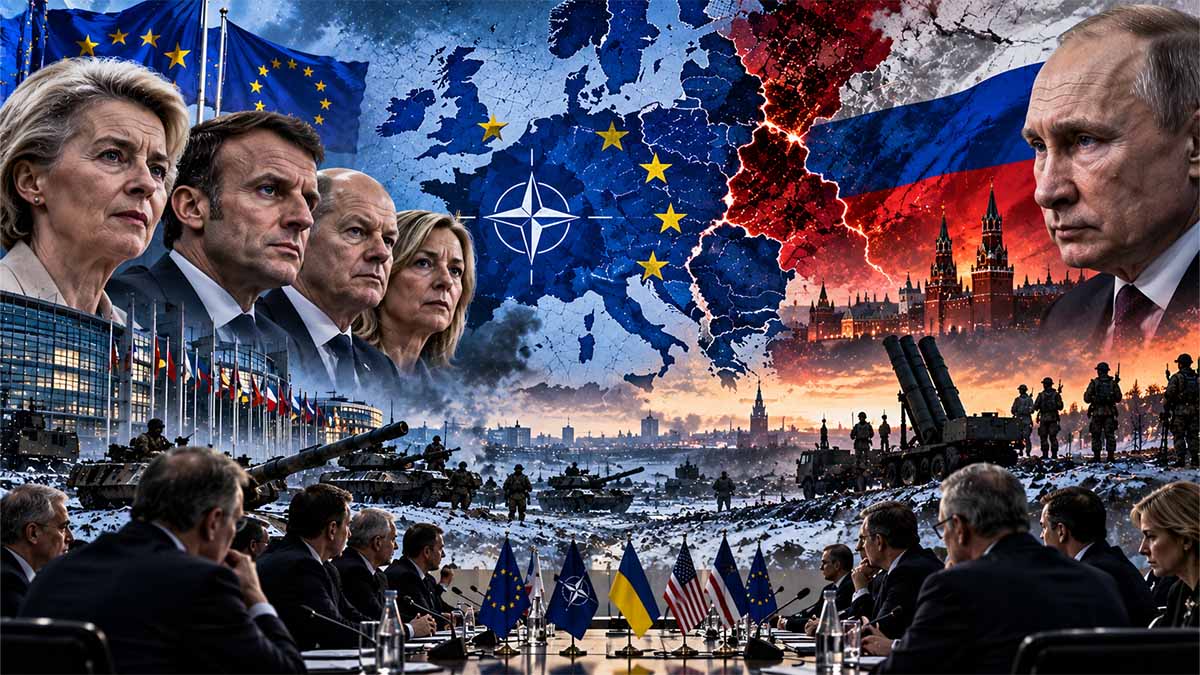
The European security order faces a contradiction that Moscow can exploit without winning a decisive military victory in Ukraine. On 27 October 2026, Finnish President Alexander Stubb and Norwegian Prime Minister Jonas Gahr Støre spoke directly with Russian President Vladimir Putin for approximately 90 minutes, while Denmark and Sweden questioned the lack of prior coordination. The conversation did not produce verified Russian concessions or undermine NATO’s formal commitments. It nevertheless exposed a structural weakness: European governments are increasingly integrated militarily but remain divided over who may negotiate their security, under what mandate and with whose consent. Washington controls the central mediation channel, Ukraine retains sovereign authority over its settlement, and European states possess much of the money, military capacity and sanctions authority required to implement an agreement. The danger is not an immediate European rupture, but a settlement whose diplomatic promises exceed the political and institutional authority behind them.
Oslo exposed the gap between consultation and negotiating authority
The diplomatic sequence began before the controversial telephone conversation. On 20 October, Ukrainian President Volodymyr Zelenskyy requested consultations in Oslo involving Stubb, Støre and representatives of US President Donald Trump’s administration. American envoy Steve Witkoff attended in person, while Jared Kushner participated remotely. The discussions addressed Ukrainian security, territorial questions and a postwar prosperity framework. National security advisers from Italy, Germany and the United Kingdom, together with representatives of the European Union and NATO, subsequently joined the working dinner. The following day, Witkoff’s contact with Putin established the direct American–Russian connection preceding the Nordic initiative.
This sequence matters because Finland and Norway were not conducting an entirely disconnected diplomatic experiment. Their engagement developed within a process requested by Kyiv and involving Washington and selected European representatives. Yet participation in the Oslo consultations did not confer a collective European mandate for the subsequent call. Stubb and Støre explicitly stated that they were acting as national leaders rather than representatives of Europe. Zelenskyy subsequently acknowledged receiving a detailed briefing and welcomed their diplomatic support, particularly concerning de-escalation and attacks against Ukrainian energy infrastructure.
The distinction between participation, consultation and authorisation is the central institutional problem. A government may be informed of a negotiating initiative without endorsing it. An envoy may communicate political possibilities without possessing authority to make binding commitments. A national leader may speak directly with Moscow without being entitled to negotiate EU sanctions or NATO security arrangements. These are not procedural technicalities. They determine whether an agreement can ultimately be implemented.
The Norwegian government’s account of the Oslo consultations confirms the broader diplomatic participation, while the Finnish Presidency’s statement of 27 October establishes the national character of the direct Russian contact.
The Nordic disagreement reveals competing definitions of security
Denmark’s Prime Minister Mette Frederiksen criticised the initiative for proceeding without broader Nordic coordination and questioned its usefulness while Russian military operations continued. Sweden’s Prime Minister Ulf Kristersson expressed similar reservations but acknowledged that contact could be valuable if it contributed to a settlement acceptable to Ukraine. Their objections did not amount to a withdrawal of support for Finland or Norway. They revealed two different theories of diplomatic effectiveness: one prioritising direct communication with a neighbouring military power, the other preserving collective leverage by restricting uncoordinated political initiatives.
Geography explains part of the difference. Finland shares approximately 1,340 kilometres of frontier with Russia, while Norway’s northern maritime environment connects it to the Barents region and the strategic approaches to the North Atlantic. Both countries must consider how a cessation of hostilities in Ukraine could affect future Russian force deployments and regional stability. Denmark and Sweden confront related security concerns but assign greater weight to the political consequences of separate diplomatic channels.
The disagreement is especially consequential because Nordic military integration has advanced substantially. Finland entered NATO on 4 April 2023, followed by Sweden on 7 March 2024. By December 2025, NATO had reorganised northern command responsibilities, placing Denmark, Finland and Sweden within the operational area of Joint Force Command Norfolk alongside Norway, Iceland and the United Kingdom. Arctic Sentry, launched in February 2026, subsequently expanded coordination of allied activities across the High North. In June, NATO established Forward Land Forces Finland, its ninth multinational forward land battlegroup, with Sweden serving as framework nation.
The paradox is clear. States that increasingly depend on integrated surveillance, reinforcement, military mobility and command arrangements have not developed an equally integrated approach to politically sensitive negotiations. This does not make national diplomacy illegitimate. It makes inadequate consultation more consequential.
The institutional transformation is documented in NATO’s Arctic Security assessment and its Eastern-Flank defence framework.
Europe’s financial commitments contradict the narrative of capitulation
The claim that Putin has already frightened Europe into abandoning Ukraine is not supported by the institutional decisions taken immediately before the Nordic call. On 12 October, the Council of the European Union adopted restrictive measures targeting 1,569 individuals and entities connected to Russia’s military-industrial system, comprising 826 companies and 743 corporate executives. The affected industrial ecosystem was associated with annual turnover of at least €20 billion and more than 250,000 employees. The restrictions targeted activities involving semiconductors, electronics, communications, ammunition, missile systems, navigation and other components relevant to military production.
Four days before the Nordic conversation, on 26 October, the Council adopted €4.9 billion in European Peace Facility decisions. Approximately €4.7 billion concerned reimbursement for military assistance already delivered, while €230 million provided additional financing for EUMAM Ukraine, the EU Military Assistance Mission. These decisions implemented part of a broader €6.6 billion political agreement reached on 25 September, including provision for €1 billion in new military assistance and additional training support.
The Council reported cumulative European Peace Facility support of €10.8 billion, alongside €3.5 billion in extraordinary revenues from immobilised Russian assets channelled through the facility. More than €1.5 billion in military equipment had been procured directly from Ukrainian defence industry. These figures describe different accounting categories and periods; they cannot simply be added together. Reimbursement also cannot be equated with fresh weapons deliveries.
Their political significance is nevertheless substantial. European institutions were continuing to authorise assistance, reimburse national contributions, finance training and restrict Russia’s industrial supply chains while political leaders debated the utility of speaking directly with Putin. Those actions contradict the proposition that diplomatic differentiation already amounts to strategic surrender.
The 12 October military-industrial sanctions decision and the 26 October European Peace Facility decisions establish the distinction between political rhetoric, financial authorisation and operational implementation.
Moscow’s leverage depends on making European commitments incompatible
Russian nuclear signalling, attritional warfare, infrastructure attacks and hybrid activity are intended to impose costs and influence adversaries’ decisions. Their effectiveness, however, cannot be measured by the existence of European anxiety. Responsible governments must assess escalation risks independently of Moscow’s attempts to manipulate those risks. The meaningful evidence of successful coercion would be unilateral concessions, restrictions on assistance attributable to Russian threats, acceptance of territorial arrangements without Ukrainian authority, or the weakening of agreed security commitments without reciprocal Russian action.
The October record points to a more limited conclusion. Putin has created an environment in which European governments must continually weigh military risk against fiscal costs, industrial capacity and political endurance. Yet NATO has continued strengthening its regional posture, while the EU has maintained sanctions and assistance. On 8 October, the Council extended until October 2027 its separate restrictive-measures framework addressing Russian destabilising activities, covering 80 individuals and 20 entities. The continuation of this instrument shows that European institutions recognise coercion beyond the conventional battlefield, including foreign information manipulation and interference.
Moscow’s greater potential advantage lies in exploiting differences among its adversaries rather than necessarily compelling their immediate retreat. If Washington seeks rapid de-escalation, Ukraine insists on enforceable guarantees, frontline European states prioritise deterrence, and economically exposed governments favour earlier normalisation, Russia can attempt to negotiate against those competing priorities. The advantage becomes material when governments translate different preferences into incompatible commitments.
A ceasefire without credible monitoring could reduce visible violence while leaving significant military risks unresolved. Sanctions relief granted before verified implementation could weaken bargaining leverage. Security guarantees announced without the authorisation and capabilities of prospective guarantors could generate promises that collapse when tested. The Kremlin need not obtain every concession directly from Kyiv if the governments supporting Ukraine begin undermining one another’s negotiating conditions.
The Council’s October decision on Russian destabilising activities documents the continuing European response to this broader category of pressure.
Poland’s constitutional crisis adds a different vulnerability
Poland’s confrontation of 30–31 October between President Karol Nawrocki and Prime Minister Donald Tusk presents a separate challenge to European resilience. Nawrocki alleged that actions concerning the Constitutional Tribunal violated the constitutional order and demanded the withdrawal of government-directed security personnel. Tusk defended governmental action as necessary to restore legality and public order. Their positions reflected a continuing dispute over judicial legitimacy, appointments and institutional authority.
Nothing in the available official record establishes that Russia directed this confrontation or that Warsaw has abandoned its commitments to Ukraine. Presenting the crisis as evidence of a Polish realignment toward Moscow would confuse domestic institutional conflict with foreign-policy change.
Its strategic relevance is nonetheless concrete. Poland borders Ukraine, Belarus and Russia’s Kaliningrad exclave and occupies a critical position in NATO’s eastern reinforcement geography. Its transport, communications, military logistics and civilian infrastructure connect the Baltic region with continental Europe and the Ukrainian support network. A prolonged conflict between constitutional authorities could weaken the speed and consistency of decisions concerning defence expenditure, appointments, emergency measures and allied cooperation, even if existing military arrangements continue functioning.
The distinction between political turmoil and operational impairment is decisive. The Polish crisis becomes a direct NATO vulnerability when it demonstrably obstructs lawful defence decisions or essential alliance functions, not merely when political leaders issue opposing statements.
The competing positions are recorded in the Polish President’s statement of 31 October and the Prime Minister’s governmental address.
An American-negotiated peace cannot automatically become a European commitment
The prospective Abu Dhabi negotiations expose the central weakness of Europe’s diplomatic architecture. Washington can mediate between Moscow and Kyiv, but cannot independently alter EU sanctions, dispose of Ukrainian sovereign territory or bind individual European governments to military guarantees. The same limitation applies to national European leaders pursuing direct contacts with Russia.
The European Council and Council exercise authority under the applicable Common Foreign and Security Policy procedures, while the High Representative supports coordination and representation of agreed positions. NATO operates under a separate treaty framework, and national governments retain constitutional responsibilities over their own armed forces and international commitments. Article 5 of the North Atlantic Treaty cannot be extended automatically through an informal political understanding negotiated outside the Alliance.
This distribution of authority becomes a practical obstacle when negotiations move from political statements to territorial arrangements, sanctions conditionality, military deployments and reconstruction finance. France has an interest in preserving European diplomatic agency; Germany must assess the financial and industrial sustainability of commitments; Italy must protect its access to Washington and its role in reconstruction and security decisions; and the United Kingdom must remain influential over European defence despite operating outside EU institutions.
The proposed €90 billion Ukraine support loan for 2026–2027, referenced in the European Council’s October conclusions, further illustrates the scale of the commitments potentially affected by a settlement. A negotiating process that excludes governments expected to approve, finance and implement major obligations may produce an agreement whose political appeal exceeds its institutional viability.
The answer is not necessarily a prohibition on national diplomatic contacts. It is a defined European negotiating interface establishing consultation requirements, reporting obligations and clear limits on who may promise what. Exploratory communication can remain national; binding commitments concerning EU sanctions, NATO-related military arrangements or Ukrainian sovereignty must remain with the competent authorities.
The governing framework is established by the Treaty on European Union, the North Atlantic Treaty and the European Council conclusions of 16 October 2026.
The next 24 months will price Europe’s inability to negotiate collectively
Between November 2026 and the end of 2028, Europe faces three plausible outcomes: national diplomatic initiatives are reintegrated into an agreed consultation process; selected governments maintain parallel channels while EU and NATO commitments remain coherent; or diplomatic differentiation gradually produces incompatible substantive policies. The third outcome would impose the greatest costs, not because European institutions would necessarily collapse, but because Russia could exploit inconsistent negotiating conditions while military, fiscal and industrial responsibilities remained distributed among governments unable to exercise equivalent influence over the settlement.
Ukraine would bear the immediate security cost through weaker negotiating leverage and uncertain guarantees. Poland, Finland, the Baltic states and Norway would face the consequences of unresolved Russian military capabilities and regional instability. Italy, France, Germany and the United Kingdom could confront obligations negotiated without adequate participation in defining their legal, financial or operational scope. European taxpayers and defence industries would bear the longer-term burden of maintaining readiness, replenishing capabilities and financing security arrangements whose political conditions had not been properly established.
The 27 October call did not prove that Europe was breaking apart. It revealed a more dangerous institutional imbalance: Europe possesses increasingly integrated military instruments and substantial financial commitments, but still lacks a sufficiently disciplined negotiating structure to ensure that its security obligations are shaped by the governments expected to fulfil them.
Moscow’s opportunity is to exploit that imbalance. Europe’s cost of inaction will be measured not in the number of conversations held with Putin, but in the commitments made without authority, the guarantees issued without capacity and the economic resources consumed by a settlement that fails to establish durable security.
Navigational Index
Pillar I — The Diplomatic Fracture: Evidence, Geography and Political Authority
Chapter 1. The Helsinki Call and the Oslo–St Petersburg–Abu Dhabi Diplomatic Sequence
Reconstruction of 20–27 October events, official accounts, negotiating messages, the Kremlin’s interpretation and the distinction between contact and concession.
Chapter 2. The Nordic Divide: Finland and Norway versus Denmark and Sweden
Prior consultation, differing national assessments of diplomatic utility, Baltic Sea security, the High North and the operational implications of NATO’s enlarged Nordic membership.
Chapter 3. Europe’s Differentiated Responses: Warsaw, the Baltic States and the Major Powers
Poland’s constitutional confrontation, the eastern flank, Italy’s strategic options, French and German diplomatic traditions, British defence commitments and the incentives for parallel engagement with Moscow.
Pillar II — Russia’s Strategic Leverage and the Contest over European Security
Chapter 4. Russian Coercive Diplomacy and the Strategic Psychology of European Decision-Making
Nuclear signalling, attritional warfare, escalation management, hybrid pressure, information operations and the mechanisms through which fear can affect democratic decision-making.
Chapter 5. Washington, Moscow and Kyiv: The Negotiating Architecture
The Trump administration’s mediation, Witkoff and Kushner, Ukraine’s negotiating authority, Abu Dhabi, territorial questions, ceasefire sequencing and the distribution of diplomatic leverage.
Chapter 6. NATO Solidarity and European Institutional Authority
EU foreign-policy competences, the High Representative, NATO consultation, national sovereignty, sanctions, military assistance and the consequences of competing diplomatic mandates.
Pillar III — Strategic Trajectories, European Resilience and Policy Decisions
Chapter 7. Poland, the Baltic and the High North: The Operational Geography of European Exposure
Domestic political resilience, military preparedness, maritime security, critical infrastructure, northern access routes and the relationship between domestic stability and deterrence.
Chapter 8. The Three European Trajectories through Early 2027
Re-coordination, sustained dual-track diplomacy and progressive fragmentation; trigger conditions, Ukrainian leverage, NATO risks and institutional safeguards.
Chapter 9. Strategic Policy Options and the Ninety-Day Warning Framework
Negotiating formats, consultation protocols, national policy choices, de-escalation verification, sanctions conditionality, monitoring indicators and decision thresholds.
Chapter 10. Final Net Assessment: Has Moscow Changed Europe’s Strategic Calculus?
Evaluation of Russian psychological leverage, the durability of transatlantic commitments, the possibility of a European negotiating architecture and the distinction between tactical disunity and structural fracture.
Master Abstract
The emerging European paradox: substantial strategic agreement without a common diplomatic instrument
Europe’s present difficulty is more specific than a general breakdown of political unity. The available evidence reveals a growing separation between governments’ willingness to support Ukraine militarily and economically, their assessments of Russia’s readiness to negotiate, and their preferred mechanisms for engaging the Kremlin. On 27 October 2026, the Finnish and Norwegian leaders initiated a direct conversation with Vladimir Putin lasting approximately 90 minutes, according to the contemporary account given by Norwegian and Finnish officials. They acted after discussions in Oslo involving Ukrainian President Volodymyr Zelenskyy and American representatives, and presented their initiative as an effort to transmit messages about forthcoming negotiations and regional security. They expressly disclaimed any mandate to represent Europe collectively. Both governments reaffirmed continued support for Ukraine. The Ukrainian presidency subsequently confirmed that Zelenskyy had received a detailed briefing and welcomed the leaders’ diplomatic support. These facts establish that direct engagement with Moscow and continued alignment with Kyiv are not inherently contradictory. They do not establish that such engagement was coordinated across the wider alliance. President Stubb and Prime Minister Støre Held a Phone Call with President Putin — Office of the President of Finland — Oct 2026 president.gov.ua
The most important political distinction concerns consultation rather than communication. Denmark’s Prime Minister Mette Frederiksen criticised the initiative for proceeding without broader Nordic coordination and questioned its potential usefulness while Russian military operations continued. Sweden’s Prime Minister Ulf Kristersson expressed scepticism but left open the possibility that direct contact might be valuable if it contributed to a settlement on acceptable terms for Ukraine. These responses are not equivalent to a repudiation of Finland or Norway as strategic partners. They do, however, reveal a genuine disagreement about whether a European state can use its proximity to Russia to justify an independent negotiating channel when the consequences of any agreement would extend beyond its borders. A national conversation acquires collective importance when it addresses territorial settlements, sanctions, maritime security, alliance deployments or future security guarantees. The problem is therefore not simply who is authorised to telephone Moscow, but who is empowered to make commitments, interpret assurances and ensure that third parties understand what has been communicated. Euronews+1
Why Moscow gains opportunities from diplomatic differentiation
Russian diplomatic advantage should not be confused with Russian diplomatic success. The Kremlin’s account of the 27 October conversation referred to the resumption of trilateral Russian–Ukrainian–American negotiations, repeated Moscow’s demand that its security interests be taken into account and criticised the policies of the EU and NATO. The Russian position publicly attributed to Putin did not reveal a concession on Ukrainian sovereignty, territorial control or the conditions of a lasting settlement. Indeed, the contrast between the Nordic objective of reducing hostilities and Moscow’s continued insistence on its own fundamental demands provides a strong reason to resist interpreting the call itself as evidence of a peace breakthrough. The potential gain for Moscow is more indirect: it can test whether different European governments attach different importance to immediate de-escalation, territorial outcomes, sanctions relief, military guarantees and relations with Washington. If those preferences become negotiable through separate channels, Russia’s ability to influence the eventual settlement increases without a corresponding requirement to change its battlefield objectives. Anadolu Ajansı E5 Defence Ministers’ Meeting: Press Conference by High Representative Kaja Kallas — EEAS — Oct 2026
The central question of psychological warfare is whether military pressure and escalation threats have altered European governments’ choices beyond what can be explained by legitimate diplomatic objectives and national exposure. The available record supports a narrower conclusion than the proposition that Putin has frightened Europe into submission. European governments do face prolonged military, economic and domestic pressures; several have incentives to prevent a wider confrontation and avoid an indefinite war. Yet caution is not equivalent to capitulation, just as diplomatic contact is not necessarily evidence of intimidation. The meaningful indicators of successful Russian coercion would be observable changes in policy: unilateral sanctions relaxation, restrictions on assistance to Ukraine justified principally by escalation fears, recognition of territorial acquisition by force, abandonment of agreed security commitments, or acceptance of Russian vetoes over European defence arrangements. The telephone call has not established any of those outcomes. The risk lies in a cumulative political process through which expectations of Russian escalation gradually influence European negotiating positions without formal policy decisions acknowledging the change.
Poland changes the risk calculus without demonstrating a pro-Russian realignment
The political crisis in Poland is a particularly important test of the distinction between domestic fragmentation and geopolitical realignment. On 31 October, President Karol Nawrocki publicly alleged that the constitutional order had been violated and that the Constitutional Tribunal had been taken over by force. He called for the withdrawal of government-deployed security forces and urgent political consultations. The confrontation followed a dispute over the Tribunal’s leadership and the suspension of its president, Bogdan Święczkowski, amid longstanding disagreement over judicial appointments and constitutional legitimacy. The presidential statement establishes the seriousness of the institutional confrontation, but its allegations remain the position of one side in a disputed constitutional process. The crisis must not be presented as evidence of Russian direction or as a demonstrated change in Poland’s support for Ukraine. Only two weeks earlier, Prime Minister Donald Tusk had publicly emphasised continued European support for Ukraine and pressure on Moscow. The strategic question is instead whether institutional paralysis, political polarisation and conflicting constitutional authorities impair Warsaw’s capacity to sustain a coherent position in European and transatlantic decision-making. Statement by President Karol Nawrocki — Presidency of Poland — Oct 2026 Statement Following the European Council — Chancellery of the Prime Minister of Poland — Oct 2026
Poland’s location and strategic role make the domestic dispute relevant beyond its borders. A weakened or distracted Polish government would still operate within NATO, the EU and existing national defence structures, but might confront difficulties in sustaining interinstitutional coordination, developing common diplomatic positions and maintaining consistent communication with allies during a negotiation crisis. The distinction matters because Russian influence can benefit from political dysfunction even when no domestic actor intends to accommodate Moscow. An inability to act coherently can create delays, uncertainty or contradictory signals independently of any explicit geopolitical change. At the same time, the continuing institutional and alliance commitments of Poland provide important constraints against a sudden reversal. The present evidence therefore justifies treating the constitutional confrontation as a material vulnerability in European crisis management, not as another confirmed step in a coordinated continental movement toward Russia.
American mediation exposes Europe’s unresolved problem of representation
The emerging negotiating structure places Washington at the centre of contacts that will influence the security of European states without necessarily placing those states at the centre of the formal talks. On 20 October, the Norwegian government announced that American representatives Steve Witkoff and Jared Kushner would participate in discussions in Oslo alongside the Finnish, Norwegian and Ukrainian leaders. Witkoff participated in person, while Kushner joined remotely. Witkoff’s subsequent contact with Putin on 21 October established the immediate American–Russian connection preceding the Nordic call. The anticipated Abu Dhabi technical meetings are intended to bring together Russian, Ukrainian and American representatives. Helsinki and Oslo’s intervention is best understood as an attempt to insert European security concerns into that process rather than as a documented effort to displace Washington. Nevertheless, an important structural problem remains: states expected to finance Ukrainian resilience, maintain sanctions, reinforce NATO’s eastern flank and contribute to any postwar guarantees need influence over agreements that could determine the requirements imposed upon them. Witkoff and Kushner to Take Part in Meetings in Oslo — Office of the Norwegian Prime Minister — Oct 2026 ukrinform.net
Italy, France, Germany and the United Kingdom face different incentives within this emerging structure. Rome has reasons to preserve access to Washington, participate in European decisions and avoid marginalisation in negotiations affecting sanctions, reconstruction and Mediterranean security. Paris has a strategic interest in European diplomatic agency and in preventing a settlement framework determined entirely outside European institutions. Berlin must reconcile European economic and military commitments with the political and fiscal costs of prolonged support, while London, outside the EU but central to NATO and European security cooperation, has strong reasons to remain influential over deterrence and any future guarantee arrangements. These differences do not establish that the four governments are pursuing incompatible settlements. They establish why a negotiated architecture that gives them no defined consultative role could encourage separate diplomatic initiatives. The challenge for European institutions is to convert the existing convergence over Ukraine’s sovereignty and regional security into an operational method for influencing negotiations, without creating competing European delegations or undermining Ukraine’s direct negotiating authority.
Three pathways, one decisive institutional test
The developments of late October support three plausible trajectories through early 2027. The first is a contained tactical divergence followed by re-coordination, in which Finnish and Norwegian communications are integrated into wider consultation procedures and European leaders reaffirm common negotiating conditions. The second is a sustained dual-track structure, with selected national governments maintaining limited direct contact with Moscow while Brussels concentrates on sanctions, financing and support for Ukraine. This could improve the flow of information but would require precise controls over mandates and messaging. The third is progressive fragmentation, in which different states begin negotiating or signalling distinct positions concerning ceasefires, territorial questions, economic restrictions or security guarantees. That outcome would materially weaken the credibility of European commitments and could reduce Ukraine’s ability to negotiate against a coherent opposing position. The available evidence does not justify assigning statistical probabilities to these pathways. Their relative plausibility will depend on the outcome of Abu Dhabi, the extent of subsequent intra-European consultation, American engagement and the continuation or modification of Russian military operations.
The governing assessment is that European cohesion should be measured through decisions and capabilities, not through the appearance of unanimity in diplomatic procedure. The European Council’s conclusions of 15–16 October and the High Representative’s public remarks on 26 October show continued institutional support for Ukraine and pressure on Russia. The Nordic initiative exposes a coordination problem within that framework, but it has not yet replaced the framework itself. The strategic threshold will be crossed if national diplomatic channels begin producing substantive commitments incompatible with collective decisions, if essential security guarantees are negotiated without their prospective European guarantors, or if domestic political crises impair the implementation of agreed policies. Until then, the most defensible interpretation is that Europe is experiencing a potentially consequential contest over diplomatic leadership under conditions of Russian military pressure and American negotiating predominance—not a verified collapse of its collective security architecture. European Council Conclusions, 15–16 October 2026 — European Council — Oct 2026 E5 Defence Ministers’ Meeting: Press Conference by High Representative Kaja Kallas — EEAS — Oct 2026
Key Evidence Table — Diplomatic, Institutional and Financial Baseline
The documentary record permits a distinction between confirmed diplomatic events, public financial commitments, institutional disputes and unresolved negotiating outcomes. The following values should not be interpreted as comparable measures of military effectiveness or political influence.
| Indicator | Value or established status | Reference date | Definition and analytical significance | Issuer and exact source |
|---|---|---|---|---|
| Oslo diplomatic meeting | Finland, Norway, Ukraine and US representatives | 20 October 2026 | Witkoff attended in person; Kushner remotely. Ukraine requested American participation. | Norwegian Government — Oct 2026 |
| Witkoff–Putin contact | Meeting in St Petersburg | 21 October 2026 | American–Russian contact preceding the Nordic initiative; not proof of Russian concessions. | Kremlin account reported by Anadolu Ajansı |
| Stubb–Støre–Putin contact | Approximately 90 minutes | 27 October 2026 | Direct national initiative, coordinated with Kyiv but not undertaken on behalf of Europe. | Finnish Presidency — Oct 2026 |
| Ukrainian diplomatic response | Detailed post-call briefing acknowledged | 27 October 2026 | Kyiv welcomed diplomatic support and called for de-escalation affecting energy infrastructure. | Ukrainian Presidency — Oct 2026 |
| Abu Dhabi negotiations | Trilateral technical format proposed for first half of November | As of 1 November 2026 | Russia–Ukraine–US format; implementation and substantive outcomes not established. | Kremlin account Anadolu Ajansı |
| EU European Peace Facility decisions | €4.9 billion | 26 October 2026 | Eight Council decisions: €4.7bn reimbursement relating to previously delivered military assistance and €230m additional EUMAM financing; not €4.9bn of newly delivered weapons. | Council of the EU — Oct 2026 |
| Broader EPF mobilisation agreement | €6.6 billion | 25 September 2026 | Political agreement, including €1bn in new military assistance and reinforcement of training in 2027; distinct from October implementing decisions. | Council of the EU — Oct 2026 |
| Cumulative EPF support figure | €10.8 billion | Reported 26 October 2026 | Council-stated cumulative support under the facility, including approximately €9.9bn reimbursement component and €950m training component, using published rounded totals. | Council of the EU — Oct 2026 |
| Extraordinary revenues from immobilised Russian assets | €3.5 billion channelled through EPF | As reported 26 October 2026 | Support for ammunition, air defence and drones; more than €1.5bn in equipment procured directly from Ukrainian defence industry. | Council of the EU — Oct 2026 |
| Poland’s constitutional confrontation | Disputed authority over Constitutional Tribunal | 30–31 October 2026 | Domestic institutional crisis; no established causal link to Russian direction. | Presidency of Poland — Oct 2026 |
The EU financing decisions are especially material to the question of fragmentation. They were adopted one day before the Nordic call and demonstrate continuing collective implementation capacity rather than a merely declaratory commitment. Their reimbursement component must, however, be distinguished from new battlefield deliveries. This distinction prevents an exaggerated assessment of their immediate operational effect.
European Position and Coordination Matrix
| Actor | Stated or documented position | Prior consultation | Strategic rationale | Risk to collective voice |
|---|---|---|---|---|
| Finland | Direct contact necessary; continued support for Ukraine | Consultation with Kyiv confirmed; wider consultation incomplete in public record | Russian border, Baltic security, settlement implications | Medium |
| Norway | Direct dialogue to support de-escalation and negotiations | Consultation with Kyiv confirmed; Danish and Swedish objections indicate incomplete Nordic consultation | High North, maritime security, European voice in US-led diplomacy | Medium |
| Ukraine | Welcomed initiative and subsequent briefing | Confirmed | Preserve negotiating agency, secure de-escalation and guarantees | Low if Kyiv remains fully consulted |
| Denmark | Strong scepticism of independent outreach | Prime minister reported no advance coordination | European political unity, Russian military behaviour | Medium-high if disputes persist |
| Sweden | Conditional acceptance of useful talks; concern about division | Prime minister reported not being informed beforehand | Ukraine-centred settlement and alliance messaging | Medium |
| Poland | Government maintains support for Ukraine; separate constitutional confrontation | No established Nordic-call consultation record | Eastern-flank deterrence and domestic institutional continuity | Potentially high if constitutional crisis affects policy implementation |
| EU institutions | Continued assistance, sanctions and negotiating pressure | Specific pre-call institutional role not established | Common Foreign and Security Policy credibility | Medium-high |
| United States | Leading trilateral mediation | Direct Oslo involvement confirmed | Negotiating leverage and diplomatic control | Depends on European inclusion |
| Russia | Continued insistence on Russian security demands | Responded to Nordic initiative | Negotiating leverage and possible differentiation of allied positions | High potential for exploitation |
Analytical risk categories are qualitative judgments, not numerical scores. They concern possible effects on coordinated diplomacy, not the probability that any state will abandon NATO or Ukraine. Danish and Swedish reactions are documented in contemporaneous named-official reporting; the completeness of private consultation remains unresolved. Euronews+1
Competing Explanations — What the Evidence Supports
Three hypotheses are sufficiently distinct to test against future developments, although their mechanisms may overlap.
| Hypothesis | Diagnostic support | Evidence against a stronger interpretation | Principal confirming indicators | Current standing |
|---|---|---|---|---|
| H1 — Tactical diplomatic adaptation | Direct contact follows joint discussions with Kyiv and Washington; Ukraine explicitly consulted | Nordic allies objected to lack of advance coordination | Unified post-Abu Dhabi briefing, no competing commitments | Best supported; medium-high confidence |
| H2 — Emerging decentralised European diplomacy | National leaders act without a formal common European mandate; differences publicly visible | Continued EU financial and political action; no identified break in common Ukraine objectives | Repeated national contacts with Moscow, separate negotiating proposals | Plausible; medium confidence |
| H3 — Russian coercion producing strategic European fragmentation | Prolonged war, exposure to escalation, Russian ability to exploit competing diplomatic preferences | No demonstrated Nordic concessions; EU continues implementing assistance and pressure | Sanctions divergence, reduced Ukrainian support, unilateral territorial or security concessions | Not established; low confidence as a description of the present outcome |
The principal analytical discriminator is whether independent diplomatic methods begin to produce independently negotiated substantive commitments. The continuation of telephone contacts alone would not establish that threshold. Conversely, coordinated public declarations would not negate fragmentation if actual financing, sanctions, military assistance or security guarantees subsequently diverged.
Principal Gaps and Ninety-Day Watch Indicators
The immediate monitoring period runs from 1 November 2026 through 29 January 2027.
| Indicator | Development to monitor | Strategic interpretation |
|---|---|---|
| Abu Dhabi meetings | Attendance, confirmed agenda, joint statements, implementation mechanisms | Determines whether diplomatic activity becomes substantive negotiation |
| Russian negotiating position | Observable changes on ceasefires, territorial demands, energy infrastructure and security guarantees | Tests Moscow’s willingness to make concessions |
| Finnish–Norwegian follow-up | Additional contacts, advance consultation procedures, reporting to partners | Distinguishes controlled diplomacy from parallel negotiating structures |
| Denmark and Sweden | Public re-coordination or continued objections | Tests whether Nordic disagreement remains tactical |
| European institutions | Formal mandate, designated representative or structured consultation procedure | Measures whether Brussels can convert collective policy into negotiating influence |
| Poland | Constitutional Tribunal decisions, presidential–government consultations, military and foreign-policy continuity | Tests whether domestic conflict affects eastern-flank policy implementation |
| Italy, France, Germany and UK | Additional Kremlin channels, joint negotiating statements, changes in security guarantee commitments | Measures differentiation among the principal European powers |
| NATO | Alliance consultations, force posture decisions and Baltic/High North incident management | Tests whether diplomatic disputes affect practical deterrence |
| European assistance | Adopted funding decisions, actual disbursements, training activity and deliveries | Tests whether political disagreement translates into reduced material support |
| Russian coercive signalling | Official escalation threats and their identifiable effects on European policy decisions | Tests the psychological-warfare hypothesis |
These indicators should be assessed together. A new telephone conversation cannot independently demonstrate strategic fragmentation; a constitutional dispute cannot independently demonstrate a geopolitical realignment; and an increase in defence expenditure cannot independently prove that European negotiating positions remain coherent.
The most consequential unresolved records concern the distribution of private diplomatic readouts, the precise European consultation arrangements preceding 27 October, the substantive exchanges in the Putin conversation, the Russian instructions for Abu Dhabi and the terms under which European countries might be asked to provide postwar security guarantees. Public evidence currently establishes different national preferences and incomplete consultation, but does not disclose the full private diplomatic record.
No decision-useful visualisation is supportable from the verified record. The available observations do not establish comparable country-by-country coordination scores, defensible scenario probabilities or a complete set of negotiating relationships sufficient to justify a quantitative graphic.
The resulting strategic assessment is therefore conditional but consequential: European diplomatic coordination is under measurable strain, while the core structures of European military and financial support for Ukraine remain demonstrably active. The immediate danger is that Russia could exploit the former before European governments develop a negotiating architecture capable of preserving the latter.
EUROPE AT A DIPLOMATIC CROSSROADS
Russia, the Nordic initiative, American mediation and the institutional contest over Europe’s security architecture.
The European Security Network
Interactive relationship map. Select a node to examine its role; filter by diplomatic channel.
Washington leads the proposed trilateral mediation process. Helsinki and Oslo have established a separate direct contact with Moscow while retaining communication with Kyiv. European institutional and national positions remain differentiated.
Diagram is relational, not geographic. Curved paths and node proximity carry no quantitative significance. It does not imply that the EU or Poland was a party to the Nordic call.
The Diplomatic Sequence
Stubb, Støre, Zelenskyy and American representatives discuss diplomacy and Ukraine. Witkoff attends in person; Kushner participates remotely.
American–Russian diplomatic contact precedes the Nordic approach.
The Council adopts €4.9bn in EPF decisions, demonstrating continued collective implementation capacity.
Approximately 90-minute contact. The Nordic leaders maintain their support for Ukraine without claiming a collective European mandate.
Conflict over the Constitutional Tribunal intensifies. Its impact on alliance policy remains an uncertainty, not an established realignment.
A Russia–Ukraine–United States negotiating format is expected. No successful outcome is established.
Country and Institutional Position Matrix
Filter the analytical table. Consultation assessments describe the public evidence, not unknown private communications.
| Actor | Diplomatic position | Prior coordination | Security rationale | Collective voice risk |
|---|---|---|---|---|
| Finland | Direct engagement; support for Ukraine | Kyiv consulted; wider record incomplete | Russian border, Baltic security | Medium |
| Norway | Direct contact and de-escalation | Kyiv consulted; incomplete Nordic consultation | High North and maritime stability | Medium |
| Denmark | Critical of unilateral initiative | No advance consultation reported | Alliance messaging and support for Ukraine | Medium–high |
| Sweden | Sceptical; conditional openness to useful talks | No advance notification reported | Ukraine-centred settlement | Medium |
| Poland | Government supports Ukraine; constitutional crisis | Nordic-call consultation not established | Eastern-flank deterrence and institutional continuity | Potentially high |
| Italy | Potential interest in coordinated European engagement | Specific consultation unestablished | Transatlantic access, sanctions and reconstruction | Conditional |
| France | Analytical focus: European negotiating agency | Specific consultation unestablished | Strategic autonomy and security guarantees | Conditional |
| Germany | Analytical focus: coherence of commitments | Specific consultation unestablished | Military, economic and fiscal obligations | Conditional |
| United Kingdom | Analytical focus: influence over guarantees | Specific consultation unestablished | NATO deterrence and European security | Conditional |
“Conditional” signifies an analytical exposure dependent on future policy choices. It is not a reported government position or numerical risk estimate.
European Peace Facility: Financial Architecture
Amounts are euros, in billions. Bars show published absolute amounts on a common €11bn scale; they are not additive because the categories overlap or describe different accounting periods.
The €4.9bn October decisions comprise approximately €4.7bn in reimbursement and €230m in training financing. Cumulative, decision-period and funding-source figures must not be totalled as separate disbursements.
Source: Council of the EU, 26 October 2026. Bar widths are calculated as reported amount divided by €11bn.
Three Scenarios through Early 2027
Select a pathway to explore its causal mechanism, principal alliance risk and effective mitigation. These are conditional analytical scenarios, not simulated forecasts.
National diplomatic initiatives are progressively integrated into wider European and Ukrainian consultation. Differences over procedure remain manageable.
Incomplete reporting can generate misunderstandings even without divergent strategic objectives.
Formal pre-contact consultations, shared readouts and explicit limits on negotiating authority.
Selected European governments maintain direct channels while Brussels concentrates on sanctions, financing and institutional coordination.
Russia can compare messages and test the boundaries of individual national mandates.
Common briefing system, strict non-commitment rules, prior Ukrainian consultation and agreed European red lines.
Separate political channels begin generating incompatible substantive positions on ceasefires, sanctions, territorial questions or guarantees.
A negotiated settlement could create obligations not matched by coherent European commitments or implementation capacity.
European Council-level mandate, Ukrainian participation, NATO guarantee consultations and verifiable implementation conditions.
Ninety-Day Strategic Watch
Observation window: 1 November 2026 to 29 January 2027. Select indicators to view the implications for the central assessment.
Evaluate changes in diplomatic mandates and observable policy implementation, rather than treating political rhetoric alone as evidence of fragmentation.
From Diplomatic Activity to Institutional Control
European diplomatic procedures are under measurable strain, but continued EU military-financing decisions and support for Ukraine do not substantiate a collapse of the collective security architecture. The decisive future test is whether separate national contacts produce incompatible commitments.
Primary Documentary Record
| Institution | Document | Date | Relevant Evidence |
|---|---|---|---|
| Finnish Presidency | Stubb and Støre call with Putin | 27 Oct 2026 | Call, stated purpose and national framing |
| Norwegian Government | Witkoff and Kushner at Oslo meetings | Oct 2026 | American participation in diplomatic consultations |
| Ukrainian Presidency | Zelenskyy discussion with Stubb and Støre | Oct 2026 | Ukrainian briefing and diplomatic reaction |
| Council of the EU | European Peace Facility decisions | 26 Oct 2026 | Financial authorisations and assistance categories |
| European Council | European Council conclusions | 16 Oct 2026 | Collective institutional baseline |
| Polish Presidency | Statement by President Nawrocki | 31 Oct 2026 | Presidential position on the constitutional confrontation |
| EEAS | High Representative’s E5 remarks | 26 Oct 2026 | European security and defence coordination |
Source references correspond to the underlying assessment. Documentary assertions and future analytical scenarios are intentionally separated.
PILLAR I — THE DIPLOMATIC FRACTURE: EVIDENCE, GEOGRAPHY AND POLITICAL AUTHORITY
European Security and Strategic Intelligence Assessment | 1 November 2026
Chapter 1. The Helsinki Call and the Oslo–St Petersburg–Abu Dhabi Diplomatic Sequence
The re-emergence of direct European diplomacy with Moscow
The diplomatic events of 20–27 October 2026 mark a significant development in Europe’s management of the Russia–Ukraine war, not because they demonstrate an agreed peace settlement or a decisive alteration of Moscow’s strategic objectives, but because they expose the increasingly difficult relationship between American negotiating leadership, Ukrainian political sovereignty and the European states whose security arrangements will be affected by any eventual agreement. The telephone conversation initiated by Finnish President Alexander Stubb and Norwegian Prime Minister Jonas Gahr Støre with Russian President Vladimir Putin on 27 October was neither an isolated bilateral initiative nor a formally authorised European negotiating mission. It emerged from an identifiable sequence of consultations involving Kyiv and Washington, followed by direct engagement with the Kremlin, and generated immediate differences among Nordic governments over the legitimacy and effectiveness of diplomatic action undertaken without broader prior consultation. The evidence supports a judgment of meaningful procedural divergence within an otherwise continuing structure of support for Ukraine, rather than a confirmed rupture in the political foundations of European security cooperation.
The central institutional problem is the asymmetry between those participating directly in negotiations and those expected to implement their consequences. American representatives have a central position in the emerging trilateral negotiating arrangements, while Ukraine remains the indispensable sovereign party to any settlement. European governments, however, possess essential instruments of implementation: sanctions, military assistance, reconstruction finance, border security, defence deployments and potentially elements of future Ukrainian security guarantees. A settlement negotiated without adequate European participation could therefore create a politically complex distribution of authority in which Washington helps formulate commitments that individual European governments must subsequently finance, authorise or enforce. Finland and Norway appear to have recognised this discrepancy and sought to influence the diplomatic process before its negotiating parameters became consolidated. The available official documents establish the initiative’s connection with Ukraine and the United States; they do not establish that Helsinki and Oslo had received authority from other European capitals to negotiate on their behalf.
The geographical position of the two initiating states adds significance to their intervention. Finland shares a long land frontier with Russia, while Norway’s frontier and northern maritime environment connect it directly to the security of the Barents region and the High North. Both governments must assess the implications of an eventual cessation of hostilities in Ukraine for Russian force generation, military posture, maritime activity and the longer-term relationship between NATO and Moscow. These concerns cannot be reduced to general European preferences for peace or economic recovery. A settlement that reduces military operations in Ukraine without establishing a credible wider deterrence framework might allow Russia to redistribute military resources, regenerate formations and increase pressure elsewhere. Conversely, a settlement containing effective monitoring, enforceable security arrangements and credible consequences for renewed aggression could reduce immediate uncertainty. Direct communication may contribute to understanding Moscow’s intentions, but it does not by itself resolve this distinction.
The two governments expressed their own rationale explicitly. The joint statement released on 27 October said that they had initiated the contact to communicate messages concerning future negotiations and European regional stability. It further specified that they were acting as the leaders of Finland and Norway rather than as representatives of Europe collectively. The original Finnish-language release is particularly important because it characterises the purpose as transmitting Ukraine’s messages concerning the forthcoming Abu Dhabi negotiations directly to Putin. This formulation establishes a narrower and more politically consequential interpretation than the suggestion that the Nordic leaders were independently exploring concessions with Russia. It indicates that the initiative was presented to domestic and international audiences as an extension of consultations with Kyiv, although the precise content of the transmitted messages remains outside the public record. Sources: Finnish Presidency, Original Finnish-Language Statement — 27 October 2026 and Norwegian Government, Joint Telephone Call Statement — 27 October 2026.
The Oslo meeting of 20 October: a broader diplomatic configuration than a Nordic initiative
The starting point of the immediate diplomatic sequence was the meeting convened in Oslo on 20 October at the request of Ukrainian President Volodymyr Zelenskyy. The Norwegian government confirmed that Zelenskyy had asked Norway and Finland to organise consultations within the ongoing diplomatic process. Participants included Stubb, Støre and American special envoys Steve Witkoff and Jared Kushner, with Witkoff attending in Oslo and Kushner participating remotely from the United States. This configuration is strategically important because it demonstrates that the initial Norwegian–Finnish engagement was requested by Ukraine rather than independently developed as an alternative channel excluding Kyiv. It also establishes American participation before the subsequent contact with Putin, substantially weakening an interpretation of the entire sequence as an attempt to circumvent Washington. Ukrainian President Volodymyr Zelenskyy in Norway — Norwegian Government — 20 October 2026 and Witkoff and Kushner to Take Part in Meetings in Oslo — Norwegian Government — 20 October 2026.
The subjects discussed in Oslo were not restricted to the general aspiration for a ceasefire. The Norwegian government’s account identified Ukrainian security, a postwar prosperity plan and territorial questions as principal components of the talks. Each raises a distinct political and operational problem. Territorial questions concern sovereignty, the distinction between de facto control and internationally recognised title, ceasefire-line arrangements and the compatibility of any settlement with Ukraine’s constitutional and international legal position. Security guarantees concern the credibility of external assistance, response mechanisms following renewed Russian aggression, military capacity, monitoring arrangements and the allocation of risk among prospective guarantors. A prosperity framework concerns reconstruction finance, investment conditions, infrastructure recovery, economic integration and the relationship between territorial security and the capacity of private capital to return. These are interconnected negotiations rather than independent diplomatic subjects. A territorial arrangement without enforceable security mechanisms could leave investments vulnerable; economic promises without identifiable funding and legal authority could undermine the credibility of a settlement; and security guarantees without the consent and implementation capacity of the governments expected to provide them could remain politically declaratory.
A crucial detail in the official Norwegian account is that national security advisers from the United Kingdom, Germany, Italy, the European Union and NATO joined the Oslo discussions during a working dinner. This substantially changes the interpretation of the subsequent telephone conversation. It demonstrates the presence of a broader consultation mechanism during the preparatory process and establishes that major European capitals and institutions were not wholly excluded from the diplomatic environment in which Helsinki and Oslo operated. It does not prove that these advisers were informed in advance of the decision to telephone Putin on 27 October, still less that they explicitly authorised it. Nevertheless, it establishes an institutional link between the Nordic initiative and representatives of the principal European security actors, making a categorical description of the process as wholly detached from European coordination factually unsustainable. Discussions on the Path to Peace in Ukraine — Office of the Norwegian Prime Minister — 21 October 2026.
The role of these advisers is particularly relevant because the Oslo discussions brought together several categories of authority that do not automatically converge. Ukrainian representatives possessed sovereign authority over Ukraine’s negotiating positions, American representatives operated within the Trump administration’s mediation framework, national security advisers from European governments contributed to policy coordination, and representatives of the EU and NATO brought distinct institutional responsibilities. The presence of the latter did not transform the Oslo meeting into a formally mandated EU or NATO negotiation. Nor would the participation of a national security adviser necessarily mean that the represented government had approved all subsequent actions proposed by the other participants. Diplomatic processes frequently involve consultation over substantive negotiating possibilities before a decision is reached on who will communicate with the opposing party. The distinction between participating in a preparatory discussion, being informed of a subsequent contact and conferring authority to negotiate is consequently essential.
Verified diplomatic chronology and the changing distribution of authority
| Date | Confirmed development | Principal actors | Documented negotiating content | Institutional significance |
|---|---|---|---|---|
| 15–16 October 2026 | European Council adopts conclusions covering Ukraine and European security | EU heads of state or government | Continued collective position concerning Ukraine, peace and security guarantees | Existing European policy baseline |
| 20 October 2026 | Oslo consultations requested by Zelenskyy | Zelenskyy, Stubb, Støre, Witkoff, Kushner | Ukraine’s security, territorial issues, postwar prosperity | Establishes Ukraine-led and US-connected preparatory framework |
| 20 October 2026 | Expanded working dinner | National security advisers from UK, Germany, Italy, EU and NATO | Wider consultation within the diplomatic process | Demonstrates broader participation but not a mandate for the later call |
| 21 October 2026 | Norwegian publication of the Oslo readout | Norwegian Prime Minister’s Office | Diplomatic objectives and subjects discussed | Official documentary confirmation of the broader format |
| 21 October 2026 | Reported Witkoff–Putin contact | US representative and Russian president | Subsequent American–Russian discussion | Places Washington at the centre of direct mediation |
| 27 October 2026 | Finnish–Norwegian call initiated from Helsinki | Stubb, Støre, Putin | Ukraine negotiations, de-escalation, Baltic and High North stability | Direct national European contact with Moscow |
| 27 October 2026 | Ukrainian post-call consultation | Zelenskyy, Stubb, Støre | Briefing, energy infrastructure, forthcoming trilateral meeting | Confirms Ukrainian involvement in the diplomatic sequence |
| 27 October 2026 | Stubb addresses Nordic Council session | Finnish president and Nordic political representatives | Finnish interpretation of Putin’s position and alliance resolve | Public evidence that the conversation produced no reported Russian policy reversal |
| 27–28 October 2026 | National institutional briefing in Finland | Finnish president and governmental foreign-security committee | Discussion of the telephone call | Demonstrates domestic institutional follow-through |
| Early November 2026, anticipated | Proposed trilateral technical negotiations | Ukraine, United States, Russia | Negotiating details not yet established publicly | Future test of substantive progress |
The chronology is supported by the European Council Conclusions — 16 October 2026, the Norwegian Government’s Oslo Account — 21 October 2026, the Finnish Presidency’s Call Statement — 27 October 2026, the Ukrainian Presidency’s Post-Call Statement — 27 October 2026 and the Finnish Presidency’s Foreign and Security Policy Committee Report — 28 October 2026. The precise private discussion between Witkoff and Putin remains distinguishable from the publicly documented Nordic and Ukrainian statements.
What the Helsinki conversation established—and what it did not
The conversation was initiated from Helsinki, with both Nordic leaders participating in a telephone discussion with Putin. Its reported duration of approximately 90 minutes is consistent with contemporary public accounts, but duration should not be mistaken for negotiating depth or success. The official Finnish and Norwegian statements identify the principal purposes as transmitting messages concerning the forthcoming negotiations, encouraging the resumption of diplomatic efforts, supporting de-escalation and addressing the security interests of states neighbouring Russia. They specifically refer to stability and predictability in the Baltic Sea region and the High North. These references are operationally relevant because the security of those regions is affected by Russian military planning, maritime and air activity, northern infrastructure, and the broader distribution of NATO capabilities. However, the public statement does not identify a negotiated understanding on regional military activity, border incidents, maritime rules or mutual restraint measures.
The most revealing subsequent document is Stubb’s address to the Nordic Council on 27 October. In that speech, he explained that Putin’s positions had contained no surprises and emphasised that the purpose of the contact had been to communicate the Nordic governments’ messages as supporters of Ukraine and neighbours of Russia. He argued that the war could not be settled through military means alone, while insisting that continued Russian pressure would not exhaust European and Ukrainian resistance. This is a significant primary-source indication that the call had not produced a public change in Putin’s fundamental position. It also helps distinguish Stubb’s diplomatic theory from an accommodation strategy: the Finnish president was arguing that direct communication and sustained support for Ukraine could operate simultaneously, not that military and economic pressure should be abandoned in exchange for an opening to Moscow. Address by President Alexander Stubb at the Nordic Council Session — Finnish Presidency — 27 October 2026.
The Ukrainian presidency’s official account provides independent corroboration of the consultation sequence from Kyiv’s perspective. Zelenskyy stated that he had received a detailed briefing from Stubb and Støre after their conversation with Putin. The readout emphasised the importance of practical de-escalation, particularly concerning attacks on Ukrainian energy facilities and other infrastructure, and referred to preparations for the planned trilateral meeting involving Ukrainian, American and Russian teams. It also recognised the distinct security interests of Finland and Norway as Russia’s neighbours. These elements support a conclusion that Ukraine considered the initiative relevant to its own diplomatic efforts, rather than publicly treating it as a betrayal or unauthorised negotiation over Ukrainian sovereignty. Nevertheless, Ukraine’s public appreciation does not establish that every possible detail of the call had been agreed beforehand. The content of the prior consultations, their constraints and the degree of Ukrainian control over the exact message are not fully documented. Volodymyr Zelenskyy Spoke with Alexander Stubb and Jonas Gahr Støre — Ukrainian Presidency — 27 October 2026.
From Moscow’s perspective, the critical issue is not the number of European leaders willing to communicate but whether their messages create an opportunity to alter the negotiating balance. Russia has an incentive to distinguish between the United States as the principal diplomatic intermediary, Ukraine as the territorial and military opponent, and European states as financiers, sanctions authorities and potential security guarantors. If these actors present distinct priorities, Moscow can attempt to exploit the resulting differences without formally abandoning its original objectives. The Kremlin’s public position following the call continued to insist on Russian security interests and criticised European and NATO policies. The absence of an officially substantiated concession is therefore analytically decisive. It does not establish that private communications were entirely unproductive, but it prevents attributing an actual policy shift to the diplomatic initiative.
The operational meaning of direct contact and the limits of diplomatic success
Four distinct functions of diplomacy need to be separated to understand the potential value of the initiative. The first is message transmission, in which one side communicates a position directly to the other and limits the possibility that intermediaries selectively interpret or omit elements of that position. The second is information acquisition, in which the initiating governments assess the language, priorities and willingness of the opposing leader to discuss particular questions. The third is de-escalation management, which requires a more operationally specific understanding of actions that might reduce immediate risks, such as restraint affecting energy infrastructure, maritime incidents, prisoner exchanges or humanitarian access. The fourth is substantive bargaining, in which parties change positions, offer concessions, establish verification arrangements or accept binding obligations. The official evidence demonstrates message transmission and confirms an intention to support the negotiating process. It does not establish completed de-escalation measures or substantive bargaining outcomes.
This distinction matters because diplomatic contacts can generate political effects independently of their negotiating substance. The mere existence of a conversation with Putin can alter public perceptions of whether Moscow is being isolated, whether negotiations are advancing and whether European governments believe the war can be sustained. Such perceptions are strategically relevant to Russia’s information environment, but they can also support Ukrainian diplomacy by preventing Washington from exercising exclusive control over the messages reaching the Kremlin. It would therefore be analytically unsound to assume that visibility of contact always benefits Russia. The distribution of benefits depends on subsequent events: whether Russia offers reciprocal measures, whether Kyiv maintains agency, whether allied governments receive consistent reporting and whether the public presentation of the conversation creates expectations of concessions that the participants cannot deliver.
A further distinction concerns the relationship between confidence-building and strategic vulnerability. Limited contacts can reduce misunderstanding in a crisis, particularly between neighbouring nuclear and conventional military powers, but poorly coordinated contacts can also create incentives for selective assurances. An agreement concerning maritime incidents, for example, would need to specify the activities covered, geographic scope, reporting mechanisms, participating commands and procedures for alleged violations. A political statement expressing support for stability would not substitute for those measures. Likewise, a ceasefire affecting Ukrainian energy infrastructure would require definitions of protected facilities, monitoring methods, geographical coverage, procedures for investigating breaches and consequences for non-compliance. The official readouts do not disclose such arrangements. Their absence from the public record is not proof that none were discussed, but no operational achievement should be inferred from a general commitment to de-escalation.
Negotiating substance: the questions behind Abu Dhabi
The prospective Abu Dhabi process raises a more consequential strategic question than whether European leaders should speak with Putin: whether the negotiating format can translate broad political objectives into a sequence of verifiable obligations. A technically meaningful discussion would need to clarify the relationship among hostilities, territorial control, military positioning, humanitarian measures, sanctions, economic recovery and guarantees against renewed aggression. These issues have different legal authorities and implementation constraints. Ukraine cannot be represented by a third state in decisions concerning its sovereign territory without an appropriate Ukrainian mandate. The United States can offer mediation and commitments within its national authority, but cannot unilaterally bind EU institutions or individual European governments to sanctions changes, financing programmes or defence guarantees. European governments can influence implementation and security arrangements, but their authority to make collective commitments depends on national procedures and applicable EU or NATO decision-making requirements.
The Oslo meeting’s explicit inclusion of territorial questions, Ukrainian security and a prosperity plan indicates that negotiators were considering an integrated settlement framework rather than merely a temporary cessation of fighting. Yet the existence of those negotiating subjects does not establish agreement on their content. A discussion of territory could concern ceasefire geography without recognition of sovereignty, while a discussion of economic recovery could concern future financing rather than presently appropriated resources. Equally, a security guarantee could range from continued military assistance and intelligence cooperation to more demanding forms of external commitment. These arrangements differ fundamentally in cost, political credibility, constitutional authority and risk of direct confrontation with Russia. The diplomatic sequence will become strategically consequential when participating governments begin specifying which obligations they are prepared to undertake, on what timetable, under whose command or supervision, and subject to which verification and enforcement conditions.
| Negotiating dimension | Confirmed basis in the diplomatic record | Essential unresolved requirement | Principal authority | Failure mechanism |
|---|---|---|---|---|
| Cessation of hostilities | Efforts to resume negotiations; appeals for de-escalation | Scope, sequence, monitoring and violations procedures | Russia and Ukraine, supported by intermediaries | Unverified cessation allows continued coercion |
| Territorial questions | Explicitly discussed in Oslo | Status of contested territory, distinction between control and sovereignty | Ukraine and Russia, under applicable international law | Ambiguous language becomes a source of renewed conflict |
| Ukrainian security | Explicit Oslo subject | Nature, duration, credibility and implementation of guarantees | Ukraine and prospective guarantors | Commitments lack credible means of enforcement |
| Energy infrastructure | Explicitly raised by Kyiv after the call | Protected facilities, geographic limits and incident verification | Belligerents and any agreed monitoring body | Attacks continue despite diplomatic assurances |
| Postwar prosperity | Explicit Oslo subject | Funding, governance, legal protections, sequencing with security | Ukraine, donors, investors and international institutions | Economic commitments cannot be implemented |
| Sanctions | Relevant to implementation, not established as a concession in the call | Competent authorities and conditions for modification | EU, UK, US and other sanctions jurisdictions | Premature relief reduces leverage |
| Baltic and High North stability | Explicitly raised in the Nordic statement | Specific confidence-building and risk-reduction mechanisms | Relevant national governments and military authorities | General assurances have no operational effect |
The principal judgment of this chapter is that the diplomatic innovation lies in the attempt to integrate a direct Russian contact into a negotiation sequence involving Ukraine and Washington while retaining a national rather than collective European mandate. The official evidence supports that interpretation with high confidence. It supports the existence of a broader consultation environment with medium-high confidence, given the documented attendance of major European and institutional security advisers in Oslo. It does not establish prior collective approval of the call, a modification of Moscow’s fundamental negotiating demands, or a negotiated reduction of hostilities. These limitations are not peripheral qualifications: they determine whether the episode should be evaluated as practical diplomacy, procedural indiscipline or the beginning of a structural redistribution of European negotiating authority.
Chapter 2. The Nordic Divide: Finland and Norway versus Denmark and Sweden
A regional disagreement rooted in different concepts of security, not opposing alliances
The disagreement among the four Nordic governments following the 27 October call reveals a fundamental tension within contemporary European security policy: the difference between treating direct contact with Russia as an instrument of national risk management and treating the absence of such contact as an instrument of collective diplomatic pressure. Finland and Norway defended the utility of direct communication on the grounds that states exposed to Russian military power have an immediate interest in reducing uncertainty and influencing negotiations that could reshape their security environment. Denmark and Sweden challenged the initiative primarily because of its limited advance coordination and the danger that separate European approaches could weaken collective leverage. These positions are not mutually exclusive at the level of strategic objectives. All four governments continue to operate within the NATO security framework, and the disagreements documented on 27 October concern diplomatic method, political timing and institutional procedure rather than competing territorial objectives or demonstrated willingness to reduce support for Ukraine.
That distinction should not minimise the importance of the episode. Nordic cooperation has become increasingly consequential for European security because the accession of Finland to NATO on 4 April 2023 and Sweden on 7 March 2024 brought the principal Nordic states into the same collective-defence organisation. The change transformed the operational geography of northern Europe, strengthening the opportunities for integrated air defence, maritime surveillance, military mobility, contingency planning and coordination between the Baltic Sea and the northern approaches to the Atlantic. It also created a greater requirement for political consultation on actions that might affect shared threat assessments and operational planning. A diplomatic initiative undertaken by one or two governments can remain legally national while influencing the credibility of the wider deterrence posture. This is why the Danish and Swedish objections deserve attention beyond the immediate controversy over a telephone call. NATO Member Countries — NATO and Sweden Officially Joins NATO — NATO — March 2024.
The disagreement is especially revealing because it took place during a meeting of the Nordic Council in Helsinki, where the principal political message was intended to reinforce regional cooperation. In his address to the Council, Stubb argued that Nordic countries had strong reasons to increase security coordination, strengthen collective resilience and expand their combined international influence. He referred specifically to NATO, the Joint Expeditionary Force, Nordic defence cooperation and the Nordic–Baltic Eight framework as mechanisms through which common interests could be translated into practical capabilities. Yet the telephone conversation announced that same day had not secured the prior political acceptance of all the relevant Nordic partners. The contrast illustrates a broader institutional problem: military integration can advance faster than the harmonisation of national diplomatic preferences, particularly when governments face urgent negotiating opportunities and different domestic expectations about the usefulness of communication with an adversary. Address by President Alexander Stubb at the Nordic Council Session — Finnish Presidency — 27 October 2026.
Denmark: consultation as a strategic instrument of deterrence
Danish Prime Minister Mette Frederiksen’s objection was unusually direct for a disagreement among governments with otherwise closely aligned security policies. She expressed scepticism about the independent Finnish–Norwegian initiative, stated that it had not been coordinated with the other Nordic governments and questioned what practical result could reasonably be expected from the conversation. Her criticism reflected a larger concern that Russia’s military conduct remained inconsistent with a demonstrated willingness to negotiate a durable and acceptable settlement. Frederiksen’s position also carried a procedural warning: individual European leaders should not assume that the availability of a diplomatic channel automatically justifies using it without regard to the collective political consequences. Her public remarks were reported by European news organisations quoting her directly, while the official Norwegian and Finnish accounts independently establish that the conversation was conducted under national rather than European authority. Putin Call Pits Finland and Norway Against Denmark and Sweden — Euronews — 27 October 2026 and President Stubb and Prime Minister Støre Held a Call with President Putin — Norwegian Government — 27 October 2026.
The Danish argument rests on a theory of bargaining leverage rather than on the proposition that diplomatic communication is intrinsically illegitimate. If Russia is seeking sanctions relief, political recognition or security concessions, European governments can strengthen their negotiating position by maintaining consistent conditions under which those benefits become available. Separate initiatives can reduce that leverage if Moscow concludes that some European governments are more willing than others to initiate contacts, accept provisional arrangements or lower their requirements for reciprocal Russian action. The concern is particularly acute where a diplomatic contact acquires public significance before any measurable concession has occurred. Russia may gain the appearance of renewed diplomatic legitimacy while European governments receive no corresponding improvement in battlefield or regional conditions. The extent of that gain depends on how the contact is framed and what follows it; the conversation itself cannot establish that a strategic concession has been made.
Denmark’s preference for coordination also reflects a distinctive geographical perspective. Its security responsibilities connect the Baltic Sea to the North Sea and the North Atlantic, while the Danish Realm’s position in Greenland and the North Atlantic creates additional interests in Arctic security and the wider transatlantic relationship. These geographical features generate incentives to maintain dependable allied consultation in situations where changes in Russian military posture could affect several connected maritime theatres. The question for Copenhagen is not merely whether Finland and Norway possess legitimate national security concerns, which they clearly do, but whether the political management of those concerns should be integrated into a common process when the eventual consequences will be shared across the Nordic and transatlantic security system.
The Danish position has an important limitation, however. A principle of prior consultation becomes less operationally useful if it produces a collective inability to communicate with Moscow at moments when negotiations are already being conducted by Washington. If European governments reject national contacts but fail to create an authorised European mechanism capable of conveying their own positions, they may increase rather than reduce dependence on the American negotiating channel. The strategic effectiveness of Copenhagen’s position therefore depends on whether diplomatic discipline is accompanied by an alternative process through which European preferences can reach the relevant negotiators. Maintaining unity exclusively through the absence of contact could preserve a common public position while diminishing practical influence over the settlement.
Sweden: scepticism without an absolute prohibition on engagement
Swedish Prime Minister Ulf Kristersson articulated a more conditional position than Frederiksen. He expressed low expectations regarding the ability of direct discussions to alter Putin’s behaviour and warned that conversations capable of dividing the European position could be risky. At the same time, he acknowledged that discussions leading Russia toward an acceptable settlement on Ukrainian terms could be valuable, and he did not claim that the Finnish and Norwegian conversation had already produced a political split. This distinction makes the Swedish intervention analytically important because it separates the objective of diplomacy from the legitimacy of the procedure employed. Stockholm’s criticism was not a categorical rejection of negotiation; it was an objection to possible fragmentation where the purpose, mandate and consequences of an initiative had not been collectively established. Nordiska ledare i öppet samtal med Putin — Sveriges Television — 27 October 2026, updated 29 October and Putin Call Pits Finland and Norway Against Denmark and Sweden — Euronews — 27 October 2026.
Sweden’s approach is particularly significant following its NATO accession because Stockholm now participates fully in collective defence decisions while retaining its own diplomatic authority. Sweden’s territory, infrastructure and military capabilities contribute to the defence of the Baltic region and the reinforcement of allied forces. The ability to coordinate surveillance, air operations, maritime security and logistics depends on consistent military planning, but the political decisions shaping that planning are influenced by expectations about Russian intentions. If a neighbouring ally receives assurances directly from Moscow, Sweden has an interest in understanding whether those assurances concern general diplomatic aspirations or specific military activities relevant to regional defence. An informal political undertaking concerning Russian deployments, for example, would require careful assessment before it could influence allied operational planning. Without prior consultation or a complete post-contact briefing, Sweden may face the risk of having to respond to political expectations that it did not help formulate.
There is also a difference between diplomatic flexibility and strategic predictability. A state can support exploratory contact while insisting that no concessions be offered without consultation. The difficulty arises when the initiating governments do not disclose enough information to permit their allies to distinguish exploratory communication from bargaining. Sweden’s public position suggests that it was seeking precisely this distinction. The fact that Kristersson did not immediately assert that a damaging split had already occurred is important: it indicates that the Swedish objection should not be inflated into evidence of a breakdown of Nordic security cooperation. The documented criticism concerns the possibility of such an outcome, not its completed occurrence.
Finland’s geographical exposure and the logic of direct risk management
Finland’s security perspective differs from that of states geographically removed from Russia. Its land frontier with the Russian Federation extends for approximately 1,340 kilometres, and its national security planning has historically required a substantial emphasis on territorial defence, mobilisation, national resilience and the consequences of changes in Russian military capabilities. NATO membership strengthened Finland’s collective defence position but did not eliminate the need for national assessment of Russian intentions. On the contrary, the integration of Finland into the alliance created additional responsibilities for ensuring that national decisions remain consistent with wider deterrence and operational planning. The 27 October initiative can therefore be interpreted as an attempt to combine the advantages of alliance membership with the practical requirement to maintain knowledge of the strategic preferences of a neighbouring state capable of exercising military pressure over an extended frontier.
Finland’s reasoning is particularly sensitive to the distinction between the conclusion of the war in Ukraine and the subsequent redistribution of Russian military resources. A ceasefire could reduce current Russian military expenditure and operational losses while potentially allowing the regeneration of selected formations, the adaptation of defence production and the reassignment of capabilities toward other regions. The timing and extent of such developments would depend on numerous operational and economic constraints and cannot be inferred from the existence of a ceasefire alone. Nevertheless, the possibility creates a rational Finnish interest in the eventual terms of a settlement, particularly the durability of security guarantees, limitations on renewed Russian operations and the credibility of NATO’s deterrent posture.
Stubb’s public explanation suggests that his diplomatic initiative was not intended to replace deterrence with reassurance. His Nordic Council speech explicitly reaffirmed the continuation of support for Ukraine and the need to strengthen collective defence and resilience. It also identified practical areas of Nordic cooperation including critical infrastructure protection, cybersecurity, security of supply and defence-industrial development. These priorities provide evidence against interpreting the call as a unilateral Finnish movement toward a reduced defence posture. Instead, they indicate an effort to treat communication and military preparedness as complementary functions. The effectiveness of that combination will depend on whether future contacts are accompanied by continued operational readiness and whether Russian conduct offers grounds for changing threat assessments. Address by President Alexander Stubb at the Nordic Council Session — Finnish Presidency — 27 October 2026.
Norway’s northern security interests and the maritime dimension
Norway’s rationale has a different operational emphasis. Its proximity to Russia in the High North and the importance of northern maritime approaches give Oslo a direct interest in predictability, military signalling and the avoidance of unintended escalation. The High North is relevant to strategic deterrence, surveillance, naval operations, submarine activity and the protection of critical maritime and energy infrastructure. Although those considerations do not automatically justify a direct presidential-level conversation, they establish why Norway may assess communication with Moscow differently from governments whose principal security exposure lies in economic coercion or general alliance obligations rather than direct geographical proximity.
Norway must also consider the relationship between national security and alliance-wide strategic systems. Northern maritime areas are closely connected to NATO’s broader understanding of the North Atlantic and Arctic operational environment, while Norwegian energy infrastructure has European significance extending beyond its own territory. Any deterioration in regional security could therefore affect several European governments simultaneously, even when the immediate incident takes place within or near Norwegian areas of responsibility. For Oslo, the potential usefulness of direct communication is linked to the possibility of reducing misinterpretation or transmitting warnings about unacceptable activity. Such communication cannot substitute for deterrence, but it can contribute to crisis management if the parties understand precisely what is being communicated and if allies remain informed of any material commitments.
The Norwegian prime minister’s statements following the call emphasised the importance of ensuring that European views were heard alongside the American position. This is consistent with a concern that the principal negotiating framework might otherwise reflect Washington’s own assessment of acceptable trade-offs without sufficient consideration of the security interests of states closest to Russia. That concern is structurally understandable even where the particular diplomatic method remains contestable. It highlights a paradox in European security governance: the states most exposed to the consequences of a settlement do not necessarily possess the greatest influence over the format in which the settlement is negotiated. The 27 October initiative was an attempt to reduce that discrepancy through national diplomatic action. Its weakness was the absence of clearly established collective procedural authority. President Stubb and Prime Minister Støre Held a Call with President Putin — Norwegian Government — 27 October 2026.
The enlarged NATO northern region: operational integration versus diplomatic differentiation
The enlargement of NATO to include Finland and Sweden substantially changed the northern European security configuration, but it did not convert the Nordic states into a single diplomatic actor. Norway and Denmark were founding NATO members in 1949, Iceland is also a founding member, Finland joined in 2023 and Sweden followed in 2024. This creates a common formal alliance framework across the five Nordic countries while leaving each government responsible for its own constitutional processes, foreign-policy preferences and political accountability. The consequences are especially important in the Baltic and High North, where operational cooperation may involve several allied commands and national forces. NATO’s decision-making remains based on consensus, and its established consultation procedures are intended to allow allies to exchange information and formulate common responses to threats. NATO Member Countries — NATO and The Consultation Process and Article 4 — NATO — September 2025.
Article 4 of the North Atlantic Treaty provides a mechanism for consultation when an ally considers its territorial integrity, political independence or security threatened. It does not mean that every national diplomatic contact requires a formal Article 4 procedure, nor does the failure to consult every ally before a telephone conversation automatically amount to a treaty violation. More generally, NATO consultation and national diplomatic discretion exist simultaneously. The strategic issue is whether a national action introduces uncertainty concerning alliance commitments or operational planning. An exploratory conversation about Ukraine is not equivalent to a decision affecting NATO force deployments, but one may influence the other if a future settlement contains commitments concerning Russian military activity, allied infrastructure or regional security arrangements. These distinctions are established within the treaty framework and NATO’s description of its consultation principles. The North Atlantic Treaty — NATO — April 1949 and The Consultation Process and Article 4 — NATO — September 2025.
The divergence becomes clearer when the geographical and institutional interests of the four principal governments are compared directly.
| Strategic dimension | Finland | Norway | Denmark | Sweden |
|---|---|---|---|---|
| NATO membership | Since 4 April 2023 | Founding member, 1949 | Founding member, 1949 | Since 7 March 2024 |
| Principal Russian exposure | Extended land frontier and Baltic region | Northern land frontier and maritime approaches | Baltic access, North Atlantic and Arctic interests of Danish Realm | Baltic Sea, air and maritime approaches |
| Diplomatic position on 27 October | Initiated contact | Initiated contact | Publicly criticised initiative | Expressed scepticism and concern about consultation |
| Operational security priority | Territorial defence and Russian force regeneration | High North stability and maritime predictability | Collective messaging and connected maritime security | Integrated regional defence and Ukrainian negotiating conditions |
| Specific consultation status | Coordinated with Ukraine; broader record incomplete | Coordinated with Ukraine; broader record incomplete | No prior coordination reported by prime minister | No prior notification reported by prime minister |
| Institutional advantage of direct contact | Direct assessment of Russian positions | Transmission of regional concerns to Moscow | No demonstrated advantage asserted for the initiative | Potential value only if talks improve settlement conditions |
| Principal diplomatic vulnerability | Allies may interpret contact as national bargaining | Limited mandate may be mistaken for broader European authority | Insistence on unity may reduce flexibility without an alternative channel | Incomplete information may impair allied political coordination |
| Strategic requirement | Integrate national contact with allied consultation | Preserve regional engagement without autonomous concessions | Convert coordination principle into an effective negotiating process | Maintain visibility over contacts affecting common security |
The comparison demonstrates that the division is not adequately explained as a simple opposition between countries bordering Russia and countries located farther away. Sweden shares the Baltic security environment with Finland, while Denmark’s strategic interests include the North Atlantic and Arctic. The more defensible explanation is a difference in the priority assigned to diplomatic access versus procedural cohesion, influenced by national geography, political expectations and assessments of Russia’s intentions. Finland and Norway emphasised the importance of direct communication; Denmark emphasised the collective consequences of unilateral initiatives; Sweden adopted a conditional position focused on whether the conversation improved the prospects of an acceptable settlement.
The strategic value and limitations of Nordic unity
Nordic unity remains an important security resource because it permits smaller European states to pool capabilities, coordinate regional assessments and influence larger institutional decisions through combined political weight. The issue exposed by the 27 October call is whether that unity should be expressed principally through common objectives or through a common procedure for all major diplomatic initiatives. Unity based exclusively on identical procedures can become rigid, particularly where one state possesses useful access or information not available to others. Unity based exclusively on broadly compatible objectives may be insufficient when separate contacts create conflicting expectations or allow an adversary to compare and exploit different national positions. A more effective arrangement would preserve national communication channels while establishing prior notification thresholds, shared negotiating conditions and obligatory post-contact reporting whenever an initiative addresses matters relevant to common security.
The value of such a mechanism becomes apparent when considering the information asymmetry created by direct leadership contacts. The initiating government learns not only what the opposing leader says but also the relative emphasis placed on different negotiating subjects, the willingness to address specific issues and the language used to describe possible concessions. Other allies depend on the accuracy, completeness and timing of the initiating government’s subsequent account. A delayed or selective briefing can create divergent assessments even when no government intentionally departs from agreed policy. For this reason, consultation should be understood as an operational component of alliance intelligence and decision-making rather than merely as diplomatic courtesy.
A practical Nordic consultation arrangement would not necessarily require unanimity before every exploratory conversation, which could make communication excessively cumbersome and risk exposing sensitive opportunities. It would instead require agreement on the categories of contact that demand advance notice, the circumstances in which urgent communications may proceed with subsequent notification, and the information that must be shared afterward. Contacts concerning territorial arrangements, allied deployments, sanctions conditionality or security guarantees would require a higher level of coordination than exchanges restricted to humanitarian issues or incident avoidance. Such a system would preserve the advantages of national diplomatic access while reducing the risk that individual governments inadvertently become channels for commitments affecting others.
Does the Nordic episode establish a structural division?
The available evidence supports a differentiated answer. A political disagreement occurred, it was publicly expressed by senior leaders, and the absence of prior consultation was material to the criticism. The episode therefore cannot be dismissed as a misunderstanding without strategic significance. At the same time, no authoritative evidence establishes that Denmark or Sweden subsequently altered their NATO commitments, their military assistance policies or their recognition of Ukraine’s sovereignty because of the call. The Finnish president’s subsequent emphasis on Nordic defence cooperation and the continued framework of NATO military integration demonstrate the existence of significant countervailing institutional forces.
The most consequential risk is the normalisation of separate diplomatic channels without equivalent development of common decision-making procedures. If repeated contacts produce different public interpretations of Russian intentions, European leaders may increasingly disagree over whether Moscow is negotiating in good faith, whether military pressure should continue and which concessions could be acceptable. Such differences could eventually affect sanctions policy, defence planning or the political conditions attached to Ukrainian assistance. None of those outcomes is established by the initial episode. Their significance lies in the mechanism through which a manageable procedural disagreement could develop into substantive strategic divergence.
Chapter 2 judgment — High confidence: The Nordic divide is genuine but currently tactical. It reflects differing assessments of the utility and risks of direct diplomacy, rather than documented disagreement over the fundamental legitimacy of Ukraine’s sovereignty or NATO’s collective-defence commitments. The episode strengthens the case for a structured consultation protocol across the Nordic–Baltic security region, particularly when national contacts with Moscow may influence negotiations involving territorial arrangements or security guarantees. Its importance lies not in proving that Nordic unity has failed, but in revealing that the region’s increasingly integrated military architecture is not yet matched by an equally disciplined framework governing sensitive national diplomatic initiatives.
Chapter 3. Europe’s Differentiated Responses: Warsaw, the Baltic States and the Major Powers
Europe’s political map is becoming more complex than the division between supporters and opponents of Moscow
The European consequences of the Nordic initiative cannot be understood by dividing governments into those favouring dialogue with Russia and those opposing it. Such a classification conceals the different forms of authority, geographical exposure, strategic responsibility and domestic political constraint through which European states participate in the war and its potential settlement. The decisive differences concern who should negotiate, which subjects may be negotiated, what forms of pressure should remain in place, and who will ultimately bear the political, financial and military consequences of any agreement. The European Union possesses significant collective instruments of economic pressure and assistance, NATO provides an integrated framework for deterrence and defence, national governments retain essential diplomatic and constitutional powers, and Ukraine exercises its own sovereign authority over the terms of a settlement affecting its territory. These overlapping institutions create incentives for cooperation but also opportunities for disagreement, particularly when American mediation advances faster than the development of a common European negotiating mandate.
The participation of advisers from Italy, Germany, the United Kingdom, the European Union and NATO in the 20 October Oslo discussions is a substantial indication that an informal European consultation network already exists around the American-led process. It should not, however, be confused with a representative European delegation possessing agreed authority to negotiate. France’s absence from the specifically identified working-dinner participants is not evidence that Paris lacked information through other channels, just as the documented presence of Italy and Germany does not prove they were consulted on the subsequent Finnish–Norwegian telephone call. The distinction between participation, information and approval remains essential because European governments can support the same ultimate negotiating objectives while disagreeing about the degree of discretion that individual states should possess in communicating with Moscow. Discussions on the Path to Peace in Ukraine — Norwegian Government — 21 October 2026.
The broader regional context is one of simultaneous institutional continuity and political stress. European leaders adopted Ukraine-related conclusions on 16 October, while the Council subsequently approved major military-financing decisions on 26 October. These actions establish that collective instruments remained operational immediately before the Nordic initiative. At the same time, political disputes among northern governments, the Polish constitutional confrontation and different national incentives surrounding Washington’s negotiating role expose vulnerabilities that cannot be measured solely through EU declarations. The correct analytical distinction is between the existence of common decisions and the capacity to sustain their implementation when national political costs increase. European Council Conclusions — European Council — 16 October 2026 and EU Support for Ukraine: Council Mobilises €4.9 Billion under the European Peace Facility — Council of the EU — 26 October 2026.
Poland’s constitutional confrontation: an institutional crisis with potential strategic consequences
Poland represents the most immediate political vulnerability among the major eastern-flank states examined in this assessment, but its crisis requires careful separation from the Nordic diplomatic disagreement. The confrontation escalating on 30–31 October concerned the authority, composition and control of the Constitutional Tribunal, not a documented dispute over recognition of Russian territorial claims or the abandonment of military assistance to Ukraine. President Karol Nawrocki’s statement of 31 October alleged that the constitutional order had been violated and that a constitutional institution had been taken over through coercive action. He demanded the withdrawal of government-directed security forces from the Tribunal’s premises, referred to consultations with the First President of the Supreme Court and announced urgent discussions with parliamentary representatives. These are serious allegations by the head of state, but the presidential statement must be treated as the position of one constitutional actor in an active institutional dispute rather than as an independently established judicial finding. Statement by President Karol Nawrocki — Presidency of Poland — 31 October 2026.
The government’s account is materially different and must be examined with equal attention. Prime Minister Donald Tusk’s public address of 31 October described the disturbances around the Constitutional Tribunal as unacceptable and defended the state’s obligation to enforce the law and protect public order. He attributed the institutional disorder to earlier changes affecting judicial independence and maintained that the government’s actions formed part of a wider effort to restore constitutional legality. The dispute had already intensified before 30 October. In an official statement issued on 14 October, the government referred to conflicts surrounding newly elected Constitutional Tribunal judges and accused the president of obstructing the taking of their oaths. These documents establish that the late-October confrontation was the culmination of an ongoing dispute over constitutional authority rather than a sudden episode created by developments in Ukraine diplomacy. Prime Minister Donald Tusk’s Address: In Poland, Law Will Prevail over Violence — Chancellery of the Prime Minister — 31 October 2026 and Prime Minister: We Are Restoring the Rule of Law in Poland — Chancellery of the Prime Minister — 14 October 2026.
The two official positions reveal a confrontation not simply over policy but over the legitimate exercise of constitutional authority. The president challenges the legality of actions affecting the Tribunal and invokes the constitutional order as grounds for resistance, while the prime minister argues that the government’s intervention is necessary to restore the rule of law and to overcome institutional practices associated with the previous political order. These are incompatible legal and political interpretations of the same institutional conflict. Determining the legal validity of particular appointments, access decisions or police actions would require examination of the applicable constitutional provisions, appointment procedures, judicial decisions and authoritative records concerning the Tribunal’s composition. The available executive statements establish the dispute and its severity, but they are not sufficient to adjudicate every contested legal question.
Poland’s strategic importance makes the institutional confrontation relevant to European security even in the absence of evidence linking it to Russia. Warsaw is a central participant in eastern-flank defence arrangements and in the political and logistical environment supporting Ukraine. Its geographical position connects the Baltic region with Central Europe and the eastern approaches to NATO territory. Consequently, any prolonged disruption of government coordination could affect the speed, consistency or credibility of national decisions involving defence, foreign policy, border management and allied consultation. Such consequences would not necessarily arise immediately; routine military cooperation and existing governmental programmes can continue despite intense political disputes. The risk would become more substantial if conflicting constitutional authorities began contesting decisions requiring presidential and governmental cooperation, or if domestic political mobilisation materially interfered with the state’s capacity to act during a regional crisis.
The most serious strategic concern is not that Poland has suddenly adopted a favourable position toward Moscow. No such conclusion is established by the available documents. Rather, Poland demonstrates how an adversary can potentially benefit from institutional dysfunction without having caused it. A state divided over the legitimacy of its own constitutional authorities may devote political attention and administrative capacity to internal confrontation at precisely the moment when external coordination is becoming more demanding. Its partners may also face uncertainty over which national commitments are politically sustainable, even where legally valid decisions remain in force. However, this possibility should not be transformed into a claim that Russia directed the Polish events, exploited them through a specific documented operation, or achieved an identifiable change in Polish security policy. Those propositions would require separate evidence.
A more precise framework for analysing the Polish crisis therefore distinguishes between constitutional legitimacy, executive continuity, security-sector functionality and alliance behaviour. A legal dispute concerning the Constitutional Tribunal could intensify while military commands continue operating normally. A confrontation between the president and prime minister could delay selected appointments or policy decisions without changing the country’s international obligations. Conversely, a constitutional conflict that expands into budgetary obstruction, competing instructions to public authorities or sustained challenges to governmental legitimacy could gradually weaken the country’s capacity to contribute coherently to European decision-making. The practical effects must be measured through observable institutional actions rather than inferred from the severity of political language.
| Institutional dimension | Presidential position | Government position | Established evidence | Strategic consequence requiring monitoring |
|---|---|---|---|---|
| Constitutional Tribunal legitimacy | Actions described as unlawful and coercive | Government actions presented as restoration of constitutional legality | Conflicting official statements, October 2026 | Competing interpretations of judicial authority |
| Judicial appointments | President challenges legality of disputed institutional changes | Government challenges presidential refusal to receive oaths of selected judges | Government statement of 14 October; presidential statement of 31 October | Uncertainty affecting institutional decisions |
| Security forces at Tribunal | President calls for withdrawal | Government defends enforcement of law and public order | Official statements on events of 30–31 October | Risk of escalation around state institutions |
| Parliamentary consultation | President announces urgent consultations | Government maintains its own legal and political position | Presidential statement of 31 October | Ability to reduce or intensify confrontation |
| Defence decision continuity | No verified change attributable to Tribunal dispute | No verified change attributable to Tribunal dispute | No established interruption in the reviewed record | Need to monitor operational and budgetary decisions |
| Ukraine policy | No demonstrated reversal in the cited constitutional statements | Government’s existing support for Ukraine remains distinct from the dispute | Current institutional and policy record | Potential vulnerability only if domestic conflict affects implementation |
| Russian involvement | Not established | Not established | No competent evidence identified in the reviewed official statements | Must not infer foreign direction from domestic instability |
The distinction between a government’s legitimacy dispute and its international reliability is central. European partners should not assume that Poland’s constitutional conflict has already translated into a reduction of military assistance or a change in NATO policy. Equally, they should not treat institutional paralysis as irrelevant merely because formal foreign-policy declarations remain unchanged. The decisive evidence will concern whether Poland’s authorities continue to make, finance and implement security decisions consistently despite their domestic confrontation.
The Baltic states: deterrence requirements and the limitations of diplomatic flexibility
Estonia, Latvia and Lithuania occupy a different position within the European security debate because their principal strategic exposure arises from proximity to Russia, the importance of the Baltic operational environment and their dependence on the credibility of NATO collective defence. They also participate in the broader Nordic–Baltic cooperation architecture, making the implications of a Finnish–Norwegian initiative relevant to their own threat assessments. The critical question for these states is whether renewed diplomatic contact contributes to enforceable de-escalation or creates an expectation that European governments should relax pressure on Moscow before Russia changes its conduct. Their practical incentives are therefore closer to those of governments emphasising credible deterrence and Ukrainian sovereignty than to an approach based principally on expanding diplomatic access.
The Baltic security problem should not be reduced to a simple fear of immediate military invasion. It involves a more complex set of requirements, including early warning, force readiness, military mobility, protection of critical infrastructure, resilience against coercive interference and the ability of allied governments to respond coherently to ambiguous incidents. In such an environment, political uncertainty can be consequential even without a major military escalation. Conflicting diplomatic messages concerning Russia’s intentions could affect assessments of the likelihood of renewed aggression, while poorly defined ceasefire arrangements in Ukraine could generate uncertainty over the timing and geographical distribution of future Russian force regeneration. The Baltic governments have an obvious incentive to ensure that any wider European negotiation process does not substitute general assurances for credible military and institutional guarantees.
The Baltic states’ institutional position is strengthened by their EU and NATO memberships, but these arrangements address different dimensions of security. NATO provides the framework for collective defence and military consultation, while the EU supports sanctions coordination, financial assistance, economic resilience and other instruments relevant to the confrontation with Russia. Neither framework removes the need for national assessment of the consequences of a settlement. A European diplomatic initiative that appears useful from a humanitarian perspective could still raise concerns if it creates uncertainty about sanctions conditionality or the credibility of regional deterrence. Conversely, a negotiation that produces verifiable restraint and reduces the risk of unintended escalation could benefit the Baltic states even if the initial diplomatic channel was established by other governments.
The official record reviewed here does not provide a complete, independently verified set of reactions from the Estonian, Latvian and Lithuanian governments to the 27 October call. Consequently, their positions must not be reconstructed as identical, nor should structural security interests be presented as proof of a coordinated diplomatic objection. The relevant institutional baseline is the publicly documented NATO consultation framework and the European Council’s collective position on Ukraine. The Consultation Process and Article 4 — NATO — September 2025 and European Council Conclusions — European Council — 16 October 2026.
Italy: diplomatic access, transatlantic positioning and the risk of marginalisation
Italy’s strategic problem is not identical to that of Finland, Norway or Poland. Rome does not face a direct territorial frontier with Russia, but its interests are affected by the consequences of the war for European security, energy and industrial competitiveness, public expenditure, sanctions, reconstruction and relations with Washington. Italy must also consider its geographical position in the Mediterranean, the security of NATO’s southern approaches and the allocation of European financial and defence resources across multiple strategic priorities. These considerations create an incentive to prevent the negotiating framework from becoming exclusively northern and eastern European in its representation, or exclusively American in its authority.
Italy’s presence at the 20 October Oslo working dinner through its national security adviser is significant because it provides documented evidence of participation in the preparatory diplomatic process. It does not establish that the Italian government endorsed the subsequent call to Putin or acquired a formal negotiating mandate. Nevertheless, the participation demonstrates that Rome was included within the wider consultation environment and therefore possessed an opportunity to convey national perspectives before the Finnish–Norwegian initiative. This is more substantial than a purely speculative assumption that Italy would seek involvement in future negotiations. Discussions on the Path to Peace in Ukraine — Norwegian Government — 21 October 2026.
The incentive for Rome to maintain political access to Washington is particularly important under an American-led mediation framework. The United States possesses central diplomatic influence over the current process, while European governments may be expected to support the resulting settlement through defence contributions, economic commitments and security cooperation. Italy consequently faces a strategic choice between participating in the process through EU and NATO institutions, developing additional bilateral communication with the American administration, or maintaining the option of direct contacts with Moscow under defined circumstances. These alternatives need not be mutually exclusive. Their respective costs depend on whether the purpose is information exchange, political influence or substantive negotiation.
A direct Italian channel to Moscow could theoretically provide information or communicate national interests, but it would also create risks. Without clear coordination with Kyiv and European partners, a national initiative could be interpreted as willingness to consider sanctions relief, political normalisation or concessions beyond the existing collective position. That interpretation could weaken Rome’s credibility among eastern European allies and create complications with governments prioritising a unified response to Russian military activity. Conversely, an approach that relies exclusively on the European institutional channel could leave Italy with limited influence if substantive negotiations continue to be conducted through small groups of national representatives and American intermediaries. The optimal institutional arrangement would preserve Rome’s access to the negotiating process without placing Italian diplomacy in competition with the authority of collective European decisions.
Italy’s reconstruction and industrial interests further complicate the calculation. An eventual agreement could influence the scale and sequencing of Ukrainian reconstruction, infrastructure investment, European procurement, industrial partnerships and the distribution of public financial commitments. Italian companies and institutions may possess relevant capacities in energy infrastructure, engineering, transport and industrial reconstruction, but opportunities cannot be equated with contracts or guaranteed economic returns. Participation in the political formation of a settlement is relevant because reconstruction projects depend on security conditions, financing instruments, procurement rules and enforceable legal protections. The state that contributes financially without participating sufficiently in the design of the framework may have limited influence over the conditions under which its investments become viable.
The financial dimension is also connected to NATO and European defence commitments. Italy must balance military assistance, national force modernisation, public finances and other strategic responsibilities. A postwar settlement requiring long-duration security guarantees or continued military training would have fiscal and operational implications even if direct combat operations ended. The cost of such arrangements depends on their legal form, duration and military content. It would be misleading to assign a national expenditure figure without a defined agreement, just as it would be misleading to suggest that a peace agreement automatically releases significant defence resources. In many plausible security environments, the end of large-scale hostilities would change the composition of expenditure rather than eliminate the requirement for deterrence.
The central Italian policy requirement is therefore to ensure that any move toward national diplomatic flexibility is accompanied by an explicit understanding of collective obligations. Rome’s most defensible institutional objective would be inclusion in the European consultation process, preservation of strong access to Washington and active involvement in defining the financial and security responsibilities attached to a settlement. That approach would allow Italy to protect its diplomatic relevance without assuming that a separate bilateral relationship with Moscow must become the principal instrument of influence.
France: European diplomatic agency and the consequences of strategic autonomy
France approaches European security through a combination of national diplomatic authority, EU participation, NATO membership and its position as a nuclear-armed state. These characteristics create a strategic interest in preventing the eventual security architecture from being designed solely by Washington and Moscow, particularly if European governments are expected to contribute to implementation. France’s position in the institutional structure also enables it to advocate greater European participation while retaining its own national diplomatic instruments. This duality is not inherently contradictory, but it can create tension between a policy favouring European collective agency and the continued relevance of individual national initiatives.
The French strategic problem is fundamentally about the distribution of negotiating authority. If American mediation produces an agreement affecting European security guarantees, the credibility of those guarantees will depend on the consent, capacity and political commitments of the governments expected to provide them. A European position cannot be made operational merely by asserting that Europe should be present at the negotiating table. The participants must identify who is authorised to speak, what subjects fall within their mandate and how commitments would be approved by the relevant institutions. France has an interest in the creation of such a framework because it would give European actors a more predictable route for influencing decisions with long-term consequences for their defence planning and strategic autonomy.
At the same time, the continued existence of national diplomatic channels can limit the authority of any proposed European representative. If major member states retain the ability to communicate separately with Moscow on sensitive negotiating questions, Russia may seek to identify differences between their national positions and the collective European mandate. This problem is not unique to France, but it becomes especially relevant for a government that attaches high importance to European strategic influence. The effectiveness of a common negotiating format would depend on whether participating governments agree to subordinate certain negotiating commitments to common procedures while preserving national authority over obligations that cannot legally or politically be delegated.
The financial and military dimensions are equally important. France has interests in European defence-industrial capacity, military readiness, maritime security and the protection of economic activity against Russian coercion. The High Representative’s remarks at the E5 defence ministers’ meeting in Paris on 26 October specifically referred to intensified pressure on Russian shadow-fleet activity and acknowledged French actions in that area. This provides contemporaneous evidence of a European approach based on increasing operational and economic costs for Russia rather than treating renewed diplomacy as a justification for relaxing pressure. E5 Defence Ministers’ Meeting: Press Conference by High Representative Kaja Kallas — EEAS — 26 October 2026.
A credible French position in future negotiations would therefore require the integration of diplomatic engagement, continued deterrence and the legal authority necessary to implement collective measures. A national diplomatic channel may contribute to political understanding, but it cannot by itself determine EU sanctions policy or bind other European states to security guarantees. The principal strategic question for Paris is whether the European Union and its cooperating partners can establish a negotiating arrangement that is sufficiently authoritative to influence Washington and Moscow while remaining flexible enough to operate during fast-moving diplomatic events.
Germany: the economic weight of European security and the challenge of negotiating influence
Germany faces the problem of reconciling a substantial European economic and industrial role with the political and operational requirements of a settlement that may reshape the continent’s security environment. Berlin’s interests encompass the credibility of NATO deterrence, the future of European defence-industrial production, financial and military assistance to Ukraine, sanctions implementation, energy and infrastructure security, and the fiscal consequences of prolonged strategic competition with Russia. These interests produce a strong incentive to participate in the development of negotiating conditions even when Germany is not itself a principal intermediary between Moscow and Kyiv. A process dominated by Washington could generate expectations concerning European financial contributions or military guarantees before the relevant German political authorities have determined their willingness and capacity to implement them.
Germany’s documented participation in the Oslo working dinner through a national security adviser establishes a concrete connection to the emerging diplomatic process. However, the available meeting record does not support the stronger assertion that Germany formally approved the 27 October call or agreed to a particular negotiating formula. The distinction is important because Berlin’s support for a broader European consultation process can coexist with reservations about national initiatives undertaken without a common mandate. The policy problem is consequently less about whether Germany should maintain a direct communication channel with Russia and more about whether the existing European arrangements give Berlin sufficient influence over decisions it may subsequently be expected to implement. Discussions on the Path to Peace in Ukraine — Norwegian Government — 21 October 2026.
The relationship between Germany’s industrial position and future European security obligations deserves particular attention. A durable settlement would not necessarily eliminate the demand for defence-industrial production or military modernisation. It might instead transform requirements from immediate wartime replenishment toward sustained Ukrainian defence capacity, European stockpile reconstruction, air and missile defence, infrastructure resilience and the reinforcement of NATO’s eastern flank. Germany’s industrial and fiscal decisions would therefore remain central to the credibility of European deterrence after a cessation of major hostilities. If a negotiated arrangement leaves Russia capable of regenerating military strength without creating enforceable constraints against renewed aggression, European governments may have to sustain elevated defence readiness even as political pressure grows to redirect resources toward civilian expenditure.
This creates a potential conflict between the political language of peace and the economic reality of postwar security. Public expectations may associate a settlement with reduced expenditure, improved economic conditions and the normalisation of relations. Yet the actual fiscal outcome would depend on the terms of the agreement, the military capabilities retained by Russia, the scale of Ukrainian reconstruction and the obligations assumed by European states. A settlement lacking credible security mechanisms could require continuing investment in military preparedness. A more robust arrangement might reduce some forms of uncertainty but still entail long-term expenditure on monitoring, assistance and guarantees. German policy would need to account for these possibilities before endorsing commitments whose costs and duration have not been specified.
The credibility of European negotiating influence also depends on Germany’s capacity to align its national decisions with those of France, Poland, the United Kingdom and other partners. Disagreement among these governments could weaken the connection between the negotiation of security guarantees and their subsequent execution. Conversely, an agreed framework linking diplomatic decisions to defined contributions would strengthen the negotiating position of the countries expected to bear substantial costs. Germany has an incentive to favour such a framework because it provides greater clarity concerning obligations and reduces the risk of being confronted with political commitments established by a narrower group of negotiators.
The available evidence therefore supports a structural assessment of Germany’s incentives rather than a definitive description of its private negotiating preferences. Berlin’s participation in Oslo is established. Its precise position on the Finnish–Norwegian call, the content of any consultations before 27 October and the conditions it would attach to future guarantees are not established by the official meeting record reviewed here. The strongest conclusion is that Germany’s economic and security responsibilities make its inclusion consequential to the implementation of any settlement, whether or not it ultimately chooses to maintain a separate diplomatic relationship with Moscow.
The United Kingdom: NATO commitments, European security and influence outside EU institutions
The United Kingdom occupies a distinctive position because it is a major European military power and NATO member while remaining outside the European Union’s institutional decision-making system. London can participate in NATO consultations, bilateral security cooperation and ad hoc diplomatic formats, but it cannot exercise the institutional authority of an EU member state over decisions made under the Union’s Common Foreign and Security Policy. This creates an incentive for the United Kingdom to remain closely involved in negotiating arrangements that affect European defence even when the formal EU institutions have their own representatives and decision-making procedures.
The participation of a British national security adviser in the Oslo working dinner provides direct evidence that the United Kingdom was included in the wider consultation environment associated with the American–Ukrainian–Nordic discussions. It does not establish the extent of British influence over the subsequent call to Moscow. Nevertheless, London’s presence matters because any postwar security framework involving British military capabilities or commitments would require appropriate national authority and coordination with relevant allies. An agreement negotiated without adequate British participation could encounter implementation problems if it assumed contributions not previously accepted by London. Discussions on the Path to Peace in Ukraine — Norwegian Government — 21 October 2026.
The UK’s strategic interests involve several connected requirements: continued NATO credibility, a sustainable European balance of military power, protection of the North Atlantic security environment and the prevention of a settlement that leaves Ukraine exposed to renewed coercion. Britain must also preserve effective relationships with Washington, Paris, Berlin, Warsaw and the Nordic and Baltic governments. These partnerships are essential because European security cannot be reduced to the policies of EU member states alone. The British role illustrates why a negotiating format limited strictly to EU institutions would be insufficient for questions involving NATO force posture, military guarantees and the future strategic relationship with Russia.
The relationship between London and Washington creates both an opportunity and a constraint. Close bilateral communication can give the United Kingdom access to American assessments and negotiating developments, but dependence on that relationship alone could reduce London’s influence if the United States reaches understandings with Moscow that do not fully reflect the priorities of European security partners. Britain therefore has an incentive to combine transatlantic engagement with European consultation mechanisms capable of specifying common interests. This does not require London to become part of an EU institutional structure, but it does require an effective interface between EU decisions, NATO planning and national security commitments.
The British case also highlights the distinction between military credibility and diplomatic representation. A government may possess substantial defence capabilities and be politically willing to contribute to security arrangements without having a central role in negotiating their terms. Conversely, a government may participate actively in talks while lacking the necessary resources or domestic authority to implement what it discusses. A durable negotiating architecture would need to connect these functions, ensuring that proposals involving military guarantees are assessed by the states and institutions capable of providing them before they are treated as operational commitments.
Comparative strategic exposure of the principal European powers
The differences among Italy, France, Germany, the United Kingdom and Poland can be assessed through their principal policy instruments rather than through an unsupported ranking of diplomatic influence. Each government participates in European security through a distinct combination of national authority, institutional membership, military capacity and financial responsibility. These differences affect the incentives to maintain independent channels with Moscow and the risks associated with doing so.
| Dimension | Italy | France | Germany | United Kingdom | Poland |
|---|---|---|---|---|---|
| EU membership | Yes | Yes | Yes | No | Yes |
| NATO membership | Yes | Yes | Yes | Yes | Yes |
| Participation in Oslo security-adviser dinner | Confirmed | Not specified in official participant list | Confirmed | Confirmed | Not specified |
| Direct frontier with Russia | No | No | No | No | No direct land frontier; borders Russian Kaliningrad region |
| Principal strategic exposure | Mediterranean security, transatlantic relations, fiscal and industrial commitments | European strategic agency, military guarantees, maritime security | Defence-industrial capacity, financial commitments, continental security | NATO deterrence, North Atlantic security, security guarantees | Eastern-flank security, territorial proximity, institutional resilience |
| EU sanctions decision-making authority | Participates | Participates | Participates | Independent UK sanctions jurisdiction | Participates |
| Principal negotiation concern | Avoiding exclusion from decisions creating European obligations | Preserving effective European negotiating authority | Ensuring commitments correspond to implementation capacity | Maintaining influence outside EU institutional structures | Preventing regional security concessions that weaken deterrence |
| Incentive for a separate Moscow channel | Conditional; depends on coordination and diplomatic utility | Conditional; must be reconciled with European representation | Conditional; requires consistency with collective policy | Conditional; separate national authority | Particularly sensitive to regional security implications |
| Main institutional limitation | National contacts cannot authorise collective EU commitments | National authority does not replace EU or allied mandates | Implementation requires domestic and European decisions | Outside EU decision-making but central to NATO | Domestic constitutional confrontation may complicate policy coordination |
The country comparison distinguishes established legal and institutional status from forward-looking analytical incentives. Participation in the Oslo dinner is documented by the Norwegian Prime Minister’s Office; entries identifying countries not specified in that account must not be interpreted as proof of exclusion from other consultations. Source: Discussions on the Path to Peace in Ukraine — Norwegian Government — 21 October 2026.
Poland’s geographical position warrants precision. Although it does not share a frontier with mainland Russia, it borders the Russian exclave of Kaliningrad. This places it within the immediate Baltic security environment and gives its territorial geography a direct relevance to regional military planning. Consequently, the distinction between states exposed to Russia and those geographically distant from it cannot be based solely on national frontier length. Military access routes, allied reinforcement arrangements, maritime infrastructure and proximity to Russian forces are also relevant. An assessment built around these factors produces a more useful understanding of European security interests than a division between countries supposedly seeking peace and those supposedly seeking continued confrontation.
The European Union: common decisions without exclusive control of diplomatic representation
The European Union’s institutional role requires separate consideration because the authority to adopt common policy is not identical to an exclusive authority to conduct every diplomatic contact undertaken by member states. The EU framework provides procedures for the formulation and implementation of Common Foreign and Security Policy decisions, while national governments retain important responsibilities and powers in external relations. The High Representative coordinates and represents agreed EU policy within the applicable legal framework but does not automatically exercise control over all bilateral communications between national leaders and foreign governments. The relevant question is therefore not whether Finland was legally prohibited from participating in a telephone conversation with Russia, but whether the initiative was consistent with existing collective commitments and whether subsequent actions might affect matters requiring common decision-making.
The distinction becomes particularly consequential where diplomacy intersects with sanctions, military assistance and financial commitments. A national leader may communicate a political assessment of the desirability of de-escalation, but cannot independently promise the repeal of collectively adopted EU restrictive measures. A government may offer national assistance within its legal authority, but cannot commit other member states to financial obligations or determine NATO-wide force arrangements without the appropriate collective processes. The legal and institutional limits of national diplomatic authority therefore provide some protection against fragmentation, even where leaders express different preferences concerning negotiations.
Nevertheless, formal constraints do not eliminate the risk of divergent expectations. A government may communicate an intention to advocate sanctions modification without possessing authority to implement that modification immediately. Moscow might then interpret the signal as evidence of a weakening European coalition and seek further engagement with governments perceived as more flexible. The resulting diplomatic process could alter political expectations before any formal EU decision changes. This is why common representation matters even when no individual contact violates a binding rule: collective leverage depends not only on legal instruments but also on whether other parties believe those instruments will remain politically sustainable.
The EU’s actions immediately before the Nordic call demonstrate continued institutional capacity. On 26 October the Council adopted eight decisions under the European Peace Facility, authorising approximately €4.7 billion for reimbursement of military assistance previously delivered by member states and €230 million in additional financing for the EU Military Assistance Mission supporting Ukraine. The decisions formed part of the implementation of a broader political agreement reached on 25 September concerning €6.6 billion in support. The Council stated that cumulative support under the facility had reached €10.8 billion, with published rounded components of €9.9 billion concerning military-assistance reimbursement and €950 million for training. These distinctions matter because they demonstrate institutional implementation while preventing reimbursement decisions from being misrepresented as entirely new military deliveries. EU Support for Ukraine: Council Mobilises €4.9 Billion under the European Peace Facility — Council of the EU — 26 October 2026.
Financial continuity does not independently prove diplomatic unity. It does, however, contradict the stronger proposition that the European Union had already ceased functioning as a collective actor on Ukraine by 27 October. The Council continued to adopt significant assistance decisions, and the High Representative continued to advocate pressure on Russia. At the E5 defence ministers’ meeting in Paris on 26 October, Kaja Kallas expressed scepticism regarding the prospects of imminent peace, pointed to continued Russian attacks and argued for increasing the costs imposed on Moscow. Her remarks also referred to further sanctions activity and measures affecting vessels associated with Russia’s shadow fleet. Those statements establish a contemporaneous institutional preference for sustaining pressure rather than presuming that renewed negotiations were sufficient grounds to alter Europe’s position. E5 Defence Ministers’ Meeting: Press Conference by High Representative Kaja Kallas — EEAS — 26 October 2026.
The tension between the EU institutional position and national diplomatic flexibility is consequently more complex than a conflict between Brussels and individual member states. The EU possesses important collective instruments, but its effectiveness in negotiations depends on whether it can connect those instruments to a coherent diplomatic strategy. National governments retain the relationships, political authority and capabilities necessary to influence many of the subjects under discussion. A credible European negotiating arrangement must integrate the two without creating uncertainty over who can offer concessions or accept obligations.
The distinction between diplomatic fragmentation and strategic fragmentation
A useful assessment of European cohesion requires differentiating between at least four levels of divergence.
- The first concerns political rhetoric, where governments publicly disagree over the desirability or timing of engagement with Russia while maintaining essentially similar objectives.
- The second concerns diplomatic procedure, where governments use different channels or fail to consult adequately before taking initiatives.
- The third concerns substantive policy, where governments begin advocating incompatible conditions on territory, sanctions, military assistance or security guarantees.
- The fourth concerns implementation, where agreed collective decisions are obstructed, underfunded or abandoned by individual states. These levels are related, but the existence of one does not prove the existence of the others.
The evidence from 27 October establishes disagreement at the first two levels. Denmark and Sweden criticised the initiative, while Finland and Norway defended the usefulness of direct engagement. The original official statements and the Ukrainian readout do not establish incompatible territorial proposals or a Finnish–Norwegian commitment to reduce military support. Likewise, the Polish institutional confrontation represents a serious domestic vulnerability but has not been shown to produce an alteration of Warsaw’s international commitments. The October EU decisions further demonstrate that significant common assistance instruments remained in operation. A claim that the EU has already fractured strategically therefore exceeds the available evidence, even though the conditions for future fragmentation deserve systematic attention.
The distinction is important for assessing Russian strategic influence. Moscow benefits if European governments become unable to coordinate the economic, political and military instruments available to them. However, visible disagreements can also coexist with a high degree of operational coordination, particularly within established military and financial frameworks. An adversary may seek to amplify political tensions without being able to translate them into changes in policy. The decisive analytical task is to identify whether disagreements alter behaviour: whether sanctions decisions fail, whether assistance is delayed or reduced, whether governments offer mutually incompatible negotiating conditions, or whether military commitments become uncertain.
A similar distinction applies to the fear of escalation. European caution about a wider war is not by itself evidence that Russian psychological operations have succeeded. Governments have legitimate responsibilities to assess escalation pathways, protect civilian populations and avoid uncontrolled confrontation between nuclear-armed powers. Russian coercion would be more clearly demonstrated if threats induced concessions inconsistent with previously established security interests, especially where those concessions occurred without a corresponding reduction in Russian military pressure. The available events do not establish such a causal sequence. They justify close examination of the mechanism, not a definitive judgment that Moscow has already achieved its intended psychological effect.
Institutional vulnerabilities and the conditions under which they become strategic
The significance of the current European divergences depends on whether the relevant institutions can absorb political disagreement without losing decision-making effectiveness. NATO’s collective-defence arrangements provide a framework for military consultation and planning but cannot by themselves determine the diplomatic terms of a settlement affecting a non-member state. EU institutions can coordinate sanctions, assistance and other common measures but depend on political agreement among member states for important foreign-policy decisions. National governments retain independent constitutional responsibilities and political accountability. The resulting architecture is inherently plural, and some degree of disagreement is not evidence of institutional failure.
The more serious vulnerability arises when the distribution of authority becomes uncertain at the point of negotiation. If Washington and Moscow reach understandings concerning issues that require European implementation, the absence of clear European representation could create a gap between political agreement and operational capacity. A proposed security guarantee may lack the consent of the governments expected to provide it, while a sanctions arrangement could be politically attractive to one negotiating party but impossible to implement without further European decisions. Conversely, European governments may preserve formal authority over these instruments while having little influence over the framework through which they are being discussed. The resulting imbalance could produce frustration, parallel diplomacy and delays in implementation even among governments that broadly agree on the strategic objective.
The most effective protection against that outcome would be a structured relationship between national diplomatic initiatives and collective decision-making. Such an arrangement need not suppress national contacts or require every government to participate in every negotiation. It would instead distinguish exploratory communication from authorised bargaining, establish agreed procedures for sharing significant information, identify the European actors competent to discuss different subjects and preserve Ukraine’s sovereign role in decisions concerning its territory and security. It would also ensure that proposals involving military guarantees are examined by the governments and institutions responsible for their implementation before they are presented as agreed commitments.
The incentives for this kind of arrangement differ among European states. Finland and Norway would benefit from preserving direct access to Moscow while limiting the risk that their actions are interpreted as unilateral bargaining. Denmark and Sweden would gain greater visibility over contacts affecting common security. Poland and the Baltic states would benefit from clearer safeguards against arrangements that weaken deterrence or introduce uncertainty over Russian military capabilities. Italy would gain a more reliable channel for influencing decisions affecting its financial and diplomatic responsibilities, while France and Germany would strengthen the connection between European policy instruments and negotiating authority. The United Kingdom would require inclusion in the security-guarantee dimension without being treated as an EU member state. These are compatible institutional objectives even where national negotiating preferences differ.
Final assessment of Pillar I: a coordination crisis, not yet a collapse of the European security order
The documentary record establishes an important transformation in European crisis diplomacy. Finland and Norway demonstrated that direct contact with Putin can be initiated by European governments that continue to support Ukraine and maintain NATO commitments. Denmark and Sweden demonstrated that other governments regard consultation and common messaging as essential elements of strategic leverage. The Oslo meeting demonstrated that American, Ukrainian and selected European and NATO representatives were already participating in a broader preparatory process, although that participation did not confer a formal collective mandate on the subsequent telephone call. Poland’s constitutional confrontation demonstrated that the resilience of Europe’s eastern flank also depends on domestic institutional stability, independently of the diplomatic disagreements surrounding Russia. Meanwhile, the Council’s financial decisions and the High Representative’s public statements showed that common European instruments of assistance and pressure remained active.
The proposition that Europe’s diplomatic architecture is becoming more differentiated is therefore strongly supported. The proposition that its collective security order has already collapsed is not. What has emerged is a contest over how influence should be exercised within a negotiating process in which the United States occupies a central mediating role, Ukraine retains indispensable sovereign authority, and European governments possess many of the instruments required to implement a settlement. That contest could remain manageable if national initiatives are integrated into effective consultation and implementation procedures. It could become more damaging if repeated contacts create incompatible substantive commitments or if domestic institutional crises impair the ability of governments to act consistently.
Three conclusions are particularly important for strategic decision-making. First, the present fracture concerns diplomatic authority more clearly than fundamental security objectives. The available evidence identifies disagreement over consultation but does not demonstrate that Finland, Norway, Denmark or Sweden have adopted incompatible policies concerning Ukrainian sovereignty. Second, Poland’s constitutional crisis introduces a separate source of vulnerability whose consequences must be measured through institutional behaviour rather than presumed geopolitical realignment. The competing official statements establish a serious domestic confrontation without establishing Russian involvement or a reversal of Poland’s international commitments. Third, the principal European powers have strong reasons to seek influence over the American-mediated negotiations, but those incentives do not necessarily require separate bilateral bargaining with Moscow. A disciplined consultation architecture could provide the necessary influence more effectively than multiple uncoordinated national initiatives.
The most consequential development to observe is whether the forthcoming negotiations generate proposals involving security guarantees, territorial arrangements or sanctions conditions that European governments must subsequently approve or implement. At that point, the distinction between national diplomatic activity and collective European authority will become operational rather than procedural. A failure to establish clear authority could produce conflicting commitments, delayed implementation or a gradual redistribution of negotiating influence away from European institutions. Successful coordination would preserve the benefits of differentiated national access while preventing an adversary from using those differences to weaken the collective position.
Pillar I net judgment — High confidence on the existence of procedural divergence; medium confidence on the risk of sustained institutional fragmentation: The events of October 2026 reveal a European security system under pressure from the interaction of American-led negotiations, Russian military coercion, geographically differentiated national interests and domestic political contestation. They do not yet demonstrate a breakdown of NATO solidarity or the abandonment of common European commitments. The strategic danger is that diplomatic differentiation could become substantive fragmentation before the institutions responsible for European security establish an effective process for controlling negotiating mandates and implementing the obligations of an eventual settlement.
The next stage of the assessment must therefore examine the Russian side of this relationship: whether Moscow’s conduct is directed primarily toward obtaining negotiated concessions, prolonging an attritional war, testing NATO’s political cohesion, influencing European perceptions of escalation risk, or exploiting combinations of these mechanisms. Such an assessment requires separating Russian intentions from observable capabilities and distinguishing demonstrated policy effects from interpretations based solely on political rhetoric.
PILLAR II — RUSSIA’S STRATEGIC LEVERAGE AND THE CONTEST OVER EUROPEAN SECURITY
Chapter 4. Russian Coercive Diplomacy and the Strategic Psychology of European Decision-Making
The strategic question: whether Moscow can convert military pressure into political concessions without achieving decisive battlefield victory
Russia’s ability to influence European political decisions cannot be assessed exclusively through territorial changes in Ukraine or the number of governments willing to communicate with Vladimir Putin. The more consequential measure is whether Moscow can alter the relationship between European assessments of military danger, their willingness to sustain economic and defence commitments, and the negotiating conditions they consider acceptable. This distinction is fundamental because coercive diplomacy can produce results without the complete military defeat of an adversary. A government may preserve its armed forces, retain its international alliances and continue to reject territorial acquisition by force, yet gradually modify particular negotiating demands if it concludes that the economic costs, escalation risks or domestic political consequences of resistance have become excessive. Conversely, the persistence of diplomatic disagreement does not demonstrate successful Russian coercion when governments continue increasing sanctions, strengthening deterrence and supplying Ukraine. The strategic assessment must therefore distinguish between Russian intentions, the instruments used to influence European behaviour, the vulnerabilities those instruments seek to exploit, and the policy changes actually observed.
The Russian approach is best understood as the interaction of conventional attrition, nuclear deterrence messaging, pressure against civilian and economic infrastructure, hybrid operations and diplomatic positioning. These mechanisms operate on different timescales and against different political constituencies. Conventional warfare seeks to change the military balance and impose continuing human and material costs. Nuclear signalling aims to affect an adversary’s willingness to accept escalation risks, particularly where Western governments are considering new military assistance, operational commitments or more direct forms of intervention. Infrastructure attacks can create humanitarian emergencies, economic disruption and pressure for immediate de-escalation. Hybrid activities may weaken confidence in institutions, damage critical systems and increase the political costs of maintaining collective policies. Diplomatic initiatives can then exploit differences among governments over which risks deserve priority. This combined framework is consistent with NATO’s current official assessment that Russia seeks to reshape the Euro-Atlantic security architecture and uses conventional capabilities, hybrid activity, coercive nuclear signalling and political influence against allied interests. The NATO assessment is evidence of the Alliance’s institutional threat evaluation, not independent proof that every European political dispute results from Russian action. Deterrence and Defence — NATO — 2026.
The distinction between intent and outcome is especially important in evaluating the diplomatic environment of late October 2026. Finnish President Alexander Stubb’s account of his conversation with Putin stated that the Russian president’s positions had contained no surprises. At the same time, Stubb insisted that continued Russian military pressure would not exhaust European support for Ukraine. This is significant because the initiating state of the conversation explicitly rejected the premise that direct diplomatic contact should be interpreted as exhaustion or acquiescence. The European External Action Service provided a complementary institutional signal on 26 October, when High Representative Kaja Kallas described continuing Russian attacks on Kyiv and civilian shipping in the Black Sea, argued that the prospects for immediate peace remained limited, and called for increasing the costs imposed on Russia. These statements do not eliminate the possibility that individual governments are becoming more cautious. They do establish that renewed diplomatic activity coexisted with explicit commitments to sustained resistance and economic pressure, weakening the hypothesis that the 27 October initiative already represented a successful Russian campaign to compel European accommodation. Address by President Alexander Stubb at the Nordic Council Session — Finnish Presidency — 27 October 2026 and E5 Defence Ministers’ Meeting: Press Conference by High Representative Kaja Kallas — EEAS — 26 October 2026.
Nuclear signalling as a mechanism for restricting an adversary’s political choices
Nuclear coercion operates through a different mechanism from conventional military pressure because the potential consequences of miscalculation are exceptionally severe even when the probability of actual nuclear employment cannot be quantified reliably. Russian nuclear rhetoric can influence European decision-making by encouraging governments to distinguish between measures they regard as tolerable within an existing confrontation and measures they fear could produce uncontrolled escalation. This influence may affect the speed, scope and political conditions of military assistance, the willingness to deploy particular capabilities, and the degree of caution applied to direct NATO involvement. Its effectiveness does not necessarily depend on explicit threats before every decision. Once governments internalise an expectation that certain actions could provoke an unpredictable response, that expectation may become part of routine policy assessment. However, the incorporation of nuclear risk into decision-making is not itself evidence of successful coercion, because responsible governments must consider escalation independently of any adversary’s attempt to manipulate that concern.
NATO’s September 2026 nuclear policy statement describes nuclear weapons as a central component of its overall deterrence and defence capabilities, alongside conventional forces, missile defence and supporting space and cyber capabilities. It also emphasises the continued importance of arms control and non-proliferation while recognising that the Alliance will remain nuclear as long as nuclear weapons exist. This institutional baseline matters because Russian nuclear signalling occurs against an existing NATO deterrence posture rather than against an alliance without strategic means of response. The question is not whether European governments fear nuclear war, which is an entirely rational concern, but whether Russian threats produce a unilateral limitation of European policy beyond the requirements of credible escalation management. NATO’s Nuclear Deterrence Policy and Forces — NATO — September 2026.
The mechanism of coercion can be described through three analytically distinct effects. The first is deterrence of direct intervention, where an adversary seeks to convince governments that particular forms of military involvement would generate unacceptable escalation risks. The second is political delay, in which uncertainty encourages additional consultations, operational restrictions or prolonged assessment before a government authorises assistance. The third is alliance differentiation, in which governments with different risk tolerances disagree over what constitutes an acceptable response. Moscow could potentially benefit from any of these outcomes, but their occurrence must be established through observable policy behaviour. A government delaying a military decision because of shortages, legal restrictions, logistical constraints or disagreements over operational utility is not necessarily responding to Russian nuclear threats. Similarly, a decision to maintain diplomatic communication may reflect the normal requirements of crisis management rather than intimidation.
A further limitation concerns the credibility of the threat itself. Coercive nuclear signalling involves a tension between seeking maximum political effect and avoiding a response that increases the adversary’s military preparedness. Repeated warnings may encourage caution, but they may also strengthen allied threat perceptions, stimulate defence expenditure and consolidate political support for deterrence. NATO’s official documents explicitly treat Russian nuclear rhetoric and its announced stationing of nuclear weapons in Belarus as part of a posture of strategic intimidation, while simultaneously reaffirming the Alliance’s own deterrence commitments. The political effect is therefore not predetermined. To establish successful Russian coercion, analysts would need to identify a policy decision materially different from the course otherwise expected, a credible causal connection to Russian signalling, and the absence of a stronger alternative explanation. Deterrence and Defence — NATO — 2026.
Attritional warfare and the struggle over political endurance
Attritional warfare seeks to make the continuation of resistance progressively more expensive in personnel, equipment, infrastructure, economic resources and political attention. Its consequences extend beyond the battlefield because military commitments must be reproduced through industrial production, fiscal appropriations, logistical networks and public acceptance. Russia’s strategic advantage, if it can secure one, would arise not simply from maintaining operations over time but from creating a disparity between its capacity to sustain pressure and the willingness or ability of Ukraine’s supporters to maintain the resources required for resistance. This process can operate even where Russian territorial gains are limited, because the destruction of infrastructure, the consumption of defensive ammunition and the requirement to sustain military readiness impose costs that must be financed continually.
The most consequential vulnerability for Ukraine concerns the interaction between battlefield sustainability and civilian infrastructure resilience. Air-defence systems, energy supplies, repair capacity and logistics influence both the protection of the population and the continued operation of the economy. Attacks affecting electricity and heating infrastructure can increase humanitarian needs, disrupt industrial production and divert financial resources from reconstruction toward emergency response. Their political consequences may extend to European governments through additional assistance requirements, energy-market concerns and pressure to accelerate a settlement. The Ukrainian president’s official statement following the Nordic call specifically emphasised the need for actual de-escalatory measures affecting energy and other infrastructure, demonstrating that Kyiv regarded infrastructure protection as a concrete negotiating priority rather than treating the telephone conversation as an achievement in itself. Volodymyr Zelenskyy Spoke with Alexander Stubb and Jonas Gahr Støre Following Their Call with the Russian Leader — Ukrainian Presidency — 27 October 2026.
The political effect of attrition depends on whether European governments respond by limiting support, increasing assistance, adapting procurement or changing their negotiating requirements. The EU’s October decisions offer a relevant observation. On 12 October, the Council adopted additional restrictive measures against 1,569 Russian individuals and entities, including 826 companies and 743 corporate executives, targeting the military-industrial supply chains supporting Russian weapons production. The Council described the affected companies as part of a wider industrial ecosystem with combined annual turnover of at least €20 billion and more than 250,000 employees. The measures covered suppliers of electronics, semiconductors, communication equipment, missile-related systems, explosives, ammunition, optics and navigation technology. This represents an attempt to impose continuing costs on Russia’s ability to sustain industrialised warfare, rather than a decision to treat diplomatic engagement as justification for reduced pressure. The turnover and employment figures describe the targeted industrial universe; they are not estimates of the financial losses that sanctions will necessarily produce. Russia’s War of Aggression against Ukraine: EU Agrees Largest-Ever Package of Listings Targeting Almost 1,600 Individuals and Entities — Council of the EU — 12 October 2026.
A further implication concerns the relationship between industrial supply restrictions and the trajectory of negotiations. Sanctions targeting defence-industrial companies attempt to reduce access to components, technology and financial resources relevant to military production. Their effectiveness depends on enforcement, the availability of substitutes, production adaptation, third-country trade and the ability of targeted enterprises to reorganise supply chains. The existence of a large number of listings does not establish that an equivalent number of enterprises have ceased functioning. Nor can cumulative sanctions figures be interpreted as proportional reductions in Russian weapons output. Nevertheless, the specificity of the October measures demonstrates that European pressure was increasingly directed toward the industrial foundations of Russian military capacity. This creates a different negotiating instrument from broad diplomatic condemnation: it links the continuation of military operations to potential restrictions on the technological and commercial inputs required to sustain them.
Hybrid operations and the exploitation of institutional vulnerabilities
Russian hybrid activity is relevant to the European cohesion problem because it can increase the political costs of coordinated action without producing a conventional military confrontation requiring an immediate collective-defence response. NATO’s 2026 threat assessment identifies infrastructure sabotage, malicious cyber activity, electronic interference, disinformation, coercive economic measures and political influence among the activities attributed to Russia. These mechanisms can affect governments differently according to geography, infrastructure dependence, institutional resilience and public trust. Their significance lies in the possibility of generating persistent uncertainty: an incident may be disruptive without reaching the threshold of armed attack, difficult to attribute publicly, and politically divisive when allies disagree over the appropriate response. Deterrence and Defence — NATO — 2026.
The European Union’s 8 October decision provides a more specific documentary indicator. The Council prolonged until 9 October 2027 restrictive measures against individuals and entities associated with Russian destabilising activities abroad. At the time of the decision, the relevant regime covered 80 individuals and 20 entities. The Council expressly identified foreign information manipulation and interference among the activities motivating continuation of the measures. These numbers describe the scope of that particular restrictive-measures framework; they are not a census of every Russian influence operation or every actor involved in hybrid activity. Their significance is institutional: the EU maintained a distinct legal instrument addressing destabilisation beyond the conventional battlefield, indicating recognition that security threats involve the integrity of political and information environments as well as military capabilities. Russia’s Hybrid Activities: Council Prolongs Restrictive Measures until October 2027 — Council of the EU — 8 October 2026.
Hybrid influence becomes especially relevant where domestic disputes already exist. Political polarisation, contested constitutional authority and declining trust in government can create opportunities for external actors to amplify divisions through information operations or selective narratives. However, the existence of those vulnerabilities does not establish foreign responsibility for the underlying disputes. Poland’s late-October constitutional confrontation, for example, should be analysed as a domestic institutional crisis unless competent evidence establishes Russian involvement in a specific activity. The correct intelligence question is whether externally attributable operations subsequently exploit the crisis, not whether the crisis itself must have been externally engineered. This distinction protects analytical credibility and prevents the interpretation of every European political disagreement as proof of Moscow’s operational control.
Hybrid pressure can also interact with conventional deterrence by complicating the distinction between criminal activity, sabotage, intelligence operations and military action. Damage to undersea infrastructure, interference with navigation or cyber incidents affecting critical systems may require technical investigation, attribution and coordinated governmental response. Premature attribution can produce unnecessary escalation, while excessive reluctance to attribute may encourage further activity. The resulting decision problem is not solved by simply increasing political rhetoric. Governments require shared evidentiary standards, intelligence cooperation, resilient infrastructure, continuity planning and agreed response options proportionate to the verified circumstances. These mechanisms reduce the vulnerability that Russian hybrid activity seeks to exploit: the interval between disruption, attribution and collective decision-making.
Information operations and the diplomatic value of perceived European division
Information operations can influence strategic behaviour by changing what governments, markets and populations believe other actors are willing to do. In the current confrontation, narratives concerning European exhaustion, American disengagement, Ukrainian negotiating weakness or Russian military inevitability can have political effects even where their strongest claims are unsupported. Such narratives may influence electoral debate, investment decisions and expectations regarding the eventual settlement. Their usefulness to Moscow would depend on whether they cause governments to alter behaviour or merely reinforce existing political preferences. A public disagreement among Nordic leaders can provide material for narratives of European disunity, but the amplification of that disagreement does not transform it into evidence that alliance commitments have collapsed.
The analytical problem is particularly severe where legitimate strategic debate overlaps with themes that an adversary would prefer to amplify. European governments may reasonably disagree about negotiation sequencing, sanctions effectiveness, defence expenditure or escalation management. Acknowledging these differences does not mean adopting a Russian narrative. Likewise, identifying that a particular argument may benefit Moscow does not establish that its proponents are acting under Russian influence. The relevant standard is evidence of a specific information operation, such as attributable coordination, deceptive dissemination or manipulation of information intended to mislead audiences. The EU’s formal framework for foreign information manipulation demonstrates that this threat category has institutional recognition, but it does not authorise the automatic classification of ordinary political disagreement as hostile interference. Russia’s Hybrid Activities: Council Prolongs Restrictive Measures until October 2027 — Council of the EU — 8 October 2026.
The most useful measure of information influence is therefore not the volume of commentary describing European division, but the emergence of verifiable consequences. These could include the adoption of incompatible national negotiating conditions, delayed collective decisions, reductions in previously authorised assistance, or political commitments that undermine implementation of agreed policies. The absence of such developments would weaken the hypothesis that Russia has converted information operations into strategic outcomes, even if public debate remains polarised. Conversely, a sustained pattern of contradictory national commitments would justify reconsideration of the judgment that European divergence remains principally procedural.
Evidence matrix: Russian pressure mechanisms and measurable political effects
| Instrument | Established documentary basis | Strategic mechanism | European vulnerability | Diagnostic evidence of effectiveness | Confidence |
|---|---|---|---|---|---|
| Nuclear coercive signalling | NATO identifies Russian nuclear rhetoric and intimidation | Raises perceived consequences of escalation | Different national tolerances for risk | Observable policy restraint attributable to signalling rather than other constraints | High on existence; low on specific success |
| Conventional attrition | Continued military operations and infrastructure attacks identified by EU institutions | Consumes military and economic resources | Assistance sustainability, defence production, fiscal endurance | Declining delivery capacity or political support causally associated with sustained costs | High on mechanism |
| Defence-industrial adaptation | EU targeting of 826 companies and 743 executives | Sustains or restores Russian weapons production despite restrictions | Enforcement gaps, component substitution | Verified production, procurement and battlefield effects | Medium; effectiveness requires additional technical data |
| Infrastructure coercion | Ukrainian and EU official statements concerning attacks | Increases civilian hardship and emergency expenditure | Energy security, fiscal burden, pressure for de-escalation | Concessions following attacks without reciprocal Russian restraint | High on exposure; outcome unresolved |
| Hybrid disruption | NATO identification of sabotage, cyber and electronic interference | Produces uncertainty below conventional-war thresholds | Critical infrastructure and public confidence | Attributed campaigns resulting in material institutional disruption | High on general threat |
| Foreign information manipulation | EU sanctions framework covering 80 individuals and 20 entities | Amplifies mistrust and division | Democratic contestation and policy coordination | Traceable influence operations connected to policy effects | High on institutional response; variable on effects |
| Diplomatic differentiation | Separate Nordic channel alongside American mediation | Tests priorities and negotiating expectations | Unclear authority and inconsistent national messages | Conflicting concessions, mandates or guarantees | Medium |
| Economic coercion | EU restrictions addressing Russian energy, finance and circumvention | Attempts to affect the relative costs of confrontation | Energy, trade, markets and industrial competitiveness | Policy changes tied to credible economic pressure | Context-dependent |
The institutional sources underpinning this comparison are NATO’s Deterrence and Defence Assessment — 2026, Council Sanctions against Russia’s Military-Industrial Complex — 12 October 2026, Council Measures against Russian Hybrid Activity — 8 October 2026 and EU Sanctions against Russia — Council of the EU.
Has Putin achieved a psychological victory over Europe?
The strongest conclusion currently supportable is that Russia has created a security environment in which the fear of escalation, the cost of prolonged war and the possibility of political fragmentation are unavoidable elements of European decision-making. That achievement, however, must be distinguished from the stronger proposition that Putin has succeeded in compelling Europe to abandon its strategic objectives. The former is observable through continuing military pressure and the official recognition of Russian coercive activities; the latter would require evidence of actual European concessions, a sustained reduction in assistance, or an institutional inability to preserve agreed commitments. The contemporary record contains substantial contrary indicators, including the EU’s industrial sanctions adopted on 12 October, its continued hybrid-threat measures and the European Council’s reaffirmation of support for Ukraine on 16 October. These policies do not prove that every European government is equally determined or that assistance will remain sufficient indefinitely. They do establish that Russia’s pressure has not produced the collective European capitulation implied by the most extreme interpretations of diplomatic disagreement.
A strategically useful conclusion requires examining how Moscow might succeed in the future without assuming that success has already occurred. Its opportunity would increase if Russian military pressure continued while Ukrainian defensive needs grew faster than available external assistance; if European governments began treating the risks of escalation as justification for unrelated territorial or political concessions; if American mediation generated settlement proposals lacking adequate Ukrainian or European implementation authority; or if national political crises impaired the capacity to adopt and execute common decisions. Each mechanism is conditional. None can be inferred merely from the willingness of national leaders to speak with Putin.
Chapter 4 judgment — High confidence regarding the continued use of coercive instruments; medium confidence regarding Russia’s opportunity to exploit diplomatic differentiation; low confidence that a decisive psychological victory has already occurred. Moscow’s most consequential potential advantage is not the existence of European fear, but the possibility of translating different national responses to that fear into inconsistent negotiating positions. The durability of European deterrence will depend on whether governments can manage escalation risks while sustaining credible military, economic and institutional commitments.
Chapter 5. Washington, Moscow and Kyiv: The Negotiating Architecture
The central asymmetry: diplomatic control, sovereign authority and implementation power belong to different actors
The emerging negotiating architecture creates a strategic asymmetry because the United States can exercise substantial influence over the format and sequencing of diplomacy without possessing exclusive authority over the territory, military commitments, sanctions regimes and reconstruction resources on which a durable settlement would depend. Ukraine is the sovereign state whose territorial integrity, political independence and security are directly at issue. Russia is the military adversary whose conduct must change for the conflict to end. Washington can facilitate communication, present proposals, apply bilateral incentives and negotiate commitments within American authority. European governments, meanwhile, control significant elements of military assistance, financial support, sanctions implementation and regional defence. The resulting structure is not a single negotiating hierarchy but a series of overlapping authorities that must eventually converge. The decisive challenge is to prevent a diplomatic agreement from emerging faster than the institutions capable of implementing it can establish their consent, resources and legal obligations.
This problem differs from ordinary disputes concerning representation at international conferences. In the Ukraine negotiations, implementation authority extends across several legally separate systems. Territorial arrangements involve Ukraine’s sovereignty and Russia’s military conduct. American commitments require American political and legal authority. EU sanctions are governed by the Union’s applicable legal procedures, while British sanctions remain subject to the United Kingdom’s national legal framework. NATO defence measures must respect alliance decision-making and the treaty obligations of its members. Reconstruction may involve Ukraine’s government, international financial institutions, the EU, individual donor governments and private capital. A proposal can therefore be politically attractive within one negotiating channel while remaining impossible to implement through another. This makes the architecture of the negotiations a substantive component of the settlement rather than a secondary diplomatic consideration.
The October Oslo discussions provide evidence that the participants recognised at least part of this interdependence. The official Norwegian statement identified three broad subjects: Ukrainian security, a postwar prosperity plan and territorial questions. Their inclusion within a single meeting indicates that the participants were examining an interrelated political and economic settlement. However, no published document from that meeting establishes agreed settlement terms, a fixed ceasefire line, the structure of a security guarantee or binding commitments from the governments represented by their advisers. The presence of Witkoff and Kushner established American involvement, while Ukraine’s request for their participation demonstrated Kyiv’s interest in maintaining direct access to the American negotiating process. The participation of security advisers from Italy, Germany, the United Kingdom, the EU and NATO introduced a wider consultation dimension without creating a formal multilateral negotiating mandate. Discussions on the Path to Peace in Ukraine — Norwegian Government — 21 October 2026 and Witkoff and Kushner to Take Part in Meetings in Oslo — Norwegian Government — 20 October 2026.
American mediation: advantages of centralisation and the risks of concentrated negotiating authority
American leadership offers practical advantages because a recognised central intermediary can reduce the number of channels through which incompatible proposals circulate. A mediator capable of maintaining direct communication with both belligerents may facilitate clarification of negotiating positions, sequencing of confidence-building measures and the identification of issues on which reciprocal commitments could be possible. The United States also possesses security, economic and diplomatic instruments that may influence both the content and implementation of a settlement. These include decisions concerning American military assistance, intelligence cooperation, financial restrictions and bilateral relationships with European allies. Such instruments give Washington an important position, but they do not create authority over decisions reserved to Ukraine, European institutions or other sovereign governments.
The involvement of Steve Witkoff and Jared Kushner in the Oslo process is important because it provides identifiable American interlocutors connected to the negotiating effort. Their participation does not, however, clarify the full internal hierarchy through which the American administration will approve particular proposals or convert diplomatic understandings into binding governmental commitments. A special envoy can transmit proposals and explore possible compromises without possessing unlimited authority to commit the United States to every element of a future agreement. The distinction between an intermediary’s negotiating access and the authority of the government represented must therefore remain explicit, particularly when discussions concern military guarantees or financial commitments extending beyond a single presidential term.
The potential weakness of concentrated American mediation is that the negotiator’s immediate objective may differ from the longer-term implementation priorities of some European governments. Washington may place substantial value on reaching an agreement capable of reducing active hostilities, while neighbouring European states may assign greater importance to the enforceability of guarantees, the future distribution of Russian military forces and the conditions under which sanctions would be modified. These preferences are not necessarily contradictory. They can nevertheless generate disagreements over sequencing. A mediator may favour an early ceasefire followed by negotiation of broader security arrangements, whereas governments exposed to Russian military power may insist that credible safeguards be established before politically consequential concessions are implemented. This is a structural negotiating risk, not evidence that the Trump administration has already accepted specific Russian demands.
A further difficulty arises if European governments interpret American diplomatic progress as a reason to reduce their own assistance commitments before a reliable settlement is established. That sequence could alter the military balance and reduce Kyiv’s leverage during the very period in which negotiating conditions remain unsettled. Conversely, an American process that includes European security concerns and preserves credible pressure could strengthen the negotiating position of Ukraine while providing Moscow with a clearer understanding of what conditions are necessary for wider diplomatic normalisation. The value of American centralisation therefore depends on whether it improves the consistency of negotiating demands without displacing the authority of the parties expected to fulfil the eventual agreement.
Ukraine’s negotiating agency and the limits of third-party diplomacy
Ukraine’s position is legally and strategically distinct from that of supporting European governments. Its sovereignty and territorial integrity are not resources that outside mediators may legitimately dispose of through agreements concluded among themselves. Article 2 of the United Nations Charter establishes the principles of sovereign equality and the prohibition on the threat or use of force against the territorial integrity or political independence of states. These principles do not determine the precise terms of a future negotiated settlement, but they establish the legal context within which territorial demands and third-party proposals must be evaluated. An agreement concerning Ukraine’s territory or political status requires the necessary Ukrainian authority and cannot be made legally effective merely through consensus between Moscow and Washington. Charter of the United Nations, Articles 1–2 — United Nations.
The distinction between territorial sovereignty and military control is particularly important because negotiators may discuss measures concerning the practical administration of a ceasefire without resolving the legal status of contested territory. A cessation of military operations along an agreed line, for example, would not necessarily constitute recognition of sovereignty over the areas controlled by either side. An agreement addressing local monitoring, humanitarian movement or military disengagement could similarly operate without resolving all territorial claims. Such arrangements may be useful in reducing immediate violence, but their legal and political consequences depend on the exact wording of the agreement, the parties’ declared reservations, the duration of the measures and the mechanisms established to prevent temporary arrangements from becoming a basis for further coercion.
Ukraine’s negotiating leverage is influenced by both its military situation and the credibility of external support. A government whose defence requirements are sufficiently funded and whose partners communicate consistent conditions may possess greater freedom to reject proposals it considers incompatible with its essential interests. A government facing immediate resource shortages, uncertain external guarantees or conflicting messages from its supporters may confront a narrower set of practical choices. These are structural mechanisms, not claims that Ukraine has already accepted a particular settlement. The official European Council conclusions of 16 October reaffirmed support for Ukraine’s independence, sovereignty and territorial integrity and called for a comprehensive, just and lasting peace supported by robust security guarantees. The Council also welcomed ongoing disbursements under the €90 billion Ukraine support loan for 2026–2027, linking financial continuity to Ukraine’s capacity to sustain its governmental and defence requirements. The loan figure is a programme envelope, not evidence that the entire amount had already been disbursed by October. European Council Meeting, 15–16 October 2026 — European Council.
The question of Ukraine’s domestic authority also requires attention. Negotiators must distinguish between exploratory proposals, political agreements in principle, binding international commitments and domestic acts necessary to implement those commitments. A government may participate in negotiations without possessing unilateral authority to alter constitutional requirements or bypass applicable domestic procedures. Territorial arrangements, security obligations and reconstruction agreements may therefore require different approval processes. Treating them as a single political transaction could create implementation problems even if the principal leaders agree on a broad framework. The strength of a settlement depends partly on whether each obligation is legally valid, politically sustainable and operationally executable.
Abu Dhabi: why a technical process cannot be treated as a negotiated settlement
The planned trilateral technical meetings in Abu Dhabi constitute the most immediate test of whether the diplomatic process can progress from the transmission of political messages to the specification of reciprocal obligations. The Ukrainian presidency’s 27 October statement confirmed preparations for meetings involving Ukrainian, American and Russian teams during November. It did not establish that the meetings had already produced an agreement, that their precise agenda had been publicly finalised, or that the parties had accepted a common approach to territorial and security questions. As of 1 November, the anticipated process should therefore be assessed as an announced negotiating development rather than an accomplished diplomatic breakthrough. Volodymyr Zelenskyy Spoke with Alexander Stubb and Jonas Gahr Støre Following Their Call with the Russian Leader — Ukrainian Presidency — 27 October 2026.
A technical negotiating process could be valuable if it establishes definitions, verification methods, reporting procedures and implementation sequences that political leaders can subsequently approve. Yet the term technical must not be mistaken for politically neutral. Decisions concerning which military activities are prohibited, which territories are covered, which facilities receive protection and who determines whether a violation has occurred can materially affect the balance of advantage between the belligerents. A monitoring mechanism that cannot access disputed areas or independently verify incidents may create the appearance of compliance without reliable evidence. An arrangement that prohibits certain forms of attack while leaving others unrestricted may reduce some categories of harm without resolving the wider military confrontation. Negotiators therefore need to establish precisely which questions are being addressed and which remain reserved for political decision.
The distinction between a ceasefire and a peace settlement is central. A ceasefire may suspend specified military activities without resolving the legal and political questions that caused the conflict. A peace settlement seeks a more durable arrangement addressing the conditions under which hostilities will not resume. The two may be linked through a phased process, but their implementation requirements differ. Ceasefire verification depends on observable military behaviour and mechanisms for recording and assessing alleged violations. Long-term security arrangements depend on the credibility of commitments extending into an uncertain future. Economic reconstruction requires protection against renewed violence, access to finance and a functioning legal environment. Combining all these objectives in a single negotiation may increase the potential benefits of an agreement but also multiply the number of participants and approvals required.
Ceasefire sequencing and the distribution of leverage
The sequencing of obligations is one of the most consequential issues in any proposed settlement because it determines which party must act first, what benefits become available at each stage and whether non-compliance can be reversed without unacceptable costs. A ceasefire established before credible monitoring arrangements may create disputes over attribution of violations. Sanctions relief delivered before verified implementation could reduce pressure on Russia without securing reciprocal compliance. Security guarantees announced before prospective guarantors have approved their obligations may generate expectations that cannot be fulfilled. Conversely, demands for complete resolution of every political and territorial issue before any reduction in violence could prevent limited humanitarian or military measures that might be feasible independently.
An effective negotiating sequence would therefore need to distinguish preparatory commitments from implementation obligations. Preparatory commitments could include the identification of authorised delegations, agreement on terminology and procedures for reporting incidents. Initial de-escalation measures would require precise definitions and verification arrangements. More durable commitments involving sanctions, territorial administration or security guarantees would require separate approval by the legally competent parties. Subsequent phases would need mechanisms for compliance assessment, dispute resolution and proportionate responses to violations. This structure is an analytical model of what a credible process would require; it is not a claim that the parties have already agreed to such a sequence.
The distribution of leverage changes throughout this process. Before implementation, states may use the possibility of future benefits as bargaining instruments. Once benefits are delivered, their ability to recover those instruments may be limited. Some concessions, such as narrowly defined economic measures, may be more readily reversible than others involving territorial administration, withdrawal of military forces or public recognition of political status. The reversibility of a concession must therefore be considered alongside its immediate value. An arrangement that exchanges an easily reversible promise for a difficult-to-reverse concession could create a structurally unstable bargain.
| Negotiating phase | Necessary decision | Required evidence | Responsible authority | Principal strategic risk |
|---|---|---|---|---|
| Exploratory diplomacy | Clarify willingness to negotiate | Authorised communications and reliable readouts | Belligerents and mediators | Political expectations exceed actual agreement |
| Technical preparation | Establish definitions and procedures | Written terms, participant authority and agreed scope | Negotiating delegations | Ambiguous terminology conceals substantive disagreement |
| Initial de-escalation | Specify prohibited conduct | Observable compliance and incident reporting | Belligerents and any agreed monitors | One party gains advantage under an unverifiable arrangement |
| Ceasefire implementation | Define coverage, timing and monitoring | Verified observations and dispute procedures | Russia and Ukraine | Violations create renewed hostilities |
| Security guarantees | Determine obligations and response mechanisms | Legally approved commitments and operational plans | Ukraine and prospective guarantors | Guarantees lack credibility or implementation capacity |
| Sanctions conditionality | Determine permissible modifications | Verified compliance with defined conditions | EU, US, UK and other competent jurisdictions | Premature relief reduces leverage |
| Reconstruction | Authorise financing and establish governance | Appropriated resources, contracts and security conditions | Ukraine, donors and financial institutions | Funds are promised without durable security |
| Long-term review | Monitor compliance and manage disputes | Reporting, inspections where agreed and independent evaluation | Designated authorities and guarantors | Repeated breaches erode confidence without effective response |
The problem of security guarantees: political promise versus operational commitment
Security guarantees are among the most difficult components of the negotiating architecture because the expression can describe arrangements with very different legal and military consequences. Continued military assistance, intelligence cooperation, training, defence-industrial production and financial support may strengthen Ukraine’s ability to deter renewed aggression without creating an automatic obligation for another state to enter a war. More demanding guarantees could involve defined consultation requirements, specific support obligations or other commitments that would require careful legal and operational design. These categories cannot be treated as interchangeable. Their credibility depends on the capacity of the guarantors, the clarity of the commitments and the political likelihood that they will be implemented under adverse conditions.
An arrangement involving European governments would need to account for differences among national constitutional procedures, military resources and institutional memberships. EU member states possess different defence capabilities and participate in collective EU decisions, while the United Kingdom operates outside the Union but remains central to NATO and European security cooperation. Norway is also outside the EU while participating in NATO. Finland and Sweden have national security interests shaped by their geographic proximity to Russia. A guarantee structure that ignores these differences could appear politically unified while remaining operationally fragmented. The relevant design problem is therefore to allocate responsibilities in a manner that matches national legal authority with available capabilities and credible response procedures.
NATO’s own collective-defence framework cannot be assumed to apply automatically to Ukraine simply because NATO members participate in a separate security arrangement. Article 5 of the North Atlantic Treaty concerns the treaty’s collective-defence obligations, subject to its terms and geographical scope. Commitments undertaken separately by individual allies do not necessarily create a NATO-wide obligation. Nor would a political statement describing European support for Ukraine automatically possess the same legal and operational characteristics as the Alliance’s collective-defence arrangements. Any proposed guarantee must therefore specify whether it is national, multilateral, EU-associated or NATO-authorised, and which procedures determine its activation. The North Atlantic Treaty — NATO — April 1949 and Collective Defence and Article 5 — NATO.
The negotiating balance between Moscow and Washington
Moscow’s incentive in the American-led process is to obtain a settlement that improves Russia’s strategic position relative to continued military operations. That objective could include changes in the military situation, the international political environment or the economic restrictions affecting Russian capabilities. The precise hierarchy of Russian demands cannot be reconstructed fully from the public record of the October contacts, and it would be incorrect to represent any particular unpublished proposal as agreed policy. Nevertheless, Russia has a clear structural incentive to distinguish between issues Washington can influence directly and those requiring European or Ukrainian consent. A bilateral understanding with Washington on an issue controlled by European institutions would not automatically produce the intended legal effect; it might instead become a source of pressure on the relevant European governments.
The United States faces a corresponding difficulty. A settlement that depends on European guarantees, sanctions decisions or reconstruction finance cannot be implemented reliably without the participation of those responsible for the relevant instruments. The more concentrated the negotiations become, the greater the importance of effective consultation outside the formal negotiating room. The Finnish–Norwegian initiative can be interpreted within this framework as an effort to prevent direct European security interests from being filtered exclusively through American intermediaries. Its potential contribution lies in clarifying European concerns; its principal danger would arise if national governments began communicating concessions that the broader European coalition had not authorised.
Ukraine’s strategic position is especially sensitive to the relationship between these channels. Kyiv may benefit from European governments reinforcing its negotiating conditions directly with Moscow, particularly where they possess relevant security interests or influential relationships with Washington. However, multiple channels could become damaging if they produce different interpretations of Ukrainian positions or encourage external actors to treat Ukraine’s preferences as negotiable among third parties. The public Ukrainian response to the Nordic call indicates that Kyiv considered the initiative supportive, but the long-term value of such contacts depends on preserving a disciplined connection between Ukrainian negotiating authority and the governments claiming to reinforce it.
Chapter 5 net judgment
High confidence: The immediate negotiating architecture places the United States at the centre of mediation while leaving implementation authority distributed among Ukraine, European governments, EU institutions and NATO members. The documented Oslo consultations demonstrate an attempt to connect these actors, but do not establish a comprehensive negotiating mandate.
Medium confidence: Direct national contacts with Moscow may improve the transmission of European security concerns, provided they remain coordinated with Ukraine and do not create competing substantive commitments.
High confidence on the institutional principle: The legal and operational viability of any settlement will depend on matching promises to competent authorities, verified implementation mechanisms and sustainable resources. A diplomatic announcement cannot substitute for these requirements.
The decisive observation in November will not be whether the Abu Dhabi meetings are held, but whether they produce defined obligations that the relevant parties are both authorised and capable of implementing.
Chapter 6. NATO Solidarity and European Institutional Authority
The constitutional architecture of European foreign policy and the limits of national diplomatic discretion
The institutional implications of the current negotiations can be understood only by distinguishing the legal authority of the European Union from the responsibilities retained by its member states and the separate obligations created by the North Atlantic Treaty. European governments possess national diplomatic capacities, but EU membership entails duties concerning the formulation, support and implementation of the Common Foreign and Security Policy. NATO membership creates collective security obligations and consultation arrangements without transferring every aspect of national diplomacy to the Alliance. The overlap of these systems generates a complex distribution of authority that is particularly consequential when a government conducts independent discussions with a state whose military actions are the subject of collective sanctions and deterrence measures. The central legal question is not whether a European leader may communicate with Putin. It is whether the content and consequences of that communication remain compatible with binding common decisions and the responsibilities of allied governments.
Article 24 of the Treaty on European Union establishes that the Common Foreign and Security Policy covers all areas of foreign policy and questions relating to the Union’s security, subject to specific procedures. It provides that the policy is defined and implemented through the European Council and Council, generally acting unanimously except where the treaties provide otherwise, and is put into effect by the High Representative and member states in accordance with the treaties. This creates a framework of collective responsibility, but it does not amount to a comprehensive prohibition on bilateral diplomatic contacts. Article 32 addresses the consultation obligations of member states on foreign and security policy matters of general interest, while Article 34 concerns coordination in international organisations and conferences. These provisions are important because they establish expectations of consultation and political solidarity without automatically assigning exclusive responsibility for every national diplomatic initiative to Brussels. Consolidated Treaty on European Union, Articles 23–36 — EUR-Lex — Consolidated Text.
The distinction between the freedom to communicate and the authority to commit is fundamental. A national government may undertake an exploratory exchange concerning the possibility of renewed negotiations, express its national assessment of Russian conduct or convey messages received from Ukraine. However, such communication does not independently authorise modifications to common sanctions, financial programmes or collective political decisions. Nor does it bind other governments to security guarantees or territorial arrangements. The legal and political consequences depend on what the government actually says and whether its statements are presented as national positions, common European commitments or proposed changes requiring subsequent approval. Finland and Norway’s explicit statement that they were not representing Europe collectively is therefore relevant: it limited the claimed political mandate of the initiative. It did not resolve every question concerning advance consultation, but it reduced the risk of an implied assertion of EU authority. President Stubb and Prime Minister Støre Held a Phone Call with President Putin — Finnish Presidency — 27 October 2026.
The High Representative’s role must likewise be assessed accurately. The office is intended to support consistency and representation of the Union’s common foreign and security policy, but the High Representative does not possess unrestricted authority to negotiate on behalf of every member state concerning matters reserved to national governments. A formally authorised EU position has a different legal status from the political views of an individual national leader, and an agreement requiring Council approval cannot be made binding merely because a representative participated in preliminary discussions. This creates a significant implementation issue when foreign governments seek concessions across several areas of European authority. A national leader may be politically influential but legally unable to deliver the collective benefit under discussion, while an EU official may have institutional responsibilities without the capacity to commit individual member states to particular military obligations.
The appropriate response is not necessarily to eliminate bilateral diplomacy, which could reduce the information available to European decision-makers, but to clarify the limits within which national channels may operate. Such clarity would include common negotiating conditions on matters under collective EU authority, agreed procedures for reporting significant contacts, and explicit distinctions between national commitments and proposals requiring subsequent European decisions. The need for such arrangements increases when negotiations address sanctions modification, security guarantees, recognition questions or reconstruction finance, because the legal and economic consequences extend beyond the initiating government.
NATO’s consultation system and the meaning of political solidarity
NATO’s institutional framework introduces a different form of collective authority. The Alliance is founded on an international treaty under which members undertake obligations concerning peaceful settlement of disputes, maintenance of defence capacity, consultation and collective defence. Article 3 requires members, individually and jointly, to maintain and develop their capacity to resist armed attack. Article 4 provides for consultations whenever an ally considers its territorial integrity, political independence or security threatened. Article 5 establishes the collective-defence obligation in the circumstances defined by the treaty. These provisions have different purposes and cannot be treated as interchangeable. In particular, a disagreement among allies about whether to communicate with a foreign leader is not equivalent to a failure to honour the collective-defence obligation. The North Atlantic Treaty, Articles 1–5 — NATO — April 1949.
The NATO consultation process is designed to support consensus among sovereign member states. NATO’s official explanation emphasises that consultation allows governments to exchange information, express national positions and formulate common decisions before taking action. This process is especially important when a national action could affect the broader security environment or create expectations concerning allied capabilities. Nevertheless, it does not follow that an ally must formally invoke Article 4 before every foreign-policy initiative. Such an interpretation would confuse the existence of a consultation mechanism with a universal requirement for treaty-based approval of national diplomatic communications. The more relevant criterion is whether the action materially affects matters that the allies need to decide collectively. The Consultation Process and Article 4 — NATO — September 2025.
Political solidarity consequently has two different dimensions. The first is solidarity of objectives, demonstrated through agreement on essential security principles and collective commitments. The second is solidarity of procedure, demonstrated through consultation, information sharing and the avoidance of incompatible decisions. A government may preserve the first while weakening the second. The Nordic controversy illustrates this distinction because Finland and Norway reaffirmed their support for Ukraine while Denmark and Sweden criticised the manner in which the contact with Moscow had been undertaken. The disagreement concerns how the collective position should be managed, rather than proving that the participating governments have rejected it.
The consequences could become more serious if separate national contacts influenced NATO operational planning. Any proposed regional confidence-building arrangement concerning Russian military activity would need to be assessed against the Alliance’s existing deterrence and defence requirements. A national understanding that altered expectations concerning military deployments, surveillance or reinforcement could create difficulties if other allies had not been consulted. Conversely, exploratory communication that transmits concerns without offering operational commitments may be fully compatible with continued collective defence. The decisive distinction is therefore the substance of the communication and the authority claimed by the participants.
Sanctions as a test of the difference between collective political authority and national diplomacy
Sanctions constitute an especially useful test because they have legally identifiable decision-making procedures and measurable implementation effects. The EU’s restrictive measures against Russia cover multiple legal frameworks and policy objectives, including responses to the war against Ukraine, restrictions targeting the Russian economy, and measures against destabilising activities. The Council’s official sanctions overview identifies 21 packages of economic sanctions adopted by July 2026, followed by additional targeted listings in October. These instruments are not equivalent to a single undifferentiated sanctions regime, and the adoption of a new listing does not necessarily constitute a new economy-wide package. The distinction matters when evaluating whether the EU is maintaining or altering pressure. Russia’s War against Ukraine: EU Sanctions — Council of the EU and 21st Package of Sanctions: EU Hits Russian Energy, Financial Services and Crypto — Council of the EU — 23 July 2026.
The October decisions demonstrate that sanctions policy remained active across several dimensions. The 12 October military-industrial listings sought to restrict access to financial resources and economic support for companies and individuals associated with Russian weapons supply chains. On 15 October, the Council also adopted measures against three individuals and nine entities involved in sanctions circumvention connected to restricted goods, oil and financial transactions. These targeted instruments illustrate an enforcement-oriented strategy that seeks to address the adaptation of trade and financial networks to existing restrictions. Their effectiveness cannot be inferred solely from the number of listed actors, but their adoption is evidence of continuing collective policy implementation. Timeline — EU Sanctions against Russia — Council of the EU.
The legal consequences of sanctions for the negotiating process are significant. A national leader may indicate that certain restrictions should eventually be reconsidered, but the implementation of EU restrictive measures follows the relevant EU legal procedures. An American proposal concerning economic normalisation cannot independently modify EU law, just as a European Council statement cannot automatically alter American or British sanctions. This creates the possibility of a settlement in which different sanctions jurisdictions proceed at different speeds. Such divergence could reflect legitimate legal or political constraints, but it could also become a strategic vulnerability if one negotiating party receives significant benefits before the others have obtained verifiable compliance.
Sanctions conditionality therefore requires more precision than a general promise to maintain pressure until peace is achieved. A credible arrangement would need to specify which measures could be suspended, modified or retained, what evidence of compliance would be required, how violations would be assessed and which legal authorities would make the relevant decisions. It would also need to account for the practical difficulty of restoring restrictions once commercial relationships and financial transactions resume. The degree of reversibility differs among measures, and not every legal mechanism can be reactivated automatically without procedural steps. These considerations argue against treating sanctions relief as a simple bargaining commodity available for immediate exchange by any individual European government.
Military assistance and the institutional economics of credibility
Military assistance provides another test of European cohesion because it requires the conversion of political commitments into actual capabilities. Decisions to reimburse previously delivered equipment, finance training or procure new systems have different operational consequences and should not be combined into a single measure of immediate battlefield support. The Council’s 26 October decisions illustrate this distinction. The €4.9 billion package included approximately €4.7 billion for reimbursement of military aid already delivered and €230 million for additional financing of EUMAM Ukraine. The broader September agreement included an intention to provide €1 billion in new military aid and further reinforce training in 2027. These figures describe distinct authorisation and funding functions; they are not interchangeable measures of new equipment arriving in Ukraine during October. EU Support for Ukraine: Council Mobilises €4.9 Billion under the European Peace Facility — Council of the EU — 26 October 2026.
The same Council statement reported that the EU had channelled €3.5 billion in extraordinary revenues from immobilised Russian assets through the European Peace Facility to address Ukrainian priorities involving ammunition, air defence and drones. Of that amount, military equipment valued at more than €1.5 billion had been procured directly from Ukrainian defence industry. This provides an additional indication that the financing architecture was being used not only to reimburse European assistance but also to support Ukrainian military production. The distinction matters for assessing strategic resilience because domestic Ukrainian procurement may affect supply-chain structure, repair cycles and the capacity to sustain particular military capabilities. However, procurement value is not equivalent to verified production output, delivered inventory or operational availability, and the official figures should not be used to infer battlefield effectiveness without corresponding delivery and performance data. EU Support for Ukraine: Council Mobilises €4.9 Billion under the European Peace Facility — Council of the EU — 26 October 2026.
These programmes create political and economic incentives that may strengthen institutional continuity. Governments that have already authorised substantial military assistance, industrial cooperation and training arrangements possess established mechanisms for continued implementation. At the same time, those commitments generate fiscal responsibilities and may become subjects of domestic political disagreement as the war continues. The strategic question is therefore whether the institutional machinery can sustain the required flow of resources and adapt to changing operational requirements, not simply whether governments continue to issue declarations of solidarity.
Institutional decision-rights matrix
| Decision or instrument | Competent authority | Role of national governments | Role of EU institutions | NATO relevance | Risk of unauthorised commitment |
|---|---|---|---|---|---|
| Exploratory diplomatic contact | National government within applicable law | May communicate national positions | Consultation duties where common policy is affected | Relevant when alliance security interests arise | Limited if no commitments are made |
| Common EU foreign-policy position | European Council and Council under applicable treaty rules | Participate in collective decisions and implementation | High Representative supports consistency and execution | Coordination may be relevant | High if national representatives claim collective authority without mandate |
| EU restrictive measures | Council under applicable CFSP and implementing procedures | Participate in decisions and enforce applicable measures | Council and other competent EU bodies implement legal framework | Indirect strategic effects | High if unilateral relief is promised |
| National sanctions | Relevant national authorities | Exercise authority under domestic law | EU law remains applicable to EU members | Indirect | Depends on jurisdiction |
| NATO collective-defence decisions | North Atlantic Council and member states under treaty framework | Consult and fulfil treaty obligations | EU cannot substitute for NATO authority | Direct | High if NATO-wide commitments are implied without approval |
| Bilateral military assistance | National competent authorities | Finance, supply and authorise assistance | May complement through EU programmes | Equipment and planning may interact with NATO commitments | Medium to high |
| European Peace Facility | Council and designated EU structures | Authorise and implement relevant decisions | Manages applicable financing framework | Supports security without creating NATO obligations | High if funds are promised outside authority |
| Ukrainian territorial settlement | Ukraine and other necessary parties under applicable law | May support diplomacy; cannot dispose of Ukrainian sovereignty | May support political and financial framework | Security effects are significant | Critical |
| Ukrainian security guarantees | Ukraine and prospective guarantors | Approve obligations within constitutional authority | May coordinate EU-associated instruments | Must be distinguished from NATO Article 5 | Critical |
| Reconstruction financing | Ukraine, donors, lenders and relevant institutions | Authorise contributions and contractual commitments | EU programmes may provide substantial financing | Security conditions affect viability | High if financing is assumed rather than authorised |
The controlling instruments include the Consolidated Treaty on European Union — EUR-Lex, the North Atlantic Treaty — NATO, the United Nations Charter — United Nations, and the European Peace Facility Decisions — Council of the EU — October 2026. The matrix concerns institutional authority and does not purport to determine the legal validity of an unpublished future agreement.
The risk of competing mandates and the requirement for a European negotiating interface
The most consequential institutional vulnerability lies in the possibility that national governments, EU representatives, NATO participants and American intermediaries communicate different levels of commitment to Russia without a shared understanding of which statements possess binding authority. This can occur even where the participants intend to support the same strategic objectives. An intermediary may interpret an exploratory political statement as a possible concession, a national government may describe an outcome as acceptable in principle without having obtained domestic approval, and a foreign negotiating party may subsequently present those statements as evidence of a broader commitment. The resulting confusion can reduce trust among partners and complicate implementation even without deliberate deception.
A disciplined European negotiating interface would need to distinguish several functions that are often compressed into the general language of coordination. Intelligence and diplomatic reporting should establish a common factual understanding of the positions communicated by Russia and other negotiating parties. Policy coordination should identify agreed European interests and the conditions under which particular proposals could be considered. Legal review should determine which institutions possess authority over the proposed obligations. Military assessment should examine whether security guarantees and force arrangements are operationally credible. Financial assessment should establish the cost and availability of the resources required for implementation. These functions may be undertaken by different institutions, but their conclusions must be connected before political leaders make commitments that depend on them.
The High Representative could support this process within the authority conferred by the EU treaties, particularly concerning common foreign-policy positions, sanctions and European assistance. National governments would retain responsibilities for their own military and diplomatic commitments. NATO consultation would remain necessary where alliance force posture or treaty obligations were implicated. Ukraine would participate as the sovereign principal concerning its own security and territorial questions. Such an arrangement would not require the transformation of every national diplomatic contact into a formal EU mission. It would instead ensure that a contact capable of producing collective consequences triggers appropriate consultation before any binding or politically consequential commitment is made.
The distinction between formal mandates and practical influence is particularly important for Italy, France, Germany and the United Kingdom. A government may be legally unable to bind other countries yet possess the political influence necessary to shape negotiations. Conversely, an EU institution may possess legal authority over particular instruments while lacking direct access to a negotiating party at a decisive moment. The institutional objective should therefore be to combine access with authority rather than assuming that either alone is sufficient. National communication channels can provide information and political opportunities, while common procedures can prevent those channels from producing incompatible obligations.
Chapter 6 net judgment
High confidence: EU and NATO institutions retain legally distinct competences that cannot be displaced by an unauthorised bilateral diplomatic contact. The 27 October initiative, as publicly described, did not claim a collective European mandate.
High confidence: European sanctions, military-financing decisions and NATO consultation mechanisms continued to operate during October 2026, demonstrating institutional activity despite visible disagreement over diplomatic procedure.
Medium-high confidence: The principal future risk is the emergence of substantive negotiating understandings that require European implementation but are formulated without adequate participation by the legally and operationally competent authorities.
The central policy requirement is mandate discipline rather than diplomatic uniformity. European states do not need identical diplomatic access to maintain strategic coherence, but they do need compatible commitments, reliable consultation and enforceable decision procedures.
WordPress Strategic Scheme — The Architecture of Coercion, Negotiation and Institutional Authority
The following component is designed to replace a scheme or comparative data table within Pillar II, rather than reproduce the report as an HTML document. It integrates three decision-relevant visualisations: a 3D-style sanctions and assistance comparison, an interactive negotiating-authority matrix, and a selectable causal pathway showing how Russian pressure could translate into European policy effects. The schemes separate verified figures from analytical mechanisms, preserve the distinction between overlapping funding categories and avoid assigning invented probabilities or risk scores.
The figures are drawn from the Council’s Military-Industrial Sanctions Decision of 12 October 2026, the Council’s Hybrid-Threat Decision of 8 October 2026, the European Peace Facility Decisions of 26 October 2026, and the EU Treaty and NATO Treaty.
Paste the code directly into a WordPress Custom HTML block at the appropriate point in the article.
EUROPEAN SECURITY POWER MATRIX
Russian coercion, American mediation and the distribution of European decision-making authority.
How Coercive Pressure Could Become Political Leverage
Select a Russian pressure mechanism. The model distinguishes the documented threat category from the conditions necessary to establish its political success.
NATO identifies Russian nuclear intimidation. To establish success, analysts must demonstrate a specific policy change caused by the threat rather than an ordinary escalation-management decision.
October Military-Industrial Listings
One common scale, measured in listed individuals or entities. These two categories comprise the reported 1,569 listings.
The largest category is set to 100% visual width; the other is proportional to 826. These are listing counts, not estimates of industrial capacity lost. Source: Council of the EU, 12 October 2026.
Who Can Make Which Commitment?
Filter by negotiating domain. The matrix distinguishes diplomatic participation from authority to implement a binding decision.
| Instrument | Principal authority | European coordination requirement | Critical limitation |
|---|---|---|---|
| National exploratory contacts | Competent national government | Consultation when common interests are affected | Cannot independently bind other states |
| Common EU foreign-policy position | European Council / Council under treaty rules | Member-state agreement and applicable consultation | No automatic national mandate to change common policy |
| EU restrictive measures | Council and competent EU institutions | Applicable EU decision and implementation procedures | National leader cannot independently repeal EU sanctions |
| EU military-assistance financing | Council and designated EU structures | Authorised funding and implementation | Appropriation is not battlefield delivery |
| NATO consultation | North Atlantic Council and member governments | Consensus for NATO decisions | National contacts do not create NATO decisions |
| NATO collective defence | Allies under the North Atlantic Treaty | Treaty conditions and applicable allied decisions | Separate guarantees do not automatically invoke Article 5 |
| Ukraine security guarantees | Ukraine and prospective guarantors | National legal approval and relevant allied coordination | Political promise is not operational capability |
| Reconstruction commitments | Ukraine, donors and financing institutions | Funding, contracting and security conditions | Announced funding is not disbursement |
Diplomatic fragmentation becomes strategically consequential when national initiatives begin generating commitments that the competent European, Ukrainian or NATO authorities have neither approved nor become capable of implementing. Disagreement alone does not establish that threshold.
Final Net Assessment of Pillar II
The combined evidence establishes that the European security system faces a serious contest over the allocation of negotiating authority, but not a demonstrated collapse of its legal, military or financial foundations. Russia continues to employ military pressure and coercive instruments that NATO and EU institutions identify as threats to allied security. Its potential strategic gain would arise if those instruments produced incompatible European commitments, weakened Ukrainian bargaining power or disrupted the implementation of common policies. The existence of direct European contacts with Moscow does not by itself establish any of these outcomes, and the October 2026 sanctions and military-financing decisions demonstrate that collective European mechanisms remain active.
The decisive vulnerability is the interval between diplomatic negotiation and institutional implementation. Washington may facilitate a settlement, but it cannot independently authorise European sanctions relief or commit other states to security guarantees. National European governments may communicate directly with Moscow, but they cannot unilaterally dispose of Ukrainian sovereignty or bind the EU and NATO. Ukraine’s negotiating agency is indispensable, yet the credibility of any agreement will also depend on the resources and legal commitments provided by supporting states. The security architecture therefore requires an arrangement capable of combining diplomatic access, national sovereignty, European decision-making and military implementation without confusing their respective authorities.
The central strategic judgment is that Putin’s greatest opportunity lies in transforming differences over negotiating methods into differences over binding security commitments. Whether that opportunity can be realised will depend on the continuation of allied assistance, the ability of European governments to coordinate their mandates, the substantive results of American mediation and the credibility of any measures designed to prevent renewed Russian aggression.
PILLAR III — STRATEGIC TRAJECTORIES, EUROPEAN RESILIENCE AND POLICY DECISIONS
Chapter 7. Poland, the Baltic and the High North: The Operational Geography of European Exposure
Europe’s northern security system has changed more fundamentally than its diplomatic institutions
The most important structural development in northern European security is the emergence of a substantially more integrated NATO operational geography connecting Poland, the Baltic states, Finland, Sweden, Norway, Denmark, Iceland and the North Atlantic reinforcement system. This transformation has created military opportunities that did not exist in the same institutional form before Finnish and Swedish accession, but it has also increased the strategic importance of political coherence among governments operating in adjoining security environments. The Baltic Sea cannot be treated as an isolated maritime theatre, the High North cannot be separated entirely from transatlantic reinforcement, and Poland’s defence position cannot be evaluated independently of the infrastructure and military mobility required to support allied operations across northeastern Europe. Russian military pressure therefore affects not merely individual borders but a network of logistical, command, maritime, air-defence and political dependencies. The practical consequence is that a diplomatic settlement which reduces fighting in Ukraine without producing a credible European deterrence framework could shift the location and character of European military risk rather than eliminate it.
The operational transformation is documented in NATO’s 2026 institutional records. In December 2025, the Supreme Allied Commander Europe revised the geographical areas of responsibility used to coordinate alliance activities, placing Denmark, Finland and Sweden within the area assigned to Joint Force Command Norfolk, alongside Iceland, Norway and the United Kingdom. This change is significant because Norfolk is responsible for important aspects of transatlantic security, including the protection of maritime communication routes through which North American forces and equipment could reinforce Europe. In February 2026, NATO launched Arctic Sentry, an enhanced vigilance activity directed by Norfolk, intended to integrate national activities across the Arctic and High North into a more coherent operational framework. The initiative did not create a new treaty obligation or demonstrate that all regional vulnerabilities had been resolved. It did establish an additional layer of coordination over geographically connected military activities. Arctic Security — NATO — July 2026 and NATO Secretary General Outlines New Activity: Arctic Sentry — NATO — February 2026.
This realignment creates an important distinction between political and operational fragmentation. European governments can disagree about whether national leaders should communicate directly with Moscow while their armed forces continue implementing joint planning, surveillance, reinforcement and deterrence arrangements. Indeed, the expansion of operational coordination may partly insulate military readiness from short-term diplomatic disputes. Nevertheless, that insulation is neither unlimited nor automatic. Military plans depend on political authorities for resources, permissions, deployments, infrastructure investment and crisis decisions. If diplomatic differences become disagreements about the level of threat, the acceptable terms of a settlement or the duration of deterrence commitments, their consequences can eventually reach operational planning. The correct intelligence question is therefore whether political divergence begins to interfere with decisions necessary to sustain the military architecture, rather than whether divergent public statements demonstrate an immediate loss of NATO capability.
Poland’s strategic exposure extends beyond its constitutional confrontation
Poland’s geographical importance arises from its position between Germany, the Baltic region, Ukraine, Belarus and Russia’s Kaliningrad exclave. This location makes Polish territory particularly relevant to the movement, reception and sustainment of allied forces, to the security of eastern European transport networks and to the regional defence arrangements surrounding the Baltic states. Polish ports, airports, roads, railways, storage facilities, energy systems and communications infrastructure form part of the broader logistical environment needed to maintain reinforcement capacity and support Ukraine. These systems have different owners, jurisdictions and operating characteristics; their availability cannot be inferred simply from the existence of a national transport network. During a crisis, their military utility depends on technical capacity, permissions, protected access, redundancy, fuel availability and the ability of civil authorities to maintain essential services.
The constitutional confrontation between President Karol Nawrocki and Prime Minister Donald Tusk adds a political vulnerability to this operational environment. The president’s 31 October statement alleged that the Constitutional Tribunal had been taken over through unlawful force and called for the withdrawal of government-directed security personnel. Those allegations represent one side of an unresolved institutional dispute and do not establish a failure of military command or a change in Poland’s alliance commitments. The strategic concern is instead whether prolonged conflict between constitutional authorities could obstruct decisions involving defence budgets, appointments, emergency measures, international commitments or the administrative implementation of allied agreements. A state may preserve fully functioning armed forces during a judicial crisis, but difficulties arise when civilian authorities responsible for approving and coordinating essential measures are unable to act coherently. Statement by President Karol Nawrocki — Presidency of Poland — 31 October 2026.
NATO’s response to eastern-flank airspace incidents provides an important counterweight to excessive conclusions about Polish fragility. Following Russian drone and aircraft violations of allied airspace in September 2025, NATO established Eastern Sentry, reinforcing vigilance and defence across the eastern flank. The Alliance’s 2026 account identifies additional aircraft, surveillance platforms, refuelling capabilities and air-defence systems integrated into its wider posture. In June 2026, NATO also established Forward Land Forces Finland, its ninth multinational forward land battlegroup, with Sweden serving as framework nation. These are meaningful institutional developments because they show military integration adapting to a changing security environment. They do not prove that every deployment has reached the same readiness level or that allied stocks and logistics are sufficient for every contingency, but they contradict the suggestion that political disagreement has already produced military disengagement. Strengthening NATO’s Eastern Flank — NATO — 2026 and NATO Air Defence — NATO — October 2026.
A further geographical issue concerns the Suwałki region, which connects Poland and Lithuania and lies between Belarus and Kaliningrad. Its strategic significance derives from the relationship between regional ground communication routes, allied reinforcement and the military position of neighbouring territories. It would nevertheless be misleading to describe the area as an automatically indefensible corridor or to assume that its geography predetermines a Russian operational plan. The practical vulnerability depends on force posture, infrastructure, planning, warning time and allied capabilities. From a government perspective, the relevant requirements include maintaining multiple reinforcement options, ensuring infrastructure availability, protecting transport and communication systems, and avoiding excessive dependence on a single route or administrative process. These are resilience objectives rather than predictions of a particular military attack.
Poland’s institutional stability therefore matters because military deterrence depends on credible decisions as well as material capabilities. A government must be able to authorise deployments, manage public communications, cooperate with allies and sustain civilian functions during periods of tension. The constitutional confrontation becomes a direct strategic problem only when evidence establishes disruption to such functions. Until that threshold is reached, it remains a material political risk requiring monitoring rather than proof of impaired defence readiness.
Baltic air defence: from rotational policing toward a more comprehensive protective posture
The Baltic air environment has undergone a significant institutional change. NATO’s air-policing arrangements began after Estonia, Latvia and Lithuania joined the Alliance in 2004, with allied fighter aircraft and personnel rotating through regional bases because the Baltic states did not possess equivalent national fighter capabilities. The 2026 NATO account describes an evolution toward a broader Air Defence posture integrating additional assets, while retaining four-month rotations for participating aircraft. Šiauliai Air Base in Lithuania remains a principal location for allied aircraft; Ämari in Estonia has supported the mission since 2014; and Latvia’s Lielvārde Air Base became capable of hosting NATO air-defence aircraft in 2024. These dates and locations demonstrate the gradual expansion of allied infrastructure rather than a sudden reaction limited to the political events of October 2026. NATO Air Defence — NATO — October 2026.
The operational distinction between policing and integrated air defence is important. Air policing primarily concerns the surveillance, identification and response arrangements necessary to preserve airspace integrity in peacetime. A broader defensive posture must also consider the integration of aircraft, ground-based systems, surveillance networks, command arrangements, communications and responses to different types of aerial threats. The ability to deploy additional aircraft does not independently establish sufficient missile interception capacity, protection against drones or the ability to sustain operations during prolonged disruption. A credible assessment requires information about system interoperability, training, available stocks, maintenance capacity and the resilience of command networks, much of which is not available in a comprehensive public inventory. NATO’s official recognition of the need for additional integrated capabilities is therefore more informative than an unsupported numerical estimate of regional defensive coverage.
The political implications extend to the negotiations with Moscow because any settlement affecting Russia’s future military posture must be evaluated in relation to the capabilities NATO requires for deterrence in the Baltic region. A general Russian assurance concerning regional stability would not remove the need for integrated air defence unless accompanied by verified changes relevant to the threat environment. Similarly, a reduction in fighting in Ukraine would not automatically permit allied governments to reduce regional readiness; planners would first need to assess the redeployment and regeneration of Russian forces. The military consequences of a ceasefire are therefore conditional on the terms of the settlement and subsequent observable behaviour.
Baltic Sea security: critical undersea infrastructure and the problem of ambiguous coercion
The Baltic Sea presents a distinct category of security risk because it combines dense maritime activity, undersea communications infrastructure, energy connections, commercial shipping and military surveillance within a relatively constrained geographical environment. Threats to these systems can have substantial economic and political effects without necessarily taking the form of conventional naval combat. Damage to an undersea cable, for example, may disrupt communications or data transmission, but determining whether the cause is accidental, negligent or deliberate requires technical investigation. The importance of this distinction increases when the suspected activity involves a vessel connected to another state or when attribution could influence military and diplomatic responses. Governments must balance the need for prompt protective action against the danger of attributing hostile intent without sufficient evidence.
NATO’s institutional response demonstrates recognition of these vulnerabilities. In May 2024, the Alliance established a Maritime Centre for the Security of Critical Undersea Infrastructure within Allied Maritime Command in the United Kingdom and created a network to improve cooperation among allies, industry and other relevant actors. In January 2025, following incidents involving critical undersea infrastructure, NATO launched Baltic Sentry, a maritime activity intended to strengthen protection and surveillance in the Baltic Sea. NATO’s public account identifies the use of frigates, maritime patrol aircraft and naval drones, together with enhanced integration of national surveillance capabilities. Baltic Sentry operates under Joint Force Command Brunssum, with Allied Maritime Command playing a central role in the maritime domain. These details identify a concrete operational architecture rather than a merely political statement of concern. NATO’s Maritime Activities — NATO — 2026.
The existence of this architecture does not establish complete protection of every cable, pipeline or seabed installation. Infrastructure networks extend across large areas and involve numerous civilian operators, national authorities and legal jurisdictions. Persistent surveillance can improve detection and situational awareness, but prevention and attribution depend on technological capability, access to relevant data and cooperation with commercial operators. The strategic objective must therefore include resilience and recovery as well as physical protection. Rapid repair capacity, alternative routes, reliable incident reporting and established civil-military coordination can reduce the political leverage produced by disruption even where prevention is incomplete.
Baltic maritime security also illustrates why diplomatic contacts with Moscow cannot be evaluated solely through the Ukraine negotiating process. Finland, Sweden, Denmark, Norway, Poland and the Baltic states have shared interests in avoiding maritime incidents and protecting infrastructure. Those concerns may justify technical communication or crisis-management procedures under appropriate authority. Yet any proposed understanding would need to preserve legal responsibilities, navigation rights, allied operational requirements and verification standards. Vague assurances concerning maritime stability could create expectations without reducing identifiable risks. The appropriate measure of progress would be a documented and implementable arrangement addressing specific behaviour, not simply a political statement favouring predictability.
The High North: strategic reinforcement, Arctic access and the expanding significance of military coordination
The High North presents a different relationship between geography and military security. Its importance extends beyond the immediate Norwegian–Russian land frontier to the maritime and air approaches connecting the North Atlantic with northern European territory. The area includes routes relevant to strategic naval activity, surveillance, allied reinforcement and the protection of maritime infrastructure. Climatic conditions, remoteness, operational endurance and the availability of appropriate military support can substantially influence military planning. The presence of significant natural resources and increasing commercial and strategic attention to the Arctic adds further complexity, but military exposure must not be inferred simply from the existence of economic interests.
NATO’s Arctic security assessment, updated in July 2026, states that seven of the eight Arctic states are NATO members and describes the accession of Finland and Sweden as strengthening the Alliance’s regional posture. The same assessment identifies Arctic Sentry as a mechanism for integrating allied activities into a common operational approach, with Joint Force Command Norfolk providing coordination and links to other relevant allied commands. This represents a substantial institutional development in the north, particularly because national exercises and military activities can now be considered within a broader command framework rather than treated as isolated national events. Arctic Security — NATO — July 2026.
The political significance of this integration is that Norway’s interest in direct communication with Moscow coexists with increasing military reliance on allied coordination. There is no necessary contradiction between the two. National dialogue may assist risk reduction, while military integration contributes to credible deterrence. Problems would emerge if political communications concerning northern security introduced expectations inconsistent with allied operational arrangements or if governments began disagreeing about whether Russian assurances justified changes in readiness. The High North therefore illustrates the broader European requirement to connect diplomatic initiatives with the military authorities responsible for implementing security policy.
Operational exposure matrix: documented architecture and unresolved vulnerabilities
| Geographic system | Verified NATO architecture | Key security dependency | Principal vulnerability | Evidence required to assess operational adequacy |
|---|---|---|---|---|
| Poland and northeastern flank | Eastern Sentry; forward presence and integrated air-defence measures | Reinforcement, command coordination and infrastructure availability | Political delays, air threats and infrastructure disruption | Readiness, mobility, logistics and continuity records |
| Estonia, Latvia and Lithuania | Baltic Air Defence; regional bases and rotating allied aircraft | Air surveillance, response capacity and allied reinforcement | Air and missile threats, electronic interference | Interoperability, stocks, maintenance and operational availability |
| Finland | Forward Land Forces Finland established June 2026; Sweden framework nation | Territorial defence and reinforcement | Border security and force regeneration across the Russian frontier | Deployment readiness and sustainment evidence |
| Baltic Sea | Baltic Sentry; NATO maritime infrastructure-security coordination | Cables, pipelines, shipping and maritime awareness | Undersea disruption and uncertain attribution | Incident investigations, repair capacity and surveillance records |
| Norway and High North | Arctic Sentry; JFC Norfolk coordination | Northern surveillance, maritime access and reinforcement | Environmental constraints and strategic military activity | Exercise outcomes, access and sustainment assessments |
| North Atlantic reinforcement | JFC Norfolk and allied maritime planning | Secure routes between North America and Europe | Disruption of transport and communication links | Reinforcement exercises and logistical performance |
| European civilian infrastructure | National and allied resilience arrangements | Energy, communications, transportation and public services | Cascading disruptions across civilian and military systems | Recovery time, redundancy and continuity testing |
The documented structures are described in Arctic Security — NATO — July 2026, Strengthening NATO’s Eastern Flank — NATO — 2026, NATO Air Defence — NATO — October 2026 and NATO’s Maritime Activities — NATO — 2026.
The most important inference from this comparison is that northern European security depends on multiple interlocking systems rather than a single defensible line. A government may maintain substantial armed forces while remaining dependent on civilian infrastructure or allied reinforcement. A regional maritime patrol may improve observation without guaranteeing the protection of every vulnerable installation. A forward battlegroup may strengthen deterrence without establishing the capacity for every conceivable escalation. The quality of the security posture therefore depends on the compatibility and resilience of the system as a whole.
The relationship between civilian institutional stability and military deterrence
The central institutional vulnerability concerns the continuity of decision-making under pressure. Military readiness does not exist independently of political authority because governments approve expenditure, define legal responsibilities, manage national emergencies and coordinate with allies. A domestic political crisis can affect deterrence if it delays those functions or creates uncertainty about the legitimacy of instructions issued by competing authorities. Yet the threshold between political instability and operational impairment must be demonstrated rather than assumed. Poland’s constitutional crisis is serious, but no verified record in this assessment establishes that the confrontation has interrupted NATO command arrangements or suspended Polish defence obligations. The appropriate monitoring criteria are therefore functional: whether relevant budgets are adopted, military authorities receive consistent instructions, international commitments continue to be implemented and national crisis-management procedures remain operable.
The same principle applies across northern Europe. Diplomatic disagreement among allied leaders matters operationally when it affects the willingness or capacity to make common decisions. A government may remain publicly sceptical of negotiations with Russia while participating fully in regional defence arrangements. Another may favour direct engagement while supporting expanded military readiness. These combinations are strategically possible and should not be forced into a binary classification. The more serious development would be a divergence in concrete security commitments, particularly if governments begin interpreting Russian intentions so differently that they cannot agree on the requirements for deterrence after a potential settlement.
Chapter 7 judgment — High confidence: NATO’s documented military integration across the Baltic, northeastern and High North regions is materially more developed than a simplistic account of European diplomatic division would suggest. Medium confidence: The main vulnerability is the possibility that political fragmentation eventually disrupts the civilian decisions, logistics and infrastructure investments on which military integration depends. Poland’s institutional confrontation adds a material monitoring requirement, but it has not been demonstrated to produce operational military failure.
Chapter 8. The Three European Trajectories through Early 2027
The decisive uncertainty is whether diplomatic differentiation remains procedural or becomes a divergence in substantive commitments
Europe’s trajectory through January 2027 will be determined less by the number of national leaders communicating with Moscow than by whether the various diplomatic channels converge on compatible negotiating conditions and preserve the capacity to implement collective decisions. The relevant starting position is neither complete unity nor established fragmentation. The official Norwegian account of the 27 October conversation confirmed that Finland and Norway acted in consultation with Ukraine but did not claim to represent Europe collectively. The European Council’s conclusions of 16 October reaffirmed collective support for Ukrainian sovereignty, continued assistance and robust security guarantees, while NATO’s operational activities demonstrate continuing defence integration across the northern and eastern regions. These observations establish a system with meaningful political tensions but substantial institutional continuity. The question is whether the forthcoming negotiations create incentives to reinforce common procedures or instead encourage governments to pursue separate arrangements concerning territorial questions, sanctions, security guarantees and relations with Washington. President Stubb and Prime Minister Støre Held a Call with President Putin — Norwegian Government — 27 October 2026 and European Council Conclusions on Ukraine — European Council, published by EEAS — October 2026.
The three principal scenarios are designed around observable differences in negotiating behaviour rather than predetermined political narratives. They describe alternative dominant European responses through 29 January 2027, although limited elements may coexist during a transition. Numerical probabilities would imply a degree of predictive precision unsupported by the available historical and institutional evidence. The scenarios are therefore assessed qualitatively. Their value lies in identifying the conditions under which one pathway becomes more consistent with observed developments, the consequences for Ukraine and NATO, and the practical interventions that could prevent diplomatic differences from undermining security commitments.
Scenario A — Re-coordination: national diplomatic initiatives are absorbed into a common framework
The first trajectory involves the re-establishment of structured consultation following the Nordic dispute, with national diplomatic channels continuing to exist but operating within clearly understood political limits. Under this scenario, the Finnish and Norwegian governments provide appropriate briefings to relevant European partners, Nordic governments resolve their disagreement over advance consultation, and participants in the American-led negotiations establish a regular procedure for communicating developments affecting European security and implementation responsibilities. The proposed Abu Dhabi meetings either produce limited progress or reveal substantial unresolved differences, but in both cases European governments maintain compatible positions concerning Ukraine’s sovereign negotiating authority, the need for verifiable de-escalation and the conditions under which economic and security commitments could be modified.
This trajectory is supported by several existing institutional incentives. NATO has already consolidated significant northern military coordination through Arctic Sentry, Eastern Sentry and forward land forces in Finland. The EU possesses common assistance and sanctions instruments, while the October European Council conclusions provide an agreed political baseline. The Oslo consultations demonstrate that national security advisers from major European governments and representatives of EU and NATO structures can participate in diplomatic preparation even when the principal negotiating channel remains American-led. Consequently, re-coordination would not require the creation of an entirely new institutional system. It would require a more disciplined relationship between mechanisms that already exist, particularly concerning advance notification, shared assessments and the legal authority to negotiate particular obligations.
The principal advantage for Ukraine would be a reduction in the risk that different supporting governments communicate inconsistent negotiating requirements. Kyiv could use European diplomatic access to reinforce its positions while maintaining control over decisions directly affecting its sovereignty. Moscow would face a more predictable set of conditions and fewer opportunities to obtain incompatible assurances from different capitals. Washington would benefit from a clearer understanding of which European commitments could be implemented and which would require additional approval. The danger is that procedural discipline might become excessively slow or rigid, reducing the ability of negotiators to respond to temporary opportunities for humanitarian measures or de-escalation. A workable approach would therefore need to distinguish urgent exploratory contact from commitments involving collective security or legal authority.
The most informative confirmation of this scenario would be an observable pattern of coordinated post-meeting communications, common negotiating conditions, continued implementation of assistance and an absence of contradictory substantive commitments. The publication of a joint European statement would be relevant but not sufficient. Stronger evidence would include the establishment of designated liaison arrangements, documented consultation before major negotiating steps and decisions linking proposed guarantees or sanctions changes to competent authorities. The scenario would weaken if national leaders continued to communicate with Moscow without consultation and subsequently presented incompatible interpretations of acceptable settlement conditions.
Scenario B — Sustained dual-track diplomacy: selective national contacts coexist with an institutionally harder European position
The second trajectory is a more durable division of diplomatic functions. Under this arrangement, Washington remains the principal mediator, selected European governments retain bilateral or small-group contacts with Moscow, and EU institutions concentrate on sanctions, financial assistance and the implementation of common policies. Kyiv participates in the American-led process and may welcome selected European communications where these reinforce Ukrainian negotiating positions. However, a fully unified European diplomatic mandate does not emerge. The system functions through overlapping channels whose effectiveness depends on continuous information exchange and the maintenance of agreed limits on what individual participants may promise.
This scenario differs from a collapse of European unity because it assumes continued agreement on major security objectives despite persistent differences over the means of diplomacy. It could be sustainable if the participating governments recognise the distinction between gathering information, transmitting messages and negotiating concessions. For example, a government might communicate a concern about regional military activity without proposing any change in sanctions or guarantees. Another could maintain that coercive economic measures should continue until verifiable Russian compliance has occurred. These positions could coexist within the same overall strategy if the underlying conditions remain compatible.
The strategic advantage of a dual-track arrangement lies in flexibility. Different governments possess distinct geographical knowledge, national relationships and operational interests. Finland and Norway may have reasons to discuss the security of neighbouring regions, while other European powers may be more closely involved in financial, military or reconstruction arrangements. The presence of multiple channels may also reduce dependence on a single intermediary’s interpretation of Russian positions. These advantages, however, depend on the quality of reporting and the discipline of the participating governments. Without those safeguards, the same channels could facilitate selective Russian assurances, misunderstandings regarding negotiating authority or political competition over which capital possesses the greatest influence.
The principal risk to Ukraine would arise if national contacts gradually developed their own negotiating priorities. A government particularly concerned with immediate de-escalation might become more willing to discuss interim arrangements that another government considers insufficiently protective of Ukrainian security. A state facing substantial fiscal pressures might place greater emphasis on reducing assistance obligations, while a frontline country might insist on stronger military guarantees. These differences are structurally plausible, but the scenario does not assume that they have already produced incompatible decisions. It identifies the conditions under which they could become consequential.
For NATO, dual-track diplomacy would be manageable so long as national contacts did not introduce unapproved commitments affecting alliance posture, military infrastructure or collective-defence arrangements. Political disagreement over methods could coexist with operational readiness. The principal safeguard would be a clear system of consultation concerning contacts involving regional security, together with established procedures for assessing proposals that could affect military planning. The scenario would move toward fragmentation if governments began offering or implying concessions that their partners were unwilling or unable to implement.
Scenario C — Progressive fragmentation: diplomatic differences become incompatible national strategies
The third trajectory involves the deterioration of coordination to the point where major European governments adopt materially different conditions for a settlement or begin implementing conflicting policies. It would not necessarily involve a formal withdrawal from NATO, abandonment of EU membership or an explicit declaration that European unity had ended. Fragmentation could emerge more gradually through national commitments concerning sanctions relief, the interpretation of territorial arrangements, the timing of military assistance or the willingness to participate in future security guarantees. Public statements might continue to affirm general solidarity while actual decisions increasingly diverged.
The mechanism would be especially dangerous during negotiations involving reciprocal concessions. Moscow could seek to identify which European governments were most willing to accept immediate de-escalation without comprehensive guarantees, which might support selected economic normalisation measures, and which would insist on continued pressure until specific conditions were met. If those preferences were translated into separate commitments, Russia could potentially obtain advantages from the differences without making equivalent concessions to the European coalition as a whole. Washington might then face greater difficulty determining which European commitments were politically reliable, while Kyiv could confront pressure from different partners to accept incompatible settlement arrangements.
Fragmentation could also arise from implementation failures rather than deliberate national negotiations. A government facing severe domestic political disruption might be unable to approve previously anticipated commitments. Another could adopt new restrictions that complicate the implementation of a common financial arrangement. A third might withdraw from a proposed guarantee because the operational responsibilities proved greater than initially understood. These developments could generate a fragmented outcome even where leaders continued to declare their support for a common European position. The strategic test would therefore concern the reliability of decisions and resources, not the appearance of rhetorical consensus.
For Ukraine, this scenario would create the greatest danger because negotiating leverage depends partly on the credibility and predictability of external support. If Moscow concluded that European governments were unable to sustain common sanctions or implement security commitments, Russia might have less incentive to accept enforceable concessions. A settlement could then establish a nominal reduction in hostilities while leaving significant uncertainty concerning future military pressure. For NATO, the danger would be less an immediate legal collapse than a deterioration of confidence in the political decisions supporting deterrence and reinforcement. Such an outcome would require evidence substantially stronger than the current Nordic disagreement, but the possibility warrants preventive institutional measures.
Scenario comparison and transition indicators
| Assessment dimension | Scenario A: Re-coordination | Scenario B: Dual-track diplomacy | Scenario C: Fragmentation |
|---|---|---|---|
| European negotiating structure | Common consultation and mandate discipline | Multiple channels with continuing institutional coordination | Incompatible national messages or commitments |
| Relation to US mediation | Regularised European interface | Selective European communication beside US channel | Conflicting pressure on American negotiators |
| Ukrainian negotiating agency | Reinforced by consistent external conditions | Preserved if all substantive contacts remain aligned with Kyiv | Weakened if third parties promote competing compromises |
| EU sanctions | Collective conditionality maintained | Common sanctions continue despite diplomatic variation | National pressure leads to incompatible modification demands |
| Military assistance | Continued through agreed implementation arrangements | Continued but exposed to political disagreement | Delivery and financing commitments become less predictable |
| NATO political solidarity | Procedural disagreements managed | Political coordination remains demanding | Confidence in allied political decisions deteriorates |
| Baltic and High North stability | Deterrence and dialogue linked through consultation | Operational arrangements remain intact but require safeguards | Greater uncertainty concerning Russian intentions and allied response |
| Principal early indicator | Common reporting and mandate agreement | Repeated parallel contacts without substantive policy divergence | Conflicting substantive commitments |
| Main mitigation | Standard consultation protocols | Enforceable non-commitment and information-sharing rules | High-level political intervention and renewed common conditions |
| Present evidentiary standing | Supported by existing institutional continuity | Plausible given observed diplomatic differentiation | Risk pathway, not an established outcome |
The scenario framework is grounded in the Norwegian Government’s Official Readout of 27 October 2026, the European Council Conclusions of 16 October 2026, and NATO’s documented Eastern-Flank and Arctic arrangements. The scenario outcomes are analytical projections, not reported events or official forecasts.
Scenario transition thresholds and their significance
The transition from re-coordination to sustained dual-track diplomacy would be indicated by repeated national contacts that remain outside a common formal mandate but continue to be accompanied by compatible substantive policies. Such a development would show that governments had accepted procedural differentiation as a continuing feature of European diplomacy. It would not independently demonstrate strategic fragmentation. The transition from dual-track diplomacy to fragmentation would require stronger evidence, particularly the adoption or attempted implementation of mutually incompatible commitments concerning sanctions, guarantees, territorial questions or military support. An isolated disagreement over diplomatic timing would not satisfy that threshold.
The reverse transition is also possible. A period of sustained parallel diplomacy could produce stronger coordination if governments concluded that separate channels were increasing uncertainty or reducing their influence over American mediation. An unsuccessful negotiating meeting might encourage European governments to reaffirm common conditions, while a limited agreement on humanitarian or infrastructure protection could provide an opportunity to establish a more formal implementation framework. These pathways are contingent on political decisions and observable conduct. It would therefore be inappropriate to assign a fixed likelihood to any scenario using arbitrary weighting or unsupported assumptions about leaders’ intentions.
Chapter 8 judgment — Medium-high confidence: Re-coordination and sustained dual-track diplomacy are more consistent with the presently observed combination of institutional continuity and procedural disagreement than a completed fragmentation of European strategy. The most consequential early warning would be the emergence of incompatible substantive commitments, particularly concerning sanctions, Ukrainian territorial arrangements or security guarantees.
Chapter 9. Strategic Policy Options and the Ninety-Day Warning Framework
The operational requirement is to control negotiating mandates without eliminating useful diplomatic access
The central policy problem is to develop a process capable of preserving European influence over negotiations while preventing national initiatives from undermining the implementation of common commitments. A blanket prohibition on direct contacts with Moscow would not necessarily achieve that objective, because the United States could continue negotiating with Russia while European governments possessed fewer opportunities to communicate their own security concerns. Conversely, unrestricted national diplomacy could increase the number of messages reaching Moscow without ensuring that those messages were compatible or legally authorised. The preferable institutional response is therefore a differentiated system in which exploratory communication remains possible, but contacts involving collective obligations are subject to consultation, reporting and clear limitations on negotiating authority. Such a system would reflect the existing distribution of competences among national governments, the European Union, NATO and Ukraine rather than attempting to replace that distribution with a single central authority.
The distinction between a negotiating channel and a negotiating mandate is the essential starting point. A channel provides access to another government and may permit information exchange, clarification or crisis communication. A mandate establishes which questions the representative may negotiate, the positions that may be communicated and the authority under which possible agreements can be considered. A government may legitimately maintain a channel without possessing authority to make commitments affecting other states. Problems emerge when foreign interlocutors infer a broader mandate from the existence of access or when participating governments present exploratory possibilities as agreed collective positions. The 27 October Nordic initiative illustrates the importance of this distinction because Finland and Norway explicitly limited their claimed authority to their national roles. The policy requirement is to make such boundaries operational through established procedures rather than relying exclusively on public disclaimers.
A tiered European consultation framework
A practical framework would distinguish among routine diplomatic communication, significant political contact and negotiations capable of producing collective obligations. Routine communication could proceed through established national diplomatic channels under normal governmental procedures, particularly where it concerns consular matters, technical incidents or limited humanitarian questions. Significant political contacts with Moscow involving the war, regional security or future negotiations should trigger advance consultation with Ukraine and relevant European partners whenever practicable, together with timely reporting afterward. Negotiations addressing territorial arrangements, collective sanctions, security guarantees or NATO-related military commitments would require explicit authorisation from the competent governments and institutions before an offer could be made or accepted.
The advantage of this approach is proportionality. It avoids the operational burden of requiring all European governments to approve every communication, while protecting matters whose consequences extend beyond the initiating state. Its effectiveness would depend on a clear procedure for identifying the level of authority required. An exploratory discussion could remain confidential while still being subject to subsequent reporting. A proposal involving sanctions relief would immediately engage the relevant EU or national authorities. A commitment affecting NATO force posture would require alliance consultation. A proposal concerning Ukrainian territory would require the appropriate Ukrainian role and authority. These distinctions are consistent with the Treaty on European Union, the North Atlantic Treaty, and the principles of sovereignty reflected in the United Nations Charter.
The framework would also need an emergency exception. A fast-moving incident involving military forces, civilian infrastructure or immediate humanitarian consequences may require communication before a wider consultation process can be completed. Such an exception should not become a permanent means of bypassing collective authority. The initiating government should be required to document the purpose of the contact, distinguish any statements of national policy from proposals concerning wider commitments, and notify relevant partners as soon as circumstances permit. This would preserve the usefulness of direct communication while limiting opportunities for an adversary to exploit uncertainty over what had been said or promised.
Policy options: authority, feasibility and downside exposure
| Option | Responsible authority | Intended effect | Implementation burden | Time to initial effect | Reversibility | Principal downside |
|---|---|---|---|---|---|---|
| Structured diplomatic notification protocol | Participating governments, coordinated with EU and NATO counterparts | Reduce information asymmetry | Low to moderate administrative burden | Days to weeks after agreement | High | Sensitive information may circulate too widely |
| European negotiating liaison mechanism | Council, High Representative and participating governments within their competences | Connect European positions to US mediation | Moderate political and administrative coordination | Weeks | High | Competing interpretations of the representative’s authority |
| Ukraine-centred negotiating consultation | Ukraine and supporting governments | Preserve sovereign negotiating agency | Moderate; requires disciplined reporting | Immediate once agreed | High | Confidential negotiations may become slower |
| Formal EU negotiating mandate for defined subjects | Council under applicable treaty procedures | Establish authority over EU-controlled instruments | High political burden where unanimity is required | Dependent on agreement | Moderate | National disagreements may delay action |
| NATO consultation on security guarantees | North Atlantic Council and member states | Prevent incompatible military commitments | Moderate to high | Weeks, depending on scope | Variable | Overextension of alliance discussions into non-NATO negotiations |
| Verified de-escalation protocol | Belligerents and any agreed monitoring mechanism | Reduce violence and establish compliance evidence | High technical and political burden | Dependent on agreement and deployment | Variable | Weak verification may create false confidence |
| Sanctions conditionality framework | EU Council and other competent sanctions authorities | Preserve leverage while defining reciprocal benefits | High legal and coordination burden | Weeks to months | Depends on measure | Premature modification may be difficult to reverse politically |
| Northern regional resilience coordination | NATO, national governments and infrastructure operators | Strengthen continuity and incident response | Moderate to high operational burden | Initial measures in weeks; capacity improvements longer | High | Resource diversion from other priorities |
The table identifies proposed institutional options rather than adopted new policies. Their feasibility depends on the relevant legal authority and political consent. The existing structures that could support them are described in NATO’s Consultation Framework, NATO’s Maritime Activities and the European Council’s October 2026 Conclusions.
Verification of de-escalation must precede irreversible political benefits
A negotiating architecture cannot be credible if it lacks a method for determining whether agreed obligations are being fulfilled. This requirement is especially important where temporary de-escalation is linked to sanctions modification, territorial administration or security guarantees. The relevant agreements would need to identify the activities covered, the applicable geographical scope, the time at which obligations begin, the authorities responsible for implementation and the procedures for recording and assessing violations. Where independent monitoring is contemplated, the parties would also need to determine access, reporting authority and the evidentiary standards necessary to distinguish confirmed violations from disputed allegations.
Infrastructure protection provides a useful example. An agreement intended to reduce attacks on Ukrainian energy systems would require more than a general statement opposing damage to civilian facilities. Negotiators would need to define the protected categories, determine how incidents would be documented and identify procedures for resolving disagreement over responsibility. The humanitarian value of such measures could be substantial, but their implementation would be vulnerable if parties interpreted the obligations differently or lacked credible monitoring. Ukraine’s public emphasis on protection of energy and other infrastructure following the Nordic call makes this question particularly relevant to the prospective negotiations. Ukrainian Presidency’s Statement Following the Nordic–Russian Call — 27 October 2026.
Sanctions conditionality introduces a further requirement because the timing of economic benefits may affect negotiating leverage. A politically meaningful framework would differentiate between measures that can be modified following limited verified actions and those that should remain linked to broader obligations. It would also need to specify which authority can make the relevant decision. The EU’s 21st sanctions package, adopted on 23 July 2026, addressed Russian energy, financial services, cryptocurrency-related activity, trade and the military-industrial base. These areas involve different forms of economic activity and implementation, making the concept of undifferentiated sanctions relief analytically inadequate. 21st Package of Sanctions: EU Hits Russian Energy, Financial Services and Crypto — Council of the EU — 23 July 2026.
National implementation priorities
Italy should prioritise maintaining a direct interface with Washington and the relevant European consultation mechanisms while ensuring that any prospective financial, reconstruction or security commitments are examined by the competent national authorities before being incorporated into wider diplomatic proposals. Its objective should be influence over decisions that create obligations, not the establishment of a separate negotiating channel merely for diplomatic visibility. France should concentrate on ensuring that European negotiating participation is accompanied by defined authority and that any security-guarantee proposals remain connected to credible military capabilities. Germany should focus on the relationship between negotiating commitments, implementation finance, industrial capacity and the legal requirements governing assistance. The United Kingdom should ensure that NATO-related guarantees and European deterrence arrangements do not become dependent on EU-only mechanisms from which London is institutionally excluded.
Poland’s immediate requirement is continuity of security decision-making despite its constitutional confrontation. The appropriate measure of resilience is not the elimination of political disagreement but the preservation of lawful governmental functions necessary for defence, allied consultation and infrastructure security. The Baltic states should prioritise the consistency of regional deterrence and the preservation of safeguards against any agreement that creates uncertainty concerning future Russian military posture. Finland and Norway have an interest in retaining access to Moscow, but would reduce the political costs of that access through more structured communication with Nordic partners, Kyiv and relevant European institutions. Denmark and Sweden have an interest in strengthening consultation, but that objective would be more effective if accompanied by a workable mechanism for conveying common European concerns to the actual negotiators.
These recommendations reflect institutional incentives and documented responsibilities rather than claims concerning unpublished national decisions. Their implementation would require political agreement among the relevant authorities. The central design principle is to match every diplomatic function with the institution capable of authorising and implementing its consequences.
Ninety-day warning framework: 1 November 2026 to 29 January 2027
The monitoring process should be divided into three phases. During the first thirty days, priority should be given to the actual commencement and composition of the Abu Dhabi negotiations, the existence of written or formally reported proposals, and the extent to which European governments are informed of developments affecting their responsibilities. This period will establish whether the diplomatic process is producing substantive material or merely continuing exploratory contacts. A meeting without an agreed outcome is not evidence of failure, but it should not be described as progress toward implementation unless the parties identify concrete decisions or procedures.
During the second thirty days, attention should shift toward policy compatibility. Analysts should examine whether governments maintain common positions concerning sanctions, assistance and security guarantees, and whether any national contacts with Moscow begin generating divergent public or official interpretations of acceptable settlement terms. The monitoring should distinguish differences in rhetoric from differences in decisions. A national leader advocating additional talks would not independently establish fragmentation, whereas a government formally committing to a position incompatible with an existing collective decision would be more consequential. The continuation of European financing, training and military assistance should be assessed through implementation records rather than announcements alone.
The final thirty days should focus on whether institutional choices have changed the underlying strategic position. Continued military coordination, functioning assistance programmes and consistent negotiating conditions would support the assessment of manageable divergence. Repeated incompatible commitments, serious implementation delays or the inability to authorise agreed security measures would support the fragmentation scenario. Russian military behaviour and the terms offered in negotiations must be assessed simultaneously. A decline in European assistance coinciding with continued Russian pressure would be more significant than either observation considered independently, particularly if the decline could not be explained by normal procurement or budgetary processes.
| Monitoring period | Priority observation | Evidence required | Warning threshold | Decision implication |
|---|---|---|---|---|
| 1–30 November 2026 | Abu Dhabi process and diplomatic reporting | Authorised readouts, official agendas, confirmed participants | Material negotiating proposal affecting Europe without relevant consultation | Convene competent European and Ukrainian authorities |
| 1–30 November 2026 | Nordic coordination | Official consultations and subsequent contact records | Repeated significant contacts without reliable partner reporting | Establish a formal notification arrangement |
| 1–30 November 2026 | Polish institutional continuity | Constitutional decisions and governmental security actions | Demonstrated obstruction of essential defence or alliance functions | Prioritise continuity and lawful crisis management |
| 1–30 December 2026 | Sanctions coherence | Council decisions and national implementation records | Incompatible proposals affecting common restrictive measures | Reaffirm competent decision authority |
| 1–30 December 2026 | Security-guarantee proposals | Written terms and identified prospective guarantors | Commitments proposed without approval by implementing states | Require formal legal and military review |
| 1–30 December 2026 | Military assistance | Delivery, training and expenditure implementation records | Material disruption unexplained by ordinary operational constraints | Review resource and industrial bottlenecks |
| 31 December 2026–29 January 2027 | European negotiating architecture | Mandates, liaison arrangements and common reporting | Persistent incompatible national negotiating positions | Escalate to heads-of-government coordination |
| 31 December 2026–29 January 2027 | Russian compliance and de-escalation | Agreed monitoring records where available | Promised reciprocal measures absent or systematically violated | Withhold irreversible benefits pending verification |
| 31 December 2026–29 January 2027 | Northern and eastern NATO posture | Official readiness and exercise records | Documented interruption of important allied functions | Restore operational coordination through NATO channels |
The monitoring indicators concern observable institutional behaviour. They do not assume access to classified military information or private diplomatic communications. Official records should be supplemented by competent national and alliance reporting where available, while unresolved gaps must remain identified rather than filled with speculative conclusions.
Chapter 9 judgment — High confidence: The most effective near-term intervention is a tiered consultation and mandate system linking national diplomatic access to the authorities responsible for sanctions, military assistance and security guarantees. Medium-high confidence: Such a system would reduce opportunities for Russian exploitation of procedural differences, although its success would depend on governmental compliance and the actual negotiating behaviour of Washington, Moscow and Kyiv.
Chapter 10. Final Net Assessment: Has Moscow Changed Europe’s Strategic Calculus?
Russia has changed the costs of European security, but the evidence does not establish that it has broken Europe’s strategic commitments
The central conclusion of the assessment is that Moscow has succeeded in making the consequences of prolonged confrontation and the risks of escalation unavoidable considerations in European decision-making, but has not been shown to have achieved the more ambitious objective of dissolving the collective security commitments of the European states. The distinction is essential. Russia’s war against Ukraine has imposed continuing military, economic and institutional demands on European governments, while the possibility of a wider confrontation influences decisions concerning deterrence, military assistance and diplomatic engagement. These conditions create incentives for negotiation, fiscal reassessment and national political differentiation. Yet the existence of those incentives is not equivalent to their successful exploitation by Moscow. To establish a strategic Russian victory through psychological or political coercion, it would be necessary to demonstrate that European governments had materially altered their substantive commitments in response to Russian pressure, rather than merely adjusting diplomatic procedures or recognising the costs of continued confrontation.
The strongest evidence against a completed European strategic rupture lies in the simultaneous continuation of collective institutional measures. NATO has expanded its operational coordination across northern Europe through Arctic Sentry, reinforced its eastern-flank posture through Eastern Sentry and established Forward Land Forces Finland under Swedish leadership. The European Union maintained restrictive measures affecting Russian economic and military activities, adopted further listings in October and approved additional European Peace Facility decisions. The European Council reaffirmed support for Ukrainian sovereignty and security guarantees in its conclusions of 16 October. These developments do not establish that European preparedness is sufficient or that alliance cohesion will remain unaffected by future political pressures. They do establish that significant collective capabilities and political commitments continued to operate during the same period in which diplomatic disagreements became publicly visible. Strengthening NATO’s Eastern Flank — NATO — 2026, Arctic Security — NATO — July 2026, and European Council Conclusions — 16 October 2026.
The more consequential change concerns the political architecture through which European security interests are communicated and negotiated. American mediation has placed Washington in a central position, while Ukraine remains the sovereign participant whose territory and political independence are directly at issue. European governments possess many of the sanctions, financial and military instruments necessary to implement an agreement, but they have not established an exclusive or fully integrated negotiating mechanism capable of controlling every relevant channel. The Finnish–Norwegian contact with Putin illustrates both the potential utility and the institutional weakness of national diplomatic initiatives. It provided direct communication by governments with immediate regional security interests and occurred in consultation with Kyiv, but it generated disagreement among Nordic partners concerning advance coordination. Neither fact can be ignored. The initiative demonstrates that diplomatic activity can occur without abandoning support for Ukraine, but also that national access does not automatically confer collective legitimacy.
Psychological leverage and the interpretation of political behaviour
The proposition that Putin has succeeded in frightening European governments into changing course requires a causal standard more demanding than the observation that politicians speak increasingly about negotiation. Political leaders have legitimate reasons to consider the human costs of war, the dangers of escalation and the sustainability of long-term commitments. Negotiation may be desirable even when military pressure continues, provided that it does not substitute unverified assurances for enforceable obligations. Conversely, coercion may be effective even without a public declaration of capitulation if governments progressively modify their positions to avoid threats while receiving no meaningful reciprocal concession. The analytical challenge is to distinguish these processes.
The current evidence supports the existence of Russian coercive instruments but not a decisive change in European policy attributable to them. NATO’s official assessment identifies Russian nuclear intimidation, hybrid activity and military pressure as relevant security threats. The EU’s October sanctions decisions demonstrate continuing efforts to constrain Russian military-industrial capabilities and destabilising operations. These are observations of policy continuity in the presence of coercion. The claim of a successful psychological victory would become more plausible if future decisions showed a clear connection between Russian threats and unilateral European concessions, particularly where those concessions weakened Ukraine’s negotiating position or alliance deterrence without establishing verifiable reductions in Russian military pressure. NATO’s Deterrence and Defence Assessment — NATO — 2026 and EU Sanctions Timeline — Council of the EU — 2026.
Political fragmentation also requires a more precise definition than differences in public statements. A government expressing scepticism about negotiations may continue supporting collective assistance. Another favouring direct dialogue may continue advocating stronger deterrence. These combinations do not constitute a strategic contradiction unless the policies adopted become incompatible. The threshold would be crossed when separate governments begin making commitments affecting sanctions, territorial arrangements or security guarantees that cannot be reconciled through the relevant institutions. At that point, Russia could exploit differences not merely in negotiating style but in the substantive concessions available from the European coalition.
The durability of transatlantic commitments is a question of implementation capacity and political authority
The durability of the transatlantic security relationship cannot be measured solely by the personal preferences of individual leaders or the visibility of disagreement between Washington and European capitals. NATO’s military structures, treaty obligations, national armed forces and long-term industrial programmes provide substantial institutional continuity. They also depend on political decisions, financial resources and the willingness of governments to maintain credible commitments. The Trump administration’s central role in mediation therefore creates both an opportunity and a strategic vulnerability. American diplomatic access may facilitate negotiation, but an agreement that depends on European implementation without sufficient European consent could produce a gap between political expectations and operational reality.
This problem is particularly important for security guarantees. If European states are expected to provide long-term military assistance, monitoring, training or other commitments, they must determine their obligations through the relevant national and institutional procedures. The existence of American mediation does not remove those requirements. Nor can European governments assume that their contributions will be incorporated adequately into a settlement simply because they participate in NATO or EU discussions outside the formal negotiating process. The credible solution requires a structured interface connecting the negotiations to the authorities responsible for implementation.
The European Union’s own institutional constraints must also be recognised. Common Foreign and Security Policy decisions follow applicable treaty procedures, while individual governments retain important national responsibilities. A collective negotiating position cannot be made effective through political declaration alone; its authority must be sufficiently clear to the other parties and supported by the governments required to implement it. The same principle applies to NATO. The Alliance can coordinate collective defence and military consultation, but the participation of individual NATO members in a separate Ukrainian security arrangement does not automatically transform that arrangement into a NATO treaty obligation. Consolidated Treaty on European Union — EUR-Lex and The North Atlantic Treaty — NATO.
The European strategic bargain requires credible military resilience and disciplined diplomacy
The central policy choice for Europe is not between indefinite military confrontation and unconditional diplomatic engagement. A credible strategy requires maintaining the ability to deter renewed aggression while supporting negotiations capable of producing verifiable improvements in security. Military preparedness and diplomacy are complementary when each reinforces the credibility of the other. Preparedness reduces the incentive for an adversary to obtain through threats what it cannot secure through agreement. Diplomacy provides a mechanism for translating military and political conditions into reciprocal obligations that can be implemented and monitored. Their relationship becomes unstable when diplomatic expectations lead governments to relax essential security commitments before credible changes in the threat environment have occurred, or when rigid procedures prevent communication that could reduce immediate risks without requiring strategic concessions.
This approach also requires recognition that European security exposure differs among countries. Poland and the Baltic states must assess the implications of a settlement for the eastern flank and Russian military regeneration. Finland and Norway have immediate interests in border security, Baltic stability and the High North. Denmark and Sweden must reconcile their shared regional responsibilities with the need for consultation and predictable allied messaging. France, Germany, Italy and the United Kingdom must consider their military, economic and institutional contributions to any future arrangement. These differences are not inherently destructive; they can provide a broader understanding of the threats and implementation requirements associated with a settlement. They become damaging only when national governments are unable to translate them into compatible decisions.
The Polish constitutional confrontation provides a separate warning about the relationship between internal governance and external security. Domestic political conflict can create opportunities for adversarial influence or reduce implementation capacity even without evidence of foreign direction. However, treating every internal dispute as a Russian operation would undermine the credibility of European strategic analysis. Institutional resilience should instead be measured through the capacity to maintain lawful decisions, protect essential services, sustain military readiness and fulfil international commitments under political pressure.
The final hierarchy of strategic judgments
| Principal judgment | Confidence | Supporting observation | What would materially change the assessment |
|---|---|---|---|
| European diplomatic procedures are under strain | High | Nordic disagreement over consultation and national channels | Established common mandate and sustained pre-contact consultation |
| NATO’s northern and eastern operational integration remains active | High | Arctic Sentry, Eastern Sentry, Forward Land Forces Finland | Verified interruption or reversal of important operational commitments |
| EU support mechanisms remain institutionally operational | High | October Council assistance and sanctions decisions | Material failure to implement agreed commitments |
| Moscow has incentives to exploit European differentiation | Medium-high | Negotiating asymmetry and differences in national exposure | Demonstrated convergence of mandates and conditions |
| Russia has achieved a decisive psychological victory over Europe | Low | Current evidence does not establish policy capitulation | Verified concessions causally associated with Russian coercion |
| Poland’s domestic crisis poses a potential security-governance risk | Medium-high | Conflicting constitutional authorities and public confrontation | Restoration of functional cooperation or demonstrated defence disruption |
| Dual-track diplomacy could remain sustainable | Medium | Existing national channels coexist with collective institutions | Incompatible national commitments or formalised common negotiation |
| A European negotiating interface would reduce implementation uncertainty | Medium-high | Separate legal authority over diplomacy, sanctions and guarantees | Failure of participants to comply with agreed procedures |
The source basis consists of NATO’s Eastern-Flank Assessment and Arctic Security Framework, the European Council Conclusions of 16 October 2026, the Polish Presidency’s Statement of 31 October 2026, and the Norwegian Government’s Official Account of the Nordic–Russian Call. Confidence levels describe the strength of available evidence, not the probability that the underlying situation will remain unchanged.
Final strategic judgment: Europe is being tested at the point where political consent becomes operational commitment
The European security order is not experiencing a verified collapse, but it is confronting a consequential mismatch between the integration of its military structures and the fragmentation of its diplomatic channels. NATO has strengthened the operational geography of northern and eastern Europe, while EU institutions continue to adopt assistance and restrictive measures. The negotiating process, however, remains more decentralised, with American mediation, Ukrainian sovereign authority, national European contacts and collective institutional responsibilities operating through partly separate channels. This distribution is manageable only when governments understand which commitments each participant can make and when the relevant institutions can implement them.
Russia’s most significant opportunity is to exploit the interval between diplomatic expectation and collective decision. A state may signal flexibility without possessing the authority to deliver a concession; a mediator may formulate an attractive proposal without securing the consent of future guarantors; a political agreement may be announced before credible verification or financing arrangements exist. Such weaknesses could reduce European leverage and undermine the durability of a settlement without any formal abandonment of NATO or EU commitments.
The decisive European response must therefore combine credible deterrence, continued institutional implementation, disciplined national diplomacy and a negotiating process that preserves Ukrainian sovereignty while matching European obligations to competent authorities. No single telephone conversation establishes the success or failure of that strategy. The relevant test will be the decisions made as negotiations develop: whether military assistance remains effective, whether sanctions conditionality is maintained, whether guarantees are legally and operationally credible, and whether European governments can act coherently when those commitments entail real political and financial costs.
Final Pillar III judgment — High confidence: The principal danger is not an immediate European institutional rupture but the gradual conversion of manageable diplomatic differences into incompatible security commitments. Medium confidence: A structured European negotiating interface, combined with continuing NATO operational integration and disciplined verification of any agreement, offers the most credible means of containing that danger. Low confidence: The current evidence does not support a definitive conclusion that Putin has already compelled Europe into strategic submission.
WordPress HTML Scheme — European Security Decision Architecture and Ninety-Day Strategic Warning Dashboard
The following is a self-contained interactive component intended for insertion at the end of Chapter 9, immediately after the ninety-day monitoring table. It combines a perspective-style strategic dependency model, three selectable scenarios, a decision-rights matrix, an evidence-grounded operational chronology and a responsive monitoring interface. The design uses black-to-electric-blue gradients, restrained 3D effects, animated links, accessible controls and a static fallback when JavaScript is unavailable.
The operational milestones are supported by NATO’s Eastern-Flank Record, NATO’s Arctic Security Record and NATO’s Maritime Activities. The institutional and financial distinctions follow the European Council Conclusions of 16 October 2026 and the European Peace Facility Decision of 26 October 2026.
THE EUROPEAN SECURITY DECISION SYSTEM
Operational geography, negotiating authority and the institutional thresholds separating tactical diplomatic disagreement from strategic fragmentation.
From Political Decisions to Credible Deterrence
The sequence below depicts an analytical dependency. It does not assume that failure at one stage automatically causes military defeat.
Diplomatic disagreement becomes an operational vulnerability when it prevents competent authorities from making, financing or implementing decisions necessary for collective security.
Interactive Strategic Pathway Assessment
Contained Tactical Divergence
National contacts remain subject to common consultation, and European governments retain compatible negotiating conditions.
Failure to report significant diplomatic contacts or establish common negotiating conditions.
Scenario model only. No probabilities or unsupported risk scores have been assigned.
Verified Institutional Evolution
These milestones document real institutional development. They do not quantify combat effectiveness, force readiness or the level of protection delivered to every infrastructure asset.
Which Institution Can Deliver a Commitment?
| Decision | Primary authority | Required condition | Strategic consequence |
|---|---|---|---|
| Exploratory diplomacy | National government | Compatible with applicable commitments | Communication without binding third parties |
| Ukrainian territorial position | Ukraine under applicable law | Sovereign approval and relevant procedures | Cannot be disposed of by external mediators |
| EU sanctions modification | Council under applicable EU procedures | Competent legal decision | National political assurances cannot independently repeal EU law |
| European assistance financing | Competent EU and national authorities | Authorisation and implementation | Funding decisions differ from operational delivery |
| Allied force posture | NATO and relevant member states | Applicable alliance and national decisions | National dialogue does not automatically alter NATO plans |
| Collective defence | Allies under the NATO Treaty | Treaty conditions and decisions | Separate guarantees are not automatically NATO Article 5 |
| Bilateral security guarantees | Ukraine and prospective guarantors | Appropriate domestic legal authority | Political promises require implementable obligations |
Strategic Indicators: November 2026 to January 2027
Select an observation to see the policy threshold. This interface presents monitoring criteria, not a live intelligence feed.
Evaluate formal decisions and implementation evidence. Political rhetoric alone is insufficient to establish strategic fragmentation.


