
















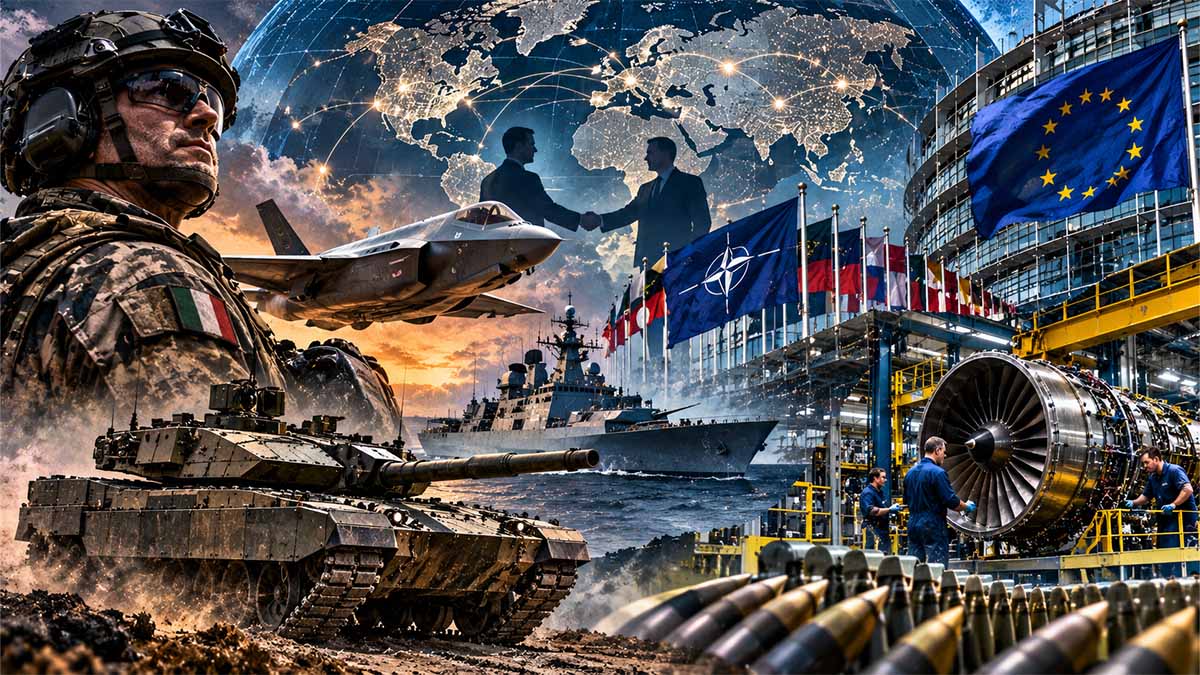
Executive Summary — Bottom Line Up Front
Principal judgment: Defence industrial capability has become a structural component of national diplomatic power. The ability to manufacture, sustain, modernise and export military systems can create durable strategic relationships, but defence procurement strengthens national sovereignty only when it delivers capabilities that remain accessible, supportable and technologically sustainable under adverse conditions.
Poland presents an especially consequential case. Its planned national defence expenditure for 2026 reaches PLN 200.1 billion, equivalent to 4.81% of projected GDP, while its industrial strategy seeks to convert substantial military investment into domestic production, technological independence and export capabilities.
At European level, defence expenditure by the 27 EU member states reached €418 billion in 2025, with the European Defence Agency projecting €454 billion in 2026. Yet aggregate spending remains an insufficient measure of industrial autonomy: collaborative procurement accounted for 24% of defence equipment procurement expenditure in 2025.
Three strategic relationships define Poland’s immediate industrial choices: the United States as a major supplier of military systems and associated support architectures; South Korea as a partner in defence procurement and planned localisation of production; and Ukraine as a critical source of operational experience and an increasingly relevant partner in defence innovation.
The institutional priority is therefore not procurement volume alone, but the integration of foreign policy, military requirements, industrial capacity, export finance and long-term technological control.
The decisive uncertainty is whether Poland can translate announced industrial partnerships and projected local production into independently verifiable, operationally sustainable national capabilities.
Industrial Diplomacy: Poland’s €43.7 Billion Test of Military Sovereignty
Poland is becoming one of Europe’s most consequential defence purchasers. Whether it becomes an equally consequential defence producer will depend on who controls the technology, factories and supply chains behind its military expansion.
Poland’s defence policy faces a contradiction that procurement contracts alone cannot resolve. The government has allocated PLN 200.1 billion to national defence in 2026, equivalent to 4.81% of projected GDP, while securing approximately €43.7 billion in European SAFE financing. Yet greater military expenditure does not automatically deliver greater industrial sovereignty. American equipment, Korean manufacturing agreements and cooperation with Ukraine offer different forms of military and technological integration, each carrying distinct financial and political dependencies. The decisive question is whether Warsaw can convert these relationships into domestic production, engineering expertise and long-term freedom of action. Unless procurement, industrial investment and foreign policy operate within a common decision framework, Poland risks building a more capable military while leaving much of the technology required to sustain it under external control.
Europe is spending more, but ownership of industrial capability remains unresolved
The European Defence Agency reported €418 billion in defence expenditure across the EU’s 27 member states in 2025, equivalent to 2.2% of GDP, and projected €454 billion for 2026, or approximately 2.4%. Equipment procurement reached €115 billion in 2025, while defence research and development accounted for €17 billion, with €20 billion projected for 2026. Yet collaborative procurement represented only 24% of equipment spending. The figures expose the central industrial contradiction: Europe is mobilising substantial financial resources without exercising an equivalent degree of coordination over the production systems those resources are expected to strengthen. European Defence Agency — Defence Expenditure Assessment, July 2026.
Poland illustrates the fiscal dimensions of that contradiction. Its planned PLN 200.1 billion defence financing envelope for 2026 combines budgetary resources with financing through the Armed Forces Support Fund. Separately, Warsaw’s SAFE allocation reaches approximately €43.7 billion, with the European Commission confirming an initial €6.6 billion pre-financing payment on 29 May 2026. The distinction matters. SAFE provides loans rather than unconditional grants; the allocation is not expenditure already completed, and financing approval does not establish how much production or technological value will remain in Poland. The country gains investment capacity while assuming obligations that will extend beyond the acquisition decisions themselves. Polish Ministry of Finance — 2026 Budget; European Commission — SAFE Pre-financing, May 2026.
The economic test is consequently stricter than the political announcement of a contract. An imported platform strengthens military inventories; a functioning production line can create national manufacturing capacity; control over engineering documentation, maintenance procedures and critical components determines how far that capacity can operate independently. These are different outcomes, even when financed through the same defence programme.
Poland can build weapons; producing them at scale is a different undertaking
Poland is not constructing a defence industry from nothing. The Polish Armaments Group, Polska Grupa Zbrojeniowa (PGZ), brings together established manufacturing and technical activities spanning artillery, armoured vehicles, missiles, ammunition, electronics and maintenance. Huta Stalowa Wola, Mesko, Rosomak, Bumar-Łabędy, PIT-Radwar and other enterprises provide an industrial foundation that extends beyond final assembly. An official government inventory associated with SAFE identifies 41 defence-related companies across 28 locations, although that programme inventory is not a complete census of the country’s defence economy.
The Borsuk infantry fighting vehicle demonstrates the potential and the limits of domestic development. On 27 March 2025, the Armaments Agency concluded an approximately PLN 6.57 billion gross contract for 111 vehicles, with deliveries scheduled between 2025 and 2029. The first 15 serial-production vehicles were delivered in December 2025. The contract establishes an important domestic manufacturing programme, but the real industrial test lies in sustained production rates, qualified subcontractors, component availability and the ability to support and modify the platform throughout its operational life. The headline contract value also includes associated services and therefore cannot be treated as a simple manufacturing price per vehicle. Polish Ministry of National Defence — Borsuk Programme.
The government’s PGZ investment programme offers a further indication of industrial ambition. Its June 2026 implementation record states that 14 investment-agreement applications and two amendment applications were submitted during 2025. Those applications indicate a pipeline of proposed manufacturing investment, not 16 completed projects. The distinction is material because factory expansion requires machinery, engineering personnel, component suppliers, certification and working capital before it generates accepted military equipment. Government of Poland — PGZ Production and Servicing Programme, June 2026.
The financing challenge is compounded by the structure of demand. According to PGZ representatives cited by the European Defence Agency, the Polish Ministry of National Defence accounts for approximately 80% of the group’s annual revenues. National procurement can therefore support production investment, but it also exposes manufacturers to changes in domestic order schedules. Without competitive exports or sustained international subcontracting, facilities expanded to satisfy exceptional procurement demand may face weaker utilisation once major national deliveries are completed. European Defence Agency — PGZ Industrial Assessment.
Washington supplies the technological ecosystem; Seoul negotiates the factory floor
Poland’s relationships with the United States and South Korea reveal two different industrial mechanisms. American procurement gives access to advanced systems supported through established governmental and commercial structures, while Korean cooperation has included explicit manufacturing-localisation commitments. Neither model delivers unrestricted national autonomy, and both must be assessed through the rights Poland actually acquires.
The American model is particularly visible in aviation. On 27 August 2025, the US Defense Security Cooperation Agency announced a possible US$1.85 billion F-35 sustainment package for Poland, covering technical support, replacement components, repairs, software-related services and associated logistical requirements. This was a notification of a possible sale, not evidence of a completed transaction of identical value. Its significance lies in the structure of dependence: sophisticated military systems require continuing access to technologies and support arrangements that extend far beyond initial aircraft delivery. US Defense Security Cooperation Agency — F-35 Sustainment Notification, August 2025.
A different American arrangement emerged on 6 July 2026, when the Polish government announced cooperation between PGZ, Military Aviation Works No. 2 in Bydgoszcz and Anduril Industries concerning assembly and subsequent production activities for Barracuda-500 missiles in Poland. The agreement could extend Polish participation beyond procurement into manufacturing, but its industrial value depends on implementation, component sourcing, technological rights and eventual production qualification. Domestic assembly is not synonymous with independent design authority. Chancellery of the Prime Minister of Poland — US Defence Industrial Cooperation, July 2026.
South Korea offers a more explicit contractual example. Poland received 180 K2 tanks under its first executive contract by November 2025. A second agreement, signed on 1 August 2025 and valued at approximately US$6.5 billion, covers another 180 tanks for 2026–2030, including 64 K2PL vehicles. Of those, 61 are planned for final assembly at Bumar-Łabędy in Gliwice. The arrangement creates a defined industrial pathway, although the disclosed quantities do not establish unrestricted rights to manufacture critical components, alter designs or independently export the resulting equipment. Polish Armaments Agency — Second K2 Executive Contract, August 2025.
Ukraine introduces a third relationship, centred on operational experience and industrial adaptation. During the 5 February 2026 visit to Kyiv by Polish Prime Minister Donald Tusk, the governments announced a letter of intent concerning joint weapons and ammunition production, alongside cooperation on drones. Existing interaction involving Krab artillery maintenance provides a practical basis for technical exchange. But political commitments to joint production must still become enforceable agreements, qualified facilities and deliverable equipment. Polish Government — Prime Minister Tusk’s Kyiv Visit, February 2026.
European autonomy is becoming a competition over who owns the technology
The European Defence Fund, with approximately €8.8 billion allocated for 2021–2027, supports collaborative research and development, while the European Defence Industry Programme (EDIP) provides €1.5 billion for 2025–2027, including €300 million for its Ukraine Support Instrument. The European Commission’s 2026 Defence Fund work programme allocates €1 billion across 31 call topics. These instruments can reduce development costs and strengthen production networks, but participation in a consortium does not automatically confer control over the resulting technologies or manufacturing contracts. European Commission — European Defence Fund; Council of the European Union — EDIP.
National industrial interests remain decisive. France’s 2024–2030 Military Programming Law provides for approximately €413.3 billion over seven years, supporting a model built around established defence manufacturing and national technological capabilities. Italy, with a diversified aerospace, naval, electronics and military manufacturing base, has a €14.9 billion SAFE allocation. Germany’s National Security and Defence Industry Strategy, considered by the federal cabinet in December 2024, addresses industrial resilience and production capacity. Outside the EU, the United Kingdom’s Defence Investment Plan of 30 June 2026 identifies £298 billion over four years, connecting military investment with domestic industrial development. These financial frameworks differ in scope and duration, but they underline the same political reality: European cooperation takes place between governments determined to preserve substantial national industrial interests.
For Poland, the danger is not exclusion from European industrial programmes, but participation without meaningful technological responsibility. Research leadership, qualified component production, manufacturing workshare and control of intellectual property matter more than the number of consortium memberships. The relevant bargaining position is established by what Polish companies can reliably design, manufacture and maintain, rather than by the purchasing power of the Polish state alone.
The legal framework limits what procurement can deliver
Industrial sovereignty encounters its most important constraints in contracts, intellectual-property provisions and export-control arrangements. Poland’s Act of 26 June 2014 concerning procurements of fundamental importance to state security provides a statutory basis for specified offset obligations involving technology, knowledge and industrial capabilities. Its framework is linked to the protection of essential security interests under Article 346(1)(b) of the Treaty on the Functioning of the European Union. It does not establish an unlimited right to demand technology transfer in every acquisition. Polish Journal of Laws — Offset Legislation, Consolidated Text 2022.
The distinction has direct economic consequences. A manufacturing licence may permit production without allowing independent modification; access to technical documentation may support maintenance without transferring intellectual-property ownership; and a domestic factory can remain reliant on foreign-controlled components or software. Industrial participation therefore has to be negotiated as a precise allocation of rights and obligations, not expressed as a general promise of localisation.
Regulatory constraints extend to European cooperation. Regulation (EU) 2025/2643, establishing EDIP, addresses security of supply, industrial cooperation and certification, but does not eliminate national procurement competences or proprietary technological restrictions. Certification and military acceptance remain necessary even where a manufacturer possesses the physical ability to produce a component. Regulation (EU) 2025/2643 — European Parliament and Council, December 2025.
The institutional problem is equally concrete. The Polish Armaments Agency, operating under the Ministry of National Defence since 2022, has responsibilities spanning acquisition, technical quality, related research, offsets and specified intellectual-property matters. The Council of Ministers retains responsibility for government policy under the constitutional framework. Coordination among defence procurement, industrial investment, export financing and diplomacy is therefore a governmental responsibility; it cannot be delegated to a manufacturer or resolved through a purchasing decision alone.
The next 24 months will determine who carries the cost of incomplete industrial reform
Poland’s proposed Defence Industry Development Strategy 2026–2030, registered on 21 July 2026, identifies fragmented industrial structures, foreign supply-chain dependence, limited domestically controlled intellectual property, inadequate innovation and shortages of qualified personnel. Its implementation will determine whether these weaknesses become criteria governing investment and procurement or remain problems acknowledged independently of the contracts generating future demand. Chancellery of the Prime Minister of Poland — Draft Defence Industry Development Strategy 2026–2030, July 2026.
Between October 2026 and October 2028, the most consequential evidence will be the qualification of new production facilities, implementation of K2PL localisation commitments, progress under the PGZ–Anduril arrangement, industrial investment completion and the enforceable scope of transferred technologies. The deadline is analytical rather than contractual: not every programme is scheduled for completion within those 24 months. But early implementation will reveal whether Warsaw can connect military demand to durable manufacturing capabilities while preserving access to foreign systems already being acquired.
Failure would distribute costs across several institutions. The Polish Treasury would carry the fiscal consequences of investment and borrowing without the full expected industrial return. Domestic manufacturers and subcontractors would face weaker technological development and uncertain production continuity. The armed forces could inherit larger inventories with substantial long-term dependence on external maintenance, components and upgrade decisions. European partners would lose potential manufacturing capacity from a country making substantial defence commitments, while foreign suppliers would retain a larger share of the technological and support functions associated with Polish procurement.
The decisive outcome will not be measured by another arms agreement or defence budget announcement. It will be measured by how much critical equipment Poland can manufacture, maintain and modernise under enforceable rights, at sustainable cost and with reliable access to the inputs required. Warsaw has already committed substantial resources to military power. The unresolved financial and diplomatic question is how much industrial control those resources will purchase.
Navigational Index
Pillar I — Defence Industry as an Instrument of State Power
- Chapter 1 — The Transformation of Defence Industrial Diplomacy : Industrial capacity, military influence, strategic interdependence and the changing relationship between economic production and diplomatic power.
- Chapter 2 — The Political Economy of Defence Dependence : Procurement cycles, technological ecosystems, intellectual property, supply continuity, maintenance and the economic consequences of supplier concentration.
- Chapter 3 — Institutional Authority and Strategic Coordination : The Polish Presidency, government ministries, Armaments Agency, export-support institutions, PGZ, private industry and foreign partners: authority, accountability and strategic decision-making.
Pillar II — Poland’s Industrial Position in the Transatlantic and European Defence System
- Chapter 4 — Poland’s Defence Industrial Base and the Strategic Role of PGZ : Production capabilities, technological ownership, industrial investment, labour, research, subcontracting, manufacturing constraints and domestic capacity development.
- Chapter 5 — The United States, South Korea and Ukraine: Three Models of Defence Industrial Cooperation : American systems integration and support dependencies; Korean technology transfer and manufacturing localisation; Ukrainian operational innovation, industrial cooperation and wartime production experience.
- Chapter 6 — European Defence Industrial Diplomacy: National Interests and Collective Autonomy : European Defence Fund, EDIP, SAFE, NATO industrial coordination, supply-chain resilience and competitive industrial positioning. Separate assessments of Italy, France, Germany and the United Kingdom.
- Chapter 7 — Defence Exports, Financial Instruments and Strategic Market Access : Export promotion, guarantees, public financing, licensing, offsets, joint ventures, industrial partnerships and the economic foundations of sustained international influence.
Pillar III — Strategic Choices, Industrial Sovereignty and the 2031 Outlook
- Chapter 8 — Structural Vulnerabilities and Strategic Dependencies :Foreign-controlled technologies, production bottlenecks, critical inputs, certification barriers, contractual constraints, intellectual-property restrictions and political exposure.
- Chapter 9 — Alternative Industrial Diplomacy Pathways, 2026–2031 : Integrated industrial diplomacy, procurement-led modernisation and fragmented industrial development: conditions, constraints, indicators and strategic consequences.
- Chapter 10 — Building an Integrated Polish Defence Industrial Diplomacy Model : Institutional design, procurement governance, investment priorities, industrial performance criteria, export strategy and implementation accountability.
- Chapter 11 — Strategic Net Assessment and Policy Decisions : Policy alternatives, five-year industrial objectives, implementation risks, European coordination and the implications for Poland’s international standing.
Master Abstract
Defence industrial capability is becoming a determinant of geopolitical influence
The international security environment has altered the relationship between industrial production and state power. The defence industry can no longer be assessed primarily as a collection of enterprises supplying equipment to national armed forces. Its strategic significance increasingly depends on whether industrial capabilities allow a country to sustain military operations, support international partners, preserve critical technological knowledge and influence the long-term development of allied military systems. For governments, industrial capacity is both a material resource and a diplomatic asset: it can increase the credibility of security commitments, reduce dependence on external suppliers and generate relationships that persist beyond individual political administrations.
The mechanism is structural rather than merely transactional. A military platform requires training, software support, spare parts, ammunition, maintenance, periodic modernisation and eventual replacement. The institutions and companies controlling these functions can retain influence over the user’s operational choices throughout the equipment’s service life. At the same time, the purchasing state can strengthen its own strategic position by negotiating production rights, domestic repair capabilities, technology access and participation in subsequent development programmes. The resulting relationship may deepen alliance cooperation while also creating dependencies that cannot be removed quickly or economically.
The NATO Industrial Capacity Expansion Pledge of 10 July 2024 formally recognised this strategic relationship by committing allies to stronger production capabilities, more effective multinational procurement, secure supply chains and clearer long-term industrial demand. The alliance identified defence industry as an essential contributor to readiness, interoperability and the implementation of its defence plans. NATO Industrial Capacity Expansion Pledge — North Atlantic Treaty Organization — July 2024. NATO Official text
Poland’s strategic challenge is the conversion of military expenditure into enduring national capabilities
Poland’s defence modernisation creates considerable opportunities for industrial development, but its scale also increases the importance of procurement governance. The government’s 2026 fiscal framework allocates PLN 200.1 billion to national defence, including expenditure financed through the Armed Forces Support Fund. This is a planned expenditure envelope, not evidence that the entire amount has already been disbursed, nor that it will all generate domestic industrial production. The distinction is fundamental: equipment acquisition can increase operational capacity relatively quickly, whereas domestic industrial sovereignty requires investment, specialised personnel, technological access, protected intellectual property, production facilities and reliable procurement demand over many years. Portal Gov.pl+1
Poland’s proposed Defence Industry Development Strategy 2026–2030, registered in the government legislative programme on 21 July 2026, identifies industrial fragmentation, foreign supply-chain dependencies, labour shortages, insufficient innovation and limited domestically controlled intellectual property among the principal structural challenges. Its stated objectives include improved industrial competitiveness, modernisation of production capacity, an export policy supporting national defence capabilities and stronger institutional support. The strategy therefore addresses a problem extending beyond industrial performance: whether Poland’s defence spending can support an enduring domestic technological and manufacturing base. The verified project registration establishes these policy intentions; it does not itself demonstrate the strategy’s final adoption or execution. Draft Resolution on the Defence Industry Development Strategy 2026–2030 — Chancellery of the Prime Minister of Poland — July 2026. Portal Gov.pl
A central analytical distinction follows. The Polish Armaments Agency’s responsibility for satisfying military requirements must not be confused with responsibility for defining the entire national industrial strategy. Procurement decisions necessarily consider operational suitability, delivery schedules, costs and compliance requirements. Their strategic consequences, however, extend to technological dependencies, industrial investment, alliance relationships and future budgetary obligations. The requirement is therefore to establish a structured decision framework in which military effectiveness remains paramount while industrial, financial and diplomatic consequences are explicitly assessed by the institutions competent to address them.
The United States, South Korea and Ukraine represent different forms of industrial and strategic interdependence
Poland’s relations with the United States, South Korea and Ukraine illustrate the diversity of defence industrial cooperation. American military systems can offer integration with established allied capabilities, extensive training and support arrangements, and closer involvement in a transatlantic technological ecosystem. These advantages must be weighed against potential dependence on foreign-controlled components, support arrangements, software, export permissions and modernisation decisions. Domestic assembly or maintenance agreements may reduce particular vulnerabilities, but their strategic value depends on the actual scope of industrial rights and operational control obtained.
South Korea provides a more directly observable case of planned production localisation. Poland’s Ministry of National Defence records that the first 180 K2 tanks ordered under the August 2022 executive contract had been delivered by November 2025. A second executive contract signed in August 2025 covers another 180 K2 tanks for delivery during 2026–2030, including 64 K2PL vehicles, of which 61 are planned for production at Bumar-Łabędy in Poland. These are important industrial commitments, but planned domestic production must be distinguished from completed manufacture, technological ownership and autonomous maintenance capability. K2 Tanks — Ministry of National Defence of Poland — official programme record. Portal Gov.pl
Ukraine introduces a different strategic dimension. Its defence sector and armed forces have accumulated operational experience under conditions of sustained high-intensity warfare. The strategic value for partner countries is not automatic access to wartime knowledge, but the possibility of converting authorised cooperation into faster innovation cycles, better understanding of battlefield requirements and jointly developed military technologies. The European Defence Industry Programme provides a formal institutional framework for cooperation with Ukraine, including a dedicated €300 million Ukraine Support Instrument within its €1.5 billion programme envelope. European Defence Industry Programme — Council of the European Union — December 2025. Consilium
European integration changes the economics of defence industrial sovereignty
The European Union’s defence industrial agenda is not simply a mechanism for increasing expenditure. It seeks to reduce fragmented procurement, strengthen production capacity, improve supply security and support cross-border industrial cooperation. The European Defence Agency reported expenditure of €418 billion in 2025, representing 2.2% of EU GDP, and projected €454 billion for 2026, equivalent to approximately 2.4%. Its figures also indicate that collaborative procurement represented 24% of equipment procurement expenditure in 2025. These indicators reveal the importance of distinguishing the scale of financial resources from the institutional and commercial capacity to deploy them through coordinated programmes. eda.europa.eu
The European framework nevertheless contains different national industrial interests. France’s approach to strategic autonomy places particular significance on nationally controlled technologies and established defence manufacturing capabilities. Germany’s industrial position is linked to major equipment programmes, European collaborative development and substantial manufacturing resources. Italy possesses a diversified defence industrial ecosystem in which aerospace, naval systems, electronics and international partnerships constitute important sources of industrial influence. The United Kingdom, while outside the EU, remains an important European defence-industrial and NATO partner whose participation illustrates why European security cooperation cannot be evaluated solely through EU membership. These national models create opportunities for specialisation and cooperation, but also competition over technological leadership, intellectual property, procurement and the distribution of industrial work.
For Poland, participation in European programmes should therefore be assessed by the actual capabilities acquired and retained, rather than by formal membership in a consortium. Research and development leadership, manufacturing workshare, access to critical technologies, maintenance responsibilities and opportunities to export jointly developed systems provide more meaningful indicators of industrial influence.
Industrial diplomacy requires measurable capabilities rather than institutional declarations
A coherent national model of defence industrial diplomacy must integrate four otherwise separable processes: defining military requirements, selecting strategic partners, developing national industrial capabilities and establishing durable international market relationships. The economic value of domestic participation depends not only on contract volume but also on the activities performed locally, the technologies controlled, the skills retained and the ability to sustain production when foreign deliveries are disrupted.
The same distinction applies to exports. An export contract can generate revenue and support industrial scale, but does not necessarily establish enduring diplomatic influence. Long-term strategic value emerges when the exporting country provides reliable training, spare parts, ammunition, upgrades, maintenance, technical cooperation and predictable contractual performance. Export activity can consequently reinforce national production capabilities and international relationships, although it may also expose the supplier to payment risk, political changes, production congestion and competing obligations to domestic armed forces.
For Poland, the most consequential institutional question concerns the relationship between the state-owned Polish Armaments Group, private defence enterprises, the Ministry of National Defence, the Ministry of Foreign Affairs, the ministries responsible for state assets and economic development, and the institutions financing exports and investment. A coherent system would require these actors to operate under clearly allocated responsibilities, supported by common strategic objectives and measurable industrial outcomes.
The central judgment is that defence industrial diplomacy becomes an instrument of national power only when contractual relationships produce resilient military capabilities, enforceable technological access, sustainable domestic expertise and credible long-term international commitments. Large defence budgets can create the financial conditions for such a system, but cannot substitute for its institutional design.
Key Evidence Table — Verified Strategic and Industrial Baseline
The following indicators establish the principal financial, institutional and industrial conditions relevant to the assessment. Figures identified as planned, projected or allocated must not be interpreted as completed expenditure or delivered industrial capability.
| Indicator | Value / status | Reference date | Definition / scope | Issuer and exact source |
|---|---|---|---|---|
| Poland — national defence financing | PLN 200.1 billion; 4.81% of projected GDP | 2026 budget | Planned national defence financing, including the Armed Forces Support Fund | Ministry of Finance — December 2025 |
| Poland — industrial strategy | 2026–2030; government draft registration | 21 July 2026 | Proposed national strategy for industrial competitiveness, modernisation, exports and institutional support | Chancellery of the Prime Minister — July 2026 |
| Poland — K2 initial procurement | 180 tanks delivered | November 2025 | Completion of the initial executive procurement contract | Polish Ministry of National Defence — K2 programme |
| Poland — second K2 contract | 180 tanks; 64 K2PL, including 61 planned for domestic production | August 2025 agreement; 2026–2030 deliveries | Contractual deliveries and announced manufacturing localisation | Polish Ministry of National Defence — K2 programme |
| EU — total defence expenditure | €418 billion; 2.2% of GDP | 2025 | Reported aggregate expenditure of 27 member states | European Defence Agency — July 2026 |
| EU — projected expenditure | €454 billion; 2.4% of GDP | 2026 | Projected expenditure, not completed spending | European Defence Agency — July 2026 |
| EU — collaborative procurement | 24% | 2025 | Collaborative share of defence equipment procurement expenditure | European Defence Agency — July 2026 |
| European Defence Fund | €8.8 billion | 2021–2027 programme | EU budget allocation for collaborative defence research and development, including reinforcement | Council of the EU — Defence Funding |
| European Defence Industry Programme | €1.5 billion, including €300 million for Ukraine | 2025–2027 | EU grant programme for defence industrial development and cooperation | Council of the EU — EDIP |
| EU AGILE programme | €115 million | Adopted 12 October 2026 | Planned support for rapid defence innovation, particularly SMEs | Council of the EU — Defence Funding |
| NATO — defence investment commitment | 5% of GDP by 2035 | June 2025 commitment | At least 3.5% for core defence requirements and up to 1.5% for broader defence and security-related expenditure | NATO — June 2026 update |
Portal Gov.pl+5
The quantitative evidence establishes a significant expansion of resources available for defence modernisation. It does not establish an equivalent increase in domestic technological autonomy. That outcome depends on the industrial allocation of contracts, contractual rights, implementation performance and the ability to retain capabilities throughout the life cycle of military systems.
Competing Strategic Pathways — Poland’s Industrial Diplomacy, 2026–2031
Three pathways are relevant to evaluating Poland’s defence industrial development. They are alternative strategic models rather than mutually exclusive predictions: individual procurement programmes may exhibit characteristics of more than one pathway.
| Strategic pathway | Supporting evidence | Principal constraint | Observable indicators | Current assessment |
|---|---|---|---|---|
| Integrated industrial diplomacy | National strategy objectives; planned Korean production localisation; EU industrial instruments | Requires sustained interministerial coordination, investment and enforceable technology arrangements | Operational domestic production, verified technology access, export growth, repair autonomy | Institutionally feasible; implementation-dependent |
| Procurement-led modernisation | High defence expenditure and extensive foreign acquisition programmes | Operational improvements may outpace domestic industrial and technological development | Delivery performance, foreign support dependence, domestic workshare | Strong documentary evidence of procurement activity; mixed industrial outcomes |
| Fragmented industrial development | Government strategy identifies fragmented structures, supply dependencies, skills gaps and institutional weaknesses | Coordination failures can dilute industrial returns from substantial expenditure | Project delays, low domestic intellectual-property creation, persistent foreign sourcing | A documented structural risk, not an established future outcome |
The first pathway offers the greatest potential to reconcile Poland’s operational, industrial and diplomatic objectives, but imposes substantial institutional and implementation requirements. The second can improve military capabilities while leaving significant long-term technological dependencies. The third risks combining high procurement expenditure with insufficient domestic capacity development.
The determining factor will not be the volume of announced investments. It will be the observable conversion of financial commitments into functioning production lines, trained personnel, technical rights, deliverable equipment and sustainable international partnerships.
Principal Intelligence Gaps and Watch Indicators
Industrial sovereignty and contractual rights
The decisive gap concerns the actual distribution of technological authority within Poland’s principal procurement programmes. Announced production localisation does not demonstrate unrestricted access to design documentation, source code, critical components, independent modernisation rights or third-country export permissions. These distinctions determine whether a domestic facility represents a strategically autonomous capability or a geographically relocated element of a foreign-controlled production system.
The relevant evidence consists of officially disclosed implementation agreements, industrial workshare records, licensing provisions, acceptance documentation and verified production milestones. Commercial confidentiality may legitimately limit public access to some contractual provisions; this restriction must not be mistaken for confirmation that unrestricted technology transfer has occurred.
Domestic production, maintenance and operational resilience
A second uncertainty concerns the extent to which Poland’s defence industry can sustain major military systems under prolonged disruption of foreign supply chains. Installed factory capacity, announced output objectives and actual deliverable production are different measures. Similarly, maintenance infrastructure does not automatically establish the ability to manufacture replacement components or independently modify equipment.
Consequential indicators include verified production rates, qualified supplier availability, domestic repair turnaround, inventories of critical components, industrial workforce development and the completion of certification processes.
Export capacity and diplomatic influence
Poland’s defence export potential must be evaluated through sustained international demand and verified industrial performance. A successful export strategy would require reliable contract execution, competitive financing, political authorisations, continued production, customer support and integration into foreign military supply systems.
Relevant observations include completed export deliveries, repeat procurement by foreign customers, financing and guarantee utilisation, international maintenance arrangements and participation in jointly developed products. Export announcements alone are insufficient to demonstrate durable market penetration or expanded geopolitical influence.
European cooperation and industrial bargaining power
European industrial integration presents a further question about how decision-making authority and economic value are distributed across multinational programmes. Participation in a consortium may provide important technological and commercial access, but industrial influence depends on substantive responsibilities rather than institutional representation alone.
Indicators should include project leadership, research and development responsibilities, intellectual-property arrangements, domestic manufacturing workshare, qualified subcontractor participation and the ability of Polish enterprises to supply more than one national customer.
Procurement governance and institutional accountability
The government’s proposed industrial strategy provides a basis for assessing whether procurement decisions, industrial investment and foreign-policy objectives are becoming more closely coordinated. A central test will be the existence of formally assigned responsibilities and measurable decision criteria that distinguish military operational requirements from wider industrial and diplomatic objectives.
The relevant record includes adopted government strategies, procurement governance rules, published industrial objectives, implementation reports and competent audit findings. A governance assessment must distinguish institutional fragmentation from allegations of improper procurement decisions; the former may be supported by structural evidence without establishing the latter.
Principal Strategic Assessment
Poland’s international standing will increasingly be influenced by its capacity to act simultaneously as a capable military ally, a reliable industrial partner and a credible supplier of defence technologies. These functions reinforce one another when procurement decisions support long-term production, technological development and sustained international cooperation. They can also conflict when immediate operational requirements demand foreign acquisitions that provide limited domestic industrial participation.
The appropriate strategic objective is therefore not complete national self-sufficiency. Modern military systems depend on specialised technologies, complex supply chains and multinational cooperation. Attempting to reproduce every capability domestically would create considerable duplication and could weaken procurement efficiency. Conversely, concentrating critical functions entirely outside national control may expose military readiness to contractual restrictions, international disruption and changes in supplier priorities.
A sustainable industrial diplomacy model must distinguish strategically indispensable domestic capabilities from technologies that can be reliably accessed through allies and commercial partners. It must also establish which dependencies are acceptable, which require diversification and which demand sovereign control.
The governing judgment for 2026–2031 is that Poland’s defence industrial influence will depend less on the financial scale of procurement than on its ability to govern the technological, industrial and diplomatic consequences of that procurement. The state must provide credible long-term direction, industry must deliver verifiable capabilities, and international cooperation must generate benefits extending beyond the original transaction.
DEFENCE INDUSTRIAL DIPLOMACY
How manufacturing capacity, technology transfer, procurement, industrial sovereignty and international alliances transform defence industries into instruments of state power. Poland is the principal case within the European and transatlantic security architecture.
Defence spending and industrial capacity
Capital mobilisation and production localisation
EU defence expenditure
Dimensional columns | € billion | 2025 reported and 2026 projected
K2 industrial localisation programme
Poland–South Korea | Contract quantities and planned manufacturing.
Strategic relationship network
Poland at the centre of industrial interdependence
Conceptual relationship network. Lines represent analytically relevant strategic relationships, not quantified trade flows.
Network geometry is illustrative. Position, circle size and line length do not represent relative influence, dependency or expenditure.
Strategic relationship inspector
Examine the diplomatic mechanism, industrial opportunity and principal strategic dependency associated with each actor.
Poland’s central challenge is to align armed-forces requirements, industrial investment, foreign partnerships and technological sovereignty without compromising military readiness.
Industrial diplomacy transmission chain
Interactive industrial diplomacy pathways
Coordinated defence procurement, industrial investment, export support and diplomatic engagement translate military contracts into verifiable domestic production capabilities, technology access and durable international partnerships.
From defence expenditure to strategic influence
Source-controlled data table
Values, periods, status and institutional sources are preserved separately.
| Indicator | Value | Period | Evidence status | Source |
|---|---|---|---|---|
| Poland defence financing | PLN 200.1bn | 2026 | Budget plan | Polish Ministry of Finance |
| EU defence expenditure | €418bn | 2025 | Reported expenditure | European Defence Agency |
| EU defence expenditure | €454bn | 2026 | Projection | European Defence Agency |
| EU collaborative procurement | 24% | 2025 | Share of equipment procurement spending | European Defence Agency |
| K2 first contract | 180 tanks | By Nov 2025 | Delivered | Polish Defence Ministry |
| K2 second contract | 180 tanks | 2026–2030 | Contracted deliveries | Polish Defence Ministry |
| K2PL planned Polish production | 61 tanks | 2026–2030 programme | Planned industrial localisation | Polish Defence Ministry |
| European Defence Fund | €8.8bn | 2021–2027 | Programme allocation | Council of the EU |
| European Defence Industry Programme | €1.5bn | 2025–2027 | Programme envelope | Council of the EU |
| Ukraine Support Instrument | €300m | EDIP programme | Included within the €1.5bn EDIP envelope | Council of the EU |
| NATO defence investment commitment | 5% of GDP | By 2035 | Alliance commitment with defined expenditure categories | NATO |
PILLAR I — DEFENCE INDUSTRY AS AN INSTRUMENT OF STATE POWER
ACADEMIC GOVERNANCE EDITION | OPEN-SOURCE STRATEGIC INTELLIGENCE ASSESSMENT | 31 OCTOBER 2026
Chapter 1 — The Transformation of Defence Industrial Diplomacy
Defence production as a structural component of international power
The transformation of defence production into an instrument of international diplomacy represents one of the most consequential changes in the political economy of security in contemporary Europe. Military influence has traditionally been examined through the size of armed forces, the technological sophistication of their equipment, the credibility of alliance commitments and the geopolitical position of the state. These remain essential determinants of power, but they no longer provide an adequate explanation of a country’s ability to sustain military commitments or shape the security calculations of its partners. The industrial foundations of military power have become inseparable from the credibility of diplomatic commitments, particularly where security relationships depend on the continuous provision of weapons, ammunition, spare parts, engineering assistance and technologically complex maintenance services. A country capable of producing military systems but unable to sustain their operation offers a different form of security cooperation from one that controls an integrated industrial ecosystem encompassing development, manufacturing, logistics, modernisation and long-term operational support. The distinction is especially important because industrial supply relationships can remain strategically relevant long after the diplomatic negotiations that originally established them have concluded.
The analytical significance of this transformation lies in the relationship between the credibility of political commitments and the physical capacity to fulfil them. Political agreements establish intentions, obligations and institutional channels, whereas industrial systems determine the practical availability of equipment, replacement components and technical services necessary to translate those commitments into military capability. Industrial production is therefore neither a substitute for diplomacy nor merely an economic activity accompanying it. It constitutes one of the mechanisms through which diplomatic relationships acquire operational substance. The value of a defence-industrial partnership depends on the credibility of delivery schedules, the continuity of supplies, the technical compatibility of equipment, the ability to respond to unexpected operational requirements and the resilience of manufacturing systems under conditions of sustained demand. These characteristics can create confidence between allies, strengthen the credibility of defence planning and increase the influence of states that possess capabilities regarded as necessary by their international partners.
The importance of the industrial dimension became particularly visible following Russia’s full-scale invasion of Ukraine in February 2022. The conflict exposed the extent to which prolonged military operations depend on ammunition availability, replacement equipment, industrial repair capacity and the ability to replenish stocks while maintaining existing operational commitments. NATO’s subsequent institutional response provides direct documentary evidence of this shift. The Industrial Capacity Expansion Pledge adopted at the Washington Summit on 10 July 2024 called for expanded production, stronger transatlantic industrial cooperation, more predictable demand, greater multinational procurement, improved standardisation and enhanced security of critical supply chains. It also identified battle-decisive ammunition and air and missile defence among the initial capability priorities. The significance of this commitment is not simply that NATO acknowledged the importance of defence manufacturers. Rather, it incorporated industrial production, procurement planning and supply-chain resilience into the alliance’s collective approach to deterrence and defence, while preserving the responsibility of individual states for national industrial plans and procurement decisions. NATO Industrial Capacity Expansion Pledge — North Atlantic Treaty Organization — July 2024.
The changing relationship between security and manufacturing also affects the distribution of bargaining power within alliances. Defence cooperation is formally governed by political agreements, institutional procedures and national sovereignty, but the practical distribution of influence is partly conditioned by the industrial capabilities that each participant contributes. States that control scarce manufacturing processes, critical technologies or indispensable maintenance infrastructure may possess additional negotiating advantages because other countries cannot easily replace their industrial contributions. Conversely, a country whose military capabilities depend heavily on a narrow range of external suppliers can face limitations when those suppliers experience production constraints, alter export policies or prioritise competing national requirements. These dependencies do not necessarily undermine an alliance; close technological integration can increase interoperability and mutual confidence. Their strategic consequences depend on whether dependence is reciprocal, contractually predictable and compatible with the operational requirements of the participating states.
Industrial diplomacy consequently has to be understood as the deliberate use of production capabilities, technological cooperation, industrial investment and long-term support relationships to advance a state’s economic, security and foreign-policy interests. This definition is narrower and more operationally useful than treating every defence purchase or export agreement as diplomacy. A commercial transaction becomes part of industrial diplomacy when it is incorporated into an identifiable framework of strategic cooperation that generates lasting capabilities, institutional relationships or mutual obligations. The relevant instruments can include joint research, manufacturing licences, industrial partnerships, specialised training, technology-transfer agreements, shared maintenance facilities and coordinated supply-chain investment. Their diplomatic significance arises from the durable interests they create, rather than from the monetary value of the original contract alone.
From military transactions to enduring strategic relationships
The defence market differs from most civilian markets because the acquisition of a major military system creates obligations and dependencies extending throughout its operational life. The purchasing government acquires more than a physical product; it enters a technological and institutional environment involving design standards, technical documentation, software support, component supply, ammunition compatibility, operator training and periodic modernisation. In complex systems, these functions may be controlled by several companies and public authorities operating under different national jurisdictions. A procurement agreement can therefore establish a long-term relationship between the customer state, the manufacturing enterprise, the government authorising technology transfers and the wider network of subcontractors supporting the equipment. The relationship may continue across successive military planning cycles and changes of government, making its strategic importance potentially greater than its initial financial significance.
This mechanism is expressly recognised in the United States’ Foreign Military Sales administrative framework. The Defense Security Cooperation Agency’s May 2026 policy concerning the Total Package Approach provides for the consideration of support facilities, training, technical assistance, software, ammunition, initial and follow-on sustainment, and other requirements necessary to introduce and operate equipment effectively. It demonstrates that long-term support is an integral part of the governmental architecture through which military systems are transferred internationally, rather than a secondary commercial consideration added after procurement. The American framework is particularly relevant because it illustrates how equipment sales can generate structured relationships involving government approval, technical support and continuing system management. Defense Security Cooperation Agency Policy Memorandum 26-65 — United States Department of Defense — May 2026.
The political influence associated with these relationships should nevertheless be assessed carefully. Long-term support arrangements do not automatically confer unrestricted control over a purchasing state’s military decisions, and their existence does not establish that a supplier will employ them for diplomatic pressure. The more defensible proposition is that technological integration can create potential influence by raising the economic and operational costs of replacing a supplier, modifying a system or transferring support responsibilities to another industrial partner. The magnitude of that influence depends on contractual provisions, available alternatives, domestic technical capabilities, stock levels, export-control requirements and the military consequences of an interruption. A highly integrated system supported by multiple reliable suppliers may offer greater practical autonomy than a nominally domestic product dependent on a single foreign-controlled component. This distinction prevents the misleading assumption that foreign procurement necessarily reduces sovereignty or that domestic production necessarily guarantees it.
The transformation of industrial relationships into diplomatic assets also depends on the exporting country’s reliability. An enterprise that provides military equipment but cannot maintain spare-parts availability, financing arrangements or technical assistance over the contractual period may weaken rather than enhance its country’s international credibility. Defence exports are therefore exposed to a particular form of reputational risk: failures in industrial execution can become matters of state-to-state relations because the affected equipment contributes directly to the importing country’s security. Conversely, consistent contractual performance, rapid technical assistance and predictable upgrade arrangements can reinforce political trust and facilitate further cooperation. Over time, the exporter may become involved in the recipient’s training systems, maintenance planning, standardisation requirements and subsequent procurement decisions, creating a continuing relationship that is simultaneously commercial, military and diplomatic.
The industrial mechanisms through which defence cooperation produces influence
| Industrial mechanism | Immediate operational function | Economic transmission mechanism | Potential diplomatic consequence | Principal limitation |
|---|---|---|---|---|
| Licensed production | Manufacture equipment under defined rights | Investment, employment, manufacturing learning | Longer-term industrial relationship | Licence scope and foreign control of critical inputs |
| Joint research and development | Develop shared technologies and systems | Knowledge creation, engineering specialisation, shared costs | Greater strategic reciprocity | Intellectual-property disputes and diverging requirements |
| Long-term sustainment | Maintain equipment and operational availability | Recurring technical services and replacement-component demand | Continuing institutional contact and reliability-based influence | Supplier concentration and interruption risk |
| Ammunition interoperability | Enable compatible supply across forces | Manufacturing scale and harmonised technical specifications | Greater allied operational flexibility | Certification, standards compliance and production constraints |
| Technology transfer | Transfer defined technical knowledge or rights | Domestic learning and capability absorption | Reduced asymmetry and potentially deeper partnership | Transfer restrictions and insufficient domestic capacity |
| Joint industrial investment | Establish production or support facilities | Capital formation, workforce development, supplier contracts | More durable bilateral economic interests | Commercial viability and continuing order volumes |
| Defence export financing | Enable eligible international transactions | Liquidity provision, credit-risk allocation and export demand | Improved supplier access to foreign markets | Credit, sovereign and compliance risks |
| Shared military standards | Improve technical compatibility and integration | Lower coordination and interoperability costs | Stronger multinational cooperation | Implementation differences and system-specific restrictions |
The table identifies distinct mechanisms rather than interchangeable forms of industrial cooperation. In particular, technology transfer may contribute to domestic capability without transferring intellectual-property ownership, while a manufacturing licence may enable local assembly without establishing independent design or modification rights. The diplomatic significance of each instrument must therefore be evaluated through the rights actually acquired and the capabilities that remain available when contractual or political circumstances change.
European defence production and the institutionalisation of industrial diplomacy
The European Union’s response to heightened defence requirements offers a further illustration of the transition from industrial cooperation as a predominantly national concern to industrial capacity as an issue of collective security and economic policy. The European Defence Industry Programme, established under Regulation (EU) 2025/2643 of 16 December 2025, provides a legal framework for measures intended to strengthen the timely availability and supply of defence products. The programme combines financial support with instruments for industrial cooperation, manufacturing capacity development, supply security and collaboration with Ukraine. Its significance extends beyond the grants available to individual companies because it reflects a broader institutional effort to address fragmented demand, limited industrial coordination and the difficulty of expanding production rapidly when national procurement programmes operate independently. Regulation (EU) 2025/2643 Establishing the European Defence Industry Programme — European Parliament and Council of the European Union — December 2025; European Defence Industry Programme — Council of the European Union — December 2025.
The underlying economic problem is that defence manufacturing requires investment decisions whose financial returns depend heavily on governmental purchasing commitments. Expanding a production line may require additional facilities, specialised machinery, qualified technicians, secure suppliers, certification and working capital well before the manufacturer receives the revenue associated with completed deliveries. Where governments provide uncertain demand signals or concentrate orders into irregular purchasing cycles, industrial enterprises can face a rational disincentive to invest in capacity that may remain underused after the initial procurement period. NATO’s industrial pledge explicitly addresses this problem by calling for firm orders, multi-year purchasing arrangements and greater transparency regarding capability requirements. The diplomatic consequence is substantial: procurement coordination becomes a means of shaping allied industrial behaviour, while credible long-term demand can enable manufacturers to establish capacity that supports more than one national customer. NATO Industrial Capacity Expansion Pledge — North Atlantic Treaty Organization — July 2024.
European cooperation also creates a tension between collective industrial efficiency and national preferences for technological control. Joint programmes can distribute development costs, support larger production volumes and reduce unnecessary duplication, but governments may disagree over equipment specifications, workshare, export permissions, intellectual-property allocation and the location of critical manufacturing functions. These disagreements are not merely commercial. They concern employment, tax revenues, technological expertise and a state’s future ability to maintain military capabilities independently. Industrial diplomacy is therefore required both between allied governments and between their respective manufacturing ecosystems. Its purpose is to establish arrangements under which cooperation remains politically acceptable, economically sustainable and militarily useful.
For Poland, the significance of this European transformation is particularly important because industrial influence cannot be evaluated simply through participation in EU programmes or through the quantity of equipment acquired from allied states. The relevant measure is whether Polish institutions and enterprises acquire responsibilities that persist within the multinational industrial system: ownership or enforceable use of critical technologies, production of strategically relevant components, recognised technical expertise, participation in research and development, or responsibility for supporting equipment used by multiple customers. These functions determine whether a country becomes an indispensable contributor to a shared capability or remains predominantly a final purchaser.
Industrial capacity, political credibility and the limits of national self-sufficiency
The growing diplomatic importance of defence manufacturing does not imply that states should seek complete national self-sufficiency. Modern military systems incorporate highly specialised technologies and production processes for which economic scale, industrial experience and reliable international partnerships can be decisive. Attempting to manufacture every component domestically would impose substantial capital costs and could divert resources from capabilities in which the national industrial base possesses greater comparative advantages. A more credible conception of strategic autonomy concerns the ability to preserve essential military functions, access critical inputs, maintain operational continuity and make sovereign decisions without unacceptable external constraints. In this sense, strategic autonomy is compatible with deep international industrial cooperation, provided that dependencies are understood, governed and supported by appropriate alternatives.
Industrial diplomacy should consequently aim to establish a balanced structure of national capability and international interdependence. The state must determine which technologies and industrial processes are indispensable to national security, which can be shared through reliable allied arrangements and which can be purchased competitively without exposing critical military functions to unacceptable interruption. These decisions cannot be based exclusively on industrial employment objectives or commercial competitiveness. They must be connected to operational requirements, probable equipment life cycles, financing constraints and the geographical distribution of supply chains. The result is not a simple division between domestic and foreign production, but a hierarchy of capabilities defined by their security significance and the consequences of losing access to them.
The principal judgment of this chapter is that defence industrial diplomacy has evolved into a component of state power because manufacturing, technological control and long-term sustainment now directly affect the credibility of security commitments and the durability of international relationships. Its effectiveness depends less on the symbolic significance of arms agreements than on the industrial capabilities and legally enforceable arrangements those agreements establish. This transformation creates opportunities for states possessing competitive technologies and reliable production systems, while increasing the strategic importance of industrial policy for countries undertaking extensive military modernisation. For Poland, the central question is how the resulting relationships distribute economic value, technological authority and operational dependence over time.
Chapter 2 — The Political Economy of Defence Dependence
Defence procurement as an intertemporal economic commitment
The principal economic consequence of defence procurement is that the initial acquisition decision establishes a sequence of financial, technological and operational commitments whose cumulative significance can exceed the importance of the original purchase. A military procurement programme is therefore best understood as an intertemporal investment decision, not as an isolated expenditure for the acquisition of physical equipment. Its economic consequences are distributed across the development, production, delivery, training, operation, maintenance, modernisation and disposal phases of the system. Each stage can create additional contractual requirements, capital expenditure, recurring operating costs and institutional dependencies. The purchasing authority may control the initial supplier-selection process, but its subsequent bargaining position can be materially different once specialised infrastructure has been constructed, personnel have been trained, equipment has been integrated into operational doctrine and replacement suppliers would require expensive changes to existing systems.
This problem is especially important for military platforms whose useful operational lives extend across multiple government administrations and defence budgets. The financial consequences of a procurement decision must be evaluated over the expected period of military service, taking account of the uncertainty surrounding operational intensity, technological obsolescence, spare-part requirements, inflation, energy costs, foreign-exchange movements and potential changes in support arrangements. A lower acquisition price does not necessarily produce a lower total cost of ownership, particularly when the cheaper platform has a smaller maintenance network, more restricted access to replacement components or a higher probability of requiring costly upgrades. Conversely, more expensive systems can be economically defensible where their reliability, interoperability and support arrangements reduce subsequent costs or contribute to significant operational advantages. The correct comparison requires consistent life-cycle assumptions, equivalent operational requirements and explicit treatment of uncertainty rather than a direct comparison of contract values.
The institutional foundations of this analysis are already embedded in European defence procurement law. Directive 2009/81/EC covers not only the supply of military equipment but also relevant works, supplies and services connected with its life cycle. This legal scope is significant because it recognises the contractual importance of activities extending beyond the initial delivery of a military product. The Directive’s provisions concerning security of information and security of supply further demonstrate that defence procurement involves considerations not ordinarily present to the same degree in civilian purchasing. The applicable consolidated framework must be considered alongside national implementation measures and the security exceptions permitted by European treaty law. Directive 2009/81/EC on Defence and Security Procurement — European Parliament and Council of the European Union — July 2009, consolidated January 2026.
The economic objective should therefore be to minimise the expected cost of acquiring and sustaining a required military capability, subject to operational and security constraints. This is not equivalent to minimising expenditure. The distinction matters because a purchasing authority may rationally accept higher investment costs to reduce vulnerability to supply interruption, secure essential technical capabilities or maintain sufficient production capacity during emergencies. Such choices must nevertheless be justified through explicit assumptions. Industrial participation does not automatically deliver economic benefits, and technology-transfer requirements can increase prices or delay equipment availability. The purpose of a sound evaluation framework is to make these trade-offs visible, identify the institutions bearing their financial consequences and determine whether the expected strategic benefits warrant the additional expenditure.
Technological ecosystems and the economics of switching costs
The persistence of defence-industrial dependence can be explained through the concept of technological lock-in. Once a state adopts a complex weapons system, it makes complementary investments in infrastructure, human capital, information systems, logistics and operational procedures that are specifically adapted to the chosen technology. These investments frequently have limited value outside the selected equipment ecosystem. Training personnel to operate one system, certifying ammunition for particular platforms, constructing specialised maintenance facilities and integrating proprietary software into national command structures can all generate costs that would have to be incurred again if the purchasing state moved to an alternative supplier. As these complementary investments accumulate, the economic cost of switching can rise even when alternative equipment becomes technically available.
The resulting dependence does not require an explicit contractual prohibition on changing suppliers. It can emerge through ordinary economic incentives and the technical characteristics of the purchased equipment. A government may retain the legal right to replace a manufacturer while facing such substantial integration, training and certification costs that switching becomes unattractive during the system’s expected service life. The supplier’s bargaining position can therefore strengthen after the initial procurement agreement has been executed. This asymmetry creates a potential hold-up problem, in which investments made for a particular contractual relationship increase one party’s exposure to changes in prices, delivery conditions or support arrangements controlled by the other. Defence procurement presents particularly serious examples because the consequences of interrupted support may involve military readiness rather than commercial profitability alone.
Switching costs must nevertheless be distinguished from strategic coercion. A manufacturer may possess significant market power without exercising political pressure, while a formally diversified procurement system may remain vulnerable because different suppliers depend on the same foreign-controlled semiconductor, propulsion component, software licence or certification authority. Supplier concentration should consequently be measured across several levels of the industrial system. Counting prime contractors does not reveal the concentration of critical subcomponents, and identifying the national origin of a completed platform does not establish the geographical distribution of its essential technologies. A meaningful dependency assessment must identify control over design, production, repair, software, certification, export authorisations and the availability of substitute components.
Defence dependency across the equipment life cycle
| Life-cycle phase | Principal economic exposure | Potential supplier leverage | Relevant contractual protection | Observable evidence |
|---|---|---|---|---|
| Requirements and system selection | Inaccurate demand estimates and specification changes | Influence over system architecture and compatibility assumptions | Independent requirements validation and competitive assessment | Approved capability requirements and procurement evaluation records |
| Development and integration | Research costs, delays and technical uncertainty | Control of proprietary architecture and engineering interfaces | Defined milestones, technical access and acceptance criteria | Qualification tests and contractual milestone completion |
| Manufacturing | Capacity constraints, cost escalation and specialised investment | Dependence on production facilities and critical suppliers | Delivery obligations, supply assurances and industrial performance provisions | Factory acceptance, actual output and verified deliveries |
| Training and introduction | Human-capital investment and adaptation of military doctrine | Dependence on manufacturer training and proprietary simulators | Domestic instructor qualification and permitted training-material use | Qualified personnel and independently sustainable training capacity |
| Maintenance and repair | Recurring expenditure and equipment downtime | Control over repair procedures, diagnostics and replacement components | Technical documentation, repair licences and parts availability | Repair authorisation and turnaround performance |
| Software and electronic systems | Obsolescence, cyber risk and integration expenditure | Control over updates, interfaces and security permissions | Defined software support, interface rights and approved modification arrangements | Implemented updates, technical certification and support continuity |
| Modernisation | New capital expenditure and evolving military requirements | Control over design modification and certification | Upgrade rights, technical cooperation and transparent pricing provisions | Completed modifications and operational acceptance |
| Emergency replenishment | Demand surges and scarcity of critical materials | Allocation of limited output among customers | Priority-supply arrangements and diversified production where feasible | Verified production surge and delivery under stress |
| Retirement and replacement | Disposal costs and migration to another equipment ecosystem | Continuing dependence on technical and environmental documentation | Disposal provisions and transition-support arrangements | Decommissioning and replacement programme records |
This framework identifies the stages at which dependence can become economically or militarily consequential. It does not assume that every foreign-supplied platform possesses all the vulnerabilities listed. The appropriate evaluation must be programme-specific and based on actual contractual rights, technical architecture and supply-chain evidence.
Intellectual property as an economic determinant of strategic sovereignty
Intellectual-property rights are among the most important determinants of the strategic value of defence industrial cooperation because they establish who may reproduce, modify, develop, maintain and commercially exploit a technology. The physical location of manufacturing is insufficient to establish domestic technological independence. A factory can produce military equipment within national territory while remaining dependent on foreign-owned designs, restricted engineering documentation, licensed software, specialised components and external certification. Conversely, a domestic company participating in a multinational programme may acquire valuable technological capabilities through ownership of particular components, legally enforceable access to intellectual property and the ability to develop subsequent modifications. The economic significance therefore lies in the precise allocation of rights and capabilities rather than the formal description of an agreement as a technology transfer.
Several distinct forms of technological access must be considered. Access to manufacturing documentation may permit a company to produce a defined item according to prescribed standards, but does not necessarily authorise independent modification or resale. A licence to maintain equipment may permit specified repairs without allowing the manufacture of replacement components. Software access may involve executable code, diagnostic interfaces or more extensive technical information, each conferring different levels of capability. Jointly developed intellectual property can create additional complexity because commercial exploitation, third-country exports and future modifications may require agreement among the participating enterprises or governments. These distinctions have direct consequences for economic value: the more restrictive the rights acquired, the greater the possibility that future domestic activity will depend on payments, approvals or services supplied from abroad.
Poland’s statutory offset framework provides a particularly relevant example of how legal arrangements can address these vulnerabilities. The Act of 26 June 2014 concerning certain agreements related to procurements of fundamental importance to state security, as reflected in the consolidated statutory text published in 2022, defines offset obligations in relation to the transfer of technology or know-how and the establishment or maintenance of production, service and repair capabilities considered necessary for the protection of essential security interests. The legal framework expressly connects the transfer of defined industrial capabilities with the objective of achieving independence from the foreign supplier in the areas covered by the offset obligations. It also provides for ministerial supervision and specific reporting obligations, illustrating the difference between a general political promise of industrial cooperation and a legally structured mechanism requiring identifiable industrial performance. Act of 26 June 2014 on Certain Agreements Related to Procurements of Fundamental Importance to State Security — Polish Journal of Laws, consolidated text — June 2022.
The existence of statutory offset provisions does not mean that offset is mandatory or appropriate for every defence procurement. The Polish legal framework connects its application to the protection of essential national security interests under Article 346(1)(b) of the Treaty on the Functioning of the European Union, and it requires justification within the relevant legal process. Offsets must consequently be distinguished from ordinary industrial participation, voluntary supplier investment and commercial subcontracting arrangements. The latter can produce substantial economic benefits without necessarily qualifying as statutory offset obligations. The legal and economic evaluations must also remain separate: an arrangement can satisfy its formal contractual requirements without delivering all the industrial or strategic advantages initially anticipated. This creates a requirement for performance-based assessment of the actual technological capabilities acquired, retained and used by domestic institutions.
Technological control and industrial autonomy: assessment matrix
| Form of participation | Domestic capability potentially created | Rights requiring examination | Residual dependency | Strategic significance |
|---|---|---|---|---|
| Final assembly | Assembly, integration and some production expertise | Assembly licence, production scope and component access | Foreign-controlled designs and components | Limited unless accompanied by broader technical rights |
| Component manufacturing | Specialised production and supplier expertise | Manufacturing licences, technical standards and sales permissions | External system architecture and customer approval | Can be substantial for critical components |
| Licensed complete-system production | Domestic manufacturing and related industrial skills | Licence duration, modification, export and support rights | Design authority and restricted technologies | Potentially high, depending on contractual scope |
| Domestic repair facility | Equipment servicing and reduced repair logistics | Diagnostic access, repair permissions and replacement-part rights | Proprietary tools, software and selected components | Direct importance for operational availability |
| Joint development | Engineering knowledge and participation in system design | Ownership, exploitation, modification and licensing of jointly created IP | Shared design authority and cooperative governance | Potentially high long-term technological value |
| Independent design authority | National capacity to develop and modify systems | Ownership or sufficiently broad enforceable technical rights | Dependence on specialised external inputs may remain | Strong basis for sustained technological autonomy |
| Export-certified manufacturing | Supply to approved international customers | Export permissions, intellectual property and end-use restrictions | Foreign approvals or downstream supply restrictions | Industrial scale and possible diplomatic influence |
The matrix shows why manufacturing localisation must not be measured exclusively by the proportion of a contract nominally performed within national territory. The degree of domestic autonomy depends on the relationship between physical production, control of knowledge, legal authority to use that knowledge and the availability of the industrial inputs required to exercise the rights effectively.
Supply continuity, market concentration and the cost of industrial resilience
Supply-chain resilience presents a further economic problem because defence manufacturers must balance efficiency against the ability to continue production under adverse conditions. Industrial systems optimised for low inventories, concentrated specialised suppliers and predictable demand can be efficient during normal market conditions but vulnerable to disruption when purchasing requirements increase rapidly or international transport and trade become constrained. Defence production is particularly exposed where components require extensive qualification, manufacturing equipment is highly specialised or the available workforce possesses skills that cannot be replaced quickly. Increasing resilience may therefore require duplicated capacity, additional inventories, alternative sources, investment in domestic production or contractual arrangements securing access to foreign manufacturing. Each measure imposes a cost, and the economically rational level of resilience depends on the military consequences and probability of interruption.
The relevant distinction is between supply-chain diversification and the elimination of critical dependencies. Purchasing similar components from several distributors does not necessarily create resilience if each distributor sources from the same producer. Establishing multiple nominal production facilities may offer limited protection if they rely on a common manufacturing process, patented design, specialised material or software system controlled by a single external supplier. Effective diversification requires examining the actual industrial network, including ultimate production sources, technological control and the availability of qualified substitutions. The same consideration applies to geographic concentration: suppliers operating in different countries may nevertheless be exposed to a common transportation corridor, critical commodity market or export-control jurisdiction. A credible resilience assessment must therefore move beyond the national origin of prime contractors to identify potential single points of failure throughout the production and sustainment chain.
The financial effects of resilience investment also vary according to the type of capability being protected. Maintaining additional inventories can improve short-term continuity but creates storage, security, inspection and obsolescence costs. Establishing reserve production capacity can support rapid expansion during emergencies but requires the maintenance of facilities, personnel and equipment that may not be fully utilised under ordinary conditions. Developing alternative suppliers can strengthen bargaining power and reduce concentration, although new suppliers may face substantial qualification expenditure and periods of lower productivity. Domestic production can mitigate cross-border dependence but may become prohibitively expensive if procurement volumes are too small to sustain the required manufacturing processes. Industrial policy must consequently identify where additional expenditure produces meaningful reductions in military risk and where international cooperative arrangements provide a more economical solution.
NATO’s 2024 industrial pledge establishes an institutional basis for this approach through its commitments concerning long-term demand, multinational procurement, interoperability and the protection of defence-critical supply chains. The significance of these provisions lies in their potential to address a coordination problem that individual enterprises cannot resolve independently. Manufacturers may be reluctant to expand capacity without credible purchasing commitments, while individual governments may have insufficient demand to justify particular industrial investments. Multinational procurement can aggregate requirements, support higher production volumes and provide greater predictability, provided that participating states reconcile technical specifications, delivery priorities and financing arrangements. NATO Industrial Capacity Expansion Pledge — North Atlantic Treaty Organization — July 2024.
Defence production, scale economies and the financial consequences of fragmented demand
The industrial economics of defence depend heavily on the relationship between fixed costs and production volume. Manufacturing military equipment commonly requires substantial expenditure on research, engineering, specialised machinery, testing, certification and production facilities before serial deliveries can begin. These costs may be distributed across a greater number of units when procurement volumes increase, potentially reducing average production costs. The extent of this effect depends on the technology involved, production maturity, learning processes and the availability of materials and skilled labour. It cannot be assumed that doubling production volume will halve unit costs, particularly where manufacturing bottlenecks or inflationary pressures increase marginal expenditure. Nevertheless, the distribution of fixed costs across a larger production base provides a sound economic reason for considering exports and multinational procurement as potential instruments of industrial development.
Fragmented demand can prevent these scale effects from being realised. Where countries maintain separate specifications, delivery schedules and procurement procedures, manufacturers may be compelled to operate smaller production runs or adapt similar products for different customers. This can increase engineering expenditure, complicate inventory management and reduce the benefits of common components. Conversely, standardisation and coordinated demand can improve production predictability and facilitate the sharing of technical services. These advantages are not unlimited. National operational requirements may legitimately differ, while excessive standardisation can reduce competition or increase dependence on a particular platform. The optimal procurement structure must therefore balance military suitability, competition, technological diversity and the economic advantages of larger production volumes.
The European Defence Agency’s figures illustrate the magnitude of the coordination challenge. On 16 July 2026, the Agency reported that defence equipment procurement expenditure among the 27 EU member states had reached €115 billion in 2025, while collaborative procurement accounted for 24% of equipment spending. These figures identify a substantial market in which the collective financial resources available for equipment acquisition considerably exceed the share deployed through collaborative procurement arrangements. They do not establish that all non-collaborative procurement is economically inefficient, since national security requirements and procurement schedules differ, but they show why industrial cooperation and common purchasing remain important elements of the European defence policy debate. The same EDA release reported defence research and development expenditure of €17 billion in 2025, with an increase to €20 billion projected for 2026, providing an additional indication of the financial resources directed towards the technological foundations of future military capability. EU Defence Spending: €418 Billion in 2025, Projected to €454 Billion in 2026 — European Defence Agency — July 2026.
These figures must not be interpreted as a single pool of resources available for redistribution. National defence expenditure remains governed by the budgets, operational requirements and political decisions of individual member states, while European programmes operate through distinct legal and financial mechanisms. The policy issue is therefore how much coordination can be achieved within those constraints and whether participating governments can identify projects for which the economic and operational advantages of collaboration exceed the additional administrative and political costs.
Economic evidence and implications for procurement governance
| Official indicator | Documented value | Reference period | Economic interpretation | Qualification |
|---|---|---|---|---|
| EU equipment procurement expenditure | €115 billion | 2025 | Scale of equipment acquisition demand | Aggregate of 27 EU members |
| Collaborative procurement share | 24% | 2025 | Extent of collaborative equipment procurement | Not a measure of all industrial cooperation |
| EU defence research and development | €17 billion | 2025 | Reported resources directed towards defence R&D | Expenditure, not guaranteed innovation outcomes |
| Projected EU defence R&D | €20 billion | 2026 | Anticipated expansion of technological investment | Projection, not completed spending |
| EU defence investment share | More than 32% | 2025 | Allocation of defence resources towards investment | Aggregate indicator, not national workshare |
| NATO industrial planning commitment | National industrial plans and annual reporting | July 2024 pledge | Framework for capacity investment and performance monitoring | Commitment requires national implementation |
Source: European Defence Agency, Defence Data 2025–2026 — July 2026; NATO Industrial Capacity Expansion Pledge — July 2024.
The economic consequence of these indicators is that public spending can stimulate industrial capacity only when demand is sufficiently credible, appropriately structured and connected to feasible production programmes. Large expenditure commitments can increase the willingness of enterprises to invest, but uncertain order patterns, restrictive technical arrangements or inconsistent national requirements can limit the resulting industrial benefits. Accordingly, an evaluation of defence industrial performance must consider not only the financial volume of procurement but also manufacturing throughput, supplier capacity, engineering capabilities, production costs and the ability to sustain deliveries over time.
The economic value of autonomy and the limits of localisation requirements
Industrial localisation can create employment, encourage technology absorption and strengthen domestic manufacturing capabilities, but it can also increase procurement expenditure if production facilities must be established for relatively small manufacturing runs or if local suppliers face high qualification costs. The relevant economic question is not whether localisation is inherently desirable, but whether the capabilities obtained justify the expenditure and remain sustainable once the initial contract has been completed. Where local production involves a strategically critical component that would otherwise create unacceptable dependence, the security value may justify a higher unit cost. Where localisation concerns activities that generate little technological learning and can be obtained reliably from competitive suppliers, the same expenditure may yield limited strategic benefit.
The distinction is particularly relevant to defence procurement because industrial benefits and military capabilities may materialise at different times. Imported equipment can often be delivered under an existing manufacturing programme while domestic production requires workforce development, infrastructure investment and certification. A government facing urgent operational requirements may therefore have legitimate reasons to purchase externally produced equipment while negotiating subsequent domestic industrial participation. The challenge is to ensure that later localisation does not remain indefinitely at the level of political commitments. Measurable industrial milestones should specify the facilities, skills, documentation, permissions, components and production activities expected to become available within defined contractual periods.
The economic evaluation should also distinguish domestic value added from the nominal value of contracts assigned to local enterprises. A domestic prime contractor may manage a substantial contract while importing most high-value components, whereas a smaller specialist enterprise may create significant technological value through engineering, proprietary software or critical manufacturing expertise. Employment figures, investment announcements and gross contract values are consequently incomplete indicators of industrial benefit when considered separately. A more meaningful assessment examines the location of engineering activities, the proportion of work performed by domestic suppliers, the rights over resulting technologies and the ability to participate in subsequent production and export programmes.
The central judgment of Chapter 2 is that dependence in defence procurement emerges through cumulative financial commitments, asset specificity, technological control and the structure of long-term supply relationships. These factors can improve allied interoperability and production efficiency, but they can also create switching costs and bargaining asymmetries that persist across decades. Strategic industrial sovereignty is therefore best assessed as the economically sustainable ability to preserve essential military functions and exercise defined technological rights under conditions of uncertainty, rather than as the percentage of defence equipment manufactured within national borders. For Poland, this provides the economic framework required to evaluate major procurement contracts and industrial partnerships without conflating political declarations, contractual commitments and independently functioning domestic capabilities.
Chapter 3 — Institutional Authority and Strategic Coordination
The constitutional foundations of Polish defence industrial diplomacy
The effectiveness of Polish defence industrial diplomacy depends fundamentally on the allocation of authority between constitutional institutions, military procurement bodies, industrial policymakers, public financial institutions and commercial enterprises. The challenge is not merely to improve communication among government departments, but to establish a decision-making structure capable of reconciling objectives that are individually legitimate yet potentially inconsistent: the armed forces require timely access to operational capabilities; the government must preserve national security and fiscal sustainability; industrial enterprises seek commercially viable production and technological development; foreign-policy institutions pursue durable international relationships; and public financial authorities must ensure that commitments remain legally authorised and economically defensible. Without a coherent institutional framework, these objectives can generate conflicting incentives, delayed implementation or procurement outcomes that provide immediate military benefits while leaving their wider industrial and diplomatic consequences insufficiently coordinated.
The starting point is the constitutional distinction between the powers of the President of the Republic and those of the Council of Ministers. Under Article 126 of the Constitution of 2 April 1997, the President is the supreme representative of the Republic and is charged with safeguarding the sovereignty and security of the state within the constitutional and statutory limits of the office. Article 133 establishes presidential responsibilities in foreign relations, including representation and specified treaty and diplomatic functions, while requiring cooperation with the Prime Minister and the competent minister in foreign-policy matters. These responsibilities make the Presidency an important institution for high-level political engagement and the continuity of national security interests, but they do not establish an independent presidential competence to direct government industrial policy or manage defence procurement contracts. The constitutional framework therefore requires a distinction between strategic political representation and the administrative authority responsible for implementing industrial, financial and military programmes. Constitution of the Republic of Poland, Chapter V, Articles 126–145 — Senate of the Republic of Poland — April 1997.
The Council of Ministers occupies a different constitutional position. Article 146 assigns it responsibility for conducting the state’s internal and foreign policy, managing government administration, ensuring external security and exercising general direction over national defence. Article 148 provides the Prime Minister with responsibilities for directing the work of the Council of Ministers and coordinating and supervising its members. These provisions establish the constitutional basis for government-wide coordination of industrial diplomacy, subject to legislation defining the powers of individual ministers, public authorities and state institutions. They also explain why a national defence-industrial strategy cannot be implemented merely through presidential diplomatic activity or the commercial decisions of a state-owned company. The integration of procurement, industrial development, export promotion, technological investment and foreign policy necessarily involves competences distributed across the government administration, making interministerial coordination a substantive requirement rather than an optional administrative convenience. Constitution of the Republic of Poland, Chapter VI, Articles 146–162 — Senate of the Republic of Poland — April 1997.
The constitutional division of responsibilities has a direct operational consequence: the state must distinguish who establishes strategic objectives, who authorises expenditure, who defines military requirements, who negotiates and executes procurement contracts, who supervises industrial commitments and who bears responsibility for unsuccessful implementation. These functions may legitimately involve different institutions, but their separation creates a need for documented decision procedures and accountability. A policy objective announced at the highest political level is not equivalent to an authorised acquisition programme, and a procurement contract does not by itself establish the government’s wider industrial objectives. Similarly, a public enterprise can negotiate commercially valuable production agreements without possessing the constitutional authority to determine Poland’s foreign-policy priorities. A credible industrial diplomacy system must preserve these distinctions while ensuring that decisions taken by one institution do not impose unmanaged risks on another.
The Ministry of National Defence and the Armaments Agency: Operational requirements and acquisition authority
The Polish Ministry of National Defence constitutes a central institutional actor because the acquisition and maintenance of military equipment must ultimately serve the operational requirements of the armed forces. The ministry’s relationship with the Armaments Agency is particularly important for understanding how military requirements are translated into contracts, research activities and industrial obligations. According to the ministry’s official description, the Armaments Agency, established in 2022, is responsible for activities supporting the achievement of required operational capabilities. Its functions include work associated with defining equipment requirements for identified operational needs, initiating research and development activities, conducting procedures for acquiring military equipment and services, supervising the quality of delivered products, preparing and supervising offset agreements and managing intellectual-property rights arising from relevant research and development. These responsibilities are materially broader than the administrative purchase of equipment and demonstrate that elements of industrial and technological governance already fall within the procurement institution’s published remit. Armaments Agency — Ministry of National Defence of Poland — January 2022, updated November 2025.
This institutional structure creates a necessary distinction between the military justification of an acquisition and its broader industrial consequences. The Armaments Agency must operate within the applicable legal, budgetary and administrative framework while ensuring that equipment and services satisfy identified requirements. Its acquisition decisions may nevertheless create long-term industrial dependencies because technical specifications, contractual provisions, offset arrangements and intellectual-property requirements determine the extent to which domestic institutions can maintain or develop acquired systems. An inadequate assessment of these consequences can impose future costs on the defence budget or restrict operational flexibility. Conversely, excessive industrial conditions could delay urgently required equipment or reduce competition without producing corresponding strategic benefits. The appropriate governance framework must therefore ensure that industrial implications are assessed without allowing political or commercial preferences to displace the military capabilities that justify procurement in the first place.
The Armaments Agency’s published responsibilities in relation to intellectual property and offsets are particularly relevant because they provide an existing institutional basis for addressing long-term technological dependence. These functions should not be confused with an unlimited authority to determine every dimension of national industrial policy. The agency’s statutory and administrative competences operate within a wider framework involving the Ministry of National Defence, the Council of Ministers and other public institutions. A nationally coordinated industrial diplomacy system would therefore require structured interfaces between procurement officials, military planners, industrial policymakers, export-finance institutions and foreign-policy authorities, with clearly defined opportunities to contribute before contractual decisions become difficult or expensive to reverse.
In practice, the most consequential coordination point is likely to arise before major acquisition commitments are finalised. At that stage, the responsible authorities can compare available military options, identify technologies whose loss or restriction would materially affect readiness, examine potential domestic industrial participation and determine whether the proposed supplier relationships are compatible with wider national security objectives. Once the contract has been signed and facilities, training systems and operational plans have been adapted to the chosen equipment, the government’s ability to renegotiate technological rights or industrial workshare may be substantially reduced. An effective institutional model must consequently incorporate relevant industrial and diplomatic assessments sufficiently early to inform procurement design, while preserving the competence of the acquisition authority and the applicable safeguards governing security-sensitive decisions.
The division between procurement governance, industrial policy and state ownership
Poland’s defence industry contains state-owned and privately owned enterprises, specialised manufacturers, research institutions and companies participating in international supply chains. Their economic and technological activities intersect with government policy but are not identical to the exercise of public authority. State ownership can provide additional mechanisms for strategic coordination, yet it does not remove the need for formal corporate governance, financial accountability or commercially sustainable investment decisions. The Polish Armaments Group, or PGZ, occupies a significant position within this environment as an industrial group involved in defence production and associated technological and support activities. Its strategic relevance derives from its potential to integrate complementary manufacturing capabilities and participate in major procurement and international cooperation programmes, but those functions must be distinguished from the responsibilities of government ministries and the armed forces.
The relationship between PGZ and the state consequently requires governance arrangements that separate shareholder objectives, ministerial policy responsibilities and enterprise management decisions. A government may legitimately seek to preserve critical national manufacturing capabilities, promote technological investment and support internationally competitive defence companies. It must nevertheless determine how these objectives are financed, which institution approves public investments, how corporate performance is evaluated and whether support mechanisms are compatible with the applicable legal framework. Without this separation, industrial policy risks becoming difficult to evaluate because corporate profitability, employment, defence readiness and national sovereignty can be presented as interchangeable measures of success, even though each requires different evidence.
The position of private enterprises introduces another dimension. A strategy centred exclusively on state-owned manufacturers could overlook innovative technologies, specialised suppliers and export opportunities available elsewhere in the domestic economy. Conversely, fragmented procurement and industrial development may prevent smaller firms from obtaining the technical information, certification opportunities and predictable demand required to become qualified defence suppliers. The purpose of national coordination should therefore be to identify strategically valuable capabilities across the entire eligible industrial base, rather than assuming that public ownership or company size is a sufficient indicator of national security value. Procurement authorities and industrial policymakers must be able to evaluate competing suppliers through transparent, legally defensible procedures while taking account of the operational consequences of supplier failure or technological dependence.
The proposed Defence Industry Development Strategy for 2026–2030, registered in the government’s legislative programme on 21 July 2026 as project ID280, provides a relevant institutional reference point. Its registration identifies the development of a national strategy addressing defence industrial capacity and longer-term development as a government policy objective. The published project description places the initiative within Poland’s statutory development-policy framework, rather than treating it as an isolated procurement or commercial programme. Its registration as a draft establishes the existence of the initiative and its proposed policy direction; it does not, by itself, establish completed implementation or demonstrate that the identified structural problems have been resolved. Draft Resolution on the Defence Industry Development Strategy for 2026–2030, Project ID280 — Chancellery of the Prime Minister of Poland — July 2026.
The strategic value of this policy initiative will depend on whether its eventual implementation establishes a credible connection between national capability priorities, procurement programmes, industrial investment and measurable performance. A general commitment to strengthening the defence industry is insufficient to determine which facilities should be expanded, which technologies require domestic control or which partnerships offer sustainable commercial opportunities. Those decisions require responsible institutions to define objectives, allocate resources and monitor outcomes over time. The most important institutional challenge is therefore to convert broad policy ambitions into programmes capable of demonstrating their contribution to military readiness, industrial competitiveness and technological resilience without creating overlapping authority or weakening financial control.
Institutional responsibility and coordination requirements
| Institution or actor | Established or relevant competence | Defence industrial diplomacy function | Principal coordination requirement | Accountability issue |
|---|---|---|---|---|
| President of the Republic | Constitutional representation and security responsibilities | High-level diplomatic engagement and continuity of strategic representation | Cooperation with government under constitutional rules | Avoiding confusion between representative and executive authority |
| Council of Ministers | Internal and foreign policy, national security and government administration | Government-wide strategic direction and coordination | Alignment of defence, economic and foreign-policy decisions | Collective responsibility for policy implementation |
| Prime Minister | Direction and coordination of government work | Resolution of interministerial priorities | Coordinated implementation across competent ministries | Effective supervision of government objectives |
| Ministry of National Defence | Defence policy and military capability requirements | Equipment modernisation, sustainment priorities and industrial security needs | Alignment with operational plans and procurement authority | Military effectiveness and authorised expenditure |
| Armaments Agency | Equipment acquisition, related R&D, quality, offsets and specified IP management | Contract implementation and technological protection | Early integration of industrial risk and military requirements | Procurement performance and contractual compliance |
| Ministry responsible for foreign affairs | Government foreign-policy implementation | Bilateral relations, political engagement and international cooperation | Consistency with diplomatic and security priorities | Policy coherence and appropriate international commitments |
| Competent economic and industrial-policy authorities | Industrial development and economic-policy functions | Sector strategy, industrial investment and competitiveness | Coordination with defence demand and European programmes | Measurable industrial development outcomes |
| Authorities exercising State Treasury shareholder powers | State ownership oversight within assigned competence | Shareholder governance of relevant state-controlled enterprises | Separation of shareholder, regulatory and procurement functions | Corporate governance and public asset protection |
| PGZ and other state-controlled defence companies | Corporate manufacturing and commercial activities | Production, engineering, investment and international partnerships | Alignment of commercial projects with legally authorised state objectives | Deliveries, investment performance and financial sustainability |
| Private defence enterprises | Commercial innovation, manufacturing and technical services | Specialist capabilities, supply chains and international markets | Fair access, qualification and commercially viable demand | Contractual delivery and technical compliance |
| BGK | Officially supported export financing | Credit instruments supporting eligible Polish exports | Coordination with exporters, finance authorities and risk providers | Credit exposure and financing compliance |
| KUKE | Export insurance and guarantees within its legal mandate | Mitigation of eligible export transaction risks | Coordination with financing institutions and exporters | Underwriting, guarantee obligations and risk management |
| Foreign government and industrial partners | Authority and capabilities defined by applicable law and contracts | Technology cooperation, deliveries and long-term support | Enforceable reciprocal commitments | Performance, technical rights and political reliability |
Legal foundations: Constitution of the Republic of Poland, Chapters V and VI — Senate of the Republic of Poland — April 1997; Armaments Agency — Polish Ministry of National Defence — updated November 2025; Financial Export Support — Polish Ministry of Finance.
This allocation should be understood as a distinction between documented institutional competences and the coordination functions required for an effective national industrial diplomacy system. The table does not establish the existence of a single integrated command structure encompassing every listed actor. Such an arrangement would require specific legal or administrative authority, and its existence cannot be inferred merely from the fact that institutions participate in related policy areas.
Export financing and the financial infrastructure of industrial diplomacy
The institutional capacity to support defence exports depends in part on access to financing and risk-management instruments capable of facilitating transactions involving substantial expenditure, long production periods and sovereign or commercial payment obligations. Industrial competitiveness alone may be insufficient to secure international contracts when potential customers require structured credit arrangements, guarantees or insurance. The availability of official financial support can therefore influence the commercial feasibility of exports and the ability of domestic manufacturers to compete internationally. It also creates public financial exposures that must be assessed separately from the industrial benefits of the transaction.
Poland possesses an established framework for official financial export support. The Ministry of Finance identifies government export credits, export credits administered through Bank Gospodarstwa Krajowego (BGK) and export credit insurance and guarantees provided by Korporacja Ubezpieczeń Kredytów Eksportowych (KUKE) among the principal mechanisms. The Ministry of Finance is responsible for the development of the official financial export-support system. BGK provides financial instruments under the governmental programme, while KUKE provides insurance and guarantee functions within its statutory mandate. The framework is relevant to defence industrial diplomacy because export financing can form part of the wider support architecture for eligible international industrial transactions, although access to individual instruments depends on applicable legal conditions, financing criteria, export controls and transaction-specific approval. Financial Export Support — Ministry of Finance of Poland; Export Credits — Ministry of Finance of Poland; Export Credits Insurance and Guarantees — Ministry of Finance of Poland.
The economic role of these institutions differs from that of an industrial manufacturer. A defence enterprise must demonstrate the ability to produce, deliver and support its equipment, whereas a financing institution evaluates the conditions under which a transaction may be funded and the associated financial risks managed. Export insurance and guarantees may reduce certain risks, but they do not eliminate the underlying possibility of non-payment, contract interruption or changes in the international political environment. Furthermore, defence exports can involve additional regulatory constraints, including the authorisation of sensitive equipment transfers and compliance with applicable national and international restrictions. These requirements must be addressed through the competent authorities rather than assumed to fall automatically within the responsibilities of the financing institution.
A coherent industrial diplomacy policy should therefore distinguish the strategic desirability of entering a foreign market from the commercial viability and legal permissibility of a particular export contract. Political support can facilitate negotiations, but cannot substitute for credit assessment, export authorisation or industrial performance. Similarly, public financial guarantees should not be treated as evidence of a transaction’s economic value merely because they enable the manufacturer to compete for an international contract. The benefits must be considered alongside financing costs, contingent liabilities, potential claims and the opportunity cost of public financial resources.
Official export-financing architecture and risk allocation
| Instrument | Institutional function | Economic purpose | Principal exposure | Evidence required for transaction assessment |
|---|---|---|---|---|
| Government export credit | Public financing under applicable programmes | Enable eligible international purchases | Sovereign, contractual and financial exposure | Legal authority, financing terms, eligibility and repayment conditions |
| BGK buyer credit | Finance eligible foreign purchasers | Support acquisition of Polish goods and services | Buyer credit risk and financing cost | Credit agreement, repayment structure and transaction conditions |
| Exporter financing | Support eligible Polish exporters | Provide liquidity during contract execution | Performance, working capital and repayment risk | Production schedule, credit terms and export contract |
| KUKE export insurance | Cover eligible defined risks | Reduce exposure to insured export risks | Claims and underwriting exposure | Policy scope, exclusions and insured event conditions |
| Export guarantees | Support eligible contractual obligations | Facilitate transactions and reduce specific counterparty risks | Guarantee calls and contingent liabilities | Guarantee terms, beneficiaries and trigger conditions |
| Investment financing linked to exports | Support qualifying productive investment | Expand export-generating capacity | Project execution and commercial viability | Investment plan, financing structure and expected capacity |
| Interest-rate support | Support eligible export credit arrangements | Improve financing predictability | Programme and financing costs | Applicable programme conditions and interest-rate arrangements |
Official sources: Financial Export Support — Polish Ministry of Finance; Export Credits — Polish Ministry of Finance.
The table identifies established categories of export-support mechanisms and their potential relevance to industrial diplomacy. It does not imply that every mechanism is automatically available for every defence export, nor that the listed institutions have approved any specific transaction. Such conclusions would require transaction-level records, applicable programme conditions and evidence of the relevant authorisations.
Offset governance and the institutional control of technology-transfer obligations
Offset governance constitutes one of the most technically significant interfaces between procurement policy and industrial development. A legally binding offset obligation can require a foreign supplier to deliver specified technological or industrial capabilities as part of a broader procurement arrangement, but the strategic value of that obligation depends on its substance and implementation. Contractual language may establish the transfer of equipment, technical documentation, training or defined production rights, yet these elements do not necessarily provide equivalent degrees of operational independence. The responsible public authorities must therefore assess whether the proposed obligations are sufficient to establish the capabilities considered necessary for the protection of essential security interests.
Poland’s statutory framework assigns important responsibilities to the Ministry of National Defence. Under the consolidated text of the legislation governing relevant offset agreements, the State Treasury, represented by the Minister of National Defence, concludes offset agreements following the required legal procedures, including consultation with the Offset Committee. The legislation requires the contents of such agreements to address matters including their value, the obligations assumed, implementation schedules and responsibility for non-performance or improper performance. It also provides for supervision of execution and reporting on the fulfilment of obligations. The framework therefore offers a defined legal mechanism through which technology-transfer commitments can be distinguished from informal industrial cooperation announcements. Act of 26 June 2014 on Certain Agreements Related to Procurements of Fundamental Importance to State Security, Chapters 2–5 — Polish Journal of Laws, consolidated text — June 2022.
A further institutional distinction concerns the evolution of offset administration. The ministry responsible for economic development describes its continuing monitoring and settlement functions concerning offset arrangements concluded under the earlier regime before the transition in 2014, while indicating that new agreements are no longer concluded by the minister responsible for the economy. This is relevant because references to an institution’s historical participation in offset administration should not be interpreted as evidence that it retains the same authority under the present framework. Defence industrial diplomacy requires an accurate understanding of competence at the relevant date, especially where technology-transfer agreements, reporting procedures and ministerial responsibilities have changed. Defence and Security Sector — Polish Ministry Responsible for Economic Development and Technology — updated July 2026.
The most consequential accountability issue is whether the competent authorities evaluate offset performance according to the actual creation of industrial capabilities rather than merely the formal completion of contractual activities. A manufacturer may provide training, equipment or documentation in accordance with a defined obligation while the recipient enterprise remains unable to operate a production process independently because additional components, software rights, certifications or engineering skills are unavailable. This does not automatically establish contractual non-performance; the legal assessment depends on the obligations actually agreed. It does, however, illustrate why industrial diplomacy requires a second level of evaluation beyond formal contractual compliance. The relevant public authority should be able to distinguish whether the contract has been fulfilled, whether the intended capability has become operational and whether that capability can be sustained economically under realistic conditions.
Institutional coordination and the design of a coherent national decision system
The institutional architecture described above contains several mechanisms capable of supporting industrial diplomacy, but their existence does not establish that they operate as a unified decision system. The analytical question is whether the relevant authorities can identify and reconcile strategic objectives before decisions are finalised, rather than attempting to address conflicting requirements after contractual commitments have been made. Coordination should therefore be evaluated through identifiable decision procedures, explicit institutional responsibilities and measurable implementation outcomes. A general declaration of cooperation between government departments or enterprises is insufficient evidence of an integrated strategy.
The first requirement is an authoritative hierarchy of objectives. Military capability must be defined in relation to national defence requirements, while industrial and technological objectives must be articulated sufficiently clearly to inform procurement planning without displacing the operational purpose of acquisition. Where the state identifies a need for domestic control of particular maintenance processes, manufacturing capabilities or intellectual-property rights, those requirements should be established before supplier negotiations reach the stage at which material changes become commercially or legally difficult. The competent authorities must also determine which requirements are indispensable, which are desirable and which can be satisfied through reliable international arrangements. Such differentiation enables procurement officials to assess trade-offs rather than treating every domestic industrial objective as equally necessary.
The second requirement concerns the continuity of industrial planning. Defence manufacturers make investment decisions on the basis of anticipated demand, production capacity and expected commercial returns. Government procurement programmes and national industrial priorities may operate over different periods, creating uncertainty for enterprises required to invest in specialised facilities and skilled labour. Coordination must therefore establish a credible relationship between approved military programmes, industrial development objectives and realistic financing assumptions. This does not require the state to guarantee production volumes that have not been authorised or funded. It requires decision-makers to distinguish firm contracts, conditional options, planned expenditure and longer-term strategic objectives, allowing enterprises to assess investment risk without relying on political announcements as substitutes for binding demand.
The third requirement is the formal evaluation of international cooperation. Defence-related agreements can involve government-to-government relationships, commercial contracts, industrial licences, joint ventures and research partnerships, each governed by different legal arrangements. A coherent policy should identify the competent authority for each element, determine the technological and security consequences of the proposed arrangements and ensure that future export or modernisation restrictions are understood. The objective is not to centralise every negotiation within a single institution, but to prevent material strategic dependencies from falling between institutional responsibilities.
The fourth requirement concerns the relationship between public and private industrial capabilities. Industrial policy must identify national capabilities that contribute meaningfully to security and economic resilience, regardless of whether they are controlled by a state-owned group or an independent enterprise. This requires credible technical assessment, transparent eligibility procedures and respect for the legal obligations governing public procurement and industrial support. Public ownership may justify specific governance arrangements, but should not be treated as a substitute for evidence of technological competence, production capacity or financial sustainability.
Finally, a coordinated system requires independent assessment of implementation performance. The same institutions that negotiate or promote industrial agreements may possess strong incentives to emphasise their expected benefits, while the costs of delays or incomplete capability transfer can emerge only years later. Accountability therefore depends on documented milestones, competent auditing and a distinction between politically announced objectives and independently verifiable results. The responsible authorities must preserve the ability to reassess programmes when assumptions change, without allowing every implementation difficulty to become a reason for abandoning long-term strategic priorities.
Proposed governance sequence for major defence-industrial decisions
| Decision stage | Primary decision concern | Appropriate institutional involvement | Required evidence | Principal governance risk |
|---|---|---|---|---|
| Strategic capability definition | Determine the military need | Defence authorities and competent military planners | Operational requirements and capability assessments | Industrial preferences overriding operational necessity |
| Industrial dependency assessment | Identify critical technological and supply risks | Defence procurement, technical and industrial authorities | Supplier structure, IP rights, production and support capabilities | Unidentified single-source dependencies |
| Fiscal and financial assessment | Determine affordability and exposure | Competent budgetary and financing authorities | Authorised expenditure, life-cycle assumptions and financing terms | Underestimated long-term obligations |
| Diplomatic assessment | Determine compatibility with foreign-policy objectives | Government and competent foreign-policy institutions | Relevant agreements, permissions and strategic commitments | Inconsistent international commitments |
| Procurement and contract formation | Translate requirements into enforceable obligations | Legally competent contracting authority | Technical, financial, delivery and legal provisions | Weak contractual protections |
| Industrial implementation | Establish production and technological capabilities | Contracting parties and competent supervisory bodies | Facilities, certifications, training and transfer milestones | Formal compliance without useful capability |
| Operational acceptance | Confirm that the acquired capability meets requirements | Competent defence and quality authorities | Acceptance tests and operational evidence | Confusion between delivery and readiness |
| Long-term monitoring | Assess sustainment and strategic value | Responsible defence, financial and industrial institutions | Maintenance, supply, performance and expenditure records | Persistent dependence or escalating costs |
| Strategic reassessment | Determine whether objectives remain valid | Competent government authorities | Audit findings, changing military needs and industrial evidence | Institutional inertia and delayed corrective decisions |
This is a proposed analytical governance sequence rather than a description of a formally adopted Polish procedure. Its purpose is to clarify where coordination can be strengthened within existing constitutional and administrative competences, without asserting the existence of new statutory powers or requiring the consolidation of all responsibilities into one authority.
Accountability, institutional independence and the problem of strategic procurement criteria
The institutional independence of procurement assessment must be considered alongside democratic control, government responsibility and the need for military effectiveness. A procurement institution should be sufficiently protected from inappropriate commercial or political interference to apply approved technical and legal criteria consistently, while remaining accountable to the constitutionally and legally competent authorities for expenditure and defence policy. Independence in this context does not mean freedom from ministerial supervision or national strategy. It means that technical and commercial evaluations should be documented, professionally competent and capable of scrutiny within the applicable security and confidentiality framework.
The selection of strategic suppliers also requires a clear distinction between measurable procurement criteria and wider political judgments. Technical performance, delivery time, acquisition cost, total life-cycle expenditure, supply assurance, support arrangements and technology-transfer rights may all be relevant to a procurement decision, but they must not be collapsed into an undefined concept of strategic preference. Different criteria require different evidence and institutional competence. The military authorities are responsible for establishing operational requirements; financial institutions assess affordability and exposure; industrial authorities may contribute assessments of domestic capability development; and foreign-policy institutions assess relevant international commitments. The final decision must be taken by the legally competent authority under the applicable procedure, with responsibility traceable to the appropriate institutional level.
This framework is particularly important because the political significance of a defence contract can make the public presentation of procurement outcomes substantially more prominent than the technical verification of their long-term consequences. Contract signature, equipment delivery, operational acceptance, industrial localisation and technological independence represent distinct milestones. A programme can succeed in one dimension while remaining incomplete or unsuccessful in another. Public accountability should therefore preserve these distinctions rather than treating the announcement of a large procurement agreement as sufficient evidence of successful military modernisation or industrial development.
A credible national industrial diplomacy strategy would also require clearer measurement of institutional performance. Procurement bodies can be evaluated through contract execution, delivery compliance and equipment quality; industrial policymakers through verified capacity development and technological outcomes; financing institutions through legally compliant transactions and risk management; and manufacturers through production, engineering and financial performance. These indicators should be connected where they relate to the same strategic objective, but not merged into a single numerical score that obscures their different meanings. The central purpose is to identify whether the combination of institutional activities produces an outcome that none could have achieved independently.
Institutional coordination within NATO and the European Union
National coordination must also operate within a wider international framework. NATO determines collective capability requirements through its established defence planning arrangements, while procurement decisions and industrial investment remain principally national responsibilities subject to the relevant legal and institutional frameworks. The alliance’s Industrial Capacity Expansion Pledge explicitly calls for national industrial plans, greater multinational procurement, the adoption of common standards and regular assessment of progress. These provisions create opportunities for Poland to connect domestic industrial objectives with allied demand, but they do not confer a general NATO authority to direct Polish companies or replace national procurement procedures. NATO Industrial Capacity Expansion Pledge — North Atlantic Treaty Organization — July 2024.
The European Union introduces a different institutional dimension through legislation, industrial programmes, financing mechanisms and common procurement initiatives. EDIP’s framework addresses defence production capacity, security of supply, cooperation with Ukraine and mechanisms for longer-term industrial collaboration. Its institutional importance for Poland is that national authorities and enterprises may participate in programmes whose objectives, eligibility conditions and financial arrangements are established at European level. This creates opportunities to support domestic industrial capacity through multinational cooperation, but also requires the government to distinguish national priorities from programme-specific requirements and the commercial interests of participating enterprises. European Defence Industry Programme — Council of the European Union — December 2025, updated 2026.
The Council’s identification, on 28 September 2026, of the first five European Defence Projects of Common Interest under the EDIP framework provides a concrete illustration of this developing institutional environment. The areas identified include drones and counter-drone systems, maritime and seabed defence, space, air and missile defence, and the protection of Europe’s eastern flank. These priorities provide a basis for analysing potential national industrial participation, but their identification should not be confused with completed production projects or evidence that particular Polish enterprises have secured specific industrial responsibilities. European Defence Industry Programme — Council of the European Union — 2026 programme record.
Effective coordination between national, NATO and EU structures consequently requires a clear understanding of where authority lies. NATO’s capability requirements can inform national military planning; European industrial instruments can create opportunities for collaborative investment and procurement; and bilateral agreements can establish particular technology and production arrangements. None of these mechanisms automatically eliminates the national government’s responsibility for assessing affordability, military utility or technological dependence. The value of a coordinated policy lies in aligning opportunities across institutional levels while preserving the legal and operational distinctions between them.
Final institutional judgment
The institutional foundations for Polish defence industrial diplomacy are not absent. Poland possesses constitutional arrangements allocating foreign-policy and defence responsibilities, a specialised Armaments Agency with published acquisition and technology-related functions, a statutory framework governing applicable offset obligations, official export-financing instruments and industrial enterprises capable of participating in national and international defence programmes. The government has also registered a proposed Defence Industry Development Strategy for 2026–2030. The existence of these elements establishes an institutional foundation, but does not by itself demonstrate that they are operating under a fully integrated national system of defence industrial diplomacy.
The central governance challenge is therefore the establishment of enforceable coordination between institutions whose responsibilities are legally distinct but strategically interdependent. The Council of Ministers must remain responsible for the general direction of government policy within its constitutional competence; the competent defence authorities must preserve military requirements and procurement integrity; industrial institutions must deliver measurable technological and manufacturing outcomes; and public financial mechanisms must operate under appropriate risk and legal controls. A coherent system would not eliminate institutional specialisation. It would establish the procedures through which specialised institutions contribute to common strategic objectives without ambiguity concerning authority, expenditure or accountability.
The principal test is whether Poland can consistently translate major defence procurement decisions into operationally effective equipment, sustainable domestic capabilities and internationally credible industrial partnerships. That assessment requires evidence of contractual execution, technological access, production performance and institutional coordination rather than reliance on financial commitments or political announcements alone. The decisive distinction is between the existence of instruments capable of supporting industrial diplomacy and a governance system that demonstrably deploys those instruments towards coherent national objectives.
Key judgments — Pillar I
The transformation of defence industry into an instrument of state power is supported by the increasing importance of production capacity, sustainment, supply-chain resilience and technological integration in military cooperation. NATO’s industrial commitments and the European Union’s developing defence industrial framework establish that these issues have moved beyond the commercial sphere into the institutional architecture of collective security.
The political economy of defence dependence demonstrates that procurement decisions create long-term financial and technological commitments whose strategic significance depends on supplier concentration, life-cycle support, intellectual-property rights and the economic feasibility of domestic capabilities. Local manufacturing can contribute substantially to sovereignty, but the strategic value of localisation depends on legally enforceable rights and verifiable operational outcomes.
Poland possesses institutions and legal instruments relevant to defence industrial diplomacy, including the Armaments Agency, offset legislation, export-financing mechanisms and a substantial national defence industrial base. The unresolved strategic question is whether these elements can be coordinated consistently across military acquisition, industrial investment, international cooperation and financial accountability.
What would change the assessment
The assessment of Poland’s institutional effectiveness would strengthen materially if the public record demonstrated adopted government-wide procedures linking military procurement to defined industrial objectives, together with audited evidence of technology-transfer implementation, functioning domestic production capabilities and coordinated international export programmes. Conversely, persistent evidence of incomplete industrial commitments, repeated contractual delays, unresolved responsibility for strategic dependencies or weak coordination between procurement and industrial authorities would indicate that existing institutional arrangements remain insufficient to achieve the stated policy objectives.
Open official record
The most consequential outstanding evidence concerns the final adoption and implementation instruments of the Defence Industry Development Strategy 2026–2030; publicly accessible government decisions defining coordination responsibilities; programme-specific documentation on technology rights and production milestones; competent audit findings concerning procurement and industrial commitments; and official performance records establishing the difference between announced industrial participation and capabilities independently verified as operational.
PILLAR II — POLAND’S INDUSTRIAL POSITION IN THE TRANSATLANTIC AND EUROPEAN DEFENCE SYSTEM
Chapter 4 — Poland’s Defence Industrial Base and the Strategic Role of PGZ
Poland’s defence manufacturing system: From industrial inheritance to strategic production capability
Poland’s principal defence-industrial challenge is no longer simply the preservation of a national manufacturing base, but the transformation of its existing industrial assets into a technologically competitive, financially sustainable and internationally integrated production system capable of supporting major military programmes at scale. The country occupies a distinctive position within European defence manufacturing because it combines an established industrial inheritance in armoured vehicles, artillery, ammunition, electronics and military maintenance with rapidly expanding military requirements and extensive procurement relationships involving suppliers from outside the European Union. This creates a substantial opportunity for manufacturing investment, but it also exposes a structural difference between possessing industrial facilities and exercising control over the technologies, production processes and commercial relationships on which those facilities depend. A national industrial group can assemble equipment, maintain imported platforms and supply domestic armed forces without necessarily possessing the intellectual property, engineering authority or export permissions required to become an independent designer and international supplier of complete military systems. Consequently, Poland’s industrial position must be evaluated through the actual capabilities of its enterprises, the ownership and accessibility of critical technologies, the composition of their order books, their capacity to recruit and train specialised labour, and their ability to perform effectively within national and multinational supply chains.
The Polish defence-industrial ecosystem encompasses both state-controlled enterprises and private manufacturers, with considerable differences in products, business models, technology portfolios and international exposure. The Polish Armaments Group, Polska Grupa Zbrojeniowa (PGZ), is the dominant state-owned industrial structure, but it does not represent the entirety of Polish defence manufacturing. Independent companies participate in unmanned systems, communications, command-and-control technologies, electronics and specialised military equipment, while internationally owned enterprises and smaller subcontractors contribute additional manufacturing and technical capabilities. The European Defence Agency’s institutional profile of PGZ records that the group was established operationally in 2014 and identifies the Polish Ministry of National Defence as its overwhelmingly important customer, accounting for approximately 80% of annual revenues according to the company’s representatives. This degree of concentration gives PGZ a close relationship with national defence investment, but it also means that industrial performance depends heavily on the timing, technical composition and execution of domestic military orders. The commercial consequences are significant: a strong national order book can support investment and workforce expansion, while dependence on one principal customer can restrict flexibility, expose enterprises to changes in public procurement and make export development more difficult if domestic programmes consume available production capacity. PGZ: Homegrown Innovation and Strategic Alliances in Defence of Poland, Ukraine and Europe — European Defence Agency.
A particularly useful distinction concerns the difference between industrial capacity as an installed asset and industrial capacity as a verified flow of deliverable output. A manufacturing facility may possess machinery, production halls and qualified personnel while still being unable to meet contracted delivery schedules because particular components are unavailable, specialised suppliers have not completed certification, engineering changes remain unresolved or acceptance testing has not been finalised. Conversely, a manufacturer operating relatively modest facilities may possess strategically valuable engineering knowledge, proprietary technology or specialist production capabilities that cannot be reproduced rapidly elsewhere. The national importance of a defence enterprise must therefore be assessed across several dimensions: engineering capability, actual manufacturing throughput, capacity for expansion, quality assurance, supply-chain independence, intellectual-property rights, financial resilience and ability to sustain equipment after delivery. These dimensions are not interchangeable, and a single corporate revenue figure cannot establish performance across them.
Poland’s government has increasingly recognised the importance of integrating these industrial functions. Its officially published priority programme concerning the production and servicing of military equipment by PGZ enterprises calls for stable multi-year financing, the modernisation of existing facilities, construction of new production lines, introduction of innovative technologies and development of capabilities in ammunition, armoured vehicles, missile systems and unmanned aircraft. The government’s implementation record dated 30 June 2026 states that PGZ submitted 14 applications for investment agreements and two applications to amend existing agreements during 2025. These figures provide evidence of an identifiable investment pipeline, but should not be confused with 16 completed investments, operational production facilities or disbursed financing commitments. They establish that industrial development projects were being advanced through the relevant administrative process and identify the areas in which further implementation evidence is required. P6 — Production and Servicing of Military Equipment with a Leading Role for PGZ Enterprises — Government of Poland — implementation status June 2026.
PGZ’s industrial architecture and the distribution of specialised production capabilities
The strategic importance of PGZ derives partly from the geographical and technological distribution of its industrial enterprises. Rather than operating as one homogeneous manufacturing organisation, the group brings together companies specialising in different stages of the equipment life cycle and different military technology domains. Huta Stalowa Wola contributes armoured-vehicle and artillery manufacturing; Mesko participates in missile and ammunition-related activities; Rosomak produces and supports armoured vehicles; Bumar-Łabędy provides heavy-vehicle industrial capabilities; PIT-Radwar operates in radar and electronic systems; PCO supplies optoelectronic technologies; Jelcz manufactures military vehicle platforms; Wojskowe Zakłady Elektroniczne provides electronics and technical support capabilities; and the military aviation works participate in aircraft maintenance and associated industrial activities. This distribution provides a potential foundation for integrated national production programmes, but its value depends on whether the participating enterprises can coordinate engineering, component supply, quality standards, investment and delivery schedules effectively.
An official Polish government inventory associated with the SAFE programme identifies 41 defence-related companies across 28 locations in its national producer presentation. The list includes PGZ enterprises as well as companies outside the group, illustrating the existence of industrial specialisation across multiple regions rather than a production system concentrated exclusively in one national manufacturing centre. It identifies industrial concentrations in locations including Stalowa Wola, Gliwice, Bydgoszcz, Gdynia, Warsaw, Radom, Skarżysko-Kamienna, Siemianowice Śląskie and Jelcz-Laskowice. These locations correspond to distinct manufacturing and technological functions: armoured vehicles and artillery, heavy equipment, explosives and aviation services, naval technologies, electronics, small arms, missiles, wheeled platforms and specialised industrial support. The list is a programme-oriented inventory rather than a census of every enterprise in the Polish defence economy; it must not be used to conclude that Poland has only 41 defence companies. Polish Defence Producers — Poland SAFE Government Programme.
The industrial geography has important implications for regional development and supply-chain resilience. Defence manufacturing requires skilled machinists, welders, engineers, electronic technicians, software specialists, explosives experts, test personnel and industrial managers. Where these skills are concentrated around established manufacturing facilities, the expansion of production can reinforce local clusters through subcontracting, vocational training and infrastructure investment. However, geographical specialisation also creates vulnerabilities. A production programme may depend on a relatively small number of qualified suppliers, and investment in a final assembly facility will provide limited additional resilience if the associated manufacturing ecosystem cannot supply essential components in the required quantities. The relevant unit of analysis is therefore not merely the individual factory, but the network connecting design authorities, material suppliers, component manufacturers, integrators, testing institutions and military customers.
Poland’s principal defence industrial specialisations and strategic production functions
| Industrial cluster or enterprise | Principal production or technical specialisation | Strategic military relevance | Industrial development requirement | Source |
|---|---|---|---|---|
| Huta Stalowa Wola — Stalowa Wola | Artillery and tracked armoured vehicles | Krab artillery and Borsuk infantry fighting vehicles | Serial production capacity, skilled labour and supplier integration | Polish Ministry of National Defence — Borsuk Programme |
| Bumar-Łabędy — Gliwice | Heavy armoured vehicles and associated manufacturing | Planned Polish production of K2PL tanks | Production investment, localisation and technical qualification | Polish Ministry of National Defence — K2 Programme |
| Rosomak — Siemianowice Śląskie | Wheeled armoured vehicles | National armoured mobility and specialised military vehicle capabilities | Continued platform development and component integration | Poland SAFE — Polish Producers |
| Mesko — Skarżysko-Kamienna | Missile and ammunition production | National munitions and missile supply | Expanded output, industrial reliability and specialised input security | Poland SAFE — Polish Producers |
| Nitro-Chem — Bydgoszcz | Explosives and chemical production | Defence-related energetic materials and ammunition supply chains | Chemical process capacity and safety-compliant manufacturing | Poland SAFE — Polish Producers |
| PIT-Radwar — Warsaw | Radar and electronic systems | Surveillance and electronic elements of military capabilities | Electronics integration and continued R&D | Poland SAFE — Polish Producers |
| PCO — Warsaw | Optoelectronic systems | Sensing, observation and platform integration | Advanced optics and electronics expertise | Poland SAFE — Polish Producers |
| Jelcz — Jelcz-Laskowice | Military vehicle chassis | Logistics and platforms for integrated weapons systems | Vehicle production capacity and systems integration | Poland SAFE — Polish Producers |
| PGZ Naval Shipyard — Gdynia | Naval construction and maintenance | Maritime sustainment and shipbuilding capabilities | Facility development, integration and specialised workforce | Poland SAFE — Polish Producers |
| Military Aviation Works No. 2 — Bydgoszcz | Aviation support and industrial services | Aircraft sustainment and prospective advanced-system industrial cooperation | Certification and integration of new manufacturing activities | Polish Chancellery of the Prime Minister — July 2026 |
| WB Electronics — Ożarów Mazowiecki | Unmanned systems, electronics and communications | Independent Polish innovation and defence technology supply | International scale, component resilience and continuing innovation | Poland SAFE — Polish Producers |
This industrial distribution demonstrates the breadth of existing Polish manufacturing specialisation without establishing that every listed enterprise possesses unrestricted control of its product technologies or sufficient spare capacity to undertake substantial additional production. Corporate location is not equivalent to domestic ownership of every critical input, and the presence of technical facilities does not establish verified military readiness. These distinctions become particularly important when assessing the contribution of individual enterprises to large national acquisition programmes.
The Borsuk programme as a test of domestic platform development and serial manufacturing
The Borsuk infantry fighting vehicle programme provides a particularly valuable case for analysing Polish industrial development because it concerns a military platform developed through a domestic industrial consortium rather than a straightforward acquisition of a completed foreign-designed system. On 27 March 2025, the Polish Armaments Agency concluded an executive contract with a consortium comprising PGZ and Huta Stalowa Wola for 111 Borsuk infantry fighting vehicles, valued at approximately PLN 6.57 billion gross, with deliveries scheduled for 2025–2029. The agreement includes training and logistics arrangements, production technical documentation and activities associated with acceptance testing. The government subsequently confirmed the delivery of the first 15 serial-production vehicles in December 2025. These figures establish both a contractual production programme and a documented initial delivery, but do not by themselves establish the manufacturing rate that can be sustained during the remaining contract period. Borsuk Infantry Fighting Vehicle — Ministry of National Defence of Poland — programme record updated 2025.
The economic significance of Borsuk is broader than the number of vehicles contracted. Domestic platform development requires substantial engineering investment, integration of complex subsystems, testing, manufacturing preparation and the establishment of industrial documentation suitable for serial production. Such activities can generate knowledge that remains relevant to subsequent vehicle variants, modernisation programmes and specialist military applications. Their long-term value depends on whether the industrial consortium can preserve design expertise, manage engineering changes, support the delivered vehicles and develop an economically sustainable manufacturing process. A successful programme can support domestic capabilities in armoured vehicle production and integration; an unsuccessful transition to serial manufacturing can generate delays, capital costs and industrial bottlenecks despite the existence of a functioning prototype and an approved technical design.
The published contract value also requires careful interpretation. Dividing PLN 6.57 billion by 111 vehicles would produce approximately PLN 59.2 million per contracted vehicle, but that calculation would not represent a verified unit manufacturing price because the contract includes associated training, logistics, documentation and other programme elements. Without a detailed allocation of expenditure, the resulting average is only a contract-value ratio. The distinction is essential for economic analysis because misleading unit-price comparisons can arise when one procurement package includes training, engineering and support services that are absent from another. Evaluation should instead examine comparable contract scopes, delivered configurations and the costs of sustaining the platform throughout its service life.
The programme also highlights an important problem of production scaling. Completion of initial serial vehicles establishes that the manufacturer has passed at least certain stages of engineering and manufacturing preparation, but sustained production requires repeatable processes, predictable component supply, sufficient industrial staffing and acceptance procedures capable of supporting the contracted delivery schedule. The public record identifies the initial delivery and contractual obligations; a complete assessment of industrial productivity would require annual output figures, available production capacity, supplier performance and the proportion of manufacturing operations performed within Poland. The absence of those figures in the reviewed official programme record prevents a defensible calculation of a maximum production rate.
Investment execution, labour requirements and subcontractor development
The transition from individual national programmes to a broader industrial production system requires a financing and workforce strategy that extends beyond acquisition contracts. Capital expenditure must address manufacturing facilities, specialised machinery, quality-control infrastructure, testing equipment and the ability to integrate newly acquired technologies. At the same time, industrial enterprises must recruit and retain workers whose qualifications may require substantial training periods. In many defence technologies, the scarcity of appropriate skills cannot be resolved simply by increasing wages or importing manufacturing equipment. Engineering development, certified welding, explosives handling, precision machining, systems integration and advanced electronics all depend on accumulated expertise and institutional knowledge. Industrial capacity expansion can consequently be delayed even when financing has been secured.
The government’s PGZ investment priority demonstrates recognition of this relationship between financial stability and manufacturing development. Its stated emphasis on multi-year financing is economically significant because enterprises undertaking major production investments must be able to assess future demand against the time required to construct facilities, qualify suppliers and train personnel. Nevertheless, investment applications are only one stage of this process. The relevant progression is from an approved project to a financing agreement, expenditure, physical completion, technical certification, initial production and ultimately reliable commercial or military deliveries. Each milestone produces different evidence, and the total value of approved projects cannot be interpreted as a measure of productive capacity without the corresponding implementation record. P6 — Production and Servicing of Military Equipment with a Leading Role for PGZ Enterprises — Government of Poland — June 2026.
The role of subcontractors is particularly important because defence manufacturing systems are frequently organised around a prime contractor responsible for integration and delivery, supported by numerous enterprises supplying specialised components or services. A prime contractor can possess a substantial order book while its actual production rate depends on suppliers with comparatively limited financial resources. If procurement increases rapidly, these smaller enterprises may be unable to finance machinery, additional working capital or workforce expansion without longer-term commitments from their customers. The resulting bottleneck can delay a programme even when the prime contractor has sufficient physical assembly capacity. A national industrial strategy that focuses exclusively on large state-owned enterprises may therefore overlook the supply-chain investments necessary to translate those companies’ contracts into delivered military equipment.
Private enterprise contributes an additional source of technological development that does not necessarily fit the organisational structure of a large industrial holding. Companies active in electronics, unmanned systems and communications may operate with shorter product-development cycles and different financing requirements from traditional manufacturers of armoured vehicles or artillery. Their technologies may also have civilian applications, creating opportunities for research collaboration and wider commercial markets. However, smaller firms can face obstacles when entering defence procurement, including certification requirements, extended payment periods, security obligations and the cost of integrating their products into larger military systems. The industrial-policy challenge is to maintain rigorous technical standards without creating unnecessary barriers that prevent capable enterprises from participating in national and European defence programmes.
Industrial development indicators and documentary status
| Indicator | Documented baseline | Industrial significance | Measurement not established by the available record |
|---|---|---|---|
| Government industrial investment pipeline | 14 PGZ investment-agreement applications and two amendment applications submitted in 2025 | Evidence of planned capacity development | Completed investments and operational output |
| Borsuk initial executive contract | 111 vehicles, approximately PLN 6.57 billion gross | Domestic serial-production demand | Full contract cost breakdown |
| Borsuk production milestone | First 15 serial vehicles delivered in December 2025 | Verified initial industrial output | Sustained maximum monthly or annual production |
| Borsuk contractual horizon | 2025–2029 | Multi-year production and delivery obligation | Production allocation by year |
| Government producer inventory | 41 companies across 28 locations | Identified industrial breadth | Complete national industry census |
| PGZ principal customer concentration | Approximately 80% of annual revenue associated with the Polish Ministry of National Defence, according to PGZ representatives | High exposure to domestic government demand | Fully reconciled current group-wide revenue composition |
| Industrial technology ownership | Programme-specific | Determines autonomy and export potential | Unified public inventory of critical intellectual-property rights |
| Skilled labour capacity | Enterprise- and occupation-specific | Determines expansion feasibility | Comparable national production workforce and vacancy data |
| Domestic component share | Product- and programme-specific | Indicates local supply-chain depth | Audited and comparable value-added data |
Sources: PGZ Strategic Industrial Profile — European Defence Agency; PGZ Investment Programme — Government of Poland — June 2026; Borsuk Programme — Polish Ministry of National Defence; Polish Defence Producers — Poland SAFE.
Assessment of PGZ’s strategic industrial position
PGZ possesses a potentially important advantage because it combines established manufacturing enterprises, specialised technical capabilities and a strong relationship with the principal national purchaser of defence equipment. Its structure creates opportunities to integrate domestic production programmes, develop common engineering capabilities and coordinate investment in technologies that would otherwise be difficult for smaller enterprises to finance independently. The presence of substantial national procurement demand can support these activities, particularly where the government establishes credible multi-year requirements and industrial programmes are accompanied by sufficient funding for manufacturing facilities and workforce development. The group also possesses the potential to become an increasingly important participant in international industrial partnerships where its production capabilities can complement foreign technologies and provide support infrastructure for equipment supplied to Poland and neighbouring countries.
These strengths must be evaluated against the economic and managerial difficulties associated with operating a diverse industrial group. Companies manufacturing artillery, electronics, vehicles, missiles and aircraft components have different capital requirements, production cycles, technological risks and commercial markets. Central ownership does not automatically eliminate duplication or generate economies of scale, particularly where individual enterprises retain separate procurement practices, technical systems and investment priorities. Effective integration requires the allocation of capital according to strategic importance and credible economic performance, supported by management structures capable of identifying supply-chain bottlenecks and coordinating production without suppressing the specialist expertise of individual enterprises.
A further strategic limitation concerns the difference between serving a large domestic market and becoming internationally competitive. Domestic government contracts can finance manufacturing expansion and provide the reference customers needed to develop products, but sustained international competitiveness requires credible delivery schedules, competitive technical performance, export authorisations, customer support and commercial arrangements appropriate to foreign markets. A company whose manufacturing capacity is fully committed to national orders may possess commercially attractive products yet lack sufficient production flexibility to establish reliable export relationships. Conversely, expansion undertaken principally to serve anticipated exports can become financially vulnerable if orders do not materialise. The industrial challenge is therefore to balance military demand, investment requirements and international commercial opportunities under realistic production and financing assumptions.
The central conclusion is that PGZ should be evaluated as an industrial-capability system rather than merely as a collection of companies or an aggregate financial balance sheet. Its strategic contribution depends on its ability to convert engineering expertise, manufacturing facilities, qualified labour and contractual demand into functioning military equipment and sustainable technological capabilities. The Borsuk programme demonstrates an identifiable domestic production pathway, while the broader investment programme provides evidence of planned industrial expansion. The decisive question for subsequent assessment is how these capabilities interact with foreign partners whose technologies and production systems increasingly shape Poland’s defence modernisation.
Chapter 5 — The United States, South Korea and Ukraine: Three Models of Defence Industrial Cooperation
Three strategic partnerships with different industrial and military consequences
Poland’s defence relationships with the United States, South Korea and Ukraine represent three distinct mechanisms for acquiring military capabilities, transferring industrial knowledge and building durable strategic partnerships. Their significance cannot be reduced to the nationality of the equipment supplied or the value of the contracts concluded. Each relationship involves a different combination of military requirements, technological maturity, production arrangements, intellectual-property access and geopolitical interests. The United States provides access to advanced military systems and established alliance-related support structures, including programmes whose engineering, software and sustainment functions remain deeply embedded in American-controlled technological ecosystems. South Korea offers a different combination of rapidly deliverable equipment and negotiated manufacturing localisation, creating opportunities for Polish enterprises to participate directly in production and support. Ukraine contributes operational knowledge acquired under wartime conditions and opportunities for joint development of technologies adapted to rapidly changing battlefield requirements. These relationships are not mutually exclusive, and their strategic value depends on whether Poland can integrate their respective advantages into a coherent national military and industrial architecture.
The three models also involve different forms of negotiation. American cooperation operates within a mature governmental security-assistance system and an extensive defence-industrial structure in which export authorisations, government-to-government agreements and manufacturer-controlled technologies shape the practical scope of cooperation. Korean programmes are particularly relevant to Poland’s ambitions for manufacturing localisation because significant equipment deliveries have been accompanied by commitments concerning production and support activities on Polish territory. Ukrainian cooperation is developing under unusual operational circumstances in which industrial innovation, battlefield feedback and production requirements are closely connected, but where security risks and the pressures of wartime demand can complicate implementation. These differences make it inappropriate to rank the partnerships solely by acquisition price or nominal domestic workshare. A meaningful comparison must examine military performance, contractual implementation, technological access, production resilience and the capabilities Poland can retain after the original procurement programme has been completed.
The United States: Advanced systems integration, sustainment and emerging industrial production
American defence cooperation has particular importance for Poland because it combines military technology, operational interoperability and long-term logistics within an established transatlantic security relationship. Access to advanced platforms can strengthen military capability, but it also creates continuing requirements involving specialised maintenance, technical documentation, software, approved components and manufacturer-supported upgrades. These requirements are not necessarily weaknesses; a mature support ecosystem can improve reliability and provide access to engineering expertise that would be expensive or impractical to reproduce domestically. Their strategic consequences nevertheless depend on the degree to which Poland can perform essential support functions independently and on the predictability of access to the foreign-controlled elements required to sustain its equipment.
The American Foreign Military Sales system provides a concrete illustration through Poland’s F-35 sustainment arrangements. In a corrected notification dated 27 August 2025, the United States Defense Security Cooperation Agency announced the State Department’s approval of a possible sale of sustainment equipment and related services to Poland, with an estimated maximum value of US$1.85 billion. The proposed package covered aircraft modifications, replacement components, repair and return support, software-related support, technical documentation and government and contractor engineering and logistical services. This information establishes the breadth of the support requirements associated with a technologically sophisticated military aircraft programme. It also illustrates why procurement costs cannot be evaluated solely through the initial acquisition contract. Importantly, the notified value represented an estimated ceiling for a possible sale based on identified requirements, not proof that an agreement of identical value had been signed or fully implemented. Poland — F-35 Sustainment, Transmittal No. 25-64, Corrected — Defense Security Cooperation Agency — August 2025.
The same notification explicitly addressed the absence of a proposed offset agreement known to the US government at the time of the announcement. This is relevant because it demonstrates that the transfer of an advanced military system and the establishment of a domestic industrial participation programme are legally and commercially separable decisions. The existence of substantial support expenditure does not mean that the purchasing country acquires manufacturing or intellectual-property rights, and the absence of an offset provision does not itself establish that domestic enterprises cannot participate in other forms of industrial activity. Each relationship must be examined according to its actual legal and contractual structure. For Poland, the strategic issue is the extent to which domestic aviation maintenance, electronics and engineering capabilities can support American-origin platforms without creating unacceptable delays or restrictions in operational availability.
An important development occurred on 6 July 2026, when the Polish government announced a cooperation agreement involving PGZ, Military Aviation Works No. 2 in Bydgoszcz and the American company Anduril Industries. According to the Chancellery of the Prime Minister, the arrangement envisages establishing assembly of Barracuda-500 autonomous cruise missiles in Poland, followed by production activities at subsequent stages. The announcement is significant because it concerns a proposed transition from importing completed equipment towards participation in manufacturing a military technology originating from an American enterprise. However, the published government description must be interpreted according to its actual implementation stage: an agreement to establish assembly and subsequent production does not demonstrate that a fully qualified production line has already achieved serial manufacturing, nor does it establish the complete allocation of intellectual-property or export rights. Poland Strengthens Security and Develops Defence Cooperation with the United States — Chancellery of the Prime Minister of Poland — July 2026.
This development offers a useful illustration of the distinction between industrial cooperation and technological autonomy. If the planned manufacturing activities are implemented successfully, Polish enterprises could acquire production experience, specialised engineering skills and a more substantial role in the supply of advanced weapons. Their degree of independence will nevertheless depend on the manufacturing processes transferred, the nationality and availability of critical components, the permissions required for upgrades and exports, and the economic sustainability of production. Domestic assembly can provide valuable industrial learning and employment, but its strategic contribution is different from possessing independent design authority or unrestricted manufacturing rights. These issues are especially consequential for autonomous systems because software, guidance technologies, electronic components and system integration can account for a substantial portion of their technological value.
The United States’ relationship with Poland also includes a significant financing dimension. On 9 September 2026, the US Department of State announced the signing of a US$4 billion Foreign Military Financing loan-guarantee agreement with Poland. The agreement represents a form of governmental support for defence financing and illustrates the relationship between industrial access, security cooperation and public financial instruments. A loan guarantee must not be confused with a grant, the value of military equipment delivered or a direct transfer of industrial investment to Polish manufacturers. Its economic importance lies in the financing arrangements it enables and the potential effect on access to eligible military procurement, subject to the terms governing the instrument. United States and Poland Sign $4 Billion Foreign Military Financing Loan Guarantee — US Department of State — September 2026.
The overall American model therefore combines established defence systems, military interoperability, governmental financing and selected opportunities for industrial cooperation. Its advantages include access to advanced technologies and established support arrangements; its principal limitations concern the extent of national control over proprietary systems and the contractual terms governing maintenance, software, component supply and future upgrades. Poland’s strategic objective should not be to eliminate cooperation with American manufacturers, but to ensure that the resulting capabilities can be operated reliably, maintained under adverse conditions and integrated into national industrial development wherever such participation is technically and economically justified.
South Korea: Equipment delivery and the industrialisation of bilateral cooperation
South Korea’s defence cooperation with Poland provides a different industrial model because the bilateral relationship has developed through large equipment procurement programmes accompanied by increasingly specific manufacturing-localisation arrangements. The initial procurement agreements addressed urgent military capability requirements, particularly in land systems and aviation, while subsequent negotiations have sought to establish more extensive industrial participation. This progression is important because the ability to negotiate production rights after an initial purchase depends on continuing demand, the commercial interests of the foreign supplier and the purchasing state’s capacity to finance and operate the proposed manufacturing activities. Localisation therefore represents a negotiated industrial outcome, rather than an automatic consequence of buying Korean equipment.
The K2 tank programme provides the strongest publicly documented example. The Polish Ministry of National Defence records that the framework agreement concluded on 27 July 2022 envisaged the acquisition of up to 1,000 K2-family tanks, including a Polish-developed configuration and associated support vehicles. This framework should not be interpreted as a completed order for 1,000 tanks. It established the basis for subsequent executive agreements, whose actual contractual quantities and delivery schedules must be assessed separately. The first executive contract covered 180 tanks, with the final batch delivered on 13 November 2025. The completion of this initial agreement provides a documented example of equipment acquisition translated into physical deliveries, rather than a procurement objective remaining exclusively at the planning stage. K2 Tanks — Ministry of National Defence of Poland — official programme record.
The second executive contract, signed on 1 August 2025, covers another 180 vehicles valued at approximately US$6.5 billion, according to the Polish Armaments Agency’s public announcement. The agreement distinguishes 116 K2GF tanks, scheduled for delivery during 2026–2027, from 64 K2PL tanks, scheduled during 2028–2030. Of the K2PL vehicles, the first three are intended for manufacture and testing in South Korea, while final assembly of the remaining 61 vehicles is planned at Bumar-Łabędy in Gliwice. The industrial importance lies not merely in the number of vehicles allocated to Poland, but in the establishment of a contractual programme linking a Korean prime contractor to Polish manufacturing, specialised suppliers and future support requirements. The distinction between final assembly and comprehensive domestic production is nevertheless significant: the available public description confirms planned industrial participation but does not disclose every technical and proprietary right necessary to determine the degree of autonomous production capability that Poland will ultimately acquire. K2 Executive Contract No. 2 — Polish Armaments Agency — August 2025; K2 Tanks — Polish Ministry of National Defence.
The programme illustrates how contractual sequencing can influence industrial bargaining. During the initial phase, the priority was rapid delivery of equipment already manufactured or capable of being produced through established Korean facilities. The later phase requires greater coordination between Polish and Korean industrial enterprises, including manufacturing preparation, technical adaptation and support arrangements. The economic risk is that localisation programmes can encounter delays or unexpected costs when domestic suppliers require additional certification, manufacturing processes prove difficult to transfer or the planned production volume is insufficient to support the investment efficiently. The potential strategic benefit is that domestic enterprises acquire skills and infrastructure applicable to subsequent maintenance, modernisation and production activities. Whether the benefits outweigh the costs cannot be established solely from the published contract value or the number of tanks allocated to domestic assembly.
Korean cooperation is broader than the K2 programme. Poland’s Ministry of National Defence also identifies major acquisitions involving K9 self-propelled howitzers, K239 Chunmoo rocket systems and FA-50 aircraft, each with distinct technical and industrial characteristics. The K9 programme concerns artillery capabilities and associated support, while K239 integrates a Korean-origin rocket system with Polish vehicle and command-system components. The FA-50 programme involves a different technological ecosystem, including aviation training, maintenance and aircraft-related support requirements. The existence of several programmes creates opportunities for industrial diversification, but also increases the managerial challenge of coordinating technology transfers, support infrastructure and national supplier participation across substantially different equipment categories. Korean Military Equipment Already in Poland — Ministry of National Defence of Poland — December 2022; Cooperation with South Korea Is Strategic — Ministry of National Defence of Poland — June 2024.
The strategic value of the Korean model depends particularly on the extent to which Poland can progress from operating imported equipment to participating in production, integrating domestic components and supporting systems throughout their operational life. This requires a distinction between the immediate operational advantages of receiving equipment and the later economic benefits of industrial localisation. The former can be observed through deliveries and military acceptance; the latter require verification of functioning production lines, local supplier contracts, transferred manufacturing processes, technical personnel qualifications and enforceable rights. A successful arrangement could create a durable bilateral industrial relationship benefiting both states, while incomplete implementation could leave Poland with substantial foreign-supplied inventories and limited independent technological control.
Ukraine: Wartime operational experience and the prospect of joint technological development
Ukraine presents a fundamentally different form of defence industrial cooperation because its strategic value derives to a significant extent from operational experience accumulated under sustained wartime conditions. Whereas traditional defence procurement frequently proceeds through extended development, testing and acquisition cycles, wartime requirements can create pressure for rapid adaptation of equipment, production processes and operating procedures. Experience acquired in this environment can be valuable to partner countries because it identifies practical limitations in equipment, logistics, electronic systems and maintenance arrangements that may not become apparent during controlled testing. Nevertheless, operational experience does not automatically translate into transferable technological knowledge. Its industrial value depends on whether lessons can be documented, technically assessed, incorporated into suitable designs and reproduced under manufacturing and certification conditions.
The bilateral political framework advanced significantly on 5 February 2026, when Polish Prime Minister Donald Tusk visited Kyiv and met Ukrainian President Volodymyr Zelenskyy. The Polish government reported the signing of a letter of intent concerning joint production of weapons and ammunition, while the Ukrainian Presidency described agreements relating to joint drone production and associated cooperation. These announcements establish political commitment to closer industrial relations, but their legal and operational status must be differentiated from completed manufacturing programmes. A letter of intent can create a framework for subsequent negotiation without independently establishing final investment amounts, production sites, intellectual-property ownership or contracted output. Prime Minister Tusk in Kyiv — Chancellery of the Prime Minister of Poland — February 2026; President of Ukraine and Prime Minister of Poland Agree on Joint Drone Production — Office of the President of Ukraine — February 2026.
The potential industrial benefits of Polish-Ukrainian cooperation extend beyond the transfer of finished military equipment. Joint programmes could connect Ukrainian operational experience with Polish manufacturing facilities, engineering resources and access to European industrial financing. This combination may be particularly relevant to unmanned aircraft, electronic systems, counter-drone capabilities, field repair and technologies that require frequent modification in response to changing operational conditions. Polish enterprises could contribute production scale, component manufacturing and logistical infrastructure, while Ukrainian partners could provide technical requirements derived from actual combat experience. Such cooperation would require carefully structured arrangements concerning security, intellectual property, export rights, information protection and the allocation of production between the two countries.
The European Defence Agency’s examination of PGZ’s relationship with Ukraine provides additional evidence of existing industrial interaction. PGZ representatives described activities involving the supply and maintenance of equipment, including Krab self-propelled howitzers, with repairs conducted in Ukraine and more complex overhauls performed in Poland. The company also identified operational feedback as relevant to subsequent improvements. These statements, attributed to PGZ representatives, establish an industrial relationship involving equipment support and learning from military use. They do not provide a complete public measure of repair capacity, operational availability or the results of specific technological modifications. PGZ: Homegrown Innovation and Strategic Alliances in Defence of Poland, Ukraine and Europe — European Defence Agency.
Cooperation with Ukraine involves a different risk profile from peacetime industrial partnerships. Production facilities, transport networks and military supply chains may face direct or indirect consequences of continuing hostilities, while Ukrainian military demand can affect the availability of equipment and components for export or joint production. The financing of new industrial facilities also requires a credible assessment of location, security, insurance, staffing and contractual continuity. These risks do not eliminate the value of cooperation, but they affect the feasibility of different production arrangements. Certain activities may be more practical in Poland, others may benefit from proximity to Ukrainian operational requirements, and some may require geographically distributed manufacturing. The appropriate structure depends on programme-specific evidence rather than a general presumption that one country should host all industrial activities.
Comparative assessment of the three defence industrial cooperation models
| Strategic dimension | United States | South Korea | Ukraine |
|---|---|---|---|
| Principal relationship | Advanced systems acquisition, alliance integration and support | Major equipment procurement with negotiated production localisation | Wartime support, operational innovation and prospective joint development |
| Documentary industrial example | PGZ–WZL-2–Anduril cooperation announced July 2026 | K2PL production arrangements under second executive contract | February 2026 joint-production political commitments |
| Verified financial or contractual reference | US$1.85bn possible F-35 sustainment sale; US$4bn financing guarantee | Approximately US$6.5bn second K2 contract | No comparable bilateral production-contract value established in cited records |
| Confirmed equipment-delivery evidence | Programme-dependent; sustainment notification not a delivery record | 180 K2 tanks delivered under first executive contract by November 2025 | Existing Krab support and repair activities described by PGZ |
| Industrial opportunity | Selected domestic manufacturing and technical integration | Assembly, localisation, servicing and supplier development | Rapid adaptation, joint technology development and production cooperation |
| Principal constraint | Proprietary technologies, permissions and long-term support requirements | Transfer scope, certification and localisation implementation | Wartime disruption, security and incomplete project-level contractual disclosure |
| Strategic value for Poland | Access to advanced capabilities and transatlantic interoperability | Industrial learning and potentially greater domestic manufacturing depth | Operational knowledge and faster adaptation of relevant technologies |
| Evidence necessary for further assessment | Executed production agreements, technical rights and verified output | Qualified Polish production, supplier workshare and technology-transfer milestones | Signed commercial agreements, production facilities, delivered systems and technical responsibilities |
Sources: Polish Government — US Industrial Cooperation — July 2026; Defense Security Cooperation Agency — F-35 Sustainment — August 2025; Polish Ministry of National Defence — K2 Programme; Polish Government — Ukraine Cooperation — February 2026.
Strategic consequences for Poland’s industrial position
The three partnerships should not be evaluated as competing diplomatic alignments requiring Poland to select one supplier relationship at the expense of the others. Their industrial functions differ sufficiently to permit complementary contributions to national defence capability, provided that procurement and industrial policy address the risks arising from the simultaneous management of multiple technological systems. American cooperation can strengthen access to advanced equipment and established support architectures; Korean arrangements can create opportunities for domestic manufacturing and production learning; and Ukrainian cooperation can improve the connection between military innovation and operational experience. The main strategic challenge is to convert this diversity into an industrial advantage rather than an increasingly complex set of incompatible platforms, maintenance obligations and externally controlled technologies.
The economic consequences depend heavily on Poland’s ability to establish national technical competencies that can serve more than one programme. Qualified engineering personnel, electronics manufacturing, secure communications, testing infrastructure, advanced materials and specialised vehicle production can support multiple defence activities if investment is coordinated effectively. Conversely, where industrial capabilities are narrowly dedicated to one foreign platform and contractual restrictions prevent their wider use, the national return on investment may remain limited. Industrial diplomacy should therefore prioritise the development of transferable manufacturing and engineering competencies, while recognising that highly sensitive technologies may remain subject to supplier-specific restrictions.
The central judgment is that Poland’s bargaining strength will depend increasingly on what its enterprises can contribute to international programmes, rather than on the scale of equipment purchases alone. Reliable domestic production, sophisticated technical services, qualified specialist suppliers and the ability to integrate operational experience into product development can give Polish institutions a more substantive role in relationships that would otherwise remain predominantly procurement-based. The next strategic question is how those capabilities can be positioned within Europe’s increasingly complex defence industrial architecture.
Chapter 6 — European Defence Industrial Diplomacy: National Interests and Collective Autonomy
Europe’s defence industrial integration and the competing economics of national sovereignty
Europe’s defence industrial transformation is proceeding through a combination of national rearmament, multinational technological cooperation, common procurement incentives and increasingly consequential European financial instruments, but these developments do not constitute a unified industrial policy administered by a single authority. Defence manufacturing remains distributed among national industries possessing different technological strengths, corporate structures, procurement traditions and strategic priorities. The resulting system combines cooperation and competition: governments can benefit from shared development costs, common technical standards and larger production volumes while simultaneously seeking to preserve domestic employment, export opportunities and control of strategically important technologies. This dual character is central to understanding Poland’s position. European industrial integration can provide access to finance, research partnerships and wider markets, but it also exposes Polish manufacturers to competition with established industrial groups capable of directing substantial resources towards technology development, programme leadership and international commercial networks.
The European Union has progressively expanded its role through instruments designed to address different stages of the industrial process. The European Defence Fund supports collaborative research and development; the European Defence Industry Programme supports production capacity, joint procurement and industrial cooperation; and Security Action for Europe provides loans intended to facilitate accelerated defence investment through eligible common procurement. These mechanisms are complementary in policy intent but distinct in legal authority, financing structure and eligibility. Confusing them can produce serious analytical errors. Research grants do not automatically finance military procurement, EU borrowing does not constitute an unconditional budget transfer to individual states, and a multinational industrial programme does not necessarily allocate equal manufacturing responsibilities to every participant. A government seeking to maximise national industrial participation must understand these differences before determining which projects, technologies or commercial partnerships should be pursued through each mechanism.
The European Defence Fund’s 2026 work programme, adopted by the European Commission on 17 December 2025, allocates €1 billion to collaborative defence research and development across 31 call topics. The Commission identified a broad division of resources, with approximately half directed towards major defence capability development, one quarter towards critical technologies and capabilities, and the remaining quarter towards the EU Defence Innovation Scheme and related innovation measures. The programme includes work addressing an endo-atmospheric interceptor, a main battle tank, a multiple rocket launcher and a semi-autonomous vessel, alongside areas such as electronic warfare, quantum-secured networks and advanced energy systems. The presence of these topics demonstrates the EU’s intention to support technologies relevant to both established military systems and emerging operational requirements. It does not establish that every programme will reach serial production or that Polish enterprises will necessarily obtain leadership roles. European Defence Fund — 2026 Work Programme — European Commission — December 2025.
The economic logic of collaborative research differs from that of equipment procurement. Defence research often involves substantial technical uncertainty, long development periods and difficulties in appropriating the benefits of innovation when multiple partners contribute specialised knowledge. Public financial support can reduce the cost borne by participating enterprises and encourage cooperation on capabilities that might otherwise be commercially difficult to develop. Nevertheless, successful participation requires more than formal inclusion in a consortium. The long-term industrial value depends on engineering responsibilities, the ownership or permitted use of resulting knowledge, access to testing infrastructure and the commercial opportunities available if the technology progresses towards operational adoption. A company may contribute to a research project without acquiring the right to manufacture the resulting system independently. Conversely, a specialised supplier may gain commercially significant expertise through responsibility for a critical component even when it does not lead the overall programme.
EDIP and the institutional transition from research towards industrial availability
The European Defence Industry Programme addresses a different part of the defence industrial problem. It provides €1.5 billion in grants for 2025–2027, including €300 million associated with its Ukraine Support Instrument, and establishes mechanisms intended to support manufacturing capacity, security of supply, long-term cooperation and joint procurement. The programme builds on earlier European initiatives addressing ammunition production and collaborative acquisition, but its significance lies in the attempt to connect industrial readiness with the institutional requirements of a more demanding European security environment. The Council’s description identifies a legal framework for defence industrial cooperation, measures to strengthen manufacturing capacity and arrangements concerning the supply of crisis-relevant defence products. These functions go beyond research subsidies because they address the ability of enterprises and public authorities to bring equipment into production and sustain supply under changing conditions. European Defence Industry Programme — Council of the European Union — 2026.
EDIP’s relatively limited financial envelope must be interpreted in relation to its institutional purpose. An allocation of €1.5 billion cannot independently finance all the manufacturing investment required by European defence industries, particularly when compared with the expenditure undertaken by national governments. Its strategic importance therefore depends on how grants, cooperative arrangements and regulatory instruments affect investment decisions and multinational programme formation. Support for a strategically important production process may reduce a bottleneck that constrains several military programmes, while a poorly targeted subsidy may create capacity that remains underused. The quality of project selection, the availability of complementary national financing and the existence of credible military demand are consequently more important than the nominal programme envelope considered in isolation.
For Poland, EDIP offers opportunities to participate in joint industrial initiatives while strengthening domestic production functions that complement European capability requirements. Such participation could include ammunition-related activities, components for military platforms, electronics, repair facilities or other specialised functions in which Polish enterprises possess relevant expertise. However, the programme should not be treated as a general subsidy for any national industrial project. The legal and financial conditions applicable to particular measures determine eligibility, cooperation requirements and permissible expenditure. The national industrial strategy must therefore identify projects for which European support can reinforce an economically sustainable production plan rather than replace the underlying justification for investment.
SAFE and the financial transformation of Poland’s European defence position
The most consequential recent European financing development for Poland is Security Action for Europe, or SAFE. Established under the European framework adopted in May 2025, SAFE provides up to €150 billion in EU-backed loans to support eligible defence investment through common procurement and associated industrial objectives. The instrument is financed through European Union borrowing, with recipient states responsible for repayment under their respective loan arrangements. It is therefore fundamentally different from a grant programme. Its financial attractiveness arises from the capacity to provide long-duration financing under EU borrowing arrangements, but the economic obligations remain relevant to the beneficiary state’s public finances. Security Action for Europe — Council of the European Union — 2025–2026.
Poland has become the most significant beneficiary in the published allocation framework. The Council’s February 2026 financing record identifies a maximum loan allocation of €43,734,100,805, while the European Commission confirmed on 29 May 2026 that Poland had received approximately €6.6 billion in initial pre-financing, representing 15% of the allocation. The Commission described Poland as the largest recipient of SAFE financing and the first member state to receive a payment under the instrument. This establishes an important distinction between the overall financing envelope, the initial amount disbursed and the defence investment projects through which the resources are expected to be used. The approval of a loan allocation does not mean that the entire amount has been paid, and receipt of pre-financing does not by itself demonstrate completed procurement or production. SAFE Financial Assistance Decisions — Council of the European Union — February 2026; Poland Receives First €6.6 Billion Payment under SAFE — European Commission — May 2026.
The economic significance of Poland’s allocation depends on the composition of the projects financed. If resources support eligible procurement that creates additional orders for European manufacturers and strengthens relevant domestic industrial capabilities, SAFE may contribute to production investment and wider supply-chain development. If financed programmes mainly acquire equipment without substantial domestic participation, the principal national benefit may instead consist of improved military capabilities and financing conditions. Both outcomes can be defensible, but they represent different industrial-policy results. A serious evaluation must distinguish the borrowing terms, the type and origin of equipment acquired, domestic value added, project implementation and the eventual obligations borne by the Polish state.
Selected SAFE country financing allocations
| Member state | Maximum SAFE loan allocation | Initial pre-financing identified by Council | Principal analytical qualification |
|---|---|---|---|
| Poland | €43.734 billion | €6.560 billion | Largest published national allocation; initial payment confirmed |
| Romania | €16.680 billion | €2.502 billion | Approved financing envelope, not completed expenditure |
| Italy | €14.900 billion | No pre-financing amount shown in the cited Council table | Financing amount does not establish industrial workshare |
| Belgium | €8.340 billion | €1.251 billion | National loan financing subject to implementation |
| Lithuania | €6.375 billion | €0.956 billion | Defence investment financing, not a grant |
| Portugal | €5.841 billion | €0.876 billion | Approved allocation and identified initial financing |
| Latvia | €3.498 billion | €0.525 billion | Allocation distinct from final procurements |
| Bulgaria | €3.262 billion | €0.489 billion | Loan support requiring implementation and repayment |
| Estonia | €2.344 billion | €0.352 billion | Initial financing within a broader borrowing framework |
| Slovakia | €2.317 billion | €0.348 billion | Financing approval does not establish equipment delivery |
Source: SAFE Financial Assistance to Member States — Council of the European Union — February 2026.
The figures are presented in billions of euros and rounded to three decimal places; the underlying Council record provides the amounts in euros. The table is a selection of documented member-state allocations, not a ranking of all participating countries. Pre-financing must not be added to the corresponding national allocation because it forms part of the overall financing envelope.
Italy: Diversified defence manufacturing and the integration of national programmes with European industrial cooperation
Italy’s defence industrial model is characterised by substantial manufacturing and technological capabilities distributed across aerospace, helicopters, naval construction, electronics, armoured vehicles, propulsion, missiles and associated systems. Its strategic position differs from Poland’s because major Italian industrial groups participate extensively in international development and manufacturing programmes while maintaining significant nationally located engineering and production functions. This creates opportunities for European cooperation in technologies where Italian enterprises possess established design or integration capabilities, but it also means that the allocation of workshare and intellectual property within multinational programmes remains commercially and politically consequential. Italian participation in European defence industrial diplomacy therefore involves both the promotion of national technological strengths and the preservation of access to broader international markets.
The Italian Ministry of Defence’s Documento Programmatico Pluriennale della Difesa 2025–2027 provides the official framework for examining investment planning across major military programmes. The Ministry’s programming repository, updated on 9 July 2026, continued to identify the 2025–2027 document as the latest available complete multi-year defence programme, with the 2026 documentation still under preparation at that reference date. This matters because analysis of Italian defence investment must distinguish published planning documents from subsequent political announcements or procurement expectations. The multi-year programme provides an institutional basis for examining capability priorities and industrial demand, but the financial amounts assigned to individual programmes cannot automatically be equated with expenditure disbursed to Italian manufacturers. Defence Programming Documents — Italian Ministry of Defence — updated July 2026.
Italy’s industrial relationship with Poland is especially relevant in areas where European manufacturing cooperation can complement national military requirements. Naval systems, electronics, aircraft-related technologies, military vehicles and components represent domains in which multinational industrial partnerships may create economic opportunities. However, the existence of complementary industrial specialisations does not establish a specific bilateral production arrangement. The relevant evidence must consist of actual agreements, industrial responsibilities and procurement decisions rather than assumptions based on the capabilities of prominent national enterprises. For Italian companies, Poland’s expanding defence investment creates a potential market, while Poland’s domestic industrial ambitions may create opportunities for joint development or subcontracting. The same circumstances can also generate competition where both countries seek manufacturing roles in similar European programmes.
Italy’s SAFE allocation of €14.9 billion adds a financing dimension to its industrial position, although its significance depends on the projects ultimately financed and the allocation of industrial work. The instrument may support eligible investments involving domestic manufacturers or international partnerships, but the existence of a national borrowing envelope does not determine which companies will receive contracts. The Italian case therefore illustrates how a diversified industrial base can benefit from European cooperation while retaining incentives to protect national production capacities and technological leadership. SAFE Financing Allocations — Council of the European Union — February 2026.
France: Strategic autonomy, technological control and long-term military industrial programming
France’s defence industrial model places particular emphasis on the national capacity to design, manufacture and sustain strategically important military systems. This approach is linked to the country’s broader conception of strategic autonomy and to the structure of its military planning, which encompasses conventional capabilities alongside the requirements associated with nuclear deterrence. The French industrial system includes established national design and production capabilities across aviation, naval construction, missiles, electronics and land systems, supported by a state procurement and technology-development architecture. Its strategic advantage derives not only from manufacturing volume but also from the degree of control retained over selected high-value technologies and the ability to integrate them into nationally defined military capabilities.
The French Military Programming Law for 2024–2030 provides a particularly important institutional reference. The Ministry of the Armed Forces identifies a planned envelope of approximately €413.3 billion for the seven-year period, representing a substantial increase compared with the preceding programming framework. This is a multi-year legislative programming envelope, not annual defence expenditure and not a statement that the entire amount has already been spent. Its significance lies in providing an extended planning horizon within which procurement, research, infrastructure and industrial activities can be coordinated. The same framework illustrates the link between military planning and industrial economics: sustained programming can provide manufacturers with greater visibility concerning demand, although individual orders and payments remain subject to the applicable budgetary and contractual processes. Military Programming Law 2024–2030 — French Ministry of the Armed Forces.
France’s 2026 discussion concerning the updating of its military programming law further demonstrates the pressure to adapt industrial priorities to operational developments. The Ministry identified additional emphasis on ammunition, air defence, counter-drone systems, unmanned technologies, space capabilities and long-range effects. In the published update proposals, the additional amounts identified for selected priorities included €8.5 billion for ammunition, €1.6 billion for air and counter-drone defence, €2 billion for drones and remotely operated munitions, and €3.9 billion for space. These figures relate to identified adjustment priorities and must be distinguished from confirmed completed expenditure or realised manufacturing output. Updating the Military Programming Law: Accelerating Defence Efforts — French Ministry of the Armed Forces — April 2026.
For Poland, the French model offers a comparison between acquiring foreign military capabilities and preserving the capacity to exercise long-term design authority over strategically important systems. France’s industrial position can create opportunities for Polish participation in European technology programmes, but cooperation will depend on negotiations concerning technical responsibilities, intellectual property, manufacturing workshare and export conditions. The economic logic of French industrial sovereignty can also generate tensions within European cooperation where national control of particular technologies conflicts with partners’ expectations of reciprocal access. This is not necessarily a failure of industrial diplomacy; it reflects the fact that states entering multinational programmes possess legitimate but different strategic interests.
Germany: Industrial scale, European collaboration and the challenge of production responsiveness
Germany’s defence industrial position combines substantial manufacturing and engineering capabilities with a strong tradition of European industrial cooperation. Its industrial ecosystem includes armoured vehicles, artillery-related technologies, ammunition, sensors, propulsion, naval equipment and a wide range of specialised components. German enterprises participate in international supply chains and multinational military programmes, giving the country significant potential influence over European production capacity. However, the possession of large industrial enterprises does not automatically ensure rapid output expansion, particularly where procurement demand changes abruptly or supply chains depend on specialised suppliers with limited spare capacity.
The German federal government addressed defence industrial policy through its National Security and Defence Industry Strategy, considered by the federal cabinet on 4 December 2024. The institutional significance of this development lies in the recognition that the defence industrial base must be treated as an element of security policy requiring coordination between defence and economic authorities. The strategy should be assessed within Germany’s wider defence procurement and European industrial cooperation framework, rather than interpreted as evidence that all industrial vulnerabilities have been resolved. Federal Cabinet Decisions — German Federal Government — December 2024.
Germany’s industrial model is particularly relevant to Poland in land systems and associated manufacturing supply chains. Poland’s established production capabilities in artillery and armoured vehicles can create opportunities for specialised cooperation with German manufacturers, but competition over equipment selection and industrial workshare may also arise. German enterprises possessing mature technologies and established international customer relationships may enjoy advantages in financing, certification and export infrastructure. Polish enterprises seeking larger roles in European programmes must therefore establish clear technological contributions and reliable manufacturing performance rather than rely exclusively on the proximity of their domestic market or national procurement expenditure.
A critical issue is the relationship between national production priorities and European standardisation. Germany may benefit from multinational procurement that increases output for established industrial programmes, whereas other European states may seek development opportunities for their own manufacturers. Cooperation can reduce costs and improve interoperability, but its distributional effects are not neutral. A programme that increases European industrial efficiency while concentrating most technological authority within one country may provide limited long-term development benefits to participating partners. For Poland, the challenge is to identify areas where domestic manufacturing adds genuine technological or economic value and where international supply agreements provide the more efficient solution.
United Kingdom: Defence industry as an instrument of economic growth and European security
The United Kingdom occupies a distinctive position because it is a major European defence-industrial state and NATO ally operating outside the European Union’s institutional and budgetary framework. Its industrial strategy therefore combines national manufacturing priorities, transatlantic cooperation, international defence partnerships and selective engagement with European programmes. The British model illustrates why Europe’s defence industrial capacity cannot be assessed solely through EU membership: important technologies, production facilities and military industrial partnerships extend beyond the Union’s political boundaries.
The British government published Defence Industrial Strategy 2025: Making Defence an Engine for Growth on 8 September 2025. The strategy identifies defence manufacturing and innovation as contributors to national economic growth, with policy priorities encompassing procurement reform, support for domestic firms, industrial resilience, technological innovation and enduring international partnerships. This approach explicitly connects military capability with broader industrial development. Its significance lies in treating defence expenditure not only as a security requirement but also as an instrument capable of supporting productive investment, advanced manufacturing and technological spillovers. The strategy nevertheless requires concrete implementation through procurement decisions, financing, skills development and industrial performance rather than policy declarations alone. Defence Industrial Strategy 2025: Making Defence an Engine for Growth — UK Ministry of Defence — September 2025.
A further step occurred with the publication of the Defence Investment Plan on 30 June 2026. The Ministry of Defence and HM Treasury identified £298 billion of investment over four years, intended to support the implementation of the 2025 Strategic Defence Review, strengthen military readiness and provide greater visibility concerning major defence investment choices. The government explicitly distinguished the plan from the entirety of the defence budget, which is important for cross-country comparison. The £298 billion figure should not be treated as equivalent to the French seven-year programming envelope or Poland’s annual national defence financing, because their time periods and budgetary coverage differ. The Defence Investment Plan — UK Ministry of Defence and HM Treasury — June 2026.
For Poland, the British model creates opportunities in multinational technology development, aerospace, advanced weapons, electronics and maritime systems, depending on programme eligibility and applicable export-control and intellectual-property arrangements. The United Kingdom’s position outside the EU makes institutional coordination more complex, but does not prevent bilateral or wider multinational industrial cooperation. Its strategic significance lies in its combination of established technological capabilities, international defence relationships and policy efforts to connect national defence expenditure with economic growth. Poland’s engagement with British manufacturers should therefore be assessed at the level of programme-specific industrial contributions rather than through general assumptions about EU membership or exclusion.
Comparative national defence industrial frameworks
| Country | Principal policy instrument | Verified financial reference | Industrial policy emphasis | Principal implication for Poland |
|---|---|---|---|---|
| Poland | Defence industrial development initiatives and procurement programmes | €43.734bn maximum SAFE loan allocation | Domestic capacity expansion, manufacturing and supplier development | Conversion of financing and procurement into sustainable national capabilities |
| Italy | Defence Multiannual Programming Document 2025–2027 | €14.9bn SAFE loan allocation | Diversified aerospace, naval, electronics and manufacturing capabilities | Opportunities for specialised industrial partnerships and European procurement |
| France | Military Programming Law 2024–2030 | Approximately €413.3bn multi-year programming envelope | Technological control, national design authority and long-term military investment | Cooperation with established industrial actors alongside competition over workshare |
| Germany | National Security and Defence Industry Strategy, December 2024 | No directly comparable programme value established in the cited strategy record | Manufacturing scale, security of supply and industrial coordination | Supply-chain integration and competition in land-system technologies |
| United Kingdom | Defence Industrial Strategy 2025 and Defence Investment Plan 2026 | £298bn investment plan over four years | Economic growth, procurement reform and technological innovation | Bilateral and NATO-linked cooperation beyond EU institutional membership |
Sources: Italian Ministry of Defence — Defence Programming Documents; French Ministry of the Armed Forces — Military Programming Law; German Federal Government — Cabinet Decisions, December 2024; UK Ministry of Defence — Defence Investment Plan, June 2026; Council of the European Union — SAFE Decisions, February 2026.
The figures are not directly comparable measures of defence expenditure. They represent different types of financial instruments and planning periods. A multi-year national programming law, a four-year investment plan and a maximum EU loan allocation cannot be added or ranked as though they were identical budgetary commitments.
The strategic position of Poland within Europe’s changing industrial balance
Poland’s industrial opportunity arises from the interaction of substantial domestic military demand, existing manufacturing capabilities, geographically relevant defence requirements and expanding European financing mechanisms. These factors could enable the country to become a more significant contributor to continental defence production, particularly in areas where Polish enterprises possess established engineering expertise and where larger production volumes can be supported by domestic and multinational orders. However, the opportunity is not equivalent to guaranteed industrial leadership. Established European manufacturers possess advantages in technological maturity, international certification, proprietary designs and commercial relationships, while Poland’s industrial expansion remains exposed to skills constraints, capital requirements and the implementation of major procurement programmes.
European integration can strengthen Polish industrial autonomy where it provides access to technologies, financing and markets that would be difficult to develop independently. It can also create new forms of dependence if Polish enterprises participate only in low-value activities while critical design and commercial decisions remain concentrated elsewhere. The strategic objective should therefore be a balanced position within European industrial networks, combining domestic control over selected critical capabilities with meaningful participation in multinational programmes. This requires project-specific negotiation concerning technical responsibilities, intellectual property, manufacturing tasks, supply continuity and access to future export markets.
The principal judgment is that European defence industrial autonomy will depend on the ability of national governments to reconcile collective capability requirements with the commercial and technological interests of their respective industries. Poland can strengthen its position by contributing reliable production and specialised engineering capabilities to that process, but its success will be measured through implemented industrial responsibilities rather than the volume of financing allocated or the number of programmes in which its enterprises are formally represented.
Chapter 7 — Defence Exports, Financial Instruments and Strategic Market Access
Defence exports as an industrial financing mechanism and an instrument of international positioning
The strategic importance of defence exports lies in their capacity to connect industrial production with international military relationships, while generating additional demand that can support manufacturing investment, technological development and the retention of specialised national capabilities. Export activity can extend production runs beyond the requirements of the domestic armed forces, potentially distributing fixed costs over a larger number of systems and providing manufacturers with a more predictable commercial environment. It can also create recurring demand for spare parts, ammunition, technical assistance, training and modernisation, allowing industrial enterprises to develop international relationships that continue throughout a military product’s operational life. These advantages, however, depend on the ability to deliver equipment reliably, comply with export-control requirements, manage financing and establish support infrastructure appropriate to the customer’s requirements. Export contracts are therefore economically valuable only to the extent that they generate sustainable industrial activity and commercially manageable obligations.
For Poland, defence exports have particular significance because the expansion of domestic production capacity cannot necessarily be sustained indefinitely through national procurement alone. Military acquisition programmes may involve concentrated periods of substantial expenditure followed by lower demand when equipment inventories have reached planned levels. Manufacturers that expand factories and workforces to satisfy exceptional domestic requirements may subsequently face insufficient utilisation unless they can obtain further orders, participate in international programmes or develop commercially competitive products for additional customers. Exports can mitigate this problem by broadening the customer base, although international demand itself is uncertain and subject to procurement cycles, political authorisations and competition from established manufacturers. Industrial policy must therefore avoid treating export expectations as guaranteed future revenue when making irreversible investment decisions.
The relationship between export sales and national security is not uniformly positive. International orders can generate production scale and help maintain skills, but they can also compete with the domestic armed forces for limited manufacturing capacity, specialised components or production slots. In periods of heightened security requirements, the state may need to reconcile existing export obligations with national replenishment priorities. The commercial consequences can be serious if delivery schedules are altered or contracts are interrupted, while the diplomatic consequences may affect relationships with foreign military customers. A credible export strategy must therefore integrate manufacturing planning, national security requirements and contractual performance rather than assuming that all additional international demand automatically strengthens national defence.
The European Defence Agency’s assessment of PGZ identifies exports as an important development objective for the group, while also recording the significance of domestic Ministry of National Defence demand in its business structure. That relationship establishes a structural challenge: the group must develop international market access while preserving the capacity to satisfy its principal national customer. The opportunity is especially relevant for products that have completed development and entered production, since existing technical knowledge and manufacturing investment can potentially support additional customers. Nevertheless, credible export expansion requires reliable delivery schedules, product support and access to financing arrangements suitable for the purchasing countries. PGZ: Homegrown Innovation and Strategic Alliances in Defence of Poland, Ukraine and Europe — European Defence Agency.
Export competitiveness depends on production reliability, technical performance and life-cycle support
Defence export competitiveness cannot be measured exclusively through acquisition price. Foreign governments purchase systems expected to perform under specific operational conditions and remain supportable for extended periods, often within existing fleets, command networks and logistical structures. A manufacturer must therefore demonstrate technical performance, interoperability, reliability, delivery capacity and an appropriate support package. In many cases, the purchasing authority also requires training, spare parts, maintenance arrangements, technical documentation and assistance in integrating the equipment into national military operations. A comparatively inexpensive product may therefore be less attractive than a more expensive system if its manufacturer cannot guarantee adequate support or if the customer’s existing military infrastructure is incompatible with the proposed technology.
This creates a particular challenge for manufacturers seeking to enter international markets previously dominated by established suppliers. Technical specifications may be competitive, but foreign customers can remain reluctant to adopt unfamiliar equipment where the manufacturer has limited export experience, insufficient service infrastructure or uncertain capacity to provide replacement components. The initial international contract can consequently require substantial commercial investment beyond the manufacturing cost of the equipment itself. Demonstrations, testing, training, documentation, customer support and the establishment of local industrial partnerships all impose expenditure that must be recovered through a sustainable commercial model. Public institutions can facilitate market access, but cannot eliminate the underlying economic requirement for the manufacturer to satisfy the customer over the entire contractual period.
A successful export programme can nevertheless create cumulative advantages. As more customers operate a particular system, manufacturers may achieve larger production volumes and obtain feedback supporting product improvement. Shared technical standards can facilitate cooperation between users, while established repair and maintenance facilities may reduce the costs associated with serving additional customers. These effects can reinforce competitiveness and create opportunities for further sales. Their magnitude depends on the product, the degree of commonality between customer configurations and the economic structure of support services. A larger international user base does not necessarily reduce costs where every customer requires extensive modifications or where suppliers face persistent manufacturing constraints.
For Polish manufacturers, the most strategically promising export activities are therefore those connected to products and technologies for which domestic enterprises can provide credible technical support and maintain meaningful control over production. Such activities may include complete national systems, specialised components, technical services or manufacturing responsibilities within international programmes. Export success should not be confined to the sale of complete platforms. A company that manufactures a technologically important component for several foreign equipment manufacturers can obtain sustained international demand and valuable engineering experience, even when its products are not marketed independently to foreign armed forces. Industrial diplomacy must recognise these different forms of participation because international supply-chain access can create long-term economic value without producing a conventional headline arms-sale agreement.
Public financing, guarantees and the allocation of commercial risk
Defence exports frequently require financing arrangements capable of accommodating large contract values, extended production schedules and the financial circumstances of sovereign customers. The manufacturer may need working capital before receiving final payment, while the purchasing government may seek credit to distribute the cost of acquisition over several fiscal years. Political and commercial risks can complicate private financing, particularly where transactions involve jurisdictions with uncertain repayment conditions or where the equipment is subject to specialised export controls. Public financial institutions can address certain market constraints through eligible credit, insurance and guarantee arrangements, but their participation creates financial obligations that must be distinguished from industrial support and diplomatic engagement.
Poland’s official export-support framework includes the Ministry of Finance, Bank Gospodarstwa Krajowego and Korporacja Ubezpieczeń Kredytów Eksportowych. The Ministry of Finance describes government export credits, export financing administered through BGK and insurance and guarantees provided by KUKE as elements of the national financial export-support system. These instruments perform different functions. Credit arrangements can facilitate eligible purchases or support exporters’ financing requirements; insurance can provide protection against specified commercial or political risks; and guarantees can support defined payment or contractual obligations. Their availability is subject to programme conditions, applicable law and transaction-level assessment. Consequently, the existence of an official export-financing framework cannot be interpreted as a commitment to support every proposed defence export or as evidence that all such transactions qualify automatically for public guarantees. Financial Export Support — Ministry of Finance of Poland; Export Credits — Ministry of Finance of Poland; Export Credit Insurance and Guarantees — Ministry of Finance of Poland.
The strategic importance of these mechanisms arises from the relationship between financing and market access. A manufacturer can offer technically competitive military equipment yet lose an international procurement competition because another supplier provides more attractive financing, longer repayment terms or better protection against specified risks. Public financial support can therefore improve the commercial competitiveness of eligible exporters without changing the technical characteristics of their products. However, the economic value to the state must be assessed carefully. A publicly supported transaction can generate domestic production and employment while also creating credit exposure, contingent liabilities or future payment obligations. The correct evaluation requires consideration of expected industrial benefits, financing costs, repayment prospects and the probability and consequences of contractual failure.
The distinction between guarantees and expenditure is particularly important. A guarantee represents a contingent financial obligation whose public cost depends on the conditions governing potential claims, while a loan represents financing expected to be repaid according to defined contractual terms. Neither instrument is equivalent to a grant, and the nominal amount of financing should not be treated as a direct addition to national industrial output. Similarly, export revenue cannot automatically be equated with domestic value added because a defence product may incorporate imported components, licensed technologies and services supplied by foreign subcontractors. A complete economic assessment must identify the share of manufacturing activity performed domestically and distinguish the gross value of a contract from the income and technological capabilities retained within the Polish economy.
Financial instruments and their strategic transmission mechanisms
| Financial or commercial instrument | Economic function | Potential industrial effect | Strategic benefit | Principal limitation |
|---|---|---|---|---|
| Export buyer credit | Finance eligible foreign purchasers | Enables orders that might otherwise be delayed | Greater access to international procurement markets | Repayment and credit risk |
| Exporter working-capital finance | Support production before contractual payment | Allows manufacturers to execute larger orders | Improved delivery reliability | Liquidity and contract-performance exposure |
| Export credit insurance | Cover specified insured risks | Supports eligible international transactions | Reduced barriers to entering some markets | Exclusions and limits of coverage |
| Export guarantees | Secure defined financing or contractual obligations | May improve commercial transaction feasibility | Greater competitiveness in complex tenders | Contingent financial liability |
| Long-term service contracts | Finance continuing maintenance and support | Sustains technical workforce and parts supply | Durable supplier-customer relationships | Performance obligations and spare-parts risk |
| Manufacturing licences | Authorise defined production activities | Support industrial participation and technology absorption | Longer-term technological cooperation | Intellectual-property restrictions |
| Joint ventures | Combine investment and specialised capabilities | Potential production scale and market access | More durable international partnerships | Governance disputes and commercial uncertainty |
| Local industrial partnerships | Develop qualified suppliers in the customer market | Supports localisation and maintenance | Improved market acceptance and support | Higher complexity and investment requirements |
| Multinational procurement | Aggregate eligible customer demand | Larger production runs and potential scale effects | Interoperability and industrial cooperation | Coordination and specification differences |
| Public diplomatic engagement | Facilitate government-to-government discussions | Supports commercial market access | Credibility and political relationships | Cannot substitute for price, quality or legal compliance |
Sources: Polish Ministry of Finance — Financial Export Support; NATO Industrial Capacity Expansion Pledge — North Atlantic Treaty Organization — July 2024.
Licensing, joint ventures and manufacturing partnerships as mechanisms of international market entry
Industrial cooperation agreements can provide alternatives to direct exports of completed military equipment. Manufacturing licences may allow a foreign enterprise to produce specified components or systems, while joint ventures can combine capital, production facilities and technical expertise from participating companies. Local industrial partnerships can also help manufacturers satisfy purchasing states’ requirements for domestic employment, maintenance or technology participation. These arrangements can facilitate market entry by reducing the recipient country’s dependence on external support and creating economic interests that extend beyond equipment delivery. Nevertheless, their strategic value depends on the contractual distribution of technological rights, commercial responsibilities and future revenue.
Licensing arrangements require particular attention because the rights necessary to manufacture a product are not necessarily identical to those required to modify, modernise or export it. A licence may cover a defined product configuration, manufacturing location, period or customer. Additional permissions may be required for technology upgrades or transfers to third countries. Joint ventures introduce further complexity through governance arrangements, capital contributions, intellectual-property ownership and the distribution of profits and losses. Industrial partnerships can therefore deepen diplomatic relationships, but they can also create disputes if commercial expectations diverge or if the participating states adopt incompatible export policies. The relevant agreements must be evaluated through their legally enforceable provisions rather than through general descriptions of cooperation.
The Polish-Korean K2 arrangements illustrate how an international procurement programme can create a foundation for industrial localisation, while the PGZ–Anduril cooperation announcement demonstrates a different form of proposed integration involving an American technology provider and Polish industrial facilities. Their structures should not be treated as equivalent. The first operates within a substantial existing equipment procurement programme with defined tank quantities and manufacturing commitments; the second concerns announced industrial cooperation whose eventual production scope and technical implementation require further documentary confirmation. Both demonstrate potential pathways through which Poland can expand domestic industrial activity, but their actual contribution to international competitiveness depends on implementation, production economics and the rights governing subsequent exports or technological development. Polish Ministry of National Defence — K2 Programme; Polish Chancellery of the Prime Minister — Defence Cooperation with the United States — July 2026.
A further consideration concerns the direction of technology flows. Industrial diplomacy is sometimes described exclusively through the transfer of foreign technology into domestic manufacturing, but internationally competitive enterprises may also seek to license their own technologies, establish foreign production arrangements or participate in joint development where each partner contributes proprietary capabilities. Such arrangements can create additional markets and revenue while also generating risks concerning the diffusion of strategically sensitive technologies. For Poland, the ability to act as a technology contributor rather than solely as a technology recipient would represent an important development in its industrial position. Achieving this objective requires sustained investment in research, protected intellectual property and products capable of satisfying foreign military requirements.
Export promotion and the institutional foundations of strategic market access
The international marketing of defence equipment differs from ordinary commercial promotion because transactions may require political authorisation, security assessment, government assurances and continuing cooperation between national military establishments. Trade fairs and commercial delegations can provide opportunities for manufacturers to demonstrate products and establish customer relationships, but their practical value depends on whether prospective buyers possess credible procurement requirements and whether the proposed transactions are legally and financially feasible. Diplomatic participation may strengthen credibility, especially where governments seek confidence concerning long-term supply and support, but cannot compensate for equipment that fails to meet technical requirements or a manufacturer unable to deliver within the required schedule.
A coherent export-promotion system should consequently connect commercial intelligence, industrial capacity and official financing. Enterprises require information concerning prospective customers’ technical requirements, procurement procedures, financing needs and domestic industrial participation rules. Public authorities may contribute market knowledge and facilitate legitimate governmental engagement, while financing institutions can evaluate eligible credit and guarantee arrangements. Manufacturers must retain responsibility for product performance, pricing and contractual execution. The institutional purpose is to reduce avoidable information and coordination problems without displacing commercial discipline or the applicable export-control framework.
International competition also requires attention to customer concentration. A manufacturer whose exports depend heavily on one foreign government may experience a sharp reduction in revenue if that government alters procurement priorities or faces budgetary constraints. Diversifying customers can improve revenue resilience, but may increase support costs where products require different configurations or operate in different logistical environments. Market diversification should therefore be evaluated alongside product standardisation and after-sales capacity. A broad export portfolio is not necessarily economically sustainable if the manufacturer cannot support the systems already delivered.
For PGZ and other Polish enterprises, the central export-development question is which products and technical capabilities can support recurring international demand without undermining national military requirements. The strongest candidates are likely to be capabilities for which firms possess established production knowledge, credible operational references, sufficient manufacturing capacity and the ability to provide support under enforceable contracts. A strategy that prioritises export announcements without verifying these conditions could generate commercial exposure and damage international credibility. Conversely, carefully structured export programmes can support additional manufacturing scale and preserve specialist skills during periods when domestic procurement is less intensive.
Export revenue, domestic value added and the economic quality of international contracts
Export performance should be assessed through several measures rather than gross contract values alone. The value of contracts signed provides evidence of prospective demand but not necessarily completed deliveries or realised revenue. Revenue recognised in financial statements reflects accounting rules and contractual performance, but may include imported components and subcontracted activity. Export margins can provide information concerning commercial sustainability, while domestic value added measures the economic activity retained within the national economy. Employment effects require separate evaluation because labour requirements differ substantially between equipment assembly, advanced electronics, software development and specialised engineering.
A comprehensive economic assessment should also distinguish recurring revenue from one-off production contracts. The initial sale of a military platform can create substantial turnover, but long-term maintenance and modernisation services may provide more stable demand and continuing opportunities for technical development. These services also create enduring obligations to foreign customers, making reliability and capacity planning particularly important. A manufacturer that accepts substantial export orders without preserving sufficient support capacity can undermine both its commercial reputation and the diplomatic relationships associated with its products.
The following framework identifies the indicators required to evaluate the economic quality of defence exports. It does not assign unsupported values to indicators for which comparable public data have not been established.
Defence export performance and economic value assessment
| Indicator | Required measurement | Principal economic interpretation | Strategic significance |
|---|---|---|---|
| Contracts signed | Value, currency, date and customer | Prospective commercial demand | Potential international market access |
| Deliveries completed | Units and value accepted by customers | Actual fulfilment of contractual obligations | Supplier credibility |
| Export revenue recognised | Audited revenue by period and accounting perimeter | Realised commercial activity | Contribution to industrial sustainability |
| Domestic value added | Domestic wages, operating surplus and eligible domestic inputs | Economic activity retained nationally | Industrial development and economic returns |
| Export operating margin | Revenue less attributable operating costs | Commercial viability | Sustainability without permanent subsidy |
| Foreign customer concentration | Revenue share by purchasing country | Exposure to procurement or political changes | Resilience of international relationships |
| Product concentration | Revenue share by major equipment family | Dependence on specific technologies or programmes | Portfolio and manufacturing risk |
| Recurring support revenue | Maintenance, repair, parts and upgrades | Life-cycle income and technical services | Durable customer relationships |
| Capacity utilisation | Actual output relative to available qualified production capacity | Efficiency and ability to accept additional orders | Export growth without compromising domestic requirements |
| Contractual backlog | Enforceable undelivered orders | Future production visibility | Manufacturing investment planning |
| Public financing exposure | Outstanding loans, guarantees and insured exposure | Public financial risk associated with exports | Fiscal sustainability |
| Technology ownership | Enforceable intellectual-property and licensing rights | Commercial autonomy and innovation potential | Ability to compete in subsequent markets |
| Export authorisation compliance | Relevant permissions and restrictions | Legal feasibility of transactions | Reputational and diplomatic reliability |
The framework demonstrates why procurement contracts and export announcements are insufficient to establish sustained industrial success. A large order book can support investment, but only if contracts are executable, customers can pay, production capacity is adequate and the resulting activities generate acceptable economic returns. The same principle applies to public financing: a guaranteed transaction may improve the manufacturer’s ability to compete, but the state must still evaluate financial exposure and the industrial benefits obtained.
Strategic assessment of Poland’s international defence market position
Poland’s defence export prospects are shaped by an unusual combination of rising domestic military investment, established manufacturing capabilities, expanding international industrial relationships and the security requirements of European states. These factors provide opportunities for Polish enterprises to increase their international participation, particularly where domestic procurement programmes support production maturity and where international customers seek reliable suppliers of military equipment and services. Nevertheless, the growth of domestic defence expenditure does not automatically create export competitiveness. Manufacturers must develop products that meet foreign requirements, maintain production capacity beyond national commitments and establish commercially sustainable support systems.
The international market is also becoming more demanding because national governments increasingly seek industrial participation, technology access and financing arrangements as part of procurement. Polish enterprises competing abroad may therefore face the same localisation requirements that Poland seeks to negotiate with its own foreign suppliers. This creates a strategic choice between exporting completed equipment and developing international partnerships that distribute manufacturing and technical activities across several countries. The appropriate model depends on product maturity, technological sensitivity, available capital and the commercial characteristics of the target market. In some cases, maintaining complete production domestically may preserve important technological capabilities; in others, carefully structured joint manufacturing may expand market access and sustain higher production volumes.
Poland’s national industrial policy should therefore distinguish between international sales as a source of immediate revenue and industrial diplomacy as a means of establishing sustained economic and strategic relationships. The latter requires predictable export authorisations, credible public financing where appropriate, qualified manufacturing capacity, enforceable technology agreements and coordination between commercial and governmental institutions. The state can facilitate these conditions but cannot substitute for enterprise performance or guarantee foreign demand. A commercially weak export programme does not become strategically successful merely because it receives political support, just as an independently profitable defence export does not necessarily produce substantial diplomatic influence.
The principal conclusion is that defence exports become an instrument of national strategic power when they establish reliable international supply relationships while reinforcing the exporting country’s own production capabilities, technological expertise and economic resilience. Poland possesses industrial assets and financial institutions capable of supporting this objective, but the effectiveness of the system will depend on the ability of manufacturers to convert domestic programmes and international partnerships into competitive products, sustainable services and demonstrable commercial performance.
Pillar II — Consolidated Strategic Judgments
Poland has an established and geographically diversified defence industrial base, with PGZ occupying a major position alongside private manufacturers and specialised technology enterprises. The government’s investment programme and the Borsuk production contract provide evidence of domestic industrial development, while the quality of future expansion will depend on verified production output, qualified suppliers, workforce availability and retained engineering capabilities.
The country’s relationships with the United States, South Korea and Ukraine offer different opportunities. American cooperation provides access to advanced military technologies and selected manufacturing arrangements; Korean programmes include documented contractual localisation; and Ukrainian cooperation creates opportunities to integrate operational experience into industrial innovation. The strategic value of these relationships depends on programme-specific technological rights, actual production, operational support and the reliability of international commitments.
European industrial policy increasingly combines national investment with common financing and collaborative research programmes. The European Defence Fund, EDIP and SAFE perform distinct functions, and Poland’s substantial SAFE allocation creates financing opportunities without guaranteeing industrial outcomes. Italy, France, Germany and the United Kingdom illustrate different national approaches to technological control, manufacturing specialisation and defence investment, creating both opportunities for cooperation and competition over industrial responsibilities.
Defence exports can help sustain manufacturing capacity and generate lasting international relationships, but require commercially viable products, qualified production, reliable support, financing and regulatory compliance. Gross contract values and political announcements are insufficient measures of strategic success. Industrial competitiveness must be assessed through realised deliveries, domestic value added, sustainable technical capabilities and the ability to serve international customers without weakening national military readiness.
What Would Change the Assessment
The assessment of Poland’s position would strengthen if official implementation records demonstrated sustained domestic serial production of major national platforms, completed manufacturing localisation under international contracts, increased participation in European technology programmes and credible evidence of diversified export markets. Particular importance should be attached to documented technological rights, actual production capacity, recognised technical expertise and the financial sustainability of industrial investments.
The assessment would weaken if major manufacturing programmes experienced persistent delays, if localisation commitments failed to create independent technical capabilities, if production investments remained underutilised or if domestic suppliers were unable to participate meaningfully in expanding defence demand. Evidence of growing export dependence on a narrow range of customers, unmanageable financing exposure or recurring failures in international support arrangements would also reduce confidence in Poland’s capacity to convert industrial expansion into durable strategic influence.
Open Official Record and Priority Evidence Requirements
Further assessment requires the latest fully reconciled PGZ consolidated financial disclosures, including group revenue, exports, employment, investment and production performance; implementation reports for industrial investment agreements; programme-specific manufacturing and technology-transfer milestones; legally accessible information on intellectual-property and maintenance rights; industrial workshare data for multinational programmes; and official export performance records distinguishing signed contracts, completed deliveries and realised revenue.
For European financing, the decisive evidence will consist of SAFE implementation and payment records, the industrial composition of eligible procurement, European Defence Fund project awards and the allocation of technical responsibilities within multinational consortia. For bilateral cooperation, further assessment requires implementation agreements and verified manufacturing milestones rather than additional political statements announcing future intentions.
The combined evidence will determine whether Poland’s expanding military investment supports a sustainable national industrial position within the transatlantic and European defence system or produces a narrower improvement in military capability accompanied by continuing technological and commercial dependence.
PILLAR III — STRATEGIC CHOICES, INDUSTRIAL SOVEREIGNTY AND THE 2031 OUTLOOK
Chapter 8 — Structural Vulnerabilities and Strategic Dependencies
The vulnerability of industrial sovereignty lies in the architecture of production, not merely in foreign ownership
Poland’s most consequential defence-industrial vulnerability is the possibility that expanding military procurement and domestic manufacturing investment will produce substantial installed production capacity without equivalent control over the technologies, components, processes and authorisations required to sustain that capacity independently. This risk is neither hypothetical nor uniform across the national industrial base. The Polish government’s proposed Defence Industry Development Strategy for 2026–2030 identifies foreign supply-chain dependence, insufficient innovation, a limited number of solutions based on domestically owned intellectual property, shortages of qualified personnel, inadequate automation and fragmentation of the industry among the obstacles confronting national defence manufacturing. The diagnosis is especially significant because it originates within the government’s own industrial-policy process rather than from an external evaluation of Polish competitiveness. Registered as project ID280 on 21 July 2026, the proposal treats these limitations as interconnected structural weaknesses whose effects can reduce the country’s capacity to convert defence investment into sustained national production. Its registration confirms a defined governmental reform initiative, although the published project record alone does not establish final adoption or successful implementation. Draft Defence Industry Development Strategy 2026–2030, Project ID280 — Chancellery of the Prime Minister of Poland — July 2026.
The operational consequences of industrial dependence emerge when a national manufacturer controls one stage of a production system but not the inputs essential to completing or maintaining the final product. A domestically located manufacturing facility may employ Polish personnel, operate nationally owned machinery and carry out complex industrial activities while relying on externally produced electronics, proprietary software, specialised materials or components subject to foreign export authorisation. Its industrial contribution may be substantial, but the vulnerability remains if an interruption affecting one indispensable input prevents completion of the entire system. This problem is particularly important in technologically complex military equipment because the final product integrates functions whose supply chains have different geographical distributions, qualification requirements and commercial structures. Industrial sovereignty therefore cannot be determined from the nationality of the prime contractor, the geographical location of final assembly or the proportion of the nominal contract value assigned to domestic enterprises. It requires an examination of whether production can continue, whether equipment can be repaired and whether technically necessary modifications can be authorised and implemented when external circumstances become unfavourable.
The strategic exposure also depends on the relationship between component scarcity and substitution. Certain components may be commercially available from several suppliers but require extensive engineering and certification before an alternative can be incorporated into an existing military system. Other components may have more than one nominal manufacturer while still depending on the same proprietary design, specialised manufacturing equipment or underlying technological licence. In such circumstances, supplier diversification measured by the number of companies involved can conceal dependence at a deeper technological level. A state may have agreements with several foreign contractors without possessing genuinely independent alternatives for the components that determine operational availability. The relevant policy problem is therefore to distinguish commercially inconvenient dependencies from those capable of interrupting a critical military function, and to allocate industrial investment according to the severity and recoverability of the resulting loss.
The European Union’s defence industrial legislation recognises the cross-border dimensions of precisely this problem. Regulation (EU) 2025/2643, establishing the European Defence Industry Programme, identifies the risk that uncoordinated national responses to supply disruption could create additional barriers within the internal market and worsen shortages of defence products, components and raw materials. Its legal architecture includes measures concerning the identification of crisis-relevant products, industrial reinforcement, coordination during supply emergencies and the development of a European framework for managing defence industrial availability. These provisions are important because they recognise that national security of supply cannot always be achieved through unilateral stockpiling or domestic manufacturing investment. Where a critical production process is shared across several countries, resilience requires a combination of national capability, contractual assurances and coordinated international arrangements. The regulation also provides for defined crisis-response procedures rather than conferring an unrestricted permanent authority to redirect industrial production under ordinary market conditions. Regulation (EU) 2025/2643 Establishing the European Defence Industry Programme, Chapters I, II and VII — European Parliament and Council — December 2025.
Critical inputs and the transmission of industrial disruption into military availability
The risks affecting defence manufacturing differ according to the nature of the input, its role within the equipment system and the time required to obtain an acceptable replacement. Raw materials and energetic substances present different supply problems from semiconductors, software, propulsion systems or advanced sensors. Materials may be constrained by production capacity, specialised chemical processing, safety requirements or international transport restrictions, while electronic components may be exposed to technological obsolescence, qualification requirements and restrictions associated with proprietary architectures. Manufacturing equipment can itself become a source of dependence where a production line requires specialised machinery, maintenance services or replacement parts available from a limited number of qualified suppliers. Industrial investment therefore creates additional supply relationships that must be considered alongside those associated with the weapons ultimately manufactured.
The economic consequences become especially severe when production cannot be reconfigured without additional engineering activity. A standard commercial input can sometimes be replaced by an equivalent product at moderate cost, whereas a defence-critical component may require renewed testing, software modification, redesign or formal acceptance before substitution. The relevant vulnerability is consequently determined not only by the availability of alternative suppliers but also by the time required to restore a qualified production or maintenance capability. A national stockpile may bridge a temporary interruption, but its effectiveness depends on consumption rates, storage conditions, technical shelf life and the possibility of replenishment. A second supplier may improve resilience, but only if its product is compatible, approved and available at meaningful production volumes. Domestic manufacturing may provide stronger protection, but only if the required industrial inputs and engineering expertise remain accessible.
These distinctions have direct implications for Poland’s artillery, ammunition, armoured-vehicle, missile and electronics manufacturing activities. The production of finished military systems draws on different industrial processes that cannot be expanded at the same rate. Increasing vehicle assembly capacity does not automatically increase the availability of engines, transmissions, optics or electronic components. Expanding ammunition assembly does not necessarily resolve constraints affecting energetic materials, propellants, fuzes or specialised production equipment. Similarly, establishing new facilities for electronic systems requires access to qualified components, software development and testing capabilities. The strategic problem arises where investment in one production stage is undertaken without a corresponding assessment of upstream supply and downstream acceptance. This can create an imbalance in which public capital expands visible industrial infrastructure while the real production bottleneck remains outside the financed facility.
Poland’s proposed industrial strategy identifies excessive foreign supply-chain dependence as a national weakness, but the published diagnostic does not provide a complete, publicly auditable inventory of critical components and their ultimate sources. Consequently, it would be unwarranted to assign numerical dependency scores to particular Polish programmes without programme-level records. The appropriate analytical response is to establish a structured vulnerability register capable of distinguishing the origin of critical inputs, the availability of substitutes, existing inventory coverage and the expected time required to recover from disruption. The register would also have to distinguish information suitable for public disclosure from commercially sensitive or classified technical data, which may require restricted governmental treatment.
Critical industrial dependencies and their strategic consequences
| Dependency category | Potential source of vulnerability | Transmission into military capability | Relevant mitigating capability | Evidence necessary for verification |
|---|---|---|---|---|
| Energetic materials and ammunition inputs | Concentrated chemical processing and qualified suppliers | Reduced ammunition production or delayed replenishment | Qualified alternative supply, inventories and domestic processing where justified | Material origin, verified output and inventory coverage |
| Advanced electronics | Proprietary components and specialised manufacturing processes | Production delays, equipment repair restrictions or system obsolescence | Approved alternatives, technical documentation and component qualification | Component traceability and alternative-source certification |
| Software and digital systems | Restricted access to source code, interfaces or authorised updates | Delayed modification, vulnerability remediation and system integration | Enforceable software support and defined modification rights | Software agreements and technical acceptance records |
| Propulsion and mechanical systems | Specialist production or limited qualified sources | Reduced vehicle and equipment availability | Repair rights, replacement inventories and qualified production | Supplier qualification and maintenance performance |
| Precision manufacturing equipment | Dependence on specialised machinery or foreign service providers | Inability to sustain industrial output or expand capacity | Local technical maintenance and qualified equipment alternatives | Production-equipment support agreements |
| Industrial workforce | Shortages of engineers, technicians and certified operators | Lower throughput, reduced quality or delayed production expansion | Training, certification and retention programmes | Workforce numbers and verified qualifications |
| Testing and certification | Limited test infrastructure or approval capacity | Completed products awaiting qualification or acceptance | Additional test capacity and recognised certification procedures | Test schedules and acceptance data |
| Technical documentation | Incomplete or restricted production and repair information | Dependence on external engineering support | Contractual documentation rights and domestic technical expertise | Licensing and documentation records |
| Logistics and transport | Concentration in critical routes or facilities | Delayed components and equipment deliveries | Alternative routes, protected logistics and inventory buffers | Transport continuity and contingency plans |
| Project financing | Insufficient working capital or uncertain investment commitments | Delayed supplier expansion and production interruptions | Multi-year demand, investment finance and appropriate guarantees | Cash-flow, financing and execution records |
The table is a diagnostic framework, not an assertion that every vulnerability is currently present in every Polish manufacturing programme. A verified dependency assessment requires identification of the affected system, the indispensable input and the specific consequence of losing access to it.
Certification barriers and industrial readiness: The difference between manufacturing and deliverable military equipment
Certification and technical acceptance represent a major industrial constraint because military equipment must meet requirements that extend beyond the successful completion of manufacturing operations. A supplier may have the technical ability to produce a component but remain unable to deliver it for military use because the production process has not been qualified, the component has not passed the relevant tests or its integration into the complete system has not been approved. These requirements are essential for safety, reliability and interoperability; they should not be treated simply as administrative obstacles. Nevertheless, certification capacity can become a bottleneck when governments seek rapid expansion of industrial output, particularly where only a limited number of authorities, laboratories or qualified personnel can perform the required assessments.
The European Defence Industry Programme explicitly recognises the importance of certification and standardisation. Article 13 of Regulation (EU) 2025/2643 provides for supporting activities relating to interoperability, interchangeability, cross-certification, mutual recognition and assistance to smaller companies in obtaining necessary production and quality certifications. The regulation also addresses certification during defined security-related supply crises. Its provisions create a legal basis for strengthening cooperation and reducing unnecessary obstacles, but do not establish that all military products certified by one national authority are automatically interchangeable or suitable for every allied system. Technical compatibility and operational acceptance remain programme-specific questions. Regulation (EU) 2025/2643, Article 13 and Chapter VII — European Parliament and Council — December 2025.
For Poland, certification policy should be connected directly to industrial investment planning. Expanding a manufacturing line without sufficient testing and acceptance capacity can leave completed products awaiting formal approval, tying up working capital and delaying military deliveries. Equally, improving certification procedures cannot compensate for products that fail to meet technical requirements. The economic objective is to reduce avoidable administrative delay while preserving the testing standards necessary to protect military personnel and equipment reliability. This requires advance coordination between manufacturers, procurement authorities, qualified laboratories and users, especially where a programme introduces foreign technology into domestic production or substitutes a newly qualified national supplier for an existing component source.
Smaller enterprises can face disproportionate challenges because compliance costs may be substantial relative to their production volumes. A large prime contractor may already possess qualified quality-assurance systems and established relationships with military authorities, whereas a specialist supplier entering the defence sector may need to invest extensively before receiving its first substantial order. Targeted support for certification infrastructure, training and technical assistance can therefore strengthen supply-chain diversity without reducing the standards required for military products. Such intervention should be assessed through the number of companies successfully qualified, the capabilities they bring into production and the resulting improvement in delivery resilience, rather than the nominal value of grants distributed.
Contractual restrictions and political exposure
Foreign-controlled technologies create a second category of vulnerability whose effects may persist even when physical supplies remain available. Restrictions concerning maintenance, modification, software access, manufacturing licences and export permissions can determine whether a purchasing state is able to use its industrial capabilities as intended. A factory may possess the personnel and equipment necessary to perform a repair but lack contractual authorisation to access particular technical information. A national enterprise may manufacture a component under licence but be unable to sell it independently to a third-country customer. An operationally important upgrade may require the participation of a foreign design authority even where the physical modifications could be completed domestically. These limitations can be legitimate contractual and regulatory protections, but they have consequences for national strategic flexibility.
The relevant analytical distinction is between a restriction expressly established in a contract, a restriction arising under applicable export-control law and a potential vulnerability resulting from the absence of alternative suppliers. These mechanisms should not be conflated. Export authorisation requirements are governed by competent public authorities and may be affected by national security or international obligations. Intellectual-property restrictions arise from legal rights and licensing arrangements, while commercial support dependence can result from the technical architecture of the equipment itself. Their strategic effects differ, as do the measures available to mitigate them. A government can negotiate broader maintenance rights, acquire additional components or develop alternative suppliers within lawful constraints, but it cannot assume that purchasing a system grants unrestricted ownership of the technology embodied in it.
Political exposure is further complicated by the mutual interests created through defence-industrial relationships. A supplier state may have strong incentives to maintain a reliable relationship because interruption could damage its own security partnerships, industrial reputation and commercial markets. Dependence therefore does not imply inevitable coercion. However, where critical equipment requires external permissions or support that cannot be replaced within a militarily acceptable period, the purchasing state’s freedom of action may be constrained by decisions taken outside its jurisdiction. The objective of national risk management should be to understand the conditions under which such constraints could become consequential, not to assume that every foreign supplier constitutes a political threat.
Strategic dependency assessment and priority vulnerabilities
A national assessment should differentiate vulnerabilities according to their effects on essential military functions, their duration and the feasibility of mitigation. A component with limited suppliers may be strategically tolerable if substantial inventories are available and substitutes can be qualified rapidly. Conversely, dependence on an apparently inexpensive digital subsystem may be critical if its failure disables a high-value platform and the domestic operator cannot modify or repair it without external authorisation. These asymmetries make expenditure-based rankings unsuitable for determining the importance of different industrial dependencies. The most expensive components are not necessarily the most critical, and low-value inputs can create disproportionately severe operational consequences.
Dependency evaluation and decision thresholds
| Strategic test | Condition indicating concern | Required decision evidence | Potential response |
|---|---|---|---|
| Essential operational function | Loss of input interrupts a mission-critical capability | System criticality and validated technical dependencies | Protect supply, establish alternatives or negotiate relevant rights |
| Recovery time | Replacement or repair cannot be completed within the operationally required period | Qualification and production lead-time evidence | Inventories, alternative manufacturing or support agreements |
| Source concentration | Qualified supply relies on a single producer or common upstream input | Ultimate supplier mapping | Diversification where technically and economically viable |
| Technical control | Domestic authorities lack required modification or repair permissions | Legal licences and technical documentation | Negotiate defined rights or alternative support arrangements |
| Industrial capacity | Qualified facilities cannot meet authorised production requirements | Measured output and contracted delivery schedules | Targeted capacity expansion |
| Workforce resilience | Critical skills cannot be maintained or replaced sufficiently quickly | Occupation-specific workforce and training records | Retention and training programmes |
| Certification capacity | Testing or approvals systematically delay usable output | Acceptance and qualification records | Expand accredited testing and coordination |
| Financial sustainability | Production requires continuing support without a viable demand basis | Audited costs, orders and investment forecasts | Restructure investment, aggregate demand or adjust programme scope |
| Political authorisation | Essential support or export activity requires external government approval | Applicable law and contractual conditions | Diversification, advance authorisations where available and contingency planning |
The decisions should be based on the military consequences of a specific disruption rather than an arbitrary numerical risk score. The duration of an acceptable interruption must be determined by the responsible military authority for the affected capability; the same threshold cannot be imposed meaningfully across ammunition, aircraft software, armoured-vehicle components and industrial machinery.
Chapter 8 — Strategic conclusion
Poland’s principal structural vulnerabilities arise from the interaction of technological control, supplier concentration, manufacturing readiness, industrial skills and contractual authority. The government’s own strategic diagnosis establishes that these weaknesses are sufficiently significant to require national policy intervention. However, their precise severity varies by programme, and the public record does not support a single national percentage of technological independence or an aggregate numerical index of defence industrial sovereignty. The defensible policy response is a capability-specific dependency assessment that identifies the military consequences of supply failure, the legal and technical conditions governing substitution and the industrial investment required to reduce unacceptable exposure.
The decisive strategic objective is not to eliminate foreign components from Polish military systems, but to prevent indispensable military functions from becoming vulnerable to interruptions or restrictions that cannot be managed within an operationally acceptable period. This requires a combination of domestic capabilities, qualified allied suppliers, enforceable contractual rights, adequate inventories and resilient industrial processes. The effectiveness of these measures will depend on whether the responsible authorities can convert general industrial-policy objectives into documented production and sustainment requirements.
Chapter 9 — Alternative Industrial Diplomacy Pathways, 2026–2031
The strategic forecast: Three pathways for the relationship between defence spending and industrial sovereignty
Poland’s industrial position in 2031 will depend primarily on whether military procurement, national manufacturing investment and international technological cooperation become part of a coordinated long-term capability strategy or continue to develop at different speeds under partially separate institutional incentives. The country has substantial defence financing commitments, an established manufacturing base, major international procurement agreements and access to European industrial programmes. These conditions create opportunities for expanding national technological and industrial capabilities, but they do not determine the outcome. The principal uncertainty concerns implementation: whether financial resources are converted into functioning production capacity, whether contractual arrangements provide sufficient technological access, whether suppliers can expand output without compromising quality and whether public institutions can reconcile national military requirements with industrial development.
Three pathways provide a useful basis for assessing these uncertainties over the 2026–2031 horizon. The first is an integrated industrial diplomacy model in which national procurement, industrial investment, foreign partnerships and export development are governed through compatible strategic objectives. The second is procurement-led modernisation, under which military equipment acquisition progresses more rapidly than the development of domestic manufacturing and technological capabilities. The third is fragmented industrial development, characterised by uneven programme execution, persistent supplier weaknesses and insufficient coordination between institutions responsible for defence requirements, industrial investment and international cooperation. These pathways represent analytically distinct directions of development, but they are not mutually exclusive at the level of individual programmes. Poland could achieve effective domestic production in one technological domain while remaining heavily dependent on external support in another.
Assigning numerical probabilities would require a defensible forecasting model, documented base rates or a reproducible expert-elicitation procedure. The available official evidence does not establish those prerequisites. Consequently, the pathways are evaluated qualitatively through their necessary conditions, observable indicators and potential consequences, rather than through invented likelihood percentages. The forecast also distinguishes outcomes that could reasonably be observed by 2031 from capabilities whose industrial development cycles may extend beyond that date. A new production facility can reach operational status during the assessment period without establishing a self-sustaining international market, while a research programme can generate valuable technical knowledge without producing equipment ready for serial manufacture.
Pathway A — Integrated industrial diplomacy and the emergence of a strategically embedded manufacturing system
The integrated pathway would develop if Poland establishes a functioning relationship between national defence requirements, multi-year industrial investment, technological cooperation and international market access. Under this model, the competent government authorities would identify military capabilities requiring domestic manufacturing or maintenance, distinguish them from capabilities that can be obtained reliably through international partners and integrate those decisions into procurement planning before major contractual commitments become irreversible. Industrial investment would then be prioritised according to identified operational dependencies and realistic production demand, rather than solely according to the availability of financing or the distribution of existing manufacturing facilities. Foreign partnerships would be evaluated not only by the equipment acquired but also by the technical rights, production responsibilities and support capabilities obtained. The result would be a more predictable environment for manufacturers and suppliers, accompanied by a clearer basis for assessing whether public expenditure produces lasting national capabilities.
This pathway is consistent with the objectives identified in the government’s proposed Defence Industry Development Strategy 2026–2030. The draft calls for greater innovation and competitiveness, modernisation of industrial capacity, an export policy supporting national defence requirements and stronger governmental support instruments. Its diagnosis also identifies the need for better communication of future military requirements, more concentrated investment and an approach to domestic industry that does not discriminate simply according to ownership structure. These provisions provide evidence of a policy direction compatible with integration, but not evidence that the desired system has already been implemented. The distinction is important because strategies can establish priorities without resolving conflicts between annual budgets, procurement procedures, commercial investment decisions and the availability of qualified labour. Draft Defence Industry Development Strategy 2026–2030 — Chancellery of the Prime Minister of Poland — July 2026.
The economic mechanism underlying this pathway would be the creation of a more credible relationship between anticipated demand and industrial investment. Manufacturers would be better positioned to expand production facilities if procurement authorities provided reliable information on approved future requirements, while subcontractors could make investment decisions based on more predictable contracts from prime manufacturers. Industrial policy could prioritise capabilities whose development serves several military programmes, reducing the risk that public capital is invested in facilities dependent on one short production run. Research institutions and enterprises could concentrate on technologies where domestic engineering expertise creates identifiable advantages, while international cooperation could be used to obtain capabilities that would be disproportionately expensive to reproduce independently.
The diplomatic consequences would develop gradually. A more reliable domestic manufacturing base could increase Poland’s ability to contribute equipment, components and maintenance services to allied programmes. International partners would have stronger commercial reasons to establish long-term relationships with Polish enterprises if those companies could offer qualified production capacity and predictable technical performance. Poland would also gain greater negotiating flexibility where its manufacturers supplied critical components or possessed technologies relevant to multinational programmes. This would not eliminate dependence on foreign partners, but it could increase reciprocity and reduce the imbalance between the country’s role as a purchaser and its role as an industrial contributor.
The principal risk is implementation complexity. Coordination across defence, economic, foreign-policy and financial institutions can become administratively burdensome if responsibilities are unclear or if multiple authorities attempt to control the same decisions. An integrated strategy can also produce inefficient investment when domestic production is pursued regardless of scale, technological feasibility or long-term demand. The success condition is therefore not maximal governmental intervention, but clear allocation of responsibilities and the use of evidence-based industrial criteria that preserve military effectiveness and commercial discipline.
Pathway B — Procurement-led modernisation with incomplete domestic industrial transformation
The second pathway would emerge if Poland continues to acquire substantial military capabilities while domestic technological and manufacturing development progresses more slowly. This outcome does not necessarily represent a military procurement failure. Rapid acquisition can improve armed-forces capabilities and respond to urgent security requirements, particularly where domestically produced alternatives would require long development periods. The strategic concern is that procurement success may create a growing stock of equipment whose maintenance, modernisation and eventual replacement depend on external industrial systems. The resulting military force could become more capable in the near term while the national industrial base remains less able to support that force independently over its full operational life.
The economic structure of this pathway involves a separation between the financing of equipment and the financing of industrial capabilities. Procurement contracts produce visible results through equipment deliveries, while investment in manufacturing processes, technical personnel, maintenance infrastructure and intellectual-property development may require additional expenditure whose benefits emerge more gradually. Governments facing immediate military requirements may prioritise deliveries, leaving industrial commitments to subsequent negotiations or separate investment programmes. This can be rational under urgent conditions, but it also reduces bargaining flexibility because the initial equipment choice may establish the technological ecosystem within which future industrial cooperation must occur.
Poland’s existing procurement arrangements demonstrate why this pathway deserves analytical attention, although they do not establish that it will become dominant. The national modernisation programme includes substantial acquisitions from foreign manufacturers, some accompanied by industrial participation commitments and others governed by established international support systems. Whether these arrangements produce domestic technological capabilities depends on contract implementation and the extent of rights negotiated for Polish enterprises. A programme may therefore produce successful equipment deliveries while achieving only part of its industrial objectives. The public assessment should treat these outcomes separately rather than interpreting military acquisition as proof of industrial sovereignty or foreign procurement as evidence of strategic failure.
Under this pathway, Poland’s defence expenditure could sustain considerable international industrial demand while creating a more limited domestic manufacturing return than anticipated. Domestic enterprises might obtain repair, assembly or component work, but remain dependent on foreign engineering decisions and critical supplies. Export opportunities would be constrained where licences restrict third-country sales or where production capacity is dedicated to national requirements. The country’s diplomatic relationships with major suppliers would remain significant, but industrial reciprocity might develop unevenly.
The policy implication would be to protect operational sustainment and strengthen domestic technical capabilities within the established equipment ecosystem. Abandoning functioning military programmes solely because their industrial benefits are incomplete could impose substantial costs and jeopardise readiness. A more proportionate response would identify the specific maintenance, component, software and technical-access arrangements that could be improved through subsequent agreements, targeted investment or allied cooperation. The objective would be to reduce the most consequential dependencies without attempting to reverse every previous procurement decision.
Pathway C — Fragmented industrial development and the accumulation of implementation constraints
The third pathway would develop if the structural weaknesses identified in the government’s proposed strategy remain substantially unresolved while the volume and complexity of defence-industrial activity continue to increase. Under these conditions, large procurement programmes could progress alongside uneven manufacturing investment, insufficient subcontractor development, shortages of qualified labour and inconsistent industrial priorities. Some enterprises might secure substantial orders without possessing the capacity or financial structure required for timely execution, while others with commercially valuable technologies might remain excluded from major programmes because certification, financing or procurement procedures create barriers to participation. The resulting system would be characterised by isolated achievements rather than a coherent expansion of national manufacturing capability.
This pathway is supported as a risk by the government’s published diagnosis, which identifies structural fragmentation, foreign supply-chain dependence, inadequate innovation, limited domestic intellectual property, insufficient automation and difficulties associated with public procurement procedures. These deficiencies can reinforce one another. Uncertain procurement requirements may discourage long-term investment, while insufficient industrial capacity can make domestic bids less competitive on price or delivery schedule. Manufacturers that cannot secure predictable orders may limit investment in research and skilled personnel, further reducing their ability to compete for subsequent contracts. The resulting cycle can increase reliance on foreign suppliers even where the government seeks to strengthen domestic production. Draft Defence Industry Development Strategy 2026–2030 — Chancellery of the Prime Minister of Poland — July 2026.
The financial implications would be particularly significant if industrial expansion were funded through commitments whose expected economic returns depend on production volumes that subsequently prove unattainable. Underutilised facilities can generate recurring operating costs, while delayed deliveries can increase working-capital requirements and expose enterprises to contractual penalties. Public financing may protect certain investments from immediate failure, but continuing support without credible manufacturing and commercial outcomes can divert resources from more strategically important capabilities. The government would then face difficult decisions concerning restructuring, additional financing or the cancellation of projects that have already absorbed substantial capital.
The diplomatic consequences could also be adverse. Foreign industrial partners require reliable execution of joint production and technology-transfer arrangements. Repeated implementation delays, unclear institutional responsibility or insufficient technical qualification could reduce the attractiveness of Polish manufacturing partnerships, even where the country continues to purchase large quantities of military equipment. Export development would become more difficult if domestic enterprises could not provide predictable deliveries and support. The result would not necessarily be a decline in Poland’s importance as a military ally, but a weaker position as an independent industrial contributor.
Comparative scenario assessment and observable indicators
| Analytical dimension | Integrated industrial diplomacy | Procurement-led modernisation | Fragmented industrial development |
|---|---|---|---|
| Military acquisition | Connected to capability and sustainment planning | Primary driver of modernisation | Programmes face uneven industrial support |
| Domestic production | Targeted investment and verified capability expansion | Secondary to equipment delivery | Uneven progress and persistent bottlenecks |
| Technology rights | Negotiated against defined strategic requirements | Vary across foreign procurement programmes | Limited progress in strategic technologies |
| Supplier development | Coordinated prime-contractor and SME investment | Dependent on individual contracts | Weak or inconsistent subcontractor integration |
| Industrial financing | Linked to credible demand and milestones | Concentrated on acquisition-related requirements | Risk of underutilisation and repeated support needs |
| Export position | Expanding qualified international supply roles | Limited to selected competitive products | Weak diversification and inconsistent execution |
| International cooperation | Increasingly reciprocal industrial relationships | Strong purchasing relationships with uneven industrial reciprocity | Reduced credibility of implementation commitments |
| Principal benefit | Sustainable national capabilities and greater strategic flexibility | Faster acquisition of military equipment | Isolated programmes may still succeed |
| Principal downside | High coordination and implementation burden | Persistent external technological dependence | Capital inefficiency and weakened industrial resilience |
| Decisive evidence | Production, rights, exports and implementation performance | Equipment deliveries exceeding domestic capability gains | Repeated delays and unresolved structural weaknesses |
The pathways must be assessed through actual developments rather than through a numerical score assigned to institutional performance. Their most useful function is to identify which observations would change the forecast. Successful implementation of domestic production and technology-transfer commitments would strengthen the integrated pathway, while continuing foreign acquisitions with limited industrial development would support the procurement-led pathway. Persistent failures across multiple manufacturing and investment programmes would increase concern regarding fragmentation.
The 2029 European review as an external strategic milestone
The international environment provides a consequential intermediate milestone within the five-year assessment period. At the Hague Summit on 25 June 2025, NATO allies committed to annual investment equivalent to 5% of GDP by 2035, comprising at least 3.5% for core defence requirements and up to 1.5% for broader defence and security-related expenditure. The declaration also requires annual plans demonstrating credible progress and provides for a review of the trajectory and balance of spending in 2029. This makes 2029 important not simply as a budgetary date, but as an opportunity to assess whether alliance members are translating higher expenditure into military capabilities, infrastructure, resilience and defence industrial development. The Hague Summit Declaration — North Atlantic Treaty Organization — June 2025.
For Poland, the 2029 review should be considered alongside the implementation of national industrial strategy and European defence readiness initiatives. A rise in expenditure does not automatically demonstrate corresponding industrial development, and NATO’s broader spending categories are not identical to national manufacturing investment. Nevertheless, the alliance’s emphasis on industrial capacity and innovation creates an external reference against which national capability planning can be evaluated. Poland’s contribution will depend on both the military capabilities it provides and the industrial resilience supporting their availability.
The European Defence Agency’s first Annual Defence Readiness Report, welcomed by defence ministers on 30 September 2026, establishes another monitoring mechanism relevant to the forecast. The report examines four areas: defence spending, capabilities, defence industry and partnerships. Its significance lies in moving the European debate towards a more comprehensive assessment of readiness, rather than relying exclusively on aggregate financial commitments. The Agency’s accompanying figures place EU defence expenditure at €418 billion in 2025, with the possibility of reaching €547 billion by 2029 if the underlying trends continue. The latter is a conditional projection, not an adopted spending commitment or a verified future outcome. Ministers Welcome First Annual Defence Readiness Report — European Defence Agency — September 2026.
Monitoring milestones for Poland, 2026–2031
| Period | Relevant assessment milestone | Evidence to examine | Strategic interpretation |
|---|---|---|---|
| 2026 | Status and legal adoption of the industrial strategy | Final government resolution and implementation arrangements | Establishes whether the proposed policy has become operative |
| 2027 | Early industrial implementation | Investment agreements, facility completion and qualified suppliers | Tests the conversion of policy and financing into productive assets |
| 2028 | Contractual localisation milestones | Factory qualification, production acceptance and technology rights | Tests whether international partnerships deliver industrial capabilities |
| 2029 | NATO spending trajectory review | National reporting and capability-related evidence | Tests alignment between expenditure commitments and defence requirements |
| 2030 | Proposed national industrial strategy horizon | Published performance against adopted objectives | Establishes extent of national industrial-policy implementation |
| 2031 | Five-year net assessment | Sustained production, maintenance autonomy and export performance | Tests whether capabilities remain economically and operationally durable |
These milestones provide a proposed evaluation calendar. Except where an institutional review or programme date is documented, they should not be interpreted as officially established deadlines for specific industrial deliverables.
Chapter 9 — Strategic forecast
The integrated pathway offers the strongest potential for durable improvements in Poland’s industrial sovereignty, but it also requires the most demanding combination of institutional coordination, investment discipline and technical execution. Procurement-led modernisation may remain attractive where immediate military requirements outweigh the feasibility of domestic industrial development, but its long-term consequences depend on the ability to manage foreign support dependencies. Fragmentation presents the greatest risk to the economic efficiency of industrial investment because it can produce high expenditure without the expected integration of manufacturing and technological capabilities.
The forecast is conditional rather than deterministic: Poland’s industrial trajectory will be shaped by observable implementation outcomes, not by the financial magnitude of defence commitments alone. By 2031, the most persuasive evidence of strategic progress would consist of sustained domestic production, qualified and diversified suppliers, functioning maintenance capabilities, enforceable technological access, independently audited industrial investment and export relationships supported by actual deliveries. The absence of those outcomes would weaken claims that Poland has converted its expanded defence investment into greater industrial sovereignty, even if military inventories and procurement expenditure continued to increase.
Chapter 10 — Building an Integrated Polish Defence Industrial Diplomacy Model
Institutional architecture: Connecting national strategy to investment and contractual execution
An effective Polish defence industrial diplomacy model should be organised around a government-approved hierarchy of military requirements, industrial capabilities and international cooperation objectives, implemented through the existing legally competent institutions and supported by an independently auditable system of performance management. The principal requirement is not the creation of an additional administrative body merely to demonstrate coordination. It is the establishment of binding or formally approved procedures through which the relevant institutions define priorities, exchange necessary information, evaluate industrial dependencies and take decisions within their respective legal powers. The government’s draft Defence Industry Development Strategy provides an important potential policy foundation because it addresses innovation, industrial modernisation, exports and governmental support instruments within a single strategic framework. The challenge is to translate those broad objectives into procedures capable of influencing actual investment and procurement decisions without generating conflicting authority or delaying military acquisitions.
The constitutional and administrative division of responsibilities should remain the organising principle. The Council of Ministers possesses the governmental authority necessary to establish and coordinate national policy, while the competent ministries retain their statutory responsibilities. The Ministry of National Defence and its procurement institutions must preserve responsibility for military requirements, acquisition and associated technical matters. Economic and industrial authorities can contribute assessments concerning production capacity, technological investment and the development of national suppliers. The Ministry of Foreign Affairs can address the diplomatic consequences and opportunities associated with international defence cooperation. Public financial institutions can assess the financing and risk-management conditions applicable to eligible transactions, while state-owned and private enterprises remain responsible for executing their commercial and industrial obligations.
The Polish Armaments Agency’s published responsibilities already include equipment acquisition, related research and development activity, quality supervision, offset arrangements and specified intellectual-property management. This gives the existing defence procurement structure a substantive role in connecting military acquisition with technological protection, but does not make the Agency the appropriate authority for every aspect of economic development or international diplomacy. A coherent governance system should therefore establish clearly documented interfaces between the Agency and other competent institutions, particularly at the stages when procurement requirements and contractual conditions are being defined. The intention should be to ensure that relevant industrial and diplomatic consequences are considered before major commitments are concluded, while the legally responsible procurement authority retains the final competence assigned to it under applicable law. Armaments Agency — Polish Ministry of National Defence — updated November 2025.
The first organisational requirement would be a government-approved classification of national defence-industrial capabilities. Rather than seeking to manufacture all military equipment domestically, the classification should identify capabilities whose loss would create unacceptable military risk, capabilities that can be secured through reliable allied cooperation and activities for which competitive international procurement offers the most efficient solution. Each category would require a different investment and contractual strategy. Critical sovereign capabilities may justify higher production costs or reserve manufacturing capacity; jointly supported capabilities may benefit from multinational procurement and shared technical infrastructure; and competitively purchased equipment may require strong sustainment agreements without extensive domestic manufacturing. The classification should be periodically reassessed because technological change and operational requirements can alter the importance of particular production processes.
A second requirement is to connect capability classification to investment authorisation. Public investment should be evaluated through its contribution to identified military and industrial requirements, not solely through projected employment or the value of facilities constructed. Investment proposals should establish the expected production function, the equipment and technical processes required, the qualified workforce necessary, the intended customers and the contractual basis for anticipated demand. Where a facility is justified principally by national security requirements rather than commercial profitability, the expected security benefit should be recorded explicitly and the associated cost made visible to the competent public authorities. This avoids the misleading presentation of every strategically necessary industrial investment as though it were expected to produce an ordinary commercial return.
Procurement governance and the industrial consequences of supplier selection
A major procurement decision should be supported by a formal industrial dependency assessment prepared early enough to influence contractual design. The assessment should identify the components, technologies and services essential to sustaining the proposed system, the jurisdictions controlling them and the conditions under which alternative support could become available. It should also distinguish obligations that can be included in the acquisition agreement from industrial objectives that require separate financing, investment or international arrangements. This separation is important because the procurement authority may have leverage to negotiate support rights and technical documentation, but a broader national industrial programme may require decisions outside its statutory competence.
The assessment should not replace military evaluation or apply arbitrary domestic-production requirements to every purchase. A system that meets urgent operational needs may legitimately be preferred even where its domestic manufacturing benefits are limited. The institutional requirement is to make the consequences transparent: the responsible authorities should understand the expected military advantage, the life-cycle expenditure, the industrial dependencies and the feasible measures for preserving sustainment. Where supplier-selection criteria permit consideration of supply security and technical support, those factors should be evaluated through documented evidence rather than political assumptions concerning the reliability of particular countries.
Procurement governance must also address the different stages of contractual implementation. Contract signature is not evidence of delivered equipment, delivery is not necessarily proof of operational acceptance, and domestic assembly is not equivalent to independent technological control. A performance-management system should preserve these distinctions in official reporting, while allowing commercially sensitive or classified information to remain subject to appropriate access restrictions. The relevant institutions should be able to demonstrate whether contractual milestones have been reached, whether equipment satisfies technical requirements and whether promised industrial capabilities have become operational.
Proposed integrated decision architecture
| Governance function | Proposed responsible authority or participant | Required deliverable | Decision safeguard |
|---|---|---|---|
| National strategic direction | Council of Ministers | Approved industrial priorities and implementation responsibilities | Consistency with constitutional and statutory powers |
| Military capability planning | Competent defence and military authorities | Validated operational requirements | Military effectiveness remains the primary purpose |
| Industrial dependency assessment | Defence procurement and competent technical institutions | Programme-specific dependency dossier | Verified evidence and restricted handling of sensitive information |
| Industrial development planning | Competent economic and industrial-policy authorities | Investment priorities and capability development plans | Commercial and technological feasibility |
| International strategic assessment | Competent foreign-policy and defence authorities | Assessment of international agreements and supply relationships | Consistency with foreign-policy obligations |
| Contract formation | Legally competent contracting authority | Enforceable procurement and support terms | Procurement legality and contractual accountability |
| Research and technology | Competent research bodies and industrial partners | Development milestones and technical rights | Intellectual-property clarity |
| Export financing | Eligible financial institutions | Financing and risk decisions | Credit and financial accountability |
| Industrial execution | Contracted manufacturers and suppliers | Qualified production, deliveries and services | Contractual performance verification |
| Independent performance review | Competent audit and supervisory bodies | Findings and corrective recommendations | Institutional independence and evidentiary traceability |
The architecture is a policy proposal, not a claim that Poland has already created this exact governance structure. Implementation should begin with a legal competence review to ensure that proposed coordination procedures neither duplicate statutory responsibilities nor confer new powers without the necessary authority.
Investment priorities: From manufacturing facilities to national industrial capability portfolios
Investment policy should be organised according to capability portfolios rather than individual factories considered in isolation. A portfolio would connect military demand with the manufacturing processes, components, engineering skills and support services required to deliver the capability. This approach is particularly important because industrial bottlenecks can arise outside the most visible part of a production programme. Investment in assembly capacity may produce limited improvement if qualified suppliers remain unable to deliver critical components, while additional testing infrastructure can sometimes increase usable output without requiring equivalent expansion of final assembly facilities. Portfolio-based planning would therefore identify the complete production and sustainment chain, estimate the practical contribution of each proposed investment and distinguish immediate operational benefits from longer-term technological development.
The financing requirements of these portfolios should be differentiated. Production-line expansion typically requires capital expenditure, working capital and supplier development. Research programmes involve technical uncertainty and may require staged funding based on demonstrable progress. Critical manufacturing capacity maintained for security reasons may need a financing model that recognises the cost of readiness even when equipment is not being produced continuously. Export-oriented facilities should be assessed through credible international demand rather than assumed future contracts. A uniform investment model would be unsuitable because these activities have different risk profiles and time horizons.
European instruments can be integrated into this portfolio approach where eligibility and policy objectives are compatible. The European Defence Industry Programme provides for support to industrial reinforcement, collaborative activity, certification and supply-chain development, while its FAST mechanism permits the establishment of a financing facility intended to support small and medium-sized enterprises and smaller mid-cap companies through debt, equity or combined instruments. These provisions are directly relevant to supplier development because smaller enterprises can face financing constraints even when their products or services are strategically important. However, access to financing must remain subject to the relevant programme rules, and European support should reinforce rather than replace the underlying economic and military justification for investment. Regulation (EU) 2025/2643, Articles 10, 13 and 14 — European Parliament and Council — December 2025.
The practical investment priority should therefore be determined by the extent to which a project resolves a documented capability gap, reduces an unacceptable dependency or enables production required by approved military programmes. Manufacturing investment with limited strategic relevance should not receive priority merely because it is politically visible or geographically attractive. Equally, an economically modest investment in technical documentation, testing or specialist training may be strategically important if it removes a bottleneck affecting a major operational capability. The investment process should preserve the ability to select such projects even when their contribution is not readily expressed through large construction budgets or headline employment figures.
Research, intellectual property and the conversion of innovation into deployable capability
Research and development policy should be connected to identifiable military and industrial outcomes without eliminating the exploratory work necessary for technological progress. The government’s proposed industrial strategy identifies insufficient innovation and limited domestically controlled intellectual property as structural weaknesses. Addressing these problems requires more than increasing research expenditure. The critical issue is whether research institutions and industrial enterprises can convert technical knowledge into qualified products, manufacturing processes and sustainable commercial or military applications. A research programme may produce valuable technical results without reaching operational readiness, while a commercially successful manufacturing programme may rely heavily on externally controlled designs. The national strategy should therefore distinguish technological discovery, prototype development, qualification, industrialisation and serial production as separate stages requiring different evidence and financing. Draft Defence Industry Development Strategy 2026–2030 — Chancellery of the Prime Minister of Poland — July 2026.
The allocation of intellectual-property rights should be addressed at the beginning of publicly supported development programmes. Contracts should specify, where applicable, the ownership of newly created technologies, the rights required by the state for military use, the manufacturer’s commercial exploitation rights and the permissions necessary for future modification and export. These arrangements must balance national security interests with incentives for enterprises to invest in innovation. Excessive restrictions on commercial exploitation can reduce the attractiveness of research participation, while inadequate access rights can leave the state dependent on a single company for technologies developed partly through public financing. The optimal arrangement depends on the sensitivity of the technology, the allocation of development costs and the military consequences of losing access to subsequent support.
A further requirement is to connect domestic research with industrial manufacturing capacity. Universities, laboratories and specialist enterprises may develop promising technologies but lack the facilities, certification or capital required to manufacture them at scale. Support for prototyping without an industrialisation pathway can therefore produce technological results that are not translated into military capability. Conversely, manufacturing investment undertaken without sufficient engineering development may create facilities dedicated to products that become obsolete before production reaches the intended scale. A coordinated innovation system should connect technical evaluation, prospective military demand, product qualification and manufacturing investment through staged commitments that can be revised when evidence changes.
Industrial performance measurement and implementation accountability
A national industrial diplomacy strategy requires indicators capable of distinguishing financial activity from capability creation. The number of contracts signed, value of investments announced and amount of financing approved are relevant measures of policy activity, but they do not establish the production, technological or operational results achieved. Performance management should therefore organise indicators according to the stages through which resources are converted into capabilities. Initial indicators describe authorised investment and procurement; intermediate indicators examine construction, workforce qualification, supplier certification and technological transfer; final indicators examine functioning production, delivered equipment, sustainment performance and recurring commercial activity.
The indicators must also preserve differences in economic and technical meaning. Domestic manufacturing workshare should not be treated as equivalent to domestic value added, and neither measure automatically establishes technological autonomy. Research expenditure does not demonstrate successful innovation, while export contracts do not establish delivered revenue. A credible performance system should disclose definitions, reporting periods and the responsible institution, allowing results to be compared over time without misleading changes in coverage. Where individual programme data cannot be published for security or commercial reasons, competent supervisory authorities should still possess sufficient access to conduct meaningful assessment.
Proposed industrial diplomacy performance framework
| Performance dimension | Indicator | Definition and measurement | Evidence source | Recommended reporting frequency |
|---|---|---|---|---|
| Investment execution | Capital investment completion | Completed and accepted investment relative to authorised project scope | Investment agreements and acceptance documentation | Quarterly internal review |
| Manufacturing | Qualified production output | Equipment or components accepted against applicable technical requirements | Manufacturer and procurement acceptance records | Quarterly |
| Delivery reliability | Contractual milestone compliance | Milestones achieved relative to the agreed contractual schedule | Procurement contract management | Quarterly |
| Supply resilience | Qualified alternative-source coverage | Critical inputs with approved alternative supply arrangements | Restricted supplier and technical records | Semi-annual |
| Maintenance capability | Domestic support coverage | Defined repair and support tasks lawfully and technically performed domestically | Maintenance and licensing records | Semi-annual |
| Technical rights | Operationally usable technology access | Rights and documentation sufficient for specified production or support functions | Contracts and technical acceptance | At relevant milestones |
| Research conversion | Qualified development outputs | R&D projects reaching documented technical or industrial milestones | Research and qualification records | Annual |
| Supplier development | New qualified domestic suppliers | Enterprises certified for defined production or service functions | Industrial and procurement records | Annual |
| Workforce | Qualified critical-skill capacity | Personnel meeting specified occupational and technical requirements | Enterprise and training records | Annual |
| Export execution | Completed export deliveries | Accepted deliveries under legally authorised export contracts | Customs, corporate and competent official records | Annual |
| Financial sustainability | Programme-level cost performance | Actual costs compared with approved baseline and scope | Audited financial and project records | Annual |
| International cooperation | Implemented industrial obligations | Verified technical or production milestones under cooperation agreements | Contracting and supervisory bodies | Annual |
These indicators are proposed measures, not current Polish performance results. Numerical targets should be established only after a reliable baseline has been documented for each capability or programme. The purpose is to prevent arbitrary targets from becoming substitutes for evidence of actual industrial improvement.
Export strategy as a component of national industrial development
An integrated export strategy should identify the products, components and technical services for which Polish enterprises possess credible international competitiveness, and then connect market development to manufacturing capacity, financing and long-term support. Its purpose should not be to maximise gross export value regardless of strategic consequences. Contracts can generate revenue while exposing manufacturers to excessive delivery obligations, financing risk or restrictions on domestic supply. A sustainable strategy must therefore consider the profitability and industrial value of exports alongside their contribution to national defence requirements.
Product selection should distinguish complete platforms, specialised components, technical services and intellectual-property-based activities. A national enterprise may achieve commercially significant participation through supplying critical components to international manufacturers, even when it does not export a complete military system under its own brand. Such participation can provide predictable demand and opportunities for technological learning, although it may also create dependence on a limited number of industrial customers. Export development should consequently promote market diversification where economically feasible, while maintaining the technical specialisation necessary for competitiveness.
Government support should operate through the existing legally competent diplomatic, regulatory and financial institutions. Foreign-policy engagement can facilitate discussions and establish political confidence, while export-financing institutions can assess eligible credit and guarantee arrangements. The manufacturer must remain responsible for delivery, technical compliance and contractual support. The coordination mechanism should ensure that political commitments do not exceed the enterprise’s industrial capacity and that the state does not assume financial obligations without appropriate approval and risk assessment.
Implementation sequence and administrative feasibility
The implementation burden of industrial diplomacy reform should be controlled through a staged approach. An immediate attempt to redesign all procurement, industrial investment and export institutions simultaneously could create procedural uncertainty and delay ongoing military programmes. A more feasible approach would preserve existing legal competences while introducing common information requirements and joint assessment procedures for strategically significant projects. The initial stage should establish the status of the national strategy, identify the competent institutions and select a limited number of programmes for structured dependency and implementation review. Subsequent stages could extend the approach to supplier development, industrial financing and export performance once the required reporting systems have demonstrated practical value.
Proposed implementation programme, 2026–2031
| Phase | Proposed period | Principal action | Responsible institutional level | Required completion evidence |
|---|---|---|---|---|
| Legal and policy baseline | 2026–2027 | Establish final strategy status and competence mapping | Council of Ministers and competent ministries | Adopted instruments and approved responsibilities |
| Critical-capability identification | 2027 | Define priority national industrial capabilities | Defence and industrial authorities | Approved capability categories and supporting rationale |
| Procurement integration | 2027–2028 | Introduce proportionate dependency assessments for major programmes | Competent procurement and defence authorities | Documented assessments and procedural decisions |
| Industrial portfolio development | 2027–2029 | Align authorised investment with validated manufacturing requirements | Industrial, financial and defence authorities | Investment agreements and qualified outputs |
| Supplier and workforce development | 2027–2030 | Expand eligible certification, technical training and supplier capacity | Enterprises and competent support institutions | Qualified suppliers and personnel |
| International cooperation verification | 2028–2030 | Evaluate implemented manufacturing and technology-transfer obligations | Contracting and supervisory authorities | Accepted industrial milestones |
| Export-performance integration | 2028–2031 | Connect eligible financing and market support with industrial capacity | Competent export, finance and industrial institutions | Delivered exports and risk reporting |
| Strategic performance assessment | 2030–2031 | Evaluate programme outcomes and revise priorities | Government and competent audit institutions | Audited findings and revised decisions |
The dates represent recommended implementation windows rather than officially adopted deadlines. Their feasibility depends on the legal status of the national strategy, the resources allocated to implementation and the capacity of existing institutions to undertake additional coordination functions.
Chapter 10 — Institutional and industrial judgment
Poland does not require complete administrative centralisation to establish effective defence industrial diplomacy. It requires a coherent relationship between constitutionally competent authorities, operational requirements, procurement decisions, industrial investment and international cooperation. A government-approved strategic framework could improve that relationship by identifying the capabilities requiring domestic protection, clarifying institutional responsibilities and establishing measurable performance criteria. The reform should preserve the distinction between public policy and corporate management while ensuring that industrial enterprises receive sufficiently credible demand signals to support viable investment.
The most important implementation principle is that every major industrial intervention should be linked to a specified military or technological capability, a competent responsible institution, an identifiable financing basis and evidence capable of demonstrating whether the intended result has been achieved. Such a system would strengthen accountability without assuming that domestic manufacturing is always preferable to international cooperation. It would also provide a more reliable foundation for negotiating industrial agreements, managing production risks and building international market relationships through the capabilities Poland can demonstrably deliver.
Chapter 11 — Strategic Net Assessment and Policy Decisions
Poland’s defence industrial position in 2031: The balance between military strength, technological control and economic sustainability
The central strategic judgment is that Poland possesses the financial commitments, established manufacturing capabilities and international industrial relationships necessary to strengthen its position as a European defence production partner, but these advantages will translate into durable strategic influence only if the state can demonstrate that its investment produces sustainable technological capabilities, reliable military equipment and economically viable industrial relationships. The distinction between procurement expansion and industrial transformation will be decisive throughout the 2026–2031 period. A substantial defence budget can create immediate demand and support the acquisition of advanced systems, but it cannot independently establish the engineering expertise, supplier qualifications, intellectual-property access or manufacturing efficiency required for domestic industrial autonomy. The government’s own proposed industrial strategy acknowledges several of these limitations and identifies the need for more coherent investment, innovation, exports and governmental support. The most defensible assessment is therefore neither that Poland lacks the foundations for industrial diplomacy nor that its ambitious procurement programmes have already created an integrated national system. The country possesses important instruments and identifiable opportunities, while the central implementation questions remain unresolved.
The financial context creates both opportunity and responsibility. Poland’s 2026 national defence financing framework provides for PLN 200.1 billion, equivalent to 4.81% of projected GDP, while the government signed an agreement on 8 May 2026 for approximately €43.7 billion in financing under the EU SAFE instrument. The Polish Ministry of Finance describes the latter as loans supported by the EU budget rather than grants. These commitments represent different financial instruments and should not be added together as though they constituted a single annual investment programme: the national defence financing figure relates to the 2026 budgetary framework, whereas SAFE supports eligible investment over a broader implementation period. Their significance is that they give Poland substantial capacity to finance defence requirements and potentially associated industrial development, while also imposing fiscal, procurement and implementation obligations that must be managed over time. Poland’s 2026 Budget Act — Ministry of Finance — December 2025; Signing of the SAFE Loan Agreement — Ministry of Finance of Poland — May 2026.
The scale of European defence investment makes Poland’s industrial decisions consequential beyond the national economy. The European Defence Agency reported EU defence expenditure of €418 billion in 2025, with a projection of €454 billion for 2026, while its September 2026 readiness assessment emphasised the need to evaluate spending alongside actual military capabilities, industrial capacity and international partnerships. This broader European environment creates demand for manufacturing and technological cooperation, but it also intensifies competition among national industrial systems. Established manufacturers in France, Germany, Italy and the United Kingdom possess technological and commercial capabilities that cannot be reproduced simply through higher expenditure. Poland’s opportunity lies in identifying production and engineering functions where its enterprises can become reliable contributors to multinational systems while strengthening the domestic capabilities necessary for national defence. EU Defence Spending: €418 Billion in 2025, Projected to €454 Billion in 2026 — European Defence Agency — July 2026; First Annual Defence Readiness Report — European Defence Agency — September 2026.
The principal strategic risk is a divergence between the growth of military equipment inventories and the development of the national industrial capabilities required to sustain them. Such a divergence could leave Poland with more sophisticated military systems but also a larger number of complex international support relationships, each involving different components, technical permissions, maintenance arrangements and upgrade requirements. Managing those relationships can be entirely compatible with alliance membership and effective defence planning, but their cumulative costs and dependencies must be understood. The policy requirement is therefore not complete domestic production of every system, but the preservation of operational continuity through a combination of national technical capability, reliable international agreements and sufficient financial resources for long-term support.
Policy choice I — Preserve procurement-led modernisation while strengthening selected sustainment capabilities
The first available policy option is to maintain the existing emphasis on acquiring military equipment while introducing targeted measures to improve domestic support, technical access and supply resilience. Its principal advantage is administrative feasibility. It would not require a comprehensive restructuring of the national defence-industrial system and could be implemented through existing procurement, maintenance and industrial-support arrangements. The Ministry of National Defence and the legally competent procurement institutions would retain primary responsibility for equipment acquisition, while selected investments could be directed towards maintenance facilities, technical training, inventories and supplier qualification. This option would be most appropriate where operational requirements are urgent, existing foreign-supplied equipment has already been integrated into the armed forces or extensive domestic manufacturing would impose excessive costs relative to the capability obtained.
The expected effect would be a gradual improvement in sustainment resilience rather than a comprehensive increase in technological sovereignty. Poland could reduce selected dependencies by developing domestic repair capabilities, negotiating technical documentation and improving access to replacement components, while continuing to rely on foreign design authorities and manufacturers for more complex activities. The principal financial burden would consist of targeted investment and continuing support expenditure, with implementation periods varying according to technical requirements and contractual permissions. Reversibility would be relatively high for some training and support measures but lower for specialised facilities constructed around particular platforms. The main strategic limitation is that this approach may leave the country dependent on external technological decisions over the longer term, especially where equipment remains governed by restrictive intellectual-property or export-control arrangements.
This option should not be dismissed simply because it offers a narrower conception of industrial sovereignty. Where foreign suppliers provide reliable support and the costs of domestic replication are disproportionate, specialised cooperation can be economically and militarily preferable. Its weakness arises when the government adopts it without identifying which dependencies are acceptable and which could create unacceptable operational risk. A procurement-led strategy can remain defensible only if its long-term support obligations are explicitly recognised and appropriately funded.
Policy choice II — Concentrate national investment on selected sovereign industrial capabilities
A second option is to prioritise a limited portfolio of industrial capabilities considered indispensable for national security and direct a greater proportion of available investment towards their domestic development. This approach would require the competent government institutions to identify manufacturing processes, technical rights and support functions whose loss could create serious operational consequences. The selection would need to reflect validated military requirements, technological feasibility and the economic conditions necessary to sustain the relevant facilities. It would not imply a universal domestic-production obligation, but rather a deliberate concentration of resources in strategically important areas.
The potential benefit is greater control over selected military functions and a reduction in vulnerabilities associated with indispensable foreign-controlled inputs. Concentrated investment could also improve the development of specialist suppliers and engineering expertise, especially where several procurement programmes require similar manufacturing or technical capabilities. The principal implementation burden would arise from the need to finance facilities, qualified personnel, research and certification before the resulting capabilities become fully productive. Some investments could take several years to generate usable output, while the costs of maintaining reserve capacity might remain significant even after facilities are operational. The financial risks would be particularly high where technologies change rapidly or where domestic demand is insufficient to sustain the intended production scale.
This option would also require clear political and institutional discipline. The classification of a capability as strategically indispensable should be based on evidence of its military significance and the consequences of losing access to it, not on the location of an existing enterprise or the political attractiveness of an investment. Without such safeguards, a sovereignty-oriented investment strategy could encourage costly duplication and weaken the competitiveness of domestic manufacturers. Its suitability depends on the quality of the dependency assessment and the ability of government authorities to reject projects whose expected strategic benefits do not justify their costs.
Policy choice III — Build an integrated industrial diplomacy framework linked to European and transatlantic cooperation
The third option is to establish a nationally coordinated industrial diplomacy framework combining selected sovereign capabilities with deliberate participation in European and transatlantic industrial programmes. This approach would seek to strengthen domestic manufacturing while using international cooperation to obtain technologies, scale and market access that would be expensive or impractical to develop independently. Its distinguishing feature would be the connection between military procurement decisions, industrial investment, research programmes, export development and diplomatic engagement under approved government objectives. The model would preserve existing legal competences while introducing common procedures for dependency assessment, industrial investment evaluation and implementation monitoring.
The expected strategic effect would be the development of greater industrial reciprocity in Poland’s international partnerships. Polish enterprises could contribute qualified manufacturing, technical services or research capabilities to multinational programmes, while domestic authorities would remain responsible for ensuring that critical military functions can be sustained under adverse conditions. European instruments such as EDF, EDIP and SAFE could support appropriate projects according to their legal and financial conditions, while NATO capability requirements and standardisation could inform national industrial priorities. This would enable Poland to pursue a role within European defence production based on actual industrial contribution rather than solely on the scale of its national equipment purchases.
The principal disadvantage is institutional complexity. Coordination among ministries, procurement bodies, manufacturers, financial institutions and international partners requires clear procedures and sustained administrative capacity. Poorly designed integration can create delays or overlapping responsibilities, while excessive emphasis on industrial participation can reduce procurement flexibility. The approach therefore requires strict separation of strategic priorities, legal authority and commercial implementation. Its feasibility depends on whether the government can establish credible decision procedures and evaluate industrial outcomes without attempting to control every enterprise through a centralised administrative mechanism.
Strategic policy alternatives: Authority, effect and downside exposure
| Decision criterion | Procurement-led sustainment | Selected sovereign capabilities | Integrated industrial diplomacy |
|---|---|---|---|
| Principal policy objective | Preserve operational capability and improve support | Reduce dependence in strategically critical functions | Combine national capability with international industrial reciprocity |
| Primary authority | Competent defence and procurement institutions | Government, defence and industrial authorities within existing powers | Council of Ministers and competent implementing institutions |
| Expected operational benefit | Improved support for existing equipment | Greater continuity for selected critical capabilities | More coherent long-term capability development |
| Industrial effect | Targeted maintenance and technical investment | Concentrated national manufacturing and technology development | Domestic production connected to international programmes |
| Financial burden | Programme-specific support investment | Potentially substantial upfront industrial expenditure | Coordination costs plus targeted investment |
| Time-to-effect | Potentially shorter for selected sustainment measures | Longer where new facilities and technologies are required | Phased, with early governance effects and later industrial outcomes |
| Reversibility | Moderate to high for selected measures | Lower for specialised capital investment | Moderate, depending on contractual commitments |
| Principal downside | Continued external technological dependence | High costs and potential production inefficiency | Administrative complexity and competing institutional priorities |
| Diplomatic consequence | Continued reliance on established suppliers | Stronger autonomy in selected domains | Greater opportunity for reciprocal industrial partnerships |
| Required evidence | Sustainment performance and contractual rights | Capability criticality and manufacturing feasibility | Coordination, industrial performance and international implementation |
The alternatives are not mutually exclusive. A coherent national strategy could preserve procurement-led support for certain systems, invest in selected sovereign capabilities and pursue broader industrial cooperation where the economic and military benefits are demonstrable. The central decision is therefore how responsibilities and resources should be allocated among these approaches, rather than whether one model should govern every equipment category.
Five-year industrial objectives and measurable implementation outcomes
The period to 2031 provides a sufficiently long horizon to assess institutional reform and selected industrial programmes, but not necessarily to complete the development of every advanced military technology. The government should therefore distinguish objectives that can be achieved within the period from those requiring longer-term investment. Governance reforms, dependency assessments and improved reporting could potentially be implemented earlier, while qualification of new suppliers, expansion of production facilities and development of export markets may require several years. The relevant objectives should be expressed through verifiable conditions rather than unsupported numerical targets.
A first objective should be the establishment of a validated inventory of critical industrial dependencies across strategically important defence capabilities. Such an inventory would provide a foundation for prioritising investments and negotiating support arrangements, while allowing classified or commercially sensitive information to remain protected. A second objective should be the systematic verification of industrial commitments associated with major procurement programmes, distinguishing announced localisation from completed manufacturing and legally enforceable technical rights. A third should be the development of a reliable supplier-performance baseline covering production, qualification and delivery. A fourth should concern export performance, including completed deliveries, recurring support obligations and the financial exposures associated with public export-support instruments.
The effectiveness of these objectives depends on the ability to measure them consistently over time. Industrial targets established without an initial baseline may be politically attractive but difficult to interpret, particularly where the relevant enterprises operate in different technological sectors. Performance assessment should therefore examine the actual production and technical responsibilities assigned to companies, the contractual requirements governing those activities and the resources necessary to sustain them. The purpose is not to create a universal industrial ranking but to identify whether each programme is delivering the capabilities for which public or private resources were committed.
Proposed strategic objectives for 2031
| Objective | Required outcome by assessment horizon | Evidence needed | Principal implementation risk |
|---|---|---|---|
| National dependency transparency | Validated capability-specific dependency assessments for priority programmes | Approved assessments and responsible institutional sign-off | Incomplete access to technical or commercial information |
| Procurement governance | Major acquisition decisions supported by appropriate life-cycle and supply-risk evaluation | Procurement records and competent audit findings | Administrative delay or overlapping authority |
| Industrial production | Demonstrated output from approved capacity investments | Accepted equipment, qualified processes and production records | Supplier and workforce bottlenecks |
| Technological control | Documented rights sufficient for defined essential national functions | Contracts, licences and technical acceptance | Restrictions not resolved during negotiations |
| Maintenance resilience | Sustainment capabilities meeting defined military requirements | Repair performance and operational availability evidence | Dependence on proprietary components |
| Supplier diversification | Qualified alternatives for selected critical inputs | Technical qualification and supply contracts | High substitution cost or insufficient demand |
| Research conversion | Research projects progressing to defined technical or industrial milestones | Testing, qualification and development records | Projects failing to reach production readiness |
| Export development | Repeatable, legally authorised deliveries and sustainable support | Export contracts, deliveries and financial performance | Overcommitment or market concentration |
| European participation | Meaningful manufacturing or technical roles in eligible programmes | Workshare and project implementation evidence | Nominal participation without strategic capability |
| Financial accountability | Clear reconciliation of investment, financing and performance | Audited project and public finance records | Unrecognised long-term fiscal exposure |
These are recommended outcome categories, not claims that the Polish government has formally adopted them. Numerical targets should be derived from validated national baselines and programme-level feasibility studies before being incorporated into binding implementation instruments.
European coordination and Poland’s future industrial bargaining position
Poland’s international industrial position will be influenced by developments beyond national policy. The European Union’s defence industrial framework is expanding its capacity to support collaborative investment, production and security of supply, while NATO’s industrial commitments increasingly connect manufacturing readiness with broader defence planning. These initiatives provide opportunities for Polish enterprises, but their practical value depends on the allocation of manufacturing responsibilities, technological rights and commercially sustainable demand. Participation in multinational programmes can strengthen national industrial capability, but it can also leave domestic enterprises in subordinate roles if critical design and export decisions remain concentrated among foreign partners.
The European Defence Industry Programme’s legal provisions concerning supply security, certification, industrial cooperation and support for smaller suppliers offer relevant mechanisms for developing resilient European production networks. Their use must nevertheless comply with the applicable eligibility, financial and governance requirements. The programme does not eliminate national responsibilities for procurement or confer automatic access to technology owned by participating companies. Similarly, NATO’s industrial commitments provide a framework for cooperation and standardisation without replacing national decision-making authority over contracts and industrial investment. Regulation (EU) 2025/2643 Establishing the European Defence Industry Programme — European Parliament and Council — December 2025; The Hague Summit Declaration — NATO — June 2025.
The strategic value of European coordination therefore depends on the quality of the industrial relationships Poland establishes. A manufacturer capable of supplying a critical component to several European programmes may obtain more durable commercial influence than an enterprise participating nominally in a high-profile joint project without substantial technical responsibility. The ability to lead research, manufacture qualified systems, provide maintenance and manage intellectual property can improve a country’s bargaining position because international partners acquire an economic interest in the continuity of those capabilities. The objective should be to build such positions where Poland possesses credible technical strengths, while avoiding investments intended merely to duplicate established foreign production without a clear national security justification.
European coordination also requires recognising the differing priorities of industrial partners. France’s preference for retaining national control over selected strategic technologies, Germany’s manufacturing and supply-chain interests, Italy’s diversified industrial capabilities and the United Kingdom’s position outside the EU create different opportunities and constraints. Poland can cooperate with these countries through bilateral and multinational programmes, but it should not assume that a common political commitment to European defence automatically produces agreement over manufacturing workshare or intellectual property. Industrial diplomacy is precisely the process of negotiating these differences into enforceable arrangements capable of supporting shared military requirements.
The fiscal dimension of defence industrial sovereignty
The financial sustainability of Poland’s industrial ambitions requires particular attention because defence expenditure, industrial investment and public borrowing are connected but not identical economic activities. Higher military spending can support manufacturing demand, while government-backed financing can make capital investments or procurement programmes feasible. Nevertheless, public resources remain subject to competing obligations, debt-service requirements and economic uncertainty. An industrial project that appears beneficial when evaluated against the nominal value of equipment orders may impose substantial additional costs through maintenance, workforce training, technology licences and future modernisation. The relevant fiscal question is therefore whether the state can sustain the complete capability over its expected operational life without creating disproportionate pressure on future budgets.
The SAFE instrument illustrates this distinction. The Polish Ministry of Finance’s May 2026 announcement confirms an agreement for approximately €43.7 billion in EU-backed loans. This provides financing for eligible defence expenditure but does not remove the associated repayment obligation. Industrial benefits must therefore be assessed separately from financing availability. A project can receive attractive loan financing while producing limited domestic technological value, just as a strategically important domestic capability may require additional national investment beyond the acquisition cost of the equipment it supports. Decisions should be based on the expected operational and industrial benefits relative to the full financial obligations, not merely the availability of a particular source of funding. Signing of the SAFE Loan Agreement — Polish Ministry of Finance — May 2026.
The same principle applies to public support for defence manufacturers. Investment in facilities and technology can contribute to national security, but the expected economic returns may vary substantially. Some capabilities may be commercially viable through domestic and international demand, while others may require continuing public support because they are maintained primarily for security reasons. These categories should not be confused. Where the state deliberately finances strategic reserve capacity, the associated readiness cost should be recognised rather than presented as an ordinary commercial investment expected to generate full capacity utilisation. Such transparency would strengthen policy accountability and help distinguish economically sustainable industrial expansion from expenditure justified principally by military necessity.
The diplomatic consequences of industrial performance
A country’s international influence is affected not only by the commitments it undertakes but also by its demonstrated ability to fulfil them. In defence-industrial relationships, reliability acquires particular importance because delays in equipment delivery or technical support can affect the receiving country’s military readiness. A supplier that consistently fulfils contractual obligations and provides effective long-term support can strengthen its reputation among government customers and establish relationships extending beyond the initial transaction. Conversely, persistent industrial failures can damage commercial credibility and reduce the willingness of partners to rely on future cooperation.
For Poland, this creates an opportunity to strengthen international standing through industrial performance rather than through procurement expenditure alone. The country can become a more influential manufacturing and technological partner where its enterprises provide capabilities that other states value and cannot replace readily. This may involve complete equipment systems, specialised components, maintenance infrastructure, advanced engineering or jointly developed technologies. The diplomatic value of each contribution depends on its operational importance, reliability and the continuity of the industrial relationship. The strongest form of industrial influence is therefore not simply the ability to sell equipment, but the ability to participate credibly in the development and sustainment of capabilities that contribute to allied security.
This approach also clarifies the relationship between industrial sovereignty and alliance cooperation. Sovereignty does not require the elimination of international dependence, but the capacity to understand and manage the consequences of interdependence. A state that possesses reliable industrial partners, diversified supply arrangements and control over selected critical technologies may have greater practical freedom of action than one attempting to reproduce every industrial function domestically. Poland’s strategic objective should be to develop sufficient national capability to negotiate effectively within international industrial networks while preserving the operational advantages of cooperation with established partners.
Final net assessment — The strategic value of Poland’s defence industrial transformation
The evidence available at the assessment cut-off establishes that Poland possesses substantial defence financing, an established industrial manufacturing base, multiple international cooperation arrangements and a governmental initiative intended to strengthen the defence industry over the 2026–2030 period. The country’s position is reinforced by access to European defence financing and cooperation mechanisms, while its military requirements create significant demand for equipment and long-term support. These factors provide a credible foundation for industrial development, but their strategic value remains conditional on implementation.
The principal unresolved issues concern technological authority, domestic production performance, industrial investment efficiency, supply-chain resilience and institutional coordination. A contract to establish manufacturing does not demonstrate completed production, a licence does not necessarily confer unrestricted technological control, and investment in industrial facilities does not guarantee that sufficient qualified demand will exist to sustain them. These distinctions must remain central to governmental evaluation because they determine whether expenditure results in enduring national capabilities or predominantly in the acquisition of equipment supported through foreign industrial ecosystems.
The most consequential decision for Poland is therefore not whether to pursue national production or international cooperation, but how to allocate authority, investment and technological responsibilities so that the two reinforce one another. Procurement must satisfy military requirements; domestic industry must deliver verifiable capabilities; international partnerships must provide credible and enforceable benefits; and public financing must remain consistent with sustainable fiscal management. A national industrial diplomacy model capable of coordinating these elements would strengthen Poland’s ability to contribute to European and transatlantic security while improving the resilience of its own armed forces.
By 2031, Poland’s international standing should be judged less by the number or nominal value of defence agreements concluded than by the capabilities those agreements have created. The decisive evidence will consist of functioning production capacity, sustained equipment availability, qualified technical personnel, effective control over essential technologies, reliable international deliveries and industrial partnerships in which Polish enterprises contribute substantive technological and manufacturing value.
A defence industry capable of meeting these conditions would provide more than equipment to the armed forces. It would become an enduring source of national bargaining power, economic resilience and international credibility, reinforcing Poland’s ability to participate in the development of the security architecture on which its own defence depends.
FINAL NET ASSESSMENT: Poland has the institutional and industrial foundations to become a more influential European defence manufacturing partner, but the conversion of defence expenditure into strategic sovereignty remains an implementation challenge. Its success will depend on verifiable industrial capability, enforceable technological rights, resilient supply chains, disciplined public investment and sustained international reliability—not on procurement volume alone.


