














Strategic Governance, Defence-Industrial Integration, Intelligence Cooperation and Technological Sovereignty
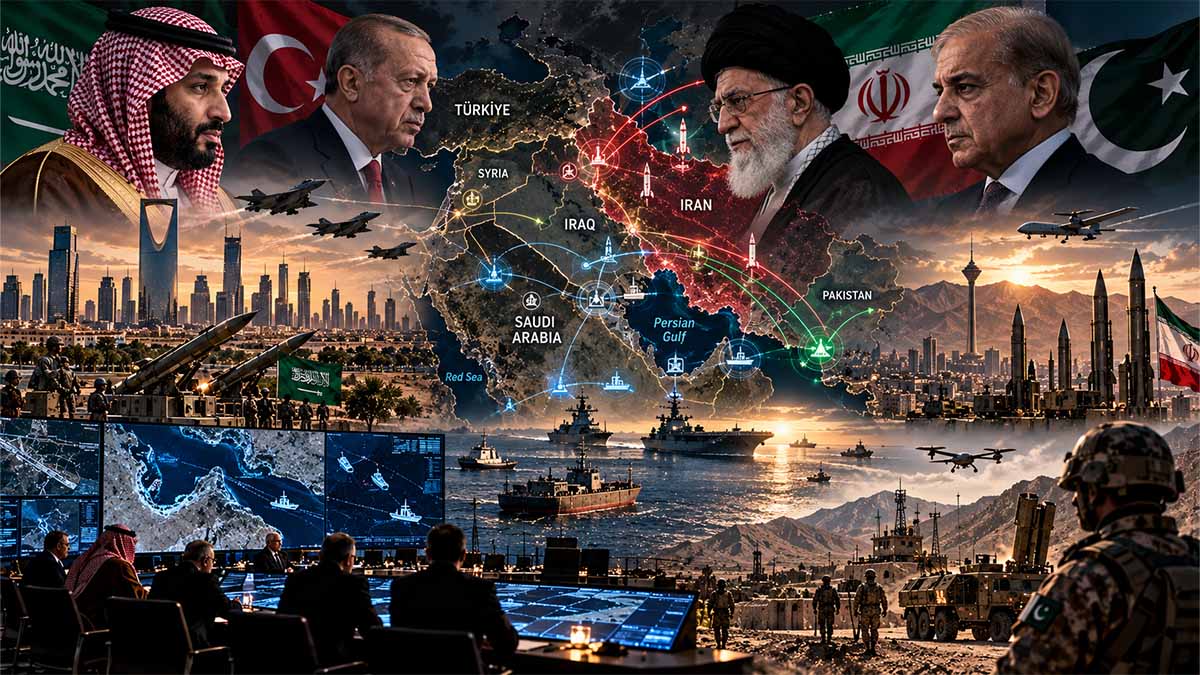
Scope: This assessment examines the quadrilateral diplomatic initiative involving Saudi Arabia, Türkiye, Pakistan and Iran in Tehran on 26 October 2026, its relationship to the Makkah Joint Defence Agreement of August 2026, and the implications for Middle Eastern security governance, defence industries, critical infrastructure and external technology suppliers through 2031.
Executive Summary / Bottom Line Up Front
The Tehran initiative represents a potentially significant change in the organisation of Middle Eastern security diplomacy: three states that have already established a trilateral collective-defence framework are engaging Iran through a direct regional consultation channel.
The strongest institutional evidence is not the Tehran meeting alone. It is the 7 August 2026 Makkah Joint Defence Agreement, followed by the 31 August Strategic Political and Defence Committee meeting in Istanbul, which explicitly endorsed further institutionalisation, defence-industrial cooperation, joint technology development and production.
The 26 October engagement therefore concerns an existing trilateral institutional structure establishing a diplomatic interface with a fourth regional power, rather than four governments beginning cooperation without any institutional foundation.
Saudi Arabia seeks strategic predictability compatible with economic transformation; Türkiye seeks greater regional influence and strategic indispensability; Pakistan combines collective-defence participation with a mediation role; Iran seeks to translate its security position into recognised diplomatic influence.
The central judgment is that regionalisation of crisis management is more immediately plausible than the formation of a unified quadrilateral security alliance. Consultation, collective defence and technological integration are different levels of commitment and must be assessed separately.
For defence and technology suppliers, the earliest consequential change would be the possible coordination of requirements, procurement priorities and industrial partnerships among the Makkah agreement’s three members. Extension of those arrangements to Iran would face substantially different political, legal and operational constraints.
The decisive uncertainty is whether the Tehran initiative establishes repeated consultation, agreed crisis-management procedures or documented institutional cooperation beyond the existing trilateral framework. No verified quadrilateral industrial programme or shared technological architecture is established by the currently examined official record.
Tehran and the New Middle Eastern Security Order: Regional Power, Defence Industries and the Limits of Strategic Autonomy
The consultations convened in Tehran on 26 October 2026 expose a fundamental contradiction in Middle Eastern security: Saudi Arabia, Türkiye and Pakistan are strengthening their collective-defence relationship while opening direct dialogue with Iran, a power whose regional position continues to challenge their interests. The implications reach beyond diplomacy. They concern who defines regional security priorities, who controls defence procurement, which countries capture industrial investment and how external powers retain influence over critical technologies. The 7 August Makkah Joint Defence Agreement and the subsequent institutional decisions of 31 August provide the foundation; Tehran introduces a potential channel for managing confrontation without dismantling existing alliances. The governing question is whether regional governments can convert diplomatic coordination into institutional authority and industrial bargaining power while remaining constrained by rivalries, foreign technologies and international law.
The Makkah Agreement Changes the Meaning of Tehran
The presence in the Tehran consultations of Saudi Defence Minister Prince Khalid bin Salman, Turkish intelligence director İbrahim Kalın and Pakistani military commander Field Marshal Asim Munir, alongside Iranian Supreme National Security Council Secretary Mohsen Rezaei, marks a significant development in regional diplomacy. Their institutional responsibilities are revealing: defence policy, intelligence, military command and national security were represented within a process directed towards de-escalation. Yet the distinction between diplomatic contact and binding commitments remains decisive. The reported 26 October initiative does not establish Iranian accession to the Makkah agreement, a quadrilateral military command or an integrated security organisation.
The Makkah Joint Defence Agreement, signed on 7 August 2026 by Saudi Arabia, Türkiye and Pakistan, establishes the publicly announced principle that an armed attack against one signatory is considered an attack against all three. On 31 August, their Strategic Political and Defence Committee met in Istanbul and announced further institutionalisation, including a secretariat located in Saudi Arabia, initially led by a Pakistani secretary-general for three years. The same declaration explicitly identified defence-industrial cooperation, joint technological development and production among its objectives. These are documented political commitments, not proof that common procurement programmes or operational capabilities have already been delivered.
Tehran therefore introduces a second mechanism alongside an existing trilateral defence relationship. Saudi Arabia’s interest is to reduce the security risks surrounding economic transformation. Türkiye seeks to consolidate its role in regional decision-making. Pakistan combines collective-defence participation with mediation. Iran seeks to translate its security position into diplomatic influence. Their interests converge around preventing uncontrolled escalation, but diverge over the distribution of military power, relations with external governments and the political outcomes of regional conflicts. The most plausible emerging structure is differentiated consultation, not a four-state alliance.
The Economic Cost of Escalation Is Already Measurable
The industrial significance of regional stability becomes evident in the energy system. According to the International Energy Agency, approximately 20 million barrels per day of crude oil and petroleum products passed through the Strait of Hormuz during 2025, representing roughly 25% of global seaborne oil trade. The passage measures approximately 21 nautical miles at its narrowest point, with navigation concentrated in designated shipping channels. These figures describe a structural dependency: disruption to a geographically restricted corridor can affect energy producers, maritime operators, importers and industrial consumers far beyond the Gulf.
Following the regional conflict that began on 28 February 2026, the IEA reported on 11 March that oil exports through Hormuz had fallen below 10% of pre-conflict levels. Its emergency response drew upon a system in which member countries held more than 1.2 billion barrels of emergency oil stocks, alongside approximately 600 million barrels of industry stocks maintained under government obligations. The agency subsequently described production curtailments of at least 10 million barrels per day among Gulf producers as export disruptions and storage constraints intensified. These were crisis-period measurements, not estimates of throughput on 26 October. Their significance lies in demonstrating how maritime insecurity can force adjustments in production, inventories and international energy policy.
Civilian infrastructure has proved equally exposed. A Houthi missile attack on Riyadh’s King Khalid International Airport on 10 October 2026 killed 12 people and injured more than 300, according to Saudi authorities cited by the United Nations. The attack illustrated how regional conflict can threaten transport connectivity, commercial continuity and the credibility of infrastructure protection. In Lebanon, the United Nations’ September 2026 humanitarian response addendum requested $385.88 million to assist 732,125 people during September–December. In the Palestinian territories, the October humanitarian appeal remained only slightly above 40% funded. These figures represent different categories of exposure and cannot be aggregated into a single economic loss. They nevertheless demonstrate why security governance cannot be measured exclusively through military deterrence.
For Riyadh, the economic calculation is particularly direct: infrastructure disruption raises the risks associated with investment, commercial activity and national development. For Tehran, regional negotiations can provide diplomatic influence that military capabilities alone cannot secure. For Türkiye and Pakistan, participation offers the possibility of shaping decisions affecting transport, trade and international stability. De-escalation has become an economic-security requirement, even where strategic reconciliation remains incomplete.
Defence Procurement Is Where Political Coordination Could Become Industrial Power
Saudi Arabia’s defence-industrial programme provides the clearest quantified evidence of the economic ambitions that could influence future trilateral procurement. The General Authority for Military Industries reported that localisation reached 24.89% in 2024, compared with a 16.5% target for that year and a historical baseline of 7.7%. The national objective is to localise more than 50% of government expenditure on military equipment and services by 2030. Official reporting also identified 311 industrial establishments and 572 cumulative licences and permits by the end of 2024, while GAMI reported a SAR 6.665 billion GDP contribution and 40.74% growth in local content for 2024.
These indicators measure different aspects of industrial development. A localisation percentage does not establish complete technological sovereignty; industrial licences do not measure production volumes; domestic assembly does not necessarily confer ownership of propulsion systems, electronics, software or critical manufacturing processes. The distinction is central to the Makkah agreement’s industrial objectives. Saudi Arabia can expand domestic manufacturing while continuing to depend upon foreign intellectual property, specialised components and technical support.
For aerospace, sensors, unmanned systems, defence electronics and communications, coordinated procurement could alter the position of international suppliers if the three governments adopt common requirements. Larger production commitments might support investment, while compatible technical specifications could reduce duplicated qualification and maintenance costs. Joint development could distribute industrial activity among participating countries. But these benefits require authorised budgets, contractual workshares, intellectual-property arrangements, export permissions and demonstrable interoperability.
The decisive question is who controls the technologies throughout their operating life. A manufacturer may supply the final platform while another company retains authority over critical software, communications interfaces or replacement components. Joint production might strengthen domestic manufacturing while preserving the same upstream dependencies. Genuine industrial resilience requires the ability to sustain, repair and adapt equipment when international deliveries are interrupted.
The Makkah agreement documents an ambition to cooperate industrially; it does not yet establish a common aerospace programme, shared sensor architecture or joint unmanned-systems production line. The commercial transformation will begin when procurement authorities convert political commitments into financed requirements and enforceable contracts.
Intelligence Cooperation Faces a Harder Constraint Than Industrial Investment
Türkiye’s decision to participate through intelligence director İbrahim Kalın makes information governance especially relevant, but his presence does not establish an intelligence-sharing agreement. Secure communications, access to classified information, interoperable equipment and common operational command are separate institutional achievements. Each requires its own political authorisation and technical safeguards.
The US National Institute of Standards and Technology’s SP 800-207, Zero Trust Architecture, published in August 2020, illustrates the difference between technical connectivity and authorised access. Its principles require access decisions to be governed by identity, permissions and policy rather than presumed trust arising from network membership. The September 2023 SP 800-207A extends relevant principles to cloud-native and multicloud environments. These are technical references, not standards documented as having been adopted by the Tehran participants.
Information shared among governments may carry restrictions imposed by its originating institution or a third-party partner. Classification rules, retention requirements, onward disclosure and cybersecurity responsibilities remain consequential even where political relations improve. This is particularly important when countries maintain different international security partnerships. Diplomatic willingness does not establish permission to disclose protected intelligence, controlled software or sensitive military technology.
Iran introduces an additional regulatory boundary. American restrictions administered through the Export Administration Regulations and the Treasury’s Office of Foreign Assets Control, alongside the European Union’s Regulation (EU) 2021/821 governing dual-use items and applicable Iran-related restrictive measures, can affect technology transfers, reexports, technical assistance and financial transactions. The European Council’s 29 September 2025 decision reimposing nuclear-related restrictive measures further illustrates the importance of separating political dialogue from legal authorisation. A regional agreement cannot independently override the applicable licensing rules of technology-originating jurisdictions.
These restrictions make comprehensive quadrilateral technological integration substantially less supportable than continued diplomatic consultation. The three Makkah states could pursue selected industrial programmes without extending access to Iran. That distinction is likely to remain critical for international suppliers evaluating commercial opportunities and compliance risks.
Washington, Beijing and Moscow Face Different Forms of Regional Autonomy
For the United States, the principal consequence is the prospect of regional partners developing common diplomatic positions without abandoning American technologies or security relationships. Washington retains influence through defence supply chains, export licensing and sanctions jurisdiction. The existence of independent regional consultations may reduce exclusive American control over diplomatic agendas, but does not automatically diminish its position in aerospace, electronics or other controlled technologies.
China enters the picture through a different channel. Beijing facilitated the 10 March 2023 Saudi-Iranian agreement restoring diplomatic relations, building upon earlier discussions supported by Iraq and Oman. That precedent demonstrates Chinese diplomatic access, not Chinese ownership of the emerging 2026 institutions. Beijing may benefit if regional governments diversify industrial suppliers and infrastructure partnerships, but financing and procurement influence remain distinct from collective-defence authority.
Russia faces a narrower industrial calculation. Its relevance to selected defence and diplomatic relationships does not establish an ability to coordinate the wider regional order. Production reliability, technical support, financial restrictions and the ability to meet contractual commitments would determine whether Russian suppliers benefited from procurement diversification.
The most revealing institutional development may be the 23 October 2026 Istanbul meeting, where the foreign ministers of Türkiye, Egypt, Pakistan and Saudi Arabia consulted their counterparts from France, Germany, Italy and the United Kingdom. The discussions addressed Iran, Palestine, Yemen, maritime security and regional economic consequences. Three days before Tehran, regional governments were engaging Europe rather than excluding it. This sequence weakens the argument that regional autonomy necessarily means diplomatic disengagement from external powers.
The redistribution of influence is therefore likely to be selective. Regional governments may gain greater control over the negotiating agenda while remaining dependent upon foreign finance, industrial systems, critical components and security relationships. The emerging competition is over who defines requirements, authorises transfers, controls technological interfaces and captures the economic value of future programmes.
Europe’s Industrial Exposure Is Unequal, and Its Regulatory Authority Matters
The European Union’s European Defence Industry Programme, adopted through its 30 March 2026 work programme, provides a financial comparison with the emerging Makkah structure. Its €1.5 billion allocation includes more than €700 million for production reinforcement, €325 million for European Defence Projects of Common Interest and €240 million for joint procurement, with grants of up to €20 million per eligible joint-procurement project. These are authorised programme allocations, not completed production or contracts with Middle Eastern customers.
For European manufacturers, expanded regional procurement coordination could create demand while European governments are simultaneously reinforcing their own industrial capacity. The resulting tension concerns delivery commitments, critical components, industrial investment and export permissions. A programme profitable in commercial terms may be difficult to execute if specialised capacity is already committed elsewhere or if technology-transfer requests conflict with national regulations.
Italy faces exposure through aerospace, naval systems, defence electronics, energy infrastructure and specialised engineering. Greater regional procurement coordination could strengthen demand for integrated capabilities while increasing pressure for local production and technical participation. Italian industrial competitiveness would depend upon maintaining control of critical technologies and securing durable positions within multinational supply chains.
France faces a different balance between export competitiveness and sovereign technological control. Coordinated regional customers might offer larger programmes while demanding more extensive industrial participation and access to technical systems. French suppliers would need to reconcile those requests with intellectual-property protection, export policy and the preservation of sensitive industrial capabilities.
Germany is especially exposed through advanced components, manufacturing technologies and multinational production arrangements. Its influence may extend through specialised equipment incorporated into systems assembled elsewhere. Divergent national export permissions could consequently affect common programmes even when German firms are not the principal contractors.
The United Kingdom, operating outside the EU regulatory framework but within NATO, faces comparable commercial questions through its defence-industrial and security relationships. Its position requires separate consideration of national licensing, multinational technology dependencies and lifecycle support obligations.
Türkiye’s NATO membership creates an additional legal distinction. Its participation in the Makkah agreement does not transfer NATO’s Article 5 commitments to Saudi Arabia or Pakistan, nor does consultation with Iran create NATO authority over quadrilateral decisions. Existing alliance obligations, information restrictions and national procurement powers continue to operate independently.
The Next 24 Months Will Separate Regional Governance from Diplomatic Theatre
Between October 2026 and October 2028, the central test will be whether the Tehran initiative produces a documented consultation mandate, recurring meetings and procedures capable of functioning during renewed disagreement. The Makkah framework faces a different test: whether its announced secretariat and defence-industrial commitments generate funded programmes, compatible requirements and verifiable implementation. These trajectories can advance separately. A durable diplomatic channel involving Iran does not require common military production, while deeper trilateral procurement does not establish wider political reconciliation.
Three outcomes remain credible. The first is differentiated institutional consolidation, in which Makkah, regional ministerial consultation and direct engagement with Iran perform complementary functions. The second is transactional diplomacy, with cooperation limited to particular crises while national procurement and security relationships remain separate. The third is renewed fragmentation, in which confrontation overwhelms the incentives for continued consultation. No defensible numerical probability follows from the documentary record.
The costs of inaction would be distributed unevenly. Regional governments would continue bearing the consequences of security disruption affecting infrastructure, trade and investment. Defence authorities could forgo potential efficiencies from common technical requirements and reliable industrial partnerships. Domestic manufacturers might remain dependent upon externally controlled systems despite localisation ambitions. International suppliers could lose negotiating influence if regional customers coordinate procurement before manufacturers adapt their commercial and technological arrangements.
The distinction is already visible in the decisions taken between 7 August and 26 October 2026. The three Makkah governments have formalised defence commitments and announced industrial objectives; their engagement with Iran remains a separate diplomatic initiative whose institutional future has not been demonstrated. The emerging Middle Eastern order will be determined not by whether regional powers continue meeting, but by whether their decisions change procurement authority, security procedures, investment conditions and the distribution of technological control. Until those consequences are documented, the transformation remains politically significant but materially incomplete.
Navigational Index
PILLAR I — THE DIPLOMATIC RECONFIGURATION OF MIDDLE EASTERN SECURITY
From geopolitical competition to conditional regional order-management
- Chapter 1 — Tehran as a Strategic Signal: The Diplomatic Breakthrough and Its Institutional Context : The 26 October initiative; verification of attendance and diplomatic status; the Makkah agreement’s significance; the distinction between crisis diplomacy and durable regional realignment; Palestine, Lebanon, Yemen and the wider security environment.
- Chapter 2 — Four National Strategies and the Limits of Convergence : Saudi economic-security priorities; Turkish regional influence; Pakistani mediation and defence commitments; Iranian diplomatic positioning; competing interests, political asymmetries and constraints on strategic trust.
- Chapter 3 — From Consultation to Regional Governance: Institutional Design, Authority and Strategic Legitimacy : The relationship between the trilateral Makkah institutional framework and quadrilateral engagement; possible consultation formats; collective-defence obligations versus diplomatic dialogue; crisis-management mechanisms; political legitimacy and the position of nonparticipating regional states.
PILLAR II — DEFENCE INDUSTRIES, TECHNOLOGICAL INTEGRATION AND STRATEGIC INFRASTRUCTURE
The industrial and informational foundations of regional security
- Chapter 4 — Defence-Industrial Convergence and the Future of Regional Procurement : Defence-industrial cooperation already contemplated under the Makkah framework; aerospace, sensors, unmanned systems, electronics and communications; joint development; procurement coordination; industrial capacity; production sovereignty and supplier dependencies.
- Chapter 5 — Intelligence, Dual-Use Technologies and the Conditions for Operational Interoperability : Intelligence-sharing governance; secure communications; classification and access rules; cybersecurity; dual-use transfer restrictions; operational interoperability; digital sovereignty; data protection and the separation between political willingness and technical capability.
- Chapter 6 — Energy Security, Strategic Infrastructure and Digital Connectivity : Critical energy infrastructure; transport and logistical dependencies; telecommunications; digital connectivity; financing and risk allocation; infrastructure resilience; industrial corridors and the relationship between security confidence and economic investment.
PILLAR III — INTERNATIONAL POWER DISTRIBUTION AND THE REGIONAL ORDER, 2027–2031
External influence, competing architectures and the future of technological alignment
- Chapter 7 — The Consequences for External Powers and International Defence Suppliers : Implications for the United States, China and Russia; separate assessments of Italy, France, Germany and the United Kingdom; European Union and NATO considerations; technology-market access, industrial standards, export controls, procurement influence and competitive positioning.
- Chapter 8 — Strategic Pathways, Observable Indicators and the Five-Year Net Assessment : Institutional consolidation versus transactional diplomacy; persistent rivalries; pathways for technological cooperation; conditions for external supplier adaptation; escalation risks; decision thresholds; policy options and the final assessment of the regional order through 2031.
Master Abstract
The significance of Tehran lies in the institutional sequence preceding it
The quadrilateral initiative announced for Tehran on 26 October 2026 is best understood as an attempt to create a working interface between an emerging trilateral defence arrangement and Iran, rather than as evidence that four regional powers have already converged around a common security doctrine. Saudi Defence Minister Prince Khalid bin Salman, Turkish National Intelligence Organization chief İbrahim Kalın and Pakistani military commander Field Marshal Asim Munir were identified as participants in consultations with Iranian authorities, including Supreme National Security Council Secretary Mohsen Rezaei. Iranian institutional statements presented the initiative as an opportunity to advance regionally generated security arrangements, while Saudi communications associated it with de-escalation, dialogue and support for mediation by Qatar and Pakistan. The contemporaneous record establishes an announced quadrilateral diplomatic initiative and reported engagement in Tehran; it does not, by itself, demonstrate a completed institutional agreement or operational convergence among the four states. The “Mecca Alliance” Countries and Iran Will Meet Monday in Tehran — Union of News Agencies of the Organization of Islamic Cooperation — Oct 2026
The structural importance of the initiative becomes considerably clearer when situated within the institutional developments of the preceding eleven weeks. On 7 August 2026, Saudi Arabia, Türkiye and Pakistan signed the Makkah Joint Defence Agreement, whose published official summary describes an arrangement under which an armed attack against one participant is treated as an attack against all three. On 31 August, the three governments convened their Strategic Political and Defence Committee in Istanbul and announced measures to further institutionalise their cooperation. These included a secretariat to be established in Saudi Arabia, initially under Pakistani leadership for a three-year term, alongside an explicit commitment to strengthening defence-industrial cooperation, joint technology development and production. This sequence provides documentary evidence that the three states had already moved beyond informal political alignment before opening the Tehran channel. Crucially, Iran is not established as a party to the Makkah agreement: the trilateral defence architecture and the proposed quadrilateral consultation mechanism remain distinct institutional and legal propositions. Türkiye and Saudi Arabia Sign a Joint Defence Agreement — Presidency of the Republic of Türkiye, Directorate of Communications — Aug 2026; Strategic Political and Defence Committee of the Makkah Agreement for Joint Defence, Joint Statement — Republic of Türkiye Ministry of Foreign Affairs — Aug 2026.
Converging security incentives do not eliminate strategic competition
The national interests involved are complementary in certain respects but remain structurally different. Saudi Arabia has a particular interest in reducing the probability that regional confrontation interrupts investment, economic diversification, infrastructure development or the security conditions necessary for long-term transformation. Türkiye has an incentive to position itself as a regional actor whose military, diplomatic and intelligence capabilities cannot be bypassed in decisions affecting the Middle East. Pakistan’s participation connects an established collective-defence commitment with its diplomatic role in crisis mediation. Iran, meanwhile, has an opportunity to seek recognition as a necessary participant in regional security decisions rather than an object of policies determined principally by rival governments and external powers.
These interests offer a basis for limited cooperation without requiring agreement on the region’s ultimate political order. The immediate common denominator is the management of escalation: communication may become valuable precisely because strategic disagreement persists. A durable mechanism would therefore depend less on ideological convergence than on repeatable procedures, political authorisation, the ability to transmit credible commitments and mechanisms for addressing disputes when participants’ national interests diverge. The unresolved status of regional conflicts, including those affecting Palestine, Lebanon and Yemen, is consequently not peripheral to the initiative. These conflicts expose the distance between agreement on general stability and agreement on particular security outcomes. A consultation process capable of surviving such differences would represent a more substantial institutional change than a single high-level meeting.
The technological dimension is already present in the trilateral framework
The industrial implications require particular attention because the Makkah framework is not confined, in its official declarations, to diplomacy or collective deterrence. Its 31 August joint statement expressly identifies defence-industrial cooperation, joint technology development and production as objectives. This creates a documented basis for considering how the three participating states might progressively coordinate technical requirements, development priorities, supply-chain arrangements and industrial investment. It does not, however, establish that specific aerospace programmes, unmanned platforms, sensor networks, secure communications systems or technology-transfer agreements have been approved. Nor does it establish Iranian access to technologies developed or exchanged within the trilateral structure. Strategic Political and Defence Committee of the Makkah Agreement for Joint Defence, Joint Statement — Republic of Türkiye Ministry of Foreign Affairs — Aug 2026.
The transmission mechanism from diplomacy to technological influence is nonetheless identifiable. Sustained consultation can produce shared threat assessments; these can inform common capability requirements; common requirements can influence procurement specifications, technical standards, industrial partnerships and supplier selection. But each transition depends on additional decisions and resources. Intelligence exchange requires rules governing classification, authorisation, secure transmission, retention and disclosure. Defence cooperation requires technical compatibility, training, maintenance capacity and dependable logistical support. Joint industrial production requires investment, intellectual-property arrangements, export permissions, quality assurance and resilient supply chains. Energy and digital connectivity projects additionally require viable financing, infrastructure security, regulatory compatibility and credible management of political risk. Diplomatic contact can create demand for technological coordination, but it cannot substitute for the legal, engineering and industrial conditions necessary to deliver it.
Regional ownership would modify external influence, not automatically displace it
For extra-regional powers, the strategic consequence would not necessarily be exclusion from Middle Eastern security management. It would be a possible redistribution of initiative over agenda-setting, mediation and the definition of acceptable security arrangements. If Riyadh, Ankara and Islamabad use an established trilateral institution to coordinate positions and maintain direct engagement with Tehran, outside governments could increasingly encounter regional actors capable of presenting more consolidated negotiating preferences. For international defence and infrastructure suppliers, this could alter the political environment in which procurement decisions are taken, particularly if common technical requirements or industrial-development priorities acquire formal expression.
Yet the direction of such change cannot be assumed to be uniform. Regional consultation can coexist with external defence partnerships, while the participants’ distinct security relationships may constrain common technological policies. Suppliers operating under different export-control regimes cannot necessarily satisfy identical procurement requirements, and regional political accommodation does not dissolve restrictions affecting individual counterparties. The strategic question is therefore whether regional states become more capable of coordinating decisions while retaining differentiated external relationships. Under that interpretation, the Tehran initiative could mark the beginnings of a more regionally managed diplomatic order without producing a self-contained military, technological or economic bloc.
The five-year assessment turns on institutional evidence, not diplomatic symbolism
Through 2031, three broad pathways remain analytically credible. The first is consolidation of a recurring regional consultation process that complements, but does not replace, the trilateral Makkah framework. The second is a transactional arrangement in which governments cooperate on particular crises while preserving conflicting security preferences and separate industrial relationships. The third is deterioration of the consultation process under renewed confrontation or irreconcilable differences concerning regional conflicts and defence commitments. These pathways are not fully exclusive over time: institutional consolidation may proceed in limited domains while conflict continues elsewhere. Current official evidence supports the existence of a trilateral institutional foundation and a deliberate attempt to open a quadrilateral diplomatic channel, but does not support a numerical estimate of their probability of success.
The most consequential observations will be whether participating governments publish a joint Tehran outcome, establish procedures for subsequent quadrilateral meetings, designate permanent liaison authorities, document crisis-management channels or announce specifically authorised programmes. Industrial relevance will depend on a separate evidentiary threshold: identifiable joint requirements, financing commitments, binding procurement decisions, technology-governance arrangements and verified implementation. Until those developments occur, the defensible conclusion is that the regional security architecture is showing signs of institutional diversification, while the prospect of a broader technological and industrial system remains contingent rather than established.
Key Evidence Table
The following table separates documentary milestones, official positions and unresolved implementation questions. It deliberately avoids unsupported expenditure, capability and programme estimates.
| Indicator | Value / status | Reference date | Definition / scope | Issuer | Exact source |
|---|---|---|---|---|---|
| Makkah Joint Defence Agreement | Signed by Saudi Arabia, Türkiye and Pakistan | 7 Aug 2026 | Trilateral collective-defence commitment | Turkish Presidency, Directorate of Communications | Official announcement |
| Collective-defence principle | Armed attack against one treated as attack against all three | 7 Aug 2026 | Officially announced treaty principle; implementation and legal effect require separate assessment | Turkish Presidency, Directorate of Communications | Official announcement |
| Strategic Political and Defence Committee | First meeting documented in Istanbul | 31 Aug 2026 | Trilateral political and defence coordination institution | Turkish Ministry of Foreign Affairs | Meeting record |
| Joint secretariat | Establishment in Saudi Arabia announced | 31 Aug 2026 | Initial Pakistani secretary-general for three years | Turkish Ministry of Foreign Affairs | Joint statement |
| Defence-industrial cooperation | Joint technology development and production expressly identified | 31 Aug 2026 | Policy commitment, not evidence of completed programmes | Turkish Ministry of Foreign Affairs | Joint statement |
| Tehran quadrilateral initiative | Consultation involving the three Makkah states and Iran announced and reported | 26 Oct 2026 | Regional security and de-escalation discussions | Iranian and Saudi institutional positions reported through the OIC news-agency network | Contemporaneous report |
| Mediation role | Qatar and Pakistan identified in support of crisis diplomacy | 26 Oct 2026 | Diplomatic de-escalation, not a new collective-defence obligation | Saudi diplomatic position as reported | Contemporaneous report |
| Quadrilateral technological cooperation | No specific programme established by examined records | 26 Oct 2026 | Outstanding question concerning Iran’s participation in industrial or intelligence arrangements | No verified quadrilateral implementing instrument | Official outcome or implementing agreement not established |
The documentary sequence establishes an important distinction: the institutionalisation of trilateral defence cooperation is an announced and partly implemented process, whereas the institutionalisation of quadrilateral cooperation with Iran remains an open proposition. Any assessment treating these two developments as equivalent would overstate the available evidence.
Competing Explanations and Strategic Pathways
The evidence supports three analytically distinct explanations of the Tehran initiative. They describe different possible purposes and outcomes, rather than necessarily mutually exclusive intentions.
| Hypothesis | Diagnostic support | Disconfirming evidence or limitations | Future indicators | Current standing |
|---|---|---|---|---|
| Regional institutional consolidation | Pre-existing Makkah structure; trilateral committee; announced secretariat; direct Iranian engagement | No verified quadrilateral institutional instrument or permanent mechanism | Repeated meetings, joint outcomes, formal liaison arrangements | Plausible, but not yet established for the four states |
| Crisis-specific diplomatic coordination | Explicit emphasis on de-escalation and Qatar–Pakistan mediation | Broader security-governance language and an existing trilateral institution suggest ambitions may extend beyond one crisis | Subsequent consultations tied to crisis developments without permanent structures | Strongest immediate interpretation of the Tehran initiative |
| Strategic repositioning without deep integration | Distinct national interests; different external relationships; unresolved regional rivalries | Existing trilateral defence and industrial commitments demonstrate more than purely rhetorical cooperation among three participants | Divergent national positions, restricted cooperation and absence of implementation | Credible constraint on deeper quadrilateral integration |
The strongest current assessment is that crisis management provides the immediate common interest, while the pre-existing Makkah framework provides an institutional foundation from which more ambitious regional coordination could emerge. Whether Iran becomes a participant in a recurring consultation mechanism is a separate question from whether the Makkah parties achieve deeper defence integration among themselves.
Principal Gaps and Watch Indicators
The most important unresolved question concerns the substantive outcome of the 26 October consultations. The contemporary official and institutionally attributed record identifies the intended participants, the diplomatic rationale and the broad security objectives, but does not establish a comprehensive jointly adopted outcome document. A subsequent official communiqué from the participating governments would be the strongest immediate evidence of agreed scope, political commitments and continuation arrangements.
The next question concerns the institutional boundary between the Makkah Joint Defence Agreement and a possible quadrilateral mechanism. Any published decision concerning observer participation, expanded consultation, permanent representation or formal accession would materially change the assessment. Without such a decision, contact between the Makkah states and Iran should not be interpreted as Iranian membership of the trilateral defence framework.
The industrial and technological gaps are equally consequential. The 31 August trilateral declaration provides an explicit policy basis for defence-industrial cooperation and joint technology development, but the examined official record does not identify the contracts, technical standards, industrial workshares, financing arrangements or technology-governance instruments needed to establish practical implementation. Procurement awards, formal intergovernmental technical agreements and authorised programme announcements would constitute more persuasive evidence than general commitments to cooperate.
Finally, the diplomatic mechanism’s credibility will depend on performance under disagreement. Observable continuity of official contact during renewed security tensions would be a stronger test of institutional resilience than declarations made during a temporary diplomatic opening. Evidence of sustained liaison and practical de-escalation procedures would raise confidence in durable order-management; repeated cancellation of meetings, conflicting commitments or a failure to implement agreed measures would weaken it.
Strategic Implications for Institutional Decision-Makers
For regional governments, the immediate decision problem is how to preserve the diplomatic value of direct communication without assuming that participation requires comprehensive strategic alignment. Procedures for communication, confidentiality, political authorisation and dispute management would be more useful early measures than premature claims of regional security integration. Their principal implementation burden would be the establishment of reliable institutional responsibility and sufficiently bounded mandates to prevent crisis diplomacy from being interpreted as endorsement of another participant’s wider security policies.
For defence ministries and industrial authorities, the actionable distinction is between the already documented Makkah commitment to defence-industrial cooperation and any future quadrilateral arrangements. Technical planning within the trilateral framework may acquire greater significance as common requirements are defined, but cooperation involving Iran would require distinct authorisations, legal scrutiny and assessment of applicable technology-transfer restrictions. Institutional engagement should therefore be evaluated according to the precise parties, technologies, information categories and legal authorities involved, rather than by geographic or political association alone.
For external governments and suppliers, the relevant strategic response is to monitor whether purchasing power, technical requirements and industrial-development objectives are increasingly coordinated. The consequences would emerge first through procurement and governance decisions, not necessarily through a formal declaration of geopolitical realignment. Suppliers capable of meeting compatible security, interoperability and industrial-participation requirements could benefit from more coordinated demand, while those dependent on incompatible licensing arrangements, fragmented technical standards or restrictions on downstream technology access could encounter greater market and implementation complexity.
For European governments in particular, the regional developments warrant differentiated attention rather than an undifferentiated European position. Italy’s exposure through Mediterranean security and energy-infrastructure relationships, France’s defence-industrial and regional-security interests, Germany’s industrial and export-control considerations, and the United Kingdom’s defence and intelligence relationships all create distinct channels through which a more coordinated regional procurement or security environment could matter. These are assessment categories, not evidence of country-specific policy decisions made in response to Tehran. The European Union’s regulatory and industrial interests, and Türkiye’s separate NATO obligations, would have to be analysed alongside national authorities before identifying feasible policy adjustments.
The decision-relevant conclusion at the present cut-off is therefore one of institutional differentiation rather than completed strategic realignment. The Makkah agreement supplies an observable foundation for trilateral defence and industrial coordination. Tehran introduces the prospect of direct security consultation with Iran. The future significance of that connection will be determined by whether diplomatic dialogue generates repeatable institutions, and whether those institutions subsequently influence concrete security practices, industrial decisions and technological governance.
Tehran and the Emerging Architecture of Middle Eastern Security
Saudi Arabia, Türkiye, Pakistan and Iran: the institutional transmission from regional diplomatic coordination to defence-industrial cooperation, intelligence governance, critical infrastructure and technological influence.
The Institutional Architecture: A Trilateral Defence Framework and a Quadrilateral Diplomatic Interface
The central distinction is between the Makkah Joint Defence Agreement, signed by Saudi Arabia, Türkiye and Pakistan, and the Tehran consultation initiative involving Iran. They are not interchangeable structures. The former provides a documented trilateral defence framework; the latter indicates an attempt to widen regional political dialogue.
Existing Trilateral Foundation
Makkah Joint Defence Agreement — 7 August 2026Makkah Joint Defence Framework
Collective-defence principle | Strategic Political and Defence Committee | Announced secretariat | Defence-industrial cooperation objectives
Tehran initiative — 26 October 2026
De-escalation, regional crises and security order-management
Repeated dialogue → Political coordination → Crisis-management procedures → Possible institutional cooperation
PERMANENT FORMAT NOT ESTABLISHEDFour National Strategies: Convergence Without Strategic Identity
The mechanism’s viability depends on whether different national objectives can be accommodated through stable consultation procedures without requiring the participating states to eliminate their underlying rivalries.
Saudi Arabia
Protect the conditions necessary for economic transformation, infrastructure investment and regional commercial stability. De-escalation reduces the political and security risks surrounding long-horizon economic projects.
Türkiye
Consolidate its role as a security and diplomatic actor whose involvement matters in regional decisions. Institutional coordination can strengthen influence while preserving independent strategic choices.
Pakistan
Connect an established trilateral collective-defence commitment with crisis diplomacy. Mediation and institutional participation provide separate but potentially complementary channels of influence.
Iran
Translate its regional security position into recognised participation in diplomatic decision-making. Direct communication offers an avenue for influencing crisis management without proving comprehensive strategic reconciliation.
From Diplomatic Contact to Operational Integration
The four stages represent increasing types of commitment, not a measured maturity score or guaranteed chronological progression. Each stage requires additional decisions, authorisations and implementation capacity.
Documented Trilateral Foundation
Makkah agreement, Strategic Political and Defence Committee and declared industrial cooperation objectives.
Regional Consultation
Tehran initiative to engage Iran directly on regional security and de-escalation.
Institutional Continuity
Possible permanent representation, regular meetings, structured liaison and crisis-management procedures.
Practical Integration
Potential technical standards, intelligence protocols, authorised industrial programmes and interoperable capabilities.
How Diplomatic Coordination Could Reshape Defence and Technology Markets
The following chain is a conditional analytical model. It identifies the decisions needed for diplomatic engagement to influence procurement, industrial partnerships and technology governance. It is not a claim that every transition has occurred.
Interoperability, legal authority, export permissions, industrial workshare, secure information exchange, data governance, maintenance capacity, financing and resilient supply chains. Political agreement alone cannot deliver these requirements.
Technological and Industrial Cooperation: Opportunities, Conditions and Evidence Boundaries
The 31 August 2026 trilateral joint statement explicitly identifies defence-industrial cooperation, joint technology development and production. The sectors below describe where coordination could become relevant; they are not confirmed quadrilateral projects.
| Industrial / technical domain | Potential coordination channel | Material prerequisite | Assessment status |
|---|---|---|---|
| Aerospace and defence platforms | Coordinated requirements, joint development or supplier selection. | Export permissions, certification, support systems and industrial capacity. | CONDITIONAL |
| Sensors and surveillance systems | Compatible data interfaces and procurement specifications. | Cybersecurity, classification rules and validated interoperability. | CONDITIONAL |
| Unmanned systems | Potential technical development and common operational requirements. | Control interfaces, component access, testing and maintenance. | CONDITIONAL |
| Intelligence and secure communications | Structured information exchange and protected liaison channels. | Access control, encryption governance, trust and information-handling rules. | NOT VERIFIED |
| Energy and critical infrastructure | Possible security coordination and infrastructure planning. | Project financing, risk allocation, resilience and regulatory authority. | CONDITIONAL |
| Digital connectivity and data systems | Potential interface standards and cross-border connectivity priorities. | Data governance, network security, commercial viability and applicable law. | CONDITIONAL |
Implications for External Powers and Industrial Suppliers
More coordinated regional decision-making could change the environment in which external governments and suppliers negotiate security assistance, industrial partnerships and technology access. The effects would differ across jurisdictions and sectors.
United States, China and Russia
A durable regional consultation mechanism could modify external influence over diplomatic agenda-setting and the negotiation of security arrangements. This would not automatically eliminate bilateral partnerships or create a unified alternative alliance.
European Defence Industries
If regional procurement priorities become more coordinated, suppliers could face greater demand for compatible technical standards, local industrial participation and resilient maintenance arrangements.
Export Controls and Technology Governance
Shared political preferences cannot override licensing requirements, restricted technology transfers or the legal obligations applicable to individual states, manufacturers and transactions.
Italy, France, Germany and the United Kingdom
Separate national assessments are required for defence-industrial exposure, energy and infrastructure relationships, licensing authority and security commitments, alongside EU and NATO constraints.
Regional Security Pathways, 2027–2031
Three credible pathways describe how consultation could evolve. They are qualitative alternatives, not calculated probabilities. Elements may coexist or follow one another over time.
Institutional Consolidation
Quadrilateral engagement becomes recurring, supported by designated authorities and crisis-management procedures, while the Makkah defence framework retains its separate institutional identity.
Regular joint meetings, documented procedures, permanent liaison arrangements and official implementation decisions.
Transactional Coordination
The states cooperate selectively during crises but preserve separate security preferences, external relationships and technological-industrial arrangements.
Issue-specific meetings, limited joint statements and absence of binding quadrilateral institutional arrangements.
Renewed Strategic Fragmentation
Rival interests, unresolved conflicts or disagreements over defence commitments prevent diplomatic contact from developing into sustained regional security governance.
Discontinued consultations, contradictory commitments, breakdowns in de-escalation procedures or renewed confrontation.
Institutional Milestones and Verification Thresholds
The sequence below separates documented events and commitments from initiatives that still require official evidence of implementation.
| Date | Development | Institutional significance | Evidence status |
|---|---|---|---|
| 7 Aug 2026 | Makkah Joint Defence Agreement | Trilateral collective-defence framework involving Saudi Arabia, Türkiye and Pakistan. | DOCUMENTED |
| 31 Aug 2026 | Strategic Political and Defence Committee | Formal political-defence coordination and further institutionalisation. | DOCUMENTED |
| 31 Aug 2026 | Secretariat and industrial objectives | Announced secretariat and commitments concerning defence-industry cooperation and technology development. | DECLARED COMMITMENTS |
| 26 Oct 2026 | Tehran quadrilateral initiative | Direct consultation channel involving Iran and the three Makkah states. | REPORTED INITIATIVE |
| Not established | Permanent quadrilateral institution | Would require agreed rules, continuity and formal political authorisation. | OPEN RECORD |
| Not established | Quadrilateral industrial or intelligence programmes | Would require separately authorised technical and operational arrangements. | OPEN RECORD |
Strategic Judgment: Institutional Diversification, Not Yet a Unified Regional Bloc
The 2026 diplomatic sequence suggests a potential movement toward greater regional ownership of crisis management. The Makkah agreement establishes a documented trilateral foundation, while Tehran opens the possibility of broader consultation with Iran.
The technological and industrial consequences remain conditional. For the participating governments and their external partners, the decisive change will occur only when political dialogue is translated into formal authority, common requirements, financed programmes, secure information governance and operationally sustainable arrangements.
The principal strategic test through 2031 is whether direct regional contact survives political disagreement and develops procedures that influence actual security decisions. Repeated consultation would strengthen the case for a changing order-management architecture; verified procurement, industrial or intelligence arrangements would be necessary to establish a corresponding technological transformation.
Sources and Evidence Limitations
The following source records are those identified in the underlying assessment. Official institutional documents support the trilateral commitments. The Tehran item is a contemporaneous institutional news report and should not be treated as a substitute for a signed quadrilateral outcome document.
- Türkiye and Saudi Arabia Sign a Joint Defence Agreement — Presidency of the Republic of Türkiye, Directorate of Communications, August 2026
- Strategic Political and Defence Committee of the Makkah Agreement for Joint Defence, Joint Statement — Republic of Türkiye Ministry of Foreign Affairs, 31 August 2026
- First Meeting of the Strategic Political and Defence Committee — Republic of Türkiye Ministry of Foreign Affairs, 31 August 2026
- The “Mecca Alliance” Countries and Iran Will Meet Monday in Tehran — Union of News Agencies of the Organization of Islamic Cooperation, 26 October 2026
PILLAR I — THE DIPLOMATIC RECONFIGURATION OF MIDDLE EASTERN SECURITY
Chapter 1 — Tehran as a Strategic Signal: The Diplomatic Breakthrough and Its Institutional Context
Tehran and the emergence of a regional security-management initiative
The decision by Saudi Arabia, Türkiye and Pakistan to engage Iran collectively in Tehran on 26 October 2026 constitutes a significant diplomatic development, not because the four governments have suddenly overcome their political disagreements, but because three states that had already formalised a collective-defence relationship were prepared to open a direct channel with a regional power whose security position remains deeply contested. The analytical significance of the initiative lies in the relationship between these two developments. On 7 August 2026, Saudi Arabia, Türkiye and Pakistan signed the Makkah Joint Defence Agreement, establishing an explicit collective-defence principle. On 31 August, the three governments adopted institutional measures intended to give their cooperation continuity and operational credibility. Less than two months later, representatives of the same three countries were identified as participants in a quadrilateral consultation with Iran. This sequence suggests that the regional security architecture is evolving through the simultaneous construction of instruments of deterrence and mechanisms of dialogue. The two processes are not necessarily contradictory. Indeed, one of the central questions of the emerging regional order is whether governments can strengthen their capacity to resist aggression while creating political mechanisms capable of preventing the disagreements that might otherwise activate those commitments. The Tehran initiative is therefore better understood as an effort to connect deterrence with crisis management than as proof of a new alliance encompassing all four countries. Türkiye and Saudi Arabia Sign a Joint Defence Agreement — Presidency of the Republic of Türkiye, Directorate of Communications — August 2026; Strategic Political and Defence Committee of the Makkah Agreement for Joint Defence, Joint Statement — Republic of Türkiye Ministry of Foreign Affairs — August 2026.
The composition of the delegations reinforces this interpretation. Saudi Arabia identified Defence Minister Prince Khalid bin Salman as its representative, Pakistan was represented in the announced arrangement by Field Marshal Asim Munir, and Türkiye designated İbrahim Kalın, director of its National Intelligence Organization. Iranian officials identified Mohsen Rezaei, secretary of the Supreme National Security Council, as the principal Iranian security interlocutor, while Saudi reporting also referred to an anticipated meeting with President Masoud Pezeshkian. These are not interchangeable offices. A defence minister represents the political authority responsible for national defence policy; a senior military commander brings institutional proximity to defence planning and the management of military commitments; an intelligence chief operates within the political-security environment in which sensitive assessments, strategic communications and confidential exchanges are organised. Their combination indicates that the consultation was conceived at a level capable of addressing politically sensitive security questions rather than merely producing a general diplomatic declaration. It does not, however, demonstrate that operational planning, intelligence sharing or military coordination were agreed. The available institutional record establishes the initiative, the identities and stated roles of its principal participants, and the diplomatic objectives attributed to the consultations. It does not establish a comprehensive signed outcome, permanent quadrilateral institution or publicly documented agreement on defence capabilities. The Countries of the “Mecca Alliance” and Iran Will Meet Monday in Tehran — Union of News Agencies of the Organization of Islamic Cooperation — October 2026.
The distinction between announced participation and conclusively documented results is especially important when analysing the significance of an event still unfolding on its reference date. Iranian Deputy Supreme National Security Council Secretary Ali Bagheri Kani publicly identified the proposed participants and connected the meeting to an ambition for regional security arrangements developed by the countries of the region themselves. Saudi communications described the consultations as part of efforts to reduce escalation, encourage dialogue and support the mediation activities of Pakistan and Qatar. Turkish security sources confirmed the intended participation of İbrahim Kalın. Taken together, these positions establish meaningful convergence around the usefulness of direct diplomatic engagement. They do not establish agreement on the definition of the principal security threats, the distribution of responsibilities for de-escalation or the political conditions of a settlement. The Iranian emphasis on regionally generated security arrangements and the Saudi emphasis on crisis management should be treated as compatible at the level of immediate diplomatic procedure, but not necessarily identical in their longer-term implications. Iran could regard regional ownership as a means of reducing external influence, whereas Saudi Arabia might regard direct regional dialogue as an additional instrument for limiting instability while preserving existing international relationships. A credible strategic assessment must preserve this distinction because the durability of any emerging mechanism will depend upon whether it can accommodate such different understandings of its purpose. The Countries of the “Mecca Alliance” and Iran Will Meet Monday in Tehran — Union of News Agencies of the Organization of Islamic Cooperation — October 2026.
The Makkah agreement transformed the institutional meaning of the Tehran initiative
The August 2026 Makkah agreement provides the essential institutional background. Signed in Makkah by Saudi Crown Prince and Prime Minister Mohammed bin Salman, Turkish President Recep Tayyip Erdoğan and Pakistani Prime Minister Shehbaz Sharif, the agreement was presented by the Turkish Presidency as an instrument intended to strengthen collective deterrence against aggression. Its published official account states that an armed attack against any one of the three participating states is to be regarded as an attack against all three. The agreement also provides for the enhancement of defence cooperation among the participants. This is a materially stronger political formulation than an ordinary declaration of diplomatic friendship because it explicitly connects the security of one country to the responsibilities of the others. Nevertheless, the published announcement must not be confused with complete public access to all operative treaty provisions. The available summary does not independently resolve every question concerning activation procedures, domestic authorisation, operational command, the scope of assistance or the precise legal consequences of different forms of attack. The defensible conclusion is that the three governments announced a collective-defence principle whose effective application would depend upon the agreement’s operative provisions and subsequent national and trilateral decisions. Türkiye and Saudi Arabia Sign a Joint Defence Agreement — Presidency of the Republic of Türkiye, Directorate of Communications — August 2026.
The institutional development of 31 August is equally consequential. Meeting in Istanbul through the Strategic Political and Defence Committee established under the Makkah framework, the foreign ministers, defence ministers and senior military leaderships of the three countries adopted a joint statement affirming their determination to deepen coordination. They announced the establishment of a secretariat in Saudi Arabia, initially led by a Pakistani secretary-general for a three-year period, and identified defence-industrial cooperation, joint technology development and production as objectives. The significance of this declaration lies in the combination of political governance and industrial ambition. A defence agreement can remain largely declaratory if it does not acquire mechanisms for implementation. A committee connecting foreign policy, defence policy and military leadership creates a potential forum for managing that implementation, while a permanent secretariat could provide continuity between ministerial meetings. Yet institutional intent and functioning institutional capacity are not equivalent. The announcement of a secretariat does not, by itself, verify its staffing, budget, rules of procedure, operational resources or authority to commit participating governments. Similarly, the commitment to joint technology development does not establish that specific programmes have been financed, contracted or delivered. These distinctions determine the analytical boundary between the political architecture that has been publicly documented and the implementation that requires further evidence. Strategic Political and Defence Committee of the Makkah Agreement for Joint Defence, Joint Statement — Republic of Türkiye Ministry of Foreign Affairs — August 2026.
The resulting institutional configuration is distinctive. The Makkah framework places Saudi Arabia, Türkiye and Pakistan within an expressly trilateral defence relationship, while the Tehran initiative introduces Iran as a participant in a proposed security consultation outside that relationship. Consultation with a state is not equivalent to extending collective-defence guarantees to that state. Nor does it establish common military command, a shared defence doctrine or participation in the trilateral industrial arrangements. This distinction has strategic importance because mechanisms for diplomatic consultation are frequently most valuable when they include states that do not share defence obligations. A government may wish to maintain communication with a potential adversary, negotiate limits on escalation or explore mutually acceptable arrangements without accepting responsibility for that government’s territorial defence. Conversely, the presence of a collective-defence mechanism among some participants can strengthen their capacity to negotiate, provided it does not turn consultation into an instrument of coercion. Tehran’s significance rests partly on the possibility that these two forms of security organisation—collective defence among three states and wider consultation among four—might develop alongside one another without being institutionally merged.
The 2026 regional war changed the incentives for direct coordination
The immediate security environment provides a more compelling explanation for the diplomatic urgency than a general aspiration towards regional reconciliation. According to the contemporaneous institutional reporting of 26 October, the United States and Israel launched military operations against Iran on 28 February 2026, after which Iranian retaliation and wider regional confrontation created serious risks for neighbouring states. The same record describes a memorandum of understanding between Washington and Tehran dated 18 June, followed by negotiations that subsequently broke down. These developments place the Tehran consultations within an active crisis rather than a conventional period of diplomatic normalisation. The central problem facing the participating governments is not simply how to improve relations with Iran over the long term. It is how to reduce the probability that renewed confrontation produces further attacks, economic disruption and escalating obligations for states whose security arrangements have become more closely connected. The specific contents of the June memorandum and the reasons for the subsequent diplomatic breakdown require examination of the relevant operative documents before they can be treated as established beyond the contemporaneous account. What is clear from the available evidence is that the October initiative was publicly framed as a response to ongoing escalation and as support for efforts to restore a diplomatic channel between Tehran and Washington. The Countries of the “Mecca Alliance” and Iran Will Meet Monday in Tehran — Union of News Agencies of the Organization of Islamic Cooperation — October 2026.
For Saudi Arabia, the security consequences of regional escalation are particularly immediate. The United Nations reported that a Houthi missile attack on King Khalid International Airport in Riyadh on 10 October killed twelve people and injured more than three hundred, according to Saudi authorities. The UN Secretary-General condemned the attack, emphasising the prohibition on attacks against civilians and civilian infrastructure. This incident illustrates the transmission of regional conflict into a country’s essential civilian systems. An international airport is simultaneously a transport facility, a commercial gateway, a logistical asset and a symbol of national connectivity. Its vulnerability can affect civilian safety, aviation continuity, insurance perceptions and confidence in the reliability of infrastructure. The exact size of those economic effects cannot be derived from the casualty figures, and no such estimate is necessary to understand the strategic mechanism. When regional conflict threatens infrastructure whose uninterrupted operation is essential to investment and economic diversification, diplomatic de-escalation becomes part of national economic-security policy. Consequently, Saudi participation in consultations involving Iran need not indicate a weakening of Riyadh’s commitment to deterrence. It can equally represent an attempt to reduce the likelihood that deterrence will have to be tested through further escalation. “These Attacks Must Cease Immediately”: Guterres Condemns Deadly Houthi Strike on Riyadh Airport — United Nations Department of Political and Peacebuilding Affairs — October 2026.
Yemen offers perhaps the clearest demonstration of why a consultation mechanism involving states with different security preferences might nevertheless possess operational diplomatic value. On 9 October 2026, United Nations Special Envoy Hans Grundberg told the Security Council that Yemen had returned to full-scale warfare, with hostilities spreading across several fronts. His assessment identified fighting around the western coast, the Bab al-Mandab area, Taiz, Lahj and other contested territories, alongside attacks affecting Saudi civilian and energy infrastructure. These developments are strategically connected because Yemen is both a domestic conflict involving competing Yemeni authorities and a theatre in which wider regional confrontation influences the calculations of external actors. A diplomatic discussion among Riyadh, Ankara, Islamabad and Tehran cannot legitimately substitute for a Yemeni-owned political settlement. It could, however, address aspects of cross-border escalation and the regional incentives that complicate such a settlement, provided the governments possess both the willingness and the practical ability to influence relevant actors. The distinction is important: regional consultation may reduce external drivers of conflict without resolving the internal contest over legitimate authority, territory and political representation. The United Nations has explicitly maintained the need for a credible Yemeni-owned political process, which should remain the reference point for evaluating any supplementary regional diplomatic initiative. Special Envoy for Yemen’s Remarks to the Security Council — United Nations Department of Political and Peacebuilding Affairs — October 2026.
The geography of escalation further increases the stakes. In September 2026, the United Nations warned that fighting around Bab al-Mandab had intensified while disruptions in the Strait of Hormuz were already affecting the wider regional environment. The relationship between these maritime passages is not merely geographical. Hormuz connects the security of Gulf energy exports with global markets, while Bab al-Mandab connects the southern Red Sea and its commercial routes to the security conditions prevailing in Yemen and the surrounding region. Simultaneous instability around both passages would expose states to overlapping disruptions in shipping, energy trade and maritime confidence. Yet the existence of shared exposure does not automatically create common policy. Iran’s objectives regarding Hormuz, Saudi Arabia’s concerns about energy exports and Houthi attacks, and Türkiye’s and Pakistan’s interests in regional stability may differ substantially. A useful regional consultation mechanism would therefore need to identify practical areas where restraint is mutually advantageous without presuming agreement on the underlying disputes. Assistant Secretary-General Khiari’s Remarks to the Security Council on Developments in Yemen — United Nations Department of Political and Peacebuilding Affairs — September 2026.
Palestine and Lebanon establish the political limits of an exclusively security-centred arrangement
Palestine and Lebanon expand the question from the immediate management of military escalation to the legitimacy of the wider regional order. In the Palestinian territories, the United Nations continued to report humanitarian access restrictions, funding shortfalls and protection concerns in October 2026. Its 19 October briefing stated that the humanitarian flash appeal for the occupied Palestinian territory remained only slightly above forty per cent funded, while inadequate resources threatened water distribution, child-protection services and winter preparedness. These conditions mean that regional stability cannot be evaluated solely through the frequency of military exchanges or the absence of direct interstate confrontation. Humanitarian access, civilian protection, the preservation of livelihoods and the political foundations of an enduring settlement are integral to the credibility of any security framework presented as an instrument of regional peace. A consultation mechanism among major regional powers could facilitate diplomatic coordination regarding Palestine, but it would not acquire legitimate authority over Palestinian political outcomes merely through the participation of influential outside governments. Any proposed arrangement would have to respect the responsibilities and political representation of those directly affected, as well as the relevant United Nations framework. Palestine, Lebanon, Afghanistan and Other Topics — United Nations Secretary-General’s Daily Press Briefing — October 2026.
Lebanon presents a related but institutionally distinct challenge. The United Nations’ September 2026 addendum to the Lebanon Response Plan documents the severe deterioration associated with renewed hostilities beginning in March, including population displacement, infrastructure damage, pressure on public services and worsening protection risks. The addendum sought $385.88 million for assistance to 732,125 people during September–December 2026, in addition to the existing response framework. These figures are humanitarian planning requirements, not estimates of the aggregate economic cost of the conflict, and must not be presented as such. They nonetheless indicate the extent to which instability creates demands on state capacity and international assistance. In Lebanon, any regional consultation intended to manage escalation would also confront the separation between sovereign governmental authority, armed non-state actors, external security relationships and international peacekeeping responsibilities. The United Nations reported continuing incidents and restrictions affecting UNIFIL during October, underscoring that diplomatic initiatives cannot simply displace established international mandates or the consent and authority of the Lebanese state. Lebanon Response Plan 2026 Addendum — United Nations in Lebanon — September 2026; COP17, Security Council, UNIFIL and Other Topics — United Nations Secretary-General’s Daily Press Briefing — October 2026.
The inclusion of Palestine, Lebanon and Yemen within the broader diplomatic assessment therefore reveals a fundamental tension. A regional security mechanism may be organised primarily by governments possessing substantial military or economic influence, but many of the crises it seeks to manage concern territories, institutions and populations whose political representation cannot be reduced to the preferences of those governments. The difference between a regional mechanism that contributes to conflict management and one that becomes a vehicle for negotiated spheres of influence will depend on the extent to which participating states respect existing international obligations, the authority of affected governments and the rights of populations exposed to the consequences of their decisions. The Tehran initiative provides evidence of willingness to communicate across strategic divisions. It provides no basis for assuming that the participating states have resolved these questions of legitimacy.
Historical reconciliation and the limits of the diplomatic breakthrough
The relevance of Tehran is heightened by the fact that Saudi-Iranian political contact is not entirely new. Saudi Arabia and Iran agreed in March 2023 to restore diplomatic relations through a process facilitated by China, drawing upon earlier talks hosted by Iraq and Oman. That agreement established a precedent for direct engagement between Riyadh and Tehran despite persistent differences over regional security. The 2026 initiative is nonetheless institutionally different because it introduces Türkiye and Pakistan in the context of an expressly trilateral collective-defence framework. The 2023 process concerned the restoration of bilateral diplomatic relations; the October 2026 initiative addresses security consultation involving several governments within a more dangerous regional environment. The earlier agreement demonstrates that political engagement can resume without requiring a complete convergence of regional interests. It does not establish that the current quadrilateral format will become permanent or that its participants have developed a common understanding of regional order. The difference between diplomatic restoration and security governance is precisely the difference between maintaining relations and creating mechanisms capable of managing crises through repeated, authorised decisions. Joint Trilateral Statement by the Kingdom of Saudi Arabia, the Islamic Republic of Iran and the People’s Republic of China — Ministry of Foreign Affairs of the People’s Republic of China — March 2023.
The principal conclusion of the first chapter is therefore not that Tehran establishes a new regional bloc, but that the structure of regional diplomacy is becoming more complex. Collective-defence arrangements, bilateral reconciliation, mediation by third states and direct consultation among governments with competing interests are operating within the same security environment. The October initiative is significant because it connects these practices at a moment when the costs of escalation are visible across military operations, civilian infrastructure and economic activity. Its immediate value lies in the possibility of creating political communication where misperception and incompatible security expectations could otherwise intensify confrontation. Its longer-term value will depend on whether such communication acquires institutional continuity, clearly defined authority and sufficient credibility to influence behaviour under adverse conditions.
Key judgments
The 26 October 2026 Tehran initiative is supported by contemporaneous institutional announcements identifying the principal representatives and a common intention to promote de-escalation. The Makkah agreement provides a documented trilateral collective-defence foundation, while the 31 August ministerial statement demonstrates an intention to give that foundation administrative and industrial continuity. The Tehran channel remains separate from those obligations, and there is no verified basis for treating Iran as a party to the trilateral defence agreement.
The decisive development is the combination of deterrence and dialogue under conditions of active regional conflict. Whether that combination produces durable security governance will be determined by the behaviour of the participating governments in future crises, rather than by the symbolic importance of their first collective engagement.
What would change the assessment
A jointly authenticated outcome from the Tehran consultations, evidence of scheduled subsequent meetings, a formally authorised liaison mechanism or a documented agreement concerning de-escalation procedures would strengthen the assessment that the initiative is acquiring institutional substance. Conversely, incompatible public accounts of the meeting, discontinuation of contact or escalation directly involving the participating states would weaken the proposition that the four governments can sustain structured consultation.
Open official record
The consequential missing records are the complete operative provisions and implementation procedures of the Makkah agreement, confirmation of the secretariat’s actual establishment and working arrangements, and an authoritative quadrilateral outcome document specifying the scope and continuation of the Tehran initiative. These gaps concern institutional authority and implementation, not merely the completeness of diplomatic reporting.
Chapter 2 — Four National Strategies and the Limits of Convergence
Saudi Arabia: economic transformation as an organising principle of national security
Saudi Arabia’s participation in the Tehran initiative must be understood within a strategic calculation in which national security and economic transformation have become increasingly interdependent. The Kingdom’s interest in regional stability is not simply an abstract preference for diplomatic moderation. It follows from the relationship between security conditions, investment continuity, infrastructure protection, transport connectivity and the credibility of long-term economic development. A state seeking to transform the composition of its economy requires more than the ability to defend its borders. It requires confidence that essential infrastructure can remain operational, that commercial relationships will not be repeatedly interrupted by regional confrontation, and that the political environment will permit investment decisions whose financial returns extend beyond the immediate security cycle. Under these conditions, national security policy must address both the prevention of military aggression and the management of disruptions that can undermine economic development without threatening the survival of the state. The attack on Riyadh’s airport in October illustrates the practical importance of this distinction. Even where direct military retaliation remains available, the preservation of civilian infrastructure and commercial continuity creates an additional incentive to prevent recurrent escalation. Saudi Arabia’s engagement with Iran should therefore be interpreted through a dual strategic requirement: maintaining credible deterrence while limiting the probability that regional conflict compromises the broader economic transformation upon which future national power depends. “These Attacks Must Cease Immediately”: Guterres Condemns Deadly Houthi Strike on Riyadh Airport — United Nations Department of Political and Peacebuilding Affairs — October 2026.
This calculation does not imply that Saudi Arabia regards Iran as a strategic partner in the same sense as Türkiye and Pakistan under the Makkah agreement. Riyadh’s position is better understood as an effort to establish differentiated relationships capable of serving different security objectives. The collective-defence framework strengthens the institutional basis for cooperation with two governments whose defence commitments Saudi Arabia has chosen to formalise. Direct consultation with Tehran serves a separate function by creating opportunities to influence the behaviour of a state whose regional position can affect Saudi security directly and indirectly. The institutional logic is therefore not one of replacing a security partnership with a reconciliation process, but of developing multiple instruments appropriate to different categories of risk. Defence cooperation may improve the credibility of deterrence; diplomatic dialogue may reduce the likelihood of confrontation; mediation may offer a pathway for resolving conflicts in which the principal actors remain outside the consultation mechanism. The practical value of this approach depends on consistency. If deterrence is perceived as preparation for coercive confrontation, Iran may discount Saudi diplomatic assurances. If dialogue is perceived by the Kingdom’s partners as a weakening of collective commitments, the credibility of those commitments may become more difficult to sustain. Saudi strategy must therefore reconcile firmness in defence with sufficient diplomatic flexibility to avoid making every regional dispute a test of alliance solidarity.
The 2023 Saudi-Iranian rapprochement provides an important precedent for this differentiated approach. The agreement reached in Beijing on 10 March 2023 committed Riyadh and Tehran to restore diplomatic relations and reopen their diplomatic missions. Its joint statement reaffirmed respect for sovereignty and non-interference, and referred to the implementation of earlier Saudi-Iranian agreements, including the security cooperation agreement of 17 April 2001 and the general cooperation agreement of 27 May 1998 covering economic, commercial, technological, scientific and other fields. The significance of these provisions is not that all the earlier arrangements were necessarily functioning effectively by October 2026. The documentary point is that the two governments had already recognised a formal framework for bilateral diplomatic and security engagement before the current crisis. The 2026 Tehran initiative builds upon this history, but adds the distinctive feature of participation by countries that now share a collective-defence agreement with Saudi Arabia. Beijing’s role in the earlier reconciliation also demonstrates that engagement between Riyadh and Tehran need not be interpreted as a simple rejection of outside involvement. Regional governments may simultaneously seek direct dialogue and accept mediation or diplomatic support from external powers when it serves their interests. Joint Trilateral Statement by the People’s Republic of China, the Kingdom of Saudi Arabia, and the Islamic Republic of Iran — Ministry of Foreign Affairs of the People’s Republic of China — March 2023.
Saudi Arabia’s position within the additional regional diplomatic arrangements operating in 2026 confirms that it is not relying upon the Makkah framework alone. On 23 October, three days before the Tehran initiative, the foreign ministers of Saudi Arabia, Türkiye, Pakistan and Egypt met in Istanbul through the R4 consultation format. Their joint statement addressed the conflict involving the United States, Israel and Iran, attacks by the Houthis, maritime security, the Israeli-Palestinian conflict and the importance of diplomatic solutions. The same day, the R4 countries also met the foreign ministers of France, Germany, Italy and the United Kingdom, with the participants agreeing to continue dialogue concerning regional and international security. This is particularly important because it shows that the governments participating in the Makkah defence framework were simultaneously engaging a wider Arab partner and major European states. Saudi diplomatic behaviour therefore cannot accurately be described as a movement towards a closed regional bloc. The verified pattern is a diversification of diplomatic formats, allowing Riyadh to engage different counterparts according to the scope and character of the security issue under consideration. Joint Statement on the R4 Ministerial Meeting — Republic of Türkiye Ministry of Foreign Affairs — October 2026; Joint Press Release on the R4 Ministerial Meeting with Counterparts from France, Germany, Italy and the United Kingdom — Republic of Türkiye Ministry of Foreign Affairs — October 2026.
Türkiye: regional indispensability through institutional diversification
Türkiye approaches the emerging diplomatic architecture from a different strategic position. Its principal opportunity lies in strengthening its role as a regional power capable of operating across diplomatic, military and intelligence environments that are not always aligned. Participation in the Makkah agreement creates a formal defence relationship with Saudi Arabia and Pakistan, while the designation of intelligence director İbrahim Kalın for the Tehran consultations places Turkish security diplomacy within a channel directed towards sensitive regional crisis management. These two decisions reinforce a broader strategic objective: ensuring that Türkiye remains a relevant participant in negotiations affecting its regional environment, rather than being confined to implementing arrangements developed by other states. Yet strategic indispensability is not equivalent to the capacity to determine outcomes unilaterally. It depends on the ability to maintain access to different interlocutors, translate that access into workable agreements and demonstrate that Turkish participation provides practical advantages which other governments cannot easily reproduce. Türkiye’s participation is therefore likely to be assessed by its partners through the reliability of its commitments, the continuity of its diplomatic engagement and its capacity to reconcile different political expectations.
The institutional character of Turkish participation is especially noteworthy because the Makkah structure brings together foreign ministers, defence ministers and senior military representatives, while the Tehran consultation involves the national intelligence leadership. This creates a potential connection between strategic policy formation and sensitive diplomatic communications. Intelligence institutions can contribute to crisis management through assessments of intentions, clarification of perceived threats and the transmission of messages that governments may prefer not to communicate through public channels. Those functions, however, should not be confused with an established architecture for sharing classified intelligence or conducting joint operations. The latter would require political authorisation, agreed information-handling arrangements and confidence that disclosed information would not compromise national security or existing international obligations. Türkiye’s participation therefore illustrates both the possibilities and the limits of security cooperation among states with differentiated relationships. Diplomatic access may be relatively straightforward to establish when governments perceive a common need to prevent escalation; durable intelligence cooperation requires a much deeper level of mutual confidence, procedural clarity and control over subsequent information use.
Türkiye’s involvement in the R4 process demonstrates that its diplomatic strategy already extends beyond the proposed Tehran mechanism. The official record identifies repeated consultation among Türkiye, Egypt, Pakistan and Saudi Arabia, including a fourth foreign-ministerial meeting held in Cairo on 21 June 2026 and a subsequent meeting in New York on 21 September. The June statement welcomed the Islamabad memorandum between Washington and Tehran, recognised Pakistan’s role in facilitating it and emphasised that continued diplomatic efforts should take account of the security concerns of Gulf and Levantine states. The September meeting reaffirmed regional coordination, addressed attacks against Saudi Arabia and supported political solutions to outstanding conflicts. These are not isolated expressions of goodwill. They establish that a recurring ministerial consultation mechanism involving Türkiye was already operating before the Makkah defence agreement was signed and before the Tehran initiative. The chronology demonstrates that regional security coordination in 2026 is developing through overlapping institutional formats with different memberships and mandates. Joint Statement of the R4 Following the Fourth Consultative Meeting of Foreign Ministers — Republic of Türkiye Ministry of Foreign Affairs — June 2026; Joint Statement on the Consultative Meeting of the Foreign Ministers of Türkiye, Egypt, Pakistan and Saudi Arabia — Republic of Türkiye Ministry of Foreign Affairs — September 2026.
This overlapping architecture creates both diplomatic advantages and governance problems. Türkiye can participate in the trilateral Makkah defence structure, maintain consultation through the R4 grouping, engage Iran through the Tehran initiative and continue dialogue with European governments. Such flexibility gives Ankara several channels for influencing regional developments without requiring identical political relationships with all participants. The corresponding difficulty is that these mechanisms may generate expectations that are not entirely compatible. A commitment made within a collective-defence framework cannot automatically be reinterpreted through the political preferences of a wider consultation group. Conversely, concessions explored through confidential diplomatic engagement may not be acceptable to every defence partner. The test of Turkish strategic effectiveness will therefore lie in maintaining institutional boundaries while exploiting opportunities for cooperation across them. The objective is not necessarily to merge the existing formats into a single organisation. It is to ensure that their separate purposes do not produce contradictory commitments or undermine confidence among their participants.
Türkiye’s NATO membership adds a further consideration. A sovereign decision to enter into a regional defence arrangement does not automatically transfer NATO responsibilities to that arrangement, and consultations involving Türkiye do not acquire NATO authority merely through Turkish participation. The Makkah agreement and any future Tehran-based mechanism must be assessed according to their own legal and institutional provisions, while Türkiye continues to operate within its separately established alliance obligations. This distinction matters because political coordination can extend across different security partnerships more easily than sensitive military or intelligence arrangements. A consultation mechanism may allow the discussion of regional threats without establishing shared access to classified information, common operational procedures or collective military decision-making. For Türkiye, preserving these boundaries is not an administrative detail but an important condition for maintaining strategic flexibility across multiple relationships.
Pakistan: mediation credibility and the responsibilities of collective defence
Pakistan occupies a particularly consequential position because its role connects three developments that are analytically distinct: participation in the Makkah defence agreement, involvement in the negotiation of the June understanding between Washington and Tehran, and the initiative leading to the October quadrilateral consultations. The official R4 statement issued after the Cairo meeting of 21 June expressly commended Pakistan’s instrumental role in securing the Islamabad memorandum signed on 18 June, while also recognising Qatar’s support. That statement confirms that Pakistan’s mediation role had already received formal acknowledgement from regional partners before the Tehran initiative. The October account adds that the proposal for the quadrilateral consultation was advanced during Asim Munir’s engagement with Iranian officials. Taken together, these records demonstrate that Islamabad’s position is more substantial than that of a government offering occasional diplomatic encouragement. Pakistan is operating as a participant in a collective-defence framework while maintaining a recognised channel for engagement with Iran and contributing to attempts to manage the wider conflict. Joint Statement of the R4 Following the Fourth Consultative Meeting of Foreign Ministers — Republic of Türkiye Ministry of Foreign Affairs — June 2026; The Countries of the “Mecca Alliance” and Iran Will Meet Monday in Tehran — Union of News Agencies of the Organization of Islamic Cooperation — October 2026.
The institutional challenge arising from this position is the management of credibility in two different capacities. As a party to the Makkah agreement, Pakistan has publicly associated itself with a collective-defence principle intended to reinforce the security of Saudi Arabia and Türkiye. As a mediator, it must preserve sufficient confidence among parties whose disagreements may involve precisely the security questions to which that agreement relates. These roles are not inherently incompatible, but their compatibility cannot be assumed. Mediation may remain effective when all sides understand the mediator’s existing commitments, recognise its ability to communicate with relevant decision-makers and accept that its diplomatic efforts are directed towards an attainable reduction in conflict. It becomes more difficult if one participant concludes that the mediator is using confidential engagement primarily to advance the strategic position of another. Pakistan’s ability to sustain both functions will therefore depend on clearly defined responsibilities, political transparency concerning the purposes of mediation and strict separation between information obtained through diplomatic negotiation and information handled through defence cooperation.
The proposed Pakistani leadership of the Makkah secretariat during its initial three-year term also gives Islamabad an institutional opportunity, although the extent of that opportunity depends upon the actual powers and resources assigned to the office. A secretary-general may facilitate agendas, prepare meetings, maintain records and support continuity, but cannot be presumed to possess autonomous authority over member states’ military commitments. If the secretariat develops an effective administrative role, Pakistan could contribute to the organisation of trilateral cooperation while drawing upon its diplomatic experience to encourage coordination on wider regional security questions. The institutional risk is that the secretariat’s formal responsibilities under the Makkah agreement might become confused with Pakistan’s separate mediation activity. A credible governance structure would need to ensure that documents, information and decisions originating within the trilateral defence institution are not automatically treated as instruments of the quadrilateral diplomatic process. The distinction between the political authority of member governments and the administrative functions of a secretariat must remain explicit.
Pakistan’s role also demonstrates why institutional leadership should not be confused with geopolitical dominance. The announcement of an initial Pakistani secretary-general creates an opportunity to shape administrative practice, but the secretariat is to be located in Saudi Arabia, and the agreement’s principal defence obligations concern three sovereign governments. Pakistan’s influence would therefore depend upon its ability to facilitate coordination and maintain trust rather than upon unilateral control of the institution. This configuration may be advantageous if the three governments wish to distribute responsibilities without creating the appearance that the framework is owned exclusively by one participant. It could become a source of tension if members disagree over the interpretation of commitments, the pace of industrial cooperation or the use of the institution in specific regional crises. Such disagreements would be a normal test of governance, not necessarily evidence of institutional failure. Their significance would depend on whether procedures exist to manage them without undermining the collective-defence principle.
Iran: diplomatic recognition without demonstrated strategic integration
Iran’s interest in the Tehran initiative differs fundamentally from the position of the three Makkah participants because Tehran is engaging an established trilateral arrangement from outside it. Iranian statements in October framed the proposed consultations as a possible contribution to regionally generated security arrangements. This formulation is politically important because it presents Iran as a necessary participant in the organisation of Middle Eastern security rather than as a state whose behaviour is to be managed entirely through the decisions of others. The diplomatic advantage for Tehran lies in the prospect of translating its military and geopolitical significance into recognised participation in the negotiation of regional outcomes. Yet participation should not be confused with acceptance of a common strategic doctrine. Iran can support direct consultation while maintaining positions that Saudi Arabia or other participants reject. It can regard the existence of a regional mechanism as valuable without accepting the collective-defence commitments governing the three Makkah states. The resulting relationship would be one of negotiated coexistence rather than demonstrated political alignment.
The question of regional security ownership is particularly sensitive. When Iranian officials argue that countries of the region should assume greater responsibility for their own security, the statement may reflect a preference for arrangements that reduce dependence on extra-regional military and diplomatic intervention. Saudi Arabia, Türkiye and Pakistan may share an interest in strengthening regional agency without accepting the conclusion that their existing external relationships should be displaced. Consequently, the term regional ownership can describe a practical agreement to improve direct communication while concealing significant disagreement about the desired distribution of international influence. This difference matters because a consultation mechanism is more likely to become durable if its founding purpose is narrow enough to accommodate divergent interpretations. A framework intended primarily to reduce military escalation, maintain diplomatic channels and address identifiable regional risks may be more achievable than an arrangement requiring agreement on the future role of the United States or other external powers.
Iran’s participation also raises the question of what diplomatic recognition can achieve when the underlying security disputes remain unresolved. If Tehran’s counterparts recognise that Iranian decisions and relationships can materially affect regional stability, direct consultation may improve their ability to communicate concerns and negotiate restraint. But recognition does not necessarily create leverage sufficient to secure changes in behaviour. That would depend on whether all participants perceive reciprocal benefits from cooperation and whether the costs of violating understandings are credible. Moreover, many security controversies involve actors whose political and military choices cannot be presumed to fall under the complete control of any one of the four governments. A mechanism built upon an exaggerated assumption of influence over third parties would risk becoming ineffective when confronted with continued violence. An arrangement that distinguishes commitments made directly by participating states from efforts to influence other actors would be more institutionally credible, even if its initial ambitions were narrower.
The 2023 Saudi-Iranian reconciliation remains relevant because the official statement from Beijing already identified sovereignty and non-interference as principles of renewed engagement. Those principles can provide a common diplomatic vocabulary, but their application to contested regional conflicts is not automatic. The crucial problem is not whether governments are willing to endorse sovereignty in general terms. It is whether they can agree on conduct that respects the sovereignty of third states when their security preferences differ. For Iran, the Tehran initiative offers an opportunity to demonstrate that direct regional engagement can contribute to de-escalation. For the Makkah participants, it offers an opportunity to evaluate whether such engagement produces predictable and verifiable diplomatic results. The relationship will develop only if each side concludes that the benefits of continued consultation exceed the political and strategic costs of maintaining the channel. Joint Trilateral Statement by the People’s Republic of China, the Kingdom of Saudi Arabia, and the Islamic Republic of Iran — Ministry of Foreign Affairs of the People’s Republic of China — March 2023.
The overlooked strategic factor: Egypt and the parallel R4 consultation system
A comprehensive assessment of the four national positions must also account for Egypt, not as an additional participant in the Tehran initiative, but as a central actor in an already functioning regional consultation format. The R4 grouping brings together Türkiye, Egypt, Pakistan and Saudi Arabia. Its documented meetings in June, September and October 2026 establish that these governments have developed a practice of discussing regional security through a structure distinct from the Makkah agreement. On 23 October, the R4 foreign ministers adopted a joint statement addressing the Israeli-Palestinian conflict, Yemen, maritime security and the confrontation involving Iran. Their declaration strongly condemned Houthi attacks against Saudi Arabia, expressed solidarity with the recognised Yemeni government, supported diplomatic resolution of the confrontation involving Washington and Tehran and reaffirmed the importance of the freedom of navigation. These positions establish a degree of documented political convergence among four states, but that convergence must not be transferred automatically to Iran or treated as evidence of a unified quadrilateral position at Tehran. Joint Statement on the R4 Ministerial Meeting — Republic of Türkiye Ministry of Foreign Affairs — October 2026.
The existence of R4 changes the interpretation of the overall diplomatic architecture. Rather than a single alliance progressively expanding its membership, the evidence points towards several overlapping arrangements serving different functions. Makkah establishes an expressly trilateral defence commitment. R4 provides a recurring political consultation mechanism involving Egypt. Tehran opens a channel between the Makkah participants and Iran. The Istanbul meeting with France, Germany, Italy and the United Kingdom demonstrates that these regional actors also seek engagement with important European governments. This differentiation creates possibilities for flexible diplomacy because the membership of each arrangement can reflect the nature of the question being addressed. It also creates a potential source of political ambiguity if the declarations of one group are attributed to another or if governments assume that participation in consultation confers authority to decide questions affecting nonparticipants.
The October 23 European meeting is also evidence against an overly simple interpretation of regional ownership as geopolitical disengagement from external powers. The foreign ministers of eight countries—Türkiye, Egypt, Pakistan, Saudi Arabia, France, Germany, Italy and the United Kingdom—discussed the Iran conflict, the Israeli-Palestinian question, attacks involving Yemen, maritime navigation and the economic consequences of insecurity. They agreed to continue dialogue in that format. Three days later, the Tehran initiative involved the Makkah participants and Iran. The juxtaposition indicates a strategy of maintaining multiple channels of engagement, not an established decision to exclude external actors. The emerging competition is therefore less about whether regional or external powers will enjoy an exclusive right to manage security than about which institutions will influence agendas, shape negotiating positions and convert diplomatic consultation into consequential decisions. Joint Press Release on the R4 Ministerial Meeting with Counterparts from France, Germany, Italy and the United Kingdom — Republic of Türkiye Ministry of Foreign Affairs — October 2026.
Strategic convergence and the sources of future divergence
The four governments can identify a common interest in reducing the likelihood of uncontrolled regional escalation without possessing identical preferences concerning security partnerships, relations with external powers or the political outcomes of individual conflicts. Saudi Arabia has a strong incentive to protect its economic trajectory and critical infrastructure. Türkiye seeks to consolidate diplomatic and strategic influence across different institutional settings. Pakistan has invested political credibility in mediation while accepting formal defence commitments. Iran seeks recognition as a necessary participant in regional security decisions. These objectives can reinforce one another when the immediate task is to maintain communication, prevent misunderstandings or facilitate negotiations between governments in conflict. Their compatibility becomes less certain when discussion moves from procedure to substance. Agreement on the need to prevent attacks does not determine how responsibility for previous attacks will be assessed. Agreement on regional security does not determine the permissible role of extra-regional forces. Agreement on dialogue does not establish whether governments are prepared to limit activities they regard as important to their national security.
The primary source of divergence is therefore not cultural or ideological difference alone, but the interaction between unequal institutional commitments and distinct assessments of risk. Three states have entered into an announced collective-defence arrangement; the fourth has not. Some participating governments have explicit responsibilities arising from additional alliance relationships, while others interpret the presence of external military powers differently. Their economic exposure to maritime disruption, investment instability and regional conflict is also unequal. A diplomatic process that fails to recognise these asymmetries could generate declarations that appear substantial but cannot be implemented consistently. By contrast, a mechanism that defines its initial objectives narrowly—communication, reciprocal clarification, crisis prevention and structured negotiation—could remain useful even while deeper strategic disagreements persist.
This distinction produces an important analytical judgment. The most credible foundation for sustained quadrilateral consultation is not the elimination of rivalry, but the recognition that unmanaged rivalry has become increasingly costly for every participant. Such a foundation is inherently conditional. It can support practical cooperation when crises create overlapping interests, but it may weaken when one government concludes that escalation offers greater advantages than restraint. Institutional durability will therefore depend on whether consultation remains valuable when immediate incentives diverge. The willingness to maintain contact during disagreement, to respect limited commitments and to distinguish collective-defence responsibilities from diplomatic negotiations will be more revealing than declarations of common regional identity.
Key judgments
Saudi Arabia, Türkiye, Pakistan and Iran approach Tehran with distinguishable strategic objectives. Their convergence is most credible in relation to preventing escalation and maintaining diplomatic channels. The existing R4 process demonstrates that regional consultation has already acquired recurring ministerial expression, while the Makkah agreement establishes a separate collective-defence structure. The evidence therefore favours an interpretation of institutional diversification over a single emerging alliance encompassing all interested governments.
The principal risk is the creation of incompatible expectations among overlapping arrangements. Their effectiveness will depend upon the ability of participating governments to preserve the legal and political boundaries of each mechanism while using them cooperatively.
What would change the assessment
Repeated quadrilateral consultation during periods of heightened confrontation, agreed diplomatic procedures that preserve the existing defence commitments, and consistent acknowledgement of the sovereignty and political authority of affected third states would strengthen the assessment that the participants can manage strategic differences. Conversely, attempts to treat diplomatic participation as automatic endorsement of collective-defence obligations, or disagreements over the purpose of regional ownership, would indicate a more fragile basis for cooperation.
Open official record
The principal gaps concern the exact mandates and operating procedures of the different consultation formats, the institutional relationship—if any—between R4 and the Makkah bodies, and the formal responsibilities that participating governments might assign to a future quadrilateral forum. No publicly verified instrument examined here establishes a merger of those structures.
Chapter 3 — From Consultation to Regional Governance: Institutional Design, Authority and Strategic Legitimacy
Regional security governance requires authority, not merely continuity of contact
The possibility that the Tehran initiative could evolve into a durable consultation mechanism raises a more demanding question than whether the participating governments are willing to meet again. Diplomatic meetings become instruments of regional governance only when they acquire a recognised purpose, sufficiently clear authority, procedures for addressing disagreements and the capacity to influence decisions taken by their participants. The distinction is important because the Middle East already contains overlapping bilateral relationships, intergovernmental organisations, defence agreements and diplomatic initiatives. The creation of another forum would not necessarily improve regional stability if its mandate were unclear or if its members lacked incentives to implement agreed measures. The strategic value of a Tehran-centred mechanism would depend upon whether it could perform functions that existing arrangements cannot adequately provide, particularly the maintenance of direct communication between states whose defence commitments and regional interests are not fully aligned. An arrangement that improves access to decision-makers, clarifies intentions and facilitates de-escalation could make a meaningful contribution without possessing the institutional characteristics of a military alliance. Conversely, a framework that announces expansive security ambitions without establishing procedures for implementation could increase uncertainty by encouraging different participants to attach incompatible meanings to the same commitments.
The institutional challenge is therefore to match the scope of any new mechanism to the authority its participants are actually prepared to confer upon it. A consultation forum may legitimately discuss crises, exchange political assessments and explore diplomatic settlements without possessing the power to bind member governments to military action. A collective-defence organisation, by contrast, requires a much more precise understanding of mutual obligations, activation conditions and national decision-making responsibilities. An intelligence-cooperation arrangement raises additional questions concerning the authorisation, classification and use of sensitive information. These different purposes cannot be merged through political terminology alone. The Makkah agreement, the R4 ministerial format and a potential quadrilateral Tehran process occupy distinct positions within this institutional spectrum. Their coexistence could become an advantage if governments assign each arrangement a specific function and preserve the boundaries between them. It could become a liability if the existence of overlapping memberships leads observers or participants to assume obligations that have not been accepted.
The official documentary record supports this differentiation. The Makkah agreement concerns three states and contains an announced collective-defence principle. Its Strategic Political and Defence Committee is explicitly established under that agreement, and its proposed secretariat is intended to support implementation within the trilateral framework. R4, in contrast, is a foreign-ministerial consultation arrangement involving Egypt, Pakistan, Saudi Arabia and Türkiye, whose declarations address a broader political agenda and emphasise diplomacy. The Tehran initiative involves the Makkah participants and Iran in a separate dialogue concerning regional security and de-escalation. These structures are connected by common governments and overlapping security concerns, but common membership does not establish common legal personality, interchangeable mandates or a hierarchy of authority. The available records therefore point to a network of institutional relationships rather than a single organisation with multiple branches. Strategic Political and Defence Committee of the Makkah Agreement for Joint Defence, Joint Statement — Republic of Türkiye Ministry of Foreign Affairs — August 2026; Joint Statement on the R4 Ministerial Meeting — Republic of Türkiye Ministry of Foreign Affairs — October 2026.
The legal distinction between collective defence and regional consultation
The United Nations Charter provides the international legal context within which these arrangements must be assessed. Article 51 recognises the inherent right of individual or collective self-defence if an armed attack occurs against a United Nations member state, subject to the conditions and responsibilities established by the Charter and applicable international law. That provision does not automatically determine how a particular defence treaty operates, nor does a bilateral or multilateral declaration independently establish that every contemplated military response would satisfy the requirements of lawful self-defence. Questions concerning the existence of an armed attack, necessity, proportionality, the attribution of conduct and reporting to the Security Council require assessment of the actual circumstances and legal instruments involved. The Makkah agreement’s publicly announced principle that an attack upon one signatory is to be regarded as an attack upon all three must therefore be understood as a statement of collective commitment operating within, rather than independently of, the broader international legal framework. The precise consequences of that principle depend on the treaty’s operative provisions and decisions taken by the competent national authorities. Charter of the United Nations, Article 51 — United Nations.
Regional consultation is governed by a different legal logic. Chapter VIII of the Charter recognises the role of regional arrangements in the peaceful settlement of disputes, provided that their activities remain consistent with the purposes and principles of the United Nations. Article 52 specifically accommodates regional mechanisms dealing with matters appropriate for regional action and encourages efforts to settle local disputes peacefully. Article 53 establishes the separate framework governing enforcement action undertaken through regional arrangements, including the requirement for Security Council authorisation in the circumstances specified by that article. Article 54 concerns the Security Council’s continuing access to information about activities undertaken or contemplated through regional arrangements for the maintenance of international peace and security. These provisions do not mean that every diplomatic meeting automatically constitutes a regional arrangement with a defined legal status under Chapter VIII. They do, however, establish that direct regional cooperation in the peaceful management of disputes is compatible with the United Nations system, subject to the relevant legal conditions. Charter of the United Nations, Chapter VIII, Articles 52–54 — United Nations; Regional Arrangements under Chapter VIII of the United Nations Charter — United Nations Security Council.
This distinction is particularly important for evaluating proposals for regional ownership of security. The desire of neighbouring governments to manage crises directly does not establish an independent legal entitlement to undertake enforcement measures outside the Charter’s framework. Nor does it authorise them to determine the domestic political future of other states without regard to sovereignty and the applicable rules of international law. A legitimate regional mechanism may facilitate consultation, mediation and peaceful settlement while remaining institutionally distinct from structures that possess military responsibilities. The challenge for the Tehran initiative is not to reproduce the collective-defence provisions of the Makkah agreement, but to define whether there is sufficient common interest to establish authorised consultation procedures through which the participants can manage disagreement without creating new and ambiguous security guarantees.
The credibility of such a mechanism would be improved by a clear distinction among political declarations, procedural commitments and legally binding obligations. A joint statement expressing support for peace identifies a political objective. A decision to meet regularly creates an expectation of continued consultation but does not necessarily confer enforcement authority. An agreement establishing communication procedures may specify obligations relating to notification, representation or confidentiality. A treaty governing military assistance would raise a different category of legal and operational questions. The progression from one form to another is not automatic. Each requires a deliberate choice by governments concerning the authority they are prepared to delegate, the responsibilities they are willing to accept and the constraints they intend to preserve. The absence of such clarity can produce what might be described as an institutional expectation gap: one government interprets participation as a limited diplomatic commitment, while another assumes that it entails substantive security cooperation.
Institutional options and their respective implementation burdens
The most limited form of sustained consultation would be a recurring political forum convened when circumstances require direct discussion among the four governments. Its principal advantage would be flexibility. The participants could preserve national discretion, avoid the difficulties associated with creating a permanent organisation and concentrate on areas where interests overlap. Such a structure would impose relatively limited administrative costs, but it could become ineffective if meetings depended entirely on political goodwill at moments of acute tension. A forum that operates only when relations are favourable may contribute to diplomacy during periods of relative calm without providing a reliable mechanism during the crises for which it is most needed.
A more developed option would involve designated national contact authorities, agreed procedures for convening consultations and a limited administrative function responsible for preserving institutional continuity. Such arrangements need not entail a large permanent bureaucracy or a new collective-defence commitment. They would, however, require agreement on representation, confidentiality, information security and the handling of disputes concerning the interpretation of communications. Their principal advantage would be the possibility of maintaining a recognised channel even when routine diplomatic relations are strained. Their principal vulnerability would arise if participating governments lacked confidence that the channel was being used for its agreed purpose or if sensitive communications were disclosed in ways that harmed national interests. The quality of institutional governance would therefore depend more on the reliability of agreed procedures than on the formal status of the institution.
A further option would be to establish specialised consultation groups responsible for discrete questions such as maritime security, crisis mediation or the protection of civilian infrastructure. Such groups could allow technical and political discussions to proceed without requiring the governments to agree on an integrated regional security doctrine. Their establishment would nevertheless create additional obligations concerning mandates, reporting, information handling and the relationship between technical representatives and political authorities. The risk would be institutional fragmentation if different groups developed inconsistent interpretations of their responsibilities or made commitments outside their delegated authority. This risk could be reduced by ensuring that specialised consultations remained accountable to an agreed political process. There is, however, no verified evidence as of 26 October that the Tehran participants have adopted such groups. They remain possible institutional designs whose feasibility must be assessed against the participating governments’ actual decisions.
| Institutional model | Political authority required | Implementation burden | Principal advantage | Principal constraint | Status on 26 October 2026 |
|---|---|---|---|---|---|
| Ad hoc quadrilateral consultations | Agreement to convene diplomatic discussions | Limited coordination and communication arrangements | Flexibility and preservation of national discretion | Weak continuity if political relations deteriorate | Consultation initiative reported |
| Recurring quadrilateral ministerial or security forum | Agreed representation, meeting procedures and agenda authority | Regular scheduling, national coordination and records management | Greater predictability of contact | No guarantee of implementation | Not established by an examined quadrilateral instrument |
| Permanent liaison arrangement | Express political authorisation and designated responsible institutions | Staffing, confidentiality rules and secure communications | Continuity during crises | Information security and political trust | Not established |
| Issue-specific crisis-management groups | Defined mandates approved by participating governments | Technical coordination and reporting procedures | Focused attention on identifiable security problems | Mandate disputes and unequal implementation | Not established |
| Quadrilateral collective-defence arrangement | Separate legally authorised defence commitments | Substantial political, legal and military requirements | Potentially stronger collective deterrence | Incompatible threat perceptions and major commitment burdens | No verified proposal or agreement |
| Trilateral Makkah implementation | Authority under the Makkah framework | Secretariat, committee procedures and national implementation | Established institutional basis among the three signatories | Implementation details require continued verification | Agreement and institutional commitments documented |
The comparison demonstrates that durability is not necessarily synonymous with institutional expansion. A narrowly mandated arrangement that performs its functions reliably may be more valuable than a formally ambitious institution unable to secure agreement on its responsibilities. In the present circumstances, the smallest effective mechanism would be one that preserves communication, provides a credible procedure for raising urgent concerns and allows governments to explore measures of restraint without prejudging their separate defence commitments. More demanding arrangements would become appropriate only if actual experience demonstrated that the participants possessed sufficient trust and political convergence to support them.
Crisis-management mechanisms and the distinction between communication and compliance
The transmission of diplomatic contact into improved crisis management would depend upon the creation of procedures capable of reducing uncertainty before a confrontation becomes irreversible. At the political level, such procedures could allow governments to communicate concerns about military developments, seek clarification of ambiguous actions and convey positions concerning possible escalation. At the institutional level, they would need to specify which national authorities were entitled to use the channel and how requests for consultation would reach decision-makers capable of acting upon them. At the substantive level, their value would depend on whether the information exchanged altered decisions or enabled mutually acceptable restraint. These are distinct requirements. A functioning communication channel can transmit messages without ensuring their accuracy; accurate information can reach officials without producing political agreement; and political agreement can exist without sufficient authority or capacity to implement the measures discussed.
This problem becomes particularly acute when security incidents involve actors outside the consultation mechanism. A government may communicate that an attack is unacceptable without having the capacity to prevent its recurrence. Another government may promise to exercise influence without possessing direct command over the organisation responsible. The credibility of consultation therefore depends upon distinguishing commitments within the direct control of participating authorities from diplomatic undertakings to encourage the conduct of others. The former can be evaluated through decisions and implementation; the latter require a more cautious assessment of influence, incentives and observable results. In the Yemeni conflict, for example, United Nations mediation continues to emphasise the necessity of a political process involving Yemeni parties themselves. A quadrilateral forum could contribute to regional de-escalation, but its legitimacy and effectiveness would depend upon complementing rather than displacing the participation of the relevant Yemeni authorities and other necessary parties. Special Envoy for Yemen’s Remarks to the Security Council — United Nations Department of Political and Peacebuilding Affairs — October 2026.
The same reasoning applies to the management of maritime incidents. Governments may share an interest in maintaining freedom of navigation while disagreeing about the legal and political character of particular military or maritime measures. The October R4 statement provides a documented example of the former: the participating foreign ministers emphasised the importance of maritime safety, navigational rights and restoration of secure passage through the Strait of Hormuz. That position constitutes a publicly established regional diplomatic preference among the R4 participants. It does not establish a common quadrilateral position with Iran or agreement on how competing maritime claims and restrictions should be resolved. A future Tehran consultation mechanism could be evaluated according to whether it creates practical opportunities to address those disagreements, rather than through assumptions that participation alone indicates consensus. Joint Statement on the R4 Ministerial Meeting — Republic of Türkiye Ministry of Foreign Affairs — October 2026.
Political legitimacy and the position of states outside the consultation mechanism
One of the principal limitations of a narrowly constituted regional security mechanism is that the governments most capable of influencing military and diplomatic outcomes are not necessarily the only governments whose interests are affected. The inclusion of Saudi Arabia, Türkiye, Pakistan and Iran would bring together actors with important regional roles, but it would not provide representation for every state exposed to the consequences of their decisions. Egypt’s participation in R4 illustrates the immediate problem. A state involved in recurring consultation concerning Middle Eastern security might find itself outside a separate mechanism examining related questions. Qatar presents a different case because the official June R4 statement recognised its support for mediation between Washington and Tehran, while the October initiative was publicly described as supporting mediation by Qatar and Pakistan. Oman’s documented contribution to the earlier Saudi-Iranian dialogue provides another example of relevant diplomatic experience outside the proposed quadrilateral arrangement. The institutional challenge is therefore not limited to balancing the interests of the four participants. It includes determining how their consultation would interact with established diplomatic channels and the legitimate interests of nonparticipants. Joint Statement of the R4 Following the Fourth Consultative Meeting of Foreign Ministers — Republic of Türkiye Ministry of Foreign Affairs — June 2026; Joint Trilateral Statement by the People’s Republic of China, the Kingdom of Saudi Arabia, and the Islamic Republic of Iran — Ministry of Foreign Affairs of the People’s Republic of China — March 2023.
Legitimacy in this context has several dimensions. The first is state consent: participating governments must authorise their own commitments through the appropriate national institutions. The second is compatibility with international law, including sovereignty, peaceful dispute settlement and the applicable rules governing the use of force. The third is political inclusion, particularly when decisions concern conflicts involving governments or populations that are not represented at the table. The fourth is functional credibility: a mechanism that claims to contribute to regional stability must demonstrate that its procedures produce meaningful diplomatic results without creating new sources of confrontation. These dimensions are related but not interchangeable. A forum can be politically influential while possessing limited formal authority; it can be legally unobjectionable while failing to achieve its objectives; and it can facilitate a temporary diplomatic settlement without establishing a legitimate framework for decisions affecting third parties.
The implications are especially important for Lebanon, Palestine and Yemen. Each involves political and legal questions that cannot be settled exclusively through agreement among external governments. Consultation among influential regional powers may help reduce the pressures surrounding these conflicts, coordinate diplomatic support or encourage respect for agreed arrangements. It does not eliminate the importance of the affected states’ institutions, the rights of the populations concerned or existing international mechanisms. In Palestine, this includes the question of Palestinian self-determination and the international legal and diplomatic framework within which a political settlement must be pursued. In Lebanon, it includes sovereign authority, the role of state institutions and the international responsibilities associated with peacekeeping. In Yemen, it includes the requirement for a credible political process among Yemeni parties. A quadrilateral mechanism that respects those distinctions could contribute to stability; one that treats the region as a set of outcomes to be negotiated exclusively among larger powers would risk undermining the legitimacy it seeks to establish.
The relationship between regional ownership and external powers
Regional ownership is likely to become one of the most contested concepts in any sustained consultation process. In its most limited and defensible interpretation, it means that governments directly affected by regional crises should possess reliable channels through which to exchange assessments, identify overlapping interests and contribute to diplomatic solutions. This interpretation is compatible with international institutions, external mediation and existing security partnerships. A more expansive interpretation would seek to reorganise the distribution of political influence by reducing the role of extra-regional actors in determining security outcomes. That proposition is much more difficult to reconcile with the present network of defence agreements, economic relationships and international obligations. The available evidence supports the existence of the first aspiration among the participating governments; it does not establish agreement upon the second.
The R4 meeting with France, Germany, Italy and the United Kingdom on 23 October supplies a particularly strong indication of this distinction. The regional governments did not confine their diplomacy to consultation among themselves. They engaged European counterparts on questions including Iran, Palestine, Yemen and maritime security, and the resulting official release expressed an intention to continue dialogue. This evidence makes it inappropriate to interpret the Tehran initiative as proof of a collective decision to exclude European or other external actors from regional diplomacy. What may be changing is the balance between externally mediated and regionally initiated consultation. If governments develop their own recurring forums, they may become better able to define common concerns before engaging outside partners. That could strengthen their influence over the diplomatic agenda while leaving substantial space for external governments to contribute to negotiations, reconstruction, security assistance and economic cooperation. Joint Press Release on the R4 Ministerial Meeting with Counterparts from France, Germany, Italy and the United Kingdom — Republic of Türkiye Ministry of Foreign Affairs — October 2026.
This creates a different model of regional order from either exclusive external leadership or a unified regional security bloc. Diplomatic initiative could become more widely distributed among regional states, while external powers retain important roles arising from their existing legal commitments, economic relationships and participation in international institutions. Such an arrangement would be neither wholly autonomous nor necessarily dependent on one dominant outside sponsor. Its functioning would depend upon the capacity of governments to coordinate selected policies without requiring uniformity across their broader international relationships. The principal constraint would be the tendency of overlapping mechanisms to generate contradictory expectations when crises place participating governments under pressure. Managing those expectations would require clearer statements of purpose and authority than have yet emerged from the Tehran initiative.
Institutional accountability and the conditions for durable governance
The most consequential long-term issue is whether the emerging system can create mechanisms of political accountability without requiring an unrealistic transfer of sovereign authority. Governments may accept regular consultation because it preserves discretion, but that same discretion can make implementation uncertain. A permanent institution may improve continuity, but it can also become politically unacceptable if members perceive its administrative organs as acquiring authority that the governments never intended to delegate. The challenge is therefore to develop procedures that support credible cooperation while preserving the distinction between consultation and binding decisions. Such procedures would need to define who may speak on behalf of participating states, who authorises commitments, how disagreements are recorded and what happens when governments decline to implement measures discussed collectively. These are not technicalities to be considered only after political agreement. They determine whether other states can reasonably rely on the mechanism and whether its own participants possess a shared understanding of their responsibilities.
The Makkah secretariat illustrates both the promise and the limits of administrative institutionalisation. The 31 August statement identifies the proposed location, the initial nationality of the secretary-general and the duration of the first leadership term. It does not, in the publicly examined text, specify a comprehensive administrative statute, independent budgetary authority, voting system or power to impose decisions on member governments. The institutional significance of the secretariat must therefore be assessed through implementation rather than assumed from its title. Its most plausible contribution would be to preserve continuity, support preparation and improve coordination among the governments responsible for the trilateral agreement. Extending similar functions to a quadrilateral consultation involving Iran would require a separate political decision. There is no documentary basis for assuming that the Makkah secretariat possesses such a mandate or that Iranian participation is contemplated within its existing institutional design. Strategic Political and Defence Committee of the Makkah Agreement for Joint Defence, Joint Statement — Republic of Türkiye Ministry of Foreign Affairs — August 2026.
A durable arrangement would also need to establish how political consultation relates to concrete acts of de-escalation. This does not necessarily require public disclosure of every confidential diplomatic communication. It does require observable evidence that the mechanism continues to function and that commitments are sufficiently specific to be evaluated. Publicly confirmed subsequent meetings, authorised statements concerning agreed procedures, continued participation despite disagreements and identifiable diplomatic outcomes would collectively strengthen confidence that consultation is becoming institutionalised. The evidentiary burden would become greater if the forum claimed responsibility for operational security arrangements, since such claims would require proof of appropriate legal authority and effective implementation. A mechanism described as improving communication could be assessed through the continuity and credibility of contact. One claiming to coordinate military operations, enforce security commitments or control sensitive technologies would have to satisfy considerably more demanding standards of verification.
These distinctions also explain why organisational expansion is not necessarily desirable at the earliest stage. If the principal objective is to create a channel capable of surviving periods of confrontation, excessive institutional ambition could increase the political cost of participation. Iran might resist arrangements perceived as extending a defence structure from which it is excluded, while the Makkah states might reject provisions that dilute their separate commitments. Other regional governments could question a framework that appears to exercise authority over crises affecting them without adequate consultation. A limited mechanism devoted to specific questions of de-escalation may therefore be institutionally more feasible than a comprehensive security organisation, particularly while the parties remain divided over the causes and resolution of ongoing conflicts. Such a mechanism would not resolve every source of rivalry, but it could create a procedure through which disagreement becomes more manageable.
The five-year institutional outlook: consolidation, coexistence or renewed fragmentation
Through 2031, the development of regional governance will depend upon whether the separate institutional arrangements established or proposed during 2026 begin to perform complementary functions. Under a consolidation pathway, the Makkah defence framework would continue developing its own authorised structures, R4 would remain a wider diplomatic consultation forum, and engagement with Iran would acquire sufficient continuity to address regional crises without attempting to merge the three formats. This pathway would preserve institutional differentiation while creating opportunities for coordinated diplomacy. Its success would be indicated by repeated and formally acknowledged consultations, greater predictability in crisis communications and evidence that governments can sustain contact even when their political positions diverge. Such an outcome would not necessarily produce a unified regional alliance; it would produce a more elaborate system for managing competing security relationships.
Under a second pathway, the various forums would coexist without acquiring substantial additional authority. Governments would meet when common interests emerged, issue political declarations and maintain the flexibility to disengage when circumstances changed. This model could still provide considerable diplomatic value. Repeated contact need not become a treaty-based organisation to influence negotiations or reduce the risk of misunderstanding. Its limitations would become evident when rapid decisions or reliable implementation were required, particularly if the participants lacked standing procedures or disagreed over their responsibilities. The result would be a regional consultation network whose usefulness remained dependent on political circumstances rather than guaranteed by institutional structures.
A third pathway would involve renewed fragmentation. Conflicts affecting Saudi Arabia, Iran or other regional actors could produce disagreements that the consultation formats were unable to contain. Governments might conclude that their immediate security interests outweighed the benefits of dialogue, or that the political costs of participation had become unacceptable. Under those conditions, the existence of the Makkah collective-defence commitment could acquire greater significance as a deterrent arrangement, while consultation with Iran might become intermittent or cease. Yet even this outcome should not automatically be interpreted as the failure of every regional diplomatic development recorded in 2026. Separate mechanisms can survive or deteriorate independently. A deterioration in quadrilateral consultation would not, by itself, establish that the trilateral defence arrangement had ceased functioning, just as the continuation of R4 would not prove that Tehran had become an operational security institution.
The available documentary evidence does not support defensible numerical probabilities for these pathways. Their comparative assessment instead rests on observable institutional conditions. The strongest evidence of consolidation would be the adoption and use of agreed procedures. Evidence of transactional coexistence would consist of continued meetings without more demanding commitments. Evidence of fragmentation would include withdrawal from consultations, contradictory interpretations of obligations or repeated failures to implement specific agreements. These indicators provide a more rigorous basis for assessing regional order than assigning arbitrary percentages to outcomes for which no suitable statistical reference class has been established.
Decision-relevant institutional assessment
For the participating governments, the most feasible immediate course would be to preserve the distinction between their existing obligations and any new consultation procedure. Competent foreign-policy and national-security authorities could authorise recurring political contact without creating additional collective-defence guarantees. Its expected effect would be improved continuity of communication and a clearer process for addressing urgent regional concerns. The implementation burden would be limited relative to establishing a formal security organisation, although secure communications, responsible representation and procedures for preserving confidentiality would still be necessary. The arrangement would be relatively reversible because governments could suspend or modify consultation without necessarily altering their existing treaties. Its principal risk would be that political contact might be interpreted publicly as evidence of commitments beyond those actually accepted.
A more demanding institutional option would be to establish a standing liaison function or narrowly defined crisis-management mechanism. This would require express agreement among the participating authorities and an administrative framework specifying its purpose, mandate and accountability. The expected effect would be to reduce dependence on improvised diplomatic contact during emergencies. Its implementation would require greater investment in procedures, staffing and information-handling arrangements, and political reversal could become more costly once expectations of continuity had been established. The principal downside would arise if one or more governments regarded the mechanism as incompatible with existing commitments or if information exchanged under its procedures were subsequently misused.
The most ambitious option, the creation of an integrated regional security organisation incorporating defence and operational functions, would carry substantially greater political and legal burdens. It would require agreement on the nature of security obligations, institutional authority, the treatment of external military relationships and procedures for responding to crises. The evidence examined as of 26 October does not establish sufficient agreement to regard such an organisation as an emerging operational reality. Treating it as the inevitable outcome of Tehran would therefore confuse analytical possibility with documented policy. In current conditions, institutional restraint may provide a more credible foundation for durable cooperation than premature expansion of the mechanism’s formal powers.
Final assessment of Pillar I
The diplomatic developments of 2026 indicate a regional security environment in which governments are attempting to acquire greater influence over the management of conflicts that directly affect their national interests. The Makkah agreement demonstrates the formalisation of collective-defence commitments among Saudi Arabia, Türkiye and Pakistan. R4 demonstrates that a recurring political consultation mechanism involving Egypt had already acquired institutional continuity. The October meeting with European foreign ministers confirms that major regional actors continue to employ diplomatic channels involving external powers, while the Tehran initiative introduces a possible new forum for direct engagement with Iran. These developments are better interpreted as the diversification of regional security governance than as the formation of a single political or military bloc.
The decisive strategic distinction is between the ability to convene influential governments and the ability to govern their security relationships through durable, authorised procedures. The first is already evident in the diplomatic record. The second remains an institutional objective whose realisation cannot be presumed. The region’s changing diplomatic configuration may create opportunities to reduce escalation, coordinate approaches to crises and give regional actors greater influence over the management of their security environment. Whether those opportunities produce a stable framework will depend upon the willingness of governments to preserve communication under disagreement, respect the authority of nonparticipating states, maintain compatibility with international law and translate limited political commitments into procedures capable of functioning when crises intensify.
The implications extend beyond diplomacy, although their technological and industrial dimensions require separate assessment. The Makkah framework already contains an explicit political commitment to defence-industrial cooperation and joint technology development. If its institutional arrangements become effective, they could create conditions for more coordinated capability requirements and procurement decisions among its three members. The Tehran initiative introduces a different possibility: that direct engagement with Iran might influence the wider security environment within which such industrial decisions are taken. Those are distinct transmission channels. The establishment of diplomatic contact does not establish technology sharing, interoperability or joint production, and political convergence on crisis management does not remove the legal and security constraints governing sensitive capabilities.
The principal judgment at the close of Pillar I is that regional ownership of security management is acquiring a more substantial institutional foundation, but the emerging system remains differentiated, conditional and exposed to conflicting national interests. Its success will not be measured by the number of leaders or senior officials attending a meeting, but by the extent to which the participating governments create reliable procedures for preventing escalation without confusing consultation with collective defence or political ambition with operational capacity.
Key judgments
The institutional evidence establishes three distinct developments: a trilateral collective-defence commitment, recurring regional diplomatic consultations through R4, and a newly announced quadrilateral initiative involving Iran. These mechanisms possess different memberships, authorities and purposes. Their complementarity is plausible, but no verified instrument establishes their integration into a single regional security organisation.
The most credible near-term evolution is a limited consultation mechanism capable of supporting de-escalation while preserving existing defence relationships. Any movement towards wider operational authority would require separately documented political and legal commitments.
What would change the assessment
The establishment of an officially authorised quadrilateral consultation procedure, confirmation of recurring meetings and evidence of practical coordination during a subsequent regional crisis would strengthen the conclusion that the Tehran initiative is becoming durable. A treaty amendment, formal accession instrument or new collective-defence agreement would materially change the legal assessment, but no such development is established by the present record.
Conversely, withdrawal from consultations, incompatible interpretations of the emerging mechanism’s purpose, disregard for the authority of affected states or repeated failure to implement expressly agreed measures would weaken the case for institutional consolidation.
Open official record
The decisive outstanding documents are an authoritative outcome of the 26 October consultations, any agreed mandate for continued quadrilateral engagement, the operative provisions and implementation rules of the Makkah agreement, and formal records confirming the functions and resources of its secretariat. Further evidence would also be necessary to determine whether any specific crisis-management procedures have been authorised, activated or evaluated.
End of Pillar I — The Diplomatic Reconfiguration of Middle Eastern Security.
The subsequent analytical pillar concerns the distinct question of whether these diplomatic and institutional developments can transmit into defence-industrial coordination, intelligence governance, technological interoperability, infrastructure security and changes in procurement influence. Those material consequences cannot be inferred from political consultation alone.
PILLAR II — DEFENCE INDUSTRIES, TECHNOLOGICAL INTEGRATION AND STRATEGIC INFRASTRUCTURE
Chapter 4 — Defence-Industrial Convergence and the Future of Regional Procurement
From collective-defence commitments to the industrial foundations of strategic autonomy
The most consequential industrial implication of the emerging Saudi-Turkish-Pakistani security framework is not the immediate prospect of a unified regional defence market, but the possibility that defence procurement will gradually become an instrument for organising technological interdependence among three states whose industrial capabilities, financial priorities and strategic requirements differ substantially. The distinction is fundamental. Political declarations can establish an intention to cooperate, but the creation of a functioning defence-industrial relationship requires governments to make decisions concerning technological ownership, manufacturing responsibilities, procurement authority, financing, certification, maintenance and the permissible use of jointly developed capabilities. The 31 August 2026 joint statement of the Strategic Political and Defence Committee provides a documentary starting point because it expressly identifies defence-industrial cooperation, joint technology development and production as objectives of the Makkah framework. It also links these objectives to the strengthening of defence capabilities and cohesion among the participating armed forces. This formulation goes beyond conventional diplomatic language: it establishes that industrial and technological development is among the intended instruments through which the three governments seek to make their defence relationship more effective. Nevertheless, the statement does not disclose an agreed procurement portfolio, joint investment fund, harmonised technical standard, production allocation or binding programme budget. Consequently, the proper subject of analysis is the transmission mechanism through which an announced industrial objective might become practical cooperation, rather than the assumption that an integrated production system has already emerged. Strategic Political and Defence Committee of the Makkah Agreement for Joint Defence, Joint Statement — Republic of Türkiye Ministry of Foreign Affairs — August 2026.
The underlying industrial problem is that collective-defence credibility depends upon more than political willingness to respond to aggression. It depends upon the availability of equipment, the ability to sustain operations, the continuity of maintenance and repair, the security of sensitive components and the capacity to replenish critical supplies when international markets become disrupted. Modern defence equipment often incorporates components manufactured in several jurisdictions, software whose modification is subject to contractual restrictions, communication systems built around proprietary interfaces and maintenance processes dependent upon the original manufacturer. Even when the final equipment is assembled domestically, access to replacement components, technical documentation, source-code modifications or specialised production machinery may remain dependent upon foreign suppliers. Joint procurement can therefore serve two different purposes. Governments may coordinate purchases to secure more favourable commercial terms, but they may also seek to reduce operational vulnerabilities by improving compatibility, increasing production continuity and developing domestic competence in technologies considered strategically important. The second objective is considerably more demanding. It cannot be achieved merely through common purchasing because the location of final assembly does not determine the origin of intellectual property, the resilience of the component supply chain or the freedom to modify and sustain a capability independently.
For the Makkah participants, the industrial significance of cooperation will therefore depend upon whether the political framework changes actual acquisition behaviour. A defence-industrial relationship becomes materially important when governments begin to define common technical requirements, accept compatible qualification procedures, establish predictable procurement schedules or commit resources to specific development and manufacturing programmes. Without such measures, cooperation may remain confined to industrial visits, declarations, exhibitions and exploratory memoranda. These activities can create useful contacts, but they should not be represented as evidence of operational interoperability or industrial integration. The point at which political consultation begins to influence market structure is identifiable: national procurement authorities must translate shared strategic priorities into requirements that suppliers can satisfy, budgets must be authorised, contracts must be awarded and the relevant equipment or services must be delivered and accepted. Each transition introduces legal, financial and technical obligations that cannot be inferred from a political commitment alone.
Saudi Arabia’s localisation programme establishes a measurable industrial incentive
Saudi Arabia’s existing defence-industrial policy provides the clearest quantified baseline for assessing how new regional partnerships might influence procurement. The Kingdom’s General Authority for Military Industries, GAMI, reports that military-sector localisation reached 24.89% in 2024, while the national objective is to localise more than 50% of government expenditure on military equipment and services by 2030. The reported percentage concerns the localisation of military spending under the authority’s applicable methodology; it is not a measure of the percentage of military equipment that can be manufactured entirely without imported technology, nor an estimate of operational self-sufficiency. GAMI also reports a 40.74% increase in local content in 2024, a contribution of SAR 6.665 billion to GDP and a SAR 4.255 billion contribution associated with employment. These figures provide an industrial-policy baseline, but their categories must be kept separate: localisation share, local-content growth and economic contribution describe different quantities and cannot be combined into a single indicator of defence capability. Localizing the Sector — General Authority for Military Industries — Official Institutional Record; Military Industries Forum — General Authority for Military Industries — Official Institutional Record.
The importance of these figures for the Makkah framework lies in their effect on the incentives facing Saudi procurement authorities. A government pursuing a quantified domestic-localisation objective has reason to evaluate foreign defence partnerships not only according to acquisition price and declared performance, but also according to the extent to which contracts contribute to domestic production, technical competence, maintenance capacity and industrial employment. International collaboration may therefore be attractive when it supports Saudi industrial development without imposing unacceptable operational compromises. Yet localisation can generate tension with the objective of procurement efficiency. Requiring local production may increase initial costs, demand additional investment in workforce training and create capacity that cannot be sustained without a sufficiently predictable volume of orders. Industrial participation arrangements can transfer useful manufacturing activities while leaving design authority, specialised components or software under external control. These are not arguments against localisation; they are reasons to distinguish genuine technological capability from domestic expenditure recorded under a localisation programme.
The 2025 Saudi Vision 2030 annual reporting provides further context. Its executive summary, using the latest reported reading for 2024, identifies a historical military-industrial localisation baseline of 7.7%, the 24.89% outcome for 2024, a 16.5% target for that year and a 50% target for 2030. It also reports the expansion of the sector from 5 to 311 establishments and a cumulative 572 military licences and permits by the end of 2024. These are indicators of the breadth of the industrial and regulatory ecosystem, but not direct measures of the number of operational weapons programmes or of independently controlled advanced technologies. A licence can authorise different types of activity, while the presence of an industrial establishment does not establish its production volume, technical sophistication or financial viability. The 2024 figures must also not be misrepresented as verified 2026 performance. They are useful precisely because they provide a dated official baseline against which subsequent industrial-policy decisions can be assessed.
| Saudi defence-industrial indicator | Official value | Reference period | Definition and analytical limitation | Institutional source |
|---|---|---|---|---|
| Military-industrial localisation baseline | 7.7% | Historical Vision 2030 baseline | Baseline indicator, not contemporary production capacity | Saudi Vision 2030 |
| Military-industrial localisation achieved | 24.89% | 2024 | Government military-spending localisation indicator | GAMI / Vision 2030 |
| Localisation target for 2024 | 16.5% | 2024 | Target against which the reported outcome was compared | Saudi Vision 2030 |
| Military-spending localisation objective | More than 50% | By 2030 | Policy target, not achieved output | GAMI |
| Growth in local content | 40.74% | 2024 | Growth measure, distinct from localisation share | GAMI |
| Sector contribution to GDP | SAR 6.665 billion | GAMI-reported 2024 indicator | Economic contribution; not procurement expenditure | GAMI |
| Employment-related economic contribution | SAR 4.255 billion | GAMI-reported 2024 indicator | Economic contribution associated with employment | GAMI |
| Industrial establishments | 311 | End-2024 latest reported reading | Establishment count, not production capacity | Saudi Vision 2030 |
| Military licences and permits | 572 | Cumulative to end-2024 | Authorisations covering different industrial activities | Saudi Vision 2030 |
Sources: General Authority for Military Industries — Military Industries Forum; General Authority for Military Industries — Localizing the Sector; Vision 2030 Annual Report 2025 — Kingdom of Saudi Arabia.
These data establish that Saudi Arabia enters a potential period of more coordinated trilateral procurement with a pre-existing industrial-policy objective, rather than discovering localisation as a consequence of the Makkah agreement. The agreement could provide an additional channel for pursuing that objective, but the precise effect would depend upon the industrial terms of future programmes. A contract involving a Turkish or Pakistani manufacturer could contribute meaningfully to Saudi industrial development if it transferred relevant production capability, established local maintenance or created durable supplier relationships. It could produce much less strategic autonomy if its principal effect were to relocate assembly while leaving the most important components, software and design decisions under the control of third-party suppliers. The appropriate measurement must therefore distinguish domestic spending from domestic value added, local assembly from technology ownership, and nominal production capacity from capacity capable of sustained operation during supply disruption.
Aerospace and unmanned systems: the difference between platform acquisition and technological independence
Aerospace is a particularly demanding area for prospective cooperation because the performance of aircraft and unmanned systems depends upon the integration of multiple subsystems whose development, manufacture and sustainment can be governed by different entities. Airframes, propulsion, avionics, flight-control software, mission systems, sensors, communications equipment and ground-support infrastructure can each impose separate industrial and regulatory requirements. Joint development may create opportunities for participating countries to distribute manufacturing responsibilities, but such distribution does not automatically deliver compatibility or sovereign control. An aircraft assembled in one state may still require components licensed from another. A remotely operated system may incorporate communications equipment whose modification is restricted by the original manufacturer. A domestically manufactured structure may depend upon foreign propulsion technology or production machinery. For this reason, a serious regional industrial arrangement must identify the parts of a capability that participants intend to control, the level of access they require to maintain or modify it and the legal conditions under which the finished product may be exported or transferred.
The industrial significance of unmanned systems extends beyond the air vehicle itself. Sustained operation requires ground-control equipment, training, communications infrastructure, maintenance support, replacement components and verified compatibility between software and hardware configurations. A political decision to cooperate on unmanned technologies would therefore be only the beginning of the implementation process. Procurement authorities would have to decide whether the desired outcome was common acquisition, licensed production, co-development or the creation of compatible support arrangements. These choices have substantially different implications. Common acquisition can be implemented without transferring design authority. Licensed production may generate domestic manufacturing activities but remain dependent upon foreign intellectual property. Co-development can distribute research and technical responsibility, but it requires agreement on programme governance, intellectual-property ownership, financing and the allocation of risks arising from delays or failures. Shared maintenance arrangements may improve sustainment without requiring common platform ownership. No examined Makkah document establishes which of these models has been selected for a specific aerospace or unmanned programme.
The role of Iran creates an additional legal and technological boundary. The existence of quadrilateral diplomatic contact cannot be treated as authorisation for the three Makkah states to transfer defence technologies to Iranian entities. The United States Bureau of Industry and Security maintains extensive restrictions concerning exports and reexports to Iran, including controls affecting items on the Commerce Control List and additional requirements that may apply to foreign-produced items. Certain transfers of controlled technology or source code can also constitute regulated reexports or deemed reexports even when no physical equipment crosses a border. These rules have particular significance for multinational aerospace supply chains because a system manufactured outside the United States may contain components, technology or software subject to United States jurisdiction. Applicable restrictions must be assessed transaction by transaction; the existence of a regional political dialogue changes neither the classification of an item nor the legal authority required for its transfer. Iran Export Controls — United States Department of Commerce, Bureau of Industry and Security; Export Administration Regulations, Part 734 — Bureau of Industry and Security.
This distinction also limits claims that regional coordination would necessarily displace Western or other external aerospace suppliers. Governments can pursue a greater degree of industrial autonomy while continuing to purchase equipment, components or technical services from international manufacturers. Indeed, joint development ambitions may increase demand for specialised foreign inputs during the early stages of programme formation. The crucial variable is the distribution of control over technology and supply chains, not simply the nationality of the prime contractor. A regional procurement framework could reorganise supplier relationships without eliminating them, and a more coordinated purchasing strategy could strengthen the bargaining position of customers even where industrial independence remains incomplete.
Sensors, electronics and communications: the industrial importance of system integration
The possibility of regional cooperation in sensors and electronics introduces a different set of challenges. The strategic value of modern sensing systems increasingly depends upon the ability to combine information from multiple sources, maintain data quality and deliver usable outputs to authorised decision-makers. Procurement of compatible sensors is not equivalent to the creation of a shared sensing architecture. Different systems may produce information using proprietary formats, employ incompatible timing references, require different communication interfaces or impose restrictions on the disclosure of technical parameters. Even when systems can exchange data, the receiving organisation must possess the software, processing capacity and procedures necessary to interpret that information correctly. These requirements make integration a separate industrial activity rather than a simple consequence of purchasing similar equipment.
For manufacturers and procurement authorities, this creates an important commercial distinction between the supply of individual products and the provision of integrated systems. A supplier capable of delivering a sensor may not possess the contractual rights or technical information required to integrate that sensor with equipment developed by another manufacturer. A prime contractor may provide system-level integration while relying upon a network of specialised suppliers for components and maintenance. Governments seeking to coordinate procurement must therefore decide how much technical openness they require, which interfaces should be standardised, whether independently developed products should be permitted to compete within a common architecture and who will be responsible when integration problems arise. These decisions influence both operational performance and market competition. Excessive reliance upon a single proprietary architecture can create long-term dependence, while incompatible national standards can prevent economies of scale and undermine the benefits of industrial cooperation.
Communications equipment brings these issues into closer contact with information security. The compatibility of radio equipment, network management systems and data interfaces does not automatically establish that information exchanged through them is secure or authorised. Encryption arrangements, identity management, software updates, equipment certification and maintenance access may all affect the security of a system. Governments contemplating greater technical cooperation would need to determine whether they seek common equipment, compatible interfaces or only the ability to exchange tightly defined categories of information. These are materially different objectives. The first can generate procurement concentration; the second can preserve competition across suppliers; the third may require much less industrial integration. The most appropriate arrangement would depend upon the operational need, the sensitivity of the information and the institutional trust available among participants.
The official industrial commitment under Makkah is sufficiently broad to make these questions strategically relevant, but not sufficiently detailed to establish answers. The 31 August declaration does not identify a common aerospace architecture, sensor standard, communications procurement programme or authorised transfer of sensitive software. Treating such possibilities as completed cooperation would distort the evidence and obscure the difficult decisions that remain. The more defensible assessment is that the agreement creates a political setting in which these questions may become subjects of industrial planning, provided that competent authorities subsequently authorise concrete programmes.
Procurement coordination and the economics of common requirements
Regional procurement coordination can produce benefits only when participating governments are purchasing capabilities that are sufficiently comparable to justify common specifications. Defence ministries frequently face different operational environments, command structures, maintenance arrangements and budgetary calendars. A system that satisfies one country’s requirements may require modifications before it can be used effectively by another. If the differences concern relatively minor interfaces or support equipment, coordinated acquisition may still be economically attractive. If the differences concern fundamental mission requirements, the attempt to establish a single specification can increase complexity and cost. The objective should therefore be to identify areas of genuine commonality rather than assume that every capability can be standardised.
The economic case for coordination arises from several potential mechanisms: larger predictable production runs, reduced duplication in qualification activities, shared training and maintenance, improved access to replacement components and greater certainty for manufacturers making capital-intensive investment decisions. Each benefit is conditional. A larger combined procurement requirement can support investment only if governments provide credible funding and delivery schedules. Shared maintenance can lower costs only if equipment and repair procedures are sufficiently compatible. Common testing requirements can reduce duplication only where national authorities recognise the resulting evidence and accept the applicable certification standards. Joint development can distribute costs, but it can also introduce programme delays when participants disagree over technical requirements or workshare arrangements. Consequently, coordination should be evaluated against the full life cycle of a capability rather than its initial purchase price.
An industrial framework intended to strengthen strategic autonomy must also consider the consequences for competition. Concentrating demand through a common purchasing arrangement could improve bargaining power against suppliers, particularly for standardised equipment and services. It could also favour established manufacturers and make market entry more difficult for smaller specialised firms. Requiring industrial participation in several countries might distribute economic benefits, but could increase administrative complexity or encourage inefficient duplication of production facilities. These trade-offs are not unique to the Makkah participants; they arise whenever governments attempt to reconcile military requirements with industrial-policy objectives. Their relevance here is that the three states have already identified both defence cooperation and joint production as political objectives. The eventual procurement model will determine whether those objectives reinforce one another or compete for resources.
| Procurement or industrial model | Principal economic mechanism | Technical conditions | Main risk | Documentary status under Makkah |
|---|---|---|---|---|
| Coordinated acquisition | Demand aggregation and potentially stronger bargaining position | Comparable requirements and compatible procurement schedules | Divergent national specifications | No programme established |
| Shared qualification and testing | Reduced duplication of technical evaluation | Mutual recognition and consistent acceptance criteria | Disagreement over certification authority | Not specified |
| Licensed domestic production | Local manufacturing and workforce development | Intellectual-property rights, tooling and quality assurance | Dependence on foreign design authority | Not specified |
| Joint research and development | Distribution of development activity and technical learning | Funding, programme governance and ownership of results | Delays, cost growth and workshare disputes | General objective documented |
| Joint production | Possible scale, capacity sharing and industrial specialisation | Production rights, component security and supply continuity | Fragmented production and unequal industrial benefits | General objective documented |
| Shared sustainment | More reliable maintenance and access to replacement parts | Compatible equipment, maintenance records and technical data | Dependence on centralised facilities | Not specified |
| Common technical interfaces | Greater equipment compatibility and supplier competition | Open or licensed standards, testing and configuration control | Cybersecurity exposure and integration complexity | Not specified |
Source for the declared cooperation objectives: Strategic Political and Defence Committee of the Makkah Agreement for Joint Defence — Republic of Türkiye Ministry of Foreign Affairs — August 2026. The models in the table are analytical alternatives, not announced programmes.
Production sovereignty and the vulnerability of multinational supply chains
The concept of production sovereignty requires particular care because it is frequently used to describe fundamentally different degrees of industrial control. At its most limited level, it may refer to the domestic assembly of equipment from imported components. A more substantial degree of control involves domestic manufacturing of critical components, access to maintenance documentation and the ability to sustain equipment independently for defined periods. Greater sovereignty would require the capability to modify designs, replace restricted technologies, manage software configurations and produce essential inputs without relying on suppliers whose decisions could interrupt operations. These capabilities cannot be measured through a single localisation percentage, and they do not necessarily develop together. A country may possess extensive domestic manufacturing facilities while remaining dependent upon foreign semiconductors, materials, precision machinery or software.
This problem is directly relevant to potential cooperation among Saudi Arabia, Türkiye and Pakistan. The participating governments may find opportunities to distribute production responsibilities across their respective industrial systems, but geographic diversification does not automatically reduce dependence if all production sites rely on the same external components or equipment. A supply chain spread across three countries can remain vulnerable to a common upstream restriction. Industrial resilience therefore requires identifying concentrated dependencies, understanding contractual and export-control restrictions, evaluating alternative suppliers and maintaining adequate competence to repair and sustain equipment when deliveries are interrupted. It also requires attention to the financial health of specialised suppliers, since small firms producing indispensable components may represent more significant operational vulnerabilities than their share of total procurement expenditure suggests.
The inclusion of foreign technology in regional production networks introduces the additional question of third-party consent. A government may possess political authority to enter a cooperative programme without possessing the legal right to transfer every component, technical drawing, software package or manufacturing process incorporated into its equipment. Industrial partnerships involving restricted technologies can therefore require authorisations from jurisdictions not represented in the regional agreement. This is especially consequential if a government subsequently seeks to widen participation in a programme to a state subject to significantly different export controls. The political willingness of the original partners cannot substitute for the permissions imposed by the originating jurisdiction or the contractual rights retained by the technology owner. This is one reason why diplomatic engagement with Iran must remain analytically separate from the trilateral defence-industrial programme contemplated under Makkah.
Key judgments
The Makkah framework creates a documented political basis for defence-industrial cooperation, joint technology development and production, but the examined record does not establish specific joint programmes, industrial workshares, procurement budgets or deliveries. Saudi Arabia’s official localisation data demonstrate a pre-existing, measurable industrial-policy incentive, including a 2024 localisation outcome of 24.89% and a 2030 objective exceeding 50%. These figures must not be equated with technological sovereignty or operational independence.
The decisive industrial transmission mechanism is the conversion of political objectives into common requirements, authorised financing, contractual arrangements, qualified production and sustainable maintenance. Cooperation will have greater strategic significance when it reduces critical dependencies or increases independently supportable capability, rather than merely relocating final assembly.
What would change the assessment
A verified trilateral procurement decision, funded joint development programme, formally adopted common technical requirement or binding production agreement would strengthen the assessment that the Makkah framework is acquiring practical industrial substance. Evidence of intellectual-property arrangements, qualified industrial facilities, accepted deliveries and sustained maintenance capability would demonstrate progressively deeper implementation. The absence of such records prevents reliable estimates of programme scale, financial commitments or potential industrial output.
Open official record
The principal missing documents are the industrial implementation provisions of the Makkah framework, the operating mandates of relevant procurement authorities, any agreed joint-programme budgets, signed industrial contracts and records establishing the ownership, licensing and transferability of jointly developed technologies. No verified industrial arrangement involving Iran can be inferred from the Tehran consultation initiative.
Chapter 5 — Intelligence, Dual-Use Technologies and the Conditions for Operational Interoperability
Intelligence cooperation begins with political authority, not technological connectivity
The intelligence dimension of an emerging regional security architecture presents a more difficult institutional challenge than cooperation in conventional industrial procurement because it concerns the conditions under which governments may disclose information whose sensitivity derives not only from its contents, but also from its sources, methods of collection, analytical context and subsequent use. A secure communications network does not create an intelligence-sharing agreement, and a diplomatic commitment to regional stability does not establish that participating services are authorised to exchange classified material. The distinction becomes especially important when examining the relationship between the Makkah framework and the Tehran initiative. Saudi Arabia, Türkiye and Pakistan have adopted a defence agreement that envisages closer cooperation among their armed forces, but the publicly examined institutional record does not establish a comprehensive common intelligence architecture. Iran’s participation in security consultations introduces a further political interface without demonstrating that the three Makkah participants have authorised the disclosure of classified information to Iranian institutions. A serious assessment must therefore separate the ability of intelligence officials to participate in diplomatic communication from the creation of a standing system for sharing national intelligence products, accessing protected databases or coordinating sensitive technical activities. These forms of cooperation require different authorities, safeguards and levels of institutional confidence.
The presence of Turkish intelligence director İbrahim Kalın among the officials identified in connection with the Tehran consultations gives the development a particular institutional character, but it cannot sustain a conclusion that operational intelligence integration is taking place. Intelligence leadership may be involved in diplomatic crisis management because such officials possess access to security assessments, established channels for sensitive communication and direct relationships with national decision-makers. Their participation can help governments clarify strategic concerns or communicate positions that are difficult to address through public statements. Yet the presence of an intelligence official does not determine the content or legal status of information exchanged during a meeting. It does not demonstrate access to technical collection systems, the creation of common intelligence repositories or agreement on operational priorities. The appropriate conclusion is that the consultation format appears capable of addressing sensitive political-security questions at a high institutional level. Whether it develops any separate intelligence-cooperation mandate remains an unresolved matter requiring formal evidence.
The central problem is the management of trust among governments that may share an interest in preventing escalation while retaining different security partnerships and national intelligence priorities. Information exchange can become useful even without comprehensive strategic alignment when its scope is restricted to a clearly defined purpose. For example, governments may exchange notifications concerning urgent security incidents or communicate assessments intended to prevent misunderstanding. Such arrangements are conceptually different from granting continuing access to classified assessments, sources or operational information. The latter requires confidence that recipients will preserve confidentiality, apply agreed restrictions on further disclosure and refrain from using the information for purposes incompatible with the originating government’s authorisation. These obligations must be established through procedures that can be implemented and audited, not assumed from the existence of political contact. The more sensitive the information, the more significant the consequences of a failure in information governance, particularly where participating states maintain relationships with third parties whose interests may differ.
The technical dimension cannot be detached from these institutional requirements. Secure transmission protects information while it moves between authorised systems, but it does not determine whether the receiving institution is entitled to possess that information, who may access it internally or how long it may be retained. Authentication can establish the identity of a user or device, but it does not establish that every authenticated actor has authority to access every category of information. Encryption can reduce the risk of interception, but cannot prevent an authorised recipient from disclosing information contrary to an agreement. Consequently, the design of any intelligence-sharing arrangement would have to begin with rules concerning classification, disclosure authority, permissible recipients, retention, onward transfer and accountability. Technical controls should implement these rules rather than substitute for them.
Data classification and the institutional problem of reciprocal disclosure
One of the principal barriers to multinational intelligence cooperation is that national classification systems are designed around domestic legal and administrative responsibilities. Governments can establish security partnerships without using identical classification categories, disclosure procedures or standards for protecting sensitive information. A workable exchange mechanism would therefore need to define how information originating in one jurisdiction is to be treated by another, including whether the receiving authority may reproduce it, incorporate it into further assessments, disclose it to another department or share it with a third country. These questions become more difficult when information is derived from multiple sources subject to different restrictions. An intelligence assessment prepared by one state may include information supplied by an external partner under conditions that do not permit onward disclosure. Political agreement between the two immediate participants cannot necessarily override the restrictions attached to that information.
This is particularly relevant to a potential consultation arrangement involving Türkiye, Saudi Arabia, Pakistan and Iran because the participating governments do not possess identical international security relationships. A government may be willing to discuss a regional crisis while remaining unable or unwilling to disclose particular intelligence products received through existing partnerships. A consultation mechanism that assumes unrestricted reciprocal disclosure would therefore be unlikely to reflect the legal and operational realities of the participants. A more credible arrangement would identify limited categories of exchange that each government possesses the authority to provide, with additional restrictions where necessary. Such an approach would preserve the possibility of useful cooperation without implying that the governments had established a common intelligence community.
The distinction also affects the reliability of intelligence products. Even when governments agree to share information, they may use different analytical assumptions, evaluation standards and levels of confidence. Reports concerning intentions, military capabilities or threats may combine established observations with assessments of uncertain reliability. When products are exchanged without sufficient explanation of provenance and uncertainty, recipients may assign them greater confidence than the originating service intended. A regional mechanism capable of supporting strategic decisions would therefore need procedures for preserving the difference between confirmed observations, assessments and uncorroborated claims. This does not require public disclosure of sensitive collection methods. It requires institutional arrangements that allow decision-makers to understand the limitations of the information they receive.
| Information-governance requirement | Institutional decision | Technical implementation condition | Consequence of failure | Status for the proposed quadrilateral mechanism |
|---|---|---|---|---|
| Disclosure authority | Identify which national body may release information | Authorised users and controlled release procedures | Unauthorised disclosure or disputes over responsibility | Not established |
| Classification equivalence | Define protection requirements across jurisdictions | Consistent handling labels and access controls | Information exposed under weaker protection | Not established |
| Originator restrictions | Specify permissible further disclosure | Traceable records of access and transmission | Information transferred beyond agreed recipients | Not established |
| Analytical reliability | Preserve source limitations and confidence distinctions | Metadata and controlled analytical records | Misinterpretation of uncertain assessments | Not established |
| Retention and deletion | Agree permissible storage periods and disposal obligations | Auditable lifecycle management | Persistent access beyond the authorised purpose | Not established |
| Incident notification | Establish responsibility for reporting security failures | Monitoring and response procedures | Delayed containment and loss of confidence | Not established |
| Third-party information | Respect restrictions imposed by originating partners | Segregation of restricted information | Breach of external commitments | Not established |
| Institutional accountability | Assign responsibility for compliance and dispute resolution | Reviewable records and independent national oversight | Politically consequential governance failures | Not established |
The table describes conditions that would be necessary for a substantive information-sharing system. It does not imply that a quadrilateral classified-information arrangement is being negotiated or has been adopted.
Operational interoperability is a system property, not a political declaration
The term interoperability is frequently used as though it describes a single technical characteristic. In practice, it encompasses several different requirements that do not necessarily develop together. Equipment may be physically compatible without being able to exchange usable information. Communications networks may transmit messages successfully while employing data formats that receiving organisations cannot interpret. Different military or security institutions may understand the same information but apply incompatible procedures for authorising actions. Maintenance organisations may possess similar equipment while lacking access to the technical documentation required to repair it. Consequently, interoperability should be treated as an outcome demonstrated within a defined operational context, not as a general attribute acquired through diplomatic cooperation.
At the equipment level, interoperability depends on interfaces, technical standards and configuration control. At the information level, it depends upon the meaning, reliability and security of exchanged data. At the organisational level, it requires procedures that identify who may make decisions, how responsibilities are allocated and how disagreements are resolved. At the sustainment level, it requires compatible maintenance practices, spare parts, software updates and trained personnel. At the governance level, it depends on legal authority and confidence that cooperation will not compromise national security or existing obligations. These dimensions can develop at different rates. Two governments may agree on a common communications interface without harmonising their command structures. They may adopt similar procurement specifications without establishing a shared intelligence database. They may cooperate in maintenance without accepting any obligation to deploy forces jointly.
For the Makkah participants, the practical significance of the agreement’s reference to stronger cohesion among the armed forces lies in the possibility of encouraging some of these dimensions of compatibility. Yet the official language remains an objective, not proof of an operational result. A subsequent technical standard would demonstrate movement towards compatibility; validated testing would demonstrate that equipment can function under specified conditions; accepted equipment deliveries would demonstrate implementation of procurement decisions; and exercises or operational records could provide evidence of the effectiveness of procedures. These are separate evidentiary stages. Even successful tests do not establish continuous operational availability, which depends upon maintenance, personnel and logistical resources.
The boundary becomes still more important when considering Iran. The Tehran initiative provides no evidence that the four governments intend to create a common command network or operational communications architecture. A diplomatic channel capable of handling urgent messages would require considerably less integration than a system intended to support coordinated military activity. The former may be politically achievable even among states with conflicting interests, while the latter would require agreement on command authority, technical disclosure, cybersecurity and potentially sensitive operating procedures. The scope of interoperability should therefore be determined by the political purpose of the arrangement, not presumed from the existence of contact among senior security officials.
Cybersecurity, zero-trust principles and the limits of shared infrastructure
Cybersecurity provides a useful technical framework for understanding why trust between governments cannot be translated automatically into trust between their information systems. The United States National Institute of Standards and Technology’s Special Publication 800-207, Zero Trust Architecture, published in August 2020, defines an approach in which access decisions are based on users, assets and resources rather than an assumption that systems inside a network boundary are inherently trustworthy. Authentication and authorisation are treated as distinct functions, and access to resources is governed according to policy rather than granted implicitly because a device or user belongs to a familiar network. These principles are relevant to multinational cooperation because they permit institutions to consider tightly restricted access arrangements without requiring unrestricted trust in every connected system or organisation. However, the existence of an established technical model does not establish that the Makkah states or Iran have adopted it within any joint programme. SP 800-207, Zero Trust Architecture — National Institute of Standards and Technology — August 2020.
The essential strategic lesson is that shared digital infrastructure creates additional pathways through which failures in one organisation can affect another. A partner whose information systems become compromised may expose information received from others if safeguards are inadequate. A common platform may create efficiency while concentrating operational dependence on a software supplier, hosting environment or authentication service. Centralised management can improve consistency, but may also increase the consequences of a governance failure. Conversely, excessive technical separation can make cooperation slow and difficult, particularly during emergencies. The appropriate balance depends upon the sensitivity of the information, the permissible uses of shared systems and the consequences of interruption or compromise. These decisions require joint technical assessment and national approval; they cannot be delegated implicitly through broad political statements.
NIST’s September 2023 SP 800-207A extends the discussion to access control in cloud-native and multicloud environments, focusing on application and service identities rather than reliance on network location alone. Its relevance to regional cooperation is conceptual: when organisations depend upon different computing environments, security policy must account for the identities and permissions of the services exchanging information, not merely the ownership of the networks over which communication occurs. This may become important if participating governments seek to support common analytical tools, shared digital services or technical collaboration across national infrastructures. Yet a multicloud architecture does not eliminate national requirements concerning data location, classification or government access. It can increase flexibility while creating additional governance dependencies concerning software, providers and operational responsibility. SP 800-207A, A Zero Trust Architecture Model for Access Control in Cloud-Native Applications in Multi-Cloud Environments — National Institute of Standards and Technology — September 2023.
The distinction between a technical standard and a legally binding obligation should remain explicit. NIST publications provide authoritative technical guidance within their stated scope, but their use outside the relevant jurisdiction is not automatically mandatory. A regional mechanism could draw upon such principles, adopt other recognised standards or develop compatible policies, subject to the requirements of its participating governments. What matters analytically is not the name of the chosen framework but whether security responsibilities are defined, access is appropriately restricted, vulnerabilities are managed and failures can be detected and addressed. In the absence of documented technical agreements, claims that regional consultation has produced common cybersecurity standards or digital sovereignty would be unsupported.
Dual-use technology transfers and the legal fragmentation of regional cooperation
Dual-use technology poses a distinctive challenge because civilian and military applications may rely upon overlapping components, software and technical knowledge. Telecommunications equipment, advanced electronics, navigation technologies, certain sensors, specialised materials and computing systems can support legitimate civilian purposes while also possessing security-sensitive applications. The classification of a product as commercially available does not determine whether it is subject to export controls. Nor does the fact that technology is transferred for an announced civilian programme necessarily eliminate legal restrictions relating to its technical characteristics, intended end use or recipient. Governments seeking to coordinate industrial projects must therefore assess not only the political desirability of cooperation but also the applicable control regimes and permissions.
The restrictions affecting Iran provide a particularly important constraint on any attempt to extend industrial or technological cooperation beyond the original Makkah participants. The Bureau of Industry and Security’s official guidance explains that licences are required for many controlled items destined for Iran and identifies the separate relevance of restrictions administered by the United States Treasury’s Office of Foreign Assets Control. It also clarifies that certain transfers of controlled technology to foreign nationals can be subject to licensing even when they occur outside the conventional movement of physical goods. For an industrial consortium, these rules can affect technology sharing, technical assistance and the participation of personnel in particular activities. Compliance therefore requires examination of the actual item, technology, destination, recipients, ownership structure and transaction. A political agreement involving several governments does not override the rules applicable to an individual supplier or transaction. Iran Export Controls — Bureau of Industry and Security, United States Department of Commerce; Export Administration Regulations, Part 746 — Bureau of Industry and Security.
European suppliers face related questions under the European Union’s dual-use export-control framework. Regulation (EU) 2021/821 establishes the EU regime governing controls on exports, brokering, technical assistance, transit and transfer of dual-use items, subject to its operative provisions and subsequent amendments. The relevance to a possible regional industrial network is that suppliers must consider controlled technology and services as well as physical equipment. Moreover, the existence of a common procurement preference among customer states would not eliminate national licensing responsibilities or EU requirements. The precise outcome for any proposed transfer would depend upon the product, transaction, destination, end use, applicable sanctions and competent licensing authority. It would therefore be incorrect to conclude that the formation of a regional consultation forum automatically creates a permissible market for sensitive technologies among all participating governments. Regulation (EU) 2021/821 Establishing a Union Regime for the Control of Exports, Brokering, Technical Assistance, Transit and Transfer of Dual-Use Items — European Parliament and Council — May 2021.
These legal distinctions have material industrial consequences. A company may be able to participate in a procurement programme involving Saudi Arabia, Türkiye or Pakistan while being unable to authorise the transfer of specified equipment or technology to Iran. A technical collaboration may need to exclude certain information or suppliers because the originating jurisdiction restricts onward transfer. A project may require modifications to its supply chain, contractual structure or technology choices to comply with applicable law, but such modifications do not establish that a restricted transfer has become permissible. The principal institutional response should therefore be rigorous compliance with applicable authorities, not an assumption that regional political cooperation creates a new exemption from existing controls.
Digital sovereignty and the governance of information infrastructure
Digital sovereignty is often discussed as though ownership of infrastructure and political independence were equivalent. In reality, control over digital systems involves several distinct elements: the location of data, the authority to determine access, ownership of software and intellectual property, the ability to maintain and update systems, the resilience of telecommunications networks and the legal arrangements governing service providers. A government may host data domestically while relying upon foreign software or equipment. It may possess domestic communications facilities while depending upon international connectivity for essential services. It may mandate national data storage while continuing to use technologies whose operation requires external support. Consequently, the creation of regional digital cooperation would not automatically reduce dependence unless the participating governments identified which forms of control they intended to strengthen and the costs of achieving them.
For a prospective regional consultation framework, digital sovereignty has an additional institutional meaning: the participating governments must be able to communicate securely while retaining national authority over their information. This may favour arrangements based on clearly defined exchange interfaces rather than the wholesale pooling of information systems. Such designs could preserve the autonomy of national institutions while enabling selected forms of cooperation, but their effectiveness would depend upon technical validation and agreed governance. The same reasoning applies to industrial research. Shared technical development may generate jointly held intellectual property, confidential industrial information and commercially sensitive data. Without clear rules concerning ownership, access, publication and onward licensing, political support for cooperation can create disputes that undermine the programme before it delivers useful capability.
The International Telecommunication Union’s January 2026 Recommendation Q.3066 illustrates the growing technical specificity of communications-security requirements. The recommendation addresses the detection and mitigation of signalling attacks affecting telecommunications networks, including legacy and modern signalling protocols, and identifies risks concerning subscriber and session information. It is not a regional agreement and does not demonstrate the deployment of a particular system by any of the four governments. Its relevance is that telecommunications resilience depends upon identifiable technical controls and defined network boundaries rather than general commitments to secure connectivity. A regional digital-security initiative would need to establish which standards apply, how compliance is assessed and which organisations possess responsibility for implementation. ITU-T Recommendation Q.3066, Principles for Detection and Mitigation of Signalling Attacks in Telecommunication Networks — International Telecommunication Union — January 2026.
Key judgments
Intelligence cooperation is the most politically sensitive possible extension of regional security consultation because it involves national disclosure authority, classified information, the interests of third parties and the consequences of compromised systems. No verified quadrilateral intelligence-sharing architecture is established by the Tehran initiative. The existence of political contact, including participation by senior intelligence leadership, must not be confused with operational integration.
Interoperability requires demonstrated compatibility across equipment, information, procedures, sustainment and governance. Technical standards such as NIST SP 800-207 and ITU-T Q.3066 provide relevant frameworks for evaluating particular security requirements, but do not constitute evidence that the participating governments have adopted common systems.
Export controls and information-governance obligations create binding constraints that political consultation cannot remove. These restrictions are especially consequential for any proposal involving the transfer of sensitive technology to Iran.
What would change the assessment
A formally authorised information-security agreement, documented interoperability standard, accepted multinational technical test or verified programme establishing protected exchange procedures would provide materially stronger evidence of operational cooperation. Such records would need to identify their scope and participating authorities without necessarily disclosing protected information. A diplomatic statement alone would not meet the same evidentiary threshold.
Open official record
The missing records concern classification equivalence, information-disclosure authority, agreed access controls, technical qualification procedures and any binding arrangements governing the use of jointly developed software or sensitive data. No evidence examined here establishes a common quadrilateral intelligence repository, classified communications network or operational command system.
Chapter 6 — Energy Security, Strategic Infrastructure and Digital Connectivity
Energy security is the material foundation of regional economic stability
The economic importance of regional security coordination becomes most apparent when examined through the infrastructure on which production, trade and investment depend. Energy terminals, pipelines, refineries, electrical transmission networks, ports, airports, telecommunications facilities and industrial logistics systems constitute an interconnected economic environment whose reliability cannot be guaranteed solely through the military protection of national territory. A disruption affecting one element may produce consequences far beyond the physical location of the incident, particularly when alternative infrastructure is limited or when industrial facilities depend upon continuous supplies of energy, communications and transport services. The possibility of sustained consultation among Saudi Arabia, Türkiye, Pakistan and Iran therefore has an economic dimension that extends beyond conventional defence cooperation. Direct communication could contribute to greater predictability in the security environment, reduce incentives for attacks affecting critical infrastructure and facilitate political coordination over regional risks. Yet this potential should not be confused with the existence of a jointly managed energy or infrastructure system. The participating governments have not, through the examined Tehran record, established a common infrastructure investment authority, energy-security treaty, transmission network or digital-connectivity programme. The analytical question is whether their diplomatic relationships could influence the conditions under which existing and future infrastructure investments are financed, operated and protected.
The scale of the energy-security challenge is demonstrated by the International Energy Agency’s official assessment of the Strait of Hormuz. In its February 2026 factsheet, the IEA reported that approximately 20 million barrels per day of crude oil and petroleum products transited the strait on average in 2025, representing around 25% of global seaborne oil trade. The agency described the strait as approximately 21 nautical miles wide at its narrowest point, equivalent to about 39 kilometres, with two designated navigation channels of roughly two miles each and a two-mile separation zone. These geographical characteristics matter because the passage connects substantial export volumes to a relatively concentrated maritime corridor. The vulnerability is not determined by its narrowness alone: it arises from the interaction between high-volume energy movements, restricted alternative export capacity, vessel security, port operations, insurance conditions and the political decisions affecting maritime access. Saudi Arabia and the United Arab Emirates possess some export routes that bypass Hormuz, while several other Gulf producers depend more heavily upon the strait. Consequently, the economic consequences of disruption are unequal even among countries sharing a general interest in navigational security. Strait of Hormuz — International Energy Agency — February 2026.
The conflict beginning on 28 February 2026 provided direct evidence of the transmission from military confrontation to energy-market disruption. On 11 March 2026, the IEA announced a coordinated release of emergency oil stocks by member countries in response to the interruption of regional energy flows. At that point, the agency reported that crude and refined-product exports passing through Hormuz had fallen to less than 10% of their pre-conflict levels. The announcement stated that IEA members collectively held more than 1.2 billion barrels of emergency stocks, with a further 600 million barrels of industry stocks maintained under government obligations. These figures describe distinct categories of available and obligated inventories and must not be treated as estimates of immediately deliverable commercial supply. The IEA’s assessment illustrates that a regional security crisis can trigger substantial intervention by external energy-security institutions even when the initial military events are geographically concentrated. The strategic implication is that regional governments have a direct economic interest in reducing the probability of repeated disruption, while external consuming states retain significant incentives to participate in the management of its consequences. IEA Member Countries to Carry Out Largest Ever Oil Stock Release amid Market Disruptions from Middle East Conflict — International Energy Agency — March 2026.
The agency’s subsequent analysis in Sheltering From Oil Shocks described the 2026 conflict as producing an exceptionally severe interruption of global oil supplies. It reported that oil flows through Hormuz had fallen from approximately 20 million barrels per day before the conflict to near cessation, with Gulf producers consequently reducing output by at least 10 million barrels per day as export constraints and storage limitations intensified. This relationship between maritime transit and upstream production is central to understanding the economics of infrastructure security. Energy production cannot necessarily continue at normal levels when export routes are unavailable, even if individual production facilities remain physically intact. Storage capacity, pipeline alternatives, domestic consumption and refinery requirements determine how long production can be maintained during disruption. The resulting losses may then affect government revenues, industrial feedstock availability, international prices and the financing of investment programmes. These mechanisms explain why the security of a maritime passage cannot be treated as a problem confined to naval forces or shipping companies. It is simultaneously a fiscal, industrial and macroeconomic issue. Sheltering From Oil Shocks: Introduction and Context — International Energy Agency — 2026.
| Energy-security indicator | Verified value | Reference period | Interpretation | Limitation |
|---|---|---|---|---|
| Crude oil and oil-product flows through Hormuz | Approximately 20 million barrels/day | 2025 annual average | Pre-conflict transit baseline | Not a measure of current throughput |
| Share of global seaborne oil trade | Approximately 25% | 2025 | Global market exposure | Does not represent 25% of all energy consumption |
| Strait width at narrowest point | 21 nautical miles, approximately 39 km | IEA February 2026 factsheet | Physical concentration of transit geography | Does not alone measure disruption probability |
| Navigable traffic channels | Approximately 2 miles each | IEA February 2026 factsheet | Shipping-channel configuration | Not total unrestricted navigation width |
| Oil exports relative to pre-conflict levels | Below 10% | IEA assessment, 11 March 2026 | Severe disruption observed during the conflict | Date-specific; not an October throughput estimate |
| IEA members’ emergency oil stocks | More than 1.2 billion barrels | IEA March 2026 announcement | Emergency inventory held by members | Not equivalent to immediately delivered supply |
| Industry stocks maintained under obligation | Approximately 600 million barrels | IEA March 2026 announcement | Separate obligated inventory category | Not the same category as government stocks |
| Gulf production curtailed | At least 10 million barrels/day | IEA 2026 crisis assessment | Upstream response to severe export disruption | Not a permanent production-capacity loss |
Sources: International Energy Agency — Strait of Hormuz, February 2026; International Energy Agency — Emergency Oil Stock Release, March 2026; International Energy Agency — Sheltering From Oil Shocks, 2026.
The distinction between these reference periods is essential. The 2025 figures establish the structural importance of the passage; the March 2026 data establish the severity of disruption at a particular stage of the conflict; the later IEA analysis describes the broader production consequences. None provides, by itself, a verified measurement of commercial transit through Hormuz on 26 October 2026. A quantitative assessment of the precise contemporary level would require an appropriately dated official maritime or energy-market series. The absence of such a figure does not weaken the underlying structural conclusion that the region’s economy is exposed to concentrated maritime dependencies, but it prevents the use of outdated disruption statistics as though they describe the situation at the current cut-off.
The interdependence of maritime corridors and continental infrastructure
The energy-security problem extends beyond Hormuz because the Middle East’s commercial geography connects maritime passages, ports, pipelines, inland transport systems and industrial facilities. The disruption of one corridor may redirect demand towards others, creating congestion and increasing dependence on alternative infrastructure. Yet not every route is capable of transporting the same commodities, and the existence of an alternative port does not necessarily establish the availability of sufficient pipeline capacity, storage, handling facilities or onward transport. A realistic assessment of infrastructure resilience must therefore distinguish geographical alternatives from operationally usable substitutes. The relevant question is not simply whether another route exists on a map, but whether it possesses the capacity, technical compatibility, security arrangements and commercial access needed to sustain the affected flows.
The Bab al-Mandab passage provides a second major point of exposure. In September 2026, the United Nations warned that fighting along Yemen’s western coast and around the Bab al-Mandab area had intensified while disruption in Hormuz was already affecting maritime conditions. The combination creates a more complex regional risk than the interruption of either passage considered independently. Disruption affecting Gulf exports can reduce the availability of energy shipments, while insecurity in the southern Red Sea can complicate the movement of goods and the use of routes connecting the Indian Ocean with the Red Sea and Suez system. The exact economic impact depends on the commodity, route, vessel type, contractual arrangements and availability of alternatives. It would be methodologically incorrect to add the traffic associated with different chokepoints as though they represented independent volumes, since some shipments may pass through more than one corridor. The appropriate analysis must instead examine the dependency of particular trade flows upon each passage and the capacity of alternative routes to absorb displaced activity. Assistant Secretary-General Khiari’s Remarks to the Security Council on Developments in Yemen — United Nations Department of Political and Peacebuilding Affairs — September 2026.
For Saudi Arabia, this maritime geography affects export resilience and the operation of infrastructure connected to the Gulf and Red Sea. For Türkiye, regional transport security affects commercial relationships and the viability of routes linking markets across several jurisdictions. For Pakistan, maritime stability is relevant to international trade and the security environment surrounding access to its ports. For Iran, Hormuz has a particularly direct relationship to its maritime position and energy-export environment. These national interests are not identical, but they are exposed to the consequences of serious regional maritime disruption. Sustained consultation could therefore contribute to economic security if it reduced the likelihood of confrontation affecting navigation, supported communication during maritime incidents or encouraged respect for applicable maritime obligations. It would not, however, establish common maritime control, create new transport capacity or automatically reduce insurance and financing costs. Those outcomes depend on separate commercial, technical and political conditions.
The industrial significance of maritime security is particularly important for projects involving imported machinery, specialised components or time-sensitive supplies. A large energy or industrial facility can depend upon equipment that is manufactured overseas and transported through several logistical stages before installation. Delays in obtaining indispensable equipment may postpone the completion of the whole project even when the delayed component represents only a small share of its financial cost. Similarly, an operating facility may remain dependent upon replacement parts or specialised technical services supplied from abroad. The resilience of industrial investment therefore requires not only adequate security around the final facility but also attention to transport routes, customs procedures, inventory policies, maintenance support and the ability to substitute components without compromising safety or certification. Diplomatic stability can make these arrangements more predictable, but cannot substitute for detailed logistical planning.
Critical energy infrastructure and the economic consequences of physical and cyber disruption
The protection of energy infrastructure increasingly requires an integrated understanding of physical security, engineering reliability and cybersecurity. Electricity generation and transmission, oil and gas processing, pipeline pumping, storage facilities and port terminals depend upon equipment whose operation is controlled or monitored through industrial technologies. Such systems differ from conventional office information technology because their primary purpose is often to maintain safe, continuous physical processes. An interruption affecting industrial-control equipment can therefore have consequences for machinery, personnel, production continuity and public safety. Security arrangements designed exclusively around information confidentiality may be inadequate where the principal risks involve loss of availability or unauthorised changes to physical processes.
The National Institute of Standards and Technology’s SP 800-82 Revision 3, Guide to Operational Technology Security, published in September 2023, provides a relevant technical reference. It addresses operational technology including industrial-control systems, transportation systems, building automation and other programmable devices interacting with physical processes, while emphasising their distinctive requirements for performance, reliability and safety. The publication establishes why cybersecurity in critical infrastructure cannot simply replicate the security architecture of conventional enterprise computing. A measure that is acceptable for an office network may have different consequences when applied to a continuously operating industrial process. Maintenance windows, equipment life cycles, safety requirements and the need for uninterrupted operations affect the selection and implementation of protective controls. These considerations are directly relevant to any future infrastructure cooperation, regardless of whether the participating governments choose to adopt NIST guidance or another applicable technical framework. SP 800-82 Revision 3, Guide to Operational Technology Security — National Institute of Standards and Technology — September 2023.
The technical framework was also under development at the adopted cut-off date. On 21 September 2026, NIST published an initial public draft of Revision 4 of SP 800-82, with comments due by 30 November 2026. The proposed revision extends attention to additional operational-technology environments, including maritime systems, rail, water and wastewater infrastructure, industrial internet-connected devices and the convergence of operational systems with cloud services. This is a draft rather than the final replacement for Revision 3, and the distinction must be preserved. Its relevance lies in demonstrating that infrastructure-security governance is adapting to a broader range of connected physical systems. A regional infrastructure programme conceived in 2026 would therefore need to evaluate both established requirements and evolving technical practices, while avoiding the assumption that newly proposed guidance already possesses final normative status. SP 800-82 Revision 4, Initial Public Draft — National Institute of Standards and Technology — September 2026.
The infrastructure consequences of this distinction are substantial. A government may finance new power facilities or telecommunications networks without ensuring that operators possess the organisational capability to manage cyber and physical incidents. Similarly, industrial investment may increase the number of interconnected systems without establishing clear responsibility for their protection. A future regional infrastructure arrangement would need to specify which entities own assets, which authorities regulate them, who is responsible for incident response and how operations are to continue when particular systems fail. Such questions become especially difficult when infrastructure crosses national borders or relies upon services provided by organisations established under different legal systems. Political consultation can improve communication between governments, but infrastructure security ultimately depends upon the competence and resources of operators, regulators and technical service providers.
Telecommunications and submarine cables: digital connectivity as critical infrastructure
The digital dimension of regional security extends beyond protected government communications. Modern transport, energy, financial and industrial operations depend upon telecommunications networks capable of transmitting information reliably across borders. The disruption of international connectivity can affect commercial transactions, logistics management, remote maintenance, financial services and essential public communications. Consequently, telecommunications infrastructure must be treated as part of the physical foundations of economic security rather than merely an instrument supporting digital services.
The International Telecommunication Union’s July 2026 report on submarine cable resilience provides an important quantitative baseline. According to the ITU, submarine telecommunications cables carry more than 99% of global data traffic, making them essential to international communications and the digital economy. The report, approved by the International Advisory Body on Submarine Cable Resilience on 10 July 2026, identifies vulnerabilities arising from physical hazards, increased repair times, geographical concentration and dependence upon limited numbers of cable systems in some jurisdictions. These vulnerabilities demonstrate that digital security cannot be measured only through the protection of data against unauthorised access. The availability of the physical network, the ability to repair damaged infrastructure and the diversity of usable routes are equally consequential. International Advisory Body Approves Landmark Report to Strengthen Submarine Cable Resilience — International Telecommunication Union — July 2026.
The distinction between digital capacity and digital resilience is especially important. A country may possess access to high-capacity international networks while remaining vulnerable to disruption if traffic depends upon concentrated routes or facilities. Redundancy can improve resilience only when alternative routes are sufficiently independent and capable of carrying essential traffic. Multiple cables sharing the same landing area or physical corridor may remain exposed to common hazards. Similarly, a network that relies upon several providers may possess limited operational diversity if those providers depend upon common underlying infrastructure. A realistic evaluation must therefore examine the physical and organisational relationships among systems rather than count nominal connections.
The ITU’s Global Connectivity Report 2025 places these issues within the broader objective of meaningful connectivity. It estimates that approximately 6 billion people were online in 2025 and identifies six dimensions of connectivity: quality, availability, affordability, devices, skills and security. The report also discusses the resilience of submarine cables and satellites and the importance of effective national data ecosystems. For a potential regional infrastructure strategy, these categories illustrate that network expansion, digital inclusion and infrastructure security are connected but distinct objectives. A new communications corridor could improve the availability of connectivity without necessarily improving affordability or cybersecurity. Investment in advanced digital infrastructure could increase technical capacity while leaving users or smaller firms unable to benefit fully because of skills, access or regulatory constraints. Global Connectivity Report 2025 — International Telecommunication Union — 2025.
Any consultation mechanism intended to influence regional digital connectivity would therefore have to address several layers of decision-making. Governments control aspects of national policy and regulation, but telecommunications networks are often owned or operated by a combination of public and private entities. New routes require financing, infrastructure permissions, operational agreements and technical integration. Cross-border services must comply with applicable telecommunications, cybersecurity and data-protection requirements. The political willingness of several governments to cooperate cannot establish a functioning network unless the relevant operators possess viable investment plans and the authority to implement them. This limitation is particularly relevant where projects cross jurisdictions with different regulatory environments or restrictions affecting particular suppliers and counterparties.
Industrial corridors and the relationship between security confidence and investment
The potential development of industrial corridors linking different regional markets should be evaluated through the economics of investment and logistics rather than through political symbolism. A corridor becomes economically meaningful when it supports actual movements of goods, energy, services or information through infrastructure that is commercially viable and operationally reliable. Such projects depend upon transport capacity, customs procedures, predictable regulatory treatment, access to financing and the availability of industrial activity sufficient to justify construction and maintenance costs. A diplomatic initiative can improve the political environment surrounding investment, but it does not establish demand, resolve engineering constraints or guarantee financing.
The principal transmission mechanism runs from reduced political uncertainty to a possible improvement in investment conditions. When investors assess a major infrastructure project, they consider not only expected revenue but also the probability that operations may be interrupted, assets damaged, payments delayed or contractual obligations affected by changes in political conditions. A more predictable security environment can reduce certain categories of uncertainty, potentially improving the willingness of lenders and equity investors to commit capital. Yet this effect cannot be assumed to occur automatically. The relationship between diplomatic developments and financing costs must be demonstrated through changes in project terms, investor participation, insurance conditions or other observable market evidence. The existence of a summit or consultation process is insufficient to quantify the financial benefit.
Regional coordination could nevertheless support specific functions important to infrastructure development. Governments might improve communication concerning the protection of existing transport corridors, coordinate responses to cross-border disruptions or seek consistency in selected technical and administrative procedures. Such measures could facilitate projects that are otherwise commercially viable. However, more ambitious infrastructure integration would raise significant questions concerning ownership, regulatory authority, tariffs, access rights, financing, dispute settlement and the allocation of political risks. Cross-border projects are particularly demanding because the failure of one jurisdiction to complete or maintain its part of an interconnected system may affect the value of investments in another. A successful arrangement must therefore balance shared economic interests with enforceable responsibilities and credible implementation capacity.
Financing and risk allocation in cross-border infrastructure
Large infrastructure investments typically involve several categories of risk that cannot be eliminated through a single security agreement. Construction risk concerns delays, cost increases and technical performance. Operating risk concerns reliability, maintenance and the ability of the project to deliver its intended services. Revenue risk concerns demand, prices and the financial capacity of customers or purchasers. Political and regulatory risk concerns changes in applicable rules, access conditions or government decisions. Security risk concerns damage, interruption and threats affecting people or assets. Currency and financing risks concern the relationship between project revenues, debt obligations and the availability of capital. A regional diplomatic mechanism may influence some of these categories, particularly those linked to escalation and governmental coordination, but it cannot remove every commercial or technical uncertainty.
The appropriate allocation of risk depends upon the characteristics of each project. Governments may accept responsibilities relating to regulatory continuity or public infrastructure, while private operators assume risks arising from construction and operations within their control. Lenders may require contractual protections, insurance or other financial arrangements. Technical contractors may accept performance obligations under defined conditions, but cannot reasonably guarantee outcomes dependent upon decisions of sovereign governments. Where multiple states participate, a credible arrangement must also establish responsibility for delays or failures that cross national boundaries. These considerations are especially important for energy and telecommunications projects, which may remain in service for long periods and require continuing investment in maintenance and renewal.
Iran-related financing introduces an additional legal and commercial constraint. At the adopted reference date, the Financial Action Task Force’s published high-risk-jurisdiction list identifies Iran among jurisdictions subject to a call for action. This designation concerns strategic deficiencies and associated financial-integrity risks; it should not be described as a universal prohibition on every financial transaction involving Iran. Nevertheless, it has direct relevance to the assessment of possible multinational projects because financing institutions must comply with applicable domestic obligations and conduct appropriate risk assessments. The practical implications will differ across jurisdictions and transactions. The existence of regional political support for an infrastructure project does not eliminate anti-money-laundering, counter-terrorist-financing, sanctions or counter-proliferation-financing requirements. Black and Grey Lists — Financial Action Task Force — 2026.
| Infrastructure sector | Principal dependency | Potential regional coordination benefit | Main implementation constraint | Evidence needed to establish a project |
|---|---|---|---|---|
| Oil-export infrastructure | Transit access, storage, pipelines and marine terminals | More predictable security environment and disruption communication | Physical capacity, sovereign authority and commercial arrangements | Approved project, capacity specifications and financing |
| Natural-gas infrastructure | Processing, transport, contractual delivery and operating reliability | Improved continuity and coordination of cross-border risks | Long-term contracts, technical compatibility and regulatory authority | Binding agreements, technical design and approved investment |
| Electricity transmission | Grid stability, equipment compatibility and operating procedures | Possible support for cross-border planning and reliability | System engineering, national grid codes and dispatch responsibilities | Interconnection studies, regulatory approvals and commissioned assets |
| Ports and maritime logistics | Vessel access, cargo handling, inland transport and navigation security | Better crisis communication and investment predictability | Commercial demand, port capacity and maritime safety | Terminal plans, contracts, financing and operating records |
| Airports and aviation infrastructure | Physical security, communications, logistics and continuity | Improved resilience planning and diplomatic crisis coordination | Aviation regulation, safety and operational authority | Authorised programmes and verified operational measures |
| Submarine telecommunications cables | Route diversity, landing facilities and repair capacity | Coordination on resilience and physical infrastructure protection | International permissions, operator agreements and capital costs | Cable-system agreements, permits and service commissioning |
| Data centres and digital services | Power, cooling, connectivity, cybersecurity and service continuity | Potential investment and regulatory coordination | Energy availability, data governance and commercial demand | Investment approval, contracts and operating facilities |
| Industrial corridors | Transport, customs, utilities and dependable market access | Reduced political uncertainty and more predictable cross-border procedures | Multiple sovereign authorities and financing requirements | Binding corridor agreements, project-level studies and implemented infrastructure |
The table identifies the principal conditions under which regional consultation might acquire infrastructure significance. It does not represent an inventory of projects announced by the Tehran participants.
Resilience requires the capacity to continue essential services during disruption
Infrastructure resilience differs from simple infrastructure protection. Protection seeks to reduce the probability of damage or interruption; resilience concerns the ability to absorb disruption, maintain essential functions and restore services within acceptable limits. A facility may possess extensive protective measures while remaining vulnerable to prolonged interruption if replacement components, technical personnel or alternative operating arrangements are unavailable. Conversely, some systems may maintain critical services despite damage because they possess independent backups, diversified routes or procedures for operating under degraded conditions. For regional governments facing recurrent security risks, these distinctions have important implications for investment priorities. Resources devoted exclusively to perimeter security may offer limited benefit if the principal vulnerability lies in concentrated supply chains, unavailable repair capacity or dependence upon a single communications connection.
The relationship between physical resilience and industrial sovereignty is particularly significant. Critical infrastructure often incorporates specialised equipment whose maintenance depends upon manufacturers or service organisations located outside the operating country. A government may seek domestic capability to repair or replace selected components, but doing so requires investment in workforce skills, technical documentation, spare-parts inventories and quality assurance. The feasibility of domestic substitution varies considerably across technologies. In some cases, maintaining alternative suppliers may be more efficient than creating local production. In others, the strategic significance of a component may justify investment that would not be commercially attractive under ordinary conditions. Regional industrial cooperation could expand the range of available suppliers or service facilities, but only if the resulting network is legally accessible and capable of operating when some participants face disruption.
The practical question is whether cooperation reduces shared vulnerabilities or creates new concentrations of risk. A common regional maintenance facility might improve efficiency and technical expertise, yet become a single point of failure if several states depend upon it for essential services. A common digital platform could improve information consistency while increasing exposure to a common software vulnerability. Joint procurement could reduce unit costs while concentrating dependence on a single foreign supplier. Therefore, infrastructure cooperation should be evaluated through the distribution of failure risks, not merely through the scale of financial investment or the number of participating governments.
The strategic consequences for international infrastructure suppliers
If regional consultation eventually contributes to coordinated infrastructure planning, international suppliers may encounter more demanding requirements relating to local technical participation, interoperability, maintenance and resilience. Energy-equipment manufacturers, telecommunications companies, engineering contractors and digital-service providers could be required to demonstrate not only the initial performance of their products but also the capacity to sustain operations under adverse security and logistical conditions. Procurement authorities might place greater emphasis on the availability of spare parts, access to technical support, compatibility with existing systems and the distribution of responsibilities among local and international partners. These changes would not necessarily reduce demand for external technology. They could alter the contractual conditions under which that technology is supplied and the forms of industrial participation expected from manufacturers.
The implications would vary across sectors. In energy infrastructure, equipment performance and long-term maintenance obligations may be decisive. In telecommunications, the resilience of physical routes, cybersecurity and the ability to maintain service continuity are central. In digital infrastructure, power supply, data governance and software dependencies may determine project viability. In logistics, the effectiveness of a corridor depends upon customs, ports, transport operators and commercial demand as much as on the physical facilities themselves. An international supplier capable of addressing these dependencies as part of a coherent long-term service relationship may be better positioned than one offering equipment without credible arrangements for maintenance, adaptation or compliance. However, such a competitive advantage remains an analytical proposition until reflected in specific procurement decisions or contract awards.
A more coordinated regional customer base could also alter the bargaining relationship between purchasers and suppliers. Governments that define common requirements may be able to solicit competing offers for larger programmes or negotiate industrial participation across several jurisdictions. The resulting benefits would depend upon the extent of agreement among the purchasers and the ability of suppliers to comply with the different legal regimes involved. Where requirements diverge, attempts to coordinate procurement may create additional complexity rather than greater efficiency. Moreover, international suppliers remain subject to their own export-control obligations, intellectual-property restrictions and corporate risk-management policies. Regional political support for a project cannot compel a foreign manufacturer to transfer technology it does not possess the authority to disclose.
Infrastructure security and the future distribution of regional influence
The relationship between infrastructure and regional power is not confined to ownership of strategic assets. Governments that provide dependable energy supplies, transport connectivity and digital services can influence the economic opportunities available to neighbouring countries. Conversely, states heavily dependent upon routes or facilities controlled by others may face constraints during periods of political confrontation. Infrastructure therefore contributes to regional influence through reliability, access conditions and economic integration as well as through physical control. A consultation mechanism capable of reducing the uncertainty surrounding critical corridors could improve the economic environment even without establishing common ownership or administration.
This creates a strategic distinction between cooperative infrastructure security and the politicisation of infrastructure access. In the first model, governments seek to protect essential services and reduce the risk that conflicts will disrupt economic activity. In the second, infrastructure becomes an instrument of strategic pressure through restrictions on access, discriminatory treatment or the manipulation of essential dependencies. Both possibilities are relevant when assessing the development of regional security governance. Diplomatic coordination may encourage a more predictable operating environment, but it can also produce concerns among nonparticipating states if decisions appear to privilege selected governments or companies. The legitimacy and economic effectiveness of any regional infrastructure arrangement would therefore depend upon its relationship to applicable international obligations, the rights of affected states and transparent commercial principles.
The 2026 security environment reinforces the urgency of these questions. Severe energy disruptions demonstrate the macroeconomic consequences of concentrated transport dependencies, while the ITU’s assessment of submarine cable resilience illustrates the importance of physical infrastructure for the digital economy. The two sectors differ technically, but they share a common strategic feature: interruption at a limited number of critical points can affect economic activity far beyond the immediate location of the disruption. A regional security mechanism that contributes to reducing such risks could generate economic benefits even without becoming a formal infrastructure organisation. Those benefits, however, cannot be quantified without project-specific and market-specific evidence.
Key judgments
Energy and infrastructure security provide a direct economic rationale for regional consultation because military escalation can interrupt trade, production, transport and essential services. The IEA’s verified 2025 baseline of approximately 20 million barrels per day passing through Hormuz, and the severe disruption documented in March 2026, establish the scale of the underlying exposure. These figures do not establish present-day throughput or quantify the benefit of the Tehran initiative.
The technological dimension extends to industrial-control systems, telecommunications, submarine cables and data infrastructure. Official NIST and ITU publications demonstrate the importance of cybersecurity, operational reliability, physical diversity and repair capacity, but no examined record establishes a quadrilateral infrastructure-security programme.
The decisive economic transmission mechanism is the conversion of a more predictable security environment into investable projects supported by credible regulation, financing, commercial demand and operational capability. Diplomatic contact may improve conditions for investment, but cannot independently create infrastructure capacity or ensure financial viability.
What would change the assessment
Officially authorised cross-border infrastructure agreements, funded projects, measurable changes in transport access or verified improvements in infrastructure continuity would provide stronger evidence that regional consultation was acquiring economic substance. Project-level financing terms, regulatory approvals and commissioning records would be necessary to establish implementation. Where the claim concerns the effect of diplomatic coordination on capital costs or investment conditions, market evidence would be required to distinguish causation from coincident developments.
Open official record
The principal gaps concern any officially adopted quadrilateral infrastructure agenda, binding project agreements, financing arrangements, national implementation authorities and the operational performance of existing infrastructure under contemporary security conditions. No verified Tehran agreement establishes joint ownership of energy corridors, telecommunications systems or regional digital infrastructure.
Final Integrated Assessment of Pillar II
The industrial and technological implications of the emerging regional consultation architecture are substantial in principle but remain unevenly supported by the available evidence. The strongest documented commitment belongs to the Makkah framework, whose signatories have explicitly identified defence-industrial cooperation, joint technological development and production as instruments of their wider defence relationship. Saudi Arabia’s existing industrial-localisation programme provides a measurable economic incentive for such cooperation, while the broader technological environment offers numerous potential channels through which coordinated procurement could influence manufacturing, maintenance, technical standards and supplier relationships. Yet none of these possibilities should be confused with a completed programme. The existence of an institutional commitment establishes political intent; its industrial significance will depend upon budgetary decisions, technical qualification, contractual implementation and the actual distribution of production and intellectual-property responsibilities.
The possibility of cooperation involving Iran is materially different. Diplomatic consultation can support de-escalation without generating the legal authority, technical trust or export permissions required for sensitive industrial and intelligence relationships. The distinction is not merely procedural. It determines whether cooperation can be implemented lawfully, whether suppliers can meet contractual obligations and whether participating governments are able to protect information that remains subject to national and third-party restrictions. A regional consultation mechanism may therefore become politically useful while leaving the underlying defence-industrial and intelligence relationships largely differentiated.
The security of critical infrastructure provides a further channel through which regional contact could acquire economic significance. The 2026 energy crisis demonstrated the dependence of global markets on the continuity of maritime flows through Hormuz. The ITU’s work on submarine cables and NIST’s operational-technology guidance illustrate parallel vulnerabilities in digital and industrial systems. These are not independent spheres of policy. Energy infrastructure depends increasingly upon digital systems; telecommunications depend upon reliable electricity and physical routes; industrial production depends upon transport, specialised components and continuous operations. Greater predictability in regional security could improve the environment in which such systems are financed and operated, but only where political commitments are followed by technically sound, commercially viable and legally authorised projects.
The central conclusion of Pillar II is that the most consequential technological change would not necessarily be the creation of a single regional defence or digital-industrial bloc. It would be the gradual development of coordinated purchasing requirements, stronger industrial participation and more resilient infrastructure relationships among governments that continue to possess different international partnerships and security obligations. Such an outcome could influence the commercial environment for international suppliers without eliminating the importance of external technology, capital or regulation. The direction of change will be determined by implementation evidence: procurement awards, technical standards, financed projects, accepted capabilities and the demonstrated ability to sustain critical systems during disruption.
The decisive distinction through 2031 remains between political coordination that expresses a shared preference for regional stability and material cooperation that changes industrial capacity, information governance or the operation of infrastructure. The former is visible in the 2026 diplomatic record. The latter requires further official documentation and measurable implementation. Treating them separately is essential to any credible assessment of whether regional security diplomacy is beginning to reshape the technological and industrial foundations of Middle Eastern power.
PILLAR III — INTERNATIONAL POWER DISTRIBUTION AND THE REGIONAL ORDER, 2027–2031
Chapter 7 — The Consequences for External Powers and International Defence Suppliers
The redistribution of strategic initiative: from external security management to competing centres of regional authority
The principal international consequence of the emerging consultation process among Saudi Arabia, Türkiye, Pakistan and Iran is the possibility of a redistribution of diplomatic initiative in the Middle East without a corresponding withdrawal of external military, economic or technological influence. The distinction is fundamental to understanding the emerging regional order. A government can acquire greater authority over the diplomatic management of its immediate environment while remaining dependent upon foreign equipment, international capital, external security partnerships and multinational technological supply chains. Conversely, the presence of powerful external governments does not prevent regional states from establishing direct mechanisms through which they coordinate positions before entering wider negotiations. The question is therefore not whether the Middle East is moving from foreign dependence to complete strategic autonomy. It is whether regional governments are beginning to develop institutions capable of influencing the agendas, negotiating positions and implementation conditions of the external actors with whom they continue to cooperate.
The documentary sequence culminating in the consultations reported in Tehran on 26 October 2026 provides a basis for this interpretation, but not for the assertion that a quadrilateral geopolitical bloc has been established. The Makkah framework has an explicitly trilateral defence-industrial mandate, while the initiative involving Iran concerns a broader diplomatic interface. The regional distinction matters because a direct dialogue with Iran could potentially influence crisis management without making Tehran a participant in procurement decisions, collective-defence commitments or technological programmes undertaken by Saudi Arabia, Türkiye and Pakistan. The immediate development is consequently political and procedural; its possible effects on defence markets and international technological influence would depend upon subsequent decisions taken by competent national authorities. The Strategic Political and Defence Committee Joint Statement — Republic of Türkiye Ministry of Foreign Affairs — August 2026 establishes the industrial ambitions of the three signatories, whereas the contemporaneous Iranian and Saudi positions on the Tehran initiative concern de-escalation and security consultation, not the creation of a four-state industrial programme.
The international significance of this differentiation becomes clearer when the chronology is extended to 23 October, three days before the Tehran initiative. In Istanbul, the foreign ministers of Türkiye, Egypt, Pakistan and Saudi Arabia met their counterparts from France, Germany, Italy and the United Kingdom. Their joint statement addressed the confrontation involving the United States, Israel and Iran, the Israeli-Palestinian conflict, Houthi attacks, maritime navigation and the economic consequences of regional instability. It also recorded agreement to continue consultations in that format. This is particularly important evidence because it demonstrates that regional governments were not attempting to construct an exclusively inward-looking diplomatic architecture. On the contrary, they were simultaneously maintaining a regional political format, engaging European governments and preparing direct consultation with Iran. The emerging model is therefore better described as competitive and overlapping security governance, in which different combinations of states exercise influence over particular issues without establishing an exclusive regional authority. Joint Press Release on the R4 Ministerial Meeting with Counterparts from France, Germany, Italy and the United Kingdom — Republic of Türkiye Ministry of Foreign Affairs — October 2026.
This development presents extra-regional powers with a challenge that is institutional before it is military. Diplomatic access, agenda-setting authority, security guarantees, technology supply and economic influence do not necessarily belong to the same actor. The United States may retain extensive military and technological relationships with regional governments even if those governments develop stronger independent diplomatic procedures. China may possess economic leverage and a record of successful diplomatic sponsorship without controlling the resulting security institutions. Russia may retain relationships that are important to particular governments without possessing the resources or accepted authority to organise the wider regional order. European states may remain major defence suppliers and diplomatic participants while exercising different levels of influence over regional security decisions. The balance among these forms of influence will increasingly depend upon whether regional institutions provide an effective means of converting political preferences into collective positions that external governments must take into account.
The United States: military and technological predominance confronted by greater regional diplomatic agency
For Washington, the most consequential implication is the possibility that regional partners will increasingly distinguish their willingness to cooperate with the United States on defence from their willingness to accept exclusively American direction over regional security diplomacy. The two relationships have never been identical, but the emergence of new consultation formats could make the distinction more institutionally visible. Saudi Arabia’s participation in the Makkah agreement does not remove its existing international defence relationships, just as Türkiye’s involvement does not displace its NATO commitments. Yet the creation of a standing political and defence committee among regional states provides a forum in which those governments can develop common positions independently of Washington. If such practices become regular, American diplomacy may increasingly encounter regional partners who have already discussed their priorities among themselves and who are consequently better placed to negotiate the conditions of cooperation.
The immediate military context is exceptionally sensitive. The 26 October institutional accounts identify the confrontation involving Washington and Tehran as a central concern of the planned consultations, with Qatar and Pakistan continuing to support diplomatic efforts. The meeting’s significance for the United States therefore extends beyond the question of its longer-term regional influence. A channel involving Saudi Arabia, Türkiye and Pakistan could create opportunities for communication with Tehran at moments when direct negotiations are difficult or politically costly. It could also complicate American diplomacy if those governments adopt positions concerning escalation, sanctions or maritime access that Washington does not share. The existence of a regional diplomatic channel would not establish either outcome. Its importance lies in the capacity of governments with different relationships to Washington and Tehran to explore proposals and communicate positions through a mechanism that is not formally controlled by either principal adversary. The reported purpose of the consultations, rather than an assumed hidden agreement, supplies the appropriate evidentiary basis for that conclusion. Senior Turkish, Saudi, Pakistani Officials to Visit Iran for Security Talks — Anadolu Agency — October 2026.
The United States also possesses a form of structural influence that is not easily displaced by diplomatic realignment: its regulatory authority over substantial categories of military and dual-use technologies. American export controls can remain relevant to equipment developed or manufactured outside the United States when applicable jurisdictional conditions are satisfied. Restrictions governing reexports, technology transfers and certain foreign-produced items can affect industrial cooperation among companies that do not operate primarily within American territory. The result is an important asymmetry between the ability of governments to coordinate procurement preferences and their ability to acquire complete freedom over the technologies embedded in existing or proposed equipment. A regional consortium may decide that greater technological independence is desirable, but that political decision does not confer ownership of third-party intellectual property or authority to transfer controlled components. The Export Administration Regulations, Part 734 — United States Bureau of Industry and Security establish the jurisdictional framework relevant to such questions, while the Iran Sanctions Programme — United States Department of the Treasury, Office of Foreign Assets Control documents a changing set of restrictions, designations and licensing provisions.
The currency of these restrictions is particularly important in October 2026. The official OFAC record lists Iran-related actions during that month, including designations and general-licence developments dated 8, 15 and 21 October, alongside notices concerning foreign financial institutions and the risks associated with transactions affecting maritime access. This is not evidence that every transaction involving Iran is prohibited. It demonstrates that applicable permissions and restrictions are dynamic and that a company evaluating a prospective regional project cannot rely upon a static description of the sanctions environment. Each transaction must be assessed according to the rules in force, the entities involved and the characteristics of the technology or financial activity. The possibility of regional political accommodation consequently does not eliminate American leverage exercised through licensing, sanctions compliance and the regulation of sensitive supply chains. Iran Sanctions — Office of Foreign Assets Control — October 2026.
A significant strategic tension follows. American industrial and regulatory influence can preserve important dependencies even when regional governments pursue greater political independence. Yet the use of restrictive measures can also strengthen incentives for customers to seek alternative suppliers, build domestic production or negotiate more favourable technology-transfer arrangements. These incentives should not be equated with successful technological substitution. Replacing an established supplier requires alternative products that satisfy technical, operational and legal requirements, and the transition may entail substantial costs. Where critical subsystems cannot readily be replaced, customer governments may continue to rely upon American technologies despite seeking greater procurement flexibility. The United States therefore faces a strategic choice not between retaining total control and losing the region, but between different forms of influence based on military cooperation, technology access, regulatory authority and diplomatic engagement.
An additional problem concerns the interpretation of regional neutrality. Saudi Arabia, Türkiye and Pakistan may seek to support de-escalation without endorsing every American demand upon Tehran. Such behaviour does not necessarily constitute alignment against Washington. It can reflect the judgment that limiting conflict serves the economic and security interests of those governments. From the American perspective, the relevant test should therefore be whether regional consultation supports verifiable restraint and legitimate diplomatic settlement, rather than whether every regional position reproduces Washington’s preferred negotiating sequence. The opposite approach could create unnecessary friction with governments whose continued defence and economic cooperation remains important to American interests. Equally, Washington cannot presume that all proposals advanced through a regional channel are compatible with its legal obligations or strategic objectives. The capacity to distinguish useful mediation from unacceptable concessions will remain central to the management of this relationship.
China: the diplomatic precedent of 2023 and the limits of influence without institutional control
China approaches the emerging regional environment from a position distinguished by the diplomatic role it played in the restoration of Saudi-Iranian relations in March 2023. The official trilateral statement signed in Beijing records China’s sponsorship of discussions between Riyadh and Tehran and the agreement to restore diplomatic relations, reopen embassies and reaffirm respect for sovereignty and non-interference. It also records the contribution of Iraq and Oman to earlier discussions. This history demonstrates that Beijing has previously exercised diplomatic influence by providing a venue and political support for negotiations between major regional governments. The significance of the precedent is that it shows regional reconciliation and external mediation are not mutually exclusive. China facilitated an agreement whose principal commitments were accepted by Saudi Arabia and Iran themselves. The resulting relationship did not constitute a Chinese-administered regional security organisation, and the document provides no basis for attributing the subsequent 2026 quadrilateral initiative to Chinese direction. Joint Trilateral Statement by the People’s Republic of China, the Kingdom of Saudi Arabia, and the Islamic Republic of Iran — Ministry of Foreign Affairs of the People’s Republic of China — March 2023.
The emerging consultation mechanism could nevertheless create opportunities for Chinese influence if participating governments increasingly seek external partners that can support economic and technological development without demanding exclusive diplomatic alignment. China could benefit from an environment in which regional governments possess greater confidence in their ability to negotiate with several external suppliers. Such an outcome would be consistent with a more diversified international market for telecommunications, infrastructure equipment, industrial machinery and selected defence technologies. Yet this is a conditional economic proposition, not evidence of an agreed Chinese role in the Makkah framework. The participating governments would still need to evaluate technology performance, supplier reliability, financing, intellectual-property conditions and compatibility with existing systems. Chinese participation in one category of infrastructure would not necessarily confer access to sensitive defence programmes, just as the possession of commercial influence would not establish an ability to determine regional diplomatic outcomes.
Pakistan provides a particularly important channel through which Chinese industrial relationships could affect regional procurement choices. The degree of concentration is significant in historical arms-transfer data, although the political consequences cannot be read directly from commercial or military transactions. Chinese equipment and industrial relationships may provide Pakistan with technological options that differ from those available through American or European supply chains. If Pakistani institutions participate in common Makkah procurement planning, compatibility with existing national equipment and the conditions governing its modification or transfer could influence the range of technically feasible programmes. This does not imply that Chinese suppliers would automatically gain access to Saudi or Turkish contracts, nor that Beijing would have authority to determine trilateral procurement standards. It means that national equipment inventories, legacy supplier relationships and licensing conditions would become relevant constraints when governments attempted to define common requirements.
China’s position also illustrates the difference between infrastructure finance and security guarantees. A government may provide economic resources, diplomatic support or industrial technology without assuming responsibility for another state’s defence. Consequently, China’s diplomatic role and potential commercial opportunities should not be interpreted as evidence that it is becoming a substitute for the collective-defence commitments undertaken within the Makkah framework or for the external security relationships maintained by participating states. The relevant question is whether China’s economic and technological presence gives it influence over the options available to regional governments. That influence could increase if regional procurement or infrastructure projects become more open to Chinese participation, but it could also remain limited by political preferences, competing suppliers, financing constraints and restrictions affecting international technology.
A more sophisticated Chinese strategy could seek to preserve broad diplomatic access rather than favour the consolidation of an exclusive security bloc. Beijing’s 2023 contribution rested in part on being acceptable to two governments whose interests were not identical. The establishment of a durable regional consultation mechanism could reduce the need for some forms of external mediation, while increasing the value of partnerships supporting economic implementation. China might therefore face both a reduction in its relative diplomatic indispensability and new opportunities for technological or commercial participation. The net outcome would depend upon whether regional governments perceive China principally as a mediator, financier, technology provider or strategic counterweight. Those roles are not necessarily complementary in every circumstance.
Russia: selective technological relevance amid constraints on wider regional leadership
Russia’s position requires a different assessment because its potential influence is shaped by the contrast between its continuing security relationships and the industrial, financial and diplomatic limitations affecting its capacity to support a broad regional order. Moscow retains relevance to security questions involving Iran and possesses defence technologies that may interest external customers, but the existence of those relationships does not establish that Russia can provide an organising framework acceptable to Saudi Arabia, Türkiye and Pakistan collectively. Indeed, the purpose of a regional consultation mechanism would be partly to allow the participating governments to address security questions through their own political authority rather than through an arrangement requiring the leadership of any one external power. Russia could therefore remain important to particular transactions or diplomatic exchanges without exercising institutional control over the emerging regional process.
Russian defence-industrial relationships also face the question of supply reliability. International defence procurement depends not only upon the nominal performance of equipment but also upon the availability of manufacturing capacity, replacement components, technical documentation, maintenance and continuing support. When an exporting state faces competing demands upon its own industrial base, external customers must evaluate the consequences for delivery schedules and sustainment. Sanctions and restrictions affecting financial transactions, transportation or specialised components can introduce additional burdens. These considerations are particularly important for customers contemplating long-term dependence on a supplier, because the operating life of major defence equipment can extend well beyond the political circumstances prevailing at the time of purchase. A regional procurement framework may therefore give greater prominence to delivery credibility, technical support and contractual continuity than to diplomatic alignment alone.
The Russian relationship with Iran also creates a distinction between bilateral influence and wider regional acceptability. Equipment or technical cooperation that may be relevant to Moscow’s relationship with Tehran does not necessarily create a foundation for programmes involving Saudi Arabia or other Makkah participants. Divergent threat perceptions, legal restrictions and political sensitivities can prevent technologies from circulating among governments that remain willing to engage diplomatically. Russia’s capacity to influence the regional order would therefore depend on the specific issues involved. It might retain relevance in bilateral security relationships, diplomatic discussions and selected industrial markets, while remaining outside the institutions through which regional governments coordinate their collective positions.
For Russian policymakers, the strategic risk is that an increase in direct regional consultation could reduce the demand for external intervention in the diplomatic management of certain conflicts. The opportunity is that a more diversified regional order could create additional openings for governments seeking alternatives to established Western suppliers. Neither effect should be assumed to dominate. The availability of commercially and technically competitive Russian products, the willingness of regional governments to procure them and the applicable legal constraints will determine the material result. The strongest current conclusion is that Russia possesses selective opportunities for influence but lacks documentary evidence of a formal role in the proposed quadrilateral architecture.
The European dimension: industrial competitiveness, diplomatic influence and regulatory fragmentation
Europe’s position cannot be analysed as though the European Union, France, Germany, Italy and the United Kingdom constituted a single diplomatic or defence-industrial actor. The member states possess distinct national procurement authorities, export-licensing systems, industrial specialisations and political relationships with Middle Eastern governments. The European Union establishes common regulatory frameworks in relevant fields and supports industrial cooperation through its own programmes, but it does not replace every national decision concerning defence exports or diplomatic engagement. The United Kingdom operates outside the EU institutional framework while retaining substantial defence-industrial and alliance relationships with European states. A regional consultation mechanism that produces more coordinated purchasing preferences would therefore interact with several European legal and commercial systems rather than with a unified European supplier.
The international environment makes this distinction commercially significant. European defence manufacturers face growing demand within Europe itself, while governments and companies are attempting to expand industrial capacity and reduce vulnerabilities in strategic supply chains. The European Commission’s 30 March 2026 European Defence Industry Programme work programme amounts to €1.5 billion, with more than €700 million directed towards strengthening European defence production. The Commission identifies components, defence platforms, ammunition, missiles and counter-drone systems among the relevant production priorities, with support rates varying according to the specific calls. These allocations are public programme commitments, not evidence of funds assigned to Middle Eastern contracts. Their significance for external suppliers lies in the potential competition for industrial capacity, qualified personnel and investment between European security requirements and export opportunities. A company seeking to expand deliveries to regional customers must assess whether its production commitments, national industrial priorities and export permissions permit the proposed activity. EDIP Work Programme Adopted — European Commission, Directorate-General for Defence Industry and Space — March 2026.
The European Union’s restrictions concerning Iran impose another distinction between political dialogue and economic implementation. On 29 September 2025, the Council announced the reimposition of restrictive measures associated with Iran’s nuclear activities following the relevant sanctions process. These measures included individual restrictions and sectoral provisions affecting specified economic and financial activities. The operative consequences must be established through the applicable regulations and listings rather than inferred from the announcement alone. For a European manufacturer, financial institution or technical-service provider, a regional programme involving several governments cannot be assessed solely according to its diplomatic purpose. It must be examined according to the identities of the parties, the goods and services involved, the applicable sanctions and licensing rules, and the legal jurisdiction governing each transaction. The Council Decision on Reimposing Restrictive Measures Concerning Iran — Council of the European Union — September 2025 establishes the institutional background, while the current European sanctions framework must be consulted for transaction-specific determinations.
The European regulatory position is not identical to that of the United States. EU restrictions and national export-licensing responsibilities operate through their own legal instruments, while American rules may apply separately to particular technologies, entities or transactions. A multinational industrial programme can therefore be subject to several overlapping sets of obligations. This matters commercially because suppliers may possess different degrees of freedom to participate in regional projects depending on the origin of their components, the structure of their technology licences and the location of the entities involved. Greater regional procurement coordination could increase customers’ bargaining power, but it would not remove these jurisdictional differences. A common regional tender might consequently receive technically comparable offers that are not legally equivalent in terms of permissible end use, onward transfer or integration with systems supplied by other manufacturers.
Italy: the strategic exposure of a major industrial supplier to a changing regional procurement market
Italy deserves particular attention because the potential reorganisation of Middle Eastern procurement could affect a broad set of industrial activities in which Italian companies possess established capabilities, including aerospace, defence electronics, naval construction, telecommunications equipment, energy infrastructure and specialised engineering. The strategic issue is not merely whether Italian firms can continue exporting products to individual countries. It is whether a more coordinated regional customer base would change the criteria through which procurement opportunities are evaluated and awarded. When governments purchase independently, suppliers can adapt to national requirements, bilateral political relationships and existing industrial partnerships. If customers begin coordinating technical specifications or industrial-development priorities, manufacturers may face stronger pressure to offer common configurations, local production participation and support arrangements spanning several jurisdictions. This could create opportunities for companies capable of system integration while increasing the complexity faced by smaller firms whose products are embedded in larger platforms.
Italy’s position is also shaped by the interaction between national export authority and multinational industrial structures. Italian defence and dual-use suppliers may contribute components or technologies to products whose final configuration, licensing or end use is influenced by partners established in other jurisdictions. A change in the political composition of a regional programme can therefore affect Italian companies even where the initial customer relationship remains unchanged. If a product incorporating Italian-controlled technology is proposed for onward transfer, modification or integration into another national system, the relevant permissions must be evaluated before the activity proceeds. The appropriate institutional response would be to identify the actual parties, technology classifications and contractual rights involved, rather than to assume that membership of a regional consultation mechanism determines the legality of the transfer.
Italy’s diplomatic engagement is independently documented through the Istanbul meeting of 23 October 2026, which included the Italian foreign minister alongside representatives of France, Germany and the United Kingdom. The joint statement concerned regional security, maritime navigation, conflict settlement and the economic implications of instability. It did not establish a European defence-industrial agreement with the Makkah participants, but it demonstrates that Italy was part of a diplomatic channel involving governments central to the emerging regional architecture. This creates a possible connection between foreign-policy engagement and industrial risk assessment without implying that the two have been formally integrated. Italian policy should therefore distinguish the objectives of regional diplomatic stability from the commercial and legal requirements governing individual defence and infrastructure transactions. Joint Press Release on the R4 Ministerial Meeting with Counterparts from France, Germany, Italy and the United Kingdom — Republic of Türkiye Ministry of Foreign Affairs — October 2026.
The industrial opportunities for Italy would be differentiated across sectors. In naval and maritime systems, customers may seek stronger integration between platforms, sensors, communications and long-term support arrangements. In aerospace and electronics, technical compatibility and restrictions on the use of controlled components may influence procurement design. In energy and infrastructure engineering, reliability, financing and compliance with national regulations may be more important than defence-specific interoperability. Italian firms could benefit from a customer preference for systems supported by a credible industrial supply chain, but might encounter challenges if procurement increasingly requires extensive local industrial participation or common standards that favour alternative suppliers. None of these commercial outcomes can be treated as established without contract-level evidence. They represent the principal transmission channels through which changes in regional security governance could affect Italian competitiveness.
An additional Italian consideration concerns the division between prime contractors and specialised suppliers. Large industrial groups may possess the financial and organisational resources required to negotiate complex multinational programmes, while smaller enterprises often supply components, manufacturing processes, testing services or technical expertise essential to the final product. A regional procurement shift could therefore influence Italian industry unevenly. Increased demand for local production in customer states might create opportunities for industrial partnerships but could also affect the location of value added and the retention of specialised competence in Italy. The decisive issue would be whether participation creates durable technological and commercial advantages or merely transfers production activities without adequate compensation for the resulting industrial dependencies.
France: strategic autonomy, export competitiveness and the challenge of regional industrial bargaining
France approaches the emerging regional architecture from a position shaped by its emphasis on national strategic decision-making, sovereign defence capabilities and the international competitiveness of its defence-industrial base. A movement towards more coordinated procurement among Middle Eastern governments could affect French suppliers through changes in purchasing scale, technology-transfer expectations and industrial partnership requirements. The central strategic question is whether greater customer coordination would strengthen or weaken the ability of French manufacturers to offer integrated systems under contractual and technical arrangements consistent with national policy. A regional customer group capable of defining compatible requirements could create opportunities for substantial programmes, but might also negotiate more aggressively over intellectual property, local manufacturing and long-term support.
French industrial strategy would face a particular tension between export competitiveness and the preservation of sensitive technological capabilities. The willingness to support local industrial participation can increase the attractiveness of an offer, but transfers involving design authority, critical components or software may have consequences extending beyond the immediate contract. Governments must therefore distinguish between technology-sharing arrangements that improve legitimate customer support and transfers that create unacceptable security, competitive or regulatory exposure. The issue becomes more complex when a product incorporates technology originating in several countries, since French political support cannot automatically authorise the transfer of components subject to third-party restrictions. The effective negotiating position of French manufacturers will depend on the degree to which they control essential subsystems and can offer technically credible alternatives where external approvals are required.
France’s engagement with the region also encompasses diplomatic and legal responsibilities distinct from export policy. Paris participated in the 23 October Istanbul meeting, while France, Germany and the United Kingdom had previously exercised a specific role in the Iran nuclear sanctions process. The Council’s September 2025 announcement records that the three countries invoked the mechanism leading to the reimposition of relevant sanctions. France therefore occupies two positions that must not be conflated: that of a diplomatic participant in efforts to manage the regional crisis and that of a state involved in the international framework concerning Iranian nuclear activities. A future quadrilateral consultation mechanism could create opportunities for renewed negotiation, but it would not by itself resolve the underlying legal and political disputes. French participation in regional dialogue should consequently be assessed against the actual content of agreements and the requirements of existing international obligations. Iran Sanctions Snapback: Council Reimposes Restrictive Measures — Council of the European Union — September 2025.
The longer-term industrial implication is that France could confront customers seeking greater flexibility in combining equipment from different national suppliers. Such a market would reward manufacturers able to provide clearly defined interfaces and credible sustainment arrangements without sacrificing necessary security protections. It could create difficulties for products whose integration depends heavily on proprietary architectures or third-party approvals. Yet the desire for technological flexibility does not guarantee that regional governments will accept the costs of developing independently controlled alternatives. French competitiveness would therefore continue to depend upon performance, delivery reliability, financing, industrial participation and the political acceptability of procurement relationships.
Germany: technological interdependence, export governance and the role of specialised industrial capability
Germany’s position is characterised by the importance of advanced manufacturing, the complexity of multinational industrial supply chains and the institutional responsibilities associated with export licensing. The consequences of greater Middle Eastern procurement coordination may therefore reach German industry even when German companies are not the principal contractors. Components, specialised machinery, electronics and technical services can be incorporated into systems assembled or marketed by firms established elsewhere. This creates a form of indirect commercial exposure in which decisions taken by one government concerning a finished product can affect suppliers operating under another jurisdiction. A regional effort to harmonise procurement specifications could increase demand for compatible industrial inputs, but it could also encounter restrictions arising from the origin and classification of particular technologies.
Germany participated in the 23 October diplomatic consultation with R4 countries and was one of the three European governments involved in the 2025 sanctions process concerning Iran. These are separate institutional facts with different implications. Diplomatic participation reflects an interest in conflict management and regional stability. The sanctions process concerns the international legal and political response to nuclear-related concerns. Neither fact establishes that Germany has adopted a new policy towards regional defence-industrial integration. The relevant strategic assessment is that German authorities and companies would need to evaluate each proposed programme through the combined requirements of national law, EU rules, applicable restrictions on technology transfers and the contractual conditions imposed by other technology owners. Joint Press Release on the R4 Ministerial Meeting — Republic of Türkiye Ministry of Foreign Affairs — October 2026; Iran Sanctions Snapback — Council of the European Union — September 2025.
German industrial exposure would be particularly sensitive to the structure of multinational procurement. If several regional customers seek common equipment, suppliers may favour standardised configurations that reduce manufacturing complexity. However, the willingness of all relevant licensing authorities to approve the intended end uses may determine whether such standardisation is feasible. Where different customers face different restrictions, manufacturers may need to supply differentiated configurations or exclude certain technologies from particular projects. Such changes can affect production planning, certification, maintenance and the economic viability of common industrial programmes. A regional procurement framework therefore creates opportunities for scale only where legal and technical conditions permit genuine commonality.
Germany must also consider the competing demands arising from European defence-industrial expansion. The EU’s March 2026 programme places significant emphasis on production capacity, critical components and defence products needed for European security. Companies involved in these supply chains may encounter competing requirements from domestic, European and external customers. The resulting commercial decision depends on authorised production capacity, delivery obligations and long-term industrial strategy. A larger potential market in the Middle East would not automatically justify additional capacity if demand were politically uncertain or if export permissions remained unpredictable. The more credible opportunity would arise where customer requirements are sufficiently stable to support durable investment without jeopardising commitments elsewhere.
The United Kingdom: alliance relationships, export licensing and the competition for integrated systems
The United Kingdom occupies a different institutional position because it operates outside the European Union while remaining a NATO member and an important participant in European and international defence relationships. Its engagement in the Istanbul consultation of 23 October confirms direct diplomatic involvement in discussions with the R4 countries. The implications of a more coordinated regional customer base would therefore arise through British national export policy, industrial partnerships, security relationships and the technical characteristics of equipment supplied by UK-based manufacturers. These channels overlap with those affecting EU states, but they are not governed by an identical institutional framework.
British industrial competitiveness in a more coordinated procurement environment would depend substantially on the ability to deliver integrated capabilities and credible long-term support. Customers seeking greater technological autonomy may require more extensive access to maintenance procedures, local industrial participation or the ability to integrate equipment supplied by different manufacturers. Such requirements can be commercially attractive where a supplier possesses sufficient control over technology and can establish an authorised partnership. They become more difficult where equipment incorporates components subject to third-party restrictions or where the requested access creates unacceptable security exposure. The UK government’s export-licensing responsibilities would therefore remain central to determining which arrangements are permissible, irrespective of the political objectives expressed by the purchasing states.
The United Kingdom’s involvement in the Iran sanctions process creates a further legal and diplomatic consideration. Alongside France and Germany, London participated in the mechanism leading to the reimposition of relevant restrictions in 2025. This means that British engagement with regional governments cannot be assessed solely as an effort to preserve commercial access. It must also account for national positions concerning non-proliferation, sanctions and international security. A regional consultation initiative involving Iran may create new opportunities for diplomacy, but it does not automatically change the legal status of transactions or remove the political disagreements underlying existing restrictions.
The wider strategic issue is whether British manufacturers and government institutions can respond to more coordinated regional requirements while preserving flexibility across established partnerships. UK suppliers may participate in multinational programmes whose principal industrial authority resides elsewhere, and their ability to provide technical support or authorise transfers can therefore affect the feasibility of wider procurement arrangements. As with France, Germany and Italy, the decisive commercial evidence would be found in contracts, licensing decisions, programme governance and actual industrial implementation rather than in general diplomatic statements.
European Union and NATO: distinct institutions facing overlapping strategic consequences
The European Union’s industrial-policy response to the changing international security environment offers a useful contrast with the emerging Middle Eastern architecture. Whereas the Makkah framework has announced objectives concerning joint development and production without publishing a comprehensive programme budget in the examined record, the EU’s EDIP work programme identifies specific financial allocations and categories of eligible activity. On 30 March 2026, the European Commission adopted a €1.5 billion programme intended to expand production, reinforce the European defence technological and industrial base and encourage joint procurement. Within that framework, more than €700 million was directed towards production capacity, including €260 million for cooperation involving Ukraine’s defence-industrial base; €325 million was allocated to European Defence Projects of Common Interest; and €240 million was designated for joint procurement. The Commission indicated that consortia of contracting authorities could seek grants of up to €20 million per project under the relevant joint-procurement arrangements. These figures are programme allocations and ceilings, not completed investments or evidence of actual output. Their analytical importance is that they demonstrate the extent to which Europe is attempting to translate industrial-policy objectives into financed instruments while confronting its own procurement fragmentation. EDIP: Commission Adopts €1.5 Billion Work Programme to Boost European and Ukrainian Defence Industry — European Commission — March 2026.
| European industrial instrument | Official allocation or condition | Reference date | Industrial purpose | Relevance to Middle Eastern competition |
|---|---|---|---|---|
| EDIP work programme | €1.5 billion | 30 March 2026 | European defence-industrial production and cooperation | Competing demands for industrial capacity and investment |
| Production reinforcement | More than €700 million | 2026 programme | Components, platforms, ammunition and other priority products | Potential pressure on supplier availability and delivery schedules |
| Ukraine Support Instrument component | €260 million | 2026 programme | Collaborative production-capacity investment | Dedicated European-Ukrainian industrial commitments |
| European Defence Projects of Common Interest | €325 million | 2026 programme | Collaborative defence-industrial projects | Industrial cooperation and technology-development incentives |
| Joint procurement support | €240 million | 2026 programme | Reduce procurement fragmentation among eligible participants | Demonstrates funded procurement-coordination mechanisms |
| Individual joint-procurement grant ceiling | Up to €20 million per project | 2026 programme | Support eligible procurement consortia | Financial parameter, not a contract award |
Source: European Commission — EDIP Work Programme, 30 March 2026.
The EU’s challenge is therefore not simply whether its manufacturers can retain market share in the Middle East. It is whether European industrial policies, national export decisions and international commercial relationships can remain coherent when customer governments seek greater technological autonomy while Europe is itself seeking to reinforce its industrial sovereignty. These objectives can be complementary where exports support production scale, sustain skilled employment and finance technological development. They can conflict where technology-transfer demands weaken control over sensitive capabilities or where external deliveries compete with urgent domestic and European requirements. The result cannot be determined from programme allocations alone. It requires evidence concerning industrial capacity, contractual delivery schedules, export authorisations and the location of the technological value generated by individual programmes.
NATO presents a different institutional problem. Türkiye is a member of the Alliance, but neither the Makkah agreement nor a proposed consultation mechanism involving Iran becomes a NATO arrangement through Turkish participation. NATO’s official explanation of Article 5 makes clear that collective defence entails assistance in the event of an armed attack within the applicable treaty framework, with each ally taking the action it deems necessary in accordance with the relevant provisions. The existence of another security commitment undertaken by a member state does not automatically enlarge NATO’s collective-defence obligations or transfer NATO decision-making authority to an external arrangement. This legal and institutional boundary is essential when evaluating the possibility of Turkish participation in regional security mechanisms involving states whose relations with NATO members may be contentious. Collective Defence and Article 5 — North Atlantic Treaty Organization — November 2025.
The practical NATO-related issue concerns compatibility and the management of sensitive relationships. Equipment, communications arrangements and information systems employed by Türkiye may be associated with existing alliance procedures or third-party technology restrictions. Participation in a separate regional industrial programme does not establish authority to share those capabilities or the information connected to them. Conversely, a programme involving Saudi Arabia and Pakistan could be designed around requirements that remain entirely separate from NATO systems. The relevant question is therefore not whether NATO would automatically oppose every form of trilateral industrial cooperation, but whether individual activities affect alliance obligations, protected information, technical compatibility or the legal restrictions governing particular technologies. The distinction permits an assessment based on actual programme characteristics rather than assumptions derived from political membership.
The strategic significance of the EU-NATO relationship is heightened by the differing institutional responsibilities involved. The European Union may influence industrial financing, market rules and certain export-control frameworks, while NATO concerns collective defence, military cooperation and alliance security requirements. National governments retain important responsibilities in both environments. A European firm participating in a Middle Eastern project may consequently encounter several independent authorities whose requirements cannot be merged through commercial negotiation. The result is a layered governance environment in which customer coordination can increase procurement scale while simultaneously increasing the complexity of technical and legal compliance.
International defence suppliers: procurement influence shifts from product selection to technological governance
The possible emergence of more coordinated regional procurement would be consequential for international suppliers because competition could increasingly concern the architecture of entire capability systems rather than individual equipment sales. A government purchasing a platform independently may evaluate performance, acquisition cost, delivery conditions and maintenance. Several governments attempting to coordinate procurement must address additional questions: which technical requirements should be common, how equipment will communicate with existing systems, which manufacturers will retain design authority, how software will be maintained, where essential components will be produced and what conditions will govern subsequent modifications or transfers. These decisions determine who controls the economically valuable parts of the system over its operating life. A supplier that provides the principal platform without controlling the essential integration interfaces may exercise less long-term influence than a company whose technology becomes indispensable to maintenance, communications or configuration management.
This creates a distinction between market access and industrial influence. A foreign manufacturer may secure substantial orders while transferring enough technical knowledge to allow customer governments to diversify future purchases. Another supplier may obtain a smaller initial contract but establish a proprietary architecture that influences subsequent acquisitions. Neither outcome can be assessed solely through contract value. The long-term significance depends upon the allocation of intellectual property, rights to modify software, access to technical data, approved maintenance arrangements and the structure of future competition. A regional procurement organisation could seek to reduce dependence on proprietary systems by requiring greater compatibility and supplier substitution. Yet such requirements may increase initial integration costs or limit access to technologies whose owners are unwilling to disclose sensitive information. Procurement influence therefore becomes a negotiation over the distribution of technological control as well as the delivery of equipment.
The pressure for local industrial participation adds another dimension. Saudi Arabia’s existing localisation objectives create a measurable incentive to evaluate procurement through its contribution to domestic industrial development. Other partners may pursue their own industrial priorities. A coordinated programme could consequently face competing requests for manufacturing responsibilities and technology access. Industrial participation can strengthen the political acceptability of procurement, but excessive fragmentation may reduce economies of scale. Governments seeking common production arrangements would need to decide whether different countries should manufacture identical products, specialise in complementary components or concentrate particular activities in a single location. Each model distributes employment, investment and technological competence differently. The preferred arrangement would depend upon industrial capacity, production economics and the political importance assigned to national participation.
For international suppliers, the central competitive requirement is therefore the ability to offer technically sustainable partnerships rather than nominal compliance with localisation demands. This involves credible delivery schedules, quality assurance, support for maintenance, transparent contractual responsibility and legally authorised technology access. Companies able to demonstrate such capabilities may remain attractive even where regional governments seek greater autonomy from external suppliers. Conversely, manufacturers that depend upon restrictive proprietary systems without offering dependable support could face pressure to revise their commercial models. These conclusions are conditional market mechanisms; no verified decision arising from Tehran establishes that the four governments have adopted common procurement standards or a coordinated purchasing authority.
Comparative assessment of external power and supplier exposure
The differentiated institutional positions of the principal external actors can be compared without assigning arbitrary geopolitical influence scores. Their exposure arises from distinct combinations of diplomatic relationships, industrial capability, licensing authority and existing security obligations. The following table therefore identifies channels through which regional coordination could alter policy or commercial decisions, not an invented ranking of national power.
| External actor | Principal channel of influence | Potential effect of stronger regional coordination | Binding or structural constraint | Most consequential observable indicator |
|---|---|---|---|---|
| United States | Security relationships, defence technology, export controls and sanctions | Regional partners may coordinate negotiating positions and procurement preferences | Technology jurisdiction, existing commitments and divergent regional interests | Changes in authorised procurement and diplomatic negotiating formats |
| China | Diplomatic relationships, infrastructure and technology supply | Opportunities to support diversified external partnerships | Commercial viability, technology suitability and limited institutional authority | Verified financing, procurement or formal diplomatic agreements |
| Russia | Selective defence and diplomatic relationships | Potential opportunities in alternative supply arrangements | Industrial capacity, sanctions exposure and customer confidence | Funded contracts, deliveries and sustainable technical support |
| Italy | Aerospace, electronics, naval, energy and engineering industries | Greater importance of system integration and industrial partnerships | National and EU licensing; international component dependencies | Contract awards, local industrial participation and support agreements |
| France | Integrated defence systems and national technological capabilities | Negotiation over industrial participation and design authority | Technology-transfer controls and sensitive intellectual property | Approved programmes and ownership arrangements |
| Germany | Advanced components and multinational supply chains | Increased importance of technical compatibility and supplier permissions | Export governance and third-party transfer restrictions | Licensing decisions and integration into joint programmes |
| United Kingdom | Defence systems, industrial partnerships and security relationships | Potential demand for integrated capabilities and lifecycle support | National licensing, alliance obligations and multinational dependencies | Approved contracts and sustained programme implementation |
| European Union | Industrial financing, dual-use controls and regulatory coordination | Potential interaction between European capacity priorities and external demand | National competences and differentiated industrial interests | New programme allocations, regulatory decisions and authorised participation |
| NATO | Collective-defence and alliance interoperability responsibilities | Need to preserve boundaries between alliance systems and other partnerships | Treaty authority and protection of alliance information | Formal NATO decisions or documented interoperability arrangements |
The comparative result is that a more coordinated regional order would not necessarily favour one outside power at the expense of all others. A regional government might maintain an American defence relationship, purchase selected European technologies, use Chinese commercial infrastructure and participate in diplomatic consultation involving Iran. Such diversification would create complex dependencies rather than eliminate them. The central question for suppliers is whether they can remain competitive when customer governments seek to coordinate requirements while preserving flexibility across multiple international relationships.
Key judgments
The prospective redistribution of regional influence is more likely to occur first through diplomatic agenda-setting and customer coordination than through the elimination of established external security and technological relationships. The United States retains important regulatory and industrial channels of influence, China possesses a documented diplomatic precedent through the 2023 Saudi-Iranian agreement, and Russia retains selective relationships whose relevance must be assessed by specific sector and programme.
Italy, France, Germany and the United Kingdom face differentiated industrial and legal exposures. The European Union’s funded defence-industrial programmes demonstrate the importance of competition for production capacity, while NATO’s treaty framework imposes separate institutional boundaries on Türkiye’s participation in regional security arrangements.
The strongest commercial transmission mechanism would be the adoption of common procurement requirements or industrial-development objectives by the Makkah participants. No verified record examined establishes a corresponding quadrilateral procurement framework involving Iran.
What would change the assessment
Formal joint procurement decisions, documented changes in supplier eligibility, authorised technology-transfer agreements and evidence that participating governments have adopted common technical requirements would materially strengthen the conclusion that regional coordination is affecting international defence markets. Conversely, continued dependence upon separate national procurement decisions and incompatible supplier restrictions would favour the interpretation that regional diplomatic coordination is advancing more rapidly than industrial integration.
Open official record
The principal outstanding evidence concerns any trilateral procurement implementation programme, the degree of authority delegated to a joint purchasing body, the application of export-control rules to particular technologies and the existence of formally authorised industrial partnerships. A verified quadrilateral agreement involving Iran would require separate examination and cannot be inferred from the existence of diplomatic contact.
Chapter 8 — Strategic Pathways, Observable Indicators and the Five-Year Net Assessment
The central forecasting problem: institutional survival under conditions of incompatible strategic interests
The decisive question for the period 2027–2031 is whether the regional consultation practices emerging in 2026 will develop sufficient continuity and authority to influence the behaviour of participating governments when their immediate national interests diverge. Diplomatic meetings are most easily organised when governments perceive a temporary advantage in engagement; institutional durability is demonstrated when procedures remain available under conditions of disagreement, uncertainty or renewed confrontation. The difference is especially important in a regional environment where national defence commitments, external partnerships, economic exposure and assessments of security threats are not identical. A consultation mechanism can become more effective without creating a collective security organisation, but it cannot acquire practical credibility solely through repeated expressions of political support. Its value must be established through its capacity to manage specific problems, preserve communication during adverse events and facilitate decisions that participants are willing and able to implement.
At the adopted reference date, the available evidence provides different levels of confidence concerning the separate elements of the emerging architecture. The existence of the Makkah agreement and the declared institutional ambitions of its three signatories are documented. The R4 process possesses a record of recurring ministerial consultation. The engagement involving Iran has been publicly announced and reported as a high-level initiative directed towards regional security and de-escalation, with contemporaneous reporting describing the opening of the meeting in Tehran. The examined official record does not establish a complete quadrilateral institutional agreement, an agreed permanent secretariat or an authorised technological programme involving all four governments. These distinctions matter because a forecast based on the assumption that the four states already constitute a functioning security bloc would assign an unwarranted degree of institutional coherence to the current position. The proper starting point is a differentiated diplomatic system whose existing components have unequal levels of formalisation.
The strongest current interpretation is that the three Makkah participants are attempting to combine the advantages of a defined collective-defence relationship with the diplomatic flexibility required to manage crises involving Iran. This arrangement has an identifiable rationale. Collective defence can strengthen the credibility of commitments among its members, while direct consultation may reduce the probability that disagreements with an external participant develop into uncontrolled confrontation. Yet the same arrangement contains a structural tension: the political decisions that strengthen deterrence among the three partners may be perceived differently by Iran, while concessions explored through diplomatic consultation may create concerns among those expected to uphold the trilateral commitment. The five-year outlook therefore depends upon whether governments can maintain these institutional boundaries without allowing them to generate mutually incompatible expectations.
The forecasting horizon also encompasses a technological and industrial problem. Even if diplomatic consultation becomes durable, the material consequences for defence procurement, intelligence cooperation and infrastructure development will remain dependent upon separate decisions. Political convergence can shorten the process of identifying common needs, but cannot eliminate the engineering, financial, legal and industrial constraints governing implementation. A recurring diplomatic forum might therefore become effective at crisis management while producing little technological integration. Conversely, the Makkah states could deepen defence-industrial cooperation among themselves even if consultation with Iran remains limited or deteriorates. The two trajectories must be treated as partially independent variables rather than as different stages of an inevitable regional integration process.
Three competing strategic pathways through 2031
The first pathway is the consolidation of a differentiated system of regional security governance. Under this outcome, the Makkah agreement would develop its internal procedures, the R4 consultation format would continue to address wider political questions, and a separate mechanism involving Iran would provide sustained diplomatic contact on issues requiring direct engagement. The principal characteristic of this pathway would be functional separation rather than institutional merger. Governments would retain their existing defence commitments while creating procedures capable of reducing misunderstanding and facilitating negotiation across strategic divisions. The resulting order could become more predictable even without a common regional security doctrine. Its success would depend upon authorised representation, repeated consultations, effective communication and the preservation of sufficient trust to maintain contact after disagreements arise. The industrial consequences could remain concentrated within the Makkah framework, where explicit commitments to joint technology development and production already exist, rather than extending automatically to Iran.
The second pathway is transactional coordination without durable institutional integration. Under this outcome, the participating governments would preserve their capacity to communicate and cooperate on selected crises but avoid transferring substantial responsibilities to permanent structures. Such an arrangement could remain politically valuable because limited cooperation often requires less agreement than comprehensive security governance. Governments might support particular mediation initiatives, coordinate public positions concerning maritime security or participate in meetings intended to prevent escalation, while continuing to disagree on defence relationships, sanctions, nuclear-related concerns and the political future of individual conflicts. This pathway would not necessarily constitute failure. Its limitations would be exposed primarily when rapid consultation, sustained implementation or the enforcement of prior commitments became necessary. The industrial consequences would likely remain fragmented, with procurement decisions determined principally through national and bilateral channels.
The third pathway is renewed strategic fragmentation. Under this outcome, recurrent confrontation, incompatible interpretations of regional security or severe disagreements over the conduct of participating governments would undermine confidence in sustained consultation. Political contact might become intermittent, while existing defence arrangements retained significance primarily as instruments of deterrence. This pathway could involve deterioration in one mechanism without the disappearance of others. For example, the breakdown of quadrilateral consultation would not necessarily invalidate the trilateral Makkah framework or prevent R4 governments from continuing dialogue among themselves. The resulting regional order would therefore remain institutionally plural but possess a weaker capacity to manage disputes involving actors outside particular arrangements. Industrial cooperation could continue selectively, although heightened political risk and restricted cross-border interactions might complicate financing, technology access and logistics.
These pathways are analytically distinguishable but not strictly mutually exclusive throughout the full forecast period. A regional system could exhibit institutional consolidation in some domains, transactional cooperation in others and confrontation in particular security theatres. The appropriate forecasting approach is therefore to evaluate the development of each mechanism according to defined observations rather than assign a single numerical probability to the entire regional order. No adequately grounded statistical base rate or reproducible elicitation is available in the examined official record for calculating the probability that the Tehran initiative becomes a permanent institution. Percentages presented without such a basis would create an appearance of precision unsupported by the evidence.
| Strategic pathway | Principal mechanism | Conditions required | Principal vulnerability | Consequence for external powers | Consequence for technology markets |
|---|---|---|---|---|---|
| Differentiated institutional consolidation | Repeated consultation across separate security forums | Clear mandates, continuing political authority and credible implementation | Incompatible commitments and mistrust | Greater regional influence over diplomatic agendas | Possible coordination of selected procurement priorities |
| Transactional coordination | Issue-specific cooperation while retaining national discretion | Overlapping immediate interests and continuing access to counterparts | Lack of standing procedures during crisis | External powers remain important to individual negotiations | Predominantly national and bilateral purchasing |
| Renewed fragmentation | Security rivalry overwhelms incentives for consultation | Deteriorating trust, escalation or unresolved institutional disputes | Higher conflict exposure and weak crisis communication | Increased reliance on bilateral security arrangements and external mediation | Greater risk to deliveries, finance and technical cooperation |
The table identifies causal mechanisms and conditional consequences, not numerical scenario probabilities. The most important analytical implication is that the future regional system should be evaluated as a set of partially independent relationships rather than as a single institutional entity whose success or failure can be determined from one event.
Observable indicators: distinguishing durable change from temporary diplomatic activity
A credible monitoring system should concentrate on observations that discriminate between political contact and the emergence of practical governance. The number of meetings alone is insufficient. A government may participate regularly without changing its policies or accepting any obligation to implement collective decisions. More diagnostic indicators concern the authority of participants, the specificity of commitments, the establishment of procedures and the behaviour of governments when consultation becomes politically difficult. An officially agreed mandate for recurring quadrilateral meetings would establish a stronger institutional foundation than another announcement of goodwill. A documented procedure for urgent diplomatic contact would demonstrate an intention to make communication available during crises. Evidence that the channel remained functional after a significant disagreement would provide a stronger indication of durability than its use during a period of reduced tension.
The technological and industrial indicators require a different evidentiary standard. The publication of common technical requirements would demonstrate movement towards procurement coordination, but would not establish that contracts had been awarded. Contract awards would provide evidence of financial and legal commitment, but not necessarily of delivered capability. Technical qualification and acceptance records would demonstrate progress towards implementation, while sustained production and maintenance would provide stronger evidence of operationally relevant industrial capacity. These stages should be evaluated separately because political and commercial announcements can precede implementation by substantial periods, and some announced programmes may subsequently change, be delayed or fail to proceed.
The following indicator matrix is designed to identify evidence that would materially alter the five-year assessment. Its thresholds are documentary and institutional rather than arbitrary numerical scores.
| Assessment domain | Observable indicator | Evidence confirming progress | Evidence weakening the judgment | Decision consequence |
|---|---|---|---|---|
| Quadrilateral continuity | Subsequent Tehran-format consultations | Jointly authenticated meeting records and agreed continuation procedures | Repeated cancellations or conflicting official accounts | Reassess durability of the diplomatic channel |
| Institutional authority | Formal terms of reference | Agreed mandate, competent representatives and documented responsibilities | No defined authority or incompatible interpretations | Limit assumptions about binding commitments |
| Crisis management | Agreed de-escalation procedures | Officially authorised communication and demonstrated use during crisis | Failure to communicate or implement agreed measures | Reassess operational diplomatic value |
| Trilateral defence governance | Makkah implementation records | Functioning secretariat, committee decisions and documented national implementation | Persistent absence of implementing procedures | Reassess collective-defence institutional maturity |
| Industrial cooperation | Funded joint programme | Authorised budget, contracts and defined industrial responsibilities | Repeated announcements without financing | Reassess commercial and industrial consequences |
| Procurement coordination | Common technical requirements | Adopted specifications and compatible acquisition decisions | Incompatible national requirements | Reassess scope for economies of scale |
| Technological integration | Qualified interoperable systems | Technical validation, authorised information exchange and acceptance records | Failed testing or unresolved licensing obstacles | Reassess practical compatibility |
| Infrastructure cooperation | Binding project arrangements | Financing, regulatory approval and implementation milestones | Unresolved financial or sovereign obligations | Reassess project viability |
| External supplier positioning | Changes in approved procurement | Contract awards, licensing decisions and supplier agreements | Continued unchanged national purchasing patterns | Reassess international market impact |
| Regional political legitimacy | Participation or consultation of affected states | Documented consent and compatibility with applicable international mechanisms | Exclusion of necessary parties or jurisdictional disputes | Reassess political sustainability |
The principal value of this approach is that it prevents diplomatic symbolism from being mistaken for material implementation. A new meeting can support a judgment that political contact continues. It cannot, without additional evidence, support a claim that military interoperability, joint industrial production or shared infrastructure governance has been achieved.
Decision thresholds: when policymakers and suppliers should change their assumptions
The first threshold concerns the transition from an announced diplomatic initiative to an established consultation mechanism. This would require more than public acknowledgement that additional meetings are desirable. A documented mandate or equivalent set of agreed procedures should identify the participating authorities, the principal purpose of consultation and the means through which future engagement will be organised. Once such evidence exists, external governments could reasonably begin treating the forum as a recurring part of the diplomatic environment rather than a one-off event. Until then, its institutional significance should remain limited to the demonstrated willingness of the governments to engage directly.
The second threshold concerns the ability of the mechanism to perform during a politically consequential crisis. An institution that functions only when agreement already exists contributes less to conflict management than one capable of preserving communication during serious disagreement. Evidence that participating governments used the channel to clarify intentions, facilitate restraint or maintain negotiations during an escalation would increase confidence in its practical value. The absence of public detail about confidential diplomacy must be treated carefully; it does not establish that no communication occurred. Nevertheless, public claims concerning an institution’s effectiveness should be calibrated to the evidence available rather than inferred from the existence of undisclosed contacts.
The third threshold concerns the translation of industrial commitments into authorised programmes. A jointly announced technical objective would constitute evidence of policy coordination, but the commercial environment would change materially only when procurement authorities adopted requirements, funds were authorised and binding contractual decisions followed. For international suppliers, this would justify a more detailed assessment of future demand and competitive positioning. The existence of a regional political declaration alone would not justify treating a speculative programme as contracted revenue, installed capacity or a funded investment opportunity.
The fourth threshold concerns the extension of technological cooperation to politically or legally sensitive counterparties. Any proposal involving the transfer of restricted technology, protected information or controlled components to Iran would require assessment under the applicable national and international legal framework. Political engagement cannot substitute for licensing or remove sanctions obligations. The threshold for treating such cooperation as an actual programme must therefore include evidence of lawful authority, defined participants and authorised implementation. The United States Treasury’s Iran Sanctions Programme — Office of Foreign Assets Control — October 2026 and the European Council’s Record of Reimposed Iran Restrictions — Council of the European Union — September 2025 demonstrate why this distinction remains material at the adopted cut-off.
The fifth threshold concerns the emergence of infrastructure projects that change regional economic dependencies. A political statement supporting improved connectivity is not equivalent to a financed transport corridor, an authorised energy interconnection or a commissioned telecommunications system. Project-level evidence would need to establish ownership, financing, regulatory permission, technical feasibility and actual implementation. Only then would it be appropriate to assess the resulting economic effects or changes in supplier influence through project-specific analysis.
Policy options for regional governments
For governments participating in the prospective quadrilateral process, the most feasible immediate policy option is to establish a narrow and clearly authorised consultation procedure dedicated to the prevention of escalation. The competent authority would remain with national foreign-policy and security institutions, acting within their respective domestic powers. The intended effect would be improved continuity of communication and reduced ambiguity concerning the handling of urgent political-security concerns. The administrative burden would be limited compared with the creation of a permanent regional security organisation, although confidentiality and responsible representation would still require formal arrangements. The potential time-to-effect would be relatively short once political agreement and communication procedures were established. The arrangement would remain reversible, since the governments could amend or suspend consultations without automatically altering their existing collective-defence obligations. Its principal risk would be the creation of expectations that exceed the limited purpose of the mechanism.
A second option would be to establish a more durable institutional interface through designated national liaison authorities. This could improve the reliability of communication and reduce the need to improvise diplomatic contacts during emergencies. Implementation would require agreed responsibilities, protected communication procedures and a method for resolving disputes concerning the use of the channel. The principal benefit would be institutional continuity; the corresponding burden would be the need to maintain confidence in information handling and political accountability. Such an arrangement should not be described as an intelligence-sharing system unless the governments separately authorise the relevant activities. Its reversibility would be lower than that of ad hoc consultation because established channels generate organisational commitments and expectations, although the participating states would retain authority over their own institutions.
A third option would be to pursue specialised cooperation in clearly delimited civilian security domains, provided that the participating authorities possess sufficient legal and technical capacity. Such cooperation might concern communication during infrastructure disruptions or the coordination of diplomatic responses to regional emergencies. Its value would lie in producing practical results without requiring agreement on a comprehensive security doctrine. The burden would depend upon the actual technical activities involved, and projects extending into protected information or controlled technologies would require additional authorisation. The principal risk would be mandate expansion without adequate institutional or legal safeguards.
A fourth option, substantially more demanding, would involve the development of new collective security or defence commitments including additional participants. The examined record provides insufficient evidence to treat this as an established policy direction. Such an undertaking would require clear agreement on threats, legal obligations, national decision-making and the relationship with existing defence frameworks. Its implementation burden would be substantial, its political reversibility limited and the consequences of incompatible interpretations potentially severe. It should therefore be evaluated as a theoretical institutional alternative rather than as the next inevitable stage of the Tehran initiative.
Policy options for the United States, China, Russia and European governments
For the United States, the most defensible approach would be to distinguish regional diplomatic autonomy from the erosion of existing security partnerships. Washington could evaluate proposals emerging through regional channels according to their substantive contribution to de-escalation and their compatibility with American policy and law. Such an approach would preserve the ability to support useful diplomatic initiatives without accepting arrangements inconsistent with existing obligations. Its principal implementation burden would be sustained diplomatic coordination and careful evaluation of proposals advanced by multiple governments. The risk would be misinterpreting regional consultation as either automatically hostile or necessarily aligned with American preferences.
For China, the relevant policy choice would concern the relationship between diplomatic engagement and economic participation. Beijing could continue supporting dialogue where regional governments regard it as useful, while evaluating commercial opportunities according to actual projects and legal requirements. The expected benefit would be continued access to diplomatic and economic relationships without assuming responsibility for an institutional structure China does not control. The principal risk would be overestimating the capacity of past mediation success to confer influence over subsequent regional decisions.
For Russia, a viable approach would be to assess specific diplomatic or industrial opportunities rather than assume that strategic rivalry between external powers will automatically create demand for Russian participation. The feasibility of industrial cooperation would depend upon production capacity, financial arrangements, delivery reliability and the legal environment governing prospective transactions. The principal risk would be the creation of commitments that cannot be sustained under existing industrial or financial constraints.
For Italy, France, Germany and the United Kingdom, a coherent response would involve maintaining diplomatic engagement while strengthening the ability of national authorities and industries to assess changes in regional procurement. This need not require identical policies across the four states. Italy could evaluate implications for integrated industrial supply chains and strategic infrastructure; France for the relationship between export competitiveness and technological control; Germany for specialised components and multinational licensing dependencies; and the United Kingdom for its national defence-industrial relationships and export responsibilities. The European Union could contribute through the regulatory and industrial instruments within its competence, while NATO would remain responsible for its distinct alliance framework. The principal implementation burden would be coordination among governments, regulators and companies without assuming that all of them possess interchangeable authority. The risk would be allowing commercial expectations to outrun verified procurement decisions or legal permissions.
Decision matrix: feasibility, implementation and downside exposure
| Policy option | Competent authority | Intended effect | Implementation burden | Time-to-effect | Reversibility | Principal downside |
|---|---|---|---|---|---|---|
| Recurring quadrilateral political consultations | Participating foreign-policy and security authorities | Preserve direct dialogue and reduce crisis ambiguity | Limited administrative and diplomatic arrangements | Potentially near-term after agreement | Relatively high | Expectations exceeding accepted commitments |
| Designated crisis liaison mechanism | Authorised national security institutions | Improve continuity during escalation | Secure procedures, staffing and accountability | Dependent on institutional agreement | Moderate | Mishandling of sensitive communication |
| Issue-specific civilian infrastructure cooperation | Relevant ministries, regulators and operators | Improve coordination around defined infrastructure risks | Technical, commercial and legal implementation | Project-dependent | Variable | Mandate expansion and liability disputes |
| Trilateral joint procurement | Makkah member procurement authorities | Increase commonality and industrial coordination | Requirements, financing, contracts and qualification | Multi-stage | Lower once contracts are binding | Cost growth, supplier dependence and incompatible requirements |
| Quadrilateral sensitive-technology cooperation | Competent national authorities and licensing bodies | Potential expansion of authorised technical collaboration | High legal, technical and security burden | Uncertain | Limited after irreversible disclosures | Unauthorised transfer and security exposure |
| External diplomatic support for regional consultation | Relevant foreign ministries | Support legitimate de-escalation efforts | Diplomatic coordination and policy review | Dependent on negotiations | Relatively high | Loss of influence or support for ineffective arrangements |
| External supplier adaptation | Companies and competent procurement/licensing authorities | Respond to changes in customer requirements | Product, contract and compliance adjustments | Procurement-cycle dependent | Variable | Unprofitable investment or noncompliant transactions |
These options should not be interpreted as equally desirable or equally supported by the current evidence. Their feasibility varies according to existing authority, the depth of political agreement required and the legal and technical consequences of implementation. The most credible immediate options concern consultation and communication. Industrial procurement and sensitive technological integration require additional commitments whose existence cannot yet be presumed.
The final five-year assessment: regional agency without guaranteed strategic convergence
By 2031, the most significant possible change would be the emergence of a regional diplomatic system in which influential Middle Eastern governments are better able to coordinate their positions before negotiating with outside powers, while retaining different defence relationships and technological dependencies. Such an outcome would represent a meaningful redistribution of diplomatic initiative without necessarily creating a unified regional alliance. It could increase the capacity of regional governments to manage selected crises, strengthen their bargaining position with external partners and influence procurement or investment conditions. Yet it would not eliminate the structural sources of rivalry, guarantee peace or establish that the participating states have adopted a common vision of regional political order.
The distinction between institutional continuity and strategic convergence will remain central throughout the forecast period. Governments may sustain a consultation channel precisely because they disagree on important questions. Its value would derive from providing procedures through which disagreement can be communicated and managed rather than requiring the participants to abandon competing interests. At the same time, the credibility of the mechanism would depend upon its ability to survive serious political pressure. Repeated meetings during periods of calm would provide less diagnostic evidence than continued communication during a crisis involving divergent national positions. A mechanism that functions under those conditions could contribute to regional stability even if it remains limited in scope.
The international consequences would depend upon the relationship between this political evolution and the material distribution of power. The United States would retain important security and technological relationships; China would continue to possess diplomatic and commercial channels; Russia would remain relevant in selected relationships; and European governments and manufacturers would face differentiated opportunities and restrictions. Greater regional coordination could influence the negotiating positions of these external actors without necessarily diminishing all of their roles. Indeed, more predictable regional institutions might create additional opportunities for legitimate economic cooperation if they reduced uncertainty and improved the credibility of long-term commitments. Conversely, the fragmentation of regional consultation could reinforce reliance upon bilateral relationships and increase the risks faced by international suppliers.
The technological outcome is less certain than the diplomatic one. Industrial cooperation requires investment, technical capability, legal authority and sustained implementation. A trilateral defence agreement can create incentives to coordinate procurement without producing common standards or shared production. A quadrilateral diplomatic channel can improve communication without authorising intelligence exchange or sensitive technology transfers. International suppliers may encounter new customer preferences, but those preferences become commercially consequential only when incorporated into procurement decisions and contracts. The relevant evidence must therefore be observed in the material record: approved budgets, technical requirements, licensing decisions, industrial facilities, delivered equipment and demonstrated sustainment capability.
This leads to the principal net assessment. The Tehran initiative is a potentially important manifestation of regional diplomatic agency, but the strongest documented institutional foundation remains the trilateral Makkah framework and the separate recurring R4 consultation process. The emergence of a coherent quadrilateral security-governance institution has not yet been established by the examined official record. The evidence supports a directional shift towards more varied and regionally initiated security consultations, but not the conclusion that a new four-state security alliance or technological-industrial bloc has already been created.
Final net assessment
The regional order developing in 2026 is neither a simple continuation of external security management nor a completed transition towards autonomous regional governance. It is a more differentiated system in which regional governments are seeking additional diplomatic authority while preserving existing partnerships, defence commitments and industrial dependencies. The Makkah agreement has created an institutional opportunity for trilateral defence coordination, while the Tehran initiative tests whether that group can sustain direct communication with Iran during a period of acute regional confrontation. The coexistence of these developments is strategically important because it demonstrates that deterrence and diplomacy are being pursued through separate, potentially complementary channels.
The five-year outlook will be determined by the ability of these mechanisms to convert political contact into repeatable, authorised procedures without generating expectations that their participants cannot fulfil. Durable consultation would strengthen regional agency and could improve the conditions for economic and security cooperation. Transactional diplomacy would preserve flexibility but offer more limited institutional predictability. Renewed fragmentation would expose the continuing limits of political convergence and potentially intensify dependence upon external mediation and bilateral security arrangements.
The industrial consequences must be assessed independently. A regional diplomatic mechanism cannot manufacture defence systems, guarantee interoperability, remove sanctions or create commercially viable infrastructure projects through political declarations alone. Its material influence will emerge only where participating governments adopt common requirements, authorise resources, establish lawful technical arrangements and demonstrate sustained implementation. External governments and suppliers should therefore monitor institutional decisions and procurement evidence rather than infer technological transformation from summit diplomacy.
The decisive strategic proposition for 2027–2031 is that the Middle East may become more capable of managing its security relationships through regionally initiated institutions without becoming politically unified, militarily autonomous or technologically independent. The durability of that transformation will depend less upon the symbolic importance of Tehran than upon the capacity of governments to preserve dialogue when their interests conflict and to translate selected areas of agreement into legitimate, verifiable and sustainable decisions.


