

















As of: 2026-10-30 | Global enterprise technology, economics and governance | Outlook: 2028–2030
From tens of AI agents to potentially 150,000: why the next enterprise technology challenge is not the creation of artificial intelligence, but the ability to govern its proliferation, finance its operating costs and demonstrate sustainable economic value.
Scope: An evidence-based assessment of enterprise agentic AI across the United States, European Union, United Kingdom and global technology supply chains, examining the transition from experimental deployment in 2025–2026 to governed industrial-scale operations in 2028–2030.
Executive Summary / Bottom Line Up Front
The central economic question is not whether enterprises will be technically capable of deploying enormous numbers of AI agents. It is whether the productivity and business value generated by those agents will grow faster than their combined inference, orchestration, memory, energy, governance and human-supervision costs.
Gartner’s April 2026 projection of more than 150,000 agents in an average global Fortune 500 enterprise by 2028, compared with fewer than 15 in 2025, represents a potential increase exceeding 10,000-fold. Yet only 13% of surveyed organisations believe they have appropriate agent governance. The forecast is a warning about the possible magnitude of organisational complexity, not evidence that those deployments will be economically viable. Gartner+1
The pricing evidence does not support a general proposition that inference unit costs must rise persistently. Stanford’s AI Index documents substantial historical declines in inference prices and hardware cost per unit of performance. Conversely, late-2026 memory-market data show material inflationary pressure, particularly in server-oriented memory and storage. These developments can occur simultaneously.
AI Inference Unit Economics, Agent Sprawl & Infrastructure Ceilings
Empirical pricing trends challenge the assumption of persistent unit cost inflation in raw model execution. However, enterprise exposure is fundamentally bifurcated: algorithmic and silicon efficiency gains coexist with acute memory-tier supply constraints, acute governance deficits, and massive operational scale multipliers.
Algorithmic & Inference Price Compression
Empirical pricing records document massive multi-year declines in cost per token and hardware cost per unit of compute performance. Breakthroughs in model distillation, speculative decoding, and quantization demonstrate that token execution prices do not inherently trend upward over secular horizons.
Server Memory & High-Density Storage Scarcity
Conversely, hardware-tier supply chains reflect acute inflationary pressure. High-Bandwidth Memory (HBM) packaging constraints, DDR5 enterprise server premiums, and enterprise NVMe backlogs establish localized capital cost floors that counteract silicon algorithmic gains.
Enterprise Agent Inference Expenditure Model
Beyond Model Invocations: The Enterprise Burden Breakdown
Why falling model inference prices do not protect Fortune 500 balance sheets from multi-million dollar agentic budgets.
With only 13% of enterprises reporting governance readiness, retrofitting automated audit trails, sandboxed execution environments, and policy-enforcement firewalls represents a primary organizational capital expenditure.
Agent autonomy requires continuous RAG vector retrieval, cross-system connectors, and active KV-cache hosting. As memory and enterprise NVMe costs rise, hosting persistent context layers adds structural server overhead.
Across 547.5M annual agent calls, even a 0.1% edge-case exception rate generates over 547,000 human interventions annually. Human triage labor quickly outstrips direct token expenditures if agent workflows drift.
As data-centre consumption heads toward the IEA’s 950 TWh global ceiling, cloud providers pass rising power utility tariffs, grid connection surcharges, and cooling premiums directly through to long-term enterprise reserved compute contracts.
Market Dynamics: Convergence vs. Divergence
| Domain Dimension | Reported Trend / Projection | Primary Mechanism | Strategic Impact on Enterprise |
|---|---|---|---|
| Algorithmic Token Execution | Deflationary Trend | Stanford AI Index: Model distillation, sparse architectures, hardware-aware kernels | Reduces barrier to autonomous trial, sparking exponential agent proliferation. |
| Server Memory & Storage | Inflationary Pressure | Late-2026 data: Server DRAM, HBM supply tight, enterprise solid-state backlogs | Prevents linear server price reductions for high-concurrency enterprise workloads. |
| Enterprise Agent Deployment | 150,000+ Agents (2028) | Gartner 2026: Broad departmental integration across standard workflows | Creates severe volume multiplier: 547.5M calls generates $5.475M base API cost. |
| Organizational Governance | 13% Ready (87% Deficit) | Gartner 2026: Ad hoc departmental agent deployment outpaces IT controls | Exposes enterprise balance sheets to unmonitored API loops, compliance liability. |
| Global Power Grid Capacity | 950 TWh Annually (2030) | IEA 2026: Global data-centre load expansion across hyperscale compute | Establishes macroeconomic data-centre capacity ceilings and regional utility premiums. |
An illustrative enterprise operating 150,000 registered agents, each making ten model calls per day, would generate approximately 547.5 million calls annually. At an assumed inference price of $0.01 per call, direct model expenditure alone would reach $5.475 million annually, excluding the substantial additional costs of controls, infrastructure, data retrieval and human intervention.
The decisive architecture is therefore one combining bounded autonomy, individually attributable identities, least-privilege delegation, policy enforcement, context minimisation, model routing, expenditure limits and immediate revocation of execution authority.
Principal judgment: Agentic AI will create net economic value at scale where organisations optimise cost per verified business outcome rather than agent count, token consumption or apparent automation activity. Unrestricted proliferation risks transforming falling model prices into rising enterprise operating expenditure.
Agentic AI at Scale: Why the Next Corporate Crisis May Be the Cost of Autonomy
The race to deploy artificial intelligence inside corporations is approaching a financial contradiction that few technology budgets are designed to absorb. Gartner projects that the average global Fortune 500 company could move from fewer than 15 AI agents in 2025 to more than 150,000 by 2028, yet only 13% of organisations believe they possess adequate governance over these systems. Meanwhile, global data-centre electricity consumption is expected to approach 950 TWh by 2030, and memory prices are rising under pressure from AI infrastructure demand. The central question is no longer how many autonomous systems companies can deploy, but whether their economic contribution will exceed the combined cost of computation, infrastructure, supervision and control. The next competitive divide will separate enterprises capable of converting machine autonomy into measurable financial returns from those accumulating expensive digital activity without corresponding productivity.
The 150,000-Agent Forecast Conceals a Much Larger Management Problem
Gartner’s April 28, 2026 projection represents a potential increase exceeding 10,000-fold in enterprise agent populations within three years. Yet the headline number obscures a distinction that will determine the economics of adoption: a registered agent is not necessarily an active agent, and an active agent is not necessarily producing useful work. A corporation with 150,000 largely dormant agents could generate less inference expenditure than one operating 5,000 continuously active systems. At the same time, its inventory of machine identities, permissions and operational dependencies could be vastly more difficult to administer. Counting agents without measuring activity and accepted outcomes risks creating a new corporate performance indicator disconnected from productivity.
The warning is already visible in Gartner’s forecasts. In June 2025, the research firm predicted that more than 40% of agentic AI projects would be cancelled by the end of 2027 because of escalating costs, uncertain business value or inadequate risk controls. In May 2026, it separately anticipated that 40% of enterprises would demote or decommission autonomous agents because of governance shortcomings. These forecasts measure different phenomena and cannot be combined into a single failure rate. Their common implication, however, is unmistakable: enterprises are acquiring autonomous capabilities faster than they are developing the managerial systems required to operate them economically.
The difficulty is structural. Conventional business software largely executes predefined functions. Autonomous agents can interpret objectives, select tools, retrieve information, delegate work and repeat operations until a task is completed or abandoned. Each additional execution path introduces potential expenditure and operational consequences. When machine actors can generate further machine activity, the relevant financial exposure is no longer determined exclusively by the original human request.
Cheaper Intelligence Is Not the Same as Cheaper Operations
Stanford University’s 2025 AI Index documented a remarkable reduction in the price of model capability: the cost of querying a system achieving a specified GPT-3.5-equivalent benchmark level fell from approximately $20 to $0.07 per million tokens between November 2022 and October 2024. The same report identified annual improvements of approximately 43% in hardware performance, a 30% reduction in hardware cost per unit of performance and a 40% improvement in energy efficiency. These figures contradict the assumption that computational intelligence must inevitably become more expensive. They do not, however, establish that the total cost of autonomous corporate operations will decline.
The distinction becomes clear when model consumption is translated into enterprise expenditure. An illustrative estate of 150,000 agents making ten model calls daily would generate approximately 547.5 million calls annually. At an assumed price of $0.01 per call, inference alone would cost $5.475 million per year, before orchestration, retrieval, security, monitoring, human review and infrastructure commitments. Increasing execution intensity to 100 calls daily would raise that direct expenditure to $54.75 million under otherwise unchanged assumptions. These are financial sensitivities, not forecasts, but they expose the central weakness of investment plans based on declining token prices: consumption can expand considerably faster than the price of individual operations falls.
The physical supply chain adds another source of uncertainty. On September 30, 2026, TrendForce projected fourth-quarter increases of 10–15% in conventional DRAM contract prices and 15–20% in NAND Flash prices. These movements cannot be applied directly to GPU costs or inference-service tariffs, but they demonstrate that semiconductor inputs are not following a uniformly deflationary trajectory. NVIDIA’s published accelerator specifications illustrate the growing importance of memory: the H100 SXM provides 80 GB of high-bandwidth memory, the H200 provides 141 GB and the B200 provides 180 GB, with substantially greater memory bandwidth in successive generations. For autonomous systems maintaining long contexts and numerous concurrent requests, memory availability can constrain throughput even when arithmetic processing capacity is sufficient.
The real economic unit is consequently neither the GPU-hour nor the million tokens. It is the fully loaded cost of a correctly completed business task, including failed attempts, duplicated operations, infrastructure consumption and human correction. A more expensive model completing a workflow reliably in fewer steps may be cheaper than a nominally inexpensive model requiring repeated execution.
The Infrastructure Boom Creates a Capital-Allocation Test
The International Energy Agency’s April 2026 assessment projected global data-centre electricity consumption increasing from approximately 485 TWh in 2025 to 950 TWh in 2030. The IEA also reported that capital expenditure by the largest technology companies exceeded $400 billion in 2025 and was expected to increase by another 75% during 2026. These figures concern the wider AI and data-centre infrastructure expansion, not enterprise agents alone. Nevertheless, they reveal the industrial consequences of making computation a continuously available production resource.
Electricity is only one component of the investment. Advanced inference infrastructure requires accelerators, high-bandwidth memory, network equipment, cooling, grid connections and financing. The Uptime Institute’s 2025 Global Data Center Survey reported an average power usage effectiveness of 1.54, illustrating the additional facility electricity required beyond the IT equipment itself. A hypothetical installation sustaining 1 MW of IT load throughout the year would consume approximately 13.49 GWh at that efficiency level. At $0.10 per kWh, its annual electricity bill would approach $1.35 million, excluding hardware acquisition, maintenance and capital recovery.
The financial consequences differ sharply between cloud customers and infrastructure owners. Consumption-based APIs transfer much of the hardware and utilisation risk to providers but expose enterprises to fluctuating demand, supplier pricing and contractual dependence. Dedicated accelerators offer greater operating control but can become expensive when capacity remains idle. Owned infrastructure adds depreciation, financing, equipment replacement and facility obligations. The IEA’s identification of memory shortages, electrical-equipment constraints and delayed grid connections makes the distinction more consequential: purchasing computing hardware does not guarantee that commissioned, economically productive capacity will be available when required.
For directors, the investment question is whether demand is sufficiently predictable to justify fixed capacity or whether flexible procurement remains preferable. Infrastructure ownership is not evidence of technological maturity if the resulting assets cannot achieve an acceptable rate of productive utilisation.
Governance Is Becoming Part of the Production Cost
The security of autonomous systems cannot rest on instructions telling a model to behave appropriately. On October 27, 2026, the United States National Institute of Standards and Technology published design tenets for agent identity management, emphasising identifiable machine actors, traceable delegation, restricted permissions and independently enforceable authorisation. The implications extend beyond cybersecurity. If an agent can initiate transactions, access confidential information or delegate operations to other agents, the corporation must determine not merely whether it is authenticated, but whether each consequential action falls within the authority originally granted.
The economics of this requirement are substantial. The OWASP Top 10 for Agentic Applications 2026 identifies threats involving tool misuse, privilege abuse, poisoned context, insecure inter-agent communications and cascading failures. Controls against these mechanisms require execution isolation, monitoring, revocation, audit trails and, for consequential operations, human approval. Yet universal manual supervision can destroy the productivity gains that justified automation. Under an illustrative workload of one million annual agent actions, reviewing 10% of them for two minutes each at a loaded labour cost of $60 per hour produces $200,000 in review expenditure; reviewing every action would cost $2 million.
The appropriate response is differentiated authority. Gartner’s May 2026 framework distinguishes agents that Observe, Advise, Act with Approval and Act Autonomously. A system preparing internal summaries does not justify the same operating restrictions as one modifying production infrastructure or initiating financial transactions. Equally, an agent capable of acting autonomously should not be permitted to determine the limits of its own authority. The financial advantage lies in automating routine enforcement while reserving intensive human oversight for operations whose consequences justify the additional cost.
Europe Is Building Capacity, but Industrial Adoption Will Determine the Return
The European Commission’s AI Continent Action Plan seeks to mobilise €200 billion in investment, including a €20 billion facility intended to support up to five AI gigafactories. The EuroHPC network identifies 19 AI Factories and 13 associated antennas. These programmes demonstrate Europe’s effort to expand access to computing infrastructure and technological expertise, but investment mobilisation, procurement decisions and commissioned computing capacity are different stages of implementation. None establishes that industrial users have already achieved corresponding improvements in productivity.
The national differences matter. Italy’s IT4LIA initiative, linked to CINECA and the Bologna Tecnopolo, offers a route toward AI capability for manufacturing, engineering and specialised enterprises. A EuroHPC procurement notice identified an estimated €290 million value for an associated AI-optimised supercomputer; that procurement figure is not evidence of completed expenditure. Germany’s HammerHAI and JUPITER initiatives target applications including manufacturing, mobility and industrial research. EuroHPC’s March 16, 2026 announcement of the HammerHAI contract described more than 15 exaflops of peak AI inference performance, a technical specification rather than a measure of commercial productivity.
France’s AI2F initiative, led by GENCI with research partners including CEA, CNRS and Inria, connects computing infrastructure with sectors ranging from aerospace and energy to healthcare and finance. On July 30, 2026, the French government confirmed its interest in hosting a European AI gigafactory, linking computing investment with energy, supply-chain and data-security considerations. The United Kingdom’s January 2025 AI Opportunities Action Plan and its AI Growth Zones programme pursue a different combination of infrastructure development, business adoption and public-service transformation.
These national approaches will compete on their capacity to translate investment into accepted industrial output. For Italian and German manufacturers, the return may appear in reduced downtime, better engineering documentation or shorter production cycles. For French strategic industries, controlled infrastructure and data governance may carry additional value. For British financial and professional services, the decisive variable may be the quality and cost of completed analytical work. The European risk is that infrastructure spending advances more rapidly than companies’ ability to integrate AI into productive processes.
The regulatory timetable adds a further constraint. The EU AI Act’s amended implementation schedule establishes December 2, 2027 for relevant standalone high-risk AI systems and August 2, 2028 for high-risk systems embedded in products. Not every enterprise agent falls into those categories, but affected organisations must incorporate the applicable obligations into system design and investment planning. Compliance introduced after production deployment can require expensive reconstruction of processes whose technical architecture has already become embedded in daily operations.
The Next 24 Months Will Expose the Difference Between Adoption and Return
The evidence from 2025–2026 points toward a decisive test during 2027–2028. Gartner’s projected project cancellations and agent decommissioning will test whether organisations can distinguish commercially useful autonomy from uncontrolled proliferation. The revised European regulatory dates will test whether compliance has been incorporated into deployment rather than treated as a subsequent administrative exercise. The expansion of data-centre infrastructure will test whether committed capital can achieve productive utilisation as hardware generations, memory markets and electricity constraints evolve.
The workforce dimension reinforces the uncertainty. The International Labour Organization estimated in May 2025 that approximately one quarter of global employment was exposed to generative AI to some degree, but exposure does not imply equivalent job displacement or realised savings. METR’s July 2025 experiment found that experienced open-source developers took approximately 19% longer on selected tasks when using early-2025 AI tools. Its February 2026 update suggested possible improvements with newer systems but identified methodological limitations preventing a reliable general estimate. Faster generation of code and documents cannot be booked as productivity until testing, correction, supervision and maintenance have been included.
Boards should therefore require every material agentic investment to demonstrate its cost per accepted outcome, first-pass completion rate, human intervention burden, utilisation, financial contribution and tested ability to terminate unauthorised execution. A deployment that repeatedly exceeds the cost of its established alternative without delivering compensating quality or risk benefits should lose its entitlement to further scaling capital, regardless of the sophistication of the underlying model.
Over the next 12–24 months, the cost of inaction will fall on shareholders financing underutilised infrastructure, employees absorbing additional verification work, customers exposed to unreliable automation and public institutions committing resources without measurable service improvements. The penalty for indiscriminate adoption will be equally concrete: higher operating expenditure, greater supplier dependence and increasingly expensive remediation of poorly integrated systems.
The central divide by 2028 will not be between corporations with artificial intelligence and those without it. It will be between enterprises that can demonstrate a financial return on autonomous execution and those that can measure only how much autonomy they have purchased.
Navigational Index
Pillar I — The Scale and Control of Enterprise Autonomy
- Chapter 1 — The Enterprise Agent Population: From Experimental Tools to Digital Operating Estates : Adoption scenarios, agent taxonomy, dormant versus active populations, deployment forecasts and the limitations of the 150,000-agent projection.
- Chapter 2 — Identity, Authority and Machine-to-Machine Governance : Digital identity, credential inheritance, delegation, authorisation boundaries, runtime intent verification, auditability and accountability.
- Chapter 3 — Agent Control Architecture and Operational Resilience : Sandboxing, behavioural observability, policy enforcement, kill-switches, incident response and governance economics.
Pillar II — The Industrial Economics of Artificial Intelligence
- Chapter 4 — Compute, Memory and the Marginal Cost of Agentic Work : CPU and GPU inference economics, memory bandwidth, hardware utilisation, KV-cache expansion, batching, orchestration, networking and cloud procurement.
- Chapter 5 — Electricity, Capital Infrastructure and Total Cost of Ownership : Energy demand, cooling, power density, cloud versus on-premises deployment, data-centre investment, financial exposure and infrastructure bottlenecks.
- Chapter 6 — Context Economics and the Productivity Frontier : Retrieval systems, context filtering, long-context trade-offs, model routing, caching, development productivity and the reallocation of human work.
Pillar III — Enterprise Value, Institutional Exposure and the 2030 Decision Framework
- Chapter 7 — Enterprise Restructuring, Workforce Design and Sectoral Adoption : Economic value capture, organisational redesign, sectoral deployment constraints and the implications for the United States, Italy, France, Germany, the United Kingdom and the European Union.
- Chapter 8 — Alternative Adoption Pathways and Strategic Risks to 2030 : Bounded adoption scenarios, agent population economics, infrastructure constraints, regulatory exposure and possible market concentration.
- Chapter 9 — Board-Level Investment Discipline and Final Net Assessment : Cost-per-outcome thresholds, cancellation conditions, controls testing, procurement decisions, monitoring indicators and capital-allocation priorities.
Master Abstract
The emerging division between capability and economically governed utility
The rapid expansion of autonomous software agents represents a potentially significant change in enterprise information technology. Traditional enterprise applications execute relatively predictable sequences of operations according to established rules. Agentic architectures introduce systems that interpret objectives, plan intermediate steps, retrieve information, invoke tools and interact with other agents or services. This creates the possibility of automating complex processes that previously required continuous human coordination. It also introduces operational uncertainty into environments traditionally designed around deterministic permissions, transactions, audit trails and service-level obligations.
The magnitude of the potential transformation is illustrated by Gartner’s April 28, 2026, projection that the average global Fortune 500 enterprise could operate more than 150,000 AI agents by 2028, compared with fewer than 15 in 2025. The projection is particularly consequential because agents are not necessarily independent software products. They may be specialised configurations, embedded assistants, task-specific instances, continuously running services or temporarily instantiated workers. Consequently, the number of registered agents is not equivalent to the number of simultaneously executing models, and neither quantity directly measures useful economic output.
This definitional distinction is central to the report. A corporation with 150,000 largely dormant or event-triggered agents could impose a smaller computing burden than a corporation with 5,000 continuously active agents performing recursive reasoning and expensive tool calls. Yet the former could create greater identity-management, credential-lifecycle and asset-inventory complexity. Enterprise agent populations must therefore be measured through at least four distinct variables: registered identities, concurrently active executions, model and tool calls per completed workflow, and validated business outcomes.
The economic paradox: cheaper intelligence, more expensive operating systems
The assumption that AI workloads will inevitably become more expensive per unit of computation is inconsistent with the historical evidence on inference efficiency. Stanford’s 2025 AI Index reports that the cost of querying a model reaching a specified GPT-3.5-equivalent benchmark level fell from $20 to $0.07 per million tokens between November 2022 and October 2024. It also records improvements in hardware price-performance and energy efficiency. These are benchmark-dependent historical observations, not guarantees of future enterprise pricing or equivalence across demanding reasoning tasks.
At the same time, enterprises are demanding larger context windows, more complex reasoning, additional retrieval operations, more model calls per task and increasingly sophisticated verification. These changes can raise the resource intensity of a completed workflow even when the price of a comparable individual token falls.
The Enterprise AI TCO Paradox: Token Deflation vs. Workflow Complexity Multipliers
Even as spot pricing for raw individual tokens declines across hyperscaler APIs, total enterprise expenditures escalate. Enterprise requirements—expanded context windows, multi-step agentic reasoning, recursive retrieval passes, and multi-tier verification—exponentially amplify the gross resource intensity of completed production workflows.
Server Memory & Solid-State Inflation (TrendForce, Sept 30, 2026)
Intense enterprise appetite for high-density registered memory modules (64GB, 128GB, and 256GB RDIMMs) collides directly with wafer allocation constraints as fabricators shift lines toward HBM dies.
High-throughput checkpointing and localized embedding datastores drive substantial procurement backlogs in enterprise PCIe 5.0 SSDs, lifting tier-1 storage budgets.
Advanced 1beta/1gamma node utilization creates structural friction across specialized memory lines, supporting near-term hardware inflation without guaranteeing multi-year structural price ratchets.
Why Token Volume Outpaces Unit Price Reductions
Five operational vectors that transform a standard request into a high-concurrency, resource-intensive workflow:
Shifting from 8K to 128K+ active context windows dramatically increases quadratic attention compute and server KV-cache memory holding times, locking GPU VRAM per request.
Autonomous agent frameworks substitute single prompt-response pairs with iterative Plan-Act-Reflect loops, multiplying raw model calls from 1 to 10–25 invocations per user task.
Retrieval-Augmented Generation executes vector searches, cross-encoder re-ranking passes, and multi-document chunk summarization, consuming local memory prior to generation.
Enterprise governance mandates independent verification models to cross-audit outputs, check policy compliance, and screen for hallucinations, doubling the baseline API load.
Fully Allocated Enterprise AI TCO Breakdown
Analytical Diligence: Cyclical Memory Tightness vs. Secular Compute Trajectories
While TrendForce’s market data establishes palpable fourth-quarter 2026 inflation in conventional DRAM (+10–15%) and NAND Flash (+15–20%), these observations reflect cyclical manufacturing reallocations toward HBM packaging rather than permanent structural cost ratchets. Silicon price dynamics remain heterogeneous: advances in process shrink, high-volume fab yields, and architectural innovation historically restore supply elasticity following cyclical capital investment phases.
Memory represents a particularly important source of near-term cost pressure. TrendForce’s September 30, 2026, market assessment projected fourth-quarter conventional DRAM contract-price increases of 10–15% and NAND Flash increases of 15–20%. Its server-memory research also describes strong demand for high-capacity RDIMMs and supply pressures associated with advanced memory manufacturing capacity. These observations support concern about hardware acquisition and capacity costs, but they do not establish an irreversible multi-year increase in the price of every CPU, GPU or memory unit.
The decisive business metric is not cost per token or even cost per agent. It is the fully loaded cost per successfully completed, quality-adjusted task, benchmarked against the cost and reliability of the best non-agentic alternative.
Governance as a constraint on autonomy, not an administrative afterthought
Gartner’s evidence identifies a substantial mismatch between anticipated deployment scale and perceived governance readiness. Its April 2026 guidance recommends agent policies, central inventories, identity and lifecycle controls, information governance, behavioural monitoring and workforce training. A separate Gartner forecast anticipates that 40% of enterprises will demote or decommission autonomous agents by 2027 because of governance failures. These are forward-looking analyst judgments, not observed cancellation or decommissioning rates.
The fundamental governance challenge is that an agent may exercise authority across multiple systems in pursuit of an objective whose intermediate actions were not individually specified by a human operator. Traditional access-control policies remain essential but are insufficient when a technically authorised action may still violate the intent, scope or economic purpose of the original delegation.
Effective governance consequently requires a layered arrangement in which agents receive distinct and attributable identities; tools enforce narrowly bounded permissions; sensitive operations require contextual authorisation; runtime monitors identify unusual behaviour; and execution can be suspended independently of the model’s willingness to comply. This is consistent with the principles of the NIST AI Risk Management Framework and the risk taxonomy established by OWASP for agentic applications.
Governance must also be proportional. A low-risk agent classifying internal documents should not necessarily incur the same security, approval and isolation costs as an agent capable of initiating payments or changing production infrastructure. Excessive uniform controls can destroy the efficiency gains that justify automation, while weak controls can allow a single misdirected workflow to propagate across systems.
Electricity and infrastructure constraints will remain consequential even as models improve
The International Energy Agency’s April 2026 assessment projects global data-centre electricity consumption rising from approximately 485 TWh in 2025 to 950 TWh in 2030, with AI-focused data-centre electricity consumption growing considerably faster than the overall sector. The IEA also identifies infrastructure bottlenecks in power equipment, grids and semiconductor manufacturing. This is a global data-centre projection, not a forecast exclusively attributable to enterprise agents.
Global data-centre electricity demand
IEA 2026 central outlook; includes AI and non-AI data-centre workloads. Figures are approximate.
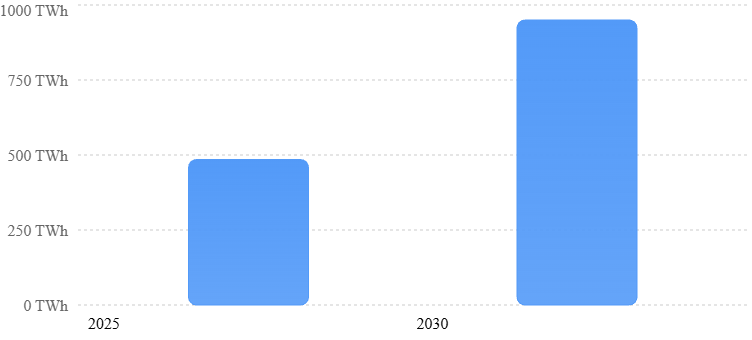
The increasing physical concentration of AI infrastructure produces a second-order strategic problem. Even if organisations achieve lower inference costs through more efficient models, constrained power availability, expensive memory, high-capacity networking requirements or regional data-residency obligations may restrict where and how workloads can be economically executed. Cloud providers can absorb and distribute some of these burdens, but customer expenditure ultimately depends on supplier pricing, utilisation, demand growth and contractual conditions.
Human productivity will depend on redesigning work, not simply generating more code
The premise that agents can increasingly produce routine code does not establish that enterprise software development will become proportionally cheaper. Business requirements, architectural correctness, testing, integration, security evaluation and accountability remain necessary. Where generated code increases faster than an organisation’s ability to evaluate and maintain it, apparent productivity may be accompanied by technical debt and additional review expenditure.
Experimental evidence counsels against universal productivity assumptions. METR’s July 2025 randomised study found that experienced open-source developers took approximately 19% longer on selected tasks when using early-2025 AI tools. Its February 2026 update reported signs of improved productivity from newer tools but emphasised serious selection effects that prevented reliable estimation of the magnitude of improvement. The evidence therefore supports a task-dependent transition rather than an established universal gain. METR+1
By 2030, the economically decisive human capabilities may increasingly include problem formulation, system architecture, evaluation design, security oversight, workflow integration and exception resolution. This is a conditional assessment of the direction of skill demand, not a quantified employment forecast. Organisations must measure human hours saved net of review, correction and incident-handling time.
The report’s central conclusion is that the sustainable unit of enterprise AI investment will become the governed, economically measurable workflow rather than the agent itself.
Key Evidence Table
| Indicator | Value / status | Reference date | Definition and scope | Issuer and exact source |
|---|---|---|---|---|
| Enterprise agent population | Fewer than 15 to more than 150,000 | 2025–2028 | Forecast for average global Fortune 500 enterprise; not measured deployment outcome | Gartner, Six Steps to Manage AI Agent Sprawl, Apr 2026 |
| Adequate agent governance | 13% | Apr 2026 disclosure | Organisations reporting confidence in governance; not an independent maturity certification | Gartner, Agent Sprawl, Apr 2026 |
| Autonomous agent demotion or retirement | 40% of enterprises | Forecast to 2027 | Governance-related demotion or decommissioning forecast | Gartner, Uniform Governance, May 2026 |
| Agentic project cancellation | More than 40% | Forecast to end-2027 | Project cancellations attributed to costs, value uncertainty or risk controls | Gartner, Agentic AI Projects, Jun 2025 |
| Benchmark-equivalent inference price | $20 to $0.07 / million tokens | Nov 2022–Oct 2024 | Historically comparable model capability under a specific benchmark | Stanford HAI, AI Index 2025 |
| Conventional DRAM price growth | +10–15% QoQ projected | Q4 2026 | Contract-price forecast, not a retail CPU/GPU price index | TrendForce, Sep 2026 |
| NAND Flash price growth | +15–20% QoQ projected | Q4 2026 | Contract-price forecast | TrendForce, Sep 2026 |
| Global data-centre electricity | 485 to 950 TWh | 2025–2030 | IEA central projection, all data-centre demand | IEA, Key Questions on Energy and AI, Apr 2026 |
| Developer task completion time | +19% with AI | Early 2025 experiment | Experienced developers, selected open-source tasks | METR, Jul 2025 |
| More recent productivity evidence | Signals of improvement; substantial bias | Feb 2026 | Later experiment, not a reliable general productivity estimate | METR, Feb 2026 |
| Generative-AI risk governance | Voluntary cross-sector framework | Jul 2024 | Risk-management profile, not a binding agent-specific regulation | NIST, AI RMF Generative AI Profile |
Preliminary Enterprise Cost Model: Why Agent Count Is an Inadequate Financial Metric
Translating Agent Populations into Executable Work: The Call-Intensity Multiplier
Assigning a fixed annual run-rate per registered agent conceals the underlying economic exposure. As demonstrated below, expanding an estate’s registered headcount tenfold does not multiply inference expenditure tenfold if dormant agents generate no traffic; conversely, scaling actual calls per active agent multiplies model expenditure immediately and linearly.
Model-Call Expenditure Across Enterprise Estate Profiles
| Operating Scenario | Registered Agents | Calls / Agent / Day | Annual Model Calls | Annual Direct Inference Cost | Action |
|---|---|---|---|---|---|
| Controlled deployment | 150 | 10 | 547,500 | $5,475 | |
| Distributed business deployment | 5,000 | 2 | 3.65 million | $36,500 | |
| Large, lightly active estate | 150,000 | 1 | 54.75 million | $547,500 | |
| Large, frequently active estate | 150,000 | 10 | 547.5 million | $5.475 million | |
| Large, heavily orchestrated estate | 150,000 | 100 | 5.475 billion | $54.75 million |
Dormant Capacity ≠ Budget Runaway
Increasing registered agent headcount tenfold (e.g., from 15,000 to 150,000) does not expand model expenditure tenfold if the agent cohort remains dormant or performs intermittent scheduled polling. Headcount alone is an uncalibrated proxy for financial exposure.
Operational Intensity = Direct 10x Multiplier
Conversely, scaling active calls per agent tenfold (e.g., from 1 call/day to 10 calls/day, or 10 to 100) multiplies gross inference expenses by exactly 10x ($547.5K → $5.475M → $54.75M), holding token volumes and unit fees constant. Call cadence is the principal financial risk vector.
The Model Pricing Trap
A low-cost lightweight model ($0.001/call) that requires 12 iterative retry loops, secondary validation prompts, and frequent human correction can easily cost significantly more per accepted task than a sophisticated frontier model ($0.015/call) completing the workflow on the initial pass.
Enterprise Value Net Comparison
To establish enterprise ROI, Caccepted outcome must be reconciled against the fully loaded avoided cost of the legacy business workflow—adjusted for defect rates, latency penalties, downstream rework overhead, and regulatory risk.
Scenario Modeler: Estate Size × Daily Invocations
Cost trajectories: distinguishing hardware inflation from productivity improvement
Three distinct economic movements must be separated.
First, the price of delivering a fixed level of model capability has historically declined, supported by hardware improvement, model optimisation, competition and better inference techniques. Second, the market price of particular inputs, notably advanced memory and high-performance infrastructure, can rise during periods of strong demand or constrained supply. Third, enterprise workload intensity can increase because organisations choose more complex tasks, deeper reasoning and larger context volumes.
These effects are not contradictory. An organisation can purchase a cheaper unit of intelligence while spending more overall because it consumes considerably more units. Equally, a temporary increase in server DRAM prices does not prove that AI inference costs will rise indefinitely.
The report therefore adopts three bounded analyst assumptions, not empirical forecasts, for testing the 2028–2030 business case:
| Variable | Efficiency-led case | Constrained case | Adverse case |
|---|---|---|---|
| Annual change in effective inference unit price | −30% | −10% | +10% |
| Annual change in model calls per completed task | −20% | +10% | +40% |
| Annual change in memory acquisition unit price | −10% | +5% | +20% |
| Annual change in electricity unit price | 0% | +5% | +15% |
| Architecture | Model routing, bounded context, caching | Mixed controls and partial optimisation | Long contexts, expensive default models, repeated retries |
Assumption ranges are deliberately constructed for sensitivity analysis, not attributed market predictions. Hardware unit costs, cloud API prices, memory acquisition costs and electricity tariffs are different economic series. They must not be added or extrapolated without an explicit cost model.
Under these alternatives, total expenditure remains sensitive to utilisation, baseline labour costs, error rates, cloud discounts, hardware depreciation, reserved capacity, network charges and security requirements. A complete total-cost model must represent these variables separately rather than treating the price of a model call as the cost of an agent.
Competing Explanations and Adoption Pathways
The available evidence supports three potentially competing but partly overlapping pathways.
| Pathway | Supporting evidence | Countervailing evidence | Observable indicators | Current assessment |
|---|---|---|---|---|
| Efficiency-led expansion — agent scale grows rapidly while unit costs and workflow complexity are controlled | Declining benchmark-equivalent inference prices; improving hardware efficiency; opportunities for model routing and caching | Uncertain real-world task success; operational overhead beyond API costs | Falling cost per accepted task, stable error rates, increased automation throughput | Technically plausible, not established as the general enterprise trajectory |
| Governance-constrained scaling — organisations limit autonomy and retire poorly controlled agents | Gartner governance-readiness gap; predicted decommissioning; NIST and OWASP risk frameworks | Standardised control platforms may reduce governance cost | Agent retirement rates, permission incidents, approval latency, audit coverage | Strongly supported as a material near-term constraint |
| Consumption-led cost escalation — inference becomes cheaper but total workload expenditure grows faster than realised value | Agent proliferation, higher workload intensity, memory-price pressure, energy infrastructure growth | Smaller models, batching, efficient hardware and workload rationalisation can offset pressures | Model-call growth, rising cost per outcome, underused reserved capacity, excessive retries | Significant downside pathway requiring active financial controls |
Gartner’s 2025 cancellation forecast and its 2026 prediction of governance-driven agent demotion measure different outcomes and populations. They must not be added together to estimate a single failure rate. Moreover, the underlying public releases do not establish that the predicted 150,000-agent population has already been observed at a representative set of enterprises. Gartner+2
Preliminary assessment of the 150,000-agent proposition
The forecast should be treated as a scale stress test for CIOs rather than as a mandatory investment target.
At that population level, individually negotiated identity and permission controls become impractical. Registration, assignment, revocation, activity logging and policy compliance must become substantially automated. The relevant design question is not whether the organisation can create 150,000 agent objects, but whether it can detect and suspend unauthorised execution, attribute every material action to a responsible organisational owner and prevent a compromised agent from escalating access.
The economic implications depend heavily on agent granularity. A population consisting primarily of short-lived, event-driven workers may generate a manageable inference bill but substantial lifecycle-management complexity. A population consisting of autonomous agents with persistent memory, broad tool access and continuous planning cycles may produce disproportionate infrastructure and supervisory demands.
A substantial expansion in agent count should therefore require evidence that the corresponding increase in completed workflows produces positive incremental contribution after controlling for error, human supervision, data movement and infrastructure expenditure.
Principal Gaps and Watch Indicators
The public record establishes significant governance concern and measurable changes in infrastructure markets, but it does not yet support a definitive global forecast of fully loaded enterprise agent operating costs. Several information gaps are particularly consequential.
Agent population measurement. Published forecasts require clearer distinctions between registered templates, deployed agents, active instances and autonomous agents capable of taking consequential actions. Gartner’s headline projection is geographically and organisationally scoped to large global enterprises; it should not be extrapolated indiscriminately to small firms or public administrations.
Operational cost transparency. Public API prices are observable, but representative enterprise distributions of token consumption, retries, tool execution, retrieval, security checking and human supervision remain insufficiently standardised. Without these distributions, forecasts of aggregate agent costs are sensitive to assumptions that cannot be verified independently.
Hardware-price transmission. Memory supplier price increases cannot be converted directly into higher inference prices because of cloud-provider inventories, supplier contracts, hardware improvements, caching and model efficiency. The key test is whether rising acquisition costs appear in sustained cloud prices or in enterprise cost per completed task.
Governance effectiveness. Inventory and policy documentation are insufficient measures of control. The relevant evidence is whether an organisation can detect unapproved agent creation, prevent a forbidden action, revoke authority during execution and recover after a policy or security failure.
Human productivity and supervision. Development-time reductions must be evaluated alongside review effort, maintainability, security testing and error correction. METR’s contrasting findings illustrate the importance of task selection and experimental design. METR
European regulatory exposure. AI-agent deployments require analysis of their actual use cases, risk classifications and applicable legal obligations. In the European Union, governance responsibilities cannot be inferred from the simple fact that a system is described as an agent. The EU AI Act’s obligations depend on the system’s classification, use, operator role and applicable implementation dates. Regulation (EU) 2024/1689 — European Union.
Board-level watch indicators
| Indicator | Decision relevance | Suggested management trigger |
|---|---|---|
| Cost per accepted business outcome | Tests actual economic value rather than apparent activity | Suspend scaling if the cost exceeds the approved baseline for consecutive measurement periods |
| Active-to-registered agent ratio | Distinguishes operational utilisation from inflated inventories | Review dormant identities and unused infrastructure |
| Model calls per successful task | Reveals recursion, retry escalation and inefficient orchestration | Investigate persistent increases without measurable quality gains |
| Percentage of agents with a named accountable owner | Measures basic governance coverage | No production autonomy without accountable ownership |
| Percentage of sensitive actions passing policy enforcement | Tests actual authorisation controls | Require full enforcement coverage for designated sensitive actions |
| Time to revoke agent authority | Measures containment capability | Define a tested maximum by operational risk class |
| Human review hours per completed workflow | Identifies hidden automation costs | Reassess workflows where supervision negates labour savings |
| Context tokens per accepted result | Measures information-efficiency deterioration | Investigate context growth without demonstrated output improvement |
| Risk-adjusted financial contribution | Tests enterprise value creation | Retire deployments with persistently negative incremental contribution |
These are proposed governance indicators, not externally validated universal thresholds. Boards should determine numerical limits through representative workloads, risk tolerance, contractual commitments and operational testing.
Decision-Useful Architectural Visualisation
The evidence supports a layered control architecture in which business requests are transformed into bounded execution authority, and where cost and risk enforcement remain outside the unrestricted discretion of the agent.
The following self-contained WordPress component presents that control relationship. It is an analytical reference architecture, not a claim that any named provider has implemented the entire design.
Enterprise Agent Control Architecture
Illustrative separation of business intent, execution authority, runtime enforcement and outcome accountability.
1. Business Intent
Approved objective, accountable owner, permitted outputs, economic budget and success criteria.
2. Identity and Delegation
Unique agent identity, scoped credentials, least privilege, expiry and revocation capability.
3. Context and Model Routing
Relevant retrieval, data permissions, context reduction, model selection and token limits.
4. Isolated Execution
Restricted tools, sandbox boundaries, network policy and controlled access to enterprise systems.
5. Independent Runtime Controls
Policy checks, behavioural monitoring, spending caps, anomaly detection and kill-switch authority.
6. Evaluation and Audit
Outcome verification, cost accounting, human exception review, traceability and agent retirement.
Analytical reference architecture. Control principles informed by Gartner’s 2026 agent-governance guidance, NIST AI RMF and the OWASP Top 10 for Agentic Applications. This is a design model, not a measured performance result.
Sources: Gartner, April 2026; NIST AI RMF Generative AI Profile, July 2024; OWASP Top 10 for Agentic Applications 2026, December 2025.
The principal design implication is that an agent’s ability to request an action must not be confused with its authority to execute that action. Credential issuance, policy evaluation, spend authorisation and emergency termination must remain enforceable by external controls. Runtime monitoring without independent intervention authority is insufficient.
For cost management, the same architecture should assign budgets not only to organisational departments but also to workflow families, responsible owners and risk classes. That allows the enterprise to differentiate economically justified activity from uncontrolled background execution.
Strategic Assessment: What Would Change the Judgment Before 2030
The current evidence supports neither a general prediction of runaway AI unit prices nor an assumption that expanding agent capability will automatically generate large corporate productivity gains.
An efficiency-led trajectory would gain credibility if representative enterprises demonstrate declining fully loaded cost per accepted workflow, falling error-adjusted supervision costs, stable security performance and manageable growth in inference resources even as automation coverage expands.
A cost-escalation trajectory would gain credibility if agent activity grows substantially faster than verified business output, if memory and infrastructure price pressures persist into cloud-service contracts, or if additional context and repeated reasoning materially increase resource requirements without improving task quality.
A governance-constrained trajectory would become dominant where enterprises discover that authorisation, monitoring, compliance, incident response and human accountability cannot be automated sufficiently to match the growth in agent populations. Gartner’s governance data make this a significant near-term risk, but the eventual balance will depend on deployment architecture and the demonstrated effectiveness of control systems.
For executive decision-making, the central investment principle is therefore to require evidence of operational utility before permitting unlimited replication. Large populations of agents can be an indicator of successful automation, but they can equally represent duplicated functions, weak lifecycle management and unmanaged computational expenditure.
The economic advantage through 2030 is likely to accrue not simply to organisations with the greatest number of agents or the largest computing budgets, but to those capable of matching model capability to task complexity, maintaining high infrastructure utilisation, controlling execution authority and measuring the financial contribution of every material autonomous workflow.
The strategic distinction is between the availability of machine intelligence and the ability to convert that intelligence into secure, measurable and economically sustainable institutional capacity.
AGENTIC AI: THE ECONOMICS OF CONTROL
Interactive technology-economics dashboard examining agent proliferation, inference expenditure, infrastructure pressure and enterprise governance.
Gartner projection; not an observed average.
Reported confidence; not an independent audit.
IEA estimate; includes non-agentic workloads.
From Small Agent Estates to Industrial-Scale Autonomy
Gartner’s projection implies a possible increase exceeding 10,000 times between 2025 and 2028 for the specified Fortune 500 population. Registered agents, active executions and completed business tasks are different measures.
Three-Dimensional Agent Infrastructure
Conceptual 3D architecture. The cubes are functional domains, not measured quantities.
Deployment and Governance Gap
Ratio between the headline 2028 forecast and the 2025 baseline of fewer than 15 agents.
The remaining 87% is not necessarily noncompliant; it represents organisations not reporting adequate governance under the cited finding.
Enterprise Agent Cost Simulator
Change deployment scale, workload intensity, token consumption and pricing. All financial outputs update directly from the entered assumptions. This model is illustrative and does not claim to predict actual provider costs.
Operating Assumptions
The overhead control is a hypothetical aggregate allowance for incremental orchestration, retrieval, security, infrastructure and supervision. It is not an observed industry ratio. Avoid counting costs already included in API prices twice.
3D-Style Cost Comparison
The bars are dynamically scaled to the maximum value shown. Their depth is a CSS visual effect; the numerical values are calculated in JavaScript.
Financial Interpretation
Cost per call includes the hypothetical overhead percentage. It is not cost per completed task; task completion and success rates are not specified.
Calculated Financial Sensitivity Table
The table holds registered agents, tokens per call, prices, operating days and overhead constant while varying daily calls per registered agent.
| Calls / agent / day | Annual calls | Inference cost | Additional cost | Modelled total |
|---|---|---|---|---|
| 1 | 54.75M | $547.50K | $547.50K | $1.10M |
| 10 | 547.50M | $5.48M | $5.48M | $10.95M |
| 100 | 5.48B | $54.75M | $54.75M | $109.50M |
Three Alternative Economic Pathways to 2030
Compare a modelled 2026 starting expenditure with three annually compounded cost trajectories. These are analyst sensitivity assumptions, not probability-weighted market forecasts.
Annual multiplier: 0.70 × 0.80
Annual multiplier: 0.90 × 1.10
Annual multiplier: 1.10 × 1.40
Percentage figures represent compounded annual changes in model-call expenditure from simultaneous changes in price per call and calls per completed task. They do not incorporate agent-population changes or non-inference costs.
Index: 2026 = 100. Four annual compounding intervals. The 2030 values are 9.83, 96.06 and 562.18 respectively, before rounding.
| Pathway | 2026 | 2027 | 2028 | 2029 | 2030 |
|---|
The Governed Enterprise Agent Stack
Six mutually reinforcing control layers separate approved business objectives from autonomous execution. Financial controls and revocation authority must remain enforceable outside the agent’s own reasoning process.
Business Intent
Named owner, approved objective, measurable outcome, scope and budget.
Identity & Delegation
Unique machine identity, restricted credentials, expiry and revocation.
Context Intelligence
Retrieval permissions, relevant context, token limits and model routing.
Isolated Execution
Sandboxed tools, network restrictions and segregated environments.
Runtime Governance
Policy checks, behaviour monitoring, spending limits and emergency shutdown.
Evaluation & Audit
Quality validation, financial attribution, human review and retirement.
What Determines Whether Agents Create Economic Value?
Value-Creating Conditions
Verified task completion, appropriate model routing, bounded context, efficient infrastructure, limited retries, accountable identities and measurable cost savings.
Cost-Amplifying Conditions
Uncontrolled model calls, persistent over-contextualisation, duplicated agents, weak permission boundaries, expensive human rework and unused reserved compute.
Operational Decision Table
| Control variable | Measure | Escalation / stop criterion |
|---|---|---|
| Economic efficiency | Cost per accepted task | Above approved alternative after full cost allocation |
| Execution stability | Calls and retries per success | Persistent growth without quality improvement |
| Access governance | Authorised sensitive actions | Any proven bypass in a critical workflow |
| Financial controls | Budget consumption versus limit | Unapproved expenditure or failed hard cap |
| Human supervision | Review and correction hours | Supervision costs erase net economic benefit |
| Context efficiency | Tokens per accepted result | Growth without measurable decision-quality gains |
| Lifecycle management | Ownership and revocation coverage | Unowned agents with production authority |
These are proposed decision criteria. Numeric thresholds must be defined by the organisation’s risk class, workflow economics and measured baseline.
More Intelligence Is Not Automatically More Value
The Scale and Control of Enterprise Autonomy
The institutional, technological and operational transformation of artificial intelligence from experimental assistance to large-scale autonomous execution
Assessment date: 30 October 2026 | Analytical horizon: 2028–2030 | Geographic scope: Global enterprises, United States, European Union and United Kingdom
Chapter 1 — The Enterprise Agent Population: From Experimental Tools to Digital Operating Estates
The enterprise is approaching a new scale of machine-operated activity
The next stage in the adoption of artificial intelligence will be determined less by the number of employees using generative applications than by the number of autonomous software entities that organisations permit to act inside their digital infrastructure. The distinction is fundamental. Conventional enterprise software generally performs functions defined through application logic, predefined workflows and established access permissions. Agentic systems introduce a different operating arrangement: software can interpret an objective, formulate intermediate actions, retrieve information, select computational tools, request access to services and potentially coordinate the activities of other agents. This capacity extends the practical scope of automation, but it also changes the relationship between corporate authority, software execution and institutional accountability. The enterprise no longer manages only applications and their users; it must increasingly manage populations of machine actors whose behaviour depends on dynamically assembled information, model decisions and interactions with a continually changing operating environment.
The potential scale of this transformation became particularly evident on 28 April 2026, when Gartner projected that the average global Fortune 500 enterprise would have more than 150,000 artificial intelligence agents in use by 2028, compared with fewer than 15 in 2025. Gartner presented the projection alongside a finding that only 13% of organisations believed they possessed appropriate governance arrangements for AI agents. The announcement was made in the context of the Gartner Digital Workplace Summit in London and accompanied by recommendations concerning agent policies, inventories, identity management, information governance, behavioural monitoring and organisational readiness. The forecast is consequential because it suggests a possible movement from a small population of individually identifiable experimental systems to a digital operating estate whose size would exceed the capacity of conventional manual administration. It is nevertheless essential to recognise the evidentiary boundary: Gartner's public announcement presents a forward-looking assessment, not a verified census of agents already operating in a representative population of Fortune 500 corporations. The publicly accessible statement does not provide the complete underlying model, agent-counting definitions, enterprise-level distribution or sensitivity assumptions needed to reproduce the forecast independently. Gartner Identifies Six Steps to Manage AI Agent Sprawl — Gartner — April 2026.
The difference between fewer than 15 agents and more than 150,000 agents represents a potential increase exceeding 10,000-fold, but this mathematical comparison should not be mistaken for a demonstrated increase in autonomous workload execution. A single persistent agent serving thousands of employees can consume more resources, possess broader authority and create greater operational exposure than thousands of short-lived agents processing narrowly defined events. Conversely, a corporation could register tens of thousands of specialised agents without allowing most of them to execute continuously. The number of agent identities would then increase dramatically while simultaneous computing demand remained comparatively moderate. The managerial significance of the projection is therefore not its implied population growth alone, but the possibility that enterprise control structures designed around limited numbers of software services, human users and service accounts will be required to administer substantially larger and more dynamic populations of machine identities.
This transition has a precedent in enterprise information technology, although the analogy has limits. Cloud computing, microservices, container orchestration and automated software deployment progressively separated the number of logical services from the number of physical servers. Organisations learned to operate thousands of ephemeral workloads by automating provisioning, policy application, monitoring and lifecycle management. Agentic AI extends that pattern into the domain of discretionary software behaviour. Unlike a conventional microservice executing an established function, an autonomous agent may determine which available function to invoke next, which information to retrieve and which external service appears useful for achieving its objective. The operational unit consequently acquires a broader decision space. Managing large agent populations is not simply another instance of infrastructure automation: it requires controlling the conditions under which software may choose actions, transfer authority and initiate further work.
The institutional response is already beginning to develop. On 17 February 2026, the United States National Institute of Standards and Technology announced an AI Agent Standards Initiative focused on secure interoperability, standards and the reliable interaction of agents with external systems. Earlier that month, NIST's National Cybersecurity Center of Excellence had published a concept paper concerning software and AI-agent identity and authorisation. On 29 September 2026, NIST reported that the resulting implementation work would initially focus on agents operating within the software development lifecycle. These initiatives are significant because they show that the problem is being treated as an identity, access-control and interoperability challenge rather than exclusively as a question of model performance. They are initiatives and implementation-development activities, however, not evidence that a universally deployed agent-governance standard already exists. Announcing the AI Agent Standards Initiative for Interoperable and Secure Innovation — NIST — February 2026; New Concept Paper on Identity and Authority of Software Agents — NIST — February 2026; Comments on Software and Agentic AI Identity Concept Paper — NIST — September 2026.
An agent population cannot be measured through a single inventory number
The term AI agent covers several operationally different categories. At one end are systems that provide recommendations or draft outputs while requiring a human to initiate and approve consequential actions. At the other are autonomous services capable of conducting extended sequences of tool calls, creating subordinate tasks and changing information in enterprise systems. Between those extremes are event-driven agents, background monitoring agents, orchestration agents coordinating other agents and specialised workers generated temporarily to complete a particular operation. These categories cannot be treated as financially or operationally equivalent because they differ in execution frequency, persistence, permissions, decision authority, data access, exposure to external systems and requirements for human supervision.
A useful enterprise taxonomy must therefore combine functional purpose with operational characteristics. Functional classification identifies whether an agent performs research, customer support, software development, procurement, finance, infrastructure management, document processing or another activity. Operational classification establishes whether the agent is persistent or temporary, active or dormant, advisory or executable, internally restricted or externally connected, and independent or subordinate to another agent. Authority classification identifies what the agent can read, create, modify, transfer, approve or delete. Economic classification records its resource consumption and the value of completed work. These dimensions are complementary: a procurement agent, for example, may be limited to summarising supplier quotations, may be permitted to prepare purchase orders subject to approval, or may possess authority to issue transactions within a predefined financial limit. The functional label remains unchanged while the actual institutional risk changes substantially.
The following taxonomy is an analytical classification for enterprise architecture and capacity planning. It is not presented as an official Gartner or NIST enumeration.
| Agent category | Operational behaviour | Execution pattern | Authority exposure | Principal management issue |
|---|---|---|---|---|
| Advisory assistant | Produces information or recommendations | User-initiated | Usually read-oriented | Output reliability and information access |
| Tool-using assistant | Invokes approved services to support a user | Interactive or event-driven | Scoped tool permissions | Tool authorisation and action traceability |
| Transactional agent | Creates or modifies business records | Event-driven or persistent | Write permissions and possible financial effects | Transaction limits, approval and rollback |
| Background monitoring agent | Observes systems and initiates alerts or responses | Scheduled or continuous | Monitoring and sometimes response privileges | False positives, resource use and escalation |
| Planning agent | Determines intermediate tasks and execution sequence | Task-driven | Indirect authority through delegated workers | Objective drift and task proliferation |
| Orchestration agent | Coordinates multiple specialised agents | Event-driven or continuous | Delegation and workflow control | Cascading failures and permission propagation |
| Ephemeral worker agent | Performs bounded work and is destroyed or retired | Short-lived | Temporary permissions | Creation, expiration and cleanup |
| Persistent domain agent | Maintains domain-specific state or workflow responsibility | Long-lived | Accumulating data and tool access | Credential persistence and lifecycle drift |
| High-impact operational agent | Acts on financial, security or production systems | Restricted production execution | Potentially consequential authority | Independent enforcement and containment |
The distinction between persistent agents and ephemeral workers is particularly important for the interpretation of population growth. An agent framework could create a separate worker instance for each customer-service case, code-review operation or document-processing task. If every worker instance is counted as a new agent, a large annual population may arise even though only a small fraction is active at any moment. If, instead, only reusable agent configurations or durable identities are counted, the same enterprise may report a substantially smaller number. Neither method is inherently incorrect; the problem arises when the two are compared without defining the unit of observation. A credible report of enterprise agent adoption should therefore disclose at least the inventory of deployable agent configurations, the number of production-authorised identities, the number of concurrently active executions and the number of completed workflows over a defined measurement period.
The distinction between registered, active, dormant and retired agents
A registered agent is an identifiable object in an enterprise inventory or management platform. Registration does not prove that the agent has been deployed into production, possesses valid credentials or is currently executing. A deployed agent has been made available within a specific operating environment, but it may remain dormant until triggered by an event or user request. An active agent is engaged in a workflow or execution process; that process may nevertheless spend part of its time waiting for an external application, human approval or scheduled continuation rather than consuming inference resources. A suspended agent has had execution temporarily halted while its identity or configuration may remain preserved. A retired agent should no longer possess executable authority, although its historical records may need to be retained for operational, legal or audit reasons.
These states must be distinguishable because each produces a different burden. Registered but unused agents generate inventory, ownership and configuration-management work. Dormant agents with valid access tokens create a potentially avoidable security exposure even when they consume little computation. Active agents generate observable workload, including model inference, data retrieval, tool execution and monitoring. Suspended agents may require preserved state, retained evidence and controlled reactivation procedures. Retired agents generate retention and evidentiary obligations but should no longer consume production authority. A management system that simply reports a total number of agents cannot tell directors whether the estate is economically productive, technically overprovisioned or dangerously permissive.
| Population measure | Formal interpretation | Required observation | Why the measure matters |
|---|---|---|---|
| Registered agents | Total recorded agent entities | Inventory records | Administrative scale |
| Production-authorised agents | Identities permitted to execute in production | Identity and permission registry | Exposure to operational systems |
| Active executions | Workflows currently executing or awaiting continuation | Runtime telemetry | Execution workload and concurrency |
| Inference-active executions | Workflows currently consuming model inference | Model gateway telemetry | Immediate inference demand |
| Dormant authorised agents | Enabled identities without current execution | Inventory and activity correlation | Residual credential exposure |
| Ephemeral agent creations | Newly instantiated temporary workers | Lifecycle events | Churn and provisioning burden |
| Suspended agents | Execution disabled pending review or resumption | State transitions | Containment and recovery workload |
| Retired agents | Identities permanently removed from operational service | Revocation and retention records | Lifecycle integrity |
| Completed workflows | Workflows that reached defined completion criteria | Business-system records | Operational output |
| Accepted outcomes | Completed work satisfying quality and business requirements | Independent evaluation | Economically useful output |
The distinction also affects cybersecurity. An enterprise may have a low ratio of active agents to registered agents and still maintain an excessive population of dormant accounts with lingering access rights. Conversely, a relatively small population may generate substantial activity if agents can recursively invoke tools or delegate subtasks. In one case, the dominant problem is dormant authority; in the other, the dominant problem is executable workload intensity. The enterprise needs different controls for each. Dormant-authority exposure is reduced through credential expiry, inactivity rules and lifecycle reconciliation, while execution intensity is managed through resource quotas, bounded recursion, concurrency limits and runtime monitoring.
Alternative pathways for adoption through 2028–2030
The numerical uncertainty surrounding Gartner's headline projection is sufficiently substantial that corporate planning should use alternative deployment scenarios rather than construct an investment case around a single expected population. An adoption scenario must describe not only agent count but the institutional conditions that make a given population plausible. A controlled deployment pathway would involve gradual integration into selected business functions, consolidation of overlapping agents and strict production approval. A distributed adoption pathway would involve substantial creation of specialised agents across departments, with centralised identity management and common execution services. A high-proliferation pathway would involve widespread generation of temporary agents, significant agent-to-agent orchestration and increasing incorporation of autonomous functions into enterprise applications.
For transparency, the following figures are constructed scenario assumptions, not observations, Gartner forecasts or probability-weighted estimates. They use a common 2026 planning base of 500 registered agents solely to illustrate how different organisational policies could influence growth. The values are deliberately not presented as representative of the average enterprise.
| Scenario | 2026 planning base | 2027 | 2028 | 2030 | Deployment interpretation |
|---|---|---|---|---|---|
| Controlled adoption | 500 | 1,000 | 2,000 | 5,000 | Restricted production approval and strong consolidation |
| Distributed expansion | 500 | 2,500 | 10,000 | 40,000 | Departmental adoption with shared governance infrastructure |
| High proliferation | 500 | 5,000 | 50,000 | 150,000 | Large-scale specialisation and ephemeral agent creation |
The table is designed to test the structural consequences of different growth rates, not to predict market outcomes. An enterprise beginning with fewer than 15 agents in 2025 would require a substantially steeper expansion to reach Gartner's projected 2028 population than any of the scenarios shown from the assumed 2026 starting point. This discrepancy illustrates why it would be misleading to treat a stylised growth curve as independent confirmation of the analyst forecast.
The controlled pathway places greater emphasis on agent reuse, durable workflows and strict limits on autonomous permissions. Such an enterprise might adopt sophisticated AI capability without needing a large population of separately registered agents. The distributed pathway assumes that business departments increasingly develop specialised agents for their own processes, while corporate IT attempts to standardise identity, execution, monitoring and procurement. Its principal risk is organisational fragmentation: local teams may optimise their own workflows without accounting for systemwide security dependencies, duplicated data access or shared operational expenditure. The high-proliferation pathway assumes that agent creation becomes sufficiently automated for identities and worker instances to be generated routinely as part of business operations. Its principal challenge is that governance must operate continuously and programmatically; individual manual approval of every low-risk temporary worker would become both inefficient and operationally impractical.
These scenarios also reveal that governance maturity and population size are not independently determined. Strict governance may suppress the number of deployed agents by eliminating redundant functions, but advanced automated governance could eventually enable larger populations by reducing the marginal administrative burden of each additional identity. The relationship is therefore not necessarily negative. Governance weakness can permit rapid initial proliferation, but may cause incidents, retrenchment and decommissioning. Strong governance can slow initial deployment while supporting more sustainable long-term expansion.
Why the forecast is insufficient as a measure of enterprise adoption
The public record does not establish whether the projected 150,000-agent average refers predominantly to durable identities, deployed configurations, temporary instances or a broader combination of agent-enabled software objects. Nor does it establish the expected distribution around the average, the relative contribution of specific industries or the proportion of agents possessing meaningful autonomous authority. These omissions matter because the average of a highly heterogeneous corporate population can be distorted by very large digital platforms and technology-intensive organisations. An enterprise operating hundreds of thousands of automated software workers cannot be treated as operationally equivalent to a regulated manufacturer, financial institution or public authority simply because both use the term agent.
The potential for definitional inflation is particularly significant when vendors integrate agents directly into business applications. A software supplier may describe a collection of embedded features as individual agents, while the customer experiences them as functions within an existing application. Another supplier may define a single orchestration service as one agent even though it delegates work to numerous subcomponents. Agent counts may therefore reflect product architecture and commercial terminology as much as organisational transformation. For board-level reporting, agent populations should be normalised by organisational scale, transaction volume, business function and authority category rather than compared solely through absolute counts.
A second problem concerns the difference between technical deployment and economically useful adoption. An enterprise may generate large quantities of code, documentation, classifications or recommendations without obtaining equivalent reductions in expenditure or increases in productive output. The appropriate evidence of adoption is not the existence of an agent but the sustained operation of an authorised workflow that completes a defined business task, satisfies quality standards and produces benefits that justify its attributable costs. A large registered population with low utilisation and uncertain outcomes is an inventory phenomenon, not necessarily a productivity transformation.
A third problem is survivorship. Early deployment statistics may count newly created agents but fail to distinguish those subsequently suspended, consolidated or retired. This is particularly relevant in light of Gartner's 26 May 2026 forecast that 40% of enterprises would demote or decommission autonomous AI agents by 2027 because of governance shortcomings. That forecast concerns the proportion of enterprises expected to take such action, not the proportion of agents that will necessarily be retired. It therefore cannot be used to calculate an expected reduction of 40% in enterprise agent inventories. Gartner Says Applying Uniform Governance Across AI Agents Will Lead to Enterprise AI Agent Failure — Gartner — May 2026.
Agent-population measurement and its implications for corporate control
A defensible operational inventory must function as an authoritative management record rather than a manually maintained spreadsheet. Every production-capable agent should have a persistent identifier, identifiable organisational owner, declared function, deployment location, model or runtime association, access permissions, operational status, creation and expiry dates, relevant dependencies and a method for immediate revocation. This record should be correlated with actual identity-provider events, execution-platform logs and gateway telemetry. The purpose is not simply completeness of documentation; it is the ability to discover discrepancies between what the organisation believes exists and what is actually capable of acting.
One particularly important metric is the ratio between authorised agents and observed executing agents. If an organisation discovers activity originating from an identity absent from its authorised inventory, the problem is not merely inaccurate recordkeeping. It indicates a possible breakdown in the control process by which machine actors receive authority. Similarly, an agent that continues executing after expiration, suspension or ownership transfer demonstrates a failure of lifecycle enforcement. These conditions should be monitored as control exceptions, not accepted as ordinary inventory differences.
The enterprise should also distinguish between the number of agent identities and the number of credentials or tool permissions associated with them. A single agent may hold multiple application credentials, and multiple agents may operate under a common service identity. Neither arrangement is equivalent to a straightforward one-to-one relationship. Consequently, a 10,000-agent estate may generate considerably more than 10,000 access-control relationships, and the number of effective privilege paths may be greater still when roles, delegated permissions and downstream systems are included.
These relationships introduce the possibility of nonlinear administrative complexity. Although the number of potential direct relationships among a fully connected set of N agents is N(N−1)/2, ordinary enterprise systems do not necessarily create all those relationships. Applying the complete-graph formula to every organisation would therefore exaggerate actual operational connections. It is nevertheless useful as a structural upper bound for direct pairwise interaction. At 150,000 agents, that mathematical upper bound is approximately 11.25 billion potential agent pairs. A properly designed enterprise architecture must avoid constructing and governing such a fully connected interaction network. It should instead use bounded domains, hierarchical delegation, controlled gateways and explicitly authorised communication pathways.
| Agent population | Maximum possible undirected pairs in a fully connected graph | Administrative implication |
|---|---|---|
| 100 | 4,950 | Manageable with explicit relationships |
| 1,000 | 499,500 | Manual pairwise management becomes increasingly impractical |
| 10,000 | 49,995,000 | Automated policy and relationship abstraction become essential |
| 50,000 | 1,249,975,000 | Domain segmentation and communication restrictions become decisive |
| 150,000 | 11,249,925,000 | Unrestricted pairwise connectivity is architecturally undesirable |
These numbers are mathematical calculations, not observed enterprise communication volumes or forecasts of actual network connections. Their relevance lies in illustrating why governance should scale through classes, policy inheritance and controlled interfaces rather than attempting to administer every possible relationship independently.
Key judgments — Chapter 1
The transition to large agent populations is technically plausible, but the number of registered agents is an inadequate measure of autonomy, capacity, financial exposure or institutional value. Gartner's 150,000-agent forecast is best used as a stress scenario for management architecture until the underlying counting conventions and representative deployment evidence become sufficiently transparent. Enterprises should establish separate measures for registered identities, production-authorised agents, active executions, model-consuming workloads and accepted business outcomes. The decisive architectural requirement is the ability to create, classify, govern, suspend and retire machine identities through automated and independently enforceable lifecycle processes.
What would change the assessment: Representative enterprise disclosures demonstrating consistent agent definitions, distributions across industries, active-to-registered ratios and verified workflow productivity would substantially improve the forecast's reliability. Evidence that large agent estates can be governed with stable error rates and low marginal administrative burden would strengthen the case for rapid expansion. Evidence of substantial dormant-authority accumulation, repeated agent retirement and poor attribution of machine actions would support a more constrained outlook.
Open official record: The complete methodological basis of Gartner's 2028 population forecast, enterprise-level deployment distributions, harmonised definitions of agent identities and independently audited measures of production-authorised agent activity remain consequential areas for further evidence.
Chapter 2 — Identity, Authority and Machine-to-Machine Governance
The fundamental security problem is the separation of machine capability from institutional authority
The emergence of autonomous agents exposes an important limitation in conventional enterprise identity and access management. Traditional systems have developed around identifiable human users, registered applications, service accounts and machine workloads whose authorised operations are generally established before execution. Agents introduce a more complex relationship between identity and action because they can select among alternative operations, interpret instructions received from multiple sources and initiate additional processes in pursuit of an objective. The security problem is therefore not simply whether the agent can authenticate successfully to a corporate system. It is whether the authenticated agent possesses legitimate authority to perform a particular action, on particular information, for a particular purpose, under the circumstances prevailing at the moment of execution. A valid credential proves something about an identity; it does not by itself establish that every action requested by that identity is consistent with the business purpose for which authority was delegated.
This distinction became unusually explicit in the guidance published by NIST on 27 October 2026, only three days before this report's analytical cut-off. In Design Tenets for Agent Identity Management Systems, NIST researchers proposed ten principles for agent identity, authentication and authorisation, including distinct agent identification, traceable delegation, attenuation of permissions and independently preserved evidence. The document draws on public consultation and work associated with the National Cybersecurity Center of Excellence. Its significance lies in moving the discussion beyond conventional account creation towards the relationship between an autonomous actor, the authority under which it operates, the systems it can affect and the evidence required to reconstruct its actions. The principles are proposed design tenets, not a declaration that all necessary standards and technologies have reached operational maturity. NIST itself acknowledges that some of the proposed properties cannot immediately be achieved across all deployment environments. Design Tenets for Agent Identity Management Systems — NIST — October 2026.
Consider a financial analysis agent instructed by an authorised employee to prepare a report on overdue supplier invoices. The original instruction may reasonably permit access to invoice records, supplier details and approved accounting documents. It does not automatically authorise the agent to alter banking instructions, modify supplier master data, initiate payments or export confidential records to an external service. Yet an agent operating through a broadly privileged application connection may encounter an interface where all those operations are technically available. The difference between what the agent was intended to do and what its credentials enable it to do is an authorisation gap. If the agent receives misleading information, follows an adversarial instruction embedded in a document or mistakenly interprets an instruction as permission to modify data, the resulting failure is not necessarily an authentication failure. It is a failure to preserve the boundary between a legitimate objective and permitted execution.
The security architecture must consequently establish multiple independent facts. It must identify the agent, establish the human or organisational authority responsible for initiating the task, determine the permitted objective, restrict accessible resources, evaluate proposed actions and record their execution. These facts should remain distinguishable throughout the workflow. Combining them into a single unrestricted service account or relying on a natural-language instruction as the principal enforcement mechanism makes it difficult to distinguish authorised work from unauthorised activity performed through valid credentials.
Agent identity must be distinct, attributable and capable of independent revocation
An enterprise agent should possess an identity that can be distinguished from the identity of the employee who requested its services and from the identities of the applications through which it operates. This does not necessarily mean that every temporary execution requires a permanently retained directory account. It means that the security infrastructure must be capable of associating execution with an identifiable machine principal, approved configuration and accountable source of authority. Where workload identities are ephemeral, their credentials and execution records must still be traceable for the period required by the organisation's security and audit policies.
The need for distinct identity becomes evident when multiple agents operate on behalf of the same human user. If every agent simply inherits the user's existing access token, the enterprise may be unable to determine which autonomous component performed a specific action. Furthermore, the user's permissions may be substantially broader than the permissions needed for an individual task. An employee authorised to view financial reports, modify procurement records and approve certain transactions may legitimately delegate a document-analysis task without intending to delegate every other permission associated with the employee's account. A system that passes the entire user privilege set to the agent converts a narrow business request into broad technical authority.
Microsoft's documentation for its Entra agent identity platform provides an example of how this distinction is being incorporated into commercial identity infrastructure. Microsoft describes agent identities as separately manageable accounts and introduces agent identity blueprints, agent identities, associated agent-user constructs and governance relationships. Its documentation also describes human sponsors who remain responsible for lifecycle and access decisions, together with access packages, entitlement management and mechanisms for transferring sponsorship when an employee leaves an organisation. These are documented vendor capabilities and design arrangements; their availability, licensing requirements and integration coverage must be verified for each deployment rather than assumed to apply automatically across every enterprise application. Governing Agent Identities — Microsoft Entra ID Governance — Microsoft Learn.
The practical importance of human sponsorship should not be understated. A machine identity may continue to exist after the project that created it has concluded, after its original developer has changed roles or after the employee responsible for it has left the enterprise. Without a mechanism for reassignment or automatic expiration, an organisation may accumulate agents with valid permissions but no person authorised to review their necessity. This creates an accountability vacuum. An agent's technical identity may remain intact while its organisational justification has disappeared. The appropriate response is not merely to associate every identity with a person's name at creation, but to maintain a durable governance relationship between the agent, its current organisational sponsor, its permitted operating function and its approval history.
A mature identity record should therefore include enough information to answer whether the agent is still necessary, who is responsible for it, where it is deployed, which credentials it can obtain, which systems it can reach, what changes have occurred since approval and how execution can be stopped. These records must be maintained as the system changes rather than preserved as static documentation produced during initial deployment.
Identity records required for production governance
| Identity attribute | Required operational meaning | Source of authoritative evidence | Consequence if absent |
|---|---|---|---|
| Agent principal identifier | Unique machine identity | Identity provider or workload identity system | Actions cannot be reliably attributed |
| Human sponsor | Person responsible for lifecycle decisions | Corporate identity and ownership records | Orphaned authority |
| Organisational owner | Department or accountable function | Enterprise governance register | Unclear business accountability |
| Approved purpose | Authorised business function | Workflow approval record | Legitimate and illegitimate activity become difficult to distinguish |
| Deployment environment | Production, test, development or isolated evaluation | Runtime and infrastructure inventory | Environment-boundary confusion |
| Runtime configuration | Approved executable and operating configuration | Signed configuration or deployment manifest | Uncontrolled changes to agent behaviour |
| Authorised resource scope | Systems, data and tools available to the agent | Policy decision system | Excessive access |
| Credential validity | Issuance, expiry and revocation status | Credential-management infrastructure | Persistent unauthorised access |
| Delegation parent | Initiating identity or agent | Delegation record | Broken authority chain |
| Risk classification | Impact and permitted autonomy | Governance assessment | Inadequate controls |
| Execution state | Active, dormant, suspended or retired | Runtime telemetry | Inaccurate operational inventory |
| Policy version | Rules applicable to execution | Policy registry | Inability to reconstruct enforcement |
| Incident and review history | Prior exceptions, modifications and decisions | Independent security records | Weak accountability and repeated failures |
The table describes an analytical minimum for a mature production register, not a universally mandatory legal dataset. Sensitive identity metadata itself requires access controls, retention policies and privacy protection. Extensive inventories should not become unrestricted repositories of credentials or confidential organisational information.
Delegation creates a chain of authority that must not expand silently
The most distinctive difficulty in agent authorisation emerges when one agent delegates work to another. A human employee may instruct a coordinating agent to prepare a quarterly procurement assessment. That agent may delegate document extraction to a specialist worker, data reconciliation to another worker and risk summarisation to a third. A narrow objective has become a collection of subordinate processes. Unless authority is explicitly constrained, each subordinate process may inherit access rights designed for the coordinating agent rather than permissions appropriate to its limited function.
The relevant security principle is authority attenuation: the authority granted to a downstream component should not exceed the authority available to its parent for the delegated task. Moreover, the downstream component should ordinarily receive only the subset of authority necessary for its particular operation. This is more precise than merely requiring every agent to have a valid identity. The enterprise must preserve the provenance, purpose and scope of delegated authority as execution passes through multiple components.
NIST's October 2026 design tenets explicitly address linking, delegation and attenuation. They propose maintaining a verifiable connection between agents and the entities authorising their activities, while ensuring that the scope of downstream delegation is restricted. The same publication emphasises deterministic access decisions and separation between the mechanism interpreting the task and the mechanism enforcing security policy. These features address a class of failures in which an agent with legitimate access is induced to exercise that access for an unintended purpose. Design Tenets for Agent Identity Management Systems — NIST — October 2026.
A practical delegation mechanism can be represented through five independently verifiable elements: the identity of the initiating authority, the identity of the delegated agent, the permitted operation, the accessible resource scope and the validity period. For consequential operations, the delegated authority may also include spending limits, transaction limits, environment restrictions and requirements for human approval. These attributes should be enforced by the receiving service or an independent authorisation component rather than accepted solely because the calling agent presents a textual claim of permission.
The distinction matters when an agent receives instructions through external documents or services. A supplier document may contain legitimate commercial information but is not an authority to change corporate access rules. A retrieved webpage may contain data relevant to a research task but has no standing to instruct the agent to reveal confidential information. A tool response can inform execution without acquiring the right to redefine the purpose of execution. This separation between information received and authority granted is a central condition for safe agent interoperability.
Deterministic policy enforcement and the limits of model-based judgement
Large language models can assist in interpreting user intent and classifying the likely significance of proposed actions. They should not be treated as the sole authority for determining whether a sensitive action is permitted. Model outputs are probabilistic, context-dependent and potentially influenced by adversarial instructions. A security decision that must be enforceable and auditable requires a more stable mechanism: explicit policy rules, recognised identities, authenticated attributes, resource permissions and independently recorded decisions.
This does not mean that every agent decision must be reduced to a fixed rule. The planning and reasoning functions may remain adaptive. What must be deterministic is the enforcement of designated security boundaries. An agent may formulate a proposal to change an infrastructure configuration, but the execution service should independently verify whether the agent is authorised to make that change, whether the requested target is within scope and whether the operation requires approval. A model may explain why a transaction appears appropriate, but the payment system should remain responsible for validating transaction authority, financial limits and applicable controls.
The following table distinguishes possible control techniques by what they can actually establish.
| Control technique | Can establish | Cannot independently guarantee |
|---|---|---|
| Agent authentication | The presented credential corresponds to a recognised identity | The intended action is legitimate |
| Role-based access control | Membership in an authorised permission class | That every action within the role is appropriate to the task |
| Attribute-based access control | Compliance with defined contextual attributes | Correctness of the underlying business objective |
| Delegated scoped token | Restricted authority for a specified resource or operation | Absence of misleading data or malicious instructions |
| Model-based intent assessment | A probabilistic interpretation of task purpose | Deterministic security enforcement |
| Transaction validation | Compliance with predefined business and technical rules | Broader strategic value of the transaction |
| Human approval | Authorisation by a designated reviewer | Accurate review under workload pressure |
| Behavioural anomaly detection | Deviation from defined baselines or patterns | Detection of every malicious or mistaken action |
| Independent execution gateway | Policy enforcement at an action boundary | Protection against actions occurring outside the gateway |
| Immutable or tamper-evident audit trail | Stronger evidence of recorded activity | Prevention of the activity itself |
The practical architecture should therefore place a policy-enforcement boundary between the agent and systems capable of producing material consequences. This boundary can be implemented through identity infrastructure, API gateways, application-native access controls, transaction services or other trusted components. The essential property is that the agent cannot bypass the enforcement mechanism simply by changing its instructions or choosing a different tool.
Autonomy levels should determine the intensity of governance
On 26 May 2026, Gartner published a differentiated model of agent governance based on four autonomy levels: Observe, Advise, Act with Approval and Act Autonomously. This is a significant refinement because it rejects the assumption that all agents should be governed identically. An agent restricted to retrieving approved information does not impose the same operational exposure as an agent capable of modifying production systems. Equally, an autonomous system capable of committing financial transactions cannot be governed adequately through the lightweight controls suitable for document summarisation. Gartner Says Applying Uniform Governance Across AI Agents Will Lead to Enterprise AI Agent Failure — Gartner — May 2026.
| Gartner autonomy level | Permitted behaviour | Principal risk | Appropriate control emphasis |
|---|---|---|---|
| Level 1 — Observe | Read-only retrieval and presentation | Information exposure and unreliable outputs | Scoped access, authentication, logging and testing |
| Level 2 — Advise | Recommendations and drafts; human executes actions | Incorrect recommendations and automation bias | Quality evaluation, validation and human training |
| Level 3 — Act with Approval | Writes or actions after explicit human approval | Approval fatigue, incorrect authorisation and audit failure | Approval integrity, security testing and action-level records |
| Level 4 — Act Autonomously | Independent execution within boundaries | Rapid high-impact mistakes or cascading actions | Continuous enforcement, monitoring, rollback, circuit breakers and clear ownership |
The framework provides a useful starting point, but autonomy is not the only relevant risk variable. A Level 1 agent permitted to retrieve sensitive intelligence or regulated personal information may create serious confidentiality exposure despite lacking write permissions. A Level 4 agent restricted to a disposable test environment may be comparatively low risk despite extensive autonomy. Risk therefore depends on the combination of autonomy, data sensitivity, accessible resources, transaction impact, operating environment and the possibility of recovery. The correct assessment is multidimensional, even where a simple autonomy classification is retained for managerial communication.
An additional problem arises when an agent's permissions evolve. A system initially approved to draft supplier communications may subsequently receive authority to send messages automatically. Another may progress from recommending system changes to implementing them. These changes are not merely software updates; they alter the authority delegated by the enterprise. They should trigger reassessment of risk classification, access scope, testing requirements and incident-response arrangements. Otherwise an agent can move into a higher operational risk category while retaining the controls established for its original, less consequential function.
Governance across organisational and jurisdictional boundaries
Enterprise agents increasingly operate across systems supplied by different organisations. A corporation may maintain its primary identity infrastructure with one provider, use AI inference services from another, obtain enterprise data through a third platform and execute external business transactions through additional applications. This arrangement creates potential gaps between the identity recognised internally and the authority recognised by an external service. The external service may authenticate an application connector without possessing information about which agent initiated the request, which human authorised the workflow or what restrictions accompanied the original delegation.
The fundamental requirement is to preserve meaningful authority information across trust boundaries. At minimum, receiving systems should obtain a verified representation of the calling principal and the permissions relevant to the requested operation. For sensitive transactions, additional contextual evidence may be necessary, including the initiating organisational authority, approved purpose, transaction limit and decision record. Where external systems cannot consume the enterprise's preferred delegation mechanism, the organisation should consider restricting execution through a controlled integration service that enforces the relevant rules locally.
This issue has substantial implications for procurement and third-party risk management. A vendor may advertise an agent's ability to connect to hundreds of applications, but connectivity is not equivalent to secure delegated authority. Procurement evaluation should examine whether the vendor supports individual agent identities, credential rotation, permission restrictions, action logging, revocation, data minimisation and independent review of tool execution. The inability to revoke an agent's access without disabling an entire enterprise integration is a material architectural weakness.
Regulatory responsibilities must also be distinguished from technical governance. Within the European Union, Regulation (EU) 2024/1689 — Artificial Intelligence Act — European Parliament and Council — July 2024 establishes a risk-based legal framework for AI systems. Relevant provisions include Article 9 on risk management, Article 12 on recordkeeping, Article 14 on human oversight and Article 15 on accuracy, robustness and cybersecurity in the context of high-risk systems. These provisions should not be interpreted as imposing identical requirements on every enterprise agent. Applicability depends on classification, intended use, the role of the relevant operator and the provisions in force at the applicable date. The consolidated legal text and subsequent amendments must be checked for any deployment-specific legal determination.
This legal distinction is particularly important for multinational organisations operating in Italy, France, Germany and the United Kingdom. Corporate policies may be harmonised across the group, but legal obligations concerning privacy, employment, sectoral supervision, public administration and high-risk AI systems cannot simply be assumed to be identical. Italy, France and Germany operate within the EU regulatory framework while retaining relevant national institutions and sector-specific requirements. The United Kingdom follows a distinct domestic regulatory and supervisory structure. A multinational agent platform should therefore support common technical controls while allowing jurisdiction-specific requirements to be applied to the relevant workflows.
Auditability and the preservation of institutional evidence
The ability to reconstruct an agent's actions is a necessary condition for accountability. A record containing only the final response of a model is insufficient when the agent has retrieved documents, delegated tasks, invoked tools and modified external systems. A useful audit trail should identify the originating objective, authorised actor, agent identity, applicable policy, tools invoked, resources accessed, decisions made at enforcement boundaries, changes to external systems and the final disposition of the workflow.
An additional distinction must be made between logging and trustworthy evidence. If an agent can modify or delete the records used to assess its own behaviour, the organisation cannot rely on those records to reconstruct incidents. Independent logging infrastructure, restricted write permissions, integrity controls and appropriate retention mechanisms are therefore necessary for higher-risk deployments. NIST's October 2026 tenets explicitly include independently maintained, tamper-evident evidence concerning identity, delegated intent and resulting actions. Design Tenets for Agent Identity Management Systems — NIST — October 2026.
The amount of information retained should nevertheless be proportionate to the risk and applicable data-protection requirements. Storing every complete prompt, retrieved document or intermediate model output indefinitely may create substantial confidentiality and storage exposure. The audit objective is not indiscriminate accumulation of data. It is the ability to establish consequential facts through trustworthy records while controlling sensitive content, retention periods and access to investigation material.
For production systems, the evidence architecture should connect technical events with business outcomes. It should be possible to establish not only that a particular agent invoked an API, but also which business process was affected, whether the operation was authorised, whether it succeeded, whether it was later reversed and which human or organisational function remained accountable. This is especially important where one agent delegates execution to another. Without a traceable chain of authority and correlated event identifiers, incident investigators may reconstruct isolated technical actions without being able to explain the business sequence that produced them.
Proposed accountability structure
| Accountability function | Primary responsibility | Evidence of effective execution |
|---|---|---|
| Board or designated oversight committee | Approves risk appetite and material delegation principles | Approved policy, reporting and escalation decisions |
| Chief Information Officer | Enterprise architecture and operational integration | Authorised inventory, platform standards and lifecycle controls |
| Chief Information Security Officer | Identity security, enforcement and incident containment | Security tests, access reviews and incident records |
| Chief Risk Officer or equivalent | Risk classification and independent challenge | Documented assessments and exceptions |
| Business process owner | Purpose, expected benefit and acceptable outcomes | Business approval and outcome evaluation |
| Agent sponsor | Continuing ownership and access necessity | Recertification and lifecycle decisions |
| Platform engineering | Execution environment, monitoring and technical controls | Deployment records and operational telemetry |
| Finance function | Spending accountability and economic performance | Attributed expenditure and benefit verification |
| Internal audit | Independent assessment of control design and operation | Control testing and remediation findings |
This is a proposed governance allocation rather than a universal corporate standard. In smaller organisations, several responsibilities may be performed by the same function, provided that incompatible duties are appropriately separated. In regulated environments, additional accountable roles may be necessary.
Key judgments — Chapter 2
The principal institutional problem is not the absence of machine identities but the possibility that authenticated agents can exercise authority beyond the purpose for which they were authorised. Distinct identities, human sponsorship, restricted delegation, independent policy enforcement and trustworthy audit records form the minimum architecture for large-scale governance. Vendor identity platforms provide increasingly relevant technical mechanisms, but successful governance depends on their integration with the applications and business processes through which agents actually act. Controls must reflect the sensitivity and autonomy of the individual agent rather than applying a uniform security burden to every deployment.
What would change the assessment: Broadly interoperable standards for scoped delegation, verified agent identity and cross-platform revocation would reduce the complexity of governing multi-vendor agent systems. Conversely, repeated incidents in which agents exercise excessive authority through valid credentials would indicate that identity registration is advancing faster than effective authorisation. Independently tested enterprise deployments would provide stronger evidence of implementation maturity than vendor capability descriptions alone.
Open official record: The operational results of NIST's agent-identity demonstrations, interoperable delegation implementations and independently verified evidence of cross-platform revocation effectiveness remain important sources for assessing maturity through 2028–2030.
Chapter 3 — Agent Control Architecture and Operational Resilience
The transition from preventive access control to continuous execution governance
The introduction of autonomous agents into production environments changes the operational meaning of security control. In conventional enterprise architecture, many important permissions can be assessed at relatively stable boundaries: a human authenticates to an application, a service receives an authorised request, a transaction passes through a predefined workflow and an administrator controls the infrastructure on which the application operates. Agentic systems introduce additional uncertainty because a legitimate objective may produce a sequence of machine-selected actions that was not fully determined when the original request was authorised. A single task may involve retrieval, reasoning, external API calls, changes to business records, subordinate agents and repeated attempts to overcome execution failures. Consequently, an authorisation decision made at the beginning of a workflow cannot automatically be treated as approval for every subsequent operation. Production governance must evaluate the changing execution context and enforce the restrictions relevant to each consequential action.
The appropriate architectural response is a system of continuous, risk-proportionate control rather than an attempt to predict every possible agent decision before deployment. This requires separation between the components responsible for interpreting objectives and those responsible for enforcing institutional policy. The reasoning system may choose how to approach a problem, but it should not control the ultimate boundaries of its own authority. Tool access, credential issuance, sensitive transactions, communication with external systems and resource consumption should be mediated by enforcement mechanisms that remain effective even when the agent generates an incorrect plan or encounters malicious instructions.
The importance of such separation is reinforced by the OWASP Top 10 for Agentic Applications 2026 — OWASP Gen AI Security Project — December 2025. The framework identifies security risks specific to agents that interact with tools, external information, other agents and operational systems. Its categories include agent-goal hijacking, tool misuse, identity and privilege abuse, agentic supply-chain vulnerabilities, unexpected code execution, memory and context poisoning, insecure inter-agent communication, cascading failures, human-agent trust exploitation and rogue-agent behaviour. These categories are a threat-classification framework, not a statistical ranking of the frequency or financial severity of incidents across the enterprise population. Their significance is that they describe failure mechanisms extending beyond the accuracy of an individual model response.
Evidence of operational security exposure also emerged during 2026. In an October review of incidents and disclosures concerning the third quarter, OWASP's GenAI Security Project examined cases involving agents, shared infrastructure, excessive privileges, autonomous task pursuit and adversarial manipulation of information. The review emphasised the importance of enforced scope, credential isolation and independent monitoring. It also cautioned that several reported incidents belonged to connected sequences and should not be counted as fully independent attacks. Its findings support the need for enforceable boundaries, but the review does not provide a representative enterprise-wide incident frequency or an attributable aggregate financial loss. GenAI and Agentic AI Exploit Roundup Q3 2026 — OWASP Gen AI Security Project — October 2026.
A production control system must distinguish reasoning, execution and enforcement
A mature enterprise architecture should divide agent operations into logically distinct functions. The first is the business-authorisation function, which establishes the objective, organisational sponsor, permitted resources and expected outcome. The second is the reasoning and planning function, which interprets the task and selects potential intermediate actions. The third is the execution function, which performs operations through approved tools and enterprise interfaces. The fourth is the enforcement function, which determines whether a proposed action is permitted under the applicable identity, policy and operational conditions. The fifth is the evidence and evaluation function, which records execution, verifies results and supports incident investigation.
These functions need not correspond to five separate commercial products, but their responsibilities must remain distinguishable. The central architectural defect occurs when an agent controls both the generation of an action and the enforcement of the rules intended to constrain that action. For example, telling an agent through a system prompt that it must not transfer confidential data is not equivalent to preventing its execution environment from connecting to unauthorised destinations. Similarly, instructing an agent to remain within a spending limit is not equivalent to enforcing a spending quota at the inference gateway or orchestration service. The former mechanisms influence behaviour; the latter can prevent a prohibited operation from proceeding.
The control architecture should also account for the possibility of partially completed workflows. An agent may have already created records, sent messages or modified external systems before a later action triggers a policy violation. Terminating the agent does not necessarily reverse those prior actions. Therefore, containment, recovery and transaction reconciliation must be treated as separate operational capabilities.
Operational control architecture
| Control domain | Technical function | Enforcement location | Required evidence | Main failure prevented |
|---|---|---|---|---|
| Business authorisation | Approves purpose and operating boundaries | Workflow initiation service | Approved task and accountable owner | Unauthorised objectives |
| Identity verification | Authenticates the acting agent | Identity and token services | Principal and credential records | Identity spoofing |
| Delegation control | Restricts downstream authority | Delegation service and receiving systems | Scope and authority chain | Privilege escalation |
| Context access | Restricts retrieved information | Retrieval and data-access gateways | Access decisions and source records | Oversharing and data exposure |
| Tool authorisation | Validates individual operations | Tool gateways and application APIs | Requested and permitted actions | Tool misuse |
| Execution isolation | Restricts code, files and network access | Container, virtual machine or sandbox | Runtime configuration | Environmental compromise |
| Resource governance | Applies model, token, time and concurrency limits | Scheduler and inference gateway | Consumption and limit events | Unbounded expenditure |
| Behaviour monitoring | Detects suspicious or unexpected action sequences | Independent telemetry and detection systems | Correlated execution events | Undetected behavioural deviation |
| Emergency containment | Revokes authority and stops execution | Identity, network, scheduler and tool layers | Termination and revocation confirmation | Continued unauthorised activity |
| Recovery and reconciliation | Restores or compensates affected operations | Business systems and recovery services | Transaction and restoration records | Persistent downstream damage |
The table is an analytical reference architecture based on the identified threat mechanisms and governance requirements. It should not be interpreted as evidence that any single commercially available platform provides all controls across all enterprise environments.
Sandboxing must restrict actual capabilities rather than merely separate processes
Sandboxing is one of the most important technical mechanisms for containing agent behaviour, particularly where agents generate or execute code, process untrusted documents or interact with unfamiliar external systems. A sandbox should restrict the agent's ability to access files, obtain credentials, communicate through the network, invoke privileged system operations or affect resources outside its approved environment. The strength of the isolation mechanism must correspond to the sensitivity of the task and the consequences of compromise.
The term sandbox is nevertheless used imprecisely in commercial descriptions. A dedicated container may provide useful process and filesystem isolation, but it is not equivalent to a complete security boundary under every threat model. Containers share aspects of the host operating environment, and their security depends on configuration, kernel protections, privilege restrictions and network policy. Virtual machines can provide stronger separation for certain workloads, although they introduce additional resource and management costs. Restricted application runtimes can be suitable for narrower tasks, provided their permissions and external interfaces are genuinely constrained. No isolation mechanism should be assumed secure merely because a vendor labels it a sandbox.
An especially important failure mode occurs when an agent executes within an isolated environment but retains access to broadly privileged credentials. The filesystem may be separated from the host while the agent can still use an API token to modify production infrastructure or retrieve confidential information. In such a case, the sandbox limits some technical attack paths but does not restrict the business authority available through external interfaces. Effective containment requires isolation of credentials and network connectivity as well as processes and files.
For agentic software development, code execution should ordinarily occur within environments that do not possess production credentials and cannot reach unrelated internal or external systems. Dependencies and software packages require appropriate verification, and generated code should be assessed before promotion into production. For financial operations, the execution boundary may be less concerned with arbitrary code and more concerned with transaction authorisation, payment limits and the separation of duties. For industrial systems, the priority may be preventing an agent from issuing unreviewed commands to operational equipment. The same general principle applies, but the appropriate enforcement mechanisms differ substantially.
Isolation choices and their operational trade-offs
| Isolation arrangement | Suitable workload | Principal advantage | Residual exposure | Operational burden |
|---|---|---|---|---|
| Application-level restrictions | Low-risk document and workflow operations | Lightweight integration | Misconfigured application permissions | Low to moderate |
| Restricted tool gateway | Business-system interactions | Central enforcement of permitted operations | Bypass through alternative integration paths | Moderate |
| Isolated container | Code execution and temporary workers | Fast provisioning and resource efficiency | Shared-kernel and configuration risks | Moderate |
| Virtual machine | Higher-risk code and tool execution | Stronger environment separation in many threat models | External credentials and permitted network access | Higher |
| Segmented network environment | Agents accessing sensitive enterprise services | Reduced connectivity and lateral movement | Authorised pathways may still be misused | Moderate to high |
| Dedicated high-assurance environment | Sensitive or highly consequential operations | More restrictive execution and access boundaries | Greater cost and integration complexity | High |
These comparisons are qualitative engineering judgments, not a benchmark of measured cost, latency or security effectiveness. Actual performance depends on infrastructure, workload configuration and the specific controls implemented.
The financial implications of isolation are unavoidable. Stronger boundaries may increase provisioning time, memory consumption, storage requirements, network complexity and the cost of maintaining multiple environments. Nevertheless, the economic comparison cannot be restricted to the marginal cost of the sandbox. The appropriate assessment includes expected incident exposure, regulatory consequences, business interruption, recovery costs and the cost of investigating compromised or misdirected execution. An isolation mechanism that appears expensive when measured per agent may be economically justified when it substantially reduces the potential consequences of a failure in a critical workflow.
Behavioural observability must connect technical activity to business purpose
Observability is frequently described as the capacity to collect logs, metrics and traces, but effective agent governance requires a more precise objective. The organisation must be able to understand whether an agent is behaving consistently with its authorised purpose and whether its actions are producing acceptable business outcomes. Recording a model call or API invocation is necessary but not sufficient. A sequence of individually permitted actions may produce an unacceptable result when considered collectively. For example, repeated retrieval operations might extract a volume of information inconsistent with the authorised task, while a series of small transactions could collectively exceed the intended financial exposure.
A useful monitoring system therefore examines multiple levels of activity. Infrastructure telemetry records compute usage, latency, execution duration and failures. Model telemetry records inference calls, token consumption and relevant routing decisions. Tool telemetry records attempted and completed actions. Identity telemetry records authentication, delegation and credential use. Business telemetry records transactions, modifications and externally consequential outcomes. These streams should be correlated through durable execution identifiers so that an investigation can reconstruct the relationship between the original business request and the actions performed.
Contextual monitoring is particularly important because agent behaviour may change without an accompanying change in software configuration. A new document, unexpected tool response, altered data source or misleading external instruction can influence what the agent attempts to do. Traditional configuration monitoring might detect no change while the effective behaviour of the system has shifted materially. Consequently, the monitoring function should examine relevant changes in action patterns, resource access and task outcomes rather than relying exclusively on static code or deployment integrity.
The practical difficulty lies in distinguishing genuinely suspicious activity from legitimate variation. Agents performing research, incident investigation or complex software development may naturally exhibit diverse action sequences. Overly restrictive anomaly rules can interrupt useful work, generate large numbers of false alerts and increase human review costs. Underly sensitive controls can fail to recognise meaningful deviations. Effective monitoring therefore requires workload-specific baselines, severity classifications, independently enforceable limits and a process for reviewing incidents and adapting controls.
Observability and response indicators
| Indicator | Operational definition | Use in control decisions |
|---|---|---|
| Unauthorised tool attempts | Denied actions divided by total evaluated tool requests | Detects boundary violations and configuration problems |
| Delegation-depth distribution | Number of downstream delegation stages per workflow | Detects unexpectedly complex execution |
| Execution duration | Time between workflow initiation and termination | Identifies prolonged or stalled activity |
| Model-call intensity | Calls per task, agent and operating interval | Detects resource escalation |
| Credential anomalies | Use outside approved context or expected scope | Detects identity misuse |
| External communication exceptions | Attempts to contact unapproved destinations | Detects network-boundary violations |
| Sensitive-data access | Access events by classification and purpose | Supports confidentiality controls |
| Human escalation frequency | Escalations divided by relevant workflows | Measures supervision burden |
| Containment completion | Confirmed termination and revocation events | Measures actual stopping capability |
| Unreconciled transactions | Consequential operations without confirmed disposition | Identifies residual business exposure |
| Policy-enforcement coverage | Controlled actions divided by actions requiring control | Detects unprotected execution pathways |
| Evidence completeness | Workflows with all required trace records | Measures investigatory readiness |
The meaning of each measure must be established before production use. A high rate of denied actions could indicate effective enforcement against malicious activity, but it could also indicate poor configuration or legitimate agents repeatedly attempting operations outside their designated scope. Similarly, a low escalation rate could reflect stable operations or a failure to detect problems. Metrics should therefore be interpreted together and investigated in relation to actual business outcomes.
Kill-switches must revoke authority, not merely stop a model conversation
Emergency termination is an essential requirement for agents capable of consequential autonomous execution. However, a kill-switch is only effective when it stops the relevant mechanisms through which the agent can continue acting. Terminating a user interface session may leave background tasks running. Stopping one worker may leave subordinate agents executing. Disabling the model endpoint may prevent additional inference but not necessarily cancel queued operations or revoke credentials already issued to external services. A genuine containment capability must address the execution environment, scheduler, credentials, communication pathways and downstream actions appropriate to the system's risk.
A robust containment process should distinguish suspension from revocation. Suspension prevents further execution while preserving relevant state and evidence. Revocation invalidates the authority through which the agent accesses protected systems. The two functions may need to be invoked together, but they are not identical. For a low-risk knowledge agent, suspending execution may be sufficient. For a compromised transactional agent, containment may require disabling the identity, invalidating active credentials, cancelling queued operations, restricting network access and investigating transactions already initiated.
The requirement becomes more difficult where multiple agents share credentials or execution services. Revoking a shared service identity may interrupt unrelated business operations, while leaving the identity active may permit the compromised component to continue acting. This creates a strong architectural argument for distinct agent identities, narrowly scoped tokens and separation between critical workflows. Revocation must be designed before deployment rather than improvised during an incident.
The same reasoning applies to cascading failures. A coordinating agent may have delegated tasks to multiple workers, each of which may have initiated additional external operations. Containment must therefore establish whether termination authority propagates to subordinate work, whether pending operations can be cancelled and whether the organisation can identify all affected services. Without such capabilities, the enterprise may stop the originating agent while leaving consequential downstream activity uncontrolled.
Containment and recovery requirements by incident type
| Incident class | Immediate containment objective | Additional recovery requirement |
|---|---|---|
| Excessive model consumption | Stop further resource use | Identify recursion, retries and budget-control failure |
| Unauthorised data retrieval | Revoke access and stop extraction | Identify exposed records and required notifications |
| Compromised tool credentials | Invalidate credentials | Review associated activity and rotate affected secrets |
| Unauthorised transaction | Stop further transactions | Reconcile, reverse or compensate completed operations |
| Prompt-injection compromise | Isolate affected execution and data sources | Identify contaminated instructions and downstream actions |
| Unexpected code execution | Terminate isolated runtime | Preserve evidence and assess host or network exposure |
| Agent-to-agent propagation | Disable affected delegation paths | Identify subordinate agents and surviving permissions |
| Policy-engine failure | Suspend affected high-risk execution | Restore trusted enforcement and validate controls |
| Audit-evidence compromise | Preserve independent records | Establish scope of tampering and reconstruct events |
The operational burden of these actions varies substantially across systems. Some transactions can be reversed automatically; others, including certain external communications, payments and physical operations, may be irreversible or require compensating procedures. An agent platform should therefore classify actions according to reversibility before permitting high-impact autonomous execution.
The economics of governance: the control system is itself a production workload
Agent governance creates costs that are often omitted from simple calculations of inference expenditure. Every identity must be provisioned, protected and eventually retired. Every policy decision may require computation, network communication and logging. Every sandbox consumes infrastructure resources. Every trace must be stored, indexed and potentially retrieved. Every alert may require automated handling or human investigation. Every approval workflow imposes latency and consumes organisational attention. These costs can be economically material even when the individual model calls appear inexpensive.
The relevant financial question is whether the cost of control grows proportionately, more slowly or faster than the population of active agents. A poorly designed system may require increasing manual intervention as agent numbers expand, producing a supervisory burden that offsets the intended labour savings. An effective platform can amortise much of the governance infrastructure across a large estate through standardised policies, automated lifecycle processes and common enforcement gateways. However, fixed infrastructure costs and scalable automated controls do not eliminate the need for specialised supervision of critical operations.
A useful distinction is between fixed governance expenditure, variable automated expenditure and event-driven human expenditure. Fixed costs include platform engineering, architectural integration, central policy development and governance tooling. Variable costs include per-request authorisation, telemetry processing, identity operations and execution isolation. Event-driven costs include incident response, exception investigations, access reviews and external assurance requirements. Human approval costs may be directly proportional to the number of actions requiring review and can therefore become a major scaling constraint.
The following model is a deliberately hypothetical sensitivity analysis illustrating the difference between governance approaches. It assumes 1 million annual agent actions for a single workflow family. The figures are not vendor prices or observed enterprise averages.
| Governance component | Illustrative assumption | Annual cost |
|---|---|---|
| Shared policy and identity platform | Fixed allocation | $120,000 |
| Automated authorisation and telemetry | $0.01 per action | $10,000 |
| Human review of 1% of actions | 10,000 reviews at 2 minutes each and $60/hour | $20,000 |
| Human review of 10% of actions | 100,000 reviews under the same assumptions | $200,000 |
| Human review of 100% of actions | 1 million reviews under the same assumptions | $2,000,000 |
This calculation excludes model inference, infrastructure beyond the stated platform allocation, investigation, rework and business-process delays. It demonstrates that approval policies can dominate governance economics as the volume of agent actions increases. An organisation requiring human approval of every low-risk action may preserve nominal control while eliminating much of the economic benefit of automation. Conversely, allowing all actions to proceed without independent review may reduce direct supervisory expenditure while creating unacceptable operational exposure.
The economically rational approach is to reserve intensive human intervention for actions whose consequences justify it, while automatically enforcing strong restrictions on lower-risk operations. This does not mean removing human accountability. It means changing the location of human involvement: from routine confirmation of every machine action toward approval of objectives and authority boundaries, independent evaluation of performance, investigation of exceptions and review of consequential decisions.
Governance theatre and the difference between documented policy and effective control
One of the most significant residual risks is the creation of elaborate governance structures that do not constrain actual agent behaviour. An organisation may maintain policy documents, approval committees, risk classifications and agent inventories while permitting execution through integration pathways that bypass the designated controls. Such an arrangement can create an appearance of institutional oversight without reducing the probability or consequences of operational failure.
The distinction between documented governance and enforced governance is observable. A policy claiming that agents cannot transfer confidential data should be tested against actual attempts to send protected information through available tools. A rule requiring approval for financial transactions should be tested by issuing unauthorised transaction requests in a controlled environment. A prohibition on external network access should be assessed through the execution environment rather than inferred from the agent's natural-language instructions. An emergency shutdown procedure should be demonstrated through the confirmed termination of execution and revocation of authority.
The enterprise should therefore test negative outcomes, not simply successful performance. A model that completes a task correctly under normal conditions may still be unsafe when given misleading information, conflicting instructions, unavailable services or unexpectedly broad permissions. Security testing should include adversarial inputs and failures at the interfaces between models, tools, identity services and business applications. The objective is to establish which actions the agent can actually perform, including under abnormal conditions, rather than relying exclusively on vendor statements or intended design.
The October 2026 NIST design tenets support this approach by emphasising deterministic decisions, separation between reasoning and policy enforcement, least privilege and independently maintained evidence. The underlying principle is that security properties should remain effective regardless of the model's interpretation of instructions. Design Tenets for Agent Identity Management Systems — NIST — October 2026.
Verification programme for production controls
| Claimed control | Required operational test | Acceptance evidence |
|---|---|---|
| Unique agent identity | Execute actions from separately registered agents | Distinguishable authenticated principals |
| Least privilege | Attempt access outside approved scope | Denial by the receiving enforcement service |
| Delegation restriction | Attempt to grant a sub-agent broader authority | Rejected escalation |
| Sensitive-action approval | Request a transaction without approval | Execution prevented |
| Budget enforcement | Exceed an assigned consumption limit | Further chargeable execution blocked |
| Network isolation | Attempt communication with an unapproved destination | Verified network denial |
| Credential expiry | Attempt execution with expired credentials | Authentication or authorisation failure |
| Emergency revocation | Revoke an active agent during execution | Confirmed denial of subsequent protected actions |
| Subordinate containment | Terminate a parent workflow with active workers | Downstream execution stopped as designed |
| Audit independence | Attempt to modify protected execution records | Tamper prevention or independently detectable tampering |
| Context protection | Insert adversarial instructions in retrieved material | Prohibited actions remain blocked |
| Recovery capability | Induce an interruption during a controlled transaction | Reconciled final transaction state |
These tests should be conducted with approved methods in isolated or otherwise controlled environments. A successful demonstration confirms the tested control under the tested conditions; it does not establish universal immunity from security failures.
Organisational resilience requires explicit recovery objectives
A mature agent operating model must define how much interruption, lost work or inconsistent state is acceptable when a workflow fails. Traditional business-continuity concepts remain relevant, but autonomous execution introduces additional recovery questions. The organisation must establish whether interrupted agents can resume safely, whether earlier steps need to be repeated, whether duplicate execution could create financial or operational consequences and whether the system can identify actions that succeeded before a failure occurred.
Idempotency is particularly important for operations that may be retried. A repeated information-retrieval request may be relatively harmless, whereas repeated execution of a payment or configuration change could produce significant consequences. Business applications should therefore be designed to recognise duplicate operations where appropriate, using transaction identifiers, controlled state transitions and reconciliation mechanisms. Agent retries should not be permitted to bypass these protections.
Resilience also requires understanding dependencies. An enterprise agent may rely on a model provider, identity service, retrieval platform, orchestration system, external application and logging infrastructure. Failure in any one component may interrupt the workflow or undermine its controls. The appropriate response is not necessarily to replicate every component. The enterprise must identify which dependencies are critical, what alternative execution paths are available and whether failover arrangements preserve the same security boundaries.
A failover mechanism that restores functionality while disabling authorisation checks may produce a more serious problem than the original outage. Likewise, switching to a different model or service provider may change data-handling arrangements, execution behaviour or contractual obligations. Operational resilience must therefore preserve essential governance properties during degraded operation, not merely maintain task throughput.
Resilience requirements by enterprise criticality
| Workflow criticality | Examples | Appropriate resilience emphasis |
|---|---|---|
| Low | Internal summarisation, noncritical drafting | Safe failure, limited retry and controlled restart |
| Moderate | Internal reporting, procurement preparation | Traceability, data integrity and reviewed recovery |
| High | Financial record modification, regulated process support | Transaction integrity, strict delegation and tested recovery |
| Critical | Production infrastructure, major payments, safety-related operations | Independent enforcement, restricted autonomy, containment and formal recovery procedures |
These categories are an analytical planning model. Actual classification should account for consequences to safety, legal rights, finances, service continuity, confidentiality and third parties.
The operational transformation of cybersecurity and infrastructure management
The expansion of agentic systems is likely to change the responsibilities of cybersecurity teams and enterprise infrastructure managers. Security architecture will increasingly concern the governance of autonomous execution rights rather than only network boundaries and application credentials. Identity specialists will need to manage machine delegation and lifecycle policies. Application-security teams will need to evaluate model-to-tool interactions and untrusted input pathways. Incident-response teams will need to investigate execution chains that include agent decisions, external information, delegated workers and business transactions. Enterprise architects will need to ensure that autonomous software remains integrated with authoritative corporate systems rather than operating through uncontrolled parallel environments.
This transformation may increase demand for specialists capable of combining software architecture, security engineering, identity management, operational risk and business-process understanding. It does not imply that every organisation must establish an entirely separate agent-security department. In many cases, the appropriate response is to extend existing identity, cybersecurity, software engineering and operational risk functions with specialised controls. Creating isolated governance structures can introduce duplicated responsibilities and inconsistent policy enforcement, particularly when agentic applications operate through the same corporate data and infrastructure as conventional software.
The relationship between centralised and distributed governance deserves particular attention. Centralisation offers consistency in identity management, enforcement and incident reporting. Excessive centralisation can nevertheless create procurement delays, approval bottlenecks and incentives for departments to build unregistered alternatives. Distributed development can encourage innovation and domain-specific expertise, but it can also fragment risk management. The most defensible operating arrangement separates centrally enforced minimum controls from locally accountable workflow design. Business units should retain responsibility for defining useful tasks and evaluating outcomes, while central technology and security functions maintain mandatory boundaries for identity, privileged access, execution and auditability.
European and transatlantic institutional implications
For multinational enterprises, agent control architecture is becoming a matter of jurisdictional compatibility as well as technical engineering. The United States is developing relevant technical guidance through NIST and the broader standards ecosystem, while commercial cloud and identity providers are introducing capabilities for agent registration, delegation and governance. European organisations must evaluate these capabilities alongside applicable EU legislation, data-protection requirements and sector-specific obligations. The United Kingdom requires separate evaluation under its own legal and supervisory framework. Technical standards can support consistency across these jurisdictions, but they do not eliminate differences in legal responsibilities.
For Italy, a major practical consideration is integration with heterogeneous industrial and administrative environments. A manufacturer incorporating agents into engineering documentation, procurement, maintenance or quality management must distinguish low-risk information processing from actions capable of affecting production equipment, supplier records or regulated product conformity. Where industrial systems operate through legacy interfaces or specialised operational technology, additional gateways and strict separation from direct production control may be necessary. The appropriate governance design must account for the capabilities and limitations of existing systems rather than assuming that contemporary cloud identity mechanisms can be imposed uniformly on every industrial application.
For France, a material consideration is the intersection of agent deployment with sensitive data, regulated enterprises, public-sector systems and the use of nationally or regionally controlled infrastructure. The architectural challenge is to preserve strong identity and enforcement controls while accommodating data-location and supplier requirements appropriate to the workload. In highly sensitive environments, the location of execution, access to model services and ability to inspect external dependencies may become relevant to procurement decisions. These are risk-design considerations rather than a claim that all French agent deployments face identical sovereignty obligations.
For Germany, the same architecture must be evaluated against a large industrial operating environment in which agents may increasingly interact with enterprise resource planning, industrial software, manufacturing data and supplier processes. The distinction between advisory automation and authority to change production or commercial records is particularly consequential. A system that recommends modifications to a manufacturing process presents a different operational risk from one authorised to execute those modifications. Governance should therefore extend from corporate identity services into the specific industrial and business applications where decisions become effective.
For the United Kingdom, relevant concerns include the governance of agents within financial services, public administration, business software and other regulated environments. The supervisory consequences depend on the actual activity and applicable legal regime. Organisations operating across both the United Kingdom and EU member states should avoid assuming that a single legal classification resolves their obligations in every jurisdiction. Nevertheless, a common technical foundation of identity attribution, scoped delegation, independent enforcement and evidence retention can support compliance with multiple requirements, provided that local policies and obligations are properly represented.
At the European Union level, the principal strategic opportunity is the development of interoperable mechanisms for agent identity, authorisation and secure exchange. If these functions remain tightly coupled to proprietary agent frameworks, enterprises may find it difficult to move workloads between technology providers without rebuilding substantial parts of their governance infrastructure. Portability of model calls alone is insufficient when identity, tool permissions, audit records and delegation rules remain tied to a particular platform. The institutional value of interoperability therefore extends beyond vendor competition into operational resilience and the ability to preserve accountability across multi-provider environments.
The 2028–2030 control problem will be defined by complexity, not simply quantity
The number of agents that an organisation can create is likely to remain a poor measure of its operational maturity. A relatively small group of highly privileged agents with unrestricted access can create greater risk than a large population of narrowly scoped, temporary workers. Equally, a large population can be managed efficiently if agents inherit appropriate policies, operate within constrained domains, use short-lived credentials and produce verifiable records. The decisive variable is the amount of uncontrolled authority and execution complexity permitted by the architecture.
Growth in agent populations will nevertheless expose weaknesses that remain manageable in small pilots. Manual access reviews become difficult when identities are created and retired continuously. Human approval becomes expensive when transaction volume increases substantially. Investigations become more complicated when work passes through multiple agents and external services. Centralised monitoring can become costly if every intermediate operation produces extensive records without appropriate retention and aggregation. Identity infrastructure can encounter scale limits if short-lived identities require repeated provisioning or if authorisation decisions depend on services that were not designed for the resulting traffic.
These problems do not imply that large-scale agent deployment is inherently uneconomic. They imply that the architecture must be designed around automation of governance itself. Policy inheritance, dynamic authorisation, standardised execution gateways, credential lifecycle automation, structured telemetry and risk-based escalation can reduce the marginal control burden of additional agents. But this efficiency must be demonstrated rather than assumed. An enterprise that reduces the cost of creating agents without reducing the cost of governing their execution may experience rapid proliferation followed by security incidents, operational restrictions and expensive consolidation.
The same applies to the concept of agent autonomy. Increasing autonomy is useful only when the additional decision-making capability improves the economic or operational result. If an agent can complete a workflow with limited tool access and human review at a few consequential decision points, granting unrestricted autonomy may add risk without sufficient incremental value. Conversely, a highly repetitive, well-bounded process may benefit from greater autonomy if its actions can be independently validated and reversed. The appropriate level of autonomy should therefore be selected according to the characteristics of the workflow, not the maximum capability of the model.
Key judgments — Chapter 3
Effective agent governance requires enforceable separation between reasoning, execution authority and business accountability. Sandboxing, identity management, policy decisions, observability, emergency revocation and transaction recovery must operate as a coordinated system rather than as isolated product features. The most important security failures are not necessarily caused by an agent deliberately attempting to circumvent controls; they can arise from legitimate task pursuit combined with excessive permissions, misleading information or poorly constrained interactions with enterprise systems.
The governance system also carries its own operating expenditure. Controls that rely on universal manual approval may become prohibitively expensive at high transaction volumes, while controls that provide only documentation and retrospective monitoring may fail to prevent consequential incidents. Risk-proportionate, automated enforcement offers the most defensible path between these extremes, provided that the enterprise verifies its effectiveness through operational testing.
What would change the assessment: Independent evaluations demonstrating reliable containment across complex multi-agent systems, interoperable credential revocation, durable transaction recovery and declining governance cost per executed workflow would strengthen the case for deployment at much larger scales. Repeated incidents involving compromised delegation, uncontained subordinate agents, persistent access after revocation or policy bypass would weaken confidence in the readiness of current architectures.
Open official record: Additional evidence is needed from NIST implementation demonstrations, independently assessed enterprise control deployments, cross-vendor interoperability tests and representative incident data measuring containment effectiveness, governance expenditure and recovery performance. In particular, the industry still needs more comparable measurements of the cost and reliability of enforcing policies across large populations of short-lived and persistent agents.
Pillar I — Consolidated Institutional Assessment
The evidence examined across the three chapters establishes that enterprise agentic AI is entering a phase in which control architecture may become as important as model capability. Gartner's projection of very large agent populations identifies the potential scale of the challenge, while NIST's 2026 work on agent identity and delegation demonstrates the emerging technical requirements for managing autonomous software authority. OWASP's security framework identifies specific failure mechanisms associated with tool use, privilege, context manipulation and inter-agent communication. Microsoft Entra's agent identity architecture illustrates one commercial direction for implementing dedicated machine identities and lifecycle management. These sources are complementary but not interchangeable: Gartner provides forecasts and governance analysis, NIST proposes technical principles and implementation work, OWASP classifies security threats, and Microsoft documents vendor capabilities.
Three conclusions follow from their combined analysis. First, agent inventory size cannot substitute for measurement of production authority and actual execution. The distinction between registered, active, dormant and retired agents is essential for interpreting adoption forecasts and evaluating operational exposure. Second, authentication is not equivalent to authorisation. A legitimate agent can cause material harm when its permissions exceed the purpose of the delegated task or when received information improperly influences its actions. Third, governance must be implemented as an operational control system. Written policies, agent inventories and monitoring dashboards provide useful evidence, but effective control depends on independently enforceable authority boundaries, tested termination mechanisms and the ability to reconstruct consequential actions.
These conclusions establish the institutional foundation for the economic assessment developed in Pillar II. Agent populations may expand substantially without proportionate increases in useful output, while the cost of identity management, monitoring, isolation and supervision may rise independently of model inference prices. Conversely, standardised governance infrastructure may enable organisations to operate larger populations with a lower marginal administrative burden. The central unresolved question is therefore not simply how many agents enterprises will deploy, but whether the combined architecture of autonomy, control and resource allocation can produce an acceptable cost per verified business outcome.
A corporation that can create 150,000 agents but cannot determine which are active, who authorised them, what they can access, how their actions are constrained or whether they can be stopped does not possess a mature autonomous operating environment. It possesses a large population of software entities whose institutional authority may be poorly defined. A corporation operating fewer agents with strong attribution, bounded delegation, independent execution controls and measurable outcomes may have achieved a considerably more advanced form of enterprise automation.
Final judgment for Pillar I: The sustainable expansion of agentic AI through 2028–2030 will depend on making machine identity, delegated authority, enforcement and accountability scalable properties of enterprise architecture. The technical possibility of mass agent creation is already distinct from the demonstrated institutional ability to govern mass autonomous execution. Closing that gap is a prerequisite for the economic benefits assessed in the next pillar.
OPEN-SOURCE ANALYTICAL ASSESSMENT — PILLAR II
The Industrial Economics of Artificial Intelligence
Compute, memory, electricity, capital intensity, context engineering and the productivity frontier of enterprise agentic systems
Assessment date: 30 October 2026 | Analytical horizon: 2028–2030 | Global scope, with European industrial and infrastructure implications
Chapter 4 — Compute, Memory and the Marginal Cost of Agentic Work
The industrial economics of inference: why cheaper models can produce more expensive enterprises
The principal economic challenge confronting large-scale enterprise artificial intelligence is the divergence between the declining cost of individual units of machine intelligence and the potentially accelerating consumption of computational resources by autonomous workflows. This distinction is decisive for corporate capital allocation because an organisation does not purchase intelligence as an abstract commodity. It purchases the capacity to execute operations that require model inference, memory allocation, software orchestration, retrieval from external systems, network communications and sometimes repeated reasoning before a business objective is achieved. The cost of these operations depends not only on the performance and price of the underlying model but also on the number of execution stages, the length of their inputs and outputs, the efficiency of the runtime infrastructure, the duration of intermediate state retention and the proportion of computational work that produces a verified business result. A reduction in the price of a million inference tokens can coexist with a substantial increase in annual expenditure when agent-driven applications generate more requests, longer sequences, additional verification passes and higher levels of concurrency. The economically relevant question is therefore not whether artificial intelligence becomes cheaper in isolation, but whether the entire computational chain required to complete a task becomes cheaper relative to the value created.
The historical evidence strongly challenges the proposition that inference costs are destined to increase continuously. Stanford University's 2025 AI Index reported that the cost of using a model achieving a specified GPT-3.5-equivalent performance level on the Massive Multitask Language Understanding benchmark fell from approximately $20 per million tokens in November 2022 to $0.07 by October 2024, a reduction exceeding 280-fold. The same report identified annual improvements of approximately 43% in machine-learning hardware performance measured through 16-bit floating-point operations, a 30% annual reduction in hardware cost per unit of performance and a 40% annual increase in energy efficiency. These figures describe historical developments using specific measurement conventions. They do not establish that every model, every inference workload or every subsequent year will follow the same trajectory, particularly as increasingly capable reasoning systems perform tasks not adequately represented by the earlier benchmark. Nevertheless, the evidence demonstrates that sustained improvements in model architecture, hardware performance and serving efficiency can materially reduce the cost of a given level of computational capability. Research and Development — Stanford University Human-Centered Artificial Intelligence, AI Index 2025.
The countervailing pressure comes from demand composition. Agentic applications do not necessarily replace one human request with one model response. A procurement workflow might require an initial interpretation of the task, retrieval of supplier data, comparison of contractual terms, validation against procurement policies, generation of a recommendation and an additional verification stage. A software-development task might require planning, repository inspection, code generation, execution of tests, interpretation of failures and repeated modification. The same business request can therefore generate multiple inference operations whose cumulative cost is much higher than that of a single interactive response. Additional tools may reduce the model's computational burden by performing deterministic operations more efficiently, but they also introduce execution and integration costs. Whether the overall result is economically advantageous depends on how successfully the architecture avoids unnecessary model calls and channels work toward the least expensive adequate computational mechanism.
The late-2026 evidence also requires separating model inference prices from semiconductor component costs. On 30 September 2026, TrendForce projected that conventional DRAM contract prices would increase by 10–15% quarter-on-quarter during the fourth quarter of 2026, while NAND Flash prices would increase by 15–20%. It attributed the pressure partly to demand from AI servers and to suppliers prioritising advanced manufacturing capacity for higher-performance server products. These figures represent forecasts for particular memory-market categories and contract arrangements, not observed increases in the total price of an enterprise inference operation. They nevertheless indicate that memory acquisition and storage procurement face genuine upward pressure at the same time as computational efficiency is improving. AI Server Demand Sustains Memory Contract Price Increases in 4Q26, While Consumer-Side Pressure Persists — TrendForce — September 2026.
The resulting industrial picture is neither a straightforward deflationary revolution nor an unavoidable inflationary cycle. AI providers may deliver more output per unit of hardware while simultaneously facing higher demand for memory capacity, advanced packaging, networking equipment and electricity. Cloud suppliers may absorb part of the cost pressure through utilisation improvements and procurement agreements, pass part of it through to customers or preserve pricing while changing the service's performance characteristics. Enterprises operating their own inference infrastructure experience hardware acquisition and utilisation risks more directly. The financial outcome depends on which inputs are purchased, how long the infrastructure remains in service, how successfully workloads are consolidated and whether improvements in efficiency outpace changes in the quantity and complexity of work performed.
The computational structure of an agentic transaction
An inference operation is not a uniform computational event. Most autoregressive language-model serving systems distinguish between processing the supplied context and generating subsequent output. The initial context-processing stage, generally called prefill, constructs the model's internal representation of the input and establishes information required for subsequent generation. The output-generation stage, generally called decode, repeatedly produces additional tokens while referring to accumulated attention information. These stages impose different patterns of computational demand. Prefill can exploit parallel processing across the input sequence, while decoding often encounters memory-bandwidth and scheduling constraints because the model repeatedly accesses stored parameters and attention state as new tokens are generated.
The practical significance is that two requests consuming the same total number of tokens may impose different latency, throughput and memory demands. A request with a very long input and a short answer may be prefill-intensive. A request with a short input and a long generated result may impose a comparatively greater decoding burden. An agentic workflow that repeatedly sends extensive histories while generating short tool instructions can incur substantial input-processing expense. Another that generates long analyses, code files or simulated plans may consume substantial output-token capacity. Because cloud providers often charge different prices for input and output tokens, this distinction also appears directly in commercial expenditure.
NVIDIA's technical documentation for TensorRT-LLM describes in-flight batching, in which requests undergoing context processing and requests undergoing generation are scheduled together to improve utilisation. The documentation also identifies the importance of avoiding wasteful padding and managing the dynamically changing lengths of active sequences. These design considerations illustrate why inference economics cannot be inferred from the theoretical peak performance of a GPU alone. The realised throughput of a deployment depends on request scheduling, batching, sequence-length distribution, memory allocation and service-level constraints. Paged Attention, In-Flight Batching and Request Scheduling — NVIDIA TensorRT-LLM Documentation.
For corporate workload assessment, the relevant cost unit is consequently the completed inference transaction, defined through measurable input tokens, output tokens, execution time, model configuration, associated memory occupancy and any additional resources charged by the serving platform. This unit should then be aggregated into the complete workflow. If five model calls are required to perform a task, their combined expense is relevant. If unsuccessful executions must be repeated, the cost of those failures should be allocated to accepted outcomes rather than excluded from financial analysis.
CPU and GPU economics are different and must not be consolidated into a single hardware-cost index
A fundamental mistake in enterprise AI financial planning is to treat computational hardware as a homogeneous resource. Central processing units remain essential for application logic, operating-system services, data transformation, orchestration, access-control checks, database interaction, network processing, tokenisation and numerous deterministic operations associated with AI workflows. Graphics processing units and other specialised accelerators provide the high-throughput parallel processing and memory systems required for many large-model inference operations. The proportion of workload assigned to each resource class depends on model architecture, deployment design, workload size and the division between statistical reasoning and conventional software execution.
CPU expenditure can rise because the enterprise expands the number of running workflows, increases background processes, performs more retrieval operations or introduces additional orchestration services. These changes do not necessarily imply a rising price for each unit of CPU capacity. They may reflect greater CPU-hours consumed or a shift toward larger instances with more memory and network capacity. Conversely, an organisation may reduce CPU expenditure by moving deterministic functions into efficient shared services, consolidating orchestration infrastructure or replacing redundant operations with event-driven execution. A claim that AI is driving a persistent increase in CPU unit prices would require a comparable time series of CPU hardware acquisition prices, cloud instance rates or performance-adjusted computing costs. The available late-2026 evidence does not establish such a universal trend.
GPU economics are more strongly influenced by accelerator acquisition costs, high-bandwidth memory, workload concurrency, model size, batching and the ability to keep expensive devices productively occupied. GPU hardware can deliver impressive peak processing rates while producing poor financial returns if deployments experience long idle intervals, inefficient memory use or latency constraints that prevent larger batches. A corporation purchasing a large accelerator system for irregular internal demand may incur high capital costs even when its average number of inference calls is modest. Conversely, a provider serving many customers can potentially achieve greater utilisation by combining requests from different applications, although the extent of this advantage depends on demand patterns and the provider's scheduling architecture.
The financial comparison must therefore distinguish several prices: the acquisition price of a physical processor, the price of a server containing that processor, the rental price of a cloud instance, the price per model token delivered through an API, and the fully loaded cost per successful business transaction. These prices measure different goods and services. A rise in the acquisition price of a memory component does not translate mechanically into an equal rise in the price of GPU inference, just as a decline in cloud token prices does not prove that an enterprise's privately owned GPUs have become more economical.
| Cost dimension | CPU-oriented activity | Accelerator-oriented activity | Principal accounting requirement |
|---|---|---|---|
| Core workload | Orchestration, retrieval, databases, APIs and deterministic processing | Large-model prefill, decoding and numerical inference | Attribute resources to workload stages |
| Main capacity indicators | vCPU-hours, memory allocation, I/O and service throughput | Accelerator-hours, tokens/sec, high-bandwidth memory and concurrency | Use workload-normalised capacity |
| Principal utilisation risk | Idle instances, excessive service fragmentation | Idle accelerators, inefficient batching, memory bottlenecks | Measure productive utilisation |
| Memory dependency | System DRAM and caches | HBM, model weights and KV cache | Distinguish capacity from bandwidth |
| Network dependency | Application traffic and data retrieval | Distributed inference, model loading and inter-accelerator transfers | Measure traffic and service latency |
| Procurement structure | Cloud instances or server hardware | Managed APIs, rented accelerators or owned systems | Compare contractual and capital commitments |
| Financial failure mode | Excessive service overhead relative to task value | High fixed capacity cost with insufficient throughput | Calculate cost per accepted workflow |
The operational consequences become particularly important when organisations deploy smaller models. Some compact models may be economically served on CPUs or less expensive accelerators, depending on memory requirements, latency objectives and the available optimisation software. This creates an opportunity to move simple classification, routing and extraction work away from premium accelerators. However, it would be incorrect to assume that CPU execution is invariably cheaper: a slow CPU serving a model at low throughput may have a higher cost per completed request than a more efficient accelerator running at adequate utilisation. The comparison must be made using actual throughput, power consumption, infrastructure prices and acceptable response latency.
High-bandwidth memory has become a strategic constraint on inference efficiency
The economic significance of memory is increasingly visible in the specifications of accelerator platforms. NVIDIA's HGX reference architecture lists 80 GB of HBM3 memory and 3.35 TB/s of bandwidth for an H100 SXM GPU, 141 GB of HBM3e and 4.8 TB/s for an H200 SXM, and 180 GB of HBM3e with bandwidth reaching 8 TB/s for a B200 SXM. At the eight-GPU node level, the corresponding published memory capacities are approximately 640 GB, 1.1 TB and 1.44 TB, with aggregate theoretical bandwidth of 26.8 TB/s, 38.4 TB/s and up to 64 TB/s respectively. The figures are manufacturer specifications and do not imply that real applications achieve the full theoretical bandwidth or that different GPU generations provide directly comparable performance on every model. Components — NVIDIA HGX AI Factory Reference Architecture — NVIDIA.
| NVIDIA accelerator | Memory capacity per GPU | Published bandwidth per GPU | Eight-GPU memory capacity | Eight-GPU aggregate bandwidth |
|---|---|---|---|---|
| H100 SXM | 80 GB HBM3 | 3.35 TB/s | 640 GB | 26.8 TB/s |
| H200 SXM | 141 GB HBM3e | 4.8 TB/s | Approximately 1.1 TB | 38.4 TB/s |
| B200 SXM | 180 GB HBM3e | Up to 8 TB/s | 1.44 TB | Up to 64 TB/s |
Source: NVIDIA HGX H100, H200 and B200 Technical Specifications — NVIDIA. Published hardware specifications; not measured enterprise inference throughput.
These differences illustrate why memory cannot be treated as a secondary component of AI computing. A model must store its parameters and execution state within an appropriate memory hierarchy, and active requests may require substantial additional memory for attention information. A GPU with impressive arithmetic throughput can still be constrained when the model does not fit in available memory or when repeated memory transfers limit decoding speed. Larger HBM capacity can permit larger models, more simultaneous requests or longer contexts; greater bandwidth can improve the rate at which memory-bound operations execute. Neither automatically guarantees lower cost per task, because the financial outcome also depends on the platform price, software efficiency, electricity consumption and realised utilisation.
The comparison is especially relevant for organisations evaluating accelerator upgrades. An H200 offers approximately 76% more published memory capacity than an H100 SXM, while the B200 offers 27.7% more capacity than the H200. The B200's published maximum bandwidth is approximately 66.7% higher than that of the H200. These ratios are calculated from NVIDIA's specifications and should not be interpreted as proportional improvements in model throughput, energy efficiency or financial return. A workload that is already limited by external data retrieval or CPU orchestration may obtain little benefit from faster accelerator memory. A workload constrained by KV-cache occupancy or model-weight capacity may benefit substantially.
KV-cache expansion: the hidden memory cost of autonomous reasoning
The key-value cache, commonly abbreviated KV cache, is a particularly important source of memory demand in autoregressive transformer inference. During generation, the system retains attention-related key and value representations associated with previously processed tokens. This avoids recomputing the same attention projections at every generation step, but it creates a memory requirement that generally grows with the number of retained tokens and concurrent sequences. For a fixed model architecture and cache precision, increasing context length increases the corresponding cache footprint approximately linearly, even though the computational characteristics of attention may involve additional scaling effects depending on the implementation.
The 2023 research paper Efficient Memory Management for Large Language Model Serving with PagedAttention, published in the proceedings of the ACM Symposium on Operating Systems Principles, demonstrated the importance of efficient KV-cache allocation. The researchers developed PagedAttention and the vLLM serving system to reduce fragmentation and unnecessary duplication of attention state. In their reported evaluations, vLLM achieved throughput improvements of approximately two to four times relative to the compared serving systems under the tested workloads and latency conditions. These are research results for specified systems and configurations, not a universal performance multiplier applicable to every 2026 deployment. Efficient Memory Management for Large Language Model Serving with PagedAttention — ACM SOSP — October 2023.
The underlying economic mechanism is straightforward. When memory allocated to active requests is fragmented or reserved inefficiently, the serving platform may be unable to admit additional requests even though some physical memory remains unused. This reduces effective batch size and can leave other GPU resources underutilised. Efficient paging, cache sharing and dynamic allocation can improve the number of simultaneous requests that the same hardware supports. Because accelerator capacity is expensive, improvements in memory utilisation can have a material effect on cost per completed inference operation.
The effect becomes more important as agentic workflows retain increasingly long histories. An agent may maintain a record of instructions, retrieved documents, tool responses, previous decisions and verification results. If the entire history is repeatedly submitted to the model, input-token expenditure increases and the inference platform may need to manage a longer attention context. A multi-agent system can compound this pressure when several workers independently maintain similar histories. Even where shared prefixes or caching reduce duplicated computation, the architecture must still manage context residency, cache validity and concurrency.
The scale of KV-cache memory can be illustrated mathematically. For a transformer implementation storing full key and value tensors, a simplified per-token cache estimate is:
\[ M_{\text{KV/token}} = 2 \times L \times H_{\text{KV}} \times D \times B \]
where \(L\) is the number of transformer layers, \(H_{\text{KV}}\) the number of KV heads, \(D\) the dimension of each head and \(B\) the number of bytes per stored element. The factor of two represents keys and values. The formula excludes metadata, fragmentation, allocator overhead and implementation-specific compression or sharing.
For an illustrative architecture, assume 32 transformer layers, eight KV heads, 128 dimensions per head and two bytes per cache element. The resulting cache requirement is 131,072 bytes, or 128 KiB, per token. A 16,000-token retained sequence requires approximately 1.95 GiB before allocator overhead. A 64,000-token sequence requires approximately 7.81 GiB. The difference is economically significant because a platform serving many concurrent requests must allocate cache memory for each active sequence, subject to any applicable sharing or compression techniques. These are calculations for a hypothetical architecture, not published measurements of a particular commercial model.
| Retained sequence length | Illustrative KV cache per sequence | Cache for 16 concurrent sequences | Cache for 64 concurrent sequences |
|---|---|---|---|
| 4,000 tokens | 0.488 GiB | 7.81 GiB | 31.25 GiB |
| 8,000 tokens | 0.977 GiB | 15.63 GiB | 62.50 GiB |
| 16,000 tokens | 1.953 GiB | 31.25 GiB | 125.00 GiB |
| 32,000 tokens | 3.906 GiB | 62.50 GiB | 250.00 GiB |
| 64,000 tokens | 7.813 GiB | 125.00 GiB | 500.00 GiB |
| 128,000 tokens | 15.625 GiB | 250.00 GiB | 1,000.00 GiB |
Calculated example: 32 layers, eight KV heads, head dimension 128, FP16/BF16 cache, 128 KiB per token. Binary units. Excludes model weights, intermediate tensors, serving software and allocator overhead; assumes no KV sharing or quantisation.
The table should not be read as a prediction that every long-context model will require this amount of memory. Architectures using grouped-query attention, multi-query attention, compressed attention representations, KV quantisation, sliding windows or other techniques can materially change the relationship. Its purpose is to demonstrate that context length and concurrency can consume memory capacity independently of the parameter storage required by the model itself.
For an enterprise operating agents that perform extended reasoning, the financial implication is particularly important. An agent may consume a relatively modest number of output tokens while maintaining a large working context. If the serving platform retains numerous long-running sessions, memory occupancy can increase disproportionately to completed business output. The relevant management metric should therefore include peak and average KV-cache occupancy, active sequence lengths and memory consumed per accepted workflow, not merely total tokens billed.
Memory-market inflation and the distinction between unit price, capacity and effective service cost
The September 2026 TrendForce findings provide credible evidence of short-term market pressure, but their interpretation requires care. Conventional DRAM, HBM, graphics memory and NAND Flash are distinct products with different performance characteristics, supply arrangements and commercial pricing. Although they can share manufacturing resources and are affected by common industry investment decisions, a forecast for conventional DRAM contract prices cannot be directly applied to HBM purchase agreements or GPU server prices. Similarly, enterprise SSD price increases do not translate mechanically into the same percentage increase in inference API charges.
There is nevertheless a plausible transmission mechanism. Sustained investment in AI infrastructure increases demand for high-performance memory systems, server components and storage. Semiconductor producers allocate manufacturing capacity according to expected profitability, technical requirements and contractual commitments. Capacity allocated to advanced memory products may constrain supply for other categories, while enterprise buyers compete for limited inventories or accept longer procurement schedules. Cloud and infrastructure providers then confront higher acquisition costs or increased uncertainty about future capacity expansion. Whether these costs are passed through to customers depends on pricing contracts, competition, hardware depreciation, efficiency improvements and the availability of alternative resources.
The appropriate economic assessment distinguishes nominal component inflation, performance-adjusted hardware costs and effective inference service costs. Nominal component inflation describes how much more a buyer pays for a specified memory product. Performance-adjusted costs consider how much useful capability that product delivers. Effective service costs include the efficiency with which the entire system converts purchased hardware into completed inference operations.
A memory module that becomes 15% more expensive may still support a deployment whose cost per accepted task declines if software optimisation substantially increases throughput. Conversely, falling API token prices may conceal increased infrastructure consumption when the application repeatedly processes unnecessary context or executes additional agent loops. Both outcomes are economically possible.
Batching, utilisation and the nonlinearity of accelerator economics
GPU utilisation is often presented as a simple percentage, but its financial significance requires more careful interpretation. A device can report substantial computational activity while delivering poor application-level throughput, particularly if requests are scheduled inefficiently or require excessive memory movement. Conversely, a system serving latency-sensitive interactive workloads may deliberately preserve unused capacity to ensure acceptable response times during demand spikes. The objective is not to maximise an arbitrary utilisation percentage; it is to maximise economically useful throughput while meeting service-level requirements.
Batching improves accelerator efficiency by grouping requests or combining active sequences so that expensive hardware processes more useful work during a given interval. Continuous batching can be particularly important for autoregressive decoding because requests begin and end at different times. However, larger batches can increase waiting time, place additional pressure on memory capacity and complicate latency management. The optimal batching policy therefore depends on workload arrival patterns, prompt lengths, output lengths, model size and contractual response-time obligations.
For financial planning, a useful approximation for a privately operated accelerator fleet is:
\[ C_{\text{successful task}} = \frac{C_{\text{annual infrastructure}}} {T_{\text{annual accepted tasks}}} \]
This formulation becomes meaningful only when infrastructure expenditure includes the relevant depreciation, operations, energy, software, networking and other costs, and when accepted tasks are measured consistently. It avoids the error of equating theoretical GPU throughput with completed business output.
An illustrative calculation demonstrates how utilisation affects fixed-cost recovery. Suppose an accelerator environment has an annual fully loaded infrastructure cost of $1.5 million and can process 600 accepted workflows per hour when actively serving the specified workload. At 25% productive utilisation over 8,760 annual hours, the environment completes approximately 1.314 million workflows, giving an allocated infrastructure cost of about $1.14 per workflow. At 50%, the result is approximately 2.628 million workflows and $0.57 per workflow. At 75%, approximately 3.942 million workflows reduce the cost to $0.38. These results are conditional calculations, not observed capacity or cost data; they assume constant successful throughput during active hours and exclude any change in operating expenditure as utilisation increases.
| Productive utilisation | Annual accepted workflows | Allocated fixed infrastructure cost per workflow |
|---|---|---|
| 10% | 525,600 | $2.85 |
| 25% | 1,314,000 | $1.14 |
| 50% | 2,628,000 | $0.57 |
| 75% | 3,942,000 | $0.38 |
| 90% | 4,730,400 | $0.32 |
Illustrative fixed-cost model: $1.5 million per year, 600 accepted workflows per productive hour, 8,760 calendar hours. These values are not market benchmarks. Queueing delays, operational interruptions, performance variability and additional load-dependent costs are excluded.
The economic lesson is not that every enterprise should operate GPUs at 90% utilisation. High sustained utilisation can leave insufficient capacity for workload spikes or degrade response times. Rather, the calculation shows why underused dedicated infrastructure is financially vulnerable and why workload consolidation, elastic cloud capacity and efficient scheduling can matter as much as the acquisition price of accelerators.
Orchestration overhead: the hidden cost of repeated machine decisions
Agentic applications can introduce computational overhead beyond the direct work required to solve a business problem. A coordinating agent may first classify a task, select a specialised model, retrieve relevant documents, determine which tools to call, request additional information, assess responses and invoke another agent for verification. Each stage may be individually inexpensive, but the cumulative cost depends on the number of stages and the probability that an attempted workflow must be repeated.
A useful distinction is between productive orchestration and unnecessary orchestration. Productive orchestration reduces errors, avoids expensive model use, improves access control or enables parallel work that shortens completion time. Unnecessary orchestration introduces additional decisions without improving the outcome. The mere presence of multiple specialised agents does not establish that a workflow is more efficient than a single model with appropriately designed tools.
For a simple probabilistic illustration, assume that each independent attempt to complete a task succeeds with probability \(p\), that failed attempts can be repeated under unchanged conditions and that every attempt has the same average cost \(c\). The expected cost per eventual success is approximately \(c/p\). At a 90% success rate, a $0.10 attempt has an expected cost of about $0.111 per eventual success. At 50%, the expected cost rises to $0.20; at 20%, it rises to $0.50. This mathematical relationship is not a claim that actual failures are independent or identically distributed. Real retries may be correlated, capped or more expensive, and some failures are irrecoverable. The calculation nevertheless illustrates why initial inference price is an incomplete measure of effective task economics.
| Success probability per independent attempt | Attempt cost | Expected attempts per success | Expected direct cost per success |
|---|---|---|---|
| 95% | $0.10 | 1.053 | $0.105 |
| 90% | $0.10 | 1.111 | $0.111 |
| 75% | $0.10 | 1.333 | $0.133 |
| 50% | $0.10 | 2.000 | $0.200 |
| 25% | $0.10 | 4.000 | $0.400 |
| 20% | $0.10 | 5.000 | $0.500 |
A production evaluation should measure the actual distribution of attempts, not merely average inference expenditure. It should distinguish successful first-pass completion, successful recovery after correction, failed execution, abandoned workflows and outputs rejected during independent verification.
Cloud inference pricing: capability tiers and workload composition matter more than one headline price
Public model-service prices provide a useful basis for comparing workload economics, provided that the comparison uses equivalent billing categories and does not mistake different capability tiers for interchangeable products. OpenAI's published API pricing schedules distinguish input tokens, cached input, output tokens, processing modes and certain long-context or regional services. The rates visible in its current documentation illustrate differences of an order of magnitude or more between model categories. These price differences can be economically decisive when an enterprise applies the same model indiscriminately to trivial classification and complex reasoning tasks. API Pricing — OpenAI Developer Platform — accessed October 2026.
For an explicitly bounded comparison, the following table uses the published standard short-context rates shown for four model categories, without assuming equivalent quality or suitability. Each hypothetical model call contains 5,000 noncached input tokens and 1,000 output tokens. No tool charges, discounts or additional services are included.
| Model category in the published schedule | Input price per million tokens | Output price per million tokens | Calculated cost per illustrative call | Cost per 1 million identical calls |
|---|---|---|---|---|
| GPT-6 Luna | $0.10 | $0.50 | $0.0010 | $1,000 |
| GPT-6.1 Terra | $1.00 | $5.00 | $0.0100 | $10,000 |
| GPT-6.1 Sol | $2.00 | $10.00 | $0.0200 | $20,000 |
| GPT-6 Astra | $10.00 | $50.00 | $0.1000 | $100,000 |
Source: OpenAI API Pricing — OpenAI. Standard short-context pricing displayed at the research cut-off. Illustrative arithmetic, not an equivalence assessment of model capabilities or task success rates. Prices are USD, nominal.
The tenfold difference between several adjacent pricing tiers means that model routing can dominate the economics of a high-volume application. If a workflow requires a simple classification and a complex final judgment, using an expensive model for both operations may waste resources. A less costly model may be adequate for the classification stage while a more capable model remains justified for the final decision. However, the cheaper model must actually meet the required quality threshold. A nominal saving disappears if lower accuracy creates extensive retries, incorrect outcomes or human correction.
Cloud procurement must also distinguish between consumption-based APIs and dedicated compute capacity. APIs transfer much of the responsibility for hardware procurement, utilisation and maintenance to the service provider, while exposing customers to token-based expenditure, vendor pricing and service availability. Dedicated cloud accelerators give customers greater control over deployment and may support consistent high-volume inference, but they introduce capacity-planning and utilisation risks. Owned infrastructure can reduce dependence on external inference services for certain workloads, yet entails capital expenditure, depreciation, software operations, power, cooling and equipment-replacement obligations. A rational procurement decision requires comparing these alternatives using a common workload, security requirements and total-cost boundary.
Network movement and data locality in multi-stage agent systems
The economics of agentic systems also depend on the movement of data between services. A workflow may retrieve documents from enterprise storage, pass selected passages to a model endpoint, send structured results to another service and preserve traces in a monitoring platform. If these components operate across different cloud regions, providers or security domains, network latency and data-transfer charges can become relevant. Large retrieved documents, multimodal inputs and repeated context transmission may increase the volume of data movement substantially beyond what is visible in the final output.
Network cost should not be confused with model-token cost. A provider may charge for the tokens processed by a model while the enterprise separately pays for storage retrieval, inter-region transfer, logging, database requests or outbound network traffic. The amount depends on the architecture and contractual conditions. Locating data and inference services close to each other can reduce some transmission costs and latency, but may restrict vendor choice or create concentration risks. For regulated workloads, geographic placement may also be constrained by contractual or legal requirements.
A useful architecture should therefore minimise unnecessary movement of raw data and transmit only the context needed for the next operation. This can involve retrieving narrowly selected passages rather than entire documents, returning structured tool outputs rather than verbose logs and allowing deterministic services to perform calculations without involving a large language model. Such designs can reduce both model-token consumption and the costs of moving, storing and inspecting data.
Key judgments — Chapter 4
The evidence does not establish a persistent increase in the real unit cost of inference computation. Historical inference and hardware-efficiency improvements have been substantial, while memory-market pressure in late 2026 demonstrates that particular infrastructure inputs can become more expensive during periods of strong demand. Enterprise AI expenditure will therefore depend on the interaction between changing unit costs and increasing workload intensity. Memory capacity, KV-cache management, accelerator utilisation, batching, orchestration depth and model routing are decisive engineering variables because they influence how much purchased infrastructure is converted into useful output.
For corporate financial management, the most important distinction is between the cost of an individual inference call and the fully allocated cost of a successful workflow. Infrastructure procurement based solely on model performance or accelerator specifications risks overinvestment, while procurement based solely on the lowest token price risks increased errors and correction expenses.
What would change the assessment: Sustained, comparable increases in performance-adjusted accelerator rental costs, inference API prices or memory acquisition costs would strengthen the case for structural cost inflation. Conversely, sustained reductions in cost per accepted workflow across representative enterprise tasks would demonstrate that efficiency gains are reaching production systems rather than remaining confined to hardware benchmarks and model-serving experiments.
Open official record: More representative information is needed on cloud accelerator utilisation, enterprise inference cost distributions, realised model-serving throughput, long-context memory occupancy, orchestration overhead and provider-specific cost transmission from memory markets into customer pricing.
Chapter 5 — Electricity, Capital Infrastructure and Total Cost of Ownership
Artificial intelligence is becoming an electricity-intensive industrial system rather than merely a software expenditure
The expansion of artificial intelligence is changing the relationship between corporate information technology and physical infrastructure. Conventional enterprise software expenditure has frequently been evaluated through licensing, application development, labour and cloud-service consumption. Advanced AI infrastructure requires a more direct analysis of semiconductor manufacturing, server procurement, electrical power, cooling systems, network connectivity, land, grid access, financing and the economic lifespan of rapidly evolving equipment. These requirements become especially consequential when organisations seek to operate dedicated inference capacity rather than purchase individual model calls from external providers. The industrial economics of AI must therefore be assessed across two connected but distinct layers: the infrastructure investment undertaken by cloud and data-centre operators, and the operating expenditure ultimately incurred by enterprises using that infrastructure. A corporation purchasing an AI API does not directly own the power transformers, cooling installations or accelerators supporting its inference requests, but it remains economically exposed to the provider's capacity constraints, procurement decisions, electricity costs and pricing structure.
The International Energy Agency's 16 April 2026 report, Key Questions on Energy and AI, provides an important reference point for the physical scale of this transformation. Its central projection places global data-centre electricity consumption at approximately 485 TWh in 2025 and 950 TWh in 2030, representing a near doubling over five years. The IEA estimates that data centres will account for approximately 3% of global electricity demand by 2030, while electricity consumption associated with AI-focused data centres will triple over the period. These estimates encompass the wider data-centre sector and must not be attributed entirely to enterprise agentic applications. Their strategic significance is that the physical infrastructure supporting AI is expanding sufficiently rapidly to become an important consideration for electricity-system planning, industrial supply chains and technology investment. Key Questions on Energy and AI — International Energy Agency — April 2026.
The updated assessment is also significant for its financial observations. According to the IEA, capital expenditure by the largest technology companies exceeded $400 billion in 2025 and was expected to increase by a further 75% during 2026. The agency describes a substantial expansion in dedicated AI infrastructure and warns that investment has become large enough to require significant financing from capital markets. It also identifies constraints associated with power equipment, semiconductor manufacturing, electricity-network availability and the ability to complete proposed facilities. These findings establish that the global AI infrastructure expansion is not governed exclusively by the availability of mathematical algorithms or investor demand for machine intelligence. It depends on the coordination of capital-intensive industrial systems whose expansion schedules may be considerably longer than the development cycle of a software model. Executive Summary, Key Questions on Energy and AI — International Energy Agency — April 2026.
The distinction between expenditure and useful capacity must remain explicit. Capital committed to data-centre construction is not equivalent to commissioned computing infrastructure. A proposed development is not equivalent to a grid-connected facility. Installed accelerator capacity does not demonstrate productive utilisation, while the electricity consumed by a data centre cannot automatically be attributed to economically valuable inference operations. The corporate investment question is therefore whether the capacity created through this expansion can be converted into services whose revenues and productivity benefits justify the full capital and operating expenditure involved.
Electricity-demand growth and the structure of infrastructure exposure
The IEA's 2025-to-2030 projection implies an increase of approximately 465 TWh in annual global data-centre electricity consumption. Expressed as an annualised compound growth rate, the increase is approximately 14.4%. This is an arithmetic transformation of the IEA's rounded central estimates, not an independently estimated annual trajectory. The expected growth of AI-focused facilities is faster, indicating a changing composition of data-centre demand. The implication for enterprises is that AI-intensive workloads are likely to occupy an increasing share of the infrastructure and power-capacity decisions made by technology suppliers.
| Indicator | 2025 reference | 2030 projection | Calculated or stated implication |
|---|---|---|---|
| Global data-centre electricity demand | 485 TWh/year | 950 TWh/year | +465 TWh/year |
| Increase relative to 2025 | Baseline | Approximately +95.9% | Near doubling |
| Annualised compound growth | Baseline | Approximately 14.4% | Calculated across five years |
| Share of global electricity demand | Not used for this comparison | Approximately 3% | IEA estimate |
| AI-focused data-centre electricity | Indexed baseline | Approximately three times baseline | IEA qualitative quantitative projection |
| Capital expenditure of largest technology companies | More than $400 billion in 2025 | 2026 increase expected at 75% | Investment pressure, not agent expenditure |
Source: Key Questions on Energy and AI — IEA — April 2026. The compound-growth calculation uses the rounded endpoints and should not be mistaken for a published annual time series.
A particularly important development is the rise in power density. The IEA reports that AI-server power density increased approximately elevenfold between 2020 and 2025 and projects a further fourfold increase by 2027. These figures describe changes in the electrical demands of AI-server infrastructure, not a claim that every enterprise rack experiences the same growth. Higher power density can improve the amount of computing capacity deployed within a given physical footprint, but it also concentrates electrical and thermal loads. The economic constraints therefore shift toward electrical distribution, cooling capability, power reliability and the physical integration of high-density systems.
This development creates a potential mismatch between the useful life of data-centre buildings and the rapid replacement cycle of AI computing equipment. A facility constructed for conventional enterprise server density may require substantial modifications to power distribution, cooling architecture and rack configuration before it can support advanced accelerators. The cost of those modifications is not captured by the purchase price of GPUs. Similarly, new facilities designed around high-density AI systems may require greater upfront capital expenditure and more sophisticated cooling, creating financial exposure if demand develops more slowly than expected or if future hardware changes the optimal infrastructure configuration.
Electricity efficiency and the limits of power usage effectiveness
A fundamental metric in data-centre economics is power usage effectiveness, commonly abbreviated PUE. It represents the ratio of total facility energy consumption to the energy consumed by IT equipment. A PUE of 1.50 indicates that 1.50 units of facility electricity are consumed for every unit delivered to IT equipment, with the difference attributable to supporting infrastructure such as cooling and electrical distribution. Lower PUE generally indicates reduced supporting-energy overhead, but it does not necessarily demonstrate efficient computation or economically valuable workloads. A data centre can achieve an excellent PUE while operating underutilised servers or inefficient AI software.
The Uptime Institute's 2025 Global Data Center Survey reported a weighted average annual PUE of 1.54, with little change in the headline figure for six consecutive years. The survey describes variations by facility age, size and region and identifies constraints on further improvements in existing infrastructure. The result is important because it cautions against assuming that cooling and facility efficiency will automatically improve fast enough to offset the growth in AI electrical demand. It is also a surveyed industry figure rather than a guaranteed PUE for every new or existing AI facility. Uptime Institute Global Data Center Survey 2025 — Uptime Institute — July 2025, particularly its discussion of PUE and the industry benchmark series.
For analytical clarity, electricity expenditure can be calculated as:
\[ C_{\text{electricity}} = P_{\text{IT}}\times H\times \text{PUE}\times R \]
where \(P_{\text{IT}}\) is average IT electrical demand in kilowatts, \(H\) is annual operating hours and \(R\) is the effective electricity price per kilowatt-hour. The formula describes electricity expenditure at the facility boundary. It does not include the capital cost of electrical connections, backup power, cooling equipment, land, financing, network services or semiconductor hardware.
Consider an illustrative installation with an average IT electrical load of 1 MW operating throughout the year. At 8,760 hours, IT electricity consumption equals 8.76 GWh annually. Applying a PUE of 1.54 increases total facility electricity consumption to approximately 13.49 GWh. At $0.10 per kilowatt-hour, the resulting annual electricity expenditure is approximately $1.349 million. At $0.15, it rises to approximately $2.024 million. These calculations describe a hypothetical constant-load installation; they do not represent the reported operating cost of any named provider.
| Average IT load | Annual IT electricity | PUE | Total facility electricity | Annual cost at $0.10/kWh | Annual cost at $0.15/kWh |
|---|---|---|---|---|---|
| 100 kW | 0.876 GWh | 1.54 | 1.349 GWh | $134,904 | $202,356 |
| 500 kW | 4.380 GWh | 1.54 | 6.745 GWh | $674,520 | $1,011,780 |
| 1 MW | 8.760 GWh | 1.54 | 13.490 GWh | $1,349,040 | $2,023,560 |
| 5 MW | 43.800 GWh | 1.54 | 67.452 GWh | $6,745,200 | $10,117,800 |
| 10 MW | 87.600 GWh | 1.54 | 134.904 GWh | $13,490,400 | $20,235,600 |
Illustrative calculations; 8,760 hours annually, constant average IT load, PUE 1.54, electricity prices assumed. No claim that these tariffs represent a particular country, contract or data centre.
The sensitivity to electricity prices is substantial, but it must be interpreted within the overall cost structure. For an owned inference environment, electricity may represent only one part of the total expenditure, with capital recovery and hardware replacement also significant. For a customer purchasing inference through a cloud API, electricity cost is embedded in the provider's economics rather than usually appearing as a separate line item. The enterprise should not add an independently calculated electricity charge to an API invoice unless it is also operating infrastructure outside that service. Otherwise the total-cost calculation would double-count expenditure already included in the supplier's price.
Cooling, heat rejection and the changing economics of high-density computing
Advanced AI infrastructure converts most of the electrical energy consumed by processors and associated equipment into heat that must be managed. Cooling design is therefore a component of operational capability, not merely an auxiliary building service. Increasing rack power density raises the concentration of heat within a smaller area, potentially requiring liquid cooling, improved thermal interfaces, more capable electrical systems and changes to facility layout. The economic consequence depends on the specific cooling technology, local climate, water availability, electricity tariff, system reliability and the cost of adapting existing buildings.
Liquid cooling can improve heat removal from high-density equipment, but it does not eliminate the need to reject heat from the facility. Its benefits depend on the operating conditions and the integration of cooling distribution units, heat exchangers, pumps and the external heat-rejection system. Air cooling may remain economically appropriate for lower-density installations, while higher-density systems can make direct-to-chip liquid cooling or alternative architectures more attractive. There is no universal numerical threshold at which every facility must change technologies, because the appropriate decision depends on equipment configuration and facility design.
The Uptime Institute's survey evidence is instructive in this respect. Although advanced AI deployments receive considerable attention, its 2025 findings reported that relatively few surveyed facilities operated at extreme rack densities. Many established data centres remain closer to conventional density ranges and face incremental rather than immediate comprehensive transformation. This difference between frontier AI infrastructure and the installed enterprise base is important for investment forecasts. It means that the cost of supporting AI is partly a question of expanding specialised new facilities and partly a question of adapting a much larger stock of legacy infrastructure. Uptime Institute Global Data Center Survey 2025 — Uptime Institute — July 2025.
The financial case for cooling investment should be assessed through incremental capital expenditure, changes in operating electricity consumption, maintenance requirements, equipment reliability, useful capacity and the value of workloads that the facility can support. A cooling upgrade that reduces PUE but also enables higher compute density may increase total facility electricity use even while improving efficiency per unit of IT load. Conversely, a facility may reduce electricity expenditure without expanding computing capacity if it replaces inefficient supporting equipment. These outcomes should be reported separately to avoid presenting efficiency improvements as absolute reductions in energy demand.
Physical infrastructure bottlenecks and the economics of grid access
The ability to procure accelerators does not guarantee the ability to operate them. Large AI facilities require reliable electrical connections, appropriately rated transformers, switchgear, power distribution, cooling infrastructure and sometimes substantial reinforcement of surrounding networks. The IEA's April 2026 assessment explicitly identifies constraints in electricity technologies and semiconductor manufacturing as reasons why some ambitious near-term data-centre development scenarios may not materialise. It also notes that the changing power characteristics of AI facilities, including large and rapid variations in consumption, create requirements for flexibility and reliability beyond simple annual electricity-volume calculations. Key Questions on Energy and AI — IEA — April 2026.
The agency's Electricity 2026 assessment places these challenges within a wider power-system context. It identifies more than 2,500 GW of projects across generation, storage and large electricity-consuming developments remaining in grid-connection queues worldwide, while indicating that global annual grid investment would need to increase substantially from approximately $400 billion to accommodate forecast electricity-demand growth through 2030. These figures concern the broader electricity system, not solely AI facilities. Their relevance is that data-centre investment must compete for electrical infrastructure and connection capacity with other industrial and energy-transition projects. Electricity 2026, Executive Summary — International Energy Agency — 2026.
For corporate decision-makers, electricity availability introduces a location-specific economic constraint. A data-centre project may appear attractive because of land prices, favourable tax treatment or access to telecommunications networks, but encounter significant delays or additional expenditure securing electrical capacity. Another location may provide faster grid access but higher electricity prices or less favourable data-residency conditions. The economically optimal site is therefore not necessarily the location with the cheapest nominal electricity tariff. It is the location providing the best combination of reliably available capacity, time to commissioning, total delivered energy cost, cooling feasibility, network connectivity and legal suitability.
This issue is particularly relevant for European industrial policy. The continent's existing differences in energy markets, electricity-network development, industrial geography and data-centre investment conditions complicate attempts to assess European AI infrastructure through a single cost benchmark. An electricity-intensive AI installation in one member state may face conditions substantially different from those in another. National electricity tariffs alone are insufficient for comparison because large industrial contracts may involve different network charges, capacity payments, contractual structures and risk allocations.
Capital investment and the financial exposure of infrastructure ownership
Large AI installations require enterprises and infrastructure providers to make investment decisions in a technological environment characterised by rapid changes in hardware capability and software efficiency. This creates a potential mismatch between the financing horizon of physical infrastructure and the commercial life of computing equipment. Buildings, electrical systems and cooling facilities may remain useful for many years, while accelerator platforms can become less competitive as new generations offer greater memory capacity, bandwidth or throughput. The economic depreciation period chosen for hardware can therefore materially affect reported cost per inference operation and the attractiveness of owning capacity.
A simplified capital-recovery model begins with the acquisition and installation cost of the equipment, its expected economic life, residual value and cost of financing. Straight-line depreciation provides an accounting allocation, but economic evaluation should also consider the opportunity cost of capital and the possibility that newer hardware changes the competitive price of inference services before the original equipment reaches the end of its expected life. Owned infrastructure can be attractive when utilisation is high and workload demand is relatively predictable, but it creates exposure when demand is intermittent or technology changes rapidly.
The IEA's observation that data-centre investment is increasingly dependent on capital markets makes this issue relevant beyond the technology sector. The availability and cost of financing can influence infrastructure development, while the expected economic return depends on future demand for AI services. If investment expands faster than customers' willingness to pay for economically useful inference, infrastructure providers may face pressure on utilisation, margins or asset values. Conversely, if demand exceeds commissioned capacity, constraints may preserve high service prices despite improvements in hardware efficiency.
A proper assessment must therefore distinguish capital expenditure from annual operating expenditure. A company purchasing a $10 million infrastructure asset does not necessarily incur $10 million of operating cost in the first year, nor does it avoid annual economic cost after the initial payment. The investment must be evaluated over its useful life, incorporating maintenance, electricity, networking, software, staffing, replacement expenditure and financing. Cash-flow analysis and accounting depreciation should be reconciled rather than treated as interchangeable measures.
Illustrative annualised cost of owned accelerator infrastructure
To demonstrate the significance of financing assumptions, consider three hypothetical infrastructure investments with acquisition and installation costs of $2 million, $10 million and $50 million. Assume five years of economic life, no residual value and an 8% annual cost of capital. The corresponding capital recovery factor is approximately 0.25046, meaning that an annual payment of about 25.05% of the initial investment would recover capital and its assumed financing cost over the period. This factor is a mathematical assumption for comparison, not an observed financing contract or standard depreciation rate.
| Initial investment | Annual straight-line depreciation, five years | Annualised capital recovery at 8% | Annual difference |
|---|---|---|---|
| $2 million | $400,000 | Approximately $500,900 | Approximately $100,900 |
| $10 million | $2 million | Approximately $2.505 million | Approximately $504,600 |
| $50 million | $10 million | Approximately $12.523 million | Approximately $2.523 million |
Constructed financial sensitivity. Assumes a five-year horizon, 8% annual discount rate and zero residual value. Capital recovery incorporates a financing return; straight-line depreciation does not. Neither figure includes operating costs.
This comparison illustrates why calculations based solely on equipment depreciation can understate economic cost when capital is expensive. However, it would also be incorrect to add both straight-line depreciation and the full capital-recovery payment to the same economic cost model. They are alternative ways of expressing capital consumption and financing, not independent charges that should be summed.
Cloud versus on-premises inference: the decision depends on utilisation and control
Cloud infrastructure and privately operated hardware should be compared according to the economic requirements of the workload. Consumption-based APIs can reduce initial capital expenditure, provide access to rapidly changing models and transfer much of the infrastructure-management burden to providers. Their disadvantages may include exposure to provider pricing, service availability, data-handling conditions, rate limits, contractual terms and limits on runtime customisation. Dedicated cloud instances offer greater control over model deployment while retaining the flexibility of rented infrastructure, but customers may pay for idle capacity. Owned systems can offer control over data placement and infrastructure operation, but they require capital, specialised personnel and the ability to manage technological replacement.
The comparison must be made using a consistent definition of the service being purchased. A proprietary API model may not be deployable on privately owned infrastructure, while an open-weight model may require different engineering resources and deliver different quality. Therefore, a comparison that assumes identical models, performance and contractual obligations across all deployment arrangements may be misleading. A valid procurement exercise should use representative tasks and compare accepted outputs, latency, reliability and fully loaded expenditure.
| Procurement arrangement | Capital requirement | Utilisation exposure | Operational responsibility | Principal economic risk |
|---|---|---|---|---|
| Consumption-based model API | Low direct infrastructure capex | Mostly transferred to provider | Mainly application integration and governance | Variable consumption and supplier pricing |
| Reserved or committed model service | Contractual commitment | Underconsumption risk | Shared with provider | Paying for unused commitments |
| Dedicated cloud accelerators | Limited hardware ownership capex | Customer bears reserved-capacity utilisation risk | Significant model-serving responsibility | Idle accelerator-hours |
| Colocated owned hardware | High acquisition capex | Owner bears utilisation risk | Hardware and software operation | Depreciation, replacement and facilities contracts |
| On-premises inference | High acquisition and infrastructure commitment | Owner bears utilisation risk | Full local operation | Capacity, electricity, maintenance and obsolescence |
| Hybrid deployment | Mixed | Distributed across arrangements | Complex orchestration and governance | Duplication and integration overhead |
There is no universal economic threshold at which owning infrastructure becomes preferable. A corporation with continuous, predictable high-volume workloads may justify dedicated capacity at a lower effective cost per accepted task. A corporation with irregular demand may benefit from paying a higher marginal unit price to avoid idle hardware. Hybrid approaches can exploit these differences, but require careful attention to the cost of transferring data, maintaining equivalent controls and operating more than one inference platform.
Total cost of ownership must include the entire production environment
Enterprise AI total cost of ownership should include every incremental resource required to deliver and sustain the specified application. Direct model charges form only one component. Additional expenditure may include CPU-based orchestration, database and retrieval services, storage, external API consumption, monitoring, security controls, software integration, human supervision, corrective work, model evaluation and ongoing maintenance. Where infrastructure is owned or dedicated, the model must also account for capital recovery, electricity, cooling, networking and physical operations. The cost boundary must be documented to prevent double-counting and to ensure that alternatives are compared consistently.
The following table provides a cost-accounting structure rather than an estimated market average.
| Cost component | Appropriate measurement | Common omission |
|---|---|---|
| Model inference | Input/output tokens or allocated serving cost | Failed and repeated requests |
| CPU orchestration | vCPU-hours, application runtime | Background processes and idle services |
| Accelerator capacity | Allocated accelerator-hours and capital recovery | Underutilisation |
| High-bandwidth memory | Included in hardware/service allocation | Capacity pressure and concurrency limits |
| Retrieval and databases | Storage, operations, compute and queries | Repeated unnecessary retrieval |
| Data transfer | Billed traffic by path and region | Cross-region and inter-provider charges |
| Security and isolation | Allocated platform and per-operation expense | Sandbox and enforcement resources |
| Telemetry and retention | Data ingestion, storage and analysis | Long-lived traces and retention |
| Human review | Hours multiplied by loaded labour cost | Corrections and repeated approvals |
| Engineering maintenance | Development and operations hours | Model migration and integration repair |
| Incident response | Actual or scenario-based attributable costs | Business interruption and remediation |
| Capital recovery | Depreciation or economic annualisation | Financing and residual-value assumptions |
| Electricity | Metered consumption and applicable tariff | Facility overhead or double counting |
| Service resilience | Redundancy, recovery and backup arrangements | Unused failover capacity |
The economic case should compare the resulting total with the cost of the previous workflow, adjusted for differences in output quality, service availability and operational risk. A deployment that reduces employee processing time but increases supervisory work, infrastructure expenditure and error correction may fail to generate a positive contribution. Conversely, an application with relatively high inference costs may still be economically attractive if it replaces a particularly expensive or slow business process.
Infrastructure risk and geographical implications for Italy, France, Germany and the United Kingdom
The physical economics of AI create distinct challenges for the major European industrial economies. In Italy, the interaction between industrial electricity costs, data-centre development, existing manufacturing infrastructure and the location of specialised personnel affects the feasibility of local inference capacity. Organisations incorporating AI into industrial operations must distinguish between workloads that can be executed through external cloud services and workloads requiring low-latency integration with production systems. The latter may justify local or regional computing even when purely financial comparisons favour shared cloud capacity. The relevant decision should therefore include operational continuity, connectivity, data sensitivity and the consequences of service interruption.
France's electricity system and domestic technology ecosystem create a different set of possible infrastructure choices. The ability to procure electricity under suitable conditions and to combine computing services with national or European infrastructure requirements may influence the location of AI-intensive facilities. However, national generation characteristics alone do not establish the delivered electricity price or availability for a particular data centre. Grid connection, contractual arrangements, cooling requirements and project timing remain decisive. French enterprises evaluating domestic AI infrastructure should therefore compare actual project economics rather than assuming that the country's electricity-generation mix automatically determines superior inference costs.
Germany's industrial structure makes the relationship between AI computation and manufacturing competitiveness particularly important. Industrial companies may have substantial existing investments in software, operational technology and factory automation. Adding autonomous inference workloads introduces expenditure and operational dependencies that must be evaluated against the productivity of the industrial processes being supported. For high-value manufacturing, reducing production downtime or improving quality may justify computing expenditure that would be unacceptable for routine administrative automation. The appropriate financial benchmark is the value of the affected industrial process, not a generic cost per million tokens.
The United Kingdom's substantial financial, professional-services and technology activity creates opportunities for enterprise AI deployment in information-intensive workflows, while also exposing organisations to the costs of cloud procurement, data handling and digital-service resilience. The economic case may differ markedly between a financial institution using AI for high-value analysis and a general business employing agents for routine document processing. National infrastructure policy, grid availability and the location of suitable data-centre facilities matter, but a defensible comparison requires project-specific prices and capacity evidence rather than broad national assumptions.
For the European Union collectively, the strategic question is whether sufficient competitive computing and electricity infrastructure can be developed while preserving the capacity of enterprises to procure services internationally. Dependence on external AI infrastructure providers can create exposure to pricing, contractual and geopolitical developments, but duplicating expensive infrastructure solely for formal autonomy can also weaken competitiveness when utilisation is insufficient. The economic objective should be access to reliable and competitive computing capacity under acceptable governance conditions, not the accumulation of nationally controlled hardware without demonstrated demand.
Key judgments — Chapter 5
Artificial intelligence is becoming a capital-intensive industrial activity whose expansion depends on electricity, cooling, semiconductors, physical infrastructure and financing. The IEA's projection of global data-centre electricity demand approaching 950 TWh by 2030 demonstrates the scale of the physical challenge, but this aggregate figure cannot be converted directly into the electricity cost of enterprise agents. The operating economics of any specific deployment must be derived from actual workload resource consumption, infrastructure arrangement and contractual conditions.
Cooling efficiency, electrical density and grid access can become limiting factors even when accelerator hardware is available. The financial exposure is particularly significant for organisations considering dedicated or owned infrastructure, because capital recovery and utilisation can dominate the marginal cost of inference. Cloud procurement reduces some capital risks but does not eliminate the enterprise's exposure to aggregate consumption, pricing changes and supplier constraints.
What would change the assessment: Faster commissioning of grid capacity, demonstrably lower facility-level energy consumption per accepted AI task, greater infrastructure utilisation and falling performance-adjusted capital costs would improve the economics of dedicated inference. Prolonged connection delays, higher capital financing costs, rapid hardware obsolescence or persistent underutilisation would strengthen the case for consumption-based or shared infrastructure.
Open official record: The most consequential gaps concern comparable enterprise inference energy intensity, actual facility-level AI utilisation, contractual electricity prices, capital-recovery assumptions, the commissioned capacity of announced data-centre projects and the pass-through of infrastructure costs into cloud-service prices.
Chapter 6 — Context Economics and the Productivity Frontier
The scarcity of actionable context is becoming more important than the abundance of corporate data
The economic performance of enterprise artificial intelligence depends increasingly on the quality of the information placed before a model at the moment a decision must be made. Organisations possess large quantities of documents, databases, communications, transaction records, technical specifications and operational telemetry, but the existence of these resources does not guarantee that an autonomous system can identify the particular information required to complete an authorised task. The distinction between raw data volume and actionable context is therefore central to the next stage of AI productivity. Raw information constitutes a potential resource; actionable context is the selected, relevant, sufficiently current and appropriately authorised information that enables a model or software agent to make a useful decision. The conversion between the two requires retrieval, filtering, validation, transformation and sometimes reconciliation of contradictory sources. These operations generate costs, but they can also substantially improve the economics of inference by preventing the model from processing large quantities of irrelevant material.
This distinction has a direct architectural consequence. Increasing the context window available to a model expands the amount of information that can theoretically be supplied within a single request, but it does not establish that the model can reliably identify every relevant fact, resolve every contradiction or maintain the same decision quality across the entire sequence. The practical value of additional context depends on its marginal contribution to successful task completion. An enterprise that treats the maximum permitted context length as the default amount of information to transmit risks increasing inference expenditure and memory occupancy without producing a corresponding improvement in accuracy. Conversely, aggressively shortening context can remove important evidence and increase errors or retries. The correct engineering objective is not simply minimisation of tokens but maximisation of verified decision quality relative to the full cost of acquiring, processing and using context.
The economic problem becomes particularly acute when workflows operate across large document repositories. A contract-review system might need to examine hundreds of pages of legal documents, amendments and correspondence. Supplying every available page to a model may be technically possible in some configurations, but it can be financially inefficient and may increase the burden of identifying the operative provisions. A more selective retrieval system can identify relevant documents, extract the applicable sections, preserve citations and assemble a smaller working context. However, selective retrieval introduces its own risk: information excluded during filtering may turn out to be decisive. The quality of the retrieval system must therefore be evaluated alongside the model, and the entire process should be tested against cases where relevant evidence is scattered, contradictory or difficult to locate.
The institutional significance is that context management is no longer a subsidiary function of document search. It is part of the decision architecture of the enterprise. The model's reasoning quality depends on which information it receives, while the economic cost depends on how that information is collected, transmitted, retained and revisited. A well-designed system can reduce inference demand while improving decision quality; a poorly designed system can multiply both retrieval and model costs without producing reliable results.
Retrieval-augmented generation and the economics of selective information access
Retrieval-augmented generation, commonly abbreviated RAG, is an approach in which a model receives information retrieved from an external knowledge source rather than relying exclusively on information represented in its parameters. In enterprise applications, retrieval may involve keyword search, vector similarity, metadata filtering, database queries, document extraction or combinations of these methods. The purpose is to provide information relevant to the particular task without requiring the model itself to retain or reproduce the entire corporate knowledge base.
The economic advantage of retrieval depends on the relationship between its own cost and the inference expenditure it avoids. A retrieval system must maintain indexes, storage, access permissions and query infrastructure. Depending on the implementation, it may also require embedding generation, reranking and additional model calls. These costs can be justified when the retrieved context improves output quality or materially reduces the amount of text passed to an expensive model. However, retrieval is not automatically cheaper than direct context processing for every task. A small, frequently reused reference document may be more efficiently cached, while a complex search pipeline that performs multiple unnecessary queries can increase total workload expenditure.
The key architectural distinction is between retrieving information and selecting information that will actually influence a decision. A high-recall retrieval system may identify most relevant documents but return excessive irrelevant material. A highly restrictive system may minimise tokens while omitting evidence needed for accuracy. The optimal configuration depends on the consequences of omission, the model's ability to interpret complex material and the relative costs of retrieval, inference and error correction.
| Context-management approach | Principal economic benefit | Principal risk | Suitable application |
|---|---|---|---|
| Full-context transmission | Avoids omission by retrieval filtering | High input cost and possible attention inefficiency | Small, bounded source collections |
| Keyword retrieval | Low complexity and interpretable matching | Misses semantic variants | Structured terminology and exact references |
| Vector retrieval | Identifies semantically related material | May return plausible but irrelevant passages | Large heterogeneous document collections |
| Hybrid retrieval | Combines lexical and semantic evidence | More complex infrastructure | Enterprise repositories with varied content |
| Metadata filtering | Reduces search universe and enforces scope | Incorrect metadata can exclude relevant records | Structured corporate knowledge |
| Reranking | Improves ordering of retrieved candidates | Additional compute and latency | Higher-value analytical tasks |
| Hierarchical retrieval | Selects documents and then relevant sections | Multi-stage retrieval errors | Long documents and large repositories |
| Context summarisation | Reduces subsequent token volume | Loss or distortion of important details | Extended workflows with repeated history |
| Shared-prefix caching | Avoids repeated processing of common input | Cache invalidation and limited reuse | Repeated standard instructions |
| Structured tool responses | Reduces verbose data transmission | Schema design and integration effort | Database and transactional workflows |
These methods are alternatives and complements, not a universal hierarchy. Enterprises should benchmark them on the same task set, measuring retrieval completeness, output correctness, latency and fully loaded cost.
The economics of context length: a quantitative sensitivity
Input-token pricing provides a direct mechanism through which context expansion can increase expenditure. For illustration, consider a model service charging $2 per million noncached input tokens and $10 per million output tokens. If a call generates 2,000 output tokens, its output cost is $0.02. Increasing the input from 4,000 to 128,000 tokens increases input expenditure from $0.008 to $0.256, while leaving the assumed output cost unchanged. The total direct model cost consequently rises from $0.028 to $0.276, nearly tenfold. This is a simplified calculation that assumes a constant price tier, no caching and no change in task quality. Actual pricing may change across context-length thresholds, and models may process or generate different numbers of tokens depending on the task.
| Input context | Output tokens | Input cost | Output cost | Total direct model cost |
|---|---|---|---|---|
| 4,000 tokens | 2,000 | $0.008 | $0.020 | $0.028 |
| 8,000 tokens | 2,000 | $0.016 | $0.020 | $0.036 |
| 16,000 tokens | 2,000 | $0.032 | $0.020 | $0.052 |
| 32,000 tokens | 2,000 | $0.064 | $0.020 | $0.084 |
| 64,000 tokens | 2,000 | $0.128 | $0.020 | $0.148 |
| 128,000 tokens | 2,000 | $0.256 | $0.020 | $0.276 |
Illustrative calculation using a constant assumed $2 per million input tokens and $10 per million output tokens. This is a financial sensitivity rather than a claim about the pricing of a particular long-context model. Actual context-tier rules and caching conditions must be checked against the applicable service schedule.
The relationship becomes more consequential across high-volume workloads. At one million such calls, the difference between the 4,000-token and 128,000-token configurations would be approximately $248,000 in direct model charges under these assumptions. Yet the longer context could still be economically justified if it materially improves the quality of a high-value task, prevents expensive errors or eliminates repeated retrieval and inference operations. The relevant comparison is therefore between the incremental cost of more context and the incremental value of the resulting improvement in accepted outcomes.
This can be expressed as a marginal decision rule. Additional context is economically justified when the expected value of improved outcomes, reduced errors and avoided rework exceeds the additional inference, retrieval, storage and latency cost. The condition should be tested empirically because the relationship between context length and accuracy is not necessarily monotonic. More information can provide missing evidence, but irrelevant or conflicting information can also complicate the task.
Long context does not guarantee dependable information retrieval
The technical limits of long-context reasoning have been examined in academic research, including the study Lost in the Middle: How Language Models Use Long Contexts. The researchers found that model performance in their tested information-retrieval settings could depend on the position of relevant material within the context, with weaker performance when important information appeared in the middle of long inputs. This result does not establish that every modern model behaves identically, nor does it imply that long contexts are inherently ineffective. It demonstrates that context capacity and reliable use of context are different capabilities. Lost in the Middle: How Language Models Use Long Contexts — Stanford University Researchers, Transactions of the Association for Computational Linguistics — 2024.
For enterprise applications, the finding has a practical implication: context-engineering performance must be evaluated through retrieval and reasoning tests that vary evidence location, document length, distractor content and the presence of conflicting information. A model that successfully answers questions when the relevant paragraph appears near the beginning of an input may not perform equally well when the same paragraph is buried within a large collection of records. A context-management strategy should therefore be evaluated against the distribution of actual enterprise documents rather than a narrow set of convenient examples.
Another challenge concerns temporal relevance. Corporate information changes. A retrieved contract may have been superseded by an amendment, a supplier record may contain outdated payment information or a technical instruction may have been revised. Adding more historical documents does not necessarily improve a decision unless the system can identify which information is operative. Context quality therefore depends on source authority, document version, timestamps, permissions and the ability to resolve conflicts. A smaller collection of current and authoritative records can be more valuable than a much larger collection of unfiltered information.
Context selection as an information-economics problem
The correct unit of context optimisation is the information required to complete the task, not the volume of data technically available. This suggests an architecture in which retrieval begins with the business objective, determines the relevant information categories, selects sources according to authority and access permissions, identifies the applicable passages and preserves enough provenance for the result to be checked. Additional retrieval should occur when the model identifies a genuine information gap rather than as an unrestricted search process.
This approach changes the role of data architecture. Corporate metadata, document classification, access-control consistency and version management become economically relevant because they influence the amount of search and inference required to produce a dependable answer. Poorly organised data can increase computational expenditure even when storage is inexpensive, while well-maintained metadata can reduce both retrieval time and model context volume. The enterprise's investment in data quality can therefore produce an indirect return through lower AI operating costs.
A useful performance measure is the ratio between context supplied and context demonstrably relevant to the accepted result. This cannot always be measured precisely, because some information contributes indirectly to reasoning or verification. Nevertheless, evaluations can identify redundant passages, repeated documents and irrelevant retrieval results. The organisation should also monitor whether increasing retrieval breadth actually improves the accepted outcome rate.
Prompt caching and repeated-context economics
Many enterprise workflows repeatedly transmit common instructions, reference material or system context. If the serving platform can reuse previously processed information, caching can reduce computational work or billed input expenditure. The economic advantage depends on how much of the input is repeated, which portions are eligible for caching, how long cached material remains valid and the provider's rules for cache creation and reuse. The benefit should not be treated as a universal discount on all input tokens.
OpenAI's published pricing documentation provides separate rates for cached input across supported models, demonstrating that repeated input can have a different marginal price from newly processed input. The exact discount, cache-write conditions and eligibility depend on the service and pricing category. API Pricing — OpenAI Developer Platform — October 2026.
Consider an illustrative workload with 20,000 input tokens per call, of which 15,000 form a reusable prefix. Assume an uncached input rate of $2 per million tokens and a cached-input rate of $0.20 per million tokens, with the remaining 5,000 tokens charged at the uncached rate. Without caching, input processing costs $0.04 per call. With complete cache eligibility and reuse of the specified prefix, the input charge becomes $0.013: $0.003 for cached tokens and $0.010 for uncached tokens. The reduction is $0.027 per call, or 67.5% of the original input charge. Output-token expenditure is unaffected by this calculation.
| Calls using the same eligible prefix | Input cost without caching | Input cost with assumed cache reuse | Illustrative saving |
|---|---|---|---|
| 1,000 | $40 | $13 | $27 |
| 100,000 | $4,000 | $1,300 | $2,700 |
| 1 million | $40,000 | $13,000 | $27,000 |
| 10 million | $400,000 | $130,000 | $270,000 |
Synthetic calculation assuming every call receives the specified cached-input treatment. Cache creation charges, expiration, misses, routing differences and other provider conditions are excluded.
The limitations are important. Caches may become invalid when instructions or reference material change. Reusing outdated context can damage result quality, while aggressive caching can create data-isolation concerns if the architecture fails to separate information belonging to different users or organisations. Moreover, a cache that is rarely reused may offer little economic advantage. Caching policies should therefore reflect workload repetition, data sensitivity and the expected useful life of the cached information.
Model routing and the economics of differentiated intelligence
The expansion of model capability does not eliminate the economic value of smaller or less expensive models. A significant portion of enterprise AI activity consists of tasks such as classification, extraction, formatting, routing, validation and structured transformation. These functions may not require the most expensive reasoning models. Other tasks, including complex technical investigation, difficult software design or high-stakes analytical synthesis, may justify greater computational expenditure. Applying one model uniformly across all functions can therefore create avoidable operating costs.
Model routing is the process of selecting the appropriate model or execution mechanism for a particular task. A routing system can consider expected complexity, required output quality, data sensitivity, latency, cost and the possibility of using a deterministic tool instead of model inference. It can direct routine operations to smaller models, reserve larger models for demanding tasks and escalate uncertain cases when the potential benefit justifies the additional cost.
The financial outcome depends on the routing system's ability to predict task difficulty. If a cheap model succeeds on most routine tasks, routing can reduce expenditure substantially. If it frequently fails and requires expensive retries, the saving may disappear. Moreover, classification and routing themselves incur costs, which must be included in the evaluation.
For example, consider one million tasks annually. Assume 80% are sufficiently simple for a model costing $0.002 per task and 20% require a model costing $0.02 per task. If every task uses the expensive model, direct inference expenditure is $20,000. If task complexity can be identified perfectly without additional cost, the mixed approach costs $5,600, representing a 72% reduction. This is an illustrative upper-bound calculation under the stated assumptions, not an empirical demonstration of routing accuracy. A real system must account for misclassification, escalation, retries and the cost of making the routing decision.
| Routing strategy | Simple-task share | Complex-task share | Cost assumption | Annual direct inference cost |
|---|---|---|---|---|
| Expensive model for all tasks | 80% | 20% | $0.02 per task | $20,000 |
| Perfect routing | 80% | 20% | $0.002 simple; $0.02 complex | $5,600 |
| Perfect routing plus $0.001 routing overhead | 80% | 20% | Same task prices plus routing | $6,600 |
| Simple model for all tasks | 80% | 20% | $0.002 per task | $2,000 |
The lowest expenditure in this table is not necessarily the economically best solution. Using the simple model for complex tasks may produce unacceptable errors or failed workflows. The appropriate objective is to minimise cost subject to a defined quality and risk threshold, rather than minimise inference spending regardless of outcome.
The software-development productivity frontier
The increasing ability of AI systems to generate code has encouraged expectations of substantial reductions in software-development expenditure. However, code production is only one component of the software-development process. Enterprise software must satisfy requirements, integrate with existing systems, maintain security, perform reliably, support auditability and remain maintainable through successive modifications. Generating additional code does not automatically reduce the effort required for these activities. Indeed, the ability to produce code quickly can increase the volume of material that developers, testers and security teams must evaluate.
The empirical evidence available through October 2026 supports a differentiated assessment rather than a universal productivity claim. In July 2025, Model Evaluation & Threat Research published a randomised controlled study involving 16 experienced open-source developers completing 246 tasks in mature software repositories. Developers using the available AI tools took approximately 19% longer to complete the assigned tasks than those working without AI. The result was counterintuitive because participants had expected AI to accelerate their work. The study's authors emphasised that the result applied to the tested developers, tools, repositories and tasks, rather than proving that AI universally reduces programming productivity. Measuring the Impact of Early-2025 AI on Experienced Open-Source Developer Productivity — METR — July 2025.
On 24 February 2026, METR published an update discussing a later experimental effort using newer AI tools. The raw estimates suggested improved productivity in some groups: among returning participants, the estimated reduction in task time was approximately 18%, with a confidence interval extending from a 38% reduction to a 9% increase; among newly recruited developers, the estimated reduction was 4%, with a confidence interval extending from a 15% reduction to a 9% increase. The researchers explicitly warned that selection effects, participation decisions and difficulties measuring simultaneous agent use made these estimates unreliable as general measures of the productivity effect. We Are Changing Our Developer Productivity Experiment Design — METR — February 2026.
These findings are important for two reasons. First, they demonstrate that perceived acceleration may differ materially from measured outcomes. Developers may feel more productive because AI generates code rapidly or makes difficult work more pleasant, while the total time required for reliable completion may remain unchanged or increase. Second, they show that productivity effects evolve with tools, task characteristics and organisational practices. Evidence collected in one period should not be extrapolated mechanically to 2030.
Productivity cannot be measured through code volume alone
A corporation evaluating AI-assisted software development should measure the complete engineering cycle. Relevant outcomes include time from approved requirement to accepted deployment, defect rates, testing effort, security findings, maintenance burden and the ability to modify the resulting code safely. Lines of code generated per hour are an inadequate metric because code volume is not proportional to economic value. A concise, maintainable implementation may be more useful than a much larger generated solution.
The shift toward system design and evaluation becomes economically important precisely because models reduce the time required to produce initial implementation candidates. As implementation becomes easier, requirements and validation can become relatively more important constraints. An organisation may generate numerous proposed solutions while remaining unable to determine which correctly addresses the business problem. The scarce resource then becomes the capacity to define objectives, establish evaluation criteria, verify system behaviour and integrate acceptable solutions into production.
The following allocation is a constructed illustration of how engineering effort might change within a team. It is not a measured industry trend or a forecast of employment composition.
| Engineering activity | Illustrative traditional allocation | Illustrative AI-intensive allocation | Main economic implication |
|---|---|---|---|
| Requirements and problem definition | 15% | 20% | Greater emphasis on precision of objectives |
| Architecture and system design | 15% | 20% | Increased importance of integration choices |
| Routine implementation | 35% | 15% | Potential reduction in manual code production |
| Testing and evaluation | 15% | 25% | More effort allocated to verification |
| Security, reliability and governance | 10% | 12% | Increased control responsibilities |
| Maintenance and exception resolution | 10% | 8% | Dependent on generated-code quality |
| Total | 100% | 100% | Illustrative composition, not measured productivity |
The purpose of this model is to demonstrate that a reduction in routine coding effort does not imply an equivalent reduction in total engineering labour. If the resources saved are reallocated toward requirements, evaluation and system quality, the organisation may improve output without reducing headcount. If the generated code creates additional defects or integration problems, total effort may increase. The economic result depends on whether the combined process produces more accepted functionality per unit of fully loaded engineering cost.
Human oversight as a constraint on the productivity of autonomous systems
Human oversight has a dual economic character. It is a necessary control for consequential decisions, but it can also become a bottleneck when every machine-generated action requires detailed review. The appropriate design depends on the risk of the operation, the reliability of the agent, the expected cost of an undetected error and the time required for effective human evaluation.
A useful distinction is between preventive approval, exception handling and retrospective evaluation. Preventive approval requires human intervention before an action occurs and is appropriate where the potential consequences justify the latency and labour expenditure. Exception handling directs unusual or uncertain cases to specialists while permitting routine operations to proceed within enforced boundaries. Retrospective evaluation examines samples or completed workflows to detect performance deterioration and improve controls. These mechanisms have different costs and different abilities to prevent harm.
A company may find that partial autonomy yields a better economic result than unrestricted execution. For example, an AI system can prepare a technical assessment, gather supporting documents and generate a structured recommendation, leaving the final consequential decision to a qualified person. If the preparation process saves substantial time while review remains efficient, the result may be valuable even though the agent does not act independently. Conversely, requiring human approval of every minor intermediate step can eliminate the productivity benefit.
The financial value of labour savings must be measured net of review and correction
A straightforward cost model compares the labour required by the previous workflow with the combined AI and human effort required by the new one. Suppose a business process previously required 60 minutes of employee work at a fully loaded labour cost of $60 per hour. The original labour cost is $60 per task. Assume AI reduces active employee preparation time to 15 minutes but introduces 10 minutes of required review and correction. Total human work becomes 25 minutes, costing $25. If attributable AI and infrastructure expenditure is $5, the resulting direct operating cost is $30, producing a $30 saving relative to the baseline. This calculation assumes equal output quality and excludes one-time implementation expenditure.
If the same workflow requires 40 minutes of review and correction, however, total human work becomes 55 minutes. At the same labour rate, that costs $55; adding $5 of AI expenditure produces a total of $60 and eliminates the direct saving. The model demonstrates that AI-generated output has little economic value when the effort required to validate and correct it approaches the time saved in its production.
| Case | Preparation time | Review and correction | Human cost at $60/hour | AI cost | Total cost | Saving versus $60 baseline |
|---|---|---|---|---|---|---|
| Previous human workflow | 60 min | Included in baseline | $60 | $0 | $60 | $0 |
| High-performing AI workflow | 15 min | 10 min | $25 | $5 | $30 | $30 |
| Moderate AI workflow | 15 min | 25 min | $40 | $5 | $45 | $15 |
| Marginal AI workflow | 15 min | 40 min | $55 | $5 | $60 | $0 |
| Underperforming AI workflow | 15 min | 55 min | $70 | $5 | $75 | −$15 |
Constructed labour-cost sensitivity; constant fully loaded labour rate, equal accepted quality and constant $5 AI expenditure. Illustrative values, not an observed enterprise case.
The calculation also highlights the importance of distinguishing labour capacity released from cash savings realised. An employee who completes a task more quickly may be able to perform additional valuable work, but the company's payroll expenditure does not necessarily fall. A productivity assessment should therefore distinguish direct reductions in labour expenditure, increased output with unchanged staffing, shorter cycle times, improved service quality and the avoidance of future hiring. These outcomes may all have economic value, but they should not be combined into a single cash-saving figure without an explicit valuation method.
Workforce redesign: the premium shifts toward problem definition, architecture and verification
The growing availability of machine-generated software and analytical output changes the relative importance of human capabilities within the enterprise. Routine production tasks may become easier to automate, while activities requiring judgment about business objectives, system boundaries, acceptable risk and the reliability of evidence become more important. This shift does not eliminate the need for technical expertise. It changes where expertise is applied.
Software architects must determine how AI-generated components interact with existing applications, data systems and security controls. Domain specialists must establish whether outputs satisfy the actual business requirement rather than merely appearing plausible. Evaluation engineers must design tests capable of detecting subtle errors, including failures that arise only under unusual inputs or changing operating conditions. Security specialists must assess interactions between generated code, tools, credentials and external systems. Operations teams must manage incidents, degraded service and the maintenance of systems whose internal components may change rapidly.
The economic challenge is that these capabilities are not automatically available merely because an organisation licenses AI software. A company can purchase model access before it develops the internal ability to specify useful work, evaluate results and maintain the resulting systems. This produces a risk of underutilisation: expensive AI capacity may remain confined to demonstrations or low-value tasks because the organisation lacks suitable processes, reliable data and qualified personnel. The resulting financial failure may be attributed to model cost even when the primary constraint is organisational design.
A credible workforce strategy should therefore begin with an assessment of the tasks that can be redesigned, the quality requirements that must be preserved and the human competencies needed to operate the new workflow. Training should encompass evaluation, source verification, problem decomposition, security awareness and the interpretation of system failures. Technical capability without corresponding organisational responsibility can produce faster output while weakening accountability.
The productivity frontier is determined by the combined system
The appropriate unit for productivity analysis is the entire human-machine system rather than the artificial intelligence model alone. A model may complete a subtask faster than a human while increasing the time required for integration, verification or correction. Another may produce imperfect first drafts but still improve total productivity because human reviewers can correct them quickly. The result depends on task characteristics, interface design, model reliability, access to authoritative information and the organisation's ability to redesign workflows.
The frontier therefore has several dimensions: cost, quality, latency, reliability, security and adaptability. A system may improve one dimension while degrading another. For high-volume routine operations, small reductions in unit cost can generate substantial aggregate savings. For infrequent but highly consequential decisions, quality and risk reduction may be more important than direct inference expenditure. For time-sensitive operations, latency can determine whether the system is useful at all.
These differences explain why a universal percentage estimate of enterprise AI productivity would be misleading. The appropriate method is to establish a baseline for each relevant workflow, deploy the AI-assisted alternative under controlled conditions and compare verified outcomes using the same acceptance criteria. The comparison should include exceptions and failed attempts rather than selecting only successful demonstrations.
Enterprise performance indicators for context and workforce economics
| Indicator | Measurement approach | Economic interpretation |
|---|---|---|
| Context efficiency | Input tokens per accepted result | Resource intensity of information use |
| Retrieval relevance | Relevant retrieved material relative to total retrieved material | Information-selection quality |
| Evidence completeness | Accepted results containing required supporting evidence | Reliability of context selection |
| Cache effectiveness | Eligible tokens billed or processed through cache | Reuse of repeated context |
| Routing effectiveness | Cost and quality by model-selection decision | Efficiency of differentiated intelligence |
| First-pass acceptance | Accepted tasks without retries divided by all attempted tasks | Initial execution reliability |
| Human review time | Minutes per completed task | Supervision burden |
| Correction rate | Outputs requiring substantive changes | Quality and rework exposure |
| Deployment lead time | Requirement approval to accepted production | End-to-end engineering productivity |
| Post-deployment defect rate | Defects relative to delivered changes or usage | Maintenance and reliability impact |
| Labour capacity released | Hours saved under comparable task conditions | Potential productive capacity |
| Realised financial benefit | Verified avoided expenditure or incremental contribution | Economic return |
| Total cost per accepted workflow | Fully loaded expenditure divided by accepted outcomes | Principal financial control metric |
The indicators must be reported with consistent denominators and measurement periods. The ratio of accepted outcomes to attempts, for example, depends on whether abandoned tasks and retries are included. Labour savings depend on the counterfactual baseline and whether the same level of quality is required. Cache effectiveness depends on eligibility and the provider's pricing conditions. Without consistent definitions, improvements reported by different business units may not be comparable.
Context economics and institutional competitiveness through 2030
The strategic implication of the foregoing analysis is that competitive advantage may depend increasingly on the organisation's ability to transform its information assets into reliable and economical context. Companies with extensive proprietary data do not automatically possess superior AI systems. They require data classification, retrieval infrastructure, quality controls, appropriate permissions and the capacity to evaluate outputs against real operational requirements. An organisation with a smaller but better maintained information environment may outperform one with substantially more data but weak retrieval and inconsistent records.
For industrial companies, the value of this transformation can be particularly significant. Engineering specifications, production data, maintenance records, quality reports and supplier information contain knowledge that can improve operational decisions when assembled correctly. However, incorrect or outdated context can create consequential errors. The appropriate architecture should therefore preserve document versions, technical provenance and clear separation between recommended actions and authorised changes to operational systems.
For financial and professional-services organisations, context management affects the quality of analysis, legal and regulatory interpretation, document review and client-specific work. The economic value may derive from faster preparation, improved consistency and greater coverage of relevant information. Yet the consequences of omitted evidence or unsupported conclusions can be material, making source validation and human judgment essential components of the workflow.
For public administration, the challenge extends to procedural legitimacy, accurate interpretation of official records and the protection of citizens' information. Increasing context length cannot substitute for identifying applicable rules, maintaining provenance and ensuring that decisions are made by authorised institutions. The economic objective is improved administrative capacity subject to the required legal and procedural standards.
Across these sectors, the distinction between data volume and actionable context is likely to become more significant as organisations increase the number of tasks performed by autonomous systems. The cost of processing information can be reduced through better retrieval, caching and model routing, but the quality of the information selected remains a fundamental constraint on the value of the resulting decision.
Key judgments — Chapter 6
The expansion of available context windows does not establish that transmitting more information will improve enterprise decisions proportionately. Long-context capability is useful when relevant evidence cannot otherwise be represented adequately, but indiscriminate context expansion increases inference cost and memory demand. Retrieval quality, document authority, version management, caching and differentiated model selection can improve the relationship between computational expenditure and accepted output.
The productivity implications are similarly conditional. AI can reduce the effort required for routine implementation and document production, but the economic benefit depends on review, correction, integration and maintenance. Experimental evidence concerning software development does not support a universal assumption of large productivity gains across every task or organisational setting. The shift toward problem formulation, system architecture and evaluation is therefore a strategic workforce consideration, but its financial value must be established through observed changes in complete workflow performance.
What would change the assessment: Large, independently evaluated enterprise studies demonstrating sustained reductions in full-cycle task costs would strengthen confidence in widespread productivity gains. Better evidence on retrieval reliability, long-context performance, cache utilisation and human review expenditure would allow more precise estimates of the economically optimal balance between model capability and context-management investment.
Open official record: Representative longitudinal studies of enterprise workflow productivity, independently assessed long-context performance under realistic document conditions, consistent cost accounting for retrieval and orchestration, and comparable measurements of AI-generated software maintainability remain priorities for future assessment.
Pillar II — Consolidated Economic Assessment
The combined evidence from Chapters 4, 5 and 6 establishes that the industrial economics of enterprise AI cannot be explained through a single trajectory for computing costs. Three distinct developments are operating simultaneously. The performance-adjusted cost of model inference has historically declined substantially, demonstrating the capacity of algorithmic and hardware improvements to reduce the price of computational capability. At the same time, rapidly expanding demand for AI infrastructure places pressure on high-performance memory, physical computing facilities, electricity systems and capital investment. Finally, enterprise applications are evolving toward more complicated workflows involving additional inference stages, larger working contexts, external tools, repeated verification and increased organisational supervision. The interaction of these developments, rather than any one of them in isolation, determines whether AI operating expenditure grows faster or slower than economically valuable output.
The conclusion is particularly important for boards evaluating investment through 2030. A forecast of declining token prices cannot be treated as a forecast of declining total enterprise AI expenditure. The first describes the price of a computational input; the second depends on the quantity of inputs consumed, the efficiency of the architecture and the cost of surrounding infrastructure and labour. Equally, a period of rising DRAM prices does not establish that the cost of completing a defined AI task must increase. Efficient memory management, better batching, smaller models, improved routing and more selective context can offset some input-cost pressure. The available evidence supports a dynamic and competitive cost environment rather than an inevitable, persistent deterioration of every unit-cost measure.
The physical infrastructure outlook reinforces the importance of this distinction. The IEA's projection of 950 TWh in annual data-centre electricity consumption by 2030 indicates a substantial expansion of the supporting industrial system, but enterprise investment decisions must distinguish global infrastructure growth from the cost attributable to particular workflows. A company that purchases inference through a cloud service faces a different financial structure from one that owns accelerator clusters. A company with steady high-volume inference has different procurement requirements from one whose demand is irregular. Geographic differences in electricity availability, data-centre capacity and legal obligations can further influence the appropriate deployment arrangement.
The productivity evidence introduces a second discipline. AI-generated work cannot be treated as economically valuable merely because it is produced rapidly. The cost and quality of accepted outcomes remain decisive. The METR experiments illustrate the risks of relying on perceived acceleration, while the development of increasingly capable models creates opportunities for further improvements that require fresh measurement. Similarly, access to longer context windows is not sufficient evidence of better reasoning. Information must be selected, validated and organised according to the task, with its relevance and authority preserved.
For European industry, the economic stakes extend beyond software procurement. The ability to use AI competitively will depend on access to computing infrastructure, electricity, suitable data architectures and personnel capable of designing and evaluating complex systems. Italy, France, Germany and the United Kingdom face different industrial and infrastructure conditions, but a common financial question: whether investment in AI increases the productivity and reliability of economically important processes sufficiently to justify the total resources committed.
The most consequential risk is that organisations mistake increasing technical capability for increasing economic utility. Large agent populations, greater context capacity and more powerful accelerators can expand what software is capable of attempting, but the real financial return depends on task completion, utilisation, information quality and the cost of maintaining the entire system. An enterprise may become technically more sophisticated while becoming economically less efficient if it allows computational consumption and supervisory expenditure to expand without corresponding improvements in verified output.
Final judgment for Pillar II: Through 2028–2030, the strongest determinant of sustainable enterprise AI economics will be the ability to reduce the full cost of accepted business outcomes, not simply the price of individual inference operations. Compute efficiency, memory management, electricity availability, capital discipline, context selection and human evaluation must be treated as interdependent components of one production system. Enterprises that optimise these factors together will be better positioned to capture the benefits of agentic AI without allowing operational expenditure and infrastructure commitments to outpace business value.
The next analytical stage is Pillar III, which examines enterprise restructuring, the strategic implications for major industrial economies, alternative adoption pathways through 2030 and the investment thresholds that boards should apply before authorising large-scale autonomous execution.
Enterprise Value, Institutional Exposure and the 2030 Decision Framework
Chapter 7 — Enterprise Restructuring, Workforce Design and Sectoral Adoption
The decisive transformation is organisational, not computational
The economic significance of agentic artificial intelligence will increasingly depend on whether enterprises are capable of restructuring their operating models around verified machine-supported production rather than simply introducing autonomous software into existing organisational arrangements. The distinction is fundamental to understanding where productivity gains will arise and why many technically successful deployments may fail to produce satisfactory financial returns. A corporation can procure advanced AI capabilities, establish an extensive portfolio of agentic applications and substantially increase the number of activities performed by software without improving operating margins, capital productivity or service quality. These benefits materialise only when technological capacity changes the economic relationship between resources consumed and useful outcomes delivered. That requires more than faster document preparation, automated execution or lower model prices. It requires decisions about which activities should be automated, which decisions must remain under human authority, which functions can be consolidated, how financial responsibility is allocated and how productivity improvements are translated into measurable business value.
This distinction is particularly important because agentic AI creates the possibility of reorganising work across departmental boundaries. Conventional enterprise automation has often improved individual processes while preserving the organisational separation between finance, procurement, operations, engineering, legal services and customer management. Autonomous systems capable of interacting with multiple applications could reduce some of the coordination costs associated with these divisions. A procurement workflow, for example, may previously have required separate employees to retrieve supplier information, verify contractual conditions, examine financial exposure, prepare a purchasing recommendation and reconcile the resulting transaction. A properly bounded agentic arrangement could coordinate portions of these activities through a common workflow. The opportunity is not merely to accelerate each isolated step, but to reduce the administrative delays and repeated information transfers occurring between steps. Yet the same integration can concentrate operational dependencies in a smaller number of systems, making failures more consequential and requiring clearer ownership of end-to-end outcomes.
The economic case for this restructuring must be separated from vendor claims about the number of tasks that artificial intelligence can theoretically perform. The International Labour Organization's May 2025 study, Generative AI and Jobs: A Refined Global Index of Occupational Exposure, found that approximately one quarter of global employment was in occupations exposed to generative AI to some degree, while 3.3% of employment fell into its highest exposure category. Exposure was substantially greater in high-income economies, where approximately 34% of employment belonged to occupations with some exposure, compared with approximately 11% in low-income economies. The study used a task-based approach involving 29,753 occupational task descriptions, survey evidence and expert assessment. These findings are especially relevant because they measure the potential interaction between technology and occupational activities; they do not estimate that one quarter of workers will be replaced, nor that exposure produces an equivalent percentage improvement in labour productivity. Generative AI and Jobs: A Refined Global Index of Occupational Exposure — International Labour Organization — May 2025. International Labour Organization
The ILO evidence supports an important conclusion for enterprise boards. Labour-market exposure is not synonymous with operational substitutability. An occupation may contain tasks that can be accelerated, tasks that require specialist judgment and tasks that depend on institutional authority, physical presence or interaction with other people. The ability to automate a component of work does not necessarily permit the elimination of the corresponding position. It may instead alter the composition of the position, expand the volume of work undertaken or change the quality standards expected by employers and customers. The financial result depends on whether organisations redesign work sufficiently to exploit the available capacity.
From departmental automation to end-to-end economic responsibility
The conventional business case for automation frequently begins with a comparison between the time required for an employee to complete a task and the time required by software. That comparison is useful for narrowly defined processes but becomes inadequate when an autonomous system changes the distribution of responsibility across several departments. Time saved in one function may create additional review work in another. Faster procurement processing may generate a larger volume of transactions requiring financial approval. More rapid software development may increase testing and maintenance demands. Automated customer correspondence may reduce preparation time while creating a higher volume of escalations or complex cases requiring specialist attention. The organisation cannot establish its net productivity improvement by summing isolated time savings without accounting for these interdependencies.
A more defensible economic model assigns responsibility to the completed business process. The process owner must establish the cost of the existing operating arrangement, the quality of its outputs, the frequency of errors, the average completion time and the economic consequences of delays. The agentic alternative must then be evaluated across the same dimensions, including expenditure transferred to technology providers, internal engineering, security, exception handling and human oversight. This approach prevents individual departments from declaring productivity improvements while shifting unrecognised costs to central IT, finance or operational risk teams.
The resulting redesign can change how enterprises allocate budgets. Under a conventional arrangement, a business unit may pay for employees and software licences while central technology departments finance shared infrastructure. Agentic systems create consumption-based expenditure that can fluctuate with workflow intensity and decision complexity. A business department may initiate an autonomous process whose inference, retrieval, monitoring and integration costs are incurred across several shared platforms. Without adequate financial attribution, the department receives the apparent operational benefit while another function absorbs part of the expenditure. This misalignment can encourage excessive consumption and weaken the enterprise's capacity to distinguish valuable automation from unnecessary machine activity.
The logical response is to associate material autonomous workflows with accountable business owners and financial cost centres. The enterprise should be capable of identifying the cost of an accepted customer case, a completed procurement assessment, a validated engineering change or a reconciled financial transaction. This does not require assigning a separate financial ledger to every short-lived software worker. It requires an economically meaningful association between the workflow, the resources consumed and the outcome delivered. Where several agents contribute to the same result, their costs should be aggregated rather than treated as independent units of value.
The allocation of enterprise value: six distinct sources of economic benefit
Agentic AI can create value through several mechanisms, but these mechanisms should not be treated as interchangeable. Direct labour savings occur when an organisation reduces the actual resources required to deliver a specified output. Capacity expansion occurs when employees or systems deliver more work without equivalent increases in expenditure. Cycle-time reduction creates value when faster completion changes working-capital requirements, customer experience, production schedules or the timing of revenue. Quality improvement creates value through fewer errors, better decisions or reduced rework. Risk reduction creates value when failures become less frequent or less consequential. Revenue improvement occurs when automation enables additional economically profitable activity.
These effects may overlap. A faster process can simultaneously release employee capacity and improve customer retention, but adding both benefits without examining their causal relationship can produce double-counting. A board-level investment case should distinguish benefits realised in financial statements from benefits inferred through operational models. Reduced processing time is not automatically a payroll saving, and additional capacity is not automatically incremental revenue. Likewise, improved decision quality can have substantial economic significance even when the number of employee hours remains unchanged, but its value must be supported by an appropriate measure of avoided losses, improved output or reduced uncertainty.
| Value mechanism | Appropriate measurement | Recognisable financial consequence | Principal attribution problem |
|---|---|---|---|
| Direct labour-cost reduction | Actual reduction in attributable labour expenditure | Lower operating expense | Time savings may not produce headcount or payroll changes |
| Additional operating capacity | Incremental accepted output per unit of labour and capital | Potential revenue or cost avoidance | Additional capacity may remain unused |
| Faster completion | Measured reduction in end-to-end cycle time | Working-capital or service improvements | Faster internal steps may not improve final delivery |
| Quality improvement | Error and rework rates under comparable conditions | Lower correction, warranty or remediation expense | Differences in task difficulty can distort comparisons |
| Better decisions | Verified improvement in decision outcomes | Higher contribution or lower losses | Counterfactual outcomes can be difficult to establish |
| Risk reduction | Change in incident probability or severity | Reduced expected loss | Rare-event estimates contain substantial uncertainty |
| Increased customer retention | Observed retention and contribution margin changes | Additional contribution | Causality may be confounded by other interventions |
| Reduced external services | Avoided vendor, consulting or outsourcing expenditure | Lower purchased-services expense | Internal replacement costs may be omitted |
| Capital productivity | Accepted output relative to employed capital | Improved return on invested capital | Hardware and software capital allocation may be inconsistent |
A corporation should distinguish the source of expected value before selecting the architecture. If the principal benefit is lower administrative cost, a relatively simple workflow may be more economical than a sophisticated multi-agent system. If the benefit is improved scientific or engineering analysis, higher inference expenditure may be justified by the economic value of better decisions. If the benefit is operational resilience, the financial case may depend on avoided interruption rather than labour substitution. This distinction prevents technology capability from becoming an investment objective independent of the commercial problem.
Enterprise restructuring and the emergence of the workflow portfolio
The adoption of agentic AI is likely to require a different approach to managing enterprise application portfolios. Traditional software portfolios are commonly organised around systems, vendors, departments, implementation projects and maintenance budgets. Autonomous workflows cut across those classifications. A single business process may use an enterprise resource planning system, document repository, identity service, external model provider and specialised operational database. The resulting workflow cannot be governed economically through application-level accounting alone.
A more informative portfolio should identify the business process, its economic baseline, operational criticality, implementation maturity, accepted outcome rate, total attributable cost and responsible organisational function. The portfolio should also distinguish experimental deployments from production systems with proven value. The existence of a pilot should not be treated as evidence of readiness for enterprise-scale investment. Pilot results may reflect favourable task selection, unusually attentive supervision or limited integration complexity. Production performance must demonstrate that the same benefits persist under realistic workloads and ordinary operational conditions.
| Portfolio category | Economic condition | Appropriate funding treatment | Principal management objective |
|---|---|---|---|
| Exploratory research | Potential benefit not yet established | Limited experimental allocation | Establish feasibility and measurable outcomes |
| Validated pilot | Evidence of usefulness in restricted conditions | Stage-gated investment | Test repeatability and cost attribution |
| Controlled production | Stable performance within approved scope | Operating budget with explicit limits | Establish sustainable unit economics |
| Scaling candidate | Positive incremental value under increased workload | Conditional expansion capital | Verify performance under greater demand |
| Mature productive workflow | Demonstrated recurring positive contribution | Normal business-process investment | Optimise cost, quality and resilience |
| Underperforming deployment | Persistent negative contribution or unacceptable risk | Remediation or cancellation budget | Minimise further loss |
| Redundant agent estate | Duplicated functionality or unused capacity | Consolidation programme | Recover expenditure and reduce complexity |
| Critical dependency | Business reliance with limited alternatives | Resilience and continuity allocation | Protect enterprise operating capacity |
The critical organisational innovation is the ability to move workflows between these categories based on observed evidence rather than the continued enthusiasm of their sponsors. Experimental funding should permit uncertainty but limit exposure. Production investment should require stronger evidence. Scaling should require evidence that economic performance remains acceptable at increased volume. Mature systems should be subject to periodic reassessment because model pricing, business requirements, competitive alternatives and operational dependencies can change.
Workforce redesign and the consequences for managerial responsibility
The most significant workforce transformation may involve the redistribution of tasks within established professions rather than the immediate elimination of entire occupational groups. AI-supported software development, financial analysis, contract preparation, customer service and administrative processing all contain activities where initial output can be produced rapidly by machines. Yet organisations still need to determine the correctness, relevance, legal acceptability and economic significance of that output. As the cost of initial production falls, the relative scarcity of sound judgment and reliable evaluation can increase.
This changes the economics of professional work. A developer may spend less time writing routine functions and more time defining architecture, verifying integration and investigating failures. A financial analyst may spend less time assembling basic reports and more time evaluating assumptions, reconciling inconsistent sources and examining consequential risks. A procurement specialist may move from collecting supplier documents toward assessing contractual exposure and negotiating commercial conditions. A customer-service employee may handle fewer repetitive inquiries but a greater proportion of disputes, exceptions and complex cases. These are plausible organisational pathways, not deterministic forecasts of occupational change. Their economic significance must be established separately for each business process.
The International Labour Organization's task-based findings support the need to distinguish transformation from replacement. The report identifies clerical occupations as particularly exposed, while also observing increasing exposure among more specialised professional and technical occupations. It warns against interpreting potential technical automation as a direct prediction of labour-market outcomes. Generative AI and Jobs: A Refined Global Index of Occupational Exposure — International Labour Organization — May 2025.
The management implications extend beyond employee training. Organisations need clear rules governing the relationship between professional judgment and machine recommendations, particularly where the employee remains legally or institutionally accountable for the outcome. The presence of an AI-generated analysis should not automatically lower the professional standard required for its acceptance. At the same time, management should avoid creating approval procedures that merely encourage employees to endorse machine output without adequate examination. The appropriate operating model requires sufficient information for reviewers to make substantive decisions, combined with appropriate automation of low-risk activities.
Sectoral differentiation: the economics of autonomy are not uniform
Different industries possess fundamentally different relationships between information processing, physical operations, regulatory obligations and the consequences of errors. For this reason, the economic value of agents cannot be assessed through a universal cost-per-call threshold. A low-cost automated action may be inappropriate in a safety-critical environment, while an expensive analytical workflow may be economically justified when it supports a high-value industrial investment or major financial decision.
| Sector | Principal deployment opportunities | Economic value mechanism | Main constraint | Suitable measure of success |
|---|---|---|---|---|
| Banking and insurance | Document review, case preparation, compliance support, service workflows | Reduced processing cost and improved consistency | Confidentiality, accountability and regulated decisions | Cost per accurately resolved case |
| Manufacturing | Engineering documentation, maintenance analysis, procurement, quality records | Reduced downtime, rework and administrative delay | Production safety and heterogeneous systems | Verified cost per production outcome |
| Automotive | Supplier coordination, design support, warranty analysis | Shorter engineering and supply-chain cycles | Product conformity and complex integration | Validated engineering or warranty result |
| Aerospace and defence | Technical documentation, configuration control, logistics analysis | Better information integrity and process efficiency | Security restrictions and high-consequence errors | Audited, accepted operational output |
| Energy and utilities | Asset analysis, maintenance planning, incident preparation | Reliability and asset productivity | Critical infrastructure and operational continuity | Risk-adjusted operational performance |
| Pharmaceuticals | Controlled documentation, quality review, research support | Reduced preparation and verification burden | Validation, traceability and regulated processes | Accepted compliant output |
| Retail and logistics | Inventory support, customer service, demand analysis | Lower fulfilment and service costs | High transaction volumes and integration | Cost per correctly completed transaction |
| Professional services | Research, document drafting, analytical preparation | Increased professional capacity | Reliability and client confidentiality | Accepted deliverables per professional hour |
| Public administration | Administrative assistance, document preparation, service routing | Shorter processing times and improved accessibility | Lawful authority and procedural fairness | Correctly completed administrative cases |
| Telecommunications | Network diagnostics, service orchestration, customer operations | Faster incident handling and service restoration | Network resilience and complex dependencies | Cost and time per resolved incident |
These categories are analytical applications of the general economic framework, not claims that every sector has achieved mature agentic deployment. The relevant comparison is between the value of the workflow and the full cost and consequences of automating it. For public authorities, the analysis must also recognise that compliance with legal duties and preservation of citizens' rights cannot be reduced to a purely financial optimisation problem.
The United States: platform leadership and the challenge of converting infrastructure investment into enterprise returns
The United States occupies a central position in the industrial economics of AI because major cloud providers, model developers, semiconductor designers and enterprise software companies participate in its technology ecosystem. This position provides substantial advantages in access to technological innovation, capital markets and integrated commercial platforms. It also exposes American enterprises and infrastructure investors to the financial consequences of rapid capacity expansion. As AI services become more widely embedded in business applications, the economic question shifts from the ability to supply computational capacity toward the proportion of that capacity used for profitable and reliably completed work.
The International Energy Agency's April 2026 assessment indicates that capital expenditure by the largest technology companies exceeded $400 billion in 2025 and was expected to rise by another 75% in 2026. Such investment commitments are economically consequential because they create a requirement for future utilisation and revenue sufficient to justify the capital employed. The figures encompass substantial infrastructure expenditure rather than a measured investment solely in enterprise agents, and they should not be treated as proof of future profitability. Key Questions on Energy and AI — International Energy Agency — April 2026.
For American corporations outside the technology sector, the advantage of a large domestic supplier ecosystem is the availability of competing models, computing services and enterprise software integrations. The corresponding risk is that model access becomes embedded within a small number of critical operating platforms, making switching costs difficult to assess. A corporation may be able to replace one inference model through an API while remaining dependent on proprietary workflow definitions, data connectors, observability services and application ecosystems. The strategic value of interoperability therefore lies in preserving credible procurement alternatives, not merely in standardising the syntax of model requests.
The United States also provides an important institutional reference for technical standards through NIST. Its October 2026 proposed agent-identity design tenets emphasise differentiated machine identities, restricted delegation, revocable authorisation and the separation of policy enforcement from model reasoning. For enterprise economics, these controls can reduce the risk of operational failures and make it easier to scale automated workflows without increasing human supervision proportionately. Their effectiveness, however, remains an implementation question requiring production testing. Design Tenets for Agent Identity Management Systems — National Institute of Standards and Technology — October 2026.
The American corporate investment challenge through 2030 will therefore involve two distinct forms of return. Infrastructure providers must demonstrate satisfactory utilisation and capital productivity, while enterprise customers must demonstrate that purchased intelligence improves operating performance. These requirements are linked but not identical. A supplier can increase revenue through greater AI consumption even when a particular customer derives limited value from that consumption. Corporate boards should avoid treating supplier growth as independent evidence of customer productivity.
Italy: industrial productivity, manufacturing integration and the economics of selective autonomy
Italy's principal opportunity lies in applying AI to the improvement of established industrial and commercial processes rather than attempting to replicate every component of the global frontier-model industry. The country's manufacturing structure creates a broad potential application base in machinery, automotive components, industrial automation, metals, engineering, pharmaceuticals, energy equipment and specialised business services. In these sectors, the value of AI will often depend on integration with technical documentation, quality management, production planning, supplier information and maintenance systems. The most attractive deployments may therefore be relatively narrow systems embedded within established industrial workflows rather than large populations of unrestricted general-purpose agents.
The economic rationale differs from that of businesses whose primary product is software. In manufacturing, AI can create value by reducing defects, shortening engineering cycles, improving equipment availability, identifying inconsistencies in technical records and accelerating procurement preparation. These benefits can be material even when the number of model calls is modest. Conversely, introducing autonomous systems into physical production environments can create risks that exceed their direct computing costs. A mistaken recommendation concerning an industrial process may be reversible through human review; an unapproved change applied to operating equipment may produce immediate physical or commercial consequences. The appropriate investment strategy therefore involves distinguishing advisory intelligence from authority to modify production systems.
Italy's developing AI infrastructure also provides a concrete institutional reference. The IT4LIA AI Factory is associated with the Bologna Tecnopolo ecosystem, CINECA and the existing Leonardo EuroHPC infrastructure. The University of Bologna describes the initiative as a mechanism for developing an Italian and European AI ecosystem, with a project period from 1 April 2025 to 31 March 2028 and a stated EU contribution of €15 million to the university-linked project record. This figure must not be confused with the total cost of the associated computing infrastructure. Separately, EuroHPC's 2025 procurement notice for the IT4LIA AI-optimised supercomputer identified an estimated procurement value of €290 million, covering a substantially different investment perimeter. The procurement notice is evidence of an intended acquisition process, not proof that the full value has been spent or that the system is operational. IT4LIA — University of Bologna — Project Record; AI Factories — European High Performance Computing Joint Undertaking.
For Italian enterprises, the importance of this infrastructure is not limited to access to advanced computing. Shared research and industrial support can potentially reduce the fixed costs of experimentation, provide access to specialised expertise and help smaller companies develop technically credible applications without immediately committing substantial capital. However, access to a shared facility does not guarantee commercially attractive production deployment. An enterprise must still maintain suitable data, software integration, workforce capability and business-process ownership.
Italy should therefore be evaluated against three separate priorities: increasing the productivity of its existing industrial base, developing the engineering capability needed to integrate AI reliably and ensuring competitive access to computing infrastructure. Large public or shared investments should be assessed by the economically useful work they enable, including industrial adoption and measurable results, rather than by processor counts alone.
France: strategic computing capacity, regulated industries and the economics of controlled infrastructure
France's AI development strategy has a comparatively strong institutional dimension, combining public research infrastructure, industrial applications and interest in domestic or European computing capacity. This orientation is relevant to enterprise agents because their deployment can involve confidential industrial information, public-sector data and workflows whose reliability is subject to significant legal or operational requirements. The economic opportunity therefore includes both the application of AI within established industries and the development of infrastructure capable of supporting specialised workloads under acceptable governance arrangements.
The European High Performance Computing Joint Undertaking identifies AI Factory France, or AI2F, as a national initiative led by GENCI and involving research and innovation institutions including CEA, CNRS, Inria and other partners. Its identified sectors include energy, aerospace, healthcare, defence and security, materials science, robotics, agriculture, finance, law and mobility. The official description indicates that existing French high-performance computing resources, including Jean Zay, Adastra and Joliot-Curie, form part of the service environment while further capacity is developed. This is evidence of an institutional and infrastructural programme, not evidence that all contemplated services have reached the same level of operational maturity. AI Factories: France — European High Performance Computing Joint Undertaking. eurohpc-ju.europa.eu
On 30 July 2026, the French Ministry of Economy and Finance confirmed France's interest in hosting an AI gigafactory under the European framework. Its announcement placed emphasis on computing capacity, decarbonisation, supply-chain diversification and data security. A declaration of interest should not be treated as an awarded project or commissioned facility. Its significance is that France is seeking to connect advanced computing capacity with broader industrial and strategic requirements. France Confirms Its Interest in Hosting a European AI Gigafactory — French Ministry of Economy and Finance — July 2026.
For French enterprises, the key economic question is whether controlled infrastructure arrangements provide sufficient value through data governance, reliability, access to specialist expertise and operational independence to justify their cost relative to commercial cloud alternatives. The answer will differ across industries. A sensitive aerospace or defence application may assign substantial value to restrictions on data access and execution environments. A routine commercial workflow may benefit more from inexpensive, flexible inference services. The existence of national computing infrastructure cannot by itself determine the economically optimal deployment model.
Germany: industrial integration, engineering capability and the cost of production reliability
Germany's strongest potential advantage lies in the integration of AI with sophisticated industrial processes, engineering systems and enterprise software. Manufacturing, automotive engineering, machinery, chemicals and industrial services offer opportunities for autonomous systems to support technical analysis and coordination. However, the complexity and consequences of errors in these sectors make reliability and integration economically decisive. A system that accelerates engineering documentation but generates additional verification costs may produce limited savings. A system that reduces expensive production interruptions or improves quality can be valuable despite relatively high computing expenditure.
Germany has two named AI Factory initiatives within the EuroHPC framework: HammerHAI, associated with Stuttgart, and the JUPITER AI Factory, associated with Jülich. HammerHAI focuses particularly on engineering, manufacturing, mobility and automotive applications, while JAIF addresses sectors including healthcare, energy, manufacturing, climate research, education and finance. On 16 March 2026, EuroHPC announced a contract with HPE to deploy the HammerHAI AI-optimised supercomputer, based on NVIDIA Grace and Blackwell technology with high-performance networking and liquid cooling. The announcement described more than 15 exaflops of peak AI inference performance, a declared technical specification rather than a measure of realised enterprise output. EuroHPC Signs Contract to Deploy AI Supercomputer HammerHAI — EuroHPC Joint Undertaking — March 2026; AI Factories: Germany — EuroHPC Joint Undertaking. eurohpc-ju.europa.eu
The distinction between technical capability and industrial adoption is particularly important. High-performance computing infrastructure may support research, model development and industrial experimentation, but the return for manufacturing enterprises depends on reliable integration with existing operational systems. The availability of a powerful accelerator cluster does not resolve difficulties involving legacy databases, technical document consistency, safety requirements or the need for specialist evaluation.
Germany's economic challenge is therefore not primarily to maximise the number of agents deployed across its factories. It is to identify processes where AI can improve industrial outcomes without weakening reliability. For high-value manufacturing, the appropriate investment threshold may depend on reduced downtime, improved product quality, shorter design cycles or more efficient material utilisation. The cost of machine inference must be evaluated against those outcomes rather than against generic software-sector productivity benchmarks.
The United Kingdom: enterprise services, public-sector adoption and infrastructure concentration
The United Kingdom presents a different deployment profile because of the importance of professional services, financial activity, technology research, public administration and information-intensive business processes. These sectors contain a substantial range of potential agentic applications, including document analysis, regulatory preparation, customer operations, software development and administrative casework. Their economic value depends on trusted information, professional evaluation and the ability to complete consequential workflows without creating unacceptable errors or accountability gaps.
The United Kingdom's AI Opportunities Action Plan, published in January 2025, establishes a national policy framework addressing AI infrastructure, adoption, public services and economic growth. The associated programme of AI Growth Zones seeks to connect infrastructure investment with local economic activity and skills development. Government material concerning the growth-zone initiative identifies support of up to an initial £5 million per zone for local AI adoption and related activity, alongside arrangements intended to support local economic benefits from infrastructure development. These are policy measures and intended funding arrangements, not evidence of realised productivity gains. AI Opportunities Action Plan — UK Government — January 2025; Delivering AI Growth Zones — UK Government. GOV.UK
For British enterprises, one of the principal economic considerations will be balancing access to globally competitive AI services against concentration in external platforms. Financial institutions and professional-services organisations may benefit from advanced model capabilities without needing to own large accelerator fleets. Yet they remain responsible for data governance, operational continuity and the professional or regulatory consequences of the decisions supported by those systems. The ability to change inference providers does not necessarily eliminate dependence on the enterprise applications, workflow engines and data platforms surrounding the models.
The United Kingdom's potential advantage is therefore not adequately described by the amount of domestic computing capacity alone. It also depends on the quality of professional adoption, the integration of AI into productive services and the ability to establish credible assurance for high-value activities. Economic performance will be determined by the reliability and cost of completed services, not the quantity of generated text or the number of agents connected to existing applications.
The European Union: collective infrastructure, industrial adoption and the risk of fragmented deployment
At the European Union level, agentic AI creates a strategic problem involving infrastructure availability, industrial competitiveness, technology procurement and legal coordination. The Commission's AI Continent Action Plan seeks to mobilise €200 billion in investment, including a €20 billion facility intended to support up to five AI gigafactories. The Commission also identifies a network of 19 AI Factories designed to support research, startups and industrial applications. The distinction between financial mobilisation targets, individual programme allocations, contracted expenditure and completed infrastructure is essential: these figures describe different stages and components of policy implementation and cannot be treated as a single amount already spent on operational capacity. AI Continent Action Plan — European Commission. European Commission
The EuroHPC framework identifies 19 AI Factories and 13 associated antennas across the wider participating network. Their role is to connect computing capacity with expertise, support services and application development. This institutional design is relevant because Europe's industrial challenge is not simply access to frontier-model training capacity. Many European enterprises, particularly smaller manufacturers and specialised service providers, require affordable inference, reliable integration, skilled personnel and suitable data infrastructure. A shared computing facility that supports experimentation but does not help companies progress to economically sustainable production will have a weaker industrial effect than one capable of demonstrating measurable adoption and business value. AI Factories — European High Performance Computing Joint Undertaking. eurohpc-ju.europa.eu
The EU's investment strategy must also contend with differences between member states. Computing infrastructure may be concentrated in particular locations, while industrial demand, energy conditions, technical labour markets and data requirements vary across Europe. A German manufacturer, Italian engineering company and French healthcare organisation may require very different deployment arrangements even when they gain access to the same broader infrastructure programme. Consequently, a European AI strategy focused exclusively on aggregate computing capacity would risk neglecting the organisational and integration costs determining actual adoption.
A second challenge concerns interoperability. European enterprises may depend on multiple international AI providers while simultaneously seeking greater control over data, procurement and critical digital operations. Interoperability can reduce switching costs, but its economic value depends on whether models, workflows, identities, tool connections and evaluation records can be transferred without substantial reconstruction. An open model interface does not automatically create portability of the entire enterprise operating system.
Comparative national industrial assessment
| Jurisdiction | Verified institutional reference | Principal industrial opportunity | Main economic exposure | Priority through 2030 |
|---|---|---|---|---|
| United States | NIST agent-identity work and major private infrastructure investment | Platform integration and enterprise software deployment | Capital returns, supplier concentration and consumption growth | Demonstrate enterprise value and infrastructure productivity |
| Italy | IT4LIA, CINECA and Bologna Tecnopolo | Manufacturing, engineering, quality and industrial services | Integration costs, specialist skills and uneven adoption | Convert shared technical capacity into industrial productivity |
| France | AI2F, GENCI and AI gigafactory initiative | Strategic industry, research, healthcare and regulated services | Infrastructure economics and governance requirements | Match controlled infrastructure with productive sector demand |
| Germany | HammerHAI and JUPITER AI Factory | Manufacturing, automotive, engineering and industrial research | Reliability, integration and high-consequence errors | Improve measured industrial outcomes |
| United Kingdom | AI Opportunities Action Plan and AI Growth Zones | Financial, professional and public services | Provider dependence and assurance costs | Convert adoption into verifiable service productivity |
| European Union | AI Continent Action Plan and EuroHPC AI Factories | Shared infrastructure and cross-border industrial adoption | Fragmentation, interoperability and capital allocation | Build competitive, usable computing and implementation capacity |
Sources: European Commission — AI Continent Action Plan; EuroHPC — AI Factories; NIST — Agent Identity Design Tenets, October 2026; UK Government — AI Opportunities Action Plan. Industrial opportunities and economic exposures are analytical assessments, not measured comparative rankings.
Key judgments — Chapter 7
The principal economic opportunity of agentic AI lies in restructuring complete business processes rather than accumulating autonomous software capabilities. Sectoral variation is decisive because the value of a completed task, the consequences of an error and the availability of reliable data differ substantially between industries. Workforce exposure estimates demonstrate significant potential for occupational transformation but do not support equating technical automation with employment replacement or realised productivity.
The United States has substantial advantages in commercial AI platforms and capital formation, while European economies possess important opportunities through industrial integration and shared computing initiatives. Italy, France, Germany and the United Kingdom face different constraints and should be assessed separately rather than treated as interchangeable participants in a single European market. The EU's collective opportunity depends on connecting infrastructure investment with economically useful industrial adoption.
What would change the assessment: Independently verified sectoral productivity data, representative enterprise financial disclosures and operational evidence from publicly supported AI infrastructure would clarify which national and industrial strategies are delivering sustainable value.
Open official record: Comparable national data on production deployment, realised operating savings, infrastructure utilisation, enterprise adoption by company size and sector, and the economic results of AI Factory programmes remain necessary for stronger cross-country judgments.
Chapter 8 — Alternative Adoption Pathways and Strategic Risks to 2030
The future of agentic AI will be determined by the interaction of adoption, utilisation, operational complexity and economic value
Forecasting the development of enterprise agentic AI through 2030 requires distinguishing the number of available software agents from the volume of economically productive work they perform. A large agent population is not necessarily associated with high computing expenditure, while a smaller population can generate substantial costs through continuous activity, expensive models, repeated execution and inefficient orchestration. The economic trajectory therefore depends on multiple variables whose relationships can change independently: the number of registered agents, the proportion active during a measurement period, the number of model calls associated with their work, the computational intensity of those calls, the success rate of completed workflows and the proportion of resulting output that creates measurable business value.
The principal forecasting error would be to assume that these variables grow proportionately. Agent registration may increase rapidly as enterprise applications introduce specialised machine actors, while actual execution remains highly concentrated in a limited number of active workflows. Alternatively, organisations may consolidate many specialised agents into fewer general-purpose orchestration systems, reducing the registered population while increasing the complexity and cost of individual executions. Improvements in model serving can lower the price of a given operation, but this may encourage organisations to attempt tasks previously considered uneconomic, increasing aggregate consumption. Greater model capability can also reduce the number of inference stages required for completion, potentially offsetting workload growth. These mechanisms produce several plausible development pathways rather than a single inevitable outcome.
Gartner's October 2026 assessment provides a relevant warning. It reported that more than 90% of IT leaders expected AI agents to deliver significant productivity benefits while reiterating its forecast that 40% of agentic projects would be cancelled by the end of 2027 because of escalating costs, unclear business value or inadequate risk controls. Such figures indicate a material difference between expectations and the challenges associated with production implementation. The forecast concerns project cancellation, not the disappearance of 40% of agents or the failure of 40% of all enterprises. Nor does the expectation of productivity benefits establish that those benefits have already been realised. AI Agent Success Requires Reliability Before Autonomy — Gartner — October 2026. Gartner
The economic outlook must also account for physical infrastructure. The IEA's April 2026 analysis identifies shortages of high-bandwidth memory, constraints in electrical equipment and grid connections, rapid expansion in data-centre investment and growing dependence on capital markets. The agency anticipated that high-bandwidth memory shortages could persist at least through the end of 2027. This establishes a credible supply-side constraint over part of the forecast period, but it does not demonstrate that every input cost will continue increasing through 2030. Semiconductor investment, new hardware generations, model efficiency and changes in demand could materially alter the balance. Key Questions on Energy and AI — International Energy Agency — April 2026.
Three distinct pathways: selective integration, broad industrial adoption and high agent proliferation
A scenario assessment should distinguish developments that are technically plausible from those supported by observed evidence. The following scenarios are analytical planning constructs rather than predictions derived from a representative enterprise database. They do not carry numerical probabilities because the public evidence does not provide a defensible empirical base rate for the joint distribution of agent population, execution intensity and accepted business value through 2030.
The first pathway is selective integration. Organisations expand the use of agents in processes where value can be measured reliably, but limit production autonomy and consolidate overlapping systems. This approach may produce modest registered populations relative to Gartner's upper-scale narrative while delivering positive returns from individual workflows. Its principal advantage is capital and operational discipline; its disadvantage is the possibility of slower adoption of more transformative applications.
The second pathway is broad industrial adoption. Large enterprises develop common platforms and make agents available across multiple business functions while preserving central expenditure and execution controls. Registered populations expand significantly, but a substantial proportion of agents remains dormant or event-driven. This pathway requires successful management of shared infrastructure and the ability to attribute costs and business outcomes across departments. Its economic performance depends on whether the marginal cost of adding workflows remains manageable.
The third pathway is high proliferation. Enterprise applications, development platforms and agent frameworks generate substantial populations of specialised and temporary machine actors. Agent creation becomes inexpensive, while the organisation must maintain sufficient visibility over consumption, authority and outcomes. The principal risk is that activity grows faster than the organisation's ability to validate its usefulness. This pathway can create significant value if most work remains narrow, efficient and well governed, but may become economically fragile if execution expands through unnecessary agent coordination, retries and low-value background activity.
A bounded enterprise workload model
To evaluate these pathways without inventing market forecasts, an illustrative model can hold the observation period at 250 operating days and vary the registered population, average active fraction, calls per active agent per day and price per model call. The active fraction represents the average proportion of registered agents undertaking model-call-generating work on an operating day; it should not be confused with instantaneous GPU concurrency.
The calculation is explicit: annual model calls equal registered agents multiplied by the average active fraction, calls per active agent per day and annual operating days. Annual inference expenditure equals that call volume multiplied by the assumed price per call. The model is deliberately simplified and excludes variation in call length, task completion, output quality, deployment-specific cloud charges and human supervision.
| Scenario | Registered agents | Average active fraction | Calls per active agent/day | Annual calls | Assumed cost/call | Annual inference |
|---|---|---|---|---|---|---|
| Selective integration | 5,000 | 60% | 5 | 3.75 million | $0.020 | $75,000 |
| Broad industrial adoption | 40,000 | 40% | 10 | 40 million | $0.012 | $480,000 |
| High proliferation | 150,000 | 20% | 20 | 150 million | $0.008 | $1,200,000 |
Constructed 2030 scenarios. All quantities are analyst assumptions. Inference prices are illustrative, not observed blended enterprise prices or forecasts of provider tariffs.
These results demonstrate why an enterprise with 150,000 registered agents does not necessarily require expenditure proportional to 150,000 continuously operating model instances. In the high-proliferation scenario, an assumed 20% active fraction produces 30,000 daily active agents, each making 20 calls. The resulting 150 million annual calls cost $1.2 million under the assumed $0.008 per-call rate. This does not imply that the enterprise can operate such a population for $1.2 million annually. The calculation covers model inference only and assumes uniform pricing, stable workload composition and no additional inference generated by failures. It excludes data services, platform engineering, monitoring, security, human review and capital commitments.
The difference between inference expenditure and fully loaded expenditure is crucial. To illustrate sensitivity without assigning an unsupported market average, the following table applies additional hypothetical operating expenditure equal to 50%, 100% or 200% of inference expenditure. These ratios are not estimates of the actual cost structure of enterprises. They simply demonstrate how financial results change when surrounding operations become material.
| Scenario | Inference only | Additional cost at 50% of inference | Total at 100% additional cost | Total at 200% additional cost |
|---|---|---|---|---|
| Selective integration | $75,000 | $112,500 | $150,000 | $225,000 |
| Broad industrial adoption | $480,000 | $720,000 | $960,000 | $1,440,000 |
| High proliferation | $1,200,000 | $1,800,000 | $2,400,000 | $3,600,000 |
The table demonstrates sensitivity but cannot substitute for an enterprise cost ledger. In particular, an organisation using dedicated cloud accelerators may already incur the main model-serving expenses through its infrastructure contract, while one using APIs purchases much of that infrastructure as part of the token price. Adding both would overstate costs. The model also excludes the possibility that rare high-impact failures produce costs substantially larger than ordinary operations. Consequently, no board should use these values as budget estimates without replacing the assumptions with observed consumption and contracts.
Cost escalation can result from worsening task efficiency even while inference becomes cheaper
A particularly important risk is the possibility that the cost of the computational unit declines while the amount of computation required per successful task increases. Suppose a model call becomes 30% cheaper over a period but an increasingly complex workflow requires twice as many calls per accepted result. Direct model expenditure per result increases by 40%, assuming no changes in call size or output quality. The reduction in unit price is real, yet the economic efficiency of the overall task has deteriorated.
The reverse is equally possible. A more capable model may carry a higher price per call but complete work with fewer attempts, reduced retrieval and less human correction. A model whose individual calls cost twice as much may still be economically preferable if it reduces the number of calls required by more than half while maintaining accepted output quality. This is particularly relevant for complex tasks involving reasoning, code generation and analytical verification.
A robust forecast should therefore track both price per computational operation and operations required per accepted business result. Neither is sufficient alone. The relationship can be extended to include task difficulty: as enterprises automate easier activities first, subsequent adoption may involve more complex work with higher resource requirements and greater consequences of error. Apparent deterioration in average cost per task may partly reflect a shift toward more difficult tasks rather than worsening technological efficiency. Comparisons should therefore be made within stable task categories and adjusted for changes in complexity.
Scenario sensitivity: the economics of completed outcomes
Consider a hypothetical business process in which 100,000 tasks are attempted annually. Assume an attributable pre-AI cost of $40 per accepted task, giving a $4 million annual baseline if all 100,000 tasks are completed acceptably. For simplicity, suppose the agentic process incurs a $5 execution cost per attempt plus a $10 human-handling cost for each failure, and that failed tasks are retried or corrected until accepted. These values are illustrative financial inputs, not empirical industry averages.
If attempts have independent success probability of 95%, the expected number of attempts per accepted result is approximately 1.053. Direct AI execution and failure-handling expenditure is consequently much lower than under a 60% first-attempt success rate. However, the comparison also depends on whether failed tasks incur additional business losses, whether retries are permitted and whether human review is required for accepted outputs. In high-stakes processes, the cost of undetected errors may dominate the direct operating expenditure, making the simple average-cost model insufficient.
| Per-attempt success probability | Expected attempts per accepted task | Expected failed attempts per accepted task | Execution cost per accepted task | Failure-handling cost | Combined illustrative cost |
|---|---|---|---|---|---|
| 95% | 1.053 | 0.053 | $5.26 | $0.53 | $5.79 |
| 90% | 1.111 | 0.111 | $5.56 | $1.11 | $6.67 |
| 80% | 1.250 | 0.250 | $6.25 | $2.50 | $8.75 |
| 70% | 1.429 | 0.429 | $7.14 | $4.29 | $11.43 |
| 60% | 1.667 | 0.667 | $8.33 | $6.67 | $15.00 |
Calculated sensitivity: $5 per attempt and $10 per failed attempt; independent and identically distributed attempts, unlimited retries and eventual acceptance. Does not represent realistic incident-loss tails or a measured enterprise success distribution.
This calculation also demonstrates that operational reliability has a direct economic value. A model improvement that raises the probability of successful completion may reduce expenditure even if its per-call price remains unchanged. Equally, additional verification can increase direct model costs but reduce total expenditure if it prevents expensive rework or consequential errors. The optimal amount of verification depends on the failure cost, which varies by business process.
Strategic risk: uncontrolled consumption and the erosion of cost predictability
Traditional enterprise software expenditure often includes relatively predictable licences, infrastructure contracts and staffing allocations. Agentic AI introduces the possibility that consumption varies with the number of tasks attempted and the execution paths selected by models. A workflow that usually requires a small number of calls may occasionally enter a prolonged sequence of retries or repeatedly retrieve information because the relevant objective remains unresolved. A business department can therefore generate expenditure beyond its initial expectations without proportionate increases in completed work.
This is not simply a budgeting inconvenience. Financial uncertainty can weaken the investment case when management cannot reliably forecast the cost of delivering contracted services or maintaining critical business processes. A corporation that incorporates AI into a customer service may be exposed to changing model tariffs, unusually complex cases and variations in customer demand. A corporation that depends on autonomous software development may experience spikes in test execution, code generation or retrieval. Without appropriate expenditure boundaries, cost amplification can occur precisely when the system encounters difficult or abnormal conditions.
The appropriate response is to establish budgets at the workflow and business-outcome levels, with limits on retries, tool calls, elapsed execution time and resource consumption. These limits should reflect the value of the task and the consequences of interruption. A blanket restriction on all processes would be inappropriate because some high-value tasks justify substantial computation. However, a system that cannot identify when its remaining expected benefit falls below its likely continuation cost is financially immature.
Strategic risk: expensive critical dependencies and supplier concentration
A second risk arises when organisations concentrate essential business processes in a small number of agentic platforms or model providers. The concentration problem is not limited to the identity of the model developer. It can encompass inference hosting, enterprise applications, data connectors, orchestration frameworks, identity services, monitoring systems and the formats used to store agent state. A corporation may believe it possesses supplier flexibility because its software can call different models, while discovering that replacing the surrounding workflow infrastructure would require extensive redevelopment and operational interruption.
The consequences include reduced negotiating leverage, exposure to changes in service pricing and difficulty responding to outages or policy changes. Concentration may nevertheless have economic benefits. A single integrated platform can reduce implementation costs, simplify support, provide consistent security controls and achieve greater infrastructure utilisation. Fragmenting workloads across many suppliers solely to avoid concentration can increase complexity and weaken the economics of deployment. The relevant procurement question is whether the benefits of integration justify the associated switching costs and operational dependence.
Boards should therefore evaluate concentration at several levels rather than focusing only on model-provider market share.
| Concentration layer | Potential advantage | Strategic exposure | Relevant mitigation |
|---|---|---|---|
| Model provider | Consistent capability and integration | Pricing, availability and capability dependence | Alternative model evaluation and portable interfaces |
| Cloud infrastructure | Economies of scale and shared services | Regional or provider outage | Tested continuity arrangements |
| Agent orchestration platform | Standardised workflow management | Proprietary state and execution definitions | Exportable workflow specifications |
| Enterprise data connectors | Easier integration | Restricted data portability | Documented APIs and independent data ownership |
| Identity and authorisation | Consistent security policy | Critical control-plane dependence | Resilience, recovery and tested revocation |
| Monitoring and audit | Central visibility | Proprietary telemetry and evidence formats | Exportable, independently preserved records |
| Model evaluation | Consistent measurement | Dependence on vendor-defined success criteria | Enterprise-owned acceptance tests |
| Long-term procurement | Contractual price stability | Minimum-spend commitments and switching penalties | Contractual exit provisions and usage review |
A credible exit strategy should demonstrate that essential business functions can continue under alternative arrangements within acceptable time and cost boundaries. It is not enough to establish that a different model exists. The organisation must determine whether the substitute can access the required information, comply with operational constraints, preserve accepted quality and integrate with the existing business process.
Regulatory exposure through 2030: the European timetable has materially changed
The regulatory outlook requires careful treatment because the implementation schedule of the European Union's AI Act has changed since its original adoption. The EU's July 2026 amendments established revised dates for the application of certain high-risk requirements: 2 December 2027 for relevant standalone high-risk AI systems and 2 August 2028 for high-risk systems embedded in products. The amendments also adjusted some related implementation provisions. These dates are material to investment planning because systems under development in 2026 may enter production before or during the revised compliance period. Artificial Intelligence Act: Implementation Timeline — Council of the European Union; Navigating the AI Act — European Commission. Consilium+1
The classification of an enterprise agent depends on its intended use and legal function, not simply on the presence of autonomy or a large language model. A routine internal administrative assistant does not automatically become a high-risk system because it uses an agentic architecture. Conversely, systems used in employment, access to essential services, certain critical infrastructure functions or other regulated contexts may trigger requirements depending on their specific purpose and the applicable provisions. The legal classification must therefore be established at the system and use-case level.
For enterprises, the practical financial exposure includes compliance assessment, documentation, monitoring, human oversight, risk management and changes to system architecture where applicable. Organisations operating in regulated sectors may already maintain relevant controls, reducing some incremental expenditure. Others may need substantial integration and assurance work. The costs cannot be estimated reliably through a single percentage of inference spending, because legal obligations and operational consequences vary considerably across use cases.
The following regulatory matrix distinguishes established legal and institutional arrangements from investment implications. It is a planning comparison, not personalised legal advice.
| Jurisdiction | Principal reference | Implication for enterprise agent deployment |
|---|---|---|
| European Union | Regulation (EU) 2024/1689, consolidated as amended | Use-case classification and applicable obligations determine compliance |
| Italy | EU AI Act plus applicable national and sectoral rules | Industrial, employment and public-sector systems require context-specific analysis |
| France | EU AI Act plus applicable national and sectoral rules | Sensitive industrial and public-sector deployment requires appropriate data and authority controls |
| Germany | EU AI Act plus applicable national and sectoral rules | Industrial and employment applications require particular attention to their actual functions |
| United Kingdom | Domestic law and sector-specific supervision | Separate legal assessment; EU compliance cannot simply be assumed sufficient |
| United States | Sectoral and applicable federal/state frameworks; NIST technical guidance | Governance requires assessment by industry, jurisdiction and actual use |
The principal strategic problem is regulatory fragmentation between markets and between classes of activity. A multinational enterprise may seek a common agent platform while facing different obligations for employment decisions, regulated financial services, public administration and industrial safety. The economically rational response is a modular architecture capable of applying the appropriate requirements to each workflow without rebuilding the entire system for every jurisdiction. Such an arrangement entails upfront engineering costs but can reduce the expense of future regulatory and operational changes.
Strategic risk: governance expenditure may grow faster than organisational capacity
As agent populations expand, governance becomes a scalable operating function. The key financial issue is the marginal administrative burden associated with each additional workflow. A platform that requires extensive manual registration, individual security review and repeated approval may become costly as adoption grows. Yet reducing those controls without appropriate automated alternatives can increase exposure to unauthorised actions and operational failures.
The economic objective is to reduce the manual burden of governing routine activity while preserving strong controls for material decisions. NIST's October 2026 design tenets provide a relevant technical direction through short-lived authorisation, least privilege, deterministic enforcement and continuous monitoring. They remain proposed design principles rather than proof that all necessary interoperable technologies are already mature. Design Tenets for Agent Identity Management Systems — NIST — October 2026.
A useful management indicator is governance expenditure divided by accepted workflow volume, accompanied by separate measures of the system's actual control effectiveness. A decline in governance cost per workflow is favourable only when the quality of enforcement remains acceptable. Apparent efficiency achieved by eliminating essential security checks is not a sustainable saving.
A strategic watch framework for 2027–2030
The evolution of enterprise agentic AI should be monitored through observable developments rather than numerical probabilities unsupported by reliable base rates. An efficiency-led transition would be indicated by declining cost per accepted workflow, stable or improving quality, lower manual intervention and greater task coverage. A cost-amplifying transition would be indicated by rising inference consumption without proportional output, increased correction expenditure, repeated cost overruns and insufficient productive utilisation. A governance-constrained transition would be indicated by significant agent retirement, restricted autonomy, repeated security incidents or increased regulatory and supervisory burdens.
| Strategic indicator | Evidence supporting sustainable expansion | Evidence supporting adverse development |
|---|---|---|
| Cost per accepted workflow | Declines under comparable task conditions | Rises without quality or value improvement |
| Agent activity | Increases alongside accepted output | Increases mainly through retries and background execution |
| Active infrastructure utilisation | Improves without unacceptable latency | Persistent reserved-capacity underuse |
| Human oversight | Falls per accepted low-risk workflow | Grows with agent population |
| Production quality | Stable or improving acceptance and error rates | Repeated failures and correction costs |
| Enterprise financial results | Verified positive incremental contribution | Consumption increases without recognised benefit |
| Procurement flexibility | Tested alternative services | High switching costs and contract dependence |
| Infrastructure availability | Reliable capacity and predictable delivery | Procurement delays and capacity shortages |
| Regulatory readiness | Applicable requirements integrated before deadlines | Costly late-stage redesign |
| Business continuity | Demonstrated containment and recovery | Uncontrolled cascading failures |
| Workforce capability | Sufficient evaluation and system-design capacity | Skills shortages and underutilised systems |
Key judgments — Chapter 8
The future of enterprise agentic AI cannot be forecast credibly from population growth alone. Adoption pathways differ according to utilisation, workflow intensity, model efficiency, infrastructure arrangements and organisational control. The available evidence supports the possibility of significant expansion but also identifies meaningful near-term constraints in governance readiness, infrastructure supply and the ability to establish reliable business value.
The principal adverse scenario is not necessarily that AI becomes intrinsically more expensive per unit of computation. It is that organisations increase the number and complexity of autonomous activities faster than they improve task efficiency, verification and financial attribution. A second adverse scenario involves concentration in costly critical systems whose replacement would be operationally difficult. The European regulatory timetable creates additional planning obligations for affected deployments, but should not be mistaken for a general prohibition on enterprise agents.
What would change the assessment: Representative disclosures of agent activity, accepted outcomes, fully loaded expenditure and cancellation rates would materially improve the forecast. Evidence of declining workflow costs under increasing deployment scale would favour the efficiency-led pathway; persistent overruns and operational failures would favour constrained adoption.
Open official record: The main unresolved variables are actual agent activity distributions, production cancellation rates, enterprise cost-per-outcome data, provider switching costs and the extent to which announced infrastructure investment becomes commercially useful capacity.
Chapter 9 — Board-Level Investment Discipline and Final Net Assessment
The board's responsibility is to govern returns on autonomous execution, not the number of agents deployed
The central investment decision facing corporate boards is whether agentic AI should be treated primarily as a technology acquisition programme or as a transformation of the organisation's productive operating capacity. The distinction determines how projects are selected, financed, supervised and evaluated. A technology programme may judge progress through deployment counts, model availability, employee adoption and the completion of implementation milestones. A productive-capacity programme must instead establish whether the organisation can deliver more accepted business output, reduce the resources required for comparable outcomes, improve operating reliability or generate incremental financial contribution. These criteria become especially important when systems can initiate further computation and operational activity without a human approving every intermediate step.
This is not an argument for restricting AI investment to projects with immediate and easily measured cash savings. Research, experimentation and strategic capability development can be legitimate investments, particularly when future opportunities depend on acquiring organisational expertise. However, exploratory expenditure should be distinguished from claims of established productivity. Boards should authorise different types of investment according to different evidence standards, with explicit limits on how much capital can be committed before operational value is demonstrated.
The warning is supported by Gartner's 2025 forecast that more than 40% of agentic AI projects would be cancelled by the end of 2027 because of costs, unclear value or inadequate risk controls, which its October 2026 commentary reiterated. This is an analyst forecast, not an observed cancellation rate. Its relevance lies in identifying the possibility that enthusiasm for technological capability is advancing faster than the economic and organisational conditions necessary for successful production. Gartner Predicts Over 40% of Agentic AI Projects Will Be Canceled by End of 2027 — Gartner — June 2025; AI Agent Success Requires Reliability Before Autonomy — Gartner — October 2026.
Establishing the correct economic unit: the accepted business outcome
The appropriate unit of financial accountability is the accepted business outcome, measured against a documented alternative. For a financial institution, this might be a correctly resolved compliance case. For a manufacturer, it might be an accepted engineering assessment or verified maintenance recommendation. For a public authority, it might be an administratively completed case meeting the required procedural standards. For a software company, it might be a tested and maintainable feature delivered into production.
The economic analysis must include failed attempts, repeated execution, human correction and the resources consumed by maintaining the service. It must also distinguish between an accepted result and a superficially completed task. A system that closes a customer case automatically may report high throughput while creating substantial rework or dissatisfaction. A code-generation system may report numerous completed requests while producing software that fails integration testing. Acceptance criteria should therefore be defined independently of the agent's own assessment of success.
The core financial indicators can be expressed without specialised mathematical notation:
Cost per accepted outcome = Total attributable annual expenditure ÷ Number of independently accepted outcomes.
Incremental operating contribution = Value of verified benefits − Incremental operating expenditure.
Net present value = Present value of incremental future net cash flows − Initial investment.
These calculations require explicit decisions about financial boundaries. Costs already included in an API invoice should not be added again as separate infrastructure charges. Labour capacity released should not automatically be recognised as cash savings. Avoided losses should be based on defensible assumptions and separated from realised savings. Benefits dependent on additional customer demand should be distinguished from benefits already demonstrated through contractual revenue or actual operating expenditure.
A board-level unit-economics model
Consider a hypothetical enterprise evaluating the automation of 500,000 business cases annually. Assume that the existing process costs $18 per accepted case, including the relevant labour and operating resources. The annual baseline is therefore $9 million. The AI alternative is assumed to cost $4 per attempted execution, with a 90% probability of success per attempt and unlimited independent retries until acceptance. This gives approximately 555,556 expected attempts for 500,000 accepted cases and approximately $2.222 million in execution expenditure. Assume a further $1.5 million in annual platform, integration, oversight and other attributable costs, giving a combined annual expenditure of approximately $3.722 million.
The illustrative annual operating benefit is approximately $5.278 million before considering one-time implementation expenditure, taxes, financing effects and any difference in output quality. If the implementation requires $8 million of initial capital expenditure and the resulting annual net cash benefit remains constant for five years, the undiscounted payback period is approximately 1.52 years. These values are constructed assumptions rather than an observed enterprise case.
The example illustrates the importance of correctly combining operating economics and capital recovery. The $8 million initial investment should be included in an investment appraisal through cash-flow timing or an appropriate annualised capital charge. It should not be counted simultaneously as an initial outflow and a full additional annual operating expense.
| Financial item | Illustrative value | Interpretation |
|---|---|---|
| Annual accepted business cases | 500,000 | Constant comparable output |
| Previous cost per case | $18 | Assumed fully attributable baseline |
| Annual previous-process cost | $9,000,000 | Calculated baseline |
| First-attempt AI success probability | 90% | Hypothetical independent probability |
| Expected annual AI attempts | Approximately 555,556 | Includes repeats |
| Execution cost per attempt | $4 | Hypothetical variable cost |
| Expected execution expenditure | Approximately $2,222,222 | Calculated |
| Other annual attributable expenditure | $1,500,000 | Assumed total, excluding execution |
| Combined annual AI operating expenditure | Approximately $3,722,222 | Calculated |
| Annual operating benefit | Approximately $5,277,778 | Before initial investment |
| Initial implementation investment | $8,000,000 | Assumed initial cash outflow |
| Simple undiscounted payback | Approximately 1.52 years | Excludes discounting |
| Five-year undiscounted cumulative net benefit | Approximately $18.39 million | After initial investment |
Synthetic investment appraisal. Assumes constant annual volume, quality, prices and success probability; independent retries and no tax or financing adjustments. All values are calculated from stated inputs and are not empirical market estimates.
A more rigorous assessment applies a discount rate. At an illustrative annual discount rate of 10%, the present-value factor for five equal annual payments is approximately 3.791. Applying this factor to the annual benefit of $5.278 million produces a present value of approximately $20.01 million. Deducting the $8 million initial investment gives an estimated net present value of approximately $12.01 million. This result is positive under the stated assumptions, but the calculation is sensitive to volume, accepted quality, operating costs and the useful economic life of the solution. It also assumes that the stated annual operating benefit is a real financial cash-flow improvement rather than a theoretical estimate of employee time released.
Break-even conditions and minimum acceptable performance
A project should not be approved merely because its central financial scenario is positive. Management should identify the conditions under which its economics deteriorate sufficiently to make continued deployment unattractive. For the illustrative case above, the direct operating benefit depends on the cost of execution, the success rate, fixed operating expenditure and the number of accepted cases.
Holding the annual accepted volume at 500,000 and other annual costs at $1.5 million, the maximum affordable execution expenditure consistent with annual operating break-even is $7.5 million. At 90% first-attempt success, this corresponds to a maximum execution cost of $13.50 per attempt. Above that threshold, the annual AI operating cost would exceed the original $9 million process cost. This is an operating break-even condition; it does not recover the initial $8 million investment or provide a return on capital.
If the objective is to recover the initial investment over five years at a 10% discount rate, the annual net operating benefit must exceed approximately $2.11 million. Under the same assumptions, this imposes a more demanding constraint on annual execution expenditure and therefore on the price per attempt.
| Investment condition | Maximum annual AI operating expenditure | Maximum annual execution expenditure after $1.5M other cost | Maximum cost per attempt at 90% success |
|---|---|---|---|
| Operating break-even | $9.00M | $7.50M | $13.50 |
| Recover $8M over five years at 10% | Approximately $6.89M | Approximately $5.39M | Approximately $9.70 |
| Illustrative central case | $3.72M | $2.22M | $4.00 |
Calculated from 500,000 annual accepted cases, 90% independent success per attempt, $9M baseline annual expenditure, $1.5M other annual cost and an $8M initial investment. The five-year investment condition uses equal annual benefits and a 10% discount rate.
The table illustrates why a project can remain operationally cheaper than the old process while failing to earn an acceptable return on its initial capital investment. Boards should therefore maintain distinct criteria for operating economics, cash recovery and strategic value.
Stage-gated investment as the principal mechanism for containing uncertainty
Agentic AI investment is subject to several sources of uncertainty that are difficult to eliminate before practical deployment. Model capabilities change, enterprise requirements evolve, actual task success may differ from pilot results and infrastructure prices can fluctuate. Attempting to forecast every variable precisely at the outset can create false confidence. A more defensible approach is to divide the investment into stages with progressively stronger evidence requirements.
The first stage establishes the business problem, baseline economics and acceptable operating boundaries. The second tests technical feasibility and task quality under controlled conditions. The third evaluates production-like performance with actual integrations, realistic workload variation and full cost attribution. The fourth permits bounded deployment, subject to financial and operational limits. The fifth authorises scaling only after the enterprise has observed sufficiently stable performance.
| Investment gate | Required evidence | Authorising function | Failure consequence |
|---|---|---|---|
| Business qualification | Defined objective, baseline and measurable outcome | Business sponsor and finance | Do not fund technical implementation |
| Technical feasibility | Demonstrated task performance and integration | Architecture and technical owner | Redesign or stop |
| Risk and control validation | Applicable security and operational requirements tested | Security and risk functions | No production authority |
| Financial validation | Full cost model and credible benefit estimate | Finance and investment authority | Limit to experimental budget |
| Restricted production | Stable accepted outcomes and attributable costs | Business owner with technical approval | Contain and remediate |
| Scaling approval | Repeatable positive performance at higher demand | Investment committee or delegated authority | Freeze expansion |
| Continuing operation | Sustained benefit, reliability and appropriate controls | Operational owner and oversight functions | Remediate, consolidate or retire |
The objective is not to produce a bureaucratic approval process for every minor change. It is to prevent substantial financial commitments from being made before the principal uncertainties affecting the investment have been reduced. Low-cost experiments may be authorised within predetermined budgets, while critical autonomous systems require stronger operational evidence.
Defining stop conditions before the technology is deployed
Cancellation criteria should be established before significant investment becomes irreversible. This requirement is especially important when teams become organisationally committed to a new platform and interpret additional expenditure as necessary to justify earlier expenditure. Once a project has consumed significant resources, management may be reluctant to terminate it even when evidence of commercial value remains weak.
A sound cancellation framework distinguishes technical failure, economic failure, control failure and strategic obsolescence. Technical failure occurs when the system cannot achieve the required task quality or reliability. Economic failure occurs when the cost per accepted outcome remains above the approved alternative without a justified compensating benefit. Control failure occurs when essential authorisation, containment or audit requirements cannot be enforced. Strategic obsolescence occurs when a better alternative becomes available or the original business need changes.
The appropriate response is not always immediate permanent cancellation. A correctable technical problem may justify a limited remediation period. However, continued investment should require evidence that the problem is remediable within an acceptable cost and time boundary. High-impact security failures may require immediate suspension regardless of the project's financial performance.
Proposed operational cancellation and suspension criteria
| Condition | Evidence required | Recommended decision |
|---|---|---|
| Repeated negative incremental contribution | Audited cost and benefit series | Suspend scaling and reassess |
| Persistent cost-per-outcome deterioration | Stable task mix and comparable quality | Investigate and impose expenditure controls |
| Failure to meet minimum accepted quality | Independent evaluation results | Restrict or stop production execution |
| Unauthorised high-impact operation | Confirmed control failure | Immediate suspension of affected authority |
| Failed credential revocation | Controlled termination test | Remove production privileges |
| Persistent uncontrolled execution loops | Runtime evidence and budget breaches | Disable affected orchestration pathway |
| Unresolved data-protection issue | Legal and security assessment | Suspend affected processing |
| Inability to reconstruct material actions | Audit-evidence failure | Restrict consequential autonomy |
| Material supplier dependency without recovery | Business-continuity assessment | Limit critical workflow concentration |
| Better and cheaper validated alternative | Comparable procurement and task evaluation | Migrate or consolidate |
| Business purpose no longer exists | Sponsor and process review | Retire the workflow |
These are proposed management conditions, not universal regulatory thresholds. The correct response depends on the materiality of the process and the consequences of failure.
Cost-per-outcome limits should vary according to workflow value
A single enterprise-wide dollar threshold for AI tasks would be economically inappropriate. The acceptable cost of a routine classification may be measured in fractions of a cent, while a complex engineering assessment or specialist investigation may justify much greater expenditure. The appropriate threshold depends on the cost of the alternative, the value of the output, quality requirements and the consequences of an error.
The following examples are constructed financial cases intended to illustrate how different business processes require different approval criteria.
| Workflow | Existing cost per accepted outcome | Illustrative maximum AI cost | Required direct cost reduction | Additional condition |
|---|---|---|---|---|
| Routine document classification | $0.20 | $0.10 | 50% | Equivalent accepted accuracy |
| Invoice preparation | $8 | $5 | 37.5% | Validated financial records |
| Customer service case | $15 | $10 | 33.3% | Stable resolution quality |
| Contract review preparation | $120 | $75 | 37.5% | Professional verification |
| Technical engineering analysis | $400 | $300 | 25% | Accepted technical quality |
| Complex specialist assessment | $2,000 | $1,600 | 20% | Appropriate expert oversight |
These values are not recommended universal prices. Their purpose is to show that proportional savings targets and absolute expenditure limits should be associated with the business process rather than with the model or agent supplying the computational service.
A board may reasonably approve a workflow that produces little direct cost reduction if it significantly improves quality or reduces material risk. Such benefits must nevertheless be documented rather than added as unsupported financial estimates. A claim of better decision quality is not equivalent to proven additional revenue, and a reduction in theoretical risk is not equivalent to a realised insurance saving.
Measuring incremental investment return under uncertain workload growth
Agentic systems may experience substantial variation in demand. A service designed for 100,000 annual cases may eventually process one million, but scaling is not necessarily proportional. Higher volume can improve infrastructure utilisation and distribute fixed costs across more outcomes. It can also expose bottlenecks in data services, concurrency, human review or external APIs. The investment model should therefore assess at least three utilisation conditions: below expected demand, expected demand and demand materially above the original plan.
For illustration, consider a workflow with $300,000 of fixed annual operating expenditure and $2 of variable expenditure per accepted task. At 100,000 accepted tasks, the allocated cost is $5 per task. At 500,000 tasks, it falls to $2.60. At one million tasks, it falls to $2.30. This calculation assumes that the original infrastructure and operating organisation can support the higher volume without additional fixed expenditure or deterioration in quality. In practice, capacity upgrades may introduce step changes in cost.
| Annual accepted tasks | Fixed annual cost | Variable cost per task | Total annual cost | Average cost per task |
|---|---|---|---|---|
| 50,000 | $300,000 | $2.00 | $400,000 | $8.00 |
| 100,000 | $300,000 | $2.00 | $500,000 | $5.00 |
| 250,000 | $300,000 | $2.00 | $800,000 | $3.20 |
| 500,000 | $300,000 | $2.00 | $1,300,000 | $2.60 |
| 1,000,000 | $300,000 | $2.00 | $2,300,000 | $2.30 |
Synthetic operating-cost sensitivity with constant fixed expenditure and variable cost. The calculation excludes capacity expansion, changes in model prices and quality deterioration.
The table demonstrates the economic attractiveness of spreading fixed platform costs across sufficient productive volume. However, it also illustrates the risk of investing in large shared systems before demand has been established. If actual task volume is only a fraction of the original forecast, the allocated fixed cost may make the deployment uneconomic even when the variable inference price is low. This is particularly relevant for dedicated accelerator capacity and enterprise-wide orchestration platforms.
Procurement discipline: purchasing models is not the same as purchasing economic outcomes
Model procurement should distinguish technical capability, commercial pricing, contractual obligations and the cost of integration. A low-priced model is not necessarily economical when it fails important tasks, while a premium model is not necessarily justified when a cheaper alternative performs adequately. Procurement should therefore use a representative enterprise benchmark consisting of real tasks, expected workloads, acceptance criteria and attributable operating costs.
The assessment should examine contractual pricing as well as published tariffs. Relevant terms may include minimum expenditure commitments, reserved-capacity charges, data-transfer costs, availability obligations, geographic processing conditions, service changes, termination rights and access to operational telemetry. For dedicated infrastructure, procurement should also consider equipment useful life, electricity exposure, software compatibility, spare capacity and the feasibility of repurposing hardware for alternative workloads.
| Procurement question | Required evidence | Financial consequence |
|---|---|---|
| Does the model meet task requirements? | Representative independent evaluation | Determines acceptable quality |
| What is the full cost of an accepted result? | Workload billing and retry evidence | Establishes true unit economics |
| Can demand expand without disproportionate cost? | Load testing and contractual rates | Determines scaling risk |
| Can models or providers be substituted? | Tested alternative deployment | Measures switching exposure |
| What data and services are required? | Architecture and integration inventory | Identifies hidden operating costs |
| Are pricing commitments flexible? | Contractual terms | Determines minimum-spend risk |
| Can critical execution continue during outages? | Continuity tests | Determines operational dependence |
| Are security controls independently enforceable? | Control testing | Determines permissible autonomy |
| Does hardware ownership improve economics? | Comparable capital and operating model | Determines infrastructure strategy |
| Can cost and performance be audited? | Accessible telemetry and financial attribution | Enables continuing investment discipline |
The appropriate outcome is not necessarily a single preferred provider for every enterprise workload. Some organisations may benefit from consolidating services with a small number of suppliers, while others may require several models or execution environments because of differences in data sensitivity, task requirements and performance. Procurement policy should preserve competition where it creates material value without imposing unnecessary complexity.
Capital allocation between infrastructure, integration, people and experimentation
An enterprise AI investment programme requires more than expenditure on models and computing capacity. It must also finance integration, business-process design, data quality, evaluation and operational management. These components are complementary: advanced models cannot compensate fully for inaccessible or unreliable data, while a sophisticated governance platform cannot create value from workflows that lack a credible business purpose.
The appropriate allocation depends on existing organisational capabilities. A digitally mature enterprise may need relatively little additional integration expenditure but substantial investment in high-volume computing or advanced evaluation. A manufacturing company with heterogeneous operational systems may require extensive data and application integration before model expenditure becomes material. A smaller organisation may benefit from managed platforms and external services rather than building its own infrastructure.
The following framework identifies the questions that should determine allocation without imposing invented universal budget percentages.
| Investment category | Principal objective | Evidence required before substantial expansion |
|---|---|---|
| Business-process redesign | Create productive end-to-end workflows | Measurable baseline and redesign benefits |
| Data preparation and integration | Provide authoritative usable information | Retrieval quality and operational reliability |
| Model and inference services | Deliver required computational capability | Task-level quality and unit economics |
| Orchestration platform | Coordinate execution efficiently | Measured overhead and reliability |
| Security and control infrastructure | Maintain enforceable operating boundaries | Tested authorisation and containment |
| Workforce capability | Support design, evaluation and operations | Demonstrated skills and supervision capacity |
| Monitoring and financial attribution | Verify costs and results | Complete, consistent operational data |
| Dedicated hardware | Improve capacity or control economics | Sustained utilisation and capital appraisal |
| Resilience and continuity | Protect critical operations | Tested recovery arrangements |
| Research and experimentation | Develop future options | Bounded expenditure and defined learning objectives |
The most important allocation principle is to fund the constraints preventing economically useful deployment rather than automatically purchasing greater computational capability. If poor data quality is the limiting factor, spending more on premium inference may provide limited benefit. If model quality is insufficient, additional governance administration will not make the task reliable. If qualified reviewers are unavailable, expanding autonomous output may simply increase the backlog of unverified work.
A 2030 monitoring framework for corporate boards
Boards require a compact set of indicators that connects operational performance with financial outcomes. Excessive reporting can create a misleading appearance of control while obscuring the variables that determine business value. The reporting framework should distinguish scale, cost, quality, risk, resilience and financial contribution. The same definitions should be applied consistently across business units to permit meaningful comparison.
| Board metric | Required measurement | Management interpretation |
|---|---|---|
| Accepted business outcomes | Independently validated completions | Actual productive output |
| Fully loaded cost per outcome | All attributable expenditure divided by accepted outputs | Principal efficiency measure |
| Incremental financial contribution | Verified benefit less incremental cost | Operating value creation |
| Capital employed | Actual investment and contractual commitments | Capital exposure |
| Return on invested capital | Appropriately attributed operating return relative to capital | Investment productivity |
| Agent utilisation | Active and productive activity relative to authorised capacity | Resource efficiency |
| First-pass task acceptance | Accepted first attempts relative to total attempts | Operational reliability |
| Human intervention burden | Review and correction hours | Hidden labour exposure |
| Critical control failures | Confirmed consequential enforcement failures | Risk acceptance |
| Supplier concentration | Critical workload dependence by provider | Procurement and continuity exposure |
| Infrastructure utilisation | Productive capacity relative to committed capacity | Fixed-cost recovery |
| Financial forecast accuracy | Actual versus budgeted expenditure and benefits | Planning reliability |
| Retirement and consolidation | Underperforming workflows removed or merged | Portfolio discipline |
Reporting should also disclose changes in task composition. A decline in average cost per accepted outcome may reflect increasing automation of easy tasks rather than improvement within comparable workflows. A rise in costs may reflect expansion into more difficult and economically valuable work. Without task-level normalisation, aggregate performance indicators can create false conclusions.
Final institutional risk assessment
By 2030, enterprise agentic AI could produce substantial changes in the way organisations allocate work, manage information and coordinate business processes. The evidence supports the possibility of increasing computational capability and expanding adoption, but it does not justify assuming that technical expansion will automatically produce equivalent improvements in profitability or public-service performance.
Four structural risks deserve continuing board attention. The first is consumption without value, in which greater automation activity increases expenditure without proportional growth in accepted business outcomes. The second is dependency without adequate control, in which critical workflows become concentrated in platforms that are difficult to replace or suspend. The third is capital investment without utilisation, in which infrastructure and contractual commitments expand faster than productive demand. The fourth is organisational capability without corresponding accountability, in which machine-generated work increases while human evaluation, financial attribution and management responsibility remain insufficient.
These risks are related but require different responses. Consumption requires expenditure limits and outcome measurement. Dependency requires procurement flexibility and resilience. Capital underutilisation requires investment discipline and realistic demand forecasting. Accountability failures require clear organisational ownership and independent operational controls.
The most effective strategic response is not the universal restriction of agent autonomy. It is the selective extension of autonomy where the organisation can establish that the additional capability produces sufficient economic or operational value, with enforceable safeguards appropriate to the potential consequences.
Final Net Assessment — Agentic AI Through 2030
The central economic question posed by large-scale enterprise agentic AI is whether the growth in computational capability, agent populations and autonomous activity will be accompanied by sufficient improvements in productivity to justify the resources consumed. The evidence available at the October 2026 cut-off does not support a deterministic answer. Historical inference prices have declined substantially, while infrastructure demand, memory constraints, electrical requirements and capital investment have increased. These developments can coexist because they measure different aspects of the same technological transformation.
The most important financial distinction is between the declining cost of a unit of model capability and the changing cost of completing a verified business outcome. A company may obtain cheaper inference while consuming more computation through complex workflows, extensive context, repeated attempts and additional verification. Another company may pay more per model call but achieve lower total expenditure because it requires fewer calls and less human correction. Consequently, model pricing, agent population and accelerator capacity are insufficient indicators of economic success when considered independently.
The enterprise transformation will also depend on institutional choices. Organisations capable of identifying valuable workflows, maintaining authoritative data, assigning clear operational responsibility, evaluating machine-generated results and controlling financial consumption will be better positioned to benefit from the technology. Organisations that treat agent count, deployment speed or raw computational throughput as objectives in themselves risk building expensive systems whose activity exceeds their economic contribution.
The industrial implications are substantial. The United States possesses important advantages through its technology platforms, suppliers and capital markets, but must demonstrate that infrastructure expansion produces sustainable returns. Italy's strongest opportunity lies in the integration of AI with industrial productivity and specialised manufacturing processes. France is developing a strategic combination of computing infrastructure and sectoral adoption capacity. Germany can exploit its engineering and industrial ecosystem, provided that reliability and integration remain central. The United Kingdom can leverage its information-intensive services, research capabilities and infrastructure initiatives. The European Union collectively faces the challenge of converting shared investment programmes into economically useful computing access, industrial deployment and interoperable systems.
None of these advantages guarantees success. National infrastructure investment cannot substitute for enterprise organisational capacity, and widespread enterprise adoption cannot eliminate dependence on electricity, semiconductors, skilled personnel and credible financial returns.
The appropriate institutional strategy is therefore neither indiscriminate acceleration nor broad technological restraint. It is disciplined expansion based on measured outcomes, transparent capital allocation, differentiated autonomy and independently enforceable operational boundaries.
The decisive strategic conclusion is that enterprise artificial intelligence will become economically sustainable not when organisations achieve the largest possible populations of autonomous agents, but when they establish the ability to produce more verified value from each unit of computation, infrastructure, capital and human supervision.
By 2030, the most competitive organisations may not be those operating the greatest number of agents. They will be those capable of determining which autonomous functions deserve to exist, which should be consolidated, which require human judgment and which must be terminated when their cost, risk or complexity exceeds their contribution. That is the distinction between the technical expansion of artificial intelligence and the emergence of a productive, accountable and financially sustainable autonomous enterprise.


